NL9202002A - Product obtained by cross-linking a prepolymer, product in the form of a foil and method of manufacturing it. - Google Patents
Product obtained by cross-linking a prepolymer, product in the form of a foil and method of manufacturing it. Download PDFInfo
- Publication number
- NL9202002A NL9202002A NL9202002A NL9202002A NL9202002A NL 9202002 A NL9202002 A NL 9202002A NL 9202002 A NL9202002 A NL 9202002A NL 9202002 A NL9202002 A NL 9202002A NL 9202002 A NL9202002 A NL 9202002A
- Authority
- NL
- Netherlands
- Prior art keywords
- prepolymer
- mixture
- foil
- product
- cross
- Prior art date
Links
- 239000011888 foil Substances 0.000 title claims description 20
- 238000004519 manufacturing process Methods 0.000 title claims description 9
- 238000004132 cross linking Methods 0.000 title claims description 7
- 239000000203 mixture Substances 0.000 claims description 35
- 229920006217 cellulose acetate butyrate Polymers 0.000 claims description 17
- 229920002678 cellulose Polymers 0.000 claims description 15
- 238000000034 method Methods 0.000 claims description 13
- 239000001913 cellulose Substances 0.000 claims description 12
- 239000010410 layer Substances 0.000 claims description 9
- 229920000728 polyester Polymers 0.000 claims description 9
- 239000003999 initiator Substances 0.000 claims description 7
- 239000003085 diluting agent Substances 0.000 claims description 6
- 239000007788 liquid Substances 0.000 claims description 6
- 239000000178 monomer Substances 0.000 claims description 6
- 229920008347 Cellulose acetate propionate Polymers 0.000 claims description 4
- JOYRKODLDBILNP-UHFFFAOYSA-N Ethyl urethane Chemical compound CCOC(N)=O JOYRKODLDBILNP-UHFFFAOYSA-N 0.000 claims description 4
- 150000002978 peroxides Chemical class 0.000 claims description 4
- PSGCQDPCAWOCSH-UHFFFAOYSA-N (4,7,7-trimethyl-3-bicyclo[2.2.1]heptanyl) prop-2-enoate Chemical group C1CC2(C)C(OC(=O)C=C)CC1C2(C)C PSGCQDPCAWOCSH-UHFFFAOYSA-N 0.000 claims description 3
- NIXOWILDQLNWCW-UHFFFAOYSA-M acrylate group Chemical group C(C=C)(=O)[O-] NIXOWILDQLNWCW-UHFFFAOYSA-M 0.000 claims description 3
- 239000000853 adhesive Substances 0.000 claims description 3
- 239000012790 adhesive layer Substances 0.000 claims description 3
- IYKJEILNJZQJPU-UHFFFAOYSA-N acetic acid;butanedioic acid Chemical compound CC(O)=O.OC(=O)CCC(O)=O IYKJEILNJZQJPU-UHFFFAOYSA-N 0.000 claims description 2
- 229920002301 cellulose acetate Polymers 0.000 claims description 2
- NOBYOEQUFMGXBP-UHFFFAOYSA-N (4-tert-butylcyclohexyl) (4-tert-butylcyclohexyl)oxycarbonyloxy carbonate Chemical compound C1CC(C(C)(C)C)CCC1OC(=O)OOC(=O)OC1CCC(C(C)(C)C)CC1 NOBYOEQUFMGXBP-UHFFFAOYSA-N 0.000 description 9
- 239000002904 solvent Substances 0.000 description 8
- ZWEHNKRNPOVVGH-UHFFFAOYSA-N 2-Butanone Chemical compound CCC(C)=O ZWEHNKRNPOVVGH-UHFFFAOYSA-N 0.000 description 6
- QVGXLLKOCUKJST-UHFFFAOYSA-N atomic oxygen Chemical compound [O] QVGXLLKOCUKJST-UHFFFAOYSA-N 0.000 description 6
- 230000005764 inhibitory process Effects 0.000 description 6
- 229910052760 oxygen Inorganic materials 0.000 description 6
- 239000001301 oxygen Substances 0.000 description 6
- 238000005266 casting Methods 0.000 description 5
- 238000001723 curing Methods 0.000 description 4
- YXFVVABEGXRONW-UHFFFAOYSA-N Toluene Chemical compound CC1=CC=CC=C1 YXFVVABEGXRONW-UHFFFAOYSA-N 0.000 description 3
- 239000000654 additive Substances 0.000 description 3
- 239000000463 material Substances 0.000 description 3
- LHENQXAPVKABON-UHFFFAOYSA-N 1-methoxypropan-1-ol Chemical compound CCC(O)OC LHENQXAPVKABON-UHFFFAOYSA-N 0.000 description 2
- ARXJGSRGQADJSQ-UHFFFAOYSA-N 1-methoxypropan-2-ol Chemical compound COCC(C)O ARXJGSRGQADJSQ-UHFFFAOYSA-N 0.000 description 2
- ZACVGCNKGYYQHA-UHFFFAOYSA-N 2-ethylhexoxycarbonyloxy 2-ethylhexyl carbonate Chemical compound CCCCC(CC)COC(=O)OOC(=O)OCC(CC)CCCC ZACVGCNKGYYQHA-UHFFFAOYSA-N 0.000 description 2
- IJGRMHOSHXDMSA-UHFFFAOYSA-N Atomic nitrogen Chemical compound N#N IJGRMHOSHXDMSA-UHFFFAOYSA-N 0.000 description 2
- LFQSCWFLJHTTHZ-UHFFFAOYSA-N Ethanol Chemical compound CCO LFQSCWFLJHTTHZ-UHFFFAOYSA-N 0.000 description 2
- 229940123973 Oxygen scavenger Drugs 0.000 description 2
- 229920003232 aliphatic polyester Polymers 0.000 description 2
- 239000003381 stabilizer Substances 0.000 description 2
- 239000000126 substance Substances 0.000 description 2
- FXNDIJDIPNCZQJ-UHFFFAOYSA-N 2,4,4-trimethylpent-1-ene Chemical group CC(=C)CC(C)(C)C FXNDIJDIPNCZQJ-UHFFFAOYSA-N 0.000 description 1
- AFSSYGZIYMAAOC-UHFFFAOYSA-N 2-butylperoxy-2-ethylhexanoic acid Chemical compound CCCCOOC(CC)(C(O)=O)CCCC AFSSYGZIYMAAOC-UHFFFAOYSA-N 0.000 description 1
- DKPFZGUDAPQIHT-UHFFFAOYSA-N Butyl acetate Natural products CCCCOC(C)=O DKPFZGUDAPQIHT-UHFFFAOYSA-N 0.000 description 1
- 229920001634 Copolyester Polymers 0.000 description 1
- NHTMVDHEPJAVLT-UHFFFAOYSA-N Isooctane Chemical compound CC(C)CC(C)(C)C NHTMVDHEPJAVLT-UHFFFAOYSA-N 0.000 description 1
- 239000004721 Polyphenylene oxide Substances 0.000 description 1
- 238000003848 UV Light-Curing Methods 0.000 description 1
- 239000003522 acrylic cement Substances 0.000 description 1
- 230000001070 adhesive effect Effects 0.000 description 1
- 239000002313 adhesive film Substances 0.000 description 1
- 230000002411 adverse Effects 0.000 description 1
- 125000003118 aryl group Chemical group 0.000 description 1
- ZIGKGWWEGAXTAY-UHFFFAOYSA-N butoxy 2-ethylhexaneperoxoate Chemical compound CCCCOOOC(=O)C(CC)CCCC ZIGKGWWEGAXTAY-UHFFFAOYSA-N 0.000 description 1
- 239000008199 coating composition Substances 0.000 description 1
- 230000000052 comparative effect Effects 0.000 description 1
- JVSWJIKNEAIKJW-UHFFFAOYSA-N dimethyl-hexane Natural products CCCCCC(C)C JVSWJIKNEAIKJW-UHFFFAOYSA-N 0.000 description 1
- 238000004821 distillation Methods 0.000 description 1
- 230000008030 elimination Effects 0.000 description 1
- 238000003379 elimination reaction Methods 0.000 description 1
- 230000007613 environmental effect Effects 0.000 description 1
- JZMPIUODFXBXSC-UHFFFAOYSA-N ethyl carbamate;prop-2-enoic acid Chemical compound OC(=O)C=C.OC(=O)C=C.CCOC(N)=O JZMPIUODFXBXSC-UHFFFAOYSA-N 0.000 description 1
- -1 for example Substances 0.000 description 1
- 229910052736 halogen Inorganic materials 0.000 description 1
- 150000002367 halogens Chemical class 0.000 description 1
- 238000010438 heat treatment Methods 0.000 description 1
- FUZZWVXGSFPDMH-UHFFFAOYSA-N hexanoic acid Chemical compound CCCCCC(O)=O FUZZWVXGSFPDMH-UHFFFAOYSA-N 0.000 description 1
- 238000007654 immersion Methods 0.000 description 1
- 238000005470 impregnation Methods 0.000 description 1
- 239000003112 inhibitor Substances 0.000 description 1
- 239000012948 isocyanate Substances 0.000 description 1
- 150000002513 isocyanates Chemical class 0.000 description 1
- CERQOIWHTDAKMF-UHFFFAOYSA-M methacrylate group Chemical group C(C(=C)C)(=O)[O-] CERQOIWHTDAKMF-UHFFFAOYSA-M 0.000 description 1
- 229910052757 nitrogen Inorganic materials 0.000 description 1
- 125000002524 organometallic group Chemical group 0.000 description 1
- 239000000049 pigment Substances 0.000 description 1
- 239000004014 plasticizer Substances 0.000 description 1
- 229920000570 polyether Polymers 0.000 description 1
- 238000007639 printing Methods 0.000 description 1
- 238000007650 screen-printing Methods 0.000 description 1
- 239000007787 solid Substances 0.000 description 1
- 238000003892 spreading Methods 0.000 description 1
- 238000009864 tensile test Methods 0.000 description 1
- 239000002562 thickening agent Substances 0.000 description 1
- 150000003673 urethanes Chemical class 0.000 description 1
- XLYOFNOQVPJJNP-UHFFFAOYSA-N water Substances O XLYOFNOQVPJJNP-UHFFFAOYSA-N 0.000 description 1
- 239000001993 wax Substances 0.000 description 1
Classifications
-
- C—CHEMISTRY; METALLURGY
- C08—ORGANIC MACROMOLECULAR COMPOUNDS; THEIR PREPARATION OR CHEMICAL WORKING-UP; COMPOSITIONS BASED THEREON
- C08L—COMPOSITIONS OF MACROMOLECULAR COMPOUNDS
- C08L1/00—Compositions of cellulose, modified cellulose or cellulose derivatives
- C08L1/08—Cellulose derivatives
- C08L1/10—Esters of organic acids, i.e. acylates
-
- C—CHEMISTRY; METALLURGY
- C08—ORGANIC MACROMOLECULAR COMPOUNDS; THEIR PREPARATION OR CHEMICAL WORKING-UP; COMPOSITIONS BASED THEREON
- C08L—COMPOSITIONS OF MACROMOLECULAR COMPOUNDS
- C08L67/00—Compositions of polyesters obtained by reactions forming a carboxylic ester link in the main chain; Compositions of derivatives of such polymers
- C08L67/06—Unsaturated polyesters
- C08L67/07—Unsaturated polyesters having terminal carbon-to-carbon unsaturated bonds
-
- C—CHEMISTRY; METALLURGY
- C08—ORGANIC MACROMOLECULAR COMPOUNDS; THEIR PREPARATION OR CHEMICAL WORKING-UP; COMPOSITIONS BASED THEREON
- C08L—COMPOSITIONS OF MACROMOLECULAR COMPOUNDS
- C08L75/00—Compositions of polyureas or polyurethanes; Compositions of derivatives of such polymers
- C08L75/04—Polyurethanes
- C08L75/14—Polyurethanes having carbon-to-carbon unsaturated bonds
- C08L75/16—Polyurethanes having carbon-to-carbon unsaturated bonds having terminal carbon-to-carbon unsaturated bonds
Landscapes
- Chemical & Material Sciences (AREA)
- Health & Medical Sciences (AREA)
- Chemical Kinetics & Catalysis (AREA)
- Medicinal Chemistry (AREA)
- Polymers & Plastics (AREA)
- Organic Chemistry (AREA)
- Macromonomer-Based Addition Polymer (AREA)
Description
Produkt verkregen door verknoping van een prepolymeer, produkt in de vorm van een folie en werkwijze voor het vervaardigen daarvan.Product obtained by cross-linking a prepolymer, product in the form of a foil and method of manufacturing it.
De uitvinding heeft betrekking op een produkt, dat verkregen is door verknoping van een mengsel omvattende een multifunctioneel prepolymeer met tenminste een polyester hoofdketen, waarin tenminste twee reactieve ethylenisch onverzadigde groepen aanwezig zijn. De uitvinding heeft in het bijzonder betrekking op een dergelijk produkt in de vorm van een folie, welke folie halogeen-vrij is en geschikt is als vervanging voor PVC-gietfolies.The invention relates to a product obtained by cross-linking a mixture comprising a multifunctional prepolymer with at least one polyester main chain, in which at least two reactive ethylenically unsaturated groups are present. The invention relates in particular to such a product in the form of a foil, which foil is halogen-free and is suitable as a replacement for PVC casting foils.
Tot op heden worden PVC-gietfolies onder andere toegepast op auto's als "car striping", reclame, belettering en dergelijke. De vervaardiging van dergelijke PVC-gietfolies is beschreven in Encyclopedia of PVC, vol. 3 en omvat het aanbrengen van een oplosmiddelhoudende pasta van PVC op een rugmateriaal en het verwarmen daarvan voor het verdampen van het oplosmiddel en het samensmelten van het PVC. De verkregen gietfolie kan bijvoorbeeld met zeefdruktechnieken bedrukt worden, waarna letters of vormen uit de folie gestanst kunnen worden. PVC-gietfolies, die gewoonlijk een aantal toevoegstoffen bevatten, zoals bijvoorbeeld weekmakers, stabilisators, pigmenten etc., hebben een goede sterkte en glans en zijn goed bestand tegen weersinvloeden, waardoor ze buitenshuis toepasbaar zijn. Een nadeel van PVC-gietfolies is echter dat ze slecht bestand zijn tegen oplosmiddelen, zoals benzine, die door de folie heen kunnen dringen waardoor de lijmlaag aangetast wordt. Daarnaast zijn halogeen houdende produkten, zoals deze PVC-gietfolies, niet langer gewenst, omdat ze na gebruik een belasting voor het milieu vormen. Hierdoor is er behoefte ontstaan aan halogeen-vrije folies die PVC-gietfolies kunnen vervangen.To date, PVC cast films have been applied to cars such as "car striping", advertising, lettering and the like. The manufacture of such PVC cast films is described in Encyclopedia of PVC, vol. 3 and comprising applying a solvent-containing PVC paste to a backing material and heating it to evaporate the solvent and fuse the PVC. The cast film obtained can, for example, be printed with screen printing techniques, after which letters or shapes can be punched from the film. PVC casting films, which usually contain a number of additives, such as, for example, plasticizers, stabilizers, pigments, etc., have good strength and gloss and are resistant to weathering, making them suitable for outdoor use. However, a drawback of PVC casting films is that they are poorly resistant to solvents, such as petrol, which can penetrate through the film, which affects the adhesive layer. In addition, halogen-containing products, such as these PVC casting films, are no longer desirable, because they form an environmental burden after use. This has created a need for halogen-free films that can replace PVC cast films.
Uit EP 0 419 862 is een folie van het in de aanhef genoemde type bekend, welke vervaardigd wordt door een copolyester prepolymeer met eindstandige acrylaat- of methacrylaatgroepen in gesmolten toestand aan te brengen op een rugmateriaal. De gevormde laag wordt door EB of UV met een foto-initiator uitgehard. Bij deze techniek wordt onder een inerte atmosfeer van stikstof uitgehard, waardoor vlakke folies worden gevormd. Deze techniek is echter omslachtig en liever zou men thermische harding toepassen, onder toepassing van een thermische initiator en in een niet-inerte atmosfeer. Bovendien is voor gekleurde folies UV-harding een probleem, omdat de harding dan onvolledig is. Indien de prepolymeren van EP 0 419 862 echter thermisch uitgehard worden, ontstaan folies die aan het oppervlak kleverig zijn en de neiging hebben te krullen na verwijdering van het rugmateriaal. Deze problemen worden veroorzaakt door zuurstofinhibitie waardoor de harding aan het aan de lucht blootgestelde oppervlak onvolledig is. Deze problemen zijn inherent aan verknoping met peroxide. Het is bekend dat zuurstofinhibitie kan worden tegengegaan door toevoeging van diverse additieven, zoals zuurstofvangers, organometaalzouten en wassen. Gevonden is echter, dat bij toepassing van de prepolymeren zoals beschreven in EP 0 419 862 en in het algemeen van prepolymeren zoals hieronder nader gedefinieerd, de toepassing van de bekende additieven zuurstofinhibitie niet of niet geheel kan voorkomen. Hoge concentraties van dergelijke zuurstofvangers hebben een negatieve invloed op de mechanische eigenschappen van de verkregen folie.EP 0 419 862 discloses a foil of the type mentioned in the opening paragraph, which is manufactured by applying a copolyester prepolymer with terminal acrylate or methacrylate groups in a molten state to a backing material. The layer formed is cured by EB or UV with a photoinitiator. This technique cures under an inert atmosphere of nitrogen to form flat films. However, this technique is cumbersome and one would prefer thermal cure, using a thermal initiator and in a non-inert atmosphere. In addition, UV curing is a problem for colored films, because the curing is then incomplete. However, if the prepolymers of EP 0 419 862 are thermally cured, films are formed which are tacky to the surface and tend to curl after removal of the backing material. These problems are caused by oxygen inhibition, resulting in incomplete curing on the air-exposed surface. These problems are inherent in cross-linking with peroxide. It is known that oxygen inhibition can be counteracted by the addition of various additives, such as oxygen scavengers, organometallic salts and waxes. However, it has been found that when using the prepolymers as described in EP 0 419 862 and generally prepolymers as further defined below, the use of the known additives cannot or does not completely prevent oxygen inhibition. High concentrations of such oxygen scavengers adversely affect the mechanical properties of the resulting film.
Er werd nu gevonden, dat niet plakkerige produkten en in het bijzonder vlakke, niet plakkerige folies verkregen kunnen worden door verknoping van een mengsel, dat naast een multifunctioneel prepolymeer met tenminste een polyester hoofdketen waarin tenminste twee reactieve ethylenisch onverzadigde groepen aanwezig zijn, een cellu-losederivaat omvat.It has now been found that non-sticky products and in particular flat, non-sticky films can be obtained by cross-linking a mixture which, in addition to a multifunctional prepolymer with at least one polyester main chain in which at least two reactive ethylenically unsaturated groups are present, has a cellu loose derivative.
De toepassing van een cellulosederivaat in een mengsel met een onverzadigd prepolymeer is bekend uit EP 0 297 686, maar het betreft hier een cellulosederivaat met een onverzadigde groep, dat als verdikkingsmiddel dient in een impregneer- of bekledingssamenstelling, en dat de zuurstofinhibitie niet voldoende kan voorkomen. Bovendien bestaat het prepolymeer volgens EP 0 297 686 uit een polyetherurethaan, dat vanwege de slechte mechanische eigenschappen niet kan worden toegepast voor de vervaardiging van de folies volgens de onderhavige uitvinding.The use of a cellulose derivative in a mixture with an unsaturated prepolymer is known from EP 0 297 686, but this concerns a cellulose derivative with an unsaturated group, which serves as a thickener in an impregnation or coating composition, and which cannot prevent oxygen inhibition sufficiently. . In addition, the prepolymer according to EP 0 297 686 consists of a polyether urethane, which, due to its poor mechanical properties, cannot be used for the manufacture of the films of the present invention.
De toevoeging van het cellulosederivaat aan het te verknopen mengsel geeft naast het opheffen van het zuurstof inhibitie-probleem nog een aantal onverwachte voordelen. De verkregen produkten hebben goede (mechanische) eigenschappen en in het geval het folies betreft hebben ze voor een groot deel dezelfde (mechanische) eigenschappen als de bekende PVC-folies; een goede scheursterkte en een goede bedrukbaarheid met alle bekende PVC-bedrukkingstech-nieken. Bovendien zijn de produkten oplosmiddel-bestendig, wat in het geval van folie een groot voordeel is boven de bekende PVC-folies. Ook wanneer de produkten volgens de uitvinding voorkomen als topcoating, blijken de eigenschappen daarvan door deze toepassing sterk te verbeteren.The addition of the cellulose derivative to the crosslinkable mixture provides, besides the elimination of the oxygen inhibition problem, a number of unexpected advantages. The products obtained have good (mechanical) properties and in the case of foils they largely have the same (mechanical) properties as the known PVC foils; good tear strength and good printability with all known PVC printing techniques. In addition, the products are solvent resistant, which in the case of foil is a great advantage over the known PVC foils. Even when the products according to the invention exist as top coat, the properties thereof appear to be greatly improved by this application.
Het prepolymeer in het mengsel voor de vervaardiging van de produkten volgens de uitvinding bestaat bij voorkeur uit een polyesterurethaan met eindstandige (meth)-acrylaatgroepen en met een molecuulgewicht van 1000-10.000. Teneinde een goede duurzaamheid te verkrijgen verdienen alifatische polyesterurethanen de voorkeur.The prepolymer in the mixture for the manufacture of the products according to the invention preferably consists of a polyester urethane with (meth) -acrylate terminal groups and a molecular weight of 1000-10,000. In order to obtain good durability, aliphatic polyester urethanes are preferred.
Voorbeelden van een dergelijk prepolymeer zijn Ebecryl® soorten die commercieel beschikbaar zijn bij UCB. Dergelijke soorten hebben een polyester hoofdketen, welke door middel van een difunktioneel isocyanaat gekoppeld is aan een hydroxyl-funktioneel (meth)acrylaat. Een groot aantal Ebecryl® typen is toegepast in de onderhavige uitvinding. Deze verschillen onderling wat betreft de polyester hoofdketen, die uit verschillende monomeren kan zijn opgebouwd en waarin ook nog bijvoorbeeld extra uret-haanfuncties aanwezig kunnen zijn.Examples of such a prepolymer are Ebecryl® grades commercially available from UCB. Such species have a polyester backbone, which is linked to a hydroxyl-functional (meth) acrylate by means of a difunctional isocyanate. A large number of Ebecryl® types have been used in the present invention. These differ with regard to the polyester main chain, which can be made up of different monomers and in which, for example, additional urethane functions may also be present.
Het cellulosederivaat, dat zuurstofinhibitie in het mengsel volgens de uitvinding tegengaat, is bij voorkeur een cellulose-ester en in het bijzonder celluloseace-taatbutyraat, celluloseacetaatpropionaat of celluloseace-taatsuccinaat en is effectief in een hoeveelheid van 2-80 gew. % berekend op het prepolymeer.The cellulose derivative, which prevents oxygen inhibition in the mixture according to the invention, is preferably a cellulose ester and in particular cellulose acetate butyrate, cellulose acetate propionate or cellulose acetate succinate and is effective in an amount of 2-80 wt. % based on the prepolymer.
Ter verkrijging van produkten met optimale mechanische eigenschappen kan in het mengsel voor de vervaardiging van produkten volgens de uitvinding een reactief monomeer worden opgenomen. De hoeveelheid van het reactieve monomeer bedraagt ten hoogste 40 gew. %, berekend op het prepolymeer. Bij voorkeur is dit monomeer isobornylacry-laat.In order to obtain products with optimum mechanical properties, a reactive monomer can be incorporated into the mixture for the production of products according to the invention. The amount of the reactive monomer is at most 40 wt. %, based on the prepolymer. Preferably, this monomer is isobornyl acrylate.
Het produkt volgens de uitvinding is zeer geschikt in de vorm van een folie met een dikte van ten hoogste 200 μιη. Het cellulosederivaat is in het mengsel dat verknoopt wordt tot een dergelijke folie bij voorkeur aanwezig in een hoeveelheid van 5-30 gew. %, en het liefst 15-25 gew. %, berekend op het prepolymeer.The product according to the invention is very suitable in the form of a foil with a thickness of at most 200 µm. The cellulose derivative is preferably present in the mixture which cross-links to such a film in an amount of 5-30 wt. %, and preferably 15-25 wt. %, based on the prepolymer.
De uitvinding omvat eveneens een werkwijze voor de vervaardiging van een folie, waarbij men een mengsel omvattende een prepolymeer met tenminste een polyester hoofdketen, waarin reactieve ethylenisch onverzadigde groepen aanwezig zijn, een cellulosederivaat en een vloeibaar verdunningsmiddel als een laag aanbrengt op een lossingslaag, het vloeibare verdunningsmiddel verdampt, het mengsel verknoopt tot een folie en de lossingslaag verwijdert.The invention also includes a method of manufacturing a film, wherein a mixture comprising a prepolymer with at least one polyester main chain, in which reactive ethylenically unsaturated groups are present, a cellulose derivative and a liquid diluent is applied as a layer to a release layer, the liquid diluent evaporates, the mixture cross-links into a foil and removes the release layer.
Voor de vervaardiging van de folies volgens de uitvinding kan het hiervoor beschreven mengsel geschikt op een lossingslaag aangebracht worden met bekende technieken, zoals gieten, spreiden etc. Hiertoe wordt aan het mengsel het verdunningsmiddel toegevoegd.For the manufacture of the films according to the invention, the above-described mixture can suitably be applied to a release layer by known techniques, such as casting, spreading, etc. For this purpose, the diluent is added to the mixture.
Als verdunningsmiddel kan geschikt een oplosmiddel, zoals Dowanol PM® (propyleenglycolmethylether) of een mengsel van oplosmiddelen, zoals bijvoorbeeld Solvesso® (een aromatische destillatiefractie) en butylacetaat of Solvesso en methylethylketon (MEK), toegepast worden. Het mengsel kan direct verknoopt worden of enige tijd bewaard worden. De houdbaarheid van het mengsel kan verlengd worden door het bij lage temperatuur te bewaren en/of door inhibi-toren toe te voegen.As the diluent, a solvent, such as Dowanol PM® (propylene glycol methyl ether) or a mixture of solvents, such as, for example, Solvesso® (an aromatic distillation fraction) and butyl acetate or Solvesso and methyl ethyl ketone (MEK), may suitably be used. The mixture can be directly cross-linked or stored for some time. The shelf life of the mixture can be extended by keeping it at low temperature and / or by adding inhibitors.
Het mengsel kan vervolgens met alle gebruikelijke verknopingsmethoden, zoals door bestraling met EB of UV of op thermische wijze verknoopt (uitgehard) worden. Zoals hierboven is aangegeven, heeft het de voorkeur om het mengsel thermisch te verknopen in aanwezigheid van een peroxide initiator.The mixture can then be cross-linked (cured) by all conventional cross-linking methods, such as by irradiation with EB or UV or thermally. As indicated above, it is preferred to thermally cross-link the mixture in the presence of a peroxide initiator.
Het mengsel wordt dan geschikt uitgehard bij een temperatuur tussen 170°C en 210eC en gedurende een tijd van 40 tot 90 s. De initiator wordt geschikt in een hoeveelheid vanongeveer 1-5 gew.%, berekend op het prepolymeer, toegepast. Alle gebruikelijke peroxide initiatoren kunnen worden gebruikt, zoals bis(2-ethylhexyl)peroxydicarbonaat (Perkadox® 16) of tert. butylperoxy-2-ethylhexanoaat (Triganox® 21).The mixture is then suitably cured at a temperature between 170 ° C and 210 ° C and for a time from 40 to 90 s. The initiator is suitably used in an amount of about 1-5% by weight, based on the prepolymer. Any conventional peroxide initiators can be used, such as bis (2-ethylhexyl) peroxydicarbonate (Perkadox® 16) or tert. butylperoxy-2-ethylhexanoate (Triganox® 21).
Voor een grote duurzaamheid van de produkten van de onderhavige uitvinding kunnen commerciële stabilisatoren worden opgenomen. De produkten hebben een grote bestendigheid tegen chemicaliën.Commercial stabilizers may be included for high durability of the products of the present invention. The products have a high resistance to chemicals.
De uitvinding voorziet voorts in een zelfklevende folie, waarbij de hierboven gedefinieerde folie voorzien is van een lijmlaag.The invention further provides a self-adhesive foil, wherein the above-defined foil is provided with an adhesive layer.
De uitvinding wordt toegelicht aan de hand van de volgende voorbeelden, die niet bedoeld zijn als beperking van de uitvinding.The invention is illustrated by the following examples, which are not intended to limit the invention.
In de voorbeelden zijn alle hoeveelheden in gewichtsdelen. De term pph verwijst naar het aantal delen per 100 delen prepolymeer.In the examples, all amounts are in parts by weight. The term pph refers to the number of parts per 100 parts of prepolymer.
voorbeeld Iexample I
Een mengsel van 100 delen Ebecryl 8804 (een alifatisch polyester urethaan diacrylaat oligomeer van UCB), 28,8 delen celluloseacetaatbutyraat (CAB 381.01) en 4 delen Perkadox 16-initiator (bis(2-ethylhexyl)peroxydicar-bonaat) in Dowanol PM werd op een lossingslaag aangebracht in een hoeveelheid van 100 g/m2 (vaste stof gehalte 60%). Vervolgens werd het oplosmiddel afgedampt bij 50°C, waarna de laag verknoopt werd bij 195°C gedurende 60 s. Hierdoor werd een folie verkregen met een dikte van ca. 60 μιη. Op een zelfde wijze werden folies vervaardigd door Ebecryl 8804 te vervangen door respektievelijk Ebecryl 4835, Ebecryl RSX 89403, Ebecryl RSX 89462, Ebecryl RD 3/203, Ebecryl RD 3/204 en Ebecryl RD 5/203. Van de verkregen folies en van een ter vergelijking toegevoegde folie van PVC werden de mechanische eigenschappen, rek bij breuk, 2% modulus, 13% modulus en treksterkte bepaald en de resultaten zijn weergegeven in tabel 1.A mixture of 100 parts of Ebecryl 8804 (an aliphatic polyester urethane diacrylate oligomer from UCB), 28.8 parts of cellulose acetate butyrate (CAB 381.01) and 4 parts of Perkadox 16 initiator (bis (2-ethylhexyl) peroxydicarbonate) in Dowanol PM was a release layer applied in an amount of 100 g / m2 (solid content 60%). Then the solvent was evaporated at 50 ° C, after which the layer was cross-linked at 195 ° C for 60 s. This resulted in a foil with a thickness of about 60 µm. Likewise, films were made by replacing Ebecryl 8804 with Ebecryl 4835, Ebecryl RSX 89403, Ebecryl RSX 89462, Ebecryl RD 3/203, Ebecryl RD 3/204 and Ebecryl RD 5/203, respectively. The mechanical properties, elongation at break, 2% modulus, 13% modulus and tensile strength of the films obtained and of a comparative PVC film were determined and the results are shown in Table 1.
Voorbeeld IIExample II
Volgens dezelfde werkwijze als in voorbeeld I werd een mengsel van 100 delen Ebecryl 8804, 4 delen Perkadox 16 en 20 delen CAB 171-15 S gedurende 60 s uitgehard bij een temperatuur van 195°C. Op een zelfde wijze werden folies vervaardigd door het CAB 171-15 S te vervangen door respectievelijk CAB 381-01, CAB 551-001, CAB-SU 160 en CAP 482-20.Following the same procedure as in Example 1, a mixture of 100 parts of Ebecryl 8804, 4 parts of Perkadox 16 and 20 parts of CAB 171-15 S was cured for 60 s at a temperature of 195 ° C. Likewise, films were made by replacing the CAB 171-15 S with CAB 381-01, CAB 551-001, CAB-SU 160 and CAP 482-20, respectively.
De mechanische eigenschappen van de verkregen folies werden bepaald en de resultaten zijn weergegeven in tabel 2.The mechanical properties of the films obtained were determined and the results are shown in Table 2.
Voorbeeld IIIExample III
Volgens dezelfde werkwijze als in voorbeeld I werd een mengsel van 100 delen Ebecryl 8804, 4 delen Perkadox 16 en drie verschillende hoeveelheden CAB 381.01 gedurende 60 s uitgehard bij een temperatuur van 195°C. Op een zelfde wijze werden folies vervaardigd door het CAB 381.01 in het bovenstaande mengsel te vervangen door drie verschillende hoeveelheden van respectievelijk CAB 551.001 en CAP 482,20.Following the same procedure as in Example 1, a mixture of 100 parts of Ebecryl 8804, 4 parts of Perkadox 16 and three different amounts of CAB 381.01 was cured for 60 s at a temperature of 195 ° C. Likewise, films were prepared by replacing the CAB 381.01 in the above mixture with three different amounts of CAB 551.001 and CAP 482.20, respectively.
De mechanische eigenschappen van de verkregen folies werden bepaald en de resultaten zijn weergegeven in tabel 3.The mechanical properties of the films obtained were determined and the results are shown in Table 3.
Voorbeeld IVExample IV
Volgens dezelfde werkwijze als in voorbeeld I werd een mengsel van 100 delen Ebecryl 8804, 4 delen Perkadox 16 en 21,8 pph CAB 381.01 gedurende 60 s uitgehard bij een temperatuur van 195°C. Op een zelfde wijze werden folies vervaardigd door aan het bovenstaande mengsel verschillende hoeveelheden isobornylacrylaat toe te voegen. De mechanische eigenschappen van de verkregen folies werden bepaald en de resultaten zijn weergegeven in tabel 4.Following the same procedure as in Example 1, a mixture of 100 parts of Ebecryl 8804, 4 parts of Perkadox 16 and 21.8 pph CAB 381.01 was cured for 60 s at a temperature of 195 ° C. Likewise, films were prepared by adding different amounts of isobornyl acrylate to the above mixture. The mechanical properties of the films obtained were determined and the results are shown in Table 4.
Voorbeeld VExample V
Volgens dezelfde werkwijze als in voorbeeld I werd een mengsel van 100 delen Ebecryl 8804, 21,8 delen CABFollowing the same procedure as in Example 1, a mixture of 100 parts of Ebecryl 8804, 21.8 parts of CAB
381.01 en 2,5 delen Perkadox 16 gedurende 60 s uitgehard bij een temperatuur van 195eC. Op een zelfde wijze werden folies vervaardigd met respektievelijk 2,5 delen Perkadox R 370 (chemische samenstelling niet bekend) en 2,5 delen Triganox 21 (tert. butylperoxy 2-ethylhexanoaat). Overeenkomstig werden folies vervaardigd met 8,5 delen van respektievelijk Perkadox 16, Perkadox R 370 en Triganox 21. De mechanische eigenschappen van de verkregen folies werden bepaald en de resultaten zijn weergegeven in tabel 5.381.01 and 2.5 parts of Perkadox 16 cured for 60 s at a temperature of 195 ° C. Likewise, films were prepared with 2.5 parts of Perkadox R 370 (chemical composition unknown) and 2.5 parts of Triganox 21 (tert. Butylperoxy 2-ethylhexanoate), respectively. Correspondingly, films were prepared with 8.5 parts of Perkadox 16, Perkadox R 370 and Triganox 21, respectively. The mechanical properties of the films obtained were determined and the results are shown in Table 5.
Voorbeeld VIExample VI
Volgens dezelfde werkwijze als in voorbeeld I werd een mengsel van 100 delen Ebecryl 8804, 2,5 delen Perkadox 16 en 23 delen CAB 381.01 gedurende 40 s uitgehard bij een temperatuur van 195°C. Op een zelfde wijze werd een mengsel van 100 delen Ebecryl 8804, 2,5 delen Perkadox 16 en 28 delen CAB 381.01 gedurende 66 s uitgehard bij een temperatuur van 195°C. De verkregen folies werden ter verkrijging van zelfklevende folies voorzien van een acrylaatlijm. Als referentie is een commerciële transparante PVC-film meegenomen. Stroken van deze folies met een breedte van 25 mm werden op gelakte panelen geplakt. Na 20 minuten werd een deel van de stroken getest op hechting aan de panelen door deze in een trekbank te klemmen en de stroken onder een hoek van 180°C met een snelheid van 200 mm/min van de panelen te trekken. De hiervoor benodigde kracht is een maat voor de hechtkracht. Voor de bepaling van de bestendigheid van de folies tegen oplosmiddelen werd een ander deel van de stroken 24 uur nadat deze op de panelen zijn geplakt met tussenpozen van 20 s 10 maal gedurende 10 s ondergedompeld in een benzine-achtige vloeistof die bevat: 50 vol. % tolueen, 30 vol. % iso-oktaan, 15 vol. % diisobutyleen, 5 vol. % ethanol, en die een temperatuur heeft van 23°C. Vervolgens werden de stroken afgespoeld met gedemineraliseerd water en na 1 uur werden de stroken op de hiervoor beschreven wijze getest op hechting aan de panelen. De kracht die vereist is om de stroken van de panelen te trekken voor en na onderdompeling in de benzine-achtige vloeistof is weergegeven in tabel 6.Following the same procedure as in Example 1, a mixture of 100 parts of Ebecryl 8804, 2.5 parts of Perkadox 16 and 23 parts of CAB 381.01 was cured for 40 s at a temperature of 195 ° C. Likewise, a mixture of 100 parts of Ebecryl 8804, 2.5 parts of Perkadox 16 and 28 parts of CAB 381.01 was cured for 66 s at a temperature of 195 ° C. The films obtained were provided with an acrylic adhesive to obtain self-adhesive films. A commercial transparent PVC film is included as a reference. Strips of these films with a width of 25 mm were pasted on painted panels. After 20 minutes, some of the strips were tested for adhesion to the panels by clamping them in a tensile testing machine and pulling the strips off the panels at an angle of 180 ° C at a speed of 200 mm / min. The force required for this is a measure of the adhesive strength. For determination of the resistance of the films to solvents, another portion of the strips was immersed in gasoline-like liquid containing 50 vol., 10 times for 10 s at 20-second intervals 24 hours after being pasted on the panels. % toluene, 30 vol. % iso-octane, 15 vol. % diisobutylene, 5 vol. % ethanol, and which has a temperature of 23 ° C. The strips were then rinsed with demineralized water and after 1 hour the strips were tested for adhesion to the panels in the manner described above. The force required to pull the strips from the panels before and after immersion in the gasoline-like liquid is shown in Table 6.
Voorbeeld VIIExample VII
Volgens de werkwijze als in voorbeeld I werden folies vervaardigd van mengsels met Ebecryl 8804, Perkadox 16 en CAB 381.01. De hoeveelheid initiator werd gevarieerd van 2,5 tot 8,5 delen per 100 delen Ebecryl 8804 en de hoeveelheid CAB 381.01 werd gevarieerd van 23 tot 33 delen per 100 delen Ebecryl. De hardingstemperatuur werd gevarieerd van 170 tot 210°C en de hardingstijd werd gevarieerd van 40 tot 90 s. De mechanische eigenschappen van de verkregen folies werden bepaald en de resultaten zijn weergegeven in tabel 7.According to the method as in example I, films were made from mixtures with Ebecryl 8804, Perkadox 16 and CAB 381.01. The amount of initiator was varied from 2.5 to 8.5 parts per 100 parts of Ebecryl 8804 and the amount of CAB 381.01 was varied from 23 to 33 parts per 100 parts of Ebecryl. The curing temperature was varied from 170 to 210 ° C and the curing time was varied from 40 to 90 s. The mechanical properties of the films obtained were determined and the results are shown in Table 7.
TABEL 1TABLE 1

TABEL 2TABLE 2

TABEL 3TABLE 3

TABEL 4TABLE 4
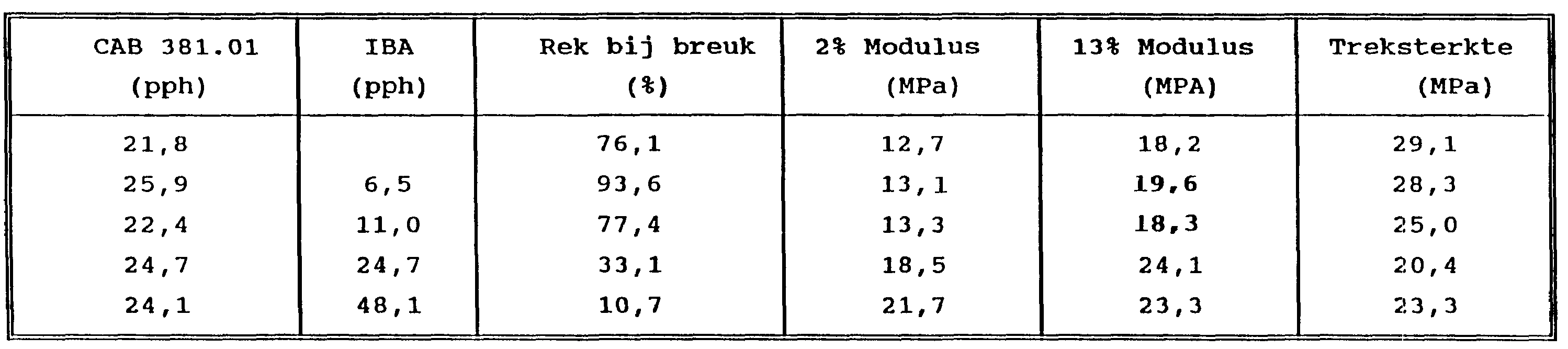
TABEL 5TABLE 5

TABEL 6TABLE 6
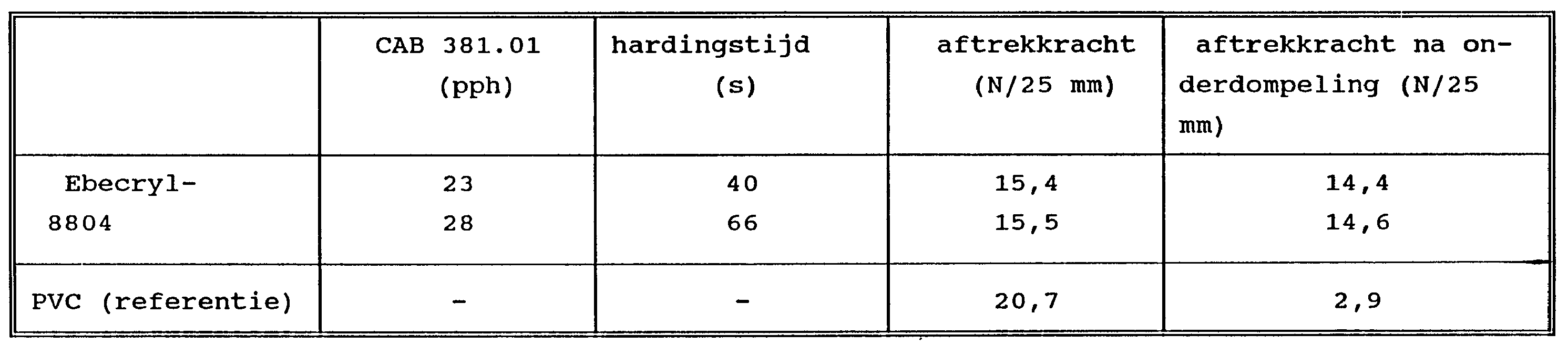
TABEL 7TABLE 7

Claims (13)
Priority Applications (3)
| Application Number | Priority Date | Filing Date | Title |
|---|---|---|---|
| NL9202002A NL9202002A (en) | 1992-11-17 | 1992-11-17 | Product obtained by cross-linking a prepolymer, product in the form of a foil and method of manufacturing it. |
| AU56081/94A AU5608194A (en) | 1992-11-17 | 1993-11-16 | Halogen and plasticizer free films |
| PCT/US1993/011099 WO1994011433A1 (en) | 1992-11-17 | 1993-11-16 | Halogen and plasticizer free films |
Applications Claiming Priority (2)
| Application Number | Priority Date | Filing Date | Title |
|---|---|---|---|
| NL9202002 | 1992-11-17 | ||
| NL9202002A NL9202002A (en) | 1992-11-17 | 1992-11-17 | Product obtained by cross-linking a prepolymer, product in the form of a foil and method of manufacturing it. |
Publications (1)
| Publication Number | Publication Date |
|---|---|
| NL9202002A true NL9202002A (en) | 1994-06-16 |
Family
ID=19861529
Family Applications (1)
| Application Number | Title | Priority Date | Filing Date |
|---|---|---|---|
| NL9202002A NL9202002A (en) | 1992-11-17 | 1992-11-17 | Product obtained by cross-linking a prepolymer, product in the form of a foil and method of manufacturing it. |
Country Status (3)
| Country | Link |
|---|---|
| AU (1) | AU5608194A (en) |
| NL (1) | NL9202002A (en) |
| WO (1) | WO1994011433A1 (en) |
Families Citing this family (1)
| Publication number | Priority date | Publication date | Assignee | Title |
|---|---|---|---|---|
| EP2818488B1 (en) | 2013-06-24 | 2021-10-13 | 3M Innovative Properties Company | Paint Replacement Film with polymer layer containing polyurethane |
Family Cites Families (1)
| Publication number | Priority date | Publication date | Assignee | Title |
|---|---|---|---|---|
| US5082914A (en) * | 1989-12-15 | 1992-01-21 | Eastman Kodak Company | Grafted cellulose esters containing a silicon moiety |
-
1992
- 1992-11-17 NL NL9202002A patent/NL9202002A/en not_active Application Discontinuation
-
1993
- 1993-11-16 AU AU56081/94A patent/AU5608194A/en not_active Abandoned
- 1993-11-16 WO PCT/US1993/011099 patent/WO1994011433A1/en not_active Ceased
Also Published As
| Publication number | Publication date |
|---|---|
| AU5608194A (en) | 1994-06-08 |
| WO1994011433A1 (en) | 1994-05-26 |
Similar Documents
| Publication | Publication Date | Title |
|---|---|---|
| EP0486897B1 (en) | Unsaturated phenone derivatives and their use as adhesives | |
| DE69827613T2 (en) | PRESSURE-SENSITIVE ADHESIVES FOR MARKING FILMS | |
| EP0862503B1 (en) | Adhesive paint film | |
| EP2557098B1 (en) | Temperature-resistant laser-inscribable film | |
| DE69926267T2 (en) | PRESSURE-SENSITIVE ADHESIVE COMPOSITION | |
| DE4222334A1 (en) | Hot melt pressure sensitive adhesive for medical products | |
| EP0343467B1 (en) | Hot melt adhesives cross-linkable in the air, using ultraviolet radiation | |
| EP1815915A2 (en) | Method for producing versatile plastic products especially with a abrasion-resistant surface | |
| DE2946474A1 (en) | CURABLE COATING AGENTS AND METHOD FOR THE PRODUCTION OF SCRATCH-RESISTANT COATINGS ON PLASTICS | |
| CH654584A5 (en) | Curable composition. | |
| EP0515719B1 (en) | Self-adhesive acrylat copolymers, process for their preparation and self-adhesive flat items containing them | |
| DE102006002596A1 (en) | composite film | |
| NL9202002A (en) | Product obtained by cross-linking a prepolymer, product in the form of a foil and method of manufacturing it. | |
| JPS58164668A (en) | Manufacture of self-adhesive film | |
| JPS63145372A (en) | Actinic radiation curable paint | |
| JPS62131006A (en) | Photocurable resin composition | |
| EP0355683B1 (en) | Radiation cross-linkable contact adhesive mixtures | |
| DE4228436C2 (en) | Pressure sensitive polyacrylic acid pressure sensitive adhesive and its use for the production of self-adhesive, flat substrates | |
| DE2704328C2 (en) | ||
| JP3403244B2 (en) | Active energy ray-curable coating composition | |
| EP1228157B1 (en) | Use of polymers as adhesives for removable carriers | |
| DE10310889A1 (en) | Adhesive composition useful for self-adhesive film, comprises a polymer prepared from radically polymerizable compounds and compounds having ethylenically unsaturated radically polymerizable groups and mol. wt. of less than 5000 g/mol | |
| EP1242550B1 (en) | Adhesives for frozen substrates | |
| EP0419862B1 (en) | Radiation cured foil strip, its use and process for its production | |
| DE2332817A1 (en) | PLASTIC LAYERED PRODUCT MADE OF UNSATURATED POLYESTER RESIN MODIFIED WITH STYRENE MONOMER AND PROCESS FOR THE PRODUCTION THEREOF |
Legal Events
| Date | Code | Title | Description |
|---|---|---|---|
| A1B | A search report has been drawn up | ||
| BV | The patent application has lapsed | ||
| BV | The patent application has lapsed |