RU2041900C1 - Silicate dye - Google Patents
Silicate dye Download PDFInfo
- Publication number
- RU2041900C1 RU2041900C1 RU93027639A RU93027639A RU2041900C1 RU 2041900 C1 RU2041900 C1 RU 2041900C1 RU 93027639 A RU93027639 A RU 93027639A RU 93027639 A RU93027639 A RU 93027639A RU 2041900 C1 RU2041900 C1 RU 2041900C1
- Authority
- RU
- Russia
- Prior art keywords
- water
- glass
- paint
- dye
- sodium
- Prior art date
Links
- BPQQTUXANYXVAA-UHFFFAOYSA-N Orthosilicate Chemical compound [O-][Si]([O-])([O-])[O-] BPQQTUXANYXVAA-UHFFFAOYSA-N 0.000 title abstract description 16
- XLYOFNOQVPJJNP-UHFFFAOYSA-N water Substances O XLYOFNOQVPJJNP-UHFFFAOYSA-N 0.000 claims abstract description 19
- 239000004816 latex Substances 0.000 claims abstract description 11
- 229920000126 latex Polymers 0.000 claims abstract description 11
- 239000004202 carbamide Substances 0.000 claims abstract description 10
- XSQUKJJJFZCRTK-UHFFFAOYSA-N Urea Chemical compound NC(N)=O XSQUKJJJFZCRTK-UHFFFAOYSA-N 0.000 claims abstract description 9
- MTAZNLWOLGHBHU-UHFFFAOYSA-N butadiene-styrene rubber Chemical compound C=CC=C.C=CC1=CC=CC=C1 MTAZNLWOLGHBHU-UHFFFAOYSA-N 0.000 claims abstract description 5
- NTHWMYGWWRZVTN-UHFFFAOYSA-N sodium silicate Chemical compound [Na+].[Na+].[O-][Si]([O-])=O NTHWMYGWWRZVTN-UHFFFAOYSA-N 0.000 claims abstract description 5
- 239000003973 paint Substances 0.000 claims description 28
- DGAQECJNVWCQMB-PUAWFVPOSA-M Ilexoside XXIX Chemical compound C[C@@H]1CC[C@@]2(CC[C@@]3(C(=CC[C@H]4[C@]3(CC[C@@H]5[C@@]4(CC[C@@H](C5(C)C)OS(=O)(=O)[O-])C)C)[C@@H]2[C@]1(C)O)C)C(=O)O[C@H]6[C@@H]([C@H]([C@@H]([C@H](O6)CO)O)O)O.[Na+] DGAQECJNVWCQMB-PUAWFVPOSA-M 0.000 claims description 15
- 239000011734 sodium Substances 0.000 claims description 15
- 229910052708 sodium Inorganic materials 0.000 claims description 15
- 239000010802 sludge Substances 0.000 claims description 11
- 239000000049 pigment Substances 0.000 claims description 8
- 239000003607 modifier Substances 0.000 claims description 5
- 235000019353 potassium silicate Nutrition 0.000 claims description 5
- 239000002174 Styrene-butadiene Substances 0.000 claims description 4
- 239000011115 styrene butadiene Substances 0.000 claims description 4
- 229920003048 styrene butadiene rubber Polymers 0.000 claims description 4
- XUIMIQQOPSSXEZ-UHFFFAOYSA-N Silicon Chemical compound [Si] XUIMIQQOPSSXEZ-UHFFFAOYSA-N 0.000 claims 1
- 229910052710 silicon Inorganic materials 0.000 claims 1
- 239000010703 silicon Substances 0.000 claims 1
- 238000004519 manufacturing process Methods 0.000 abstract description 5
- 239000000126 substance Substances 0.000 abstract description 4
- 239000011521 glass Substances 0.000 description 16
- 239000000203 mixture Substances 0.000 description 11
- 239000007788 liquid Substances 0.000 description 9
- 238000000576 coating method Methods 0.000 description 6
- 238000000227 grinding Methods 0.000 description 6
- 239000011541 reaction mixture Substances 0.000 description 6
- 238000003756 stirring Methods 0.000 description 5
- 239000002002 slurry Substances 0.000 description 4
- XLOMVQKBTHCTTD-UHFFFAOYSA-N Zinc monoxide Chemical compound [Zn]=O XLOMVQKBTHCTTD-UHFFFAOYSA-N 0.000 description 3
- 239000011575 calcium Substances 0.000 description 3
- 230000035899 viability Effects 0.000 description 3
- 239000011701 zinc Substances 0.000 description 3
- ZLMJMSJWJFRBEC-UHFFFAOYSA-N Potassium Chemical compound [K] ZLMJMSJWJFRBEC-UHFFFAOYSA-N 0.000 description 2
- 235000012241 calcium silicate Nutrition 0.000 description 2
- JHLNERQLKQQLRZ-UHFFFAOYSA-N calcium silicate Chemical compound [Ca+2].[Ca+2].[O-][Si]([O-])([O-])[O-] JHLNERQLKQQLRZ-UHFFFAOYSA-N 0.000 description 2
- 229910052918 calcium silicate Inorganic materials 0.000 description 2
- 239000011248 coating agent Substances 0.000 description 2
- 238000010276 construction Methods 0.000 description 2
- 238000005516 engineering process Methods 0.000 description 2
- 239000011591 potassium Substances 0.000 description 2
- 229910052700 potassium Inorganic materials 0.000 description 2
- 238000010521 absorption reaction Methods 0.000 description 1
- 230000015572 biosynthetic process Effects 0.000 description 1
- 239000008199 coating composition Substances 0.000 description 1
- 239000002131 composite material Substances 0.000 description 1
- 238000005034 decoration Methods 0.000 description 1
- 238000001035 drying Methods 0.000 description 1
- 230000003203 everyday effect Effects 0.000 description 1
- 238000002156 mixing Methods 0.000 description 1
- 238000010422 painting Methods 0.000 description 1
- 235000011837 pasties Nutrition 0.000 description 1
- 230000008092 positive effect Effects 0.000 description 1
- 239000004576 sand Substances 0.000 description 1
- 238000003786 synthesis reaction Methods 0.000 description 1
- 239000000454 talc Substances 0.000 description 1
- 229910052623 talc Inorganic materials 0.000 description 1
- RLQWHDODQVOVKU-UHFFFAOYSA-N tetrapotassium;silicate Chemical compound [K+].[K+].[K+].[K+].[O-][Si]([O-])([O-])[O-] RLQWHDODQVOVKU-UHFFFAOYSA-N 0.000 description 1
- VLCLHFYFMCKBRP-UHFFFAOYSA-N tricalcium;diborate Chemical compound [Ca+2].[Ca+2].[Ca+2].[O-]B([O-])[O-].[O-]B([O-])[O-] VLCLHFYFMCKBRP-UHFFFAOYSA-N 0.000 description 1
- 239000011787 zinc oxide Substances 0.000 description 1
Images
Landscapes
- Paints Or Removers (AREA)
Abstract
Description
Изобретение относится к области синтеза композиционных силикатных красок, которые находят применение в строительстве и быту в качестве фасадных красок, а также предназначаются для внутренней отделки зданий и помещений. The invention relates to the field of synthesis of composite silicate paints, which are used in construction and everyday life as facade paints, and are also intended for interior decoration of buildings and premises.
Известна силикатная краска, содержащая жидкое калиевое стекло и сухую пигментную часть, состоящую из мела или цветного пигмента, талька и силикатизатора, в качестве которого применяют борат кальция или окись цинка [1] Однако она имеет недостатки. Известная краска характеризуется невысокой жизнеспособностью, а также обладает недостаточной кроющей способностью. Кроме того, она нестабильна при хранении, вследствие чего выпускается двухупаковочной. Known silicate paint containing liquid potassium glass and a dry pigment part, consisting of chalk or colored pigment, talc and a silicifier, which is used as calcium borate or zinc oxide [1] However, it has drawbacks. Known paint is characterized by low viability, and also has insufficient hiding power. In addition, it is unstable during storage, as a result of which it is available in two packs.
Наиболее близким техническим решением является состав для покрытия, содержащий, мас. The closest technical solution is a coating composition containing, by weight.
Дисперсный гидросили- кат кальция 38,8-47,0 Тонкомолотый песок 10,0-13,6 Пигмент 1,0-4,5 Олифа-оксоль 7,2-12,5
Жидкое стекло натриевое или калиевое 25,0-37,8
Использование в описанном составе в качестве компонента пигментной части дисперсного гидросиликата кальция и одновременно в качестве органического модификатора олифы-оксоль позволяет сократить время высыхания покрытия, повысить прочность и снизить водопоглощение покрытия и, кроме того, применять в качестве жидкого стекла не только калиевое, но и натриевое с плотностью 1,15-1,25 г/см3 [2]
Недостатками известного состава являются его малая жизнеспособность и соответственно отсутствие стабильности при хранении, а также и то, что он обеспечивает недостаточно высокую кроющую способность краски.Dispersed calcium hydrosilicate 38.8-47.0 Fine sand 10.0-13.6 Pigment 1.0-4.5 Oil-oxol 7.2-12.5
Sodium or potassium water glass 25.0-37.8
The use of dispersed calcium hydrosilicate in the described composition as a component of the pigment part and at the same time as an organic modifier makes it possible to reduce drying time of the coating, increase strength and reduce water absorption of the coating, and, in addition, use not only potassium, but also sodium glass with a density of 1.15-1.25 g / cm 3 [2]
The disadvantages of the known composition are its low viability and, accordingly, the lack of stability during storage, as well as the fact that it does not provide a sufficiently high hiding power of the paint.
Технической задачей изобретения является разработка силикатной краски на основе жидкого натриевого стекла с повышенными жизнеспособностью, стабильностью при хранении и кроющей способностью. An object of the invention is the development of silicate paint based on liquid sodium glass with increased viability, storage stability and hiding power.
Эта задача решается тем, что силикатная краска, включающая натриевое жидкое стекло, органические модификаторы и пигментную часть, в качестве натриевого жидкого стекла она содержит натриевое жидкое стекло с плотностью 1,36 г/см3 и модулем 2,7-3,0, в качестве органических модификаторов мочевину и бутадиенстирольный латекс, в качестве пигментной части шлам электрохимических производств, и дополнительно содержит воду при следующем соотношении компонентов, мас.This problem is solved in that the silicate paint, including sodium water glass, organic modifiers and the pigment part, as sodium water glass, it contains sodium water glass with a density of 1.36 g / cm 3 and a module of 2.7-3.0, in as organic modifiers, urea and styrene-butadiene latex, as a pigment part, are sludge from electrochemical plants, and additionally contains water in the following ratio of components, wt.
Натриевое жидкое
стекло с плотностью
1,36 г/см3 и модулем 2,7-3,0 21,0-33,6
Бутадиенстирольный латекс 11,8-18,7
Шлам электрохимичес-
ких производств в пере- счете на сухой остаток 11,2-22,6 Вода Остальное
Шлам электрохимических производств представляет собой пастообразный продукт следующего химического состава, мас. Cu 0,2-2,1; Fe 0,7-6,0; Ni 0,01-0,36; Zn ≅ 0,08; Cr 0,03-0,05; Pb 0,01-0,07; Ca 21,5-26,0; H2O остальное.Sodium Liquid
density glass
1.36 g / cm 3 and a module 2.7-3.0 21.0-33.6
Styrene butadiene latex 11.8-18.7
Sludge electrochemical
production in terms of dry residue 11.2-22.6 Water
Sludge electrochemical production is a pasty product of the following chemical composition, wt. Cu 0.2-2.1; Fe 0.7-6.0; Ni 0.01-0.36; Zn ≅ 0.08; Cr 0.03-0.05; Pb 0.01-0.07; Ca 21.5-26.0; H 2 O rest.
Силикатная краска по изобретению имеет следующие преимущества: существенно повышаются жизнеспособность краски и стабильность ее при хранении, повышается кроющая способность краски, технология производства силикатной краски отличается простотой и требует минимум оборудования. The silicate paint according to the invention has the following advantages: the vitality of the paint and its stability during storage are significantly increased, the covering power of the paint is increased, the production technology of silicate paint is simple and requires a minimum of equipment.
Указанный положительный эффект от применения в строительной индустрии силикатной краски по изобретению иллюстрируется следующими примерами. The specified positive effect of the use in the construction industry of silicate paint according to the invention is illustrated by the following examples.
П р и м е р 1. 33,6 мас. жидкого натриевого стекла плотностью 1,36 г/см3 и модулем 3,0 (здесь и далее в примерах 2, 3 используется жидкое стекло натриевое плотностью 1,36 г/см3 и модулем 3,0) и 3,7 мас. мочевины перемешивают при 60оС, выдерживают реакционную смесь при данной температуре до достижения вязкости 20-25с по вискозиметру ВЗ-4, к модифицированному стеклу добавляют 6,7 мас. воды и шлам в количестве 11,2 мас. из расчета на сухой остаток, производят интенсивное перемешивание и перетирание в течение 1 ч до получения однородной массы, затем вводят 18,7 мас. латекса СКС-65-ГП и вновь перемешивают массу в течение 20-30 мин.PRI me
Шлам имеет следующий химический состав, мас. Cu 2,1; Fe 6,0; Ni 0,01; Zn ≅ 0,05; Cr 0,03; Pb 0,07; Ca 21,5; H2O остальное (здесь и далее в примерах 2, 3 шлам имеет указанный состав).The slurry has the following chemical composition, wt. Cu 2.1; Fe 6.0; Ni 0.01; Zn ≅ 0.05; Cr 0.03; Pb 0.07; Ca 21.5; H 2 O the rest (hereinafter in examples 2, 3, the sludge has the specified composition).
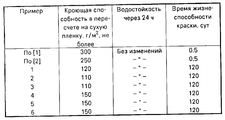
Полученную краску разбавляют водой до вязкости 14-16 с по ВЗ-4 и наносят на окрашиваемую поверхность. Силикатная краска жизнеспособна 120 сут, имеет кроющую способность в пересчете на сухую пленку 120 г/м2, обеспечивает покрытия с водостойкостью 24 с. Указанные свойства силикатной краски и покрытий на ее основе, а также красок и покрытий на их основе по другим примерам приведены в таблице.The resulting paint is diluted with water to a viscosity of 14-16 s according to VZ-4 and applied to the painted surface. Silicate paint is viable for 120 days, has a covering power in terms of a dry film of 120 g / m 2 , provides coatings with a water resistance of 24 s. The indicated properties of silicate paint and coatings based on it, as well as paints and coatings based on them for other examples are given in the table.
П р и м е р 2. 21,8 мас. жидкого натриевого стекла и 2,4 мас. мочевины перемешивают при 70оС, выдерживают реакционную смесь пр данной температуре до достижения вязкости 20-25с по вискозиметру ВЗ-4, к модифицированному стеклу добавляют 12,4 мас. воды и шлам в количестве 15,4 мас. из расчета на сухой остаток, производят интенсивное перемешивание и перетирание в течение 1 ч до получения однородной массы, затем вводят 12,1 мас. латекса СКС-65-ГП и вновь массу перемешивают 20-30 мин. Полученную краску разбавляют водой до вязкости 14-16 с по ВЗ-4 и наносят на окрашиваемую поверхность.PRI me
П р и м е р 3. 21,0 мас. жидкого натриевого стекла и 2,3 мас. мочевины перемешивают при 80оС, выдерживают реакционную смесь при данной температуре до достижения вязкости 20-25с по вискозиметру ВЗ-4, к модифицированному стеклу добавляют 3,0 мас. воды и шлам в количестве 18,6 мас. из расчета на сухой остаток, производят интенсивное перемешивание и перетирание в течение 1 ч до получения однородной массы, затем вводят 11,8 мас. латекса СКС-75-ГП и вновь массу перемешивают 20-30 мин. Полученную краску разбавляют водой до вязкости 14-16с по ВЗ-4 и наносят на окрашиваемую поверхность.PRI me
П р и м е р 4. 29,8 мас. жидкого натриевого стекла плотностью 1,36 г/см3 и модулем 2,7 (здесь и далее в примерах 5, 6 используется жидкое стекло натриевое плотностью 1,36 г/см3 и модулем 2,7) и 3,3 мас. мочевины перемешивают при 70оС, выдерживают реакционную смесь при данной температуре до достижения вязкости 20-25 с по вискозиметру ВЗ-4, к модифицированному стеклу добавляют шлам в количестве 21,1 мас. из расчета на сухой остаток, производят интенсивное перемешивание и перетирание в течение 1 ч до получения однородной массы, затем вводят 16,8 мас. латекса БС-65-К-3 и вновь перемешивают массу в течение 20-30 мин.PRI me
Шлам имеет следующий химический состав, мас. Cu 0,2; Fe 0,7; Ni 0,36; Zn 0,08; Cr 0,05; Pb 0,01; Ca 26,0; H2O остальное (здесь и далее в примерах 5, 6 шлам имеет указанный состав).The slurry has the following chemical composition, wt. Cu 0.2; Fe 0.7; Ni 0.36; Zn 0.08; Cr 0.05; Pb 0.01; Ca 26.0; H 2 O the rest (hereinafter in examples 5, 6, the sludge has the specified composition).
Полученную краску разбавляют водой до вязкости 14-16с по ВЗ-4 и наносят на окрашиваемую поверхность. Силикатная краска жизнеспособна 120 сут, имеет кроющую способность в пересчете на сухую пленку 150 г/м2, обеспечивает покрытия с водостойкостью 24 ч.The resulting paint is diluted with water to a viscosity of 14-16s according to VZ-4 and applied to the painted surface. Silicate paint is viable for 120 days, has a covering power in terms of a dry film of 150 g / m 2 , provides coatings with a water resistance of 24 hours.
П р и м е р 5. 29,0 мас. жидкого натриевого стекла и 3,2 мас. мочевины перемешивают при 70оС, выдерживают реакционную смесь при данной температуре до достижения вязкости 20-25 с по вискозиметру ВЗ-4, к модифицированному стеклу добавляют шлам в количестве 22,6 мас. из расчета на сухой остаток, производят интенсивное перемешивание и перетирание в течение 1 ч до получения однородной массы, затем вводят 12,9 мас. латекса БС-65-К-3 и вновь перемешивают массу 20-30 мин. Полученную краску разбавляют водой до вязкости 14-16с по ВЗ-4 и наносят на окрашиваемую поверхность.PRI me
П р и м е р 6. 23,1 мас. жидкого натриевого стекла и 2,5 мас. мочевины перемешивают при 70оС, выдерживают реакционную смесь при данной температуре до достижения вязкости 20-25 с по вискозиметру ВЗ-4, к модифицированному стеклу добавляют 13,0 мас. воды и шлам в количестве 20,4 мас. из расчета на сухой остаток, производят интенсивное перемешивание и перетирание в течение 1 ч до получения однородной массы, затем вводят 12,9 мас. латекса БС-65-К-3 и вновь перемешивают массу 20-30 мин. Полученную краску разбавляют водой до вязкости 14-16 с по ВЗ-4 и наносят на окрашиваемую поверхность.PRI me
Таким образом, использование силикатной краски по изобретению обеспечивает по сравнению с известной следующие преимущества: существенно повышаются жизнеспособность и стабильность силикатной краски при хранении, повышается кроющая способность краски, технология производства силикатной краски отличается простотой и требует минимум оборудования. Thus, the use of silicate paint according to the invention provides the following advantages compared to the known one: the vitality and stability of silicate paint during storage are significantly increased, the covering power of the paint is increased, the technology for producing silicate paint is simple and requires a minimum of equipment.
Силикатная краска хорошо наносится на влажную и щелочную поверхность. Silicate paint is well applied to wet and alkaline surfaces.
Claims (1)
Мочевина 2,3 3,7
Бутадиенстирольный латекс 11,8 18,7
Шлам электрохимических производств, в пересчете на сухой остаток 11,2 22,6
Вода ОстальноеSodium water glass with a density of 1.36 g / cm 3 and a module of 2.7 3.0 21.0 33.6
Urea 2.3 3.7
Styrene butadiene latex 11.8 18.7
Sludge from electrochemical plants, calculated on the dry residue 11.2 22.6
Water Else
Priority Applications (1)
| Application Number | Priority Date | Filing Date | Title |
|---|---|---|---|
| RU93027639A RU2041900C1 (en) | 1993-05-24 | 1993-05-24 | Silicate dye |
Applications Claiming Priority (1)
| Application Number | Priority Date | Filing Date | Title |
|---|---|---|---|
| RU93027639A RU2041900C1 (en) | 1993-05-24 | 1993-05-24 | Silicate dye |
Publications (2)
| Publication Number | Publication Date |
|---|---|
| RU2041900C1 true RU2041900C1 (en) | 1995-08-20 |
| RU93027639A RU93027639A (en) | 1996-12-10 |
Family
ID=20141987
Family Applications (1)
| Application Number | Title | Priority Date | Filing Date |
|---|---|---|---|
| RU93027639A RU2041900C1 (en) | 1993-05-24 | 1993-05-24 | Silicate dye |
Country Status (1)
| Country | Link |
|---|---|
| RU (1) | RU2041900C1 (en) |
Cited By (5)
| Publication number | Priority date | Publication date | Assignee | Title |
|---|---|---|---|---|
| RU2216558C2 (en) * | 2001-12-24 | 2003-11-20 | Магнитогорский государственный технический университет им.Г.И.Носова | Composition for protective-decorative coating |
| US6696518B1 (en) * | 1999-05-27 | 2004-02-24 | Basf Aktiengesellschaft | Method of selectively hydrogenating ethylenically unsaturated double bonds in polymers |
| RU2294946C1 (en) * | 2005-12-26 | 2007-03-10 | Государственное образовательное учреждение высшего профессионального образования "Ивановский государственный химико-технологический университет" (ИГХТУ) | Silicate building paint |
| RU2294947C1 (en) * | 2005-12-26 | 2007-03-10 | Государственное образовательное учреждение высшего профессионального образования "Ивановский государственный химико-технологический университет" (ИГХТУ) | One-pot silicate paint |
| RU2645502C2 (en) * | 2016-06-14 | 2018-02-21 | Федеральное государственное автономное образовательное учреждение высшего образования "Национальный исследовательский Томский политехнический университет" | Composite silicate paint |
-
1993
- 1993-05-24 RU RU93027639A patent/RU2041900C1/en active
Non-Patent Citations (2)
| Title |
|---|
| 1. Климанова Е.А. и др Силикатные краски. М.: Стройиздат, 1968, с.7-65. * |
| 2. Авторское свидетельство СССР N 1257080, кл. C 09D 1/04, 1986. * |
Cited By (5)
| Publication number | Priority date | Publication date | Assignee | Title |
|---|---|---|---|---|
| US6696518B1 (en) * | 1999-05-27 | 2004-02-24 | Basf Aktiengesellschaft | Method of selectively hydrogenating ethylenically unsaturated double bonds in polymers |
| RU2216558C2 (en) * | 2001-12-24 | 2003-11-20 | Магнитогорский государственный технический университет им.Г.И.Носова | Composition for protective-decorative coating |
| RU2294946C1 (en) * | 2005-12-26 | 2007-03-10 | Государственное образовательное учреждение высшего профессионального образования "Ивановский государственный химико-технологический университет" (ИГХТУ) | Silicate building paint |
| RU2294947C1 (en) * | 2005-12-26 | 2007-03-10 | Государственное образовательное учреждение высшего профессионального образования "Ивановский государственный химико-технологический университет" (ИГХТУ) | One-pot silicate paint |
| RU2645502C2 (en) * | 2016-06-14 | 2018-02-21 | Федеральное государственное автономное образовательное учреждение высшего образования "Национальный исследовательский Томский политехнический университет" | Composite silicate paint |
Similar Documents
| Publication | Publication Date | Title |
|---|---|---|
| US3998651A (en) | Compound of calcium carbonate and of tobermorites, its manufacture and its applications | |
| CN102827499B (en) | Water-glass-based exterior wall paint and preparation method thereof | |
| CN110511623A (en) | A kind of aqueous architectural decorative paint and preparation method thereof with water-proof function | |
| CN105566982A (en) | Waterproof putty for internal wall and manufacturing method | |
| RU2034810C1 (en) | Method of preparing of building silicate dye | |
| CN111039651A (en) | Coal gangue calcined kaolin-based inorganic water-based internal and external wall coating and preparation method thereof | |
| CN110386788A (en) | A kind of JS cement base anti-counterfeit paint, Preparation method and use | |
| CN113698800A (en) | Double-component inorganic interior and exterior wall coating | |
| CN109321045A (en) | A kind of water paint and preparation method thereof made of conch meal | |
| CN106892598A (en) | A kind of geopolymer modified JS waterproofing paint and preparation method thereof | |
| RU2154041C1 (en) | Fire-retardant coating composition | |
| RU2160753C2 (en) | Composite silicate paint | |
| RU2075460C1 (en) | Method of preparing binding composition | |
| CN109574541A (en) | A kind of gypsum reinforcing agent and preparation method thereof | |
| RU2234476C2 (en) | Putty | |
| US2588438A (en) | Cement paint composition | |
| CN113233865A (en) | Novel high-tech environment-friendly wall coating and preparation method and application thereof | |
| RU2216558C2 (en) | Composition for protective-decorative coating | |
| SU910705A1 (en) | Paint composition | |
| JP2021130764A (en) | Aqueous multi-pattern paint composition and multi-pattern coating film | |
| SU655673A1 (en) | Finishing building mortar | |
| US2934445A (en) | Paints based on portland cement | |
| SU808456A1 (en) | Silicate composition for producing coating | |
| SU1375611A1 (en) | Composition for finishing work | |
| RU2402508C1 (en) | Finishing composition |