RU2079103C1 - Method of remote measurement of relative movements of three objects in three angular coordinates and device for its realization - Google Patents
Method of remote measurement of relative movements of three objects in three angular coordinates and device for its realization Download PDFInfo
- Publication number
- RU2079103C1 RU2079103C1 SU5026120A RU2079103C1 RU 2079103 C1 RU2079103 C1 RU 2079103C1 SU 5026120 A SU5026120 A SU 5026120A RU 2079103 C1 RU2079103 C1 RU 2079103C1
- Authority
- RU
- Russia
- Prior art keywords
- objects
- sources
- coordinates
- angular
- lens
- Prior art date
Links
- 238000000034 method Methods 0.000 title claims abstract description 16
- 238000005259 measurement Methods 0.000 title claims abstract description 14
- 238000006073 displacement reaction Methods 0.000 claims description 29
- 230000005855 radiation Effects 0.000 claims description 15
- 230000003287 optical effect Effects 0.000 claims description 11
- 230000008878 coupling Effects 0.000 abstract 1
- 238000010168 coupling process Methods 0.000 abstract 1
- 238000005859 coupling reaction Methods 0.000 abstract 1
- 239000000126 substance Substances 0.000 abstract 1
- 230000005540 biological transmission Effects 0.000 description 2
- 230000005484 gravity Effects 0.000 description 2
- 239000011159 matrix material Substances 0.000 description 2
- 239000010755 BS 2869 Class G Substances 0.000 description 1
- 238000010276 construction Methods 0.000 description 1
- 238000010586 diagram Methods 0.000 description 1
- 238000009434 installation Methods 0.000 description 1
Images


Landscapes
- Length Measuring Devices By Optical Means (AREA)
Abstract
Description
Изобретение относится к контрольно-измерительной технике. The invention relates to instrumentation.
Известен ближайший по технической сущности и достигаемому результату способ дистанционного измерения взаимных перемещений двух объектов в двух угловых координатах, реализованный в устройстве по а.с. N 1472762, кл. G 01B 21/22. Known for the closest in technical essence and the achieved result is a method for remote measurement of mutual displacements of two objects in two angular coordinates, implemented in the device according to AS N 1472762, class G 01B 21/22.
Известный способ измерения заключается в том, что на каждом из объектов измеряют собственные угловые перемещения относительно общей для обоих объектов связующей прямой и по результатам измерений вычисляют взаимное угловое перемещение. The known method of measurement is that on each of the objects measure their own angular displacement relative to the common straight line for both objects and the mutual angular displacement is calculated from the measurement results.
Недостатком известного способа является, то что третья угловая координата (угол скручивания) известным способом измеряться не может и нет возможности измерить взаимное угловое перемещение трех объектов. A disadvantage of the known method is that the third angular coordinate (twist angle) cannot be measured in a known manner and it is not possible to measure the mutual angular displacement of three objects.
Известное устройство содержит устанавливаемые на каждом из двух объектов источник излучения с объективом, где центр тяжести источника совпадает с оптическим центром объектива, и два позиционно-чувствительных фотоприемника, расположенные на соответствующих объектах, два блока определения координат, подключенные к соответствующим фотоприемникам и вычислитель, два входа которого подключены к двум блокам определения координат. The known device comprises a radiation source with a lens mounted on each of two objects, where the center of gravity of the source coincides with the optical center of the lens, and two position-sensitive photodetectors located on the corresponding objects, two coordinate determination units connected to the corresponding photodetectors and a calculator, two inputs which are connected to two coordinate determination units.
Недостатком известного способа является невозможность получения третьей угловой координаты и измерения взаимного перемещения трех объектов. The disadvantage of this method is the inability to obtain a third angular coordinate and measure the mutual displacement of three objects.
Техническим результатом является обеспечение возможности измерения взаимного перемещения трех объектов в трех угловых координатах. The technical result is the ability to measure the mutual displacement of three objects in three angular coordinates.
Результат достигается тем, что в способе измерения взаимных угловых перемещений объектов, состоящем в том, что на объектах, взаимное перемещение которых хотят определить, устанавливают источники излучения и устройства для измерения координат и изображений этих источников, берут три источника излучения с учетом их видимости на заданной дальности измерения и устанавливают их на трех объектах таким образом, что в процессе перемещения объектов источники не перекрывались друг от друга и определяли бы своими центрами межобъектную плоскость, с этой плоскостью связывают устройства для измерения координат источников излучения, устанавливая каждое из них на объекте таким образом, чтобы центр источника, установленного на том же объекте, совпадал с оптическим центром устройства (его объектива или иного фокусирующего элемента), а два других источника находились бы в его поле зрения и проецировались бы в свои изображения на фотоприемной измерительной поверхности, по завершению установки фиксируют исходное взаимное угловое положение объектов, при этом считывают на каждом объекте с измерительного устройства значения координат центров тяжести двух изображений от источников излучения, находящихся в поле зрения, по значениям координат вычисляют угловое положение объекта относительно межобъективной плоскости в трех угловых координат, сравнивая угловые положения объектов относительно общей межобъективной плоскости, определяют угловое положение одного объекта относительно любого другого в трех угловых координат, исходные значения угловых положений переводят в память, далее аналогичным образом определяют текущие значения угловых положений объектов, сравнивают их с исходными значениями и определяют угловые перемещения объектов между собой. The result is achieved by the fact that in the method for measuring the mutual angular displacements of objects, consisting in the fact that on the objects whose mutual displacement they want to determine, radiation sources and devices for measuring the coordinates and images of these sources are installed, three radiation sources are taken taking into account their visibility at a given measurement ranges and set them on three objects in such a way that in the process of moving the objects the sources did not overlap from each other and would determine the interobject plane by their centers , devices for measuring the coordinates of radiation sources are connected to this plane, setting each of them on the object so that the center of the source installed on the same object coincides with the optical center of the device (its lens or other focusing element), and two other sources are would be in his field of view and projected into his images on a photodetector measuring surface, upon completion of the installation, the initial mutual angular position of the objects is fixed, while reading on each object from the measuring device, the coordinates of the centers of gravity of two images from radiation sources in the field of view, using the coordinate values, calculate the angular position of the object relative to the interobjective plane in three angular coordinates, comparing the angular positions of the objects relative to the common interobjective plane, determine the angular position of one object relative to any other in three angular coordinates, the initial values of the angular positions are transferred to the memory, then in the same way determine the current the values of the angular positions of the objects, compare them with the initial values and determine the angular displacements of the objects between them.
Результат достигается тем, что устройство для измерения взаимных перемещений объектов, содержащее на одном объекте объектив, источник света в виде расходящегося пучка лучей с вершиной в оптическом центре объектива, позиционно -чувствительный фотоприемник и блок определений координат изображений, подключенный своими входами к выходам фотоприемника, содержащее на втором объекте те же элементы, снабжено расположенной на третьем объекте такой же группой элементов, вычислителем взаимных перемещений и тремя линиями передачи данных, которые своими входами подключены к выходам блоков определения координат изображений, а выходами к трем входам вычислителя взаимных перемещений. The result is achieved in that a device for measuring the mutual displacements of objects, containing a lens on one object, a light source in the form of a diverging beam of rays with a vertex in the optical center of the lens, a position-sensitive photodetector and a block for determining the coordinates of images connected to the outputs of the photodetector by its inputs, containing at the second object, the same elements, equipped with the same group of elements located on the third object, a calculator of mutual displacements and three data lines, which e their inputs are connected to the outputs of the blocks determining the coordinates of the images, and the outputs to the three inputs of the calculator of mutual displacements.
Результат достигается также тем, что в устройстве вычислитель взаимных перемещений дополнен четвертым входом для ввода в него значения расстояния, постоянного или текущего, между двумя любыми источниками света данного устройства, измеренного иными средствами. The result is also achieved by the fact that in the device the mutual displacement calculator is supplemented with a fourth input for entering the distance value, constant or current, between any two light sources of this device, measured by other means.
На фиг.1 изображены три объекта A, B и C; на фиг. 2 звено AB измерительной системы; на фиг. 3 объекты A, B и C и связанные с ними фотопреобразователи; на фиг. 4 -пояснение для поворота объекта A вокруг оси "Xa" в системе координат Xa, Ya, Za; на фиг. 5 - пояснение для случая поворота изображения объекта A на видеомониторе; на фиг.6 схема устройства измерения.Figure 1 shows three objects A, B and C; in FIG. 2 link AB measuring system; in FIG. 3 objects A, B and C and related photoconverters; in FIG. 4-explanation for the rotation of the object A around the axis "X a " in the coordinate system X a , Y a , Z a ; in FIG. 5 is an explanation for the case of rotation of the image of the object A on a video monitor; 6 is a diagram of a measurement device.
Устройство измерения содержит установленный на каждом из объектов A, B и C источник 1 излучения, объектив 2, матричный преобразователь 3 изображения и блок 4 определения координат изображения, связанный линией передачи данных 5 с вычислителем 6. The measuring device comprises a radiation source 1 installed on each of the objects A, B, and C, a
Способ позволяет измерять взаимное угловое перемещение трех (или более) объектов в трех угловых координат. Он отличается тем, что на каждом из объектов измеряют собственные угловые перемещения относительно общей связующей межобъектной плоскости и по результатам измерений вычисляют взаимное угловое перемещение в трех угловых координатах. The method allows to measure the mutual angular displacement of three (or more) objects in three angular coordinates. It differs in that each of the objects measures its own angular displacements relative to the common connecting interobjective plane, and the mutual angular displacement in three angular coordinates is calculated from the measurement results.
Способ осуществляется следующим образом. The method is as follows.
На фиг. 1 изображены три объекта A, B и C. На каждом из них выбрана удобная для наблюдения с двух других объектов опорная точка, которая отличается от остальных точек, например, по яркости. Три такие точки на трех объектах образуют собой плоскость межобъектного треугольника ABC. In FIG. 1 shows three objects A, B and C. On each of them, a reference point convenient for observation from two other objects is selected, which differs from other points, for example, in brightness. Three such points on three objects form the plane of the interobject triangle ABC.
На фиг. 2 изображено звено AB измерительной системы. В качестве устройств для измерения собственных угловых перемещений использованы телевизионные камеры. Их оптические центры совмещены с опорными точками (опорными источниками света). При угловом перемещении объектов A и B относительно друг друга оптические оси их телевизионных камер смещаются относительно общей прямой AB (в'ABa'). Физически этой прямой является главный оптический луч. Собственные угловые перемещения Φa и Φb могут быть вычислены по смещению изображений "а" и "в" источников света на фотоприемной поверхности камер и расстоянию от оптического центра до фотоприемной поверхности (фокусному расстоянию объективов). Разность измерений, приведенных к единой системе координат, определяет взаимное угловое перемещение между объектами. На чертеже это видно из геометрических построений
Φab= Φa-(-Φb) = Φa+Φb.
На фиг. 3 объекты A, B и C и связанные с ними телевизионные камеры представлены их опорными точками (точечными источниками света). Три опорные точки образуют треугольник ABC. С каждой опорной точкой связана своим началом соответствующая система координат. Причем таким образом, что оси XY совпадают с плоскостью треугольника ABC, при этом оси Y направлены по биссектрисам углов α, β, γ. Углы a, β, γ определимы. Их можно вычислить по координатам изображений и расстоянию до фотоприемной поверхности. Следовательно, три системы координат отличаются друг от друга только разворотом вокруг оси Z на известные углы.In FIG. 2 shows the AB link of the measuring system. Television cameras were used as devices for measuring their own angular displacements. Their optical centers are combined with reference points (reference light sources). With the angular movement of objects A and B relative to each other, the optical axes of their television cameras shift relative to the common line AB (in 'ABa'). Physically, this direct line is the main optical beam. The proper angular displacements Φ a and Φ b can be calculated from the displacement of images a and b in the light sources on the photodetector surface of the cameras and the distance from the optical center to the photodetector surface (focal length of the lenses). The difference in measurements reduced to a single coordinate system determines the mutual angular displacement between objects. In the drawing, this can be seen from the geometric constructions.
Φ ab = Φ a - (- Φ b ) = Φ a + Φ b .
In FIG. 3 objects A, B and C and associated television cameras are represented by their reference points (point sources of light). Three anchor points form a triangle ABC. Each reference point has its origin associated with the corresponding coordinate system. Moreover, in such a way that the XY axes coincide with the plane of the triangle ABC, while the Y axes are directed along the bisectors of the angles α, β, γ. The angles a, β, γ are definable. They can be calculated by the coordinates of the images and the distance to the photodetector surface. Therefore, the three coordinate systems differ from each other only by turning around the Z axis by known angles.
На фиг. 4 изображен поворот объекта A вокруг оси Xa в системе координат Xa, Ya, Za. На светоприемной поверхности телевизионной камеры A видны изображения "c'" и "в'" источников света C и В. Угол vxa измеряется по смещению изображений и фокусному расстоянию fa.In FIG. 4 shows the rotation of object A around the axis X a in the coordinate system X a , Y a , Z a . On the light-receiving surface of the television camera A, the images “c '” and “c'” of the light sources C and B are visible. The angle v xa is measured by the displacement of the images and the focal length f a .
На фиг. 5 изображен поворот объекта A на видеомониторе. Поворот произведен вокруг трех осей (X, Y, Z). На мониторе изображения "c'" и "в'". In FIG. 5 shows the rotation of object A on a video monitor. The rotation is made around three axes (X, Y, Z). On the monitor, the images are c and c.
Угловое перемещение объекта A вокруг оси Xa определится из соотношения

Угловое перемещение объекта A вокруг оси Ya определится из соотношения:
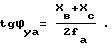
Угловое перемещение объекта A вокруг оси Za определяется из соотношения:

Аналогичным образом определяются угловые перемещения объектов B и C в системах координат Xв, Yв, Zв и Xc, Yc, Zc.The angular displacement of object A around the axis X a is determined from the relation
The angular movement of the object A around the axis Y a is determined from the relation:
The angular movement of the object A around the axis Z a is determined from the relation:
Similarly, the angular displacements of objects B and C are determined in the coordinate systems X in , Y in , Z in and X c , Y c , Z c .
Полученные результаты измерений переводят в общую систему координат, например, связанную с объектом A, и производят окончательное вычисление взаимных угловых перемещений, которые сводятся к вычислению разности между значениями соответствующих координат. The obtained measurement results are transferred to a common coordinate system, for example, associated with object A, and the final calculation of the mutual angular displacements, which are reduced to calculating the difference between the values of the corresponding coordinates.
Устройство для измерения взаимных перемещений объекта реализует способ следующим образом. A device for measuring mutual displacements of an object implements the method as follows.
Источник 1 света установлен в оптическом центре объектива 2. Матричный преобразователь 3 совмещен своей фоточувствительной поверхностью с фокальной плоскостью объектива. Объективы развернуты таким образом, что первый объектив (на объекте A) формирует на фоточувствительной поверхности изображения "c" и "в" источников света объектов C и B, второй объектив (на объекте B) формирует изображения "a" и "c" источников света объектов A и C и третий объектив (на объекте C) формирует изображения "a" и "в" источников света объектов A и B. The light source 1 is installed in the optical center of the
Положение изображений источников света на фоточувствительных матрицах с высокой точностью рассчитывается с помощью блоков 4 определения координат и по линиям передачи данных 5 значения их координат передаются в вычислитель 6. Полученных с трех объектов данных о координатах изображений и о фокусных расстояниях объективов достаточно, чтобы по способу дистанционного измерения взаимных перемещений трех объектов в трех угловых координат рассчитать три угловые координаты, например, объекта C в системе координат объекта A или в связанных с ним системах. A введенное в вычислитель значение H расстояния между объективами A и B позволяет рассчитать и три линейные координаты объекта C. The position of the images of the light sources on the photosensitive matrices is calculated with high accuracy using the
Claims (3)
Priority Applications (1)
| Application Number | Priority Date | Filing Date | Title |
|---|---|---|---|
| SU5026120 RU2079103C1 (en) | 1991-12-29 | 1991-12-29 | Method of remote measurement of relative movements of three objects in three angular coordinates and device for its realization |
Applications Claiming Priority (1)
| Application Number | Priority Date | Filing Date | Title |
|---|---|---|---|
| SU5026120 RU2079103C1 (en) | 1991-12-29 | 1991-12-29 | Method of remote measurement of relative movements of three objects in three angular coordinates and device for its realization |
Publications (1)
| Publication Number | Publication Date |
|---|---|
| RU2079103C1 true RU2079103C1 (en) | 1997-05-10 |
Family
ID=21596302
Family Applications (1)
| Application Number | Title | Priority Date | Filing Date |
|---|---|---|---|
| SU5026120 RU2079103C1 (en) | 1991-12-29 | 1991-12-29 | Method of remote measurement of relative movements of three objects in three angular coordinates and device for its realization |
Country Status (1)
| Country | Link |
|---|---|
| RU (1) | RU2079103C1 (en) |
-
1991
- 1991-12-29 RU SU5026120 patent/RU2079103C1/en active
Non-Patent Citations (1)
| Title |
|---|
| Авторское свидетельство СССР N 1472762, кл. G 01 B 21/22, 1989. * |
Similar Documents
| Publication | Publication Date | Title |
|---|---|---|
| NO164946B (en) | OPTO-ELECTRONIC SYSTEM FOR EXACTLY MEASURING A FLAT GEOMETRY. | |
| CN111458108B (en) | Transmitting-receiving optical axis parallelism measuring device and measuring method | |
| CN113847872B (en) | Discrete single-point displacement static monitoring device and method based on laser ranging | |
| US6424422B1 (en) | Three-dimensional input device | |
| JPH06123610A (en) | Optical measuring method and measuring apparatus for objective | |
| CN119246523B (en) | Visual detection information acquisition device and method based on horizontal included angle calibration image | |
| US4641961A (en) | Apparatus for measuring the optical characteristics of an optical system to be examined | |
| Cooper et al. | High precision photogrammetric monitoring of the deformation of a steel bridge | |
| CN119246524A (en) | A visual detection information acquisition device and method based on pitch angle calibration image | |
| CN111337013A (en) | Multi-target point discrimination and positioning system based on four-line array CCD | |
| CN1298092A (en) | Precise azimuth measuring system | |
| RU2020419C1 (en) | Horizon scanner | |
| RU2730370C1 (en) | Automated device for attachment to reverse plumb lines | |
| SU1620821A1 (en) | Arrangement for determining position of object | |
| RU2065570C1 (en) | Electron-projection method of measurement of form and translations of surface of object | |
| CN110108235B (en) | Multi-vision measuring device and multi-vision measuring method | |
| CN219694161U (en) | Digital level gauge | |
| RU2219494C2 (en) | Device to transfer course from one horizon to another | |
| CN201569415U (en) | Space digital geodesic surveying device | |
| RU2309379C2 (en) | Device for measuring surface coordinates of complex object | |
| JPH01242905A (en) | Method for measuring actual size of visual device | |
| KR100401478B1 (en) | The imaging system using off-axis incident beam | |
| JP3494576B2 (en) | Optical declination measuring device | |
| SU1430742A1 (en) | Optronic device for measuring angle of twist of object | |
| JP2864163B2 (en) | 3D measuring device |