RU2155751C2 - Derivatives of 1,4-dihydropyridine, mixtures of their isomers or separate isomers, pharmaceutical composition based on thereof and 2-chloro-3-cyanobenzaldehyde - Google Patents
Derivatives of 1,4-dihydropyridine, mixtures of their isomers or separate isomers, pharmaceutical composition based on thereof and 2-chloro-3-cyanobenzaldehyde Download PDFInfo
- Publication number
- RU2155751C2 RU2155751C2 RU94043812/04A RU94043812A RU2155751C2 RU 2155751 C2 RU2155751 C2 RU 2155751C2 RU 94043812/04 A RU94043812/04 A RU 94043812/04A RU 94043812 A RU94043812 A RU 94043812A RU 2155751 C2 RU2155751 C2 RU 2155751C2
- Authority
- RU
- Russia
- Prior art keywords
- methoxyethyl
- dihydro
- phenyl
- dicarboxylate
- isopropyl
- Prior art date
Links
- YNGDWRXWKFWCJY-UHFFFAOYSA-N 1,4-Dihydropyridine Chemical class C1C=CNC=C1 YNGDWRXWKFWCJY-UHFFFAOYSA-N 0.000 title claims abstract description 17
- 239000000203 mixture Substances 0.000 title claims description 16
- 239000008194 pharmaceutical composition Substances 0.000 title claims description 8
- MVYGQIWGZGMFAU-UHFFFAOYSA-N 2-chloro-3-formylbenzonitrile Chemical compound ClC1=C(C=O)C=CC=C1C#N MVYGQIWGZGMFAU-UHFFFAOYSA-N 0.000 title claims description 5
- -1 cyano- Chemical class 0.000 claims abstract description 39
- 150000001875 compounds Chemical class 0.000 claims abstract description 32
- 125000002887 hydroxy group Chemical group [H]O* 0.000 claims abstract description 3
- 125000002023 trifluoromethyl group Chemical group FC(F)(F)* 0.000 claims abstract description 3
- 125000004200 2-methoxyethyl group Chemical group [H]C([H])([H])OC([H])([H])C([H])([H])* 0.000 claims description 9
- 125000004432 carbon atom Chemical group C* 0.000 claims description 9
- 239000011575 calcium Substances 0.000 claims description 8
- 239000013543 active substance Substances 0.000 claims description 7
- KMJQHGKVKIJUNE-UHFFFAOYSA-N 4-(2,5-dichlorophenyl)-1-(2-methoxyethyl)-2,6-dimethyl-4-propan-2-ylpyridine-3,5-dicarboxylic acid Chemical compound C(C)(C)C1(C(=C(N(C(=C1C(=O)O)C)CCOC)C)C(=O)O)C1=C(C=CC(=C1)Cl)Cl KMJQHGKVKIJUNE-UHFFFAOYSA-N 0.000 claims description 6
- KKTWCKCZOJVIFR-UHFFFAOYSA-N 4-(2,5-difluorophenyl)-1-(2-methoxyethyl)-2,6-dimethyl-4-propan-2-ylpyridine-3,5-dicarboxylic acid Chemical compound CC(C)C1(C(C=C(C=C2)F)=C2F)C(C(O)=O)=C(C)N(CCOC)C(C)=C1C(O)=O KKTWCKCZOJVIFR-UHFFFAOYSA-N 0.000 claims description 6
- BHTJKFSTYMHHTF-UHFFFAOYSA-N 4-(2,6-difluorophenyl)-1-(2-methoxyethyl)-2,6-dimethyl-4-propan-2-ylpyridine-3,5-dicarboxylic acid Chemical compound C(C)(C)C1(C(=C(N(C(=C1C(=O)O)C)CCOC)C)C(=O)O)C1=C(C=CC=C1F)F BHTJKFSTYMHHTF-UHFFFAOYSA-N 0.000 claims description 6
- WJXMFQIJJSSDNV-UHFFFAOYSA-N 4-(2-chloro-6-fluorophenyl)-1-(2-methoxyethyl)-2,6-dimethyl-4-propan-2-ylpyridine-3,5-dicarboxylic acid Chemical compound CC1=C(C(C(=C(N1CCOC)C)C(=O)O)(C2=C(C=CC=C2Cl)F)C(C)C)C(=O)O WJXMFQIJJSSDNV-UHFFFAOYSA-N 0.000 claims description 6
- MTEHMXWHPBLNFX-UHFFFAOYSA-N 4-(2-cyanophenyl)-1-(2-methoxyethyl)-2,6-dimethyl-4-propan-2-ylpyridine-3,5-dicarboxylic acid Chemical compound OC(=O)C1=C(C)N(CCOC)C(C)=C(C(O)=O)C1(C(C)C)C1=CC=CC=C1C#N MTEHMXWHPBLNFX-UHFFFAOYSA-N 0.000 claims description 6
- DPOLLIDXLLAFPL-UHFFFAOYSA-N 4-(2-fluorophenyl)-1-(2-methoxyethyl)-2,6-dimethyl-4-propan-2-ylpyridine-3,5-dicarboxylic acid Chemical compound CC1=C(C(C(=C(N1CCOC)C)C(=O)O)(C2=CC=CC=C2F)C(C)C)C(=O)O DPOLLIDXLLAFPL-UHFFFAOYSA-N 0.000 claims description 6
- GAEGDZUVMOILSR-UHFFFAOYSA-N 4-(3-chloro-2-cyanophenyl)-4-cyclopentyl-1-(2-methoxyethyl)-2,6-dimethylpyridine-3,5-dicarboxylic acid Chemical compound CC1=C(C(C(=C(N1CCOC)C)C(=O)O)(C2CCCC2)C3=C(C(=CC=C3)Cl)C#N)C(=O)O GAEGDZUVMOILSR-UHFFFAOYSA-N 0.000 claims description 6
- KTJNFPKCEOCPKA-UHFFFAOYSA-N 4-[2-fluoro-3-(trifluoromethyl)phenyl]-4-(2-methoxyethyl)-1,2,6-trimethylpyridine-3,5-dicarboxylic acid Chemical compound C=1C=CC(C(F)(F)F)=C(F)C=1C1(CCOC)C(C(O)=O)=C(C)N(C)C(C)=C1C(O)=O KTJNFPKCEOCPKA-UHFFFAOYSA-N 0.000 claims description 6
- KQWWDKIHPOJTLR-UHFFFAOYSA-N 4-cyclopentyl-4-[2-fluoro-3-(trifluoromethyl)phenyl]-1-(2-methoxyethyl)-2,6-dimethylpyridine-3,5-dicarboxylic acid Chemical compound CC(N(CCOC)C(C)=C(C1(C2CCCC2)C(C=CC=C2C(F)(F)F)=C2F)C(O)=O)=C1C(O)=O KQWWDKIHPOJTLR-UHFFFAOYSA-N 0.000 claims description 6
- OGZABDJLCYVXBH-UHFFFAOYSA-N CC(C)C1(C(C=CC=C2Cl)=C2C#N)C(C(O)=O)=C(C)N(CCOC)C(C)=C1C(O)=O Chemical compound CC(C)C1(C(C=CC=C2Cl)=C2C#N)C(C(O)=O)=C(C)N(CCOC)C(C)=C1C(O)=O OGZABDJLCYVXBH-UHFFFAOYSA-N 0.000 claims description 6
- NQXZDLOPBMPLGL-UHFFFAOYSA-N CC(C)C1(C(C=CC=C2F)=C2F)C(C(O)=O)=C(C)N(CCOC)C(C)=C1C(O)=O Chemical compound CC(C)C1(C(C=CC=C2F)=C2F)C(C(O)=O)=C(C)N(CCOC)C(C)=C1C(O)=O NQXZDLOPBMPLGL-UHFFFAOYSA-N 0.000 claims description 6
- XLYXATZXTDBSNQ-UHFFFAOYSA-N CC(N(CCOC)C(C)=C(C1(C2CCCC2)C(C=CC=C2C#N)=C2Cl)C(O)=O)=C1C(O)=O Chemical compound CC(N(CCOC)C(C)=C(C1(C2CCCC2)C(C=CC=C2C#N)=C2Cl)C(O)=O)=C1C(O)=O XLYXATZXTDBSNQ-UHFFFAOYSA-N 0.000 claims description 6
- 230000003042 antagnostic effect Effects 0.000 claims description 6
- 229910052791 calcium Inorganic materials 0.000 claims description 6
- RZJXRRVZIIGCIZ-UHFFFAOYSA-N 4-(3-cyanophenyl)-4-cycloheptyl-1-(2-methoxyethyl)-2,6-dimethylpyridine-3,5-dicarboxylic acid Chemical compound OC(=O)C1=C(C)N(CCOC)C(C)=C(C(O)=O)C1(C=1C=C(C=CC=1)C#N)C1CCCCCC1 RZJXRRVZIIGCIZ-UHFFFAOYSA-N 0.000 claims description 5
- CCWPAYHHDNDBIE-UHFFFAOYSA-N CC(C)C1(C(C=CC=C2C(F)(F)F)=C2F)C(C(O)=O)=C(C)N(CCOC)C(C)=C1C(O)=O Chemical compound CC(C)C1(C(C=CC=C2C(F)(F)F)=C2F)C(C(O)=O)=C(C)N(CCOC)C(C)=C1C(O)=O CCWPAYHHDNDBIE-UHFFFAOYSA-N 0.000 claims description 5
- 125000003545 alkoxy group Chemical group 0.000 claims description 4
- 238000002360 preparation method Methods 0.000 claims description 3
- 125000000217 alkyl group Chemical group 0.000 claims description 2
- 125000000753 cycloalkyl group Chemical group 0.000 claims description 2
- 239000003937 drug carrier Substances 0.000 claims description 2
- 229910052736 halogen Inorganic materials 0.000 claims description 2
- 150000002367 halogens Chemical class 0.000 claims description 2
- 229910052739 hydrogen Inorganic materials 0.000 claims description 2
- 239000001257 hydrogen Substances 0.000 claims description 2
- 125000004435 hydrogen atom Chemical class [H]* 0.000 claims description 2
- 239000013067 intermediate product Substances 0.000 claims description 2
- 125000002816 methylsulfanyl group Chemical group [H]C([H])([H])S[*] 0.000 claims description 2
- 125000001424 substituent group Chemical group 0.000 claims description 2
- 229940085304 dihydropyridine derivative selective calcium channel blockers with mainly vascular effects Drugs 0.000 claims 1
- 239000000126 substance Substances 0.000 abstract description 5
- 229940079593 drug Drugs 0.000 abstract description 3
- 239000003814 drug Substances 0.000 abstract description 3
- 239000005557 antagonist Substances 0.000 abstract description 2
- 125000004209 (C1-C8) alkyl group Chemical group 0.000 abstract 1
- 210000003169 central nervous system Anatomy 0.000 abstract 1
- 230000000694 effects Effects 0.000 abstract 1
- 125000002534 ethynyl group Chemical group [H]C#C* 0.000 abstract 1
- 125000005843 halogen group Chemical group 0.000 abstract 1
- 208000015122 neurodegenerative disease Diseases 0.000 abstract 1
- 125000001997 phenyl group Chemical group [H]C1=C([H])C([H])=C(*)C([H])=C1[H] 0.000 abstract 1
- YXFVVABEGXRONW-UHFFFAOYSA-N Toluene Chemical compound CC1=CC=CC=C1 YXFVVABEGXRONW-UHFFFAOYSA-N 0.000 description 39
- XEKOWRVHYACXOJ-UHFFFAOYSA-N Ethyl acetate Chemical compound CCOC(C)=O XEKOWRVHYACXOJ-UHFFFAOYSA-N 0.000 description 17
- LFQSCWFLJHTTHZ-UHFFFAOYSA-N Ethanol Chemical compound CCO LFQSCWFLJHTTHZ-UHFFFAOYSA-N 0.000 description 16
- YMWUJEATGCHHMB-UHFFFAOYSA-N Dichloromethane Chemical compound ClCCl YMWUJEATGCHHMB-UHFFFAOYSA-N 0.000 description 15
- OKKJLVBELUTLKV-UHFFFAOYSA-N Methanol Chemical compound OC OKKJLVBELUTLKV-UHFFFAOYSA-N 0.000 description 15
- VYPSYNLAJGMNEJ-UHFFFAOYSA-N Silicium dioxide Chemical compound O=[Si]=O VYPSYNLAJGMNEJ-UHFFFAOYSA-N 0.000 description 13
- 238000000034 method Methods 0.000 description 13
- RTZKZFJDLAIYFH-UHFFFAOYSA-N Diethyl ether Chemical compound CCOCC RTZKZFJDLAIYFH-UHFFFAOYSA-N 0.000 description 12
- KFZMGEQAYNKOFK-UHFFFAOYSA-N Isopropanol Chemical compound CC(C)O KFZMGEQAYNKOFK-UHFFFAOYSA-N 0.000 description 12
- WYURNTSHIVDZCO-UHFFFAOYSA-N Tetrahydrofuran Chemical compound C1CCOC1 WYURNTSHIVDZCO-UHFFFAOYSA-N 0.000 description 10
- QTBSBXVTEAMEQO-UHFFFAOYSA-N Acetic acid Chemical compound CC(O)=O QTBSBXVTEAMEQO-UHFFFAOYSA-N 0.000 description 9
- ZMXDDKWLCZADIW-UHFFFAOYSA-N N,N-Dimethylformamide Chemical compound CN(C)C=O ZMXDDKWLCZADIW-UHFFFAOYSA-N 0.000 description 9
- 239000000741 silica gel Substances 0.000 description 9
- 229910002027 silica gel Inorganic materials 0.000 description 9
- 239000002904 solvent Substances 0.000 description 9
- 238000006243 chemical reaction Methods 0.000 description 8
- 239000002253 acid Substances 0.000 description 7
- 235000019439 ethyl acetate Nutrition 0.000 description 7
- 239000000047 product Substances 0.000 description 7
- 239000000243 solution Substances 0.000 description 7
- WEVYAHXRMPXWCK-UHFFFAOYSA-N Acetonitrile Chemical compound CC#N WEVYAHXRMPXWCK-UHFFFAOYSA-N 0.000 description 6
- QGZKDVFQNNGYKY-UHFFFAOYSA-N Ammonia Chemical compound N QGZKDVFQNNGYKY-UHFFFAOYSA-N 0.000 description 6
- ZMANZCXQSJIPKH-UHFFFAOYSA-N Triethylamine Chemical compound CCN(CC)CC ZMANZCXQSJIPKH-UHFFFAOYSA-N 0.000 description 6
- 150000001298 alcohols Chemical class 0.000 description 6
- 150000002148 esters Chemical class 0.000 description 6
- 239000002585 base Substances 0.000 description 5
- PFKFTWBEEFSNDU-UHFFFAOYSA-N carbonyldiimidazole Chemical compound C1=CN=CN1C(=O)N1C=CN=C1 PFKFTWBEEFSNDU-UHFFFAOYSA-N 0.000 description 5
- 238000002844 melting Methods 0.000 description 5
- 230000008018 melting Effects 0.000 description 5
- YLQBMQCUIZJEEH-UHFFFAOYSA-N tetrahydrofuran Natural products C=1C=COC=1 YLQBMQCUIZJEEH-UHFFFAOYSA-N 0.000 description 5
- 238000004809 thin layer chromatography Methods 0.000 description 5
- NQRYJNQNLNOLGT-UHFFFAOYSA-N Piperidine Chemical compound C1CCNCC1 NQRYJNQNLNOLGT-UHFFFAOYSA-N 0.000 description 4
- JUJWROOIHBZHMG-UHFFFAOYSA-N Pyridine Chemical compound C1=CC=NC=C1 JUJWROOIHBZHMG-UHFFFAOYSA-N 0.000 description 4
- FAPWRFPIFSIZLT-UHFFFAOYSA-M Sodium chloride Chemical compound [Na+].[Cl-] FAPWRFPIFSIZLT-UHFFFAOYSA-M 0.000 description 4
- 150000001735 carboxylic acids Chemical class 0.000 description 4
- 238000004587 chromatography analysis Methods 0.000 description 4
- PSHKMPUSSFXUIA-UHFFFAOYSA-N n,n-dimethylpyridin-2-amine Chemical compound CN(C)C1=CC=CC=N1 PSHKMPUSSFXUIA-UHFFFAOYSA-N 0.000 description 4
- 229910052757 nitrogen Inorganic materials 0.000 description 4
- RYHBNJHYFVUHQT-UHFFFAOYSA-N 1,4-Dioxane Chemical compound C1COCCO1 RYHBNJHYFVUHQT-UHFFFAOYSA-N 0.000 description 3
- HBAQYPYDRFILMT-UHFFFAOYSA-N 8-[3-(1-cyclopropylpyrazol-4-yl)-1H-pyrazolo[4,3-d]pyrimidin-5-yl]-3-methyl-3,8-diazabicyclo[3.2.1]octan-2-one Chemical class C1(CC1)N1N=CC(=C1)C1=NNC2=C1N=C(N=C2)N1C2C(N(CC1CC2)C)=O HBAQYPYDRFILMT-UHFFFAOYSA-N 0.000 description 3
- UHOVQNZJYSORNB-UHFFFAOYSA-N Benzene Chemical compound C1=CC=CC=C1 UHOVQNZJYSORNB-UHFFFAOYSA-N 0.000 description 3
- XDTMQSROBMDMFD-UHFFFAOYSA-N Cyclohexane Chemical compound C1CCCCC1 XDTMQSROBMDMFD-UHFFFAOYSA-N 0.000 description 3
- 230000005526 G1 to G0 transition Effects 0.000 description 3
- PEDCQBHIVMGVHV-UHFFFAOYSA-N Glycerine Chemical compound OCC(O)CO PEDCQBHIVMGVHV-UHFFFAOYSA-N 0.000 description 3
- IMNFDUFMRHMDMM-UHFFFAOYSA-N N-Heptane Chemical compound CCCCCCC IMNFDUFMRHMDMM-UHFFFAOYSA-N 0.000 description 3
- 229910021529 ammonia Inorganic materials 0.000 description 3
- 239000013078 crystal Substances 0.000 description 3
- 238000002425 crystallisation Methods 0.000 description 3
- 230000008025 crystallization Effects 0.000 description 3
- 125000004925 dihydropyridyl group Chemical group N1(CC=CC=C1)* 0.000 description 3
- 239000003480 eluent Substances 0.000 description 3
- 239000012442 inert solvent Substances 0.000 description 3
- 125000001449 isopropyl group Chemical group [H]C([H])([H])C([H])(*)C([H])([H])[H] 0.000 description 3
- 239000002808 molecular sieve Substances 0.000 description 3
- 238000010992 reflux Methods 0.000 description 3
- 238000000926 separation method Methods 0.000 description 3
- URGAHOPLAPQHLN-UHFFFAOYSA-N sodium aluminosilicate Chemical compound [Na+].[Al+3].[O-][Si]([O-])=O.[O-][Si]([O-])=O URGAHOPLAPQHLN-UHFFFAOYSA-N 0.000 description 3
- XLYOFNOQVPJJNP-UHFFFAOYSA-N water Substances O XLYOFNOQVPJJNP-UHFFFAOYSA-N 0.000 description 3
- PAMIQIKDUOTOBW-UHFFFAOYSA-N 1-methylpiperidine Chemical compound CN1CCCCC1 PAMIQIKDUOTOBW-UHFFFAOYSA-N 0.000 description 2
- WRMNZCZEMHIOCP-UHFFFAOYSA-N 2-phenylethanol Chemical compound OCCC1=CC=CC=C1 WRMNZCZEMHIOCP-UHFFFAOYSA-N 0.000 description 2
- UIAGMCDKSXEBJQ-IBGZPJMESA-N 3-o-(2-methoxyethyl) 5-o-propan-2-yl (4s)-2,6-dimethyl-4-(3-nitrophenyl)-1,4-dihydropyridine-3,5-dicarboxylate Chemical compound COCCOC(=O)C1=C(C)NC(C)=C(C(=O)OC(C)C)[C@H]1C1=CC=CC([N+]([O-])=O)=C1 UIAGMCDKSXEBJQ-IBGZPJMESA-N 0.000 description 2
- XWDBGBRSNUIXTC-UHFFFAOYSA-N 4-(3-cyanophenyl)-2,6-dimethyl-1,4-dihydropyridine-3,5-dicarboxylic acid Chemical compound OC(=O)C1=C(C)NC(C)=C(C(O)=O)C1C1=CC=CC(C#N)=C1 XWDBGBRSNUIXTC-UHFFFAOYSA-N 0.000 description 2
- WPUILNZZHASHHQ-UHFFFAOYSA-N 4-(3-cyanophenyl)-5-(2-methoxyethoxycarbonyl)-2,6-dimethyl-1,4-dihydropyridine-3-carboxylic acid Chemical compound COCCOC(=O)C1=C(C)NC(C)=C(C(O)=O)C1C1=CC=CC(C#N)=C1 WPUILNZZHASHHQ-UHFFFAOYSA-N 0.000 description 2
- HEDRZPFGACZZDS-UHFFFAOYSA-N Chloroform Chemical compound ClC(Cl)Cl HEDRZPFGACZZDS-UHFFFAOYSA-N 0.000 description 2
- QOSSAOTZNIDXMA-UHFFFAOYSA-N Dicylcohexylcarbodiimide Chemical compound C1CCCCC1N=C=NC1CCCCC1 QOSSAOTZNIDXMA-UHFFFAOYSA-N 0.000 description 2
- TWRXJAOTZQYOKJ-UHFFFAOYSA-L Magnesium chloride Chemical compound [Mg+2].[Cl-].[Cl-] TWRXJAOTZQYOKJ-UHFFFAOYSA-L 0.000 description 2
- JGFZNNIVVJXRND-UHFFFAOYSA-N N,N-Diisopropylethylamine (DIPEA) Chemical compound CCN(C(C)C)C(C)C JGFZNNIVVJXRND-UHFFFAOYSA-N 0.000 description 2
- WCUXLLCKKVVCTQ-UHFFFAOYSA-M Potassium chloride Chemical compound [Cl-].[K+] WCUXLLCKKVVCTQ-UHFFFAOYSA-M 0.000 description 2
- DTQVDTLACAAQTR-UHFFFAOYSA-N Trifluoroacetic acid Chemical compound OC(=O)C(F)(F)F DTQVDTLACAAQTR-UHFFFAOYSA-N 0.000 description 2
- 230000004913 activation Effects 0.000 description 2
- 150000001299 aldehydes Chemical class 0.000 description 2
- 150000003863 ammonium salts Chemical class 0.000 description 2
- 230000004071 biological effect Effects 0.000 description 2
- 238000009835 boiling Methods 0.000 description 2
- 210000005013 brain tissue Anatomy 0.000 description 2
- 150000001718 carbodiimides Chemical class 0.000 description 2
- 239000003153 chemical reaction reagent Substances 0.000 description 2
- 239000003795 chemical substances by application Substances 0.000 description 2
- 238000001816 cooling Methods 0.000 description 2
- 230000032050 esterification Effects 0.000 description 2
- 238000005886 esterification reaction Methods 0.000 description 2
- 150000002170 ethers Chemical class 0.000 description 2
- 238000002474 experimental method Methods 0.000 description 2
- 238000001914 filtration Methods 0.000 description 2
- 210000005003 heart tissue Anatomy 0.000 description 2
- 230000003993 interaction Effects 0.000 description 2
- JVTAAEKCZFNVCJ-UHFFFAOYSA-N lactic acid Chemical compound CC(O)C(O)=O JVTAAEKCZFNVCJ-UHFFFAOYSA-N 0.000 description 2
- HQKMJHAJHXVSDF-UHFFFAOYSA-L magnesium stearate Chemical compound [Mg+2].CCCCCCCCCCCCCCCCCC([O-])=O.CCCCCCCCCCCCCCCCCC([O-])=O HQKMJHAJHXVSDF-UHFFFAOYSA-L 0.000 description 2
- 229960000715 nimodipine Drugs 0.000 description 2
- 239000011148 porous material Substances 0.000 description 2
- BWHMMNNQKKPAPP-UHFFFAOYSA-L potassium carbonate Chemical compound [K+].[K+].[O-]C([O-])=O BWHMMNNQKKPAPP-UHFFFAOYSA-L 0.000 description 2
- 230000008569 process Effects 0.000 description 2
- UMJSCPRVCHMLSP-UHFFFAOYSA-N pyridine Natural products COC1=CC=CN=C1 UMJSCPRVCHMLSP-UHFFFAOYSA-N 0.000 description 2
- 239000011541 reaction mixture Substances 0.000 description 2
- 239000000377 silicon dioxide Substances 0.000 description 2
- SQGYOTSLMSWVJD-UHFFFAOYSA-N silver(1+) nitrate Chemical compound [Ag+].[O-]N(=O)=O SQGYOTSLMSWVJD-UHFFFAOYSA-N 0.000 description 2
- XGVXKJKTISMIOW-ZDUSSCGKSA-N simurosertib Chemical compound N1N=CC(C=2SC=3C(=O)NC(=NC=3C=2)[C@H]2N3CCC(CC3)C2)=C1C XGVXKJKTISMIOW-ZDUSSCGKSA-N 0.000 description 2
- 239000011780 sodium chloride Substances 0.000 description 2
- VZGDMQKNWNREIO-UHFFFAOYSA-N tetrachloromethane Chemical compound ClC(Cl)(Cl)Cl VZGDMQKNWNREIO-UHFFFAOYSA-N 0.000 description 2
- 230000008719 thickening Effects 0.000 description 2
- FYSNRJHAOHDILO-UHFFFAOYSA-N thionyl chloride Chemical compound ClS(Cl)=O FYSNRJHAOHDILO-UHFFFAOYSA-N 0.000 description 2
- 238000012795 verification Methods 0.000 description 2
- QBYIENPQHBMVBV-HFEGYEGKSA-N (2R)-2-hydroxy-2-phenylacetic acid Chemical compound O[C@@H](C(O)=O)c1ccccc1.O[C@@H](C(O)=O)c1ccccc1 QBYIENPQHBMVBV-HFEGYEGKSA-N 0.000 description 1
- 0 *c(c(C=C)ccc1)c1C#N Chemical compound *c(c(C=C)ccc1)c1C#N 0.000 description 1
- SGUVLZREKBPKCE-UHFFFAOYSA-N 1,5-diazabicyclo[4.3.0]-non-5-ene Chemical compound C1CCN=C2CCCN21 SGUVLZREKBPKCE-UHFFFAOYSA-N 0.000 description 1
- VXNZUUAINFGPBY-UHFFFAOYSA-N 1-Butene Chemical compound CCC=C VXNZUUAINFGPBY-UHFFFAOYSA-N 0.000 description 1
- ASOKPJOREAFHNY-UHFFFAOYSA-N 1-Hydroxybenzotriazole Chemical compound C1=CC=C2N(O)N=NC2=C1 ASOKPJOREAFHNY-UHFFFAOYSA-N 0.000 description 1
- 238000005160 1H NMR spectroscopy Methods 0.000 description 1
- RAXXELZNTBOGNW-UHFFFAOYSA-N 1H-imidazole Chemical compound C1=CNC=N1 RAXXELZNTBOGNW-UHFFFAOYSA-N 0.000 description 1
- GOJUJUVQIVIZAV-UHFFFAOYSA-N 2-amino-4,6-dichloropyrimidine-5-carbaldehyde Chemical group NC1=NC(Cl)=C(C=O)C(Cl)=N1 GOJUJUVQIVIZAV-UHFFFAOYSA-N 0.000 description 1
- KZIUQKCRAYTVFZ-UHFFFAOYSA-N 2-chloro-3-(dibromomethyl)benzonitrile Chemical compound ClC1=C(C#N)C=CC=C1C(Br)Br KZIUQKCRAYTVFZ-UHFFFAOYSA-N 0.000 description 1
- CRPFKUKPDCBUIX-UHFFFAOYSA-N 2-ethyl-5-phenyl-1,2-oxazol-2-ium-3-sulfonate Chemical compound [O-]S(=O)(=O)C1=[N+](CC)OC(C=2C=CC=CC=2)=C1 CRPFKUKPDCBUIX-UHFFFAOYSA-N 0.000 description 1
- CFMZSMGAMPBRBE-UHFFFAOYSA-N 2-hydroxyisoindole-1,3-dione Chemical compound C1=CC=C2C(=O)N(O)C(=O)C2=C1 CFMZSMGAMPBRBE-UHFFFAOYSA-N 0.000 description 1
- TUTIZYLZIKUJNI-UHFFFAOYSA-N 2-methoxyethyl 2-[(2,4-difluorophenyl)methylidene]-3-oxobutanoate Chemical compound COCCOC(=O)C(C(C)=O)=CC1=CC=C(F)C=C1F TUTIZYLZIKUJNI-UHFFFAOYSA-N 0.000 description 1
- YOETUEMZNOLGDB-UHFFFAOYSA-N 2-methylpropyl carbonochloridate Chemical compound CC(C)COC(Cl)=O YOETUEMZNOLGDB-UHFFFAOYSA-N 0.000 description 1
- ZBRZSJUFJUMKIM-UHFFFAOYSA-N 3-(1-phenylpropan-2-ylamino)propanenitrile;hydrochloride Chemical compound Cl.N#CCCNC(C)CC1=CC=CC=C1 ZBRZSJUFJUMKIM-UHFFFAOYSA-N 0.000 description 1
- AOPYKFCWCNONBQ-UHFFFAOYSA-N 4-(2-fluorophenyl)-2,6-dimethyl-1,4-dihydropyridine-3,5-dicarboxylic acid Chemical compound OC(=O)C1=C(C)NC(C)=C(C(O)=O)C1C1=CC=CC=C1F AOPYKFCWCNONBQ-UHFFFAOYSA-N 0.000 description 1
- VHYFNPMBLIVWCW-UHFFFAOYSA-N 4-Dimethylaminopyridine Chemical compound CN(C)C1=CC=NC=C1 VHYFNPMBLIVWCW-UHFFFAOYSA-N 0.000 description 1
- HVCNXQOWACZAFN-UHFFFAOYSA-N 4-ethylmorpholine Chemical compound CCN1CCOCC1 HVCNXQOWACZAFN-UHFFFAOYSA-N 0.000 description 1
- CYJRNFFLTBEQSQ-UHFFFAOYSA-N 8-(3-methyl-1-benzothiophen-5-yl)-N-(4-methylsulfonylpyridin-3-yl)quinoxalin-6-amine Chemical compound CS(=O)(=O)C1=C(C=NC=C1)NC=1C=C2N=CC=NC2=C(C=1)C=1C=CC2=C(C(=CS2)C)C=1 CYJRNFFLTBEQSQ-UHFFFAOYSA-N 0.000 description 1
- OWXMOTXWDBRSQV-UHFFFAOYSA-N CC1=C(C(C(=C(N1)C)C(=O)O)C2=C(C(=CC=C2)C(F)(F)F)F)C(=O)O Chemical compound CC1=C(C(C(=C(N1)C)C(=O)O)C2=C(C(=CC=C2)C(F)(F)F)F)C(=O)O OWXMOTXWDBRSQV-UHFFFAOYSA-N 0.000 description 1
- UXVMQQNJUSDDNG-UHFFFAOYSA-L Calcium chloride Chemical compound [Cl-].[Cl-].[Ca+2] UXVMQQNJUSDDNG-UHFFFAOYSA-L 0.000 description 1
- ZAFNJMIOTHYJRJ-UHFFFAOYSA-N Diisopropyl ether Chemical compound CC(C)OC(C)C ZAFNJMIOTHYJRJ-UHFFFAOYSA-N 0.000 description 1
- XTHFKEDIFFGKHM-UHFFFAOYSA-N Dimethoxyethane Chemical compound COCCOC XTHFKEDIFFGKHM-UHFFFAOYSA-N 0.000 description 1
- GKQLYSROISKDLL-UHFFFAOYSA-N EEDQ Chemical compound C1=CC=C2N(C(=O)OCC)C(OCC)C=CC2=C1 GKQLYSROISKDLL-UHFFFAOYSA-N 0.000 description 1
- 108010010803 Gelatin Proteins 0.000 description 1
- WQZGKKKJIJFFOK-GASJEMHNSA-N Glucose Natural products OC[C@H]1OC(O)[C@H](O)[C@@H](O)[C@@H]1O WQZGKKKJIJFFOK-GASJEMHNSA-N 0.000 description 1
- DGAQECJNVWCQMB-PUAWFVPOSA-M Ilexoside XXIX Chemical compound C[C@@H]1CC[C@@]2(CC[C@@]3(C(=CC[C@H]4[C@]3(CC[C@@H]5[C@@]4(CC[C@@H](C5(C)C)OS(=O)(=O)[O-])C)C)[C@@H]2[C@]1(C)O)C)C(=O)O[C@H]6[C@@H]([C@H]([C@@H]([C@H](O6)CO)O)O)O.[Na+] DGAQECJNVWCQMB-PUAWFVPOSA-M 0.000 description 1
- 229920000168 Microcrystalline cellulose Polymers 0.000 description 1
- 239000002202 Polyethylene glycol Substances 0.000 description 1
- IWYDHOAUDWTVEP-UHFFFAOYSA-N R-2-phenyl-2-hydroxyacetic acid Natural products OC(=O)C(O)C1=CC=CC=C1 IWYDHOAUDWTVEP-UHFFFAOYSA-N 0.000 description 1
- 239000007983 Tris buffer Substances 0.000 description 1
- OHOYOEMNKHWZOO-UHFFFAOYSA-N acetic acid;2-methoxyethyl acetate Chemical compound CC(O)=O.COCCOC(C)=O OHOYOEMNKHWZOO-UHFFFAOYSA-N 0.000 description 1
- 150000007513 acids Chemical class 0.000 description 1
- 125000004442 acylamino group Chemical group 0.000 description 1
- 229910000288 alkali metal carbonate Inorganic materials 0.000 description 1
- 150000008041 alkali metal carbonates Chemical class 0.000 description 1
- 229910052782 aluminium Inorganic materials 0.000 description 1
- XAGFODPZIPBFFR-UHFFFAOYSA-N aluminium Chemical compound [Al] XAGFODPZIPBFFR-UHFFFAOYSA-N 0.000 description 1
- 150000001408 amides Chemical class 0.000 description 1
- 150000008064 anhydrides Chemical class 0.000 description 1
- RROBIDXNTUAHFW-UHFFFAOYSA-N benzotriazol-1-yloxy-tris(dimethylamino)phosphanium Chemical compound C1=CC=C2N(O[P+](N(C)C)(N(C)C)N(C)C)N=NC2=C1 RROBIDXNTUAHFW-UHFFFAOYSA-N 0.000 description 1
- 230000037396 body weight Effects 0.000 description 1
- IAQRGUVFOMOMEM-UHFFFAOYSA-N butene Natural products CC=CC IAQRGUVFOMOMEM-UHFFFAOYSA-N 0.000 description 1
- 239000001110 calcium chloride Substances 0.000 description 1
- 229910001628 calcium chloride Inorganic materials 0.000 description 1
- 239000002775 capsule Substances 0.000 description 1
- 229910052799 carbon Inorganic materials 0.000 description 1
- 150000001728 carbonyl compounds Chemical class 0.000 description 1
- 125000002915 carbonyl group Chemical group [*:2]C([*:1])=O 0.000 description 1
- 150000001732 carboxylic acid derivatives Chemical class 0.000 description 1
- 230000000747 cardiac effect Effects 0.000 description 1
- 230000008859 change Effects 0.000 description 1
- 238000010568 chiral column chromatography Methods 0.000 description 1
- 238000013375 chromatographic separation Methods 0.000 description 1
- 238000004440 column chromatography Methods 0.000 description 1
- 239000013065 commercial product Substances 0.000 description 1
- 238000004590 computer program Methods 0.000 description 1
- 238000009833 condensation Methods 0.000 description 1
- 230000005494 condensation Effects 0.000 description 1
- 238000007796 conventional method Methods 0.000 description 1
- 125000000582 cycloheptyl group Chemical group [H]C1([H])C([H])([H])C([H])([H])C([H])([H])C([H])(*)C([H])([H])C1([H])[H] 0.000 description 1
- XCIXKGXIYUWCLL-UHFFFAOYSA-N cyclopentanol Chemical compound OC1CCCC1 XCIXKGXIYUWCLL-UHFFFAOYSA-N 0.000 description 1
- 238000001514 detection method Methods 0.000 description 1
- 125000005265 dialkylamine group Chemical group 0.000 description 1
- 229940098237 dicel Drugs 0.000 description 1
- HPNMFZURTQLUMO-UHFFFAOYSA-N diethylamine Chemical compound CCNCC HPNMFZURTQLUMO-UHFFFAOYSA-N 0.000 description 1
- SBZXBUIDTXKZTM-UHFFFAOYSA-N diglyme Chemical compound COCCOCCOC SBZXBUIDTXKZTM-UHFFFAOYSA-N 0.000 description 1
- 201000010099 disease Diseases 0.000 description 1
- 208000037265 diseases, disorders, signs and symptoms Diseases 0.000 description 1
- 238000010828 elution Methods 0.000 description 1
- 239000000706 filtrate Substances 0.000 description 1
- 238000003818 flash chromatography Methods 0.000 description 1
- 238000001640 fractional crystallisation Methods 0.000 description 1
- 239000008273 gelatin Substances 0.000 description 1
- 229920000159 gelatin Polymers 0.000 description 1
- 235000019322 gelatine Nutrition 0.000 description 1
- 235000011852 gelatine desserts Nutrition 0.000 description 1
- 239000008103 glucose Substances 0.000 description 1
- 150000008282 halocarbons Chemical class 0.000 description 1
- GNOIPBMMFNIUFM-UHFFFAOYSA-N hexamethylphosphoric triamide Chemical compound CN(C)P(=O)(N(C)C)N(C)C GNOIPBMMFNIUFM-UHFFFAOYSA-N 0.000 description 1
- 229930195733 hydrocarbon Natural products 0.000 description 1
- 150000002430 hydrocarbons Chemical class 0.000 description 1
- 125000002349 hydroxyamino group Chemical group [H]ON([H])[*] 0.000 description 1
- NPZTUJOABDZTLV-UHFFFAOYSA-N hydroxybenzotriazole Substances O=C1C=CC=C2NNN=C12 NPZTUJOABDZTLV-UHFFFAOYSA-N 0.000 description 1
- 238000011534 incubation Methods 0.000 description 1
- 229910001502 inorganic halide Inorganic materials 0.000 description 1
- 238000002955 isolation Methods 0.000 description 1
- CTAPFRYPJLPFDF-UHFFFAOYSA-N isoxazole Chemical class C=1C=NOC=1 CTAPFRYPJLPFDF-UHFFFAOYSA-N 0.000 description 1
- 239000004310 lactic acid Substances 0.000 description 1
- 235000014655 lactic acid Nutrition 0.000 description 1
- 150000003903 lactic acid esters Chemical class 0.000 description 1
- 229910001629 magnesium chloride Inorganic materials 0.000 description 1
- 235000019359 magnesium stearate Nutrition 0.000 description 1
- 229960002510 mandelic acid Drugs 0.000 description 1
- 125000002496 methyl group Chemical group [H]C([H])([H])* 0.000 description 1
- 235000019813 microcrystalline cellulose Nutrition 0.000 description 1
- 239000008108 microcrystalline cellulose Substances 0.000 description 1
- 229940016286 microcrystalline cellulose Drugs 0.000 description 1
- 150000002763 monocarboxylic acids Chemical class 0.000 description 1
- PBMIETCUUSQZCG-UHFFFAOYSA-N n'-cyclohexylmethanediimine Chemical compound N=C=NC1CCCCC1 PBMIETCUUSQZCG-UHFFFAOYSA-N 0.000 description 1
- 150000007530 organic bases Chemical class 0.000 description 1
- 239000003960 organic solvent Substances 0.000 description 1
- VLTRZXGMWDSKGL-UHFFFAOYSA-M perchlorate Inorganic materials [O-]Cl(=O)(=O)=O VLTRZXGMWDSKGL-UHFFFAOYSA-M 0.000 description 1
- VLTRZXGMWDSKGL-UHFFFAOYSA-N perchloric acid Chemical compound OCl(=O)(=O)=O VLTRZXGMWDSKGL-UHFFFAOYSA-N 0.000 description 1
- 239000000546 pharmaceutical excipient Substances 0.000 description 1
- UHZYTMXLRWXGPK-UHFFFAOYSA-N phosphorus pentachloride Chemical compound ClP(Cl)(Cl)(Cl)Cl UHZYTMXLRWXGPK-UHFFFAOYSA-N 0.000 description 1
- FAIAAWCVCHQXDN-UHFFFAOYSA-N phosphorus trichloride Chemical compound ClP(Cl)Cl FAIAAWCVCHQXDN-UHFFFAOYSA-N 0.000 description 1
- 239000002504 physiological saline solution Substances 0.000 description 1
- 231100000614 poison Toxicity 0.000 description 1
- 229920001223 polyethylene glycol Polymers 0.000 description 1
- 239000001267 polyvinylpyrrolidone Substances 0.000 description 1
- 229920000036 polyvinylpyrrolidone Polymers 0.000 description 1
- 235000013855 polyvinylpyrrolidone Nutrition 0.000 description 1
- 229910000027 potassium carbonate Inorganic materials 0.000 description 1
- 239000001103 potassium chloride Substances 0.000 description 1
- 235000011164 potassium chloride Nutrition 0.000 description 1
- 239000012286 potassium permanganate Substances 0.000 description 1
- BDERNNFJNOPAEC-UHFFFAOYSA-N propan-1-ol Chemical compound CCCO BDERNNFJNOPAEC-UHFFFAOYSA-N 0.000 description 1
- YCKAGGHNUHZKCL-UHFFFAOYSA-N propan-2-yl 3-aminobut-2-enoate Chemical class CC(C)OC(=O)C=C(C)N YCKAGGHNUHZKCL-UHFFFAOYSA-N 0.000 description 1
- 150000003222 pyridines Chemical class 0.000 description 1
- 239000012047 saturated solution Substances 0.000 description 1
- 229910001961 silver nitrate Inorganic materials 0.000 description 1
- CDBYLPFSWZWCQE-UHFFFAOYSA-L sodium carbonate Substances [Na+].[Na+].[O-]C([O-])=O CDBYLPFSWZWCQE-UHFFFAOYSA-L 0.000 description 1
- 229910000029 sodium carbonate Inorganic materials 0.000 description 1
- 239000007787 solid Substances 0.000 description 1
- 239000011877 solvent mixture Substances 0.000 description 1
- 238000005507 spraying Methods 0.000 description 1
- 210000003568 synaptosome Anatomy 0.000 description 1
- 210000001519 tissue Anatomy 0.000 description 1
- 239000003440 toxic substance Substances 0.000 description 1
- 125000005270 trialkylamine group Chemical group 0.000 description 1
Images


Classifications
-
- C—CHEMISTRY; METALLURGY
- C07—ORGANIC CHEMISTRY
- C07D—HETEROCYCLIC COMPOUNDS
- C07D401/00—Heterocyclic compounds containing two or more hetero rings, having nitrogen atoms as the only ring hetero atoms, at least one ring being a six-membered ring with only one nitrogen atom
- C07D401/02—Heterocyclic compounds containing two or more hetero rings, having nitrogen atoms as the only ring hetero atoms, at least one ring being a six-membered ring with only one nitrogen atom containing two hetero rings
- C07D401/12—Heterocyclic compounds containing two or more hetero rings, having nitrogen atoms as the only ring hetero atoms, at least one ring being a six-membered ring with only one nitrogen atom containing two hetero rings linked by a chain containing hetero atoms as chain links
-
- A—HUMAN NECESSITIES
- A61—MEDICAL OR VETERINARY SCIENCE; HYGIENE
- A61K—PREPARATIONS FOR MEDICAL, DENTAL OR TOILETRY PURPOSES
- A61K31/00—Medicinal preparations containing organic active ingredients
- A61K31/33—Heterocyclic compounds
- A61K31/395—Heterocyclic compounds having nitrogen as a ring hetero atom, e.g. guanethidine or rifamycins
- A61K31/435—Heterocyclic compounds having nitrogen as a ring hetero atom, e.g. guanethidine or rifamycins having six-membered rings with one nitrogen as the only ring hetero atom
- A61K31/44—Non condensed pyridines; Hydrogenated derivatives thereof
- A61K31/455—Nicotinic acids, e.g. niacin; Derivatives thereof, e.g. esters, amides
-
- A—HUMAN NECESSITIES
- A61—MEDICAL OR VETERINARY SCIENCE; HYGIENE
- A61P—SPECIFIC THERAPEUTIC ACTIVITY OF CHEMICAL COMPOUNDS OR MEDICINAL PREPARATIONS
- A61P21/00—Drugs for disorders of the muscular or neuromuscular system
- A61P21/02—Muscle relaxants, e.g. for tetanus or cramps
-
- A—HUMAN NECESSITIES
- A61—MEDICAL OR VETERINARY SCIENCE; HYGIENE
- A61P—SPECIFIC THERAPEUTIC ACTIVITY OF CHEMICAL COMPOUNDS OR MEDICINAL PREPARATIONS
- A61P21/00—Drugs for disorders of the muscular or neuromuscular system
- A61P21/06—Anabolic agents
-
- A—HUMAN NECESSITIES
- A61—MEDICAL OR VETERINARY SCIENCE; HYGIENE
- A61P—SPECIFIC THERAPEUTIC ACTIVITY OF CHEMICAL COMPOUNDS OR MEDICINAL PREPARATIONS
- A61P25/00—Drugs for disorders of the nervous system
-
- A—HUMAN NECESSITIES
- A61—MEDICAL OR VETERINARY SCIENCE; HYGIENE
- A61P—SPECIFIC THERAPEUTIC ACTIVITY OF CHEMICAL COMPOUNDS OR MEDICINAL PREPARATIONS
- A61P25/00—Drugs for disorders of the nervous system
- A61P25/02—Drugs for disorders of the nervous system for peripheral neuropathies
-
- A—HUMAN NECESSITIES
- A61—MEDICAL OR VETERINARY SCIENCE; HYGIENE
- A61P—SPECIFIC THERAPEUTIC ACTIVITY OF CHEMICAL COMPOUNDS OR MEDICINAL PREPARATIONS
- A61P25/00—Drugs for disorders of the nervous system
- A61P25/06—Antimigraine agents
-
- A—HUMAN NECESSITIES
- A61—MEDICAL OR VETERINARY SCIENCE; HYGIENE
- A61P—SPECIFIC THERAPEUTIC ACTIVITY OF CHEMICAL COMPOUNDS OR MEDICINAL PREPARATIONS
- A61P25/00—Drugs for disorders of the nervous system
- A61P25/14—Drugs for disorders of the nervous system for treating abnormal movements, e.g. chorea, dyskinesia
- A61P25/16—Anti-Parkinson drugs
-
- A—HUMAN NECESSITIES
- A61—MEDICAL OR VETERINARY SCIENCE; HYGIENE
- A61P—SPECIFIC THERAPEUTIC ACTIVITY OF CHEMICAL COMPOUNDS OR MEDICINAL PREPARATIONS
- A61P25/00—Drugs for disorders of the nervous system
- A61P25/18—Antipsychotics, i.e. neuroleptics; Drugs for mania or schizophrenia
-
- A—HUMAN NECESSITIES
- A61—MEDICAL OR VETERINARY SCIENCE; HYGIENE
- A61P—SPECIFIC THERAPEUTIC ACTIVITY OF CHEMICAL COMPOUNDS OR MEDICINAL PREPARATIONS
- A61P25/00—Drugs for disorders of the nervous system
- A61P25/24—Antidepressants
-
- A—HUMAN NECESSITIES
- A61—MEDICAL OR VETERINARY SCIENCE; HYGIENE
- A61P—SPECIFIC THERAPEUTIC ACTIVITY OF CHEMICAL COMPOUNDS OR MEDICINAL PREPARATIONS
- A61P25/00—Drugs for disorders of the nervous system
- A61P25/28—Drugs for disorders of the nervous system for treating neurodegenerative disorders of the central nervous system, e.g. nootropic agents, cognition enhancers, drugs for treating Alzheimer's disease or other forms of dementia
-
- A—HUMAN NECESSITIES
- A61—MEDICAL OR VETERINARY SCIENCE; HYGIENE
- A61P—SPECIFIC THERAPEUTIC ACTIVITY OF CHEMICAL COMPOUNDS OR MEDICINAL PREPARATIONS
- A61P3/00—Drugs for disorders of the metabolism
- A61P3/12—Drugs for disorders of the metabolism for electrolyte homeostasis
- A61P3/14—Drugs for disorders of the metabolism for electrolyte homeostasis for calcium homeostasis
-
- A—HUMAN NECESSITIES
- A61—MEDICAL OR VETERINARY SCIENCE; HYGIENE
- A61P—SPECIFIC THERAPEUTIC ACTIVITY OF CHEMICAL COMPOUNDS OR MEDICINAL PREPARATIONS
- A61P9/00—Drugs for disorders of the cardiovascular system
- A61P9/10—Drugs for disorders of the cardiovascular system for treating ischaemic or atherosclerotic diseases, e.g. antianginal drugs, coronary vasodilators, drugs for myocardial infarction, retinopathy, cerebrovascula insufficiency, renal arteriosclerosis
-
- C—CHEMISTRY; METALLURGY
- C07—ORGANIC CHEMISTRY
- C07D—HETEROCYCLIC COMPOUNDS
- C07D211/00—Heterocyclic compounds containing hydrogenated pyridine rings, not condensed with other rings
- C07D211/04—Heterocyclic compounds containing hydrogenated pyridine rings, not condensed with other rings with only hydrogen or carbon atoms directly attached to the ring nitrogen atom
- C07D211/80—Heterocyclic compounds containing hydrogenated pyridine rings, not condensed with other rings with only hydrogen or carbon atoms directly attached to the ring nitrogen atom having two double bonds between ring members or between ring members and non-ring members
- C07D211/84—Heterocyclic compounds containing hydrogenated pyridine rings, not condensed with other rings with only hydrogen or carbon atoms directly attached to the ring nitrogen atom having two double bonds between ring members or between ring members and non-ring members with hetero atoms or with carbon atoms having three bonds to hetero atoms, with at the most one bond to halogen directly attached to ring carbon atoms
- C07D211/90—Carbon atoms having three bonds to hetero atoms with at the most one bond to halogen
Landscapes
- Health & Medical Sciences (AREA)
- Chemical & Material Sciences (AREA)
- Organic Chemistry (AREA)
- Engineering & Computer Science (AREA)
- Bioinformatics & Cheminformatics (AREA)
- Veterinary Medicine (AREA)
- Public Health (AREA)
- General Health & Medical Sciences (AREA)
- Animal Behavior & Ethology (AREA)
- Life Sciences & Earth Sciences (AREA)
- Medicinal Chemistry (AREA)
- Pharmacology & Pharmacy (AREA)
- General Chemical & Material Sciences (AREA)
- Chemical Kinetics & Catalysis (AREA)
- Nuclear Medicine, Radiotherapy & Molecular Imaging (AREA)
- Neurology (AREA)
- Biomedical Technology (AREA)
- Neurosurgery (AREA)
- Psychiatry (AREA)
- Pain & Pain Management (AREA)
- Endocrinology (AREA)
- Orthopedic Medicine & Surgery (AREA)
- Physical Education & Sports Medicine (AREA)
- Obesity (AREA)
- Hospice & Palliative Care (AREA)
- Heart & Thoracic Surgery (AREA)
- Rheumatology (AREA)
- Diabetes (AREA)
- Hematology (AREA)
- Urology & Nephrology (AREA)
- Psychology (AREA)
- Cardiology (AREA)
- Vascular Medicine (AREA)
- Epidemiology (AREA)
- Hydrogenated Pyridines (AREA)
- Pharmaceuticals Containing Other Organic And Inorganic Compounds (AREA)
- Pyridine Compounds (AREA)
- Organic Low-Molecular-Weight Compounds And Preparation Thereof (AREA)
Abstract
Description
Изобретение относится к новым производным пиридина, обладающим биологической активностью, более конкретно к производным 1,4-дигидропиридина в форме рацемата или энантиомеров, промежуточному продукту для их получения и фармацевтической композиции, обладающей антагонистической активностью в отношении катионов кальция. The invention relates to new pyridine derivatives having biological activity, more particularly to 1,4-dihydropyridine derivatives in the form of a racemate or enantiomers, an intermediate for their preparation and a pharmaceutical composition having antagonistic activity with respect to calcium cations.
Известны производные 1,4-дигидропиридина (см. заявки EP-A 0007293, EP-A 0088940, EP-A 0534520, EP-A 0525568, EP-A 0595164, US 3932646, US 3966946, DE-A 2815578, DE-A 2508181, JP-A 60-94963 и Pharmacol. 1987, 10, стр. 60 - 65). Derivatives of 1,4-dihydropyridine are known (see applications EP-A 0007293, EP-A 0088940, EP-A 0534520, EP-A 0525568, EP-A 0595164, US 3932646, US 3966946, DE-A 2815578, DE-A 2508181, JP-A 60-94963 and Pharmacol. 1987, 10, pp. 60-65).
Известно применять в качестве антагониста катионов кальция производное 1,4-дигидропиридина под названием "нимодипин" (= сложный изопропиловый и 2-метоксиэтиловый эфир 1,4-дигидро-2,6- диметил-4-(3-нитрофенил)-3,5-пиридин-карбоновой кислоты (см. заявку DE 2815578, A 61 K 31/445, 18.10.1979). It is known to use a 1,4-dihydropyridine derivative called nimodipine (= isopropyl and 2-methoxyethyl ester 1,4-dihydro-2,6-dimethyl-4- (3-nitrophenyl) -3.5 as an antagonist of calcium cations -pyridine-carboxylic acid (see application DE 2815578, A 61
Задачей изобретения является расширение арсенала производных 1,4-дигидропиридина, обладающих биологической активностью, в частности антагонистической в отношении катионов кальция активностью. The objective of the invention is to expand the arsenal of derivatives of 1,4-dihydropyridine with biological activity, in particular antagonistic activity with respect to calcium cations.
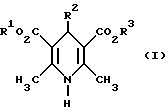
Поставленная задача предлагаемыми производными 1,4- дигидропиридина общей формулы формулы (I)

в форме рацемата или энантиомеров, где указанные заместители имеют значения, представленные в таблице А.The task of the proposed derivatives of 1,4-dihydropyridine General formula of the formula (I)
in the form of a racemate or enantiomers, where the indicated substituents have the meanings shown in table A.
Предпочтительными производными 1,4-дигидропиридина общей формулы (I) являются соединения, выбранные из группы, включающей
(±)изопропил-(2-метоксиэтил)-4-(2-фтор-фенил)-1,4-дигидро- 2,6-диметилпиридин-3,5-дикарбоксилат
(+) изопропил-(2-метоксиэтил)-4-(2-фтор-фенил)-1,4-дигидро- 2,6-диметилпиридин-3,5-дикарбоксилат
(-) изопропил-(2-метоксиэтил)-4-(2-фтор-фенил)-1,4-дигидро-2,6- диметилпиридин-3,5-дикарбоксилат
(±)изопропил-(2-метоксиэтил)-4-(2,3-дифтор-фенил)-1,4- дигидро-2,6-диметилпиридин-3,5-дикарбоксилат
(+)изопропил-(2-метоксиэтил)-4-(2,3-дифтор-фенил)-1,4-дигидро- 2,6-диметилпиридин-3,5-дикарбоксилат
(-)изопропил-(2-метоксиэтил)-4-(2,3-дифтор-фенил)-1,4-дигидро- 2,6-диметилпиридин-3,5-дикарбоксилат
(±)изопропил-(2-метоксиэтил)-4-(2,5-дифтор-фенил)-1,4-дигидро- 2,6-диметилпиридин-3,5-дикарбоксилат
(+)изопропил-(2-метоксиэтил)-4-(2,5-дифтор-фенил)-1,4-дигидро- 2,6-диметилпиридин-3,5-дикарбоксилат
(-)изопропил-(2-метоксиэтил)-4-(2,5-дифтор-фенил)-1,4-дигидро- 2,6-диметилпиридин-3,5-дикарбоксилат
(±)изопропил-(2-метоксиэтил)-4-(2,6-дифтор-фенил)-1,4-дигидро- 2,6-диметилпиридин-3,5-дикарбоксилат
(+)изопропил-(2-метоксиэтил)-4-(2,6-дифтор-фенил)-1,4-дигидро- 2,6-диметилпиридин-3,5-дикарбоксилат
(-)изопропил-(2-метоксиэтил)-4-(2,6-дифтор-фенил)-1,4-дигидро- 2,6-диметилпиридин-3,5-дикарбоксилат
(±)изопропил-(2-метоксиэтил)-4-(2,5-дихлор-фенил)-1,4-дигидро- 2,6-диметилпиридин-3,5-дикарбоксилат
(+)изопропил-(2-метоксиэтил)-4-(2,5-дихлор-фенил)-1,4-дигидро- 2,6-диметилпиридин-3,5-дикарбоксилат
(-)изопропил-(2-метоксиэтил)-4-(2,5-дихлор-фенил)-1,4-дигидро- 2,6-диметил-пиридин-3,5-дикарбоксилат
(±)изопропил-(2-метоксиэтил)-4-(2-хлор-6-фтор-фенил)- 1,4-дигидро-2,6-диметилпиридин-3,5-дикарбоксилат
(+)изопропил-(2-метоксиэтил)-4-(2-хлор-6-фтор-фенил)- 1,4-дигидро-2,6-диметилпиридин-3,5-дикарбоксилат
(-)изопропил-(2-метоксиэтил)-4-(2-хлор-6-фтор-фенил)- 1,4-дигидро-2,6-диметилпиридин-3,5-дикарбоксилат
(±)изопропил-(2-метоксиэтил)-4-(2-фтор-3-трифторметилфенил)- 1,4-дигидро-2,6-диметилпиридин-3,5-дикарбоксилат
(+)изопропил-(2-метоксиэтил)-4-(2-фтор-3-трифторметилфенил)- 1,4-дигидро-2,6-диметилпиридин-3,5-дикарбоксилат
(-)изопропил-(2-метоксиэтил)-4-(2-фтор-3-трифторметилфенил)- 1,4-дигидро-2,6-диметилпиридин-3,5-дикарбоксилат
(±)изопропил-(2-метоксиэтил)-4-(3-хлор-2-циано-фенил)- 1,4-дигидро-2,6-диметилпиридин-3,5-дикарбоксилат
(+)изопропил-(2-метоксиэтил)-4-(3-хлор-2-циано-фенил)- 1,4-дигидро-2,6-диметилпиридин-3,5-дикарбоксилат
(-)изопропил-(2-метоксиэтил)-4-(3-хлор-2-циано-фенил)- 1,4-дигидро-2,6-диметилпиридин-3,5-дикарбоксилат
(±)изопропил-(2-метоксиэтил)-4-(2-циано-фенил)- 1,4-дигидро-2,6-диметилпиридин-3,5-дикарбоксилат
(+)изопропил-(2-метоксиэтил)-4-(2-циано-фенил)-1,4-дигидро- 2,6-диметилпиридин-3,5-дикарбоксилат
(-)изопропил-(2-метоксиэтил)-4-(2-циано-фенил)-1,4-дигидро- 2,6-диметилпиридин-3,5-дикарбоксилат
(±)трет. -бутил-(2-метоксиэтил)-4-(3-циано-фенил)-1,4- дигидро-2,6-диметилпиридин-3,5-дикарбоксилат
(+)трет. -бутил-(2-метоксиэтил)-4-(3-циано-фенил)-1,4-дигидро- 2,6-диметилпиридин-3,5-дикарбоксилат
(-)трет. -бутил-(2-метоксиэтил)-4-(3-циано-фенил)-1,4-дигидро- 2,6-диметилпиридин-3,5-дикарбоксилат
(±)циклогептил-(2-метоксиэтил)-4-(3-циано-фенил)-1,4-дигидро- 2,6-диметилпиридин-3,5-дикарбоксилат
(+)циклогептил-(2-метоксиэтил)-4-(3-циано-фенил)-1,4-дигидро- 2,6-диметилпиридин-3,5-дикарбоксилат
(-)циклогептил-(2-метоксиэтил)-4-(3-циано-фенил)-1,4-дигидро- 2,6-диметилпиридин-3,5-дикарбоксилат
(+)циклопентил-(2-метоксиэтил)-4-(2-хлор-3-циано-фенил)-1,4-дигидро- 2,6-диметилпиридин-3,5-дикарбоксилат
(+)циклопентил-(2-метоксиэтил)-4-(2-хлор-3-циано-фенил)-1,4-дигидро- 2,6-диметилпиридин-3,5-дикарбоксилат
(-)циклопентил-(2-метоксиэтил)-4-(2-хлор-3-циано-фенил)-1,4-дигидро- 2,6-диметилпиридин-3,5-дикарбоксилат
(±)циклопентил-(2-метоксиэтил)-4-(2-фтор-3-трифторметил-фенил)- 1,4-дигидро-2,6-диметилпиридин-3,5-дикарбоксилат
(+)циклопентил-(2-метоксиэтил)-4-(2-фтор-3-трифторметил-фенил)- 1,4-дигидро-2,6-диметилпиридин-3,5-дикарбоксилат
(-)циклопентил-(2-метоксиэтил)-4-(2-фтор-3-трифторметил-фенил)- 1,4-дигидро-2,6-диметилпиридин-3,5-дикарбоксилат
(±)(2-метоксиэтил)-(метил)-4-(2-фтор-3-трифторметил-фенил)- 1,4-дигидро-2,6-диметилпиридин-3,5-дикарбоксилат
(+)(2-метоксиэтил)-(метил)-4-(2-фтор-3-трифторметил-фенил)- 1,4-дигидро-2,6-диметилпиридин-3,5-дикарбоксилат
(-)(2-метоксиэтил)-(метил)-4-(2-фтор-3-трифторметил-фенил)-1,4- дигидро-2,6-диметилпиридин-3,5-дикарбоксилат
(±)циклопентил-(2-метоксиэтил)-4-(2-циано-3-хлор-фенил)- 1,4-дигидро-2,6-диметилпиридин-3,5-дикарбоксилат
(+)циклопентил-(2-метоксиэтил)-4-(2-циано-3-хлор-фенил)-1,4-дигидро- 2,6-диметилпиридин-3,5-дикарбоксилат и
(-)циклопентил-(2-метоксиэтил)-4-(2-циано-3-хлор-фенил)-1,4-дигидро- 2,6-диметилпиридин-3,5-дикарбоксилат.Preferred 1,4-dihydropyridine derivatives of the general formula (I) are compounds selected from the group consisting of
(±) isopropyl- (2-methoxyethyl) -4- (2-fluoro-phenyl) -1,4-dihydro-2,6-dimethylpyridin-3,5-dicarboxylate
(+) isopropyl- (2-methoxyethyl) -4- (2-fluoro-phenyl) -1,4-dihydro-2,6-dimethylpyridin-3,5-dicarboxylate
(-) isopropyl- (2-methoxyethyl) -4- (2-fluoro-phenyl) -1,4-dihydro-2,6-dimethylpyridin-3,5-dicarboxylate
(±) isopropyl- (2-methoxyethyl) -4- (2,3-difluoro-phenyl) -1,4-dihydro-2,6-dimethylpyridin-3,5-dicarboxylate
(+) isopropyl- (2-methoxyethyl) -4- (2,3-difluoro-phenyl) -1,4-dihydro-2,6-dimethylpyridin-3,5-dicarboxylate
(-) isopropyl- (2-methoxyethyl) -4- (2,3-difluoro-phenyl) -1,4-dihydro-2,6-dimethylpyridin-3,5-dicarboxylate
(±) isopropyl- (2-methoxyethyl) -4- (2,5-difluoro-phenyl) -1,4-dihydro-2,6-dimethylpyridin-3,5-dicarboxylate
(+) isopropyl- (2-methoxyethyl) -4- (2,5-difluoro-phenyl) -1,4-dihydro-2,6-dimethylpyridin-3,5-dicarboxylate
(-) isopropyl- (2-methoxyethyl) -4- (2,5-difluoro-phenyl) -1,4-dihydro-2,6-dimethylpyridin-3,5-dicarboxylate
(±) isopropyl- (2-methoxyethyl) -4- (2,6-difluoro-phenyl) -1,4-dihydro-2,6-dimethylpyridin-3,5-dicarboxylate
(+) isopropyl- (2-methoxyethyl) -4- (2,6-difluoro-phenyl) -1,4-dihydro-2,6-dimethylpyridin-3,5-dicarboxylate
(-) isopropyl- (2-methoxyethyl) -4- (2,6-difluoro-phenyl) -1,4-dihydro-2,6-dimethylpyridin-3,5-dicarboxylate
(±) isopropyl- (2-methoxyethyl) -4- (2,5-dichloro-phenyl) -1,4-dihydro-2,6-dimethylpyridin-3,5-dicarboxylate
(+) isopropyl- (2-methoxyethyl) -4- (2,5-dichloro-phenyl) -1,4-dihydro-2,6-dimethylpyridin-3,5-dicarboxylate
(-) isopropyl- (2-methoxyethyl) -4- (2,5-dichloro-phenyl) -1,4-dihydro-2,6-dimethyl-pyridin-3,5-dicarboxylate
(±) isopropyl- (2-methoxyethyl) -4- (2-chloro-6-fluoro-phenyl) -1,4-dihydro-2,6-dimethylpyridine-3,5-dicarboxylate
(+) isopropyl- (2-methoxyethyl) -4- (2-chloro-6-fluoro-phenyl) -1,4-dihydro-2,6-dimethylpyridin-3,5-dicarboxylate
(-) isopropyl- (2-methoxyethyl) -4- (2-chloro-6-fluoro-phenyl) -1,4-dihydro-2,6-dimethylpyridin-3,5-dicarboxylate
(±) isopropyl- (2-methoxyethyl) -4- (2-fluoro-3-trifluoromethylphenyl) -1,4-dihydro-2,6-dimethylpyridine-3,5-dicarboxylate
(+) isopropyl- (2-methoxyethyl) -4- (2-fluoro-3-trifluoromethylphenyl) -1,4-dihydro-2,6-dimethylpyridine-3,5-dicarboxylate
(-) isopropyl- (2-methoxyethyl) -4- (2-fluoro-3-trifluoromethylphenyl) 1,4-dihydro-2,6-dimethylpyridine-3,5-dicarboxylate
(±) isopropyl- (2-methoxyethyl) -4- (3-chloro-2-cyano-phenyl) -1,4-dihydro-2,6-dimethylpyridine-3,5-dicarboxylate
(+) isopropyl- (2-methoxyethyl) -4- (3-chloro-2-cyano-phenyl) -1,4-dihydro-2,6-dimethylpyridine-3,5-dicarboxylate
(-) isopropyl- (2-methoxyethyl) -4- (3-chloro-2-cyano-phenyl) -1,4-dihydro-2,6-dimethylpyridine-3,5-dicarboxylate
(±) isopropyl- (2-methoxyethyl) -4- (2-cyano-phenyl) -1,4-dihydro-2,6-dimethylpyridin-3,5-dicarboxylate
(+) isopropyl- (2-methoxyethyl) -4- (2-cyano-phenyl) -1,4-dihydro-2,6-dimethylpyridin-3,5-dicarboxylate
(-) isopropyl- (2-methoxyethyl) -4- (2-cyano-phenyl) -1,4-dihydro-2,6-dimethylpyridin-3,5-dicarboxylate
(±) tert. -butyl- (2-methoxyethyl) -4- (3-cyano-phenyl) -1,4-dihydro-2,6-dimethylpyridin-3,5-dicarboxylate
(+) tert. -butyl- (2-methoxyethyl) -4- (3-cyano-phenyl) -1,4-dihydro-2,6-dimethylpyridin-3,5-dicarboxylate
(-) tert. -butyl- (2-methoxyethyl) -4- (3-cyano-phenyl) -1,4-dihydro-2,6-dimethylpyridin-3,5-dicarboxylate
(±) cycloheptyl- (2-methoxyethyl) -4- (3-cyano-phenyl) -1,4-dihydro-2,6-dimethylpyridin-3,5-dicarboxylate
(+) cycloheptyl- (2-methoxyethyl) -4- (3-cyano-phenyl) -1,4-dihydro-2,6-dimethylpyridin-3,5-dicarboxylate
(-) cycloheptyl- (2-methoxyethyl) -4- (3-cyano-phenyl) -1,4-dihydro-2,6-dimethylpyridin-3,5-dicarboxylate
(+) cyclopentyl- (2-methoxyethyl) -4- (2-chloro-3-cyano-phenyl) -1,4-dihydro-2,6-dimethylpyridine-3,5-dicarboxylate
(+) cyclopentyl- (2-methoxyethyl) -4- (2-chloro-3-cyano-phenyl) -1,4-dihydro-2,6-dimethylpyridine-3,5-dicarboxylate
(-) cyclopentyl- (2-methoxyethyl) -4- (2-chloro-3-cyano-phenyl) -1,4-dihydro-2,6-dimethylpyridine-3,5-dicarboxylate
(±) cyclopentyl- (2-methoxyethyl) -4- (2-fluoro-3-trifluoromethyl-phenyl) -1,4-dihydro-2,6-dimethylpyridine-3,5-dicarboxylate
(+) cyclopentyl- (2-methoxyethyl) -4- (2-fluoro-3-trifluoromethyl-phenyl) -1,4-dihydro-2,6-dimethylpyridine-3,5-dicarboxylate
(-) cyclopentyl- (2-methoxyethyl) -4- (2-fluoro-3-trifluoromethyl-phenyl) - 1,4-dihydro-2,6-dimethylpyridine-3,5-dicarboxylate
(±) (2-methoxyethyl) - (methyl) -4- (2-fluoro-3-trifluoromethyl-phenyl) - 1,4-dihydro-2,6-dimethylpyridine-3,5-dicarboxylate
(+) (2-methoxyethyl) - (methyl) -4- (2-fluoro-3-trifluoromethyl-phenyl) - 1,4-dihydro-2,6-dimethylpyridine-3,5-dicarboxylate
(-) (2-methoxyethyl) - (methyl) -4- (2-fluoro-3-trifluoromethyl-phenyl) -1,4-dihydro-2,6-dimethylpyridine-3,5-dicarboxylate
(±) cyclopentyl- (2-methoxyethyl) -4- (2-cyano-3-chloro-phenyl) -1,4-dihydro-2,6-dimethylpyridine-3,5-dicarboxylate
(+) cyclopentyl- (2-methoxyethyl) -4- (2-cyano-3-chloro-phenyl) -1,4-dihydro-2,6-dimethylpyridin-3,5-dicarboxylate and
(-) cyclopentyl- (2-methoxyethyl) -4- (2-cyano-3-chloro-phenyl) -1,4-dihydro-2,6-dimethylpyridin-3,5-dicarboxylate.
В частности предпочитаются сложный изопропиловый и 2- метоксиэтиловый эфиры 4-(2-хлор-3-циано-фенил)-1,4-дигидро-2,6- диметилпиридин-3,5-дикарбоновой кислоты в виде рацемата (+)- или (-)-энантиомера. In particular, 4- (2-chloro-3-cyano-phenyl) -1,4-dihydro-2,6-dimethylpyridin-3,5-dicarboxylic acid isopropyl and 2-methoxyethyl esters are preferred as the racemate (+) - or (-) - enantiomer.
Дополнительным объектом изобретения является фармацевтическая композиция, обладающая антагонистической активностью в отношении катионов кальция, которая помимо, по меньшей мере, одного инертного, фармацевтически приемлемого носителя содержит в качестве активного вещества соединение общей формулы (II)

где
R1' и R4' одинаковы или различны и означают неразветвленный или разветвленный алкил с 1-8 атомами углерода, незамещенный или замещенный неразветвленным или разветвленным алкоксилом с 1-6 атомами углерода или гидроксилом, или циклоалкил с 3-7 атомами углерода,
R2' и R3' одинаковы или различны и означают галоген, циано, этинил, трифторметокси, метил, метилтио, трифторметил или неразветвленный или разветвленный алкоксил с 1-4 атомами углерода, или R2' или R3' означает водород, смесь его изомеров или его отдельный изомер в эффективном количестве.An additional object of the invention is a pharmaceutical composition having antagonistic activity against calcium cations, which, in addition to at least one inert, pharmaceutically acceptable carrier, contains, as an active substance, a compound of general formula (II)
Where
R 1 ' and R 4' are the same or different and mean unbranched or branched alkyl with 1-8 carbon atoms, unsubstituted or substituted by unbranched or branched alkoxyl with 1-6 carbon atoms or hydroxyl, or cycloalkyl with 3-7 carbon atoms,
R 2 ' and R 3' are the same or different and mean halogen, cyano, ethynyl, trifluoromethoxy, methyl, methylthio, trifluoromethyl or a straight or branched alkoxy with 1-4 carbon atoms, or R 2 ' or R 3' means hydrogen, a mixture of it isomers or an individual isomer thereof in an effective amount.
Производные 1,4-дигидропиридина общей формулы (I) можно получать за счет того, что [А] альдегиды общей формулы (III)

где R2 и R3 имеют вышеуказанное значение,
сначала подвергают взаимодействию со сложными эфирами ацетуксусной кислоты формулы (IV)
H3C-CO-CH2-CO2R1 (IV)
где R имеет вышеуказанное значение, в случае необходимости с выделением соответствующих илиденовых соединений общей формулы (V)

где R1 - R3 имеют вышеуказанное значение,
и затем подвергают взаимодействию или с соединениями общей формулы (VI)
CH3-CO-CH2-CO2R4 (VI)
где
R4 имеет вышеуказанное значение,
в среде инертных растворителей, в присутствии аммиака или аммониевых солей,
или непосредственно с производными энаминокарбоновой кислоты общей формулы (VII)

где
R4 имеет вышеуказанное значение,
или
[Б] альдегиды общей формулы (III) подвергают сначала взаимодействию с соединением общей формулы (VI), в случае необходимости с выделением илидиеновых соединений общей формулы (VIII)

где
R2, R3, и R4 имеют вышеуказанные значения, и затем с соединениями общей формулы (III) в среде инертных растворителей, в присутствии аммиака или аммониевых солей, или же непосредственно с производными энаминокарбоновой кислоты общей формулы (IX)

где
R1 имеет вышеуказанное значение,
или
[В] соединения общей формулы (X)

где
R2 и R3 имеют вышеуказанное значение,
A имеет указанные для радикала R1 и R4 значения,
B вместе с карбонильной группой образует реакционноспособное производное карбоновой кислоты,
подвергают взаимодействию с соединениями общей формулы (XI)
R5-OH (XI)
где
R5 имеет указанное для радикала R1 или R4 значения,
в среде инертных растворителей в присутствии основания,
и в случае получения чистых сложноэфирных энантиомеров чистые энантиомерные карбоновые кислоты подвергают взаимодействию с соответствующими спиртами, в случае необходимости, через предварительную стадию реакционноспособного производного кислоты.Derivatives of 1,4-dihydropyridine of General formula (I) can be obtained due to the fact that [A] aldehydes of General formula (III)
where R 2 and R 3 have the above meaning,
first subjected to interaction with esters of acetic acid of the formula (IV)
H 3 C-CO-CH 2 -CO 2 R 1 (IV)
where R has the above meaning, if necessary, with the allocation of the corresponding ylidene compounds of General formula (V)
where R 1 - R 3 have the above meaning,
and then reacted with either compounds of general formula (VI)
CH 3 —CO — CH 2 —CO 2 R 4 (VI)
Where
R 4 has the above meaning,
in an environment of inert solvents, in the presence of ammonia or ammonium salts,
or directly with enaminocarboxylic acid derivatives of the general formula (VII)
Where
R 4 has the above meaning,
or
[B] the aldehydes of the general formula (III) are first reacted with a compound of the general formula (VI), optionally with the isolation of the ylidene compounds of the general formula (VIII)
Where
R 2 , R 3 , and R 4 have the above meanings, and then with compounds of the general formula (III) in an inert solvent medium, in the presence of ammonia or ammonium salts, or directly with enaminocarboxylic acid derivatives of the general formula (IX)
Where
R 1 has the above meaning,
or
[B] compounds of general formula (X)
Where
R 2 and R 3 have the above meaning,
A has the meanings indicated for the radical R 1 and R 4 ,
B together with a carbonyl group forms a reactive derivative of a carboxylic acid,
subjected to interaction with compounds of General formula (XI)
R 5 -OH (XI)
Where
R 5 has the meaning indicated for the radical R 1 or R 4 ,
in an inert solvent in the presence of a base,
and in the case of the preparation of pure ester enantiomers, the pure enantiomeric carboxylic acids are reacted with the corresponding alcohols, if necessary, through a preliminary step of a reactive acid derivative.
2-хлор-3-циано-бензальдегид, подпадающий под вышеприведенную общую формулу (III), представляет собой новый промежуточный продукт, являющийся дальнейшим объектом изобретения. 2-chloro-3-cyano-benzaldehyde, falling under the above general formula (III), is a new intermediate product, which is a further object of the invention.
Вышеописанные способы поясняются следующей реакционной схемой:
[А]


[Б]


[В]


По вышеописанным способам [А] - [В] можно также получать соединения общей формулы (III).The above methods are illustrated by the following reaction scheme:
[A]
[B]
[IN]
By the above methods [A] - [B], it is also possible to obtain compounds of the general formula (III).
При этом в качестве растворителей для способов [А] и [Б] пригодны все инертные органические растворители, которые в условиях реакции не изменяются. К ним предпочтительно принадлежат спирты, такие как, например, метанол, этанол, пропанол или изопропанол, или простые эфиры, такие как, например, простой диэтиловый эфир, диоксан, тетрагидрофуран, простой гликольдиметиловый эфир, или простой диэтиленгликольдиметиловый эфир, ацетонитрил, или амиды, такие как, например, триамид гексаметилфосфорной кислоты или диметилформамид, или уксусная кислота или галогенированные углеводороды, такие как, например, метиленхлорид, четыреххлористый углерод, или углеводороды, такие как, например, бензол или толуол. Кроме того, можно также использовать смеси упомянутых растворителей. Предпочтительно используют изопропанол, этанол, тетрагидрофуран, метанол, диоксан и диметилформамид. Moreover, all inert organic solvents that do not change under the reaction conditions are suitable as solvents for methods [A] and [B]. Preferably, they include alcohols, such as, for example, methanol, ethanol, propanol or isopropanol, or ethers, such as, for example, diethyl ether, dioxane, tetrahydrofuran, glycol dimethyl ether, or diethylene glycol dimethyl ether, acetonitrile, or amides, such as, for example, hexamethylphosphoric triamide or dimethylformamide, or acetic acid or halogenated hydrocarbons, such as, for example, methylene chloride, carbon tetrachloride, or hydrocarbons, such as, for example, benzene or toluene. In addition, mixtures of the solvents mentioned can also be used. Preferably, isopropanol, ethanol, tetrahydrofuran, methanol, dioxane and dimethylformamide are used.
В качестве растворителя для способа [В] пригодны вышеупомянутые растворители за исключением спиртов и уксусной кислоты. Suitable solvents for process [B] are the aforementioned solvents, with the exception of alcohols and acetic acid.
В качестве оснований обычно пригодны циклические амины, такие как, например, пиперидин, три- и диалкиламины с 1-3 атомами углерода, такие как, например, ди- и триэтиламин или пиридин или диметиламинопиридин. Предпочтительными являются в зависимости от соответствующих процессов пиперидин, диметиламинопиридин и пиридин. Cyclic amines, such as, for example, piperidine, tri- and dialkylamines with 1 to 3 carbon atoms, such as, for example, di- and triethylamine or pyridine or dimethylaminopyridine, are usually suitable as bases. Depending on the respective processes, piperidine, dimethylaminopyridine and pyridine are preferred.
В качестве вспомогательных веществ предпочтительно используют агенты конденсации, которые могут также представлять собой основания. Предпочтительными являются обычные агенты конденсации, такие как, например, карбодиимиды, такие как, например, N,N'- диэтил-, N,N'-диизопропил- и N,N'-дициклогексилкарбодиимид, гидрохлорид N-(3-диметиламиноизопропил)-N'-этилкарбодиимида, или карбонильные соединения, такие как, например, карбонилдиимидазол, или соединения 1,2-оксазолия, такие как, например, 3-сульфонат 2-этил-5-фенил-1,2-оксазолия или перхлорат 2-трет.-бутил-5-метилизоксазолия, или ациламино-соединения, такие как, например, 2-этокси-1-этоксикарбонил-1,2- дигидрохинолин, или ангидрид пропанфосфоновой кислоты, или изобутилхлороформат, или гексафторфосфонат бензотриазолилокси-трис(диметиламино)фосфония. Предпочтительно используют N',N'- дициклогексилкарбодиимид и карбонилдиимидазол. As auxiliary substances, condensing agents, which may also be bases, are preferably used. Conventional condensation agents are preferred, such as, for example, carbodiimides, such as, for example, N, N'-diethyl-, N, N'-diisopropyl- and N, N'-dicyclohexylcarbodiimide, N- (3-dimethylaminoisopropyl) - hydrochloride N'-ethylcarbodiimide, or carbonyl compounds, such as, for example, carbonyldiimidazole, or 1,2-oxazolium compounds, such as, for example, 2-ethyl-5-phenyl-1,2-oxazolium 3-sulfonate or 2-tert perchlorate .-butyl-5-methylisoxazolium, or acylamino compounds, such as, for example, 2-ethoxy-1-ethoxycarbonyl-1,2-dihydroquinoline, or propanphos anhydride background acid, or isobutyl chloroformate, or benzotriazolyloxy tris (dimethylamino) phosphonium hexafluorophosphonate. Preferably, N ′, N′-dicyclohexylcarbodiimide and carbonyldiimidazole are used.
В качестве оснований для активации карбоновых кислот обычно пригодны карбонаты щелочных металлов, такие как, например, карбонат натрия или калия, или органические основания, такие как, например, триэтиламин, N-этилморфолин, N-метилпиперидин или диизопропилэтиламин, или диметиламинопиридин, 1,8- диазабицикло[5,4,0]-ундец-7-ен или 1,5-диазабицикло-[4,3,0]нон-5-ен. Предпочтительно используют диметиламинопиридин. Alkali metal carbonates, such as, for example, sodium or potassium carbonate, or organic bases, such as, for example, triethylamine, N-ethylmorpholine, N-methylpiperidine or diisopropylethylamine, or dimethylaminopyridine, 1,8 are generally suitable as bases for the activation of carboxylic acids. - diazabicyclo [5.4.0] -undec-7-ene or 1,5-diazabicyclo- [4.3.0] non-5-ene. Dimethylaminopyridine is preferably used.
Основание обычно используют в количестве 0,01 моль - 1 моль, предпочтительно 0,05 моль - 0,1 моль, каждый раз в пересчете на 1 моль соединения общих формул (III) и (X). The base is usually used in an amount of 0.01 mol - 1 mol, preferably 0.05 mol - 0.1 mol, each time per 1 mol of the compound of general formulas (III) and (X).
Вспомогательные вещества обычно используют в количестве 1 - 3 моль, предпочтительно 1-1,5 моль, каждый раз в пересчете на 1 моль соединений общих формул (III) и (X). Excipients are usually used in an amount of 1 to 3 mol, preferably 1 to 1.5 mol, each time in terms of 1 mol of the compounds of general formulas (III) and (X).
Температура реакций для способов [А] и [Б] могут колебаться в широких пределах. Обычно работают при температуре от - 20 до 200oC, предпочтительно при 0 - 110oC, в частности при температуре кипения соответствующего растворителя.The reaction temperature for methods [A] and [B] can vary widely. Usually they work at a temperature of from -20 to 200 o C, preferably at 0 to 110 o C, in particular at the boiling point of the corresponding solvent.
Реакции можно проводить при атмосферном давлении, однако также при повышенном или пониженном давлении (например, при 0,5-3 бар). Обычно работают при атмосферном давлении. Reactions can be carried out at atmospheric pressure, but also at elevated or reduced pressure (for example, at 0.5-3 bar). Usually operate at atmospheric pressure.
При проведении способов соотношение принимающих участие в реакции веществ является любым. Однако обычно работают при молярном количестве реагентов. When carrying out the methods, the ratio of the substances involved in the reaction is any. However, they usually work with a molar amount of reagents.
Для активации карбоновой кислоты можно использовать обычные реагенты как неорганические галогениды, например, тионилхлорид, трихлорид фосфора или пятихлористый фосфор, или карбонилдиимидазол, карбодиимиды как, например, циклогексилкарбодиимид, или п-толуолсульфонат 1-циклогексил-3-[2- (N-метилморфолино)-этил]-карбодиимида, N-оксифталимид или N- оксибензтриазол. For the activation of carboxylic acids, conventional reagents such as inorganic halides, for example, thionyl chloride, phosphorus trichloride or phosphorus pentachloride, or carbonyldiimidazole, carbodiimides such as cyclohexylcarbodiimide or p-toluenesulfonate 1-cyclohexyl-3- [2- (methyl) ethyl] carbodiimide, N-hydroxyphthalimide or N-hydroxybenzotriazole.
Кроме того, чистые энантиомерные формы получают, например, тем, что смеси диастереомеров соединений общей формулы (I), в которой R1 или R2 означает энантиомерный хиральный спирт, разделяют обычными методами, затем получают чистые энантиомерные карбоновые кислоты и затем переводят в чистые энантиомерные дигидропиридины, при необходимости, путем этерификации с соответствующими спиртами.In addition, pure enantiomeric forms are obtained, for example, in that mixtures of diastereomers of the compounds of general formula (I) in which R 1 or R 2 is enantiomeric chiral alcohol are separated by conventional methods, then pure enantiomeric carboxylic acids are obtained and then transferred to pure enantiomeric dihydropyridines, if necessary, by esterification with the corresponding alcohols.
В качестве хиральных сложноэфирных остатков пригодны все сложные эфиры чистых энантиомерных спиртов, таких как, например, фенилэтанол, молочная кислота, сложный эфир молочной кислоты, миндальная кислота, сложный эфир миндальной кислоты, 2-аминоспирты, производные сахара, производные оксиаминокислот и многие другие чистые энантиомерные спирты. Suitable esters of chiral esters are all esters of pure enantiomeric alcohols, such as, for example, phenylethanol, lactic acid, lactic acid ester, mandelic acid, mandelic ester, 2-amino alcohols, sugar derivatives, hydroxy amino acid derivatives and many other pure enantiomeric alcohols.
Разделение диастереомеров осуществляют в общем или путем фракционной кристаллизации, путем колоночной хроматографии или путем распределения по Крэгу. Необходимо в каждом конкретном случае решать, который метод является наиболее выгодным. Иногда целесообразно использовать комбинацию индивидуальных аметодов. The separation of diastereomers is carried out generally or by fractional crystallization, by column chromatography or by Craig distribution. It is necessary in each case to decide which method is the most profitable. Sometimes it is advisable to use a combination of individual amethodes.
Этерификацию чистых энантиомерных дигидропиридинов предпочтительно проводят в среде простых эфиров, таких как, например, диэтиловый эфир или тетрагидрофуран, диметилформамид, метиленхлорид, хлороформ, ацетонитрил или толуол. The esterification of pure enantiomeric dihydropyridines is preferably carried out in ethers such as, for example, diethyl ether or tetrahydrofuran, dimethylformamide, methylene chloride, chloroform, acetonitrile or toluene.
Соединения общих формул (III), (IV), (VI), (VII), (IX) и (XI) известны или их можно получать известными методами. Compounds of the general formulas (III), (IV), (VI), (VII), (IX) and (XI) are known or can be prepared by known methods.
Реакционноспособные производные кислот общей формулы (X) частично известны и их можно получать известными приемами. The reactive derivatives of the acids of general formula (X) are partially known and can be prepared by known methods.
Большинство соединений общих формул (V) и (VIII) известно или их можно получать известными методами. Most compounds of the general formulas (V) and (VIII) are known or can be prepared by known methods.
Как уже указывалось выше, предлагаемая фармацевтическая композиция обладает антагонистической в отношении катионов кальция активного, в частности обладает избирательностью для Ca2+-каналов L типа центральной системы.As already mentioned above, the proposed pharmaceutical composition is antagonistic to active calcium cations, in particular, it has selectivity for L 2 Ca channels of the central system type.
Избирательность превышает избирательность известного церебрально активного Ca2+-антагонистического дигидропиридина, торгового продукта нимодипин, о чем свидетельствуют результаты следующего опыта, который проводился аналогично методике, описанной Д. Рампе и др. в Can. J. Physiol. Pharmacol. 65 (1987), стр. 1452-1453.The selectivity exceeds the selectivity of the well-known cerebrally active Ca 2+ antagonistic dihydropyridine, a commercial product of nimodipine, as evidenced by the results of the following experiment, which was carried out similarly to the method described by D. Ramp et al. J. Physiol. Pharmacol 65 (1987), pp. 1452-1453.
Опыт
Исследовалось сродство радиоактивно меченных дигидропиридинов к связыванию с сайтами в ткани сердца и головного мозга крыс. В качестве ткани применялись синаптосомы из сердечной и мозговой ткани. Инкубации проводились при 37oC в доведенной до pH 7,4 физиологической солевой среде, содержащей 132 ммоль хлористого натрия, 5 ммоль хлористого калия, 1,2 ммоль хлористого кальция, 1,3 ммоль хлористого магния, 10 ммоль глюкозы, 25 ммоль трис-буфера. Определяли показатель связывания Кi исследуемых соединений в нмоль и избирательность связывания с помощью компьютерной программы. Результаты опыта сведены в таблице 1 (см. в конце описания).Experience
The affinity of radioactively labeled dihydropyridines for binding to sites in rat heart and brain tissue was studied. Synaptosomes from cardiac and brain tissue were used as tissue. Incubations were carried out at 37 o C in physiological saline adjusted to pH 7.4 containing 132 mmol of sodium chloride, 5 mmol of potassium chloride, 1.2 mmol of calcium chloride, 1.3 mmol of magnesium chloride, 10 mmol of glucose, 25 mmol tris- buffers. The binding index K i of the studied compounds in nmol and the binding selectivity were determined using a computer program. The results of the experiment are summarized in table 1 (see the end of the description).
Активные вещества формулы (I) обычно содержатся в предлагаемой композиции в концентрации 0,1 - 99,5 вес. %, предпочтительно 0,5 - 95 вес.%. The active substances of formula (I) are usually contained in the proposed composition in a concentration of 0.1 to 99.5 weight. %, preferably 0.5 to 95 wt.%.
Кроме активных веществ формулы (I) фармацевтическая композиция может также содержать и другие фармацевтические активные вещества. In addition to the active substances of formula (I), the pharmaceutical composition may also contain other pharmaceutical active substances.
Предлагаемую фармацевтическую композицию получают известными приемами. The proposed pharmaceutical composition is prepared by known methods.
Для достижения желаемых результатов в общем выгодно давать активные вещества формулы (I) в общем количестве примерно 0,01 - 100 мг, предпочтительно примерно 1 - 50 мг/кг веса тела в сутки, при необходимости в виде нескольких отдельных доз. In order to achieve the desired results, it is generally advantageous to give the active substances of formula (I) in a total amount of about 0.01-100 mg, preferably about 1-50 mg / kg body weight per day, if necessary in the form of several separate doses.
Однако, в случае необходимости, может быть целесообразным отклоняться от указанного количества, а именно в зависимости от вида и веса подлежащего лечению пациента, от индивидуального поведения пациента относительно лекарственного средства, вида и степени болезни, вида препарата и дачи и момента или промежутков дачи средства. However, if necessary, it may be appropriate to deviate from the indicated amount, namely, depending on the type and weight of the patient to be treated, on the individual behavior of the patient with respect to the drug, the type and extent of the disease, the type of drug and cottage, and the time or intervals of the cure.
Приведенные в нижеследующих примерах значения Rf, если ничего другого не указано, определяли посредством тонкослойной хроматографии на силикагеле (алюминиевая пленка, силикагель марки 60 F 254 фирмы Е. Мерк, DE). Выявление пятен вещества осуществляли при помощи УФ-света и/или путем опрыскивания 1%-ным раствором перманганата калия или раствора молибдатофосфорной кислоты.The R f values given in the following examples, unless otherwise indicated, were determined by thin-layer chromatography on silica gel (aluminum film, silica gel, grade 60 F 254 from E. Merck, DE). Spot detection of the substance was carried out using UV light and / or by spraying with a 1% solution of potassium permanganate or a solution of molybdatophosphoric acid.
Флеш-хроматографию проводили на силикагеле марки 60 (величиной зерен 0,040 - 0,064 мм) фирмы Е. Мерк, DE. Элюация градиентом растворителя означает: начинают чистым, неполярным компонентом смеси растворителей, к которому примешивают полярный компонент в повышающихся количествах до тех пор, пока не будет элюироваться желаемый продукт (контроль при помощи тонкослойной хроматографии). Flash chromatography was performed on silica gel grade 60 (grain size 0,040 - 0,064 mm) company E. Merck, DE. Elution with a solvent gradient means: start with the pure, non-polar component of the solvent mixture, to which the polar component is mixed in increasing amounts until the desired product is eluted (control by thin layer chromatography).
При выделении всех целевых продуктов растворитель отгоняют при давлении около 0,1 Торр. When all the desired products are isolated, the solvent is distilled off at a pressure of about 0.1 Torr.
Пример 1
4-(2-фторфенил)-1,4-дигидро-2,6-диметилпиридин-3,5-дикарбоновая кислота в виде сложного изопропилового и сложного 2-метоксиэтилового эфиров

4,0 г (около 15 ммоль) сложного 2-летоксиэтилового эфира 2- ацетил-3-(2-фтор-фенил)-2-пропеновой кислоты и 2,2 г (15 ммоль) сложного изопропилового эфира 3-амино-2-бутеновой кислоты в 100 мл изопропанола нагревают с обратным холодильником в течение ночи. После того как проверка тонкослойной хроматографией на двуокиси кремния с применением в качестве элюента смеси толуола и сложного этилового эфира уксусной кислоты в соотношении 5: 1 подтверждает полную конверсию, реакционную смесь сгущают, смешивают с толуолом, снова сгущают и затем очищают путем фильтрации на силикагеле, причем в качестве растворителя используют смесь толуола и сложного этилового эфира уксусной кислоты в соотношениях 100:1 - 5:1. Получают кристаллизующее желтое масло, которое перекристаллизовывают при температуре около -15oC из метанола. Получают 2,8 г (48%) вышеприведенного соединения. Температура плавления: 99 - 100oC.Example 1
4- (2-fluorophenyl) -1,4-dihydro-2,6-dimethylpyridin-3,5-dicarboxylic acid as isopropyl ester and 2-methoxyethyl ester
4.0 g (about 15 mmol) of 2-acetyl-3- (2-fluoro-phenyl) -2-propenoic acid 2-letoxyethyl ester; and 2.2 g (15 mmol) of 3-amino-2- isopropyl ester butene acid in 100 ml of isopropanol is heated under reflux overnight. After verification by thin-layer chromatography on silica using a mixture of toluene and ethyl acetate in the ratio 5: 1 as an eluent confirms the complete conversion, the reaction mixture is concentrated, mixed with toluene, concentrated again and then purified by filtration on silica gel, moreover as a solvent, a mixture of toluene and ethyl acetate is used in a ratio of 100: 1 to 5: 1. A yellow crystallizing oil is obtained, which is recrystallized at a temperature of about -15 ° C from methanol. 2.8 g (48%) of the above compound are obtained. Melting point: 99 - 100 o C.
Пример 2
(-)-4-(3-цианофенил)-1,4-дигидро-2,6-диметилпиридина-3,5- дикарбоновая кислота в виде сложного циклогептилового и сложного 2-метокси-этилового этилового эфиров

5,0 г (14 ммоль) сложного 2-метоксиэтилового эфира (-)-4- (3-цианофенил)-1,4-дигидро-2,6-диметилпиридин-3,5-дикарбоновой кислоты (полученного путем разделения хроматографией рацемической монокарбоновой кислоты на хиральных неподвижных фазах) перемешивают в 50 мл тетрагидрофурана на молекулярном сите с порами величиной 4 Е в течение 30 минут. Затем добавляют 2,3 г (14 ммоль) карбонилдиимидазола и нагревают с обратным холодильником в течение одного часа, фильтруют с молекулярного сита и сгущают. Остаток смешивают с 30 мл циклопентанола и после добавления N,N- диметил-4-аминопиридина при помощи шпателя нагревают до температуры 100oC в течение 6 часов. После повторной хроматографии на силикагеле с применением в качестве элюента толуола, смеси сложного этилового эфира уксусной кислоты и дихлорметана, смеси изопропанола и циклогексана, и сложного этилового эфира уксусной кислоты и кристаллизации из смеси простого диизопропилового эфира и циклогексана получают 1,0 г (16%) вышеприведенного соединения в виде белых кристаллов. Точка плавления: 98 - 99oC.Example 2
(-) - 4- (3-cyanophenyl) -1,4-dihydro-2,6-dimethylpyridine-3,5-dicarboxylic acid as a cycloheptyl complex and 2-methoxy ethyl ethyl ester
5.0 g (14 mmol) of (-) - 4- (3-cyanophenyl) -1,4-dihydro-2,6-dimethylpyridin-3,5-dicarboxylic acid 2-methoxyethyl ester (obtained by separation by chromatography of racemic monocarboxylic acids on chiral stationary phases) are mixed in 50 ml of tetrahydrofuran on a molecular sieve with pores of 4 U for 30 minutes. Then, 2.3 g (14 mmol) of carbonyldiimidazole are added and refluxed for one hour, filtered from a molecular sieve and concentrated. The residue is mixed with 30 ml of cyclopentanol and after adding N, N-dimethyl-4-aminopyridine with a spatula, it is heated to a temperature of 100 ° C. for 6 hours. After repeated chromatography on silica gel using toluene, a mixture of ethyl ester of acetic acid and dichloromethane, a mixture of isopropanol and cyclohexane and ethyl ester of acetic acid and crystallization from a mixture of simple diisopropyl ether and cyclohexane, 1.0 g (16%) the above compounds in the form of white crystals. Melting point: 98 - 99 o C.
α
Сведенные в таблице 2 соединения получают аналогично примерам 1 и 2, или за счет того, что рацемические продукты подвергают хроматографическому разделению на хиральных неподвижных фазах (хиралцел и хиралпак, дайцел) на чистые энантиомерные целевые продукты. The compounds shown in table 2 are obtained analogously to examples 1 and 2, or due to the fact that racemic products are subjected to chromatographic separation on chiral stationary phases (chiralcell and chiralpack, dicel) into pure enantiomeric target products.
Пример 33
4-(2,4-дифторфенил)-1,4-дигидро-2,6-диметилпиридин-3,5- дикарбоновая кислота в виде сложного изопропилового и 2- метоксиэтилового эфиров

5,0 г (около 18 ммоль) сложного 2-метоксиэтилового эфира 2- ацетил-3-(2,4 дифторфенил)-2-пропеновой кислоты и 2,5 г (18 ммоль) сложного изопропилового эфира 3-амино-2-бутеновой кислоты в 50 мл изопропанола нагревают с обратным холодильником в течение ночи. После того, как проверка тонкослойной хроматографией на двуокиси кремния с применением в качестве элюента смеси толуола и сложного этилового эфира уксусной кислоты в соотношении 5:1 подтверждает полную конверсию, реакционную смесь сгущают, смешивают с толуолом, снова сгущают и затем очищают путем кристаллизации из небольшого количества метанола. Получают 2,8 г (39%) вышеприведенного соединения. Точка плавления: 123 - 126oC.Example 33
4- (2,4-difluorophenyl) -1,4-dihydro-2,6-dimethylpyridin-3,5-dicarboxylic acid in the form of isopropyl and 2-methoxyethyl esters
5.0 g (about 18 mmol) of 2-acetyl-3- (2,4 difluorophenyl) -2-propenoic acid 2-methoxyethyl ester; and 2.5 g (18 mmol) of 3-amino-2-butenoic isopropyl ester acids in 50 ml of isopropanol are refluxed overnight. After verification by thin-layer chromatography on silica using a mixture of toluene and ethyl acetate in the ratio 5: 1 as an eluent confirms the complete conversion, the reaction mixture is concentrated, mixed with toluene, concentrated again and then purified by crystallization from a small amount methanol. 2.8 g (39%) of the above compound are obtained. Melting point: 123 - 126 o C.
Аналогично примерам 1, 2 и 33 получают соединения, сведенные в таблицах 3 - 7. Similarly to examples 1, 2 and 33 receive the compounds summarized in tables 3 to 7.
Пример 89
(-)-4-(3-цианофенил)-1,4-дигидро-2,6-диметилпиридин-3,5- дикарбоновая кислота в виде сложного метилового и сложного 2- метоксиэтилового эфиров

3,6 г (10 ммоль) сложного 2-метоксиэтилового эфира (-)-4-(3- цианофенил)-1,4-дигидро-2,6-диметилпиридин-3,5-дикарбоновой кислоты перемешивают в 40 мл тетрагидрофурана на молекулярном сите с порами величиной 4 Я в течение 30 минут. Затем добавляют 1,6 г (10 ммоль) карбонилдиимидазола и нагревают до температуры 60oC в течение 30 минут, фильтруют с молекулярного сита и сгущают. Остаток смешивают с 40 мл метанола и нагревают до температуры 80oC в течение 6 часов. После повторной хроматографии на силикагеле с применением в качестве элюента смесей толуола и сложного этилового эфира уксусной кислоты в соотношениях 1:0 - 3:1 получают 1,4 г маслянистого вещества, которое путем растирания вместе с диэтиловым эфиром доводят до кристаллизации. Таким образом получают 1,1 г (30%) бесцветных кристаллов с точкой плавления 103 - 104oC.Example 89
(-) - 4- (3-cyanophenyl) -1,4-dihydro-2,6-dimethylpyridin-3,5-dicarboxylic acid in the form of methyl and 2-methoxyethyl esters
3.6 g (10 mmol) of (-) - 4- (3-cyanophenyl) -1,4-dihydro-2,6-dimethylpyridin-3,5-dicarboxylic acid 2-methoxyethyl ester is stirred in 40 ml of molecular tetrahydrofuran sieve with pores of 4 I for 30 minutes. Then 1.6 g (10 mmol) of carbonyldiimidazole are added and heated to a temperature of 60 ° C. for 30 minutes, filtered from a molecular sieve and concentrated. The residue is mixed with 40 ml of methanol and heated to a temperature of 80 o C for 6 hours. After repeated chromatography on silica gel using mixtures of toluene and ethyl acetate in the ratios 1: 0 - 3: 1, 1.4 g of an oily substance are obtained, which are triturated with diethyl ether to crystallize. Thus, 1.1 g (30%) of colorless crystals are obtained with a melting point of 103 - 104 o C.
α
Сведенные в таблице 8 соединения получают аналогично примеру 89 или за счет того, что рацемические продукты подвергают разделению хроматографией на хиральных неподвижных фазах (хиралцел и хиралпак, дайцел) на чистые энантиомерные целевые продукты (обозначенные A*):
Пример 95
4-(2-фтор-3-трифторметилфенил)-1,4-дигидро-2,6-диметилпиридин- 3,5-дикарбоновая кислота в виде сложного ди-2-метоксиэтилового эфира

К раствору 3,0 г (15,6 ммоль) 2-фтор-3-трифторметилбензилальдегида в 50 мл диоксана добавляют 5 мл 25%-го раствора аммиака и 5,0 г (31,2 ммоль) сложного 2-метоксиэтилового эфира ацетуксусной кислоты и нагревают с обратным холодильником до тех пор, пока проверка тонкослойной хроматографией на силикагеле с применением в качестве элюента смеси толуола и сложного этилового эфира уксусной кислоты в соотношении 5:1 не подтверждает полную конверсию. Затем сгущают, два раза смешивают с толуолом и снова сгущают. Кристаллизацией из толуола получают 1,4 г (19%) вышеприведенного соединения с точкой плавления 148oC.The compounds shown in table 8 are obtained analogously to example 89 or due to the fact that racemic products are subjected to separation by chromatography on chiral stationary phases (chiralcell and chiralpack, daicel) into pure enantiomeric target products (indicated by A * ):
Example 95
4- (2-fluoro-3-trifluoromethylphenyl) -1,4-dihydro-2,6-dimethylpyridine-3,5-dicarboxylic acid as a di-2-methoxyethyl ester
To a solution of 3.0 g (15.6 mmol) of 2-fluoro-3-trifluoromethylbenzylaldehyde in 50 ml of dioxane was added 5 ml of a 25% solution of ammonia and 5.0 g (31.2 mmol) of 2-methoxyethyl acetate-acetic acid ester and heated under reflux until a thin-layer chromatography on silica gel using a mixture of toluene and ethyl acetate in the ratio 5: 1 confirms the complete conversion. Then it is concentrated, mixed twice with toluene and concentrated again. Crystallization from toluene gives 1.4 g (19%) of the above compound with a melting point of 148 ° C.
Аналогично примеру 95 получают соединения, сведенные в таблице 9. Analogously to example 95 receive the compounds shown in table 9.
Сведенные в таблице 10 соединения получают аналогично примеру 89 из соответствующего имидазолида. The compounds shown in table 10 are obtained analogously to example 89 from the corresponding imidazolid.
Пример 107
Сложный изопропиловый и 2-метоксиэтиловый эфиры 4-(2-хлор-3- циано-фенил)-1,4-дигидро-2,6-диметилпиридин-3,5-дикарбоновой кислоты в виде рацемата

18,6 г (60,5 ммоль) сложного 2-метоксиэтилового эфира 2- ацетил-3-(2-хлор-3-циано)-2-пропеновой кислоты и 8,7 г (60,5 ммоль) сложного изопропилового эфира амино-2-бутеновой кислоты в 250 мл изопропанола нагревают с обратным холодильником в течение 4 часов. После сгущения получают твердое вещество, которое размешивают вместе с 18,1 г простого диэтилового эфира. Затем смешивают с 180 мл толуола и 180 мл циклогексана при температуре кипения. После охлаждения до комнатной температуры получают кристаллы, которые сушат при температуре 80oC в камерной сушилке с циркуляцией воздуха. Выход: 17,6 г (67%). Т.пл.: 148 - 149oC.Example 107
4- (2-Chloro-3-cyano-phenyl) -1,4-dihydro-2,6-dimethylpyridin-3,5-dicarboxylic acid isopropyl and 2-methoxyethyl esters as racemate
18.6 g (60.5 mmol) of 2-acetyl-3- (2-chloro-3-cyano) -2-propenoic acid 2-methoxyethyl ester; and 8.7 g (60.5 mmol) of amino isopropyl ester -2-butenoic acid in 250 ml of isopropanol is heated under reflux for 4 hours. After thickening, a solid is obtained, which is stirred together with 18.1 g of diethyl ether. Then mixed with 180 ml of toluene and 180 ml of cyclohexane at boiling point. After cooling to room temperature, crystals are obtained which are dried at a temperature of 80 ° C. in a chamber dryer with air circulation. Yield: 17.6 g (67%). Mp: 148 - 149 o C.
Примеры 108 и 109
Сложный изопропиловый и 2-метоксиэтиловый эфиры 4-(2-хлор-3-циано- фенил)-1,4-дигидро-2,6-диметилпиридин-3,5-дикарбоновой кислоты в виде (+)-энантиомера
Сложный изопропиловый и 2-метоксиэтиловый эфиры 4-(2-хлор-3-циано-фенил)-1,4-дигидро-2,6-диметилпиридин-3,5-дикарбоновой кислоты в виде (-)-энантиомера

Чистые энантиомеры рацемата примера 107 можно получать хроматографией на хиральных колонках (силикагель марки хирацел OD-H, растворитель 95% н-гептана и 5% смеси 1% воды и 0,2% трифторуксусной кислоты в этаноле).Examples 108 and 109
4- (2-Chloro-3-cyano-phenyl) -1,4-dihydro-2,6-dimethylpyridin-3,5-dicarboxylic acid isopropyl and 2-methoxyethyl esters as (+) - enantiomer
4- (2-Chloro-3-cyano-phenyl) -1,4-dihydro-2,6-dimethylpyridin-3,5-dicarboxylic acid isopropyl and 2-methoxyethyl esters as (-) - enantiomer
The pure enantiomers of the racemate of Example 107 can be obtained by chiral column chromatography (silica gel of the OD-H chiracel brand, solvent of 95% n-heptane and 5% of a mixture of 1% water and 0.2% trifluoroacetic acid in ethanol).
Пример 108
Т.пл.: 138-140oC
α
Mp: 138-140 o C
α
Пример 109
Т.пл.: 138-140oC
α
Новый 2-хлор-3-циано-бензальдегид получают следующим образом.Example 109
Mp: 138-140 o C
α
The new 2-chloro-3-cyano-benzaldehyde is prepared as follows.
Пример 110
2-хлор-3-циано-бензальдегид
180 г 2-хлор-3-циано-бензальбромида растворяют в 1,5 л 95%-ого этанола и нагревают до температуры 60oC. При этой температуре быстро прикапывают раствор 186 г (1,1 моль) нитрата серебра в 380 мл воды, который предварительно смешивают с 750 мл этанола. После прикапывания дополнительно размешивают в течение 1 часа и затем смешивают с 50 мл насыщенного раствора хлористого натрия. После охлаждения отфильтровывают от солей серебра и фильтрат сгущают. Остаток смешивают с метиленхлоридом и очищают путем фильтрации на содержащей силикагель колонке, причем в качестве элюента используют дихлорметан. После сгущения продукта получают 88 г (81%) вышеуказанного соединения. Т.пл.: 86-89oC.Example 110
2-chloro-3-cyano-benzaldehyde
180 g of 2-chloro-3-cyano-benzalbromide are dissolved in 1.5 l of 95% ethanol and heated to a temperature of 60 o C. At this temperature, a solution of 186 g (1.1 mol) of silver nitrate in 380 ml of water is quickly added dropwise. which is pre-mixed with 750 ml of ethanol. After instillation, it is additionally stirred for 1 hour and then mixed with 50 ml of a saturated solution of sodium chloride. After cooling, it is filtered off from silver salts and the filtrate is concentrated. The residue was mixed with methylene chloride and purified by filtration on a column containing silica gel, using dichloromethane as the eluent. After thickening the product, 88 g (81%) of the above compound are obtained. Mp: 86-89 o C.
1H-ЯМР (CHCl3): δ = 7,55 ч/млн. (т, 1H); 7,95 (дд, 1H); 8,20 (дд, 1H); (с, 1H). 1 H-NMR (CHCl 3 ): δ = 7.55 ppm. (t, 1H); 7.95 (dd, 1H); 8.20 (dd, 1H); (s, 1H).
Нижеследующие примеры поясняют предлагаемую фармацевтическую композицию. The following examples illustrate the proposed pharmaceutical composition.
Пример А
5 мг соединения примера 108 растворяют в 25 мг глицерина и 380 мг полиэтиленгликоля с молярной массой 400 и раствор разбавляют 40 мг воды. Полученный раствор загружают в выполненные из мягкой желатины продолговатые капсулы размером 8.Example A
5 mg of the compound of Example 108 was dissolved in 25 mg of glycerol and 380 mg of polyethylene glycol with a molar mass of 400, and the solution was diluted with 40 mg of water. The resulting solution is loaded into oblong capsules of
Пример Б
30 мг соединения примера 109 смешивают с 90 мг поливинилпирролидона с молярной массой 25000, 49 мг микрокристаллической целлюлозы, 1 мг стеарата магния, и полученную смесь переводят в таблетку диаметром 8 мм.Example B
30 mg of the compound of Example 109 was mixed with 90 mg of polyvinylpyrrolidone with a molar mass of 25,000, 49 mg of microcrystalline cellulose, 1 mg of magnesium stearate, and the resulting mixture was transferred to a tablet with a diameter of 8 mm.
Соединения общих формул (I) и (II) относятся к категории малотоксичных веществ. Compounds of the general formulas (I) and (II) are classified as low toxic substances.
Claims (6)

где указанные заместители имеют следующие значения:
2. Производные 1,4-дигидропиридина общей формулы I по п.1, выбранные из группы, включающей
(±) изопропил-(2-метоксиэтил)-4-(2-фтор-фенил)-1,4-дигидро-2,6-диметилпиридин-3,5-дикарбоксилат,
(+) изопропил-(2-метоксиэтил)-4-(2-фтор-фенил)-1,4-дигидро-2,6-диметилпиридин-3,5-дикарбоксилат,
(-) изопропил-(2-метоксиэтил)-4-(2-фтор-фенил)-1,4-дигидро-2,6-диметилпиридин-3,5-дикарбоксилат,
(±) изопропил-(2-метоксиэтил)-4-(2,3-дифтор-фенил)-1,4-дигидро-2,6-диметилпиридин-3,5-дикарбоксилат,
(+) изопропил-(2-метоксиэтил)-4-(2,3-дифтор-фенил)-1,4-дигидро-2,6-диметилпиридин-3,5-дикарбоксилат,
(-) изопропил-(2-метоксиэтил)-4-(2,3-дифтор-фенил)-1,4-дигидро-2,6-диметилпиридин-3,5-дикарбоксилат,
(±) изопропил-(2-метоксиэтил)-4-(2,5-дифтор-фенил)-1,4-дигидро-2,6-диметилпиридин-3,5-дикарбоксилат,
(+) изопропил-(2-метоксиэтил)-4-(2,5-дифтор-фенил)-1,4-дигидро-2,6-диметилпиридин-3,5-дикарбоксилат,
(-) изопропил-(2-метоксиэтил)-4-(2,5-дифтор-фенил)-1,4-дигидро-2,6-диметилпиридин-3,5-дикарбоксилат,
(±) изопропил-(2-метоксиэтил)-4-(2,6-дифтор-фенил)-1,4-дигидро-2,6-диметилпиридин-3,5-дикарбоксилат,
(+) изопропил-(2-метоксиэтил)-4-(2,6-дифтор-фенил)-1,4-дигидро-2,6-диметилпиридин-3,5-дикарбоксилат,
(-) изопропил-(2-метоксиэтил)-4-(2,6-дифтор-фенил)-1,4-дигидро-2,6-диметилпиридин-3,5-дикарбоксилат,
(±) изопропил-(2-метоксиэтил)-4-(2,5-дихлор-фенил)-1,4-дигидро-2,6-диметилпиридин-3,5-дикарбоксилат,
(+) изопропил-(2-метоксиэтил)-4-(2,5-дихлор-фенил)-1,4-дигидро-2,6-диметилпиридин-3,5-дикарбоксилат,
(-) изопропил-(2-метоксиэтил)-4-(2,5-дихлор-фенил)-1,4-дигидро-2,6-диметилпиридин-3,5-дикарбоксилат,
(±) изопропил-(2-метоксиэтил)-4-(2-хлор-6-фтор-фенил)-1,4-дигидро-2,6-диметилпиридин-3,5-дикарбоксилат,
(+) изопропил-(2-метоксиэтил)-4-(2-хлор-6-фтор-фенил)-1,4-дигидро-2,6-диметилпиридин-3,5-дикарбоксилат,
(-) изопропил-(2-метоксиэтил)-4-(2-хлор-6-фтор-фенил)-1,4-дигидро-2,6-диметилпиридин-3,5-дикарбоксилат,
(±) изопропил-(2-метоксиэтил)-4-(2-фтор-3-трифторметилфенил)-1,4-дигидро-2,6-диметилпиридин-3,5-дикарбоксилат,
(+) изопропил-(2-метоксиэтил)-4-(2-фтор-3-трифторметилфенил)-1,4-дигидро-2,6-диметилпиридин-3,5-дикарбоксилат,
(-) изопропил-(2-метоксиэтил)-4-(2-фтор-3-трифторметилфенил)-1,4-дигидро-2,6-диметилпиридин-3,5-дикарбоксилат,
(±) изопропил-(2-метоксиэтил)-4-(3-хлор-2-циано-фенил)-1,4-дигидро-2,6-диметилпиридин-3,5-дикарбоксилат,
(+) изопропил-(2-метоксиэтил)-4-(3-хлор-2-циано-фенил)-1,4-дигидро-2,6-диметилпиридин-3,5-дикарбоксилат,
(-) изопропил-(2-метоксиэтил)-4-(3-хлор-2-циано-фенил)-1,4-дигидро-2,6-диметилпиридин-3,5-дикарбоксилат,
(±) изопропил-(2-метоксиэтил)-4-(2-циано-фенил)-1,4-дигидро-2,6-диметилпиридин-3,5-дикарбоксилат,
(+) изопропил-(2-метоксиэтил)-4-(2-циано-фенил)-1,4-дигидро-2,6-диметилпиридин-3,5-дикарбоксилат,
(-) изопропил-(2-метоксиэтил)-4-(2-циано-фенил)-1,4-дигидро-2,6-диметилпиридин-3,5-дикарбоксилат,
(±) трет. -бутил-(2-метоксиэтил)-4-(3-циано-фенил)-1,4-дигидро-2,6-диметилпиридин-3,5-дикарбоксилат,
(+) трет. -бутил-(2-метоксиэтил)-4-(3-циано-фенил)-1,4-дигидро-2,6-диметилпиридин-3,5-дикарбоксилат,
(-) трет. -бутил-(2-метоксиэтил)-4-(3-циано-фенил)-1,4-дигидро-2,6-диметилпиридин-3,5-дикарбоксилат,
(±) циклогептил-(2-метоксиэтил)-4-(3-циано-фенил)-1,4-дигидро-2,6-диметилпиридин-3,5-дикарбоксилат,
(+) циклогептил-(2-метоксиэтил)-4-(3-циано-фенил)-1,4-дигидро-2,6-диметилпиридин-3,5-дикарбоксилат,
(-) циклогептил-(2-метоксиэтил)-4-(3-циано-фенил)-1,4-дигидро-2,6-диметилпиридин-3,5-дикарбоксилат,
(±) циклопентил-(2-метоксиэтил)-4-(2-хлор-3-циано-фенил)-1,4-дигидро-2,6-диметилпиридин-3,5-дикарбоксилат,
(+) циклопентил-(2-метоксиэтил)-4-(2-хлор-3-циано-фенил)-1,4-дигидро-2,6-диметилпиридин-3,5-дикарбоксилат,
(-) циклопентил-(2-метоксиэтил)-4-(2-хлор-3-циано-фенил)-1,4-дигидро-2,6-диметилпиридин-3,5-дикарбоксилат,
(±) циклопентил-(2-метоксиэтил)-4-(2-фтор-3-трифторметил-фенил)-1,4-дигидро-2,6-диметилпиридин-3,5-дикарбоксилат,
(+) циклопентил-(2-метоксиэтил)-4-(2-фтор-3-трифторметил-фенил)-1,4-дигидро-2,6-диметилпиридин-3,5-дикарбоксилат,
(-) циклопентил-(2-метоксиэтил)-4-(2-фтор-3-трифторметил-фенил)-1,4-дигидро-2,6-диметилпиридин-3,5-дикарбоксилат,
(±) (2-метоксиэтил)-(метил)-4-(2-фтор-3-трифторметил-фенил)-1,4-дигидро-2,6-диметилпиридин-3,5-дикарбоксилат,
(+) (2-метоксиэтил)-(метил)-4-(2-фтор-3-трифторметил-фенил)-1,4-дигидро-2,6-диметилпиридин-3,5-дикарбоксилат,
(-) (2-метоксиэтил)-(метил)-4-(2-фтор-3-трифторметил-фенил)-1,4-дигидро-2,6-диметилпиридин-3,5-дикарбоксилат,
(±) циклопентил-(2-метоксиэтил)-4-(2-циано-3-хлор-фенил)-1,4-дигидро-2,6-диметилпиридин-3,5-дикарбоксилат,
(+) циклопентил-(2-метоксиэтил)-4-(2-циано-3-хлор-фенил)-1,4-дигидро-2,6-диметилпиридин-3,5-дикарбоксилат,
(-) циклопентил-(2-метоксиэтил)-4-(2-циано-3-хлор-фенил)-1,4-дигидро-2,6-диметилпиридин-3,5-дикарбоксилат.1. Derivatives of 1,4-dihydropyridine of General formula I
where these substituents have the following meanings:
2. Derivatives of 1,4-dihydropyridine of General formula I according to claim 1, selected from the group including
(±) isopropyl- (2-methoxyethyl) -4- (2-fluoro-phenyl) -1,4-dihydro-2,6-dimethylpyridin-3,5-dicarboxylate,
(+) isopropyl- (2-methoxyethyl) -4- (2-fluoro-phenyl) -1,4-dihydro-2,6-dimethylpyridin-3,5-dicarboxylate,
(-) isopropyl- (2-methoxyethyl) -4- (2-fluoro-phenyl) -1,4-dihydro-2,6-dimethylpyridin-3,5-dicarboxylate,
(±) isopropyl- (2-methoxyethyl) -4- (2,3-difluoro-phenyl) -1,4-dihydro-2,6-dimethylpyridin-3,5-dicarboxylate,
(+) isopropyl- (2-methoxyethyl) -4- (2,3-difluoro-phenyl) -1,4-dihydro-2,6-dimethylpyridin-3,5-dicarboxylate,
(-) isopropyl- (2-methoxyethyl) -4- (2,3-difluoro-phenyl) -1,4-dihydro-2,6-dimethylpyridin-3,5-dicarboxylate,
(±) isopropyl- (2-methoxyethyl) -4- (2,5-difluoro-phenyl) -1,4-dihydro-2,6-dimethylpyridin-3,5-dicarboxylate,
(+) isopropyl- (2-methoxyethyl) -4- (2,5-difluoro-phenyl) -1,4-dihydro-2,6-dimethylpyridin-3,5-dicarboxylate,
(-) isopropyl- (2-methoxyethyl) -4- (2,5-difluoro-phenyl) -1,4-dihydro-2,6-dimethylpyridin-3,5-dicarboxylate,
(±) isopropyl- (2-methoxyethyl) -4- (2,6-difluoro-phenyl) -1,4-dihydro-2,6-dimethylpyridin-3,5-dicarboxylate,
(+) isopropyl- (2-methoxyethyl) -4- (2,6-difluoro-phenyl) -1,4-dihydro-2,6-dimethylpyridin-3,5-dicarboxylate,
(-) isopropyl- (2-methoxyethyl) -4- (2,6-difluoro-phenyl) -1,4-dihydro-2,6-dimethylpyridin-3,5-dicarboxylate,
(±) isopropyl- (2-methoxyethyl) -4- (2,5-dichloro-phenyl) -1,4-dihydro-2,6-dimethylpyridin-3,5-dicarboxylate,
(+) isopropyl- (2-methoxyethyl) -4- (2,5-dichloro-phenyl) -1,4-dihydro-2,6-dimethylpyridin-3,5-dicarboxylate,
(-) isopropyl- (2-methoxyethyl) -4- (2,5-dichloro-phenyl) -1,4-dihydro-2,6-dimethylpyridin-3,5-dicarboxylate,
(±) isopropyl- (2-methoxyethyl) -4- (2-chloro-6-fluoro-phenyl) -1,4-dihydro-2,6-dimethylpyridin-3,5-dicarboxylate,
(+) isopropyl- (2-methoxyethyl) -4- (2-chloro-6-fluoro-phenyl) -1,4-dihydro-2,6-dimethylpyridin-3,5-dicarboxylate,
(-) isopropyl- (2-methoxyethyl) -4- (2-chloro-6-fluoro-phenyl) -1,4-dihydro-2,6-dimethylpyridine-3,5-dicarboxylate,
(±) isopropyl- (2-methoxyethyl) -4- (2-fluoro-3-trifluoromethylphenyl) -1,4-dihydro-2,6-dimethylpyridine-3,5-dicarboxylate,
(+) isopropyl- (2-methoxyethyl) -4- (2-fluoro-3-trifluoromethylphenyl) -1,4-dihydro-2,6-dimethylpyridine-3,5-dicarboxylate,
(-) isopropyl- (2-methoxyethyl) -4- (2-fluoro-3-trifluoromethylphenyl) -1,4-dihydro-2,6-dimethylpyridine-3,5-dicarboxylate,
(±) isopropyl- (2-methoxyethyl) -4- (3-chloro-2-cyano-phenyl) -1,4-dihydro-2,6-dimethylpyridine-3,5-dicarboxylate,
(+) isopropyl- (2-methoxyethyl) -4- (3-chloro-2-cyano-phenyl) -1,4-dihydro-2,6-dimethylpyridin-3,5-dicarboxylate,
(-) isopropyl- (2-methoxyethyl) -4- (3-chloro-2-cyano-phenyl) -1,4-dihydro-2,6-dimethylpyridine-3,5-dicarboxylate,
(±) isopropyl- (2-methoxyethyl) -4- (2-cyano-phenyl) -1,4-dihydro-2,6-dimethylpyridin-3,5-dicarboxylate,
(+) isopropyl- (2-methoxyethyl) -4- (2-cyano-phenyl) -1,4-dihydro-2,6-dimethylpyridin-3,5-dicarboxylate,
(-) isopropyl- (2-methoxyethyl) -4- (2-cyano-phenyl) -1,4-dihydro-2,6-dimethylpyridin-3,5-dicarboxylate,
(±) tert. -butyl- (2-methoxyethyl) -4- (3-cyano-phenyl) -1,4-dihydro-2,6-dimethylpyridin-3,5-dicarboxylate,
(+) tert. -butyl- (2-methoxyethyl) -4- (3-cyano-phenyl) -1,4-dihydro-2,6-dimethylpyridin-3,5-dicarboxylate,
(-) tert. -butyl- (2-methoxyethyl) -4- (3-cyano-phenyl) -1,4-dihydro-2,6-dimethylpyridin-3,5-dicarboxylate,
(±) cycloheptyl- (2-methoxyethyl) -4- (3-cyano-phenyl) -1,4-dihydro-2,6-dimethylpyridin-3,5-dicarboxylate,
(+) cycloheptyl- (2-methoxyethyl) -4- (3-cyano-phenyl) -1,4-dihydro-2,6-dimethylpyridin-3,5-dicarboxylate,
(-) cycloheptyl- (2-methoxyethyl) -4- (3-cyano-phenyl) -1,4-dihydro-2,6-dimethylpyridin-3,5-dicarboxylate,
(±) cyclopentyl- (2-methoxyethyl) -4- (2-chloro-3-cyano-phenyl) -1,4-dihydro-2,6-dimethylpyridine-3,5-dicarboxylate,
(+) cyclopentyl- (2-methoxyethyl) -4- (2-chloro-3-cyano-phenyl) -1,4-dihydro-2,6-dimethylpyridine-3,5-dicarboxylate,
(-) cyclopentyl- (2-methoxyethyl) -4- (2-chloro-3-cyano-phenyl) -1,4-dihydro-2,6-dimethylpyridine-3,5-dicarboxylate,
(±) cyclopentyl- (2-methoxyethyl) -4- (2-fluoro-3-trifluoromethyl-phenyl) -1,4-dihydro-2,6-dimethylpyridine-3,5-dicarboxylate,
(+) cyclopentyl- (2-methoxyethyl) -4- (2-fluoro-3-trifluoromethyl-phenyl) -1,4-dihydro-2,6-dimethylpyridine-3,5-dicarboxylate,
(-) cyclopentyl- (2-methoxyethyl) -4- (2-fluoro-3-trifluoromethyl-phenyl) -1,4-dihydro-2,6-dimethylpyridine-3,5-dicarboxylate,
(±) (2-methoxyethyl) - (methyl) -4- (2-fluoro-3-trifluoromethyl-phenyl) -1,4-dihydro-2,6-dimethylpyridine-3,5-dicarboxylate,
(+) (2-methoxyethyl) - (methyl) -4- (2-fluoro-3-trifluoromethyl-phenyl) -1,4-dihydro-2,6-dimethylpyridine-3,5-dicarboxylate,
(-) (2-methoxyethyl) - (methyl) -4- (2-fluoro-3-trifluoromethyl-phenyl) -1,4-dihydro-2,6-dimethylpyridine-3,5-dicarboxylate,
(±) cyclopentyl- (2-methoxyethyl) -4- (2-cyano-3-chloro-phenyl) -1,4-dihydro-2,6-dimethylpyridine-3,5-dicarboxylate,
(+) cyclopentyl- (2-methoxyethyl) -4- (2-cyano-3-chloro-phenyl) -1,4-dihydro-2,6-dimethylpyridin-3,5-dicarboxylate,
(-) cyclopentyl- (2-methoxyethyl) -4- (2-cyano-3-chloro-phenyl) -1,4-dihydro-2,6-dimethylpyridin-3,5-dicarboxylate.

представляющий собой промежуточный продукт для получения производных 1,4-дигидропиридина общей формулы I по п.1.6. 2-Chloro-3-cyano-benzaldehyde of the formula
which is an intermediate product for the preparation of 1,4-dihydropyridine derivatives of the general formula I according to claim 1.

где R1' и R4' одинаковы или различны и означают неразветвленный или разветвленный алкил с 1 - 8 атомами углерода, незамещенный или замещенный неразветвленным или разветвленным алкоксилом с 1 - 6 атомами углерода или гидроксилом, или циклоалкил с 3 - 7 атомами углерода;
R2' и R3' одинаковы или различны и означают галоген, циано, этинил, трифторметокси, метил, метилтио, трифторметил или неразветвленный, или разветвленный алкоксил с 1 - 4 атомами углерода, или R2' или R3' означает водород,
смесь его изомеров или его отдельный изомер в эффективном количестве.7. A pharmaceutical composition having antagonistic activity with respect to calcium cations, containing an active substance based on dihydropyridine derivatives and at least one inert, pharmaceutically acceptable carrier, characterized in that it contains as a active substance a compound of general formula II
where R 1 'and R 4 ' are the same or different and mean unbranched or branched alkyl with 1 to 8 carbon atoms, unsubstituted or substituted by unbranched or branched alkoxyl with 1 to 6 carbon atoms or hydroxyl, or cycloalkyl with 3 to 7 carbon atoms;
R 2 ' and R 3' are the same or different and mean halogen, cyano, ethynyl, trifluoromethoxy, methyl, methylthio, trifluoromethyl or unbranched or branched alkoxyl with 1 to 4 carbon atoms, or R 2 ' or R 3' means hydrogen,
a mixture of its isomers or its individual isomer in an effective amount.
Applications Claiming Priority (4)
| Application Number | Priority Date | Filing Date | Title |
|---|---|---|---|
| DEP4342196.2 | 1993-12-10 | ||
| DE4342196A DE4342196A1 (en) | 1993-12-10 | 1993-12-10 | New 4-phenyl-substituted 1,4-dihydropyridines |
| DEP4342194.6 | 1993-12-10 | ||
| DE4342194A DE4342194A1 (en) | 1993-12-10 | 1993-12-10 | New pyridine-3,5-di:carboxylic acid deriv. |
Publications (2)
| Publication Number | Publication Date |
|---|---|
| RU94043812A RU94043812A (en) | 1996-10-27 |
| RU2155751C2 true RU2155751C2 (en) | 2000-09-10 |
Family
ID=25931955
Family Applications (1)
| Application Number | Title | Priority Date | Filing Date |
|---|---|---|---|
| RU94043812/04A RU2155751C2 (en) | 1993-12-10 | 1994-12-09 | Derivatives of 1,4-dihydropyridine, mixtures of their isomers or separate isomers, pharmaceutical composition based on thereof and 2-chloro-3-cyanobenzaldehyde |
Country Status (25)
| Country | Link |
|---|---|
| US (2) | US6239155B1 (en) |
| EP (1) | EP0657432B1 (en) |
| JP (3) | JP3959127B2 (en) |
| KR (1) | KR100355973B1 (en) |
| CN (1) | CN1109875A (en) |
| AT (1) | ATE234286T1 (en) |
| AU (1) | AU696925B2 (en) |
| CA (1) | CA2137623C (en) |
| CZ (1) | CZ288393B6 (en) |
| DE (1) | DE59410255D1 (en) |
| DK (1) | DK0657432T3 (en) |
| ES (1) | ES2193148T3 (en) |
| FI (1) | FI107920B (en) |
| HU (1) | HU224442B1 (en) |
| IL (1) | IL111923A (en) |
| MX (1) | MX9409573A (en) |
| MY (1) | MY117887A (en) |
| NO (1) | NO303630B1 (en) |
| NZ (1) | NZ270085A (en) |
| PL (1) | PL306158A1 (en) |
| PT (1) | PT657432E (en) |
| RU (1) | RU2155751C2 (en) |
| SK (1) | SK283409B6 (en) |
| TW (1) | TW300218B (en) |
| UA (1) | UA37211C2 (en) |
Families Citing this family (4)
| Publication number | Priority date | Publication date | Assignee | Title |
|---|---|---|---|---|
| EP0657432B1 (en) * | 1993-12-10 | 2003-03-12 | Bayer Ag | Phenyl-substituted 1,4-dihydropyridines with cerebral activity |
| LV12200B (en) * | 1997-07-03 | 1999-04-20 | Gun�rs DUBURS | ANTIDIABETIC MEDICINAL PRODUCT |
| AU2003269486A1 (en) * | 2003-09-11 | 2005-03-29 | Sanmar Speciality Chemicals Limited | An improved process for the preparation of pure nisoldipine |
| EP2229167A4 (en) * | 2007-12-14 | 2010-12-01 | Merck Sharp & Dohme | MODULATORS OF MINERALOCORTICOID RECEPTORS |
Citations (2)
| Publication number | Priority date | Publication date | Assignee | Title |
|---|---|---|---|---|
| DE2815578A1 (en) * | 1978-04-11 | 1979-10-18 | Bayer Ag | CEREBRAL ACTIVE AGENT |
| EP0166296A2 (en) * | 1984-06-22 | 1986-01-02 | Bayer Ag | Process for the preparation of optically active 1,4-dihydropyridines |
Family Cites Families (34)
| Publication number | Priority date | Publication date | Assignee | Title |
|---|---|---|---|---|
| DE1963188A1 (en) * | 1969-12-17 | 1971-06-24 | Bayer Ag | New cyanophenyl-1,4-dihydropyridine derivatives |
| DE1963186C3 (en) * | 1969-12-17 | 1979-02-15 | Bayer Ag, 5090 Leverkusen | Sulfur-containing 1,4-dihydropyridine-33-dicarboxylic acid esters |
| US3932646A (en) * | 1971-04-10 | 1976-01-13 | Farbenfabriken Bayer Ag | Pharmaceutical compositions containing unsymmetrical esters of 1,4-dihydropyridine 3,5-dicarboxylate |
| DE2117572C3 (en) * | 1971-04-10 | 1980-03-20 | Bayer Ag, 5090 Leverkusen | Asymmetrical 1,4-dihydropyridine ^ -dicarboxylic acid esters, process for their preparation and their use as pharmaceuticals |
| DE2117571C3 (en) * | 1971-04-10 | 1979-10-11 | Bayer Ag, 5090 Leverkusen | Asymmetrical 1,4-dihydropyridine-33-dicarboxylic acid esters, process for their preparation and their use as pharmaceuticals |
| DE2117573C3 (en) * | 1971-04-10 | 1978-07-27 | Bayer Ag, 5090 Leverkusen | Process for the preparation of asymmetrical 1,4-dihydropyridine-3,5dicarboxylic acid esters, and their use as medicaments |
| GB1425729A (en) * | 1973-06-12 | 1976-02-18 | Smith Kline French Lab | 1,4-dihydropyridine compounds |
| US3966946A (en) * | 1973-06-12 | 1976-06-29 | Smith Kline & French Laboratories Limited | 1,4-Dihydropyridine compounds in treating hypertension |
| SE429652B (en) * | 1978-06-30 | 1983-09-19 | Haessle Ab | 2,6-dimethyl-4- (2,3-dichlorophenyl) -1,4-dihydropyridine-3,5-dicarboxylic acid 3-methyl 5-ethyl ester |
| DE2935451A1 (en) | 1979-09-01 | 1981-03-19 | Bayer Ag, 5090 Leverkusen | OPTICALLY ACTIVE 1,4-DIHYDROPYRIDINE, METHOD FOR THE PRODUCTION THEREOF AND THEIR USE AS A MEDICINAL PRODUCT |
| DE3018259A1 (en) * | 1980-05-13 | 1981-11-19 | Bayer Ag, 5090 Leverkusen | 1,4-DIHYDROPYRIDINE WITH DIFFERENT SUBSTITUENTS IN 2- AND 6-POSITIONS, METHODS FOR THEIR PRODUCTION AND THEIR USE IN MEDICINAL PRODUCTS |
| DE3208628A1 (en) | 1982-03-10 | 1983-09-22 | Bayer Ag, 5090 Leverkusen | NEW COMPOUNDS, METHOD FOR THEIR PRODUCTION AND THEIR USE AS MEDICINAL PRODUCTS |
| DE3209274A1 (en) * | 1982-03-13 | 1983-09-15 | Bayer Ag, 5090 Leverkusen | PYRIDINE CARBONIC ACID ESTER, METHOD FOR THE PRODUCTION THEREOF AND THEIR USE AS A MEDICINAL PRODUCT |
| DE3209276A1 (en) * | 1982-03-13 | 1983-09-15 | Bayer Ag, 5090 Leverkusen | MEDICINAL PRODUCTS WITH ANTI-HYPOXIC AND ISCHAEMY-PROTECTIVE EFFECT |
| DE3239273A1 (en) | 1982-10-23 | 1984-04-26 | Bayer Ag, 5090 Leverkusen | TETRAHYDROPYRIDINE, METHOD FOR THE PRODUCTION THEREOF AND THEIR USE IN MEDICINAL PRODUCTS |
| JPS6094963A (en) * | 1983-10-31 | 1985-05-28 | Teijin Ltd | 1,4-dihydropyridine-3,5-dicarboxylic acid diester derivative and production thereof |
| US5137889A (en) | 1983-12-02 | 1992-08-11 | Otsuka Pharmaceutical Co., Ltd. | Dihydropyridine derivatives and process for preparing the same |
| DE3514865A1 (en) * | 1985-04-25 | 1986-11-06 | Bayer Ag, 5090 Leverkusen | 1,4-DIHYDROPYRIDINE DERIVATIVES, METHOD FOR THE PRODUCTION THEREOF AND THEIR USE IN MEDICINAL PRODUCTS |
| DE3544211A1 (en) * | 1985-12-13 | 1987-06-19 | Bayer Ag | NEW, FLUORINE 1,4-DIHYDROPYRIDINE, METHOD FOR THE PRODUCTION THEREOF AND THEIR USE AS MEDICINAL PRODUCTS |
| IT1204459B (en) * | 1986-02-20 | 1989-03-01 | Glaxo Spa | HETEROCYCLIC DERIVATIVES |
| DE3629545A1 (en) * | 1986-08-30 | 1988-03-10 | Bayer Ag | DIHYDROPYRIDINE COMPOUNDS, METHOD FOR THEIR PRODUCTION AND THEIR USE |
| DE3718398A1 (en) | 1987-06-02 | 1988-12-22 | Troponwerke Gmbh & Co Kg | NEW COMBINATION DEVICES WITH ANTI-DEPRESSIVE EFFECT |
| US5114946A (en) | 1987-06-12 | 1992-05-19 | American Cyanamid Company | Transdermal delivery of pharmaceuticals |
| NO890046L (en) * | 1988-01-20 | 1989-07-21 | Bayer Ag | DISUBSTITUTED PYRIDINES. |
| DE3806277A1 (en) | 1988-02-27 | 1989-09-07 | Troponwerke Gmbh & Co Kg | USE OF 1,4-DIHYDROPYRIDINE DERIVATIVES |
| KR940003492B1 (en) * | 1988-10-27 | 1994-04-23 | 주식회사 유한양행 | 1,4-dihydropyridine derivative and preparation method thereof |
| JPH02149563A (en) * | 1988-11-30 | 1990-06-08 | Nisshin Flour Milling Co Ltd | Production of 1,4-dihydropyridine derivative containing 2-haloethoxycarbonyl group |
| JPH03157369A (en) * | 1989-08-02 | 1991-07-05 | Kaken Pharmaceut Co Ltd | 1,4-dihydropyridine derivative, production thereof and cerebral function improver comprising same derivative as active ingredient |
| DE4011695A1 (en) * | 1990-04-11 | 1991-10-17 | Bayer Ag | USE OF N-ALKYLATED 1,4-DIHYDROPYRIDE INDICARBOXIC ACID ESTERS AS DRUGS, NEW COMPOUNDS AND METHOD FOR THEIR PREPARATION |
| DE4125271A1 (en) * | 1991-07-31 | 1993-02-11 | Bayer Ag | NEW N-ALKYLATED 1,4-DIHYDROPYRIDINDICARBONIC ACID ESTERS |
| WO1993006082A1 (en) * | 1991-09-13 | 1993-04-01 | Merck & Co., Inc. | Process for the preparation of 4-substituted-1,4-dihydropyridines |
| US5310917A (en) * | 1991-09-13 | 1994-05-10 | Merck & Co., Inc. | Process for the preparation of 4-substituted-1,4-dihydropydrines |
| DK0595164T3 (en) * | 1992-10-30 | 1997-05-26 | Bayer Ag | 4-Heterocyclophenyl-substituted dihydropyridines |
| EP0657432B1 (en) * | 1993-12-10 | 2003-03-12 | Bayer Ag | Phenyl-substituted 1,4-dihydropyridines with cerebral activity |
-
1994
- 1994-11-28 EP EP94118677A patent/EP0657432B1/en not_active Expired - Lifetime
- 1994-11-28 DK DK94118677T patent/DK0657432T3/en active
- 1994-11-28 AT AT94118677T patent/ATE234286T1/en active
- 1994-11-28 ES ES94118677T patent/ES2193148T3/en not_active Expired - Lifetime
- 1994-11-28 PT PT94118677T patent/PT657432E/en unknown
- 1994-11-28 DE DE59410255T patent/DE59410255D1/en not_active Expired - Lifetime
- 1994-12-02 US US08/348,399 patent/US6239155B1/en not_active Expired - Fee Related
- 1994-12-07 NZ NZ270085A patent/NZ270085A/en unknown
- 1994-12-07 JP JP33029694A patent/JP3959127B2/en not_active Expired - Fee Related
- 1994-12-07 IL IL11192394A patent/IL111923A/en not_active IP Right Cessation
- 1994-12-07 PL PL94306158A patent/PL306158A1/en unknown
- 1994-12-08 UA UA94129153A patent/UA37211C2/en unknown
- 1994-12-08 FI FI945778A patent/FI107920B/en not_active IP Right Cessation
- 1994-12-08 AU AU80305/94A patent/AU696925B2/en not_active Ceased
- 1994-12-08 CA CA002137623A patent/CA2137623C/en not_active Expired - Fee Related
- 1994-12-09 SK SK1531-94A patent/SK283409B6/en not_active IP Right Cessation
- 1994-12-09 RU RU94043812/04A patent/RU2155751C2/en not_active IP Right Cessation
- 1994-12-09 KR KR1019940033435A patent/KR100355973B1/en not_active Expired - Fee Related
- 1994-12-09 MY MYPI94003294A patent/MY117887A/en unknown
- 1994-12-09 NO NO944788A patent/NO303630B1/en not_active IP Right Cessation
- 1994-12-09 MX MX9409573A patent/MX9409573A/en unknown
- 1994-12-09 HU HU9403552A patent/HU224442B1/en not_active IP Right Cessation
- 1994-12-09 CN CN94112897A patent/CN1109875A/en active Pending
- 1994-12-09 CZ CZ19943109A patent/CZ288393B6/en not_active IP Right Cessation
- 1994-12-23 TW TW083112077A patent/TW300218B/zh not_active IP Right Cessation
-
2001
- 2001-02-12 US US09/781,516 patent/US6630494B2/en not_active Expired - Fee Related
-
2006
- 2006-11-22 JP JP2006315995A patent/JP2007091750A/en active Pending
- 2006-11-22 JP JP2006315990A patent/JP2007084567A/en active Pending
Patent Citations (2)
| Publication number | Priority date | Publication date | Assignee | Title |
|---|---|---|---|---|
| DE2815578A1 (en) * | 1978-04-11 | 1979-10-18 | Bayer Ag | CEREBRAL ACTIVE AGENT |
| EP0166296A2 (en) * | 1984-06-22 | 1986-01-02 | Bayer Ag | Process for the preparation of optically active 1,4-dihydropyridines |
Also Published As
Similar Documents
| Publication | Publication Date | Title |
|---|---|---|
| HU187868B (en) | Process for producing dihydropyridine derivatives | |
| LV11174B (en) | (-)-££4- (1,4,5,6- tetrahydro- 4- methyl- 6- oxo- 3- pyridazinyl ) phenyl-|- hydrazono| propanedinitrile | |
| EP0030044A1 (en) | Quinoline derivatives, processes for their preparation, their use, pharmaceutical compositions containing them and a method for the preparation of these pharmaceutical compositions | |
| US4806534A (en) | Therapeutically active flavonyl-1,4-dihydrophyridines | |
| US20020111494A1 (en) | Novel dihydropyridine derivative | |
| FR2533564A1 (en) | PIPERAZINE DERIVATIVES HAVING ANTICHOLINERGIC AND / OR ANTIHISTAMINE ACTIVITY | |
| DE69003936T2 (en) | METHOD FOR THE PRODUCTION OF ENANTIOMINE-PURE POLYSUBSTITUTED 1,4-DIHYDROPYRIDINES. | |
| WO1986004581A1 (en) | Dihydropyridine alkanolamines | |
| US4607041A (en) | Antihypertensive 2-phenyl Hantzsch dihydropyridines | |
| JPS61257983A (en) | 1,4-dihydropyridine and medicinal composition | |
| DD228547A5 (en) | PROCESS FOR PREPARING NEW AMID COMPOUNDS | |
| HU211579A9 (en) | 2-amino-5-cyano-1,4-dihydropyridines, and their use in medicaments | |
| SU1097195A3 (en) | Process for preparing derivatives of 2-aminocarbonyl-oxyalkyl-1,4-dihydropyridine | |
| RU2403241C1 (en) | (s)-(-)-amlodipine camsylate or its hydrate and pharmaceutical composition including them | |
| KR900005956B1 (en) | Method for preparing asymmetric ester derivatives of 1,4-dihydropyridine-3,5-dicarboxylic acid | |
| JP2001511799A (en) | Heterocyclic compounds useful as oxide-squalene cyclase inhibitors | |
| SU1731049A3 (en) | Method for synthesis of symmetric ester of 4-substituted 1,4-dihydropyridine-3,5-dicarboxylic acid or its physiologically acceptable salt | |
| US4686217A (en) | Calcium antagonist 2-fluoroalkyl-1,4-dihydropyridines | |
| EP0194751B1 (en) | Dihydropyridine alkanol amines, process for their preparation and pharmaceutical compositions containing them | |
| JP3959127B2 (en) | Phenyl-substituted 1,4-dihydropyridines | |
| DE69131444T2 (en) | Optically active 1,4-dihydropyridine derivatives and process for their preparation | |
| US5272161A (en) | Indolesulphonamide-substituted dihydropyridines | |
| EP0602458A1 (en) | 1,4-Benzoxazine derivatives | |
| FI83517B (en) | PROCEDURE FOR FRAMSTRATION OF OPTICAL ISOMER AV (+ -) - 2,6-DIMETHYL-4- (M-NITROPHENYL) -1,4-DIHYDROPYRIDINE-3,5-DICARBOXYLSYRA-3- (1-BENZYLPYRROLIDINE) ESTER -5-METHYLESTER (YM-09730) AV A-DIASTEREOMER. | |
| NO860464L (en) | PROCEDURE FOR THE PREPARATION OF PHARMASOEYTIC ACTIVE DIHYDROPYRIDINE DERIVATIVES. |
Legal Events
| Date | Code | Title | Description |
|---|---|---|---|
| PC4A | Invention patent assignment |
Effective date: 20090810 |
|
| MM4A | The patent is invalid due to non-payment of fees |
Effective date: 20111210 |