RU2180902C2 - Derivatives of 2-cyanoiminoimidazole inhibiting activity of phosphodiesterase iv (pde iv), methods of their synthesis, pharmaceutical composition based on thereof, method of its preparing - Google Patents
Derivatives of 2-cyanoiminoimidazole inhibiting activity of phosphodiesterase iv (pde iv), methods of their synthesis, pharmaceutical composition based on thereof, method of its preparing Download PDFInfo
- Publication number
- RU2180902C2 RU2180902C2 RU99109032/04A RU99109032A RU2180902C2 RU 2180902 C2 RU2180902 C2 RU 2180902C2 RU 99109032/04 A RU99109032/04 A RU 99109032/04A RU 99109032 A RU99109032 A RU 99109032A RU 2180902 C2 RU2180902 C2 RU 2180902C2
- Authority
- RU
- Russia
- Prior art keywords
- formula
- alkyl
- acid
- addition salt
- compounds
- Prior art date
Links
- 238000000034 method Methods 0.000 title claims abstract description 24
- 230000002401 inhibitory effect Effects 0.000 title claims abstract description 11
- 239000008194 pharmaceutical composition Substances 0.000 title claims abstract description 11
- 102000011017 Type 4 Cyclic Nucleotide Phosphodiesterases Human genes 0.000 title claims abstract description 7
- 108010037584 Type 4 Cyclic Nucleotide Phosphodiesterases Proteins 0.000 title claims abstract description 7
- 230000015572 biosynthetic process Effects 0.000 title abstract description 6
- UCPBYQVLXUIDCK-UHFFFAOYSA-N imidazol-2-ylidenecyanamide Chemical class N#CN=C1N=CC=N1 UCPBYQVLXUIDCK-UHFFFAOYSA-N 0.000 title abstract description 6
- 238000003786 synthesis reaction Methods 0.000 title abstract description 4
- 150000001875 compounds Chemical class 0.000 claims abstract description 117
- -1 6,7-dihydro-5H-cyclo-pentapyridinyl Chemical group 0.000 claims abstract description 87
- 239000000203 mixture Substances 0.000 claims abstract description 63
- 239000001257 hydrogen Substances 0.000 claims abstract description 40
- 229910052739 hydrogen Inorganic materials 0.000 claims abstract description 40
- 229920006395 saturated elastomer Polymers 0.000 claims abstract description 18
- 125000001997 phenyl group Chemical group [H]C1=C([H])C([H])=C(*)C([H])=C1[H] 0.000 claims abstract description 14
- 125000005913 (C3-C6) cycloalkyl group Chemical group 0.000 claims abstract description 13
- 125000003392 indanyl group Chemical group C1(CCC2=CC=CC=C12)* 0.000 claims abstract description 13
- 125000000623 heterocyclic group Chemical group 0.000 claims abstract description 11
- 125000004430 oxygen atom Chemical group O* 0.000 claims abstract description 11
- 125000001028 difluoromethyl group Chemical group [H]C(F)(F)* 0.000 claims abstract description 9
- 125000002023 trifluoromethyl group Chemical group FC(F)(F)* 0.000 claims abstract description 9
- 150000003839 salts Chemical class 0.000 claims description 38
- 239000002253 acid Substances 0.000 claims description 33
- 238000006243 chemical reaction Methods 0.000 claims description 28
- 150000002431 hydrogen Chemical class 0.000 claims description 21
- 239000002585 base Substances 0.000 claims description 19
- UFHFLCQGNIYNRP-UHFFFAOYSA-N Hydrogen Chemical compound [H][H] UFHFLCQGNIYNRP-UHFFFAOYSA-N 0.000 claims description 18
- 125000000815 N-oxide group Chemical group 0.000 claims description 12
- 125000001436 propyl group Chemical group [H]C([*])([H])C([H])([H])C([H])([H])[H] 0.000 claims description 12
- XZMCDFZZKTWFGF-UHFFFAOYSA-N Cyanamide Chemical compound NC#N XZMCDFZZKTWFGF-UHFFFAOYSA-N 0.000 claims description 10
- 239000012442 inert solvent Substances 0.000 claims description 10
- 229910052736 halogen Inorganic materials 0.000 claims description 9
- 150000002367 halogens Chemical class 0.000 claims description 9
- 238000002360 preparation method Methods 0.000 claims description 9
- 239000003937 drug carrier Substances 0.000 claims description 7
- 231100000252 nontoxic Toxicity 0.000 claims description 7
- 230000003000 nontoxic effect Effects 0.000 claims description 7
- 239000004480 active ingredient Substances 0.000 claims description 6
- IULFXBLVJIPESI-UHFFFAOYSA-N bis(methylsulfanyl)methylidenecyanamide Chemical compound CSC(SC)=NC#N IULFXBLVJIPESI-UHFFFAOYSA-N 0.000 claims description 5
- SLIKWVTWIGHFJE-UHFFFAOYSA-N diphenoxymethylidenecyanamide Chemical compound C=1C=CC=CC=1OC(=NC#N)OC1=CC=CC=C1 SLIKWVTWIGHFJE-UHFFFAOYSA-N 0.000 claims description 5
- 125000002496 methyl group Chemical group [H]C([H])([H])* 0.000 claims description 5
- 239000003513 alkali Substances 0.000 claims description 4
- 125000004786 difluoromethoxy group Chemical group [H]C(F)(F)O* 0.000 claims description 4
- 239000012458 free base Substances 0.000 claims description 4
- 125000003718 tetrahydrofuranyl group Chemical group 0.000 claims description 4
- 125000001511 cyclopentyl group Chemical group [H]C1([H])C([H])([H])C([H])([H])C([H])(*)C1([H])[H] 0.000 claims description 3
- 125000000026 trimethylsilyl group Chemical group [H]C([H])([H])[Si]([*])(C([H])([H])[H])C([H])([H])[H] 0.000 claims description 3
- 125000004186 cyclopropylmethyl group Chemical group [H]C([H])(*)C1([H])C([H])([H])C1([H])[H] 0.000 claims description 2
- 125000000956 methoxy group Chemical group [H]C([H])([H])O* 0.000 claims description 2
- 125000000753 cycloalkyl group Chemical group 0.000 claims 2
- QMQZIXCNLUPEIN-UHFFFAOYSA-N 1h-imidazole-2-carbonitrile Chemical class N#CC1=NC=CN1 QMQZIXCNLUPEIN-UHFFFAOYSA-N 0.000 claims 1
- KYARBIJYVGJZLB-UHFFFAOYSA-N 7-amino-4-hydroxy-2-naphthalenesulfonic acid Chemical compound OC1=CC(S(O)(=O)=O)=CC2=CC(N)=CC=C21 KYARBIJYVGJZLB-UHFFFAOYSA-N 0.000 claims 1
- SNOOUWRIMMFWNE-UHFFFAOYSA-M sodium;6-[(3,4,5-trimethoxybenzoyl)amino]hexanoate Chemical group [Na+].COC1=CC(C(=O)NCCCCCC([O-])=O)=CC(OC)=C1OC SNOOUWRIMMFWNE-UHFFFAOYSA-M 0.000 claims 1
- 230000000694 effects Effects 0.000 abstract description 17
- 208000026935 allergic disease Diseases 0.000 abstract description 11
- 208000012657 Atopic disease Diseases 0.000 abstract description 10
- 230000000172 allergic effect Effects 0.000 abstract description 8
- 208000027866 inflammatory disease Diseases 0.000 abstract description 7
- 239000003814 drug Substances 0.000 abstract description 6
- 125000005843 halogen group Chemical group 0.000 abstract description 2
- 239000000126 substance Substances 0.000 abstract description 2
- 125000004435 hydrogen atom Chemical group [H]* 0.000 abstract 8
- 125000004169 (C1-C6) alkyl group Chemical group 0.000 abstract 7
- 230000007721 medicinal effect Effects 0.000 abstract 1
- 239000000543 intermediate Substances 0.000 description 86
- 125000000217 alkyl group Chemical group 0.000 description 53
- 239000002904 solvent Substances 0.000 description 45
- 239000000460 chlorine Substances 0.000 description 36
- XEKOWRVHYACXOJ-UHFFFAOYSA-N Ethyl acetate Chemical compound CCOC(C)=O XEKOWRVHYACXOJ-UHFFFAOYSA-N 0.000 description 24
- 239000000243 solution Substances 0.000 description 23
- ZMXDDKWLCZADIW-UHFFFAOYSA-N N,N-Dimethylformamide Chemical compound CN(C)C=O ZMXDDKWLCZADIW-UHFFFAOYSA-N 0.000 description 22
- XLYOFNOQVPJJNP-UHFFFAOYSA-N water Substances O XLYOFNOQVPJJNP-UHFFFAOYSA-N 0.000 description 22
- 239000003480 eluent Substances 0.000 description 20
- YMWUJEATGCHHMB-UHFFFAOYSA-N Dichloromethane Chemical compound ClCCl YMWUJEATGCHHMB-UHFFFAOYSA-N 0.000 description 18
- VLKZOEOYAKHREP-UHFFFAOYSA-N n-Hexane Chemical compound CCCCCC VLKZOEOYAKHREP-UHFFFAOYSA-N 0.000 description 18
- WYURNTSHIVDZCO-UHFFFAOYSA-N Tetrahydrofuran Chemical compound C1CCOC1 WYURNTSHIVDZCO-UHFFFAOYSA-N 0.000 description 17
- 239000011541 reaction mixture Substances 0.000 description 17
- YXFVVABEGXRONW-UHFFFAOYSA-N Toluene Chemical compound CC1=CC=CC=C1 YXFVVABEGXRONW-UHFFFAOYSA-N 0.000 description 15
- 125000003118 aryl group Chemical group 0.000 description 15
- ZAFNJMIOTHYJRJ-UHFFFAOYSA-N Diisopropyl ether Chemical compound CC(C)OC(C)C ZAFNJMIOTHYJRJ-UHFFFAOYSA-N 0.000 description 14
- VYPSYNLAJGMNEJ-UHFFFAOYSA-N Silicium dioxide Chemical compound O=[Si]=O VYPSYNLAJGMNEJ-UHFFFAOYSA-N 0.000 description 14
- 239000000741 silica gel Substances 0.000 description 14
- 229910002027 silica gel Inorganic materials 0.000 description 14
- LFQSCWFLJHTTHZ-UHFFFAOYSA-N Ethanol Chemical compound CCO LFQSCWFLJHTTHZ-UHFFFAOYSA-N 0.000 description 13
- 210000004027 cell Anatomy 0.000 description 13
- 108010037444 diisopropylglutathione ester Proteins 0.000 description 13
- 239000012044 organic layer Substances 0.000 description 13
- OKKJLVBELUTLKV-UHFFFAOYSA-N Methanol Chemical compound OC OKKJLVBELUTLKV-UHFFFAOYSA-N 0.000 description 12
- 102000004127 Cytokines Human genes 0.000 description 11
- 108090000695 Cytokines Proteins 0.000 description 11
- VEXZGXHMUGYJMC-UHFFFAOYSA-N Hydrochloric acid Chemical compound Cl VEXZGXHMUGYJMC-UHFFFAOYSA-N 0.000 description 11
- 230000005764 inhibitory process Effects 0.000 description 11
- 102000004861 Phosphoric Diester Hydrolases Human genes 0.000 description 10
- 108090001050 Phosphoric Diester Hydrolases Proteins 0.000 description 10
- 125000004432 carbon atom Chemical group C* 0.000 description 10
- 238000004587 chromatography analysis Methods 0.000 description 10
- 238000003756 stirring Methods 0.000 description 10
- 238000012360 testing method Methods 0.000 description 10
- HEMHJVSKTPXQMS-UHFFFAOYSA-M Sodium hydroxide Chemical compound [OH-].[Na+] HEMHJVSKTPXQMS-UHFFFAOYSA-M 0.000 description 9
- ZMANZCXQSJIPKH-UHFFFAOYSA-N Triethylamine Chemical compound CCN(CC)CC ZMANZCXQSJIPKH-UHFFFAOYSA-N 0.000 description 9
- 125000004433 nitrogen atom Chemical group N* 0.000 description 9
- 150000003254 radicals Chemical class 0.000 description 9
- IVOMOUWHDPKRLL-KQYNXXCUSA-N Cyclic adenosine monophosphate Chemical compound C([C@H]1O2)OP(O)(=O)O[C@H]1[C@@H](O)[C@@H]2N1C(N=CN=C2N)=C2N=C1 IVOMOUWHDPKRLL-KQYNXXCUSA-N 0.000 description 8
- PEDCQBHIVMGVHV-UHFFFAOYSA-N Glycerine Chemical compound OCC(O)CO PEDCQBHIVMGVHV-UHFFFAOYSA-N 0.000 description 8
- FAPWRFPIFSIZLT-UHFFFAOYSA-M Sodium chloride Chemical compound [Na+].[Cl-] FAPWRFPIFSIZLT-UHFFFAOYSA-M 0.000 description 8
- 125000004453 alkoxycarbonyl group Chemical group 0.000 description 8
- 208000037265 diseases, disorders, signs and symptoms Diseases 0.000 description 8
- 125000002887 hydroxy group Chemical group [H]O* 0.000 description 8
- 239000003826 tablet Substances 0.000 description 8
- 239000007983 Tris buffer Substances 0.000 description 7
- 239000003054 catalyst Substances 0.000 description 7
- 201000010099 disease Diseases 0.000 description 7
- 125000003386 piperidinyl group Chemical group 0.000 description 7
- 125000006239 protecting group Chemical group 0.000 description 7
- LENZDBCJOHFCAS-UHFFFAOYSA-N tris Chemical compound OCC(N)(CO)CO LENZDBCJOHFCAS-UHFFFAOYSA-N 0.000 description 7
- RYHBNJHYFVUHQT-UHFFFAOYSA-N 1,4-Dioxane Chemical compound C1COCCO1 RYHBNJHYFVUHQT-UHFFFAOYSA-N 0.000 description 6
- HBAQYPYDRFILMT-UHFFFAOYSA-N 8-[3-(1-cyclopropylpyrazol-4-yl)-1H-pyrazolo[4,3-d]pyrimidin-5-yl]-3-methyl-3,8-diazabicyclo[3.2.1]octan-2-one Chemical class C1(CC1)N1N=CC(=C1)C1=NNC2=C1N=C(N=C2)N1C2C(N(CC1CC2)C)=O HBAQYPYDRFILMT-UHFFFAOYSA-N 0.000 description 6
- KFZMGEQAYNKOFK-UHFFFAOYSA-N Isopropanol Chemical compound CC(C)O KFZMGEQAYNKOFK-UHFFFAOYSA-N 0.000 description 6
- NINIDFKCEFEMDL-UHFFFAOYSA-N Sulfur Chemical group [S] NINIDFKCEFEMDL-UHFFFAOYSA-N 0.000 description 6
- 238000004440 column chromatography Methods 0.000 description 6
- 125000002541 furyl group Chemical group 0.000 description 6
- 125000005842 heteroatom Chemical group 0.000 description 6
- 238000004811 liquid chromatography Methods 0.000 description 6
- 229910052760 oxygen Inorganic materials 0.000 description 6
- 239000001301 oxygen Substances 0.000 description 6
- 125000002924 primary amino group Chemical group [H]N([H])* 0.000 description 6
- 125000004076 pyridyl group Chemical group 0.000 description 6
- 239000011734 sodium Substances 0.000 description 6
- 229910052717 sulfur Inorganic materials 0.000 description 6
- 239000011593 sulfur Chemical group 0.000 description 6
- 125000001544 thienyl group Chemical group 0.000 description 6
- 150000007513 acids Chemical class 0.000 description 5
- 125000003342 alkenyl group Chemical group 0.000 description 5
- 229910052799 carbon Inorganic materials 0.000 description 5
- 238000001816 cooling Methods 0.000 description 5
- 239000002552 dosage form Substances 0.000 description 5
- 239000000706 filtrate Substances 0.000 description 5
- 238000000338 in vitro Methods 0.000 description 5
- 125000004193 piperazinyl group Chemical group 0.000 description 5
- 239000011780 sodium chloride Substances 0.000 description 5
- 239000000725 suspension Substances 0.000 description 5
- 125000004739 (C1-C6) alkylsulfonyl group Chemical group 0.000 description 4
- IJGRMHOSHXDMSA-UHFFFAOYSA-N Atomic nitrogen Chemical compound N#N IJGRMHOSHXDMSA-UHFFFAOYSA-N 0.000 description 4
- 125000003830 C1- C4 alkylcarbonylamino group Chemical group 0.000 description 4
- 239000007868 Raney catalyst Substances 0.000 description 4
- NPXOKRUENSOPAO-UHFFFAOYSA-N Raney nickel Chemical compound [Al].[Ni] NPXOKRUENSOPAO-UHFFFAOYSA-N 0.000 description 4
- 229910000564 Raney nickel Inorganic materials 0.000 description 4
- CDBYLPFSWZWCQE-UHFFFAOYSA-L Sodium Carbonate Chemical compound [Na+].[Na+].[O-]C([O-])=O CDBYLPFSWZWCQE-UHFFFAOYSA-L 0.000 description 4
- 108060008682 Tumor Necrosis Factor Proteins 0.000 description 4
- 102000000852 Tumor Necrosis Factor-alpha Human genes 0.000 description 4
- 150000001412 amines Chemical class 0.000 description 4
- 208000006673 asthma Diseases 0.000 description 4
- 230000003197 catalytic effect Effects 0.000 description 4
- 125000001495 ethyl group Chemical group [H]C([H])([H])C([H])([H])* 0.000 description 4
- 230000009931 harmful effect Effects 0.000 description 4
- 238000001727 in vivo Methods 0.000 description 4
- PQNFLJBBNBOBRQ-UHFFFAOYSA-N indane Chemical compound C1=CC=C2CCCC2=C1 PQNFLJBBNBOBRQ-UHFFFAOYSA-N 0.000 description 4
- 230000003993 interaction Effects 0.000 description 4
- 238000004519 manufacturing process Methods 0.000 description 4
- 229910052757 nitrogen Inorganic materials 0.000 description 4
- 239000002587 phosphodiesterase IV inhibitor Substances 0.000 description 4
- 239000000843 powder Substances 0.000 description 4
- 238000007363 ring formation reaction Methods 0.000 description 4
- 238000010956 selective crystallization Methods 0.000 description 4
- 239000007787 solid Substances 0.000 description 4
- 125000001424 substituent group Chemical group 0.000 description 4
- 125000006272 (C3-C7) cycloalkyl group Chemical group 0.000 description 3
- 0 *CC(*)(C(C1*)N1N[C@](*BC1CI)C1=NC#N)C(CC1O)=C*(*)C=C1O Chemical compound *CC(*)(C(C1*)N1N[C@](*BC1CI)C1=NC#N)C(CC1O)=C*(*)C=C1O 0.000 description 3
- CSCPPACGZOOCGX-UHFFFAOYSA-N Acetone Chemical compound CC(C)=O CSCPPACGZOOCGX-UHFFFAOYSA-N 0.000 description 3
- UHOVQNZJYSORNB-UHFFFAOYSA-N Benzene Chemical compound C1=CC=CC=C1 UHOVQNZJYSORNB-UHFFFAOYSA-N 0.000 description 3
- 229920000858 Cyclodextrin Polymers 0.000 description 3
- RTZKZFJDLAIYFH-UHFFFAOYSA-N Diethyl ether Chemical compound CCOCC RTZKZFJDLAIYFH-UHFFFAOYSA-N 0.000 description 3
- IAZDPXIOMUYVGZ-UHFFFAOYSA-N Dimethylsulphoxide Chemical compound CS(C)=O IAZDPXIOMUYVGZ-UHFFFAOYSA-N 0.000 description 3
- 241000238631 Hexapoda Species 0.000 description 3
- 206010020751 Hypersensitivity Diseases 0.000 description 3
- 241000699670 Mus sp. Species 0.000 description 3
- 229910052784 alkaline earth metal Inorganic materials 0.000 description 3
- 125000003545 alkoxy group Chemical group 0.000 description 3
- 125000004391 aryl sulfonyl group Chemical group 0.000 description 3
- 210000003651 basophil Anatomy 0.000 description 3
- 239000002775 capsule Substances 0.000 description 3
- 230000002255 enzymatic effect Effects 0.000 description 3
- 235000011187 glycerol Nutrition 0.000 description 3
- 238000004128 high performance liquid chromatography Methods 0.000 description 3
- 229930195733 hydrocarbon Natural products 0.000 description 3
- 208000015181 infectious disease Diseases 0.000 description 3
- 125000002757 morpholinyl group Chemical group 0.000 description 3
- 150000002825 nitriles Chemical group 0.000 description 3
- 239000002674 ointment Substances 0.000 description 3
- 150000002978 peroxides Chemical class 0.000 description 3
- 239000007858 starting material Substances 0.000 description 3
- YLQBMQCUIZJEEH-UHFFFAOYSA-N tetrahydrofuran Natural products C=1C=COC=1 YLQBMQCUIZJEEH-UHFFFAOYSA-N 0.000 description 3
- 238000011200 topical administration Methods 0.000 description 3
- 241000701447 unidentified baculovirus Species 0.000 description 3
- AOSZTAHDEDLTLQ-AZKQZHLXSA-N (1S,2S,4R,8S,9S,11S,12R,13S,19S)-6-[(3-chlorophenyl)methyl]-12,19-difluoro-11-hydroxy-8-(2-hydroxyacetyl)-9,13-dimethyl-6-azapentacyclo[10.8.0.02,9.04,8.013,18]icosa-14,17-dien-16-one Chemical compound C([C@@H]1C[C@H]2[C@H]3[C@]([C@]4(C=CC(=O)C=C4[C@@H](F)C3)C)(F)[C@@H](O)C[C@@]2([C@@]1(C1)C(=O)CO)C)N1CC1=CC=CC(Cl)=C1 AOSZTAHDEDLTLQ-AZKQZHLXSA-N 0.000 description 2
- WWTBZEKOSBFBEM-SPWPXUSOSA-N (2s)-2-[[2-benzyl-3-[hydroxy-[(1r)-2-phenyl-1-(phenylmethoxycarbonylamino)ethyl]phosphoryl]propanoyl]amino]-3-(1h-indol-3-yl)propanoic acid Chemical compound N([C@@H](CC=1C2=CC=CC=C2NC=1)C(=O)O)C(=O)C(CP(O)(=O)[C@H](CC=1C=CC=CC=1)NC(=O)OCC=1C=CC=CC=1)CC1=CC=CC=C1 WWTBZEKOSBFBEM-SPWPXUSOSA-N 0.000 description 2
- VBICKXHEKHSIBG-UHFFFAOYSA-N 1-monostearoylglycerol Chemical compound CCCCCCCCCCCCCCCCCC(=O)OCC(O)CO VBICKXHEKHSIBG-UHFFFAOYSA-N 0.000 description 2
- KRNSYSYRLQDHDK-UHFFFAOYSA-N 6,7-dihydro-5h-cyclopenta[b]pyridine Chemical compound C1=CN=C2CCCC2=C1 KRNSYSYRLQDHDK-UHFFFAOYSA-N 0.000 description 2
- 206010001513 AIDS related complex Diseases 0.000 description 2
- 102000014654 Aromatase Human genes 0.000 description 2
- 108010078554 Aromatase Proteins 0.000 description 2
- 206010006487 Bronchostenosis Diseases 0.000 description 2
- 206010006895 Cachexia Diseases 0.000 description 2
- KXDHJXZQYSOELW-UHFFFAOYSA-M Carbamate Chemical compound NC([O-])=O KXDHJXZQYSOELW-UHFFFAOYSA-M 0.000 description 2
- 239000004215 Carbon black (E152) Substances 0.000 description 2
- CURLTUGMZLYLDI-UHFFFAOYSA-N Carbon dioxide Chemical compound O=C=O CURLTUGMZLYLDI-UHFFFAOYSA-N 0.000 description 2
- 241000700199 Cavia porcellus Species 0.000 description 2
- 229940126657 Compound 17 Drugs 0.000 description 2
- 229940126639 Compound 33 Drugs 0.000 description 2
- 206010012438 Dermatitis atopic Diseases 0.000 description 2
- 206010012442 Dermatitis contact Diseases 0.000 description 2
- KCXVZYZYPLLWCC-UHFFFAOYSA-N EDTA Chemical compound OC(=O)CN(CC(O)=O)CCN(CC(O)=O)CC(O)=O KCXVZYZYPLLWCC-UHFFFAOYSA-N 0.000 description 2
- WQZGKKKJIJFFOK-GASJEMHNSA-N Glucose Natural products OC[C@H]1OC(O)[C@H](O)[C@@H](O)[C@@H]1O WQZGKKKJIJFFOK-GASJEMHNSA-N 0.000 description 2
- DHMQDGOQFOQNFH-UHFFFAOYSA-N Glycine Chemical compound NCC(O)=O DHMQDGOQFOQNFH-UHFFFAOYSA-N 0.000 description 2
- ZRALSGWEFCBTJO-UHFFFAOYSA-N Guanidine Chemical compound NC(N)=N ZRALSGWEFCBTJO-UHFFFAOYSA-N 0.000 description 2
- NTYJJOPFIAHURM-UHFFFAOYSA-N Histamine Chemical compound NCCC1=CN=CN1 NTYJJOPFIAHURM-UHFFFAOYSA-N 0.000 description 2
- MHAJPDPJQMAIIY-UHFFFAOYSA-N Hydrogen peroxide Chemical compound OO MHAJPDPJQMAIIY-UHFFFAOYSA-N 0.000 description 2
- 206010061218 Inflammation Diseases 0.000 description 2
- 102000000589 Interleukin-1 Human genes 0.000 description 2
- 108010002352 Interleukin-1 Proteins 0.000 description 2
- 102000000588 Interleukin-2 Human genes 0.000 description 2
- 108010002350 Interleukin-2 Proteins 0.000 description 2
- 102000004889 Interleukin-6 Human genes 0.000 description 2
- 108090001005 Interleukin-6 Proteins 0.000 description 2
- 102000004890 Interleukin-8 Human genes 0.000 description 2
- 108090001007 Interleukin-8 Proteins 0.000 description 2
- 108010044467 Isoenzymes Proteins 0.000 description 2
- 102000008072 Lymphokines Human genes 0.000 description 2
- 108010074338 Lymphokines Proteins 0.000 description 2
- CSNNHWWHGAXBCP-UHFFFAOYSA-L Magnesium sulfate Chemical compound [Mg+2].[O-][S+2]([O-])([O-])[O-] CSNNHWWHGAXBCP-UHFFFAOYSA-L 0.000 description 2
- 241001465754 Metazoa Species 0.000 description 2
- 108010050619 Monokines Proteins 0.000 description 2
- 102000013967 Monokines Human genes 0.000 description 2
- 150000001204 N-oxides Chemical class 0.000 description 2
- 208000005141 Otitis Diseases 0.000 description 2
- BHHGXPLMPWCGHP-UHFFFAOYSA-N Phenethylamine Chemical class NCCC1=CC=CC=C1 BHHGXPLMPWCGHP-UHFFFAOYSA-N 0.000 description 2
- 206010040047 Sepsis Diseases 0.000 description 2
- 206010040070 Septic Shock Diseases 0.000 description 2
- PNUZDKCDAWUEGK-CYZMBNFOSA-N Sitafloxacin Chemical compound C([C@H]1N)N(C=2C(=C3C(C(C(C(O)=O)=CN3[C@H]3[C@H](C3)F)=O)=CC=2F)Cl)CC11CC1 PNUZDKCDAWUEGK-CYZMBNFOSA-N 0.000 description 2
- UIIMBOGNXHQVGW-UHFFFAOYSA-M Sodium bicarbonate Chemical compound [Na+].OC([O-])=O UIIMBOGNXHQVGW-UHFFFAOYSA-M 0.000 description 2
- 229920002472 Starch Polymers 0.000 description 2
- MUMGGOZAMZWBJJ-DYKIIFRCSA-N Testostosterone Chemical compound O=C1CC[C@]2(C)[C@H]3CC[C@](C)([C@H](CC4)O)[C@@H]4[C@@H]3CCC2=C1 MUMGGOZAMZWBJJ-DYKIIFRCSA-N 0.000 description 2
- BDQSUQHOAJMJGO-UHFFFAOYSA-N [4-(difluoromethoxy)-3-(oxolan-3-yloxy)phenyl]methanol Chemical compound OCC1=CC=C(OC(F)F)C(OC2COCC2)=C1 BDQSUQHOAJMJGO-UHFFFAOYSA-N 0.000 description 2
- 230000002159 abnormal effect Effects 0.000 description 2
- 230000009471 action Effects 0.000 description 2
- 239000000654 additive Substances 0.000 description 2
- 150000001298 alcohols Chemical class 0.000 description 2
- 150000001299 aldehydes Chemical class 0.000 description 2
- 150000001342 alkaline earth metals Chemical class 0.000 description 2
- YZXBAPSDXZZRGB-DOFZRALJSA-N arachidonic acid Chemical compound CCCCC\C=C/C\C=C/C\C=C/C\C=C/CCCC(O)=O YZXBAPSDXZZRGB-DOFZRALJSA-N 0.000 description 2
- 201000008937 atopic dermatitis Diseases 0.000 description 2
- WQZGKKKJIJFFOK-VFUOTHLCSA-N beta-D-glucose Chemical compound OC[C@H]1O[C@@H](O)[C@H](O)[C@@H](O)[C@@H]1O WQZGKKKJIJFFOK-VFUOTHLCSA-N 0.000 description 2
- BVCRERJDOOBZOH-UHFFFAOYSA-N bicyclo[2.2.1]heptanyl Chemical group C1C[C+]2CC[C-]1C2 BVCRERJDOOBZOH-UHFFFAOYSA-N 0.000 description 2
- 210000004556 brain Anatomy 0.000 description 2
- 239000000969 carrier Substances 0.000 description 2
- 239000003153 chemical reaction reagent Substances 0.000 description 2
- 239000003638 chemical reducing agent Substances 0.000 description 2
- 239000003795 chemical substances by application Substances 0.000 description 2
- 239000011248 coating agent Substances 0.000 description 2
- 238000000576 coating method Methods 0.000 description 2
- 229940126208 compound 22 Drugs 0.000 description 2
- 208000010247 contact dermatitis Diseases 0.000 description 2
- 239000006071 cream Substances 0.000 description 2
- UAOMVDZJSHZZME-UHFFFAOYSA-N diisopropylamine Chemical compound CC(C)NC(C)C UAOMVDZJSHZZME-UHFFFAOYSA-N 0.000 description 2
- 238000004090 dissolution Methods 0.000 description 2
- 238000009826 distribution Methods 0.000 description 2
- 229940079593 drug Drugs 0.000 description 2
- 210000003979 eosinophil Anatomy 0.000 description 2
- 210000001035 gastrointestinal tract Anatomy 0.000 description 2
- 239000008103 glucose Substances 0.000 description 2
- 238000010438 heat treatment Methods 0.000 description 2
- BXWNKGSJHAJOGX-UHFFFAOYSA-N hexadecan-1-ol Chemical compound CCCCCCCCCCCCCCCCO BXWNKGSJHAJOGX-UHFFFAOYSA-N 0.000 description 2
- 210000003630 histaminocyte Anatomy 0.000 description 2
- 150000004677 hydrates Chemical group 0.000 description 2
- 230000009610 hypersensitivity Effects 0.000 description 2
- 125000002883 imidazolyl group Chemical group 0.000 description 2
- 238000011534 incubation Methods 0.000 description 2
- 230000004054 inflammatory process Effects 0.000 description 2
- 229940100601 interleukin-6 Drugs 0.000 description 2
- XKTZWUACRZHVAN-VADRZIEHSA-N interleukin-8 Chemical compound C([C@H](NC(=O)[C@H](CC(O)=O)NC(=O)[C@H](CC=1C2=CC=CC=C2NC=1)NC(=O)[C@@H](NC(C)=O)CCSC)C(=O)N[C@@H](CC(O)=O)C(=O)N[C@@H](CC(O)=O)C(=O)N[C@@H](CC(C)C)C(=O)N[C@@H](CC(N)=O)C(=O)N[C@@H](CC=1C=CC=CC=1)C(=O)N[C@@H]([C@@H](C)O)C(=O)NCC(=O)N[C@@H](CCSC)C(=O)N1[C@H](CCC1)C(=O)N1[C@H](CCC1)C(=O)N[C@@H](C)C(=O)N[C@H](CC(O)=O)C(=O)N[C@H](CCC(O)=O)C(=O)N[C@H](CC(O)=O)C(=O)N[C@H](CC=1C=CC(O)=CC=1)C(=O)N[C@H](CO)C(=O)N1[C@H](CCC1)C(N)=O)C1=CC=CC=C1 XKTZWUACRZHVAN-VADRZIEHSA-N 0.000 description 2
- 229940096397 interleukin-8 Drugs 0.000 description 2
- UEXQBEVWFZKHNB-UHFFFAOYSA-N intermediate 29 Natural products C1=CC(N)=CC=C1NC1=NC=CC=N1 UEXQBEVWFZKHNB-UHFFFAOYSA-N 0.000 description 2
- 125000001449 isopropyl group Chemical group [H]C([H])([H])C([H])(*)C([H])([H])[H] 0.000 description 2
- 125000002183 isoquinolinyl group Chemical group C1(=NC=CC2=CC=CC=C12)* 0.000 description 2
- JVTZFYYHCGSXJV-UHFFFAOYSA-N isovanillin Chemical compound COC1=CC=C(C=O)C=C1O JVTZFYYHCGSXJV-UHFFFAOYSA-N 0.000 description 2
- 235000015110 jellies Nutrition 0.000 description 2
- 239000007788 liquid Substances 0.000 description 2
- 239000012280 lithium aluminium hydride Substances 0.000 description 2
- 210000004698 lymphocyte Anatomy 0.000 description 2
- 230000000527 lymphocytic effect Effects 0.000 description 2
- 229910021645 metal ion Inorganic materials 0.000 description 2
- 210000001616 monocyte Anatomy 0.000 description 2
- 210000000440 neutrophil Anatomy 0.000 description 2
- GLDOVTGHNKAZLK-UHFFFAOYSA-N octadecan-1-ol Chemical compound CCCCCCCCCCCCCCCCCCO GLDOVTGHNKAZLK-UHFFFAOYSA-N 0.000 description 2
- 150000007530 organic bases Chemical class 0.000 description 2
- 125000002971 oxazolyl group Chemical group 0.000 description 2
- 150000004965 peroxy acids Chemical class 0.000 description 2
- XCRBXWCUXJNEFX-UHFFFAOYSA-N peroxybenzoic acid Chemical compound OOC(=O)C1=CC=CC=C1 XCRBXWCUXJNEFX-UHFFFAOYSA-N 0.000 description 2
- 238000000053 physical method Methods 0.000 description 2
- 239000006187 pill Substances 0.000 description 2
- 239000001267 polyvinylpyrrolidone Substances 0.000 description 2
- 229920000036 polyvinylpyrrolidone Polymers 0.000 description 2
- 235000013855 polyvinylpyrrolidone Nutrition 0.000 description 2
- BWHMMNNQKKPAPP-UHFFFAOYSA-L potassium carbonate Chemical compound [K+].[K+].[O-]C([O-])=O BWHMMNNQKKPAPP-UHFFFAOYSA-L 0.000 description 2
- XXQBEVHPUKOQEO-UHFFFAOYSA-N potassium superoxide Chemical compound [K+].[K+].[O-][O-] XXQBEVHPUKOQEO-UHFFFAOYSA-N 0.000 description 2
- 239000003380 propellant Substances 0.000 description 2
- 239000008213 purified water Substances 0.000 description 2
- 230000002829 reductive effect Effects 0.000 description 2
- 230000000241 respiratory effect Effects 0.000 description 2
- 238000000926 separation method Methods 0.000 description 2
- 210000003491 skin Anatomy 0.000 description 2
- 210000000329 smooth muscle myocyte Anatomy 0.000 description 2
- 229910000029 sodium carbonate Inorganic materials 0.000 description 2
- 235000019698 starch Nutrition 0.000 description 2
- 230000000707 stereoselective effect Effects 0.000 description 2
- 239000006228 supernatant Substances 0.000 description 2
- 230000001225 therapeutic effect Effects 0.000 description 2
- 125000000335 thiazolyl group Chemical group 0.000 description 2
- ODLHGICHYURWBS-LKONHMLTSA-N trappsol cyclo Chemical compound CC(O)COC[C@H]([C@H]([C@@H]([C@H]1O)O)O[C@H]2O[C@@H]([C@@H](O[C@H]3O[C@H](COCC(C)O)[C@H]([C@@H]([C@H]3O)O)O[C@H]3O[C@H](COCC(C)O)[C@H]([C@@H]([C@H]3O)O)O[C@H]3O[C@H](COCC(C)O)[C@H]([C@@H]([C@H]3O)O)O[C@H]3O[C@H](COCC(C)O)[C@H]([C@@H]([C@H]3O)O)O3)[C@H](O)[C@H]2O)COCC(O)C)O[C@@H]1O[C@H]1[C@H](O)[C@@H](O)[C@@H]3O[C@@H]1COCC(C)O ODLHGICHYURWBS-LKONHMLTSA-N 0.000 description 2
- RIOQSEWOXXDEQQ-UHFFFAOYSA-N triphenylphosphine Chemical compound C1=CC=CC=C1P(C=1C=CC=CC=1)C1=CC=CC=C1 RIOQSEWOXXDEQQ-UHFFFAOYSA-N 0.000 description 2
- UAYWVJHJZHQCIE-UHFFFAOYSA-L zinc iodide Chemical compound I[Zn]I UAYWVJHJZHQCIE-UHFFFAOYSA-L 0.000 description 2
- MZOFCQQQCNRIBI-VMXHOPILSA-N (3s)-4-[[(2s)-1-[[(2s)-1-[[(1s)-1-carboxy-2-hydroxyethyl]amino]-4-methyl-1-oxopentan-2-yl]amino]-5-(diaminomethylideneamino)-1-oxopentan-2-yl]amino]-3-[[2-[[(2s)-2,6-diaminohexanoyl]amino]acetyl]amino]-4-oxobutanoic acid Chemical group OC[C@@H](C(O)=O)NC(=O)[C@H](CC(C)C)NC(=O)[C@H](CCCN=C(N)N)NC(=O)[C@H](CC(O)=O)NC(=O)CNC(=O)[C@@H](N)CCCCN MZOFCQQQCNRIBI-VMXHOPILSA-N 0.000 description 1
- 125000004916 (C1-C6) alkylcarbonyl group Chemical group 0.000 description 1
- WSWCOQWTEOXDQX-MQQKCMAXSA-M (E,E)-sorbate Chemical compound C\C=C\C=C\C([O-])=O WSWCOQWTEOXDQX-MQQKCMAXSA-M 0.000 description 1
- CUJPFPXNDSIBPG-UHFFFAOYSA-N 1,3-propanediyl Chemical group [CH2]C[CH2] CUJPFPXNDSIBPG-UHFFFAOYSA-N 0.000 description 1
- OMIVCRYZSXDGAB-UHFFFAOYSA-N 1,4-butanediyl Chemical group [CH2]CC[CH2] OMIVCRYZSXDGAB-UHFFFAOYSA-N 0.000 description 1
- KQZLRWGGWXJPOS-NLFPWZOASA-N 1-[(1R)-1-(2,4-dichlorophenyl)ethyl]-6-[(4S,5R)-4-[(2S)-2-(hydroxymethyl)pyrrolidin-1-yl]-5-methylcyclohexen-1-yl]pyrazolo[3,4-b]pyrazine-3-carbonitrile Chemical compound ClC1=C(C=CC(=C1)Cl)[C@@H](C)N1N=C(C=2C1=NC(=CN=2)C1=CC[C@@H]([C@@H](C1)C)N1[C@@H](CCC1)CO)C#N KQZLRWGGWXJPOS-NLFPWZOASA-N 0.000 description 1
- ONBQEOIKXPHGMB-VBSBHUPXSA-N 1-[2-[(2s,3r,4s,5r)-3,4-dihydroxy-5-(hydroxymethyl)oxolan-2-yl]oxy-4,6-dihydroxyphenyl]-3-(4-hydroxyphenyl)propan-1-one Chemical compound O[C@@H]1[C@H](O)[C@@H](CO)O[C@H]1OC1=CC(O)=CC(O)=C1C(=O)CCC1=CC=C(O)C=C1 ONBQEOIKXPHGMB-VBSBHUPXSA-N 0.000 description 1
- YHYFBEPQOTWOKB-UHFFFAOYSA-N 1-cyano-2-(2,2-dimethoxyethyl)-3-[2-[4-methoxy-3-(5-phenylpentoxy)phenyl]propyl]guanidine Chemical compound COC(OC)CN=C(NC#N)NCC(C)C1=CC=C(OC)C(OCCCCCC=2C=CC=CC=2)=C1 YHYFBEPQOTWOKB-UHFFFAOYSA-N 0.000 description 1
- PSLIIETZPRXFTF-UHFFFAOYSA-N 1-cyano-2-(2,2-dimethoxyethyl)-3-[2-[4-methoxy-3-(oxolan-3-yloxy)phenyl]propyl]guanidine Chemical compound COC(OC)CN=C(NC#N)NCC(C)C1=CC=C(OC)C(OC2COCC2)=C1 PSLIIETZPRXFTF-UHFFFAOYSA-N 0.000 description 1
- SIKFBERNLIHCBD-UHFFFAOYSA-N 1-cyano-3-[2-(3-cyclopentyloxy-4-methoxyphenyl)propyl]-2-(2,2-dimethoxyethyl)guanidine Chemical compound COC(OC)CN=C(NC#N)NCC(C)C1=CC=C(OC)C(OC2CCCC2)=C1 SIKFBERNLIHCBD-UHFFFAOYSA-N 0.000 description 1
- FIXPBOLETVQNDS-UHFFFAOYSA-N 1-cyano-3-[2-[3-(cyclopropylmethoxy)-4-(difluoromethoxy)phenyl]propyl]-2-(2,2-dimethoxyethyl)guanidine Chemical compound COC(OC)CN=C(NC#N)NCC(C)C1=CC=C(OC(F)F)C(OCC2CC2)=C1 FIXPBOLETVQNDS-UHFFFAOYSA-N 0.000 description 1
- HOIPFNTYVPFKEO-UHFFFAOYSA-N 1-cyano-3-[2-[3-(cyclopropylmethoxy)-4-methoxyphenyl]propyl]-2-(2,2-dimethoxyethyl)guanidine Chemical compound COC(OC)CN=C(NC#N)NCC(C)C1=CC=C(OC)C(OCC2CC2)=C1 HOIPFNTYVPFKEO-UHFFFAOYSA-N 0.000 description 1
- IUWXUXUNKTVJCD-UHFFFAOYSA-N 1-cyano-3-[2-[3-[2-(2,3-dihydro-1h-inden-2-yl)ethoxy]-4-methoxyphenyl]propyl]-2-(2,2-dimethoxyethyl)guanidine Chemical compound COC(OC)CN=C(NC#N)NCC(C)C1=CC=C(OC)C(OCCC2CC3=CC=CC=C3C2)=C1 IUWXUXUNKTVJCD-UHFFFAOYSA-N 0.000 description 1
- LTTWNPKMGANQRY-UHFFFAOYSA-N 1-cyano-3-[2-[3-cyclopentyloxy-4-(difluoromethoxy)phenyl]ethyl]-2-(2,2-dimethoxyethyl)guanidine Chemical compound COC(OC)CN=C(NC#N)NCCC1=CC=C(OC(F)F)C(OC2CCCC2)=C1 LTTWNPKMGANQRY-UHFFFAOYSA-N 0.000 description 1
- YGDUJXIMZXQBQN-UHFFFAOYSA-N 1-cyano-3-[2-[3-cyclopentyloxy-4-(difluoromethoxy)phenyl]propyl]-2-(2,2-dimethoxyethyl)guanidine Chemical compound COC(OC)CN=C(NC#N)NCC(C)C1=CC=C(OC(F)F)C(OC2CCCC2)=C1 YGDUJXIMZXQBQN-UHFFFAOYSA-N 0.000 description 1
- RASDFBQMXXDTDM-UHFFFAOYSA-N 1-cyano-3-[2-[4-(difluoromethoxy)-3-(oxolan-3-yloxy)phenyl]propyl]-2-(2,2-dimethoxyethyl)guanidine Chemical compound COC(OC)CN=C(NC#N)NCC(C)C1=CC=C(OC(F)F)C(OC2COCC2)=C1 RASDFBQMXXDTDM-UHFFFAOYSA-N 0.000 description 1
- QKWWDTYDYOFRJL-UHFFFAOYSA-N 2,2-dimethoxyethanamine Chemical compound COC(CN)OC QKWWDTYDYOFRJL-UHFFFAOYSA-N 0.000 description 1
- LHKIRARKHNCYKY-UHFFFAOYSA-N 2-(3-cyclopentyloxy-4-methoxyphenyl)propan-1-amine Chemical compound COC1=CC=C(C(C)CN)C=C1OC1CCCC1 LHKIRARKHNCYKY-UHFFFAOYSA-N 0.000 description 1
- MKHGVMIXRPGHOO-UHFFFAOYSA-N 2-(benzenesulfonyl)-3-phenyloxaziridine Chemical compound C=1C=CC=CC=1S(=O)(=O)N1OC1C1=CC=CC=C1 MKHGVMIXRPGHOO-UHFFFAOYSA-N 0.000 description 1
- ZWEHNKRNPOVVGH-UHFFFAOYSA-N 2-Butanone Chemical compound CCC(C)=O ZWEHNKRNPOVVGH-UHFFFAOYSA-N 0.000 description 1
- NGMVVYDNCXHIQO-UHFFFAOYSA-N 2-[2-(3-cyclopentyloxy-4-methoxyphenyl)propylamino]acetonitrile Chemical compound COC1=CC=C(C(C)CNCC#N)C=C1OC1CCCC1 NGMVVYDNCXHIQO-UHFFFAOYSA-N 0.000 description 1
- NMIVKNDPFXDPHI-UHFFFAOYSA-N 2-[3-(2,3-dihydro-1h-inden-2-yloxy)-4-methoxyphenyl]-2-(oxan-2-yloxy)acetonitrile Chemical compound C1=C(OC2CC3=CC=CC=C3C2)C(OC)=CC=C1C(C#N)OC1CCCCO1 NMIVKNDPFXDPHI-UHFFFAOYSA-N 0.000 description 1
- VBAGWFNVWSKBKJ-UHFFFAOYSA-N 2-[3-(2,3-dihydro-1h-inden-2-yloxy)-4-methoxyphenyl]-2-trimethylsilyloxyacetonitrile Chemical compound COC1=CC=C(C(O[Si](C)(C)C)C#N)C=C1OC1CC2=CC=CC=C2C1 VBAGWFNVWSKBKJ-UHFFFAOYSA-N 0.000 description 1
- ODQLPZDHEUHLAY-UHFFFAOYSA-N 2-[3-(cyclopropylmethoxy)-4-methoxyphenyl]acetonitrile Chemical compound COC1=CC=C(CC#N)C=C1OCC1CC1 ODQLPZDHEUHLAY-UHFFFAOYSA-N 0.000 description 1
- HDHFFJCBTQLGQD-UHFFFAOYSA-N 2-[4-(difluoromethoxy)-3-(oxolan-3-yloxy)phenyl]acetonitrile Chemical compound FC(F)OC1=CC=C(CC#N)C=C1OC1COCC1 HDHFFJCBTQLGQD-UHFFFAOYSA-N 0.000 description 1
- ZWDCWKWBOVUZAT-UHFFFAOYSA-N 2-[4-(difluoromethoxy)-3-(oxolan-3-yloxy)phenyl]propan-1-amine Chemical compound NCC(C)C1=CC=C(OC(F)F)C(OC2COCC2)=C1 ZWDCWKWBOVUZAT-UHFFFAOYSA-N 0.000 description 1
- HHFACXVJYLBJLI-UHFFFAOYSA-N 2-[4-methoxy-3-(5-phenylpentoxy)phenyl]acetonitrile Chemical compound COC1=CC=C(CC#N)C=C1OCCCCCC1=CC=CC=C1 HHFACXVJYLBJLI-UHFFFAOYSA-N 0.000 description 1
- WGZJQQIGNJTDKA-UHFFFAOYSA-N 2-[4-methoxy-3-(oxolan-3-yloxy)phenyl]acetonitrile Chemical compound COC1=CC=C(CC#N)C=C1OC1COCC1 WGZJQQIGNJTDKA-UHFFFAOYSA-N 0.000 description 1
- 125000004974 2-butenyl group Chemical group C(C=CC)* 0.000 description 1
- 125000004493 2-methylbut-1-yl group Chemical group CC(C*)CC 0.000 description 1
- 125000006024 2-pentenyl group Chemical group 0.000 description 1
- 125000003903 2-propenyl group Chemical group [H]C([*])([H])C([H])=C([H])[H] 0.000 description 1
- BMQHHDGWBJODGM-UHFFFAOYSA-N 3-(2,3-dihydro-1h-inden-2-yloxy)-4-methoxybenzaldehyde Chemical compound COC1=CC=C(C=O)C=C1OC1CC2=CC=CC=C2C1 BMQHHDGWBJODGM-UHFFFAOYSA-N 0.000 description 1
- QBWKPGNFQQJGFY-QLFBSQMISA-N 3-[(1r)-1-[(2r,6s)-2,6-dimethylmorpholin-4-yl]ethyl]-n-[6-methyl-3-(1h-pyrazol-4-yl)imidazo[1,2-a]pyrazin-8-yl]-1,2-thiazol-5-amine Chemical compound N1([C@H](C)C2=NSC(NC=3C4=NC=C(N4C=C(C)N=3)C3=CNN=C3)=C2)C[C@H](C)O[C@H](C)C1 QBWKPGNFQQJGFY-QLFBSQMISA-N 0.000 description 1
- 125000004975 3-butenyl group Chemical group C(CC=C)* 0.000 description 1
- XDPCNPCKDGQBAN-UHFFFAOYSA-N 3-hydroxytetrahydrofuran Chemical compound OC1CCOC1 XDPCNPCKDGQBAN-UHFFFAOYSA-N 0.000 description 1
- IMWDXZZHLORACN-UHFFFAOYSA-N 4-(difluoromethoxy)-3-(oxolan-3-yloxy)benzaldehyde Chemical compound FC(F)OC1=CC=C(C=O)C=C1OC1COCC1 IMWDXZZHLORACN-UHFFFAOYSA-N 0.000 description 1
- ZLIKNROJGXXNJG-UHFFFAOYSA-N 4-(difluoromethoxy)-3-hydroxybenzaldehyde Chemical compound OC1=CC(C=O)=CC=C1OC(F)F ZLIKNROJGXXNJG-UHFFFAOYSA-N 0.000 description 1
- VHYFNPMBLIVWCW-UHFFFAOYSA-N 4-Dimethylaminopyridine Chemical compound CN(C)C1=CC=NC=C1 VHYFNPMBLIVWCW-UHFFFAOYSA-N 0.000 description 1
- WUBBRNOQWQTFEX-UHFFFAOYSA-N 4-aminosalicylic acid Chemical compound NC1=CC=C(C(O)=O)C(O)=C1 WUBBRNOQWQTFEX-UHFFFAOYSA-N 0.000 description 1
- ZCYVEMRRCGMTRW-UHFFFAOYSA-N 7553-56-2 Chemical compound [I] ZCYVEMRRCGMTRW-UHFFFAOYSA-N 0.000 description 1
- 206010001052 Acute respiratory distress syndrome Diseases 0.000 description 1
- 102000002260 Alkaline Phosphatase Human genes 0.000 description 1
- 108020004774 Alkaline Phosphatase Proteins 0.000 description 1
- 229920001450 Alpha-Cyclodextrin Polymers 0.000 description 1
- 239000005995 Aluminium silicate Substances 0.000 description 1
- 206010002556 Ankylosing Spondylitis Diseases 0.000 description 1
- 108010039627 Aprotinin Proteins 0.000 description 1
- 239000004475 Arginine Chemical class 0.000 description 1
- WKBOTKDWSSQWDR-UHFFFAOYSA-N Bromine atom Chemical compound [Br] WKBOTKDWSSQWDR-UHFFFAOYSA-N 0.000 description 1
- COVZYZSDYWQREU-UHFFFAOYSA-N Busulfan Chemical compound CS(=O)(=O)OCCCCOS(C)(=O)=O COVZYZSDYWQREU-UHFFFAOYSA-N 0.000 description 1
- BQXUPNKLZNSUMC-YUQWMIPFSA-N CCN(CCCCCOCC(=O)N[C@H](C(=O)N1C[C@H](O)C[C@H]1C(=O)N[C@@H](C)c1ccc(cc1)-c1scnc1C)C(C)(C)C)CCOc1ccc(cc1)C(=O)c1c(sc2cc(O)ccc12)-c1ccc(O)cc1 Chemical compound CCN(CCCCCOCC(=O)N[C@H](C(=O)N1C[C@H](O)C[C@H]1C(=O)N[C@@H](C)c1ccc(cc1)-c1scnc1C)C(C)(C)C)CCOc1ccc(cc1)C(=O)c1c(sc2cc(O)ccc12)-c1ccc(O)cc1 BQXUPNKLZNSUMC-YUQWMIPFSA-N 0.000 description 1
- 206010063094 Cerebral malaria Diseases 0.000 description 1
- ZAMOUSCENKQFHK-UHFFFAOYSA-N Chlorine atom Chemical compound [Cl] ZAMOUSCENKQFHK-UHFFFAOYSA-N 0.000 description 1
- RENMDAKOXSCIGH-UHFFFAOYSA-N Chloroacetonitrile Chemical compound ClCC#N RENMDAKOXSCIGH-UHFFFAOYSA-N 0.000 description 1
- 206010009900 Colitis ulcerative Diseases 0.000 description 1
- 208000035473 Communicable disease Diseases 0.000 description 1
- 206010010741 Conjunctivitis Diseases 0.000 description 1
- 208000011231 Crohn disease Diseases 0.000 description 1
- 206010012435 Dermatitis and eczema Diseases 0.000 description 1
- BUDQDWGNQVEFAC-UHFFFAOYSA-N Dihydropyran Chemical compound C1COC=CC1 BUDQDWGNQVEFAC-UHFFFAOYSA-N 0.000 description 1
- XTHFKEDIFFGKHM-UHFFFAOYSA-N Dimethoxyethane Chemical compound COCCOC XTHFKEDIFFGKHM-UHFFFAOYSA-N 0.000 description 1
- 206010014190 Eczema asteatotic Diseases 0.000 description 1
- 102000004190 Enzymes Human genes 0.000 description 1
- 108090000790 Enzymes Proteins 0.000 description 1
- 239000001856 Ethyl cellulose Substances 0.000 description 1
- ZZSNKZQZMQGXPY-UHFFFAOYSA-N Ethyl cellulose Chemical compound CCOCC1OC(OC)C(OCC)C(OCC)C1OC1C(O)C(O)C(OC)C(CO)O1 ZZSNKZQZMQGXPY-UHFFFAOYSA-N 0.000 description 1
- VRBZNGVANAGUBJ-UHFFFAOYSA-N FC(OC1=C(C=C(C=C1)CC#N)OCCCCCC1=CC=CC=C1)F Chemical compound FC(OC1=C(C=C(C=C1)CC#N)OCCCCCC1=CC=CC=C1)F VRBZNGVANAGUBJ-UHFFFAOYSA-N 0.000 description 1
- PXGOKWXKJXAPGV-UHFFFAOYSA-N Fluorine Chemical compound FF PXGOKWXKJXAPGV-UHFFFAOYSA-N 0.000 description 1
- 230000005526 G1 to G0 transition Effects 0.000 description 1
- 239000004471 Glycine Substances 0.000 description 1
- 201000005569 Gout Diseases 0.000 description 1
- 206010018634 Gouty Arthritis Diseases 0.000 description 1
- 208000009329 Graft vs Host Disease Diseases 0.000 description 1
- 239000007818 Grignard reagent Substances 0.000 description 1
- 241000282412 Homo Species 0.000 description 1
- DGAQECJNVWCQMB-PUAWFVPOSA-M Ilexoside XXIX Chemical compound C[C@@H]1CC[C@@]2(CC[C@@]3(C(=CC[C@H]4[C@]3(CC[C@@H]5[C@@]4(CC[C@@H](C5(C)C)OS(=O)(=O)[O-])C)C)[C@@H]2[C@]1(C)O)C)C(=O)O[C@H]6[C@@H]([C@H]([C@@H]([C@H](O6)CO)O)O)O.[Na+] DGAQECJNVWCQMB-PUAWFVPOSA-M 0.000 description 1
- GUBGYTABKSRVRQ-QKKXKWKRSA-N Lactose Natural products OC[C@H]1O[C@@H](O[C@H]2[C@H](O)[C@@H](O)C(O)O[C@@H]2CO)[C@H](O)[C@@H](O)[C@H]1O GUBGYTABKSRVRQ-QKKXKWKRSA-N 0.000 description 1
- WHXSMMKQMYFTQS-UHFFFAOYSA-N Lithium Chemical compound [Li] WHXSMMKQMYFTQS-UHFFFAOYSA-N 0.000 description 1
- 102000004083 Lymphotoxin-alpha Human genes 0.000 description 1
- 108090000542 Lymphotoxin-alpha Proteins 0.000 description 1
- KDXKERNSBIXSRK-UHFFFAOYSA-N Lysine Chemical class NCCCCC(N)C(O)=O KDXKERNSBIXSRK-UHFFFAOYSA-N 0.000 description 1
- 239000004472 Lysine Chemical class 0.000 description 1
- FYYHWMGAXLPEAU-UHFFFAOYSA-N Magnesium Chemical compound [Mg] FYYHWMGAXLPEAU-UHFFFAOYSA-N 0.000 description 1
- BZLVMXJERCGZMT-UHFFFAOYSA-N Methyl tert-butyl ether Chemical compound COC(C)(C)C BZLVMXJERCGZMT-UHFFFAOYSA-N 0.000 description 1
- 229920000168 Microcrystalline cellulose Polymers 0.000 description 1
- 208000000112 Myalgia Diseases 0.000 description 1
- CHJJGSNFBQVOTG-UHFFFAOYSA-N N-methyl-guanidine Natural products CNC(N)=N CHJJGSNFBQVOTG-UHFFFAOYSA-N 0.000 description 1
- MBBZMMPHUWSWHV-BDVNFPICSA-N N-methylglucamine Chemical class CNC[C@H](O)[C@@H](O)[C@H](O)[C@H](O)CO MBBZMMPHUWSWHV-BDVNFPICSA-N 0.000 description 1
- OPFJDXRVMFKJJO-ZHHKINOHSA-N N-{[3-(2-benzamido-4-methyl-1,3-thiazol-5-yl)-pyrazol-5-yl]carbonyl}-G-dR-G-dD-dD-dD-NH2 Chemical compound S1C(C=2NN=C(C=2)C(=O)NCC(=O)N[C@H](CCCN=C(N)N)C(=O)NCC(=O)N[C@H](CC(O)=O)C(=O)N[C@H](CC(O)=O)C(=O)N[C@H](CC(O)=O)C(N)=O)=C(C)N=C1NC(=O)C1=CC=CC=C1 OPFJDXRVMFKJJO-ZHHKINOHSA-N 0.000 description 1
- KFSLWBXXFJQRDL-UHFFFAOYSA-N Peracetic acid Chemical compound CC(=O)OO KFSLWBXXFJQRDL-UHFFFAOYSA-N 0.000 description 1
- 108091000080 Phosphotransferase Proteins 0.000 description 1
- 206010035664 Pneumonia Diseases 0.000 description 1
- 239000002202 Polyethylene glycol Substances 0.000 description 1
- 229920001214 Polysorbate 60 Polymers 0.000 description 1
- ZLMJMSJWJFRBEC-UHFFFAOYSA-N Potassium Chemical compound [K] ZLMJMSJWJFRBEC-UHFFFAOYSA-N 0.000 description 1
- 201000004681 Psoriasis Diseases 0.000 description 1
- 241000700159 Rattus Species 0.000 description 1
- 206010063837 Reperfusion injury Diseases 0.000 description 1
- 208000013616 Respiratory Distress Syndrome Diseases 0.000 description 1
- 206010039085 Rhinitis allergic Diseases 0.000 description 1
- 201000010001 Silicosis Diseases 0.000 description 1
- KEAYESYHFKHZAL-UHFFFAOYSA-N Sodium Chemical compound [Na] KEAYESYHFKHZAL-UHFFFAOYSA-N 0.000 description 1
- DBMJMQXJHONAFJ-UHFFFAOYSA-M Sodium laurylsulphate Chemical compound [Na+].CCCCCCCCCCCCOS([O-])(=O)=O DBMJMQXJHONAFJ-UHFFFAOYSA-M 0.000 description 1
- 206010044248 Toxic shock syndrome Diseases 0.000 description 1
- 231100000650 Toxic shock syndrome Toxicity 0.000 description 1
- 229920004890 Triton X-100 Polymers 0.000 description 1
- 239000013504 Triton X-100 Substances 0.000 description 1
- 206010054094 Tumour necrosis Diseases 0.000 description 1
- 201000006704 Ulcerative Colitis Diseases 0.000 description 1
- 208000024780 Urticaria Diseases 0.000 description 1
- 206010047115 Vasculitis Diseases 0.000 description 1
- CKUAXEQHGKSLHN-UHFFFAOYSA-N [C].[N] Chemical compound [C].[N] CKUAXEQHGKSLHN-UHFFFAOYSA-N 0.000 description 1
- 238000005903 acid hydrolysis reaction Methods 0.000 description 1
- 230000002378 acidificating effect Effects 0.000 description 1
- 230000004913 activation Effects 0.000 description 1
- 238000007259 addition reaction Methods 0.000 description 1
- 208000011341 adult acute respiratory distress syndrome Diseases 0.000 description 1
- 201000000028 adult respiratory distress syndrome Diseases 0.000 description 1
- 239000000443 aerosol Substances 0.000 description 1
- 125000001931 aliphatic group Chemical group 0.000 description 1
- 229910052783 alkali metal Inorganic materials 0.000 description 1
- 150000001340 alkali metals Chemical class 0.000 description 1
- 125000004448 alkyl carbonyl group Chemical group 0.000 description 1
- 208000030961 allergic reaction Diseases 0.000 description 1
- 201000010105 allergic rhinitis Diseases 0.000 description 1
- 235000012211 aluminium silicate Nutrition 0.000 description 1
- 150000001413 amino acids Chemical class 0.000 description 1
- 150000003863 ammonium salts Chemical class 0.000 description 1
- 239000000924 antiasthmatic agent Substances 0.000 description 1
- 229960004405 aprotinin Drugs 0.000 description 1
- 239000008346 aqueous phase Substances 0.000 description 1
- 229940114079 arachidonic acid Drugs 0.000 description 1
- 235000021342 arachidonic acid Nutrition 0.000 description 1
- ODKSFYDXXFIFQN-UHFFFAOYSA-N arginine Chemical class OC(=O)C(N)CCCNC(N)=N ODKSFYDXXFIFQN-UHFFFAOYSA-N 0.000 description 1
- 206010003246 arthritis Diseases 0.000 description 1
- 210000001130 astrocyte Anatomy 0.000 description 1
- 239000012298 atmosphere Substances 0.000 description 1
- 238000010533 azeotropic distillation Methods 0.000 description 1
- 230000009286 beneficial effect Effects 0.000 description 1
- PXXJHWLDUBFPOL-UHFFFAOYSA-N benzamidine Chemical compound NC(=N)C1=CC=CC=C1 PXXJHWLDUBFPOL-UHFFFAOYSA-N 0.000 description 1
- JUHORIMYRDESRB-UHFFFAOYSA-N benzathine Chemical class C=1C=CC=CC=1CNCCNCC1=CC=CC=C1 JUHORIMYRDESRB-UHFFFAOYSA-N 0.000 description 1
- AGEZXYOZHKGVCM-UHFFFAOYSA-N benzyl bromide Chemical compound BrCC1=CC=CC=C1 AGEZXYOZHKGVCM-UHFFFAOYSA-N 0.000 description 1
- KGNDCEVUMONOKF-UGPLYTSKSA-N benzyl n-[(2r)-1-[(2s,4r)-2-[[(2s)-6-amino-1-(1,3-benzoxazol-2-yl)-1,1-dihydroxyhexan-2-yl]carbamoyl]-4-[(4-methylphenyl)methoxy]pyrrolidin-1-yl]-1-oxo-4-phenylbutan-2-yl]carbamate Chemical compound C1=CC(C)=CC=C1CO[C@H]1CN(C(=O)[C@@H](CCC=2C=CC=CC=2)NC(=O)OCC=2C=CC=CC=2)[C@H](C(=O)N[C@@H](CCCCN)C(O)(O)C=2OC3=CC=CC=C3N=2)C1 KGNDCEVUMONOKF-UGPLYTSKSA-N 0.000 description 1
- 239000011230 binding agent Substances 0.000 description 1
- 230000005540 biological transmission Effects 0.000 description 1
- 238000009640 blood culture Methods 0.000 description 1
- 230000037396 body weight Effects 0.000 description 1
- 210000000988 bone and bone Anatomy 0.000 description 1
- 208000019664 bone resorption disease Diseases 0.000 description 1
- 239000012267 brine Substances 0.000 description 1
- GDTBXPJZTBHREO-UHFFFAOYSA-N bromine Substances BrBr GDTBXPJZTBHREO-UHFFFAOYSA-N 0.000 description 1
- 229910052794 bromium Inorganic materials 0.000 description 1
- 210000000621 bronchi Anatomy 0.000 description 1
- 239000000872 buffer Substances 0.000 description 1
- 125000000484 butyl group Chemical group [H]C([*])([H])C([H])([H])C([H])([H])C([H])([H])[H] 0.000 description 1
- 159000000007 calcium salts Chemical class 0.000 description 1
- 201000011510 cancer Diseases 0.000 description 1
- 239000001569 carbon dioxide Substances 0.000 description 1
- 229910002092 carbon dioxide Inorganic materials 0.000 description 1
- 125000003178 carboxy group Chemical group [H]OC(*)=O 0.000 description 1
- 210000000748 cardiovascular system Anatomy 0.000 description 1
- 229960000541 cetyl alcohol Drugs 0.000 description 1
- 208000007287 cheilitis Diseases 0.000 description 1
- 239000007795 chemical reaction product Substances 0.000 description 1
- 238000010568 chiral column chromatography Methods 0.000 description 1
- 229910052801 chlorine Inorganic materials 0.000 description 1
- 230000001684 chronic effect Effects 0.000 description 1
- 238000003776 cleavage reaction Methods 0.000 description 1
- 229940125904 compound 1 Drugs 0.000 description 1
- 229940126142 compound 16 Drugs 0.000 description 1
- 229940125782 compound 2 Drugs 0.000 description 1
- 229940126086 compound 21 Drugs 0.000 description 1
- 229940125833 compound 23 Drugs 0.000 description 1
- 229940125846 compound 25 Drugs 0.000 description 1
- 229940125877 compound 31 Drugs 0.000 description 1
- 150000004696 coordination complex Chemical class 0.000 description 1
- 238000002425 crystallisation Methods 0.000 description 1
- 230000008025 crystallization Effects 0.000 description 1
- 125000004093 cyano group Chemical group *C#N 0.000 description 1
- 125000005167 cycloalkylaminocarbonyl group Chemical group 0.000 description 1
- 125000001995 cyclobutyl group Chemical group [H]C1([H])C([H])([H])C([H])(*)C1([H])[H] 0.000 description 1
- 229940097362 cyclodextrins Drugs 0.000 description 1
- 125000000582 cycloheptyl group Chemical group [H]C1([H])C([H])([H])C([H])([H])C([H])([H])C([H])(*)C([H])([H])C1([H])[H] 0.000 description 1
- 125000000113 cyclohexyl group Chemical group [H]C1([H])C([H])([H])C([H])([H])C([H])(*)C([H])([H])C1([H])[H] 0.000 description 1
- 125000001559 cyclopropyl group Chemical group [H]C1([H])C([H])([H])C1([H])* 0.000 description 1
- 125000002704 decyl group Chemical group [H]C([H])([H])C([H])([H])C([H])([H])C([H])([H])C([H])([H])C([H])([H])C([H])([H])C([H])([H])C([H])([H])C([H])([H])* 0.000 description 1
- 229940075894 denatured ethanol Drugs 0.000 description 1
- 230000001419 dependent effect Effects 0.000 description 1
- QGBSISYHAICWAH-UHFFFAOYSA-N dicyandiamide Chemical group NC(N)=NC#N QGBSISYHAICWAH-UHFFFAOYSA-N 0.000 description 1
- SWSQBOPZIKWTGO-UHFFFAOYSA-N dimethylaminoamidine Natural products CN(C)C(N)=N SWSQBOPZIKWTGO-UHFFFAOYSA-N 0.000 description 1
- 125000005879 dioxolanyl group Chemical group 0.000 description 1
- 239000007884 disintegrant Substances 0.000 description 1
- 201000006549 dyspepsia Diseases 0.000 description 1
- 230000002526 effect on cardiovascular system Effects 0.000 description 1
- 230000002124 endocrine Effects 0.000 description 1
- 210000002889 endothelial cell Anatomy 0.000 description 1
- 239000003623 enhancer Substances 0.000 description 1
- 238000006911 enzymatic reaction Methods 0.000 description 1
- 210000005175 epidermal keratinocyte Anatomy 0.000 description 1
- 239000006167 equilibration buffer Substances 0.000 description 1
- 235000019325 ethyl cellulose Nutrition 0.000 description 1
- 229920001249 ethyl cellulose Polymers 0.000 description 1
- DEFVIWRASFVYLL-UHFFFAOYSA-N ethylene glycol bis(2-aminoethyl)tetraacetic acid Chemical compound OC(=O)CN(CC(O)=O)CCOCCOCCN(CC(O)=O)CC(O)=O DEFVIWRASFVYLL-UHFFFAOYSA-N 0.000 description 1
- 230000005713 exacerbation Effects 0.000 description 1
- 230000002964 excitative effect Effects 0.000 description 1
- 238000000605 extraction Methods 0.000 description 1
- 150000002191 fatty alcohols Chemical class 0.000 description 1
- 210000002950 fibroblast Anatomy 0.000 description 1
- 239000007941 film coated tablet Substances 0.000 description 1
- 239000011737 fluorine Substances 0.000 description 1
- 229910052731 fluorine Inorganic materials 0.000 description 1
- 125000001153 fluoro group Chemical group F* 0.000 description 1
- 235000013305 food Nutrition 0.000 description 1
- 238000009472 formulation Methods 0.000 description 1
- 125000000524 functional group Chemical group 0.000 description 1
- 230000002496 gastric effect Effects 0.000 description 1
- 239000000499 gel Substances 0.000 description 1
- 239000011521 glass Substances 0.000 description 1
- YQEMORVAKMFKLG-UHFFFAOYSA-N glycerine monostearate Natural products CCCCCCCCCCCCCCCCCC(=O)OC(CO)CO YQEMORVAKMFKLG-UHFFFAOYSA-N 0.000 description 1
- SVUQHVRAGMNPLW-UHFFFAOYSA-N glycerol monostearate Natural products CCCCCCCCCCCCCCCCC(=O)OCC(O)CO SVUQHVRAGMNPLW-UHFFFAOYSA-N 0.000 description 1
- 150000002334 glycols Chemical class 0.000 description 1
- 208000024908 graft versus host disease Diseases 0.000 description 1
- 150000004795 grignard reagents Chemical class 0.000 description 1
- 150000008282 halocarbons Chemical class 0.000 description 1
- 208000024798 heartburn Diseases 0.000 description 1
- 125000003187 heptyl group Chemical group [H]C([*])([H])C([H])([H])C([H])([H])C([H])([H])C([H])([H])C([H])([H])C([H])([H])[H] 0.000 description 1
- 125000004051 hexyl group Chemical group [H]C([H])([H])C([H])([H])C([H])([H])C([H])([H])C([H])([H])C([H])([H])* 0.000 description 1
- 229960001340 histamine Drugs 0.000 description 1
- XGIHQYAWBCFNPY-AZOCGYLKSA-N hydrabamine Chemical class C([C@@H]12)CC3=CC(C(C)C)=CC=C3[C@@]2(C)CCC[C@@]1(C)CNCCNC[C@@]1(C)[C@@H]2CCC3=CC(C(C)C)=CC=C3[C@@]2(C)CCC1 XGIHQYAWBCFNPY-AZOCGYLKSA-N 0.000 description 1
- 150000002430 hydrocarbons Chemical class 0.000 description 1
- 239000008172 hydrogenated vegetable oil Substances 0.000 description 1
- 230000003463 hyperproliferative effect Effects 0.000 description 1
- 230000008105 immune reaction Effects 0.000 description 1
- 206010022000 influenza Diseases 0.000 description 1
- 238000001802 infusion Methods 0.000 description 1
- 239000004615 ingredient Substances 0.000 description 1
- 208000030603 inherited susceptibility to asthma Diseases 0.000 description 1
- 239000003112 inhibitor Substances 0.000 description 1
- ZPNFWUPYTFPOJU-LPYSRVMUSA-N iniprol Chemical compound C([C@H]1C(=O)NCC(=O)NCC(=O)N[C@H]2CSSC[C@H]3C(=O)N[C@@H](CCCCN)C(=O)N[C@@H](C)C(=O)N[C@@H](CCCNC(N)=N)C(=O)N[C@H](C(N[C@H](C(=O)N[C@@H](CCCNC(N)=N)C(=O)N[C@@H](CC=4C=CC(O)=CC=4)C(=O)N[C@@H](CC=4C=CC=CC=4)C(=O)N[C@@H](CC=4C=CC(O)=CC=4)C(=O)N[C@@H](CC(N)=O)C(=O)N[C@@H](C)C(=O)N[C@@H](CCCCN)C(=O)N[C@@H](C)C(=O)NCC(=O)N[C@@H](CC(C)C)C(=O)N[C@@H](CSSC[C@H](NC(=O)[C@H](CC(O)=O)NC(=O)[C@H](CCC(O)=O)NC(=O)[C@H](C)NC(=O)[C@H](CO)NC(=O)[C@H](CCCCN)NC(=O)[C@H](CC=4C=CC=CC=4)NC(=O)[C@H](CC(N)=O)NC(=O)[C@H](CC(N)=O)NC(=O)[C@H](CCCNC(N)=N)NC(=O)[C@H](CCCCN)NC(=O)[C@H](C)NC(=O)[C@H](CCCNC(N)=N)NC2=O)C(=O)N[C@@H](CCSC)C(=O)N[C@@H](CCCNC(N)=N)C(=O)N[C@@H]([C@@H](C)O)C(=O)N[C@@H](CSSC[C@H](NC(=O)[C@H](CC=2C=CC=CC=2)NC(=O)[C@H](CC(O)=O)NC(=O)[C@H]2N(CCC2)C(=O)[C@@H](N)CCCNC(N)=N)C(=O)N[C@@H](CC(C)C)C(=O)N[C@@H](CCC(O)=O)C(=O)N2[C@@H](CCC2)C(=O)N2[C@@H](CCC2)C(=O)N[C@@H](CC=2C=CC(O)=CC=2)C(=O)N[C@@H]([C@@H](C)O)C(=O)NCC(=O)N2[C@@H](CCC2)C(=O)N3)C(=O)NCC(=O)NCC(=O)N[C@@H](C)C(O)=O)C(=O)N[C@@H](CCC(N)=O)C(=O)N[C@H](C(=O)N[C@@H](CC=2C=CC=CC=2)C(=O)N[C@H](C(=O)N1)C(C)C)[C@@H](C)O)[C@@H](C)CC)=O)[C@@H](C)CC)C1=CC=C(O)C=C1 ZPNFWUPYTFPOJU-LPYSRVMUSA-N 0.000 description 1
- 238000002347 injection Methods 0.000 description 1
- 239000007924 injection Substances 0.000 description 1
- 150000007529 inorganic bases Chemical class 0.000 description 1
- 230000000968 intestinal effect Effects 0.000 description 1
- 239000011630 iodine Substances 0.000 description 1
- 229910052740 iodine Inorganic materials 0.000 description 1
- 150000002500 ions Chemical class 0.000 description 1
- 239000002085 irritant Substances 0.000 description 1
- 231100000021 irritant Toxicity 0.000 description 1
- 125000000959 isobutyl group Chemical group [H]C([H])([H])C([H])(C([H])([H])[H])C([H])([H])* 0.000 description 1
- NLYAJNPCOHFWQQ-UHFFFAOYSA-N kaolin Chemical compound O.O.O=[Al]O[Si](=O)O[Si](=O)O[Al]=O NLYAJNPCOHFWQQ-UHFFFAOYSA-N 0.000 description 1
- 208000011379 keloid formation Diseases 0.000 description 1
- 150000002576 ketones Chemical class 0.000 description 1
- 239000008101 lactose Substances 0.000 description 1
- 239000010410 layer Substances 0.000 description 1
- 210000000265 leukocyte Anatomy 0.000 description 1
- 229910052744 lithium Inorganic materials 0.000 description 1
- 229910003002 lithium salt Inorganic materials 0.000 description 1
- 159000000002 lithium salts Chemical class 0.000 description 1
- 239000006210 lotion Substances 0.000 description 1
- 239000000314 lubricant Substances 0.000 description 1
- 239000012139 lysis buffer Substances 0.000 description 1
- 210000002540 macrophage Anatomy 0.000 description 1
- 239000011777 magnesium Substances 0.000 description 1
- 229910052749 magnesium Inorganic materials 0.000 description 1
- HQKMJHAJHXVSDF-UHFFFAOYSA-L magnesium stearate Chemical compound [Mg+2].CCCCCCCCCCCCCCCCCC([O-])=O.CCCCCCCCCCCCCCCCCC([O-])=O HQKMJHAJHXVSDF-UHFFFAOYSA-L 0.000 description 1
- 229910052943 magnesium sulfate Inorganic materials 0.000 description 1
- 235000019341 magnesium sulphate Nutrition 0.000 description 1
- 239000002207 metabolite Substances 0.000 description 1
- 229910052751 metal Inorganic materials 0.000 description 1
- 239000002184 metal Substances 0.000 description 1
- 229920000609 methyl cellulose Polymers 0.000 description 1
- 239000001923 methylcellulose Substances 0.000 description 1
- 235000010981 methylcellulose Nutrition 0.000 description 1
- 229940016286 microcrystalline cellulose Drugs 0.000 description 1
- 235000019813 microcrystalline cellulose Nutrition 0.000 description 1
- 239000008108 microcrystalline cellulose Substances 0.000 description 1
- 239000002480 mineral oil Substances 0.000 description 1
- 235000010446 mineral oil Nutrition 0.000 description 1
- 150000007522 mineralic acids Chemical class 0.000 description 1
- 238000002156 mixing Methods 0.000 description 1
- 210000005087 mononuclear cell Anatomy 0.000 description 1
- 210000004165 myocardium Anatomy 0.000 description 1
- AEYJZBTZJBHSPV-UHFFFAOYSA-N n'-[2-(3-cyclopentyloxy-4-methoxyphenyl)propyl]ethane-1,2-diamine Chemical compound COC1=CC=C(C(C)CNCCN)C=C1OC1CCCC1 AEYJZBTZJBHSPV-UHFFFAOYSA-N 0.000 description 1
- PSHKMPUSSFXUIA-UHFFFAOYSA-N n,n-dimethylpyridin-2-amine Chemical compound CN(C)C1=CC=CC=N1 PSHKMPUSSFXUIA-UHFFFAOYSA-N 0.000 description 1
- GOQYKNQRPGWPLP-UHFFFAOYSA-N n-heptadecyl alcohol Natural products CCCCCCCCCCCCCCCCCO GOQYKNQRPGWPLP-UHFFFAOYSA-N 0.000 description 1
- 210000000822 natural killer cell Anatomy 0.000 description 1
- 125000001400 nonyl group Chemical group [H]C([*])([H])C([H])([H])C([H])([H])C([H])([H])C([H])([H])C([H])([H])C([H])([H])C([H])([H])C([H])([H])[H] 0.000 description 1
- 125000002347 octyl group Chemical group [H]C([*])([H])C([H])([H])C([H])([H])C([H])([H])C([H])([H])C([H])([H])C([H])([H])C([H])([H])[H] 0.000 description 1
- 239000003921 oil Substances 0.000 description 1
- 235000019198 oils Nutrition 0.000 description 1
- 239000006186 oral dosage form Substances 0.000 description 1
- 150000007524 organic acids Chemical class 0.000 description 1
- 235000005985 organic acids Nutrition 0.000 description 1
- 150000001451 organic peroxides Chemical class 0.000 description 1
- 125000002524 organometallic group Chemical group 0.000 description 1
- 201000008482 osteoarthritis Diseases 0.000 description 1
- 238000007254 oxidation reaction Methods 0.000 description 1
- 125000003544 oxime group Chemical group 0.000 description 1
- 239000003961 penetration enhancing agent Substances 0.000 description 1
- 235000019371 penicillin G benzathine Nutrition 0.000 description 1
- 125000001147 pentyl group Chemical group C(CCCC)* 0.000 description 1
- 229950000964 pepstatin Drugs 0.000 description 1
- 108010091212 pepstatin Proteins 0.000 description 1
- FAXGPCHRFPCXOO-LXTPJMTPSA-N pepstatin A Chemical compound OC(=O)C[C@H](O)[C@H](CC(C)C)NC(=O)[C@H](C)NC(=O)C[C@H](O)[C@H](CC(C)C)NC(=O)[C@H](C(C)C)NC(=O)[C@H](C(C)C)NC(=O)CC(C)C FAXGPCHRFPCXOO-LXTPJMTPSA-N 0.000 description 1
- 230000000144 pharmacologic effect Effects 0.000 description 1
- 102000020233 phosphotransferase Human genes 0.000 description 1
- 229920001223 polyethylene glycol Polymers 0.000 description 1
- 239000001818 polyoxyethylene sorbitan monostearate Substances 0.000 description 1
- 235000010989 polyoxyethylene sorbitan monostearate Nutrition 0.000 description 1
- 229920001184 polypeptide Polymers 0.000 description 1
- 229940113124 polysorbate 60 Drugs 0.000 description 1
- 239000011591 potassium Substances 0.000 description 1
- 229910052700 potassium Inorganic materials 0.000 description 1
- 229910000027 potassium carbonate Inorganic materials 0.000 description 1
- 230000003389 potentiating effect Effects 0.000 description 1
- 239000002244 precipitate Substances 0.000 description 1
- 125000001844 prenyl group Chemical group [H]C([*])([H])C([H])=C(C([H])([H])[H])C([H])([H])[H] 0.000 description 1
- 102000004196 processed proteins & peptides Human genes 0.000 description 1
- 108090000765 processed proteins & peptides Proteins 0.000 description 1
- 102000004169 proteins and genes Human genes 0.000 description 1
- 108090000623 proteins and genes Proteins 0.000 description 1
- 201000003651 pulmonary sarcoidosis Diseases 0.000 description 1
- 125000000719 pyrrolidinyl group Chemical group 0.000 description 1
- 239000012429 reaction media Substances 0.000 description 1
- 230000004044 response Effects 0.000 description 1
- 230000002441 reversible effect Effects 0.000 description 1
- 206010039073 rheumatoid arthritis Diseases 0.000 description 1
- 229930195734 saturated hydrocarbon Natural products 0.000 description 1
- 231100000241 scar Toxicity 0.000 description 1
- 230000007017 scission Effects 0.000 description 1
- 230000035945 sensitivity Effects 0.000 description 1
- 230000036303 septic shock Effects 0.000 description 1
- 239000002453 shampoo Substances 0.000 description 1
- 238000005055 short column chromatography Methods 0.000 description 1
- 238000010898 silica gel chromatography Methods 0.000 description 1
- 229910052708 sodium Inorganic materials 0.000 description 1
- 235000017557 sodium bicarbonate Nutrition 0.000 description 1
- 229910000030 sodium bicarbonate Inorganic materials 0.000 description 1
- 239000012279 sodium borohydride Substances 0.000 description 1
- 229910000033 sodium borohydride Inorganic materials 0.000 description 1
- 238000002415 sodium dodecyl sulfate polyacrylamide gel electrophoresis Methods 0.000 description 1
- 239000012312 sodium hydride Substances 0.000 description 1
- 229910000104 sodium hydride Inorganic materials 0.000 description 1
- PFUVRDFDKPNGAV-UHFFFAOYSA-N sodium peroxide Chemical compound [Na+].[Na+].[O-][O-] PFUVRDFDKPNGAV-UHFFFAOYSA-N 0.000 description 1
- HPALAKNZSZLMCH-UHFFFAOYSA-M sodium;chloride;hydrate Chemical compound O.[Na+].[Cl-] HPALAKNZSZLMCH-UHFFFAOYSA-M 0.000 description 1
- 239000008247 solid mixture Substances 0.000 description 1
- 239000012453 solvate Chemical group 0.000 description 1
- 229940075554 sorbate Drugs 0.000 description 1
- 208000010110 spontaneous platelet aggregation Diseases 0.000 description 1
- 239000007921 spray Substances 0.000 description 1
- 239000008107 starch Substances 0.000 description 1
- 239000008223 sterile water Substances 0.000 description 1
- 210000002784 stomach Anatomy 0.000 description 1
- 210000002536 stromal cell Anatomy 0.000 description 1
- 239000000758 substrate Substances 0.000 description 1
- 235000000346 sugar Nutrition 0.000 description 1
- 150000008163 sugars Chemical class 0.000 description 1
- 239000000375 suspending agent Substances 0.000 description 1
- 239000006188 syrup Substances 0.000 description 1
- 235000020357 syrup Nutrition 0.000 description 1
- 238000007910 systemic administration Methods 0.000 description 1
- 230000009885 systemic effect Effects 0.000 description 1
- DYHSDKLCOJIUFX-UHFFFAOYSA-N tert-butoxycarbonyl anhydride Chemical compound CC(C)(C)OC(=O)OC(=O)OC(C)(C)C DYHSDKLCOJIUFX-UHFFFAOYSA-N 0.000 description 1
- 125000000999 tert-butyl group Chemical group [H]C([H])([H])C(*)(C([H])([H])[H])C([H])([H])[H] 0.000 description 1
- CIHOLLKRGTVIJN-UHFFFAOYSA-N tert‐butyl hydroperoxide Chemical class CC(C)(C)OO CIHOLLKRGTVIJN-UHFFFAOYSA-N 0.000 description 1
- 229960003604 testosterone Drugs 0.000 description 1
- 125000001412 tetrahydropyranyl group Chemical group 0.000 description 1
- 238000002560 therapeutic procedure Methods 0.000 description 1
- 230000009772 tissue formation Effects 0.000 description 1
- JOXIMZWYDAKGHI-UHFFFAOYSA-N toluene-4-sulfonic acid Chemical compound CC1=CC=C(S(O)(=O)=O)C=C1 JOXIMZWYDAKGHI-UHFFFAOYSA-N 0.000 description 1
- 229940100611 topical cream Drugs 0.000 description 1
- 230000000699 topical effect Effects 0.000 description 1
- 238000000179 transient infrared spectroscopy Methods 0.000 description 1
- LEIMLDGFXIOXMT-UHFFFAOYSA-N trimethylsilyl cyanide Chemical compound C[Si](C)(C)C#N LEIMLDGFXIOXMT-UHFFFAOYSA-N 0.000 description 1
- 238000001665 trituration Methods 0.000 description 1
- 208000002003 vulvitis Diseases 0.000 description 1
- 238000005406 washing Methods 0.000 description 1
- 238000001262 western blot Methods 0.000 description 1
- 239000000080 wetting agent Substances 0.000 description 1
Images

Classifications
-
- C—CHEMISTRY; METALLURGY
- C07—ORGANIC CHEMISTRY
- C07D—HETEROCYCLIC COMPOUNDS
- C07D233/00—Heterocyclic compounds containing 1,3-diazole or hydrogenated 1,3-diazole rings, not condensed with other rings
- C07D233/04—Heterocyclic compounds containing 1,3-diazole or hydrogenated 1,3-diazole rings, not condensed with other rings having one double bond between ring members or between a ring member and a non-ring member
- C07D233/28—Heterocyclic compounds containing 1,3-diazole or hydrogenated 1,3-diazole rings, not condensed with other rings having one double bond between ring members or between a ring member and a non-ring member with hetero atoms or with carbon atoms having three bonds to hetero atoms with at the most one bond to halogen, e.g. ester or nitrile radicals, directly attached to ring carbon atoms
- C07D233/44—Nitrogen atoms not forming part of a nitro radical
-
- C—CHEMISTRY; METALLURGY
- C07—ORGANIC CHEMISTRY
- C07D—HETEROCYCLIC COMPOUNDS
- C07D405/00—Heterocyclic compounds containing both one or more hetero rings having oxygen atoms as the only ring hetero atoms, and one or more rings having nitrogen as the only ring hetero atom
- C07D405/02—Heterocyclic compounds containing both one or more hetero rings having oxygen atoms as the only ring hetero atoms, and one or more rings having nitrogen as the only ring hetero atom containing two hetero rings
- C07D405/12—Heterocyclic compounds containing both one or more hetero rings having oxygen atoms as the only ring hetero atoms, and one or more rings having nitrogen as the only ring hetero atom containing two hetero rings linked by a chain containing hetero atoms as chain links
-
- A—HUMAN NECESSITIES
- A61—MEDICAL OR VETERINARY SCIENCE; HYGIENE
- A61P—SPECIFIC THERAPEUTIC ACTIVITY OF CHEMICAL COMPOUNDS OR MEDICINAL PREPARATIONS
- A61P11/00—Drugs for disorders of the respiratory system
-
- A—HUMAN NECESSITIES
- A61—MEDICAL OR VETERINARY SCIENCE; HYGIENE
- A61P—SPECIFIC THERAPEUTIC ACTIVITY OF CHEMICAL COMPOUNDS OR MEDICINAL PREPARATIONS
- A61P11/00—Drugs for disorders of the respiratory system
- A61P11/06—Antiasthmatics
-
- A—HUMAN NECESSITIES
- A61—MEDICAL OR VETERINARY SCIENCE; HYGIENE
- A61P—SPECIFIC THERAPEUTIC ACTIVITY OF CHEMICAL COMPOUNDS OR MEDICINAL PREPARATIONS
- A61P17/00—Drugs for dermatological disorders
-
- A—HUMAN NECESSITIES
- A61—MEDICAL OR VETERINARY SCIENCE; HYGIENE
- A61P—SPECIFIC THERAPEUTIC ACTIVITY OF CHEMICAL COMPOUNDS OR MEDICINAL PREPARATIONS
- A61P29/00—Non-central analgesic, antipyretic or antiinflammatory agents, e.g. antirheumatic agents; Non-steroidal antiinflammatory drugs [NSAID]
-
- A—HUMAN NECESSITIES
- A61—MEDICAL OR VETERINARY SCIENCE; HYGIENE
- A61P—SPECIFIC THERAPEUTIC ACTIVITY OF CHEMICAL COMPOUNDS OR MEDICINAL PREPARATIONS
- A61P37/00—Drugs for immunological or allergic disorders
-
- A—HUMAN NECESSITIES
- A61—MEDICAL OR VETERINARY SCIENCE; HYGIENE
- A61P—SPECIFIC THERAPEUTIC ACTIVITY OF CHEMICAL COMPOUNDS OR MEDICINAL PREPARATIONS
- A61P37/00—Drugs for immunological or allergic disorders
- A61P37/08—Antiallergic agents
-
- C—CHEMISTRY; METALLURGY
- C07—ORGANIC CHEMISTRY
- C07D—HETEROCYCLIC COMPOUNDS
- C07D233/00—Heterocyclic compounds containing 1,3-diazole or hydrogenated 1,3-diazole rings, not condensed with other rings
- C07D233/04—Heterocyclic compounds containing 1,3-diazole or hydrogenated 1,3-diazole rings, not condensed with other rings having one double bond between ring members or between a ring member and a non-ring member
- C07D233/28—Heterocyclic compounds containing 1,3-diazole or hydrogenated 1,3-diazole rings, not condensed with other rings having one double bond between ring members or between a ring member and a non-ring member with hetero atoms or with carbon atoms having three bonds to hetero atoms with at the most one bond to halogen, e.g. ester or nitrile radicals, directly attached to ring carbon atoms
- C07D233/44—Nitrogen atoms not forming part of a nitro radical
- C07D233/48—Nitrogen atoms not forming part of a nitro radical with acyclic hydrocarbon or substituted acyclic hydrocarbon radicals, attached to said nitrogen atoms
-
- C—CHEMISTRY; METALLURGY
- C07—ORGANIC CHEMISTRY
- C07D—HETEROCYCLIC COMPOUNDS
- C07D233/00—Heterocyclic compounds containing 1,3-diazole or hydrogenated 1,3-diazole rings, not condensed with other rings
- C07D233/54—Heterocyclic compounds containing 1,3-diazole or hydrogenated 1,3-diazole rings, not condensed with other rings having two double bonds between ring members or between ring members and non-ring members
- C07D233/66—Heterocyclic compounds containing 1,3-diazole or hydrogenated 1,3-diazole rings, not condensed with other rings having two double bonds between ring members or between ring members and non-ring members with hetero atoms or with carbon atoms having three bonds to hetero atoms with at the most one bond to halogen, e.g. ester or nitrile radicals, directly attached to ring carbon atoms
- C07D233/88—Nitrogen atoms, e.g. allantoin
Landscapes
- Organic Chemistry (AREA)
- Chemical & Material Sciences (AREA)
- Health & Medical Sciences (AREA)
- Medicinal Chemistry (AREA)
- General Chemical & Material Sciences (AREA)
- Veterinary Medicine (AREA)
- Chemical Kinetics & Catalysis (AREA)
- Life Sciences & Earth Sciences (AREA)
- Pharmacology & Pharmacy (AREA)
- Nuclear Medicine, Radiotherapy & Molecular Imaging (AREA)
- Public Health (AREA)
- General Health & Medical Sciences (AREA)
- Animal Behavior & Ethology (AREA)
- Engineering & Computer Science (AREA)
- Bioinformatics & Cheminformatics (AREA)
- Pulmonology (AREA)
- Immunology (AREA)
- Pain & Pain Management (AREA)
- Rheumatology (AREA)
- Dermatology (AREA)
- Pharmaceuticals Containing Other Organic And Inorganic Compounds (AREA)
- Plural Heterocyclic Compounds (AREA)
- Nitrogen And Oxygen Or Sulfur-Condensed Heterocyclic Ring Systems (AREA)
Abstract

Description
Настоящее изобретение относится к производным 2-цианоимино-имидазола, обладающим ингибирующим действием в отношении фосфодиэстеразы IV (РВЕ) и цитокина, и их получению; оно также относится к композициям, содержащим их, а также к их применению в качестве лекарственных средств. The present invention relates to derivatives of 2-cyanoimino-imidazole having an inhibitory effect against phosphodiesterase IV (PBE) and cytokine, and their preparation; it also relates to compositions containing them, as well as their use as pharmaceuticals.
В WО 95/05386, опубликованной 23 февраля 1995, Smithkline Веесhаm Соrроrаtiоn, описаны производные фенэтиламина, такие как N-[2-(3-циклопентилокси-3-метоксифенил)этил] имидодикарбамид и N'-циано-1-[2-(3-циклопентилокси-4-метоксифенил)этил] карбоксимидамид, полезные для лечения болезненных состояний, связанных с фосфодиэстеразой IV. В этой заявке дано общее описание производных фенэтиламина, содержащие цианогуанидиновую часть. WO 95/05386, published February 23, 1995, Smithkline Weatham Corroration, describes phenethylamine derivatives such as N- [2- (3-cyclopentyloxy-3-methoxyphenyl) ethyl] imidodicarbamide and N'-cyano-1- [2- ( 3-cyclopentyloxy-4-methoxyphenyl) ethyl] carboximidamide, useful for the treatment of disease states associated with phosphodiesterase IV. This application provides a general description of phenethylamine derivatives containing a cyano guanidine moiety.
Соединения настоящего изобретения отличаются по строению от известных ингибиторов РDЕ IV, поскольку они обязательно содержат 2-цианоиминоимидазольную часть. Они могут быть использованы в терапии для лечения болезненных состояний, связанных с аномальной ферментативной или каталитической активностью РDЕ IV, и/или болезненных состояний, связанных с вредным избытком цитокинов, в частности, аллергических, атопических и воспалительных заболеваний. Соединения настоящего изобретения также обладают незначительным побочным действием на желудочно-кишечный тракт, которое часто связано с ингибиторами РDЕ IV. The compounds of the present invention differ in structure from the known PDE IV inhibitors since they necessarily contain a 2-cyanoiminoimidazole moiety. They can be used in therapy for the treatment of painful conditions associated with abnormal enzymatic or catalytic activity of PDE IV, and / or painful conditions associated with a harmful excess of cytokines, in particular allergic, atopic and inflammatory diseases. The compounds of the present invention also have a minor gastrointestinal side effect, which is often associated with PDE IV inhibitors.
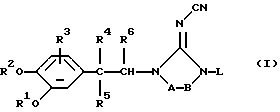
Настоящее изобретение относится к производным 2-цианоиминоимидазола формулы (I)
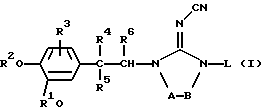
их N-оксидным формам, фармацевтически приемлемым солям присоединения кислот или оснований и стереохимически изомерным формам,
где каждый R1 и R2 независимо, представляет водород; С1-6-алкил; дифторметил; трифторметил; С3-6-циклоалкил; насыщенный 5-, 6- или 7-членный гетероцикл, содержащий один или два гетероатома, выбранных из атомов кислорода, серы или азота; инданил; 6,7-дигидро-5H-циклопентапиридинил; бицикло [2.2.1] -2-гептенил; бицикло [2.2.1] -гептанил; С1-6-алкилсульфонил; арилсульфонил; или С1-10-алкил, замещенный одним или двумя заместителями, каждый из которых выбирают, независимо, из арила, пиридинила, тиенила, фуранила, инданила, 6,7-дигидро-5H-циклопентапиридинила, С3-7-циклоалкила и насыщенного 5-, 6- или 7-членного гетероцикла, содержащего один или два гетероатома, выбранных из атомов кислорода, серы или азота;
R3 представляет водород, галоген или С1-6-алкилокси;
R4 представляет водород; галоген; С1-6-алкил; трифторметил; С3-6-циклоалкил; карбоксил; C1-4-алкилоксикарбонил; С3-6-циклоалкиламинокарбонил; арил; Неt1; или С1-6-алкил, замещенный циано, амино, гидрокси, С1-4-алкилкарбониламино, арилом или Неt1; или
R4 представляет радикал формулы
-O-R7 (а-1); или
-NН-R8 (а-2);
где R7 представляет водород; С1-6-алкил; С1-6-алкил, замещенный гидрокси, карбоксилом, С1-4-алкилоксикарбонилом, амино, моно- или ди(С1-4-алкил)амино, Неt1 или арилом;
R8 представляет водород; С1-6-алкил; С1-4-алкилкарбонил; С1-6-алкил, замещенный гидрокси, карбоксилом, C1-4-алкилоксикарбонилом, амино, моно- или ди(С1-4-алкил)амино, Неt1 или арилом;
R5 представляет водород, галоген, гидрокси, С1-6-алкил или С1-6-алкилокси; или
R4 и R5 вместе могут образовывать двухвалентный радикал формулы
-(СН2)n- (b-1);
-СН2-СН2-O-СН2-СН2- (b-2);
-СН2-СН2-N(R9)-СН2-СН2- (b-3); или
-СН2-СН=СН-СН2- (b-4);
где n равен 2, 3, 4 или 5;
R9 представляет водород, С1-6-алкил, С1-6-алкилсульфонил или п-толуолсульфонил;
R6 представляет водород или С1-4-алкил; или
R4 и R6, вместе, могут образовывать двухвалентный радикал формулы -(СН2)m-;
где m равен 1, 2, 3 или 4;
-А-В- представляет двухвалентный радикал формулы
-СR10=СR11- (с-1); или
-СНR10-СНR11 (с-2);
где каждый R10 и R11 представляет, независимо, водород или С1-4-алкил; и
L представляет водород; С1-6-алкил; С1-6-алкилкарбонил; С1-6-алкилоксикарбонил; С1-6-алкил, замещенный одним или двумя заместителями, выбранными из группы, включающей гидрокси, С1-4-алкилокси, С1-4-алкилоксикарбонила, моно- и ди(С1-4-алкил)амино, арила и Неt2; С3-6-алкенил; С3-6-алкенил, замещенный арилом; пиперидинил; пиперидинил, замещенный С1-4-алкилом или арил-С1-4-алкилом; С1-6-алкилсульфонил или арилсульфонил;
арил представляет фенил или фенил, замещенный одним, двумя или тремя заместителями, выбранными из галогена, гидрокси, С1-4-алкила, С1-4-алкилокси, С3-6-циклоалкила, трифторметила, амино, нитро, карбоксила, С1-4-алкилоксикарбонила и С1-4-алкилкарбонил-амино;
Неt1 представляет пиридинил; пиридинил, замещенный С1-4-алкилом; фуранил; фуранил, замещенный С1-4-алкилом; тиенил; тиенил, замещенный С1-4-алкилкарбониламино; гидроксипиридинил, гидроксипиридинил, замещенный С1-4-алкилом или С1-4-алкокси-С1-4-алкилом; имидазолил; имидазолил, замещенный С1-4-алкилом; тиазолил; тиазолил, замещенный C1-4-алкилом; оксазолил; оксазолил, замещенный С1-4-алкилом; изохинолинил; изохинолинил, замещенный С1-4-алкилом; хинолинонил; хинолинонил, замещенный С1-4-алкилом; морфолинил; пиперидинил; пиперидинил, замещенный C1-4-алкилом, С1-4-алкилоксикарбонилом или арил-С1-4-алкилом; пиперазинил; пиперазинил, замещенный С1-4-алкилом, C1-4-алкилоксикарбонилом или арил-С1-4-алкилом; и
Неt2 представляет морфолинил; пиперидинил; пиперидинил, замещенный С1-4-алкилом или арил-С1-4-алкилом; пиперазинил; пиперазинил, замещенный С1-4-алкилом или арил-С1-4-алкилом; пиридинил; пиридинил, замещенный С1-4-алкилом; фуранил, фуранил, замещенный С1-4-алкилом; тиенил или тиенил, замещенный С1-4-алкилом или С1-4-алкилкарбониламино.The present invention relates to derivatives of 2-cyanoiminoimidazole of the formula (I)
their N-oxide forms, pharmaceutically acceptable acid or base addition salts, and stereochemically isomeric forms,
where each R 1 and R 2 independently represents hydrogen; C 1-6 alkyl; difluoromethyl; trifluoromethyl; C 3-6 cycloalkyl; a saturated 5-, 6- or 7-membered heterocycle containing one or two heteroatoms selected from oxygen, sulfur or nitrogen atoms; indanyl; 6,7-dihydro-5H-cyclopentapyridinyl; bicyclo [2.2.1] -2-heptenyl; bicyclo [2.2.1] heptanyl; C 1-6 alkylsulfonyl; arylsulfonyl; or C 1-10 alkyl substituted with one or two substituents each independently selected from aryl, pyridinyl, thienyl, furanyl, indanyl, 6,7-dihydro-5H-cyclopentapyridinyl, C 3-7 cycloalkyl and saturated A 5-, 6- or 7-membered heterocycle containing one or two heteroatoms selected from oxygen, sulfur or nitrogen atoms;
R 3 represents hydrogen, halogen or C 1-6 alkyloxy;
R 4 represents hydrogen; halogen; C 1-6 alkyl; trifluoromethyl; C 3-6 cycloalkyl; carboxyl; C 1-4 alkyloxycarbonyl; C 3-6 cycloalkylaminocarbonyl; aryl; Net 1 ; or C 1-6 alkyl substituted with cyano, amino, hydroxy, C 1-4 alkylcarbonylamino, aryl or He 1 ; or
R 4 represents a radical of the formula
-OR 7 (a-1); or
-NH-R 8 (a-2);
where R 7 represents hydrogen; C 1-6 alkyl; C 1-6 alkyl substituted with hydroxy, carboxyl, C 1-4 alkyloxycarbonyl, amino, mono or di (C 1-4 alkyl) amino, He 1 or aryl;
R 8 represents hydrogen; C 1-6 alkyl; C 1-4 alkylcarbonyl; C 1-6 alkyl substituted with hydroxy, carboxyl, C 1-4 alkyloxycarbonyl, amino, mono or di (C 1-4 alkyl) amino, He 1 or aryl;
R 5 represents hydrogen, halogen, hydroxy, C 1-6 -alkyl or C 1-6 -alkyloxy; or
R 4 and R 5 together can form a divalent radical of the formula
- (CH 2 ) n - (b-1);
-CH 2 -CH 2 -O-CH 2 -CH 2 - (b-2);
-CH 2 -CH 2 -N (R 9 ) -CH 2 -CH 2 - (b-3); or
-CH 2 -CH = CH-CH 2 - (b-4);
where n is 2, 3, 4 or 5;
R 9 represents hydrogen, C 1-6 alkyl, C 1-6 alkylsulfonyl or p-toluenesulfonyl;
R 6 represents hydrogen or C 1-4 alkyl; or
R 4 and R 6 together can form a divalent radical of the formula - (CH 2 ) m -;
where m is 1, 2, 3 or 4;
-A-B- represents a divalent radical of the formula
-CR 10 = CR 11 - (s-1); or
-CHR 10 -CHR 11 (s-2);
where each R 10 and R 11 independently represents hydrogen or C 1-4 alkyl; and
L represents hydrogen; C 1-6 alkyl; C 1-6 alkylcarbonyl; C 1-6 alkyloxycarbonyl; C 1-6 alkyl substituted with one or two substituents selected from the group consisting of hydroxy, C 1-4 alkyloxy, C 1-4 alkyloxycarbonyl, mono and di (C 1-4 alkyl) amino, aryl and Net 2 ; C 3-6 alkenyl; C 3-6 alkenyl substituted with aryl; piperidinyl; piperidinyl substituted with C 1-4 alkyl or aryl C 1-4 alkyl; C 1-6 alkylsulfonyl or arylsulfonyl;
aryl is phenyl or phenyl substituted with one, two or three substituents selected from halogen, hydroxy, C 1-4 alkyl, C 1-4 alkyloxy, C 3-6 cycloalkyl, trifluoromethyl, amino, nitro, carboxyl, C 1-4- alkyloxycarbonyl and C 1-4 -alkylcarbonyl-amino;
Net 1 is pyridinyl; pyridinyl substituted with C 1-4 alkyl; furanyl; furanyl substituted with C 1-4 alkyl; thienyl; thienyl substituted with C 1-4 alkylcarbonylamino; hydroxypyridinyl, hydroxypyridinyl substituted with C 1-4 alkyl or C 1-4 alkoxy-C 1-4 alkyl; imidazolyl; imidazolyl substituted with C 1-4 alkyl; thiazolyl; thiazolyl substituted with C 1-4 alkyl; oxazolyl; oxazolyl substituted with C 1-4 alkyl; isoquinolinyl; isoquinolinyl substituted with C 1-4 alkyl; quinolinonyl; quinolinonyl substituted with C 1-4 alkyl; morpholinyl; piperidinyl; piperidinyl substituted with C 1-4 alkyl, C 1-4 alkyloxycarbonyl or aryl C 1-4 alkyl; piperazinyl; piperazinyl substituted with C 1-4 alkyl, C 1-4 alkyloxycarbonyl or aryl C 1-4 alkyl; and
He 2 represents morpholinyl; piperidinyl; piperidinyl substituted with C 1-4 alkyl or aryl C 1-4 alkyl; piperazinyl; piperazinyl substituted with C 1-4 alkyl or aryl C 1-4 alkyl; pyridinyl; pyridinyl substituted with C 1-4 alkyl; furanyl, furanyl substituted with C 1-4 alkyl; thienyl or thienyl substituted with C 1-4 alkyl or C 1-4 alkylcarbonylamino.
Некоторые из соединений формулы (I) могут существовать также в таутомерных формах. Предполагается, что такие формы, хотя они специально не указаны в приведенной выше формуле (I), включены в объем настоящего изобретения. В частности, соединения формулы (I), в которых L представляет водород, могут существовать в соответствующей таутомерной форме. Some of the compounds of formula (I) may also exist in tautomeric forms. It is intended that such forms, although not specifically indicated in the above formula (I), be included within the scope of the present invention. In particular, compounds of formula (I) in which L is hydrogen may exist in their respective tautomeric form.
В R1 и R2 насыщенные 5-, 6- или 7-членные гетероциклы, содержащие один или два гетероатома, выбранных из атомов кислорода, серы или азота, можно подходящим образом выбрать среди таких гетероциклов, как, например, тетрагидрофуранил, диоксоланил, пирролидинил, морфолинил, пиперидинил, пиперазинил и тетрагидропиранил. Указанные гетероциклические радикалы присоединены к атому кислорода или С1-10-радикалу через любой атом углерода или, в соответствующем случае, при помощи атома азота.In R 1 and R 2, saturated 5-, 6- or 7-membered heterocycles containing one or two heteroatoms selected from oxygen, sulfur or nitrogen atoms can be suitably selected from such heterocycles as, for example, tetrahydrofuranyl, dioxolanyl, pyrrolidinyl , morpholinyl, piperidinyl, piperazinyl and tetrahydropyranyl. These heterocyclic radicals are attached to an oxygen atom or a C 1-10 radical through any carbon atom or, if appropriate, by a nitrogen atom.
Также в R1 и R2 термин "6,7-дигидро-5H-циклопентапиридинил", называемый также 6,7-дигидро-5H-пиридинилом, предназначен для обозначения 6,7-дигидро-5H-циклопента[b] пиридина или 6, 7-дигидро-5H-циклопента[с]пиридинила, которые могут присоединяться к остальной части молекулы через любой из алифатических или ароматических атомов углерода.Also in R 1 and R 2, the term “6,7-dihydro-5H-cyclopentapyridinyl”, also called 6,7-dihydro-5H-pyridinyl, is intended to mean 6,7-dihydro-5H-cyclopenta [b] pyridine or 6 , 7-dihydro-5H-cyclopenta [c] pyridinyl, which can be attached to the rest of the molecule via any of the aliphatic or aromatic carbon atoms.
Используемый здесь термин "галоген" является общим для обозначения фтора, хлора, брома и иода; термин "С1-4-алкил" относится к линейным или разветвленным насыщенным углеводородам с 1-4 атомами углерода и включает такие радикалы, как, например, метил, этил, 1-метилэтил, 1,1-диметилэтил, пропил, 2-метилпропил и бутил; термин "С1-6-алкил" включает С1-4-алкил и его более высокие гомологи с 5 или 6 атомами углерода, такие как, например, 2-метилбутил, пентил, гексил и подобные; термин "С1-6-алкил" включает С2-6-алкил и более низкие гомологи с 1 атомом углерода, такие как, например, метил; С1-10-алкил включает С1-6-алкил и более высокие гомологи с 7-10 атомами углерода, такие как, например, гептил, октил, нонил, децил, 1-метилгексил, 2-метилгептил и подобные; термин "С3-6-алкенил" определяет линейные и разветвленные углеводородные радикалы, содержащие одну двойную связь и имеющие от 3 до 6 атомов углерода, такие как, например, 2-пропенил, 3-бутенил, 2-бутенил, 2-пентенил, 3-пентенил, 3-метил-2-бутенил и подобные; и причем атом углерода указанного С3-6-алкенила, соединяющийся с атомом азота, предпочтительно, является насыщенным; термин "С3-6-циклоалкил" является общим для циклопропила, циклобутила, циклопентила и циклогексила; термин "С3-7-циклоалкил" включает С3-6-циклоалкил и циклогептил; термин "С1-4-алкандиил" включает линейные и разветвленные насыщенные двухвалентные углеводородные радикалы с 1-4 атомами углерода, такие как, например, метилен, 1,2-этандиил, 1,1-этандиил, 1,3-пропандиил, 1,2-пропандиил, 1,4-бутандиил, 2-метил-1,3-пропандиил и подобные.The term “halogen” as used herein is generic to fluorine, chlorine, bromine and iodine; the term “C 1-4 alkyl” refers to straight or branched saturated hydrocarbons with 1-4 carbon atoms and includes radicals such as, for example, methyl, ethyl, 1-methylethyl, 1,1-dimethylethyl, propyl, 2-methylpropyl and butyl; the term “C 1-6 alkyl” includes C 1-4 alkyl and its higher homologues with 5 or 6 carbon atoms, such as, for example, 2-methylbutyl, pentyl, hexyl and the like; the term “C 1-6 alkyl” includes C 2-6 alkyl and lower homologs with 1 carbon atom, such as, for example, methyl; C 1-10 alkyl includes C 1-6 alkyl and higher homologues with 7-10 carbon atoms, such as, for example, heptyl, octyl, nonyl, decyl, 1-methylhexyl, 2-methylheptyl and the like; the term “C 3-6 alkenyl” defines linear and branched hydrocarbon radicals containing one double bond and having from 3 to 6 carbon atoms, such as, for example, 2-propenyl, 3-butenyl, 2-butenyl, 2-pentenyl, 3-pentenyl, 3-methyl-2-butenyl and the like; and wherein the carbon atom of said C 3-6 alkenyl linking to the nitrogen atom is preferably saturated; the term “C 3-6 cycloalkyl” is generic to cyclopropyl, cyclobutyl, cyclopentyl and cyclohexyl; the term “C 3-7 cycloalkyl” includes C 3-6 cycloalkyl and cycloheptyl; the term “C 1-4 alkanediyl” includes linear and branched saturated divalent hydrocarbon radicals with 1-4 carbon atoms, such as, for example, methylene, 1,2-ethanediyl, 1,1-ethanediyl, 1,3-propanediyl, 1 , 2-propanediyl, 1,4-butanediyl, 2-methyl-1,3-propanediyl and the like.
Используемый здесь в вышеуказанных определениях и далее термин "гало-С1-4-алкандиил" определяет моно- или полигалогензамещенный С1-4-алкандиил, в частности, С1-4-алкандиил, замещенный одним или несколькими атомами фтора.As used herein in the above definitions and hereinafter, the term “halo-C 1-4 alkanediyl” defines a mono- or polyhalo-substituted C 1-4 alkanediyl, in particular C 1-4 alkanediyl substituted with one or more fluorine atoms.
Фармацевтически приемлемые соли присоединения кислот, упомянутые выше, представляют формы солей присоединения кислот, которые обычно получают обработкой соединений формулы (I) в форме основания соответствующими кислотами, например, неорганическими кислотами, такими как галогенводородная кислота, например, хлористоводородная или бромистоводородная, серная, азотная, фосфорная или подобными кислотами; или органическими кислотами, такими как, например, уксусная, оксиуксусная, пропановая, молочная, пировиноградная, щавелевая, малоновая, янтарная, малеиновая, фумаровая, яблочная, винная, лимонная, метансульфоновая, этансульфоновая, бензолсульфоновая, п-толуолсульфоновая, цикламовая, салициловая, п-аминосалициловая, памовая и подобные. И наоборот, указанные формы солей присоединения кислот можно превратить в формы свободных оснований обработкой соответствующим основанием. The pharmaceutically acceptable acid addition salts mentioned above are acid addition salt forms which are usually prepared by treating the compounds of formula (I) in the form of a base with appropriate acids, for example, inorganic acids such as hydrohalic acid, for example hydrochloric or hydrobromic, sulfuric, nitric, phosphoric or similar acids; or organic acids, such as, for example, acetic, hydroxyacetic, propanoic, lactic, pyruvic, oxalic, malonic, succinic, maleic, fumaric, malic, tartaric, citric, methanesulfonic, ethanesulfonic, benzenesulfonic, p-toluenesulfonic, p-toluenesulfonic, aminosalicylic, pamova and the like. Conversely, these forms of acid addition salts can be converted into free base forms by treatment with an appropriate base.
Соединения формулы (I), содержащие кислотный протон, также можно превратить в их нетоксичные соли присоединения металла или амина обработкой соответствующими органическими или неорганическими основаниями. Подходящими солевыми формами являются, например, аммониевые соли, соли щелочных и щелочноземельных металлов, например, литиевые, натриевые, калиевые, магниевые, кальциевые соли и т.п., соли органических оснований, например, соли бензатина, N-метил-D-глюкамина, гидрабамина и соли аминокислот, таких как, например, аргинин, лизин и подобные. The compounds of formula (I) containing an acidic proton can also be converted to their non-toxic metal or amine addition salts by treatment with appropriate organic or inorganic bases. Suitable salt forms are, for example, ammonium salts, salts of alkali and alkaline earth metals, for example, lithium, sodium, potassium, magnesium, calcium salts and the like, salts of organic bases, for example, salts of benzathine, N-methyl-D-glucamine , hydrabamine and salts of amino acids, such as, for example, arginine, lysine and the like.
Термин "соль присоединения" включает также гидраты и сольватные формы, которые могут образовывать соединения формулы (I). Примерами таких форм являются, например, гидраты, алкоголяты и т.п. The term “addition salt” also includes hydrates and solvate forms that the compounds of formula (I) can form. Examples of such forms are, for example, hydrates, alcoholates, and the like.
N-оксидные формы соединений формулы (I) включают те соединения формулы (I), в которых один или несколько атомов азота окислены до так называемого N-оксида. N-oxide forms of the compounds of formula (I) include those compounds of formula (I) in which one or more nitrogen atoms are oxidized to the so-called N-oxide.
Термин "стехиометрически изомерные формы", используемый здесь, определяет все возможные изомерные формы, которые могут иметь соединения формулы (I). Если нет иных упоминаний и указаний, химические названия соединений обозначают смеси всех возможных стереохимически изомерных форм, причем указанные смеси содержат все диастереомеры и энантиомеры основной молекулярной структуры. Более конкретно, стереогенные центры могут иметь R- или S-конфигурацию, а =N-СN и замещенные С3-6-алкенильные группы могут иметь Е- или Z-конфигурацию.The term "stoichiometrically isomeric forms" as used herein defines all possible isomeric forms that the compounds of formula (I) may have. Unless otherwise mentioned and indicated, the chemical names of the compounds denote mixtures of all possible stereochemically isomeric forms, said mixtures containing all diastereomers and enantiomers of the basic molecular structure. More specifically, stereogenic centers may have an R or S configuration, and a = N — CN and substituted C 3-6 alkenyl groups may have an E or Z configuration.
Далее термин "соединения формулы (I)" включает также N-оксидные формы, фармацевтически приемлемые соли присоединения кислот или оснований и все стереоизомерные формы. Further, the term “compounds of formula (I)” also includes N-oxide forms, pharmaceutically acceptable acid or base addition salts, and all stereoisomeric forms.
Некоторые из соединений формулы (I) и некоторые из промежуточных соединений по настоящему изобретению могут содержать асимметричный атом углерода. Чистые стереохимически изомерные формы указанных соединений и указанных промежуточных соединений можно получить, используя хорошо известные методики. Some of the compounds of formula (I) and some of the intermediates of the present invention may contain an asymmetric carbon atom. Pure stereochemically isomeric forms of these compounds and these intermediate compounds can be obtained using well-known methods.
Например, диастереоизомеры можно разделить с помощью физических методов, таких как селективная кристаллизация или с помощью хроматографических способов, например, противоточным распределением, жидкостной хроматографией и подобными. Энантиомеры можно получить из рацемических смесей, превращая сначала указанные рацемические смеси с помощью подходящих разделяющих агентов, таких как, например, хиральные кислоты, в смеси диастереомерных солей или соединений; с последующим физическим разделением указанных смесей диастереомерных солей или соединений с помощью, например, селективной кристаллизации или хроматографических методов, например, жидкостной хроматографии и подобными способами; и, наконец, превращением указанных разделенных диастереомерных солей или соединений в соответствующие энантиомеры. Чистые стереохимически изомерные формы можно также получить из стереохимически чистых изомерных форм соответствующих промежуточных соединений и исходных веществ при условии, что соответствующие реакции проходят стереоспецифически. Чистые и смешанные стереохимически изомерные формы соединений формулы (I) включены в объем настоящего изобретения. For example, diastereoisomers can be resolved using physical methods such as selective crystallization or chromatographic methods, for example, countercurrent distribution, liquid chromatography and the like. Enantiomers can be obtained from racemic mixtures by first converting said racemic mixtures using suitable resolving agents, such as, for example, chiral acids, into a mixture of diastereomeric salts or compounds; followed by physical separation of said mixtures of diastereomeric salts or compounds by, for example, selective crystallization or chromatographic methods, for example, liquid chromatography and the like; and finally, the conversion of these separated diastereomeric salts or compounds into the corresponding enantiomers. Pure stereochemically isomeric forms can also be obtained from stereochemically pure isomeric forms of the corresponding intermediates and starting materials, provided that the corresponding reactions are stereospecific. Pure and mixed stereochemically isomeric forms of the compounds of formula (I) are included within the scope of the present invention.
Альтернативный способ разделения энантиомерных форм соединений формулы (I) и промежуточных соединений включает жидкостную хроматографию, в частности, жидкостную хроматографию с использованием хиральной неподвижной фазы. An alternative way of separating the enantiomeric forms of the compounds of formula (I) and intermediates involves liquid chromatography, in particular liquid chromatography using a chiral stationary phase.
Особой группой соединений являются те соединения формулы (I), в которых каждый из R1 и R2 представляет, независимо, водород; С1-6-алкил; дифторметил, трифторметил; С3-6-алкил; насыщенный 5-, 6- или 7-членный гетероцикл, содержащий один или два гетероатома, выбираемых из атомов кислорода, серы или азота; инданил; бицикло[2.2.1] -2-гептенил; бицикло[2.2.1]гептанил; С1-6-алкилсульфонил; арилсульфонил; или С1-10-алкил, замещенный одним или двумя заместителями, каждый из которых, независимо, выбирают из арила, пиридинила, тиенила, фуранила, С3-7-циклоалкила и насыщенного 5-, 6- или 7-членного гетероцикла, содержащего один или два гетероатома, выбранных из атомов кислорода, серы или азота.A special group of compounds are those compounds of formula (I) in which each of R 1 and R 2 independently represents hydrogen; C 1-6 alkyl; difluoromethyl; trifluoromethyl; C 3-6 alkyl; a saturated 5-, 6- or 7-membered heterocycle containing one or two heteroatoms selected from oxygen, sulfur or nitrogen atoms; indanyl; bicyclo [2.2.1] -2-heptenyl; bicyclo [2.2.1] heptanyl; C 1-6 alkylsulfonyl; arylsulfonyl; or C 1-10 alkyl substituted with one or two substituents, each independently selected from aryl, pyridinyl, thienyl, furanyl, C 3-7 cycloalkyl and a saturated 5-, 6- or 7-membered heterocycle containing one or two heteroatoms selected from oxygen, sulfur or nitrogen atoms.
Представляющими интерес соединениями являются те соединения формулы (I), в которых каждый из R1 и R2 представляет, независимо, С1-6-алкил; С3-6-циклоалкил; дифторметил; насыщенный 5-, 6- или 7-членный гетероцикл, содержащий один или два гетероатома, выбранных из атомов кислорода, серы или азота, представляющий, предпочтительно, тетрагидрофуранил; инданил или С1-10-алкил, замещенный арилом, инданилом, 6,7-дигидро-5H-циклопентапиридинилом или С3-6-циклоалкилом.Compounds of interest are those compounds of formula (I) in which each of R 1 and R 2 is independently C 1-6 alkyl; C 3-6 cycloalkyl; difluoromethyl; a saturated 5-, 6- or 7-membered heterocycle containing one or two heteroatoms selected from oxygen, sulfur or nitrogen atoms, preferably tetrahydrofuranyl; indanyl or C 1-10 alkyl substituted with aryl, indanyl, 6,7-dihydro-5H-cyclopentapyridinyl or C 3-6 cycloalkyl.
Также интересны те соединения формулы (I), в которых R5 представляет водород, а R4 представляет водород, гидрокси или С1-6-алкил, в особенности, когда R4 представляет метил.Also of interest are those compounds of formula (I) in which R 5 is hydrogen and R 4 is hydrogen, hydroxy or C 1-6 alkyl, especially when R 4 is methyl.
Другой интересной группой являются те соединения формулы (I), в которых L представляет водород, С1-6-алкилоксикарбонил или С1-6-алкил, замещенный одним или двумя фенильными кольцами.Another interesting group are those compounds of formula (I) in which L is hydrogen, C 1-6 alkyloxycarbonyl or C 1-6 alkyl substituted with one or two phenyl rings.
Особого внимания заслуживают те соединения формулы (I), в которых R1 представляет циклопентил, тетрагидрофуранил, циклопропилметил, 5-фенилпентил, 2-инданилэтил, 6,7-дигидро-5H-циклопента[b]пиридинил или инданил; а R2 представляет метил или дифторметил.Of particular note are those compounds of formula (I) in which R 1 is cyclopentyl, tetrahydrofuranyl, cyclopropylmethyl, 5-phenylpentyl, 2-indanylethyl, 6,7-dihydro-5H-cyclopenta [b] pyridinyl or indanyl; and R 2 is methyl or difluoromethyl.
Предпочтительными соединениями являются соединения, в которых R3, R5, R6, R10, R11 и L представляют водород.Preferred compounds are compounds in which R 3 , R 5 , R 6 , R 10 , R 11 and L are hydrogen.
Наиболее предпочтительными соединениями являются [1-[2-[4-(дифторметокси)-3-[(тетрагидро-3-фуранил)окси] -фенил]-пропил]-1,3-дигидро-2H-имидазол-2-илиден] цианамид и [1-[2-[4-(метокси)-3-[(1,3-дигидро-2H-инден-2-ил)окси] -фенил]пропил]-1, 3-дигидро-2H-имидазол-2-илиден]цианамид; их N-оксиды, их стереохимически изомерные формы и их фармацевтически приемлемые соли присоединения. The most preferred compounds are [1- [2- [4- (difluoromethoxy) -3 - [(tetrahydro-3-furanyl) oxy] phenyl] propyl] -1,3-dihydro-2H-imidazole-2-ylidene] cyanamide and [1- [2- [4- (methoxy) -3 - [(1,3-dihydro-2H-inden-2-yl) oxy] phenyl] propyl] -1, 3-dihydro-2H-imidazole -2-ylidene] cyanamide; their N-oxides, their stereochemically isomeric forms, and their pharmaceutically acceptable addition salts.
Везде, где упоминаются далее R1-R11, Y, -А-В- и L, они имеют значения, указанные в определении формулы (I), если нет других указаний.Wherever R 1 -R 11 , Y, -A-B- and L are mentioned below, they have the meanings indicated in the definition of formula (I), unless otherwise indicated.
Соединения формулы (I), в которых -А-В- представляет радикал формулы (с-1), а L представляет водород, причем указанные соединения изображаются формулой (I-а-1), можно удобно получить циклизацией промежуточного соединения формулы (II) или его функционального производного в присутствии подходящей кислоты, такой как, например, хлористоводородная кислота

Указанную циклизацию можно осуществить в инертном для реакции растворителе, таком как, например, тетрагидрофуран или 1,4-диоксан или в их смеси. Перемешивание и нагревание могут увеличить скорость реакции.Compounds of formula (I) in which -A-B- represents a radical of formula (c-1) and L is hydrogen, said compounds being represented by formula (I-a-1), can conveniently be obtained by cyclization of an intermediate of formula (II) or a functional derivative thereof in the presence of a suitable acid, such as, for example, hydrochloric acid
Said cyclization can be carried out in a reaction inert solvent, such as, for example, tetrahydrofuran or 1,4-dioxane, or in a mixture thereof. Stirring and heating can increase the reaction rate.
В этом и приведенных далее способах получения продукты реакции можно выделить из реакционной среды, и, при необходимости, дополнительно очистить известными способами в данной области, такими как, например, экстракция, кристаллизация, растирание и хроматография. In this and the following preparation methods, reaction products can be isolated from the reaction medium and, if necessary, further purified by known methods in the art, such as, for example, extraction, crystallization, trituration and chromatography.
В частности, соединения формулы (I-а-1), в которых R5 представляет гидрокси, причем указанные соединения представлены формулой (I-а-1-1), можно получить циклизацией промежуточного соединения формулы (II-1), где Р представляет водород, или, предпочтительно, является защитной триметилсилильной группой, или его функционального производного по способу, аналогичному описанному для получения соединения формулы (I-а-1) из промежуточного соединения формулы (II)
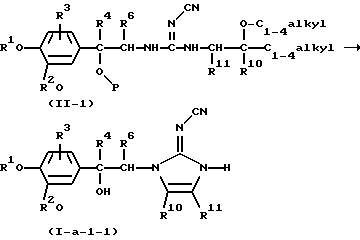
Соединения формулы (I), в которых -А-В- представляет радикал формулы (с-2), а L представляет водород, причем указанные соединения представлены формулой (I-а-2), можно получить циклизацией промежуточного соединения формулы (III) или его функционального производного в присутствии подходящего реагента, такого как, например, диметилцианокарбонимидодитиоат или дифенил-N-цианокарбонимидат
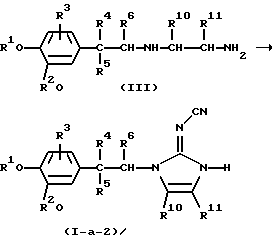
С другой стороны, соединения формулы (I) можно получить при взаимодействии металлоорганического промежуточного соединения формулы (IV), где М представляет соответствующий ион металла или ион металлокомплекса, такой как, например, Li+, (МgВr)+, В(ОН)2 + или Sn(СН3)3 +, в инертном для реакции растворителе с подходящим производным 2-цианоиминоимидазола формулы (V), где W1 представляет реакционноспособную уходящую группу, такую как, например, галоген. В случае, когда R4 и R5 объединяются вместе и образуют радикал формулы (b-1), (b-2), (b-3) или (b-4), W1 может представлять также цианидную группу, при условии, что промежуточное соединение формулы (IV) является реактивом Гриньяра
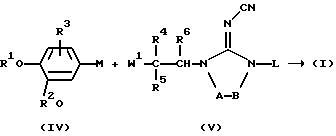
Указанную реакцию можно осуществлять в инертном для реакции растворителе, таком как, например, диметоксиэтан, тетрагидрофуран или диэтиловый эфир. Перемешивание и нагревание могут ускорить реакцию. В случае, когда в указанной реакции используют промежуточные соединения формулы (V), в которых L заменяют подходящей защитной группой, соединения формулы (I), в которых L представляет водород, причем указанные соединения представлены соединениями формулы (1-а), можно получить с использованием известных в данной области реакций отщепления защитных групп.In particular, compounds of formula (I-a-1) in which R 5 is hydroxy, wherein these compounds are represented by formula (I-a-1-1), can be obtained by cyclization of an intermediate of formula (II-1), where P is hydrogen, or, preferably, is a trimethylsilyl protective group, or a functional derivative thereof, according to a method similar to that described for preparing a compound of formula (I-a-1) from an intermediate of formula (II)
Compounds of formula (I) in which -A-B- is a radical of formula (c-2) and L is hydrogen, said compounds being represented by formula (I-a-2), can be prepared by cyclization of an intermediate of formula (III) or its functional derivative in the presence of a suitable reagent, such as, for example, dimethylcyanocarbonimidodithioate or diphenyl-N-cyanocarbonimidate
On the other hand, compounds of formula (I) can be prepared by reacting an organometallic intermediate compound of formula (IV), where M represents the corresponding metal ion or metal complex ion, such as, for example, Li + , (MgBr) + , B (OH) 2 + or Sn (CH 3 ) 3 + , in a reaction inert solvent with a suitable 2-cyanoiminoimidazole derivative of formula (V), wherein W 1 is a reactive leaving group, such as, for example, halogen. In the case where R 4 and R 5 combine to form a radical of the formula (b-1), (b-2), (b-3) or (b-4), W 1 may also represent a cyanide group, provided that the intermediate of formula (IV) is a Grignard reagent
The specified reaction can be carried out in a reaction inert solvent, such as, for example, dimethoxyethane, tetrahydrofuran or diethyl ether. Stirring and heating can speed up the reaction. In the case where intermediate compounds of formula (V) are used in this reaction in which L is replaced with a suitable protecting group, compounds of formula (I) in which L is hydrogen, said compounds being represented by compounds of formula (1-a), can be prepared with the use of reactions known in the art for cleavage of protecting groups.
Соединения формулы (I) можно также превращать одно в другое в соответствии с известными в данной области методиками превращения функциональных групп. The compounds of formula (I) can also be converted from one to another in accordance with methods known in the art for converting functional groups.
Например, соединения формулы (I), в которых L отличается от водорода, причем указанные соединения представлены формулой (I-b), можно получить взаимодействием соединения формулы (I-а) с L'-W2 (VI), где L' имеет те же значения, что и L в формуле (I), но не является водородом, и W2 представляет реакционноспособную уходящую группу, такую как, например, атом галогена
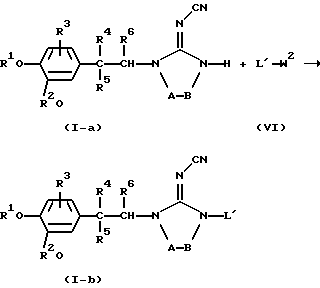
Для превращения соединений формулы (I-а) в соединения формулы (I-b) можно использовать также известные в данной области реакции присоединения.For example, compounds of formula (I) in which L is different from hydrogen, wherein said compounds are represented by formula (Ib), can be prepared by reacting a compound of formula (Ia) with L'-W 2 (VI), where L 'has the same values as L in formula (I) but not hydrogen, and W 2 represents a reactive leaving group, such as, for example, a halogen atom
Addition reactions known in the art can also be used to convert compounds of formula (Ia) into compounds of formula (Ib).
Соединения формулы (I) можно также превратить в соответствующие N-оксидные формы в соответствии с известными методами для превращения трехвалентного азота в его N-оксидную форму. Указанные реакции N-окисления, вообще, можно осуществлять взаимодействием исходного вещества формулы (I) с 3-фенил-2-(фенилсульфонил)оксазиридином или с подходящим органическим или неорганическим пероксидом. Подходящими неорганическими пероксидами являются, например, пероксид водорода, пероксиды щелочных металлов или щелочноземельных металлов, например, пероксид натрия, пероксид калия; подходящими органическими пероксидами могут являться пероксикислоты, такие как, например, пероксибензойная кислота или галогензамещенная пероксибензойная кислота, например, 3-хлорбензойная пероксикислота, пероксоалкановые кислоты, например, пероксоуксусная кислота, алкилгидропероксиды, например, трет-бутилгидропероксид. Подходящими растворителями являются, например, вода, низшие жирные спирты, например, этанол и т.п., углеводороды, например, толуол, кетоны, например, 2-бутанон, галогенированные углеводороды, например, дихлорметан и смеси таких растворителей. The compounds of formula (I) can also be converted into the corresponding N-oxide forms in accordance with known methods for the conversion of trivalent nitrogen to its N-oxide form. These N-oxidation reactions can generally be carried out by reacting the starting material of formula (I) with 3-phenyl-2- (phenylsulfonyl) oxaziridine or with a suitable organic or inorganic peroxide. Suitable inorganic peroxides are, for example, hydrogen peroxide, peroxides of alkali metals or alkaline earth metals, for example, sodium peroxide, potassium peroxide; suitable organic peroxides may be peroxyacids, such as, for example, peroxybenzoic acid or halogen-substituted peroxybenzoic acid, for example 3-chlorobenzoic peroxyacid, peroxoalkanoic acids, for example peroxoacetic acid, alkyl hydroperoxides, for example tert-butyl hydroperoxides. Suitable solvents are, for example, water, lower fatty alcohols, for example ethanol and the like, hydrocarbons, for example, toluene, ketones, for example 2-butanone, halogenated hydrocarbons, for example dichloromethane and mixtures of such solvents.
Вышеупомянутые промежуточные соединения можно получить известными способами. The above intermediates can be obtained by known methods.
В частности, промежуточные соединения формулы (II) можно получить сначала взаимодействием амина формулы (VII) с диметилцианокарбонимидодитиоатом или дифенилцианокарбонимидатом или его функциональным производным. Указанное взаимодействие можно удобно осуществить в инертном для реакции растворителе, таком как, например, дихлорметан, бензол или толуол, необязательно, при охлаждении на ледяной бане и в присутствии основания, такого как, например, N, N-диэтилэтанамин или бикарбонат натрия. Полученное таким образом промежуточное соединение затем можно ввести во взаимодействие с промежуточным соединением формулы (VIII) или его функциональным производным с образованием промежуточного соединения формулы (II). Указанное взаимодействие можно удобным образом осуществить в инертном для реакции растворителе, таком как, например, 1,4-диоксан, в присутствии основания, такого как, например, N,N-диэтилэтанамин, и, необязательно, в присутствии катализатора, такого как, например, N, N-диметилпиридинамин. Перемешивание и повышенная температура могут увеличить скорость реакции
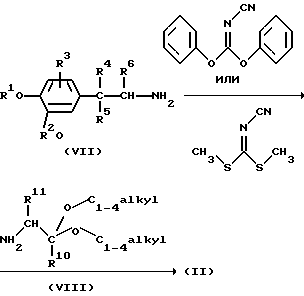
Альтернативно, вышеописанное взаимодействие можно осуществить в обратном порядке, т. е. сначала ввести в реакцию промежуточное соединение формулы (VIII) с диметилцианокарбонимидодитиоатом или дифенилцианокарбонимидатом или его функциональным производным, а затем полученное таким образом промежуточное соединение ввести во взаимодействие с амином формулы (VII).In particular, intermediates of formula (II) can be prepared by first reacting an amine of formula (VII) with dimethyl cyanocarbonimidodithioate or diphenyl cyanocarbonimidate or a functional derivative thereof. Said interaction can conveniently be carried out in a reaction inert solvent, such as, for example, dichloromethane, benzene or toluene, optionally by cooling in an ice bath and in the presence of a base, such as, for example, N, N-diethylethanamine or sodium bicarbonate. The intermediate compound thus obtained can then be reacted with an intermediate compound of formula (VIII) or a functional derivative thereof to form an intermediate compound of formula (II). The specified interaction can conveniently be carried out in a reaction inert solvent, such as, for example, 1,4-dioxane, in the presence of a base, such as, for example, N, N-diethylethanamine, and, optionally, in the presence of a catalyst, such as, for example , N, N-dimethylpyridinamine. Stirring and elevated temperature may increase the reaction rate.
Alternatively, the above-described reaction can be carried out in the reverse order, i.e., first the intermediate of formula (VIII) is reacted with dimethylcyanocarbonimidodithioate or diphenylcyanocarbonimidate or its functional derivative, and then the intermediate obtained in this way is reacted with an amine of formula (VII).
Промежуточные соединения формулы (III), в которых R11 представляет водород, причем указанные промежуточные соединения представлены формулой (III-1), можно получить сначала взаимодействием амина формулы (VII) с цианопроизводным формулы (IX), где W3 представляет подходящую уходящую группу, такую как, например, галоген, в присутствии основания, такого как, например, карбонат натрия, в инертном для реакции растворителе, таком как, например, N, N-диметилформамид. Затем цианидную группу в полученном таким образом промежуточном соединении можно восстановить с использованием подходящего восстановителя, такого как, например, алюмогидрид лития или водород, в присутствии катализатора, такого как, например, никель Ренея, получая таким образом промежуточное соединение формулы (III-1)
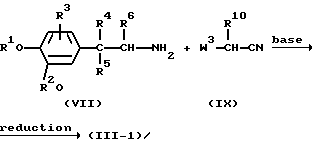
Некоторые из промежуточных соединений формулы (VII) описаны в WО 92/00968, WО 93/15044 и WО 93/15045.Intermediates of formula (III) in which R 11 is hydrogen, wherein said intermediates are represented by formula (III-1), can be prepared by first reacting an amine of formula (VII) with a cyano derivative of formula (IX), where W 3 is a suitable leaving group, such as, for example, halogen, in the presence of a base, such as, for example, sodium carbonate, in a reaction inert solvent, such as, for example, N, N-dimethylformamide. Then, the cyanide group in the intermediate compound thus obtained can be reduced using a suitable reducing agent, such as, for example, lithium aluminum hydride or hydrogen, in the presence of a catalyst, such as, for example, Raney nickel, thereby obtaining an intermediate compound of the formula (III-1)
Some of the intermediates of formula (VII) are described in WO 92/00968, WO 93/15044 and WO 93/15045.
В частности, промежуточные соединения формулы (VII) можно получить взаимодействием промежуточного соединения формулы (X), в котором W4 представляет подходящую уходящую группу, такую как, например, галоген, с промежуточным соединением формулы (XI), где М представляет соответствующий ион металла или ион металлокомплекса, такой как, например, Li+ или (МgВr)+, и Р представляет подходящую защитную группу, такую как, например, (1,1-диметилэтил)оксикарбонил. У полученного таким образом промежуточного соединения формулы (VII) с защитной группой затем можно отщепить защитную группу хорошо известными в технике способами, например, кислотным гидролизом
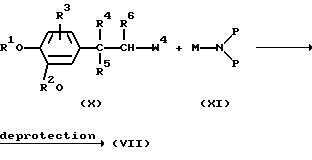
Промежуточные соединения формулы (VII), в которых R6 представляет водород, причем указанные промежуточные соединения представлены формулой (VII-1), можно получить восстановлением ненасыщенной связи углерод-азот в промежуточных соединениях формулы (XII) подходящим восстановителем, таким как, например, борантетрагидрофурановый комплекс, алюмогидрид лития или водород, в присутствии катализатора, такого как, например, никель Ренея. Цианидную группу в промежуточных соединениях формулы (XII) можно также заменить ее функциональным производным, таким как, например, оксимная группа
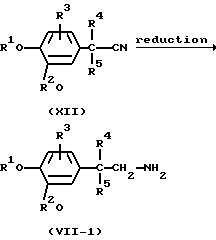
Некоторые из промежуточных соединений формулы (XII) описаны в WО 92/00968, WО 93/15044 и WО 93/15045.In particular, intermediates of formula (VII) can be prepared by reacting an intermediate of formula (X) in which W 4 represents a suitable leaving group, such as, for example, halogen, with an intermediate of formula (XI), where M represents the corresponding metal ion or an ion of a metal complex, such as, for example, Li + or (MgBr) + , and P represents a suitable protecting group, such as, for example, (1,1-dimethylethyl) hydroxycarbonyl. In the intermediate compound of formula (VII) thus obtained with a protecting group, the protecting group can then be cleaved off by methods well known in the art, for example, acid hydrolysis
Intermediates of formula (VII) in which R 6 is hydrogen, wherein said intermediates are represented by formula (VII-1), can be prepared by reducing the carbon-nitrogen unsaturation in the intermediates of formula (XII) with a suitable reducing agent, such as, for example, borantetrahydrofuran a complex, lithium aluminum hydride or hydrogen, in the presence of a catalyst, such as, for example, Raney nickel. The cyanide group in the intermediates of formula (XII) can also be replaced by a functional derivative such as, for example, an oxime group
Some of the intermediates of formula (XII) are described in WO 92/00968, WO 93/15044 and WO 93/15045.
В частности, промежуточные соединения формулы (XII), в которых R5 представляет защищенную гидроксильную группу, а R4 представляет водород, причем указанные промежуточные соединения представлены формулой (ХII-1), можно удобным образом получить взаимодействием альдегида формулы (XIII) с реагентом формулы (XIV) или его функциональным производным, в которых Р представляет защитную группу, такую как, например, триметилсилил и т.п., в инертном для реакции растворителе, таком как, например, дихлорметан и в присутствии каталитического количества ZnI2 или его функционального производного. Указанные промежуточные соединения формулы (ХII-1) затем можно ввести во взаимодействие, как описано выше, и получить форму соединения формулы (I), в котором R5 представляет гидрокси
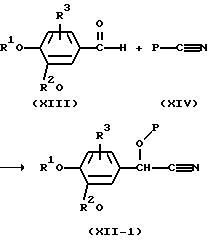
Альдегиды формулы (XIII) можно удобно получить по способу, аналогичному описанному Мitsunobu Оyо в Synthesis, 1-28, 1981.In particular, intermediates of formula (XII) wherein R 5 is a protected hydroxyl group and R 4 is hydrogen, said intermediates being represented by formula (XII-1), may conveniently be prepared by reacting an aldehyde of formula (XIII) with a reagent of formula (XIV) or a functional derivative thereof, in which P represents a protecting group, such as, for example, trimethylsilyl and the like, in a reaction inert solvent, such as, for example, dichloromethane and in the presence of a catalytic amount of ZnI 2 or eg about a functional derivative. These intermediates of formula (XII-1) can then be reacted as described above to form a compound of formula (I) wherein R 5 is hydroxy
The aldehydes of formula (XIII) can conveniently be obtained by a method similar to that described by Mitsunobu Oyo in Synthesis, 1-28, 1981.
Некоторые соединения формулы (I) и некоторые промежуточные соединения по настоящему изобретению имеют, по меньшей мере, один асимметричный атом углерода. Чистые стереохимически изомерные формы указанных соединений и указанных промежуточных соединений можно получить с помощью методик, известных в данной области. Например, диастереоизомеры можно разделить с помощью физических методов, таких как селективная кристаллизация или хроматографическими методами, например, противоточным распределением, жидкостной хроматографией и подобными способами. Энантиомеры можно получить из рацемических смесей превращением сначала указанных рацемических смесей с помощью подходящих разделяющих агентов, таких как, например, хиральные кислоты в смеси диастереомерных солей или соединений; с последующим физическим разделением указанных смесей диастереомерных солей или соединений с помощью, например, селективной кристаллизации или хроматографических методов, например, жидкостной хроматографии и подобных методов; и, в заключение, превращением указанных разделенных диастереомерных солей или соединений в соответствующие энантиомеры. Some compounds of formula (I) and some intermediates of the present invention have at least one asymmetric carbon atom. Pure stereochemically isomeric forms of these compounds and these intermediate compounds can be obtained using methods known in this field. For example, diastereoisomers can be separated using physical methods, such as selective crystallization or chromatographic methods, for example, countercurrent distribution, liquid chromatography, and the like. Enantiomers can be obtained from racemic mixtures by first converting said racemic mixtures using suitable resolving agents, such as, for example, chiral acids in a mixture of diastereomeric salts or compounds; followed by physical separation of said mixtures of diastereomeric salts or compounds by, for example, selective crystallization or chromatographic methods, for example, liquid chromatography and the like; and, finally, by converting said separated diastereomeric salts or compounds into the corresponding enantiomers.
Чистые стереохимически изомерные формы соединений формулы (I) можно также получить из чистых стереохимически изомерных форм соответствующих промежуточных соединений и исходных веществ при условии, что реакции превращения проходят стереоспецифически. Предполагается, что стереохимически чистые и смешанные изомерные формы соединений формулы (I) входят в объем настоящего изобретения. Pure stereochemically isomeric forms of the compounds of formula (I) can also be obtained from pure stereochemically isomeric forms of the corresponding intermediates and starting materials, provided that the conversion reactions are stereospecific. Stereochemically pure and mixed isomeric forms of the compounds of formula (I) are intended to be embraced within the scope of the present invention.
Соединения формулы (I), их N-оксидные формы, фармацевтически приемлемые соли присоединения кислот и оснований и их стереохимически изомерные формы являются сильными ингибиторами изоферментов фосфодиэстераз (РDЕ) семейства IV (цАМФ-специфическое семейство). The compounds of formula (I), their N-oxide forms, pharmaceutically acceptable acid and base addition salts and their stereochemically isomeric forms are potent inhibitors of the phosphodiesterase isoenzymes (PDEs) of family IV (cAMP-specific family).
цАМФ (циклический аденозин-3',5'-монофосфат) является ключевым вторичным мессенджером, концентрация которого влияет на деятельность специфических клеток через активацию ферментов, таких как киназы. Известно, что РDЕ IV гидролизует цАМФ до его соответствующего неактивного метаболита 5'-монофосфата. Следовательно, ингибирование РDЕ IV ведет к повышению уровня цАМФ в специфических клетках, таких как респираторные гладкомышечные клетки, и во многих клетках зоны воспаления, т.е., некоторых лимфоцитах, например, базофилах, нейтрофилах и эозинофилах, моноцитах и тучных клетках. Полагают, что ряд аллергических, атопических и воспалительных заболеваний вызывается концентрациями РDЕ IY, превышающими нормальные, результатом чего являются низкий уровень цАМФ и гиперчувствительность испытавших это влияние клеток к возбудительным раздражителям. (Примерами указанной гиперчувствительности являются, например, избыточное выделение гистамина из базофилов и тучных клеток или избыточное образование пероксидных анион-радикалов эозинофилами.) Следовательно, соединения настоящего изобретения, обладающие свойствами значительно ингибировать фосфодиэстеразу IV, считаются полезными для облегчения и/или лечения аллергических, атопических и воспалительных заболеваний. Функциональное действие ингибиторов РDЕ IV состоит, например, в релаксации респираторных гладкомышечных клеток, увеличении просвета бронхов, ингибировании агрегации тромбоцитов и ингибировании высвобождения медиаторов лейкоцитами. Примерами аллергических заболеваний являются бронхиальная астма, хейлит, конъюнктивит, контактный дерматит и экзема, болезненная чувствительность кишечника, сухая экзема, крапивница, васкулит, вульвит; примерами атонических заболеваний являются дерматит и экзема, winterfeet, астма, аллергический ринит; и родственные болезни, например, псориаз и другие гиперпролиферативные заболевания. cAMP (cyclic adenosine-3 ', 5'-monophosphate) is a key secondary messenger, the concentration of which affects the activity of specific cells through the activation of enzymes such as kinases. PDE IV is known to hydrolyze cAMP to its corresponding inactive 5'-monophosphate metabolite. Therefore, inhibition of PDE IV leads to an increase in cAMP in specific cells, such as respiratory smooth muscle cells, and in many cells of the inflammation zone, i.e., certain lymphocytes, for example, basophils, neutrophils and eosinophils, monocytes and mast cells. It is believed that a number of allergic, atopic and inflammatory diseases are caused by higher than normal concentrations of PDE IY, resulting in a low level of cAMP and hypersensitivity of cells that have experienced this effect to excitatory irritants. (Examples of this hypersensitivity are, for example, excessive histamine release from basophils and mast cells or excessive formation of peroxide anion radicals by eosinophils.) Therefore, compounds of the present invention having properties to significantly inhibit phosphodiesterase IV are considered useful for alleviating and / or treating allergic, atopic and inflammatory diseases. The functional action of PDE IV inhibitors consists, for example, in the relaxation of respiratory smooth muscle cells, an increase in the lumen of the bronchi, inhibition of platelet aggregation and inhibition of the release of mediators by leukocytes. Examples of allergic diseases are bronchial asthma, cheilitis, conjunctivitis, contact dermatitis and eczema, painful intestinal sensitivity, dry eczema, urticaria, vasculitis, vulvitis; examples of atonic diseases are dermatitis and eczema, winterfeet, asthma, allergic rhinitis; and related diseases, for example, psoriasis and other hyperproliferative diseases.
Таким образом, настоящее изобретение также относится к соединениям формулы (I), определенным выше, для применения в медицине, в частности, для применения в качестве лекарственного средства для лечения атопических заболеваний или в качестве антиастматического средства. Итак, соединения настоящего изобретения можно применять для производства лекарственных средств для лечения атонических или астматических заболеваний, в особенности - атопического дерматита. Thus, the present invention also relates to compounds of formula (I) as defined above for use in medicine, in particular for use as a medicine for treating atopic diseases or as an anti-asthma agent. Thus, the compounds of the present invention can be used for the manufacture of drugs for the treatment of atonic or asthmatic diseases, in particular atopic dermatitis.
Ингибирующее действие на РDЕ IV соединений формулы (I) может быть продемонстрировано в тесте "Ингибирование рекомбинантной человеческой мононуклеарной лимфоцитарной (МNL) фосфодиэстеразы типа IV В, продуцированной в клетках насекомых с бакуловирусным вектором". Некоторые тесты in vivo и in vitro можно использовать для демонстрации полезности соединений формулы (I) для лечения описанных аллергических, атопических и воспалительных заболеваний. Такими тестами являются, например, "Бронхостеноз трахеи морской свинки in vitro", "Бронхостеноз трахеи морской свинки in vitro" и тест in vivo "Воспаление наружного уха у мышей, индуцированное арахидоновой кислотой", "Воспаление уха у мышей, вызванное ТРА" и "Аллергическая реакция замедленного типа у мышей". The inhibitory effect on PDE IV of the compounds of formula (I) can be demonstrated in the test "Inhibition of Recombinant Human Mononuclear Lymphocytic (MNL) Type IV B Phosphodiesterase Produced in Baculovirus Vector Insect Cells". Some in vivo and in vitro tests can be used to demonstrate the usefulness of the compounds of formula (I) for the treatment of the described allergic, atopic and inflammatory diseases. Such tests are, for example, In Vitro Guinea Pig Tracheal Bronchostenosis, In Vitro Guinea Pig Tracheal Bronchostenosis, and Arachidonic Acid Induced Ear Inflammation in Mice, TPA-induced Ear Inflammation in Mice, and A delayed-type allergic reaction in mice. "
Кроме того, соединения настоящего изобретения обладают очень слабым ингибирующем действием в отношении изоферментов фосфодиэстераз семейства III (семейство, инигибируемое сGМР). Ингибирование, в частности, РDЕ III ведет к повышению содержания цАМФ в сердечной мышце, что вызывает воздействие на сократительную способность сердца, а также на релаксацию сердца. Ясно, что при лечении описанных аллергических, атопических и воспалительных заболеваний действие на сердечно-сосудистую систему нежелательно. Следовательно, так как соединения настоящего изобретения ингибируют РDЕ IV при значительно меньших концентрациях, чем те, при которых они ингибируют РDЕ III, их можно терапевтически использовать, избегая сердечно-сосудистых побочных действий. In addition, the compounds of the present invention have a very weak inhibitory effect against isoenzymes of phosphodiesterases of family III (family, inhibited by GMP). Inhibition, in particular, PDE III leads to an increase in the content of cAMP in the heart muscle, which causes an effect on the contractility of the heart, as well as on relaxation of the heart. It is clear that in the treatment of the described allergic, atopic and inflammatory diseases, the effect on the cardiovascular system is undesirable. Therefore, since the compounds of the present invention inhibit PDE IV at significantly lower concentrations than those at which they inhibit PDE III, they can be therapeutically used, avoiding cardiovascular side effects.
Известные ингибиторы РDЕ IV часто оказывают вредное побочное действие на желудочно-кишечный тракт. Большинство из соединений настоящего изобретения оказывают слабое воздействие на желудочно-кишечный тракт, что можно показать в тесте "Опорожнение желудка от калорийной пищи у крыс". Known PDE IV inhibitors often have a harmful side effect on the gastrointestinal tract. Most of the compounds of the present invention have a weak effect on the gastrointestinal tract, which can be shown in the test "Emptying of the stomach from high-calorie food in rats."
Используемые здесь обозначения "РDЕ III" и "РDЕ IV" относятся к классификации J. А. Веаvо аnd D.Н. Rеifsnydеr, ТIРS Rеviеws, Арril 1990, рр. 150-155. The designations “PDE III” and “PDE IV” as used herein refer to the classification of J. A. Beavo and D.N. Reifsnyder, TIRS Revеws, Arril 1990, pp. 150-155.
Соединения настоящего изобретения также обладают ингибирующим действием на цитокины. Цитокином является любой секретируемый полипептид, который воздействует на функцию других клеток посредством модуляции взаимодействий между клетками при иммунной и воспалительной реакциях. Примерами цитокинов являются монокины и лимфокины, и они могут продуцироваться многими различными клетками. Например, монокин вообще рассматривается как продуцируемый и секретируемый моноядерной клеткой, такой как макрофаг и/или моноцит, но монокины продуцируются многими другими клетками, такими как естественные клетки-киллеры, фибробласты, базофилы, нейтрофилы, эндотелиальные клетки, астроциты головного мозга, стромальные клетки костного мозга, эпидермальные кератиноциты и β-лимфоциты. Лимфокины обычно рассматривают как продуцируемые лимфоцитами. Примерами цитокинов являются интерлейкин-1 (IL-1), интерлейкин-2 (IL-2), интерлейкин-6 (IL-6), интерлейкин-8 (IL-8), фактор некроза опухоли альфа (α-ФНО) и фактор некроза опухоли бета (β-ФНО).
Цитокином, который особенно желательно ингибировать, является α-ФНО. Избыточное или нерегулируемое продуцирование ФНО является причиной передачи или обострения ряда заболеваний, в том числе, ревматоидного артрита, ревматоидного спондилита, остеоартрита, подагрического артрита и других артритных состояний; сепсиса, септического шока, грам-отрицательного сепсиса, токсического шока, респираторного дистрессного синдрома взрослых, церебральной малярии, хронического воспаления легких, силикоза, саркоидоза легких, костно-резорбционных болезней, повреждения при реперфузии, реакции "трансплантат против хозяина", отторжении аллотрансплантатов, лихорадки и миалгии вследствие инфекционной болезни, такой как грипп, кахексии, возникающей вследствие инфекции или злокачественной опухоли, кахексии, возникающей вследствие синдрома приобретенного иммунодефицита (СПИДа), АIDS-АRС (СПИД-ассоциированного комплекса), образования келоида, образования рубцовой ткани, болезни Крона, неспецифического язвенного колита или изжоги.The compounds of the present invention also have an inhibitory effect on cytokines. A cytokine is any secreted polypeptide that affects the function of other cells by modulating interactions between cells in immune and inflammatory reactions. Monokines and lymphokines are examples of cytokines, and they can be produced by many different cells. For example, monokine is generally considered to be produced and secreted by a mononuclear cell, such as a macrophage and / or monocyte, but monokines are produced by many other cells, such as natural killer cells, fibroblasts, basophils, neutrophils, endothelial cells, brain astrocytes, bone stromal cells brain, epidermal keratinocytes and β-lymphocytes. Lymphokines are usually considered to be produced by lymphocytes. Examples of cytokines are interleukin-1 (IL-1), interleukin-2 (IL-2), interleukin-6 (IL-6), interleukin-8 (IL-8), tumor necrosis factor alpha (TNF) and factor tumor necrosis beta (TNF-β).
A cytokine that is particularly desirable to inhibit is TNF-α. Excessive or unregulated production of TNF is the cause of the transmission or exacerbation of a number of diseases, including rheumatoid arthritis, rheumatoid spondylitis, osteoarthritis, gouty arthritis and other arthritis conditions; sepsis, septic shock, gram-negative sepsis, toxic shock, adult respiratory distress syndrome, cerebral malaria, chronic pneumonia, silicosis, lung sarcoidosis, bone resorption diseases, reperfusion injury, graft versus host disease, allograft rejection, and myalgia due to an infectious disease such as influenza, cachexia resulting from infection or a malignant tumor, cachexia resulting from acquired imm nodefitsita (AIDS), AIDS, ARC (AIDS related complex), keloid formation, scar tissue formation, Crohn's disease, ulcerative colitis or heartburn.
Ингибирующее цитокины действие соединений формулы (I), такое как ингибирование продуцирования α-ФНО, можно показать в тесте in vivo "Продуцирование цитокинов в культурах человеческой цельной крови". The cytokine inhibitory effect of the compounds of formula (I), such as inhibition of α-TNF production, can be demonstrated in the in vivo test “Production of cytokines in human whole blood cultures”.
Кроме того, ожидается, что соединения настоящего изобретения не проявят или проявят слабые побочные действия эндокринологического характера. Это можно показать, например, в тесте "Тестостерон in vivo", тесте "Ингибирование активности ароматазы in vitro" и тесте "Ингибирование активности ароматазы in vivo". In addition, it is expected that the compounds of the present invention will not show or show weak side effects of an endocrinological nature. This can be shown, for example, in the testosterone in vivo test, the test inhibition of aromatase activity in vitro, and the test inhibition of aromatase activity in vivo.
С учетом полезных свойств ингибирования РDЕ IV и цитокинов обсуждаемые соединения можно вводить в состав различных фармацевтических композиций для целей введения, содержащих фармацевтически приемлемый носитель и, в качестве активного ингредиента, терапевтически эффективное количество соединения формулы (I). Чтобы получить фармацевтические композиции данного изобретения, терапевтически эффективное количество определенного соединения в форме соли присоединения основания или кислоты, в качестве активного ингредиента, соединяют при тщательном перемешивании с фармацевтически приемлемым носителем, который может быть в самых разных формах, в зависимости от формы препарата, нужного для введения. Эти фармацевтические композиции, желательно, находятся в форме стандартных доз, подходящих, предпочтительно, для перорального, ректального, местного, чрескожного введения, введения ингаляцией или парентеральной инъекцией. Например, при получении композиций в пероральной дозированной форме можно использовать обычные фармацевтические среды, такие как, например, вода, гликоли, масла, спирты и подобные - для жидких пероральных препаратов, таких как суспензии, сиропы, эликсиры и растворы; или твердые носители, такие как крахмалы, сахара, каолин, смазывающие вещества, связующие, дезинтеграторы и подобные вещества - в случае порошков, пилюль, капсул и таблеток. Из-за легкости введения таблетки и капсулы представляют наиболее предпочтительную стандартную форму лекарственных средств для перорального введения, в которой используются, очевидно, твердые фармацевтические носители. В случае парентеральных композиций носитель, как правило, будет содержать стерильную воду, по меньшей мере, в большей части, хотя могут включаться другие ингредиенты, например, улучшающие растворение. Можно получить, например, растворы для инъекций, в которых носитель содержит физиологический раствор, раствор глюкозы или смесь физиологического раствора и раствора глюкозы. Можно также получить суспензии для инъекций, в которых можно использовать подходящие жидкие носители, суспендирующие средства и подобные вещества. В композициях, подходящих для чрескожного введения, носитель содержит, необязательно, агент, увеличивающий проникновение, и/или подходящее смачивающее вещество, соединенное, необязательно, с подходящими добавками любого характера в незначительном количестве, не оказывающими какого-либо вредного действия на кожу. Указанные добавки могут облегчить введение в кожу и/или могут быть полезны для приготовления нужных композиций. Эти композиции можно вводить различными способами, например, в виде трансдермального пластыря, в виде мазков или в виде мази. В качестве подходящих композиций для местного применения можно назвать все композиции, обычно используемые для местного введения лекарственных средств, например, кремы, желе, повязки, шампуни, настои, пасты, мази, помады, порошки и т.п. Можно применять указанные композиции с помощью аэрозоля, например, с таким пропеллентом, как азот, диоксид углерода, фреон, или без пропеллента, например, с пульверизатором, в виде капель, лосьонов, или в полутвердом состоянии, таком как загущенная композиция, которую можно наносить с помощью помазка. В частности, полутвердые композиции, такие как помады, кремы, желе, мази и подобные, будет удобно использовать. Given the beneficial properties of the inhibition of PDE IV and cytokines, the subject compounds can be formulated into various pharmaceutical compositions for administration purposes containing a pharmaceutically acceptable carrier and, as an active ingredient, a therapeutically effective amount of a compound of formula (I). In order to obtain the pharmaceutical compositions of this invention, a therapeutically effective amount of a particular compound in the form of a base addition salt or an acid, as an active ingredient, is combined with thorough mixing with a pharmaceutically acceptable carrier, which can be in many different forms, depending on the form of preparation needed introduction. These pharmaceutical compositions are desirably in unit dosage form, suitable, preferably, for oral, rectal, topical, transdermal administration, administration by inhalation, or parenteral injection. For example, in the preparation of compositions in oral dosage form, you can use the usual pharmaceutical medium, such as, for example, water, glycols, oils, alcohols and the like for liquid oral preparations, such as suspensions, syrups, elixirs and solutions; or solid carriers such as starches, sugars, kaolin, lubricants, binders, disintegrants and the like in the case of powders, pills, capsules and tablets. Because of their ease in administration, tablets and capsules represent the most preferred unit dosage form for oral administration, in which case solid pharmaceutical carriers are obviously employed. In the case of parenteral compositions, the carrier will generally comprise sterile water, at least in large part, although other ingredients, for example, dissolution enhancers, may be included. Injectable solutions, for example, can be prepared in which the carrier contains saline, glucose or a mixture of saline and glucose. Injectable suspensions may also be prepared in which case appropriate liquid carriers, suspending agents and the like may be employed. In compositions suitable for transdermal administration, the carrier optionally contains a penetration enhancing agent and / or a suitable wetting agent, optionally combined with suitable additives of any nature in small amounts that do not have any harmful effect on the skin. These additives may facilitate administration to the skin and / or may be useful in preparing the desired compositions. These compositions can be administered in various ways, for example, as a transdermal patch, as smears, or as an ointment. Suitable compositions for topical administration include all compositions commonly used for topical administration of drugs, for example, creams, jellies, dressings, shampoos, infusions, pastes, ointments, lipsticks, powders, and the like. You can apply these compositions with an aerosol, for example, with a propellant such as nitrogen, carbon dioxide, freon, or without a propellant, for example, with a spray, in the form of drops, lotions, or in a semi-solid state, such as a thickened composition that can be applied using shaving brush. In particular, semi-solid compositions, such as lipsticks, creams, jellies, ointments and the like, will be conveniently used.
Для улучшения растворимости и/или повышения устойчивости соединений формулы (I) в фармацевтических композициях может быть преимущественно использовать α-,β- или γ-циклодекстрины, или их производные, в частности, гидроксиалкилзамещенные циклодекстрины, например, 2-гидроксипропил-β-циклодекстрин. Также растворимость и/или устойчивость соединений формулы (I) в фармацевтических композициях могут улучшить сорастворители, такие как спирты. При получении водных композиций более подходящими являются, очевидно, соли присоединения обсуждаемых соединений из-за их повышенной растворимости в воде. To improve the solubility and / or increase the stability of the compounds of formula (I) in pharmaceutical compositions, it may be preferable to use α-, β- or γ-cyclodextrins, or their derivatives, in particular hydroxyalkyl-substituted cyclodextrins, for example, 2-hydroxypropyl-β-cyclodextrin. Also, co-solvents such as alcohols can improve the solubility and / or stability of the compounds of formula (I) in pharmaceutical compositions. In the preparation of aqueous compositions, the addition salts of the subject compounds are obviously more suitable because of their increased solubility in water.
Особенно предпочтительно, составлять вышеописанные фармацевтические композиции в единичной дозированной форме для легкости введения и унифицирования дозировки. Стандартная лекарственная форма относится к физически дискретным элементам, подходящим в качестве стандартных доз, причем каждый элемент содержит заранее установленное количество активного ингредиента, рассчитанное для получения желаемого терапевтического действия, в сочетании с требуемым фармацевтическим носителем. Примерами таких единичных дозированных форм являются таблетки (в том числе, таблетки с насечками или с покрытием), капсулы, пилюли, пакетики с порошком, облатки, растворы или суспензии для инъекций и подобные формы, и упаковки, содержащие их множество. It is particularly preferred that the pharmaceutical compositions described above be formulated in unit dosage form for ease of administration and dosage uniformity. A unit dosage form refers to physically discrete elements suitable as unit doses, each element containing a predetermined amount of the active ingredient calculated to produce the desired therapeutic effect in combination with the desired pharmaceutical carrier. Examples of such unit dosage forms are tablets (including notched or coated tablets), capsules, pills, powder sachets, cachets, injectable solutions or suspensions, and the like, and packages containing a plurality thereof.
Настоящее изобретение также относится к способу лечения теплокровных животных, страдающих от болезненных состояний, связанных с аномальной ферментативной или каталитической активностью РDЕ IV, и/или болезненных состояний, связанных с физиологически вредным избытком цитокинов, в частности, от аллергических, атопических и воспалительных заболеваний, определеннее, от астматических и атопических заболеваний, и наиболее определенно, от атопического дерматита. Указанный способ включает введение терапевтически эффективного количества соединения формулы (I) или его N-оксидной формы, фармацевтически приемлемой соли присоединения кислоты или основания, или стереохимически изомерной формы в смеси с фармацевтически приемлемым носителем. The present invention also relates to a method for treating warm-blooded animals suffering from disease states associated with the abnormal enzymatic or catalytic activity of PDE IV and / or disease conditions associated with a physiologically harmful excess of cytokines, in particular from allergic, atopic and inflammatory diseases, more specifically , from asthmatic and atopic diseases, and most specifically, from atopic dermatitis. Said method comprises administering a therapeutically effective amount of a compound of formula (I) or an N-oxide form thereof, a pharmaceutically acceptable acid or base addition salt, or a stereochemically isomeric form in admixture with a pharmaceutically acceptable carrier.
Вообще, предполагается, что эффективное суточное количество может составлять от 0,01 мг/кг до 10 мг на кг массы тела. Очевидно, что указанное эффективное суточное количество можно уменьшить или увеличить в зависимости от реакции пациента и/или в зависимости от оценки врача, предписывающего соединения данного изобретения. Интервал для эффективного суточного количества, указанный выше, следовательно, представляет только руководство к действию и ни в коей мере не предназначен для ограничения объема применения изобретения. In general, it is contemplated that an effective daily amount may be from 0.01 mg / kg to 10 mg per kg of body weight. It is obvious that the indicated effective daily amount can be reduced or increased depending on the response of the patient and / or depending on the assessment of the doctor prescribing the compounds of this invention. The interval for the effective daily amount indicated above, therefore, is only a guide to action and is in no way intended to limit the scope of the invention.
Приведенные далее примеры предназначаются для иллюстрации, а не для ограничения объема настоящего изобретения. The following examples are intended to illustrate and not to limit the scope of the present invention.
Экспериментальная часть
У некоторых соединений формулы (I) абсолютная стереохимическая конфигурация не определялась. В этих случаях стереохимическая изомерная форма, которую выделили первой, обозначается "А", а вторая "В", без дополнительного упоминания о точной стереохимической конфигурации.experimental part
In some compounds of formula (I), the absolute stereochemical configuration was not determined. In these cases, the stereochemical isomeric form, which was isolated first, is designated “A”, and the second “B”, without further mention of the exact stereochemical configuration.
Далее в тексте "ТГФ" обозначает тетрагидрофуран, "КТ" обозначает комнатную температуру, "ДМФА" обозначает N,N-диметилформамид и "ДИПЭ" обозначает диизопропиловый эфир. Hereinafter, “THF” means tetrahydrofuran, “CT” means room temperature, “DMF” means N, N-dimethylformamide and “DIPE” means diisopropyl ether.
А. Получение промежуточных соединений
Пример А.1
а) Карбонат калия (0,0569 моль) в токе N2 добавляют по каплям к смеси 4-дифторметокси-3-гидроксибензальдегида (0,053 моль) и (тетрагидро-3-фуранол)-4-метилбензол-сульфоната (15,35 г) в ДМФА (100 мл). Реакционную смесь перемешивают в течение 4 часов при 100oС. Смесь охлаждают и добавляют по каплям раствор (тетрагидро-3-фуранол)-4-метилбензолсульфоната (3,98 г) в ДМФА (40 мл), реакционную смесь перемешивают в течение 3 часов при 100oС и затем в течение ночи при КТ. Растворитель выпаривают, а остаток промывают насыщенным водным раствором Na2СО3 и затем экстрагируют ДИПЭ. Отделенный органический слой сушат, фильтруют и выпаривают растворитель, получая 17,77 г (±)-4-(дифторметокси)-3-[(тетрагидро-3-фуранил)окси]бензальдегида (промежуточное соединение 1).A. Preparation of Intermediates
Example A.1
a) Potassium carbonate (0.0569 mol) in a stream of N 2 is added dropwise to a mixture of 4-difluoromethoxy-3-hydroxybenzaldehyde (0.053 mol) and (tetrahydro-3-furanol) -4-methylbenzene sulfonate (15.35 g) in DMF (100 ml). The reaction mixture was stirred for 4 hours at 100 ° C. The mixture was cooled and a solution of (tetrahydro-3-furanol) -4-methylbenzenesulfonate (3.98 g) in DMF (40 ml) was added dropwise, the reaction mixture was stirred for 3 hours at 100 o C and then overnight at CT. The solvent was evaporated, and the residue was washed with saturated aqueous Na 2 CO 3 and then extracted with DIPE. The separated organic layer was dried, filtered and the solvent was evaporated, yielding 17.77 g of (±) -4- (difluoromethoxy) -3 - [(tetrahydro-3-furanyl) oxy] benzaldehyde (intermediate 1).
в) Раствор борогидрида натрия (0,0177 моль) добавляют частями к раствору промежуточного соединения 1 (0,0532 моль) в метаноле (100 мл) и реакционную смесь перемешивают в течение 1 часа при КТ. Растворитель выпаривают, остаток промывают водой и экстрагируют СН2Сl2. Отделенный органический слой сушат, фильтруют и выпаривают растворитель. Остаток очищают хроматографией в открытой колонке на силикагеле (элюент: СН2Сl2 с 2-пропаноном, 96/4 и 90/10; СН2Сl2 с СН3ОН, 96/4). Чистые фракции собирают и выпаривают растворитель, получая 11,3 г (81%) (±)-4-(дифторметокси)-3-[(тетрагидро-3-фуранил)окси] бензолметанола (промежуточное соединение 2).c) A solution of sodium borohydride (0.0177 mol) is added portionwise to a solution of intermediate 1 (0.0532 mol) in methanol (100 ml) and the reaction mixture is stirred for 1 hour at RT. The solvent was evaporated, the residue was washed with water and extracted with CH 2 Cl 2 . The separated organic layer was dried, filtered and the solvent was evaporated. The residue was purified by open column chromatography on silica gel (eluent: CH 2 Cl 2 with 2-propanone, 96/4 and 90/10; CH 2 Cl 2 with CH 3 OH, 96/4). Pure fractions were collected and the solvent was evaporated, yielding 11.3 g (81%) of (±) -4- (difluoromethoxy) -3 - [(tetrahydro-3-furanyl) oxy] benzenemethanol (intermediate 2).
с) Раствор промежуточного соединения 2 (0,039 моль) в толуоле (45 мл) добавляют по каплям к смеси SОСl2 (0,059 моль) и ДМФА (0,0019 моль) в толуоле (75 мл) и перемешивают при 40oС. Полученную реакционную смесь перемешивают при 40oС до тех пор, пока не прекратится выделение газообразного НСl. Растворитель выпаривают, а остаток промывают насыщенным водным раствором NaНСО3 и экстрагируют СН2Сl2. Отделенный органический слой сушат, фильтруют и выпаривают растворитель, получая 10,59 г (96%) (±)-4-(дифторметокси)-3-[(тетрагидро-3-фуранил)окси] бензолметанола (промежуточное соединение 3).c) A solution of intermediate 2 (0.039 mol) in toluene (45 ml) was added dropwise to a mixture of SOCl 2 (0.059 mol) and DMF (0.0019 mol) in toluene (75 ml) and stirred at 40 ° C. The resulting reaction the mixture is stirred at 40 ° C. until the evolution of gaseous HCl ceases. The solvent was evaporated, and the residue was washed with saturated aqueous NaHCO 3 and extracted with CH 2 Cl 2 . The separated organic layer was dried, filtered and the solvent was evaporated, yielding 10.59 g (96%) of (±) -4- (difluoromethoxy) -3 - [(tetrahydro-3-furanyl) oxy] benzenemethanol (intermediate 3).
d) Смесь KCN (0,076 моль) в Н2О (4 мл), нагретую до 80oС, добавляют по каплям к смеси промежуточного соединения 3 (0,038 моль) в ДМФА (82,4 моль), перемешиваемый при 60oС. Полученную реакционную смесь перемешивают в течение 30 минут при 60oС. Реакционную смесь охлаждают, промывают водой и экстрагируют ДИПЭ. Экстракт сушат, фильтруют и упаривают фильтрат, получают 8,23 г (80%) (±)-4-(дифторметокси)-3-[(тетрагидро-3-фуранил)окси]бензолацетонитрила (промежуточное соединение 4).d) A mixture of KCN (0.076 mol) in H 2 O (4 ml), heated to 80 ° C. , is added dropwise to a mixture of intermediate 3 (0.038 mol) in DMF (82.4 mol), stirred at 60 ° C. The resulting reaction mixture was stirred for 30 minutes at 60 ° C. The reaction mixture was cooled, washed with water and extracted with DIPE. The extract was dried, filtered and the filtrate was evaporated, yielding 8.23 g (80%) of (±) -4- (difluoromethoxy) -3 - [(tetrahydro-3-furanyl) oxy] benzeneacetonitrile (intermediate 4).
Аналогичным способом получают:
3-(циклопропилметокси)-4-метоксибензолацетонитрил (промежуточное соединение 5);
3-[1,3-дигидро-2H-инден-2-ил)окси]-4-метоксибензолацетонитрил (промежуточное соединение 6);
(±)-4-метокси-3-[(тетрагидро-3-фуранил)окси]бензолацетонитрил (промежуточное соединение 7);
4-метокси-3-[(5-фенилпентил)окси] бензолацетонитрил (промежуточное соединение 8);
4-(дифторметокси)-3-[(5-фенилпентил)окси] бензолацетонитрил (промежуточное соединение 23).In a similar way receive:
3- (cyclopropylmethoxy) -4-methoxybenzeneacetonitrile (intermediate 5);
3- [1,3-dihydro-2H-inden-2-yl) oxy] -4-methoxybenzeneacetonitrile (intermediate 6);
(±) -4-methoxy-3 - [(tetrahydro-3-furanyl) oxy] benzeneacetonitrile (intermediate 7);
4-methoxy-3 - [(5-phenylpentyl) oxy] benzeneacetonitrile (intermediate 8);
4- (difluoromethoxy) -3 - [(5-phenylpentyl) oxy] benzeneacetonitrile (intermediate 23).
Пример А.2
а) Литиевую соль N-(1-метилэтил)-2-пропанамина (0,0325 моль; 1 М в ТГФ) добавляют по каплям в токе N2 к промежуточному соединению 4 (0,0309 моль) в ТГФ (70 мл) и охлаждают до -78oС. Смесь перемешивают в течение 30 минут при -78oС. Добавляют по каплям метаниодид (0,034 моль) и реакционную смесь перемешивают в течение 2 часов при КТ. Смесь гасят насыщенным водным раствором NH4Сl и экстрагируют этилацетатом. Отделенный органический слой сушат, фильтруют и выпаривают растворитель. Остаток очищают хроматографией в короткой открытой колонке на силикагеле (элюент: СН2Сl2), затем ВЭЖХ на силикагеле (элюент: гексан с этилацетатом, 3/2). Собирают чистые фракции и выпаривают растворитель, получая 4,64 г (53%) (±)-4-(дифторметокси)-альфа-метил-3-[(тетрагидро-3-фуранил)окси]бензолацетонитрила (промежуточное соединение 9).Example A.2
a) The lithium salt of N- (1-methylethyl) -2-propanamine (0.0325 mol; 1 M in THF) is added dropwise in a stream of N 2 to intermediate 4 (0.0309 mol) in THF (70 ml) and cooled to -78 ° C. The mixture was stirred for 30 minutes at -78 ° C. Methanodide (0.034 mol) was added dropwise and the reaction mixture was stirred for 2 hours at RT. The mixture was quenched with saturated aqueous NH 4 Cl and extracted with ethyl acetate. The separated organic layer was dried, filtered and the solvent was evaporated. The residue was purified by chromatography in a short open column on silica gel (eluent: CH 2 Cl 2 ), then HPLC on silica gel (eluent: hexane with ethyl acetate, 3/2). Pure fractions were collected and the solvent was evaporated, yielding 4.64 g (53%) of (±) -4- (difluoromethoxy) alpha-methyl-3 - [(tetrahydro-3-furanyl) oxy] benzeneacetonitrile (intermediate 9).
в) Смесь промежуточного соединения 9 (0,0129 моль) в СН3ОН/NН3 (100 мл) гидрируют при КТ с никелем Ренея (3 г) в качестве катализатора. После поглощения водорода катализатор отфильтровывают, фильтрат упаривают и получают 3,66 г (98%) (±)-4-(дифторметокси)-β-метил-3-[(тетрагидро-3-фуранил)окси] бензолэтанамина (промежуточное соединение 10).c) A mixture of intermediate 9 (0.0129 mol) in CH 3 OH / NH 3 (100 ml) was hydrogenated at RT with Raney nickel (3 g) as a catalyst. After uptake of hydrogen, the catalyst was filtered off, the filtrate was evaporated, and 3.66 g (98%) of (±) -4- (difluoromethoxy) -β-methyl-3 - [(tetrahydro-3-furanyl) oxy] benzenethanamine (intermediate 10) were obtained .
с) Смесь промежуточного соединения 10 (0,0158 моль) и дифенил-N-цианокарбонимидата (0,0158 моль) в этаноле (60 мл) перемешивают в течение ночи при КТ. Растворитель выпаривают и очищают остаток хроматографией в открытой колонке на силикагеле (элюент: гексан с этилацетатом 3/2 и СН2Сl2 с СН3ОН - 96/4, 90/10 и 85/5). Чистые фракции собирают и выпаривают растворитель, получая 5,11 г (74%) (±)-фенил-N-циано-N-[2-[4-(дифторметокси)-3-[(тетрагидро-3-фуранил)окси]-фенил]пропил]карбамимидата (промежуточное соединение 11).c) A mixture of intermediate 10 (0.0158 mol) and diphenyl-N-cyanocarbonimidate (0.0158 mol) in ethanol (60 ml) was stirred overnight at RT. The solvent is evaporated and the residue is purified by chromatography on an open column on silica gel (eluent: hexane with
d) Смесь 2,2-диметоксиэтанамина (0,0129 моль), N, N-диэтилэтанамина (0,023 моль) и N,N-диметил-4-пиридинамина (0,0059 моль) в 1,4-диоксане (30 мл) добавляют к раствору промежуточного соединения 11 (0,0117 моль) в 1,4-диоксане (10 мл) при перемешивании при КТ. Реакционную смесь перемешивают и кипятят с обратным холодильником в течение ночи. Растворитель испаряют, а остаток промывают водой и 1 N NаОН, затем экстрагируют СН2Сl2. Отделенный органический слой очищают хроматографией в открытой колонке на силикагеле (элюент: СН2Сl2 с СН3ОН, 96/4). Чистые фракции собирают и выпаривают растворитель, получая 4,97 г (95%) (±)-N''-циано-N-[2[4-(дифторметокси)-3-[(тетрагидро-3-фуранил)окси] фенил] -пропил]-N'-(2,2-диметоксиэтил)гуанидина (промежуточное соединение 12).d) A mixture of 2,2-dimethoxyethanamine (0.0129 mol), N, N-diethylethanamine (0.023 mol) and N, N-dimethyl-4-pyridinamine (0.0059 mol) in 1,4-dioxane (30 ml) added to a solution of intermediate 11 (0.0117 mol) in 1,4-dioxane (10 ml) with stirring at RT. The reaction mixture was stirred and refluxed overnight. The solvent was evaporated, and the residue was washed with water and 1 N NaOH, then extracted with CH 2 Cl 2 . The separated organic layer was purified by silica gel open column chromatography (eluent: CH 2 Cl 2 with CH 3 OH, 96/4). Pure fractions were collected and the solvent was evaporated, yielding 4.97 g (95%) of (±) -N '' - cyano-N- [2 [4- (difluoromethoxy) -3 - [(tetrahydro-3-furanyl) oxy] phenyl ] -propyl] -N '- (2,2-dimethoxyethyl) guanidine (intermediate 12).
Подобным способом получают:
(±)-N"-циано-N-[2-[3-(циклопентилокси)-4-метоксифенил] -пропил] -N'-(2,2-диметоксиэтил)гуанидин (промежуточное соединение 13);
(±)-N"-циано-N-[2-[3-(циклопентилокси)-4-(дифторметокси) фенил] пропил] -N'-(2,2-диметоксиэтил)гуанидин (промежуточное соединение 14);
(±)-N"-циано-N-[2-[3-(циклопентилокси)-4-(дифторметокси) фенил] этил]-N'-(2,2-диметоксиэтил)гуанидин (промежуточное соединение 15);
(±)-N"-циано-N-[2-[3-(циклопропилметокси)-4-(дифторметокси) фенил] пропил]-N'-(2,2-диметоксиэтил)гуанидин (промежуточное соединение 16);
(±)-N"-циано-N-[2-[3-(1,3-дигидро-2H-инден-2-ил)окси] -4-метоксифенил] пропил]-N'-(2,2-диметоксиэтил)гуанидин (промежуточное соединение 17);
(±)-N"-циано-N-[2-[3-(циклопропилметокси)-4-метоксифенил] пропил]-N'-(2, 2-диметоксиэтил) гуанидин (промежуточное соединение 18);
(±)-N"-циано-N-(2,2-диметоксиэтил)-N'-[2-[4-метокси-3-[(5-фенилпентил)окси]фенил]пропил]гуанидин (промежуточное соединение 19);
(±)-N"-циано-N-(2,2-диметоксиэтил)-N'-[2-[4-метокси-3-[(тетрагидро-3-фуранил)окси]фенил]пропил]гуанидин (промежуточное соединение 20);
N"-циано-N'-(2,2-диметоксиэтил)-N-[2-[4-(дифторметокси)-3-[5-фенилпентил)окси]фенил]пропил]гуанидин (промежуточное соединение 24);
N"-циано-N'-[2-[3-[(2,3-дигидро-1H-инден-2-ил)окси]-4-метоксифенил]этил] -N-(2,2-диметоксиэтил)гуанидин (промежуточное соединение 25);
(±)-N"-циано-N-[2-[3-[2-(2,3-дигидро-1H-инден-2-ил)-этокси] -4-метоксифенил]пропил]-N'-(2,2-диметоксиэтил) гуанидин (промежуточное соединение 27);
(±)-N"-циано-N-[2-[3-(2,3-дигидро-1H-инден-2-ил)окси] -4-метоксифенил]-2-[(тетрагидро-2H-пиран-2-ил)окси] этил] -N'-(2,2-диметоксиэтил)гуанидин (промежуточное соединение 28).In a similar way receive:
(±) -N "-cyano-N- [2- [3- (cyclopentyloxy) -4-methoxyphenyl] propyl] -N '- (2,2-dimethoxyethyl) guanidine (intermediate 13);
(±) -N "-cyano-N- [2- [3- (cyclopentyloxy) -4- (difluoromethoxy) phenyl] propyl] -N '- (2,2-dimethoxyethyl) guanidine (intermediate 14);
(±) -N "-cyano-N- [2- [3- (cyclopentyloxy) -4- (difluoromethoxy) phenyl] ethyl] -N '- (2,2-dimethoxyethyl) guanidine (intermediate 15);
(±) -N "-cyano-N- [2- [3- (cyclopropylmethoxy) -4- (difluoromethoxy) phenyl] propyl] -N '- (2,2-dimethoxyethyl) guanidine (intermediate 16);
(±) -N "-cyano-N- [2- [3- (1,3-dihydro-2H-inden-2-yl) oxy] -4-methoxyphenyl] propyl] -N '- (2,2- dimethoxyethyl) guanidine (intermediate 17);
(±) -N "-cyano-N- [2- [3- (cyclopropylmethoxy) -4-methoxyphenyl] propyl] -N '- (2, 2-dimethoxyethyl) guanidine (intermediate 18);
(±) -N "-cyano-N- (2,2-dimethoxyethyl) -N '- [2- [4-methoxy-3 - [(5-phenylpentyl) oxy] phenyl] propyl] guanidine (intermediate 19) ;
(±) -N "-cyano-N- (2,2-dimethoxyethyl) -N '- [2- [4-methoxy-3 - [(tetrahydro-3-furanyl) oxy] phenyl] propyl] guanidine (intermediate 20);
N "-cyano-N '- (2,2-dimethoxyethyl) -N- [2- [4- (difluoromethoxy) -3- [5-phenylpentyl) oxy] phenyl] propyl] guanidine (intermediate 24);
N "-cyano-N '- [2- [3 - [(2,3-dihydro-1H-inden-2-yl) oxy] -4-methoxyphenyl] ethyl] -N- (2,2-dimethoxyethyl) guanidine (intermediate compound 25);
(±) -N "-cyano-N- [2- [3- [2- (2,3-dihydro-1H-inden-2-yl) -ethoxy] -4-methoxyphenyl] propyl] -N '- ( 2,2-dimethoxyethyl) guanidine (intermediate 27);
(±) -N "-cyano-N- [2- [3- (2,3-dihydro-1H-inden-2-yl) oxy] -4-methoxyphenyl] -2 - [(tetrahydro-2H-pyran- 2-yl) oxy] ethyl] -N '- (2,2-dimethoxyethyl) guanidine (intermediate 28).
Пример А.3
а) Смесь (±)-3-(циклопентилокси)-4-метокси-β-метилбензолэтанамина (0,029 моль), хлорацетонитрила (0,0146 моль) и карбоната натрия (0,0219 моль) в ДМФА (200 мл) перемешивают в течение 5 часов при 60oС. Реакционную смесь фильтруют и фильтрат упаривают. Остаток промывают водой, затем экстрагируют 2-метокси-2-метилпропаном. Отделенный органический слой сушат, фильтруют и выпаривают растворитель. Остаток очищают хроматографией в открытой колонке на силикагеле (элюент: СН2Сl2; СН2Сl2 с 2-пропаноном, 96/4 и 90/10; затем СН2Сl2 с СН3ОН, 80/20). Чистые фракции собирают и выпаривают растворитель, получают 3,24 г (77%) (±)-[[2-[3-(циклопентилокси)-4-метоксифенил]пропил] амино]-ацетонитрила (промежуточное соединение 21).Example A.3
a) A mixture of (±) -3- (cyclopentyloxy) -4-methoxy-β-methylbenzeneethanamine (0.029 mol), chloroacetonitrile (0.0146 mol) and sodium carbonate (0.0219 mol) in DMF (200 ml) is stirred for 5 hours at 60 ° C. The reaction mixture was filtered and the filtrate was evaporated. The residue was washed with water, then extracted with 2-methoxy-2-methylpropane. The separated organic layer was dried, filtered and the solvent was evaporated. The residue was purified by open column chromatography on silica gel (eluent: CH 2 Cl 2 ; CH 2 Cl 2 with 2-propanone, 96/4 and 90/10; then CH 2 Cl 2 with CH 3 OH, 80/20). Pure fractions were collected and the solvent was evaporated, yielding 3.24 g (77%) of (±) - [[2- [3- (cyclopentyloxy) -4-methoxyphenyl] propyl] amino] acetonitrile (intermediate 21).
в) Смесь промежуточного соединения 21 (0,0117 моль) в NН3/СН3ОН (60 мл) гидрируют при КТ с никелем Ренея (2 г) в качестве катализатора. После поглощения Н2 катализатор отфильтровывают и фильтрат упаривают. Остаток обрабатывают 10% водным раствором НСl и эту смесь экстрагируют этилацетатом. Слои разделяют. Водную фазу подщелачивают и затем экстрагируют этилацетатом. Отделенный органический слой сушат, фильтруют и выпаривают растворитель, получают 2,71 г (75%) (±)-N-[2-[3-(циклопентилокси)-4-метоксифенил]-пропил]-1,2-этандиамина (промежуточное соединение 22).c) A mixture of intermediate 21 (0.0117 mol) in NH 3 / CH 3 OH (60 ml) was hydrogenated at RT with Raney nickel (2 g) as a catalyst. After uptake of H 2, the catalyst was filtered off and the filtrate was evaporated. The residue was treated with 10% aqueous HCl and this mixture was extracted with ethyl acetate. The layers are separated. The aqueous phase is made basic and then extracted with ethyl acetate. The separated organic layer was dried, filtered and the solvent was evaporated, yielding 2.71 g (75%) of (±) -N- [2- [3- (cyclopentyloxy) -4-methoxyphenyl] propyl] -1,2-ethanediamine (intermediate compound 22).
Пример А.4
а) Смесь 6,7-дигидро-5H-циклопента[b]пиридин-7-ола-(0,03544 моль), 3-гидрокси-4-метоксибензальдегида (0,0322 моль) и трифенилфосфина (0,0322 моль) в ТГФ (100 мл) перемешивают при 5oС в атмосфере N2. Добавляют по каплям бис(1-метилэтил)диазендикарбоксилат (0,0322 моль) и полученную реакционную смесь перемешивают в течение 12 часов при КТ. Растворитель выпаривают и к остатку добавляют СН2Сl2. Смесь промывают водой, сушат, фильтруют и выпаривают растворитель. Остаток очищают на силикагеле на стеклянном фильтре (элюент: СН2Сl2 с СН3ОН от 100/0 до 98,5/1,5). Собирают нужные фракции и выпаривают растворитель. Остаток растворяют в 2-пропаноле и превращают в соль хлористоводородной кислоты (1:1) с помощью НСl в 2-пропаноле. Выпаривают растворитель. Остаток перемешивают в ДИПЭ, отфильтровывают и сушат, получая 8,2 г (83%) гидрохлорида 3-[(5,6-дигидро-7H-пиридин-7-ил)окси]-4-метоксибензальдегида (промежуточное соединение 34).Example A.4
a) A mixture of 6,7-dihydro-5H-cyclopenta [b] pyridin-7-ol- (0.03544 mol), 3-hydroxy-4-methoxybenzaldehyde (0.0322 mol) and triphenylphosphine (0.0322 mol) THF (100 ml) was stirred at 5 o C in an atmosphere of N 2 . Bis (1-methylethyl) diazendicarboxylate (0.0322 mol) was added dropwise and the resulting reaction mixture was stirred for 12 hours at RT. The solvent was evaporated and CH 2 Cl 2 was added to the residue. The mixture was washed with water, dried, filtered and the solvent was evaporated. The residue was purified on silica gel on a glass filter (eluent: CH 2 Cl 2 with CH 3 OH from 100/0 to 98.5 / 1.5). The desired fractions were collected and the solvent was evaporated. The residue was dissolved in 2-propanol and converted into the hydrochloric acid salt (1: 1) with HCl in 2-propanol. The solvent is evaporated. The residue was stirred in DIPE, filtered and dried, yielding 8.2 g (83%) of 3 - [(5,6-dihydro-7H-pyridin-7-yl) oxy] -4-methoxybenzaldehyde hydrochloride (intermediate 34).
б) Раствор триметилсиланкарбонитрила (0,1472 моль) в СН2Сl2 (60 мл) добавляют по каплям к смеси 3-[(2,3-дигидро-1H-инден-2-ил)окси]-4-метоксибензальдегида (0,1227 моль) и иодида цинка (0,0061 моль) в СН2Сl2 (240 мл). Полученную реакционную смесь перемешивают в течение одного часа при КТ. Сырую реакционную смесь промывают водой и рассолом, затем экстрагируют СН2Сl2. Отделенный органический слой сушат, фильтруют и выпаривают растворитель. Остаток кристаллизуют из ДИПЭ. Осадок отфильтровывают и сушат, получая 37,39 г (83%) (±)-3-[(2,3-дигидро-1H-инден-2-ил)окси]-4-метокси-α-[(триметилсилил)окси]бензолацетонитрила (промежуточное соединение 29).b) A solution of trimethylsilanecarbonitrile (0.1472 mol) in CH 2 Cl 2 (60 ml) is added dropwise to a mixture of 3 - [(2,3-dihydro-1H-inden-2-yl) oxy] -4-methoxybenzaldehyde (0 , 1227 mol) and zinc iodide (0.0061 mol) in CH 2 Cl 2 (240 ml). The resulting reaction mixture was stirred for one hour at RT. The crude reaction mixture was washed with water and brine, then extracted with CH 2 Cl 2 . The separated organic layer was dried, filtered and the solvent was evaporated. The residue is crystallized from DIPE. The precipitate was filtered off and dried, yielding 37.39 g (83%) (±) -3 - [(2,3-dihydro-1H-inden-2-yl) oxy] -4-methoxy-α - [(trimethylsilyl) oxy ] benzeneacetonitrile (intermediate 29).
в) Промежуточное соединение 29 (0,1116 моль) растворяют в метаноле и добавляют НСl (3 N, 25 мл). Смесь перемешивают в течение 5 минут. Выпаривают большую часть растворителя и добавляют СН2Сl2. Органический слой отделяют, промывают насыщенным водным раствором NаНСО3, сушат, фильтруют и выпаривают растворитель. Остаток растворяют в СН2СI2 (350 мл). Добавляют 3,4-дигидро-2H-пиран (0,2231 моль) и 4-метилбензолсульфоновую кислоту (каталитическое количество), полученную в результате реакционную смесь перемешивают в течение ночи при КТ. Смесь промывают насыщенным водным раствором NаНСО3, сушат, фильтруют и выпаривают растворитель. Остаток очищают хроматографией в короткой открытой колонке на силикагеле (элюент: гексан с этилацетатом, 9/1, затем 8/2). Собирают нужные фракции, выпаривают растворитель и получают 28,01 г (66%) (±)-3-[(2,3-дигидро-1H-инден-2-ил)окси]-4-метокси-α-[(тетрагидро-2H-пиран-2-ил)окси]бензолацетонитрила (промежуточное соединение 30).c) Intermediate 29 (0.1116 mol) was dissolved in methanol and HCl (3 N, 25 ml) was added. The mixture is stirred for 5 minutes. Most of the solvent was evaporated and CH 2 Cl 2 was added. The organic layer was separated, washed with a saturated aqueous NaHCO 3 solution, dried, filtered and the solvent was evaporated. The residue was dissolved in CH 2 Cl 2 (350 ml). 3,4-Dihydro-2H-pyran (0.2231 mol) and 4-methylbenzenesulfonic acid (catalytic amount) were added, the resulting reaction mixture was stirred overnight at RT. The mixture was washed with saturated aqueous NaHCO 3 , dried, filtered and the solvent was evaporated. The residue was purified by chromatography in a short open column on silica gel (eluent: hexane with ethyl acetate, 9/1, then 8/2). The desired fractions were collected, the solvent was evaporated, and 28.01 g (66%) of (±) -3 - [(2,3-dihydro-1H-inden-2-yl) oxy] -4-methoxy-α - [(tetrahydro -2H-pyran-2-yl) hydroxy] benzeneacetonitrile (intermediate 30).
Пример А.5
а) Раствор бис(1,1-диметилэтил)дикарбоната (1,268 моль) в СН2Сl2 (1800 мл) добавляют по каплям к раствору (±)-3-[(2,3-дигидро-1H-инден-2-ил)окси] -4-метокси-β-метилбензолэтанамина (1, 208 моль) в СН2Сl2 (1800 мл). Смесь перемешивают при КТ в течение 2 часов. Растворитель выпаривают. Остаток перемешивают в гексане, отфильтровывают и сушат, получают 420 г (±)-1,1-диметилэтил [2-[3-[(2,3-дигидро-2H-инден-2-ил)окси] -4-метоксифенил] пропил] -карбамата (промежуточное соединение 31).Example A.5
a) A solution of bis (1,1-dimethylethyl) dicarbonate (1.268 mol) in CH 2 Cl 2 (1800 ml) is added dropwise to a solution of (±) -3 - [(2,3-dihydro-1H-indene-2- il) oxy] -4-methoxy-β-methylbenzeneethanamine (1, 208 mol) in CH 2 Cl 2 (1800 ml). The mixture was stirred at RT for 2 hours. The solvent was evaporated. The residue was stirred in hexane, filtered off and dried, yielding 420 g of (±) -1,1-dimethylethyl [2- [3 - [(2,3-dihydro-2H-inden-2-yl) oxy] -4-methoxyphenyl] propyl] carbamate (intermediate compound 31).
в) Промежуточное соединение 31 (1,056 моль) очищают и выделяют хроматографией в хиральной колонке на Сhiralpack АD (элюент: гексан с С2Н5OН и СН3ОН, 90/10/10). Собирают группу нужных фракций и выпаривают растворитель, получая 268 г 1,1-диметилэтил-В-[2-[3-[(2,3-дигидро-1H-инден-2-ил)окси]-4-метоксифенил)пропил]карбамата (промежуточное соединение 32).c) Intermediate 31 (1,056 mol) was purified and isolated by chiral column chromatography on a CHiralpack AD (eluent: hexane with C 2 H 5 OH and CH 3 OH, 90/10/10). A group of desired fractions was collected and the solvent was evaporated, yielding 268 g of 1,1-dimethylethyl-B- [2- [3 - [(2,3-dihydro-1H-inden-2-yl) oxy] -4-methoxyphenyl) propyl] carbamate (intermediate compound 32).
с) Смесь из промежуточного соединения 32 (0,67 моль) в НСl (670 мл; 6 N) и метанола (2700 мл) перемешивают и кипятят с обратным холодильником в течение 90 минут. Растворитель выпаривают. Остаток растворяют в СН2Сl2. Органический раствор промывают Н2О (1000 мл) и насыщенным раствором NаНСО3. Органический слой отделяют, сушат, фильтруют и выпаривают растворитель, получая 158 г (99%) (В)-3-[(2,3-дигидро-1H-инден-2-ил)окси]-4-метокси-β-метилбензолэтанамина (промежуточное соединение 33).c) A mixture of intermediate 32 (0.67 mol) in HCl (670 ml; 6 N) and methanol (2700 ml) was stirred and refluxed for 90 minutes. The solvent was evaporated. The residue was dissolved in CH 2 Cl 2 . The organic solution was washed with H 2 O (1000 ml) and saturated NaHCO 3 solution. The organic layer was separated, dried, filtered and the solvent was evaporated, yielding 158 g (99%) of (B) -3 - [(2,3-dihydro-1H-inden-2-yl) oxy] -4-methoxy-β-methylbenzeneethanamine (intermediate compound 33).
Затем промежуточное соединение 33 вводят во взаимодействие по методике, описанной в примере А.2,b - А. 2, d, с образованием (В)-N"-циано-N-[2-[3-[(2,3-дигидро-1H-инден-2-ил)окси] -4-метоксифенил] пропил] -N'-(2,2-диметоксиэтил)гуанидина (промежуточное соединение 26). Then the intermediate compound 33 is introduced into the interaction according to the method described in example A.2, b - A. 2, d, with the formation of (B) -N "-cyano-N- [2- [3 - [(2,3- dihydro-1H-inden-2-yl) oxy] -4-methoxyphenyl] propyl] -N '- (2,2-dimethoxyethyl) guanidine (intermediate 26).
В. Получение соединений формулы (I)
Пример В.1
Смесь промежуточного соединения 22 (0,0068 моль) и диметилцианокарбонимидодитиоата (0,0068 моль) в этаноле (20 мл) перемешивают и кипятят с обратным холодильником в течение 2 суток. Выпаривают растворитель, а остаток очищают сначала хроматографией в короткой открытой колонке на силикагеле (элюент: СН2Сl2, СН2Сl2 с СН3ОН, 96/4 и 90/10), а затем дважды ВЭЖХ (1 элюент - СН2Сl2 с СН3ОН, 90/10 и 2 элюент - СН2Сl2 с СН3ОН, 96/4). Чистые фракции собирают и выпаривают растворитель, получая 0,3 г (13%) (±)-[1-[2-[3-(циклопентилокси)-4-метоксифенил] пропил] -2-имидазолидинилиден] цианамида (соединение 1).B. Preparation of Compounds of Formula (I)
Example B.1
A mixture of intermediate compound 22 (0.0068 mol) and dimethylcyanocarbonimidodithioate (0.0068 mol) in ethanol (20 ml) was stirred and refluxed for 2 days. The solvent is evaporated, and the residue is first purified by chromatography in a short open column on silica gel (eluent: CH 2 Cl 2 , CH 2 Cl 2 with CH 3 OH, 96/4 and 90/10), and then twice by HPLC (1 eluent - CH 2 Cl 2 with CH 3 OH, 90/10 and 2 eluent - CH 2 Cl 2 with CH 3 OH, 96/4). Pure fractions were collected and the solvent was evaporated, yielding 0.3 g (13%) (±) - [1- [2- [3- (cyclopentyloxy) -4-methoxyphenyl] propyl] -2-imidazolidinylidene] cyanamide (compound 1).
Пример В.2
К раствору промежуточного соединения 12 (0,0108 моль) в 1,4-диоксане (20 мл) при перемешивании и охлаждении на ледяной бане добавляют по каплям 0,5 N НС1 (0,0162 моль). Реакционную смесь перемешивают в течение 2 суток при КТ. (Другой вариант - 1,4-диоксан можно заменить ТГФ и реакционную смесь вместо перемешивания в течение 2 суток при КТ можно кипятить с обратным холодильником в течение 1 часа.) Реакционную смесь обрабатывают водой, подщелачивают разбавленным раствором NаОН, затем экстрагируют этилацетатом. Отделенный органический слой сушат, фильтруют и выпаривают растворитель. Остаток очищают хроматографией в открытой колонке на силикагеле (элюент: СН2Сl2 с 2-пропаноном, 96/4; СН2Сl2 с СН3ОН, 96/4) и дважды ВЭЖХ на силикагеле (1 элюент СН2Сl2 с СН3ОН, 96/4 и 2 элюент СН2Сl2 с СН3ОН, 97/3). Чистые фракции собирают и выпаривают растворитель, получая 0,64 г (15%) (±)-[1-[2-[4-(дифторметокси)-3-[(тетрагидро-3-фуранил)окси] -фенил] пропил]-1,3-дигидро-2H-имидазол-2-илиден]цианамида (соединение 2; т.пл. 67,8oС).Example B.2
To a solution of intermediate 12 (0.0108 mol) in 1,4-dioxane (20 ml), 0.5 N HCl (0.0162 mol) was added dropwise with stirring and cooling in an ice bath. The reaction mixture was stirred for 2 days at RT. (Alternatively, 1,4-dioxane can be replaced with THF, and instead of stirring for 2 days at RT, the reaction mixture can be refluxed for 1 hour.) The reaction mixture is treated with water, made basic with a dilute NaOH solution, then extracted with ethyl acetate. The separated organic layer was dried, filtered and the solvent was evaporated. The residue was purified by open column chromatography on silica gel (eluent: CH 2 Cl 2 with 2-propanone, 96/4; CH 2 Cl 2 with CH 3 OH, 96/4) and twice by HPLC on silica gel (1 eluent CH 2 Cl 2 s CH 3 OH, 96/4 and 2 eluent; CH 2 Cl 2 with CH 3 OH, 97/3). Pure fractions were collected and the solvent was evaporated, yielding 0.64 g (15%) (±) - [1- [2- [4- (difluoromethoxy) -3 - [(tetrahydro-3-furanyl) oxy] phenyl] propyl] -1,3-dihydro-2H-imidazol-2-ylidene] cyanamide (
Пример В.3
а) Соединение 7 (0,00644 моль) разделяют на энантиомеры хроматогорафией в хиральной колонке Сhiralpack АD (20 мкм, 250 г, 5 см, скорость потока: 60 мл/мин; элюент: гексан/этанол/метанол, 80/15/5). Собирают две группы нужных фракций. Выпаривают растворитель из первой (А) группы фракций. Остаток перемешивают в ДИПЭ, отфильтровывают, промывают ДИПЭ и сушат. Затем остаток очищают колоночной хроматографией на силикагеле Кrоmаsil (200 г, 5 мкм; элюент: СН2Сl2 с СН3ОН, 100/0, через 30 минут - 90/10).Example B.3
a) Compound 7 (0.00644 mol) was separated into enantiomers by chromatography on a Chiralpack Chi chiral column (20 μm, 250 g, 5 cm, flow rate: 60 ml / min; eluent: hexane / ethanol / methanol, 80/15/5 ) Two groups of desired fractions are collected. The solvent is evaporated from the first (A) group of fractions. The residue was stirred in DIPE, filtered off, washed with DIPE and dried. Then, the residue was purified by column chromatography on Kromasil silica gel (200 g, 5 μm; eluent: CH 2 Cl 2 with CH 3 OH, 100/0, after 90 minutes - 90/10).
Чистые фракции собирают и выпаривают растворитель. Остаток перемешивают в ДИПЭ, отфильтровывают, промывают ДИПЭ, затем сушат, получая 0,39 г (50%) (+)-(А)-[1-[2-[3-[2,3-дигидро-1H-инден-2-ил)окси] -4-метоксифенил] пропил]-1H-имидазол-2-ил]цианамида;
[α]
[α]
Выпаривают растворитель у второй (В) группы фракций. Остаток перемешивают в ДИПЭ, отфильтровывают, промывают ДИПЭ и затем сушат. Остаток очищают колоночной хроматографией на силикагеле Kromasil (200 г, 5 мкм; элюент: СН2Сl2 с СН3ОН, 100/0, через 30 минут - 90/10). Чистые фракции собирают и выпаривают растворитель. Остаток перемешивают в ДИПЭ, отфильтровывают, промывают ДИПЭ, затем сушат, получая 0,5 г (90%) (-)-(В)-[1-[2-[3-[(2,3-дигидро-1H-инден-2-ил)окси] -4-метоксифенил] пропил] -1H-имидазол-2-ил]-цианамида; [α]
в) Смесь соединения 17 (0,0026 моль) с ДМФА (40 мл) перемешивают при 0oС. Добавляют гидрид натрия (0,0028 моль; 60%) и смесь перемешивают в течение 30 минут при 0oС и в течение 30 минут при КТ. Добавляют по каплям раствор бромметилбензола (0,0028 моль) в ДМФА (10 мл) и полученную реакционную смесь перемешивают в течение 3 часов при КТ. Выпаривают растворитель, добавляют толуол и проводят азеотропную отгонку на роторном испарителе. Остаток растворяют в СН2Сl2. Добавляют воду. Органический слой отделяют, сушат, фильтруют и выпаривают растворитель. Остаток очищают хроматографией в короткой колонке на силикагеле (элюент СН2Сl2 с СН3ОН, 98/2). Собирают нужные фракции, выпаривают растворитель, получая 0,7 г (63%) (В)-[1-[2-[3-[2,3-дигидро-1H-инден-2-ил)окси] -4-метоксифенил] пропил]-3-фенилметил-1Н-имидазол-2-ил] цианамида (соединение 23).c) A mixture of compound 17 (0.0026 mol) with DMF (40 ml) was stirred at 0 ° C. Sodium hydride (0.0028 mol; 60%) was added and the mixture was stirred for 30 minutes at 0 ° C. and for 30 minutes at CT. A solution of bromomethylbenzene (0.0028 mol) in DMF (10 ml) was added dropwise and the resulting reaction mixture was stirred for 3 hours at RT. The solvent is evaporated, toluene is added and azeotropic distillation is carried out on a rotary evaporator. The residue was dissolved in CH 2 Cl 2 . Add water. The organic layer was separated, dried, filtered and the solvent was evaporated. The residue was purified by silica gel short column chromatography (eluent CH 2 Cl 2 with CH 3 OH, 98/2). The desired fractions were collected, the solvent was evaporated, yielding 0.7 g (63%) (B) - [1- [2- [3- [2,3-dihydro-1H-inden-2-yl) oxy] -4-methoxyphenyl ] propyl] -3-phenylmethyl-1H-imidazol-2-yl] cyanamide (compound 23).
Пример В.4
К раствору промежуточного соединения 28 (0,0179 моль) в 1,4-ТГФ (250 мл) при перемешивании и охлаждении на ледяной бане добавляют по каплям НС1 (0,0268 моль; 0,5 N). Реакционную смесь перемешивают и кипятят с обратным холодильником в течение 1,5 часов, а затем охлаждают на ледяной бане. Смесь обрабатывают водой и этилацетатом, подщелачивают твердым Na2СО3. Органический слой отделяют, сушат, фильтруют и выпаривают растворитель. Остаток очищают хроматографией на короткой открытой колонке на силикагеле (элюент: СН2Сl2 с СН3ОН, 97/3, затем 95/5). Собирают группу чистых нужных фракций. Выпаривают растворитель, а остаток кристаллизуют из СН3СN, отфильтровывают и сушат, получая (35%) (±)-[1-[2-[3-[(2,3-дигидро-1H-инден-2-ил)окси]-4-метоксифенил]-2-гидроксиэтил]-1,3-дигидро-2H-имидазол-2-илиден]цианамида (соединение 21).Example B.4
To a solution of intermediate 28 (0.0179 mol) in 1,4-THF (250 ml) was added dropwise HC1 (0.0268 mol; 0.5 N) dropwise with stirring and cooling in an ice bath. The reaction mixture was stirred and refluxed for 1.5 hours, and then cooled in an ice bath. The mixture is treated with water and ethyl acetate, made basic with solid Na 2 CO 3 . The organic layer was separated, dried, filtered and the solvent was evaporated. The residue was purified by short open column chromatography on silica gel (eluent: CH 2 Cl 2 with CH 3 OH, 97/3, then 95/5). Gather a group of pure desired fractions. The solvent is evaporated and the residue is crystallized from CH 3 CN, filtered and dried, yielding (35%) (±) - [1- [2- [3 - [(2,3-dihydro-1H-inden-2-yl) oxy ] -4-methoxyphenyl] -2-hydroxyethyl] -1,3-dihydro-2H-imidazol-2-ylidene] cyanamide (compound 21).
В табл. 1 приведен перечень соединений формулы (I), которые получают по одному из приведенных выше примеров. In the table. 1 is a list of compounds of formula (I) that are prepared according to one of the above examples.
В. Фармакологические примеры
Пример С. 1: Ингибирование рекомбинантной человеческой моноядерной лимфоцитарной (МNL) фосфодиэстеразы типа IV В, продуцируемой в клетках насекомых с бакуловирусным вектором
Облегчающее и/или лечебное действие определенных соединений при аллергических и атопических заболеваниях оценивают с помощью системы тестов in vitro для определения ингибирующего действия на рекомбинантную человеческую МNL-фосфодиэстеразу типа IV В.B. Pharmacological examples
Example C. 1: Inhibition of Recombinant Human Mononuclear Lymphocytic (MNL) Type IV B Phosphodiesterase Produced in Baculovirus Vector Insect Cells
The facilitating and / or therapeutic effect of certain compounds in allergic and atopic diseases is assessed using an in vitro test system to determine the inhibitory effect on recombinant human MNL phosphodiesterase type IV B.
Через 72 часа после заражения рекомбинантным бакуловирусом клетки насекомых собирают и осаждают при 500 g в течение 5 минут. Клетки лизируют в 10 мл буфера для лизиса, содержащего 20 мМ трис, 10 мМ ЕGТА, 2 мМ Na2ЭДТК, 1% тритона-Х-100, 1 мМ Nа3VO4, 10 мМ NаF, 2 мкг/мл лейпептина, пепстатина и апротинина, 0,3 мкг/мл бензамидина и 100 мкг/мл ТФХК, рН 7,5. После 5-минутной выдержки на льду растворенные клетки центрифугируют при 4000 об/мин в течение 15 минут при 4oС. Полученный супернатант фильтруют через 0,45-мкм фильтр (Мillipore) и вносят в ТВS-буфер (50 мМ трис, 150 мМ NаСl, рН 7,4).72 hours after infection with recombinant baculovirus, insect cells are harvested and precipitated at 500 g for 5 minutes. Cells are lysed in 10 ml of lysis buffer containing 20 mM Tris, 10 mM EGTA, 2 mM Na 2 EDTA, 1% Triton-X-100, 1 mM Na 3 VO 4 , 10 mM NaF, 2 μg / ml leipeptin, pepstatin and aprotinin, 0.3 μg / ml benzamidine and 100 μg / ml TFA, pH 7.5. After 5 minutes on ice, the dissolved cells are centrifuged at 4000 rpm for 15 minutes at 4 ° C. The resulting supernatant is filtered through a 0.45 μm filter (Millipore) and transferred to TBS buffer (50 mM Tris, 150 mM NaCl, pH 7.4).
Супернатант, содержащий фосфодиэстеразу типа IV В, загружают затем в 5-мл колонку с гелем, обладающим анти-FLАG-М2 сродством, предварительно активированную 5 мл 100-мМ глицина, рН 3,5 и уравновешенную 20 мл 50 мМ трис, 150 мМ NаСl, рН 7,4. После промывания колонки уравновешивающим буфером элюируют РDЕ IV во фракциях по 1,5 мл, содержащих 37,5 мкл 1 М трис, рН 8. Фракции диализуют в течение ночи против 20 мМ трис, 2 мМ Na2ЭДТК и 400 мМ NаСl, рН 7,5 и испытывают на активность РDЕ IV. Определение осуществляют на основе SDS РАGЕ и Вестерн-блоттинга (анти FLАG-М2). Активные фракции объединяют, помещают в 10% глицерин и хранят при -70oС.The supernatant containing type IV B phosphodiesterase is then loaded onto a 5 ml gel column with anti-FLAG-M 2 affinity, pre-activated with 5 ml of 100 mM glycine, pH 3.5 and balanced 20 ml with 50 mM Tris, 150 mM NaCl, pH 7.4. After washing the column with equilibration buffer, PDE IV was eluted in 1.5 ml fractions containing 37.5 μl of 1 M Tris,
Смесь для инкубации (рН 8) (200 мкл) содержит 20 мМ трис, 10 мМ сульфата магния, 0,8 мкМ 3Н-цАМФ (310 мКЮ/ммоль) и фосфодиэстеразу типа IV в количестве, зависящем от ферментативной активности. Выбирают концентрацию белка, которая показывает линейное возрастание фосфодиэстеразной активности в течение периода инкубации максимум 10 минут при 37oС и когда гидролизуется менее 10% исходного субстрата.The incubation mixture (pH 8) (200 μl) contains 20 mM Tris, 10 mM magnesium sulfate, 0.8 μM 3 H-cAMP (310 mCU / mmol) and type IV phosphodiesterase in an amount dependent on the enzymatic activity. A protein concentration is selected which shows a linear increase in phosphodiesterase activity during the incubation period for a maximum of 10 minutes at 37 ° C. and when less than 10% of the starting substrate is hydrolyzed.
При испытании действия различных соединений на фосфодиэстеразную активность среду без цАМФ инкубируют с соединением (соединениями) или его носителем (ДМСО, конечная концентрация 1%) в течение 5 минут. Ферментативную реакцию инициируют добавлением 3Н-цАМФ и останавливают через 10 минут, перенося титрационный микропланшет на водяную баню при 100oС на 5 минут. После охлаждения до комнатной температуры добавляют щелочную фосфатазу (0,25 мкг/мл), и смесь инкубируют при 37oС в течение 20 мин. Затем 100 мкл смеси помещают в титрационный микропланшет с фильтром GF-В (Мillipore), наполненный 300 мкл суспензии DЕАЕ-сефадекса-А25. Планшет промывают 3 раза 75 мкл 20 мМ трис, рН 7,5, и собирают фильтраты для подсчета в сцинтилляционном счетчике Расkаrd Тор Соunt.When testing the effect of various compounds on phosphodiesterase activity, a medium without cAMP is incubated with the compound (s) or its carrier (DMSO,
Ингибирующее действие соединений настоящего изобретения на рекомбинантную человеческую МNL-фосфодиэстеразу РDЕ IV В определяют при различных концентрациях конкретных соединений. Величины IC50 (выраженные в М) вычислены графически из полученных таким образом показателей ингибирования и представлены в табл. 2.The inhibitory effect of the compounds of the present invention on the recombinant human MNL phosphodiesterase PDE IV B is determined at various concentrations of specific compounds. The values of IC 50 (expressed in M) are calculated graphically from the thus obtained inhibition indicators and are presented in table. 2.
D. Примеры композиций
Приведенные ниже препаративные формы являются примерами типичных фармацевтических композиций, подходящих для системного или местного введения животному и человеку в соответствии с настоящим изобретением.D. Examples of compositions
The following formulations are examples of typical pharmaceutical compositions suitable for systemic or topical administration to animals and humans in accordance with the present invention.
Обозначение "Активный ингредиент" (а. и.), используемое в этих примерах, относится к соединению формулы (I) или его фармацевтически приемлемой соли присоединения. The term "Active ingredient" (a.i.) used in these examples refers to a compound of formula (I) or a pharmaceutically acceptable addition salt thereof.
Пример D.1. Таблетки с пленочным покрытием
Получение сердцевины таблеток
Смесь 100 г а.и., 570 г лактозы и 200 г крахмала хорошо перемешивают и затем увлажняют раствором 5 г додецилсульфата натрия и 10 г поливинилпирролидона примерно в 200 мл воды. Влажную порошкообразную смесь просеивают, сушат и снова просеивают. Затем добавляют 100 г микрокристаллической целлюлозы и 15 г гидрированного растительного масла. Все хорошо перемешивают, прессуют в таблетки и получают 10000 таблеток, причем каждая содержит по 10 мг активного ингредиента.Example D.1. Film-coated tablets
Getting the core of the tablets
A mixture of 100 g of ai, 570 g of lactose and 200 g of starch is mixed well and then moistened with a solution of 5 g of sodium dodecyl sulfate and 10 g of polyvinylpyrrolidone in approximately 200 ml of water. The wet powder mixture is sieved, dried and sieved again. Then add 100 g of microcrystalline cellulose and 15 g of hydrogenated vegetable oil. Everything is mixed well, pressed into tablets and 10,000 tablets are obtained, each containing 10 mg of the active ingredient.
Покрытие
К раствору 10 г метилцеллюлозы в 75 мл денатурированного этанола добавляют раствор 5 г этилцеллюлозы в 150 мл дихлорметана. Затем добавляют 75 мл дихлорметана и 2,5 мл 1,2,3-пропантриола. Расплавляют 10 г полиэтиленгликоля и растворяют в 75 мл дихлорметана. Последний раствор добавляют к первому, затем к этому добавляют 2,5 г октадеканоата магния, 5 г поливинилпирролидона и 30 мл концентрированной суспензии красителя, и все гомогенизируют. Сердцевины таблеток покрывают полученной таким образом смесью на установке для нанесения покрытия.Coating
To a solution of 10 g of methyl cellulose in 75 ml of denatured ethanol, a solution of 5 g of ethyl cellulose in 150 ml of dichloromethane is added. Then add 75 ml of dichloromethane and 2.5 ml of 1,2,3-propanetriol. 10 g of polyethylene glycol is melted and dissolved in 75 ml of dichloromethane. The last solution is added to the first, then 2.5 g of magnesium octadecanoate, 5 g of polyvinylpyrrolidone and 30 ml of a concentrated dye suspension are added to this, and all are homogenized. The tablet cores are coated with the mixture thus obtained in a coating plant.
Пример D.2. 2%-ный крем для местного применения
К раствору 200 мг гидроксипропил-β-циклодекстрина в очищенной воде добавляют при перемешивании 20 мг а.и. Добавляют соляную кислоту до полного растворения, а затем добавляют гидроксид натрия до рН 6,0. Добавляют при перемешивании 50 мг глицерина и 35 мг полисорбата 60, смесь нагревают до 70oС, Полученную смесь при медленном перемешивании добавляют к смеси 100 мг минерального масла, 20 мг стеарилового спирта, 20 мг цетилового спирта, 20 мг моностеарата глицерина и 15 мг сорбата 60, имеющей температуру 70oС. После охлаждения до температуры ниже 25oС добавляют остальную очищенную воду, q.s. ad 1 г, и смесь перемешивают до однородного состояния.Example D.2. 2% topical cream
To a solution of 200 mg of hydroxypropyl-β-cyclodextrin in purified water, 20 mg of ai was added with stirring. Hydrochloric acid is added until complete dissolution, and then sodium hydroxide is added to pH 6.0. With stirring, 50 mg of glycerol and 35 mg of polysorbate 60 are added, the mixture is heated to 70 ° C. The resulting mixture is added to the mixture with slow stirring 100 mg of mineral oil, 20 mg of stearyl alcohol, 20 mg of cetyl alcohol, 20 mg of glycerol monostearate and 15 mg of sorbate 60, having a temperature of 70 ° C. After cooling to a temperature below 25 ° C. , the remaining purified water is added, qs ad 1 g, and the mixture is stirred until homogeneous.
Claims (12)
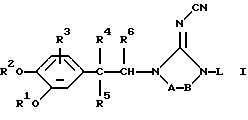
их N-оксидная форма, их фармацевтически приемлемые соли присоединения кислоты или основания или их стереохимически изомерная форма,
где R1 и R2 каждый независимо представляет водород, С1 - С6алкил, дифторметил, трифторметил, С3 - С6циклоалкил, насыщенный 5-членный гетероцикл, содержащий один атом кислорода, инданил, 6,7-дигидро-5Н-циклопентапиридинил, или С1 - С6алкил, замещенный фенилом, инданилом или С3 - С7циклоалкилом;
R3 представляет водород;
R4 представляет водород, галоген, С1 - С6алкил, трифторметил или R4 представляет радикал формулы -О-R7 (а-1), где R7представляет водород;
R5 представляет водород или R4 и R5, взятые вместе, могут образовывать двухвалентный радикал формулы -СН2-СН2-O-СН2-СН2- (b-2);
R6 представляет водород или С1 - С4алкил;
-А-В представляет двухвалентный радикал формулы -СR10= СR11- (с-1) или -СНR10-СНR11- (с-2), где каждый R10 и R11 независимо представляет водород или С1 - С4алкил;
L представляет водород, С1 - С6алкил, С1 - С6алкилоксикарбонил; С1 - С6алкил, замещенный одним или двумя фенилами.1. Derivatives of 2-cyanoimidazole of the general formula I
their N-oxide form, their pharmaceutically acceptable acid or base addition salts, or their stereochemically isomeric form,
where R 1 and R 2 each independently represents hydrogen, C 1 - C 6 alkyl, difluoromethyl, trifluoromethyl, C 3 - C 6 cycloalkyl, a saturated 5-membered heterocycle containing one oxygen atom, indanyl, 6,7-dihydro-5H- cyclopentapyridinyl, or C 1 -C 6 alkyl substituted with phenyl, indanyl or C 3 -C 7 cycloalkyl;
R 3 represents hydrogen;
R 4 represents hydrogen, halogen, C 1 -C 6 alkyl, trifluoromethyl or R 4 represents a radical of the formula —O — R 7 (a-1), where R 7 represents hydrogen;
R 5 is hydrogen, or R 4 and R 5 taken together can form a divalent radical of the formula —CH 2 —CH 2 —O — CH 2 —CH 2 - (b-2);
R 6 represents hydrogen or C 1 -C 4 alkyl;
-A-B represents a divalent radical of the formula -CR 10 = CR 11 - (c-1) or -CHR 10 -CHR 11 - (c-2), where each R 10 and R 11 independently represents hydrogen or C 1 - C 4 alkyl;
L represents hydrogen, C 1 -C 6 alkyl, C 1 -C 6 alkyloxycarbonyl; C 1 - C 6 alkyl substituted with one or two phenyls.
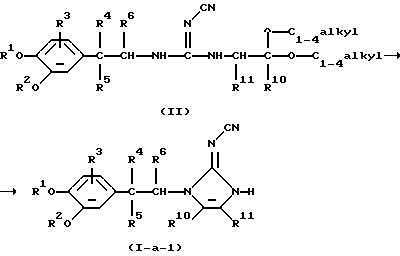
или его функционального производного,
в котором R1-R6, R10 и R11 имеют значения, указанные в п. 1,
в инертном для реакции растворителе и в присутствии подходящей кислоты с получением соединения формулы I-а-1; и, если желательно, превращение соединений формулы I одно в другое известными способами превращения и затем, если желательно, превращение соединения формулы I в терапевтически активную нетоксичную соль присоединения кислоты обработкой кислотой, или в терапевтически активную нетоксичную соль присоединения основания обработкой основанием, или, напротив, превращение соли присоединения кислоты в свободное основание обработкой щелочью, или превращение соли присоединения основания в свободную кислоту обработкой кислотой; и, если желательно, получение их стереохимически изомерных форм или N-оксидных форм.10. A method of producing a compound according to claim 1, comprising cyclizing the intermediate of formula II
or a functional derivative thereof,
in which R 1 -R 6 , R 10 and R 11 have the meanings specified in paragraph 1,
in a reaction inert solvent and in the presence of a suitable acid to give a compound of formula I-a-1; and, if desired, converting the compounds of formula I to one another by known conversion methods, and then, if desired, converting the compound of formula I into a therapeutically active non-toxic acid addition salt by treatment with an acid, or into a therapeutically active non-toxic base addition salt by treatment with a base, or, conversely conversion of the acid addition salt to the free base by treatment with alkali, or conversion of the base addition salt to the free acid by treatment with an acid; and, if desired, obtaining their stereochemically isomeric forms or N-oxide forms.
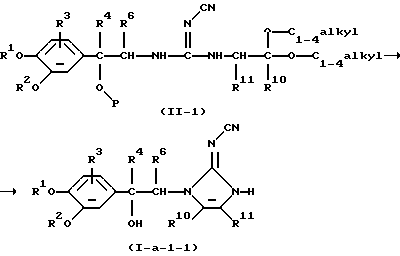
где R1-R4, R6, R10 и R11 имеют значения, определенные в п. 1;
Р представляет водород или триметилсилильную защитную группу,
или его функционального производного,
в инертном для реакции растворителе и в присутствии подходящей кислоты с получением соединения формулы I-а-1-1 и, если желательно, превращение соединений формулы I одно в другое известными способами превращения и затем, если желательно, превращение соединения формулы I в терапевтически активную нетоксичную соль присоединения кислоты обработкой кислотой, или в терапевтически активную нетоксичную соль присоединения основания обработкой основанием, или, напротив, превращение соли присоединения кислоты в свободное основание обработкой щелочью, или превращение соли присоединения основания в свободную кислоту обработкой кислотой и, если желательно, получение их стереохимически изомерных форм или N-оксидных форм.11. A method of producing a compound according to claim 1, comprising cyclizing the intermediate of formula II-1,
where R 1 -R 4 , R 6 , R 10 and R 11 have the meanings defined in paragraph 1;
P represents hydrogen or a trimethylsilyl protecting group,
or a functional derivative thereof,
in a reaction inert solvent and in the presence of a suitable acid to give a compound of formula I-a-1-1 and, if desired, converting the compounds of formula I to one another by known conversion methods and then, if desired, converting the compound of formula I into a therapeutically active non-toxic an acid addition salt by treatment with an acid, or into a therapeutically active non-toxic base addition salt by treatment with a base, or, conversely, conversion of an acid addition salt into a free base by treatment with alkali someone, or converting the base addition salt into the free acid by treatment with acid and, if desired, preparing stereochemically isomeric forms or N-oxide forms.
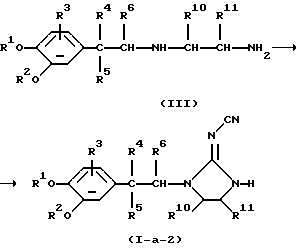
или его функционального производного,
в котором R1-R6, R10 и R11 имеют значения, указанные в п. 1,
в инертном для реакции растворителе и в присутствии диметилцианокарбонимидодитиоата или дифенил-N-цианокарбонимидата с получением соединения формулы I-а-2, и, если желательно, превращение соединений формулы I одно в другое известными способами превращения и затем, если желательно, превращение соединения формулы I в терапевтически активную нетоксичную соль присоединения кислоты обработкой кислотой, или в терапевтически активную нетоксичную соль присоединения основания обработкой основанием, или, напротив, превращение соли присоединения кислоты в свободное основание обработкой щелочью, или превращение соли присоединения основания в свободную кислоту обработкой кислотой и, если желательно, получение их стереохимически изомерных форм или N-оксидных форм.12. A method of producing a compound according to claim 1, comprising cyclizing an intermediate of formula III
or a functional derivative thereof,
in which R 1 -R 6 , R 10 and R 11 have the meanings specified in paragraph 1,
in a reaction inert solvent and in the presence of dimethyl cyanocarbonimidodithioate or diphenyl-N-cyanocarbonimidate to give a compound of formula I-a-2, and, if desired, converting compounds of formula I to one another by known conversion methods and then, if desired, converting a compound of formula I into a therapeutically active non-toxic acid addition salt by treatment with an acid, or into a therapeutically active non-toxic acid addition salt by treatment with a base, or, conversely, converting the addition salt I acid to the free base by treatment with alkali, or the conversion of the base addition salt to the free acid by treatment with acid and, if desired, the preparation of their stereochemically isomeric forms or N-oxide forms.
Applications Claiming Priority (3)
| Application Number | Priority Date | Filing Date | Title |
|---|---|---|---|
| DE96202749.6 | 1996-10-02 | ||
| EP96202749.6 | 1996-10-02 | ||
| EP96202749 | 1996-10-02 |
Publications (2)
| Publication Number | Publication Date |
|---|---|
| RU99109032A RU99109032A (en) | 2001-03-20 |
| RU2180902C2 true RU2180902C2 (en) | 2002-03-27 |
Family
ID=8224456
Family Applications (1)
| Application Number | Title | Priority Date | Filing Date |
|---|---|---|---|
| RU99109032/04A RU2180902C2 (en) | 1996-10-02 | 1997-09-24 | Derivatives of 2-cyanoiminoimidazole inhibiting activity of phosphodiesterase iv (pde iv), methods of their synthesis, pharmaceutical composition based on thereof, method of its preparing |
Country Status (30)
| Country | Link |
|---|---|
| US (1) | US6051718A (en) |
| EP (1) | EP0934280B1 (en) |
| JP (1) | JP3068208B2 (en) |
| KR (1) | KR100520002B1 (en) |
| CN (1) | CN1106387C (en) |
| AR (1) | AR008875A1 (en) |
| AT (1) | ATE236884T1 (en) |
| AU (1) | AU719561B2 (en) |
| BG (1) | BG64278B1 (en) |
| BR (1) | BR9712256B1 (en) |
| CA (1) | CA2267322C (en) |
| CY (1) | CY2380B1 (en) |
| CZ (1) | CZ297474B6 (en) |
| DE (1) | DE69720757T2 (en) |
| DK (1) | DK0934280T3 (en) |
| EE (1) | EE03825B1 (en) |
| ES (1) | ES2196308T3 (en) |
| HU (1) | HU225158B1 (en) |
| IL (2) | IL129298A0 (en) |
| MY (1) | MY116980A (en) |
| NO (1) | NO312960B1 (en) |
| NZ (1) | NZ334971A (en) |
| PL (1) | PL194673B1 (en) |
| PT (1) | PT934280E (en) |
| RU (1) | RU2180902C2 (en) |
| SI (1) | SI0934280T1 (en) |
| SK (1) | SK285878B6 (en) |
| TR (1) | TR199900732T2 (en) |
| UA (1) | UA62939C2 (en) |
| WO (1) | WO1998014432A1 (en) |
Families Citing this family (20)
| Publication number | Priority date | Publication date | Assignee | Title |
|---|---|---|---|---|
| SK284468B6 (en) | 1998-04-01 | 2005-04-01 | Janssen Pharmaceutica N. V. | Pyridine derivative, method for its preparation and use, composition comprising thereof and method for its preparation |
| US6953774B2 (en) | 2000-08-11 | 2005-10-11 | Applied Research Systems Ars Holding N.V. | Methods of inducing ovulation |
| US7476688B2 (en) | 2001-04-19 | 2009-01-13 | Eisai R&D Management Co., Ltd. | Cyclic amidine derivatives |
| WO2002094320A1 (en) | 2001-05-23 | 2002-11-28 | Tanabe Seiyaku Co., Ltd. | Therapeutic compositions for repairing chondropathy |
| DE60234031D1 (en) * | 2001-07-11 | 2009-11-26 | Nikken Chemicals Co Ltd | MEDICINE FOR THE TREATMENT OF ALLERGIC EYE DISEASES |
| TWI221838B (en) | 2001-08-09 | 2004-10-11 | Tanabe Seiyaku Co | Pyrazinoisoquinoline compound or naphthalene compound |
| DK1463493T3 (en) | 2001-12-14 | 2008-02-04 | Serono Lab | Methods to induce ovulation using a non-polypeptide cAMP level modulator |
| JP4549970B2 (en) | 2003-02-19 | 2010-09-22 | エーザイ・アール・アンド・ディー・マネジメント株式会社 | Method for producing cyclic benzamidine derivative |
| JP2009506069A (en) | 2005-08-26 | 2009-02-12 | ブレインセルス,インコーポレイティド | Neurogenesis through modulation of muscarinic receptors |
| EP2258359A3 (en) | 2005-08-26 | 2011-04-06 | Braincells, Inc. | Neurogenesis by muscarinic receptor modulation with sabcomelin |
| US7985756B2 (en) | 2005-10-21 | 2011-07-26 | Braincells Inc. | Modulation of neurogenesis by PDE inhibition |
| WO2007053596A1 (en) | 2005-10-31 | 2007-05-10 | Braincells, Inc. | Gaba receptor mediated modulation of neurogenesis |
| US20100216734A1 (en) | 2006-03-08 | 2010-08-26 | Braincells, Inc. | Modulation of neurogenesis by nootropic agents |
| WO2007134136A2 (en) | 2006-05-09 | 2007-11-22 | Braincells, Inc. | Neurogenesis by modulating angiotensin |
| US20100184806A1 (en) | 2006-09-19 | 2010-07-22 | Braincells, Inc. | Modulation of neurogenesis by ppar agents |
| WO2010099217A1 (en) | 2009-02-25 | 2010-09-02 | Braincells, Inc. | Modulation of neurogenesis using d-cycloserine combinations |
| EP2804603A1 (en) | 2012-01-10 | 2014-11-26 | President and Fellows of Harvard College | Beta-cell replication promoting compounds and methods of their use |
| CA2875964C (en) * | 2012-06-07 | 2018-01-02 | Georgia State University Research Foundation, Inc. | Seca inhibitors and methods of making and using thereof |
| GB2533925A (en) * | 2014-12-31 | 2016-07-13 | Univ Bath | Antimicrobial compounds, compositions and methods |
| CN109438434B (en) * | 2018-11-19 | 2021-05-04 | 华南农业大学 | 2-cyano imino thiazolidine compound containing oxazole ring and preparation method and application thereof |
Citations (3)
| Publication number | Priority date | Publication date | Assignee | Title |
|---|---|---|---|---|
| WO1994002465A1 (en) * | 1992-07-28 | 1994-02-03 | Rhone-Poulenc Rorer Limited | INHIBITORS OF c-AMP PHOSPHODIESTERASE AND TNF |
| WO1995020578A1 (en) * | 1994-01-26 | 1995-08-03 | Rhone-Poulenc Rorer Limited | SUBSTITUTED AROMATIC COMPOUNDS AS c.AMP PHOSPHODIESTERASE- AND TNF-INHIBITORS |
| WO1996000218A1 (en) * | 1994-06-24 | 1996-01-04 | Euro-Celtique, S.A. | Compounds for and method of inhibiting phosphodiesterase iv |
Family Cites Families (9)
| Publication number | Priority date | Publication date | Assignee | Title |
|---|---|---|---|---|
| JPH0784461B2 (en) * | 1986-12-19 | 1995-09-13 | 日本バイエルアグロケム株式会社 | Insecticidal nitroimino or cyanoimino compounds |
| JPH05310650A (en) * | 1991-08-22 | 1993-11-22 | Nippon Soda Co Ltd | New amine derivative its production and insecticide |
| BR9307570A (en) * | 1992-12-02 | 1999-05-25 | Pfizer | Catechol ethers as selective pdeiv inhibitors |
| GB9304919D0 (en) * | 1993-03-10 | 1993-04-28 | Celltech Ltd | Chemical compounds |
| ES2176251T3 (en) * | 1993-07-28 | 2002-12-01 | Aventis Pharma Ltd | COMPOUNDS USED AS PDE IV INHIBITORS AND THE TUMOR NECROSIS FACTOR (TNF). |
| JPH09502170A (en) * | 1993-08-19 | 1997-03-04 | スミスクライン・ビーチャム・コーポレイション | Phenethylamine compound |
| TW332201B (en) * | 1995-04-06 | 1998-05-21 | Janssen Pharmaceutica Nv | 1,3-Dihydro-1-(phenylalkyl)-2H-imidazol-2-one derivatives |
| TW375612B (en) * | 1995-04-06 | 1999-12-01 | Janssen Pharmaceutica Nv | 1,3-dihydro-2H-imidazol-2-one derivatives for the treatment of disease states related to an abnormal enzymatic or catalytic activity of phosphodiesterase type IV, preparation thereof and pharmaceutical composition containing the same |
| TW424087B (en) * | 1995-04-06 | 2001-03-01 | Janssen Pharmaceutica Nv | 1,3-dihydro-1-(phenylalkenyl)-2H-imidazol-2-one derivatives |
-
1997
- 1997-09-24 UA UA99031702A patent/UA62939C2/en unknown
- 1997-09-24 PT PT97910380T patent/PT934280E/en unknown
- 1997-09-24 EP EP97910380A patent/EP0934280B1/en not_active Expired - Lifetime
- 1997-09-24 JP JP10516215A patent/JP3068208B2/en not_active Expired - Lifetime
- 1997-09-24 SK SK344-99A patent/SK285878B6/en not_active IP Right Cessation
- 1997-09-24 HU HU9904063A patent/HU225158B1/en unknown
- 1997-09-24 AU AU47792/97A patent/AU719561B2/en not_active Expired
- 1997-09-24 BR BRPI9712256-4A patent/BR9712256B1/en not_active IP Right Cessation
- 1997-09-24 CA CA002267322A patent/CA2267322C/en not_active Expired - Lifetime
- 1997-09-24 CZ CZ0102899A patent/CZ297474B6/en not_active IP Right Cessation
- 1997-09-24 PL PL97332573A patent/PL194673B1/en unknown
- 1997-09-24 US US09/147,925 patent/US6051718A/en not_active Expired - Lifetime
- 1997-09-24 RU RU99109032/04A patent/RU2180902C2/en active
- 1997-09-24 CN CN97198460A patent/CN1106387C/en not_active Expired - Lifetime
- 1997-09-24 DK DK97910380T patent/DK0934280T3/en active
- 1997-09-24 AT AT97910380T patent/ATE236884T1/en active
- 1997-09-24 ES ES97910380T patent/ES2196308T3/en not_active Expired - Lifetime
- 1997-09-24 IL IL12929897A patent/IL129298A0/en active IP Right Grant
- 1997-09-24 KR KR10-1999-7001204A patent/KR100520002B1/en not_active Expired - Lifetime
- 1997-09-24 DE DE69720757T patent/DE69720757T2/en not_active Expired - Lifetime
- 1997-09-24 SI SI9730550T patent/SI0934280T1/en unknown
- 1997-09-24 WO PCT/EP1997/005322 patent/WO1998014432A1/en not_active Ceased
- 1997-09-24 TR TR1999/00732T patent/TR199900732T2/en unknown
- 1997-09-24 NZ NZ334971A patent/NZ334971A/en not_active IP Right Cessation
- 1997-09-24 EE EEP199900112A patent/EE03825B1/en unknown
- 1997-10-01 AR ARP970104528A patent/AR008875A1/en active IP Right Grant
- 1997-10-02 MY MYPI97004600A patent/MY116980A/en unknown
-
1999
- 1999-03-01 BG BG103220A patent/BG64278B1/en unknown
- 1999-03-30 NO NO19991560A patent/NO312960B1/en not_active IP Right Cessation
- 1999-03-31 IL IL129298A patent/IL129298A/en not_active IP Right Cessation
-
2003
- 2003-11-04 CY CY0300074A patent/CY2380B1/en unknown
Patent Citations (3)
| Publication number | Priority date | Publication date | Assignee | Title |
|---|---|---|---|---|
| WO1994002465A1 (en) * | 1992-07-28 | 1994-02-03 | Rhone-Poulenc Rorer Limited | INHIBITORS OF c-AMP PHOSPHODIESTERASE AND TNF |
| WO1995020578A1 (en) * | 1994-01-26 | 1995-08-03 | Rhone-Poulenc Rorer Limited | SUBSTITUTED AROMATIC COMPOUNDS AS c.AMP PHOSPHODIESTERASE- AND TNF-INHIBITORS |
| WO1996000218A1 (en) * | 1994-06-24 | 1996-01-04 | Euro-Celtique, S.A. | Compounds for and method of inhibiting phosphodiesterase iv |
Also Published As
Similar Documents
| Publication | Publication Date | Title |
|---|---|---|
| KR100520002B1 (en) | PDE IV inhibiting 2-cyanoiminoimidazole derivatives | |
| JP3963475B2 (en) | 1,3-dihydro-1- (phenylalkenyl) -2H-imidazol-2-one derivatives having PDE IV and cytokine inhibitory activity | |
| JP4778612B2 (en) | PDEIV-inhibiting pyridine derivatives | |
| JP4115519B2 (en) | 1,3-dihydro-2H-imidazol-2-one derivatives having PDE IV and cytokine inhibitory activity | |
| HK1020344B (en) | Pde iv inhibiting 2-cyanoiminoimidazole derivatives | |
| MXPA00009632A (en) | Pde iv inhibiting pyridine derivatives | |
| HK1033579B (en) | Pde iv inhibiting pyridine derivatives |