RU2208024C2 - Method of preparing bitumen additive - Google Patents
Method of preparing bitumen additive Download PDFInfo
- Publication number
- RU2208024C2 RU2208024C2 RU2000127215A RU2000127215A RU2208024C2 RU 2208024 C2 RU2208024 C2 RU 2208024C2 RU 2000127215 A RU2000127215 A RU 2000127215A RU 2000127215 A RU2000127215 A RU 2000127215A RU 2208024 C2 RU2208024 C2 RU 2208024C2
- Authority
- RU
- Russia
- Prior art keywords
- bitumen
- additive
- product
- pyrolysis
- hexamethylenetetramine
- Prior art date
Links
- 239000000654 additive Substances 0.000 title claims abstract description 47
- 239000010426 asphalt Substances 0.000 title claims abstract description 34
- 230000000996 additive effect Effects 0.000 title claims abstract description 29
- 238000000034 method Methods 0.000 title claims description 32
- VKYKSIONXSXAKP-UHFFFAOYSA-N hexamethylenetetramine Chemical compound C1N(C2)CN3CN1CN2C3 VKYKSIONXSXAKP-UHFFFAOYSA-N 0.000 claims abstract description 53
- 239000004312 hexamethylene tetramine Substances 0.000 claims abstract description 27
- 235000010299 hexamethylene tetramine Nutrition 0.000 claims abstract description 27
- 238000000197 pyrolysis Methods 0.000 claims abstract description 23
- 239000000126 substance Substances 0.000 claims abstract description 15
- 229910052500 inorganic mineral Inorganic materials 0.000 claims abstract description 14
- 239000011707 mineral Substances 0.000 claims abstract description 14
- 230000007935 neutral effect Effects 0.000 claims abstract description 13
- 150000002989 phenols Chemical class 0.000 claims abstract description 13
- 239000007787 solid Substances 0.000 claims abstract description 10
- 238000002156 mixing Methods 0.000 claims abstract description 9
- 238000003756 stirring Methods 0.000 claims abstract description 7
- 239000000047 product Substances 0.000 claims description 22
- -1 amine compound Chemical class 0.000 claims description 16
- 239000012535 impurity Substances 0.000 claims description 10
- 239000002803 fossil fuel Substances 0.000 claims description 8
- 239000006227 byproduct Substances 0.000 claims description 7
- 230000002378 acidificating effect Effects 0.000 abstract description 11
- 238000004519 manufacturing process Methods 0.000 abstract description 10
- 239000000463 material Substances 0.000 abstract description 9
- XLYOFNOQVPJJNP-UHFFFAOYSA-N water Substances O XLYOFNOQVPJJNP-UHFFFAOYSA-N 0.000 abstract description 5
- 238000010276 construction Methods 0.000 abstract description 3
- 239000003921 oil Substances 0.000 abstract description 3
- 239000004566 building material Substances 0.000 abstract description 2
- 238000006065 biodegradation reaction Methods 0.000 abstract 1
- 238000002485 combustion reaction Methods 0.000 abstract 1
- 230000000694 effects Effects 0.000 abstract 1
- 239000000203 mixture Substances 0.000 description 14
- 229920005989 resin Polymers 0.000 description 11
- 239000011347 resin Substances 0.000 description 11
- 239000011435 rock Substances 0.000 description 10
- 150000001875 compounds Chemical class 0.000 description 8
- 239000007788 liquid Substances 0.000 description 8
- ISWSIDIOOBJBQZ-UHFFFAOYSA-N phenol group Chemical group C1(=CC=CC=C1)O ISWSIDIOOBJBQZ-UHFFFAOYSA-N 0.000 description 8
- 230000015572 biosynthetic process Effects 0.000 description 6
- 239000003245 coal Substances 0.000 description 5
- 229960003742 phenol Drugs 0.000 description 5
- 239000004449 solid propellant Substances 0.000 description 5
- 230000003993 interaction Effects 0.000 description 4
- 239000002699 waste material Substances 0.000 description 4
- YXFVVABEGXRONW-UHFFFAOYSA-N Toluene Chemical compound CC1=CC=CC=C1 YXFVVABEGXRONW-UHFFFAOYSA-N 0.000 description 3
- 239000003139 biocide Substances 0.000 description 3
- 239000003054 catalyst Substances 0.000 description 3
- 238000010438 heat treatment Methods 0.000 description 3
- 238000002360 preparation method Methods 0.000 description 3
- 239000003784 tall oil Substances 0.000 description 3
- CXWXQJXEFPUFDZ-UHFFFAOYSA-N tetralin Chemical compound C1=CC=C2CCCCC2=C1 CXWXQJXEFPUFDZ-UHFFFAOYSA-N 0.000 description 3
- QIGBRXMKCJKVMJ-UHFFFAOYSA-N Hydroquinone Chemical compound OC1=CC=C(O)C=C1 QIGBRXMKCJKVMJ-UHFFFAOYSA-N 0.000 description 2
- 230000032683 aging Effects 0.000 description 2
- 150000007824 aliphatic compounds Chemical class 0.000 description 2
- 230000003115 biocidal effect Effects 0.000 description 2
- 238000009835 boiling Methods 0.000 description 2
- 229910052799 carbon Inorganic materials 0.000 description 2
- 150000001721 carbon Chemical group 0.000 description 2
- 125000004432 carbon atom Chemical group C* 0.000 description 2
- 125000002915 carbonyl group Chemical group [*:2]C([*:1])=O 0.000 description 2
- 125000003178 carboxy group Chemical group [H]OC(*)=O 0.000 description 2
- YCIMNLLNPGFGHC-UHFFFAOYSA-N catechol Chemical compound OC1=CC=CC=C1O YCIMNLLNPGFGHC-UHFFFAOYSA-N 0.000 description 2
- 238000001816 cooling Methods 0.000 description 2
- 230000006378 damage Effects 0.000 description 2
- 230000007423 decrease Effects 0.000 description 2
- 238000004821 distillation Methods 0.000 description 2
- 125000000524 functional group Chemical group 0.000 description 2
- 238000001030 gas--liquid chromatography Methods 0.000 description 2
- 125000002887 hydroxy group Chemical group [H]O* 0.000 description 2
- 239000012263 liquid product Substances 0.000 description 2
- 239000002184 metal Substances 0.000 description 2
- 229910052751 metal Inorganic materials 0.000 description 2
- 244000005700 microbiome Species 0.000 description 2
- WQGWDDDVZFFDIG-UHFFFAOYSA-N pyrogallol Chemical compound OC1=CC=CC(O)=C1O WQGWDDDVZFFDIG-UHFFFAOYSA-N 0.000 description 2
- GHMLBKRAJCXXBS-UHFFFAOYSA-N resorcinol Chemical compound OC1=CC=CC(O)=C1 GHMLBKRAJCXXBS-UHFFFAOYSA-N 0.000 description 2
- 239000002904 solvent Substances 0.000 description 2
- 239000000758 substrate Substances 0.000 description 2
- 238000004809 thin layer chromatography Methods 0.000 description 2
- LFQSCWFLJHTTHZ-UHFFFAOYSA-N Ethanol Chemical compound CCO LFQSCWFLJHTTHZ-UHFFFAOYSA-N 0.000 description 1
- 235000019738 Limestone Nutrition 0.000 description 1
- CTQNGGLPUBDAKN-UHFFFAOYSA-N O-Xylene Chemical compound CC1=CC=CC=C1C CTQNGGLPUBDAKN-UHFFFAOYSA-N 0.000 description 1
- QAOWNCQODCNURD-UHFFFAOYSA-L Sulfate Chemical compound [O-]S([O-])(=O)=O QAOWNCQODCNURD-UHFFFAOYSA-L 0.000 description 1
- 239000002253 acid Substances 0.000 description 1
- 150000007513 acids Chemical class 0.000 description 1
- 150000001335 aliphatic alkanes Chemical class 0.000 description 1
- 125000000217 alkyl group Chemical group 0.000 description 1
- 125000003277 amino group Chemical group 0.000 description 1
- 150000001449 anionic compounds Chemical class 0.000 description 1
- 150000001491 aromatic compounds Chemical class 0.000 description 1
- 150000001555 benzenes Chemical class 0.000 description 1
- RWCCWEUUXYIKHB-UHFFFAOYSA-N benzophenone Chemical compound C=1C=CC=CC=1C(=O)C1=CC=CC=C1 RWCCWEUUXYIKHB-UHFFFAOYSA-N 0.000 description 1
- 239000011230 binding agent Substances 0.000 description 1
- 238000009933 burial Methods 0.000 description 1
- 150000001767 cationic compounds Chemical class 0.000 description 1
- 239000001913 cellulose Substances 0.000 description 1
- 229920002678 cellulose Polymers 0.000 description 1
- 239000011248 coating agent Substances 0.000 description 1
- 238000000576 coating method Methods 0.000 description 1
- 238000010835 comparative analysis Methods 0.000 description 1
- 230000007797 corrosion Effects 0.000 description 1
- 238000005260 corrosion Methods 0.000 description 1
- 150000001896 cresols Chemical class 0.000 description 1
- 238000000354 decomposition reaction Methods 0.000 description 1
- 230000003247 decreasing effect Effects 0.000 description 1
- 230000001066 destructive effect Effects 0.000 description 1
- 235000014113 dietary fatty acids Nutrition 0.000 description 1
- 238000006073 displacement reaction Methods 0.000 description 1
- 238000009826 distribution Methods 0.000 description 1
- 230000007613 environmental effect Effects 0.000 description 1
- 239000000374 eutectic mixture Substances 0.000 description 1
- 238000001704 evaporation Methods 0.000 description 1
- 230000008020 evaporation Effects 0.000 description 1
- 239000000194 fatty acid Substances 0.000 description 1
- 229930195729 fatty acid Natural products 0.000 description 1
- 150000004665 fatty acids Chemical class 0.000 description 1
- 238000005187 foaming Methods 0.000 description 1
- 239000000446 fuel Substances 0.000 description 1
- 239000010438 granite Substances 0.000 description 1
- 239000006028 limestone Substances 0.000 description 1
- 239000004579 marble Substances 0.000 description 1
- 239000000155 melt Substances 0.000 description 1
- 238000002844 melting Methods 0.000 description 1
- 230000008018 melting Effects 0.000 description 1
- 150000002739 metals Chemical class 0.000 description 1
- 125000001570 methylene group Chemical group [H]C([H])([*:1])[*:2] 0.000 description 1
- 125000000325 methylidene group Chemical group [H]C([H])=* 0.000 description 1
- LVCDXCQFSONNDO-UHFFFAOYSA-N n-benzylhydroxylamine Chemical class ONCC1=CC=CC=C1 LVCDXCQFSONNDO-UHFFFAOYSA-N 0.000 description 1
- 231100000252 nontoxic Toxicity 0.000 description 1
- 230000003000 nontoxic effect Effects 0.000 description 1
- 235000015097 nutrients Nutrition 0.000 description 1
- 230000003647 oxidation Effects 0.000 description 1
- 238000007254 oxidation reaction Methods 0.000 description 1
- 150000002926 oxygen Chemical class 0.000 description 1
- 239000000843 powder Substances 0.000 description 1
- 238000004321 preservation Methods 0.000 description 1
- 229940079877 pyrogallol Drugs 0.000 description 1
- 239000004576 sand Substances 0.000 description 1
- 239000002689 soil Substances 0.000 description 1
- 239000011877 solvent mixture Substances 0.000 description 1
- 229920001187 thermosetting polymer Polymers 0.000 description 1
- 239000008096 xylene Substances 0.000 description 1
- 150000003739 xylenols Chemical class 0.000 description 1
Images
Landscapes
- Working-Up Tar And Pitch (AREA)
- Compositions Of Macromolecular Compounds (AREA)
Abstract
Description
Изобретение относится к строительным материалам, в частности к добавкам, используемым для изготовления вяжущих, преимущественно для дорожного, аэродромного и гидротехнического строительства, а также различных подземных сооружений. The invention relates to building materials, in particular to additives used for the manufacture of binders, mainly for road, airfield and hydraulic engineering, as well as various underground structures.
Известен способ получения добавки к битуму путем использования водорастворимых смол, например дифенилкетонной или фенольной. Указанные смолы вводят в битум при перемешивании при 5-45oС и отверждают катализаторами перед нанесением битума на изолируемые поверхности (авторское свидетельство 252170, кл. С 09 L 3/18, опубл. 1969).A known method of producing additives for bitumen by using water-soluble resins, for example diphenylketone or phenolic. These resins are introduced into bitumen with stirring at 5-45 o C and cured with catalysts before applying bitumen to insulated surfaces (copyright certificate 252170, CL 09
К недостаткам способа получения данной добавки следует отнести недостаточную технологичность, так как практически сложно осуществить и проконтролировать процесс отверждения водорастворимых термореактивных смол добавки со скоростью, меньшей скорости испарения воды, катализаторами, вводимыми в битум непосредственно на строительной площадке. Получающаяся по известному способу добавка повышает адгезию битума только к основным породам и неэффективна при использовании с кислыми. The disadvantages of the method for producing this additive include insufficient processability, since it is practically difficult to carry out and control the curing process of water-soluble thermosetting resins of the additive at a rate lower than the rate of evaporation of water by catalysts introduced into bitumen directly at the construction site. The additive obtained by the known method increases the adhesion of bitumen only to the main rocks and is ineffective when used with acidic.
Известно использование в качестве добавки в битум гексаметилентетрамина, вводимого в расплав предварительно окисленного битума с теплостойкостью 44-65oС в количестве 1-2% с последующей изотермической выдержкой битума с введенной добавкой в течение 2 часов при температуре 160-180oС и охлаждением до температуры 100oС перед его использованием для защиты от коррозии трубопроводов нефтяных месторождений, в том числе по мокрой поверхности (патент РФ 2021309, кл. С 08 L 95/00, С 08 К 5/3492, опубл. 15.10.1994).It is known to use as an additive in bitumen hexamethylenetetramine introduced into the melt of pre-oxidized bitumen with heat resistance of 44-65 ° C in an amount of 1-2%, followed by isothermal aging of bitumen with the added additive for 2 hours at a temperature of 160-180 ° C and cooling to temperature of 100 o With before its use to protect against corrosion of pipelines of oil fields, including on wet surfaces (RF patent 2021309, CL 08 L 95/00, 08 08 5/3492, publ. 10/15/1994).
Однако введение гексаметилентетрамина повышает адгезию к кислым породам и неэффективно при использовании с основными. However, the introduction of hexamethylenetetramine increases adhesion to acidic rocks and is ineffective when used with basic.
Кроме того, введение гексаметилентетрамина в битум на строительной площадке при указанных температурных режимах и их последовательности достаточно сложно в силу пожароопасности битума, возможного пенообразования и выброса расплавленного битума при разложении гексаметилентетрамина при температуре 100±2oС.In addition, the introduction of hexamethylenetetramine in bitumen at a construction site at the indicated temperature conditions and their sequence is quite difficult due to the fire hazard of bitumen, possible foaming and discharge of molten bitumen during decomposition of hexamethylenetetramine at a temperature of 100 ± 2 o C.
В качестве прототипа использовано техническое решение, согласно которому добавку, включающую талловое масло и фсноламинную смолу при соотношении соответственно, мас.%: 71-83:17-29, получают путем смешения компонентов в реакторе с рубашкой и перемешивающим устройством в течение 1-6 часов при температуре 120-180oС, последующего охлаждения до температуры 30-60oС и выгрузки из реактора готового продукта (патент РФ 2096370, кл. С 04 В 26/26, С 08 L 95/00, опубл. 20.11.1997).As a prototype, a technical solution was used, according to which an additive comprising tall oil and fsnolaminovy resin in the ratio, respectively, wt.%: 71-83: 17-29, obtained by mixing the components in the reactor with a jacket and a mixing device for 1-6 hours at a temperature of 120-180 o C, subsequent cooling to a temperature of 30-60 o C and unloading the finished product from the reactor (RF patent 2096370, class C 04 B 26/26, C 08 L 95/00, publ. 20.11.1997) .
Талловое масло является побочным техническим продуктом, получаемым в процессе производства целлюлозы сульфатным методом и состоящим из 30-43% жирных кислот, то есть алифатических соединений, 30-55% смоляных кислот, продуктов их окисления и некоторого количества нейтральных веществ. Tall oil is a technical by-product obtained in the process of cellulose production by the sulfate method and consisting of 30-43% fatty acids, that is, aliphatic compounds, 30-55% of resin acids, their oxidation products and some neutral substances.
Феноламинная смола является целевым продуктом взаимодействия аминных соединений и алкилфенолов. Phenolamine resin is the target product of the interaction of amine compounds and alkyl phenols.
Способ получения известной добавки недостаточно технологичен, сложен и энергоемок в связи с длительностью и значительной температурой процесса смешения компонентов добавки, что в сочетании с необходимостью использования сложного оборудования в конечном результате ведет к удорожанию процессов получения. Использование для получения добавки целевого продукта - феноламинной смолы также следует отнести к недостаткам известного способа. The method for producing the known additive is not technologically advanced, complicated and energy-intensive due to the duration and significant temperature of the process of mixing the components of the additive, which, combined with the need to use complex equipment in the final result, leads to a rise in the cost of production processes. Use to obtain additives of the target product - phenolamine resin should also be attributed to the disadvantages of this method.
Введение в битум полученной добавки не защищает его от разрушения микроорганизмами, для которых битум является питательной средой, из-за использования в известном способе указанных компонентов. The introduction of the obtained additive into bitumen does not protect it from destruction by microorganisms for which bitumen is a nutrient medium due to the use of these components in the known method.
Указанные недостатки известного способа получения добавки снижают эффективность применения известного способа и полученной известной добавки. These disadvantages of the known method of producing additives reduce the effectiveness of the known method and the resulting known additives.
Задача изобретения состоит в повышении технологичности способа получения добавки и снижении затрат, связанных с его осуществлением. The objective of the invention is to improve the manufacturability of the method of producing additives and reduce costs associated with its implementation.
Поставленная задача решается тем, что в известном способе получения добавки путем смешения побочного технического продукта и аминного соединения согласно изобретению в качестве побочного технического продукта используют продукт пиролиза твердых горючих ископаемых (Т), а в качестве аминного соединения используют гексаметилентетрамин (ГМТА) при следующем соотношении компонентов, мас.%:
Продукт пиролиза твердых горючих ископаемых - 97,5-99,9
Гексаметилентетрамин - 0,1-2,5
При введении в состав добавки гексаметилентетрамина (ГМТА) в количестве менее 0,1 мас. % снижается адгезия к кислым породам, а введение ГМТА в количествах более 2,5 мас.% неэффективно, так как адгезия битумного состава, достигнутая на основе таких добавок, не изменяется, но существенно увеличивается стоимость добавки и, как следствие, стоимость битумного материала с ее использованием.The problem is solved in that in the known method for producing an additive by mixing a technical by-product and an amine compound according to the invention, the product of pyrolysis of solid fossil fuels (T) is used as a technical by-product, and hexamethylenetetramine (HMTA) is used as an amine compound in the following ratio of components , wt.%:
The product of the pyrolysis of solid fuels - 97.5-99.9
Hexamethylenetetramine - 0.1-2.5
When introduced into the additive hexamethylenetetramine (HMTA) in an amount of less than 0.1 wt. %, adhesion to acidic rocks decreases, and the introduction of HMTA in amounts of more than 2.5 wt.% is ineffective, since the adhesion of the bitumen composition achieved on the basis of such additives does not change, but the cost of the additive and, as a result, the cost of bitumen material increase significantly its use.
Использование в предлагаемом способе получения добавки к битуму продукта пиролиза твердых горючих ископаемых позволяет получить добавку, обладающую биоцидными свойствами (устойчивостью к разрушающему воздействию микроорганизмов) без дополнительных технологических операций введения биоцидов, и существенно снизить материальные затраты, поскольку указанные вещества являются крупнотоннажными отходами, которые в настоящее время используются недостаточно и засоряют окружающую среду. The use in the proposed method of producing an additive to bitumen for a product of solid fuel fuels pyrolysis allows one to obtain an additive having biocidal properties (resistance to the destructive effects of microorganisms) without additional technological operations for introducing biocides, and significantly reduce material costs, since these substances are large-capacity waste, which are currently time is underutilized and clog the environment.
Продукт пиролиза твердых горючих ископаемых (Т), в частности углей различных месторождений, представляет собой жидкость с условной вязкостью не более 1,3 с при 50oС и плотностью не более 1,06 г/см3 при 20oС, содержащую алифатические и ароматические соединения с полярными функциональными группами, преимущественно с гидроксильными, карбоксильными и карбонильными.The product of the pyrolysis of solid combustible minerals (T), in particular coals of various deposits, is a liquid with a nominal viscosity of not more than 1.3 s at 50 o C and a density of not more than 1.06 g / cm 3 at 20 o C, containing aliphatic and aromatic compounds with polar functional groups, mainly with hydroxyl, carboxyl and carbonyl.
Экспериментально установлено, что наилучшим образом заявляемый технический результат достигается при использовании продукта пиролиза твердых горючих ископаемых (Т), имеющего в своем составе фенолы и алкилфенолы, нейтральные вещества и минеральные примеси при следующем соотношении, мас.%:
Фенолы и алкилфенолы - 4,5-50
Нейтральные вещества - 49-95
Минеральные примеси - 0,1-1
В качестве твердых горючих ископаемых лучше использовать уголь, содержащий липоидные микрокомпоненты, преимущественно резинит, кутинит, экзинит, в количествах от 20 до 90 мас.%.It has been experimentally established that the claimed technical result is achieved in the best way when using the product of pyrolysis of solid fossil fuels (T), which contains phenols and alkylphenols, neutral substances and mineral impurities in the following ratio, wt.%:
Phenols and alkyl phenols - 4.5-50
Neutral Substances - 49-95
Mineral impurities - 0.1-1
As solid fossil fuels, it is better to use coal containing lipoid microcomponents, mainly rubber, kutinit, exinit, in amounts from 20 to 90 wt.%.
Процесс пиролиза лучше проводить при нагревании углей до температуры 500-550oС без доступа воздуха.The pyrolysis process is best carried out by heating coal to a temperature of 500-550 o With no access to air.
При этом жидкий продукт пиролиза содержит в своем составе, мас.%: фенолы и алкилфенолы до 50, нейтральные вещества до 95 и механические примеси до 1. Moreover, the liquid pyrolysis product contains, in wt.%: Phenols and alkyl phenols up to 50, neutral substances up to 95 and mechanical impurities up to 1.
Как установлено совместным использованием методов дистилляции, тонкослойной и газожидкостной хроматографии, фенолы жидкого продукта пиролиза представляют собой смесь гомологов одноатомных, многоатомных и бициклических фенолов - оксибензола, крезолов, ксиленолов, резорцина, пирокатехина, гидрохинона, пирогаллола, α,β-нафтолов и их алкилпроизводных. As established by the joint use of distillation methods, thin-layer and gas-liquid chromatography, the phenols of the liquid pyrolysis product are a mixture of homologues of monatomic, polyatomic and bicyclic phenols - hydroxybenzene, cresols, xylenols, resorcinol, pyrocatechol, hydroquinone, pyrogallol, α, β-naphthrolic and their
Как установлено совместным использованием методов дистилляции, тонкослойной и газожидкостной хроматографии, нейтральные вещества жидкого продукта пиролиза представлены, в основном, азеотропной смесью растворителей. Это, в основном, смесь гомологов алкилированных моноциклических с числом атомов углерода до 15 и полициклических ароматических соединений с бензоидной системой связей, в том числе алкилированные бензол, толуол, ксилол, тетралин, а также смесь гомологов алкилированных кислородсодержащих соединений, в том числе алкилированные кетоны с числом углеродных атомов в цепи до 14. Известно, что за исключением низших алканов температуры кипения повышаются на 20-30oС с увеличением длины цепи на один атом углерода; инкремент 20-30oС на один атом углерода сохраняется и для других гомологических рядов (Моррисон Р. , Бойд Р. Органическая химия: Пер. с англ. - М.: Мир, 1974, 1132 с.; с. 108-109).As established by the joint use of distillation methods, thin-layer and gas-liquid chromatography, the neutral substances of the liquid pyrolysis product are represented mainly by an azeotropic mixture of solvents. This is mainly a mixture of homologated alkyl monocyclics with up to 15 carbon atoms and polycyclic aromatic compounds with a benzoic bond system, including alkylated benzene, toluene, xylene, tetralin, as well as a mixture of homologues of alkylated oxygen-containing compounds, including alkyl ketones with the number of carbon atoms in the chain is up to 14. It is known that, with the exception of lower alkanes, boiling points increase by 20-30 o With increasing chain length by one carbon atom; the increment of 20-30 o With one carbon atom is preserved for other homological series (Morrison R., Boyd R. Organic chemistry: Transl. from English. - M.: Mir, 1974, 1132 p.; pp. 108-109) .
Эти смеси растворителей обеспечивают достаточную текучесть и технологичность добавок без дополнительного введения растворителей, что также способствует повышению технологичности предлагаемого способа получения добавки и снижению затрат для его осуществления за счет использования многотоннажного отхода углепереработки, то есть пиролиза, и подобранных условий способа получения добавки с его использованием. These solvent mixtures provide sufficient fluidity and manufacturability of additives without additional solvents, which also helps to improve the manufacturability of the proposed method for producing additives and reduce costs for its implementation through the use of tonnage coal processing waste, that is, pyrolysis, and selected conditions of the method for producing additives using it.
Гексаметилентетрамин (ГМТА) представляет собой нетоксичный кристаллический порошок. Он легко растворяется в воде (1:1,5), образуя прозрачные бесцветные растворы, щелочные по лакмусу, и в 95%-ном спирте (1:10). В кислой среде растворяется с образованием соединений, содержащих метиленовые функциональные группы. При нагревании улетучивается, не плавясь. Hexamethylenetetramine (HMTA) is a non-toxic crystalline powder. It easily dissolves in water (1: 1.5), forming transparent, colorless solutions, alkaline in litmus, and in 95% alcohol (1:10). In an acidic environment it dissolves with the formation of compounds containing methylene functional groups. When heated, it evaporates without melting.
При взаимодействии гексаметилентетрамина - донора метиленовых и аминных групп, с фенолами в естественной для них среде нейтральных соединений образуются устойчивые растворы смол неустановленного строения типа фенол- и алкилфеноламинных, фенол- и алкилфенолальдегидных, фенолоспирты, оксибензиламины и другие химические соединения неустановленного строения, которых ранее не было в жидких исходных продуктах. Образование этих групп соединений по предлагаемому способу придает добавке биоцидные свойства без дополнительных технологических операций по введению биоцидов, а битумным составам с ее использованием - биостойкость. The interaction of hexamethylenetetramine, a donor of methylene and amine groups, with phenols in their natural environment of neutral compounds results in the formation of stable solutions of unspecified resins such as phenol and alkyl phenolamine, phenol and alkyl phenol aldehyde, phenol alcohols, hydroxybenzylamines and other unknown compounds of unknown structure in liquid feeds. The formation of these groups of compounds according to the proposed method gives the additive biocidal properties without additional technological operations for the introduction of biocides, and bitumen compositions with its use - biostability.
Полярные вещества жидкого продукта пиролиза, содержащие функциональные гидроксильные, карбонильные и карбоксильные группы, по предлагаемому способу вступают во взаимодействие с гексаметилентетрамином с образованием катионоактивных и анионоактивных соединений. Химические формулы этих соединений не определены. Они обеспечивают адгезию к кислым, (например, гранит, песок), а также основным (например, мрамор, известняк) породам, вводимым в битум. The polar substances of the liquid pyrolysis product containing functional hydroxyl, carbonyl and carboxyl groups, according to the proposed method, interact with hexamethylenetetramine to form cationic and anionic compounds. The chemical formulas of these compounds are not defined. They provide adhesion to acidic (e.g., granite, sand), as well as basic (e.g., marble, limestone) rocks introduced into bitumen.
Многоатомные фенолы, а также вновь образовавшиеся по предлагаемому способу алкилированные полярные соединения способствуют водовытеснению с поверхности субстрата, чем достигается адгезия с мокрыми (влажными) субстратами, например металлами, горными породами. Polyhydric phenols, as well as alkylated polar compounds newly formed by the proposed method, contribute to water displacement from the surface of the substrate, thereby achieving adhesion with wet (wet) substrates, for example metals, rocks.
Минеральные примеси жидкого продукта пиролиза твердых горючих ископаемых выполняют роль катализатора в процессе взаимодействия продукта пиролиза твердых горючих ископаемых с гексаметилентетрамином. Mineral impurities of the liquid product of the pyrolysis of solid fuels serve as a catalyst in the interaction of the product of the pyrolysis of solid fuels with hexamethylenetetramine.
Температура смешения компонентов не должна быть ниже 0oС, поскольку при понижении температуры возрастает вязкость массы и снижается равномерность распределения в ней компонентов добавки, что в конечном результате снизит эффективность предлагаемого способа.The mixing temperature of the components should not be lower than 0 o C, since with decreasing temperature the viscosity of the mass increases and the uniformity of the distribution of the components of the additive in it decreases, which ultimately reduces the effectiveness of the proposed method.
Способ получения добавки осуществляют следующим образом. При постоянном перемешивании и атмосферном давлении к жидкому продукту пиролиза твердых горючих ископаемых (Т) добавляют соответствующее количество гексаметилентетрамина (ГМТА), при этом смешение ведут при постоянном перемешивании при температуре менее 100oС и атмосферном давлении до образования гомогенной (однородной) массы.The method of producing additives is as follows. With constant stirring and atmospheric pressure, the corresponding amount of hexamethylenetetramine (HMTA) is added to the liquid product of the pyrolysis of solid fossil fuels (T), while mixing is carried out with constant stirring at a temperature of less than 100 o C and atmospheric pressure until a homogeneous (homogeneous) mass is formed.
Осуществление способа получения добавки при повышенных температурах целесообразно проводить одновременно с введением добавки и транспортировки к месту назначения битума во вращающихся мешалках с термоподогревом, используя при этом энергетический потенциал подготовки битума. The implementation of the method of producing additives at elevated temperatures, it is advisable to carry out simultaneously with the introduction of additives and transportation to the destination of bitumen in a rotating mixer with thermal heating, using the energy potential of the preparation of bitumen.
Предлагаемым техническим решением достигнуто повышение технологичности способа получения добавки к битуму и снижение затрат, связанных с осуществлением способа за счет:
использования продукта пиролиза твердых горючих ископаемых - многотоннажных отходов углепереработки;
образования после взаимодействия продукта пиролиза углей - жидкого побочного технического продукта, с безводным донором функциональных групп - гексаметилентетрамином, эвтектических смесей органических и неорганических химических соединений уникальных свойств и состава, аналоги которых в промышленности не получены;
повышения адгезии (сцепления) к основным и кислым породам, сухим и влажным, при нормальных и низких температурах без дополнительных процессов введения целевых продуктов;
обеспечения биостойкости без дополнительных процессов введения биоцидов;
снижения длительности и энергоемкости процессов приготовления добавки и ее компонентов.The proposed technical solution has improved the manufacturability of the method of producing additives to bitumen and reduced costs associated with the implementation of the method due to:
the use of the product of the pyrolysis of solid fossil fuels - large tonnage coal processing waste
the formation after the interaction of the product of the pyrolysis of coal - a liquid by-product of a technical product, with an anhydrous donor of functional groups - hexamethylenetetramine, eutectic mixtures of organic and inorganic chemical compounds of unique properties and composition, analogues of which are not obtained in industry;
increase adhesion (adhesion) to basic and acidic rocks, dry and wet, at normal and low temperatures without additional processes of introducing target products;
ensuring biostability without additional processes for the introduction of biocides;
reducing the duration and energy intensity of the processes of preparation of the additive and its components.
Предлагаемое изобретение поясняется следующими примерами. The invention is illustrated by the following examples.
Пример 1. 97,5 кг (97,5 мас.%) продукта пиролиза твердых горючих ископаемых с резинитами - Т, содержащих фенолы, нейтральные вещества и минеральные примеси, мас.%: 49,0, 50,0 и 1,0 соответственно, помещают в емкость, в которую добавляют 2,5 кг (2,5 мас.%) ГМТА, и перемешивают при комнатной температуре (18-25oС) до образования гомогенной, то есть однородной по составу, массы.Example 1. 97.5 kg (97.5 wt.%) Of the product of the pyrolysis of solid fuels with rubber resins - T, containing phenols, neutral substances and mineral impurities, wt.%: 49.0, 50.0 and 1.0, respectively , placed in a container into which 2.5 kg (2.5 wt.%) of HMTA is added, and stirred at room temperature (18-25 ° C. ) until a homogeneous, that is, homogeneous in composition, mass is formed.
Пример 2. 99,9 кг Т, содержащих фенолы, нейтральные вещества и минеральные примеси, мас.%: 4,5, 95,0 и 0,5 соответственно, помещают в емкость, в которую добавляют 0,1 кг ГМТА, и перемешивают при температуре 0oС до образования гомогенной массы.Example 2. 99.9 kg of T containing phenols, neutral substances and mineral impurities, wt.%: 4.5, 95.0 and 0.5, respectively, are placed in a container into which 0.1 kg of HMTA is added and mixed at a temperature of 0 o With the formation of a homogeneous mass.
Пример 3. 97,5 кг Т, содержащего - см. пример 1, помещают в емкость, в которую добавляют 2,5 г ГМТА, и перемешивают при температуре 96oС до образования гомогенной массы.Example 3. 97.5 kg of T containing - see example 1, is placed in a container into which 2.5 g of HMTA is added and stirred at a temperature of 96 ° C. until a homogeneous mass is formed.
Пример 4. 98,5 кг Т, содержащего - см. пример 2, помещают в емкость, в которую добавляют 1,5 кг ГМТА, и перемешивают при температуре окружающей среды 29oС до образования гомогенной массы.Example 4. 98.5 kg of T containing - see Example 2, is placed in a container into which 1.5 kg of HMTA is added, and stirred at an ambient temperature of 29 ° C. until a homogeneous mass is formed.
Пример 5. В емкость вносят 97,5 кг Т, содержащего фенолы, нейтральные вещества и минеральные примеси, мас.%: 49,0, 50,0 и 1,0 соответственно, добавляют 2,5 кг ГМТА и перемешивают при температуре 0oС до образования гомогенной массы.Example 5. In the tank make 97.5 kg of T containing phenols, neutral substances and mineral impurities, wt.%: 49.0, 50.0 and 1.0, respectively, add 2.5 kg of HMTA and mix at a temperature of 0 o C until a homogeneous mass is formed.
Пример 6. В емкость вносят 99,0 кг Т, содержащего фенолы, нейтральные вещества и минеральные примеси, мас.%: 10, 89,9 и 0,1 соответственно, добавляют 1 кг ГМТА и перемешивают при температуре 96oС до образования гомогенной массы.Example 6. In the tank make 99.0 kg of T containing phenols, neutral substances and mineral impurities, wt.%: 10, 89.9 and 0.1, respectively, add 1 kg of HMTA and mix at a temperature of 96 o With the formation of a homogeneous masses.
Приготовление битума с добавкой включает автоматическое дозирование добавки, подогрев битума до температуры 100-180oС и внесение добавки в количестве от 0,01 до 3% при постоянном перемешивании.The preparation of bitumen with the additive includes automatic dosing of the additive, heating the bitumen to a temperature of 100-180 o C and the introduction of additives in an amount of from 0.01 to 3% with constant stirring.
Для определения адгезии заявляемой добавки к кислым и основным породам были приготовлены следующие битумные составы. Полученные по примерам 1-6 добавки при постоянном перемешивании вводились в количестве 0,1% от массы битума в разогретый до 100-180oС битум марки БНД 60/90 с температурой размягчения по кольцу и шару (теплостойкостью) не ниже 47oС и температурой вспышки не ниже 220oС.To determine the adhesion of the inventive additives to acidic and basic rocks, the following bituminous compositions were prepared. The additives obtained in examples 1-6 with constant stirring were introduced in an amount of 0.1% by weight of bitumen into bitumen BND 60/90, heated to 100-180 o С, with a softening temperature of the ring and ball (heat resistance) not lower than 47 o С and flash point not lower than 220 o C.
Показатель сцепления (адгезия) к кислым и основным породам оценивался визуально сохранностью пленки битума на поверхности минерального материала после выдерживания в кипящей воде. The rate of adhesion (adhesion) to acidic and basic rocks was assessed visually by the preservation of the bitumen film on the surface of the mineral material after aging in boiling water.
Для определения биостойкости добавки полученные по примерам 1-6 добавки вводились в расплавленный битум марки БНД 60/90 в количестве 0,1%. Подготовленные составы наносились на металлические пластины размером 90х60 мм с обеих сторон. Биостойкость исследовали методом захоронения пластин с покрытием в почву и определяли визуально по времени появления первых разрушений покрытия (Битумные материалы. Асфальтены, смолы, пеки /Под редакцией А.Дж. Хойберга. М.: Химия, 1974, с.181). To determine the biostability of the additive obtained in examples 1-6, the additives were introduced into the molten bitumen grade BND 60/90 in an amount of 0.1%. The prepared compositions were applied to metal plates measuring 90x60 mm on both sides. Biostability was investigated by the method of burial of coated plates in the soil and was determined visually by the time the first destruction of the coating appeared (Bituminous materials. Asphaltenes, resins, peaks / Edited by A.J. Heuberg. M .: Chemistry, 1974, p.181).
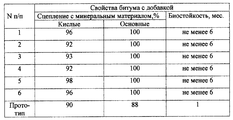
Результаты испытаний представлены в таблице, в качестве базы сравнения были приготовлены аналогичные образцы с использованием в добавке - прототипе 77 мас.% таллового масла и 23 мас.% феноламинной смолы. The test results are presented in the table, similar samples were prepared as a comparison base using 77 wt.% Tall oil and 23 wt.% Phenolamine resin in the additive prototype.
Полученные результаты представлены в таблице. Как видно из таблицы, все битумные составы с предлагаемой добавкой характеризуются хорошей адгезией к кислым и основным породам и биостойкостью не менее 6 месяцев. Из сравнительного анализа данных таблицы следует, что предлагаемый способ более простой и экономичный, чем базовый, позволяет получить добавку, которая при меньшей себестоимости не уступает по своим показателям базовому образцу, в том числе по биостойкости и адгезии к кислым и основным породам. The results are presented in the table. As can be seen from the table, all bituminous compositions with the proposed additive are characterized by good adhesion to acidic and basic rocks and biostability for at least 6 months. From a comparative analysis of the data in the table it follows that the proposed method is simpler and more economical than the base, allows you to get an additive that at a lower cost is not inferior in terms of performance to the base sample, including biostability and adhesion to acidic and basic rocks.
Это обеспечивает повышение долговечности битумных составов и битумных материалов на их основе с добавкой, полученной по заявляемому способу, более технологичному и требующему для своего осуществления меньших энергетических и других материальных затрат. This provides an increase in the durability of bitumen compositions and bitumen materials based on them with an additive obtained by the present method, more technological and requiring less energy and other material costs for its implementation.
При этом одновременно решается проблема утилизации многотоннажных отходов углепереработки - жидких продуктов пиролиза, что важно для улучшения экологической обстановки в углеперерабатывающих регионах. At the same time, the problem of disposing of large-tonnage coal-processing wastes is solved - liquid pyrolysis products, which is important for improving the environmental situation in coal-processing regions.
Claims (2)
Продукт пиролиза твердых горючих ископаемых - 97,5 - 99,9
Гексаметилентетрамин - 0,1 - 2,5
при этом смешение ведут при постоянном перемешивании при температуре менее чем 100oС и атмосферном давлении до образования гомогенной массы.1. A method of producing an additive to bitumen by mixing a technical by-product and an amine compound, characterized in that a by-product of the pyrolysis of solid fossil fuels is used as a technical by-product, and hexamethylenetetramine is used as an amine compound in the following ratio, wt.%:
Product of pyrolysis of solid fossil fuels - 97.5 - 99.9
Hexamethylenetetramine - 0.1 - 2.5
while mixing is carried out with constant stirring at a temperature of less than 100 o C and atmospheric pressure until a homogeneous mass.
Фенолы и алкилфенолы - 4,5 - 50
Нейтральные вещества - 49 - 95
Минеральные примеси - 0,1 - 1е2. The method according to claim 1, characterized in that they use the product of the pyrolysis of solid fossil fuels containing phenols and alkyl phenols, neutral substances and mineral impurities in the following ratio, wt.%:
Phenols and alkyl phenols - 4.5 - 50
Neutral Substances - 49 - 95
Mineral impurities - 0.1 - 1e
Priority Applications (1)
| Application Number | Priority Date | Filing Date | Title |
|---|---|---|---|
| RU2000127215A RU2208024C2 (en) | 2000-10-30 | 2000-10-30 | Method of preparing bitumen additive |
Applications Claiming Priority (1)
| Application Number | Priority Date | Filing Date | Title |
|---|---|---|---|
| RU2000127215A RU2208024C2 (en) | 2000-10-30 | 2000-10-30 | Method of preparing bitumen additive |
Publications (2)
| Publication Number | Publication Date |
|---|---|
| RU2000127215A RU2000127215A (en) | 2002-08-27 |
| RU2208024C2 true RU2208024C2 (en) | 2003-07-10 |
Family
ID=29209116
Family Applications (1)
| Application Number | Title | Priority Date | Filing Date |
|---|---|---|---|
| RU2000127215A RU2208024C2 (en) | 2000-10-30 | 2000-10-30 | Method of preparing bitumen additive |
Country Status (1)
| Country | Link |
|---|---|
| RU (1) | RU2208024C2 (en) |
Cited By (1)
| Publication number | Priority date | Publication date | Assignee | Title |
|---|---|---|---|---|
| RU2318848C1 (en) * | 2006-11-08 | 2008-03-10 | Общество с ограниченной ответственностью "Научно-производственное объединение "ГИПОЛ" (ООО "НПО ГИПОЛ") | Bitumens modifying additive |
Citations (4)
| Publication number | Priority date | Publication date | Assignee | Title |
|---|---|---|---|---|
| RU2021309C1 (en) * | 1991-01-09 | 1994-10-15 | Производственное объединение южных магистральных нефтепродуктопроводов | Bituminous composition |
| RU2096370C1 (en) * | 1996-08-28 | 1997-11-20 | Закрытое акционерное общество "ИнвестПроект" | Surface-active addition |
| RU15485U1 (en) * | 2000-07-27 | 2000-10-20 | Общество с ограниченной ответственностью "Приморнефтегаз" | COATING PLATE |
| RU15577U1 (en) * | 2000-08-07 | 2000-10-27 | Общество с ограниченной ответственностью "Приморнефтегаз" | SLEEPER |
-
2000
- 2000-10-30 RU RU2000127215A patent/RU2208024C2/en not_active IP Right Cessation
Patent Citations (4)
| Publication number | Priority date | Publication date | Assignee | Title |
|---|---|---|---|---|
| RU2021309C1 (en) * | 1991-01-09 | 1994-10-15 | Производственное объединение южных магистральных нефтепродуктопроводов | Bituminous composition |
| RU2096370C1 (en) * | 1996-08-28 | 1997-11-20 | Закрытое акционерное общество "ИнвестПроект" | Surface-active addition |
| RU15485U1 (en) * | 2000-07-27 | 2000-10-20 | Общество с ограниченной ответственностью "Приморнефтегаз" | COATING PLATE |
| RU15577U1 (en) * | 2000-08-07 | 2000-10-27 | Общество с ограниченной ответственностью "Приморнефтегаз" | SLEEPER |
Cited By (1)
| Publication number | Priority date | Publication date | Assignee | Title |
|---|---|---|---|---|
| RU2318848C1 (en) * | 2006-11-08 | 2008-03-10 | Общество с ограниченной ответственностью "Научно-производственное объединение "ГИПОЛ" (ООО "НПО ГИПОЛ") | Bitumens modifying additive |
Similar Documents
| Publication | Publication Date | Title |
|---|---|---|
| Schmitt | Polyfurfuryl alcohol resins | |
| Gunka et al. | THE SELECTION OF RAW MATERIALS FOR THE PRODUCTION OF ROAD BITUMEN MODIFIED BY PHENOL-CRESOL-FORMALDEHYDE RESINS. | |
| JP6261697B2 (en) | Heavy anticorrosion epoxy coating composition containing styrenated phenol and method for producing the same | |
| RU2208024C2 (en) | Method of preparing bitumen additive | |
| RU2187466C1 (en) | Method of reusing wastes containing crude oil and petroleum products | |
| Gunka et al. | Production of Bitumen Modified with Low-Molecular Organic Compounds from Petroleum Residues. 9. Stone Mastic Asphalt Using Formaldehyde Modified Tars | |
| RU2213754C2 (en) | Composite of binding agent for protection compositions and method for its preparing | |
| Jurkeviciute et al. | Comparative analysis of the qualitative characteristics of formaldehyde and acetaldehyde resins based on styrene-modified oil shale alkylresorcinols | |
| Gunka et al. | Production of Bitumen Modified with Low-Molecular Organic Compounds from Petroleum Residues. 8. Prospects of Using Formaldehyde Modified Tars in Road Construction | |
| RU2094427C1 (en) | Method of preparing active additive to bitumen | |
| RU2191754C2 (en) | Method of utilizing oil sludge and antifrost agent for building materials | |
| RU2181348C1 (en) | Additive for concrete and method of its production | |
| RU2152415C1 (en) | Composition for anti-corrosion coating | |
| US4367247A (en) | Primer for portland cement concrete | |
| RU2353011C1 (en) | Method of radioactive ion-exchanging resins preparation for immobilisation into bulk structures | |
| RU2185401C2 (en) | Cationic adhesive additive for bitumens | |
| Gurbanovich et al. | The Significance of Organic Binding Additives in Improving the Quality of Road Bitumen | |
| RU2241724C1 (en) | Polymeric-bitumen binding agent and method for its preparing | |
| JPS6159353B2 (en) | ||
| RU2192438C1 (en) | Method of adhesion bitumen addition agent preparing | |
| RU2028990C1 (en) | Road pavement composition | |
| SU1002253A1 (en) | Method of purifying waters in production of phenolophormaldehyde resins | |
| SU1129221A1 (en) | Method for preparing binder for road paving | |
| SU1707034A1 (en) | Method of preparation modifier for binding material | |
| RU2087498C1 (en) | Binder manufacture of molds and rods |
Legal Events
| Date | Code | Title | Description |
|---|---|---|---|
| MM4A | The patent is invalid due to non-payment of fees |
Effective date: 20111031 |