RU2425700C1 - Laser-beam bio-tissue welding technique - Google Patents
Laser-beam bio-tissue welding technique Download PDFInfo
- Publication number
- RU2425700C1 RU2425700C1 RU2010100289/14A RU2010100289A RU2425700C1 RU 2425700 C1 RU2425700 C1 RU 2425700C1 RU 2010100289/14 A RU2010100289/14 A RU 2010100289/14A RU 2010100289 A RU2010100289 A RU 2010100289A RU 2425700 C1 RU2425700 C1 RU 2425700C1
- Authority
- RU
- Russia
- Prior art keywords
- bio
- laser
- solder
- laser welding
- carbon nanotubes
- Prior art date
Links
Images
Landscapes
- Materials For Medical Uses (AREA)
Abstract
Description
Изобретение относится к области лазерной медицины, в частности к способам соединения поврежденных биологических тканей путем лазерной сварки.The invention relates to the field of laser medicine, in particular to methods for joining damaged biological tissues by laser welding.
Важнейшими задачами современной хирургии являются разработка и внедрение в клиническую практику новых способов соединения органов и тканей, простых в исполнении для хирурга и щадящих для больного. Для их осуществления требуется ряд необходимых условий, обеспечивающих надежность соединения органов или тканей, гарантирующего их функционирование в раннем послеоперационном периоде и скорейшее восстановление функций оперированного органа. Существующие традиционные способы восстановления целостности ткани с использованием шовных материалов, металлических скобок, сшивающих аппаратов, клеевых композиций и других средств несовершенны.The most important tasks of modern surgery are the development and implementation in clinical practice of new methods of connecting organs and tissues, simple in execution for the surgeon and sparing for the patient. Their implementation requires a number of necessary conditions to ensure the reliability of the connection of organs or tissues, guaranteeing their functioning in the early postoperative period and the speedy restoration of the functions of the operated organ. Existing traditional methods of restoring the integrity of the fabric using suture materials, metal brackets, staplers, adhesive compositions and other means are imperfect.
Один из наиболее важных разделов лазерной медицины - лазерную хирургию - отличает от большинства традиционных областей хирургии возможность рассечения, плавления (абляции) и испарения биологических тканей при минимальных сопутствующих повреждениях, наряду с уменьшением вероятности инфицирования раны и минимальными потерями крови во время проведения операции. Лазерная хирургическая инженерия продолжает развиваться в направлении соединения (бесшовной сварки) рассеченных биотканей, что может использоваться как с открытыми, так и с закрытыми операционными полями (через небольшой лапароскопический разрез).One of the most important areas of laser medicine - laser surgery - distinguishes from most traditional areas of surgery the possibility of dissection, melting (ablation) and evaporation of biological tissues with minimal concomitant injuries, along with a reduced chance of wound infection and minimal blood loss during surgery. Laser surgical engineering continues to develop in the direction of joining (seamless welding) dissected biological tissues, which can be used with both open and closed surgical fields (through a small laparoscopic incision).
Благодаря лазерной сварке обеспечивается герметичность раны, отсутствует сдавление швами тканей и их краевой некроз, заживление раны не сопровождается образованием грубого рубца. В хирургии сосудов и сердца лазерные швы могут использоваться для фиксации заплаты в области дефекта стенки сосуда, с целью гемостаза и герметизации линии шва сосудистого анастомоза; в легочной хирургии - для закрытия больших раневых поверхностей, возникших после резекции легкого или выделения легкого из спаек, для закрытия небольших бронхиальных свищей, для герметизации и укрепления линии шва анастомоза или культи бронха; в абдоминальной хирургии - для дополнительной герметизации анастомозов, в частности, при резекции прямой кишки; в урологии - как дополнение к кетгутовым швам, для закрытия разрезов почечной лоханки, мочеточника и мочевого пузыря, при трансплантации почки [1].Thanks to laser welding, the tightness of the wound is ensured, there is no compression of the seams of tissues and their marginal necrosis, wound healing is not accompanied by the formation of a rough scar. In vascular and heart surgery, laser sutures can be used to fix the patch in the area of a defect in the vessel wall, with the goal of hemostasis and sealing the suture line of the vascular anastomosis; in pulmonary surgery - to close large wound surfaces that arose after resection of the lung or isolation of the lung from adhesions, to close small bronchial fistulas, to seal and strengthen the suture line of the anastomosis or bronchus stump; in abdominal surgery - for additional sealing of anastomoses, in particular, during resection of the rectum; in urology, as an addition to catgut sutures, for closing sections of the renal pelvis, ureter and bladder, during kidney transplantation [1].
Особое значение имеет лазерная сварка мельчайших хирургических объектов, таких как нервные волокна, кровеносные капилляры, семяпроводящие протоки и т.п., где шовное соединение биотканей затруднительно и мало надежно [2].Of particular importance is the laser welding of the smallest surgical objects, such as nerve fibers, blood capillaries, vas deferens, etc., where the suture connection of biological tissues is difficult and not very reliable [2].
В случае практического осуществления лазерной сварки для прочного и надежного сваривания применяются биоприпои, в состав которых входят связующие вещества, что позволяет заменить обычное сшивание операционной раны хирургической иглой и нитью. Нагрев биоприпоя лазерным излучением приводит к термической деформации клеток в области сварки с выходом клеточного матрикса, связующего биоткани в виде лазерного шва [3].In the case of the practical implementation of laser welding for strong and reliable welding, bio-solders are used, which include binders, which allows you to replace the usual stitching of the surgical wound with a surgical needle and thread. Laser heating of the bio-solder leads to thermal deformation of cells in the welding area with the release of the cell matrix, a biological tissue binding in the form of a laser suture [3].
Тем не менее обычная методика лазерной сварки не всегда обеспечивает такую же прочность соединений, как обычный хирургический шов [4]. По этой причине вызывает интерес поиск новых способов лазерной сварки с использованием биоприпоев на основе углеродных нанотрубок. В этом случае можно ожидать структурирования шовного материала и увеличения его прочности за счет создания скрепляющего нанотрубочного каркаса, как это происходит в объемных нанокомпозитных материалах на основе углеродных нанотрубок, создаваемых действием лазерного излучения [5, 6].Nevertheless, the conventional laser welding technique does not always provide the same strength of joints as a conventional surgical suture [4]. For this reason, it is interesting to search for new methods of laser welding using bio-solders based on carbon nanotubes. In this case, one can expect structuring of the suture material and increase its strength due to the creation of a fastening nanotube framework, as is the case in bulk nanocomposite materials based on carbon nanotubes created by laser radiation [5, 6].
Известно применение углеродных нанотрубок для соединения костных элементов и соседних костей в ортопедических имплантатах [7].The use of carbon nanotubes for connecting bone elements and adjacent bones in orthopedic implants is known [7].
В указанном устройстве не предусмотрено использование действия лазерного излучения и биоприпоев, что делает его неприменимым для лазерной сварки биологических тканей.The specified device does not provide for the use of the action of laser radiation and bio-solders, which makes it inapplicable for laser welding of biological tissues.
Известен способ лазерной сварки биологических тканей с использованием биоприпоев, в которые вводят связующие вещества - белки, полисахариды, нуклеиновые кислоты, витамины, металлы или синтетические органические молекулы [8].A known method of laser welding of biological tissues using bioholders, which introduce binders - proteins, polysaccharides, nucleic acids, vitamins, metals or synthetic organic molecules [8].
Недостаток этого способа лазерной сварки биологических тканей заключается в недостаточной прочности лазерных швов, что может быть преодолено с использованием биоприпоев, содержащих наночастицы, в частности углеродные нанотрубки.The disadvantage of this method of laser welding of biological tissues is the lack of strength of laser seams, which can be overcome using bio-solders containing nanoparticles, in particular carbon nanotubes.
Известно применение объемных наноструктур на основе углеродных нанотрубок, получаемых действием лазерного излучения, для лазерной сварки человеческих хрящей, что позволяет увеличить прочность лазерного шва по сравнению с использованием припоя на основе альбумина [9].It is known to use bulk nanostructures based on carbon nanotubes obtained by the action of laser radiation for laser welding of human cartilage, which makes it possible to increase the strength of a laser weld compared to using solder based on albumin [9].
Недостаток этого способа лазерной сварки биологических тканей заключается в отсутствии в составе биоприпоев поверхностно-активных веществ, что приводит к беспорядочному соединению нанотрубок под действием ван-дер-ваальсовых сил, которое значительно снижает эффективность их применения в составе биоприпоев, не обеспечивая достаточно надежного соединения поврежденных биологических тканей.The disadvantage of this method of laser welding of biological tissues is the absence of surface-active substances in the bio-solders, which leads to an erratic connection of nanotubes under the action of van der Waals forces, which significantly reduces the efficiency of their use in bio-solders, without providing a sufficiently reliable connection of damaged biological tissues.
Наиболее близким техническим решением заявляемого способа лазерной сварки биологических тканей является способ соединения биотканей, в которые вводят наночастицы, находящихся внутри белковых и биополимерных оболочек, которые нагреваются с помощью оптического излучения [10]. Однако такие оболочечные наночастицы, в частности нанозолото, наносеребро и фуллерены, являются дорогостоящим материалом и не могут быть использованы в широкой практике. Помимо этого помещение наночастиц в оболочки и отсутствие в составе биоприпоев поверхностно-активных веществ не позволяют обеспечить достаточно надежное соединение поврежденных биологических тканей.The closest technical solution of the proposed method for laser welding of biological tissues is a method of connecting biological tissues into which nanoparticles are introduced inside protein and biopolymer shells that are heated using optical radiation [10]. However, such shell nanoparticles, in particular nanogold, nanosilver and fullerenes, are an expensive material and cannot be used in general practice. In addition, the placement of nanoparticles in shells and the absence of surface-active substances in the bio-solders do not allow for a sufficiently reliable connection of damaged biological tissues.
По указанным выше причинам необходим поиск новых, более эффективных способов лазерной сварки.For the above reasons, it is necessary to search for new, more efficient laser welding methods.
Изобретение направлено на обеспечение надежного соединения поврежденных биологических тканей. Указанный технический результат достигают тем, что способ лазерной сварки биологических тканей включает использование биоприпоя, который представляет собой дисперсию связующих веществ в виде композита в воде на основе белков и/или биосовместимых полимеров, при лазерном облучении отличается тем, что в состав биоприпоя вводят углеродные нанотрубки и поверхностно-активные вещества при следующем количественном соотношении компонентов (в % по массе):The invention is aimed at providing a reliable connection of damaged biological tissues. The specified technical result is achieved in that the method of laser welding of biological tissues involves the use of bio-solder, which is a dispersion of binders in the form of a composite in water based on proteins and / or biocompatible polymers, when laser irradiated, it differs in that carbon nanotubes are introduced into the bio-solder and surfactants in the following quantitative ratio of components (in% by weight):
В состав биоприпоя может вводиться связующее вещество 10-50 мас.%; углеродные нанотрубки 0,1-0,5 мас.%; поверхностно-активное вещество 1-3 мас.%; вода - остальное.A binder of 10-50 wt.% Can be introduced into the composition of the bio-solder; carbon nanotubes 0.1-0.5 wt.%; surfactant 1-3 wt.%; water is the rest.
В состав связующего вещества биоприпоя могут вводиться белки (альбумин), природный биосовместимый полимер хитозан, полисахариды (амилоза) и оксиэтилированный крахмал, коллагены.Proteins (albumin), the natural biocompatible polymer chitosan, polysaccharides (amylose) and ethoxylated starch, collagens can be introduced into the composition of the binder of bio-solder.
В состав биоприпоя могут вводиться ионогенное поверхностно-активное вещество (ПАВ) - додецилбензолсульфонат натрия, неионогенный ПАВ Неонол АФ 9-12, цвиттерионный ПАВ - фосфатидилхолин, представляющий собой биосовместимое поверхностно-активное вещество, выполняющее определенные функции в человеческом организме.The bio-solder may contain ionic surfactant (sodium) - dodecylbenzenesulfonate sodium, nonionic surfactant Neonol AF 9-12, zwitterionic surfactant - phosphatidylcholine, which is a biocompatible surfactant that performs certain functions in the human body.
Предложенный способ лазерной сварки биологических тканей с использованием указанного состава биоприпоя и облучения соединяемых биологических тканей ИК-лазером, охарактеризованный вышеприведенной совокупностью существенных признаков, гарантирует высокое качество сваренных образцов биотканей, удобство в осуществлении и не требует применения дорогостоящих реагентов.The proposed method for laser welding of biological tissues using the specified composition of the solder and irradiating the connected biological tissues with an IR laser, characterized by the above set of essential features, guarantees high quality of the welded samples of biological tissues, ease of implementation and does not require the use of expensive reagents.
Результаты по лазерной сварке биологических тканей in vitro, полученные с использованием заявляемого способа лазерной сварки биотканей (составов биоприпоя и условий лазерного облучения), приведены в табл.1.The results of laser welding of biological tissues in vitro, obtained using the proposed method for laser welding of biological tissues (bio solder compositions and laser irradiation conditions) are shown in Table 1.
Додецилбензолсульфонат натрий
Неонол АФ 9-12
ФосфатидилхолинSurface-active substance:
Sodium dodecylbenzenesulfonate
Neonol AF 9-12
Phosphatidylcholine
Пример осуществленияImplementation example
Сначала готовят лазерный припой следующим образом.First, prepare the laser solder as follows.
В дистиллированной воде при комнатной температуре растворяют связующее вещество, поверхностно-активное вещество, углеродные нанотрубки. Смесь помещают в ультразвуковую ванну и диспергируют в течение 2-5 часов при температуре 40-50°С до получения однородного коллоидного раствора припоя.In distilled water at room temperature, a binder, a surfactant, carbon nanotubes are dissolved. The mixture is placed in an ultrasonic bath and dispersed for 2-5 hours at a temperature of 40-50 ° C until a homogeneous colloidal solder solution is obtained.
Сварка проводилась на образцах свиной кожи и хрящах бычьей трахеи.Welding was carried out on specimens of pig skin and cartilage of bovine trachea.
Хрящи бычьей трахеи промывались в воде, затем от них отделялась мышечная ткань с помощью ножниц и хирургического скальпеля. После этого трахея делилась на более мелкие части и хирургическим скальпелем очищалась от жировой прослойки и пленок, после чего отделялась надхрящница с целью выделения чистого хряща.The cartilages of the bovine trachea were washed in water, then muscle tissue was separated from them using scissors and a surgical scalpel. After this, the trachea was divided into smaller parts and the surgical scalpel was cleaned of the fat layer and films, after which the perichondrium was separated in order to isolate pure cartilage.
Очищенные пластинки погружались в мыльную воду на 5-10 мин для окончательного удаления прослойки жировой ткани с образцов хряща. Спустя 10 мин пластинки хряща промывались в холодной воде и оставлялись в емкости с физиологическим раствором (5% водным раствором поваренной соли).The cleaned plates were immersed in soapy water for 5-10 minutes to finally remove the layer of adipose tissue from cartilage samples. After 10 minutes, the cartilage plates were washed in cold water and left in a container with physiological saline (5% aqueous sodium chloride solution).
Подготовка к сварке образцов свиной кожи производилась аналогичным образом.Preparation for welding pig skin samples was carried out in a similar way.
До начала лазерного облучения и сварки образцов биотканей емкость с образцами хранилась в холодильнике в течение не более одних суток. Непосредственно перед началом эксперимента пластинки извлекались из емкости с раствором и подсушивались 10 мин с целью испарения с них лишней влаги.Prior to the laser irradiation and welding of biological tissue samples, the container with the samples was stored in the refrigerator for no more than one day. Immediately before the start of the experiment, the plates were removed from the container with the solution and dried for 10 min in order to evaporate excess moisture from them.
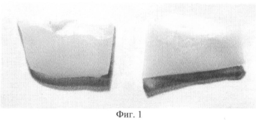
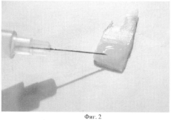
Перед сваркой на хрящ наносился поперечный разрез, разделяющий его на 2 части (фиг.1). По линии разреза образцов инсулиновым шприцом наносился лазерный припой (фиг.2) и хрящи плотно прижимали друг к другу на 20 с.Before welding, a cross section was applied to the cartilage, dividing it into 2 parts (Fig. 1). Laser solder was applied along the incision line of the samples with an insulin syringe (Fig. 2) and the cartilage was pressed tightly against each other for 20 s.
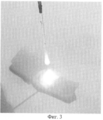
В качестве источника лазерного облучения использовался диодный инфракрасный лазер с оптоволоконным выходом излучения, с длиной волны генерации λген=0,97 мкм. Лазерная сварка образцов осуществлялась с помощью вышеуказанного прибора - планомерным продвижением по всей длине разреза с внешней стороны хряща до достижения определенного уровня прогрева и сцепления образцов (для предотвращения перегрева и подгорания ткани/припоя), после чего сваривалась обратная сторона пластин. Расстояние от наконечника лазерного оптоволоконного световода до свариваемой поверхности составляло ~5 мм (фиг.3).As a source of laser irradiation, a diode infrared laser with a fiber-optic radiation output with a generation wavelength λ gene = 0.97 μm was used. Laser welding of the samples was carried out using the aforementioned device - the systematic advancement along the entire length of the incision from the outer side of the cartilage until a certain level of heating and adhesion of the samples was achieved (to prevent overheating and burning of tissue / solder), after which the reverse side of the plates was welded. The distance from the tip of the laser optical fiber to the surface to be welded was ~ 5 mm (Fig. 3).
Операции для образцов свиной кожи были аналогичны.The operations for pig skin samples were similar.
Измерение прочности на разрыв сваренных образцов свиной кожи и бычьих хрящейMeasurement of tensile strength of cooked samples of pig skin and bovine cartilage
Прочность на разрыв измерялась следующим образом.Tensile strength was measured as follows.
Сначала в исследуемом участке сваренного образца делалось сужение с центром в предполагаемом месте разрыва таким образом, что образец принимал форму гантели. Концы образца закреплялись при помощи зажимов, к одному из которых был прикреплен динамометр, с помощью которого замерялось значение приложенной силы.First, in the studied area of the welded sample, a narrowing was made with the center at the proposed location of the rupture so that the sample took the form of a dumbbell. The ends of the sample were fixed using clamps, one of which was attached a dynamometer, with which the value of the applied force was measured.
Прочность на разрыв определялась по формулеThe tensile strength was determined by the formula

где F - приложенная сила, при которой происходит разрыв биоткани, S - площадь сечения образца в области сужения.where F is the applied force at which the biological tissue ruptures, and S is the cross-sectional area of the sample in the narrowing region.
Площадь сечения образцов S составляла примерно от 1,2 до 10 мм2. Сила нагрузки F - от 3 до 7 Н.The cross-sectional area of samples S was approximately 1.2 to 10 mm 2 . The load force F is from 3 to 7 N.
Для вычисления относительной прочности сваренных образцов на разрыв измерялась прочность на разрыв неповрежденной биоткани, а относительная прочность на разрыв рассчитывалась по формуле:To calculate the relative tensile strength of welded samples, the tensile strength of intact biological tissue was measured, and the relative tensile strength was calculated by the formula:

где Т - относительная прочность на разрыв,where T is the relative tensile strength,
σбт - прочность разрыва неповрежденной биоткани,σ bt is the tensile strength of intact biological tissue,
σсв - прочность разрыва сваренных образцов.σ sv is the tensile strength of welded samples.
Результаты измерений прочности на разрыв сваренных образцов свиной кожи и бычьих хрящей приведены в табл.2.The results of measurements of the tensile strength of cooked samples of pig skin and bovine cartilage are given in table 2.
Для статистической точности измерения прочности образцов, сваренных с различным составом припоя, проводились с использованием нескольких образцов в каждой испытуемой группе. Для расчета относительной прочности на разрыв использовались средние для каждой группы значения.For statistical accuracy, strength measurements of samples welded with different composition of solder were carried out using several samples in each test group. To calculate the relative tensile strength, the average values for each group were used.
Результаты измерений прочности на разрыв сваренных образцов свиной кожи и бычьих хрящей приведены в табл.2 для состава биоприпоя на основе 25% водного раствора бычьего сывороточного альбумина с додецилбензолсульфонатом натрия (1,5 мас.%) и различными типами однослойных и многослойных углеродных нанотрубок.The results of measurements of the tensile strength of cooked samples of pig skin and bovine cartilage are given in Table 2 for the composition of bio-solder based on a 25% aqueous solution of bovine serum albumin with sodium dodecylbenzenesulfonate (1.5 wt.%) And various types of single-layer and multilayer carbon nanotubes.
Данные табл.2 указывают, что использование однослойных углеродных нанотрубок в составе биоприпоя увеличивает прочность сваренных лазерных швов по сравнению с биоприпоем на основе альбумина без нанотрубок [2, 10] ~ в 2 раза, в то время как применение многослойных углеродных нанотрубок дает увеличение прочности швов в 2-3 раза.The data in Table 2 indicate that the use of single-walled carbon nanotubes as a part of bio-solder increases the strength of welded laser welds compared to albumin-based bio-solder without nanotubes [2, 10] ~ 2 times, while the use of multilayer carbon nanotubes gives an increase in weld strength 2-3 times.
По сравнению с данными измерений прочности на разрыв лазерных швов свиной кожи, полученных с припоем на основе альбумина при использовании излучения CO2 лазера (длина волны 10,6 мкм) [4], получено увеличение прочности в 10-15 раз при использовании соответственно однослойных и многослойных углеродных нанотрубок в составе припоя.Compared with the measurement data for the tensile strength of pigskin laser seams obtained with albumin-based solder using CO 2 laser radiation (wavelength 10.6 μm) [4], an increase in strength by 10–15 times was obtained using respectively single-layer and multilayer carbon nanotubes as part of solder.
Для проверки биосовместимости предлагаемых составов образцы биоприпоя на основе водного раствора бычьего сывороточного альбумина вводились под надхрящницу ушного хряща кролика in vivo. Отрицательной динамики животных не наблюдалось.To verify the biocompatibility of the proposed compositions, samples of bio-solder based on an aqueous solution of bovine serum albumin were introduced under the perichondrium of the ear cartilage of a rabbit in vivo. Negative dynamics of animals was not observed.
Таким образом, благодаря применению предлагаемого способа лазерной сварки биологических тканей с биоприпоем, содержащим дисперсию углеродных нанотрубок и поверхностно-активных веществ и связующие вещества в виде композита на основе белков и биосовместимых полимеров, с использованием лазерного источника излучения, обеспечивается надежное соединение поврежденных биологических тканей при удобстве в осуществлении лазерной сварки и без применения дорогостоящих реагентов.Thus, due to the application of the proposed method for laser welding of biological tissues with bioholder containing a dispersion of carbon nanotubes and surfactants and binders in the form of a composite based on proteins and biocompatible polymers using a laser radiation source, reliable connection of damaged biological tissues is ensured at the convenience in the implementation of laser welding and without the use of expensive reagents.
Источники информацииInformation sources
1. Лазеры в хирургии под ред. О.К.Скобелкина // М.: Медицина, 1989.1. Lasers in surgery, ed. O.K.Skobelkina // M .: Medicine, 1989.
2. Неворотин А.И. Введение в лазерную хирургию // СПб.: Спецлит, 2000.2. Nevorotin A.I. Introduction to Laser Surgery // St. Petersburg: Spetslit, 2000.
3. C.B.Bleustein, D.Felsen, D.P.Poppas. Welding Characteristics of Different Albumin Species with and without Fatty Acids. - Lasers in Surgery and Medicine, 2000, v.27, No 2, p.82-86.3. C. B. Bleustein, D. Felsen, D.P. Poppas. Welding Characteristics of Different Albumin Species with and without Fatty Acids. - Lasers in Surgery and Medicine, 2000, v. 27, No. 2, p. 82-86.
4. Simhon D., Halpern M., Brosh Т., Vasilyev Т., Ravid A., Tennenbaum Т., Nevo Z., Katzir A. Immediate Tight Sealing of Skin Incisions Using an Innovative Temperature-controlled Laser Soldering Device. - Annals of surgery, 2007, v.245, No.2, p.206-213.4. Simhon D., Halpern M., Brosh T., Vasilyev T., Ravid A., Tennenbaum T., Nevo Z., Katzir A. Immediate Tight Sealing of Skin Incisions Using an Innovative Temperature-controlled Laser Soldering Device. - Annals of surgery, 2007, v. 245, No.2, p. 206-213.
5. В.М.Подгаецкий, В.В.Савранский, М.М.Симунин, М.А.Кононов. Получение объемных нанокомпозиций на основе водного раствора альбумина под действием лазерного излучения. - Квантовая электроника, 2007, т.37, № 9, 801-803.5. V.M. Podgaetsky, V.V. Savransky, M.M.Simunin, M.A. Kononov. Obtaining bulk nanocompositions based on an aqueous albumin solution under the action of laser radiation. - Quantum Electronics, 2007, v. 37, No. 9, 801-803.
6. Патент РФ № 2347740.6. RF patent No. 2347740.
7. Заявка на патент США № 20070198090.7. Application for US patent No. 20070198090.
8. Евроазиатский патент № WO/1996/038093.8. Eurasian patent No. WO / 1996/038093.
9. С.А.Агеева, В.А.Медведева, В.М.Подгаецкий, С.В.Селищев, А.Ю.Толбин, Л.Г.Томилова. Применение органических красителей при лазерной сварке биологических тканей. - Сб. научных трудов «Лазеры в науке, технике, медицине» под ред. В.А.Петрова // M.: МНТОРЭС им.А.С.Попова, 2007, т.18, с.96-100.9. S.A. Ageeva, V. A. Medvedeva, V. M. Podgaetsky, S. V. Selishchev, A. Yu. Tolbin, L. G. Tomilova. The use of organic dyes in laser welding of biological tissues. - Sat scientific works "Lasers in science, technology, medicine", ed. V.A. Petrova // M .: MNTORES named after A.S. Popov, 2007, v. 18, pp. 96-100.
10. Патент США № 6685730 В2.10. US patent No. 6685730 B2.
Claims (4)
Priority Applications (1)
| Application Number | Priority Date | Filing Date | Title |
|---|---|---|---|
| RU2010100289/14A RU2425700C1 (en) | 2010-01-11 | 2010-01-11 | Laser-beam bio-tissue welding technique |
Applications Claiming Priority (1)
| Application Number | Priority Date | Filing Date | Title |
|---|---|---|---|
| RU2010100289/14A RU2425700C1 (en) | 2010-01-11 | 2010-01-11 | Laser-beam bio-tissue welding technique |
Publications (1)
| Publication Number | Publication Date |
|---|---|
| RU2425700C1 true RU2425700C1 (en) | 2011-08-10 |
Family
ID=44754463
Family Applications (1)
| Application Number | Title | Priority Date | Filing Date |
|---|---|---|---|
| RU2010100289/14A RU2425700C1 (en) | 2010-01-11 | 2010-01-11 | Laser-beam bio-tissue welding technique |
Country Status (1)
| Country | Link |
|---|---|
| RU (1) | RU2425700C1 (en) |
Cited By (3)
| Publication number | Priority date | Publication date | Assignee | Title |
|---|---|---|---|---|
| RU2611918C1 (en) * | 2015-09-16 | 2017-03-01 | Федеральное государственное автономное образовательное учреждение высшего образования "Национальный исследовательский университет "Московский институт электронной техники" (МИЭТ) | Device for laser welding of dissected biological tissues |
| RU2632114C1 (en) * | 2016-07-22 | 2017-10-02 | Федеральное государственное автономное образовательное учреждение высшего образования "Национальный исследовательский университет "Московский институт электронной техники" (МИЭТ) | Method for laser treatment of nanocomposite coating of knee joint ligament implant |
| RU2725860C1 (en) * | 2019-12-26 | 2020-07-06 | Федеральное государственное автономное образовательное учреждение высшего образования "Национальный исследовательский университет "Московский институт электронной техники" | Tissue engineering structure for cardiac tissue regeneration |
Citations (3)
| Publication number | Priority date | Publication date | Assignee | Title |
|---|---|---|---|---|
| US6685730B2 (en) * | 2001-09-26 | 2004-02-03 | Rice University | Optically-absorbing nanoparticles for enhanced tissue repair |
| RU2286733C1 (en) * | 2005-05-03 | 2006-11-10 | Юрий Анатольевич Сухонос | Method for transcervical intrauterine sterilization |
| WO2007115388A1 (en) * | 2006-04-12 | 2007-10-18 | Universidade Federal De Minas Gerais | A composite comprising collagen and carbon nanotubes, process of produing same and uses thereof |
-
2010
- 2010-01-11 RU RU2010100289/14A patent/RU2425700C1/en not_active IP Right Cessation
Patent Citations (3)
| Publication number | Priority date | Publication date | Assignee | Title |
|---|---|---|---|---|
| US6685730B2 (en) * | 2001-09-26 | 2004-02-03 | Rice University | Optically-absorbing nanoparticles for enhanced tissue repair |
| RU2286733C1 (en) * | 2005-05-03 | 2006-11-10 | Юрий Анатольевич Сухонос | Method for transcervical intrauterine sterilization |
| WO2007115388A1 (en) * | 2006-04-12 | 2007-10-18 | Universidade Federal De Minas Gerais | A composite comprising collagen and carbon nanotubes, process of produing same and uses thereof |
Non-Patent Citations (2)
| Title |
|---|
| BLEUSTEIN CB et al. «Semi-solid albumin solder improved mechanical properties for laser tissue welding». Laser Surg Med. 2000;27(2): 140-6, реферат, найдено 10.11.2010 из PubMed PMID: 10960820. MAC DONALD RA et al. «Collagen-carbon nanotube composite materials as scaffolds in tissue engineering». J Biomed Mater Res A. 2005 Sep 1; 74(3):489-96, реферат, найдено 11.11.2010 из PubMed PMID: 15973695. DUQUE JG et al. «Stable luminescence from individual carbon nanotubes in acidic, basic, and biological environments». J Am Chem Soc. 2008 Feb 27;130(8):2626-33. Epub 2008 Feb 1, реферат, найдено 11.11.2010 из PubMed PMID: 18237169. * |
| ПОДГАЕЦКИЙ В.М. и др. Объемный альбуминовый композит на основе нанотрубок, получаемый действием непрерывного лазерного излучения // Известия высших учебных заведений. Электроника - научно-технический журнал, №5, 2008, с.33-39. * |
Cited By (3)
| Publication number | Priority date | Publication date | Assignee | Title |
|---|---|---|---|---|
| RU2611918C1 (en) * | 2015-09-16 | 2017-03-01 | Федеральное государственное автономное образовательное учреждение высшего образования "Национальный исследовательский университет "Московский институт электронной техники" (МИЭТ) | Device for laser welding of dissected biological tissues |
| RU2632114C1 (en) * | 2016-07-22 | 2017-10-02 | Федеральное государственное автономное образовательное учреждение высшего образования "Национальный исследовательский университет "Московский институт электронной техники" (МИЭТ) | Method for laser treatment of nanocomposite coating of knee joint ligament implant |
| RU2725860C1 (en) * | 2019-12-26 | 2020-07-06 | Федеральное государственное автономное образовательное учреждение высшего образования "Национальный исследовательский университет "Московский институт электронной техники" | Tissue engineering structure for cardiac tissue regeneration |
Similar Documents
| Publication | Publication Date | Title |
|---|---|---|
| JP4084420B2 (en) | Tubular submucosa graft composition | |
| JP6709826B2 (en) | Surgical method using a purified amphipathic peptide composition | |
| CN1221291C (en) | Compositions for tissue repair and uses thereof | |
| US5209776A (en) | Tissue bonding and sealing composition and method of using the same | |
| Kramer et al. | Energy-based tissue fusion for sutureless closure: applications, mechanisms, and potential for functional recovery | |
| JP2002523136A (en) | Insertable stent and method of making and using the stent | |
| Lauto et al. | Sutureless nerve repair with laser-activated chitosan adhesive: a pilot in vivo study | |
| Arya et al. | Radiofrequency-induced small bowel thermofusion: an ex vivo study of intestinal seal adequacy using mechanical and imaging modalities | |
| Flemming et al. | Laser assisted microvascular anastomosis of arteries and veins: laser tissue welding | |
| Lebedev et al. | Use of electric welding of living tissues in surgery | |
| Pabittei et al. | Ex vivo proof-of-concept of end-to-end scaffold-enhanced laser-assisted vascular anastomosis of porcine arteries | |
| Arya et al. | Non-vascular experimental and clinical applications of advanced bipolar radiofrequency thermofusion technology in the thorax and abdomen: a systematic review | |
| Zhu et al. | An ex vivo preliminary investigation into the impact of parameters on tissue welding strength in small intestine mucosa-mucosa end-to-end anastomosis | |
| Bachet et al. | The use of biological glue in aortic surgery | |
| Tanaka et al. | Application of AdvaSeal for acute aortic dissection: experimental study | |
| Ott et al. | Intraluminal laser light source and external solder: in vivo evaluation of a new technique for microvascular anastomosis | |
| Leclère et al. | Outcomes after 1.9-μm diode laser-assisted anastomosis in reconstructive microsurgery: Results in 27 patients | |
| WO2019087880A1 (en) | Sheet-like decellularized material and artificial blood vessel employing said material | |
| Rimshan et al. | Biocompatible nanomaterial for restoration of continuity of dissected biological tissues | |
| Fonouni et al. | Analysis of the hemostatic potential of modern topical sealants on arterial and venous anastomoses: an experimental porcine study | |
| Scerrino et al. | Total thyroidectomy performed with the Starion vessel sealing system versus the conventional technique: a prospective randomized trial | |
| Matteini et al. | Laser welding of biological tissue: mechanisms, applications and perspectives | |
| CN110755609A (en) | Application of specific antibody, implanted medical instrument and preparation method thereof | |
| RU2692660C1 (en) | Annuloplasty procedure in reconstructive interventions on a mitral valve in patients with infectious endocarditis using an autologous tendon | |
| Urie et al. | Laser tissue welding in wound healing and surgical repair |
Legal Events
| Date | Code | Title | Description |
|---|---|---|---|
| MM4A | The patent is invalid due to non-payment of fees |
Effective date: 20140112 |
|
| NF4A | Reinstatement of patent |
Effective date: 20150610 |
|
| MM4A | The patent is invalid due to non-payment of fees |
Effective date: 20170112 |