RU2463473C1 - Vane-sail wind power plant - Google Patents
Vane-sail wind power plant Download PDFInfo
- Publication number
- RU2463473C1 RU2463473C1 RU2011114063/06A RU2011114063A RU2463473C1 RU 2463473 C1 RU2463473 C1 RU 2463473C1 RU 2011114063/06 A RU2011114063/06 A RU 2011114063/06A RU 2011114063 A RU2011114063 A RU 2011114063A RU 2463473 C1 RU2463473 C1 RU 2463473C1
- Authority
- RU
- Russia
- Prior art keywords
- wind
- swing
- blades
- rigidly fixed
- tubes
- Prior art date
Links
- 239000004744 fabric Substances 0.000 claims abstract description 6
- 239000000463 material Substances 0.000 claims abstract description 6
- 238000009434 installation Methods 0.000 claims description 6
- 230000009467 reduction Effects 0.000 abstract description 2
- 239000000126 substance Substances 0.000 abstract 1
- 230000009466 transformation Effects 0.000 description 3
- 238000000844 transformation Methods 0.000 description 3
- 230000015572 biosynthetic process Effects 0.000 description 2
- 230000008878 coupling Effects 0.000 description 1
- 238000010168 coupling process Methods 0.000 description 1
- 238000005859 coupling reaction Methods 0.000 description 1
- 230000003247 decreasing effect Effects 0.000 description 1
- 238000005516 engineering process Methods 0.000 description 1
- 230000003993 interaction Effects 0.000 description 1
Images
Classifications
-
- Y—GENERAL TAGGING OF NEW TECHNOLOGICAL DEVELOPMENTS; GENERAL TAGGING OF CROSS-SECTIONAL TECHNOLOGIES SPANNING OVER SEVERAL SECTIONS OF THE IPC; TECHNICAL SUBJECTS COVERED BY FORMER USPC CROSS-REFERENCE ART COLLECTIONS [XRACs] AND DIGESTS
- Y02—TECHNOLOGIES OR APPLICATIONS FOR MITIGATION OR ADAPTATION AGAINST CLIMATE CHANGE
- Y02B—CLIMATE CHANGE MITIGATION TECHNOLOGIES RELATED TO BUILDINGS, e.g. HOUSING, HOUSE APPLIANCES OR RELATED END-USER APPLICATIONS
- Y02B10/00—Integration of renewable energy sources in buildings
- Y02B10/30—Wind power
-
- Y—GENERAL TAGGING OF NEW TECHNOLOGICAL DEVELOPMENTS; GENERAL TAGGING OF CROSS-SECTIONAL TECHNOLOGIES SPANNING OVER SEVERAL SECTIONS OF THE IPC; TECHNICAL SUBJECTS COVERED BY FORMER USPC CROSS-REFERENCE ART COLLECTIONS [XRACs] AND DIGESTS
- Y02—TECHNOLOGIES OR APPLICATIONS FOR MITIGATION OR ADAPTATION AGAINST CLIMATE CHANGE
- Y02E—REDUCTION OF GREENHOUSE GAS [GHG] EMISSIONS, RELATED TO ENERGY GENERATION, TRANSMISSION OR DISTRIBUTION
- Y02E10/00—Energy generation through renewable energy sources
- Y02E10/70—Wind energy
- Y02E10/72—Wind turbines with rotation axis in wind direction
-
- Y—GENERAL TAGGING OF NEW TECHNOLOGICAL DEVELOPMENTS; GENERAL TAGGING OF CROSS-SECTIONAL TECHNOLOGIES SPANNING OVER SEVERAL SECTIONS OF THE IPC; TECHNICAL SUBJECTS COVERED BY FORMER USPC CROSS-REFERENCE ART COLLECTIONS [XRACs] AND DIGESTS
- Y02—TECHNOLOGIES OR APPLICATIONS FOR MITIGATION OR ADAPTATION AGAINST CLIMATE CHANGE
- Y02P—CLIMATE CHANGE MITIGATION TECHNOLOGIES IN THE PRODUCTION OR PROCESSING OF GOODS
- Y02P70/00—Climate change mitigation technologies in the production process for final industrial or consumer products
- Y02P70/50—Manufacturing or production processes characterised by the final manufactured product
-
- Y—GENERAL TAGGING OF NEW TECHNOLOGICAL DEVELOPMENTS; GENERAL TAGGING OF CROSS-SECTIONAL TECHNOLOGIES SPANNING OVER SEVERAL SECTIONS OF THE IPC; TECHNICAL SUBJECTS COVERED BY FORMER USPC CROSS-REFERENCE ART COLLECTIONS [XRACs] AND DIGESTS
- Y02—TECHNOLOGIES OR APPLICATIONS FOR MITIGATION OR ADAPTATION AGAINST CLIMATE CHANGE
- Y02P—CLIMATE CHANGE MITIGATION TECHNOLOGIES IN THE PRODUCTION OR PROCESSING OF GOODS
- Y02P80/00—Climate change mitigation technologies for sector-wide applications
- Y02P80/20—Climate change mitigation technologies for sector-wide applications using renewable energy
Landscapes
- Wind Motors (AREA)
Abstract
Description
Изобретение относится к ветроэнергетике, а именно к устройству ветроколес ветроэнергетических установок (ВЭУ) малой и средней мощности, в том числе для установки на крышах жилых домов и зданий производственного назначения.The invention relates to wind energy, and in particular to a device for wind wheels of wind power plants (wind turbines) of small and medium power, including for installation on the roofs of residential buildings and industrial buildings.
Известна ветроэнергетическая установка, ветроколесо которой выполнено в виде крыльчатки с тремя или четырьмя лопастями [1], (стр.111 и 127), жестко закрепленными на одном из концов силового вала, другой конец которого связан с исполнительным механизмом, например посредством упругой муфты.A wind power installation is known, the wind wheel of which is made in the form of an impeller with three or four blades [1], (pp. 111 and 127), rigidly fixed to one end of the power shaft, the other end of which is connected to the actuator, for example by means of an elastic coupling.
Такое конструктивное исполнение известного технического решения обеспечивает простоту конструкции крыльчатого ветроколеса и высокие обороты силового вала, что при качественной его балансировке позволяет снизить до минимума уровень вибрации и обеспечить возможность установки ВЭУ на крышах производственных зданий, но на крышах жилых домов их установка не проходит по уровню шума, создаваемого при рассекании частей воздушного потока в межлопастном пространстве.Such a design of the known technical solution ensures the simplicity of the design of the winged wind wheel and high revolutions of the power shaft, which, when properly balanced, reduces the level of vibration to a minimum and allows the installation of wind turbines on the roofs of industrial buildings, but on the roofs of residential buildings they do not pass by noise level created by dissecting parts of the air flow in the inter-blade space.
Но не менее существенным недостатком ВЭУ с крыльчатыми ветроколесами является крайне низкий коэффициент использования ими энергии ветра. Поскольку в настоящее время имеет место произвольное толкование этого критерия для сравнения различных конструктивных схем ветроколес, необходимо привести следующие пояснения.But no less significant drawback of wind turbines with winged wind wheels is their extremely low coefficient of use of wind energy. Since at present there is an arbitrary interpretation of this criterion for comparing various structural schemes of wind wheels, it is necessary to provide the following explanations.
Этот критерий впервые был сформулирован и введен в обращение инженером Ветчинкиным В.П. в 1914 г., а в 1920 г. профессор Жуковский Н.Е. сделал вывод коэффициента использования энергии ветра идеальным ветряком, имея в виду ветроколесо, у которого: «… - ось вращения параллельна вектору скорости ветра;This criterion was first formulated and put into circulation by engineer V.P. Vetchinkin. in 1914, and in 1920, professor Zhukovsky N.E. concluded the utilization of wind energy by an ideal windmill, referring to a wind wheel, in which: "... - the axis of rotation is parallel to the wind speed vector;
- бесконечно большое число лопастей очень малой ширины;- an infinitely large number of blades of very small width;
- профильное сопротивление крыльев равно нулю, а циркуляция вдоль лопасти постоянна;- the profile resistance of the wings is zero, and the circulation along the blade is constant;
- потерянная скорость воздушного потока на ветроколесе постоянна по всей ометаемой поверхности ветряка;- the lost speed of the air flow on the wind wheel is constant over the entire swept surface of the wind turbine;
- угловая скорость ветроколеса стремится к бесконечности».“The angular speed of the wind wheel is tending to infinity.”
С учетом этих допущений по мнению Н.Е.Жуковского, В.П.Ветчинкина и Е.М.Фатеева формула для определения идеального коэффициента использования энергии ветра ξ должна быть:Given these assumptions, according to N.E. Zhukovsky, V.P. Vetchinkin and E.M. Fateev, the formula for determining the ideal coefficient of utilization of wind energy ξ should be:
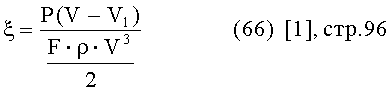
где P - лобовое давление воздушного потока на лопасти ветроколеса;where P is the frontal pressure of the air flow on the blades of the wind wheel;
V - скорость рабочей струи воздушного потока;V is the speed of the working stream of the air flow;
V1 - то же в плоскости ветроколеса;V 1 - the same in the plane of the wind wheel;
F - площадь рабочей струи, ометаемая ветроколесом;F is the area of the working jet swept by the wind wheel;
ρ - плотность воздушного потока.ρ is the density of the air flow.
После преобразований уравнение (66) принимает вид:After transformations, equation (66) takes the form:

Очевидно, величина P в уравнении (66a) - это та часть общего давления ветрового потока, которая приходится на проекцию тела произвольной формы на плоскость, перпендикулярную направлению ветра, при этом ее называют миделевым сечением и обозначают через F1, а величину давления, приходящуюся на миделево сечение, называют лобовым давлением и обозначают через Px.Obviously, the value of P in equation (66a) is that part of the total pressure of the wind flow that falls on the projection of a body of arbitrary shape onto a plane perpendicular to the direction of the wind, while it is called the mid-section and denoted by F 1 , and the pressure value attributable to mid-section, called frontal pressure and denoted by P x .
Известно уравнение для определения величины Px, которое представлено в виде:A known equation for determining the value of P x , which is presented in the form:

Подставив (41) в (66а) после преобразований получим:Substituting (41) into (66a) after the transformations, we obtain:
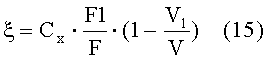
где Cx - коэффициент лобового сопротивления (определяют по таблице 2 [1], стр.49);where C x - drag coefficient (determined according to table 2 [1], p. 49);


Подставив приведенные обозначения в формулу (15), получим окончательную универсальную формулу для определения численного значения коэффициента использования энергии ветра ветроколесами любого типа.Substituting the above notation into formula (15), we obtain the final universal formula for determining the numerical value of the coefficient of utilization of wind energy by any type of wind wheels.

где Cx учитывает соотношение длины и ширины лопастей;where C x takes into account the ratio of the length and width of the blades;
Кз - показывает, какая доля ометаемой ветроколесом поверхности перекрывается его миделевым сечением, и e - какая доля скорости ветрового потока расходуется на создание крутящего момента на силовом валу ветроколеса.To s - shows what proportion of the surface swept by the windwheel is overlapped by its mid-section, and e - what proportion of the speed of the wind flow is spent on creating torque on the power shaft of the wind wheel.
Так при Сх=1,3; Кз=0.208 (для четырехлопастного ветроколеса) и е=0,33So at C x = 1.3; K s = 0.208 (for a four-blade wind wheel) and e = 0.33
ξ=1,3·0,208·(1-0,33)=0,18 max.ξ = 1.3 · 0.208 · (1-0.33) = 0.18 max.
Яркой иллюстрацией произвольного толкования коэффициента использования энергии ветра является утверждение доктора технических наук Фатеева Е.М. о том, что путем соблюдения ряда условий (относящихся явно к неопределенным понятиям) этот показатель может достигать 46% (0,46), (см. [1], стр.87), что не соответствует действительности.A vivid illustration of the arbitrary interpretation of the coefficient of utilization of wind energy is the statement of the doctor of technical sciences Fateeva EM that by observing a number of conditions (explicitly related to vague concepts) this indicator can reach 46% (0.46), (see [1], p. 87), which is not true.
Известен ротор ветродвигателя [2], содержащий поворотную платформу, несущую стойки, на которых установлено с возможностью свободного вращения парусное ветроколесо, выполненное в виде вала, на концах которого закреплена по спирали конусообразная ленточная упругая лопасть с убывающими радиусом и шагом спирали, при этом один из концов спирали закреплен на втулке, имеющей возможность осевого перемещения вдоль вала.A known rotor of a wind turbine [2], comprising a rotary platform supporting racks on which a sailing wind wheel is mounted with the possibility of free rotation, is made in the form of a shaft, at the ends of which a conical ribbon elastic blade with decreasing radius and pitch of the spiral is fixed, with one of the ends of the spiral is mounted on a sleeve having axial movement along the shaft.
Такое конструктивное исполнение лопасти обеспечивает высокий коэффициент заполнения и соответствующий коэффициент использования энергии ветра, т.к. при этой конструкции миделево сечение спиральной лопасти практически идентично ометаемой ветроколесом поверхности и численное значение коэффициента заполнения близко к единице.This design of the blade provides a high duty cycle and the corresponding utilization of wind energy, because with this design, the mid-section of the spiral blade is almost identical to the surface swept by the wind wheel and the numerical value of the fill factor is close to unity.
Однако практическая реализация этого технического решения весьма затруднительна, т.к. конструкция ветроколеса крайне нетехнологична и требует специального оборудования, на общетехнологических базах машиностроительных заводов которого просто не существует.However, the practical implementation of this technical solution is very difficult, because the design of the wind wheel is extremely low-tech and requires special equipment, on the general technological bases of machine-building plants which simply does not exist.
Кроме того, необходимая жесткость спиральной ленты без сплошного жесткого крепления к валу ветроколеса при ее длине в несколько шагов спирали недостижима, а балансировка ветроколеса по всей его длине весьма затруднительна.In addition, the necessary rigidity of the spiral tape without continuous rigid attachment to the shaft of the wind wheel with its length of several spiral steps is unattainable, and balancing the wind wheel along its entire length is very difficult.
Заявленный объект содержит поворотную платформу, несущую стойки, на которых установлено с возможностью свободного вращения крыльчато-парусное ветроколесо, выполненное в виде вала, на концах которого установлены передний и задний махи, несущие жестко закрепленные на них лопасти. Передний мах, обращенный навстречу ветру, выполнен в виде трубчатого креста, противоположный ему задний мах выполнен в виде квадратной трубчатой рамки, ребра которой жестко закреплены средней частью на свободных концах трубчатого креста, идентичного переднему кресту перпендикулярно им, а лопасти выполнены в виде прямоугольных пластин из тонколистового или тканевого материала и жестко закреплены одной из своих граней на трубках переднего маха и противоположной гранью - на соответствующих половинах внешних ребер квадратной трубчатой рамки заднего маха, параллельных трубкам переднего маха.The claimed object contains a rotary platform, bearing racks, on which a wing-sailing wind wheel is mounted with the possibility of free rotation, made in the form of a shaft, at the ends of which there are front and rear wings, bearing blades rigidly fixed to them. The front swing, facing the wind, is made in the form of a tubular cross, the opposite back swing is made in the form of a square tubular frame, the ribs of which are rigidly fixed with the middle part on the free ends of the tubular cross, identical to the front cross perpendicular to them, and the blades are made in the form of rectangular plates of thin-sheet or fabric material and are rigidly fixed by one of its faces to the tubes of the front Mach and the opposite side - on the corresponding halves of the outer edges of the square tubular p pits rear maha maha parallel tubes of the front.
Технические преимущества заявленного объекта по сравнению с прототипом заключаются в следующем:Technical advantages of the claimed object compared to the prototype are as follows:
- выполнение переднего маха в виде, например, трубчатого креста, а заднего маха - в виде трубчатой квадратной рамки, средней частью своих ребер жестко закрепленной на концах трубчатого креста, идентичного переднему маху перпендикулярно им, обеспечивает возможность выполнения лопастей в виде прямоугольных пластин из тонколистового или тканевого материала;- the implementation of the front swing in the form of, for example, a tubular cross, and the rear swing - in the form of a tubular square frame, the middle part of its ribs rigidly fixed to the ends of the tubular cross, identical to the front swing perpendicular to them, makes it possible to make the blades in the form of rectangular plates of thin-sheet or fabric material;
- жесткое крепление прямоугольных лопастей одной из своих граней на трубках переднего маха и противоположной гранью - на соответствующих половинах внешних ребер квадратной трубчатой рамки заднего маха, параллельных трубкам переднего маха, обеспечивает компактность взаимного расположения лопастей с минимальным межлопастным пространством между ними и разнонаправленность частей ветрового потока, сбегающих с лопастей в заколесное пространство.- rigid fastening of the rectangular blades of one of its faces on the front Mach tubes and the opposite side - on the corresponding halves of the outer edges of the square tubular frame of the rear mach, parallel to the front mach tubes, provides a compact mutual arrangement of the blades with minimal inter-blade space between them and different directions of the parts of the wind flow, escaping from the blades into the wheel space.
Совокупность указанных технических преимуществ заявленного объекта по сравнению с прототипом обеспечивает технический результат, заключающийся в существенном уменьшении длины ветроколеса до 0,25 длины шага спирали прототипа, что позволяет устанавливать заявленный объект на крышах жилых домов и осветительных вышках потенциально опасных участков автомагистралей, повышении технологичности конструкции путем выполнения лопастей в простейшем варианте в виде прямоугольных пластин из тонколистового или тканевого материала, жестко скрепляющих между собой все элементы ветроколеса, а также в упрощении технологии и повышении качества его балансировки за счет уменьшения общей длины ветроколеса.The combination of the indicated technical advantages of the claimed object in comparison with the prototype provides a technical result consisting in a significant reduction in the length of the wind wheel to 0.25 of the helix pitch of the prototype, which makes it possible to install the claimed object on the roofs of residential buildings and lighting towers of potentially dangerous sections of highways, increasing the manufacturability of the structure by the execution of the blades in the simplest embodiment in the form of rectangular plates of thin-sheet or fabric material, rigidly fastened interconnecting all elements of the wind wheel, as well as in simplifying the technology and improving the quality of its balancing by reducing the total length of the wind wheel.
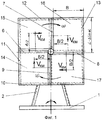
На приведенных чертежах схематично иллюстрируется крыльчато-парусная ВЭУ, где на фиг.1 показана ее проекция со стороны, обращенной навстречу ветру; на фиг.2 - то же, вид сбоку. При этом прямыми стрелками показан характер распределения скорости ветра при его взаимодействии с лопастями ветроколеса, где:In the drawings, a wing-sailing wind turbine is schematically illustrated, where in Fig. 1 its projection is shown from the side facing the wind; figure 2 is the same side view. In this case, the straight arrows show the nature of the distribution of wind speed during its interaction with the blades of the wind wheel, where:
Vп - потери скорости сбегающего с лопастей потока ветра в заколесное пространство;V p - loss of velocity of the wind flow escaping from the blades into the wheel space;
Vкм - доля скорости, обеспечивающая создание крутящего момента на валу ветроколеса.V km is the fraction of speed that provides the creation of torque on the shaft of the wind wheel.
Дуговой стрелкой показано направление движения поворотной платформы в процессе самоустановки ветроколеса под действием ветрового потока в перпендикулярное к нему положение.The arrow arrow shows the direction of movement of the turntable during the self-installation of the wind wheel under the influence of the wind flow in a position perpendicular to it.
Крыльчато-парусная ветроэнергетическая установка (ВЭУ) содержит поворотную платформу 1, несущую стойки 2, на которых установлено с возможностью свободного вращения крыльчато-парусное ветроколесо, выполненное в виде вала 3, на концах которого установлены передний 4 и задний 5 махи, несущие жестко закрепленные на них лопасти. Причем передний мах 4 обращен навстречу ветру, а задний мах 5 расположен на подветренной стороне. Передний мах 4 выполнен в виде трубчатого креста с трубками 6, 7, 8 и 9, а задний мах 5 выполнен в виде идентичного переднему маху 4 трубчатого креста, свободные концы трубок которого охвачены квадратной трубчатой рамкой, ребра 10, 11, 12 и 13 которой жестко закреплены средней частью на свободных концах трубок 6, 7, 8 и 9, идентичного трубчатого креста перпендикулярно им и разделены местами крепления на две равные части. На переднем 4 и заднем 5 махах жестко закреплены лопасти 14, 15, 16 и 17, выполненные в виде плоских прямоугольных пластин из тонколистового или тканевого материала, которые жестко закреплены одной из своих граней на трубках 6, 7, 8 и 9 переднего маха 4, а противоположной гранью также жестко закреплены на соответствующей половине внешних ребер 10, 11, 12 и 13 под углом атаки α к направлению ветра, образуя жесткие связи 6-10-14, 7-11-15, 8-12-16 и 9-13-17, что в совокупности с жесткими связями махов 4 и 5 с валом 3 образует жесткую конструкцию крыльчато-парусного ветроколеса, вращающего исполнительный механизм, например генератор 18 электрического тока.The winged-sailing wind power installation (wind turbine) contains a
При появлении ветра со скоростью Vв его поток давит на лопасти 14, 15, 16 и 17 под углом атаки α, при этом скорость ветра на каждой лопасти разлагается на составляющие:When a wind appears at a speed V , its flow presses on the
Vлд - скорость, создающая лобовое давление на лопасть, направленная перпендикулярно ее плоскости, формирующая крутящий момент на валу 3;V ld - the speed that creates frontal pressure on the blade, directed perpendicular to its plane, forming torque on the shaft 3;
Vп1 - скорость, направленная по плоскости лопасти и уходящая в заколесное пространство в виде потерь, при этом потоки потерь взаимно перпендикулярны и действуют в разных плоскостях, что исключает воздействие потока на депрессионную зону на тыльной стороне вслед идущей лопасти и способствует увеличению лобового давления.V n1 - velocity directed along the plane of the blade and going into zakolesnoe space as a loss, the loss of flow are mutually perpendicular and are in different planes, which eliminates the impact of the flow on a depression zone on the rear side after extending blade and the ram pressure increases.
Очевидно, чтоIt's obvious that

Однако не вся величина составляющей Vлд идет на формирование крутящего момента, т.к. она не перпендикулярна валу 3 ветроколеса, а образует с направлением Vкм также угол α.However, not all the magnitude of the component V l goes to the formation of torque, because it is not perpendicular to the shaft 3 of the wind wheel, but forms an angle α with the direction of V km .

Подставив (18) в (17) и решив уравнение относительно Vкм, получим уравнение (19) для определения доли скорости ветра (Vкм), приходящейся на формирование крутящего момента на валу 3 ветроколеса.Substituting (18) into (17) and solving the equation for V km , we obtain equation (19) to determine the fraction of wind speed (V km ) attributable to the formation of torque on the shaft 3 of the wind wheel.

Крутящий момент на валу ветроколеса определяется по общеизвестной формуле:The torque on the shaft of the wind wheel is determined by the well-known formula:
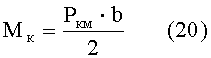
где Ркм - окружное усилие, создаваемое составляющей Vкм скорости ветра;where P km is the circumferential force created by the component V km of wind speed;
b - ширина лопасти.b is the width of the blade.
Величину Ркм определяют по уравнению:The value of P km is determined by the equation:

где Сх - коэффициент лобового сопротивления, учитывающий форму лопасти. Согласно табл.2 [1], стр.49. Сх=1,1.where C x - drag coefficient taking into account the shape of the blade. According to table.2 [1], p. 49. C x = 1.1.
F - площадь миделева сечения ветроколеса.F is the area of the mid-section of the wind wheel.
ρ - плотность воздуха 1,25 кг/м3.ρ is the air density of 1.25 kg / m 3 .
С учетом того, что рассматриваемое ветроколесо содержит 4 лопасти длиной L каждая, уравнение (41) примет вид:Given that the wind wheel under consideration contains 4 blades of length L each, equation (41) takes the form:

Подставив (21) в (20) с учетом (19) после преобразований, получим:Substituting (21) into (20) taking into account (19) after the transformations, we obtain:

Для сравнения заявленного объекта с работающими ветряками по величине коэффициента ξ использования энергии ветра, определяемого по формуле (15), необходимо определить коэффициент заполнения Кз, который для рассматриваемой конструкции определяется как отношение площади квадрата к площади круга диаметром, равным его диагонали, т.е. к площади круга описанной окружности.To compare the claimed object with the working windmills by the value of the coefficient ξ of use of wind energy, determined by the formula (15), it is necessary to determine the fill factor K s , which for the structure under consideration is defined as the ratio of the square to the square of a circle with a diameter equal to its diagonal, i.e. . to the area of a circle of a circumscribed circle.
Из элементарной геометрии известно, что эта величина составляет 0,65.From elementary geometry it is known that this value is 0.65.
Тогда ξ=1,1·0,65·(1-0,33)=0,472.Then ξ = 1.1 · 0.65 · (1-0.33) = 0.472.
Результат сравнения коэффициентов известных конструкций и заявленного объекта свидетельствует о том, что этот параметр для последнего выше в 2,472 раза.The result of a comparison of the coefficients of known structures and the claimed object indicates that this parameter for the latter is 2.472 times higher.
Источники информацииInformation sources
1. Фатеев Е.М. Ветродвигатели и ветроустановки. - М.: ОГИЗ-сельхоз, 1948 г., 185 с.1. Fateev E.M. Wind turbines and wind turbines. - M .: OGIZ-agricultural, 1948, 185 p.
2. Описание изобретения к авторскому свидетельству СССР №1638359 от 03.04.89 г., МПК F03D 1/06 (прототип).2. Description of the invention to the USSR author's certificate No. 1638359 of 04/03/89,
Claims (1)
Priority Applications (1)
| Application Number | Priority Date | Filing Date | Title |
|---|---|---|---|
| RU2011114063/06A RU2463473C1 (en) | 2011-04-11 | 2011-04-11 | Vane-sail wind power plant |
Applications Claiming Priority (1)
| Application Number | Priority Date | Filing Date | Title |
|---|---|---|---|
| RU2011114063/06A RU2463473C1 (en) | 2011-04-11 | 2011-04-11 | Vane-sail wind power plant |
Publications (1)
| Publication Number | Publication Date |
|---|---|
| RU2463473C1 true RU2463473C1 (en) | 2012-10-10 |
Family
ID=47079588
Family Applications (1)
| Application Number | Title | Priority Date | Filing Date |
|---|---|---|---|
| RU2011114063/06A RU2463473C1 (en) | 2011-04-11 | 2011-04-11 | Vane-sail wind power plant |
Country Status (1)
| Country | Link |
|---|---|
| RU (1) | RU2463473C1 (en) |
Cited By (2)
| Publication number | Priority date | Publication date | Assignee | Title |
|---|---|---|---|---|
| RU2526415C2 (en) * | 2012-12-07 | 2014-08-20 | Александр Иванович Якимов | Wing-sail windmill |
| RU2721928C1 (en) * | 2019-10-08 | 2020-05-25 | Федеральное государственное бюджетное образовательное учреждение высшего образования "Иркутский государственный аграрный университет имени А.А. Ежевского" | Wind-driven plant |
Citations (5)
| Publication number | Priority date | Publication date | Assignee | Title |
|---|---|---|---|---|
| SU27618A1 (en) * | 1931-07-23 | 1932-08-31 | В.А. Барановский | Vertical wind motor |
| US4086026A (en) * | 1977-02-04 | 1978-04-25 | Tamanini Robert J | Windmill with radial vanes |
| SU1469204A1 (en) * | 1986-07-31 | 1989-03-30 | Shmidre Petr A | Wind wheel |
| MD2994B1 (en) * | 2004-12-30 | 2006-02-28 | Universitatea Tehnica A Moldovei | Helical wind turbine (variants) |
| RU2359151C1 (en) * | 2008-02-26 | 2009-06-20 | Валерий Владимирович Салов | Wind motor |
-
2011
- 2011-04-11 RU RU2011114063/06A patent/RU2463473C1/en not_active IP Right Cessation
Patent Citations (5)
| Publication number | Priority date | Publication date | Assignee | Title |
|---|---|---|---|---|
| SU27618A1 (en) * | 1931-07-23 | 1932-08-31 | В.А. Барановский | Vertical wind motor |
| US4086026A (en) * | 1977-02-04 | 1978-04-25 | Tamanini Robert J | Windmill with radial vanes |
| SU1469204A1 (en) * | 1986-07-31 | 1989-03-30 | Shmidre Petr A | Wind wheel |
| MD2994B1 (en) * | 2004-12-30 | 2006-02-28 | Universitatea Tehnica A Moldovei | Helical wind turbine (variants) |
| RU2359151C1 (en) * | 2008-02-26 | 2009-06-20 | Валерий Владимирович Салов | Wind motor |
Cited By (2)
| Publication number | Priority date | Publication date | Assignee | Title |
|---|---|---|---|---|
| RU2526415C2 (en) * | 2012-12-07 | 2014-08-20 | Александр Иванович Якимов | Wing-sail windmill |
| RU2721928C1 (en) * | 2019-10-08 | 2020-05-25 | Федеральное государственное бюджетное образовательное учреждение высшего образования "Иркутский государственный аграрный университет имени А.А. Ежевского" | Wind-driven plant |
Similar Documents
| Publication | Publication Date | Title |
|---|---|---|
| Whittlesey | Vertical axis wind turbines: Farm and turbine design | |
| Tenguria et al. | Investigation of blade performance of horizontal axis wind turbine based on blade element momentum theory (BEMT) using NACA airfoils | |
| Sarma et al. | Hybrid/combined Darrieus–Savonius wind turbines: Erstwhile development and future prognosis | |
| Didane et al. | Development and performance investigation of a unique dual-rotor Savonius-type counter-rotating wind turbine | |
| JP6954739B2 (en) | Rotor for generator | |
| Duran | Computer-aided design of horizontal-axis wind turbine blades | |
| Kekezoğlu et al. | A new wind turbine concept: design and implementation | |
| Sarkar et al. | Experimental study of vertical axis wind turbine performance under vibration | |
| Satwika et al. | Investigation flow on horizontal axis wind turbine with Betz chord distribution, twist, and winglet | |
| Al-Abadi et al. | Development of an experimental setup for double rotor HAWT investigation | |
| Douak et al. | Starting torque study of darrieus wind turbine | |
| CN103216381A (en) | Vane of wind generating set | |
| Maican et al. | Analysis and optimization of a Savonius-Darrieus hybrid wind turbine | |
| Rahman et al. | Aerodynamic Performance and Vibration Analyses of Small Scale Horizontal Axis Wind Turbine with Various Number of Blades | |
| Sarathi et al. | Study on Wind Turbine and Its Aerodynamic Performance | |
| JP2019173636A (en) | Output enhancement device of power generator, and natural energy type power generator | |
| US20210348595A1 (en) | Fluid turbine | |
| Seralathan et al. | Experimental and numerical studies on a cross axis wind turbine | |
| RU2689661C1 (en) | Wind-driven power plant | |
| Rishmany et al. | Optimization of a vertical axis wind turbine using FEA, multibody dynamics and wind tunnel testing | |
| Yershina et al. | Some design features of the carousel type wind turbine Bidarrieus | |
| Asfar et al. | Wake patterns in a dual-rotor wind turbine | |
| Somoano Rodríguez et al. | Bio-inspired blades with local trailing edge flexibility increase the efficiency of vertical axis wind turbines | |
| Balijepalli et al. | Tower Under Low Wind Speeds | |
| Khan et al. | Effect of Tip Speed Ratio on the Flow Characteristics of Single-bladed Darrieus Wind Turbine |
Legal Events
| Date | Code | Title | Description |
|---|---|---|---|
| MM4A | The patent is invalid due to non-payment of fees |
Effective date: 20150412 |