RU2496503C2 - Polysaccharide derivative hydrogel - Google Patents
Polysaccharide derivative hydrogel Download PDFInfo
- Publication number
- RU2496503C2 RU2496503C2 RU2011138176/15A RU2011138176A RU2496503C2 RU 2496503 C2 RU2496503 C2 RU 2496503C2 RU 2011138176/15 A RU2011138176/15 A RU 2011138176/15A RU 2011138176 A RU2011138176 A RU 2011138176A RU 2496503 C2 RU2496503 C2 RU 2496503C2
- Authority
- RU
- Russia
- Prior art keywords
- use according
- hydrogel
- dysfunction
- cellulose derivative
- formula
- Prior art date
Links
- 239000000017 hydrogel Substances 0.000 title claims abstract description 50
- 150000004676 glycans Chemical class 0.000 title abstract description 22
- 229920001282 polysaccharide Polymers 0.000 title abstract description 22
- 239000005017 polysaccharide Substances 0.000 title abstract description 22
- 239000000463 material Substances 0.000 claims abstract description 45
- 210000005036 nerve Anatomy 0.000 claims abstract description 41
- 230000004064 dysfunction Effects 0.000 claims abstract description 40
- 230000000694 effects Effects 0.000 claims abstract description 15
- 239000007864 aqueous solution Substances 0.000 claims abstract description 8
- 229920002678 cellulose Polymers 0.000 claims description 36
- 239000001913 cellulose Substances 0.000 claims description 36
- XLYOFNOQVPJJNP-UHFFFAOYSA-N water Substances O XLYOFNOQVPJJNP-UHFFFAOYSA-N 0.000 claims description 28
- 210000003497 sciatic nerve Anatomy 0.000 claims description 25
- 238000006467 substitution reaction Methods 0.000 claims description 20
- 210000000578 peripheral nerve Anatomy 0.000 claims description 16
- 230000008929 regeneration Effects 0.000 claims description 15
- 238000011069 regeneration method Methods 0.000 claims description 15
- 230000007830 nerve conduction Effects 0.000 claims description 11
- 150000003839 salts Chemical class 0.000 claims description 10
- 229910052784 alkaline earth metal Inorganic materials 0.000 claims description 9
- 125000003342 alkenyl group Chemical group 0.000 claims description 9
- 210000003007 myelin sheath Anatomy 0.000 claims description 9
- 125000000217 alkyl group Chemical group 0.000 claims description 6
- 150000001342 alkaline earth metals Chemical class 0.000 claims description 5
- 125000002811 oleoyl group Chemical group O=C([*])C([H])([H])C([H])([H])C([H])([H])C([H])([H])C([H])([H])C([H])([H])C([H])([H])/C([H])=C([H])\C([H])([H])C([H])([H])C([H])([H])C([H])([H])C([H])([H])C([H])([H])C([H])([H])C([H])([H])[H] 0.000 claims description 5
- 239000003513 alkali Substances 0.000 claims description 4
- 206010039227 Rotator cuff syndrome Diseases 0.000 claims 2
- 239000000126 substance Substances 0.000 abstract description 14
- 238000011084 recovery Methods 0.000 abstract description 5
- 230000001537 neural effect Effects 0.000 abstract 3
- 239000003814 drug Substances 0.000 abstract 2
- LFQSCWFLJHTTHZ-UHFFFAOYSA-N Ethanol Chemical compound CCO LFQSCWFLJHTTHZ-UHFFFAOYSA-N 0.000 description 31
- 238000001356 surgical procedure Methods 0.000 description 21
- 229920002134 Carboxymethyl cellulose Polymers 0.000 description 17
- 239000001768 carboxy methyl cellulose Substances 0.000 description 17
- 239000008112 carboxymethyl-cellulose Substances 0.000 description 17
- 229940105329 carboxymethylcellulose Drugs 0.000 description 17
- 239000003960 organic solvent Substances 0.000 description 17
- JZNWSCPGTDBMEW-UHFFFAOYSA-N Glycerophosphorylethanolamin Natural products NCCOP(O)(=O)OCC(O)CO JZNWSCPGTDBMEW-UHFFFAOYSA-N 0.000 description 16
- WYURNTSHIVDZCO-UHFFFAOYSA-N Tetrahydrofuran Chemical compound C1CCOC1 WYURNTSHIVDZCO-UHFFFAOYSA-N 0.000 description 16
- 235000010948 carboxy methyl cellulose Nutrition 0.000 description 16
- 150000008104 phosphatidylethanolamines Chemical class 0.000 description 16
- 238000006243 chemical reaction Methods 0.000 description 13
- 239000003795 chemical substances by application Substances 0.000 description 13
- 238000000034 method Methods 0.000 description 13
- 241000700159 Rattus Species 0.000 description 12
- FAPWRFPIFSIZLT-UHFFFAOYSA-M Sodium chloride Chemical compound [Na+].[Cl-] FAPWRFPIFSIZLT-UHFFFAOYSA-M 0.000 description 11
- 206010060932 Postoperative adhesion Diseases 0.000 description 9
- 125000003178 carboxy group Chemical group [H]OC(*)=O 0.000 description 9
- 230000000052 comparative effect Effects 0.000 description 9
- 238000004659 sterilization and disinfection Methods 0.000 description 9
- QGMRQYFBGABWDR-UHFFFAOYSA-M Pentobarbital sodium Chemical compound [Na+].CCCC(C)C1(CC)C(=O)NC(=O)[N-]C1=O QGMRQYFBGABWDR-UHFFFAOYSA-M 0.000 description 8
- 238000002347 injection Methods 0.000 description 8
- 239000007924 injection Substances 0.000 description 8
- 239000000203 mixture Substances 0.000 description 8
- YLQBMQCUIZJEEH-UHFFFAOYSA-N tetrahydrofuran Natural products C=1C=COC=1 YLQBMQCUIZJEEH-UHFFFAOYSA-N 0.000 description 8
- 229960001412 pentobarbital Drugs 0.000 description 7
- 206010002091 Anaesthesia Diseases 0.000 description 6
- KFZMGEQAYNKOFK-UHFFFAOYSA-N Isopropanol Chemical compound CC(C)O KFZMGEQAYNKOFK-UHFFFAOYSA-N 0.000 description 6
- OKKJLVBELUTLKV-UHFFFAOYSA-N Methanol Chemical compound OC OKKJLVBELUTLKV-UHFFFAOYSA-N 0.000 description 6
- HEMHJVSKTPXQMS-UHFFFAOYSA-M Sodium hydroxide Chemical compound [OH-].[Na+] HEMHJVSKTPXQMS-UHFFFAOYSA-M 0.000 description 6
- 230000037005 anaesthesia Effects 0.000 description 6
- 239000000499 gel Substances 0.000 description 6
- 210000003205 muscle Anatomy 0.000 description 6
- 150000003904 phospholipids Chemical class 0.000 description 6
- 239000011780 sodium chloride Substances 0.000 description 6
- 230000001954 sterilising effect Effects 0.000 description 6
- 208000027418 Wounds and injury Diseases 0.000 description 5
- 239000012153 distilled water Substances 0.000 description 5
- 238000001727 in vivo Methods 0.000 description 5
- 239000000243 solution Substances 0.000 description 5
- 238000005406 washing Methods 0.000 description 5
- IAZDPXIOMUYVGZ-UHFFFAOYSA-N Dimethylsulphoxide Chemical compound CS(C)=O IAZDPXIOMUYVGZ-UHFFFAOYSA-N 0.000 description 4
- 241001465754 Metazoa Species 0.000 description 4
- 206010056677 Nerve degeneration Diseases 0.000 description 4
- 230000014759 maintenance of location Effects 0.000 description 4
- 238000004519 manufacturing process Methods 0.000 description 4
- 238000000746 purification Methods 0.000 description 4
- 239000007858 starting material Substances 0.000 description 4
- KIUKXJAPPMFGSW-DNGZLQJQSA-N (2S,3S,4S,5R,6R)-6-[(2S,3R,4R,5S,6R)-3-Acetamido-2-[(2S,3S,4R,5R,6R)-6-[(2R,3R,4R,5S,6R)-3-acetamido-2,5-dihydroxy-6-(hydroxymethyl)oxan-4-yl]oxy-2-carboxy-4,5-dihydroxyoxan-3-yl]oxy-5-hydroxy-6-(hydroxymethyl)oxan-4-yl]oxy-3,4,5-trihydroxyoxane-2-carboxylic acid Chemical compound CC(=O)N[C@H]1[C@H](O)O[C@H](CO)[C@@H](O)[C@@H]1O[C@H]1[C@H](O)[C@@H](O)[C@H](O[C@H]2[C@@H]([C@@H](O[C@H]3[C@@H]([C@@H](O)[C@H](O)[C@H](O3)C(O)=O)O)[C@H](O)[C@@H](CO)O2)NC(C)=O)[C@@H](C(O)=O)O1 KIUKXJAPPMFGSW-DNGZLQJQSA-N 0.000 description 3
- CPKVUHPKYQGHMW-UHFFFAOYSA-N 1-ethenylpyrrolidin-2-one;molecular iodine Chemical compound II.C=CN1CCCC1=O CPKVUHPKYQGHMW-UHFFFAOYSA-N 0.000 description 3
- LYCAIKOWRPUZTN-UHFFFAOYSA-N Ethylene glycol Chemical compound OCCO LYCAIKOWRPUZTN-UHFFFAOYSA-N 0.000 description 3
- ZMXDDKWLCZADIW-UHFFFAOYSA-N N,N-Dimethylformamide Chemical compound CN(C)C=O ZMXDDKWLCZADIW-UHFFFAOYSA-N 0.000 description 3
- LRHPLDYGYMQRHN-UHFFFAOYSA-N N-Butanol Chemical compound CCCCO LRHPLDYGYMQRHN-UHFFFAOYSA-N 0.000 description 3
- DKGAVHZHDRPRBM-UHFFFAOYSA-N Tert-Butanol Chemical compound CC(C)(C)O DKGAVHZHDRPRBM-UHFFFAOYSA-N 0.000 description 3
- 230000003187 abdominal effect Effects 0.000 description 3
- DPXJVFZANSGRMM-UHFFFAOYSA-N acetic acid;2,3,4,5,6-pentahydroxyhexanal;sodium Chemical compound [Na].CC(O)=O.OCC(O)C(O)C(O)C(O)C=O DPXJVFZANSGRMM-UHFFFAOYSA-N 0.000 description 3
- 210000001217 buttock Anatomy 0.000 description 3
- 239000012304 carboxyl activating agent Substances 0.000 description 3
- 125000002057 carboxymethyl group Chemical group [H]OC(=O)C([H])([H])[*] 0.000 description 3
- 208000003295 carpal tunnel syndrome Diseases 0.000 description 3
- 238000002316 cosmetic surgery Methods 0.000 description 3
- 230000006378 damage Effects 0.000 description 3
- -1 dimethylaminopropyl Chemical group 0.000 description 3
- 238000001914 filtration Methods 0.000 description 3
- 230000035876 healing Effects 0.000 description 3
- 229920002674 hyaluronan Polymers 0.000 description 3
- 229960003160 hyaluronic acid Drugs 0.000 description 3
- 238000011694 lewis rat Methods 0.000 description 3
- 238000001556 precipitation Methods 0.000 description 3
- 238000002278 reconstructive surgery Methods 0.000 description 3
- 238000003756 stirring Methods 0.000 description 3
- 238000011477 surgical intervention Methods 0.000 description 3
- RYHBNJHYFVUHQT-UHFFFAOYSA-N 1,4-Dioxane Chemical compound C1COCCO1 RYHBNJHYFVUHQT-UHFFFAOYSA-N 0.000 description 2
- ASOKPJOREAFHNY-UHFFFAOYSA-N 1-Hydroxybenzotriazole Chemical compound C1=CC=C2N(O)N=NC2=C1 ASOKPJOREAFHNY-UHFFFAOYSA-N 0.000 description 2
- RIRBAVAYPRSMRH-UHFFFAOYSA-N 2,4-dimethoxy-1,3,5-triazine Chemical compound COC1=NC=NC(OC)=N1 RIRBAVAYPRSMRH-UHFFFAOYSA-N 0.000 description 2
- CSCPPACGZOOCGX-UHFFFAOYSA-N Acetone Chemical compound CC(C)=O CSCPPACGZOOCGX-UHFFFAOYSA-N 0.000 description 2
- VEXZGXHMUGYJMC-UHFFFAOYSA-M Chloride anion Chemical compound [Cl-] VEXZGXHMUGYJMC-UHFFFAOYSA-M 0.000 description 2
- 206010016654 Fibrosis Diseases 0.000 description 2
- PEDCQBHIVMGVHV-UHFFFAOYSA-N Glycerine Chemical compound OCC(O)CO PEDCQBHIVMGVHV-UHFFFAOYSA-N 0.000 description 2
- VEXZGXHMUGYJMC-UHFFFAOYSA-N Hydrochloric acid Chemical compound Cl VEXZGXHMUGYJMC-UHFFFAOYSA-N 0.000 description 2
- YNAVUWVOSKDBBP-UHFFFAOYSA-N Morpholine Chemical compound C1COCCN1 YNAVUWVOSKDBBP-UHFFFAOYSA-N 0.000 description 2
- SECXISVLQFMRJM-UHFFFAOYSA-N N-Methylpyrrolidone Chemical compound CN1CCCC1=O SECXISVLQFMRJM-UHFFFAOYSA-N 0.000 description 2
- SJRJJKPEHAURKC-UHFFFAOYSA-N N-methylmorpholine Substances CN1CCOCC1 SJRJJKPEHAURKC-UHFFFAOYSA-N 0.000 description 2
- 208000012902 Nervous system disease Diseases 0.000 description 2
- 208000025966 Neurological disease Diseases 0.000 description 2
- GLUUGHFHXGJENI-UHFFFAOYSA-N Piperazine Chemical compound C1CNCCN1 GLUUGHFHXGJENI-UHFFFAOYSA-N 0.000 description 2
- NQRYJNQNLNOLGT-UHFFFAOYSA-N Piperidine Chemical compound C1CCNCC1 NQRYJNQNLNOLGT-UHFFFAOYSA-N 0.000 description 2
- DNIAPMSPPWPWGF-UHFFFAOYSA-N Propylene glycol Chemical compound CC(O)CO DNIAPMSPPWPWGF-UHFFFAOYSA-N 0.000 description 2
- JUJWROOIHBZHMG-UHFFFAOYSA-N Pyridine Chemical compound C1=CC=NC=C1 JUJWROOIHBZHMG-UHFFFAOYSA-N 0.000 description 2
- 206010058942 Ulnar tunnel syndrome Diseases 0.000 description 2
- 230000003213 activating effect Effects 0.000 description 2
- 150000001412 amines Chemical class 0.000 description 2
- 239000006227 byproduct Substances 0.000 description 2
- 239000003054 catalyst Substances 0.000 description 2
- 150000001875 compounds Chemical class 0.000 description 2
- 239000003431 cross linking reagent Substances 0.000 description 2
- 150000004292 cyclic ethers Chemical class 0.000 description 2
- 230000006837 decompression Effects 0.000 description 2
- 239000000645 desinfectant Substances 0.000 description 2
- MWRBNPKJOOWZPW-CLFAGFIQSA-N dioleoyl phosphatidylethanolamine Chemical compound CCCCCCCC\C=C/CCCCCCCC(=O)OCC(COP(O)(=O)OCCN)OC(=O)CCCCCCC\C=C/CCCCCCCC MWRBNPKJOOWZPW-CLFAGFIQSA-N 0.000 description 2
- 230000004761 fibrosis Effects 0.000 description 2
- NPZTUJOABDZTLV-UHFFFAOYSA-N hydroxybenzotriazole Substances O=C1C=CC=C2NNN=C12 NPZTUJOABDZTLV-UHFFFAOYSA-N 0.000 description 2
- 230000001771 impaired effect Effects 0.000 description 2
- 208000014674 injury Diseases 0.000 description 2
- 238000005259 measurement Methods 0.000 description 2
- 239000012046 mixed solvent Substances 0.000 description 2
- DHRLEVQXOMLTIM-UHFFFAOYSA-N phosphoric acid;trioxomolybdenum Chemical compound O=[Mo](=O)=O.O=[Mo](=O)=O.O=[Mo](=O)=O.O=[Mo](=O)=O.O=[Mo](=O)=O.O=[Mo](=O)=O.O=[Mo](=O)=O.O=[Mo](=O)=O.O=[Mo](=O)=O.O=[Mo](=O)=O.O=[Mo](=O)=O.O=[Mo](=O)=O.OP(O)(O)=O DHRLEVQXOMLTIM-UHFFFAOYSA-N 0.000 description 2
- 239000000843 powder Substances 0.000 description 2
- 239000002244 precipitate Substances 0.000 description 2
- BDERNNFJNOPAEC-UHFFFAOYSA-N propan-1-ol Chemical compound CCCO BDERNNFJNOPAEC-UHFFFAOYSA-N 0.000 description 2
- YPFDHNVEDLHUCE-UHFFFAOYSA-N propane-1,3-diol Chemical compound OCCCO YPFDHNVEDLHUCE-UHFFFAOYSA-N 0.000 description 2
- 235000019812 sodium carboxymethyl cellulose Nutrition 0.000 description 2
- 229910001415 sodium ion Inorganic materials 0.000 description 2
- 238000010186 staining Methods 0.000 description 2
- 150000003462 sulfoxides Chemical class 0.000 description 2
- 208000011580 syndromic disease Diseases 0.000 description 2
- 230000001225 therapeutic effect Effects 0.000 description 2
- 210000001519 tissue Anatomy 0.000 description 2
- 229950003937 tolonium Drugs 0.000 description 2
- HNONEKILPDHFOL-UHFFFAOYSA-M tolonium chloride Chemical compound [Cl-].C1=C(C)C(N)=CC2=[S+]C3=CC(N(C)C)=CC=C3N=C21 HNONEKILPDHFOL-UHFFFAOYSA-M 0.000 description 2
- 238000001291 vacuum drying Methods 0.000 description 2
- SLKDGVPOSSLUAI-PGUFJCEWSA-N 1,2-dihexadecanoyl-sn-glycero-3-phosphoethanolamine zwitterion Chemical compound CCCCCCCCCCCCCCCC(=O)OC[C@H](COP(O)(=O)OCCN)OC(=O)CCCCCCCCCCCCCCC SLKDGVPOSSLUAI-PGUFJCEWSA-N 0.000 description 1
- LVNGJLRDBYCPGB-UHFFFAOYSA-N 1,2-distearoylphosphatidylethanolamine Chemical compound CCCCCCCCCCCCCCCCCC(=O)OCC(COP([O-])(=O)OCC[NH3+])OC(=O)CCCCCCCCCCCCCCCCC LVNGJLRDBYCPGB-UHFFFAOYSA-N 0.000 description 1
- BDNKZNFMNDZQMI-UHFFFAOYSA-N 1,3-diisopropylcarbodiimide Chemical compound CC(C)N=C=NC(C)C BDNKZNFMNDZQMI-UHFFFAOYSA-N 0.000 description 1
- VDFVNEFVBPFDSB-UHFFFAOYSA-N 1,3-dioxane Chemical compound C1COCOC1 VDFVNEFVBPFDSB-UHFFFAOYSA-N 0.000 description 1
- WNXJIVFYUVYPPR-UHFFFAOYSA-N 1,3-dioxolane Chemical compound C1COCO1 WNXJIVFYUVYPPR-UHFFFAOYSA-N 0.000 description 1
- LMDZBCPBFSXMTL-UHFFFAOYSA-N 1-ethyl-3-(3-dimethylaminopropyl)carbodiimide Chemical compound CCN=C=NCCCN(C)C LMDZBCPBFSXMTL-UHFFFAOYSA-N 0.000 description 1
- LHJGJYXLEPZJPM-UHFFFAOYSA-N 2,4,5-trichlorophenol Chemical compound OC1=CC(Cl)=C(Cl)C=C1Cl LHJGJYXLEPZJPM-UHFFFAOYSA-N 0.000 description 1
- BTJIUGUIPKRLHP-UHFFFAOYSA-N 4-nitrophenol Chemical compound OC1=CC=C([N+]([O-])=O)C=C1 BTJIUGUIPKRLHP-UHFFFAOYSA-N 0.000 description 1
- OYPRJOBELJOOCE-UHFFFAOYSA-N Calcium Chemical compound [Ca] OYPRJOBELJOOCE-UHFFFAOYSA-N 0.000 description 1
- QOSSAOTZNIDXMA-UHFFFAOYSA-N Dicylcohexylcarbodiimide Chemical compound C1CCCCC1N=C=NC1CCCCC1 QOSSAOTZNIDXMA-UHFFFAOYSA-N 0.000 description 1
- 229920000875 Dissolving pulp Polymers 0.000 description 1
- IAYPIBMASNFSPL-UHFFFAOYSA-N Ethylene oxide Chemical compound C1CO1 IAYPIBMASNFSPL-UHFFFAOYSA-N 0.000 description 1
- 241000722985 Fidia Species 0.000 description 1
- DGAQECJNVWCQMB-PUAWFVPOSA-M Ilexoside XXIX Chemical compound C[C@@H]1CC[C@@]2(CC[C@@]3(C(=CC[C@H]4[C@]3(CC[C@@H]5[C@@]4(CC[C@@H](C5(C)C)OS(=O)(=O)[O-])C)C)[C@@H]2[C@]1(C)O)C)C(=O)O[C@H]6[C@@H]([C@H]([C@@H]([C@H](O6)CO)O)O)O.[Na+] DGAQECJNVWCQMB-PUAWFVPOSA-M 0.000 description 1
- WHXSMMKQMYFTQS-UHFFFAOYSA-N Lithium Chemical compound [Li] WHXSMMKQMYFTQS-UHFFFAOYSA-N 0.000 description 1
- FYYHWMGAXLPEAU-UHFFFAOYSA-N Magnesium Chemical compound [Mg] FYYHWMGAXLPEAU-UHFFFAOYSA-N 0.000 description 1
- FXHOOIRPVKKKFG-UHFFFAOYSA-N N,N-Dimethylacetamide Chemical compound CN(C)C(C)=O FXHOOIRPVKKKFG-UHFFFAOYSA-N 0.000 description 1
- NQTADLQHYWFPDB-UHFFFAOYSA-N N-Hydroxysuccinimide Chemical compound ON1C(=O)CCC1=O NQTADLQHYWFPDB-UHFFFAOYSA-N 0.000 description 1
- 208000028389 Nerve injury Diseases 0.000 description 1
- 241000283973 Oryctolagus cuniculus Species 0.000 description 1
- 206010033425 Pain in extremity Diseases 0.000 description 1
- ISWSIDIOOBJBQZ-UHFFFAOYSA-N Phenol Chemical compound OC1=CC=CC=C1 ISWSIDIOOBJBQZ-UHFFFAOYSA-N 0.000 description 1
- OAICVXFJPJFONN-UHFFFAOYSA-N Phosphorus Chemical compound [P] OAICVXFJPJFONN-UHFFFAOYSA-N 0.000 description 1
- ZLMJMSJWJFRBEC-UHFFFAOYSA-N Potassium Chemical compound [K] ZLMJMSJWJFRBEC-UHFFFAOYSA-N 0.000 description 1
- 238000000692 Student's t-test Methods 0.000 description 1
- XSQUKJJJFZCRTK-UHFFFAOYSA-N Urea Chemical compound NC(N)=O XSQUKJJJFZCRTK-UHFFFAOYSA-N 0.000 description 1
- 238000010521 absorption reaction Methods 0.000 description 1
- 230000002378 acidificating effect Effects 0.000 description 1
- 239000004480 active ingredient Substances 0.000 description 1
- 150000001298 alcohols Chemical class 0.000 description 1
- 229910052783 alkali metal Inorganic materials 0.000 description 1
- 150000001340 alkali metals Chemical class 0.000 description 1
- 239000000560 biocompatible material Substances 0.000 description 1
- 229920001222 biopolymer Polymers 0.000 description 1
- 230000015572 biosynthetic process Effects 0.000 description 1
- 238000009835 boiling Methods 0.000 description 1
- 229910052791 calcium Inorganic materials 0.000 description 1
- 239000011575 calcium Substances 0.000 description 1
- 239000004202 carbamide Substances 0.000 description 1
- 210000004027 cell Anatomy 0.000 description 1
- 238000005119 centrifugation Methods 0.000 description 1
- 239000003153 chemical reaction reagent Substances 0.000 description 1
- FOCAUTSVDIKZOP-UHFFFAOYSA-N chloroacetic acid Chemical compound OC(=O)CCl FOCAUTSVDIKZOP-UHFFFAOYSA-N 0.000 description 1
- 238000004140 cleaning Methods 0.000 description 1
- 238000009833 condensation Methods 0.000 description 1
- 230000005494 condensation Effects 0.000 description 1
- 238000006482 condensation reaction Methods 0.000 description 1
- 230000007850 degeneration Effects 0.000 description 1
- 230000003111 delayed effect Effects 0.000 description 1
- BGRWYRAHAFMIBJ-UHFFFAOYSA-N diisopropylcarbodiimide Natural products CC(C)NC(=O)NC(C)C BGRWYRAHAFMIBJ-UHFFFAOYSA-N 0.000 description 1
- 201000010099 disease Diseases 0.000 description 1
- 208000037265 diseases, disorders, signs and symptoms Diseases 0.000 description 1
- 239000002552 dosage form Substances 0.000 description 1
- 239000000428 dust Substances 0.000 description 1
- 238000010894 electron beam technology Methods 0.000 description 1
- 238000000605 extraction Methods 0.000 description 1
- 238000009472 formulation Methods 0.000 description 1
- 238000004108 freeze drying Methods 0.000 description 1
- 235000011187 glycerol Nutrition 0.000 description 1
- 230000002209 hydrophobic effect Effects 0.000 description 1
- 238000009776 industrial production Methods 0.000 description 1
- 230000028709 inflammatory response Effects 0.000 description 1
- 230000003993 interaction Effects 0.000 description 1
- 150000002500 ions Chemical class 0.000 description 1
- 150000002576 ketones Chemical class 0.000 description 1
- 150000002632 lipids Chemical class 0.000 description 1
- 229910052744 lithium Inorganic materials 0.000 description 1
- 229910052749 magnesium Inorganic materials 0.000 description 1
- 239000011777 magnesium Substances 0.000 description 1
- 239000012567 medical material Substances 0.000 description 1
- 229910052751 metal Inorganic materials 0.000 description 1
- 239000002184 metal Substances 0.000 description 1
- 238000002406 microsurgery Methods 0.000 description 1
- 230000004048 modification Effects 0.000 description 1
- 238000012986 modification Methods 0.000 description 1
- MEFBJEMVZONFCJ-UHFFFAOYSA-N molybdate Chemical compound [O-][Mo]([O-])(=O)=O MEFBJEMVZONFCJ-UHFFFAOYSA-N 0.000 description 1
- HOGDNTQCSIKEEV-UHFFFAOYSA-N n'-hydroxybutanediamide Chemical compound NC(=O)CCC(=O)NO HOGDNTQCSIKEEV-UHFFFAOYSA-N 0.000 description 1
- PSHKMPUSSFXUIA-UHFFFAOYSA-N n,n-dimethylpyridin-2-amine Chemical compound CN(C)C1=CC=CC=N1 PSHKMPUSSFXUIA-UHFFFAOYSA-N 0.000 description 1
- ZUSSTQCWRDLYJA-UHFFFAOYSA-N n-hydroxy-5-norbornene-2,3-dicarboximide Chemical compound C1=CC2CC1C1C2C(=O)N(O)C1=O ZUSSTQCWRDLYJA-UHFFFAOYSA-N 0.000 description 1
- LKPFBGKZCCBZDK-UHFFFAOYSA-N n-hydroxypiperidine Chemical compound ON1CCCCC1 LKPFBGKZCCBZDK-UHFFFAOYSA-N 0.000 description 1
- 229940105631 nembutal Drugs 0.000 description 1
- 230000008764 nerve damage Effects 0.000 description 1
- 210000004126 nerve fiber Anatomy 0.000 description 1
- 230000035515 penetration Effects 0.000 description 1
- 239000008363 phosphate buffer Substances 0.000 description 1
- 239000011574 phosphorus Substances 0.000 description 1
- 229910052698 phosphorus Inorganic materials 0.000 description 1
- 229920000642 polymer Polymers 0.000 description 1
- 230000002980 postoperative effect Effects 0.000 description 1
- 229910052700 potassium Inorganic materials 0.000 description 1
- 239000011591 potassium Substances 0.000 description 1
- 238000002360 preparation method Methods 0.000 description 1
- 230000002265 prevention Effects 0.000 description 1
- 230000008569 process Effects 0.000 description 1
- 239000000047 product Substances 0.000 description 1
- UMJSCPRVCHMLSP-UHFFFAOYSA-N pyridine Natural products COC1=CC=CN=C1 UMJSCPRVCHMLSP-UHFFFAOYSA-N 0.000 description 1
- 230000005855 radiation Effects 0.000 description 1
- 239000012429 reaction media Substances 0.000 description 1
- 230000009257 reactivity Effects 0.000 description 1
- 238000011160 research Methods 0.000 description 1
- 239000012266 salt solution Substances 0.000 description 1
- 230000037390 scarring Effects 0.000 description 1
- 229910052708 sodium Inorganic materials 0.000 description 1
- 239000011734 sodium Substances 0.000 description 1
- 159000000000 sodium salts Chemical class 0.000 description 1
- 238000003860 storage Methods 0.000 description 1
- 125000001424 substituent group Chemical group 0.000 description 1
- 150000005846 sugar alcohols Polymers 0.000 description 1
- 230000004083 survival effect Effects 0.000 description 1
- 208000024891 symptom Diseases 0.000 description 1
- 238000003786 synthesis reaction Methods 0.000 description 1
- 238000012360 testing method Methods 0.000 description 1
- 229910052720 vanadium Inorganic materials 0.000 description 1
- LEONUFNNVUYDNQ-UHFFFAOYSA-N vanadium atom Chemical compound [V] LEONUFNNVUYDNQ-UHFFFAOYSA-N 0.000 description 1
- 230000003313 weakening effect Effects 0.000 description 1
Images

Classifications
-
- A—HUMAN NECESSITIES
- A61—MEDICAL OR VETERINARY SCIENCE; HYGIENE
- A61L—METHODS OR APPARATUS FOR STERILISING MATERIALS OR OBJECTS IN GENERAL; DISINFECTION, STERILISATION OR DEODORISATION OF AIR; CHEMICAL ASPECTS OF BANDAGES, DRESSINGS, ABSORBENT PADS OR SURGICAL ARTICLES; MATERIALS FOR BANDAGES, DRESSINGS, ABSORBENT PADS OR SURGICAL ARTICLES
- A61L31/00—Materials for other surgical articles, e.g. stents, stent-grafts, shunts, surgical drapes, guide wires, materials for adhesion prevention, occluding devices, surgical gloves, tissue fixation devices
- A61L31/04—Macromolecular materials
- A61L31/042—Polysaccharides
-
- A—HUMAN NECESSITIES
- A61—MEDICAL OR VETERINARY SCIENCE; HYGIENE
- A61K—PREPARATIONS FOR MEDICAL, DENTAL OR TOILETRY PURPOSES
- A61K31/00—Medicinal preparations containing organic active ingredients
- A61K31/70—Carbohydrates; Sugars; Derivatives thereof
- A61K31/715—Polysaccharides, i.e. having more than five saccharide radicals attached to each other by glycosidic linkages; Derivatives thereof, e.g. ethers, esters
-
- A—HUMAN NECESSITIES
- A61—MEDICAL OR VETERINARY SCIENCE; HYGIENE
- A61K—PREPARATIONS FOR MEDICAL, DENTAL OR TOILETRY PURPOSES
- A61K31/00—Medicinal preparations containing organic active ingredients
- A61K31/70—Carbohydrates; Sugars; Derivatives thereof
- A61K31/715—Polysaccharides, i.e. having more than five saccharide radicals attached to each other by glycosidic linkages; Derivatives thereof, e.g. ethers, esters
- A61K31/716—Glucans
- A61K31/717—Celluloses
-
- A—HUMAN NECESSITIES
- A61—MEDICAL OR VETERINARY SCIENCE; HYGIENE
- A61L—METHODS OR APPARATUS FOR STERILISING MATERIALS OR OBJECTS IN GENERAL; DISINFECTION, STERILISATION OR DEODORISATION OF AIR; CHEMICAL ASPECTS OF BANDAGES, DRESSINGS, ABSORBENT PADS OR SURGICAL ARTICLES; MATERIALS FOR BANDAGES, DRESSINGS, ABSORBENT PADS OR SURGICAL ARTICLES
- A61L31/00—Materials for other surgical articles, e.g. stents, stent-grafts, shunts, surgical drapes, guide wires, materials for adhesion prevention, occluding devices, surgical gloves, tissue fixation devices
- A61L31/14—Materials characterised by their function or physical properties, e.g. injectable or lubricating compositions, shape-memory materials, surface modified materials
- A61L31/145—Hydrogels or hydrocolloids
-
- A—HUMAN NECESSITIES
- A61—MEDICAL OR VETERINARY SCIENCE; HYGIENE
- A61P—SPECIFIC THERAPEUTIC ACTIVITY OF CHEMICAL COMPOUNDS OR MEDICINAL PREPARATIONS
- A61P25/00—Drugs for disorders of the nervous system
-
- A—HUMAN NECESSITIES
- A61—MEDICAL OR VETERINARY SCIENCE; HYGIENE
- A61P—SPECIFIC THERAPEUTIC ACTIVITY OF CHEMICAL COMPOUNDS OR MEDICINAL PREPARATIONS
- A61P25/00—Drugs for disorders of the nervous system
- A61P25/02—Drugs for disorders of the nervous system for peripheral neuropathies
-
- A—HUMAN NECESSITIES
- A61—MEDICAL OR VETERINARY SCIENCE; HYGIENE
- A61P—SPECIFIC THERAPEUTIC ACTIVITY OF CHEMICAL COMPOUNDS OR MEDICINAL PREPARATIONS
- A61P41/00—Drugs used in surgical methods, e.g. surgery adjuvants for preventing adhesion or for vitreum substitution
-
- C—CHEMISTRY; METALLURGY
- C08—ORGANIC MACROMOLECULAR COMPOUNDS; THEIR PREPARATION OR CHEMICAL WORKING-UP; COMPOSITIONS BASED THEREON
- C08B—POLYSACCHARIDES; DERIVATIVES THEREOF
- C08B15/00—Preparation of other cellulose derivatives or modified cellulose, e.g. complexes
- C08B15/05—Derivatives containing elements other than carbon, hydrogen, oxygen, halogens or sulfur
-
- A—HUMAN NECESSITIES
- A61—MEDICAL OR VETERINARY SCIENCE; HYGIENE
- A61L—METHODS OR APPARATUS FOR STERILISING MATERIALS OR OBJECTS IN GENERAL; DISINFECTION, STERILISATION OR DEODORISATION OF AIR; CHEMICAL ASPECTS OF BANDAGES, DRESSINGS, ABSORBENT PADS OR SURGICAL ARTICLES; MATERIALS FOR BANDAGES, DRESSINGS, ABSORBENT PADS OR SURGICAL ARTICLES
- A61L2430/00—Materials or treatment for tissue regeneration
- A61L2430/32—Materials or treatment for tissue regeneration for nerve reconstruction
Landscapes
- Health & Medical Sciences (AREA)
- Life Sciences & Earth Sciences (AREA)
- Chemical & Material Sciences (AREA)
- Veterinary Medicine (AREA)
- Public Health (AREA)
- General Health & Medical Sciences (AREA)
- Animal Behavior & Ethology (AREA)
- Medicinal Chemistry (AREA)
- Epidemiology (AREA)
- Pharmacology & Pharmacy (AREA)
- Organic Chemistry (AREA)
- Engineering & Computer Science (AREA)
- Chemical Kinetics & Catalysis (AREA)
- Molecular Biology (AREA)
- Surgery (AREA)
- Vascular Medicine (AREA)
- Heart & Thoracic Surgery (AREA)
- Nuclear Medicine, Radiotherapy & Molecular Imaging (AREA)
- Biochemistry (AREA)
- Materials Engineering (AREA)
- Polymers & Plastics (AREA)
- General Chemical & Material Sciences (AREA)
- Bioinformatics & Cheminformatics (AREA)
- Neurology (AREA)
- Biomedical Technology (AREA)
- Neurosurgery (AREA)
- Dispersion Chemistry (AREA)
- Materials For Medical Uses (AREA)
- Pharmaceuticals Containing Other Organic And Inorganic Compounds (AREA)
- Medicinal Preparation (AREA)
- Polysaccharides And Polysaccharide Derivatives (AREA)
- Compositions Of Macromolecular Compounds (AREA)
Abstract
Description
Область техники, к которой относится изобретениеFIELD OF THE INVENTION
Настоящее изобретение относится к инъецируемому материалу для излечения дисфункции нервов, который включает производное полисахарида.The present invention relates to an injectable material for treating nerve dysfunction, which includes a polysaccharide derivative.
Уровень техникиState of the art
Серьезная травма, перегрузка организма или подобные причины вызывают повреждение и/или дегенерацию нервов, ослабление их функции. В частности, примеры заболеваний, сопровождающихся дисфункцией нервов, связанной с периферическими нервами, включают повреждение нервов, синдром запястного канала и локтевой туннельный синдром. Восстановление такого нерва с ослабленной функцией занимает продолжительный период времени, при этом нагрузка на пациента велика.Serious injury, overload of the body, or similar causes cause damage and / or degeneration of nerves, weakening of their function. In particular, examples of diseases involving nerve dysfunction associated with peripheral nerves include nerve damage, carpal tunnel syndrome, and ulnar tunnel syndrome. Recovery of such a nerve with impaired function takes a long period of time, while the load on the patient is high.
Недавно сообщили об эффективном осуществлении декомпрессии, такой как невролиз, против синдрома запястного канала, локтевого туннельного синдрома и тому подобных синдромов ущемления. Однако существует ряд связанных проблем, включающих послеоперационное рубцевание ткани вокруг нерва, фиброз в пучке нервных волокон и т.п.Например, хотя частота неудач устранения синдрома запястного канала составляет 3%, основная причина для рецидива симптомов, как считается, заключается в послеоперационной адгезии или фиброзе внутри или снаружи нерва, и ожидается, что при снижении послеоперационной адгезии эффективность исцеления нервной дисфункции будет повышаться.Recently, the effective implementation of decompression, such as neurolysis, against carpal tunnel syndrome, ulnar tunnel syndrome and the like infringement syndromes has been reported. However, there are a number of related problems, including postoperative scarring of tissue around a nerve, fibrosis in a bundle of nerve fibers, etc. For example, although the failure rate for eliminating carpal tunnel syndrome is 3%, the main reason for the relapse of symptoms is believed to be postoperative adhesion or fibrosis inside or outside the nerve, and it is expected that with a decrease in postoperative adhesion, the effectiveness of the treatment of nervous dysfunction will increase.
Между тем, для решения таких проблем в США был предложен и утвержден под названием «ADCON» (Gliatech) биоабсорбируемый противоадгезионный материал, применяемый в клинической практике. Однако этот противоадгезионный материал вызывает беспокойство, связанное с побочными эффектами из-за задержки заживления на участке хирургического вмешательства. То есть даже если послеоперационную адгезию можно предотвратить, исцеление нервной дисфункции после декомпрессии может быть затруднено задержкой заживления и т.п.Meanwhile, to solve such problems in the USA, a bioabsorbable release material used in clinical practice was proposed and approved under the name "ADCON" (Gliatech). However, this release material is a concern for side effects due to delayed healing at the surgical site. That is, even if postoperative adhesion can be prevented, the healing of nervous dysfunction after decompression may be difficult to delay healing, etc.
Ранее для восстановления нарушенной функции нерва были предложены различные применения полисахарида, биосовместимого материала. Например, был раскрыт терапевтический материал для неврологических нарушений, в котором в качестве активного ингредиента использовали связанный с липидом глюкозаминогликан или его соли (JP-A-9-30979). Хотя данный терапевтический материал для неврологических нарушений может быть введен в рецептуру любой лекарственной формы, нет описания геля, обладающего средней вязкостью, которая связана с удержанием в организме. Кроме того, нет описания или предположения связанного с послеоперационной адгезией.Previously, various uses of the polysaccharide, a biocompatible material, have been proposed to restore impaired nerve function. For example, a therapeutic material for neurological disorders has been disclosed in which glucosaminoglycan or a salt thereof (JP-A-9-30979) associated with a lipid has been used as an active ingredient. Although this therapeutic material for neurological disorders can be introduced into the formulation of any dosage form, there is no description of a gel with an average viscosity that is associated with retention in the body. In addition, there is no description or suggestion associated with postoperative adhesion.
Далее был раскрыт материал для регенерации нервов, который включает перекрестно-сшитый полисахарид, полученный ковалентным связыванием полисахарида, содержащего карбоксильную группу и/или его соли с перекрестно-сшивающим реактивом, включающим соединение на основе амина (JP-A-2000-198738). Однако сохраняется обеспокоенность относительно безопасности, например, относительно воспалительной реакции на остаточный перекрестно-сшивающий реактив. Кроме того, из-за гетерогенности химически перекрестно-сшитый гель может претерпевать изменения свойств, и в связи с этим возможно улучшение стабильности. Кроме того, не существует описания или предположения о послеоперационной адгезии.Next, nerve regeneration material has been disclosed which includes a cross-linked polysaccharide obtained by covalently linking a polysaccharide containing a carboxyl group and / or its salt to a cross-linking reagent comprising an amine-based compound (JP-A-2000-198738). However, concerns remain regarding safety, for example, regarding an inflammatory response to a residual cross-linking reagent. In addition, due to heterogeneity, a chemically cross-linked gel can undergo changes in properties, and therefore, stability can be improved. In addition, there is no description or suggestion of postoperative adhesion.
Кроме того сообщалось, что в кроличьей модели адгезии седалищного нерва, гиалуроновая кислота ингибирует послеоперационную адгезию периферических нервов, а также ингибирует задержку латентного периода периферического нерва (The British Association of Plastic Surgeons 56, pp 342-347, 2003). При этом такая гиалуроновая кислота не эффективна, если не применяется в начале операции, и это служит препятствием в случае хирургии в реальных условиях, и в связи с этим возможно улучшение удобства применения.In addition, it has been reported that in the rabbit sciatic nerve adhesion model, hyaluronic acid inhibits the postoperative adhesion of peripheral nerves and also inhibits the latency of the peripheral nerve (The British Association of Plastic Surgeons 56, pp 342-347, 2003). Moreover, such hyaluronic acid is not effective if it is not used at the beginning of the operation, and this serves as an obstacle in the case of surgery in real conditions, and therefore it is possible to improve the usability.
Между тем, что касается гелевого материала, в котором в качестве полисахарида применена целлюлоза, то в WO 2007/015579 в описании раскрывается производное, полученное модификацией карбоксиметилцеллюлозы фосфофатидилэтаноламином, которое растворено в воде с образованием геля. Однако нет описания или предположения об эффекте излечения нервной дисфункции.Meanwhile, with regard to a gel material in which cellulose is used as a polysaccharide, WO 2007/015579 discloses a derivative obtained by the modification of carboxymethyl cellulose with phosphophatidylethanolamine, which is dissolved in water to form a gel. However, there is no description or suggestion about the effect of curing nervous dysfunction.
Сообщалось об эффективности при облегчении боли в руках после хирургии периферических нервов или синдрома Тинеля (Microsurgery 27 (1), стр.2-7, 2007) авто-перекрестносшитой гиалуроновой кислоты, используемой в качестве материала для профилактики послеоперационной адгезии периферических нервов «HYALOGLIDE®» («Fidia Advanced Biopolymers») в клинической практике в Европе.The efficacy in relieving pain in hands after surgery of peripheral nerves or Tinel syndrome (Microsurgery 27 (1), pp. 2-7, 2007) of auto-cross-linked hyaluronic acid used as a material for the prevention of postoperative adhesion of peripheral nerves “HYALOGLIDE®” has been reported ("Fidia Advanced Biopolymers") in clinical practice in Europe.
Хотя для восстановления функции нервов с помощью полисахаридов были выдвинуты описанные выше различные предложения, не было проведено исследований гидрогеля с применением модифицированного фосфолипидом производного полисахарида, который обладает эффектом излечения дисфункции нервов, обладает средней вязкостью, вызывает меньше послеоперационной адгезии, и который прост в обращении. В частности, производное полисахарида, демонстрирующее эффект улучшения скорости проводимости нерва, до сих пор не известно.Although the various proposals described above have been put forward to restore nerve function using polysaccharides, no hydrogel studies have been performed using a phospholipid-modified polysaccharide derivative that has the effect of curing nerve dysfunction, has an average viscosity, causes less postoperative adhesion, and is easy to handle. In particular, a polysaccharide derivative demonstrating the effect of improving the nerve conduction velocity is still not known.
Раскрытие изобретенияDisclosure of invention
Задача изобретения заключается в обеспечении материала для излечения дисфункции нервов для восстановления функции поврежденных или дегенерированных нервов, и, в частности, в обеспечении материала для излечения дисфункции нервов, который может быть гидрогелем, обладающим способностью инъецироваться с помощью шприца и обладающим прекрасным удержанием в организме.The objective of the invention is to provide material for the treatment of nerve dysfunction to restore the function of damaged or degenerated nerves, and in particular, to provide material for the treatment of nerve dysfunction, which can be a hydrogel that has the ability to be injected with a syringe and has excellent retention in the body.
Авторы провели обширные исследования материалов для излечения нервной дисфункции, которые восстанавливают функции разрушенных или дегенерированных нервов. В результате, они обнаружили гидрогель производного полисахарида отличающийся тем, что в 0,5 масс.% водном растворе комплексный модуль составляет от 1 до 1000 Н/м2, а коэффициент потерь составляет от 0,01 до 2,0, что измерено при угловой скорости 10 рад/сек с помощью устройства для измерения динамической вязкоупругости. Они также обнаружили, что такой гидрогель полезен при восстановлении функции поврежденных нервов и вызывает меньше послеоперационной адгезии, чем достигаются цели изобретения.The authors conducted extensive research on materials to cure nerve dysfunction, which restore the function of destroyed or degenerated nerves. As a result, they discovered a hydrogel of a polysaccharide derivative characterized in that in a 0.5 wt.% Aqueous solution the complex module is from 1 to 1000 N / m 2 and the loss coefficient is from 0.01 to 2.0, which is measured at an angular speeds of 10 rad / s using a device for measuring dynamic viscoelasticity. They also found that such a hydrogel is useful in restoring the function of damaged nerves and causes less postoperative adhesion than the objectives of the invention are achieved.
В частности, изобретением является материал для исцеления дисфункции нервов, включающий гидрогель производного полисахарида, отличающийся тем, что в 0,5 масс.% водном растворе комплексный модуль составляет от 1 до 1000 Н/м2, а коэффициент потерь составляет от 0,01 до 2,0, что измерено при угловой скорости 10 рад/сек с помощью устройства для измерения динамической вязкоупругости.In particular, the invention is a material for the treatment of nerve dysfunction, including a hydrogel derivative of a polysaccharide, characterized in that in a 0.5 wt.% Aqueous solution, the complex module is from 1 to 1000 N / m 2 and the loss coefficient is from 0.01 to 2.0, which was measured at an angular velocity of 10 rad / s using a device for measuring dynamic viscoelasticity.
Когда используемое в изобретении производное полисахарида растворяют в воде, оно превращается в гидрогель, обладающий конкретным модулем и вязкостью, которые позволяют делать инъекции. Когда такой гидрогель применяют в качестве инъекционного геля для медицинского применения, то он обладает эффектами материала для излечения дисфункции нервов, например, эффектом повышения скорости проводимости нерва.When the polysaccharide derivative used in the invention is dissolved in water, it turns into a hydrogel having a specific modulus and viscosity that allows injections. When such a hydrogel is used as an injection gel for medical use, it has the effects of a material for treating nerve dysfunction, for example, the effect of increasing the speed of nerve conduction.
Кроме того, материал для излечения дисфункции нервов по изобретению обладает средней вязкоупругостью и/или прекрасным удержанием в организме, и, таким образом, весьма удобен в обращении и может быть применен в областях со сложными конфигурациями в момент хирургического вмешательства с помощью эндоскопа, и т.д.In addition, the material for treating nerve dysfunction according to the invention has medium viscoelasticity and / or excellent retention in the body, and is thus very easy to handle and can be applied in areas with complex configurations at the time of surgery with an endoscope, etc. d.
Краткое описание чертежейBrief Description of the Drawings
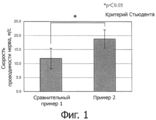
На фиг.1 показан эффект повышения скорости проводимости нервов материалом для излечения дисфункции нервов по изобретению через 20 дней после хирургического вмешательства.Figure 1 shows the effect of increasing the speed of nerve conduction by the material for the treatment of nerve dysfunction according to the
На фиг.2 показано увеличение комплексного модуля материала для излечения дисфункции нервов по изобретению при физиологической концентрации солей.Figure 2 shows an increase in the complex module of the material for the treatment of nerve dysfunction according to the invention at a physiological concentration of salts.
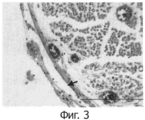
На фиг.3 показана регенерация периневрия гидрогелем производного полисахарида по изобретению через одну неделю после хирургического вмешательства. Стрелка указывает на периневрий.Figure 3 shows the regeneration of perineuria by the hydrogel of the polysaccharide derivative of the invention one week after surgery. The arrow indicates the perineurium.
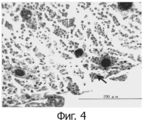
На фиг.4 показана регенерация периневрия через одну неделю после хирургического вмешательства в случае без применения гидрогеля производного полисахарида по изобретению. Стрелка указывает на периневрий.Figure 4 shows the regeneration of perineuria one week after surgery in the case without the use of the hydrogel derivative of the polysaccharide according to the invention. The arrow indicates the perineurium.
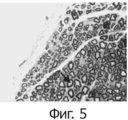
На фиг.5 показана регенерация миелиновой оболочки гидрогелем производного полисахарида по изобретению через 6 недель после хирургического вмешательства. Стрелка указывает на миелиновую оболочку.Figure 5 shows the regeneration of the myelin sheath by the hydrogel of the polysaccharide derivative of the invention 6 weeks after surgery. The arrow indicates the myelin sheath.
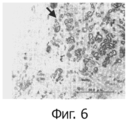
На фиг.6 показана регенерация миелиновой оболочки через 6 недель после хирургического вмешательства в случае без применения гидрогеля производного полисахарида по изобретению. Стрелка указывает на миелиновую оболочку.Figure 6 shows the regeneration of the myelin sheath 6 weeks after surgery in the case without the use of the hydrogel derivative of the polysaccharide according to the invention. The arrow indicates the myelin sheath.
Лучший вариант осуществления изобретенияThe best embodiment of the invention
Изобретением является материал для излечения дисфункции нервов, включающий гидрогель производного полисахарида, отличающийся тем, что в 0,5 масс.% водном растворе комплексный модуль составляет от 1 до 1000 Н/м2, а коэффициент потерь составляет от 0,01 до 2,0, что измерено при угловой скорости 10 рад/сек с помощью устройства для измерения динамической вязкоупругости.The invention is a material for the treatment of nerve dysfunction, including a hydrogel derivative of a polysaccharide, characterized in that in a 0.5 wt.% Aqueous solution, the complex module is from 1 to 1000 N / m 2 and the loss coefficient is from 0.01 to 2.0 as measured at an angular velocity of 10 rad / s using a device for measuring dynamic viscoelasticity.
Комплексный модуль находится в диапазоне от 1 до 200 Н/м2, а более предпочтительно в диапазоне от 1 до 100 Н/м2. Кроме того, коэффициент потери предпочтительно находится в диапазоне от 0,01 до 1,5.The complex module is in the range from 1 to 200 N / m 2 , and more preferably in the range from 1 to 100 N / m 2 . In addition, the loss coefficient is preferably in the range from 0.01 to 1.5.
Производное полисахарида применяемое в изобретении, предпочтительно представляет собой производное целлюлозы, и предпочтительно может быть производным целлюлозы, имеющим повторяющиеся единицы, представленные следующей формулой:The polysaccharide derivative used in the invention is preferably a cellulose derivative, and may preferably be a cellulose derivative having repeating units represented by the following formula:
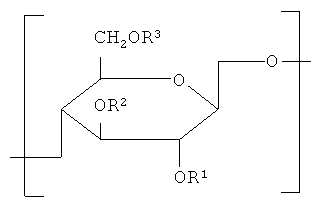
где R1, R2 и R3 каждый независимо выбраны из группы, состоящей из следующих формул (a), (b) (c) и (d):where R 1 , R 2 and R 3 each independently selected from the group consisting of the following formulas (a), (b) (c) and (d):



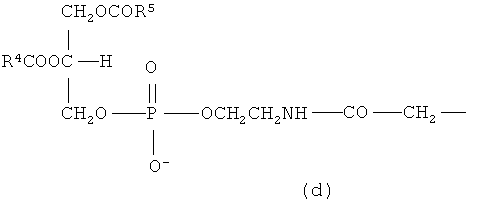
гдеWhere
X в формуле (c) является щелочным или щелочноземельным металлом,X in the formula (c) is an alkali or alkaline earth metal,
R4 и R5 в формуле (d) каждый независимо являются С9-27 алкильной группой или алкенильной группой,R 4 and R 5 in the formula (d) are each independently a C 9-27 alkyl group or an alkenyl group,
общая степень замещения (b) и (с) составляет от 0,3 до 2,0, иthe total degree of substitution (b) and (c) is from 0.3 to 2.0, and
степень замещения (d) находится в диапазоне от 0,001 до 0,05, а более предпочтительно от 0,005 до 0,015.the degree of substitution (d) is in the range from 0.001 to 0.05, and more preferably from 0.005 to 0.015.
В приведенной выше формуле, R4 и R5 каждый независимо являются С9-27 алкильной группой или алкенильной группой. В частности, предпочтительно, если R4 и R5 являются С9-19 алкенильными группами. Среди них предпочтительно, если R4CO- и/или R5CO- является олеоиловой группой, а особенно предпочтительно, если R4CO- и R5CO- являются олеоиловыми группами.In the above formula, R 4 and R 5 are each independently a C 9-27 alkyl group or an alkenyl group. In particular, it is preferred that R 4 and R 5 are C 9-19 alkenyl groups. Among them, it is preferable if R 4 CO— and / or R 5 CO— is an oleoyl group, and particularly preferably if R 4 CO— and R 5 CO— are oleoyl groups.
Материал для излечения дисфункции нервов по изобретению предпочтительно является материалом для излечения дисфункции нервов, который является инъецируемым гидрогелем, содержащим от 0,1 до 1,5 масс, частей производного полисахарида, использованного в изобретении, на 100 масс. частей воды. Еще более предпочтительно от 0,5 до 1,0 масс. частей.The material for treating nerve dysfunction of the invention is preferably a material for treating nerve dysfunction, which is an injectable hydrogel containing from 0.1 to 1.5 mass, parts of the polysaccharide derivative used in the invention, per 100 mass. parts of water. Even more preferably, from 0.5 to 1.0 mass. parts.
Среди них, предпочтительно, если комплексный модуль в 0,5 масс.% водном растворе находится в диапазоне от 1 до 200 Н/м2, измеренный при угловой скорости 10 рад/сек с помощью устройства измерения динамической вязкоупругости. Еще более предпочтительно, если находится в диапазоне от 1 до 100 Н/м2. Кроме того, предпочтительно, если коэффициент потерь в это время составляет от 0,01 до 1,5.Among them, it is preferable if the complex module in a 0.5 wt.% Aqueous solution is in the range from 1 to 200 N / m 2 , measured at an angular velocity of 10 rad / s using a dynamic viscoelasticity measuring device. Even more preferably, if it is in the range from 1 to 100 N / m 2 . In addition, it is preferable if the loss coefficient at this time is from 0.01 to 1.5.
Кроме того, предпочтительно, если материал для излечения дисфункции нервов по изобретению включает гидрогель производного полисахарида, и что при физиологической концентрации соли, комплексный модуль в 1,0 масс.% водном растворе повышается от 1 до 1000 Н/м2, измеренный при угловой скорости 10 рад/сек, с помощью устройства для измерения динамической вязкоупругости. Диапазон увеличения вязкоупругости более предпочтительно является увеличением от 50 до 700 Н/м2, и еще более предпочтительно увеличением от 100 до 500 Н/м2.In addition, it is preferable if the material for treating nerve dysfunction according to the invention includes a hydrogel of a polysaccharide derivative, and that at physiological salt concentration, the complex modulus in a 1.0 wt.% Aqueous solution rises from 1 to 1000 N / m 2 measured at an angular velocity 10 rad / s, using a device for measuring dynamic viscoelasticity. The range of increase in viscoelasticity is more preferably an increase from 50 to 700 N / m 2 , and even more preferably an increase from 100 to 500 N / m 2 .
Физиологическая концентрация соли в данном документе означает концентрацию соли физиологического раствора соли, скорректированную для выживания клеток. В качестве конкретных концентраций соли физиологический раствор (0,9% водный раствор NaCl), раствор Рингера, фосфатный буфер и т.п.могут быть упомянуты в качестве примеров.The physiological salt concentration herein refers to the salt concentration of physiological salt solution adjusted for cell survival. As specific salt concentrations, saline (0.9% aqueous NaCl), Ringer's solution, phosphate buffer and the like can be mentioned as examples.
Изобретение является материалом для излечения нервной дисфункции. Например, его надлежащим образом применяют для восстановления функции нервов поврежденных и/или дегенерированных в результате серьезной травмы, перегрузки организма и т.п.The invention is a material for the treatment of nervous dysfunction. For example, it is appropriately used to restore the function of nerves damaged and / or degenerated as a result of a serious injury, overload of the body, etc.
Если в качестве полисахаридного производного для приготовления материала для излечения нервной дисфункции по изобретению используют производное целлюлозы, то получение, например, может быть следующим.If a cellulose derivative is used as a polysaccharide derivative for preparing a material for treating a nervous dysfunction according to the invention, the preparation, for example, may be as follows.
Способ получения производного целлюлозыA method of obtaining a derivative of cellulose
Упомянутое выше производное целлюлозы, использованное в изобретении, может быть получено способом, включающим стадию, в которой карбоксиметилцеллюлоза, имеющая повторяющиеся единицы представленной ниже формулы и молекулярную массу от 5х103 до 5х106:The cellulose derivative mentioned above used in the invention can be obtained by a process comprising the step of carboxymethyl cellulose having repeating units of the formula below and a molecular weight of from 5x10³ to 5x10⁶:
и фосфатидилэтаноламин, представленный следующей формулой:and phosphatidylethanolamine represented by the following formula:

в таких долях, при которых количество фосфатидилэтаноламина составляет от 0,1 до 100 эквивалентов на 100 эквивалентов карбоксильных групп карбоксиметилцеллюлозы (т.е. общего количества заместителей (b)+(c)) растворены в смешанном растворителе, включающем воду и водосовместимый органический растворитель, в котором вода составляет от 20 до 70 об.%, с последующей реакцией в присутствии конденсирующего средства.in fractions in which the amount of phosphatidylethanolamine is from 0.1 to 100 equivalents per 100 equivalents of the carboxy groups of carboxymethyl cellulose (i.e., the total number of substituents (b) + (c)) are dissolved in a mixed solvent comprising water and a water-compatible organic solvent, in which water is from 20 to 70 vol.%, followed by reaction in the presence of a condensing agent.
R1, R2 и R3 в данном документе каждый независимо выбран из следующих формул (a), (b) и (c):R 1 , R 2 and R 3 in this document are each independently selected from the following formulas (a), (b) and (c):
гдеWhere
X в формуле (с) является щелочным или щелочноземельным металлом, общая степень замещения (b) и (c) составляет от 0,3 до 2,0, иX in the formula (c) is an alkali or alkaline earth metal, the total degree of substitution (b) and (c) is from 0.3 to 2.0, and
R4 и R5 каждый независимо являются С9-27 алкильной группой или алкенильной группой.R 4 and R 5 each independently are a C 9-27 alkyl group or an alkenyl group.
Карбоксиметилцеллюлоза в качестве исходного материала предпочтительно имеет молекулярную массу от 5×10³ до 5×10⁶, более предпочтительно от 5×10⁴ до 5×10⁶, и еще более предпочтительно от 5×10⁴ до 1×10⁶.The carboxymethyl cellulose preferably has a molecular weight of from 5 × 10 3 to 5 × 10 6 , more preferably from 5 × 10 4 to 5 × 10 6 , and even more preferably from 5 × 10 4 to 1 × 10 6 .
Карбоксиметилцеллюлоза в качестве исходного материала может быть получена, например, растворением пульпы в растворе гидроксида натрия, и этерификацией ее же монохлоруксусной кислотой или ее натриевой солью, с последующей очисткой.Carboxymethyl cellulose as a starting material can be obtained, for example, by dissolving pulp in a solution of sodium hydroxide, and esterifying it with monochloracetic acid or its sodium salt, followed by purification.
Щелочной металл X в формуле (c), предпочтительно является натрием, калием, литием или т.п., а щелочноземельный металл предпочтительно является магнием, кальцием или т.п.The alkali metal X in formula (c) is preferably sodium, potassium, lithium or the like, and the alkaline earth metal is preferably magnesium, calcium or the like.
Общая степень замещения (b) и (c) составляет от 0,3 до 2,0, предпочтительно от 0,5 до 1,8, а более предпочтительно от 0,6 до 1,5. Доли (b) и (c) ничем конкретным не ограничены. Однако в контексте растворимости в воде, предпочтительно, если (c) находится в избытке относительно (b).The total degree of substitution (b) and (c) is from 0.3 to 2.0, preferably from 0.5 to 1.8, and more preferably from 0.6 to 1.5. Shares (b) and (c) are not specifically limited. However, in the context of water solubility, it is preferred that (c) is in excess relative to (b).
Конкретная структурная формула предпочтительной карбоксиметилцеллюлозы как исходного материала показана в формуле ниже. Что касается положения замены карбоксиметильной группой в каркасе целлюлозы, то предпочтительным является положение C-6.The specific structural formula of the preferred carboxymethyl cellulose as starting material is shown in the formula below. With regard to the position of replacement with a carboxymethyl group in the cellulose framework, position C-6 is preferred.
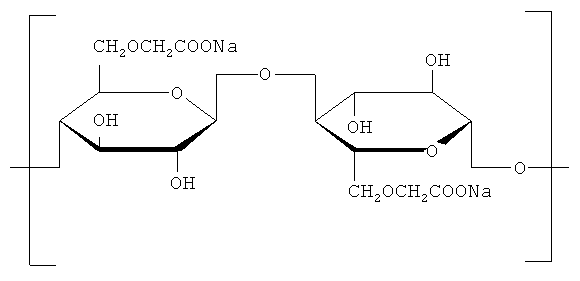
В фосфатидилэтаноламине представленном в формуле выше для применения в способе получения производного целлюлозы, R4 и R5 каждый независимо являются С9-27 алкильной группой или алкенильной группой. Предпочтительно, если R4 и R5 каждый является С9-27 алкенильной группой. Предпочтительно, если R4CO- и/или R5CO- являются олеоиловой группой, а особенно предпочтительно, если R4CO- и R5CO- являются олеоиловыми группами.In the phosphatidylethanolamine represented in the formula above for use in a method for producing a cellulose derivative, R 4 and R 5 are each independently a C 9-27 alkyl group or an alkenyl group. Preferably, if R 4 and R 5 each is a C 9-27 alkenyl group. Preferably, if R 4 CO— and / or R 5 CO— are an oleoyl group, and particularly preferably if R 4 CO— and R 5 CO— are oleoyl groups.
Фосфатидилэтаноламин в качестве исходного материала может быть либо экстрагирован из животной ткани, либо получен синтетически. Конкретные его примеры включают дилауроилфосфатидилэтаноламин, димиристоилфосфатидилэтаноламин, дипальмитоилфосфатидилэтаноламин, диарахидоил фосфатидилэтаноламин, лауролеоилфосфатидилэтаноламин, пальмитеоил фосфатидилэтаноламин, дилинолеоилфосфатидилэтаноламин, дистеароилфосфатидилэтаноламин, дибегеноилфосфатидилэтаноламин, миристолеоилфосфатидилэтаноламин, диолеоил фосфатидилэтаноламин, дилиноленоил фосфатидилэтаноламин, диарахидоноилфосфатидилэтаноламин и дидокозагексаеноилфосфатидилэтаноламин. Среди них диолеоилфосфатидилэтаноламин является предпочтительным по показателю растворимости в органическом растворителе, используемом для синтеза. Фосфатидилэтаноламин является безопасным веществом биологического происхождения.Phosphatidylethanolamine as a starting material can either be extracted from animal tissue or synthetically obtained. Specific examples thereof include dilauroilfosfatidiletanolamin, dimiristoilfosfatidiletanolamin, dipalmitoylphosphatidylethanolamine, diarahidoil phosphatidylethanolamine, lauroleoilfosfatidiletanolamin, palmiteoil phosphatidylethanolamine, dilinoleoilfosfatidiletanolamin, distearoylphosphatidylethanolamine, dibegenoilfosfatidiletanolamin, miristoleoilfosfatidiletanolamin, dioleoyl phosphatidylethanolamine, phosphatidylethanolamine dilinolenoil, and diarahidonoilfosfatidiletanolamin didokozageksaenoilfosfatidiletanolamin. Among them, dioleoylphosphatidylethanolamine is preferred in terms of solubility in the organic solvent used for the synthesis. Phosphatidylethanolamine is a safe substance of biological origin.
Считается, что в производном целлюлозы, использованном в изобретении, фосфатидилэтаноламин усиливает гидрофобное взаимодействие между молекулами производного целлюлозы, и, в результате, производное целлюлозы, использованное в изобретении, образует гидрогель.It is believed that in the cellulose derivative used in the invention, phosphatidylethanolamine enhances the hydrophobic interaction between the molecules of the cellulose derivative, and, as a result, the cellulose derivative used in the invention forms a hydrogel.
Карбоксиметилцеллюлоза и фосфатидилэтаноламин, которые являются исходными материалами, применяемыми в изобретении, могут реагировать в таких долях, в которых количество фосфатидилэтаноламина находится в диапазоне от 0,1 до 50 эквивалентов, предпочтительно от 1 до 40 эквивалентов, более предпочтительно от 3 до 30 эквивалентов, на 100 эквивалентов карбоксильных групп карбоксиметилцеллюлозы. Если количество составляет меньше чем 0,1 эквивалента, получаемое производное целлюлозы не образует гидрогель. Если количество больше чем 40 эквивалентов, никакого увеличения вязкоупругости не наблюдается при физиологических концентрациях солей.Carboxymethyl cellulose and phosphatidylethanolamine, which are the starting materials used in the invention, can be reacted in such proportions that the amount of phosphatidylethanolamine is in the range from 0.1 to 50 equivalents, preferably from 1 to 40 equivalents, more preferably from 3 to 30 equivalents, per 100 equivalents of carboxy groups of carboxymethyl cellulose. If the amount is less than 0.1 equivalent, the resulting cellulose derivative does not form a hydrogel. If the amount is more than 40 equivalents, no increase in viscoelasticity is observed at physiological salt concentrations.
В реакции конденсации между карбоксиметилцеллюлозой и фосфатидилэтаноламином, эффективность реакции может быть снижена в зависимости от реактивности конденсирующего средства, используемого для конденсации или в зависимости от условий реакции. Следовательно, предпочтительно, если фосфатидилэтаноламин применяют в избытке относительно рассчитанного значения требуемой степени замещения.In the condensation reaction between carboxymethyl cellulose and phosphatidylethanolamine, the reaction efficiency may be reduced depending on the reactivity of the condensing agent used for condensation or depending on the reaction conditions. Therefore, it is preferable if phosphatidylethanolamine is used in excess relative to the calculated value of the desired degree of substitution.
Карбоксиметилцеллюлоза и фосфатидилэтаноламин растворяют в смешанном растворителе, включающем воду и водосовместимый органический растворитель (A), в котором вода присутствует в количестве от 20 до 70 об.%. Если содержание воды составляет меньше чем 20 об.%, карбоксиметилцеллюлоза менее растворима, тогда как если содержание воды составляет больше 70 об.%, фосфатидилэтаноламин менее растворим, в результате чего реакция не проходит. Содержание воды предпочтительно составляет от 30 до 60 об.%.Carboxymethyl cellulose and phosphatidylethanolamine are dissolved in a mixed solvent including water and a water-compatible organic solvent (A), in which water is present in an amount of from 20 to 70 vol.%. If the water content is less than 20 vol.%, Carboxymethyl cellulose is less soluble, while if the water content is more than 70 vol.%, Phosphatidylethanolamine is less soluble, as a result of which the reaction does not pass. The water content is preferably from 30 to 60 vol.%.
Конкретные примеры водосовместимых органических растворителей (A) включают органические растворители, имеющие циклическую эфирную связь, такие как тетрагидрофуран, 1,4-диоксан, 1,3-диоксан, 1,3-диоксолан и морфолин, органические растворители, имеющие амидную связь, такие как диметилацетамид, диметилформамид и N-метил-2-пирролидон, амины, такие как пиридин, пиперидин и пиперазин и сульфоксиды, такие как диметилсульфоксид. Среди них, циклические эфиры и сульфоксиды являются предпочтительными. В частности, тетрагидрофуран, диоксан и диметилсульфоксид являются более предпочтительными.Specific examples of water-compatible organic solvents (A) include cyclic ether-linked organic solvents such as tetrahydrofuran, 1,4-dioxane, 1,3-dioxane, 1,3-dioxolane and morpholine, organic solvents having an amide bond, such as dimethylacetamide, dimethylformamide and N-methyl-2-pyrrolidone, amines such as pyridine, piperidine and piperazine and sulfoxides such as dimethyl sulfoxide. Among them, cyclic ethers and sulfoxides are preferred. In particular, tetrahydrofuran, dioxane and dimethyl sulfoxide are more preferred.
Как реактивы, используемые в реакции, карбоксилактивирующие средства и конденсирующие средства являются предпочтительными. Примеры карбоксилактивирующих средств включают N-гидроксисукцинимид, р-нитрофенол, N-гидроксибензотриазол, N-гидроксипиперидин, N-гидррксисукцинамид, 2,4,5-трихлорфенол и N,N-диметиламинопиридин. Примеры конденсирующих средств включают 4-(4,6-диметокси-1,3,5-триазин-2-ил)-4-метилморфолин хлорид, 1-этил-3-(диметиламинопропил)-карбодиимид и его гидрохлорид, диизопропилкарбодиимид, дициклогексилкарбодиимид и N-гидрокси-5-норборнен-2,3-дикарбоксимид. Среди них, предпочтительно использовать N-гидроксибензотриазол в качестве карбоксилактивирующего средства, а 4-(4,6-диметокси-1,3,5-триазин-2-ил)-4-метилморфолин хлорид или 1-этил-3-(диметиламинопропил)-карбодиимид гидрохлорид в качестве конденсирующего средства.As the reagents used in the reaction, carboxyl activating agents and condensing agents are preferred. Examples of carboxy activating agents include N-hydroxysuccinimide, p-nitrophenol, N-hydroxybenzotriazole, N-hydroxypiperidine, N-hydroxy succinamide, 2,4,5-trichlorophenol, and N, N-dimethylaminopyridine. Examples of condensing agents include 4- (4,6-dimethoxy-1,3,5-triazin-2-yl) -4-methylmorpholine chloride, 1-ethyl-3- (dimethylaminopropyl) -carbodiimide and its hydrochloride, diisopropylcarbodiimide, dicyclohexylcarbodiimide and N-hydroxy-5-norbornene-2,3-dicarboximide. Among them, it is preferable to use N-hydroxybenzotriazole as a carboxyl activating agent, and 4- (4,6-dimethoxy-1,3,5-triazin-2-yl) -4-methylmorpholine chloride or 1-ethyl-3- (dimethylaminopropyl) β-carbodiimide hydrochloride as a condensing agent.
Температура реакции предпочтительно составляет от 0°C до 60°C. Для ингибирования производства побочных продуктов, реакцию более предпочтительно осуществляют при температуре от 0 до 10°C. Среда реакции предпочтительно является слабо кислой, а более предпочтительно, если pH находится в диапазоне от 6 до 7.The reaction temperature is preferably from 0 ° C to 60 ° C. To inhibit the production of by-products, the reaction is more preferably carried out at a temperature of from 0 to 10 ° C. The reaction medium is preferably slightly acidic, and more preferably if the pH is in the range of 6 to 7.
Способ очистки производного целлюлозыMethod for purification of cellulose derivative
Способ получения производного целлюлозы, используемого в изобретении, для полученного производного целлюлозы может включать, стадию очистки производного целлюлозы с помощью органического растворителя (B), который существенно не растворяет карбоксиметилцеллюлозу, но является совместимым с водой.A method for producing the cellulose derivative used in the invention for the obtained cellulose derivative may include the step of purifying the cellulose derivative with an organic solvent (B) that does not substantially dissolve carboxymethyl cellulose but is compatible with water.
Органический растворитель, который существенно не растворяет карбоксиметилцеллюлозу, в данном документе означает такой органический растворитель, в котором растворимость натриевой соли карбоксиметилцеллюлозы или карбоксиметилцеллюлозы (СООН типа) доступных в порошкообразной или лиофилизированной форме, если растворимость карбоксиметилцеллюлозы в органическом растворителе проверяют в отсутствии воды, составляет 3% или менее. Конкретные примеры включают спирты, такие как метанол, этанол, n-пропиловый спирт, изопропиловый спирт, н-бутиловый спирт, и трет-бутиловый спирт, многоатомные спирты, такие как этиленгликоль, 1,2-пропиленгликоль, 1,3-пропиленгликоль, и глицерин, кетоны, такие как ацетон, и ароматические спирты, такие как фенол. Среди них те, которые имеют точку кипения меньше чем 100°C, являются предпочтительными. Например, метанол, этанол, изопропиловый спирт и являются предпочтительными. Учитывая применение in vivo, этанол является особенно предпочтительным.An organic solvent that does not substantially dissolve carboxymethyl cellulose as used herein means an organic solvent in which the solubility of the sodium salt of carboxymethyl cellulose or carboxymethyl cellulose (COOH type) available in powder or lyophilized form, if the solubility of carboxymethyl cellulose in an organic solvent is checked in the absence of water, 3%, water is checked, 3% or less. Specific examples include alcohols such as methanol, ethanol, n-propyl alcohol, isopropyl alcohol, n-butyl alcohol, and tert-butyl alcohol, polyhydric alcohols such as ethylene glycol, 1,2-propylene glycol, 1,3-propylene glycol, and glycerin, ketones, such as acetone, and aromatic alcohols, such as phenol. Among them, those having a boiling point of less than 100 ° C are preferred. For example, methanol, ethanol, and isopropyl alcohol are preferred. Considering in vivo use, ethanol is particularly preferred.
Если очистку осуществляют с помощью органического растворителя (B) из этих групп, то возможно использовать способ, в котором органический растворитель добавляют к производному целлюлозы в смеси с водой, органическим растворителем (A) и т.п. для образования осадка, что приводит, таким образом, к удалению производного целлюлозы. В ином случае, также возможно использовать способ, в котором органический растворитель (B) добавляют к полученному ранее осадку, сухому порошку или губке или подобному телу, полученному лиофилизацией, тем самым осуществляя отмывку. С помощью этих способов очистки могут быть удалены катализаторы, такие как конденсирующее средство и карбоксилактивирующее средство, используемые в реакции, непрореагировавший фосфолипид, оставшийся в системе и т.п.Для получения требуемого продукта, суспендированного в органическом растворителе (B), применяют способ, такой как центрифугирование или фильтрация. Также для отмывки органическим растворителем (B) можно применить экстракцию в аппарате Сокслета.If the purification is carried out using an organic solvent (B) from these groups, it is possible to use a method in which the organic solvent is added to the cellulose derivative in a mixture with water, an organic solvent (A) and the like. to form a precipitate, which thus leads to the removal of the cellulose derivative. Otherwise, it is also possible to use a method in which the organic solvent (B) is added to the previously obtained precipitate, dry powder or sponge or similar body obtained by lyophilization, thereby washing. Using these purification methods, catalysts such as a condensing agent and a carboxyl activating agent used in the reaction, unreacted phospholipid remaining in the system, etc. can be removed. To obtain the desired product suspended in an organic solvent (B), a method such like centrifugation or filtration. Also, for washing with an organic solvent (B), extraction can be applied in a Soxhlet apparatus.
Гидрогель производного целлюлозыCellulose Derivative Hydrogel
Материал для излечения дисфункции нервов по изобретению является гидрогелем, содержащим вышеупомянутое производное целлюлозы. Гидрогель содержит производное целлюлозы в количестве от 0,1 до 1,5 масс. частей, предпочтительно от 0,5 до 1,0 масс. частей, на 100 масс. частей воды.The material for treating nerve dysfunction of the invention is a hydrogel containing the aforementioned cellulose derivative. The hydrogel contains a cellulose derivative in an amount of from 0.1 to 1.5 mass. parts, preferably from 0.5 to 1.0 mass. parts, per 100 mass. parts of water.
Такой гидрогель может быть легко деформирован при прикосновении металлического шпателя, и находится в состоянии, которое позволяет легкое нанесение на пораженную область. Гидрогель также может быть инъецирован с помощью инструмента, имеющего тонкую трубку, такого как шприц.Such a hydrogel can be easily deformed at the touch of a metal spatula, and is in a state that allows easy application to the affected area. The hydrogel can also be injected using a thin tube instrument such as a syringe.
Гель предпочтительно имеет комплексный модуль в диапазоне от 1 до 200 Н/м2, еще более предпочтительно в диапазоне от 1 до 100 Н/м2, измеряемый при угловой скорости 10 рад/сек с помощью устройства для измерения динамической вязкоупругости в условиях, при который концентрация полимера составляет 0,5 масс.%, а температура равна 37°C. Кроме того, предпочтительно, если коэффициент потерь в это время составляет от 0,01 до 1,5. Данный диапазон является наиболее эффективным в восстановлении функции поврежденных или дегенерированных нервов.The gel preferably has a complex module in the range from 1 to 200 N / m 2 , even more preferably in the range from 1 to 100 N / m 2 , measured at an angular velocity of 10 rad / s using a device for measuring dynamic viscoelasticity under conditions in which the polymer concentration is 0.5 wt.%, and the temperature is 37 ° C. In addition, it is preferable if the loss coefficient at this time is from 0.01 to 1.5. This range is most effective in restoring the function of damaged or degenerated nerves.
Кроме того, гидрогель изобретения является прозрачным и бесцветным. При промышленном производстве это выгодно тем, что даже если в процессе получения включаются посторонние вещества, такие как пыль, такие посторонние вещества могут быть обнаружены.In addition, the hydrogel of the invention is transparent and colorless. In industrial production, this is advantageous in that even if foreign substances such as dust are included in the production process, such foreign substances can be detected.
Возможные примеры отличных от воды компонентов, содержащихся в гидрогеле, включают конденсирующие средства, используемые в качестве катализаторов; побочные продукты, такие как мочевина, производимая конденсирующим средством в ходе заданной химической реакции; карбоксилактивирующие агенты, непрореагировавший фосфатидилэтаноламин, посторонние вещества, которые могут быть включены на каждой стадии реакции; и ионы, используемые для корректировки рН. Однако эти компоненты удаляются очисткой или отмывкой с помощью упомянутого выше органического растворителя (В), и предпочтительно, если уровни всех соединений поддерживаются на низком уровне, так что их проникновение в организм не распознается как реакция на инородное тело.Possible examples of non-water components contained in the hydrogel include condensing agents used as catalysts; by-products, such as urea, produced by a condensing agent during a given chemical reaction; carboxy activating agents, unreacted phosphatidylethanolamine, foreign substances that may be included at each stage of the reaction; and ions used to adjust pH. However, these components are removed by cleaning or washing with the above organic solvent (B), and it is preferable if the levels of all compounds are kept low so that their penetration into the body is not recognized as a reaction to a foreign body.
Способ хранения материала для излечения дисфункции нервов по изобретению ничем не ограничен. Например, материал может храниться в холодном, темном месте и переносится в комнатную температуру перед использованием. Способ стерилизации материала для излечения дисфункции нервов по изобретению также ничем не ограничен, и может быть применен способ для обычной стерилизации медицинских инструментов и материалов, такой как стерилизация газообразным этиленоксидом, стерилизация автоклавированием, стерилизация гамма-излучением или стерилизация электронным лучом.The method for storing material for treating nerve dysfunction according to the invention is not limited. For example, the material can be stored in a cool, dark place and transferred to room temperature before use. The method for sterilizing a material for treating nerve dysfunction according to the invention is also not limited, and a method can be used for conventional sterilization of medical instruments and materials, such as ethylene oxide gas sterilization, autoclaving sterilization, gamma radiation sterilization or electron beam sterilization.
Кроме того, в случае применения после хирургического вмешательства материала для излечения дисфункции нервов по изобретению, например, при нанесении на участок хирургического вмешательства и окружающую область от около 0,1 до 5,0 мл с помощью шприца для покрытия всех площади хирургического вмешательства, ожидается восстановление функции поврежденных или дегенерированных нервов.In addition, in the case of applying after surgery a material for the treatment of nerve dysfunction according to the invention, for example, when applied to the surgical site and the surrounding area from about 0.1 to 5.0 ml with a syringe to cover all areas of the surgical intervention, recovery is expected function of damaged or degenerated nerves.
ПримерыExamples
(1) В примерах использовали следующие материалы:(1) In the examples, the following materials were used:
(1) CMCNa: натриевая соль карбоксиметилцеллюлозы (производства «Dai-Ichi Kogyo Seiyaku», степень замещения: 0,73; или производства «Nippon Paper Chemicals», степень замещения: 0,69),(1) CMCNa: carboxymethyl cellulose sodium salt (manufactured by Dai-Ichi Kogyo Seiyaku, degree of substitution: 0.73; or manufactured by Nippon Paper Chemicals, degree of substitution: 0.69),
(ii) тетрагидрофуран (производства «Wako Pure Chemical Industries))),(ii) tetrahydrofuran (manufactured by Wako Pure Chemical Industries)),
(iii) 0,1 M HCl (производства «Wako Pure Chemical Industries))),(iii) 0.1 M HCl (manufactured by Wako Pure Chemical Industries)),
(iv) 0,1 M NaOH (производства «Wako Pure Chemical Industries))),(iv) 0.1 M NaOH (manufactured by Wako Pure Chemical Industries)),
(v) 4-(4,6-диметокси-1,3,5-триазин-2-ил)-4-метилморфолин хлорид (производства «Kokusan Chemical))),(v) 4- (4,6-dimethoxy-1,3,5-triazin-2-yl) -4-methylmorpholine chloride (manufactured by Kokusan Chemical)),
(vi) L-α-диолеоилфосфатидилетаноламин (COATSOME ME-8181, производства «NOF Corporation))),(vi) L-α-dioleoylphosphatidylethanolamine (COATSOME ME-8181, manufactured by NOF Corporation)),
(vii) этанол (производства «Wako Pure Chemical Industries))),(vii) ethanol (manufactured by Wako Pure Chemical Industries)),
(viii) дистиллированная вода для инъекций (производства «Otsuka Pharmaceutical))),(viii) distilled water for injection (manufactured by Otsuka Pharmaceutical)),
(ix) танол для дезинфекции (производства «Wako Pure Chemical Industries))),(ix) thanol for disinfection (manufactured by Wako Pure Chemical Industries)),
(x) пентобарбитал натрия (инъекция нембутала, производства «Dainippon Sumitomo Pharma»), и(x) sodium pentobarbital (injection of Nembutal, manufactured by Dainippon Sumitomo Pharma), and
(xi) NaCl (производства «Wako Pure Chemical Industries))).(xi) NaCl (manufactured by Wako Pure Chemical Industries))).
(2) Измерение содержания фосфолипидов в производном целлюлозы(2) Measurement of phospholipids in a cellulose derivative
Долю фосфолипида в производном целлюлозы определяли анализом общего содержания фосфора ванадомолибдатной абсорбциометрией.The proportion of phospholipid in the cellulose derivative was determined by analysis of the total phosphorus content by vanadium molybdate absorption.
(3) Измерения комплексного модуля и коэффициента потерь гидрогеля. Комплексный модуль и коэффициент потерь гидрогеля измеряли при 37°C и угловой скорости 10 рад/сек с помощью «Rheometer RFIII» («TA Instrument))), устройства для измерения динамической вязкоупругости.(3) Measurements of the complex modulus and hydrogel loss coefficient. The complex modulus and hydrogel loss coefficient was measured at 37 ° C and an angular velocity of 10 rad / s using a Rheometer RFIII (TA Instrument))), a device for measuring dynamic viscoelasticity.
Комплексным модулем называется константа, которая представляет соотношение между напряжением и деформацией упругого тела. Коэффициентом потерь называется константа, которая представляет собой соотношение между модулем накопления и модулем потерь при сдвиге.A complex module is a constant that represents the relationship between stress and deformation of an elastic body. The loss coefficient is called a constant, which is the ratio between the storage modulus and the shear loss modulus.
Пример 1Example 1
Производное целлюлозыCellulose derivative
3000 мг CMCNa (производства «Dai-Ichi Kogyo Seiyaku», степень замещения: 0, 73), растворяли в 600 мл воды, после чего добавляли 600 мл тетрагидрофурана. К этому раствору добавляли 1405 мг (1,889 моль) L-α-диолеоилфосфатидилэтаноламина (20 эквивалентов на 100 эквивалентов карбоксильных групп CMCNa) и 575 мг (2,08 моль) 4-(4,6-диметокси-1,3,5-триазин-2-ил)-4-метилморфолин хлорида в качестве конденсирующего средства, а затем перемешивали в течение ночи. После перемешивания, тетрагидрофуран удаляли, воду выпаривали до некоторой степени и затем в смесь добавляли этанол для того, чтобы вызвать осаждение. Этанол удаляли фильтрацией, с последующим повторным промыванием этанолом. Остаток сушили вакуумной сушкой для получения производного целлюлозы и измеряли содержание фосфолипидов в нем. Если предположить, что степень замещения карбоксиметилцеллюлозы до реакции составляла 0,73, и что все карбоксиметильные группы были катионированы ионами натрия, степень замещения формулой (d) определяли расчетом содержания фософолипидов. Степень замещения формулы (d) составляла 0,78 моль%/сахар.3000 mg of CMCNa (manufactured by Dai-Ichi Kogyo Seiyaku, degree of substitution: 0.73) was dissolved in 600 ml of water, after which 600 ml of tetrahydrofuran was added. To this solution, 1405 mg (1.889 mol) of L-α-dioleoylphosphatidylethanolamine (20 equivalents per 100 equivalents of CMCNa carboxyl groups) and 575 mg (2.08 mol) of 4- (4,6-dimethoxy-1,3,5-triazine) were added -2-yl) -4-methylmorpholine chloride as a condensing agent, and then stirred overnight. After stirring, tetrahydrofuran was removed, water was evaporated to some extent, and then ethanol was added to the mixture in order to cause precipitation. Ethanol was removed by filtration, followed by repeated washing with ethanol. The residue was dried by vacuum drying to obtain a derivative of cellulose and measured the content of phospholipids in it. Assuming that the degree of substitution of carboxymethyl cellulose before the reaction was 0.73, and that all carboxymethyl groups were cationized with sodium ions, the degree of substitution by formula (d) was determined by calculating the content of phosphosolipids. The degree of substitution of formula (d) was 0.78 mol% / sugar.
ГидрогельHydrogel
Композицию, изготовленную из высушенного вакуумом производного целлюлозы, стерилизовали, а затем растворяли в дистиллированной воде для инъекций для приготовления 0, 5 масс.% гидрогеля. Измеряли комплексный модуль и коэффициент потерь полученного гидрогеля, результаты составили 18,3 Н/м2 и 0,63, соответственно.A composition made from a vacuum-dried cellulose derivative was sterilized and then dissolved in distilled water for injection to prepare 0.5 wt.% Hydrogel. The complex modulus and loss coefficient of the obtained hydrogel were measured, the results were 18.3 N / m 2 and 0.63, respectively.
Пример 2Example 2
Создание дисфункции седалищного нерва у крысThe creation of sciatic nerve dysfunction in rats
Дисфункцию седалищного нерва получали в соответствии со способом Ohsumi et al., [Hidehiko ohsumi, Hitoshi Hirata, Takeshi Nagakura, Masaya Tsuj ii, Toshiko Sugimoto, Keiichi Miyamoto, Takeshi Horiuchi: Plastic and Reconstructive Surgery 116 (3): 823-30, 2005] на крысах Льюиса (на трех крысах) из «Charles River Laboratories)), Япония. А именно, крысу фиксировали в латеральной позиции с анестезией внутрибрюшинно введенным пентобарбиталом натрия, ягодичную область брили и затем дезинфицировали этанолом для дезинфекции. От абдоминальной области по направлению к дорсальной области, делали разрез 4-5 см в глутеральной области для раскрытия седалищного нерва. Эпиневрий и периневрий седалищного нерва снимали на 1,5 см, и дополнительно прижигали окружающую мышечную ткань. Затем гидрогель примера 1 (0,5 мл) наносили вокруг седалищного нерва, со снятым эпиневрием и периневрием, и мышечный слой и кожу разреза сшивали. Участок раны дезинфицировали с помощью дезинфектанта «Isodine», после чего крысу возвращали в клетку. Через 20 дней после хирургического вмешательства, у животных снова обнажали седалищный нерв под воздействием анестезией пентобарбиталом натрия, и измеряли скорость проводимости нерва с помощью «NeuroPack» («Nihon Kohden»). Значимые различия проверяли с помощью t-теста Стьюдента (критерия Стьюдента). В результате скорость проводимости нерва через 20 дней после хирургического вмешательства составила 18,8±3,3 м/с (средняя±стандартное отклонение) в каждом случае.Sciatic nerve dysfunction was obtained according to the method of Ohsumi et al., [Hidehiko ohsumi, Hitoshi Hirata, Takeshi Nagakura, Masaya Tsuj ii, Toshiko Sugimoto, Keiichi Miyamoto, Takeshi Horiuchi: Plastic and Reconstructive Surgery 116 (3): 823-30, 2005 ] on Lewis rats (three rats) from Charles River Laboratories), Japan. Namely, the rat was fixed in a lateral position with anesthesia by intraperitoneally injected sodium pentobarbital, the gluteal region was shaved and then disinfected with ethanol for disinfection. From the abdominal region towards the dorsal region, a 4-5 cm incision was made in the glutoral region to open the sciatic nerve. Epineuria and perineurium of the sciatic nerve was removed by 1.5 cm, and the surrounding muscle tissue was additionally burned. Then, the hydrogel of Example 1 (0.5 ml) was applied around the sciatic nerve, with epineuria and perineuria removed, and the muscle layer and skin of the incision were sutured. The wound site was disinfected with Isodine disinfectant, after which the rat was returned to the cage. 20 days after surgery, the sciatic nerve was exposed again in animals under anesthesia with sodium pentobarbital, and the nerve conduction rate was measured using a NeuroPack (Nihon Kohden). Significant differences were checked using Student's t-test (Student's test). As a result, the speed of
Сравнительный пример 1Comparative Example 1
В качестве контроля, такую же операцию как в примере 2 осуществляли без применения гидрогеля и измеряли скорость проводимости нерва. В результате, скорость проводимости нерва составила 11,8±3,6 м/с (среднее±стандартное отклонение).As a control, the same operation as in example 2 was carried out without the use of a hydrogel, and the nerve conduction velocity was measured. As a result, the nerve conduction velocity was 11.8 ± 3.6 m / s (mean ± standard deviation).
Результаты измерения скорости проводимости нерва через 20 дней после хирургического вмешательства в примере 2 и сравнительном примере 1 представлены на фиг.1.The results of measuring the speed of
Как и выше, скорость проводимости нерва через 20 дней после хирургического вмешательства в примере 2 была статистически более значимой, чем в сравнительном примере 1. Следовательно, было представлено подтверждение того, что гидрогель, полученный в примере 1, высокоэффективен при восстановлении поврежденных или дегенерированных нервов in vivo.As above, the
Пример 3Example 3
Повышение комплексного модуля добавлением солиIncreasing the complex module by adding salt
3500 мг CMCNa (производства «Nippon Paper Chemicals», степень замещения: 0,69) растворяли в 100 мл воды и затем добавляли 100 мл тетрагидрофурана. К этому раствору добавляли 413,7 мг (0,0000795 моль) L-a-диолеоилфосфатидилэтаноламина (5 эквивалентов на 100 эквивалентов карбоксильных групп CMCNa) и 169,4 мг (0,0000874 моль) 4-(4,6-диметокси-1,3,5-триазин-2-ил)-4-метилморфолин хлорида в качестве конденсирующего средства, а затем перемешивали в течение ночи. После перемешивания, к смеси добавляли этанол для того, чтобы вызвать осаждение. Затем, для получения производного целлюлозы осуществляли такую же операцию, как и в примере 1. Степень замещения составила 1,0 моль%/сахар. 20 мг композиции изготовленного производного целлюлозы растворяли в 1800 мг дистиллированной воды для инъекций и затем 200 мг 9% NaCl добавляли для получения конечной концентрации 0,9%. Таким образом готовили гидрогель с конечной концентрацией 1,0 масс.%. Измеряли комплексный модуль полученного гидрогеля. Результат составил 134,5±1,4 Н/м2 (среднее±стандартное отклонение).3500 mg of CMCNa (manufactured by Nippon Paper Chemicals, degree of substitution: 0.69) was dissolved in 100 ml of water and then 100 ml of tetrahydrofuran was added. To this solution was added 413.7 mg (0.0000795 mol) of La-dioleoylphosphatidylethanolamine (5 equivalents per 100 equivalents of CMCNa carboxyl groups) and 169.4 mg (0.0000874 mol) of 4- (4,6-dimethoxy-1,3 , 5-triazin-2-yl) -4-methylmorpholine chloride as a condensing agent, and then stirred overnight. After stirring, ethanol was added to the mixture in order to cause precipitation. Then, to obtain the cellulose derivative, the same operation was carried out as in Example 1. The degree of substitution was 1.0 mol% / sugar. 20 mg of the composition of the prepared cellulose derivative was dissolved in 1800 mg of distilled water for injection, and then 200 mg of 9% NaCl was added to obtain a final concentration of 0.9%. Thus, a hydrogel was prepared with a final concentration of 1.0 wt.%. The complex modulus of the obtained hydrogel was measured. The result was 134.5 ± 1.4 N / m 2 (mean ± standard deviation).
Сравнительный пример 2Reference Example 2
Гидрогель готовили так же как и в примере 3, за исключением того, что вместо 9% NaCl добавляли 200 мг дистиллированной воды для инъекций. Измеряли комплексный модуль полученного гидрогеля. Результат составил 8,0±0,5 Н/м2 (среднее±стандартное отклонение).A hydrogel was prepared as in Example 3, except that instead of 9% NaCl, 200 mg of distilled water for injection was added. The complex modulus of the obtained hydrogel was measured. The result was 8.0 ± 0.5 N / m 2 (mean ± standard deviation).
Результаты комплексного модуля в примере 3 и сравнительном примере 2 показаны на фиг.2.The results of the complex module in example 3 and comparative example 2 are shown in figure 2.
Как и выше, увеличение комплексного модуля больше в примере 3, чем в сравнительном примере 2, и было подтверждено, что комплексный модуль гидрогеля, составляющий всего лишь от 5 до 200 Н/м2, значительно повышается при добавлении NaCl до концентрации 0,9 масс.%, того же уровня что и in vivo.As above, the increase in the complex modulus is greater in Example 3 than in Comparative Example 2, and it was confirmed that the complex modulus of the hydrogel, comprising only 5 to 200 N / m 2 , increases significantly with the addition of NaCl to a concentration of 0.9 mass .%, the same level as in vivo.
Пример 4Example 4
Производное целлюлозыCellulose derivative
3000 мг CMCNa (производства «Dai-Ichi Kogyo Seiyaku», степень замещения: 0, 73), растворяли в 600 мл воды и также добавляли 600 мл тетрагидрофурана. К этому раствору добавляли 1405 мг (1,889 моль) L-α-диолеоилфосфатидилэтаноламина (20 эквивалентов на 100 эквивалентов карбоксильных групп CMCNa) и 575 мг (2,08 моль) 4-(4,6-диметокси-1,3,5-триазин-2-ил)-4-метилморфолин хлорида в качестве конденсирующего средства, а затем перемешивали в течение ночи. После перемешивания, тетрагидрофуран удаляли, воду выпаривали до некоторой степени и затем в смесь добавляли этанол для того чтобы вызвать осаждение. Этанол удаляли фильтрацией, с последующим повторным промыванием этанолом. Остаток сушили вакуумной сушкой для получения производного целлюлозы и измеряли в нем содержание фосфолипидов. Если предположить, что степень замены карбоксиметилцеллюлозы до реакции составляла 0,73, и что все карбоксиметильные группы были катионированы ионами натрия, степень замещения формулы (d) определяли расчетом содержания фосфолипидов. Степень замены формулы (d) составляла 0,78 моль%/сахар.3000 mg of CMCNa (manufactured by Dai-Ichi Kogyo Seiyaku, degree of substitution: 0.73) was dissolved in 600 ml of water and 600 ml of tetrahydrofuran was also added. To this solution, 1405 mg (1.889 mol) of L-α-dioleoylphosphatidylethanolamine (20 equivalents per 100 equivalents of CMCNa carboxyl groups) and 575 mg (2.08 mol) of 4- (4,6-dimethoxy-1,3,5-triazine) were added -2-yl) -4-methylmorpholine chloride as a condensing agent, and then stirred overnight. After stirring, tetrahydrofuran was removed, water was evaporated to some extent, and then ethanol was added to the mixture to cause precipitation. Ethanol was removed by filtration, followed by repeated washing with ethanol. The residue was dried by vacuum drying to obtain a cellulose derivative and the content of phospholipids was measured. Assuming that the degree of carboxymethyl cellulose replacement before the reaction was 0.73, and that all carboxymethyl groups were cationized with sodium ions, the degree of substitution of formula (d) was determined by calculating the phospholipid content. The degree of substitution of formula (d) was 0.78 mol% / sugar.
ГидрогельHydrogel
Композицию, изготовленную из высушенного вакуумом производного целлюлозы, стерилизовали и затем растворяли в дистиллированной воде для инъекций для приготовления 0,5 масс.% гидрогеля. Измеряли комплексный модуль и коэффициент потерь полученного гидрогеля, результаты составили 18,3 Н/м2 и 0,63, соответственно.A composition made from a vacuum dried cellulose derivative was sterilized and then dissolved in distilled water for injection to prepare 0.5 wt.% Hydrogel. The complex modulus and loss coefficient of the obtained hydrogel were measured, the results were 18.3 N / m 2 and 0.63, respectively.
Пример 5Example 5
Создание дегенерации седалищного нерва у крысThe creation of sciatic nerve degeneration in rats
Дегенерацию седалищного нерва вызывали в соответствии со способом Ohsumi et al., [Hidehiko ohsumi, Hitoshi Hirata, Takeshi Nagakura, Masaya Tsuj ii, Toshiko Sugimoto, Keiichi Miyamoto, Takeshi Horiuchi: Plastic and Reconstructive Surgery 116 (3): 823-30, 2005] на крысах Льюиса (на трех крысах) из «Charles River Laboratories)), Япония. А именно, крысу фиксировали в латеральной позиции с анестезией внутрибрюшинно введенным пентобарбиталом натрия, ягодичную область брили и затем дезинфицировали этанолом для дезинфекции. От абдоминальной области по направлению к дорсальной области, делали разрез 4-5 см в глутеральной области для раскрытия седалищного нерва. Эпиневрий и периневрий седалищного нерва снимали на 1,5 см, и дополнительно прижигали окружающую мышечную ткань. Затем гидрогель примера 4 (0,5 мл) наносили вокруг седалищного нерва, со снятым эпиневрием и периневрием, и мышечный слой и кожу разреза сшивали. Участок раны дезинфицировали с помощью дезинфектанта «Isodine)», после чего крысу возвращали в клетку. Через неделю после хирургического вмешательства, у животных отбирали седалищный нерв в условиях анестезии пентобарбиталом натрия, и осуществляли окраску трихром по Массону для гистологического наблюдения седалищного нерва. В результате регенерацию периневрия обнаружили через неделю после хирургического воздействия.Sciatic nerve degeneration was induced according to the method of Ohsumi et al., [Hidehiko ohsumi, Hitoshi Hirata, Takeshi Nagakura, Masaya Tsuj ii, Toshiko Sugimoto, Keiichi Miyamoto, Takeshi Horiuchi: Plastic and Reconstructive Surgery 116 (3): 823-30, 2005, 823-30 ] on Lewis rats (three rats) from Charles River Laboratories), Japan. Namely, the rat was fixed in a lateral position with anesthesia by intraperitoneally injected sodium pentobarbital, the gluteal region was shaved and then disinfected with ethanol for disinfection. From the abdominal region towards the dorsal region, a 4-5 cm incision was made in the glutoral region to open the sciatic nerve. Epineuria and perineurium of the sciatic nerve was removed by 1.5 cm, and the surrounding muscle tissue was additionally burned. Then, the hydrogel of Example 4 (0.5 ml) was applied around the sciatic nerve, with epineuria and perineuria removed, and the muscle layer and skin of the incision were sutured. The wound site was disinfected with Isodine), after which the rat was returned to the cage. One week after surgery, the sciatic nerve was taken from animals under anesthesia with sodium pentobarbital, and Masson trichrome was stained for histological observation of the sciatic nerve. As a result, regeneration of perineuria was found a week after surgical intervention.
Сравнительный пример 3Reference Example 3
В качестве контроля, такую же операцию, как и в примере 5 осуществляли без применения гидрогеля и гистологически наблюдали седалищный нерв. В результате, регенерация периневрия через неделю после хирургического вмешательства была недостаточной.As a control, the same operation as in Example 5 was carried out without the use of a hydrogel and the sciatic nerve was histologically observed. As a result, regeneration of perineuria a week after surgery was insufficient.
Результаты окраски трихром по Массону через неделю после хирургического вмешательства примера 5 и сравнительного примера 3 представлены на фиг.3 и 4, соответственно. Как и выше, в случае гистологических наблюдений через неделю после хирургического вмешательства, регенерация периневрия в примере 5 прошла лучше, чем в сравнительном примере 3. Следовательно, было представлено подтверждение того, что гидрогель, полученный в примере 4, высокоэффективен при восстановлении поврежденных или дегенерированных нервов in vivo.Masson Trichrome staining results one week after the surgical intervention of Example 5 and Comparative Example 3 are presented in FIGS. 3 and 4, respectively. As above, in the case of histological observations one week after surgery, the regeneration of perineuria in Example 5 was better than in comparative Example 3. Therefore, it was confirmed that the hydrogel obtained in Example 4 is highly effective in repairing damaged or degenerated nerves in vivo.
Пример 6Example 6
Создание дегенерации седалищного нерва у крысThe creation of sciatic nerve degeneration in rats
Дегенерацию седалищного нерва вызывали в соответствии со способом Ohsumi et al., [Hidehiko ohsumi, Hitoshi Hirata, Takeshi Nagakura, Masaya Tsuj ii, Toshiko Sugimoto, Keiichi Miyamoto, Takeshi Horiuchi: Plastic and Reconstructive Surgery 116 (3): 823-30, 2005] на крысах Льюиса (на трех крысах) из «Charles River Laboratories)), Япония. А именно, крысу фиксировали в латеральной позиции с анестезией внутрибрюшинно введенным пентобарбиталом натрия, ягодичную область брили и затем дезинфицировали этанолом для дезинфекции. От абдоминальной области по направлению к дорсальной области, делали разрез 4-5 см в глутеральной области для раскрытия седалищного нерва. Эпиневрий и периневрий седалищного нерва снимали на 1,5 см, и дополнительно прижигали окружающую мышечную ткань. Затем гидрогель примера 4 (0,5 мл) наносили вокруг седалищного нерва, со снятым эпиневрием и периневрием, и мышечный слой и кожу разреза сшивали. Участок раны дезинфицировали с помощью дезинфектанта «Isodine», после чего крысу возвращали в клетку. Через 6 недель после хирургического вмешательства, у животных отбирали седалищный нерв в условиях анестезии пентобарбиталом натрия, и осуществляли окраску толуидиновым синим для гистологического наблюдения седалищного нерва. В результате регенерацию миелиновой оболочки обнаружили через 6 недель после хирургического воздействия.Sciatic nerve degeneration was induced according to the method of Ohsumi et al., [Hidehiko ohsumi, Hitoshi Hirata, Takeshi Nagakura, Masaya Tsuj ii, Toshiko Sugimoto, Keiichi Miyamoto, Takeshi Horiuchi: Plastic and Reconstructive Surgery 116 (3): 823-30, 2005, 823-30 ] on Lewis rats (three rats) from Charles River Laboratories), Japan. Namely, the rat was fixed in a lateral position with anesthesia by intraperitoneally injected sodium pentobarbital, the gluteal region was shaved and then disinfected with ethanol for disinfection. From the abdominal region towards the dorsal region, a 4-5 cm incision was made in the glutoral region to open the sciatic nerve. Epineuria and perineurium of the sciatic nerve was removed by 1.5 cm, and the surrounding muscle tissue was additionally burned. Then, the hydrogel of Example 4 (0.5 ml) was applied around the sciatic nerve, with epineuria and perineuria removed, and the muscle layer and skin of the incision were sutured. The wound site was disinfected with Isodine disinfectant, after which the rat was returned to the cage. Six weeks after surgery, the sciatic nerve was taken from the animals under anesthesia with sodium pentobarbital and stained with toluidine blue for histological observation of the sciatic nerve. As a result, the regeneration of the myelin sheath was detected 6 weeks after surgery.
Сравнительный пример 4Reference Example 4
В качестве контроля, такую же операцию как в примере 6 осуществляли без применения гидрогеля и гистологически наблюдали седалищный нерв. В результате, регенерация миелиновой оболочки через 6 недель после хирургического вмешательства была недостаточной.As a control, the same operation as in Example 6 was carried out without the use of a hydrogel and the sciatic nerve was histologically observed. As a result, the regeneration of the myelin sheath 6 weeks after surgery was insufficient.
Результаты окраски толуидиновым синим через 6 недель после хирургического вмешательства примера 6 и сравнительного примера 4 представлены на фиг.5 и 6, соответственно. Как и выше, в случае гистологических наблюдений через 6 недель после хирургического вмешательства, регенерация миелиновой оболочки примере 6 прошла лучше чем в сравнительном примере 4. Следовательно, было представлено подтверждение того, что гидрогель, полученный в примере 4, высокоэффективен при восстановлении поврежденных или дегенерированных нервов in vivo.The results of staining with toluidine blue 6 weeks after surgery of example 6 and comparative example 4 are presented in figure 5 and 6, respectively. As above, in the case of histological observations 6 weeks after surgery, the regeneration of the myelin sheath of example 6 was better than in comparative example 4. Therefore, it was confirmed that the hydrogel obtained in example 4 is highly effective in repairing damaged or degenerated nerves in vivo.
Промышленная применимостьIndustrial applicability
Материал для излечения дисфункции нервов по изобретению представляет собой, например, медицинский материал, который инъецируется шприцем и обладает прекрасным удержанием в организме, и используется для хирургических операций на человеке.A material for treating nerve dysfunction according to the invention is, for example, a medical material that is injected with a syringe and has excellent retention in the body, and is used for surgical operations in humans.
Claims (19)
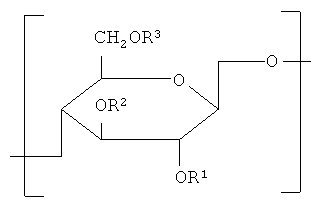
где R1, R2 и R3 каждый независимо выбран из группы, состоящей из следующих формул (а), (b), (с) и (d):



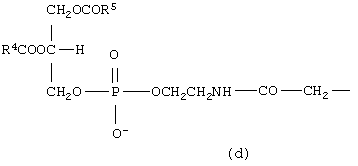
где X в формуле (с) является щелочным или щелочноземельным металлом,
R4 и R5 в формуле (d) каждый независимо является C9-27 алкильной группой или алкенильной группой,
общая степень замещения (b) и (с) составляет от 0,3 до 2,0 и
степень замещения (d) составляет от 0,001 до 0,05.1. The use of a material including a cellulose derivative hydrogel to restore nerve dysfunction, in which the complex module is from 1 to 1000 N / m 2 and the loss coefficient is from 0.01 to 0.5 wt% aqueous solution of the material 2.0, which is measured at an angular velocity of 10 rad / s using a device for measuring dynamic viscoelasticity, and in which the cellulose derivative has repeating units represented by the following formula:
where R 1 , R 2 and R 3 each independently selected from the group consisting of the following formulas (a), (b), (c) and (d):
where X in the formula (C) is an alkali or alkaline earth metal,
R 4 and R 5 in the formula (d) each independently is a C 9-27 alkyl group or an alkenyl group,
the total degree of substitution (b) and (c) is from 0.3 to 2.0, and
the degree of substitution (d) is from 0.001 to 0.05.
где R1, R2 и R3 каждый независимо выбран из группы, состоящей из следующих формул (а), (b), (с) и (d):
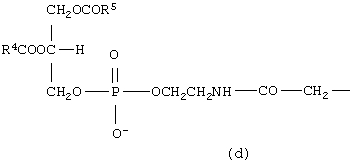
где Х в формуле (с) является щелочным или щелочноземельным металлом,
R4 и R5 в формуле (d) каждый независимо являются C9-27 алкильной группой или алкенильной группой,
общая степень замещения (b) и (с) составляет от 0,3 до 2,0 и степень замещения (d) составляет от 0,001 до 0,05.12. The use of a material containing a hydrogel of a cellulose derivative to restore nerve dysfunction, in which, at physiological salt concentration, the complex modulus of the material in a 1.0 wt.% Aqueous solution increases by 1 to 200 N / m 2 , as measured at angular velocity 10 rad / s with a device for measuring dynamic viscoelasticity, and in which the cellulose derivative has the repeating units represented by the formula below
where R 1 , R 2 and R 3 each independently selected from the group consisting of the following formulas (a), (b), (c) and (d):
where X in the formula (C) is an alkali or alkaline earth metal,
R 4 and R 5 in formula (d) are each independently a C 9-27 alkyl group or an alkenyl group,
the total degree of substitution (b) and (c) is from 0.3 to 2.0 and the degree of substitution (d) is from 0.001 to 0.05.
Applications Claiming Priority (3)
| Application Number | Priority Date | Filing Date | Title |
|---|---|---|---|
| JP2009-036534 | 2009-02-19 | ||
| JP2009036534 | 2009-02-19 | ||
| PCT/JP2009/066858 WO2010095304A1 (en) | 2009-02-19 | 2009-09-18 | Hydrogel of polysaccharide derivatives |
Publications (2)
| Publication Number | Publication Date |
|---|---|
| RU2011138176A RU2011138176A (en) | 2013-03-27 |
| RU2496503C2 true RU2496503C2 (en) | 2013-10-27 |
Family
ID=42633597
Family Applications (1)
| Application Number | Title | Priority Date | Filing Date |
|---|---|---|---|
| RU2011138176/15A RU2496503C2 (en) | 2009-02-19 | 2009-09-18 | Polysaccharide derivative hydrogel |
Country Status (11)
| Country | Link |
|---|---|
| US (1) | US20110301121A1 (en) |
| EP (1) | EP2399589A4 (en) |
| JP (1) | JP5385368B2 (en) |
| KR (1) | KR20110127699A (en) |
| CN (1) | CN102405049A (en) |
| AU (1) | AU2009340692A1 (en) |
| BR (1) | BRPI0924305A2 (en) |
| CA (1) | CA2752720A1 (en) |
| MX (1) | MX2011008683A (en) |
| RU (1) | RU2496503C2 (en) |
| WO (1) | WO2010095304A1 (en) |
Families Citing this family (4)
| Publication number | Priority date | Publication date | Assignee | Title |
|---|---|---|---|---|
| KR20130092408A (en) * | 2010-04-22 | 2013-08-20 | 데이진 가부시키가이샤 | Hydrogel |
| DE102012222365A1 (en) * | 2012-12-05 | 2014-06-05 | Aesculap Ag | Composition for use in the prophylaxis of post-surgical adhesions |
| CN103480037B (en) * | 2013-09-06 | 2015-12-02 | 奚廷斐 | For the Injectable type alginic acid radical biological material and preparation method thereof of heart failure adjuvant therapy |
| EP2979751B1 (en) | 2014-07-29 | 2020-10-28 | Symrise AG | Process for the manufacturing of solid cooling agents |
Citations (3)
| Publication number | Priority date | Publication date | Assignee | Title |
|---|---|---|---|---|
| JP2000198738A (en) * | 1998-10-27 | 2000-07-18 | Kuraray Co Ltd | Nerve regeneration material |
| EP1911769A1 (en) * | 2005-08-04 | 2008-04-16 | Teijin Limited | Cellulose derivative |
| RU2006142861A (en) * | 2004-05-05 | 2008-06-20 | Ку-Мед Аб (Se) | APPLICATION OF A VISCOELASTIC COMPOSITION FOR A NEW APPOINTMENT |
Family Cites Families (3)
| Publication number | Priority date | Publication date | Assignee | Title |
|---|---|---|---|---|
| JPH06157338A (en) * | 1992-11-27 | 1994-06-03 | Sagami Chem Res Center | Production promoter for nerve growth factor |
| JP3942205B2 (en) * | 1995-07-24 | 2007-07-11 | 生化学工業株式会社 | Therapeutic agent for neurological diseases |
| KR20090109120A (en) * | 2007-02-06 | 2009-10-19 | 데이진 가부시키가이샤 | Cellulose derivative and its preparation method |
-
2009
- 2009-09-18 MX MX2011008683A patent/MX2011008683A/en not_active Application Discontinuation
- 2009-09-18 JP JP2011500456A patent/JP5385368B2/en not_active Expired - Fee Related
- 2009-09-18 KR KR1020117021632A patent/KR20110127699A/en not_active Withdrawn
- 2009-09-18 WO PCT/JP2009/066858 patent/WO2010095304A1/en not_active Ceased
- 2009-09-18 BR BRPI0924305A patent/BRPI0924305A2/en not_active IP Right Cessation
- 2009-09-18 CN CN2009801588126A patent/CN102405049A/en active Pending
- 2009-09-18 US US13/202,234 patent/US20110301121A1/en not_active Abandoned
- 2009-09-18 RU RU2011138176/15A patent/RU2496503C2/en not_active IP Right Cessation
- 2009-09-18 AU AU2009340692A patent/AU2009340692A1/en not_active Abandoned
- 2009-09-18 EP EP09840407.2A patent/EP2399589A4/en not_active Withdrawn
- 2009-09-18 CA CA2752720A patent/CA2752720A1/en not_active Abandoned
Patent Citations (3)
| Publication number | Priority date | Publication date | Assignee | Title |
|---|---|---|---|---|
| JP2000198738A (en) * | 1998-10-27 | 2000-07-18 | Kuraray Co Ltd | Nerve regeneration material |
| RU2006142861A (en) * | 2004-05-05 | 2008-06-20 | Ку-Мед Аб (Se) | APPLICATION OF A VISCOELASTIC COMPOSITION FOR A NEW APPOINTMENT |
| EP1911769A1 (en) * | 2005-08-04 | 2008-04-16 | Teijin Limited | Cellulose derivative |
Also Published As
| Publication number | Publication date |
|---|---|
| JP5385368B2 (en) | 2014-01-08 |
| MX2011008683A (en) | 2011-09-06 |
| AU2009340692A1 (en) | 2011-08-25 |
| RU2011138176A (en) | 2013-03-27 |
| EP2399589A1 (en) | 2011-12-28 |
| KR20110127699A (en) | 2011-11-25 |
| CA2752720A1 (en) | 2010-08-26 |
| CN102405049A (en) | 2012-04-04 |
| WO2010095304A1 (en) | 2010-08-26 |
| US20110301121A1 (en) | 2011-12-08 |
| EP2399589A4 (en) | 2014-01-08 |
| BRPI0924305A2 (en) | 2016-01-26 |
| JPWO2010095304A1 (en) | 2012-08-16 |
Similar Documents
| Publication | Publication Date | Title |
|---|---|---|
| JP5059787B2 (en) | Cellulose derivative and method for producing the same | |
| JP5155513B2 (en) | Hyaluronic acid modified product | |
| JP3439481B2 (en) | Photocrosslinked hyaluronic acid gel and method for producing the same | |
| KR101514831B1 (en) | Heat sterilised injectable composition of hyaluronic acid or one of the salts thereof, polyols and lidocaine | |
| ES2735376T3 (en) | Injectable hyaluronic acid gel for the treatment of joint degeneration | |
| EP1117695B1 (en) | Biocompatible polymers, compositions containing same and their use for the manufacture of drugs | |
| US11707473B2 (en) | Method for the manufacture and use of a bionic hydrogel composition for medical applications | |
| KR20130028012A (en) | Therapeutic injection agent for arthritis | |
| KR101637883B1 (en) | Polyethylene glycol hydrogel injection | |
| JP2010209130A (en) | Alginic acid derivative and method for manufacturing the same | |
| US20110301121A1 (en) | Hydrogel of polysaccharide derivative | |
| JP5039552B2 (en) | Cellulose derivative | |
| PT1853279E (en) | Amide derivatives of hyaluronic acid in osteoarthrosis | |
| JP2010035744A (en) | Adheshion preventive material | |
| EP4400125A1 (en) | Sol-gel transition of 6-arm peg hydrogel over time | |
| Veretennikova et al. | Mechanical Properties of Nonequilibrium-Swollen Biopolymer Materials Based on Carboxyalkylated Chitosan Derivatives | |
| JP2004503483A (en) | Low molecular weight polymer composition |
Legal Events
| Date | Code | Title | Description |
|---|---|---|---|
| MM4A | The patent is invalid due to non-payment of fees |
Effective date: 20140919 |