RU2653473C2 - Method of testing and determining mechanical characteristics fruit exocarp and device therefor - Google Patents
Method of testing and determining mechanical characteristics fruit exocarp and device therefor Download PDFInfo
- Publication number
- RU2653473C2 RU2653473C2 RU2016109374A RU2016109374A RU2653473C2 RU 2653473 C2 RU2653473 C2 RU 2653473C2 RU 2016109374 A RU2016109374 A RU 2016109374A RU 2016109374 A RU2016109374 A RU 2016109374A RU 2653473 C2 RU2653473 C2 RU 2653473C2
- Authority
- RU
- Russia
- Prior art keywords
- exocarp
- fetus
- fruit
- pressure
- indenter
- Prior art date
Links
- 235000013399 edible fruits Nutrition 0.000 title claims abstract description 35
- 238000010998 test method Methods 0.000 title claims description 5
- 238000012360 testing method Methods 0.000 claims abstract description 29
- 238000000034 method Methods 0.000 claims abstract description 24
- 230000006378 damage Effects 0.000 claims abstract description 7
- 238000003860 storage Methods 0.000 claims abstract description 5
- 210000003754 fetus Anatomy 0.000 claims description 43
- 239000000463 material Substances 0.000 claims description 12
- 238000005259 measurement Methods 0.000 claims description 7
- 238000012545 processing Methods 0.000 claims description 6
- 230000001605 fetal effect Effects 0.000 claims description 5
- 238000007789 sealing Methods 0.000 claims description 4
- 238000003306 harvesting Methods 0.000 claims description 3
- 238000009434 installation Methods 0.000 claims description 3
- 235000021028 berry Nutrition 0.000 abstract description 11
- 235000013305 food Nutrition 0.000 abstract description 3
- 230000000694 effects Effects 0.000 abstract description 2
- 238000012544 monitoring process Methods 0.000 abstract 1
- 239000000126 substance Substances 0.000 abstract 1
- 239000003795 chemical substances by application Substances 0.000 description 4
- 235000021022 fresh fruits Nutrition 0.000 description 3
- 230000007423 decrease Effects 0.000 description 2
- 239000012634 fragment Substances 0.000 description 2
- 235000013311 vegetables Nutrition 0.000 description 2
- 241000207199 Citrus Species 0.000 description 1
- 241000219094 Vitaceae Species 0.000 description 1
- 241000219095 Vitis Species 0.000 description 1
- 235000009754 Vitis X bourquina Nutrition 0.000 description 1
- 235000012333 Vitis X labruscana Nutrition 0.000 description 1
- 235000014787 Vitis vinifera Nutrition 0.000 description 1
- 235000020971 citrus fruits Nutrition 0.000 description 1
- 238000010586 diagram Methods 0.000 description 1
- 238000001035 drying Methods 0.000 description 1
- 239000000835 fiber Substances 0.000 description 1
- 235000012055 fruits and vegetables Nutrition 0.000 description 1
- 235000021021 grapes Nutrition 0.000 description 1
- 230000005484 gravity Effects 0.000 description 1
- 239000007788 liquid Substances 0.000 description 1
- 239000012528 membrane Substances 0.000 description 1
- 239000002184 metal Substances 0.000 description 1
- 239000002120 nanofilm Substances 0.000 description 1
- 238000009659 non-destructive testing Methods 0.000 description 1
- 230000002028 premature Effects 0.000 description 1
- 238000002360 preparation method Methods 0.000 description 1
- 238000011160 research Methods 0.000 description 1
- 238000009864 tensile test Methods 0.000 description 1
- 238000012546 transfer Methods 0.000 description 1
Images
Classifications
-
- G—PHYSICS
- G01—MEASURING; TESTING
- G01N—INVESTIGATING OR ANALYSING MATERIALS BY DETERMINING THEIR CHEMICAL OR PHYSICAL PROPERTIES
- G01N33/00—Investigating or analysing materials by specific methods not covered by groups G01N1/00 - G01N31/00
- G01N33/02—Food
- G01N33/025—Fruits or vegetables
-
- G—PHYSICS
- G01—MEASURING; TESTING
- G01N—INVESTIGATING OR ANALYSING MATERIALS BY DETERMINING THEIR CHEMICAL OR PHYSICAL PROPERTIES
- G01N3/00—Investigating strength properties of solid materials by application of mechanical stress
- G01N3/08—Investigating strength properties of solid materials by application of mechanical stress by applying steady tensile or compressive forces
- G01N3/10—Investigating strength properties of solid materials by application of mechanical stress by applying steady tensile or compressive forces generated by pneumatic or hydraulic pressure
- G01N3/12—Pressure testing
Landscapes
- Chemical & Material Sciences (AREA)
- Health & Medical Sciences (AREA)
- Life Sciences & Earth Sciences (AREA)
- General Health & Medical Sciences (AREA)
- Analytical Chemistry (AREA)
- Biochemistry (AREA)
- Physics & Mathematics (AREA)
- General Physics & Mathematics (AREA)
- Immunology (AREA)
- Pathology (AREA)
- Engineering & Computer Science (AREA)
- Food Science & Technology (AREA)
- Medicinal Chemistry (AREA)
- Investigating Strength Of Materials By Application Of Mechanical Stress (AREA)
Abstract
Description
Изобретение относится к способам испытания экзокарпиев натуральных плодов и ягод на растяжение для получения их прочностных характеристик и может быть использовано в пищевой промышленности, а также в сельском хозяйстве при определении сроков хранения, способов транспортирования и складирования плодов и ягод, а также при проведении селекционных работ.The invention relates to methods for testing exocarpies of natural fruits and berries in tension to obtain their strength characteristics and can be used in the food industry, as well as in agriculture when determining storage periods, methods of transporting and storing fruits and berries, and also when conducting selection work.
Известны способы испытания экзокарпиев ягод на растяжение, включающие испытание образца на машине, обеспечивающей при растяжении образца измерение нагрузки с погрешностью не более 1% от измеряемой величины и постоянную скорость взаимного удаления зажимов, при этом предварительно проводят измерение большего поперечного диаметра с каждой ягоды, разрезание ягоды в направлении, перпендикулярном плоскости, проходящей через ось плодоножки таким образом, что в результате образуется фрагмент ягоды, содержащий мякоть и экзокарпий, располагающиеся симметрично относительно большего поперечного диаметра ягоды, производят поперечный разрез экзокарпия в месте расположения одного из прикрепляющих волокон, удаляют мякоть, вырубают из экзокарпия образец шириной 0,3 см, складывают его вдвое таким образом, чтобы его поверхности, ранее непосредственно контактировавшие с мякотью, находились внутри и контактировали друг с другом, а испытание проводят в течение времени, при котором не происходит снижения значений удлинения (патент РФ №2337356 по М. Кл. - G01N 33/02, опубл. 27.10.2008 г.) (аналог).Known methods for testing exocarpian berries in tension, including testing the sample on a machine that provides tensile testing of the load with an error of not more than 1% of the measured value and a constant speed of mutual removal of the clamps, while pre-measuring the larger transverse diameter from each berry, cutting the berry in the direction perpendicular to the plane passing through the axis of the peduncle so that as a result a berry fragment is formed containing pulp and exocarpy symmetrically with respect to the larger transverse diameter of the berry, make an exocarp cross section at the location of one of the attaching fibers, remove the flesh, cut a 0.3 cm wide specimen from the exocarp, fold it in half so that its surfaces that were previously directly in contact with the flesh are inside and in contact with each other, and the test is carried out for a time at which there is no decrease in elongation values (RF patent No. 2337356 according to M. Kl. - G01N 33/02, publ. October 27, 2008) (analog).
Однако известные способы не позволяют определить прочностные характеристики экзокарпия плодов по всей поверхности плода.However, the known methods do not allow to determine the strength characteristics of the exocarp of the fruit over the entire surface of the fetus.
Известны способы определения твердости кожицы ягоды винограда, заключающиеся в том, что ягоду раздавливают воздействия силы тяжести дроби, насыпаемой на диск (Церевитинов В.Ф. Химия и товароведение свежих плодов и овощей. T. 1. М.: Госторгиздат, 1949. С. 391-394) (аналог).Known methods for determining the hardness of the skin of grape berries, consisting in the fact that the berry is crushed by the effects of gravity of the fraction poured onto the disk (VV Tserevitinov Chemistry and commodity science of fresh fruits and vegetables. T. 1. M.: Gostorgizdat, 1949. P. 391-394) (analog).
Однако известные способы не позволяют определить механические характеристики экзокарпия плодов с достаточной точностью, поскольку фиксируют только лишь момент его разрыва. Кроме того, они не пригодны для определения прочности экзокарпия семечковых плодов.However, the known methods do not allow to determine the mechanical characteristics of the exocarp of the fruit with sufficient accuracy, since only the moment of its rupture is recorded. In addition, they are not suitable for determining the strength of the exocarp of pome fruits.
Известен также способ определения прочностных свойств тончайших пленок и нанопленок, включающий операции подготовки образца материала для испытания, размещения его на экспериментальной установке, последующего нагружения односторонним давлением, замера необходимых параметров, обработки результатов измерений и составления заключения о прочностных свойствах пленочного материала, при этом испытуемый образец кладут на перфорированное основание, зажимают выступающие за пределы рабочей части края образца заклинивающим кольцом с обеспечением герметичности, подают рабочую среду через отверстия перфорированного основания для создания одностороннего давления на образец, наблюдают за изменением формы образующегося купола с замерами контролируемых параметров по мере нарастания давления, в частности с переносом данных на цифровые носители информации, и обрабатывают полученную информацию об изменении формы купола в зависимости от вида деформации, причем механические характеристики оценивают по значениям модулей упругости (патент РФ №2387973 по М. Кл. - G01N 3/12, опубл. 27.04.2010 г.) (прототип). Недостатками указанного способа являются:There is also a method of determining the strength properties of the thinnest films and nanofilms, including the operation of preparing a sample of material for testing, placing it on an experimental setup, subsequent loading with one-sided pressure, measuring the necessary parameters, processing the measurement results and drawing a conclusion on the strength properties of the film material, while the test sample put on a perforated base, clamp the protruding edges of the sample beyond the working part with a jamming ring to ensure With the help of tightness, the working medium is fed through the openings of the perforated base to create one-sided pressure on the sample, the shape of the formed dome is monitored with measurements of controlled parameters as pressure builds up, in particular with the transfer of data to digital storage media, and the received dome shape data is processed depending on the type of deformation, and the mechanical characteristics are evaluated by the values of the elastic moduli (RF patent No. 2387973 by M. Cl. - G01N 3/12, publ. April 27, 2010) (prototype). The disadvantages of this method are:
а) способ не позволяет определить прочностные характеристики плода в целом;a) the method does not allow to determine the strength characteristics of the fetus as a whole;
б) возможны погрешности на границе закрепления экзокарпия;b) errors are possible at the boundary of exocarp fixation;
в) возможны незаметные повреждения в процессе обработки экзокарпия, влияющие на жесткостные характеристики образца (для испытания на данной установке необходимо счищать экзокарпий с плода);c) imperceptible damage during exocarp treatment is possible, affecting the stiffness of the specimen (for testing on this installation, it is necessary to clean the exocarp from the fetus);
г) возможны изменения жесткостных характеристик экзокарпия за время очищения плода и закрепления образца на установке (высыхание образца).d) changes in the stiffness characteristics of exocarpy are possible during cleansing of the fetus and fixing of the sample on the device (drying of the sample).
Известны измерительные приборы по определению твердости для неразрушающего контроля объектов с шероховатыми поверхностями, например плодов. Эти устройства содержат средство для генерации импульсивной струи жидкости или, например, воздуха, направленной на поверхность объекта контроля; лазер, направленный на область поверхности тестируемого объекта; детектор для измерения света, отраженного от поверхности объекта; анализатор для определения количества деформации и контроллер (патент США №5372030 по М. Кл. G01N 33/02, опубл. 13.12.1994 г.) (аналог).Known measuring instruments for determining hardness for non-destructive testing of objects with rough surfaces, such as fruits. These devices contain means for generating an impulsive jet of liquid or, for example, air directed to the surface of the control object; a laser aimed at the surface area of the test object; a detector for measuring light reflected from the surface of an object; an analyzer for determining the amount of deformation and a controller (US patent No. 5372030 according to M. Cl. G01N 33/02, publ. 12/13/1994) (analog).
Однако известные приборы не предназначены для определения характеристик плодов путем воздействия внутренним давлением.However, the known devices are not intended to determine the characteristics of the fruit by exposure to internal pressure.
Известны приборы для определения прочности кожицы винограда, состоящие из станины и стержня диаметром 3 мм с верхним и нижним дисками, а также дробей для создания усилия от механической нагрузки (Церевитинов В.Ф. Химия и товароведение свежих плодов и овощей. T. 1. М.: Госторгиздат, 1949. С. 393) (аналог).Known instruments for determining the strength of the skin of grapes, consisting of a bed and a core with a diameter of 3 mm with upper and lower discs, as well as fractions for creating effort from mechanical stress (Cerevitinov VF Chemistry and commodity research of fresh fruits and vegetables. T. 1. M .: Gostorgizdat, 1949.S. 393) (analogue).
Эти устройства не позволяют равномерно нагружать экзокарпий плодов, в результате чего не обеспечивается точность определения его механических характеристик.These devices do not allow uniform loading of the exocarp of the fruit, as a result of which the accuracy of determining its mechanical characteristics is not ensured.
Известно также устройство для испытания образцов металлических мембран под напряжением, содержащее емкость для коррозионной среды, средства для воздействия на образец нагрузками и регистрирующую аппаратуру, при этом нагрузочный резервуар имеет фланец, на который установлен с образованием герметично закрытой полости испытуемый образец, закрепляемый при помощи ответного фланца с отверстием определенного размера, а с наружной стороны образца между испытуемым образцом и ответным фланцем установлен патрубок, образующий вместе с испытуемым образцом емкость для коррозионной среды, причем к резервуару подведена магистраль от источника рабочей среды для оказания одностороннего давления на образец, а также подсоединено устройство замера давления, кроме того, установлен измерительный комплекс для измерения геометрических параметров образца (патент РФ №2296976 по М. Кл. G01N 17/00, опубл. 10.04.2007 г.) (прототип).It is also known a device for testing samples of metal membranes under tension, containing a container for a corrosive medium, means for influencing the sample with loads and recording equipment, while the load tank has a flange on which the test sample is mounted, forming a hermetically sealed cavity, fixed with a counterflange with a hole of a certain size, and on the outside of the sample, a pipe is installed between the test sample and the counter flange, forming together with the test the sample is a container for a corrosive medium, and a line from the source of the working medium is supplied to the tank to provide one-sided pressure on the sample, and a pressure measuring device is connected, in addition, a measuring complex for measuring the geometric parameters of the sample is installed (RF patent No. 2296976 according to M. C G01N 17/00, published on April 10, 2007) (prototype).
Недостатками указанного устройства являются:The disadvantages of this device are:
а) устройство не предназначено для определения характеристик биологических объектов;a) the device is not intended to determine the characteristics of biological objects;
б) даже если приспособить его для испытания биологических объектов, оно не позволяет напрямую определять жесткостные характеристики экзокарпия плода, поскольку пришлось бы вырезать круглый фрагмент экзокарпия плода, разрушив его целостность;b) even if it is adapted for testing biological objects, it does not allow directly determining the stiffness characteristics of the exocarp of the fetus, since a round fragment of the exocarp of the fetus would have to be cut, destroying its integrity;
в) невозможно снизить погрешности, исключить повреждения в процессе обработки экзокарпия и повысить точность определения жесткостных характеристик экзакарпия.c) it is impossible to reduce errors, exclude damage during the processing of exocarp and increase the accuracy of determining the stiffness characteristics of exacarp.
Задачами (целью) настоящего изобретения являются снижение погрешностей, исключение повреждений в процессе обработки экзокарпия и повышение точности определения жесткостных характеристик экзакарпия.The objectives (goal) of the present invention are to reduce errors, eliminate damage during processing of exocarp and increase the accuracy of determining the stiffness characteristics of exacarp.
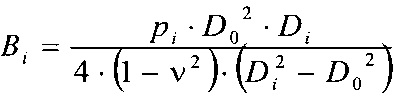
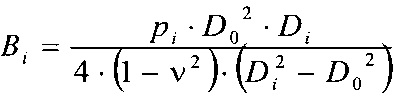
Указанные задачи достигаются тем, что в способе испытания и определения механических характеристик экзокарпия плодов, включающем операции подготовки образца материала для испытания, размещения его на экспериментальной установке, последующего нагружения односторонним давлением, замера необходимых параметров, обработки результатов измерений и составления заключения о жесткостных свойствах материала, зажимают испытуемый объект (плод) между чашами с обеспечением герметичности, вводят индентор в тело плода, подают рабочий агент внутрь плода, нагружают экзокарпий внутренним давлением, наблюдают за изменением формы плода, замеряют текущий диаметр плода в экваториальной плоскости плода по мере возрастания давления, производят расчет механических параметров экзокарпия, а именно производят расчет жесткости на растяжение Bi экзокарпия по формулеThese tasks are achieved by the fact that in the method of testing and determining the mechanical characteristics of the exocarp of the fruit, including the preparation of a sample of material for testing, placing it on an experimental installation, subsequent loading with unilateral pressure, measuring the necessary parameters, processing the measurement results and drawing conclusions about the stiffness of the material, clamp the test object (fetus) between the bowls to ensure tightness, introduce an indenter into the fetal body, feed the working agent inside of the fetus, the exocarpy is loaded with internal pressure, the change in the shape of the fetus is observed, the current diameter of the fetus is measured in the equatorial plane of the fetus as pressure increases, the mechanical parameters of the exocarpy are calculated, namely, the tensile stiffness B i of the exocarpy is calculated by the formula
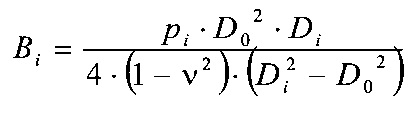
где pi - текущее равномерно распределенное давление;where p i is the current uniformly distributed pressure;
D0 - исходный диаметр плода в экваториальной плоскости;D 0 - the initial diameter of the fetus in the equatorial plane;
Di - текущий диаметр плода в экваториальной плоскости;D i - the current diameter of the fetus in the equatorial plane;
ν - коэффициент Пуассона материала экзокарпия.ν - Poisson's ratio of exocarpy material.
Сравнивая полученную величину жесткости с исходной величиной жесткости экзокарпия, полученного ранее непосредственно после сбора зрелого урожая, судят о степени повреждения плода, а также о длительности хранения плода.Comparing the obtained value of rigidity with the initial value of rigidity of exocarp obtained earlier immediately after harvesting a mature crop, one can judge the degree of damage to the fetus, as well as the duration of storage of the fetus.
В устройстве для осуществления способа испытания и определения механических характеристик экзокарпия плодов, состоящего из основания с кронштейном, индентора, источника давления рабочей среды (агента) в виде резервуара, нагрузочной магистрали, вентиля, прибора для измерения давления и измерительно-наблюдательного комплекса, основание имеет отверстие, внутри которого размещена ось с возможностью линейного перемещения вдоль отверстия. На верхнем конце оси жестко закреплена чаша. На оси между основанием и чашей размещена пружина. На свободном конце кронштейна закреплен трубчатый держатель. На нижнем конце держателя имеется встречная чаша с отверстием. Внутри держателя размещен трубчатый индентор с заостренным концом и иглой внутри него. Индентор имеет ручку для его перемещения. Игла имеет острие на нижнем конце и ручку на другом конце. Чаши снабжены герметизирующими прокладками, между которыми зажимается испытуемый объект (плод). Индентор имеет патрубок для соединения с источником давления рабочей среды.In the device for implementing the method of testing and determining the mechanical characteristics of the exocarp of the fruit, consisting of a base with a bracket, an indenter, a source of pressure of the working medium (agent) in the form of a reservoir, a loading line, a valve, a device for measuring pressure and a measuring and observation complex, the base has an opening inside which the axis is placed with the possibility of linear movement along the hole. A bowl is rigidly fixed at the upper end of the axis. On the axis between the base and the bowl is a spring. A tubular holder is attached to the free end of the bracket. At the lower end of the holder there is a counter bowl with a hole. A tubular indenter with a pointed end and a needle inside it is placed inside the holder. The indenter has a handle for moving it. The needle has a point on the lower end and a handle on the other end. The bowls are equipped with sealing gaskets, between which the test object (fruit) is clamped. The indenter has a nozzle for connection to a source of pressure of the working medium.
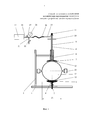
На фиг. 1 показана общая схема реализации способа.In FIG. 1 shows a general diagram of the implementation of the method.
Способ осуществляют следующим образом.The method is as follows.
Подготавливают для испытания образец плода. Размещают подготовленный образец плода на экспериментальной установке. Зажимают испытуемый объект (плод) между чашами с обеспечением герметичности соединения с нагрузочными магистралями экспериментальной установки. Вводят индентор в тело плода. Подают рабочий агент внутрь плода и тем самым нагружают экзокарпий внутренним давлением. Наблюдают за изменением формы плода, замеряют текущий диаметр плода в экваториальном сечении плода по мере возрастания давления.A fetal sample is prepared for testing. Place the prepared fetal sample in an experimental setup. Clamp the test object (fetus) between the bowls to ensure the tightness of the connection with the load lines of the experimental setup. An indenter is introduced into the fetal body. The working agent is fed into the fetus and thereby exocarpy is loaded with internal pressure. Observe the change in the shape of the fetus, measure the current diameter of the fetus in the equatorial section of the fetus as pressure increases.
В ходе нагружения плода односторонним давлением и замера необходимых параметров обрабатывают результаты измерений.In the process of loading the fetus with one-sided pressure and measuring the necessary parameters, the measurement results are processed.
При этом механические характеристики плода оцениваются по следующим величинам:In this case, the mechanical characteristics of the fetus are evaluated by the following values:
1. Определяют суммарное усилие Fi, действующее на экзокарпий (оболочку) плода в экваториальном (диаметральном) сечении:1. Determine the total force F i acting on the exocarp (shell) of the fetus in the equatorial (diametric) section:
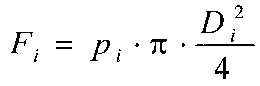
где Di - текущий диаметр плода в экваториальном сечении; pi - внутреннее распределенное давление в момент измерения диаметра.where D i is the current diameter of the fetus in the equatorial section; p i - internal distributed pressure at the time of measuring the diameter.
2. Определяют поверхностную деформацию εi экзокарпия:2. Determine the surface deformation ε i exocarp:
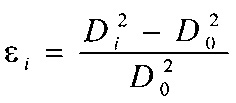
где D0 - исходный диаметр плода в экваториальном сечении.where D 0 is the initial diameter of the fetus in the equatorial section.
3. Производят расчет жесткости на растяжение Вi экзокарпия по формуле:3. Calculate the tensile stiffness of Bi exocarp by the formula:
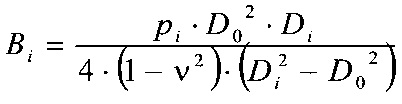
где ν - коэффициент Пуассона материала экзокарпия.where ν is the Poisson's ratio of the exocarp material.
Коэффициент Пуассона ν материала экзокарпия выбирают в пределах от 0,36 до 0,48 в зависимости от вида плода.The Poisson's ratio ν of the exocarp material is selected in the range from 0.36 to 0.48, depending on the type of fetus.
При необходимости строят соответствующие графики зависимости параметров. Далее составляют заключение о прочностных свойствах материала экзокарпия.If necessary, build appropriate graphs of the dependence of the parameters. Next, they make a conclusion about the strength properties of the exocarp material.
Пример. Проведены испытания по определению прочности экзокарпия апельсина по описанному способу. Для испытания была выбрана партия плодов из трех апельсинов с исходными диаметрами D01=115 мм, D02=112 мм и D03=113 мм. Экспериментальные и расчетные данные, полученные в процессе осуществления способа, приведены в таблицах 1 и 2.Example. Tests were conducted to determine the strength of the exocarp of orange by the described method. For the test, a batch of fruits from three oranges with initial diameters D 01 = 115 mm, D 02 = 112 mm and D 03 = 113 mm was selected. Experimental and calculated data obtained during the implementation of the method are shown in tables 1 and 2.
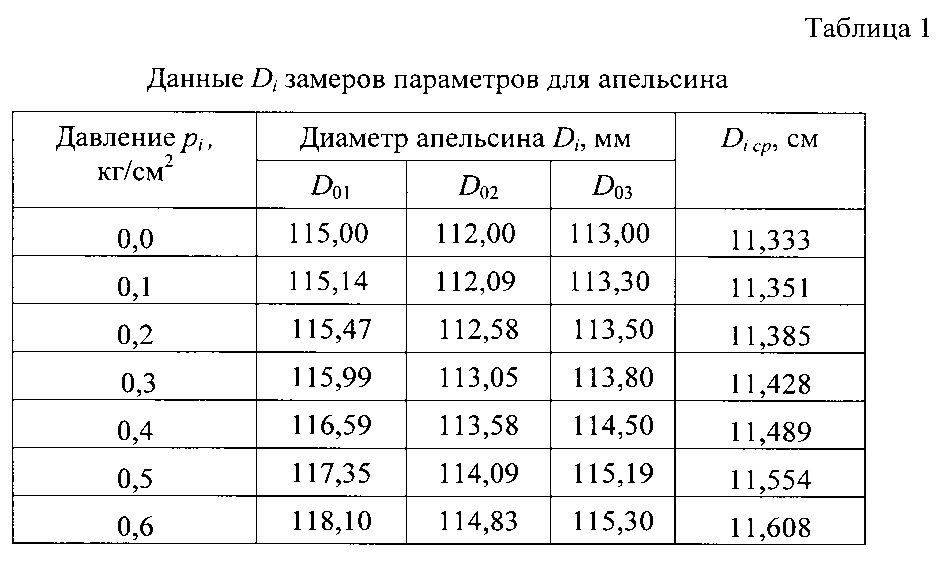
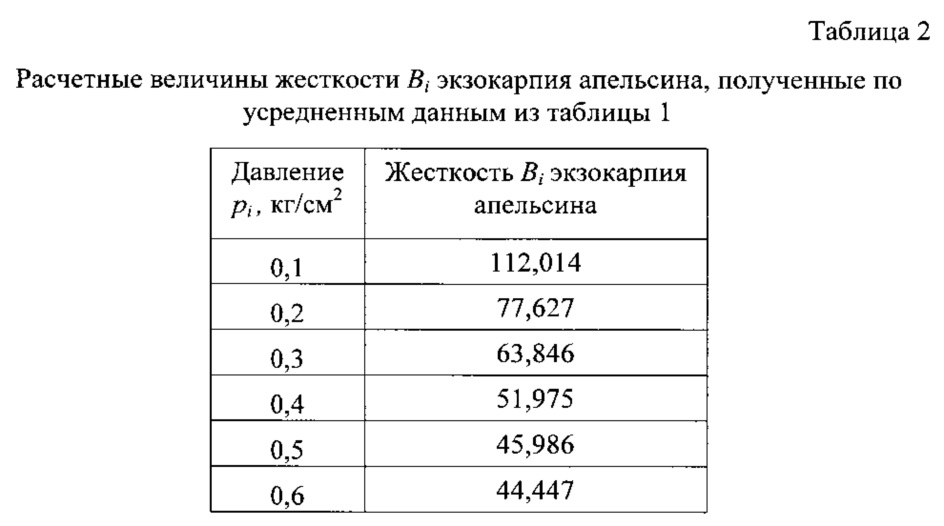
Из таблицы 2 видно, что с увеличением нагрузочного давления жесткость на растяжение экзокарпия плода снижается. На базе таблицы 2 можно построить соответствующую кривую зависимости жесткости на растяжение от приложенного внутреннего давления нагружения. При необходимости на этот же график можно наложить соответствующие кривые, построенные по описанному способу для свежих плодов, испытанных непосредственно при сборе урожая. Далее составляют заключение об изменении жесткостных характеристик материала экзокарпия.From table 2 it is seen that with increasing load pressure, the tensile stiffness of the exocarp of the fetus decreases. Based on table 2, it is possible to construct the corresponding curve of the dependence of the tensile stiffness on the applied internal loading pressure. If necessary, the same graph can be superimposed with the corresponding curves constructed according to the described method for fresh fruits tested directly during harvesting. Next, a conclusion is drawn on the change in the stiffness characteristics of the exocarp material.
Устройство для осуществления способа состоит из основания 1, имеющего отверстие, внутри которого размещена ось 2 с возможностью линейного перемещения вдоль отверстия. На верхнем конце оси 2 жестко закреплена чаша 3. На оси 2 между основанием 1 и чашей 3 размещена пружина 4. На основании 1 также жестко закреплен изогнутый кронштейн 5, на свободном конце которого закреплен трубчатый держатель 6, геометрическая ось которого совпадает с геометрической осью оси 2. На нижнем конце держателя 6 имеется встречная чаша 7 с отверстием. Внутри держателя 3 размещен трубчатый индентор 8 с заостренным концом и иглой 9 внутри него. Индентор 8 имеет ручку 10 для его перемещения. Игла 9 имеет острие на нижнем конце и ручку 11 на другом конце. Чаши 3 и 7 снабжены герметизирующими прокладками 12 и 13 между которыми зажимается испытуемый объект (плод) 14. Индентор 8 имеет патрубок 15, который через шланг 16 подсоединен к источнику давления рабочей среды (рабочего агента). Источник давления рабочей среды включает в себя резервуар 17, магистраль 18, вентиль 19 и прибор для измерения давления 20 (например, манометр). Магистраль 18 также имеет стравливающий патрубок 21 с вентилем 22. Для измерения геометрических параметров объекта предусмотрен измерительно-наблюдательный комплекс 23, в составе которого имеется оборудование для измерения линейных размеров, а при необходимости фотоаппарат и видеокамера.A device for implementing the method consists of a
Устройство работает следующим образом.The device operates as follows.
Объект (плод) 14 размещают между чашами 3 и 7 и он поджимается пружиной 4 с обеспечением герметичности за счет герметизирующих прокладок 12 и 13. Плод в зависимости от его вида размещают определенным образом. Плоды яблочных, цитрусовых и … культур размещают так, чтобы ось симметрии плода совпадала с осью индентора 8. Перемещая индентор 8 совместно с иглой 9 вдоль оси держателя 3 при помощи ручек 10 и 11, протыкают плод и доводят заостренный конец индентора в среднюю часть плода. Затем отводят иглу 9, оттягивая ее вверх за ручку 11. Объект нагружают односторонним давлением рабочей среды, которая подается при открытии вентиля 19 от источника давления рабочей среды последовательно проходя магистраль 18, шланг 16, патрубок 15 и полость индентора 8. По мере нагружения испытуемый объект меняет свои геометрические размеры, что замеряется измерительно-наблюдательным комплексом 23. В процессе нагружения экзокарпий плода подвергается деформации. Экзокарпий плода стремится принять сферическую форму по мере наращивания внутреннего давления. Поэтому измерительно-наблюдательный комплекс 23 ориентирован, в основном, на измерение диаметра в экваториальной плоскости объекта, расположенной поперек оси симметрии плода, а при необходимости фотографирование и видеосъемку. Одновременно снимают текущие показания давления манометром 20. Далее осуществляется обработка результатов измерений и расчет физико-механических характеристик экзокарпия.The object (fruit) 14 is placed between the
Устройство позволяет устранить преждевременное разрушение экзокарпия плода в естественном виде, повысить точность определения прочностных характеристик экзокарпиев плодов, расширить область применения способа при определении прочностных свойств различных видов плодов и овощей и получить возможность наблюдения за изменением показателей прочности в динамике, то есть в процессе нагружения плодов. Появляется возможность автоматизации измерений и обработки данных, что дает возможность увеличить производительность процессов испытаний плодов, в том числе требующих деликатного обращения, таких как ягоды.The device allows to eliminate premature destruction of the exocarp of the fetus in its natural form, to increase the accuracy of determining the strength characteristics of exocarpium fruits, to expand the scope of the method when determining the strength properties of various types of fruits and vegetables, and to be able to observe changes in strength indicators in dynamics, that is, in the process of loading the fruits. There is an opportunity to automate measurements and data processing, which makes it possible to increase the productivity of fruit testing processes, including those requiring delicate handling, such as berries.
Предложенный способ позволяет упростить отбраковку плода по полученным номограммам изменения жесткости экзокарпия испытуемого плода.The proposed method allows to simplify the rejection of the fetus according to the nomograms of changes in the stiffness of the exocarp of the test fetus.
Claims (8)
Priority Applications (1)
| Application Number | Priority Date | Filing Date | Title |
|---|---|---|---|
| RU2016109374A RU2653473C2 (en) | 2016-03-15 | 2016-03-15 | Method of testing and determining mechanical characteristics fruit exocarp and device therefor |
Applications Claiming Priority (1)
| Application Number | Priority Date | Filing Date | Title |
|---|---|---|---|
| RU2016109374A RU2653473C2 (en) | 2016-03-15 | 2016-03-15 | Method of testing and determining mechanical characteristics fruit exocarp and device therefor |
Publications (2)
| Publication Number | Publication Date |
|---|---|
| RU2016109374A RU2016109374A (en) | 2017-09-20 |
| RU2653473C2 true RU2653473C2 (en) | 2018-05-08 |
Family
ID=59893462
Family Applications (1)
| Application Number | Title | Priority Date | Filing Date |
|---|---|---|---|
| RU2016109374A RU2653473C2 (en) | 2016-03-15 | 2016-03-15 | Method of testing and determining mechanical characteristics fruit exocarp and device therefor |
Country Status (1)
| Country | Link |
|---|---|
| RU (1) | RU2653473C2 (en) |
Cited By (1)
| Publication number | Priority date | Publication date | Assignee | Title |
|---|---|---|---|---|
| RU2708909C1 (en) * | 2018-12-28 | 2019-12-12 | Федеральное государственное бюджетное научное учреждение "Федеральный научный центр пищевых систем им. В.М. Горбатова" РАН | Apparatus for testing specimens for uniaxial compression of materials of primarily plant origin |
Citations (3)
| Publication number | Priority date | Publication date | Assignee | Title |
|---|---|---|---|---|
| SU1529104A1 (en) * | 1987-07-15 | 1989-12-15 | Краснодарский политехнический институт | Apparatus for determining physico-mechanical properties of food materials |
| RU2222808C2 (en) * | 2001-06-08 | 2004-01-27 | Кемеровский технологический институт пищевой промышленности | Device to examine structural-mechanical properties of food materials |
| RU2337356C1 (en) * | 2007-09-24 | 2008-10-27 | Государственное образовательное учреждение высшего профессионального образования "Орловский государственный технический университет" (ОрелГТУ) | Method of berry exocarp test for tension |
-
2016
- 2016-03-15 RU RU2016109374A patent/RU2653473C2/en active
Patent Citations (3)
| Publication number | Priority date | Publication date | Assignee | Title |
|---|---|---|---|---|
| SU1529104A1 (en) * | 1987-07-15 | 1989-12-15 | Краснодарский политехнический институт | Apparatus for determining physico-mechanical properties of food materials |
| RU2222808C2 (en) * | 2001-06-08 | 2004-01-27 | Кемеровский технологический институт пищевой промышленности | Device to examine structural-mechanical properties of food materials |
| RU2337356C1 (en) * | 2007-09-24 | 2008-10-27 | Государственное образовательное учреждение высшего профессионального образования "Орловский государственный технический университет" (ОрелГТУ) | Method of berry exocarp test for tension |
Non-Patent Citations (2)
| Title |
|---|
| ZHIGUO LI et al. Effect of tomato internal structure on its mechanical properties and degree of mechanical damage, African Journal of Biotechnology, vol.9(12), 2010, pp.1816-1826. * |
| ХАРИСЛАМОВА Л.У., ЯКУПОВ С.Н. Методы оценки прочности биологических мембран, Строительная механика инженерных конструкций и сооружений, 2014, N6, с.65-71. * |
Cited By (1)
| Publication number | Priority date | Publication date | Assignee | Title |
|---|---|---|---|---|
| RU2708909C1 (en) * | 2018-12-28 | 2019-12-12 | Федеральное государственное бюджетное научное учреждение "Федеральный научный центр пищевых систем им. В.М. Горбатова" РАН | Apparatus for testing specimens for uniaxial compression of materials of primarily plant origin |
Also Published As
| Publication number | Publication date |
|---|---|
| RU2016109374A (en) | 2017-09-20 |
Similar Documents
| Publication | Publication Date | Title |
|---|---|---|
| Abbott | Quality measurement of fruits and vegetables | |
| Mizrach et al. | Determination of fruit and vegetable properties by ultrasonic excitation | |
| Jiménez-Jiménez et al. | Table olive cultivar susceptibility to impact bruising | |
| JPH04506176A (en) | How to measure the condition of crops | |
| Mizrach et al. | Determination of mango physiological indices by mechanical wave analysis | |
| Zhang et al. | Evaluation of quality changes and elasticity index of kiwifruit in shelf life by a nondestructive acoustic vibration method | |
| JP2018132325A (en) | Method and apparatus for nondestructive inspection of ripening degree of pear by measuring odor | |
| Aboonajmi et al. | Nondestructive quality assessment of Agro-food products | |
| Liljedahl et al. | Changes in sonic resonance of ‘Delicious’ and ‘Golden Delicious’ apples undergoing accelerated ripening | |
| RU2653473C2 (en) | Method of testing and determining mechanical characteristics fruit exocarp and device therefor | |
| Bhosale et al. | Firmness prediction of the apple using capacitance measurement | |
| Vursavusa et al. | Nondestructive dropped fruit impact test for assessing tomato firmness | |
| Aboudaoud et al. | The maturity characterization of orange fruit by using high frequency ultrasonic echo pulse method | |
| STUDMAN et al. | Twist test for measuring fruit firmness | |
| Wang et al. | Study on tensile mechanical property and microstructure of fruit and vegetable peels. | |
| Affeldt Jr et al. | Apple finnness and sensory quality using contact acoustic transmission | |
| Lu et al. | A new bioyield tester for measuring apple fruit firmness | |
| Kumari et al. | Non-destructive quality evaluation by sensing maturity and ripening of fruits and vegetables | |
| Lu et al. | A portable device for the bioyield detection to measure apple firmness | |
| Schotsmans et al. | Non-destructive firmness measurement of Zespri™ Gold using the acoustic impulse response technique and compression tests | |
| Ouacha et al. | Non-destructive detection of air traces in the UHT milk packet by using ultrasonic waves | |
| RU2453106C2 (en) | Nondestructive optical method of evaluation of fruit maturity | |
| Trnka et al. | Influence of sugar beet storage duration on root response to non-destructive impacts | |
| Rotz et al. | A note on potential applications of physical properties of bruised tissue of apples for automated sorting | |
| Kuna-Broniowska et al. | Effect of storage time and temperature on Poisson ratio of tomato fruit skin |
Legal Events
| Date | Code | Title | Description |
|---|---|---|---|
| HZ9A | Changing address for correspondence with an applicant |