RU2721503C2 - Method of producing semi-cellulose - Google Patents
Method of producing semi-cellulose Download PDFInfo
- Publication number
- RU2721503C2 RU2721503C2 RU2018140804A RU2018140804A RU2721503C2 RU 2721503 C2 RU2721503 C2 RU 2721503C2 RU 2018140804 A RU2018140804 A RU 2018140804A RU 2018140804 A RU2018140804 A RU 2018140804A RU 2721503 C2 RU2721503 C2 RU 2721503C2
- Authority
- RU
- Russia
- Prior art keywords
- semi
- cellulose
- wood
- cooking
- production
- Prior art date
Links
- 239000001913 cellulose Substances 0.000 title claims abstract description 28
- 229920002678 cellulose Polymers 0.000 title claims abstract description 28
- 238000000034 method Methods 0.000 title claims abstract description 17
- 238000010411 cooking Methods 0.000 claims abstract description 39
- 239000002023 wood Substances 0.000 claims abstract description 23
- HEMHJVSKTPXQMS-UHFFFAOYSA-M Sodium hydroxide Chemical compound [OH-].[Na+] HEMHJVSKTPXQMS-UHFFFAOYSA-M 0.000 claims abstract description 20
- 238000004519 manufacturing process Methods 0.000 claims abstract description 19
- 239000002994 raw material Substances 0.000 claims abstract description 19
- 235000018185 Betula X alpestris Nutrition 0.000 claims abstract description 15
- 235000018212 Betula X uliginosa Nutrition 0.000 claims abstract description 15
- 239000002916 wood waste Substances 0.000 claims abstract description 15
- 230000007935 neutral effect Effects 0.000 claims abstract description 11
- LSNNMFCWUKXFEE-UHFFFAOYSA-N Sulfurous acid Chemical compound OS(O)=O LSNNMFCWUKXFEE-UHFFFAOYSA-N 0.000 claims description 11
- 230000001143 conditioned effect Effects 0.000 claims description 6
- 230000007613 environmental effect Effects 0.000 abstract description 6
- 238000000227 grinding Methods 0.000 abstract description 4
- 239000000047 product Substances 0.000 abstract description 4
- 239000011265 semifinished product Substances 0.000 abstract description 4
- XLYOFNOQVPJJNP-UHFFFAOYSA-N water Substances O XLYOFNOQVPJJNP-UHFFFAOYSA-N 0.000 abstract description 4
- LSNNMFCWUKXFEE-UHFFFAOYSA-L sulfite Chemical compound [O-]S([O-])=O LSNNMFCWUKXFEE-UHFFFAOYSA-L 0.000 abstract description 2
- 238000009835 boiling Methods 0.000 abstract 2
- 230000000694 effects Effects 0.000 abstract 1
- 239000000126 substance Substances 0.000 abstract 1
- 239000011734 sodium Substances 0.000 description 6
- CDBYLPFSWZWCQE-UHFFFAOYSA-L Sodium Carbonate Chemical compound [Na+].[Na+].[O-]C([O-])=O CDBYLPFSWZWCQE-UHFFFAOYSA-L 0.000 description 4
- QAOWNCQODCNURD-UHFFFAOYSA-L Sulfate Chemical compound [O-]S([O-])(=O)=O QAOWNCQODCNURD-UHFFFAOYSA-L 0.000 description 4
- 229910052708 sodium Inorganic materials 0.000 description 4
- 230000009931 harmful effect Effects 0.000 description 3
- 239000002699 waste material Substances 0.000 description 3
- 230000015572 biosynthetic process Effects 0.000 description 2
- 238000000354 decomposition reaction Methods 0.000 description 2
- 239000000835 fiber Substances 0.000 description 2
- 238000002360 preparation method Methods 0.000 description 2
- 229910000029 sodium carbonate Inorganic materials 0.000 description 2
- 229910052979 sodium sulfide Inorganic materials 0.000 description 2
- GRVFOGOEDUUMBP-UHFFFAOYSA-N sodium sulfide (anhydrous) Chemical compound [Na+].[Na+].[S-2] GRVFOGOEDUUMBP-UHFFFAOYSA-N 0.000 description 2
- LSNNMFCWUKXFEE-UHFFFAOYSA-M Bisulfite Chemical compound OS([O-])=O LSNNMFCWUKXFEE-UHFFFAOYSA-M 0.000 description 1
- RWSOTUBLDIXVET-UHFFFAOYSA-N Dihydrogen sulfide Chemical compound S RWSOTUBLDIXVET-UHFFFAOYSA-N 0.000 description 1
- DGAQECJNVWCQMB-PUAWFVPOSA-M Ilexoside XXIX Chemical compound C[C@@H]1CC[C@@]2(CC[C@@]3(C(=CC[C@H]4[C@]3(CC[C@@H]5[C@@]4(CC[C@@H](C5(C)C)OS(=O)(=O)[O-])C)C)[C@@H]2[C@]1(C)O)C)C(=O)O[C@H]6[C@@H]([C@H]([C@@H]([C@H](O6)CO)O)O)O.[Na+] DGAQECJNVWCQMB-PUAWFVPOSA-M 0.000 description 1
- NINIDFKCEFEMDL-UHFFFAOYSA-N Sulfur Chemical compound [S] NINIDFKCEFEMDL-UHFFFAOYSA-N 0.000 description 1
- 238000009825 accumulation Methods 0.000 description 1
- 230000008030 elimination Effects 0.000 description 1
- 238000003379 elimination reaction Methods 0.000 description 1
- 230000007717 exclusion Effects 0.000 description 1
- 239000007789 gas Substances 0.000 description 1
- 239000011121 hardwood Substances 0.000 description 1
- 239000000383 hazardous chemical Substances 0.000 description 1
- 229910000037 hydrogen sulfide Inorganic materials 0.000 description 1
- 239000007788 liquid Substances 0.000 description 1
- LSDPWZHWYPCBBB-UHFFFAOYSA-N methyl mercaptane Natural products SC LSDPWZHWYPCBBB-UHFFFAOYSA-N 0.000 description 1
- 238000004321 preservation Methods 0.000 description 1
- 238000003860 storage Methods 0.000 description 1
- 229910052717 sulfur Inorganic materials 0.000 description 1
- 239000011593 sulfur Substances 0.000 description 1
- 231100000167 toxic agent Toxicity 0.000 description 1
- 231100000419 toxicity Toxicity 0.000 description 1
- 230000001988 toxicity Effects 0.000 description 1
- 239000002351 wastewater Substances 0.000 description 1
Classifications
-
- D—TEXTILES; PAPER
- D21—PAPER-MAKING; PRODUCTION OF CELLULOSE
- D21C—PRODUCTION OF CELLULOSE BY REMOVING NON-CELLULOSE SUBSTANCES FROM CELLULOSE-CONTAINING MATERIALS; REGENERATION OF PULPING LIQUORS; APPARATUS THEREFOR
- D21C3/00—Pulping cellulose-containing materials
Landscapes
- Paper (AREA)
- Processing Of Solid Wastes (AREA)
Abstract
Description
Изобретение относится к целлюлозно-бумажной промышленности и может быть использовано в производстве волокнистых полуфабрикатов, в частности, полу целлюлозы для изготовления бумаги.The invention relates to the pulp and paper industry and can be used in the manufacture of fibrous semi-finished products, in particular, pulp floor for the manufacture of paper.
Известен способ получения полуцеллюлозы путем щелочной варки лиственной древесины с использованием варочной жидкости - растворенного плава от сжигания отработанного бисульфитного щелока на натриевом основании, содержащего 48-80% Na2S, 13-43% Na2CO3, 7-11% Na2SO3 в ед. Na2O. Варку ведут при температуре 170-180°С и давлении 0,7-0,9 МПа (см. А.С. №861442, кл. D21C 3/00, опубл. 07.09.81).A known method of producing semi-cellulose by alkaline cooking of deciduous wood using a cooking liquid - dissolved melt from burning spent bisulfite liquor on a sodium base containing 48-80% Na 2 S, 13-43% Na 2 CO 3 , 7-11% Na 2 SO 3 units Na 2 O. Cooking is carried out at a temperature of 170-180 ° C and a pressure of 0.7-0.9 MPa (see AS No. 861442, class D21C 3/00, publ. 07.09.81).
Недостатком известного способа является образование в процессе варки при высокой температуре в щелочной среде из сульфида натрия экологически опасных веществ - метилмеркаптана и сероводорода.The disadvantage of this method is the formation during cooking at high temperature in an alkaline environment from sodium sulfide environmentally hazardous substances - methyl mercaptan and hydrogen sulfide.
Наиболее близким способом того же назначения к заявленному изобретению по совокупности признаков является способ получения полуцеллюлозы из лиственной древесины, согласно которому размолотую березовую щепу подвергают пропарке острым паром при температуре 95-100°С в течение 5 мин, пропитке варочным раствором сульфита и карбоната натрия в течение 5 мин при температуре 145°С и варке при температуре 175-180°С в течение 5-10 мин. Затем в варочный раствор после варки дополнительно добавляют сульфатный белый щелок и продолжают варку в течение 5-10 мин. (см. SU №1557227, кл. D21C 3/02, опубл. 15.04.90). Данный способ принят за прототип.The closest method of the same purpose to the claimed invention according to a combination of features is a method for producing semi-cellulose from hardwood, according to which ground birch chips are steamed with steam at a temperature of 95-100 ° C for 5 minutes, impregnated with a cooking solution of sulfite and sodium carbonate for 5 minutes at a temperature of 145 ° C and cooking at a temperature of 175-180 ° C for 5-10 minutes. Then, after cooking, sulfate white liquor is additionally added to the cooking solution and cooking is continued for 5-10 minutes. (see SU No. 1557227, CL D21C 3/02, publ. 15.04.90). This method is adopted as a prototype.
Признаки прототипа, являющиеся общими с заявляемым решением, - способ получения полуцеллюлозы путем варки древесного сырья с использованием нейтрально-сульфитного варочного раствора.The features of the prototype, which are common with the claimed solution, is a method for producing half-cellulose by cooking wood raw materials using a neutral sulfite cooking solution.
Недостатком известного способа, принятого за прототип, является сложность технологического процесса, так как получение полуцеллюлозы осуществляется в две ступени: 1-ая ступень моносульфитная (нейтрально-сульфитная) варка (растворами сульфита и карбоната натрия) и 2-ая ступень сульфатная варка с белым сульфатным щелоком. Использование на второй ступени варки сульфатного белого щелока приводит к образованию вредных серосодержащих газовых выбросов. Кроме того, в известном способе отсутствуют данные по основному показателю механической прочности бумаги - разрывной длине.The disadvantage of this method, adopted as a prototype, is the complexity of the process, since the production of half-cellulose is carried out in two stages: the first stage monosulfite (neutral sulfite) cooking (solutions of sulfite and sodium carbonate) and the second stage sulfate cooking with white sulfate lye. The use of sulfate white liquor in the second cooking stage leads to the formation of harmful sulfur-containing gas emissions. In addition, in the known method there are no data on the main indicator of the mechanical strength of the paper - breaking length.
Одним из современных требований рационального природопользования и охраны окружающей среды является комплексное использование древесного сырья, один из путей решения которого - активизация работы лесоперерабатывающих отраслей в направлении ресурсосбережения путем максимальной утилизации отходов лесозаготовки и переработки древесного сырья. Особого внимания заслуживает использование опилок и стружки - отходов подготовки древесины в производстве целлюлозы.One of the modern requirements of rational nature management and environmental protection is the integrated use of wood raw materials, one of the ways to solve which is to intensify the work of the wood processing industries in the direction of resource conservation by maximizing the utilization of logging and wood raw materials. Particularly noteworthy is the use of sawdust and shavings - wood preparation waste in the pulp industry.
Замена первичного сырья (стволовой древесины) древесными отходами имеет, наряду с экономическим, и экологическое значение за счет предотвращения ущерба, наносимого окружающей среде, неиспользуемыми отходами.The replacement of primary raw materials (stem wood) with wood waste has, along with economic, ecological significance by preventing damage to the environment from unused waste.
Важнейшим моментом ресурсосбережения, способствующим комплексному использованию древесного сырья, является сохранение от вырубок значительных лесных массивов, что позволяет также значительно улучшить экологическую составляющую лесной отрасли.The most important moment of resource conservation contributing to the integrated use of wood raw materials is the preservation of significant forest areas from felling, which can also significantly improve the environmental component of the forest industry.
Наиболее идеальным считается стремление предприятий к безотходному производству, т.е. к возможно полному и рациональному использованию вовлекаемого в переработку древесного сырья и отсутствию вредного воздействия на окружающую среду.The most ideal is the desire of enterprises to waste-free production, i.e. to the full and rational use of wood raw materials involved in the processing and the absence of harmful effects on the environment.
Однако в России значительная часть древесных отходов вывозится на свалки. Наиболее очевидные негативные факторы накопления древесных отходов:However, in Russia a significant portion of wood waste is disposed of in landfills. The most obvious negative factors in the accumulation of wood waste:
- отчуждение территорий под складирование древесных отходов;- alienation of territories for storage of wood waste;
- пожароопасность древесных отходов.- fire hazard of wood waste.
Древесные отходы, в частности, опилки, могут стать значительным источником древесного сырья для получения целлюлозы и полуцеллюлозы.Wood waste, in particular sawdust, can be a significant source of wood raw material for pulp and semi-cellulose.
Задачей изобретения является упрощение и удешевление способа получения полуцеллюлозы, а также повышение экологичности процесса при одновременном сохранении показателей качества полуцеллюлозы, не уступающих показателям прототипа.The objective of the invention is to simplify and reduce the cost of the method of producing half cellulose, as well as improving the environmental friendliness of the process while maintaining the quality indicators of half cellulose, not inferior to those of the prototype.
Поставленная задача была решена за счет того, что в известном способе получения полуцеллюлозы путем варки древесного сырья с использованием нейтрально-сульфитного варочного раствора, согласно изобретению в качестве древесного сырья используют древесные отходы - березовые опилки, образующиеся при получении из березового баланса кондиционной щепы - традиционного сырья для производства волокнистых полуфабрикатов целлюлозно-бумажного производства, варку проводят периодическим способом нейтрально-сульфитным варочным раствором по режиму: подъем температуры до 156-165°С в течение 65-95 мин, стоянка при температуре 156-165°С - 20-40 мин, а в качестве буфера в составе варочного раствора используют NaOH.The problem was solved due to the fact that in the known method for producing half-cellulose by cooking wood raw materials using a neutral sulphite cooking solution, according to the invention, wood waste - birch sawdust produced from birch balance of conditioned wood chips - traditional raw materials is used as wood raw material for the production of fibrous semi-finished products of pulp and paper production, cooking is carried out periodically by a neutral sulfite cooking solution according to the regime: temperature rise to 156-165 ° C for 65-95 minutes, parking at a temperature of 156-165 ° C - 20-40 minutes, and NaOH is used as a buffer in the composition of the cooking solution.
Признаки заявляемого технического решения, отличительные от прототипа, - используют в качестве древесного сырья древесные отходы - березовые опилки, образующиеся при получении из березового баланса кондиционной щепы - традиционного сырья для производства волокнистых полуфабрикатов целлюлозно-бумажного производства; варку проводят периодическим способом нейтрально-сульфитным варочным раствором по режиму: подъем температуры до 156-165°С в течение 65-95 мин, стоянка при температуре 156-165°С - 20-40 мин; используют в качестве буфера в составе варочного раствора NaOH.Signs of the proposed technical solution, distinctive from the prototype, - use wood waste as wood raw materials - birch sawdust, formed from birch balance of conditioned wood chips - traditional raw materials for the production of fibrous pulp and paper products; cooking is carried out periodically by a neutral sulfite cooking solution according to the regime: temperature rise to 156-165 ° C for 65-95 minutes, parking at a temperature of 156-165 ° C - 20-40 minutes; used as a buffer in the composition of the cooking solution of NaOH.
Отличительные признаки в совокупности с известными позволят упростить и удешевить способ получения полуцеллюлозы, а также повысить экологичность процесса при одновременном сохранении показателей качества полуцеллюлозы, не уступающих соответствующим показателям полуцеллюлозы из кондиционной древесной щепы. Кроме того, решается проблема использования древесных отходов - опилок, образующихся на целлюлозно-бумажных предприятиях на стадии подготовки древесины.Distinctive features, together with the known ones, will simplify and reduce the cost of the method for producing half-cellulose, as well as increase the environmental friendliness of the process while maintaining the quality indicators of half-cellulose, not inferior to the corresponding indicators of half-cellulose from conditioned wood chips. In addition, the problem of the use of wood waste is solved - sawdust produced in pulp and paper mills at the stage of wood preparation.
Предлагаемый способ получения полуцеллюлозы осуществляется следующим образом.The proposed method for producing half cellulose is as follows.
В качестве исходного сырья для получения полуцеллюлозы используют древесные отходы - березовые опилки, образующиеся при получении из березового баланса кондиционной щепы - основного (традиционного) сырья для производства волокнистых полуфабрикатов целлюлозно-бумажного производства.As a raw material for the production of semi-cellulose, wood wastes are used - birch sawdust, which is formed when conditioned chips are obtained from the birch balance - the main (traditional) raw material for the production of fibrous pulp and paper products.
Березовые опилки загружают в автоклав и заливают нейтрально-сульфитным варочным раствором, подогретым до температуры 70-75°С. В качестве буфера варочный раствор содержит NaOH. Соотношение компонентов нейтрально-сульфитного варочного раствора Na2SO3:NaOH равно 5:1.Birch sawdust is loaded into the autoclave and poured with a neutral sulfite cooking solution, heated to a temperature of 70-75 ° C. The cooking liquor contains NaOH as a buffer. The ratio of the components of the neutral sulfite cooking solution of Na 2 SO 3 : NaOH is 5: 1.
Далее проводят варку полуцеллюлозы периодическим способом при температуре 156-165°С и общей продолжительности 95-115 мин. Полученную полуцеллюлозу распускают в дезинтеграторе на волокна и пучки волокон, промывают холодной водой. Затем сортируют на лабораторной сцеже и размалывают на центробежном размалывающем аппарате до 27-32°ШР.Next, half-cellulose is cooked in a batch manner at a temperature of 156-165 ° C and a total duration of 95-115 minutes. The resulting half-cellulose is dissolved in a disintegrator into fibers and bundles of fibers, washed with cold water. Then sorted in a laboratory pump and grind on a centrifugal grinder to 27-32 ° SH.
Примеры конкретного выполнения.Examples of specific performance.
Пример 1. Березовые опилки размером 2-5 мм загружали в автоклав и заливали нейтрально-сульфитным варочным раствором, подогретым до температуры 70-75°С.Example 1. Birch sawdust 2-5 mm in size was loaded into an autoclave and poured with a neutral-sulfite cooking solution, heated to a temperature of 70-75 ° C.
Далее проводили варку по следующему режиму:Then spent cooking in the following mode:
- подъем температуры до 156°С - 85 мин;- rise in temperature to 156 ° C - 85 min;
- стоянка при температуре 156°С - 30 мин.- parking at a temperature of 156 ° C - 30 min.
Гидромодуль варки 6.Cooking hydromodule 6.
После варки полученную полуцеллюлозу распускали на дезинтеграторе, промывали холодной водой и сортировали, затем подвергали холодному размолу в ЦРА в течение 5,5 мин.After cooking, the resulting half-cellulose was dissolved on a disintegrator, washed with cold water and sorted, then subjected to cold grinding in a CIA for 5.5 minutes.
Примеры 2-6. Березовые опилки размером 2-5 мм загружали в автоклав и заливали нейтрально-сульфитным варочным раствором, подогретым до температуры 70-75°С.Examples 2-6. Birch sawdust 2-5 mm in size was loaded into an autoclave and poured with a neutral sulfite cooking solution, heated to a temperature of 70-75 ° C.
Далее проводили варку по режимам, указанным в таблице.Next, cooking was carried out according to the modes indicated in the table.
Гидромодуль варки 6.Cooking hydromodule 6.
После варки полученную полуцеллюлозу распускали на дезинтеграторе, промывали холодной водой и сортировали, затем подвергали холодному размолу в ЦРА. Продолжительность размола полуцеллюлозы - по примерам указана в таблице.After cooking, the resulting half-cellulose was dissolved on a disintegrator, washed with cold water and sorted, then subjected to cold grinding in a CIA. The duration of the grinding of half-cellulose - according to the examples shown in the table.
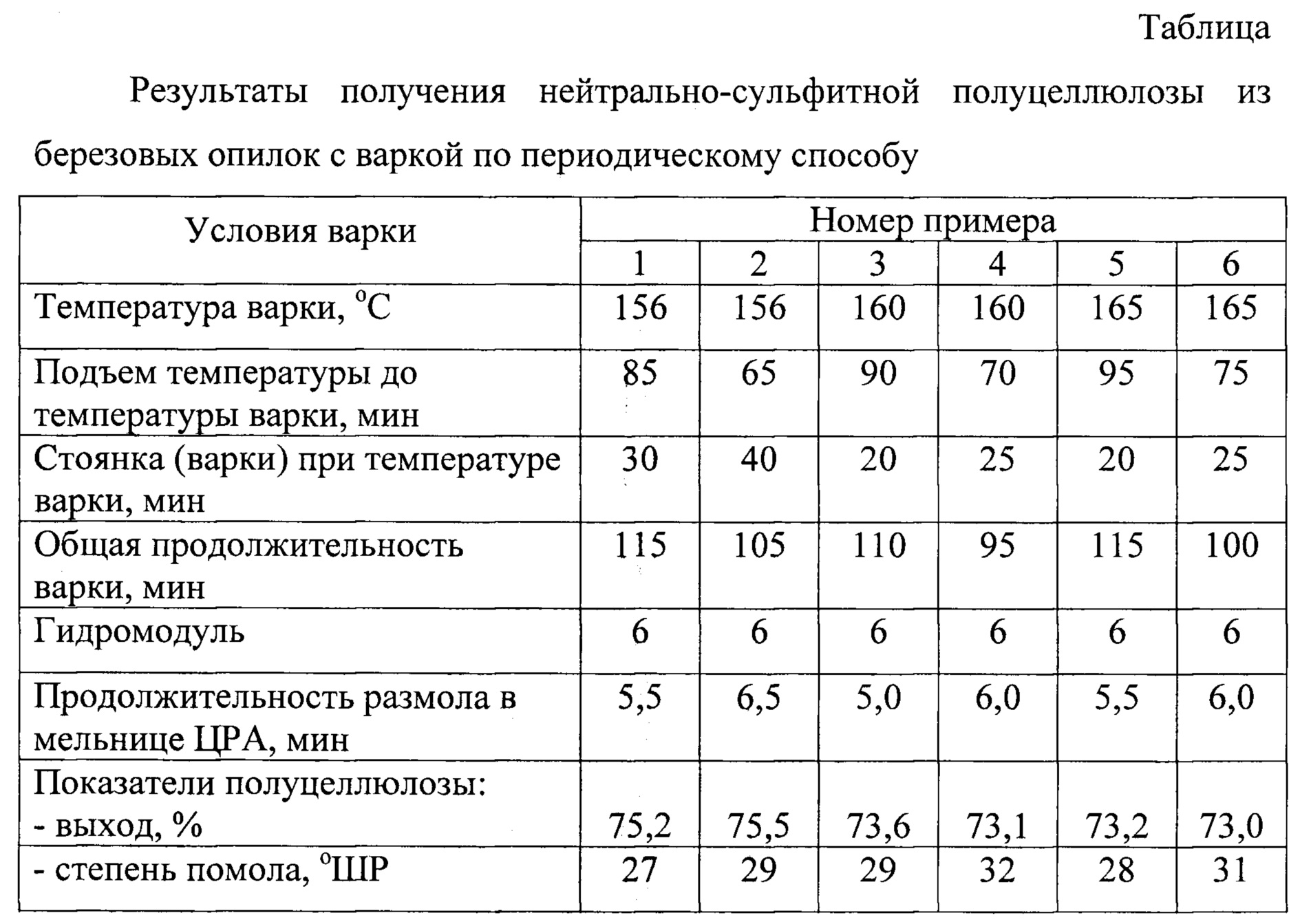

Из таблицы следует, что по данному способу по упрощенной технологии из древесных отходов (опилок) может быть получена полуцеллюлоза с показателями качества, не уступающими соответствующим показателям полуцеллюлозы из кондиционной древесной щепы при сравнимых показателях выхода полуфабриката в % от исходной древесины.It follows from the table that according to this method, according to the simplified technology, semi-cellulose can be obtained from wood waste (sawdust) with quality indicators that are not inferior to the corresponding indicators of half-cellulose from conditioned wood chips with comparable yield of semi-finished product in% of the source wood.
Использование предлагаемого способа по сравнению с прототипом обеспечивает повышение комплексности использования древесного сырья за счет утилизации древесных отходов (опилок), сохранению лесных ресурсов за счет сокращения вырубки лесов, улучшение экологической обстановки за счет исключения разложения других отходов на свалках с выделением в атмосферу экологически вредных продуктов разложения и ликвидации пожароопасности, снижение токсичности сточных вод за счет исключения из процесса получения полуцеллюлозы сульфида натрия, приводящего к выделению токсических соединений.Using the proposed method in comparison with the prototype provides an increase in the complexity of the use of wood raw materials by utilizing wood waste (sawdust), preserving forest resources by reducing deforestation, improving the environmental situation by eliminating the decomposition of other waste in landfills with the release of environmentally harmful decomposition products into the atmosphere and elimination of fire hazard, reduction of toxicity of wastewater due to the exclusion of sodium sulfide from the process of producing cellulose, leading to the release of toxic compounds.
Claims (1)
Priority Applications (1)
| Application Number | Priority Date | Filing Date | Title |
|---|---|---|---|
| RU2018140804A RU2721503C2 (en) | 2018-11-19 | 2018-11-19 | Method of producing semi-cellulose |
Applications Claiming Priority (1)
| Application Number | Priority Date | Filing Date | Title |
|---|---|---|---|
| RU2018140804A RU2721503C2 (en) | 2018-11-19 | 2018-11-19 | Method of producing semi-cellulose |
Publications (3)
| Publication Number | Publication Date |
|---|---|
| RU2018140804A RU2018140804A (en) | 2020-05-19 |
| RU2721503C2 true RU2721503C2 (en) | 2020-05-19 |
| RU2018140804A3 RU2018140804A3 (en) | 2020-05-19 |
Family
ID=70734766
Family Applications (1)
| Application Number | Title | Priority Date | Filing Date |
|---|---|---|---|
| RU2018140804A RU2721503C2 (en) | 2018-11-19 | 2018-11-19 | Method of producing semi-cellulose |
Country Status (1)
| Country | Link |
|---|---|
| RU (1) | RU2721503C2 (en) |
Citations (3)
| Publication number | Priority date | Publication date | Assignee | Title |
|---|---|---|---|---|
| SU1261991A1 (en) * | 1985-05-27 | 1986-10-07 | Белорусский Ордена Трудового Красного Знамени Технологический Институт Им.С.М.Кирова | Method of producing paper pulp |
| SU1557227A1 (en) * | 1987-11-10 | 1990-04-15 | Астраханский Филиал Всесоюзного Научно-Исследовательского Института Всесоюзного Научно-Производственного Объединения Целлюлозно-Бумажной Промышленности | Method of producing semipulp from hardwood |
| RU2380466C1 (en) * | 2005-12-02 | 2010-01-27 | Акцо Нобель Н.В. | Method of producing high alpha-cellulose pulp |
-
2018
- 2018-11-19 RU RU2018140804A patent/RU2721503C2/en active
Patent Citations (3)
| Publication number | Priority date | Publication date | Assignee | Title |
|---|---|---|---|---|
| SU1261991A1 (en) * | 1985-05-27 | 1986-10-07 | Белорусский Ордена Трудового Красного Знамени Технологический Институт Им.С.М.Кирова | Method of producing paper pulp |
| SU1557227A1 (en) * | 1987-11-10 | 1990-04-15 | Астраханский Филиал Всесоюзного Научно-Исследовательского Института Всесоюзного Научно-Производственного Объединения Целлюлозно-Бумажной Промышленности | Method of producing semipulp from hardwood |
| RU2380466C1 (en) * | 2005-12-02 | 2010-01-27 | Акцо Нобель Н.В. | Method of producing high alpha-cellulose pulp |
Non-Patent Citations (1)
| Title |
|---|
| Смирнов Р.Е. Производство сульфитных волокнистых полуфабрикатов: учебное пособие/ГОУВПО СПбГТУРП.-Спб., 2010.-146с. * |
Also Published As
| Publication number | Publication date |
|---|---|
| RU2018140804A (en) | 2020-05-19 |
| RU2018140804A3 (en) | 2020-05-19 |
Similar Documents
| Publication | Publication Date | Title |
|---|---|---|
| CN104641039B (en) | A kind of waterproof recycled paper and its production method | |
| CN102174760B (en) | A chemical-mechanical pulping process of Salix salix | |
| CN101698985B (en) | Method for manufacturing art paper with high content of mechanical pulp and art paper manufactured therefrom | |
| CN103842581A (en) | Enzymatic pretreatment of wood in a process for the preparation of mechanical pulp | |
| RU2011135609A (en) | METHOD AND CHEMICAL COMPOSITION FOR IMPROVING EFFICIENCY OF PRODUCING MECHANICAL FIBROUS WEIGHT | |
| CN105672053B (en) | A kind of spool fiber board | |
| CN103669064B (en) | A kind of preparation technology of vinegar-grade bamboo pulp | |
| CN102277786A (en) | Preparation method for double-sided gummed paper or electrostatic copy paper | |
| CN106192515A (en) | A kind of strong pulp and preparation technology thereof | |
| CN104790239B (en) | A kind of preparation method for the chemical-mechanical pulping penetrating agent with timber as raw material | |
| WO2021012617A1 (en) | Method for improving strength performance of waste paper pulp | |
| KR20210056421A (en) | Ionic liquid based pulp bleach protectant | |
| CN108978298A (en) | A kind of preparation method of onionskin | |
| CA2453131A1 (en) | Processes for preparing mechanical pulps having high brightness | |
| Jahan et al. | Evaluation of rubber wood (Hevea brasiliensis) as a raw material for kraft pulping | |
| RU2368716C1 (en) | Method of pulping | |
| US20210254280A1 (en) | Method for producing bleached wood fibre material | |
| CN104947546B (en) | A kind of composite wood processing technology | |
| CN101831823A (en) | Pollution-free pulping method for wheat straw | |
| Latibari et al. | Alkaline peroxide mechanical pulping of fast-growth paulownia wood. | |
| Miyanishi | Thermomechanical pulp innovation for energy saving and high brightness paper development | |
| Sherstobitov | OBTAINING CELLULOSE FROM TECHNICAL CANNABIS BY THE OXIDATIVE-ORGANOSOLVENT METHOD | |
| CN105369664A (en) | Method of improving brightness of chemi-mechanical pulp | |
| SU426009A1 (en) | METHOD OF GETTING PAPER MASS | |
| CN107053414A (en) | A kind of preparation method of imitative ebony bamboo lumber |