RU2771237C1 - Sensitizer for photodynamic destruction of tumor cells - Google Patents
Sensitizer for photodynamic destruction of tumor cells Download PDFInfo
- Publication number
- RU2771237C1 RU2771237C1 RU2021116143A RU2021116143A RU2771237C1 RU 2771237 C1 RU2771237 C1 RU 2771237C1 RU 2021116143 A RU2021116143 A RU 2021116143A RU 2021116143 A RU2021116143 A RU 2021116143A RU 2771237 C1 RU2771237 C1 RU 2771237C1
- Authority
- RU
- Russia
- Prior art keywords
- tumor cells
- sensitizer
- photodynamic
- photodynamic destruction
- destruction
- Prior art date
Links
- 210000004881 tumor cell Anatomy 0.000 title claims abstract description 16
- 230000006378 damage Effects 0.000 title claims abstract description 9
- -1 1-(1-(4-nitrophenyl)ethyl)-2,4,6-triphenyl-1,4-dihydro-1,2,4,5-tetrazine -3(2H)-one Chemical group 0.000 claims 1
- 201000011510 cancer Diseases 0.000 abstract description 4
- 150000001875 compounds Chemical class 0.000 abstract description 3
- 239000000126 substance Substances 0.000 abstract description 3
- 239000003814 drug Substances 0.000 abstract 1
- 230000000694 effects Effects 0.000 abstract 1
- UHOVQNZJYSORNB-UHFFFAOYSA-N Benzene Chemical compound C1=CC=CC=C1 UHOVQNZJYSORNB-UHFFFAOYSA-N 0.000 description 9
- 239000002609 medium Substances 0.000 description 9
- 210000004027 cell Anatomy 0.000 description 8
- 230000035899 viability Effects 0.000 description 7
- CURLTUGMZLYLDI-UHFFFAOYSA-N Carbon dioxide Chemical compound O=C=O CURLTUGMZLYLDI-UHFFFAOYSA-N 0.000 description 6
- VLKZOEOYAKHREP-UHFFFAOYSA-N n-Hexane Chemical compound CCCCCC VLKZOEOYAKHREP-UHFFFAOYSA-N 0.000 description 6
- 235000015097 nutrients Nutrition 0.000 description 5
- 230000003287 optical effect Effects 0.000 description 5
- UCSJYZPVAKXKNQ-HZYVHMACSA-N streptomycin Chemical compound CN[C@H]1[C@H](O)[C@@H](O)[C@H](CO)O[C@H]1O[C@@H]1[C@](C=O)(O)[C@H](C)O[C@H]1O[C@@H]1[C@@H](NC(N)=N)[C@H](O)[C@@H](NC(N)=N)[C@H](O)[C@H]1O UCSJYZPVAKXKNQ-HZYVHMACSA-N 0.000 description 4
- 229910002092 carbon dioxide Inorganic materials 0.000 description 3
- 238000004113 cell culture Methods 0.000 description 3
- 239000006185 dispersion Substances 0.000 description 3
- 239000000203 mixture Substances 0.000 description 3
- 239000003504 photosensitizing agent Substances 0.000 description 3
- 230000005855 radiation Effects 0.000 description 3
- 108091003079 Bovine Serum Albumin Proteins 0.000 description 2
- IAZDPXIOMUYVGZ-UHFFFAOYSA-N Dimethylsulphoxide Chemical compound CS(C)=O IAZDPXIOMUYVGZ-UHFFFAOYSA-N 0.000 description 2
- 239000006144 Dulbecco’s modified Eagle's medium Substances 0.000 description 2
- KDXKERNSBIXSRK-YFKPBYRVSA-N L-lysine Chemical compound NCCCC[C@H](N)C(O)=O KDXKERNSBIXSRK-YFKPBYRVSA-N 0.000 description 2
- 206010028980 Neoplasm Diseases 0.000 description 2
- 229930182555 Penicillin Natural products 0.000 description 2
- JGSARLDLIJGVTE-MBNYWOFBSA-N Penicillin G Chemical compound N([C@H]1[C@H]2SC([C@@H](N2C1=O)C(O)=O)(C)C)C(=O)CC1=CC=CC=C1 JGSARLDLIJGVTE-MBNYWOFBSA-N 0.000 description 2
- VYPSYNLAJGMNEJ-UHFFFAOYSA-N Silicium dioxide Chemical compound O=[Si]=O VYPSYNLAJGMNEJ-UHFFFAOYSA-N 0.000 description 2
- 239000003242 anti bacterial agent Substances 0.000 description 2
- 229940088710 antibiotic agent Drugs 0.000 description 2
- BHPNXACHQYJJJS-UHFFFAOYSA-N bacteriochlorin Chemical compound N1C(C=C2N=C(C=C3NC(=C4)C=C3)CC2)=CC=C1C=C1CCC4=N1 BHPNXACHQYJJJS-UHFFFAOYSA-N 0.000 description 2
- 239000001569 carbon dioxide Substances 0.000 description 2
- HVYWMOMLDIMFJA-DPAQBDIFSA-N cholesterol Chemical compound C1C=C2C[C@@H](O)CC[C@]2(C)[C@@H]2[C@@H]1[C@@H]1CC[C@H]([C@H](C)CCCC(C)C)[C@@]1(C)CC2 HVYWMOMLDIMFJA-DPAQBDIFSA-N 0.000 description 2
- 150000004702 methyl esters Chemical class 0.000 description 2
- 239000012452 mother liquor Substances 0.000 description 2
- 229940049954 penicillin Drugs 0.000 description 2
- 230000002165 photosensitisation Effects 0.000 description 2
- BOLDJAUMGUJJKM-LSDHHAIUSA-N renifolin D Natural products CC(=C)[C@@H]1Cc2c(O)c(O)ccc2[C@H]1CC(=O)c3ccc(O)cc3O BOLDJAUMGUJJKM-LSDHHAIUSA-N 0.000 description 2
- 239000000741 silica gel Substances 0.000 description 2
- 229910002027 silica gel Inorganic materials 0.000 description 2
- 229960005322 streptomycin Drugs 0.000 description 2
- 230000001225 therapeutic effect Effects 0.000 description 2
- OYINILBBZAQBEV-UWJYYQICSA-N (17s,18s)-18-(2-carboxyethyl)-20-(carboxymethyl)-12-ethenyl-7-ethyl-3,8,13,17-tetramethyl-17,18,22,23-tetrahydroporphyrin-2-carboxylic acid Chemical compound N1C2=C(C)C(C=C)=C1C=C(N1)C(C)=C(CC)C1=CC(C(C)=C1C(O)=O)=NC1=C(CC(O)=O)C([C@@H](CCC(O)=O)[C@@H]1C)=NC1=C2 OYINILBBZAQBEV-UWJYYQICSA-N 0.000 description 1
- NDQQRRVKUBPTHQ-QBIQUQHTSA-N (2r,3r,4r,5s)-6-(methylamino)hexane-1,2,3,4,5-pentol Chemical compound CNC[C@H](O)[C@@H](O)[C@H](O)[C@H](O)CO.CNC[C@H](O)[C@@H](O)[C@H](O)[C@H](O)CO NDQQRRVKUBPTHQ-QBIQUQHTSA-N 0.000 description 1
- LLTKPPRBFXTUKH-UHFFFAOYSA-N 1-(1-bromoethyl)-4-nitrobenzene Chemical compound CC(Br)C1=CC=C([N+]([O-])=O)C=C1 LLTKPPRBFXTUKH-UHFFFAOYSA-N 0.000 description 1
- IIZPXYDJLKNOIY-JXPKJXOSSA-N 1-palmitoyl-2-arachidonoyl-sn-glycero-3-phosphocholine Chemical compound CCCCCCCCCCCCCCCC(=O)OC[C@H](COP([O-])(=O)OCC[N+](C)(C)C)OC(=O)CCC\C=C/C\C=C/C\C=C/C\C=C/CCCCC IIZPXYDJLKNOIY-JXPKJXOSSA-N 0.000 description 1
- QWOULGJZUVANFE-UHFFFAOYSA-N 2,4,6-triphenyl-3h-1,2,4,5$l^{2}-tetrazine Chemical compound C1N(C=2C=CC=CC=2)[N]C(C=2C=CC=CC=2)=NN1C1=CC=CC=C1 QWOULGJZUVANFE-UHFFFAOYSA-N 0.000 description 1
- AZKSAVLVSZKNRD-UHFFFAOYSA-M 3-(4,5-dimethylthiazol-2-yl)-2,5-diphenyltetrazolium bromide Chemical compound [Br-].S1C(C)=C(C)N=C1[N+]1=NC(C=2C=CC=CC=2)=NN1C1=CC=CC=C1 AZKSAVLVSZKNRD-UHFFFAOYSA-M 0.000 description 1
- 206010006187 Breast cancer Diseases 0.000 description 1
- 208000026310 Breast neoplasm Diseases 0.000 description 1
- RYGMFSIKBFXOCR-UHFFFAOYSA-N Copper Chemical compound [Cu] RYGMFSIKBFXOCR-UHFFFAOYSA-N 0.000 description 1
- 229910021589 Copper(I) bromide Inorganic materials 0.000 description 1
- 235000019766 L-Lysine Nutrition 0.000 description 1
- 239000000232 Lipid Bilayer Substances 0.000 description 1
- 239000004472 Lysine Substances 0.000 description 1
- 239000000853 adhesive Substances 0.000 description 1
- 230000001070 adhesive effect Effects 0.000 description 1
- 239000012300 argon atmosphere Substances 0.000 description 1
- 150000004036 bacteriochlorins Chemical class 0.000 description 1
- 230000021164 cell adhesion Effects 0.000 description 1
- 230000003833 cell viability Effects 0.000 description 1
- 239000003153 chemical reaction reagent Substances 0.000 description 1
- 235000012000 cholesterol Nutrition 0.000 description 1
- 238000012790 confirmation Methods 0.000 description 1
- 238000001816 cooling Methods 0.000 description 1
- NKNDPYCGAZPOFS-UHFFFAOYSA-M copper(i) bromide Chemical compound Br[Cu] NKNDPYCGAZPOFS-UHFFFAOYSA-M 0.000 description 1
- 239000013078 crystal Substances 0.000 description 1
- 231100000673 dose–response relationship Toxicity 0.000 description 1
- 239000012091 fetal bovine serum Substances 0.000 description 1
- 239000012894 fetal calf serum Substances 0.000 description 1
- 229910052743 krypton Inorganic materials 0.000 description 1
- DNNSSWSSYDEUBZ-UHFFFAOYSA-N krypton atom Chemical compound [Kr] DNNSSWSSYDEUBZ-UHFFFAOYSA-N 0.000 description 1
- 229940067606 lecithin Drugs 0.000 description 1
- 235000010445 lecithin Nutrition 0.000 description 1
- 239000000787 lecithin Substances 0.000 description 1
- 239000002502 liposome Substances 0.000 description 1
- 230000003211 malignant effect Effects 0.000 description 1
- 239000011159 matrix material Substances 0.000 description 1
- VMGAPWLDMVPYIA-HIDZBRGKSA-N n'-amino-n-iminomethanimidamide Chemical compound N\N=C\N=N VMGAPWLDMVPYIA-HIDZBRGKSA-N 0.000 description 1
- 230000001575 pathological effect Effects 0.000 description 1
- UKODFQOELJFMII-UHFFFAOYSA-N pentamethyldiethylenetriamine Chemical compound CN(C)CCN(C)CCN(C)C UKODFQOELJFMII-UHFFFAOYSA-N 0.000 description 1
- 239000013630 prepared media Substances 0.000 description 1
- 238000010992 reflux Methods 0.000 description 1
- 150000003839 salts Chemical class 0.000 description 1
- 230000003595 spectral effect Effects 0.000 description 1
- 239000000725 suspension Substances 0.000 description 1
- 238000005303 weighing Methods 0.000 description 1
Images
Classifications
-
- A—HUMAN NECESSITIES
- A61—MEDICAL OR VETERINARY SCIENCE; HYGIENE
- A61K—PREPARATIONS FOR MEDICAL, DENTAL OR TOILETRY PURPOSES
- A61K31/00—Medicinal preparations containing organic active ingredients
- A61K31/33—Heterocyclic compounds
- A61K31/395—Heterocyclic compounds having nitrogen as a ring hetero atom, e.g. guanethidine or rifamycins
- A61K31/495—Heterocyclic compounds having nitrogen as a ring hetero atom, e.g. guanethidine or rifamycins having six-membered rings with two or more nitrogen atoms as the only ring heteroatoms, e.g. piperazine or tetrazines
-
- A—HUMAN NECESSITIES
- A61—MEDICAL OR VETERINARY SCIENCE; HYGIENE
- A61K—PREPARATIONS FOR MEDICAL, DENTAL OR TOILETRY PURPOSES
- A61K41/00—Medicinal preparations obtained by treating materials with wave energy or particle radiation ; Therapies using these preparations
- A61K41/0057—Photodynamic therapy with a photosensitizer, i.e. agent able to produce reactive oxygen species upon exposure to light or radiation, e.g. UV or visible light; photocleavage of nucleic acids with an agent
-
- A—HUMAN NECESSITIES
- A61—MEDICAL OR VETERINARY SCIENCE; HYGIENE
- A61P—SPECIFIC THERAPEUTIC ACTIVITY OF CHEMICAL COMPOUNDS OR MEDICINAL PREPARATIONS
- A61P35/00—Antineoplastic agents
-
- C—CHEMISTRY; METALLURGY
- C07—ORGANIC CHEMISTRY
- C07D—HETEROCYCLIC COMPOUNDS
- C07D257/00—Heterocyclic compounds containing rings having four nitrogen atoms as the only ring hetero atoms
- C07D257/02—Heterocyclic compounds containing rings having four nitrogen atoms as the only ring hetero atoms not condensed with other rings
- C07D257/08—Six-membered rings
Landscapes
- Health & Medical Sciences (AREA)
- Chemical & Material Sciences (AREA)
- Organic Chemistry (AREA)
- Life Sciences & Earth Sciences (AREA)
- General Health & Medical Sciences (AREA)
- Veterinary Medicine (AREA)
- Public Health (AREA)
- Medicinal Chemistry (AREA)
- Pharmacology & Pharmacy (AREA)
- Animal Behavior & Ethology (AREA)
- Epidemiology (AREA)
- Molecular Biology (AREA)
- Biochemistry (AREA)
- Chemical Kinetics & Catalysis (AREA)
- General Chemical & Material Sciences (AREA)
- Nuclear Medicine, Radiotherapy & Molecular Imaging (AREA)
- Pharmaceuticals Containing Other Organic And Inorganic Compounds (AREA)
Abstract
Description
Изобретение относится к фармацевтической химии и онкологии, а именно к соединениям для фотодинамического разрушения злокачественных клеток. SUBSTANCE: invention relates to pharmaceutical chemistry and oncology, namely to compounds for photodynamic destruction of malignant cells.
Известен сенсибилизатор для фотодинамического разрушения клеток злокачественных новообразований [RU 2071320 C1, МПК (1995.01) A61K31/40, С09В47/00 (1995.01), опубл. 10.01.1997], который представляет собой сульфированный тетрафенилтетрабензопорфин общей формулы С60Н38N4O12S4, оказывающий терапевтический эффект при облучении криптоновым лазером с длиной волны 675 нм в течение 15 минут.Known sensitizer for photodynamic destruction of cells of malignant neoplasms [RU 2071320 C1, IPC (1995.01) A61K31/40, C09B47/00 (1995.01), publ. 01/10/1997], which is a sulfonated tetraphenyltetrabenzoporfin of the general formula C 60 H 38 N 4 O 12 S 4 , which has a therapeutic effect when irradiated with a krypton laser with a wavelength of 675 nm for 15 minutes.
Известен фотосенсибилизатор [RU 2411943 C2, МПК (2006.01) A61K31/409, A61K9/10, A61N5/067, A61P35/00, C07D487/22, B82B1/00, опубл. 20.10.2010], представляющий собой наноструктурированную водную дисперсию на основе производного бактериохлорина p, который представляет собой метиловый эфир O-этилоксима N-этоксициклоимида бактериохлорина p C38H46N6O6. Наноструктурированная водная дисперсия представляет собой липосомальную дисперсию на основе лецитина и холестерина, а метиловый эфир O-этилоксима N-этоксициклоимида бактериохлорина р включен в липидный бислой липосом. Терапевтический эффект реализуется при облучении патологического участка оптическим излучением в спектральном диапазоне 790-810 нм.Known photosensitizer [RU 2411943 C2, IPC (2006.01) A61K31/409, A61K9/10, A61N5/067, A61P35/00, C07D487/22, B82B1/00 , publ. October 20, 2010], which is a nanostructured aqueous dispersion based on a bacteriochlorin derivative p, which is a methyl ester of bacteriochlorin O-ethyloxime N-ethoxycycloimide p C 38 H 46 N 6 O 6 . The nanostructured aqueous dispersion is a liposomal dispersion based on lecithin and cholesterol, and bacteriochlorin N-ethoxycycloimide O-ethyloxime methyl ester p is included in the lipid bilayer of liposomes. The therapeutic effect is realized when the pathological area is irradiated with optical radiation in the spectral range of 790-810 nm.
Известен фотосенсибилизатор для лечения онкологических заболеваний, который содержит соль хлорин е6, N-метил-D-глюкамином (меглумин) и L-лизин в мольных соотношениях 1:2:1 [RU 2646477 C1, МПК (2006.01) A61K31/40, A61K41/00, A61P35/00, A61P31/04, опубл. 05.03.2018], проявляющий активность под воздействием лазера с длиной волны 662 нм.Known photosensitizer for the treatment of cancer, which contains salt chlorin e6, N-methyl-D-glucamine (meglumine) and L-lysine in molar ratios of 1:2:1 [RU 2646477 C1, IPC (2006.01) A61K31/40, A61K41/ 00, A61P35/00, A61P31/04 , publ. 03/05/2018], which is active under the influence of a laser with a wavelength of 662 nm.
Техническим результатом изобретения является расширение арсенала средств для фотодинамического разрушения опухолевых клеток.The technical result of the invention is the expansion of the arsenal of means for the photodynamic destruction of tumor cells.
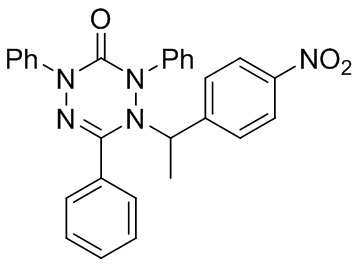
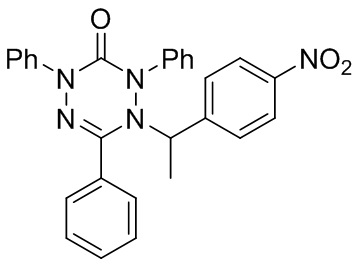
В качестве сенсибилизатора для фотодинамического разрушения опухолевых клеток предлагается 1-(1-(4-нитрофенил)этил)-2,4,6-трифенил-1,4-дигидро-1,2,4,5-тетразин-3(2H)-он со структурной формулой:1-(1-(4-nitrophenyl)ethyl)-2,4,6-triphenyl-1,4-dihydro-1,2,4,5-tetrazine-3(2H) is proposed as a sensitizer for photodynamic destruction of tumor cells. -on with the structural formula:
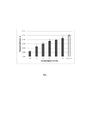
На фиг. 1 показана жизнеспособность опухолевых клеток после фотодинамического воздействия в присутствии фотосенсибилизатора.In FIG. 1 shows the viability of tumor cells after photodynamic exposure in the presence of a photosensitizer.
Для получения предложенного сенсибилизатора в двугорлую круглодонную колбу объемом 100 мл внесли 76 мг обескислороженной суспензии порошка меди и 86 мг бромида меди (I) в 30 мл бензола, а затем добавили 125 мкл N,N,N′,N′′,N′′-пентаметилдиэтилентриамина. К полученной смеси добавили обескислороженный раствор, полученный растворением 327 мг 1,3,5-трифенилвердазильного радикала и 276 мг 1-(1-бромоэтил)-4-нитробензола в 20 мл бензола. To obtain the proposed sensitizer, 76 mg of a deoxygenated suspension of copper powder and 86 mg of copper (I) bromide in 30 ml of benzene were added to a two-necked round-bottom flask with a volume of 100 ml, and then 125 μl of N,N,N',N'',N'' -pentamethyldiethylenetriamine. To the resulting mixture was added a deoxygenated solution obtained by dissolving 327 mg of 1,3,5-triphenylverdazyl radical and 276 mg of 1-(1-bromoethyl)-4-nitrobenzene in 20 ml of benzene.
Полученную реакционную массу кипятили 8 часов с обратным холодильником Димрота в атмосфере аргона, который подавали из линии Шленка. После охлаждения на воздухе до комнатной температуры полученную реакционную массу пропустили через 3 см слоя силикагеля, а затем силикагель дополнительно промыли 15 мл бензола для полного переноса продукта в маточник. Полученный маточный раствор упарили в вакууме в круглодонной колбе с помощью ротационного испарителя до 3-4 мл итогового раствора. После этого в колбу с концентрированным раствором добавили 50 мл гексана для осаждения продукта. Выпавший продукт отфильтровали на фильтре Шотта, присоединенного к колбе Бунзена под абсолютным давлением 800 мбар, промыли гексаном 100 мл и сушили на воздухе в темноте. The resulting reaction mass was refluxed for 8 hours under a Dimroth reflux condenser in an argon atmosphere, which was supplied from the Schlenk line. After cooling in air to room temperature, the resulting reaction mass was passed through a 3 cm layer of silica gel, and then the silica gel was additionally washed with 15 ml of benzene to completely transfer the product to the mother liquor. The resulting mother liquor was evaporated in vacuum in a round bottom flask using a rotary evaporator to 3-4 ml of the final solution. After that, 50 ml of hexane was added to the flask with the concentrated solution to precipitate the product. The precipitated product was filtered off on a Schott filter attached to a Bunsen flask at an absolute pressure of 800 mbar, washed with 100 ml of hexane, and dried in air in the dark.
В результате получили продукт массой 382 мг (что составило 80% от теоретического выхода), который представляет собой кристаллическое вещество бледно-желтого цвета с формулой C28H23N5O3. As a result, a product weighing 382 mg (which was 80% of the theoretical yield) was obtained, which is a pale yellow crystalline substance with the formula C 28 H 23 N 5 O 3.
Оценку фотосенсибилизирующих свойств заявляемого соединения проводили по уровню жизнеспособности опухолевой клеточной культуры при световом воздействии с длиной волны 395-410 нм. The assessment of the photosensitizing properties of the claimed compound was carried out according to the level of viability of the tumor cell culture under light exposure with a wavelength of 395-410 nm.
В качестве тестовой клеточной линии использовали опухолевую культуру клеток MCF-7 (адгезивная линия рака молочной железы человека). Клетки засевали в 96-луночный планшет в концентрации 5000 клеток в лунке в полной питательной среде DMEM/F12 с добавлением 10% эмбриональной телячьей сыворотки и смеси антибиотиков (пенициллин 50 ед/мл и стрептомицин 50 мкг/мл). Далее клетки инкубировали в течение 24 часов при 37°С в среде 5% углекислого газа. После адгезии клеток и микроскопического подтверждения жизнеспособности культуры, клетки использовали для оценки фотосенсибилизирующих свойств. Для этого готовили серию из 6 полных питательных сред DMEM/F12 с добавлением 10% эмбриональной телячьей сыворотки, смеси антибиотиков (пенициллин 50 ед/мл и стрептомицин 50 мкг/мл) и предложенного сенсибилизатора. Концентрация сенсибилизатора в среде была 50, 25, 12, 6, 3 и 1,5 мкг/мл. MCF-7 tumor cell culture (adhesive human breast cancer line) was used as a test cell line. Cells were seeded in a 96-well plate at a concentration of 5000 cells per well in complete DMEM/F12 nutrient medium supplemented with 10% fetal bovine serum and a mixture of antibiotics (
Питательную среду в лунках заменили на приготовленные среды, содержащие сенсибилизатор в соответствующих концентрациях. В качестве контрольной группы использовали лунки с опухолевыми клетками, в которых среду меняли на среду, не содержащую сенсибилизатор. После этого планшет подвергали световому воздействию в течение 20 минут. Источник излучения: светодиодная матрица, состоящая из 5 столбцов по 7 светодиодов в столбце с расстояниями между диодами 18 мм в рядах и столбцах, сила света каждого диода 1 Кд, диапазон излучения 395-410 нм. Расстояние от светодиода до лунки с опухолевыми клетками – 2 см. После облучения планшеты помещали в СО2 инкубатор при 37°С в среде 5% углекислого газа на 48 часов. Далее проводили оценку жизнеспособности опухолевых клеток с помощью МТТ-теста. The nutrient medium in the wells was replaced with prepared media containing the sensitizer at appropriate concentrations. As a control group, wells with tumor cells were used, in which the medium was changed to a medium that did not contain a sensitizer. After that, the plate was exposed to light for 20 minutes. Radiation source: LED matrix consisting of 5 columns of 7 LEDs per column with distances between diodes of 18 mm in rows and columns, luminous intensity of each diode 1 Kd, radiation range 395-410 nm. The distance from the LED to the well with tumor cells was 2 cm. After irradiation, the plates were placed in a CO2 incubator at 37°C in 5% carbon dioxide for 48 hours. Next, the viability of tumor cells was assessed using the MTT test.
Для МТТ-теста из каждой лунки удаляли питательную среду и вносили 100 мкл раствора MTT-реагента (бромида 3-(4,5-диметилтиазол-2-ил)-2,5-дифенилтетразолия) в питательной среде, затем планшеты помещали в СО2 инкубатор при 37°С на 4 часа. После этого из планшетов снова удаляли среду, и в каждую лунку для растворения образовавшихся кристаллов формазана было добавлено по 100 мкл диметилсульфоксида. После этого проводили оценку оптической плотности образцов с помощью микропланшетного ридера (MULTISCAN FC) при длине волны 570 нм. For the MTT test, the nutrient medium was removed from each well and 100 μl of a solution of the MTT reagent (3-(4,5-dimethylthiazol-2-yl)-2,5-diphenyltetrazolium bromide) in the nutrient medium was added, then the plates were placed in CO 2 incubator at 37°C for 4 hours. After that, the medium was again removed from the plates, and 100 μl of dimethyl sulfoxide was added to each well to dissolve the formed formazan crystals. After that, the optical density of the samples was evaluated using a microplate reader (MULTISCAN FC) at a wavelength of 570 nm.
Жизнеспособность клеток рассчитывали по формуле: Cell viability was calculated using the formula:
жизнеспособность, % = ((ОПобр – ОПпуст)/(ОПконтр – ОПпуст)) ⋅ 100,viability, % = ((OP arr - OP is empty )/(OP counter - OP is empty )) ⋅ 100,
где ОПобр – средняя оптическая плотность образцов с внесенным сенсибилизатором; where OD arr is the average optical density of the samples with the introduced sensitizer;
ОПпуст – средняя оптическая плотность среды без опухолевых клеток; OD is empty - the average optical density of the medium without tumor cells;
ОПконтр – средняя оптическая плотность опухолевых клеток, не подвергавшихся воздействию сенсибилизатора.OD counter is the average optical density of tumor cells that were not exposed to the sensitizer.
Результаты определения уровня жизнеспособности культуры клеток MCF-7 после фотодинамического воздействия с использованием предложенного сенсибилизатора и контрольной группы представлены на фиг. 1. The results of determining the level of viability of the MCF-7 cell culture after photodynamic exposure using the proposed sensitizer and the control group are shown in Fig. one.
Наблюдается дозозависимое снижение жизнеспособности опухолевых клеток при воздействии облучения в присутствии сенсибилизатора. Процент жизнеспособных клеток после фотодинамического воздействия с сенсибилизатором в концентрациях 50-1,5 мкг/мл статистически значимо ниже уровня контроля (p<0,001).A dose-dependent decrease in the viability of tumor cells is observed when exposed to irradiation in the presence of a sensitizer. Percentage of viable cells after photodynamic exposure with a sensitizer at concentrations of 50-1.5 µg/ml, it was statistically significantly lower than the control level (p<0.001).
Claims (2)
Priority Applications (1)
| Application Number | Priority Date | Filing Date | Title |
|---|---|---|---|
| RU2021116143A RU2771237C1 (en) | 2021-06-04 | 2021-06-04 | Sensitizer for photodynamic destruction of tumor cells |
Applications Claiming Priority (1)
| Application Number | Priority Date | Filing Date | Title |
|---|---|---|---|
| RU2021116143A RU2771237C1 (en) | 2021-06-04 | 2021-06-04 | Sensitizer for photodynamic destruction of tumor cells |
Publications (1)
| Publication Number | Publication Date |
|---|---|
| RU2771237C1 true RU2771237C1 (en) | 2022-04-28 |
Family
ID=81458834
Family Applications (1)
| Application Number | Title | Priority Date | Filing Date |
|---|---|---|---|
| RU2021116143A RU2771237C1 (en) | 2021-06-04 | 2021-06-04 | Sensitizer for photodynamic destruction of tumor cells |
Country Status (1)
| Country | Link |
|---|---|
| RU (1) | RU2771237C1 (en) |
Cited By (1)
| Publication number | Priority date | Publication date | Assignee | Title |
|---|---|---|---|---|
| RU2805148C1 (en) * | 2023-03-17 | 2023-10-11 | Федеральное государственное автономное образовательное учреждение высшего образования "Национальный исследовательский Томский политехнический университет" | Photosensitizer for photodynamic destruction of tumor cells |
Citations (5)
| Publication number | Priority date | Publication date | Assignee | Title |
|---|---|---|---|---|
| RU2071320C1 (en) * | 1994-09-29 | 1997-01-10 | Акционерное общество закрытого типа Научно-производственное предприятие "Мелодит" | Sensitizing agent for photodynamic disruption of malignant neoplasma cells |
| WO2001066550A2 (en) * | 2000-03-10 | 2001-09-13 | Scotia Holdings Plc | Compounds for pdt |
| EP1472259B1 (en) * | 2002-02-01 | 2009-09-02 | CIPAN-Companhia Industrial Produtora De Antibioticos, S.A. | Tetrapyrrolic macrocycles as photodynamic agents |
| RU2411943C2 (en) * | 2009-04-14 | 2011-02-20 | Учреждение Российской академии медицинских наук Российский онкологический научный центр им. Н.Н. Блохина РАМН (ГУ РОНЦ им. Н.Н. Блохина РАМН) | PHOTOSENSITISER BASED ON BACTERIOCHLORIN p DERIVATIVE, METHOD OF OBTAINING BACTERIOCHLORIN p DERIVATIVE AND METHOD OF PHOTODYNAMIC THERAPY OF CANCER WITH APPLICATION OF SAID PHOTOSENSITISER |
| RU2646477C1 (en) * | 2017-04-05 | 2018-03-05 | Елена Вячеславовна Филоненко | Photosensitiser for treatment of cancer diseases and method of its obtaining |
-
2021
- 2021-06-04 RU RU2021116143A patent/RU2771237C1/en active
Patent Citations (5)
| Publication number | Priority date | Publication date | Assignee | Title |
|---|---|---|---|---|
| RU2071320C1 (en) * | 1994-09-29 | 1997-01-10 | Акционерное общество закрытого типа Научно-производственное предприятие "Мелодит" | Sensitizing agent for photodynamic disruption of malignant neoplasma cells |
| WO2001066550A2 (en) * | 2000-03-10 | 2001-09-13 | Scotia Holdings Plc | Compounds for pdt |
| EP1472259B1 (en) * | 2002-02-01 | 2009-09-02 | CIPAN-Companhia Industrial Produtora De Antibioticos, S.A. | Tetrapyrrolic macrocycles as photodynamic agents |
| RU2411943C2 (en) * | 2009-04-14 | 2011-02-20 | Учреждение Российской академии медицинских наук Российский онкологический научный центр им. Н.Н. Блохина РАМН (ГУ РОНЦ им. Н.Н. Блохина РАМН) | PHOTOSENSITISER BASED ON BACTERIOCHLORIN p DERIVATIVE, METHOD OF OBTAINING BACTERIOCHLORIN p DERIVATIVE AND METHOD OF PHOTODYNAMIC THERAPY OF CANCER WITH APPLICATION OF SAID PHOTOSENSITISER |
| RU2646477C1 (en) * | 2017-04-05 | 2018-03-05 | Елена Вячеславовна Филоненко | Photosensitiser for treatment of cancer diseases and method of its obtaining |
Cited By (2)
| Publication number | Priority date | Publication date | Assignee | Title |
|---|---|---|---|---|
| RU2805148C1 (en) * | 2023-03-17 | 2023-10-11 | Федеральное государственное автономное образовательное учреждение высшего образования "Национальный исследовательский Томский политехнический университет" | Photosensitizer for photodynamic destruction of tumor cells |
| RU2807293C1 (en) * | 2023-03-17 | 2023-11-13 | Федеральное государственное автономное образовательное учреждение высшего образования "Национальный исследовательский Томский политехнический университет" | Method of obtaining photosensitizer for photodynamic destruction of tumor cells |
Similar Documents
| Publication | Publication Date | Title |
|---|---|---|
| JP6910551B2 (en) | Photosensitizers, their derivatives and applications | |
| CN111303139B (en) | Compounds with aggregation-induced luminescence properties and preparation methods and applications thereof | |
| Lima et al. | Synthesis and in vitro evaluation of the antitumoral phototherapeutic potential of squaraine cyanine dyes derived from indolenine | |
| CN109912607B (en) | A class of porphyrin-chrysin complexes and their antitumor activity | |
| CN115385851B (en) | Near-infrared aggregation-induced luminescence type ultra-efficient photosensitizer with asymmetric diacetonitrile structure, preparation method and application | |
| KR20190070925A (en) | Novel chlorin e6 derivatives and their pharmaceutically acceptable salts, their preparation and application | |
| PT863903E (en) | SYNTHETIC DERIVATIVES OF BACTERIOCLOROFILA SUBSTITUTED BY METAL AND THEIR USE | |
| CN110256313B (en) | Photosensitizer prodrug compound and preparation method and application thereof | |
| EP3137554A1 (en) | Azoaryls as reversibly modulatable tubulin inhibitors | |
| CN109575061B (en) | A kind of water-soluble anticancer photosensitizer and its preparation and application | |
| You et al. | Core-modified porphyrins. Part 5: Electronic effects on photophysical and biological properties in vitro | |
| CN109456352B (en) | Phenylboronic acid ester modified hydrogen peroxide activated type boron dipyrromethene photosensitizer and preparation thereof | |
| RU2771237C1 (en) | Sensitizer for photodynamic destruction of tumor cells | |
| CN109081852B (en) | Dual-targeting phthalocyanine anticancer photosensitizer and preparation method thereof | |
| CN117186055A (en) | A photosensitizer based on triphenylamine structure and its synthesis method and application | |
| CN110857311A (en) | A cyclometal iridium complex with tumor hypoxia sensing and photoactivity and its application | |
| CN117126156A (en) | Benzisoxadiazole derivative and preparation method and application thereof | |
| CN107759642A (en) | A kind of double glycosylation benzo phenoxazine class sensitising agents and its preparation method and application | |
| CN116554182A (en) | A kind of porphyrin-eugenol derivative, preparation method and use thereof | |
| CN118724978B (en) | A Schiff base iridium complex useful for photodynamic therapy, and its preparation method and use | |
| CN111393482A (en) | Novel platinum-iridium heteronuclear metal complex and preparation method and application thereof | |
| CN106866618B (en) | Preparation and use of bis(thiophene-2-methylene)butane-1,4-diamine | |
| CN110240611B (en) | Preparation method and application of photosensitizer targeting endoplasmic reticulum of EGFR-overexpressing tumor cells | |
| CN108129475A (en) | A kind of biology photosensitizer and its preparation method and application | |
| CN103382205B (en) | The Phthalocyanine Zinc of Bone targeting and Preparation method and use |