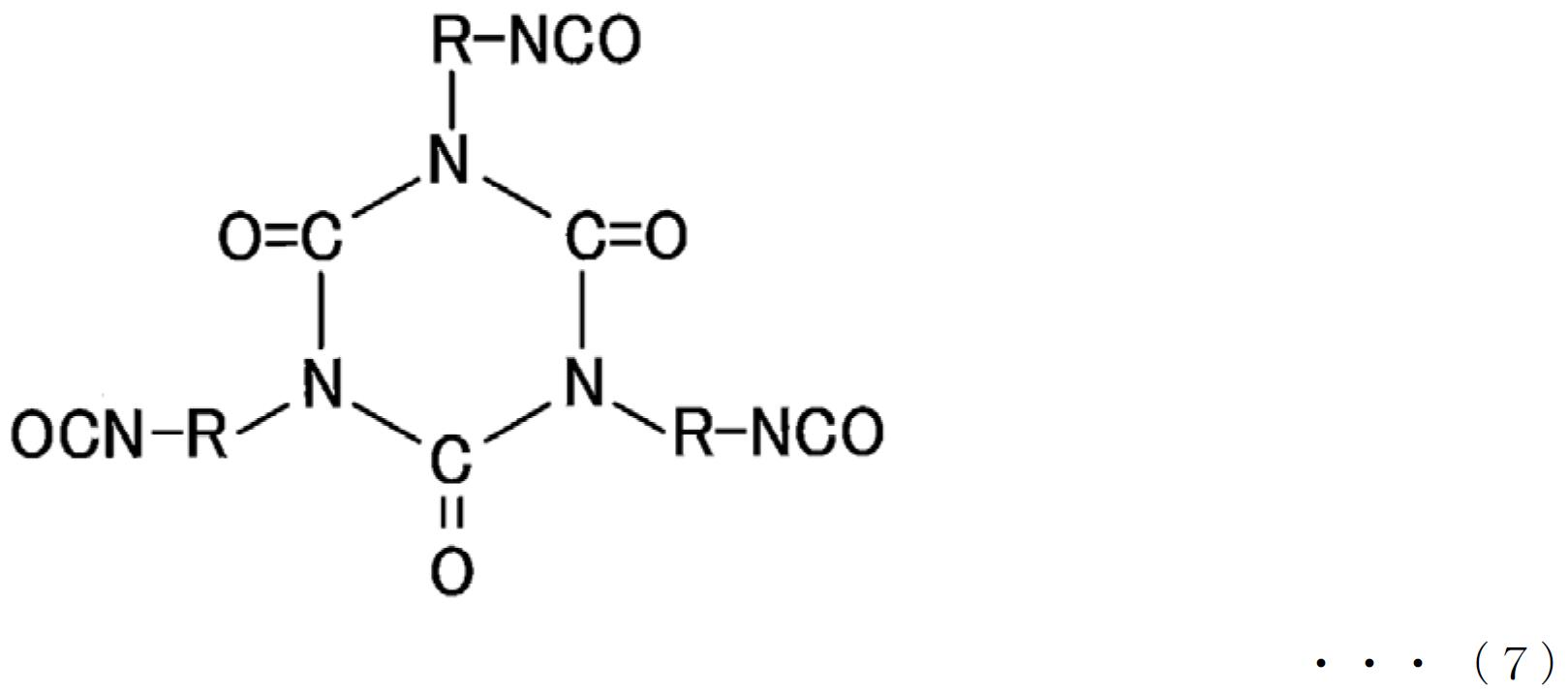
以下對發明之一實施形態進行說明。 首先,關於本實施形態之高分子體,以作為包含聚胺基甲酸酯樹脂之聚胺基甲酸酯樹脂發泡體的研磨墊用高分子體為例進行說明。 本實施形態之高分子體係用作構成上述研磨墊之至少研磨面之部分。 本實施形態之高分子體為包含聚胺基甲酸酯樹脂之高分子體。 上述聚胺基甲酸酯樹脂具備源自包含羥基之化合物(以下亦稱為「羥基化合物」)之第1結構單元與源自包含異氰酸基之化合物(以下亦稱為「異氰酸酯化合物」)之第2結構單元。 上述第1結構單元之1個以上源自包含羥基之有機陽離子及包含羥基之有機陰離子中之至少一者。 上述聚胺基甲酸酯樹脂為使作為羥基化合物之多元醇與作為異氰酸酯化合物之聚異氰酸酯鍵結而得之樹脂。 上述有機陽離子係藉由使異氰酸酯化合物之異氰酸基與羥基反應而進入至聚胺基甲酸酯樹脂之分子中。 上述有機陽離子可為一元醇亦可為多元醇。即,由有機陽離子形成之結構單元可存在於聚胺基甲酸酯樹脂之分子之末端,或亦可存在於較末端而言之內部。 上述第1結構單元之1個以上較佳為源自包含羥基之有機陽離子。 上述源自有機陽離子之結構單元較佳為源自離子液體。 上述離子液體之熔點較佳為150℃以下,更佳為100℃以下。 再者,離子液體之熔點例如可使用示差掃描熱量計裝置(DSC)求出。更具體而言,可一面通入氮氣,一面以5℃/min之升溫速度使試樣(離子液體)自較所預測熔點低30℃以上之溫度升溫至高30℃以上之溫度,根據此時所獲得之DSC曲線而求出。 上述離子液體較佳為具備具有2個以上羥基之陽離子。藉由上述離子液體具備具有2個以上羥基之陽離子,可使所獲得之聚合物內帶有更多之基於陽離子之電荷。其結果具有以下優點:可更進一步提高與液狀之極性物質(水等)之親和性,可更進一步擴大與液狀之極性物質接觸之狀態和不與液狀之極性物質接觸之狀態的硬度差。 作為具備具有2個以上羥基之陽離子之離子液體,例如可列舉下述式(1)~(3)之離子液體。 又,作為具備僅具有1個羥基之陽離子之離子液體,例如可列舉下述式(4)、(5)之離子液體。 作為離子液體,就可賦予分子內較多之電荷之觀點而言,較佳為具備具有2個以上羥基之陽離子之離子液體。 [化1][化2][化3][化4][化5]上述有機陰離子係藉由使異氰酸酯化合物之異氰酸基與羥基反應而進入至聚胺基甲酸酯樹脂之分子中。 上述有機陰離子可為一元醇亦可為多元醇。即,由有機陰離子形成之結構單元可存在於聚胺基甲酸酯樹脂之分子之末端,或亦可存在於較末端而言之內部。 上述有機陰離子源自2,2-雙(羥甲基)丁酸(DMBA)(下述式(6)之化合物)等。再者,DMBA中之「COOH基」可解離為「COO-
」與「H+
」。 [化6]上述多元醇可列舉多元醇單體或多元醇預聚物。 作為該多元醇單體,例如可列舉:1,4-苯二甲醇、1,4-雙(2-羥基乙氧基)苯、乙二醇、1,2-丙二醇1,3-丙二醇、1,3-丁二醇、1,5-戊二醇、3-甲基-1,5-戊二醇、1,6-己二醇、二乙二醇、三乙二醇、四乙二醇、二丙二醇、三丙二醇、分子量400以下之聚乙二醇、1,8-辛二醇、1,9-壬二醇等直鏈脂肪族二醇,可列舉:新戊二醇、3-甲基-1,5-戊二醇、2-甲基-1,3-丙二醇、2-丁基-2-乙基-1,3-丙二醇、2-甲基-1,8-辛二醇等支鏈脂肪族二醇,可列舉:1,4-環己二醇、1,4-環己烷二甲醇、氫化雙酚A等脂環族二醇,可列舉:甘油、三羥甲基丙烷、三羥丁基丙烷、季戊四醇、山梨醇等多官能多元醇等。 作為上述多元醇單體,就反應時之強度容易變得更高,包含所製造之發泡聚胺基甲酸酯之研磨墊之剛性容易變得更高,相對廉價之方面而言,較佳為乙二醇、二乙二醇。 作為上述多元醇預聚物,可列舉:聚醚多元醇、聚酯多元醇、聚酯聚碳酸酯多元醇及聚碳酸酯多元醇等。再者,作為多元醇預聚物,亦可列舉分子中具有3個以上羥基之多官能多元醇預聚物。 詳細而言,作為上述聚醚多元醇,可列舉:聚四亞甲基二醇(PTMG)、聚丙二醇(PPG)、聚乙二醇(PEG)、環氧乙烷加成聚丙烯多元醇等。 作為上述聚酯多元醇,可列舉:聚己二酸丁二酯、聚己二酸己二酯及聚己內酯多元醇等。 作為上述聚酯聚碳酸酯多元醇,可列舉:聚己內酯多元醇等聚酯二醇與碳酸伸烷酯之反應產物、使碳酸乙二酯與多元醇反應所得之反應混合物進而與有機二羧酸反應而獲得之反應產物等。 作為上述聚碳酸酯多元醇,可列舉:1,3-丙二醇、1,4-丁二醇、1,6-己二醇、二乙二醇、聚乙二醇、聚丙二醇、或聚四亞甲基二醇等二醇與碳醯氯、碳酸二烯丙酯(例如碳酸二苯酯)或環式碳酸酯(例如碳酸丙二酯)之反應產物等。 作為上述多元醇預聚物,就容易獲得具有彈性之發泡聚胺基甲酸酯之方面而言,較佳為數量平均分子量為800~8000者,具體而言,較佳為聚四亞甲基二醇(PTMG)、環氧乙烷加成聚丙烯多元醇。 作為上述聚異氰酸酯,可列舉:聚異氰酸酯、聚異氰酸酯預聚物。 作為上述聚異氰酸酯,可列舉:芳香族二異氰酸酯、脂肪族二異氰酸酯、脂環族二異氰酸酯等。 作為上述芳香族二異氰酸酯,可使用藉由使由苯胺與甲醛縮合所得之胺混合物於不活性溶劑中與碳醯氯反應等而獲得之粗二苯基甲烷二異氰酸酯(粗MDI)、精製該粗MDI而獲得之二苯基甲烷二異氰酸酯(純MDI)、聚亞甲基聚伸苯基聚異氰酸酯(聚合MDI)、及該等之改性物等,又,可使用甲苯二異氰酸酯(TDI)、1,5-萘二異氰酸酯、苯二甲基二異氰酸酯、1,3-苯二異氰酸酯、1,4-苯二異氰酸酯等。再者,該等芳香族二異氰酸酯可單獨或組合複數個使用。 作為二苯基甲烷二異氰酸酯之改性物,例如可列舉:碳二醯亞胺改性物、胺基甲酸酯改性物、脲基甲酸酯改性物、脲改性物、縮二脲改性物、異氰尿酸酯改性物、㗁唑啶酮改性物等。作為該改性物,具體而言,例如可列舉碳二醯亞胺改性二苯基甲烷二異氰酸酯(碳二醯亞胺改性MDI)。 作為上述脂肪族二異氰酸酯,例如使用二異氰酸乙二酯、2,2,4-三甲基六亞甲基二異氰酸酯、1,6-六亞甲基二異氰酸酯等。 作為上述脂環族二異氰酸酯,例如使用1,4-環己烷二異氰酸酯、4,4'-二環己基甲烷二異氰酸酯、異佛爾酮二異氰酸酯、降𦯉烷二異氰酸酯、亞甲基雙(4,1-伸環己基)=二異氰酸酯等。 作為上述聚異氰酸酯預聚物,可列舉由多元醇與芳香族二異氰酸酯、脂肪族二異氰酸酯、脂環族二異氰酸酯中之至少某一種二異氰酸酯鍵結而成之預聚物等。 作為上述聚異氰酸酯,就其蒸汽壓更低而不易揮發,從而容易控制作業環境之方面而言,較佳為二苯基甲烷二異氰酸酯(純MDI)、聚合MDI、或其改性物。又,就黏度更低、易於操作之方面而言,較佳為碳二醯亞胺改性MDI、聚合MDI、或該等與MDI之混合物。 上述聚胺基甲酸酯樹脂較佳為具有交聯結構。 上述交聯結構較佳為源自具有異氰酸基及羥基中之至少一種官能基、且具有異氰酸基與羥基合計3個以上的多官能化合物。 作為該多官能化合物,例如可列舉下述式(7)之化合物等。此處,「下述式(7)」之「R」可列舉「(Cn
H2n
)」(n為正整數,例如n=1~10)。 作為下述式(7)之化合物,可列舉1,6-六亞甲基二異氰酸酯之異氰尿酸酯體(R=C6
H12
)。 又,上述多官能化合物亦可為作為離子液體之上述式(1)之化合物。 [化7]上述聚胺基甲酸酯樹脂中之上述交聯濃度較佳為0.06~0.80 mmol/g。 再者,交聯濃度係以莫耳單位表示聚胺基甲酸酯樹脂1 g中之交聯點之量者。 本實施形態之高分子體係以如上方式構成,其次,對本實施形態之高分子體之製造方法進行說明。 藉由本實施形態之高分子體之製造方法而獲得具有聚胺基甲酸酯樹脂之高分子體。 又,於本實施形態之高分子體之製造方法中,藉由使包含羥基之化合物與包含異氰酸基之化合物鍵結而獲得上述高分子體。 於本實施形態之高分子體之製造方法中,具體而言,將包含羥基之化合物、包含異氰酸基之化合物及發泡劑進行混合而獲得混合物,使該混合物聚合發泡,藉此獲得高分子體。 上述包含羥基之化合物具有包含羥基之有機陽離子及包含羥基之有機陰離子中之至少一者。 於本實施形態之高分子體之製造方法中,較佳為上述包含羥基之化合物具有包含羥基之有機陽離子,上述有機陽離子源自離子液體,於上述離子液體之熔點以上之溫度下進行上述鍵結。 作為上述發泡劑,只要為於成形上述發泡聚胺基甲酸酯時產生氣體而成為氣泡,從而於上述發泡聚胺基甲酸酯中形成氣泡者,則無特別限定,例如可單獨或組合使用於加熱下分解而產生氣體之有機化學發泡劑、沸點為-5~70℃之低沸點烴、鹵代烴、水、液化二氧化碳等。 作為上述有機化學發泡劑,例如可列舉:偶氮系化合物(偶氮二甲醯胺、偶氮二異丁腈、重氮胺基苯、偶氮二羧酸鋇等)、亞硝基化合物(N,N'-二亞硝基五亞甲基四胺、N,N'-二亞硝基-N,N'-二甲基對苯二甲醯胺等)、磺醯肼化合物[p,p'-氧基雙(苯磺醯肼)、對甲苯磺醯肼等]等。 作為上述低沸點烴,例如可列舉:丁烷、戊烷、環戊烷、及該等之混合物等。 作為上述鹵代烴,可列舉二氯甲烷、HFC(氫氟碳類)等。 又,上述發泡劑亦可為加熱膨脹性微小球狀體。該加熱膨脹性微小球狀體之粒徑例如為20~30 μm。該加熱膨脹性微小球狀體具備由熱塑性樹脂形成之中空體與設置於中空體之中空部分之液狀烴。作為上述加熱膨脹性微小球狀體,例如可列舉日本Fillite公司製造之Expancel(註冊商標)或松本油脂製藥公司製造之熱膨脹性微膠囊等。 於製作發泡聚胺基甲酸酯樹脂時使用水作為發泡劑之情形時,藉由上述離子性化合物而使水容易分散於混合物中,因此具有發泡聚胺基甲酸酯樹脂之氣泡容易變得微細之優點。換言之,具有發泡聚胺基甲酸酯樹脂變得不易產生粗大氣泡之優點。其結果具有被研磨物變得不易受損之優點。 本實施形態之研磨墊具備本實施形態之高分子體。 本實施形態之高分子體、研磨墊、及高分子體之製造方法係以如上方式構成,因此具有以下優點。 本實施形態之高分子體係包含聚胺基甲酸酯樹脂者。 上述聚胺基甲酸酯樹脂具備源自包含羥基之化合物之第1結構單元與源自包含異氰酸基之化合物之第2結構單元。 上述第1結構單元之1個以上源自包含羥基之有機陽離子及包含羥基之有機陰離子中之至少一者。 該高分子體之聚胺基甲酸酯樹脂成為具有陽離子及陰離子中之至少一者之化學結構,其結果成為與液狀之極性物質(水等)之親和性優異之化學結構。因此,藉由該聚胺基甲酸酯樹脂與液狀之極性物質接觸,而極性分子(H2
O分子等)容易進入至聚胺基甲酸酯樹脂之聚合物分子間。其結果該聚胺基甲酸酯樹脂成為於與液狀之極性物質接觸之狀態下之硬度低於不與液狀之極性物質接觸之狀態下之硬度者。 因此,該高分子體成為於與液狀之極性物質接觸之狀態下之硬度低於不與液狀之極性物質接觸之狀態下之硬度者。 即,該高分子體成為於特定狀況下硬度變低之高分子體。 又,於本實施形態之高分子體中,較佳為上述聚胺基甲酸酯樹脂具有交聯結構。 該高分子體由於上述聚胺基甲酸酯樹脂具有交聯結構,故而具有如下優點:可抑制於與液狀之極性物質(水等)接觸時因該液狀之極性物質所致之膨脹,其結果可抑制因與該液狀之極性物質接觸所致之變形。 又,本實施形態之研磨墊具備上述高分子體。 進而,本實施形態之高分子體之製造方法係獲得包含聚胺基甲酸酯樹脂之高分子體者。 又,本實施形態之高分子體之製造方法藉由使包含羥基之化合物與包含異氰酸基之化合物鍵結而獲得上述高分子體。 上述包含羥基之化合物具有包含羥基之有機陽離子及包含羥基之有機陰離子中之至少一者。 又,於本實施形態之高分子體之製造方法中,較佳為上述包含羥基之化合物具有包含羥基之有機陽離子。上述有機陽離子源自離子液體。於本實施形態之高分子體之製造方法中,於上述離子液體之熔點以上之溫度下進行上述鍵結。 於該高分子體之製造方法中,由於在上述離子液體之熔點以上之溫度下進行上述鍵結,故而具有如下優點:容易使上述離子液體與其他材料於上述鍵結前均勻混合,而可獲得均勻性優異之高分子體。 如上所述,根據本實施形態,可提供一種於特定狀況下硬度變低之高分子體,並且提供具備該高分子體之研磨墊、及製作該高分子體之高分子體之製造方法。 再者,本發明之高分子體、研磨墊、及高分子體之製造方法並不限定於上述實施形態。又,本發明之高分子體、研磨墊、及高分子體之製造方法並不限定於上述作用效果。本發明之高分子體、研磨墊、及高分子體之製造方法可於未脫離本發明之主旨之範圍內進行各種變更。 即,本實施形態之高分子體係使上述混合物中含有發泡劑而形成,但亦可藉由攪拌使上述混合物中混入空氣而形成。 又,本實施形態之高分子體為聚胺基甲酸酯樹脂發泡體,但本發明之高分子體亦可為於不織布中含浸聚胺基甲酸酯樹脂而成之高分子體。 進而,本發明之高分子體之聚胺基甲酸酯樹脂亦可使上述混合物中含有微小中空體而形成。 又,本實施形態之高分子體為研磨墊用之高分子體,但本發明之高分子體亦可用於其他用途,例如亦可用作化妝品之材料、商務用海綿、清潔用海綿、樹脂改質用填料等。 [實施例] 其次,列舉實施例及比較例而更具體地說明本發明。 (實施例1) 將藉由使甲苯二異氰酸酯(TDI)、聚丙二醇(PPG)及二乙二醇(DEG)反應而獲得之胺基甲酸酯預聚物與六亞甲基二異氰酸酯之三聚物進行混合,藉此製作主劑。又,藉由將下述式(1)之離子液體、1,4-苯二甲醇及1,4-雙(2-羥基乙氧基)苯進行混合而製作硬化劑。其後,將上述主劑、上述硬化劑及作為發泡劑之水進行混合,使之於70℃下反應,藉此獲得高分子體。 再者,主劑、硬化劑及發泡劑中之離子液體之濃度設為5質量%。 [化8](比較例1) 將藉由使甲苯二異氰酸酯(TDI)、聚四亞甲基醚二醇(PTMG)及二乙二醇(DEG)反應而獲得之胺基甲酸酯預聚物、亞甲基雙鄰氯苯胺(MOCA)及作為發泡劑之水進行混合,使之於70℃下反應,藉此獲得高分子體。 (吸水試驗) 將實施例1及比較例1之高分子體供於吸水試驗。 即,首先,測定高分子體(長:50 mm、寬:50 mm、高:1 mm)之質量(G1)。其後,使高分子體於40℃之溫水中浸漬24小時,測定浸漬後之高分子體之質量(G2)。其後,藉由下述式算出吸水率P。 P=(G2-G1)/G1×100(%) 實施例1之高分子體之吸水率為20%。另一方面,比較例1之高分子體之吸水率為5%。 因此,可知實施例1之高分子體其吸水率高於比較例1之高分子體,成為容易吸收水之結構。 (實施例2) 將藉由使甲苯二異氰酸酯(TDI)、聚丙二醇(PPG)及二乙二醇(DEG)反應而獲得之胺基甲酸酯預聚物與六亞甲基二異氰酸酯之三聚物進行混合,藉此製作主劑。又,藉由將下述式(3)之離子液體與1,4-雙(2-羥基乙氧基)苯進行混合而製作硬化劑。其後,將上述主劑、上述硬化劑及作為發泡劑之水進行混合,使之於70℃下反應,藉此獲得高分子體。 再者,主劑、硬化劑及發泡劑中之離子液體之濃度設為10質量%。 [化9](比較例2) 使用三乙醇胺(TEOA)代替上述離子液體,除此以外,藉由與實施例2相同之方式獲得高分子體。 (實施例3) 使用2,2-雙(羥甲基)丁酸(DMBA)代替上述離子液體,除此以外,藉由與實施例2相同之方式獲得高分子體。 (密度) 密度(表觀密度)係藉由測定高分子體之長方體狀之試片之長、寬、厚,進而測定該試片之質量而求出。 (硬度(JIS-A)) 硬度(JIS-A)係依據基於JIS K7312-1996之A型之硬度試驗,於23℃下進行測定。 再者,濕潤時之硬度意指使高分子體於40℃之溫水中浸漬24小時後高分子體之硬度。 (硬度(Asker-C)) 硬度(Asker-C)係依據SRIR0101,於23℃下進行測定。 再者,濕潤時之硬度意指使高分子體於40℃之溫水中浸漬24小時後高分子體之硬度。 (切片試驗) 使用刀具將圓筒狀之高分子體(直徑:90 mm、厚度:90 mm)切成厚度1~2 mm之切片。此處,藉由固定高分子體,使刀具於水平方向上朝向該高分子體移動而對該高分子體進行切片。作為上述刀具,使用被稱為超硬刀具之由碳化鎢與鈷之混合物經煅燒固化而成之刀具。 進而,按照以下之基準進行評價。 ○:能夠進行切片 ×:無法進行切片 (氣泡之尺寸) 為了確認氣泡之尺寸,利用掃描式電子顯微鏡(SEM)拍攝高分子體之剖面之圖片。 將SEM照片之結果示於圖1~3。又,將其以外之結果示於下述表1。 [表1]
※過於柔軟而無法進行切片。 如表1所示,與比較例2之高分子體相比,實施例2、3之高分子體藉由與水之接觸而硬度大幅度降低。因此,可知本發明之高分子體為於特定狀況下硬度變低之高分子體。 又,如表1所示,與實施例3之高分子體相比,實施例2之高分子體藉由與水之接觸而硬度大幅度降低。因此,可知與實施例3之高分子體相比,實施例2之高分子體為於特定狀況下硬度變低之高分子體。 推測出現該結果之原因如下。實施例3之高分子體成為結構單元中包含羧酸之結構。認為羧酸於與pKa為4左右、pH值為7之水接觸之情形時,0.01%左右之羧基變為陰離子。另一方面,離子液體於與水接觸之情形時,大部分能夠以陽離子之形式存在。認為其結果與實施例3之高分子體相比,實施例2之高分子體藉由與水之接觸而硬度大幅度降低。 如圖1~3所示,與比較例2及實施例3之高分子體相比,實施例2之高分子體中之氣泡較小。An embodiment of the invention will be described below. First, the polymer of the present embodiment will be described by taking an example of a polymer for a polishing pad which is a polyurethane resin foam including a polyurethane resin. The polymer system of this embodiment is used as a part constituting at least the polishing surface of the polishing pad. The polymer of this embodiment is a polymer containing a polyurethane resin. The polyurethane resin has a first structural unit derived from a compound containing a hydroxyl group (hereinafter also referred to as a "hydroxy compound") and a compound derived from an isocyanate group (hereinafter also referred to as an "isocyanate compound") The second structural unit. One or more of the first structural units are derived from at least one of an organic cation including a hydroxyl group and an organic anion including a hydroxyl group. The polyurethane resin is a resin obtained by bonding a polyol as a hydroxy compound and a polyisocyanate as an isocyanate compound. The organic cation is introduced into the molecule of the polyurethane resin by reacting an isocyanate group of the isocyanate compound with a hydroxyl group. The organic cation may be a monohydric alcohol or a polyhydric alcohol. That is, the structural unit formed of an organic cation may exist at the terminal of the molecule of the polyurethane resin, or may exist inside the terminal end. One or more of the first structural units are preferably derived from an organic cation containing a hydroxyl group. The structural unit derived from the organic cation is preferably derived from an ionic liquid. The melting point of the ionic liquid is preferably 150 ° C or lower, and more preferably 100 ° C or lower. The melting point of the ionic liquid can be obtained using, for example, a differential scanning calorimeter (DSC). More specifically, the sample (ionic liquid) can be heated from a temperature higher than 30 ° C lower than the predicted melting point to a temperature higher than 30 ° C at a temperature rising rate of 5 ° C / min while introducing nitrogen gas. The obtained DSC curve was obtained. The ionic liquid preferably includes a cation having two or more hydroxyl groups. By having the above ionic liquid with a cation having more than two hydroxyl groups, the obtained polymer can have more cation-based charges. As a result, it has the following advantages: the affinity with the liquid polar substance (water, etc.) can be further improved, and the hardness of the state in contact with the liquid polar substance and the state without contact with the liquid polar substance can be further expanded. difference. Examples of the ionic liquid having a cation having two or more hydroxyl groups include ionic liquids of the following formulae (1) to (3). Moreover, as an ionic liquid provided with the cation which has only one hydroxyl group, the ionic liquid of following formula (4), (5) is mentioned, for example. The ionic liquid is preferably an ionic liquid having a cation having two or more hydroxyl groups, from the viewpoint that a large amount of charge can be imparted in the molecule. [Chemical 1] 
[Chemical 2] 
[Chemical 3] 
[Chemical 4] 
[Chemical 5] 
The organic anion is introduced into the molecule of the polyurethane resin by reacting an isocyanate group of the isocyanate compound with a hydroxyl group. The organic anion may be a monohydric alcohol or a polyhydric alcohol. That is, the structural unit formed of an organic anion may exist at the terminal of the molecule of the polyurethane resin, or may exist inside the terminal end. The organic anion is derived from 2,2-bis (hydroxymethyl) butanoic acid (DMBA) (a compound of the following formula (6)) and the like. Furthermore, DMBA in the "COOH group" can be dissociated as "COO -" and "H +." [Chemical 6] Examples of the polyol include a polyol monomer or a polyol prepolymer. Examples of the polyol monomer include 1,4-benzenedimethanol, 1,4-bis (2-hydroxyethoxy) benzene, ethylene glycol, 1,2-propanediol 1,3-propanediol, and 1 1,3-butanediol, 1,5-pentanediol, 3-methyl-1,5-pentanediol, 1,6-hexanediol, diethylene glycol, triethylene glycol, tetraethylene glycol , Straight-chain aliphatic diols such as dipropylene glycol, tripropylene glycol, polyethylene glycol having a molecular weight of 400 or less, 1,8-octanediol, and 1,9-nonanediol, and examples thereof include neopentyl glycol, 3-methyl 1,5-pentanediol, 2-methyl-1,3-propanediol, 2-butyl-2-ethyl-1,3-propanediol, 2-methyl-1,8-octanediol, etc. Examples of branched aliphatic diols include alicyclic diols such as 1,4-cyclohexanediol, 1,4-cyclohexanedimethanol, and hydrogenated bisphenol A. Examples include glycerol and trimethylolpropane. , Trihydroxybutylpropane, pentaerythritol, sorbitol and other polyfunctional polyols. As the above-mentioned polyol monomer, the strength at the time of the reaction tends to be higher, and the rigidity of the polishing pad containing the foamed polyurethane produced is likely to be higher, which is relatively cheaper. For ethylene glycol, diethylene glycol. Examples of the polyol prepolymer include polyether polyols, polyester polyols, polyester polycarbonate polyols, and polycarbonate polyols. Moreover, as a polyol prepolymer, the polyfunctional polyol prepolymer which has three or more hydroxyl groups in a molecule | numerator is also mentioned. Specifically, examples of the polyether polyol include polytetramethylene glycol (PTMG), polypropylene glycol (PPG), polyethylene glycol (PEG), and ethylene oxide-added polypropylene polyol. . Examples of the polyester polyol include polybutylene adipate, polyadipate, and polycaprolactone polyol. Examples of the polyester polycarbonate polyols include reaction products of polyester diols such as polycaprolactone polyols and alkylene carbonates, reaction mixtures obtained by reacting ethylene carbonate and polyols, and organic dihydric alcohols. Reaction products obtained by the reaction of carboxylic acids. Examples of the polycarbonate polyol include 1,3-propanediol, 1,4-butanediol, 1,6-hexanediol, diethylene glycol, polyethylene glycol, polypropylene glycol, or polytetramethylene glycol. Reaction products of glycols such as methyl glycol with carbochlorine, diallyl carbonate (such as diphenyl carbonate), or cyclic carbonates (such as propylene carbonate), and the like. As the above-mentioned polyol prepolymer, in terms of easily obtaining elastic foamed polyurethanes, those having a number average molecular weight of 800 to 8000 are preferred, and specifically, polytetramethylene is preferred. Polypropylene glycol (PTMG), ethylene oxide addition polypropylene. Examples of the polyisocyanate include a polyisocyanate and a polyisocyanate prepolymer. Examples of the polyisocyanate include an aromatic diisocyanate, an aliphatic diisocyanate, and an alicyclic diisocyanate. As the aromatic diisocyanate, crude diphenylmethane diisocyanate (crude MDI) obtained by reacting an amine mixture obtained by condensing aniline with formaldehyde in an inert solvent with carbochlorine or the like can be used. MDI obtained from diphenylmethane diisocyanate (pure MDI), polymethylene polyphenylene polyisocyanate (polymer MDI), and modified products thereof. Toluene diisocyanate (TDI), 1,5-naphthalene diisocyanate, xylylene diisocyanate, 1,3-benzene diisocyanate, 1,4-benzene diisocyanate, and the like. Moreover, these aromatic diisocyanates can be used individually or in combination of multiple. Examples of the modified product of diphenylmethane diisocyanate include carbodiimide modified product, urethane modified product, urethane modified product, urea modified product, and bicondensate. Modified urea, modified isocyanurate, modified oxazolidone, and the like. Specific examples of the modified product include carbodiimide-modified diphenylmethane diisocyanate (carbodiimide-modified MDI). Examples of the aliphatic diisocyanate include ethylene diisocyanate, 2,2,4-trimethylhexamethylene diisocyanate, and 1,6-hexamethylene diisocyanate. As the alicyclic diisocyanate, for example, 1,4-cyclohexane diisocyanate, 4,4'-dicyclohexylmethane diisocyanate, isophorone diisocyanate, alkane diisocyanate, methylene Bis (4,1-cyclohexyl) = diisocyanate and the like. Examples of the polyisocyanate prepolymer include a prepolymer in which a polyol is bonded to at least one of diisocyanates among an aromatic diisocyanate, an aliphatic diisocyanate, and an alicyclic diisocyanate. The polyisocyanate is preferably a diphenylmethane diisocyanate (pure MDI), a polymerized MDI, or a modified product thereof because it has a lower vapor pressure and is less volatile, so that the working environment can be easily controlled. Moreover, in terms of lower viscosity and ease of handling, carbodiimide-modified MDI, polymerized MDI, or a mixture of these with MDI is preferred. The polyurethane resin preferably has a crosslinked structure. The cross-linked structure is preferably a polyfunctional compound derived from having at least one functional group of an isocyanate group and a hydroxyl group, and having a total of 3 or more isocyanate groups and hydroxyl groups. Examples of the polyfunctional compound include a compound of the following formula (7). Here, "R" of "the following formula (7)" is "(C n H 2n )" (n is a positive integer, for example, n = 1 to 10). Examples of the compound of the following formula (7) include an isocyanurate (R = C 6 H 12 ) of 1,6-hexamethylene diisocyanate. The polyfunctional compound may be a compound of the formula (1) as an ionic liquid. [Chemical 7] The crosslinking concentration in the polyurethane resin is preferably 0.06 to 0.80 mmol / g. The cross-linking concentration is an amount in which the cross-linking point in 1 g of the polyurethane resin is expressed in molar units. The polymer system of this embodiment is configured as described above. Next, a method for manufacturing a polymer of this embodiment will be described. A polymer having a polyurethane resin is obtained by the method for producing a polymer according to this embodiment. Furthermore, in the method for producing a polymer of this embodiment, the above-mentioned polymer is obtained by bonding a compound containing a hydroxyl group with a compound containing an isocyanate group. In the method for producing a polymer of this embodiment, specifically, a compound containing a hydroxyl group, a compound containing an isocyanate group, and a foaming agent are mixed to obtain a mixture, and the mixture is polymerized and foamed, thereby obtaining Polymer. The compound containing a hydroxyl group has at least one of an organic cation containing a hydroxyl group and an organic anion containing a hydroxyl group. In the method for producing a polymer of this embodiment, it is preferable that the compound containing a hydroxyl group has an organic cation containing a hydroxyl group, the organic cation is derived from an ionic liquid, and the bonding is performed at a temperature above the melting point of the ionic liquid. . The foaming agent is not particularly limited as long as a gas is generated during the molding of the foamed polyurethane and becomes a bubble, thereby forming a foam in the foamed polyurethane. For example, it may be alone Or use it in combination with organic chemical foaming agent that decomposes under heating to produce gas, low boiling point hydrocarbons with a boiling point of -5 to 70 ° C, halogenated hydrocarbons, water, liquefied carbon dioxide, etc. Examples of the organic chemical blowing agent include azo compounds (azodimethylformamide, azobisisobutyronitrile, diazoaminobenzene, barium azodicarboxylate, etc.), and nitroso compounds. (N, N'-dinitrosopentamethylenetetramine, N, N'-dinitroso-N, N'-dimethyl-p-xylylenediamine, etc.), sulfohydrazine compounds [p , p'-oxybis (benzenesulfonylhydrazine), p-toluenesulfonylhydrazine, etc.] and the like. Examples of the low-boiling hydrocarbons include butane, pentane, cyclopentane, and mixtures thereof. Examples of the halogenated hydrocarbon include dichloromethane, HFC (hydrofluorocarbons), and the like. The foaming agent may be a heat-expandable microsphere. The particle diameter of this heat-expandable microsphere is, for example, 20 to 30 μm. This heat-expandable microsphere includes a hollow body formed of a thermoplastic resin and a liquid hydrocarbon provided in a hollow portion of the hollow body. Examples of the heat-expandable microspheres include Expancel (registered trademark) manufactured by Japan Fillite Corporation and heat-expandable microcapsules manufactured by Matsumoto Oil & Fat Pharmaceutical Co., Ltd., and the like. When water is used as a foaming agent when producing a foamed polyurethane resin, water is easily dispersed in the mixture by the ionic compound, and therefore, it has bubbles of the foamed polyurethane resin. Easy to become fine. In other words, there is an advantage that a foamed polyurethane resin is less likely to generate coarse bubbles. As a result, there is an advantage that the object to be polished is not easily damaged. The polishing pad of this embodiment includes the polymer of this embodiment. The polymer, the polishing pad, and the method for producing a polymer according to this embodiment are configured as described above, and therefore have the following advantages. The polymer system of this embodiment includes a polyurethane resin. The polyurethane resin includes a first structural unit derived from a compound containing a hydroxyl group and a second structural unit derived from a compound containing an isocyanate group. One or more of the first structural units are derived from at least one of an organic cation including a hydroxyl group and an organic anion including a hydroxyl group. The polyurethane resin of the polymer has a chemical structure having at least one of a cation and an anion, and as a result, a chemical structure having excellent affinity with a liquid polar substance (such as water). Therefore, by contacting the polyurethane resin with a liquid polar substance, polar molecules (such as H 2 O molecules) easily enter the polymer molecules of the polyurethane resin. As a result, the hardness of the polyurethane resin in a state of being in contact with a liquid polar substance is lower than that in a state of not being in contact with a liquid polar substance. Therefore, the hardness of the polymer in a state in which it is in contact with a liquid polar substance is lower than that in a state where it is not in contact with a liquid polar substance. That is, this polymer becomes a polymer whose hardness becomes low under specific conditions. Moreover, in the polymer of this embodiment, it is preferable that the said polyurethane resin has a crosslinked structure. The polymer has a crosslinked structure due to the above-mentioned polyurethane resin, and therefore has the advantage that it can suppress swelling caused by the liquid polar substance when it comes into contact with the liquid polar substance (water, etc.), As a result, deformation caused by contact with the liquid polar substance can be suppressed. The polishing pad according to this embodiment includes the polymer described above. Furthermore, the method for producing a polymer according to this embodiment is one in which a polymer including a polyurethane resin is obtained. In addition, in the method for producing a polymer of this embodiment, the above-mentioned polymer is obtained by bonding a compound containing a hydroxyl group with a compound containing an isocyanate group. The compound containing a hydroxyl group has at least one of an organic cation containing a hydroxyl group and an organic anion containing a hydroxyl group. In the method for producing a polymer according to this embodiment, it is preferable that the compound containing a hydroxyl group has an organic cation containing a hydroxyl group. The organic cation is derived from an ionic liquid. In the method for producing a polymer of this embodiment, the bonding is performed at a temperature equal to or higher than the melting point of the ionic liquid. In the manufacturing method of the polymer, since the bonding is performed at a temperature above the melting point of the ionic liquid, it has the advantage that it is easy to uniformly mix the ionic liquid and other materials before the bonding, and obtain Polymer with excellent uniformity. As described above, according to the present embodiment, it is possible to provide a polymer having a reduced hardness under a specific condition, a polishing pad provided with the polymer, and a method for manufacturing the polymer to produce the polymer. It should be noted that the polymer, polishing pad, and method for producing a polymer according to the present invention are not limited to the embodiments described above. Moreover, the manufacturing method of the polymer, polishing pad, and polymer of this invention is not limited to the said effect. The polymer, polishing pad, and manufacturing method of the polymer of the present invention can be variously modified without departing from the spirit of the present invention. That is, the polymer system of this embodiment is formed by including a foaming agent in the mixture, but it may also be formed by mixing air into the mixture by stirring. The polymer of the present embodiment is a polyurethane resin foam, but the polymer of the present invention may be a polymer obtained by impregnating a polyurethane resin with a nonwoven fabric. Furthermore, the polyurethane resin of the polymer of the present invention may be formed by containing minute hollow bodies in the mixture. In addition, the polymer of this embodiment is a polymer for polishing pads, but the polymer of the present invention can also be used for other purposes, for example, it can also be used as a cosmetic material, a business sponge, a cleaning sponge, and a resin modification. Quality fillers and so on. [Examples] Next, the present invention will be described more specifically with reference to examples and comparative examples. (Example 1) Three of urethane prepolymer and hexamethylene diisocyanate obtained by reacting toluene diisocyanate (TDI), polypropylene glycol (PPG), and diethylene glycol (DEG) The polymers were mixed to prepare a base agent. In addition, a ionic liquid of the following formula (1), 1,4-benzenedimethanol, and 1,4-bis (2-hydroxyethoxy) benzene were mixed to prepare a hardener. Thereafter, the above-mentioned main agent, the above-mentioned hardening agent, and water as a foaming agent were mixed and reacted at 70 ° C to obtain a polymer. In addition, the concentration of the ionic liquid in the main agent, the hardener, and the foaming agent was set to 5% by mass. [Chemical 8] (Comparative Example 1) A urethane prepolymer and methylene obtained by reacting toluene diisocyanate (TDI), polytetramethylene ether glycol (PTMG), and diethylene glycol (DEG) A polymer is obtained by mixing bis-o-chloroaniline (MOCA) with water as a foaming agent and reacting it at 70 ° C. (Water absorption test) The polymers of Example 1 and Comparative Example 1 were subjected to a water absorption test. That is, first, the mass (G1) of the polymer (length: 50 mm, width: 50 mm, height: 1 mm) was measured. Thereafter, the polymer was immersed in warm water at 40 ° C. for 24 hours, and the mass (G2) of the polymer after the immersion was measured. Thereafter, the water absorption P was calculated by the following formula. P = (G2-G1) / G1 × 100 (%) The water absorption of the polymer of Example 1 was 20%. On the other hand, the water absorption of the polymer of Comparative Example 1 was 5%. Therefore, it can be seen that the polymer of Example 1 has a higher water absorption rate than the polymer of Comparative Example 1, and has a structure that easily absorbs water. (Example 2) Three of urethane prepolymer and hexamethylene diisocyanate obtained by reacting toluene diisocyanate (TDI), polypropylene glycol (PPG), and diethylene glycol (DEG) The polymers were mixed to prepare a base agent. In addition, a hardening agent is prepared by mixing an ionic liquid of the following formula (3) with 1,4-bis (2-hydroxyethoxy) benzene. Thereafter, the above-mentioned main agent, the above-mentioned hardening agent, and water as a foaming agent were mixed and reacted at 70 ° C to obtain a polymer. The concentration of the ionic liquid in the main agent, the hardening agent, and the foaming agent was set to 10% by mass. [Chemical 9] Comparative Example 2 A polymer was obtained in the same manner as in Example 2 except that triethanolamine (TEOA) was used instead of the ionic liquid. (Example 3) A polymer was obtained in the same manner as in Example 2 except that 2,2-bis (hydroxymethyl) butanoic acid (DMBA) was used instead of the ionic liquid. (Density) The density (apparent density) is determined by measuring the length, width, and thickness of a polymer-like rectangular parallelepiped test piece, and then measuring the mass of the test piece. (Hardness (JIS-A)) The hardness (JIS-A) is measured at 23 ° C according to a type A hardness test based on JIS K7312-1996. In addition, the hardness when wet refers to the hardness of the polymer after immersing the polymer in warm water at 40 ° C for 24 hours. (Hardness (Asker-C)) The hardness (Asker-C) was measured at 23 ° C in accordance with SRIR0101. In addition, the hardness when wet refers to the hardness of the polymer after immersing the polymer in warm water at 40 ° C for 24 hours. (Slicing test) A cylindrical polymer (diameter: 90 mm, thickness: 90 mm) was cut into slices having a thickness of 1 to 2 mm using a cutter. Here, the polymer is fixed, and the cutter is moved toward the polymer in the horizontal direction to slice the polymer. As the above-mentioned tool, a tool called a superhard tool made of a mixture of tungsten carbide and cobalt by calcination and solidification is used. Furthermore, evaluation was performed according to the following criteria. ○: Slicing is possible ×: Slicing is not possible (the size of the air bubbles) In order to confirm the size of the air bubbles, a picture of a cross section of the polymer was taken with a scanning electron microscope (SEM). The results of the SEM photographs are shown in FIGS. 1 to 3. The results other than these are shown in Table 1 below. [Table 1] ※ Too soft to slice. As shown in Table 1, compared with the polymer of Comparative Example 2, the polymers of Examples 2 and 3 had a significantly reduced hardness due to contact with water. Therefore, it can be seen that the polymer of the present invention is a polymer whose hardness becomes low under specific conditions. In addition, as shown in Table 1, the polymer of Example 2 had a significantly lower hardness by contact with water than the polymer of Example 3. Therefore, it can be seen that the polymer of Example 2 is a polymer having a lower hardness under specific conditions than the polymer of Example 3. The reason for this result is presumed to be as follows. The polymer of Example 3 has a structure including a carboxylic acid in a structural unit. When the carboxylic acid is in contact with water having a pKa of about 4 and a pH of 7, it is considered that about 0.01% of the carboxyl groups become anions. On the other hand, when ionic liquids are in contact with water, most of them can exist as cations. As a result, compared with the polymer of Example 3, it is considered that the hardness of the polymer of Example 2 is greatly reduced by contact with water. As shown in FIGS. 1 to 3, compared with the polymers of Comparative Examples 2 and 3, the bubbles in the polymers of Example 2 were smaller.