1. 定義
本說明書中,表示組成之「份」、「%」等只要無特別說明則為質量基準。 本說明書中,所謂環氧當量係定義為包含1當量之環氧基之環氧化合物的質量。此處,於包含m種(m為2以上之整數)環氧化合物之混合物之情形時,該混合物之環氧當量係以 [數1]表示。環氧化合物之環氧當量可依據JIS K7236進行測定。2. 包含環氧化合物立體異構物而成之組合物
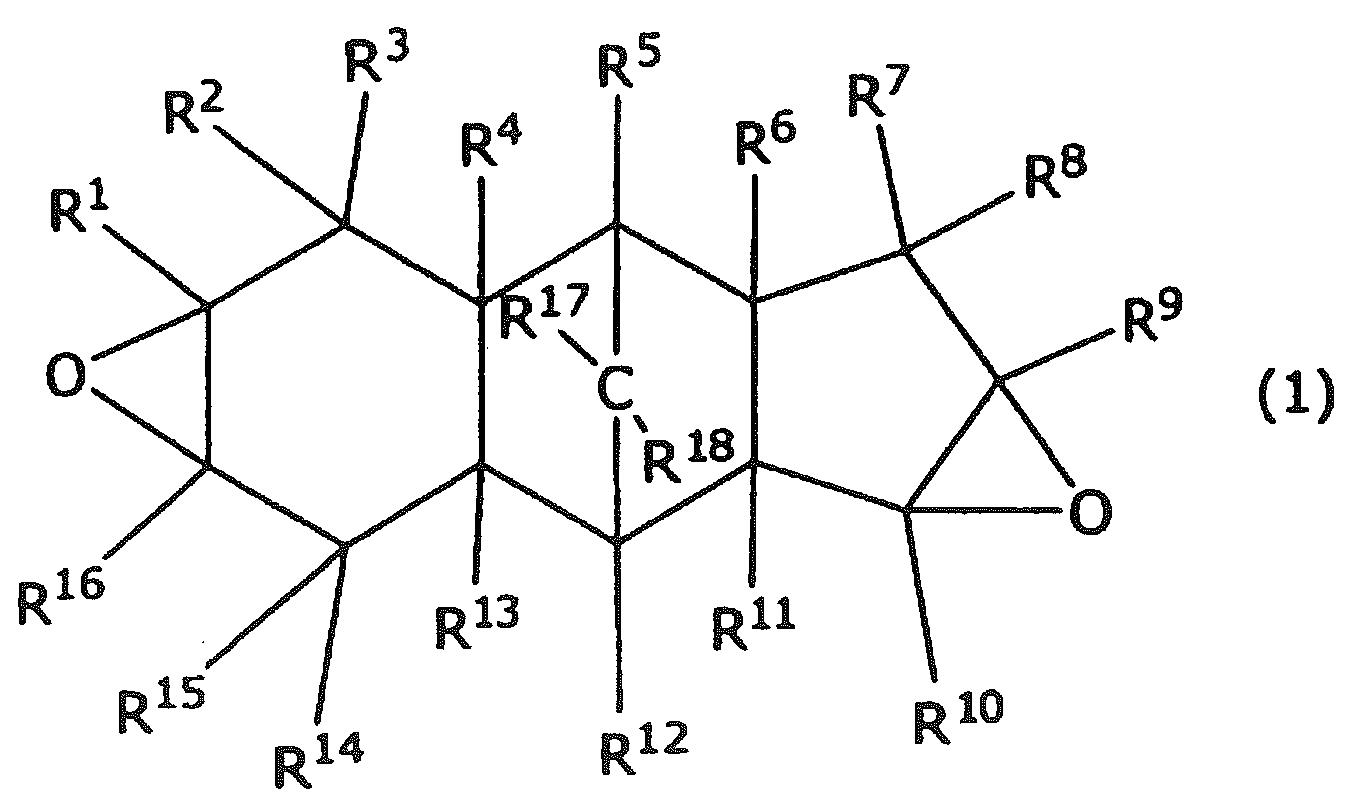
本發明之組合物之特徵在於:其係包含下述式(1)所表示之化合物之立體異構物中之至少1種以上而成者,且於對該組合物在下述分析條件下進行氣相層析分析所獲得之氣相層析圖中,相對於源自該立體異構物之波峰面積之總和,最大波峰之波峰面積之比率為60%以上,該最大波峰存在於保持時間為27.6~28.0分鐘之間。又,本發明之組合物之特徵在於:其係包含下述式(1)所表示之化合物之立體異構物中之至少1種以上而成者,且於對該組合物在下述分析條件下進行氣相層析分析所獲得之氣相層析圖中,相對於保持時間27.5~29.0分鐘之範圍內之波峰面積之總和,保持時間為27.6~28.0分鐘之範圍內之最大波峰之波峰面積之比率為60%以上。 [化6](式中,R1
至R18
分別獨立地選自由氫、烷基及烷氧基所組成之群中) (分析條件) 管柱:HP-1(Agilent Technologies股份有限公司製造),長度:60.0 m、內徑:250 μm、膜厚:0.25 μm 液相:100%二甲基聚矽氧烷 載氣:N2
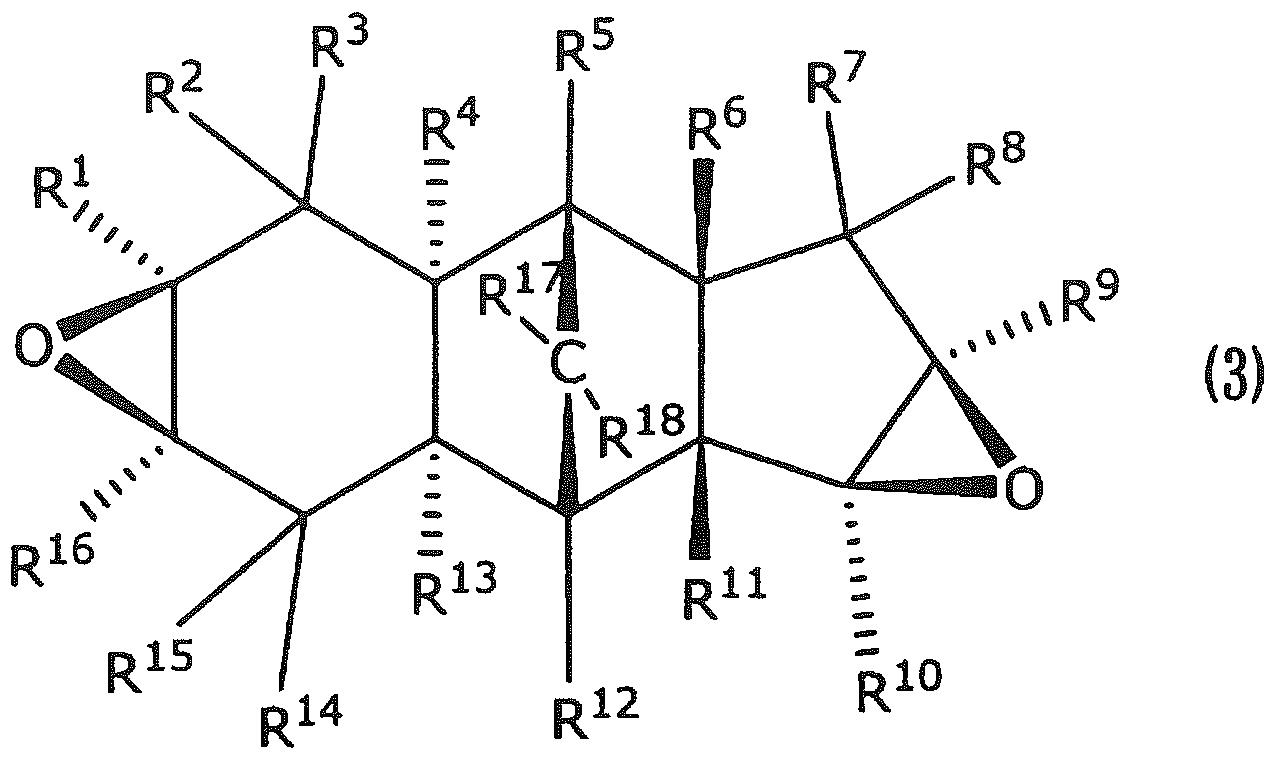
流速:1.3 mL/min 試樣注入口溫度:140℃ 檢測器溫度:250℃ 試樣注入量:0.2 μL 升溫條件:80℃(3分鐘)、80~150℃(10℃/min)、150~250℃(5℃/min)、250℃(20分鐘) 本發明之組合物包含上述式(1)所表示之化合物之立體異構物中之至少1種以上。 本發明之環氧化合物之特徵在於:其係以下述式(3)表示。 [化7](式中,R1
至R18
分別獨立地選自由氫、烷基及烷氧基所組成之群中) 本發明之組合物或本發明之環氧化合物中,上述式(1)或上述式(3)中之R1
至R18
分別獨立地選自由氫、烷基及烷氧基所組成之群中。該等之中,尤佳為氫。上述烷基所具有之碳數較佳為1~10,更佳為1~5。又,可為直鏈狀之烷基,亦可為支鏈狀之烷基。上述烷氧基所具有之碳數較佳為1~10,更佳為1~5。尤佳為R1
至R18
均為氫。 於包含本發明之組合物或本發明之環氧化合物、與熱陽離子聚合起始劑之硬化性組合物、或者包含本發明之組合物或本發明之環氧化合物、酸酐系硬化劑、及硬化促進劑之硬化性組合物之情形時,該硬化性組合物所含之本發明之組合物或本發明之環氧化合物其環氧當量較佳為85~600 g/eq,較佳為90~600 g/eq,更佳為85~300 g/eq,更佳為90~300 g/eq,進而較佳為90~200 g/eq。又,本發明之硬化性組合物中亦可包含如下所述之其他化合物,就硬化物之耐熱性及/或硬化時之重量減少之減輕的觀點而言,本發明之硬化性組合物中所含之本發明之組合物或本發明之環氧化合物之含量較佳為10~99質量%,較佳為10~80質量%,更佳為15~99質量%,更佳為15~60質量%。 於包含本發明之組合物或本發明之環氧化合物、與光陽離子聚合起始劑之硬化性組合物之情形時,該硬化性組合物所含之本發明之組合物或本發明之環氧化合物其環氧當量較佳為85~600 g/eq,更佳為85~300 g/eq,進而較佳為85~200 g/eq。本發明之硬化性組合物中亦可包含如下所述之其他化合物,就硬化物之耐熱性之觀點而言,本發明之硬化性組合物中所含之本發明之組合物或本發明之環氧化合物之含量較佳為1~50質量%,更佳為5~40質量%。 本發明之組合物於在上述分析條件下進行氣相層析分析所獲得之氣相層析圖中,相對於源自該組合物所含之上述式(1)之化合物之立體異構物之波峰面積之總和,最大波峰之波峰面積之比率為60%以上。較佳為62%以上、70%以上、80%以上、84%以上、91%以上或96%以上。又,該最大波峰存在於保持時間為27.6~28.0分鐘之間。 本發明之組合物於在上述分析條件下進行氣相層析分析所獲得之氣相層析圖中,相對於保持時間27.5~29.0分鐘之範圍內之波峰面積之總和,保持時間為27.6~28.0分鐘之範圍內之最大波峰之波峰面積之比率為60%以上。較佳為62%以上、70%以上、80%以上、84%以上、91%以上或96%以上。 本發明之組合物較佳為上述最大波峰所對應之立體異構物係以下述式(3)表示者。 [化8](式中,R1
至R18
分別獨立地選自由氫、烷基及烷氧基所組成之群中) 再者,上述式(3)中之R1
至R18
如上述式(1)中之記載。 如下述條件所示,層析分析所使用之管柱包含二甲基矽氧烷,例如可使用Agilent Technologies股份有限公司製造之Agilent19091Z-436E等。 (分析條件) 測定機器:Agilent Technologies股份有限公司製造之Agilent6850系列 管柱:HP-1(Agilent Technologies股份有限公司製造),長度:60.0 m、內徑:250 μm、膜厚:0.25 μm 液相:100%二甲基聚矽氧烷 載氣:N2
流速:1.3 mL/min 試樣注入口溫度:140℃ 檢測器溫度:250℃ 試樣注入量:0.2 μL 升溫條件:80℃(3分鐘)、80~150℃(10℃/min)、150~250℃(5℃/min)、250℃(20分鐘) 又,本發明之組合物中之最大波峰較佳為於源自上述組合物所含之全部之立體異構物的波峰之中第一個出現。更具體而言,較佳為於保持時間27.5~30.0分鐘之間第一個出現之波峰。 又,本發明之組合物中之最大波峰較佳為保持時間27.5~29.0分鐘之範圍內之波峰中之於保持時間27.5分鐘以後第一個產生之波峰。 於本發明之組合物中,較佳為上述式(1)中之R1
至R18
均為氫。 本發明中,上述式(1)所表示之化合物較佳為下述式(2)所表示之化合物與過酸之反應物。 [化9](式中,R1
至R18
分別獨立地選自由氫、烷基及烷氧基所組成之群中) 再者,上述式(2)中之R1
至R18
如上述式(1)中之記載。 於一實施態樣中,上述式(1)所表示之化合物可藉由使上述式(2)所表示之化合物、與過氧化氫、過乙酸、過苯甲酸等過酸進行反應而合成。 於一實施形態中,滿足上述式(2)之化合物可藉由使環戊二烯與二環戊二烯進行狄爾斯-阿爾德(Diels-Alder)反應而合成。 關於本發明之組合物,可藉由進而實施晶析精製而增大存在於保持時間為27.6~28.0分鐘之間之最大波峰之波峰面積之比率。更具體而言,使環氧化合物溶解於異丙醇,冷卻至室溫(25℃),使之晶析,繼而過濾取出,將由此獲得之固體利用異丙醇洗淨,加以乾燥,藉此可增大該最大波峰之波峰面積之比率。 關於本發明之組合物,可藉由進而實施晶析精製而增大於在上述分析條件下進行氣相層析分析所獲得之氣相層析圖中,保持時間為27.6~28.0分鐘之範圍內之最大波峰之波峰面積之比率。更具體而言,使環氧化合物溶解於異丙醇,冷卻至室溫(25℃),使之晶析,繼而過濾取出,將由此獲得之固體利用異丙醇洗淨,加以乾燥,藉此可增大該最大波峰之波峰面積之比率。3. 硬化性組合物
本發明之硬化性組合物之特徵在於:包含本發明之組合物或本發明之環氧化合物、與選自由熱陽離子聚合起始劑、酸酐系硬化劑及硬化促進劑、以及光陽離子聚合起始劑所組成之群中之1種。(1) 熱陽離子聚合起始劑
作為本發明之硬化性組合物所含之陽離子聚合起始劑,可列舉熱陽離子聚合起始劑(藉由熱能而能夠產生陽離子活性種之起始劑)及光陽離子聚合起始劑(藉由照射光或電子束而能夠產生陽離子活性種之起始劑)。藉由將本發明之組合物或本發明之環氧化合物與熱陽離子聚合起始劑進行組合,可進一步提高硬化物之耐熱性,並且可減輕於硬化時產生之重量減少。進而,可提高硬化物之透明性。 作為熱陽離子聚合起始劑,例如可列舉:(i)芳香族鋶鹽系之熱陽離子聚合起始劑、(ii)鏻鹽系之熱陽離子聚合起始劑、(iii)四級銨鹽系之熱陽離子聚合起始劑、(iv)鋁錯合物系之熱陽離子聚合起始劑、(v)芳香族錪鹽系之熱陽離子聚合起始劑、(vi)芳香族重氮鎓鹽系之熱陽離子聚合起始劑、及(vii)吡啶鎓系之熱陽離子聚合起始劑等。 作為芳香族鋶鹽系之熱陽離子聚合起始劑,可列舉:(2-乙氧基-1-甲基-2-側氧基乙基)甲基-2-萘基鋶六氟銻酸鹽、4-(甲氧基羰氧基)苯基苄基甲基鋶六氟銻酸鹽、4-乙醯氧基苯基二甲基鋶六氟銻酸鹽、4-羥基苯基苄基甲基鋶六氟銻酸鹽、4-羥基苯基(鄰甲基苄基)甲基鋶六氟銻酸鹽、4-羥基苯基(α-萘基甲基)甲基鋶六氟銻酸鹽、二苯基-4-(苯硫基)苯基鋶六氟銻酸鹽、三苯基鋶六氟銻酸鹽、雙[4-(二(4-(2-羥基乙氧基))苯基鋶基)苯基]硫醚雙六氟銻酸鹽、雙[4-(二苯基鋶基)苯基]硫醚雙六氟銻酸鹽等六氟銻酸鹽,(2-乙氧基-1-甲基-2-側氧基乙基)甲基-2-萘基鋶六氟磷酸鹽、4-乙醯氧基苯基苄基甲基鋶六氟磷酸鹽、4-羥基苯基(鄰甲基苄基)甲基鋶六氟磷酸鹽、4-羥基苯基(α-萘基甲基)甲基鋶六氟磷酸鹽、二苯基-4-(苯硫基)苯基鋶六氟磷酸鹽、三苯基鋶六氟磷酸鹽、雙[4-(二(4-(2-羥基乙氧基))苯基鋶基)苯基]硫醚雙六氟磷酸鹽、雙[4-(二苯基鋶基)苯基]硫醚雙六氟磷酸鹽等六氟磷酸鹽,4-羥基苯基(鄰甲基苄基)甲基鋶六氟砷酸鹽、4-羥基苯基苄基甲基鋶六氟砷酸鹽等六氟砷酸鹽,(2-乙氧基-1-甲基-2-側氧基乙基)甲基-2-萘基鋶四氟硼酸鹽、4-羥基苯基(鄰甲基苄基)甲基鋶四氟硼酸鹽、4-羥基苯基苄基甲基鋶四氟硼酸鹽、二苯基-4-(苯硫基)苯基鋶四氟硼酸鹽、三苯基鋶四氟硼酸鹽、雙[4-(二(4-(2-羥基乙氧基))苯基鋶基)苯基]硫醚雙四氟硼酸鹽、雙[4-(二苯基鋶基)苯基]硫醚雙四氟硼酸鹽等四氟硼酸鹽,4-羥基苯基(鄰甲基苄基)甲基鋶三氟甲磺酸鹽、4-羥基苯基苄基甲基鋶三氟甲磺酸鹽等三氟甲磺酸鹽、二苯基-4-(苯硫基)苯基鋶三氟甲磺酸鹽等三氟甲磺酸鹽,4-羥基苯基(α-萘基甲基)甲基鋶雙(三氟甲烷碸)醯亞胺、4-羥基苯基苄基甲基鋶雙(三氟甲烷碸)醯亞胺等雙(三氟甲烷碸)醯亞胺鹽,(2-乙氧基-1-甲基-2-側氧基乙基)甲基-2-萘基鋶四(五氟苯基)硼酸鹽、4-(甲氧基羰氧基)苯基苄基甲基鋶四(五氟苯基)硼酸鹽、4-羥基苯基(鄰甲基苄基)甲基鋶四(五氟苯基)硼酸鹽、4-羥基苯基(α-萘基甲基)甲基鋶四(五氟苯基)硼酸鹽、4-羥基苯基苄基甲基鋶四(五氟苯基)硼酸鹽、二苯基-4-(苯硫基)苯基鋶四(五氟苯基)硼酸鹽、三苯基鋶四(五氟苯基)硼酸鹽、雙[4-(二(4-(2-羥基乙氧基))苯基鋶基)苯基]硫醚四(五氟苯基)硼酸鹽、雙[4-(二苯基鋶基)苯基]硫醚四(五氟苯基)硼酸鹽等四(五氟苯基)硼酸鹽等。 作為(ii)鏻鹽系之熱陽離子聚合起始劑,可列舉:乙基三苯基鏻六氟銻酸鹽、四丁基鏻六氟銻酸鹽等。 作為(iii)四級銨鹽系之熱陽離子聚合起始劑,可列舉:N,N-二甲基-N-苄基苯銨六氟銻酸鹽、N,N-二乙基-N-苄基苯銨四氟硼酸鹽、N,N-二甲基-N-苄基吡啶鎓六氟銻酸鹽、N,N-二乙基-N-苄基吡啶鎓三氟甲磺酸、N,N-二甲基-N-(4-甲氧基苄基)吡啶鎓六氟銻酸鹽、N,N-二乙基-N-(4-甲氧基苄基)吡啶鎓六氟銻酸鹽、N,N-二乙基-N-(4-甲氧基苄基)甲苯銨(Toluidinium)六氟銻酸鹽、N,N-二甲基-N-(4-甲氧基苄基)甲苯銨六氟銻酸鹽等。 作為(iv)鋁錯合物系之熱陽離子聚合起始劑,可列舉:鋁之羧酸鹽、烷醇鋁、氯化鋁、乙醯乙酸(烷醇)鋁螯合物、乙醯丙酮鋁、乙醯乙酸乙酯鋁等。 作為(v)芳香族錪鹽系之熱陽離子聚合起始劑,可列舉:苯基錪六氟磷酸鹽、二苯基錪六氟銻酸鹽、二苯基錪四氟硼酸鹽、二苯基錪四(五氟苯基)硼酸鹽、二苯基錪六氟磷酸鹽、二苯基錪三氟甲磺酸鹽、雙(十二烷基苯基)錪六氟磷酸鹽、雙(十二烷基苯基)錪六氟銻酸鹽、雙(十二烷基苯基)錪四氟硼酸鹽、雙(十二烷基苯基)錪四(五氟苯基)硼酸鹽、4-甲基苯基-4-(1-甲基乙基)苯基錪六氟磷酸鹽、4-甲基苯基-4-(1-甲基乙基)苯基錪六氟銻酸鹽、4-甲基苯基-4-(1-甲基乙基)苯基錪四氟硼酸鹽、4-甲基苯基-4-(1-甲基乙基)苯基錪四(五氟苯基)硼酸鹽等。 作為(vi)芳香族重氮鎓鹽系之熱陽離子聚合起始劑,可列舉:苯基重氮鎓六氟磷酸鹽、苯基重氮鎓六氟銻酸鹽、苯基重氮鎓四氟硼酸鹽及苯基重氮鎓四(五氟苯基)硼酸鹽等。 作為(vii)吡啶鎓系之熱陽離子聚合起始劑,可列舉:1-苄基-2-氰基吡啶鎓六氟磷酸鹽、1-苄基-2-氰基吡啶鎓六氟銻酸鹽、1-苄基-2-氰基吡啶鎓四氟硼酸鹽、1-苄基-2-氰基吡啶鎓四(五氟苯基)硼酸鹽、1-(萘基甲基)-2-氰基吡啶鎓六氟磷酸鹽、1-(萘基甲基)-2-氰基吡啶鎓六氟銻酸鹽、1-(萘基甲基)-2-氰基吡啶鎓四氟硼酸鹽、1-(萘基甲基)-2-氰基吡啶鎓四(五氟苯基)硼酸鹽等。 該等熱陽離子聚合起始劑可單獨使用,亦可將2種以上混合使用。 該等之中,更佳為芳香族鋶鹽系之熱陽離子聚合起始劑,尤佳為4-乙醯氧基苯基二甲基鋶六氟銻酸鹽等單芳基系之熱陽離子聚合起始劑。藉由將該等特定之熱陽離子聚合起始劑與本發明之組合物或本發明之環氧化合物加以組合,可進一步提高硬化物之耐熱性,並且可進而減輕於硬化時產生之重量減少。進而,亦可提高硬化物之透明性。 關於本發明之硬化性組合物中之熱陽離子聚合起始劑之含量,於硬化性組合物不含以下說明之上述式(1)所表示之化合物以外之環氧化合物、下述氧雜環丁烷化合物及下述乙烯醚任何一者之情形時,相對於硬化性組合物所含之本發明之組合物或本發明之環氧化合物之100質量份,較佳為0.1~15質量份,更佳為0.3~7質量份。又,關於本發明之硬化性組合物中之熱陽離子聚合起始劑之含量,於硬化性組合物包含選自由上述式(1)所表示之化合物以外之環氧化合物、氧雜環丁烷化合物及乙烯醚所組成之群中之1種或2種以上之情形時,相對於硬化性組合物所含之本發明之組合物或本發明之環氧化合物、上述式(1)所表示之化合物以外之環氧化合物、氧雜環丁烷化合物及乙烯醚之總量100質量份,較佳為0.1~15質量份,更佳為0.3~7質量份。藉由將熱陽離子聚合起始劑之含量設為上述數值範圍,可進一步提高硬化物之耐熱性。又,可進一步減輕硬化時之重量減少。進而,可進一步提高硬化物之透明性。 本發明之硬化性組合物所含之熱陽離子聚合起始劑更佳為選自由芳香族鋶鹽系之熱陽離子聚合起始劑、芳香族錪鹽系之熱陽離子聚合起始劑及鋁錯合物系之熱陽離子聚合起始劑所組成之群中者。又,本發明之硬化性組合物所含之熱陽離子聚合起始劑進而較佳為芳香族鋶鹽系之熱陽離子聚合起始劑。(2) 酸酐系硬化劑
作為本發明之硬化性組合物所含之酸酐系硬化劑,可列舉:六氫鄰苯二甲酸酐、甲基六氫鄰苯二甲酸酐、四氫鄰苯二甲酸酐、甲基四氫鄰苯二甲酸酐、內亞甲基四氫鄰苯二甲酸酐、甲基耐地酸酐、甲基丁烯基四氫鄰苯二甲酸酐、氫化甲基耐地酸酐、三烷基四氫鄰苯二甲酸酐、環己烷三羧酸酐、甲基環己烯二羧酸酐、甲基環己烷四羧酸二酐、順丁烯二酸酐、鄰苯二甲酸酐、琥珀酸酐、十二烯基琥珀酸酐、辛烯基琥珀酸酐、均苯四甲酸二酐、偏苯三甲酸酐、烷基苯乙烯-順丁烯二酸酐共聚物、氯菌酸酐、聚壬二酸酐、二苯甲酮四羧酸二酐、乙二醇雙脫水偏苯三甲酸酯、甘油三偏苯三甲酸酯、甘油雙(脫水偏苯三甲酸酯)單乙酸酯、二苯甲酮四羧酸、聚己二酸酐、聚癸二酸酐、聚(乙基十八烷二酸)酐、聚(苯基十六烷二酸)酐、氯橋酸酐、降𦯉烷-2,3-二羧酸酐等。 該等之中,較佳為六氫鄰苯二甲酸酐及甲基六氫鄰苯二甲酸酐,其原因在於藉由與本發明之組合物或本發明之環氧化合物加以組合,可進一步提高硬化物之耐熱性及透明性。本發明之硬化性組合物可包含1種或2種以上之上述酸酐系硬化劑。 就硬化物之耐熱性之觀點而言,關於本發明之硬化性組合物中之酸酐系硬化劑之含量,於硬化性組合物不含以下說明之上述式(1)所表示之化合物以外之環氧化合物之情形時,相對於硬化性組合物所含之本發明之組合物或本發明之環氧化合物之環氧當量1當量,較佳為0.5~1.5當量,更佳為0.6~1.2當量,進而較佳為0.8~1.2當量。又,關於本發明之硬化性組合物中之酸酐系硬化劑之含量,於硬化性組合物包含上述式(1)所表示之化合物以外之環氧化合物之情形時,相對於包含硬化性組合物所含之本發明之組合物或本發明之環氧化合物、及該上述式(1)所表示之化合物以外之環氧化合物的環氧化合物之混合物之環氧當量1當量,較佳為0.5~1.5當量,更佳為0.6~1.2當量,進而較佳為0.8~1.2當量。(3) 酸酐系硬化劑以外之硬化劑
作為本發明之硬化性組合物可含有之硬化劑,除酸酐系硬化劑以外,亦可列舉胺系硬化劑、酚系硬化劑及潛伏性硬化劑等。 作為胺系硬化劑,可列舉:聚氧乙烯二胺、聚氧丙烯二胺、聚氧丁烯二胺、聚氧戊烯二胺、聚氧乙烯三胺、聚氧丙烯三胺、聚氧丁烯三胺、聚氧戊烯三胺、二伸乙基三胺、三伸乙基四胺、四伸乙基五胺、間苯二甲胺、三甲基六亞甲基二胺、2-甲基五亞甲基二胺、二乙基胺基丙基胺、異佛爾酮二胺、1,3-雙胺基甲基環己烷、雙(4-胺基環己基)甲烷、降𦯉烷二胺、1,2-二胺基環己烷、二胺基二苯基甲烷、間苯二胺、二胺基二苯基碸、N-胺基乙基哌𠯤等。 作為酚系硬化劑,可列舉:含二甲苯骨架之苯酚酚醛清漆樹脂、含二環戊二烯骨架之苯酚酚醛清漆樹脂、含聯苯骨架之苯酚酚醛清漆樹脂、含茀骨架之苯酚酚醛清漆樹脂、含萜烯骨架之苯酚酚醛清漆樹脂、雙酚A酚醛清漆、雙酚F酚醛清漆、雙酚S酚醛清漆、雙酚AP酚醛清漆、雙酚C酚醛清漆、雙酚E酚醛清漆、雙酚Z酚醛清漆、聯苯酚酚醛清漆、四甲基雙酚A酚醛清漆、二甲基雙酚A酚醛清漆、四甲基雙酚F酚醛清漆、二甲基雙酚F酚醛清漆、四甲基雙酚S酚醛清漆、二甲基雙酚S酚醛清漆、四甲基-4,4'-聯苯酚酚醛清漆、三羥基苯基甲烷酚醛清漆、間苯二酚酚醛清漆、對苯二酚酚醛清漆、鄰苯三酚酚醛清漆、二亞異丙基酚醛清漆、1,1-二-4-羥基苯基茀酚醛清漆、酚化聚丁二烯酚醛清漆、苯酚酚醛清漆、甲酚類酚醛清漆、乙基苯酚類酚醛清漆、丁基苯酚類酚醛清漆、辛基苯酚類酚醛清漆、萘酚類酚醛清漆等。 作為潛伏性硬化劑,可列舉:雙氰胺、己二酸二醯肼、癸二酸二醯肼、十二烷二酸二醯肼、間苯二甲酸二醯肼、酮亞胺、咪唑化合物、二醯肼化合物、胺加成物系潛伏性硬化劑等。本發明之硬化性組合物可包含如上所述之1種或2種以上之硬化劑。 於本發明之硬化性組合物之較佳實施態樣中,硬化劑為選自由酸酐系硬化劑、胺系硬化劑、酚系硬化劑及潛伏性硬化劑所組成之群中之1種以上之硬化劑。(4) 硬化促進劑
作為本發明之硬化性組合物所含之硬化促進劑,例如可列舉:三苯基膦、三苯基苄基鏻四苯基硼酸鹽、四丁基鏻二乙基二硫代磷酸鹽、溴化四苯基鏻、四丁基鏻乙酸鹽、溴化四正丁基鏻、四正丁基鏻苯并三唑、四正丁基鏻四氟硼酸鹽、四正丁基鏻四苯基硼酸鹽、溴化甲基三苯基鏻、溴化乙基三苯基鏻、碘化乙基三苯基鏻、乙基三苯基鏻乙酸鹽、甲基三正丁基鏻二甲基磷酸鹽、溴化正丁基三苯基鏻、氯化苄基三苯基鏻、四苯基鏻四苯基硼酸鹽等膦類及其四級鹽,2-乙基-4-甲基咪唑、1,2-二甲基咪唑、1-苄基-2-苯基咪唑、2-甲基咪唑、2-苯基咪唑、1-(2-氰基乙基)-2-乙基-4-甲基咪唑、2,4-二胺基-6-[2-甲基咪唑基-(1)]乙基均三𠯤、2-苯基咪唑啉、2,3-二氫-1H-吡咯并[1,2-a]苯并咪唑等咪唑類,三(二甲基胺基甲基)苯酚、苄基二甲基胺、溴化四丁基銨等三級胺及其四級鹽,1,8-二氮雜雙環(5,4,0)十一烯-7、1,5-二氮雜雙環(4,3,0)壬烯-5等超強鹼性之有機化合物,辛酸鋅、月桂酸鋅、硬脂酸鋅、辛酸錫等有機羧酸金屬鹽,苯甲醯丙酮鋅螯合物、二苯甲醯甲烷鋅螯合物及乙醯乙酸乙酯鋅螯合物等金屬-有機螯合化合物,四正丁基鋶-o,o-二乙基二硫代磷酸鹽等。 該等之中,尤佳為咪唑系硬化促進劑,其原因在於藉由與本發明之組合物或本發明之環氧化合物加以組合,可進一步提高硬化物之耐熱性。 本發明之硬化性組合物可包含如上所述之1種或2種以上之硬化促進劑。 就硬化物之耐熱性之觀點而言,關於本發明之硬化性組合物中之硬化促進劑之含量,於硬化性組合物不含以下說明之上述式(1)所表示之化合物以外之環氧化合物之情形時,相對於硬化性組合物所含之本發明之組合物或本發明之環氧化合物之100質量份,較佳為0.1~10質量份,更佳為0.2~8質量份,進而較佳為0.5~6質量份。又,關於本發明之硬化性組合物中之硬化促進劑之含量,於硬化性組合物包含上述式(1)所表示之化合物以外之環氧化合物之情形時,相對於硬化性組合物所含之本發明之組合物或本發明之環氧化合物、與該上述式(1)所表示之化合物以外之環氧化合物之總量100質量份,較佳為0.1~10質量份,更佳為0.2~8質量份,進而較佳為0.5~6質量份。(5) 光陽離子聚合起始劑
本發明之硬化性組合物所含之光陽離子聚合起始劑係藉由照射可見光線、紫外線、X射線、電子束之類的活性能量線而產生陽離子種或路易斯酸,從而引發陽離子聚合性化合物之聚合反應者。作為本發明之硬化性組合物所含之光陽離子聚合起始劑,例如可使用鎓鹽或茂金屬錯合物、鐵-芳烴錯合物等化合物。作為鎓鹽,可使用芳香族鋶鹽、芳香族錪鹽、芳香族重氮鎓鹽、芳香族鏻鹽及芳香族硒鹽等,作為該等之抗衡離子,可使用CF3
SO3 -
、BF4 -
、PF6 -
、AsF6 -
、及SbF6 -
等陰離子。該等之中,更佳為使用芳香族鋶鹽系之光陽離子聚合起始劑,其原因在於:於300 nm以上之波長區域亦具有紫外線吸收特性,因此可形成硬化性優異、具有良好之機械強度或接著強度之硬化物。又,本發明之硬化性組合物可包含2種以上之光陽離子聚合起始劑。 作為芳香族鋶鹽,可列舉:二苯基-4-(苯硫基)苯基鋶六氟磷酸鹽、4,4'-雙(二苯基鋶基)二苯基硫醚雙六氟磷酸鹽、4,4'-雙[二(β-羥基乙氧基)苯基鋶基]二苯基硫醚雙六氟銻酸鹽、4,4'-雙[二(β-羥基乙氧基)苯基鋶基]二苯基硫醚雙六氟磷酸鹽、7-[二(對甲苯甲醯基)鋶基]-2-異丙基9-氧硫六氟銻酸鹽、7-[二(對甲苯甲醯基)鋶基]-2-異丙基9-氧硫四(五氟苯基)硼酸鹽、4-苯基羰基-4'-二苯基鋶基-二苯基硫醚六氟磷酸鹽、4-(對第三丁基苯基羰基)-4'-二苯基鋶基-二苯基硫醚六氟銻酸鹽、4-(對第三丁基苯基羰基)-4'-二(對甲苯甲醯基)鋶基-二苯基硫醚四(五氟苯基)硼酸鹽、二苯基-4-(苯硫基)苯基鋶六氟銻酸鹽、三苯基鋶三氟甲磺酸鹽、雙[4-(二苯基鋶基)苯基]硫醚雙六氟銻酸鹽、(4-甲氧基苯基)二苯基鋶六氟銻酸鹽等。 作為芳香族錪鹽,可列舉:二苯基錪四(五氟苯基)硼酸鹽、二苯基錪六氟磷酸鹽、二苯基錪六氟銻酸鹽、二(4-壬基苯基)錪六氟磷酸鹽、(4-甲氧基苯基)苯基錪六氟銻酸鹽、雙(4-第三丁基苯基)錪六氟磷酸鹽等。 作為芳香族重氮鎓鹽,可列舉:苯重氮鎓六氟銻酸鹽、苯重氮鎓六氟磷酸鹽、苯重氮鎓四氟硼酸鹽、4-氯苯重氮鎓六氟磷酸鹽等。 作為芳香族鏻鹽,可列舉:苄基三苯基鏻六氟銻酸鹽等。 作為芳香族硒鹽,可列舉:三苯基硒六氟磷酸鹽等。 作為鐵-芳烴錯合物,可列舉:二甲苯-環戊二烯基鉄(II)六氟銻酸鹽、異丙苯-環戊二烯基鉄(II)六氟磷酸鹽、二甲苯-環戊二烯基鉄(II)三(三氟甲基磺醯基)甲烷化物等。 關於本發明之硬化性組合物中之光陽離子聚合起始劑之含量,於硬化性組合物不含以下說明之上述式(1)所表示之化合物以外之環氧化合物、下述氧雜環丁烷化合物及下述乙烯醚任何一者之情形時,相對於硬化性組合物所含之本發明之組合物或本發明之環氧化合物之100質量份,較佳為0.1~20質量份,更佳為0.3~15質量份。又,關於本發明之硬化性組合物中之光陽離子聚合起始劑之含量,於硬化性組合物包含選自由上述式(1)所表示之化合物以外之環氧化合物、氧雜環丁烷化合物及乙烯醚所組成之群中之1種或2種以上之情形時,相對於硬化性組合物所含之本發明之組合物或本發明之環氧化合物、上述式(1)所表示之化合物以外之環氧化合物、氧雜環丁烷化合物及乙烯醚之總量100質量份,較佳為0.1~20質量份,更佳為0.3~15質量份。藉由將光陽離子聚合起始劑之含量設為上述數值範圍,可進一步提高硬化物之耐熱性。又,可進一步提高硬化物之透明性。(6) 上述式 (1) 所表示之化合物以外之環氧化合物
本發明之硬化性組合物根據用途亦可包含上述式(1)所表示之化合物以外之環氧化合物(本說明書中有時稱為「其他環氧化合物」)。例如可列舉:縮水甘油醚型環氧化物、縮水甘油酯型環氧化物、縮水甘油胺型環氧化物及脂環式環氧化物等、以及該等之低聚物及聚合物。 作為縮水甘油醚型環氧化物,可列舉:雙酚A二縮水甘油醚、雙酚F二縮水甘油醚、雙酚S二縮水甘油醚、四甲基聯苯酚二縮水甘油醚、氫化雙酚A二縮水甘油醚、溴化雙酚A二縮水甘油醚等二元酚之縮水甘油醚,二羥基萘基甲酚三縮水甘油醚、三(羥基苯基)甲烷三縮水甘油醚、四(羥基苯基)乙烷四縮水甘油醚、二萘基三醇三縮水甘油醚、苯酚酚醛清漆縮水甘油醚、甲酚酚醛清漆縮水甘油醚、含二甲苯骨架之苯酚酚醛清漆縮水甘油醚、含二環戊二烯骨架之苯酚酚醛清漆縮水甘油醚、含聯苯骨架之苯酚酚醛清漆縮水甘油醚、含萜烯骨架之苯酚酚醛清漆縮水甘油醚、雙酚A酚醛清漆縮水甘油醚、雙酚F酚醛清漆縮水甘油醚、雙酚S酚醛清漆縮水甘油醚、雙酚AP酚醛清漆縮水甘油醚、雙酚C酚醛清漆縮水甘油醚、雙酚E酚醛清漆縮水甘油醚、雙酚Z酚醛清漆縮水甘油醚、聯苯酚酚醛清漆縮水甘油醚、四甲基雙酚A酚醛清漆縮水甘油醚、二甲基雙酚A酚醛清漆縮水甘油醚、四甲基雙酚F酚醛清漆縮水甘油醚、二甲基雙酚F酚醛清漆縮水甘油醚、四甲基雙酚S酚醛清漆縮水甘油醚、二甲基雙酚S酚醛清漆縮水甘油醚、四甲基-4,4'-聯苯酚酚醛清漆縮水甘油醚、三羥基苯基甲烷酚醛清漆縮水甘油醚、間苯二酚酚醛清漆縮水甘油醚、對苯二酚酚醛清漆縮水甘油醚、鄰苯三酚酚醛清漆縮水甘油醚、二亞異丙基酚醛清漆縮水甘油醚、1,1-二-4-羥基苯基茀酚醛清漆縮水甘油醚、酚化聚丁二烯酚醛清漆縮水甘油醚、乙基苯酚酚醛清漆縮水甘油醚、丁基苯酚酚醛清漆縮水甘油醚、辛基苯酚酚醛清漆縮水甘油醚、萘酚酚醛清漆縮水甘油醚、氫化苯酚酚醛清漆縮水甘油醚等多元酚之縮水甘油醚,乙二醇二縮水甘油醚、丙二醇二縮水甘油醚、四亞甲基二醇二縮水甘油醚、1,6-己二醇二縮水甘油醚、環己烷二羥甲基二縮水甘油醚、聚乙二醇二縮水甘油醚、聚丙二醇二縮水甘油醚等二元醇之縮水甘油醚,三羥甲基丙烷三縮水甘油醚、甘油三縮水甘油醚、季戊四醇四縮水甘油醚、山梨糖醇六縮水甘油醚、聚甘油聚縮水甘油醚等多元醇之縮水甘油醚,三縮水甘油基異氰尿酸酯等。 作為縮水甘油酯型環氧化物,可列舉:甲基丙烯酸縮水甘油酯、鄰苯二甲酸二縮水甘油酯、間苯二甲酸二縮水甘油酯、對苯二甲酸二縮水甘油酯、環己烷二羧酸二縮水甘油酯、偏苯三甲酸三縮水甘油酯等羧酸之縮水甘油酯或縮水甘油酯型之聚環氧化物等。 作為縮水甘油胺型環氧化物,可列舉:N,N-二縮水甘油基苯胺、N,N-二縮水甘油基甲苯胺、N,N,N',N'-四縮水甘油基二胺基二苯基甲烷、N,N,N',N'-四縮水甘油基二胺基二苯基碸、N,N,N',N'-四縮水甘油基二乙基二苯基甲烷等縮水甘油基芳香族胺,雙(N,N-二縮水甘油基胺基環己基)甲烷(N,N,N',N'-四縮水甘油基二胺基二苯基甲烷之氫化物)、N,N,N',N'-四縮水甘油基-1,3-(雙胺基甲基)環己烷(N,N,N',N'-四縮水甘油基二甲苯二胺之氫化物)、三縮水甘油基三聚氰胺、三縮水甘油基對胺基苯酚、N-縮水甘油基-4-縮水甘油氧基吡咯啶酮等縮水甘油基雜環式胺等。 作為脂環式環氧化物,可列舉:二氧化乙烯基環己烯、二氧化檸檬烯、二氧化二環戊二烯、雙(2,3-環氧環戊基)醚、乙二醇雙環氧二環戊醚、3',4'-環氧-6'-甲基環己烷羧酸3,4-環氧-6-甲基環己基甲酯、3,4-環氧環己烷羧酸3,4-環氧環己基甲酯、3,4-環氧-1-甲基己烷羧酸3,4-環氧-1-甲基環己酯、3,4-環氧-3-甲基己烷羧酸3,4-環氧-3-甲基環己基甲酯、3,4-環氧-5-甲基環己烷羧酸3,4-環氧-5-甲基環己基甲酯、2-(3,4-環氧環己基-5,5-螺-3,4-環氧)環己烷間二㗁烷、亞甲基雙(3,4-環氧環己烷)、(3,3',4,4'-二環氧)聯環己烷、2,2-雙(羥基甲基)-1-丁醇之1,2-環氧-(2-環氧乙烷基)環己烷加成物、四氫茚二環氧化物等。本發明之硬化性組合物可包含如上所述之1種或2種以上之上述式(1)所表示之化合物以外之環氧化合物。 就硬化物之耐熱性之觀點而言,關於以上說明之上述式(1)所表示之化合物以外之環氧化合物之含量,相對於硬化性組合物,較佳為1~90質量%,更佳為5~85質量%。 於一較佳實施態樣中,本發明之硬化性組合物所含之上述式(1)所表示之化合物以外之環氧化合物為選自由縮水甘油醚型環氧化物、縮水甘油酯型環氧化物及脂環式環氧化物所組成之群中者。(7) 反應性稀釋劑
本發明之硬化性組合物亦可進而包含反應性稀釋劑以實現低黏度化。作為反應性稀釋劑,例如可列舉:藉由製備例6記載之方法所製造之單環氧化合物、丁基縮水甘油醚、2-乙基己基縮水甘油醚、C12-13混合醇之縮水甘油醚、1,2-環氧-4-乙烯基環己烷等。硬化性組合物可包含如上所述之1種或2種以上之反應性稀釋劑。反應性稀釋劑之混合比率只要以包含反應性稀釋劑之硬化性組合物成為所需黏度之方式適當調整即可。(8)氧雜環 丁烷化合物
本發明之硬化性組合物亦可包含氧雜環丁烷化合物。作為氧雜環丁烷化合物,可列舉:1,4-雙[(3-乙基-3-氧雜環丁基甲氧基)甲基]苯、3-乙基-3-羥基甲基氧雜環丁烷、3-乙基-3-(苯氧基甲基)氧雜環丁烷、二[(3-乙基-3-氧雜環丁基)甲基]醚、3-乙基-3-(2-乙基己氧基甲基)氧雜環丁烷、3-乙基-3-(環己氧基甲基)氧雜環丁烷、苯酚酚醛清漆氧雜環丁烷、1,3-雙[(3-乙基氧雜環丁烷-3-基)]甲氧基苯、氧雜環丁基倍半矽氧烷、矽酸氧雜環丁酯、雙[1-乙基(3-氧雜環丁基)]甲醚、4,4'-雙[(3-乙基-3-氧雜環丁基)甲氧基甲基]聯苯、4,4'-雙(3-乙基-3-氧雜環丁基甲氧基)聯苯、乙二醇(3-乙基-3-氧雜環丁基甲基)醚、二乙二醇雙(3-乙基-3-氧雜環丁基甲基)醚、二酚酸雙(3-乙基-3-氧雜環丁基甲基)酯、三羥甲基丙烷丙烷三(3-乙基-3-氧雜環丁基甲基)醚、季戊四醇四(3-乙基-3-氧雜環丁基甲基)醚、苯酚酚醛清漆型氧雜環丁烷等。本發明之硬化性組合物可包含如上所述之1種或2種以上之氧雜環丁烷化合物。 就硬化物之耐熱性之觀點而言,本發明之硬化性組合物中之氧雜環丁烷化合物之含量較佳為1~90質量%,更佳為5~85質量%。(9) 乙烯醚化合物
本發明之硬化性組合物亦可包含乙烯醚化合物。作為乙烯醚化合物,例如可列舉:甲基乙烯醚、乙基乙烯醚、丙基乙烯醚、丁基乙烯醚等單官能乙烯醚,乙二醇二乙烯醚、丁二醇二乙烯醚、環己烷二甲醇二乙烯醚、環己二醇二乙烯醚、三羥甲基丙烷三乙烯醚、季戊四醇四乙烯醚、甘油三乙烯醚、三乙二醇二乙烯醚、二乙二醇二乙烯醚等多官能乙烯醚,羥基乙基乙烯醚、羥基丁基乙烯醚、環己烷二甲醇單乙烯醚、環己二醇單乙烯醚、9-羥基壬基乙烯醚、丙二醇單乙烯醚、新戊二醇單乙烯醚、甘油二乙烯醚、甘油單乙烯醚、三羥甲基丙烷二乙烯醚、三羥甲基丙烷單乙烯醚、季戊四醇單乙烯醚、季戊四醇二乙烯醚、季戊四醇三乙烯醚、二乙二醇單乙烯醚、三乙二醇單乙烯醚、四乙二醇單乙烯醚、三環癸二醇單乙烯醚、三環癸烷二甲醇單乙烯醚等具有羥基之乙烯醚化合物及丙烯酸2-(2-乙烯氧基乙氧基)乙酯、甲基丙烯酸2-(2-乙烯氧基乙氧基)乙酯等具有不同種之官能基之乙烯醚等。本發明之硬化性組合物可包含如上所述之1種或2種以上之乙烯醚化合物。 就硬化物之耐熱性之觀點而言,本發明之硬化性組合物中之乙烯醚化合物之含量較佳為1~90質量%,更佳為5~85質量%。(10) 具有羥基之化合物
本發明之硬化性組合物亦可進而包含具有羥基之化合物。藉由硬化性組合物包含具有羥基之化合物,可使硬化反應平緩地進行。作為具有羥基之化合物,例如可列舉:乙二醇、二乙二醇、甘油等。本發明之硬化性組合物可包含如上所述之1種或2種以上之具有羥基之化合物。 就硬化物之耐熱性之觀點而言,本發明之硬化性組合物中之具有羥基之化合物之含量較佳為0.1~10質量%,更佳為0.2~8質量%。(11) 其他構成成分
本發明之硬化性組合物亦可進而包含溶劑。作為溶劑,例如可列舉:甲基乙基酮、乙酸乙酯、甲苯、甲醇及乙醇等。 本發明之硬化性組合物可於無損其特性之範圍內包含各種添加劑。作為添加劑,例如可列舉:填充劑、矽烷偶合劑、脫模劑、著色劑、阻燃劑、抗氧化劑、光穩定劑及塑化劑、消泡劑、光穩定劑、顏料或染料等著色劑、塑化劑、pH值調整劑、防著色劑、消光劑、除臭劑、耐候劑、防靜電劑、紗線摩擦減輕劑、滑澤劑、離子交換劑等。(12) 硬化性組合物之製造
關於本發明之硬化性組合物之製造,可依據業者周知之技術常識,適當選擇硬化性組合物進而含有之成分、及硬化性組合物之製備方法。4. 硬化物 (1) 硬化之條件
本發明之硬化物係藉由使上述本發明之硬化性組合物硬化而獲得。硬化性組合物之硬化方法並無特別限定,可適當藉由加熱或光照射而進行。 於藉由加熱使硬化性組合物硬化之情形時,考慮到環氧化合物之反應性之高低,較佳為多階段地對硬化性組合物進行加熱。藉此可使硬化反應充分進行。例如可藉由100~130℃下10~150分鐘之第一次加熱、140~160℃下10~150分鐘之第二次加熱、170~200℃下60~180分鐘之第三次加熱、及210~250℃下10~150分鐘之第四次加熱而進行硬化反應。例如可藉由100~130℃下10~150分鐘之第一次加熱、140~200℃下10~150分鐘之第二次加熱、及210~250℃下10~150分鐘之第三次加熱而進行硬化反應。例如可藉由80~100℃下10~150分鐘之第一次加熱、110~120℃下10~150分鐘之第二次加熱、130~140℃下60~180分鐘之第三次加熱、150~170℃下10~150分鐘之第四次加熱、180~200℃下60~180分鐘之第五次加熱、及210~230℃下60~240分鐘之第六次加熱而進行硬化反應。例如可藉由100~110℃下10~150分鐘之第一次加熱、120~150℃下10~150分鐘之第二次加熱、160~220℃下10~150分鐘之第三次加熱、及230~250℃下10~150分鐘之第四次加熱而進行硬化反應。但並不限定於此,較佳為考慮到環氧化合物之含量、硬化性組合物所含之其他化合物等之特性而適當變更進行。 又,於藉由照射可見光線、紫外線、X射線、電子束之類的活性能量線而使硬化性組合物硬化之情形時,較佳為根據硬化性組合物之組成而適當變更所使用之活性能量線種類或條件。於一實施形態中,較佳為以照射強度與照射時間之乘積所表示之累計光量成為10~5000 mJ/cm2
之方式照射紫外線。藉由將對硬化性組合物之累計光量設為上述數值範圍,可產生足夠之源自光陽離子聚合起始劑之活性種。又,亦可提高生產性。(2) 硬化物之用途
作為本發明之硬化性組合物及硬化物之用途,具體而言,可列舉:塗佈於金屬、樹脂膜、玻璃、紙、木材等基材上之塗料、半導體元件或有機薄膜元件(例如有機電致發光元件或有機薄膜太陽電池元件)之表面保護膜、硬塗劑、防污膜及抗反射膜等之塗佈劑、接著劑、黏著劑、透鏡、稜鏡、濾片、圖像顯示材料、透鏡陣列、光半導體元件之密封材料或反射材料、半導體元件之密封材料、光波導、導光板、光擴散板、繞射元件及光學用接著劑等各種光學構件、鑄模材料、層間絕緣體、印刷配向基板用保護絕緣膜及纖維強化複合材料等材料等。 [實施例] 以下,藉由實施例而更詳細地說明本發明,但本發明並不限定於該等實施例。1. 製備例 1 :組合物 (A-1) 之製備
向具備溫度計、攪拌機、回流管、滴液裝置之反應容器內投入下述式(4)所表示之二烯烴化合物559 g、甲苯840 g及乙酸鈉25 g,一面於室溫下攪拌,一面歷時8小時滴加38%過乙酸水溶液1219 g。直接於室溫下持續攪拌17小時後,於30℃下攪拌2小時。 [化10]繼而,利用10%亞硫酸鈉水溶液、20%NaOH水溶液、水洗淨。利用旋轉蒸發器濃縮所獲得之溶液。其後,於63℃下加熱溶解於異丙醇後,冷卻至-10℃,使之晶析,過濾取出固體。將過濾取出之固體利用異丙醇150 mL洗淨後,加以乾燥,藉此獲得作為白色固體之394 g之組合物(A-1)。 於下述分析條件下對所獲得之組合物(A-1)進行氣相層析分析。將組合物(A-1)之氣相層析圖示於圖1。如圖1所示,於保持時間為27.5~29.0分鐘之間確認到源自式(1)所表示之化合物之立體異構物的波峰。如圖1所示,27.6~28.0分鐘之保持時間之間之最大波峰之面積相對於保持時間為27.5~29.0分鐘之間之波峰面積之總和的比率為84%。 (分析條件) 測定機器:Agilent Technologies股份有限公司製造之Agilent6850系列 管柱:HP-1(Agilent Technologies股份有限公司製造),二甲基聚矽氧烷,長度:60.0 m、內徑:250 μm、膜厚:0.25 μm 載氣:N2
流速:1.3 mL/min 試樣注入口溫度:140℃ 檢測器溫度:250℃ 試樣注入量:0.2 μL 升溫條件:80℃(3分鐘)、80~150℃(10℃/min)、150~250℃(5℃/min)、250℃(20分鐘)2. 製備例 2 :組合物 (A-2) 之製備
使組合物(A-1)10.0 g於60℃下溶解於異丙醇,冷卻至25℃,使之晶析,過濾取出固體。將過濾取出之固體利用異丙醇15 mL洗淨後,加以乾燥,藉此獲得6.63 g之組合物(A-2)。 於製備例1所記載之分析條件下對所獲得之組合物(A-2)進行氣相層析分析。將組合物(A-2)之氣相層析圖示於圖2。如圖2所示,於保持時間為27.5~29.0分鐘之間確認到源自式(1)所表示之化合物之立體異構物的波峰。如圖2所示,27.6~28.0分鐘之保持時間之間之最大波峰之面積相對於保持時間為27.5~29.0分鐘之間之波峰面積之總和的比率為91%。3. 製備例 3 :組合物 (A-3) 之製備
於組合物(A-1)之製備中,藉由矽膠管柱層析法對利用晶析操作過濾組合物(A-1)時獲得之母液濃縮物中之3.65 g進行精製,藉此獲得2.25 g之組合物(A-3)。 於製備例1所記載之分析條件下對所獲得之組合物(A-3)進行氣相層析分析。將組合物(A-3)之氣相層析圖示於圖3。如圖3所示,於保持時間為27.5~29.0分鐘之間確認到源自式(1)所表示之化合物之立體異構物的波峰。如圖3所示,27.6~28.0分鐘之保持時間之間之最大波峰之面積相對於保持時間為27.5~29.0分鐘之間之波峰面積之總和的比率為36%。4. 製備例 4 :組合物 (A-4) 之製備
向具備溫度計、攪拌機、回流管、滴液裝置之反應容器內投入35%過氧化氫4.3 g、H3
PW12
O40
0.30 g,於60℃下攪拌30分鐘。冷卻至40℃後,添加上述式(4)所表示之二烯烴化合物36.2 g、氯化鯨蠟基吡啶鎓0.11 g、氯仿252 g。其後,一面於40℃下攪拌一面滴加35%過氧化氫38.9 g後,於40℃下反應6小時。 [化11]反應後,使用氯仿180 g進行分液萃取操作。利用10%硫代硫酸鈉水溶液120 mL、10%碳酸鈉水溶液120 mL、純水120 mL洗淨有機層。利用硫酸鈉進行脫水操作後,利用旋轉蒸發器蒸餾去除溶劑。於壓力2 hPa、塔底溫度180~200℃下進行蒸餾,於塔底溫度195℃下獲得6.0 g之目標組合物(A-4)。 於製備例1所記載之分析條件下對所獲得之組合物(A-4)進行氣相層析分析。將組合物(A-4)之氣相層析圖示於圖4。如圖4所示,於保持時間為27.5~29.0分鐘之間確認到源自式(1)所表示之化合物之立體異構物的波峰。如圖4所示,27.6~28.0分鐘之保持時間之間之最大波峰之面積相對於保持時間為27.5~29.0分鐘之間之波峰面積之總和的比率為62%。5. 實施例 1 :包含組合物 (A-1 ~ A-4) 之硬化性組合物之製備與其評價 (1) 實施例 1-1 硬化性組合物之製造
將藉由製備例2記載之方法所獲得之組合物(A-2)及熱陽離子聚合起始劑以成為下述組成之方式進行混合,而獲得硬化性組合物。 <硬化性組合物之組成> ・組合物(A-2) 100質量份(藉由上述製備例2記載之方法所獲得者) ・熱陽離子聚合起始劑 2質量份(芳香族鋶鹽:4-乙醯氧基苯基二甲基鋶六氟銻酸鹽,三新化學工業公司製造,商品名:SI-150L)(2) 實施例 1-2
將組合物(A-2)變更為組合物(A-1)(藉由上述製備例1記載之方法所獲得者),除此以外,藉由與實施例1-1相同之方式獲得硬化性組合物。(3) 實施例 1-3
將組合物(A-2)變更為組合物(A-4)(藉由上述製備例4記載之方法所獲得者),除此以外,藉由與實施例1-1相同之方式獲得硬化性組合物。(4) 參考例 1-1
將組合物(A-2)變更為組合物(A-3)(藉由上述製備例3記載之方法所獲得者),除此以外,藉由與實施例1-1相同之方式獲得硬化性組合物。 <物性評價> 利用熱風循環烘箱,對上述實施例及參考例中獲得之硬化性組合物於130℃下加熱1小時、於150℃下加熱1小時、於180℃下加熱2小時、於220℃下加熱3小時,而獲得硬化物。 利用SII NanoTechnology製造之示差掃描熱量計DSC7020,使所獲得之硬化物以10℃/min自30℃升溫至300℃而測定其玻璃轉移溫度,作為硬化物之耐熱性。再者,此處提及之玻璃轉移溫度係基於JIS K7121「塑膠之轉移溫度測定法」中記載之「中間點玻璃轉移溫度:Tmg
」而測定。將測定結果一併示於表1。 [表1] 6. 製備例 5 :組合物 (A-5) 之製備
使組合物(A-2)1.02 g於60℃下溶解於異丙醇,冷卻至25℃,使之晶析,過濾取出固體。將過濾取出之固體利用異丙醇5 mL洗淨後,加以乾燥,藉此獲得0.500 g之組合物(A-5)。 於製備例1所記載之分析條件下對所獲得之組合物(A-5)進行氣相層析分析。將組合物(A-5)之氣相層析圖示於圖5。如圖5所示,保持時間為27.5~29.0分鐘之間確認到源自式(1)所表示之化合物之立體異構物的波峰。如圖5所示,27.6~28.0分鐘之保持時間之間之最大波峰之面積相對於保持時間為27.5~29.0分鐘之間之波峰面積之總和的比率為96%。 藉由1
H-NMR及13
C-NMR鑑定所獲得之組合物(A-5)之立體異構物結構。 將組合物(A-5)之1
H NMR波峰圖示於圖6,將組合物(A-5)之13
C NMR波峰圖示於圖7。根據該等NMR分析之結果及上述層析法之分析結果,認為組合物(A-5)中之佔有上述最大波峰之化合物之母核結構具有以下之式(5)所表示之立體配置。 [化12] 7. 製備例 6 :反應性稀釋劑單環氧化合物之製造 單環氧 化合物之製造例
向具備溫度計、攪拌機、回流管、滴液裝置之反應容器內投入下述式(6)所表示之二烯烴化合物3132 g、甲苯3132 g及乙酸鈉,一面於-5℃下攪拌一面歷時5小時滴加38%過乙酸水溶液3783 g。直接於-5℃下持續攪拌,使之反應17小時。 繼而,使用10%亞硫酸鈉水溶液進行中和處理後,進行分液操作。於壓力2 hPa、塔底溫度130~140℃下進行蒸餾,獲得無色透明之液體2109 g。所獲得之液體於基於13
C NMR圖譜及LC-MS(Liquid chromatography–mass spectrometry,液相層析質譜分析)之精密質量測定中,獲得相當於理論結構之[M+H]+
=191.1439,由此確認為滿足式(7)之目標單環氧化合物。使用E型黏度計測定黏度,結果為11.0 mPa・s。 [化13][相關申請案之參照] 本專利申請案係基於先前於日本提出專利申請之日本專利特願2016-116591號(申請日:2016年6月10日)、日本專利特願2016-206395號(申請日:2016年10月20日)而主張優先權。將該先前之專利申請案所揭示之全部內容以引用之形式並作本說明書之一部分。 1. definition
In this specification, "parts", "%", etc., which indicate the composition, are based on quality unless otherwise specified. In this specification, an epoxy equivalent is defined as the mass of an epoxy compound containing 1 equivalent of an epoxy group. Here, when a mixture of m kinds of epoxy compounds (m is an integer of 2 or more) is included, the epoxy equivalent of the mixture is expressed by [Eq. 1]Means. The epoxy equivalent of an epoxy compound can be measured according to JIS K7236.2. Composition containing stereoisomer of epoxy compound
The composition of the present invention is characterized by comprising at least one or more of the stereoisomers of the compound represented by the following formula (1), and subjecting the composition to the following analysis conditions: The gas chromatogram obtained by phase chromatography analysis, the ratio of the peak area of the maximum peak to the total of the peak areas derived from the stereoisomer is 60% or more, and the maximum peak exists in the retention time of 27.6 Between 28.0 minutes. In addition, the composition of the present invention is characterized in that it comprises at least one kind of a stereoisomer of a compound represented by the following formula (1), and the composition is analyzed under the following analysis conditions. The gas chromatogram obtained by performing gas chromatography analysis shows the peak area of the largest peak in the range of 27.6 to 28.0 minutes relative to the sum of the peak areas in the range of 27.5 to 29.0 minutes in the retention time. The ratio is above 60%. [Chemical 6](Where, R1
To R18
(Independently selected from the group consisting of hydrogen, alkyl, and alkoxy groups) (Analysis conditions) Column: HP-1 (manufactured by Agilent Technologies, Inc.), length: 60.0 m, inner diameter: 250 μm, membrane Thickness: 0.25 μm Liquid phase: 100% dimethyl polysiloxane Carrier gas: N2
Flow rate: 1.3 mL / min Sample injection port temperature: 140 ° C Detector temperature: 250 ° C Sample injection amount: 0.2 μL Heating conditions: 80 ° C (3 minutes), 80 to 150 ° C (10 ° C / min), 150 to 250 ° C (5 ° C / min), 250 ° C (20 minutes) The composition of the present invention contains at least one of the stereoisomers of the compound represented by the formula (1). The epoxy compound of the present invention is characterized in that it is represented by the following formula (3). [Chemical 7](Where, R1
To R18
Each independently selected from the group consisting of hydrogen, alkyl, and alkoxy groups) In the composition of the present invention or the epoxy compound of the present invention, R in the formula (1) or the formula (3)1
To R18
Each is independently selected from the group consisting of hydrogen, alkyl, and alkoxy. Of these, hydrogen is particularly preferred. The carbon number of the alkyl group is preferably 1 to 10, and more preferably 1 to 5. The alkyl group may be a linear alkyl group or a branched alkyl group. The carbon number of the alkoxy group is preferably 1 to 10, and more preferably 1 to 5. Especially good for R1
To R18
Both are hydrogen. A curable composition containing the composition of the present invention or the epoxy compound of the present invention, and a thermal cationic polymerization initiator, or the composition of the present invention or the epoxy compound of the present invention, an acid anhydride-based hardener, and hardening In the case of the hardening composition of the accelerator, the epoxy equivalent of the composition of the present invention or the epoxy compound of the present invention contained in the hardening composition is preferably 85 to 600 g / eq, and more preferably 90 to 600 g / eq, more preferably 85 to 300 g / eq, more preferably 90 to 300 g / eq, and even more preferably 90 to 200 g / eq. In addition, the curable composition of the present invention may contain other compounds as described below. From the viewpoint of heat resistance of the cured product and / or reduction in weight reduction at the time of curing, the curable composition of the present invention contains The content of the composition of the present invention or the epoxy compound of the present invention is preferably 10 to 99% by mass, more preferably 10 to 80% by mass, more preferably 15 to 99% by mass, and still more preferably 15 to 60% by mass. %. When the curable composition containing the composition of the present invention or the epoxy compound of the present invention and a photocationic polymerization initiator is included, the curable composition of the present invention or the epoxy of the present invention is contained in the curable composition. The compound has an epoxy equivalent of preferably 85 to 600 g / eq, more preferably 85 to 300 g / eq, and even more preferably 85 to 200 g / eq. The curable composition of the present invention may contain other compounds described below. From the viewpoint of heat resistance of the cured product, the composition of the present invention or the ring of the present invention is contained in the curable composition of the present invention. The content of the oxygen compound is preferably 1 to 50% by mass, and more preferably 5 to 40% by mass. The gas chromatogram obtained by the gas chromatography analysis of the composition of the present invention under the above-mentioned analysis conditions is relative to that derived from the stereoisomers of the compound of the above formula (1) contained in the composition. The sum of the peak area and the ratio of the peak area of the largest peak is more than 60%. It is preferably 62% or more, 70% or more, 80% or more, 84% or more, 91% or more, or 96% or more. The maximum peak exists between 27.6 and 28.0 minutes. In the gas chromatogram obtained by the gas chromatography analysis of the composition of the present invention under the above analysis conditions, the retention time is 27.6 to 28.0 relative to the sum of the peak areas in the range of the retention time of 27.5 to 29.0 minutes. The ratio of the peak area of the largest peak in the range of minutes is 60% or more. It is preferably 62% or more, 70% or more, 80% or more, 84% or more, 91% or more, or 96% or more. The composition of the present invention is preferably one in which the stereoisomer corresponding to the above-mentioned maximum peak is represented by the following formula (3). [Chemical 8](Where, R1
To R18
And each is independently selected from the group consisting of hydrogen, alkyl, and alkoxy) Furthermore, R in the above formula (3)1
To R18
It is as described in the said Formula (1). As shown in the following conditions, the column used in the chromatographic analysis contains dimethylsiloxane. For example, Agilent 19091Z-436E manufactured by Agilent Technologies, Inc. can be used. (Analysis conditions) Measuring machine: Agilent 6850 series column manufactured by Agilent Technologies Co., Ltd .: HP-1 (manufactured by Agilent Technologies Co., Ltd.), length: 60.0 m, inner diameter: 250 μm, film thickness: 0.25 μm Liquid phase: 100% dimethyl polysiloxane carrier gas: N2
Flow rate: 1.3 mL / min Sample injection port temperature: 140 ° C Detector temperature: 250 ° C Sample injection amount: 0.2 μL Heating conditions: 80 ° C (3 minutes), 80 to 150 ° C (10 ° C / min), 150 to 250 ° C (5 ° C / min), 250 ° C (20 minutes) Also, the maximum peak in the composition of the present invention is preferably the first from the peaks of all the stereoisomers contained in the composition. Appeared. More specifically, it is preferable that the first peak appears between 27.5 and 30.0 minutes of the holding time. In addition, the maximum peak in the composition of the present invention is preferably the first peak among the peaks in the range of the holding time of 27.5 to 29.0 minutes after the holding time of 27.5 minutes. In the composition of the present invention, R in the formula (1) is preferable.1
To R18
Both are hydrogen. In the present invention, the compound represented by the formula (1) is preferably a reactant between the compound represented by the following formula (2) and a peracid. [Chemical 9](Where, R1
To R18
Are independently selected from the group consisting of hydrogen, alkyl, and alkoxy) Furthermore, R in the above formula (2)1
To R18
It is as described in the said Formula (1). In one embodiment, the compound represented by the formula (1) can be synthesized by reacting the compound represented by the formula (2) with a peracid such as hydrogen peroxide, peracetic acid, or perbenzoic acid. In one embodiment, a compound satisfying the above formula (2) can be synthesized by subjecting cyclopentadiene and dicyclopentadiene to a Diels-Alder reaction. With respect to the composition of the present invention, the ratio of the peak area of the maximum peak existing in the retention time between 27.6 and 28.0 minutes can be increased by further performing crystallization. More specifically, the epoxy compound is dissolved in isopropanol, cooled to room temperature (25 ° C), crystallized, and then filtered out, and the solid thus obtained is washed with isopropanol and dried, whereby The ratio of the peak area of the maximum peak can be increased. With respect to the composition of the present invention, the chromatogram obtained by performing gas chromatography analysis under the above-mentioned analysis conditions can be increased by further performing crystallization and purification, and the retention time is within a range of 27.6 to 28.0 minutes. The ratio of the peak area to the peak area. More specifically, the epoxy compound is dissolved in isopropanol, cooled to room temperature (25 ° C), crystallized, and then filtered out, and the solid thus obtained is washed with isopropanol and dried, whereby The ratio of the peak area of the maximum peak can be increased.3. Hardening composition
The curable composition of the present invention is characterized by comprising the composition of the present invention or the epoxy compound of the present invention, and selected from the group consisting of a thermal cationic polymerization initiator, an acid anhydride-based curing agent and a curing accelerator, and a photocationic polymerization initiation. 1 agent in the group.(1) Thermal cationic polymerization initiator
Examples of the cationic polymerization initiator contained in the curable composition of the present invention include a thermal cationic polymerization initiator (an initiator capable of generating a cationic active species by thermal energy) and a photocationic polymerization initiator (by an An initiator capable of generating a cationic active species by irradiation with light or an electron beam). By combining the composition of the present invention or the epoxy compound of the present invention with a thermal cationic polymerization initiator, the heat resistance of the cured product can be further improved, and the weight reduction generated during curing can be reduced. Furthermore, the transparency of a hardened | cured material can be improved. Examples of the thermal cationic polymerization initiator include (i) a thermal cationic polymerization initiator of an aromatic sulfonium salt system, (ii) a thermal cationic polymerization initiator of a phosphonium salt system, and (iii) a quaternary ammonium salt system. Thermal cationic polymerization initiator, (iv) aluminum cationic polymerization initiator, (v) aromatic sulfonium salt thermal cationic polymerization initiator, (vi) aromatic diazonium salt Thermal cationic polymerization initiator, (vii) pyridinium-based thermal cationic polymerization initiator, and the like. Examples of the aromatic sulfonium salt-based thermal cationic polymerization initiator include (2-ethoxy-1-methyl-2- pendant ethoxyethyl) methyl-2-naphthylfluorene hexafluoroantimonate , 4- (methoxycarbonyloxy) phenylbenzylmethylfluorene hexafluoroantimonate, 4-acetoxyphenyldimethylfluorene hexafluoroantimonate, 4-hydroxyphenylbenzylmethyl Methyl hexafluoroantimonate, 4-hydroxyphenyl (o-methylbenzyl) methyl hexafluoroantimonate, 4-hydroxyphenyl (α-naphthylmethyl) methyl hexafluoroantimonate , Diphenyl-4- (phenylthio) phenylsulfonium hexafluoroantimonate, triphenylsulfonium hexafluoroantimonate, bis [4- (bis (4- (2-hydroxyethoxy)) benzene Hexafluoroantimonyl) phenyl] sulfide bishexafluoroantimonate, bis [4- (diphenylfluorenyl) phenyl] sulfide bishexafluoroantimonate, (2-ethoxy Methyl-1-methyl-2-oxoethyl) methyl-2-naphthylfluorene hexafluorophosphate, 4-ethoxyloxyphenylbenzylmethylfluorene hexafluorophosphate, 4-hydroxybenzene (O-methylbenzyl) methylfluorene hexafluorophosphate, 4-hydroxyphenyl (α-naphthylmethyl) methylfluorene hexafluorophosphate, diphenyl-4- (phenylthio) phenyl Phenylhexafluorophosphate, triphenylphosphonium hexafluorophosphate, bis [4- (bis (4- (2-hydroxy Hexafluorophosphates such as ethoxy)) phenylfluorenyl) phenyl] sulfide dihexafluorophosphate, bis [4- (diphenylfluorenyl) phenyl] sulfide dihexafluorophosphate, 4- Hexafluoroarsenates such as hydroxyphenyl (o-methylbenzyl) methylfluorene hexafluoroarsenate, 4-hydroxyphenylbenzylmethylfluorene hexafluoroarsenate, (2-ethoxy-1- (Methyl-2-oxoethyl) methyl-2-naphthylfluorene tetrafluoroborate, 4-hydroxyphenyl (o-methylbenzyl) methylfluorene tetrafluoroborate, 4-hydroxyphenylbenzyl Methylmethylphosphonium tetrafluoroborate, diphenyl-4- (phenylthio) phenylphosphonium tetrafluoroborate, triphenylphosphonium tetrafluoroborate, bis [4- (bis (4- (2-hydroxy Tetrafluoroborate such as ethoxy)) phenylfluorenyl) phenyl] sulfide bistetrafluoroborate, bis [4- (diphenylfluorenyl) phenyl] sulfide bistetrafluoroborate, 4- Trifluoromethanesulfonate such as hydroxyphenyl (o-methylbenzyl) methylfluorene triflate, 4-hydroxyphenyl benzylmethylfluorene triflate, diphenyl-4- (Phenylthio) trifluoromethanesulfonates such as phenylsulfonium trifluoromethanesulfonate, 4-hydroxyphenyl (α-naphthylmethyl) methylsulfonium bis (trifluoromethanesulfonium) sulfonium imine, 4 -Hydroxyphenylbenzylmethylfluorene bis (trifluoromethanefluorene) Bis (trifluoromethane 碸) 醯 imide salts such as imimine, (2-ethoxy-1-methyl-2- pendantoxyethyl) methyl-2-naphthyl 鋶 tetrakis (pentafluorophenyl) ) Borate, 4- (methoxycarbonyloxy) phenylbenzylmethylphosphonium tetrakis (pentafluorophenyl) borate, 4-hydroxyphenyl (o-methylbenzyl) methylphosphonium tetrakis (pentafluoro Phenyl) borate, 4-hydroxyphenyl (α-naphthylmethyl) methylfluorenetetrakis (pentafluorophenyl) borate, 4-hydroxyphenylbenzylmethylfluorenetetrakis (pentafluorophenyl) borate Salt, diphenyl-4- (phenylthio) phenylphosphonium tetrakis (pentafluorophenyl) borate, triphenylphosphonium tetrakis (pentafluorophenyl) borate, bis [4- (bis (4- ( 2-Hydroxyethoxy)) phenylfluorenyl) phenyl] sulfide tetrakis (pentafluorophenyl) borate, bis [4- (diphenylfluorenyl) phenyl] sulfide tetrakis (pentafluorophenyl) ) Tetrakis (pentafluorophenyl) borate and the like. Examples of the (ii) phosphonium salt-based thermal cationic polymerization initiator include ethyltriphenylphosphonium hexafluoroantimonate, tetrabutylphosphonium hexafluoroantimonate, and the like. Examples of the (iii) quaternary ammonium salt-based thermal cationic polymerization initiator include N, N-dimethyl-N-benzylaniline hexafluoroantimonate, and N, N-diethyl-N- Benzylbenzyl ammonium tetrafluoroborate, N, N-dimethyl-N-benzylpyridinium hexafluoroantimonate, N, N-diethyl-N-benzylpyridinium trifluoromethanesulfonic acid, N , N-dimethyl-N- (4-methoxybenzyl) pyridinium hexafluoroantimonate, N, N-diethyl-N- (4-methoxybenzyl) pyridinium hexafluoroantimony Acid salt, N, N-diethyl-N- (4-methoxybenzyl) toluidinium hexafluoroantimonate, N, N-dimethyl-N- (4-methoxybenzyl ) Toluyl ammonium hexafluoroantimonate and the like. Examples of the (iv) aluminum-based thermal cationic polymerization initiator include aluminum carboxylates, aluminum alkoxides, aluminum chloride, aluminum acetate (alkanol) acetate, and aluminum acetate , Ethyl acetate ethyl aluminum and so on. Examples of the (v) aromatic sulfonium salt-based thermal cationic polymerization initiator include phenylphosphonium hexafluorophosphate, diphenylphosphonium hexafluoroantimonate, diphenylphosphonium tetrafluoroborate, and diphenyl Thallium tetrakis (pentafluorophenyl) borate, diphenylsulfonium hexafluorophosphate, diphenylsulfonium trifluoromethanesulfonate, bis (dodecylphenyl) sulfonium hexafluorophosphate, bis (twelve (Alkylphenyl) fluorene hexafluoroantimonate, bis (dodecylphenyl) fluorene tetrafluoroborate, bis (dodecylphenyl) fluorene tetrakis (pentafluorophenyl) borate, 4-methyl Phenyl-4- (1-methylethyl) phenylfluorene hexafluorophosphate, 4-methylphenyl-4- (1-methylethyl) phenylfluorene hexafluoroantimonate, 4- Methylphenyl-4- (1-methylethyl) phenylphosphonium tetrafluoroborate, 4-methylphenyl-4- (1-methylethyl) phenylphosphonium tetrakis (pentafluorophenyl) Borate and so on. (Vi) Aromatic diazonium salt-based thermal cationic polymerization initiators include phenyldiazonium hexafluorophosphate, phenyldiazonium hexafluoroantimonate, and phenyldiazonium tetrafluoro. Borates and phenyldiazonium tetrakis (pentafluorophenyl) borate. Examples of (vii) pyridinium-based thermal cationic polymerization initiators include 1-benzyl-2-cyanopyridinium hexafluorophosphate and 1-benzyl-2-cyanopyridinium hexafluoroantimonate , 1-benzyl-2-cyanopyridinium tetrafluoroborate, 1-benzyl-2-cyanopyridinium tetra (pentafluorophenyl) borate, 1- (naphthylmethyl) -2-cyano Pyridinium hexafluorophosphate, 1- (naphthylmethyl) -2-cyanopyridinium hexafluoroantimonate, 1- (naphthylmethyl) -2-cyanopyridinium tetrafluoroborate, 1 -(Naphthylmethyl) -2-cyanopyridinium tetrakis (pentafluorophenyl) borate and the like. These thermal cationic polymerization initiators may be used alone or as a mixture of two or more. Among these, a thermal cationic polymerization initiator of an aromatic sulfonium salt type is more preferable, and a thermal cationic polymerization of a monoaryl group such as 4-ethoxyloxyphenyldimethyl hexafluoroantimonate is more preferable. Initiator. By combining these specific thermal cationic polymerization initiators with the composition of the present invention or the epoxy compound of the present invention, the heat resistance of the cured product can be further improved, and the weight reduction generated during curing can be further reduced. Furthermore, the transparency of a hardened | cured material can also be improved. Regarding the content of the thermal cationic polymerization initiator in the curable composition of the present invention, the curable composition does not contain an epoxy compound other than the compound represented by the formula (1) described below, and the following oxetane In the case of any of the alkane compound and the following vinyl ether, it is preferably 0.1 to 15 parts by mass, more preferably 100 parts by mass of the composition of the present invention or the epoxy compound of the present invention contained in the curable composition. It is preferably 0.3 to 7 parts by mass. In addition, regarding the content of the thermal cationic polymerization initiator in the curable composition of the present invention, the curable composition contains an epoxy compound and an oxetane compound other than the compound represented by the formula (1). In the case of one or two or more of the group consisting of vinyl ether, the compound represented by the above formula (1) is contained in the curable composition relative to the composition of the present invention or the epoxy compound of the present invention, The total amount of other epoxy compounds, oxetane compounds, and vinyl ether is 100 parts by mass, preferably 0.1 to 15 parts by mass, and more preferably 0.3 to 7 parts by mass. By setting the content of the thermal cationic polymerization initiator to the above-mentioned numerical range, the heat resistance of the cured product can be further improved. Moreover, weight reduction at the time of hardening can be further reduced. Furthermore, the transparency of a hardened | cured material can be improved further. The thermal cationic polymerization initiator contained in the curable composition of the present invention is more preferably selected from the group consisting of an aromatic sulfonium salt-based thermal cationic polymerization initiator, an aromatic sulfonium salt-based thermal cationic polymerization initiator, and aluminum complex. The group of thermal cationic polymerization initiators. The thermal cationic polymerization initiator contained in the curable composition of the present invention is more preferably an aromatic sulfonium salt-based thermal cationic polymerization initiator.(2) Acid anhydride hardener
Examples of the acid anhydride-based hardener contained in the curable composition of the present invention include hexahydrophthalic anhydride, methylhexahydrophthalic anhydride, tetrahydrophthalic anhydride, and methyltetrahydrophthalic anhydride. Phthalic anhydride, methylene tetrahydrophthalic anhydride, methyl dianhydride, methylbutenyl tetrahydrophthalic anhydride, hydrogenated methyl phthalic anhydride, trialkyltetrahydrophthalic anhydride Dicarboxylic anhydride, cyclohexanetricarboxylic anhydride, methylcyclohexenedicarboxylic anhydride, methylcyclohexanetetracarboxylic dianhydride, maleic anhydride, phthalic anhydride, succinic anhydride, dodecenyl Succinic anhydride, octenyl succinic anhydride, pyromellitic dianhydride, trimellitic anhydride, alkylstyrene-maleic anhydride copolymer, chloric anhydride, polyazelic anhydride, benzophenone tetracarboxylic acid Dianhydride, ethylene glycol dianhydrotrimellitic acid ester, glycerol tritrimellitic acid ester, glycerol bis (anhydrotrimellitic acid ester) monoacetate, benzophenone tetracarboxylic acid, polyadipic anhydride, Polysebacic anhydride, poly (ethyloctadecanoic acid) anhydride, poly (phenylhexadecanedioic acid) anhydride, chlorobridged anhydride, alkane-2,3-dicarboxylic acid Wait. Among these, hexahydrophthalic anhydride and methylhexahydrophthalic anhydride are preferred because the combination with the composition of the present invention or the epoxy compound of the present invention can further improve Heat resistance and transparency of hardened material. The curable composition of the present invention may contain one or more of the above-mentioned acid anhydride-based hardeners. From the viewpoint of the heat resistance of the cured product, the content of the acid anhydride-based curing agent in the curable composition of the present invention does not contain a ring other than the compound represented by the above formula (1) in the curable composition. In the case of an oxygen compound, the epoxy equivalent of the composition of the present invention or the epoxy compound of the present invention contained in the curable composition is 1 equivalent, preferably 0.5 to 1.5 equivalents, and more preferably 0.6 to 1.2 equivalents. It is more preferably 0.8 to 1.2 equivalents. Regarding the content of the acid anhydride-based hardener in the curable composition of the present invention, when the curable composition contains an epoxy compound other than the compound represented by the formula (1), the content of the acid-curing agent is higher than that of the curable composition. The epoxy equivalent of the mixture of the composition of the present invention or the epoxy compound of the present invention and the epoxy compound of the epoxy compound other than the compound represented by the formula (1) is 1 equivalent, preferably 0.5 to 1.5 equivalents, more preferably 0.6 to 1.2 equivalents, and even more preferably 0.8 to 1.2 equivalents.(3) Hardeners other than acid anhydride hardeners
Examples of the curing agent that can be contained in the curable composition of the present invention include, in addition to the acid anhydride curing agent, an amine curing agent, a phenol curing agent, and a latent curing agent. Examples of the amine-based hardener include polyoxyethylene diamine, polyoxypropylene diamine, polyoxybutylene diamine, polyoxypentene diamine, polyoxyethylene triamine, polyoxypropylene triamine, and polyoxybutylene. Enetriamine, polyoxypentenetriamine, diethylenetriamine, triethylenetetraamine, tetraethyleneethylpentamine, m-xylylenediamine, trimethylhexamethylenediamine, 2- Methylpentamethylenediamine, diethylaminopropylamine, isophoronediamine, 1,3-bisaminomethylcyclohexane, bis (4-aminocyclohexyl) methane, 𦯉 Alkanediamine, 1,2-diaminocyclohexane, diaminodiphenylmethane, m-phenylenediamine, diaminodiphenylphosphonium, N-aminoethylpiper 𠯤Wait. Examples of the phenol-based hardener include a phenol novolak resin containing a xylene skeleton, a phenol novolak resin containing a dicyclopentadiene skeleton, a phenol novolak resin containing a biphenyl skeleton, and a phenol novolak resin containing a fluorene skeleton. Phenol novolac resin with terpene skeleton, bisphenol A novolac, bisphenol F novolac, bisphenol S novolac, bisphenol AP novolac, bisphenol C novolac, bisphenol E novolac, bisphenol Z Novolac, biphenol novolac, tetramethylbisphenol A novolac, dimethylbisphenol A novolac, tetramethylbisphenol F novolac, dimethylbisphenol F novolac, tetramethylbisphenol S Novolac, dimethylbisphenol S novolac, tetramethyl-4,4'-biphenol novolac, trihydroxyphenylmethane novolac, resorcinol novolac, hydroquinone novolac, o-benzene Triphenol novolac, diisopropylidene novolac, 1,1-di-4-hydroxyphenyl fluorene novolac, phenolized polybutadiene novolac, phenol novolac, cresol novolac, ethylphenol Novolacs, butylphenols, Phenyl phenol novolac, naphthol novolac. Examples of the latent sclerosing agent include dicyandiamide, dihydrazine adipate, dihydrazine sebacate, dihydrazine dodecanedioate, dihydrazide isophthalate, ketimine, and imidazole compounds. , Dihydrazine compounds, amine adducts, latent hardeners, etc. The curable composition of the present invention may contain one or more curing agents as described above. In a preferred embodiment of the curable composition of the present invention, the hardener is one or more selected from the group consisting of an acid anhydride hardener, an amine hardener, a phenol hardener, and a latent hardener. hardener.(4) Hardening accelerator
Examples of the hardening accelerator contained in the hardenable composition of the present invention include triphenylphosphine, triphenylbenzylsulfonium tetraphenylborate, tetrabutylphosphonium diethyldithiophosphate, and bromine. Tetraphenylphosphonium, tetrabutylphosphonium acetate, tetra-n-butylphosphonium bromide, tetra-n-butylphosphonium benzotriazole, tetra-n-butylphosphonium tetrafluoroborate, tetra-n-butylphosphonium tetraphenylborate Salt, methyltriphenylphosphonium bromide, ethyltriphenylphosphonium bromide, ethyltriphenylphosphonium iodide, ethyltriphenylphosphonium acetate, methyltri-n-butylphosphonium dimethyl phosphate Phosphines such as n-butyltriphenylphosphonium bromide, benzyltriphenylphosphonium chloride, tetraphenylphosphonium tetraphenylborate and their quaternary salts, 2-ethyl-4-methylimidazole, 1 , 2-dimethylimidazole, 1-benzyl-2-phenylimidazole, 2-methylimidazole, 2-phenylimidazole, 1- (2-cyanoethyl) -2-ethyl-4-methyl Imidazole, 2,4-diamino-6- [2-methylimidazolyl- (1)] ethylhexyl 𠯤, 2-phenylimidazoline, 2,3-dihydro-1H- Imidazoles such as pyrrolo [1,2-a] benzimidazole, tertiary amines such as tris (dimethylaminomethyl) phenol, benzyldimethylamine, tetrabutylammonium bromide, and the like Grade salt, 1,8-diazabicyclo (5,4,0) undecene-7, 1,5-diazabicyclo (4,3,0) nonene-5 and other super alkaline organics Compounds, metal salts of organic carboxylic acids such as zinc octoate, zinc laurate, zinc stearate, tin octoate, zinc benzylacetone chelate, zinc benzylacetate methane chelate, and zinc acetate ethyl acetate Compounds such as metal-organic chelate compounds, tetra-n-butylphosphonium-o, o-diethyldithiophosphate and the like. Among these, an imidazole-based hardening accelerator is particularly preferred because the heat resistance of the hardened material can be further improved by combining with the composition of the present invention or the epoxy compound of the present invention. The hardenable composition of the present invention may contain one or more hardening accelerators as described above. From the viewpoint of the heat resistance of the hardened material, the content of the hardening accelerator in the hardenable composition of the present invention does not contain epoxy resins other than the compound represented by the formula (1) described below in the hardenable composition. In the case of a compound, it is preferably from 0.1 to 10 parts by mass, more preferably from 0.2 to 8 parts by mass, with respect to 100 parts by mass of the composition of the present invention or the epoxy compound of the present invention contained in the curable composition. It is preferably 0.5 to 6 parts by mass. In addition, regarding the content of the hardening accelerator in the hardenable composition of the present invention, when the hardenable composition contains an epoxy compound other than the compound represented by the formula (1), the hardenable composition is included in the hardenable composition. The total amount of the composition of the present invention or the epoxy compound of the present invention and the epoxy compound other than the compound represented by the formula (1) is 100 parts by mass, preferably 0.1 to 10 parts by mass, and more preferably 0.2 To 8 parts by mass, and more preferably 0.5 to 6 parts by mass.(5) Photocationic polymerization initiator
The photo-cationic polymerization initiator contained in the curable composition of the present invention generates a cationic species or a Lewis acid by irradiating active energy rays such as visible light, ultraviolet rays, X-rays, and electron beams, thereby initiating a cationic polymerizable compound. Polymerization reaction As the photocationic polymerization initiator contained in the curable composition of the present invention, for example, compounds such as an onium salt, a metallocene complex, and an iron-arene complex can be used. As the onium salt, an aromatic sulfonium salt, an aromatic sulfonium salt, an aromatic diazonium salt, an aromatic sulfonium salt, an aromatic selenium salt, or the like can be used. As such a counter ion, CF can be used.3
SO3 -
, BF4 -
, PF6 -
, AsF6 -
, And SbF6 -
And other anions. Among these, it is more preferable to use an aromatic sulfonium salt-based photocationic polymerization initiator. The reason is that it also has ultraviolet absorption characteristics in a wavelength region of 300 nm or more, so it can form excellent hardenability and have good machinery. A hardened or hardened product. The curable composition of the present invention may contain two or more photocationic polymerization initiators. Examples of the aromatic sulfonium salts include diphenyl-4- (phenylthio) phenylsulfonium hexafluorophosphate and 4,4'-bis (diphenylfluorenyl) diphenylsulfide dihexafluorophosphate. Salt, 4,4'-bis [bis (β-hydroxyethoxy) phenylfluorenyl] diphenylsulfide dihexafluoroantimonate, 4,4'-bis [bis (β-hydroxyethoxy) ) Phenylfluorenyl] diphenylsulfide bishexafluorophosphate, 7- [bis (p-tolylmethylfluorenyl) fluorenyl] -2-isopropyl 9-oxysulfideHexafluoroantimonate, 7- [bis (p-tolylmethyl) fluorenyl] -2-isopropyl 9-oxosulfurTetrakis (pentafluorophenyl) borate, 4-phenylcarbonyl-4'-diphenylfluorenyl-diphenylsulfide hexafluorophosphate, 4- (p-third-butylphenylcarbonyl) -4 ' -Diphenylfluorenyl-diphenylsulfide hexafluoroantimonate, 4- (p-tert-butylphenylcarbonyl) -4'-bis (p-toluenylmethyl) fluorenyl-diphenylsulfide Tetrakis (pentafluorophenyl) borate, diphenyl-4- (phenylthio) phenylsulfonium hexafluoroantimonate, triphenylsulfonium triflate, bis [4- (diphenylsulfonium) Group) phenyl] sulfide bishexafluoroantimonate, (4-methoxyphenyl) diphenylsulfonium hexafluoroantimonate, and the like. Examples of the aromatic phosphonium salt include diphenylphosphonium tetrakis (pentafluorophenyl) borate, diphenylphosphonium hexafluorophosphate, diphenylphosphonium hexafluoroantimonate, and bis (4-nonylphenyl) ) Fluorene hexafluorophosphate, (4-methoxyphenyl) phenylfluorene hexafluoroantimonate, bis (4-thirdbutylphenyl) fluorene hexafluorophosphate, and the like. Examples of the aromatic diazonium salt include benzenediazonium hexafluoroantimonate, benzenediazonium hexafluorophosphate, benzenediazonium tetrafluoroborate, and 4-chlorobenzenediazonium hexafluorophosphate. Wait. Examples of the aromatic sulfonium salt include benzyltriphenylsulfonium hexafluoroantimonate and the like. Examples of the aromatic selenium salt include triphenylselenium hexafluorophosphate and the like. Examples of the iron-arene complex include xylene-cyclopentadienyl fluorene (II) hexafluoroantimonate, cumene-cyclopentadienyl fluorene (II) hexafluorophosphate, and xylene- Cyclopentadienyl fluorene (II) tris (trifluoromethylsulfonyl) methane and the like. Regarding the content of the photocationic polymerization initiator in the curable composition of the present invention, the curable composition does not contain an epoxy compound other than the compound represented by the formula (1) described below, and the following oxetane In the case of any of the alkane compound and the following vinyl ether, it is preferably 0.1 to 20 parts by mass relative to 100 parts by mass of the composition of the present invention or the epoxy compound of the present invention contained in the curable composition. It is preferably 0.3 to 15 parts by mass. In addition, regarding the content of the photocationic polymerization initiator in the curable composition of the present invention, the curable composition contains an epoxy compound and an oxetane compound other than the compound represented by the formula (1). In the case of one or two or more of the group consisting of vinyl ether, the compound represented by the above formula (1) is contained in the curable composition relative to the composition of the present invention or the epoxy compound of the present invention, The total amount of the other epoxy compounds, oxetane compounds, and vinyl ether is 100 parts by mass, preferably 0.1 to 20 parts by mass, and more preferably 0.3 to 15 parts by mass. By setting the content of the photocationic polymerization initiator to the above-mentioned numerical range, the heat resistance of the cured product can be further improved. Moreover, the transparency of a hardened | cured material can be improved further.(6) The above formula (1) Epoxy compounds other than those indicated
The curable composition of the present invention may include an epoxy compound other than the compound represented by the formula (1) (this may be referred to as "other epoxy compound" in some cases) depending on the application. Examples thereof include glycidyl ether-type epoxide, glycidyl ester-type epoxide, glycidylamine-type epoxide, and alicyclic epoxide, and oligomers and polymers thereof. Examples of the glycidyl ether epoxide include bisphenol A diglycidyl ether, bisphenol F diglycidyl ether, bisphenol S diglycidyl ether, tetramethylbiphenol diglycidyl ether, and hydrogenated bisphenol A. Glycidyl ethers of dihydric phenols such as diglycidyl ether, brominated bisphenol A diglycidyl ether, dihydroxynaphthylcresol triglycidyl ether, tri (hydroxyphenyl) methane triglycidyl ether, tetrakis (hydroxybenzene Group) ethane tetraglycidyl ether, dinaphthyl triol triglycidyl ether, phenol novolac glycidyl ether, cresol novolac glycidyl ether, phenol novolac glycidyl ether with xylene skeleton, dicyclopentyl Diene skeleton phenol novolac glycidyl ether, biphenyl skeleton phenol novolac glycidyl ether, terpene skeleton phenol novolac glycidyl ether, bisphenol A novolac glycidyl ether, bisphenol F novolac glycidyl ether Glyceryl ether, bisphenol S novolac glycidyl ether, bisphenol AP novolac glycidyl ether, bisphenol C novolac glycidyl ether, bisphenol E novolac glycidyl ether, bisphenol Z novolac glycidyl ether, Phenol novolac glycidyl ether, tetramethylbisphenol A novolac glycidyl ether, dimethylbisphenol A novolac glycidyl ether, tetramethylbisphenol F novolac glycidyl ether, dimethylbisphenol F novolac Varnish glycidyl ether, tetramethylbisphenol S novolac glycidyl ether, dimethylbisphenol S novolac glycidyl ether, tetramethyl-4,4'-biphenol novolac glycidyl ether, trihydroxyphenyl Methane novolac glycidyl ether, resorcinol novolac glycidyl ether, hydroquinone novolac glycidyl ether, pyrogallol novolac glycidyl ether, diisopropyl novolac glycidyl ether, 1, 1-Di-4-hydroxyphenylfluorene novolac glycidyl ether, phenolized polybutadiene novolac glycidyl ether, ethylphenol novolac glycidyl ether, butylphenol novolac glycidyl ether, octylphenol novolac Glycidyl ethers of polyphenols such as varnish glycidyl ether, naphthol novolac glycidyl ether, hydrogenated phenol novolac glycidyl ether, ethylene glycol diglycidyl ether, propylene glycol diglycidyl ether, tetramethylene Glycol diglycidyl ether, 1,6-hexanediol diglycidyl ether, cyclohexane dimethylol diglycidyl ether, polyethylene glycol diglycidyl ether, polypropylene glycol diglycidyl ether, etc. Glycidyl ether of glyceryl ether, trimethylolpropane triglycidyl ether, glycerol triglycidyl ether, pentaerythritol tetraglycidyl ether, sorbitol hexaglycidyl ether, polyglycerol polyglycidyl ether, triglycidyl ether Glyceryl isocyanurate and the like. Examples of the glycidyl-type epoxide include glycidyl methacrylate, diglycidyl phthalate, diglycidyl isophthalate, diglycidyl terephthalate, and cyclohexane bis Glycidyl esters of carboxylic acids such as diglycidyl carboxylic acid, triglycidyl trimellitic acid, or polyepoxides of the glycidyl type. Examples of the glycidylamine-type epoxide include N, N-diglycidylaniline, N, N-diglycidyltoluidine, N, N, N ', N'-tetraglycidyldiamine group Diphenylmethane, N, N, N ', N'-Tetraglycidyldiaminodiphenylphosphonium, N, N, N', N'-Tetraglycidyldiethyldiphenylmethane, etc. Glyceryl aromatic amine, bis (N, N-diglycidylaminocyclohexyl) methane (N, N, N ', N'-tetraglycidyldiaminodiphenylmethane hydride), N , N, N ', N'-Tetraglycidyl-1,3- (bisaminomethyl) cyclohexane (N, N, N', N'-Tetraglycidyl xylene diamine hydride ), Glycidyl heterocyclic amines such as triglycidyl melamine, triglycidyl p-aminophenol, N-glycidyl-4-glycidyloxypyrrolidone, and the like. Examples of the alicyclic epoxide include vinyl cyclohexene dioxide, limonene dioxide, dicyclopentadiene dioxide, bis (2,3-epoxycyclopentyl) ether, and ethylene glycol bicyclo Dicyclopentyl ether, 3 ', 4'-epoxy-6'-methylcyclohexanecarboxylic acid, 3,4-epoxy-6-methylcyclohexyl methyl ester, 3,4-epoxycyclohexane Carboxylic acid 3,4-epoxycyclohexyl methyl ester, 3,4-epoxy-1-methylhexanecarboxylic acid 3,4-epoxy-1-methylcyclohexyl ester, 3,4-epoxy- 3-methylhexanecarboxylic acid 3,4-epoxy-3-methylcyclohexylmethyl ester, 3,4-epoxy-5-methylcyclohexanecarboxylic acid 3,4-epoxy-5-methyl Cyclohexyl methyl ester, 2- (3,4-epoxycyclohexyl-5,5-spiro-3,4-epoxy) cyclohexanedioxane, methylenebis (3,4-epoxy Cyclohexane), (3,3 ', 4,4'-diepoxy) bicyclohexane, 2,2-bis (hydroxymethyl) -1-butanol-1,2-epoxy- (2 -Ethylene oxide) cyclohexane adduct, tetrahydroindane diepoxide, and the like. The curable composition of the present invention may contain an epoxy compound other than the compound represented by the above formula (1) in one kind or two or more kinds as described above. From the viewpoint of the heat resistance of the cured product, the content of the epoxy compound other than the compound represented by the formula (1) described above is preferably 1 to 90% by mass, and more preferably, based on the curable composition. It is 5 to 85% by mass. In a preferred embodiment, the epoxy compound other than the compound represented by the above formula (1) contained in the curable composition of the present invention is selected from the group consisting of glycidyl ether type epoxide and glycidyl ester type epoxy. The group of compounds and alicyclic epoxides.(7) Reactive diluent
The curable composition of the present invention may further contain a reactive diluent to reduce viscosity. Examples of the reactive diluent include monoepoxy compounds produced by the method described in Preparation Example 6, butyl glycidyl ether, 2-ethylhexyl glycidyl ether, and glycidyl ether of a C12-13 mixed alcohol. , 1,2-epoxy-4-vinylcyclohexane, etc. The curable composition may contain one or more reactive diluents as described above. The mixing ratio of the reactive diluent may be appropriately adjusted so that the curable composition containing the reactive diluent becomes a desired viscosity.(8) Oxycyclic ring Butane compounds
The curable composition of the present invention may also include an oxetane compound. Examples of the oxetane compound include 1,4-bis [(3-ethyl-3-oxetanylmethoxy) methyl] benzene and 3-ethyl-3-hydroxymethyloxetan Butane, 3-ethyl-3- (phenoxymethyl) oxetane, bis [(3-ethyl-3-oxetanyl) methyl] ether, 3-ethyl-3 -(2-ethylhexyloxymethyl) oxetane, 3-ethyl-3- (cyclohexyloxymethyl) oxetane, phenol novolak oxetane, 1, 3-bis [(3-ethyloxetane-3-yl)] methoxybenzene, oxetanylsilsesquioxane, oxetanyl silicate, bis [1-ethyl (3-oxetanyl)] methyl ether, 4,4'-bis [(3-ethyl-3-oxetanyl) methoxymethyl] biphenyl, 4,4'-bis ( 3-ethyl-3-oxetanylmethoxy) biphenyl, ethylene glycol (3-ethyl-3-oxetanylmethyl) ether, diethylene glycol bis (3-ethyl-3-oxo Heterocyclobutylmethyl) ether, bis (3-ethyl-3-oxetanylmethyl) diphenolate, trimethylolpropanepropane tris (3-ethyl-3-oxetanylmethyl) ether, Pentaerythritol tetra (3-ethyl-3-oxetanylmethyl) ether, phenol novolak-type oxetane and the like. The curable composition of the present invention may contain one or more oxetane compounds as described above. From the viewpoint of the heat resistance of the cured product, the content of the oxetane compound in the curable composition of the present invention is preferably 1 to 90% by mass, and more preferably 5 to 85% by mass.(9) Vinyl ether compounds
The curable composition of the present invention may contain a vinyl ether compound. Examples of the vinyl ether compounds include monofunctional vinyl ethers such as methyl vinyl ether, ethyl vinyl ether, propyl vinyl ether, and butyl vinyl ether; ethylene glycol divinyl ether, butylene glycol divinyl ether, and cyclohexane Alkanedimethanol divinyl ether, cyclohexanediol divinyl ether, trimethylolpropane trivinyl ether, pentaerythritol tetravinyl ether, glycerol trivinyl ether, triethylene glycol divinyl ether, diethylene glycol divinyl ether, etc. Multifunctional vinyl ether, hydroxyethyl vinyl ether, hydroxybutyl vinyl ether, cyclohexanedimethanol monovinyl ether, cyclohexanediol monovinyl ether, 9-hydroxynonyl vinyl ether, propylene glycol monovinyl ether, neopentyl Alcohol monovinyl ether, glycerol divinyl ether, glycerol divinyl ether, trimethylolpropane divinyl ether, trimethylolpropane monovinyl ether, pentaerythritol monovinyl ether, pentaerythritol divinyl ether, pentaerythritol trivinyl ether, diethylene glycol Glycol monovinyl ether, triethylene glycol monovinyl ether, tetraethylene glycol monovinyl ether, tricyclodecanediol monovinyl ether, tricyclodecanedimethanol monovinyl ether, and vinyl ether compounds having hydroxyl groups and acrylic acid 2 -(2-vinyloxyethoxy) ethyl Methacrylate, 2- (2-vinyloxyethoxy) ethyl vinyl ethers having different types of the functional groups and the like. The curable composition of the present invention may contain one or more vinyl ether compounds as described above. From the viewpoint of the heat resistance of the cured product, the content of the vinyl ether compound in the curable composition of the present invention is preferably 1 to 90% by mass, and more preferably 5 to 85% by mass.(10) Compounds with hydroxyl groups
The curable composition of the present invention may further contain a compound having a hydroxyl group. When the curable composition contains a compound having a hydroxyl group, the curing reaction can proceed smoothly. Examples of the compound having a hydroxyl group include ethylene glycol, diethylene glycol, and glycerin. The curable composition of the present invention may contain one or more compounds having a hydroxyl group as described above. From the viewpoint of heat resistance of the cured product, the content of the compound having a hydroxyl group in the curable composition of the present invention is preferably from 0.1 to 10% by mass, more preferably from 0.2 to 8% by mass.(11) Other constituents
The curable composition of the present invention may further contain a solvent. Examples of the solvent include methyl ethyl ketone, ethyl acetate, toluene, methanol, and ethanol. The curable composition of the present invention may contain various additives within a range that does not impair its characteristics. Examples of the additives include fillers, silane coupling agents, release agents, colorants, flame retardants, antioxidants, light stabilizers and plasticizers, defoamers, light stabilizers, colorants such as pigments and dyes , Plasticizer, pH adjuster, anti-colorant, matting agent, deodorant, weathering agent, antistatic agent, yarn friction reducing agent, slip agent, ion exchanger, etc.(12) Manufacture of hardening composition
With regard to the production of the curable composition of the present invention, the ingredients further contained in the curable composition, and the method of preparing the curable composition can be appropriately selected in accordance with the technical common sense well known to the practitioner.4. Hardened (1) Conditions for hardening
The hardened | cured material of this invention is obtained by hardening the said hardenable composition of this invention. The curing method of the curable composition is not particularly limited, and may be appropriately performed by heating or light irradiation. In the case where the curable composition is hardened by heating, in consideration of the reactivity of the epoxy compound, the curable composition is preferably heated in multiple stages. This allows the hardening reaction to proceed sufficiently. For example, the first heating at 100 to 130 ° C for 10 to 150 minutes, the second heating at 140 to 160 ° C for 10 to 150 minutes, the third heating at 170 to 200 ° C for 60 to 180 minutes, and A fourth heating at 210 to 250 ° C for 10 to 150 minutes causes a hardening reaction. For example, the first heating can be performed at 100 to 130 ° C for 10 to 150 minutes, the second heating at 140 to 200 ° C for 10 to 150 minutes, and the third heating at 210 to 250 ° C for 10 to 150 minutes. A hardening reaction proceeds. For example, the first heating at 80 to 100 ° C for 10 to 150 minutes, the second heating at 110 to 120 ° C for 10 to 150 minutes, the third heating at 130 to 140 ° C for 60 to 180 minutes, 150 The hardening reaction is performed by a fourth heating at ˜170 ° C. for 10 to 150 minutes, a fifth heating at 180˜200 ° C. for 60˜180 minutes, and a sixth heating at 210˜230 ° C. for 60-240 minutes. For example, a first heating at 100 to 110 ° C for 10 to 150 minutes, a second heating at 120 to 150 ° C for 10 to 150 minutes, a third heating at 160 to 220 ° C for 10 to 150 minutes, and The hardening reaction is performed by a fourth heating at 230 to 250 ° C for 10 to 150 minutes. However, it is not limited to this, and it is preferable to change it suitably considering the content of an epoxy compound, the characteristics of other compounds contained in a curable composition, etc. When the curable composition is cured by irradiating active energy rays such as visible light, ultraviolet rays, X-rays, and electron beams, it is preferable to appropriately change the activity to be used according to the composition of the curable composition. Kind or condition of energy line. In one embodiment, it is preferable that a cumulative light amount expressed as a product of irradiation intensity and irradiation time is 10 to 5000 mJ / cm2
Way to irradiate ultraviolet rays. By setting the cumulative light amount to the curable composition to the above-mentioned numerical range, a sufficient amount of active species derived from a photocationic polymerization initiator can be produced. Moreover, productivity can also be improved.(2) Uses of hardened materials
Specific uses of the curable composition and the cured product of the present invention include coating materials, semiconductor elements, or organic thin film elements (for example, those coated on a substrate such as metal, resin film, glass, paper, wood, etc.) Electromechanical light-emitting elements or organic thin-film solar cell elements), surface protective films, hard coating agents, antifouling films, anti-reflection films, etc., coating agents, adhesives, adhesives, lenses, grate, filters, image display Materials, lens arrays, sealing materials or reflective materials for optical semiconductor devices, sealing materials for semiconductor devices, optical waveguides, light guide plates, light diffusion plates, diffractive elements, and optical adhesives, various optical components, mold materials, interlayer insulators, Materials such as protective insulating films for printed alignment substrates and fiber-reinforced composite materials. [Examples] Hereinafter, the present invention will be described in more detail with examples, but the present invention is not limited to these examples.1. Preparation example 1 :combination (A-1) Preparation
559 g of a diene compound represented by the following formula (4), 840 g of toluene, and 25 g of sodium acetate were charged into a reaction vessel equipped with a thermometer, a stirrer, a reflux tube, and a dripping device, while stirring at room temperature for a while 1219 g of a 38% aqueous solution of peracetic acid was added dropwise over 8 hours. After stirring directly at room temperature for 17 hours, it was stirred at 30 ° C for 2 hours. [Chemical 10]Then, it washed with 10% sodium sulfite aqueous solution, 20% NaOH aqueous solution, and water. The obtained solution was concentrated using a rotary evaporator. Then, it melt | dissolved in isopropanol by heating at 63 degreeC, cooled to -10 degreeC, crystallized, and filtered out the solid. The solid collected by filtration was washed with 150 mL of isopropyl alcohol and then dried to obtain 394 g of a composition (A-1) as a white solid. The obtained composition (A-1) was analyzed by gas chromatography under the following analysis conditions. A gas chromatogram of the composition (A-1) is shown in FIG. 1. As shown in FIG. 1, a peak derived from a stereoisomer of the compound represented by formula (1) was confirmed between 27.5 and 29.0 minutes of the retention time. As shown in FIG. 1, the ratio of the area of the maximum peak between the holding times of 27.6 to 28.0 minutes to the sum of the area of the peaks between the holding times of 27.5 to 29.0 minutes was 84%. (Analysis conditions) Measuring machine: Agilent 6850 series column manufactured by Agilent Technologies Co., Ltd .: HP-1 (manufactured by Agilent Technologies Co., Ltd.), dimethylpolysiloxane, length: 60.0 m, inner diameter: 250 μm, Film thickness: 0.25 μm Carrier gas: N2
Flow rate: 1.3 mL / min Sample injection port temperature: 140 ° C Detector temperature: 250 ° C Sample injection amount: 0.2 μL Heating conditions: 80 ° C (3 minutes), 80 to 150 ° C (10 ° C / min), 150 to 250 ° C (5 ° C / min), 250 ° C (20 minutes)2. Preparation example 2 :combination (A-2) Preparation
10.0 g of the composition (A-1) was dissolved in isopropanol at 60 ° C, cooled to 25 ° C, crystallized, and the solid was taken out by filtration. The solid collected by filtration was washed with 15 mL of isopropyl alcohol and then dried to obtain 6.63 g of the composition (A-2). The obtained composition (A-2) was analyzed by gas chromatography under the analysis conditions described in Preparation Example 1. A gas chromatogram of the composition (A-2) is shown in FIG. 2. As shown in FIG. 2, a peak derived from a stereoisomer of the compound represented by formula (1) was confirmed between 27.5 and 29.0 minutes of the retention time. As shown in FIG. 2, the ratio of the area of the maximum peak between the holding times of 27.6 to 28.0 minutes to the sum of the areas of the peaks between the holding times of 27.5 to 29.0 minutes was 91%.3. Preparation example 3 :combination (A-3) Preparation
In the preparation of the composition (A-1), 3.65 g of the mother liquor concentrate obtained when the composition (A-1) was filtered by crystallization operation was purified by silica gel column chromatography, thereby obtaining 2.25 g of the composition (A-3). The obtained composition (A-3) was analyzed by gas chromatography under the analysis conditions described in Preparation Example 1. A gas chromatogram of the composition (A-3) is shown in FIG. 3. As shown in FIG. 3, a peak derived from a stereoisomer of the compound represented by the formula (1) was confirmed between 27.5 and 29.0 minutes of the retention time. As shown in FIG. 3, the ratio of the area of the maximum peak between the holding times of 27.6 to 28.0 minutes to the sum of the areas of the peaks between the holding times of 27.5 to 29.0 minutes was 36%.4. Preparation example 4 :combination (A-4) Preparation
Put 35% hydrogen peroxide, 4.3 g, H into a reaction vessel equipped with a thermometer, a stirrer, a reflux tube, and a drip device.3
PW12
O40
0.30 g, and stirred at 60 ° C for 30 minutes. After cooling to 40 ° C, 36.2 g of a diene compound represented by the formula (4), 0.11 g of cetylpyridinium chloride, and 252 g of chloroform were added. Thereafter, 38.9 g of 35% hydrogen peroxide was added dropwise while stirring at 40 ° C, followed by a reaction at 40 ° C for 6 hours. [Chemical 11]After the reaction, 180 g of chloroform was used for liquid separation extraction. The organic layer was washed with 120 mL of 10% sodium thiosulfate aqueous solution, 120 mL of 10% sodium carbonate aqueous solution, and 120 mL of pure water. After the dehydration operation was performed using sodium sulfate, the solvent was distilled off using a rotary evaporator. Distillation was performed at a pressure of 2 hPa and a column bottom temperature of 180 to 200 ° C, and 6.0 g of the target composition (A-4) was obtained at a column bottom temperature of 195 ° C. The obtained composition (A-4) was analyzed by gas chromatography under the analysis conditions described in Preparation Example 1. A gas chromatogram of the composition (A-4) is shown in FIG. 4. As shown in FIG. 4, a peak derived from a stereoisomer of the compound represented by formula (1) was confirmed between 27.5 and 29.0 minutes of the retention time. As shown in FIG. 4, the ratio of the area of the maximum peak between the holding times of 27.6 to 28.0 minutes to the sum of the area of the peaks between the holding times of 27.5 to 29.0 minutes was 62%.5. Examples 1 : Contains a composition (A-1 ~ A-4) Preparation and Evaluation of Hardening Composition (1) Examples 1-1 Manufacture of hardening composition
The composition (A-2) obtained by the method described in Preparation Example 2 and the thermal cationic polymerization initiator were mixed so as to have the following composition, to obtain a curable composition. <Composition of hardenable composition>-100 parts by mass of the composition (A-2) (obtained by the method described in Preparation Example 2 above)-2 parts by mass of the thermal cationic polymerization initiator (aromatic sulfonium salt: 4 -Ethyloxyphenyldimethyl sulfonium hexafluoroantimonate, manufactured by Sanxin Chemical Industry Co., Ltd., trade name: SI-150L)(2) Examples 1-2
Except that the composition (A-2) was changed to the composition (A-1) (obtained by the method described in Preparation Example 1), the curability was obtained in the same manner as in Example 1-1. combination.(3) Examples 1-3
Except that the composition (A-2) was changed to the composition (A-4) (obtained by the method described in the above Preparation Example 4), the hardenability was obtained in the same manner as in Example 1-1. combination.(4) Reference example 1-1
Except that the composition (A-2) was changed to the composition (A-3) (obtained by the method described in the above Preparation Example 3), the hardenability was obtained in the same manner as in Example 1-1. combination. <Physical property evaluation> The hardenable compositions obtained in the above examples and reference examples were heated at 130 ° C for 1 hour, 150 ° C for 1 hour, 180 ° C for 2 hours, and 220 ° C using a hot air circulation oven. Heating was performed for 3 hours to obtain a cured product. Using a differential scanning calorimeter DSC7020 manufactured by SII NanoTechnology, the obtained cured product was heated from 30 ° C to 300 ° C at 10 ° C / min, and its glass transition temperature was measured as the heat resistance of the cured product. In addition, the glass transition temperature mentioned here is based on the "intermediate point glass transition temperature: T" described in JIS K7121 "Method for measuring the transition temperature of plastics".mg
"And measured. The measurement results are shown in Table 1. [Table 1] 6. Preparation example 5 :combination (A-5) Preparation
1.02 g of the composition (A-2) was dissolved in isopropanol at 60 ° C, cooled to 25 ° C, and crystallized, and the solid was taken out by filtration. The solid removed by filtration was washed with 5 mL of isopropyl alcohol, and then dried to obtain 0.500 g of the composition (A-5). The obtained composition (A-5) was analyzed by gas chromatography under the analysis conditions described in Preparation Example 1. A gas chromatogram of the composition (A-5) is shown in FIG. 5. As shown in FIG. 5, a peak derived from a stereoisomer of the compound represented by the formula (1) was confirmed between 27.5 and 29.0 minutes of the retention time. As shown in FIG. 5, the ratio of the area of the largest peak between the holding times of 27.6 to 28.0 minutes to the sum of the areas of the peaks between the holding times of 27.5 to 29.0 minutes was 96%. By1
H-NMR and13
The stereoisomer structure of the obtained composition (A-5) was identified by C-NMR. The composition (A-5)1
The chart of the H NMR peak is shown in FIG. 6.13
The C NMR peak diagram is shown in FIG. 7. Based on the results of these NMR analysis and the analysis results of the above-mentioned chromatography method, it is considered that the mother-core structure of the compound occupying the largest peak in the composition (A-5) has a stereo configuration represented by the following formula (5). [Chemical 12] 7. Preparation example 6 : Manufacture of Reactive Diluent Monoepoxy Compound Single epoxy Production Examples of Compounds
3132 g of a diene compound represented by the following formula (6), 3132 g of toluene, and sodium acetate were charged into a reaction vessel equipped with a thermometer, a stirrer, a reflux tube, and a dripping device, and stirred at -5 ° C for 5 hours. 3783 g of a 38% aqueous solution of peracetic acid was added dropwise. Stirring was continued directly at -5 ° C for 17 hours. Next, a neutralization treatment was performed using a 10% sodium sulfite aqueous solution, and then a liquid separation operation was performed. Distillation was performed at a pressure of 2 hPa and a tower bottom temperature of 130 to 140 ° C to obtain 2109 g of a colorless and transparent liquid. The obtained liquid is based on13
In the C NMR spectrum and LC-MS (Liquid chromatography-mass spectrometry) precision mass measurement, [M + H]+
= 191.1439, thus confirming that it is the target monoepoxy compound satisfying the formula (7). The viscosity was measured using an E-type viscometer, and the result was 11.0 mPa · s. [Chemical 13][Reference to related applications] This patent application is based on Japanese Patent Application No. 2016-116591 (application date: June 10, 2016) and Japanese Patent Application No. 2016-206395 (application Date: October 20, 2016) and claim priority. The entire contents of this prior patent application are incorporated by reference as part of this specification.