TW201945545A - Compositions and methods for dengue virus chimeric constructs in vaccines - Google Patents
Compositions and methods for dengue virus chimeric constructs in vaccines Download PDFInfo
- Publication number
- TW201945545A TW201945545A TW108114540A TW108114540A TW201945545A TW 201945545 A TW201945545 A TW 201945545A TW 108114540 A TW108114540 A TW 108114540A TW 108114540 A TW108114540 A TW 108114540A TW 201945545 A TW201945545 A TW 201945545A
- Authority
- TW
- Taiwan
- Prior art keywords
- virus
- dengue
- mutation
- den
- denvax
- Prior art date
Links
- 241000725619 Dengue virus Species 0.000 title claims abstract description 148
- 239000000203 mixture Substances 0.000 title claims abstract description 107
- 229960005486 vaccine Drugs 0.000 title abstract description 106
- 238000000034 method Methods 0.000 title description 34
- 241000700605 Viruses Species 0.000 claims abstract description 404
- 230000002238 attenuated effect Effects 0.000 claims abstract description 129
- 208000025729 dengue disease Diseases 0.000 claims abstract description 100
- 206010012310 Dengue fever Diseases 0.000 claims abstract description 99
- 208000001490 Dengue Diseases 0.000 claims abstract description 97
- 230000035772 mutation Effects 0.000 claims description 107
- 208000015181 infectious disease Diseases 0.000 claims description 73
- 210000004027 cell Anatomy 0.000 claims description 68
- 239000002773 nucleotide Substances 0.000 claims description 51
- 125000003729 nucleotide group Chemical group 0.000 claims description 51
- 101710172711 Structural protein Proteins 0.000 claims description 49
- 241000710831 Flavivirus Species 0.000 claims description 48
- 235000001014 amino acid Nutrition 0.000 claims description 33
- 102000004196 processed proteins & peptides Human genes 0.000 claims description 33
- 108090000765 processed proteins & peptides Proteins 0.000 claims description 33
- 229920001184 polypeptide Polymers 0.000 claims description 31
- 238000006467 substitution reaction Methods 0.000 claims description 29
- 241000710815 Dengue virus 2 Species 0.000 claims description 26
- 150000001413 amino acids Chemical group 0.000 claims description 24
- 239000002299 complementary DNA Substances 0.000 claims description 24
- 238000002360 preparation method Methods 0.000 claims description 20
- 230000028993 immune response Effects 0.000 claims description 19
- 230000002163 immunogen Effects 0.000 claims description 19
- 230000002458 infectious effect Effects 0.000 claims description 17
- 239000013598 vector Substances 0.000 claims description 17
- 239000008194 pharmaceutical composition Substances 0.000 claims description 13
- DHMQDGOQFOQNFH-UHFFFAOYSA-N Glycine Natural products NCC(O)=O DHMQDGOQFOQNFH-UHFFFAOYSA-N 0.000 claims description 8
- 239000003814 drug Substances 0.000 claims description 8
- 239000003937 drug carrier Substances 0.000 claims description 8
- 239000000546 pharmaceutical excipient Substances 0.000 claims description 7
- 230000001939 inductive effect Effects 0.000 claims description 6
- 239000003795 chemical substances by application Substances 0.000 claims description 5
- 210000002706 plastid Anatomy 0.000 claims description 5
- WHUUTDBJXJRKMK-UHFFFAOYSA-N Glutamic acid Natural products OC(=O)C(N)CCC(O)=O WHUUTDBJXJRKMK-UHFFFAOYSA-N 0.000 claims description 4
- 235000004279 alanine Nutrition 0.000 claims description 4
- 239000001574 stearyl tartrate Substances 0.000 claims description 4
- 239000004471 Glycine Substances 0.000 claims description 3
- 241000710842 Japanese encephalitis virus Species 0.000 claims description 3
- KZSNJWFQEVHDMF-BYPYZUCNSA-N L-valine Chemical compound CC(C)[C@H](N)C(O)=O KZSNJWFQEVHDMF-BYPYZUCNSA-N 0.000 claims description 3
- 101800001030 Non-structural protein 2A Proteins 0.000 claims description 3
- KZSNJWFQEVHDMF-UHFFFAOYSA-N Valine Natural products CC(C)C(N)C(O)=O KZSNJWFQEVHDMF-UHFFFAOYSA-N 0.000 claims description 3
- 241000710886 West Nile virus Species 0.000 claims description 3
- 241000710772 Yellow fever virus Species 0.000 claims description 3
- 239000002253 acid Substances 0.000 claims description 3
- 125000003295 alanine group Chemical group N[C@@H](C)C(=O)* 0.000 claims description 3
- 239000004474 valine Substances 0.000 claims description 3
- 229940051021 yellow-fever virus Drugs 0.000 claims description 3
- QNAYBMKLOCPYGJ-REOHCLBHSA-N L-alanine Chemical compound C[C@H](N)C(O)=O QNAYBMKLOCPYGJ-REOHCLBHSA-N 0.000 claims description 2
- 241000710771 Tick-borne encephalitis virus Species 0.000 claims description 2
- 239000004296 sodium metabisulphite Substances 0.000 claims description 2
- 239000002157 polynucleotide Substances 0.000 claims 46
- 102000040430 polynucleotide Human genes 0.000 claims 46
- 108091033319 polynucleotide Proteins 0.000 claims 46
- OPTASPLRGRRNAP-UHFFFAOYSA-N cytosine Chemical compound NC=1C=CNC(=O)N=1 OPTASPLRGRRNAP-UHFFFAOYSA-N 0.000 claims 20
- RWQNBRDOKXIBIV-UHFFFAOYSA-N thymine Chemical compound CC1=CNC(=O)NC1=O RWQNBRDOKXIBIV-UHFFFAOYSA-N 0.000 claims 20
- UYTPUPDQBNUYGX-UHFFFAOYSA-N guanine Chemical compound O=C1NC(N)=NC2=C1N=CN2 UYTPUPDQBNUYGX-UHFFFAOYSA-N 0.000 claims 14
- 229930024421 Adenine Natural products 0.000 claims 12
- GFFGJBXGBJISGV-UHFFFAOYSA-N Adenine Chemical compound NC1=NC=NC2=C1N=CN2 GFFGJBXGBJISGV-UHFFFAOYSA-N 0.000 claims 12
- 229960000643 adenine Drugs 0.000 claims 12
- 229940104302 cytosine Drugs 0.000 claims 10
- 229940113082 thymine Drugs 0.000 claims 10
- CKLJMWTZIZZHCS-REOHCLBHSA-N L-aspartic acid Chemical compound OC(=O)[C@@H](N)CC(O)=O CKLJMWTZIZZHCS-REOHCLBHSA-N 0.000 claims 4
- 229940024606 amino acid Drugs 0.000 claims 4
- 235000003704 aspartic acid Nutrition 0.000 claims 4
- OQFSQFPPLPISGP-UHFFFAOYSA-N beta-carboxyaspartic acid Natural products OC(=O)C(N)C(C(O)=O)C(O)=O OQFSQFPPLPISGP-UHFFFAOYSA-N 0.000 claims 4
- AGPKZVBTJJNPAG-WHFBIAKZSA-N L-isoleucine Chemical compound CC[C@H](C)[C@H](N)C(O)=O AGPKZVBTJJNPAG-WHFBIAKZSA-N 0.000 claims 3
- AGPKZVBTJJNPAG-UHFFFAOYSA-N isoleucine Natural products CCC(C)C(N)C(O)=O AGPKZVBTJJNPAG-UHFFFAOYSA-N 0.000 claims 3
- 229960000310 isoleucine Drugs 0.000 claims 3
- KDCGOANMDULRCW-UHFFFAOYSA-N 7H-purine Chemical compound N1=CNC2=NC=NC2=C1 KDCGOANMDULRCW-UHFFFAOYSA-N 0.000 claims 2
- COLNVLDHVKWLRT-QMMMGPOBSA-N L-phenylalanine Chemical compound OC(=O)[C@@H](N)CC1=CC=CC=C1 COLNVLDHVKWLRT-QMMMGPOBSA-N 0.000 claims 2
- ROHFNLRQFUQHCH-UHFFFAOYSA-N Leucine Natural products CC(C)CC(N)C(O)=O ROHFNLRQFUQHCH-UHFFFAOYSA-N 0.000 claims 2
- 239000004472 Lysine Substances 0.000 claims 2
- KDXKERNSBIXSRK-UHFFFAOYSA-N Lysine Natural products NCCCCC(N)C(O)=O KDXKERNSBIXSRK-UHFFFAOYSA-N 0.000 claims 2
- MTCFGRXMJLQNBG-UHFFFAOYSA-N Serine Natural products OCC(N)C(O)=O MTCFGRXMJLQNBG-UHFFFAOYSA-N 0.000 claims 2
- AYFVYJQAPQTCCC-UHFFFAOYSA-N Threonine Natural products CC(O)C(N)C(O)=O AYFVYJQAPQTCCC-UHFFFAOYSA-N 0.000 claims 2
- 239000004473 Threonine Substances 0.000 claims 2
- 235000013922 glutamic acid Nutrition 0.000 claims 2
- 239000004220 glutamic acid Substances 0.000 claims 2
- COLNVLDHVKWLRT-UHFFFAOYSA-N phenylalanine Natural products OC(=O)C(N)CC1=CC=CC=C1 COLNVLDHVKWLRT-UHFFFAOYSA-N 0.000 claims 2
- 239000004475 Arginine Substances 0.000 claims 1
- 241000711549 Hepacivirus C Species 0.000 claims 1
- ROHFNLRQFUQHCH-YFKPBYRVSA-N L-leucine Chemical compound CC(C)C[C@H](N)C(O)=O ROHFNLRQFUQHCH-YFKPBYRVSA-N 0.000 claims 1
- ONIBWKKTOPOVIA-UHFFFAOYSA-N Proline Natural products OC(=O)C1CCCN1 ONIBWKKTOPOVIA-UHFFFAOYSA-N 0.000 claims 1
- ODKSFYDXXFIFQN-UHFFFAOYSA-N arginine Natural products OC(=O)C(N)CCCNC(N)=N ODKSFYDXXFIFQN-UHFFFAOYSA-N 0.000 claims 1
- 125000003630 glycyl group Chemical group [H]N([H])C([H])([H])C(*)=O 0.000 claims 1
- 125000001909 leucine group Chemical group [H]N(*)C(C(*)=O)C([H])([H])C(C([H])([H])[H])C([H])([H])[H] 0.000 claims 1
- 125000003588 lysine group Chemical group [H]N([H])C([H])([H])C([H])([H])C([H])([H])C([H])([H])C([H])(N([H])[H])C(*)=O 0.000 claims 1
- 239000002831 pharmacologic agent Substances 0.000 claims 1
- 125000000341 threoninyl group Chemical group [H]OC([H])(C([H])([H])[H])C([H])(N([H])[H])C(*)=O 0.000 claims 1
- 238000004519 manufacturing process Methods 0.000 abstract description 40
- 241000710829 Dengue virus group Species 0.000 abstract description 14
- 210000004962 mammalian cell Anatomy 0.000 abstract 1
- 241000255925 Diptera Species 0.000 description 71
- 108090000623 proteins and genes Proteins 0.000 description 54
- 241000699670 Mus sp. Species 0.000 description 43
- 210000003501 vero cell Anatomy 0.000 description 40
- 150000007523 nucleic acids Chemical class 0.000 description 33
- 239000000523 sample Substances 0.000 description 30
- 108020004707 nucleic acids Proteins 0.000 description 29
- 102000039446 nucleic acids Human genes 0.000 description 29
- 238000002474 experimental method Methods 0.000 description 28
- 238000003556 assay Methods 0.000 description 26
- 230000037432 silent mutation Effects 0.000 description 26
- 230000003612 virological effect Effects 0.000 description 26
- 206010029350 Neurotoxicity Diseases 0.000 description 24
- 206010044221 Toxic encephalopathy Diseases 0.000 description 24
- 231100000228 neurotoxicity Toxicity 0.000 description 24
- 230000007135 neurotoxicity Effects 0.000 description 24
- 230000035945 sensitivity Effects 0.000 description 19
- 230000004083 survival effect Effects 0.000 description 17
- 238000012360 testing method Methods 0.000 description 17
- 229940125575 vaccine candidate Drugs 0.000 description 17
- 108091032973 (ribonucleotides)n+m Proteins 0.000 description 16
- 241000282414 Homo sapiens Species 0.000 description 16
- 210000004602 germ cell Anatomy 0.000 description 16
- 230000012010 growth Effects 0.000 description 16
- 235000018102 proteins Nutrition 0.000 description 16
- 102000004169 proteins and genes Human genes 0.000 description 16
- 125000003275 alpha amino acid group Chemical group 0.000 description 14
- 230000002829 reductive effect Effects 0.000 description 14
- 230000010076 replication Effects 0.000 description 14
- 108020004414 DNA Proteins 0.000 description 13
- 241001465754 Metazoa Species 0.000 description 13
- 238000004458 analytical method Methods 0.000 description 13
- 230000002068 genetic effect Effects 0.000 description 13
- 235000013601 eggs Nutrition 0.000 description 12
- 238000009472 formulation Methods 0.000 description 12
- 108091093088 Amplicon Proteins 0.000 description 11
- 108020000999 Viral RNA Proteins 0.000 description 11
- 230000005540 biological transmission Effects 0.000 description 11
- 239000000243 solution Substances 0.000 description 11
- 239000002609 medium Substances 0.000 description 10
- 230000029812 viral genome replication Effects 0.000 description 10
- 241000256118 Aedes aegypti Species 0.000 description 9
- 101710158312 DNA-binding protein HU-beta Proteins 0.000 description 9
- 241000282412 Homo Species 0.000 description 9
- 101710128560 Initiator protein NS1 Proteins 0.000 description 9
- 101710144127 Non-structural protein 1 Proteins 0.000 description 9
- 108091028043 Nucleic acid sequence Proteins 0.000 description 9
- 206010058874 Viraemia Diseases 0.000 description 9
- 230000003321 amplification Effects 0.000 description 9
- 210000002683 foot Anatomy 0.000 description 9
- 238000000338 in vitro Methods 0.000 description 9
- 238000003199 nucleic acid amplification method Methods 0.000 description 9
- 238000011160 research Methods 0.000 description 9
- 210000003296 saliva Anatomy 0.000 description 9
- 210000004369 blood Anatomy 0.000 description 8
- 239000008280 blood Substances 0.000 description 8
- 238000012239 gene modification Methods 0.000 description 8
- 230000005017 genetic modification Effects 0.000 description 8
- 235000013617 genetically modified food Nutrition 0.000 description 8
- 230000005847 immunogenicity Effects 0.000 description 8
- 238000001727 in vivo Methods 0.000 description 8
- 239000007788 liquid Substances 0.000 description 8
- 239000000463 material Substances 0.000 description 8
- 239000002953 phosphate buffered saline Substances 0.000 description 8
- 238000000746 purification Methods 0.000 description 8
- 238000004448 titration Methods 0.000 description 8
- 238000002255 vaccination Methods 0.000 description 8
- 101710204837 Envelope small membrane protein Proteins 0.000 description 7
- 208000009714 Severe Dengue Diseases 0.000 description 7
- 230000000295 complement effect Effects 0.000 description 7
- 150000001875 compounds Chemical class 0.000 description 7
- 238000001514 detection method Methods 0.000 description 7
- 201000010099 disease Diseases 0.000 description 7
- 208000037265 diseases, disorders, signs and symptoms Diseases 0.000 description 7
- 239000012530 fluid Substances 0.000 description 7
- 238000007917 intracranial administration Methods 0.000 description 7
- 230000000717 retained effect Effects 0.000 description 7
- 238000012163 sequencing technique Methods 0.000 description 7
- 210000002966 serum Anatomy 0.000 description 7
- 230000001018 virulence Effects 0.000 description 7
- 239000006144 Dulbecco’s modified Eagle's medium Substances 0.000 description 6
- LFQSCWFLJHTTHZ-UHFFFAOYSA-N Ethanol Chemical compound CCO LFQSCWFLJHTTHZ-UHFFFAOYSA-N 0.000 description 6
- PEDCQBHIVMGVHV-UHFFFAOYSA-N Glycerine Chemical compound OCC(O)CO PEDCQBHIVMGVHV-UHFFFAOYSA-N 0.000 description 6
- 101710145006 Lysis protein Proteins 0.000 description 6
- 101710144111 Non-structural protein 3 Proteins 0.000 description 6
- 238000004113 cell culture Methods 0.000 description 6
- 238000012512 characterization method Methods 0.000 description 6
- 238000006243 chemical reaction Methods 0.000 description 6
- 201000009892 dengue shock syndrome Diseases 0.000 description 6
- 239000012634 fragment Substances 0.000 description 6
- 238000011081 inoculation Methods 0.000 description 6
- 230000014759 maintenance of location Effects 0.000 description 6
- 230000009467 reduction Effects 0.000 description 6
- 238000013518 transcription Methods 0.000 description 6
- 230000035897 transcription Effects 0.000 description 6
- 108700028369 Alleles Proteins 0.000 description 5
- 239000005996 Blood meal Substances 0.000 description 5
- 101150038760 Ns3 gene Proteins 0.000 description 5
- 206010048685 Oral infection Diseases 0.000 description 5
- 238000012300 Sequence Analysis Methods 0.000 description 5
- 229930006000 Sucrose Natural products 0.000 description 5
- CZMRCDWAGMRECN-UGDNZRGBSA-N Sucrose Chemical compound O[C@H]1[C@H](O)[C@@H](CO)O[C@@]1(CO)O[C@@H]1[C@H](O)[C@@H](O)[C@H](O)[C@@H](CO)O1 CZMRCDWAGMRECN-UGDNZRGBSA-N 0.000 description 5
- 230000008859 change Effects 0.000 description 5
- 201000002950 dengue hemorrhagic fever Diseases 0.000 description 5
- 230000000694 effects Effects 0.000 description 5
- 210000003743 erythrocyte Anatomy 0.000 description 5
- 230000036039 immunity Effects 0.000 description 5
- 239000010410 layer Substances 0.000 description 5
- 239000012528 membrane Substances 0.000 description 5
- 238000003757 reverse transcription PCR Methods 0.000 description 5
- 239000005720 sucrose Substances 0.000 description 5
- XLYOFNOQVPJJNP-UHFFFAOYSA-N water Substances O XLYOFNOQVPJJNP-UHFFFAOYSA-N 0.000 description 5
- ZOOGRGPOEVQQDX-UUOKFMHZSA-N 3',5'-cyclic GMP Chemical compound C([C@H]1O2)OP(O)(=O)O[C@H]1[C@@H](O)[C@@H]2N1C(N=C(NC2=O)N)=C2N=C1 ZOOGRGPOEVQQDX-UUOKFMHZSA-N 0.000 description 4
- LHEJDBBHZGISGW-UHFFFAOYSA-N 5-fluoro-3-(3-oxo-1h-2-benzofuran-1-yl)-1h-pyrimidine-2,4-dione Chemical compound O=C1C(F)=CNC(=O)N1C1C2=CC=CC=C2C(=O)O1 LHEJDBBHZGISGW-UHFFFAOYSA-N 0.000 description 4
- 241000700198 Cavia Species 0.000 description 4
- HEDRZPFGACZZDS-UHFFFAOYSA-N Chloroform Chemical compound ClC(Cl)Cl HEDRZPFGACZZDS-UHFFFAOYSA-N 0.000 description 4
- 241000710827 Dengue virus 1 Species 0.000 description 4
- 241000710781 Flaviviridae Species 0.000 description 4
- WHUUTDBJXJRKMK-VKHMYHEASA-N L-glutamic acid Chemical compound OC(=O)[C@@H](N)CCC(O)=O WHUUTDBJXJRKMK-VKHMYHEASA-N 0.000 description 4
- 241000124008 Mammalia Species 0.000 description 4
- 241000699666 Mus <mouse, genus> Species 0.000 description 4
- ISWSIDIOOBJBQZ-UHFFFAOYSA-N Phenol Chemical compound OC1=CC=CC=C1 ISWSIDIOOBJBQZ-UHFFFAOYSA-N 0.000 description 4
- 241000700159 Rattus Species 0.000 description 4
- 208000003152 Yellow Fever Diseases 0.000 description 4
- 239000000872 buffer Substances 0.000 description 4
- 230000003247 decreasing effect Effects 0.000 description 4
- 239000006185 dispersion Substances 0.000 description 4
- 238000005516 engineering process Methods 0.000 description 4
- 238000009396 hybridization Methods 0.000 description 4
- 230000006872 improvement Effects 0.000 description 4
- 230000036512 infertility Effects 0.000 description 4
- 238000002347 injection Methods 0.000 description 4
- 239000007924 injection Substances 0.000 description 4
- 239000002054 inoculum Substances 0.000 description 4
- 230000001665 lethal effect Effects 0.000 description 4
- 235000012054 meals Nutrition 0.000 description 4
- 230000004048 modification Effects 0.000 description 4
- 238000012986 modification Methods 0.000 description 4
- 210000003250 oocyst Anatomy 0.000 description 4
- 239000000047 product Substances 0.000 description 4
- 238000003908 quality control method Methods 0.000 description 4
- 238000001179 sorption measurement Methods 0.000 description 4
- CSCPPACGZOOCGX-UHFFFAOYSA-N Acetone Chemical compound CC(C)=O CSCPPACGZOOCGX-UHFFFAOYSA-N 0.000 description 3
- 229920000936 Agarose Polymers 0.000 description 3
- 241000700199 Cavia porcellus Species 0.000 description 3
- 241000710872 Dengue virus 3 Species 0.000 description 3
- 241000196324 Embryophyta Species 0.000 description 3
- 241000287828 Gallus gallus Species 0.000 description 3
- 238000009015 Human TaqMan MicroRNA Assay kit Methods 0.000 description 3
- 108010076039 Polyproteins Proteins 0.000 description 3
- DNIAPMSPPWPWGF-UHFFFAOYSA-N Propylene glycol Chemical compound CC(O)CO DNIAPMSPPWPWGF-UHFFFAOYSA-N 0.000 description 3
- 206010037660 Pyrexia Diseases 0.000 description 3
- ZMANZCXQSJIPKH-UHFFFAOYSA-N Triethylamine Chemical compound CCN(CC)CC ZMANZCXQSJIPKH-UHFFFAOYSA-N 0.000 description 3
- 239000013543 active substance Substances 0.000 description 3
- 230000000680 avirulence Effects 0.000 description 3
- 210000000601 blood cell Anatomy 0.000 description 3
- 210000004556 brain Anatomy 0.000 description 3
- 239000012228 culture supernatant Substances 0.000 description 3
- 238000009795 derivation Methods 0.000 description 3
- 238000011161 development Methods 0.000 description 3
- 239000000975 dye Substances 0.000 description 3
- 108010030074 endodeoxyribonuclease MluI Proteins 0.000 description 3
- 230000006870 function Effects 0.000 description 3
- 238000012252 genetic analysis Methods 0.000 description 3
- 238000003306 harvesting Methods 0.000 description 3
- 230000036541 health Effects 0.000 description 3
- 230000003053 immunization Effects 0.000 description 3
- 238000002649 immunization Methods 0.000 description 3
- 231100000518 lethal Toxicity 0.000 description 3
- 229940124590 live attenuated vaccine Drugs 0.000 description 3
- 229940023012 live-attenuated vaccine Drugs 0.000 description 3
- 230000036961 partial effect Effects 0.000 description 3
- 229920001992 poloxamer 407 Polymers 0.000 description 3
- 229920005644 polyethylene terephthalate glycol copolymer Polymers 0.000 description 3
- 238000003753 real-time PCR Methods 0.000 description 3
- 230000004044 response Effects 0.000 description 3
- 230000002441 reversible effect Effects 0.000 description 3
- 238000007920 subcutaneous administration Methods 0.000 description 3
- 239000000725 suspension Substances 0.000 description 3
- 229940031351 tetravalent vaccine Drugs 0.000 description 3
- 238000001890 transfection Methods 0.000 description 3
- HDTRYLNUVZCQOY-UHFFFAOYSA-N α-D-glucopyranosyl-α-D-glucopyranoside Natural products OC1C(O)C(O)C(CO)OC1OC1C(O)C(O)C(O)C(CO)O1 HDTRYLNUVZCQOY-UHFFFAOYSA-N 0.000 description 2
- 241000282552 Chlorocebus aethiops Species 0.000 description 2
- 108091026890 Coding region Proteins 0.000 description 2
- 108090000626 DNA-directed RNA polymerases Proteins 0.000 description 2
- 102000004163 DNA-directed RNA polymerases Human genes 0.000 description 2
- 101150013191 E gene Proteins 0.000 description 2
- 102000002322 Egg Proteins Human genes 0.000 description 2
- 108010000912 Egg Proteins Proteins 0.000 description 2
- 102100025458 Inosine triphosphate pyrophosphatase Human genes 0.000 description 2
- 102100034349 Integrase Human genes 0.000 description 2
- 125000001176 L-lysyl group Chemical group [H]N([H])[C@]([H])(C(=O)[*])C([H])([H])C([H])([H])C([H])([H])C(N([H])[H])([H])[H] 0.000 description 2
- 108091092724 Noncoding DNA Proteins 0.000 description 2
- 108010075285 Nucleoside-Triphosphatase Proteins 0.000 description 2
- 108700026244 Open Reading Frames Proteins 0.000 description 2
- RVGRUAULSDPKGF-UHFFFAOYSA-N Poloxamer Chemical compound C1CO1.CC1CO1 RVGRUAULSDPKGF-UHFFFAOYSA-N 0.000 description 2
- 229920001213 Polysorbate 20 Polymers 0.000 description 2
- 108090000944 RNA Helicases Proteins 0.000 description 2
- 102000004409 RNA Helicases Human genes 0.000 description 2
- FAPWRFPIFSIZLT-UHFFFAOYSA-M Sodium chloride Chemical compound [Na+].[Cl-] FAPWRFPIFSIZLT-UHFFFAOYSA-M 0.000 description 2
- HDTRYLNUVZCQOY-WSWWMNSNSA-N Trehalose Natural products O[C@@H]1[C@@H](O)[C@@H](O)[C@@H](CO)O[C@@H]1O[C@@H]1[C@H](O)[C@@H](O)[C@@H](O)[C@@H](CO)O1 HDTRYLNUVZCQOY-WSWWMNSNSA-N 0.000 description 2
- HDTRYLNUVZCQOY-LIZSDCNHSA-N alpha,alpha-trehalose Chemical compound O[C@@H]1[C@@H](O)[C@H](O)[C@@H](CO)O[C@@H]1O[C@@H]1[C@H](O)[C@@H](O)[C@H](O)[C@@H](CO)O1 HDTRYLNUVZCQOY-LIZSDCNHSA-N 0.000 description 2
- 239000000427 antigen Substances 0.000 description 2
- 230000000890 antigenic effect Effects 0.000 description 2
- 108091007433 antigens Proteins 0.000 description 2
- 102000036639 antigens Human genes 0.000 description 2
- 229940031567 attenuated vaccine Drugs 0.000 description 2
- 230000000903 blocking effect Effects 0.000 description 2
- 239000003916 calcium stearoyl-2-lactylate Substances 0.000 description 2
- 210000000234 capsid Anatomy 0.000 description 2
- 239000000969 carrier Substances 0.000 description 2
- 238000005119 centrifugation Methods 0.000 description 2
- 238000003776 cleavage reaction Methods 0.000 description 2
- 239000012568 clinical material Substances 0.000 description 2
- 239000011248 coating agent Substances 0.000 description 2
- 238000000576 coating method Methods 0.000 description 2
- 238000010276 construction Methods 0.000 description 2
- 238000011109 contamination Methods 0.000 description 2
- 239000006071 cream Substances 0.000 description 2
- 230000009260 cross reactivity Effects 0.000 description 2
- 229940023605 dengue virus vaccine Drugs 0.000 description 2
- 238000013461 design Methods 0.000 description 2
- 239000003085 diluting agent Substances 0.000 description 2
- 238000010790 dilution Methods 0.000 description 2
- 239000012895 dilution Substances 0.000 description 2
- 229940079593 drug Drugs 0.000 description 2
- 230000009977 dual effect Effects 0.000 description 2
- 238000004520 electroporation Methods 0.000 description 2
- 238000011156 evaluation Methods 0.000 description 2
- 238000010353 genetic engineering Methods 0.000 description 2
- 238000012268 genome sequencing Methods 0.000 description 2
- 238000011331 genomic analysis Methods 0.000 description 2
- 229930195712 glutamate Natural products 0.000 description 2
- 239000001963 growth medium Substances 0.000 description 2
- 238000003018 immunoassay Methods 0.000 description 2
- 230000009851 immunogenic response Effects 0.000 description 2
- 239000004615 ingredient Substances 0.000 description 2
- 238000007918 intramuscular administration Methods 0.000 description 2
- 238000005304 joining Methods 0.000 description 2
- 210000003734 kidney Anatomy 0.000 description 2
- 231100000225 lethality Toxicity 0.000 description 2
- 239000006210 lotion Substances 0.000 description 2
- HQKMJHAJHXVSDF-UHFFFAOYSA-L magnesium stearate Chemical compound [Mg+2].CCCCCCCCCCCCCCCCCC([O-])=O.CCCCCCCCCCCCCCCCCC([O-])=O HQKMJHAJHXVSDF-UHFFFAOYSA-L 0.000 description 2
- 239000003550 marker Substances 0.000 description 2
- 244000005700 microbiome Species 0.000 description 2
- 238000002941 microtiter virus yield reduction assay Methods 0.000 description 2
- 229940031348 multivalent vaccine Drugs 0.000 description 2
- 231100000150 mutagenicity / genotoxicity testing Toxicity 0.000 description 2
- PGSADBUBUOPOJS-UHFFFAOYSA-N neutral red Chemical compound Cl.C1=C(C)C(N)=CC2=NC3=CC(N(C)C)=CC=C3N=C21 PGSADBUBUOPOJS-UHFFFAOYSA-N 0.000 description 2
- 231100000862 numbness Toxicity 0.000 description 2
- 210000004681 ovum Anatomy 0.000 description 2
- 239000002245 particle Substances 0.000 description 2
- 230000001717 pathogenic effect Effects 0.000 description 2
- 229940044476 poloxamer 407 Drugs 0.000 description 2
- 229920001223 polyethylene glycol Polymers 0.000 description 2
- 238000003752 polymerase chain reaction Methods 0.000 description 2
- 239000000256 polyoxyethylene sorbitan monolaurate Substances 0.000 description 2
- 235000010486 polyoxyethylene sorbitan monolaurate Nutrition 0.000 description 2
- 230000002265 prevention Effects 0.000 description 2
- 230000007017 scission Effects 0.000 description 2
- 239000003001 serine protease inhibitor Substances 0.000 description 2
- 239000002356 single layer Substances 0.000 description 2
- 239000002904 solvent Substances 0.000 description 2
- 241000894007 species Species 0.000 description 2
- 239000007921 spray Substances 0.000 description 2
- 230000007480 spreading Effects 0.000 description 2
- 238000003892 spreading Methods 0.000 description 2
- 230000006641 stabilisation Effects 0.000 description 2
- 238000011105 stabilization Methods 0.000 description 2
- 238000010186 staining Methods 0.000 description 2
- 238000003860 storage Methods 0.000 description 2
- UCSJYZPVAKXKNQ-HZYVHMACSA-N streptomycin Chemical compound CN[C@H]1[C@H](O)[C@@H](O)[C@H](CO)O[C@H]1O[C@@H]1[C@](C=O)(O)[C@H](C)O[C@H]1O[C@@H]1[C@@H](NC(N)=N)[C@H](O)[C@@H](NC(N)=N)[C@H](O)[C@H]1O UCSJYZPVAKXKNQ-HZYVHMACSA-N 0.000 description 2
- 239000000126 substance Substances 0.000 description 2
- 239000000829 suppository Substances 0.000 description 2
- 230000001225 therapeutic effect Effects 0.000 description 2
- 238000011200 topical administration Methods 0.000 description 2
- 230000000699 topical effect Effects 0.000 description 2
- 231100000331 toxic Toxicity 0.000 description 2
- 230000002588 toxic effect Effects 0.000 description 2
- 238000011144 upstream manufacturing Methods 0.000 description 2
- 239000003981 vehicle Substances 0.000 description 2
- 238000012795 verification Methods 0.000 description 2
- 230000035899 viability Effects 0.000 description 2
- IIZPXYDJLKNOIY-JXPKJXOSSA-N 1-palmitoyl-2-arachidonoyl-sn-glycero-3-phosphocholine Chemical compound CCCCCCCCCCCCCCCC(=O)OC[C@H](COP([O-])(=O)OCC[N+](C)(C)C)OC(=O)CCC\C=C/C\C=C/C\C=C/C\C=C/CCCCC IIZPXYDJLKNOIY-JXPKJXOSSA-N 0.000 description 1
- GOJUJUVQIVIZAV-UHFFFAOYSA-N 2-amino-4,6-dichloropyrimidine-5-carbaldehyde Chemical group NC1=NC(Cl)=C(C=O)C(Cl)=N1 GOJUJUVQIVIZAV-UHFFFAOYSA-N 0.000 description 1
- QRXMUCSWCMTJGU-UHFFFAOYSA-N 5-bromo-4-chloro-3-indolyl phosphate Chemical compound C1=C(Br)C(Cl)=C2C(OP(O)(=O)O)=CNC2=C1 QRXMUCSWCMTJGU-UHFFFAOYSA-N 0.000 description 1
- 241000256173 Aedes albopictus Species 0.000 description 1
- 229920001817 Agar Polymers 0.000 description 1
- 102100027211 Albumin Human genes 0.000 description 1
- 108010088751 Albumins Proteins 0.000 description 1
- 229940122720 Alkaline phosphatase inhibitor Drugs 0.000 description 1
- GUBGYTABKSRVRQ-XLOQQCSPSA-N Alpha-Lactose Chemical compound O[C@@H]1[C@@H](O)[C@@H](O)[C@@H](CO)O[C@H]1O[C@@H]1[C@@H](CO)O[C@H](O)[C@H](O)[C@H]1O GUBGYTABKSRVRQ-XLOQQCSPSA-N 0.000 description 1
- 206010002091 Anaesthesia Diseases 0.000 description 1
- JHFNSBBHKSZXKB-VKHMYHEASA-N Asp-Gly Chemical compound OC(=O)C[C@H](N)C(=O)NCC(O)=O JHFNSBBHKSZXKB-VKHMYHEASA-N 0.000 description 1
- 241000894006 Bacteria Species 0.000 description 1
- 241000283690 Bos taurus Species 0.000 description 1
- 101150111062 C gene Proteins 0.000 description 1
- 241000282472 Canis lupus familiaris Species 0.000 description 1
- 241000283707 Capra Species 0.000 description 1
- 229920002134 Carboxymethyl cellulose Polymers 0.000 description 1
- 241000282693 Cercopithecidae Species 0.000 description 1
- 241001456553 Chanodichthys dabryi Species 0.000 description 1
- 241000867607 Chlorocebus sabaeus Species 0.000 description 1
- FBPFZTCFMRRESA-KVTDHHQDSA-N D-Mannitol Chemical compound OC[C@@H](O)[C@@H](O)[C@H](O)[C@H](O)CO FBPFZTCFMRRESA-KVTDHHQDSA-N 0.000 description 1
- 108010014303 DNA-directed DNA polymerase Proteins 0.000 description 1
- 102000016928 DNA-directed DNA polymerase Human genes 0.000 description 1
- 241000710844 Dengue virus 4 Species 0.000 description 1
- 102000007260 Deoxyribonuclease I Human genes 0.000 description 1
- 108010008532 Deoxyribonuclease I Proteins 0.000 description 1
- 241000712471 Dhori virus Species 0.000 description 1
- 239000001836 Dioctyl sodium sulphosuccinate Substances 0.000 description 1
- 229920005682 EO-PO block copolymer Polymers 0.000 description 1
- 102100038132 Endogenous retrovirus group K member 6 Pro protein Human genes 0.000 description 1
- 108010067770 Endopeptidase K Proteins 0.000 description 1
- 101710091045 Envelope protein Proteins 0.000 description 1
- 102000004190 Enzymes Human genes 0.000 description 1
- 108090000790 Enzymes Proteins 0.000 description 1
- 241000283073 Equus caballus Species 0.000 description 1
- 206010015548 Euthanasia Diseases 0.000 description 1
- 241000282326 Felis catus Species 0.000 description 1
- 241000233866 Fungi Species 0.000 description 1
- 102000003886 Glycoproteins Human genes 0.000 description 1
- 108090000288 Glycoproteins Proteins 0.000 description 1
- 108010001336 Horseradish Peroxidase Proteins 0.000 description 1
- DGAQECJNVWCQMB-PUAWFVPOSA-M Ilexoside XXIX Chemical compound C[C@@H]1CC[C@@]2(CC[C@@]3(C(=CC[C@H]4[C@]3(CC[C@@H]5[C@@]4(CC[C@@H](C5(C)C)OS(=O)(=O)[O-])C)C)[C@@H]2[C@]1(C)O)C)C(=O)O[C@H]6[C@@H]([C@H]([C@@H]([C@H](O6)CO)O)O)O.[Na+] DGAQECJNVWCQMB-PUAWFVPOSA-M 0.000 description 1
- PIWKPBJCKXDKJR-UHFFFAOYSA-N Isoflurane Chemical compound FC(F)OC(Cl)C(F)(F)F PIWKPBJCKXDKJR-UHFFFAOYSA-N 0.000 description 1
- 125000002842 L-seryl group Chemical group O=C([*])[C@](N([H])[H])([H])C([H])([H])O[H] 0.000 description 1
- GUBGYTABKSRVRQ-QKKXKWKRSA-N Lactose Natural products OC[C@H]1O[C@@H](O[C@H]2[C@H](O)[C@@H](O)C(O)O[C@@H]2CO)[C@H](O)[C@@H](O)[C@H]1O GUBGYTABKSRVRQ-QKKXKWKRSA-N 0.000 description 1
- UGTZHPSKYRIGRJ-YUMQZZPRSA-N Lys-Glu Chemical compound NCCCC[C@H](N)C(=O)N[C@H](C(O)=O)CCC(O)=O UGTZHPSKYRIGRJ-YUMQZZPRSA-N 0.000 description 1
- 229930195725 Mannitol Natural products 0.000 description 1
- 108010052285 Membrane Proteins Proteins 0.000 description 1
- 102000018697 Membrane Proteins Human genes 0.000 description 1
- 241000699673 Mesocricetus auratus Species 0.000 description 1
- 108060004795 Methyltransferase Proteins 0.000 description 1
- 241000711386 Mumps virus Species 0.000 description 1
- 241000282341 Mustela putorius furo Species 0.000 description 1
- -1 NS2B Proteins 0.000 description 1
- 101800001020 Non-structural protein 4A Proteins 0.000 description 1
- 101800001019 Non-structural protein 4B Proteins 0.000 description 1
- 108020004711 Nucleic Acid Probes Proteins 0.000 description 1
- 241000283973 Oryctolagus cuniculus Species 0.000 description 1
- 238000009004 PCR Kit Methods 0.000 description 1
- 229910019142 PO4 Inorganic materials 0.000 description 1
- 101150064860 PRM gene Proteins 0.000 description 1
- 206010033799 Paralysis Diseases 0.000 description 1
- 229930182555 Penicillin Natural products 0.000 description 1
- JGSARLDLIJGVTE-MBNYWOFBSA-N Penicillin G Chemical compound N([C@H]1[C@H]2SC([C@@H](N2C1=O)C(O)=O)(C)C)C(=O)CC1=CC=CC=C1 JGSARLDLIJGVTE-MBNYWOFBSA-N 0.000 description 1
- 108091005804 Peptidases Proteins 0.000 description 1
- 229920002732 Polyanhydride Polymers 0.000 description 1
- 239000002202 Polyethylene glycol Substances 0.000 description 1
- 229920000954 Polyglycolide Polymers 0.000 description 1
- 229920001710 Polyorthoester Polymers 0.000 description 1
- 239000004365 Protease Substances 0.000 description 1
- 101800004937 Protein C Proteins 0.000 description 1
- 102000017975 Protein C Human genes 0.000 description 1
- 101710188315 Protein X Proteins 0.000 description 1
- 108010092799 RNA-directed DNA polymerase Proteins 0.000 description 1
- 108020004511 Recombinant DNA Proteins 0.000 description 1
- 208000035415 Reinfection Diseases 0.000 description 1
- 101710088839 Replication initiation protein Proteins 0.000 description 1
- 241000283984 Rodentia Species 0.000 description 1
- 101800001700 Saposin-D Proteins 0.000 description 1
- 241000593989 Scardinius erythrophthalmus Species 0.000 description 1
- 241000555745 Sciuridae Species 0.000 description 1
- 108010022999 Serine Proteases Proteins 0.000 description 1
- 102000012479 Serine Proteases Human genes 0.000 description 1
- 229940122055 Serine protease inhibitor Drugs 0.000 description 1
- 101710102218 Serine protease inhibitor Proteins 0.000 description 1
- 206010041349 Somnolence Diseases 0.000 description 1
- 241000710888 St. Louis encephalitis virus Species 0.000 description 1
- 229920002472 Starch Polymers 0.000 description 1
- 241000282898 Sus scrofa Species 0.000 description 1
- 210000001744 T-lymphocyte Anatomy 0.000 description 1
- 239000007984 Tris EDTA buffer Substances 0.000 description 1
- 239000013504 Triton X-100 Substances 0.000 description 1
- 229920004890 Triton X-100 Polymers 0.000 description 1
- 241000710959 Venezuelan equine encephalitis virus Species 0.000 description 1
- 108700022715 Viral Proteases Proteins 0.000 description 1
- 108010087302 Viral Structural Proteins Proteins 0.000 description 1
- 208000036142 Viral infection Diseases 0.000 description 1
- 230000002159 abnormal effect Effects 0.000 description 1
- 239000004480 active ingredient Substances 0.000 description 1
- 230000003044 adaptive effect Effects 0.000 description 1
- 239000008272 agar Substances 0.000 description 1
- 238000000246 agarose gel electrophoresis Methods 0.000 description 1
- 230000004520 agglutination Effects 0.000 description 1
- 125000000539 amino acid group Chemical group 0.000 description 1
- 230000037005 anaesthesia Effects 0.000 description 1
- 210000004102 animal cell Anatomy 0.000 description 1
- 239000003242 anti bacterial agent Substances 0.000 description 1
- 230000000844 anti-bacterial effect Effects 0.000 description 1
- 229940121375 antifungal agent Drugs 0.000 description 1
- 239000003429 antifungal agent Substances 0.000 description 1
- 238000013459 approach Methods 0.000 description 1
- 239000007864 aqueous solution Substances 0.000 description 1
- 108010047857 aspartylglycine Proteins 0.000 description 1
- 230000008901 benefit Effects 0.000 description 1
- 229920000249 biocompatible polymer Polymers 0.000 description 1
- 239000000090 biomarker Substances 0.000 description 1
- 230000015572 biosynthetic process Effects 0.000 description 1
- 229940031416 bivalent vaccine Drugs 0.000 description 1
- 238000009395 breeding Methods 0.000 description 1
- 230000001488 breeding effect Effects 0.000 description 1
- 239000008366 buffered solution Substances 0.000 description 1
- DQXBYHZEEUGOBF-UHFFFAOYSA-N but-3-enoic acid;ethene Chemical compound C=C.OC(=O)CC=C DQXBYHZEEUGOBF-UHFFFAOYSA-N 0.000 description 1
- 210000004899 c-terminal region Anatomy 0.000 description 1
- 238000004364 calculation method Methods 0.000 description 1
- 239000001768 carboxy methyl cellulose Substances 0.000 description 1
- 235000010948 carboxy methyl cellulose Nutrition 0.000 description 1
- 239000008112 carboxymethyl-cellulose Substances 0.000 description 1
- 230000003197 catalytic effect Effects 0.000 description 1
- 239000006143 cell culture medium Substances 0.000 description 1
- 230000010261 cell growth Effects 0.000 description 1
- 239000013553 cell monolayer Substances 0.000 description 1
- 239000001913 cellulose Substances 0.000 description 1
- 229920002678 cellulose Polymers 0.000 description 1
- 239000012459 cleaning agent Substances 0.000 description 1
- 230000021615 conjugation Effects 0.000 description 1
- 239000000356 contaminant Substances 0.000 description 1
- 238000013270 controlled release Methods 0.000 description 1
- 238000012864 cross contamination Methods 0.000 description 1
- 230000037029 cross reaction Effects 0.000 description 1
- 238000007821 culture assay Methods 0.000 description 1
- 210000004748 cultured cell Anatomy 0.000 description 1
- 230000001351 cycling effect Effects 0.000 description 1
- 230000002498 deadly effect Effects 0.000 description 1
- 230000034994 death Effects 0.000 description 1
- 231100000517 death Toxicity 0.000 description 1
- 238000012217 deletion Methods 0.000 description 1
- 230000037430 deletion Effects 0.000 description 1
- 238000010586 diagram Methods 0.000 description 1
- ZPWVASYFFYYZEW-UHFFFAOYSA-L dipotassium hydrogen phosphate Chemical compound [K+].[K+].OP([O-])([O-])=O ZPWVASYFFYYZEW-UHFFFAOYSA-L 0.000 description 1
- LOKCTEFSRHRXRJ-UHFFFAOYSA-I dipotassium trisodium dihydrogen phosphate hydrogen phosphate dichloride Chemical compound P(=O)(O)(O)[O-].[K+].P(=O)(O)([O-])[O-].[Na+].[Na+].[Cl-].[K+].[Cl-].[Na+] LOKCTEFSRHRXRJ-UHFFFAOYSA-I 0.000 description 1
- 239000002612 dispersion medium Substances 0.000 description 1
- 239000002552 dosage form Substances 0.000 description 1
- 241001493065 dsRNA viruses Species 0.000 description 1
- 229940088598 enzyme Drugs 0.000 description 1
- 239000002532 enzyme inhibitor Substances 0.000 description 1
- 229940125532 enzyme inhibitor Drugs 0.000 description 1
- 210000000981 epithelium Anatomy 0.000 description 1
- 238000012869 ethanol precipitation Methods 0.000 description 1
- 239000005038 ethylene vinyl acetate Substances 0.000 description 1
- 238000000605 extraction Methods 0.000 description 1
- 235000013861 fat-free Nutrition 0.000 description 1
- 230000001605 fetal effect Effects 0.000 description 1
- 108700030379 flavivirus NS3 Proteins 0.000 description 1
- YLRFCQOZQXIBAB-RBZZARIASA-N fluoxymesterone Chemical compound C1CC2=CC(=O)CC[C@]2(C)[C@]2(F)[C@@H]1[C@@H]1CC[C@](C)(O)[C@@]1(C)C[C@@H]2O YLRFCQOZQXIBAB-RBZZARIASA-N 0.000 description 1
- 239000007789 gas Substances 0.000 description 1
- 230000002496 gastric effect Effects 0.000 description 1
- 239000000499 gel Substances 0.000 description 1
- 102000054767 gene variant Human genes 0.000 description 1
- 239000003292 glue Substances 0.000 description 1
- 238000010438 heat treatment Methods 0.000 description 1
- 210000000548 hind-foot Anatomy 0.000 description 1
- 230000001771 impaired effect Effects 0.000 description 1
- 239000007943 implant Substances 0.000 description 1
- 230000006698 induction Effects 0.000 description 1
- 230000002401 inhibitory effect Effects 0.000 description 1
- 238000003780 insertion Methods 0.000 description 1
- 230000037431 insertion Effects 0.000 description 1
- 230000003993 interaction Effects 0.000 description 1
- 210000000936 intestine Anatomy 0.000 description 1
- 238000007912 intraperitoneal administration Methods 0.000 description 1
- 238000001990 intravenous administration Methods 0.000 description 1
- 230000001678 irradiating effect Effects 0.000 description 1
- 229960002725 isoflurane Drugs 0.000 description 1
- 210000003292 kidney cell Anatomy 0.000 description 1
- 239000008101 lactose Substances 0.000 description 1
- 239000000787 lecithin Substances 0.000 description 1
- 235000010445 lecithin Nutrition 0.000 description 1
- 229940067606 lecithin Drugs 0.000 description 1
- 230000000670 limiting effect Effects 0.000 description 1
- 239000002502 liposome Substances 0.000 description 1
- 244000144972 livestock Species 0.000 description 1
- 210000005265 lung cell Anatomy 0.000 description 1
- 239000006166 lysate Substances 0.000 description 1
- 108010009298 lysylglutamic acid Proteins 0.000 description 1
- ZLNQQNXFFQJAID-UHFFFAOYSA-L magnesium carbonate Chemical compound [Mg+2].[O-]C([O-])=O ZLNQQNXFFQJAID-UHFFFAOYSA-L 0.000 description 1
- 239000001095 magnesium carbonate Substances 0.000 description 1
- 229910000021 magnesium carbonate Inorganic materials 0.000 description 1
- 239000004337 magnesium citrate Substances 0.000 description 1
- GVALZJMUIHGIMD-UHFFFAOYSA-H magnesium phosphate Chemical compound [Mg+2].[Mg+2].[Mg+2].[O-]P([O-])([O-])=O.[O-]P([O-])([O-])=O GVALZJMUIHGIMD-UHFFFAOYSA-H 0.000 description 1
- 239000004137 magnesium phosphate Substances 0.000 description 1
- 229960002261 magnesium phosphate Drugs 0.000 description 1
- 229910000157 magnesium phosphate Inorganic materials 0.000 description 1
- 235000010994 magnesium phosphates Nutrition 0.000 description 1
- 235000019359 magnesium stearate Nutrition 0.000 description 1
- 239000000594 mannitol Substances 0.000 description 1
- 235000010355 mannitol Nutrition 0.000 description 1
- 238000013507 mapping Methods 0.000 description 1
- 239000011159 matrix material Substances 0.000 description 1
- 238000005259 measurement Methods 0.000 description 1
- 238000002844 melting Methods 0.000 description 1
- 230000008018 melting Effects 0.000 description 1
- 230000000813 microbial effect Effects 0.000 description 1
- 235000013336 milk Nutrition 0.000 description 1
- 239000008267 milk Substances 0.000 description 1
- 210000004080 milk Anatomy 0.000 description 1
- 238000002156 mixing Methods 0.000 description 1
- 229910000402 monopotassium phosphate Inorganic materials 0.000 description 1
- 235000019796 monopotassium phosphate Nutrition 0.000 description 1
- LPUQAYUQRXPFSQ-DFWYDOINSA-M monosodium L-glutamate Chemical compound [Na+].[O-]C(=O)[C@@H](N)CCC(O)=O LPUQAYUQRXPFSQ-DFWYDOINSA-M 0.000 description 1
- 235000013923 monosodium glutamate Nutrition 0.000 description 1
- 239000004223 monosodium glutamate Substances 0.000 description 1
- 239000004570 mortar (masonry) Substances 0.000 description 1
- 241000609532 mosquito-borne viruses Species 0.000 description 1
- 229940100656 nasal solution Drugs 0.000 description 1
- 229940097496 nasal spray Drugs 0.000 description 1
- 210000002569 neuron Anatomy 0.000 description 1
- 231100000252 nontoxic Toxicity 0.000 description 1
- 230000003000 nontoxic effect Effects 0.000 description 1
- 239000002853 nucleic acid probe Substances 0.000 description 1
- 238000001668 nucleic acid synthesis Methods 0.000 description 1
- 239000003921 oil Substances 0.000 description 1
- 244000039328 opportunistic pathogen Species 0.000 description 1
- 238000005457 optimization Methods 0.000 description 1
- 230000008520 organization Effects 0.000 description 1
- 230000003204 osmotic effect Effects 0.000 description 1
- 244000052769 pathogen Species 0.000 description 1
- 230000037361 pathway Effects 0.000 description 1
- 230000037368 penetrate the skin Effects 0.000 description 1
- 229940049954 penicillin Drugs 0.000 description 1
- NBIIXXVUZAFLBC-UHFFFAOYSA-K phosphate Chemical compound [O-]P([O-])([O-])=O NBIIXXVUZAFLBC-UHFFFAOYSA-K 0.000 description 1
- 239000010452 phosphate Substances 0.000 description 1
- PJNZPQUBCPKICU-UHFFFAOYSA-N phosphoric acid;potassium Chemical compound [K].OP(O)(O)=O PJNZPQUBCPKICU-UHFFFAOYSA-N 0.000 description 1
- 229920001200 poly(ethylene-vinyl acetate) Polymers 0.000 description 1
- 229920000747 poly(lactic acid) Polymers 0.000 description 1
- 239000004633 polyglycolic acid Substances 0.000 description 1
- 239000004626 polylactic acid Substances 0.000 description 1
- 229920005862 polyol Polymers 0.000 description 1
- 150000003077 polyols Chemical class 0.000 description 1
- 238000011176 pooling Methods 0.000 description 1
- 239000011148 porous material Substances 0.000 description 1
- 239000000843 powder Substances 0.000 description 1
- 239000003755 preservative agent Substances 0.000 description 1
- 230000002335 preservative effect Effects 0.000 description 1
- 125000002924 primary amino group Chemical group [H]N([H])* 0.000 description 1
- 230000008569 process Effects 0.000 description 1
- 238000012545 processing Methods 0.000 description 1
- 230000002035 prolonged effect Effects 0.000 description 1
- 235000019419 proteases Nutrition 0.000 description 1
- 230000001681 protective effect Effects 0.000 description 1
- 229960000856 protein c Drugs 0.000 description 1
- 230000005180 public health Effects 0.000 description 1
- 238000011002 quantification Methods 0.000 description 1
- 239000000700 radioactive tracer Substances 0.000 description 1
- 230000009257 reactivity Effects 0.000 description 1
- 238000010188 recombinant method Methods 0.000 description 1
- 210000003079 salivary gland Anatomy 0.000 description 1
- 238000012216 screening Methods 0.000 description 1
- 238000007423 screening assay Methods 0.000 description 1
- 230000036332 sexual response Effects 0.000 description 1
- 239000002002 slurry Substances 0.000 description 1
- 101150039622 so gene Proteins 0.000 description 1
- 239000011734 sodium Substances 0.000 description 1
- 229910052708 sodium Inorganic materials 0.000 description 1
- 239000011780 sodium chloride Substances 0.000 description 1
- 239000003381 stabilizer Substances 0.000 description 1
- 239000008107 starch Substances 0.000 description 1
- 235000019698 starch Nutrition 0.000 description 1
- 239000007858 starting material Substances 0.000 description 1
- 238000013190 sterility testing Methods 0.000 description 1
- 229960005322 streptomycin Drugs 0.000 description 1
- 239000006228 supernatant Substances 0.000 description 1
- 239000004094 surface-active agent Substances 0.000 description 1
- 229940124597 therapeutic agent Drugs 0.000 description 1
- 238000011287 therapeutic dose Methods 0.000 description 1
- 210000001519 tissue Anatomy 0.000 description 1
- 229940031418 trivalent vaccine Drugs 0.000 description 1
- 125000002987 valine group Chemical group [H]N([H])C([H])(C(*)=O)C([H])(C([H])([H])[H])C([H])([H])[H] 0.000 description 1
- 230000009385 viral infection Effects 0.000 description 1
- 229960004854 viral vaccine Drugs 0.000 description 1
- 230000000007 visual effect Effects 0.000 description 1
- 239000011534 wash buffer Substances 0.000 description 1
- 238000005406 washing Methods 0.000 description 1
- 238000005303 weighing Methods 0.000 description 1
- 230000004580 weight loss Effects 0.000 description 1
- 238000012070 whole genome sequencing analysis Methods 0.000 description 1
Classifications
-
- A—HUMAN NECESSITIES
- A61—MEDICAL OR VETERINARY SCIENCE; HYGIENE
- A61K—PREPARATIONS FOR MEDICAL, DENTAL OR TOILETRY PURPOSES
- A61K38/00—Medicinal preparations containing peptides
- A61K38/16—Peptides having more than 20 amino acids; Gastrins; Somatostatins; Melanotropins; Derivatives thereof
- A61K38/162—Peptides having more than 20 amino acids; Gastrins; Somatostatins; Melanotropins; Derivatives thereof from virus
-
- A—HUMAN NECESSITIES
- A61—MEDICAL OR VETERINARY SCIENCE; HYGIENE
- A61K—PREPARATIONS FOR MEDICAL, DENTAL OR TOILETRY PURPOSES
- A61K31/00—Medicinal preparations containing organic active ingredients
- A61K31/70—Carbohydrates; Sugars; Derivatives thereof
- A61K31/7042—Compounds having saccharide radicals and heterocyclic rings
- A61K31/7048—Compounds having saccharide radicals and heterocyclic rings having oxygen as a ring hetero atom, e.g. leucoglucosan, hesperidin, erythromycin, nystatin, digitoxin or digoxin
-
- A—HUMAN NECESSITIES
- A61—MEDICAL OR VETERINARY SCIENCE; HYGIENE
- A61K—PREPARATIONS FOR MEDICAL, DENTAL OR TOILETRY PURPOSES
- A61K31/00—Medicinal preparations containing organic active ingredients
- A61K31/70—Carbohydrates; Sugars; Derivatives thereof
- A61K31/7088—Compounds having three or more nucleosides or nucleotides
- A61K31/713—Double-stranded nucleic acids or oligonucleotides
-
- A—HUMAN NECESSITIES
- A61—MEDICAL OR VETERINARY SCIENCE; HYGIENE
- A61K—PREPARATIONS FOR MEDICAL, DENTAL OR TOILETRY PURPOSES
- A61K39/00—Medicinal preparations containing antigens or antibodies
- A61K39/12—Viral antigens
-
- A—HUMAN NECESSITIES
- A61—MEDICAL OR VETERINARY SCIENCE; HYGIENE
- A61P—SPECIFIC THERAPEUTIC ACTIVITY OF CHEMICAL COMPOUNDS OR MEDICINAL PREPARATIONS
- A61P31/00—Antiinfectives, i.e. antibiotics, antiseptics, chemotherapeutics
- A61P31/12—Antivirals
-
- A—HUMAN NECESSITIES
- A61—MEDICAL OR VETERINARY SCIENCE; HYGIENE
- A61P—SPECIFIC THERAPEUTIC ACTIVITY OF CHEMICAL COMPOUNDS OR MEDICINAL PREPARATIONS
- A61P31/00—Antiinfectives, i.e. antibiotics, antiseptics, chemotherapeutics
- A61P31/12—Antivirals
- A61P31/14—Antivirals for RNA viruses
-
- A—HUMAN NECESSITIES
- A61—MEDICAL OR VETERINARY SCIENCE; HYGIENE
- A61P—SPECIFIC THERAPEUTIC ACTIVITY OF CHEMICAL COMPOUNDS OR MEDICINAL PREPARATIONS
- A61P37/00—Drugs for immunological or allergic disorders
- A61P37/02—Immunomodulators
- A61P37/04—Immunostimulants
-
- C—CHEMISTRY; METALLURGY
- C07—ORGANIC CHEMISTRY
- C07K—PEPTIDES
- C07K14/00—Peptides having more than 20 amino acids; Gastrins; Somatostatins; Melanotropins; Derivatives thereof
- C07K14/005—Peptides having more than 20 amino acids; Gastrins; Somatostatins; Melanotropins; Derivatives thereof from viruses
-
- C—CHEMISTRY; METALLURGY
- C07—ORGANIC CHEMISTRY
- C07K—PEPTIDES
- C07K14/00—Peptides having more than 20 amino acids; Gastrins; Somatostatins; Melanotropins; Derivatives thereof
- C07K14/005—Peptides having more than 20 amino acids; Gastrins; Somatostatins; Melanotropins; Derivatives thereof from viruses
- C07K14/08—RNA viruses
- C07K14/18—Togaviridae; Flaviviridae
- C07K14/1816—Flaviviridae, e.g. pestivirus, mucosal disease virus, bovine viral diarrhoea virus, classical swine fever virus (hog cholera virus), border disease virus
- C07K14/1825—Flaviviruses or Group B arboviruses, e.g. yellow fever virus, japanese encephalitis, tick-borne encephalitis, dengue
-
- C—CHEMISTRY; METALLURGY
- C07—ORGANIC CHEMISTRY
- C07K—PEPTIDES
- C07K19/00—Hybrid peptides, i.e. peptides covalently bound to nucleic acids, or non-covalently bound protein-protein complexes
-
- C—CHEMISTRY; METALLURGY
- C12—BIOCHEMISTRY; BEER; SPIRITS; WINE; VINEGAR; MICROBIOLOGY; ENZYMOLOGY; MUTATION OR GENETIC ENGINEERING
- C12N—MICROORGANISMS OR ENZYMES; COMPOSITIONS THEREOF; PROPAGATING, PRESERVING, OR MAINTAINING MICROORGANISMS; MUTATION OR GENETIC ENGINEERING; CULTURE MEDIA
- C12N15/00—Mutation or genetic engineering; DNA or RNA concerning genetic engineering, vectors, e.g. plasmids, or their isolation, preparation or purification; Use of hosts therefor
- C12N15/09—Recombinant DNA-technology
-
- C—CHEMISTRY; METALLURGY
- C12—BIOCHEMISTRY; BEER; SPIRITS; WINE; VINEGAR; MICROBIOLOGY; ENZYMOLOGY; MUTATION OR GENETIC ENGINEERING
- C12N—MICROORGANISMS OR ENZYMES; COMPOSITIONS THEREOF; PROPAGATING, PRESERVING, OR MAINTAINING MICROORGANISMS; MUTATION OR GENETIC ENGINEERING; CULTURE MEDIA
- C12N15/00—Mutation or genetic engineering; DNA or RNA concerning genetic engineering, vectors, e.g. plasmids, or their isolation, preparation or purification; Use of hosts therefor
- C12N15/09—Recombinant DNA-technology
- C12N15/63—Introduction of foreign genetic material using vectors; Vectors; Use of hosts therefor; Regulation of expression
- C12N15/79—Vectors or expression systems specially adapted for eukaryotic hosts
- C12N15/85—Vectors or expression systems specially adapted for eukaryotic hosts for animal cells
- C12N15/86—Viral vectors
- C12N15/861—Adenoviral vectors
- C12N15/8613—Chimaeric vector systems comprising heterologous sequences for production of another viral vector
-
- A—HUMAN NECESSITIES
- A61—MEDICAL OR VETERINARY SCIENCE; HYGIENE
- A61K—PREPARATIONS FOR MEDICAL, DENTAL OR TOILETRY PURPOSES
- A61K39/00—Medicinal preparations containing antigens or antibodies
- A61K2039/51—Medicinal preparations containing antigens or antibodies comprising whole cells, viruses or DNA/RNA
- A61K2039/525—Virus
- A61K2039/5254—Virus avirulent or attenuated
-
- A—HUMAN NECESSITIES
- A61—MEDICAL OR VETERINARY SCIENCE; HYGIENE
- A61K—PREPARATIONS FOR MEDICAL, DENTAL OR TOILETRY PURPOSES
- A61K39/00—Medicinal preparations containing antigens or antibodies
- A61K2039/70—Multivalent vaccine
-
- C—CHEMISTRY; METALLURGY
- C07—ORGANIC CHEMISTRY
- C07K—PEPTIDES
- C07K2319/00—Fusion polypeptide
-
- C—CHEMISTRY; METALLURGY
- C12—BIOCHEMISTRY; BEER; SPIRITS; WINE; VINEGAR; MICROBIOLOGY; ENZYMOLOGY; MUTATION OR GENETIC ENGINEERING
- C12N—MICROORGANISMS OR ENZYMES; COMPOSITIONS THEREOF; PROPAGATING, PRESERVING, OR MAINTAINING MICROORGANISMS; MUTATION OR GENETIC ENGINEERING; CULTURE MEDIA
- C12N2770/00—MICROORGANISMS OR ENZYMES; COMPOSITIONS THEREOF; PROPAGATING, PRESERVING, OR MAINTAINING MICROORGANISMS; MUTATION OR GENETIC ENGINEERING; CULTURE MEDIA ssRNA viruses positive-sense
- C12N2770/00011—Details
- C12N2770/24011—Flaviviridae
- C12N2770/24111—Flavivirus, e.g. yellow fever virus, dengue, JEV
- C12N2770/24122—New viral proteins or individual genes, new structural or functional aspects of known viral proteins or genes
-
- C—CHEMISTRY; METALLURGY
- C12—BIOCHEMISTRY; BEER; SPIRITS; WINE; VINEGAR; MICROBIOLOGY; ENZYMOLOGY; MUTATION OR GENETIC ENGINEERING
- C12N—MICROORGANISMS OR ENZYMES; COMPOSITIONS THEREOF; PROPAGATING, PRESERVING, OR MAINTAINING MICROORGANISMS; MUTATION OR GENETIC ENGINEERING; CULTURE MEDIA
- C12N2770/00—MICROORGANISMS OR ENZYMES; COMPOSITIONS THEREOF; PROPAGATING, PRESERVING, OR MAINTAINING MICROORGANISMS; MUTATION OR GENETIC ENGINEERING; CULTURE MEDIA ssRNA viruses positive-sense
- C12N2770/00011—Details
- C12N2770/24011—Flaviviridae
- C12N2770/24111—Flavivirus, e.g. yellow fever virus, dengue, JEV
- C12N2770/24134—Use of virus or viral component as vaccine, e.g. live-attenuated or inactivated virus, VLP, viral protein
-
- C—CHEMISTRY; METALLURGY
- C12—BIOCHEMISTRY; BEER; SPIRITS; WINE; VINEGAR; MICROBIOLOGY; ENZYMOLOGY; MUTATION OR GENETIC ENGINEERING
- C12N—MICROORGANISMS OR ENZYMES; COMPOSITIONS THEREOF; PROPAGATING, PRESERVING, OR MAINTAINING MICROORGANISMS; MUTATION OR GENETIC ENGINEERING; CULTURE MEDIA
- C12N2770/00—MICROORGANISMS OR ENZYMES; COMPOSITIONS THEREOF; PROPAGATING, PRESERVING, OR MAINTAINING MICROORGANISMS; MUTATION OR GENETIC ENGINEERING; CULTURE MEDIA ssRNA viruses positive-sense
- C12N2770/00011—Details
- C12N2770/24011—Flaviviridae
- C12N2770/24111—Flavivirus, e.g. yellow fever virus, dengue, JEV
- C12N2770/24141—Use of virus, viral particle or viral elements as a vector
-
- C—CHEMISTRY; METALLURGY
- C12—BIOCHEMISTRY; BEER; SPIRITS; WINE; VINEGAR; MICROBIOLOGY; ENZYMOLOGY; MUTATION OR GENETIC ENGINEERING
- C12N—MICROORGANISMS OR ENZYMES; COMPOSITIONS THEREOF; PROPAGATING, PRESERVING, OR MAINTAINING MICROORGANISMS; MUTATION OR GENETIC ENGINEERING; CULTURE MEDIA
- C12N2770/00—MICROORGANISMS OR ENZYMES; COMPOSITIONS THEREOF; PROPAGATING, PRESERVING, OR MAINTAINING MICROORGANISMS; MUTATION OR GENETIC ENGINEERING; CULTURE MEDIA ssRNA viruses positive-sense
- C12N2770/00011—Details
- C12N2770/24011—Flaviviridae
- C12N2770/24111—Flavivirus, e.g. yellow fever virus, dengue, JEV
- C12N2770/24141—Use of virus, viral particle or viral elements as a vector
- C12N2770/24143—Use of virus, viral particle or viral elements as a vector viral genome or elements thereof as genetic vector
-
- C—CHEMISTRY; METALLURGY
- C12—BIOCHEMISTRY; BEER; SPIRITS; WINE; VINEGAR; MICROBIOLOGY; ENZYMOLOGY; MUTATION OR GENETIC ENGINEERING
- C12N—MICROORGANISMS OR ENZYMES; COMPOSITIONS THEREOF; PROPAGATING, PRESERVING, OR MAINTAINING MICROORGANISMS; MUTATION OR GENETIC ENGINEERING; CULTURE MEDIA
- C12N2770/00—MICROORGANISMS OR ENZYMES; COMPOSITIONS THEREOF; PROPAGATING, PRESERVING, OR MAINTAINING MICROORGANISMS; MUTATION OR GENETIC ENGINEERING; CULTURE MEDIA ssRNA viruses positive-sense
- C12N2770/00011—Details
- C12N2770/24011—Flaviviridae
- C12N2770/24111—Flavivirus, e.g. yellow fever virus, dengue, JEV
- C12N2770/24161—Methods of inactivation or attenuation
-
- C—CHEMISTRY; METALLURGY
- C12—BIOCHEMISTRY; BEER; SPIRITS; WINE; VINEGAR; MICROBIOLOGY; ENZYMOLOGY; MUTATION OR GENETIC ENGINEERING
- C12N—MICROORGANISMS OR ENZYMES; COMPOSITIONS THEREOF; PROPAGATING, PRESERVING, OR MAINTAINING MICROORGANISMS; MUTATION OR GENETIC ENGINEERING; CULTURE MEDIA
- C12N2770/00—MICROORGANISMS OR ENZYMES; COMPOSITIONS THEREOF; PROPAGATING, PRESERVING, OR MAINTAINING MICROORGANISMS; MUTATION OR GENETIC ENGINEERING; CULTURE MEDIA ssRNA viruses positive-sense
- C12N2770/00011—Details
- C12N2770/24011—Flaviviridae
- C12N2770/24111—Flavivirus, e.g. yellow fever virus, dengue, JEV
- C12N2770/24161—Methods of inactivation or attenuation
- C12N2770/24162—Methods of inactivation or attenuation by genetic engineering
-
- Y—GENERAL TAGGING OF NEW TECHNOLOGICAL DEVELOPMENTS; GENERAL TAGGING OF CROSS-SECTIONAL TECHNOLOGIES SPANNING OVER SEVERAL SECTIONS OF THE IPC; TECHNICAL SUBJECTS COVERED BY FORMER USPC CROSS-REFERENCE ART COLLECTIONS [XRACs] AND DIGESTS
- Y02—TECHNOLOGIES OR APPLICATIONS FOR MITIGATION OR ADAPTATION AGAINST CLIMATE CHANGE
- Y02A—TECHNOLOGIES FOR ADAPTATION TO CLIMATE CHANGE
- Y02A50/00—TECHNOLOGIES FOR ADAPTATION TO CLIMATE CHANGE in human health protection, e.g. against extreme weather
- Y02A50/30—Against vector-borne diseases, e.g. mosquito-borne, fly-borne, tick-borne or waterborne diseases whose impact is exacerbated by climate change
Landscapes
- Health & Medical Sciences (AREA)
- Life Sciences & Earth Sciences (AREA)
- Chemical & Material Sciences (AREA)
- General Health & Medical Sciences (AREA)
- Medicinal Chemistry (AREA)
- Organic Chemistry (AREA)
- Virology (AREA)
- Veterinary Medicine (AREA)
- Public Health (AREA)
- Animal Behavior & Ethology (AREA)
- Pharmacology & Pharmacy (AREA)
- Molecular Biology (AREA)
- Genetics & Genomics (AREA)
- Biochemistry (AREA)
- Engineering & Computer Science (AREA)
- Epidemiology (AREA)
- Immunology (AREA)
- Bioinformatics & Cheminformatics (AREA)
- Biophysics (AREA)
- Proteomics, Peptides & Aminoacids (AREA)
- Zoology (AREA)
- Microbiology (AREA)
- Gastroenterology & Hepatology (AREA)
- Biomedical Technology (AREA)
- Wood Science & Technology (AREA)
- General Engineering & Computer Science (AREA)
- Biotechnology (AREA)
- Communicable Diseases (AREA)
- Nuclear Medicine, Radiotherapy & Molecular Imaging (AREA)
- General Chemical & Material Sciences (AREA)
- Chemical Kinetics & Catalysis (AREA)
- Mycology (AREA)
- Oncology (AREA)
- Plant Pathology (AREA)
- Physics & Mathematics (AREA)
- Tropical Medicine & Parasitology (AREA)
- Medicines Containing Antibodies Or Antigens For Use As Internal Diagnostic Agents (AREA)
- Micro-Organisms Or Cultivation Processes Thereof (AREA)
- Peptides Or Proteins (AREA)
- Medicines That Contain Protein Lipid Enzymes And Other Medicines (AREA)
Abstract
Description
本PCT申請案請求美國臨時專利申請案第61/800,204號申請日2013年3月15日之優先權。本申請案全文爰引於此並融入本說明書之揭示用於全部目的。 This PCT application claims priority from US Provisional Patent Application No. 61 / 800,204, filed March 15, 2013. The entire disclosure of this application is incorporated herein and incorporated into the disclosure of this specification for all purposes.
此處揭示之若干實施例以贊助合約號碼R43 AI08429-01獲得美國國家衛生院的部分支援。美國政府對實施本發明擁有某些權利。 Several embodiments disclosed herein have received partial support from the National Institutes of Health under a sponsorship contract number R43 AI08429-01. The U.S. government has certain rights in the practice of the invention.
此處實施例報告登革熱病毒建構物之組成物、方法、用途及製造程序及其疫苗組成物。若干實施例係有關於一種組成物其包括但非限制性,嵌合式黃病毒建構物其單獨或組合其它建構物可用於疫苗組成物。於某些實施例中,組成物可包括多於一個個登革熱病毒血清型之建構物,諸如登革熱-1(DEN-1)病毒、登革熱-2(DEN-2)病毒、登革熱-3(DEN-3)病毒及/或登革熱-4(DEN-4)病毒建構物。於其它實施例中,製造策略可改良重組活減毒嵌合式登革熱疫苗(DENVax)病毒之安全性及遺傳安定性。某些實施例 包括至少一個活減毒登革熱病毒組合登革熱病毒嵌合式建構物經識別用於疫苗組成物既安全又有效,於該處該等建構物已經於細胞培養中進行額外繼代培養 The examples herein report the composition, method, use, and manufacturing procedures of dengue virus constructs and their vaccine compositions. Several embodiments relate to a composition that includes, but is not limited to, chimeric flavivirus constructs that can be used in vaccine compositions alone or in combination with other constructs. In some embodiments, the composition may include more than one dengue virus serotype construct, such as dengue-1 (DEN-1) virus, dengue-2 (DEN-2) virus, dengue-3 (DEN- 3) Virus and / or Dengue-4 (DEN-4) virus construct. In other embodiments, manufacturing strategies can improve the safety and genetic stability of recombinant live attenuated chimeric dengue vaccine (DENVax) virus. Certain embodiments include at least one live attenuated dengue virus combination dengue virus chimeric constructs identified as safe and effective for use in vaccine compositions where the constructs have been subjected to additional subcultures in cell culture
感染登革熱病毒可能導致不等嚴重程度的疼痛發燒。至目前為止已經識別四個登革熱病毒血清型:登革熱-1(DEN-1)、登革熱-2(DEN-2)、登革熱-3(DEN-3)組合登革熱-4(DEN-4)。登革熱係因登革熱病毒之感染所引起。未來可能找到其它血清型(例如DEN-5)。登革熱病毒血清型1-4也可能引發出血性登革熱(DHF)及登革熱休克症候群(DSS)。感染的最嚴重後果亦即DHF及DSS可能引發致命威脅。登革熱病毒每年引發5千萬至1兆個病弱型登革熱病毒病例、500,000個DHF/DSS病例,及多於20,000個死亡病例。至目前為止並無有效疫苗可保護對抗登革熱,且無藥物可用以治療該病。蚊蟲防治努力未能有效地預防登革熱在地方病地區的爆發,或防止該病的進一步地理擴散。估計有35億人受登革熱病毒的感染威脅。此外,登革熱病毒乃於地方病地區,諸如亞洲、中南美洲、及加勒比海地區的旅行者發燒的最常見起因。 Infection with dengue virus can cause painful fevers of varying severity. So far, four dengue virus serotypes have been identified: dengue-1 (DEN-1), dengue-2 (DEN-2), and dengue-3 (DEN-3) in combination with dengue-4 (DEN-4). Dengue fever is caused by infection with the dengue virus. Other serotypes (eg, DEN-5) may be found in the future. Dengue virus serotypes 1-4 may also cause hemorrhagic dengue fever (DHF) and dengue shock syndrome (DSS). The most serious consequences of infection, namely DHF and DSS, can cause deadly threats. Dengue virus causes 50 to 1 trillion cases of disease-caused dengue virus, 500,000 cases of DHF / DSS, and more than 20,000 deaths each year. To date, there is no effective vaccine to protect against dengue fever, and no drugs are available to treat the disease. Efforts to control mosquitoes have failed to effectively prevent an outbreak of dengue fever in endemic areas, or prevent further geographical spread of the disease. An estimated 3.5 billion people are at risk from dengue virus infection. In addition, dengue virus is the most common cause of fever in travellers in endemic areas such as Asia, Central and South America, and the Caribbean.
全部四種登革熱病毒血清型在全球熱帶地區皆為地方病,且構成全球熱帶地區對人類有最大威脅的蚊媒病毒。登革熱病毒主要係由埃及斑蚊(Aedes aegypti)蚊子傳播給人類。感染一型登革熱病毒血清型導致終生保護免於 再受該血清型的重複感染,但無法保護免於另外三型登革熱病毒血清型中之一者的二度感染。實際上,先前感染一型登革熱病毒血清型結果導致當二度感染不同血清型時重症(DHF/DSS)的風險增高。有效疫苗的發展代表此種全球性疾病的預防及控制上的重要辦法。多重免疫接種使得針對在登革熱病毒地方病國家的公共衛生努力以及旅行者兩者受完整疫苗覆蓋率的困難。 All four dengue virus serotypes are endemic in tropical regions of the world and constitute the mosquito-borne virus that poses the greatest threat to humans in the global tropical regions. Dengue virus is mainly transmitted to humans by Aedes aegypti mosquitoes. Infection with a type 1 dengue virus serotype results in lifetime protection from re-infection with that serotype, but does not protect against second infection with one of the other three types of dengue virus serotypes. In fact, previous infection with dengue virus type 1 serotype results in an increased risk of severe illness (DHF / DSS) when second infection with different serotypes occurs. The development of effective vaccines represents an important approach to the prevention and control of this global disease. Multiple immunizations have made it difficult to target public health efforts in dengue virus endemic countries, as well as travellers to complete vaccine coverage.
此處實施例係有關於嵌合式登革熱病毒建構物之組成物、方法及用途。於若干實施例中,一種組成物可包括嵌合式登革熱病毒建構物具有減毒登革熱病毒骨架帶有來自至少另一個登革熱病毒血清型的結構基因。其它實施例係有關於至少一個活減毒病毒組合一或多個嵌合式登革熱病毒。其它實施例可包括一種嵌合式登革熱病毒之組成物具有改性DEN-2骨架(例如PDK-53作為P1(繼代培養-1)的起始骨架及繼代培養變異度(在一許可細胞系上試管內繼代培養及生長之後)如針對P2、P3、...、P8、...P10等指示)及一或多個DEN-1、DEN-2、DEN-3、或DEN-4之結構成分。於其它實施例中,生成免疫原性組成物,於該處當導入個體體內時,該組成物對個體體內的一或多個登革熱病毒產生免疫反應。因此,此處預期涵蓋之建構物可經生成及於試管內繼代培養,及該等繼代培養各自提供預期用在藥學上可接受之疫苗組成物的減毒登革熱病毒。於某些實 施例中,活減毒病毒可為單獨活減毒登革熱-2病毒或組合一或多個嵌合式登革熱病毒。 The examples herein relate to compositions, methods, and uses of chimeric dengue virus constructs. In several embodiments, a composition may include a chimeric dengue virus construct having an attenuated dengue virus backbone with a structural gene from at least another dengue virus serotype. Other embodiments relate to at least one live attenuated virus in combination with one or more chimeric dengue viruses. Other embodiments may include a composition of a chimeric dengue virus with a modified DEN-2 backbone (e.g. PDK-53 as the starting backbone for P1 (subculture-1)) and the subculture variability (in a licensed cell line After subculture and growth in the upper test tube) (as indicated for P2, P3, ..., P8, ... P10, etc.) and one or more of DEN-1, DEN-2, DEN-3, or DEN-4 Of structural components. In other embodiments, an immunogenic composition is generated, where when introduced into an individual, the composition produces an immune response to one or more dengue viruses in the individual. Accordingly, the constructs contemplated herein can be generated and subcultured in vitro, and each of these subcultures provides attenuated dengue virus intended for use in a pharmaceutically acceptable vaccine composition. In some embodiments, the live attenuated virus may be a live attenuated dengue-2 virus alone or a combination of one or more chimeric dengue viruses.
於某些實施例中,登革熱病毒血清型之嵌合式登革熱病毒建構物可包括繼代培養7(P7)活減毒病毒或嵌合式病毒,具有由SEQ ID NO:1、9、17及25識別的核酸序列或由SEQ ID NO:2、10、18及26指示的多肽序列。此處預期涵蓋針對此處描述的活減毒病毒中之任一者的繼代培養中之任一者可用於免疫原性組成物以對呈示的登革熱病毒(例如血清型1-4)誘生免疫反應。依據此等實施例,取決於所選用的建構物,包括P-8分離的活減毒病毒之免疫原性組成物可投予一個體以誘生對抗一或多個登革熱病毒血清型的免疫原性反應。此外,活減毒病毒可組合此等嵌合式病毒中之一或多者。此點預期涵蓋針對在各次接續細胞繼代培養(例如非洲綠猴腎Vero細胞製造,後文稱作÷Vero細胞)所分離/製造的活減毒病毒中之各者。此處預期涵蓋能夠製造登革熱病毒的任何細胞系(例如GMP製造的細胞存庫、經FDA或EMA核准)係以製造規模用於病毒建構物中之任一者的繼代培養,或若屬適宜此處預期涵蓋隨後用在對抗登革熱病毒的疫苗或免疫原性組成物。 In certain embodiments, a chimeric dengue virus construct of the dengue virus serotype may include a subculture 7 (P7) live attenuated virus or a chimeric virus, having a recognition by SEQ ID NOs: 1, 9, 17, and 25 Or a polypeptide sequence indicated by SEQ ID NOs: 2, 10, 18, and 26. It is contemplated herein that any of the subcultures directed against any of the live attenuated viruses described herein can be used in immunogenic compositions to induce the presented dengue virus (e.g., serotypes 1-4) immune response. According to these examples, depending on the chosen construct, immunogenic compositions including live attenuated virus isolated from P-8 can be administered to a single body to induce immunogens against one or more dengue virus serotypes Sexual response. In addition, live attenuated viruses can combine one or more of these chimeric viruses. This is expected to cover each of the live attenuated viruses isolated / manufactured in successive cell subcultures (eg, African green monkey kidney Vero cell manufacturing, hereinafter referred to as ÷ Vero cells). It is contemplated herein that any cell line capable of producing dengue virus (e.g., a cell bank made by GMP, FDA or EMA approved) is used for subculture of any of the viral constructs on a manufacturing scale, or if appropriate It is contemplated herein to encompass vaccines or immunogenic compositions that are subsequently used against dengue virus.
於其它實施例中,此處預期涵蓋之組成物可組合對抗其它黃病毒諸如西尼羅病毒、日本腦炎病毒或任何其它黃病毒嵌合式建構物及/或活減毒病毒的其它免疫原性組成物。單於某些實施例中,單一組成物可用以對抗多種黃病毒。 In other embodiments, the compositions contemplated herein may be combined against other immunogenicity of other flaviviruses such as West Nile virus, Japanese encephalitis virus or any other flavivirus chimeric constructs and / or live attenuated viruses组合 物。 Composition. In certain embodiments alone, a single composition can be used to combat multiple flaviviruses.
於某些實施例中,本發明之免疫原性組成物可包括對抗DEN-1、DEN-2、DEN-3、及/或DEN-4中之一或多者的嵌合式登革熱病毒,單獨或組合活減毒登革熱病毒組成物。 In certain embodiments, the immunogenic composition of the present invention may include a chimeric dengue virus against one or more of DEN-1, DEN-2, DEN-3, and / or DEN-4, alone or Combined live attenuated dengue virus composition.
於其它實施例中,一種建構物可包括在病毒的結構區或非結構區具有適應性突變的建構物,該突變增加生長或製造而不影響導入個體體內時病毒的減毒或安全性。於某些實施例中,預期的嵌合式登革熱病毒建構物中之任一者可包括具有特定突變的活減毒DEN-2病毒用作為骨架,於該處活減毒DEN-2 PDK病毒進一步包括其它登革熱病毒血清型的prM(前膜)及E(被膜)結構蛋白質中之一或多者的結構蛋白質。此外,DEN-2骨架可包括額外突變以對一預定組成物當投予一個體時增加製造或促進免疫反應(例如嵌合式登革熱病毒2/1、2/3或2/4)。 In other embodiments, a construct may include a construct that has an adaptive mutation in the structural or non-structural region of the virus that increases growth or manufacture without affecting the attenuation or safety of the virus when introduced into an individual. In certain embodiments, any of the expected chimeric dengue virus constructs may include a live attenuated DEN-2 virus with a specific mutation as a backbone, where the live attenuated DEN-2 PDK virus further includes Structural proteins of one or more of prM (front membrane) and E (envelope) structural proteins of other dengue virus serotypes. In addition, the DEN-2 backbone may include additional mutations to increase production or promote an immune response to a predetermined composition when administered to a subject (eg, chimeric dengue virus 2/1, 2/3, or 2/4).
於若干實施例中,結構蛋白質基因可包括在DEN-2骨架上的DEN-1、DEN-2、DEN-3或DEN-4之prM及E基因具有一或二個突變構成活減毒登革熱病毒的一部分。舉例言之,於某些實施例中,登革熱建構物可包括定名為DENVax-1-A、DENVax-2-F、DENVax-3-F、及DENVax-4-F(參考實施例章節)的該等建構物,於該處DEN-2骨架具有來自DEN-2活減毒病毒的一或多個突變(例如未見於P1或其它先前繼代培養之病毒或PDK-53),先前驗證為安全有效地誘生免疫反應。本案的DEN-2活減毒病毒乃原先使用的DEN-2活減毒病毒之改良版本。本發明之嵌合式建構物可包括改 性減毒DEN-2 PDK-53骨架,具有第二登革熱病毒血清型之一或多個結構蛋白質,其中該等結構蛋白質可包括額外突變以增加對嵌合式建構物的免疫原性反應。於若干實施例中,藉減毒DEN-2 PDK-53獲得的某些突變在與P1建構物不同的一建構物中可產生保守性胺基酸變化可能導致期望的製造特徵等。 In several embodiments, the structural protein gene may include the prM and E genes of DEN-1, DEN-2, DEN-3 or DEN-4 on the DEN-2 backbone with one or two mutations to constitute a live attenuated dengue virus. a part of. For example, in some embodiments, the dengue construct may include the DENVax-1-A, DENVax-2-F, DENVax-3-F, and DENVax-4-F (refer to the Examples section) Constructs where the DEN-2 backbone has one or more mutations from a live attenuated DEN-2 virus (such as those not found in P1 or other previously subcultured viruses or PDK-53), which have previously been validated as safe and effective To induce immune response. The DEN-2 live attenuated virus in this case is an improved version of the DEN-2 live attenuated virus originally used. The chimeric construct of the present invention may include a modified attenuated DEN-2 PDK-53 backbone with one or more structural proteins of the second dengue virus serotype, wherein the structural proteins may include additional mutations to increase The immunogenic response of the construct. In certain embodiments, certain mutations obtained by attenuating DEN-2 PDK-53 can produce conservative amino acid changes in a construct different from the P1 construct, which may lead to desired manufacturing characteristics, and the like.
於其它實施例中,活減毒DEN-2基因體可用以生成登革熱病毒血清型1(DEN-1)、登革熱病毒血清型3(DEN-3)、及登革熱病毒血清型4(DEN-4)之建構物,於該處DEN-2病毒基因體之一或多個結構蛋白質基因可分別地由DEN-1、DEN-3或DEN-4的一或多個結構蛋白質基因置換。於若干實施例中,結構蛋白質可為第二登革熱病毒之C、prM或E蛋白。於某些實施例中,結構蛋白質基因包括DEN-1、DEN-3或DEN-4之prM或E蛋白。混合型病毒表現DEN-1、DEN-3或DEN-4的表面抗原,同時保有親代減毒DEN-2之減毒表現型。 In other embodiments, live attenuated DEN-2 genomes can be used to generate dengue virus serotype 1 (DEN-1), dengue virus serotype 3 (DEN-3), and dengue virus serotype 4 (DEN-4). A construct in which one or more structural protein genes of the DEN-2 viral genome can be replaced with one or more structural protein genes of DEN-1, DEN-3, or DEN-4, respectively. In some embodiments, the structural protein may be the C, prM, or E protein of the second dengue virus. In certain embodiments, the structural protein genes include prM or E proteins of DEN-1, DEN-3, or DEN-4. Mixed viruses display surface antigens of DEN-1, DEN-3, or DEN-4, while retaining the attenuated phenotype of parental attenuated DEN-2.
此處揭示的建構物可包括使用減毒DEN-2病毒作為骨架表示DEN-1、DEN-3或DEN-4之表面抗原的DEN-4、DEN-2、DEN-1、及DEN-3之嵌合式建構物。 The constructs disclosed herein may include DEN-4, DEN-2, DEN-1, and DEN-3 using attenuated DEN-2 virus as a backbone to express surface antigens of DEN-1, DEN-3, or DEN-4. Chimeric construction.
於某些實施例中,本發明之組成物可包括包含單一此處揭示的嵌合式登革熱病毒建構物及藥學上可接受之載劑或賦形劑之一組成物。另外,本發明之組成物可包括包含二或多種、或三或多種此處揭示的嵌合式登革熱病毒建構物及藥學上可接受之載劑或賦形劑之一組成物。依據 此等實施例,此處預期涵蓋的一或多個登革熱病毒嵌合式建構物可組合一或多個活減毒登革熱病毒。於某些實施例中,活減毒病毒可為活減毒DEN-2病毒,其中在NCR、NS1區或其它區的額外突變可提高免疫反應,增加病毒生長,或針對活減毒登革熱病毒之其它改良。 In certain embodiments, the composition of the invention may include a composition comprising a single chimeric dengue virus construct disclosed herein and a pharmaceutically acceptable carrier or excipient. In addition, the composition of the present invention may include a composition comprising two or more, or three or more of the chimeric dengue virus constructs disclosed herein and one of the pharmaceutically acceptable carriers or excipients. According to these embodiments, one or more dengue virus chimeric constructs contemplated herein may be combined with one or more live attenuated dengue viruses. In certain embodiments, the live attenuated virus may be a live attenuated DEN-2 virus, where additional mutations in the NCR, NS1 region, or other regions may enhance immune response, increase virus growth, or target live denatured dengue virus. Other improvements.
於某些實施例中,DENV-2疫苗的減毒基因座亦即核苷酸5’NCR-57-T、NS1-53-Asp、及NS3-250-Val先前已經決定,而全部此等變化皆由四種DENVax病毒的共通PDK-53特定病毒遺傳背景所分享。三個減毒基因座之基因序列以及此等疫苗候選者先前建立的試管內及活體內減毒表現型係針對cGMP製造的DENVax種病毒小心監控。本報告描述用以生成主種病毒(MVS)以及其用於登革熱病毒疫苗組成物的製造上使用的基因型及表現型特徵。此等MVS可用以製造臨床材料及最終供應商業疫苗。 In certain embodiments, the attenuated loci of the DENV-2 vaccine, namely nucleotides 5'NCR-57-T, NS1-53-Asp, and NS3-250-Val, have been previously determined, and all of these changes All were shared by the common PDK-53 virus genetic background of the four DENVax viruses. The gene sequences of the three attenuated loci and the attenuated in vitro and in vivo attenuated phenotypes previously established by these vaccine candidates are carefully monitored against cGMP-made DENVax viruses. This report describes the genotype and phenotypic characteristics used to generate the main virus (MVS) and its use in the manufacture of dengue virus vaccine compositions. These MVS can be used to manufacture clinical materials and ultimately supply commercial vaccines.
下列圖式形成本文說明書之一部分,且係含括於其中以進一步驗證某些實施例。若干實施例藉單獨參考此等圖式中之一或多者或組合所呈示之特定實施例之詳細說明部分將更明白瞭解。 The following figures form part of the specification and are included herein to further verify certain embodiments. Several embodiments will be more clearly understood by referring to the detailed description of specific embodiments presented by one or more or a combination of these figures alone.
圖1表示一圖表實施例,反映比較先前生成的建構物及野生型登革熱病毒,本發明之嵌合式建構物之實施例DEN-2/DEN-4。 Figure 1 shows a diagrammatic example reflecting the comparison of previously generated constructs with wild-type dengue virus, and examples of the chimeric constructs of the present invention, DEN-2 / DEN-4.
圖2表示之直方圖實施例,比較使用活減毒DEN-2骨架(帶有額外突變)及第二登革熱病毒血清型作為 結構成分取代登革熱-2結構成分(例如DENVax-1 MVS)之各種反應。本圖例示DENVax MVS之溶菌斑大小。野生型登革熱病毒及先前公開的研究級疫苗候選者病毒係含括用於對照及比較。本圖例示比較對照組登革熱病毒嵌合式建構物,登革熱病毒建構物之製造改良。 Figure 2 shows an example of a histogram comparing various reactions using a live attenuated DEN-2 backbone (with additional mutations) and a second dengue virus serotype as a structural component instead of a dengue-2 structural component (eg, DENVax-1 MVS). . This figure illustrates the plaque size of DENVax MVS. Wild-type dengue virus and previously published research-grade vaccine candidate viruses were included for control and comparison. This figure illustrates comparison of dengue virus chimeric constructs in the control group, and improvements in the manufacture of dengue virus constructs.
圖3表示直方圖之實施例,表示DENVax MVS(主種病毒)之溫度敏感度。野生型登革熱病毒及先前公開的研究級疫苗候選者病毒係含括用於與MVS級比較。 Fig. 3 shows an example of a histogram showing the temperature sensitivity of DENVax MVS (main virus). Wild-type dengue virus and previously published research-grade vaccine candidate viruses are included for comparison with MVS grade.
圖4表示直方圖之實施例,表示比較對照組,於C6/36細胞中DENVax MVS之病毒生長。野生型登革熱病毒及先前公開的研究級疫苗候選者病毒係含括用於與DENVax MVS比較。 Figure 4 shows an example of a histogram showing the growth of DENVax MVS virus in C6 / 36 cells in a comparison control group. Wild-type dengue virus and previously published research-grade vaccine candidate viruses were included for comparison with DENVax MVS.
圖5A-5C表示於新生小鼠的神經毒力之作圖實施例。數個實驗之匯集結果摘述野生型(wt)DENV-2 16681病毒於CDC-ICR(n=72)及塔科尼克(Taconic)-ICR(n=32)新生小鼠ic使用104pfu病毒(A)挑釁的神經毒力。DENVax MVS的神經毒力以104pfu(B)或103pfu(C)劑量於塔科尼克(Taconic)-ICR小鼠測試。指出於一個實驗(n=16)或兩個匯集實驗(n=31或32)中每組測試的動物頭數。 Figures 5A-5C show examples of neurotoxicity mapping in newborn mice. Pooled results of several experiments summarize wild type (wt) DENV-2 16681 virus in CDC-ICR (n = 72) and Taconic-ICR (n = 32) newborn mice using 10 4 pfu virus (A) Provocative neurotoxicity. DENVax MVS neurovirulence to 10 4 pfu (B), or 10 3 pfu (C) in a dose Taconic (Taconic) -ICR mice tested. Indicate the number of animals tested in each group in one experiment (n = 16) or two pooled experiments (n = 31 or 32).
圖6表示直方圖之實施例,例示DENVax MVS、WVS、及BVS的溶菌斑大小。於感染後第9日測量於瓊脂上覆層下方的Vero細胞或LLC-MK2細胞中的病毒溶菌斑之平均溶菌斑直徑±SD(誤差柱)。野生型登革熱病毒及先前公開的研究級疫苗候選者病毒係含括用於對照及比較。 FIG. 6 shows an example of a histogram illustrating the plaque size of DENVax MVS, WVS, and BVS. Mean plaque diameter ± SD (error bar) of virus plaques in Vero cells or LLC-MK 2 cells under the overlying layer of agar was measured on the 9th day after infection. Wild-type dengue virus and previously published research-grade vaccine candidate viruses were included for control and comparison.
圖7表示直方圖之實施例,例示於兩個培養溫度於C6/36細胞中DENVax MVS、WVS、及BVS之生長以證實在大規模製造之後保有此種試管內減毒標記。 Figure 7 shows an example of a histogram illustrating growth of DENVax MVS, WVS, and BVS in C6 / 36 cells at two culture temperatures to confirm that such in-vitro attenuated markers are maintained after large-scale manufacturing.
圖8表示直方圖之實施例,例示於C6/36細胞中DENVax MVS、WVS、及BVS之生長受限制。感染後七日於C6/36細胞中病毒複製之平均力價±SD(誤差柱)。野生型登革熱病毒及先前公開的研究級疫苗候選者病毒係含括用於比較。 FIG. 8 shows an example of a histogram illustrating growth restriction of DENVax MVS, WVS, and BVS in C6 / 36 cells. Mean force value of virus replication in C6 / 36 cells seven days after infection ± SD (error bar). Wild-type dengue virus and previously published research-grade vaccine candidate viruses were included for comparison.
圖9A-9B表示DENVax MVS於新生ICR小鼠的神經毒力之資料之線圖實施例。(A)104pfu劑量之病毒的IC接種。(B)103pfu劑量之病毒的IC接種。 9A-9B show examples of line graphs of neurotoxicity data of DENVax MVS in newborn ICR mice. (A) IC inoculated with 10 4 pfu dose of virus. (B) IC vaccination of the virus at a dose of 103 pfu.
圖10表示一圖表實施例比較新活減毒病毒與先前生成的活減毒登革熱病毒。 Figure 10 shows a graphical example comparing a new live attenuated virus with a previously generated live attenuated dengue virus.
如此處使用,「一a」或「一an」可表示一項或多於一項。 As used herein, "a" or "an" can mean one or more than one.
如此處使用,「一個體」或「多個體」可包括但非限制性,哺乳動物諸如人類或哺乳動物,包括馴養的或野生的,例如犬、貓、其它居家寵物(例如倉鼠、天竺鼠、小鼠、大鼠)、雪貂、免、豬、馬、牛、土撥鼠、野生齧齒類、或動物園動物。 As used herein, "one body" or "multiple bodies" may include, but is not limited to, mammals such as humans or mammals, including domestic or wild, such as dogs, cats, other domestic pets (e.g. hamsters, guinea pigs, small animals) Rat, rat), ferret, mammal, pig, horse, cow, marmot, wild rodent, or zoo animal.
如此處使用,「病毒嵌合體」、「嵌合式病毒」、「黃病毒嵌合體」及「嵌合式黃病毒」等詞可表示一建構物包 含登革熱-2病毒之核苷酸序列之一部分及進一步包含非來自登革熱-2病毒之核苷酸序列或來自不同黃病毒之核苷酸序列。「登革熱嵌合體」包含至少兩個不同的登革熱病毒血清型,但非不同的黃病毒。因此,其它登革熱病毒或黃病毒之實施例包括但非限制性,得自登革熱-1病毒、登革熱-3病毒、登革熱-4病毒、西尼羅病毒、日本腦炎病毒、聖路易腦炎病毒、蜱媒腦炎病毒、黃熱病毒、及其任一種組合。 As used herein, the terms "virus chimera", "chimeric virus", "flavivirus chimera", and "chimeric flavivirus" may indicate that a construct contains a portion of the nucleotide sequence of dengue-2 virus and further Contains nucleotide sequences not derived from dengue-2 virus or nucleotide sequences from different flaviviruses. A "dengue chimera" contains at least two different dengue virus serotypes, but not different flaviviruses. Accordingly, other examples of dengue virus or flavivirus include, but are not limited to, derived from dengue-1 virus, dengue-3 virus, dengue-4 virus, West Nile virus, Japanese encephalitis virus, Saint Louis encephalitis virus, Tick-borne encephalitis virus, yellow fever virus, and any combination thereof.
如此處使用,「核酸嵌合體」可表示本發明之一建構物包含登革熱-2病毒之核苷酸序列之一部分及進一步包含非與登革熱-2病毒之核苷酸序列相同來源的額外核苷酸序列。相對應地,此處揭示之任何嵌合式黃病毒或黃病毒嵌合體可辨識為核酸嵌合體之一實施例。 As used herein, "nucleic acid chimera" may mean that a construct of the present invention includes a portion of the nucleotide sequence of the dengue-2 virus and further includes additional nucleotides that are not from the same source as the nucleotide sequence of the dengue-2 virus sequence. Correspondingly, any chimeric flavivirus or flavivirus chimera disclosed herein can be identified as an example of a nucleic acid chimera.
如此處使用,「活減毒病毒」可表示野生型病毒經突變或選擇用在疫苗或其它免疫原性組成物之特徵,其中有些特徵可包括毒力減低、安全性、功效、或改良生長等。 As used herein, "live attenuated virus" may refer to the characteristics of a wild-type virus that has been mutated or selected for use in a vaccine or other immunogenic composition. Some of these characteristics may include reduced virulence, safety, efficacy, or improved growth. .
於下列章節中,描述各種組成物及方法之實施例以詳細說明各種實施例。熟諳技藝人士顯然易知實施各種實施例並不要求採用此處摘述的全部或甚至部分特定細節,反而透過常規實驗可修正濃度、時間及其它特定細節。於某些情況下,眾所周知之方法或成分不含括於該描述中 In the following sections, examples of various compositions and methods are described to illustrate the various embodiments in detail. It will be apparent to those skilled in the art that the implementation of the various embodiments does not require the use of all or even some of the specific details summarized here, but rather the concentration, time, and other specific details can be corrected through routine experimentation. In some cases, well-known methods or ingredients are not included in the description
依據本發明之實施例,可採用落入業界技巧範圍內之習知分子生物學、蛋白質化學、微生物學、及重組DNA 技術。此等技術完整解說於參考文獻(例如參考Sambrook,Fritsch & Maniatis,分子選殖:實驗室手冊,第二版1989年,冷泉港實驗室出版社,紐約冷泉港;動物細胞培養,R.I.Freshney編輯,1986) According to the embodiments of the present invention, conventional molecular biology, protein chemistry, microbiology, and recombinant DNA technologies that fall within the skill of the industry can be used. These techniques are fully explained in references (for example, refer to Sambrook, Fritsch & Maniatis, Molecular Breeding: A Laboratory Manual, Second Edition, 1989, Cold Spring Harbor Laboratory Press, Cold Spring Harbor, New York; Animal Cell Culture, Edited by RIFreshney, 1986)
此處實施例係有關於個別地或同時地於個體誘生對抗一或多個登革熱病毒血清型之免疫反應之組成物、方法及用途。依據此等實施例,生成減毒登革熱病毒及核酸嵌合體及用於此處揭示之疫苗組成物。若干實施例係有關於改性或突變登革熱建構物或嵌合體。其它實施例係有關於導入突變以改性登革熱病毒之結構蛋白質之胺基酸序列,其中該突變對病毒提高了免疫原性。 The examples herein relate to compositions, methods, and uses for individually or simultaneously inducing an immune response against one or more dengue virus serotypes in an individual. According to these examples, attenuated dengue virus and nucleic acid chimeras and vaccine compositions used herein are generated. Several embodiments pertain to modified or mutant dengue constructs or chimeras. Other embodiments relate to the introduction of mutations to modify amino acid sequences of the structural proteins of dengue virus, wherein the mutations increase the immunogenicity of the virus.
已經經由於細胞培養中繼代培養野生型病毒而發展出全部四個血清型之活減毒登革熱病毒。用於對抗黃病毒及特別登革熱病毒感染及/或疾病之用於免疫接種的最有展望的活減毒疫苗候選者有若干。此等疫苗候選者已經藉其登革熱血清型之組合、其繼代培養通過的細胞系及其繼代培養次數加以標示。因此,於PDK細胞中繼代培養13次的登革熱血清型1野生型病毒標示為DEN-1 PDK-13病毒。其它疫苗候選者為DEN-2 PDK-53、DEN-3 PGMK-30/FRhL-3(例如於一次綠猴腎細胞30次繼代培養,接著於致命性恆河猴肺細胞及DEN-4 PDK-48繼代培養三次)。此等四種候選者疫苗病毒分別係藉野生型親代DEN-1 16007、DEN-2 16681、DEN-3 16562及DEN-4 1036病毒的組織繼代培養衍生。 All four serotypes of live attenuated dengue virus have been developed through cell culture relay subculture of wild-type viruses. There are several of the most promising live attenuated vaccine candidates for immunization against flavivirus and specific dengue virus infections and / or diseases. These vaccine candidates have been identified by their combination of dengue serotypes, their cell lines through which they have been subcultured, and the number of subcultures. Therefore, the dengue serotype 1 wild-type virus that was subcultured 13 times in PDK cells was labeled as DEN-1 PDK-13 virus. Other vaccine candidates are DEN-2 PDK-53, DEN-3 PGMK-30 / FRhL-3 (for example, 30 subcultures of green monkey kidney cells, followed by lethal rhesus lung cells and DEN-4 PDK -48 subculture three times). These four candidate vaccine viruses were derived from the tissue culture of the wild-type parent strains DEN-1 16007, DEN-2 16681, DEN-3 16562, and DEN-4 1036, respectively.
於某些實施例中,活減毒登革熱-2 PDK-53疫苗病毒含有病毒混合物,族群含有各種核苷酸差異。於減毒突變之基因決定特徵之後,某些減毒特性被摘取出且藉基因工程加工成為cDNA傳染性純株。RNA係從此種傳染性純株轉錄及導入Vero細胞作為新特徵化及衍生PDK-53-Vero-DEN-2-P 1病毒之繼代培養1(例如參考表1)。此種減毒病毒針對各個DEN血清型產生,但針對DEN-1、DEN-3及DEN-4,prM及E基因係經基因工程處理進入3個分開cDNA傳染性純株,如此生成四個分開PDK-53-Vero病毒(於此處分別定名為:PDK-53-Vero-DEN-2-P 1、PDK-53-Vero-DEN-1-P 1、PDK-53-Vero-DEN-3-P 1、及PDK-53-Vero-DEN-4-P 1)。此等減毒疫苗病毒種系繼代培養於Vero細胞10次(表1),及各個分開世系群當其適應生長於Vero細胞時獲得突變(表3)。此處某些實施例係有關於衍生及用於其活減毒登革熱病毒。 In certain embodiments, the live attenuated dengue-2 PDK-53 vaccine virus contains a virus mixture and the population contains various nucleotide differences. After the characteristics of the attenuating mutation determine the characteristics, certain attenuating characteristics were extracted and genetically engineered into cDNA infectious strains. RNA was transcribed from this infectious pure strain and introduced into Vero cells as a new characterization and derivation of PDK-53-Vero-DEN-2-P 1 virus as a subculture 1 (see Table 1 for example). This attenuated virus was generated for each DEN serotype, but for DEN-1, DEN-3 and DEN-4, the prM and E gene lines were genetically engineered into 3 separate cDNA infectious strains, thus generating four separate PDK-53-Vero virus (herein named PDK-53-Vero-DEN-2-P 1, PDK-53-Vero-DEN-1-P 1, PDK-53-Vero-DEN-3- P 1, and PDK-53-Vero-DEN-4-P 1). These attenuated vaccine virus germlines were subcultured 10 times in Vero cells (Table 1), and each separate lineage population acquired mutations when it adapted to grow in Vero cells (Table 3). Certain embodiments herein relate to the derivation and use of live attenuated dengue viruses.
先前使用此等減毒病毒之人類臨床試驗已經指出DEN-2 PDK-53於人類具有最低感染劑量(50%溶菌斑形成單位或PFU之50%最低感染劑量),具有強力免疫原性,且未產生顯著安全性擔憂。DEN-1 PDK-13、DEN-3 PGMK-30/FRhL-3及DEN-4 PDK-48疫苗病毒候選者於人類分別具有10,000、3500、及150PFU之較高的50%最低感染劑量。雖然使用一價DEN-2 PDK-53病毒或DEN-4 PDK-48病毒只需要一次免疫接種即可於人體達成100%血清保留率,但針對DEN-1 PDK-13及DEN-3 PGMK-30/FRhL-3病毒 需要追加接種才能達成相同的血清保留率,該等病毒具有兩個用於人類之最高感染劑量。 Previous human clinical trials using these attenuated viruses have indicated that DEN-2 PDK-53 has the lowest infectious dose in humans (50% plaque forming unit or 50% minimum infectious dose of PFU), has strong immunogenicity, and has not been Generates significant security concerns. Candidates for the DEN-1 PDK-13, DEN-3 PGMK-30 / FRhL-3, and DEN-4 PDK-48 vaccine viruses have a higher minimum infectious dose of 50% in humans of 10,000, 3500, and 150 PFU respectively. Although the use of monovalent DEN-2 PDK-53 virus or DEN-4 PDK-48 virus requires only one immunization to achieve 100% serum retention in humans, it is targeted at DEN-1 PDK-13 and DEN-3 PGMK-30 The / FRhL-3 virus requires additional vaccination to achieve the same serum retention rate, and these viruses have two of the highest infectious doses for humans.
DEN-2 PDK-53病毒疫苗候選者也縮寫為PDK-53具有與減毒相關的若干可量測生物標記,包括溫度敏感性、小型溶菌斑大小、於蚊C6136細胞培養中之複製減低,於完好蚊體內之複製減低,於乳小鼠之神經毒力喪失及於猴之病毒血症發生率降低。候選者PDK-53疫苗之臨床試驗已經證實其用於人類之安全性及免疫原性。此外,PDK-53疫苗於人類疫苗接種者誘生登革熱病毒專一性T細胞記憶反應。此處若干實施例描述DEN-2 PDK-53用於此處揭示的嵌合式建構物的改良。 The DEN-2 PDK-53 virus vaccine candidate is also abbreviated as PDK-53. It has several measurable biomarkers related to attenuation, including temperature sensitivity, small plaque size, reduced replication in mosquito C6136 cell culture, and Reproduction in intact mosquitoes is reduced, neurotoxicity is lost in suckling mice, and the incidence of viremia in monkeys is reduced. Clinical trials of the candidate PDK-53 vaccine have confirmed its safety and immunogenicity in humans. In addition, the PDK-53 vaccine induces dengue virus-specific T-cell memory responses in human vaccinees. Several examples herein describe the modification of DEN-2 PDK-53 to the chimeric constructs disclosed herein.
具有登革熱-2病毒骨架及另一種登革熱病毒血清型至少一個結構蛋白質之免疫原性黃病毒嵌合體可用於製備登革熱病毒嵌合體及描述用於製造登革熱病毒嵌合體之方法。免疫原性登革熱病毒嵌合體單獨地或組合地提供於藥學上可接受之載劑作為免疫原性組成物以減少、抑制、或免疫接種個體對抗不受單獨或組合一或多個血清型諸如登革熱病毒血清型DEN-1、DEN-2、DEN-3及DEN-4的感染。當組合時,免疫原性登革熱病毒嵌合體可用作為多價疫苗(例如二價、三價及四價)而賦與同時對抗多於一個黃病毒種或種系感染的保護效果。於若干實施例中,登革熱病毒嵌合體組合於免疫原性組成物可用作為對抗已知登革熱病毒血清型之二價、三價或四價疫苗,或藉含括得自不同黃病毒之編碼一或多種蛋白質的核酸而賦予對其它病原 性黃病毒的免疫力。 Immunogenic flavivirus chimeras having a dengue-2 virus backbone and at least one structural protein of another dengue virus serotype can be used to prepare dengue virus chimeras and describe methods for making dengue virus chimeras. Immunogenic dengue virus chimeras are provided alone or in combination in a pharmaceutically acceptable carrier as an immunogenic composition to reduce, inhibit, or immunize individuals against one or more serotypes such as dengue Infection of viral serotypes DEN-1, DEN-2, DEN-3 and DEN-4. When combined, immunogenic dengue virus chimeras can be used as multivalent vaccines (eg, bivalent, trivalent, and tetravalent) to confer protection against more than one flavivirus species or germline infection simultaneously. In several embodiments, dengue virus chimeras in combination with immunogenic compositions can be used as bivalent, trivalent, or tetravalent vaccines against known dengue virus serotypes, or by including a coded one or Nucleic acids from multiple proteins confer immunity to other pathogenic flaviviruses.
於若干實施例中,此處提供無毒力免疫原性登革熱病毒嵌合體含有減毒登革熱-2病毒(例如PDK-53)之非結構蛋白質基因,或其相當物,及欲在個體內誘生免疫原性之黃病毒之結構蛋白質基因或其免疫原性部分中之一或多者。例如,若干實施例係有關於具有減低登革熱-2病毒PDK-53基因體作為病毒骨架,及編碼PDK-53基因體之衣殼、前膜/膜、或被膜之一或多個結構蛋白質基因或其組合以對欲保護對抗諸如不同黃病毒或不同登革熱病毒血清型之得自DEN-1、DEN-3或DEN-4或其它黃病毒之一或多個相對應結構蛋白質基因置換之嵌合體。依據此等實施例,此處揭示之核酸嵌合體可具有減毒登革熱-2病毒之功能性質且為無毒力,但除了其它黃病毒之外表現DEN-1、DEN-3或DEN-4之結構基因產物的抗原作用部位且為免疫原性(例如於個體誘生對基因產物的免疫反應)。然後,此等DNA建構物用以轉錄得自傳染性純株的DNA,此種DNA導入Vero細胞內再度於P1產生新子代病毒。此等新子代病毒可與PDK-53區別(例如參考P1-P10)。 In certain embodiments, provided herein are non-virulent immunogenic dengue virus chimeras containing non-structural protein genes of attenuated dengue-2 virus (eg, PDK-53), or equivalents thereof, and are intended to induce immunity in an individual One or more of the structural protein genes or immunogenic portions of the original flavivirus. For example, several embodiments are related to having one or more structural protein genes of one or more of the capsid, front membrane / membrane, or envelope encoding the PDK-53 gene body as a viral backbone, and having the dengue-2 virus PDK-53 gene body as a viral backbone The combination is for chimeras derived from DEN-1, DEN-3 or DEN-4 or other flaviviruses corresponding to one or more corresponding structural proteins to be protected against, for example, different flaviviruses or different dengue virus serotypes. According to these examples, the nucleic acid chimeras disclosed herein may have the functional properties of attenuated dengue-2 virus and be non-toxic, but exhibit the structure of DEN-1, DEN-3, or DEN-4 among other flaviviruses The antigenic site of the gene product is immunogenic (for example, an individual induces an immune response to the gene product). These DNA constructs are then used to transcribe the DNA obtained from infectious pure strains, and this DNA is introduced into Vero cells to generate new progeny viruses at P1 again. These new progeny viruses can be distinguished from PDK-53 (see, for example, P1-P10).
於另一實施例中,核酸嵌合體可為具有但非限制性編碼得自減毒登革熱-2病毒之非結構蛋白質之第一核苷酸序列及編碼得自登革熱-4病毒之結構蛋白質之第二核苷酸序列單獨地或組合另一種黃病毒之核酸嵌合體。於其它實施例中,減毒登革熱-2病毒可為具有一或多個突變胺基酸之疫苗種系PDK-53(參考實施例)。此等額外突變賦予了 用作為活減毒登革熱-2或如此處描述用作為嵌合式建構物之期望的使用特徵。若干實施例包括第二登革熱病毒之C、prM或E蛋白中之一或多者的結構蛋白質。 In another embodiment, the nucleic acid chimera can have, but is not limited to, a first nucleotide sequence encoding a non-structural protein derived from attenuated dengue-2 virus and a first nucleotide sequence encoding a structural protein derived from dengue-4 virus. The dinucleotide sequence, alone or in combination, is a nucleic acid chimera of another flavivirus. In other embodiments, the attenuated dengue-2 virus can be a vaccine germline PDK-53 (reference examples) with one or more mutant amino acids. These additional mutations confer desirable usage characteristics for use as live attenuated dengue-2 or as a chimeric construct as described herein. Several embodiments include structural proteins of one or more of the C, prM, or E proteins of the second dengue virus.
其它面向包括嵌合式病毒可包括例如於對照PDK-53登革熱-2基因體中之核苷酸及胺基酸取代、刪除或插入以減少對標靶登革熱病毒基因型之免疫原性反應的干擾。此等改性可於結構蛋白質及非結構蛋白質單獨進行,或組合此處描述之改性實施例進行,且可經由減毒病毒之繼代培養,及獲得用以誘生對一或多種登革熱病毒血清型之免疫反應的改良組合生成。 Other aspects that include chimeric viruses may include, for example, nucleotide and amino acid substitutions, deletions or insertions in the control PDK-53 dengue-2 genome to reduce interference with the immunogenic response to the target dengue virus genotype. These modifications can be performed on structural proteins and non-structural proteins alone, or in combination with the modified examples described herein, and can be obtained through subculture of attenuated viruses and obtained to induce the induction of one or more dengue viruses Improved combination of serotype immune responses.
此處揭示之某些實施例提出一種藉將要求的取代插入適當骨架基因體,使用重組技術製造本發明之嵌合式病毒之方法。此處其它實施例係有關於繼代培養經過確認(例如安全有效)活減毒嵌合式病毒用以獲得額外改良。於某些實施例中,此處使用之登革熱-2骨架可包括表3呈現的一或多個突變。於其它實施例中,本案之登革熱-登革熱嵌合體可包括如表3呈現的一或多個突變。於又其它實施例中,登革熱-登革熱嵌合體可包括針對Den-2/Den-1、Den-2/Den-3或Den-2/Den-4如於表3呈現針對各種嵌合體之全部突變。預期也含括包括表3之建構物表示的活減毒病毒之藥學組成物。例如,一-、二-、三-或四價組成物預期含括此處使用的如表3呈現的嵌合體及活減毒登革熱-2病毒。 Certain embodiments disclosed herein suggest a method for making the chimeric virus of the present invention using recombinant technology by inserting the required substitutions into the appropriate backbone genome. Other examples herein relate to subcultures that have been validated (eg, safe and effective) with live attenuated chimeric viruses for additional improvements. In certain embodiments, the dengue-2 backbone used herein may include one or more mutations presented in Table 3. In other embodiments, the dengue-dengue chimeras of the present case may include one or more mutations as presented in Table 3. In yet other embodiments, dengue-dengue chimeras can include all mutations against various chimeras as shown in Table 3 for Den-2 / Den-1, Den-2 / Den-3, or Den-2 / Den-4. . It is also intended to include pharmaceutical compositions including live attenuated viruses represented by the constructs of Table 3. For example, mono-, bi-, tri- or tetravalent compositions are expected to include the chimeras used herein as presented in Table 3 and live attenuated dengue-2 virus.
於某些實施例中,此處含括之活減毒DEN-2變異體可調配成藥學組成物,其中該藥學組成物可單獨或組合 登革熱-登革熱嵌合體或登革熱-黃病毒嵌合體投予。於某些實施例中,二價、三價或四價組成物可以單次施用或多次施用投予個體。 In certain embodiments, the live attenuated DEN-2 variants included herein may be formulated into a pharmaceutical composition, wherein the pharmaceutical composition may be administered alone or in combination with a dengue-dengue chimera or a dengue-flavivirus chimera . In certain embodiments, a bivalent, trivalent, or tetravalent composition can be administered to an individual in a single administration or multiple administrations.
登革熱型1-4(DEN-1至DEN-4)為蚊媒黃病毒病原。黃病毒基因體含有5’-非編碼區(5’-NC),接著為衣殼病毒(C)編碼區,接著為前膜/膜蛋白(prM)編碼區,接著為被膜蛋白(E)編碼區,接著為非結構蛋白(NS1-NS2A-NS2B-NS3-NS4A-NS4B-NS5)之編碼區及最後為3’非編碼區(3’NC)。病毒結構蛋白質為C、prM及E,及非結構蛋白質為NS1-NS5。結構蛋白質及非結構蛋白質轉譯為單一多蛋白及由細胞及病毒蛋白酶處理。 Dengue fever types 1-4 (DEN-1 to DEN-4) are mosquito-borne flavivirus pathogens. The flavivirus genome contains a 5'-noncoding region (5'-NC), followed by a capsid virus (C) coding region, followed by an anterior membrane / membrane protein (prM) coding region, followed by an envelope protein (E) Region, followed by the coding region of the non-structural protein (NS1-NS2A-NS2B-NS3-NS4A-NS4B-NS5) and finally the 3 'non-coding region (3'NC). Viral structural proteins are C, prM, and E, and non-structural proteins are NS1-NS5. Structural and non-structural proteins are translated into single polyproteins and processed by cells and viral proteases.
黃病毒嵌合體可為經由融合登革熱或黃病毒科病毒種的一型或血清型之非結構蛋白質基因與蛋白質基因例如得自登革熱病毒或黃病毒科病毒種之不同型或血清型之結構蛋白質基因所形成的建構物。另外,本發明之黃病毒嵌合體為藉如下方式形成的建構物,融合得自登革熱病毒或黃病毒科病毒種之一型或血清型之非結構蛋白質基因與指導選自其它登革熱病毒血清型或其它黃病毒科病毒的多肽或蛋白質之合成的額外核苷酸序列。 A flavivirus chimera can be a non-structural protein gene and a protein gene of a type or serotype of a dengue or flaviviridae virus species fused, for example, a structural protein gene of a different type or serotype from a dengue virus or flaviviridae virus species The resulting structure. In addition, the flavivirus chimera of the present invention is a construct formed by fusing a non-structural protein gene derived from one type or serotype of dengue virus or flaviviridae virus species and instructions selected from other dengue virus serotypes or Additional nucleotide sequences synthesized from polypeptides or proteins of other flaviviridae viruses.
於其它實施例中,此處提供之無毒力免疫原性黃病毒嵌合體含有減毒登革熱-2病毒之非結構蛋白質基因或其相當物,及欲賦予對抗該病毒之免疫原性的黃病毒之結構蛋白質基因中之一或多者或其抗原部分。適當黃病毒包 括但非限於表1列舉者。 In other embodiments, the non-virulent immunogenic flavivirus chimeras provided herein contain a non-structural protein gene of attenuated dengue-2 virus or its equivalent, and a flavivirus that is intended to confer immunogenicity against the virus One or more of the structural protein genes or an antigenic portion thereof. Suitable flaviviruses include, but are not limited to those listed in Table 1.
用以建構嵌合體之其它適當登革熱病毒可為野生型毒力DEN-1 16007、DEN-2 16681、DEN-3 16562及DEN-4 1036及減毒疫苗種系DEN-1 PDK-13、DEN-2 PDK-53、DEN-3 PMK-30/FRhL-3及DEN-4 PDK-48。涵蓋DEN-1、DEN-2、DEN-3及DEN-4野生型/減毒病毒對間之基因差異與由病毒基因體編碼的胺基酸序列之變化。 Other suitable dengue viruses for constructing chimeras may be wild-type virulent DEN-1 16007, DEN-2 16681, DEN-3 16562 and DEN-4 1036 and attenuated vaccine strains DEN-1 PDK-13, DEN- 2 PDK-53, DEN-3 PMK-30 / FRhL-3 and DEN-4 PDK-48. It covers genetic differences between DEN-1, DEN-2, DEN-3 and DEN-4 wild-type / attenuated virus pairs and changes in the amino acid sequence encoded by the viral genome.
DEN-2 PDK-53之序列列表相對應於DEN-2 PDK-53-V變異體,其中基因體核苷酸位置5270從A突變為T,及多蛋白之胺基酸位置1725或NS3蛋白之胺基酸位置250含有纈胺酸殘基。不含此種核苷酸突變的DEN-2 PDK-53亦即DEN-2 PDK-53-E與PDK-53-V的差異只在於此一位置。DEN-2 PDK-53-E於核苷酸位置5270具有A及於多蛋白胺基酸位置1725亦即NS3蛋白胺基酸位置250具有麩胺酸。須瞭解此處實施例包括改性PDK 53其包括於分開宿主細胞(例如Vero細胞,參考表1)之一或多個繼代培養,於該處生成此處涵蓋疫苗組成物中期望的使用特徵。 The sequence list of DEN-2 PDK-53 corresponds to the DEN-2 PDK-53-V variant, in which the nucleotide position 5270 of the genome is mutated from A to T, and the amino acid position of the polyprotein is 1725 or NS3 protein. The amino acid position 250 contains a valine residue. DEN-2 PDK-53, which does not contain such a nucleotide mutation, is the only difference between DEN-2 PDK-53-E and PDK-53-V. DEN-2 PDK-53-E has A at nucleotide position 5270 and glutamate at polyprotein amino acid position 1725, that is, NS3 protein amino acid position 250. It should be understood that the examples herein include modified PDK 53 that is included in one or more subcultures of separate host cells (eg, Vero cells, see Table 1) where the desired use characteristics in the vaccine composition covered herein are generated .
於某些實施例中,嵌合體之標示可基於DEN-2病毒專一性傳染性純株改性骨架及其它登革熱病毒或其它黃病毒之結構基因(prM-E或C-prM-E)。登革熱-2骨架之DEN-2接著為插入該結構基因之種系。一個DEN-2骨架變異體反映在數字編號後的下個字母。嵌合體可從其中建構的一個特定DEN-2骨架係以下列字母置於短橫線親代16681(P)後方,PDK-53-E(E)或PDK-53-V(V);最末字母指示得自親代 (P)種系或其疫苗衍生物(V)之C-prM-E或得自親代(P)或其疫苗衍生物(V1)之prM-E結構基因。例如,DEN-2/1-VP表示該嵌合體包含減毒DEN-2 PDK-53V骨架包含纈胺酸於NS3-250及得自野生型DEN-1 16007之C-prM-E基因;DEN-2/1-VV表示DEN-2 PDK-53V骨架具有登革熱-1、DEN-1 PDK-13之疫苗種系;DEN-2/1-VP1表示DEN-2 PDK-53V骨架及得自野生型DEN-1 16007之prM-E基因;DEN-2/3-VP1表示DEN-2 PDK-53V骨架及得自野生型DEN-3 16562之prM-E基因;DEN-2/4VP1表示DEN-2 PDK-53V骨架及得自野生型DEN-4 1036之prM-E基因。此處揭示之其它嵌合體係以相同方式指示。 In some embodiments, the designation of the chimera may be based on the modified backbone of the DEN-2 virus-specific infectious pure strain and the structural genes of other dengue viruses or other flaviviruses (prM-E or C-prM-E). DEN-2 of the dengue-2 backbone is then the germline into which this structural gene is inserted. A DEN-2 backbone variant is reflected in the next letter after the number. A particular DEN-2 backbone from which the chimera can be constructed is placed behind the dashed parent 16681 (P), PDK-53-E (E) or PDK-53-V (V); The letters indicate the C-prM-E derived from the parent (P) germline or its vaccine derivative (V) or the prM-E structural gene derived from the parent (P) or its vaccine derivative (V1). For example, DEN-2 / 1-VP indicates that the chimera contains an attenuated DEN-2 PDK-53V backbone containing valine at NS3-250 and the C-prM-E gene from wild-type DEN-1 16007; DEN- 2 / 1-VV indicates that the DEN-2 PDK-53V backbone has vaccine strains of dengue-1 and DEN-1 PDK-13; DEN-2 / 1-VP1 indicates the DEN-2 PDK-53V backbone and derived from wild-type DEN -1 16007 prM-E gene; DEN-2 / 3-VP1 represents the DEN-2 PDK-53V backbone and the prM-E gene obtained from wild type DEN-3 16562; DEN-2 / 4VP1 represents DEN-2 PDK- 53V backbone and prM-E gene from wild-type DEN-4 1036. Other chimeric systems disclosed herein are indicated in the same manner.
於一個實施例中,此處揭示之嵌合體含有減毒登革熱-2病毒PDK-53基因體作為病毒骨架,其中編碼PDK-53基因體之C、prM及E蛋白之結構蛋白質基因或其組合可以得自登革熱-1、登革熱-3或登革熱-4病毒之相對應結構蛋白質置換,及選擇性地另一種黃病毒欲保護對抗諸如不同黃病毒或不同登革熱病毒種系。 In one embodiment, the chimeras disclosed herein contain the attenuated dengue-2 virus PDK-53 gene body as a viral backbone, wherein the structural protein genes encoding the C, prM, and E proteins of the PDK-53 gene body or a combination thereof may Corresponding structural protein replacements from dengue-1, dengue-3, or dengue-4 viruses, and optionally another flavivirus is intended to protect against strains such as different flaviviruses or different dengue viruses.
於非結構蛋白質區域,於非結構蛋白質NS1-53(基因體核苷酸位置2579),發現Gly-至-Asp(野生型至PDK-53)突變;於非結構蛋白質NS2A-181(基因體核苷酸位置4018)發現Leu-至-Phe(野生型-至-PDK-53)突變;於非結構蛋白質NS3-250(基因體核苷酸位置5270)發現Glu至-Val(野生型-至-PDK-53)突變;及於非結構蛋白質NS4A-75(基因體核苷酸位置6599)發現Gly至-Ala(野生型- 至-PDK-53)突變。本發明之活減毒DEN-2病毒進一步包括如表3之活減毒登革熱病毒之任何嵌合體中呈現的突變。 Gly-to-Asp (wild-type to PDK-53) mutations were found in the non-structural protein region, NS1-53 (genomic nucleotide position 2579); (Polyuronic acid position 4018) Leu-to-Phe (wild-type-to-PDK-53) mutation was found; Glu to -Val (wild-type-to- PDK-53) mutation; and a Gly to -Ala (wild type-to -PDK-53) mutation was found on the non-structural protein NS4A-75 (genomic nucleotide position 6599). The live attenuated DEN-2 virus of the present invention further includes mutations presented in any chimera of live attenuated dengue virus as shown in Table 3.
PDK-53病毒種系具有於基因體核苷酸5270之混合基因型。顯著部分(約29%)病毒族群編碼存在於野生型DEN-2 16681病毒之非突變NS3-250-Glu而非NS3-250-Val突變。因兩個基因變異體皆為無毒力,故此種突變於無毒力嵌合體中可能不需要。 The PDK-53 virus germline has a mixed genotype at genomic nucleotide 5270. A significant portion (approximately 29%) of the virus population encodes the non-mutated NS3-250-Glu rather than NS3-250-Val mutations present in the wild-type DEN-2 16681 virus. Because both gene variants are avirulent, this mutation may not be needed in avirulent chimeras.
先前發現減毒PDK-53病毒種系之無毒力可促成於編碼非結構蛋白質之核苷酸序列中及於5’-非編碼區中的突變。例如,於NS1-53之單一突變、於NS1-53及5’NC-57之雙突變,於NS1-53及NS3-250之雙突變、及於NS1-53、5’NC-57及NS3-250之三突變,結果導致DEN-2病毒的減毒。因此,於此等基因座含有此等非保留性胺基酸取代或核苷酸取代的任何登革熱-2病毒之基因體可用作為鹼基序列用以衍生此處揭示之改性PDK-53病毒。於5’非編碼區之莖/環結構的莖中之另一突變若有所需將提供額外無毒力表現型安定性。對此等區域的突變破壞用於病毒複製重要的潛在二次結構。於DEN及委內瑞拉馬腦炎病毒兩者的此種短(長度只有6核苷酸殘基)莖結構中的單一突變破壞髮夾結構的形成。於此莖結構的進一步突變減少於此基因座反轉的可能,同時維持病毒存活能力。 It has been previously discovered that the avirulence of the attenuated PDK-53 virus germline can contribute to mutations in the nucleotide sequence encoding non-structural proteins and in the 5'-non-coding region. For example, single mutations at NS1-53, double mutations at NS1-53 and 5'NC-57, double mutations at NS1-53 and NS3-250, and NS1-53, 5'NC-57 and NS3- Three-250 mutations resulted in attenuated DEN-2 virus. Therefore, the genome of any dengue-2 virus at these loci containing these non-reserving amino acid substitutions or nucleotide substitutions can be used as a base sequence to derive the modified PDK-53 virus disclosed herein. Another mutation in the stem of the stem / loop structure of the 5 ' non-coding region will provide additional avirulent phenotypic stability if desired. Mutations in these regions disrupt potential secondary structures important for viral replication. A single mutation in this short (only 6 nucleotides in length) stem structure in both DEN and Venezuelan equine encephalitis virus disrupted the formation of hairpin structures. Further mutations in this stem structure reduce the possibility of inversion at this locus, while maintaining the viability of the virus.
此處揭示之突變可藉技藝界已知之任一種方法達成包括但非限制性,一旦於關注細胞系(例如Vero細胞)繼代培養一次具有額外特徵之天然或選擇純株。熟諳技藝 人士須瞭解如此處描述且為技藝界已知之毒力篩檢檢定分析可用以區別毒力及無毒力骨架結構。 The mutations disclosed herein can be achieved by any method known in the art including, but not limited to, natural or selected pure strains with additional characteristics once subcultured in a cell line of interest (such as Vero cells). Those skilled in the art must understand that the virulence screening assays described here and known to the art world can be used to distinguish between virulence and non-virulence skeletal structures.
此處描述之黃病毒嵌合體可藉剪接期望有免疫力的黃病毒之結構蛋白質基因中之一或多者剪接入PDK-53登革熱病毒基因體骨架製造;或藉技藝界已知之其它方法製造,使用重組基因工程去除相對應PDK-53基因及以登革熱-1、登革熱-3或登革熱-4病毒基因或業界已知之其它基因置換PDK-3基因。 The flavivirus chimeras described herein can be made by splicing one or more of the structural protein genes of the flavivirus expected to have immunity into the PDK-53 dengue virus genome backbone; or by other methods known in the art, Recombinant genetic engineering is used to remove the corresponding PDK-53 gene and replace the PDK-3 gene with dengue-1, dengue-3, or dengue-4 virus genes or other genes known in the industry.
另外,使用序列表中提供的序列,使用已知核酸合成技術可合成編碼黃病毒蛋白質之核酸分子及插入適當載體。因此無毒力免疫原性病毒使用熟諳技藝人士已知之重組基因工程技術製造。 In addition, using the sequences provided in the sequence listing, nucleic acid molecules encoding flavivirus proteins can be synthesized using known nucleic acid synthesis techniques and inserted into appropriate vectors. Therefore, avirulent immunogenic viruses are manufactured using recombinant genetic engineering techniques known to those skilled in the art.
標靶基因可插入骨架,其編碼針對DEN-1、DEN-3、DEN-4或其它黃病毒的關注黃病毒結構蛋白質。欲插入的黃病毒基因可為編碼C蛋白、PrM蛋白及/或E蛋白之基因。插入登革熱-2骨架之序列可編碼PrM及E結構蛋白質。插入登革熱-2骨架之序列可編碼C、prM及E結構蛋白質中之全部或中之一者。 Target genes can be inserted into the backbone, which encode flavivirus structural proteins of interest against DEN-1, DEN-3, DEN-4, or other flaviviruses. The flavivirus gene to be inserted may be a gene encoding protein C, PrM and / or protein E. The sequence inserted into the dengue-2 backbone can encode PrM and E structural proteins. The sequence inserted into the dengue-2 backbone can encode all or one of the C, prM, and E structural proteins.
含有編碼其它黃病毒或登革熱病毒血清型之結構蛋白質的核苷酸序列之適當嵌合體病毒或核酸嵌合體可藉篩檢其用於前述減毒表現型標記指示無毒力,及藉篩檢其免疫原性而評估作為疫苗的有用性。抗原性及免疫原性可使用熟諳技藝人士已知的例行篩檢程序,利用與黃病毒 抗體或免疫反應性血清之試管內或活體內反應性進行評估。 Appropriate chimeric viruses or nucleic acid chimeras containing nucleotide sequences encoding structural proteins of other flaviviruses or dengue virus serotypes can be screened for their avirulence phenotype markers to indicate avirulence and screened for immunity It is evaluated for its usefulness as a vaccine. Antigenicity and immunogenicity can be assessed using in vitro or in vivo reactivity with flavivirus antibodies or immunoreactive serum using routine screening procedures known to those skilled in the art.
於某些實施例中,嵌合體病毒及核酸嵌合體可提供可用作為免疫原或疫苗的活減毒病毒。若干實施例包括具有對登革熱-4病毒之免疫原性同時不會產生危險的致病或致命效應之嵌合體 In certain embodiments, chimeric viruses and nucleic acid chimeras can provide live attenuated viruses that can be used as immunogens or vaccines. Several embodiments include chimeras that have immunogenicity against dengue-4 virus without causing dangerous pathogenic or lethal effects
為了減少個體發生DHF/DSS,需要四價疫苗來提供對全部四個病毒血清型同時的免疫力。四價疫苗係經由將本發明之活減毒登革熱-2病毒與前述登革熱-2/1、登革熱-2/3、及登革熱-2/4嵌合體於合宜藥學載劑內組合用以投予為多價疫苗。 To reduce the occurrence of DHF / DSS in individuals, a quadrivalent vaccine is required to provide simultaneous immunity to all four virus serotypes. The tetravalent vaccine is administered by combining the live attenuated dengue-2 virus of the present invention with the aforementioned dengue-2 / 1, dengue-2 / 3, and dengue-2 / 4 chimeras in a suitable pharmaceutical carrier for administration. Multivalent vaccine.
本發明之嵌合式病毒或核酸嵌合體可包括野生型或活減毒病毒之結構基因於毒力或減毒DEN-2病毒骨架。例如,嵌合體可表現野生型DEN-4 1036病毒之結構蛋白質基因、其候選者疫苗衍生物於任一種DEN-2骨架。 The chimeric virus or nucleic acid chimera of the present invention may include structural genes of wild-type or live attenuated viruses in the virulence or attenuated DEN-2 virus backbone. For example, a chimera can express the structural protein gene of wild-type DEN-4 1036 virus, its candidate vaccine derivative on any of the DEN-2 backbones.
此處描述之嵌合體中使用病毒可使用技藝界已知方式生長。然後進行病毒溶菌斑滴定及溶菌斑計數以便評估生長培養之存活力及表現型特性。野生型病毒可通過培養細胞系繼代培養來衍生減毒候選者起始物料。 The use of viruses in the chimeras described herein can be grown using methods known in the art. Viral plaque titration and plaque count were then performed to assess viability and phenotypic characteristics of growth culture. Wild-type viruses can be derived from attenuated candidate starting materials by subculture of cultured cell lines.
嵌合式傳染性純株可從可用的各種登革熱血清型純株建構。若有所需也可完成病毒專一性cDNA片段之選殖。含有結構蛋白質及非結構蛋白質基因之cDNA片段藉使用各種引子從登革熱病毒RNA之反錄酶-聚合酶連鎖反應 (RT-PCR)擴增。擴增片段選殖入其它中間純株之裂解位置。然後中間嵌合式登革熱病毒純株經定序以證實所插入之登革熱病毒專一性cDNA的準確性。 Chimeric infectious pure strains can be constructed from a variety of available dengue serotypes. If necessary, the selection of virus-specific cDNA fragments can be completed. CDNA fragments containing structural protein and non-structural protein genes are amplified from dengue virus RNA reverse-polymerase-polymerase chain reaction (RT-PCR) using various primers. The amplified fragment was cloned into the cleavage site of other intermediate pure plants. The intermediate chimeric dengue virus strain was then sequenced to confirm the accuracy of the inserted dengue virus-specific cDNA.
藉將登革熱血清型病毒之結構蛋白質及/或非結構蛋白質基因區插入載體內建構全基因體長度嵌合式質體可使用熟諳技藝人士眾所周知的重組技術獲得。 By inserting the structural protein and / or non-structural protein gene regions of the dengue serotype virus into a vector to construct a full-genome-length chimeric plastid can be obtained using recombinant techniques well known to those skilled in the art.
於DEN-2 PDK-53疫苗病毒中的NS1-53突變對此種病毒的減毒表現型具有意義,原因在於DEN-2 16681病毒的NS1-53-Gly保留於幾乎全部至今為止已定序的黃病毒,包括蜱媒病毒。DEN-4疫苗病毒於NS1蛋白質於位置253也可含有胺基酸突變。於DEN-PDK-48疫苗病毒中之Gln至His突變的此一基因座在全部四個野生登革熱病毒基因型皆為Gln。此種Gln殘基為黃病毒屬內部登革熱病毒所獨有。NS1蛋白為從黃病毒感染細胞分泌的糖蛋白。其係存在於感染細胞表面,及NS1-專一性抗體係存在於病毒感染個體的血清中。曾經報告以NS1蛋白質免疫接種或以NS1專一性抗體被動保護動物。NS1蛋白顯然參與早期病毒RNA複製。 The NS1-53 mutation in the DEN-2 PDK-53 vaccine virus is significant for the attenuated phenotype of this virus because the NS1-53-Gly of the DEN-2 16681 virus remains almost all sequenced to date Flaviviruses, including tick-borne viruses. The DEN-4 vaccine virus may also contain amino acid mutations in the NS1 protein at position 253. This locus of the Gln to His mutation in the DEN-PDK-48 vaccine virus is Gln in all four wild dengue virus genotypes. Such Gln residues are unique to the internal dengue virus of the flavivirus genus. NS1 protein is a glycoprotein secreted from flavivirus-infected cells. It is present on the surface of infected cells, and the NS1-specific resistance system is present in the serum of individuals infected with the virus. Animals have been reported to be immunized with NS1 protein or passively protected with NS1 specific antibodies. The NS1 protein is clearly involved in early viral RNA replication.
出現於DEN-1、-2、-3及-4減毒種系之NS2A、NS2B、NS4A及NS4B蛋白的突變本質上為保留性。DEN-2及DEN-4疫苗病毒的NS4A-75及NS4A95突變分別出現在登革熱病毒中胺基酸保留位置,但通常不出現在黃病毒 Mutations in the NS2A, NS2B, NS4A, and NS4B proteins that appear in attenuated DEN-1, -2, -3, and -4 strains are essentially retentive. NS4A-75 and NS4A95 mutations of DEN-2 and DEN-4 vaccine viruses appear in amino acid retention positions in dengue virus, respectively, but do not usually occur in flaviviruses
黃病毒NS3蛋白具有至少兩個已辨識功能:病毒 性蛋白酶及RNA螺旋酶/NTPase。698-aa長度(DEN-2病毒)NS3蛋白含有以胺基為端基之絲胺酸蛋白酶領域(NS3-51-His、-75-Asp、-135-Ser催化三聯體)接著為RNA螺旋酶/NTPase功能之序列部分(NS3-196-GAGKT、-284-DEAH、-459-GRIGR)。於DEN-1、DEN-2或DEN-3病毒的NS3蛋白中之突變並無任一者出現在已辨識部分。於DEN-1 PDK-13病毒的NS-510 Tyr-至-Phe突變為保留性。因野生型DEN-2、-3及-4病毒在此位置含有Phe,故Tyr-至-Phe突變在DEN-1病毒的減毒上不可能扮演某種角色。於DEN-1 PDK-13病毒的NS3-182 Glu-至-Lys突變出現在大部分蚊媒黃病毒保留為Asp或Glu的位置,及在減毒上可扮演某種角色。此種突變係位在GAGKT螺旋酶部分上游15胺基酸殘基。如先前報告所記,於DEN-2 16681病毒中之NS3-250-Glu保留於全部蚊媒黃病毒,但黃熱病病毒除外。 Flavivirus NS3 protein has at least two identified functions: viral protease and RNA helicase / NTPase. The 698-aa length (DEN-2 virus) NS3 protein contains an amino group-terminated serine protease domain (NS3-51-His, -75-Asp, -135-Ser catalytic triad) followed by RNA helicase / NTPase function sequence part (NS3-196-GAGKT, -284-DEAH, -459-GRIGR). None of the mutations in the NS3 protein of the DEN-1, DEN-2 or DEN-3 virus appeared in the identified part. The NS-510 Tyr-to-Phe mutation in the DEN-1 PDK-13 virus was retentive. Because wild-type DEN-2, -3, and -4 viruses contain Phe at this position, Tyr-to-Phe mutations are unlikely to play a role in attenuating the DEN-1 virus. The NS3-182 Glu-to-Lys mutation in the DEN-1 PDK-13 virus appears at a position where most mosquito-borne flaviviruses remain Asp or Glu, and may play a role in attenuating. This mutation is located 15 amino acid residues upstream of the GAGKT helicase moiety. As previously reported, NS3-250-Glu in the DEN-2 16681 virus remains in all mosquito-borne flaviviruses, except for the yellow fever virus.
核酸探針選擇性地與編碼DEN-1、DEN-3及DEN-4病毒之核酸分子或其互補序列雜交。「選擇性的」或「選擇性地」表示一序列不與其它核酸雜交以防止登革熱病毒的適當檢測。因此,於雜交核酸之設計中,選擇性將取決於存在於樣本內的其它成分。雜交核酸須具有與其雜交核酸節段之至少70%互補性。如此處用來描述核酸,「選擇性地雜交」一詞排除偶爾隨機雜交的核酸,因而具有與「專一性雜交」的相同定義。本發明之選擇性雜交核酸可具有與其雜交之序列節段至少70%、80%、85%、90%、95%、97%、98%及99%互補性,較佳85%或以上。 The nucleic acid probes selectively hybridize to nucleic acid molecules encoding DEN-1, DEN-3, and DEN-4 viruses or their complementary sequences. "Selective" or "selectively" means that a sequence does not hybridize to other nucleic acids to prevent proper detection of dengue virus. Therefore, in the design of hybrid nucleic acids, selectivity will depend on other components present in the sample. The hybrid nucleic acid must be at least 70% complementary to its hybrid nucleic acid segment. As used herein to describe nucleic acids, the term "selective hybridization" excludes occasionally random hybridizing nucleic acids and thus has the same definition as "specific hybridization." The selective hybridizing nucleic acid of the present invention may have at least 70%, 80%, 85%, 90%, 95%, 97%, 98%, and 99% complementarity of sequence segments to which it hybridizes, and preferably 85% or more.
預期涵蓋選擇性雜交至編碼核酸或核酸之互補股、或相反股之序列、探針或引子。與核酸之專一性雜交可發生而在核酸有微小修改或取代,只要維持功能種屬專一性雜交能力即可。「探針」一詞表示可用作為與互補核酸序列選擇性雜交用於其檢測或擴增的探針或引子之核酸序列,該等探針之長度可由約5變化至100核苷酸,或較佳約10至50核苷酸,或最佳約18至24核苷酸。 It is contemplated to encompass sequences, probes or primers that selectively hybridize to complementary strands, or opposite strands, that encode the nucleic acid or nucleic acids. Specific hybridization to a nucleic acid can occur with minor modifications or substitutions in the nucleic acid, as long as the ability to specifically hybridize to a functional species is maintained. The term “probe” means a nucleic acid sequence that can be used as a probe or primer that selectively hybridizes to a complementary nucleic acid sequence for its detection or amplification. The length of such probes can vary from about 5 to 100 nucleotides, or more Preferably about 10 to 50 nucleotides, or most preferably about 18 to 24 nucleotides.
若用作為引子則該組成物較佳包括至少兩個核酸分子其雜交至標靶分子的不同區,因而擴增期望區。取決於探針或引子長度,標靶區可於70%互補鹼基至完全互補之範圍,而仍然於苛刻條件下雜交。例如,為了檢測登革熱病毒存在之目的,雜交核酸(探針或引子)與其雜交序列間的互補程度為至少足夠區別與來自其它有機體的核酸之雜交。 If used as a primer, the composition preferably includes at least two nucleic acid molecules that hybridize to different regions of the target molecule, thereby amplifying the desired region. Depending on the probe or primer length, the target region can range from 70% complementary bases to fully complementary, while still hybridizing under harsh conditions. For example, for the purpose of detecting the presence of dengue virus, the degree of complementarity between a hybridizing nucleic acid (probe or primer) and its hybridizing sequence is at least sufficiently different from hybridizing with nucleic acids from other organisms.
編碼DEN-4、DEN-3或DEN-1病毒之核酸序列(例如結構元體)可插入載體內,諸如質體,及於活有機體重組表現(例如表現成登革熱-2骨架)而製造重組登革熱病毒胜肽及/或多肽及/或病毒。 Nucleic acid sequences (eg, structural elements) encoding DEN-4, DEN-3, or DEN-1 viruses can be inserted into vectors, such as plastids, and reconstituted in living organisms (eg, as the dengue-2 backbone) to produce recombinant dengue Viral peptides and / or polypeptides and / or viruses.
本發明提供快速基因測試,可診斷此處描述之各種疫苗病毒。本發明之此一實施例加強從發展成病毒血症的疫苗接種人類血清分離的病毒之分析,以及促進於使用候選者疫苗病毒免疫接種之非人靈長類之病毒血症之特徵化。 The present invention provides rapid genetic testing to diagnose various vaccine viruses described herein. This embodiment of the invention enhances the analysis of viruses isolated from vaccinated human sera developed into viremia and facilitates the characterization of viremia in non-human primates immunized with candidate vaccine viruses.
此等序列包括診斷性TaqMan探針,用來報告藉使用反錄酶/聚合酶連鎖反應(RT/PCR)檢測從病毒基因體RNA樣板擴增的cDNA擴增子,以及正及反擴增元體,其設計來擴增cDNA擴增子,容後詳述。於某些情況下,已經設計擴增元體中之一者含有於擴增元體3’-端之疫苗病毒專一性突變,由於在標靶位置的引子延長,有效使得該測試對疫苗種系甚至更具有專一性,結果唯有病毒RNA樣板含有該專一性突變時才出現擴增。 These sequences include diagnostic TaqMan probes to report the use of reverse transcriptase / polymerase chain reaction (RT / PCR) to detect cDNA amplicons amplified from viral genomic RNA templates, as well as positive and negative amplicons. Body, which is designed to amplify cDNA amplicons, which will be described in detail later. In some cases, one of the amplicons has been designed to contain a vaccine virus-specific mutation at the 3'-end of the amplicon, and the primers at the target position are prolonged, making this test effective for vaccine germline Even more specific, as a result, amplification occurs only when the viral RNA template contains the specific mutation.
可使用自動化以PCR為基礎之核酸序列檢測系統,或其它已知核酸檢測技術。TaqMan檢定分析為高度專一性敏感的檢定分析,許可來自樣本核酸樣板的PCR生成的擴增子之自動化即使觀察與定量。TaqMan可決定特定序列是否存在。於本檢定分析中,正及反引子經設計而煉合標靶突變位置之上游及下游。特定檢測器探針設計具有比擴增子更高約10℃之熔點,及含有疫苗病毒專一性核苷酸突變或其補體(取決於被檢測的RT/PCR擴增子之股),組成本檢定分析之第三引子成分。 An automated PCR-based nucleic acid sequence detection system can be used, or other known nucleic acid detection techniques. The TaqMan assay is a highly specific and sensitive assay that permits the automated, even observation and quantification of amplicons generated by PCR from sample nucleic acid templates. TaqMan determines whether a particular sequence is present. In this assay, the forward and reverse primers are designed to consolidate upstream and downstream of the target mutation position. The specific detector probe design has a melting point about 10 ° C higher than that of the amplicon, and contains vaccine-specific nucleotide mutations or its complement (depending on the RT / PCR amplicon strand being detected), which constitutes the cost The third primer component of the assay.
設計來專一性檢測於疫苗病毒基因體中之一者以突變基因座之探針將含有於探針中央的疫苗專一性核苷酸。若病毒RNA樣板為疫苗病毒專一性,則此探針將導致TaqMan檢定分析中可檢測的螢光。但得自野生型DEN病毒之基因體RNA樣板將具有減低的探針雜交效率,原因在於單一核苷酸不匹配(以親代病毒DEN病毒為例),或可能多於一個不匹配(可能發生於其它野生型DEN病毒),且將不會導 致顯著螢光。DNA聚合酶比較裂解不匹配的探針而釋放通報子染料較為可能從RT/PCR擴增子樣板置換不匹配探針(TaqMan對偶基因區別檢定分析,應用生物系統公司(Applied Biosystems))。 A probe designed to specifically detect one of the vaccine virus genomes with a mutant locus will contain a vaccine-specific nucleotide in the center of the probe. If the viral RNA template is vaccine-specific, this probe will result in detectable fluorescence in TaqMan assays. However, genomic RNA templates derived from wild-type DEN virus will have reduced probe hybridization efficiency due to single nucleotide mismatches (taking the parental virus DEN virus as an example), or more than one mismatch may occur (which may occur To other wild-type DEN viruses) and will not cause significant fluorescence. DNA polymerase compares the cleavage of mismatched probes and releases reporter dyes that are more likely to replace the mismatched probes from the RT / PCR amplicon template (TaqMan Dual Gene Differential Assay, Applied Biosystems).
診斷性基因測試的一種策略使用分子信標。分子信標策略也利用用於RT/PCR擴增子擴增的引子,及藉含探針通報子及淬熄劑染料於探針終端檢測擴增子內部之特定序列。於本檢定分析中,探針形成莖-環結構。分子信標檢定分析採用與TaqMan檢定分析使用者不同的淬熄劑及通報子染料。 One strategy for diagnostic genetic testing uses molecular beacons. The molecular beacon strategy also uses primers for RT / PCR amplicon amplification, and uses probe reporters and quencher dyes to detect specific sequences inside the amplicon at the probe terminal. In this assay, the probe forms a stem-loop structure. The molecular beacon assay uses a different quencher and reporter dye than the TaqMan assay user.
此處實施例提供以適合於活體內藥學投藥之生物可相容形式將組成物投予個體。「適合於活體內投藥之生物可相容形式」表示欲投予之活性劑形式(本實施例之藥物化學品、蛋白質、基因),其中任何毒性效應經權衡之後皆輸給活性劑之治療效果。投予治療上活性量之治療組成物定義為就劑量及達成期望結果所需時間而言之有效量。例如,治療上活性量之化合物可依據多項因素改變,諸如個體之疾病狀態、年齡、性別、及體重,及於個體體內提引出期望反應的抗體能力。用法用量可經調整而提供最佳治療反應。 The examples herein provide administration of the composition to a subject in a biocompatible form suitable for in vivo pharmaceutical administration. "Biocompatible form suitable for in vivo administration" means the form of the active agent to be administered (medicine chemicals, proteins, genes of this embodiment), in which any toxic effect is lost to the therapeutic effect of the active agent after weighing . A therapeutically active amount of a therapeutic composition is defined as an effective amount in terms of dosage and time required to achieve a desired result. For example, a therapeutically active amount of a compound can vary depending on a number of factors, such as the disease state, age, sex, and weight of the individual, and the ability to elicit the desired response in the body of the individual. Dosage and dosage can be adjusted to provide the best treatment response.
於一個實施例中,化合物(例如實施例之藥物化學品、蛋白質、胜肽等)可以習知方式投予,例如皮下、靜脈、口服、吸入、皮內、經皮施用、陰道內施用、局部施 用、鼻內或直腸投予。取決於投藥途徑,活性化合物可含於保護緩衝劑(例如FTA、F127/海藻糖/白蛋白)。於一個實施例中,可經口投予組成物。於另一個實施例中,組成物可經靜脈投予。於一個實施例中,組成物可於鼻內諸如吸入投予。於又另一個實施例中,組成物可使用無針系統(例如藥物注射器(Pharmajet))或其它皮內投予系統投予。 In one embodiment, the compounds (e.g., the pharmaceutical chemicals, proteins, peptides, etc. of the embodiments) can be administered in a conventional manner, such as subcutaneous, intravenous, oral, inhalation, intradermal, transdermal, intravaginal, topical Administration, intranasal or rectal administration. Depending on the route of administration, the active compound may be contained in a protective buffer (eg, FTA, F127 / trehalose / albumin). In one embodiment, the composition can be administered orally. In another embodiment, the composition may be administered intravenously. In one embodiment, the composition can be administered intranasally, such as by inhalation. In yet another embodiment, the composition can be administered using a needle-free system (such as a Pharmajet) or other intradermal administration system.
組成物可於適當載劑或稀釋劑與酶抑制劑共同投予或於適當載劑諸如微脂粒投予個體。如此處使用「藥學上可接受之載劑」一詞意圖包括稀釋劑諸如鹽水及水性緩衝溶液。可能需要使用防止其交互作用的材料塗覆該化合物或共同投予該化合物。活性劑也可經腸道外或經腹內投予。分散液劑可經由於甘油、液體聚乙二醇及其混合物及於油製備。於尋常儲存及使用條件下,此等製劑可含有保藏劑以防止微生物的生長或其它安定配方(例如FTA)。 The composition may be co-administered with an enzyme inhibitor in an appropriate vehicle or diluent or administered to an individual in an appropriate vehicle such as liposomes. The term "pharmaceutically acceptable carrier" as used herein is intended to include diluents such as saline and aqueous buffered solutions. It may be necessary to coat or co-administer the compound with materials that prevent its interaction. The active agent can also be administered parenterally or intraperitoneally. Dispersions can be prepared via glycerol, liquid polyethylene glycols and mixtures thereof, and on oils. Under ordinary conditions of storage and use, these preparations may contain a preservative to prevent the growth of microorganisms or other stable formulations (such as FTA).
適合注射用之藥學組成物可利用技藝界已知手段投予。例如無菌水性溶液(當為水溶性時)或分散液或用於臨時製備無菌注射溶液劑或分散液的無菌粉末皆可使用。於全部情況下,該組成物可為無菌且可為流體至溶液注射的程度。於製造及儲存條件下可為安定且可保藏不受微生物諸如細菌及真菌的污染。藥學上可接受之載劑可為溶劑或分散介質含有例如水、乙醇、多元醇(例如甘油、丙二醇、及液體聚乙二醇等)及其適當混合物。適當流動性例如可藉使用包衣諸如卵磷脂,或於分散液之情況下藉維持所需的粒徑及藉使用界面活性劑加以維持。微生物之預防可藉加 熱、將藥劑暴露於清潔劑、照射或添加抗菌劑或抗真菌劑達成。 Pharmaceutical compositions suitable for injection can be administered by means known in the art. For example, sterile aqueous solutions (when water soluble) or dispersions or sterile powders for the temporary preparation of sterile injectable solutions or dispersions can be used. In all cases, the composition can be sterile and fluid to the extent of solution injection. It is stable under manufacturing and storage conditions and can be preserved from contamination by microorganisms such as bacteria and fungi. A pharmaceutically acceptable carrier can be a solvent or dispersion medium containing, for example, water, ethanol, polyol (for example, glycerol, propylene glycol, and liquid polyethylene glycol, and the like), and suitable mixtures thereof. Proper fluidity can be maintained, for example, by using a coating such as lecithin, or, in the case of dispersions, by maintaining the required particle size and by using a surfactant. Microbial prevention can be achieved by heating, exposing the agent to cleaning agents, irradiating or adding antibacterial or antifungal agents.
無菌注射用溶液劑之製備方法,係經由將需要量之活性化合物(例如對一或多個登革熱病毒血清型誘生免疫反應之化合物)與前文列舉的成分中之一者或組合以適量摻混於適當溶劑,視需要接著過濾滅菌。 The method for preparing sterile injectable solutions is to mix an appropriate amount of an active compound (for example, a compound that induces an immune response to one or more dengue virus serotypes) with one or a combination of the ingredients listed above in an appropriate amount. In a suitable solvent, filter and sterilize if necessary.
當配方時,溶液劑將以與該劑量配方可相容之方式及治療有效量投藥。配方容易以多種劑型投予,諸如前述注射溶液劑類型。預期組成物特別適合用於肌肉、皮下、皮內、鼻內及腹內投予。可追求特定比例諸如1:1、1:2或其它比例(例如給定登革熱病毒血清型之PFU)。 When formulated, solutions will be administered in a manner compatible with the dosage formulation and in a therapeutically effective amount. Formulations are easily administered in a variety of dosage forms, such as the aforementioned injection solution types. The compositions are expected to be particularly suitable for intramuscular, subcutaneous, intradermal, intranasal, and intraabdominal administration. Specific ratios such as 1: 1, 1: 2 or other ratios may be pursued (e.g. PFU for a given dengue virus serotype).
活性治療劑可於混合物內以預定比例配方。單劑或多劑可針對給定情況(例如旅行前、登革熱爆發時)以適當時間表投予。 The active therapeutic agent may be formulated in the mixture in a predetermined ratio. Single or multiple doses can be administered on a suitable schedule for a given situation (eg, before a trip, during a dengue outbreak).
於另一實施例中,鼻用溶液劑或噴灑劑、噴霧劑或吸入劑可用於遞送關注的化合物。適合用於其它投藥模式之額外配方包括栓劑及托劑。 In another embodiment, a nasal solution or spray, spray or inhaler can be used to deliver the compound of interest. Additional formulations suitable for other modes of administration include suppositories and suppositories.
某些配方可包括賦形劑,例如藥學等級之甘露糖醇、乳糖、澱粉、硬脂酸鎂、沙卡林鈉、纖維素、碳酸鎂等。 Certain formulations may include excipients, such as pharmaceutical grades of mannitol, lactose, starch, magnesium stearate, sacralin sodium, cellulose, magnesium carbonate, and the like.
藥學組成物可使用保護活性成分對抗從體內快速釋放之載劑製備,諸如定時釋放配方或包衣。此等載劑包括控制釋放配方,諸如但非僅限於微膠囊遞送系統、及可生物分解生物可相容性聚合物諸如乙烯乙酸乙烯酯、聚 酐、聚乙醇酸、聚原酸酯、聚乳酸及其它為已知。 Pharmaceutical compositions can be prepared using carriers that protect the active ingredient against rapid release from the body, such as a timed release formulation or coating. These carriers include controlled release formulations such as, but not limited to, microencapsulated delivery systems, and biodegradable biocompatible polymers such as ethylene vinyl acetate, polyanhydrides, polyglycolic acid, polyorthoesters, polylactic acid And others are known.
藥學組成物係以可有效抑制或緩解植體之副作用及/或減少或預防排斥的用量及頻率投予。精確之治療劑量及治療時間可使用已知測試方案或於技藝界已知之模型系統測試該等組成物且外推加以決定。劑量也可隨情況之嚴重程度改變。藥學組成物通常係經配方及投藥以發揮治療有用的效果同時減低非期望的副作用。一般而言,約102至106PFU之劑量範圍可經初始及選擇性地投予,接著視需要可在30天內或至多180天後做第二次投予。於某些實施例中,個體可接受此處揭示之一價、二價、三價或四價組成物之雙重投予,其中該組成物為單一組成混合物或具有不同登革熱病毒血清型之預定組成物。於若干實施例中,DEN2/4嵌合體可以比其它登革熱血清型諸如活減毒登革熱-1更高濃度存在。 The pharmaceutical composition is administered in an amount and frequency that can effectively inhibit or alleviate the side effects of the implant and / or reduce or prevent rejection. The precise therapeutic dose and duration can be determined using known testing protocols or model systems known in the art and extrapolated. The dose may also vary with the severity of the situation. Pharmaceutical compositions are usually formulated and administered to exert therapeutically useful effects while reducing undesired side effects. Generally, a dosage range of about 10 2 to 10 6 PFU can be administered initially and selectively, followed by a second administration within 30 days or up to 180 days as needed. In certain embodiments, an individual may receive dual administration of a monovalent, bivalent, trivalent, or tetravalent composition disclosed herein, wherein the composition is a single composition mixture or a predetermined composition with different dengue virus serotypes Thing. In several embodiments, the DEN2 / 4 chimera can be present at higher concentrations than other dengue serotypes such as live attenuated dengue-1.
針對任何特定個體而言,顯然可視個別需要隨著時間調整特定用法用量。 For any particular individual, it is obvious that the specific usage amount can be adjusted over time according to individual needs.
於一個實施例中,此處揭示之組成物可經皮下或皮內投予個體。 In one embodiment, the composition disclosed herein can be administered to an individual subcutaneously or intradermally.
含有活減毒登革熱病毒之藥學組成物可投予個體特別為人體,例如利用皮下、肌肉、鼻內、口服、局部、經皮、腸道外、經胃腸、經支氣管及經肺泡投藥。局部投予係透過含有有效量之絲胺酸蛋白酶抑制劑局部施用乳膏劑、膠漿劑、洗劑等達成。穿皮投藥係藉施用能夠允許絲胺酸蛋白酶抑制劑穿透皮膚及進入血流之乳膏劑、洗劑、 膠漿劑等達成。此外,滲透幫浦可用於投藥。所需劑量將隨接受治療的特定病況、投藥方法及該分子從體內之清除速率而改變。 Pharmaceutical compositions containing live attenuated dengue virus can be administered to individuals, particularly humans, for example, by subcutaneous, intramuscular, intranasal, oral, topical, transdermal, parenteral, gastrointestinal, bronchial, and alveolar administration. Topical administration is achieved by topical application of creams, mortars, lotions and the like containing an effective amount of a serine protease inhibitor. Transdermal administration is achieved by applying creams, lotions, glues, etc., which allow serine protease inhibitors to penetrate the skin and enter the bloodstream. In addition, osmotic pumps can be used for administration. The required dose will vary with the particular condition being treated, the method of administration, and the rate of clearance of the molecule from the body.
於本發明方法之某些實施例中,個體可為哺乳動物諸如人類或獸醫動物及/或家畜或牲口或野生動物。 In certain embodiments of the methods of the invention, the individual may be a mammal such as a human or veterinary animal and / or domestic or livestock or wild animal.
於本發明之一個實施例中,此處預期涵蓋使用一價、二價、三價或四價活減毒及/或嵌合式病毒組成物配方誘生對登革熱病毒血清型之免疫反應。 In one embodiment of the present invention, the use of a monovalent, bivalent, trivalent, or tetravalent live attenuated and / or chimeric virus composition formulation is contemplated herein to induce an immune response to dengue virus serotypes.
進一步藉下列非限制性實施例例示本發明之實施例,該等實施例絕非視為對本發明之範圍加諸限制。相反地,顯然須瞭解可訴諸多種其它實施例、修改、及其相當物,於研讀此處描述之後,不背離本發明之精髓或隨附申請專利範圍之範圍而為熟諳技藝人士顯然易知。 The following non-limiting examples further illustrate the embodiments of the present invention, which are by no means regarded as placing limitations on the scope of the present invention. On the contrary, it is obviously necessary to understand that various other embodiments, modifications, and equivalents can be resorted to. After reading the description here, it will be obvious to those skilled in the art without departing from the spirit of the present invention or the scope of the accompanying patent application. .
含括下列實施例以驗證此處呈示之某些實施例。熟諳技藝人士須瞭解下列實施例中揭示之技術表示發現明確地落入於此處揭示之實務發揮良好功能,如此可視為組成其較佳實施模式。但熟諳技藝人士鑑於本文揭示將瞭解不背離此處之精髓及範圍可於所揭示之特定實施例中做出許多變化而仍然獲得類似的或相似的結果。 The following examples are included to verify some of the examples presented herein. Those skilled in the art must understand that the technology disclosed in the following embodiments indicates that the practice clearly falling into the practice disclosed herein functions well, so it can be regarded as constituting its preferred implementation mode. However, those skilled in the art will understand that many changes can be made in the specific embodiments disclosed without departing from the spirit and scope of this disclosure in view of the disclosure herein, and still obtain similar or similar results.
於若干實施例方法中,揭示用以產生此處所稱之「主宰種病毒(MVS)」之組成物。此等組成物可衍生自一 或多個活減毒登革熱病毒諸如DEN-1、DEN-2、DEN-3、及DEN-4。於某些方法中組成物可衍生自一或多個活減毒登革熱病毒其包括但非限制性,此處揭示之特定建構物稱作DENVax-1、DENVax-2、DENVax-3、及DENVax-4。於其它實施例方法中,使用策略以生成及特徵化此等組成物。於又其它實施例中,提供四價登革熱病毒配方及此等配方之遺傳學及表現型特徵化。 In a number of embodiments, the composition used to produce the "master virus (MVS)" as referred to herein is disclosed. These compositions may be derived from one or more live attenuated dengue viruses such as DEN-1, DEN-2, DEN-3, and DEN-4. In some methods the composition may be derived from one or more live attenuated dengue viruses including, but not limited to, the specific constructs disclosed herein are referred to as DENVax-1, DENVax-2, DENVax-3, and DENVax- 4. In other embodiment methods, strategies are used to generate and characterize these compositions. In yet other embodiments, tetravalent dengue virus formulations and the genetic and phenotypic characterization of these formulations are provided.
進行某些程序以生成前主宰登革熱種病毒,諸如登革熱病毒(例如DENVax)之一系列擴增及純化。首先,DENVax病毒經再度衍生,其方式係將從全長重組DENVax cDNA轉錄的病毒RNA轉染入製造核准細胞(例如Vero細胞),獲得P1(繼代培養1)種病毒。得自登革熱-1至登革熱-4各自之四種P1病毒隨後經擴增及溶菌斑純化獲得候選者前主宰疫苗P7種病毒(參考表1)。進行某些測試以分析登革熱病毒之繼代培養。例如,全長基因體定序證實全部四種P2(繼代培養2)種病毒之遺傳學上皆與其同源祖先經研究衍生的研究等級候選者疫苗病毒相同。原先溶菌斑表現型也保有於P2病毒。六種溶菌斑純化病毒(P3 A-F)係針對登革熱各個血清型(例如DENVax 1-4)分離自P2種病毒,各個經分離的溶菌斑直接再進行溶菌斑純化兩次。各個病毒之第三溶菌斑純化(P5)於Vero細胞中擴增兩次(P6 A-F及P7 A-F)而製造潛在前主宰P7 DENVax種病毒(表1)。 Certain procedures are performed to generate a series of amplification and purification of the predominantly dengue virus, such as a series of dengue virus (eg, DENVax). First, the DENVax virus was re-derived by transfecting viral RNA transcribed from the full-length recombinant DENVax cDNA into manufacturing-approved cells (such as Vero cells) to obtain P1 (subculture 1) viruses. Four P1 viruses, each obtained from dengue-1 to dengue-4, were subsequently amplified and plaque purified to obtain candidate P7 viruses that dominate the vaccine (see Table 1). Certain tests were performed to analyze subcultures of dengue virus. For example, full-length genomic sequencing confirmed that all four P2 (subculture 2) viruses are genetically identical to research-grade candidate vaccine viruses derived from their cognate ancestors through research. The original plaque phenotype was also retained by the P2 virus. Six plaque-purified viruses (P3 A-F) were isolated from P2 viruses for each serotype of dengue fever (eg, DENVax 1-4), and each of the isolated plaques was directly purified twice for plaque. The third plaque purification (P5) of each virus was expanded twice in Vero cells (P6 A-F and P7 A-F) to produce a potentially predominant P7 DENVax virus (Table 1).
表1 DENVax病毒於WCB-Vero細胞中之cGMP再衍生實施例
進一步進行若干試驗以特徵化P7 DENVax種病毒,諸如分析P7種病毒之基因體序列及溶菌斑表現型且與P2種病毒比較(表2)。P7病毒之溶菌斑表現型大致類似P2種病毒。於若干實施例實驗中,監視病毒力價。大半P7種病毒之病毒力價達到超過6.0 log pfu/ml,但5病毒除外。於Vero細胞經10或以上連續繼代培養後,超過60候選者疫苗種病毒之基因體定序識別DEN-2 PDK-53基因載體之三個主要減毒決定子在NS1-53及NS3-250並無返祖事件,提示此2基因座於候選者疫苗種病毒相當穩定。此二位置從正定序及反定序生成的24候選者種系之全部序列層析圖皆為同源,但於NS1-53及NS3-250遺傳基因座並無任何微小核苷酸族群明顯。與NS1及NS3位置相反,從多個連續繼代培養研究等級疫苗病毒識別於5’NCR-57減毒基因座有不同的返祖程 度,提示此等基因座於細胞培養中經多次繼代培養後可能不如NS-1及NS3安定。因此,發展敏感性不匹配擴增檢定分析(TaqMAMA)以藉即時RT-PCR於5’NCR57基因座準確地測量返祖速率。若干研究中,全部24個P7種病毒之5’NCR57返祖位置係藉TaqMAMA測量。取決於該檢定分析中針對各個病毒之輸入病毒RNA濃度,TaqMAMA之敏感度範圍係於0.01%至0.07%返祖之範圍,比藉同位基因體序列分析可檢測的10-30%返祖敏感度極限遠更敏感。所得資料例示24個P7病毒中15個具有極少或無法檢測的返祖(<0.07%),一個病毒(DENVax-3-D)具有幾乎100%返祖,及8個病毒(1個DENVax-1、1個DENVax-2、2個DENVax-3、及4個DENVax-4)具有於0.08%至12.85%範圍之部分返祖(表2)。針對24個P7病毒中之16個進行全長基因體定序,藉TaqMAMA測量具有低度5’NCR57返祖。全部此等已定序病毒維持另二個DENVax減毒決定子(NS1-53、NS3-250),及全部獲得於原先基因改造重組cDNA純株所不存在的額外突變(表2)。於一個實施例標靶疫苗組成物中,選擇DENVax-1-A、DENVax-2-F、DENVax-3-F、及DENVax-4-F作為各個血清型之標靶前主宰種病毒,原因在於其基因型及溶菌斑表現型最類似原先設計的疫苗重組株。DENVax-1-A、DENVax-2-F、及DENVax-4-F具有兩個非同義突變,及DENVax-3-F有一個。證據提示於此等4個前主宰種病毒觀察得的此等額外突變不會造成該等病毒的安全性憂慮或免疫原性變更。此等前主宰種病毒進一步擴增而 生成MVS(主宰種病毒,標示為P7,表1)。 Several experiments were further performed to characterize P7 DENVax viruses, such as analyzing the genome sequence and plaque phenotype of P7 viruses and comparing with P2 viruses (Table 2). The plaque phenotype of P7 virus is similar to that of P2 virus. In several example experiments, the virus power was monitored. Viral potency of most P7 viruses reached more than 6.0 log pfu / ml, with the exception of 5 viruses. After 10 or more consecutive subcultures of Vero cells, the genomes of more than 60 candidate vaccine species were sequenced to identify the three major attenuating determinants of the DEN-2 PDK-53 gene vector at NS1-53 and NS3-250. There were no ancestral events, suggesting that the two loci are fairly stable in the candidate vaccine virus. All sequence chromatograms of the 24 candidate germlines generated from the positive sequence and the reverse sequence at these two positions are homologous, but no micronucleotide population is apparent at the NS1-53 and NS3-250 genetic loci. Contrary to the positions of NS1 and NS3, different grades of ancestors have been identified in 5'NCR-57 attenuated loci from multiple successive subculture research grade vaccine viruses, suggesting that these loci have been subcultured multiple times in cell culture After culture, it may not be as stable as NS-1 and NS3. Therefore, a sensitivity mismatch amplification assay (TaqMAMA) was developed to accurately measure the rate of ancestral regression at the 5'NCR57 locus by real-time RT-PCR. In several studies, the 5'NCR57 ancestral position of all 24 P7 viruses was measured by TaqMAMA. Depending on the input virus RNA concentration for each virus in this assay, the sensitivity range of TaqMAMA is in the range of 0.01% to 0.07% return to ancestors, which is 10-30% than the ancestral sensitivity detectable by allele sequence analysis. Extremes are far more sensitive. The obtained data exemplified that 15 out of 24 P7 viruses had few or no detectable ancestors (<0.07%), one virus (DENVax-3-D) had almost 100% ancestors, and 8 viruses (1 DENVax-1 , 1 DENVax-2, 2 DENVax-3, and 4 DENVax-4) have partial ancestors ranging from 0.08% to 12.85% (Table 2). Full-length genomic sequencing was performed on 16 of the 24 P7 viruses, with low 5 ' NCR57 ancestors measured by TaqMAMA. All these sequenced viruses maintained two other DENVax attenuating determinants (NS1-53, NS3-250), and all obtained additional mutations not present in the original genetically modified recombinant cDNA pure strain (Table 2). In one example target vaccine composition, DENVax-1-A, DENVax-2-F, DENVax-3-F, and DENVax-4-F were selected as the pre-targeted seed virus for each serotype, because Its genotype and plaque phenotype are most similar to the original vaccine recombinant strains. DENVax-1-A, DENVax-2-F, and DENVax-4-F have two non-synonymous mutations, and DENVax-3-F has one. Evidence suggests that these additional mutations observed with these four previously dominated seed viruses would not cause safety concerns or immunogenic changes in these viruses. These previously dominated seed viruses were further amplified to produce MVS (dominated seed viruses, designated P7, Table 1).
此處提供之實施例方法使用得自將選殖cDNA質體之已純化試管內轉錄病毒RNA作為純質來源以轉染疫苗核准Vero細胞而生成疫苗病毒。連續溶菌斑純化及全基因體序列分析合併入製造程序以確保所製造的疫苗種子具有最佳純度及遺傳安定性。針對DENVax之各個血清型製備六個選殖病毒作為潛在前主宰種病毒。透過基因體分析,包括TaqMAMA及完整基因體定序,以及病毒溶菌斑表現型之特徵化,前主宰種病毒經選擇進展至針對各個血清型(血清型1-4)製造主宰種病毒。選出的前主宰種病毒在5’NCR-57基因座具有無法檢測的返祖(<0.01%或<0.07%),於其基因體帶有1或2個胺基酸取代,及保有先前觀察的小型溶菌斑表現型。 The example methods provided herein use vaccine-derived transcriptase-derived transcriptase RNA from purified cDNA plastids as a pure source to transfect vaccine-approved Vero cells to generate vaccine viruses. Continuous plaque purification and whole-genome sequence analysis are incorporated into the manufacturing process to ensure that the vaccine seeds produced have the best purity and genetic stability. Six selected viruses were prepared for each serotype of DENVax as potential pre-dominated virus. Through genomic analysis, including TaqMAMA and intact genome sequencing, and characterization of the virus plaque phenotype, the predominant seed virus was selected to progress to the production of the dominant seed virus for each serotype (serotypes 1-4). The selected predominant virus has an undetectable ancestor at the 5'NCR-57 locus (<0.01% or <0.07%), has 1 or 2 amino acid substitutions in its genome, and retains the previously observed Small plaque phenotype.
於若干實施例方法中,描述主宰種病毒、工作種病毒及散裝種病毒之組成物及其基因及表現型特徵化。此等組成物提供用於臨床材料及最終商業疫苗供應之製造。連續溶菌斑純化及全基因體序列分析結合於製程來確保疫苗種病毒組成物用於臨床試驗材料之製造上具有最佳安全性及遺傳安定性。 In several example methods, the components of dominant virus, working virus, and bulk virus and their gene and phenotypic characterization are described. These compositions provide manufacturing for clinical materials and the ultimate commercial vaccine supply. Continuous plaque purification and whole-genome sequence analysis are combined with the manufacturing process to ensure the vaccine seed virus composition has the best safety and genetic stability in the manufacture of clinical trial materials.
於若干研究中,4種DENVax之MVS係藉將前主宰P7種病毒於核准Vero細胞擴增製造。於其它研究中,MVS用於細胞工廠製造大量WVS。進一步,DENVax之BVS備料 係從WVS擴增,及配方成用於人類臨床試驗之四價藥品混合物。產物放行之品質管制係以某些實施例方法進行包括但非限制性,測試全部MVS、WVS及BVS之身份、感染力價、無菌性、黴漿體、及於試管內及活體內之伺機性病原因子。全部種病毒使用血清型專一性RT-PCR檢定分析皆通過病毒身份測試,顯示相對應其血清型之正型擴增及相對應於非同源血清型之負型擴增(資料未顯示)。於MVS、WVS、或BVS備料中未檢測得可檢測的黴漿體或伺機性病原因子。 In several studies, MVS of 4 types of DENVax were produced by expanding the formerly dominant P7 virus in approved Vero cells. In other studies, MVS is used in cell factories to make large numbers of WVS. Further, DENVax's BVS preparations are expanded from WVS and formulated into a quadrivalent drug mixture for human clinical trials. The quality control of product release is carried out by some embodiments including but not limited to testing the identity, infectivity, sterility, mildew, and opportunistic diseases of test tubes and in vivo in all MVS, WVS and BVS. Reason child. All viruses were tested for serotype-specific RT-PCR assays and passed virus identity tests, showing positive amplification corresponding to their serotypes and negative amplification corresponding to non-homologous serotypes (data not shown). No detectable mold pulp or opportunistic pathogens were detected in MVS, WVS, or BVS preparations.
於某些實施例方法中,於從如上選擇之前MVS(P7)種系生成MVS後,再度定序個別病毒性RNA。全長基因體定序顯示針對DENVax-1之MVS與其前主宰種病毒相同,而WVS及隨後BVS在E-483及NS4B-108獲得2個額外取代(參考表2及3)。於E-483之Ala取代表示於MVS之基因型部分,但變成BVS中之主控基因型。DENVax-2及DENVax-3就其個別前主宰種病毒為相同(表2及3)。DENVax-2 MVS與其前主宰種病毒為相同,及WVS及BVS在NS4A-36及NS4B-111具有兩個額外突變。兩個突變於WVS皆為部分基因型,及於BVS為主要基因型。DENVax-3之MVS再度與前主宰種病毒相同,但WVS及BVS在NS4A-23含有一個額外胺基酸取代。DENVax-4 MVS於MVS製造期間(表3)在基因座NS2A-99獲得一個額外胺基酸突變(Lys至Lys/Arg混合基因型)。其WVS及BVS保有NS2A-99 Lys/Arg混合基因型,及BVS具有一個額外NS4B-238 Ser/Phe混合基因型。同位序列結果也證實MVS、WVS及BV保有在5’NCR-57、NS1-53、及NS3-250基因座之三個減毒基因決定子。藉TaqMAMA分析最不穩定減毒基因座證實5’NCR-57返祖率於MVS為小於0.7%至0.13%,WVS為小於0.07%,及BVS為小於0.07%至0.21%。於5’NCR-57基因座之3%返祖率被視為一批疫苗所能接受的最大容許返祖率(表3)。 In some embodiments, after the MVS is generated from the MVS (P7) germline selected previously, the individual viral RNAs are sequenced again. Full-length genome sequencing showed that MVS against DENVax-1 was the same as its predominant seed virus, while WVS and subsequent BVS obtained 2 additional substitutions at E-483 and NS4B-108 (see Tables 2 and 3). Ala at E-483 replaced the genotype portion indicated in MVS, but became the master genotype in BVS. DENVax-2 and DENVax-3 are the same for their individual predominant seed viruses (Tables 2 and 3). DENVax-2 MVS is the same as its predominant seed virus, and WVS and BVS have two additional mutations in NS4A-36 and NS4B-111. Both mutations were partial genotypes in WVS, and major genotypes in BVS. DENVax-3's MVS is again the same as the former dominated virus, but WVS and BVS contain an extra amino acid substitution in NS4A-23. DENVax-4 MVS obtained an additional amino acid mutation (Lys to Lys / Arg mixed genotype) at the NS2A-99 locus during MVS manufacture (Table 3). Its WVS and BVS have the NS2A-99 Lys / Arg mixed genotype, and BVS has an additional NS4B-238 Ser / Phe mixed genotype. The isotope sequence results also confirmed that MVS, WVS, and BV retained three attenuated gene determinants at the 5'NCR-57, NS1-53, and NS3-250 loci. Analysis of the most unstable attenuated locus by TaqMAMA confirmed that the 5'NCR-57 reintroduction rate was less than 0.7% to 0.13% in MVS, less than 0.07% in WVS, and less than 0.07% to 0.21% in BVS. The 3% return rate at the 5'NCR-57 locus is considered the maximum allowable return rate for a batch of vaccines (Table 3).
全基因體序列分析顯示於DENVax-4 MVS發展出額外胺基酸突變,而另外三批DENVax MVS保有其前主宰種病毒之同位基因體序列。總而言之,從P1種病毒衍生至前主宰(P7)種病毒,在一給定種病毒中只出現1或2個非同義突變。從P1至MVS(P8)種病毒,於任何給定DENVax種病毒識別2至7個核苷酸取代,此等取代中只有2至3者導致胺基酸改變。如此出現微小改變。RNA病毒於其基因體複製中容易發生錯誤,故於細胞繼代培養期間黃病毒基因體的基因取代並非出乎意外。於MSV之無聲突變並無任一者係在5’或3’NCR可能影響病毒突變。只有於DENVax-2之prM-52 Lys-Glu的改變及於DENVax-4之NS2A-66 Asp-Gly的取代非保留性改變。DENVax-4之NS2A-66突變係在DENV-2 PDK-53之非結構骨架部分。雖然NS2A-66基因座在DENV-2之各種種系中通常為Asp,但對DENV-4通常為Gly。可能於DENVax-4中Asp至Gly的改變係與DENVax-4匹配Vero細胞相關。DENVax-2 prM-52突變駐在prM之C端部分,從成熟病毒顆粒剪接。於某些實施例方法中,進行表現型特徵化證實於MVS種病毒中之突變皆未顯著改變疫苗的減毒表現型。 Whole-genome sequence analysis revealed that additional amino acid mutations were developed in DENVax-4 MVS, while the other three batches of DENVax MVS retained the allele sequence of their former master virus. All in all, only one or two non-synonymous mutations in a given virus are present in a given virus derived from a P1 virus to a predominant (P7) virus. From P1 to MVS (P8) viruses, 2 to 7 nucleotide substitutions are recognized in any given DENVax virus, and only 2 to 3 of these substitutions result in amino acid changes. So there are minor changes. RNA viruses are prone to errors in the replication of their genomes, so gene replacement of the flavivirus genome during cell subculture is not unexpected. None of the silent mutations in MSV at 5 'or 3' NCR may affect viral mutations. Only the changes in prM-52 Lys-Glu in DENVax-2 and the substitution non-retentive changes in NS2A-66 Asp-Gly in DENVax-4. The NS2A-66 mutation of DENVax-4 is in the non-structural backbone portion of DENV-2 PDK-53. Although the NS2A-66 locus is usually Asp in various germlines of DENV-2, it is usually Gly for DENV-4. It is possible that the changes from Asp to Gly in DENVax-4 are related to DENVax-4 matching Vero cells. The DENVax-2 prM-52 mutation resides in the C-terminal portion of prM and is spliced from mature virus particles. In some embodiments, phenotypic characterization confirms that none of the mutations in the MVS virus significantly altered the attenuated phenotype of the vaccine.
DENVax病毒驗證於製造過程之高基因安定性。位在5’NCR、NS1-53、及NS3-250之三個經界定的DENV-2 PDK-53減毒基因座於當DENVax從前主宰種系連續繼代培養至散裝疫苗製劑時於同位基因體序列維持安定。5’NCR-57基因座之高度敏感TaqMAMA驗證於登革熱病毒血清型之MVS、WVS(P9/工作)及BVS(疫苗之散裝種病毒)極少或無法檢測的返祖。DENVax BVS製劑(P10-相當)之5’NCR57返祖率顯著低於5’NCR57返祖率,出現在研究等級疫苗候選者於Vero細胞經10次連續繼代培養後(4-74%返祖)。此處提供之DENVax種病毒之大規模製造策略結果導致遺傳上安定的疫苗種病毒,於候選者疫苗病毒保有減毒標記。 The DENVax virus is proven to be highly genetically stable during the manufacturing process. The three defined DENV-2 PDK-53 attenuating loci located at 5'NCR, NS1-53, and NS3-250 are at the alleles when DENVax is continuously subcultured from the former dominant germline to the bulk vaccine formulation The sequence remains stable. The highly sensitive TaqMAMA of the 5'NCR-57 locus has been verified for regressors with very few or undetectable MVS, WVS (P9 / work) and BVS (bulk bulk virus) vaccines against dengue virus serotypes. The 5'NCR57 return rate of DENVax BVS preparation (P10-equivalent) is significantly lower than the 5'NCR57 return rate, which appears after 10 consecutive subcultures of Vero cells in research grade vaccine candidates (4-74% return ). The results of the large-scale manufacturing strategy for the DENVax virus provided herein have resulted in genetically stable vaccine virus species with attenuated markers in candidate vaccine viruses.
於一個實施例方法中,DENVax MVS之溶菌斑表現型與野生型登革熱病毒及其同源研究級嵌合式病毒於Vero細胞比較(圖2)。全部DENVax-1、-2及-3之MVS產生的溶菌斑皆顯著小於其野生型同系物,而極為類似(於0.4毫米差以內)其於Vero細胞之同源研究及病毒。DENVax-4 MVS也顯著小於野生型DENV-4,但顯著大於(0.9毫米差)原先實驗室衍生D2/4-V嵌合體。 In one example method, the plaque phenotype of DENVax MVS was compared with wild-type dengue virus and its homologous research-grade chimeric virus in Vero cells (Figure 2). All DENVax-1, -2, and -3 MVS produced significantly smaller plaques than their wild-type homologs, and were very similar (within 0.4 mm difference) to their homology studies and viruses in Vero cells. DENVax-4 MVS is also significantly smaller than wild-type DENV-4, but significantly larger (0.9 mm difference) than the original laboratory-derived D2 / 4-V chimera.
圖2表示實施例直方圖例示DENVax MVS比較對照組野生型病毒及研究級疫苗候選者病毒之溶菌斑大小。於Vero細胞於瓊脂糖上方覆蓋層下方的病毒溶菌斑於感染後後第9日測量平均溶菌斑直徑(毫米)±SD(誤差柱)。以黑柱 表示野生型DEN病毒及以白柱表示先前公開的研究及疫苗候選者病毒含括用作為對照組且與灰柱表示的DENVax主宰疫苗種病毒作比較。 Figure 2 shows an example histogram illustrating the plaque size of DENVax MVS compared with wild type virus and research grade vaccine candidate virus in the control group. The average lysoplaque diameter (mm) ± SD (error bar) of Vero cells under the covering layer above the agarose was measured on the 9th day after infection. The wild-type DEN virus is shown with a black bar and the previously published studies and vaccine candidate viruses are shown with a white bar. The virus used as a control group is compared with the DENVax-dominated vaccine virus shown in the gray bar.
於另一實施例方法中,於Vero細胞針對DENVax MVS測試溫度敏感度且與其同源野生型及原先研究級嵌合式疫苗病毒作比較。野生型(wt)DENV-3 16562並非溫度敏感。野生型登革熱病毒血清型1及登革熱血清型4於39℃為中等溫度敏感(於39℃之力價比37℃低約1.0 log10 pfu/ml,圖3)。野生型登革熱病毒血清型-2 16681為所測試的野生型登革熱病毒中最高溫度敏感性,導致於39℃之力價降100倍。DENVax-1、2、及3與其原先同源研究級嵌合式疫苗病毒同等溫度敏感(圖2)。針對此等DENVax種系於39℃之力價降低2.0至3.0 log10 pfu/ml。DENVax-4也為溫度敏感,驗證力價減低5倍。但原先研究級D2/4-V驗證力價減低約10倍。最終穩定化DENVax-4 MVS含有F127(及其它已知可穩定化此等配方的作用因子(FTA)),顯示可提升登革熱病毒之熱安定性。於DENVax-4 MVS存在有F127可能促成於Vero培養檢定分析中病毒較不明顯的溫度敏感。於分開實驗中,進一步評估於無F127存在下MVS衍生DENVax-4種系之溫度敏感度。為了從該種系去除F127,從DENVax-4散裝病毒製劑分離病毒RNA,及轉染Vero細胞。於無F127存在下於感染後(pi)第3日(圖3)此種DENVax-4病毒顯然與D2/4 V研究種系具有相等溫度敏感度(力價減低1.5 log10 pfu/ml)。 In another example method, temperature sensitivity was tested against DENVax MVS in Vero cells and compared with their cognate wild-type and original research-grade chimeric vaccine viruses. Wild type (wt) DENV-3 16562 is not temperature sensitive. Wild-type dengue virus serotype 1 and dengue serotype 4 are moderately temperature-sensitive at 39 ° C (the force value at 39 ° C is about 1.0 log 10 pfu / ml lower than 37 ° C, Figure 3). Wild-type dengue virus serotype-2 16681 is the highest temperature sensitivity of the wild-type dengue virus tested, resulting in a 100-fold reduction in force at 39 ° C. DENVax-1, 2, and 3 are equally temperature-sensitive as their original homologous research-grade chimeric vaccine viruses (Figure 2). For these DENVax strains, the potency at 39 ° C was reduced by 2.0 to 3.0 log 10 pfu / ml. DENVax-4 is also temperature sensitive, reducing verification power by 5 times. But the original research-grade D2 / 4-V verification power price was reduced by about 10 times. The final stabilized DENVax-4 MVS contains F127 (and other factors known to stabilize these formulations (FTA)), which has been shown to enhance the thermal stability of dengue virus. The presence of F127 in DENVax-4 MVS may contribute to less pronounced temperature sensitivity of the virus in Vero culture assays. In separate experiments, the temperature sensitivity of MVS-derived DENVax-4 strains in the absence of F127 was further evaluated. To remove F127 from this germline, viral RNA was isolated from DENVax-4 bulk virus preparation, and Vero cells were transfected. In the absence of F127, on the 3rd day after infection (pi) (Figure 3), this DENVax-4 virus apparently had equal temperature sensitivity (1.5 log 10 pfu / ml reduction in force value) as the D2 / 4 V study line.
圖3例示實施例直方圖例示DENVax MVS之溫度敏感度。含括野生型登革熱病毒及先前公開之研究及疫苗候選者病毒進行比較。DENVax-4 MVS含有額外F-127,可遮蓋於本檢定分析中病毒之溫度敏感性結果。也含括分開實驗分析於無F127存在下之代理DENVax-4。於37℃或39℃於Vero細胞中病毒複製之平均力價±SD(誤差柱)。 FIG. 3 illustrates an example histogram illustrating the temperature sensitivity of DENVax MVS. Include wild type dengue virus and previously published studies and vaccine candidate viruses for comparison. DENVax-4 MVS contains additional F-127, which can mask the temperature sensitivity results of the virus in this assay. It also includes a separate experimental analysis of the agent DENVax-4 in the absence of F127. Mean force value ± SD (error bar) of virus replication in Vero cells at 37 ° C or 39 ° C.
於若干實施例方法中,DENVax MVS於C6/36細胞生長以證實其於試管內減毒表現型之保留性,知曉研究級嵌合式疫苗病毒保留於此等蚊細胞的骨架DENV-2 PDK53病毒之減毒表現型。與野生型登革熱病毒比較,於感染後後第6日DENVax-1、DENVax-2及DENVax-4 MVS於C6/36細胞(圖4)顯示顯著生長減低(至少3 log10 pfu/ml減低)。比較野生型DENVax-3 16562,DENVax-3 MSV也顯示生長減低,但減低較不顯著(1-2 log10 pfu/ml減低)。但DENVax-3種病毒批次之C6/36力價類似(於1 log10 pfu/ml差以內)原先研究級嵌合式D2/3-V疫苗病毒的C6/36力價。 In several embodiments, DENVax MVS was grown on C6 / 36 cells to confirm the retention of attenuated phenotypes in vitro, and it is known that research-grade chimeric vaccine viruses remain in the backbone of these mosquito cells, DENV-2 PDK53 virus Attenuated phenotype. Compared with wild-type dengue virus, DENVax-1, DENVax-2, and DENVax-4 MVS showed a significant reduction in growth (at least 3 log 10 pfu / ml) on C6 / 36 cells on the 6th day after infection. Compared to wild-type DENVax-3 16562, DENVax-3 MSV also showed reduced growth, but the reduction was less significant (1-2 log 10 pfu / ml reduction). However, the C6 / 36 potency of DENVax-3 virus batches was similar (within 1 log 10 pfu / ml difference) to the C6 / 36 potency of the original research-grade chimeric D2 / 3-V vaccine virus.
圖4例示實施例直方圖作圖DENVax MVS(灰柱)於C6/36細胞之限制生長且與野生型登革熱(黑柱)及研究級疫苗病毒(白柱)作比較。感染後6日於C6/36細胞複製的病毒之平均力價±SD(誤差柱)。 Figure 4 illustrates a histogram plot of the example of the restricted growth of DENVax MVS (grey column) on C6 / 36 cells and comparison with wild-type dengue (black column) and research-grade vaccine virus (white column). Mean force value ± SD (error bar) of virus replicated on C6 / 36 cells 6 days after infection.
於若干實施例方法中,DENVax之感染率及散播率與其親代野生型登革熱病毒作比較。於某些實施例實驗 中,於埃及斑蚊(Ae.aegypti)進行經口感染實驗。感染血液餐經反向滴定測量病毒力價,只有親代登革熱病毒與DENVax針對各個血清型使用血液餐有類似病毒力價(小於1 log10 pfu/ml差)的實驗含括用於表4之比較。DENVax-1、DENVax-2及研究級D2 PDK-53-VV45R不會經口進食感染蚊,與其親代病毒有顯著差異(p<0.0001),DENV-1 16007(44%感染)及DENV-2 16681(43.3%感染)。因並無任何蚊受DENVax-1及-2感染,故此二疫苗病毒極少有或無散播隱憂。而DENVax-4確實經口進食感染某些蚊(55之2),感染率顯著比其親代野生型病毒更低(p<0.05),DENV-4 1036(50之8)。兩個實驗中DENVax-3不感染任何蚊,血液餐病毒力價為6.0 log10 pfu/ml(表4),及分開實驗具有血液餐病毒力價6.0 log10 pfu/ml,30隻蚊中只有一隻蚊變成感染(資料未顯示)。但野生型登革熱病毒-3 16562於5.2 log10 pfu/ml也具有極低感染率(8%),於分開實驗感染率不增高,於6.2 log10 pfu/ml具有較高血液餐病毒力價(3%,30隻蚊中1隻為陽性反應,資料未顯示)。雖然野生型(wt)登革熱病毒-3及登革熱病毒-4具有比野生型登革熱病毒-1及登革熱病毒-2顯著更低的感染率,但於感染蚊之平均病毒力價相似(3.1至3.9 log10 pfu/蚊)。相反地,得自兩種感染蚊之DENVax-4力價皆為最低(0.7 log10 pfu/蚊),比從野生型登革熱血清型-4 1036感染蚊的力價(3.9±1.5pfu/蚊)低1,000倍。 In several example methods, the infection rate and spread rate of DENVax is compared to its parental wild-type dengue virus. In some example experiments, oral infection experiments were performed on Ae. Aegypti. Infected blood meals were tested for titer by reverse titration. Only the parent dengue virus and DENVax used blood meals for each serotype with similar virus titers (less than 1 log 10 pfu / ml difference). Compare. DENVax-1, DENVax-2, and research-grade D2 PDK-53-VV45R do not infect mosquitoes by eating orally, and are significantly different from their parental viruses (p <0.0001), DENV-1 16007 (44% infection), and DENV-2 16681 (43.3% infection). Since no mosquitoes were infected by DENVax-1 and -2, the two vaccine viruses have little or no spreading concerns. However, DENVax-4 did infect some mosquitoes by oral feeding (2 of 55), and the infection rate was significantly lower than that of its parent wild-type virus (p <0.05). DENV-4 1036 (8 of 50). In the two experiments, DENVax-3 did not infect any mosquitoes. The blood meal virus potency was 6.0 log 10 pfu / ml (Table 4), and the separate experiments had blood meal virus potency 6.0 log 10 pfu / ml. Only 30 of the mosquitoes had One mosquito became infected (data not shown). However, wild-type dengue virus-3 16562 also had a very low infection rate (8%) at 5.2 log 10 pfu / ml, and the infection rate did not increase in separate experiments. At 6.2 log 10 pfu / ml, it had a higher blood meal virus titer ( 3%, 1 out of 30 mosquitoes were positive, data not shown). Although wild-type (wt) dengue virus-3 and dengue virus-4 have significantly lower infection rates than wild-type dengue virus-1 and dengue virus-2, the average viral titers for infected mosquitoes are similar (3.1 to 3.9 log 10 pfu / mosquito). Conversely, the DENVax-4 force value obtained from both infected mosquitoes was the lowest (0.7 log 10 pfu / mosquito), which was lower than the force value of mosquito infection from wild-type dengue serotype-4 1036 (3.9 ± 1.5 pfu / mosquito). 1,000 times lower.
針對該等感染蚊,藉決定病毒是否存在於腳評估。病毒從中腸擴散出。四個親代DENV結果導致36.3%至 62.5%範圍之散播率,從腳之平均病毒力價(單位log10 pfu)為0.9±0.3至2.2±0.7(陰性樣本除外)。兩個DENVax-4感染蚊皆未導致病毒散播至腳(表4)。雖然於腳可檢測得散播病毒,但於經口感染蚊之唾液並未檢測得四個野生型登革熱病毒中之任一者,提示經口進食條件不夠敏感來測量此等DENV的傳播率。因此於其它實施例方法中,隨後進行藉直接胸內(IT)接種的高度嚴格的人工蚊感染(表4)。除了DENVax-4之外,全部病毒(野生型及DENVax)皆達成IT接種埃及斑蚊之100%感染。DENVax-4接種物具有比另外三種病毒接種物略低的病毒力價,但仍然成功的感染70%接種蚊。儘管藉IT接種達成高身體感染率,但全部四種DENVax病毒比野生型登革熱病毒(43-87%,表4)皆具有顯著較低(p<0.005)或無法檢測之傳播率(0-10%)。DENVax病毒於經口進食後驗證極少至無感染及散播,高度嚴格的IT結果證實此等DENVax病毒於埃及斑蚊的傳播能力極低。 These infected mosquitoes were evaluated by determining whether the virus was present on the feet. The virus spread from the midgut. The results of the four parental DENVs resulted in a spread rate in the range of 36.3% to 62.5%, with an average viral power value (in log 10 pfu) from feet of 0.9 ± 0.3 to 2.2 ± 0.7 (except for negative samples). Neither DENVax-4 infection caused the virus to spread to the feet (Table 4). Although the virus could be detected on the feet, any of the four wild-type dengue viruses could not be detected in the saliva of the mosquito infected by the mouth, suggesting that the oral feeding conditions were not sensitive enough to measure the transmission rate of these DENVs. Therefore in other example methods, a highly stringent artificial mosquito infection by direct intrathoracic (IT) vaccination is subsequently performed (Table 4). With the exception of DENVax-4, all viruses (wild-type and DENVax) achieved 100% infection with IT-inoculated Aedes aegypti. The DENVax-4 inoculum has slightly lower viral potency than the other three virus inocula, but still successfully infected 70% of the inoculated mosquitoes. Although high body infection rates were achieved with IT vaccination, all four DENVax viruses had significantly lower (p <0.005) or undetectable transmission rates (0-10) than wild-type dengue virus (43-87%, Table 4). %). The DENVax virus was verified to be minimal to no infection and spread after oral consumption. Highly stringent IT results confirmed that the DENVax virus had a very low ability to transmit to Aedes aegypti.
載體勝任為活減毒黃病毒疫苗病毒之重要安全性成分。先前,研究級DENV-2 PDK-53-VV45R病毒及野生型衍生物於埃及斑蚊測試,及發現NS1-53-Asp減毒突變為受損蚊複製的主要決定子。DENV-2 PDK-53疫苗之另兩個主要減毒基因座,亦即核苷酸5’NCR-57-T及NS3-250-Val,也具有於蚊複製的其它抑制效應,如此對蚊載體勝任提供額外冗餘限制。此處描述之若干實施例方法用以測試全部四種DENVax種系之蚊經口及IT感染及複製。DENVax-1、-2及-3不會經口感染任何埃及斑蚊(表4)。DENVax-4只感染3.6%經口暴露蚊,該程度顯著低於野生型DENV-4,於蚊體 的複製平均力價低於wt DENV感染蚊。出乎意外地,於感染蚊腳檢測得DENVax-4,提示DENVax-4無法於經口感染後從蚊的中腸散佈。DENVax-1、-2及-4之感染率全部顯著低於其野生型對偶部分,但DENVax-3與wt DENV-3 16562間之差異不顯著,原因在於兩種病毒之感染率低之故。比較收集自泰國美索省的埃及斑蚊體內評估DENV的其它野生種系,用於基因改造DENVax之親代野生型登革熱病毒種系顯然具有藉經口進食較低的感染率及散播率。野生型DENV-1 PUO359、DENV-2 PUO218、DENV-3 PaH881/88、及DENV-4 1288用於基因改造以黃熱病(YF)17D疫苗為基礎的ChimeriVax-DEN疫苗具有47-77%範圍之感染率。相反地,YF 17D疫苗無法感染埃及斑蚊。雖然ChimeriVax種系含有得自此等高度傳染性wt DENV的prM-E,但ChimeriVax保有其YF 17D複製骨架的蚊減毒表現型。此處提供結果也指示DENV-2 PDK-53骨架之蚊減毒於DENVax種系中維持。此外使用野生型登革熱病毒種系具有於建構物中較低的蚊感染力者含括於此處描述之組成物提供額外安全性特徵。 The vector is competent as an important safety component of a live attenuated flavivirus vaccine virus. Previously, research-grade DENV-2 PDK-53-VV45R virus and wild-type derivatives were tested on Aedes aegypti mosquitoes and attenuated NS1-53-Asp mutations were found to be the major determinants of impaired mosquito replication. The other two major attenuating loci of the DENV-2 PDK-53 vaccine, namely nucleotides 5'NCR-57-T and NS3-250-Val, also have other inhibitory effects on mosquito replication. Competent to provide additional redundancy restrictions. Several example methods described herein are used to test oral and IT infection and replication of mosquitoes for all four DENVax strains. DENVax-1, -2, and -3 do not orally infect any Aedes aegypti (Table 4). DENVax-4 infects only 3.6% of mosquitoes exposed orally, which is significantly lower than that of wild-type DENV-4, and the average valence of replication in mosquitoes is lower than that of wt DENV infected mosquitoes. Unexpectedly, DENVax-4 was detected on infected mosquito feet, suggesting that DENVax-4 cannot be spread from the midgut of mosquitoes after oral infection. The infection rates of DENVax-1, -2, and -4 were all significantly lower than their wild-type counterparts, but the difference between DENVax-3 and wt DENV-3 16562 was not significant because of the low infection rates of the two viruses. Comparing other wild germline strains collected from Aedes aegypti mosquitoes collected from Mae Sot Province, Thailand, the parent wild-type dengue virus strains used to genetically modify DENVax apparently have a lower infection rate and spread rate through oral feeding. Wild-type DENV-1 PUO359, DENV-2 PUO218, DENV-3 PaH881 / 88, and DENV-4 1288 for genetic modification ChimeriVax-DEN vaccine based on yellow fever (YF) 17D vaccine has a range of 47-77% Infection rate. In contrast, the YF 17D vaccine cannot infect Aedes aegypti. Although the ChimeriVax germline contains prM-E from these highly infectious wt DENVs, ChimeriVax retains a mosquito-attenuated attenuated phenotype of its YF 17D replication backbone. The results provided here also indicate that DENV-2 PDK-53 backbone mosquitoes are attenuated and maintained in the DENVax germline. In addition, the use of wild-type dengue virus strains with lower mosquito infectivity in the constructs includes the composition described herein to provide additional safety features.
經口感染結果例示DENVax具有極低蚊感染力及散播能力。此外,進行更敏感且更嚴格的IT感染實驗以進一步分析DENVax藉埃及斑蚊傳播的潛力。IT結果驗證全部四種DENVax病毒比較其野生型對偶部分皆具有無法檢測的或極低蚊傳播潛力。DENVax傳播理論上可能發生,若(1)在有足夠病毒血症力價以感染蚊的中腸的一疫苗接種人體病媒蚊進食,(2)病毒能夠於中腸上皮複製且隨後能夠散播 出中腸之外,及(3)散播病毒可於唾液腺中複製且吐出足量病毒於唾液中供傳播。需要感染蚊的人病毒血症之臨界值尚未適當建立,但人病毒血症於自然wt DENV感染後可為106-108蚊感染劑量50(MID50)/ml。此種MID50係基於使用稀釋人血漿直接IT接種蚊。於非人靈長類分析DENVax指出DENVax接種後病毒血症力價極低(低於2.4 log10 pfu/ml)及持續2-7日。給定DENVax之低病毒血症濃度及低蚊感染、散播、及傳播能力,此等疫苗病毒於自然界不可能藉蚊蟲傳播或造成病毒血症。 Oral infection results demonstrate that DENVax has extremely low mosquito infectivity and spreading ability. In addition, more sensitive and rigorous IT infection experiments were performed to further analyze the potential of DENVax to spread by Aedes aegypti. IT results verified that all four DENVax viruses had undetectable or extremely low mosquito transmission potential compared to their wild-type counterparts. DENVax transmission can theoretically occur. If (1) the human vector mosquito is ingested in a vaccine with sufficient viremia to infect the midgut of the mosquito, (2) the virus can replicate in the midgut epithelium and can subsequently spread Outside the intestine, and (3) the spread virus can replicate in the salivary glands and spit out a sufficient amount of virus in the saliva for transmission. The threshold for human viremia requiring mosquito infection has not been established properly, but human viremia after natural wt DENV infection can be 10 6 -10 8 mosquito infection dose 50 (MID 50 ) / ml. This MID 50 is based on direct IT vaccination of mosquitoes with diluted human plasma. In a non-human primate analysis, DENVax pointed out that the viremia titer after DENVax vaccination was extremely low (less than 2.4 log 10 pfu / ml) and lasted for 2-7 days. Given the low viremia concentration of DENVax and the low mosquito infection, spread, and transmission capacity, it is impossible for these vaccine viruses to spread or cause viremia by mosquitoes in nature.
因此,提示任何血清型(P)之繼代培養中之任一者(P1-P10)可用於組成物生成對抗1、2、3或全部4個登革熱病毒血清型之有效疫苗。 Therefore, it is suggested that any one of the subcultures (P1-P10) of any serotype (P) can be used to produce an effective vaccine against 1, 2, 3, or all 4 dengue virus serotypes.
原先研究級疫苗病毒於維持於DVBD/CDC內部的新生ICR小鼠針對神經毒力高度減毒。全部此等小鼠使用104pfu各種疫苗病毒ic(腦內)挑釁皆存活。另一方面,野生型登革熱病毒血清型-2 16681病毒於各種實驗導致此等CDC-ICR小鼠之62.5%-100%死亡率。於若干實施例中,得自塔科尼克實驗室(Taconic Labs)的商用ICR小鼠(塔科尼克-ICR)用於研究於新生小鼠的神經毒力。觀察得新生塔科尼克-ICR小鼠以先前CDC-ICR小鼠對登革熱病毒血清型2感染顯著更敏感。圖5A摘述使用104pfu病毒ic挑釁,於CDC-ICR群落及塔科尼克-ICR新生小鼠之野生型登革熱病毒血清型-2 16681之神經毒力。塔科尼克-ICR小鼠(32頭小 鼠100%死亡率,平均存活時間8.3±0.5日)比先前CDC-ICR小鼠(72頭小鼠91%死亡率,平均存活時間14.6±2.3日)對腦內登革熱病毒血清型-2 11681挑釁更敏感。 The original research-grade vaccine virus was highly attenuated against neurotoxicity in newborn ICR mice maintained inside DVBD / CDC. All of these mice survived with 10 4 pfu of various vaccine virus ic (in the brain) challenges. On the other hand, wild-type dengue virus serotype-2 16681 virus has resulted in 62.5% -100% mortality of these CDC-ICR mice in various experiments. In several embodiments, a commercially available ICR mouse (Taconic-ICR) from Taconic Labs is used to study neurotoxicity in newborn mice. It was observed that newborn Taconic-ICR mice were significantly more sensitive to dengue virus serotype 2 infection than previous CDC-ICR mice. Figure 5A summarizes the neurotoxicity of wild-type dengue virus serotype-2 16681 in CDC-ICR community and Taconic-ICR neonatal mice using 10 4 pfu virus ic challenge. Taconic-ICR mice (100% mortality in 32 mice, average survival time 8.3 ± 0.5 days) were higher than previous CDC-ICR mice (91% mortality in 72 mice, average survival time 14.6 ± 2.3 days) More sensitive to provocation of dengue virus serotype-2 11681 in the brain.
於其它實驗方法中,為了評估DENVax MVS之神經毒力,塔科尼克-ICR小鼠最初於一項(n=16)或兩項(n=31-32)實驗中使用一劑量約104pfu野生型登革熱病毒血清型-2 16681、D2 PDK-53 VV45R、D2/3-V、或DENVax 1-4疫苗ic(腦內)挑釁(圖5B)。於此劑量,D2/3-V研究級病毒,以及DENVax-1、及DENVax-3 MVS具有全然減毒神經毒力表現型(未發病或致死)。如所預期,發現野生型登革熱病毒血清型-2為「致命」,平均小鼠存活時間(AST)為8.3±0.8日。於此等登革熱病毒血清型-2-敏感塔科尼克-ICR小鼠中,D2 PDK-53-VV45R研究級病毒導致81.3%死亡率。DENVax-2 MVS及DENVax-4 MVS於塔科尼克-ICR之致命程度不一致,分別顯示9.8±1.7、10.2±1.4、及11.3±0.4日之AST值。 In other experimental methods, in order to assess the neurotoxicity of DENVax MVS, Taconic-ICR mice were initially used in one (n = 16) or two (n = 31-32) experiments at a dose of about 10 4 pfu Wild-type dengue virus serotype-2 16681, D2 PDK-53 VV45R, D2 / 3-V, or DENVax 1-4 vaccine ic (in the brain) provocation (Figure 5B). At this dose, D2 / 3-V research-grade viruses, as well as DENVax-1, and DENVax-3 MVS, have a fully attenuated neurotoxicity phenotype (no disease or lethality). As expected, wild-type dengue virus serotype-2 was found to be "lethal" and the average mouse survival time (AST) was 8.3 ± 0.8 days. In these dengue virus serotype-2-sensitive Taconic-ICR mice, the D2 PDK-53-VV45R research-grade virus caused 81.3% mortality. The lethality of DENVax-2 MVS and DENVax-4 MVS in Taconic-ICR is different, showing AST values of 9.8 ± 1.7, 10.2 ± 1.4, and 11.3 ± 0.4 days, respectively.
於若干實施例方法中,於10倍低劑量(103pfu,圖5C),野生型登革熱病毒血清型-2 16681病毒之神經毒力與D2 PDK-53 VV45R、DENVax-2 MVS及DENVax-4 MVS作比較。於此較低挑釁劑量,野生型登革熱病毒血清型-2保有不一致的致命神經毒力表現型,具有9.0±1.4日之AST。另外4種病毒具有中間神經毒力表現型,神經毒力程度為血清型專一性。D2 PDK-53-VV45R病毒及其DENVax-2 MVS同源株顯示顯著減毒(分別具有32.3%存活率帶有13.1±3.8日AST及31.2%存活率帶有10.5±3.4日AST)。 DENVax-4 MVS及研究級D2/4-V病毒針對神經毒力為高度減毒(分別為81.3%存活率帶有18.8±5.8日AST及100%存活率)。結果提示DENVax-1及-3之MVS具有神經毒力的完全減毒,而DENVax-2及-4 MVS批次保有減毒表現型,密切類似其同源研究級病毒疫苗候選者。 In several embodiments, the neurovirulence and D2 PDK-53 VV45R, DENVax-2 MVS, and DENVax-4 of wild-type dengue virus serotype-2 16681 virus at 10-fold lower dose (10 3 pfu, Figure 5C). MVS for comparison. At this lower provocative dose, wild-type dengue virus serotype-2 maintains an inconsistent lethal neurotoxicity phenotype with an AST of 9.0 ± 1.4 days. The other four viruses have an intermediate neurotoxicity phenotype, and the degree of neurotoxicity is serotype specific. D2 PDK-53-VV45R virus and its DENVax-2 MVS homolog showed significant attenuation (32.3% survival rate with 13.1 ± 3.8-day AST and 31.2% survival rate with 10.5 ± 3.4-day AST, respectively). DENVax-4 MVS and research grade D2 / 4-V viruses are highly attenuated against neurotoxicity (81.3% survival rate with 18.8 ± 5.8-day AST and 100% survival rate, respectively). The results suggest that MVS of DENVax-1 and -3 are completely attenuated by neurotoxicity, while batches of DENVax-2 and -4 MVS retain attenuated phenotypes, which closely resemble their homologous research-grade viral vaccine candidates.
圖5A-5C表示實施例線圖例示使用包括野生型登革熱病毒血清型-2及不同減毒登革熱病毒之各種組成物於新生小鼠測試之神經毒力。各項實驗之匯集結果摘述於CDC-ICR(n=72)及塔科尼克-ICR(n=32)新生小鼠腦內使用104pfu病毒(A)挑釁野生型登革熱病毒血清型-2 16681之神經毒力。塔科尼克-ICR小鼠使用104pfu(B)或103pfu(C)劑量測試DENVax MVS之神經毒力。一項實驗(n=16)或兩項匯集實驗(n=31或32)中指出每組測試動物頭數。 5A-5C are diagrams showing examples of neurovirulence tested in newborn mice using various compositions including wild-type dengue virus serotype-2 and different attenuated dengue virus. The pooled results of various experiments are summarized in CDC-ICR (n = 72) and Taconic-ICR (n = 32) neonatal mice using 10 4 pfu virus (A) to challenge wild-type dengue virus serotype-2 Neurotoxicity of 16681. Taconic-ICR mice were tested for neurotoxicity of DENVax MVS at a dose of 10 4 pfu (B) or 10 3 pfu (C). The number of animals tested in each group was indicated in one experiment (n = 16) or two pooled experiments (n = 31 or 32).
進行某些研究來比較WVS及BVS與MVS、野生型登革熱病毒及其同源實驗室衍生研究級嵌合體於Vero細胞之溶菌斑表現型(圖6)。平均溶菌斑大小針對各個疫苗病毒從10個溶菌斑算出,但wt DENV-1、-3、及-4之數目減少。DENVax-1、-2及-3之MVS病毒皆產生溶菌斑,顯著小於其野生型同系物,而極為類似(於0.4毫米差以內)其同源研究級病毒於Vero細胞。DENVax-4 MVS也顯著小於wt DENV-4,但略微(0.9毫米)大於原先實驗室衍生D2/4-V嵌合體。DENVax-2為例外,DENVax-1、-3、-4之WVS及BVS比較從其野生型同系物製造者保有顯著更小的溶菌斑大 小。DENVax-2 WVS及BVS產生溶菌斑,類似wt DENV-2病毒於Vero細胞產生的溶菌斑,但當於LLC-MK2細胞測試時,全部DENVax-2製造種病毒產生溶菌斑略小於wt DENV-2(1.4±0.4)而類似實驗室衍生D2 PDK-53-VV45R(1.0±0.3)(圖6)。 Certain studies were performed to compare the plaque phenotypes of WVS and BVS with MVS, wild-type dengue virus, and their homologous laboratory-derived research-grade chimeras in Vero cells (Figure 6). The average plaque size was calculated from 10 plaques for each vaccine virus, but the number of wt DENV-1, -3, and -4 decreased. The MVS viruses of DENVax-1, -2, and -3 all produced plaques, significantly smaller than their wild-type homologs, and very similar (within 0.4 mm difference) to their homologous research-grade viruses in Vero cells. DENVax-4 MVS is also significantly smaller than wt DENV-4, but slightly (0.9 mm) larger than the original laboratory-derived D2 / 4-V chimera. DENVax-2 is an exception. WVS and BVS of DENVax-1, -3, and -4 have significantly smaller plaque sizes from their wild-type homolog makers. DENVax-2 WVS and BVS produce plaques, similar to wt DENV-2 virus produced on Vero cells, but when tested on LLC-MK 2 cells, all DENVax-2-producing viruses produced plaques slightly less than wt DENV- 2 (1.4 ± 0.4) and similar laboratory-derived D2 PDK-53-VV45R (1.0 ± 0.3) (Figure 6).
病毒減毒之表現型標記包括小溶菌斑表現型、溫度敏感度、於蚊細胞複製減少、藉蚊感染/散播/傳播減少、及於新生ICR小鼠神經毒力減低之評估係針對MVS備料進行評比。結果指示全部DENVax保有類似原先研究級疫苗病毒預期的減毒表現型。給定負責減毒的突變皆保留於全部MVS、WVS及BV,可預期減毒表現型保留於針對人臨床試驗製造的材料。 Viral attenuation phenotypic markers include small plaque phenotype, temperature sensitivity, reduced mosquito cell replication, reduced mosquito infection / spread / transmission, and assessment of neurotoxicity reduction in neonatal ICR mice based on MVS preparation Evaluation. The results indicate that all DENVax retain attenuated phenotypes similar to those expected for the original research grade vaccine virus. Given that mutations responsible for attenuation are retained in all MVS, WVS, and BV, it is expected that the attenuation phenotype will be retained in materials made for human clinical trials.
圖6表示範例直方圖例示DENVax MVS、WVS、及BVS之溶菌斑大小。於感染後第9日測量於瓊脂糖上方覆蓋層下方之Vero細胞或LLC-MK2細胞中病毒溶菌斑的平均溶菌斑直徑±SD(誤差柱)。含括wt DENV及先前公開研究級疫苗候選者病毒用於對照及比較。 Figure 6 shows an example histogram illustrating the plaque size of DENVax MVS, WVS, and BVS. Mean plaque diameter ± SD (error bar) of virus plaques in Vero cells or LLC-MK 2 cells under the cover layer above agarose was measured on the 9th day after infection. Contains wt DENV and previously published research-grade vaccine candidate viruses for control and comparison.
先前研究證實研究級以PDK-53-為主的嵌合式疫苗病毒於C6/36細胞中保留骨架DENV-2 PDK53病毒之減毒表現型。於若干實驗方法中,DENVax MSV、WVS、及BVS於C6/36細胞生長來證實於大規模製造後保留此種試管內減毒標記。比較野生型登革熱病毒,DENVax-3除外,所製造的種病毒於感染後第6日(圖7)於C6/36細胞顯示顯著 生長減慢(至少3 log10 pfu/ml減慢)。DENV-3種病毒比較wt DENV-3 16562也顯示生長減慢,但減慢較不顯著(1-2 log10 PFU/ml減慢)。但DENVax-3種病毒批料之力價係類似(於1 log10 PFU/ml差以內)原先研究級嵌合式D2/3-V疫苗病毒。 Previous studies have confirmed that research-grade PDK-53-based chimeric vaccine viruses retain the attenuated phenotype of the backbone DENV-2 PDK53 virus in C6 / 36 cells. In several experimental methods, DENVax MSV, WVS, and BVS were grown on C6 / 36 cells to confirm that such in-vitro attenuated markers were retained after large-scale manufacturing. Comparison of wild-type dengue virus, with the exception of DENVax-3, the manufactured virus showed significant slowdown (at least 3 log 10 pfu / ml) in C6 / 36 cells on the 6th day after infection (Figure 7). DENV-3 viruses compared to wt DENV-3 16562 also showed slower growth, but the slower was less significant (1-2 log 10 PFU / ml slowed). However, the potency of DENVax-3 virus batches was similar (within 1 log 10 PFU / ml difference) to the original research-grade chimeric D2 / 3-V vaccine virus.
圖8表示DENVax MVS、WVS、及BVS於C6/36細胞之限制生長的直方圖作圖實施例。病毒於感染後7日於C6/36細胞複製之平均力價±SD(誤差柱)。野生型登革熱病毒及先前公開研究級疫苗候選者病毒含括供比較。 FIG. 8 shows an example of a histogram plotting example of the restricted growth of DENVax MVS, WVS, and BVS on C6 / 36 cells. Mean force value ± SD (error bar) of virus replication on C6 / 36 cells 7 days after infection. Wild-type dengue virus and previously published research-grade vaccine candidate viruses are included for comparison.
進行額外實驗分析於新生ICR小鼠之神經毒力。於104PFU之顱內劑量,於ICR小鼠wt DENV-2 16681及D2 PDK-53-VV45R之存活率分別為0%及18.8%(圖9A),但於CDC ICR小鼠對wt DENV-2 16681為約20%及對D2 PDK-53-VV45R為100%。於本研究中,DENVax-1及DENVax-3 MVS用於小鼠於104PFU劑量為減毒(100%存活率),但DENVax-2及DENVax-4之MVS於超過104PFU(圖5A)之劑量造成100%死亡率。但當於103PFU病毒劑量測試時,DENVax-2(31.3%存活率)及DENVax-4(81.3%存活率)顯示相對於野生型登革熱病毒血清型-2 16681(0%存活率)之神經毒力減低,其存活率分別係類似研究級疫苗病毒D2 PDK-53-VV45R(32.3%)及D2/4-V(100%)(圖9B)。雖然wt DENV-1、-3、或-4不含括於本研究用於比較,但先前研究工作證實藉ic途徑wt DENV-1 16007於CDC-ICR小鼠為減毒,而wt DENV-3 16562及DENV-4 1036對CDC-ICR小鼠有 高毒力(0%存活率)。可能此3種wt DENV於較為敏感的塔科尼克ICR小鼠也具有相似的或較高毒力。因此,含括此等野生型登革熱病毒用來與其同源DENVax MVS比較被視為資訊不足。本研究指出全部4種DENVax MVS及原先實驗室衍生候選者疫苗病毒相對於wt DENV-2 16681具有可相媲美的小鼠減毒表現型。 Additional experiments were performed to analyze neurotoxicity in newborn ICR mice. At an intracranial dose of 10 4 PFU, the survival rates of wt DENV-2 16681 and D2 PDK-53-VV45R in ICR mice were 0% and 18.8%, respectively (Figure 9A), but in CDC ICR mice, wt DENV- 2 16681 is about 20% and D2 PDK-53-VV45R is 100%. In this study, DENVax-1 and DENVax-3 MVS were attenuated (100% survival rate) at a dose of 10 4 PFU in mice, but MVS of DENVax-2 and DENVax-4 exceeded 10 4 PFU (Figure 5A ) Dose caused 100% mortality. However, when tested at a dose of 103 PFU virus, DENVax-2 (31.3% survival rate) and DENVax-4 (81.3% survival rate) showed neurons relative to wild-type dengue virus serotype-2 16681 (0% survival rate). The virulence decreased, and their survival rates were similar to the research-grade vaccine viruses D2 PDK-53-VV45R (32.3%) and D2 / 4-V (100%), respectively (Figure 9B). Although wt DENV-1, -3, or -4 are not included in this study for comparison, previous work has confirmed that the ic pathway wt DENV-1 16007 is attenuated in CDC-ICR mice, while wt DENV-3 16562 and DENV-4 1036 are highly toxic to CDC-ICR mice (0% survival rate). It is possible that these three wt DENVs have similar or higher virulence in the more sensitive Taconic ICR mice. Therefore, the inclusion of these wild-type dengue viruses in comparison to their cognate DENVax MVS is considered insufficiently informative. This study indicates that all four DENVax MVS and original laboratory-derived candidate vaccine viruses have comparable mouse attenuated phenotypes relative to wt DENV-2 16681.
圖9A-9B表示DENVax MVS於新生ICR小鼠之神經毒力資料之線圖實施例。(A)病毒於104PFU之IC接種。(B)病毒於103PFU之IC接種。 9A-9B show examples of line graphs of neurotoxicity data of DENVax MVS in newborn ICR mice. (A) The virus was inoculated at 10 4 PFU in IC. (B) The virus was inoculated at 10 3 PFU in IC.
全部DENVax種病毒批料測試其身份、無菌性及不含非期望的作用劑。全基因體序列分析顯示一個額外胺基酸突變出現在DENVax-4 MVS,而另外3個DENVax MVS保留其前主宰種病毒之同位基因體序列。於WVS批料中,相對於其前主宰種病毒,DENVax-3獲得額外胺基酸突變及另外三種血清型積聚兩個額外胺基酸取代。全部4批BVS之基因體序列皆與WVS批料相同。整體而言從P2種病毒至前主宰(P7)種病毒,於給定種病毒只出現1或2個非無聲突變。前主宰種病毒與BCS(P10)種病毒間,只觀察得1至2個核苷酸取代,全部皆出現於NS2A、4A、或4B,單一核苷酸改變例外導致保留甘胺酸及丙胺酸於殘基E-483。從P2至BVS(P10)種病毒,於任何給定DENVax種病毒識別共3至8個核苷酸取代,此等取代中只有2至4個導致胺基酸改變。於BVS之無聲突變中並無任一者係在5’-或3’-NCR區內部可能影響病毒複製。此等結果提示DENVax病毒於製造期間高度遺 傳上安定。位在5’NCR、NS1-53、及NS3-250之三個經界定的DENV-2 PDK-53減毒基因座在DENVax連續繼代培養而生成BVS批料時於同位基因體序列維持不變。高度敏感的5’-NCR-57位置之TaqMAMA顯示於DENVax之MVS、WVS、及BVS之極少或無法檢測的返祖。於DENVax-2 BVS識別0.21%之最高返祖率。P10-相當BVS之返祖率(<0.07%至0.21%)顯著低於於Vero細胞連續繼代培養後於其它疫苗候選者的返祖率(藉P10為4-74%返祖率)。如此提示DENVax種病毒之大規模製造策略就於候選者疫苗病毒維持基因穩定性及減毒標記的保留而言為成功。 All DENVax virus batches were tested for identity, sterility, and the absence of unwanted agents. Whole-genome sequence analysis showed that one additional amino acid mutation occurred in DENVax-4 MVS, while the other three DENVax MVS retained the allele sequence of their former master virus. In the WVS batch, DENVax-3 gained additional amino acid mutations and three additional serotypes accumulate two additional amino acid substitutions relative to its predominant seed virus. All 4 batches of BVS had the same genome sequence as the WVS batch. Overall, from P2 viruses to predominant (P7) viruses, only one or two non-silent mutations occur in a given virus. Only 1 or 2 nucleotide substitutions were observed between the predominant virus and the BCS (P10) virus, all of which occurred in NS2A, 4A, or 4B. The exception of single nucleotide changes resulted in the retention of glycine and alanine. At residue E-483. From P2 to BVS (P10) viruses, a total of 3 to 8 nucleotide substitutions are recognized in any given DENVax virus, and only 2 to 4 of these substitutions result in amino acid changes. None of the silent mutations in BVS are within the 5'- or 3'-NCR region and may affect virus replication. These results suggest that DENVax virus is highly genetically stable during manufacture. The three defined DENV-2 PDK-53 attenuating loci located at 5'NCR, NS1-53, and NS3-250 were maintained in the allele sequence when the BVS batch was generated by continuous subculture of DENVax . The highly sensitive 5'-NCR-57 position of TaqMAMA shows very few or undetectable ancestors in DENVax MVS, WVS, and BVS. The highest ancestral return rate of 0.21% was identified in DENVax-2 BVS. The return rate of P10-equivalent BVS (<0.07% to 0.21%) is significantly lower than the return rate of other vaccine candidates after continuous subculture of Vero cells (borrowing rate of P74 is 4-74%). This suggests that the large-scale manufacturing strategy for DENVax viruses is successful in maintaining the genetic stability and retention of attenuated markers of candidate vaccine viruses.
因此處揭示之MVS備料將用於WVS及BVS批料之未來製造,故對全部MVS及其相當代理備料進行完整病毒減毒表現型評估,包括小溶菌斑表現型、溫度敏感度、於蚊細胞複製減少、於全蚊感染/散播/傳播減低、及於新生ICR小鼠之神經毒力減低。對WVS及BVS備料也進行溶菌斑大小、於蚊細胞之感染力以驗證其減毒。結果指出DENVax之4個血清型之全部MVS備料保有預期減毒表現型,諸如小溶菌斑、於C6/36細胞複製減少、及小鼠神經毒力減低,此點係與原先實驗室衍生疫苗病毒相似(圖6、8及9)。DENVax-4除外,如圖3及圖7顯示,DENVax之另3個MVS備料於39℃皆為TS。 Therefore, the MVS materials disclosed here will be used for the future manufacturing of WVS and BVS batches. Therefore, a complete virus attenuation phenotype evaluation is performed on all MVS and its equivalent agent materials, including small plaque phenotype, temperature sensitivity, and mosquito cells. Reduced replication, decreased infection / spread / transmission in whole mosquitoes, and decreased neurotoxicity in newborn ICR mice. WVS and BVS preparations were also tested for plaque size and infectivity on mosquito cells to verify their attenuation. The results indicate that all MVS preparations of the four serotypes of DENVax retain the expected attenuated phenotypes, such as small plaques, reduced replication in C6 / 36 cells, and reduced neurotoxicity in mice. Similar (Figures 6, 8 and 9). Except for DENVax-4, as shown in Figure 3 and Figure 7, the other three MVS materials of DENVax are TS at 39 ° C.
針對WVS及BVS備料,分析及證實兩個減毒表現型,亦即小溶菌斑及於C6/36細胞之複製限制。由於MVS與BVS間極少有遺傳變化,預期將如同MVS保有減毒表現 型。除了本報告描述之實驗之外,已經測試所製造的DENVax於Ag129小鼠及非人靈長類之安全性及免疫原性。 For WVS and BVS preparations, two attenuated phenotypes were analyzed and confirmed, namely small plaques and replication restriction on C6 / 36 cells. Since there is very little genetic change between MVS and BVS, it is expected that MVS will retain an attenuated phenotype. In addition to the experiments described in this report, the manufactured DENVax has been tested for safety and immunogenicity in Ag129 mice and non-human primates.
此處提出範例方法驗證於cGMP下DENVax MVS、WVS、及BVS備料之製造。BVS備料用於配方目前用在人類臨床試驗評估的四價DENVax。若干實施例方法中,提供獨特的製造策略以最佳化所製造MVS之遺傳安定性及安全性。由於DENVax之主減毒基因座先前已經明確地特徵化,且為高度敏感且可量化的SNP檢定分析,故發展TaqMAMA以整合基因體序列及TaqMAMA以識別用於製造MVS之最佳前主宰種病毒。完整分析MVS之基因型及表現型特性而證實此等病毒保有期望的疫苗減毒安全性。此種可能只是活減毒病毒疫苗,從前主宰一路製造成BVS備料期間可有效分析全部主要減毒基因座。此處提供結果證實策略上設計活減毒疫苗之疫苗安全性優點。 An example method is presented here to verify the manufacture of DENVax MVS, WVS, and BVS materials under cGMP. BVS preparations are used to formulate tetravalent DENVax that is currently being evaluated in human clinical trials. In some embodiments, a unique manufacturing strategy is provided to optimize the genetic stability and safety of the MVS produced. Since the main attenuating locus of DENVax has been previously characterized explicitly and is a highly sensitive and quantifiable SNP assay, TaqMAMA was developed to integrate the genomic sequence and TaqMAMA to identify the best predominant seed virus used to make MVS . A complete analysis of the genotype and phenotypic characteristics of MVS confirms that these viruses maintain the desired vaccine attenuated safety. This may be just a live attenuated virus vaccine, and all major attenuated loci can be effectively analyzed during the preparation of BVS that previously dominated the way. The results provided here confirm the vaccine safety benefits of strategically designed live attenuated vaccines.
圖10表示比較新穎活減毒疫苗與先前生成的活減毒登革熱病毒之表格實施例。指出突變,於該處與對照病毒(例如16681)或其它活減毒登革熱-2病毒不同。 Figure 10 shows an example of a table comparing a novel live attenuated vaccine with previously generated live attenuated dengue virus. The mutations indicated are different from control viruses (e.g., 16681) or other live attenuated dengue-2 viruses.
DENV-1 16007、DENV-2 16681、DENV-3 16562、及DENV-4 1034作為野生型(wt)DENV對照組,其為四種重組DENVax疫苗候選者之親代基因型病毒。先前製備及特徵化DENVax祖先研究級病毒,標示為D2/1-V、D2 PDK-53-VV45R、D2/3-V、及D2/4-V。用於製造供疫苗製 造用的主宰細胞及工作細胞排組之Vero(非洲綠猴腎)細胞係源自於美國種型培養收集會(ATCC)CCL81細胞系,其已經藉世界衛生組織(WHO)特徵化用於疫苗製造(WCB-Vero細胞)。 DENV-1 16007, DENV-2 16681, DENV-3 16562, and DENV-4 1034 served as the wild-type (wt) DENV control group, which is the parental genotype virus of four recombinant DENVax vaccine candidates. Previously prepared and characterized DENVax ancestral research-grade viruses, labeled D2 / 1-V, D2 PDK-53-VV45R, D2 / 3-V, and D2 / 4-V. The Vero (African Green Monkey Kidney) cell line used to make dominating cells and working cells for vaccine manufacturing is derived from the American Type Culture Collection (ATCC) CCL81 cell line, which has been borrowed from the World Health Organization (WHO) Characterized for vaccine manufacturing (WCB-Vero cells).
為了於cGMP製造條件下再度衍生候選者疫苗病毒,使用先前基因改造之DENV傳染性cDNA純株,亦即pD2 PDK-53-VV45R、pD2/1-V、pD2/4-V、及試管內接合含pD2/3-V的全基因體長度病毒cDNA藉如先前描述之試管內轉錄製造新鮮病毒RNA轉錄本。簡言之,經XbaI-線性化的DENV基因體cDNA使用蛋白酶K處理,使用酚/氯仿萃取,及於乙醇沈澱而去除任何殘餘蛋白質,然後於轉錄之前懸浮於不含RNAase的Tris-EDTA緩衝液。遵照製造商推薦的方案,使用安琵史萊(AmpliScribe)T7高產率轉錄套件(愛琵桑特技術公司(Epicentre Technologies))進行試管內轉錄。於2小時轉錄反應期間結合RNA A-cap類似物亦即m7G(5’)ppp(5’)A(新英格蘭生物實驗室(New England BioLabs))來添加5’-端A-cap至RNA轉錄本。然後樣本使用DNase I處理來消化樣板cDNA,接著低pH酚/氯仿萃取及乙醇沈澱而去除殘餘DNA及蛋白質。已純化之RNA轉錄本,懸浮於不含RNase之水中,分散於20微升液分內及於-80℃儲存至準備用於細胞轉染。RNA轉錄本之完整性及濃度係藉瓊脂糖凝膠電泳分析。各20微升液分估計含有足量基因體長度病毒RNA來允許藉電穿孔感染0.4-1 x 107製造核准 Vero細胞。 In order to regenerate candidate vaccine viruses under cGMP manufacturing conditions, previously genetically engineered pure DENV infectious cDNA strains, namely pD2 PDK-53-VV45R, pD2 / 1-V, pD2 / 4-V, and in vitro conjugation The whole-genome-length virus cDNA containing pD2 / 3-V was made into fresh viral RNA transcripts by in vitro transcription as described previously. Briefly, XbaI-linearized DENV genomic cDNA was treated with proteinase K, extracted with phenol / chloroform, and precipitated with ethanol to remove any residual proteins, then suspended in RNAase-free Tris-EDTA buffer before transcription . In-tube transcription was performed using the AmpliScribe T7 high-yield transcription kit (Epicentre Technologies) following the manufacturer's recommended protocol. Combines RNA A-cap analogue, m7G (5 ') ppp (5') A (New England BioLabs) to add 5'-terminal A-cap to RNA transcription during a 2-hour transcription reaction this. The samples were then treated with DNase I to digest the template cDNA, followed by low pH phenol / chloroform extraction and ethanol precipitation to remove residual DNA and proteins. The purified RNA transcript was suspended in RNase-free water, dispersed in 20 microliters of liquid, and stored at -80 ° C until ready for cell transfection. The integrity and concentration of RNA transcripts were analyzed by agarose gel electrophoresis. Each 20 microliter fraction is estimated to contain sufficient genomic length viral RNA to allow 0.4-1 x 10 7 manufacturing of approved Vero cells by electroporation.
於山沙生物技術公司(Shantha Biotcchnics)於cGMP工廠進行各個RNA轉錄本轉染WCB-Vero細胞。DENVax RNA轉錄本經解凍,混合400微升Vero細胞懸浮液(1x10⁷細胞/毫升),及轉染預先冷凍無菌電穿孔光試管(4毫米間隙)用於藉基因帕色賽爾(Gene Pulser Xcell)整個系統(拜雷實驗室(BioRad Laboratories))進行電穿孔。各樣本以250V/∞ Ohms/500μF施加脈衝一次,於室溫培養10-15分鐘,轉移至含30毫升細胞生長培養基(含10% FBS之MEM)的75平方厘米燒瓶,及於36℃±1℃,5% CO2培養6至11日。收穫培養基,藉離心澄清、穩定化、及以小液分儲存於低於-60℃。從轉染所得之候選者疫苗備料(針對繼代培養層級1定名為P1)之病毒力價係於Vero細胞藉溶菌斑滴定檢定分析決定,及用於DENVax種病毒之進一步傳播 Each transcript was transfected into WCB-Vero cells by Shantha Biotcchnics at the cGMP factory. DENVax RNA transcript thawed by mixing 400 microliters of a suspension of Vero cells (1x10 7 cells / mL), and pre-frozen sterile transfection light electroporation cuvette (4 mm gap) for color by Purcell Jiyin Pa (Gene Pulser Xcell ) The entire system (BioRad Laboratories) was electroporated. Each sample was pulsed once at 250V / ∞ Ohms / 500μF, incubated at room temperature for 10-15 minutes, transferred to a 75 cm2 flask containing 30 ml of cell growth medium (MEM containing 10% FBS), and at 36 ° C ± 1 C, 5% CO 2 for 6 to 11 days. The culture medium was harvested, clarified, stabilized by centrifugation, and stored in small fractions below -60 ° C. Viral potency of candidate vaccine preparations (named P1 for subculture level 1) obtained from transfection was determined by Vero cells by lysate plaque titration assay analysis, and used for further transmission of DENVax virus
P1種病毒用於透過設計來確保製造批料之最佳遺傳安定性及安全性之策略而傳播DENVax前主宰、主宰、工作及散裝病毒批料。本策略包括三次連續溶菌斑純化,以及於各個繼代培養層級的遺傳分析而選擇用於連續種病毒製造之最佳純株病毒族群(表1)。簡言之,從轉染細胞收穫的P1種病毒以0.001之MOI感染Vero細胞擴增一次而生成P2種病毒。P2種病毒備料之液分藉溶菌斑型態學及完整病毒基因體定序評估。遺傳上證實的P2備料接種於如下溶菌斑滴定章節描述的具有疊置培養基之Vero細胞單層上而生 成明確分離的溶菌斑。使用中性紅變成可見而目測觀察後分離4個血清型疫苗病毒各自之6個個別溶菌斑(溶菌斑純株A至F)及混合入0.5毫升培養基內(繼代培養P3)。6個溶菌斑懸浮液各自接受另二回合溶菌斑純化,導致於繼代培養P4及P5之兩倍及三倍溶菌斑純化種病毒。P5病毒經由兩次連續Vero繼代培養擴增而製造P7種病毒備料。 The P1 virus is used to spread DENVax's pre-dominated, dominated, working, and bulk virus batches through strategies designed to ensure optimal genetic stability and safety in manufacturing batches. This strategy includes three consecutive plaque purifications and genetic analysis at each subculture level to select the best pure strain virus population for continuous virus production (Table 1). Briefly, P1 virus harvested from transfected cells was expanded once in Vero cells infected with MOI of 0.001 to generate P2 virus. The liquid fractions of P2 virus preparations were evaluated by plaque morphology and sequencing of intact virus genomes. Genetically validated P2 stocks were seeded on Vero cell monolayers with overlapping media as described in the section on plaque titration below to produce well-defined lysolytic plaques. Neutral red became visible and after visual observation, 6 individual plaques (Pureolytic plaques A to F) of each of the 4 serotype vaccine viruses were isolated and mixed into 0.5 ml of medium (subculture P3). Each of the 6 lyso-plaque suspensions received two additional rounds of lyso-plaque purification, resulting in twice and three-fold lyso-plaque-purified virus in the secondary culture of P4 and P5. The P5 virus was amplified by two successive Vero subcultures to make P7 virus stocks.
進行使用如先前揭示的墨點定序及/或基於Taqman不匹配擴增突變檢定分析(TaqMAMA)之三個主要DENVax減毒基因座之遺傳分析,及進行溶菌斑表現型分析來篩檢全部24個P7種病毒。然後藉完整基因體定序進一步特徵化具有適當初始特性之種病毒。此等分析結果,各個DENVax血清型之6個(純株A-F)P7種病毒中之一者基於DENV-2 PDK-53減毒突變、最低基因體序列變化、及預期溶菌斑表現型之是否存在被選用為前主宰種病毒。各個選定的前主宰種病毒藉由於多個175平方厘米燒瓶之Vero細胞內以0.001 MOI進行一次病毒繼代培養擴大成為主宰種病毒(MVS或P8)。DENVax-4 MVS除外,主宰種病毒於感染後(pi)8至10日收穫。MVS備料於感染後(pi)6至10日收穫,藉離心澄清,藉添加蔗糖/磷酸鹽/麩胺酸鹽溶液(終濃度7.5%蔗糖,3.4mM磷酸二氫鉀,7.2mM磷酸氫二鉀,5.4mM麩胺酸一鈉)及0.95至1.90% FBS(終濃度)安定化。DENVax-4 MVS以不同方式製備來最佳化其產率。簡言之,多個燒瓶之細胞於0.1% F-127波洛薩莫(poloxamer)407存在下(其它EO-PO嵌段共聚物已經經過評估且可於此處取 代,參考核發專利案)其已經驗證可增加DENV病毒之熱安定性,以0.001之MOI感染DENVax-4前主宰種病毒。感染介質於感染後6至10日收穫,使用17% FBS(終濃度)穩定化,匯集及冷凍。全部四種DENVax MVS備料以1毫升液分儲存於低於-60℃。 Perform genetic analysis using previously-disclosed dot sequencing and / or three major DENVax attenuated loci based on Taqman mismatched amplification mutation assay (TaqMAMA), and perform plaque analysis to screen all 24 P7 viruses. Viruses with appropriate initial characteristics are then further characterized by complete genome sequencing. The results of these analyses indicate that one of the six (pure AF) P7 viruses of each DENVax serotype is based on attenuated mutations in DENV-2 PDK-53, minimal genomic sequence changes, and the presence of the expected plaque phenotype It was selected as the predominant seed virus. Each selected predominant seed virus was expanded to a dominant seed virus (MVS or P8) by performing a subculture of the virus in a plurality of 175 cm 2 flasks of Vero cells at a 0.001 MOI. With the exception of DENVax-4 MVS, the dominant seed virus was harvested 8-10 days after infection (pi). MVS preparations were harvested from 6 to 10 days after infection (pi), clarified by centrifugation, and by adding sucrose / phosphate / glutamate solution (final concentration 7.5% sucrose, 3.4 mM potassium dihydrogen phosphate, 7.2 mM dipotassium hydrogen phosphate , 5.4 mM monosodium glutamate) and 0.95 to 1.90% FBS (final concentration) stabilization. DENVax-4 MVS is prepared in different ways to optimize its yield. In short, the cells of multiple flasks were in the presence of 0.1% F-127 poloxamer 407 (other EO-PO block copolymers have been evaluated and can be replaced here, see issued patents). It has been shown to increase the thermostability of the DENV virus and to dominate the seed virus before infecting DENVax-4 with a MOI of 0.001. Infectious media were harvested 6 to 10 days after infection, stabilized with 17% FBS (final concentration), pooled and frozen. All four DENVax MVS stocks were stored at less than -60 ° C in 1 ml fractions.
於0.001之MOI,於MVS之Vero細胞培養中藉一次繼代培養製備DENVax工作種病毒(WVS)。程序係類似MVS之製造,但於多層細胞工廠(6360平方厘米)培養。WVS備料通過10μM及0.45μM過濾器過濾,使用用於MVS的相同安定劑安定化,分成多個液分置於30毫升PETG瓶或2.0毫升冷凍小瓶內,及儲存於低於-60℃。 At a MOI of 0.001, DENVax working virus (WVS) was prepared by subculture in Vero cell culture of MVS. The procedure is similar to that of MVS, but cultured in a multi-layer cell factory (6360 cm2). WVS stocks were filtered through 10 μM and 0.45 μM filters, stabilized with the same stabilizer used for MVS, divided into multiple liquids and placed in 30 ml PETG bottles or 2.0 ml frozen vials, and stored below -60 ° C.
於某些方法中,散裝種病毒(BVS)之製造係使用90毫升稀釋WVS感染融合Vero細胞之多個細胞工廠(各6360平方厘米)而達成0.001之MOI。用於稀釋MVS接種物之培養基含有0.1% F-127不含血清。經1.5小時吸附後,細胞以PBS洗3次,800毫升不含血清之DMEM培養基添加至各個細胞工廠,及細胞工廠於36(±1)℃於5(±0.5)% CO2接種。接種4日後,小量培養基液分收集進行無菌測試。病毒於感染後第5日至第10日間收穫,即刻通過0.45微米孔徑過濾器過濾,各個澄清病毒匯集物1升藉添加500毫升3x FTA緩衝液安定化(終濃度15%海藻糖,1.0%普隆尼克(Pluronic)F-127波洛薩莫407、0.1%人血清USP於PBS,pH 7.4)。穩定化之病毒分散於1升PETG瓶內,於低於-60℃冷凍儲存用於隨後匯集及品質管制測試。具有病毒力價高於105PFU/ml及可 接受含量之殘餘DNA的全部安定化病毒收穫物於32℃於水浴中快速解凍,然後以無菌方式匯集及混合。全部匯集單層BVS分散於加標籤之PETG容器內及於低於-60℃儲存供進一步使用。 In some methods, the manufacture of bulk seed virus (BVS) was performed using 90 ml of diluted WVS to infect multiple cell factories (6360 cm2 each) of fused Vero cells to achieve an MOI of 0.001. The medium used to dilute the MVS inoculum contains 0.1% F-127 without serum. After 1.5 hours of adsorption, the cells were washed 3 times with PBS, 800 ml of serum-free DMEM medium was added to each cell factory, and the cell factory was seeded at 36 (± 1) ° C at 5 (± 0.5)% CO 2 . Four days after the inoculation, a small amount of medium was collected for sterility testing. The virus was harvested from 5 to 10 days after infection, and immediately filtered through a 0.45 micron pore size filter. One liter of each clear virus pool was stabilized by adding 500 ml of 3x FTA buffer (final concentration 15% trehalose, 1.0% general Pluronic F-127 Poloxamer 407, 0.1% human serum USP in PBS, pH 7.4). The stabilized virus was dispersed in 1-liter PETG bottles and stored frozen below -60 ° C for subsequent pooling and quality control tests. With viral titers above 10 5 PFU / stabilization of all viral harvest were thawed rapidly in a water bath at 32 ℃, and then aseptically mixed together and a pharmaceutically ml of residual DNA content of. All pooled single-layer BVS were dispersed in labeled PETG containers and stored below -60 ° C for further use.
MVS、WVS、及BVS種病毒接受測試身份、無菌性、及可檢測偶發作用因子。各疫苗備料之身份係藉RT-PCR使用DENVax血清型專一性引子證實。已擴增cDNA片段含有E/NS1嵌合式接合位置來允許識別各個四種DENVax血清型。各個種病毒於全部4種血清型專一性RT-PCR反應中測試以證實病毒身份及不含異源DENVax血清型之交叉污染。根據USP 71(美國藥典章節71)進行無菌性測試。進行黴漿體測試。 MVS, WVS, and BVS viruses are tested for identity, sterility, and detectable sporadic factors. The identity of each vaccine preparation was confirmed by RT-PCR using DENVax serotype specific primers. The amplified cDNA fragment contains E / NS1 chimeric junctions to allow identification of each of the four DENVax serotypes. Each virus was tested in all four serotype-specific RT-PCR reactions to confirm virus identity and cross-contamination without heterogeneous DENVax serotypes. Sterility tests were performed according to USP 71 (United States Pharmacopeia Chapter 71). Perform a mold slurry test.
下列針對病毒污染之試管內及活體內測試全部皆於種病毒製造期間使用收集未經澄清未經安定化之DENVax收穫物進行。收穫之感染性培養基首先於36±1℃使用DENV兔多株抗血清(英維拉貞(Inviragen))中和而失活化DENV。針對試管內試驗,已中和之種病毒接種於25平方厘米燒瓶內之三種指示劑細胞系,MRC5、VERO及MA104。伊柯病毒(CPE對照)或腮腺炎病毒(血球吸附對照)分別用作為陽性CPE或血球吸附對照組。全部細胞每日監視CPE共計14日。14日結束後,移出培養上清液,以10毫升天竺鼠紅血球(RBC)溶液(3毫升0.5%天竺鼠RBC於磷酸鹽緩衝食鹽水,使用細胞培養基調整至10毫升)置換。然後燒瓶於5±3℃ 接種30分鐘接著於室溫接種30分鐘。單層以PBS洗滌及於10倍放大下觀察血球吸附之任何星形RBC叢簇的存在。 The following in-vitro and in-vivo tests for virus contamination were performed during virus production using collected DENVax harvests that were unclarified and not stabilized. The harvested infectious medium was first neutralized with DENV rabbit anti-serum (Inviragen) at 36 ± 1 ° C to deactivate DENV. For in-tube experiments, the neutralized virus was inoculated into three indicator cell lines, MRC5, VERO, and MA104 in a 25-cm square flask. Icovirus (CPE control) or mumps virus (blood cell adsorption control) was used as a positive CPE or blood cell adsorption control group, respectively. All cells were monitored daily for CPE for a total of 14 days. After the 14th day, the culture supernatant was removed and replaced with 10 ml of guinea pig red blood cell (RBC) solution (3 ml of 0.5% guinea pig RBC in phosphate-buffered saline and adjusted to 10 ml with cell culture medium). The flask was then inoculated at 5 ± 3 ° C for 30 minutes and then at room temperature for 30 minutes. The monolayer was washed with PBS and observed at 10x magnification for the presence of any star-shaped RBC clusters adsorbed by the blood cells.
偶發因子之活體內測試係於哺乳期小鼠、斷乳小鼠及天竺鼠進行。哺乳期小鼠經由腹內(ip)注射接種0.1毫升或0.01毫升(各劑量組含10頭小鼠)DENV-抗血清中和種病毒樣本。同理,10頭已斷奶小鼠腹內接種0.5毫升或0.03毫升樣本。天竺鼠(每組5頭)各自腹內接種5.0毫升。每日觀察哺乳期小鼠之發病率及死亡率總計經歷接種後14日。斷奶後小鼠於接種後共觀察28日,及天竺鼠共觀察42日。若
污染物之活體內測試也於雞受精卵進行。針對每種樣本,10顆母雞受精卵(9日齡)各自於35℃接種0.5毫升DENV抗血清中和樣本至尿囊液內及於35℃培養3日。從此等10顆卵收穫尿囊液,匯集,於35℃繼代培養入10顆新鮮受精卵(10-11日齡;0.5毫升/卵)之尿囊液內又經3日。同理,針對各樣本,10顆受精卵(6-7日齡)藉注射入卵囊內各自接種0.5毫升/卵(DENVax-2一價BVS)或0.25毫升/卵(DENVax-1、DENVax-3及DENVax-4 BVS)及於35℃培養9日。得自此等10顆卵之卵囊經收穫及匯集,10%懸浮液繼代培養入10顆新鮮受精卵(6-7日齡;0.5毫升/卵)之卵囊內及於35℃又接種9日。接種於尿囊液之卵(包括初接種及繼代接種)於觀察3日後之存活率。尿囊液之兩種匯集物於4℃及25℃使用雞、天竺鼠及人O型紅血球測試血液凝集活性。卵 接種入卵囊內之卵(初次接種及繼代接種二者)觀察接種9日後之存活率。 Contaminant in vivo testing is also performed on chicken fertilized eggs. For each sample, 10 hen fertilized eggs (9 days old) were each inoculated with 0.5 ml of DENV antiserum neutralized samples at 35 ° C into the allantoic fluid and cultured at 35 ° C for 3 days. Allantoic fluid was harvested from these 10 eggs, pooled, and subcultured at 35 ° C into 10 freshly fertilized eggs (10-11 days old; 0.5 ml / egg) in the allantoic fluid for another 3 days. Similarly, for each sample, 10 fertilized eggs (6-7 days old) were injected into the oocysts to inoculate 0.5 ml / ovum (DENVax-2 monovalent BVS) or 0.25 ml / ovum (DENVax-1, DENVax- 3 and DENVax-4 BVS) and cultured at 35 ° C for 9 days. The oocysts obtained from these 10 eggs were harvested and pooled, and the 10% suspension was subcultured into the oocysts of 10 fresh fertilized eggs (6-7 days old; 0.5 ml / egg) and inoculated again at 35 ° C. 9th. The survival rate of eggs (including primary and secondary inoculations) inoculated in allantoic fluid was observed after 3 days. Two pools of allantoic fluid were tested for blood agglutination activity using chicken, guinea pig, and human O-type red blood cells at 4 ° C and 25 ° C. Eggs Eggs (both primary and secondary) were inoculated into the oocysts to observe the survival rate 9 days after inoculation.
病毒力價係使用Vero細胞藉溶菌斑檢定分析或免疫焦點檢定分析測量。如先前描述於融合Vero病毒之6孔孔板內於雙瓊脂糖覆蓋中進行溶菌斑檢定分析,也用於評估DENVax種病毒之溶菌斑表現型。為了正確比較,於同一個實驗中測量全部病毒之溶菌斑大小及比較。於感染後第9日使用中性紅目測觀察後,測量各病毒多達10個明確分離溶菌斑用於計算平均溶菌斑大小。對wt DENV-1、-3、及-4測量較少溶菌斑,其溶菌斑大小較大通常不允許測量10個明確分離的溶菌斑。 Viral potency was measured using Vero cells by plaque assay or immunofocus assay. The plaque assay was performed in a double agarose overlay in a 6-well plate fused with Vero virus as previously described, and was also used to evaluate the plaque phenotype of DENVax virus. For correct comparison, the plaque size and comparison of all viruses were measured in the same experiment. After observation with a neutral red eye on the 9th day after infection, up to 10 clearly isolated plaques of each virus were measured for calculation of the average plaque size. For wt DENV-1, -3, and -4, fewer plaques are measured, and their larger plaque size usually does not allow measurement of 10 clearly separated lysobacteria.
因四價DENVax含有全部四個血清型,故發展DENV血清型專一性免疫焦點分析來定量於四價配方中之各種DENVax成分。個別DENVax MVS之免疫焦點檢定分析與溶菌斑檢定分析作比較以確定病毒滴定結果在兩個檢定分析間可作比較。免疫焦點檢定分析係於感染連續稀釋病毒的融合Vero細胞之6孔孔板內進行。細胞上方覆蓋含0.7%高黏度羧甲基纖維素(希格瑪公司(Sigma))之平衡鹽培養基(BSS/YE-LAH培養基)及於37℃使用5% CO2培養7日。去除覆蓋層後,細胞薄片使用PBS洗三次,於-20℃使用冷80%丙酮固定30分鐘,使用PBS洗一次,及於37℃使用含2.5%(w/v)非脂乾乳,0.5%崔頓(Triton)X-100,0.05%吐溫(Tween)-20於PBS之封阻緩衝液封阻30分鐘。以被封阻細胞 接種以稀釋DENV血清型-專一性MAb、1F1(DENV-1)、3H5(DENV-2)、8A-1(DENV-3)、或1H10(DENV-4)於封阻緩衝液於37℃歷時1小時或於4℃隔夜,以洗滌緩衝液(0.05%吐溫-20於PBS)洗三次,及於37℃歷時45-60分鐘接種鹼性磷酸鎂或辣根過氧化酶(HRP)-軛合親和力純質山羊抗小鼠IgG(捷克森免疫研究實驗室(Jackson Immuno Research Laboratories))。孔板於添加適當酶基質、1-步驟式NBT/BCIP加鹼性磷酸酶遏止劑(皮爾斯(Pierce))或針對HRP之載體-VIP套組(載體實驗室(Vector Labs))用於彩色展開之前洗三次。當焦點完全展開後以水清洗中止彩色展開。在光箱直接觀察及計數染色免疫焦點。 Because tetravalent DENVax contains all four serotypes, a DENV serotype-specific immunofocus analysis was developed to quantify various DENVax components in the quadrivalent formula. Individual DENVax MVS immunoassay assays were compared with plaque assays to confirm that the virus titration results can be compared between the two assays. Immunofocus assays were performed in 6-well plates of fused Vero cells infected with serially diluted virus. The cells were covered with 0.7% high-viscosity carboxymethyl cellulose (Sigma) balanced salt medium (BSS / YE-LAH medium) and cultured at 37 ° C with 5% CO 2 for 7 days. After removing the cover layer, the cell sheet was washed three times with PBS, fixed at -20 ° C with cold 80% acetone for 30 minutes, washed once with PBS, and at 37 ° C with 2.5% (w / v) non-fat dry milk, 0.5% Triton X-100, 0.05% Tween-20 was blocked in PBS blocking buffer for 30 minutes. Blocked cells are seeded to dilute DENV serotype-specific MAb, 1F1 (DENV-1), 3H5 (DENV-2), 8A-1 (DENV-3), or 1H10 (DENV-4) in blocking buffer The solution was washed at 37 ° C for 1 hour or overnight at 4 ° C, washed three times with washing buffer (0.05% Tween-20 in PBS), and inoculated with alkaline magnesium phosphate or horseradish peroxidase for 45-60 minutes at 37 ° C. (HRP) -conjugated affinity pure goat anti-mouse IgG (Jackson Immuno Research Laboratories). Well plates are supplemented with the appropriate enzyme matrix, 1-step NBT / BCIP plus alkaline phosphatase inhibitor (Pierce) or HRP-VIP kit (Vector Labs) for color development Wash three times before. When the focus is fully developed, the color development is stopped by washing with water. Directly observe and count the staining immune focus in the light box.
MVS及WVS之全長基因體經定序(參見下文)。簡言之,病毒RNA藉使用葵安普(QIAamp)病毒RNA套組(葵亞真(Qiagen))從DENVax種病毒萃取,重疊cDNA片段覆蓋整個基因體,使用泰騰(Titan)一試管RT-PCR套組(羅氏應用科學公司(Roche Applied Science,Inc.))擴增。擴增cDNA片段於使用正訊息引子及反訊息引子使用大染色終結者(BigDye Terminator)v3.1循環定序套組(應用生物系統公司)定序之前接受凝膠純化。定序反應使用大染色X終結者純化套組(應用生物系統公司)清潔於DVBD/CDC之3130x1基因分析儀(應用生物系統公司)上跑。使用Lasergene SeqMan軟體(DNA星公司(DNAStar Inc.))進行基因體分析及比較。 The full-length genomes of MVS and WVS were sequenced (see below). In short, viral RNA was extracted from DENVax virus using the QIAamp virus RNA kit (Qiagen), overlapping cDNA fragments covering the entire genome, and a Titan-tube RT- PCR kit (Roche Applied Science, Inc.) was amplified. The amplified cDNA fragments were subjected to gel purification prior to sequencing using the BigDye Terminator v3.1 Cycle Sequencing Kit (Applied Biosystems) using positive and anti-message primers. Sequencing reactions were performed using a large staining X Terminator purification kit (Applied Biosystems) cleaned on a DVBD / CDC 3130x1 Gene Analyzer (Applied Biosystems). Lasergene SeqMan software (DNAStar Inc.) was used for genomic analysis and comparison.
TaqMAMA為敏感定量單一核苷酸多形性檢定分析,發展用來更精細評估於減毒5’NC-57基因座之返祖程度,針對本研究進一步最佳化。藉TaqMAMA分析得自MVS及WVS之經萃取的病毒RNA,引子/Taqman探針二集合對野生型或疫苗5’NC-57區各自具有專一性。正訊息引子用來檢測DENV-2 wt,疫苗序列分別為D2-41-GC及D2-40-TT。各正向引子之3’-端核苷酸匹配各病毒之專一性5’NCR-57核苷酸,而各個引子之3’-端核苷酸之相鄰核苷酸與DENV-2病毒基因體序列不同以增進不匹配效應。針對野生型集合及疫苗集合之反訊息病毒、CD-207、及Taqman探針、CD-169F為相同。先前描述引子及探針序列及循環條件。於含5微升病毒RNA樣板、0.4μM各種引子、及0.2μM探針之25微升反應中,使用拜雷(BioRad)埃斯里普(iScript)RT-PCR(用於探針)套組,以iQ5或CFX-95系統(拜雷)進行即時RT-PCR。針對各樣本進行各種野生型-疫苗專一性檢定分析之重複三次反應。基因體複本數目相對於針對各個病毒基因型決定的標準曲線決定,於該處RNA標準為衍生自含各種基因型專一性cDNA之nt 1-2670的質體衍生得的轉錄本。此外,檢定分析之專一性係藉使用異源基因型引子/探針集合測試各個RNA標準證實,確保於每個實驗之最低交叉反應性。結果也報告為病毒基因體顯示返祖的百分比。先前,由於較高交叉反應背景限制本檢定分析之輸入RNA濃度,原先檢測敏感度為約0.1%返祖(甄別能力)。此後, 檢定分析進一步使用即時PCR設備及反應套組最佳化,交叉反應性背景於遠更高的RNA樣板輸入程度(7-8 log10複本)顯著減低。此種最佳化導致檢測敏感度顯著改良,低抵0.01-0.07%返祖。 TaqMAMA is a sensitive and quantitative single nucleotide polymorphism assay. It was developed to more closely assess the degree of ancestral regression at the attenuated 5'NC-57 locus and was further optimized for this study. By analyzing TaqMAMA's extracted viral RNA from MVS and WVS, the primer / Taqman probe set was specific to each of the wild-type or vaccine 5'NC-57 regions. Positive message primers were used to detect DENV-2 wt. The vaccine sequences were D2-41-GC and D2-40-TT. The 3'-terminal nucleotide of each forward primer matches the specific 5'NCR-57 nucleotide of each virus, and the adjacent nucleotide of the 3'-terminal nucleotide of each primer matches the DENV-2 virus gene The body sequences are different to enhance the mismatch effect. The anti-information virus, CD-207, Taqman probe, and CD-169F were the same for the wild-type collection and the vaccine collection. Primer and probe sequences and cycling conditions were previously described. BioRad Biosciences iScript RT-PCR (for probes) kit was used in a 25 microliter reaction containing 5 microliters of viral RNA template, 0.4 μM of various primers, and 0.2 μM of probes. , Real-time RT-PCR with iQ5 or CFX-95 system (Bailey). Three wild-type-vaccine specificity assays were performed for each sample in triplicate. The number of genomic copies is determined relative to a standard curve determined for each virus genotype, where the RNA standard is a transcript derived from a plastid containing nt 1-2670 of each genotype-specific cDNA. In addition, the specificity of the assay is confirmed by testing each RNA standard using a set of heterologous genotype primers / probes to ensure the lowest cross-reactivity in each experiment. The results are also reported as the percentage of viral genomic bodies showing ancestors. Previously, due to the high cross-reaction background, the input RNA concentration of this assay was limited, and the original detection sensitivity was about 0.1% returning ability (discrimination ability). Since then, the assay has been further optimized using real-time PCR equipment and reaction kits, and the cross-reactivity background has been significantly reduced with a much higher degree of RNA template input (7-8 log 10 copies). This optimization leads to a significant improvement in detection sensitivity, which is as low as 0.01-0.07% for ancestors.
四個DENVax MVS備料及wt DENV-1、-2、-3、及-4病毒之複製野生型於C6/36蚊細胞(阿波比特氏斑蚊(Aedes albopictus))評估。生長於6孔孔板的C6/36細胞以0.001之MOI重複感染各個病毒,及於5% CO2培育器內於28℃與含2% FBS之4毫升/孔DMEM培養基培養。於感染後第6日收集各種病毒之培養上清液小液分,混合含40% FBS之等量體積培養基,及於-80℃儲存至準備用於病毒溶菌斑滴定。 Four DENVax MVS stocks and wt DENV-1, -2, -3, and -4 replicated wild-type viruses were evaluated on C6 / 36 mosquito cells (Aedes albopictus). C6 / 36 cells grown in 6-well plates were repeatedly infected with each virus at a MOI of 0.001, and cultured at 28 ° C in a 5% CO 2 incubator with 4 ml / well DMEM medium containing 2% FBS. On the 6th day after infection, small fractions of culture supernatants of various viruses were collected, mixed with an equal volume of medium containing 40% FBS, and stored at -80 ° C until ready for titration by virus plaque.
於6孔孔板於Vero細胞感染後5日,比較於39℃之病毒生長及於37℃之病毒生長進行溫度敏感度評估。於37℃細胞以各種病毒於0.001之MOI重複感染四次。於病毒吸附後,感染培養與4毫升/孔含2% FBS之DMEM培養基於兩個分開5% CO2孵育器內培養,一個設定(重複孔板)於37℃及另一個設定於39℃。感染後第5日收集培養上清液液分(50微升),混合等量體積含40% FBS之DMEM,儲存於-80℃直到準備用於病毒溶菌斑滴定。使用NIST-示蹤工廠校正溫度計(-1至51℃;爾特科(ERTCO))校準孵育器溫度。 Temperature sensitivity was evaluated in a 6-well plate 5 days after Vero cell infection, comparing virus growth at 39 ° C and virus growth at 37 ° C. Cells were repeatedly infected four times at 37 ° C with various viruses at a MOI of 0.001. After virus adsorption, infection culture and 4 ml / well DMEM medium containing 2% FBS were cultured in two separate 5% CO 2 incubators, one set (repeat well plate) at 37 ° C and the other set at 39 ° C. On the 5th day after infection, the culture supernatant liquid (50 microliters) was collected, and an equal volume of DMEM containing 40% FBS was mixed and stored at -80 ° C until ready for titration by virus plaque. The incubator temperature was calibrated using a NIST-tracer factory calibrated thermometer (-1 to 51 ° C; ERTCO).
用於研究的埃及斑蚊係得自靠近泰國梅薩(16’N,33’E)一村莊於2002年所建立的群落。從幼蟲蛻變之後,成蚊自由提供10%蔗糖溶液,以16:8(亮:暗)光週期維持於28℃。5至7日齡之雌蚊用於感染血液餐進食或胸內(IT)接種。收穫(未經冷凍-解凍週期)即刻使用新鮮培養DENVax及wt DENV之液分來製造用於經口感染如下指示的血液餐。其餘病毒上清液補充FBS至終濃度20%,液分儲存於-80℃用於未來病毒溶菌斑滴定及IT接種物實驗。此等實驗用之新鮮製備的DENVax種病毒於Vero細胞中從前主宰種病毒擴增,被視為DENVax MVS相當物。 The Aedes aegypti line used for research was obtained from a community established in 2002 near a village in Mesa (16'N, 33'E), Thailand. After the larvae shed, the adult mosquito provided a 10% sucrose solution freely and maintained at 28 ° C with a 16: 8 (bright: dark) photoperiod. Female mosquitoes between 5 and 7 days old are used to infect blood meals or to inoculate the chest (IT). Harvest (without the freeze-thaw cycle) immediately used freshly cultured DENVax and wt DENV liquids to make blood meals for oral infection as indicated below. The remaining virus supernatant was supplemented with FBS to a final concentration of 20%, and the liquid was stored at -80 ° C for future virus plaque titration and IT inoculum experiments. The freshly prepared DENVax virus used in these experiments was amplified in Vero cells from the previously dominated virus and considered to be the equivalent of DENVax MVS.
於口服感染當天以1:1比例混合新鮮血液與去纖維蛋白化的雞血(科羅拉多血清公司(Colorado Serum Company))製備感染血液餐。蚊子經過糖剝奪空腹隔夜,及然後使用黑莫泰(Hemotek)膜進食系統(探索工作坊(Discovery Workshops))提供病毒:血液混合物歷時1小時。50微升液分之血液餐維持於-80℃作為病毒劑量之回滴定。完全飽食之雌蚊在冷麻木下分類及置於紙箱內,自由提供10%蔗糖溶液。紙箱置於16:8小時(亮:暗)光週期於28℃。14日後,得自各個病毒組的25至30隻蚊經由暴露於三乙基胺(福來內普(Flynap),卡羅萊納生物供應公司(Carolina Biological Supply Company))麻醉,取一隻後腳放置於含10% FBS及5%青黴素/鏈黴素(分別為100U/ml及100μg/ml)的0.5毫升DMEM中。將麻醉蚊的吻插入含2.5% FBS及25%蔗糖溶液之毛細管內收集唾液。允許蚊分泌唾液至 少15分鐘及然後毛細管及蚊體置於含DMEM之分開試管內。蚊體、腳及唾液儲存於-80℃直到被磨碎及評估傳染性病毒。供IT接種用,蚊藉由冷麻木及於0.34微升接種物內接種約50pfu病毒。接種蚊於前述相同條件下維持7日。然後蚊麻醉,如前述收集唾液及蚊體。樣本儲存於-80℃直到進一步處理。 On the day of oral infection, fresh blood and defibrinated chicken blood (Colorado Serum Company) were mixed in a 1: 1 ratio to prepare an infected blood meal. The mosquitoes were deprived of sugar overnight and then provided with a virus: blood mixture using a Hemotek membrane feeding system (Discovery Workshops) for 1 hour. 50 microliters of blood meal was maintained at -80 ° C as a back titration of virus dose. Female mosquitoes that are fully fed are sorted under cold numbness and placed in cardboard boxes, and freely provide a 10% sucrose solution. The carton was placed at 16: 8 hours (light: dark) with a light cycle at 28 ° C. After 14 days, 25 to 30 mosquitoes from each virus group were anesthetized by exposure to triethylamine (Flynap, Carolina Biological Supply Company) and one hind foot was placed In 0.5 ml DMEM containing 10% FBS and 5% penicillin / streptomycin (100 U / ml and 100 μg / ml, respectively). The anesthetized mosquito's kiss was inserted into a capillary tube containing 2.5% FBS and 25% sucrose solution to collect saliva. Allow mosquitoes to secrete saliva for at least 15 minutes and then place capillaries and mosquito bodies in separate test tubes containing DMEM. Mosquitoes, feet and saliva were stored at -80 ° C until they were ground and evaluated for infectious virus. For IT vaccination, mosquitoes were inoculated with cold numbness and about 50 pfu virus in 0.34 microliters of inoculum. The mosquito inoculation was maintained for 7 days under the same conditions as described above. The mosquito is then anesthetized and saliva and mosquitoes are collected as described above. Samples were stored at -80 ° C until further processing.
為了處理樣本進行病毒滴定,蚊體及蚊腳樣本使用混合磨機以24週期/秒歷時4分鐘與銅包BB(克斯曼公司(Crossman Corporation),紐約)均化,及然後於3,000 x g離心3分鐘。唾液樣本於3,000 x g離心3分鐘以從毛細管中排出流體。蚊體及蚊腳均化物及唾液樣本之10倍稀釋液藉溶菌斑檢定分析測試是否存在有傳染性病毒。從蚊體、蚊腳及唾液所得結果分別用於決定感染率、散播率及傳播率。 To process samples for virus titration, mosquito and mosquito foot samples were homogenized with a copper-clad BB (Crossman Corporation, New York) at 24 cycles / second for 4 minutes using a hybrid mill, and then centrifuged at 3,000 xg 3 minutes. The saliva sample was centrifuged at 3,000 x g for 3 minutes to drain fluid from the capillary. A 10-fold dilution of the mosquito and mosquito foot homogenate and saliva samples was tested for the presence of infectious virus by plaque assay. The results obtained from mosquitoes, mosquito feet and saliva were used to determine the infection rate, spread rate and spread rate, respectively.
定時妊娠之雌ICR小鼠係得自塔科尼克實驗室,每日監測數次決定胎鼠的約略出生時間。於一給定實驗中,出生後約12-24小時,每種病毒使用兩窩八頭胎鼠(n=16),使用30號針頭藉顱內(ic)接種103至104pfu病毒於20微升稀釋液挑釁。挑釁後動物每日至少監視3次,至少歷時32天。出現疾病的第一徵象(毛皮粗糙、駝背、體重減輕、活動異常、癱瘓、或嗜睡)時,動物使用異氟醚氣體藉致命性麻醉安樂死,接著斬首。安樂死的感染後日數表示動物的「至發病/生病時間」或「存活時間」。動物實驗係遵照DVBD/CDC IACUC-核准動物方案進行。 Time-pregnant female ICR mice were obtained from Taconic laboratories and monitored several times daily to determine the approximate birth time of fetal rats. In a given experiment, about 12-24 hours after birth, two for each virus using the first child socket eight rats (n = 16), using 30-gauge needle by intracranial (IC) inoculation 10 3 to 10 4 pfu virus 20 The microliter dilution was provocative. Animals are monitored at least 3 times a day after challenge for at least 32 days. When the first signs of illness (rough fur, humpback, weight loss, abnormal activity, paralysis, or drowsiness) occur, animals are euthanized with fatal anesthesia using isoflurane gas, and then beheaded. The number of days after infection by euthanasia indicates the "time to onset / illness" or "survival time" of the animal. Animal experiments were performed in accordance with the DVBD / CDC IACUC-approved animal protocol.
此處提供嵌合式病毒基因體之核苷酸序列及轉譯蛋白質之推定胺基酸序列。大部分prM-E基因(nt 457至-2379,下方畫線)為野生型(wt)DEN-1 16007病毒專一性;其餘基因體為DEN-2 PDK-53病毒專一性。全部基因改造取代係與野生型病毒(D1 16007或D2 16681)不同,於MVS檢測得額外突變(與基因改造cDNA純株的改變)顯著。 The nucleotide sequence of the chimeric viral genome and the putative amino acid sequence of the translated protein are provided here. Most prM-E genes (nt 457 to -2379, underlined) are specific for the wild-type (wt) DEN-1 16007 virus; the remaining genes are specific for the DEN-2 PDK-53 virus. All genetically modified substitutions are different from wild-type viruses (D1 16007 or D2 16681), and additional mutations (as compared to genetically modified cDNA pure strains) detected by MVS are significant.
D1(prM-E)及D2骨架間之接合位置: The joint position between D1 (prM-E) and D2 skeleton:
a. MluI(nt 451-456):基因改造無聲突變,nt-453 A-to-G a. MluI (nt 451-456): silent mutation of genetic modification, nt-453 A-to-G
b. NgoMIV(nt 2380-2385):基因改造突變,nt-2381/2382 TG-to-CC(導致E-482 Val-to-Ala改變) b. NgoMIV (nt 2380-2385): genetically modified mutation, nt-2381 / 2382 TG-to-CC (resulting in E-482 Val-to-Ala change)
D2 PDK-53病毒骨架(與wt D2 16681改變):全部為粗體 D2 PDK-53 virus backbone (changes from wt D2 16681): all are bold
a. 5’-非編碼區(NCR)-57(nt-57 C-to-T):主要減毒位置(紅色) a. 5’-Non-coding region (NCR) -57 (nt-57 C-to-T): main attenuated position (red)
b. NS1-53 Gly-to-Asp(nt-2579 G-to-A):主要減毒位置(紅色) b. NS1-53 Gly-to-Asp (nt-2579 G-to-A): Main attenuated location (red)
c. NS2A-181 Leu-to-Phe(nt-4018 C-to-T) c. NS2A-181 Leu-to-Phe (nt-4018 C-to-T)
d. NS3-250 Glu-to-Val(nt-5270 A-to-T):主要減毒位置(紅色) d. NS3-250 Glu-to-Val (nt-5270 A-to-T): the main attenuated location (red)
e. nt-5547(NS3基因)T-to-C無聲突變 e. nt-5547 (NS3 gene) T-to-C silent mutation
f. NS4A-75 Gly-to-Ala(nt-6599 G-to-C) f. NS4A-75 Gly-to-Ala (nt-6599 G-to-C)
* PDK-53之nt-8571 C-to-T無聲突變未於疫苗病毒基因改造 * Silent mutation of nt-8571 C-to-T of PDK-53 was not genetically modified by vaccine virus
DEN-1 prM-E(從wt D1 16007改變) DEN-1 prM-E (changed from wt D1 16007)
a.基因改造nt-1575 T-to-C無聲突變以去除天然XbaI位置 a. Genetically modified nt-1575 T-to-C silent mutation to remove native XbaI position
出現於疫苗種病毒之額外取代(與原先純株0.03% nt不同) Additional substitutions appearing in the vaccine virus (different from the original pure strain 0.03% nt)
a. NS2A-116 Ile-to-Leu(nt-3823 A-to-C,粗體) a. NS2A-116 Ile-to-Leu (nt-3823 A-to-C, bold)
b. NS2B-92 Glu-to-Asp(nt-4407 A-to-T,粗體) b. NS2B-92 Glu-to-Asp (nt-4407 A-to-T, bold)
c. nt-7311 A-to-G無聲突變(粗體) c. nt-7311 A-to-G silent mutation (bold)


此處提供重組病毒基因體之核苷酸序列及轉譯蛋白質之推定胺基酸序列。基因改造病毒係基於D2 PDK-53病毒。標示出與野生型DEN-2 16681病毒(也是PDK-53之親代病毒)不同的全部基因改造取代,以及於MVS檢測得的額外突變(從基因改造cDNA純株改變)。 The nucleotide sequence of the recombinant viral genome and the putative amino acid sequence of the translated protein are provided here. The genetically modified virus is based on the D2 PDK-53 virus. All genetically modified substitutions that are different from the wild-type DEN-2 16681 virus (also a parental virus of PDK-53) are shown, along with additional mutations (changes from genetically modified cDNA pure strains) detected in MVS.
D2 PDK-53病毒骨架(從wt D2 16681改變):全部皆粗體 D2 PDK-53 virus backbone (changed from wt D2 16681): all are bold
a. 5’-非編碼區(NCR)-57(nt-57 C-to-T):主要減毒基因座(紅色) a. 5’-Non-coding region (NCR) -57 (nt-57 C-to-T): the main attenuated locus (red)
b. prM-29 Asp-to-Val(nt-524 A-to-T) b. prM-29 Asp-to-Val (nt-524 A-to-T)
c. nt-2055 C-to-T(E基因)無聲突變 c. nt-2055 C-to-T (E gene) silent mutation
d. NS1-53 Gly-to-Asp(nt-2579 G-to-A):主要減毒基因座(紅色) d. NS1-53 Gly-to-Asp (nt-2579 G-to-A): Main attenuated locus (red)
e. NS2A-181 Leu-to-Phe(nt-4018 C-to-T) e. NS2A-181 Leu-to-Phe (nt-4018 C-to-T)
f. NS3-250 Glu-to-Val(nt-5270 A-to-T):主要減毒基因座(紅色) f. NS3-250 Glu-to-Val (nt-5270 A-to-T): the main attenuated locus (red)
g. nt-5547(NS3基因)T-to-C無聲突變 g. nt-5547 (NS3 gene) T-to-C silent mutation
h. NS4A-75 Gly-to-Ala(nt-6599 G-to-C) h. NS4A-75 Gly-to-Ala (nt-6599 G-to-C)
*於疫苗病毒中PDK-53之nt-8571 C-to-T無聲突變係未經基因改造。 * The nt-8571 C-to-T silent mutation of PDK-53 in vaccine virus has not been genetically modified.
基因改造純株標記(無聲突變): Genetically modified pure plant markers (silent mutations):
a. nt-900 T-to-C無聲突變:感染純株標記 a. nt-900 T-to-C silent mutation: marker of infected pure strain
出現於疫苗種病毒之額外取代(與原先純株差異0.02% nt) Additional substitutions in the vaccine virus (different from the original pure strain by 0.02% nt)
a. prM-52 Lys-to-Glu(nt-592 A-to-G),粗體 a. prM-52 Lys-to-Glu (nt-592 A-to-G), bold
b. NS5-412 Ile-to-Val(nt-8803 A-to-G),粗體 b. NS5-412 Ile-to-Val (nt-8803 A-to-G), bold


此處提供嵌合式病毒基因體之核苷酸序列及轉譯蛋白質之推定胺基酸序列。大部分prM-E基因(nt-457至-2373,下方畫線)為野生型(wt)DEN-3 16562病毒專一性;其餘核苷酸序列為DEN-2 PDK-53病毒專一性。DEN-3病毒之E蛋白具有比DEN-2 E蛋白更少兩個胺基酸。因此,始於NgoMIV之nt位置係比原先DEN-2 PDK-53 nt位置少6 nt。標記出與野生型病毒(DEN-3 16562或DEN-2 16681)不同的全部基因改造取代以及額外突變(從基因改造cDNA純株改變)。 The nucleotide sequence of the chimeric viral genome and the putative amino acid sequence of the translated protein are provided here. Most prM-E genes (nt-457 to -2373, underlined) are specific for the wild-type (wt) DEN-3 16562 virus; the remaining nucleotide sequences are specific for the DEN-2 PDK-53 virus. The E protein of the DEN-3 virus has fewer two amino acids than the DEN-2 E protein. Therefore, the nt position starting from NgoMIV is 6 nt less than the original DEN-2 PDK-53 nt position. All genetically modified substitutions and additional mutations (changes from genetically modified cDNA pure strains) that differ from the wild-type virus (DEN-3 16562 or DEN-2 16681) are marked.
接合位置: Joining position:
a. MluI(nt 451-456):基因改造無聲突變,nt-453 A-to-G a. MluI (nt 451-456): silent mutation of genetic modification, nt-453 A-to-G
b. NgoMIV(nt 2374-2379):基因改造突變,nt-2375/2376 TG-to-CC(導致E-480 Val-to-Ala改變) b. NgoMIV (nt 2374-2379): genetically modified mutation, nt-2375 / 2376 TG-to-CC (resulting in E-480 Val-to-Ala change)
D2 PDK-53病毒骨架(從wt D2 16681改變):粗體 D2 PDK-53 virus backbone (changed from wt D2 16681): bold
a. 5’-非編碼區(NCR)-57(nt-57 C-to-T):主要減毒基因座(紅色) a. 5’-Non-coding region (NCR) -57 (nt-57 C-to-T): the main attenuated locus (red)
b. NS1-53 Gly-to-Asp(nt-2573 G-to-A):主要減毒基因座(紅色) b. NS1-53 Gly-to-Asp (nt-2573 G-to-A): the main attenuated locus (red)
c. NS2A-181 Leu-to-Phe(nt-4012 C-to-T) c. NS2A-181 Leu-to-Phe (nt-4012 C-to-T)
d. NS3-250 Glu-to-Val(nt-5264 A-to-T):主要減毒基因座(紅色) d. NS3-250 Glu-to-Val (nt-5264 A-to-T): the main attenuated locus (red)
e. nt-5541(NS3基因)T-to-C無聲突變 e. nt-5541 (NS3 gene) T-to-C silent mutation
f. NS4A-75 Gly-to-Ala(nt-6593 G-to-C) f. NS4A-75 Gly-to-Ala (nt-6593 G-to-C)
*於疫苗病毒中PDK-53之nt-8565 C-to-T無聲突變係未經基因改造 * The nt-8565 C-to-T silent mutation of PDK-53 in vaccine virus has not been genetically modified
於DEN-3 prM-E之基因改造突變(從wt D3 16562改變) Genetic modification mutation in DEN-3 prM-E (change from wt D3 16562)
a.基因改造nt-552 C-to-T無聲突變:純株標記 a. Genetically modified nt-552 C-to-T silent mutation: pure plant marker
b.基因改造E-345 His-to-Leu(nt-1970 A-to-T)用於培養中有效複製 b. Genetically modified E-345 His-to-Leu (nt-1970 A-to-T) for efficient replication in culture
出現於疫苗種病毒之額外取代(與原先純株差異0.02% nt) Additional substitutions in the vaccine virus (different from the original pure strain by 0.02% nt)
a. E-223 Thr-to-Ser突變(nt1603 A-to-T,粗體) a. E-223 Thr-to-Ser mutation (nt1603 A-to-T, bold)
b. nt-7620 A-to-G無聲突變(粗體) b. nt-7620 A-to-G silent mutation (bold)


嵌合式病毒基因體之核苷酸序列及轉譯蛋白質之推定胺基酸序列。大部分prM-E基因(nt-457至-2379,下方畫線)為野生型(wt)DEN-4 1036病毒專一性;其餘核苷酸序列為DEN-2 PDK-53病毒專一性。標記出與野生型病毒(DEN-3 16562或DEN-2 16681)不同的全部基因改造取代,以及額外突變(從基因改造cDNA純株改變)。 The nucleotide sequence of the chimeric viral genome and the putative amino acid sequence of the translated protein. Most of the prM-E genes (nt-457 to -2379, underlined) are specific for the wild-type (wt) DEN-4 1036 virus; the remaining nucleotide sequences are specific for the DEN-2 PDK-53 virus. All genetically modified substitutions different from the wild-type virus (DEN-3 16562 or DEN-2 16681) are marked, as well as additional mutations (changes from genetically modified cDNA pure strains).
接合位置: Joining position:
a. MluI(nt 451-456):基因改造無聲突變,nt-453 A-to-G a. MluI (nt 451-456): silent mutation of genetic modification, nt-453 A-to-G
b. NgoMIV(nt 2380-2385):基因改造突變,nt-2381/2382 TG-to-CC(導致E-482 Val-to-Ala改變) b. NgoMIV (nt 2380-2385): genetically modified mutation, nt-2381 / 2382 TG-to-CC (resulting in E-482 Val-to-Ala change)
D2 PDK-53病毒骨架(從wt D2 16681)改變 D2 PDK-53 virus backbone (from wt D2 16681) changes
a. 5’-非編碼區(NCR)-57(nt-57 C-to-T):主要減毒基因座(紅色) a. 5’-Non-coding region (NCR) -57 (nt-57 C-to-T): the main attenuated locus (red)
b. NS1-53 Gly-to-Asp(nt-2579 G-to-A):主要減毒基因座(紅色) b. NS1-53 Gly-to-Asp (nt-2579 G-to-A): the main attenuated locus (red)
c. NS2A-181 Leu-to-Phe(nt-4018 C-to-T,粗體) c. NS2A-181 Leu-to-Phe (nt-4018 C-to-T, bold)
d. NS3-250 Glu-to-Val(nt-5270 A-to-T):主要減毒基因座(紅色) d. NS3-250 Glu-to-Val (nt-5270 A-to-T): the main attenuated locus (red)
e. nt-5547(NS3基因)T-to-C無聲突變(粗體) e. nt-5547 (NS3 gene) T-to-C silent mutation (bold)
f. NS4A-75 Gly-to-Ala(nt-6599 G-to-C,粗體) f. NS4A-75 Gly-to-Ala (nt-6599 G-to-C, bold)
*PDK-53之nt-8571 C-to-T無聲突變於疫苗病毒中係未 經基因改造 * The silent mutation of nt-8571 C-to-T of PDK-53 in vaccine virus was not genetically modified.
於cDNA純株之基因改造取代 Genetic modification of pure cDNA strains
a.基因改造C-100 Arg-to-Ser(nt-396 A-to-C):可改善於培養中的病毒複製 a. Genetically modified C-100 Arg-to-Ser (nt-396 A-to-C): can improve virus replication in culture
b.基因改造nt-1401 A-to-G無聲突變 b. Genetically modified nt-1401 A-to-G silent mutation
c.基因改造E-364 Ala-to-Val(nt-2027 C-to-T):可改善於培養中的病毒複製 c. Genetic modification E-364 Ala-to-Val (nt-2027 C-to-T): can improve virus replication in culture
d.基因改造E-447 Met-to-Leu(nt-2275 A-to-C):可改善於培養中的病毒複製 d. Genetic modification E-447 Met-to-Leu (nt-2275 A-to-C): can improve virus replication in culture
於疫苗種病毒出現的額外取代(與原先純株差異0.06% nt) Additional substitutions due to vaccine species virus (0.06% nt difference from the original pure strain)
a. nt-225(C基因)A-to-T無聲突變(粗體) a. nt-225 (C gene) A-to-T silent mutation (bold)
b. NS2A-66 Asp-to-Gly(nt-3674 A-to-G)突變(粗體) b. NS2A-66 Asp-to-Gly (nt-3674 A-to-G) mutation (bold)
c. NS2A-99 Lys-to-Lys/Arg mix(nt-3773 A-to-A/G混合,粗體) c. NS2A-99 Lys-to-Lys / Arg mix (nt-3773 A-to-A / G mix, bold)
d. nt-5391 C-to-T(NS3基因)無聲突變(粗體) d. nt-5391 C-to-T (NS3 gene) silent mutation (bold)
e. NS4A-21 Ala-to-Val(nt-6437 C-to-T,粗體) e. NS4A-21 Ala-to-Val (nt-6437 C-to-T, bold)
f. nt-7026 T-to-C/T混合無聲突變(粗體) f. nt-7026 T-to-C / T mixed silent mutation (bold)
g. nt-9750 A-to-C無聲突變(粗體) g. nt-9750 A-to-C silent mutation (bold)


<110> 武田疫苗股份有限公司(TAKEDA VACCINES,INC.) <110> TAKEDA VACCINES, INC.
<110> 美國政府,由衛生及公共服務部部長代表(THE GOVERNMENT OF THE UNITED STATES OF AMERICA AS REPRESENTED BY THE SECRETARY OF THE DEPARTMENT OF HEALTH AND HUMAN SERVICES) <110> The U.S. Government, represented by the Secretary of Health and Public Services
<120> 用於疫苗中之登革熱病毒嵌合式建構物的組成物及方法 <120> Compositions and methods of dengue virus chimeric constructs used in vaccines
<140> TW 108114540 <140> TW 108114540
<141> 2014-03-14 <141> 2014-03-14
<150> US 61/800,204 <150> US 61 / 800,204
<151> 2013-03-15 <151> 2013-03-15
<160> 16 <160> 16
<170> PatentIn version 3.5 <170> PatentIn version 3.5
<210> 1 <210> 1
<211> 10723 <211> 10723
<212> DNA <212> DNA
<213> 人造序列 <213> Artificial sequence
<220> <220>
<223> 登革熱病毒血清型1,BVS <223> Dengue virus serotype 1, BVS
<400> 1 


<210> 2 <210> 2
<211> 3464 <211> 3464
<212> PRT <212> PRT
<213> 人造序列 <213> Artificial sequence
<220> <220>
<223> 登革熱病毒血清型1,BVS <223> Dengue virus serotype 1, BVS
<400> 2 


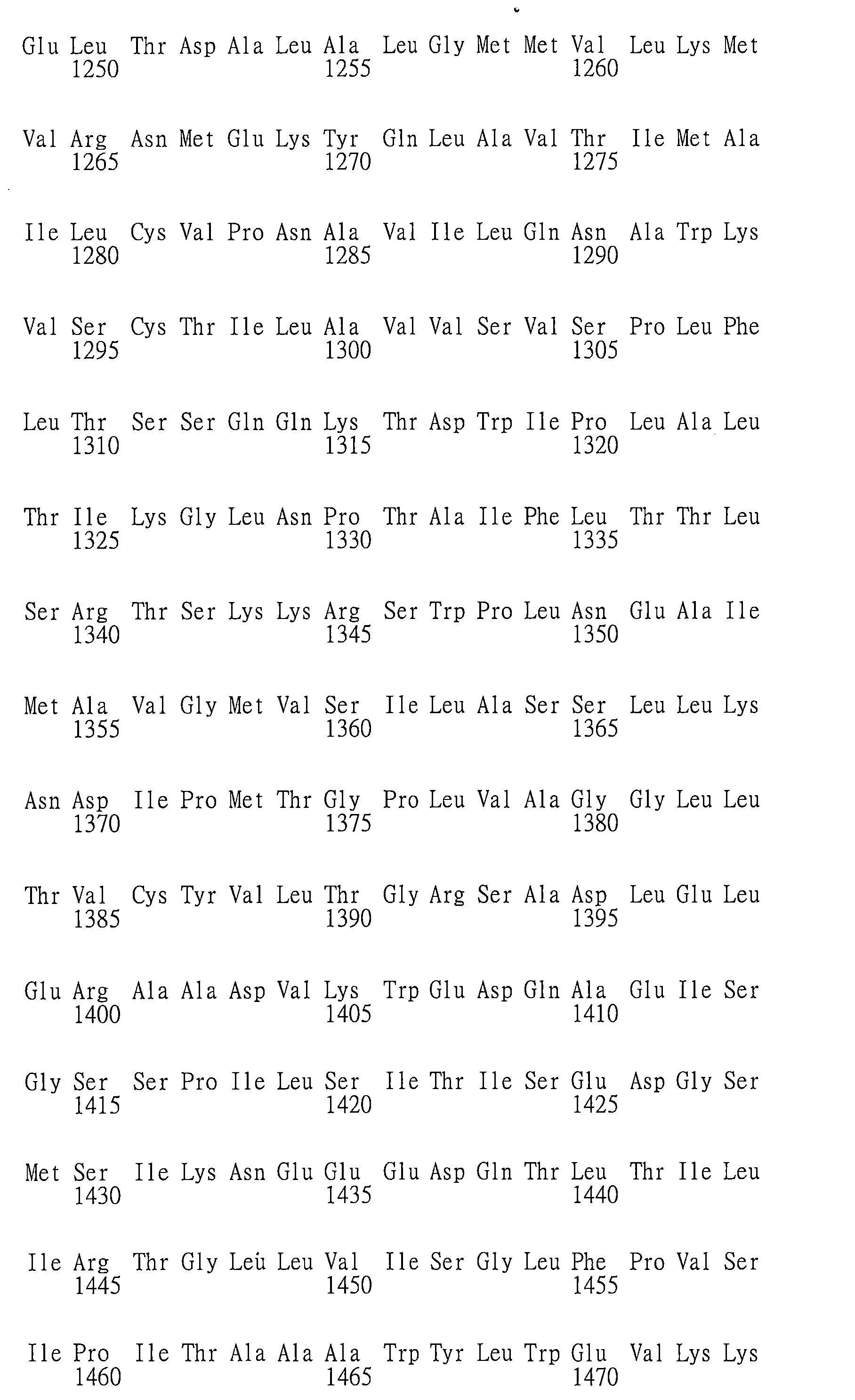


<210> 3 <210> 3
<211> 3391 <211> 3391
<212> PRT <212> PRT
<213> 人造序列 <213> Artificial sequence
<220> <220>
<223> 登革熱病毒血清型1,MVS <223> Dengue virus serotype 1, MVS
<400> 3 


<210> 4 <210> 4
<211> 10723 <211> 10723
<212> DNA <212> DNA
<213> 人造序列 <213> Artificial sequence
<220> <220>
<223> 登革熱病毒血清型2,BVS <223> Dengue virus serotype 2, BVS
<400> 4 


<210> 5 <210> 5
<211> 3391 <211> 3391
<212> PRT <212> PRT
<213> 人造序列 <213> Artificial sequence
<220> <220>
<223> 登革熱病毒血清型2,BVS <223> Dengue virus serotype 2, BVS
<400> 5 


<210> 6 <210> 6
<211> 3391 <211> 3391
<212> PRT <212> PRT
<213> 人造序列 <213> Artificial sequence
<220> <220>
<223> 登革熱病毒血清型2,MVS <223> Dengue virus serotype 2, MVS
<400> 6 


<210> 7 <210> 7
<211> 10717 <211> 10717
<212> DNA <212> DNA
<213> 人造序列 <213> Artificial sequence
<220> <220>
<223> 登革熱病毒血清型3,BVS <223> Dengue virus serotype 3, BVS
<400> 7 

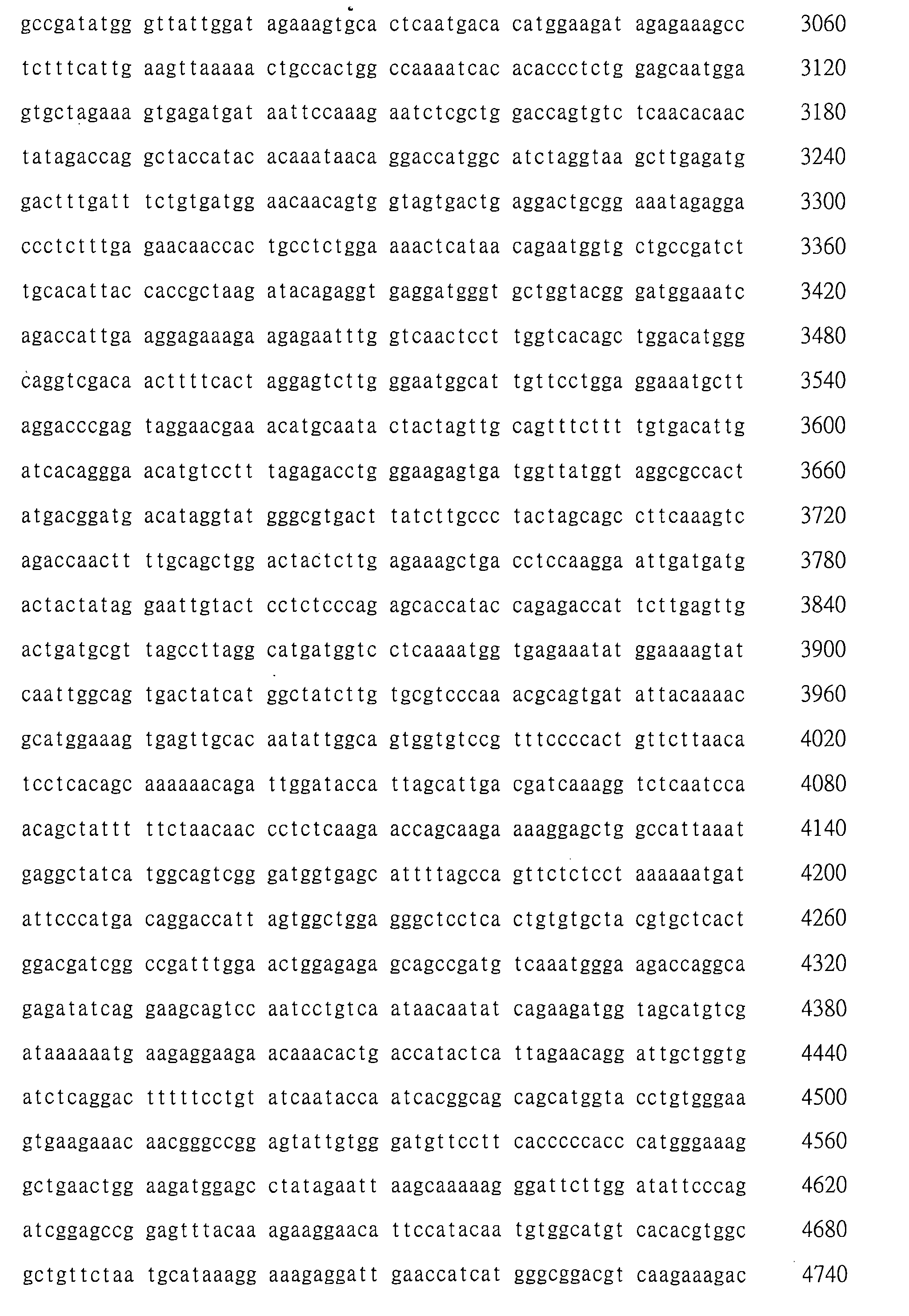


<210> 8 <210> 8
<211> 3389 <211> 3389
<212> PRT <212> PRT
<213> 人造序列 <213> Artificial sequence
<220> <220>
<223> 登革熱病毒血清型3,BVS <223> Dengue virus serotype 3, BVS
<400> 8 


<210> 9 <210> 9
<211> 3389 <211> 3389
<212> PRT <212> PRT
<213> 人造序列 <213> Artificial sequence
<220> <220>
<223> 登革熱病毒血清型3,MVS <223> Dengue virus serotype 3, MVS
<400> 9 


<210> 10 <210> 10
<211> 10723 <211> 10723
<212> DNA <212> DNA
<213> 人造序列 <213> Artificial sequence
<220> <220>
<223> 登革熱病毒血清型4,BVS <223> Dengue virus serotype 4, BVS
<400> 10 


<210> 11 <210> 11
<211> 3391 <211> 3391
<212> PRT <212> PRT
<213> 人造序列 <213> Artificial sequence
<220> <220>
<223> 登革熱病毒血清型4,BVS <223> Dengue virus serotype 4, BVS
<400> 11 


<210> 12 <210> 12
<211> 3391 <211> 3391
<212> PRT <212> PRT
<213> 人造序列 <213> Artificial sequence
<220> <220>
<223> 登革熱病毒血清型4,MVS <223> Dengue virus serotype 4, MVS
<400> 12 


<210> 13 <210> 13
<211> 10723 <211> 10723
<212> DNA <212> DNA
<213> 嵌合式登革熱血清型2/1(MVS) <213> Chimeric Dengue Serotype 2/1 (MVS)
<400> 13 


<210> 14 <210> 14
<211> 10723 <211> 10723
<212> DNA <212> DNA
<213> 登革熱血清型2(MVS) <213> Dengue Serotype 2 (MVS)
<400> 14 


<210> 15 <210> 15
<211> 10717 <211> 10717
<212> DNA <212> DNA
<213> 嵌合式登革熱血清型2/3(MVS) <213> Chimeric Dengue Serotype 2/3 (MVS)
<400> 15 


<210> 16 <210> 16
<211> 10723 <211> 10723
<212> DNA <212> DNA
<213> 嵌合式登革熱血清型2/4(MVS) <213> Chimeric Dengue Serotype 2/4 (MVS)
<220> <220>
<221> r <221> r
<222> (3773)..(3773) <222> (3773) .. (3773)
<223> a或g <223> a or g
<220> <220>
<221> y <221> y
<222> (7026)..(7026) <222> (7026) .. (7026)
<223> t或c <223> t or c
<400> 16 


Claims (49)
Applications Claiming Priority (2)
| Application Number | Priority Date | Filing Date | Title |
|---|---|---|---|
| US201361800204P | 2013-03-15 | 2013-03-15 | |
| US61/800,204 | 2013-03-15 |
Publications (2)
| Publication Number | Publication Date |
|---|---|
| TW201945545A true TW201945545A (en) | 2019-12-01 |
| TWI726312B TWI726312B (en) | 2021-05-01 |
Family
ID=50678274
Family Applications (4)
| Application Number | Title | Priority Date | Filing Date |
|---|---|---|---|
| TW110111747A TWI894248B (en) | 2013-03-15 | 2014-03-14 | Compositions and methods for dengue virus chimeric constructs in vaccines |
| TW114128176A TW202545972A (en) | 2013-03-15 | 2014-03-14 | Compositions and methods for dengue virus chimeric constructs in vaccines |
| TW108114540A TWI726312B (en) | 2013-03-15 | 2014-03-14 | Compositions and methods for dengue virus chimeric constructs in vaccines |
| TW103109624A TWI733646B (en) | 2013-03-15 | 2014-03-14 | Compositions and methods for dengue virus chimeric constructs in vaccines |
Family Applications Before (2)
| Application Number | Title | Priority Date | Filing Date |
|---|---|---|---|
| TW110111747A TWI894248B (en) | 2013-03-15 | 2014-03-14 | Compositions and methods for dengue virus chimeric constructs in vaccines |
| TW114128176A TW202545972A (en) | 2013-03-15 | 2014-03-14 | Compositions and methods for dengue virus chimeric constructs in vaccines |
Family Applications After (1)
| Application Number | Title | Priority Date | Filing Date |
|---|---|---|---|
| TW103109624A TWI733646B (en) | 2013-03-15 | 2014-03-14 | Compositions and methods for dengue virus chimeric constructs in vaccines |
Country Status (33)
| Country | Link |
|---|---|
| US (6) | US9783579B2 (en) |
| EP (5) | EP3689374B1 (en) |
| JP (2) | JP6818548B2 (en) |
| KR (4) | KR102626270B1 (en) |
| CN (5) | CN105451763B (en) |
| AR (4) | AR095598A1 (en) |
| AU (2) | AU2014235476B2 (en) |
| CA (4) | CA3177572C (en) |
| CR (1) | CR20150569A (en) |
| DK (1) | DK4129330T5 (en) |
| DO (1) | DOP2015000232A (en) |
| EC (1) | ECSP23013715A (en) |
| ES (2) | ES2965652T3 (en) |
| FI (2) | FI3539565T3 (en) |
| FR (1) | FR22C1064I2 (en) |
| HR (1) | HRP20231581T1 (en) |
| HU (2) | HUE061507T2 (en) |
| LT (2) | LT4129330T (en) |
| LU (1) | LUC00329I2 (en) |
| MX (5) | MX374519B (en) |
| MY (1) | MY187796A (en) |
| NL (1) | NL301223I2 (en) |
| NO (1) | NO2023026I1 (en) |
| NZ (1) | NZ630869A (en) |
| PE (2) | PE20160027A1 (en) |
| PH (1) | PH12015502120B1 (en) |
| PL (1) | PL3539565T3 (en) |
| PT (1) | PT3539565T (en) |
| SG (3) | SG10201913387XA (en) |
| SI (1) | SI4129330T1 (en) |
| TW (4) | TWI894248B (en) |
| UY (1) | UY35489A (en) |
| WO (1) | WO2014150939A2 (en) |
Families Citing this family (19)
| Publication number | Priority date | Publication date | Assignee | Title |
|---|---|---|---|---|
| CA3177572C (en) | 2013-03-15 | 2026-02-03 | The Government Of The United States Of America As Represented By The Secretary Of The Department Of Health And Human Services | Compositions and methods for dengue virus chimeric constructs in vaccines |
| US10004795B2 (en) * | 2015-09-08 | 2018-06-26 | Fundacao Butantan | Process for preparing an attenuated tetravalent dengue vaccine |
| NZ782252A (en) * | 2015-11-27 | 2025-12-19 | Km Biologics Co Ltd | Live virus having a bank of dengue virus attenuated strains, and a dengue vaccine containing same as antigens |
| EP3442571A1 (en) | 2016-04-13 | 2019-02-20 | Takeda Vaccines, Inc. | Compositions and methods of vaccination against dengue virus in children and young adults |
| US11426461B2 (en) | 2018-09-05 | 2022-08-30 | Takeda Vaccines, Inc. | Methods for preventing dengue and hepatitis A |
| US11464815B2 (en) | 2018-09-05 | 2022-10-11 | Takeda Vaccines, Inc. | Dengue vaccine unit dose and administration thereof |
| CN112912106A (en) | 2018-09-05 | 2021-06-04 | 武田疫苗股份有限公司 | Dengue vaccine unit dose and administration thereof |
| EP4110381A1 (en) | 2020-02-27 | 2023-01-04 | Takeda Vaccines, Inc. | Method for removing host cell dna from virus preparation |
| WO2021173597A1 (en) * | 2020-02-28 | 2021-09-02 | Merck Sharp & Dohme Corp. | Dengue serotype specific rt-pcr multiplex assay |
| EP3892737A1 (en) * | 2020-04-09 | 2021-10-13 | Takeda Vaccines, Inc. | Qualitative and quantitative determination of single virus haplotypes in complex samples |
| WO2023147342A2 (en) | 2022-01-25 | 2023-08-03 | Takeda Vaccines, Inc. | Large-scale flaviviral vaccine production and manufacture |
| WO2023158989A1 (en) | 2022-02-15 | 2023-08-24 | Takeda Vaccines, Inc. | Dengue vaccine batch mixing process |
| EP4519847A1 (en) | 2022-05-04 | 2025-03-12 | Takeda Vaccines, Inc. | Computer-based determination of flavivirus infectivity |
| CN116479167A (en) * | 2022-08-30 | 2023-07-25 | 深圳大学 | PCR detection method of dengue virus |
| EP4357464A1 (en) * | 2022-10-20 | 2024-04-24 | Takeda Vaccines, Inc. | A method for detecting the presence of a dengue virus serotype in a sample containing at least one dengue virus serotype |
| CN120225693A (en) | 2022-11-18 | 2025-06-27 | 武田疫苗股份有限公司 | Method for determining the proportion of live attenuated flaviviruses having a nucleotide sequence comprising at least one attenuated locus in a preparation |
| CN120529951A (en) | 2022-11-29 | 2025-08-22 | 武田疫苗股份有限公司 | Large-Scale Flavivirus Vaccine Production and Manufacturing |
| WO2025122855A1 (en) | 2023-12-08 | 2025-06-12 | Takeda Vaccines, Inc. | A method for determining the concentration of residual vero cell genomic dna in a sample containing virus obtained from production in vero cells |
| CN119824145A (en) * | 2025-03-03 | 2025-04-15 | 广州市疾病预防控制中心(广州市卫生检验中心、广州市食品安全风险监测与评估中心、广州医科大学公共卫生研究院) | PCR primer and PCR kit for amplifying reverse transcription product of dengue virus and method for detecting dengue virus |
Family Cites Families (53)
| Publication number | Priority date | Publication date | Assignee | Title |
|---|---|---|---|---|
| JPS5276941A (en) | 1975-12-23 | 1977-06-28 | Ito Masato | Method of conversing infrared rays |
| US4810092A (en) | 1986-02-21 | 1989-03-07 | Midac Corporation | Economical spectrometer unit having simplified structure |
| JPH0768267B2 (en) | 1986-06-05 | 1995-07-26 | 財団法人阪大微生物病研究会 | Flavivirus antigen |
| JPH084508B2 (en) | 1987-09-16 | 1996-01-24 | 国立予防衛生研究所長 | Recombinant vaccinia virus |
| JP2511494B2 (en) | 1988-05-12 | 1996-06-26 | 善治 松浦 | Method for producing Japanese encephalitis virus surface antigen protein |
| US6184024B1 (en) | 1988-07-14 | 2001-02-06 | The United States Of America As Represented By The Department Of Health And Human Services | Chimeric and/or growth-restricted flaviviruses |
| IL91304A0 (en) | 1988-08-20 | 1990-03-19 | Us Health | Recombinant vaccinia virus for prevention of disease caused by flavivirus |
| MY109299A (en) | 1990-08-15 | 1996-12-31 | Virogenetics Corp | Recombinant pox virus encoding flaviviral structural proteins |
| US5514375A (en) | 1990-08-15 | 1996-05-07 | Virogenetics Corporation | Flavivirus recombinant poxvirus vaccine |
| US5494671A (en) | 1990-08-27 | 1996-02-27 | The United States Of America As Represented By The Department Of Health And Human Services | C-terminally truncated dengue and Japanese encephalitis virus envelope proteins |
| DE69230316T2 (en) | 1991-09-19 | 2000-07-13 | Us Health | CHIMERIC AND / OR GROWTH-INHIBITED FLAVIVIRES |
| JPH05276941A (en) | 1992-02-28 | 1993-10-26 | Nippon Zeon Co Ltd | Production of noninfectious structure particle containing surface antigen protein of virus belonging to family flavivirus |
| ATE227584T1 (en) | 1995-05-24 | 2002-11-15 | Hawaii Biotech Group | SUBUNITY VACCINE AGAINST FLAVIVIRUS INFECTION |
| AU6093296A (en) * | 1995-06-07 | 1996-12-30 | Government Of The United States Of America, As Represented By The Secretary Of The Department Of Health And Human Services, The | Infectious dengue 2 virus pdk-53 as quadravalent vaccine |
| CA2282790C (en) | 1997-02-28 | 2011-04-19 | St. Louis University | Chimeric flavivirus vaccines |
| ATE314476T1 (en) | 1997-10-08 | 2006-01-15 | Us Gov Health & Human Serv | CHIMERIC VACCINE AGAINST TICK ENCEPHALITIS VIRUS |
| DE29810020U1 (en) | 1998-06-04 | 1998-09-24 | Siemens AG, 80333 München | Plastic container for low-temperature storage of biological materials |
| US7417136B1 (en) | 1998-06-04 | 2008-08-26 | The United States Of America As Represented By The Secretary, Department Of Health And Human Services, Centers For Disease Control And Prevention | Nucleic acid vaccines for prevention of flavivirus infection |
| AU1813901A (en) * | 1999-12-01 | 2001-06-12 | Oravax, Inc | Chimeric flavivirus vaccines |
| CA2941182A1 (en) * | 2000-02-16 | 2001-08-23 | The Government Of The United States Of America As Represented By The Secretary, Department Of Health And Human Services | Avirulent, immunogenic flavivirus chimeras |
| PT1159968E (en) * | 2000-05-30 | 2008-11-20 | Univ Mahidol | Attenuated strains of dengue virus and their use in a vaccine composition |
| CA2440593A1 (en) | 2001-03-12 | 2002-09-19 | Yale University | Compositions and methods comprising west nile virus polypeptides |
| WO2006134433A1 (en) * | 2005-06-17 | 2006-12-21 | Sanofi Pasteur | Dengue serotype 1 attenuated strain |
| BRPI0613287A2 (en) * | 2005-06-17 | 2010-12-28 | Sanofi Pasteur | live attenuated dengue-2 virus strain, immunogenic composition, vaccine composition, isolated nucleic acid, isolated polyprotein encoded by sequence id. 1 or fragments thereof and polyprotein fragment |
| KR20070017759A (en) | 2005-08-08 | 2007-02-13 | 삼성전자주식회사 | Super-resolution information storage medium, recording / reproducing apparatus and recording / reproducing method |
| EP1924280A4 (en) * | 2005-08-10 | 2008-12-10 | Acambis Inc | Vaccination against dengue virus infection |
| US7968102B2 (en) * | 2006-01-13 | 2011-06-28 | Sanofi Pasteur S.A. | Dengue chimeric viruses |
| DK2589602T3 (en) * | 2006-08-15 | 2016-07-25 | The Government Of The U S A As Repr By The Secretary Dept Of Health & Human Services The Nat Inst Of | Development of dengue virus vaccine components |
| US8541377B2 (en) | 2007-07-13 | 2013-09-24 | Florida Gulf Coast University | Optimized dengue virus entry inhibitory peptide (DN81) |
| WO2009134717A1 (en) * | 2008-04-30 | 2009-11-05 | The Government Of The United States Of America As Represented By The Secretary Of The Department Of Health And Human Services, Centers For Disease Control And Prevention | Chimeric west nile/dengue viruses |
| SG157244A1 (en) | 2008-05-15 | 2009-12-29 | Mp Biomedicals Asia Pacific Pte Ltd | Point of care test for the detection of exposure or immunity to dengue virus |
| WO2010085358A2 (en) * | 2009-01-23 | 2010-07-29 | The Board Of Regents Of The University Of Texas System | Flaviviruses expressing the prm, e, and ns1 proteins of other flaviviruses and uses thereof |
| US9211323B2 (en) | 2009-06-01 | 2015-12-15 | Takeda Vaccines, Inc. | Compositions and methods for administration of vaccines against dengue virus |
| US8968996B2 (en) | 2009-06-01 | 2015-03-03 | Takeda Vaccines, Inc. | Compositions and methods for rapid immunization against dengue virus |
| CN101560520A (en) * | 2009-06-04 | 2009-10-21 | 中国疾病预防控制中心病毒病预防控制所 | Japanese encephalitis/dengue chimeric virus and application thereof |
| BRPI0904020B8 (en) * | 2009-10-01 | 2021-05-25 | Fundacao Oswaldo Cruz | vaccine composition against the dengue virus, and kit |
| EP2353609A1 (en) | 2010-02-04 | 2011-08-10 | Sanofi Pasteur | Immunization compositions and methods |
| EP2858668A1 (en) | 2012-06-10 | 2015-04-15 | Takeda Vaccines, Inc. | Compositions and methods for administration of vaccines against dengue virus |
| CA2878599A1 (en) | 2012-07-24 | 2014-01-30 | Jiansheng Yao | Vaccine compositions for prevention against dengue virus infection |
| MY168959A (en) | 2012-07-24 | 2019-01-28 | Sanofi Pasteur | Vaccine compositions for the prevention of dengue virus infection |
| TW201920677A (en) | 2012-11-08 | 2019-06-01 | 美商武田疫苗股份有限公司 | Compositions, methods and uses for dengue virus serotype-4 constructs |
| JP2016504315A (en) * | 2012-12-14 | 2016-02-12 | タケダ ワクチン, インコーポレイテッドTakeda Vaccines, Inc. | Compositions, methods of administration and uses for trivalent dengue virus formulations |
| CA3177572C (en) | 2013-03-15 | 2026-02-03 | The Government Of The United States Of America As Represented By The Secretary Of The Department Of Health And Human Services | Compositions and methods for dengue virus chimeric constructs in vaccines |
| TWI852899B (en) | 2014-09-02 | 2024-08-21 | 法商賽諾菲巴斯德公司 | Vaccine compositions |
| WO2017005654A1 (en) | 2015-07-03 | 2017-01-12 | Sanofi Pasteur | Concomitant dengue, diphtheria, tetanus, whooping cough (pertussis), polio, and haemophilus influenzae type b vaccination. |
| US10857222B2 (en) | 2015-07-03 | 2020-12-08 | Sanofi Pasteur | Concomitant dengue and yellow fever vaccination |
| US10004795B2 (en) | 2015-09-08 | 2018-06-26 | Fundacao Butantan | Process for preparing an attenuated tetravalent dengue vaccine |
| EP3442571A1 (en) * | 2016-04-13 | 2019-02-20 | Takeda Vaccines, Inc. | Compositions and methods of vaccination against dengue virus in children and young adults |
| SG10201607778XA (en) | 2016-09-16 | 2018-04-27 | Chugai Pharmaceutical Co Ltd | Anti-Dengue Virus Antibodies, Polypeptides Containing Variant Fc Regions, And Methods Of Use |
| CA3079151A1 (en) | 2017-10-16 | 2019-04-25 | Serum Institute Of India Private Limited | Stable vaccine compositions comprising inter alia live attenuated recombinant flavivirus and process for preparation thereof |
| CN112912106A (en) | 2018-09-05 | 2021-06-04 | 武田疫苗股份有限公司 | Dengue vaccine unit dose and administration thereof |
| US11464815B2 (en) | 2018-09-05 | 2022-10-11 | Takeda Vaccines, Inc. | Dengue vaccine unit dose and administration thereof |
| EP3892737A1 (en) | 2020-04-09 | 2021-10-13 | Takeda Vaccines, Inc. | Qualitative and quantitative determination of single virus haplotypes in complex samples |
-
2014
- 2014-03-12 CA CA3177572A patent/CA3177572C/en active Active
- 2014-03-12 EP EP20154012.7A patent/EP3689374B1/en active Active
- 2014-03-12 PH PH1/2015/502120A patent/PH12015502120B1/en unknown
- 2014-03-12 PE PE2015001953A patent/PE20160027A1/en unknown
- 2014-03-12 CA CA3166063A patent/CA3166063A1/en active Pending
- 2014-03-12 SI SI201432055T patent/SI4129330T1/en unknown
- 2014-03-12 CN CN201480028001.5A patent/CN105451763B/en active Active
- 2014-03-12 NZ NZ630869A patent/NZ630869A/en unknown
- 2014-03-12 PT PT191684752T patent/PT3539565T/en unknown
- 2014-03-12 PE PE2021000217A patent/PE20211814A1/en unknown
- 2014-03-12 EP EP22182269.5A patent/EP4129330B1/en active Active
- 2014-03-12 CN CN202110718703.8A patent/CN113637694B/en active Active
- 2014-03-12 AU AU2014235476A patent/AU2014235476B2/en active Active
- 2014-03-12 DK DK22182269.5T patent/DK4129330T5/en active
- 2014-03-12 HU HUE19168475A patent/HUE061507T2/en unknown
- 2014-03-12 ES ES22182269T patent/ES2965652T3/en active Active
- 2014-03-12 PL PL19168475.2T patent/PL3539565T3/en unknown
- 2014-03-12 CN CN202010617988.1A patent/CN111778263B/en active Active
- 2014-03-12 KR KR1020227013084A patent/KR102626270B1/en active Active
- 2014-03-12 WO PCT/US2014/024603 patent/WO2014150939A2/en not_active Ceased
- 2014-03-12 FI FIEP19168475.2T patent/FI3539565T3/en active
- 2014-03-12 KR KR1020257006481A patent/KR20250033325A/en active Pending
- 2014-03-12 ES ES20154012T patent/ES2933970T3/en active Active
- 2014-03-12 CA CA2903231A patent/CA2903231C/en active Active
- 2014-03-12 HR HRP20231581TT patent/HRP20231581T1/en unknown
- 2014-03-12 EP EP22204593.2A patent/EP4183411A1/en active Pending
- 2014-03-12 EP EP19168475.2A patent/EP3539565B1/en active Active
- 2014-03-12 JP JP2016501585A patent/JP6818548B2/en active Active
- 2014-03-12 KR KR1020247001384A patent/KR102775714B1/en active Active
- 2014-03-12 EP EP14722014.9A patent/EP2968516B1/en active Active
- 2014-03-12 SG SG10201913387XA patent/SG10201913387XA/en unknown
- 2014-03-12 MX MX2015012893A patent/MX374519B/en active IP Right Grant
- 2014-03-12 SG SG11201507460PA patent/SG11201507460PA/en unknown
- 2014-03-12 LT LTEP22182269.5T patent/LT4129330T/en unknown
- 2014-03-12 CN CN202110723336.0A patent/CN113637086B/en active Active
- 2014-03-12 KR KR1020157029897A patent/KR102389908B1/en active Active
- 2014-03-12 SG SG10201913435TA patent/SG10201913435TA/en unknown
- 2014-03-12 CN CN202110718694.2A patent/CN113637693B/en active Active
- 2014-03-12 CA CA3177574A patent/CA3177574C/en active Active
- 2014-03-12 MY MYPI2015002317A patent/MY187796A/en unknown
- 2014-03-13 US US14/209,808 patent/US9783579B2/en active Active
- 2014-03-14 TW TW110111747A patent/TWI894248B/en active
- 2014-03-14 TW TW114128176A patent/TW202545972A/en unknown
- 2014-03-14 TW TW108114540A patent/TWI726312B/en active
- 2014-03-14 TW TW103109624A patent/TWI733646B/en active
- 2014-03-17 UY UY35489A patent/UY35489A/en active IP Right Grant
- 2014-03-17 AR ARP140101223A patent/AR095598A1/en active IP Right Grant
-
2015
- 2015-09-11 DO DO2015000232A patent/DOP2015000232A/en unknown
- 2015-09-14 MX MX2023000353A patent/MX2023000353A/en unknown
- 2015-09-14 MX MX2023000354A patent/MX2023000354A/en unknown
- 2015-09-14 MX MX2019003602A patent/MX2019003602A/en unknown
- 2015-09-14 MX MX2023000349A patent/MX2023000349A/en unknown
- 2015-10-15 CR CR20150569A patent/CR20150569A/en unknown
-
2017
- 2017-04-20 US US15/492,981 patent/US10449231B2/en active Active
-
2019
- 2019-06-05 JP JP2019105307A patent/JP7050031B2/en active Active
- 2019-08-16 AU AU2019216724A patent/AU2019216724C1/en active Active
- 2019-09-05 US US16/561,755 patent/US20200061151A1/en not_active Abandoned
-
2021
- 2021-09-17 US US17/478,537 patent/US12186363B2/en active Active
- 2021-10-06 AR ARP210102772A patent/AR123702A2/en unknown
-
2022
- 2022-12-12 US US18/064,775 patent/US11931399B2/en active Active
- 2022-12-16 FR FR22C1064C patent/FR22C1064I2/en active Active
-
2023
- 2023-02-24 EC ECSENADI202313715A patent/ECSP23013715A/en unknown
- 2023-03-08 NL NL301223C patent/NL301223I2/en unknown
- 2023-06-20 HU HUS2300022C patent/HUS2300022I1/en unknown
- 2023-06-27 FI FIC20230021C patent/FIC20230021I1/en unknown
- 2023-07-04 NO NO2023026C patent/NO2023026I1/en unknown
-
2024
- 2024-02-27 LU LU00329C patent/LUC00329I2/fr unknown
- 2024-02-28 AR ARP240100498A patent/AR132009A2/en unknown
- 2024-03-05 LT LTPA2024503C patent/LTPA2024503I1/lt unknown
- 2024-07-10 US US18/768,774 patent/US20250018006A1/en active Pending
- 2024-07-16 AR ARP240101841A patent/AR133264A2/en unknown
Also Published As
Similar Documents
| Publication | Publication Date | Title |
|---|---|---|
| US11931399B2 (en) | Compositions and methods for dengue virus chimeric constructions in vaccines | |
| HK40089224A (en) | Compositions and methods for dengue virus chimeric constructs in vaccines | |
| HK40087962B (en) | Compositions and methods for dengue virus chimeric constructs in vaccines | |
| HK40087962A (en) | Compositions and methods for dengue virus chimeric constructs in vaccines | |
| HK40035237B (en) | Compositions and methods for dengue virus chimeric constructs in vaccines | |
| HK40014417A (en) | Compositions and methods for dengue virus chimeric constructs in vaccines | |
| HK40035237A (en) | Compositions and methods for dengue virus chimeric constructs in vaccines | |
| HK40014417B (en) | Compositions and methods for dengue virus chimeric constructs in vaccines | |
| HK1220359B (en) | Compositions and methods for dengue virus chimeric constructs in vaccines |