TW202000229A - Sequencing method for CAR T cell therapy - Google Patents
Sequencing method for CAR T cell therapy Download PDFInfo
- Publication number
- TW202000229A TW202000229A TW108106131A TW108106131A TW202000229A TW 202000229 A TW202000229 A TW 202000229A TW 108106131 A TW108106131 A TW 108106131A TW 108106131 A TW108106131 A TW 108106131A TW 202000229 A TW202000229 A TW 202000229A
- Authority
- TW
- Taiwan
- Prior art keywords
- dose
- compound
- pharmaceutically acceptable
- patient
- car
- Prior art date
Links
- 0 Cc(c([U]C)n1)c(*I)nc1I* Chemical compound Cc(c([U]C)n1)c(*I)nc1I* 0.000 description 2
Images


Classifications
-
- C—CHEMISTRY; METALLURGY
- C07—ORGANIC CHEMISTRY
- C07K—PEPTIDES
- C07K14/00—Peptides having more than 20 amino acids; Gastrins; Somatostatins; Melanotropins; Derivatives thereof
- C07K14/435—Peptides having more than 20 amino acids; Gastrins; Somatostatins; Melanotropins; Derivatives thereof from animals; from humans
- C07K14/705—Receptors; Cell surface antigens; Cell surface determinants
-
- C—CHEMISTRY; METALLURGY
- C07—ORGANIC CHEMISTRY
- C07K—PEPTIDES
- C07K16/00—Immunoglobulins [IG], e.g. monoclonal or polyclonal antibodies
- C07K16/44—Immunoglobulins [IG], e.g. monoclonal or polyclonal antibodies against material not provided for elsewhere, e.g. haptens, metals, DNA, RNA, amino acids
-
- A—HUMAN NECESSITIES
- A61—MEDICAL OR VETERINARY SCIENCE; HYGIENE
- A61K—PREPARATIONS FOR MEDICAL, DENTAL OR TOILETRY PURPOSES
- A61K40/00—Cellular immunotherapy
- A61K40/10—Cellular immunotherapy characterised by the cell type used
- A61K40/11—T-cells, e.g. tumour infiltrating lymphocytes [TIL] or regulatory T [Treg] cells; Lymphokine-activated killer [LAK] cells
-
- A—HUMAN NECESSITIES
- A61—MEDICAL OR VETERINARY SCIENCE; HYGIENE
- A61K—PREPARATIONS FOR MEDICAL, DENTAL OR TOILETRY PURPOSES
- A61K40/00—Cellular immunotherapy
- A61K40/30—Cellular immunotherapy characterised by the recombinant expression of specific molecules in the cells of the immune system
- A61K40/31—Chimeric antigen receptors [CAR]
-
- A—HUMAN NECESSITIES
- A61—MEDICAL OR VETERINARY SCIENCE; HYGIENE
- A61K—PREPARATIONS FOR MEDICAL, DENTAL OR TOILETRY PURPOSES
- A61K40/00—Cellular immunotherapy
- A61K40/40—Cellular immunotherapy characterised by antigens that are targeted or presented by cells of the immune system
- A61K40/41—Vertebrate antigens
- A61K40/42—Cancer antigens
- A61K40/4202—Receptors, cell surface antigens or cell surface determinants
- A61K40/4203—Receptors for growth factors
- A61K40/4204—Epidermal growth factor receptors [EGFR]
-
- A—HUMAN NECESSITIES
- A61—MEDICAL OR VETERINARY SCIENCE; HYGIENE
- A61K—PREPARATIONS FOR MEDICAL, DENTAL OR TOILETRY PURPOSES
- A61K40/00—Cellular immunotherapy
- A61K40/40—Cellular immunotherapy characterised by antigens that are targeted or presented by cells of the immune system
- A61K40/429—Small organic molecules e.g. cocaine or nicotine
-
- A—HUMAN NECESSITIES
- A61—MEDICAL OR VETERINARY SCIENCE; HYGIENE
- A61K—PREPARATIONS FOR MEDICAL, DENTAL OR TOILETRY PURPOSES
- A61K47/00—Medicinal preparations characterised by the non-active ingredients used, e.g. carriers or inert additives; Targeting or modifying agents chemically bound to the active ingredient
- A61K47/50—Medicinal preparations characterised by the non-active ingredients used, e.g. carriers or inert additives; Targeting or modifying agents chemically bound to the active ingredient the non-active ingredient being chemically bound to the active ingredient, e.g. polymer-drug conjugates
- A61K47/51—Medicinal preparations characterised by the non-active ingredients used, e.g. carriers or inert additives; Targeting or modifying agents chemically bound to the active ingredient the non-active ingredient being chemically bound to the active ingredient, e.g. polymer-drug conjugates the non-active ingredient being a modifying agent
- A61K47/54—Medicinal preparations characterised by the non-active ingredients used, e.g. carriers or inert additives; Targeting or modifying agents chemically bound to the active ingredient the non-active ingredient being chemically bound to the active ingredient, e.g. polymer-drug conjugates the non-active ingredient being a modifying agent the modifying agent being an organic compound
- A61K47/55—Medicinal preparations characterised by the non-active ingredients used, e.g. carriers or inert additives; Targeting or modifying agents chemically bound to the active ingredient the non-active ingredient being chemically bound to the active ingredient, e.g. polymer-drug conjugates the non-active ingredient being a modifying agent the modifying agent being an organic compound the modifying agent being also a pharmacologically or therapeutically active agent, i.e. the entire conjugate being a codrug
- A61K47/551—Medicinal preparations characterised by the non-active ingredients used, e.g. carriers or inert additives; Targeting or modifying agents chemically bound to the active ingredient the non-active ingredient being chemically bound to the active ingredient, e.g. polymer-drug conjugates the non-active ingredient being a modifying agent the modifying agent being an organic compound the modifying agent being also a pharmacologically or therapeutically active agent, i.e. the entire conjugate being a codrug one of the codrug's components being a vitamin, e.g. niacinamide, vitamin B3, cobalamin, vitamin B12, folate, vitamin A or retinoic acid
-
- A—HUMAN NECESSITIES
- A61—MEDICAL OR VETERINARY SCIENCE; HYGIENE
- A61P—SPECIFIC THERAPEUTIC ACTIVITY OF CHEMICAL COMPOUNDS OR MEDICINAL PREPARATIONS
- A61P35/00—Antineoplastic agents
-
- C—CHEMISTRY; METALLURGY
- C07—ORGANIC CHEMISTRY
- C07K—PEPTIDES
- C07K14/00—Peptides having more than 20 amino acids; Gastrins; Somatostatins; Melanotropins; Derivatives thereof
- C07K14/435—Peptides having more than 20 amino acids; Gastrins; Somatostatins; Melanotropins; Derivatives thereof from animals; from humans
- C07K14/705—Receptors; Cell surface antigens; Cell surface determinants
- C07K14/70503—Immunoglobulin superfamily
- C07K14/7051—T-cell receptor (TcR)-CD3 complex
-
- A—HUMAN NECESSITIES
- A61—MEDICAL OR VETERINARY SCIENCE; HYGIENE
- A61K—PREPARATIONS FOR MEDICAL, DENTAL OR TOILETRY PURPOSES
- A61K39/00—Medicinal preparations containing antigens or antibodies
- A61K2039/545—Medicinal preparations containing antigens or antibodies characterised by the dose, timing or administration schedule
-
- A—HUMAN NECESSITIES
- A61—MEDICAL OR VETERINARY SCIENCE; HYGIENE
- A61K—PREPARATIONS FOR MEDICAL, DENTAL OR TOILETRY PURPOSES
- A61K2239/00—Indexing codes associated with cellular immunotherapy of group A61K40/00
- A61K2239/38—Indexing codes associated with cellular immunotherapy of group A61K40/00 characterised by the dose, timing or administration schedule
-
- C—CHEMISTRY; METALLURGY
- C07—ORGANIC CHEMISTRY
- C07K—PEPTIDES
- C07K2317/00—Immunoglobulins specific features
- C07K2317/20—Immunoglobulins specific features characterized by taxonomic origin
- C07K2317/21—Immunoglobulins specific features characterized by taxonomic origin from primates, e.g. man
-
- C—CHEMISTRY; METALLURGY
- C07—ORGANIC CHEMISTRY
- C07K—PEPTIDES
- C07K2317/00—Immunoglobulins specific features
- C07K2317/40—Immunoglobulins specific features characterized by post-translational modification
- C07K2317/41—Glycosylation, sialylation, or fucosylation
-
- C—CHEMISTRY; METALLURGY
- C07—ORGANIC CHEMISTRY
- C07K—PEPTIDES
- C07K2317/00—Immunoglobulins specific features
- C07K2317/50—Immunoglobulins specific features characterized by immunoglobulin fragments
- C07K2317/52—Constant or Fc region; Isotype
-
- C—CHEMISTRY; METALLURGY
- C07—ORGANIC CHEMISTRY
- C07K—PEPTIDES
- C07K2317/00—Immunoglobulins specific features
- C07K2317/50—Immunoglobulins specific features characterized by immunoglobulin fragments
- C07K2317/52—Constant or Fc region; Isotype
- C07K2317/524—CH2 domain
-
- C—CHEMISTRY; METALLURGY
- C07—ORGANIC CHEMISTRY
- C07K—PEPTIDES
- C07K2317/00—Immunoglobulins specific features
- C07K2317/50—Immunoglobulins specific features characterized by immunoglobulin fragments
- C07K2317/52—Constant or Fc region; Isotype
- C07K2317/53—Hinge
-
- C—CHEMISTRY; METALLURGY
- C07—ORGANIC CHEMISTRY
- C07K—PEPTIDES
- C07K2317/00—Immunoglobulins specific features
- C07K2317/60—Immunoglobulins specific features characterized by non-natural combinations of immunoglobulin fragments
- C07K2317/62—Immunoglobulins specific features characterized by non-natural combinations of immunoglobulin fragments comprising only variable region components
- C07K2317/622—Single chain antibody (scFv)
-
- C—CHEMISTRY; METALLURGY
- C07—ORGANIC CHEMISTRY
- C07K—PEPTIDES
- C07K2317/00—Immunoglobulins specific features
- C07K2317/70—Immunoglobulins specific features characterized by effect upon binding to a cell or to an antigen
- C07K2317/72—Increased effector function due to an Fc-modification
-
- C—CHEMISTRY; METALLURGY
- C07—ORGANIC CHEMISTRY
- C07K—PEPTIDES
- C07K2317/00—Immunoglobulins specific features
- C07K2317/90—Immunoglobulins specific features characterized by (pharmaco)kinetic aspects or by stability of the immunoglobulin
- C07K2317/92—Affinity (KD), association rate (Ka), dissociation rate (Kd) or EC50 value
-
- C—CHEMISTRY; METALLURGY
- C07—ORGANIC CHEMISTRY
- C07K—PEPTIDES
- C07K2319/00—Fusion polypeptide
- C07K2319/01—Fusion polypeptide containing a localisation/targetting motif
- C07K2319/03—Fusion polypeptide containing a localisation/targetting motif containing a transmembrane segment
-
- C—CHEMISTRY; METALLURGY
- C07—ORGANIC CHEMISTRY
- C07K—PEPTIDES
- C07K2319/00—Fusion polypeptide
- C07K2319/33—Fusion polypeptide fusions for targeting to specific cell types, e.g. tissue specific targeting, targeting of a bacterial subspecies
-
- C—CHEMISTRY; METALLURGY
- C12—BIOCHEMISTRY; BEER; SPIRITS; WINE; VINEGAR; MICROBIOLOGY; ENZYMOLOGY; MUTATION OR GENETIC ENGINEERING
- C12N—MICROORGANISMS OR ENZYMES; COMPOSITIONS THEREOF; PROPAGATING, PRESERVING, OR MAINTAINING MICROORGANISMS; MUTATION OR GENETIC ENGINEERING; CULTURE MEDIA
- C12N2740/00—Reverse transcribing RNA viruses
- C12N2740/00011—Details
- C12N2740/10011—Retroviridae
- C12N2740/16011—Human Immunodeficiency Virus, HIV
- C12N2740/16041—Use of virus, viral particle or viral elements as a vector
- C12N2740/16043—Use of virus, viral particle or viral elements as a vector viral genome or elements thereof as genetic vector
Landscapes
- Health & Medical Sciences (AREA)
- Life Sciences & Earth Sciences (AREA)
- General Health & Medical Sciences (AREA)
- Chemical & Material Sciences (AREA)
- Public Health (AREA)
- Veterinary Medicine (AREA)
- Animal Behavior & Ethology (AREA)
- Epidemiology (AREA)
- Organic Chemistry (AREA)
- Medicinal Chemistry (AREA)
- Immunology (AREA)
- Engineering & Computer Science (AREA)
- Bioinformatics & Cheminformatics (AREA)
- Pharmacology & Pharmacy (AREA)
- Biophysics (AREA)
- Proteomics, Peptides & Aminoacids (AREA)
- Molecular Biology (AREA)
- Genetics & Genomics (AREA)
- Biochemistry (AREA)
- Cell Biology (AREA)
- Zoology (AREA)
- Chemical Kinetics & Catalysis (AREA)
- General Chemical & Material Sciences (AREA)
- Gastroenterology & Hepatology (AREA)
- Toxicology (AREA)
- Nuclear Medicine, Radiotherapy & Molecular Imaging (AREA)
- Pharmaceuticals Containing Other Organic And Inorganic Compounds (AREA)
- Peptides Or Proteins (AREA)
- Medicines Containing Material From Animals Or Micro-Organisms (AREA)
- Medicines Containing Antibodies Or Antigens For Use As Internal Diagnostic Agents (AREA)
- Preparation Of Compounds By Using Micro-Organisms (AREA)
- Hematology (AREA)
- Medicines That Contain Protein Lipid Enzymes And Other Medicines (AREA)
- Virology (AREA)
- Developmental Biology & Embryology (AREA)
- Biotechnology (AREA)
- Biomedical Technology (AREA)
- Dermatology (AREA)
- Micro-Organisms Or Cultivation Processes Thereof (AREA)
- Medicinal Preparation (AREA)
Abstract
Description
本發明係關於一種治療癌症患者之方法,其藉由向該患者投與包含CAR T細胞之組合物且向該患者投與藉由連接子連接於靶向部分之小分子。本發明亦關於一種用於此類方法之組合物。The present invention relates to a method of treating a cancer patient by administering to the patient a composition comprising CAR T cells and administering to the patient a small molecule linked to a targeting moiety by a linker. The invention also relates to a composition for use in such methods.
基於淋巴球(例如,T細胞)之授受性轉移至患者中之免疫療法係一種有用的治療癌症及其他疾病之療法。基於淋巴球之授受性轉移之免疫療法的發展已取得重大進步。在許多不同類型之免疫治療劑中,所研發的最有前景之免疫治療劑之一為表現嵌合抗原受體的T細胞(CAR T細胞)。嵌合抗原受體(CAR)係一種經設計以靶向特定抗原,例如腫瘤抗原之基因工程化受體。此靶向可引起針對腫瘤之細胞毒性,例如使得表現CAR之CAR T細胞可經由特定腫瘤抗原靶向及殺死腫瘤。Immunotherapy based on the transfer of lymphocytes (e.g., T cells) to patients is a useful treatment for cancer and other diseases. Significant progress has been made in the development of immunotherapy based on the transfer of lymphocytes. Among many different types of immunotherapeutic agents, one of the most promising immunotherapeutic agents developed is T cells that express chimeric antigen receptors (CAR T cells). Chimeric antigen receptor (CAR) is a genetically engineered receptor designed to target specific antigens, such as tumor antigens. This targeting can cause cytotoxicity against tumors, for example, allowing CAR T cells expressing CAR to target and kill tumors via specific tumor antigens.
第一代CAR由識別區及活化信號傳導結構域構成,識別區例如衍生自用於識別之抗體且與由腫瘤表現之抗原結合的單鏈片段可變(scFv)區,活化信號傳導結構域例如可在CAR中充當T細胞活化信號之T細胞CD3ζ鏈。雖然CAR T細胞已在活體外顯示陽性結果,但其在臨床試驗中消除疾病(例如癌症)之成果有限。一個問題為無法在活體內延長活化並擴大CAR T細胞群體。The first-generation CAR consists of a recognition region and an activation signaling domain, such as a single-chain fragment variable (scFv) region derived from an antibody used for recognition and bound to an antigen expressed by a tumor, and an activation signaling domain such as The T cell CD3ζ chain that serves as a T cell activation signal in CAR. Although CAR T cells have shown positive results in vitro, their results in eliminating disease (such as cancer) in clinical trials are limited. One problem is the inability to prolong activation and expand the CAR T cell population in vivo.
為了解決此問題,共刺激結構域(例如,CD137、CD28或CD134)已包括於第二代CAR中,以達成在活體內延長T細胞之活化。共刺激結構域之添加增強含CAR之T細胞的活體內增殖及存活,且初始臨床資料已顯示此類構築體為有前景的治療諸如癌症之疾病之治療劑。To address this issue, costimulatory domains (eg, CD137, CD28, or CD134) have been included in the second-generation CAR to achieve prolonged T cell activation in vivo. The addition of costimulatory domains enhances the proliferation and survival of CAR-containing T cells in vivo, and initial clinical data has shown that such constructs are promising therapeutic agents for the treatment of diseases such as cancer.
雖然CAR T細胞療法已得到改善,但仍有若干問題。首先,「脫靶」毒性可由於表現藉由CAR T細胞靶向之抗原(例如,腫瘤相關抗原)的正常細胞而出現。其次,可發現不受調控的CAR T細胞活化,其中藉由CAR T細胞對患病細胞(例如,癌細胞)進行之快速且不受控制的消除誘導一系列代謝紊亂,稱為腫瘤溶解症候群或細胞介素釋放症候群(CRS),其對患者可為致命的。腫瘤溶解症候群及CRS可由於投與不容易調控且不受控制地活化之CAR T細胞而引起。因此,雖然CAR T細胞顯示出作為治療諸如癌症之疾病之工具的極大前景,但仍需要提供減少脫靶毒性及對CAR T細胞活化之更精確控制之額外CAR T細胞治療方法。Although CAR T cell therapy has been improved, there are still several problems. First, "off-target" toxicity can arise from normal cells that exhibit antigens targeted by CAR T cells (eg, tumor-associated antigens). Second, unregulated CAR T cell activation can be found, in which the rapid and uncontrolled elimination of diseased cells (eg, cancer cells) by CAR T cells induces a series of metabolic disorders, called tumor lysis syndrome or Cytokine release syndrome (CRS), which can be fatal to patients. Tumor lysis syndrome and CRS can be caused by administration of CAR T cells that are not easily regulated and activated uncontrollably. Therefore, although CAR T cells have shown great promise as a tool for treating diseases such as cancer, there is still a need to provide additional CAR T cell treatments that reduce off-target toxicity and more precise control of CAR T cell activation.
在本文所描述之各種實施例中,藉由連接子連接於靶向部分之小分子配位體用作癌症與CAR T細胞之間的橋樑,引導CAR T細胞至癌症以改善癌症。在一個實施例中,「小分子配位體」可為例如葉酸、DUPA、NK-1R配位體、CAIX配位體、γ麩胺醯基轉肽酶之配位體、NKG2D配位體或CCK2R配位體,其中各者為特異性結合於癌細胞之小分子配位體(亦即,與正常組織相比,此等配位體之受體在癌症上過度表現)。In the various embodiments described herein, small molecule ligands attached to the targeting moiety by linkers are used as a bridge between cancer and CAR T cells to guide CAR T cells to cancer to improve cancer. In one embodiment, the "small molecule ligand" may be, for example, folic acid, DUPA, NK-1R ligand, CAIX ligand, γ-glutamine acetyltransferase ligand, NKG2D ligand or CCK2R ligands, each of which is a small molecule ligand that specifically binds to cancer cells (that is, the receptors of these ligands are overexpressed on cancer compared to normal tissues).
在一個實施例中,「小分子配位體」連接於與由CAR T細胞表現之CAR結合的「靶向部分」。在各種實施例中,「靶向部分」可選自例如2,4-二硝基苯酚(DNP)、2,4,6-三硝基苯酚(TNP)、生物素、地高辛(digoxigenin)、螢光素、異硫氰酸螢光素(FITC)、NHS-螢光素、五氟苯基酯(PFP)、四氟苯基酯(TFP)、打結素(knottin)、賽丁素(centyrin)及DARPin。In one embodiment, the "small molecule ligand" is attached to a "targeting moiety" that binds to CAR expressed by CAR T cells. In various embodiments, the "targeting moiety" may be selected from, for example, 2,4-dinitrophenol (DNP), 2,4,6-trinitrophenol (TNP), biotin, digoxigenin , Luciferin, fluorescein isothiocyanate (FITC), NHS-luciferin, pentafluorophenyl ester (PFP), tetrafluorophenyl ester (TFP), knottin, cetin (centyrin) and DARPin.
「靶向部分」結合於由CAR T細胞表現之基因工程化之CAR的識別區。因此,CAR (例如,抗體、Fab、Fv、Fc、(Fab')2 片段及其類似者之單鏈片段可變區(scFv))之識別區經引導至「靶向部分」。因此,藉由連接子連接於靶向部分之小分子配位體充當癌症與CAR T細胞之間的橋樑,引導CAR T細胞至癌症以改善癌症。The "targeting portion" binds to the recognition region of the genetically engineered CAR represented by CAR T cells. Therefore, the recognition region of the CAR (eg, single-chain fragment variable region (scFv) of antibodies, Fab, Fv, Fc, (Fab') 2 fragments and the like) is guided to the "targeting portion". Therefore, the small molecule ligands connected to the targeting portion by linkers act as a bridge between cancer and CAR T cells, guiding CAR T cells to cancer to improve cancer.
在一個實施例中,提供一種治療癌症之方法。該方法包含i)向患者投與至少一種劑量之包含CAR T細胞之CAR T細胞組合物,其中CAR T細胞包含引導至靶向部分之CAR;ii)向患者投與化合物或其醫藥學上可接受之鹽,其中該化合物包含由連接子連接於靶向部分之小分子配位體,且其中該化合物或其醫藥學上可接受之鹽係以至少第一劑量遞增順序及第二劑量遞增順序投與。In one embodiment, a method of treating cancer is provided. The method comprises i) administering to the patient at least one dose of a CAR T cell composition comprising CAR T cells, wherein the CAR T cells comprise CAR directed to a targeting moiety; ii) administering the compound to the patient or its pharmaceutically acceptable Accepted salt, wherein the compound comprises a small molecule ligand linked to a targeting moiety by a linker, and wherein the compound or a pharmaceutically acceptable salt thereof is in at least a first dose ascending order and a second dose ascending order Cast.
在另一實施例中,提供一種治療癌症之方法。該方法包含i)向患者投與至少一種劑量之包含CAR T細胞之CAR T細胞組合物,其中CAR T細胞包含引導至靶向部分之CAR;ii)向患者投與化合物或其醫藥學上可接受之鹽,其中該化合物包含藉由連接子連接於靶向部分的小分子配位體,且其中該化合物或其醫藥學上可接受之鹽係以第一劑量遞增順序投與,其中若在第一劑量遞增順序中出現嚴重CRS,則使用較低劑量遞增順序投與該化合物或其醫藥學上可接受之鹽,其中較低劑量遞增順序中之化合物或其醫藥學上可接受之鹽的第一劑量低於以第一劑量遞增順序投與之化合物或其醫藥學上可接受之鹽的第一劑量。在一個實施例中,在較低劑量遞增順序中,化合物或其醫藥學上可接受之鹽可在分開的三天以全劑量之化合物或其醫藥學上可接受之鹽的約0.5%、約5%及約50%投與。In another embodiment, a method of treating cancer is provided. The method comprises i) administering to the patient at least one dose of a CAR T cell composition comprising CAR T cells, wherein the CAR T cells comprise CAR directed to a targeting moiety; ii) administering the compound to the patient or its pharmaceutically acceptable Accepted salt, wherein the compound comprises a small molecule ligand linked to a targeting moiety by a linker, and wherein the compound or a pharmaceutically acceptable salt thereof is administered in order of increasing first dose, where When severe CRS occurs in the first dose ascending order, the compound or its pharmaceutically acceptable salt is administered in a lower dose ascending order, in which the compound in the lower dose ascending order or its pharmaceutically acceptable salt is administered The first dose is lower than the first dose of the compound or its pharmaceutically acceptable salt administered in the order of increasing first dose. In one embodiment, in the order of increasing lower doses, the compound or pharmaceutically acceptable salt thereof may be divided into about 0.5%, about 5% and about 50% of the investment.
額外實施例亦由以下列舉之條款描述。亦涵蓋與本專利申請案之概述部分、例示性實施例之詳細描述部分、實例部分或申請專利範圍中所述的任何適用實施例組合的以下實施例中之任一者。Additional embodiments are also described by the terms listed below. It also covers any of the following embodiments in combination with the summary section of the patent application, the detailed description section of the exemplary embodiments, the example section, or any applicable embodiments described in the scope of the patent application.
1. 一種治療癌症之方法,該方法包含 i)向患者投與至少一種劑量之包含CAR T細胞之CAR T細胞組合物,其中該等CAR T細胞包含引導至靶向部分之CAR; ii)向該患者投與化合物或其醫藥學上可接受之鹽,其中該化合物包含藉由連接子連接於靶向部分之小分子配位體,且其中該化合物或其醫藥學上可接受之鹽係以至少第一劑量遞增順序及第二劑量遞增順序投與。1. A method of treating cancer, which includes i) administer at least one dose of CAR T cell composition comprising CAR T cells to the patient, wherein the CAR T cells comprise CAR directed to the targeting portion; ii) administering a compound or a pharmaceutically acceptable salt thereof to the patient, wherein the compound includes a small molecule ligand linked to a targeting moiety by a linker, and wherein the compound or a pharmaceutically acceptable salt thereof The salt system is administered in at least a first dose ascending order and a second dose ascending order.
2. 如條款1之方法,其中該化合物或其醫藥學上可接受之鹽係以至少第一劑量遞增順序、第二劑量遞增順序及第三劑量遞增順序投與。2. The method of
3. 如條款1之方法,其中該化合物或其醫藥學上可接受之鹽係以至少第一劑量遞增順序、第二劑量遞增順序、第三劑量遞增順序及第四劑量遞增順序投與。3. The method of
4. 如條款1之方法,其中該化合物或其醫藥學上可接受之鹽係以至少第一劑量遞增順序、第二劑量遞增順序、第三劑量遞增順序、第四劑量遞增順序及第五劑量遞增順序投與。4. The method of
5. 如條款1之方法,其中該化合物或其醫藥學上可接受之鹽係以至少第一劑量遞增順序、第二劑量遞增順序、第三劑量遞增順序、第四劑量遞增順序、第五劑量遞增順序及第六劑量遞增順序投與。5. The method of
6. 如條款1至5中任一項之方法,其中向該患者投與第一劑量之該等CAR T細胞及第二劑量之該等CAR T細胞。6. The method of any one of
7. 如條款6之方法,其中該等CAR T細胞之該第一劑量為監測該患者對該等CAR T細胞之耐受性的測試劑量。7. The method of
8. 如條款6之方法,其中該等CAR T細胞之該第二劑量包含比該第一劑量之該等CAR T細胞更高劑量之該等CAR T細胞。8. The method of
9. 如條款6至8中任一項之方法,其中該等CAR T細胞之該第一劑量包含約0.5 × 10⁵
個該等CAR T細胞/公斤患者體重至約1.5 × 106
個該等CAR T細胞/公斤患者體重。9. The method according to any one of
10. 如條款6至9中任一項之方法,其中該等CAR T細胞之該第二劑量包含約0.8 × 10⁶
個該等CAR T細胞/公斤患者體重至約2 × 107
個該等CAR T細胞/公斤患者體重。10. The method according to any one of
11. 如條款1至10中任一項之方法,其中該第一劑量遞增順序之後為期間不投與該化合物或其醫藥學上可接受之鹽的時間段。11. The method according to any one of
12. 如條款1至11中任一項之方法,其中該第二劑量遞增順序之後為期間不投與該化合物或其醫藥學上可接受之鹽的時間段。12. The method according to any one of
13. 如條款2至12中任一項之方法,其中該第三劑量遞增順序之後為期間不投與該化合物或其醫藥學上可接受之鹽的時間段。13. The method of any one of
14. 如條款3至13中任一項之方法,其中該第四劑量遞增順序之後為期間不投與該化合物或其醫藥學上可接受之鹽的時間段。14. The method of any one of
15. 如條款4至14中任一項之方法,其中該第五劑量遞增順序之後為期間不投與該化合物或其醫藥學上可接受之鹽的時間段。15. The method of any one of
16. 如條款5至15中任一項之方法,其中該第六劑量遞增順序之後為期間不投與該化合物或其醫藥學上可接受之鹽的時間段。16. The method of any one of
17. 如條款11至16中任一項之方法,其中該時間段為約7天。17. The method according to any one of clauses 11 to 16, wherein the time period is about 7 days.
18. 如條款1至17中任一項之方法,其中該第一劑量遞增順序包含在分開的三天向該患者投與約1%、約10%及約100%的全劑量之該化合物或其醫藥學上可接受之鹽。18. The method of any one of
19. 如條款1至18中任一項之方法,其中該第二劑量遞增順序包含在分開的三天向該患者投與約1%、約30%及約300%的全劑量之該化合物或其醫藥學上可接受之鹽。19. The method of any one of
20. 如條款2至19中任一項之方法,其中該第三劑量遞增順序包含在分開的三天向該患者投與約1%、約50%及約500%的全劑量之該化合物或其醫藥學上可接受之鹽。20. The method of any one of
21. 如條款3至20中任一項之方法,其中該第四劑量遞增順序包含在分開的三天向該患者投與約1%、約10%及約100%的全劑量之該化合物或其醫藥學上可接受之鹽。21. The method of any one of
22. 如條款4至21中任一項之方法,其中該第五劑量遞增順序包含在分開的三天向該患者投與約1%、約30%及約300%的全劑量之該化合物或其醫藥學上可接受之鹽。22. The method of any one of
23. 如條款5至22中任一項之方法,其中該第六劑量遞增順序包含在分開的三天向該患者投與約1%、約50%及約500%的全劑量之該化合物或其醫藥學上可接受之鹽。23. The method of any one of
24. 如條款18至23中任一項之方法,其中該全劑量之該化合物或其醫藥學上可接受之鹽為約10 µg/kg至約50 µg/kg的該化合物或其醫藥學上可接受之鹽。24. The method according to any one of
25. 如條款18至24中任一項之方法,其中該全劑量之該化合物或其醫藥學上可接受之鹽為約20 µg/kg至約40 µg/kg的該化合物或其醫藥學上可接受之鹽。25. The method according to any one of
26. 如條款18至25中任一項之方法,其中該全劑量之該化合物或其醫藥學上可接受之鹽為約25 µg/kg至約35 µg/kg的該化合物或其醫藥學上可接受之鹽。26. The method of any one of
27. 如條款18至26中任一項之方法,其中該全劑量之該化合物或其醫藥學上可接受之鹽為約30 µg/kg的該化合物或其醫藥學上可接受之鹽。27. The method of any one of
28. 如條款6至27中任一項之方法,其中在第1週期間向該患者投與該第一劑量之該等CAR T細胞及該第二劑量之該等CAR T細胞。28. The method of any one of
29. 如條款6至28中任一項之方法,其中在第1週的星期一及星期四向該患者投與該第一劑量之該等CAR T細胞及該第二劑量之該等CAR T細胞。29. The method of any one of
30. 如條款1至29中任一項之方法,其中用於該化合物或其醫藥學上可接受之鹽的該第一劑量遞增順序出現在第2週及第3週期間。30. The method of any one of
31. 如條款1至30中任一項之方法,其中用於該化合物或其醫藥學上可接受之鹽的該第二劑量遞增順序出現在第4週及第5週期間。31. The method according to any one of
32. 如條款2至31中任一項之方法,其中用於該化合物或其醫藥學上可接受之鹽的該第三劑量遞增順序出現在第6週及第7週期間。32. The method of any one of
33. 如條款30之方法,其中在分開的三天投與該化合物或該其醫藥學上可接受之鹽,且該分開的三天為第2週的星期一及星期四及第3週的星期一。33. The method of
34. 如條款31之方法,其中在分開的三天投與該化合物或其醫藥學上可接受之鹽,且該分開的三天為第4週的星期一及星期四及第5週的星期一。34. The method of Clause 31, wherein the compound or its pharmaceutically acceptable salt is administered on three separate days, and the three separate days are Monday of the fourth week and Thursday and Monday of the fifth week .
35. 如條款32之方法,其中在分開的三天投與該化合物或該其醫藥學上可接受之鹽,且該分開的三天為第6週的星期一及星期四及第7週的星期一。35. The method according to
36. 如條款1至35中任一項之方法,其中在向該患者投與該CAR T細胞組合物之前去除該患者體內的淋巴球。36. The method of any one of
37. 如條款1至36中任一項之方法,其進一步包含向該患者投與血小板,向該患者投與紅血球濃厚液,向該患者投與冷沈澱物,向該患者投與靜脈內免疫球蛋白及/或向該患者提供抗菌劑療法。37. The method of any one of
38. 如條款1至37中任一項之方法,其中若在該第一劑量遞增順序期間在患者體內未觀測到CRS或神經毒性,則該方法前進至該第二劑量遞增順序。38. The method of any one of
39. 如條款2至38中任一項之方法,其中若在該第二劑量遞增順序期間在該患者體內未觀測到CRS或神經毒性,則該方法前進至該第三劑量遞增順序。39. The method of any one of
40. 如條款3至39中任一項之方法,其中若在該第三劑量遞增順序期間在該患者體內未觀測到CRS或神經毒性,則該方法前進至該第四劑量遞增順序。40. The method of any one of
41. 如條款4至40中任一項之方法,其中若在該第四劑量遞增順序期間在該患者體內未觀測到CRS或神經毒性,則該方法前進至該第五劑量遞增順序。41. The method of any one of
42. 如條款5至41中任一項之方法,其中若在該第五劑量遞增順序期間在該患者體內未觀測到CRS或神經毒性,則該方法前進至該第六劑量遞增順序。42. The method of any one of
43. 如條款1至42中任一項之方法,其中若在該等劑量遞增順序中之任一者期間在該患者體內觀測到發熱而無低血壓且在該患者體內未觀測到神經毒性,則在致使該發熱而無低血壓之該劑量遞增順序含量下向該患者投與所有後續劑量之該化合物或其醫藥學上可接受之鹽。43. The method of any one of
44. 如條款1至43中任一項之方法,其中若在任何劑量遞增順序下在該患者體內出現嚴重CRS或神經毒性,則在低於在該患者體內造成該嚴重CRS或神經毒性之該劑量遞增順序水準之該劑量遞增順序水準下向該患者投與所有後續劑量之該化合物或其醫藥學上可接受之鹽。44. The method according to any one of
45. 一種治療癌症之方法,該方法包含 i)向患者投與至少一種劑量之包含CAR T細胞之CAR T細胞組合物,其中該等CAR T細胞包含引導至靶向部分之CAR; ii)向該患者投與化合物或其醫藥學上可接受之鹽,其中該化合物包含藉由連接子連接於靶向部分之小分子配位體,且其中該化合物或其醫藥學上可接受之鹽以第一劑量遞增順序投與,其中若在該第一劑量遞增順序中出現嚴重CRS,則使用較低劑量遞增順序投與該化合物或其醫藥學上可接受之鹽,其中該較低劑量遞增順序中之該化合物或其醫藥學上可接受之鹽的該第一劑量低於以該第一劑量遞增順序投與之該化合物或其醫藥學上可接受之鹽的該第一劑量。45. A method of treating cancer, the method comprising i) administer at least one dose of CAR T cell composition comprising CAR T cells to the patient, wherein the CAR T cells comprise CAR directed to the targeting portion; ii) administering a compound or a pharmaceutically acceptable salt thereof to the patient, wherein the compound includes a small molecule ligand linked to a targeting moiety by a linker, and wherein the compound or a pharmaceutically acceptable salt thereof The salt is administered in the first dose ascending order, wherein if severe CRS occurs in the first dose ascending order, the compound or its pharmaceutically acceptable salt is administered in a lower dose ascending order, wherein the lower dose The first dose of the compound or its pharmaceutically acceptable salt in increasing order is lower than the first dose of the compound or its pharmaceutically acceptable salt administered in increasing order of the first dose.
46. 如條款45之方法,其中在該較低劑量遞增順序中,該化合物或其醫藥學上可接受之鹽在分開的三天以全劑量之該化合物或其醫藥學上可接受之鹽的約0.5%、約5%及約50%投與。46. The method of
47. 如條款46之方法,其中該化合物或其醫藥學上可接受之鹽之該全劑量為約10 µg/kg至約50 µg/kg之該化合物或其醫藥學上可接受之鹽。47. The method of Clause 46, wherein the full dose of the compound or pharmaceutically acceptable salt thereof is about 10 µg/kg to about 50 µg/kg of the compound or pharmaceutically acceptable salt thereof.
48. 如條款46至47中任一項之方法,其中該全劑量之該化合物或其醫藥學上可接受之鹽為約25 µg/kg至約35 µg/kg之該化合物或其醫藥學上可接受之鹽。48. The method according to any one of clauses 46 to 47, wherein the full dose of the compound or pharmaceutically acceptable salt thereof is about 25 µg/kg to about 35 µg/kg of the compound or pharmaceutically acceptable Acceptable salt.
49. 如條款46至48中任一項之方法,其中該全劑量之該化合物或其醫藥學上可接受之鹽為約30 µg/kg之該化合物或其醫藥學上可接受之鹽。49. The method of any one of clauses 46 to 48, wherein the full dose of the compound or pharmaceutically acceptable salt thereof is about 30 µg/kg of the compound or pharmaceutically acceptable salt thereof.
50. 如條款1至49中任一項之方法,其中該配位體選自由以下組成之群:葉酸、DUPA、NK-1R配位體、CAIX配位體、γ麩胺醯基轉肽酶配位體、NKG2D配位體及CCK2R配位體。50. The method according to any one of
51. 如條款1至50中任一項之方法,其中該配位體為葉酸。51. The method of any one of
52. 如條款1至50中任一項之方法,其中該配位體為NK-1R配位體。52. The method of any one of
53. 如條款1至50中任一項之方法,其中該配位體為DUPA。53. The method of any one of
54. 如條款1至50中任一項之方法,其中該配位體為CCK2R配位體。54. The method of any one of
55. 如條款1至50中任一項之方法,其中該配位體為γ麩胺醯基轉肽酶配位體。55. The method according to any one of
56. 如條款1至55中任一項之方法,其中該靶向部分選自由以下組成之群:2,4-二硝基苯酚(DNP)、2,4,6-三硝基苯酚(TNP)、生物素、地高辛、螢光素、異硫氰酸螢光素(FITC)、NHS-螢光素、五氟苯基酯、四氟苯基酯、打結素、賽丁素及DARPin。56. The method of any one of
57. 如條款1至56中任一項之方法,其中該靶向部分為FITC。57. The method of any one of
58. 如條款1至56中任一項之方法,其中該靶向部分為DNP。58. The method of any one of
59. 如條款1至56中任一項之方法,其中該靶向部分為TNP。59. The method of any one of
60. 如條款1至59中任一項之方法,其中該連接子包含聚乙二醇(PEG)、聚脯胺酸、親水性胺基酸、糖、非天然肽聚糖、聚乙烯吡咯啶酮、普洛尼克(pluronic) F-127或其組合。60. The method of any one of
61. 如條款1至60中任一項之方法,其中該連接子包含PEG。61. The method of any one of
62. 如條款1至61中任一項之方法,其中該化合物或其醫藥學上可接受之鹽具有下式:

63. 如條款62之方法,其中n為0至150之整數。63. The method of clause 62, wherein n is an integer from 0 to 150.
64. 如條款62之方法,其中n為0至110之整數。64. The method of clause 62, wherein n is an integer from 0 to 110.
65. 如條款62之方法,其中n為0至20之整數。65. The method of clause 62, wherein n is an integer from 0 to 20.
66. 如條款62之方法,其中n為15至20之整數。66. The method of clause 62, wherein n is an integer from 15 to 20.
67. 如條款62之方法,其中n為15至110之整數。67. The method of clause 62, wherein n is an integer from 15 to 110.
68. 如條款1至67中任一項之方法,其中該癌症選自由以下組成之群:肺癌、骨癌、胰臟癌、皮膚癌、頭部癌、頸部癌、皮膚黑素瘤、眼內黑色素瘤、子宮癌、卵巢癌、子宮內膜癌(endometrial cancer)、直腸癌、胃癌、結腸癌、乳癌、三陰性乳癌、輸卵管癌、子宮內膜癌(carcinoma of the endometrium)、子宮頸癌、陰道癌、外陰癌、霍奇金氏病(Hodgkin's Disease)、食道癌、小腸癌、內分泌系統癌、甲狀腺癌、副甲狀腺癌、非小細胞肺癌、腎上腺癌、軟組織肉瘤、骨肉瘤(包括小兒或非小兒骨肉瘤)、尿道癌、前列腺癌、慢性白血病、急性白血病、急性骨髓細胞性白血病、淋巴球性淋巴瘤、骨髓白血病、骨髓單核球性白血病、毛細胞白血病、肋板間皮瘤、膀胱癌、伯基特氏淋巴瘤(Burkitt's lymphoma)、尿管癌、腎臟癌、腎細胞癌、腎盂癌、中樞神經系統(CNS)贅瘤、原發性CNS淋巴瘤、脊軸腫瘤、腦幹神經膠質瘤、垂體腺瘤、及胃食道接合點腺癌。68. The method according to any one of
69. 如條款1至51或56至68中任一項之方法,其中該癌症為表現葉酸受體之癌症。69. The method according to any one of
70. 如條項1至69中任一項之方法,其中該癌症為骨肉瘤。70. The method according to any one of
71. 如條款1至70中任一項之方法,其中該CAR具有識別區且該識別區為抗體之單鏈片段可變(scFv)區。71. The method of any one of
72. 如條款1至57或60至71中任一項之方法,其中該CAR具有識別區且該CAR之該識別區為抗FITC抗體之單鏈片段可變(scFv)區。72. The method of any one of
73. 如條款1至72中任一項之方法,其中該CAR具有共刺激結構域且該共刺激結構域選自由以下組成之群:CD28、CD137 (4-1BB)、CD134 (OX40)及CD278 (ICOS)。73. The method of any one of
74. 如條款1至73中任一項之方法,其中該CAR具有活化信號傳導結構域且該活化信號傳導結構域為T細胞CD3ζ鏈或Fc受體γ。74. The method of any one of
75. 如條款1至57或60至74中任一項之方法,其中該CAR具有識別區且該識別區為抗FITC抗體之單鏈片段可變(scFv)區,其中該CAR具有共刺激結構域且該共刺激結構域為CD137 (4-1BB),且其中該CAR具有活化信號傳導結構域且該活化信號傳導結構域為T細胞CD3ζ鏈。75. The method according to any one of
76. 如條款1至75中任一項之方法,其中在投與該化合物或其醫藥學上可接受之鹽之前,或在投與該CAR T細胞組合物之前,該患者經成像。76. The method of any one of
77. 如條款1至76中任一項之方法,其中該化合物或其醫藥學上可接受之鹽不為抗體且不包含抗體之片段。77. The method of any one of
78. 如條款1至77中任一項之方法,其中該靶向部分不包含肽抗原決定基。78. The method of any one of
79. 如條款1至78中任一項之方法,其中產生脫靶毒性之細胞介素釋放不會在該患者體內發生,且其中該癌症之CAR T細胞毒性出現。79. The method of any one of
80. 如條款1至78中任一項之方法,其中脫靶組織毒性不會在該患者體內出現,且其中該癌症之CAR T細胞毒性出現。80. The method according to any one of
81. 如條款1至78中任一項之方法,其中該癌症包含腫瘤,其中腫瘤大小在該患者體內減小,且其中脫靶毒性不會出現。81. The method of any one of
82. 如條款1至81中任一項之方法,其中該等CAR T細胞包含含有SEQ ID NO:1之核酸。82. The method of any one of
83. 如條款1至82中任一項之方法,其中該等CAR T細胞包含含有SEQ ID NO:2之多肽。83. The method of any one of
84. 如條款82之方法,其中該核酸編碼嵌合抗原受體。84. The method of clause 82, wherein the nucleic acid encodes a chimeric antigen receptor.
85. 如條款1至81中任一項之方法,其中該等CAR T細胞包含含有SEQ ID NO:4之核酸。85. The method of any one of
86. 如條款1至81或85中任一項之方法,其中該等CAR T細胞包含含有SEQ ID NO:5之多肽。86. The method of any one of
87. 如條款85之方法,其中該核酸編碼嵌合抗原受體。87. The method of clause 85, wherein the nucleic acid encodes a chimeric antigen receptor.
88. 如條款1至87中任一項之方法,其中該CAR包含人類化胺基酸序列。88. The method of any one of
89. 如條款1至87中任一項之方法,其中該CAR由人類化胺基酸序列組成。89. The method of any one of
90. 如條款1至89中任一項之方法,其進一步包含向該患者投與葉酸;包含葉酸之結合物,其中包含葉酸之該結合物不包含靶向部分;或抑制該等CAR T細胞活化之藥劑。90. The method of any one of
91. 如條款90之方法,其中投與葉酸。91. The method of
92. 如條款90之方法,其中投與葉酸或甲醯四氫葉酸。92. The method of
93. 如條款90之方法,其中投與包含葉酸之該結合物。93. The method of
94. 如條款93之方法,其中包含葉酸之該結合物包含連接於一或多個胺基酸之葉酸。94. The method of clause 93, wherein the conjugate comprising folic acid comprises folic acid linked to one or more amino acids.
95. 如條款93之方法,其中包含葉酸之該結合物具有下式:
96. 如條款91之方法,其中該葉酸具有下式:
97. 如條款90之方法,其中抑制該等CAR T細胞活化之該藥劑選自由以下組成之群:淋巴球特異性蛋白質酪胺酸激酶抑制劑、PI3激酶抑制劑、IL-2誘導性T細胞激酶抑制劑、JAK抑制劑、BTK抑制劑、EC2319及阻斷CAR T細胞與該化合物或其醫藥學上可接受之鹽結合但不與該癌症結合之藥劑。97. The method of
98. 如條款90之方法,其中投與抑制該等CAR T細胞活化之該藥劑且該藥劑為淋巴球特異性蛋白質酪胺酸激酶抑制劑。98. The method of
99. 如條款98之方法,其中該淋巴球特異性蛋白質酪胺酸激酶抑制劑為達沙替尼(Dasatinib)。99. The method of clause 98, wherein the lymphocyte-specific protein tyrosine kinase inhibitor is Dasatinib.
100. 如條款90之方法,其中投與抑制該等CAR T細胞活化之該藥劑且該藥劑為PI3激酶抑制劑。100. The method of
101. 如條款100之方法,其中該PI3激酶抑制劑為GDC0980。101. The method of
102. 如條款90之方法,其中投與抑制該等CAR T細胞活化之該藥劑且該藥劑為IL-2誘導性T細胞激酶抑制劑。102. The method of
103. 如條款102之方法,其中該IL-2誘導性T細胞激酶抑制劑為BMS-509744。103. The method of
104. 如條款90之方法,其中抑制該等CAR T細胞之活化之該藥劑經投與,且為阻斷CAR T細胞與該化合物或其醫藥學上可接受之鹽結合但不與該癌症結合之藥劑。104. The method of
105. 如條款104之方法,其中該藥劑為螢光素胺、FITC或鈉螢光素。105. The method of
106. 如條款105之方法,其中該藥劑為鈉螢光素。106. The method of clause 105, wherein the agent is sodium luciferin.
107. 如條款90至106中任一項之方法,其中投與該葉酸、包含葉酸之該結合物或抑制該等CAR T細胞活化之該藥劑使得該患者體內之細胞介素含量降低,其中包含葉酸之該結合物不包含靶向部分。107. The method of any one of
108. 如條款107之方法,其中該細胞介素含量降低為降低至約未經治療之患者體內之細胞介素含量。108. The method of clause 107, wherein the reduction in the interleukin content is reduced to about the interleukin content in the untreated patient.
109. 如條款90至108中任一項之方法,其中該癌症包含腫瘤且在向該患者投與該葉酸、包含葉酸之該結合物或抑制該等CAR T細胞活化之該藥劑時該患者體內之腫瘤大小未增大,其中包含葉酸之該結合物不包含靶向部分。109. The method of any one of
110. 如條款104至106中任一項之方法,當該CRS級別達到1、2、3或4時,向該患者投與抑制該等CAR T細胞活化之該藥劑。110. As in the method of any one of
111. 如條款110之方法,其中當該CRS級別達到3或4時,向該患者投與抑制該等CAR T細胞活化之該藥劑。111. The method of clause 110, wherein when the CRS level reaches 3 or 4, the patient is administered the agent that inhibits the activation of the CAR T cells.
112. 如條款104至106中任一項之方法,其中以約0.01至約300微莫耳/公斤該患者體重之劑量投與抑制該等CAR T細胞活化之該藥劑。112. The method of any one of
113. 如條款1至112中任一項之方法,其中在該患者體內減輕或預防CRS且該方法引起該患者體內之腫瘤體積減小。113. The method of any one of
114. 如條款1至113中任一項之方法,其中減輕或預防由CRS所致之體重減輕。114. The method of any one of
115. 如條款90至114中任一項之方法,其進一步包含向該患者再投與該化合物或其醫藥學上可接受之鹽。115. The method of any one of
116. 如條款115之方法,其中該化合物或其醫藥學上可接受之鹽之該後續投與致使CAR T細胞活化及該患者體內之細胞介素含量增大。116. The method of clause 115, wherein the subsequent administration of the compound or a pharmaceutically acceptable salt thereof causes activation of CAR T cells and an increase in the content of cytokines in the patient.
117. 如條款1至116中任一項之方法,其中在該化合物或其醫藥學上可接受之鹽前投與該CAR T細胞組合物。117. The method of any one of
118. 如條款1至117中任一項之方法,其中該等CAR T細胞為自體性的。118. The method of any one of
119. 如條款2至17中任一項之方法,其中該第一劑量遞增順序包含在分開的三天向該患者投與約1%、約2%及約20%的全劑量之該化合物或其醫藥學上可接受之鹽,其中該第二劑量遞增順序包含在分開的三天向該患者投與約1%、約6%及約60%的全劑量之該化合物或其醫藥學上可接受之鹽,且其中該第三劑量遞增順序包含在分開的三天向該患者投與約1%、約10%及約100%的全劑量之該化合物或其醫藥學上可接受之鹽。119. The method of any one of
120. 如條款2至17中任一項之方法,其中該第一劑量遞增順序包含在分開的三天向該患者投與約1%、約10%及約100%的全劑量之該化合物或其醫藥學上可接受之鹽,且其中該第二劑量遞增順序包含在分開的三天向該患者投與約1%、約20%及約200%的全劑量之該化合物或其醫藥學上可接受之鹽。120. The method of any one of
121. 如條款2至17中任一項之方法,其中該第一劑量遞增順序包含在分開的三天向該患者投與約1%、約10%及約100%的全劑量之該化合物或其醫藥學上可接受之鹽,且其中該第二劑量遞增順序包含在分開的三天向該患者投與約1%、約10%及約100%的全劑量之該化合物或其醫藥學上可接受之鹽。121. The method of any one of
122. 如條款2至17中任一項之方法,其中該第一劑量遞增順序包含在分開的三天向該患者投與約1%、約20%及約200%的全劑量之該化合物或其醫藥學上可接受之鹽,且其中該第二劑量遞增順序包含在分開的三天向該患者投與約1%、約20%及約200%的全劑量之該化合物或其醫藥學上可接受之鹽。122. The method of any one of
123. 如條款119至122中任一項之方法,其中該化合物或其醫藥學上可接受之鹽之該全劑量為約500奈莫耳/公斤。123. The method of any one of clauses 119 to 122, wherein the full dose of the compound or pharmaceutically acceptable salt thereof is about 500 nanomoles/kg.
定義definition
如本文所用,「一種(a或an)」可意謂一或多種。如本文所用,參考數值,包括(例如)整數、分數及百分比,「約」通常係指一般熟習此項技術者將考慮等於所列舉值(例如,具有相同功能或結果)之一系列數值(例如,+/-5%至10%之所列舉值)。As used herein, "a (an or an)" may mean one or more. As used herein, reference values, including (for example) integers, fractions, and percentages, "approximately" generally refer to a series of values (for example, that are generally equal to the enumerated values (e.g., having the same function or result) as those skilled in the art will consider , +/-5% to 10% of the listed values).
如本文所用,術語「治療(treat/treating/treated/treatment)」係指治療性治療及防治性或預防性治療兩者。As used herein, the term "treat/treating/treated/treatment" refers to both therapeutic treatment and prophylactic or prophylactic treatment.
如本文所用,參考癌症,術語「改善(ameliorate/ameliorating/amelioration/ameliorated)」可意謂減輕癌症之該,減小腫瘤的大小,完全地或部分地移除腫瘤(例如,完全或部分反應),產生穩定的疾病,阻止癌症之進展(例如,無進展存活期)或將由醫師考慮為癌症之治療性、防治性或預防性治療之對於癌症的任何其他作用。As used herein, referring to cancer, the term "ameliorate/ameliorating/amelioration/ameliorated" may mean reducing cancer, reducing the size of the tumor, and completely or partially removing the tumor (eg, complete or partial response) , Produce a stable disease, prevent the progression of cancer (eg, progression-free survival) or any other effect on cancer that will be considered by the physician as a therapeutic, preventive, or prophylactic treatment of cancer.
如本文所用,術語「投與(administer/administering/administered)」意謂所有將化合物或其醫藥學上可接受之鹽或本文所述之CAR T細胞組合物引入患者之方式,包括(但不限於)經口、靜脈內、肌肉內、皮下及經皮。As used herein, the term "administered (administer/administering/administered)" means all ways of introducing a compound or a pharmaceutically acceptable salt thereof or the CAR T cell composition described herein into a patient, including (but not limited to ) Oral, intravenous, intramuscular, subcutaneous and transdermal.
如本文所用,術語「脫靶毒性」意謂治療患者之醫師不可接受之器官破壞或患者體重降低,或治療患者之醫師不可接受之對患者的任何其他作用,例如B細胞發育不全、發熱、血壓下降或肺水腫。As used herein, the term "off-target toxicity" means that the physician treating the patient is unacceptable for organ destruction or weight loss, or any other effect on the patient that the physician treating the patient is unacceptable, such as B cell hypoplasia, fever, and blood pressure drop Or pulmonary edema.
如本文所用,術語「轉導」及「轉染」同等地使用且該等術語意謂藉由任何人工方法,包括病毒及非病毒方法將核酸引入細胞中。As used herein, the terms "transduction" and "transfection" are used equally and these terms mean the introduction of nucleic acids into cells by any artificial method, including viral and non-viral methods.
如本文所用,術語「劑量遞增順序」意謂隨時間投與增大劑量之化合物或其醫藥學上可接受之鹽。如本文所用,參考「第一劑量遞增順序」結合「第二劑量遞增順序」、「第三劑量遞增順序」、「第四劑量遞增順序」、「第五劑量遞增順序」及「第六劑量遞增順序」等等使用意謂出現多個劑量遞增順序,且對於每一單獨劑量遞增順序,在第一劑量遞增順序後,後續劑量遞增順序中之化合物或其醫藥學上可接受之鹽之第一劑量低於先前劑量遞增順序中之化合物或其醫藥學上可接受之鹽之上次劑量(參見例如附圖簡要說明中之圖1及圖1之解釋)。As used herein, the term "dose escalation order" means that an increasing dose of a compound or a pharmaceutically acceptable salt thereof is administered over time. As used herein, refer to "first dose ascending order" in combination with "second dose ascending order", "third dose ascending order", "fourth dose ascending order", "fifth dose ascending order" and "sixth dose ascending order" "Order" etc. means that there are multiple dose ascending orders, and for each individual dose ascending order, after the first dose ascending order, the compound in the subsequent dose ascending order is the first of the compound or its pharmaceutically acceptable salt The dose is lower than the last dose of the compound or the pharmaceutically acceptable salt thereof in the order of the previous dose escalation (see, for example, explanations of FIG. 1 and FIG. 1 in the brief description of the drawings).
說明性實施例之詳細描述Detailed description of illustrative embodiments
在本文所描述的各種實施例中,藉由連接子連接於靶向部分之小分子配位體用作癌症與CAR T細胞(亦即,表現嵌合抗原受體之T細胞)之間的橋。該橋將CAR T細胞引導至癌症以改善癌症。在一個實施例中,「小分子配位體」可為葉酸、CAIX配位體、DUPA、NK-1R配位體、γ麩胺醯基轉肽酶之配位體、NKG2D配位體或CCK2R配位體,其中各者為特異性結合於癌細胞類型之小分子配位體(亦即,與正常組織相比,此等配位體各者之受體在癌症上過度表現)。In the various embodiments described herein, small molecule ligands attached to the targeting moiety by a linker serve as a bridge between cancer and CAR T cells (ie, T cells expressing chimeric antigen receptors) . The bridge guides CAR T cells to cancer to improve cancer. In one embodiment, the "small molecule ligand" may be folic acid, CAIX ligand, DUPA, NK-1R ligand, ligand of γ-glutamine transpeptidase, NKG2D ligand or CCK2R Ligands, each of which is a small molecule ligand that specifically binds to a cancer cell type (that is, the receptor of each of these ligands is overexpressed on cancer compared to normal tissues).
連接於小分子配位體之「靶向部分」結合於由CAR T細胞表現之基因工程改造之CAR的識別區。因此,CAR之識別區(例如,抗體之單鏈片段可變區、Fab、Fv、Fc或(Fab')2 片段及類似者)經引導至「靶向部分」。因此,藉由連接子連接於靶向部分之小分子配位體充當癌症與CAR T細胞之間的橋,將CAR T細胞引導至癌症以改善癌症。在各種實施例中癌症與CAR T細胞之間的橋可為實例中展示的可應用結合物中之任一者。The "targeting moiety" attached to the small molecule ligand binds to the recognition region of the CAR engineered by CAR T cells. Therefore, the recognition region of CAR (eg, single-chain fragment variable region of antibody, Fab, Fv, Fc, or (Fab') 2 fragment and the like) is directed to the "targeting portion". Therefore, the small molecule ligand linked to the targeting portion by the linker acts as a bridge between the cancer and the CAR T cells, guiding the CAR T cells to the cancer to improve the cancer. In various embodiments, the bridge between cancer and CAR T cells may be any of the applicable combinations shown in the examples.
該橋為較小有機分子因此可迅速地實現自血流清除(例如,約20分鐘或更少)。在一個態樣中,CAR T細胞反應可僅僅靶向表現「橋」之小分子配位體部分之受體的彼等癌細胞,藉此減小對正常組織之脫靶毒性。另外,此系統可為「通用」的,因為一類CAR T細胞構築體可使用不同「橋」用於靶向各種癌症。說明性地,由CAR T細胞識別之靶向部分可保持恆定使得可使用一類CAR T細胞構築體,同時可改變結合於癌症之小分子配位體以允許靶向多種癌症。The bridge is a small organic molecule and therefore can be quickly cleared from the bloodstream (eg, about 20 minutes or less). In one aspect, the CAR T cell response can target only those cancer cells that express receptors for the small molecule ligand portion of the "bridge", thereby reducing off-target toxicity to normal tissues. In addition, this system can be "universal" because a type of CAR T cell construct can use different "bridges" to target various cancers. Illustratively, the targeting portion recognized by CAR T cells can be kept constant so that a class of CAR T cell constructs can be used, while small molecule ligands that bind to cancer can be altered to allow targeting of multiple cancers.
在一個實施例中,提供一種治療癌症之方法。該方法包含i)向患者投與至少一種劑量之包含CAR T細胞之CAR T細胞組合物,其中CAR T細胞包含引導至靶向部分之CAR;ii)向患者投與化合物或其醫藥學上可接受之鹽,其中該化合物包含由連接子連接於靶向部分之小分子配位體,且其中在至少第一劑量遞增順序及第二劑量遞增順序下投與該化合物或其醫藥學上可接受之鹽。In one embodiment, a method of treating cancer is provided. The method comprises i) administering to the patient at least one dose of a CAR T cell composition comprising CAR T cells, wherein the CAR T cells comprise CAR directed to a targeting moiety; ii) administering the compound to the patient or its pharmaceutically acceptable Accepted salt, wherein the compound comprises a small molecule ligand linked to a targeting moiety by a linker, and wherein the compound or its pharmaceutically acceptable is administered in at least a first dose escalation order and a second dose escalation order Salt.
在另一實施例中,提供一種治療癌症之方法。該方法包含i)向患者投與至少一種劑量之包含CAR T細胞之CAR T細胞組合物,其中CAR T細胞包含引導至靶向部分之CAR;ii)向患者投與化合物或其醫藥學上可接受之鹽,其中該化合物包含藉由連接子連接於靶向部分之小分子配位體且其中在第一劑量遞增順序下投與該化合物或其醫藥學上可接受之鹽,其中若在第一劑量遞增順序下出現嚴重CRS,則使用更低劑量遞增順序投與該化合物或其醫藥學上可接受之鹽,其中更低劑量遞增順序下之該化合物或其醫藥學上可接受之鹽之第一劑量低於第一劑量遞增順序下投與之化合物或其醫藥學上可接受之鹽之第一劑量。在另一實施例中,在更低劑量遞增順序下,可以約0.5%、約5%及約50%之完整劑量之化合物或其醫藥學上可接受之鹽投與該化合物或其醫藥學上可接受之鹽三個單獨日。In another embodiment, a method of treating cancer is provided. The method comprises i) administering to the patient at least one dose of a CAR T cell composition comprising CAR T cells, wherein the CAR T cells comprise CAR directed to a targeting moiety; ii) administering the compound to the patient or its pharmaceutically acceptable Accepted salt, wherein the compound comprises a small molecule ligand linked to a targeting moiety by a linker and wherein the compound or a pharmaceutically acceptable salt thereof is administered in the order of increasing first dose, wherein if If severe CRS occurs in an increasing dose order, the compound or its pharmaceutically acceptable salt is administered in a lower dose increasing order, where the compound or its pharmaceutically acceptable salt in a lower dose increasing order The first dose is lower than the first dose of the compound or its pharmaceutically acceptable salt administered in the order of increasing first dose. In another embodiment, the compound or its pharmaceutically acceptable salt can be administered in a complete dose of about 0.5%, about 5%, and about 50% of the compound or its pharmaceutically acceptable salt in the order of increasing lower doses Three separate days of acceptable salt.
在以下條款清單及申請專利範圍及整個申請案中描述之各種實施例中,藉由連接子連接於靶向部分之小分子配位體稱為「化合物」。In various embodiments described in the following list of clauses and the scope of patent applications and throughout the application, small molecule ligands connected to a targeting moiety by a linker are called "compounds".
若干實施例由以下列舉之條款描述。亦涵蓋任一以下實施例以及在本專利申請案之概述部分、本專利申請案之例示性實施例之具體描述部分、實例部分或申請專利範圍中描述的任何適用實施例。Several embodiments are described by the terms listed below. It also covers any of the following embodiments, as well as any applicable embodiments described in the summary section of this patent application, the specific description section, the example section, or the scope of the patent application of the exemplary embodiments of this patent application.
1. 一種治療癌症之方法,該方法包含 i)向患者投與至少一種劑量之包含CAR T細胞之CAR T細胞組合物,其中該等CAR T細胞包含引導至靶向部分之CAR; ii)向該患者投與化合物或其醫藥學上可接受之鹽,其中該化合物包含藉由連接子連接於靶向部分之小分子配位體且其中在至少第一劑量遞增順序及第二劑量遞增順序下投與該化合物或其醫藥學上可接受之鹽。1. A method of treating cancer, which includes i) administer at least one dose of CAR T cell composition comprising CAR T cells to the patient, wherein the CAR T cells comprise CAR directed to the targeting portion; ii) administering a compound or a pharmaceutically acceptable salt thereof to the patient, wherein the compound comprises a small molecule ligand linked to a targeting moiety by a linker and wherein the sequence is at least a first dose escalation and a second dose The compound or its pharmaceutically acceptable salt is administered in increasing order.
2. 如條款1之方法,其中在至少第一劑量遞增順序、第二劑量遞增順序及第三劑量遞增順序下投與該化合物或其醫藥學上可接受之鹽。2. The method of
3. 如條款1之方法,其中在至少第一劑量遞增順序、第二劑量遞增順序、第三劑量遞增順序及第四劑量遞增順序下投與該化合物或其醫藥學上可接受之鹽。3. The method of
4. 如條款1之方法,其中在至少第一劑量遞增順序、第二劑量遞增順序、第三劑量遞增順序、第四劑量遞增順序及第五劑量遞增順序下投與該化合物或其醫藥學上可接受之鹽。4. The method according to
5. 如條款1之方法,其中在至少第一劑量遞增順序、第二劑量遞增順序、第三劑量遞增順序、第四劑量遞增順序、第五劑量遞增順序及第六劑量遞增順序下投與該化合物或其醫藥學上可接受之鹽。5. The method of
6. 如條款1至5中任一項之方法,其中向該患者投與第一劑量之該等CAR T細胞及第二劑量之該等CAR T細胞。6. The method of any one of
7. 如條款6之方法,其中該等CAR T細胞之該第一劑量為監視該患者對該等CAR T細胞之耐受性之測試劑量。7. The method of
8. 如條款6之方法,其中該等CAR T細胞之該第二劑量包含比該第一劑量之該等CAR T細胞更高劑量之該等CAR T細胞。8. The method of
9. 如條款6至8中任一項之方法,其中該等CAR T細胞之該第一劑量包含約0.5×10⁵
個該等CAR T細胞/公斤患者體重至約1.5×106
個該等CAR T細胞/公斤患者體重。9. The method according to any one of
10. 如條款6至9中任一項之方法,其中該等CAR T細胞之該第二劑量包含約0.8×10⁶
個該等CAR T細胞/公斤患者體重至約2×107
個該等CAR T細胞/公斤患者體重。10. The method according to any one of
11. 如條款1至10中任一項之方法,其中該第一劑量遞增順序之後為期間不投與該化合物或其醫藥學上可接受之鹽之時間段。11. The method according to any one of
12. 如條款1至11中任一項之方法,其中該第二劑量遞增順序之後為期間不投與該化合物或其醫藥學上可接受之鹽之時間段。12. The method according to any one of
13. 如條款2至12中任一項之方法,其中該第三劑量遞增順序之後為期間不投與該化合物或其醫藥學上可接受之鹽之時間段。13. The method according to any one of
14. 如條款3至13中任一項之方法,其中該第四劑量遞增順序之後為期間不投與該化合物或其醫藥學上可接受之鹽之時間段。14. The method according to any one of
15. 如條款4至14中任一項之方法,其中該第五劑量遞增順序之後為期間不投與該化合物或其醫藥學上可接受之鹽之時間段。15. The method of any one of
16. 如條款5至15中任一項之方法,其中該第六劑量遞增順序之後為期間不投與該化合物或其醫藥學上可接受之鹽之時間段。16. The method according to any one of
17. 如條款11至16中任一項之方法,其中該時間段為約7天。17. The method according to any one of clauses 11 to 16, wherein the time period is about 7 days.
18. 如條款1至17中任一項之方法,其中該第一劑量遞增順序包含向該患者投與約1%、約10%及約100%之完整劑量之該化合物或其醫藥學上可接受之鹽三個單獨日。18. The method of any one of
19. 如條款1至18中任一項之方法,其中該第二劑量遞增順序包含向該患者投與約1%、約30%及約300%之完整劑量之該化合物或其醫藥學上可接受之鹽三個單獨日。19. The method of any one of
20. 如條款2至19中任一項之方法,其中該第三劑量遞增順序包含向該患者投與約1%、約50%及約500%之完整劑量之該化合物或其醫藥學上可接受之鹽三個單獨日。20. The method of any one of
21. 如條款3至20中任一項之方法,其中該第四劑量遞增順序包含向該患者投與約1%、約10%及約100%之完整劑量之該化合物或其醫藥學上可接受之鹽三個單獨日。21. The method of any one of
22. 如條款4至21中任一項之方法,其中該第五劑量遞增順序包含向該患者投與約1%、約30%及約300%完整劑量之該化合物或其醫藥學上可接受之鹽三個單獨日。22. The method of any one of
23. 如條款5至22中任一項之方法,其中該第六劑量遞增順序包含向該患者投與約1%、約50%及約500%之完整劑量之該化合物或其醫藥學上可接受之鹽三個單獨日。23. The method of any one of
24. 如條款18至23中任一項之方法,其中該完整劑量之該化合物或其醫藥學上可接受之鹽為約10 µg/kg至約50 µg/kg之該化合物或其醫藥學上可接受之鹽。24. The method according to any one of
25. 如條款18至24中任一項之方法,其中該完整劑量之該化合物或其醫藥學上可接受之鹽為約20 µg/kg至約40 µg/kg之該化合物或其醫藥學上可接受之鹽。25. The method according to any one of
26. 如條款18至25中任一項之方法,其中該完整劑量之該化合物或其醫藥學上可接受之鹽為約25 µg/kg至約35 µg/kg之該化合物或其醫藥學上可接受之鹽。26. The method according to any one of
27. 如條款18至26中任一項之方法,其中該完整劑量之該化合物或其醫藥學上可接受之鹽為約30 µg/kg之該化合物或其醫藥學上可接受之鹽。27. The method of any one of
28. 如條款6至27中任一項之方法,其中在第1週期間向該患者投與該第一劑量之該等CAR T細胞及該第二劑量之該等CAR T細胞。28. The method of any one of
29. 如條款6至28中任一項之方法,其中在第1週的星期一及星期四向該患者投與該第一劑量之該等CAR T細胞及該第二劑量之該等CAR T細胞。29. The method of any one of
30. 如條款1至29中任一項之方法,其中用於該化合物或其醫藥學上可接受之鹽之該第一劑量遞增順序出現在第2週及第3週期間。30. The method of any one of
31. 如條款1至30中任一項之方法,其中用於該化合物或其醫藥學上可接受之鹽之該第二劑量遞增順序出現在第4週及第5週期間。31. The method of any one of
32. 如條款2至31中任一項之方法,其中用於該化合物或其醫藥學上可接受之鹽之該第三劑量遞增順序出現在第6週及第7週期間。32. The method of any one of
33. 如條款30之方法,其中在三個單獨日投與該化合物或該其醫藥學上可接受之鹽且該三個單獨日為第2週之星期一及星期四及第3週之星期一。33. The method of
34. 如條款31之方法,其中在三個單獨日投與該化合物或其醫藥學上可接受之鹽且該三個單獨日為第4週之星期一及星期四及第5週之星期一。34. The method of clause 31, wherein the compound or a pharmaceutically acceptable salt thereof is administered on three separate days and the three separate days are Monday of the fourth week and Thursday and Monday of the fifth week.
35. 如條款32之方法,其中在三個單獨日投與該化合物或該其醫藥學上可接受之鹽且該三個單獨日為第6週之星期一及星期四及第7週之星期一。35. The method of
36. 如條款1至35中任一項之方法,其中在向該患者投與該等CAR T細胞組合物前,該患者體內缺失淋巴球。36. The method of any one of
37. 如條款1至36中任一項之方法,其進一步包含向該患者投與血小板,向該患者投與紅血球濃厚液,向該患者投與冷沈澱物,向該患者投與靜脈內免疫球蛋白及/或向該患者提供抗菌劑療法。37. The method of any one of
38. 如條款1至37中任一項之方法,其中若在該第一劑量遞增順序期間在該患者體內未觀測到CRS或神經毒性,則該方法提前到該第二劑量遞增順序。38. The method of any one of
39. 如條款2至38中任一項之方法,其中若在該第二劑量遞增順序期間在該患者體內未觀測到CRS或神經毒性,則該方法提前到該第三劑量遞增順序。39. The method of any one of
40. 如條款3至39中任一項之方法,其中若在該第三劑量遞增順序期間在該患者體內未觀測到CRS或神經毒性,則該方法提前到該第四劑量遞增順序。40. The method of any one of
41. 如條款4至40中任一項之方法,其中若在該第四劑量遞增順序期間在該患者體內未觀測到CRS或神經毒性,則該方法提前到該第五劑量遞增順序。41. The method of any one of
42. 如條款5至41中任一項之方法,其中若在該第五劑量遞增順序期間在該患者體內未觀測到CRS或神經毒性,則該方法提前到該第六劑量遞增順序。42. The method of any one of
43. 如條款1至42中任一項之方法,其中若在該等劑量遞增順序中之任一者期間在該患者體內觀測到發熱而無低血壓且在該患者體內未觀測到神經毒性,則在致使該發熱而無低血壓之該劑量遞增順序水準下向該患者投與所有後續劑量之該化合物或其醫藥學上可接受之鹽。43. The method of any one of
44. 如條款1至43中任一項之方法,其中若在任何劑量遞增順序下在該患者體內出現嚴重CRS或神經毒性,則在低於在該患者體內造成該嚴重CRS或神經毒性之該劑量遞增順序水準之該劑量遞增順序水準下向該患者投與所有後續劑量之該化合物或其醫藥學上可接受之鹽。44. The method according to any one of
45. 一種治療癌症之方法,該方法包含45. A method of treating cancer, the method comprising
i)向患者投與至少一種劑量之包含CAR T細胞之CAR T細胞組合物,其中該等CAR T細胞包含引導至靶向部分之CAR;i) administer at least one dose of CAR T cell composition comprising CAR T cells to the patient, wherein the CAR T cells comprise CAR directed to the targeting portion;
ii)向該患者投與化合物或其醫藥學上可接受之鹽,其中該化合物包含藉由連接子連接於靶向部分之小分子配位體且其中在第一劑量遞增順序下投與該化合物或其醫藥學上可接受之鹽,其中若在該第一劑量遞增順序下出現嚴重CRS,則使用更低劑量遞增順序投與該化合物或其醫藥學上可接受之鹽,其中該更低劑量遞增順序下之該化合物或其醫藥學上可接受之鹽之該第一劑量低於該第一劑量遞增順序下投與之該化合物或其醫藥學上可接受之鹽之該第一劑量。ii) administering a compound or a pharmaceutically acceptable salt thereof to the patient, wherein the compound includes a small molecule ligand linked to a targeting moiety by a linker and wherein the compound is administered in the order of increasing first dose Or a pharmaceutically acceptable salt thereof, wherein if severe CRS occurs in the first dose ascending order, the compound or its pharmaceutically acceptable salt is administered in a lower dose ascending order, wherein the lower dose The first dose of the compound or pharmaceutically acceptable salt thereof in increasing order is lower than the first dose of the compound or pharmaceutically acceptable salt administered in the first dose increasing order.
46. 如條款45之方法,其中在該更低劑量遞增順序下,在三個單獨日以約0.5%、約5%及約50%之完整劑量之化合物或其醫藥學上可接受之鹽投與該化合物或其醫藥學上可接受之鹽。46. The method of
47. 如條款46之方法,其中該化合物或其醫藥學上可接受之鹽之該完整劑量為約10 µg/kg至約50 µg/kg之該化合物或其醫藥學上可接受之鹽。47. The method of clause 46, wherein the complete dose of the compound or pharmaceutically acceptable salt thereof is about 10 µg/kg to about 50 µg/kg of the compound or pharmaceutically acceptable salt thereof.
48. 如條款46至47中任一項之方法,其中該完整劑量之該化合物或其醫藥學上可接受之鹽為約25 µg/kg至約35 µg/kg之該化合物或其醫藥學上可接受之鹽。48. The method of any one of clauses 46 to 47, wherein the complete dose of the compound or pharmaceutically acceptable salt thereof is about 25 µg/kg to about 35 µg/kg of the compound or pharmaceutically acceptable Acceptable salt.
49. 如條款46至48中任一項之方法,其中該完整劑量之該化合物或其醫藥學上可接受之鹽為約30 µg/kg之該化合物或其醫藥學上可接受之鹽。49. The method of any one of clauses 46 to 48, wherein the complete dose of the compound or pharmaceutically acceptable salt thereof is about 30 µg/kg of the compound or pharmaceutically acceptable salt thereof.
50. 如條款1至49中任一項之方法,其中該配位體選自由以下組成之群:葉酸、DUPA、NK-1R配位體、CAIX配位體、γ麩胺醯基轉肽酶配位體、NKG2D配位體及CCK2R配位體。50. The method according to any one of
51. 如條款1至50中任一項之方法,其中該配位體為葉酸。51. The method of any one of
52. 如條款1至50中任一項之方法,其中該配位體為NK-1R配位體。52. The method of any one of
53. 如條款1至50中任一項之方法,其中該配位體為DUPA。53. The method of any one of
54. 如條款1至50中任一項之方法,其中該配位體為CCK2R配位體。54. The method of any one of
55. 如條款1至50中任一項之方法,其中該配位體為γ麩胺醯基轉肽酶配位體。55. The method according to any one of
56. 如條款1至55中任一項之方法,其中該靶向部分選自由以下組成之群:2,4-二硝基苯酚(DNP)、2,4,6-三硝基苯酚(TNP)、生物素、地高辛(digoxigenin)、螢光素、異硫氰酸螢光素(FITC)、NHS-螢光素、五氟苯基酯、四氟苯基酯、打結素、賽丁素(centyrin)及DARPin。56. The method of any one of
57. 如條款1至56中任一項之方法,其中該靶向部分為FITC。57. The method of any one of
58. 如條款1至56中任一項之方法,其中該靶向部分為DNP。58. The method of any one of
59. 如條款1至56中任一項之方法,其中該靶向部分為TNP。59. The method of any one of
60. 如條款1至59中任一項之方法,其中該連接子包含聚乙二醇(PEG)、聚脯胺酸、親水性胺基酸、糖、非天然肽聚糖、聚乙烯吡咯啶酮、普洛尼克(pluronic) F-127或其組合。60. The method of any one of
61. 如條款1至60中任一項之方法,其中該連接子包含PEG。61. The method of any one of
62. 如條款1至61中任一項之方法,其中該化合物或其醫藥學上可接受之鹽具有下式:

63. 如條款62之方法,其中n為0至150之整數。63. The method of clause 62, wherein n is an integer from 0 to 150.
64. 如條款62之方法,其中n為0至110之整數。64. The method of clause 62, wherein n is an integer from 0 to 110.
65. 如條款62之方法,其中n為0至20之整數。65. The method of clause 62, wherein n is an integer from 0 to 20.
66. 如條款62之方法,其中n為15至20之整數。66. The method of clause 62, wherein n is an integer from 15 to 20.
67. 如條款62之方法,其中n為15至110之整數。67. The method of clause 62, wherein n is an integer from 15 to 110.
68. 如條款1至67中任一項之方法,其中該癌症選自由以下組成之群:肺癌、骨癌、胰臟癌、皮膚癌、頭癌、頸癌、皮膚黑素瘤、眼內黑素瘤子宮癌、卵巢癌、子宮內膜癌、直腸癌、胃癌、結腸癌、乳癌、三陰性乳癌、輸卵管癌、子宮內膜癌、子宮頸癌、陰道癌、外陰癌、霍奇金氏病(Hodgkin's Disease)、食道癌、小腸癌、內分泌系統癌、甲狀腺癌、副甲狀腺癌、非小細胞肺癌、腎上腺癌、軟組織肉瘤、骨肉瘤(包括小兒或非小兒骨肉瘤)、尿道癌、前列腺癌、慢性白血病、急性白血病、急性骨髓細胞性白血病、淋巴球性淋巴瘤、骨髓白血病、骨髓單核細胞性白血病、毛細胞白血病、胸膜間皮瘤、膀胱癌、伯基特氏淋巴瘤(Burkitt's lymphoma)、尿管癌、腎臟癌、腎細胞癌瘤、腎盂癌瘤、中樞神經系統(central nervous system,CNS)腫瘤、原發CNS淋巴瘤、脊髓軸腫瘤、腦幹神經膠質瘤、垂體腺瘤及胃食道結合部之腺癌。68. The method according to any one of
69. 如條款1至51或56至68中任一項之方法,其中該癌症為表現葉酸受體之癌症。69. The method according to any one of
70. 如條款1至69中任一項之方法,其中該癌症為骨肉瘤。70. The method of any one of
71. 如條款1至70中任一項之方法,其中該CAR具有識別區且該識別區為抗體之單鏈片段可變(scFv)區。71. The method of any one of
72. 如條款1至57或60至71中任一項之方法,其中該CAR具有識別區且該CAR之該識別區為抗FITC抗體之單鏈片段可變(scFv)區。72. The method of any one of
73. 如條款1至72中任一項之方法,其中該CAR具有共刺激結構域且該共刺激結構域選自由以下組成之群:CD28、CD137 (4-1BB)、CD134 (OX40)及CD278 (ICOS)。73. The method of any one of
74. 如條款1至73中任一項之方法,其中該CAR具有活化信號傳導結構域且該活化信號傳導結構域為T細胞CD3ζ鏈或Fc受體γ。74. The method of any one of
75. 如條款1至57或60至74中任一項之方法,其中該CAR具有識別區且該識別區為抗FITC抗體之單鏈片段可變(scFv)區,其中該CAR具有共刺激結構域且該共刺激結構域為CD137(4-1BB),且其中該CAR具有活化信號傳導結構域且該活化信號傳導結構域為T細胞CD3ζ鏈。75. The method according to any one of
76. 如條款1至75中任一項之方法,其中在投與該化合物或其醫藥學上可接受之鹽之前,或在投與該等CAR T細胞組合物之前,該患者經成像。76. The method of any one of
77. 如條款1至76中任一項之方法,其中該化合物或其醫藥學上可接受之鹽不為抗體且不包含抗體之片段。77. The method of any one of
78. 如條款1至77中任一項之方法,其中該靶向部分不包含肽抗原決定基。78. The method of any one of
79. 如條款1至78中任一項之方法,其中不會出現在該患者體內產生脫靶毒性之細胞介素釋放,且其中出現針對該癌症之CAR T細胞毒性。79. The method according to any one of
80. 如條款1至78中任一項之方法,其中在該患者體內不會出現脫靶組織毒性且其中出現針對該癌症之CAR T細胞毒性。80. The method according to any one of
81. 如條款1至78中任一項之方法,其中該癌症包含腫瘤,其中腫瘤大小在該患者體內減小,且其中不會出現脫靶毒性。81. The method of any one of
82. 如條款1至81中任一項之方法,其中該等CAR T細胞包含含有SEQ ID NO: 1之核酸。82. The method of any one of
83. 如條款1至82中任一項之方法,其中該等CAR T細胞包含含有SEQ ID NO: 2之多肽。83. The method of any one of
84. 如條款82之方法,其中該核酸編碼嵌合抗原受體。84. The method of clause 82, wherein the nucleic acid encodes a chimeric antigen receptor.
85. 如條款1至81中任一項之方法,其中該等CAR T細胞包含含有SEQ ID NO: 4之核酸。85. The method of any one of
86. 如條款1至81或85中任一項之方法,其中該等CAR T細胞包含含有SEQ ID NO: 5之多肽。86. The method of any one of
87. 如條款85之方法,其中該核酸編碼嵌合抗原受體。87. The method of clause 85, wherein the nucleic acid encodes a chimeric antigen receptor.
88. 如條款1至87中任一項之方法,其中該CAR包含人類化胺基酸序列。88. The method of any one of
89. 如條款1至87中任一項之方法,其中該CAR由人類化胺基酸序列組成。89. The method of any one of
90. 如條款1至89中任一項之方法,其進一步包含向該患者投與葉酸包含葉酸之結合物,或抑制該等CAR T細胞活化之藥劑,其中包含葉酸之該結合物不包含靶向部分。90. The method of any one of
91. 如條款90之方法,其中投與葉酸。91. The method of
92. 如條款90之方法,其中投與葉酸或甲醯四氫葉酸。92. The method of
93. 如條款90之方法,其中投與包含葉酸之該結合物。93. The method of
94. 如條款93之方法,其中包含葉酸之該結合物包含連接於一或多個胺基酸之葉酸。94. The method of clause 93, wherein the conjugate comprising folic acid comprises folic acid linked to one or more amino acids.
95. 如條款93之方法,其中包含葉酸之該結合物具有下式:
96. 如條款91之方法,其中該葉酸具有下式:
97. 如條款90之方法,其中抑制該等CAR T細胞活化之該藥劑選自由以下組成之群:淋巴球特異性蛋白質酪胺酸激酶抑制劑、PI3激酶抑制劑、IL-2誘導性T細胞激酶抑制劑、JAK抑制劑、BTK抑制劑、EC2319及阻斷CAR T細胞與該化合物或其醫藥學上可接受之鹽結合但不結合該癌症之藥劑。97. The method of
98. 如條款90之方法,其中投與抑制該等CAR T細胞活化之該藥劑且該藥劑為淋巴球特異性蛋白質酪胺酸激酶抑制劑。98. The method of
99. 如條款98之方法,其中該淋巴球特異性蛋白質酪胺酸激酶抑制劑為達沙替尼(Dasatinib)。99. The method of clause 98, wherein the lymphocyte-specific protein tyrosine kinase inhibitor is Dasatinib.
100. 如條款90之方法,其中投與抑制該等CAR T細胞活化之該藥劑且該藥劑為PI3激酶抑制劑。100. The method of
101. 如條款100之方法,其中該PI3激酶抑制劑為GDC0980。101. The method of
102. 如條款90之方法,其中投與抑制該等CAR T細胞活化之該藥劑且該藥劑為IL-2誘導性T細胞激酶抑制劑。102. The method of
103. 如條款102之方法,其中該IL-2誘導性T細胞激酶抑制劑為BMS-509744。103. The method of
104. 如條款90之方法,其中投與抑制該等CAR T細胞活化之該藥劑且為阻斷CAR T細胞與該化合物或其醫藥學上可接受之鹽結合但不結合於該癌症之藥劑。104. The method of
105. 如條款104之方法,其中該藥劑為螢光素胺、FITC或鈉螢光素。105. The method of
106. 如條款105之方法,其中該藥劑為鈉螢光素。106. The method of clause 105, wherein the agent is sodium luciferin.
107. 如條款90至106中任一項之方法,其中投與該葉酸、包含葉酸之結合物或抑制該等CAR T細胞活化之藥劑引起該患者體內之細胞介素含量降低,其中包含葉酸之該結合物不包含靶向部分。107. The method of any one of
108. 如條款107中任一項之方法,該細胞介素含量降低為降低至約未經治療之患者體內之細胞介素含量。108. The method of any one of clause 107, the reduction in interleukin content is reduced to about the level of interleukin in an untreated patient.
109. 如條款90至108中任一項之方法,其中該癌症包含腫瘤且在向該患者投與該葉酸、包含葉酸之該結合物或抑制該等CAR T細胞活化之該藥劑時該患者體內之腫瘤大小未增大,其中包含葉酸之該結合物不包含靶向部分。109. The method of any one of
110. 如條款104至106中任一項之方法,當該CRS級別達到1、2、3或4時向該患者投與抑制該等CAR T細胞活化之該藥劑。110. As in the method of any one of
111. 如條款110之方法,其中當該CRS級別達到3或4時向該患者投與抑制該等CAR T細胞活化之該藥劑。111. The method of clause 110, wherein the agent that inhibits the activation of the CAR T cells is administered to the patient when the CRS level reaches 3 or 4.
112. 如條款104至106中任一項之方法,其中以約0.01至約300微莫耳/公斤該患者體重之劑量投與抑制該等CAR T細胞活化之該藥劑。112. The method of any one of
113. 如條款1至112中任一項之方法,其中CRS在該患者體內降低或經預防且該方法使得該患者體內之腫瘤體積減小。113. The method of any one of
114. 如條款1至113中任一項之方法,其中因CRS所致之體重減輕降低或經預防。114. The method of any one of
115. 如條款90至114中任一項之方法,其進一步包含向該患者再投與該化合物或其醫藥學上可接受之鹽。115. The method of any one of
116. 如條款115之方法,其中該化合物或其醫藥學上可接受之鹽之該後續投與致使CAR T細胞活化及該患者體內之細胞介素含量增大。116. The method of clause 115, wherein the subsequent administration of the compound or a pharmaceutically acceptable salt thereof causes activation of CAR T cells and an increase in the content of cytokines in the patient.
117. 如條款1至116中任一項之方法,其中在該化合物或其醫藥學上可接受之鹽前投與該CAR T細胞組合物。117. The method of any one of
118. 如條款1至117中任一項之方法,其中該等CAR T細胞為自體性的。118. The method of any one of
119. 如條款2至17中任一項之方法,其中該第一劑量遞增順序包含在三個單獨日向該患者投與約1%、約2%及約20%之完整劑量之該化合物或其醫藥學上可接受之鹽,其中該第二劑量遞增順序包含在三個單獨日向該患者投與約1%、約6%及約60%之完整劑量之該化合物或其醫藥學上可接受之鹽,且其中該第三劑量遞增順序包含在三個單獨日向該患者投與約1%、約10%及約100%之完整劑量之該化合物或其醫藥學上可接受之鹽。119. The method of any one of
120. 如條款2至17中任一項之方法,其中該第一劑量遞增順序包含在三個單獨日向該患者投與約1%、約10%及約100%之完整劑量之該化合物或其醫藥學上可接受之鹽,且其中該第二劑量遞增順序包含在三個單獨日向該患者投與約1%、約20%及約200%之完整劑量之該化合物或其醫藥學上可接受之鹽。120. The method of any one of
121. 如條款2至17中任一項之方法,其中該第一劑量遞增順序包含在三個單獨日向該患者投與約1%、約10%及約100%之完整劑量之該化合物或其醫藥學上可接受之鹽,且其中該第二劑量遞增順序包含在三個單獨日向該患者投與約1%、約10%及約100%之完整劑量之該化合物或其醫藥學上可接受之鹽。121. The method of any one of
122. 如條款2至17中任一項之方法,其中該第一劑量遞增順序包含在三個單獨日向該患者投與約1%、約20%及約200%之完整劑量之該化合物或其醫藥學上可接受之鹽,且其中該第二劑量遞增順序包含在三個單獨日向該患者投與約1%、約20%及約200%之完整劑量之該化合物或其醫藥學上可接受之鹽。122. The method of any one of
123. 如條款119至122中任一項之方法,其中該化合物或其醫藥學上可接受之鹽之該完整劑量為約500奈莫耳/公斤。123. The method of any one of clauses 119 to 122, wherein the complete dose of the compound or pharmaceutically acceptable salt thereof is about 500 nanomoles/kg.
因此,前述段落及以上條款清單中提供各種實施例,且此「說明性實施例之詳細描述」、概述部分、實例及申請專利範圍中描述之所有適用實施例均適用於此等實施例。Therefore, various embodiments are provided in the foregoing paragraphs and the above list of articles, and all applicable embodiments described in this "Detailed Description of Illustrative Embodiments", summary sections, examples, and patent application scope are applicable to these embodiments.
如本文所述,「患者」可為人類,或在獸醫學應用之情況下,患者可為實驗室動物、農畜、家畜或野生動物。在各個態樣中,患者可為實驗室動物,諸如嚙齒動物(例如小鼠、大鼠、倉鼠等)、兔、猴、黑猩猩、家畜(諸如犬、貓或兔)、農畜(諸如牛、馬、豬、綿羊、山羊)或籠養野生動物,諸如熊、熊貓、獅子、虎、豹、大象、斑馬、長頸鹿、大猩猩、海豚或鯨。As described herein, the "patient" may be a human, or in the case of veterinary applications, the patient may be a laboratory animal, farm animal, domestic animal, or wild animal. In various aspects, the patient may be a laboratory animal, such as a rodent (eg, mouse, rat, hamster, etc.), rabbit, monkey, chimpanzee, domestic animal (such as a dog, cat, or rabbit), agricultural animal (such as a cow, Horses, pigs, sheep, goats) or caged wildlife such as bears, pandas, lions, tigers, leopards, elephants, zebras, giraffes, gorillas, dolphins or whales.
在各種實施例中,待治療之癌症可選自癌瘤、肉瘤、骨肉瘤、淋巴瘤、黑色素瘤、間皮瘤、鼻咽癌、白血病、腺癌或骨髓瘤。在其他實施例中,癌症可為肺癌、骨癌、胰腺癌、皮膚癌、頭癌、頸癌、皮膚黑素瘤、眼內黑素瘤、子宮癌、卵巢癌、子宮內膜癌、直腸癌、胃癌、結腸癌、乳癌、三陰性乳癌、輸卵管癌、子宮內膜癌、子宮頸癌、陰道癌、外陰癌、霍奇金氏病、食道癌、小腸癌、內分泌系統癌、甲狀腺癌、副甲狀腺癌、非小細胞肺癌、腎上腺癌、軟組織肉瘤、骨肉瘤(包括小兒或非小兒骨肉瘤)、尿道癌、前列腺癌、慢性白血病、急性白血病(包括急性骨髓細胞性白血病)、淋巴球性淋巴瘤、骨髓白血病、骨髓單核細胞性白血病、毛細胞白血病、胸膜間皮瘤、膀胱癌、伯基特氏淋巴瘤、輸尿管癌、腎癌、腎細胞癌、腎盂癌、中樞神經系統(CNS)贅瘤、原發性CNS淋巴瘤、脊軸腫瘤、腦幹神經膠質瘤、垂體腺瘤及胃食道結合部之腺癌。In various embodiments, the cancer to be treated may be selected from carcinoma, sarcoma, osteosarcoma, lymphoma, melanoma, mesothelioma, nasopharyngeal carcinoma, leukemia, adenocarcinoma, or myeloma. In other embodiments, the cancer may be lung cancer, bone cancer, pancreatic cancer, skin cancer, head cancer, neck cancer, cutaneous melanoma, intraocular melanoma, uterine cancer, ovarian cancer, endometrial cancer, rectal cancer , Gastric cancer, colon cancer, breast cancer, triple negative breast cancer, fallopian tube cancer, endometrial cancer, cervical cancer, vaginal cancer, vulvar cancer, Hodgkin's disease, esophageal cancer, small intestine cancer, endocrine system cancer, thyroid cancer, vice Thyroid cancer, non-small cell lung cancer, adrenal carcinoma, soft tissue sarcoma, osteosarcoma (including pediatric or non-pediatric osteosarcoma), urethral cancer, prostate cancer, chronic leukemia, acute leukemia (including acute myeloid leukemia), lymphocytic lymphoma Tumor, myeloid leukemia, myelomonocytic leukemia, hairy cell leukemia, pleural mesothelioma, bladder cancer, Burkitt's lymphoma, ureteral cancer, renal cancer, renal cell carcinoma, renal pelvis cancer, central nervous system (CNS) Neoplasms, primary CNS lymphoma, spinal axis tumors, brainstem gliomas, pituitary adenoma, and adenocarcinoma of the gastroesophageal junction.
在此等實施例之一些態樣中,癌症為表現葉酸受體之癌症。在另一實施例中,癌症為表現葉酸受體α之癌症。在另一實施例中,癌症為表現葉酸受體β之癌症。在此等實施例之一些態樣中,癌症為子宮內膜癌、非小細胞肺癌、卵巢癌、骨肉瘤(包括小兒或非小兒骨肉瘤)或三陰性乳癌。在另一實施例中,所治療之癌症為腫瘤。在另一實施例中,癌症為惡性的。在另一實施例中,癌症為骨肉瘤,包括小兒或非小兒骨肉瘤。In some aspects of these embodiments, the cancer is a cancer that exhibits folate receptors. In another embodiment, the cancer is a cancer that expresses folate receptor alpha. In another embodiment, the cancer is a cancer that expresses folate receptor β. In some aspects of these embodiments, the cancer is endometrial cancer, non-small cell lung cancer, ovarian cancer, osteosarcoma (including pediatric or non-pediatric osteosarcoma), or triple negative breast cancer. In another embodiment, the cancer being treated is a tumor. In another embodiment, the cancer is malignant. In another embodiment, the cancer is osteosarcoma, including pediatric or non-pediatric osteosarcoma.
在一個實施例中,「小分子配位體」可為葉酸、DUPA (由PSMA陽性人類前列腺癌細胞及其他癌細胞類型結合之配位體)、NK-1R配位體(例如在結腸及胰臟之癌症上發現NK-1R配位體之受體)、CAIX配位體(例如在腎癌、卵巢癌、外陰癌及乳癌上發現CAIX配位體之受體)、γ麩胺醯基轉肽酶之配位體(該轉肽酶例如在卵巢癌、結腸癌、肝癌、星形膠質細胞瘤、黑色素瘤及白血病中過度表現)、NKG2D配位體(例如在肺癌、結腸癌、腎癌、前列腺癌上及在T細胞及B細胞淋巴瘤上發現NKG2D配位體之受體)或CCK2R配位體(尤其在甲狀腺、肺、胰臟、卵巢、腦、胃、胃腸道基質及結腸之癌症上發現CCK2R配位體之受體),其中各者為特異性地結合於癌細胞類型之小分子配位體(亦即與正常組織相比,此等配位體各者之受體可在癌症上過度表現)。In one embodiment, the "small molecule ligand" may be folic acid, DUPA (ligand bound by PSMA positive human prostate cancer cells and other cancer cell types), NK-1R ligand (e.g. in the colon and pancreas Receptors of NK-1R ligands are found on cancers of the viscera), CAIX ligands (e.g. receptors of CAIX ligands are found on kidney cancer, ovarian cancer, vulvar cancer and breast cancer), γ-glutamine Peptidase ligands (the transpeptidase is overexpressed, for example, in ovarian cancer, colon cancer, liver cancer, astrocytoma, melanoma, and leukemia), NKG2D ligands (for example, in lung cancer, colon cancer, kidney cancer , Receptors for NKG2D ligands found on prostate cancer and on T-cell and B-cell lymphomas or CCK2R ligands (especially in thyroid, lung, pancreas, ovary, brain, stomach, gastrointestinal stromal and colon) Receptors of CCK2R ligands are found on cancer), each of which is a small molecule ligand that specifically binds to cancer cell types (that is, the receptor of each of these ligands can be compared with normal tissue Overexpression on cancer).
在一個實施例中,小分子配位體可具有低於約10,000道爾頓、低於約9000道爾頓、低於約8,000道爾頓、低於約7000道爾頓、低於約6000道爾頓、低於約5000道爾頓、低於約4500道爾頓、低於約4000道爾頓、低於約3500道爾頓、低於約3000道爾頓、低於約2500道爾頓、低於約2000道爾頓、低於約1500道爾頓、低於約1000道爾頓或低於約500道爾頓之質量。在另一實施例中,小分子配位體可具有約1至約10,000道爾頓、約1至約9000道爾頓、約1至約8,000道爾頓、約1至約7000道爾頓、約1至約6000道爾頓、約1至約5000道爾頓、約1至約4500道爾頓、約1至約4000道爾頓、約1至約3500道爾頓、約1至約3000道爾頓、約1至約2500道爾頓、約1至約2000道爾頓、約1至約1500道爾頓、約1至約1000道爾頓或約1至約500道爾頓之質量。In one embodiment, the small molecule ligand may have less than about 10,000 Daltons, less than about 9000 Daltons, less than about 8,000 Daltons, less than about 7000 Daltons, less than about 6000 Daltons Daltons, below about 5000 Daltons, below about 4500 Daltons, below about 4000 Daltons, below about 3500 Daltons, below about 3000 Daltons, below about 2500 Daltons , Below about 2000 Daltons, below about 1500 Daltons, below about 1000 Daltons, or below about 500 Daltons. In another embodiment, the small molecule ligand may have about 1 to about 10,000 Daltons, about 1 to about 9000 Daltons, about 1 to about 8,000 Daltons, about 1 to about 7000 Daltons, About 1 to about 6000 Daltons, about 1 to about 5000 Daltons, about 1 to about 4500 Daltons, about 1 to about 4000 Daltons, about 1 to about 3500 Daltons, about 1 to about 3000 Dalton, about 1 to about 2500 Dalton, about 1 to about 2000 Dalton, about 1 to about 1500 Dalton, about 1 to about 1000 Dalton, or about 1 to about 500 Dalton .
在一個實施例中,DUPA衍生物可為連接於靶向部分之小分子配位體的配位體,且DUPA衍生物描述於以引用的方式併入本文中之WO 2015/057852中。In one embodiment, the DUPA derivative may be a ligand attached to a small molecule ligand of the targeting moiety, and the DUPA derivative is described in WO 2015/057852, which is incorporated herein by reference.
在一個實施例中,在「連接於連接子之小分子配位體」之情況下小分子配位體為葉酸。在各種實施例中,葉酸可為葉酸、葉酸類似物或另一葉酸受體結合分子。在各種實施例中,可使用之葉酸之類似物包括亞葉酸(例如甲醯四氫葉酸)、喋醯聚麩胺酸及葉酸受體結合喋啶,諸如四氫喋呤、二氫葉酸、四氫葉酸及其脫氮及二脫氮類似物。術語「脫氮」及「二脫氮」類似物係指有碳原子取代天然存在之葉酸結構中之一或兩個氮原子的此項技術所知之類似物。舉例而言,脫氮類似物包括1-脫氮、3-脫氮、5-脫氮、8-脫氮及10-脫氮類似物。二脫氮類似物包括例如1,5-二脫氮、5,10-二脫氮、8,10-二脫氮及5,8-二脫氮類似物。上述葉酸類似物一般稱為「葉酸」,此反映其結合於葉酸受體之能力。其他葉酸受體結合類似物包括胺基喋呤、胺甲喋呤(甲胺喋呤)、N10-甲基葉酸、2-脫胺基-羥基葉酸、脫氮類似物(諸如1-脫氮胺甲喋呤或3-脫氮胺甲喋呤)及3',5'-二氯-4-胺基-4-去氧-N10-甲基喋醯麩胺酸(二氯甲胺喋呤)。In one embodiment, in the case of "small molecule ligand attached to a linker", the small molecule ligand is folic acid. In various embodiments, the folic acid may be folic acid, a folic acid analog, or another folate receptor binding molecule. In various embodiments, analogs of folic acid that can be used include leucovorin (e.g., methyltetrahydrofolate), azopolyglutamic acid, and folic acid receptor binding pyridine, such as tetrahydropterin, dihydrofolate, and tetrahydrofolate. Hydrofolate and its denitrification and dinitrogenation analogues. The terms "denitrification" and "didezo" analogs refer to analogs known in the art having carbon atoms replacing one or two nitrogen atoms in a naturally occurring folic acid structure. For example, denitrification analogs include 1-denitrogenation, 3-denitrogenation, 5-denitrogenation, 8-denitrification, and 10-denitrogenation analogs. Di-denitrification analogs include, for example, 1,5-dide-nitrogen, 5,10-dide-nitrogen, 8,10-dide-nitrogen, and 5,8-dide-nitrogen analogs. The above folic acid analogs are generally called "folic acid", which reflects their ability to bind to folic acid receptors. Other folate receptor binding analogues include aminopterin, aminopterin (methamineopterin), N10-methylfolate, 2-deamino-hydroxyfolate, deaza analogs (such as 1-deazaamine Methotrexate or 3-deazaamine methotrexate) and 3',5'-dichloro-4-amino-4-deoxy-N10-methylpyrrolidine (dichloromethamine) .
在另一實施例中,在「連接於連接子之小分子配位體」之情況下小分子配位體可具有下式:
在一個態樣中,結合於由CAR T細胞表現之CAR的「靶向部分」可選自例如2,4-二硝基苯酚(DNP)、2,4,6-三硝基苯酚(TNP)、生物素、地高辛、螢光素、異硫氰酸螢光素(FITC)、NHS-螢光素、五氟苯基酯(PFP)、四氟苯基酯(TFP)、打結素、賽丁素、DARPin、親和抗體、阿菲林、抗運載蛋白、艾三聚體(atrimer)、高親和性多聚體、雙環肽、FN3骨架、cys-結、福諾體(fynomer)、孔尼茲域(Kunitz domain)或Obody。靶向部分之屬性僅限於其應經CAR識別且與CAR結合(較佳地特異性結合)且其具有相對較低分子量。在各個態樣中,例示性靶向部分為半抗原,包括小分子量有機分子。In one aspect, the "targeting moiety" bound to the CAR represented by CAR T cells may be selected from, for example, 2,4-dinitrophenol (DNP), 2,4,6-trinitrophenol (TNP) , Biotin, digoxin, luciferin, fluorescein isothiocyanate (FITC), NHS-luciferin, pentafluorophenyl ester (PFP), tetrafluorophenyl ester (TFP), knottin , Cetin, DARPin, affinity antibodies, afilin, anti-transporter, atrimer, high-affinity multimer, bicyclic peptide, FN3 backbone, cys-knot, fynomer, pore Kunitz domain or Obody. The properties of the targeting moiety are limited to that it should be recognized by the CAR and bind to the CAR (preferably specifically) and that it has a relatively low molecular weight. In various aspects, exemplary targeting moieties are haptens, including small molecular weight organic molecules.
在一個說明性實施例中,靶向部分可具有以下說明性結構: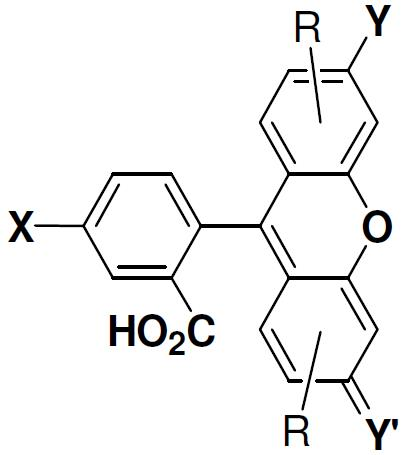
在一個說明性態樣中,連接子可包含聚乙二醇(PEG)、聚脯胺酸、親水性胺基酸、糖、非天然肽聚糖、聚乙烯吡咯啶酮、普洛尼克F-127或其組合。In an illustrative aspect, the linker may include polyethylene glycol (PEG), polyproline, hydrophilic amino acid, sugar, unnatural peptidoglycan, polyvinylpyrrolidone, pluronic F- 127 or a combination thereof.
在另一說明性態樣中,本文所述之化合物或其醫藥學上可接受之鹽中的連接子可包含直接連接(例如FITC之異硫氰酸酯基與小分子配位體之游離胺基之間的反應)或連接可經由中間連接子。在一個實施例中,若存在,則中間連接子可為此項技術中已知之任何生物相容性連接子,諸如二價連接子。在一個說明性實施例中,二價連接子可包含約1至約30個碳原子。在另一說明性實施例中,二價連接子可包含約2至約20個碳原子。在其他實施例中,採用低分子量二價連接子(亦即,近似分子量為約30至約300道爾頓之彼等連接子)。在另一實施例中,適合之連接子長度包括(但不限於)具有2個、3個、4個、5個、6個、7個、8個、9個、10個、11個、12個、13個、14個、15個、16個、17個、18個、19個、20個、21個、22個、23個、24個、25個、26個、27個、28個、29個、30個、31個、32個、33個、34個、35個、36個、37個、38個、39個或40個或更多個原子之連接子。In another illustrative aspect, the linker in the compound described herein or a pharmaceutically acceptable salt thereof may contain a direct link (such as the isothiocyanate group of FITC and the free amine of the small molecule ligand The reaction between groups) or connection may be via an intermediate linker. In one embodiment, if present, the intermediate linker may be any biocompatible linker known in the art, such as a bivalent linker. In an illustrative embodiment, the divalent linker may contain about 1 to about 30 carbon atoms. In another illustrative embodiment, the divalent linker may contain about 2 to about 20 carbon atoms. In other embodiments, low molecular weight divalent linkers (ie, other linkers with an approximate molecular weight of about 30 to about 300 Daltons) are used. In another embodiment, suitable linker lengths include (but are not limited to) having 2, 3, 4, 5, 6, 7, 8, 8, 9, 10, 11, 12 , 13, 14, 15, 16, 17, 18, 19, 20, 21, 22, 23, 24, 25, 26, 27, 28, 29, 30, 31, 32, 33, 34, 35, 36, 37, 38, 39 or 40 or more atom linkers.
在各種實施例中,連接於靶向部分之小分子配位體可具有下式:

在另一實施例中,連接子可為可包括一或多個間隔基之二價連接子。說明性間隔基顯示於下表中。描述以下非限制性例示性間隔基,其中*指示與小分子配位體或靶向部分或其他二價連接子部分之連接點。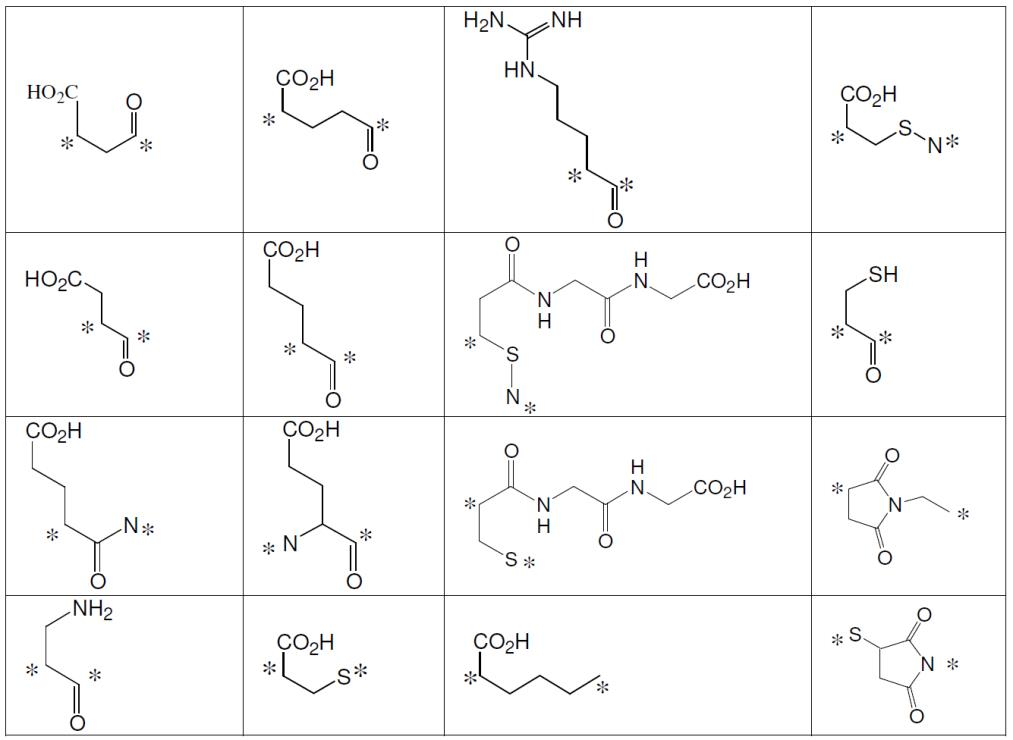

在其他實施例中,連接於靶向部分(橋)之小分子配位體可具有任一以下結構。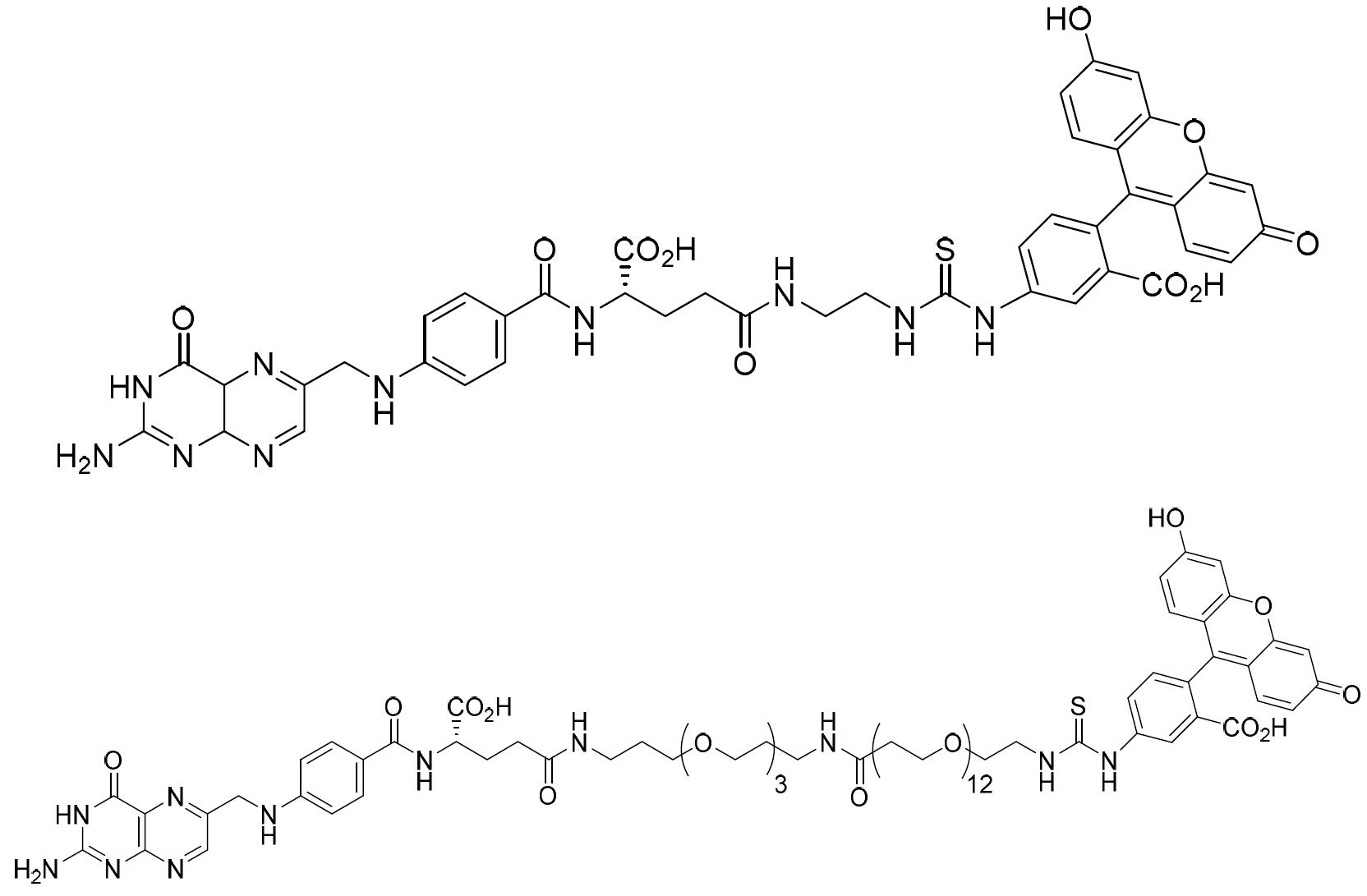
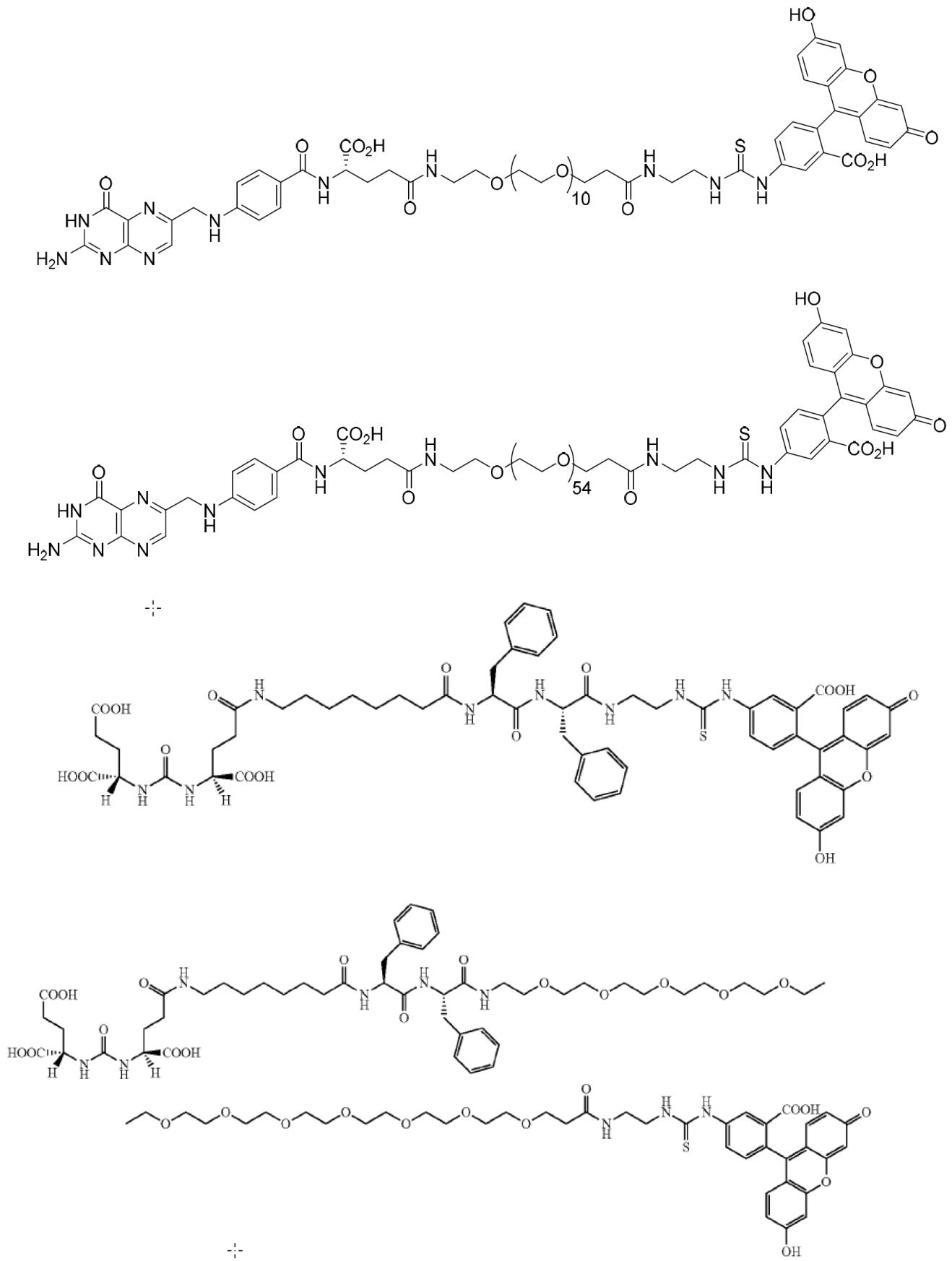
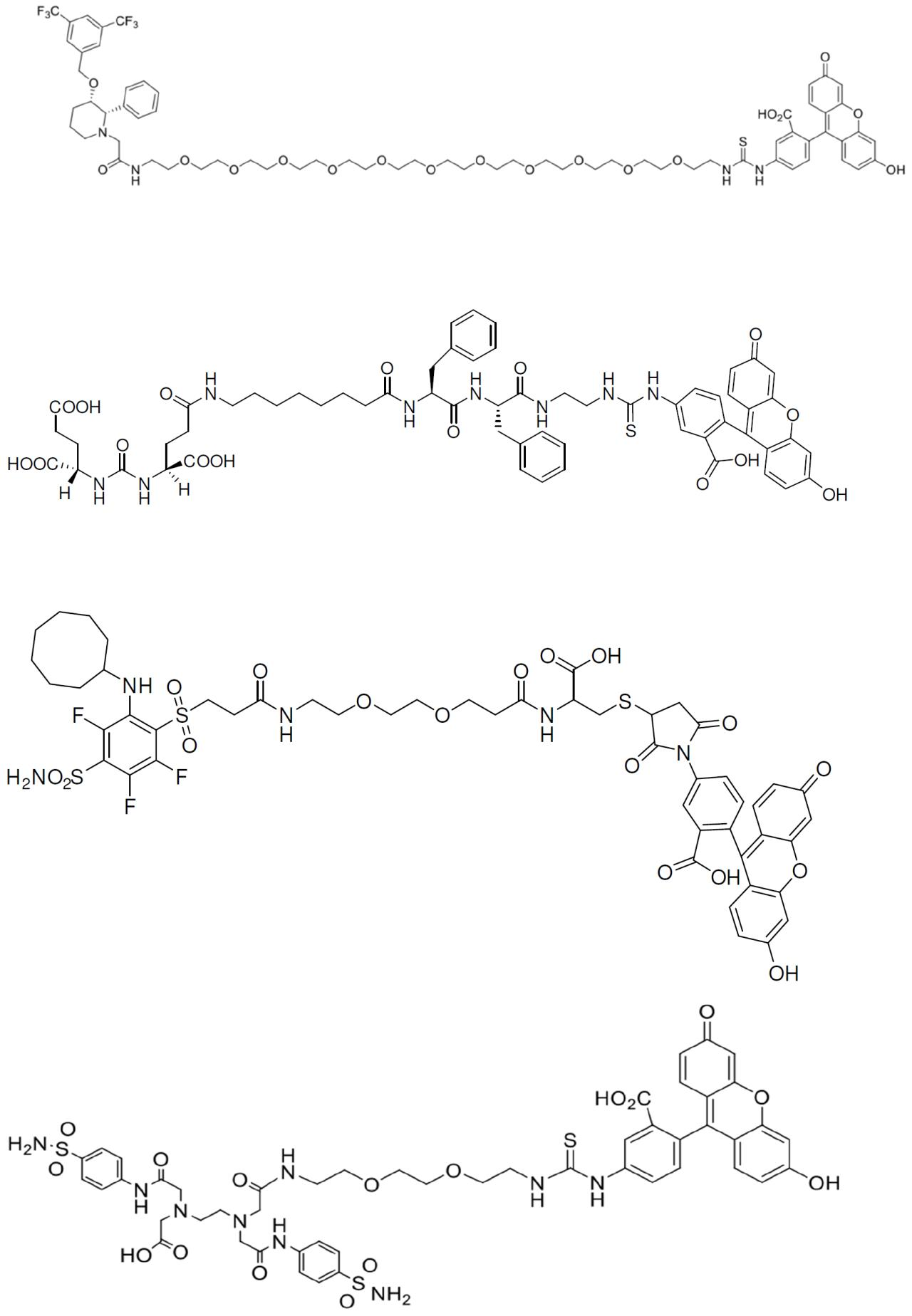

在其他實施例中,化合物或其醫藥學上可接受之鹽並非抗體,且不包含抗體片段。在另一實施例中,靶向部分不包含肽抗原決定基。In other embodiments, the compound or pharmaceutically acceptable salt thereof is not an antibody and does not contain antibody fragments. In another embodiment, the targeting moiety does not contain peptide epitopes.
在一個說明性實施例中,藉由連接子(橋)連接於靶向部分之小分子配位體包含連接於小分子配位體之異硫氰酸螢光素(FITC)。在一個態樣中,癌症可過度表現小分子配位體之受體。在另一態樣中,例如細胞毒性T細胞或另一類型T細胞可轉型以表現包含抗FITC scFv之CAR。在此態樣中,作為小分子配位體與癌症結合之結果,CAR可靶向以FITC分子裝飾癌症之FITC。因此,可避免或降低對正常之非標靶細胞之毒性。在此實施例中,當抗FITC表現CAR之T細胞結合FITC時CAR T細胞活化且改善癌症。In an illustrative embodiment, the small molecule ligand attached to the targeting moiety by a linker (bridge) includes luciferin isothiocyanate (FITC) attached to the small molecule ligand. In one aspect, cancer can overrepresent small molecule ligand receptors. In another aspect, for example, a cytotoxic T cell or another type of T cell can be transformed to express a CAR containing anti-FITC scFv. In this aspect, as a result of the binding of small molecule ligands to cancer, CAR can target FITC that decorates cancer with FITC molecules. Therefore, the toxicity to normal non-target cells can be avoided or reduced. In this example, CAR T cells activate and improve cancer when T cells against CAR expressing CAR against FITC bind FITC.
涵蓋藉由連接子連接於靶向部分之小分子配位體的「醫藥學上可接受之鹽」。如本文所用,術語「醫藥學上可接受之鹽」係指相對離子可用於藥物中之彼等鹽。在各種實施例中,此類鹽包括(但不限於):1)酸加成鹽,其可由母體化合物之游離鹼與無機酸之反應形成,該等無機酸為諸如鹽酸、氫溴酸、硝酸、磷酸、硫酸及過氯酸及其類似物;或由母體化合物之游離鹼與有機酸之反應形成,該等有機酸為諸如乙酸、乙二酸、(D)或(L)蘋果酸、順丁烯二酸、甲烷磺酸、乙烷磺酸、對甲苯磺酸、水楊酸、酒石酸、檸檬酸、丁二酸或丙二酸及其類似物;或(2)當母體化合物中存在之酸性質子經金屬離子(例如鹼金屬離子、鹼土金屬離子或鋁離子)置換時所形成之鹽;或當母體化合物中存在之酸性質子與有機鹼配位而形成的鹽,該有機鹼為諸如乙醇胺、二乙醇胺、三乙醇胺、三羥甲基胺基甲烷、N-甲基還原葡糖胺及其類似物。醫藥學上可接受之鹽為熟習此項技術者所熟知,且結合本文所述之實施例涵蓋任何此類醫藥學上可接受之鹽。Covers "pharmaceutically acceptable salts" of small molecule ligands linked to targeting moieties by linkers. As used herein, the term "pharmaceutically acceptable salts" refers to those salts whose relative ions can be used in medicine. In various embodiments, such salts include (but are not limited to): 1) acid addition salts, which can be formed by the reaction of the free base of the parent compound with inorganic acids such as hydrochloric acid, hydrobromic acid, nitric acid , Phosphoric acid, sulfuric acid, perchloric acid and the like; or formed by the reaction of the free base of the parent compound with organic acids such as acetic acid, oxalic acid, (D) or (L) malic acid, cis Succinic acid, methanesulfonic acid, ethanesulfonic acid, p-toluenesulfonic acid, salicylic acid, tartaric acid, citric acid, succinic acid or malonic acid, and the like; or (2) when present in the parent compound Salts formed when acid protons are replaced by metal ions (such as alkali metal ions, alkaline earth metal ions, or aluminum ions); or salts formed when the acid protons present in the parent compound are coordinated with an organic base, the organic base is Such as ethanolamine, diethanolamine, triethanolamine, trimethylolaminomethane, N-methyl reduced glucosamine and the like. Pharmaceutically acceptable salts are well known to those skilled in the art, and any such pharmaceutically acceptable salts are covered in conjunction with the embodiments described herein.
在各種實施例中,合適酸加成鹽由形成無毒鹽之酸形成。說明性實例包括乙酸鹽、天冬胺酸鹽、苯甲酸鹽、苯磺酸鹽、碳酸氫鹽/碳酸鹽、硫酸氫鹽/硫酸鹽、硼酸鹽、樟腦磺酸鹽、檸檬酸鹽、乙二磺酸鹽、乙磺酸鹽、甲酸鹽、反丁烯二酸鹽、葡庚糖酸鹽、葡糖酸鹽、葡萄糖醛酸鹽、六氟磷酸鹽、海苯酸鹽、鹽酸鹽/氯化物、氫溴酸鹽/溴化物、氫碘酸鹽/碘化物、羥乙磺酸鹽、乳酸鹽、蘋果酸鹽、順丁烯二酸鹽、丙二酸鹽、甲磺酸鹽、甲硫酸鹽、萘二甲酸鹽、2-萘磺酸鹽、菸酸鹽、硝酸鹽、乳清酸鹽、草酸鹽、棕櫚酸鹽、雙羥萘酸鹽、磷酸鹽/磷酸氫鹽/磷酸二氫鹽、葡萄糖二酸鹽、硬脂酸鹽、丁二酸鹽、酒石酸鹽、甲苯磺酸鹽及三氟乙酸鹽。In various embodiments, suitable acid addition salts are formed from acids that form non-toxic salts. Illustrative examples include acetate, aspartate, benzoate, benzenesulfonate, bicarbonate/carbonate, bisulfate/sulfate, borate, camphorsulfonate, citrate, ethyl acetate Disulfonate, ethanesulfonate, formate, fumarate, glucoheptonate, gluconate, glucuronate, hexafluorophosphate, hydrobenzoate, hydrochloride /Chloride, hydrobromide/bromide, hydroiodide/iodide, isethionate, lactate, malate, maleate, malonate, mesylate, Methosulfate, naphthalene dicarboxylate, 2-naphthalene sulfonate, nicotinate, nitrate, orotate, oxalate, palmitate, pamoate, phosphate/hydrogen phosphate/ Dihydrogen phosphate, glucose diacid, stearate, succinate, tartrate, tosylate and trifluoroacetate.
在各種實施例中,適合之鹼鹽由形成無毒鹽之鹼形成。說明性實例包括精胺酸、苄星青黴素、鈣、膽鹼、二乙胺、二乙醇胺、甘胺酸、離胺酸、鎂、葡甲胺、乙醇胺、鉀、鈉、緩血酸胺及鋅之鹽。亦可形成酸及鹼之半鹽,例如半硫酸鹽及半鈣鹽。In various embodiments, suitable base salts are formed from bases that form non-toxic salts. Illustrative examples include arginine, benzathine penicillin, calcium, choline, diethylamine, diethanolamine, glycine, lysine, magnesium, meglumine, ethanolamine, potassium, sodium, tromethamine, and zinc Salt. It can also form half salts of acids and bases, such as half sulfates and half calcium salts.
在一個例示性態樣中,本文所述之化合物或其醫藥鹽可含有一或多個對掌性中心,或可另外能夠呈多個立體異構體存在。因此,各種實施例可包括純立體異構體以及立體異構體之混合物,諸如對映異構體、非對映異構體及對映異構性或非對映異構性增濃混合物。在一個態樣中,本文所述之化合物或其醫藥學上可接受之鹽能夠呈幾何異構體存在。因此,各種實施例可包括純幾何異構體或幾何異構體之混合物。In an exemplary aspect, the compound described herein or a pharmaceutical salt thereof may contain one or more epicenters, or may additionally be capable of presenting multiple stereoisomers. Thus, various embodiments may include pure stereoisomers and mixtures of stereoisomers, such as enantiomers, diastereomers, and enantiomerically or diastereoisomerically enriched mixtures. In one aspect, the compounds described herein or their pharmaceutically acceptable salts can exist as geometric isomers. Therefore, various embodiments may include pure geometric isomers or mixtures of geometric isomers.
在一些態樣中,本文所述之化合物或其醫藥學上可接受之鹽可呈未溶劑化形式以及溶劑化形式,包括水合形式存在。一般而言,溶劑化形式等同於未溶劑化形式且涵蓋於本發明之範疇內。In some aspects, the compounds described herein or pharmaceutically acceptable salts thereof may exist in unsolvated as well as solvated forms, including hydrated forms. Generally speaking, solvated forms are equivalent to unsolvated forms and are encompassed within the scope of the present invention.
本文所述之方法亦利用T淋巴球(例如細胞毒性T淋巴球),其經工程改造以表現識別且結合於橋之靶向部分(例如FITC、DNP或TNP)之嵌合抗原受體(CAR)。在一個實施例中,本文中描述之CAR包含三個域,包括1)識別區(例如,抗體之單鏈片段可變(scFv)區、Fab片段及其類似物),其識別且特異性結合於靶向部分,2)共刺激結構域,其增強T淋巴球之增殖及存活,3)活化信號傳導結構域,其產生T淋巴球活化信號。The methods described herein also utilize T lymphocytes (eg, cytotoxic T lymphocytes) that are engineered to express chimeric antigen receptors (CARs) that recognize and bind to the targeted portion of the bridge (eg, FITC, DNP, or TNP) ). In one embodiment, the CAR described herein contains three domains, including 1) recognition regions (eg, single chain fragment variable (scFv) regions of antibodies, Fab fragments, and the like) that recognize and specifically bind In the targeting part, 2) a costimulatory domain, which enhances T lymphocyte proliferation and survival, and 3) an activation signaling domain, which generates a T lymphocyte activation signal.
在一個態樣中,可使用結合以下之抗體之scFv區:2,4-二硝基苯酚(DNP)、2,4,6-三硝基苯酚(TNP)、生物素、地高辛、螢光素、異硫氰酸螢光素(FITC)、NHS-螢光素、五氟苯基酯(PFP)、四氟苯基酯(TFP)、打結素、賽丁素、DARPin、親和抗體、阿菲林、抗運載蛋白、艾三聚體(atrimer)、高親和性多聚體、雙環肽、FN3骨架、cys-結、福諾體(fynomer)、孔尼茲域(Kunitz domain)或Obody。在說明性非限制性實施例中,scFv區可以下由製備:(i)結合靶向部分之此項技術中已知之抗體,(ii)使用選定靶向部分(諸如半抗原)新製備之抗體及(iii)源自此類抗體之scFv區之順序變體,例如scFv區域具有與其源自之scFv區域之胺基酸序列至少約80%、至少約90%、至少約91%、至少約92%、至少約93%、至少約94%、至少約95%、至少約96%、至少約97%、至少約98%、至少約99%或至少約99.5%序列一致性。In one aspect, scFv regions that bind the following antibodies can be used: 2,4-dinitrophenol (DNP), 2,4,6-trinitrophenol (TNP), biotin, digoxin, fluorescein Luminin, fluorescein isothiocyanate (FITC), NHS-luciferin, pentafluorophenyl ester (PFP), tetrafluorophenyl ester (TFP), knottin, cetin, DARPin, affinity antibody , Afilin, anti-transporter, atrimer, high-affinity polymer, bicyclic peptide, FN3 backbone, cys-knot, fynomer, Kunitz domain or Obody . In an illustrative non-limiting example, the scFv region can be prepared by: (i) an antibody known in the art that binds a targeting moiety, (ii) a newly prepared antibody using a selected targeting moiety (such as a hapten) And (iii) sequence variants derived from the scFv region of such antibodies, for example, the scFv region has at least about 80%, at least about 90%, at least about 91%, at least about 92 from the amino acid sequence of the scFv region from which it is derived %, at least about 93%, at least about 94%, at least about 95%, at least about 96%, at least about 97%, at least about 98%, at least about 99%, or at least about 99.5% sequence identity.
在一個態樣中,共刺激結構域用以在CAR結合於靶向部分後增強細胞毒性T淋巴球之增殖及存活。合適共刺激結構域包括(但不限於) CD28、CD137 (4-1BB)、腫瘤壞死因子(TNF)受體家族之成員、CD134 (OX40)、TNFR受體超家族之成員、CD27、CD30、CD150、DAP10、NKG2D及CD278 (ICOS)、在活化T細胞上表現之CD28超家族共刺激分子或其組合。熟習此項技術者應瞭解可在不會不利地影響本發明的情況下使用此等共刺激結構域之順序變體,其中該等變體具有與其模擬之域相同或類似的活性。在各種實施例中,此類變體可與其源自之域之胺基酸序列具有至少約80%、至少約90%、至少約91%、至少約92%、至少約93%、至少約94%、至少約95%、至少約96%、至少約97%、至少約98%、至少約99%或至少約99.5%序列一致性。In one aspect, the costimulatory domain is used to enhance the proliferation and survival of cytotoxic T lymphocytes after CAR is bound to the targeting moiety. Suitable costimulatory domains include, but are not limited to, CD28, CD137 (4-1BB), members of the tumor necrosis factor (TNF) receptor family, CD134 (OX40), members of the TNFR receptor superfamily, CD27, CD30, CD150 , DAP10, NKG2D, and CD278 (ICOS), CD28 superfamily costimulatory molecules on activated T cells, or a combination thereof. Those skilled in the art should understand that sequential variants of these costimulatory domains can be used without adversely affecting the present invention, where the variants have the same or similar activities as the domains they simulate. In various embodiments, such variants may have at least about 80%, at least about 90%, at least about 91%, at least about 92%, at least about 93%, at least about 94 from the amino acid sequence of the domain from which it is derived %, at least about 95%, at least about 96%, at least about 97%, at least about 98%, at least about 99%, or at least about 99.5% sequence identity.
在說明性實施例中,活化信號傳導結構域用以在CAR結合於靶向部分後活化T淋巴球(例如細胞毒性T淋巴球)。在各種實施例中,適合之活化信號傳導結構域包括T細胞CD3ζ鏈、CD3δ受體蛋白、mbl受體蛋白、B29受體蛋白及Fc受體γ。熟習此項技術者應瞭解可使用此等活化信號傳導結構域之順序變體,其中變體具有與其模擬之域相同或類似活性。在各種實施例中,變異體與其源自之域之胺基酸序列具有至少約80%、至少約90%、至少約91%、至少約92%、至少約93%、至少約94%、至少約95%、至少約96%、至少約97%、至少約98%、至少約99%或至少約99.5%序列一致性。In an illustrative embodiment, the activation signaling domain is used to activate T lymphocytes (eg, cytotoxic T lymphocytes) after CAR is bound to the targeting moiety. In various embodiments, suitable activation signaling domains include T cell CD3ζ chain, CD3δ receptor protein, mb1 receptor protein, B29 receptor protein, and Fc receptor γ. Those skilled in the art should understand that sequential variants of these activation signaling domains can be used, where the variants have the same or similar activities as their simulated domains. In various embodiments, the variant has an amino acid sequence of at least about 80%, at least about 90%, at least about 91%, at least about 92%, at least about 93%, at least about 94%, at least about 94%, About 95%, at least about 96%, at least about 97%, at least about 98%, at least about 99%, or at least about 99.5% sequence identity.
在一個態樣中,使用基因工程改造技術製備編碼CAR之構築體。此類技術詳細描述於以引用之方式併入本文中之Sambrook等人, 「Molecular Cloning: A Laboratory Manual」, 第3版, Cold Spring Harbor Laboratory Press, (2001)及以引用之方式併入本文中之Green and Sambrook, 「Molecular Cloning: A Laboratory Manual」, 第4版, Cold Spring Harbor Laboratory Press, (2012)中。In one aspect, genetic engineering techniques are used to prepare CAR-encoding constructs. Such techniques are described in detail in Sambrook et al., "Molecular Cloning: A Laboratory Manual", 3rd edition, Cold Spring Harbor Laboratory Press, (2001) and incorporated herein by reference. Of Green and Sambrook, "Molecular Cloning: A Laboratory Manual", 4th Edition, Cold Spring Harbor Laboratory Press, (2012).
作為實例,可製備質體或病毒表現載體(例如,慢病毒載體、逆轉錄病毒載體、sleeping beauty及piggyback(包括非病毒介導的CAR基因傳遞系統之轉位子/轉位酶系統)),其編碼包含識別區、一或多個共刺激結構域及活化信號傳導結構域之融合蛋白,框內且在5'至3'方向上連結。在其他實施例中,其他配置為可接受的,且包括識別區、活化信號傳導結構域及一或多個共刺激結構域。在一個實施例中,融合蛋白中之識別區之置放將通常為此使得實現在CAR T細胞之外部呈現該區域。在一個實施例中,CAR可包括其他元件,諸如確保融合蛋白適當輸出至細胞表面之信號肽(例如CD8α信號肽);確保融合蛋白作為整合膜蛋白維持之跨膜結構域(例如CD8α跨膜結構域、CD28跨膜結構域或CD3ζ跨膜結構域)及賦予識別區可撓性且允許強烈結合於靶向部分之鉸鏈域(例如CD8α鉸鏈)。As an example, plastid or viral expression vectors (eg, lentiviral vectors, retroviral vectors, sleeping beauty, and piggyback (including transposon/transposase systems for non-virus-mediated CAR gene delivery systems)) can be prepared, A fusion protein encoding a recognition region, one or more costimulatory domains, and an activation signaling domain is framed and linked in the 5'to 3'direction. In other embodiments, other configurations are acceptable and include a recognition zone, an activation signaling domain, and one or more co-stimulation domains. In one embodiment, the placement of the recognition region in the fusion protein will generally enable this to be rendered outside the CAR T cells. In one embodiment, the CAR may include other elements, such as a signal peptide (eg, CD8α signal peptide) that ensures proper output of the fusion protein to the cell surface; a transmembrane domain (eg, CD8α transmembrane structure) that the fusion protein maintains as an integral membrane protein Domain, CD28 transmembrane domain or CD3ζ transmembrane domain) and a hinge domain that confers flexibility to the recognition region and allows strong binding to the targeting moiety (eg CD8α hinge).
例示性CAR之圖式展示於圖2及3中。對於圖2,可將融合蛋白序列併入至慢病毒表現載體中,其中「SP」為信號肽,CAR為抗FITC CAR,存在CD8α鉸鏈及CD8α跨膜結構域,共刺激結構域為4-1BB且活化信號傳導結構域為CD3ζ。CAR插入之例示性核酸序列提供為SEQ ID NO: 1及3且經編碼胺基酸序列提供為SEQ ID NO: 2。在又一實施例中,SEQ ID NO: 2可包含人類化或人類胺基酸序列或由人類化或人類胺基酸序列組成。Illustrative CAR diagrams are shown in Figures 2 and 3. For Figure 2, the fusion protein sequence can be incorporated into a lentiviral expression vector, where "SP" is the signal peptide, CAR is the anti-FITC CAR, there is a CD8α hinge and CD8α transmembrane domain, and the costimulatory domain is 4-1BB And the activation signaling domain is CD3ζ. Exemplary nucleic acid sequences for CAR insertion are provided as SEQ ID NO: 1 and 3 and the encoded amino acid sequence is provided as SEQ ID NO: 2. In yet another embodiment, SEQ ID NO: 2 may comprise or consist of a humanized or human amino acid sequence.
對於圖3,展示例示性CAR構築體之圖式,其中經表現CAR包含E2抗螢光素抗體片段,其中可將融合蛋白序列併入至表現載體中且其中CAR包含E2抗螢光素抗體片段、IgG4鉸鏈域、CD28跨膜結構域,且其中共刺激結構域為CD137 (4-1BB),且活化信號傳導結構域為CD3ζ。CAR可包含額外適合域。此CAR插入之例示性核酸序列提供為SEQ ID NO: 4且例示性經編碼胺基酸序列提供為SEQ ID NO: 5。如本文所用,「SEQ ID NO: 4」意謂開始於帶下劃線之「agc」密碼子處且終止於帶下劃線之「ggc」密碼子的序列。更長序列之此部分編碼插入至T細胞薄膜中之CAR。較長序列之其他部分包括不為經插入至膜中且充當嵌合抗原受體之CAR之部分的信號肽、EGFRt域等之編碼序列。如本文中所使用,「SEQ ID NO: 5」意謂開始於帶下劃線之「S」處且終止於帶下劃線之「G」的序列。較長序列之此部分為經插入至T細胞薄膜中之CAR的胺基酸序列。較長序列之其他部分包括不為經插入至膜中且充當嵌合抗原受體之CAR之部分的信號肽、EGFRt域等之胺基酸序列。在又一實施例中,SEQ ID NO: 5可包含人類化或人類胺基酸序列或由人類化或人類胺基酸序列組成。SEQ ID NO :4及5如上文所描述且顯示如下。較長核酸序列中之開始及終止密碼子為帶下劃線的且較長序列為可用於轉導用於如本文所描述之方法之T細胞的例示性序列。
SEQ ID NO:4 (E2抗螢光素抗體片段CAR核酸序列(插入))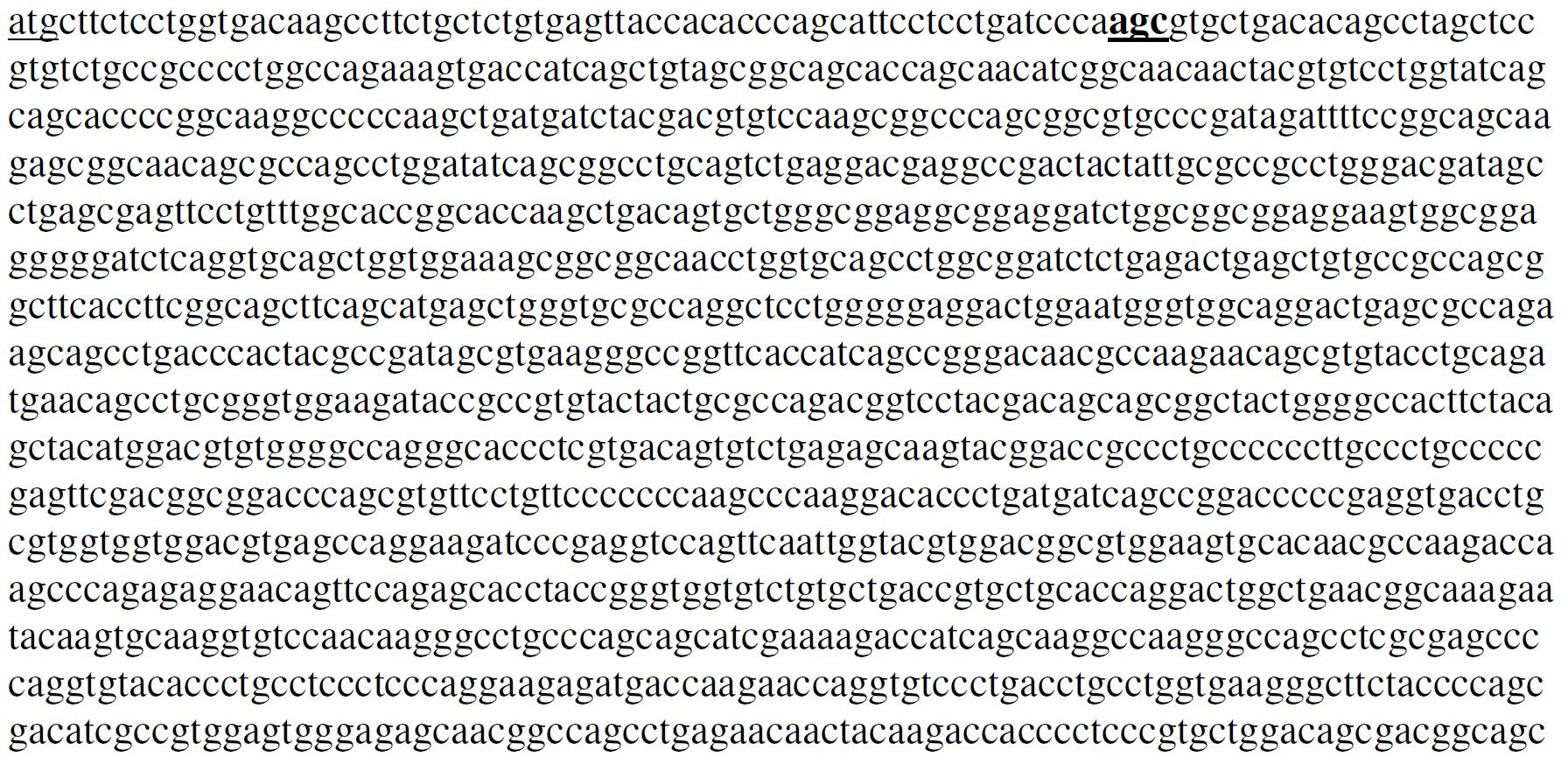
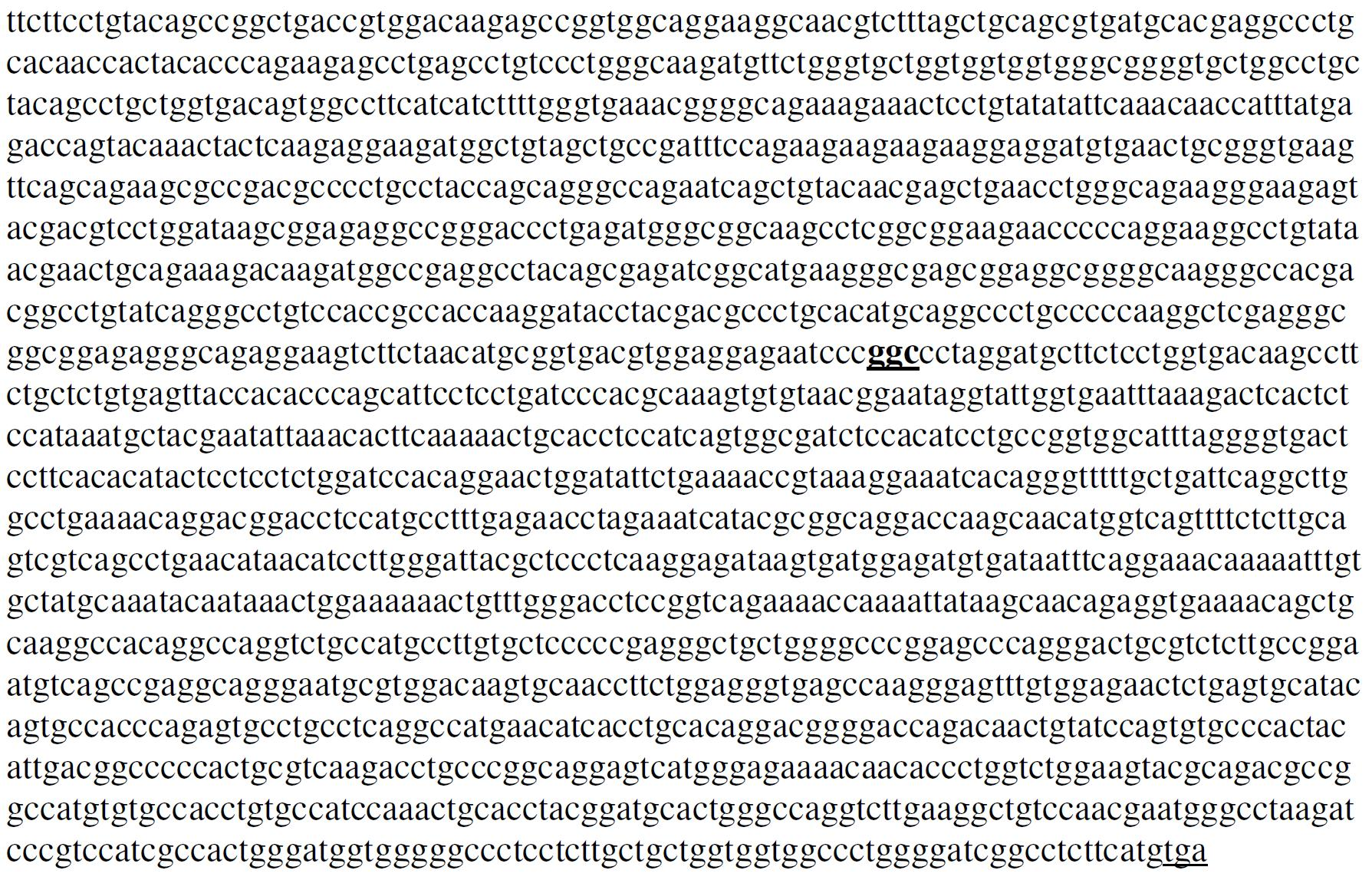
SEQ ID NO:5 (E2抗螢光素抗體片段CAR胺基酸序列(插入))

另一例示性CAR構築體為概略地展示於圖3中之4M5.3CAR。如本文中所使用,「SEQ ID NO:6」意謂以下所示之開始於帶下劃線之「gac」密碼子處且終止於帶下劃線之「ggc」密碼子的序列。較長序列之此部分編碼例示性4M5.3 CAR。CAR經插入至T細胞膜中。較長序列之其他部分包括不為經插入至膜中且充當嵌合抗原受體之CAR之部分的信號肽、EGFRt域等之編碼序列。如本文中所使用,「SEQ ID NO:7」意謂開始於帶下劃線之「D」處且終止於帶下劃線之「G」的序列。較長序列之此部分為經插入至T細胞膜中之CAR的胺基酸序列。較長序列之其他部分包括不為經插入至膜中且充當嵌合抗原受體之CAR之部分的信號肽、EGFRt域等之胺基酸序列。在又另一實施例中,SEQ ID NO:7可包含人源化或人類胺基酸序列或由人源化或人類胺基酸序列構成。SEQ ID NO:6及SEQ ID NO:7如上文所描述且其在下文展示。較長核酸序列中之起始密碼子及終止密碼子帶下劃線,且較長序列為可用於轉導T細胞以製備4M5.3 CAR之例示性序列。
SEQ ID NO:7 [4M5.3-CAR胺基酸序列(插入序列)]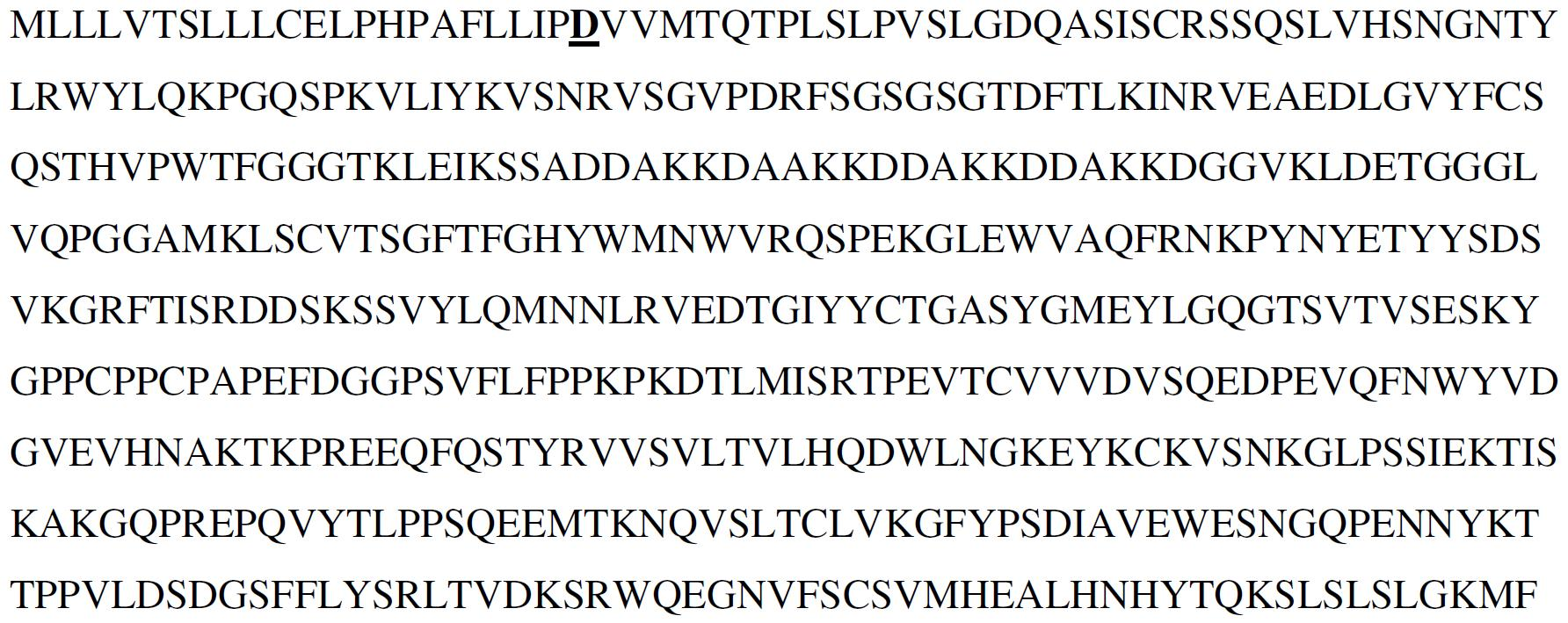


在一個實施例中,CAR具有識別區且該識別區為抗FITC抗體之單鏈片段可變(scFv)區,具有共刺激結構域且該共刺激結構域為CD137(4-1BB),且具有活化信號傳導結構域且該活化信號傳導結構域為T細胞CD3ζ鏈。熟習此項技術者熟知抗FITC scFv與抗螢光素scFv為同等術語。In one embodiment, the CAR has a recognition region and the recognition region is a single chain fragment variable (scFv) region of an anti-FITC antibody, has a costimulatory domain and the costimulatory domain is CD137 (4-1BB), and has The activation signaling domain is activated and the activation signaling domain is the T cell CD3ζ chain. Those skilled in the art are familiar with anti-FITC scFv and anti-luciferin scFv as equivalent terms.
在一個實施例中,T淋巴球(例如細胞毒性T淋巴球)可藉由用編碼CAR構築體之表現載體轉染T淋巴球群體而經基因工程改造以表現CAR構築體。適用於製備表現所選CAR構築體之T淋巴球之經轉導群體的方法為熟習此項技術者所熟知,且描述於Sambrook等人, 「Molecular Cloning: A Laboratory Manual」, 第3版, Cold Spring Harbor Laboratory Press, (2001) (以引用之方式併入本文中)及Green及Sambrook, 「Molecular Cloning: A Laboratory Manual」, 第4版, Cold Spring Harbor Laboratory Press, (2012) (以引用的方式併入本文中)中。In one embodiment, T lymphocytes (eg, cytotoxic T lymphocytes) can be genetically engineered to express CAR constructs by transfecting a population of T lymphocytes with expression vectors encoding CAR constructs. Suitable methods for preparing transduced populations of T lymphocytes representing selected CAR constructs are well known to those skilled in the art and are described in Sambrook et al., "Molecular Cloning: A Laboratory Manual", 3rd Edition, Cold Spring Harbor Laboratory Press, (2001) (incorporated by reference) and Green and Sambrook, "Molecular Cloning: A Laboratory Manual", 4th edition, Cold Spring Harbor Laboratory Press, (2012) (by reference) Incorporated in this article).
在一個實施例中,提供包含SEQ ID NO:1、SEQ ID NO:3、SEQ ID NO:4或SEQ ID NO:6之核酸的CAR T細胞。在另一實施例中,提供包含SEQ ID NO:2、SEQ ID NO:5或SEQ ID NO:7之多肽的CAR T細胞。在另一說明性態樣中,提供包含SEQ ID NO:1、SEQ ID NO:3、SEQ ID NO:4或SEQ ID NO:6且編碼嵌合抗原受體之核酸(例如經分離核酸)。在又另一實施例中,提供包含SEQ ID NO:2、SEQ ID NO:5或SEQ ID NO:7之嵌合抗原受體多肽。在另一實施例中,提供包含SEQ ID NO:1、SEQ ID NO:3、SEQ ID NO:4或SEQ ID NO:6之載體。在另一態樣中,提供包含SEQ ID NO:1、SEQ ID NO:3、SEQ ID NO:4或SEQ ID NO:6之慢病毒載體。在又另一實施例中,SEQ ID NO:2、SEQ ID NO:5或SEQ ID NO:7可包含人源化或人類胺基酸序列或由人源化或人類胺基酸序列構成。In one embodiment, a CAR T cell comprising the nucleic acid of SEQ ID NO: 1, SEQ ID NO: 3, SEQ ID NO: 4 or SEQ ID NO: 6 is provided. In another embodiment, a CAR T cell comprising the polypeptide of SEQ ID NO: 2, SEQ ID NO: 5 or SEQ ID NO: 7 is provided. In another illustrative aspect, a nucleic acid (eg, isolated nucleic acid) comprising SEQ ID NO: 1, SEQ ID NO: 3, SEQ ID NO: 4 or SEQ ID NO: 6 and encoding a chimeric antigen receptor is provided. In yet another embodiment, a chimeric antigen receptor polypeptide comprising SEQ ID NO: 2, SEQ ID NO: 5 or SEQ ID NO: 7 is provided. In another embodiment, a vector comprising SEQ ID NO: 1, SEQ ID NO: 3, SEQ ID NO: 4 or SEQ ID NO: 6 is provided. In another aspect, a lentiviral vector comprising SEQ ID NO: 1, SEQ ID NO: 3, SEQ ID NO: 4 or SEQ ID NO: 6 is provided. In yet another embodiment, SEQ ID NO: 2, SEQ ID NO: 5 or SEQ ID NO: 7 may comprise or consist of a humanized or human amino acid sequence.
在此等實施例中之每一者中,涵蓋與SEQ ID NO:1至SEQ ID NO:7具有至少約80%、至少約90%、至少約95%、至少約97%、至少約98%、至少約99%或至少約99.5%序列一致性之變體核酸序列或胺基酸序列。在另一實施例中,核酸序列可為與SEQ ID NO:1、SEQ ID NO:3、SEQ ID NO:4或SEQ ID NO:6具有至少約80%、至少約90%、至少約95%、至少約97%、至少約98%、至少約99%或至少約99.5%序列一致性之變體核酸序列,只要該變體序列編碼SEQ ID NO:2 (針對SEQ ID NO:1及SEQ ID NO:3)、SEQ ID NO:5 (針對SEQ ID NO: 4)或SEQ ID NO:7 (針對SEQ ID NO:6)之多肽即可。在另一實施例中,核酸序列或胺基酸序列可為與沿一段200個核酸之SEQ ID NO:1、SEQ ID NO:3、SEQ ID NO:4或SEQ ID NO:6或與沿一段200個胺基酸之SEQ ID NO:2、SEQ ID NO:5或SEQ ID NO:7具有至少約80%、至少約90%、至少約95%、至少約97%、至少約98%、至少約99%或至少約99.5%序列一致性之變體核酸或胺基酸序列。在一個實施例中,可例如藉由使用GAP程式(Genetics Computer Group,軟體;目前可在http://www.accelrys.com上經由Accelrys獲得)來實現對序列之間的一致性或類似性百分比之測定,且可使用(例如) ClustalW演算法(VNTI軟體,InforMax公司)來實現對準。可使用所關注之核酸或胺基酸序列來搜索序列資料庫。資料庫搜索演算法典型地基於BLAST軟體(Altschul等人,1990)。在一些實施例中,可沿核酸或胺基酸序列之全長來測定一致性百分比。In each of these embodiments, encompasses at least about 80%, at least about 90%, at least about 95%, at least about 97%, at least about 98% of SEQ ID NO: 1 to SEQ ID NO: 7 , A variant nucleic acid sequence or amino acid sequence of at least about 99% or at least about 99.5% sequence identity. In another embodiment, the nucleic acid sequence may be at least about 80%, at least about 90%, at least about 95% of SEQ ID NO: 1, SEQ ID NO: 3, SEQ ID NO: 4 or SEQ ID NO: 6 , At least about 97%, at least about 98%, at least about 99%, or at least about 99.5% of the sequence identity of the variant nucleic acid sequence, as long as the variant sequence encodes SEQ ID NO: 2 (for SEQ ID NO: 1 and SEQ ID NO: 3), SEQ ID NO: 5 (for SEQ ID NO: 4) or SEQ ID NO: 7 (for SEQ ID NO: 6). In another embodiment, the nucleic acid sequence or amino acid sequence may be a sequence of 200 nucleic acids along SEQ ID NO: 1, SEQ ID NO: 3, SEQ ID NO: 4 or SEQ ID NO: 6 or along a
與由SEQ ID NO:1、SEQ ID NO:3、SEQ ID NO:4或SEQ ID NO:6表示之核酸互補之核酸及混雜至由SEQ ID NO:1、SEQ ID NO:3、SEQ ID NO:4或SEQ ID NO:6表示之核酸的彼等核酸或在高度嚴格條件下混雜至其互補序列之彼等核酸亦在本發明之範疇內。根據本發明,「高度嚴格條件」意謂在65℃下於5X SSPE及50%甲醯胺中混雜,且在65℃下於0.5X SSPE中洗滌。用於高度嚴格、低嚴格及中等嚴格混雜之條件描述於Sambrook等人, 「Molecular Cloning: A Laboratory Manual」, 第3版, Cold Spring Harbor Laboratory Press, (2001) (以引用之方式併入本文中)及Green及Sambrook, 「Molecular Cloning: A Laboratory Manual」, 第4版, Cold Spring Harbor Laboratory Press, (2012) (以引用之方式併入本文中)。在一些說明性態樣中,混雜沿核酸之全長發生。Nucleic acids complementary to the nucleic acids represented by SEQ ID NO: 1, SEQ ID NO: 3, SEQ ID NO: 4 or SEQ ID NO: 6 and mixed to SEQ ID NO: 1, SEQ ID NO: 3, SEQ ID NO :4 or other nucleic acids of the nucleic acid represented by SEQ ID NO:6 or other nucleic acids mixed to their complementary sequences under highly stringent conditions are also within the scope of the present invention. According to the present invention, "highly stringent conditions" means to be mixed in 5X SSPE and 50% formamide at 65°C and washed in 0.5X SSPE at 65°C. Conditions for highly stringent, low stringency, and moderate stringency mixing are described in Sambrook et al., "Molecular Cloning: A Laboratory Manual", 3rd edition, Cold Spring Harbor Laboratory Press, (2001) (incorporated by reference ) And Green and Sambrook, "Molecular Cloning: A Laboratory Manual", 4th Edition, Cold Spring Harbor Laboratory Press, (2012) (incorporated herein by reference). In some illustrative aspects, confounding occurs along the entire length of the nucleic acid.
在一個實施例中,儘管用於本文中所描述方法中之T淋巴球(例如用以製備CAR T細胞之細胞毒性T淋巴球)可為自體細胞,但亦可使用異源細胞,諸如當經治療之患者已接受高劑量化療或放射治療而破壞患者之免疫系統時。在一個實施例中,可使用同種異體細胞。In one embodiment, although T lymphocytes used in the methods described herein (eg, cytotoxic T lymphocytes used to prepare CAR T cells) can be autologous cells, heterologous cells such as When the treated patient has received high-dose chemotherapy or radiation therapy and destroyed the patient's immune system. In one embodiment, allogeneic cells can be used.
在一個態樣中,T淋巴球可藉由此項技術中熟知之方式自患者獲得。舉例而言,T細胞(例如細胞毒性T細胞)可藉由以下操作而獲得:收集來自患者之外周血液,對血液進行菲科爾(Ficoll)密度梯度離心,且隨後使用陰性T細胞分離套組(諸如EasySep™T細胞分離套組)以自外周血液分離T細胞群體。在一個說明性實施例中,T淋巴球(例如細胞毒性T細胞)群體不必為純淨的,且可含有其他細胞,諸如其他類型之T細胞(在例如細胞毒性T細胞之情況下)、單核球、巨噬細胞、自然殺手細胞及B細胞。在一個態樣中,所收集之群體可包含至少約90%之所選細胞類型、至少約91%、92%、93%、94%、95%、96%、97%、98%、99%或100%之所選細胞類型。In one aspect, T lymphocytes can be obtained from patients in a manner well known in the art. For example, T cells (eg, cytotoxic T cells) can be obtained by collecting blood from the outer periphery of the patient, subjecting the blood to Ficoll density gradient centrifugation, and then using a negative T cell isolation kit (Such as EasySep™ T cell isolation kit) to isolate T cell populations from peripheral blood. In an illustrative embodiment, the population of T lymphocytes (eg, cytotoxic T cells) need not be pure, and may contain other cells, such as other types of T cells (in the case of, eg, cytotoxic T cells), mononuclear Balls, macrophages, natural killer cells and B cells. In one aspect, the collected population may comprise at least about 90% of the selected cell type, at least about 91%, 92%, 93%, 94%, 95%, 96%, 97%, 98%, 99% Or 100% of the selected cell type.
在一個實施例中,在獲得T淋巴球(例如用以製備CAR T細胞之細胞毒性T細胞)之後,在促進細胞活化之條件下培養該等細胞。在此實施例中,培養條件可使得細胞可投與患者,而不涉及針對培養基之組分的反應性。舉例而言,培養條件可不包括牛血清產物,諸如牛血清白蛋白。在一個說明性態樣中,活化可藉由在細胞毒性T細胞之情況下將諸如抗CD3抗體之已知活化劑引入至培養基中來達成。其他合適之活化劑包括抗CD28抗體。在一個態樣中,可在促進活化之條件下將淋巴球群體培養約1天至約4天。在一個實施例中,適當活化水平可藉由利用流動式細胞量測術測定之細胞大小、增殖速率或活化標記物來測定。In one embodiment, after obtaining T lymphocytes (eg, cytotoxic T cells used to prepare CAR T cells), the cells are cultured under conditions that promote cell activation. In this embodiment, the culture conditions may allow cells to be administered to the patient without involving reactivity against components of the culture medium. For example, the culture conditions may not include bovine serum products, such as bovine serum albumin. In an illustrative aspect, activation can be achieved by introducing known activators such as anti-CD3 antibodies into the culture medium in the case of cytotoxic T cells. Other suitable activators include anti-CD28 antibodies. In one aspect, the lymphocyte population can be cultured for about 1 day to about 4 days under conditions that promote activation. In one embodiment, the appropriate level of activation can be determined by cell size, proliferation rate, or activation markers determined using flow cytometry.
在一個說明性實施例中,在已於促進活化之條件下培養T淋巴球(例如用以製備CAR T細胞之細胞毒性T淋巴球)群體之後,該等細胞可經編碼CAR之表現載體轉染。上文描述用於各種實施例中之合適的載體及轉染方法。在一個態樣中,在轉染之後,可立即向患者投與該等細胞,或可將細胞培養至少約1天、2天、3天、4天、5天、6天、7天、8天、9天、10天、11天、12天、13天、14天、15天、16天、17天、18天或更多天,或在約5天與約12天之間、在約6天與約13天之間、在約7天與約14天之間或在約8天與約15天之間,例如以為細胞自轉染中恢復留出時間。在一個態樣中,合適之培養條件可類似於在具有或不具有用以促進活化之試劑下培養細胞以活化的條件。In an illustrative embodiment, after a population of T lymphocytes (eg, cytotoxic T lymphocytes used to prepare CAR T cells) has been cultured under conditions that promote activation, these cells can be transfected with a CAR-encoding expression vector . Suitable vectors and transfection methods used in various embodiments are described above. In one aspect, the cells can be administered to the patient immediately after transfection, or the cells can be cultured for at least about 1 day, 2 days, 3 days, 4 days, 5 days, 6 days, 7 days, 8 Days, 9 days, 10 days, 11 days, 12 days, 13 days, 14 days, 15 days, 16 days, 17 days, 18 days or more days, or between about 5 days and about 12 days, in about Between 6 days and about 13 days, between about 7 days and about 14 days, or between about 8 days and about 15 days, for example, to allow time for the cells to recover from transfection. In one aspect, suitable culture conditions may be similar to conditions for culturing cells for activation with or without agents to promote activation.
因此,如上文所描述,在一個說明性態樣中,本文中所描述之治療方法可進一步包含1)獲得自體或異源T淋巴球(例如用以製備CAR T細胞之細胞毒性T淋巴球)之群體,2)在促進細胞活化之條件下培養T淋巴球,以及3)用編碼CAR之表現載體轉染淋巴球以形成CAR T細胞。Therefore, as described above, in an illustrative aspect, the treatment methods described herein may further include 1) obtaining autologous or heterologous T lymphocytes (eg, cytotoxic T lymphocytes used to prepare CAR T cells ), 2) culture T lymphocytes under conditions that promote cell activation, and 3) transfect lymphocytes with CAR-encoding expression vectors to form CAR T cells.
在一個實施例中,可使用缺少任何動物產物(諸如牛血清)之培養基來培養CAR T細胞。在另一實施例中,可使用熟習此項技術者典型地用以避免受細菌、真菌及支原菌污染之組織培養條件。在一例示性實施例中,在投與患者之前,將細胞(例如CAR T細胞)沈澱,洗滌,且再懸浮於醫藥學上可接受之載劑或稀釋劑中。包含CAR表現T淋巴球(例如細胞毒性T淋巴球)之例示性組合物包括在無菌290 mOsm生理鹽水中、在不溶性冷凍介質(含有Plasma-Lyte A、右旋糖、氯化鈉注射劑、人類血清白蛋白及DMSO)中、在具有2%人類血清白蛋白之0.9% NaCl中或在任何其他無菌290 mOsm不溶性物質中包含該等細胞之組合物。可替代地,在另一實施例中,視培養基之屬性而定,CAR T細胞可作為組合物投入培養基中,或在投與之前經濃縮且再懸浮於培養基中。在各種實施例中,可經由任何合適之手段來向患者投與CAR T細胞組合物,諸如非經腸投與,例如皮內、皮下、肌內、腹膜內、經靜脈內或鞘內。In one embodiment, a medium lacking any animal product (such as bovine serum) can be used to grow CAR T cells. In another embodiment, tissue culture conditions typically used by those skilled in the art to avoid contamination by bacteria, fungi, and mycoplasma can be used. In an exemplary embodiment, prior to administration to the patient, the cells (eg, CAR T cells) are pelleted, washed, and resuspended in a pharmaceutically acceptable carrier or diluent. Exemplary compositions containing CAR-expressing T lymphocytes (e.g., cytotoxic T lymphocytes) are included in sterile 290 mOsm saline, in an insoluble freezing medium (containing Plasma-Lyte A, dextrose, sodium chloride injection, human serum Albumin and DMSO), a composition containing these cells in 0.9% NaCl with 2% human serum albumin or in any other sterile 290 mOsm insoluble material. Alternatively, in another embodiment, depending on the properties of the culture medium, CAR T cells can be injected into the culture medium as a composition, or concentrated and resuspended in the culture medium before administration. In various embodiments, the CAR T cell composition can be administered to the patient via any suitable means, such as parenteral administration, for example, intradermal, subcutaneous, intramuscular, intraperitoneal, intravenous, or intrathecal.
在一個態樣中,CAR T細胞之總數目及向患者投與之組合物中之細胞的濃度將視包括以下各者之數個因素而變化:正在使用之T淋巴球(例如細胞毒性T淋巴球)之類型、CAR之結合特異性、靶向部分及小分子配位體之屬性、癌症之屬性、患者體內之癌症的部位、用以向患者投與組合物之手段以及正經治療之患者的健康、年齡、體重。在各種實施例中,包含經轉導CAR T細胞之合適的組合物包括具有約0.1 ml至約200 ml與約0.1 ml至約125 ml之體積的彼等。In one aspect, the total number of CAR T cells and the concentration of cells in the composition administered to the patient will vary depending on several factors including: T lymphocytes in use (eg, cytotoxic T lymphocytes) Type), the binding specificity of CAR, the properties of targeting moieties and small molecule ligands, the properties of cancer, the location of cancer in the patient, the means used to administer the composition to the patient, and the patient being treated Health, age, weight. In various embodiments, suitable compositions comprising transduced CAR T cells include those having a volume of about 0.1 ml to about 200 ml and about 0.1 ml to about 125 ml.
在各種實施例中,向患者投與之經轉導CAR T細胞可包含約1×10⁵ 至約1×10¹⁵ 或1×10⁶ 至約1×10¹⁵ 之經轉導CAR T細胞。在各種實施例中,可向患者投與約1×10⁵ 至約1×10¹⁰ 、約1×10⁶ 至約1×10¹⁰ 、約1×10⁶ 至約1×10⁹ 、約1×10⁶ 至約1×10⁸ 、約1×10⁶ 至約2×10⁷ 、約1×10⁶ 至約3×10⁷ 、約1×10⁶ 至約1.5×10⁷ 、約1×10⁶ 至約1×10⁷ 、約1×10⁶ 至約9×10⁶ 、約1×10⁶ 至約8×10⁶ 、約1×10⁶ 至約7×10⁶ 、約1×10⁶ 至約6×10⁶ 、約1×10⁶ 至約5×10⁶ 、約1×10⁶ 至約4×10⁶ 、約1×10⁶ 至約3×10⁶ 、約1×10⁶ 至約2×10⁶ 、約2×10⁶ 至約6×10⁶ 、約2×10⁶ 至約5×10⁶ 、約3×10⁶ 至約6×10⁶ 、約4×10⁶ 至約6×10⁶ 、約4×10⁶ 至約1×10⁷ 、約1×10⁶ 至約1×10⁷ 、約1×10⁶ 至約1.5×10⁷ 、約1×10⁶ 至約2×10⁷ 、約0.2×10⁶ 至約1×10⁷ 、約0.2×10⁶ 至約1.5×10⁷ 、約0.2×10⁶ 至約2×10⁷ 、約0.2×10⁶ 至約3×10⁷ 、約0.2×10⁶ 至約4×10⁷ 、約0.2×10⁶ 至約5×10⁷ 、約0.2×10⁵ 至約1.5×10⁶ 、約0.5×10⁵ 至約1.5×10⁶ 、約0.2×10⁵ 至約1.4×10⁶ 、約0.2×10⁵ 至約1.3×10⁶ 、約0.5×10⁵ 至約1.3×10⁶ 、約0.8×10⁶ 至約2×10⁷ 、約0.8×10⁶ 至約1.5×10⁷ 、約0.9×10⁶ 至約1.2×10⁷ 、或約0.5×10⁶ 、1×10⁶ 、5×10⁶ 、6×10⁶ 、7×10⁶ 、8×10⁶ 、9×10⁶ 、1×10⁷ 、1.5×10⁷ 、2×10⁷ 、3×10⁷ 、4×10⁷ 或5×10⁷ 之CAR T細胞。此等量可針對每kg患者體重。In various embodiments, the transduced CAR T cells administered to the patient may comprise about 1×10 5 to about 1×10 15 or 1×10 6 to about 1×10 15 transduced CAR T cells. In various embodiments, the patient may be administered about 1×10 5 to about 1×10 10 , about 1×10 6 to about 1×10 10 , about 1×10 6 to about 1×10 9 , about 1× 10 6 to about 1×10 8 , about 1×10 6 to about 2×10 7 , about 1×10 6 to about 3×10 7 , about 1×10 6 to about 1.5×10 7 , about 1×10 6 To about 1×10 7 , about 1×10 6 to about 9×10 6 , about 1×10 6 to about 8×10 6 , about 1×10 6 to about 7×10 6 , about 1×10 6 to about 6×10 6 , about 1×10 6 to about 5×10 6 , about 1×10 6 to about 4×10 6 , about 1×10 6 to about 3×10 6 , about 1×10 6 to about 2× 10 6 , about 2×10 6 to about 6×10 6 , about 2×10 6 to about 5×10 6 , about 3×10 6 to about 6×10 6 , about 4×10 6 to about 6×10 6 , About 4×10 6 to about 1×10 7 , about 1×10 6 to about 1×10 7 , about 1×10 6 to about 1.5×10 7 , about 1×10 6 to about 2×10 7 , about 0.2×10 6 to about 1×10 7 , about 0.2×10 6 to about 1.5×10 7 , about 0.2×10 6 to about 2×10 7 , about 0.2×10 6 to about 3×10 7 , about 0.2× 10 6 to about 4×10 7 , about 0.2×10 6 to about 5×10 7 , about 0.2×10 5 to about 1.5×10 6 , about 0.5×10 5 to about 1.5×10 6 , about 0.2×10 5 To about 1.4×10 6 , about 0.2×10 5 to about 1.3×10 6 , about 0.5×10 5 to about 1.3×10 6 , about 0.8×10 6 to about 2×10 7 , about 0.8×10 6 to about 1.5×10 7 , about 0.9×10 6 to about 1.2×10 7 , or about 0.5×10 6 , 1×10 6 , 5×10 6 , 6×10 6 , 7×10 6 , 8×10 6 , 9 CAR T cells of ×10 6 , 1×10 7 , 1.5×10 7 , 2×10 7 , 3×10 7 , 4×10 7 or 5×10 7 . This amount can be for each kg of patient's body weight.
在其他實施例中,CAR T細胞組合物中向患者投與之CAR T細胞之劑量係選自由以下組成之群:約100萬、約200萬、約300萬、約400萬、約500萬、約600萬、約700萬、約800萬、約900萬、約1000萬、約1100萬、約1200萬、約1250萬、約1300萬、約1400萬及約1500萬之該等CAR T細胞。此等量可針對每kg患者體重。In other embodiments, the dosage of CAR T cells administered to the patient in the CAR T cell composition is selected from the group consisting of: about 1 million, about 2 million, about 3 million, about 4 million, about 5 million, Approximately 6 million, approximately 7 million, approximately 8 million, approximately 9 million, approximately 10 million, approximately 11 million, approximately 12 million, approximately 12.5 million, approximately 13 million, approximately 14 million, and approximately 15 million of these CAR T cells. This amount can be for each kg of patient's body weight.
在此段落中所描述之實施例中之任一者中,CAR T細胞劑量可為每kg患者體重之CAR T細胞的數目。在一個態樣中,在本文中所描述之任何實施例中,可向患者投與單次劑量或多次劑量之CAR T細胞。在一個說明性實施例中,可向患者投與第一劑量之CAR T細胞及第二劑量之CAR T細胞。在一個態樣中,CAR T細胞之第一劑量可為用以監測患者對CAR T細胞之耐受性的測試劑量,且CAR T細胞之第二劑量可包含高於CAR T細胞之第一劑量之CAR T細胞的劑量。在一個實施例中,CAR T細胞之第一劑量可包含約0.5×10⁵ 之CAR T細胞至約1.5×10⁶ 之CAR T細胞。在另一實施例中,CAR T細胞之第二劑量可包含約0.8×10⁶ 之CAR T細胞至約2×10⁷ 之CAR T細胞。在此等實施例中,包括CAR T細胞之第一劑量及第二劑量,可投與本文中所描述之CAR T細胞的任何劑量。In any of the embodiments described in this paragraph, the CAR T cell dose may be the number of CAR T cells per kg patient body weight. In one aspect, in any of the embodiments described herein, a single dose or multiple doses of CAR T cells can be administered to the patient. In an illustrative embodiment, the patient may be administered a first dose of CAR T cells and a second dose of CAR T cells. In one aspect, the first dose of CAR T cells may be a test dose used to monitor the patient's tolerance to CAR T cells, and the second dose of CAR T cells may contain a higher dose than the first dose of CAR T cells The dose of CAR T cells. In one embodiment, the first dose of CAR T cells may comprise about 0.5×10 5 CAR T cells to about 1.5×10 6 CAR T cells. In another embodiment, the second dose of CAR T cells may comprise about 0.8×10 6 CAR T cells to about 2×10 7 CAR T cells. In these embodiments, including the first dose and the second dose of CAR T cells, any dose of CAR T cells described herein can be administered.
在本文中所描述之任何實施例中,CAR T細胞可在化合物或其醫藥學上可接受之鹽之前或之後投與。如將理解,除非另外陳述,否則針對本文所述之任何方法之步驟的名稱i)、ii)及iii)等不指示次序。In any of the embodiments described herein, CAR T cells can be administered before or after the compound or its pharmaceutically acceptable salt. As will be understood, unless otherwise stated, the names i), ii), iii), etc. for the steps of any method described herein do not indicate an order.
化合物或其醫藥學上可接受之鹽或本文中所描述之CAR T細胞組合物可使用此項技術中已知的任何合適之方法投與患者。如本文中所描述,術語術語「投與(administering)」或「投與(administered)」包括向患者引入化合物或其醫藥學上可接受之鹽或CAR T細胞組合物之所有手段,包括(但不限於)經口、靜脈內、肌內、皮下、經皮及其類似手段。在一個態樣中,本文中所描述之化合物或其醫藥學上可接受之鹽可以單位劑型及/或含有習知無毒性醫藥學上可接受之載劑、佐劑及媒劑的調配物來投與。The compound or its pharmaceutically acceptable salt or the CAR T cell composition described herein can be administered to the patient using any suitable method known in the art. As described herein, the term "administering" or "administered" includes all means of introducing a compound or a pharmaceutically acceptable salt or CAR T cell composition to a patient, including (but Not limited to) oral, intravenous, intramuscular, subcutaneous, transdermal, and the like. In one aspect, the compounds described herein or pharmaceutically acceptable salts thereof can be in unit dosage form and/or formulations containing conventional non-toxic pharmaceutically acceptable carriers, adjuvants and vehicles Cast.
在一個態樣中,如本文中所描述之化合物或其醫藥學上可接受之鹽或CAR T細胞組合物可直接投與至血流中、至肌肉中或至內部器官中。在各種實施例中,適用於此類非經腸投與之途徑包括靜脈內、動脈內、腹膜內、鞘內、硬膜外、腦室內、尿道內、胸骨內、顱內、瘤內、肌內及皮下遞送。在一個實施例中,用於非經腸投與之手段包括針(包括微針)注射器、無針注射器及輸注技術。In one aspect, a compound as described herein or a pharmaceutically acceptable salt or CAR T cell composition thereof can be administered directly into the bloodstream, into muscle, or into internal organs. In various embodiments, suitable routes for parenteral administration include intravenous, intraarterial, intraperitoneal, intrathecal, epidural, intraventricular, intraurethral, intrasternal, intracranial, intratumoral, intramuscular Internal and subcutaneous delivery. In one embodiment, means for parenteral administration include needle (including microneedle) syringes, needleless syringes, and infusion techniques.
在一個說明性態樣中,非經腸調配物典型地為可含有諸如鹽、碳水化合物及緩衝劑(較佳地在3至9之pH值下)之載劑或賦形劑的水溶液,但其可能更適合經調配為無菌非水性溶液,或調配為乾燥形式以結合諸如無菌、無熱原質水或無菌生理鹽水之合適媒劑來使用。在其他實施例中,本文中所描述之液體調配物中之任一者可經調適以用於如本文中所描述之非經腸投與。可易於使用熟習此項技術者所熟知之標準醫藥技術在無菌條件下製備,藉由凍乾來產生用於非經腸調配物之無菌凍乾粉末。在一個實施例中,用於製備非經腸調配物之化合物或其醫藥學上可接受之鹽的溶解度可藉由使用諸如併入溶解度增強劑之適當調配技術來增加。In an illustrative aspect, parenteral formulations are typically aqueous solutions that may contain carriers or excipients such as salts, carbohydrates, and buffers (preferably at a pH of 3 to 9), but It may be more suitable to be formulated as a sterile non-aqueous solution, or as a dry form for use with suitable vehicles such as sterile, pyrogen-free water or sterile physiological saline. In other embodiments, any of the liquid formulations described herein can be adapted for parenteral administration as described herein. It can be easily prepared under sterile conditions using standard pharmaceutical techniques well known to those skilled in the art, and lyophilized to produce sterile lyophilized powders for parenteral formulations. In one embodiment, the solubility of the compounds used to prepare parenteral formulations or pharmaceutically acceptable salts thereof can be increased by using appropriate formulation techniques such as the incorporation of solubility enhancers.
在一個實施例中,待投與患者之化合物或其醫藥學上可接受之鹽的量可視正經治療之癌症、化合物或其醫藥學上可接受之鹽之投與途徑及組織分佈而顯著變化。在一個態樣中,待投與患者之量可基於體表面積、質量及醫師評估。In one embodiment, the amount of compound or pharmaceutically acceptable salt to be administered to the patient can vary significantly depending on the route of administration and tissue distribution of the cancer, compound or pharmaceutically acceptable salt being treated. In one aspect, the amount to be administered to the patient can be based on body surface area, mass, and physician evaluation.
在各種實施例中,可按以下各者來投與化合物或其醫藥學上可接受之鹽:1)至少第一劑量遞增順序及第二劑量遞增順序,2)至少第一劑量遞增順序、第二劑量遞增順序及第三劑量遞增順序,3)至少第一劑量遞增順序、第二劑量遞增順序、第三劑量遞增順序及第四劑量遞增順序,4)至少第一劑量遞增順序、第二劑量遞增順序、第三劑量遞增順序、第四劑量遞增順序及第五劑量遞增順序,5)至少第一劑量遞增順序、第二劑量遞增順序、第三劑量遞增順序、第四劑量遞增順序、第五劑量遞增順序及第六劑量遞增順序,或可包括6)一或多個額外劑量遞增順序。In various embodiments, the compound or a pharmaceutically acceptable salt thereof can be administered according to the following: 1) at least a first dose ascending order and a second dose ascending order, 2) at least a first dose ascending order, a Second dose ascending order and third dose ascending order, 3) at least first dose ascending order, second dose ascending order, third dose ascending order and fourth dose ascending order, 4) at least first dose ascending order, second dose Ascending order, third dose ascending order, fourth dose ascending order and fifth dose ascending order, 5) at least first dose ascending order, second dose ascending order, third dose ascending order, fourth dose ascending order, fifth The order of increasing dose and the order of increasing sixth dose may include 6) one or more additional order of increasing dose.
在各種實施例中,對於第一、第二、第三、第四、第五或第六等劑量遞增順序,待投與患者之化合物或其醫藥學上可接受之鹽的量可為約0.1 µg/kg至約2000 µg/kg、0.1 µg/kg至約1500 µg/kg、0.1 µg/kg至約1000 µg/kg、0.1 µg/kg至約500 µg/kg、約0.1 µg/kg至約100 µg/kg、約0.1 µg/kg至約80 µ/kg、約0.1 µg/kg至約70 µg/kg、約0.1 µg/kg至約50 µg/kg、約0.1 µg/kg至約40 µg/kg、約0.1 µg/kg至約30 µg/kg、約0.3 µg/kg至約500 µg/kg、約0.3 µg/kg至約400 µg/kg、約0.3 µg/kg至約300 µg/kg、約0.3 µg/kg至約200 µg/kg、約0.3 µg/kg至約100 µg/kg、約0.3 µg/kg至約90 µg/kg、約0.1 µg/kg至約400 µg/kg、約0.1 µg/kg至約350 µg/kg、約0.1 µg/kg至約300 µg/kg、約0.1 µg/kg至約250 µg/kg、約0.1 µg/kg至約200 µg/kg、約0.1 µg/kg至約150 µg/kg或約0.3 µg/kg至約150 µg/kg或5 µg/kg至約2000 µg/kg、5 µg/kg至約1500 µg/kg、5 µg/kg至約1000 µg/kg、5 µg/kg至約500 µg/kg、約5 µg/kg至約100 µg/kg、約5 µg/kg至約80 µ/kg、約5 µg/kg至約70 µg/kg、約5 µg/kg至約50 µg/kg、約5 µg/kg至約40 µg/kg或約5 µg/kg至約30 µg/kg。在另一實施例中,對於第一劑量遞增順序及第四劑量遞增順序,待投與患者之化合物或其醫藥學上可接受之鹽的量可為約0.1 µg/kg至約100 µg/kg、約0.1 µg/kg至約80 µg/kg、約0.1 µg/kg至約70 µg/kg、約0.1 µg/kg至約50 µg/kg、約0.1 µg/kg至約40 µg/kg、約0.1 µg/kg至約30 µg/kg或約0.3 µg/kg至約30 µg/kg、約5 µg/kg至約100 µg/kg、約5 µg/kg至約80 µg/kg、約5 µg/kg至約70 µg/kg、約5 µg/kg至約50 µg/kg、約5 µg/kg至約40 µg/kg、約5 µg/kg至約30 µg/kg或約5 µg/kg至約2000 µg/kg或約5 µg/kg至約1500 µg/kg或約5 µg/kg至約1000 µg/kg或約5 µg/kg至約500 µg/kg。在另一實施例中,對於第二劑量遞增順序及第五劑量遞增順序,待投與患者之化合物或其醫藥學上可接受之鹽的量可為約0.3 µg/kg至約500 µg/kg、約0.3 µg/kg至約400 µg/kg、約0.3 µg/kg至約300 µg/kg、約0.3 µg/kg至約200 µg/kg、約0.3 µg/kg至約100 µg/kg或約0.3 µg/kg至約90 µg/kg或約5 µg/kg至約100 µg/kg、約5 µg/kg至約80 µg/kg、約5 µg/kg至約70 µg/kg、約5 µg/kg至約50 µg/kg、約5 µg/kg至約40 µg/kg、約5 µg/kg至約30 µg/kg或約5 µg/kg至約2000 µg/kg或約5 µg/kg至約1500 µg/kg或約5 µg/kg至約1000 µg/kg或約5 µg/kg至約500 µg/kg。在又另一實施例中,對於第三劑量遞增順序及第六劑量遞增順序,待投與患者之化合物或其醫藥學上可接受之鹽的量可為0.1 µg/kg至約400 µg/kg、約0.1 µg/kg至約350 µg/kg、約0.1 µg/kg至約300 µg/kg、約0.1 µg/kg至約250 µg/kg、約0.1 µg/kg至約200 µg/kg、約0.1 µg/kg至約150 µg/kg或約0.3 µg/kg至約150 µg/kg或約5 µg/kg至約100 µg/kg、約5 µg/kg至約80 µg/kg、約5 µg/kg至約70 µg/kg、約5 µg/kg至約50 µg/kg、約5 µg/kg至約40 µg/kg、約5 µg/kg至約30 µg/kg或約5 µg/kg至約2000 µg/kg或約5 µg/kg至約1500 µg/kg或約5 µg/kg至約1000 µg/kg或約5 µg/kg至約500 µg/kg。在此等實施例中,「kg」為患者體重之公斤數。In various embodiments, for the first, second, third, fourth, fifth, or sixth escalating dose order, the amount of the compound or pharmaceutically acceptable salt to be administered to the patient may be about 0.1 µg/kg to about 2000 µg/kg, 0.1 µg/kg to about 1500 µg/kg, 0.1 µg/kg to about 1000 µg/kg, 0.1 µg/kg to about 500 µg/kg, about 0.1 µg/kg to about 100 µg/kg, about 0.1 µg/kg to about 80 µ/kg, about 0.1 µg/kg to about 70 µg/kg, about 0.1 µg/kg to about 50 µg/kg, about 0.1 µg/kg to about 40 µg /kg, about 0.1 µg/kg to about 30 µg/kg, about 0.3 µg/kg to about 500 µg/kg, about 0.3 µg/kg to about 400 µg/kg, about 0.3 µg/kg to about 300 µg/kg , About 0.3 µg/kg to about 200 µg/kg, about 0.3 µg/kg to about 100 µg/kg, about 0.3 µg/kg to about 90 µg/kg, about 0.1 µg/kg to about 400 µg/kg, about 0.1 µg/kg to about 350 µg/kg, about 0.1 µg/kg to about 300 µg/kg, about 0.1 µg/kg to about 250 µg/kg, about 0.1 µg/kg to about 200 µg/kg, about 0.1 µg /kg to about 150 µg/kg or about 0.3 µg/kg to about 150 µg/kg or 5 µg/kg to about 2000 µg/kg, 5 µg/kg to about 1500 µg/kg, 5 µg/kg to about 1000 µg/kg, 5 µg/kg to about 500 µg/kg, about 5 µg/kg to about 100 µg/kg, about 5 µg/kg to about 80 µ/kg, about 5 µg/kg to about 70 µg/kg , About 5 µg/kg to about 50 µg/kg, about 5 µg/kg to about 40 µg/kg or about 5 µg/kg to about 30 µg/kg. In another embodiment, for the first dose ascending order and the fourth dose ascending order, the amount of the compound or pharmaceutically acceptable salt to be administered to the patient may be about 0.1 µg/kg to about 100 µg/kg , About 0.1 µg/kg to about 80 µg/kg, about 0.1 µg/kg to about 70 µg/kg, about 0.1 µg/kg to about 50 µg/kg, about 0.1 µg/kg to about 40 µg/kg, about 0.1 µg/kg to about 30 µg/kg or about 0.3 µg/kg to about 30 µg/kg, about 5 µg/kg to about 100 µg/kg, about 5 µg/kg to about 80 µg/kg, about 5 µg /kg to about 70 µg/kg, about 5 µg/kg to about 50 µg/kg, about 5 µg/kg to about 40 µg/kg, about 5 µg/kg to about 30 µg/kg or about 5 µg/kg To about 2000 µg/kg or about 5 µg/kg to about 1500 µg/kg or about 5 µg/kg to about 1000 µg/kg or about 5 µg/kg to about 500 µg/kg. In another embodiment, for the second dose ascending order and the fifth dose ascending order, the amount of the compound or pharmaceutically acceptable salt to be administered to the patient may be about 0.3 µg/kg to about 500 µg/kg , About 0.3 µg/kg to about 400 µg/kg, about 0.3 µg/kg to about 300 µg/kg, about 0.3 µg/kg to about 200 µg/kg, about 0.3 µg/kg to about 100 µg/kg or about 0.3 µg/kg to about 90 µg/kg or about 5 µg/kg to about 100 µg/kg, about 5 µg/kg to about 80 µg/kg, about 5 µg/kg to about 70 µg/kg, about 5 µg /kg to about 50 µg/kg, about 5 µg/kg to about 40 µg/kg, about 5 µg/kg to about 30 µg/kg or about 5 µg/kg to about 2000 µg/kg or about 5 µg/kg To about 1500 µg/kg or about 5 µg/kg to about 1000 µg/kg or about 5 µg/kg to about 500 µg/kg. In yet another embodiment, for the third dose ascending order and the sixth dose ascending order, the amount of the compound to be administered to the patient or the pharmaceutically acceptable salt thereof may be 0.1 µg/kg to about 400 µg/kg , About 0.1 µg/kg to about 350 µg/kg, about 0.1 µg/kg to about 300 µg/kg, about 0.1 µg/kg to about 250 µg/kg, about 0.1 µg/kg to about 200 µg/kg, about 0.1 µg/kg to about 150 µg/kg or about 0.3 µg/kg to about 150 µg/kg or about 5 µg/kg to about 100 µg/kg, about 5 µg/kg to about 80 µg/kg, about 5 µg /kg to about 70 µg/kg, about 5 µg/kg to about 50 µg/kg, about 5 µg/kg to about 40 µg/kg, about 5 µg/kg to about 30 µg/kg or about 5 µg/kg To about 2000 µg/kg or about 5 µg/kg to about 1500 µg/kg or about 5 µg/kg to about 1000 µg/kg or about 5 µg/kg to about 500 µg/kg. In these embodiments, "kg" is the number of kilograms of the patient's weight.
在此等實施例中之任一者中,化合物或其醫藥學上可接受之鹽之量的範圍可為基於化合物或其醫藥學上可接受之鹽之「完整劑量」的計算百分比之範圍,其中化合物或其醫藥學上可接受之鹽之「完整劑量」可為約30 µg/kg,且其中百分比為化合物或其醫藥學上可接受之鹽之「完整劑量」的約百分之1至約百分之100 (見圖1中之順序1)、約百分之1至約百分之300 (見圖1中之順序2)及約百分之1至約百分之500 (見圖1中之順序3)。在其他實施例中,以劑量遞增順序投與之化合物或其醫藥學上可接受之鹽的「完整劑量」之百分比可為約百分之1、約百分之2、約百分之3、約百分之4、約百分之5、約百分之6、約百分之7、約百分之8、約百分之9、約百分之10、約百分之20、約百分之30、約百分之40、約百分之50、約百分之60、約百分之70、約百分之80、約百分之90、約百分之100、約百分之200、約百分之300、約百分之400或約百分之500,且投與量可分別為約0.3 µg/kg、約3 µg/kg、約9 µg/kg、約15 µg/kg、約30 µg/kg、約90 µg/kg或約150 µg/kg,或百分比可為約百分之17、約百分之333、約百分之1666或約百分之3333,且投與量可分別為約5 µg/kg、約100 µg/kg、約500 µg/kg或約1000 µg/kg。在此等實施例中,「kg」為患者體重之公斤數。In any of these embodiments, the range of the amount of the compound or its pharmaceutically acceptable salt may be a range based on the calculated percentage of the "complete dose" of the compound or its pharmaceutically acceptable salt, The "complete dose" of the compound or its pharmaceutically acceptable salt can be about 30 µg/kg, and the percentage is about 1% to 1% of the "complete dose" of the compound or its pharmaceutically acceptable salt About 100 percent (see
在另一實施例中,以劑量遞增順序投與之化合物或其醫藥學上可接受之鹽的「完整劑量」之百分比可為:對第一劑量遞增順序約百分之1、約百分之2及約百分之20,對第二劑量遞增順序約百分之1、約百分之6及約百分之60,且對第三劑量遞增順序約百分之1、約百分之10及約百分之100,且化合物或其醫藥學上可接受之鹽之「完整劑量」可為500奈莫耳/公斤。在此實施例中,「kg」為患者體重之公斤數。在此實施例中,化合物或其醫藥學上可接受之鹽可在各劑量遞增循環之間在星期一、星期四及隔約6天之星期一投與。In another embodiment, the percentage of the "complete dose" of the compound or its pharmaceutically acceptable salt administered in the order of increasing dose may be: about 1% of the order of increasing the first dose, about 1% 2 and about 20 percent, for the second dose ascending order of about 1, about 6 percent and about 60 percent, and for the third dose ascending order of about 1, about 10 percent And about 100%, and the "complete dose" of the compound or its pharmaceutically acceptable salt can be 500 nanomoles/kg. In this embodiment, "kg" is the number of kilograms of the patient's weight. In this embodiment, the compound or pharmaceutically acceptable salt thereof can be administered on Monday, Thursday, and Monday approximately every 6 days between each dose escalation cycle.
在另一實施例中,以劑量遞增順序投與之化合物或其醫藥學上可接受之鹽的「完整劑量」之百分比可為:對第一劑量遞增順序約百分之1、約百分之10及約百分之100,且對第二劑量遞增順序約百分之1、約百分之20及約百分之200,且化合物或其醫藥學上可接受之鹽之「完整劑量」可為500奈莫耳/公斤。在此實施例中,「kg」為患者體重之公斤數。在此實施例中,化合物或其醫藥學上可接受之鹽可在各劑量遞增循環之間在星期一、星期四及隔約6天之星期一投與。In another embodiment, the percentage of the "complete dose" of the compound or its pharmaceutically acceptable salt administered in the order of increasing dose may be: about 1% of the order of increasing the first dose, about 1% 10 and about 100 percent, and the order of increasing the second dose is about 1, about 20 percent and about 200 percent, and the "complete dose" of the compound or its pharmaceutically acceptable salt can be It is 500 nanomoles/kg. In this embodiment, "kg" is the number of kilograms of the patient's weight. In this embodiment, the compound or pharmaceutically acceptable salt thereof can be administered on Monday, Thursday, and Monday approximately every 6 days between each dose escalation cycle.
在另一實施例中,以劑量遞增順序投與之化合物或其醫藥學上可接受之鹽的「完整劑量」之百分比可為:對第一劑量遞增順序約百分之1、約百分之10及約百分之100,且對第二劑量遞增順序約百分之1、約百分之10及約百分之100,且化合物或其醫藥學上可接受之鹽之「完整劑量」可為500奈莫耳/公斤。在此實施例中,「kg」為患者體重之公斤數。在此實施例中,化合物或其醫藥學上可接受之鹽可在各劑量遞增循環之間在星期一、星期四及隔約6天之星期一投與。在另一實施例中,化合物或其醫藥學上可接受之鹽可在各劑量遞增循環之間在星期一、星期四及隔約9天之星期一投與。在其他實施例中,劑量遞增可重複一次、兩次、三次、四次、五次、六次、七次、八次、九次或十次或任何適當次數。In another embodiment, the percentage of the "complete dose" of the compound or its pharmaceutically acceptable salt administered in the order of increasing dose may be: about 1% of the order of increasing the first dose, about 1% 10 and about 100 percent, and the order of increasing the second dose is about 1, about 10 percent and about 100 percent, and the "complete dose" of the compound or its pharmaceutically acceptable salt can be It is 500 nanomoles/kg. In this embodiment, "kg" is the number of kilograms of the patient's weight. In this embodiment, the compound or pharmaceutically acceptable salt thereof can be administered on Monday, Thursday, and Monday approximately every 6 days between each dose escalation cycle. In another embodiment, the compound or a pharmaceutically acceptable salt thereof can be administered on Monday, Thursday, and Monday approximately 9 days apart between each dose escalation cycle. In other embodiments, the dose escalation can be repeated once, twice, three times, four times, five times, six times, seven times, eight times, nine times, or ten times, or any suitable number of times.
在又另一實施例中,以劑量遞增順序投與之化合物或其醫藥學上可接受之鹽的「完整劑量」之百分比可為:對第一劑量遞增順序約百分之1、約百分之20及約百分之200,且對第二劑量遞增順序約百分之1、約百分之20及約百分之200,且化合物或其醫藥學上可接受之鹽之「完整劑量」可為500奈莫耳/公斤。在此實施例中,「kg」為患者體重之公斤數。在此實施例中,化合物或其醫藥學上可接受之鹽可在各劑量遞增循環之間在星期一、星期四及隔約6天之星期一投與。在其他實施例中,劑量遞增可重複一次、兩次、三次、四次、五次、六次、七次、八次、九次或十次或任何適當次數。In yet another embodiment, the percentage of the "complete dose" of the compound or its pharmaceutically acceptable salt administered in the order of increasing doses may be: about 1, 1% of the order of increasing the
在另一實施例中,以第一劑量遞增順序或第四劑量遞增順序投與之化合物或其醫藥學上可接受之鹽的「完整劑量」之百分比可為以遞增量之化合物或其醫藥學上可接受之鹽之「完整劑量」(約10 µg/kg至約50 µg/kg、約20 µg/kg至約40 µg/kg、約25 µg/kg至約35 µg/kg或約30 µg/kg)的約百分之1、約百分之10及約百分之100,且所投與化合物或其醫藥學上可接受之鹽的量可分別為約0.3 µg/kg、約3 µg/kg及約30 µg/kg。在又另一實施例中,以第二劑量遞增順序或第五劑量遞增順序投與之化合物或其醫藥學上可接受之鹽的「完整劑量」之百分比可為以遞增量之化合物或其醫藥學上可接受之鹽之「完整劑量」(約10 µg/kg至約50 µg/kg、約20 µg/kg至約40 µg/kg、約25 µg/kg至約35 µg/kg或約30 µg/kg)的約百分之1、約百分之30及約百分之300,且所投與化合物或其醫藥學上可接受之鹽的量可分別為約0.3 µg/kg、約9 µg/kg及約90 µg/kg。在再另一實施例中,以第三劑量遞增順序或第六劑量遞增順序投與之化合物或其醫藥學上可接受之鹽的「完整劑量」之百分比可為以遞增量之化合物或其醫藥學上可接受之鹽之「完整劑量」(約10 µg/kg至約50 µg/kg、約20 µg/kg至約40 µg/kg、約25 µg/kg至約35µg/kg或約30 µg/kg)的約百分之1、約百分之50及約百分之500,且所投與化合物或其醫藥學上可接受之鹽的量可分別為約0.3 µg/kg、約15 µg/kg及約150 µg/kg。在此等實施例中,「kg」為患者體重之公斤數。In another embodiment, the percentage of the "full dose" of the compound or the pharmaceutically acceptable salt thereof administered in the first dose ascending order or the fourth dose ascending order may be the compound in increasing increments or its pharmaceutical "Complete dose" of acceptable salts (about 10 µg/kg to about 50 µg/kg, about 20 µg/kg to about 40 µg/kg, about 25 µg/kg to about 35 µg/kg or about 30 µg /kg) of about 1, about 10%, and about 100%, and the amount of the compound or its pharmaceutically acceptable salt administered can be about 0.3 µg/kg, about 3 µg, respectively /kg and about 30 µg/kg. In yet another embodiment, the percentage of the "complete dose" of the compound or its pharmaceutically acceptable salt administered in the second dose ascending order or the fifth dose ascending order may be the compound or its medicament in increasing increments The "complete dose" of the academically acceptable salt (about 10 µg/kg to about 50 µg/kg, about 20 µg/kg to about 40 µg/kg, about 25 µg/kg to about 35 µg/kg or about 30 µg/kg) of about 1, about 30% and about 300%, and the amount of the compound or its pharmaceutically acceptable salt administered can be about 0.3 µg/kg, about 9 µg/kg and about 90 µg/kg. In yet another embodiment, the percentage of the "complete dose" of the compound or its pharmaceutically acceptable salt administered in the third dose ascending order or the sixth dose ascending order may be the compound or its medicament in increasing increments A "complete dose" of the academically acceptable salt (about 10 µg/kg to about 50 µg/kg, about 20 µg/kg to about 40 µg/kg, about 25 µg/kg to about 35 µg/kg or about 30 µg /kg) of about 1, about 50% and about 500%, and the amount of the compound or its pharmaceutically acceptable salt administered can be about 0.3 µg/kg and about 15 µg, respectively /kg and about 150 µg/kg. In these embodiments, "kg" is the number of kilograms of the patient's weight.
在各種實施例中,待投與患者之量可例如在約0.05 mg至約30 mg、0.05 mg至約25.0 mg、約0.05 mg至約20.0 mg、約0.05 mg至約15.0 mg、約0.05 mg至約10.0 mg、約0.05 mg至約9.0 mg、約0.05 mg至約8.0 mg、約0.05 mg至約7.0 mg、約0.05 mg至約6.0 mg、約0.05 mg至約5.0 mg、約0.05 mg至約4.0 mg、約0.05 mg至約3.0 mg、約0.05 mg至約2.0 mg、約0.05 mg至約1.0 mg、約0.05 mg至約0.5 mg、約0.05 mg至約0.4 mg、約0.05 mg至約0.3 mg、約0.05 mg至約0.2 mg、約0.05 mg至約0.1 mg、約0.01 mg至約2 mg、約0.3 mg至約10 mg、約0.1 mg至約20 mg或約0.8至約3 mg之範圍內。In various embodiments, the amount of the patient to be administered can be, for example, from about 0.05 mg to about 30 mg, from 0.05 mg to about 25.0 mg, from about 0.05 mg to about 20.0 mg, from about 0.05 mg to about 15.0 mg, from about 0.05 mg to About 10.0 mg, about 0.05 mg to about 9.0 mg, about 0.05 mg to about 8.0 mg, about 0.05 mg to about 7.0 mg, about 0.05 mg to about 6.0 mg, about 0.05 mg to about 5.0 mg, about 0.05 mg to about 4.0 mg, about 0.05 mg to about 3.0 mg, about 0.05 mg to about 2.0 mg, about 0.05 mg to about 1.0 mg, about 0.05 mg to about 0.5 mg, about 0.05 mg to about 0.4 mg, about 0.05 mg to about 0.3 mg, Within the range of about 0.05 mg to about 0.2 mg, about 0.05 mg to about 0.1 mg, about 0.01 mg to about 2 mg, about 0.3 mg to about 10 mg, about 0.1 mg to about 20 mg, or about 0.8 to about 3 mg.
在其他實施例中,化合物或其醫藥學上可接受之鹽之劑量可在例如約50奈莫耳/公斤患者體重至約3000奈莫耳/公斤患者體重、約50奈莫耳/公斤患者體重至約2000奈莫耳/公斤患者體重、約50奈莫耳/公斤患者體重至約1000奈莫耳/公斤患者體重、約50奈莫耳/公斤患者體重至約900奈莫耳/公斤患者體重、約50奈莫耳/公斤患者體重至約800奈莫耳/公斤患者體重、約50奈莫耳/公斤患者體重至約700奈莫耳/公斤患者體重、約50奈莫耳/公斤患者體重至約600奈莫耳/公斤患者體重、約50奈莫耳/公斤患者體重至約500奈莫耳/公斤患者體重、約50奈莫耳/公斤患者體重至約400奈莫耳/公斤患者體重、約50奈莫耳/公斤患者體重至約300奈莫耳/公斤患者體重、約50奈莫耳/公斤患者體重至約200奈莫耳/公斤患者體重、約50奈莫耳/公斤患者體重至約100奈莫耳/公斤患者體重、約100奈莫耳/公斤患者體重至約300奈莫耳/公斤患者體重、約100奈莫耳/公斤患者體重至約500奈莫耳/公斤患者體重、約100奈莫耳/公斤患者體重至約1000奈莫耳/公斤患者體重、約100奈莫耳/公斤患者體重至約2000奈莫耳/公斤患者體重之範圍內。在其他實施例中,該劑量可為約1奈莫耳/公斤患者體重、約5奈莫耳/公斤患者體重、約10奈莫耳/公斤患者體重、約20奈莫耳/公斤患者體重、約25奈莫耳/公斤患者體重、約30奈莫耳/公斤患者體重、約40奈莫耳/公斤患者體重、約50奈莫耳/公斤患者體重、約60奈莫耳/公斤患者體重、約70奈莫耳/公斤患者體重、約80奈莫耳/公斤患者體重、約90奈莫耳/公斤患者體重、約100奈莫耳/公斤患者體重、約150奈莫耳/公斤患者體重、約200奈莫耳/公斤患者體重、約250奈莫耳/公斤患者體重、約300奈莫耳/公斤患者體重、約350奈莫耳/公斤患者體重、約400奈莫耳/公斤患者體重、約450奈莫耳/公斤患者體重、約500奈莫耳/公斤患者體重、約600奈莫耳/公斤患者體重、約700奈莫耳/公斤患者體重、約800奈莫耳/公斤患者體重、約900奈莫耳/公斤患者體重、約1000奈莫耳/公斤患者體重、約2000奈莫耳/公斤患者體重、約2500奈莫耳/公斤患者體重或約3000奈莫耳/公斤患者體重。在又其他實施例中,該劑量可為約0.1奈莫耳/公斤患者體重、約0.2奈莫耳/公斤患者體重、約0.3奈莫耳/公斤患者體重、約0.4奈莫耳/公斤患者體重或約0.5奈莫耳/公斤患者體重、約0.1奈莫耳/公斤患者體重至約1000奈莫耳/公斤患者體重、約0.1奈莫耳/公斤患者體重至約900奈莫耳/公斤患者體重、約0.1奈莫耳/公斤患者體重至約850奈莫耳/公斤患者體重、約0.1奈莫耳/公斤患者體重至約800奈莫耳/公斤患者體重、約0.1奈莫耳/公斤患者體重至約700奈莫耳/公斤患者體重、約0.1奈莫耳/公斤患者體重至約600奈莫耳/公斤患者體重、約0.1奈莫耳/公斤患者體重至約500奈莫耳/公斤患者體重、約0.1奈莫耳/公斤患者體重至約400奈莫耳/公斤患者體重、約0.1奈莫耳/公斤患者體重至約300奈莫耳/公斤患者體重、約0.1奈莫耳/公斤患者體重至約200奈莫耳/公斤患者體重、約0.1奈莫耳/公斤患者體重至約100奈莫耳/公斤患者體重、約0.1奈莫耳/公斤患者體重至約50奈莫耳/公斤患者體重、約0.1奈莫耳/公斤患者體重至約10奈莫耳/公斤患者體重或約0.1奈莫耳/公斤患者體重至約1奈莫耳/公斤患者體重。在其他實施例中,該劑量可為約0.3奈莫耳/公斤患者體重至約1000奈莫耳/公斤患者體重、約0.3奈莫耳/公斤患者體重至約900奈莫耳/公斤患者體重、約0.3奈莫耳/公斤患者體重至約850奈莫耳/公斤患者體重、約0.3奈莫耳/公斤患者體重至約800奈莫耳/公斤患者體重、約0.3奈莫耳/公斤患者體重至約700奈莫耳/公斤患者體重、約0.3奈莫耳/公斤患者體重至約600奈莫耳/公斤患者體重、約0.3奈莫耳/公斤患者體重至約500奈莫耳/公斤患者體重、約0.3奈莫耳/公斤患者體重至約400奈莫耳/公斤患者體重、約0.3奈莫耳/公斤患者體重至約300奈莫耳/公斤患者體重、約0.3奈莫耳/公斤患者體重至約200奈莫耳/公斤患者體重、約0.3奈莫耳/公斤患者體重至約100奈莫耳/公斤患者體重、約0.3奈莫耳/公斤患者體重至約50奈莫耳/公斤患者體重、約0.3奈莫耳/公斤患者體重至約10奈莫耳/公斤患者體重或約0.3奈莫耳/公斤患者體重至約1奈莫耳/公斤患者體重。在此等實施例中,「kg」為患者體重之公斤數。In other embodiments, the dosage of the compound or a pharmaceutically acceptable salt thereof may be, for example, about 50 nanomoles/kg patient body weight to about 3000 nanomoles/kg patient body weight, about 50 nanomoles/kg patient body weight Up to about 2000 nanomoles/kg patient body weight, about 50 nanomoles/kg patient body weight to about 1000 nanomoles/kg patient body weight, about 50 nanomoles/kg patient body weight to about 900 nanomoles/kg patient body weight , About 50 nanomoles/kg patient body weight to about 800 nanomoles/kg patient body weight, about 50 nanomoles/kg patient body weight to about 700 nanomoles/kg patient body weight, about 50 nanomoles/kg patient body weight Up to about 600 nanomoles/kg patient body weight, about 50 nanomoles/kg patient body weight to about 500 nanomoles/kg patient body weight, about 50 nanomoles/kg patient body weight to about 400 nanomoles/kg patient body weight , About 50 nanomoles/kg patient body weight to about 300 nanomoles/kg patient body weight, about 50 nanomoles/kg patient body weight to about 200 nanomoles/kg patient body weight, about 50 nanomoles/kg patient body weight Up to about 100 nanomoles/kg patient body weight, about 100 nanomoles/kg patient body weight to about 300 nanomoles/kg patient body weight, about 100 nanomoles/kg patient body weight to about 500 nanomoles/kg patient body weight , About 100 nanomoles/kg patient body weight to about 1000 nanomoles/kg patient body weight, about 100 nanomoles/kg patient body weight to about 2000 nanomoles/kg patient body weight. In other embodiments, the dose may be about 1 nanomole/kg patient body weight, about 5 nanomole/kg patient body weight, about 10 nanomole/kg patient body weight, about 20 nanomole/kg patient body weight, About 25 nanomoles/kg patient body weight, about 30 nanomoles/kg patient body weight, about 40 nanomoles/kg patient body weight, about 50 nanomoles/kg patient body weight, about 60 nanomoles/kg patient body weight, About 70 nanomoles/kg patient weight, about 80 nanomoles/kg patient weight, about 90 nanomoles/kg patient weight, about 100 nanomoles/kg patient weight, about 150 nanomoles/kg patient weight, About 200 nanomoles/kg patient body weight, about 250 nanomoles/kg patient body weight, about 300 nanomoles/kg patient body weight, about 350 nanomoles/kg patient body weight, about 400 nanomoles/kg patient body weight, About 450 nanomoles/kg patient body weight, about 500 nanomoles/kg patient body weight, about 600 nanomoles/kg patient body weight, about 700 nanomoles/kg patient body weight, about 800 nanomoles/kg patient body weight, About 900 nanomoles/kg patient body weight, about 1000 nanomoles/kg patient body weight, about 2000 nanomoles/kg patient body weight, about 2500 nanomoles/kg patient body weight, or about 3000 nanomoles/kg patient body weight. In still other embodiments, the dose may be about 0.1 nanomoles/kg patient body weight, about 0.2 nanomoles/kg patient body weight, about 0.3 nanomoles/kg patient body weight, about 0.4 nanomoles/kg patient body weight Or about 0.5 nanomole/kg patient body weight, about 0.1 nanomole/kg patient body weight to about 1000 nanomole/kg patient body weight, about 0.1 nanomole/kg patient body weight to about 900 nanomole/kg patient body weight , About 0.1 nanomole/kg patient body weight to about 850 nanomole/kg patient body weight, about 0.1 nanomole/kg patient body weight to about 800 nanomole/kg patient body weight, about 0.1 nanomole/kg patient body weight Up to about 700 nanomoles/kg patient body weight, about 0.1 nanomoles/kg patient body weight to about 600 nanomoles/kg patient body weight, about 0.1 nanomoles/kg patient body weight to about 500 nanomoles/kg patient body weight , About 0.1 nanomole/kg patient body weight to about 400 nanomole/kg patient body weight, about 0.1 nanomole/kg patient body weight to about 300 nanomole/kg patient body weight, about 0.1 nanomole/kg patient body weight Up to about 200 nanomoles/kg patient body weight, about 0.1 nanomoles/kg patient body weight to about 100 nanomoles/kg patient body weight, about 0.1 nanomoles/kg patient body weight to about 50 nanomoles/kg patient body weight , About 0.1 nanomole/kg patient body weight to about 10 nanomole/kg patient body weight or about 0.1 nanomole/kg patient body weight to about 1 nanomole/kg patient body weight. In other embodiments, the dose may range from about 0.3 nanomoles/kg patient body weight to about 1000 nanomoles/kg patient body weight, about 0.3 nanomoles/kg patient body weight to about 900 nanomoles/kg patient body weight, About 0.3 nanomole/kg patient weight to about 850 nanomole/kg patient weight, about 0.3 nanomole/kg patient weight to about 800 nanomole/kg patient weight, about 0.3 nanomole/kg patient weight to About 700 nanomoles/kg patient body weight, about 0.3 nanomoles/kg patient body weight to about 600 nanomoles/kg patient body weight, about 0.3 nanomoles/kg patient body weight to about 500 nanomoles/kg patient body weight, About 0.3 nanomoles/kg patient body weight to about 400 nanomoles/kg patient body weight, about 0.3 nanomoles/kg patient body weight to about 300 nanomoles/kg patient body weight, about 0.3 nanomoles/kg patient body weight to About 200 nanomoles/kg patient body weight, about 0.3 nanomoles/kg patient body weight to about 100 nanomoles/kg patient body weight, about 0.3 nanomoles/kg patient body weight to about 50 nanomoles/kg patient body weight, From about 0.3 nanomoles/kg patient body weight to about 10 nanomoles/kg patient body weight or from about 0.3 nanomoles/kg patient body weight to about 1 nanomoles/kg patient body weight. In these embodiments, "kg" is the number of kilograms of the patient's weight.
在另一實施例中,在CAR T細胞之投與(例如以本文中所描述的量中之任一者)之後執行使用化合物(例如其中各劑量遞增步驟為50 nmol/kg且隨後500 nmol/kg)或其醫藥學上可接受之鹽的第一劑量遞增步驟及第二劑量遞增步驟。在此實施例中,在例如第一週及第二週中之第一劑量遞增步驟及第二劑量遞增步驟之後,相對於第二週中所投與之最末劑量,化合物或其醫藥學上可接受之鹽之含量可在第三週保持恆定(例如在500 nmol/kg處保持恆定)。在本文中所描述之任何實施例中,相對於前一週中所投與之最末劑量,化合物或其醫藥學上可接受之鹽之含量可在後一週保持恆定。In another embodiment, the administration of the compound is performed after administration of CAR T cells (eg, in any of the amounts described herein) (eg, where each dose escalation step is 50 nmol/kg and then 500 nmol/kg kg) or a pharmaceutically acceptable salt thereof in a first dose escalation step and a second dose escalation step. In this embodiment, after, for example, the first dose escalation step and the second dose escalation step in the first week and the second week, the compound or its pharmacologically relative to the last dose administered in the second week The acceptable salt content can be kept constant during the third week (for example at 500 nmol/kg). In any of the embodiments described herein, the content of the compound or its pharmaceutically acceptable salt can be kept constant for the following week relative to the last dose administered in the previous week.
在各種其他實施例中,化合物或其醫藥學上可接受之鹽之劑量可介於例如約10奈莫耳/公斤患者體重至約10000奈莫耳/公斤患者體重、約10奈莫耳/公斤患者體重至約5000奈莫耳/公斤患者體重、約10奈莫耳/公斤患者體重至約3000奈莫耳/公斤患者體重、約10奈莫耳/公斤患者體重至約2500奈莫耳/公斤患者體重、約10奈莫耳/公斤患者體重至約2000奈莫耳/公斤患者體重、約10奈莫耳/公斤患者體重至約1000奈莫耳/公斤患者體重、約10奈莫耳/公斤患者體重至約900奈莫耳/公斤患者體重、約10奈莫耳/公斤患者體重至約800奈莫耳/公斤患者體重、約10奈莫耳/公斤患者體重至約700奈莫耳/公斤患者體重、約10奈莫耳/公斤患者體重至約600奈莫耳/公斤患者體重、約10奈莫耳/公斤患者體重至約500奈莫耳/公斤患者體重、約10奈莫耳/公斤患者體重至約400奈莫耳/公斤患者體重、約10奈莫耳/公斤患者體重至約300奈莫耳/公斤患者體重、約10奈莫耳/公斤患者體重至約200奈莫耳/公斤患者體重、約10奈莫耳/公斤患者體重至約150奈莫耳/公斤患者體重、約10奈莫耳/公斤患者體重至約100奈莫耳/公斤患者體重、約10奈莫耳/公斤患者體重至約90奈莫耳/公斤患者體重、約10奈莫耳/公斤患者體重至約80奈莫耳/公斤患者體重、約10奈莫耳/公斤患者體重至約70奈莫耳/公斤患者體重、約10奈莫耳/公斤患者體重至約60奈莫耳/公斤患者體重、約10奈莫耳/公斤患者體重至約50奈莫耳/公斤患者體重、約10奈莫耳/公斤患者體重至約40奈莫耳/公斤患者體重、約10奈莫耳/公斤患者體重至約30奈莫耳/公斤患者體重、約10奈莫耳/公斤患者體重至約20奈莫耳/公斤患者體重、約200奈莫耳/公斤患者體重至約900奈莫耳/公斤患者體重、約200奈莫耳/公斤患者體重至約800奈莫耳/公斤患者體重、約200奈莫耳/公斤患者體重至約700奈莫耳/公斤患者體重、約200奈莫耳/公斤患者體重至約600奈莫耳/公斤患者體重、約200奈莫耳/公斤患者體重至約500奈莫耳/公斤患者體重、約250奈莫耳/公斤患者體重至約600奈莫耳/公斤患者體重、約300奈莫耳/公斤患者體重至約600奈莫耳/公斤患者體重、約300奈莫耳/公斤患者體重至約500奈莫耳/公斤患者體重或約400奈莫耳/公斤患者體重至約600奈莫耳/公斤患者體重之範圍內。在此等實施例中,「kg」為患者體重之公斤數。In various other embodiments, the dosage of the compound or a pharmaceutically acceptable salt thereof may range from, for example, about 10 nanomoles/kg patient body weight to about 10,000 nanomoles/kg patient body weight, about 10 nanomoles/kg Patient weight to about 5000 nanomoles/kg patient weight, about 10 nanomoles/kg patient weight to about 3000 nanomoles/kg patient weight, about 10 nanomoles/kg patient weight to about 2500 nanomoles/kg Patient weight, about 10 nanomoles/kg patient weight to about 2000 nanomoles/kg patient weight, about 10 nanomoles/kg patient weight to about 1000 nanomoles/kg patient weight, about 10 nanomoles/kg Patient weight to about 900 nanomoles/kg patient weight, about 10 nanomoles/kg patient weight to about 800 nanomoles/kg patient weight, about 10 nanomoles/kg patient weight to about 700 nanomoles/kg Patient weight, about 10 nanomoles/kg patient weight to about 600 nanomoles/kg patient weight, about 10 nanomoles/kg patient weight to about 500 nanomoles/kg patient weight, about 10 nanomoles/kg Patient weight to about 400 nanomoles/kg patient weight, about 10 nanomoles/kg patient weight to about 300 nanomoles/kg patient weight, about 10 nanomoles/kg patient weight to about 200 nanomoles/kg Patient weight, about 10 nanomoles/kg patient weight to about 150 nanomoles/kg patient weight, about 10 nanomoles/kg patient weight to about 100 nanomoles/kg patient weight, about 10 nanomoles/kg Patient weight to about 90 nanomoles/kg patient weight, about 10 nanomoles/kg patient weight to about 80 nanomoles/kg patient weight, about 10 nanomoles/kg patient weight to about 70 nanomoles/kg Patient weight, about 10 nanomoles/kg patient weight to about 60 nanomoles/kg patient weight, about 10 nanomoles/kg patient weight to about 50 nanomoles/kg patient weight, about 10 nanomoles/kg Patient weight to about 40 nanomoles/kg patient weight, about 10 nanomoles/kg patient weight to about 30 nanomoles/kg patient weight, about 10 nanomoles/kg patient weight to about 20 nanomoles/kg Patient weight, about 200 nanomoles/kg patient weight to about 900 nanomoles/kg patient weight, about 200 nanomoles/kg patient weight to about 800 nanomoles/kg patient weight, about 200 nanomoles/kg Patient weight to about 700 nanomoles/kg patient weight, about 200 nanomoles/kg patient weight to about 600 nanomoles/kg patient weight, about 200 nanomoles/kg patient weight to about 500 nanomoles/kg Patient weight, about 250 nanomoles/kg patient weight to about 600 nanomoles/kg patient weight, about 300 nanomoles/kg patient weight to about 600 nanomoles/kg patient weight, about 300 nanomoles/kg Patient weight to about 500 nanomoles/kg patient weight or about 400 nanomoles/kg patient weight to about 600 nanomoles/kg patient weight . In these embodiments, "kg" is the number of kilograms of the patient's weight.
在上文所描述之劑量實施例中之所有中,在任何步驟處以劑量遞增順序投與之化合物或其醫藥學上可接受之鹽的「完整劑量」之百分比可為化合物或其醫藥學上可接受之鹽之「完整劑量」的約百分之1、約百分之2、約百分之3、約百分之4、約百分之5、約百分之6、約百分之7、約百分之8、約百分之9、約百分之10、約百分之20、約百分之30、約百分之40、約百分之50、約百分之60、約百分之70、約百分之80、約百分之90、約百分之100、約百分之200、約百分之300、約百分之400或約百分之500。化合物或其醫藥學上可接受之鹽之「完整劑量」可為作為以劑量遞增順序投與之劑量描述於前述段落中之化合物或其醫藥學上可接受之鹽的劑量中之任一者。In all of the dose embodiments described above, the percentage of the "complete dose" of the compound or its pharmaceutically acceptable salt administered at any step in the order of increasing dose may be the compound or its pharmaceutically acceptable About 1%, 1%, 2%, 3%, 4%, 5%, 6%, 7% of the "complete dose" of the salt received , About 8, about 9, about 10, about 10, about 20, about 30, about 40, about 50, about 60, about 70 percent, about 80 percent, about 90 percent, about 100 percent, about 200 percent, about 300 percent, about 400 percent, or about 500 percent. The "full dose" of the compound or its pharmaceutically acceptable salt may be any of the doses of the compound or its pharmaceutically acceptable salt described in the preceding paragraph as the dose administered in increasing dose order.
在各種其他實施例中,化合物或其醫藥學上可接受之鹽之劑量可介於例如約1奈莫耳/公斤至約10000奈莫耳/公斤、約1奈莫耳/公斤至約5000奈莫耳/公斤、約1奈莫耳/公斤至約3000奈莫耳/公斤、約1奈莫耳/公斤至約2500奈莫耳/公斤、約1奈莫耳/公斤至約2000奈莫耳/公斤、約1奈莫耳/公斤至約1000奈莫耳/公斤、約1奈莫耳/公斤至約900奈莫耳/公斤、約1奈莫耳/公斤至約800奈莫耳/公斤、約1奈莫耳/公斤至約700奈莫耳/公斤、約1奈莫耳/公斤至約600奈莫耳/公斤、約1奈莫耳/公斤至約500奈莫耳/公斤、約1奈莫耳/公斤至約400奈莫耳/公斤、約1奈莫耳/公斤至約300奈莫耳/公斤、約1奈莫耳/公斤至約200奈莫耳/公斤、約1奈莫耳/公斤至約150奈莫耳/公斤、約1奈莫耳/公斤至約100奈莫耳/公斤、約1奈莫耳/公斤至約90奈莫耳/公斤、約1奈莫耳/公斤至約80奈莫耳/公斤、約1奈莫耳/公斤至約70奈莫耳/公斤、約1奈莫耳/公斤至約60奈莫耳/公斤、約1奈莫耳/公斤至約50奈莫耳/公斤、約1奈莫耳/公斤至約40奈莫耳/公斤、約1奈莫耳/公斤至約30奈莫耳/公斤或約1奈莫耳/公斤至約20奈莫耳/公斤之範圍內。In various other embodiments, the dosage of the compound or a pharmaceutically acceptable salt thereof may range, for example, from about 1 nanomole/kg to about 10,000 nanomoles/kg, from about 1 nanomole/kg to about 5000 nanomoles Molar/kg, about 1 nanomole/kg to about 3000 nanomole/kg, about 1 nanomole/kg to about 2500 nanomole/kg, about 1 nanomole/kg to about 2000 nanomole /Kg, about 1 nanomole/kg to about 1000 nanomole/kg, about 1 nanomole/kg to about 900 nanomole/kg, about 1 nanomole/kg to about 800 nanomole/kg , About 1 nanomole/kg to about 700 nanomole/kg, about 1 nanomole/kg to about 600 nanomole/kg, about 1 nanomole/kg to about 500 nanomole/kg, about 1 nanomole/kg to about 400 nanomoles/kg, about 1 nanomole/kg to about 300 nanomoles/kg, about 1 nanomole/kg to about 200 nanomoles/kg, about 1 nanometer Molar/kg to about 150 nanomoles/kg, about 1 nanomole/kg to about 100 nanomoles/kg, about 1 nanomole/kg to about 90 nanomoles/kg, about 1 nanomole /Kg to about 80 nanomoles/kg, about 1 nanomole/kg to about 70 nanomoles/kg, about 1 nanomole/kg to about 60 nanomoles/kg, about 1 nanomole/kg To about 50 nanomoles/kg, about 1 nanomoles/kg to about 40 nanomoles/kg, about 1 nanomoles/kg to about 30 nanomoles/kg or about 1 nanomoles/kg to about Within 20 nanomoles/kg.
在另一實施例中,可向患者投與約20 μg/kg患者體重至約3 mg/kg患者體重之化合物或其醫藥學上可接受之鹽。在另一態樣中,量可為約0.2 mg/kg患者體重至約0.4 mg/kg患者體重。In another embodiment, a compound or a pharmaceutically acceptable salt thereof can be administered to the patient from about 20 μg/kg patient body weight to about 3 mg/kg patient body weight. In another aspect, the amount may be from about 0.2 mg/kg patient body weight to about 0.4 mg/kg patient body weight.
在上述劑量實施例中之任一者中,可向患者投與化合物或其醫藥學上可接受之鹽的單次劑量或多次劑量。In any of the above dosage embodiments, a single dose or multiple doses of the compound or a pharmaceutically acceptable salt thereof can be administered to the patient.
在一個實施例中,連接於靶向部分之小分子配位體可在CAR T細胞組合物之前投與患者。在另一實施例中,連接於靶向部分之小分子配位體可與CAR T細胞組合物同時但在不同調配物中或在相同調配物中投與患者。在又另一實施例中,連接於靶向部分之小分子配位體可在CAR T細胞組合物之後投與患者。In one embodiment, the small molecule ligand attached to the targeting moiety can be administered to the patient before the CAR T cell composition. In another embodiment, the small molecule ligand linked to the targeting moiety can be administered to the patient simultaneously with the CAR T cell composition but in different formulations or in the same formulation. In yet another embodiment, the small molecule ligand attached to the targeting moiety can be administered to the patient after the CAR T cell composition.
在一個說明性態樣中,投與CAR T細胞與連接於靶向部分之小分子之間的時間安排可廣泛地視包括以下各者之因素而變化:所使用CAR T細胞之類型、CAR之結合特異性、靶向部分及小分子配位體之屬性、癌症之屬性、癌症在患者體內之部位、用以向患者投與CAR T細胞及連接於靶向部分之小分子配位體的手段以及患者之健康、年齡及體重。在一個態樣中,連接於靶向部分之小分子配位體可在CAR T細胞之前或之後諸如約3小時、6小時、9小時、12小時、15小時、18小時、21小時、24小時、27小時、30小時、33小時、36小時、39小時、42小時、45小時、48小時或51小時內或約0.5天、1天、1.5天、2天、2.5天、3天、4天、5天、6天、7天、8天、9天、10天或更多天內投與。In an illustrative aspect, the timing between administration of CAR T cells and small molecules attached to the targeting moiety can vary widely depending on factors including: the type of CAR T cells used, the CAR Binding specificity, the properties of the targeting moiety and small molecule ligands, the properties of cancer, the location of cancer in the patient, the means for administering CAR T cells to the patient and the small molecule ligands attached to the targeting moiety And the patient's health, age and weight. In one aspect, the small molecule ligand attached to the targeting moiety may be before or after CAR T cells such as about 3 hours, 6 hours, 9 hours, 12 hours, 15 hours, 18 hours, 21 hours, 24 hours , 27 hours, 30 hours, 33 hours, 36 hours, 39 hours, 42 hours, 45 hours, 48 hours or 51 hours or about 0.5 days, 1 day, 1.5 days, 2 days, 2.5 days, 3 days, 4 days , 5 days, 6 days, 7 days, 8 days, 9 days, 10 days or more.
在一個實施例中,此項技術中已知之任何適用給藥時程可用於化合物或其醫藥學上可接受之鹽或CAR T細胞組合物之投與。在一個態樣中,為化合物或其醫藥學上可接受之鹽及CAR T細胞組合物選擇之給藥時程可考慮化合物或其醫藥學上可接受之鹽之濃度,及所投與CAR T細胞之數目,以調節CAR T細胞組合物之細胞毒性及控制CRS。In one embodiment, any suitable administration schedule known in the art can be used for the administration of the compound or its pharmaceutically acceptable salt or CAR T cell composition. In one aspect, the time course of administration selected for the compound or its pharmaceutically acceptable salt and CAR T cell composition may consider the concentration of the compound or its pharmaceutically acceptable salt and the administration of CAR T The number of cells to regulate the cytotoxicity of the CAR T cell composition and control CRS.
在一個例示性實施例中,第一劑量遞增順序、第二劑量遞增順序、第三劑量遞增順序、第四劑量遞增順序、第五劑量遞增順序、第六劑量遞增順序或任何額外劑量遞增順序可隨後為其間不投與化合物或其醫藥學上可接受之鹽的一段時間。在各種說明性實施例中,不投與化合物或其醫藥學上可接受之鹽的該時間段可為1天、2天、3天、4天、5天、6天、7天、8天、9天或10天。在另一實施例中,不投與化合物或其醫藥學上可接受之鹽的該時間段可為6天、7天或8天。在又另一實施例中,不投與化合物或其醫藥學上可接受之鹽的該時間段可為7天。In an exemplary embodiment, the first dose ascending order, the second dose ascending order, the third dose ascending order, the fourth dose ascending order, the fifth dose ascending order, the sixth dose ascending order, or any additional dose ascending order may be This is followed by a period of time during which no compound or pharmaceutically acceptable salt is administered. In various illustrative embodiments, the period of time during which the compound or pharmaceutically acceptable salt thereof is not administered may be 1 day, 2 days, 3 days, 4 days, 5 days, 6 days, 7 days, 8 days , 9 days or 10 days. In another embodiment, the period of time during which the compound or its pharmaceutically acceptable salt is not administered may be 6 days, 7 days, or 8 days. In yet another embodiment, the period of time during which the compound or its pharmaceutically acceptable salt is not administered may be 7 days.
在一個態樣中,在第1週期間向患者投與CAR T細胞之第一劑量及CAR T細胞之第二劑量,例如在星期一及星期四投與。在此實施例中,化合物或其醫藥學上可接受之鹽的第一劑量遞增順序可隨後在第2週及第3週期間進行。舉例而言,化合物或其醫藥學上可接受之鹽可在三個單獨日投與,且三個單獨日可為第2週之星期一及星期四以及第3週之星期一(見圖1中之順序1)。在此實施例中,化合物或其醫藥學上可接受之鹽的第二劑量遞增順序可隨後在第4週及第5週期間進行(見圖1中之順序2)。舉例而言,化合物或其醫藥學上可接受之鹽可在三個單獨日投與,且三個單獨日可為第4週之星期一及星期四以及第5週之星期一。在此實施例中,化合物或其醫藥學上可接受之鹽的第三劑量遞增順序可隨後在第6週及第7週期間進行(見圖1中之順序3)。舉例而言,化合物或其醫藥學上可接受之鹽可在三個單獨日投與,且三個單獨日可為第6週之星期一及星期四以及第7週之星期一。在其他實施例中,後續劑量遞增順序可遵循類似順序,或在順序3於「療程2」時結束之後,順序3可重複約7天,且不進行使用化合物或其醫藥學上可接受之鹽的額外治療直至「療程3」開始為止(「療程2」之時長基於圖1中針對「療程1」所示之時間長度)。在一個實施例中,患者可接受四個治療療程。In one aspect, the first dose of CAR T cells and the second dose of CAR T cells are administered to the patient during the first week, for example, on Monday and Thursday. In this embodiment, the first dose escalation order of the compound or its pharmaceutically acceptable salt can be subsequently performed during the second week and the third week. For example, the compound or its pharmaceutically acceptable salt can be administered on three separate days, and the three separate days can be Monday and Thursday of
在另一說明性實施例中,提供癌症之治療方法。該方法包含i)向患者投與至少一次劑量之包含CAR T細胞之CAR T細胞組合物,其中CAR T細胞包含引導至靶向部位之CAR;ii)向患者投與化合物或其醫藥學上可接受之鹽,其中該化合物包含藉由連接子連接於靶向部位之小分子配位體且其中以第一劑量遞增順序投與化合物或其醫藥學上可接受之鹽,其中若在第一劑量遞增順序下出現嚴重CRS,則使用較低劑量遞增順序來投與該化合物或其醫藥學上可接受之鹽,其中較低劑量遞增順序中之化合物或其醫藥學上可接受之鹽的第一劑量低於以第一劑量遞增順序投與之化合物或其醫藥學上可接受之鹽的第一劑量。在此實施例中,在較低劑量遞增順序下,在三個單獨日以化合物或其醫藥學上可接受之鹽之完整劑量的約百分之0.5、約百分之5及約百分之50來投與化合物或其醫藥學上可接受之鹽。在此實施例中,化合物或其醫藥學上可接受之鹽之完整劑量可為約10 µg/kg至約50 µg/kg、約20 µg/kg至約40 µg/kg、約25 µg/kg至約35 µg/kg或約30 µg/kg。在此等實施例中,「kg」為患者體重之公斤數。In another illustrative embodiment, a method of treating cancer is provided. The method comprises i) administering at least one dose of a CAR T cell composition comprising CAR T cells to a patient, wherein the CAR T cells comprise CAR directed to a targeted site; ii) administering the compound to the patient or its pharmaceutically acceptable Accepted salt, wherein the compound comprises a small molecule ligand linked to a target site by a linker and wherein the compound or a pharmaceutically acceptable salt thereof is administered in order of increasing first dose, wherein if the first dose If severe CRS occurs in ascending order, the compound or its pharmaceutically acceptable salt is administered in a lower dose ascending order, of which the compound in the lower dose ascending order or its pharmaceutically acceptable salt is the first The dose is lower than the first dose of the compound or its pharmaceutically acceptable salt administered in increasing order of the first dose. In this example, in the order of increasing lower dose, about 0.5 percent, about 5 percent, and about 5 percent of the complete dose of the compound or its pharmaceutically acceptable salt on three
在各種相關實施例中,在使用例如賽托克森(cytoxan)、氟達拉賓(fludarabine)及/或依託泊苷(etopside)向患者投與CAR T細胞組合物之前,淋巴球在患者體內可耗盡,且方法可進一步包含包括但不限於以下各者之額外步驟;向患者投與血小板、向患者投與紅血球濃厚液、向患者投與冷沈澱物、向患者投與靜脈內免疫球蛋白、使用鈣補充劑、酸檸檬酸鹽右旋糖及/或肝素治療及/或為患者提供抗菌劑治療。在一個實施例中,淋巴耗盡發生在CAR T細胞投與之前至少約24小時。In various related embodiments, prior to administration of the CAR T cell composition to the patient using, for example, cytoxan, fludarabine, and/or etopside, the lymphocytes are in the patient's body Can be depleted, and the method can further include additional steps including but not limited to: administering platelets to the patient, administering red blood cell thick fluid to the patient, administering cryoprecipitate to the patient, administering intravenous immunoglobulin to the patient Protein, calcium supplements, acid citrate dextrose and/or heparin treatment and/or antibacterial treatment for patients. In one embodiment, lymphatic depletion occurs at least about 24 hours before CAR T cell administration.
在另一態樣中,方法可包含CRS監測步驟。在一個說明性態樣中,若在第一劑量遞增順序期間於患者體內未觀測到CRS或神經毒性,則該方法可前進至第二劑量遞增順序。若在第二劑量遞增順序期間於患者體內未觀測到CRS或神經毒性,則該方法可前進至第三劑量遞增順序。若在第三劑量遞增順序期間於患者體內未觀測到CRS或神經毒性,則該方法可前進至第四劑量遞增順序。若在第四劑量遞增順序期間於患者體內未觀測到CRS或神經毒性,則該方法可前進至第五劑量遞增順序。若在第五劑量遞增順序期間於患者體內未觀測到CRS或神經毒性,則該方法可前進至第六劑量遞增順序,以此類推。In another aspect, the method may include a CRS monitoring step. In an illustrative aspect, if no CRS or neurotoxicity is observed in the patient during the first dose escalation sequence, the method may proceed to the second dose escalation sequence. If no CRS or neurotoxicity is observed in the patient during the second dose escalation sequence, the method can proceed to the third dose escalation sequence. If no CRS or neurotoxicity is observed in the patient during the third dose escalation sequence, the method can proceed to the fourth dose escalation sequence. If no CRS or neurotoxicity is observed in the patient during the fourth dose escalation sequence, the method can proceed to the fifth dose escalation sequence. If no CRS or neurotoxicity is observed in the patient during the fifth dose escalation sequence, the method can proceed to the sixth dose escalation sequence, and so on.
在另一說明性實施例中,若在劑量遞增順序中之任一者期間於患者體內觀測到發熱而無低血壓(亦即非重大CRS)且於患者體內未觀測到神經毒性,則可按導致發熱而無低血壓之劑量遞增順序水準向患者投與化合物或其醫藥學上可接受之鹽的所有後續劑量。在另一態樣中,若在任何劑量遞增順序下於患者體內出現CRS (亦即重大CRS)或神經毒性,則可按低於導致患者體內之重大CRS或神經毒性之劑量遞增順序水準的劑量遞增順序水準來向患者投與化合物或其醫藥學上可接受之鹽的所有後續劑量。In another illustrative embodiment, if fever is observed in the patient during any of the dose escalation orders without hypotension (ie, non-significant CRS) and neurotoxicity is not observed in the patient, then Dose-increasing dose levels that cause fever without hypotension are administered to the patient at all subsequent doses of the compound or its pharmaceutically acceptable salts. In another aspect, if CRS (that is, major CRS) or neurotoxicity occurs in the patient in any order of increasing dose, the dose may be in a lower order than the order of increasing dose that causes significant CRS or neurotoxicity in the patient. The sequential level is increased to administer all subsequent doses of the compound or its pharmaceutically acceptable salts to the patient.
在一個態樣中,除≤在治療開始之後持續少於48小時之4級發熱、≤在治療開始之後持續少於24小時之3級發冷、≤在治療開始之後持續少於24小時之3級咳嗽、≤在治療開始之後持續少於7天之3級轉胺酶、≤在治療開始之後持續少於48小時之3級低血壓、≤在治療開始之後持續少於48小時之3級CRS、≤與可藉由苯海拉明(Benadryl)及/或腎上腺素分辨之DMSO相關的3級全身性過敏反應或≤藉由經口或IV麻醉劑治療控制之3級疼痛以外,或另外在CAR T細胞輸注之後約3週出現之包括≤持續多達5天之3級發冷、≤持續多達2週之3級轉胺酶、≤持續多達2週之3級CRS、≤4級淋巴球減少症、≤4級白細胞減少症或≤藉由經口或IV麻醉劑治療控制之持續多達2週之3級疼痛的毒性以外,重大CRS可包括需要使用西妥昔單抗之任何毒性、任何≥3級自身免疫毒性、任何≥3級之可歸因於CAR T細胞投與或化合物或其醫藥學上可接受之鹽之投與且在治療開始之後28天內出現的毒性。 在一個實施例中,為防止或抑制患者體內之CRS,方法可進一步包含向患者投與葉酸、包含葉酸之結合物或抑制CAR T細胞活化之藥物,其中包含葉酸之結合物不包含靶向部分。在此實施例中,任一葉酸、包含葉酸之結合物或抑制CAR T細胞活化之藥物在本文中可稱為「救援藥劑」,其中包含葉酸之結合物不包含靶向部分。在一個實施例中,可投與諸如葉酸之葉酸以預防或抑制患者體內之CRS。在此實施例中,葉酸抑制橋樑(亦即藉由連接子連接於靶向部分之小分子配位體)與腫瘤上橋樑之受體的相互作用,從而抑制腫瘤溶解及防止或抑制患者體內之CRS。In one aspect, except for ≤ Grade 4 fever that lasts less than 48 hours after the start of treatment, ≤ Grade 3 chills that last less than 24 hours after the start of treatment, ≤ Duration 3 that lasts less than 24 hours after the start of treatment Grade cough, ≤grade 3 transaminase lasting less than 7 days after the start of treatment, ≤grade 3 hypotension lasting less than 48 hours after the start of treatment, ≤grade 3 CRS lasting less than 48 hours after the start of treatment , ≤ Grade 3 systemic allergic reaction associated with DMSO that can be resolved by Benadryl (Benadryl) and/or adrenaline or ≤ Grade 3 pain controlled by oral or IV anesthetic treatment, or otherwise in CAR Appears about 3 weeks after T cell infusion including ≤ Grade 3 chills lasting up to 5 days, ≤ Grade 3 transaminase lasting up to 2 weeks, ≤ Grade 3 CRS lasting up to 2 weeks, ≤ Grade 4 lymph In addition to the toxicity of leukopenia, ≤ grade 4 leukopenia, or ≤ grade 3 pain controlled by oral or IV anesthetics for up to 2 weeks, major CRS may include any toxicity requiring cetuximab, Any ≥3 grade autoimmune toxicity, any ≥3 grade that can be attributed to CAR T cell administration or the administration of a compound or a pharmaceutically acceptable salt thereof and occurred within 28 days after the start of treatment. In one embodiment, to prevent or inhibit CRS in the patient, the method may further include administering folic acid, a folic acid-containing conjugate, or a drug that inhibits CAR T cell activation to the patient, wherein the folic acid-containing conjugate does not include a targeting moiety . In this embodiment, any folic acid, a folic acid-containing conjugate, or a drug that inhibits CAR T cell activation may be referred to herein as a "rescue agent," wherein the folic acid-containing conjugate does not include a targeting moiety. In one embodiment, folic acid such as folic acid can be administered to prevent or inhibit CRS in the patient. In this embodiment, folic acid inhibits the interaction of bridges (ie, small molecule ligands connected to the targeting moiety by a linker) with receptors on bridges on tumors, thereby inhibiting tumor lysis and preventing or inhibiting the CRS.
在一個實施例中,作為橋樑結合於腫瘤之抑制劑投與的葉酸可為例如葉酸、葉酸類似物或另一葉酸受體結合分子。在各種實施例中,可使用之葉酸之類似物包括亞葉酸、喋醯聚麩胺酸及葉酸受體結合喋啶,諸如四氫喋呤、二氫葉酸、四氫葉酸及其脫氮及二脫氮類似物。術語「脫氮」及「二脫氮」類似物係指碳原子經天然存在之葉酸結構中的一個或兩個氮原子取代之本領域公認的類似物。舉例而言,脫氮類似物包括1-脫氮、3-脫氮、5-脫氮、8-脫氮及10-脫氮類似物。二脫氮類似物包括例如1,5-二脫氮、5,10-二脫氮、8,10-二脫氮及5,8-二脫氮類似物。前述葉酸類似物習知地稱為「葉酸」,此反映其與葉酸受體結合之能力。其他葉酸受體結合類似物包括胺基喋呤、胺甲喋呤(甲胺喋呤)、N10-甲基葉酸、2-脫胺基-羥基葉酸、脫氮類似物(諸如1-脫氮胺甲喋呤或3-脫氮胺甲喋呤)及3',5'-二氯-4-胺基-4-脫氧-N10-甲基喋醯麩胺酸(二氯甲胺喋呤)。In one embodiment, the folic acid administered as an inhibitor that binds to tumors as a bridge can be, for example, folic acid, a folic acid analog, or another folate receptor binding molecule. In various embodiments, analogs of folic acid that can be used include leucovorin, azoglutamic acid, and folic acid receptor binding pyridine, such as tetrahydropterin, dihydrofolate, tetrahydrofolate, and its denitrification and dinitrogen. Denitrification analogues. The terms "denitrification" and "didezo" analogs refer to art-recognized analogs in which carbon atoms are replaced with one or two nitrogen atoms in a naturally occurring folic acid structure. For example, denitrification analogs include 1-denitrogenation, 3-denitrogenation, 5-denitrogenation, 8-denitrification, and 10-denitrogenation analogs. Di-denitrification analogs include, for example, 1,5-dide-nitrogen, 5,10-dide-nitrogen, 8,10-dide-nitrogen, and 5,8-dide-nitrogen analogs. The aforementioned folic acid analog is conventionally called "folic acid", which reflects its ability to bind to folic acid receptors. Other folate receptor binding analogues include aminopterin, aminopterin (methamineopterin), N10-methylfolate, 2-deamino-hydroxyfolate, deaza analogs (such as 1-deazaamine Methotrexate or 3-deazaamine methotrexate) and 3',5'-dichloro-4-amino-4-deoxy-N10-methylpyrrolidine (dichloromethamine).
在另一實施例中,作為橋樑結合至腫瘤之抑制劑投與的葉酸具有式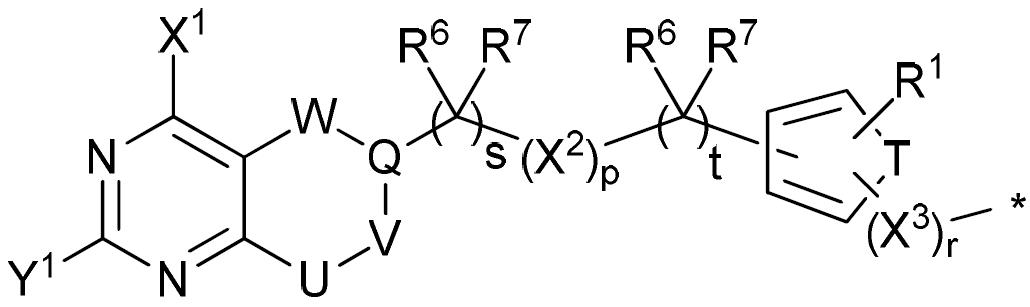
在又另一實施例中,可投與包含葉酸之結合物以預防或抑制患者體內之細胞介素釋放症候群(CRS)。CRS可對患者產生有害影響,包括但不限於體重減輕、高熱、肺水腫及血壓危險地下降。In yet another embodiment, a conjugate comprising folic acid can be administered to prevent or inhibit the Cytokine Release Syndrome (CRS) in the patient. CRS can have harmful effects on patients, including but not limited to weight loss, high fever, pulmonary edema, and dangerously low blood pressure.
在此實施例中,包含葉酸之結合物不包含靶向部分,且因此,結合物抑制橋樑與腫瘤之相互作用以預防腫瘤溶解及減少患者體內之CRS。在此實施例中,包含葉酸之結合物中之葉酸部分可包含連接於不包含靶向部分之化學部分的前述段落中所描述之任一葉酸。在一個態樣中,包含葉酸之結合物可包含連接於不包含靶向部分之一或多個胺基酸的葉酸。說明性地,包含葉酸之結合物可具有式
此化合物亦可稱為「EC923」。在此等實施例中,可向患者投與葉酸或包含葉酸之結合物,相對於橋樑(亦即藉由連接子連接於靶向部分之小分子配位體)莫耳過量,諸如葉酸或包含葉酸之結合物相對於藉由連接子連接於靶向部分之小分子配位體過量10倍、過量100倍、過量200倍、過量300倍、過量400倍、過量500倍、過量600倍、過量700倍、過量800倍、過量900倍、過量1000倍或過量10,000倍。相對於藉由連接子連接於靶向部分之小分子配位體的量,抑制橋樑與腫瘤之相互作用所需要的葉酸或包含葉酸之結合物的量可藉由熟習此項技術者來確定。This compound can also be called "EC923". In these embodiments, the patient may be administered folic acid or a combination containing folic acid in excess of the molar amount relative to the bridge (ie, the small molecule ligand attached to the targeting moiety by a linker), such as folic acid or Folic acid conjugates are 10-fold excess, 100-fold excess, 200-fold excess, 300-fold excess, 400-fold excess, 500-fold excess, 600-fold excess, and excess over small molecule ligands linked to the targeting moiety via a linker 700 times, 800 times excess, 900 times excess, 1000 times excess, or 10,000 times excess. The amount of folic acid or a conjugate containing folic acid required to inhibit the interaction between the bridge and the tumor relative to the amount of small molecule ligands attached to the targeting moiety through the linker can be determined by those skilled in the art.
在另一實施例中,可向患者投與抑制CAR T細胞活化之藥劑來抑制CAR T細胞活化及抑制或預防患者體內之CRS。在一個態樣中,藥劑可選自由以下組成之群:淋巴球特異性蛋白質酪胺酸激酶抑制劑(例如達沙替尼(Dasatinib)、PI3激酶抑制劑(例如GDC0980)、托西路單抗(Tociluzumab)、IL-2誘導性T細胞激酶之抑制劑(例如BMS-509744)、JAK抑制劑、BTK抑制劑、SIP促效劑(例如西普尼莫德(Siponimod)及奧紮尼莫(Ozanimod))及阻斷CAR T細胞結合至橋樑但不結合癌症之藥劑(例如螢光素胺、FITC或螢光素鈉)。熟習此項技術者應瞭解,在生理條件下或例如在緩衝液中在生理pH下,FITC (亦即螢光素)可呈鹽(例如螢光素鈉)形式或呈其非鹽形式。因此,在一個實施例中,在將螢光素投與患者時,其可處於其鹽形式(例如螢光素鈉)與其非鹽形式之間的平衡中。在另一實施例中,抑制CAR T細胞活化之救援藥劑可為下式化合物:
此化合物亦可稱為「EC2319」。This compound can also be called "EC2319".
在各種實施例中,救援藥劑可以約0.001 nM至約100 mM、約0.01 nM至約100 mM、約1 nM至約100 mM、約10 nM至約100 mM、約50 nM至約100 mM或約100 nM至約100 mM之濃度呈包括(例如) 0.1 ml、0.2 ml、0.3 ml、0.4 ml、0.5 ml、0.6 ml、0.7 ml、0.8 ml、0.9 ml、1 ml、2 ml、3 ml、4 ml、5 ml、10 ml、100 ml或1000 ml之任何適當體積投與。在其他實施例中,救援藥劑可以約0.01至約300微莫耳/公斤患者體重、約0.06至約100微莫耳/公斤患者體重、約0.06至約90微莫耳/公斤患者體重、約0.06至約80微莫耳/公斤患者體重、約0.06至約70微莫耳/公斤患者體重、約0.06至約60微莫耳/公斤患者體重、約0.06至約50微莫耳/公斤患者體重、約0.06至約40微莫耳/公斤患者體重、約0.06至約30微莫耳/公斤患者體重、約0.06至約20微莫耳/公斤患者體重、約0.06至約10微莫耳/公斤患者體重、約0.06至約8微莫耳/公斤患者體重或約0.06至約6微莫耳/公斤患者體重之劑量投與。In various embodiments, the rescue agent may be about 0.001 nM to about 100 mM, about 0.01 nM to about 100 mM, about 1 nM to about 100 mM, about 10 nM to about 100 mM, about 50 nM to about 100 mM, or about Concentrations from 100 nM to about 100 mM include (for example) 0.1 ml, 0.2 ml, 0.3 ml, 0.4 ml, 0.5 ml, 0.6 ml, 0.7 ml, 0.8 ml, 0.9 ml, 1 ml, 2 ml, 3 ml, 4 Any suitable volume of ml, 5 ml, 10 ml, 100 ml or 1000 ml is administered. In other embodiments, the rescue agent may be from about 0.01 to about 300 micromoles/kg patient body weight, about 0.06 to about 100 micromoles/kg patient body weight, about 0.06 to about 90 micromoles/kg patient body weight, about 0.06 To about 80 micromolar/kg patient body weight, about 0.06 to about 70 micromolar/kg patient body weight, about 0.06 to about 60 micromolar/kg patient body weight, about 0.06 to about 50 micromolar/kg patient body weight, About 0.06 to about 40 micromoles/kg patient body weight, about 0.06 to about 30 micromoles/kg patient body weight, about 0.06 to about 20 micromoles/kg patient body weight, about 0.06 to about 10 micromoles/kg patient body weight Body weight, a dose of about 0.06 to about 8 micromoles/kg patient body weight or about 0.06 to about 6 micromoles/kg patient body weight is administered.
在此等實施例中,可向患者投與救援藥劑,相對於化合物或其醫藥學上可接受之鹽(亦即藉由連接子連接於靶向部分之小分子配位體)莫耳過量,諸如救援藥劑相對於藉由連接子連接於靶向部分之小分子配位體約10倍過量、約20倍過量、約30倍過量、約40倍過量、約50倍過量、約60倍過量、約70倍過量、約80倍過量、約90倍過量、約100倍過量、約200倍過量、約300倍過量、約400倍過量、約500倍過量、約600倍過量、約700倍過量、約800倍過量、約900倍過量、約1000倍過量或約10,000倍過量。相對於藉由連接子連接於靶向部分之小分子配位體的量,抑制化合物或其醫藥學上可接受之鹽與腫瘤及/或CAR T細胞的相互作用所需要之救援藥劑的量可藉由熟習此項技術者來確定。In these embodiments, the rescue agent may be administered to the patient in excess of the molar amount of the compound or its pharmaceutically acceptable salt (ie, the small molecule ligand attached to the targeting moiety by a linker), Such as rescue agent is about 10-fold excess, about 20-fold excess, about 30-fold excess, about 40-fold excess, about 50-fold excess, about 60-fold excess with respect to the small molecule ligand linked to the targeting moiety by a linker About 70 times excess, about 80 times excess, about 90 times excess, about 100 times excess, about 200 times excess, about 300 times excess, about 400 times excess, about 500 times excess, about 600 times excess, about 700 times excess, About 800-fold excess, about 900-fold excess, about 1000-fold excess, or about 10,000-fold excess. The amount of rescue agent required to inhibit the interaction of a compound or its pharmaceutically acceptable salt with tumors and/or CAR T cells can be reduced relative to the amount of small molecule ligands attached to the targeting moiety via a linker Determined by those skilled in the art.
在另一實施例中,可向患者投與超過一次劑量之葉酸、包含葉酸之結合物或抑制CAR T細胞活化之藥劑,其中包含葉酸之結合物不包含靶向部分。In another embodiment, the patient may be administered more than one dose of folic acid, a folic acid-containing conjugate, or an agent that inhibits CAR T cell activation, where the folic acid-containing conjugate does not include a targeting moiety.
在本文中所描述之「救援藥劑」實施例中,葉酸、包含葉酸之結合物或抑制CAR T細胞活化之藥劑可在化合物或其醫藥學上可接受之鹽之前及/或之後投與患者,其中包含葉酸之結合物不包含靶向部分。在另一態樣中,可在投與葉酸、包含葉酸之結合物或抑制CAR T細胞活化之藥劑之前及之後投與化合物或其醫藥學上可接受之鹽,其中包含葉酸之結合物不包含靶向部分。在此實施例中,化合物或其醫藥學上可接受之鹽之後一投與可導致患者體內之CAR T細胞活化及細胞介素含量增加。In the examples of "rescue agents" described herein, folic acid, a combination containing folic acid, or an agent that inhibits CAR T cell activation can be administered to the patient before and/or after the compound or its pharmaceutically acceptable salt, Conjugates containing folic acid do not contain targeting moieties. In another aspect, the compound or a pharmaceutically acceptable salt thereof can be administered before and after administration of folic acid, a conjugate containing folic acid, or an agent that inhibits CAR T cell activation, wherein the conjugate containing folic acid does not contain Targeting part. In this embodiment, subsequent administration of the compound or its pharmaceutically acceptable salt can result in the activation of CAR T cells and increased levels of interleukins in the patient.
在另一實施例中,投與葉酸、包含葉酸之結合物或抑制CAR T細胞活化之藥劑可引起患者中細胞介素含量降低,其中包含葉酸之該結合物不包含靶向部分。在另一實施例中,細胞介素含量降低為降低至約未經治療之患者中之細胞介素含量。在其他實施例中,當CRS級別達到1、2、3或4時或當CRS級別達到3或4時向患者投與抑制CAR T細胞活化之藥劑。In another embodiment, administration of folic acid, a folic acid-containing conjugate, or an agent that inhibits CAR T cell activation can cause a reduction in the content of interleukins in the patient, where the folic acid-containing conjugate does not include a targeting moiety. In another embodiment, the reduction in interleukin content is reduced to about the level of interleukin in untreated patients. In other embodiments, an agent that inhibits CAR T cell activation is administered to the patient when the CRS level reaches 1, 2, 3, or 4 or when the CRS level reaches 3 or 4.
在本文中描述之葉酸為藉由連接子連接於靶向部分之配位體的實施例中之任一者中,在用本文中所描述的方法治療之前可為患者規定葉酸缺失型飲食,或患者可在飲食中投與葉酸。在患者經投與葉酸之實施例中,劑量可例如介於約50 nmol/kg患者體重至約3000 nmol/kg患者體重、約50 nmol/kg患者體重至約2000 nmol/kg患者體重、約50 nmol/kg患者體重至約1000 nmol/kg患者體重、約50 nmol/kg患者體重至約900 nmol/kg患者體重、約50 nmol/kg患者體重至約800 nmol/kg患者體重、約50 nmol/kg患者體重至約700 nmol/kg患者體重、約50 nmol/kg患者體重至約600 nmol/kg患者體重、約50 nmol/kg患者體重至約500 nmol/kg患者體重、約50 nmol/kg患者體重至約400 nmol/kg患者體重、約50 nmol/kg患者體重至約300 nmol/kg患者體重、約50 nmol/kg患者體重至約200 nmol/kg患者體重、約50 nmol/kg患者體重至約100 nmol/kg患者體重、約100 nmol/kg患者體重至約300 nmol/kg患者體重、約100 nmol/kg患者體重至約500 nmol/kg患者體重、約100 nmol/kg患者體重至約1000 nmol/kg患者體重、約100 nmol/kg患者體重至約2000 nmol/kg患者體重之範圍。在其他實施例中,劑量可為約100 nmol/kg、約150 nmol/kg、約200 nmol/kg、約250 nmol/kg、約300 nmol/kg、約350 nmol/kg、約400 nmol/kg、約450 nmol/kg、約500 nmol/kg、約600 nmol/kg、約700 nmol/kg、約800 nmol/kg、約900 nmol/kg、約1000 nmol/kg、約2000 nmol/kg或約3000 nmol/kg患者體重。在此等實施例中,「kg」為患者體重之公斤數。在一個態樣中,可例如每日、每週、兩週一次、一週三次或使用葉酸之投與的任何適合之方案投與葉酸。In any of the embodiments in which folic acid described herein is a ligand linked to a targeting moiety by a linker, the patient may be prescribed a folic acid-deficient diet before treatment with the methods described herein, or Patients can administer folic acid in their diet. In embodiments where the patient is administered folic acid, the dosage may be, for example, between about 50 nmol/kg patient body weight to about 3000 nmol/kg patient body weight, about 50 nmol/kg patient body weight to about 2000 nmol/kg patient body weight, about 50 nmol/kg patient body weight to about 1000 nmol/kg patient body weight, about 50 nmol/kg patient body weight to about 900 nmol/kg patient body weight, about 50 nmol/kg patient body weight to about 800 nmol/kg patient body weight, about 50 nmol/kg kg patient body weight to about 700 nmol/kg patient body weight, about 50 nmol/kg patient body weight to about 600 nmol/kg patient body weight, about 50 nmol/kg patient body weight to about 500 nmol/kg patient body weight, about 50 nmol/kg patient body weight Body weight to about 400 nmol/kg patient body weight, about 50 nmol/kg patient body weight to about 300 nmol/kg patient body weight, about 50 nmol/kg patient body weight to about 200 nmol/kg patient body weight, about 50 nmol/kg patient body weight to About 100 nmol/kg patient body weight, about 100 nmol/kg patient body weight to about 300 nmol/kg patient body weight, about 100 nmol/kg patient body weight to about 500 nmol/kg patient body weight, about 100 nmol/kg patient body weight to about 1000 The range of nmol/kg patient body weight, about 100 nmol/kg patient body weight to about 2000 nmol/kg patient body weight. In other embodiments, the dose may be about 100 nmol/kg, about 150 nmol/kg, about 200 nmol/kg, about 250 nmol/kg, about 300 nmol/kg, about 350 nmol/kg, about 400 nmol/kg , About 450 nmol/kg, about 500 nmol/kg, about 600 nmol/kg, about 700 nmol/kg, about 800 nmol/kg, about 900 nmol/kg, about 1000 nmol/kg, about 2000 nmol/kg or about 3000 nmol/kg patient weight. In these embodiments, "kg" is the number of kilograms of the patient's weight. In one aspect, folic acid can be administered, for example, daily, weekly, biweekly, three times a week, or any suitable regimen using folic acid administration.
在本文中所描述的各種實施例中,CAR T細胞可在CAR T細胞投與後長至約10天、長至約15天、長至約20天、長至約25天、長至約30天、長至約35天、長至約40天、長至約45天、長至約50天、長至約55天、長至約60天、長至約65天、長至約70天、長至約75天或長至約80天保持循環CAR T細胞之數量增加。In various embodiments described herein, CAR T cells can grow to about 10 days, to about 15 days, to about 20 days, to about 25 days, to about 30 days after CAR T cell administration Days, up to about 35 days, up to about 40 days, up to about 45 days, up to about 50 days, up to about 55 days, up to about 60 days, up to about 65 days, up to about 70 days, Keeping up to about 75 days or up to about 80 days keeps increasing the number of circulating CAR T cells.
在本文中所描述的各種實施例中,化合物或其醫藥學上可接受之鹽的半最大有效濃度(EC50 )可為約1 pM至約2 nM、約1 pM至約5 nM、約1 pM至約10 nM、約1 pM至約20 nM、約1 pM至約30 nM、約1 pM至約40 nM、約1 pM至約50 nM、約1 pM至約60 nM、約1 pM至約70 nM、約1 pM至約80 nM、約1 pM至約90 nM、約1 pM至約100 nM、約1 pM至約200 nM、約1 pM至約300 nM、約1 pM至約400 nM、約1 pM至約500 nM、約1 pM至約600 nM、約1 pM至約700 nM、約1 pM至約800 nM、約1 pM至約900 nM、約1 pM至約1 nM、約1 pM至約900 pM、約1 pM至約800 pM、約1 pM至約700 pM、約1 pM至約600 pM、約1 pM至約500 pM、約1 pM至約400 pM、約1 pM至約300 pM、約1 pM至約200 pM、約1 pM至約100 pM、約1 pM至約90 pM、約1 pM至約80 pM、約1 pM至約70 pM、約1 pM至約60 pM、約1 pM至約50 pM、約1 pM至約40 pM、約1 pM至約30 pM、約1 pM至約20 pM、約1 pM至約10 pM或約1 pM至約5 pM。In various embodiments described herein, the half-maximal effective concentration (EC 50 ) of the compound or a pharmaceutically acceptable salt thereof may be about 1 pM to about 2 nM, about 1 pM to about 5 nM, about 1 pM to about 10 nM, about 1 pM to about 20 nM, about 1 pM to about 30 nM, about 1 pM to about 40 nM, about 1 pM to about 50 nM, about 1 pM to about 60 nM, about 1 pM to About 70 nM, about 1 pM to about 80 nM, about 1 pM to about 90 nM, about 1 pM to about 100 nM, about 1 pM to about 200 nM, about 1 pM to about 300 nM, about 1 pM to about 400 nM, about 1 pM to about 500 nM, about 1 pM to about 600 nM, about 1 pM to about 700 nM, about 1 pM to about 800 nM, about 1 pM to about 900 nM, about 1 pM to about 1 nM, About 1 pM to about 900 pM, about 1 pM to about 800 pM, about 1 pM to about 700 pM, about 1 pM to about 600 pM, about 1 pM to about 500 pM, about 1 pM to about 400 pM, about 1 pM to about 300 pM, about 1 pM to about 200 pM, about 1 pM to about 100 pM, about 1 pM to about 90 pM, about 1 pM to about 80 pM, about 1 pM to about 70 pM, about 1 pM to About 60 pM, about 1 pM to about 50 pM, about 1 pM to about 40 pM, about 1 pM to about 30 pM, about 1 pM to about 20 pM, about 1 pM to about 10 pM or about 1 pM to about 5 pM.
在本文中所描述的各種實施例中,化合物或其醫藥學上可接受之鹽與CAR T細胞之結合的Kd可為約1 nM至約100 nM、約1 nM至約200 nM、約1 nM至約300 nM、約1 nM至約400 nM、約1 nM至約500 nM、約1 nM至約600 nM、約1 nM至約700 nM、約1 nM至約800 nM、約1 nM至約900 nM、約100 nM至約500 nM、約100 nM至約400 nM、約100 nM至約300 nM、約100 nM至約200 nM、約100 nM至約150 nM或約130 nM。In various embodiments described herein, the Kd of the compound or a pharmaceutically acceptable salt thereof in combination with CAR T cells may be about 1 nM to about 100 nM, about 1 nM to about 200 nM, about 1 nM To about 300 nM, about 1 nM to about 400 nM, about 1 nM to about 500 nM, about 1 nM to about 600 nM, about 1 nM to about 700 nM, about 1 nM to about 800 nM, about 1 nM to about 900 nM, about 100 nM to about 500 nM, about 100 nM to about 400 nM, about 100 nM to about 300 nM, about 100 nM to about 200 nM, about 100 nM to about 150 nM, or about 130 nM.
在本文中所描述之各種實施例中,可使用經EGFRt分選或未分選之CAR T細胞。在另一實施例中,可使用具有低分化特徵之「臨床傳真」批量之CAR T細胞。在另一實施例中,可使用「研究批量」之CAR T細胞。「臨床傳真」批量(約39% EGFRt+)可包含呈約66% TSCM 及約32% TCM 之CD4+亞組及呈約95% TSCM 及約3% TCM 的CD8亞組。研究批量(約23% EGFRt+)可包含呈約32% TSCM 、約53% TCM 、約11% TEM 及約3.7% TEFF 之CD4亞組及呈約44% TSCM 、約0.28% TCM 、約3.4% TEM 及約52% TEFF 的CD8亞組。In the various embodiments described herein, CAR T cells sorted or not sorted by EGFRt can be used. In another embodiment, CAR T cells in "clinical fax" batches with low differentiation characteristics may be used. In another embodiment, "study batch" CAR T cells can be used. The "clinical fax" batch (about 39% EGFRt+) may include the CD4+ subgroup with about 66% T SCM and about 32% T CM and the CD8 subgroup with about 95% T SCM and about 3% T CM . The research batch (approximately 23% EGFRt+) may include the CD4 subgroup with approximately 32% T SCM , approximately 53% T CM , approximately 11% T EM and approximately 3.7% T EFF and approximately 44% T SCM and approximately 0.28% T CD8 subgroup of CM , about 3.4% T EM and about 52% T EFF .
在本文中所描述的各種說明性實施例中,可首先在CAR T細胞之前或之後約1、約2、約3、約4、約5、約6、約7、約8、約9或約10天或在CAR T細胞之前或之後的任一適當天時向患者投與化合物或其醫藥學上可接受之鹽。In the various illustrative embodiments described herein, first, about 1, about 2, about 3, about 4, about 5, about 6, about 7, about 8, about 9, or about 9 or about The compound or a pharmaceutically acceptable salt thereof is administered to the patient 10 days or any appropriate day before or after CAR T cells.
在本文中所描述的方法之一個實施例中,在向患者投與化合物或其醫藥學上可接受之鹽之前或在向患者投與CAR T細胞組合物之前使癌症成像。在一個說明性實施例中,成像藉由PET成像進行。在其他說明性實施例中,成像藉由MRI成像或SPECT/CT成像進行。成像方法可為此項技術中已知之任何適合之成像方法。在一個實施例中,成像方法可涉及本文中所描述的但連接於適用於本文中所描述之成像類型之成像劑以判定患者之葉酸受體表現是否為陽性的小分子配位體之用途。在另一實施例中,可出於此目的使用免疫組織化學分析。In one embodiment of the methods described herein, the cancer is imaged before administering the compound or pharmaceutically acceptable salt thereof to the patient or before administering the CAR T cell composition to the patient. In an illustrative embodiment, imaging is performed by PET imaging. In other illustrative embodiments, the imaging is performed by MRI imaging or SPECT/CT imaging. The imaging method may be any suitable imaging method known in the art. In one embodiment, the imaging method may involve the use of a small molecule ligand described herein but linked to an imaging agent suitable for the type of imaging described herein to determine whether the patient's folate receptor is positive. In another embodiment, immunohistochemical analysis may be used for this purpose.
在本文中所描述之實施例中的任一者中,即使出現針對癌症之CAR T細胞毒性,在患者中亦可能不會出現產生脫靶毒性的細胞介素釋放。在本文中所描述之任何實施例中,即使出現針對癌症之CAR T細胞毒性,在患者中亦可能不會出現脫靶組織毒性。在本文中所描述之任何實施例中,癌症可包含腫瘤,且即使未出現脫靶毒性,患者中腫瘤大小亦可減小。在本文中所描述的實施例中之任一者中,可減少或預防CRS且方法可引起患者中腫瘤體積減小。在本文中所描述的任何實施例中,可減小或預防歸因於CRS及CAR T細胞耗竭之體重減輕。在本文中所描述的任何實施例中,癌症可包含腫瘤且可獲得腫瘤之完全反應。In any of the embodiments described herein, even if CAR T cytotoxicity against cancer occurs, cytokine release that produces off-target toxicity may not occur in patients. In any of the embodiments described herein, even if CAR T cytotoxicity against cancer occurs, off-target tissue toxicity may not occur in patients. In any of the embodiments described herein, the cancer can include a tumor, and the tumor size in the patient can be reduced even if off-target toxicity does not occur. In any of the embodiments described herein, CRS can be reduced or prevented and the method can cause a reduction in tumor volume in the patient. In any of the embodiments described herein, weight loss due to CRS and CAR T cell depletion can be reduced or prevented. In any of the embodiments described herein, the cancer may include a tumor and a complete response of the tumor may be obtained.
實例1合成 FITC- 葉酸 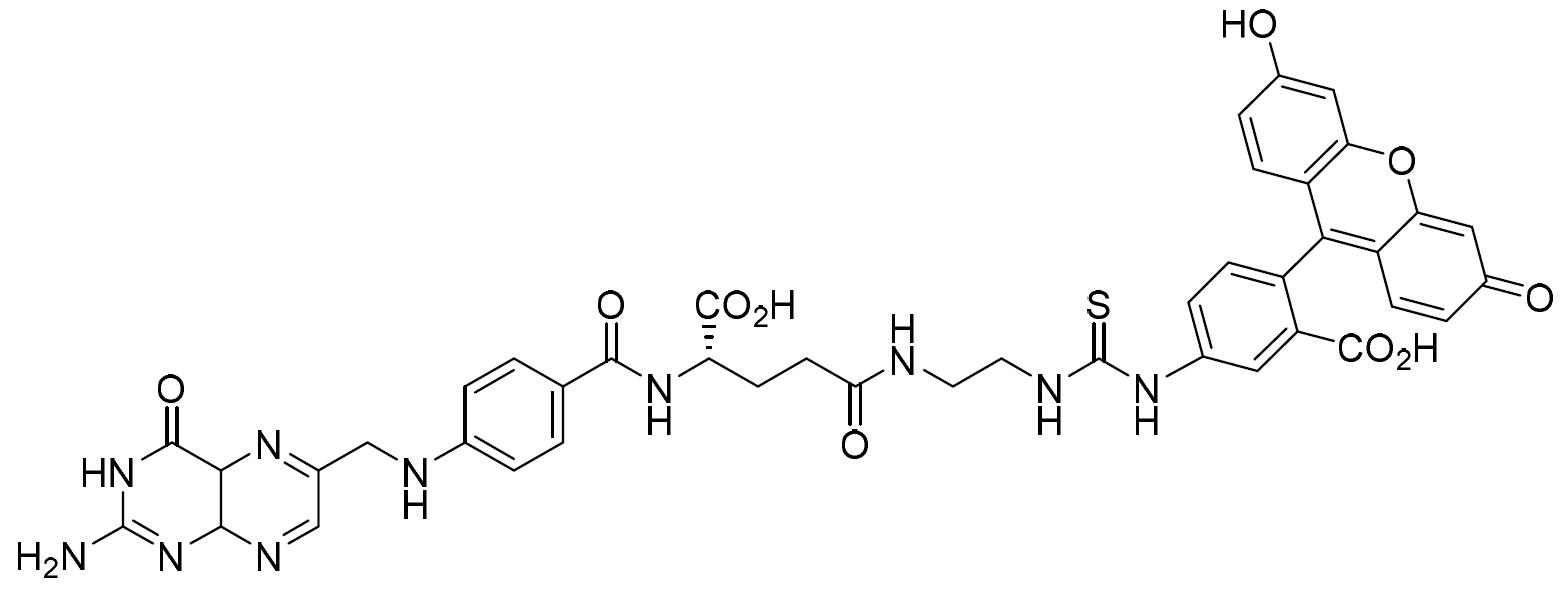
實例2合成 FITC-PEG12- 葉酸 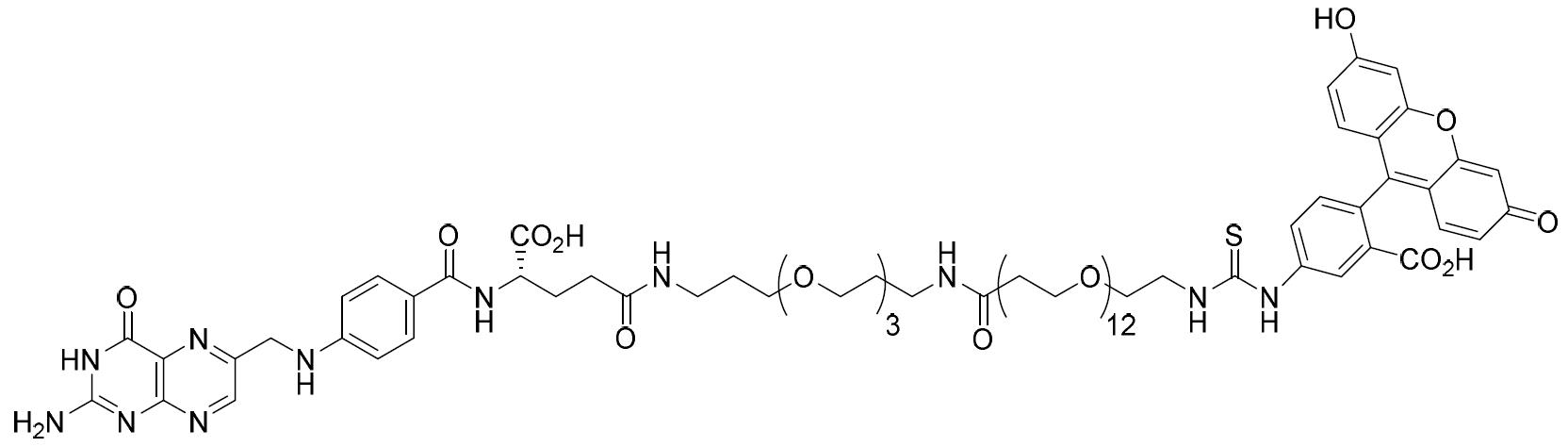
實例3合成 FITC-PEG20- 葉酸 
沈澱物藉由離心收集,用乙醚洗滌(3次)且在高真空下乾燥。在室溫下將經乾燥之葉酸-PEG20 -EDA (1.0當量)用含FITC (50 mg,1.5當量)之DMSO及DIPEA處理。藉由LCMS監測反應之進展。在8 h之後,起始物質耗盡,得到產物。藉由製備型HPLC (移動相A = 10 mM乙酸銨,pH = 7;有機相B =乙腈;方法:在13 mL/min下,35分鐘內0% B至30% B)純化粗反應混合物且得到FITC-PEG20-葉酸,產率60%。The precipitate was collected by centrifugation, washed with ether (3 times) and dried under high vacuum. The dried folic acid-PEG 20 -EDA (1.0 equivalent) was treated with DMSO and DIPEA containing FITC (50 mg, 1.5 equivalent) at room temperature. The progress of the reaction was monitored by LCMS. After 8 h, the starting material was consumed and the product was obtained. The crude reaction mixture was purified by preparative HPLC (mobile phase A = 10 mM ammonium acetate, pH = 7; organic phase B = acetonitrile; method: at 13 mL/min, 0% B to 30% B in 35 minutes) and FITC-PEG20-folate was obtained in 60% yield.
實例4合成 FITC-PEG108- 葉酸 
沈澱物藉由離心收集,用乙醚洗滌(3次)且在高真空下乾燥。在室溫下將經乾燥之葉酸-PEG108 -EDA (1.0當量)用含FITC (50 mg,1.5當量)之DMSO及DIPEA處理。藉由LCMS監測反應進展。在10 h之後,起始物質耗盡,得到產物。藉由製備型HPLC (移動相A = 10 mM乙酸銨,pH = 7;有機相B =乙腈;方法:在13 mL/min下,35分鐘內0% B至30% B)純化粗反應混合物且得到FITC-PEG108-葉酸,產率64%。The precipitate was collected by centrifugation, washed with ether (3 times) and dried under high vacuum. The dried folate-PEG 108 -EDA (1.0 equivalent) was treated with DMSO and DIPEA containing FITC (50 mg, 1.5 equivalent) at room temperature. The progress of the reaction was monitored by LCMS. After 10 h, the starting material was consumed and the product was obtained. The crude reaction mixture was purified by preparative HPLC (mobile phase A = 10 mM ammonium acetate, pH = 7; organic phase B = acetonitrile; method: at 13 mL/min, 0% B to 30% B in 35 minutes) and FITC-PEG108-folate was obtained with a yield of 64%.
實例5合成 FITC-DUPA 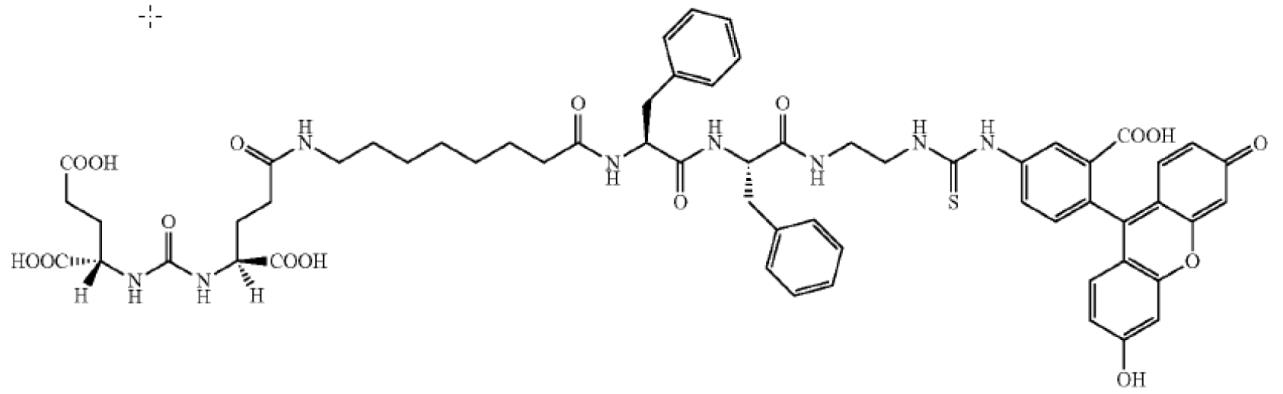
實例6合成 FITC-PEG12-DUPA 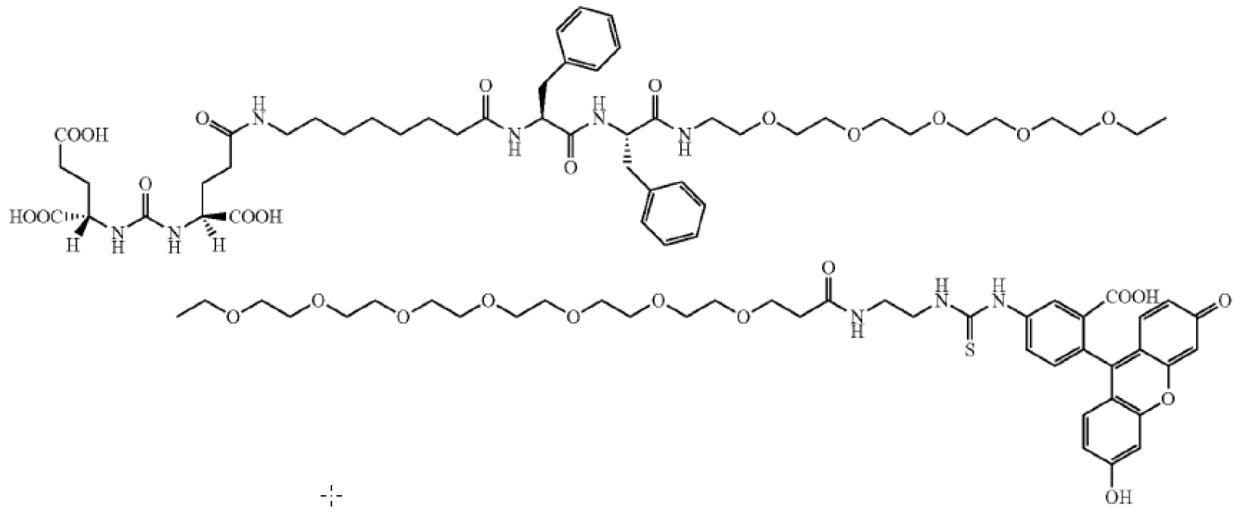
實例7合成 FITC-PEG11-NK1 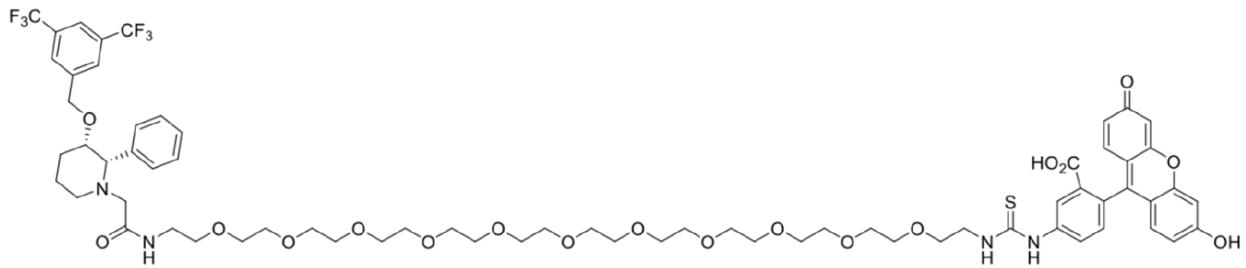
*注意:藉由自鹼基配位體開始之二步驟程序合成NK-1化合物,該鹼基配位體藉由使用文獻中之程序製備。(參考:DESIGN AND DEVELOPMENT OF NEUROKININ-1 RECEPTOR-BINDING AGENT DELIVERY CONJUGATES,申請案號:PCT/US2015/44229;以引用之方式併入本文中。)*Note: The NK-1 compound is synthesized by a two-step procedure starting from the base ligand, which is prepared by using the procedures in the literature. (Reference: DESIGN AND DEVELOPMENT OF NEUROKININ-1 RECEPTOR-BINDING AGENT DELIVERY CONJUGATES, application number: PCT/US2015/44229; incorporated herein by reference.)
實例8合成 FITC-PEG2-CA9 
實例9T 細胞 製備 藉由使用Ficoll密度梯度離心(GE Healthcare Lifesciences),自健康供體之全血分離人類外周血液單核細胞(PBMC)。隨後藉由使用EasySep™人類T細胞分離套組(STEM CELL technologies)自PBMC分離T細胞。將T細胞在具有40-100 IU/mL人類IL-2 (Miltenyi Biotech)、2%人類AB型血清及1%青黴素/鏈黴素硫酸鹽之TexMACS培養基(Miltenyi Biotech Inc)中培養。將Dynabeads人類T-活化劑CD3/CD28 (ThermoFisher Scientific)以1:1比率添加至T細胞以活化T細胞。活化後12-24小時,在8 µg/mL聚凝胺(Santa Cruiz Biotech)存在之情況下,藉由在22-32℃下在1,200g 下離心感染90分鐘,將T細胞用FITC-CAR慢病毒粒子轉導。在移除活化珠粒之前,將含有具有CAR修飾之T細胞(CAR-T)及不具有CAR修飾之T細胞(未轉型T)的T細胞混合物在活化珠粒存在之情況下培養6天。螢光活化之細胞分選術用於基於GFP表現分選出CAR-T細胞(GFP陽性)及未轉型T細胞(GFP陰性)。在注射至小鼠中之前將經分選之T細胞培養7-15天。當使用T細胞混合物時,在小鼠注射之前將CAR-T細胞與未轉型T細胞以所需比率混合。Example 9 T cell preparation Human peripheral blood mononuclear cells (PBMC) were isolated from whole blood of healthy donors by using Ficoll density gradient centrifugation (GE Healthcare Lifesciences). T cells were then isolated from PBMC by using EasySep™ Human T Cell Isolation Kit (STEM CELL technologies). T cells were cultured in TexMACS medium (Miltenyi Biotech Inc) with 40-100 IU/mL human IL-2 (Miltenyi Biotech), 2% human AB serum and 1% penicillin/streptomycin sulfate. Dynabeads human T-activator CD3/CD28 (ThermoFisher Scientific) was added to T cells at a 1:1 ratio to activate T cells. 12-24 hours after activation, in the presence of 8 µg/mL polybrene (Santa Cruiz Biotech), by centrifugation at 1,200 g at 22-32°C for 90 minutes, the T cells were slowed with FITC-CAR Viral particle transduction. Before removing the activated beads, a mixture of T cells containing T cells with CAR modification (CAR-T) and T cells without CAR modification (untransformed T) was cultured in the presence of activated beads for 6 days. Fluorescence activated cell sorting is used to sort out CAR-T cells (GFP positive) and untransformed T cells (GFP negative) based on GFP performance. Sorted T cells were cultured for 7-15 days before injection into mice. When using a mixture of T cells, CAR-T cells and untransformed T cells are mixed in the desired ratio before injection in mice.
實例10編碼 CAR 基因之慢病毒載體之產生 重疊PCR方法用於產生包含抗螢光素之scFv的CAR構築體。合成衍生自抗螢光素(4-4-20)抗體之抗螢光素之scFV,4M5.3 (Kd = 270 fM,762bp)。如圖2中所展示,藉由重疊PCR使編碼人類CD8α訊息肽(SP,63bp)、鉸鏈及跨膜區(249bp)、4-1BB (CD137,141bp)及CD3ζ鏈(336bp)之細胞質域的序列與抗螢光素scFV稠合。將所得CAR構築體(1551bp)插入至EcoRI/NotI裂解慢病毒表現載體pCDH-EF1-MCS-(PGK-GFP) (圖2,System Biosciences)中。慢病毒載體中CAR構築體之序列藉由DNA測序來確認。Example 10 Generation of a lentiviral vector encoding a CAR gene The overlapping PCR method was used to generate CAR constructs containing scFv resistant to luciferin. Synthesis of scFV of anti-luciferin derived from anti-luciferin (4-4-20) antibody, 4M5.3 (Kd = 270 fM, 762bp). As shown in Figure 2, by overlapping PCR, the cytoplasmic domains encoding human CD8α signaling peptide (SP, 63bp), hinge and transmembrane region (249bp), 4-1BB (CD137, 141bp), and CD3ζ chain (336bp) The sequence is fused with anti-luciferin scFV. The resulting CAR construct (1551 bp) was inserted into the EcoRI/NotI cleaved lentiviral expression vector pCDH-EF1-MCS-(PGK-GFP) (FIG. 2, System Biosciences). The sequence of the CAR construct in the lentiviral vector was confirmed by DNA sequencing.
一種例示性CAR核酸編碼序列可包含: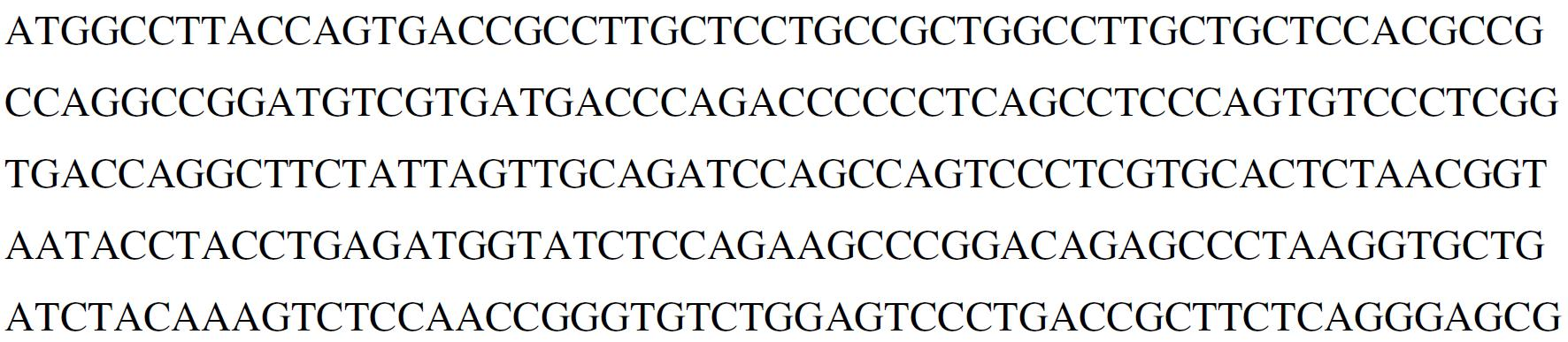
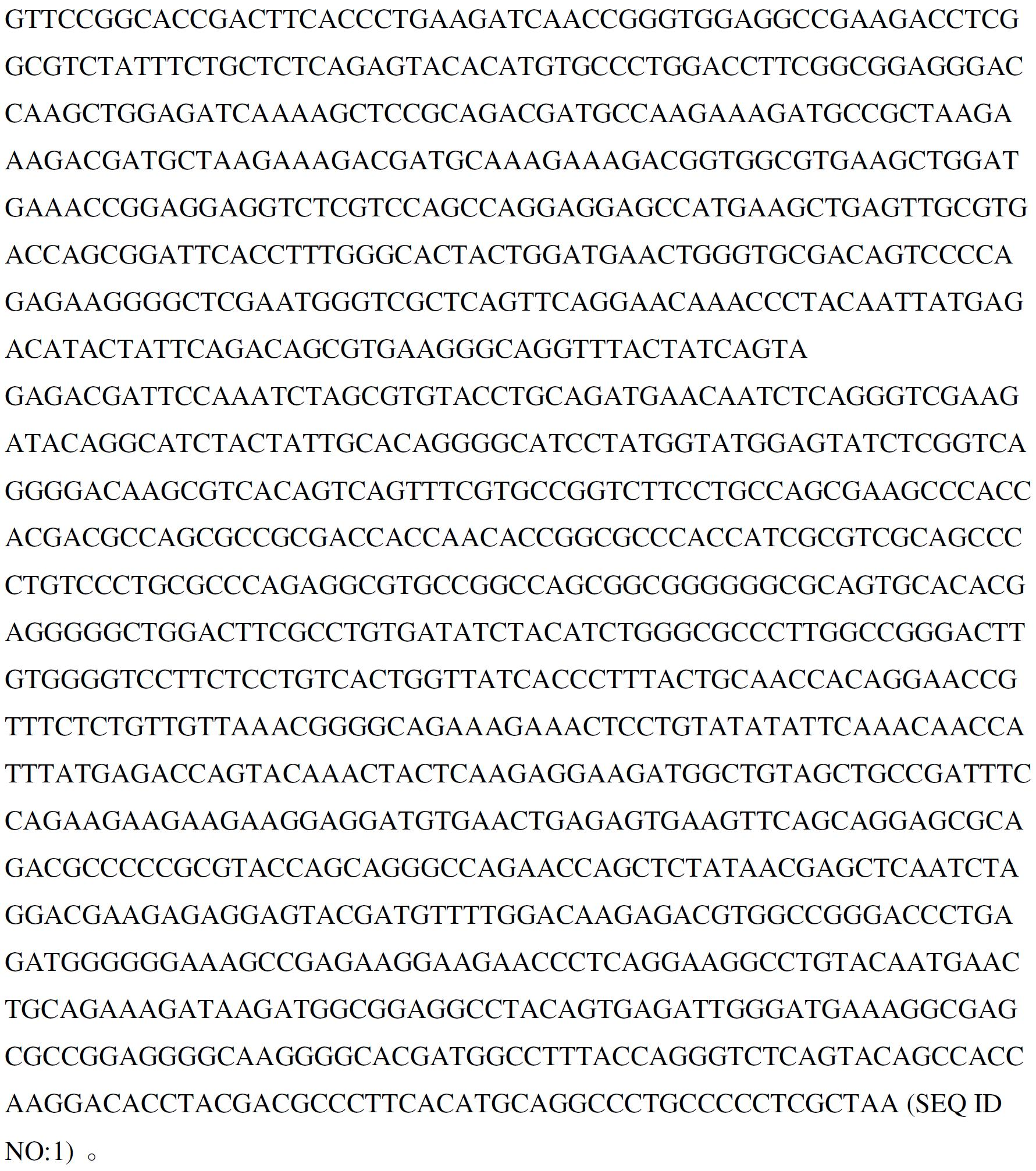
在上文所展示之例示性核酸序列(SEQ ID NO:1)中,第一ATG為起始密碼子。一種例示性CAR胺基酸序列可包含:
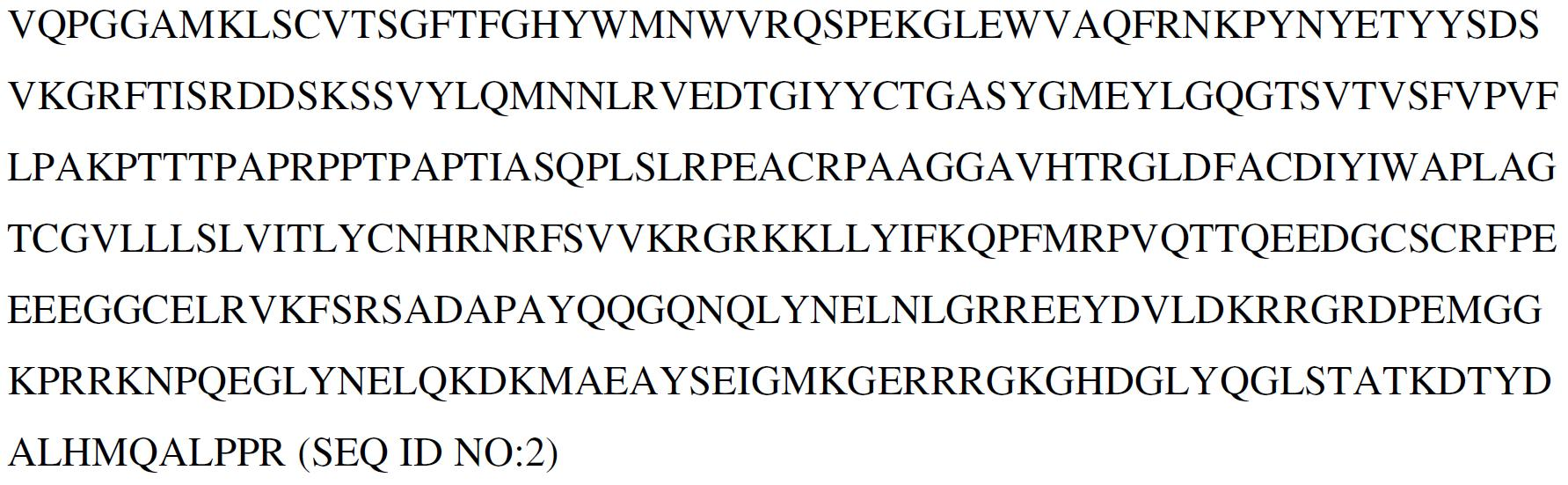
一種例示性插入序列可包含:
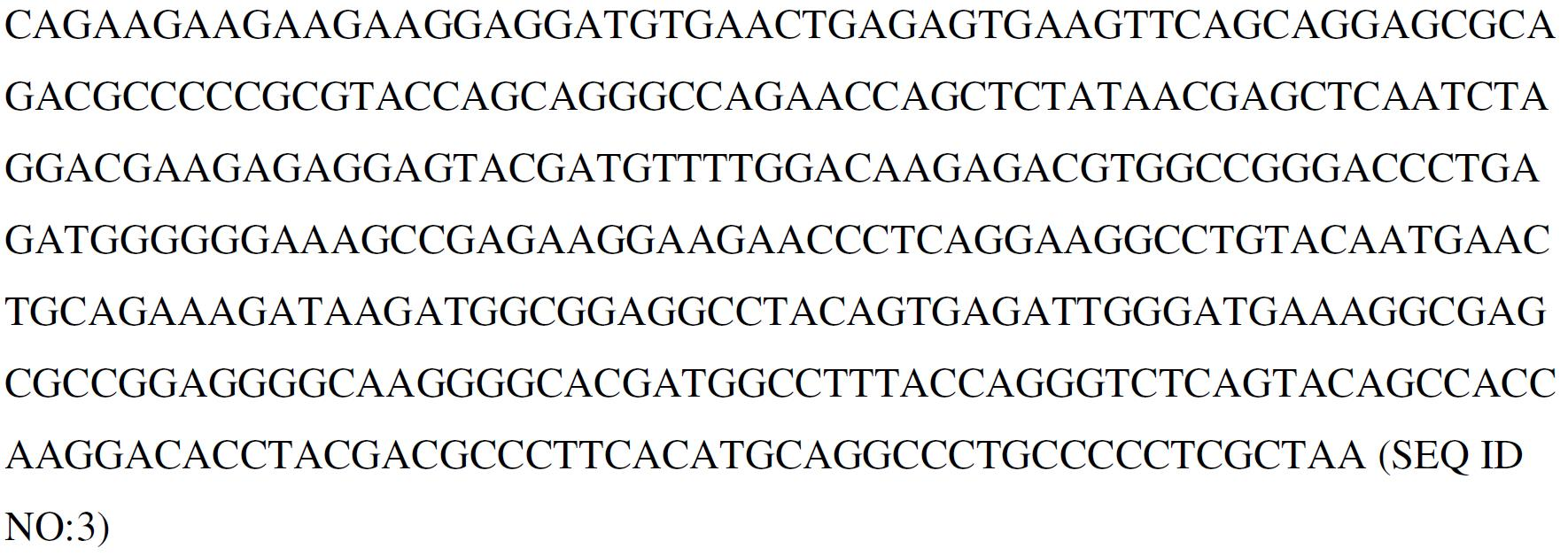
在上文所描述的例示性插入序列(SEQ ID NO:3)中,第一GCCACC序列可包含限制酶裂解位點,隨後為ATG起始密碼子。經編碼之胺基酸序列可包含:
實例11用於人類 T 細胞轉導之含有 CAR 基因之慢病毒的產生 為製備含有抗螢光素(亦即,抗FITC)單鏈片段可變(scFv) CAR之慢病毒,將HEK-293TN包裝細胞株與編碼抗螢光素scFv CAR之慢病毒載體及第2代慢病毒包裝質體混合物(Cellecta)或ViraPower Lentivrial包裝混合物(ThermoFisher)共轉染。轉染24及48小時之後,收穫含有具有CAR基因之慢病毒的上清液且藉由標準聚乙二醇病毒濃縮法(Clontech)濃縮病毒粒子,以供將來用人類T細胞轉導。Example 11 Production of lentiviruses containing CAR genes for transduction of human T cells To prepare lentiviruses containing anti-luciferin (ie, anti-FITC) single-chain fragment variable (scFv) CAR, HEK-293TN was packaged The cell line was co-transfected with a lentiviral vector encoding anti-luciferin scFv CAR and a second-generation lentiviral packaging plastid mixture (Cellecta) or ViraPower Lentivrial packaging mixture (ThermoFisher). 24 and 48 hours after transfection, the supernatant containing the lentivirus with CAR gene was harvested and the virus particles were concentrated by standard polyethylene glycol virus concentration method (Clontech) for future transduction with human T cells.
實例12自人類 PBMC 分離人類 T 細胞 藉由Ficoll密度梯度離心(GE Healthcare Lifesciences)自人類外周血液單核細胞(PBMC)分離T細胞。在洗去剩餘Ficoll溶液後,藉由使用EasySep™人類T細胞分離套組(STEM CELL technologies)分離T細胞。將經純化之T細胞在具有1%青黴素及鏈黴素硫酸鹽之TexMACSTM培養基(Miltenyi Biotech Inc)中在人類IL-2 (100 IU/mL,Miltenyi Biotech Inc)存在之情況下培養。T細胞以1 × 10⁶ 個細胞/毫升之密度在多孔盤中培養。將T細胞分開且每2-3天再次饋入。Example 12 Isolation of human T cells from human PBMC T cells were isolated from human peripheral blood mononuclear cells (PBMC) by Ficoll density gradient centrifugation (GE Healthcare Lifesciences). After washing away the remaining Ficoll solution, T cells were isolated by using EasySep™ Human T Cell Isolation Kit (STEM CELL technologies). The purified T cells were cultured in the presence of human IL-2 (100 IU/mL, Miltenyi Biotech Inc) in TexMACSTM medium (Miltenyi Biotech Inc) with 1% penicillin and streptomycin sulfate. T cells were cultured in multi-well plates at a density of 1 × 10 6 cells/ml. T cells are separated and fed in again every 2-3 days.
實例13人類 T 細胞 之轉導 在人類IL-2 (100 IU/mL)存在之情況下將經分離之T細胞用與抗CD3/CD28抗體(Life Technologies)偶合的Dynabeads活化12-24小時,隨後用編碼抗螢光素CAR基因之慢病毒轉導。72小時後收穫細胞且藉由使用流動式細胞量測術量測GFP螢光細胞來鑑別轉導T細胞上CAR之表現。Example 13 Transduction of human T cells In the presence of human IL-2 (100 IU/mL) isolated T cells were activated with Dynabeads coupled with anti-CD3/CD28 antibody (Life Technologies) for 12-24 hours, followed by Transduced with lentivirus encoding anti-luciferin CAR gene. The cells were harvested 72 hours later and the performance of CAR on transduced T cells was identified by measuring GFP fluorescent cells using flow cytometry.
實例14合成 FITC- 葉酸
在無水二甲亞碸(DMF)中,在四甲基胍及二異丙胺存在之情況下,使葉酸-γ-乙二胺與螢光異硫氰酸鹽(FITC)異構體I (Sigma-Aldrich)偶合。將粗產物載入於Xterra RP18製備型HPLC管柱(Waters)上且用以99% 5 mM磷酸鈉(移動相A,pH 7.4)及1%乙腈(移動相B)開始且在20 mL/min之流動速率下在10 min內達至90% A及10% B的梯度條件溶離。在此等條件下,FITC-葉酸主峰通常在27-50 min溶離。FITC-葉酸溶離份之品質藉由分析型逆相HPLC與UV偵測器監測。將純度超過98.0% (LCMS)之溶離份凍乾以獲得最終FITC-葉酸產物。
實例15合成 FITC-DUPA
藉由如下固相方法合成DUPA-FITC。Universal NovaTag樹脂(50 mg,0.53 mM)用二氯甲烷(DCM) (3 mL)、隨後二甲基甲醯胺(DMF,3 mL)溶脹。將20%哌啶於DMF (3 × 3 mL)中之溶液添加至樹脂,且氬氣軋泡5 min。用DMF (3 × 3 mL)及異丙醇 (i
-PrOH,3 × 3 mL)洗滌樹脂。樹脂在DMF中溶脹之後,添加DUPA-(OtBu)-OH (1.5當量)、HATU (2.5當量)及DIPEA (4.0當量)於DMF中之溶液。氬氣軋泡2 h,且用DMF (3 × 3 mL)及i
-PrOH (3 × 3 mL)洗滌樹脂。樹脂在DCM中溶脹之後,添加1 M HOBt於DCM/三氟乙烷(TFE) (1:1) (2 × 3 mL)中之溶液。氬氣軋泡1 h,移除溶劑且用DMF (3 × 3 mL)及i
-PrOH (3 × 3 mL)洗滌樹脂。樹脂在DMF中溶脹之後,添加Fmoc-Phe-OH (2.5當量)、HATU (2.5當量)及DIPEA (4.0當量)於DMF中之溶液。氬氣軋泡2 h,且用DMF (3 × 3 mL)及i
-PrOH (3 × 3 mL)洗滌樹脂。重複以上順序進行另外2個偶合步驟,以添加8-胺基辛酸及螢光異硫氰酸鹽或若丹明B異硫氰酸鹽。使用三氟乙酸(TFA):H2
O:三異丙基矽烷混合物(95:2.5:2.5)自樹脂裂解最終化合物且在真空下濃縮。濃縮產物在乙醚中沈澱,且在真空下乾燥。使用製備型RP-HPLC [λ = 488 nm;溶劑梯度:25分鐘內1% B至80% B,80% B洗滌30分鐘操作;A = 10 mM NH4
OAc,pH = 7;B = 乙腈(ACN)]純化粗產物。在真空下移除ACN,且凍乾純溶離份,以產生呈淡褐色-橙色固體狀之DUPA-FITC。RP-HPLC:tR = 8.0 min (A = 10 mM NH4OAc,pH = 7.0;B = ACN,溶劑梯度:10分鐘內1% B至50% B,80% B洗滌15分鐘操作)。1H NMR (DMSO-d6/D2O): δ 0.98-1.27 (ms, 9H); 1.45 (b, 3H); 1.68-1.85 (ms, 11H); 2.03 (m, 8H); 2.6-3.44 (ms, 12H); 3.82 (b, 2H); 4.35 (m, 1H); 6.53 (d, J = 8.1 Hz, 2H), 6.61 (dd, J = 5.3, 3.5 Hz, 2H); 6.64 (s, 2H); 7.05 (d, J = 8.2 Hz, 2H), 7.19 (m, 5H); 7.76 (d, J = 8.0 Hz, 1H); 8.38 (s, 1H)。HRMS (ESI) (m/z):C51
H59
N7
O15
S之(M + H)+
計算值,1040.3712,實驗值,1040.3702。UV/vis:λ最大值= 491 nm。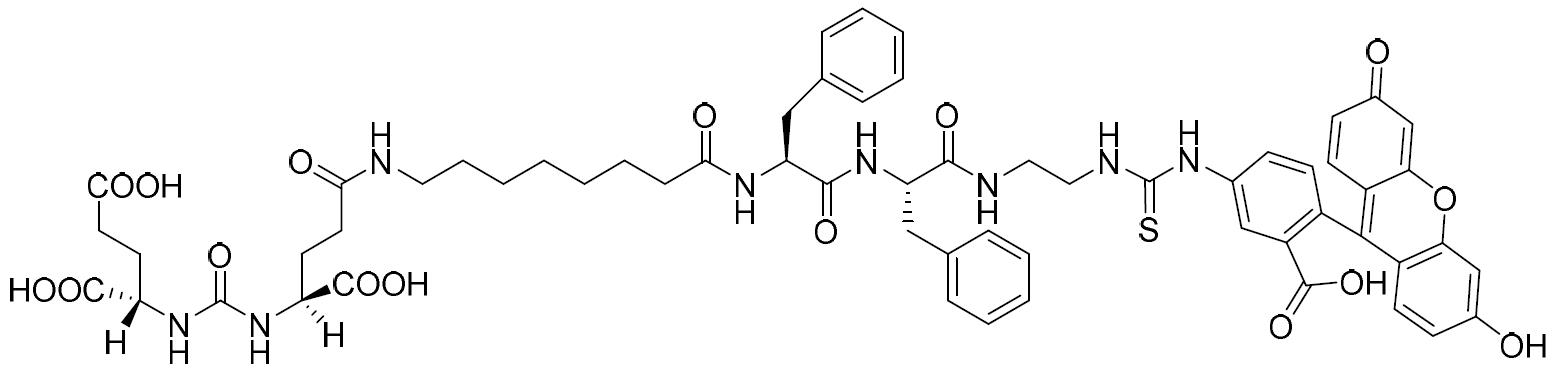
實例16合成 FITC-CA9
在50 mL圓底燒瓶中,使用鐵氟龍磁性攪拌棒使CA9配位體(53.6 mg,實驗室中合成)溶解於所要量之N,N-二甲基甲醯胺(DMF) (2-3 mL)中。使用真空移除環境空氣且用氮氣置換,此循環三次。隨後將圓底燒瓶保持在恆定氮氣下。向燒瓶先後添加28.9 mg N-(3-二甲基胺基丙基)-N'-乙基碳化二亞胺鹽酸鹽(EDC)及21.6 mg 1-羥基苯并三唑水合物(HOBt)及18.9 μL Boc-PEG2-NH2 (購自Sigma Aldrich)。最後添加5.4 μL三乙胺(TEA)且使反應攪拌隔夜。反應混合物使用HPLC純化且用UHPLC-MS (目標m/z為831)確認。使用高真空旋轉蒸發移除乙腈且置於凍乾器上48小時。用1:1 TFA:DCM進行Boc去除保護基,歷時30分鐘。使用高真空旋轉蒸發移除TFA/DCM,隨後高真空30分鐘。隨後使化合物溶解於DMF中且與5莫耳當量之N,N-二異丙基乙胺(DIPEA)合併。將16 mg螢光異硫氰酸鹽(購自Life Technologies)添加至溶液且攪拌1小時。藉由HPLC純化反應混合物且用UHPLC-MS證實目標化合物(標靶m/z為1120)。將樣品置於凍乾器上48小時且將化合物儲存於-20℃下。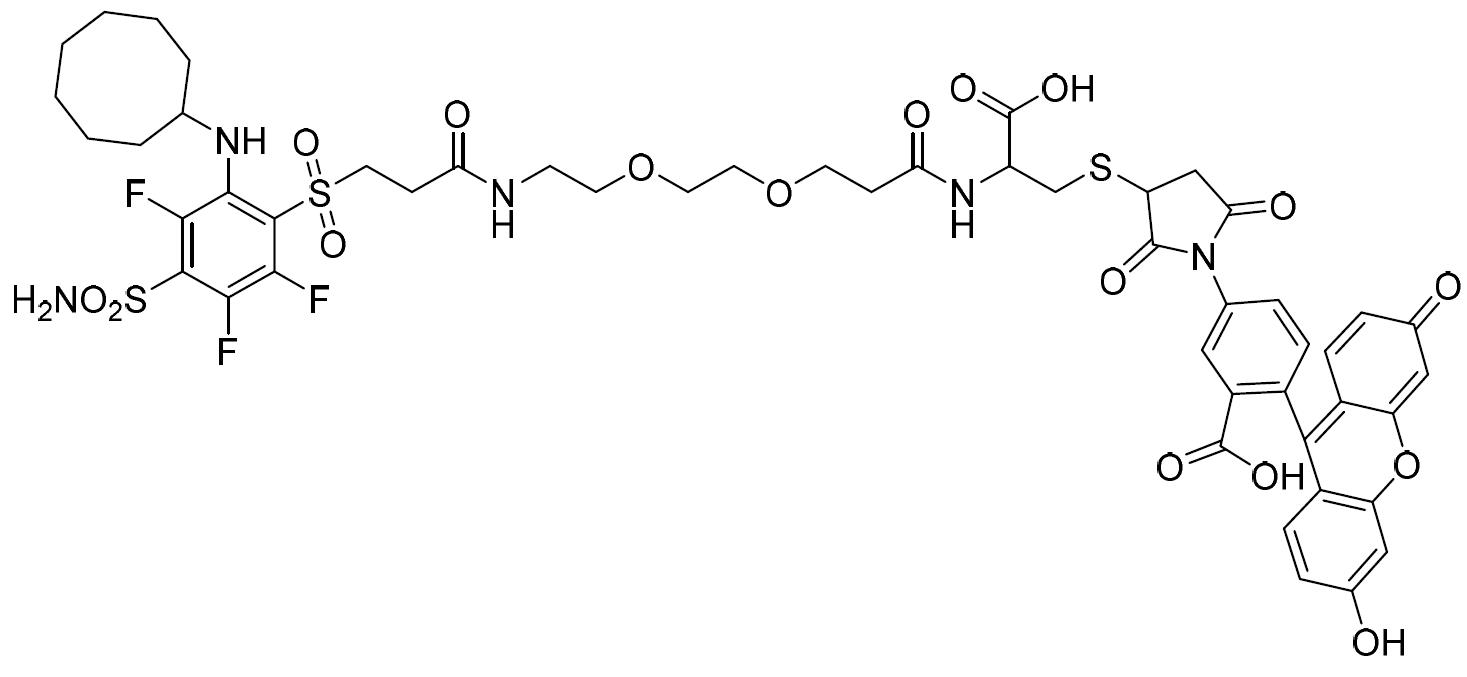
實例17合成 FITC-NK1R
在室溫下在氬氣下向NK-1 (0.02 g,0.0433 mmol,1.0當量)、O-(2-胺基乙基)-O'-[2-(Boc-胺基)乙基]癸乙二醇(BocNH-PEG11
-NH2
) (Sigma,0.0336 g,0.0521 mmol,1.2當量)、六氟磷酸苯并三唑-1-基-氧基三吡咯啶基鏻(PYBOP) (0.027 g,0.0521 mmol,1.2當量)於無水CH2
Cl2
中之攪拌溶液中添加N,N-二異丙基乙胺(DIPEA) (0.076 mL,0.4338 mmol,10當量)。反應進展藉由LCMS監測且藉由製備型RP-HPLC (Waters,XBridgeTM
Prep C18,5 μm;19 × 100 mm管柱,移動相A = 20 mM乙酸銨緩衝液,pH 7,B = 乙腈,梯度30分鐘內10-100% B,13 mL/min,λ = 220 nm,254 nm)純化。收集純溶離份,蒸發所有有機溶劑,且樣品凍乾48小時,得到NK1-PEG11-NHBoc。產率:40.13 mg (97%)。向於乾燥CH2Cl2中之NK1-PEG11-NHBoc (0.0165 g,0.015 mmol)添加三氟乙酸(TFA,20當量),且反應混合物在室溫下攪拌4 h。移除過量TFA,用水稀釋,且使用CH2Cl2 (3 × 5 mL)萃取。經合併之有機層用鹽水洗滌、經(Na2
SO4
)乾燥且濃縮。所得殘餘物在真空下乾燥且未經進一步純化即用於下一步驟。在室溫下在氬氣下將NK1-PEG11
-NH2
(0.008 g,0.0081 mmol,1.0當量)、螢光異硫氰酸鹽(FITC) (Sigma,0.0037 g,0.0097 mmol,1.2當量)於無水二甲亞碸(DMSO,0.3 mL)中之攪拌溶液添加二異丙基乙胺(0.0028 mL,0.0162 mmol,2.0當量)。反應進展藉由LCMS監測且藉由製備型RP-HPLC (Waters,XBridgeTM
Prep C18,5 μm;19 × 100 mm管柱,移動相A = 20 mM乙酸銨緩衝液,pH 7,B = 乙腈,梯度30分鐘內10-100% B,13 mL/min,λ = 280 nm)純化。收集純溶離份,蒸發所有有機溶劑,且樣品凍乾48小時,得到NK1-PEG11-FITC (5)。產率:8.54 mg (77%)。Example 17 Synthesis of FITC-NK1R at room temperature under argon to NK-1 (0.02 g, 0.0433 mmol, 1.0 equivalent), O-(2-aminoethyl)-O'-[2-(Boc-amine Yl)ethyl]decanediol (BocNH-PEG 11 -NH 2 ) (Sigma, 0.0336 g, 0.0521 mmol, 1.2 equivalents), benzotriazol-1-yl-oxytripyrrolidinylphosphonium hexafluorophosphate (PYBOP) (0.027 g, 0.0521 mmol, 1.2 equiv) to a stirred solution in anhydrous CH 2 Cl 2 was added N,N-diisopropylethylamine (DIPEA) (0.076 mL, 0.4338 mmol, 10 equiv). The reaction progress was monitored by LCMS and by preparative RP-HPLC (Waters, XBridge ™ Prep C18, 5 μm; 19 × 100 mm column, mobile phase A = 20 mM ammonium acetate buffer,
藉由自鹼基配位體開始之二步驟程序合成NK-1化合物,該鹼基配位體藉由使用文獻程序製備。(參考:DESIGN AND DEVELOPMENT OF NEUROKININ-1 RECEPTOR-BINDING AGENT DELIVERY CONJUGATES,申請案號:PCT/US2015/44229,以全文引用之方式併入本文中)。The NK-1 compound was synthesized by a two-step procedure starting from a base ligand, which was prepared by using literature procedures. (Reference: DESIGN AND DEVELOPMENT OF NEUROKININ-1 RECEPTOR-BINDING AGENT DELIVERY CONJUGATES, application number: PCT/US2015/44229, incorporated by reference in its entirety).
實例18HOS-FR-α 及 AML 研究概要 
將根據以下規則投與連續遞增劑量之 EC17 :
• 若無CRS或神經毒性,則按規劃通過EC 17劑量遞增推進。
• 若CRS級別< 2,則以在相同循環中引起不嚴重CRS之序列含量投與所有後續EC17劑量。
• 若CRS級別> 2,則在循環中取消其他EC17劑量,且在下文引起sCRS之下一最高序列處開始所有後續循環。 EC17 will be administered in successively increasing doses in accordance with the following rules : • If there is no CRS or neurotoxicity, then it will be promoted through an increasing dose of
A. 腫瘤植入 HOS-FRα (亦即HOS-143b-LV-FRα)為用人類FRα穩定轉染之HOS-143B(ATCC CRL-8303)次純系。HOS-143B最初衍生自患有骨肉瘤之13歲的高加索人女性。腫瘤細胞在5% CO2潮濕大氣中在37℃下在具有5% FBS之葉酸缺失型RPMI 1640中生長。針對活體內研究,以1 × 10⁶ 個細胞/隻動物皮下接種腫瘤細胞。A. Tumor implantation HOS-FRα (that is, HOS-143b-LV-FRα) is a sub-pure line of HOS-143B (ATCC CRL-8303) stably transfected with human FRα. HOS-143B was originally derived from a 13-year-old Caucasian female with osteosarcoma. Tumor cells were grown in folic acid deficient RPMI 1640 with 5% FBS at 37°C in a humidified atmosphere of 5% CO2. For in vivo studies, tumor cells were inoculated subcutaneously with 1 × 10 6 cells/animal.
B. CAR-T細胞投與 經EGFRt分選的抗FITC E2 scFv-CAR T細胞在T細胞冷凍培養基中冷凍。在到達時,即刻將冷凍CAR-T細胞之小瓶儲存於-80℃下。CAR-T細胞在37℃下快速解凍,用PBS洗滌兩次,且以6百萬有活性的EGFRt+E2CAR-T細胞(CD4/CD8為約1:1)/隻動物用於動物注射。在輸液之日取出較小等分試樣以用於E2-CAR T細胞表型之流動式細胞量測分析。B. CAR-T cell administration Anti-FITC E2 scFv-CAR T cells sorted by EGFRt were frozen in T cell freezing medium. Upon arrival, the vials of frozen CAR-T cells were stored at -80°C. CAR-T cells were quickly thawed at 37°C, washed twice with PBS, and used for animal injection with 6 million active EGFRt+E2 CAR-T cells (CD4/CD8 is about 1:1) per animal. On the day of infusion, a smaller aliquot was taken for flow cytometry analysis of the E2-CAR T cell phenotype.
C. 製備投予藥物溶液 EC17投予溶液在投予開始時藉由以下製備:稱取適當量之各化合物,在PBS中重組,pH 7.4,通過0.22 µm PVDF針筒過濾器無菌過濾藥物溶液,且在-20℃下冷凍等分試樣用於每日投予。C. Preparation of drug solution for administration The EC17 administration solution was prepared at the beginning of administration by weighing the appropriate amount of each compound, reconstituted in PBS, pH 7.4, sterile filtering the drug solution through a 0.22 µm PVDF syringe filter, and freezing at -20°C Aliquots are used for daily administration.
D. 化合物投與 至一天結束(3-4 PM),給出所有EC17劑量,以允許隔夜顯現可能的CRS (細胞介素釋放症候群)。在第二天早晨,根據CRS定級系統(參見下文)對動物評分。D. Compound administration By the end of the day (3-4 PM), all EC17 doses are given to allow the possible CRS (cytokine release syndrome) to appear overnight. On the next morning, animals were scored according to the CRS grading system (see below).
E. 評估CRS 定級系統 
腫瘤生長、體重及總評定 :腫瘤大小監測2-3次/週且體重量測2-3次/週。在緊接在任何EC17劑量之後的數天,每日進行體重量測且注意力集中於總體動物形態及行為。 Tumor growth, body weight and total assessment : tumor size monitoring 2-3 times/week and body weight measurement 2-3 times/week. In the days immediately following any EC17 dose, body weight measurements were performed daily and attention was focused on overall animal morphology and behavior.
安樂死 :當小鼠之重量降低≥ 20%時,當腫瘤達至≥ 1500 mm3 時,進行安樂死。若小鼠在短時間內(例如,歸因於重度頭部傾斜)損失大量重量,或當其按照CRS定級系統接近瀕死狀態時,則亦進行安樂死。 Euthanasia : When the weight of the mouse decreases by ≥ 20%, when the tumor reaches ≥ 1500 mm 3 , euthanasia is performed. If the mouse loses a lot of weight in a short period of time (for example, due to severe head tilt), or when it approaches dying according to the CRS grading system, it is also euthanized.
EC17 宿主內劑量遞增治療 (3 次 循環 ) 
如圖4中所見: 群組1 (僅E2-CAR T細胞)展示在無EC17治療之情況下HOS-FRα強力生長。As seen in Figure 4: Cohort 1 (E2-CAR T cells only) demonstrated strong growth of HOS-FRα without EC17 treatment.
群組2(EC17 5/100/1000 nmol/kg,M/Th/M)通過此研究展示在無體重減輕或CRS之情況下的顯著腫瘤消退。Cohort 2 (
減慢EC17劑量遞增(M/Th/M)方案為安全的。在HOS-FRα帶有腫瘤之小鼠中未觀測到體重減輕或細胞介素釋放症候群(CRS)之症狀。It is safe to slow down the EC17 dose escalation (M/Th/M) regimen. No symptoms of weight loss or cytokine release syndrome (CRS) were observed in HOS-FRα tumor-bearing mice.
此E2-CAR T細胞研究的一種目標為使用在CAR-T輸液之後3天開始的多個給藥方案測試EC17/E2 CAR-T細胞活性及相關毒性(例如sCRS)。三個不同EC17給藥方案包括(a)以500 nmol/Kg每週一次(SIW),(b)以5、50及500 nmol/kg在星期一/星期三/星期五時以9天之間隔「TIW類」,及(c)以5、100及1000 nmol/kg在星期一/星期四/星期一7天的間隔「TIW類」。One goal of this E2-CAR T cell study is to test EC17/E2 CAR-T cell activity and related toxicity (eg sCRS) using multiple dosing regimens starting 3 days after CAR-T infusion. Three different EC17 dosing regimens include (a) 500 nmol/Kg weekly (SIW), (b) 5, 50 and 500 nmol/kg on Monday/Wednesday/Friday at 9-day intervals "TIW Category", and (c) "TIW category" at intervals of 5, 100 and 1000 nmol/kg on Monday/Thursday/
實驗組 ( C = 循環 ) : 
研究概要 第1組(未治療):僅用於療效比較。 Research Summary Group 1 (untreated): For comparison of efficacy only.
第2組(僅CAR-T):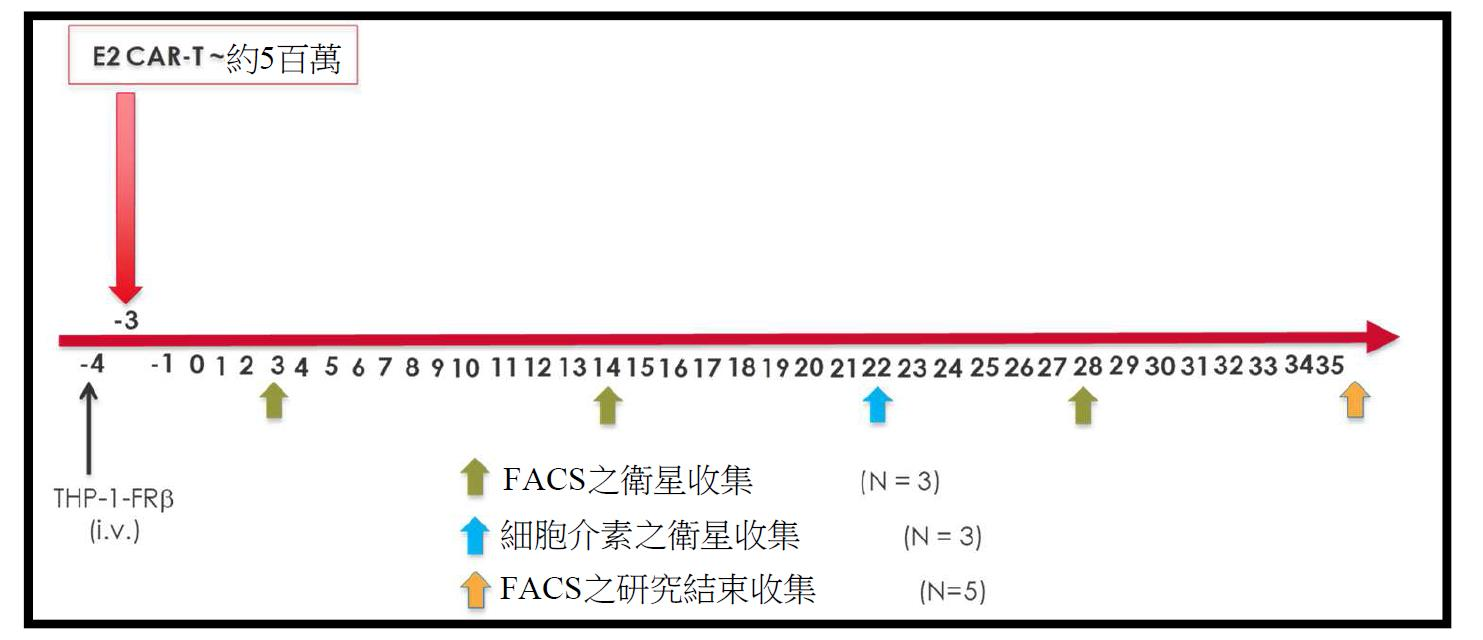
第3組(EC17 SIW):
第4組(EC17真實TIW):
第5組-EC17低劑量「TIW」(M/Th/M,停止6天)具有/療效:
A. 腫瘤植入 THP-1-FRβ AML腫瘤細胞在5% CO2 潮濕大氣中在37℃下在具有5-10% FBS之葉酸缺失型RPMI 1640中生長。以5 × 10⁶ 個細胞/隻動物靜脈內注射無血清葉酸缺失型RPMI1640培養基中之THP-1-FRß腫瘤細胞。 A. Tumor implantation THP-1-FRβ AML tumor cells were grown in folic acid-deficient RPMI 1640 with 5-10% FBS in a humidified atmosphere of 5% CO 2 at 37°C. 5×10 6 cells/animal were injected intravenously with THP-1-FRß tumor cells in serum-free folic acid-deficient RPMI1640 medium.
B.CAR-T 細胞 投與 將抗FITC E2 scFv-CAR T細胞冷凍於T細胞冷凍培養基中。在到達時,即刻將冷凍CAR-T細胞之小瓶儲存於-80℃下。CAR-T細胞在37℃下快速解凍,用CAR-T細胞培養基洗滌兩次,且以6百萬個有活性的EGFRt+ E2 CAR-T細胞(CD4/CD8在約1:1)/隻動物用於動物注射。在輸液之日取出較小等分試樣以用於E2-CAR T細胞表型之流動式細胞量測分析。B. CAR-T cells administered with an anti-FITC E2 scFv-CAR T cells T cells were frozen in freezing media. Upon arrival, the vials of frozen CAR-T cells were stored at -80°C. CAR-T cells were quickly thawed at 37°C, washed twice with CAR-T cell culture medium, and 6 million active EGFRt+ E2 CAR-T cells (CD4/CD8 at approximately 1:1) per animal Injection in animals. On the day of infusion, a smaller aliquot was taken for flow cytometry analysis of the E2-CAR T cell phenotype.
C. 製備投予藥物溶液 EC17及雙-EDA-FITC投予溶液在投予開始時藉由以下製備:稱取適當量之各化合物,在PBS中重組,pH 7.4,通過0.22 µm PVDF針筒過濾器無菌過濾藥物溶液,且在-20℃下冷凍等分試樣用於每日投予。 C. Preparation of the drug solution for administration EC17 and the double-EDA-FITC solution were prepared at the beginning of the administration by weighing the appropriate amount of each compound, reconstituted in PBS, pH 7.4, and filtered through a 0.22 µm PVDF syringe The drug solution was sterile filtered and the aliquot was frozen at -20°C for daily administration.
D. 化合物投與 至一天結束(3-4 PM),給出所有EC17劑量,以允許隔夜顯現可能的CRS (細胞介素釋放症候群)。在第二天早晨時,根據CRS定級系統(參見下文)對動物評分。 D. Compound administration To the end of the day (3-4 PM), all EC17 doses are given to allow the possible CRS (cytokine release syndrome) to appear overnight. On the next morning, animals were scored according to the CRS grading system (see below).
EC17 劑量計劃表 :
群組1-2:未給予EC17劑量
群組3: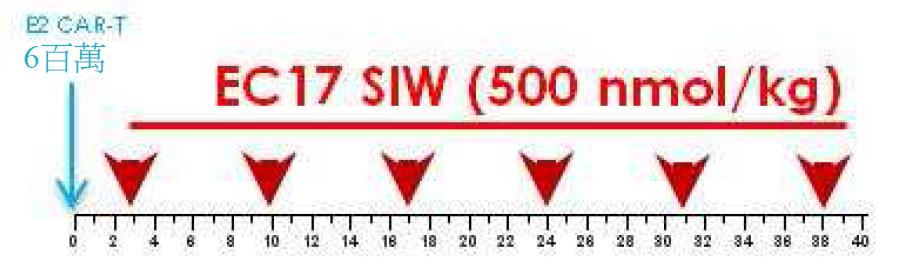
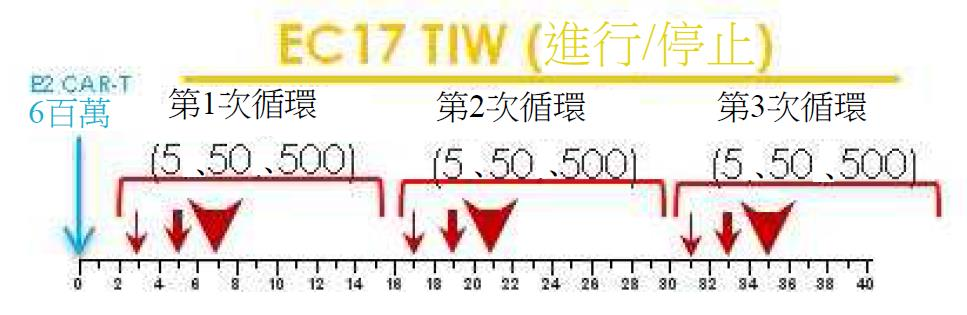

監測 / 療效 : 需要在EC17劑量之後數天進行每日體重量測。注意力集中於總體動物形態及行為。若小鼠在短時間內損失大量重量,或當小鼠按照CRS定級系統或神經毒性接近瀕死狀態時,則進行安樂死。 Monitoring / Efficacy : Daily body weight measurement is required a few days after the EC17 dose. Focus on the overall animal morphology and behavior. If the mouse loses a lot of weight in a short period of time, or when the mouse is near dying according to the CRS grading system or neurotoxicity, euthanasia is performed.
CRSCRS
定級系統Rating system

腫瘤生長、體重及總體評定 :體重量測2-3次/週。在緊接在任何EC17劑量之後的數天,每日進行體重量測且注意力集中於總體動物形態及行為。 Tumor growth, body weight and overall assessment : body weight measurement 2-3 times/week. In the days immediately following any EC17 dose, body weight measurements were performed daily and attention was focused on overall animal morphology and behavior.
流動式細胞量測分析 全血細胞分析 :自預定體積之全部經EDTA處理血液移除血漿,且用RBC溶解溶液溶解RBC。白細胞集結粒隨後再懸浮於流動式細胞測量術染色溶液(1%牛血清白蛋白,50 mg/mL人類IgG (Equitech Bio,cat#SLH56-0001)、0.9%疊氮化鈉於磷酸鹽緩衝鹽水中,pH = 7.4)中,且白細胞表面標記染色使用以下抗體進行:抗人類CD45 (純系HI30,eBioscience號47-0459-42,呈1:20(v/v)稀釋),抗人類CD137 (純系4B4-1,BD Bioscience號564092,呈1:20(v/v)稀釋),抗人類CD8α [純系RPA-T8,BD Bioscience,目錄號557746,呈1:20(v/v)稀釋],抗人類CD4 [純系SK3,eBioscience目錄號46-0047-42,呈1:20(v/v)稀釋],抗人類EGFR[R&D系統,純系Hu1,目錄號#FAB9577B,呈1:10(v/v)],抗人類PD1 [BD Biosciences,純系EH12.1,目錄號562511,呈1:20(v/v)],抗人類LAG3 [BD Biosciences,純系T47-530,目錄號565616,呈1:20(v/v)],抗人類TIM3 [BD Biosciences,純系7D3,目錄號565558,呈1:20(v/v)],抗人類CD3ε [BD Biosciences,純系SK7,目錄號557832,呈1:20(v/v)]。白細胞染色後,將細胞用PBS洗滌且再懸浮於含有53,000個CountBrightTM 珠粒[Invitrogen目錄號C36950]之低溫PBS中且轉移至流動式細胞量測術之收集管。在Gallios流式細胞儀(Beckman Coulter,Brea,CA)上收集流動式細胞測量術資料。根據Invitrogen說明書計算各血液樣品中CAR T細胞之濃度之判定。CAR T細胞鑑別為人類CD3ε + EGFRt+事件且容易使用KaluzaTM 流動式細胞測量術軟體區分及計數。隨後各輸注小鼠之循環中的CAR T細胞數目以每50 µL分析之全血的CAR T細胞總數目表示在圖上。統計顯著性藉由利用未配對之雙尾學生t測試來判定,其中顯著性設定為p < 0.05。 Flow Cytometry Analysis Whole Blood Analysis : Remove plasma from a predetermined volume of all EDTA-treated blood and dissolve RBC with RBC dissolution solution. Aggregated leukocytes are then resuspended in flow cytometry staining solution (1% bovine serum albumin, 50 mg/mL human IgG (Equitech Bio, cat#SLH56-0001), 0.9% sodium azide in phosphate buffered saline , PH = 7.4), and the leukocyte surface marker staining was performed using the following antibodies: anti-human CD45 (pure line HI30, eBioscience No. 47-0459-42, diluted 1:20 (v/v)), anti-human CD137 (pure line 4B4-1, BD Bioscience No. 564092, diluted 1:20 (v/v)), anti-human CD8α [pure line RPA-T8, BD Bioscience, catalog number 557746, diluted 1:20 (v/v)], anti Human CD4 [pure line SK3, eBioscience catalog number 46-0047-42, diluted 1:20 (v/v)], anti-human EGFR [R&D system, pure line Hu1, catalog number #FAB9577B, rendered 1:10 (v/v )], anti-human PD1 [BD Biosciences, pure line EH12.1, catalog number 562511, at 1:20 (v/v)], anti-human LAG3 [BD Biosciences, pure line T47-530, catalog number 565616, at 1:20 (v/v)], anti-human TIM3 [BD Biosciences, pure line 7D3, catalog number 565558, at 1:20 (v/v)], anti-human CD3ε [BD Biosciences, pure line SK7, catalog number 557832, at 1:20 (v/v)]. After leukocyte staining, the cells were washed with PBS and resuspended in low-temperature PBS containing 53,000 CountBright ™ beads [Invitrogen catalog number C36950] and transferred to a collection tube for flow cytometry. Collect flow cytometry data on a Gallios flow cytometer (Beckman Coulter, Brea, CA). The determination of the concentration of CAR T cells in each blood sample was calculated according to Invitrogen instructions. CAR T cells are identified as human CD3ε+EGFRt+ events and are easily distinguishable and countable using Kaluza ™ flow cytometry software. Subsequently, the number of CAR T cells in the circulation of each infused mouse is shown on the graph as the total number of CAR T cells per 50 µL of whole blood analyzed. Statistical significance was determined by using an unpaired two-tailed student t test, where the significance was set to p <0.05.
腫瘤及組織分析 : 收穫實體腫瘤(100-1000 mm3 ),稱重,且切碎成小碎片,隨後轉移至含有20 mL腫瘤消化混合物之50 mL管中。酶促腫瘤消化混合物由補充有抗生素之無血清及葉酸缺失型RPMI1640培養基中0.5 mg/mL IV型膠原蛋白酶(Sigma-Aldrich,目錄號C5138)、0.5 mg/mL玻尿酸酶(Sigma-Aldrich,目錄號H3506)及0.1 mg/mL DNase I (Sigma-Aldrich,目錄號DN25)組成。在水平震盪器上腫瘤片段在37℃下在300 rpm下消化一小時。隨後,腫瘤消化物在400 × g下離心5分鐘,且腫瘤細胞集結粒進行紅血球溶解步驟,隨後用低溫磷酸鹽緩衝鹽水(PBS,pH 7.4)洗滌且最後經40 µm耐綸細胞過濾器過濾。 Tumor and tissue analysis : Solid tumors (100-1000 mm 3 ) were harvested, weighed, and shredded into small pieces, and then transferred to 50 mL tubes containing 20 mL of tumor digestion mixture. The enzymatic tumor digestion mixture consisted of 0.5 mg/mL type IV collagenase (Sigma-Aldrich, catalog number C5138) and 0.5 mg/mL hyaluronidase (Sigma-Aldrich, catalog number) in serum-free and folic acid-depleted RPMI1640 medium supplemented with antibiotics H3506) and 0.1 mg/mL DNase I (Sigma-Aldrich, catalog number DN25). Tumor fragments were digested at 300 rpm for one hour at 37°C on a horizontal shaker. Subsequently, the tumor digest was centrifuged at 400 × g for 5 minutes, and the tumor cell aggregates were subjected to a red blood cell lysis step, followed by washing with low-temperature phosphate buffered saline (PBS, pH 7.4) and finally filtered through a 40 µm nylon cell filter.
結果及結論 A. EC17 投與之三個不同劑量計劃表展示不同體重減輕模式及不同 CRS 含量
如圖5中所見,群組1 (未治療)及群組2(僅CAR-T)不展示諸多體重減輕且無CRS。群組3 (EC17 SIW)展示在各EC17劑量之後EC17劑量依賴型體重減輕且貫穿研究展示級別1-2之CRS。群組5 (EC17劑量遞增)展示在前兩次循環期間較少體重減輕,但在第二次EC17劑量循環結束之後開始展示與群組2類似的體重減輕。群組4 (EC17 TIW進行/停止)展示三個治療組中最輕微的體重減輕。群組4或5兩者都不展示任何大於1之CRS。群組 3 
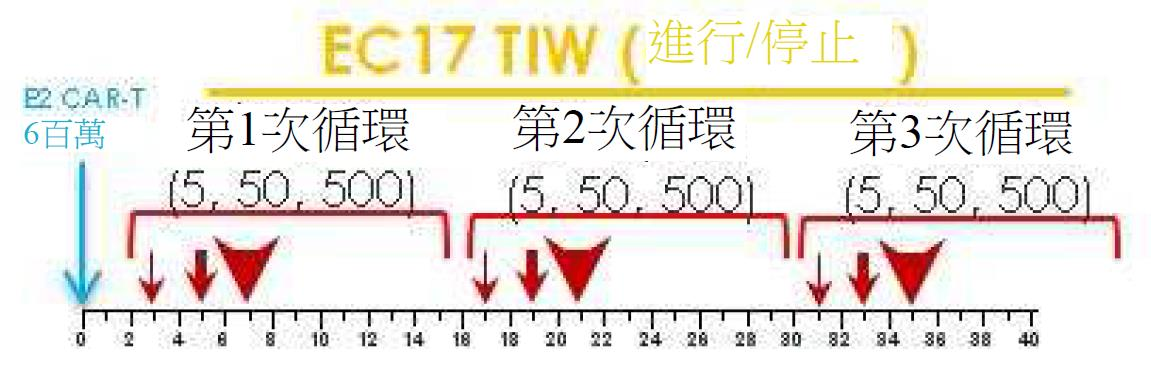
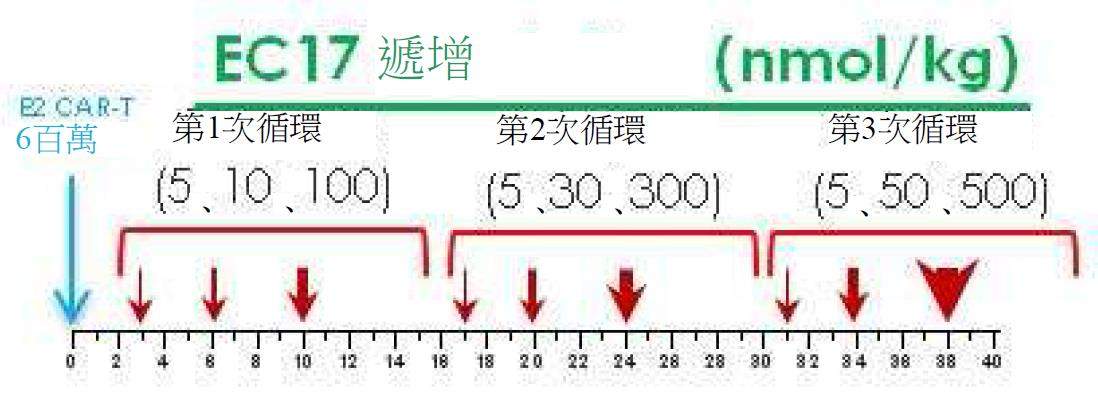
EC17 投與之三個不同劑量計劃表展示不同抗腫瘤活性。
如圖6中所見, 所有群組中在第39天評定肝及非肝腫瘤負荷。群組2 (僅CAR-T)與群組1 (未治療)比較不展示任何差異。群組4展示三個不同EC17劑量計劃表中最佳的抗腫瘤活性。 EC17 administered three different dose schedules showing different antitumor activities. As seen in Figure 6, liver and non-hepatic tumor burdens were assessed on day 39 in all groups. Group 2 (CAR-T only) did not show any difference compared with group 1 (untreated).
循環 AML 細胞株 THP1-FRβ 之消除 在使用CD19特異性抗ALL療法之研究中,已報告CAR T細胞在血液中之擴增及暫留與循環CD19+ ALL細胞的消除從而引起對療法之完全反應相關。在此實驗中,吾等在吾等之小鼠AML模型中進行類似分析,以藉由回應於CAR T接附分子EC17的不同給藥方案尋找吾等經GFP標記之人類AML細胞株THP1-FRβ的消失判定吾等受接附子控制之E2 CAR T細胞的抗腫瘤活性。圖7顯示循環THP1-FRβ細胞,其中y軸展示在對數標度上每100 µL全血之GFP+細胞總數目。不同條柱表示不同治療群組。展現了,較高AML細胞負荷存在於將AML細胞輸入至既不接受CAR T細胞亦不接受EC17之小鼠中後40天的循環中。血液中AML細胞之不減少見於接受AML細胞及E2 CAR T細胞兩者之輸入但無EC17治療的小鼠中。此藉由具有同種異體THP1細胞之人類T細胞的可能同種異體反應性展現可忽略的抗腫瘤活性。有趣地,看見以不同給藥方案用E2 CAR T細胞加EC17輸注之所有三個群組小鼠中的循環THP1細胞負荷之顯著減少,由此展現在三個不同接附子給藥方案下的CAR T療法之有效性。 Elimination of circulating AML cell lines THP1-FRβ In studies using CD19-specific anti-ALL therapies, the expansion and retention of CAR T cells in the blood have been reported to be associated with the elimination of circulating CD19+ ALL cells resulting in a complete response to therapy . In this experiment, we performed a similar analysis in our mouse AML model to find our GFP-labeled human AML cell line THP1-FRβ by different dosing regimens in response to CAR T attachment molecule EC17 The disappearance of is determined the anti-tumor activity of our E2 CAR T cells under the control of aconite. Figure 7 shows circulating THP1-FRβ cells, where the y-axis shows the total number of GFP+ cells per 100 µL of whole blood on a logarithmic scale. Different bars indicate different treatment groups. It was shown that a higher AML cell load was present in the circulation for 40 days after the infusion of AML cells into mice that received neither CAR T cells nor EC17. No reduction in AML cells in the blood was seen in mice that received both AML cells and E2 CAR T cells but no EC17 treatment. This exhibits negligible anti-tumor activity through the possible allogeneic reactivity of human T cells with allogeneic THP1 cells. Interestingly, we saw a significant reduction in circulating THP1 cell load in all three groups of mice infused with E2 CAR T cells plus EC17 with different dosing regimens, thus demonstrating CAR under three different aconite dosing regimens The effectiveness of T therapy.
E2-CAR-T 耗盡表型 在慢性抗原刺激下,例如在慢性病毒感染或癌症之情形下,T細胞在其不再能夠增殖、分泌發炎性細胞介素或殺死抗原呈現標靶細胞時經歷耗盡製程,CAR T細胞在CAR之慢性刺激下藉由持續存在之scFv刺激抗原亦具有耗盡的可能性。因為吾等之E2CAR T細胞僅對鍵結至FR+腫瘤細胞之表面的吾等之橋接分子EC17之存在起反應,所以吾等具有藉由停止用EC17治療且從而除去表面結合抗原的存在來預防E2 CAR T細胞之慢性抗原刺激的能力。藉由表面抗原之不存在表徵的其餘階段預防E2CAR T細胞之慢性抗原曝露且預防可產生之所得耗盡。 E2-CAR-T depletion phenotype Under chronic antigen stimulation, such as in the case of chronic viral infection or cancer, T cells can no longer proliferate, secrete inflammatory interleukins, or kill antigen-presenting target cells After undergoing a depletion process, CAR T cells are also likely to be depleted under the chronic stimulation of CAR by continuous scFv stimulation of antigen. Because our E2CAR T cells only respond to the presence of our bridging molecule EC17 bound to the surface of the FR+ tumor cells, we have prevented E2 by stopping treatment with EC17 and thereby removing the presence of surface-bound antigen The ability of CAR T cells to stimulate chronic antigens. The remaining stages characterized by the absence of surface antigens prevent chronic antigen exposure of E2CAR T cells and prevent the resulting depletion that can result.
為確認吾等之EC17給藥方案不引起E2 CAR T細胞耗竭,對來自THP1-FRβ肝癌轉移及在經耗盡T細胞上特異性表現之表面標記物的單細胞製劑進行流動式細胞測量術分析。隨著T細胞接近耗盡,表面抑制受體PD1、LAG3及TIM3之共表現增加。圖8展示柱狀圖,其中y軸說明自實體肝腫瘤分離之總E2 CAR T細胞的百分比,其表現由不同條柱表示的三種表面標記物之各種組合。值得注意的為,同時表現所有三種標記物之經完全耗盡T細胞由各組中之左側條柱表示。左側組展示將E2 CAR T細胞預輸注至自三個不同EC17治療群組分離之肝腫瘤CAR T細胞。抑制性受體表現在輸注前CAR T細胞產物中幾乎為零,此係由於T細胞中之大部分對於所有三種表面標記物為陰性。重要的為,所有三個經EC17治療群組E2 CAR T細胞具有經耗盡之三陽性細胞,且有趣的為,群組4 (EC17 TIW)表達最少數目之雙及三陽性事件且進一步由相當大量的三陰性CAR T細胞組成。此等資料表明在此小鼠實驗中所採用的所有三個EC17給藥方案可適用於臨床,此係由於存在顯著抗腫瘤活性且存在極少CAR T耗盡之誘導。To confirm that our EC17 dosing regimen did not cause E2 CAR T cell depletion, flow cytometry analysis was performed on single cell preparations derived from THP1-FRβ liver cancer metastasis and surface markers specifically expressed on depleted T cells . As T cells near depletion, the combined expression of surface inhibitory receptors PD1, LAG3 and TIM3 increases. Figure 8 shows a bar graph where the y-axis illustrates the percentage of total E2 CAR T cells isolated from solid liver tumors, which represents various combinations of three surface markers represented by different bars. It is worth noting that fully depleted T cells showing all three markers simultaneously are represented by the left bar in each group. The left panel shows pre-infusion of E2 CAR T cells into liver tumor CAR T cells isolated from three different EC17 treatment groups. Inhibitory receptors appear to be almost zero in the CAR T cell product before infusion, because most of the T cells are negative for all three surface markers. Importantly, all three EC17-treated cohort E2 CAR T cells have depleted triple-positive cells, and interestingly, cohort 4 (EC17 TIW) expresses the least number of double and triple-positive events and is further A large number of triple negative CAR T cells. These data indicate that all three EC17 dosing regimens used in this mouse experiment can be applied clinically due to the presence of significant antitumor activity and very little induction of CAR T depletion.
實例19至25-參見圖9至14。Examples 19 to 25-see Figures 9 to 14.
實例19細胞株及試劑 除非另外指出,否則所有FR+及FR-陰性癌細胞株保持在補充有10%熱滅活胎牛血清之RPMI-1640培養基(Gibco BRL),該培養基不含2.4 μM葉酸(FA) (FFRPMI)或含該葉酸 (RPMI)。將KB (具有HeLa標記物之FRα-表現人類子宮頸癌)及CHO-β (經人類FRβ轉染之中國倉鼠卵巢細胞)分別用作FRα及FRβ的來源以用於放射性配位體結合分析。MDA-MB-231表示人類TNBC (三陰性乳癌)細胞株之FRα次純系。對於AML研究而言,提供FRβ陽性(THP1-FRβ)及FR-陰性(THP1-FG12)細胞株之綠色螢光蛋白(GFP)-表現同基因對。兩者皆自作為研究兒童AML之最初衍生自患有急性單核細胞性白血病的1歲男嬰之常用細胞模型的THP-1 (ATCC,TIB-202)形成。對於骨肉瘤研究而言,藉由用編碼人類FRα之FOLR1基因 慢病毒轉導FR陰性HOS-143b (ATCC,CRL8303)來形成HOS-FRα。HOS-143b最初自13歲高加索女性之原發腫瘤形成且在NSG小鼠中高度致瘤。用慢病毒螢火蟲螢光素酶轉導FR+ HOS-FRαfLuc 及FR-陰性HOS-143bfLuc 之GFP表現生物發光對。Example 19 Cell lines and reagents Unless otherwise noted, all FR+ and FR-negative cancer cell lines were maintained in RPMI-1640 medium (Gibco BRL) supplemented with 10% heat-inactivated fetal bovine serum, which contains no 2.4 μM folate ( FA) (FFRPMI) or containing the folic acid (RPMI). KB (FRα-expressing human cervical cancer with HeLa marker) and CHO-β (Chinese hamster ovary cells transfected with human FRβ) were used as sources of FRα and FRβ, respectively, for radioligand binding analysis. MDA-MB-231 represents the FRa sub-pure line of human TNBC (tri-negative breast cancer) cell line. For AML studies, green fluorescent protein (GFP)-expressing isogenic pairs of FRβ-positive (THP1-FRβ) and FR-negative (THP1-FG12) cell lines are provided. Both are formed from THP-1 (ATCC, TIB-202), a commonly used cell model for the study of childhood AML that was originally derived from a 1-year-old boy with acute monocytic leukemia. For osteosarcoma research, HOS-FRα is formed by transducing FR-negative HOS-143b (ATCC, CRL8303) with the FOLR1 gene lentivirus encoding human FRα. HOS-143b was originally formed from a primary tumor of a 13-year-old Caucasian female and was highly tumorigenic in NSG mice. The GFP of FR+HOS- FRα fLuc and FR-negative HOS-143b fLuc were transduced with lentivirus firefly luciferase to express bioluminescence pairs.
LEGENDplexTM 人類細胞介素面板購自BioLegend (San Diego,CA)。基於乳酸脫氫酶 (LDH) CytoTox 96® 非放射性細胞毒性分析套組購自Promega (Madison,WI)。用於多色流動式細胞測量術之可商購的抗人類抗體為:來自Thermo Fisher Scientific (Waltham,MA)之CD45RA (純系HI100)、CD45RO (純系UCHL1)、CD4 (純系SK3)及CD69 (純系FN50);來自BD Bioscience (San Jose,CA)之CD3ε (純系SK7)、CD8α (純系RPA-T8)、CD137/4-1BB (純系4B4-1)、CD25 (純系M-A251)、PD1 (純系EH12.1)、LAG3 (純系T47-530)及TIM3 (純系7D3);來自R&D系統(Minneapolis,MN)的生物素化抗人類EGFR (西妥昔單抗(Cetuximab),純系Hu1);及來自BioLegend (San Diego,CA)之FRα (純系LK26)。經螢光團結合之抗生物素亦購自BioLegend。經APC結合之抗FITC小鼠IgG2a/卡帕(kappa)抗體(純系NAWESLEE)、CountBrightTM 珠粒(Invitrogen)、Annexin V染色緩衝液及經AlexaFluor-647結合的Annexin V購自Thermo Fisher Scientific。對於腫瘤組織之酶促消化而言,IV型膠原蛋白酶、玻尿酸酶及DNase I皆購自Sigma-Aldrich (St. Louis,MO)。The LEGENDplex ™ human cytokine panel was purchased from BioLegend (San Diego, CA). Lactate dehydrogenase (LDH) CytoTox 96 ® non-radioactive cytotoxicity analysis kit was purchased from Promega (Madison, WI). Commercially available anti-human antibodies for multicolor flow cytometry are: CD45RA (pure line HI100), CD45RO (pure line UCHL1), CD4 (pure line SK3) and CD69 (pure line) from Thermo Fisher Scientific (Waltham, MA) FN50); CD3ε (pure SK7), CD8α (pure RPA-T8), CD137/4-1BB (pure 4B4-1), CD25 (pure M-A251), PD1 (pure line) from BD Bioscience (San Jose, CA) EH12.1), LAG3 (pure line T47-530) and TIM3 (pure line 7D3); biotinylated anti-human EGFR (Cetuximab (Cetuximab), pure line Hu1) from the R&D system (Minneapolis, MN); and from FRα (pure line LK26) of BioLegend (San Diego, CA). Avidin bound by fluorophores was also purchased from BioLegend. APC-conjugated anti-FITC mouse IgG2a/kappa antibody (pure NAWESLEE), CountBright ™ beads (Invitrogen), Annexin V staining buffer, and Annexin V bound by AlexaFluor-647 were purchased from Thermo Fisher Scientific. For enzymatic digestion of tumor tissue, type IV collagenase, hyaluronidase, and DNase I were all purchased from Sigma-Aldrich (St. Louis, MO).
EC17或葉酸-FITC [FA-(γ)-乙二胺-FITC]在Endocyte處合成。3
H-EC17購自Moravek biochemicals (Brea,CA),呈約0.952 Ci/mmol之放射性比度,或在Endocyte處藉由使FITC與藉由ViTrax (Placentia,CA)製得的3
H-FA-(γ)-乙二胺結合來製備,呈約1.2 Ci/mmol之放射性比度。3
H-FA亦購自ViTrax,呈59 Ci/mmol之放射性比度。對於CRS急救而言,鈉螢光素給藥溶液自購自Purdue Pharmacy (NDC 17478-250-25)之AK-FLUOR®
25% (螢光素注射,USP)稀釋。EC17 or folic acid-FITC [FA-(γ)-ethylenediamine-FITC] is synthesized at Endocyte. 3 H-EC17 was purchased from Moravek biochemicals (Brea, CA) with a radioactivity ratio of about 0.952 Ci/mmol, or 3 H-FA- made by FITC and ViTrax (Placentia, CA) at the Endocyte (γ)-Ethylenediamine is prepared by combining with a radioactivity ratio of about 1.2 Ci/mmol. 3 H-FA was also purchased from ViTrax with a radioactivity ratio of 59 Ci/mmol. For CRS first aid, the sodium luciferin administration solution was diluted from AK-
實例20人類化 CAR 構築體及經 CAR 改性的 T 細胞 先前研究使用含有CD8α及4-1BB/CD3ζ信號傳遞域之鉸鏈及跨膜序列(亦即,FITC-4M5.3-scFv-CD8α鉸鏈-CD8αtm-4-1BB/CD3ζ)之GFP+第二代抗FITC scFv (純系4M5.3) CAR。對於轉譯成第一次人體測試而言,研發第二代完全人類FITC特異性(純系E2) CAR構築體(本文中稱為E2) (圖9,頂部圖)。經CAR改性的T細胞展示於圖9,底部餅狀圖中。Example 20 Humanized CAR constructs and CAR- modified T cells Previous studies used hinge and transmembrane sequences containing CD8α and 4-1BB/CD3ζ signaling domains (ie, FITC-4M5.3-scFv-CD8α hinge- CD8αtm-4-1BB/CD3ζ) GFP+ second-generation anti-FITC scFv (pure line 4M5.3) CAR. For translation into the first human test, the second-generation fully human FITC-specific (pure line E2) CAR construct (referred to herein as E2) (Figure 9, top panel) was developed. The CAR-modified T cells are shown in Figure 9, bottom pie chart.
本文中所描述的構築體為包括以下之FITC特異性CAR構築體:(1)完全人類抗FITC scFv (純系E2,Kd = 0.75 nM),(2)稠合至CD28-跨膜結構域之IgG4鉸鏈-CH2間隔基(L235D、N297Q)-CH3,(3)第二代4-1BB/CD3ζ-胞內域,及(4)細胞表面人類EGFRt標記(圖9,頂部圖) (SEQ ID NO:4及5分別為核酸及胺基酸序列)。為產生經CAR改性的T細胞,在與CAR編碼之epHIV7慢病毒載體共轉染的293T細胞中產生慢病毒。供體CD4+及CD8+ T細胞藉由免疫磁性選擇純化且單獨地或以約50:50比率轉導。一般而言,實施僅一個CD3/CD28珠粒活化回合,隨後為一或兩個快速活體外擴增回合。針對臨床前評價,使用若干批量之經EGFRt分選的CD4、CD8及未分選之CD4/CD8 CAR-T細胞。在冷凍保存之前及解凍之後分析所有CAR-T細胞製劑以藉由流動式細胞測量術判定EGFRt表現及CD4/CD8比率。使用表面標記物之組合,在輸液當天時CD4+及CD8+ CAR-T細胞亞組之分化狀態經分析且定義為TN ,CD45RA+ CD45RO- CD62L+ CD95-天然T細胞;TSCM ,CD45RA+ CD45RO- CD62L+ CD95+幹細胞記憶T細胞;TCM ,CD45RA- CD45RO+ CD62L+ CD95+中樞記憶T細胞;TEM ,CD45RA- CD45RO+ CD62L- CD95+效應記憶細胞;及TEFF ,CD45RA+ CD45RO- CD62L- CD95+效應T細胞。針對下文所描述的臨床前測試,研究包括兩個批量之經EGFRt分選的純CD4及CD8亞組(在以約1:1比率混合之後)及若干批量之包括具有低分化特徵的「臨床傳真」製劑之未分選的約1:1 EGFRt+ CD4/CD8混雜物。The constructs described herein are FITC-specific CAR constructs including: (1) fully human anti-FITC scFv (pure line E2, Kd = 0.75 nM), (2) IgG4 fused to the CD28-transmembrane domain Hinge-CH2 spacer (L235D, N297Q)-CH3, (3) second-generation 4-1BB/CD3ζ-intracellular domain, and (4) human EGFRt marker on cell surface (Figure 9, top panel) (SEQ ID NO: 4 and 5 are nucleic acid and amino acid sequences, respectively). To produce CAR-modified T cells, lentivirus was produced in 293T cells co-transfected with CAR-encoded epHIV7 lentiviral vector. Donor CD4+ and CD8+ T cells are purified by immunomagnetic selection and transduced individually or at a ratio of about 50:50. In general, only one round of CD3/CD28 bead activation is performed, followed by one or two rounds of rapid in vitro amplification. For pre-clinical evaluation, several batches of CD4, CD8 sorted by EGFRt and unsorted CD4/CD8 CAR-T cells were used. All CAR-T cell preparations were analyzed before cryopreservation and after thawing to determine EGFRt performance and CD4/CD8 ratio by flow cytometry. Using a combination of surface markers, the differentiation status of the CD4+ and CD8+ CAR-T cell subsets on the day of infusion was analyzed and defined as T N , CD45RA+ CD45RO- CD62L+ CD95- natural T cells; T SCM , CD45RA+ CD45RO- CD62L+ CD95+ stem cells Memory T cells; T CM , CD45RA- CD45RO+ CD62L+ CD95+ central memory T cells; T EM , CD45RA- CD45RO+ CD62L- CD95+ effector memory cells; and T EFF , CD45RA+ CD45RO- CD62L- CD95+ effector T cells. For the preclinical tests described below, the study included two batches of pure CD4 and CD8 subgroups sorted by EGFRt (after mixing at a ratio of approximately 1:1) and several batches of "clinical faxes" with low differentiation characteristics ”Unsorted 1:1 EGFRt+CD4/CD8 hybrid of the preparation.
在所合成及評價之一系列不同CAR構築體中,選擇完全人類抗FITC scFv (FITC-E2) CAR用於臨床前研發(圖9)。此第二代完全人類CAR由抗FITC scFv (純系E2)、CH2區域(L235D及N297Q)中具有雙突變以減少與FcγR、CD28跨膜結構域及藉由T2A核糖體跳躍序列附接至細胞表面EGFRt標記之4-1BB/CD3ζ信號傳導結構域結合的IgG4-Fc間隔基/鉸鏈組成(亦即,FITC-E2-scFv-IgG4鉸鏈-CD28tm-4-1BB/CD3ζ-T2A-EGFRt)。針對臨床前研究,經EGFRt分選的及未分選之E2 CAR-T細胞兩者皆以約1:1 CD4/CD8比率製備,且在各活體內實驗之CAR T細胞輸注(第0天)時常規地藉由流動式細胞測量術進行T細胞亞型表型。A 經EGFRt分選的CAR-T細胞之典型表現模式包括呈大致42% TSCM 、10% TCM 、12% TEM 及34%TEFF 之兩種CD4及CD8亞組(圖9,左側上的餅圖)。僅將經EGFRt分選的CAR-T細胞用於共培養及藥物動力學研究。針對腫瘤療法,使用具有MDA-MB-231之低分化特徵(圖9,右側上之餅圖)的「臨床傳真」批量,且研究批量用於THP1-FRβ及HOS-FRα研究。「臨床傳真」批量(約39% EGFRt+)包括呈約66% TSCM 及約32% TCM 之CD4+亞組及呈約95% TSCM 及約3% TCM 的CD8亞組。研究批量(約23% EGFRt+)更經分化且包括呈約32% TSCM 、約53% TCM 、約11% TEM 及約3.7%TEFF 之CD4亞組及呈約44% TSCM 、約0.28% TCM 、約3.4% TEM 及約52% TEFF 的CD8亞組。Among a series of different CAR constructs synthesized and evaluated, a fully human anti-FITC scFv (FITC-E2) CAR was selected for preclinical development (Figure 9). This second-generation fully human CAR has double mutations in the anti-FITC scFv (pure line E2), CH2 region (L235D and N297Q) to reduce attachment to FcγR, CD28 transmembrane domains, and attachment to the cell surface by T2A ribosomal jumping sequences EGFRt-labeled 4-1BB/CD3ζ signaling domain bound IgG4-Fc spacer/hinge composition (ie, FITC-E2-scFv-IgG4 hinge-CD28tm-4-1BB/CD3ζ-T2A-EGFRt). For preclinical studies, both EGFRt-sorted and unsorted E2 CAR-T cells were prepared at a ratio of approximately 1:1 CD4/CD8, and CAR T cell infusions were tested in each in vivo experiment (day 0) The T cell subtype phenotype is routinely performed by flow cytometry. A The typical expression pattern of CAR-T cells sorted by EGFRt includes two subgroups of CD4 and CD8 with roughly 42% T SCM , 10% T CM , 12% T EM and 34% T EFF (Figure 9, upper left Pie chart). Only CAR-T cells sorted by EGFRt were used for co-culture and pharmacokinetic studies. For tumor therapy, a "clinical fax" batch with the low differentiation characteristics of MDA-MB-231 (Figure 9, pie chart on the right) was used, and the research batch was used for THP1-FRβ and HOS-FRα studies. The "clinical fax" batch (about 39% EGFRt+) includes the CD4+ subgroup with approximately 66% T SCM and approximately 32% T CM and the CD8 subgroup with approximately 95% T SCM and approximately 3% T CM . The research batch (approximately 23% EGFRt+) was more differentiated and included the CD4 subgroup with approximately 32% T SCM , approximately 53% T CM , approximately 11% T EM, and approximately 3.7% T EFF , and approximately 44% T SCM , approximately CD8 subgroup of 0.28% T CM , about 3.4% T EM, and about 52% T EFF .
實例21EC17 CAM 的 雙特異性親和力 在基於細胞之放射性配位體結合分析中使用3 H-EC17評定EC17 CAM (CAM在本申請案中等效於「橋接子」或「化合物」之雙特異性親和力。針對與FR+標靶之結合,將KB及CHO-β細胞在24孔組織培養盤中預接種隔夜且與0.1、0.5、1、5、10、20及40 nM於FFRPMI中之3 H-EC17在37℃下一起培育2 h。隨後,將細胞用磷酸鹽緩衝鹽水(PBS,pH 7.4)沖洗且用1%十二烷基硫酸鈉溶解。全細胞溶胞物針對放射性等級及細胞蛋白質含量藉由標準Pierce BCA蛋白質分析來定量。計算每個細胞結合之3 H-EC17分子之數目以分別判定FRα (KB)及FRβ (CHO-β)的解離常數(Kd) (圖10)。Example 21 Bispecific affinity of EC17 CAM The use of 3 H-EC17 in cell-based radioligand binding assays to assess EC17 CAM (CAM is equivalent to the bispecific affinity of "bridgers" or "compounds" in this application) .For binding to FR+ target, KB and CHO-β cells were pre-seeded in 24-well tissue culture dish overnight and with 3, H-EC17 of 0.1, 0.5, 1, 5, 10, 20, and 40 nM in FFRPMI Incubate together at 37°C for 2 h. Subsequently, the cells were washed with phosphate buffered saline (PBS, pH 7.4) and lysed with 1% sodium dodecyl sulfate. Whole cell lysates were borrowed for radioactivity grade and cell protein content Quantification was performed by standard Pierce BCA protein analysis. The number of 3 H-EC17 molecules bound to each cell was calculated to determine the dissociation constants (Kd) of FRα (KB) and FRβ (CHO-β), respectively (FIG. 10 ).
已在臨床中出於免疫療法及光學成像之目的測試EC17。為直接地定量3 H-EC17之雙特異性結合親和力,合成其且對分別表示FRα+及FRβ+標靶細胞的KB及CHO-β細胞株及對表示效應細胞之未分選EGFRt CAR-T細胞實施放射性配位體結合分析。當結合至EC17之標靶時,其展現對於分別具有1.7 nM及0.8 nM之低Kd值的FRα及FRβ兩者類似的親和力(圖10,A圖)。在結合至未分選E2-CAR-T細胞(約24% EGFRt+,約95:5 CD8/CD4比率)時,估計Kd值在約130 nM (圖10,B圖)。EC17 has been tested in the clinic for immunotherapy and optical imaging purposes. To directly quantify the bispecific binding affinity of 3 H-EC17, it was synthesized and paired with KB and CHO-β cell lines representing FRα+ and FRβ+ target cells, respectively, and unsorted EGFRt CAR-T representing effector cells Cells were subjected to radioligand binding analysis. When bound to the target of EC17, it exhibited similar affinity for both FRα and FRβ with low Kd values of 1.7 nM and 0.8 nM, respectively (FIG. 10, panel A). When bound to unsorted E2-CAR-T cells (about 24% EGFRt+, about 95:5 CD8/CD4 ratio), the Kd value was estimated to be about 130 nM (Figure 10, panel B).
實例22腫瘤模型
根據NIH指導原則且遵循由Purdue University Animal Use and Care Committee審批通過之方案進行所有動物護理及使用。雌性4至5週齡之NOD/SCID γ (NSGTM
)小鼠(物料編號:005557)購自Jackson Laboratory (Bar Harbor,ME)。除非專門指示,否則所有動物在到達時及在研究中保持FA缺失型飲食(TestDiet,St. Louis, MO)。為確定皮下異種移植,分別將MDA-MB-231及HOS-FRα以2.5 × 10⁶
及1 × 10⁶
個細胞/隻動物植入於右側腹區域中。針對靜脈內異種移植,以5 × 106
個細胞/隻動物接種THP1-FRβ細胞。皮下腫瘤用測徑規量測每週2-3次且使用橢圓形公式(長度×寬度2
)/2來計算。按照研究設計或在以下情況時進行安樂死:(i)動物之體重已減輕≥ 20%或接近瀕死狀態,(ii)皮下腫瘤之大小達至≥ 1500 mm3
,或(iii)動物顯示出腫脹之腹部及非常痛苦之症兆(亦即,THP1-FRβ)。靜脈內給予所有動物劑量(CAR-T細胞、EC17、螢光素鈉)。Example 22 Tumor model All animal care and use were carried out in accordance with NIH guidelines and following the protocol approved by Purdue University Animal Use and Care Committee.
實例23腫瘤療法
在治療背景下,可在CAR-T細胞注射前或後給與EC17 CAM。如本文所述,在CAR T細胞2-3.5天後投與第一劑量之EC17以留出帶有腫瘤之小鼠體內之人類T細胞之觀測週期。兩個批次之未分類E2-CAR T細胞(23%或39%EGFRt+,1:1 CD4/CD8)用於活體內研究。在用於各實驗之輸液日(第0天),將冷凍CAR T細胞在37℃下快速解凍,用達爾伯克(Dulbecco's)1×PBS (pH 7.4)洗滌2×並以所需EGFRt+E2-CAR-T細胞劑量注射至尾部靜脈中。此外,藉由流式細胞量測術分析較小等分試樣之CAR T細胞之CAR T細胞之CD4與CD8比率及分化狀態。在EC17給藥之第一天,根據帶有腫瘤動物之腫瘤大小或靜脈內移植後相同天數(亦即,THP1-FRβ)將其隨機分配為多組。
對於MDA-MB-231研究,小鼠接受較高劑量(約10百萬)之具有較低分化特徵之「臨床傳真」之E2-CAR T細胞(約39%EGFRt+) (圖9)。兩天後,在平均腫瘤大小為約293±39 mm3
下開始3種不同的EC17治療方案(圖12)。一週一次(SIW)以500 nmol/kg在星期一或週期之間以遞增劑量:5、50或100及500或1000 nmol/kg (亦即,5/50/500或5/100/1000)在星期一、星期四及6天後之星期一給與EC17給藥。對照小鼠維持不治療之(接受CAR T細胞但無EC17)。用於比較,一組不含腫瘤同胎仔畜亦以500 nmol/kg接受相同數目之無EC17之CAR T細胞或具有EC17之CAR T細胞SIW。
用於AML研究(圖13),小鼠在接受較低劑量之約6百萬E2-CAR T細胞(約23% EGFRt+)之前一天經靜脈內注入THP1-FRβ腫瘤細胞。在CAR-T細胞輸注後約3.5天,以3種不同方式給藥EC17,包括i)以500 nmol/kg SIW,ii)週期之間以5/50/500 nmol/kg在星期一/星期三/9天後之星期五三次(TIW進行/停止),及iii)以遞增劑量之第1週期5/10/100 nmol/kg、第2週期5/30/300 nmol/kg及第3週期之5/50/500 nmol/kg,週期之間所有在星期一/星期四/6天後之星期一(M/Th/M_進行/停止)。在第31天,採集衛星動物用於將小鼠血液中識別之CAR陽性T細胞量化為人類CD3ε+EGFRt+事件且經計算為每100 µL全血之絕對數目。在安樂死之後或在第38天研究結束時,藉由利用流式細胞量測術量測血液中之GFP+腫瘤細胞且收集體內發現之肝重量(具有轉移性病變)及非肝巨轉移酶之總重量來評估帶有THP1-FRβ腫瘤之小鼠體內的總腫瘤負載。將肝癌轉移之腫瘤片段酶消化至單細胞懸浮液中且使用抗人類PD1、LAG3及TIM3(純系EH12.1、T47-530及7D3,分別地)分析活細胞群之CAR-T細胞耗竭狀態。
對於骨肉瘤研究(圖14),兩組小鼠在接受用於THP1-FRβ研究(圖13)之約6百萬之相同CAR-T細胞製劑前3天經皮下移植HOS-FRα腫瘤細胞。在CAR-T細胞輸注後約3.5天,一組小鼠經給與至多3個週期之EC17:第1週期以5/10/100 nmol/kg,第2週期以5/30/300 nmol/kg及第3週期以5/50/500 nmol/kg,全部遵循星期一/星期四/星期一方案,週期之間具有6天間隔。在研究結束時,計數每100 μL小鼠血液循環CD3ε+EGFRt+CAR T細胞。亦採集HOS-FRα腫瘤(+/-EC17治療)並消化用於腫瘤浸潤性CAR T細胞之流式細胞測量分析。Example 23 Tumor therapy In a therapeutic setting, EC17 CAM can be administered before or after CAR-T cell injection. As described herein, the first dose of EC17 is administered 2-3.5 days after CAR T cells to leave the observation period of human T cells in tumor-bearing mice. Two batches of unclassified E2-CAR T cells (23% or 39% EGFRt+, 1:1 CD4/CD8) were used for in vivo studies. On the infusion day (day 0) used for each experiment, the frozen CAR T cells were quickly thawed at 37°C, washed with Dulbecco's 1×PBS (pH 7.4) 2×, and the required EGFRt+E2 -CAR-T cell dose injection into the tail vein. In addition, the ratio of CD4 to CD8 and differentiation status of CAR T cells of smaller aliquots of CAR T cells were analyzed by flow cytometry. On the first day of EC17 administration, animals with tumors were randomly assigned to multiple groups based on the tumor size of tumor-bearing animals or the same number of days after intravenous transplantation (ie, THP1-FRβ). For the MDA-MB-231 study, mice received higher doses (approximately 10 million) of "clinical fax" E2-CAR T cells (approximately 39% EGFRt+) with lower differentiation characteristics (Figure 9). Two days later, three different EC17 treatment regimens were started at an average tumor size of about 293±39 mm 3 (Figure 12). Once a week (SIW) at 500 nmol/kg in increments of Monday or cycle: 5, 50 or 100 and 500 or 1000 nmol/kg (that is, 5/50/500 or 5/100/1000) at EC17 was given on Monday, Thursday and Monday after 6 days. Control mice were maintained untreated (receiving CAR T cells but no EC17). For comparison, a group of tumor-free babies also received the same number of CAR T cells without EC17 or CAR T cells with EC17 SIW at 500 nmol/kg. For AML studies (Figure 13), mice were injected with THP1-FRβ tumor cells intravenously one day before receiving a lower dose of about 6 million E2-CAR T cells (about 23% EGFRt+). Approximately 3.5 days after CAR-T cell infusion, EC17 is administered in 3 different ways, including i) at 500 nmol/kg SIW, ii) between cycles at 5/50/500 nmol/kg on Monday/Wednesday/ Three times on Friday after 9 days (TIW progress/stop), and iii) 5/10/100 nmol/kg in
針對攻擊性骨肉瘤模型之劑量遞增試驗
為了吾等既定目的,HOS-FRα為具有功能性FR水準之約5.82±1.45 pmol/mg蛋白質之較低FR-表現但最具攻擊性腫瘤模型。平行於上文所描述之THP1-FRβ研究,具有3天大之HOS-FRα腫瘤之兩組小鼠經以相同劑量(約6百萬)給與相同E2-CAR T細胞。一組經相同加速EC17給藥遞增方案治療:第1週期以5/10/100 nmol/kg,第2週期以5/30/300 nmol/kg及第3週期以5/50/500 nmol/kg,在星期一/星期四/星期一排程繼之以6天間斷(圖14,A圖)。由於HOS-FRα腫瘤在無EC17治療的情況下強力地生長,因此在此CAR-T細胞劑量下之加速EC17給藥遞增為安全的(無CRS或體重減輕)且在前兩個治療週期內引起腫瘤生長的明顯延遲(圖14,B圖)。在協議授權之僅因腫瘤大小(≥1500 mm3
)所致之安樂死之後,對全血執行之流動式細胞測量術分析展示EC17依賴性CAR-T細胞擴大至第47天但在第33天時更高(圖14,C圖,左邊長條圖)。第33天之活體外腫瘤分析指示經EC17治療之動物體內的較低但明顯瘤內CD3ε+EGFRt+CAR-T細胞群體,其累積至約1%總存活消化腫瘤衍生細胞(圖14,C圖,右邊長條圖)。隨著較大HOS-FRα腫瘤停止對第3週期之治療作出回應(圖14,B圖),在第47天時瘤內CAR T細胞亦減弱(圖14,C圖)。值得注意地,在疾病進程後藉由3
H-FA放射性配位體分析分析之HOS-FRα腫瘤在存在及不存在EC17治療下展示類似FRα含量。因此,似乎NSG小鼠體內之HOS-FRα腫瘤快速地增長CAR T細胞之腫瘤浸潤性能力且可如活體外共培養研究表明因T細胞耗竭所致而具有減小的溶胞活性。 Dose escalation test for aggressive osteosarcoma model For our intended purpose, HOS-FRα is a lower FR-performance but most aggressive tumor model with a functional FR level of approximately 5.82±1.45 pmol/mg protein. Parallel to the THP1-FRβ study described above, two groups of mice with 3-day-old HOS-FRα tumors were given the same E2-CAR T cells at the same dose (about 6 million). A group of treatments with the same accelerated EC17 dosing schedule: 5/10/100 nmol/kg in
含腫瘤及無腫瘤小鼠體內之 EC17 給藥 發現研究
如實驗性佈局之示意圖所展示在MDA-MB-231腫瘤負載小鼠中進行初始EC17給藥發現研究(圖12,A圖)。在第0天,不具有或具有MDA-MB-231腫瘤(約211±65 mm3
)之NSG小鼠經移植約10百萬「臨床傳真」批次之E2-CAR T細胞(約39% EGFRt+, 51:49 CD4/CD8)。此批次CAR T細胞由大部分TSCM
及TCM
表現型組成(參見圖9)。在CAR-T細胞注射後兩天,一組帶有腫瘤小鼠保持未治療同時三組經不同EC17方案治療,包括以500 nmol/kg每週單次注射(SIW),或給與如5/50/500(遞增-1)或5/100/1000 nmol/kg(遞增-2)之遞增EC17給藥含量,在星期一/星期四/星期一排程伴隨1週無藥物間隔。為了比較,兩個無腫瘤組未經治療或經EC17以500 nmol/kg SIW治療。
使用衛星動物在第11天及第12天(在先前EC17劑量之後約20及42小時)來量測在所有群組中人類T細胞衍生之IFNγ於小鼠血液中之含量。與僅接受CAR T細胞之腫瘤攜帶小鼠相比,所有經EC17治療之腫瘤群組具有高約30× (第11天)及約10× (第12天)之小鼠血漿中之IFNγ產生,且此細胞介素之含量稍後自20小時至42小時自然地降低(圖12,B圖)。根據IFNγ釋放,EC17亦觸發經鑑別為小鼠血液中之人類CD3ε+EGFRt+事件的CAR-T細胞增殖,且細胞在腫瘤攜帶動物中存留多達54天(最末量測) (圖12,C圖)。在無腫瘤群組中,未藉由流式細胞量測術偵測到CAR-T細胞增殖,但在第11天及第12天於接受相同數目之CAR T細胞加EC17的動物中偵測到低含量之IFNγ (圖12,B至C圖)。此外,未在以500 nmol/kg接受兩週劑量之EC17的無腫瘤小鼠中觀測到CRS症狀(超出0級0至5個刻度)或體重減輕。
在藉由獨立於該療法之持續EC17投藥的腫瘤攜帶群組中觀測到中度至重度CRS症狀(2至3級)及顯著體重減輕(圖12,D圖)。在500 nmol/kg下之EC17 SIW導致CRS及體重減輕之最早開始,而侵略性EC17遞增-2療法(多達1000 nmol/kg)導致持久性體重減輕,其中動物恢復出現在EC17投藥停止之後(圖12, D圖,頂部列)。值得注意地,移植物抗宿主病(GVHD)之症狀包括紅色皮膚瘙癢及無毛髮且在CAR-T細胞移植之後約1個月時變得明顯。儘管僅接受CAR T細胞之動物展示出非特異性CAR-T細胞/腫瘤同種異體反應性之體徵,但僅經EC17治療之群組產生100%治癒(圖12, D圖,底部列)。因此,在FR+腫瘤存在下之EC17投與為驅動i)CAR-T細胞活化,ii)細胞激素產生,及iii)活體內
CAR-T細胞增殖及存留之關鍵。然而,在特定條件下,藉由高CAR-T細胞劑量與等於或大於500 nmol/kg之EC17劑量組合而觸發嚴重CRS (≥3級)。 EC17 administration discovery study in tumor-bearing and non -tumor-bearing mice The initial EC17 administration discovery study was conducted in MDA-MB-231 tumor-loaded mice as shown in the schematic diagram of the experimental layout (Figure 12, Panel A). On
抗白血病活性之 EC17 CAM 投藥對照
經靜脈內植入之GFP表現THP1-FRβ腫瘤細胞在NSG小鼠體內產生多發性疾病,其中腫瘤細胞處於循環中且肝癌/非肝癌在整個體內轉移。THP1-FRβ腫瘤細胞亦可定位於小鼠卵巢,該卵巢在腫瘤進展之初期期間出現發炎。因此,研究群組中之各動物中的總腫瘤攜帶係藉由對血液中之循環GFP+腫瘤細胞、肝重量及裸眼可見之全包含性非肝巨轉移酶進行定量來評估。儘管THP1-FRβ於試管內表現低水平之FR,但THP1-FRβ腫瘤癌轉移經發現在約8.9 pmol/mg±2.8 pmol/mg膜蛋白下表現高於預期之功能性FR含量。因此,以約6百萬/動物向THP1-FRβ腫瘤攜帶小鼠移植研究批次之EGFRt-未篩選之E2-CAR T細胞(約23%EGFRt+,1:1 CD4:CD8)且隨後用3種不同EC17投藥療法來治療(圖13)。在CAR-T細胞注射之後開始3天,EC17投藥療法在SIW持續處於500 nmol/kg時開始,以5/50/500 nmol/kg在星期一/星期三/星期五進行一週三次(TIW),隨後中斷9天,或藉由加速劑量遞增療法在第1循環中以5/10/100 nmol/kg、在第2循環中以5/30/300 nmol及在第3循環中以5/50/500 nmol kg在星期一/星期四/星期一(M/Th/M)進行,隨後中斷6天(圖13,A圖)。在接受EC17 SIW治療之動物體內觀測到循環2及循環3中之一些體重減輕及1至2級CRS,而接受EC17 TIW之動物體重減輕最少,僅為0至1級CRS(圖13,B圖)。在接受3次循環之EC17 M/Th/M劑量遞增的動物當中,在300 nmol/kg之EC17的最末劑量之後的第2循環中觀測到0至1級CRS及極輕微體重減輕。在第31天使用衛星動物,對血液中之CAR T細胞進行計數,且資料展現出在所有經治療群組中之EC17依賴型CAR-T細胞增殖及存留(圖13,C圖)。與僅接受腫瘤細胞或腫瘤細胞加CAR T細胞而無EC17之對照動物相比,經3個「內部患者」遞增格式中之任一者投藥之EC17有效地降低血液中之循環THP1-FRβ腫瘤細胞,且展示出針對肝腫瘤癌轉移之類似活性(圖13,D圖,左側及中間條形圖)。僅發現微量之針對僅接受CAR T細胞之小鼠體內的THP1-FRβ肝癌轉移之同種異體反應性。以10倍劑量遞增(進行/停止)之EC17 SIW及TIW成功地控制非肝巨轉移酶,以每循環緩慢步調之EC17 M/Th/M劑量遞增(圖13,A圖)未能控制非肝巨轉移酶(圖13,D圖,最右側圖)。在研究結束(亦即CAR-T細胞注射後39天)時,自肝THP1-FRβ腫瘤癌轉移分離之CAR T細胞似乎具有最少之雙重及參重陽性T細胞抑制受體、PD1、LAG3及TIM3之表現(圖13,E圖)。總體而言,未在任何經EC17治療之群組中觀測到嚴重CRS (亦即等級≥3)。然而,較大侵略性EC17 TIW劑量遞增(進行/停止)排程傾向於為用於降低此等小鼠體內之總THP1-FRβ腫瘤攜帶之最佳療法。 Anti-leukemia activity control of EC17 CAM administration. Intravenously implanted GFP showed that THP1-FRβ tumor cells produced multiple diseases in NSG mice, in which tumor cells were in circulation and liver cancer/non-hepatoma metastasized throughout the body. THP1-FRβ tumor cells can also be localized in mouse ovaries, which become inflamed during the early stages of tumor progression. Therefore, the total tumor carrying in each animal in the study cohort was assessed by quantifying circulating GFP+ tumor cells in the blood, liver weight, and fully contained non-hepatic giant transferase visible to the naked eye. Although THP1-FRβ showed a low level of FR in the test tube, THP1-FRβ tumor metastasis was found to exhibit higher than expected functional FR content at about 8.9 pmol/mg ± 2.8 pmol/mg membrane protein. Therefore, EGFRt-unscreened E2-CAR T cells (approximately 23% EGFRt+, 1:1 CD4:CD8) were transplanted into THP1-FRβ tumor-bearing mice at approximately 6 million per animal per animal and then 3 Different EC17 administration therapies are used to treat (Figure 13). Three days after the CAR-T cell injection, EC17 administration therapy was started when the SIW remained at 500 nmol/kg, 5/50/500 nmol/kg on Monday/Wednesday/Friday three times a week (TIW), and then discontinued 9 days, or by accelerated dose escalation therapy at 5/10/100 nmol/kg in
實例24功能性 FR 評估 此等功能性FR評估適用於本文中所描述之實例。除經FRα (HOS-FRα)及FRβ (THP1-FRβ)轉染之兒童癌細胞系之外,亦包括具有不同組織結構及FR表現水平(圖11)之癌細胞系。如藉由放射性配位體結合分析(在37℃下,100 nM3 H-FA,1 h)所估計,在此等細胞系上總體可獲得之FR的分級次序為:9×10⁴ (OV90,低-FR表現卵巢癌細胞系)、1.9×10⁵ (THP1-FRβ)、2.4×10⁵ (HOS-FRαfLuc )、7×10⁵ (HOS-FRα)、2.1×10⁶ (MDA-MB-231)及4.8×10⁶ (KB) FA分子/細胞。亦將HOS-143b(fLuc) 及THP1-FG12母細胞系包括為FR-陰性對照。因此,對共培養FR+癌細胞系之功能性FR表現的一般分級為:KB>MDA-MB-231>HOS-FRα>HOS-FRαfLuc >THP1-FRβ (AML)>OV90。Example 24 Functional FR evaluations These functional FR evaluations are applicable to the examples described herein. In addition to child cancer cell lines transfected with FRα (HOS-FRα) and FRβ (THP1-FRβ), it also includes cancer cell lines with different tissue structures and FR expression levels (Figure 11). As estimated by radioligand binding analysis (100 nM 3 H-FA at 37°C, 1 h), the FR grading order generally available on these cell lines is: 9×10 4 (OV90 , Low-FR expression ovarian cancer cell line), 1.9×10 5 (THP1-FRβ), 2.4×10 5 (HOS- FRα fLuc ), 7×10 5 (HOS-FRα), 2.1×10 6 (MDA-MB -231) and 4.8×10 6 (KB) FA molecules/cell. HOS-143b (fLuc) and THP1- FG12 mother cell lines were also included as FR-negative controls. Therefore, the general rating for the functional FR performance of co-cultured FR+ cancer cell lines is: KB>MDA-MB-231>HOS-FRα>HOS- FRα fLuc >THP1-FRβ (AML)>OV90.
實例25統計 使用電腦程式GraphPad Prism (GraphPad Software公司., San Diego, CA)來執行統計分析。使用司圖頓t測試或單向ANOVA對資料進行分析。若適用,使用適當多個比較事後測試在治療組內對資料作進一步分析。在所有測試中將*=p <0.05視為統計學上顯著。Example 25 Statistics A computer program GraphPad Prism (GraphPad Software Inc., San Diego, CA) was used to perform statistical analysis. Use Studen's t test or one-way ANOVA to analyze the data. If applicable, use appropriate multiple post-comparison tests to further analyze the data within the treatment group. In all tests, *= p <0.05 was considered statistically significant.
圖1展示根據所主張之方法之例示性給藥方案的圖示。在此例示性方案中,在於第2週開始投與藉由連接子連接於靶向部分之小分子配位體(例如,EC17)之前,E2 CAR T細胞(表現SEQ ID NO:4之CAR T細胞)投與出現在第1週的星期一及星期四。Figure 1 shows a diagram of an exemplary dosing regimen according to the claimed method. In this exemplary protocol, E2 CAR T cells (representing CAR T of SEQ ID NO: 4) are administered before the start of the second week of administration of a small molecule ligand (eg, EC17) linked to a targeting moiety by a linker Cell) administration appears on Monday and Thursday of
在第2週,在星期一及星期四投與藉由連接子連接於靶向部分之小分子配位體(例如,EC17),且接著在第3週的星期一使用劑量遞增順序(亦即,順序1)。在第3週的星期二至星期日不投與藉由連接子連接於靶向部分之小分子配位體(例如,EC17)。第2週至第3週稱為「第1週期」。In the second week, small molecule ligands (eg, EC17) linked to the targeting moiety by a linker are administered on Monday and Thursday, and then the dose increasing order is used on Monday of the third week (ie, Sequence 1). The small molecule ligand (for example, EC17) linked to the targeting moiety by a linker is not administered from Tuesday to Sunday of the third week. The second to third weeks are called "the first cycle".
在第4週,在星期一及星期四投與藉由連接子連接於靶向部分之小分子配位體(例如,EC17),且接著在第5週的星期一使用劑量遞增順序(亦即,順序2)。在第5週的星期二至星期日不投與藉由連接子連接於靶向部分之小分子配位體(例如,EC17)。第4週至第5週稱為「第2週期」。In
在第6週,在星期一及星期四投與藉由連接子連接於靶向部分之小分子配位體(例如,EC17),且接著在第7週的星期一使用劑量遞增順序(亦即,順序3)。在第7週的星期二至星期日不投與藉由連接子連接於靶向部分之小分子配位體(例如,EC17)。第6週至第7週稱為「第3週期」。第2週至第7週稱為「療程1」。At
在順序1期間,在第2週的星期一及星期四投與藉由連接子(例如,EC17)連接於靶向部分之小分子配位體,且接著在第3週的星期一以藉由連接子連接於靶向部分之小分子配位體(例如,EC17)的劑量投與,該等劑量分別為1%、10%及100%之全劑量(例如,31 µg/kg)之連接於靶向部分的小分子配位體(例如,EC17)。During
在順序2期間,在第4週的星期一及星期四投與藉由連接子連接於靶向部分之小分子配位體(例如,EC17),且接著在第5週的星期一以藉由連接子連接於靶向部分之小分子配位體(例如,EC17)的劑量投與,該等劑量分別為1%、30%及300%之全劑量(例如,31 µg/kg)之連接於靶向部分的小分子配位體(例如,EC17)。During
在順序3期間,在第6週的星期一及星期四投與藉由連接子(例如,EC17)連接於靶向部分之小分子配位體,且接著在第7週的星期一以藉由連接子連接於靶向部分之小分子配位體(例如,EC17)的劑量投與,該等劑量分別為1%、50%及500%之全劑量(例如,31 µg/kg)之連接於靶向部分的小分子配位體(例如,EC17)。接著重複療程1,呈現臨床益處及可耐受毒性。During
圖2展示用於CAR T轉導之構築體之總圖。Figure 2 shows an overview of the construct used for CAR T transduction.
圖3概略地展示E2構築體相對於4M5.3構築體且展示E2構築體之映像。Fig. 3 schematically shows the E2 structure with respect to the 4M5.3 structure and shows the image of the E2 structure.
圖4 (上部圖)為展示在用E2 Car-T細胞僅(●)及E2 Car-T細胞+ EC-17 (○)治療時HOS-FRα腫瘤之腫瘤體積的圖表。圖4 (下部圖)為展示在用E2 Car-T細胞僅(●)及E2 Car-T細胞+ EC-17 (○)治療時攜帶HOS-FRα腫瘤之小鼠之體重變化的圖表。Fig. 4 (upper panel) is a graph showing the tumor volume of HOS-FRα tumors when treated with E2 Car-T cells only (●) and E2 Car-T cells + EC-17 (○). Fig. 4 (bottom panel) is a graph showing the change in body weight of mice bearing HOS-FRα tumors when treated with E2 Car-T cells only (●) and E2 Car-T cells + EC-17 (○).
圖5為展示在Car-T (●);不用EC-17 (■);用EC-17 SIW 500 nmol/kg (▲);用EC-17 TIW (5、50、500 nmol/kg進行/停止);用(♦) EC-17劑量遞增(M/Th/M進行/停止)治療時攜帶THP-1-FRβ AML之小鼠之體重變化的圖表。Figure 5 is displayed on Car-T (●); without EC-17 (■); with EC-17
圖6 (左側圖)為展示肝臟轉移性腫瘤負荷之圖表。圖6 (右側圖)為展示無肝臟轉移性腫瘤負荷之圖表。Figure 6 (left panel) is a graph showing liver metastatic tumor burden. Figure 6 (right panel) is a graph showing tumor burden without liver metastases.
圖7為展示以對數標度在第39天每100 µL血液循環THP1-FRβ細胞之計數值的圖表。7 is a graph showing the count value of THP1-FRβ cells per 100 µL of blood circulation on the 39th day on a logarithmic scale.
圖8為展示在不同EC-17給藥方案下自實體肝臟腫瘤(y軸)分離之總E2 CAR T細胞之百分比的圖表。對於各給藥方案,最左側條形為PD1+ LAG3+ TIM3+,左側第二個條形為PD1+ LAG3+ TIM3-,中間條形為PD1+ LAG3- TIM3+;右側第二個條形為PD1+ LAG3- TIM3-;最右側條形為PD1- LAG3- TIM3-。Figure 8 is a graph showing the percentage of total E2 CAR T cells isolated from solid liver tumors (y-axis) under different EC-17 dosing regimens. For each dosing regimen, the leftmost bar is PD1+ LAG3+ TIM3+, the second bar on the left is PD1+ LAG3+ TIM3-, the middle bar is PD1+ LAG3- TIM3+; the second bar on the right is PD1+ LAG3- TIM3-; The bar on the right is PD1-LAG3-TIM3-.
圖9展示完全人類CAR構築體,其包括抗FITC scFv (選殖系E2)、全長IgG4間隔基(Fc衍生之鉸鏈-CH2(L235D, N297Q)-CH3)、CD28tm跨膜結構域、4-1BB/CD3ζ細胞質活化結構域及表皮生長因子受體之非功能性截斷細胞表面多肽(EGFRt)。底部:藉由流式細胞測量術對EGFRt分選的(左側餅圖圖表)CAR-T細胞製備及未分選「臨床傳真(clinical facsimile)」(右側餅圖圖表)執行之CD4/CD8 T細胞表型之實例。顏色鍵如所展示。Figure 9 shows a fully human CAR construct including anti-FITC scFv (selective colony E2), full-length IgG4 spacer (Fc-derived hinge-CH2 (L235D, N297Q)-CH3), CD28tm transmembrane domain, 4-1BB /CD3ζ non-functional truncated cell surface polypeptide (EGFRt) of cytoplasmic activation domain and epidermal growth factor receptor. Bottom: CD4/CD8 T cells prepared by flow cytometry on EGFRt sorted (left pie chart) CAR-T cell preparation and unsorted "clinical facsimile" (right pie chart) Examples of phenotypes. The color keys are as shown.
圖10,A圖:在37℃下在2小時培育之後由FR+標靶細胞吸收之3 H-EC17的Kd值(自每細胞所結合之分子數目計算)。B圖:在室溫下在2小時培育之後由E2-CAR-T細胞(~24% EGFRt+,~95:5 CD8/CD4比率)吸收之3 H-EC17的Kd值(自總的細胞相關之放射活性DPM計算)。FIG. 10, A of FIG: at 37 [deg.] C (from the number of molecules bound per cell, calculated) by the FR + Kd value of the absorbance of target cells 3 H-EC17 after two hours incubation. Panel B: Kd value of 3 H-EC17 absorbed by E2-CAR-T cells (~24% EGFRt+, ~95:5 CD8/CD4 ratio) after 2 hours of incubation at room temperature (related to total cells (DPM calculation of radioactivity).
圖11展示藉由3 H-FA類結合分析量測之腫瘤細胞上的功能性FR含量(100 nM,1小時,在37℃下)。Figure 11 shows the functional FR content (100 nM, 1 hour at 37°C) on tumor cells measured by 3 H-FA binding analysis.
圖12展示相較於無腫瘤小鼠之腫瘤中之EC17劑量研究結果及CRS評估。A圖:展示在無或有預先建立的MDA-MB-231異種移植的情況下CAR-T細胞(約1千萬「臨床傳真」)加上EC17在NSG小鼠中給藥之3種不同方式的劑量排程之示意圖。無腫瘤小鼠接受EC17 SIW 500 nmol/kg (在第2天及第10天2次劑量)。攜帶腫瘤之小鼠接受EC17如下:EC17 SIW 500 nmol/kg (在第2、10、17、24及31天5次劑量)、EC17 M/Th/M_Escalation-1 (在星期一/星期四/星期一,隨後中斷1週,亦即在第2、6、10、17、20、24及31天重複5/50/500 nmol/kg)或EC17 M/Th/M_Escalation-2 (在星期一/星期四/星期一,隨後中斷1週,亦即在第2、6、10、17、20、24及31天重複5/100/1000 nmol/kg)。B圖:以log2標度在將CAR-T細胞注射於攜帶腫瘤與無腫瘤小鼠中之後的第11及12天(亦即,在所有經治療同期組群中進行先前EC17給藥之後約20及42小時)在小鼠血漿中偵測到的人類IFNγ之全身性含量。C圖:藉由流式細胞測量術識別為人類CD3ε+ EGFRt+現象且每100 µL全血所計數之小鼠血液中的循環CAR-T細胞。D圖:接受僅CAR-T細胞或CAR-T細胞加上EC17的以3種不同方式給藥之攜帶腫瘤之小鼠之體重及腫瘤體積變化的量測結果(虛線指示各EC17劑量)。n = 5隻小鼠/組。所有資料均表示平均值± s.e.m。*p
< 0.05,藉由單向ANOVA測試。Figure 12 shows the results of the EC17 dose study and CRS assessment in tumors compared to tumor-free mice. Figure A: Shows three different ways of administering CAR-T cells (about 10 million "clinical faxes") plus EC17 in NSG mice without or with pre-established MDA-MB-231 xenotransplantation Schematic diagram of the dose schedule. Tumor-free mice received
圖13展示活體內安全性及抗白血病活性之EC17劑量遞增。A圖:展示經靜脈內THP1-FRβ異種移植之1天齡NSG小鼠中EC17加上未分選EGFRt CAR-T細胞(約6百萬,第0天)之劑量排程的示意圖。在CAR-T細胞注射之後初始3天,EC17以3種不同方式給藥:EC17 SIW 500 nmol/kg (在第3、10、17、24、31及38天5次劑量)、EC17 TIW 5/50/500 nmol/kg (在星期一/星期三/星期五,隨後中斷9天,亦即在第3/5/7、17/19/21及31/33/35天重複3次5/50/500 nmol/kg)或在星期一/星期四/星期一之EC17 M/Th/M_劑量遞增(3個遞增週期,第1週期為5/10/100 nmol/kg,第2週期為5/30/300 nmol/kg,且第3週期為5/50/500 nmol/kg,亦即在第3/6/10、17/20/24及31/34/38天)。B圖:體重變化之量測結果(n = 5)。C圖:作為以對數標度在第31天每100 µL小鼠全血發現之人類CD3ε+ EGFRt+現象的循環CAR-T細胞。D圖:左側條形圖:在研究結束時(第39天)所量測之所有同期組群中每100 µL全血之循環腫瘤細胞(GFP+);中間條形圖:表示肝臟轉移性負擔之THP1-FRβ浸潤之肝臟重量;右側條形圖:所有無肝臟巨大轉移之總腫瘤重量。E圖:在輸注前CAR-T細胞產物(三陰性)及自肝臟轉移分離之腫瘤浸潤CAR-T細胞上對T細胞耗竭標記PD1、LAG3、TIM3進行之流式細胞分析。完全耗竭性T細胞之主要特徵為共表現多個抑制性受體標記(亦即三陽性)。Figure 13 shows the increasing dose of EC17 for in vivo safety and anti-leukemia activity. Panel A: Schematic diagram showing the dose schedule of EC17 plus unsorted EGFRt CAR-T cells (approximately 6 million, day 0) in 1-day-old NSG mice via intravenous THP1-FRβ xenotransplantation. In the first 3 days after CAR-T cell injection, EC17 was administered in 3 different ways:
圖14展示小兒骨肉瘤之侵蝕性模型中之抗腫瘤活性及CRS挽救。A圖:展示皮下HOS-FRα異種移植(n = 5)之3天齡NSG小鼠中CAR-T細胞(約6百萬,第0天)加上EC17之劑量排程的示意圖。在CAR-T細胞注射之後初始3天(在腫瘤植入之後6天),3個週期為:在第1週期中以5/10/100 nmol/kg在星期一/星期四/星期一進行EC17 M/Th/M「患者內」劑量遞增,在第2週期中5/30/300 nmol/kg,及在第3週期中5/50/500 nmol/kg,亦即在第3/6/10、17/20/24及31/34/38天。B圖:腫瘤體積及體重變化之量測結果。由於腫瘤進展,在第23-31天將僅接受CAR-T細胞(無EC17)的五隻小鼠安樂死,且在第33天(2隻小鼠)及第47天(3隻小鼠)分別將五隻經EC17治療之小鼠安樂死。C圖:以對數標度標繪之每100 µL全血的CAR-T細胞(人類CD3ε+ EGFRt+) (左側)及在安樂死時之腫瘤浸潤性CAR-T細胞(右側)之流式細胞分析。Figure 14 shows the antitumor activity and CRS rescue in an erosive model of pediatric osteosarcoma. Panel A: Schematic diagram showing the dose schedule of CAR-T cells (approximately 6 million, day 0) plus EC17 in 3-day-old NSG mice with subcutaneous HOS-FRα xenotransplantation (n = 5). The first 3 days after CAR-T cell injection (6 days after tumor implantation), the 3 cycles are: EC17 M on Monday/Thursday/Monday at 5/10/100 nmol/kg in the first cycle /Th/M "intra-patient" dose escalation, 5/30/300 nmol/kg in the second cycle, and 5/50/500 nmol/kg in the third cycle, that is, on the 3/6/10, 17/20/24 and 31/34/38 days. Panel B: Measurement results of tumor volume and body weight changes. Due to tumor progression, five mice that received only CAR-T cells (without EC17) were euthanized on days 23-31, and on days 33 (2 mice) and 47 (3 mice), respectively Five mice treated with EC17 were euthanized. Panel C: Flow cytometric analysis of CAR-T cells (human CD3ε+ EGFRt+) (left) and tumor-infiltrating CAR-T cells (right) during euthanasia plotted on a logarithmic scale.
Claims (45)
Applications Claiming Priority (8)
| Application Number | Priority Date | Filing Date | Title |
|---|---|---|---|
| US201862634573P | 2018-02-23 | 2018-02-23 | |
| US62/634,573 | 2018-02-23 | ||
| US201862656265P | 2018-04-11 | 2018-04-11 | |
| US62/656,265 | 2018-04-11 | ||
| US201862724345P | 2018-08-29 | 2018-08-29 | |
| US62/724,345 | 2018-08-29 | ||
| US201862736730P | 2018-09-26 | 2018-09-26 | |
| US62/736,730 | 2018-09-26 |
Publications (1)
| Publication Number | Publication Date |
|---|---|
| TW202000229A true TW202000229A (en) | 2020-01-01 |
Family
ID=67687888
Family Applications (1)
| Application Number | Title | Priority Date | Filing Date |
|---|---|---|---|
| TW108106131A TW202000229A (en) | 2018-02-23 | 2019-02-22 | Sequencing method for CAR T cell therapy |
Country Status (8)
| Country | Link |
|---|---|
| US (2) | US12240870B2 (en) |
| EP (1) | EP3755366A4 (en) |
| JP (2) | JP7568224B2 (en) |
| CN (1) | CN112105382A (en) |
| AU (2) | AU2019225174B2 (en) |
| CA (1) | CA3091674A1 (en) |
| TW (1) | TW202000229A (en) |
| WO (1) | WO2019165237A1 (en) |
Cited By (1)
| Publication number | Priority date | Publication date | Assignee | Title |
|---|---|---|---|---|
| US12240870B2 (en) | 2018-02-23 | 2025-03-04 | Purdue Research Foundation | Sequencing method for CAR T cell therapy |
Families Citing this family (7)
| Publication number | Priority date | Publication date | Assignee | Title |
|---|---|---|---|---|
| EP2934532B1 (en) | 2012-12-20 | 2019-10-23 | Purdue Research Foundation | Chimeric antigen receptor-expressing t cells as anti-cancer therapeutics |
| JP7282521B2 (en) | 2016-04-08 | 2023-05-29 | パーデュー・リサーチ・ファウンデイション | Methods and compositions for CAR T cell therapy |
| JP7178355B2 (en) | 2017-02-28 | 2022-11-25 | エンドサイト・インコーポレイテッド | Compositions and methods for CAR T cell therapy |
| JP7549303B2 (en) * | 2018-01-22 | 2024-09-11 | エンドサイト・インコーポレイテッド | Methods of using CAR T cells |
| AU2021217003A1 (en) * | 2020-02-04 | 2022-09-15 | Seattle Children's Hospital (dba Seattle Children's Research Institute) | Anti-dinitrophenol chimeric antigen receptors |
| US20240000946A1 (en) * | 2020-12-03 | 2024-01-04 | Vilnius University | Carbonic anhydrase inhibitors synthesized on interconnecting linker chains |
| EP4604956A1 (en) * | 2022-10-19 | 2025-08-27 | Seattle Children's Hospital (DBA Seattle Children's Research Institute) | Therapeutic methods with target-linked small molecules and anti-target car t cells |
Family Cites Families (399)
| Publication number | Priority date | Publication date | Assignee | Title |
|---|---|---|---|---|
| WO1986004356A1 (en) | 1985-01-28 | 1986-07-31 | International Genetic Engineering, Inc. | AraB PROMOTERS AND METHOD OF PRODUCING POLYPEPTIDES, INCLUDINN CECROPINS, BY MICROBIOLOGICAL TECHNIQUES |
| US4690915A (en) | 1985-08-08 | 1987-09-01 | The United States Of America As Represented By The Department Of Health And Human Services | Adoptive immunotherapy as a treatment modality in humans |
| IN165717B (en) | 1986-08-07 | 1989-12-23 | Battelle Memorial Institute | |
| US4946778A (en) | 1987-09-21 | 1990-08-07 | Genex Corporation | Single polypeptide chain binding molecules |
| US5202238A (en) | 1987-10-27 | 1993-04-13 | Oncogen | Production of chimeric antibodies by homologous recombination |
| US6004781A (en) | 1988-01-22 | 1999-12-21 | The General Hospital Corporation | Nucleic acid encoding Ig-CD4 fusion proteins |
| IL86278A (en) | 1988-05-04 | 2003-06-24 | Yeda Res & Dev | Endowing cells with antibody specificity using chimeric t cell receptor |
| US5906936A (en) | 1988-05-04 | 1999-05-25 | Yeda Research And Development Co. Ltd. | Endowing lymphocytes with antibody specificity |
| US5225538A (en) | 1989-02-23 | 1993-07-06 | Genentech, Inc. | Lymphocyte homing receptor/immunoglobulin fusion proteins |
| US5116964A (en) | 1989-02-23 | 1992-05-26 | Genentech, Inc. | Hybrid immunoglobulins |
| US6406697B1 (en) | 1989-02-23 | 2002-06-18 | Genentech, Inc. | Hybrid immunoglobulins |
| US5216132A (en) | 1990-01-12 | 1993-06-01 | Protein Design Labs, Inc. | Soluble t-cell antigen receptor chimeric antigens |
| US20020004052A1 (en) | 1990-05-08 | 2002-01-10 | David Berd | Composition comprising a tumor cell extract and method of using the composition |
| US5914109A (en) | 1990-06-15 | 1999-06-22 | New York University | Heterohybridomas producing human monoclonal antibodies to HIV-1 |
| US20020111474A1 (en) | 1990-12-14 | 2002-08-15 | Capon Daniel J. | Chimeric chains for receptor-associated signal transduction pathways |
| DE69123241T2 (en) | 1990-12-14 | 1997-04-17 | Cell Genesys Inc | CHIMERIC CHAINS FOR TRANSDUCTING RECEPTOR-RELATED SIGNAL PATHS |
| US6407221B1 (en) | 1990-12-14 | 2002-06-18 | Cell Genesys, Inc. | Chimeric chains for receptor-associated signal transduction pathways |
| US6319494B1 (en) | 1990-12-14 | 2001-11-20 | Cell Genesys, Inc. | Chimeric chains for receptor-associated signal transduction pathways |
| US5851828A (en) | 1991-03-07 | 1998-12-22 | The General Hospital Corporation | Targeted cytolysis of HIV-infected cells by chimeric CD4 receptor-bearing cells |
| US6753162B1 (en) | 1991-03-07 | 2004-06-22 | The General Hospital Corporation | Targeted cytolysis of HIV-infected cells by chimeric CD4 receptor-bearing cells |
| US7049136B2 (en) | 1991-03-07 | 2006-05-23 | The General Hospital Corporation | Redirection of cellular immunity by receptor chimeras |
| US5843728A (en) | 1991-03-07 | 1998-12-01 | The General Hospital Corporation | Redirection of cellular immunity by receptor chimeras |
| US5912170A (en) | 1991-03-07 | 1999-06-15 | The General Hospital Corporation | Redirection of cellular immunity by protein-tyrosine kinase chimeras |
| US6004811A (en) | 1991-03-07 | 1999-12-21 | The Massachussetts General Hospital | Redirection of cellular immunity by protein tyrosine kinase chimeras |
| JPH06505396A (en) | 1991-03-08 | 1994-06-23 | サイトメッド,インコーポレイテッド | Soluble CD28 protein and therapeutic methods using the same |
| US6582959B2 (en) | 1991-03-29 | 2003-06-24 | Genentech, Inc. | Antibodies to vascular endothelial cell growth factor |
| CA2121487A1 (en) | 1991-10-21 | 1993-04-29 | Stephen A. Sherwin | Combined cellular and immunosuppresive therapies |
| IL104570A0 (en) | 1992-03-18 | 1993-05-13 | Yeda Res & Dev | Chimeric genes and cells transformed therewith |
| US8211422B2 (en) | 1992-03-18 | 2012-07-03 | The United States Of America, As Represented By The Secretary, Department Of Health And Human Services | Chimeric receptor genes and cells transformed therewith |
| US5372930A (en) | 1992-09-16 | 1994-12-13 | The United States Of America As Represented By The Secretary Of The Navy | Sensor for ultra-low concentration molecular recognition |
| ES2276390T3 (en) | 1992-11-05 | 2007-06-16 | Sloan-Kettering Institute For Cancer Research | SPECIFIC MEMBRANE ANTIGEN OF THE PROSTATE. |
| US6953668B1 (en) | 1992-11-05 | 2005-10-11 | Sloan-Kettering Institute For Cancer Research | Prostate-specific membrane antigen |
| US7105159B1 (en) | 1992-11-05 | 2006-09-12 | Sloan-Kettering Institute For Cancer Research | Antibodies to prostate-specific membrane antigen |
| US5861156A (en) | 1993-01-08 | 1999-01-19 | Creative Biomolecules | Methods of delivering agents to target cells |
| EP0693084A4 (en) | 1993-04-06 | 1999-06-02 | Hutchinson Fred Cancer Res | CHEMICAL CYTOKINE RECEPTORS IN LYMPHOCYTES |
| US5834256A (en) | 1993-06-11 | 1998-11-10 | Cell Genesys, Inc. | Method for production of high titer virus and high efficiency retroviral mediated transduction of mammalian cells |
| US6051427A (en) | 1993-06-11 | 2000-04-18 | Cell Genesys, Inc. | Method for production of high titer virus and high efficiency retroviral mediated transduction of mammalian cells |
| US5525503A (en) | 1993-09-28 | 1996-06-11 | Dana-Farber Cancer Institute, Inc. | Signal transduction via CD28 |
| US5935818A (en) | 1995-02-24 | 1999-08-10 | Sloan-Kettering Institute For Cancer Research | Isolated nucleic acid molecule encoding alternatively spliced prostate-specific membrane antigen and uses thereof |
| AU694222B2 (en) | 1994-05-02 | 1998-07-16 | Bernd Groner | Bifunctional protein, preparation and use |
| US7354587B1 (en) | 1994-07-06 | 2008-04-08 | Immunomedics, Inc. | Use of immunoconjugates to enhance the efficacy of multi-stage cascade boosting vaccines |
| US5798100A (en) | 1994-07-06 | 1998-08-25 | Immunomedics, Inc. | Multi-stage cascade boosting vaccine |
| US5716614A (en) | 1994-08-05 | 1998-02-10 | Molecular/Structural Biotechnologies, Inc. | Method for delivering active agents to mammalian brains in a complex with eicosapentaenoic acid or docosahexaenoic acid-conjugated polycationic carrier |
| CA2204183A1 (en) | 1994-11-01 | 1996-05-09 | Andrew Lawrence Feldhaus | Chimeric receptors for the generation of selectively-activatable th-independent cytotoxic t cells |
| US6077947A (en) | 1995-02-02 | 2000-06-20 | Cell Genesys, Inc. | DNA encoding an intracellular chimeric receptor comprising Janus kinase |
| US5712149A (en) | 1995-02-03 | 1998-01-27 | Cell Genesys, Inc. | Chimeric receptor molecules for delivery of co-stimulatory signals |
| US6103521A (en) | 1995-02-06 | 2000-08-15 | Cell Genesys, Inc. | Multispecific chimeric receptors |
| ATE317435T1 (en) | 1995-02-24 | 2006-02-15 | Sloan Kettering Inst Cancer | PROSTATE SPECIFIC MEMBRANE ANTIGEN AND ITS APPLICATIONS |
| US5830755A (en) | 1995-03-27 | 1998-11-03 | The United States Of America As Represented By The Secretary Of The Department Of Health And Human Services | T-cell receptors and their use in therapeutic and diagnostic methods |
| WO1997004752A1 (en) | 1995-07-26 | 1997-02-13 | Duramed Pharmaceuticals, Inc. | Pharmaceutical compositions of conjugated estrogens and methods for their use |
| GB9526131D0 (en) | 1995-12-21 | 1996-02-21 | Celltech Therapeutics Ltd | Recombinant chimeric receptors |
| WO1997034634A1 (en) | 1996-03-20 | 1997-09-25 | Sloan-Kettering Institute For Cancer Research | Single chain fv constructs of anti-ganglioside gd2 antibodies |
| US6261787B1 (en) | 1996-06-03 | 2001-07-17 | Case Western Reserve University | Bifunctional molecules for delivery of therapeutics |
| US5969102A (en) | 1997-03-03 | 1999-10-19 | St. Jude Children's Research Hospital | Lymphocyte surface receptor that binds CAML, nucleic acids encoding the same and methods of use thereof |
| US20020018783A1 (en) | 1997-03-20 | 2002-02-14 | Michel Sadelain | Fusion proteins of a single chain antibody and cd28 and uses thereof |
| DE69838843D1 (en) | 1997-06-11 | 2008-01-24 | Univ New York | PRENYLCYSTEIN CARBOXYL METHYL TRANSFERASE, DNA SELF-CODED, AND A METHOD OF SEARCHING FOR INHIBITORS |
| US6759243B2 (en) | 1998-01-20 | 2004-07-06 | Board Of Trustees Of The University Of Illinois | High affinity TCR proteins and methods |
| US20090011984A1 (en) | 1998-02-23 | 2009-01-08 | Seppo Yla-Herttuala | Biotin-binding receptor molecules |
| GB9809951D0 (en) | 1998-05-08 | 1998-07-08 | Univ Cambridge Tech | Binding molecules |
| WO1999060120A2 (en) | 1998-05-19 | 1999-11-25 | Avidex Limited | Soluble t cell receptor |
| JP2002524081A (en) | 1998-09-04 | 2002-08-06 | スローン − ケッタリング インスティチュート フォー キャンサー リサーチ | Fusion receptor specific for prostate-specific membrane antigen and uses thereof |
| WO2000023573A2 (en) | 1998-10-20 | 2000-04-27 | City Of Hope | Cd20-specific redirected t cells and their use in cellular immunotherapy of cd20+ malignancies |
| ES2293748T3 (en) | 1998-10-21 | 2008-03-16 | Altor Bioscience Corporation | POLYPE SPECIFIC FOLATION MOLECULES AND USES OF THE SAME. |
| US7217421B1 (en) | 1998-11-03 | 2007-05-15 | Cell Genesys, Inc. | Cancer-associated antigens and methods of their identification and use |
| AU3389700A (en) | 1999-03-01 | 2000-09-21 | Cell Genesys, Inc. | Anti-neoplastic compositions and uses thereof |
| US7052906B1 (en) | 1999-04-16 | 2006-05-30 | Celltech R & D Limited | Synthetic transmembrane components |
| US6699972B1 (en) | 1999-06-25 | 2004-03-02 | Academia Sinica | Chimeric protein and method of controlling tumor growth using the protein |
| WO2001049318A1 (en) | 2000-01-03 | 2001-07-12 | Tr Associates, L.L.C. | Novel chimeric proteins and methods for using the same |
| ATE360430T1 (en) | 2000-02-14 | 2007-05-15 | Univ California | VACCINE SPECIFIC AGAINST KIDNEY TUMORS, DIRECTED AGAINST THE KIDNEY TUMOR ANTIGEN G-250 |
| US6770749B2 (en) | 2000-02-22 | 2004-08-03 | City Of Hope | P53-specific T cell receptor for adoptive immunotherapy |
| PL211872B1 (en) | 2000-03-31 | 2012-07-31 | Purdue Research Foundation | Method of treatment using ligand-immunogen conjugates |
| AU2001255580A1 (en) | 2000-04-21 | 2001-12-11 | Rutgers, The State University Of New Jersey | Methods and compositions for the diagnosis of schizophrenia |
| US6524572B1 (en) | 2000-06-26 | 2003-02-25 | Rainbow Therapeutic Company | Targeting recombinant virus with a bispecific fusion protein ligand in coupling with an antibody to cells for gene therapy |
| ES2304398T3 (en) | 2000-07-31 | 2008-10-16 | Green Peptide Co., Ltd. | ANTIGEN OF TUMORS. |
| US7666424B2 (en) | 2001-10-17 | 2010-02-23 | Sloan-Kettering Institute For Cancer Research | Methods of preparing and using single chain anti-tumor antibodies |
| AU2001297703B2 (en) | 2000-11-07 | 2006-10-19 | City Of Hope | CD19-specific redirected immune cells |
| US20020132983A1 (en) | 2000-11-30 | 2002-09-19 | Junghans Richard P. | Antibodies as chimeric effector cell receptors against tumor antigens |
| US7723111B2 (en) | 2001-03-09 | 2010-05-25 | The United States Of America As Represented By The Department Of Health And Human Services | Activated dual specificity lymphocytes and their methods of use |
| US7070995B2 (en) | 2001-04-11 | 2006-07-04 | City Of Hope | CE7-specific redirected immune cells |
| US20030171546A1 (en) | 2001-04-30 | 2003-09-11 | City Of Hope | Chimeric immunoreceptor useful in treating human cancers |
| US7514537B2 (en) | 2001-04-30 | 2009-04-07 | City Of Hope | Chimeric immunoreceptor useful in treating human gliomas |
| US20090257994A1 (en) | 2001-04-30 | 2009-10-15 | City Of Hope | Chimeric immunoreceptor useful in treating human cancers |
| US7939059B2 (en) | 2001-12-10 | 2011-05-10 | California Institute Of Technology | Method for the generation of antigen-specific lymphocytes |
| US20070031438A1 (en) | 2001-12-10 | 2007-02-08 | Junghans Richard P | Antibodies as chimeric effector cell receptors against tumor antigens |
| US20030170238A1 (en) | 2002-03-07 | 2003-09-11 | Gruenberg Micheal L. | Re-activated T-cells for adoptive immunotherapy |
| US7446190B2 (en) | 2002-05-28 | 2008-11-04 | Sloan-Kettering Institute For Cancer Research | Nucleic acids encoding chimeric T cell receptors |
| AU2003256912A1 (en) | 2002-08-16 | 2004-03-03 | Yeda Research And Development Co. Ltd. | Tumor associated antigen, peptides thereof, and use of same as anti-tumor vaccines |
| US8809504B2 (en) | 2002-09-03 | 2014-08-19 | Vit Lauermann | Inhibitor which is deactivatable by a reagent produced by a target cell |
| DE10244457A1 (en) | 2002-09-24 | 2004-04-01 | Johannes-Gutenberg-Universität Mainz | Process for the rational mutagenesis of alpha / beta T-cell receptors and corresponding mutated MDM2 protein-specific alpha / beta T-cell receptors |
| US20060018878A1 (en) | 2003-03-11 | 2006-01-26 | City Of Hope | Dual antigen specific T cells with trafficking ability |
| US20050129671A1 (en) | 2003-03-11 | 2005-06-16 | City Of Hope | Mammalian antigen-presenting T cells and bi-specific T cells |
| TWI353991B (en) | 2003-05-06 | 2011-12-11 | Syntonix Pharmaceuticals Inc | Immunoglobulin chimeric monomer-dimer hybrids |
| US7348004B2 (en) | 2003-05-06 | 2008-03-25 | Syntonix Pharmaceuticals, Inc. | Immunoglobulin chimeric monomer-dimer hybrids |
| US7435596B2 (en) | 2004-11-04 | 2008-10-14 | St. Jude Children's Research Hospital, Inc. | Modified cell line and method for expansion of NK cell |
| US20130266551A1 (en) | 2003-11-05 | 2013-10-10 | St. Jude Children's Research Hospital, Inc. | Chimeric receptors with 4-1bb stimulatory signaling domain |
| US20050113564A1 (en) | 2003-11-05 | 2005-05-26 | St. Jude Children's Research Hospital | Chimeric receptors with 4-1BB stimulatory signaling domain |
| US8652484B2 (en) | 2004-02-13 | 2014-02-18 | Immunomedics, Inc. | Delivery system for cytotoxic drugs by bispecific antibody pretargeting |
| US7196062B2 (en) | 2004-02-18 | 2007-03-27 | Wisconsin Alumni Research Foundation | Method for treating glaucoma |
| KR20070015518A (en) | 2004-03-02 | 2007-02-05 | 셀렉타, 엘엘씨 | Phospholipid Analogs for Diagnosis and Treatment of Cancer |
| DE602005016683D1 (en) | 2004-07-10 | 2009-10-29 | Fox Chase Cancer Ct | GENETICALLY MODIFIED, HUMAN, NATURAL KILLER CELL LINES: |
| TWI309240B (en) | 2004-09-17 | 2009-05-01 | Hoffmann La Roche | Anti-ox40l antibodies |
| US7994298B2 (en) | 2004-09-24 | 2011-08-09 | Trustees Of Dartmouth College | Chimeric NK receptor and methods for treating cancer |
| AU2005336093B2 (en) | 2004-10-08 | 2011-02-24 | Government Of The United States Of America, Represented By The Secretary, Department Of Health And Human Services | Adoptive immunotherapy with enhanced T lymphocyte survival |
| EP1810035A4 (en) | 2004-11-10 | 2010-03-17 | Macrogenics Inc | EFFECTOR FUNCTION OBTAINED BY CREATION BY BIOLOGICAL GENE OF FC ANTIBODY REGIONS |
| WO2007044033A2 (en) | 2004-12-07 | 2007-04-19 | University Of Pittsburgh Of The Commonwealth System Of Higher Education | Therapeutic and diagnostic cloned mhc-unrestricted receptor specific for the muc1 tumor associated antigen |
| US20070036773A1 (en) | 2005-08-09 | 2007-02-15 | City Of Hope | Generation and application of universal T cells for B-ALL |
| WO2007065027A2 (en) | 2005-12-02 | 2007-06-07 | Dana Farber Cancer Institute | Carbonic anhydrase ix (g250) antibodies and methods of use thereof |
| US7919079B2 (en) | 2006-03-31 | 2011-04-05 | Biosante Pharmaceuticals, Inc. | Cancer immunotherapy compositions and methods of use |
| WO2007146968A2 (en) | 2006-06-12 | 2007-12-21 | Trubion Pharmaceuticals, Inc. | Single-chain multivalent binding proteins with effector function |
| US20080051380A1 (en) | 2006-08-25 | 2008-02-28 | Auerbach Alan H | Methods and compositions for treating cancer |
| EP1900752A1 (en) | 2006-09-15 | 2008-03-19 | DOMPE' pha.r.ma s.p.a. | Human anti-folate receptor alpha antibodies and antibody fragments for the radioimmunotherapy of ovarian carcinoma |
| US20100105136A1 (en) | 2006-10-09 | 2010-04-29 | The General Hospital Corporation | Chimeric t-cell receptors and t-cells targeting egfrviii on tumors |
| US9334330B2 (en) | 2006-10-10 | 2016-05-10 | Universite De Nantes | Use of monoclonal antibodies specific to the O-acetylated form of GD2 ganglioside for the treatment of certain cancers |
| JP2010509570A (en) | 2006-11-03 | 2010-03-25 | パーデュー・リサーチ・ファウンデーション | Ex vivo flow cytometry method and apparatus |
| US9217026B2 (en) | 2006-11-13 | 2015-12-22 | Sangamo Biosciences, Inc. | Method of inactivating a glucocorticoid receptor gene in an isolated cell |
| US20080131415A1 (en) | 2006-11-30 | 2008-06-05 | Riddell Stanley R | Adoptive transfer of cd8 + t cell clones derived from central memory cells |
| US8748405B2 (en) | 2007-01-26 | 2014-06-10 | City Of Hope | Methods and compositions for the treatment of cancer or other diseases |
| US8946385B2 (en) | 2007-01-30 | 2015-02-03 | Chugai Seiyaku Kabushiki Kaisha | Chimeric Fcγ receptor and method for determination of ADCC activity by using the receptor |
| EP2126054B1 (en) | 2007-01-31 | 2016-07-06 | Yeda Research And Development Company Limited | Redirected, genetically-engineered t regulatory cells and their use in suppression of autoimmune and inflammatory disease |
| US8859229B2 (en) | 2007-02-02 | 2014-10-14 | Yale University | Transient transfection with RNA |
| US8865169B2 (en) | 2007-02-20 | 2014-10-21 | Tufts University | Methods and systems for multi-antibody therapies |
| CA2682527C (en) | 2007-03-30 | 2017-07-11 | Memorial Sloan-Kettering Cancer Center | Constitutive expression of costimulatory ligands on adoptively transferred t lymphocytes |
| WO2009020094A1 (en) | 2007-08-09 | 2009-02-12 | Daiichi Sankyo Company, Limited | Antibody modified with hydrophobic molecule |
| WO2009091826A2 (en) | 2008-01-14 | 2009-07-23 | The Board Of Regents Of The University Of Texas System | Compositions and methods related to a human cd19-specific chimeric antigen receptor (h-car) |
| WO2009117117A1 (en) | 2008-03-19 | 2009-09-24 | Altor Bioscience Corporation | T cell receptor fusions and conjugates and methods of use there of |
| US8450112B2 (en) | 2008-04-09 | 2013-05-28 | Maxcyte, Inc. | Engineering and delivery of therapeutic compositions of freshly isolated cells |
| EP2365003A1 (en) | 2008-04-11 | 2011-09-14 | Emergent Product Development Seattle, LLC | CD37 immunotherapeutic and combination with bifunctional chemotherapeutic thereof |
| US20090324630A1 (en) | 2008-04-21 | 2009-12-31 | Jensen Michael C | Fusion multiviral chimeric antigen |
| EP4032552B1 (en) | 2008-08-26 | 2023-10-04 | City of Hope | Method and compositions for enhanced anti-tumor effector functioning of t cells |
| AU2009293140A1 (en) | 2008-09-17 | 2010-03-25 | Endocyte, Inc. | Folate receptor binding conjugates of antifolates |
| CN104195227B (en) | 2008-11-07 | 2017-04-12 | 适应生物技术公司 | Methods of monitoring conditions by sequence analysis |
| US9283184B2 (en) | 2008-11-24 | 2016-03-15 | Massachusetts Institute Of Technology | Methods and compositions for localized agent delivery |
| US20110178279A1 (en) | 2009-08-03 | 2011-07-21 | Williams John C | Development of masked therapeutic antibodies to limit off-target effects: application to anti-egfr antibodies |
| US8877199B2 (en) | 2009-05-15 | 2014-11-04 | The United States Of America, As Represented By The Secretary Of The Department Of Health And Human Services | B cell surface reactive antibodies |
| US20100322909A1 (en) | 2009-06-17 | 2010-12-23 | The University Of Pittsburgh - Of The Commonwealth System Of Higher Education | Th1-associated micrornas and their use for tumor immunotherapy |
| US8465743B2 (en) | 2009-10-01 | 2013-06-18 | The United States Of America, As Represented By The Secretary, Department Of Health And Human Services | Anti-vascular endothelial growth factor receptor-2 chimeric antigen receptors and use of same for the treatment of cancer |
| JP5816627B2 (en) | 2009-10-27 | 2015-11-18 | イミュニカム・エイビイ | Method for the proliferation of antigen-specific T cells |
| US9273283B2 (en) | 2009-10-29 | 2016-03-01 | The Trustees Of Dartmouth College | Method of producing T cell receptor-deficient T cells expressing a chimeric receptor |
| WO2011059836A2 (en) | 2009-10-29 | 2011-05-19 | Trustees Of Dartmouth College | T cell receptor-deficient t cell compositions |
| DK2496698T3 (en) | 2009-11-03 | 2019-04-15 | Hope City | TRUNCATED EPIDERIMAL GROWTH FACTOR RECEPTOR (EGFRt) FOR TRUNCATED T-CELL SELECTION |
| US8956860B2 (en) | 2009-12-08 | 2015-02-17 | Juan F. Vera | Methods of cell culture for adoptive cell therapy |
| US8809050B2 (en) | 2009-12-08 | 2014-08-19 | Wilson Wolf Manufacturing | Methods of cell culture for adoptive cell therapy |
| DK2529020T3 (en) | 2010-01-28 | 2018-08-06 | Childrens Hospital Philadelphia | SCALABLE PREPARATION PLATF FOR CLEANING VIRAL VECTORS AND CLEANED VIRAL VECTORS FOR USE IN GENTHERAPY |
| ES2724451T3 (en) | 2010-02-04 | 2019-09-11 | Univ Pennsylvania | ICOS fundamentally regulates the expansion and function of inflammatory human Th17 lymphocytes |
| US8551715B2 (en) | 2010-02-12 | 2013-10-08 | Oncomed Pharmaceuticals, Inc. | Methods for identifying and isolating cells expressing a polypeptide |
| SA111320200B1 (en) | 2010-02-17 | 2014-02-16 | ديبيوفارم اس ايه | Bicyclic Compounds and their Uses as Dual C-SRC / JAK Inhibitors |
| EP2558128B1 (en) | 2010-04-14 | 2016-12-21 | Roger Williams Medical Center | Methods and compositions for treating hiv |
| ES2686424T5 (en) | 2010-05-04 | 2023-03-27 | Yeda Res & Dev | Redirected allogeneic cell immunotherapy |
| WO2011146862A1 (en) | 2010-05-21 | 2011-11-24 | Bellicum Pharmaceuticals, Inc. | Methods for inducing selective apoptosis |
| US9242014B2 (en) | 2010-06-15 | 2016-01-26 | The Regents Of The University Of California | Receptor tyrosine kinase-like orphan receptor 1 (ROR1) single chain Fv antibody fragment conjugates and methods of use thereof |
| US9163258B2 (en) | 2010-07-23 | 2015-10-20 | Fred Hutchinson Cancer Research Center | Method for the treatment of obesity |
| DE102010036122A1 (en) | 2010-09-01 | 2012-03-01 | Nora Systems Gmbh | Flooring |
| EP3467101A3 (en) | 2010-09-08 | 2019-06-19 | Baylor College of Medicine | Immunotherapy of brain tumor using geneticially engineered gd2-specific t cells |
| US9487800B2 (en) | 2010-09-08 | 2016-11-08 | Chemotherapeutisches Forschunginstitut Georg-Speyer-Haus | Interleukin 15 as selectable marker for gene transfer in lymphocytes |
| ES2754394T3 (en) | 2010-09-08 | 2020-04-17 | Chemotherapeutisches Forschungsinstitut Georg Speyer Haus | Chimeric antigen receptors with an optimized hinge region |
| CN103124740B (en) | 2010-09-21 | 2015-09-02 | 美国卫生和人力服务部 | Anti-SSX-2T cell receptor and associated materials and using method |
| JP5719443B2 (en) | 2010-09-26 | 2015-05-20 | ダ・ユー・エンタープライジズ、エルエルシー | Recombinant macromolecule production method |
| US9845362B2 (en) | 2010-10-08 | 2017-12-19 | The University Of North Carolina At Charlotte | Compositions comprising chimeric antigen receptors, T cells comprising the same, and methods of using the same |
| WO2012054825A1 (en) | 2010-10-22 | 2012-04-26 | The United States Of America, As Represented By The Secretary, Department Of Health And Human Services | Anti-mage-a3 t cell receptors and related materials and methods of use |
| WO2012076059A1 (en) | 2010-12-09 | 2012-06-14 | Stichting Het Nederlands Kanker Instituut | Immune restricted peptides with increased efficacy |
| PH12013501201A1 (en) | 2010-12-09 | 2013-07-29 | Univ Pennsylvania | Use of chimeric antigen receptor-modified t cells to treat cancer |
| ES2791716T3 (en) | 2010-12-14 | 2020-11-05 | Univ Maryland | T cells expressing the universal anti-label chimeric antigen receptor and methods for the treatment of cancer |
| US9402865B2 (en) | 2011-01-18 | 2016-08-02 | The Trustees Of The University Of Pennsylvania | Compositions and methods for treating cancer |
| SG193023A1 (en) | 2011-02-11 | 2013-10-30 | Sloan Kettering Inst Cancer | Hla-restricted, peptide-specific antigen binding proteins |
| CN110200997A (en) | 2011-03-23 | 2019-09-06 | 弗雷德哈钦森癌症研究中心 | Method and composition for cellular immunotherapy |
| EP2502934B1 (en) | 2011-03-24 | 2018-01-17 | Universitätsmedizin der Johannes Gutenberg-Universität Mainz | Single chain antigen recognizing constructs (scARCs) stabilized by the introduction of novel disulfide bonds |
| KR20140033029A (en) | 2011-04-01 | 2014-03-17 | 메모리얼 슬로안-케터링 캔서 센터 | T cell receptor-like antibodies specific for a wt1 peptide presented by hla-a2 |
| EP2694549B1 (en) | 2011-04-08 | 2018-08-15 | The United States of America, as represented by The Secretary, Department of Health and Human Services | Anti-epidermal growth factor receptor variant iii chimeric antigen receptors and use of same for the treatment of cancer |
| KR20140043340A (en) | 2011-04-13 | 2014-04-09 | 이뮤니쿰 에이비 | Method for priming of t cells |
| EP2697367B1 (en) | 2011-04-13 | 2018-12-19 | Immunicum AB | Method for proliferation of antigen-specific t cells |
| CN105968209B (en) | 2011-04-19 | 2021-08-03 | 美国政府(由卫生和人类服务部的部长所代表) | Human monoclonal antibody specific for Glypican 3 and use thereof |
| GB201108236D0 (en) | 2011-05-17 | 2011-06-29 | Ucl Business Plc | Method |
| EP3549611B1 (en) | 2011-07-29 | 2021-06-30 | The Trustees of the University of Pennsylvania | Switch costimulatory receptors |
| BR112014004168A2 (en) | 2011-08-23 | 2017-12-12 | Roche Glycart Ag | bispecific antibody, pharmaceutical composition, use of bispecific antibody, prokaryotic or eukaryotic host cell, antibody production method and invention |
| US9833476B2 (en) | 2011-08-31 | 2017-12-05 | The Trustees Of Dartmouth College | NKP30 receptor targeted therapeutics |
| ES2834070T3 (en) | 2011-09-15 | 2021-06-16 | Us Health | T cell receptors that recognize HLA-A1 or HLA-Cw7 restricted MAGE |
| EP3692794A1 (en) | 2011-09-16 | 2020-08-12 | Baylor College of Medicine | Targeting the tumor microenvironment using manipulated nkt cells |
| WO2013040557A2 (en) | 2011-09-16 | 2013-03-21 | The Trustees Of The University Of Pennsylvania | Rna engineered t cells for the treatment of cancer |
| US9708384B2 (en) | 2011-09-22 | 2017-07-18 | The Trustees Of The University Of Pennsylvania | Universal immune receptor expressed by T cells for the targeting of diverse and multiple antigens |
| WO2013051718A1 (en) | 2011-10-07 | 2013-04-11 | 国立大学法人三重大学 | Chimeric antigen receptor |
| WO2013059593A1 (en) | 2011-10-20 | 2013-04-25 | The United States Of America, As Represented By The Secretary, Department Of Health And Human Services | Anti-cd22 chimeric antigen receptors |
| JP6074435B2 (en) | 2011-10-26 | 2017-02-01 | ナショナル キャンサー センター | Mutant CTLA4 gene-transferred T cell and anticancer immunotherapeutic composition containing the same |
| WO2013063019A1 (en) | 2011-10-28 | 2013-05-02 | The Wistar Institute Of Anatomy And Biology | Methods and compositions for enhancing the therapeutic effect of anti-tumor t cells |
| WO2013063419A2 (en) | 2011-10-28 | 2013-05-02 | The Trustees Of The University Of Pennsylvania | A fully human, anti-mesothelin specific chimeric immune receptor for redirected mesothelin-expressing cell targeting |
| WO2013067492A1 (en) | 2011-11-03 | 2013-05-10 | The Trustees Of The University Of Pennsylvania | Isolated b7-h4 specific compositions and methods of use thereof |
| WO2013070468A1 (en) | 2011-11-08 | 2013-05-16 | The Trustees Of The University Of Pennsylvania | Glypican-3-specific antibody and uses thereof |
| KR102134932B1 (en) | 2011-11-11 | 2020-07-17 | 프레드 헛친슨 켄서 리서치 센터 | Cyclin a1 -targeted t-cell immunotherapy for cancer |
| PH12014501360B1 (en) | 2011-12-16 | 2022-05-20 | Targetgene Biotechnologies Ltd | Compositions and methods for modifying a predetermined target nucleic acid sequence |
| JP2015502397A (en) | 2011-12-23 | 2015-01-22 | ファイザー・インク | Engineered antibody constant regions for site-specific conjugation, and methods and uses therefor |
| US20140370012A1 (en) | 2012-01-27 | 2014-12-18 | Gliknik Inc. | Fusion proteins comprising igg2 hinge domains |
| JP6850528B2 (en) | 2012-02-13 | 2021-03-31 | シアトル チルドレンズ ホスピタル ドゥーイング ビジネス アズ シアトル チルドレンズ リサーチ インスティテュート | Bispecific chimeric antigen receptor and its therapeutic use |
| CA3205751A1 (en) | 2012-02-22 | 2013-08-29 | The Trustees Of The University Of Pennsylvania | Use of icos-based cars to enhance antitumor activity and car persistence |
| WO2013126726A1 (en) | 2012-02-22 | 2013-08-29 | The Trustees Of The University Of Pennsylvania | Double transgenic t cells comprising a car and a tcr and their methods of use |
| MX2014010185A (en) | 2012-02-22 | 2014-11-14 | Univ Pennsylvania | Use of the cd2 signaling domain in second-generation chimeric antigen receptors. |
| US9359447B2 (en) | 2012-03-23 | 2016-06-07 | The United States Of America, As Represented By The Secretary, Department Of Health And Human Services | Anti-mesothelin chimeric antigen receptors |
| EA033110B1 (en) | 2012-04-11 | 2019-08-30 | Дзе Юнайтед Стейтс Оф Америка, Эз Репрезентед Бай Дзе Секретари, Департмент Оф Хелс Энд Хьюман Сёрвисез | CHIMERIC ANTIGEN RECEPTOR AIMED AT B-CELL MATTERING ANTIGEN, CODING ITS NUCLEIC ACID CORRESPONDING TO THE EXPRESSION VECTOR, A HOUSING APPARATUS, |
| US9156915B2 (en) | 2012-04-26 | 2015-10-13 | Thomas Jefferson University | Anti-GCC antibody molecules |
| SG10201609210SA (en) | 2012-05-03 | 2016-12-29 | Hutchinson Fred Cancer Res | Enhanced affinity t cell receptors and methods for making the same |
| ES2719495T5 (en) | 2012-05-07 | 2025-09-10 | Dartmouth College | Anti-b7-h6 antibody, fusion proteins, and methods of using the same |
| CN104718188B (en) | 2012-05-22 | 2018-08-21 | 基因泰克公司 | The benzamides of N- substitutions and its purposes in treating pain |
| JP6378172B2 (en) | 2012-05-22 | 2018-08-22 | アメリカ合衆国 | Mouse anti-NY-ESO-1 T cell receptor |
| KR102437522B1 (en) | 2012-05-25 | 2022-08-26 | 셀렉티스 | Methods for engineering allogeneic and immunosuppressive resistant t cell for immunotherapy |
| SG11201407972RA (en) | 2012-06-01 | 2015-01-29 | Us Health | High-affinity monoclonal antibodies to glypican-3 and use thereof |
| KR20150013935A (en) | 2012-06-08 | 2015-02-05 | 갓코 호진 긴키 다이가쿠 | Antibody against transporter and use thereof |
| JP5863585B2 (en) | 2012-07-11 | 2016-02-16 | 三菱電機株式会社 | Transistor characteristic calculation device using large signal equivalent circuit model |
| LT4461308T (en) | 2012-07-13 | 2025-06-10 | The Trustees Of The University Of Pennsylvania | Toxicity management for anti-tumor activity of cars |
| KR20150029714A (en) | 2012-07-13 | 2015-03-18 | 더 트러스티스 오브 더 유니버시티 오브 펜실바니아 | Enhancing activity of car t cells by co-introducing a bispecific antibody |
| CN104507537A (en) | 2012-07-13 | 2015-04-08 | 宾夕法尼亚大学董事会 | Compositions and methods for regulating car t cells |
| AU2013289979A1 (en) | 2012-07-13 | 2015-01-22 | The Trustees Of The University Of Pennsylvania | Methods of assessing the suitability of transduced T cells for administration |
| CN102775500A (en) | 2012-08-03 | 2012-11-14 | 郑骏年 | Chimeric antigen receptor iRGD-scFv (G250)-CD8-CD28-CD137-CD3zeta and application thereof |
| CA2881981A1 (en) | 2012-08-20 | 2014-02-27 | Fred Hutchinson Cancer Research Center | Method and compositions for cellular immunotherapy |
| US9409992B2 (en) | 2012-08-21 | 2016-08-09 | The United States Of America, As Represented By The Secretary, Department Of Health And Human Services | Mesothelin domain-specific monoclonal antibodies and use thereof |
| CN104769103B (en) | 2012-09-04 | 2018-06-08 | 塞勒克提斯公司 | Multi-chain chimeric antigen receptors and uses thereof |
| IL286786B (en) | 2012-09-14 | 2022-09-01 | The Us Secretary Department Of Health And Human Services Office Of Technology Transfer National Inst | T cell receptors recognizing mhc class ii-restricted mage-a3 |
| CN104955845B (en) | 2012-09-27 | 2018-11-16 | 美国政府(由卫生和人类服务部的部长所代表) | Mesothelin antibody and cause the active method of effective antitumour |
| WO2014055442A2 (en) | 2012-10-01 | 2014-04-10 | The Trustees Of The University Of Pennsylvania | Compositions and methods for targeting stromal cells for the treatment of cancer |
| AU2013327136A1 (en) | 2012-10-02 | 2015-04-16 | Memorial Sloan-Kettering Cancer Center | Compositions and methods for immunotherapy |
| WO2014055657A1 (en) | 2012-10-05 | 2014-04-10 | The Trustees Of The University Of Pennsylvania | Use of a trans-signaling approach in chimeric antigen receptors |
| US9598489B2 (en) | 2012-10-05 | 2017-03-21 | The Trustees Of The Univeristy Of Pennsylvania | Human alpha-folate receptor chimeric antigen receptor |
| EP2906684B8 (en) | 2012-10-10 | 2020-09-02 | Sangamo Therapeutics, Inc. | T cell modifying compounds and uses thereof |
| US20140120136A1 (en) | 2012-10-12 | 2014-05-01 | The Babraham Institute | Mir-155 enhancement of cd8+ t cell immunity |
| UY35103A (en) | 2012-10-29 | 2014-05-30 | Glaxo Group Ltd | 2-REPLACED CEFEM COMPOUNDS |
| EP2934532B1 (en) | 2012-12-20 | 2019-10-23 | Purdue Research Foundation | Chimeric antigen receptor-expressing t cells as anti-cancer therapeutics |
| AU2013204922B2 (en) | 2012-12-20 | 2015-05-14 | Celgene Corporation | Chimeric antigen receptors |
| WO2014099671A1 (en) | 2012-12-20 | 2014-06-26 | Bluebird Bio, Inc. | Chimeric antigen receptors and immune cells targeting b cell malignancies |
| EP2948544A4 (en) | 2013-01-28 | 2016-08-03 | St Jude Childrens Res Hospital | NKG2D-SPECIFIC CHIMERIC RECEPTOR ADAPTED FOR USE IN CELL THERAPY AGAINST CANCER AND INFECTIOUS DISEASES |
| SG11201507026WA (en) | 2013-02-06 | 2015-10-29 | Anthrogenesis Corp | Modified t lymphocytes having improved specificity |
| JO3529B1 (en) | 2013-02-08 | 2020-07-05 | Amgen Res Munich Gmbh | Anti-leukocyte adhesion for the mitigation of potential adverse events caused by CD3-specific binding domains |
| EP4303232A3 (en) | 2013-02-15 | 2024-04-17 | The Regents of The University of California | Chimeric antigen receptor and methods of use thereof |
| DK2958943T3 (en) | 2013-02-20 | 2019-12-09 | Univ Pennsylvania | Treatment of cancer using humanized anti-EGFRvIII chimeric antigen receptor |
| TW201446794A (en) | 2013-02-20 | 2014-12-16 | Novartis Ag | Effective targeting of primary human leukemia using engineered T cells with anti-CD123 chimeric antigen receptor |
| US9434935B2 (en) | 2013-03-10 | 2016-09-06 | Bellicum Pharmaceuticals, Inc. | Modified caspase polypeptides and uses thereof |
| CN105283201B (en) | 2013-03-14 | 2019-08-02 | 斯克利普斯研究所 | Targeting agent antibody conjugates and uses thereof |
| US9587237B2 (en) | 2013-03-14 | 2017-03-07 | Elwha Llc | Compositions, methods, and computer systems related to making and administering modified T cells |
| US9402888B2 (en) | 2013-03-14 | 2016-08-02 | The Wistar Institute Of Anatomy And Biology | Methods and compositions for treating cancer |
| US9499855B2 (en) | 2013-03-14 | 2016-11-22 | Elwha Llc | Compositions, methods, and computer systems related to making and administering modified T cells |
| WO2014151960A2 (en) | 2013-03-14 | 2014-09-25 | Bellicum Pharmaceuticals, Inc. | Methods for controlling t cell proliferation |
| US9657105B2 (en) | 2013-03-15 | 2017-05-23 | City Of Hope | CD123-specific chimeric antigen receptor redirected T cells and methods of their use |
| US9393268B2 (en) | 2013-03-15 | 2016-07-19 | Thomas Jefferson University | Cell-based anti-cancer compositions with reduced toxicity and methods of making and using the same |
| EP2970426B1 (en) | 2013-03-15 | 2019-08-28 | Michael C. Milone | Targeting cytotoxic cells with chimeric receptors for adoptive immunotherapy |
| US9561291B2 (en) | 2013-03-15 | 2017-02-07 | Imre Kovesdi | Methods of targeting T-cells to tumors |
| AU2014240083C1 (en) | 2013-03-15 | 2019-10-24 | Celgene Corporation | Modified T lymphocytes |
| US9446105B2 (en) | 2013-03-15 | 2016-09-20 | The Trustees Of The University Of Pennsylvania | Chimeric antigen receptor specific for folate receptor β |
| UY35468A (en) | 2013-03-16 | 2014-10-31 | Novartis Ag | CANCER TREATMENT USING AN ANTI-CD19 CHEMERIC ANTIGEN RECEIVER |
| WO2014160627A1 (en) | 2013-03-25 | 2014-10-02 | The United States Of America, As Represented By The Secretary, Department Of Health And Human Services | Anti-cd276 polypeptides, proteins, and chimeric antigen receptors |
| EP3783098A1 (en) | 2013-05-14 | 2021-02-24 | Board Of Regents, The University Of Texas System | Human application of engineered chimeric antigen receptor (car) t-cells |
| CN105683376A (en) | 2013-05-15 | 2016-06-15 | 桑格摩生物科学股份有限公司 | Methods and compositions for treating genetic conditions |
| AU2014268364A1 (en) | 2013-05-24 | 2015-12-10 | Board Of Regents, The University Of Texas System | Chimeric antigen receptor-targeting monoclonal antibodies |
| WO2014191128A1 (en) | 2013-05-29 | 2014-12-04 | Cellectis | Methods for engineering t cells for immunotherapy by using rna-guided cas nuclease system |
| ES2883131T3 (en) | 2013-05-29 | 2021-12-07 | Cellectis | Methods for modifying T cells for immunotherapy using the RNA-guided CAS nuclease system |
| CA2912172A1 (en) | 2013-06-05 | 2014-12-11 | Bellicum Pharmaceuticals, Inc. | Methods for inducing partial apoptosis using caspase polypeptides |
| WO2014200891A1 (en) | 2013-06-11 | 2014-12-18 | THE UNITED STATES OF AMERICA, as represented by THE SECRETARY, DEPARTEMENT OF HEALTH & HUMAN SERVICES | Her2-specific monoclonal antibodies and conjugates thereof |
| MX377858B (en) | 2013-06-25 | 2025-03-11 | Vaccinex Inc | COMBINATION OF SEMAPHORIN-4D INHIBITOR MOLECULES WITH IMMUNOMODULATORY AGENTS AND THEIR USES. |
| KR102271498B1 (en) | 2013-08-30 | 2021-07-05 | 보드 오브 리전츠, 더 유니버시티 오브 텍사스 시스템 | Administration of kynurenine depleting enzymes for tumor therapy |
| US20150073154A1 (en) | 2013-09-11 | 2015-03-12 | Equip, Llc | Discrete PEG Based Dyes |
| CN105813654B (en) | 2013-10-11 | 2019-05-31 | 美国政府(由卫生和人类服务部的部长所代表) | TEM8 antibody and its use |
| KR102339240B1 (en) | 2013-10-15 | 2021-12-15 | 더 스크립스 리서치 인스티튜트 | Peptidic chimeric antigen receptor t cell switches and uses thereof |
| EP3057991B8 (en) * | 2013-10-15 | 2019-09-04 | The Scripps Research Institute | Chimeric antigen receptor t cell switches and uses thereof |
| US10144770B2 (en) | 2013-10-17 | 2018-12-04 | National University Of Singapore | Chimeric receptors and uses thereof in immune therapy |
| MX389160B (en) | 2013-10-31 | 2025-03-20 | Hutchinson Fred Cancer Res | MODIFIED HEMATOPOIETIC STEM/PROGENITOR CELLS AND THEIR USES. |
| US20160333108A1 (en) | 2014-01-13 | 2016-11-17 | Stephen J. Forman | CHIMERIC ANTIGEN RECEPTORS (CARs) HAVING MUTATIONS IN THE FC SPACER REGION AND METHODS FOR THEIR USE |
| ES2701846T3 (en) | 2014-01-14 | 2019-02-26 | Cellectis | Chimeric antigen receptor using antigen recognition domains derived from cartilaginous fish |
| US9694033B2 (en) | 2014-01-24 | 2017-07-04 | The Cleveland Clinic Foundation | IL-9 secreting CD8+ Tc9 cells and methods of treating cancer |
| CA2939093A1 (en) | 2014-02-14 | 2015-08-20 | Immune Design Corp. | Immunotherapy of cancer through combination of local and systemic immune stimulation |
| US10934346B2 (en) | 2014-02-14 | 2021-03-02 | Bellicum Pharmaceuticals, Inc. | Modified T cell comprising a polynucleotide encoding an inducible stimulating molecule comprising MyD88, CD40 and FKBP12 |
| WO2015126548A1 (en) | 2014-02-21 | 2015-08-27 | Ibc Pharmaceuticals, Inc. | Disease therapy by inducing immune response to trop-2 expressing cells |
| WO2015127548A1 (en) | 2014-02-28 | 2015-09-03 | The Royal Institution For The Advancement Of Learning / Mcgill University | Tc-ptp inhibitors as apc activators for immunotherapy |
| GB201403875D0 (en) | 2014-03-05 | 2014-04-16 | Cantargia Ab | Novel antibodies and uses thereof |
| KR101605421B1 (en) | 2014-03-05 | 2016-03-23 | 국립암센터 | A monoclonal antibody which specifically recognizes B cell lymphoma and use thereof |
| CA2940460A1 (en) | 2014-03-07 | 2015-09-11 | Bellicum Pharmaceuticals, Inc. | Caspase polypeptides having modified activity and uses thereof |
| EP3593812A3 (en) * | 2014-03-15 | 2020-05-27 | Novartis AG | Treatment of cancer using chimeric antigen receptor |
| US20170081411A1 (en) | 2014-03-15 | 2017-03-23 | Novartis Ag | Regulatable chimeric antigen receptor |
| AU2015244039B2 (en) | 2014-04-07 | 2021-10-21 | Novartis Ag | Treatment of cancer using anti-CD19 chimeric antigen receptor |
| WO2015157299A2 (en) | 2014-04-09 | 2015-10-15 | Seattle Children's Hospital (Dba Seattle Children's Research Institute | Inhibition of lactate dehydrogenase 5 (ldh-5) binding, incorporation, internalization and/or endocytosis to immune cells |
| CA2945320A1 (en) | 2014-04-10 | 2015-10-15 | Seattle Children's Hospital (dba Seattle Children's Research Institute) | Drug regulated transgene expression |
| KR20160145802A (en) | 2014-04-23 | 2016-12-20 | 보드 오브 리전츠, 더 유니버시티 오브 텍사스 시스템 | Chimeric antigen receptors (car) for use in therapy and methods for making the same |
| WO2015167766A1 (en) | 2014-04-29 | 2015-11-05 | Seattle Children's Hospital (dba Seattle Children's Research Institute) | Ccr5 disruption of cells expressing anti-hiv chimeric antigen receptor (car) derived from broadly neutralizing antibodies |
| US20170210818A1 (en) | 2014-06-06 | 2017-07-27 | The California Institute For Biomedical Research | Constant region antibody fusion proteins and compositions thereof |
| US9885021B2 (en) | 2014-06-12 | 2018-02-06 | Children's National Medical Center | Generation of broadly-specific, virus-immune cells targeting multiple HIV antigens for preventive and therapeutic use |
| SG10201913765YA (en) | 2014-07-21 | 2020-03-30 | Novartis Ag | Treatment of cancer using a cd33 chimeric antigen receptor |
| KR20170037625A (en) | 2014-07-21 | 2017-04-04 | 노파르티스 아게 | Treatment of cancer using a cll-1 chimeric antigen receptor |
| TWI750110B (en) | 2014-07-21 | 2021-12-21 | 瑞士商諾華公司 | Treatment of cancer using humanized anti- bcma chimeric antigen receptor |
| US9546206B2 (en) | 2014-08-08 | 2017-01-17 | The Board Of Trustees Of The Leland Stanford Junior University | High affinity PD-1 agents and methods of use |
| US11141494B2 (en) | 2014-08-09 | 2021-10-12 | Purdue Research Foundation | Development of neurokinin-1 receptor-binding agent delivery conjugates |
| WO2016025454A2 (en) | 2014-08-12 | 2016-02-18 | Anthrogenesis Corporation | Car-t lymphocytes engineered to home to lymph node b cell zone, skin, or gastrointestinal tract |
| ES2791248T3 (en) | 2014-08-19 | 2020-11-03 | Novartis Ag | Anti-CD123 chimeric antigen receptor (CAR) for use in cancer treatment |
| US10888608B2 (en) | 2014-09-02 | 2021-01-12 | Bellicum Pharmaceuticals, Inc. | Costimulation of chimeric antigen receptors by MyD88 and CD40 polypeptides |
| CN107002084B (en) | 2014-09-19 | 2021-09-10 | 希望之城公司 | Co-stimulatory chimeric antigen receptor T cells targeting IL13R alpha 2 |
| WO2016054520A2 (en) | 2014-10-03 | 2016-04-07 | The California Institute For Biomedical Research | Engineered cell surface proteins and uses thereof |
| DK3204399T3 (en) | 2014-10-09 | 2025-02-24 | Seattle Childrens Hospital Dba Seattle Childrens Res Inst | LONG POLY (A) PLASMIDS AND METHODS FOR INSERTING LONG POLY (A) SEQUENCES INTO THE PLASMID |
| WO2016061133A1 (en) | 2014-10-14 | 2016-04-21 | Riptide Bioscience, Inc. | Peptides having anti-inflammatory properties |
| JP7523203B2 (en) | 2014-10-31 | 2024-07-26 | マサチューセッツ インスティテュート オブ テクノロジー | Delivery of biomolecules to immune cells |
| AU2015343013B2 (en) | 2014-11-05 | 2020-07-16 | Board Of Regents, The University Of Texas System | Gene modified immune effector cells and engineered cells for expansion of immune effector cells |
| US9879087B2 (en) | 2014-11-12 | 2018-01-30 | Siamab Therapeutics, Inc. | Glycan-interacting compounds and methods of use |
| WO2016077761A1 (en) | 2014-11-14 | 2016-05-19 | Massachusetts Institute Of Technology | Disruption and field enabled delivery of compounds and compositions into cells |
| CN107708702A (en) | 2014-11-17 | 2018-02-16 | 塞勒克塔生物科学有限公司 | Phospholipid ether analogues as drug carriers targeting cancer |
| SG10202103475XA (en) | 2014-12-02 | 2021-05-28 | Prospect Chartercare Rwmc Llc | Methods and compositons for treating cancer |
| BR112017011893A2 (en) | 2014-12-05 | 2018-07-24 | City Of Hope | modified t cells at cs1-directed chimeric antigen receptor |
| HK1245827B (en) | 2014-12-15 | 2020-06-19 | Board Of Regents Of The University Of Texas System | Methods for controlled activation or elimination of therapeutic cells |
| EP4400516A1 (en) | 2014-12-15 | 2024-07-17 | The Regents of the University of California | Bispecific or-gate chimeric antigen receptor responsive to cd19 and cd20 |
| CA2966234A1 (en) | 2014-12-15 | 2016-06-23 | Bellicum Pharmaceuticals, Inc. | Methods for controlled elimination of therapeutic cells |
| US20190054117A1 (en) | 2014-12-19 | 2019-02-21 | Novartis Ag | Dimerization switches and uses thereof |
| KR102376244B1 (en) | 2014-12-24 | 2022-03-21 | 오토러스 리미티드 | Cell |
| CA3197849A1 (en) | 2014-12-29 | 2016-07-07 | Novartis Ag | Methods of making chimeric antigen receptor-expressing cells |
| US20180021378A1 (en) | 2014-12-31 | 2018-01-25 | Anthrogenesis Corporation | Methods of treating hematological disorders, solid tumors, or infectious diseases using natural killer cells |
| US9765330B1 (en) | 2015-01-09 | 2017-09-19 | Nant Holdings Ip, Llc | Compositions and methods for reduction of allograft recognition and rejection |
| US11512289B2 (en) | 2015-02-18 | 2022-11-29 | Enlivex Therapeutics Rdo Ltd | Combination immune therapy and cytokine control therapy for cancer treatment |
| WO2016138034A1 (en) | 2015-02-24 | 2016-09-01 | The Regents Of The University Of California | Binding-triggered transcriptional switches and methods of use thereof |
| KR102133857B1 (en) | 2015-03-02 | 2020-07-20 | 이노베이티브 셀룰러 테라퓨틱스 코퍼레이션 리미티드 | Reduction of immune tolerance induced by PDD-L1 |
| WO2016149254A1 (en) | 2015-03-17 | 2016-09-22 | Chimera Bioengineering, Inc. | Smart car devices, de car polypeptides, side cars and uses thereof |
| CA2984624A1 (en) | 2015-03-18 | 2016-09-22 | Baylor College Of Medicine | Her2/erbb2 chimeric antigen receptor |
| US9717745B2 (en) | 2015-03-19 | 2017-08-01 | Zhejiang DTRM Biopharma Co. Ltd. | Pharmaceutical compositions and their use for treatment of cancer and autoimmune diseases |
| WO2016154628A1 (en) | 2015-03-26 | 2016-09-29 | Xiuli Wang | Bi-specific targeted chimeric antigen receptor t cells |
| WO2016154621A1 (en) | 2015-03-26 | 2016-09-29 | The California Institute For Biomedical Research | SWITCHABLE NON-scFv CHIMERIC RECEPTORS, SWITCHES, AND USES THEREOF |
| GB201505305D0 (en) | 2015-03-27 | 2015-05-13 | Immatics Biotechnologies Gmbh | Novel Peptides and combination of peptides for use in immunotherapy against various tumors |
| WO2016168769A1 (en) | 2015-04-15 | 2016-10-20 | The California Institute For Biomedical Research | Chimeric receptor t cell switches for her2 |
| WO2016168773A2 (en) | 2015-04-15 | 2016-10-20 | The California Institute For Biomedical Research | Optimized pne-based chimeric receptor t cell switches and uses thereof |
| PT3294764T (en) | 2015-05-15 | 2021-02-15 | Hope City | Chimeric antigen receptor compositions |
| CA2985087C (en) | 2015-05-19 | 2021-02-16 | Morphogenesis, Inc. | Cancer vaccine comprising mrna encoding a m-like-protein |
| IL295224B2 (en) | 2015-05-28 | 2025-07-01 | Kite Pharma Inc | Methods for training patients for T-cell therapy |
| CN107708741A (en) | 2015-06-12 | 2018-02-16 | 免疫医疗公司 | The physics carried out with the T cell (CAR T) or NK cells (CAR NK) of Chimeric antigen receptor (CAR) construct and expression CAR constructs |
| US9663756B1 (en) | 2016-02-25 | 2017-05-30 | Flodesign Sonics, Inc. | Acoustic separation of cellular supporting materials from cultured cells |
| WO2016210447A1 (en) | 2015-06-26 | 2016-12-29 | University Of Southern California | Masking chimeric antigen receptor t cells for tumor-specific activation |
| GB201514328D0 (en) | 2015-08-12 | 2015-09-23 | Sigmoid Pharma Ltd | Compositions |
| GB201514875D0 (en) | 2015-08-20 | 2015-10-07 | Autolus Ltd | Receptor |
| GB201514874D0 (en) | 2015-08-20 | 2015-10-07 | Autolus Ltd | Cell |
| WO2017035362A1 (en) | 2015-08-26 | 2017-03-02 | Achillion Pharmaceuticals, Inc. | Use of complement pathway inhibitor compounds to mitigate adoptive t-cell therapy associated adverse immune responses |
| CN108243607A (en) | 2015-09-09 | 2018-07-03 | 西雅图儿童医院(Dba西雅图儿童研究所) | Genetic engineering of macrophages for immunotherapy |
| US9790467B2 (en) | 2015-09-22 | 2017-10-17 | Qt Holdings Corp | Methods and compositions for activation or expansion of T lymphocytes |
| CN117070468A (en) | 2015-10-05 | 2023-11-17 | 精密生物科学公司 | Genetically modified cells comprising modified human T cell receptor alpha constant region genes |
| BR112018006991A2 (en) | 2015-10-06 | 2018-10-16 | City Of Hope | psca-targeted chimeric antigen receptors |
| GB201518816D0 (en) | 2015-10-23 | 2015-12-09 | Autolus Ltd | Receptor |
| GB201518817D0 (en) | 2015-10-23 | 2015-12-09 | Autolus Ltd | Cell |
| US20180320133A1 (en) | 2015-11-05 | 2018-11-08 | City Of Hope | Methods for preparing cells for adoptive t cell therapy |
| WO2017083274A1 (en) | 2015-11-09 | 2017-05-18 | Seattle Children's Hospital (dba Seattle Children's Research Institute) | Novel rna-based vector system for transient and stable gene expression |
| TWI734715B (en) | 2015-11-19 | 2021-08-01 | 美商卡默森屈有限公司 | Modulators of chemokine receptors |
| TWI724056B (en) | 2015-11-19 | 2021-04-11 | 美商卡默森屈有限公司 | Inhibitors of cxcr2 |
| JP2019506143A (en) | 2015-12-14 | 2019-03-07 | ベリカム ファーマシューティカルズ, インコーポレイテッド | Dual control for activation and elimination of therapeutic cells |
| US9849092B2 (en) | 2015-12-21 | 2017-12-26 | Gholam A. Peyman | Early cancer detection and enhanced immunotherapy |
| AU2016382512A1 (en) * | 2015-12-30 | 2018-07-12 | Novartis Ag | Immune effector cell therapies with enhanced efficacy |
| JP7068169B2 (en) | 2016-01-08 | 2022-05-16 | ザ リージェンツ オブ ザ ユニバーシティ オブ カリフォルニア | Conditionally active heterodimer polypeptide and how to use it |
| WO2017123559A2 (en) | 2016-01-11 | 2017-07-20 | The Board Of Trustees Of The Leland Stanford Junior University | Chimeric proteins and methods of regulating gene expression |
| WO2017123548A1 (en) | 2016-01-14 | 2017-07-20 | Seattle Children's Hospital (dba Seattle Children's Research Institute) | Tumor-specific ifna secretion by car t-cells to reprogram the solid tumor microenvironment |
| ES2879700T3 (en) | 2016-02-05 | 2021-11-22 | Hope City | Administration of genetically engineered T cells for the treatment of cancers in the central nervous system |
| GB201602563D0 (en) | 2016-02-12 | 2016-03-30 | Autolus Ltd | Signalling system |
| GB201602571D0 (en) | 2016-02-12 | 2016-03-30 | Autolus Ltd | Signalling system |
| JP2019508036A (en) | 2016-02-16 | 2019-03-28 | ダナ−ファーバー キャンサー インスティテュート,インコーポレイテッド | Immunotherapeutic compositions and methods |
| EP3416690A4 (en) | 2016-02-19 | 2020-02-19 | City of Hope | BISPECIFIC APTAMER |
| US11111505B2 (en) | 2016-03-19 | 2021-09-07 | Exuma Biotech, Corp. | Methods and compositions for transducing lymphocytes and regulating the activity thereof |
| IL261713B2 (en) | 2016-03-19 | 2023-09-01 | F1 Oncology Inc | Methods and compositions for transducing lymphocytes and regulated expansion thereof |
| KR20190021200A (en) | 2016-03-22 | 2019-03-05 | 시애틀 칠드런즈 호스피탈 디/비/에이 시애틀 칠드런즈 리서치 인스티튜트 | Early intervention to prevent or reduce toxicity |
| JP7282521B2 (en) | 2016-04-08 | 2023-05-29 | パーデュー・リサーチ・ファウンデイション | Methods and compositions for CAR T cell therapy |
| EP3443001B1 (en) | 2016-04-11 | 2025-04-30 | Obsidian Therapeutics, Inc. | REGULATED BIOS CIRCUIT SYSTEMS |
| KR20250084978A (en) | 2016-06-06 | 2025-06-11 | 시티 오브 호프 | Baff-r targeted chimeric antigen receptor-modified t-cells and uses thereof |
| CN116041514A (en) | 2016-06-06 | 2023-05-02 | 希望之城 | Antibody to BAFF-R and use thereof |
| GB201610515D0 (en) | 2016-06-16 | 2016-08-03 | Autolus Ltd | Cell |
| GB201610512D0 (en) | 2016-06-16 | 2016-08-03 | Autolus Ltd | Chimeric antigen receptor |
| US9567399B1 (en) | 2016-06-20 | 2017-02-14 | Kymab Limited | Antibodies and immunocytokines |
| CN115404196A (en) | 2016-07-13 | 2022-11-29 | 哈佛学院院长等 | Antigen-presenting cell mimic scaffold and methods for its preparation and use |
| WO2018031694A1 (en) | 2016-08-09 | 2018-02-15 | City Of Hope | Chimeric poxvirus compositions and uses thereof |
| US9642906B2 (en) | 2016-09-16 | 2017-05-09 | Baylor College Of Medicine | Generation of HPV-specific T-cells |
| EP3529353A4 (en) | 2016-10-19 | 2020-05-13 | City of Hope | USE OF THE CMV TRIPLEX VACCINE IN T-CARBY LYMPHOCYTE THERAPY |
| CN110267982B (en) | 2016-10-19 | 2024-02-23 | 斯克利普斯研究所 | Chimeric antigen receptor effector cell switches with humanized targeting moieties and/or optimized chimeric antigen receptor interaction domains and uses thereof |
| WO2018075813A1 (en) | 2016-10-19 | 2018-04-26 | City Of Hope | Use of endogenous viral vaccine in chimeric antigen receptor t cell therapy |
| US10617720B2 (en) | 2016-10-20 | 2020-04-14 | Miltenyi Biotech, GmbH | Chimeric antigen receptor specific for tumor cells |
| CN110139675B (en) | 2016-10-31 | 2023-09-29 | 西雅图儿童医院(Dba西雅图儿童研究所) | Methods for treating autoimmune diseases using CD4 T cells with engineered and stable endogenous FOXP3 gene expression |
| WO2018102761A1 (en) | 2016-12-02 | 2018-06-07 | City Of Hope | Methods for manufacturing and expanding t cells expressing chimeric antigen receptors and other receptors |
| CN110291200B (en) | 2016-12-12 | 2024-05-14 | 西雅图儿童医院(Dba西雅图儿童研究所) | Agent ligand induction of transgene expression in mammalian cells |
| JP7206214B2 (en) | 2016-12-13 | 2023-01-17 | シアトル チルドレンズ ホスピタル (ディービーエイ シアトル チルドレンズ リサーチ インスティテュート) | Methods for exogenous drug activation of chemo-inducible signaling complexes expressed in engineered cells in vitro and in vivo |
| EP3336107A1 (en) | 2016-12-15 | 2018-06-20 | Miltenyi Biotec GmbH | Immune cells expressing an antigen binding receptor and a chimeric costimulatory receptor |
| US11590214B2 (en) | 2016-12-21 | 2023-02-28 | Danmarks Tekniskte Universitet | Antigen presenting scaffolds for immune-cell manipulation |
| CN110612119B (en) | 2017-02-07 | 2024-10-29 | 西雅图儿童医院(Dba西雅图儿童研究所) | Phosphatidylether (PLE) CAR T cell tumor targeting (CTCT) agents |
| CN110662839A (en) | 2017-02-17 | 2020-01-07 | 珀杜研究基金会 | Targeted ligand-payload-based drug delivery for cell therapy |
| JP7178355B2 (en) | 2017-02-28 | 2022-11-25 | エンドサイト・インコーポレイテッド | Compositions and methods for CAR T cell therapy |
| US20200405881A1 (en) | 2017-03-06 | 2020-12-31 | University Of Washington | Cell based methods and compositions for therapeutic agent delivery and treatments using same |
| WO2018165194A1 (en) | 2017-03-06 | 2018-09-13 | University Of Washington | Engineered cells and agent compositions for therapeutic agent delivery and treatments using same |
| US11939594B2 (en) | 2017-03-16 | 2024-03-26 | Seattle Children's Hospital | Engraftable cell-based immunotherapy for long-term delivery of therapeutic proteins |
| AU2018240111A1 (en) | 2017-03-20 | 2019-10-10 | City Of Hope | CS1 targeted chimeric antigen receptor-modified T cells for treatment of AL amyloidosis |
| CN118147137A (en) | 2017-05-17 | 2024-06-07 | 西雅图儿童医院(Dba西雅图儿童研究所) | Generation of a mammalian T cell activation-inducible synthetic promoter (SYN+PRO) to improve T cell therapy |
| KR20200038490A (en) | 2017-08-01 | 2020-04-13 | 시티 오브 호프 | Anti-IL1RAP antibody |
| WO2019033050A1 (en) | 2017-08-11 | 2019-02-14 | City Of Hope | Bispecific antigen-binding molecule |
| JP7549303B2 (en) | 2018-01-22 | 2024-09-11 | エンドサイト・インコーポレイテッド | Methods of using CAR T cells |
| SG11202007426XA (en) | 2018-02-06 | 2020-09-29 | Seattle Childrens Hospital Dba Seattle Childrens Res Inst | Fluorescein-specific cars exhibiting optimal t cell function against fl-ple labelled tumors |
| CN112105382A (en) | 2018-02-23 | 2020-12-18 | 恩多塞特公司 | Sequential methods for CAR T cell therapy |
| CN112262214A (en) | 2018-04-12 | 2021-01-22 | 优莫佳生物制药股份有限公司 | Viral vectors and packaging cell lines |
| CA3091490A1 (en) | 2018-04-27 | 2019-10-31 | Seattle Children's Hospital (dba Seattle Children's Research Institute) | Rapamycin resistant cells |
| KR20210074274A (en) | 2018-08-06 | 2021-06-21 | 시애틀 칠드런즈 호스피탈 디/비/에이 시애틀 칠드런즈 리서치 인스티튜트 | Methods and compositions for stimulation of chimeric antigen receptor T cells with hapten labeled cells |
| KR20210042125A (en) | 2018-08-07 | 2021-04-16 | 퍼듀 리서치 파운데이션 | CAR T cell regeneration |
| WO2020106992A1 (en) | 2018-11-21 | 2020-05-28 | Umoja Biopharma, Inc. | Multicistronic vector for surface engineering lentiviral particles |
| CN114340643A (en) | 2019-07-05 | 2022-04-12 | 普渡研究基金会 | Design and efficient synthesis of lipid-fluorescein conjugates for CAR-T cell therapy |
| WO2021055641A1 (en) | 2019-09-17 | 2021-03-25 | Purdue Research Foundation | Fibroblast activation protein (fap)-targeted imaging and therapy of cancers and other fibrotic and inflammatory diseases |
| US20240122978A1 (en) | 2019-10-16 | 2024-04-18 | Umoja Biopharma, Inc. | Retroviral vector for univeral receptor therapy |
| US20230348624A1 (en) | 2020-01-30 | 2023-11-02 | Umoja Biopharma, Inc. | Bispecific transduction enhancer |
| AU2021217003A1 (en) | 2020-02-04 | 2022-09-15 | Seattle Children's Hospital (dba Seattle Children's Research Institute) | Anti-dinitrophenol chimeric antigen receptors |
| IL295074A (en) | 2020-02-04 | 2022-09-01 | Seattle Childrens Hospital Dba Seattle Childrens Res Inst | Methods and compositions for stimulation of chimeric antigen receptor t cells with hapten labelled cells |
| US20240058458A1 (en) | 2020-03-06 | 2024-02-22 | Purdue Research Foundation | Methods, compounds, and compositions for modifying car-t cell activity |
| WO2022015955A1 (en) | 2020-07-16 | 2022-01-20 | Umoja Biopharma, Inc. | Gated adapter targeting receptor |
| CA3199588A1 (en) | 2020-11-20 | 2022-05-27 | Andrew Scharenberg | Vector system for delivery of multiple polynucleotides and uses thereof |
| MX2023008831A (en) | 2021-01-27 | 2023-10-19 | Umoja Biopharma Inc | Lentivirus for generating cells expressing anti-cd19 chimeric antigen receptor. |
-
2019
- 2019-02-22 CN CN201980027953.8A patent/CN112105382A/en active Pending
- 2019-02-22 WO PCT/US2019/019191 patent/WO2019165237A1/en not_active Ceased
- 2019-02-22 US US16/971,801 patent/US12240870B2/en active Active
- 2019-02-22 JP JP2020544671A patent/JP7568224B2/en active Active
- 2019-02-22 AU AU2019225174A patent/AU2019225174B2/en active Active
- 2019-02-22 TW TW108106131A patent/TW202000229A/en unknown
- 2019-02-22 EP EP19757681.2A patent/EP3755366A4/en active Pending
- 2019-02-22 CA CA3091674A patent/CA3091674A1/en active Pending
-
2024
- 2024-06-05 JP JP2024091419A patent/JP2024178129A/en active Pending
- 2024-11-27 US US18/963,158 patent/US20250230216A1/en active Pending
-
2026
- 2026-02-17 AU AU2026201166A patent/AU2026201166A1/en active Pending
Cited By (1)
| Publication number | Priority date | Publication date | Assignee | Title |
|---|---|---|---|---|
| US12240870B2 (en) | 2018-02-23 | 2025-03-04 | Purdue Research Foundation | Sequencing method for CAR T cell therapy |
Also Published As
| Publication number | Publication date |
|---|---|
| US12240870B2 (en) | 2025-03-04 |
| JP2021514003A (en) | 2021-06-03 |
| EP3755366A1 (en) | 2020-12-30 |
| US20210346431A1 (en) | 2021-11-11 |
| AU2026201166A1 (en) | 2026-03-05 |
| US20250230216A1 (en) | 2025-07-17 |
| JP7568224B2 (en) | 2024-10-16 |
| WO2019165237A1 (en) | 2019-08-29 |
| CA3091674A1 (en) | 2019-08-29 |
| CN112105382A (en) | 2020-12-18 |
| EP3755366A4 (en) | 2021-12-29 |
| AU2019225174B2 (en) | 2025-11-20 |
| AU2019225174A1 (en) | 2020-09-03 |
| JP2024178129A (en) | 2024-12-24 |
Similar Documents
| Publication | Publication Date | Title |
|---|---|---|
| TWI831740B (en) | Compositions and methods for car t cell therapy | |
| US12269862B2 (en) | Methods of use for CAR T cells | |
| TW202000229A (en) | Sequencing method for CAR T cell therapy | |
| CN120390641A (en) | Therapeutic approaches using targeted small molecules and anti-targeted CAR T cells | |
| HK40121105A (en) | Compositions and methods for car t cell therapy | |
| HK40021233B (en) | Compositions and methods for car t cell therapy | |
| HK40021233A (en) | Compositions and methods for car t cell therapy |