TW202000635A - Terephthalic acid esters formation - Google Patents
Terephthalic acid esters formation Download PDFInfo
- Publication number
- TW202000635A TW202000635A TW108121890A TW108121890A TW202000635A TW 202000635 A TW202000635 A TW 202000635A TW 108121890 A TW108121890 A TW 108121890A TW 108121890 A TW108121890 A TW 108121890A TW 202000635 A TW202000635 A TW 202000635A
- Authority
- TW
- Taiwan
- Prior art keywords
- mol
- solvent
- suspension
- glycolate
- pet
- Prior art date
Links
- 230000015572 biosynthetic process Effects 0.000 title abstract description 5
- 150000003503 terephthalic acid derivatives Chemical class 0.000 title 1
- 229920000139 polyethylene terephthalate Polymers 0.000 claims abstract description 181
- 239000005020 polyethylene terephthalate Substances 0.000 claims abstract description 181
- -1 polyethylene terephthalate Polymers 0.000 claims abstract description 146
- WOZVHXUHUFLZGK-UHFFFAOYSA-N dimethyl terephthalate Chemical compound COC(=O)C1=CC=C(C(=O)OC)C=C1 WOZVHXUHUFLZGK-UHFFFAOYSA-N 0.000 claims abstract description 69
- 238000000034 method Methods 0.000 claims description 220
- 239000002904 solvent Substances 0.000 claims description 148
- OKKJLVBELUTLKV-UHFFFAOYSA-N Methanol Chemical group OC OKKJLVBELUTLKV-UHFFFAOYSA-N 0.000 claims description 132
- LYCAIKOWRPUZTN-UHFFFAOYSA-N Ethylene glycol Chemical compound OCCO LYCAIKOWRPUZTN-UHFFFAOYSA-N 0.000 claims description 84
- 239000000725 suspension Substances 0.000 claims description 81
- KKEYFWRCBNTPAC-UHFFFAOYSA-L terephthalate(2-) Chemical compound [O-]C(=O)C1=CC=C(C([O-])=O)C=C1 KKEYFWRCBNTPAC-UHFFFAOYSA-L 0.000 claims description 69
- LFQSCWFLJHTTHZ-UHFFFAOYSA-N Ethanol Chemical compound CCO LFQSCWFLJHTTHZ-UHFFFAOYSA-N 0.000 claims description 68
- 239000000203 mixture Substances 0.000 claims description 63
- AEMRFAOFKBGASW-UHFFFAOYSA-M Glycolate Chemical compound OCC([O-])=O AEMRFAOFKBGASW-UHFFFAOYSA-M 0.000 claims description 54
- HEMHJVSKTPXQMS-UHFFFAOYSA-M Sodium hydroxide Chemical compound [OH-].[Na+] HEMHJVSKTPXQMS-UHFFFAOYSA-M 0.000 claims description 39
- LRHPLDYGYMQRHN-UHFFFAOYSA-N N-Butanol Chemical compound CCCCO LRHPLDYGYMQRHN-UHFFFAOYSA-N 0.000 claims description 36
- 150000002334 glycols Chemical class 0.000 claims description 35
- WVDDGKGOMKODPV-UHFFFAOYSA-N Benzyl alcohol Chemical compound OCC1=CC=CC=C1 WVDDGKGOMKODPV-UHFFFAOYSA-N 0.000 claims description 27
- PEDCQBHIVMGVHV-UHFFFAOYSA-N Glycerine Chemical compound OCC(O)CO PEDCQBHIVMGVHV-UHFFFAOYSA-N 0.000 claims description 26
- KFZMGEQAYNKOFK-UHFFFAOYSA-N Isopropanol Chemical compound CC(C)O KFZMGEQAYNKOFK-UHFFFAOYSA-N 0.000 claims description 24
- BDERNNFJNOPAEC-UHFFFAOYSA-N propan-1-ol Chemical compound CCCO BDERNNFJNOPAEC-UHFFFAOYSA-N 0.000 claims description 24
- VILMUCRZVVVJCA-UHFFFAOYSA-M sodium glycolate Chemical group [Na+].OCC([O-])=O VILMUCRZVVVJCA-UHFFFAOYSA-M 0.000 claims description 22
- AEMRFAOFKBGASW-UHFFFAOYSA-N Glycolic acid Chemical class OCC(O)=O AEMRFAOFKBGASW-UHFFFAOYSA-N 0.000 claims description 18
- YIMQCDZDWXUDCA-UHFFFAOYSA-N [4-(hydroxymethyl)cyclohexyl]methanol Chemical compound OCC1CCC(CO)CC1 YIMQCDZDWXUDCA-UHFFFAOYSA-N 0.000 claims description 17
- 238000002156 mixing Methods 0.000 claims description 15
- 235000011187 glycerol Nutrition 0.000 claims description 13
- ISWSIDIOOBJBQZ-UHFFFAOYSA-N Phenol Chemical compound OC1=CC=CC=C1 ISWSIDIOOBJBQZ-UHFFFAOYSA-N 0.000 claims description 12
- 230000032683 aging Effects 0.000 claims description 9
- 235000019445 benzyl alcohol Nutrition 0.000 claims description 9
- 229940023144 sodium glycolate Drugs 0.000 claims description 8
- JEJAMASKDTUEBZ-UHFFFAOYSA-N tris(1,1,3-tribromo-2,2-dimethylpropyl) phosphate Chemical group BrCC(C)(C)C(Br)(Br)OP(=O)(OC(Br)(Br)C(C)(C)CBr)OC(Br)(Br)C(C)(C)CBr JEJAMASKDTUEBZ-UHFFFAOYSA-N 0.000 claims description 8
- 238000010438 heat treatment Methods 0.000 claims description 7
- 238000001914 filtration Methods 0.000 claims description 4
- WGCNASOHLSPBMP-UHFFFAOYSA-N hydroxyacetaldehyde Natural products OCC=O WGCNASOHLSPBMP-UHFFFAOYSA-N 0.000 claims description 3
- 150000003839 salts Chemical class 0.000 claims 1
- 238000011084 recovery Methods 0.000 abstract description 3
- 150000002148 esters Chemical class 0.000 description 55
- 229910052751 metal Inorganic materials 0.000 description 52
- 239000002184 metal Substances 0.000 description 52
- 229920000728 polyester Polymers 0.000 description 46
- 239000012535 impurity Substances 0.000 description 15
- WQDUMFSSJAZKTM-UHFFFAOYSA-N Sodium methoxide Chemical compound [Na+].[O-]C WQDUMFSSJAZKTM-UHFFFAOYSA-N 0.000 description 12
- 150000002009 diols Chemical class 0.000 description 11
- 239000003054 catalyst Substances 0.000 description 10
- 229920000954 Polyglycolide Polymers 0.000 description 9
- 238000004821 distillation Methods 0.000 description 8
- 229920001707 polybutylene terephthalate Polymers 0.000 description 8
- 229920002215 polytrimethylene terephthalate Polymers 0.000 description 7
- IJGRMHOSHXDMSA-UHFFFAOYSA-N Atomic nitrogen Chemical compound N#N IJGRMHOSHXDMSA-UHFFFAOYSA-N 0.000 description 6
- URLKBWYHVLBVBO-UHFFFAOYSA-N Para-Xylene Chemical group CC1=CC=C(C)C=C1 URLKBWYHVLBVBO-UHFFFAOYSA-N 0.000 description 6
- 229920000331 Polyhydroxybutyrate Polymers 0.000 description 6
- KKEYFWRCBNTPAC-UHFFFAOYSA-N Terephthalic acid Chemical compound OC(=O)C1=CC=C(C(O)=O)C=C1 KKEYFWRCBNTPAC-UHFFFAOYSA-N 0.000 description 6
- 125000004122 cyclic group Chemical group 0.000 description 6
- ZXEKIIBDNHEJCQ-UHFFFAOYSA-N isobutanol Chemical compound CC(C)CO ZXEKIIBDNHEJCQ-UHFFFAOYSA-N 0.000 description 6
- 229920000520 poly(3-hydroxybutyrate-co-3-hydroxyvalerate) Polymers 0.000 description 6
- 239000005015 poly(hydroxybutyrate) Substances 0.000 description 6
- 229920001610 polycaprolactone Polymers 0.000 description 6
- 239000004632 polycaprolactone Substances 0.000 description 6
- 229920000921 polyethylene adipate Polymers 0.000 description 6
- 239000004633 polyglycolic acid Substances 0.000 description 6
- 229920002961 polybutylene succinate Polymers 0.000 description 5
- 239000004631 polybutylene succinate Substances 0.000 description 5
- XLYOFNOQVPJJNP-UHFFFAOYSA-N water Substances O XLYOFNOQVPJJNP-UHFFFAOYSA-N 0.000 description 5
- UGAGPNKCDRTDHP-UHFFFAOYSA-N 16-hydroxyhexadecanoic acid Chemical compound OCCCCCCCCCCCCCCCC(O)=O UGAGPNKCDRTDHP-UHFFFAOYSA-N 0.000 description 4
- 229920000832 Cutin Polymers 0.000 description 4
- 150000004703 alkoxides Chemical class 0.000 description 4
- 230000032050 esterification Effects 0.000 description 4
- 238000005886 esterification reaction Methods 0.000 description 4
- 239000007788 liquid Substances 0.000 description 4
- 230000003647 oxidation Effects 0.000 description 4
- 238000007254 oxidation reaction Methods 0.000 description 4
- VGGSQFUCUMXWEO-UHFFFAOYSA-N Ethene Chemical compound C=C VGGSQFUCUMXWEO-UHFFFAOYSA-N 0.000 description 3
- 239000005977 Ethylene Substances 0.000 description 3
- 102000011782 Keratins Human genes 0.000 description 3
- 108010076876 Keratins Proteins 0.000 description 3
- DNIAPMSPPWPWGF-UHFFFAOYSA-N Propylene glycol Chemical compound CC(O)CO DNIAPMSPPWPWGF-UHFFFAOYSA-N 0.000 description 3
- 229920000508 Vectran Polymers 0.000 description 3
- 239000004979 Vectran Substances 0.000 description 3
- KTHXBEHDVMTNOH-UHFFFAOYSA-N cyclobutanol Chemical compound OC1CCC1 KTHXBEHDVMTNOH-UHFFFAOYSA-N 0.000 description 3
- QCRFMSUKWRQZEM-UHFFFAOYSA-N cycloheptanol Chemical compound OC1CCCCCC1 QCRFMSUKWRQZEM-UHFFFAOYSA-N 0.000 description 3
- HPXRVTGHNJAIIH-UHFFFAOYSA-N cyclohexanol Chemical compound OC1CCCCC1 HPXRVTGHNJAIIH-UHFFFAOYSA-N 0.000 description 3
- XCIXKGXIYUWCLL-UHFFFAOYSA-N cyclopentanol Chemical compound OC1CCCC1 XCIXKGXIYUWCLL-UHFFFAOYSA-N 0.000 description 3
- YOXHCYXIAVIFCZ-UHFFFAOYSA-N cyclopropanol Chemical group OC1CC1 YOXHCYXIAVIFCZ-UHFFFAOYSA-N 0.000 description 3
- 238000001704 evaporation Methods 0.000 description 3
- 230000008020 evaporation Effects 0.000 description 3
- 239000000835 fiber Substances 0.000 description 3
- 235000013305 food Nutrition 0.000 description 3
- 229910052757 nitrogen Inorganic materials 0.000 description 3
- WVDDGKGOMKODPV-ZQBYOMGUSA-N phenyl(114C)methanol Chemical compound O[14CH2]C1=CC=CC=C1 WVDDGKGOMKODPV-ZQBYOMGUSA-N 0.000 description 3
- 229920003023 plastic Polymers 0.000 description 3
- 239000004033 plastic Substances 0.000 description 3
- 239000011112 polyethylene naphthalate Substances 0.000 description 3
- 239000004626 polylactic acid Substances 0.000 description 3
- 229920000642 polymer Polymers 0.000 description 3
- 229920005862 polyol Polymers 0.000 description 3
- 150000003077 polyols Chemical group 0.000 description 3
- 239000000126 substance Substances 0.000 description 3
- 239000004753 textile Substances 0.000 description 3
- VJZBXAQGWLMYMS-UHFFFAOYSA-N 10, 16-Dihydroxyhexadecanoic acid Natural products OCCCCCCC(O)CCCCCCCCC(O)=O VJZBXAQGWLMYMS-UHFFFAOYSA-N 0.000 description 2
- VJZBXAQGWLMYMS-UHFFFAOYSA-M 10,16-dihydroxyhexadecanoate Chemical compound OCCCCCCC(O)CCCCCCCCC([O-])=O VJZBXAQGWLMYMS-UHFFFAOYSA-M 0.000 description 2
- AFENDNXGAFYKQO-UHFFFAOYSA-N 2-hydroxybutyric acid Chemical class CCC(O)C(O)=O AFENDNXGAFYKQO-UHFFFAOYSA-N 0.000 description 2
- RZVAJINKPMORJF-UHFFFAOYSA-N Acetaminophen Chemical compound CC(=O)NC1=CC=C(O)C=C1 RZVAJINKPMORJF-UHFFFAOYSA-N 0.000 description 2
- 241000196324 Embryophyta Species 0.000 description 2
- 235000007688 Lycopersicon esculentum Nutrition 0.000 description 2
- 240000003768 Solanum lycopersicum Species 0.000 description 2
- 239000002253 acid Substances 0.000 description 2
- 229910052783 alkali metal Inorganic materials 0.000 description 2
- 229910052784 alkaline earth metal Inorganic materials 0.000 description 2
- 238000009835 boiling Methods 0.000 description 2
- 230000003197 catalytic effect Effects 0.000 description 2
- 150000001768 cations Chemical class 0.000 description 2
- 238000006243 chemical reaction Methods 0.000 description 2
- 239000010408 film Substances 0.000 description 2
- 239000011521 glass Substances 0.000 description 2
- 238000004519 manufacturing process Methods 0.000 description 2
- DDMCDMDOHABRHD-UHFFFAOYSA-N methyl 2-hydroxybutanoate Chemical group CCC(O)C(=O)OC DDMCDMDOHABRHD-UHFFFAOYSA-N 0.000 description 2
- LPEKGGXMPWTOCB-UHFFFAOYSA-N methyl 2-hydroxypropionate Chemical group COC(=O)C(C)O LPEKGGXMPWTOCB-UHFFFAOYSA-N 0.000 description 2
- 239000000178 monomer Substances 0.000 description 2
- 238000004806 packaging method and process Methods 0.000 description 2
- 239000005297 pyrex Substances 0.000 description 2
- 238000004064 recycling Methods 0.000 description 2
- 229920005989 resin Polymers 0.000 description 2
- 239000011347 resin Substances 0.000 description 2
- 239000007787 solid Substances 0.000 description 2
- 238000003756 stirring Methods 0.000 description 2
- DNIAPMSPPWPWGF-VKHMYHEASA-N (+)-propylene glycol Chemical compound C[C@H](O)CO DNIAPMSPPWPWGF-VKHMYHEASA-N 0.000 description 1
- PUPZLCDOIYMWBV-UHFFFAOYSA-N (+/-)-1,3-Butanediol Chemical compound CC(O)CCO PUPZLCDOIYMWBV-UHFFFAOYSA-N 0.000 description 1
- YPFDHNVEDLHUCE-UHFFFAOYSA-N 1,3-propanediol Substances OCCCO YPFDHNVEDLHUCE-UHFFFAOYSA-N 0.000 description 1
- LNETULKMXZVUST-UHFFFAOYSA-N 1-naphthoic acid Chemical class C1=CC=C2C(C(=O)O)=CC=CC2=C1 LNETULKMXZVUST-UHFFFAOYSA-N 0.000 description 1
- LQUHZVLTTWMBTO-UPHRSURJSA-N 18-hydroxyoleic acid Chemical compound OCCCCCCCC\C=C/CCCCCCCC(O)=O LQUHZVLTTWMBTO-UPHRSURJSA-N 0.000 description 1
- HAFGDDFWCDLGEW-UHFFFAOYSA-N 2,2-dihydroxyhexadecanoic acid Chemical class CCCCCCCCCCCCCCC(O)(O)C(O)=O HAFGDDFWCDLGEW-UHFFFAOYSA-N 0.000 description 1
- ZSDQQJHSRVEGTJ-UHFFFAOYSA-N 2-(6-amino-1h-indol-3-yl)acetonitrile Chemical compound NC1=CC=C2C(CC#N)=CNC2=C1 ZSDQQJHSRVEGTJ-UHFFFAOYSA-N 0.000 description 1
- IWHLYPDWHHPVAA-UHFFFAOYSA-N 6-hydroxyhexanoic acid Chemical class OCCCCCC(O)=O IWHLYPDWHHPVAA-UHFFFAOYSA-N 0.000 description 1
- OISFHODBOQNZAG-UHFFFAOYSA-N 9,10,18-trihydroxyoctadecanoic acid Chemical compound OCCCCCCCCC(O)C(O)CCCCCCCC(O)=O OISFHODBOQNZAG-UHFFFAOYSA-N 0.000 description 1
- ITTPZDMHCNGAGQ-UHFFFAOYSA-N 9,10-epoxy-18-hydroxyoctadecanoic acid Chemical compound OCCCCCCCCC1OC1CCCCCCCC(O)=O ITTPZDMHCNGAGQ-UHFFFAOYSA-N 0.000 description 1
- XSIHTLJPWOWWPE-UHFFFAOYSA-N 9,16-dihydroxy-palmitic acid Chemical compound OCCCCCCCC(O)CCCCCCCC(O)=O XSIHTLJPWOWWPE-UHFFFAOYSA-N 0.000 description 1
- QGZKDVFQNNGYKY-UHFFFAOYSA-O Ammonium Chemical compound [NH4+] QGZKDVFQNNGYKY-UHFFFAOYSA-O 0.000 description 1
- 229920002799 BoPET Polymers 0.000 description 1
- FERIUCNNQQJTOY-UHFFFAOYSA-M Butyrate Chemical compound CCCC([O-])=O FERIUCNNQQJTOY-UHFFFAOYSA-M 0.000 description 1
- FERIUCNNQQJTOY-UHFFFAOYSA-N Butyric acid Natural products CCCC(O)=O FERIUCNNQQJTOY-UHFFFAOYSA-N 0.000 description 1
- OYPRJOBELJOOCE-UHFFFAOYSA-N Calcium Chemical compound [Ca] OYPRJOBELJOOCE-UHFFFAOYSA-N 0.000 description 1
- FBPFZTCFMRRESA-FSIIMWSLSA-N D-Glucitol Natural products OC[C@H](O)[C@H](O)[C@@H](O)[C@H](O)CO FBPFZTCFMRRESA-FSIIMWSLSA-N 0.000 description 1
- FBPFZTCFMRRESA-JGWLITMVSA-N D-glucitol Chemical compound OC[C@H](O)[C@@H](O)[C@H](O)[C@H](O)CO FBPFZTCFMRRESA-JGWLITMVSA-N 0.000 description 1
- UDSFAEKRVUSQDD-UHFFFAOYSA-N Dimethyl adipate Chemical group COC(=O)CCCCC(=O)OC UDSFAEKRVUSQDD-UHFFFAOYSA-N 0.000 description 1
- MUXOBHXGJLMRAB-UHFFFAOYSA-N Dimethyl succinate Chemical group COC(=O)CCC(=O)OC MUXOBHXGJLMRAB-UHFFFAOYSA-N 0.000 description 1
- 241001125671 Eretmochelys imbricata Species 0.000 description 1
- DGAQECJNVWCQMB-PUAWFVPOSA-M Ilexoside XXIX Chemical compound C[C@@H]1CC[C@@]2(CC[C@@]3(C(=CC[C@H]4[C@]3(CC[C@@H]5[C@@]4(CC[C@@H](C5(C)C)OS(=O)(=O)[O-])C)C)[C@@H]2[C@]1(C)O)C)C(=O)O[C@H]6[C@@H]([C@H]([C@@H]([C@H](O6)CO)O)O)O.[Na+] DGAQECJNVWCQMB-PUAWFVPOSA-M 0.000 description 1
- WHXSMMKQMYFTQS-UHFFFAOYSA-N Lithium Chemical compound [Li] WHXSMMKQMYFTQS-UHFFFAOYSA-N 0.000 description 1
- FYYHWMGAXLPEAU-UHFFFAOYSA-N Magnesium Chemical compound [Mg] FYYHWMGAXLPEAU-UHFFFAOYSA-N 0.000 description 1
- 239000005062 Polybutadiene Substances 0.000 description 1
- ZLMJMSJWJFRBEC-UHFFFAOYSA-N Potassium Chemical compound [K] ZLMJMSJWJFRBEC-UHFFFAOYSA-N 0.000 description 1
- HCHKCACWOHOZIP-UHFFFAOYSA-N Zinc Chemical compound [Zn] HCHKCACWOHOZIP-UHFFFAOYSA-N 0.000 description 1
- 150000007513 acids Chemical class 0.000 description 1
- WNLRTRBMVRJNCN-UHFFFAOYSA-N adipic acid Chemical class OC(=O)CCCCC(O)=O WNLRTRBMVRJNCN-UHFFFAOYSA-N 0.000 description 1
- 125000003158 alcohol group Chemical group 0.000 description 1
- 150000001298 alcohols Chemical class 0.000 description 1
- 150000001340 alkali metals Chemical class 0.000 description 1
- 150000001342 alkaline earth metals Chemical class 0.000 description 1
- 229910052782 aluminium Inorganic materials 0.000 description 1
- XAGFODPZIPBFFR-UHFFFAOYSA-N aluminium Chemical compound [Al] XAGFODPZIPBFFR-UHFFFAOYSA-N 0.000 description 1
- 150000003934 aromatic aldehydes Chemical class 0.000 description 1
- UBKBVPONTPMQQW-UHFFFAOYSA-N azane;2-hydroxyacetic acid Chemical class [NH4+].OCC([O-])=O UBKBVPONTPMQQW-UHFFFAOYSA-N 0.000 description 1
- 229910052788 barium Inorganic materials 0.000 description 1
- DSAJWYNOEDNPEQ-UHFFFAOYSA-N barium atom Chemical compound [Ba] DSAJWYNOEDNPEQ-UHFFFAOYSA-N 0.000 description 1
- 150000001558 benzoic acid derivatives Chemical class 0.000 description 1
- 235000013361 beverage Nutrition 0.000 description 1
- 229920001222 biopolymer Polymers 0.000 description 1
- 235000009767 bottled carbonated water Nutrition 0.000 description 1
- 229910052791 calcium Inorganic materials 0.000 description 1
- 239000011575 calcium Substances 0.000 description 1
- 239000003990 capacitor Substances 0.000 description 1
- 235000012174 carbonated soft drink Nutrition 0.000 description 1
- 238000002425 crystallisation Methods 0.000 description 1
- 230000008025 crystallization Effects 0.000 description 1
- 230000018109 developmental process Effects 0.000 description 1
- ONIHPYYWNBVMID-UHFFFAOYSA-N diethyl benzene-1,4-dicarboxylate Chemical group CCOC(=O)C1=CC=C(C(=O)OCC)C=C1 ONIHPYYWNBVMID-UHFFFAOYSA-N 0.000 description 1
- OVPXRLUTUWRYEY-UHFFFAOYSA-N dimethyl naphthalene-1,8-dicarboxylate Chemical group C1=CC(C(=O)OC)=C2C(C(=O)OC)=CC=CC2=C1 OVPXRLUTUWRYEY-UHFFFAOYSA-N 0.000 description 1
- 238000004090 dissolution Methods 0.000 description 1
- 239000012065 filter cake Substances 0.000 description 1
- 239000011888 foil Substances 0.000 description 1
- 230000034659 glycolysis Effects 0.000 description 1
- QSGDGGWTDYSGCY-UHFFFAOYSA-N hexadecaneperoxoic acid Chemical compound CCCCCCCCCCCCCCCC(=O)OO QSGDGGWTDYSGCY-UHFFFAOYSA-N 0.000 description 1
- IPCSVZSSVZVIGE-UHFFFAOYSA-M hexadecanoate Chemical compound CCCCCCCCCCCCCCCC([O-])=O IPCSVZSSVZVIGE-UHFFFAOYSA-M 0.000 description 1
- 238000005984 hydrogenation reaction Methods 0.000 description 1
- 230000007062 hydrolysis Effects 0.000 description 1
- 238000006460 hydrolysis reaction Methods 0.000 description 1
- 125000002887 hydroxy group Chemical group [H]O* 0.000 description 1
- 239000013067 intermediate product Substances 0.000 description 1
- JVTAAEKCZFNVCJ-UHFFFAOYSA-N lactic acid Chemical class CC(O)C(O)=O JVTAAEKCZFNVCJ-UHFFFAOYSA-N 0.000 description 1
- 229910052744 lithium Inorganic materials 0.000 description 1
- 229910052749 magnesium Inorganic materials 0.000 description 1
- 239000011777 magnesium Substances 0.000 description 1
- 239000000463 material Substances 0.000 description 1
- 150000002739 metals Chemical class 0.000 description 1
- 238000006140 methanolysis reaction Methods 0.000 description 1
- GSJFXBNYJCXDGI-UHFFFAOYSA-N methyl 2-hydroxyacetate Chemical group COC(=O)CO GSJFXBNYJCXDGI-UHFFFAOYSA-N 0.000 description 1
- LQZITXGTIYKQBJ-UHFFFAOYSA-N methyl 2-hydroxyhexadecanoate Chemical group CCCCCCCCCCCCCCC(O)C(=O)OC LQZITXGTIYKQBJ-UHFFFAOYSA-N 0.000 description 1
- LEENMPKUUNPLHM-UHFFFAOYSA-N methyl 2-hydroxynaphthalene-1-carboxylate Chemical group C1=CC=C2C(C(=O)OC)=C(O)C=CC2=C1 LEENMPKUUNPLHM-UHFFFAOYSA-N 0.000 description 1
- QSSJZLPUHJDYKF-UHFFFAOYSA-N methyl 4-methylbenzoate Chemical compound COC(=O)C1=CC=C(C)C=C1 QSSJZLPUHJDYKF-UHFFFAOYSA-N 0.000 description 1
- YDJZXHZRXDLCEH-UHFFFAOYSA-N methyl 6-hydroxyhexanoate Chemical group COC(=O)CCCCCO YDJZXHZRXDLCEH-UHFFFAOYSA-N 0.000 description 1
- 125000002496 methyl group Chemical group [H]C([H])([H])* 0.000 description 1
- OSWPMRLSEDHDFF-UHFFFAOYSA-N methyl salicylate Chemical compound COC(=O)C1=CC=CC=C1O OSWPMRLSEDHDFF-UHFFFAOYSA-N 0.000 description 1
- 239000011859 microparticle Substances 0.000 description 1
- 239000012452 mother liquor Substances 0.000 description 1
- HNBDRPTVWVGKBR-UHFFFAOYSA-N n-pentanoic acid methyl ester Natural products CCCCC(=O)OC HNBDRPTVWVGKBR-UHFFFAOYSA-N 0.000 description 1
- 125000005487 naphthalate group Chemical group 0.000 description 1
- LPNBBFKOUUSUDB-UHFFFAOYSA-M p-toluate Chemical compound CC1=CC=C(C([O-])=O)C=C1 LPNBBFKOUUSUDB-UHFFFAOYSA-M 0.000 description 1
- 229920002857 polybutadiene Polymers 0.000 description 1
- 229920001225 polyester resin Polymers 0.000 description 1
- 239000004645 polyester resin Substances 0.000 description 1
- 238000006116 polymerization reaction Methods 0.000 description 1
- 229920000166 polytrimethylene carbonate Polymers 0.000 description 1
- 229910052700 potassium Inorganic materials 0.000 description 1
- 239000011591 potassium Substances 0.000 description 1
- 239000000047 product Substances 0.000 description 1
- 239000000376 reactant Substances 0.000 description 1
- 230000035484 reaction time Effects 0.000 description 1
- 150000008028 secondary esters Chemical class 0.000 description 1
- 239000002002 slurry Substances 0.000 description 1
- 229910052708 sodium Inorganic materials 0.000 description 1
- 239000011734 sodium Substances 0.000 description 1
- 239000000600 sorbitol Substances 0.000 description 1
- 239000007858 starting material Substances 0.000 description 1
- 229910052712 strontium Inorganic materials 0.000 description 1
- CIOAGBVUUVVLOB-UHFFFAOYSA-N strontium atom Chemical compound [Sr] CIOAGBVUUVVLOB-UHFFFAOYSA-N 0.000 description 1
- 238000000859 sublimation Methods 0.000 description 1
- 230000008022 sublimation Effects 0.000 description 1
- 150000003900 succinic acid esters Chemical class 0.000 description 1
- 239000010409 thin film Substances 0.000 description 1
- LQUHZVLTTWMBTO-UHFFFAOYSA-N trans-18-Hydroxy-9-octadecensaeure Natural products OCCCCCCCCC=CCCCCCCCC(O)=O LQUHZVLTTWMBTO-UHFFFAOYSA-N 0.000 description 1
- 229910052723 transition metal Inorganic materials 0.000 description 1
- 150000003624 transition metals Chemical class 0.000 description 1
- NQPDZGIKBAWPEJ-UHFFFAOYSA-N valeric acid Chemical class CCCCC(O)=O NQPDZGIKBAWPEJ-UHFFFAOYSA-N 0.000 description 1
- 229910052725 zinc Inorganic materials 0.000 description 1
- 239000011701 zinc Substances 0.000 description 1
Classifications
-
- C—CHEMISTRY; METALLURGY
- C08—ORGANIC MACROMOLECULAR COMPOUNDS; THEIR PREPARATION OR CHEMICAL WORKING-UP; COMPOSITIONS BASED THEREON
- C08J—WORKING-UP; GENERAL PROCESSES OF COMPOUNDING; AFTER-TREATMENT NOT COVERED BY SUBCLASSES C08B, C08C, C08F, C08G or C08H
- C08J11/00—Recovery or working-up of waste materials
- C08J11/04—Recovery or working-up of waste materials of polymers
- C08J11/10—Recovery or working-up of waste materials of polymers by chemically breaking down the molecular chains of polymers or breaking of crosslinks, e.g. devulcanisation
- C08J11/18—Recovery or working-up of waste materials of polymers by chemically breaking down the molecular chains of polymers or breaking of crosslinks, e.g. devulcanisation by treatment with organic material
- C08J11/22—Recovery or working-up of waste materials of polymers by chemically breaking down the molecular chains of polymers or breaking of crosslinks, e.g. devulcanisation by treatment with organic material by treatment with organic oxygen-containing compounds
-
- C—CHEMISTRY; METALLURGY
- C07—ORGANIC CHEMISTRY
- C07C—ACYCLIC OR CARBOCYCLIC COMPOUNDS
- C07C29/00—Preparation of compounds having hydroxy or O-metal groups bound to a carbon atom not belonging to a six-membered aromatic ring
- C07C29/68—Preparation of metal alcoholates
- C07C29/70—Preparation of metal alcoholates by converting hydroxy groups to O-metal groups
-
- C—CHEMISTRY; METALLURGY
- C07—ORGANIC CHEMISTRY
- C07C—ACYCLIC OR CARBOCYCLIC COMPOUNDS
- C07C29/00—Preparation of compounds having hydroxy or O-metal groups bound to a carbon atom not belonging to a six-membered aromatic ring
- C07C29/09—Preparation of compounds having hydroxy or O-metal groups bound to a carbon atom not belonging to a six-membered aromatic ring by hydrolysis
- C07C29/095—Preparation of compounds having hydroxy or O-metal groups bound to a carbon atom not belonging to a six-membered aromatic ring by hydrolysis of esters of organic acids
-
- C—CHEMISTRY; METALLURGY
- C07—ORGANIC CHEMISTRY
- C07C—ACYCLIC OR CARBOCYCLIC COMPOUNDS
- C07C29/00—Preparation of compounds having hydroxy or O-metal groups bound to a carbon atom not belonging to a six-membered aromatic ring
- C07C29/128—Preparation of compounds having hydroxy or O-metal groups bound to a carbon atom not belonging to a six-membered aromatic ring by alcoholysis
- C07C29/1285—Preparation of compounds having hydroxy or O-metal groups bound to a carbon atom not belonging to a six-membered aromatic ring by alcoholysis of esters of organic acids
-
- C—CHEMISTRY; METALLURGY
- C07—ORGANIC CHEMISTRY
- C07C—ACYCLIC OR CARBOCYCLIC COMPOUNDS
- C07C29/00—Preparation of compounds having hydroxy or O-metal groups bound to a carbon atom not belonging to a six-membered aromatic ring
- C07C29/132—Preparation of compounds having hydroxy or O-metal groups bound to a carbon atom not belonging to a six-membered aromatic ring by reduction of an oxygen containing functional group
-
- C—CHEMISTRY; METALLURGY
- C07—ORGANIC CHEMISTRY
- C07C—ACYCLIC OR CARBOCYCLIC COMPOUNDS
- C07C29/00—Preparation of compounds having hydroxy or O-metal groups bound to a carbon atom not belonging to a six-membered aromatic ring
- C07C29/60—Preparation of compounds having hydroxy or O-metal groups bound to a carbon atom not belonging to a six-membered aromatic ring by elimination of -OH groups, e.g. by dehydration
-
- C—CHEMISTRY; METALLURGY
- C07—ORGANIC CHEMISTRY
- C07C—ACYCLIC OR CARBOCYCLIC COMPOUNDS
- C07C31/00—Saturated compounds having hydroxy or O-metal groups bound to acyclic carbon atoms
- C07C31/18—Polyhydroxylic acyclic alcohols
- C07C31/20—Dihydroxylic alcohols
-
- C—CHEMISTRY; METALLURGY
- C07—ORGANIC CHEMISTRY
- C07C—ACYCLIC OR CARBOCYCLIC COMPOUNDS
- C07C31/00—Saturated compounds having hydroxy or O-metal groups bound to acyclic carbon atoms
- C07C31/18—Polyhydroxylic acyclic alcohols
- C07C31/20—Dihydroxylic alcohols
- C07C31/202—Ethylene glycol
-
- C—CHEMISTRY; METALLURGY
- C07—ORGANIC CHEMISTRY
- C07C—ACYCLIC OR CARBOCYCLIC COMPOUNDS
- C07C31/00—Saturated compounds having hydroxy or O-metal groups bound to acyclic carbon atoms
- C07C31/28—Metal alcoholates
- C07C31/30—Alkali metal or alkaline earth metal alcoholates
-
- C—CHEMISTRY; METALLURGY
- C07—ORGANIC CHEMISTRY
- C07C—ACYCLIC OR CARBOCYCLIC COMPOUNDS
- C07C51/00—Preparation of carboxylic acids or their salts, halides or anhydrides
- C07C51/09—Preparation of carboxylic acids or their salts, halides or anhydrides from carboxylic acid esters or lactones
-
- C—CHEMISTRY; METALLURGY
- C07—ORGANIC CHEMISTRY
- C07C—ACYCLIC OR CARBOCYCLIC COMPOUNDS
- C07C67/00—Preparation of carboxylic acid esters
- C07C67/03—Preparation of carboxylic acid esters by reacting an ester group with a hydroxy group
-
- C—CHEMISTRY; METALLURGY
- C07—ORGANIC CHEMISTRY
- C07C—ACYCLIC OR CARBOCYCLIC COMPOUNDS
- C07C67/00—Preparation of carboxylic acid esters
- C07C67/08—Preparation of carboxylic acid esters by reacting carboxylic acids or symmetrical anhydrides with the hydroxy or O-metal group of organic compounds
-
- C—CHEMISTRY; METALLURGY
- C07—ORGANIC CHEMISTRY
- C07C—ACYCLIC OR CARBOCYCLIC COMPOUNDS
- C07C67/00—Preparation of carboxylic acid esters
- C07C67/30—Preparation of carboxylic acid esters by modifying the acid moiety of the ester, such modification not being an introduction of an ester group
- C07C67/317—Preparation of carboxylic acid esters by modifying the acid moiety of the ester, such modification not being an introduction of an ester group by splitting-off hydrogen or functional groups; by hydrogenolysis of functional groups
- C07C67/327—Preparation of carboxylic acid esters by modifying the acid moiety of the ester, such modification not being an introduction of an ester group by splitting-off hydrogen or functional groups; by hydrogenolysis of functional groups by elimination of functional groups containing oxygen only in singly bound form
-
- C—CHEMISTRY; METALLURGY
- C07—ORGANIC CHEMISTRY
- C07C—ACYCLIC OR CARBOCYCLIC COMPOUNDS
- C07C69/00—Esters of carboxylic acids; Esters of carbonic or haloformic acids
- C07C69/76—Esters of carboxylic acids having a carboxyl group bound to a carbon atom of a six-membered aromatic ring
- C07C69/80—Phthalic acid esters
- C07C69/82—Terephthalic acid esters
-
- C—CHEMISTRY; METALLURGY
- C08—ORGANIC MACROMOLECULAR COMPOUNDS; THEIR PREPARATION OR CHEMICAL WORKING-UP; COMPOSITIONS BASED THEREON
- C08J—WORKING-UP; GENERAL PROCESSES OF COMPOUNDING; AFTER-TREATMENT NOT COVERED BY SUBCLASSES C08B, C08C, C08F, C08G or C08H
- C08J11/00—Recovery or working-up of waste materials
- C08J11/04—Recovery or working-up of waste materials of polymers
- C08J11/10—Recovery or working-up of waste materials of polymers by chemically breaking down the molecular chains of polymers or breaking of crosslinks, e.g. devulcanisation
- C08J11/18—Recovery or working-up of waste materials of polymers by chemically breaking down the molecular chains of polymers or breaking of crosslinks, e.g. devulcanisation by treatment with organic material
- C08J11/22—Recovery or working-up of waste materials of polymers by chemically breaking down the molecular chains of polymers or breaking of crosslinks, e.g. devulcanisation by treatment with organic material by treatment with organic oxygen-containing compounds
- C08J11/24—Recovery or working-up of waste materials of polymers by chemically breaking down the molecular chains of polymers or breaking of crosslinks, e.g. devulcanisation by treatment with organic material by treatment with organic oxygen-containing compounds containing hydroxyl groups
-
- C—CHEMISTRY; METALLURGY
- C08—ORGANIC MACROMOLECULAR COMPOUNDS; THEIR PREPARATION OR CHEMICAL WORKING-UP; COMPOSITIONS BASED THEREON
- C08J—WORKING-UP; GENERAL PROCESSES OF COMPOUNDING; AFTER-TREATMENT NOT COVERED BY SUBCLASSES C08B, C08C, C08F, C08G or C08H
- C08J2367/00—Characterised by the use of polyesters obtained by reactions forming a carboxylic ester link in the main chain; Derivatives of such polymers
- C08J2367/02—Polyesters derived from dicarboxylic acids and dihydroxy compounds
-
- Y—GENERAL TAGGING OF NEW TECHNOLOGICAL DEVELOPMENTS; GENERAL TAGGING OF CROSS-SECTIONAL TECHNOLOGIES SPANNING OVER SEVERAL SECTIONS OF THE IPC; TECHNICAL SUBJECTS COVERED BY FORMER USPC CROSS-REFERENCE ART COLLECTIONS [XRACs] AND DIGESTS
- Y02—TECHNOLOGIES OR APPLICATIONS FOR MITIGATION OR ADAPTATION AGAINST CLIMATE CHANGE
- Y02W—CLIMATE CHANGE MITIGATION TECHNOLOGIES RELATED TO WASTEWATER TREATMENT OR WASTE MANAGEMENT
- Y02W30/00—Technologies for solid waste management
- Y02W30/50—Reuse, recycling or recovery technologies
- Y02W30/62—Plastics recycling; Rubber recycling
Landscapes
- Chemical & Material Sciences (AREA)
- Organic Chemistry (AREA)
- Polymers & Plastics (AREA)
- Life Sciences & Earth Sciences (AREA)
- Sustainable Development (AREA)
- Health & Medical Sciences (AREA)
- Chemical Kinetics & Catalysis (AREA)
- Medicinal Chemistry (AREA)
- Oil, Petroleum & Natural Gas (AREA)
- Engineering & Computer Science (AREA)
- Organic Low-Molecular-Weight Compounds And Preparation Thereof (AREA)
- Polyesters Or Polycarbonates (AREA)
- Low-Molecular Organic Synthesis Reactions Using Catalysts (AREA)
- Separation, Recovery Or Treatment Of Waste Materials Containing Plastics (AREA)
- Saccharide Compounds (AREA)
Abstract
Description
本發明係關於由聚酯形成酯衍生物,且更特定言之,係關於由聚對苯二甲酸乙二酯(polyethylene terephthalate,PET)形成對苯二甲酸酯。本發明亦係關於形成對苯二甲酸二甲酯(dimethyl terephthalate,DMT)。The present invention relates to the formation of ester derivatives from polyester, and more particularly, to the formation of terephthalate from polyethylene terephthalate (PET). The invention also relates to the formation of dimethyl terephthalate (DMT).
隨著聚對苯二甲酸乙二酯(PET)樹脂取代碳酸清涼飲料、瓶裝水及食品容器中之玻璃,PET瓶用樹脂市場正迅猛發展。As polyethylene terephthalate (PET) resins replace glass in carbonated soft drinks, bottled water, and food containers, the market for PET bottle resins is rapidly developing.
對苯二甲酸二甲酯(DMT)主要用於製造用於纖維、膜、容器塑膠及特殊塑膠應用的聚對苯二甲酸乙二酯(PET)。Dimethyl terephthalate (DMT) is mainly used to manufacture polyethylene terephthalate (PET) for fiber, film, container plastic and special plastic applications.
最大的聚酯行業為纖維市場,在該市場中其用於製造衣服、家用紡織品(諸如床單及窗簾)、地毯及地墊以及工業產品(諸如輪胎簾布、座椅安全帶、軟管及繩索)。PET膜用於諸如介電金屬箔電容器之電器應用中及用於食品封裝。The largest polyester industry is the fiber market, where it is used to manufacture clothing, home textiles (such as bed sheets and curtains), carpets and floor mats, and industrial products (such as tire cords, seat belts, hoses, and ropes) . PET films are used in electrical applications such as dielectric metal foil capacitors and in food packaging.
聚酯之發展尚未轉換成對DMT之需求。對於在紡織品以及在食品及飲料容器中所用之大多數等級的聚酯來說,使用經純化之對苯二甲酸比DMT更為經濟。The development of polyester has not yet been converted into demand for DMT. For most grades of polyester used in textiles and in food and beverage containers, the use of purified terephthalic acid is more economical than DMT.
本文揭示一種用於使聚對苯二甲酸乙二酯(PET)解聚以形成對苯二甲酸酯之方法;該方法包含將聚對苯二甲酸乙二酯(PET)與包含二醇鹽之混合物混雜。This article discloses a method for depolymerizing polyethylene terephthalate (PET) to form terephthalate; the method includes combining polyethylene terephthalate (PET) with a glycol salt The mixture is mixed.
在該方法之一些實施例中,混合物進一步包含溶劑。In some embodiments of the method, the mixture further includes a solvent.
在該方法之一些實施例中,溶劑係選自甲醇、乙醇、正丙醇、異丙醇、第三丁醇、乙二醇、丙三醇、環己烷-1,4-二甲醇、酚、苄醇及其任何組合。在該方法之一些實施例中,溶劑為甲醇。In some embodiments of the method, the solvent is selected from methanol, ethanol, n-propanol, isopropanol, third butanol, ethylene glycol, glycerin, cyclohexane-1,4-dimethanol, phenol , Benzyl alcohol and any combination thereof. In some embodiments of the method, the solvent is methanol.
在該方法之一些實施例中,在添加二醇鹽之前,將溶劑添加至聚對苯二甲酸乙二酯(PET)中。In some embodiments of the method, the solvent is added to polyethylene terephthalate (PET) before the glycol salt is added.
在該方法之一些實施例中,在添加二醇鹽之前,將聚對苯二甲酸乙二酯(PET)與溶劑混合持續約15分鐘至約120分鐘。在該方法之一些實施例中,在添加二醇鹽之前,將聚對苯二甲酸乙二酯(PET)與溶劑混合持續約60分鐘。In some embodiments of the method, the polyethylene terephthalate (PET) is mixed with the solvent for about 15 minutes to about 120 minutes before the glycol salt is added. In some embodiments of the method, the polyethylene terephthalate (PET) is mixed with the solvent for about 60 minutes before the glycol salt is added.
在該方法之一些實施例中,在添加二醇鹽之前,在約50℃至約100℃之間的溫度下將聚對苯二甲酸乙二酯(PET)與溶劑混合。在該方法之一些實施例中,在添加二醇鹽之前,在約60℃之溫度下將聚對苯二甲酸乙二酯(PET)與溶劑混合。In some embodiments of the method, the polyethylene terephthalate (PET) is mixed with the solvent at a temperature between about 50°C and about 100°C before adding the glycolate. In some embodiments of the method, the polyethylene terephthalate (PET) is mixed with the solvent at a temperature of about 60°C before adding the glycolate.
在該方法之一些實施例中,對苯二甲酸酯為對苯二甲酸二甲酯(DMT)。In some embodiments of the method, the terephthalate is dimethyl terephthalate (DMT).
在該方法之一些實施例中,二醇鹽為二醇鈉。在該方法之一些實施例中,二醇鹽為二醇單鈉。在該方法之一些實施例中,提供呈懸浮液形式之二醇鈉。In some embodiments of the method, the glycolate salt is sodium glycolate. In some embodiments of the method, the glycolate salt is monosodium glycolate. In some embodiments of the method, sodium glycolate is provided in the form of a suspension.
在該方法之一些實施例中,二醇單鈉懸浮液係藉由包含以下之方法製備: a)加熱單乙二醇; b)添加氫氧化鈉,藉此形成二醇單鈉; c)乾燥二醇單鈉; d)將乾燥的二醇單鈉懸浮於懸浮溶劑中;及 e)使懸浮液老化。In some embodiments of the method, the monosodium diol suspension is prepared by a method comprising: a) Heating monoethylene glycol; b) Add sodium hydroxide to form monosodium diol; c) Dry monosodium diol; d) suspend the dried monosodium diol in a suspension solvent; and e) Aging the suspension.
在該方法之一些實施例中,步驟(a)係在約70℃至約100℃之間的溫度下進行。在該方法之一些實施例中,步驟(a)係在約90℃之溫度下進行。In some embodiments of the method, step (a) is performed at a temperature between about 70°C and about 100°C. In some embodiments of the method, step (a) is performed at a temperature of about 90°C.
在該方法之一些實施例中,二醇單鈉與懸浮溶劑之比率在約0.05:1至約0.5:1 (mol/mol)之間。In some embodiments of the method, the ratio of monosodium glycolate to the suspension solvent is between about 0.05:1 to about 0.5:1 (mol/mol).
在該方法之一些實施例中,二醇單鈉與懸浮溶劑之比率為約0.2:1 (mol/mol)。In some embodiments of the method, the ratio of monosodium glycolate to the suspension solvent is about 0.2:1 (mol/mol).
在該方法之一些實施例中,懸浮溶劑為甲醇。In some embodiments of the method, the suspension solvent is methanol.
在該方法之一些實施例中,使懸浮液老化持續約1天至14天。在該方法之一些實施例中,使懸浮液老化持續約1天至7天。在該方法之一些實施例中,使懸浮液老化持續約7天。In some embodiments of the method, the suspension is aged for about 1 to 14 days. In some embodiments of the method, the suspension is aged for about 1 to 7 days. In some embodiments of the method, the suspension is aged for about 7 days.
在該方法之一些實施例中,二醇鹽與聚對苯二甲酸乙二酯(PET)之比率在約1:2與約1:20 (mol/mol)之間。In some embodiments of the method, the ratio of glycolate to polyethylene terephthalate (PET) is between about 1:2 and about 1:20 (mol/mol).
在該方法之一些實施例中,二醇鹽與聚對苯二甲酸乙二酯(PET)之比率在約1:5與約1:20 (mol/mol)之間。In some embodiments of the method, the ratio of glycolate to polyethylene terephthalate (PET) is between about 1:5 and about 1:20 (mol/mol).
在該方法之一些實施例中,二醇鹽與聚對苯二甲酸乙二酯(PET)之比率在約1:10與約1:20 (mol/mol)之間。In some embodiments of the method, the ratio of glycolate to polyethylene terephthalate (PET) is between about 1:10 and about 1:20 (mol/mol).
在該方法之一些實施例中,二醇鹽與聚對苯二甲酸乙二酯(PET)之比率在約1:10與約1:15 (mol/mol)之間。In some embodiments of the method, the ratio of glycolate to polyethylene terephthalate (PET) is between about 1:10 and about 1:15 (mol/mol).
在該方法之一些實施例中,獲得產率呈至少約90 mol%的對苯二甲酸酯。在該方法之一些實施例中,獲得產率呈至少約95 mol%的對苯二甲酸酯。在該方法之一些實施例中,獲得產率呈至少約99 mol%的對苯二甲酸酯。In some embodiments of the method, terephthalate is obtained in a yield of at least about 90 mol%. In some embodiments of the method, terephthalate is obtained in a yield of at least about 95 mol%. In some embodiments of the method, terephthalate is obtained in a yield of at least about 99 mol%.
在該方法之一些實施例中,該方法進一步得到單乙二醇。在該方法之一些實施例中,獲得產率呈至少約80 mol%單乙二醇。在該方法之一些實施例中,獲得產率呈至少約85 mol%單乙二醇。In some embodiments of the method, the method further obtains monoethylene glycol. In some embodiments of the method, monoethylene glycol is obtained in a yield of at least about 80 mol%. In some embodiments of the method, monoethylene glycol is obtained in a yield of at least about 85 mol%.
本文揭示一種用於使聚對苯二甲酸乙二酯(PET)解聚以形成對苯二甲酸酯之方法;該方法包含: (i)將聚對苯二甲酸乙二酯(PET)與第一溶劑混雜,以得到第一混合物; (ii)將二醇鹽添加至第一混合物; (iii)添加第二溶劑;及 (iv)進行混雜; 藉此形成對苯二甲酸酯。This article discloses a method for depolymerizing polyethylene terephthalate (PET) to form terephthalate; the method includes: (i) mixing polyethylene terephthalate (PET) with the first solvent to obtain the first mixture; (ii) Add the glycol salt to the first mixture; (iii) Add a second solvent; and (iv) Promiscuous; This forms terephthalate.
在該方法之一些實施例中,對苯二甲酸酯為對苯二甲酸二甲酯(DMT)。In some embodiments of the method, the terephthalate is dimethyl terephthalate (DMT).
在該方法之一些實施例中,第一溶劑係選自甲醇、乙醇、正丙醇、異丙醇、第三丁醇、乙二醇、丙三醇、環己烷-1,4-二甲醇、酚、苄醇及其任何組合。在該方法之一些實施例中,第一溶劑為甲醇。In some embodiments of the method, the first solvent is selected from methanol, ethanol, n-propanol, isopropanol, third butanol, ethylene glycol, glycerin, cyclohexane-1,4-dimethanol , Phenol, benzyl alcohol and any combination thereof. In some embodiments of the method, the first solvent is methanol.
在該方法之一些實施例中,步驟(i)係進行持續約15分鐘至約120分鐘。在該方法之一些實施例中,步驟(i)係進行持續約60分鐘。In some embodiments of the method, step (i) is performed for about 15 minutes to about 120 minutes. In some embodiments of the method, step (i) is performed for about 60 minutes.
在該方法之一些實施例中,步驟(i)係在約50℃至約100℃之間的溫度下進行。在該方法之一些實施例中,步驟(i)係在約60℃之溫度下進行。In some embodiments of the method, step (i) is performed at a temperature between about 50°C and about 100°C. In some embodiments of the method, step (i) is performed at a temperature of about 60°C.
在該方法之一些實施例中,在步驟(ii)之前移除一部分第一溶劑,以得到第二混合物。In some embodiments of the method, a portion of the first solvent is removed before step (ii) to obtain a second mixture.
在該方法之一些實施例中,第二混合物係在約70℃至約100℃之間的溫度下加熱。In some embodiments of the method, the second mixture is heated at a temperature between about 70°C and about 100°C.
在該方法之一些實施例中,第二混合物係在約85℃之溫度下加熱。In some embodiments of the method, the second mixture is heated at a temperature of about 85°C.
在該方法之一些實施例中,二醇鹽為二醇鈉。在該方法之一些實施例中,二醇鹽為二醇單鈉。在該方法之一些實施例中,提供呈在懸浮溶劑中之懸浮液形式之二醇單鈉。In some embodiments of the method, the glycolate salt is sodium glycolate. In some embodiments of the method, the glycolate salt is monosodium glycolate. In some embodiments of the method, monosodium diol is provided as a suspension in a suspension solvent.
在該方法之一些實施例中,二醇單鈉懸浮液係藉由包含以下之方法製備: a)加熱單乙二醇; b)添加氫氧化鈉,藉此形成二醇單鈉; c)乾燥二醇單鈉; d)將乾燥的二醇單鈉懸浮於懸浮溶劑中;及 e)使懸浮液老化。In some embodiments of the method, the monosodium diol suspension is prepared by a method comprising: a) Heating monoethylene glycol; b) Add sodium hydroxide to form monosodium diol; c) Dry monosodium diol; d) suspend the dried monosodium diol in a suspension solvent; and e) Aging the suspension.
在該方法之一些實施例中,步驟(a)係在約70℃至約100℃之間的溫度下進行。在該方法之一些實施例中,步驟(a)係在約90℃之溫度下進行。In some embodiments of the method, step (a) is performed at a temperature between about 70°C and about 100°C. In some embodiments of the method, step (a) is performed at a temperature of about 90°C.
在該方法之一些實施例中,二醇單鈉與懸浮溶劑之比率在約0.05:1至約0.5:1 (mol/mol)之間。In some embodiments of the method, the ratio of monosodium glycolate to the suspension solvent is between about 0.05:1 to about 0.5:1 (mol/mol).
在該方法之一些實施例中,二醇單鈉與懸浮溶劑之比率為約0.2:1 (mol/mol)。In some embodiments of the method, the ratio of monosodium glycolate to the suspension solvent is about 0.2:1 (mol/mol).
在該方法之一些實施例中,懸浮溶劑為甲醇。In some embodiments of the method, the suspension solvent is methanol.
在該方法之一些實施例中,使懸浮液老化持續約1天至14天。在該方法之一些實施例中,使懸浮液老化持續約1天至7天。在該方法之一些實施例中,使懸浮液老化持續約7天。In some embodiments of the method, the suspension is aged for about 1 to 14 days. In some embodiments of the method, the suspension is aged for about 1 to 7 days. In some embodiments of the method, the suspension is aged for about 7 days.
在該方法之一些實施例中,二醇鹽與聚對苯二甲酸乙二酯(PET)之比率在約1:2與約1:20 (mol/mol)之間。在該方法之一些實施例中,二醇鹽與聚對苯二甲酸乙二酯(PET)之比率在約1:5與約1:20 (mol/mol)之間。在該方法之一些實施例中,二醇鹽與聚對苯二甲酸乙二酯(PET)之比率在約1:10與約1:20 (mol/mol)之間。在該方法之一些實施例中,二醇鹽與聚對苯二甲酸乙二酯(PET)之比率在約1:10與約1:15 (mol/mol)之間。In some embodiments of the method, the ratio of glycolate to polyethylene terephthalate (PET) is between about 1:2 and about 1:20 (mol/mol). In some embodiments of the method, the ratio of glycolate to polyethylene terephthalate (PET) is between about 1:5 and about 1:20 (mol/mol). In some embodiments of the method, the ratio of glycolate to polyethylene terephthalate (PET) is between about 1:10 and about 1:20 (mol/mol). In some embodiments of the method, the ratio of glycolate to polyethylene terephthalate (PET) is between about 1:10 and about 1:15 (mol/mol).
在該方法之一些實施例中,第二溶劑係選自甲醇、乙醇、正丙醇、異丙醇、第三丁醇、乙二醇、丙三醇、環己烷-1,4-二甲醇、酚、苄醇及其任何組合。在該方法之一些實施例中,第二溶劑為甲醇。In some embodiments of the method, the second solvent is selected from methanol, ethanol, n-propanol, isopropanol, third butanol, ethylene glycol, glycerin, cyclohexane-1,4-dimethanol , Phenol, benzyl alcohol and any combination thereof. In some embodiments of the method, the second solvent is methanol.
在該方法之一些實施例中,步驟(iv)係進行持續約60分鐘至約600分鐘。在該方法之一些實施例中,步驟(iv)係進行持續約360分鐘。In some embodiments of the method, step (iv) is performed for about 60 minutes to about 600 minutes. In some embodiments of the method, step (iv) is performed for about 360 minutes.
在該方法之一些實施例中,步驟(iv)係在約70℃至約100℃之間的溫度下進行。在該方法之一些實施例中,步驟(iv)係在約85℃之溫度下進行。In some embodiments of the method, step (iv) is performed at a temperature between about 70°C and about 100°C. In some embodiments of the method, step (iv) is performed at a temperature of about 85°C.
在該方法之一些實施例中,該方法進一步包含步驟(v)過濾對苯二甲酸酯。In some embodiments of the method, the method further includes step (v) filtering terephthalate.
在該方法之一些實施例中,獲得產率呈至少約90 mol%的對苯二甲酸酯。在該方法之一些實施例中,獲得產率呈至少約95 mol%的對苯二甲酸酯。在該方法之一些實施例中,獲得產率呈至少約99 mol%的對苯二甲酸酯。In some embodiments of the method, terephthalate is obtained in a yield of at least about 90 mol%. In some embodiments of the method, terephthalate is obtained in a yield of at least about 95 mol%. In some embodiments of the method, terephthalate is obtained in a yield of at least about 99 mol%.
在該方法之一些實施例中,該方法進一步得到單乙二醇。在該方法之一些實施例中,獲得產率呈至少約80 mol%的單乙二醇。在該方法之一些實施例中,獲得產率呈至少約85 mol%的單乙二醇。In some embodiments of the method, the method further obtains monoethylene glycol. In some embodiments of the method, monoethylene glycol is obtained in a yield of at least about 80 mol%. In some embodiments of the method, monoethylene glycol is obtained in a yield of at least about 85 mol%.
本文亦揭示一種用於製備二醇單鈉懸浮液之方法;該方法包含: a)加熱單乙二醇; b)添加氫氧化鈉,藉此形成二醇單鈉; c)乾燥二醇單鈉; d)將乾燥的二醇單鈉懸浮於懸浮溶劑中;及 e)使懸浮液老化。This article also discloses a method for preparing a monosodium diol suspension; the method includes: a) Heating monoethylene glycol; b) Add sodium hydroxide to form monosodium diol; c) Dry monosodium diol; d) suspend the dried monosodium diol in a suspension solvent; and e) Aging the suspension.
在該方法之一些實施例中,步驟(a)係在約70℃至約100℃之間的溫度下進行。在該方法之一些實施例中,步驟(a)係在約90℃之溫度下進行。In some embodiments of the method, step (a) is performed at a temperature between about 70°C and about 100°C. In some embodiments of the method, step (a) is performed at a temperature of about 90°C.
在該方法之一些實施例中,二醇單鈉與懸浮溶劑之比率在約0.05:1至約0.5:1 (mol/mol)之間。在該方法之一些實施例中,二醇單鈉與懸浮溶劑之比率為約0.2:1 (mol/mol)。In some embodiments of the method, the ratio of monosodium glycolate to the suspension solvent is between about 0.05:1 to about 0.5:1 (mol/mol). In some embodiments of the method, the ratio of monosodium glycolate to the suspension solvent is about 0.2:1 (mol/mol).
在該方法之一些實施例中,懸浮溶劑為甲醇。In some embodiments of the method, the suspension solvent is methanol.
在該方法之一些實施例中,使懸浮液老化持續約1天至14天。在該方法之一些實施例中,使懸浮液老化持續約1天至7天。在該方法之一些實施例中,使懸浮液老化持續約7天。In some embodiments of the method, the suspension is aged for about 1 to 14 days. In some embodiments of the method, the suspension is aged for about 1 to 7 days. In some embodiments of the method, the suspension is aged for about 7 days.
交叉引用cross reference
本申請案主張2018年6月25日申請之美國臨時申請案序列號62/689,597之權益,且該案在此以全文引用之方式併入。This application claims the rights and interests of the US provisional application serial number 62/689,597 filed on June 25, 2018, and this case is hereby incorporated by reference in its entirety.
對苯二甲酸二甲酯(DMT)用於產生聚酯,包括聚對苯二甲酸乙二酯(PET)、聚對苯二甲酸丙二醇酯(PTT)及聚對苯二甲酸丁二酯(PBT)。由於DMT為揮發性的,所以其在一些流程中為用於PET之再循環(例如自塑膠瓶)的中間產物。DMT之氫化得到二醇1,4-環己烷二甲醇,其為形成聚酯樹脂之適用單體。Dimethyl terephthalate (DMT) is used to produce polyester, including polyethylene terephthalate (PET), polytrimethylene terephthalate (PTT) and polybutylene terephthalate (PBT) ). Since DMT is volatile, it is an intermediate product used in the recycling of PET (eg from plastic bottles) in some processes. The hydrogenation of DMT gives 1,4-cyclohexanedimethanol, which is a suitable monomer for forming polyester resins.
DMT已由多種方式產生。習知地且仍具有商業價值的為對苯二甲酸之直接酯化。或者經由對甲苯甲酸甲酯自對二甲苯交替進行氧化及甲基酯化步驟來製備。用於由對二甲苯及甲醇產生DMT之方法由四個主要步驟組成:氧化、酯化、蒸餾及結晶。在過渡金屬催化劑(Co/Mn)之存在下,用空氣來氧化對二甲苯及對甲苯甲酸酯之混合物。用甲醇來酯化由氧化產生之酸混合物,以產生酯之混合物。蒸餾粗酯混合物以移除所產生之所有重沸物(heavy boiler)及殘餘物;將較輕酯再循環至氧化區段。隨後結晶生DMT來移除DMT異構體、殘餘酸及芳族醛。DMT has been produced in many ways. The conventional and still commercial value is the direct esterification of terephthalic acid. Alternatively, it can be prepared by alternately performing oxidation and methyl esterification steps of methyl para-toluate from para-xylene. The method used to produce DMT from p-xylene and methanol consists of four main steps: oxidation, esterification, distillation and crystallization. In the presence of a transition metal catalyst (Co/Mn), air is used to oxidize the mixture of p-xylene and p-toluate. Methanol is used to esterify the acid mixture resulting from oxidation to produce an ester mixture. The crude ester mixture is distilled to remove all heavy boilers and residues produced; the lighter esters are recycled to the oxidation section. The DMT is then crystallized to remove DMT isomers, residual acids and aromatic aldehydes.
自PET再循環來產生DMT之改良:歸因於在封裝及纖維(地毯及其他紡織品)行業中PET及PETG之使用日益增長,因此需要一種高效、低能量、高產率及具成本效益之方式由PET或PETG形成DMT。聚酯 Improvements in DMT from PET recycling: Due to the increasing use of PET and PETG in the packaging and fiber (carpet and other textiles) industries, an efficient, low energy, high yield and cost-effective way is needed PET or PETG forms DMT. Polyester
本文描述一種用於將聚酯轉化成酯衍生物之方法;該方法包含將聚酯與包含二醇鹽之混合物混雜。This document describes a method for converting polyesters to ester derivatives; the method comprises mixing the polyester with a mixture comprising diol salts.
在一些實施例中,聚酯係選自聚對苯二甲酸乙二酯(PET)、聚(乙二醇-共 -1,4-環己烷二甲醇對苯二甲酸酯) (PETG)、聚乙交酯或聚乙醇酸(PGA)、聚乳酸(PLA)、聚己內酯(PCL)、聚羥丁酸酯(PHB)、聚己二酸乙二酯(PEA)、聚丁二酸丁二酯(PBS)、聚(3-羥丁酸酯-共-3-羥戊酸酯) (PHBV)、聚對苯二甲酸丁二酯(PBT)、聚對苯二甲酸丙二醇酯(PTT)、聚萘二甲酸乙二酯(PEN)、Vectran® 、角質(cutin)及其任何組合。In some embodiments, the polyester is selected from polyethylene terephthalate (PET), poly(ethylene glycol- co -1,4-cyclohexanedimethanol terephthalate) (PETG) , Polyglycolide or Polyglycolic acid (PGA), Polylactic acid (PLA), Polycaprolactone (PCL), Polyhydroxybutyrate (PHB), Polyethylene adipate (PEA), Polybutadiene Butyrate (PBS), poly(3-hydroxybutyrate-co-3-hydroxyvalerate) (PHBV), polybutylene terephthalate (PBT), polytrimethylene terephthalate ( PTT), polyethylene naphthalate (PEN), Vectran ® , cutin and any combination thereof.
在一些實施例中,聚酯為聚對苯二甲酸乙二酯(PET):
在一些實施例中,聚酯為對苯二甲酸/乙二醇寡聚物。In some embodiments, the polyester is terephthalic acid/ethylene glycol oligomer.
在一些實施例中,聚酯為聚(乙二醇-共
-1,4-環己烷二甲醇對苯二甲酸酯) (PETG):
在一些實施例中,聚酯為聚乙交酯或聚乙醇酸(PGA),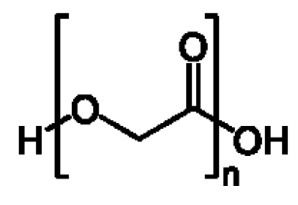
在一些實施例中,聚酯為聚乳酸(PLA):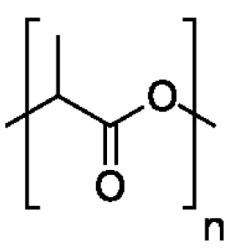
在一些實施例中,聚酯為聚己內酯(PCL):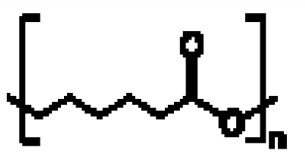
在一些實施例中,聚酯為聚羥丁酸酯(PHB):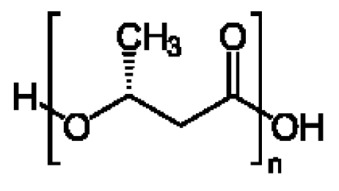
在一些實施例中,聚酯為聚己二酸乙二酯(PEA):
在一些實施例中,聚酯為聚丁二酸丁二酯(PBS):
在一些實施例中,聚酯為聚(3-羥丁酸酯-共-3-羥戊酸酯) (PHBV):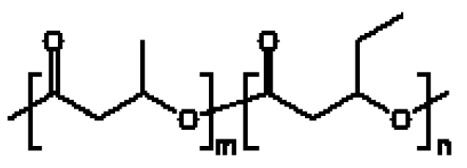
在一些實施例中,聚酯為聚對苯二甲酸丁二酯(PBT):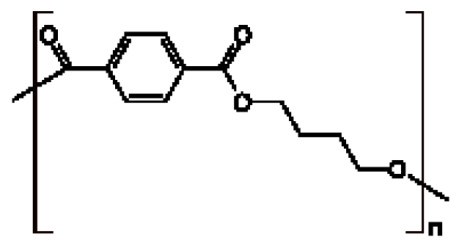
在一些實施例中,聚酯為聚對苯二甲酸丙二醇酯(PTT):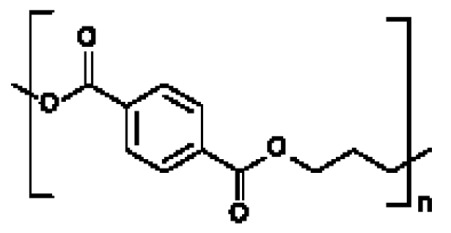
在一些實施例中,聚酯為聚萘二甲酸乙二酯(PEN):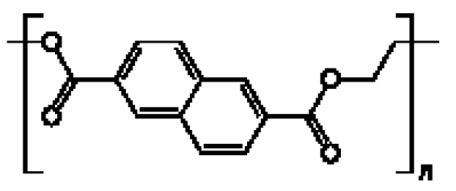
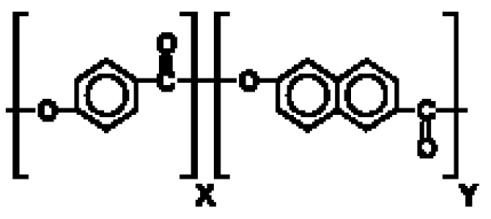
在一些實施例中,聚酯為Vectran®
:
在一些實施例中,聚酯為角質。角質為作為植物角質層之主要組分的兩種蠟樣聚合物中之一者,覆蓋植物之所有接觸空氣表面(aerial surface)。角質由ω羥基酸及其衍生物組成,其經由酯鍵互連,形成聚酯聚合物。角質具有兩個主要單體族,即C16族及C18族。C16族主要由16-羥基棕櫚酸及9,16-二羥基棕櫚酸或10,16-二羥基棕櫚酸組成。C18族主要由18-羥基油酸、9,10-環氧基-18-羥基硬脂酸及9,10,18-三羥基硬脂酸酯組成。番茄角質由16-羥基棕櫚酸及10,16-二羥基棕櫚酸組成,其中10-異構體很大程度上占主導。番茄角質為經交酯化作用之聚酯生物聚合物。相當大比例的二級酯(在C-10第二羥基中酯化)展示出聚酯結構顯著支化。酯衍生物 In some embodiments, the polyester is keratin. Cutin is one of the two waxy polymers that are the main components of the cuticle of the plant, covering all aerial surfaces of the plant. Keratin is composed of ω-hydroxy acids and their derivatives, which are interconnected via ester bonds to form polyester polymers. Cutin has two main monomer groups, namely C16 and C18. The C16 group is mainly composed of 16-hydroxypalmitic acid and 9,16-dihydroxypalmitic acid or 10,16-dihydroxypalmitic acid. The C18 group is mainly composed of 18-hydroxyoleic acid, 9,10-epoxy-18-hydroxystearic acid and 9,10,18-trihydroxystearate. Tomato cutin is composed of 16-hydroxypalmitic acid and 10,16-dihydroxypalmitic acid, of which the 10-isomer is largely dominant. Tomato cuticles are polyester biopolymers that have undergone esterification. A considerable proportion of the secondary esters (esterified in the second hydroxyl group of C-10) exhibit significant branching of the polyester structure. Ester derivatives
本文描述一種用於將聚酯轉化成酯衍生物之方法;該方法包含將聚酯與包含二醇鹽之混合物混雜。This document describes a method for converting polyesters to ester derivatives; the method comprises mixing the polyester with a mixture comprising diol salts.
在一些實施例中,聚酯為聚乙交酯或聚乙醇酸(PGA)且酯衍生物為2-羥乙酸酯衍生物。在一些實施例中,酯衍生物為2-羥乙酸甲酯。In some embodiments, the polyester is polyglycolide or polyglycolic acid (PGA) and the ester derivative is a 2-hydroxyacetate derivative. In some embodiments, the ester derivative is methyl 2-hydroxyacetate.
在一些實施例中,聚酯為聚乳酸(PLA)且酯衍生物為2-羥丙酸酯衍生物。在一些實施例中,酯衍生物為2-羥丙酸甲酯。In some embodiments, the polyester is polylactic acid (PLA) and the ester derivative is a 2-hydroxypropionate derivative. In some embodiments, the ester derivative is methyl 2-hydroxypropionate.
在一些實施例中,聚酯為聚己內酯(PCL)且酯衍生物為6-羥己酸酯衍生物。在一些實施例中,酯衍生物為6-羥己酸甲酯。In some embodiments, the polyester is polycaprolactone (PCL) and the ester derivative is a 6-hydroxycaproate derivative. In some embodiments, the ester derivative is methyl 6-hydroxyhexanoate.
在一些實施例中,聚酯為聚羥丁酸酯(PHB)且酯衍生物為羥丁酸酯衍生物。在一些實施例中,酯衍生物為羥丁酸甲酯。In some embodiments, the polyester is polyhydroxybutyrate (PHB) and the ester derivative is a hydroxybutyrate derivative. In some embodiments, the ester derivative is methyl hydroxybutyrate.
在一些實施例中,聚酯為聚己二酸乙二酯(PEA)且酯衍生物為己二酸酯衍生物。在一些實施例中,酯衍生物為己二酸二甲酯。In some embodiments, the polyester is polyethylene adipate (PEA) and the ester derivative is an adipate derivative. In some embodiments, the ester derivative is dimethyl adipate.
在一些實施例中,聚酯為聚丁二酸丁二酯(PBS)且酯衍生物為丁二酸酯衍生物。在一些實施例中,酯衍生物為丁二酸二甲酯。In some embodiments, the polyester is polybutylene succinate (PBS) and the ester derivative is a succinate derivative. In some embodiments, the ester derivative is dimethyl succinate.
在一些實施例中,聚酯為聚(3-羥丁酸酯-共 -3-羥戊酸酯) (PHBV),且酯衍生物為羥丁酸酯衍生物、羥戊酸酯衍生物或其組合。在一些實施例中,酯衍生物為羥丁酸甲酯、羥戊酸甲酯或其組合。In some embodiments, the polyester is poly(3-hydroxybutyrate- co- 3-hydroxyvalerate) (PHBV), and the ester derivative is a hydroxybutyrate derivative, a valerate derivative or Its combination. In some embodiments, the ester derivative is methyl hydroxybutyrate, methyl valerate, or a combination thereof.
在一些實施例中,聚酯為聚萘二甲酸乙二酯(PEN),且酯衍生物為萘二甲酸酯衍生物。在一些實施例中,酯衍生物為萘二甲酸二甲酯。In some embodiments, the polyester is polyethylene naphthalate (PEN) and the ester derivative is a naphthalate derivative. In some embodiments, the ester derivative is dimethyl naphthalate.
在一些實施例中,聚酯為vectran,且酯衍生物為萘甲酸酯衍生物、苄酸酯衍生物或其組合。在一些實施例中,酯衍生物為羥基萘甲酸甲酯或羥基苄酸甲酯。In some embodiments, the polyester is vectran, and the ester derivative is a naphthoate derivative, benzoate derivative, or a combination thereof. In some embodiments, the ester derivative is methyl hydroxynaphthoate or methyl hydroxybenzate.
在一些實施例中,聚酯為角質且酯衍生物為羥基棕櫚酸酯或二羥基棕櫚酸酯衍生物。在一些實施例中,酯衍生物為羥基棕櫚酸甲酯或二羥基棕櫚酸甲酯。In some embodiments, the polyester is keratin and the ester derivative is a hydroxypalmitate or dihydroxypalmitate derivative. In some embodiments, the ester derivative is methyl hydroxypalmitate or dihydroxy palmitate.
在一些實施例中,聚酯為聚對苯二甲酸乙二酯(PET)、聚(乙二醇-共 -1,4-環己烷二甲醇對苯二甲酸酯) (PETG)、聚對苯二甲酸丙二醇酯(PTT)或聚對苯二甲酸丁二酯(PBT),且酯衍生物為對苯二甲酸酯。在一些實施例中,對苯二甲酸酯為對苯二甲酸二甲酯。在一些實施例中,對苯二甲酸酯為對苯二甲酸二乙酯。In some embodiments, the polyester is polyethylene terephthalate (PET), poly(ethylene glycol- co -1,4-cyclohexanedimethanol terephthalate) (PETG), poly Propylene terephthalate (PTT) or polybutylene terephthalate (PBT), and the ester derivative is terephthalate. In some embodiments, the terephthalate is dimethyl terephthalate. In some embodiments, the terephthalate is diethyl terephthalate.
在一些實施例中,酯衍生物含有小於約10% (w/w)雜質。在一些實施例中,酯衍生物含有小於約9% (w/w)雜質。在一些實施例中,酯衍生物含有小於約8% (w/w)雜質。在一些實施例中,酯衍生物含有小於約7% (w/w)雜質。在一些實施例中,酯衍生物含有小於約6% (w/w)雜質。在一些實施例中,酯衍生物含有小於約5% (w/w)雜質。在一些實施例中,酯衍生物含有小於約4% (w/w)雜質。在一些實施例中,酯衍生物含有小於約3% (w/w)雜質。在一些實施例中,酯衍生物含有小於約2% (w/w)雜質。在一些實施例中,酯衍生物含有小於約1% (w/w)雜質。在一些實施例中,酯衍生物含有小於約0.5% (w/w)雜質。在一些實施例中,酯衍生物含有小於約0.4% (w/w)雜質。在一些實施例中,酯衍生物含有小於約0.3% (w/w)雜質。在一些實施例中,酯衍生物含有小於約0.2% (w/w)雜質。在一些實施例中,酯衍生物含有小於約0.1% (w/w)雜質。In some embodiments, the ester derivative contains less than about 10% (w/w) impurities. In some embodiments, the ester derivative contains less than about 9% (w/w) impurities. In some embodiments, the ester derivative contains less than about 8% (w/w) impurities. In some embodiments, the ester derivative contains less than about 7% (w/w) impurities. In some embodiments, the ester derivative contains less than about 6% (w/w) impurities. In some embodiments, the ester derivative contains less than about 5% (w/w) impurities. In some embodiments, the ester derivative contains less than about 4% (w/w) impurities. In some embodiments, the ester derivative contains less than about 3% (w/w) impurities. In some embodiments, the ester derivative contains less than about 2% (w/w) impurities. In some embodiments, the ester derivative contains less than about 1% (w/w) impurities. In some embodiments, the ester derivative contains less than about 0.5% (w/w) impurities. In some embodiments, the ester derivative contains less than about 0.4% (w/w) impurities. In some embodiments, the ester derivative contains less than about 0.3% (w/w) impurities. In some embodiments, the ester derivative contains less than about 0.2% (w/w) impurities. In some embodiments, the ester derivative contains less than about 0.1% (w/w) impurities.
在一些實施例中,酯衍生物含有小於約250 ppm之任何金屬、小於約240 ppm之任何金屬、小於約230 ppm之任何金屬、小於約220 ppm之任何金屬、小於約210 ppm之任何金屬、小於約200 ppm之任何金屬、小於約190 ppm之任何金屬、小於約180 ppm之任何金屬、小於約170 ppm之任何金屬、小於約160 ppm之任何金屬、小於約150 ppm之任何金屬、小於約140 ppm之任何金屬、小於約130 ppm之任何金屬、小於約120 ppm之任何金屬、小於約110 ppm之任何金屬、小於約100 ppm之任何金屬、小於約90 ppm之任何金屬、小於約80 ppm之任何金屬、小於約70 ppm之任何金屬、小於約60 ppm之任何金屬、小於約50 ppm之任何金屬、小於約40 ppm之任何金屬、小於約30 ppm之任何金屬、小於約20 ppm之任何金屬、小於約10 ppm之任何金屬、小於約5 ppm之任何金屬、小於約4 ppm之任何金屬、小於約3 ppm之任何金屬、小於約2 ppm之任何金屬、小於約1 ppm之任何金屬、小於約0.9 ppm之任何金屬、小於約0.8 ppm之任何金屬、小於約0.7 ppm之任何金屬、小於約0.6 ppm之任何金屬、小於約0.5 ppm之任何金屬、小於約0.4 ppm之任何金屬、小於約0.3 ppm之任何金屬、小於約0.2 ppm之任何金屬、小於約0.1 ppm之任何金屬、小於約0.09 ppm之任何金屬、小於約0.08 ppm之任何金屬、小於約0.07 ppm之任何金屬、小於約0.06 ppm之任何金屬、小於約0.05 ppm之任何金屬、小於約0.04 ppm之任何金屬、小於約0.03 ppm之任何金屬、小於約0.02 ppm之任何金屬、或小於約0.01 ppm之任何金屬。In some embodiments, the ester derivative contains any metal less than about 250 ppm, any metal less than about 240 ppm, any metal less than about 230 ppm, any metal less than about 220 ppm, any metal less than about 210 ppm, Any metal less than about 200 ppm, any metal less than about 190 ppm, any metal less than about 180 ppm, any metal less than about 170 ppm, any metal less than about 160 ppm, any metal less than about 150 ppm, less than about 140 ppm of any metal, any metal less than about 130 ppm, any metal less than about 120 ppm, any metal less than about 110 ppm, any metal less than about 100 ppm, any metal less than about 90 ppm, less than about 80 ppm Any metal, any metal less than about 70 ppm, any metal less than about 60 ppm, any metal less than about 50 ppm, any metal less than about 40 ppm, any metal less than about 30 ppm, any metal less than about 20 ppm Metal, any metal less than about 10 ppm, any metal less than about 5 ppm, any metal less than about 4 ppm, any metal less than about 3 ppm, any metal less than about 2 ppm, any metal less than about 1 ppm, Any metal less than about 0.9 ppm, any metal less than about 0.8 ppm, any metal less than about 0.7 ppm, any metal less than about 0.6 ppm, any metal less than about 0.5 ppm, any metal less than about 0.4 ppm, less than about 0.3 ppm of any metal, any metal less than about 0.2 ppm, any metal less than about 0.1 ppm, any metal less than about 0.09 ppm, any metal less than about 0.08 ppm, any metal less than about 0.07 ppm, less than about 0.06 ppm Any metal, any metal less than about 0.05 ppm, any metal less than about 0.04 ppm, any metal less than about 0.03 ppm, any metal less than about 0.02 ppm, or any metal less than about 0.01 ppm.
在一些實施例中,酯衍生物含有小於約10 ppm之二醇鹽、小於約5 ppm之二醇鹽、小於約4 ppm之二醇鹽、小於約3 ppm之二醇鹽、小於約2 ppm之二醇鹽、小於約1 ppm之二醇鹽、小於約0.9 ppm之二醇鹽、小於約0.8 ppm之二醇鹽、小於約0.7 ppm之二醇鹽、小於約0.6 ppm之二醇鹽、小於約0.5 ppm之二醇鹽、小於約0.4 ppm之二醇鹽、小於約0.3 ppm之二醇鹽、小於約0.2 ppm之二醇鹽、小於約0.1 ppm之二醇鹽、小於約0.09 ppm之二醇鹽、小於約0.08 ppm之二醇鹽、小於約0.07 ppm之二醇鹽、小於約0.06 ppm之二醇鹽、小於約0.05 ppm之二醇鹽、小於約0.04 ppm之二醇鹽、小於約0.03 ppm之二醇鹽、小於約0.02 ppm之二醇鹽、或小於約0.01 ppm之二醇鹽。In some embodiments, the ester derivative contains less than about 10 ppm of glycolate, less than about 5 ppm of glycolate, less than about 4 ppm of glycolate, less than about 3 ppm of glycolate, less than about 2 ppm Glycolate, glycolate less than about 1 ppm, glycolate less than about 0.9 ppm, glycolate less than about 0.8 ppm, glycolate less than about 0.7 ppm, glycolate less than about 0.6 ppm, Glycol salt less than about 0.5 ppm, glycol salt less than about 0.4 ppm, glycol salt less than about 0.3 ppm, glycol salt less than about 0.2 ppm, glycol salt less than about 0.1 ppm, less than about 0.09 ppm Glycolate, glycolate less than about 0.08 ppm, glycolate less than about 0.07 ppm, glycolate less than about 0.06 ppm, glycolate less than about 0.05 ppm, glycolate less than about 0.04 ppm, less than A glycol salt of about 0.03 ppm, a glycol salt of less than about 0.02 ppm, or a glycol salt of less than about 0.01 ppm.
在一些實施例中,獲得產率在約80與約99 mol%之間的酯衍生物。在一些實施例中,獲得產率在約85與約99 mol%之間的酯衍生物。在一些實施例中,獲得產率在約90與約99 mol%之間的酯衍生物。在一些實施例中,獲得產率呈至少約90 mol%的酯衍生物。在一些實施例中,獲得產率呈至少約95 mol%的酯衍生物。在一些實施例中,獲得產率呈至少約99 mol%的酯衍生物。In some embodiments, an ester derivative with a yield between about 80 and about 99 mol% is obtained. In some embodiments, an ester derivative with a yield between about 85 and about 99 mol% is obtained. In some embodiments, an ester derivative with a yield between about 90 and about 99 mol% is obtained. In some embodiments, an ester derivative is obtained with a yield of at least about 90 mol%. In some embodiments, the ester derivative is obtained in a yield of at least about 95 mol%. In some embodiments, the ester derivative is obtained in a yield of at least about 99 mol%.
在一些實施例中,獲得產率在約80與約99 mol%之間的對苯二甲酸酯。在一些實施例中,獲得產率在約85與約99 mol%之間的對苯二甲酸酯。在一些實施例中,獲得產率在約90與約99 mol%之間的對苯二甲酸酯。在一些實施例中,獲得產率呈至少約80 mol%的對苯二甲酸酯。在一些實施例中,獲得產率呈至少約85 mol%的對苯二甲酸酯。在一些實施例中,獲得產率呈至少約90 mol%的對苯二甲酸酯。在一些實施例中,獲得產率呈至少約95 mol%的對苯二甲酸酯。在一些實施例中,獲得產率呈至少約99 mol%的對苯二甲酸酯。二醇 In some embodiments, terephthalate is obtained with a yield between about 80 and about 99 mol%. In some embodiments, terephthalate is obtained with a yield between about 85 and about 99 mol%. In some embodiments, terephthalate is obtained with a yield between about 90 and about 99 mol%. In some embodiments, terephthalate is obtained in a yield of at least about 80 mol%. In some embodiments, terephthalate is obtained in a yield of at least about 85 mol%. In some embodiments, terephthalate is obtained in a yield of at least about 90 mol%. In some embodiments, terephthalate is obtained in a yield of at least about 95 mol%. In some embodiments, terephthalate is obtained in a yield of at least about 99 mol%. Diol
本文描述一種用於將聚酯轉化成酯衍生物及二醇之方法;該方法包含將聚酯與包含二醇鹽之混合物混雜。在一些實施例中,二醇為單乙二醇(MEG) (或乙二醇)。在一些實施例中,二醇為丙二醇。在一些實施例中,二醇為丁二醇。This document describes a method for converting polyesters into ester derivatives and diols; the method includes mixing the polyester with a mixture comprising diol salts. In some embodiments, the diol is monoethylene glycol (MEG) (or ethylene glycol). In some embodiments, the glycol is propylene glycol. In some embodiments, the diol is butylene glycol.
在一些實施例中,獲得產率在約80與約99 mol%之間的二醇。在一些實施例中,獲得產率在約85與約99 mol%之間的二醇。在一些實施例中,獲得產率在約90與約99 mol%之間的二醇。在一些實施例中,獲得產率呈至少約80 mol%的二醇。在一些實施例中,獲得產率呈至少約85 mol%的二醇。在一些實施例中,獲得產率呈至少約90 mol%的二醇。在一些實施例中,獲得產率呈至少約95 mol%的二醇。二醇鹽 In some embodiments, a diol with a yield between about 80 and about 99 mol% is obtained. In some embodiments, a diol with a yield between about 85 and about 99 mol% is obtained. In some embodiments, a diol with a yield between about 90 and about 99 mol% is obtained. In some embodiments, the diol is obtained in a yield of at least about 80 mol%. In some embodiments, the diol is obtained in a yield of at least about 85 mol%. In some embodiments, the diol is obtained in a yield of at least about 90 mol%. In some embodiments, the diol is obtained in a yield of at least about 95 mol%. Glycolate
在一些實施例中,本文所述之方法包含自沸點高於水之醇所衍生的醇鹽。在一些實施例中,醇為單乙二醇(MEG)、丙三醇、山梨醇、1,3-丙二醇或環己烷-1,4-二甲醇。在一些實施例中,醇為單乙二醇(MEG)。In some embodiments, the methods described herein include alkoxides derived from alcohols boiling above water. In some embodiments, the alcohol is monoethylene glycol (MEG), glycerin, sorbitol, 1,3-propanediol, or cyclohexane-1,4-dimethanol. In some embodiments, the alcohol is monoethylene glycol (MEG).
在一些實施例中,本文所述之方法包含具成本效益之醇鹽。在一些實施例中,本文所述之方法包含使用呈重量比形式的與其他催化劑(諸如甲醇鈉)相比節省成本的量的醇鹽。在一些實施例中,本文所述之方法包含使用呈重量比形式的與其他催化劑(諸如甲醇鈉)相比節省成本的量的二醇鈉。在一些實施例中,本文所述之方法包含能夠與甲醇進行交換來生成甲醇鈉之醇鹽。In some embodiments, the methods described herein include cost-effective alkoxides. In some embodiments, the method described herein includes using a cost-effective amount of alkoxide in a weight ratio compared to other catalysts, such as sodium methoxide. In some embodiments, the methods described herein include the use of sodium glycolate in a weight ratio compared to other catalysts such as sodium methoxide in a cost-effective amount. In some embodiments, the methods described herein include the ability to exchange with methanol to produce an alkoxide of sodium methoxide.
在一些實施例中,本文所述之方法包含二醇鹽。在一些實施例中,本文所述之方法包含呈催化量之二醇鹽。在一些實施例中,本文所述之方法包含低於化學計量之量的二醇鹽。In some embodiments, the methods described herein include glycolates. In some embodiments, the methods described herein include diol salts in catalytic amounts. In some embodiments, the methods described herein include less than stoichiometric amounts of glycolate.
如本文所使用,「低於化學計量之量」用於指示所使用之物質之量低於化學計量之量。該術語在本文中與「催化量」互換使用。在一些實施例中,低於化學計量之量為低於或等於化學計量之量的約95%。在一些實施例中,低於化學計量之量為低於或等於化學計量之量的約90%。在一些實施例中,低於化學計量之量為低於或等於化學計量之量的約85%。在一些實施例中,低於化學計量之量為低於或等於化學計量之量的約80%。在一些實施例中,低於化學計量之量為低於或等於化學計量之量的約75%。在一些實施例中,低於化學計量之量為低於或等於化學計量之量的約70%。在一些實施例中,低於化學計量之量為低於或等於化學計量之量的約65%。在一些實施例中,低於化學計量之量為低於或等於化學計量之量的約60%。在一些實施例中,低於化學計量之量為低於或等於化學計量之量的約55%。在一些實施例中,低於化學計量之量為低於或等於化學計量之量的約50%。在一些實施例中,低於化學計量之量為低於或等於化學計量之量的約45%。在一些實施例中,低於化學計量之量為低於或等於化學計量之量的約40%。在一些實施例中,低於化學計量之量為低於或等於化學計量之量的約35%。在一些實施例中,低於化學計量之量為低於或等於化學計量之量的約30%。在一些實施例中,低於化學計量之量為低於或等於化學計量之量的約25%。在一些實施例中,低於化學計量之量為低於或等於化學計量之量的約20%。在一些實施例中,低於化學計量之量為低於或等於化學計量之量的約15%。在一些實施例中,低於化學計量之量為低於或等於化學計量之量的約10%。As used herein, "less than stoichiometric amount" is used to indicate that the amount of substance used is less than the stoichiometric amount. This term is used interchangeably with "catalytic amount" herein. In some embodiments, the sub-stoichiometric amount is less than or equal to about 95% of the stoichiometric amount. In some embodiments, the sub-stoichiometric amount is less than or equal to about 90% of the stoichiometric amount. In some embodiments, the sub-stoichiometric amount is less than or equal to about 85% of the stoichiometric amount. In some embodiments, the sub-stoichiometric amount is less than or equal to about 80% of the stoichiometric amount. In some embodiments, the sub-stoichiometric amount is less than or equal to about 75% of the stoichiometric amount. In some embodiments, the sub-stoichiometric amount is less than or equal to about 70% of the stoichiometric amount. In some embodiments, the sub-stoichiometric amount is less than or equal to about 65% of the stoichiometric amount. In some embodiments, the sub-stoichiometric amount is less than or equal to about 60% of the stoichiometric amount. In some embodiments, the sub-stoichiometric amount is less than or equal to about 55% of the stoichiometric amount. In some embodiments, the sub-stoichiometric amount is less than or equal to about 50% of the stoichiometric amount. In some embodiments, the sub-stoichiometric amount is less than or equal to about 45% of the stoichiometric amount. In some embodiments, the sub-stoichiometric amount is less than or equal to about 40% of the stoichiometric amount. In some embodiments, the sub-stoichiometric amount is less than or equal to about 35% of the stoichiometric amount. In some embodiments, the sub-stoichiometric amount is less than or equal to about 30% of the stoichiometric amount. In some embodiments, the sub-stoichiometric amount is less than or equal to about 25% of the stoichiometric amount. In some embodiments, the sub-stoichiometric amount is less than or equal to about 20% of the stoichiometric amount. In some embodiments, the sub-stoichiometric amount is less than or equal to about 15% of the stoichiometric amount. In some embodiments, the sub-stoichiometric amount is less than or equal to about 10% of the stoichiometric amount.
如本文所使用,「化學計量之量」用於指示所使用之物質之量等於存在於聚酯中之酯鍵的數量。As used herein, "stoichiometric amount" is used to indicate that the amount of substance used is equal to the number of ester bonds present in the polyester.
在一些實施例中,包含二醇根陰離子及陽離子之二醇鹽係選自鹼金屬二醇鹽、鹼土金屬二醇鹽、金屬二醇鹽、二醇銨及其任何組合。在一些實施例中,陽離子為鋰、鈉、鉀、鎂、鈣、鍶、鋇、鋅、鋁或銨。在一些實施例中,二醇鹽為二醇鈉。在一些實施例中,二醇鹽為二醇單鈉。In some embodiments, the glycolate comprising glycolate anions and cations is selected from alkali metal glycolates, alkaline earth metal glycolates, metal glycolates, ammonium glycolates, and any combination thereof. In some embodiments, the cation is lithium, sodium, potassium, magnesium, calcium, strontium, barium, zinc, aluminum, or ammonium. In some embodiments, the glycolate salt is sodium glycolate. In some embodiments, the glycolate salt is monosodium glycolate.
在一些實施例中,藉由向單乙二醇(MEG)中添加鹼金屬、鹼土金屬或金屬來生成二醇鹽。在一些實施例中,藉由向單乙二醇(MEG)中添加氫氧化鈉來生成二醇鹽。In some embodiments, glycol salts are generated by adding alkali metals, alkaline earth metals, or metals to monoethylene glycol (MEG). In some embodiments, the glycolate salt is generated by adding sodium hydroxide to monoethylene glycol (MEG).
在一些實施例中,提供呈懸浮液形式之二醇鹽。In some embodiments, the glycolate salt is provided in the form of a suspension.
本文揭示一種用於製備二醇單鈉懸浮液之方法,該方法包含: a)加熱單乙二醇; b)添加氫氧化鈉,藉此形成二醇單鈉; c)乾燥二醇單鈉; d)將乾燥的二醇單鈉懸浮於懸浮溶劑中;及 e)使懸浮液老化。This article discloses a method for preparing a monosodium diol suspension. The method includes: a) Heating monoethylene glycol; b) Add sodium hydroxide to form monosodium diol; c) Dry monosodium diol; d) suspend the dried monosodium diol in a suspension solvent; and e) Aging the suspension.
在一些實施例中,懸浮溶劑為醇。在一些實施例中,懸浮溶劑為甲醇。In some embodiments, the suspension solvent is an alcohol. In some embodiments, the suspension solvent is methanol.
在一些實施例中,步驟(a)係在約70℃至約100℃之間的溫度下進行。在一些實施例中,步驟(a)係在約70℃至約90℃之間的溫度下進行。在一些實施例中,步驟(a)係在約80℃至約100℃之間的溫度下進行。在一些實施例中,步驟(a)係在以下溫度下進行:約70℃、約75℃、約80℃、約85℃、約90℃、約95℃或約100℃。在一些實施例中,步驟(a)係在約90℃之溫度下進行。In some embodiments, step (a) is performed at a temperature between about 70°C and about 100°C. In some embodiments, step (a) is performed at a temperature between about 70°C and about 90°C. In some embodiments, step (a) is performed at a temperature between about 80°C and about 100°C. In some embodiments, step (a) is performed at the following temperatures: about 70 °C, about 75 °C, about 80 °C, about 85 °C, about 90 °C, about 95 °C, or about 100 °C. In some embodiments, step (a) is performed at a temperature of about 90°C.
在一些實施例中,二醇單鈉與懸浮溶劑之比率在約0.05:1至約0.5:1 (mol/mol)之間。在一些實施例中,二醇單鈉與懸浮溶劑之比率在約0.1:1至約0.5:1 (mol/mol)之間。在一些實施例中,二醇單鈉與懸浮溶劑之比率在約0.1:1至約0.3:1 (mol/mol)之間。在一些實施例中,二醇單鈉與懸浮溶劑之比率為約0.05:1 (mol/mol)、約0.06:1 (mol/mol)、約0.07:1 (mol/mol)、約0.08:1 (mol/mol)、約0.09:1 (mol/mol)、約0.1:1 (mol/mol)、約0.11:1 (mol/mol)、約0.12:1 (mol/mol)、約0.13:1 (mol/mol)、約0.14:1 (mol/mol)、約0.15:1 (mol/mol)、約0.16:1 (mol/mol)、約0.17:1 (mol/mol)、約0.18:1 (mol/mol)、約0.19:1 (mol/mol)、約0.2:1 (mol/mol)、約0.21:1 (mol/mol)、約0.22:1 (mol/mol)、約0.23:1 (mol/mol)、約0.24:1 (mol/mol)、約0.25:1 (mol/mol)、約0.26:1 (mol/mol)、約0.27:1 (mol/mol)、約0.28:1 (mol/mol)、約0.29:1 (mol/mol)、約0.30:1 (mol/mol)、約0.35:1 (mol/mol)、約0.40:1 (mol/mol)、約0.45:1 (mol/mol)或約0.5:1 (mol/mol)。在一些實施例中,二醇單鈉與懸浮溶劑之比率為約0.2:1 (mol/mol)。In some embodiments, the ratio of monosodium glycolate to suspension solvent is between about 0.05:1 to about 0.5:1 (mol/mol). In some embodiments, the ratio of monosodium glycolate to suspension solvent is between about 0.1:1 to about 0.5:1 (mol/mol). In some embodiments, the ratio of monosodium glycolate to suspension solvent is between about 0.1:1 to about 0.3:1 (mol/mol). In some embodiments, the ratio of monosodium glycolate to suspending solvent is about 0.05:1 (mol/mol), about 0.06:1 (mol/mol), about 0.07:1 (mol/mol), about 0.08:1 (mol/mol), about 0.09:1 (mol/mol), about 0.1:1 (mol/mol), about 0.11:1 (mol/mol), about 0.12:1 (mol/mol), about 0.13:1 (mol/mol), about 0.14:1 (mol/mol), about 0.15:1 (mol/mol), about 0.16:1 (mol/mol), about 0.17:1 (mol/mol), about 0.18:1 (mol/mol), about 0.19:1 (mol/mol), about 0.2:1 (mol/mol), about 0.21:1 (mol/mol), about 0.22:1 (mol/mol), about 0.23:1 (mol/mol), about 0.24:1 (mol/mol), about 0.25:1 (mol/mol), about 0.26:1 (mol/mol), about 0.27:1 (mol/mol), about 0.28:1 (mol/mol), about 0.29:1 (mol/mol), about 0.30:1 (mol/mol), about 0.35:1 (mol/mol), about 0.40:1 (mol/mol), about 0.45:1 (mol/mol) or about 0.5:1 (mol/mol). In some embodiments, the ratio of monosodium glycolate to suspension solvent is about 0.2:1 (mol/mol).
在一些實施例中,二醇鹽與聚對苯二甲酸乙二酯(PET)之比率在約1:2與約1:20 (mol/mol)之間。在一些實施例中,二醇鹽與聚對苯二甲酸乙二酯(PET)之比率在約1:2與約1:10 (mol/mol)之間。在一些實施例中,二醇鹽與聚對苯二甲酸乙二酯(PET)之比率在約1:2與約1:6 (mol/mol)之間。在一些實施例中,二醇鹽與聚對苯二甲酸乙二酯(PET)之比率在約1:5與約1:20 (mol/mol)之間。在一些實施例中,二醇鹽與聚對苯二甲酸乙二酯(PET)之比率在約1:10與約1:20 (mol/mol)之間。在一些實施例中,二醇鹽與聚對苯二甲酸乙二酯(PET)之比率在約1:10與約1:15 (mol/mol)之間。在一些實施例中,二醇鹽與聚對苯二甲酸乙二酯(PET)之比率為約1:2 (mol/mol)、約1:3 (mol/mol)、約1:4 (mol/mol)、約1:5 (mol/mol)、約1:6 (mol/mol)、約1:7 (mol/mol)、約1:8 (mol/mol)、約1:9 (mol/mol)、約1:10 (mol/mol)、約1:11 (mol/mol)、約1:12 (mol/mol)、約1:13 (mol/mol)、約1:14 (mol/mol)、約1:15 (mol/mol)、約1:16 (mol/mol)、約1:17 (mol/mol)、約1:18 (mol/mol)、約1:19 (mol/mol)或約1:2 (mol/mol)。In some embodiments, the ratio of glycolate to polyethylene terephthalate (PET) is between about 1:2 and about 1:20 (mol/mol). In some embodiments, the ratio of glycolate to polyethylene terephthalate (PET) is between about 1:2 and about 1:10 (mol/mol). In some embodiments, the ratio of glycolate to polyethylene terephthalate (PET) is between about 1:2 and about 1:6 (mol/mol). In some embodiments, the ratio of glycolate to polyethylene terephthalate (PET) is between about 1:5 and about 1:20 (mol/mol). In some embodiments, the ratio of glycolate to polyethylene terephthalate (PET) is between about 1:10 and about 1:20 (mol/mol). In some embodiments, the ratio of glycolate to polyethylene terephthalate (PET) is between about 1:10 and about 1:15 (mol/mol). In some embodiments, the ratio of glycolate to polyethylene terephthalate (PET) is about 1:2 (mol/mol), about 1:3 (mol/mol), about 1:4 (mol /mol), about 1:5 (mol/mol), about 1:6 (mol/mol), about 1:7 (mol/mol), about 1:8 (mol/mol), about 1:9 (mol /mol), about 1:10 (mol/mol), about 1:11 (mol/mol), about 1:12 (mol/mol), about 1:13 (mol/mol), about 1:14 (mol /mol), about 1:15 (mol/mol), about 1:16 (mol/mol), about 1:17 (mol/mol), about 1:18 (mol/mol), about 1:19 (mol /mol) or about 1:2 (mol/mol).
在一些實施例中,乾燥二醇單鈉以移除反應期間所形成之水。在一些實施例中,二醇單鈉係在高於水之沸點的溫度下乾燥。在一些實施例中,二醇單鈉係在約100℃與約150℃之間的溫度下乾燥。在一些實施例中,二醇單鈉係在約110℃與約140℃之間的溫度下乾燥。在一些實施例中,二醇單鈉係在約120℃與約130℃之間的溫度下乾燥。在一些實施例中,二醇單鈉係在以下溫度下乾燥:約100℃、約105℃、約110℃、約115℃、約120℃、約125℃、約130℃、約135℃、約140℃、約145℃或約150℃。在一些實施例中,二醇單鈉係在約130℃下乾燥。In some embodiments, monosodium diol is dried to remove water formed during the reaction. In some embodiments, monosodium diol is dried at a temperature above the boiling point of water. In some embodiments, monosodium diol is dried at a temperature between about 100°C and about 150°C. In some embodiments, monosodium diol is dried at a temperature between about 110°C and about 140°C. In some embodiments, monosodium diol is dried at a temperature between about 120°C and about 130°C. In some embodiments, monosodium glycolate is dried at the following temperatures: about 100°C, about 105°C, about 110°C, about 115°C, about 120°C, about 125°C, about 130°C, about 135°C, about 140°C, about 145°C, or about 150°C. In some embodiments, monosodium diol is dried at about 130°C.
在一些實施例中,使懸浮液老化持續約1天至約2個月。在一些實施例中,使懸浮液老化持續約1天至14天。在一些實施例中,使懸浮液老化持續約7天至14天。在一些實施例中,使懸浮液老化持續約5天至8天。在一些實施例中,使懸浮液老化持續約1天至7天。在一些實施例中,使懸浮液老化持續約1天、約2天、約3天、約4天、約5天、約6天、約7天、約8天、約9天、約10天、約11天、約12天、約13天或約14天。在一些實施例中,使懸浮液老化持續約7天。在一些實施例中,如本文所使用之「老化」意謂在室溫及環境壓力下儲存。在一些實施例中,老化步驟允許一部分二醇鈉轉換成甲醇鈉。在一些實施例中,老化的二醇鹽懸浮液包含至高約85%的甲醇鈉。在一些實施例中,經老化的二醇鹽懸浮液包含以下百分比之甲醇鈉:至高約85%、至高約80%、至高約75%、至高約70%、至高約65%、至高約60%、至高約55%、至高約50%、至高約45%、至高約40%、至高約45%、至高約40%、至高約35%、至高約30%、至高約25%、至高約20%、至高約15%、至高約10%或至高約5%。解聚 In some embodiments, the suspension is aged for about 1 day to about 2 months. In some embodiments, the suspension is aged for about 1 to 14 days. In some embodiments, the suspension is aged for about 7 to 14 days. In some embodiments, the suspension is aged for about 5 to 8 days. In some embodiments, the suspension is aged for about 1 to 7 days. In some embodiments, the suspension is aged for about 1 day, about 2 days, about 3 days, about 4 days, about 5 days, about 6 days, about 7 days, about 8 days, about 9 days, about 10 days , About 11 days, about 12 days, about 13 days, or about 14 days. In some embodiments, the suspension is aged for about 7 days. In some embodiments, "aging" as used herein means storage at room temperature and ambient pressure. In some embodiments, the aging step allows a portion of sodium glycolate to be converted to sodium methoxide. In some embodiments, the aged glycolate suspension contains up to about 85% sodium methoxide. In some embodiments, the aged glycolate suspension comprises the following percentages of sodium methoxide: up to about 85%, up to about 80%, up to about 75%, up to about 70%, up to about 65%, up to about 60% , Up to about 55%, up to about 50%, up to about 45%, up to about 40%, up to about 45%, up to about 40%, up to about 35%, up to about 30%, up to about 25%, up to about 20% , Up to about 15%, up to about 10% or up to about 5%. Depolymerization
本文描述一種用於將聚酯轉化成酯衍生物之方法;該方法包含將聚酯與包含二醇鹽之混合物混雜。本文描述一種用於使聚對苯二甲酸乙二酯(PET)解聚以形成對苯二甲酸酯之方法;該方法包含將聚對苯二甲酸乙二酯(PET)與包含二醇鹽之混合物混雜。This document describes a method for converting polyesters to ester derivatives; the method comprises mixing the polyester with a mixture comprising diol salts. This article describes a method for depolymerizing polyethylene terephthalate (PET) to form terephthalate; the method includes combining polyethylene terephthalate (PET) with a glycol salt The mixture is mixed.
在一些實施例中,混合物進一步包含溶劑。In some embodiments, the mixture further includes a solvent.
在一些實施例中,溶劑包含直鏈醇、分支鏈醇、環狀醇或其任何組合。在一些實施例中,溶劑係選自甲醇、乙醇、正丙醇、異丙醇、第三丁醇、乙二醇、丙三醇、環己烷-1,4-二甲醇、酚、苄醇及其任何組合。In some embodiments, the solvent comprises linear alcohol, branched chain alcohol, cyclic alcohol, or any combination thereof. In some embodiments, the solvent is selected from methanol, ethanol, n-propanol, isopropanol, third butanol, ethylene glycol, glycerin, cyclohexane-1,4-dimethanol, phenol, benzyl alcohol And any combination thereof.
在一些實施例中,溶劑為直鏈C1 -C4 醇。在一些實施例中,溶劑為甲醇、乙醇、丙醇、丁醇或其組合。在一些實施例中,溶劑為甲醇、乙醇、丙醇或其組合。在一些實施例中,溶劑為甲醇。在一些實施例中,醇為乙醇。在一些實施例中,溶劑為分支鏈C3 -C4 醇。在一些實施例中,溶劑為第三丁醇、第二丁醇、異丁醇、異丙醇或其任何組合。在一些實施例中,溶劑為環狀C3 -C8 醇。在一些實施例中,溶劑為環丙醇、環丁醇、環戊醇、環己醇、環庚醇、環己烷-1,4-二甲醇或其任何組合。在一些實施例中,溶劑為環己烷-1,4-二甲醇。In some embodiments, the solvent is a linear C 1 -C 4 alcohol. In some embodiments, the solvent is methanol, ethanol, propanol, butanol, or a combination thereof. In some embodiments, the solvent is methanol, ethanol, propanol, or a combination thereof. In some embodiments, the solvent is methanol. In some embodiments, the alcohol is ethanol. In some embodiments, the solvent is a branched chain C 3 -C 4 alcohol. In some embodiments, the solvent is third butanol, second butanol, isobutanol, isopropanol, or any combination thereof. In some embodiments, the solvent is a cyclic C 3 -C 8 alcohol. In some embodiments, the solvent is cyclopropanol, cyclobutanol, cyclopentanol, cyclohexanol, cycloheptanol, cyclohexane-1,4-dimethanol, or any combination thereof. In some embodiments, the solvent is cyclohexane-1,4-dimethanol.
在一些實施例中,溶劑為多元醇。在一些實施例中,溶劑係選自乙二醇、丙三醇及其任何組合。在一些實施例中,溶劑係選自酚、苄醇及其任何組合。In some embodiments, the solvent is a polyol. In some embodiments, the solvent is selected from ethylene glycol, glycerin, and any combination thereof. In some embodiments, the solvent is selected from phenol, benzyl alcohol, and any combination thereof.
在一些實施例中,在添加二醇鹽之前,將溶劑添加至聚對苯二甲酸乙二酯(PET)中。在一些實施例中,在添加二醇鹽之前,將聚對苯二甲酸乙二酯(PET)與溶劑混合持續約15分鐘至約120分鐘。在一些實施例中,在添加二醇鹽之前,將聚對苯二甲酸乙二酯(PET)與溶劑混合持續約15分鐘至約90分鐘。在一些實施例中,在添加二醇鹽之前,將聚對苯二甲酸乙二酯(PET)與溶劑混合持續約30分鐘至約90分鐘。在一些實施例中,在添加二醇鹽之前,將聚對苯二甲酸乙二酯(PET)與溶劑混合持續約45分鐘至約90分鐘。在一些實施例中,在添加二醇鹽之前,將聚對苯二甲酸乙二酯(PET)與溶劑混合持續約15分鐘、約20分鐘、約25分鐘、約30分鐘、約35分鐘、約40分鐘、約45分鐘、約50分鐘、約55分鐘、約60分鐘、約65分鐘、約70分鐘、約75分鐘、約80分鐘、約85分鐘、約90分鐘、約95分鐘、約100分鐘、約105分鐘、約110分鐘、約115分鐘或約120分鐘。在一些實施例中,在添加二醇鹽之前,將聚對苯二甲酸乙二酯(PET)與溶劑混合持續約60分鐘。In some embodiments, the solvent is added to polyethylene terephthalate (PET) before the glycol salt is added. In some embodiments, the polyethylene terephthalate (PET) is mixed with the solvent for about 15 minutes to about 120 minutes before the glycol salt is added. In some embodiments, the polyethylene terephthalate (PET) is mixed with the solvent for about 15 minutes to about 90 minutes before the glycol salt is added. In some embodiments, the polyethylene terephthalate (PET) is mixed with the solvent for about 30 minutes to about 90 minutes before the glycol salt is added. In some embodiments, the polyethylene terephthalate (PET) is mixed with the solvent for about 45 minutes to about 90 minutes before the glycol salt is added. In some embodiments, the polyethylene terephthalate (PET) is mixed with the solvent for about 15 minutes, about 20 minutes, about 25 minutes, about 30 minutes, about 35 minutes, about 40 minutes, about 45 minutes, about 50 minutes, about 55 minutes, about 60 minutes, about 65 minutes, about 70 minutes, about 75 minutes, about 80 minutes, about 85 minutes, about 90 minutes, about 95 minutes, about 100 minutes , About 105 minutes, about 110 minutes, about 115 minutes, or about 120 minutes. In some embodiments, the polyethylene terephthalate (PET) is mixed with the solvent for about 60 minutes before the glycol salt is added.
在一些實施例中,在添加二醇鹽之前,將聚對苯二甲酸乙二酯(PET)與溶劑混合且加熱至約50℃至約100℃之間的溫度。在一些實施例中,在添加二醇鹽之前,將聚對苯二甲酸乙二酯(PET)與溶劑混合且加熱至約50℃至約90℃之間的溫度。在一些實施例中,在添加二醇鹽之前,將聚對苯二甲酸乙二酯(PET)與溶劑混合且加熱至約50℃至約80℃之間的溫度。在一些實施例中,在添加二醇鹽之前,將聚對苯二甲酸乙二酯(PET)與溶劑混合且加熱至約50℃至約70℃之間的溫度。在一些實施例中,在添加二醇鹽之前,將聚對苯二甲酸乙二酯(PET)與溶劑混合且加熱至以下溫度:約50℃、約55℃、約60℃、約65℃、約70℃、約75℃、約80℃、約85℃、約90℃、約95℃或約100℃。在一些實施例中,在添加二醇鹽之前,將聚對苯二甲酸乙二酯(PET)與溶劑混合且加熱至約60℃之溫度。In some embodiments, before the glycol salt is added, polyethylene terephthalate (PET) is mixed with the solvent and heated to a temperature between about 50°C and about 100°C. In some embodiments, before the glycol salt is added, polyethylene terephthalate (PET) is mixed with the solvent and heated to a temperature between about 50°C and about 90°C. In some embodiments, before the glycol salt is added, polyethylene terephthalate (PET) is mixed with the solvent and heated to a temperature between about 50°C and about 80°C. In some embodiments, before the glycol salt is added, polyethylene terephthalate (PET) is mixed with the solvent and heated to a temperature between about 50°C and about 70°C. In some embodiments, before adding the glycolate, polyethylene terephthalate (PET) is mixed with the solvent and heated to the following temperatures: about 50°C, about 55°C, about 60°C, about 65°C, About 70°C, about 75°C, about 80°C, about 85°C, about 90°C, about 95°C, or about 100°C. In some embodiments, before the glycol salt is added, polyethylene terephthalate (PET) is mixed with the solvent and heated to a temperature of about 60°C.
本文描述一種用於將聚酯轉化成酯衍生物之方法;該方法包含: (i)將聚對苯二甲酸乙二酯(PET)與第一溶劑混雜,以得到第一混合物; (ii)將二醇鹽添加至第一混合物; (iii)添加第二溶劑;及 (iv)進行混雜; 藉此形成酯衍生物。This article describes a method for converting polyesters to ester derivatives; the method includes: (i) mixing polyethylene terephthalate (PET) with the first solvent to obtain the first mixture; (ii) Add the glycol salt to the first mixture; (iii) Add a second solvent; and (iv) Promiscuous; This forms an ester derivative.
本文亦描述一種用於使聚對苯二甲酸乙二酯(PET)解聚以形成對苯二甲酸酯之方法;該方法包含: (i)將聚對苯二甲酸乙二酯(PET)與第一溶劑混雜,以得到第一混合物; (ii)將二醇鹽添加至第一混合物; (iii)添加第二溶劑;及 (iv)進行混雜; 藉此形成對苯二甲酸酯。This article also describes a method for depolymerizing polyethylene terephthalate (PET) to form terephthalate; the method includes: (i) mixing polyethylene terephthalate (PET) with the first solvent to obtain the first mixture; (ii) Add the glycol salt to the first mixture; (iii) Add a second solvent; and (iv) Promiscuous; This forms terephthalate.
在一些實施例中,第一溶劑包含直鏈醇、分支鏈醇、環狀醇或其任何組合。在一些實施例中,第一溶劑係選自甲醇、乙醇、正丙醇、異丙醇、第三丁醇、乙二醇、丙三醇、環己烷-1,4-二甲醇、酚、苄醇及其任何組合。In some embodiments, the first solvent comprises linear alcohol, branched chain alcohol, cyclic alcohol, or any combination thereof. In some embodiments, the first solvent is selected from methanol, ethanol, n-propanol, isopropanol, third butanol, ethylene glycol, glycerin, cyclohexane-1,4-dimethanol, phenol, Benzyl alcohol and any combination thereof.
在一些實施例中,第一溶劑為直鏈C1 -C4 醇。在一些實施例中,第一溶劑為甲醇、乙醇、丙醇、丁醇或其組合。在一些實施例中,第一溶劑為甲醇、乙醇、丙醇或其組合。在一些實施例中,第一溶劑為甲醇。在一些實施例中,醇為乙醇。在一些實施例中,第一溶劑為分支鏈C3 -C4 醇。在一些實施例中,第一溶劑為第三丁醇、第二丁醇、異丁醇、異丙醇或其任何組合。在一些實施例中,第一溶劑為環狀C3 -C8 醇。在一些實施例中,第一溶劑為環丙醇、環丁醇、環戊醇、環己醇、環庚醇、環己烷-1,4-二甲醇或其任何組合。在一些實施例中,第一溶劑為環己烷-1,4-二甲醇。In some embodiments, the first solvent is a linear C 1 -C 4 alcohol. In some embodiments, the first solvent is methanol, ethanol, propanol, butanol, or a combination thereof. In some embodiments, the first solvent is methanol, ethanol, propanol, or a combination thereof. In some embodiments, the first solvent is methanol. In some embodiments, the alcohol is ethanol. In some embodiments, the first solvent is a branched C 3 -C 4 alcohol. In some embodiments, the first solvent is third butanol, second butanol, isobutanol, isopropanol, or any combination thereof. In some embodiments, the first solvent is a cyclic C 3 -C 8 alcohol. In some embodiments, the first solvent is cyclopropanol, cyclobutanol, cyclopentanol, cyclohexanol, cycloheptanol, cyclohexane-1,4-dimethanol, or any combination thereof. In some embodiments, the first solvent is cyclohexane-1,4-dimethanol.
在一些實施例中,第一溶劑為多元醇。在一些實施例中,第一溶劑係選自乙二醇、丙三醇及其任何組合。在一些實施例中,第一溶劑係選自酚、苄醇及其任何組合。In some embodiments, the first solvent is a polyol. In some embodiments, the first solvent is selected from ethylene glycol, glycerin, and any combination thereof. In some embodiments, the first solvent is selected from phenol, benzyl alcohol, and any combination thereof.
在一些實施例中,步驟(i)係進行持續約15分鐘至約120分鐘。在一些實施例中,步驟(i)係進行持續約15分鐘至約90分鐘。在一些實施例中,步驟(i)係進行持續約30分鐘至約90分鐘。在一些實施例中,步驟(i)係進行持續約45分鐘至約90分鐘。在一些實施例中,步驟(i)係進行持續約15分鐘、約20分鐘、約25分鐘、約30分鐘、約35分鐘、約40分鐘、約45分鐘、約50分鐘、約55分鐘、約60分鐘、約65分鐘、約70分鐘、約75分鐘、約80分鐘、約85分鐘、約90分鐘、約95分鐘、約100分鐘、約105分鐘、約110分鐘、約115分鐘或約120分鐘。在一些實施例中,步驟(i)係進行持續約60分鐘。In some embodiments, step (i) is performed for about 15 minutes to about 120 minutes. In some embodiments, step (i) is performed for about 15 minutes to about 90 minutes. In some embodiments, step (i) is performed for about 30 minutes to about 90 minutes. In some embodiments, step (i) is performed for about 45 minutes to about 90 minutes. In some embodiments, step (i) is performed for about 15 minutes, about 20 minutes, about 25 minutes, about 30 minutes, about 35 minutes, about 40 minutes, about 45 minutes, about 50 minutes, about 55 minutes, about 60 minutes, about 65 minutes, about 70 minutes, about 75 minutes, about 80 minutes, about 85 minutes, about 90 minutes, about 95 minutes, about 100 minutes, about 105 minutes, about 110 minutes, about 115 minutes, or about 120 minutes . In some embodiments, step (i) is performed for about 60 minutes.
在一些實施例中,步驟(i)係在約50℃至約100℃之間的溫度下進行。在一些實施例中,步驟(i)係在約50℃至約90℃之間的溫度下進行。在一些實施例中,步驟(i)係在約50℃至約80℃之間的溫度下進行。在一些實施例中,步驟(i)係在約50℃至約70℃之間的溫度下進行。在一些實施例中,步驟(i)係在以下溫度下進行:約50℃、約55℃、約60℃、約65℃、約70℃、約75℃、約80℃、約85℃、約90℃、約95℃或約100℃。在一些實施例中,步驟(i)係在約60℃之溫度下進行。In some embodiments, step (i) is performed at a temperature between about 50°C and about 100°C. In some embodiments, step (i) is performed at a temperature between about 50°C and about 90°C. In some embodiments, step (i) is performed at a temperature between about 50°C and about 80°C. In some embodiments, step (i) is performed at a temperature between about 50°C and about 70°C. In some embodiments, step (i) is performed at the following temperatures: about 50 °C, about 55 °C, about 60 °C, about 65 °C, about 70 °C, about 75 °C, about 80 °C, about 85 °C, about 90°C, about 95°C, or about 100°C. In some embodiments, step (i) is performed at a temperature of about 60°C.
在一些實施例中,在步驟(ii)之前移除一部分第一溶劑,以得到第二混合物。在一些實施例中,移除一部分第一溶劑允許移除在聚對苯二甲酸乙二酯(PET)原料中所收集之水。在一些實施例中,每莫耳PET移除約1 mol與約5 mol之間的第一溶劑。在一些實施例中,每莫耳PET移除約1 mol與約3 mol之間的第一溶劑。在一些實施例中,每莫耳PET移除約2 mol與約4 mol之間的第一溶劑。在一些實施例中,每莫耳PET移除以下量之第一溶劑:約1 mol、約1.1 mol、約1.2 mol、約1.3 mol、約1.4 mol、約1.5 mol、約1.6 mol、約1.7 mol、約1.8 mol、約1.9 mol、約2 mol、約2.1 mol、約2.2 mol、約2.3 mol、約2.4 mol、約2.5 mol、約2.6 mol、約2.7 mol、約2.8 mol、約2.9 mol、約3 mol、約3.1 mol、約3.2 mol、約3.3 mol、約3.4 mol、約3.5 mol、約3.6 mol、約3.7 mol、約3.8 mol、約3.9 mol、約4 mol、約4.1 mol、約4.2 mol、約4.3 mol、約4.4 mol、約4.5 mol、約4.6 mol、約4.7 mol、約4.8 mol、約4.9 mol或約5 mol。In some embodiments, a portion of the first solvent is removed before step (ii) to obtain a second mixture. In some embodiments, removing a portion of the first solvent allows the water collected in the polyethylene terephthalate (PET) feedstock to be removed. In some embodiments, between about 1 mol and about 5 mol of the first solvent is removed per mole of PET. In some embodiments, between about 1 mol and about 3 mol of the first solvent is removed per mole of PET. In some embodiments, between about 2 mol and about 4 mol of the first solvent is removed per mole of PET. In some embodiments, the following amounts of first solvent are removed per mole of PET: about 1 mol, about 1.1 mol, about 1.2 mol, about 1.3 mol, about 1.4 mol, about 1.5 mol, about 1.6 mol, about 1.7 mol , About 1.8 mol, about 1.9 mol, about 2 mol, about 2.1 mol, about 2.2 mol, about 2.3 mol, about 2.4 mol, about 2.5 mol, about 2.6 mol, about 2.7 mol, about 2.8 mol, about 2.9 mol, about 3 mol, about 3.1 mol, about 3.2 mol, about 3.3 mol, about 3.4 mol, about 3.5 mol, about 3.6 mol, about 3.7 mol, about 3.8 mol, about 3.9 mol, about 4 mol, about 4.1 mol, about 4.2 mol , About 4.3 mol, about 4.4 mol, about 4.5 mol, about 4.6 mol, about 4.7 mol, about 4.8 mol, about 4.9 mol, or about 5 mol.
在一些實施例中,第二混合物係在約70℃至約100℃之間的溫度下加熱。在一些實施例中,第二混合物係在約80℃至約100℃之間的溫度下加熱。在一些實施例中,第二混合物係在約70℃至約90℃之間的溫度下加熱。在一些實施例中,第二混合物係在以下溫度下加熱:約70℃、約75℃、約80℃、約85℃、約90℃、約95℃或約100℃。在一些實施例中,第二混合物係在約85℃之溫度下加熱。In some embodiments, the second mixture is heated at a temperature between about 70°C and about 100°C. In some embodiments, the second mixture is heated at a temperature between about 80°C and about 100°C. In some embodiments, the second mixture is heated at a temperature between about 70°C and about 90°C. In some embodiments, the second mixture is heated at a temperature of about 70°C, about 75°C, about 80°C, about 85°C, about 90°C, about 95°C, or about 100°C. In some embodiments, the second mixture is heated at a temperature of about 85°C.
在一些實施例中,第二溶劑包含直鏈醇、分支鏈醇、環狀醇或其任何組合。在一些實施例中,第二溶劑係選自甲醇、乙醇、正丙醇、異丙醇、第三丁醇、乙二醇、丙三醇、環己烷-1,4-二甲醇、酚、苄醇及其任何組合。In some embodiments, the second solvent comprises linear alcohol, branched chain alcohol, cyclic alcohol, or any combination thereof. In some embodiments, the second solvent is selected from methanol, ethanol, n-propanol, isopropanol, third butanol, ethylene glycol, glycerin, cyclohexane-1,4-dimethanol, phenol, Benzyl alcohol and any combination thereof.
在一些實施例中,第二溶劑為直鏈C1 -C4 醇。在一些實施例中,第二溶劑為甲醇、乙醇、丙醇、丁醇或其組合。在一些實施例中,第二溶劑為甲醇、乙醇、丙醇或其組合。在一些實施例中,第二溶劑為甲醇。在一些實施例中,醇為乙醇。在一些實施例中,第二溶劑為分支鏈C3 -C4 醇。在一些實施例中,第二溶劑為第三丁醇、第二丁醇、異丁醇、異丙醇或其任何組合。在一些實施例中,第二溶劑為環狀C3 -C8 醇。在一些實施例中,第二溶劑為環丙醇、環丁醇、環戊醇、環己醇、環庚醇、環己烷-1,4-二甲醇或其任何組合。在一些實施例中,第二溶劑為環己烷-1,4-二甲醇。在一些實施例中,第二溶劑為多元醇。在一些實施例中,第二溶劑係選自乙二醇、丙三醇及其任何組合。在一些實施例中,第二溶劑係選自酚、苄醇及其任何組合。In some embodiments, the second solvent is a linear C 1 -C 4 alcohol. In some embodiments, the second solvent is methanol, ethanol, propanol, butanol, or a combination thereof. In some embodiments, the second solvent is methanol, ethanol, propanol, or a combination thereof. In some embodiments, the second solvent is methanol. In some embodiments, the alcohol is ethanol. In some embodiments, the second solvent is a branched C 3 -C 4 alcohol. In some embodiments, the second solvent is third butanol, second butanol, isobutanol, isopropanol, or any combination thereof. In some embodiments, the second solvent is a cyclic C 3 -C 8 alcohol. In some embodiments, the second solvent is cyclopropanol, cyclobutanol, cyclopentanol, cyclohexanol, cycloheptanol, cyclohexane-1,4-dimethanol, or any combination thereof. In some embodiments, the second solvent is cyclohexane-1,4-dimethanol. In some embodiments, the second solvent is a polyol. In some embodiments, the second solvent is selected from ethylene glycol, glycerin, and any combination thereof. In some embodiments, the second solvent is selected from phenol, benzyl alcohol, and any combination thereof.
在一些實施例中,步驟(iv)係進行持續約60分鐘至約600分鐘。在一些實施例中,步驟(iv)係進行持續約120分鐘至約600分鐘。在一些實施例中,步驟(iv)係進行持續約180分鐘至約600分鐘。在一些實施例中,步驟(iv)係進行持續約60分鐘至約480分鐘。在一些實施例中,步驟(iv)係進行持續約180分鐘至約480分鐘。在一些實施例中,步驟(iv)係進行持續約60分鐘、60分鐘、90分鐘、120分鐘、180分鐘、240分鐘、300分鐘、360分鐘、420分鐘、480分鐘、540分鐘或600分鐘。在一些實施例中,步驟(iv)係進行持續約360分鐘。In some embodiments, step (iv) is performed for about 60 minutes to about 600 minutes. In some embodiments, step (iv) is performed for about 120 minutes to about 600 minutes. In some embodiments, step (iv) is performed for about 180 minutes to about 600 minutes. In some embodiments, step (iv) is performed for about 60 minutes to about 480 minutes. In some embodiments, step (iv) is performed for about 180 minutes to about 480 minutes. In some embodiments, step (iv) is performed for about 60 minutes, 60 minutes, 90 minutes, 120 minutes, 180 minutes, 240 minutes, 300 minutes, 360 minutes, 420 minutes, 480 minutes, 540 minutes, or 600 minutes. In some embodiments, step (iv) is performed for about 360 minutes.
在一些實施例中,步驟(iv)係在約70℃至約100℃之間的溫度下進行。在一些實施例中,步驟(iv)係在約70℃至約90℃之間的溫度下進行。在一些實施例中,步驟(iv)係在約80℃至約100℃之間的溫度下進行。在一些實施例中,步驟(iv)係在以下溫度下進行:約70℃、約75℃、約80℃、約85℃、約90℃、約95℃或約100℃。在一些實施例中,步驟(iv)係在約85℃之溫度下進行。In some embodiments, step (iv) is performed at a temperature between about 70°C and about 100°C. In some embodiments, step (iv) is performed at a temperature between about 70°C and about 90°C. In some embodiments, step (iv) is performed at a temperature between about 80°C and about 100°C. In some embodiments, step (iv) is performed at the following temperatures: about 70 °C, about 75 °C, about 80 °C, about 85 °C, about 90 °C, about 95 °C, or about 100 °C. In some embodiments, step (iv) is performed at a temperature of about 85°C.
在一些實施例中,該方法進一步包含步驟(v)過濾對苯二甲酸酯。In some embodiments, the method further includes step (v) filtering terephthalate.
在一些實施例中,該方法進一步包含步驟(vi)蒸餾對苯二甲酸酯。或者,在一些實施例中,該方法進一步包含步驟(vi)昇華對苯二甲酸酯。In some embodiments, the method further includes step (vi) distilling terephthalate. Alternatively, in some embodiments, the method further includes step (vi) sublimating terephthalate.
本文亦描述一種用於使聚對苯二甲酸乙二酯(PET)解聚以形成對苯二甲酸酯之方法;該方法包含: (i)將聚對苯二甲酸乙二酯(PET)與第一溶劑混雜,以得到第一混合物; (ii)將二醇鹽添加至第一混合物; (iii)添加第二溶劑; (iv)進行混雜;及 (v)過濾對苯二甲酸酯; 藉此分離對苯二甲酸酯。This article also describes a method for depolymerizing polyethylene terephthalate (PET) to form terephthalate; the method includes: (i) mixing polyethylene terephthalate (PET) with the first solvent to obtain the first mixture; (ii) Add the glycol salt to the first mixture; (iii) Add a second solvent; (iv) Promiscuous; and (v) Filter terephthalate; In this way, terephthalate is separated.
本文亦描述一種用於使聚對苯二甲酸乙二酯(PET)解聚以形成對苯二甲酸酯之方法;該方法包含: (i)將聚對苯二甲酸乙二酯(PET)與第一溶劑混雜,以得到第一混合物; (ii)將二醇鹽添加至第一混合物; (iii)添加第二溶劑; (iv)進行混雜; (v)過濾對苯二甲酸酯;及 (vi)蒸餾對苯二甲酸酯; 藉此分離純對苯二甲酸酯。This article also describes a method for depolymerizing polyethylene terephthalate (PET) to form terephthalate; the method includes: (i) mixing polyethylene terephthalate (PET) with the first solvent to obtain the first mixture; (ii) Add the glycol salt to the first mixture; (iii) Add a second solvent; (iv) Promiscuous; (v) Filter terephthalate; and (vi) Distilled terephthalate; In this way, pure terephthalate is separated.
本文亦描述一種用於使聚對苯二甲酸乙二酯(PET)解聚以形成對苯二甲酸酯之方法;該方法包含: (i)將聚對苯二甲酸乙二酯(PET)與第一溶劑混雜,以得到第一混合物; (ii)將二醇鹽添加至第一混合物; (iii)添加第二溶劑; (iv)進行混雜; (v)過濾對苯二甲酸酯;及 (vi)昇華對苯二甲酸酯; 藉此分離純對苯二甲酸酯。This article also describes a method for depolymerizing polyethylene terephthalate (PET) to form terephthalate; the method includes: (i) mixing polyethylene terephthalate (PET) with the first solvent to obtain the first mixture; (ii) Add the glycol salt to the first mixture; (iii) Add a second solvent; (iv) Promiscuous; (v) Filter terephthalate; and (vi) Sublimation terephthalate; In this way, pure terephthalate is separated.
本文亦描述一種用於使聚對苯二甲酸乙二酯(PET)解聚以形成對苯二甲酸酯之方法;該方法包含: (i)將聚對苯二甲酸乙二酯(PET)與第一溶劑混雜,以得到第一混合物; (ii)將一部分第一溶劑自第一混合物移除,以得到第二混合物; (iii)將二醇鹽添加至第二混合物; (iv)添加第二溶劑;及 (v)進行混雜; 藉此形成對苯二甲酸酯。This article also describes a method for depolymerizing polyethylene terephthalate (PET) to form terephthalate; the method includes: (i) mixing polyethylene terephthalate (PET) with the first solvent to obtain the first mixture; (ii) remove a portion of the first solvent from the first mixture to obtain a second mixture; (iii) Add glycolate to the second mixture; (iv) Add a second solvent; and (v) Promiscuous; This forms terephthalate.
本文亦描述一種用於使聚對苯二甲酸乙二酯(PET)解聚以形成對苯二甲酸酯之方法;該方法包含: (i)將聚對苯二甲酸乙二酯(PET)與第一溶劑混雜,以得到第一混合物; (ii)將一部分第二溶劑自第一混合物移除,以得到第二混合物; (iii)將二醇鹽添加至第二混合物; (iv)添加第二溶劑; (v)進行混雜;及 (vi)過濾對苯二甲酸酯; 藉此分離對苯二甲酸酯。This article also describes a method for depolymerizing polyethylene terephthalate (PET) to form terephthalate; the method includes: (i) mixing polyethylene terephthalate (PET) with the first solvent to obtain the first mixture; (ii) remove a portion of the second solvent from the first mixture to obtain a second mixture; (iii) Add glycolate to the second mixture; (iv) Add a second solvent; (v) Promiscuous; and (vi) Filter terephthalate; In this way, terephthalate is separated.
本文亦描述一種用於使聚對苯二甲酸乙二酯(PET)解聚以形成對苯二甲酸酯之方法;該方法包含: (i)將聚對苯二甲酸乙二酯(PET)與第一溶劑混雜,以得到第一混合物; (ii)將一部分第二溶劑自第一混合物移除,以得到第二混合物; (iii)將二醇鹽添加至第二混合物; (iv)添加第二溶劑; (v)進行混雜; (vi)過濾對苯二甲酸酯;及 (vii)蒸餾對苯二甲酸酯; 藉此分離純對苯二甲酸酯。This article also describes a method for depolymerizing polyethylene terephthalate (PET) to form terephthalate; the method includes: (i) mixing polyethylene terephthalate (PET) with the first solvent to obtain the first mixture; (ii) remove a portion of the second solvent from the first mixture to obtain a second mixture; (iii) Add glycolate to the second mixture; (iv) Add a second solvent; (v) Promiscuous; (vi) Filter terephthalate; and (vii) Distilled terephthalate; In this way, pure terephthalate is separated.
本文亦描述一種用於使聚對苯二甲酸乙二酯(PET)解聚以形成對苯二甲酸酯之方法;該方法包含: (i)將聚對苯二甲酸乙二酯(PET)與第一溶劑混雜,以得到第一混合物; (ii)將一部分第二溶劑自第一混合物移除,以得到第二混合物; (iii)將二醇鹽添加至第二混合物; (iv)添加第二溶劑; (v)進行混雜; (vi)過濾對苯二甲酸酯;及 (vii)昇華對苯二甲酸酯; 藉此分離純對苯二甲酸酯。特定術語 This article also describes a method for depolymerizing polyethylene terephthalate (PET) to form terephthalate; the method includes: (i) converting polyethylene terephthalate (PET) Hybrid with the first solvent to obtain the first mixture; (ii) remove a portion of the second solvent from the first mixture to obtain the second mixture; (iii) add the diol salt to the second mixture; (iv) add Second solvent; (v) mixing; (vi) filtering terephthalate; and (vii) sublimating terephthalate; thereby separating pure terephthalate. Specific term
本文中所使用之章節標題僅出於組織性目的且不應理解為限制所述標的物。The section headings used herein are for organizational purposes only and should not be construed as limiting the subject matter.
除非另有定義,否則本文中所使用之所有技術及科學術語具有與通常理解的所主張之標的物所屬之含義相同的含義。在對於本文中之術語存在複數個定義之情況下,以此章節中之定義為準。Unless otherwise defined, all technical and scientific terms used herein have the same meaning as commonly understood meaning of the claimed subject matter. In the event that there are multiple definitions for the terms in this article, the definitions in this section shall prevail.
應理解,一般描述及詳細描述僅為例示性及解釋性的,且並不限制任何所主張之標的物。在本申請案中,除非另外明確陳述,否則單數之使用包括複數。必須注意,除非上下文另外明確指示,否則如本說明書及隨附申請專利範圍中所使用之單數形式「一(a/an)」及「該(the)」包括複數個參考物。在本申請案中,除非另外陳述,否則「或(or)」」之使用意謂「及/或(and/or)」。此外,術語「包括(including)」以及其他形式(諸如「包括(include/includes/included)」)之使用為非限制性的。It should be understood that the general description and detailed description are merely exemplary and explanatory, and do not limit any claimed subject matter. In this application, the use of the singular includes the plural unless specifically stated otherwise. It must be noted that unless the context clearly indicates otherwise, the singular forms "a (an)" and "the" as used in this specification and the accompanying patent application include plural references. In this application, unless otherwise stated, the use of "or" means "and/or". In addition, the use of the term "including" and other forms (such as "include/includes/included") is non-limiting.
除非上下文另有要求,否則在通篇本說明書及以下申請專利範圍中,詞語「包含(comprise)」及其變化形式(諸如「包含(comprises/comprising)」)應解釋為開放性、包括性之意義,亦即,「包括(但不限於)」。另外,本文中所提供之標題僅出於方便起見,且並不解釋所主張之發明的範疇或含義。Unless the context requires otherwise, the word "comprise" and its variations (such as "comprises/comprising") should be interpreted as open and inclusive throughout this specification and the scope of patent applications filed below Meaning, that is, "including (but not limited to)". In addition, the headings provided herein are for convenience only and do not explain the scope or meaning of the claimed invention.
除非上下文另外明確指示,否則如本說明書及隨附申請專利範圍中所使用,單數形式「一(a/an)」及「該(the)」包括複數個參考物。亦應注意,除非上下文另外明確指示,否則術語「或」通常以其包括「及/或」之意義來採用。Unless the context clearly indicates otherwise, as used in this specification and the scope of the accompanying patent application, the singular forms "a" and "the" include plural references. It should also be noted that unless the context clearly indicates otherwise, the term "or" is generally adopted in the sense that it includes "and/or".
如本文中所使用,術語「約(about/approximately)」意謂在所給定值或範圍之10%內,較佳10%內,且更佳5%內。As used herein, the term "about (approximately)" means within 10% of a given value or range, preferably within 10%, and more preferably within 5%.
如本文所使用,環境溫度為對於人類通常所習慣之典型或較佳室內(由氣候控制)溫度之口語表述。其表示空氣讓人感覺既不熱也不冷之小範圍內的溫度,約為21℃。在一些實施例中,環境溫度為25±5℃。在一些實施例中,環境溫度為18℃。在一些實施例中,環境溫度為19℃。在一些實施例中,環境溫度為20℃。在一些實施例中,環境溫度為21℃。在一些實施例中,環境溫度為22℃。在一些實施例中,環境溫度為23℃。在一些實施例中,環境溫度為24℃。在一些實施例中,環境溫度為25℃。在一些實施例中,環境溫度為26℃。在一些實施例中,環境溫度為27℃。在一些實施例中,環境溫度為28℃。在一些實施例中,環境溫度為29℃。在一些實施例中,環境溫度為30℃。As used herein, ambient temperature is a colloquial expression of typical or preferred indoor (controlled by climate) temperature that humans are usually accustomed to. It means that the temperature of the air in a small range that makes people feel neither hot nor cold is about 21°C. In some embodiments, the ambient temperature is 25±5°C. In some embodiments, the ambient temperature is 18°C. In some embodiments, the ambient temperature is 19°C. In some embodiments, the ambient temperature is 20°C. In some embodiments, the ambient temperature is 21°C. In some embodiments, the ambient temperature is 22°C. In some embodiments, the ambient temperature is 23°C. In some embodiments, the ambient temperature is 24°C. In some embodiments, the ambient temperature is 25°C. In some embodiments, the ambient temperature is 26°C. In some embodiments, the ambient temperature is 27°C. In some embodiments, the ambient temperature is 28°C. In some embodiments, the ambient temperature is 29°C. In some embodiments, the ambient temperature is 30°C.
如本說明書及隨附申請專利範圍中所使用,解聚係指將聚合物分解成其起始物質之方式。其基本上與聚合作用相反。在一些實施例中,解聚係藉由糖酵解、甲醇解或水解來達成,其藉由所分別使用之解聚反應物(諸如二醇、甲醇或水)來歸類。As used in this specification and the accompanying patent applications, depolymerization refers to the way in which a polymer is broken down into its starting material. It is basically the opposite of polymerization. In some embodiments, depolymerization is achieved by glycolysis, methanolysis, or hydrolysis, which is categorized by the depolymerization reactants (such as glycol, methanol, or water) that are used separately.
如本文中所使用,當提及PET時,術語「莫耳(mol)」為莫耳量且係使用「PET」單元之分子量(其為192.17 g/mol)來計算。As used herein, when referring to PET, the term "mole (mol)" is the molar amount and is calculated using the molecular weight of the "PET" unit (which is 192.17 g/mol).
標準化學術語之定義可見於參考著作中,包括(但不限於)Carey及Sundberg之「Advanced Organic Chemistry (第四版)」卷A (2000)及B (2001),Plenum Press,New York。實例 Definitions of standard chemical terms can be found in reference works, including (but not limited to) Carey and Sundberg's "Advanced Organic Chemistry (Fourth Edition)" Volumes A (2000) and B (2001), Plenum Press, New York. Examples
以下實例意欲說明但並不限制所揭示之實施例。實例 1 : 形成二醇單鈉 溶解步驟: The following examples are intended to illustrate but not limit the disclosed embodiments. Example 1 : Dissolution step of forming monosodium diol :
將單乙二醇(MEG,2447.7 g)添加至6 L玻璃反應器中且加熱至90℃,同時在230 RPM下攪拌。緩慢添加氫氧化鈉(NaOH,1770.6 g,呈微型顆粒形式) (極放熱)。MEG/NaOH (mol/mol):1至1.2:1。監測且記錄添加氫氧化鈉後的混合物之溫度。攪拌(280 RPM)混合物,同時將溫度維持在150℃下持續約10分鐘(以確保所有氫氧化鈉溶解)。將所獲得之液體散佈在Pyrex®盤上且置放於真空烘箱(在130℃及-30吋之Hg壓力下)中持續60分鐘。用氮氣吹掃真空烘箱腔室且置放回真空下。將盤乾燥持續約12小時。催化劑乾燥後,將其自真空烘箱移除,研磨且再次置放於真空烘箱(在130℃及-30吋之Hg壓力下)中。用氮氣吹掃真空烘箱腔室且置放回真空下。將催化劑乾燥持續約12小時。催化劑乾燥後,將其自真空烘箱移除且添加至Pyrex®瓶中。添加甲醇(催化劑/MeOH (mol/mol)比率:0.18:1)且攪拌30分鐘。將懸浮液放在可燃箱中持續至多一週。實例 2 :解聚聚對苯二甲酸乙二酯 膨脹 及沖洗: Monoethylene glycol (MEG, 2447.7 g) was added to a 6 L glass reactor and heated to 90 °C while stirring at 230 RPM. Sodium hydroxide (NaOH, 1770.6 g, in the form of micro particles) was added slowly (extremely exothermic). MEG/NaOH (mol/mol): 1 to 1.2:1. Monitor and record the temperature of the mixture after adding sodium hydroxide. The mixture was stirred (280 RPM) while maintaining the temperature at 150 °C for about 10 minutes (to ensure that all sodium hydroxide dissolved). The liquid obtained was spread on a Pyrex® dish and placed in a vacuum oven (at 130°C and a Hg pressure of -30 inches) for 60 minutes. The vacuum oven chamber was purged with nitrogen and placed back under vacuum. The dish was dried for about 12 hours. After the catalyst was dried, it was removed from the vacuum oven, ground, and placed again in the vacuum oven (at 130°C and a Hg pressure of -30 inches). The vacuum oven chamber was purged with nitrogen and placed back under vacuum. The catalyst was dried for about 12 hours. After the catalyst was dried, it was removed from the vacuum oven and added to the Pyrex® bottle. Methanol (catalyst/MeOH (mol/mol) ratio: 0.18:1) was added and stirred for 30 minutes. Place the suspension in the combustible box for up to one week. Example 2 : Depolymerized polyethylene terephthalate swell and rinse:
將聚對苯二甲酸乙二酯原料(10 Kg)添加至具有刮擦式雙動攪拌(氣密閉合)的夾套反應器中。用氮氣吹掃反應器持續3分鐘。添加甲醇(6 Kg)且在約60℃下加熱所得混合物且在60 rpm下攪拌約60分鐘。記錄壓力及溫度。排出一部分液體(3.5 Kg)。反應: The polyethylene terephthalate feedstock (10 Kg) was added to a jacketed reactor with a scraped double-action stirring (airtight closing). The reactor was purged with nitrogen for 3 minutes. Methanol (6 Kg) was added and the resulting mixture was heated at about 60°C and stirred at 60 rpm for about 60 minutes. Record the pressure and temperature. A portion of liquid (3.5 Kg) was discharged. reaction:
啟動反應器之中心攪拌(155 RPM)。啟動刮刀(70 RPM)。熱量上升至約85℃。添加二醇鹽懸浮液(973.5 g,31.5重量%二醇鹽),且加熱混合物且攪拌5分鐘。記錄壓力及溫度。再添加甲醇(3.83 Kg)且使所得混合物反應持續約360分鐘(在達至溫度之後)。隨後將混合物冷卻至25℃。過濾: Start the center of the reactor (155 RPM). Start the scraper (70 RPM). The heat rises to about 85°C. The glycolate suspension (973.5 g, 31.5% by weight glycolate) was added, and the mixture was heated and stirred for 5 minutes. Record the pressure and temperature. More methanol (3.83 Kg) was added and the resulting mixture was allowed to react for about 360 minutes (after reaching temperature). The mixture was then cooled to 25°C. filter:
過濾固體且用甲醇(4.8 Kg)洗滌。對濾餅(對苯二甲酸二甲酯)進行稱重。蒸餾: The solid was filtered and washed with methanol (4.8 Kg). The filter cake (dimethyl terephthalate) was weighed. Distillation:
DMT 回收 : 在150℃下熔融含有DMT及未反應物質之餅。隨後在160℃下在2托(torr)真空下或在180℃下在50托真空下在薄膜或蒸餾塔或任何蒸發或蒸餾系統中蒸發或蒸餾混合物。若在150℃下加熱接收系統,則回收呈固體或呈液體狀之DMT。 DMT recovery : melt the cake containing DMT and unreacted material at 150℃. The mixture is then evaporated or distilled in a film or distillation tower or any evaporation or distillation system at 160°C under 2 torr vacuum or at 180°C under 50 torr vacuum. If the receiving system is heated at 150°C, the DMT in solid or liquid form is recovered.
MEG 回收 : 使含有MEG及甲醇之母液通過蒸發或蒸餾系統(諸如薄膜、蒸餾塔、蒸發器等)以移除約70%甲醇(在30℃下在完全真空下)。隨後在3℃至-6℃下冷卻經回收之漿液且加以過濾。回收液體且藉由蒸發或蒸餾來移除殘餘的30%甲醇。隨後在完全真空下在100℃下蒸餾或蒸發殘留之MEG。 MEG recovery : The mother liquor containing MEG and methanol is passed through an evaporation or distillation system (such as a thin film, distillation tower, evaporator, etc.) to remove about 70% methanol (under full vacuum at 30°C). The recovered slurry is then cooled at 3°C to -6°C and filtered. The liquid is recovered and the residual 30% methanol is removed by evaporation or distillation. The residual MEG is then distilled or evaporated under full vacuum at 100°C.
使用各種量之催化劑及不同催化劑的DMT產率展示於下表中。對於所有實例:
● 莫耳PET量(使用192.17 g/mol之「PET」單元分子量來計算)為52 mol; ● 甲醇之莫耳量為218 mol; ● 溫度為70℃; ● 反應時間為480分鐘。
使用不同催化劑之MEG產率展示於下表中:
Claims (81)
Applications Claiming Priority (2)
| Application Number | Priority Date | Filing Date | Title |
|---|---|---|---|
| US201862689597P | 2018-06-25 | 2018-06-25 | |
| US62/689,597 | 2018-06-25 |
Publications (2)
| Publication Number | Publication Date |
|---|---|
| TW202000635A true TW202000635A (en) | 2020-01-01 |
| TWI845518B TWI845518B (en) | 2024-06-21 |
Family
ID=68980992
Family Applications (1)
| Application Number | Title | Priority Date | Filing Date |
|---|---|---|---|
| TW108121890A TWI845518B (en) | 2018-06-25 | 2019-06-24 | Terephthalic acid esters formation |
Country Status (23)
| Country | Link |
|---|---|
| US (3) | US10808096B2 (en) |
| EP (1) | EP3810568A4 (en) |
| JP (2) | JP7446246B2 (en) |
| KR (1) | KR102845647B1 (en) |
| CN (2) | CN117326941A (en) |
| AR (1) | AR114978A1 (en) |
| AU (1) | AU2019293885B2 (en) |
| CA (1) | CA3105155A1 (en) |
| CL (1) | CL2020003369A1 (en) |
| CO (1) | CO2021000639A2 (en) |
| EA (1) | EA202190121A1 (en) |
| IL (1) | IL279738B2 (en) |
| MA (2) | MA52103B1 (en) |
| MX (2) | MX2020014244A (en) |
| MY (1) | MY205894A (en) |
| PE (1) | PE20210858A1 (en) |
| PH (1) | PH12020552259A1 (en) |
| SG (1) | SG11202012691XA (en) |
| TN (1) | TN2020000250A1 (en) |
| TW (1) | TWI845518B (en) |
| UY (1) | UY38276A (en) |
| WO (1) | WO2020002999A2 (en) |
| ZA (1) | ZA202100465B (en) |
Families Citing this family (28)
| Publication number | Priority date | Publication date | Assignee | Title |
|---|---|---|---|---|
| US9550713B1 (en) | 2015-07-09 | 2017-01-24 | Loop Industries, Inc. | Polyethylene terephthalate depolymerization |
| US12071519B2 (en) | 2017-09-15 | 2024-08-27 | 9449710 Canada Inc. | Terephthalic acid esters formation |
| US10252976B1 (en) | 2017-09-15 | 2019-04-09 | 9449710 Canada Inc. | Terephthalic acid esters formation |
| UY38276A (en) | 2018-06-25 | 2019-12-31 | 9449710 Canada Inc | FORMATION OF TEREPHTHALIC ACID ESTERS |
| US11248103B2 (en) * | 2019-03-20 | 2022-02-15 | 9449710 Canada Inc. | Process for the depolymerization of polyethylene terephthalate (PET) |
| WO2021072020A1 (en) | 2019-10-08 | 2021-04-15 | Eastman Chemical Company | Catalyst systems for crystallizable reactor grade resins with recycled content |
| US12595351B2 (en) | 2020-04-13 | 2026-04-07 | Eastman Chemical Company | Chemical recycling of materials comprising waste automotive carpet |
| US12617924B2 (en) | 2020-04-13 | 2026-05-05 | Eastman Chemical Company | Chemical recycling of waste plastics from various sources, including wet fines |
| JP2023521430A (en) | 2020-04-13 | 2023-05-24 | イーストマン ケミカル カンパニー | Chemical recycling of metal-containing plastic mixtures |
| EP4136156A1 (en) | 2020-04-13 | 2023-02-22 | Eastman Chemical Company | Chemical recycling of reclaimer flake reject |
| US12624186B2 (en) | 2020-04-13 | 2026-05-12 | Eastman Chemical Company | Chemical recycling of plastic purge materials |
| BR112022020530A2 (en) | 2020-04-13 | 2022-12-06 | Eastman Chem Co | METHOD FOR RECYCLING A PLASTIC WASTE, AND, USE OF A MIXTURE CONTAINING COLORED PLASTIC CONTAINING POLYETHYLENE TEREPHTHALATE |
| EP4192805A4 (en) | 2020-08-10 | 2024-07-10 | Auriga Polymers, Inc. | Process for purification of recovered glycol from chemical recycling of waste polyester |
| FR3116532B1 (en) | 2020-11-24 | 2022-10-28 | Recycelit | IMPROVED PROCESS FOR RECYCLING PET BY METHANOLYSIS |
| WO2023059579A1 (en) | 2021-10-06 | 2023-04-13 | Eastman Chemical Company | Production of virgin-quality pet and copolyester raw materials from polyester carpet fibers |
| CA3247324A1 (en) | 2022-04-04 | 2025-04-14 | Evonik Operations Gmbh | Improved process for depolymerising polyethylene terephthalate |
| JP2025511294A (en) | 2022-04-04 | 2025-04-15 | エボニック オペレーションズ ゲーエムベーハー | Improved method for depolymerization of polyethylene terephthalate. |
| CN119013338A (en) | 2022-04-04 | 2024-11-22 | 赢创运营有限公司 | Improved process for depolymerizing polyethylene terephthalate |
| PL4504830T3 (en) | 2022-04-06 | 2026-05-11 | Recyc'elit | Method for room temperature depolymerization of terephthalic polyesters to terephthalate esters |
| FR3134392B1 (en) | 2022-04-06 | 2025-06-13 | Recycelit | PROCESS FOR DEPOLYMERIZING PET INTO TEREPHTHALATE ESTER AND MONOETHYLENE GLYCOL AT ROOM TEMPERATURE |
| WO2024083323A1 (en) | 2022-10-19 | 2024-04-25 | Evonik Operations Gmbh | Improved method for the depolymerisation of polyethylene terephthalate |
| KR20250092186A (en) | 2022-10-19 | 2025-06-23 | 에보닉 오퍼레이션스 게엠베하 | Improved depolymerization process for polyethylene terephthalate |
| WO2024083324A1 (en) | 2022-10-19 | 2024-04-25 | Evonik Operations Gmbh | Improved method for the depolymerisation of polyethylene terephthalate |
| EP4389809A1 (en) * | 2022-12-23 | 2024-06-26 | Sipchem InnoVent SA | Apparatus and method for depolymerizing polycondensation polymers |
| WO2024156567A1 (en) | 2023-01-23 | 2024-08-02 | Evonik Operations Gmbh | Process for depolymerization of polyalkylene terephthalates in an extruder |
| JP2026502013A (en) | 2023-01-23 | 2026-01-20 | エボニック オペレーションズ ゲーエムベーハー | Process for depolymerization of polyalkylene terephthalates in an extruder. |
| WO2024156563A1 (en) | 2023-01-23 | 2024-08-02 | Evonik Operations Gmbh | Process for depolymerizing polyalkylene terephthalates in mixtures with lower-melting polyolefins |
| EP4563616A1 (en) | 2023-11-28 | 2025-06-04 | Clariant International Ltd | Polyester based on recycled dimethyl terephthalate |
Family Cites Families (93)
| Publication number | Priority date | Publication date | Assignee | Title |
|---|---|---|---|---|
| US1025297A (en) | 1909-09-02 | 1912-05-07 | Westinghouse Air Brake Co | Light and load brake apparatus. |
| US1008713A (en) | 1910-11-04 | 1911-11-14 | Chief Automobile Company | Vehicle. |
| FR1081681A (en) | 1952-08-09 | 1954-12-22 | Perfogit | Process for recovering synthetic polyester offcuts |
| GB729803A (en) | 1953-05-13 | 1955-05-11 | Du Pont | Improvements in or relating to the preparation of monomeric glycol terephthalates |
| GB784248A (en) * | 1954-04-30 | 1957-10-09 | Du Pont | Improvements in the preparation of high quality dimethyl terephthalate |
| US2884443A (en) | 1955-03-19 | 1959-04-28 | Glanzstoff Ag | Process for the regeneration of terephthalic acid dimethyl ester from polyethylene terephthalate |
| GB787554A (en) | 1955-08-05 | 1957-12-11 | Glanzstoff Ag | Process for the conversion of polyethylene terephthalate into dimethyl terephthalate |
| BE573077A (en) | 1957-11-18 | |||
| BE617696A (en) * | 1961-05-16 | |||
| NL289626A (en) | 1962-03-06 | 1900-01-01 | ||
| BE635706A (en) | 1962-08-17 | |||
| GB1143897A (en) * | 1967-02-17 | 1969-02-26 | Metallgesellschaft Ag | A process for preparing alkali metal alcoholates and phenolates |
| US3501420A (en) | 1967-10-20 | 1970-03-17 | Eastman Kodak Co | High purity polyester depolymerization products from polyester scrap by polish hydrogenation |
| FR2335490A1 (en) | 1975-12-16 | 1977-07-15 | Rhone Poulenc Textile | Dimethyl terephthalate prepn. from polyester waste - by diolysis and methanolysis using magnesium methylate catalyst in anhydrous methanol |
| OA05495A (en) | 1975-12-16 | 1981-04-30 | Rhone Poulenc Textile | Process for obtaining DIMETHYL TEREPHTHALATE from polyester waste. |
| GB2041916B (en) | 1979-02-08 | 1983-04-13 | Sir Padampat Research Centre | Process for the recovery of dimethyl terephthalate from polyethylene terephthalate polymer waste |
| US4263413A (en) | 1979-05-01 | 1981-04-21 | Union Carbide Corporation | Half esters of organic polyols and a process for their production |
| US4355175A (en) | 1981-04-06 | 1982-10-19 | Pusztaszeri Stephen F | Method for recovery of terephthalic acid from polyester scrap |
| US4525307A (en) | 1983-08-02 | 1985-06-25 | Joseph Ayers, Inc. | Modified aluminum tri-alkoxide compounds |
| US4590292A (en) * | 1985-06-10 | 1986-05-20 | Ciba-Geigy Corporation | Process for the manufacture of cyclopropylamine |
| US5045122A (en) | 1989-12-14 | 1991-09-03 | Eastman Kodak Company | Ester hydrolysis and depolymerization of polyester and polycarbonate polymers |
| US5051528A (en) | 1990-04-24 | 1991-09-24 | Eastman Kodak Company | Recovery process for ethylene glycol and dimethylterephthalate |
| JPH0488745A (en) | 1990-07-31 | 1992-03-23 | Toshiba Corp | Picture reader |
| US5236959A (en) | 1992-03-12 | 1993-08-17 | Hoechst Celanese Corporation | Process for recycling polyester/cotton blends |
| US5328982A (en) | 1992-11-02 | 1994-07-12 | Eastman Chemical Company | Depolymerization of substantially amorphous polyesters |
| US5386055A (en) | 1993-08-11 | 1995-01-31 | The University Of Akron | Depolymerization process |
| AUPM499394A0 (en) | 1994-04-11 | 1994-05-05 | Petwest Pty Ltd | Improved polyethylene terephthalate decontamination |
| EP0873296B1 (en) | 1995-12-30 | 2001-08-29 | Sunkyong Industries Co., Ltd. | Process for manufacturing terephthalic acid |
| US5668186A (en) | 1996-03-20 | 1997-09-16 | General Electric Company | Process for depolymerizing polyesters |
| FR2753973B1 (en) | 1996-06-04 | 1999-01-29 | T B I | PROCESS FOR OBTAINING POLYOLS AND POLYOLS OBTAINED ACCORDING TO THE PROCESS |
| US5952520A (en) | 1996-07-10 | 1999-09-14 | Eastman Kodak Company | Recovery of ester monomer from polyester resins |
| DE19629042C2 (en) | 1996-07-19 | 1999-02-25 | Cet Umwelttechnik Entwicklungs | Process for the production of terephthalic acid and ethylene glycol, in particular from polyethylene terephthalate waste, and device for carrying out the process |
| JP3652895B2 (en) | 1998-08-28 | 2005-05-25 | 三菱重工業株式会社 | Monomerization of polyethylene terephthalate |
| US6410607B1 (en) | 1999-02-10 | 2002-06-25 | Eastman Chemical Company | Glycolysis process for recycling of post-consumer pet |
| DE19918291C1 (en) * | 1999-04-22 | 2000-06-29 | Bayer Ag | Production of high-purity 2,4-dinitrophenoxy alcohol derivatives comprises simultaneously introducing streams of a 2,4-dinitrophenyl halide and a diol mono (alkali metal) salt into a reactor |
| CN1203037C (en) * | 1999-10-22 | 2005-05-25 | 帝人株式会社 | Method for separating and recovering dimethyl terephthalate and ethylene glycol from polyester waste |
| JP2001192492A (en) * | 1999-11-01 | 2001-07-17 | Akio Kobayashi | Method for producing refined thermoplastic polyester |
| EP1278912B1 (en) | 1999-12-20 | 2007-05-09 | Advanced Plastics Technologies, Ltd | Hydroxy-phenoxyether polymers in papermaking |
| US6951954B1 (en) | 2000-02-11 | 2005-10-04 | E.I. Du Pont De Nemours And Company | Continuous process for producing bis(3-hydroxypropyl) terephthalate |
| ATE226187T1 (en) | 2000-02-29 | 2002-11-15 | Massimo Broccatelli | METHOD FOR RECOVERING TEREPHTHAL ACID FROM A MATERIAL CONTAINING POLY(ETHYLENE TEREPHTHALATE). |
| JP2001261707A (en) | 2000-03-23 | 2001-09-26 | Okayama Prefecture | Depolymerization method of natural rubber |
| US6380352B1 (en) | 2000-08-29 | 2002-04-30 | Eastman Chemical Company | Polyester precursor purification process |
| US6720448B2 (en) | 2000-10-11 | 2004-04-13 | Massimo Broccatelli | Method of recovering chemical species by depolymerization of poly (ethylene terephthalate) and related use |
| AU2001267817A1 (en) | 2000-11-01 | 2002-05-21 | Yash Vasant Joshi | Method for direct recycling of plastic wastes |
| JP2003055300A (en) | 2001-08-17 | 2003-02-26 | Is:Kk | Process for producing bis-β-hydroxyethyl terephthalate |
| WO2003033581A1 (en) | 2001-10-16 | 2003-04-24 | Teijin Limited | Method for recycling pet bottle |
| DE10297453B4 (en) | 2001-11-16 | 2008-11-27 | Hitachi Chemical Co., Ltd. | Degradation process for saturated polyesters using a solution |
| US6911546B2 (en) | 2002-12-26 | 2005-06-28 | International Business Machines Corporation | Catalytic depolymerization of polymers containing electrophilic linkages using nucleophilic reagents |
| JP4365592B2 (en) | 2003-01-24 | 2009-11-18 | 帝人ファイバー株式会社 | Method for recovering active ingredients from polyester waste |
| WO2005003217A1 (en) | 2003-07-07 | 2005-01-13 | Roman Sierzant | Method and plant for the recovery of terephthalic acid and ethylene glycol from polyethylene terephthalate wastes |
| FI116141B (en) | 2004-01-05 | 2005-09-30 | Kemira Oyj | Depolymerisationsförfarande |
| US7893122B2 (en) | 2004-01-27 | 2011-02-22 | Arturo Guadalupe Fregoso-Infante | Chemical process for recycling polyethylene terephthalate (PET) waste |
| JP4817321B2 (en) | 2004-04-28 | 2011-11-16 | 学校法人慶應義塾 | Method for depolymerizing polymer having ester bond in main chain and method for producing polymer having ester bond in main chain from depolymerized product |
| JP4364747B2 (en) | 2004-08-05 | 2009-11-18 | 帝人化成株式会社 | Process for obtaining aromatic dihydroxy compounds from waste aromatic polycarbonates |
| JP4575074B2 (en) | 2004-08-05 | 2010-11-04 | 帝人化成株式会社 | Process for obtaining aromatic dihydroxy compounds from waste aromatic polycarbonates |
| JP4567397B2 (en) | 2004-08-12 | 2010-10-20 | 帝人化成株式会社 | Process for obtaining aromatic dihydroxy compounds from waste aromatic polycarbonates |
| BRPI0403740A (en) | 2004-08-25 | 2006-05-02 | Luiz Alberto Jermolovicius | post-consumer poly (ethylene terephthalate) chemical recycling process and equipment for post-consumer poly (ethylene terephthalate) chemical recycling |
| JP4679577B2 (en) | 2005-04-20 | 2011-04-27 | 帝人化成株式会社 | Method for obtaining an aqueous alkali metal salt solution of an aromatic dihydroxy compound from waste aromatic polycarbonate |
| US7897651B2 (en) | 2005-12-09 | 2011-03-01 | Kazutoshi Ikenaga | Method for depolymerizing polyester and unsaturated polyester, and method for recovering polyester monomer using the depolymerization |
| CA2626033C (en) | 2005-12-29 | 2013-09-03 | Bp Corporation North America Inc. | Ethanolysis of pet to form det and oxidation thereof |
| EP1826229A1 (en) | 2006-02-27 | 2007-08-29 | Arkema France | Amorphous copolyamides comprising p-bis(aminocyclohexyl)methane and terephtalic acid |
| US20090099388A1 (en) | 2006-04-03 | 2009-04-16 | Hussain Al Ghatta | Recovery of aromatic dicarboxylic acids from waste polyester resin in the presence of a polyamide |
| BRPI0621743A2 (en) | 2006-06-21 | 2011-12-20 | Cobarr Spa | recovery of aromatic dicarboxylic acids from polyester resin wastes |
| WO2008007384A1 (en) | 2006-07-10 | 2008-01-17 | Sarjerao Nivrutti Sutar | Depolymerization op waste rubber and thermoplastics including pvc or pet into hydrocarbon fuels |
| JP4834496B2 (en) | 2006-09-11 | 2011-12-14 | 株式会社オーケン | Cosmetics |
| US20080242751A1 (en) | 2006-12-27 | 2008-10-02 | Kurian Joseph V | Processes for manufacturing polyesters from post-consumer polyester |
| CN101628909B (en) * | 2008-07-15 | 2013-06-05 | 南通法茵克医药化工有限公司 | Method for synthesizing 1,4-dioxane-2-ketone by ethylene glycol |
| CN101503353B (en) * | 2009-03-05 | 2012-05-09 | 浙江大学 | Technique for purifying crude terephthalic acid from alkali deweighting wastewater |
| US8309618B2 (en) | 2009-07-01 | 2012-11-13 | International Business Machines Corporation | Catalytic depolymerization of polymers containing electrophilic linkages using nucleophilic reagents |
| JP2012116779A (en) | 2010-11-30 | 2012-06-21 | Teijin Ltd | Method for producing polyester monomer from polyester |
| JP2012131729A (en) | 2010-12-21 | 2012-07-12 | Teijin Ltd | Method for preparing dimethyl terephthalate from polyester |
| NL2005976C2 (en) * | 2011-01-10 | 2012-07-11 | Furanix Technologies Bv | Process for the depolymerization of a furan dicarboxylate containing polyester. |
| CN102746460B (en) | 2012-06-27 | 2014-01-01 | 宁波职业技术学院 | A kind of preparation method of high softening point light color cold polyindene resin |
| JP2014070132A (en) | 2012-09-28 | 2014-04-21 | Teijin Ltd | Process of producing polyester raw material |
| US9732026B2 (en) | 2012-12-14 | 2017-08-15 | Resinate Technologies, Inc. | Reaction products containing hydroxyalkylterephthalates and methods of making and using same |
| CN104327254B (en) * | 2014-11-03 | 2016-06-29 | 东华大学 | A kind of preparation method of recycled polyester |
| EP3059221B1 (en) | 2015-02-18 | 2017-10-04 | Evonik Degussa GmbH | Penty-nonyl-terephthalates |
| US9550713B1 (en) | 2015-07-09 | 2017-01-24 | Loop Industries, Inc. | Polyethylene terephthalate depolymerization |
| US10251976B2 (en) | 2015-09-04 | 2019-04-09 | Stability Biologics, Llc | Bone matrix compositions and methods for their preparation and use |
| US9981902B2 (en) * | 2015-10-23 | 2018-05-29 | Columbia Insurance Company | Process for production of an ester and diol from reclaimed carpet material |
| WO2017096559A1 (en) | 2015-12-09 | 2017-06-15 | Rhodia Operations | Production of xylene derivatives |
| CN105601507A (en) | 2016-01-07 | 2016-05-25 | 中国地质大学(北京) | Method for catalytically degrading polyester waste textile with sodium hydroxide at low temperature |
| CN106117528B (en) * | 2016-06-24 | 2018-03-13 | 江苏景宏新材料科技有限公司 | A kind of preparation method of high-performance regenerative PET G copolyesters |
| DE102016123593A1 (en) | 2016-12-06 | 2018-06-07 | Rastal Gmbh & Co. Kg | A method of connecting a crockery item to an information carrier and apparatus comprising a crockery piece and an information carrier |
| KR20180092147A (en) * | 2017-02-08 | 2018-08-17 | 주식회사 에녹켐 | Method manufacturing high purity terephthaloyl chloride from wasted PET bottle |
| EP3363852A1 (en) | 2017-02-20 | 2018-08-22 | Swerea IVF AB | Polyester textile waste recycling |
| US10252976B1 (en) | 2017-09-15 | 2019-04-09 | 9449710 Canada Inc. | Terephthalic acid esters formation |
| US12071519B2 (en) | 2017-09-15 | 2024-08-27 | 9449710 Canada Inc. | Terephthalic acid esters formation |
| CN108047023A (en) * | 2017-11-10 | 2018-05-18 | 长春工业大学 | A kind of method that terephthalic acid (TPA) is prepared by waste PET degradation |
| UY38276A (en) | 2018-06-25 | 2019-12-31 | 9449710 Canada Inc | FORMATION OF TEREPHTHALIC ACID ESTERS |
| US11248103B2 (en) | 2019-03-20 | 2022-02-15 | 9449710 Canada Inc. | Process for the depolymerization of polyethylene terephthalate (PET) |
| US11554366B2 (en) | 2019-03-20 | 2023-01-17 | 9449710 Canada Inc. | Process for recovering and reusing depolymerization catalyst |
| US11896804B2 (en) | 2019-08-02 | 2024-02-13 | Bionime Corporation | Insertion device for a biosensor and insertion method thereof |
-
2019
- 2019-06-24 UY UY0001038276A patent/UY38276A/en active IP Right Grant
- 2019-06-24 IL IL279738A patent/IL279738B2/en unknown
- 2019-06-24 MA MA52103A patent/MA52103B1/en unknown
- 2019-06-24 MY MYPI2020006973A patent/MY205894A/en unknown
- 2019-06-24 TN TNP/2020/000250A patent/TN2020000250A1/en unknown
- 2019-06-24 JP JP2020571628A patent/JP7446246B2/en active Active
- 2019-06-24 PE PE2020002184A patent/PE20210858A1/en unknown
- 2019-06-24 CA CA3105155A patent/CA3105155A1/en active Pending
- 2019-06-24 WO PCT/IB2019/000816 patent/WO2020002999A2/en not_active Ceased
- 2019-06-24 TW TW108121890A patent/TWI845518B/en active
- 2019-06-24 CN CN202311017167.4A patent/CN117326941A/en active Pending
- 2019-06-24 KR KR1020217002441A patent/KR102845647B1/en active Active
- 2019-06-24 MX MX2020014244A patent/MX2020014244A/en unknown
- 2019-06-24 MA MA55433A patent/MA55433B1/en unknown
- 2019-06-24 AU AU2019293885A patent/AU2019293885B2/en active Active
- 2019-06-24 AR ARP190101756A patent/AR114978A1/en unknown
- 2019-06-24 CN CN201980056138.4A patent/CN112638859B/en active Active
- 2019-06-24 US US16/450,807 patent/US10808096B2/en active Active
- 2019-06-24 EP EP19827149.6A patent/EP3810568A4/en active Pending
- 2019-06-24 SG SG11202012691XA patent/SG11202012691XA/en unknown
- 2019-06-24 EA EA202190121A patent/EA202190121A1/en unknown
-
2020
- 2020-09-17 US US17/024,159 patent/US11401398B2/en active Active
- 2020-12-18 MX MX2025000521A patent/MX2025000521A/en unknown
- 2020-12-23 CL CL2020003369A patent/CL2020003369A1/en unknown
- 2020-12-23 PH PH12020552259A patent/PH12020552259A1/en unknown
-
2021
- 2021-01-22 CO CONC2021/0000639A patent/CO2021000639A2/en unknown
- 2021-01-22 ZA ZA2021/00465A patent/ZA202100465B/en unknown
-
2022
- 2022-06-10 US US17/837,801 patent/US12071520B2/en active Active
-
2024
- 2024-02-26 JP JP2024026879A patent/JP2024073472A/en active Pending
Also Published As
Similar Documents
| Publication | Publication Date | Title |
|---|---|---|
| TWI845518B (en) | Terephthalic acid esters formation | |
| JP7695308B2 (en) | Formation of terephthalic acid esters | |
| AU2020242332B2 (en) | Process for the depolymerization of polyethylene terephthalate (PET) | |
| US12071519B2 (en) | Terephthalic acid esters formation | |
| EA052486B1 (en) | OBTAINING TEREPHTHALIC ACID ESTERS | |
| BR112020026424B1 (en) | PROCESS FOR DEPOLYMERIZING POLYETHYLENE TEREPHTHALATE TO FORM TEREPHTHALATE |