TW202000672A - Cationically curable compositions with latent reducing agent demonstrating low cure temperature - Google Patents
Cationically curable compositions with latent reducing agent demonstrating low cure temperature Download PDFInfo
- Publication number
- TW202000672A TW202000672A TW108113007A TW108113007A TW202000672A TW 202000672 A TW202000672 A TW 202000672A TW 108113007 A TW108113007 A TW 108113007A TW 108113007 A TW108113007 A TW 108113007A TW 202000672 A TW202000672 A TW 202000672A
- Authority
- TW
- Taiwan
- Prior art keywords
- group
- alkyl
- curable composition
- groups
- carbon atoms
- Prior art date
Links
- 0 ***(C(C=C1*)=O)C1=O Chemical compound ***(C(C=C1*)=O)C1=O 0.000 description 8
- ZYHFXOPLBYUKPB-UHFFFAOYSA-N COC(C1(CCN(C(C(C23)C4OC2(C(C(c2ccc[o]2)=O)O)C=C4)=O)C3=O)NC1)=O Chemical compound COC(C1(CCN(C(C(C23)C4OC2(C(C(c2ccc[o]2)=O)O)C=C4)=O)C3=O)NC1)=O ZYHFXOPLBYUKPB-UHFFFAOYSA-N 0.000 description 1
- OEUTXEVXKFXZPB-UHFFFAOYSA-N O=C(C=C1)N(CCCCCCCCCCCCN(C(C=C2)=O)C2=O)C1=O Chemical compound O=C(C=C1)N(CCCCCCCCCCCCN(C(C=C2)=O)C2=O)C1=O OEUTXEVXKFXZPB-UHFFFAOYSA-N 0.000 description 1
Classifications
-
- C—CHEMISTRY; METALLURGY
- C07—ORGANIC CHEMISTRY
- C07D—HETEROCYCLIC COMPOUNDS
- C07D491/00—Heterocyclic compounds containing in the condensed ring system both one or more rings having oxygen atoms as the only ring hetero atoms and one or more rings having nitrogen atoms as the only ring hetero atoms, not provided for by groups C07D451/00 - C07D459/00, C07D463/00, C07D477/00 or C07D489/00
- C07D491/02—Heterocyclic compounds containing in the condensed ring system both one or more rings having oxygen atoms as the only ring hetero atoms and one or more rings having nitrogen atoms as the only ring hetero atoms, not provided for by groups C07D451/00 - C07D459/00, C07D463/00, C07D477/00 or C07D489/00 in which the condensed system contains two hetero rings
- C07D491/08—Bridged systems
-
- B—PERFORMING OPERATIONS; TRANSPORTING
- B01—PHYSICAL OR CHEMICAL PROCESSES OR APPARATUS IN GENERAL
- B01J—CHEMICAL OR PHYSICAL PROCESSES, e.g. CATALYSIS OR COLLOID CHEMISTRY; THEIR RELEVANT APPARATUS
- B01J31/00—Catalysts comprising hydrides, coordination complexes or organic compounds
- B01J31/02—Catalysts comprising hydrides, coordination complexes or organic compounds containing organic compounds or metal hydrides
- B01J31/0231—Halogen-containing compounds
-
- B—PERFORMING OPERATIONS; TRANSPORTING
- B01—PHYSICAL OR CHEMICAL PROCESSES OR APPARATUS IN GENERAL
- B01J—CHEMICAL OR PHYSICAL PROCESSES, e.g. CATALYSIS OR COLLOID CHEMISTRY; THEIR RELEVANT APPARATUS
- B01J31/00—Catalysts comprising hydrides, coordination complexes or organic compounds
- B01J31/16—Catalysts comprising hydrides, coordination complexes or organic compounds containing coordination complexes
- B01J31/22—Organic complexes
- B01J31/2282—Unsaturated compounds used as ligands
- B01J31/2295—Cyclic compounds, e.g. cyclopentadienyls
-
- C—CHEMISTRY; METALLURGY
- C07—ORGANIC CHEMISTRY
- C07D—HETEROCYCLIC COMPOUNDS
- C07D491/00—Heterocyclic compounds containing in the condensed ring system both one or more rings having oxygen atoms as the only ring hetero atoms and one or more rings having nitrogen atoms as the only ring hetero atoms, not provided for by groups C07D451/00 - C07D459/00, C07D463/00, C07D477/00 or C07D489/00
- C07D491/12—Heterocyclic compounds containing in the condensed ring system both one or more rings having oxygen atoms as the only ring hetero atoms and one or more rings having nitrogen atoms as the only ring hetero atoms, not provided for by groups C07D451/00 - C07D459/00, C07D463/00, C07D477/00 or C07D489/00 in which the condensed system contains three hetero rings
- C07D491/18—Bridged systems
-
- C—CHEMISTRY; METALLURGY
- C08—ORGANIC MACROMOLECULAR COMPOUNDS; THEIR PREPARATION OR CHEMICAL WORKING-UP; COMPOSITIONS BASED THEREON
- C08G—MACROMOLECULAR COMPOUNDS OBTAINED OTHERWISE THAN BY REACTIONS ONLY INVOLVING UNSATURATED CARBON-TO-CARBON BONDS
- C08G59/00—Polycondensates containing more than one epoxy group per molecule; Macromolecules obtained by polymerising compounds containing more than one epoxy group per molecule using curing agents or catalysts which react with the epoxy groups
- C08G59/18—Macromolecules obtained by polymerising compounds containing more than one epoxy group per molecule using curing agents or catalysts which react with the epoxy groups ; e.g. general methods of curing
- C08G59/40—Macromolecules obtained by polymerising compounds containing more than one epoxy group per molecule using curing agents or catalysts which react with the epoxy groups ; e.g. general methods of curing characterised by the curing agents used
- C08G59/4007—Curing agents not provided for by the groups C08G59/42 - C08G59/66
- C08G59/4014—Nitrogen containing compounds
- C08G59/4042—Imines; Imides
-
- C—CHEMISTRY; METALLURGY
- C08—ORGANIC MACROMOLECULAR COMPOUNDS; THEIR PREPARATION OR CHEMICAL WORKING-UP; COMPOSITIONS BASED THEREON
- C08G—MACROMOLECULAR COMPOUNDS OBTAINED OTHERWISE THAN BY REACTIONS ONLY INVOLVING UNSATURATED CARBON-TO-CARBON BONDS
- C08G59/00—Polycondensates containing more than one epoxy group per molecule; Macromolecules obtained by polymerising compounds containing more than one epoxy group per molecule using curing agents or catalysts which react with the epoxy groups
- C08G59/18—Macromolecules obtained by polymerising compounds containing more than one epoxy group per molecule using curing agents or catalysts which react with the epoxy groups ; e.g. general methods of curing
- C08G59/68—Macromolecules obtained by polymerising compounds containing more than one epoxy group per molecule using curing agents or catalysts which react with the epoxy groups ; e.g. general methods of curing characterised by the catalysts used
-
- C—CHEMISTRY; METALLURGY
- C08—ORGANIC MACROMOLECULAR COMPOUNDS; THEIR PREPARATION OR CHEMICAL WORKING-UP; COMPOSITIONS BASED THEREON
- C08G—MACROMOLECULAR COMPOUNDS OBTAINED OTHERWISE THAN BY REACTIONS ONLY INVOLVING UNSATURATED CARBON-TO-CARBON BONDS
- C08G59/00—Polycondensates containing more than one epoxy group per molecule; Macromolecules obtained by polymerising compounds containing more than one epoxy group per molecule using curing agents or catalysts which react with the epoxy groups
- C08G59/18—Macromolecules obtained by polymerising compounds containing more than one epoxy group per molecule using curing agents or catalysts which react with the epoxy groups ; e.g. general methods of curing
- C08G59/68—Macromolecules obtained by polymerising compounds containing more than one epoxy group per molecule using curing agents or catalysts which react with the epoxy groups ; e.g. general methods of curing characterised by the catalysts used
- C08G59/687—Macromolecules obtained by polymerising compounds containing more than one epoxy group per molecule using curing agents or catalysts which react with the epoxy groups ; e.g. general methods of curing characterised by the catalysts used containing sulfur
-
- C—CHEMISTRY; METALLURGY
- C08—ORGANIC MACROMOLECULAR COMPOUNDS; THEIR PREPARATION OR CHEMICAL WORKING-UP; COMPOSITIONS BASED THEREON
- C08G—MACROMOLECULAR COMPOUNDS OBTAINED OTHERWISE THAN BY REACTIONS ONLY INVOLVING UNSATURATED CARBON-TO-CARBON BONDS
- C08G65/00—Macromolecular compounds obtained by reactions forming an ether link in the main chain of the macromolecule
- C08G65/02—Macromolecular compounds obtained by reactions forming an ether link in the main chain of the macromolecule from cyclic ethers by opening of the heterocyclic ring
- C08G65/04—Macromolecular compounds obtained by reactions forming an ether link in the main chain of the macromolecule from cyclic ethers by opening of the heterocyclic ring from cyclic ethers only
- C08G65/06—Cyclic ethers having no atoms other than carbon and hydrogen outside the ring
- C08G65/16—Cyclic ethers having four or more ring atoms
- C08G65/18—Oxetanes
-
- C—CHEMISTRY; METALLURGY
- C08—ORGANIC MACROMOLECULAR COMPOUNDS; THEIR PREPARATION OR CHEMICAL WORKING-UP; COMPOSITIONS BASED THEREON
- C08G—MACROMOLECULAR COMPOUNDS OBTAINED OTHERWISE THAN BY REACTIONS ONLY INVOLVING UNSATURATED CARBON-TO-CARBON BONDS
- C08G73/00—Macromolecular compounds obtained by reactions forming a linkage containing nitrogen with or without oxygen or carbon in the main chain of the macromolecule, not provided for in groups C08G12/00 - C08G71/00
- C08G73/06—Polycondensates having nitrogen-containing heterocyclic rings in the main chain of the macromolecule
- C08G73/10—Polyimides; Polyester-imides; Polyamide-imides; Polyamide acids or similar polyimide precursors
- C08G73/12—Unsaturated polyimide precursors
-
- C—CHEMISTRY; METALLURGY
- C08—ORGANIC MACROMOLECULAR COMPOUNDS; THEIR PREPARATION OR CHEMICAL WORKING-UP; COMPOSITIONS BASED THEREON
- C08L—COMPOSITIONS OF MACROMOLECULAR COMPOUNDS
- C08L63/00—Compositions of epoxy resins; Compositions of derivatives of epoxy resins
- C08L63/04—Epoxynovolacs
-
- C—CHEMISTRY; METALLURGY
- C09—DYES; PAINTS; POLISHES; NATURAL RESINS; ADHESIVES; COMPOSITIONS NOT OTHERWISE PROVIDED FOR; APPLICATIONS OF MATERIALS NOT OTHERWISE PROVIDED FOR
- C09J—ADHESIVES; NON-MECHANICAL ASPECTS OF ADHESIVE PROCESSES IN GENERAL; ADHESIVE PROCESSES NOT PROVIDED FOR ELSEWHERE; USE OF MATERIALS AS ADHESIVES
- C09J179/00—Adhesives based on macromolecular compounds obtained by reactions forming in the main chain of the macromolecule a linkage containing nitrogen, with or without oxygen, or carbon only, not provided for in groups C09J161/00 - C09J177/00
- C09J179/04—Polycondensates having nitrogen-containing heterocyclic rings in the main chain; Polyhydrazides; Polyamide acids or similar polyimide precursors
- C09J179/08—Polyimides; Polyester-imides; Polyamide-imides; Polyamide acids or similar polyimide precursors
-
- B—PERFORMING OPERATIONS; TRANSPORTING
- B01—PHYSICAL OR CHEMICAL PROCESSES OR APPARATUS IN GENERAL
- B01J—CHEMICAL OR PHYSICAL PROCESSES, e.g. CATALYSIS OR COLLOID CHEMISTRY; THEIR RELEVANT APPARATUS
- B01J2523/00—Constitutive chemical elements of heterogeneous catalysts
- B01J2523/80—Constitutive chemical elements of heterogeneous catalysts of Group VIII of the Periodic Table
- B01J2523/84—Metals of the iron group
- B01J2523/842—Iron
Landscapes
- Chemical & Material Sciences (AREA)
- Organic Chemistry (AREA)
- Chemical Kinetics & Catalysis (AREA)
- Medicinal Chemistry (AREA)
- Polymers & Plastics (AREA)
- Health & Medical Sciences (AREA)
- Materials Engineering (AREA)
- Engineering & Computer Science (AREA)
- Inorganic Chemistry (AREA)
- Epoxy Resins (AREA)
- Compositions Of Macromolecular Compounds (AREA)
- Polyethers (AREA)
- Inks, Pencil-Leads, Or Crayons (AREA)
- Organic Low-Molecular-Weight Compounds And Preparation Thereof (AREA)
Abstract
Description
提供展現低固化溫度及經改良工作期之含有潛還原劑的陽離子性可固化組合物。Provide a cationic curable composition containing a latent reducing agent exhibiting a low curing temperature and an improved working period.
在許多製造及封裝製程中,良好的處理速度導致較高的生產量及較低的組裝成本。當黏合劑、塗層或囊封劑之使用係製造製程之一部分,若黏合劑、塗層或囊封劑可期望地在相對較低固化溫度下快速固化,則處理速度可增加。例如,在電子封裝工業中,各種應用期望低溫、快速(瞬間)固化黏合劑及囊封劑。電子封裝之常見模式係藉由黏合劑或囊封劑將半導體裝置黏附至基板上。更突出之用途係積體電路晶片與金屬引線框架或有機基板之結合,以及電路封裝或總成與印刷線路板之結合,包括例如用於陣列封裝之黏晶、用於RFID封裝之黏晶以及用於噴墨墨盒總成之組件附接。對於噴墨墨盒,低溫固化總成可最小化噴射軌跡變形並改良印刷品質。對於溫度敏感組件或基板(例如,RFID應用中之基於紙之天線及有機基板中之照相機感測器),低溫互連係極為期望的。因此,對於在低溫、較佳低於100℃固化之組合物而言存在許多商業機會。In many manufacturing and packaging processes, good processing speeds result in higher throughput and lower assembly costs. When the use of adhesives, coatings, or encapsulants is part of the manufacturing process, if the adhesives, coatings, or encapsulants can be expected to cure rapidly at relatively low curing temperatures, the processing speed can be increased. For example, in the electronic packaging industry, various applications expect low temperature, fast (instantaneous) curing of adhesives and encapsulants. A common mode of electronic packaging is to adhere a semiconductor device to a substrate by an adhesive or an encapsulant. More prominent uses are the combination of integrated circuit chips and metal lead frames or organic substrates, and the combination of circuit packages or assemblies and printed wiring boards, including, for example, die bonding for array packaging, die bonding for RFID packaging, and For attachment of components of inkjet cartridge assembly. For inkjet cartridges, the low-temperature curing assembly can minimize the distortion of the ejection trajectory and improve the printing quality. For temperature-sensitive components or substrates (eg, paper-based antennas in RFID applications and camera sensors in organic substrates), low-temperature interconnection is highly desirable. Therefore, there are many commercial opportunities for compositions that cure at low temperatures, preferably below 100°C.
環氧樹脂使用錪鹽/銅鹽之氧化還原陽離子聚合係熟知製程。美國專利第4275190號闡述環氧樹脂使用錪及銅鹽之組合的氧化還原陽離子聚合。Cu(I)及Cu(II)二者在此陽離子聚合中展現催化效應。當使用Cu(II)時,需要較使用Cu(I)時高的溫度以達成固化。為使Cu(II)之使用對於較低溫度固化條件更具吸引力,使用若干經活化a-羥基酮化合物(例如,安息香及呋喃偶姻所存在之彼等)作為Cu(II)之還原劑。US專利4,482,679闡述在3-組分固化系統中錪鹽及Cu(II)鹽與Cu(II)之還原劑的組合之可固化組合物。J. Crivello等人,J. Polym. Sci., Polym. Chem. , 21, 1097 (1983)闡述用於環氧樹脂之錪鹽、銅(II)鹽及共還原劑(即,經活化之a-羥基酮化合物,例如安息香及呋喃偶姻)之3-組分固化系統。Oxidation-reduction cationic polymerization of epoxy resins using a gallium salt/copper salt is a well-known process. U.S. Patent No. 4,275,190 describes redox cationic polymerization of epoxy resins using a combination of gallium and copper salts. Both Cu(I) and Cu(II) exhibit a catalytic effect in this cationic polymerization. When Cu(II) is used, a higher temperature is required to achieve curing than when Cu(I) is used. In order to make the use of Cu(II) more attractive for lower temperature curing conditions, several activated α-hydroxyketone compounds (eg, benzoin and furan in which they exist) are used as Cu(II) reducing agents . US Patent 4,482,679 describes a curable composition of a combination of a gallium salt and a Cu(II) salt and a reducing agent of Cu(II) in a 3-component curing system. J. Crivello et al., J. Polym. Sci., Polym. Chem. , 21, 1097 (1983), describe the use of epoxy salts, copper (II) salts and co-reducing agents (ie, activated a -3-component curing system of hydroxyketone compounds, such as benzoin and furan.
然而,該等固化系統之延遲不足以使組合物在過早凝膠化之前達到良好工作期。對於許多低溫固化應用而言,期望在室溫下在幾小時之時段內之良好黏度穩定性。迄今為止,此係長期存在但未得到滿足之期望。直至現在。However, the delay of these curing systems is insufficient to allow the composition to reach a good working period before premature gelation. For many low-temperature curing applications, good viscosity stability at room temperature within a period of several hours is desired. So far, this is a long-standing but unmet expectation. Until now.
本文提供呋喃偶姻或呋喃偶姻衍生物與產生潛還原劑之某些其他化合物之反應產物,以便在陽離子性可固化組合物中達成低溫固化及良好延遲二者。Provided herein is the reaction product of furanin or a furanin derivative with certain other compounds that produce a latent reducing agent in order to achieve both low temperature curing and good delay in cationic curable compositions.
更特定而言,本文提供呋喃偶姻或呋喃偶姻衍生物與以下各項之反應產物:(a) 具有一或多個馬來醯亞胺、納地醯亞胺或衣康醯亞胺官能基之化合物及/或(b) 具有一或多個馬來酸酯或富馬酸酯官能基之化合物。More specifically, provided herein are the reaction products of furan indole or furan indole derivatives with the following: (a) having one or more maleimide, nadimide, or itaconic imide functions Compounds and/or (b) compounds having one or more maleate or fumarate functional groups.
此反應產物可用於包含含有環氧或含氧雜環丁烷之組分、陽離子鎓觸媒及過渡金屬鹽之可固化組合物。This reaction product can be used in curable compositions containing components containing epoxy or oxetane, a cationic onium catalyst and a transition metal salt.
如上所述,本文在一個態樣中提供呋喃偶姻或呋喃偶姻衍生物與以下各項之反應產物:(a) 具有一或多個馬來醯亞胺、納地醯亞胺或衣康醯亞胺官能基之化合物及/或(b) 具有一或多個馬來酸酯或富馬酸酯官能基之化合物。As mentioned above, this article provides in one aspect the reaction product of furanin or furanin derivatives with the following: (a) having one or more maleimide, nadiimide or itacone Compounds with amide imide functional groups and/or (b) compounds with one or more maleate or fumarate functional groups.
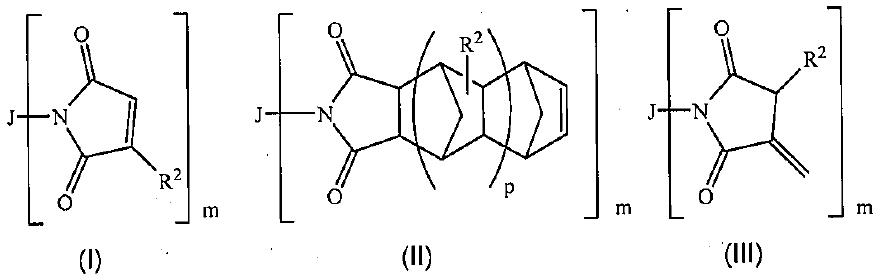
具有一或多個馬來醯亞胺、納地醯亞胺或衣康醯亞胺官能基之化合物分別由以下涵蓋: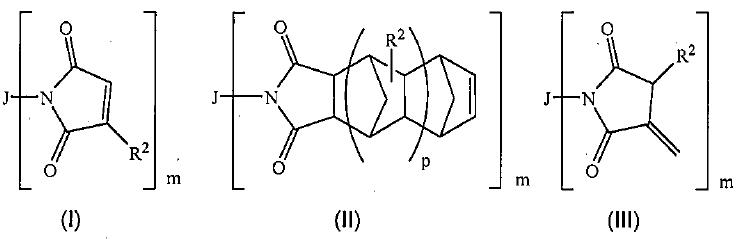
更特定而言,含有馬來醯亞胺、納地醯亞胺或衣康醯亞胺化合物之「J」附加物可視為選自以下之單價或多價基團:烴基、經取代之烴基、含雜原子之烴基、經取代之含雜原子之烴基、伸烴基、經取代之伸烴基、含雜原子之伸烴基、經取代之含雜原子之伸烴基、聚矽氧烷、聚矽氧烷-聚胺基甲酸酯嵌段共聚物及其組合,視情況含有一或多個選自以下之鏈接體:共價鍵、-O-、-S-、-NR-、-O-C(O)-、-O-C(O)-O-、-O-C(O)-NR-、-NR-C(O)-、-NR-C(O)-O-、-NR-C(O)-NR-、-S-C(O)-、-S-C(O)-O-、-S-C(O)-NR-、-S(O)-、-S(O)2 -、-O-S(O)2 -、-O-S(O)2 -O-、-O-S(O)2 -NR-、-O-S(O)-、-O-S(O)-O-、-O-S(O)-NR-、-O-NR-C(O)-、-O-NR-C(O)-O-、-O-NR-C(O)-NR-、-NR-O-C(O)-、-NR-O-C(O)-O-、-NR-O-C(O)-NR-、-O-NR-C(S)-、-O-NR-C(S)-O-、-O-NR-C(S)-NR-、-NR-O-C(S)-、-NR-O-C(S)-O-、-NR-O-C(S)-NR-、-O-C(S)-、-O-C(S)-O-、-O-C(S)-NR-、-NR-C(S)-、-NR-C(S)-O-、-NR-C(S)-NR-、-S-S(O)2 -、-S-S(O)2 -O-、-S-S(O)2 -NR-、-NR-O-S(O)-、-NR-O-S(O)-O-、-NR-O-S(O)-NR-、-NR-O-S(O)2 -、-NR-O-S(O)2 -O-、-NR-O-S(O)2 -NR-、-O-NR-S(O)-、-O-NR-S(O)-O-、-O-NR-S(O)-NR-、-O-NR-S(O)2 -O-、-O-NR-S(O)2 -NR-、-O-NR-S(O)2 -、-O-P(O)R2 -、-S-P(O)R2 -、-NR-P(O)R2 - (其中各R獨立地係氫、烷基或經取代烷基)及其任兩者或更多者之組合。More specifically, the "J" addition containing a maleimide, nadimide, or itaconimidimide compound can be regarded as a monovalent or polyvalent group selected from the group consisting of a hydrocarbyl group, a substituted hydrocarbyl group, Heteroatom-containing hydrocarbon group, substituted heteroatom-containing hydrocarbon group, extended hydrocarbon group, substituted extended hydrocarbon group, heteroatom extended hydrocarbon group, substituted heteroatom extended hydrocarbon group, polysiloxane, polysiloxane -Polyurethane block copolymers and combinations thereof, optionally containing one or more linkers selected from the group consisting of: covalent bonds, -O-, -S-, -NR-, -OC(O) -, -OC(O)-O-, -OC(O)-NR-, -NR-C(O)-, -NR-C(O)-O-, -NR-C(O)-NR- , -SC(O)-, -SC(O)-O-, -SC(O)-NR-, -S(O)-, -S(O) 2 -, -OS(O) 2 -,- OS(O) 2 -O-, -OS(O) 2 -NR-, -OS(O)-, -OS(O)-O-, -OS(O)-NR-, -O-NR-C (O)-, -O-NR-C(O)-O-, -O-NR-C(O)-NR-, -NR-OC(O)-, -NR-OC(O)-O- , -NR-OC(O)-NR-, -O-NR-C(S)-, -O-NR-C(S)-O-, -O-NR-C(S)-NR-,- NR-OC(S)-, -NR-OC(S)-O-, -NR-OC(S)-NR-, -OC(S)-, -OC(S)-O-, -OC(S )-NR-, -NR-C(S)-, -NR-C(S)-O-, -NR-C(S)-NR-, -SS(O) 2 -, -SS(O) 2 -O-, -SS(O) 2 -NR-, -NR-OS(O)-, -NR-OS(O)-O-, -NR-OS(O)-NR-, -NR-OS( O) 2 -, -NR-OS(O) 2 -O-, -NR-OS(O) 2 -NR-, -O-NR-S(O)-, -O-NR-S(O)- O-, -O-NR-S(O)-NR-, -O-NR-S(O) 2 -O-, -O-NR-S(O) 2 -NR-, -O-NR-S (O) 2 -, -OP(O)R 2 -, -SP(O)R 2 -, -NR-P(O)R 2- (wherein each R is independently hydrogen, alkyl or substituted alkyl ) And any combination of two or more of them.
當上述單價或多價基團中之一或多者含有一或多個上述鏈接體以形成馬來醯亞胺、納地醯亞胺或衣康醯亞胺基團之「J」附加物時,如熟習此項技術者易於認識到,可產生各種鏈接體,例如氧基烷基、硫基烷基、胺基烷基、羧基烷基、氧基烯基、硫基烯基、胺基烯基、羧基烯基、氧基炔基、硫基炔基、胺基炔基、羧基炔基、氧基環烷基、硫基環烷基、胺基環烷基、羧基環烷基、氧基環烯基、硫基環烯基、胺基環烯基、羧基環烯基、雜環基、氧基雜環基、硫基雜環基、胺基雜環基、羧基雜環基、氧基芳基、硫基芳基、胺基芳基、羧基芳基、雜芳基、氧基雜芳基、硫基雜芳基、胺基雜芳基、羧基雜芳基、氧基烷基芳基、硫基烷基芳基、胺基烷基芳基、羧基烷基芳基、氧基芳基烷基、硫基芳基烷基、胺基芳基烷基、羧基芳基烷基、氧基芳基烯基、硫基芳基烯基、胺基芳基烯基、羧基芳基烯基、氧基烯基芳基、硫基烯基芳基、胺基烯基芳基、羧基烯基芳基、氧基芳基炔基、硫基芳基炔基、胺基芳基炔基、羧基芳基炔基、氧基炔基芳基、硫基炔基芳基、胺基炔基芳基或羧基炔基芳基、氧基伸烷基、硫基伸烷基、胺基伸烷基、羧基伸烷基、氧基伸烯基、硫基伸烯基、胺基伸烯基、羧基伸烯基、氧基伸炔基、硫基伸炔基、胺基伸炔基、羧基伸炔基、氧基環伸烷基、硫基環伸烷基、胺基環伸烷基、羧基環伸烷基、氧基環伸烯基、硫基環伸烯基、胺基環伸烯基、羧基環伸烯基、氧基伸芳基、硫基伸芳基、胺基伸芳基、羧基伸芳基、氧基烷基伸芳基、硫基烷基伸芳基、胺基烷基伸芳基、羧基烷基伸芳基、氧基芳基伸烷基、硫基芳基伸烷基、胺基芳基伸烷基、羧基芳基伸烷基、氧基芳基伸烯基、硫基芳基伸烯基、胺基芳基伸烯基、羧基芳基伸烯基、氧基烯基伸芳基、硫基烯基伸芳基、胺基烯基伸芳基、羧基烯基伸芳基、氧基芳基伸炔基、硫基芳基伸炔基、胺基芳基伸炔基、羧基芳基伸炔基、氧基炔基伸芳基、硫基炔基伸芳基、胺基炔基伸芳基、羧基炔基伸芳基、伸雜芳基、氧基伸雜芳基、硫基伸雜芳基、胺基伸雜芳基、羧基伸雜芳基、含雜原子之二價或多價環狀部分、氧基含雜原子之二價或多價環狀部分、硫基含雜原子之二價或多價環狀部分、胺基含雜原子之二價或多價環狀部分、羧基含雜原子之二價或多價環狀部分、二硫化物、磺醯胺及諸如此類。When one or more of the above monovalent or multivalent groups contain one or more of the above-mentioned linkers to form the "J" addition to the maleimide, nadimide, or itaconicide group , As those skilled in the art easily recognize, various linkers can be produced, such as oxyalkyl, thioalkyl, aminoalkyl, carboxyalkyl, oxyalkenyl, thioalkenyl, aminoamino Group, carboxyalkenyl, oxyalkynyl, thioalkynyl, aminoalkynyl, carboxyalkynyl, oxycycloalkyl, thiocycloalkyl, amine cycloalkyl, carboxycycloalkyl, oxy Cycloalkenyl, thiocycloalkenyl, amine cycloalkenyl, carboxycycloalkenyl, heterocyclyl, oxyheterocyclyl, thioheterocyclyl, amine heterocyclyl, carboxyheterocyclyl, oxy Aryl, thioaryl, aminoaryl, carboxyaryl, heteroaryl, oxyheteroaryl, thioheteroaryl, amine heteroaryl, carboxyheteroaryl, oxyalkylaryl , Thioalkylaryl, aminoalkylaryl, carboxyalkylaryl, oxyarylalkyl, thioarylalkyl, aminoarylalkyl, carboxyarylalkyl, oxy Arylalkenyl, thioarylalkenyl, aminoarylalkenyl, carboxyarylalkenyl, oxyalkenylaryl, thioalkenylaryl, aminoalkenylaryl, carboxyalkenylaryl Group, oxyarylalkynyl, thioarylalkynyl, aminoarylarylalkynyl, carboxyarylalkynyl, oxyalkynylaryl, thioalkynylaryl, aminoalkynylaryl or Carboxyalkynyl aryl, oxyalkylene, thioalkylene, amine alkylene, carboxyalkylene, oxyalkylene, thioalkylene, amine alkylene, carboxyalkylene, oxyalkylene , Thioalkynyl, aminoalkynyl, carboxyalkynyl, oxycyclic alkylene, thiocyclic alkylene, amine cycloalkylene, carboxycyclic alkylene, oxycyclic alkenyl, Thiocycloalkenyl, amine cycloalkenyl, carboxycycloalkenyl, oxyalkylene, thioalkylene, amine alkylene, carboxyalkylene, oxyalkylene, thioalkyl Aryl aryl, amine alkyl aryl, carboxyalkyl aryl, oxyaryl alkyl, thioaryl alkyl, amine aryl alkyl, carboxy aryl alkyl, oxyaryl alkenyl , Thioaryl alkenyl, amine aryl alkenyl, carboxy aryl alkenyl, oxy alkenyl aryl, thio alkenyl aryl, amine alkenyl aryl, carboxy alkenyl aryl, oxy Aryl alkynyl, thioaryl alkynyl, amino aryl alkynyl, carboxy aryl alkynyl, oxy alkynyl aryl, thio alkynyl aryl, amine alkynyl aryl, carboxy alkynyl aryl Group, extended heteroaryl group, oxy extended heteroaryl group, thio extended heteroaryl group, amine extended heteroaryl group, carboxy extended heteroaryl group, bivalent or polyvalent cyclic part containing hetero atom, oxy containing hetero atom Bivalent or polyvalent cyclic moiety, sulfur-containing heteroatom-containing bivalent or polyvalent cyclic moiety, amine-based heteroatom-containing bivalent or polyvalent cyclic moiety, carboxyl-containing heteroatom-containing bivalent or polyvalent ring Like moieties, disulfides, sulfonamides and the like.
具有一或多個馬來醯亞胺、納地醯亞胺及/或衣康醯亞胺官能基之化合物包括彼等分別由結構I
、II
或III
所涵蓋者,其中m = 1-6,p = 0-6,且J選自:
飽和直鏈烷基或具支鏈烷基,視情況含有視情況經取代之芳基部分作為烷基鏈上之取代基或作為烷基鏈之主鏈的一部分,且其中烷基鏈具有最高約20個碳原子;
具有以下結構之矽氧烷:-(C(R3
)2
)d
-[Si(R4
)2
-O]f
-Si(R4
)2
-(C(R3
)2
)e
-、

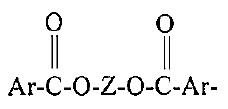

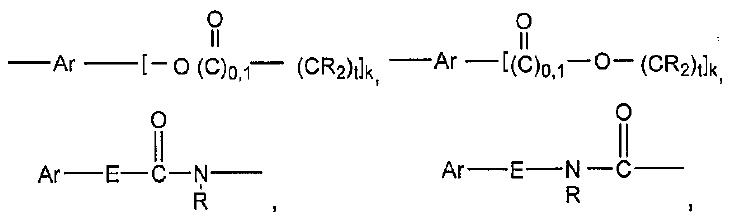
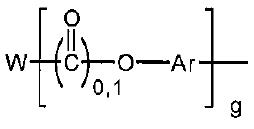
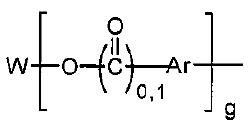

在本發明之特別期望態樣中,馬來醯亞胺、衣康醯亞胺及/或納地醯亞胺化合物之馬來醯亞胺、衣康醯亞胺及/或納地醯亞胺官能基分別附接至單價基團J,或馬來醯亞胺、衣康醯亞胺及/或納地醯亞胺化合物之馬來醯亞胺、衣康醯亞胺及/或納地醯亞胺官能基由多價基團J間隔開,單價基團或多價基團中之每一者具有足夠長度並分支,以使馬來醯亞胺、衣康醯亞胺及/或納地醯亞胺化合物呈現為液體。In a particularly desirable aspect of the present invention, maleimide, itaconic imide, and/or nadimide compounds of maleimide, itaconic imide, and/or nadimide The functional group is attached to the monovalent group J, or the maleimide, itaconic imide, and/or nadiamide of the maleimide, itaconic imide, and/or nadiimide compounds, respectively The imine functional groups are separated by a multivalent group J, and each of the monovalent group or the multivalent group has a sufficient length and branches to make the maleimide, itaconic imide, and/or nadi The amide imine compound appears as a liquid.
在其更特定態樣中,J包含具支鏈烷基、伸烷基或伸烷基氧化物物種,該等物種具有足夠長度並分支以使馬來醯亞胺、衣康醯亞胺或納地醯亞胺化合物呈現為液體,R2 獨立地選自氫或甲基且m為1、2或3。In its more specific form, J contains branched alkyl, alkylene, or alkylene oxide species that are of sufficient length and branched to make maleimide, itaconic imide, or sodium The diimide compound appears as a liquid, R 2 is independently selected from hydrogen or methyl and m is 1, 2 or 3.
可用於本發明實踐之某些含有馬來醯亞胺之化合物包括例如具有以下結構之馬來醯亞胺: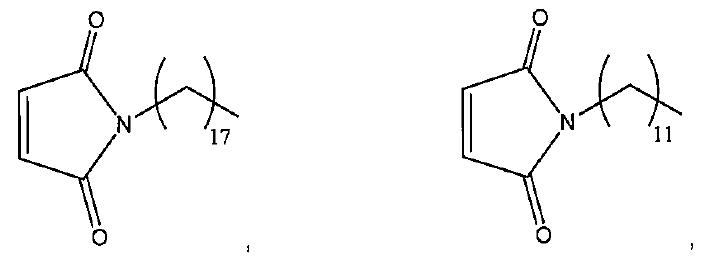
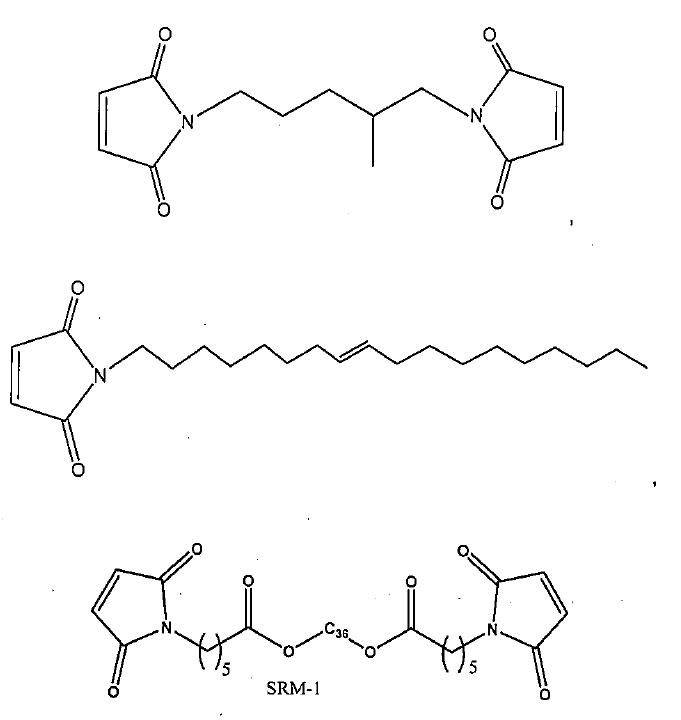

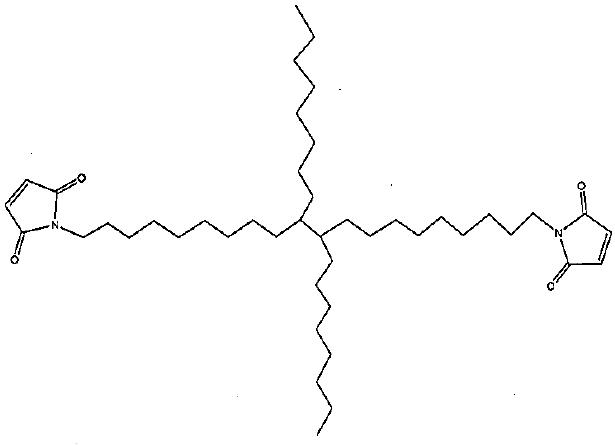
式I 之額外含有馬來醯亞胺之化合物包括硬脂醯基馬來醯亞胺、油烯基馬來醯亞胺、山崳基馬來醯亞胺、1,20-雙馬來醯亞胺基-10,11-二辛基-二十碳烷、及諸如此類以及其組合。Compounds of formula I additionally containing maleimide include stearyl amide maleimide, oleyl maleimide, behenyl maleimide, 1,20-bismaleimide Amino-10,11-dioctyl-eicosane, and the like and combinations thereof.
由式I 所涵蓋之特別期望馬來醯亞胺化合物包括藉由馬來酸與二聚體胺反應製備之雙馬來醯亞胺。可自該等二聚體胺製備之實例性雙馬來醯亞胺係1,20-雙馬來醯亞胺基-10,11-二辛基-二十碳烷,其可能將以與用以產生二聚體酸之烯反應中產生之其他異構物種之混合物存在。預期用於實踐本發明之其他雙馬來醯亞胺包括自以下製備之雙馬來醯亞胺:胺基丙基封端之聚二甲基矽氧烷(例如,由Hüls America, Piscataway, NJ出售之「PS510」)、聚氧化丙烯胺(例如,由Texaco Chemical Company, Houston, TX出售之「D-230」、「D-400」、「D-2000」及「T-403」)、聚1,4-丁二醇-二-對-胺基苯甲酸酯(例如,由Air Products, Allentown, PA以商標名「VERSALINK」出售之此類產品家族,例如「VERSALINK」P-650)及諸如此類。較佳馬來醯亞胺樹脂包括硬脂醯基馬來醯亞胺、油烯基馬來醯亞胺、山崳基馬來醯亞胺、1,20-雙馬來醯亞胺基-10,11-二辛基-二十碳烷及SRM-1 (其係6-馬來醯亞胺基己酸與二聚體二醇之費希爾酯化(Fischer esterification)產物(Pripol 2033,自Croda市售購得))以及其任兩者或更多者之混合物。Particularly desirable maleimide compounds encompassed by formula I include bismaleimide prepared by the reaction of maleic acid with a dimer amine. Exemplary bismaleimide series 1,20-bismaleimide-10,11-dioctyl-eicosane that can be prepared from these dimer amines may be used in conjunction with It exists as a mixture of other heterogeneous species produced in the dimer acid-generating ene reaction. Other bismaleimides expected to be used in the practice of the present invention include bismaleimides prepared from: aminopropyl-terminated polydimethylsiloxane (eg, by Hüls America, Piscataway, NJ "PS510" sold), polyoxypropylene amine (eg, "D-230", "D-400", "D-2000", and "T-403" sold by Texaco Chemical Company, Houston, TX), poly 1,4-butanediol-di-p-aminobenzoate (for example, such a product family sold by Air Products, Allentown, PA under the brand name "VERSALINK", such as "VERSALINK" P-650) and And so on. Preferred maleimide resins include stearamide maleimide, oleyl maleimide, behenyl maleimide, 1,20-bismaleimide-10 , 11-dioctyl-eicosane and SRM-1 (which is a Fischer esterification product of 6-maleimidocaproic acid and dimer diol (Pripol 2033, from Croda is commercially available)) and mixtures of any two or more thereof.
雙馬來醯亞胺可採用熟習此項技術者熟知之技術製備,且因此在此將不再重複。Bismaleimide can be prepared using techniques well known to those skilled in the art, and therefore will not be repeated here.
在另一實施例中,代替或除具有一或多個馬來醯亞胺、納地醯亞胺或衣康醯亞胺官能基之化合物以外,可為分別具有一或多個由以下涵蓋之馬來酸酯(式IV
)及富馬酸酯(式V
)官能基之化合物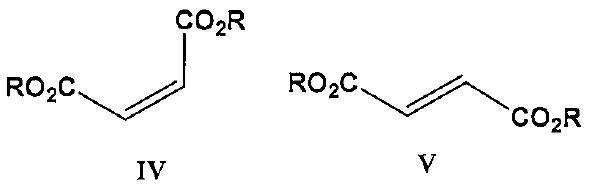
更特定而言,具有一或多個馬來酸酯及富馬酸酯官能基之化合物包括馬來酸酯及富馬酸酯之烷基酯,例如馬來酸二甲基酯及富馬酸二甲基酯、馬來酸二乙基酯及富馬酸二乙基酯、馬來酸二丁基酯及富馬酸二丁基酯、馬來酸二辛基酯及富馬酸二辛基酯。More specifically, compounds having one or more maleate and fumarate functional groups include maleate and fumarate alkyl esters, such as dimethyl maleate and fumarate Dimethyl ester, diethyl maleate and diethyl fumarate, dibutyl maleate and dibutyl fumarate, dioctyl maleate and dioctyl fumarate基ester.
呋喃偶姻或呋喃偶姻衍生物應以與具有一或多個馬來醯亞胺、納地醯亞胺或衣康醯亞胺官能基之化合物及/或具有一或多個馬來酸酯及富馬酸酯官能基之化合物至少1:1之莫耳比使用,以製得本發明反應產物,其實踐實例稍後闡述。由於任何殘餘之游離呋喃偶姻可不利地影響工作期,故與呋喃偶姻相比,使用稍微過量之馬來醯亞胺。Furanin or furanin derivatives should be combined with compounds having one or more maleimide, nadimide or itaconic imide functional groups and/or having one or more maleate The compound with a fumarate functional group is used in a molar ratio of at least 1:1 to prepare the reaction product of the present invention, and its practical examples will be described later. Since any residual free furan marriage can adversely affect the working period, a slight excess of maleimide is used compared to furan marriage.
儘管呋喃偶姻係商業上購得,但商業上可購得之呋喃偶姻衍生物並不多。可用於本發明以形成狄耳士-阿德爾(Diels-Alder)加合物之代表性呋喃偶姻衍生物可由下式涵蓋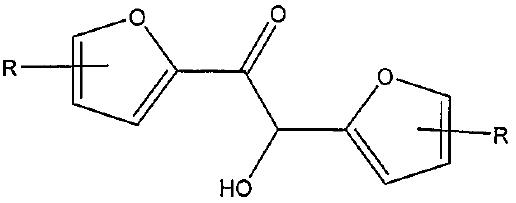

本發明可固化組合物不僅包括所闡述之本發明反應產物,亦包括含有環氧或含氧雜環丁烷之組分、陽離子觸媒及過渡金屬鹽。The curable composition of the present invention includes not only the reaction product of the present invention as described, but also components containing epoxy or oxetane, cationic catalyst and transition metal salt.
本發明反應產物(有時稱為加合物或狄耳士-阿德爾加合物)應以約0.1至約20重量%之量用於陽離子性可固化組合物中。The reaction product of the present invention (sometimes referred to as an adduct or Diels-Adell adduct) should be used in the cationic curable composition in an amount of about 0.1 to about 20% by weight.
含有環氧之組分應選自環脂族環氧樹脂;C4 -C28 烷基縮水甘油基醚;C1 -C28 烷基縮水甘油基酯;C2 -C28 烯基縮水甘油基酯;C1 -C28 烷基-、單酚及多酚縮水甘油基醚;以下各者之聚縮水甘油醚:兒茶酚、間苯二酚、氫醌、4,4'-二羥基二苯基甲烷(或雙酚F)、4,4'-二羥基-3,3'-二甲基二苯基甲烷、4,4'-二羥基二苯基二甲基甲烷(或雙酚A)、4,4'-二羥基二苯基甲基甲烷、4,4'-二羥基二苯基環己烷、4,4'-二羥基-3,3'-二甲基二苯基丙烷、4,4'-二羥基二苯基碸及參(4-羥基苯基)甲烷;上述二酚之氯化及溴化產物的聚縮水甘油醚;酚醛之聚縮水甘油醚;藉由酯化二酚醚獲得之二酚的聚縮水甘油醚,該等二酚醚係藉由利用二鹵基烷烴或二鹵素二烷基醚酯化芳香族羥基羧酸(hydrocarboxylic acid)之鹽獲得;藉由縮合酚及含有至少兩個鹵素原子之長鏈鹵素石蠟獲得之多酚的聚縮水甘油醚;苯酚酚醛環氧樹脂;甲酚酚醛環氧樹脂;及其組合。The epoxy-containing component should be selected from cycloaliphatic epoxy resin; C 4 -C 28 alkyl glycidyl ether; C 1 -C 28 alkyl glycidyl ester; C 2 -C 28 alkenyl glycidyl Ester; C 1 -C 28 alkyl-, monophenol and polyphenol glycidyl ether; polyglycidyl ether of the following: catechol, resorcinol, hydroquinone, 4,4'-dihydroxydi Phenylmethane (or bisphenol F), 4,4'-dihydroxy-3,3'-dimethyldiphenylmethane, 4,4'-dihydroxydiphenyldimethylmethane (or bisphenol A ), 4,4'-dihydroxydiphenylmethylmethane, 4,4'-dihydroxydiphenylcyclohexane, 4,4'-dihydroxy-3,3'-dimethyldiphenylpropane , 4,4'-dihydroxydiphenyl sulfone and ginseng (4-hydroxyphenyl) methane; polyglycidyl ethers of chlorinated and brominated products of the above diphenols; polyglycidyl ethers of phenolic; by esterification Polyglycidyl ethers of diphenols obtained from diphenol ethers obtained by esterifying the salts of aromatic carboxylic acids (hydrocarboxylic acids) with dihaloalkanes or dihalodialkyl ethers; Polyglycidyl ethers of polyphenols obtained from condensed phenols and long-chain halogen paraffins containing at least two halogen atoms; phenol novolac epoxy resins; cresol novolac epoxy resins; and combinations thereof.
含氧雜環丁烷之組分將選自由以下一般結構涵蓋之單或多官能脂肪族或芳香族氧雜環丁烷酯樹脂,其中R係甲基或乙基且n為1至6: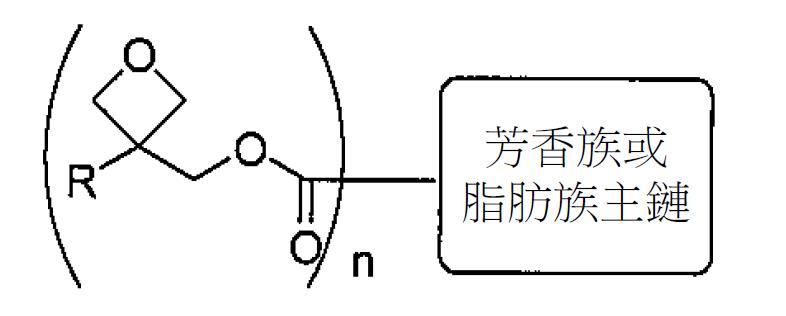
更特定而言,芳香族氧雜環丁烷酯可由以下一般結構涵蓋,其中R係甲基或乙基且Ar係芳香族基團:
Ar可為任何芳香族基團,其碳-碳雙鍵與酯基團之碳-氧雙鍵共軛。Ar可經烷基、醚或酯官能基取代。Ar can be any aromatic group whose carbon-carbon double bond is conjugated with the carbon-oxygen double bond of the ester group. Ar can be substituted with alkyl, ether or ester functional groups.
在一些實施例中,Ar係單芳基、兩個經稠合芳基或兩個或更多個藉由單鍵、低碳伸烷基(例如,1至4個碳原子伸烷基鏈接體)或雜原子(例如氧或硫)連接之芳基。In some embodiments, Ar is a monoaryl group, two fused aryl groups, or two or more through a single bond, a lower carbon alkylene (eg, 1 to 4 carbon atoms alkylene linker ) Or an aryl group linked to a heteroatom (such as oxygen or sulfur).
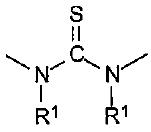
在其他實施例中,Ar係兩個或更多個由選自以下之鏈接基團連接之芳基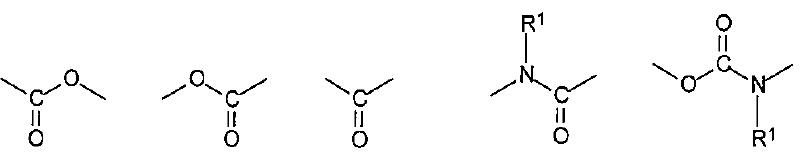

在一個實施例中,氧雜環丁烷酯官能基附接至選自直鏈、具支鏈或伸環烷基之脂肪族主鏈,該脂肪族主鏈視情況含有雜原子(例如,O、S、鹵素、Si及N)或芳香族夾雜或取代。In one embodiment, the oxetane ester functional group is attached to an aliphatic main chain selected from linear, branched, or cycloalkylene, which optionally contains heteroatoms (eg, O , S, halogen, Si and N) or aromatic inclusion or substitution.
在另一實施例中,氧雜環丁烷酯官能基附接至芳香族主鏈,其碳-碳雙鍵與酯基團之碳-氧雙鍵共軛。In another embodiment, the oxetane ester functional group is attached to the aromatic backbone, and its carbon-carbon double bond is conjugated to the carbon-oxygen double bond of the ester group.
或者,芳香族氧雜環丁烷酯可由以下一般結構涵蓋,其中R係甲基或乙基,K係C(=O)O,G可存在或可不存在,但當存在時為(CH2
)m
O,其中m係1-4,且X係O、S、SO2
、C(=O)、苯甲醛(phenaldehyde)、CH2
或C3
H7
,且n為1-3: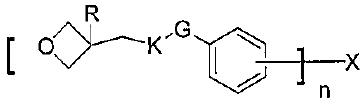
或者,苯氧基氧雜環丁烷酯可由以下一般結構涵蓋,其中R係甲基或乙基,X係具有1至5個碳原子之烷基或具有3至10個碳原子之伸烷基(其任一者經雜原子(例如O、N或S)取代或雜有雜原子)或聯苯或雙酚A、E、F或S結構,且n為1-3: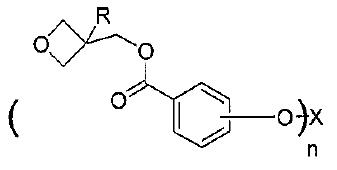
仍更特別地,苯氧基氧雜環丁烷醚可由以下一般結構涵蓋,其中R係甲基或乙基,X係具有1至5個碳原子之烷基或具有3至10個碳原子之伸烷基(其任一者經雜原子(例如O、N或S)取代或雜有雜原子、或雜有酮)、芳基或苯甲醛,且n為1-3: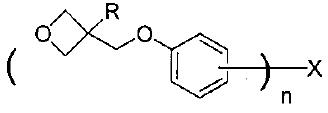
適用於本文之代表性含氧雜環丁烷之化合物包括:
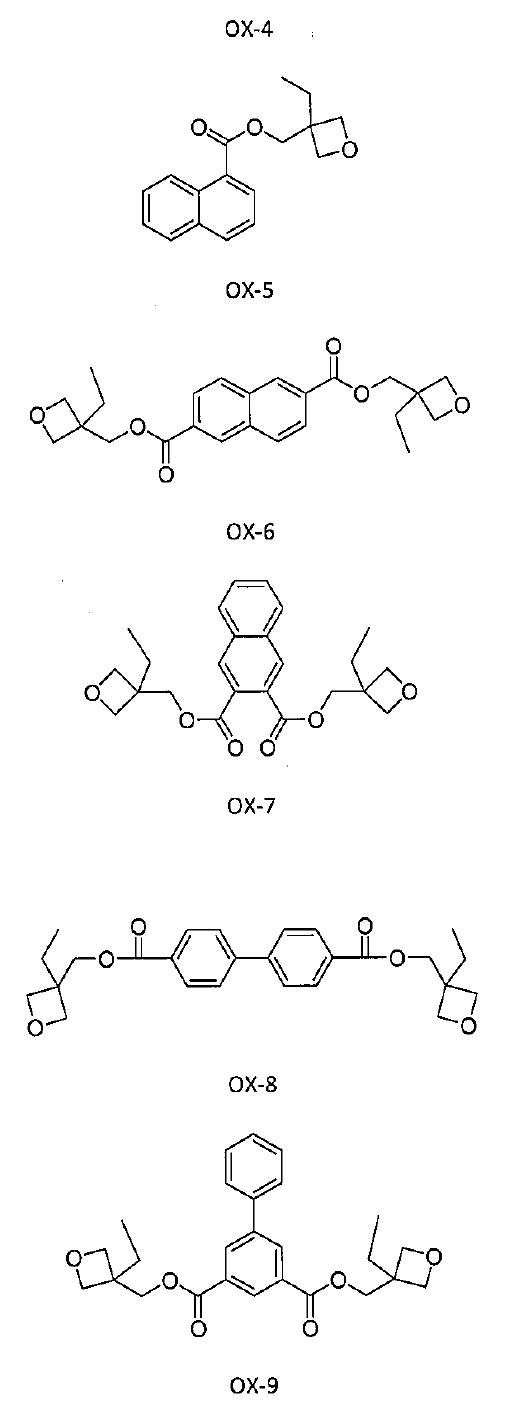
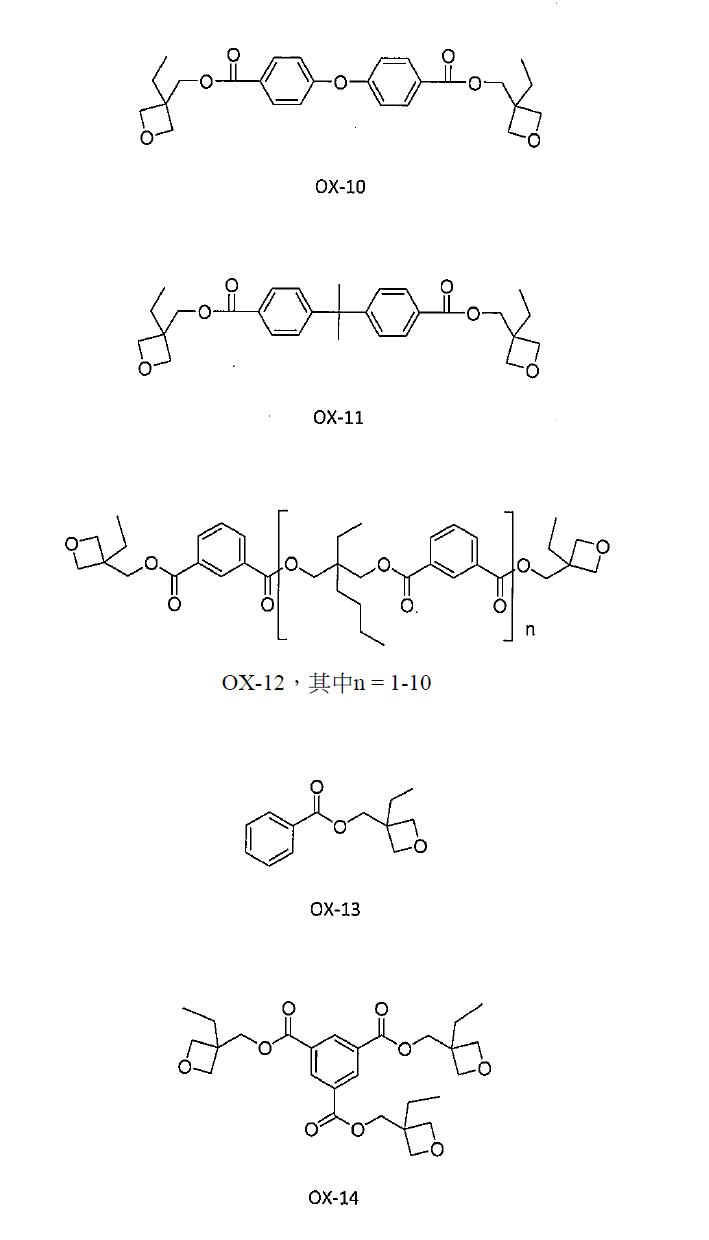
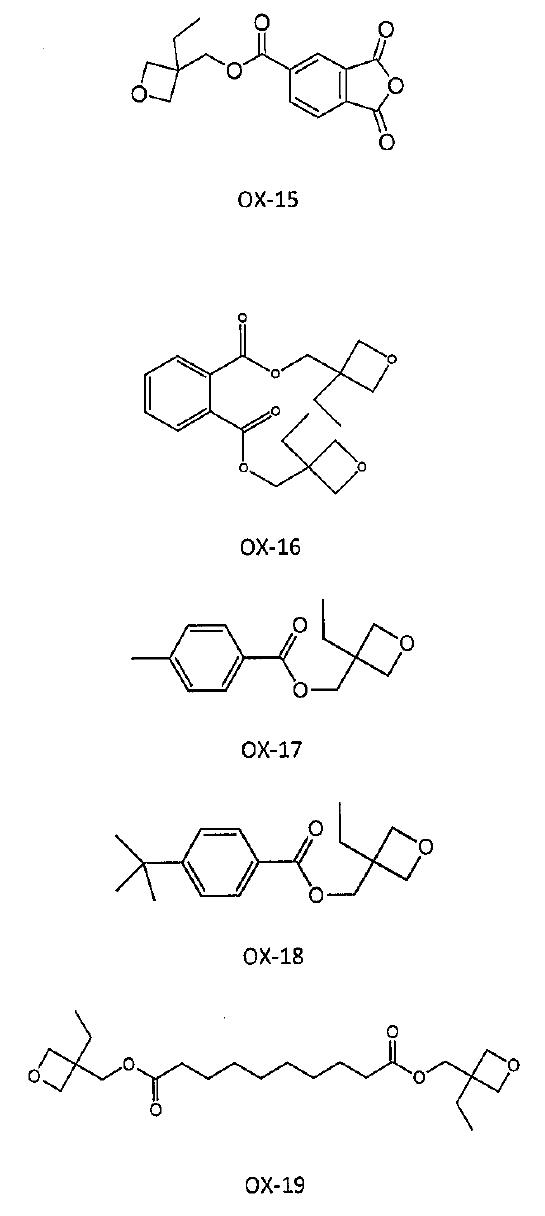
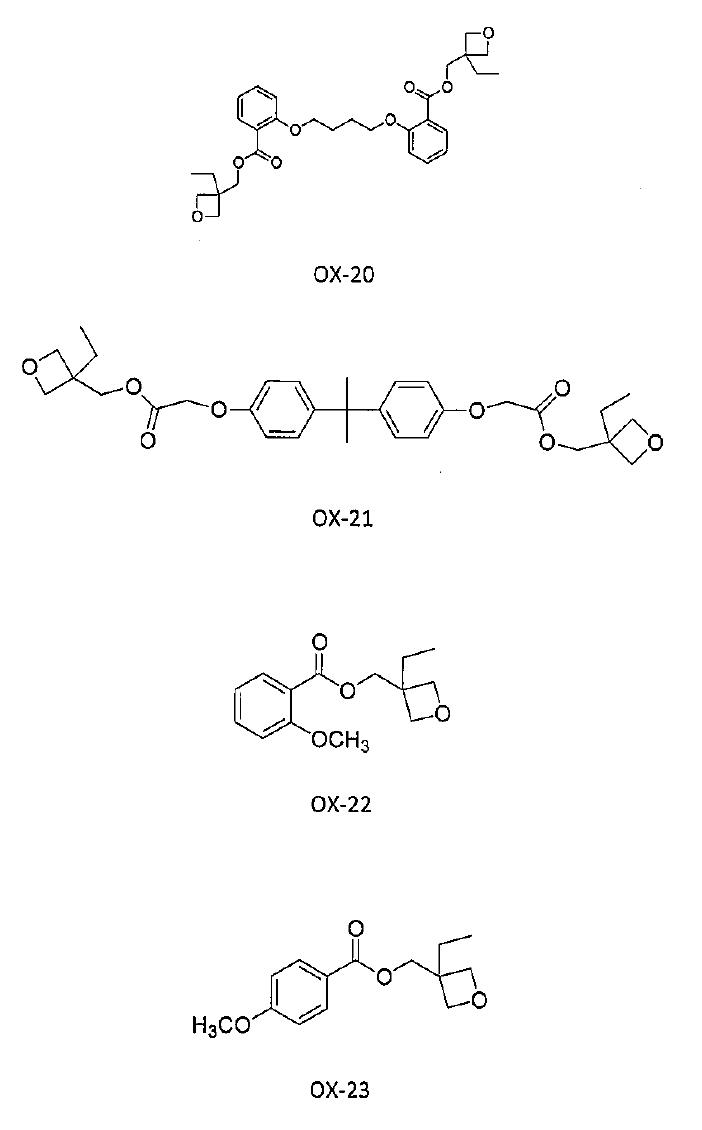
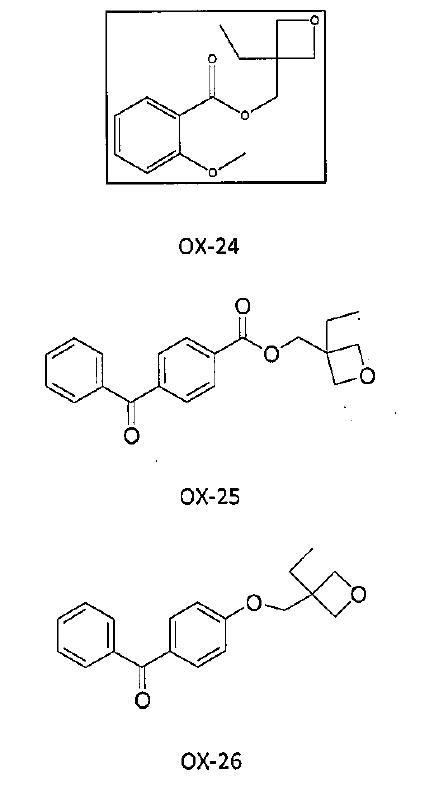
甲基或乙基可在氧雜環丁烷環之3位附接至碳。在顯示一個基團之情形中,另一基團可經取代。The methyl or ethyl group can be attached to the carbon at the 3 position of the oxetane ring. In the case where one group is shown, the other group may be substituted.
可期望藉助聚合或彈性樹脂引入氧雜環丁烷。在此一情形中,氧雜環丁烷或氧雜環丁烷酯官能基存在於聚合主鏈之末端及/或作為聚合主鏈上之側基。代表性聚合物主鏈包括(但不限於)聚(甲基)丙烯酸酯、聚烯烴、聚苯乙烯、聚酯、聚醯亞胺、聚碳酸酯、聚碸、聚矽氧烷、聚磷腈及酚醛清漆樹脂。It may be desirable to introduce oxetane by means of polymeric or elastic resins. In this case, the oxetane or oxetane ester functional group is present at the end of the polymerization main chain and/or as a side group on the polymerization main chain. Representative polymer backbones include (but are not limited to) poly(meth)acrylates, polyolefins, polystyrene, polyesters, polyimides, polycarbonates, polyphenols, polysiloxanes, polyphosphazenes And novolak resin.
在一個實施例中含氧雜環丁烷之化合物選自OX-1、OX-2、OX-3及OX-4。In one embodiment, the oxetane-containing compound is selected from OX-1, OX-2, OX-3 and OX-4.
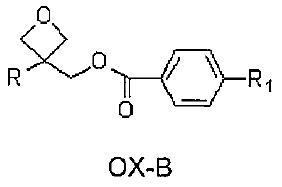
亦提供某些其他含氧雜環丁烷之化合物。舉例而言,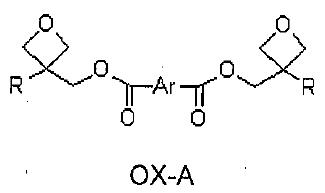
可用於本發明組合物之其他含氧雜環丁烷之化合物包括由Nagase America Corporation商業上供應之彼等氧雜環丁烷樹脂,例如彼等商業上以ARON商標名購得者,包括OXT-101、OXT-121、OXT-212及OXT-221。Other oxetane-containing compounds that can be used in the compositions of the present invention include their oxetane resins commercially available from Nagase America Corporation, such as those commercially available under the ARON brand name, including OXT- 101, OXT-121, OXT-212 and OXT-221.
含有環氧之組分及/或含氧雜環丁烷之組分應以總組合物之約1至約99重量%之量使用。The epoxy-containing component and/or the oxetane-containing component should be used in an amount of about 1 to about 99% by weight of the total composition.
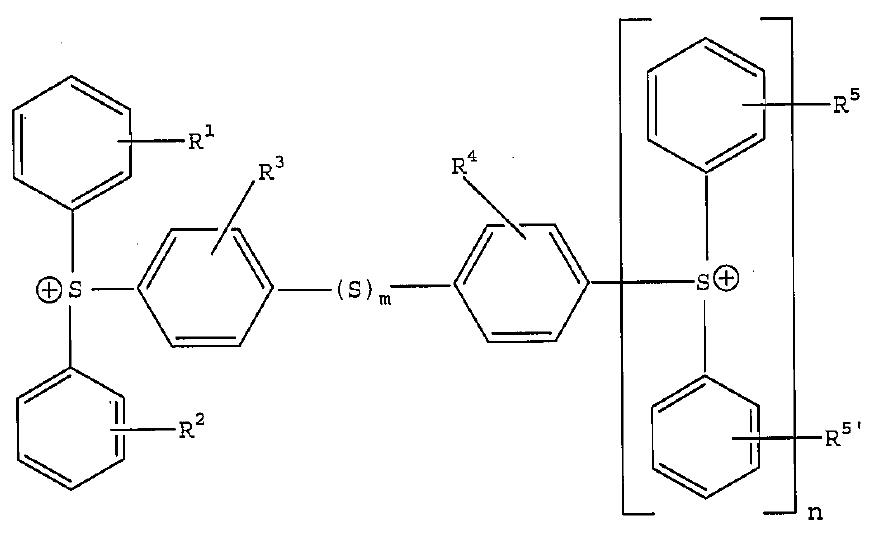
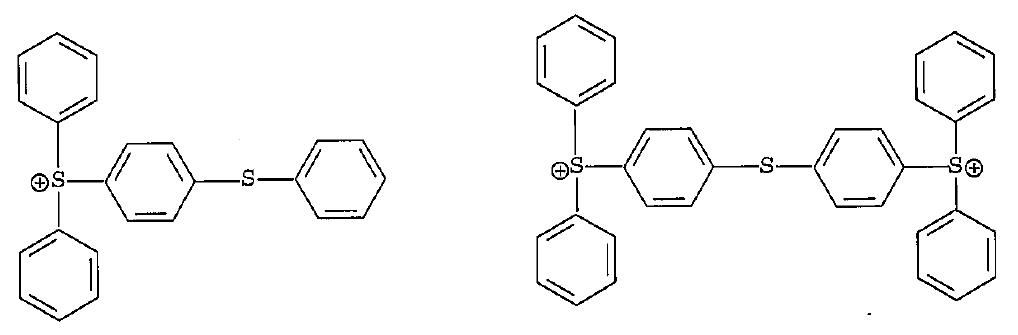
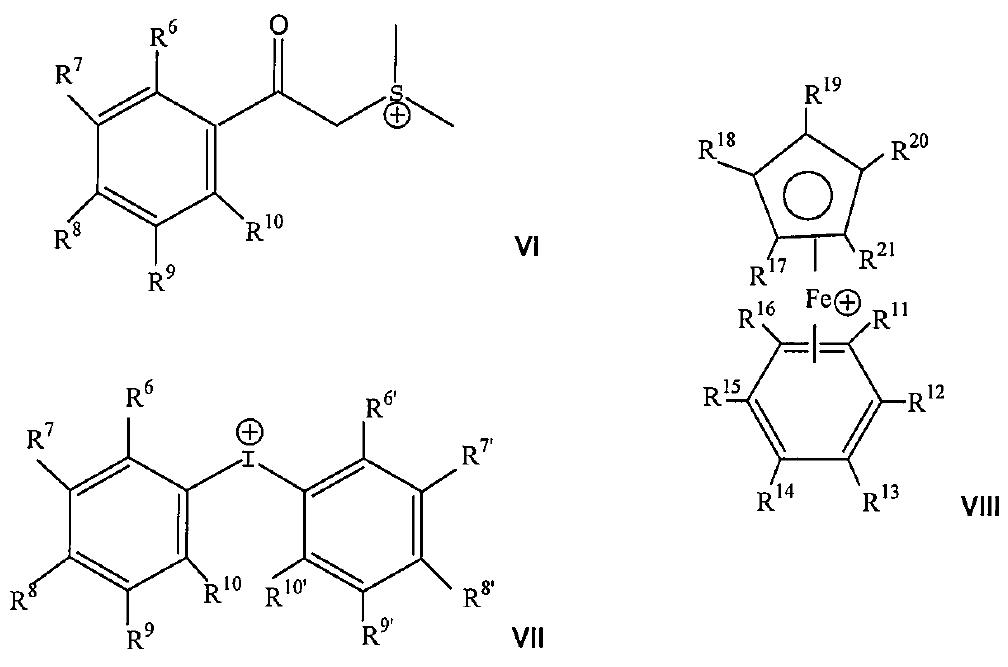
陽離子鎓觸媒包括陽離子相對離子,其可在以下結構內: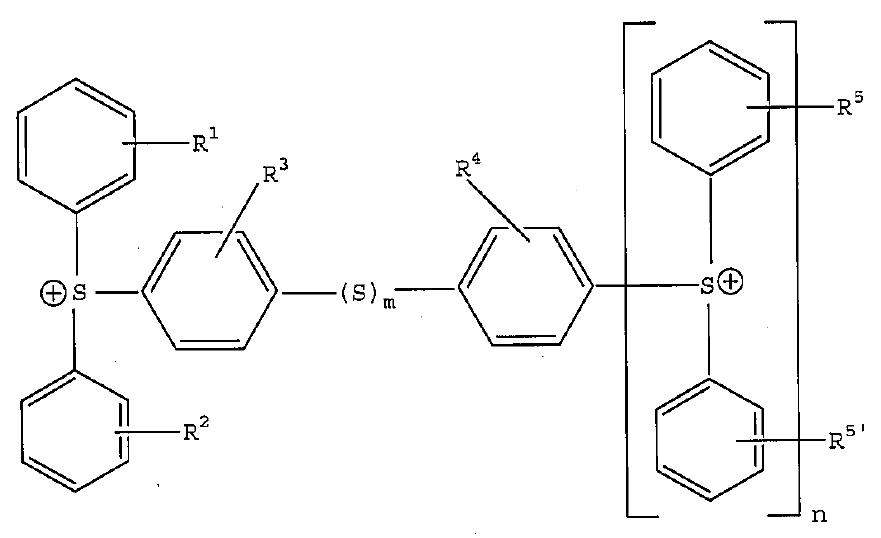
陽離子鎓觸媒包括可選自以下之相對離子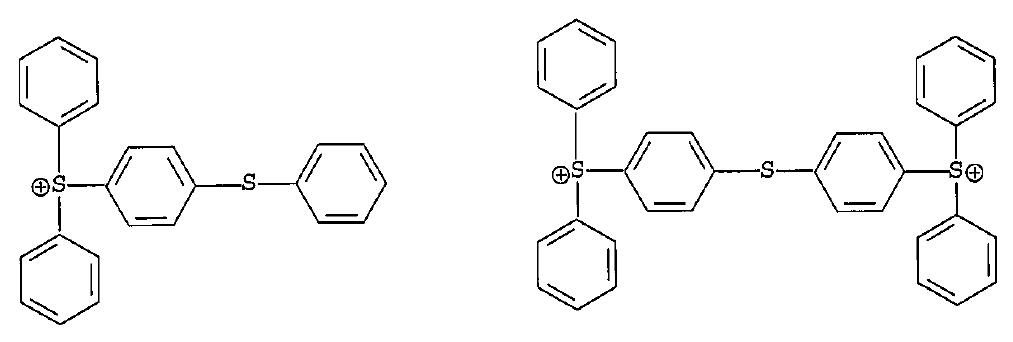
陽離子鎓觸媒包括可選自以下之相對離子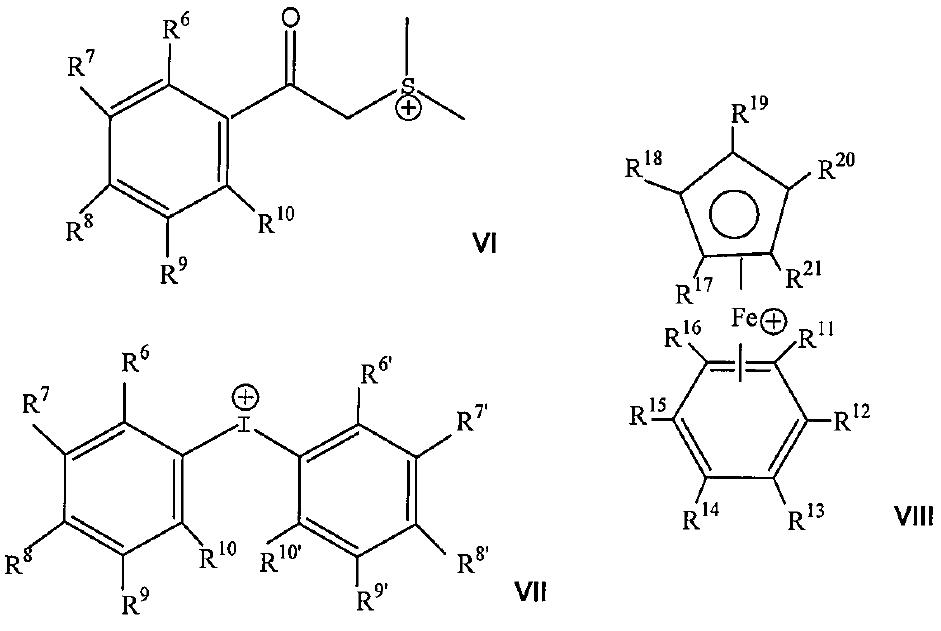
陽離子鎓觸媒包括可選自以下之相對離子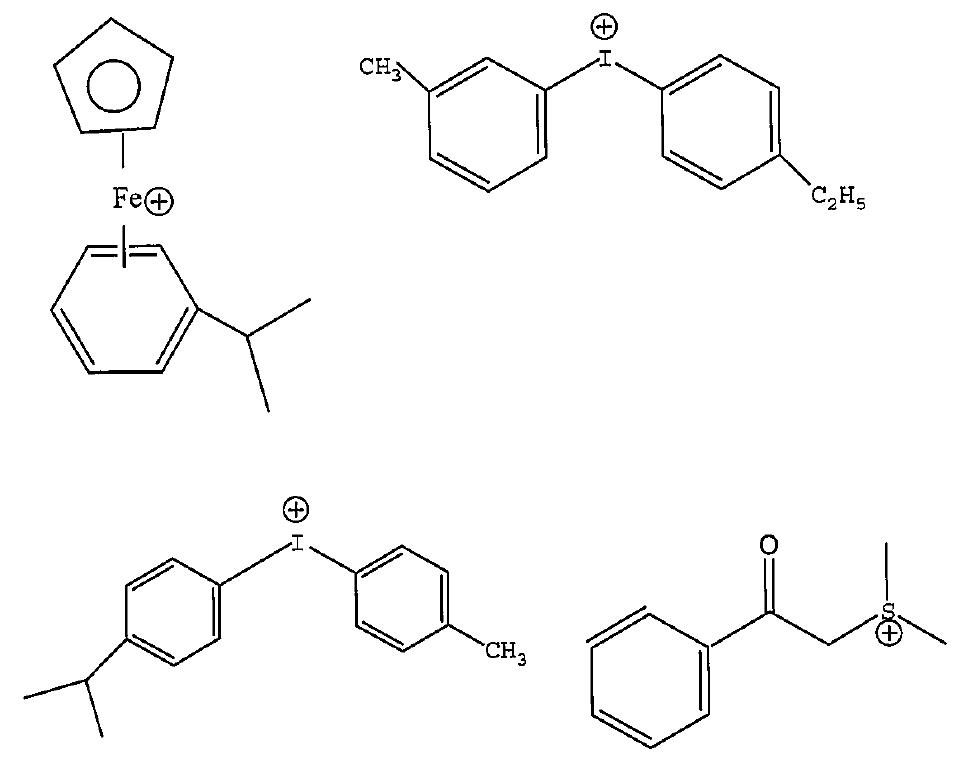
陽離子鎓觸媒應以在總組合物之約0.1至約2重量%範圍內之量使用。The cationic onium catalyst should be used in an amount ranging from about 0.1 to about 2% by weight of the total composition.
過渡金屬鹽包括選自銅、鈷、釩、金、銀、鈀、鎳、鋯、鐵、鈦、鉻、錳、鉑、銠、銥、釕、鋨、鉿、鈮、鉭、鉬、鎢及錸之過渡金屬。Transition metal salts include selected from copper, cobalt, vanadium, gold, silver, palladium, nickel, zirconium, iron, titanium, chromium, manganese, platinum, rhodium, iridium, ruthenium, osmium, hafnium, niobium, tantalum, molybdenum, tungsten and Rhenium transition metal.
過渡金屬鹽包括選自以下之鹽:銻酸鹽、磷酸鹽、磺酸鹽、羧酸鹽、苯硫酚鹽、其配體錯合物,其一些或所有可經鹵化。Transition metal salts include salts selected from the group consisting of antimonate, phosphate, sulfonate, carboxylate, thiophenolate, and ligand complexes, some or all of which may be halogenated.
過渡金屬鹽應以在總組合物之約0.1至約10重量%範圍內之量使用。The transition metal salt should be used in an amount ranging from about 0.1 to about 10% by weight of the total composition.
本發明加合物與陽離子鎓觸媒及過渡金屬鹽之期望比率係約1:1:1莫耳比。為調變固化速度及工作期,此比率可由熟習此項技術者改變以達成期望固化及工作期輪廓。實例 The desired ratio of the adduct of the present invention to the cationic onium catalyst and transition metal salt is about 1:1:1 molar ratio. To adjust the curing speed and working period, this ratio can be changed by those skilled in the art to achieve the desired curing and working period profile. Examples
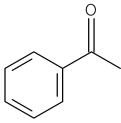
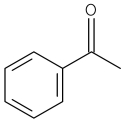
安息香及呋喃偶姻(下文所示)均係經活化a-羥基酮化合物且在涉及錪鹽之3-組分氧化還原陽離子系統中用作Cu(II)鹽之有效還原劑,如由Crivello所揭示。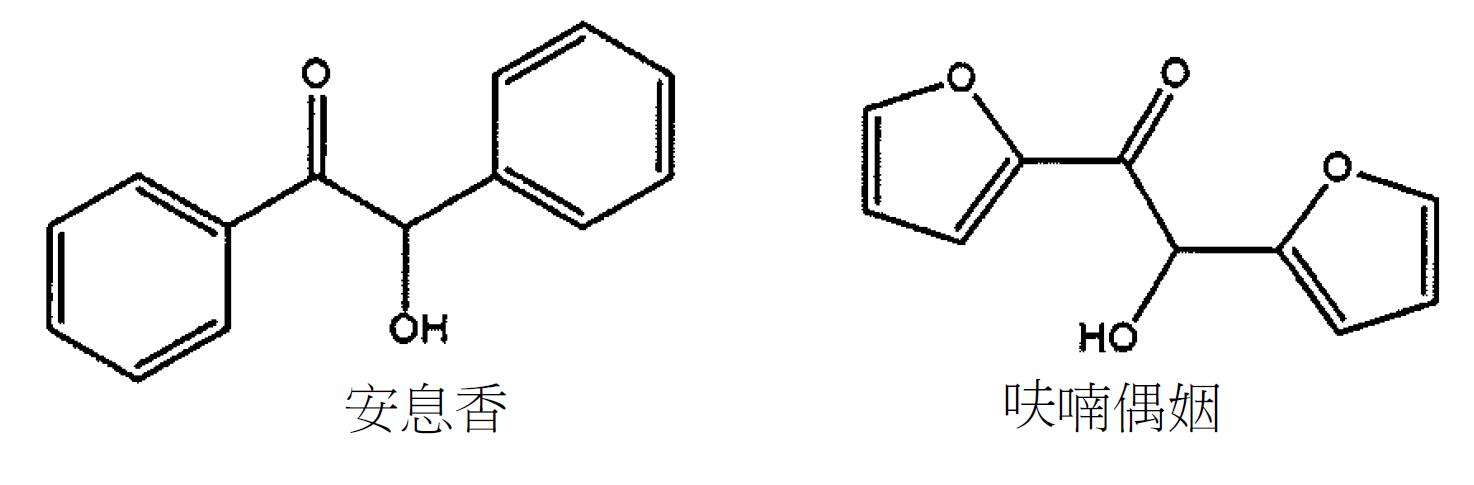
然而,該等3-組分氧化還原陽離子系統之延遲不足以達成良好的工作期。對於許多低溫固化應用而言,期望在室溫下有幾小時的良好黏度穩定性。安息香或呋喃偶姻自身均不能促進此延遲。合成呋喃偶姻之狄耳士 - 阿德爾加合物 However, the delay of these 3-component redox cation systems is not sufficient to achieve a good working period. For many low-temperature curing applications, good viscosity stability at room temperature for several hours is expected. Neither benzoin nor furan can promote this delay. Synthesis of Diels - Adel adduct of furan
在此實例中,潛還原劑係藉助呋喃偶姻與具有一或兩個馬來醯亞胺官能基之化合物之狄耳士-阿德爾反應產物形成。此加合物形成使得呋喃偶姻之α-羥基酮較不活潑且因此降低在與Cu(II)鹽之氧化還原相互作用中之反應性。儘管安息香自身(與呋喃偶姻自身一樣)亦起還原劑的作用,但由於結構中缺少二烯單元(代替呋喃基環,安息香中存在苯基環),因此安息香不能形成狄耳士-阿德爾加合物。In this example, the latent reducing agent is formed by the Diels-Alder reaction product of a compound having one or two maleimide functional groups via furan coupling. This adduct formation makes the α-hydroxy ketone of furan-coupled less active and thus reduces the reactivity in the redox interaction with the Cu(II) salt. Although benzoin itself (the same as furan marriage itself) also acts as a reducing agent, but due to the lack of diene units in the structure (instead of furanyl ring, there is a phenyl ring in benzoin), benzoin cannot form Diels-Adel Adduct.
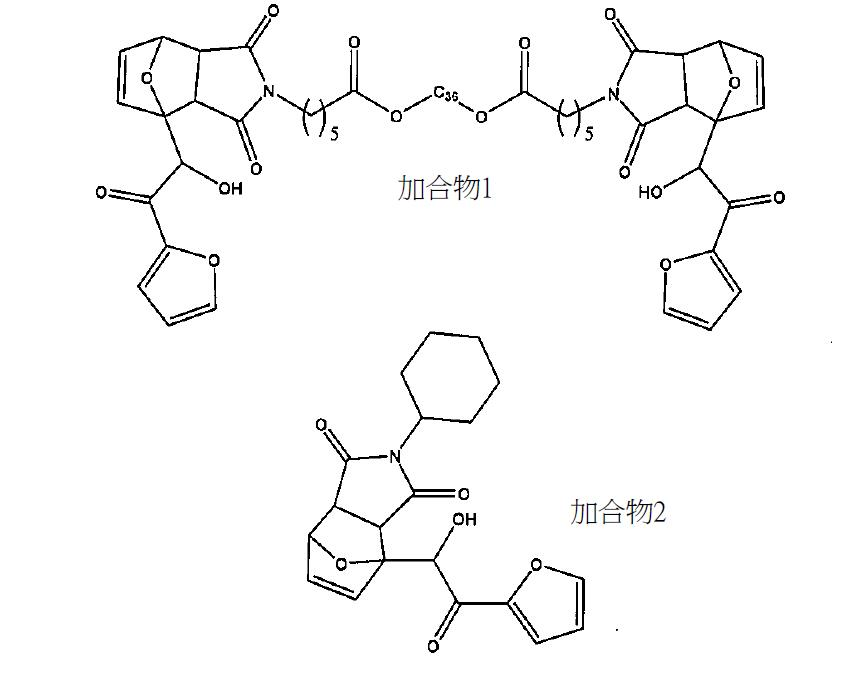
狄耳士-阿德爾加合物係利用呋喃偶姻與兩種具有馬來醯亞胺官能基之化合物形成,如實例中所示。兩種馬來醯亞胺係:SRM-1 (一種具有下文所示之結構且根據美國專利第6,355,750號製得之液體雙馬來醯亞胺樹脂)及N-環己基馬來醯亞胺。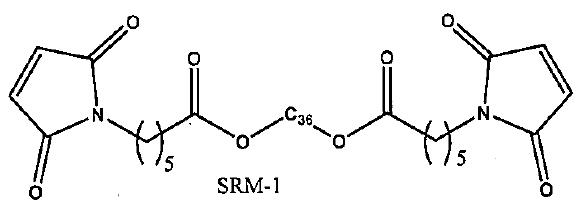
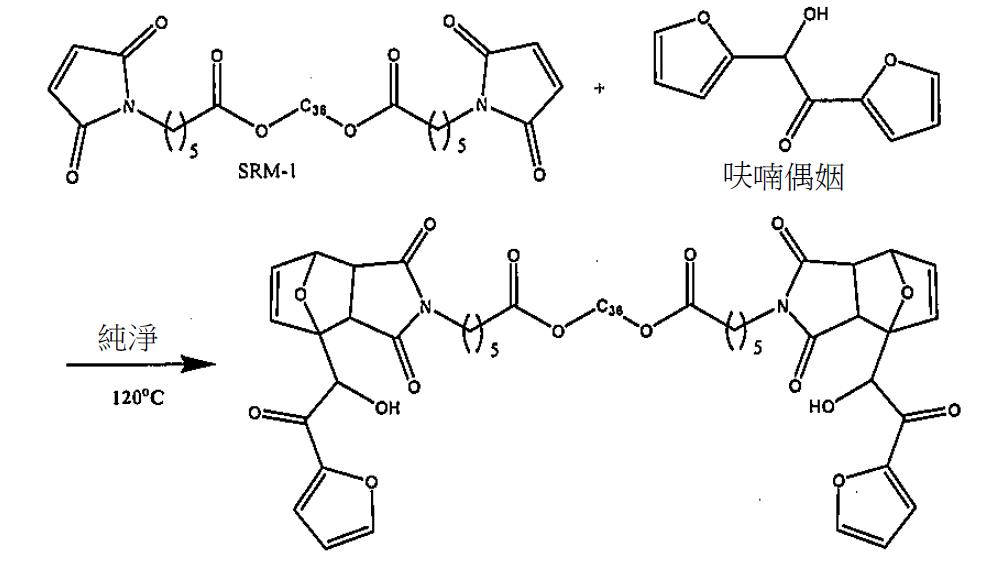
在配備有機械攪拌器之玻璃容器中獲得SRM-1 (57.3 g, 61 mmol)、呋喃偶姻(17.15 g, 89 mmol)及丁基羥基甲苯(「BHT」) (65 mg, 1000 ppm)之混合物。將混合物在120℃之溫度下攪拌約1 h之時間段,此時形成澄清的深褐色液體。將此液體在室溫下靜置2天。針對該液體實施之GPC指示不存在任何游離呋喃偶姻。合成加合物 2 
在配備有攪拌器之玻璃容器中獲得N-環己基馬來醯亞胺(3.85g, 21毫莫耳)、呋喃偶姻(3.7g, 19.3毫莫耳)及BHT (8mg, 1000ppm)之混合物。將混合物在120℃之溫度下攪拌約1小時之時間段,此時形成澄清的深褐色液體。將該液體在室溫下儲存2天。陽離子性可固化組合物之調配物 A mixture of N-cyclohexylmaleimide (3.85g, 21 mmol), furan (3.7g, 19.3 mmol) and BHT (8mg, 1000ppm) was obtained in a glass container equipped with a stirrer . The mixture was stirred at a temperature of 120°C for a period of about 1 hour, at which time a clear dark brown liquid formed. The liquid was stored at room temperature for 2 days. Formulation of cationic curable composition
製備若干組合物以評估低溫固化性能以及工作期黏度穩定性。組合物中所用成分之身份及量闡釋於表1中。使用兩種分別有及沒有呋喃偶姻之對照調配物(調配物1及5)用於比較低溫固化速度及黏度穩定性。使用三種含有含有潛還原劑(加合物1)之調配物(調配物2-4)。Several compositions were prepared to evaluate low-temperature curing performance and viscosity stability during service. The identity and amount of ingredients used in the composition are explained in Table 1. Two control formulations (Formulations 1 and 5), with and without furanin, were used to compare the low-temperature curing speed and viscosity stability. Three formulations (formulations 2-4) containing latent reducing agent (adduct 1) were used.
添加各成分並混合以形成各別調配物。將各調配物儲存直至準備使用為止。表 1 
使用差示掃描量熱法(「DSC」)根據ASTM D3418-15研究調配物1-5之起始及峰值溫度。此處,DSC以5-10℃/min之斜升速率自20℃之初始溫度至高達300℃運行掃描。The differential scanning calorimetry ("DSC") was used to study the onset and peak temperature of formulations 1-5 according to ASTM D3418-15. Here, DSC runs a scan from an initial temperature of 20°C up to 300°C at a ramp rate of 5-10°C/min.
收集DSC數據並報告於表2中。Collect DSC data and report in Table 2.
含有加合物1之調配物(即,調配物2-4)之起始溫度看起來在約70℃開始。含有加合物1之調配物的Tg稍微低於調配物1。表 2 
在100℃之溫度下使用等溫DSC以不同時間間隔研究調配物1-5之固化百分比。隨時間監測熱流(W/g)之變化,如表3中所示。方法設置為在初始2分鐘延遲後在<1分鐘內斜升至100℃。藉由將在各時間間隔觀察到之熱流除以總熱量並將結果乘以100來計算固化百分比。表 3 
重要的是,儘管含游離呋喃偶姻之調配物(即,調配物1)之起始溫度低於含呋喃偶姻加合物之調配物(即,調配物2-4) (參見表2),但該等調配物固化速度之固化速度看起來相似,如由所觀察到之相似程度之固化百分比所證實(參見表3)。此顯示本發明調配物2-4之延遲,而不影響其各別固化速度。與此相比,不含還原劑但僅含過渡金屬鹽/催化鎓觸媒劑(即,Cu(II)-錪鹽系統)之組合的調配物5顯示較低固化百分比。工作期評估 It is important that although the starting temperature of the formulation containing free furan indigo (ie, formulation 1) is lower than the formulation containing furan indigo adduct (ie, formulations 2-4) (see Table 2) However, the curing speeds of the curing speeds of these formulations looked similar, as evidenced by the similar percentage of curing observed (see Table 3). This shows the delay of the formulations 2-4 of the present invention without affecting their respective curing speeds. In contrast, formulation 5 which contains no reducing agent but only a transition metal salt/catalytic onium catalyst (ie, Cu(II)-phosphonium salt system) combination shows a lower cure percentage. Work period assessment
儘管如上所示利用含有呋喃偶姻及呋喃偶姻加合物之調配物觀察到相似固化百分比,但藉由黏度穩定性研究顯示含有加合物1之調配物(即,調配物2-4)之延遲,其結果見下表4。經測定,調配物1在暴露後2.5小時內凝膠化(目視確認),而在調配物2-4中未觀察到顯著黏度變化。儘管在室溫下在約19小時觀察到調配物2-4之黏度增加,但調配物2-4即使在室溫下24小時後仍然處於液態。該等結果展現含有潛還原劑之3-組分氧化還原陽離子系統之黏度穩定性顯著改良,同時不影響固化速度。表 4 
Claims (14)



Applications Claiming Priority (2)
| Application Number | Priority Date | Filing Date | Title |
|---|---|---|---|
| US201862691028P | 2018-06-28 | 2018-06-28 | |
| US62/691,028 | 2018-06-28 |
Publications (2)
| Publication Number | Publication Date |
|---|---|
| TW202000672A true TW202000672A (en) | 2020-01-01 |
| TWI839353B TWI839353B (en) | 2024-04-21 |
Family
ID=68987315
Family Applications (1)
| Application Number | Title | Priority Date | Filing Date |
|---|---|---|---|
| TW108113007A TWI839353B (en) | 2018-06-28 | 2019-04-15 | Cationically curable compositions with latent reducing agent demonstrating low cure temperature |
Country Status (7)
| Country | Link |
|---|---|
| US (1) | US11542268B2 (en) |
| EP (1) | EP3790882A4 (en) |
| JP (1) | JP7561039B2 (en) |
| KR (1) | KR102787545B1 (en) |
| CN (1) | CN112469723B (en) |
| TW (1) | TWI839353B (en) |
| WO (1) | WO2020006159A1 (en) |
Family Cites Families (13)
| Publication number | Priority date | Publication date | Assignee | Title |
|---|---|---|---|---|
| US4275190A (en) | 1980-01-08 | 1981-06-23 | General Electric Company | Latent heat-curable iodonium/copper salt-catalyzed epoxy resin compositions |
| US4482679A (en) * | 1982-09-18 | 1984-11-13 | Ciba-Geigy Corporation | Heat-curable epoxy compositions containing diaryliodosyl salts |
| DE4325846C1 (en) * | 1993-07-31 | 1995-01-19 | Herberts Gmbh | Use of furan-modified aromatic pinacol derivatives as initiators and furan-modified aromatic pinacol derivatives as such |
| JPH07330872A (en) * | 1994-06-10 | 1995-12-19 | Maruzen Petrochem Co Ltd | Thermosetting resin composition |
| US6355750B1 (en) | 1998-07-02 | 2002-03-12 | National Starch And Chemical Investment Holding Corporation | Dye attach adhesives for use in microelectronic devices |
| US6831132B2 (en) * | 2002-03-28 | 2004-12-14 | Henkel Corporation | Film adhesives containing maleimide compounds and methods for use thereof |
| KR20120029421A (en) * | 2009-06-11 | 2012-03-26 | 헨켈 코포레이션 | Thermally reversible hot melt adhesive composition containing multifunctional diene and dienophile compounds |
| DE102010045890A1 (en) | 2010-09-17 | 2012-03-22 | Merck Patent Gmbh | 2,2'-Furoin derivatives and their use for skin lightening |
| JP6596412B2 (en) * | 2013-03-22 | 2019-10-23 | ヘンケル アイピー アンド ホールディング ゲゼルシャフト ミット ベシュレンクテル ハフツング | Thermosetting resin composition having diene / dienophile pair and repairability |
| TWI652014B (en) | 2013-09-13 | 2019-03-01 | 美商艾佛艾姆希公司 | Heterocyclic substituted bicycloazole insecticide |
| EP3191541B1 (en) * | 2014-09-12 | 2025-03-12 | Henkel AG & Co. KGaA | Cationically curable benzoxazine compositions |
| CN112679467B (en) | 2015-03-11 | 2024-11-01 | Fmc公司 | Heterocyclic substituted bicyclic ring Azole pesticides |
| KR101791852B1 (en) * | 2017-03-20 | 2017-11-01 | 국도화학 주식회사 | Furan monomer with bifunctional hydroxymethyl group and Method for preparing the same |
-
2019
- 2019-04-15 TW TW108113007A patent/TWI839353B/en active
- 2019-06-27 EP EP19825819.6A patent/EP3790882A4/en not_active Withdrawn
- 2019-06-27 CN CN201980043561.0A patent/CN112469723B/en active Active
- 2019-06-27 KR KR1020217002384A patent/KR102787545B1/en active Active
- 2019-06-27 WO PCT/US2019/039370 patent/WO2020006159A1/en not_active Ceased
- 2019-06-27 JP JP2020573040A patent/JP7561039B2/en active Active
-
2020
- 2020-12-22 US US17/130,213 patent/US11542268B2/en active Active
Also Published As
| Publication number | Publication date |
|---|---|
| KR20210025073A (en) | 2021-03-08 |
| EP3790882A1 (en) | 2021-03-17 |
| WO2020006159A1 (en) | 2020-01-02 |
| CN112469723A (en) | 2021-03-09 |
| EP3790882A4 (en) | 2022-03-09 |
| KR102787545B1 (en) | 2025-03-31 |
| US20210107915A1 (en) | 2021-04-15 |
| CN112469723B (en) | 2024-09-20 |
| TWI839353B (en) | 2024-04-21 |
| JP7561039B2 (en) | 2024-10-03 |
| US11542268B2 (en) | 2023-01-03 |
| JP2021529859A (en) | 2021-11-04 |
Similar Documents
| Publication | Publication Date | Title |
|---|---|---|
| TWI651387B (en) | Conductive die-bonding film for large-grain semiconductor package and composition for preparing the same | |
| TWI258493B (en) | Improved interface adhesive | |
| KR101502193B1 (en) | One liquid type cyanate-epoxy composite resin composition, its hardened material, manufacturing method thereof, and materials for sealing and adhesive agents using the same | |
| TWI545154B (en) | Liquid compression molding encapsulant | |
| CN102574987B (en) | Solvent-free one-component cyanate ester-epoxy composite resin composition | |
| TWI623983B (en) | Method for controlling wafer warpage during compression molding and articles usable by the method | |
| TW200914485A (en) | One liquid type cyanate-epoxy composite resin composition | |
| TWI727977B (en) | Formulations containing mixed resin systems and the use thereof for wafer-level underfill for 3d tsv packages | |
| TWI839353B (en) | Cationically curable compositions with latent reducing agent demonstrating low cure temperature | |
| TWI414561B (en) | With benzo A thermosetting resin composition and a method for producing the same, and a molded body and a hardened body thereof | |
| JP7038565B2 (en) | Thermosetting epoxy resin compositions, adhesives, epoxy resin cured products, salts, and curing agents | |
| US7414103B2 (en) | Siloxane resins with oxetane functionality | |
| WO2016103630A1 (en) | Epoxy resin composition | |
| US20180319973A1 (en) | Resin compositions for underfill film for three dimensional through silica via (tsv) packages and compositions useful for the preparation thereof | |
| US20240166796A1 (en) | Epoxy resin for semiconductor adhesive, preparing method thereof and composition comprising the same | |
| KR102563013B1 (en) | Improvement of work life for multi-layered articles and methods of manufacturing and using the same | |
| TW201902867A (en) | Polyaromatic compounds and high refractive index, light stable, yellowing resistant resins containing same | |
| Frigione | Miscibility studies and chemical modification of functionalised low molecular weight polyethylene for use as toughening agents in epoxy resins | |
| TW201231542A (en) | Epoxy hybrid silicone resin composition |