TW202000746A - Crosslinking-cured product of siloxane polymer - Google Patents
Crosslinking-cured product of siloxane polymer Download PDFInfo
- Publication number
- TW202000746A TW202000746A TW108122606A TW108122606A TW202000746A TW 202000746 A TW202000746 A TW 202000746A TW 108122606 A TW108122606 A TW 108122606A TW 108122606 A TW108122606 A TW 108122606A TW 202000746 A TW202000746 A TW 202000746A
- Authority
- TW
- Taiwan
- Prior art keywords
- formula
- cross
- silicone polymer
- silicon compound
- heat resistance
- Prior art date
Links
- 229920000642 polymer Polymers 0.000 title abstract description 47
- KPUWHANPEXNPJT-UHFFFAOYSA-N disiloxane Chemical class [SiH3]O[SiH3] KPUWHANPEXNPJT-UHFFFAOYSA-N 0.000 title abstract description 25
- 150000003377 silicon compounds Chemical class 0.000 claims abstract description 88
- 238000012360 testing method Methods 0.000 claims abstract description 62
- 239000000203 mixture Substances 0.000 claims abstract description 39
- 230000008859 change Effects 0.000 claims abstract description 11
- 230000004913 activation Effects 0.000 claims abstract description 9
- 230000009477 glass transition Effects 0.000 claims abstract description 8
- 229920005573 silicon-containing polymer Polymers 0.000 claims description 97
- 238000004132 cross linking Methods 0.000 claims description 21
- 125000000524 functional group Chemical group 0.000 claims description 21
- 125000001997 phenyl group Chemical group [H]C1=C([H])C([H])=C(*)C([H])=C1[H] 0.000 claims description 20
- 125000002496 methyl group Chemical group [H]C([H])([H])* 0.000 claims description 11
- UFHFLCQGNIYNRP-UHFFFAOYSA-N Hydrogen Chemical compound [H][H] UFHFLCQGNIYNRP-UHFFFAOYSA-N 0.000 claims description 9
- 229910052739 hydrogen Inorganic materials 0.000 claims description 9
- 239000001257 hydrogen Substances 0.000 claims description 9
- 125000002887 hydroxy group Chemical group [H]O* 0.000 claims description 9
- 125000000217 alkyl group Chemical group 0.000 claims description 8
- 125000000113 cyclohexyl group Chemical group [H]C1([H])C([H])([H])C([H])([H])C([H])(*)C([H])([H])C1([H])[H] 0.000 claims description 8
- LFQCEHFDDXELDD-UHFFFAOYSA-N tetramethyl orthosilicate Chemical compound CO[Si](OC)(OC)OC LFQCEHFDDXELDD-UHFFFAOYSA-N 0.000 claims description 7
- 238000002834 transmittance Methods 0.000 claims description 7
- 125000004432 carbon atom Chemical group C* 0.000 claims description 6
- 229910052731 fluorine Inorganic materials 0.000 claims description 5
- 239000011737 fluorine Substances 0.000 claims description 5
- 229910052736 halogen Inorganic materials 0.000 claims description 5
- 125000006527 (C1-C5) alkyl group Chemical group 0.000 claims description 4
- 125000004429 atom Chemical group 0.000 claims description 4
- 125000002993 cycloalkylene group Chemical group 0.000 claims description 4
- 125000001153 fluoro group Chemical group F* 0.000 claims description 4
- 125000003837 (C1-C20) alkyl group Chemical group 0.000 claims description 2
- 125000005843 halogen group Chemical group 0.000 claims 1
- 230000007774 longterm Effects 0.000 abstract description 12
- 229910052710 silicon Inorganic materials 0.000 abstract description 11
- 239000010703 silicon Substances 0.000 abstract description 11
- XUIMIQQOPSSXEZ-UHFFFAOYSA-N Silicon Chemical compound [Si] XUIMIQQOPSSXEZ-UHFFFAOYSA-N 0.000 abstract description 10
- YXFVVABEGXRONW-UHFFFAOYSA-N Toluene Chemical compound CC1=CC=CC=C1 YXFVVABEGXRONW-UHFFFAOYSA-N 0.000 description 37
- 239000000047 product Substances 0.000 description 36
- 239000003054 catalyst Substances 0.000 description 25
- 239000002904 solvent Substances 0.000 description 20
- 239000004205 dimethyl polysiloxane Substances 0.000 description 19
- 229920000435 poly(dimethylsiloxane) Polymers 0.000 description 19
- 230000015572 biosynthetic process Effects 0.000 description 18
- 238000010438 heat treatment Methods 0.000 description 17
- 238000003786 synthesis reaction Methods 0.000 description 17
- XLYOFNOQVPJJNP-UHFFFAOYSA-N water Substances O XLYOFNOQVPJJNP-UHFFFAOYSA-N 0.000 description 16
- 150000001875 compounds Chemical class 0.000 description 15
- 230000003287 optical effect Effects 0.000 description 14
- 239000000126 substance Substances 0.000 description 14
- 238000006243 chemical reaction Methods 0.000 description 13
- OKKJLVBELUTLKV-UHFFFAOYSA-N Methanol Chemical compound OC OKKJLVBELUTLKV-UHFFFAOYSA-N 0.000 description 12
- UKLDJPRMSDWDSL-UHFFFAOYSA-L [dibutyl(dodecanoyloxy)stannyl] dodecanoate Chemical compound CCCCCCCCCCCC(=O)O[Sn](CCCC)(CCCC)OC(=O)CCCCCCCCCCC UKLDJPRMSDWDSL-UHFFFAOYSA-L 0.000 description 12
- 238000005227 gel permeation chromatography Methods 0.000 description 11
- 239000000463 material Substances 0.000 description 11
- 239000007787 solid Substances 0.000 description 11
- WYURNTSHIVDZCO-UHFFFAOYSA-N Tetrahydrofuran Chemical compound C1CCOC1 WYURNTSHIVDZCO-UHFFFAOYSA-N 0.000 description 10
- 238000003756 stirring Methods 0.000 description 10
- 230000035882 stress Effects 0.000 description 10
- 239000004809 Teflon Substances 0.000 description 9
- 229920006362 Teflon® Polymers 0.000 description 9
- 238000004458 analytical method Methods 0.000 description 8
- 239000000706 filtrate Substances 0.000 description 8
- 238000005259 measurement Methods 0.000 description 8
- 238000005481 NMR spectroscopy Methods 0.000 description 7
- 239000011521 glass Substances 0.000 description 7
- 239000007788 liquid Substances 0.000 description 7
- UHOVQNZJYSORNB-UHFFFAOYSA-N Benzene Chemical compound C1=CC=CC=C1 UHOVQNZJYSORNB-UHFFFAOYSA-N 0.000 description 6
- RTZKZFJDLAIYFH-UHFFFAOYSA-N Diethyl ether Chemical compound CCOCC RTZKZFJDLAIYFH-UHFFFAOYSA-N 0.000 description 6
- ZMANZCXQSJIPKH-UHFFFAOYSA-N Triethylamine Chemical compound CCN(CC)CC ZMANZCXQSJIPKH-UHFFFAOYSA-N 0.000 description 6
- 239000002253 acid Substances 0.000 description 6
- 239000000654 additive Substances 0.000 description 6
- -1 cyclic siloxane Chemical class 0.000 description 6
- VLKZOEOYAKHREP-UHFFFAOYSA-N n-Hexane Chemical compound CCCCCC VLKZOEOYAKHREP-UHFFFAOYSA-N 0.000 description 6
- NWUYHJFMYQTDRP-UHFFFAOYSA-N 1,2-bis(ethenyl)benzene;1-ethenyl-2-ethylbenzene;styrene Chemical compound C=CC1=CC=CC=C1.CCC1=CC=CC=C1C=C.C=CC1=CC=CC=C1C=C NWUYHJFMYQTDRP-UHFFFAOYSA-N 0.000 description 5
- 230000032683 aging Effects 0.000 description 5
- 239000003729 cation exchange resin Substances 0.000 description 5
- 229920001296 polysiloxane Polymers 0.000 description 5
- 238000002360 preparation method Methods 0.000 description 5
- 238000010992 reflux Methods 0.000 description 5
- YLQBMQCUIZJEEH-UHFFFAOYSA-N tetrahydrofuran Natural products C=1C=COC=1 YLQBMQCUIZJEEH-UHFFFAOYSA-N 0.000 description 5
- 238000005160 1H NMR spectroscopy Methods 0.000 description 4
- VEXZGXHMUGYJMC-UHFFFAOYSA-N Hydrochloric acid Chemical compound Cl VEXZGXHMUGYJMC-UHFFFAOYSA-N 0.000 description 4
- IMNFDUFMRHMDMM-UHFFFAOYSA-N N-Heptane Chemical compound CCCCCCC IMNFDUFMRHMDMM-UHFFFAOYSA-N 0.000 description 4
- VYPSYNLAJGMNEJ-UHFFFAOYSA-N Silicium dioxide Chemical compound O=[Si]=O VYPSYNLAJGMNEJ-UHFFFAOYSA-N 0.000 description 4
- BOTDANWDWHJENH-UHFFFAOYSA-N Tetraethyl orthosilicate Chemical compound CCO[Si](OCC)(OCC)OCC BOTDANWDWHJENH-UHFFFAOYSA-N 0.000 description 4
- 150000001335 aliphatic alkanes Chemical group 0.000 description 4
- 238000009835 boiling Methods 0.000 description 4
- 229940125904 compound 1 Drugs 0.000 description 4
- 229940125782 compound 2 Drugs 0.000 description 4
- 229940126214 compound 3 Drugs 0.000 description 4
- 239000000470 constituent Substances 0.000 description 4
- 238000001816 cooling Methods 0.000 description 4
- 239000012043 crude product Substances 0.000 description 4
- 230000000694 effects Effects 0.000 description 4
- 238000011156 evaluation Methods 0.000 description 4
- 150000002367 halogens Chemical group 0.000 description 4
- 229910052757 nitrogen Inorganic materials 0.000 description 4
- IJGRMHOSHXDMSA-UHFFFAOYSA-N nitrogen Substances N#N IJGRMHOSHXDMSA-UHFFFAOYSA-N 0.000 description 4
- QJGQUHMNIGDVPM-UHFFFAOYSA-N nitrogen group Chemical group [N] QJGQUHMNIGDVPM-UHFFFAOYSA-N 0.000 description 4
- HMMGMWAXVFQUOA-UHFFFAOYSA-N octamethylcyclotetrasiloxane Chemical compound C[Si]1(C)O[Si](C)(C)O[Si](C)(C)O[Si](C)(C)O1 HMMGMWAXVFQUOA-UHFFFAOYSA-N 0.000 description 4
- 230000000704 physical effect Effects 0.000 description 4
- 238000000746 purification Methods 0.000 description 4
- 239000000758 substrate Substances 0.000 description 4
- 238000009864 tensile test Methods 0.000 description 4
- VZGDMQKNWNREIO-UHFFFAOYSA-N tetrachloromethane Chemical compound ClC(Cl)(Cl)Cl VZGDMQKNWNREIO-UHFFFAOYSA-N 0.000 description 4
- 150000003613 toluenes Chemical class 0.000 description 4
- 238000001291 vacuum drying Methods 0.000 description 4
- 239000002966 varnish Substances 0.000 description 4
- RYHBNJHYFVUHQT-UHFFFAOYSA-N 1,4-Dioxane Chemical compound C1COCCO1 RYHBNJHYFVUHQT-UHFFFAOYSA-N 0.000 description 3
- QTBSBXVTEAMEQO-UHFFFAOYSA-N Acetic acid Chemical compound CC(O)=O QTBSBXVTEAMEQO-UHFFFAOYSA-N 0.000 description 3
- YMWUJEATGCHHMB-UHFFFAOYSA-N Dichloromethane Chemical compound ClCCl YMWUJEATGCHHMB-UHFFFAOYSA-N 0.000 description 3
- XEKOWRVHYACXOJ-UHFFFAOYSA-N Ethyl acetate Chemical compound CCOC(C)=O XEKOWRVHYACXOJ-UHFFFAOYSA-N 0.000 description 3
- HEMHJVSKTPXQMS-UHFFFAOYSA-M Sodium hydroxide Chemical compound [OH-].[Na+] HEMHJVSKTPXQMS-UHFFFAOYSA-M 0.000 description 3
- 239000002585 base Substances 0.000 description 3
- 239000011248 coating agent Substances 0.000 description 3
- 230000000052 comparative effect Effects 0.000 description 3
- IJKVHSBPTUYDLN-UHFFFAOYSA-N dihydroxy(oxo)silane Chemical compound O[Si](O)=O IJKVHSBPTUYDLN-UHFFFAOYSA-N 0.000 description 3
- 239000011347 resin Substances 0.000 description 3
- 229920005989 resin Polymers 0.000 description 3
- 239000003566 sealing material Substances 0.000 description 3
- CSCPPACGZOOCGX-UHFFFAOYSA-N Acetone Chemical compound CC(C)=O CSCPPACGZOOCGX-UHFFFAOYSA-N 0.000 description 2
- 239000004215 Carbon black (E152) Substances 0.000 description 2
- XEEYBQQBJWHFJM-UHFFFAOYSA-N Iron Chemical compound [Fe] XEEYBQQBJWHFJM-UHFFFAOYSA-N 0.000 description 2
- CTQNGGLPUBDAKN-UHFFFAOYSA-N O-Xylene Chemical compound CC1=CC=CC=C1C CTQNGGLPUBDAKN-UHFFFAOYSA-N 0.000 description 2
- PPBRXRYQALVLMV-UHFFFAOYSA-N Styrene Chemical compound C=CC1=CC=CC=C1 PPBRXRYQALVLMV-UHFFFAOYSA-N 0.000 description 2
- QAOWNCQODCNURD-UHFFFAOYSA-N Sulfuric acid Chemical compound OS(O)(=O)=O QAOWNCQODCNURD-UHFFFAOYSA-N 0.000 description 2
- ATJFFYVFTNAWJD-UHFFFAOYSA-N Tin Chemical compound [Sn] ATJFFYVFTNAWJD-UHFFFAOYSA-N 0.000 description 2
- GWEVSGVZZGPLCZ-UHFFFAOYSA-N Titan oxide Chemical compound O=[Ti]=O GWEVSGVZZGPLCZ-UHFFFAOYSA-N 0.000 description 2
- 230000002378 acidificating effect Effects 0.000 description 2
- 125000003545 alkoxy group Chemical group 0.000 description 2
- ADCOVFLJGNWWNZ-UHFFFAOYSA-N antimony trioxide Chemical compound O=[Sb]O[Sb]=O ADCOVFLJGNWWNZ-UHFFFAOYSA-N 0.000 description 2
- 150000004945 aromatic hydrocarbons Chemical class 0.000 description 2
- QVGXLLKOCUKJST-UHFFFAOYSA-N atomic oxygen Chemical group [O] QVGXLLKOCUKJST-UHFFFAOYSA-N 0.000 description 2
- 230000015556 catabolic process Effects 0.000 description 2
- NEHMKBQYUWJMIP-UHFFFAOYSA-N chloromethane Chemical compound ClC NEHMKBQYUWJMIP-UHFFFAOYSA-N 0.000 description 2
- 238000000576 coating method Methods 0.000 description 2
- 125000000753 cycloalkyl group Chemical group 0.000 description 2
- 238000006731 degradation reaction Methods 0.000 description 2
- 230000006866 deterioration Effects 0.000 description 2
- 238000010586 diagram Methods 0.000 description 2
- 239000012776 electronic material Substances 0.000 description 2
- 239000004210 ether based solvent Substances 0.000 description 2
- 239000007789 gas Substances 0.000 description 2
- 150000008282 halocarbons Chemical class 0.000 description 2
- 229930195733 hydrocarbon Natural products 0.000 description 2
- 150000002430 hydrocarbons Chemical class 0.000 description 2
- 230000007062 hydrolysis Effects 0.000 description 2
- 238000006460 hydrolysis reaction Methods 0.000 description 2
- 239000003960 organic solvent Substances 0.000 description 2
- 229910052760 oxygen Inorganic materials 0.000 description 2
- 239000001301 oxygen Substances 0.000 description 2
- 229920003229 poly(methyl methacrylate) Polymers 0.000 description 2
- 239000004926 polymethyl methacrylate Substances 0.000 description 2
- 239000000377 silicon dioxide Substances 0.000 description 2
- 239000004094 surface-active agent Substances 0.000 description 2
- 239000008096 xylene Substances 0.000 description 2
- 238000004383 yellowing Methods 0.000 description 2
- LSNNMFCWUKXFEE-UHFFFAOYSA-M Bisulfite Chemical compound OS([O-])=O LSNNMFCWUKXFEE-UHFFFAOYSA-M 0.000 description 1
- WKBOTKDWSSQWDR-UHFFFAOYSA-N Bromine atom Chemical class [Br] WKBOTKDWSSQWDR-UHFFFAOYSA-N 0.000 description 1
- OKTJSMMVPCPJKN-UHFFFAOYSA-N Carbon Chemical group [C] OKTJSMMVPCPJKN-UHFFFAOYSA-N 0.000 description 1
- 210000004128 D cell Anatomy 0.000 description 1
- 239000004593 Epoxy Substances 0.000 description 1
- JOYRKODLDBILNP-UHFFFAOYSA-N Ethyl urethane Chemical compound CCOC(N)=O JOYRKODLDBILNP-UHFFFAOYSA-N 0.000 description 1
- YCKRFDGAMUMZLT-UHFFFAOYSA-N Fluorine atom Chemical compound [F] YCKRFDGAMUMZLT-UHFFFAOYSA-N 0.000 description 1
- 229920000877 Melamine resin Polymers 0.000 description 1
- ISWSIDIOOBJBQZ-UHFFFAOYSA-N Phenol Chemical compound OC1=CC=CC=C1 ISWSIDIOOBJBQZ-UHFFFAOYSA-N 0.000 description 1
- OAICVXFJPJFONN-UHFFFAOYSA-N Phosphorus Chemical compound [P] OAICVXFJPJFONN-UHFFFAOYSA-N 0.000 description 1
- 229920002873 Polyethylenimine Polymers 0.000 description 1
- 239000006087 Silane Coupling Agent Substances 0.000 description 1
- NINIDFKCEFEMDL-UHFFFAOYSA-N Sulfur Chemical compound [S] NINIDFKCEFEMDL-UHFFFAOYSA-N 0.000 description 1
- 210000001744 T-lymphocyte Anatomy 0.000 description 1
- DHXVGJBLRPWPCS-UHFFFAOYSA-N Tetrahydropyran Chemical compound C1CCOCC1 DHXVGJBLRPWPCS-UHFFFAOYSA-N 0.000 description 1
- AUNAPVYQLLNFOI-UHFFFAOYSA-L [Pb++].[Pb++].[Pb++].[O-]S([O-])(=O)=O.[O-][Cr]([O-])(=O)=O.[O-][Mo]([O-])(=O)=O Chemical compound [Pb++].[Pb++].[Pb++].[O-]S([O-])(=O)=O.[O-][Cr]([O-])(=O)=O.[O-][Mo]([O-])(=O)=O AUNAPVYQLLNFOI-UHFFFAOYSA-L 0.000 description 1
- 239000006096 absorbing agent Substances 0.000 description 1
- 239000003377 acid catalyst Substances 0.000 description 1
- NIXOWILDQLNWCW-UHFFFAOYSA-N acrylic acid group Chemical group C(C=C)(=O)O NIXOWILDQLNWCW-UHFFFAOYSA-N 0.000 description 1
- 239000000853 adhesive Substances 0.000 description 1
- 230000001070 adhesive effect Effects 0.000 description 1
- 239000003513 alkali Substances 0.000 description 1
- 125000000129 anionic group Chemical group 0.000 description 1
- 230000003373 anti-fouling effect Effects 0.000 description 1
- 239000003963 antioxidant agent Substances 0.000 description 1
- IRERQBUNZFJFGC-UHFFFAOYSA-L azure blue Chemical compound [Na+].[Na+].[Na+].[Na+].[Na+].[Na+].[Na+].[Na+].[Al+3].[Al+3].[Al+3].[Al+3].[Al+3].[Al+3].[S-]S[S-].[O-][Si]([O-])([O-])[O-].[O-][Si]([O-])([O-])[O-].[O-][Si]([O-])([O-])[O-].[O-][Si]([O-])([O-])[O-].[O-][Si]([O-])([O-])[O-].[O-][Si]([O-])([O-])[O-] IRERQBUNZFJFGC-UHFFFAOYSA-L 0.000 description 1
- 230000004888 barrier function Effects 0.000 description 1
- 239000011324 bead Substances 0.000 description 1
- 229910052793 cadmium Inorganic materials 0.000 description 1
- BDOSMKKIYDKNTQ-UHFFFAOYSA-N cadmium atom Chemical compound [Cd] BDOSMKKIYDKNTQ-UHFFFAOYSA-N 0.000 description 1
- CJOBVZJTOIVNNF-UHFFFAOYSA-N cadmium sulfide Chemical compound [Cd]=S CJOBVZJTOIVNNF-UHFFFAOYSA-N 0.000 description 1
- 238000011088 calibration curve Methods 0.000 description 1
- 229910052799 carbon Inorganic materials 0.000 description 1
- 150000001732 carboxylic acid derivatives Chemical class 0.000 description 1
- 125000002091 cationic group Chemical group 0.000 description 1
- 210000004027 cell Anatomy 0.000 description 1
- 239000003795 chemical substances by application Substances 0.000 description 1
- 239000004927 clay Substances 0.000 description 1
- 239000003086 colorant Substances 0.000 description 1
- 229940125898 compound 5 Drugs 0.000 description 1
- 239000003431 cross linking reagent Substances 0.000 description 1
- 238000005384 cross polarization magic-angle spinning Methods 0.000 description 1
- 238000007872 degassing Methods 0.000 description 1
- 238000007598 dipping method Methods 0.000 description 1
- 239000002270 dispersing agent Substances 0.000 description 1
- 239000006185 dispersion Substances 0.000 description 1
- 238000004090 dissolution Methods 0.000 description 1
- 238000010828 elution Methods 0.000 description 1
- 230000002708 enhancing effect Effects 0.000 description 1
- 238000012676 equilibrium polymerization Methods 0.000 description 1
- 239000003759 ester based solvent Substances 0.000 description 1
- 125000001301 ethoxy group Chemical group [H]C([H])([H])C([H])([H])O* 0.000 description 1
- 125000001495 ethyl group Chemical group [H]C([H])([H])C([H])([H])* 0.000 description 1
- 239000000945 filler Substances 0.000 description 1
- 239000003063 flame retardant Substances 0.000 description 1
- UQSQSQZYBQSBJZ-UHFFFAOYSA-N fluorosulfonic acid Chemical compound OS(F)(=O)=O UQSQSQZYBQSBJZ-UHFFFAOYSA-N 0.000 description 1
- 230000003301 hydrolyzing effect Effects 0.000 description 1
- 230000006872 improvement Effects 0.000 description 1
- 239000004615 ingredient Substances 0.000 description 1
- 239000011229 interlayer Substances 0.000 description 1
- 239000003456 ion exchange resin Substances 0.000 description 1
- 229920003303 ion-exchange polymer Polymers 0.000 description 1
- 229910052742 iron Inorganic materials 0.000 description 1
- 239000010410 layer Substances 0.000 description 1
- 238000002844 melting Methods 0.000 description 1
- 230000008018 melting Effects 0.000 description 1
- 229910052751 metal Inorganic materials 0.000 description 1
- 239000002184 metal Substances 0.000 description 1
- 229910000000 metal hydroxide Inorganic materials 0.000 description 1
- 150000004692 metal hydroxides Chemical class 0.000 description 1
- 229910044991 metal oxide Inorganic materials 0.000 description 1
- 150000004706 metal oxides Chemical class 0.000 description 1
- 238000000034 method Methods 0.000 description 1
- SKTCDJAMAYNROS-UHFFFAOYSA-N methoxycyclopentane Chemical compound COC1CCCC1 SKTCDJAMAYNROS-UHFFFAOYSA-N 0.000 description 1
- ARYZCSRUUPFYMY-UHFFFAOYSA-N methoxysilane Chemical compound CO[SiH3] ARYZCSRUUPFYMY-UHFFFAOYSA-N 0.000 description 1
- 229940050176 methyl chloride Drugs 0.000 description 1
- 239000010445 mica Substances 0.000 description 1
- 229910052618 mica group Inorganic materials 0.000 description 1
- 238000002156 mixing Methods 0.000 description 1
- 239000012860 organic pigment Substances 0.000 description 1
- KJIFKLIQANRMOU-UHFFFAOYSA-N oxidanium;4-methylbenzenesulfonate Chemical compound O.CC1=CC=C(S(O)(=O)=O)C=C1 KJIFKLIQANRMOU-UHFFFAOYSA-N 0.000 description 1
- 125000000843 phenylene group Chemical class C1(=C(C=CC=C1)*)* 0.000 description 1
- 229910052698 phosphorus Inorganic materials 0.000 description 1
- 239000011574 phosphorus Substances 0.000 description 1
- 150000003018 phosphorus compounds Chemical class 0.000 description 1
- 229920001495 poly(sodium acrylate) polymer Polymers 0.000 description 1
- 238000006116 polymerization reaction Methods 0.000 description 1
- 230000002265 prevention Effects 0.000 description 1
- 230000009257 reactivity Effects 0.000 description 1
- 239000012744 reinforcing agent Substances 0.000 description 1
- 239000012763 reinforcing filler Substances 0.000 description 1
- 238000011160 research Methods 0.000 description 1
- 239000000565 sealant Substances 0.000 description 1
- 230000001568 sexual effect Effects 0.000 description 1
- SCPYDCQAZCOKTP-UHFFFAOYSA-N silanol Chemical compound [SiH3]O SCPYDCQAZCOKTP-UHFFFAOYSA-N 0.000 description 1
- 125000005372 silanol group Chemical group 0.000 description 1
- 150000003376 silicon Chemical class 0.000 description 1
- 229920006268 silicone film Polymers 0.000 description 1
- 125000005373 siloxane group Chemical group [SiH2](O*)* 0.000 description 1
- NNMHYFLPFNGQFZ-UHFFFAOYSA-M sodium polyacrylate Chemical compound [Na+].[O-]C(=O)C=C NNMHYFLPFNGQFZ-UHFFFAOYSA-M 0.000 description 1
- 125000001424 substituent group Chemical group 0.000 description 1
- 238000006467 substitution reaction Methods 0.000 description 1
- 229910052717 sulfur Inorganic materials 0.000 description 1
- 239000011593 sulfur Substances 0.000 description 1
- 239000012974 tin catalyst Substances 0.000 description 1
- 150000003609 titanium compounds Chemical class 0.000 description 1
- 239000004408 titanium dioxide Substances 0.000 description 1
- ITMCEJHCFYSIIV-UHFFFAOYSA-N triflic acid Chemical compound OS(=O)(=O)C(F)(F)F ITMCEJHCFYSIIV-UHFFFAOYSA-N 0.000 description 1
- YZFVQLCAVQBYIJ-UHFFFAOYSA-N trifluoromethanesulfonic acid;hydrate Chemical compound O.OS(=O)(=O)C(F)(F)F YZFVQLCAVQBYIJ-UHFFFAOYSA-N 0.000 description 1
- 235000013799 ultramarine blue Nutrition 0.000 description 1
- 238000000870 ultraviolet spectroscopy Methods 0.000 description 1
Images


Classifications
-
- C—CHEMISTRY; METALLURGY
- C08—ORGANIC MACROMOLECULAR COMPOUNDS; THEIR PREPARATION OR CHEMICAL WORKING-UP; COMPOSITIONS BASED THEREON
- C08G—MACROMOLECULAR COMPOUNDS OBTAINED OTHERWISE THAN BY REACTIONS ONLY INVOLVING UNSATURATED CARBON-TO-CARBON BONDS
- C08G77/00—Macromolecular compounds obtained by reactions forming a linkage containing silicon with or without sulfur, nitrogen, oxygen or carbon in the main chain of the macromolecule
- C08G77/04—Polysiloxanes
-
- C—CHEMISTRY; METALLURGY
- C08—ORGANIC MACROMOLECULAR COMPOUNDS; THEIR PREPARATION OR CHEMICAL WORKING-UP; COMPOSITIONS BASED THEREON
- C08G—MACROMOLECULAR COMPOUNDS OBTAINED OTHERWISE THAN BY REACTIONS ONLY INVOLVING UNSATURATED CARBON-TO-CARBON BONDS
- C08G77/00—Macromolecular compounds obtained by reactions forming a linkage containing silicon with or without sulfur, nitrogen, oxygen or carbon in the main chain of the macromolecule
- C08G77/42—Block-or graft-polymers containing polysiloxane sequences
- C08G77/44—Block-or graft-polymers containing polysiloxane sequences containing only polysiloxane sequences
-
- C—CHEMISTRY; METALLURGY
- C08—ORGANIC MACROMOLECULAR COMPOUNDS; THEIR PREPARATION OR CHEMICAL WORKING-UP; COMPOSITIONS BASED THEREON
- C08K—Use of inorganic or non-macromolecular organic substances as compounding ingredients
- C08K5/00—Use of organic ingredients
- C08K5/54—Silicon-containing compounds
- C08K5/541—Silicon-containing compounds containing oxygen
- C08K5/5415—Silicon-containing compounds containing oxygen containing at least one Si—O bond
-
- C—CHEMISTRY; METALLURGY
- C08—ORGANIC MACROMOLECULAR COMPOUNDS; THEIR PREPARATION OR CHEMICAL WORKING-UP; COMPOSITIONS BASED THEREON
- C08L—COMPOSITIONS OF MACROMOLECULAR COMPOUNDS
- C08L83/00—Compositions of macromolecular compounds obtained by reactions forming in the main chain of the macromolecule a linkage containing silicon with or without sulfur, nitrogen, oxygen or carbon only; Compositions of derivatives of such polymers
- C08L83/04—Polysiloxanes
- C08L83/06—Polysiloxanes containing silicon bound to oxygen-containing groups
Landscapes
- Chemical & Material Sciences (AREA)
- Health & Medical Sciences (AREA)
- Chemical Kinetics & Catalysis (AREA)
- Medicinal Chemistry (AREA)
- Polymers & Plastics (AREA)
- Organic Chemistry (AREA)
- Silicon Polymers (AREA)
- Compositions Of Macromolecular Compounds (AREA)
Abstract
Description
本發明是有關於一種矽氧烷聚合物交聯硬化物,其是自作為發光二極體(Light Emitting Diode,LED)密封材或透鏡等中所使用的光學材料的矽氧烷聚合物的交聯性組成物而獲得。The present invention relates to a cross-linked hardened silicone polymer, which is a cross-linked silicone polymer as an optical material used in a light emitting diode (Light Emitting Diode, LED) sealing material or lens, etc. It is obtained by connecting the composition.
包含倍半矽氧烷骨架的聚合物具有特殊的結構,而且由此產生的特殊的效果受到期待,因此受到各種領域的關注。對於此種包含倍半矽氧烷骨架的聚合物,已知在主鏈包含倍半矽氧烷骨架的矽系聚合物(例如,參照專利文獻1)。此矽系聚合物在透明性、皮膜成形性等方面優異,所以可用於薄膜、片材及成形體。然而,所述矽系聚合物具有熱塑性,所以向要求成形體具有耐熱性的領域的應用受到限制。如此,在所述矽系聚合物中留有在成形體的耐熱性方面進行研究的餘地。 因此,進行了如下研究,即,使交聯性矽化合物反應而製成交聯性組成物,形成由矽氧烷聚合物形成的矽氧烷聚合物交聯硬化物,提高成形體的耐熱性(例如,參照專利文獻2)。 [現有技術文獻] [專利文獻]The polymer containing the silsesquioxane skeleton has a special structure, and the special effects resulting therefrom are expected to attract attention in various fields. For such a polymer containing a silsesquioxane skeleton, a silicon-based polymer containing a silsesquioxane skeleton in the main chain is known (for example, refer to Patent Document 1). This silicon-based polymer is excellent in transparency, film formability, etc., so it can be used for films, sheets, and molded bodies. However, the silicon-based polymer has thermoplasticity, so its application to fields requiring heat resistance of the molded body is limited. In this way, there is room for research on the heat resistance of the molded body in the silicon-based polymer. Therefore, the following studies have been conducted, that is, a crosslinkable silicon compound is reacted to form a crosslinkable composition, a crosslinked hardened product of a siloxane polymer formed of a siloxane polymer is formed, and the heat resistance of the molded body is improved ( For example, refer to Patent Document 2). [Prior Art Literature] [Patent Literature]
[專利文獻1]日本專利特開2006-22207號公報 [專利文獻2]日本專利特開2008-280420號公報[Patent Document 1] Japanese Patent Laid-Open No. 2006-22207 [Patent Document 2] Japanese Patent Laid-Open No. 2008-280420
[發明所欲解決之課題] 然而,近年來,由光源即LED等的高輸出化而導致的LED密封材或透鏡等光學材料的樹脂劣化成為問題,從而要求在長期耐熱性方面優異。 本發明的課題在於提供一種在矽系聚合物的主鏈包含倍半矽氧烷骨架且在長期耐熱性方面優異的矽氧烷聚合物交聯硬化物。[Problems to be solved by the invention] However, in recent years, deterioration of resins in optical materials such as LED sealing materials and lenses due to increased output of light sources, such as LEDs, has become a problem, and it is required to be excellent in long-term heat resistance. An object of the present invention is to provide a cross-linked hardened silicone polymer having a silsesquioxane skeleton in the main chain of the silicon-based polymer and having excellent long-term heat resistance.
[解決課題之手段] 本發明提供一種由矽氧烷聚合物形成的矽氧烷聚合物交聯硬化物,所述矽氧烷聚合物是使在主鏈包含倍半矽氧烷骨架的特定的矽化合物的末端的羥基與具有對此羥基的反應性的四官能以上的交聯性矽化合物反應而成。[Means to solve the problem] The present invention provides a cross-linked hardened product of a siloxane polymer formed of a siloxane polymer. The siloxane polymer is a hydroxyl group at the end of a specific silicon compound containing a sesquisiloxane skeleton in the main chain. It reacts with cross-linkable silicon compounds with more than four functions that have reactivity with this hydroxyl group.
即,本發明提供下述[1]~[10]所示的發明。 [1] 一種矽氧烷聚合物交聯硬化物,其特徵在於,其為使用交聯硬化性組成物而成,且在溫度200℃下進行500小時耐熱試驗後的玻璃轉移溫度下的表觀的活化能的變化量為40 kJ/mol以下,所述交聯硬化性組成物是使下述式(1)所表示的矽化合物與選自由下述式(2)所表示的交聯性矽化合物所組成的群組中的一者以上反應而獲得。That is, the present invention provides the inventions shown in the following [1] to [10]. [1] A cross-linked hardened silicone polymer product, characterized in that it is formed by using a cross-linked hardening composition and has an apparent glass transition temperature after a heat resistance test at a temperature of 200°C for 500 hours The amount of change in activation energy is 40 kJ/mol or less. The cross-linking hardenable composition is composed of a silicon compound represented by the following formula (1) and a cross-linking silicon selected from the following formula (2) Obtained by reacting more than one of the group of compounds.
[化1]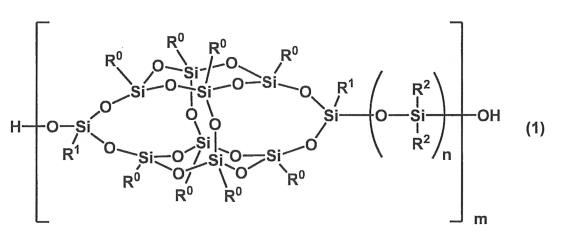
(式(1)中,n獨立地表示1~30的整數;m表示滿足重量平均分子量2,000~10,000,000的數字;R0 獨立地表示苯基或環己基;R1 及R2 獨立地表示苯基、環己基或碳數1~5的烷基,所述苯基及環己基中,任意的氫可獨立地經鹵素或碳數1~20的烷基取代,所述碳數1~5的烷基中,任意的氫可獨立地經氟取代,任意的-CH2 -可獨立地經-O-或碳數5~20的伸環烷基取代)(In formula (1), n independently represents an integer of 1 to 30; m represents a number satisfying a weight average molecular weight of 2,000 to 10,000,000; R 0 independently represents phenyl or cyclohexyl; R 1 and R 2 independently represent phenyl , Cyclohexyl or C1-C5 alkyl, in the phenyl and cyclohexyl, any hydrogen can be independently substituted by halogen or C1-C20 alkyl, the C1-C5 alkyl In the group, any hydrogen may be independently substituted with fluorine, and any -CH 2 -may be independently substituted with -O- or a C 5-20 cycloalkylene)
[化2]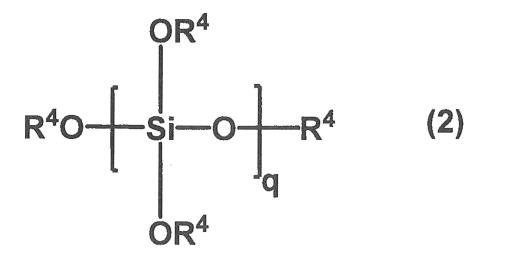
(式(2)中,R4 分別獨立地表示碳數1~3的烷基,q表示1~100的整數)(In formula (2), R 4 independently represents an alkyl group having 1 to 3 carbon atoms, and q represents an integer of 1 to 100)
[2] 如[1]所述的矽氧烷聚合物交聯硬化物,其特徵在於,式(2)所表示的交聯性矽化合物以官能基比計以1倍~15倍的範圍具有與式(1)所表示的矽化合物中的羥基進行反應的基或原子。[2] The crosslinked cured silicone polymer according to [1], wherein the crosslinkable silicon compound represented by formula (2) has a functional group ratio in the range of 1 to 15 times A group or atom that reacts with the hydroxyl group in the silicon compound represented by formula (1).
[3] 如[1]或[2]所述的矽氧烷聚合物交聯硬化物,其特徵在於,式(1)中的n平均為5。[3] The crosslinked hardened silicone polymer according to [1] or [2], wherein n in formula (1) is 5 on average.
[4] 如[1]~[3]中任一項所述的矽氧烷聚合物交聯硬化物,其特徵在於,式(1)中的R0 ~R2 分別獨立地為甲基或苯基。[4] The crosslinked and cured silicone polymer according to any one of [1] to [3], wherein R 0 to R 2 in formula (1) are each independently a methyl group or Phenyl.
[5] 如[1]~[4]中任一項所述的矽氧烷聚合物交聯硬化物,其特徵在於,式(2)所表示的交聯性矽化合物為矽酸甲酯寡聚物。[5] The crosslinked cured silicone polymer according to any one of [1] to [4], wherein the crosslinkable silicon compound represented by formula (2) is methyl silicate oligomer Polymer.
[6] 如[1]~[5]中任一項所述的矽氧烷聚合物交聯硬化物,其特徵在於,所述式(1)由下述式(3)表示,所述式(2)由下述式(4)表示,而所述矽氧烷聚合物交聯硬化物是使式(3)所表示的矽化合物與式(4)所表示的交聯性矽化合物反應而獲得。[6] The crosslinked cured silicone polymer according to any one of [1] to [5], wherein the formula (1) is represented by the following formula (3), and the formula (2) is represented by the following formula (4), and the crosslinked hardened silicone polymer is obtained by reacting the silicon compound represented by the formula (3) with the crosslinkable silicon compound represented by the formula (4) obtain.
[化3]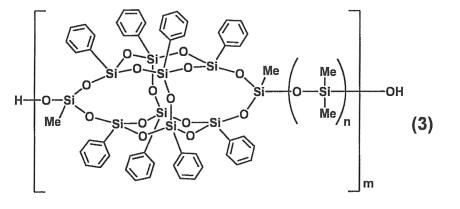
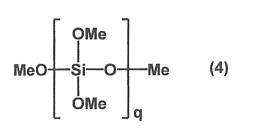
(式(3)中,n獨立地表示1~30的整數;m表示滿足重量平均分子量2,000~10,000,000的數字;而且,式(4)中,q表示1~10的整數)(In formula (3), n independently represents an integer of 1 to 30; m represents a number satisfying a weight average molecular weight of 2,000 to 10,000,000; and, in formula (4), q represents an integer of 1 to 10)
[7] 如[1]~[6]中任一項所述的矽氧烷聚合物交聯硬化物,其特徵在於,式(1)所表示的矽化合物的重量平均分子量為40,000~80,000。[7] The crosslinked cured silicone polymer according to any one of [1] to [6], wherein the weight average molecular weight of the silicon compound represented by formula (1) is 40,000 to 80,000.
[8] 如[1]~[7]中任一項所述的矽氧烷聚合物交聯硬化物,其特徵在於,在室溫下將8號啞鈴狀試驗片以拉伸速度5 mm/min進行了拉伸時的所述矽氧烷聚合物交聯硬化物的伸長率在所述耐熱試驗之前及所述耐熱試驗之後均為140%以上。[8] The crosslinked hardened silicone polymer according to any one of [1] to [7], wherein a dumbbell-shaped test piece No. 8 is stretched at a room speed of 5 mm at room temperature The elongation of the cross-linked hardened silicone polymer when stretched at min is 140% or more before and after the heat resistance test.
[9] 如[1]~[8]中任一項所述的矽氧烷聚合物交聯硬化物,其特徵在於,所述矽氧烷聚合物交聯硬化物的斷裂應力在所述耐熱試驗之前及所述耐熱試驗之後均為4 MPa以上。[9] The cross-linked cured silicone polymer according to any one of [1] to [8], wherein the fracture stress of the cross-linked cured silicone polymer is at the heat resistance Before the test and after the heat resistance test, it was 4 MPa or more.
[10] 如[1]~[9]中任一項所述的矽氧烷聚合物交聯硬化物,其特徵在於,所述矽氧烷聚合物交聯硬化物的總光線透過率在所述耐熱試驗之前及所述耐熱試驗之後均在380 nm~780 nm中為99.0%以上。[10] The crosslinked hardened silicone polymer according to any one of [1] to [9], wherein the total light transmittance of the crosslinked hardened silicone polymer is Before the heat resistance test and after the heat resistance test, it was 99.0% or more in the range of 380 nm to 780 nm.
[發明的效果] 在本發明中,可藉由使式(1)所表示的矽化合物與式(2)所表示的交聯性矽化合物反應而獲得膜狀的矽氧烷聚合物,所以可提供一種在矽系聚合物的主鏈包含倍半矽氧烷骨架且在長期耐熱性及光學特性方面優異的矽氧烷聚合物交聯硬化物。[Effect of invention] In the present invention, a film-like siloxane polymer can be obtained by reacting the silicon compound represented by formula (1) with the cross-linkable silicon compound represented by formula (2), so a silicon-based The main chain of the polymer contains a silsesquioxane skeleton and is a cross-linked hardened silicone polymer that is excellent in long-term heat resistance and optical properties.
本發明的矽氧烷聚合物交聯硬化物是使下述式(1)所表示的矽化合物與下述式(2)所表示的交聯性矽化合物反應而獲得。所述矽化合物可為一種亦可為兩種以上。另外,關於交聯性矽化合物將後述。The crosslinked cured silicone polymer of the present invention is obtained by reacting a silicon compound represented by the following formula (1) with a crosslinkable silicon compound represented by the following formula (2). The silicon compound may be one kind or two or more kinds. In addition, the crosslinkable silicon compound will be described later.
[化4]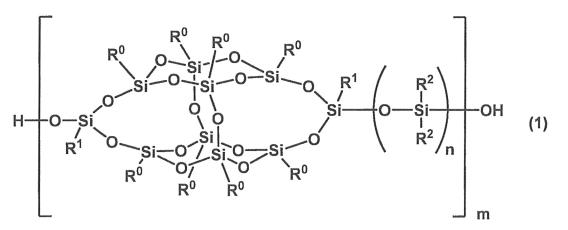
式(1)中,R0 獨立地表示苯基或環烷基。R0 的苯基及環烷基中,任意的氫可獨立地經鹵素或碳數1~20的烷基取代。In formula (1), R 0 independently represents phenyl or cycloalkyl. In the phenyl group and cycloalkyl group of R 0 , any hydrogen may be independently substituted by halogen or an alkyl group having 1 to 20 carbon atoms.
式(1)中,R1 及R2 獨立地表示苯基、環己基或碳數1~5的烷基。R1 及R2 的碳數1~5的烷基中,任意的氫可獨立地經氟取代,任意的-CH2 -可獨立地經-O-或碳數5~20的伸環烷基取代。In formula (1), R 1 and R 2 independently represent a phenyl group, a cyclohexyl group, or a C 1-5 alkyl group. In R 1 and R 2, a C 1-5 alkyl group, any hydrogen may be independently substituted with fluorine, and any -CH 2 -may be independently -O- or a C 5-20 cycloalkylene group replace.
R1 及R2 的苯基及環己基中,任意的氫可獨立地經鹵素或碳數1~20的烷基取代。R1 及R2 的苯基及環己基的取代基即碳數1~20的烷基中,任意的氫可獨立地經氟取代,任意的-CH2 -可獨立地經-O-、碳數5~20的伸環烷基或伸苯基取代。In the phenyl and cyclohexyl groups of R 1 and R 2 , any hydrogen may be independently substituted by halogen or an alkyl group having 1 to 20 carbon atoms. In the R 1 and R 2 phenyl and cyclohexyl substituents, that is, alkyl groups having 1 to 20 carbon atoms, any hydrogen may be independently substituted with fluorine, and any -CH 2 -may be independently substituted with -O-, carbon Substitution of cycloalkylene or phenylene extending from 5 to 20.
具體而言,較佳為R0 為苯基、R1 及R2 獨立地為甲基或苯基。就獲得光學特性等的諸特性的觀點及合成的容易性的觀點而言,尤佳為R0 為苯基、R1 及R2 為甲基。Specifically, it is preferred that R 0 is phenyl, and R 1 and R 2 are independently methyl or phenyl. From the viewpoint of obtaining various characteristics such as optical properties and the viewpoint of ease of synthesis, it is particularly preferred that R 0 is phenyl and R 1 and R 2 are methyl.
式(1)中,n獨立地表示1~30的整數(平均值),m表示滿足重量平均分子量2,000~10,000,000的整數。此處,n有時會提供多個而非單一的整數。因此,n有時以平均值來表示,例如在表示為「平均為5」的情況下,是指大約為5。就所獲得的矽氧烷聚合物交聯硬化物的物性等的觀點而言,n較佳為1~10的整數,進而佳為3~5的整數,尤佳為平均為5。若n過大,則在矽化合物的特性方面,存在與倍半矽氧烷的特性相比,矽氧烷的特性變得過於強的情況。在本發明中,就合成的容易性、所獲得的矽氧烷聚合物交聯硬化物的物性等的觀點而言,m較佳為滿足矽化合物的重量平均分子量5,000~2,000,000的整數,更佳為滿足重量平均分子量7,000~1,000,000的整數。In formula (1), n independently represents an integer (average value) of 1 to 30, and m represents an integer satisfying a weight average molecular weight of 2,000 to 10,000,000. Here, n sometimes provides multiple rather than a single integer. Therefore, n is sometimes expressed as an average value. For example, in the case of "average is 5", it means approximately 5. From the viewpoint of physical properties of the obtained cross-linked cured silicone polymer, n is preferably an integer of 1 to 10, more preferably an integer of 3 to 5, and particularly preferably an average of 5. If n is too large, the characteristics of the silicon compound may be too strong compared to the characteristics of the sesquisiloxane. In the present invention, from the viewpoints of ease of synthesis, physical properties of the obtained cross-linked cured silicone polymer, and the like, m is preferably an integer satisfying the weight average molecular weight of the silicon compound of 5,000 to 2,000,000, more preferably In order to satisfy the integer of weight average molecular weight 7,000-1,000,000.
重量平均分子量如後述的實施例中所記載般,是利用藉由分子量標準樣本而獲得的校準曲線對藉由凝膠滲透層析法(gel permeation chromatography,GPC)而獲得的層析圖進行計算而求出。 式(1)所表示的矽化合物的重量平均分子量較佳為4,000~200,000,尤佳為40,000~80,000。The weight-average molecular weight is calculated from the chromatogram obtained by gel permeation chromatography (GPC) using the calibration curve obtained by the molecular weight standard sample as described in the examples described later. Find out. The weight average molecular weight of the silicon compound represented by formula (1) is preferably 4,000 to 200,000, and particularly preferably 40,000 to 80,000.
所述式(1)所表示的矽化合物如專利文獻1中所記載般是藉由使下述式(5)所表示的倍半矽氧烷與下述式(6)所表示的鏈狀矽氧烷在三乙基胺等鹼的存在下反應而獲得。式(1)中的n可根據所述鏈狀矽氧烷的種類來決定。式(1)中的m是根據反應條件(溫度、式(6)所表示的鏈狀矽氧烷的濃度等)來調整。n較佳為3~5。The silicon compound represented by the above formula (1) is as described in
或者,亦可藉由在觸媒及水的存在下,使下述式(6')所表示的環狀矽氧烷與下述式(5)所表示的倍半矽氧烷在通常的聚合反應的條件下回流,繼而利用熟化步驟(25℃~90℃)平衡聚合而獲得。Alternatively, in the presence of a catalyst and water, the cyclic siloxane represented by the following formula (6') and the sesquisiloxane represented by the following formula (5) can be generally polymerized It is obtained by refluxing under the conditions of the reaction, followed by equilibrium polymerization using an aging step (25°C to 90°C).
在本反應系統中,作為觸媒通常使用強酸或強鹼。若考慮倍半矽氧烷的反應中的穩定性,則作為觸媒而較佳為強酸。作為此種觸媒,例如可列舉鹽酸、硫酸、氟硫酸、對甲苯磺酸-水合物、三氟甲磺酸-水合物、三氟甲磺酸、活性白土、磺酸系離子交換樹脂等。作為市售品,可使用RCP-160M(強酸性陽離子交換樹脂,三菱化學(股)製造)等。In this reaction system, a strong acid or a strong base is usually used as a catalyst. Considering the stability in the reaction of silsesquioxane, a strong acid is preferred as a catalyst. Examples of such catalysts include hydrochloric acid, sulfuric acid, fluorosulfuric acid, p-toluenesulfonic acid-hydrate, trifluoromethanesulfonic acid-hydrate, trifluoromethanesulfonic acid, activated clay, and sulfonic acid-based ion exchange resins. As a commercially available product, RCP-160M (strongly acidic cation exchange resin, manufactured by Mitsubishi Chemical Corporation) can be used.
而且,亦可使用溶劑來進行。作為溶劑,例如可列舉己烷或庚烷等烴系溶劑、苯、甲苯、二甲苯等芳香族烴系溶劑、二乙基醚、四氫呋喃(THF)、二噁烷、環戊基甲基醚等醚系溶劑、二氯甲烷、四氯化碳等鹵化烴溶劑等。Moreover, it can also be performed using a solvent. Examples of the solvent include hydrocarbon solvents such as hexane and heptane, aromatic hydrocarbon solvents such as benzene, toluene, and xylene, diethyl ether, tetrahydrofuran (THF), dioxane, and cyclopentyl methyl ether. Halogenated hydrocarbon solvents such as ether solvents, methylene chloride, carbon tetrachloride, etc.
此反應通常是在強酸的存在下或三乙基胺等鹼的存在下以40℃~150℃來進行。式(1)中的n可根據鏈狀矽氧烷的種類來決定。根據此反應,可獲得可具有交聯性官能基的倍半矽氧烷基與可具有交聯性官能基的矽氧烷基交替配置的交聯性矽化合物。This reaction is usually carried out at 40°C to 150°C in the presence of a strong acid or a base such as triethylamine. N in formula (1) can be determined according to the type of chain siloxane. According to this reaction, it is possible to obtain a cross-linkable silicon compound in which sesquisiloxy groups which can have cross-linkable functional groups and siloxane groups which can have cross-linkable functional groups are alternately arranged.
[化5]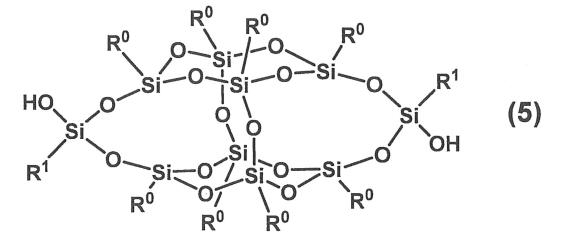

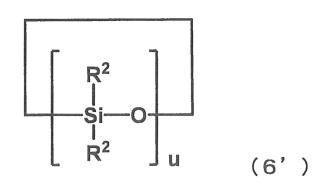
另外,式(5)所表示的倍半矽氧烷亦如專利文獻1中所記載般是藉由使下述式(7)所表示的化合物與下述式(8)所表示的化合物反應,進行水解而獲得。此處,X表示鹵素或氫。並且,下述式(7)所表示的化合物亦如所述專利文獻1中所記載般是藉由將下述式(9)所表示的化合物在氫氧化鈉及水的存在下水解、縮聚而獲得。此時的反應可在有機溶劑的存在下,亦可在有機溶劑的不存在下。In addition, as described in
[化6]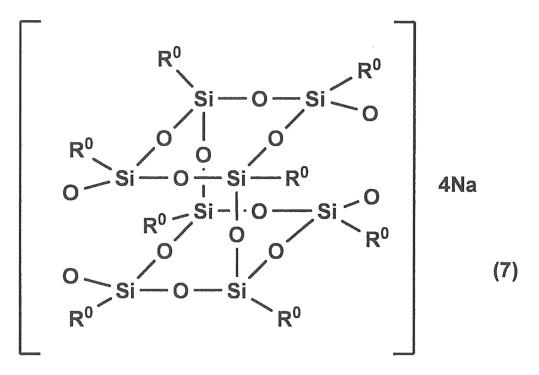
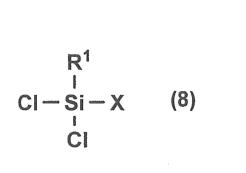
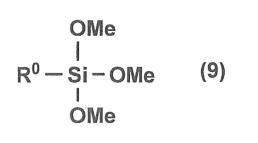
所述式(5)、式(6)、式(6')、式(7)或式(8)中的R0 、R1 、及R2 與式(1)相同。R 0 , R 1 , and R 2 in the formula (5), formula (6), formula (6′), formula (7), or formula (8) are the same as the formula (1).
其次,對式(2)所表示的交聯性矽化合物進行說明。 在本發明中,自所獲得的矽氧烷聚合物交聯硬化物的機械性特性、耐熱性的提升、化合物的容易獲得性的觀點,交聯性矽化合物使用選自由具有3個以上的與矽化合物中的羥基進行反應的基或原子(以下,亦稱為「交聯性官能基」)的式(2)所表示的化合物及其寡聚物所組成的群組中的一個以上。交聯性矽化合物可為一種亦可為兩種以上的混合物。Next, the crosslinkable silicon compound represented by formula (2) will be described. In the present invention, from the viewpoint of mechanical properties, heat resistance improvement, and easy availability of the compound obtained from the obtained cross-linked cured silicone polymer, the cross-linkable silicon compound is selected from the group consisting of three or more One or more of the group represented by the compound represented by formula (2) and the oligomer of the group or atom (hereinafter, also referred to as "crosslinkable functional group") in which the hydroxyl group in the silicon compound reacts. The crosslinkable silicon compound may be one kind or a mixture of two or more kinds.
[化7]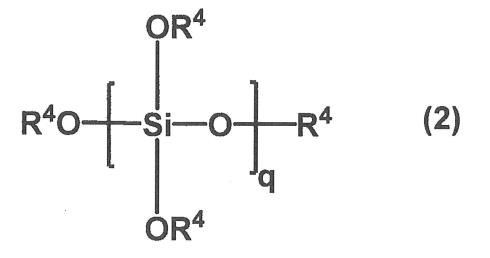
式(2)中,R4 獨立地表示碳數1~3的烷基,q是表示重複結構的符號,q為1~100的整數,較佳為q為1~10。較佳為R4 全部分別獨立地表示選自由甲基及乙基所組成的群組中的基,更佳為R4 全部為甲基。作為式(2)所表示的化合物,更佳為使用四甲氧基矽烷的部分水解縮合物。式(2)所表示的交聯性矽化合物藉由分子末端或側鏈的烷氧基與水分進行反應而水解,並進行脫醇反應而成為矽烷醇(silanol)基,繼而藉由此矽烷醇基與分子間或分子內的烷氧基進行反應,而藉由脫醇反應得到交聯。藉由進行此反應,可形成交聯度高的聚合物網路。作為市售品,所述交聯性矽化合物例如可列舉:三菱化學(股)製造的MKC矽酸酯MS57(商標)、MKC矽酸酯MS51(商標)(四甲氧基矽烷平均五聚物)、MKC矽酸酯MS56、MS56S(均為商標)、可爾可特(COLCOAT)(股)製造的矽酸甲酯51(四甲氧基矽烷四聚物)、矽酸甲酯53(四甲氧基矽烷七聚物)、矽酸乙酯40(四乙氧基矽烷五聚物)、矽酸乙酯48(四乙氧基矽烷十聚物)等。In formula (2), R 4 independently represents an alkyl group having 1 to 3 carbon atoms, q is a symbol representing a repeating structure, q is an integer of 1 to 100, and preferably q is 1 to 10. It is preferred that all of R 4 each independently represent a group selected from the group consisting of methyl and ethyl, and it is more preferred that all of R 4 are methyl. As the compound represented by formula (2), a partially hydrolyzed condensate using tetramethoxysilane is more preferable. The cross-linkable silicon compound represented by formula (2) is hydrolyzed by the reaction of the alkoxy group at the molecular end or side chain with water, and undergoes a dealcoholization reaction to become a silanol group, and then the silanol The group reacts with the alkoxy group in the molecule or in the molecule, and crosslinking is obtained by the dealcoholization reaction. By performing this reaction, a polymer network with a high degree of crosslinking can be formed. As a commercially available product, examples of the crosslinkable silicon compound include MKC silicate MS57 (trademark), MKC silicate MS51 (trademark) (tetramethoxysilane average pentamer) manufactured by Mitsubishi Chemical Corporation. ), MKC Silicate MS56, MS56S (both trademarks), Methyl Silicate 51 (Tetramethoxysilane tetramer) manufactured by COLCOAT (shares), Methyl Silicate 53 (Four Methoxysilane heptamer), ethyl silicate 40 (tetraethoxysilane pentamer), ethyl silicate 48 (tetraethoxysilane decamer), etc.
式(1)所表示的矽化合物與式(2)所表示的交聯性矽化合物的交聯是藉由基於交聯性矽化合物所具有的與式(1)所表示的矽化合物中的羥基進行反應的交聯性的官能基的種類,使兩矽化合物在恰當的條件下共存來進行。 矽化合物與交聯性矽化合物的反應可視需要在觸媒的存在下進行。作為觸媒,例如可列舉乙酸、鹽酸等酸觸媒、有機錫系觸媒、或者鹼、有機鈦化合物等。觸媒的種類及使用量可視交聯性官能基的種類來決定,例如在交聯性的官能基為乙氧基的情況下,例如對於觸媒,使用相對於交聯性矽化合物100重量份而為0.01重量份~5重量份的月桂酸二丁錫。The crosslinking of the silicon compound represented by the formula (1) and the crosslinkable silicon compound represented by the formula (2) is based on the hydroxyl group in the silicon compound represented by the formula (1) based on the crosslinkable silicon compound The type of the cross-linkable functional group that undergoes the reaction allows two silicon compounds to coexist under appropriate conditions. The reaction between the silicon compound and the cross-linkable silicon compound may be carried out in the presence of a catalyst as needed. Examples of the catalyst include acid catalysts such as acetic acid and hydrochloric acid, organic tin catalysts, alkalis, and organic titanium compounds. The type and amount of catalyst can be determined according to the type of crosslinkable functional group. For example, when the crosslinkable functional group is an ethoxy group, for example, for the catalyst, 100 parts by weight of the crosslinkable silicon compound is used. It is 0.01 to 5 parts by weight of dibutyltin laurate.
關於是否成功生成了矽氧烷聚合物交聯硬化物,可藉由式(1)所表示的矽化合物與式(2)所表示的交聯性矽化合物的產物的耐熱性或對溶劑的溶解性的變化來確認。例如,可藉由加熱至120℃時產物不再熔解來確認生成了矽氧烷聚合物交聯硬化物。而且,可藉由產物對丙酮不溶來確認生成了矽氧烷聚合物交聯硬化物。Regarding whether the crosslinked hardened silicone polymer is successfully formed, the heat resistance of the product of the silicon compound represented by formula (1) and the crosslinkable silicon compound represented by formula (2) or the dissolution of the solvent can be used Sexual changes to confirm. For example, the formation of a cross-linked hardened siloxane polymer can be confirmed by the product no longer melting when heated to 120°C. Furthermore, it can be confirmed that the crosslinked hardened silicone polymer is generated by the product being insoluble in acetone.
就硬化物的熱特性等的提高的觀點而言,本發明中的交聯前的式(1)所表示的矽化合物與式(2)所表示的交聯性矽化合物的混合物(以下,有時稱為矽氧烷聚合物組成物)中的式(2)所表示的交聯性矽化合物的含量相對於式(1)所表示的矽化合物100重量份較佳為0.1重量份~50重量份,更佳為1重量份~20重量份,進而佳為5重量份~10重量份。From the viewpoint of improving the thermal characteristics of the cured product, etc., the mixture of the silicon compound represented by formula (1) and the crosslinkable silicon compound represented by formula (2) before crosslinking in the present invention (hereinafter, there are The content of the crosslinkable silicon compound represented by formula (2) in the case of a silicone polymer composition) is preferably 0.1 to 50 parts by weight relative to 100 parts by weight of the silicon compound represented by formula (1) Parts, more preferably 1 part by weight to 20 parts by weight, and still more preferably 5 parts by weight to 10 parts by weight.
在本發明中,式(2)所表示的交聯性矽化合物較佳為以官能基比計具有1倍~30倍的與式(1)所表示的矽化合物中的羥基進行反應的基或原子。在本發明中,官能基比是指式(1)所表示的矽化合物中的羥基(SiOH)與進行反應的基(SiOMe)的比(SiOMe/SiOH),聚合物末端的SiOH是自數量平均分子量Mn算出,式(2)所表示的交聯性矽化合物的SiOMe是基於式(2)中的q的數值而算出。In the present invention, the crosslinkable silicon compound represented by formula (2) preferably has a functional group ratio of 1 to 30 times that reacts with the hydroxyl group in the silicon compound represented by formula (1) or atom. In the present invention, the functional group ratio refers to the ratio (SiOMe/SiOH) of the hydroxyl group (SiOH) in the silicon compound represented by formula (1) to the reacting group (SiOMe). The molecular weight Mn is calculated, and the SiOMe of the cross-linkable silicon compound represented by formula (2) is calculated based on the value of q in formula (2).
在本發明中,較佳為使用式(3)所表示的矽化合物與式(4)所表示的交聯性矽化合物來獲得交聯硬化性組成物。在此情況下,官能基比進而佳為2倍~15倍,尤佳為5倍~10倍。In the present invention, it is preferable to obtain the cross-linking hardenable composition using the silicon compound represented by formula (3) and the cross-linkable silicon compound represented by formula (4). In this case, the functional group ratio is further preferably 2 to 15 times, and particularly preferably 5 to 10 times.
[化8]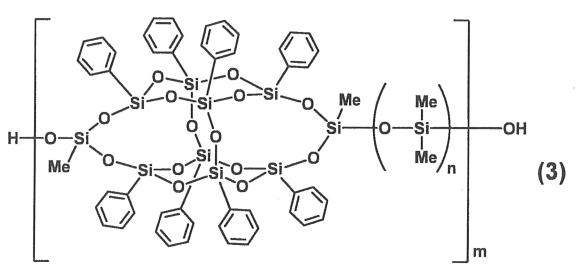
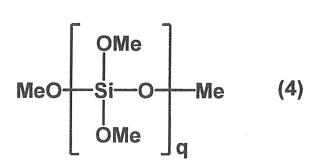
式(3)及式(4)中,Me表示甲基(在本說明書中,在進行同樣的記載的情況下是指同樣的意思),n、m分別與式(1)相同。而且,式(4)中的q表示1~10的整數,較佳為平均為5。In Formula (3) and Formula (4), Me represents a methyl group (in this specification, when the same description is made, it means the same meaning), and n and m are the same as in Formula (1). Furthermore, q in formula (4) represents an integer of 1 to 10, and it is preferably 5 on average.
在可獲得本發明的效果的範圍內,交聯前的矽氧烷聚合物組成物亦可進而含有式(1)所表示的矽化合物及式(2)所表示的交聯性矽化合物以外的其他成分。作為此種其他成分,例如可列舉溶劑、觸媒、本發明的矽氧烷聚合物交聯硬化物以外的其他聚合物及各種添加劑。對於觸媒,可使用在本發明的矽氧烷聚合物交聯硬化物的說明中所述的觸媒。To the extent that the effect of the present invention can be obtained, the silicone polymer composition before crosslinking may further contain other than the silicon compound represented by formula (1) and the crosslinkable silicon compound represented by formula (2) Other ingredients. Examples of such other components include solvents, catalysts, polymers other than the cross-linked cured silicone polymer of the present invention, and various additives. As the catalyst, the catalyst described in the description of the crosslinked hardened silicone polymer of the present invention can be used.
溶劑較佳為會溶解包含矽化合物及交聯性矽化合物的含有成分的溶劑,而且,較佳為對含有成分不具有反應性的溶劑。溶劑可為一種亦可為兩種以上的混合物。作為此種溶劑,例如可列舉己烷或庚烷等烴系溶劑、苯、甲苯、二甲苯等芳香族烴系溶劑、二乙基醚、四氫呋喃(THF)、二噁烷等醚系溶劑、二氯甲烷、四氯化碳等鹵化烴系溶劑、及乙酸乙酯等酯系溶劑。The solvent is preferably a solvent that can dissolve the contained component containing the silicon compound and the cross-linkable silicon compound, and is preferably a solvent that is not reactive with the contained component. The solvent may be one kind or a mixture of two or more kinds. Examples of such solvents include hydrocarbon solvents such as hexane and heptane, aromatic hydrocarbon solvents such as benzene, toluene, and xylene, ether solvents such as diethyl ether, tetrahydrofuran (THF), and dioxane, and dioxane. Halogenated hydrocarbon solvents such as methyl chloride and carbon tetrachloride, and ester solvents such as ethyl acetate.
自針對矽氧烷聚合物交聯硬化物的期望特性的賦予或提升的觀點,添加劑可利用公知的各種添加劑。作為此種添加劑,例如可列舉:界面活性劑;二氧化矽、雲母等的填充劑等。From the viewpoint of imparting or enhancing desired characteristics of the crosslinked hardened silicone polymer product, various known additives can be used. Examples of such additives include surfactants; fillers such as silica and mica.
關於交聯前的矽氧烷聚合物組成物中溶劑的含量,就提高交聯性組成物塗佈性的觀點而言,較佳為調配於交聯性組成物中的固形的成分的含量在交聯性組成物中為10重量%~90重量%的量,更佳為30重量%~70重量%的量,進而佳為40重量%~60重量%的量。Regarding the content of the solvent in the silicone polymer composition before crosslinking, from the viewpoint of improving the coatability of the crosslinkable composition, the content of the solid component formulated in the crosslinkable composition is preferably The amount in the crosslinkable composition is 10% by weight to 90% by weight, more preferably 30% by weight to 70% by weight, and further preferably 40% by weight to 60% by weight.
關於交聯前的矽氧烷聚合物組成物中觸媒的含量,例如在使用錫系觸媒作為觸媒的情況下,較佳為相對於SiOH與SiOMe的官能基莫耳數而言的錫的莫耳濃度為0.01%~10%,更佳為0.2%~5%,進而佳為0.1%~0.5%。Regarding the content of the catalyst in the silicone polymer composition before crosslinking, for example, when a tin-based catalyst is used as the catalyst, it is preferably tin relative to the number of moles of the functional groups of SiOH and SiOMe The molar concentration is 0.01% to 10%, more preferably 0.2% to 5%, and further preferably 0.1% to 0.5%.
關於交聯前的矽氧烷聚合物組成物中其他聚合物的含量,可自藉由其他聚合物的添加而提高矽氧烷聚合物交聯硬化物的特性的觀點任意地決定。The content of other polymers in the silicone polymer composition before cross-linking can be arbitrarily determined from the viewpoint of improving the characteristics of the cross-linked hardened silicone polymer by the addition of other polymers.
就獲得由添加劑的添加帶來的效果的觀點而言,交聯前的矽氧烷聚合物組成物中添加劑的含量較佳為0.1重量%~40重量%,更佳為0.5重量%~20重量%,進而佳為1重量%~10重量%。From the viewpoint of obtaining the effect by the addition of additives, the content of the additives in the silicone polymer composition before crosslinking is preferably 0.1% by weight to 40% by weight, more preferably 0.5% by weight to 20% by weight %, and more preferably 1% to 10% by weight.
作為添加劑,可利用:丙烯酸系、苯乙烯系、聚乙烯亞胺系或胺基甲酸酯系的高分子分散劑;陰離子系、陽離子系、非離子系或氟系的界面活性劑;矽系樹脂等的塗佈性改進劑;矽烷偶合劑等的密接性改進劑;酚系、硫系及磷系等的抗氧化劑;烷氧基二苯甲酮類等的紫外線吸收劑;聚丙烯酸鈉等的抗凝聚劑;環氧化合物、三聚氰胺化合物或雙疊氮化合物等的熱交聯劑;有機羧酸等的鹼溶解性促進劑;二氧化鈦、鉬紅、鐵藍、群青、鎘黃、鎘紅及有機色素等的著色劑;三氧化銻、溴化合物及磷化合物等的阻燃劑;金屬氧化物、二氧化矽、玻璃珠、金屬氫氧化物等的粉末狀的增強劑或填充劑等。As additives, available are: acrylic, styrene, polyethyleneimine or urethane polymer dispersants; anionic, cationic, nonionic or fluorine surfactants; silicon Coating improvers such as resins; adhesion improvers such as silane coupling agents; antioxidants such as phenol, sulfur and phosphorus; UV absorbers such as alkoxybenzophenones; sodium polyacrylate, etc. Anti-agglomerating agent; thermal cross-linking agent such as epoxy compound, melamine compound or diazide compound; alkali solubility promoter of organic carboxylic acid; titanium dioxide, molybdenum red, iron blue, ultramarine blue, cadmium yellow, cadmium red and Colorants such as organic pigments; flame retardants such as antimony trioxide, bromine compounds and phosphorus compounds; powdery reinforcing agents or fillers such as metal oxides, silica, glass beads, metal hydroxides, etc.
交聯前的矽氧烷聚合物組成物的未硬化的膜可藉由如下方式而形成,即,藉由浸漬法或利用刮刀塗佈、棒塗機、敷料器等進行塗佈的方法等將交聯前的矽氧烷聚合物組成物塗佈至基板或薄膜。The uncured film of the silicone polymer composition before cross-linking can be formed by applying a dipping method or a coating method using a doctor blade, bar coater, applicator, etc. The silicone polymer composition before crosslinking is applied to the substrate or film.
所述交聯前矽氧烷聚合物組成物的硬化可根據交聯性官能基的種類,藉由基於向含水氣體的環境中放置、加熱或光照射等的生成本發明的矽氧烷聚合物的所述條件進行處理來進行。例如,交聯前矽氧烷聚合物組成物的硬化是藉由放置於濕度50%左右的通常的空氣中,而藉由利用空氣中的水分的水解來硬化。此硬化的速度會因對所述交聯前矽氧烷聚合物組成物中的觸媒的調配而增加,而且亦會因對組成物進行加熱而增加。例如,既可將矽氧烷聚合物組成物在烘箱內以40℃、70℃、100℃進行加熱,亦可在之後以200℃進行煅燒而獲得矽氧烷聚合物交聯硬化物。The hardening of the siloxane polymer composition before cross-linking can generate the siloxane polymer of the present invention based on the type of cross-linkable functional group by placing it in an environment containing water gas, heating, or light irradiation, etc. The conditions are processed. For example, the hardening of the silicone polymer composition before cross-linking is performed by placing it in normal air with a humidity of about 50%, and hardening it by hydrolysis of the moisture in the air. The hardening speed will increase due to the preparation of the catalyst in the silicone polymer composition before cross-linking, and will also increase due to the heating of the composition. For example, the silicone polymer composition may be heated in an oven at 40°C, 70°C, and 100°C, or may be calcined at 200°C to obtain a crosslinked hardened silicone polymer.
本發明的矽氧烷聚合物交聯硬化物在長期耐熱性方面優異。在本發明中,為了對長期耐熱性進行評價,而進行了耐熱試驗。 例如,當在200℃下對矽氧烷聚合物交聯硬化物進行了500小時耐熱試驗的情況下,耐熱試驗前與耐熱試驗後的矽氧烷聚合物交聯硬化物的玻璃轉移溫度下的表觀的活化能的變化量為40 kJ/mol以下,較佳為35 kJ/mol以下,進而佳為30 kJ/mol。所述活化能是藉由動態黏彈性(DMA)測定而求出。玻璃轉移溫度下的表觀的活化能的變化量小表示即便在200℃或250℃下500小時這一嚴酷的耐熱試驗之後,由矽氧烷聚合物交聯硬化物的交聯引起的硬化劣化或由分子鏈切斷引起的軟化劣化等的物性變化亦少,表示在長期耐熱性方面優異。The crosslinked cured silicone polymer of the present invention is excellent in long-term heat resistance. In the present invention, in order to evaluate the long-term heat resistance, a heat resistance test was conducted. For example, when the heat resistance test is performed on the crosslinked hardened silicone polymer at 500°C for 500 hours, the glass transition temperature of the crosslinked hardened silicone polymer before and after the heat resistance test is The apparent activation energy change is 40 kJ/mol or less, preferably 35 kJ/mol or less, and more preferably 30 kJ/mol. The activation energy is determined by dynamic viscoelasticity (DMA) measurement. The small amount of change in the apparent activation energy at the glass transition temperature means that even after a severe heat resistance test at 200°C or 250°C for 500 hours, the hardening deterioration caused by the crosslinking of the crosslinked hardened silicone polymer product Also, physical property changes such as softening and degradation caused by molecular chain cutting are also small, indicating excellent long-term heat resistance.
而且,為了對長期耐熱性進行評價,針對本發明的矽氧烷聚合物交聯硬化物進行規定的拉伸試驗,求出在200℃下進行500小時的耐熱試驗後的應力-應變曲線、與進行耐熱試驗前的應力-應變曲線,而對其變化進行比較。圖1(a)中示出耐熱試驗前的應力-應變曲線,(b)中示出耐熱試驗後的應力-應變曲線。 使用圖1(a)、圖1(b)進行說明,例如可知:在由矽氧烷鏈長(DMS的單元數)為5(平均值)的矽化合物與官能基比為15倍的交聯性矽化合物而獲得的矽氧烷聚合物交聯硬化物中,伸長率大、其伸長率在耐熱試驗前、後均為140%以上。特別是在使用重量平均分子量為60,000以上的矽化合物而成的矽氧烷聚合物交聯硬化物中,在耐熱試驗前、後均呈現200%以上的伸長率。 進而而且,關於應力,亦可知:本發明的矽氧烷聚合物交聯硬化物在耐熱試驗前、後均呈現5 MPa以上,斷裂應力高。 即,本發明的矽氧烷聚合物交聯硬化物中,DMS的單元數以平均值計為5的矽氧烷聚合物交聯硬化物在耐熱試驗前具有良好的機械特性,即便在200℃下500小時的耐熱試驗這一嚴酷的耐熱試驗後,亦保持著其良好的機械特性。即,若為本發明的矽氧烷聚合物交聯硬化物,則在200℃下500小時的這一長期耐熱試驗之後亦不會引起樹脂劣化等,可發揮良好的機械特性,所以,亦能夠應對高輸出化。另外,正作為柔性配線材料、壓電材料等的材料而受到研究的聚二甲基矽氧烷(PDMS)在耐熱試驗前、後,應力均小於1 MPa,機械強度差。Furthermore, in order to evaluate the long-term heat resistance, a predetermined tensile test was carried out on the crosslinked cured product of the siloxane polymer of the present invention, and the stress-strain curve after the heat resistance test at 200°C for 500 hours was obtained, and The stress-strain curve before the heat resistance test is performed, and the changes are compared. FIG. 1(a) shows the stress-strain curve before the heat resistance test, and (b) shows the stress-strain curve after the heat resistance test. Using FIG. 1(a) and FIG. 1(b) for explanation, for example, it can be seen that the cross-linking of the ratio of the silicon compound and the functional group of the silicone compound whose chain length (number of DMS units) is 5 (average value) is 15 times The cross-linked hardened siloxane polymer obtained by using a silicone compound has a large elongation, and the elongation is 140% or more before and after the heat resistance test. In particular, in a crosslinked hardened silicone polymer using a silicon compound having a weight average molecular weight of 60,000 or more, it exhibits an elongation of 200% or more before and after the heat resistance test. Furthermore, regarding the stress, it can also be seen that the crosslinked cured silicone polymer of the present invention exhibits 5 MPa or more before and after the heat resistance test, and the fracture stress is high. That is, in the crosslinked hardened silicone polymer of the present invention, the crosslinked hardened silicone polymer having a DMS unit number of 5 on average has good mechanical properties before the heat resistance test, even at 200°C After the severe heat resistance test for the next 500 hours of heat resistance test, it also maintains its good mechanical properties. That is, if it is a crosslinked cured product of the siloxane polymer of the present invention, it does not cause resin degradation and the like after 500 hours of long-term heat resistance test at 200°C, and can exhibit good mechanical properties, so it can also Cope with high output. In addition, before and after the heat resistance test, polydimethylsiloxane (PDMS), which is being studied as a material for flexible wiring materials and piezoelectric materials, has a stress of less than 1 MPa and poor mechanical strength.
在圖2(a)、圖2(b)中,針對本發明的矽氧烷聚合物交聯硬化物(官能基比為5倍、15倍),示出進行規定的拉伸試驗而獲得的應力-應變曲線。此處,示出進行200℃下500小時的耐熱試驗及250℃下500小時的耐熱試驗後的應力-應變曲線、與進行耐熱試驗前的應力-應變曲線。另外,圖2(a)示出的是關於官能基比為5倍的矽氧烷聚合物交聯硬化物的耐熱試驗結果,圖2(b)示出的是關於官能基比為15倍的矽氧烷聚合物交聯硬化物的耐熱試驗結果。可知:圖2(a)及圖2(b)均表示出在耐熱試驗前後具有良好的伸長率及應力,並且即便在250℃下500小時這一非常嚴酷的耐熱試驗後,亦具有150%以上的伸長率及7 MPa以上的應力,而具有優異的機械特性。特別是可知:官能基比為5倍的矽氧烷聚合物交聯硬化物與耐熱試驗前相比幾乎無變化,與官能基比為15倍的矽氧烷聚合物交聯硬化物相比耐熱試驗後的變化少。In FIGS. 2(a) and 2(b), the crosslinked hardened product of the siloxane polymer of the present invention (functional group ratio is 5 times and 15 times) is obtained by performing a predetermined tensile test. stress-strain curve. Here, the stress-strain curve after the heat resistance test at 200°C for 500 hours and the heat resistance test at 250°C for 500 hours and the stress-strain curve before the heat resistance test are shown. In addition, FIG. 2(a) shows the heat resistance test result of the cross-linked hardened siloxane polymer having a functional group ratio of 5 times, and FIG. 2(b) shows the functional group ratio of 15 times. Results of heat resistance test of cross-linked hardened silicone polymer. It can be seen that both Figure 2(a) and Figure 2(b) show good elongation and stress before and after the heat resistance test, and even after a very severe heat resistance test at 250°C for 500 hours, it has more than 150% The elongation rate and the stress of 7 MPa or more have excellent mechanical properties. In particular, it can be seen that the cross-linked hardened silicone polymer having a functional group ratio of 5 times has almost no change compared to that before the heat resistance test, and is heat-resistant compared to the cross-linked cured silicone polymer having a functional group ratio of 15 times. There are few changes after the test.
本發明的矽氧烷聚合物交聯硬化物即便在耐熱試驗後亦在光學特性方面優異。針對本發明的矽氧烷聚合物交聯硬化物,進行200℃下250小時的耐熱試驗與200℃下500小時的耐熱試驗,並進行耐熱試驗前後的透過率與耐黃變性的評價。
即,當針對矽氧烷聚合物交聯硬化物,藉由紫外可見光分光法求出波長380 nm~780 nm的總光線透過率時,耐熱試驗前、200℃下250小時的耐熱試驗後及200℃下500小時的耐熱試驗後透過率均為99.0%以上,在透明性方面優異。而且,YI值亦在耐熱試驗前後無變化,所以在耐黃變性方面亦優異。另外,關於光學特性,與DMS單元數3~5(平均值)或矽化合物的重量平均分子量的數值(40,000~80,000)無關而呈現優異的結果,在耐熱性試驗的前後亦無變化,呈現優異的光學特性。The crosslinked cured silicone polymer of the present invention is excellent in optical characteristics even after a heat resistance test. With respect to the crosslinked cured product of the siloxane polymer of the present invention, a heat resistance test at 200° C. for 250 hours and a heat resistance test at 200° C. for 500 hours were performed, and evaluation of the transmittance and yellowing resistance before and after the heat resistance test was performed.
That is, when the total light transmittance of the 380 nm to 780 nm wavelength is determined by ultraviolet-visible spectroscopy for the crosslinked hardened silicone polymer, before the heat resistance test, after the heat resistance test at 200°C for 250 hours and 200 After 500 hours of heat resistance test at ℃, the transmittance was 99.0% or more, which was excellent in transparency. In addition, the YI value does not change before and after the heat resistance test, so it is also excellent in yellowing resistance. In addition, regarding the optical properties, the results are excellent regardless of the number of
針對本發明的矽氧烷聚合物交聯硬化物,為了調查結構部的變化,而對固體29 Si的NMR進行了測定。結構變化是針對聚合物主結構中的D單元(Me2 D2 )與T單元(Me T3 、Ph T3 )、交聯部中的Q單元(Q2 、Q3 、Q4 )進行NMR測定。具體而言是示出D單元、T單元及Q單元的哪一部位在圖3中有所表示。即,在圖3中,關於D、T、Q,根據鍵結於Si的氧的數量而示出D結構(O=2)、T結構(O=3)、Q結構(O=4),例如若針對D單元(Me2 D2 )進行說明,則左肩的Me2表示取代基(Me基為2個)、右肩的數字2表示交叉(crossing)的氧的數量。For the crosslinked hardened product of the siloxane polymer of the present invention, in order to investigate the change in the structure, NMR of solid 29 Si was measured. The structural changes are measured by NMR for the D unit ( Me2 D 2 ) and T unit ( Me T 3 , Ph T 3 ) in the polymer main structure, and the Q unit (Q 2 , Q 3 , Q 4 ) in the cross-linking section . Specifically, which part of the D cell, T cell, and Q cell is shown in FIG. 3. That is, in FIG. 3, regarding D, T, and Q, the D structure (O=2), T structure (O=3), and Q structure (O=4) are shown according to the amount of oxygen bonded to Si. for example, if the D unit (Me2 D 2) will be described, the left shoulder Me2 represents a substituent group (Me group two), the number of oxygen figure 2 represents a cross right shoulder (crossing) a.
測定對象是矽氧烷聚合物交聯硬化物(Mw=80,000、矽氧烷鏈長=平均為5、官能基比=平均為5)。測定設備是使用核磁共振分光裝置(瓦裡安NMR系統(Varian NMR System 500)(瓦裡安(Varian)公司製造)),以測定條件(交叉極化魔角旋轉接觸時間5 ms,馳豫延遲2.5 s,旋轉8 kHz(CP-MAS contact time 5 ms, relaxation delay 2.5 s, spin 8 kHz))來進行。將其結果示於圖4。如自圖4明確般,可知:本發明的矽氧烷聚合物交聯硬化物在耐熱試驗前、200℃500小時的耐熱試驗後、250℃500小時的耐熱試驗後,聚合物主結構部與交聯部均幾乎無變化,即便進行嚴酷的耐熱性試驗,結構亦穩定。The measurement object is a cross-linked hardened silicone polymer (Mw=80,000, silicone chain length=
根據本發明的矽氧烷聚合物交聯硬化物,藉由適當選擇DMS單元的數量或矽化合物的重量平均分子量等,可實現具有期望的物性,在長期耐熱性方面亦優異者。因此,期待用於廣泛的用途。According to the crosslinked hardened silicone polymer of the present invention, by appropriately selecting the number of DMS units or the weight average molecular weight of the silicon compound, etc., the desired physical properties can be achieved, and the long-term heat resistance is also excellent. Therefore, it is expected to be used in a wide range of applications.
作為本發明的矽氧烷聚合物交聯硬化物的用途,例如可列舉光學材料,更具體而言,可列舉以下:金屬溶出防止膜、阻氣膜、防反射膜等的基板用塗佈劑、液狀密封劑、層間絕緣膜、防污用塗佈劑、微透鏡、導光板、光波導材料等光學元件、LED密封材料、光透過性接著劑、顯示器基板及印刷配線用基板等的對於電氣、電子材料的用途。 [實施例]Examples of applications of the crosslinked and cured silicone polymer of the present invention include optical materials, and more specifically, the following: coating agents for substrates such as metal elution prevention films, gas barrier films, and anti-reflection films , Liquid sealants, interlayer insulating films, antifouling coating agents, microlenses, light guide plates, optical waveguide materials and other optical elements, LED sealing materials, light-transmitting adhesives, display substrates and printed wiring substrates, etc. Use of electrical and electronic materials. [Example]
以下,藉由實施例對本發明進行更詳細的說明,但本發明並不限定於以下所例示的實施例。Hereinafter, the present invention will be described in more detail with examples, but the present invention is not limited to the examples illustrated below.
[合成例1]矽化合物1的製作
對300 mL燒瓶安裝冷卻管、機械攪拌機、溫度計保護管,並對燒瓶內部進行氮置換。將式(1)中的R0
為苯基、R1
為甲基的下述結構式所表示的化合物48.0 g、八甲基環四矽氧烷(D4)12.0 g、乾燥RCP-160M(強酸性陽離子交換樹脂,三菱化學(股)製造:含水量23.4質量%)8.2 g、脫水甲苯102 g、水0.77 g加入至燒瓶中。回流1小時,之後,在50℃下使其熟化。熟化結束後,冷卻至室溫,對RCP-160M進行過濾。將所獲得的濾液水洗多次。之後,自濾液餾去溶劑及低沸成分,利用甲醇使所獲得的粗產物再沈澱而進行精製。藉由在40℃下對所獲得的白色黏稠液體進行真空乾燥而獲得白色固體49.2 g。
根據1H-NMR及GPC分析,可知:所獲得的白色固體為式(3)所表示的矽化合物,且為式(3)中的各構成單元(倍半矽氧烷單元與二甲基矽氧烷單元)交替鍵結而成的聚合物,DMS單元數n平均為3.2。根據GPC分析,矽化合物1的數量平均分子量為Mn=27,800,重量平均分子量為Mw=75,500。[Synthesis Example 1] Preparation of silicon compound 1 A 300 mL flask was equipped with a cooling tube, a mechanical stirrer, and a thermometer protection tube, and the inside of the flask was replaced with nitrogen. The compound represented by the following structural formula in which R 0 in formula (1) is phenyl and R 1 is methyl is 48.0 g, octamethylcyclotetrasiloxane (D4) 12.0 g, and dried RCP-160M (strong acid Cation exchange resin, manufactured by Mitsubishi Chemical Corporation: water content 23.4% by mass) 8.2 g, dehydrated toluene 102 g, and water 0.77 g were added to the flask. After refluxing for 1 hour, it was aged at 50°C. After aging, cool to room temperature and filter RCP-160M. The obtained filtrate was washed with water several times. After that, the solvent and low-boiling components were distilled off from the filtrate, and the obtained crude product was reprecipitated with methanol for purification. By vacuum drying the obtained white viscous liquid at 40° C., 49.2 g of white solid was obtained. According to 1H-NMR and GPC analysis, it can be seen that the obtained white solid is the silicon compound represented by formula (3), and is each constituent unit (silsesquioxane unit and dimethylsilicone) of formula (3) (Alkane units) polymers formed by alternate bonding, the average number of DMS units n is 3.2. According to GPC analysis, the number average molecular weight of the
[化9]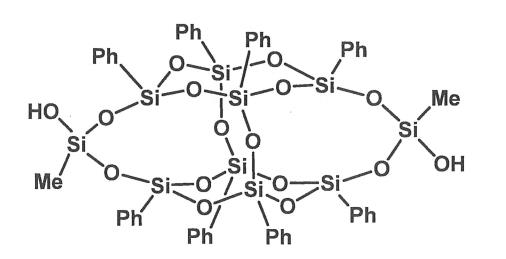
[合成例2]矽化合物2的製作
對300 mL燒瓶安裝冷卻管、機械攪拌機、溫度計保護管,並對燒瓶內部進行氮置換。將式(1)中的R0
為苯基、R1
為甲基的合成例1中記載的結構式所表示的化合物48.0 g、八甲基環四矽氧烷(D4)18.0 g、乾燥RCP-160M(強酸性陽離子交換樹脂,三菱化學(股)製造:含水量23.4質量%)9.0 g、脫水甲苯112 g、水0.96 g加入至燒瓶中。回流1小時,之後,在50℃下使其熟化。熟化結束後,冷卻至室溫,對RCP-160M進行過濾。將所獲得的濾液水洗多次。之後,自濾液餾去溶劑及低沸成分,利用甲醇使所獲得的粗產物再沈澱而進行精製。藉由在40℃下對所獲得的白色黏稠液體進行真空乾燥而獲得白色固體55.4 g。根據1H-NMR及GPC分析,可知:所獲得的白色固體為式(3)所表示的矽化合物,且為式(3)中的各構成單元(倍半矽氧烷單元與二甲基矽氧烷單元)交替鍵結而成的聚合物,DMS單元數n平均為4.2。根據GPC分析,矽化合物2的數量平均分子量為Mn=31,400,重量平均分子量為Mw=74,000。[Synthesis Example 2] Preparation of silicon compound 2 A 300 mL flask was equipped with a cooling tube, a mechanical stirrer, and a thermometer protection tube, and the inside of the flask was replaced with nitrogen. 48.0 g of the compound represented by the structural formula described in Synthesis Example 1 where R 0 in the formula (1) is phenyl and R 1 is methyl, 18.0 g of octamethylcyclotetrasiloxane (D4), and dried RCP -160M (strongly acidic cation exchange resin, manufactured by Mitsubishi Chemical Corporation: water content 23.4% by mass) 9.0 g, dehydrated toluene 112 g, and water 0.96 g were added to the flask. After refluxing for 1 hour, it was aged at 50°C. After aging, cool to room temperature and filter RCP-160M. The obtained filtrate was washed with water several times. After that, the solvent and low-boiling components were distilled off from the filtrate, and the obtained crude product was reprecipitated with methanol for purification. By vacuum drying the obtained white viscous liquid at 40° C., 55.4 g of white solid was obtained. According to 1H-NMR and GPC analysis, it can be seen that the obtained white solid is the silicon compound represented by formula (3), and is each constituent unit (silsesquioxane unit and dimethylsilicone) of formula (3) (Alkane units) polymers formed by alternate bonding, the average number of DMS units n is 4.2. According to GPC analysis, the number average molecular weight of the
[合成例3]矽化合物3的製作
對2000 mL燒瓶安裝冷卻管、機械攪拌機、溫度計保護管,並對燒瓶內部進行氮置換。將式(1)中的R0
為苯基、R1
為甲基的合成例1中記載的結構式所表示的化合物400.0 g、八甲基環四矽氧烷(D4)200.0 g、乾燥RCP-160M(強酸性陽離子交換樹脂,三菱化學(股)製造:含水量23.4質量%)81.6 g、脫水甲苯1023 g、水9.57 g加入至燒瓶中。回流1小時,之後,在50℃下使其熟化。熟化結束後,冷卻至室溫,對RCP-160M進行過濾。將所獲得的濾液水洗多次。之後,自濾液餾去溶劑及低沸成分,利用甲醇使所獲得的粗產物再沈澱而進行精製。藉由在40℃下對所獲得的白色黏稠液體進行真空乾燥而獲得白色固體500.4 g。根據1H-NMR及GPC分析,可知:所獲得的白色固體為式(3)所表示的矽化合物,且為式(3)中的各構成單元(倍半矽氧烷單元與二甲基矽氧烷單元)交替鍵結而成的聚合物,DMS單元數n平均為5.5。根據GPC分析,矽化合物3的數量平均分子量為Mn=34,500,重量平均分子量為Mw=79,400。[Synthesis Example 3] Preparation of silicon compound 3 A 2000 mL flask was equipped with a cooling tube, a mechanical stirrer, and a thermometer protection tube, and the inside of the flask was replaced with nitrogen. 400.0 g of the compound represented by the structural formula described in Synthesis Example 1 where R 0 in the formula (1) is phenyl and R 1 is methyl, 200.0 g of octamethylcyclotetrasiloxane (D4), and dried RCP -160M (strong acid cation exchange resin, manufactured by Mitsubishi Chemical Corporation: water content 23.4% by mass) 81.6 g, dehydrated toluene 1023 g, and water 9.57 g were added to the flask. After refluxing for 1 hour, it was aged at 50°C. After aging, cool to room temperature and filter RCP-160M. The obtained filtrate was washed with water several times. After that, the solvent and low-boiling components were distilled off from the filtrate, and the obtained crude product was reprecipitated with methanol for purification. By vacuum drying the obtained white viscous liquid at 40° C., 500.4 g of white solid was obtained. According to 1H-NMR and GPC analysis, it can be seen that the obtained white solid is the silicon compound represented by formula (3), and is each constituent unit (silsesquioxane unit and dimethylsilicone) of formula (3) (Alkane unit) polymer formed by alternate bonding, the average number of DMS units n is 5.5. According to GPC analysis, the number average molecular weight of the
[合成例4]矽化合物4的製作
對300 mL燒瓶安裝冷卻管、機械攪拌機、溫度計保護管,並對燒瓶內部進行氮置換。將式(1)中的R0
為苯基、R1
為甲基的合成例1中記載的結構式所表示的化合物40.0 g、八甲基環四矽氧烷(D4)20.0 g、乾燥RCP-160M(強酸性陽離子交換樹脂,三菱化學(股)製造:含水量23.4質量%)8.2 g、脫水甲苯102 g、水0.96 g加入至燒瓶中。回流1小時,之後,在50℃下使其熟化。熟化結束後,冷卻至室溫,對RCP-160M進行過濾。將所獲得的濾液水洗多次。之後,自濾液餾去溶劑及低沸成分,利用甲醇使所獲得的粗產物再沈澱而進行精製。藉由在40℃下對所獲得的白色黏稠液體進行真空乾燥而獲得白色固體42.7 g。根據1H-NMR及GPC分析,可知:所獲得的白色固體為式(3)所表示的矽化合物,且為式(3)中的各構成單元(倍半矽氧烷單元與二甲基矽氧烷單元)交替鍵結而成的聚合物,DMS單元數n平均為5.5。根據GPC分析,矽化合物5的數量平均分子量為Mn=22,400,重量平均分子量為Mw=44,100。[Synthesis Example 4] Preparation of silicon compound 4 A 300 mL flask was equipped with a cooling tube, a mechanical stirrer, and a thermometer protection tube, and the inside of the flask was replaced with nitrogen. 40.0 g of the compound represented by the structural formula described in Synthesis Example 1 in which R 0 in the formula (1) is phenyl and R 1 is methyl, 20.0 g of octamethylcyclotetrasiloxane (D4), and dried RCP -160M (strong acid cation exchange resin, manufactured by Mitsubishi Chemical Corporation: water content 23.4% by mass) 8.2 g, dehydrated toluene 102 g, and water 0.96 g were added to the flask. After refluxing for 1 hour, it was aged at 50°C. After aging, cool to room temperature and filter RCP-160M. The obtained filtrate was washed with water several times. After that, the solvent and low-boiling components were distilled off from the filtrate, and the obtained crude product was reprecipitated with methanol for purification. By vacuum drying the obtained white viscous liquid at 40° C., 42.7 g of white solid was obtained. According to 1H-NMR and GPC analysis, it can be seen that the obtained white solid is the silicon compound represented by formula (3), and is each constituent unit (silsesquioxane unit and dimethylsilicone) of formula (3) (Alkane unit) polymer formed by alternate bonding, the average number of DMS units n is 5.5. According to GPC analysis, the number average molecular weight of the
[化10]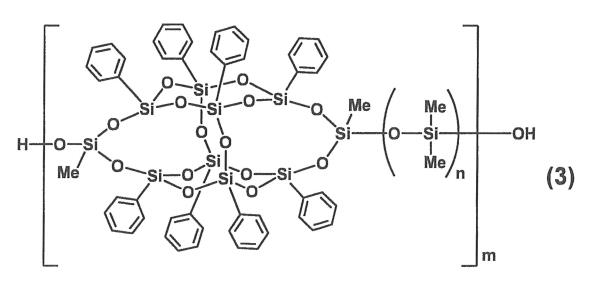
以下示出GPC測定的測定條件。
<測定條件>
管柱:Shodex KF-804L 300 mm×8.0 mm
Shodex KF-805L 300 mm×8.0 mm 2根串聯
移動相:THF
流速:1.0 ml/min
溫度:40℃
檢測器:RI
分子量標準樣本:已知分子量的聚甲基丙烯酸甲酯(polymethylmethacrylate,PMMA)The measurement conditions for GPC measurement are shown below.
<Measurement conditions>
Column: Shodex KF-
[實施例1]
在螺口管中,使所述合成例1中所獲得的矽化合物1的3 g溶解於甲苯2.7 g中,對獲得的溶液添加MS-51(三菱化學(股)製造)120.3 μL進行混合,獲得預聚物1。[Example 1]
In a screw tube, 3 g of the
在所獲得的預聚物1的溶液中添加作為觸媒的月桂酸二丁錫3.4 μL。攪拌1分鐘,脫泡後,使用敷料器將所獲得的交聯性組成物1塗佈至鐵氟龍(Teflon)板(3 mm厚),之後放入至烘箱中,以40℃加熱10分鐘、以70℃加熱30分鐘、之後以100℃加熱1小時,藉此使其硬化。將所獲得的硬化膜自鐵氟龍(Teflon)板剝離後吊掛在烘箱內,以200℃的熱風煅燒2小時而獲得矽氧烷聚合物交聯硬化物1。獲得厚度約230 μm的透明的矽氧烷聚合物交聯硬化物1。另外,矽氧烷聚合物交聯硬化物1的厚度是以膜厚儀(尼康(Nikon)製造的DIGIMICRO MFC-101A)來進行測定。3.4 μL of dibutyltin laurate was added as a catalyst to the obtained solution of
[實施例2]
在螺口管中,取3 g所述合成例2中所獲得的矽化合物2,使其溶解於甲苯3.0 mL中,添加MS-51(三菱化學(股)製造)120.3 μL進行混合,獲得預聚物2。[Example 2]
In a screw tube, 3 g of the
在所獲得的預聚物2的溶液中添加作為觸媒的月桂酸二丁錫3.4 μL。攪拌1分鐘,脫泡後,使用敷料器將所獲得的交聯性組成物2塗佈至鐵氟龍(Teflon)板(3 mm厚),之後放入至烘箱中,以40℃加熱10分鐘、以70℃加熱30分鐘、之後以100℃加熱1小時,藉此使其硬化。將所獲得的硬化膜自鐵氟龍(Teflon)板剝離後吊掛在烘箱內,以200℃的熱風煅燒2小時而獲得矽氧烷聚合物交聯硬化物2。獲得厚度約180 μm的透明的矽氧烷聚合物交聯硬化物2。另外,矽氧烷聚合物交聯硬化物2的厚度是以膜厚儀(尼康(Nikon)製造的DIGIMICRO MFC-101A)來進行測定。3.4 μL of dibutyltin laurate was added as a catalyst to the obtained solution of
[實施例3]
在螺口管中,取3 g所述合成例3中所獲得的矽化合物3,使其溶解於甲苯2.0 mL中,添加MS-51(三菱化學(股)製造)162.1 μL進行混合,獲得預聚物3。[Example 3]
In a screw tube, 3 g of the
在所獲得的預聚物3的溶液中添加作為觸媒的月桂酸二丁錫4.6 μL。攪拌1分鐘,脫泡後,使用敷料器將所獲得的交聯性組成物3塗佈至鐵氟龍(Teflon)板(3 mm厚),之後放入至烘箱中,以40℃加熱10分鐘、以70℃加熱30分鐘、之後以100℃加熱1小時,藉此使其硬化。將所獲得的硬化膜自鐵氟龍(Teflon)板剝離後吊掛在烘箱內,以200℃的熱風煅燒2小時而獲得厚度約200 μm的透明的矽氧烷聚合物交聯硬化物3。另外,矽氧烷聚合物交聯硬化物3的厚度是以膜厚儀(尼康(Nikon)製造的DIGIMICRO MFC-101A)來進行測定。To the solution of the obtained
[實施例4]
在螺口管中,取3 g所述合成例4中所獲得的矽化合物4,使其溶解於甲苯3.3 mL中,添加MS-51(三菱化學(股)製造)116.5 μL進行混合,獲得預聚物4。[Example 4]
In a screw tube, 3 g of the
在所獲得的預聚物4的溶液中添加作為觸媒的月桂酸二丁錫3.3 μL。攪拌1分鐘,脫泡後,使用敷料器將所獲得的交聯性組成物4塗佈至鐵氟龍(Teflon)板(3 mm厚),之後放入至烘箱中,以40℃加熱10分鐘、以70℃加熱30分鐘、之後以100℃加熱1小時,藉此使其硬化。將所獲得的硬化膜自鐵氟龍(Teflon)板剝離後吊掛在烘箱內,以200℃的熱風煅燒2小時而獲得厚度約220 μm的透明的矽氧烷聚合物交聯硬化物4。另外,矽氧烷聚合物交聯硬化物4的厚度是以膜厚儀(尼康(Nikon)製造的DIGIMICRO MFC-101A)來進行測定。3.3 μL of dibutyltin laurate was added as a catalyst to the obtained solution of
[比較例1]
在螺口管中,取PDMS(格萊斯特(Gelest)製造的DMS-S42)1.0 g,使其溶解於甲苯1.8 mL中,添加MS-51(三菱化學(股)製造)29.6 μL進行混合,獲得PDMS清漆1。[Comparative Example 1]
In a screw tube, take 1.0 g of PDMS (DMS-S42 manufactured by Gelest), dissolve it in 1.8 mL of toluene, and add 29.6 μL of MS-51 (manufactured by Mitsubishi Chemical Corporation) to mix , To obtain
在所獲得的PDMS清漆1的溶液中添加作為觸媒的月桂酸二丁錫0.8 μL。攪拌1分鐘,脫泡後,將所獲得的PDMS交聯性組成物1裝入至PFA培養皿(直徑5 cm)中,並放入至烘箱中,以40℃加熱10分鐘、以70℃加熱30分鐘、之後以100℃加熱1小時,藉此使其硬化。將所獲得的硬化膜自PFA培養皿中取出,吊掛在烘箱內,以200℃的熱風煅燒2小時而獲得厚度約230 μm的透明的PDMS交聯硬化物1。另外,PDMS交聯硬化物1的厚度是以膜厚儀(尼康(Nikon)製造的DIGIMICRO MFC-101A)來進行測定。To the obtained solution of
[實施例5]
在螺口管中,取3 g所述合成例1中所獲得的矽化合物1,使其溶解於甲苯11 mL中,添加MS-51(三菱化學(股)製造)120.3 μL進行混合,獲得預聚物5。[Example 5]
In a screw tube, 3 g of the
在所獲得的預聚物5溶液中添加作為觸媒的月桂酸二丁錫3.4 μL。攪拌1分鐘,脫泡後,將所獲得的交聯性組成物5旋塗至玻璃板(康寧(Corning)製造的EAGLE XG(700 μm厚)),之後放入至烘箱中,以40℃加熱10分鐘、以70℃加熱30分鐘、以100℃加熱20分鐘、以200℃加熱2小時,藉此使其硬化,獲得厚度約12 μm的透明的矽氧烷聚合物交聯硬化物5。另外,矽氧烷聚合物交聯硬化物5的厚度是以膜厚儀(尼康(Nikon)製造的DIGIMICRO MFC-101A)來進行測定。3.4 μL of dibutyltin laurate was added as a catalyst to the obtained
[實施例6]
在螺口管中,取3 g所述合成例2中所獲得的矽化合物2,使其溶解於甲苯11 mL中,添加MS-51(三菱化學(股)製造)120.3 μL進行混合,獲得預聚物6。[Example 6]
In a screw tube, 3 g of the
在所獲得的預聚物6溶液中添加作為觸媒的月桂酸二丁錫3.4 μL。攪拌1分鐘,脫泡後,將所獲得的交聯性組成物6旋塗至玻璃板(康寧(Corning)製造的EAGLE XG(700 μm厚)),之後放入至烘箱中,以40℃加熱10分鐘、以70℃加熱30分鐘、以100℃加熱20分鐘、以200℃加熱2小時,藉此使其硬化,獲得厚度約13 μm的透明的矽氧烷聚合物交聯硬化物6。另外,矽氧烷聚合物交聯硬化物6的厚度是以膜厚儀(尼康(Nikon)製造的DIGIMICRO MFC-101A)來進行測定。3.4 μL of dibutyltin laurate was added as a catalyst to the obtained
[實施例7]
在螺口管中,取3 g所述合成例3中所獲得的矽化合物3,使其溶解於甲苯8.6 mL中,添加MS-51(三菱化學(股)製造)162.1 μL進行混合,獲得預聚物7。[Example 7]
In a screw tube, 3 g of the
在所獲得的預聚物7溶液中添加作為觸媒的月桂酸二丁錫4.6 μL。攪拌1分鐘,脫泡後,將所獲得的交聯性組成物7旋塗至玻璃板(康寧(Corning)製造的EAGLE XG(700 μm厚)),之後放入至烘箱中,以40℃加熱10分鐘、以70℃加熱30分鐘、以100℃加熱20分鐘、以200℃加熱2小時,藉此使其硬化,獲得厚度約14 μm的透明的矽氧烷聚合物交聯硬化物7。另外,矽氧烷聚合物交聯硬化物7的厚度是以膜厚儀(尼康(Nikon)製造的DIGIMICRO MFC-101A)來進行測定。To the obtained prepolymer 7 solution, 4.6 μL of dibutyltin laurate was added as a catalyst. After stirring for 1 minute, after defoaming, the obtained cross-linkable composition 7 was spin-coated on a glass plate (EAGLE XG (700 μm thick) manufactured by Corning), and then placed in an oven and heated at 40° C. 10 minutes, heating at 70° C. for 30 minutes, heating at 100° C. for 20 minutes, and heating at 200° C. for 2 hours, thereby hardening it to obtain a transparent cross-linked cured silicone polymer 7 having a thickness of about 14 μm. In addition, the thickness of the crosslinked cured silicone polymer 7 is measured with a film thickness meter (DIGIMICRO MFC-101A manufactured by Nikon).
[實施例8]
在螺口管中,取3 g所述合成例4中所獲得的矽化合物4,使其溶解於甲苯14.6 mL中,添加MS-51(三菱化學(股)製造)116.5 μL進行混合,獲得預聚物8。[Example 8]
In a screw tube, 3 g of the
在所獲得的預聚物8溶液中添加作為觸媒的月桂酸二丁錫3.3 μL。攪拌1分鐘,脫泡後,將所獲得的交聯性組成物8旋塗至玻璃板(康寧(Corning)製造的EAGLE XG(700 μm厚)),之後放入至烘箱中,以40℃加熱10分鐘、以70℃加熱30分鐘、以100℃加熱20分鐘、以200℃加熱2小時,藉此使其硬化,獲得厚度約14 μm的透明的矽氧烷聚合物交聯硬化物8。另外,矽氧烷聚合物交聯硬化物8的厚度是以膜厚儀(尼康(Nikon)製造的DIGIMICRO MFC-101A)來進行測定。3.3 μL of dibutyltin laurate was added as a catalyst to the obtained
[比較例2]
在螺口管中,取PDMS(格萊斯特(Gelest)製造的DMS-S42)3 g,使其溶解於甲苯12.5 mL中,添加MS-51(三菱化學(股)製造)88.8 μL進行混合,獲得PDMS清漆2。[Comparative Example 2]
In a screw tube, 3 g of PDMS (DMS-S42 manufactured by Gelest) was dissolved in 12.5 mL of toluene, and 88.8 μL of MS-51 (manufactured by Mitsubishi Chemical Corporation) was added for mixing. , Obtain
在所獲得的PDMS清漆2溶液中添加作為觸媒的月桂酸二丁錫2.5 μL。攪拌1分鐘,脫泡後,將PDMS交聯性組成物2旋塗至玻璃板(康寧(Corning)製造的EAGLE XG(700 μm厚)),之後放入至烘箱中,以40℃加熱10分鐘、以70℃加熱30分鐘、以100℃加熱20分鐘、以200℃加熱2小時,藉此使其硬化,獲得PDMS交聯硬化物2。獲得厚度約14 μm的透明的PDMS交聯硬化物2。另外,PDMS交聯硬化物2的厚度是以膜厚儀(尼康(Nikon)製造的DIGIMICRO MFC-101A)來進行測定。2.5 μL of dibutyltin laurate was added as a catalyst to the obtained
針對實施例1~實施例8及比較例1~比較例2中所獲得的矽氧烷聚合物交聯硬化物1~矽氧烷聚合物交聯硬化物4及PDMS交聯硬化物1,進行以下所示的耐熱性的評價,針對矽氧烷聚合物交聯硬化物5~矽氧烷聚合物交聯硬化物8及PDMS交聯硬化物2進行以下所示的光學特性的評價。將其結果示於表3。The cross-linked cured silicone polymer 1-the cross-linked cured
(耐熱性的評價方法) (1)玻璃轉移溫度下的表觀的活化能的變化量 玻璃轉移溫度下的表觀的活化能是藉由動態黏彈性測定(DMA)的頻率分散的同時測定,對測定頻率與tanδ的峰值溫度進行阿瑞尼斯繪圖(Arrhenius plot),自其直線的斜率算出。在耐熱試驗前後的薄膜中,對玻璃轉移溫度下的表觀的活化能進行比較。(Evaluation method of heat resistance) (1) Apparent activation energy change amount at glass transition temperature The apparent activation energy at the glass transition temperature is determined by simultaneous frequency dispersion of dynamic viscoelasticity measurement (DMA), and an Arrhenius plot is performed on the measured frequency and the peak temperature of tan δ from the slope of its straight line Figure it out. In the films before and after the heat resistance test, the apparent activation energy at the glass transition temperature was compared.
(2)拉伸試驗 針對所獲得的試樣(矽氧烷聚合物交聯硬化物及PDMS交聯硬化物),以拉伸速度5 mm/min、使用8號形啞鈴狀試驗片,在室溫下進行拉伸試驗,對應力(斷裂應力)及伸長率(斷裂伸長率)進行測定。(2) Tensile test The obtained samples (silicone polymer cross-linked hardened product and PDMS cross-linked hardened product) were subjected to a tensile test at room temperature using a No. 8 dumbbell-shaped test piece at a tensile speed of 5 mm/min. To measure the stress (breaking stress) and elongation (breaking elongation).
(3)光學特性的評價
針對所獲得試樣,對YI值及光線透過率進行測定。
YI值的測定是依據JIS7373來實施。在矽氧烷聚合物交聯硬化物5~矽氧烷聚合物交聯硬化物8、PDMS交聯硬化物2中,藉由紫外可見分光硬度計(日本分光(股)製造的V-660)對三刺激值XYZ進行測定,算出YI。此時,將玻璃板(康寧(Corning)製造的EAGLE XG(700 μm厚))作為參考。(3) Evaluation of optical characteristics
For the obtained sample, the YI value and light transmittance were measured.
The YI value is measured in accordance with JIS7373. Ultraviolet-visible spectroscopic hardness tester (V-660 manufactured by Nippon Spectroscopy Co., Ltd.) is used in the cross-linked cured
[表1]
[表2]
[表3]
另外,可知:使用式(3)所表示的矽化合物(DMS單元數n平均為5.3、數量平均分子量為Mn=29,300、重量平均分子量為Mw=57,900),以與實施例1同樣的方式製作的矽氧烷聚合物交聯硬化物中,斷裂伸長率:耐熱試驗前為296%、耐熱試驗後為214%、斷裂應力:耐熱試驗前為9.0 MPa、耐熱試驗後為11.7 MPa,具有優異的耐熱特性。In addition, it can be seen that the silicon compound represented by formula (3) (the average DMS unit number n is 5.3, the number average molecular weight is Mn=29,300, and the weight average molecular weight is Mw=57,900) was prepared in the same manner as in Example 1. Elongation at break of siloxane polymer cross-linked hardened material: 296% before heat resistance test, 214% after heat resistance test, fracture stress: 9.0 MPa before heat resistance test, 11.7 MPa after heat resistance test, has excellent heat resistance characteristic.
根據以上內容,可知:藉由使具有四個以上的與鍵結於矽的羥基進行反應的基的矽化合物在月桂酸二丁錫的存在下與矽化合物反應,可獲得具有非常優異的長期耐熱性與優異的光學特性的透明的膜。 [產業上之可利用性]From the above, it can be seen that by allowing a silicon compound having four or more groups that react with a hydroxyl group bonded to silicon to react with the silicon compound in the presence of dibutyltin laurate, a very excellent long-term heat resistance can be obtained Transparent film with excellent optical properties. [Industry availability]
根據本發明,藉由液狀的組成物的塗佈及其硬化這一簡易的方法,可獲得除了非常優異的長期耐熱性,亦具有高的光透過性的矽酮膜。而且,根據本發明,藉由液狀的組成物的硬化而獲得本發明的矽氧烷聚合物交聯硬化物,所以藉由使用適當的模具而能夠形成各種形狀的本發明的矽氧烷聚合物交聯硬化物。因此,能夠應用於用以形成各種顯示元件中的各種層的電氣、電子材料以及透鏡等的光學材料、或用於其他各種技術領域。According to the present invention, by a simple method of applying and hardening a liquid composition, a silicone film having high light transmittance in addition to very excellent long-term heat resistance can be obtained. Furthermore, according to the present invention, the crosslinked cured product of the siloxane polymer of the present invention is obtained by curing the liquid composition, so the siloxane polymerization of the present invention can be formed in various shapes by using an appropriate mold Cross-linked hardened material. Therefore, it can be applied to optical materials such as electrical, electronic materials, and lenses for forming various layers in various display elements, or to other various technical fields.
無no
圖1(a)、圖1(b)是表示與二甲基矽氧烷(dimethylsiloxane,DMS)單元數不同的矽氧烷聚合物交聯硬化物相關的耐熱試驗前與耐熱試驗後的應力-應變曲線的圖。 圖2(a)、圖2(b)是表示與官能基比不同的矽氧烷聚合物交聯硬化物相關的耐熱試驗前與耐熱試驗後的應力-應變曲線的圖。 圖3是表示供於固體29 Si核磁共振(nuclear magnetic resonance,NMR)測定的矽氧烷聚合物交聯硬化物中結構的部位的說明圖。 圖4是表示耐熱試驗的前後的固體29 Si NMR測定的結果的圖。Figures 1(a) and 1(b) show the stresses before and after the heat resistance test related to the crosslinked hardened silicone polymer with different numbers of dimethylsiloxane (DMS) units. Diagram of strain curve. FIG. 2(a) and FIG. 2(b) are graphs showing stress-strain curves before and after a heat resistance test related to a cross-linked hardened silicone polymer having different functional group ratios. FIG. 3 is an explanatory diagram showing a structure part in a cross-linked hardened silicone polymer for solid-state 29 Si nuclear magnetic resonance (NMR) measurement. 4 is a graph showing the results of solid 29 Si NMR measurement before and after the heat resistance test.

Claims (10)

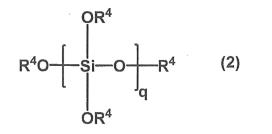
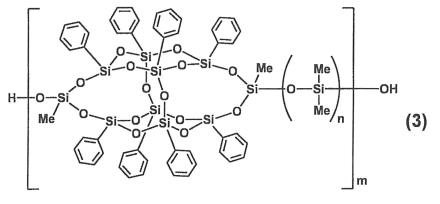
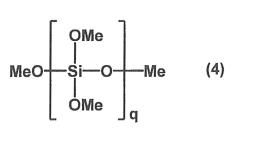
Applications Claiming Priority (2)
| Application Number | Priority Date | Filing Date | Title |
|---|---|---|---|
| JP2018124006A JP2021155462A (en) | 2018-06-29 | 2018-06-29 | Crosslinking-cured product of siloxane polymer |
| JP2018-124006 | 2018-06-29 |
Publications (1)
| Publication Number | Publication Date |
|---|---|
| TW202000746A true TW202000746A (en) | 2020-01-01 |
Family
ID=68985478
Family Applications (1)
| Application Number | Title | Priority Date | Filing Date |
|---|---|---|---|
| TW108122606A TW202000746A (en) | 2018-06-29 | 2019-06-27 | Crosslinking-cured product of siloxane polymer |
Country Status (3)
| Country | Link |
|---|---|
| JP (1) | JP2021155462A (en) |
| TW (1) | TW202000746A (en) |
| WO (1) | WO2020004545A1 (en) |
Families Citing this family (3)
| Publication number | Priority date | Publication date | Assignee | Title |
|---|---|---|---|---|
| JP7766390B2 (en) * | 2018-12-04 | 2025-11-10 | Jnc株式会社 | Condensation-curable resin composition, cured product, molded product, and semiconductor device |
| WO2023047978A1 (en) | 2021-09-24 | 2023-03-30 | 国立研究開発法人産業技術総合研究所 | Battery pack and assessment method |
| WO2025063069A1 (en) * | 2023-09-21 | 2025-03-27 | 積水化学工業株式会社 | Curable resin composition, cured film, multilayer object, and semiconductor device |
Family Cites Families (4)
| Publication number | Priority date | Publication date | Assignee | Title |
|---|---|---|---|---|
| JP5246679B2 (en) * | 2007-05-09 | 2013-07-24 | Jnc株式会社 | Crosslinkable siloxane polymer, siloxane-based crosslinkable composition, and silicone film |
| JP5369629B2 (en) * | 2008-11-12 | 2013-12-18 | Jnc株式会社 | Crosslinkable silicon compound, method for producing the same, crosslinkable composition, siloxane polymer, silicone film, silicon compound as a raw material for the crosslinkable silicon compound, and method for producing the same |
| JP5610379B2 (en) * | 2008-11-12 | 2014-10-22 | Jnc株式会社 | Siloxane polymer, siloxane-based crosslinkable composition, and silicone film |
| JP2011190413A (en) * | 2010-03-16 | 2011-09-29 | Kumamoto Univ | Siloxane polymer crosslinking-cured product |
-
2018
- 2018-06-29 JP JP2018124006A patent/JP2021155462A/en active Pending
-
2019
- 2019-06-27 WO PCT/JP2019/025578 patent/WO2020004545A1/en not_active Ceased
- 2019-06-27 TW TW108122606A patent/TW202000746A/en unknown
Also Published As
| Publication number | Publication date |
|---|---|
| WO2020004545A1 (en) | 2020-01-02 |
| JP2021155462A (en) | 2021-10-07 |
Similar Documents
| Publication | Publication Date | Title |
|---|---|---|
| KR101676385B1 (en) | Silicon-containing curable composition and cured product thereof | |
| KR101569533B1 (en) | Composition for silicone resin | |
| KR101437664B1 (en) | Silicon-containing compound, curable composition and cured product | |
| JP5610379B2 (en) | Siloxane polymer, siloxane-based crosslinkable composition, and silicone film | |
| TWI820260B (en) | Condensation curable resin compositions, cured products, molded articles, and semiconductor devices | |
| WO2008047892A1 (en) | Curable polyorganosiloxane composition | |
| TWI544665B (en) | Silicon oxide compositions for semiconductor encapsulation | |
| JP2011190413A (en) | Siloxane polymer crosslinking-cured product | |
| JP2010280766A (en) | Organosilicon compound, thermosetting composition containing the organosilicon compound, and sealing material for optical semiconductor | |
| CN100379794C (en) | Silicone-based polymer and its composition, light-emitting device and method for using silicone-based polymer in light-emitting diodes | |
| KR20150075549A (en) | Sisesquioxane which can be molded by hot melt-extrusion, highly transparent and highly heat resistant plastic transparent substrate, and method for manufacturing thereof | |
| TW202000746A (en) | Crosslinking-cured product of siloxane polymer | |
| JP2015155541A (en) | Siloxane polymer cross-linked cured product | |
| US10100156B2 (en) | Curable resin composition | |
| TW201437287A (en) | Curable resin composition | |
| Hayami et al. | Preparation and characterization of stable DQ silicone polymer sols | |
| JP7771958B2 (en) | Siloxane polymer, siloxane polymer composition and molded article | |
| CN117645725A (en) | Photo-curing organic silicon resin, adhesive, preparation method and application thereof | |
| JP2020158692A (en) | Fluorine-containing condensed organopolysiloxane prepolymer and its cured product | |
| JP5913537B2 (en) | Method for producing curable organopolysiloxane composition | |
| JP2010260962A (en) | Cured material, and method for producing the same |