TW202000793A - Addition-curable liquid silicone rubber composition and molded silicone-rubber object - Google Patents
Addition-curable liquid silicone rubber composition and molded silicone-rubber object Download PDFInfo
- Publication number
- TW202000793A TW202000793A TW108113948A TW108113948A TW202000793A TW 202000793 A TW202000793 A TW 202000793A TW 108113948 A TW108113948 A TW 108113948A TW 108113948 A TW108113948 A TW 108113948A TW 202000793 A TW202000793 A TW 202000793A
- Authority
- TW
- Taiwan
- Prior art keywords
- total
- component
- groups
- group
- parts
- Prior art date
Links
Classifications
-
- C—CHEMISTRY; METALLURGY
- C08—ORGANIC MACROMOLECULAR COMPOUNDS; THEIR PREPARATION OR CHEMICAL WORKING-UP; COMPOSITIONS BASED THEREON
- C08L—COMPOSITIONS OF MACROMOLECULAR COMPOUNDS
- C08L83/00—Compositions of macromolecular compounds obtained by reactions forming in the main chain of the macromolecule a linkage containing silicon with or without sulfur, nitrogen, oxygen or carbon only; Compositions of derivatives of such polymers
- C08L83/04—Polysiloxanes
-
- C—CHEMISTRY; METALLURGY
- C08—ORGANIC MACROMOLECULAR COMPOUNDS; THEIR PREPARATION OR CHEMICAL WORKING-UP; COMPOSITIONS BASED THEREON
- C08K—Use of inorganic or non-macromolecular organic substances as compounding ingredients
- C08K3/00—Use of inorganic substances as compounding ingredients
- C08K3/34—Silicon-containing compounds
- C08K3/36—Silica
-
- C—CHEMISTRY; METALLURGY
- C08—ORGANIC MACROMOLECULAR COMPOUNDS; THEIR PREPARATION OR CHEMICAL WORKING-UP; COMPOSITIONS BASED THEREON
- C08K—Use of inorganic or non-macromolecular organic substances as compounding ingredients
- C08K9/00—Use of pretreated ingredients
- C08K9/04—Ingredients treated with organic substances
- C08K9/06—Ingredients treated with organic substances with silicon-containing compounds
-
- C—CHEMISTRY; METALLURGY
- C08—ORGANIC MACROMOLECULAR COMPOUNDS; THEIR PREPARATION OR CHEMICAL WORKING-UP; COMPOSITIONS BASED THEREON
- C08G—MACROMOLECULAR COMPOUNDS OBTAINED OTHERWISE THAN BY REACTIONS ONLY INVOLVING UNSATURATED CARBON-TO-CARBON BONDS
- C08G77/00—Macromolecular compounds obtained by reactions forming a linkage containing silicon with or without sulfur, nitrogen, oxygen or carbon in the main chain of the macromolecule
- C08G77/04—Polysiloxanes
- C08G77/12—Polysiloxanes containing silicon bound to hydrogen
-
- C—CHEMISTRY; METALLURGY
- C08—ORGANIC MACROMOLECULAR COMPOUNDS; THEIR PREPARATION OR CHEMICAL WORKING-UP; COMPOSITIONS BASED THEREON
- C08G—MACROMOLECULAR COMPOUNDS OBTAINED OTHERWISE THAN BY REACTIONS ONLY INVOLVING UNSATURATED CARBON-TO-CARBON BONDS
- C08G77/00—Macromolecular compounds obtained by reactions forming a linkage containing silicon with or without sulfur, nitrogen, oxygen or carbon in the main chain of the macromolecule
- C08G77/04—Polysiloxanes
- C08G77/20—Polysiloxanes containing silicon bound to unsaturated aliphatic groups
-
- C—CHEMISTRY; METALLURGY
- C08—ORGANIC MACROMOLECULAR COMPOUNDS; THEIR PREPARATION OR CHEMICAL WORKING-UP; COMPOSITIONS BASED THEREON
- C08K—Use of inorganic or non-macromolecular organic substances as compounding ingredients
- C08K2201/00—Specific properties of additives
- C08K2201/002—Physical properties
- C08K2201/006—Additives being defined by their surface area
-
- C—CHEMISTRY; METALLURGY
- C08—ORGANIC MACROMOLECULAR COMPOUNDS; THEIR PREPARATION OR CHEMICAL WORKING-UP; COMPOSITIONS BASED THEREON
- C08L—COMPOSITIONS OF MACROMOLECULAR COMPOUNDS
- C08L2205/00—Polymer mixtures characterised by other features
- C08L2205/02—Polymer mixtures characterised by other features containing two or more polymers of the same C08L -group
- C08L2205/025—Polymer mixtures characterised by other features containing two or more polymers of the same C08L -group containing two or more polymers of the same hierarchy C08L, and differing only in parameters such as density, comonomer content, molecular weight, structure
-
- C—CHEMISTRY; METALLURGY
- C08—ORGANIC MACROMOLECULAR COMPOUNDS; THEIR PREPARATION OR CHEMICAL WORKING-UP; COMPOSITIONS BASED THEREON
- C08L—COMPOSITIONS OF MACROMOLECULAR COMPOUNDS
- C08L2205/00—Polymer mixtures characterised by other features
- C08L2205/03—Polymer mixtures characterised by other features containing three or more polymers in a blend
- C08L2205/035—Polymer mixtures characterised by other features containing three or more polymers in a blend containing four or more polymers in a blend
Landscapes
- Chemical & Material Sciences (AREA)
- Health & Medical Sciences (AREA)
- Chemical Kinetics & Catalysis (AREA)
- Medicinal Chemistry (AREA)
- Polymers & Plastics (AREA)
- Organic Chemistry (AREA)
- Compositions Of Macromolecular Compounds (AREA)
Abstract
Description
本發明係關於加成硬化性液狀聚矽氧橡膠組成物及聚矽氧橡膠成形體。The present invention relates to an addition-hardening liquid silicone rubber composition and a silicone rubber molded body.
聚矽氧橡膠由於耐熱性、耐寒性、安全性、外觀良好(透明性)、肌膚觸感良好、進而耐久性良好,故廣泛使用作為使幼兒用遊具或食器、牙刷、奶瓶用奶嘴或嬰兒用奶嘴成形的材料。特別是加成反應硬化型之聚矽氧橡膠組成物,不會產生如有機過氧化物硬化型之聚矽氧橡膠組成物般因有機過氧化物分解所生成的副生成物,特別是就安全面而言,較佳地使用於上述用途。Silicone rubber is widely used as a play implement or tableware for toddlers, toothbrushes, pacifiers for babies, or babies because of its heat resistance, cold resistance, safety, good appearance (transparency), good skin feel, and good durability. Nipple forming material. In particular, the addition reaction hardening type silicone rubber composition does not produce by-products generated by the decomposition of organic peroxides like the organic peroxide hardening type silicone rubber composition, especially for safety In general, it is preferably used for the above-mentioned applications.
目前,廣為使用之聚矽氧橡膠的硬度(橡膠硬度計A型)為30~70,但為了實現其設計或用途的多樣化,期望有更低硬度者。然而,為了以聚矽氧橡膠製作低硬度者,而減少補強性二氧化矽的量時,強度消失,成形後由模具取出成型物時會於橡膠產生龜裂或於使用時橡膠容易切斷。又,不減少補強性二氧化矽,而使加成交聯之平衡崩解而成為低硬度時,係成為彈性疲乏的橡膠或表面具黏著性的橡膠,作為奶瓶用奶嘴或面罩材料而言,會成為觸感不舒適者。At present, the hardness of the widely used polysiloxane rubber (rubber durometer A type) is 30 to 70, but in order to realize the diversification of its design or use, it is desirable to have a lower hardness. However, to reduce the amount of reinforcing silica to reduce the hardness of the silicone rubber, the strength will disappear. When the molded product is taken out from the mold after molding, the rubber may crack or the rubber may be easily cut during use. In addition, when the balance of the additive cross-linking is disintegrated and the hardness becomes low without reducing the reinforcing silica, it becomes elastic rubber or rubber with adhesive surface. As a nipple or mask material for baby bottles, Become uncomfortable.
為了解決上述問題,提出有對液狀聚矽氧橡膠組成物添加聚矽氧生橡膠與不具加成反應基之聚矽氧油,在維持高的撕裂強度下進行橡膠之低硬度化的方法(專利文獻1:日本特開2003-321609號公報)。但是,使用專利文獻1之方法進行低硬度化時,作為食品容器使用時會有不具加成反應基之聚矽氧油滲入含油成分的食品中之問題。又,有報告藉由合併使用具有鏈長延長效果之兩末端具有鍵結於矽原子之氫原子的直鏈狀有機聚矽氧烷與1分子中具有至少3個鍵結於矽原子之氫原子的有機氫矽氧烷作為交聯劑,得到即使低硬度亦成為高的撕裂強度之橡膠(專利文獻2:日本特開2002-179921號公報、專利文獻3:日本特開2017-222814號公報)。但是,該方法中,硬化後之橡膠中含有因鏈長延長所產生的交聯不完全之聚矽氧成分,仍有與含多量油分之食品接觸時會使交聯不完全之聚矽氧成分滲入的問題。特別是美國食品藥物管理局(FDA)係於接觸於食品,而「以重複使用為目的之橡膠製品」的規格(21CFR177.2600)中,對於與脂肪性食品接觸之橡膠製品設定了以n-己烷之萃取量之規定值。以上述方法所製作之橡膠製品,當根據該FDA規格進行萃取試驗時,超出規格值之萃取物可能會出現。進一步地,報告了將一分子中含有2個烯基之有機聚矽氧烷,與一分子中含有3個以上烯基之有機聚矽氧烷,以一分子中含有2個鍵結於矽原子之氫原子的有機氫聚矽氧烷進行硫化,而得到低硬度之橡膠(專利文獻4:日本特開2007-103494號公報)。但是,此時,係有成型物表面之黏性強,直接接觸於肌膚使用時出現不快感的問題。 [先前技術文獻] [專利文獻]In order to solve the above-mentioned problems, a method for reducing the hardness of the rubber while maintaining high tear strength by adding polysiloxane raw rubber and polysiloxane oil without an addition reaction group to the liquid polysiloxane rubber composition is proposed (Patent Document 1: Japanese Patent Laid-Open No. 2003-321609). However, when the method of Patent Document 1 is used to reduce the hardness, there is a problem that polysiloxane oil having no addition reaction group will penetrate into the food containing the oil component when used as a food container. In addition, it has been reported that by combining the use of a linear organic polysiloxane with hydrogen atoms bonded to silicon atoms at both ends having a chain length extension effect and at least 3 hydrogen atoms bonded to silicon atoms in 1 molecule Organic hydrogen siloxane as a crosslinking agent to obtain rubber with high tear strength even at low hardness (Patent Document 2: Japanese Patent Application Publication No. 2002-179921, Patent Document 3: Japanese Patent Application Publication No. 2017-222814 ). However, in this method, the hardened rubber contains incompletely cross-linked polysiloxane components due to chain extension, and there are still polysiloxane components that will cause incomplete cross-linking when in contact with foods containing large amounts of oil The problem of infiltration. In particular, the US Food and Drug Administration (FDA) is in contact with food, and the specification of "rubber products for reuse" (21CFR177.2600) sets n- for rubber products in contact with fatty foods. The specified value of the extraction amount of hexane. When the rubber products produced by the above method are subjected to the extraction test according to the FDA specifications, extracts exceeding the specifications may appear. Further, it is reported that an organic polysiloxane containing 2 alkenyl groups in one molecule and an organic polysiloxane containing more than 3 alkenyl groups in one molecule are bonded to silicon atoms with 2 molecules in one molecule The hydrogen atom of the organic hydrogen polysiloxane is vulcanized to obtain a low-hardness rubber (Patent Document 4: Japanese Patent Laid-Open No. 2007-103494). However, at this time, there is a problem that the surface of the molded product is highly viscous, and the unpleasant sensation occurs when it is used in direct contact with the skin. [Prior Technical Literature] [Patent Literature]
[專利文獻1]日本特開2003-321609號公報 [專利文獻2]日本特開2002-179921號公報 [專利文獻3]日本特開2017-222814號公報 [專利文獻4]日本特開2007-103494號公報[Patent Document 1] Japanese Patent Laid-Open No. 2003-321609 [Patent Document 2] Japanese Unexamined Patent Publication No. 2002-179921 [Patent Document 3] Japanese Patent Application Publication No. 2017-222814 [Patent Document 4] Japanese Patent Laid-Open No. 2007-103494
[發明所欲解決之課題][Problems to be solved by the invention]
本發明係為了改善上述情狀而為者,其目的為提供可賦予硬化後之硬度(橡膠硬度計A型)即使為25以下撕裂強度亦高,且基於FDA規格(21CFR177.2600)之以n-己烷的萃取成分少的低硬度聚矽氧橡膠之加成硬化性液狀聚矽氧橡膠組成物及其成形體。 [用以解決課題之手段]The present invention is intended to improve the above-mentioned situation, and its purpose is to provide high tear strength even after the hardness after hardening (rubber durometer A type) is 25 or less, and is based on the FDA standard (21CFR177.2600). -Addition-hardening liquid silicone rubber composition and molded body of low-hardness silicone rubber with few hexane extraction components. [Means to solve the problem]
本發明者為了達成上述目的進行深入探討的結果,發現藉由組合僅於分子鏈兩末端各自具有1個之與矽原子鍵結的烯基之直鏈狀有機聚矽氧烷、於分子鏈兩末端各自具有2~3個之與矽原子鍵結的烯基之直鏈狀有機聚矽氧烷、具有特定數目的鍵結於矽原子之氫原子之有機氫聚矽氧烷,與補強性二氧化矽,可得到可賦予硬化後之硬度(橡膠硬度計A型)即使為25以下,撕裂強度(月牙形)亦高達15kN/m以上,且基於FDA規格(21CFR177.2600)之以n-己烷的萃取成分少的低硬度聚矽氧橡膠之加成硬化性液狀聚矽氧橡膠組成物,而完成本發明。In order to achieve the above object, the inventors conducted in-depth discussions and found that by combining linear organic polysiloxanes having only one alkenyl group bonded to a silicon atom at each end of the molecular chain, the molecular chain has two Straight-chain organic polysiloxanes having 2 to 3 alkenyl groups bonded to silicon atoms at each end, organic hydrogen polysiloxanes having a specific number of hydrogen atoms bonded to silicon atoms, and reinforcing two Silicon oxide can obtain the hardness after hardening (rubber durometer type A) of less than 25, and the tear strength (crescent shape) is as high as 15kN/m or more, and is based on the FDA specification (21CFR177.2600). The present invention is completed by the addition-hardenable liquid silicone rubber composition of low-hardness silicone rubber with little extraction component of hexane.
因此,本發明提供下述所示之加成硬化性液狀聚矽氧橡膠組成物及聚矽氧橡膠成形體。 1.一種加成硬化性液狀聚矽氧橡膠組成物,其含有 (A)僅於分子鏈兩末端各自含有1個之與矽原子鍵結的烯基,且平均聚合度1,500以下之於25℃為液狀的含有烯基之直鏈狀有機聚矽氧烷:100質量份、 (B)於分子鏈兩末端各自含有2~3個之與矽原子鍵結的烯基,且平均聚合度1,500以下之於25℃為液狀的含有烯基之直鏈狀有機聚矽氧烷:1~30質量份、 (C)由 (C-1)1分子中含有至少3個之鍵結於矽原子之氫原子的有機氫聚矽氧烷,及 (C-2)分子鏈兩末端經二有機氫矽烷氧基封端,且僅於兩末端含有與矽原子鍵結的氫原子之直鏈狀有機氫聚矽氧烷 所構成之有機氫聚矽氧烷:相對於(C-1)成分及(C-2)成分的鍵結於矽原子之氫原子的合計莫耳數[合計Si-H基]而言,(C-1)成分的Si-H基之莫耳數[Si-H基(C-1)],為[Si-H基(C-1)]/[合計Si-H基]×100=60~95莫耳%,且相對於組成物中之烯基的合計莫耳數[合計烯基]而言,上述[合計Si-H基]之莫耳數的莫耳比,成為[合計Si-H基]/[合計烯基]=1.0~3.0之量、 (D)將以BET法所得之比表面積為130m2 /g以上的發煙二氧化矽進行疏水化處理而得的補強性二氧化矽:相對於(A)成分及(B)成分之合計100質量份而言為5~60質量份、 (E)加成反應觸媒:相對於(A)成分及(B)成分之合計質量而言,以鉑族金屬(質量換算)計為0.5~1,000ppm。 2.如上述1之加成硬化性液狀聚矽氧橡膠組成物,其中當用於(D)成分之疏水化處理的二氧化矽表面處理劑含有烯基時,相對於組成物中之(A)成分、(B)成分及(D)成分的烯基之合計莫耳數[合計烯基]而言,(C-1)成分與(C-2)成分之合計Si-H基的莫耳數[合計Si-H基]之莫耳比,為[合計Si-H基]/[合計烯基]=1.0~3.0。 3.如上述1或2之加成硬化性液狀聚矽氧橡膠組成物,其中進一步含有相對於(A)成分100質量份而言,為1~200質量份的(F)平均聚合度為2,000以上,且於25℃為生橡膠狀的有機聚矽氧烷。 4.如上述3之加成硬化性液狀聚矽氧橡膠組成物,其中當(F)成分之有機聚矽氧烷具有烯基時,相對於含有該烯基之組成物中的全部烯基之合計莫耳數[合計烯基]而言,(C-1)成分與(C-2)成分之合計Si-H基的莫耳數[合計Si-H基]之莫耳比,為[合計Si-H基]/[合計烯基]=1.0~3.0。 5.如上述1~4中任一項之加成硬化性液狀聚矽氧橡膠組成物,其中(B)成分為於分子鏈兩末端各自含有3個之與矽原子鍵結的烯基之直鏈狀有機聚矽氧烷。 6.如上述1~5中任一項之加成硬化性液狀聚矽氧橡膠組成物,其中(C-1)成分為1分子中含有3~6個之鍵結於矽原子之氫原子的有機氫聚矽氧烷。 7.一種接觸於食品或飲料物之聚矽氧橡膠成形體,其係使如上述1~6中任一項之組成物硬化所得到的厚度2mm之聚矽氧橡膠成形體,其於基於FDA規格(21CFR177.2600)之以n-己烷的萃取試驗中,最初之7小時的萃取量為175mg/inch2 以下,且追加2小時的萃取量為4mg/inch2 以下。 [發明之效果]Therefore, the present invention provides the addition-curable liquid silicone rubber composition and silicone rubber molded body shown below. 1. An addition-hardening liquid silicone rubber composition containing (A) only one alkenyl group bonded to a silicon atom at each end of the molecular chain, and an average polymerization degree of 1,500 or less is less than 25 ℃ is a liquid linear organic polysiloxane containing alkenyl groups: 100 parts by mass, (B) at each end of the molecular chain contains 2 to 3 alkenyl groups bonded to silicon atoms, and the average degree of polymerization Straight-chain organic polysiloxane containing alkenyl group which is liquid at 25°C below 1,500: 1 to 30 parts by mass, (C) consists of (C-1) 1 molecule containing at least 3 bonds to silicon Atomic hydrogen atom of organic hydrogen polysiloxane, and (C-2) molecular chain ends are diorganohydrogen siloxane-oxygen-terminated, and only at both ends contain a linear chain of hydrogen atoms bonded to silicon atoms Organic hydrogen polysiloxane composed of organic hydrogen polysiloxane: the total number of moles of hydrogen atoms bonded to silicon atoms with respect to (C-1) component and (C-2) component [total Si-H In terms of [group], the mole number of the Si-H group of the (C-1) component [Si-H group (C-1)] is [Si-H group (C-1)]/[total Si-H Radical]×100=60 to 95 mol%, and the molar ratio of the above [total Si-H radicals] to the total molar number of the alkenyl groups in the composition [total alkenyl] ,[Total Si-H groups]/[Total alkenyl groups]=1.0~3.0, (D) The fumed silica with a specific surface area of 130m 2 /g or more obtained by BET method is hydrophobized and The obtained reinforcing silica: 5 to 60 parts by mass relative to the total of 100 parts by mass of (A) component and (B) component, (E) Addition reaction catalyst: relative to (A) component and ( B) The total mass of the components is 0.5 to 1,000 ppm in terms of platinum group metal (in terms of mass). 2. The addition-curing liquid silicone rubber composition as described in 1 above, wherein when the silica surface treatment agent used for the hydrophobic treatment of the component (D) contains an alkenyl group, the relative ( A) The total number of moles of the alkenyl group of the component, (B) component and (D) component [total alkenyl group], the total of the (C-1) component and the (C-2) component of the Si-H group The mole ratio of the number of ears [total Si-H groups] is [total Si-H groups]/[total alkenyl groups] = 1.0 to 3.0. 3. The addition-curable liquid silicone rubber composition according to 1 or 2 above, which further contains (F) an average polymerization degree of 1 to 200 parts by mass relative to 100 parts by mass of the (A) component. Organic polysiloxane that is 2,000 or more and raw rubber at 25°C. 4. The addition-curable liquid silicone rubber composition as described in 3 above, wherein when the organic polysiloxane of the component (F) has an alkenyl group, it is relative to all the alkenyl groups in the composition containing the alkenyl group For the total mole number [total alkenyl group], the mole ratio of the total Si-H groups of the (C-1) component and the (C-2) component [the total Si-H groups] is [ Total Si-H groups]/[Total alkenyl groups]=1.0~3.0. 5. The addition-curable liquid silicone rubber composition according to any one of 1 to 4 above, wherein component (B) is composed of three alkenyl groups bonded to silicon atoms at both ends of the molecular chain Straight-chain organic polysiloxane. 6. The addition-curable liquid silicone rubber composition according to any one of the above 1 to 5, wherein the (C-1) component is 1 molecule containing 3 to 6 hydrogen atoms bonded to silicon atoms Of organic hydrogen polysiloxane. 7. A silicone rubber molded body in contact with food or beverages, which is a silicone rubber molded body with a thickness of 2 mm obtained by curing the composition according to any one of the above 1 to 6, based on the FDA In the extraction test using n-hexane in the specification (21CFR177.2600), the first 7 hours of extraction is 175 mg/inch 2 or less, and the additional 2 hours of extraction is 4 mg/inch 2 or less. [Effect of invention]
依照本發明,可得到可賦予即使硬化後之硬度(橡膠硬度計A型)為25以下,撕裂強度亦高,且基於FDA規格(21CFR177.2600)之以n-己烷的萃取成分少的低硬度聚矽氧橡膠之加成硬化性液狀聚矽氧橡膠組成物及聚矽氧橡膠成形體。According to the present invention, it can be obtained that even if the hardness after hardening (rubber durometer type A) is 25 or less, the tear strength is high, and the extraction component with n-hexane based on the FDA specification (21CFR177.2600) is small Addition-hardening liquid silicone rubber composition and silicone rubber molded body of low-hardness silicone rubber.
以下更詳細說明本發明。 <加成硬化性液狀聚矽氧橡膠組成物> 本發明之加成硬化性液狀聚矽氧橡膠組成物,其特徵為含有下述(A)~(E)成分。 (A)於分子鏈兩末端各自含有1個烯基之有機聚矽氧烷 (A)成分之有機聚矽氧烷,為本發明之組成物之主劑(基底聚合物),具體而言,係僅於分子鏈兩末端各自含有1個之鍵結於矽原子之烯基,分子鏈途中不具有烯基,且平均聚合度1,500以下之於25℃為液狀的含有烯基之直鏈狀有機聚矽氧烷(亦即,於分子中,於分子鏈之各末端各自含有1個烯基的2官能性之直鏈狀有機聚矽氧烷)。The present invention will be described in more detail below. <Addition hardening liquid silicone rubber composition> The addition-curable liquid silicone rubber composition of the present invention is characterized by containing the following components (A) to (E). (A) Organic polysiloxane containing 1 alkenyl group at each end of the molecular chain (A) The component organic polysiloxane is the main agent (base polymer) of the composition of the present invention, specifically, it contains only one alkenyl group bonded to a silicon atom at each end of the molecular chain , A linear organic polysiloxane containing alkenyl groups containing no alkenyl groups in the molecular chain and having an average degree of polymerization of 1,500 or less at 25°C (that is, in the molecule, at each end of the molecular chain Straight-chain organic polysiloxane containing two functional groups containing one alkenyl group).
該(A)成分,可適合使用下述通式(I)表示者。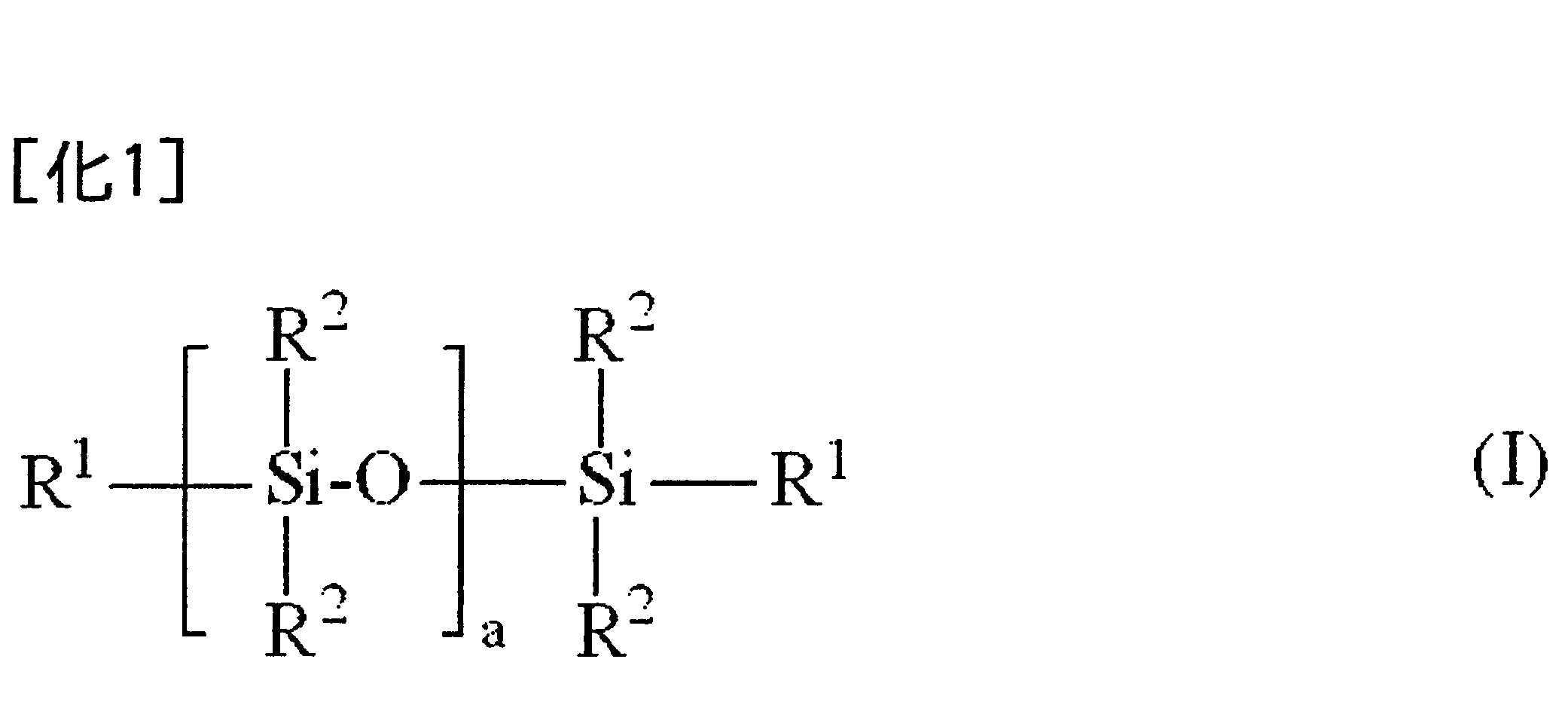
R1 表示之烯基,例如可列舉乙烯基、烯丙基、丙烯基、丁烯基、己烯基、辛烯基等,較佳可列舉乙烯基、烯丙基、丙烯基;更佳可列舉乙烯基。The alkenyl group represented by R 1 includes, for example, vinyl, allyl, propenyl, butenyl, hexenyl, octenyl, etc., preferably vinyl, allyl, propenyl; more preferably List vinyl.
R2 表示之1價烴基,可列舉不含有烯基等之脂肪族不飽和鍵者,例如甲基、乙基、丙基、異丙基、丁基、異丁基、tert-丁基、戊基、新戊基、己基、環己基、辛基、壬基、癸基等之烷基;苯基、甲苯基、二甲苯基、萘基等之芳基;苄基、苯基乙基、苯基丙基等之芳烷基等,或此等之基之氫原子的一部分或全部經氟、溴、氯等之鹵素原子、氰基等取代者,例如氯甲基、氯丙基、溴乙基、三氟丙基、氰基乙基等,較佳全部之R2 之90莫耳%以上、特佳全部之R2 基為甲基。The monovalent hydrocarbon group represented by R 2 includes those that do not contain an aliphatic unsaturated bond such as an alkenyl group, such as methyl, ethyl, propyl, isopropyl, butyl, isobutyl, tert-butyl, and pentyl. Alkyl groups such as phenyl, neopentyl, hexyl, cyclohexyl, octyl, nonyl and decyl; aryl groups such as phenyl, tolyl, xylyl and naphthyl; benzyl, phenylethyl and benzene Aryl groups such as propylpropyl, etc., or a part or all of the hydrogen atoms of these groups are substituted with halogen atoms such as fluorine, bromine, chlorine, etc., such as chloromethyl, chloropropyl, bromoethyl group, trifluoropropyl, cyanoethyl and the like, preferably all of R 2 of 90 mole% or more, and particularly preferably all the R 2 group is methyl.
如通式(I)表示,(A)成分之有機聚矽氧烷之結構,較佳為分子鏈兩末端經烯基二有機矽烷氧基(例如乙烯基二甲基矽烷氧基、乙烯基甲基苯基矽烷氧基、烯丙基二甲基矽烷氧基等)封端,且主鏈為由二有機矽氧烷單位(例如、二甲基矽氧烷單位、甲基苯基矽氧烷單位、二苯基矽氧烷單位、甲基三氟丙基矽氧烷單位等)之隨機重複所成的直鏈狀結構。 如此地,(A)成分之有機聚矽氧烷,為分子鏈兩末端二有機烯基矽烷氧基封端二有機聚矽氧烷。再者,此時之矽氧烷中之「有機基」,與式(I)中之R2 表示者同樣地,為意指烯基以外的非取代或取代之1價烴基者。As represented by the general formula (I), the structure of the organopolysiloxane of the component (A) is preferably an alkenyl diorganosiloxy group at both ends of the molecular chain (for example, vinyl dimethyl siloxy group, vinyl methyl group Phenylphenylsiloxy, allyldimethylsiloxy, etc.), and the main chain is composed of diorganosilane units (eg, dimethylsiloxane units, methylphenylsiloxane units Units, diphenylsiloxane units, methyltrifluoropropylsiloxane units, etc.) are randomly repeated to form a linear structure. In this way, the organopolysiloxane of component (A) is a diorganoalkenosilane-terminated diorganopolysiloxane at both ends of the molecular chain. Furthermore, the "organic group" in the silicone at this time is the same as the one represented by R 2 in the formula (I), and means a non-substituted or substituted monovalent hydrocarbon group other than an alkenyl group.
該有機聚矽氧烷之平均聚合度,必需為1,500以下,通常係100~1,500、較佳為300~1,200。未達100時,可能無法得到充分的橡膠感,高於1,500時黏度增高,可能會成形困難。 再者,本發明中所提及的平均聚合度,係指數平均聚合度,其係指以下述條件測定之以凝膠滲透層析(GPC)所進行之以聚苯乙烯為標準物質的平均聚合度。 [測定條件] 展開溶劑:甲苯 流量:1mL/min 檢測器:示差折射率檢測器(RI) 管柱:KF-805L×2(Shodex公司製) 管柱溫度:25℃ 試樣注入量:30μL(濃度0.2質量%之甲苯溶液)The average degree of polymerization of the organic polysiloxane must be 1,500 or less, usually 100 to 1,500, preferably 300 to 1,200. When it is less than 100, it may not be able to obtain a sufficient rubber feel, and when it is higher than 1,500, the viscosity increases, and it may be difficult to form. In addition, the average degree of polymerization mentioned in the present invention is the index average degree of polymerization, which refers to the average polymerization of polystyrene as the standard substance by gel permeation chromatography (GPC) measured under the following conditions degree. [Measurement conditions] Expanding solvent: Toluene Flow rate: 1mL/min Detector: Differential refractive index detector (RI) Column: KF-805L×2 (manufactured by Shodex) Column temperature: 25℃ Sample injection volume: 30 μL (toluene concentration 0.2% by mass)
作為(A)成分,只要係含有鍵結於分子鏈兩末端之矽原子的烯基之直鏈狀之有機聚矽氧烷,則可合併使用分子結構(例如分子鏈末端之烯基二有機矽烷氧基或主鏈之二有機矽氧烷單位之取代基種類或該等的比率)或聚合度相異的1種或2種以上者。As the component (A), as long as it is a linear organic polysiloxane containing an alkenyl group bonded to silicon atoms at both ends of the molecular chain, a molecular structure (for example, alkenyl diorganosilane at the end of the molecular chain can be used in combination) Oxygen or the main chain of two organosilicon units of the type of substituents or the ratio of these) or the degree of polymerization of one or two or more.
(B)於分子鏈兩末端各自含有2~3個烯基之有機聚矽氧烷 (B)成分之有機聚矽氧烷,為具有抑制因(A)成分與(C-2)成分之鏈長延長所產生之未交聯有機矽氧烷的生成之作用者。具體而言,係於分子鏈兩末端各自含有2~3個鍵結於矽原子之烯基,且平均聚合度1,500以下之於25℃為液狀的含有烯基之直鏈狀有機聚矽氧烷。於分子鏈末端的烯基各自為2~3個的這點,係與(A)成分明確相異的成分。(B) Organic polysiloxane containing 2 to 3 alkenyl groups at each end of the molecular chain (B) The organic polysiloxane of the component has the effect of suppressing the generation of uncrosslinked organic silicone due to the extension of the chain length of the (A) component and (C-2) component. Specifically, it is a linear organic polysiloxane containing alkenyl groups containing 2 to 3 alkenyl groups bonded to silicon atoms at both ends of the molecular chain and having an average polymerization degree of 1,500 or less, which is liquid at 25°C alkyl. The fact that the number of alkenyl groups at the end of the molecular chain is 2 to 3 is a component that is clearly different from the component (A).
作為該(B)成分,可適合使用下述通式(II)表示者。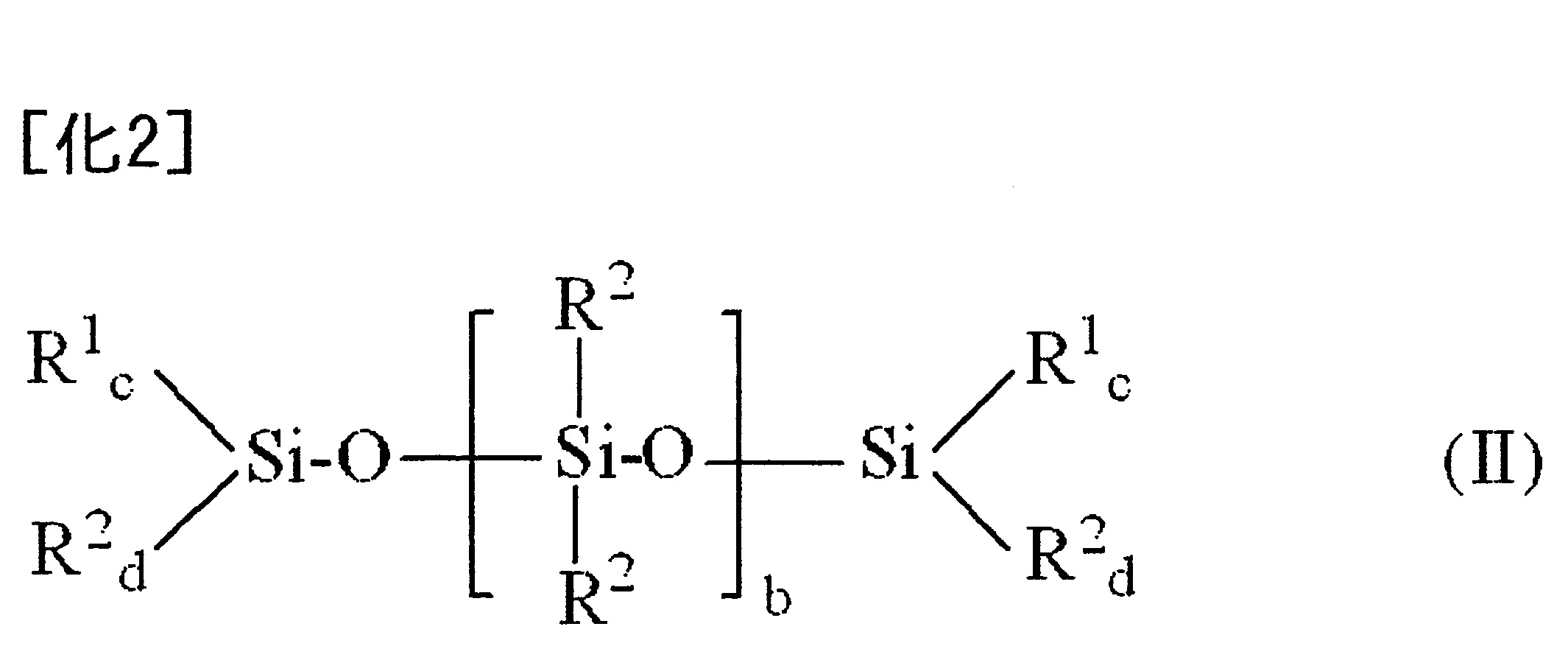
此處,R1 表示之烯基,例如可列舉乙烯基、烯丙基、丙烯基、丁烯基、己烯基、辛烯基等,較佳可列舉乙烯基、烯丙基、丙烯基;更佳可列舉乙烯基。Here, the alkenyl group represented by R 1 includes, for example, vinyl, allyl, propenyl, butenyl, hexenyl, octenyl, and the like, preferably vinyl, allyl, and propenyl; More preferably, vinyl is mentioned.
又,R2 表示之1價烴基,為不含有烯基等之脂肪族不飽和鍵者,例如可列舉甲基、乙基、丙基、異丙基、丁基、異丁基、tert-丁基、戊基、新戊基、己基、環己基、辛基、壬基、癸基等之烷基;苯基、甲苯基、二甲苯基、萘基等之芳基;苄基、苯基乙基、苯基丙基等之芳烷基等,或此等之基之氫原子的一部分或全部經氟、溴、氯等之鹵素原子、氰基等取代者,例如氯甲基、氯丙基、溴乙基、三氟丙基、氰基乙基等,較佳為全部之R2 之90莫耳%以上、特佳為全部之R2 基為甲基。Moreover, the monovalent hydrocarbon group represented by R 2 is an aliphatic unsaturated bond that does not contain an alkenyl group, and examples thereof include methyl, ethyl, propyl, isopropyl, butyl, isobutyl, and tert-butyl. Alkyl groups such as phenyl, tolyl, neopentyl, hexyl, cyclohexyl, octyl, nonyl, decyl, etc.; aryl groups such as phenyl, tolyl, xylyl, naphthyl, etc.; benzyl, phenylethyl Aryl groups such as radicals, phenylpropyl, etc., or a part or all of the hydrogen atoms of these radicals are substituted with halogen atoms such as fluorine, bromine, chlorine, etc., such as chloromethyl, chloropropyl , bromoethyl, trifluoropropyl, cyanoethyl and the like, preferably all of R 2 of 90 mole% or more, particularly preferably all the R 2 group is methyl.
如通式(II)表示,(B)成分之有機聚矽氧烷之結構,較佳為分子鏈兩末端經二烯基有機矽烷氧基(例如二乙烯基甲基矽烷氧基、二乙烯基苯基矽烷氧基、二烯丙基甲基矽烷氧基等)或三烯基矽烷氧基(例如三乙烯基矽烷氧基、三烯丙基矽烷氧基等)封端,且主鏈為由二有機矽氧烷單位(例如二甲基矽氧烷單位、甲基苯基矽氧烷單位、二苯基矽氧烷單位、甲基三氟丙基矽氧烷單位等)之隨機重複所成的直鏈狀結構。 如此地,(B)成分之有機聚矽氧烷,為分子鏈兩末端二烯基有機矽烷氧基封端二有機聚矽氧烷、分子鏈兩末端三烯基有機矽烷氧基封端二有機聚矽氧烷,或分子鏈單末端二烯基有機矽烷氧基/單末端三烯基矽烷氧基封端二有機聚矽氧烷。再者,此時之矽氧烷中之「有機基」,係與式(I)、(II)中之R2 表示者同樣地,意指烯基以外的非取代或取代之1價烴基。As represented by the general formula (II), the structure of the organopolysiloxane of the component (B) is preferably a dieneyl organosilaneoxy group at both ends of the molecular chain (eg divinylmethylsiloxy group, divinyl group) Phenylsiloxy, diallylmethylsiloxy, etc.) or trienylsiloxy (such as trivinylsiloxy, triallylsiloxy, etc.), and the main chain is Random repetition of diorganosiloxane units (e.g. dimethylsiloxane units, methylphenylsiloxane units, diphenylsiloxane units, methyltrifluoropropylsiloxane units, etc.) Straight chain structure. In this way, the organopolysiloxane of component (B) is a dienylorganosiloxane end capped diorganopolysiloxane on both ends of the molecular chain, and a trienyl organosilane end capped diorganosiloxane on both ends of the molecular chain Polysiloxane, or molecular chain single-end dienyl organosilaneoxy/single-end trienylsiloxy endcapped diorganopolysiloxane. In addition, the "organic group" in the silicone at this time is the same as that represented by R 2 in formulas (I) and (II), and means an unsubstituted or substituted monovalent hydrocarbon group other than an alkenyl group.
該有機聚矽氧烷之平均聚合度,必需為1,500以下,通常係100~1,500、較佳為200~1,500、更佳為300~1,200。使用該範圍之(B)成分時,可得到低硬度而高撕裂強度且以n-己烷之萃取成分少的聚矽氧橡膠。The average degree of polymerization of the organic polysiloxane must be 1,500 or less, usually 100 to 1,500, preferably 200 to 1,500, and more preferably 300 to 1,200. When the component (B) in this range is used, a polysiloxane rubber with low hardness and high tear strength and few extracted components with n-hexane can be obtained.
再者,作為(B)成分,只要係各自含有2~3個之鍵結於分子鏈兩末端之矽原子的烯基之直鏈狀之有機聚矽氧烷,則可合併使用分子結構(例如分子鏈末端之烯基二有機矽烷氧基或主鏈之二有機矽氧烷單位之取代基種類或該等的比率)或聚合度相異之1種或2種以上者。Furthermore, as the component (B), as long as it is a straight-chain organic polysiloxane containing alkenyl groups each containing 2 to 3 silicon atoms bonded to both ends of the molecular chain, the molecular structure (e.g. One or two or more of the types of substituents of the alkenyl diorganosiloxy groups at the end of the molecular chain or the two organosilicon units of the main chain or the ratios of these).
(C)有機氫聚矽氧烷 (C)成分,為具有鍵結於矽原子之氫原子(Si-H基)的有機氫聚矽氧烷,其特徵為合併使用由(C-1)成分之1分子中含有至少3個之鍵結於矽原子之氫原子的有機氫聚矽氧烷與(C-2)成分之分子鏈兩末端經二有機氫矽烷氧基封端,且僅於該兩末端含有與矽原子鍵結的氫原子,分子中不含有烯基的直鏈狀有機氫聚矽氧烷之2種有機氫聚矽氧烷所成者。 (C)成分為作為硬化劑而作用者,該硬化劑係用以將分子中之Si-H基與前述(A)成分及(B)成分等之鍵結於矽原子之烯基藉由矽氫化加成反應而交聯,使組成物硬化者。(C) Organic hydrogen polysiloxane (C) component is an organic hydrogen polysiloxane with a hydrogen atom (Si-H group) bonded to a silicon atom, which is characterized by the combined use of (C-1) component containing at least 3 The two ends of the molecular chain of the organic hydrogen polysiloxane bonded to the hydrogen atom of the silicon atom and the (C-2) component are blocked with two organic hydrogen silane oxy groups, and only the two ends contain those bonded to the silicon atom Hydrogen atom, which is composed of two kinds of organic hydrogen polysiloxanes which are straight-chain organic hydrogen polysiloxanes which do not contain alkenyl groups in the molecule. (C) The component acts as a hardener. The hardener is used to bond the Si-H group in the molecule with the aforementioned (A) component and (B) component, etc. to the silicon atom. Hydrogenation addition reaction and cross-linking, hardening the composition.
(C-1)成分之有機氫聚矽氧烷,係以下述平均組成式(III)表示,且1分子中具有至少3個之鍵結於矽原子之氫原子(Si-H基)。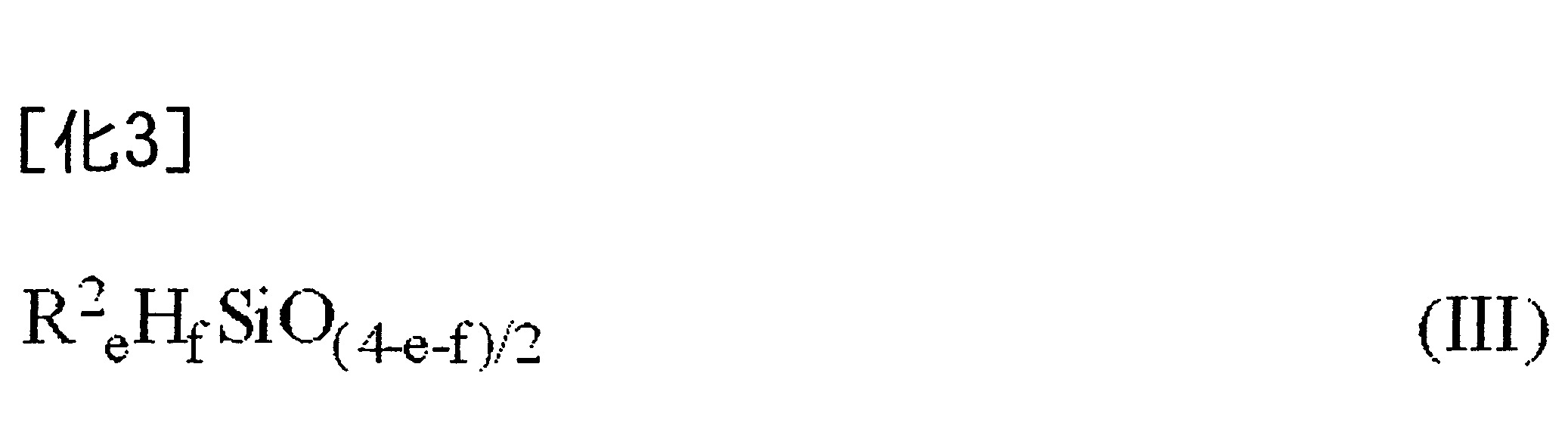
此處,R2 表示之1價烴基,為不含有烯基等之脂肪族不飽和鍵者,例如可列舉甲基、乙基、丙基、異丙基、丁基、異丁基、tert-丁基、戊基、新戊基、己基、環己基、辛基、壬基、癸基等之烷基;苯基、甲苯基、二甲苯基、萘基等之芳基;苄基、苯基乙基、苯基丙基等之芳烷基等,或此等基之氫原子的一部分或全部經氟、溴、氯等之鹵素原子、氰基等取代者,例如氯甲基、氯丙基、溴乙基、三氟丙基、氰基乙基等,較佳全部的R2 之90莫耳%以上、特佳全部的R2 基為甲基。 又,e為0.7~2.1、較佳為0.8~2.0,f為0.001~1.0、較佳為0.01~1.0,e+f為滿足0.8~3.0、較佳為滿足1.0~2.5之整數,有機氫聚矽氧烷之分子結構,可為直鏈狀、環狀、分支狀、三維網目狀之任意結構。Here, the monovalent hydrocarbon group represented by R 2 is an aliphatic unsaturated bond that does not contain an alkenyl group, and examples thereof include methyl, ethyl, propyl, isopropyl, butyl, isobutyl, and tert- Alkyl groups such as butyl, pentyl, neopentyl, hexyl, cyclohexyl, octyl, nonyl and decyl; aryl groups such as phenyl, tolyl, xylyl and naphthyl; benzyl and phenyl Aralkyl groups such as ethyl, phenylpropyl, etc., or a part or all of the hydrogen atoms of these groups are substituted with halogen atoms such as fluorine, bromine, chlorine, etc., such as chloromethyl, chloropropyl , bromoethyl, trifluoropropyl, cyanoethyl and the like, more preferably all of R 90 mole%, particularly preferably all of the R 2 group is methyl. Also, e is 0.7 to 2.1, preferably 0.8 to 2.0, f is 0.001 to 1.0, preferably 0.01 to 1.0, e+f is an integer satisfying 0.8 to 3.0, preferably 1.0 to 2.5, and organic hydrogen poly The molecular structure of siloxane can be any structure of linear, circular, branched, three-dimensional mesh shape.
(C-1)成分之Si-H基,為1分子中具有至少3個、較佳為3~30、更佳為3~10個、又更佳為3~6個者,又,Si-H基之含量,於該有機氫聚矽氧烷中,係0.0005~0.017mol/g、較佳為0.0008~0.010mol/g、更佳為0.0008~0.005mol/g。(C-1) The Si-H group of the component is one having at least 3, preferably 3 to 30, more preferably 3 to 10, and still more preferably 3 to 6, in one molecule. The content of the H group in the organic hydrogen polysiloxane is 0.0005 to 0.017 mol/g, preferably 0.0008 to 0.010 mol/g, and more preferably 0.0008 to 0.005 mol/g.
此時,1分子中之矽原子數目(或平均聚合度),適合使用6~300個、特別是8~150個左右的於25℃為液狀者。再者,鍵結於矽原子之氫原子,可位於分子鏈末端、分子鏈途中的任意者,亦可位於兩方。At this time, the number of silicon atoms (or average degree of polymerization) in one molecule is preferably 6 to 300, especially about 8 to 150, which are liquid at 25°C. Furthermore, the hydrogen atom bonded to the silicon atom may be located at the end of the molecular chain, on the way of the molecular chain, or at both sides.
(C-1)成分之有機氫聚矽氧烷,可列舉甲基氫環聚矽氧烷、甲基氫矽氧烷/二甲基矽氧烷環狀共聚物、兩末端三甲基矽烷氧基封端甲基氫聚矽氧烷、兩末端三甲基矽烷氧基封端二甲基矽氧烷/甲基氫矽氧烷共聚物、兩末端二甲基氫矽烷氧基封端二甲基矽氧烷/甲基氫矽氧烷共聚物、由(CH3 )2 HSiO1/2 單位與(CH3 )3 SiO1/2 單位與SiO4/2 單位所構成的共聚物、由(CH3 )2 HSiO1/2 單位與SiO4/2 單位所構成的共聚物,或此等例示化合物中甲基的一部分或全部經其他之烷基等取代者等。其中尤特別以兩末端二甲基氫矽烷氧基封端二甲基矽氧烷/甲基氫矽氧烷共聚物,在低硬度/撕裂強度方面較佳。 (C-1)成分可1種單獨使用亦可合併使用2種以上。(C-1) The organic hydrogen polysiloxane of the component includes methylhydrocyclopolysiloxane, methylhydrosiloxane/dimethylsiloxane cyclic copolymer, and trimethylsiloxane at both ends Base-terminated methylhydrogen polysiloxane, two-terminal trimethylsiloxy-terminated dimethylsiloxane/methylhydrosiloxane copolymer, two-terminal dimethylhydrosiloxy-terminated dimethyl Based silicone/methylhydrogen siloxane copolymer, a copolymer consisting of (CH 3 ) 2 HSiO 1/2 units and (CH 3 ) 3 SiO 1/2 units and SiO 4/2 units, consisting of ( CH 3 ) A copolymer composed of 2 HSiO 1/2 units and SiO 4/2 units, or those in which some or all of the methyl groups in these exemplary compounds are substituted with other alkyl groups, etc. Among them, the dimethylsiloxane/methylhydrosiloxane copolymer capped with dimethylhydrosiloxy groups at both ends is particularly preferable in terms of low hardness/tear strength. (C-1) The components may be used alone or in combination of two or more.
(C-2)成分之有機氫聚矽氧烷,適合使用下述通式(IV)表示,分子鏈兩末端經二有機氫矽烷氧基封端,且僅於該兩末端含有與矽原子鍵結的氫原子,分子中不含有烯基的直鏈狀有機氫聚矽氧烷。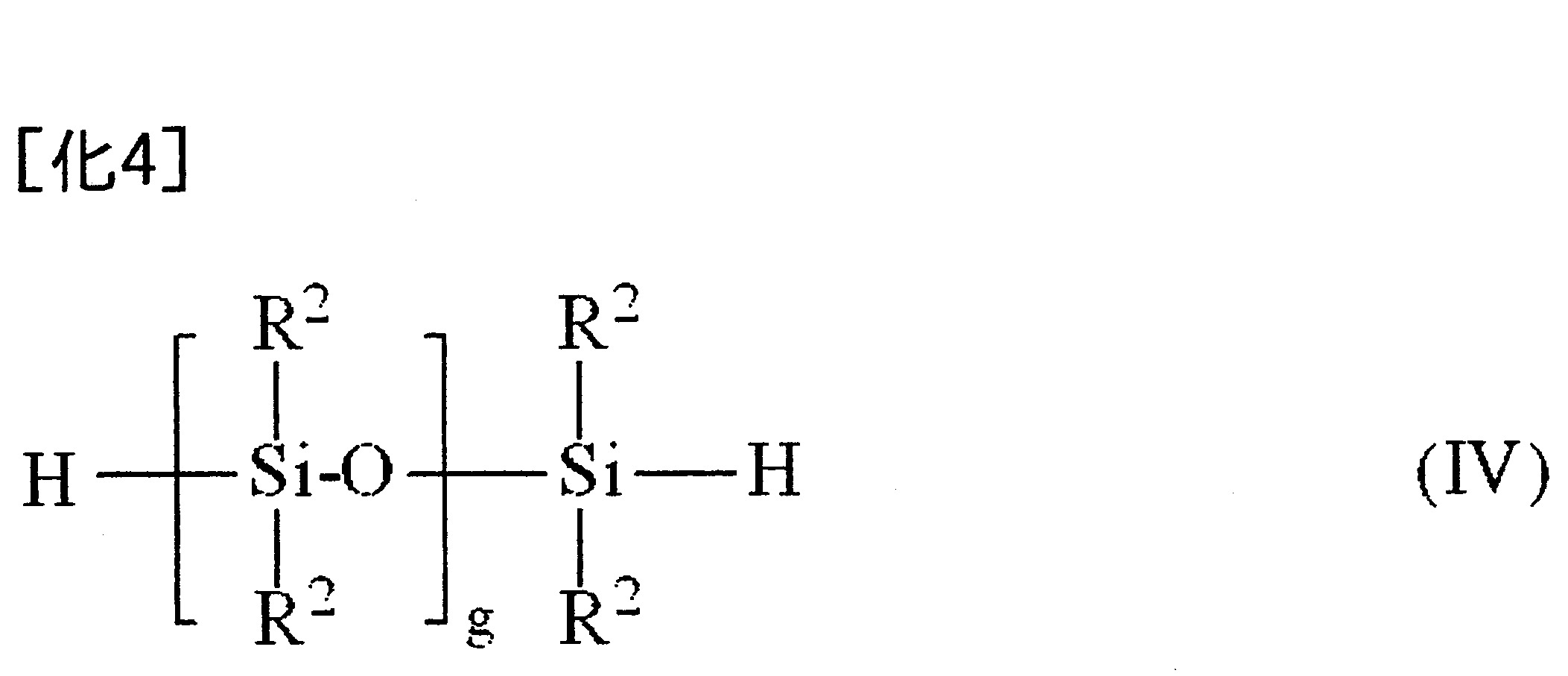
此處,R2 表示之1價烴基,為不含有烯基等之脂肪族不飽和鍵者,例如可列舉甲基、乙基、丙基、異丙基、丁基、異丁基、tert-丁基、戊基、新戊基、己基、環己基、辛基、壬基、癸基等之烷基;苯基、甲苯基、二甲苯基、萘基等之芳基;苄基、苯基乙基、苯基丙基等之芳烷基等,或此等基之氫原子的一部分或全部經氟、溴、氯等之鹵素原子、氰基等取代者,例如氯甲基、氯丙基、溴乙基、三氟丙基、氰基乙基等,較佳全部的R2 之90莫耳%以上、特佳全部的R2 基為甲基。Here, the monovalent hydrocarbon group represented by R 2 is an aliphatic unsaturated bond that does not contain an alkenyl group, and examples thereof include methyl, ethyl, propyl, isopropyl, butyl, isobutyl, and tert- Alkyl groups such as butyl, pentyl, neopentyl, hexyl, cyclohexyl, octyl, nonyl and decyl; aryl groups such as phenyl, tolyl, xylyl and naphthyl; benzyl and phenyl Aralkyl groups such as ethyl, phenylpropyl, etc., or a part or all of the hydrogen atoms of these groups are substituted with halogen atoms such as fluorine, bromine, chlorine, etc., such as chloromethyl, chloropropyl , bromoethyl, trifluoropropyl, cyanoethyl and the like, more preferably all of R 90 mole%, particularly preferably all of the R 2 group is methyl.
(C-2)成分之Si-H基,為1分子中僅具有2個(分子鏈兩末端)者,又,Si-H基之含量,於該有機氫聚矽氧烷中,係0.00009~0.012mol/g、較佳為0.0002~0.0085mol/g。(C-2) The Si-H group of the component has only two (two molecular chain ends) in one molecule, and the content of the Si-H group in the organic hydrogen polysiloxane is 0.00009~ 0.012 mol/g, preferably 0.0002 to 0.0085 mol/g.
此時,適合使用1分子中之矽原子數目(或平均聚合度)為2~300個、特別是3~150個左右的於25℃為液狀者。At this time, it is suitable to use those having a number of silicon atoms (or an average degree of polymerization) of 2 to 300, especially 3 to 150, in a molecule at a temperature of 25°C.
(C-2)成分之有機氫聚矽氧烷,為兩末端二甲基氫矽烷氧基封端二有機聚矽氧烷,特佳為兩末端二甲基氫矽烷氧基封端二甲基聚矽氧烷。 (C-2)成分可1種單獨使用亦可合併使用2種以上。(C-2) The organohydrogenpolysiloxane of the component is a dimethylhydrosiloxy end-capped diorganopolysiloxane at both ends, particularly preferably a dimethylhydrosiloxy end-capped dimethyl at both ends Polysiloxane. (C-2) The components may be used alone or in combination of two or more.
(C-1)成分與(C-2)成分之摻合比,相對於各自之鍵結於矽原子之氫原子的合計莫耳數[合計Si-H基]而言,(C-1)成分之Si-H基的莫耳數[Si-H基(C-1)],係[Si-H基(C-1)]/[合計Si-H基]×100=60~95莫耳%、較佳為70~90莫耳%。在該範圍使用(C-1)成分與(C-2)成分時,硬化後之橡膠成為低硬度且撕裂強度高,且以n-己烷的萃取成分少者。 (C-1)成分與(C-2)成分之合計摻合量,相對於組成物中之烯基的合計莫耳數[合計烯基](上述(A)成分與(B)成分之烯基以外,後述(D)成分及/或(F)成分具有烯基時,係此等(A)成分、(B)成分、(D)成分及/或(F)成分中之烯基的合計莫耳數)而言,(C-1)成分與(C-2)成分之合計Si-H基的莫耳數[合計Si-H基]之莫耳比,係成為[合計Si-H基]/[合計烯基]=1.0~3.0之量、較佳成為1.1~2.5之量。該比若為1.0以上,則成為具有充分之交聯密度的橡膠硬化物,因此表面亦不具黏著性,若為3.0以下,則熱時硬度亦不會大幅上昇,硬化時亦無發泡之虞。The blending ratio of (C-1) component and (C-2) component is relative to the total number of moles [total Si-H groups] of hydrogen atoms bonded to silicon atoms, (C-1) Molar number of Si-H group of components [Si-H group (C-1)], which is [Si-H group (C-1)]/[Total Si-H group]×100=60~95 mole %, preferably 70 to 90 mole %. When the (C-1) component and the (C-2) component are used in this range, the hardened rubber has a low hardness and a high tear strength, and there are few extracted components with n-hexane. (C-1) The total blending amount of the component and the (C-2) component is the number of moles [total alkenyl group] relative to the total number of alkenyl groups in the composition (the above-mentioned (A) component and (B) component alkenes When the (D) component and/or (F) component mentioned below has an alkenyl group other than a group, it is the total of the alkenyl groups in these (A) component, (B) component, (D) component, and/or (F) component Molar number), the molar ratio of the total Si-H groups of the (C-1) component and the (C-2) component [total Si-H groups] is the molar ratio of [total Si-H groups] ]/[Total alkenyl]=1.0 to 3.0, preferably 1.1 to 2.5. If the ratio is 1.0 or more, it becomes a rubber cured product with sufficient cross-linking density, so the surface does not have adhesiveness, and if it is 3.0 or less, the hardness does not increase significantly when heated, and there is no risk of foaming when cured. .
(D)補強性二氧化矽 (D)成分之補強性二氧化矽,係為了對所得聚矽氧橡膠賦予充分的強度所必需者。(D)成分係將發煙二氧化矽經疏水化處理者,所使用的發煙二氧化矽之以BET法得到的比表面積必需為130m2 /g以上,通常係130~400m2 /g、較佳為200~380m2 /g。使用該範圍的補強性二氧化矽時,可得到具有良好強度之聚矽氧橡膠。(D) Reinforced silica (D) The reinforced silica of the component (D) is necessary to impart sufficient strength to the resulting polysiloxane rubber. (D) The component is made of fumed silica by hydrophobization treatment, the specific surface area of fumed silica used by BET method must be 130m 2 /g or more, usually 130~400m 2 /g, It is preferably 200 to 380 m 2 /g. When the reinforcing silica in this range is used, polysiloxane rubber with good strength can be obtained.
(D)成分之補強性二氧化矽,當使用對發煙二氧化矽(以下有僅稱為「二氧化矽」者)表面經實施疏水化處理者時,於對聚矽氧油之分散性或補強性方面較佳。 (D)成分之補強性二氧化矽,可使用預先以粉體狀態藉由二氧化矽表面處理劑直接經表面疏水化處理者,亦可藉由於二氧化矽微粉末與(A)成分或(B)成分的混合時添加二氧化矽表面處理劑,並加熱混合,使表面被疏水化處理。 作為表面處理法,可藉由週知技術來表面處理,例如對於常壓下密閉之機械混練裝置或流動層,加入上述未處理之二氧化矽微粉末與二氧化矽表面處理劑,依需要在惰性氣體存在下,以室溫或熱處理來進行混合處理。亦可依情況使用觸媒來促進表面處理。混練後藉由乾燥,可製造將表面經疏水化處理之補強性二氧化矽微粉末。(D) The reinforcing silicon dioxide of the component, when using the surface of fumed silicon dioxide (hereinafter referred to only as "silicon dioxide") which has been subjected to a hydrophobic treatment, the dispersibility of the silicone oil Or better in reinforcement. (D) The reinforcing silicon dioxide of the component can be used in the form of powder in advance by the surface treatment agent of the silicon dioxide and directly hydrophobized on the surface, or by the silicon dioxide fine powder and (A) component or ( B) When mixing the ingredients, add a silica surface treatment agent, and heat and mix to make the surface hydrophobic. As a surface treatment method, surface treatment can be performed by a well-known technique, for example, for an enclosed mechanical kneading device or flowing layer under normal pressure, the above-mentioned untreated silica fine powder and silica surface treatment agent are added, as required In the presence of an inert gas, mixing treatment is performed at room temperature or heat treatment. Catalysts can also be used to promote surface treatment as appropriate. By mixing and drying, it is possible to produce reinforced silica fine powder whose surface is hydrophobized.
二氧化矽表面處理劑,為可用以將作為(D)成分之基底的發煙二氧化矽之表面疏水性處理者,具體而言,可列舉六甲基二矽氮烷、二乙烯基四甲基二矽氮烷等之矽氮烷類;甲基三甲氧基矽烷、乙基三甲氧基矽烷、丙基三甲氧基矽烷、丁基三甲氧基矽烷、二甲基二甲氧基矽烷、二乙基二甲氧基矽烷、乙烯基三乙氧基矽烷、乙烯基三甲氧基矽烷、三甲基甲氧基矽烷、三乙基甲氧基矽烷、乙烯基參(甲氧基乙氧基)矽烷、三甲基氯矽烷、二甲基二氯矽烷、二乙烯基二甲氧基矽烷及氯丙基三甲氧基矽烷等之矽烷系偶合劑;聚甲基矽氧烷、有機氫聚矽氧烷等之有機矽化合物。二氧化矽表面處理劑,特佳為矽烷系偶合劑或矽氮烷類。 再者,少量使用含有烯基之矽烷系偶合劑或矽氮烷類時,由於提高橡膠之補強性,通常以使用0.00065~0.025mol/g、較佳0.0013~0.012mol/g之含有烯基之矽烷系偶合劑或矽氮烷類為佳。 二氧化矽表面處理劑之使用量,相對於發煙二氧化矽100質量份而言,係5~75質量份、較佳為5~60質量份。又,相對於發煙二氧化矽100質量份而言,使用0.1~1.0質量份之含有烯基之矽烷系偶合劑或矽氮烷類時,硬化後之橡膠容易成為低硬度且高強度。 當用於(D)成分之疏水化處理的二氧化矽表面處理劑含有烯基時,相對於組成物中之(A)成分、(B)成分及(D)成分的烯基之合計莫耳數[合計烯基]而言,(C-1)成分與(C-2)成分之合計Si-H基的莫耳數[合計Si-H基]之莫耳比,較佳為[合計Si-H基]/[合計烯基]=1.0~3.0。Silicon dioxide surface treatment agent, which can be used for hydrophobic treatment of the surface of fumed silica as a component of (D), specifically, hexamethyldisilazane, divinyltetramethyl Silazanes such as bis-disilazane; methyltrimethoxysilane, ethyltrimethoxysilane, propyltrimethoxysilane, butyltrimethoxysilane, dimethyldimethoxysilane, dimethacrylate Ethyldimethoxysilane, vinyltriethoxysilane, vinyltrimethoxysilane, trimethylmethoxysilane, triethylmethoxysilane, vinyl ginseng (methoxyethoxy) Silane-based coupling agents such as silane, trimethylchlorosilane, dimethyldichlorosilane, divinyldimethoxysilane and chloropropyltrimethoxysilane; polymethylsiloxane, organic hydrogen polysiloxane Organic silicon compounds such as alkanes. Silicon dioxide surface treatment agent, especially silane coupling agent or silazane. Furthermore, when a small amount of alkenyl group-containing silane-based coupling agent or silazane is used, in order to improve the reinforcement of the rubber, usually 0.0005 to 0.025 mol/g, preferably 0.0013 to 0.012 mol/g of alkenyl group-containing Silane-based coupling agents or silazanes are preferred. The use amount of the silicon dioxide surface treatment agent is 5 to 75 parts by mass, preferably 5 to 60 parts by mass relative to 100 parts by mass of the fumed silica. In addition, when using 0.1 to 1.0 parts by mass of alkenyl group-containing silane-based coupling agent or silazane relative to 100 parts by mass of fumed silica, the hardened rubber tends to have low hardness and high strength. When the silica surface treatment agent used for the hydrophobic treatment of the component (D) contains an alkenyl group, the total amount of alkenyl groups relative to the (A) component, (B) component and (D) component in the composition In terms of the number [total alkenyl groups], the molar ratio of the total Si-H groups of the (C-1) component and the (C-2) component [total Si-H groups] is preferably the [total Si -H group]/[total alkenyl]=1.0~3.0.
(D)成分之補強性二氧化矽之摻合量,相對於(A)成分及(B)成分之合計100質量份而言,係5~60質量份、較佳為10~50質量份。(D)成分之摻合量若為5質量份以上,則展現補強效果,若為60質量份以下,則可防止黏度異常所致之成型不良。(D) The blending amount of the reinforcing silicon dioxide of the component is 5 to 60 parts by mass, preferably 10 to 50 parts by mass, with respect to the total of 100 parts by mass of the component (A) and the component (B). (D) If the blending amount of the components is 5 parts by mass or more, the reinforcing effect is exhibited, and if it is 60 parts by mass or less, it is possible to prevent molding defects caused by abnormal viscosity.
(E)加成反應觸媒 (E)成分之加成反應觸媒,可列舉鉑黑、氯化鉑(IV)、氯化鉑酸、氯化鉑酸與1元醇之反應物、氯化鉑酸與烯烴類之錯合物、雙乙醯乙酸鉑等之鉑系觸媒;鈀系觸媒、銠系觸媒等。 加成反應觸媒之摻合量可為催化量,通常相對於(A)成分及(B)成分之合計質量而言,以鉑族金屬(質量換算)計,係0.5~1,000ppm、特別是1~500ppm左右。(E) Addition reaction catalyst (E) The addition reaction catalyst of the component includes platinum black, platinum(IV) chloride, platinic acid chloride, a reactant of chloroplatinic acid and a monohydric alcohol, and a complex between chloroplatinic acid and olefins Materials, platinum catalysts such as platinum diacetate, palladium catalysts, rhodium catalysts, etc. The addition amount of the addition reaction catalyst may be a catalytic amount, and is generally 0.5 to 1,000 ppm in terms of platinum group metal (mass conversion) relative to the total mass of the (A) component and (B) component, especially 1~500ppm.
(F)生橡膠狀有機聚矽氧烷
本發明之組成物中,可摻合(F)成分。該(F)成分為使用於組成物之黏度調整(高黏度化)或硬化物之低硬度化者。(F)成分為平均聚合度(數平均聚合度)2,000以上,且於25℃為生橡膠狀(亦即,無自我流動性之非液狀)之有機聚矽氧烷,該有機聚矽氧烷,可使用下述平均組成式(V)表示者。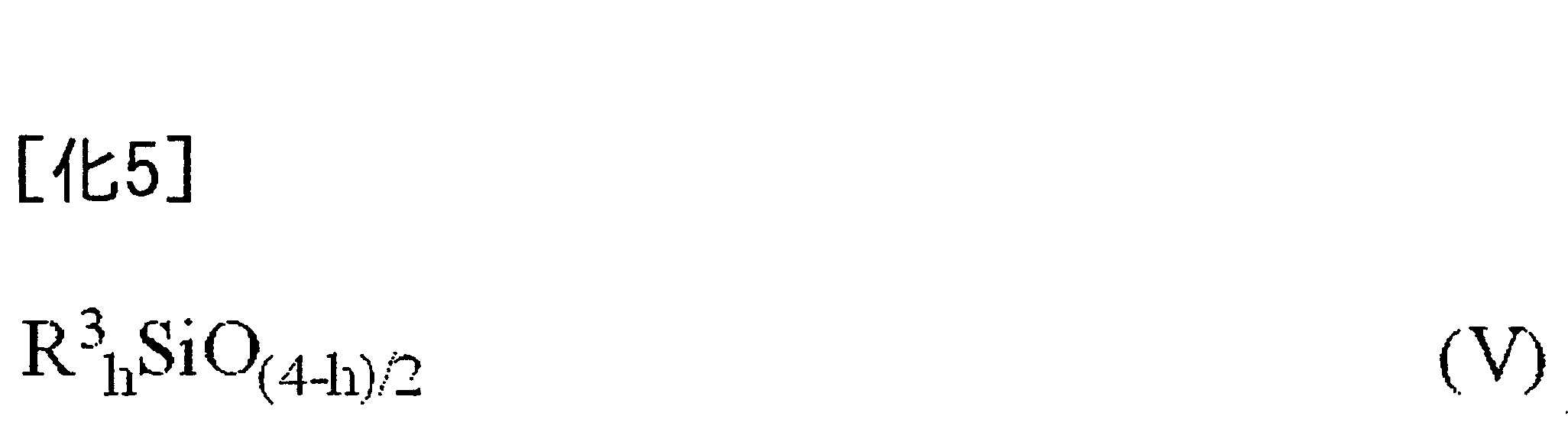
R3 表示之1價烴基,可列舉甲基、乙基、丙基、異丙基、丁基、異丁基、tert-丁基、戊基、新戊基、己基、環己基、辛基、壬基、癸基等之烷基;苯基、甲苯基、二甲苯基、萘基等之芳基;苄基、苯基乙基、苯基丙基等之芳烷基;乙烯基、烯丙基、丙烯基、異丙烯基、丁烯基、己烯基、環己烯基、辛烯基等之烯基,或此等基之氫原子的一部分或全部經氟、溴、氯等之鹵素原子、氰基等取代者,例如氯甲基、氯丙基、溴乙基、三氟丙基、氰基乙基等,較佳全部的R3 之90莫耳%以上為甲基,剩餘的為乙烯基。The monovalent hydrocarbon group represented by R 3 includes methyl, ethyl, propyl, isopropyl, butyl, isobutyl, tert-butyl, pentyl, neopentyl, hexyl, cyclohexyl, octyl, Alkyl groups such as nonyl and decyl; aryl groups such as phenyl, tolyl, xylyl and naphthyl; aralkyl groups such as benzyl, phenylethyl and phenylpropyl; vinyl and allyl Alkenyl groups such as alkyl, propenyl, isopropenyl, butenyl, hexenyl, cyclohexenyl, octenyl, etc., or a part or all of the hydrogen atoms of these groups are halogenated by fluorine, bromine, chlorine, etc. Atomic, cyano and other substitutions, such as chloromethyl, chloropropyl, bromoethyl, trifluoropropyl, cyanoethyl, etc., preferably more than 90 mole% of all R 3 is methyl, the remaining For vinyl.
R3 當中,可含有亦可不含有烯基(較佳為碳數2~8者、更佳為2~6、特佳為乙烯基),含有時,就低硬度化的觀點,該烯基之含量較佳為0.0026mol/g以下、特佳為0.0014mol/g以下。該烯基可鍵結於分子鏈末端之矽原子、可鍵結於分子鏈途中之矽原子、亦可鍵結於其兩方。R 3 may or may not contain alkenyl groups (preferably those having 2 to 8 carbon atoms, more preferably 2 to 6 and particularly preferably vinyl groups). The content is preferably 0.0026 mol/g or less, and particularly preferably 0.0014 mol/g or less. The alkenyl group may be bonded to the silicon atom at the end of the molecular chain, the silicon atom in the middle of the molecular chain, or both.
該有機聚矽氧烷之結構,基本上係具有分子鏈兩末端經三有機矽烷氧基封端,且主鏈為由二有機矽氧烷單位之重複所成的直鏈狀結構,但一部分亦可為分支狀之結構、環狀結構等。The structure of the organopolysiloxane basically has two molecular chain ends capped with triorganosiloxy groups, and the main chain is a linear structure formed by the repetition of diorganosilane units, but part of it is also It can be branched structure, ring structure, etc.
前述有機聚矽氧烷之平均聚合度係2,000以上(通常2,000~100,000左右),且於25℃為生橡膠狀(亦即,無自我流動性之非液狀)者,較佳為平均聚合度3,000以上(通常3,000~80,000左右)者。平均聚合度若為2,000以上,則適合作為黏度調整劑(高黏度化)。The average degree of polymerization of the aforementioned organic polysiloxane is above 2,000 (usually around 2,000 to 100,000), and it is raw rubber-like at 25°C (that is, non-liquid without self-fluidity), preferably the average degree of polymerization Those with more than 3,000 (usually around 3,000 to 80,000). If the average degree of polymerization is 2,000 or more, it is suitable as a viscosity modifier (increasing viscosity).
如此的(F)成分之有機聚矽氧烷,具體而言,就分子中不含有烯基者而言,可列舉分子鏈兩末端三有機矽烷氧基封端二有機聚矽氧烷生橡膠等,又,就分子中含有烯基者而言,可列舉分子鏈兩末端二有機烯基矽烷氧基封端二有機聚矽氧烷生橡膠、分子鏈兩末端有機二烯基矽烷氧基封端二有機聚矽氧烷生橡膠、分子鏈兩末端三烯基矽烷氧基封端二有機聚矽氧烷生橡膠、分子鏈兩末端三有機矽烷氧基封端二有機矽氧烷/有機烯基矽氧烷共聚物生橡膠、分子鏈兩末端二有機烯基矽烷氧基封端二有機矽氧烷/有機烯基矽氧烷共聚物生橡膠、分子鏈之單末端經二有機烯基矽烷氧基封端且另一方之單末端經三有機矽烷氧基封端之二有機矽氧烷/有機烯基矽氧烷共聚物生橡膠等,較佳為分子鏈兩末端三有機矽烷氧基封端二有機聚矽氧烷生橡膠、分子鏈兩末端二有機烯基矽烷氧基封端二有機聚矽氧烷生橡膠、分子鏈兩末端三有機矽烷氧基封端二有機矽氧烷/有機烯基矽氧烷共聚物生橡膠及/或分子鏈兩末端二有機烯基矽烷氧基封端二有機矽氧烷/有機烯基矽氧烷共聚物生橡膠。再者,上述各矽氧烷中之「有機基」,意指與式(V)中之R3 當中,烯基以外的非取代或取代之1價烴基相同者。 當(F)成分之有機聚矽氧烷具有烯基時,相對於含有該烯基之組成物中的全部烯基之合計莫耳數[合計烯基]而言,(C-1)成分與(C-2)成分之合計Si-H基的莫耳數[合計Si-H基]之莫耳比,較佳為[合計Si-H基]/[合計烯基]=1.0~3.0。Examples of the organic polysiloxane of the component (F) include, specifically, those containing no alkenyl groups in the molecule, examples of which include three organosilane-oxy-terminated diorganopolysiloxane raw rubbers at both ends of the molecular chain. In addition, as for molecules containing alkenyl groups, diorganoalkenylsiloxy end capped diorganopolysiloxanes at both ends of the molecular chain can be cited, and organodialkenylsiloxy end capped at both ends of the molecular chain. Diorganopolysiloxane raw rubber, molecular chain end trienylsiloxy end capped diorganopolysiloxane raw rubber, molecular chain end triorganosiloxy end capped diorganosiloxane/organic alkenyl Silicone copolymer raw rubber, diorganoalkenyl silane-oxy-terminated diorganosiloxane/organoalkenyl siloxane copolymer raw rubber at both ends of the molecular chain, one end of the molecular chain is diorganoalkenyl siloxane-oxygenated Two organosiloxane/organoalkenyl siloxane copolymer raw rubbers, which are end-capped and one end of the other end is capped with triorganosiloxy groups, preferably triorganosiloxy end-capped at both ends of the molecular chain Diorganopolysiloxane raw rubber, diorganoalkenylsiloxy end capped at both ends of the molecular chain Diorganopolysiloxane raw rubber, triorganosiloxane end capped diorganosiloxane/organic ene at both ends of the molecular chain Silicone copolymer raw rubber and/or diorganoalkenyl siloxane end capped diorganosiloxane/organoalkenyl siloxane copolymer raw rubber at both ends of the molecular chain. In addition, the "organic group" in each of the aforementioned siloxanes means the same as the unsubstituted or substituted monovalent hydrocarbon group other than the alkenyl group in R 3 in formula (V). When the organic polysiloxane of the component (F) has an alkenyl group, the component (C-1) is equivalent to the total number of moles [total alkenyl group] of all the alkenyl groups in the composition containing the alkenyl group (C-2) The molar number of the total Si-H groups of the components [the total Si-H groups], the molar ratio is preferably [total Si-H groups]/[total alkenyl groups]=1.0 to 3.0.
(F)成分雖為任意成分,但摻合時,相對於(A)成分100質量份而言,係1~200質量份、較佳為3~150質量份、更佳為5~120質量份。摻合量未達1質量份時,見不到添加的效果,超過200質量份時,可能會組成物之黏度高而成形困難。(F) Although the component is an arbitrary component, it is 1 to 200 parts by mass, preferably 3 to 150 parts by mass, and more preferably 5 to 120 parts by mass relative to 100 parts by mass of (A) component when blended. . When the blending amount is less than 1 part by mass, the effect of addition cannot be seen, and when it exceeds 200 parts by mass, the viscosity of the composition may be high and forming may be difficult.
其他成分 本發明之加成硬化性液狀聚矽氧橡膠組成物中,依需要任意摻合如沈降二氧化矽、石英粉、矽藻土、碳酸鈣之填充劑,或碳黑、導電性鋅華、金屬粉等之導電劑;含氮化合物或乙炔化合物、磷化合物、腈化合物、羧酸酯、錫化合物、水銀化合物、硫化合物等之矽氫化反應控制劑;如氧化鐵、氧化鈰之耐熱劑;二甲基聚矽氧油等之內部脫模劑;接著性賦予劑(特別是分子中含有由烯基、環氧基、胺基、(甲基)丙烯醯氧基、巰基等中選出的至少1種官能性基,並且分子中不含有Si-H基之烷氧基矽烷等之有機矽化合物等)、搖變性賦予劑等,作為其他成分。Other ingredients In the addition-hardening liquid silicone rubber composition of the present invention, fillers such as precipitated silica, quartz powder, diatomaceous earth, calcium carbonate, or carbon black, conductive zinc oxide, Conductive agents such as metal powders; hydrosilation reaction control agents for nitrogen-containing compounds or acetylene compounds, phosphorus compounds, nitrile compounds, carboxylic acid esters, tin compounds, mercury compounds, sulfur compounds, etc.; heat-resistant agents such as iron oxide and cerium oxide; Internal release agent such as dimethyl polysiloxane oil; Adhesion-imparting agent (especially the molecule contains at least one selected from alkenyl group, epoxy group, amine group, (meth)acryloyl oxy group, mercapto group, etc. One kind of functional group, and organic silicon compound such as alkoxysilane such as Si-H group which does not contain in the molecule), shake imparting agent, etc., as other components.
<加成硬化性液狀聚矽氧橡膠組成物之調製及成形等> 如此所得的(A)~(E)成分、較佳為(A)~(F)成分,可藉由依需要進一步添加其他任意成分並均勻混合,調製加成硬化性液狀聚矽氧橡膠組成物。 加成硬化性液狀聚矽氧橡膠組成物之成形、硬化方法,可採用常規方法,成形法適合採用液狀射出成形法。又,硬化條件可採用100~230℃3秒~30分鐘、較佳為110~210℃5秒~20分鐘、特別是120~200℃5秒~10分鐘左右的加熱處理條件。此時,可依需要,進行於80~230℃、特別是100~210℃10分鐘~24小時、特別是30分鐘~10小時的後硬化(二次硫化)。<Preparation and molding of addition-curable liquid silicone rubber composition> The components (A) to (E) thus obtained, preferably components (A) to (F), can be prepared by further adding other arbitrary components as needed and mixing them uniformly to prepare an addition-curable liquid silicone rubber composition . The method of forming and curing the addition-hardening liquid silicone rubber composition can be a conventional method, and the forming method is suitable for the liquid injection molding method. In addition, as the curing conditions, heat treatment conditions of 100 to 230° C. for 3 seconds to 30 minutes, preferably 110 to 210° C. for 5 seconds to 20 minutes, and particularly 120 to 200° C. for 5 seconds to 10 minutes can be used. At this time, post-hardening (secondary vulcanization) may be performed at 80 to 230°C, especially 100 to 210°C for 10 minutes to 24 hours, especially 30 minutes to 10 hours, as needed.
<聚矽氧橡膠成形體> 本發明之加成硬化性液狀聚矽氧橡膠組成物,為可獲得以120℃/10分鐘的加壓硬化,之後150℃/1小時的後硬化之條件硬化而得到的聚矽氧橡膠成形體(彈性體),為基於JIS K 6253-3:2012之硬度(橡膠硬度計A型)10~25左右的低硬度聚矽氧橡膠者,再者,較佳為,可獲得基於JIS K 6252:2007之撕裂強度(月牙形)為15kN/m以上、又更佳為18kN/m以上之雖為低硬度但高強度的聚矽氧橡膠者。 又,特別是厚度2mm之聚矽氧橡膠成形體,可滿足於基於接觸於食品或飲料物,意圖為反覆使用之橡膠製品相關的FDA規格(21CFR177.2600)之以n-己烷的萃取試驗中,最初之7小時的萃取量為175mg/inch2 以下,且追加2小時的萃取量為4mg/inch2 以下之規定。<Polysilicone rubber molded body> The addition-curable liquid silicone rubber composition of the present invention is hardened under the condition that a pressure curing at 120°C/10 minutes can be obtained, and then post-curing at 150°C/1 hour. The obtained silicone rubber molded body (elastomer) is a low-hardness silicone rubber based on JIS K 6253-3:2012 hardness (rubber durometer type A) of about 10 to 25, and more preferably In order to obtain a low-hardness but high-strength silicone rubber based on JIS K 6252:2007 with a tear strength (crescent) of 15 kN/m or more, and more preferably 18 kN/m or more. In addition, especially the silicone rubber molded body with a thickness of 2 mm can be satisfied with the n-hexane extraction test based on FDA specifications (21CFR177.2600) related to rubber products intended for repeated use in contact with food or beverages In the first 7 hours, the extraction amount is 175 mg/inch 2 or less, and the additional 2 hours extraction amount is 4 mg/inch 2 or less.
如此地,本發明之加成硬化性液狀聚矽氧橡膠組成物,為賦予硬化性優良,硬化後具有低硬度且高撕裂強度,對高脂肪食品等之食用油之溶出成分少的聚矽氧橡膠者,特別是於意圖為反覆使用之橡膠製品中,可適合使用作為奶瓶用奶嘴或食品容器、飲料容器等。 [實施例]In this way, the addition-curing liquid silicone rubber composition of the present invention has excellent curability, has low hardness and high tear strength after curing, and has little dissolution of edible oils such as high-fat foods. Silicone rubber, especially in rubber products intended for repeated use, can be suitably used as nipples for baby bottles, food containers, beverage containers, etc. [Example]
以下,藉由實施例與比較例以具體說明本發明,但本發明不限定於以下實施例。再者,下述例中,份表示質量份。又,平均聚合度表示數平均聚合度。Hereinafter, the present invention will be specifically described by Examples and Comparative Examples, but the present invention is not limited to the following Examples. In the following examples, parts represent parts by mass. In addition, the average degree of polymerization indicates the number-average degree of polymerization.
[實施例1] 將兩末端經二甲基乙烯基矽烷氧基封端之平均聚合度為750之二甲基聚矽氧烷(A-1)65份,與以BET法所得到之比表面積為300m2 /g之發煙二氧化矽(日本Aerosil 公司製、Aerosil 300)40份、六甲基二矽氮烷8份、1,3-二乙烯基-1,1,3,3-四甲基二矽氮烷(乙烯基量0.0116mol/g)0.1份、水2.0份((D))於25℃混合30分鐘後,昇溫至150℃,持續攪拌3小時,冷卻而得到聚矽氧橡膠基底。 對該聚矽氧橡膠基底105份,加入上述二甲基聚矽氧烷(A-1)33份、兩末端經三乙烯基矽烷氧基封端之平均聚合度為1,100之二甲基聚矽氧烷(B-1)20份、兩末端經二甲基乙烯基矽烷氧基封端之平均聚合度為8,000之二甲基聚矽氧烷生橡膠(F-1)30份,持續攪拌30分鐘後,進一步添加作為交聯劑的兩末端經二甲基氫矽烷氧基封端且側鏈平均具有2個Si-H基之甲基氫/二甲基聚矽氧烷(C-1-1)(平均聚合度40、Si-H基量0.0014mol/g)3.62份、兩末端經二甲基氫矽烷氧基封端且側鏈不含有Si-H基的二甲基聚矽氧烷(C-2-1)(平均聚合度20、Si-H基量0.0014mol/g)1.21份、作為反應控制劑的乙炔基環己醇0.075份,持續攪拌15分鐘,得到聚矽氧橡膠混合物。 再者,該混合物中,相對於混合物全體中之Si-H基之合計而言,(C-1-1)成分、(C-2-1)成分之Si-H基的摻合比係(C-1-1)成分75莫耳%、(C-2-1)成分25莫耳%,又,組成物中之總Si-H基量,與(A)成分、(B)成分、(D)成分及(F)成分之合計乙烯基量的莫耳比(Si-H基/乙烯基)為1.3。[Example 1] 65 parts of dimethylpolysiloxane (A-1) having an average degree of polymerization of 750 terminated with dimethylvinylsiloxy groups at both ends, and the specific surface area obtained by the BET method It is 300m 2 /g of fumed silica (made by Japan Aerosil Corporation, Aerosil 300) 40 parts, hexamethyldisilazane 8 parts, 1,3-divinyl-1,1,3,3-tetra After mixing 0.1 parts of methyldisilazane (vinyl content 0.0116mol/g) and 2.0 parts of water ((D)) at 25°C for 30 minutes, the temperature was raised to 150°C, stirring was continued for 3 hours, and cooled to obtain polysiloxane Rubber base. To 105 parts of this polysiloxane rubber base, 33 parts of the above-mentioned dimethylpolysiloxane (A-1) were added, and the average polymerization degree of both ends capped with trivinylsiloxy groups was 1,100. 20 parts of oxane (B-1), 30 parts of dimethylpolysiloxane raw rubber (F-1) with an average degree of polymerization of 8,000 capped by dimethylvinylsiloxy groups at both ends, and continuous stirring for 30 After a minute, further add methylhydrogen/dimethylpolysiloxane (C-1- 1) (Average degree of polymerization 40, Si-H group amount 0.0014mol/g) 3.62 parts, dimethyl polysiloxane with both ends capped with dimethylhydrosiloxy groups and no Si-H groups in the side chain (C-2-1) (average degree of polymerization 20, Si-H content 0.0014mol/g) 1.21 parts, 0.075 parts of ethynylcyclohexanol as a reaction control agent, and stirring was continued for 15 minutes to obtain a silicone rubber mixture . Furthermore, in this mixture, the blending ratio of the Si-H groups of the (C-1-1) component and the (C-2-1) component to the total of the Si-H groups in the entire mixture is ( C-1-1) component 75 mol%, (C-2-1) component 25 mol%, and the total Si-H content in the composition, and (A) component, (B) component, ( D) The molar ratio (Si-H group/vinyl group) of the total vinyl content of the component and (F) component was 1.3.
於該聚矽氧橡膠混合物中,混合鉑觸媒(Pt濃度1質量%)(E)0.05份,作為聚矽氧橡膠組成物。對於將該組成物進行120℃/10分鐘加壓硬化後,於烘箱內進行150℃/1小時的後硬化所得到之硬化物,基於JIS K 6253-3:2012,以橡膠硬度計A型測定硬度,及基於JIS K 6252:2007,以月牙形試驗片測定撕裂強度,及以指觸判定橡膠表面,結果示於表1;對於經上述條件硬化之2mm厚的硬化物,基於FDA規格(21CFR177.2600)以n-己烷進行萃取試驗,結果示於表2。To this silicone rubber mixture, 0.05 parts of platinum catalyst (Pt concentration 1% by mass) (E) was mixed as a silicone rubber composition. The cured product obtained by subjecting the composition to 120°C/10 minutes pressure hardening and post-curing at 150°C/1 hour in an oven is measured with a rubber durometer type A based on JIS K 6253-3:2012 Hardness, and based on JIS K 6252: 2007, the tear strength was measured by a crescent-shaped test piece, and the rubber surface was determined by finger touch. The results are shown in Table 1. For the 2 mm thick hardened product hardened by the above conditions, based on the FDA specification ( 21CFR177.2600) The extraction test was carried out with n-hexane. The results are shown in Table 2.
[實施例2] 將兩末端經二甲基乙烯基矽烷氧基封端之平均聚合度為750之二甲基聚矽氧烷(A-1)65份,與以BET法所得到之比表面積為300m2 /g之發煙二氧化矽(日本Aerosil 公司製、Aerosil 300)40份、六甲基二矽氮烷8份、1,3-二乙烯基-1,1,3,3-四甲基二矽氮烷(乙烯基量0.0116mol/g)0.1份、水2.0份((D))於25℃混合30分鐘後,昇溫至150℃,持續攪拌3小時,冷卻而得到聚矽氧橡膠基底。 對該聚矽氧橡膠基底105份,加入上述二甲基聚矽氧烷(A-1)43份、兩末端經三乙烯基矽烷氧基封端之平均聚合度為1,100之二甲基聚矽氧烷(B-1)10份、兩末端經二甲基乙烯基矽烷氧基封端之平均聚合度為8,000之二甲基聚矽氧烷生橡膠(F-1)30份,持續攪拌30分鐘後,進一步添加作為交聯劑的兩末端經二甲基氫矽烷氧基封端且側鏈平均具有2個Si-H基之甲基氫/二甲基聚矽氧烷(C-1-1)(平均聚合度40、Si-H基量0.0014mol/g)3.89份、兩末端經二甲基氫矽烷氧基封端且側鏈不含有Si-H基的二甲基聚矽氧烷(C-2-1)(平均聚合度20、Si-H基量0.0014mol/g)1.30份、作為反應控制劑的乙炔基環己醇0.075份,持續攪拌15分鐘,得到聚矽氧橡膠混合物。 再者,該混合物中,相對於混合物全體中之Si-H基之合計而言,(C-1-1)成分、(C-2-1)成分之Si-H基的摻合比係(C-1-1)成分75莫耳%、(C-2-1)成分25莫耳%,又,組成物中之總Si-H基量,與(A)成分、(B)成分、(D)成分及(F)成分之合計乙烯基量的莫耳比(Si-H基/乙烯基)係1.5。[Example 2] 65 parts of dimethylpolysiloxane (A-1) having an average degree of polymerization of 750 terminated with dimethylvinylsiloxy groups at both ends, and the specific surface area obtained by the BET method It is 300m 2 /g of fumed silica (made by Japan Aerosil Corporation, Aerosil 300) 40 parts, hexamethyldisilazane 8 parts, 1,3-divinyl-1,1,3,3-tetra After mixing 0.1 parts of methyldisilazane (vinyl content 0.0116mol/g) and 2.0 parts of water ((D)) at 25°C for 30 minutes, the temperature was raised to 150°C, stirring was continued for 3 hours, and cooled to obtain polysiloxane Rubber base. To 105 parts of the polysiloxane rubber base, 43 parts of the above-mentioned dimethylpolysiloxane (A-1) were added, and the average polymerization degree of both ends capped with trivinylsiloxy groups was 1,100. 10 parts of oxane (B-1), 30 parts of dimethylpolysiloxane raw rubber (F-1) with an average degree of polymerization of 8,000 capped by dimethylvinylsiloxy groups at both ends, continuously stirred for 30 After a minute, further add methylhydrogen/dimethylpolysiloxane (C-1- 1) (Average degree of polymerization 40, Si-H group amount 0.0014mol/g) 3.89 parts, dimethyl polysiloxane with both ends capped with dimethylhydrosiloxy groups and no Si-H groups in the side chain (C-2-1) (average degree of polymerization 20, Si-H group amount 0.0014mol/g) 1.30 parts, 0.075 parts of ethynylcyclohexanol as a reaction control agent, and stirring was continued for 15 minutes to obtain a polysiloxane rubber mixture . Furthermore, in this mixture, the blending ratio of the Si-H groups of the (C-1-1) component and the (C-2-1) component to the total of the Si-H groups in the entire mixture is ( C-1-1) component 75 mol%, (C-2-1) component 25 mol%, and the total Si-H content in the composition, and (A) component, (B) component, ( D) The molar ratio (Si-H group/vinyl group) of the total vinyl content of the component and (F) component is 1.5.
於該聚矽氧橡膠混合物中,混合鉑觸媒(Pt濃度1質量%)(E)0.05份,作為聚矽氧橡膠組成物。對於將該組成物進行120℃/10分鐘加壓硬化後,於烘箱內進行150℃/1小時的後硬化所得到之硬化物,基於JIS K 6253-3:2012,以橡膠硬度計A型測定硬度,及基於JIS K 6252:2007,以月牙形試驗片測定撕裂強度,及以指觸判定橡膠表面,結果示於表1;對於經上述條件硬化之2mm厚的硬化物,基於FDA規格(21CFR177.2600)以n-己烷進行萃取試驗,結果示於表2。To this silicone rubber mixture, 0.05 parts of platinum catalyst (Pt concentration 1% by mass) (E) was mixed as a silicone rubber composition. The cured product obtained by subjecting the composition to 120°C/10 minutes pressure hardening and post-curing at 150°C/1 hour in an oven is measured with a rubber durometer type A based on JIS K 6253-3:2012 Hardness, and based on JIS K 6252: 2007, the tear strength was measured by a crescent-shaped test piece, and the rubber surface was determined by finger touch. The results are shown in Table 1. For the 2 mm thick hardened product hardened by the above conditions, based on the FDA specification ( 21CFR177.2600) The extraction test was carried out with n-hexane. The results are shown in Table 2.
[實施例3] 將兩末端經二甲基乙烯基矽烷氧基封端之平均聚合度為750之二甲基聚矽氧烷(A-1)65份,與以BET法所得到之比表面積為300m2 /g之發煙二氧化矽(日本Aerosil公司製、Aerosil 300)40份、六甲基二矽氮烷8份、1,3-二乙烯基-1,1,3,3-四甲基二矽氮烷(乙烯基量0.0116mol/g)0.1份、水2.0份((D))於25℃混合30分鐘後,昇溫至150℃,持續攪拌3小時,冷卻而得到聚矽氧橡膠基底。 對該聚矽氧橡膠基底105份,加入上述二甲基聚矽氧烷(A-1)43份、兩末端經三乙烯基矽烷氧基封端之平均聚合度為400之二甲基聚矽氧烷(B-2)10份、兩末端經二甲基乙烯基矽烷氧基封端之平均聚合度為8,000之二甲基聚矽氧烷生橡膠(F-1)30份,持續攪拌30分鐘後,進一步添加作為交聯劑的兩末端經二甲基氫矽烷氧基封端且側鏈平均具有2個Si-H基之甲基氫/二甲基聚矽氧烷(C-1-1)(平均聚合度40、Si-H基量0.0014mol/g)3.97份、兩末端經二甲基氫矽烷氧基封端且側鏈不含有Si-H基的二甲基聚矽氧烷(C-2-1)(平均聚合度20、Si-H基量0.0014mol/g)1.70份、作為反應控制劑的乙炔基環己醇0.075份,持續攪拌15分鐘,得到聚矽氧橡膠混合物。 再者,該混合物中,相對於混合物全體中之Si-H基之合計而言,(C-1-1)成分、(C-2-1)成分之Si-H基的摻合比係(C-1-1)成分70莫耳%、(C-2-1)成分30莫耳%,又,組成物中之總Si-H基量,與(A)成分、(B)成分、(D)成分及(F)成分之合計乙烯基量的莫耳比(Si-H基/乙烯基)係1.3。[Example 3] 65 parts of dimethylpolysiloxane (A-1) with an average degree of polymerization of 750 capped with dimethylvinylsiloxy groups at both ends, and the specific surface area obtained by the BET method 300m 2 /g of fumed silica (made by Japan Aerosil Corporation, Aerosil 300) 40 parts, hexamethyldisilazane 8 parts, 1,3-divinyl-1,1,3,3-tetra After mixing 0.1 parts of methyldisilazane (vinyl content 0.0116mol/g) and 2.0 parts of water ((D)) at 25°C for 30 minutes, the temperature was raised to 150°C, stirring was continued for 3 hours, and cooled to obtain polysiloxane Rubber base. To 105 parts of the polysiloxane rubber base, 43 parts of the above-mentioned dimethylpolysiloxane (A-1) were added, and dimethylpolysiloxane with an average degree of polymerization of 400 capped with trivinylsiloxy groups at both ends was added 10 parts of oxane (B-2), 30 parts of dimethylpolysiloxane raw rubber (F-1) with an average degree of polymerization of 8,000 capped by dimethylvinylsiloxy groups at both ends, continued stirring for 30 After a minute, further add methylhydrogen/dimethylpolysiloxane (C-1- 1) (Average degree of polymerization 40, Si-H group amount 0.0014mol/g) 3.97 parts, dimethyl polysiloxane with both ends capped with dimethylhydrosiloxy groups and no Si-H groups in the side chain (C-2-1) (average degree of polymerization 20, Si-H group amount 0.0014mol/g) 1.70 parts, 0.075 parts of ethynyl cyclohexanol as a reaction control agent, and stirring was continued for 15 minutes to obtain a polysiloxane rubber mixture . Furthermore, in this mixture, the blending ratio of the (C-1-1) component and the (C-2-1) component Si-H group to the total Si-H group in the entire mixture is ( C-1-1) component 70 mol%, (C-2-1) component 30 mol%, and the total amount of Si-H in the composition, and (A) component, (B) component, ( D) The molar ratio (Si-H group/vinyl group) of the total vinyl content of the component and (F) component is 1.3.
於該聚矽氧橡膠混合物中,混合鉑觸媒(Pt濃度1質量%)(E)0.05份,作為聚矽氧橡膠組成物。對於將該組成物進行120℃/10分鐘加壓硬化後,於烘箱內進行150℃/1小時的後硬化所得到之硬化物,基於JIS K 6253-3:2012,以橡膠硬度計A型測定硬度,及基於JIS K 6252:2007,以月牙形試驗片測定撕裂強度,及以指觸判定橡膠表面,結果示於表1;對於經上述條件硬化之2mm厚的硬化物,基於FDA規格(21CFR177.2600)以n-己烷進行萃取試驗,結果示於表2。To this silicone rubber mixture, 0.05 parts of platinum catalyst (Pt concentration 1% by mass) (E) was mixed as a silicone rubber composition. The cured product obtained by subjecting the composition to 120°C/10 minutes pressure hardening and post-curing at 150°C/1 hour in an oven is measured with a rubber durometer type A based on JIS K 6253-3:2012 Hardness, and based on JIS K 6252: 2007, the tear strength was measured by a crescent-shaped test piece, and the rubber surface was determined by finger touch. The results are shown in Table 1. For the 2 mm thick hardened product hardened by the above conditions, based on the FDA specification ( 21CFR177.2600) The extraction test was carried out with n-hexane. The results are shown in Table 2.
[實施例4] 將兩末端經二甲基乙烯基矽烷氧基封端之平均聚合度為750之二甲基聚矽氧烷(A-1)65份,與以BET法所得到之比表面積為300m2 /g之發煙二氧化矽(日本Aerosil 公司製、Aerosil 300)40份、六甲基二矽氮烷8份、1,3-二乙烯基-1,1,3,3-四甲基二矽氮烷(乙烯基量0.0116mol/g)0.1份、水2.0份((D))於25℃混合30分鐘後,昇溫至150℃,持續攪拌3小時,冷卻而得到聚矽氧橡膠基底。 對該聚矽氧橡膠基底105份,加入上述二甲基聚矽氧烷(A-1)25份、兩末端經二甲基乙烯基矽烷氧基封端之平均聚合度為1,100之二甲基聚矽氧烷(A-2)40份、兩末端經三乙烯基矽烷氧基封端之平均聚合度為1,100之二甲基聚矽氧烷(B-1)10份,持續攪拌30分鐘後,進一步添加作為交聯劑的兩末端經二甲基氫矽烷氧基封端且側鏈平均具有2個Si-H基之甲基氫/二甲基聚矽氧烷(C-1-1)(平均聚合度40、Si-H基量0.0014mol/g)3.80份、兩末端經二甲基氫矽烷氧基封端且側鏈不含有Si-H基的二甲基聚矽氧烷(C-2-1)(平均聚合度20、Si-H基量0.0014mol/g)1.25份、作為反應控制劑的乙炔基環己醇0.075份,持續攪拌15分鐘,得到聚矽氧橡膠混合物。 再者,該混合物中,相對於混合物全體中之Si-H基之合計而言,(C-1-1)成分、(C-2-1)成分之Si-H基的摻合比係(C-1-1)成分75莫耳%、(C-2-1)成分25莫耳%,又,組成物中之總Si-H基量,與(A)成分、(B)成分及(D)成分之合計乙烯基量的莫耳比(Si-H基/乙烯基)係1.3。[Example 4] 65 parts of dimethylpolysiloxane (A-1) with an average degree of polymerization of 750 terminated with dimethylvinylsiloxy groups at both ends, and the specific surface area obtained by the BET method It is 300m 2 /g of fumed silica (made by Japan Aerosil Corporation, Aerosil 300) 40 parts, hexamethyldisilazane 8 parts, 1,3-divinyl-1,1,3,3-tetra After mixing 0.1 parts of methyldisilazane (vinyl content 0.0116mol/g) and 2.0 parts of water ((D)) at 25°C for 30 minutes, the temperature was raised to 150°C, stirring was continued for 3 hours, and cooled to obtain polysiloxane Rubber base. To 105 parts of the polysiloxane rubber base, 25 parts of the above-mentioned dimethylpolysiloxane (A-1) was added, and the average polymerization degree of both ends capped with dimethylvinylsiloxy groups was 1,100. 40 parts of polysiloxane (A-2), 10 parts of dimethyl polysiloxane (B-1) with an average degree of polymerization of 1,100 capped with trivinylsiloxy groups at both ends, after continuous stirring for 30 minutes , Further added as a cross-linking agent methyl hydrogen / dimethyl polysiloxane (C-1-1) whose both ends are capped with dimethylhydrosiloxy groups and have an average of 2 Si-H groups in the side chain (Average degree of polymerization 40, Si-H group amount 0.0014mol/g) 3.80 parts, dimethyl polysiloxane (C) which is capped at both ends with dimethylhydrosiloxy groups and does not contain Si-H groups in the side chain (C -2-1) (average degree of polymerization 20, Si-H group amount 0.0014 mol/g) 1.25 parts, 0.075 parts of ethynylcyclohexanol as a reaction control agent, and stirring was continued for 15 minutes to obtain a polysiloxane rubber mixture. Furthermore, in this mixture, the blending ratio of the Si-H groups of the (C-1-1) component and the (C-2-1) component to the total of the Si-H groups in the entire mixture is ( C-1-1) component 75 mol%, (C-2-1) component 25 mol%, and the total Si-H content in the composition, and (A) component, (B) component and ( D) The molar ratio (Si-H group/vinyl group) of the total vinyl content of the components is 1.3.
於該聚矽氧橡膠混合物中,混合鉑觸媒(Pt濃度1質量%)(E)0.05份,作為聚矽氧橡膠組成物。對於將該組成物進行120℃/10分鐘加壓硬化後,於烘箱內進行150℃/1小時的後硬化所得到之硬化物,基於JIS K 6253-3:2012,以橡膠硬度計A型測定硬度,及基於JIS K 6252:2007,以月牙形試驗片測定撕裂強度,及以指觸判定橡膠表面,結果示於表1;對於經上述條件硬化之2mm厚的硬化物,基於FDA規格(21CFR177.2600)以n-己烷進行萃取試驗,結果示於表2。To this silicone rubber mixture, 0.05 parts of platinum catalyst (Pt concentration 1% by mass) (E) was mixed as a silicone rubber composition. The cured product obtained by subjecting the composition to 120°C/10 minutes pressure hardening and post-curing at 150°C/1 hour in an oven is measured with a rubber durometer type A based on JIS K 6253-3:2012 Hardness, and based on JIS K 6252: 2007, the tear strength was measured by a crescent-shaped test piece, and the rubber surface was determined by finger touch. The results are shown in Table 1. For the 2 mm thick hardened product hardened by the above conditions, based on the FDA specification ( 21CFR177.2600) The extraction test was carried out with n-hexane. The results are shown in Table 2.
[比較例1] 將兩末端經二甲基乙烯基矽烷氧基封端之平均聚合度為750之二甲基聚矽氧烷(A-1)65份,與以BET法所得到之比表面積為300m2 /g之發煙二氧化矽(日本Aerosil 公司製、Aerosil 300)40份、六甲基二矽氮烷8份、1,3-二乙烯基-1,1,3,3-四甲基二矽氮烷(乙烯基量0.0116mol/g)0.1份、水2.0份((D))於25℃混合30分鐘後,昇溫至150℃,持續攪拌3小時,冷卻而得到聚矽氧橡膠基底。 對該聚矽氧橡膠基底105份,加入上述二甲基聚矽氧烷(A-1)53份、兩末端經二甲基乙烯基矽烷氧基封端之平均聚合度為8,000之二甲基聚矽氧烷生橡膠(F-1)30份,持續攪拌30分鐘後,進一步添加作為交聯劑的兩末端經二甲基氫矽烷氧基封端且側鏈平均具有2個Si-H基之甲基氫/二甲基聚矽氧烷(C-1-1)(平均聚合度40、Si-H基量0.0014mol/g) 2.96份、兩末端經二甲基氫矽烷氧基封端且側鏈不含有Si-H基的二甲基聚矽氧烷(C-2-1)(平均聚合度20、Si-H基量0.0014mol/g)0.99份、作為反應控制劑的乙炔基環己醇0.075份,持續攪拌15分鐘,得到聚矽氧橡膠混合物。 再者,該混合物中,相對於混合物全體中之Si-H基之合計而言,(C-1-1)成分、(C-2-1)成分之Si-H基的摻合比係(C-1-1)成分75莫耳%、(C-2-1)成分25莫耳%,又,組成物中之總Si-H基量,與(A)成分、(D)成分及(F)成分之乙烯基量的莫耳比(Si-H基/乙烯基)係1.3。[Comparative Example 1] 65 parts of dimethylpolysiloxane (A-1) having an average degree of polymerization of 750 capped with dimethylvinylsiloxy groups at both ends, and the specific surface area obtained by the BET method It is 300m 2 /g of fumed silica (made by Japan Aerosil Corporation, Aerosil 300) 40 parts, hexamethyldisilazane 8 parts, 1,3-divinyl-1,1,3,3-tetra After mixing 0.1 parts of methyldisilazane (vinyl content 0.0116mol/g) and 2.0 parts of water ((D)) at 25°C for 30 minutes, the temperature was raised to 150°C, stirring was continued for 3 hours, and cooled to obtain polysiloxane Rubber base. To 105 parts of the polysiloxane rubber base, 53 parts of the above-mentioned dimethylpolysiloxane (A-1) were added, and the average polymerization degree of both ends capped with dimethylvinylsiloxy groups was 8,000. 30 parts of polysiloxane raw rubber (F-1), after continuous stirring for 30 minutes, further added as a crosslinking agent, both ends are terminated with dimethylhydrosiloxyl groups and the side chain has an average of 2 Si-H groups Methylhydrogen/dimethylpolysiloxane (C-1-1) (average degree of polymerization 40, Si-H group content 0.0014mol/g) 2.96 parts, both ends are capped with dimethylhydrosiloxy And dimethyl polysiloxane (C-2-1) (Si-H group does not contain Si-H groups in the side chain (average degree of polymerization 20, Si-H group amount 0.0014mol/g) 0.99 parts, ethynyl group as reaction control agent 0.075 parts of cyclohexanol was continuously stirred for 15 minutes to obtain a silicone rubber mixture. Furthermore, in this mixture, the blending ratio of the Si-H groups of the (C-1-1) component and the (C-2-1) component to the total of the Si-H groups in the entire mixture is ( C-1-1) component 75 mol%, (C-2-1) component 25 mol%, and the total Si-H content in the composition, and (A) component, (D) component and ( F) The molar ratio of the vinyl content of the component (Si-H group/vinyl group) is 1.3.
於該聚矽氧橡膠混合物中,混合鉑觸媒(Pt濃度1質量%)(E)0.05份,作為聚矽氧橡膠組成物。對於將該組成物進行120℃/10分鐘加壓硬化後,於烘箱內進行150℃/1小時的後硬化所得到之硬化物,基於JIS K 6253-3:2012,以橡膠硬度計A型測定硬度,及基於JIS K 6252:2007,以月牙形試驗片測定撕裂強度,及以指觸判定橡膠表面,結果示於表1;對於經上述條件硬化之2mm厚的硬化物,基於FDA規格(21CFR177.2600)以n-己烷進行萃取試驗,結果示於表2。To this silicone rubber mixture, 0.05 parts of platinum catalyst (Pt concentration 1% by mass) (E) was mixed as a silicone rubber composition. The cured product obtained by subjecting the composition to 120°C/10 minutes pressure hardening and post-curing at 150°C/1 hour in an oven is measured with a rubber durometer type A based on JIS K 6253-3:2012 Hardness, and based on JIS K 6252: 2007, the tear strength was measured by a crescent-shaped test piece, and the rubber surface was determined by finger touch. The results are shown in Table 1. For the 2 mm thick hardened product hardened by the above conditions, based on the FDA specification ( 21CFR177.2600) The extraction test was carried out with n-hexane. The results are shown in Table 2.
[比較例2] 將兩末端經二甲基乙烯基矽烷氧基封端之平均聚合度為750之二甲基聚矽氧烷(A-1)65份,與以BET法所得到之比表面積為300m2 /g之發煙二氧化矽(日本Aerosil 公司製、Aerosil 300)40份、六甲基二矽氮烷8份、1,3-二乙烯基-1,1,3,3-四甲基二矽氮烷(乙烯基量0.0116mol/g)0.1份、水2.0份((D))於25℃混合30分鐘後,昇溫至150℃,持續攪拌3小時,冷卻而得到聚矽氧橡膠基底。 對該聚矽氧橡膠基底105份,加入上述二甲基聚矽氧烷(A-1)25份、兩末端經二甲基乙烯基矽烷氧基封端之平均聚合度為8,000之二甲基聚矽氧烷生橡膠(F-1)30份、兩末端經三甲基矽烷氧基封端之平均聚合度為60之二甲基聚矽氧烷(無烯基)30份,持續攪拌30分鐘後,進一步添加作為交聯劑的兩末端經三甲基矽烷氧基封端且側鏈平均具有12個Si-H基之甲基氫/二甲基聚矽氧烷(C-1-2)(平均聚合度25、Si-H基量0.0070mol/g)0.88份、作為反應控制劑的乙炔基環己醇0.05份,持續攪拌15分鐘,得到聚矽氧橡膠混合物。 再者,該混合物中,組成物中之總Si-H基量,與(A)成分、(D)成分及(F)成分之乙烯基量的莫耳比(Si-H基/乙烯基)係1.8。[Comparative Example 2] 65 parts of dimethylpolysiloxane (A-1) having an average degree of polymerization of 750 capped with dimethylvinylsiloxy groups at both ends, and the specific surface area obtained by the BET method It is 300m 2 /g of fumed silica (made by Japan Aerosil Corporation, Aerosil 300) 40 parts, hexamethyldisilazane 8 parts, 1,3-divinyl-1,1,3,3-tetra After mixing 0.1 parts of methyldisilazane (vinyl content 0.0116mol/g) and 2.0 parts of water ((D)) at 25°C for 30 minutes, the temperature was raised to 150°C, stirring was continued for 3 hours, and cooled to obtain polysiloxane Rubber base. To 105 parts of the polysiloxane rubber base, 25 parts of the above-mentioned dimethylpolysiloxane (A-1) was added, and the average polymerization degree of both ends capped with dimethylvinylsiloxy groups was 8,000. 30 parts of polysiloxane raw rubber (F-1), 30 parts of dimethyl polysiloxane (no alkenyl group) with an average degree of polymerization of both ends capped with trimethylsiloxy groups of 60, and continuous stirring for 30 After a minute, further add methylhydrogen/dimethylpolysiloxane (C-1-2) whose both ends are terminated with trimethylsiloxy groups and have an average of 12 Si-H groups in the side chain. ) (Average degree of polymerization 25, Si-H group amount 0.0070 mol/g) 0.88 parts, 0.05 part ethynylcyclohexanol as a reaction control agent, and stirring was continued for 15 minutes to obtain a polysiloxane rubber mixture. Furthermore, in this mixture, the molar ratio of the total amount of Si-H groups in the composition to the amount of vinyl groups of (A) component, (D) component and (F) component (Si-H group/vinyl group) Department 1.8.
於該聚矽氧橡膠混合物中,混合鉑觸媒(Pt濃度1質量%)(E)0.05份,作為聚矽氧橡膠組成物。對於將該組成物進行120℃/10分鐘加壓硬化後,於烘箱內進行150℃/1小時的後硬化所得到之硬化物,基於JIS K 6253-3:2012,以橡膠硬度計A型測定硬度,及基於JIS K 6252:2007,以月牙形試驗片測定撕裂強度,及以指觸判定橡膠表面,結果示於表1;對於經上述條件硬化之2mm厚的硬化物,基於FDA規格(21CFR177.2600)以n-己烷進行萃取試驗,結果示於表2。To this silicone rubber mixture, 0.05 parts of platinum catalyst (Pt concentration 1% by mass) (E) was mixed as a silicone rubber composition. The cured product obtained by subjecting the composition to 120°C/10 minutes pressure hardening and post-curing at 150°C/1 hour in an oven is measured with a rubber durometer type A based on JIS K 6253-3:2012 Hardness, and based on JIS K 6252: 2007, the tear strength was measured by a crescent-shaped test piece, and the rubber surface was determined by finger touch. The results are shown in Table 1. For the 2 mm thick hardened product hardened by the above conditions, based on the FDA specification ( 21CFR177.2600) The extraction test was carried out with n-hexane. The results are shown in Table 2.
[比較例3] 將兩末端經二甲基乙烯基矽烷氧基封端之平均聚合度為750之二甲基聚矽氧烷(A-1)65份,與以BET法所得到之比表面積為300m2 /g之發煙二氧化矽(日本Aerosil 公司製、Aerosil 300)40份、六甲基二矽氮烷8份、水2.0份於25℃混合30分鐘後,昇溫至150℃,持續攪拌3小時,冷卻而得到聚矽氧橡膠基底。 對該聚矽氧橡膠基底105份,加入上述二甲基聚矽氧烷(A-1)50份、兩末端經二甲基乙烯基矽烷氧基封端之平均聚合度為8,000之二甲基聚矽氧烷生橡膠(F-1)16份、兩末端經三甲基矽烷氧基封端之平均聚合度為8,000之二甲基聚矽氧烷生橡膠(F-2)16份,持續攪拌30分鐘後,進一步添加作為交聯劑的兩末端經三甲基矽烷氧基封端且側鏈平均具有12個Si-H基之甲基氫/二甲基聚矽氧烷(C-1-2)(平均聚合度25、Si-H基量0.0070mol/g)1.22份、作為反應控制劑的乙炔基環己醇0.05份,持續攪拌15分鐘,得到聚矽氧橡膠混合物。 再者,該混合物中,組成物中之總Si-H基量,與(A)成分及(F)成分之乙烯基量的莫耳比(Si-H基/乙烯基)係1.6。[Comparative Example 3] 65 parts of dimethylpolysiloxane (A-1) with an average degree of polymerization of 750 capped with dimethylvinylsiloxy groups at both ends, and the specific surface area obtained by the BET method It is 300m 2 /g of fumed silica (made by Japan Aerosil Corporation, Aerosil 300) 40 parts, hexamethyldisilazane 8 parts, water 2.0 parts mixed at 25℃ for 30 minutes, then heated to 150℃, continued Stir for 3 hours and cool to obtain a silicone rubber base. To 105 parts of the polysiloxane rubber base, 50 parts of the above-mentioned dimethylpolysiloxane (A-1) was added, and the average polymerization degree of both ends capped with dimethylvinylsiloxy groups was 8,000. 16 parts of polysiloxane raw rubber (F-1), 16 parts of dimethyl polysiloxane raw rubber (F-2) with an average degree of polymerization of 8,000 capped by trimethylsiloxy groups at both ends, continued After stirring for 30 minutes, a methyl hydrogen/dimethyl polysiloxane (C-1) with both ends terminated with trimethylsiloxy groups and having an average of 12 Si-H groups in the side chain was added as a crosslinking agent. -2) (average degree of polymerization 25, Si-H group amount 0.0070 mol/g) 1.22 parts, 0.05 parts of ethynylcyclohexanol as a reaction control agent, and stirring was continued for 15 minutes to obtain a silicone rubber mixture. In this mixture, the molar ratio of the total amount of Si-H groups in the composition to the amount of vinyl groups in the components (A) and (F) (Si-H group/vinyl group) is 1.6.
於該聚矽氧橡膠混合物中,混合鉑觸媒(Pt濃度1質量%)(E)0.05份,作為聚矽氧橡膠組成物。對於將該組成物進行120℃/10分鐘加壓硬化後,於烘箱內進行150℃/1小時的後硬化所得到之硬化物,基於JIS K 6253-3:2012,以橡膠硬度計A型測定硬度,及基於JIS K 6252:2007,以月牙形試驗片測定撕裂強度,及以指觸判定橡膠表面,結果示於表1;對於經上述條件硬化之2mm厚的硬化物,基於FDA規格(21CFR177.2600)以n-己烷進行萃取試驗,結果示於表2。To this silicone rubber mixture, 0.05 parts of platinum catalyst (Pt concentration 1% by mass) (E) was mixed as a silicone rubber composition. The cured product obtained by subjecting the composition to 120°C/10 minutes pressure hardening and post-curing at 150°C/1 hour in an oven is measured with a rubber durometer type A based on JIS K 6253-3:2012 Hardness, and based on JIS K 6252: 2007, the tear strength was measured by a crescent-shaped test piece, and the rubber surface was determined by finger touch. The results are shown in Table 1. For the 2 mm thick hardened product hardened by the above conditions, based on the FDA specification ( 21CFR177.2600) The extraction test was carried out with n-hexane. The results are shown in Table 2.
[比較例4] 將兩末端經二甲基乙烯基矽烷氧基封端之平均聚合度為750之二甲基聚矽氧烷(A-1)65份,與以BET法所得到之比表面積為300m2 /g之發煙二氧化矽(日本Aerosil 公司製、Aerosil 300)40份、六甲基二矽氮烷8份、1,3-二乙烯基-1,1,3,3-四甲基二矽氮烷(乙烯基量0.0116mol/g)0.1份、水2.0份((D))於25℃混合30分鐘後,昇溫至150℃,持續攪拌3小時,冷卻而得到聚矽氧橡膠基底。 對該聚矽氧橡膠基底105份,加入上述二甲基聚矽氧烷(A-1)33份、兩末端經三乙烯基矽烷氧基封端之平均聚合度為1,100之二甲基聚矽氧烷(B-1)20份、兩末端經二甲基乙烯基矽烷氧基封端之平均聚合度為8,000之二甲基聚矽氧烷生橡膠(F-1)30份,持續攪拌30分鐘後,進一步添加作為交聯劑的兩末端經二甲基氫矽烷氧基封端且側鏈平均具有2個Si-H基之甲基氫/二甲基聚矽氧烷(C-1-1)(平均聚合度40、Si-H基量0.0014mol/g)2.60份、兩末端經二甲基氫矽烷氧基封端且側鏈不含有Si-H基的二甲基聚矽氧烷(C-2-1)(平均聚合度20、Si-H基量0.0014mol/g)2.60份、作為反應控制劑的乙炔基環己醇0.075份,持續攪拌15分鐘,得到聚矽氧橡膠混合物。 再者,該混合物中,相對於混合物全體中之Si-H基之合計而言,(C-1-1)成分、(C-2-1)成分之Si-H基的摻合比係(C-1-1)成分50莫耳%、(C-2-1)成分50莫耳%,又,組成物中之總Si-H基量,與(A)成分、(B)成分、(D)成分及(F)成分之合計乙烯基量的莫耳比(Si-H基/乙烯基)係1.3。[Comparative Example 4] 65 parts of dimethylpolysiloxane (A-1) having an average degree of polymerization of 750 capped with dimethylvinylsiloxy groups at both ends, and the specific surface area obtained by the BET method It is 300m 2 /g of fumed silica (made by Japan Aerosil Corporation, Aerosil 300) 40 parts, hexamethyldisilazane 8 parts, 1,3-divinyl-1,1,3,3-tetra After mixing 0.1 parts of methyldisilazane (vinyl content 0.0116mol/g) and 2.0 parts of water ((D)) at 25°C for 30 minutes, the temperature was raised to 150°C, stirring was continued for 3 hours, and cooled to obtain polysiloxane Rubber base. To 105 parts of this polysiloxane rubber base, 33 parts of the above-mentioned dimethylpolysiloxane (A-1) were added, and the average polymerization degree of both ends capped with trivinylsiloxy groups was 1,100. 20 parts of oxane (B-1), 30 parts of dimethylpolysiloxane raw rubber (F-1) with an average degree of polymerization of 8,000 capped by dimethylvinylsiloxy groups at both ends, and continuous stirring for 30 After a minute, further add methylhydrogen/dimethylpolysiloxane (C-1- 1) (Average degree of polymerization 40, Si-H group amount 0.0014mol/g) 2.60 parts, dimethyl polysiloxane with both ends capped with dimethylhydrosiloxy groups and no Si-H groups in the side chain (C-2-1) (average degree of polymerization 20, Si-H group amount 0.0014mol/g) 2.60 parts, 0.075 parts of ethynylcyclohexanol as a reaction control agent, and stirring was continued for 15 minutes to obtain a silicone rubber mixture . Furthermore, in this mixture, the blending ratio of the Si-H groups of the (C-1-1) component and the (C-2-1) component to the total of the Si-H groups in the entire mixture is ( C-1-1) component 50 mol%, (C-2-1) component 50 mol%, and the total amount of Si-H in the composition, and (A) component, (B) component, ( D) The molar ratio (Si-H group/vinyl group) of the total vinyl content of the component and (F) component is 1.3.
於該聚矽氧橡膠混合物中,混合鉑觸媒(Pt濃度1質量%)(E)0.05份,作為聚矽氧橡膠組成物。對於將該組成物進行120℃/10分鐘加壓硬化後,於烘箱內進行150℃/1小時的後硬化所得到之硬化物,基於JIS K 6253-3:2012,以橡膠硬度計A型測定硬度,及基於JIS K 6252:2007,以月牙形試驗片測定撕裂強度,及以指觸判定橡膠表面,結果示於表1;對於經上述條件硬化之2mm厚的硬化物,基於FDA規格(21CFR177.2600)以n-己烷進行萃取試驗,結果示於表2。To this silicone rubber mixture, 0.05 parts of platinum catalyst (Pt concentration 1% by mass) (E) was mixed as a silicone rubber composition. The cured product obtained by subjecting the composition to 120°C/10 minutes pressure hardening and post-curing at 150°C/1 hour in an oven is measured with a rubber durometer type A based on JIS K 6253-3:2012 Hardness, and based on JIS K 6252: 2007, the tear strength was measured by a crescent-shaped test piece, and the rubber surface was determined by finger touch. The results are shown in Table 1. For the 2 mm thick hardened product hardened by the above conditions, based on the FDA specification ( 21CFR177.2600) The extraction test was carried out with n-hexane. The results are shown in Table 2.
[比較例5] 將兩末端經二甲基乙烯基矽烷氧基封端之平均聚合度為1,800之二甲基聚矽氧烷65份,與以BET法所得到之比表面積為300m2 /g之發煙二氧化矽(日本Aerosil 公司製、Aerosil 300)40份、六甲基二矽氮烷8份、1,3-二乙烯基-1,1,3,3-四甲基二矽氮烷(乙烯基量0.0116mol/g)0.1份、水2.0份((D))於25℃混合30分鐘後,昇溫至150℃,持續攪拌3小時,冷卻而得到聚矽氧橡膠基底。但是,該聚矽氧橡膠基底黏度非常高,操作困難,因此中止其後的探討。[Comparative Example 5] 65 parts of dimethylpolysiloxane with an average degree of polymerization of 1,800 ends capped with dimethylvinylsiloxy groups, and a specific surface area obtained by the BET method of 300 m 2 /g Fuming silica (made by Japan Aerosil Corporation, Aerosil 300) 40 parts, hexamethyldisilazane 8 parts, 1,3-divinyl-1,1,3,3-tetramethyldisilazane 0.1 parts of alkane (vinyl content 0.0116 mol/g) and 2.0 parts of water ((D)) were mixed at 25°C for 30 minutes, then the temperature was raised to 150°C, stirring was continued for 3 hours, and cooled to obtain a polysiloxane rubber base. However, the viscosity of the silicone rubber base is very high and the operation is difficult, so the subsequent discussion is discontinued.
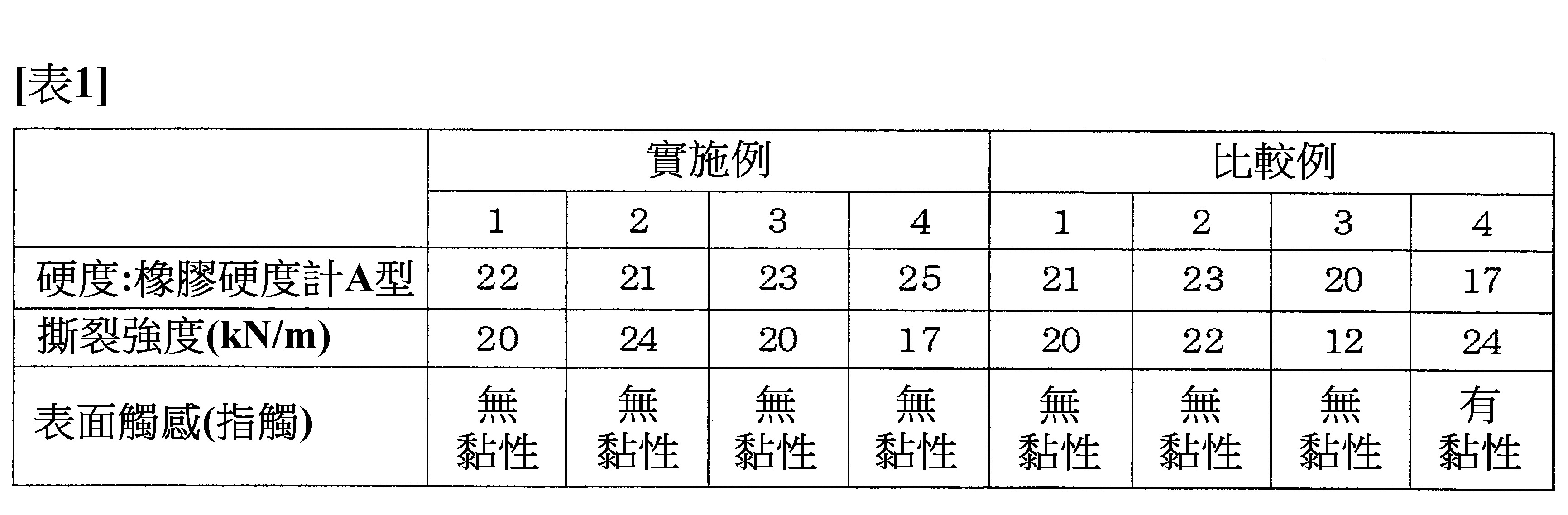
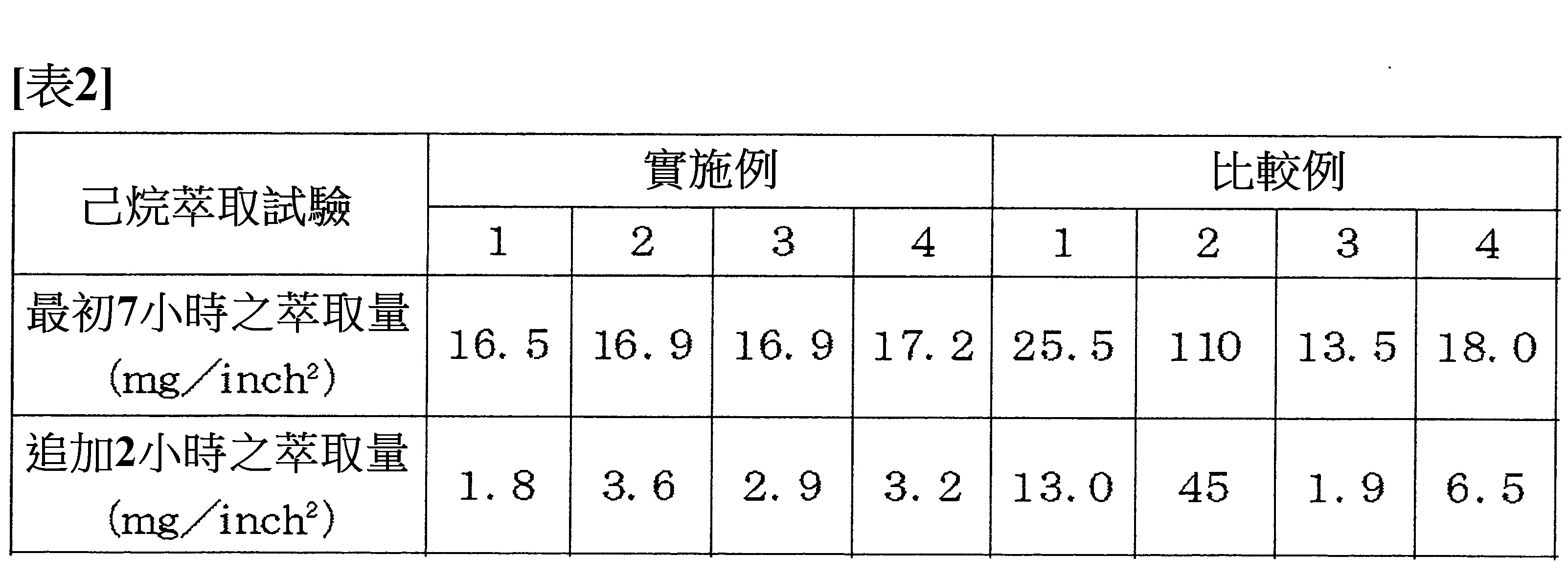
Claims (7)
Applications Claiming Priority (2)
| Application Number | Priority Date | Filing Date | Title |
|---|---|---|---|
| JP2018-099376 | 2018-05-24 | ||
| JP2018099376 | 2018-05-24 |
Publications (2)
| Publication Number | Publication Date |
|---|---|
| TW202000793A true TW202000793A (en) | 2020-01-01 |
| TWI798423B TWI798423B (en) | 2023-04-11 |
Family
ID=68615755
Family Applications (1)
| Application Number | Title | Priority Date | Filing Date |
|---|---|---|---|
| TW108113948A TWI798423B (en) | 2018-05-24 | 2019-04-22 | Addition curable liquid polysiloxane rubber composition and polysiloxane rubber molding |
Country Status (7)
| Country | Link |
|---|---|
| US (1) | US11866583B2 (en) |
| EP (1) | EP3808815B1 (en) |
| JP (1) | JP6977881B2 (en) |
| KR (1) | KR102819646B1 (en) |
| CN (1) | CN112154187B (en) |
| TW (1) | TWI798423B (en) |
| WO (1) | WO2019225178A1 (en) |
Families Citing this family (3)
| Publication number | Priority date | Publication date | Assignee | Title |
|---|---|---|---|---|
| JP2022085603A (en) * | 2020-11-27 | 2022-06-08 | 信越化学工業株式会社 | Millable-type silicone rubber composition, and silicone rubber cured product |
| JP7456964B2 (en) | 2021-03-26 | 2024-03-27 | 信越化学工業株式会社 | composite film |
| JP7609108B2 (en) * | 2022-03-25 | 2025-01-07 | 信越化学工業株式会社 | Addition-curable liquid silicone rubber composition and silicone rubber molded body |
Family Cites Families (15)
| Publication number | Priority date | Publication date | Assignee | Title |
|---|---|---|---|---|
| JPS6433156A (en) * | 1987-07-29 | 1989-02-03 | Shinetsu Chemical Co | Silicone composition for mold release |
| JP3663324B2 (en) * | 1998-11-30 | 2005-06-22 | 信越化学工業株式会社 | Addition-curing silicone rubber composition |
| JP3718123B2 (en) | 2000-12-18 | 2005-11-16 | 信越化学工業株式会社 | Organopolysiloxane composition for molding |
| JP3865638B2 (en) * | 2002-01-23 | 2007-01-10 | 信越化学工業株式会社 | Organopolysiloxane gel composition |
| JP4006581B2 (en) * | 2002-05-01 | 2007-11-14 | 信越化学工業株式会社 | Addition-curable silicone rubber composition and cured product thereof |
| JP4872296B2 (en) | 2005-09-30 | 2012-02-08 | 日亜化学工業株式会社 | Silicone rubber-sealed light emitting device and method for manufacturing the light emitting device |
| JP5257297B2 (en) * | 2009-08-27 | 2013-08-07 | 信越化学工業株式会社 | Addition-curing silicone rubber composition |
| JP2013064090A (en) * | 2011-09-20 | 2013-04-11 | Shin-Etsu Chemical Co Ltd | Addition-curable silicone rubber composition and cured product thereof |
| JP2013064089A (en) * | 2011-09-20 | 2013-04-11 | Shin-Etsu Chemical Co Ltd | Addition-curable silicone rubber composition and cured product thereof |
| JP5837474B2 (en) * | 2012-10-18 | 2015-12-24 | 信越化学工業株式会社 | Manufacturing method of solar cell module |
| JP5811117B2 (en) * | 2013-03-05 | 2015-11-11 | 信越化学工業株式会社 | Method for curing curable silicone composition |
| WO2015178140A1 (en) * | 2014-05-19 | 2015-11-26 | 信越化学工業株式会社 | Addition-curable liquid silicone rubber composition |
| WO2017104811A1 (en) * | 2015-12-17 | 2017-06-22 | モメンティブ・パフォーマンス・マテリアルズ・ジャパン合同会社 | Silicone rubber composition, production method therefor, and silicone rubber extrudate |
| JP6555196B2 (en) | 2016-06-17 | 2019-08-07 | 信越化学工業株式会社 | Addition-curable liquid silicone rubber composition |
| JP6874333B2 (en) * | 2016-11-08 | 2021-05-19 | 信越化学工業株式会社 | Curable Silicone Gel Composition, Silicone Gel Cured Product, and Methods for Protecting Electrical and Electronic Components |
-
2019
- 2019-04-08 US US17/053,884 patent/US11866583B2/en active Active
- 2019-04-08 EP EP19808247.1A patent/EP3808815B1/en active Active
- 2019-04-08 KR KR1020207036258A patent/KR102819646B1/en active Active
- 2019-04-08 CN CN201980033760.3A patent/CN112154187B/en active Active
- 2019-04-08 JP JP2020521077A patent/JP6977881B2/en active Active
- 2019-04-08 WO PCT/JP2019/015238 patent/WO2019225178A1/en not_active Ceased
- 2019-04-22 TW TW108113948A patent/TWI798423B/en active
Also Published As
| Publication number | Publication date |
|---|---|
| EP3808815A1 (en) | 2021-04-21 |
| JP6977881B2 (en) | 2021-12-08 |
| TWI798423B (en) | 2023-04-11 |
| US20210292556A1 (en) | 2021-09-23 |
| EP3808815B1 (en) | 2023-03-08 |
| WO2019225178A1 (en) | 2019-11-28 |
| KR20210013099A (en) | 2021-02-03 |
| JPWO2019225178A1 (en) | 2021-05-27 |
| US11866583B2 (en) | 2024-01-09 |
| CN112154187A (en) | 2020-12-29 |
| CN112154187B (en) | 2022-12-09 |
| EP3808815A4 (en) | 2022-05-11 |
| KR102819646B1 (en) | 2025-06-12 |
Similar Documents
| Publication | Publication Date | Title |
|---|---|---|
| TWI706008B (en) | Addition hardening liquid silicone rubber composition | |
| KR101979390B1 (en) | Addition-curable liquid silicone rubber composition | |
| JP5983566B2 (en) | Addition-curable liquid silicone rubber composition and cured silicone rubber | |
| TWI713535B (en) | Addition hardening silicone rubber composition and hardening | |
| JP2013064090A (en) | Addition-curable silicone rubber composition and cured product thereof | |
| JP2018519380A (en) | High strength silicone elastomer and composition therefor | |
| JP2013064089A (en) | Addition-curable silicone rubber composition and cured product thereof | |
| CN108368345A (en) | Addition curable silicone rubber compound and silicon rubber | |
| JP7371717B2 (en) | Addition-curable liquid silicone rubber composition | |
| TWI798423B (en) | Addition curable liquid polysiloxane rubber composition and polysiloxane rubber molding | |
| JP2016145301A (en) | Addition reaction curable liquid silicone rubber composition | |
| JP5553076B2 (en) | Silicone rubber composition | |
| JP6465194B2 (en) | Method for improving storage stability of addition curable liquid silicone rubber composition | |
| JP7609108B2 (en) | Addition-curable liquid silicone rubber composition and silicone rubber molded body |