TW202000943A - Free-cutting S-containing martensitic stainless steel - Google Patents
Free-cutting S-containing martensitic stainless steel Download PDFInfo
- Publication number
- TW202000943A TW202000943A TW108120444A TW108120444A TW202000943A TW 202000943 A TW202000943 A TW 202000943A TW 108120444 A TW108120444 A TW 108120444A TW 108120444 A TW108120444 A TW 108120444A TW 202000943 A TW202000943 A TW 202000943A
- Authority
- TW
- Taiwan
- Prior art keywords
- inclusions
- less
- content
- cutting
- rem
- Prior art date
Links
Classifications
-
- C—CHEMISTRY; METALLURGY
- C22—METALLURGY; FERROUS OR NON-FERROUS ALLOYS; TREATMENT OF ALLOYS OR NON-FERROUS METALS
- C22C—ALLOYS
- C22C38/00—Ferrous alloys, e.g. steel alloys
-
- C—CHEMISTRY; METALLURGY
- C22—METALLURGY; FERROUS OR NON-FERROUS ALLOYS; TREATMENT OF ALLOYS OR NON-FERROUS METALS
- C22C—ALLOYS
- C22C38/00—Ferrous alloys, e.g. steel alloys
- C22C38/18—Ferrous alloys, e.g. steel alloys containing chromium
- C22C38/40—Ferrous alloys, e.g. steel alloys containing chromium with nickel
- C22C38/42—Ferrous alloys, e.g. steel alloys containing chromium with nickel with copper
-
- C—CHEMISTRY; METALLURGY
- C22—METALLURGY; FERROUS OR NON-FERROUS ALLOYS; TREATMENT OF ALLOYS OR NON-FERROUS METALS
- C22C—ALLOYS
- C22C38/00—Ferrous alloys, e.g. steel alloys
- C22C38/18—Ferrous alloys, e.g. steel alloys containing chromium
- C22C38/40—Ferrous alloys, e.g. steel alloys containing chromium with nickel
- C22C38/44—Ferrous alloys, e.g. steel alloys containing chromium with nickel with molybdenum or tungsten
-
- C—CHEMISTRY; METALLURGY
- C22—METALLURGY; FERROUS OR NON-FERROUS ALLOYS; TREATMENT OF ALLOYS OR NON-FERROUS METALS
- C22C—ALLOYS
- C22C38/00—Ferrous alloys, e.g. steel alloys
- C22C38/18—Ferrous alloys, e.g. steel alloys containing chromium
- C22C38/40—Ferrous alloys, e.g. steel alloys containing chromium with nickel
- C22C38/46—Ferrous alloys, e.g. steel alloys containing chromium with nickel with vanadium
-
- C—CHEMISTRY; METALLURGY
- C22—METALLURGY; FERROUS OR NON-FERROUS ALLOYS; TREATMENT OF ALLOYS OR NON-FERROUS METALS
- C22C—ALLOYS
- C22C38/00—Ferrous alloys, e.g. steel alloys
- C22C38/18—Ferrous alloys, e.g. steel alloys containing chromium
- C22C38/40—Ferrous alloys, e.g. steel alloys containing chromium with nickel
- C22C38/48—Ferrous alloys, e.g. steel alloys containing chromium with nickel with niobium or tantalum
-
- C—CHEMISTRY; METALLURGY
- C22—METALLURGY; FERROUS OR NON-FERROUS ALLOYS; TREATMENT OF ALLOYS OR NON-FERROUS METALS
- C22C—ALLOYS
- C22C38/00—Ferrous alloys, e.g. steel alloys
- C22C38/18—Ferrous alloys, e.g. steel alloys containing chromium
- C22C38/40—Ferrous alloys, e.g. steel alloys containing chromium with nickel
- C22C38/50—Ferrous alloys, e.g. steel alloys containing chromium with nickel with titanium or zirconium
-
- C—CHEMISTRY; METALLURGY
- C22—METALLURGY; FERROUS OR NON-FERROUS ALLOYS; TREATMENT OF ALLOYS OR NON-FERROUS METALS
- C22C—ALLOYS
- C22C38/00—Ferrous alloys, e.g. steel alloys
- C22C38/18—Ferrous alloys, e.g. steel alloys containing chromium
- C22C38/40—Ferrous alloys, e.g. steel alloys containing chromium with nickel
- C22C38/52—Ferrous alloys, e.g. steel alloys containing chromium with nickel with cobalt
-
- C—CHEMISTRY; METALLURGY
- C22—METALLURGY; FERROUS OR NON-FERROUS ALLOYS; TREATMENT OF ALLOYS OR NON-FERROUS METALS
- C22C—ALLOYS
- C22C38/00—Ferrous alloys, e.g. steel alloys
- C22C38/18—Ferrous alloys, e.g. steel alloys containing chromium
- C22C38/40—Ferrous alloys, e.g. steel alloys containing chromium with nickel
- C22C38/54—Ferrous alloys, e.g. steel alloys containing chromium with nickel with boron
-
- C—CHEMISTRY; METALLURGY
- C22—METALLURGY; FERROUS OR NON-FERROUS ALLOYS; TREATMENT OF ALLOYS OR NON-FERROUS METALS
- C22C—ALLOYS
- C22C38/00—Ferrous alloys, e.g. steel alloys
- C22C38/60—Ferrous alloys, e.g. steel alloys containing lead, selenium, tellurium, or antimony, or more than 0.04% by weight of sulfur
-
- C—CHEMISTRY; METALLURGY
- C21—METALLURGY OF IRON
- C21C—PROCESSING OF PIG-IRON, e.g. REFINING, MANUFACTURE OF WROUGHT-IRON OR STEEL; TREATMENT IN MOLTEN STATE OF FERROUS ALLOYS
- C21C7/00—Treating molten ferrous alloys, e.g. steel, not covered by groups C21C1/00 - C21C5/00
-
- C—CHEMISTRY; METALLURGY
- C21—METALLURGY OF IRON
- C21D—MODIFYING THE PHYSICAL STRUCTURE OF FERROUS METALS; GENERAL DEVICES FOR HEAT TREATMENT OF FERROUS OR NON-FERROUS METALS OR ALLOYS; MAKING METAL MALLEABLE, e.g. BY DECARBURISATION OR TEMPERING
- C21D2211/00—Microstructure comprising significant phases
- C21D2211/008—Martensite
-
- C—CHEMISTRY; METALLURGY
- C21—METALLURGY OF IRON
- C21D—MODIFYING THE PHYSICAL STRUCTURE OF FERROUS METALS; GENERAL DEVICES FOR HEAT TREATMENT OF FERROUS OR NON-FERROUS METALS OR ALLOYS; MAKING METAL MALLEABLE, e.g. BY DECARBURISATION OR TEMPERING
- C21D8/00—Modifying the physical properties of ferrous metals or ferrous alloys by deformation combined with, or followed by, heat treatment
- C21D8/06—Modifying the physical properties of ferrous metals or ferrous alloys by deformation combined with, or followed by, heat treatment during manufacturing of rods or wires
Landscapes
- Chemical & Material Sciences (AREA)
- Engineering & Computer Science (AREA)
- Materials Engineering (AREA)
- Metallurgy (AREA)
- Organic Chemistry (AREA)
- Mechanical Engineering (AREA)
- Manufacturing & Machinery (AREA)
- Physics & Mathematics (AREA)
- Thermal Sciences (AREA)
- Crystallography & Structural Chemistry (AREA)
- Heat Treatment Of Steel (AREA)
- Treatment Of Steel In Its Molten State (AREA)
Abstract
Description
發明領域 本發明是有關一種麻田散鐵系S快削不鏽鋼(麻田散鐵系含S快削不鏽鋼)。 本案係依據已於2018年6月13日於日本提申之日本特願2018-112652號主張優先權,並於此援引其內容。Field of invention The invention relates to a Matian loose iron system S-cutting stainless steel (Matian loose iron system S-cutting stainless steel). This case claims priority based on Japanese Patent Application No. 2018-112652, which was filed in Japan on June 13, 2018, and the contents are cited here.
發明背景 在OA設備、電子設備等的零件之中,對於透過切削來製造的精密零件,除了要求切削時的切屑處理性之外,亦要求切削加工面有高尺寸精度及良好的表面性狀。可因應該等要求的素材有:含有0.15%以上之S的SUS420F、或為了更進一步提升切削性而單獨或複合含有Pb、Se、Te的麻田散鐵系快削不鏽鋼(專利文獻1~3)。Background of the invention Among parts such as OA equipment and electronic equipment, precision parts manufactured by cutting not only require chip handling during cutting, but also require high dimensional accuracy and good surface properties of the cutting surface. The materials that can be requested are: SUS420F containing 0.15% or more of S, or Ma Tian loose iron series free-cutting stainless steel containing Pb, Se, Te alone or in combination to further improve machinability (Patent Documents 1 to 3) .
另一方面,針對停止添加Pb的市場要求,已提案出一種麻田散鐵系快削不鏽鋼,其含有Bi或Sn,並且分散有Cu為主體的第二相(專利文獻4、5)。On the other hand, in response to the market demand for stopping the addition of Pb, a field-hard bulk iron-based free-cutting stainless steel that contains Bi or Sn and has a second phase mainly composed of Cu dispersed (Patent Documents 4 and 5) has been proposed.
然而,利用專利文獻1~5所記載之發明,無法製得可滿足製造性及切削後之表面性狀之物。尤其對於上述精密零件係要求:在切削速度≧20m/分鐘、吃刀量≧0.05mm、進給量≧0.005mm/rev之工業化切削條件下,具有表面粗度Ra≦0.50μm之精度與優異耐工具磨耗性。However, with the inventions described in Patent Documents 1 to 5, it is impossible to produce products that can satisfy manufacturability and surface properties after cutting. Especially for the above precision parts system requirements: under the industrial cutting conditions of cutting speed ≧20m/min, cutting amount ≧0.05mm, feed rate ≧0.005mm/rev, it has the accuracy and excellent resistance of surface roughness Ra≦0.50μm Tool wearability.
先前技術文獻 專利文獻 專利文獻1:日本特公平7-56064號公報 專利文獻2:日本特開2001-152298號公報 專利文獻3:日本專利特許第5135918號公報 專利文獻4:日本專利特許第6194696號公報 專利文獻5:日本專利特許第4502519號公報Prior technical literature Patent Literature Patent Document 1: Japanese Patent Publication No. 7-56064 Patent Document 2: Japanese Patent Laid-Open No. 2001-152298 Patent Document 3: Japanese Patent No. 5135918 Patent Document 4: Japanese Patent Publication No. 6194696 Patent Document 5: Japanese Patent Publication No. 4502519
發明概要 發明欲解決之課題 本發明係有鑑於上述情事而成者,課題在於提供一種麻田散鐵系S快削不鏽鋼,其在精密零件的工業化切削加工條件下,可獲得表面粗度(Ra):0.50μm以下的優異表面精度,耐工具磨耗性及製造性亦優異,且不含Pb。Summary of the invention Problems to be solved by invention The present invention was made in view of the above circumstances, and the object is to provide a Matian bulk iron S-cutting stainless steel, which can obtain an excellent surface roughness (Ra): 0.50 μm or less under the industrial cutting processing conditions of precision parts The precision, tool wear resistance and manufacturability are also excellent, and it does not contain Pb.
用以解決課題之手段 在本發明一態樣中瞭解到:藉著控制微量成分可期控制夾雜物之組成,並且藉由使MnS均勻分散化,可改善可切削性,而尤其可改善切削後之表面粗度。詳細知識見解如下述。Means to solve the problem In one aspect of the present invention, it is understood that by controlling trace components, the composition of inclusions can be controlled, and by uniformly dispersing MnS, machinability can be improved, and in particular, surface roughness after cutting can be improved. Detailed knowledge and insights are as follows.
欲改善表面粗度,使切削中形成於工具之刀鋒的刃口積屑緣(built-up edge)較小為有效方法。若產生刃口積屑緣,則切削時會產生與工具的切刀輪廓不同的凹凸,因此表面粗度劣化。在本發明一態樣中,係透過使鋼中之夾雜物的長寬比變小,以抑制形成刃口積屑緣。In order to improve the surface roughness, it is effective to make the built-up edge of the cutting edge of the tool smaller during cutting. If a chip edge is generated on the cutting edge, irregularities that are different from the cutter contour of the tool will occur during cutting, so the surface roughness will deteriorate. In one aspect of the present invention, the aspect ratio of the inclusions in the steel is reduced to suppress the formation of cutting edge.
首先,在鑄造階段係控制微量成分,以生成粒狀之硫化物系夾雜物(偏晶型)。本發明一態樣中,硫化物系夾雜物是(Mn, Cr)(S, O)系夾雜物或(Mn, Cr, Ca, REM)(S, O, Te)系夾雜物,並且其特徵為:使微量元素固溶於硫化物系夾雜物,來提高夾雜物之變形阻力,且長寬比變小。另外,一般在鑄造階段會生成棒狀之硫化物(共晶型),惟此種夾雜物的長寬比大且形態不均一,因此會造成表面粗度劣化。First, the trace components are controlled in the casting stage to produce granular sulfide-based inclusions (sinite type). In one aspect of the present invention, the sulfide-based inclusions are (Mn, Cr) (S, O)-based inclusions or (Mn, Cr, Ca, REM) (S, O, Te)-based inclusions, and their characteristics It is to make the trace elements solid dissolve in the sulfide inclusions to improve the deformation resistance of the inclusions, and the aspect ratio becomes smaller. In addition, generally, rod-shaped sulfides (eutectic forms) are generated in the casting stage, but such inclusions have a large aspect ratio and a non-uniform morphology, thus causing deterioration in surface roughness.
本發明之一態樣係基於上述知識見解而成者,其要旨如以下所述。 [1]一種麻田散鐵系S快削不鏽鋼,其特徵在於: 以質量%計含有以下元素: C:0.08~0.70%、 Si:0.01~1.0%、 Mn:0.1~1.50%、 S:0.15~0.60%、 P:0.010~0.050%、 Cr:10~16%、 N:0.005~0.15%、 Al:0.004%以下、 Mg:0.0020%以下、 O:0.007~0.030%、 Ni:0~1.0%、 Mo:0~3.0%、 Ca:0~0.003%、 Te:0~0.024%、 REM:0~0.003%、 B:0~0.02%、 Nb:0~1.00%、 Ti:0~1.00%、 V:0~0.50%、 Ta:0~0.5%、 W:0~0.5%、 Co:0~1.00%、 Zr:0~0.020%、 Cu:0~3.0%、 Sn:0~0.5%、 Sb:0~0.5%、及 Ga:0~0.0050%,且 剩餘部分由Fe及不純物所構成;並且 含有(Mn, Cr)(S, O)系夾雜物,該(Mn, Cr)(S, O)系夾雜物包含0.5質量%以上之O。 [2]如[1]之麻田散鐵系S快削不鏽鋼,其以質量%計含有以下中之1種或2種以上元素: Ca:0.0005~0.003%、 Te:0.010~0.024%、及 REM:0.0005~0.003%。 [3]如[1]或[2]之麻田散鐵系S快削不鏽鋼,其含有(Mn, Cr, Ca, REM)(S, O, Te)系夾雜物,該(Mn, Cr, Ca, REM)(S, O, Te)系夾雜物包含0.3質量%以上之Ca、1質量%以上之Te及0.3質量%以上之REM中之任1種或2種以上元素。 [4]如[1]~[3]中任一項之麻田散鐵系S快削不鏽鋼,其質量%計含有選自於以下中之1種或2種以上元素: B:0.0001~0.02%、 Nb:0.05~1.00%、 Ti:0.05~1.00%、 V:0.05~0.50%、 Ta:0.1~0.5%、 W:0.1~0.5%、 Co:0.05~1.00%、 Zr:0.001~0.020%、 Cu:0.1~3.0%、 Sn:0.005~0.5%、 Sb:0.005~0.5%、及 Ga:0.0005~0.0050%。 [5]如[1]~[4]中任一項之麻田散鐵系S快削不鏽鋼,其中前述(Mn, Cr)(S, O)系夾雜物之長寬比為4.0以下。 [6]如[3]或[4]之麻田散鐵系S快削不鏽鋼,其中前述(Mn, Cr, Ca, REM)(S, O, Te)系夾雜物之長寬比為4.0以下。One aspect of the present invention is based on the above knowledge and the gist of the invention is as follows. [1] A Ma Tian loose iron series S quick-cut stainless steel, characterized by Contains the following elements in mass%: C: 0.08~0.70%, Si: 0.01~1.0%, Mn: 0.1~1.50%, S: 0.15~0.60%, P: 0.010~0.050%, Cr: 10~16%, N: 0.005~0.15%, Al: 0.004% or less, Mg: 0.0020% or less, O: 0.007~0.030%, Ni: 0~1.0%, Mo: 0~3.0%, Ca: 0~0.003%, Te: 0~0.024%, REM: 0~0.003%, B: 0~0.02%, Nb: 0~1.00%, Ti: 0~1.00%, V: 0~0.50%, Ta: 0~0.5%, W: 0~0.5%, Co: 0~1.00%, Zr: 0~0.020%, Cu: 0~3.0%, Sn: 0~0.5%, Sb: 0~0.5%, and Ga: 0~0.0050%, and The remainder consists of Fe and impurities; and Contains (Mn, Cr) (S, O)-based inclusions, and the (Mn, Cr) (S, O)-based inclusions contain 0.5 mass% or more of O. [2] The Ma Tian loose iron series S free-cutting stainless steel as in [1], which contains one or more of the following elements in mass %: Ca: 0.0005~0.003%, Te: 0.010~0.024%, and REM: 0.0005~0.003%. [3] As in [1] or [2], Ma Tian loose iron series S fast-cut stainless steel, which contains (Mn, Cr, Ca, REM) (S, O, Te) series inclusions, the (Mn, Cr, Ca , REM) (S, O, Te) inclusions contain 0.3 mass% or more of Ca, 1 mass% or more of Te, and 0.3 mass% or more of any one or more elements of REM. [4] As in any one of [1] to [3], the Ma Tian loose iron series S free-cutting stainless steel contains one or more elements selected from the following mass %: B: 0.0001~0.02%, Nb: 0.05~1.00%, Ti: 0.05~1.00%, V: 0.05~0.50%, Ta: 0.1~0.5%, W: 0.1~0.5%, Co: 0.05~1.00%, Zr: 0.001~0.020%, Cu: 0.1~3.0%, Sn: 0.005~0.5%, Sb: 0.005~0.5%, and Ga: 0.0005 to 0.0050%. [5] As in any one of [1] to [4], the Ma Tian loose iron system S free-cutting stainless steel, wherein the aspect ratio of the aforementioned (Mn, Cr) (S, O) inclusions is 4.0 or less. [6] As in [3] or [4], the Ma Tian loose iron series S fast-cut stainless steel, wherein the aspect ratio of the aforementioned (Mn, Cr, Ca, REM) (S, O, Te) series inclusions is 4.0 or less.
發明效果 在本發明一態樣中,可製得一種麻田散鐵系S快削不鏽鋼,其不含有會對環境造成不良影響的Pb,並且在一般精密零件之切削加工條件下,具有表面粗度(Ra):0.50μm以下的優異表面精度,且耐工具磨耗性及製造性亦優異。又,本發明一態樣之麻田散鐵系S快削不鏽鋼,舉例而言可作為對可切削性及耐蝕性有所要求的OA設備、電子設備等的精密零件之素材或軸、螺絲、螺栓等零件使用。Invention effect In one aspect of the present invention, a Ma Tian loose iron series S free-cutting stainless steel can be prepared, which does not contain Pb that will adversely affect the environment, and has a surface roughness (Ra ): Excellent surface accuracy of 0.50 μm or less, and also excellent tool wear resistance and manufacturability. In addition, the Matian loose iron series S free-cutting stainless steel according to the aspect of the present invention can be used as materials for precision parts such as OA equipment and electronic equipment that require machinability and corrosion resistance, or shafts, screws, and bolts, for example. And other parts.
用以實施發明之形態 本實施形態之麻田散鐵系S快削不鏽鋼,其化學成分以質量%計含有C:0.08~0.70%、Si:0.01~1.0%、Mn:0.1~1.50%、S:0.15~0.60%、P:0.010~0.050%、Cr:10~16%、N:0.005~0.15%、Al:0.004%以下、Mg:0.0020%以下、O:0.007~0.030%、Ni:0~1.0%、Mo:0~3.0%、Ca:0~0.003%、Te:0~0.024%、REM:0~0.003%、B:0~0.02%、Nb:0~1.00%、Ti:0~1.00%、V:0~0.50%、Ta:0~0.5%、W:0~0.5%、Co:0~1.00%、Zr:0~0.020%、Cu:0~3.0%、Sn:0~0.5%、Sb:0~0.5%及Ga:0~0.0050%,且剩餘部分由Fe及不純物所構成,並且含有(Mn, Cr)(S, O)系夾雜物,該(Mn, Cr)(S, O)系夾雜物包含0.5質量%以上之O。 另,本實施形態之麻田散鐵系S快削不鏽鋼亦可含有(Mn, Cr, Ca, REM)(S, O, Te)系夾雜物,該(Mn, Cr, Ca, REM)(S, O, Te)系夾雜物包含0.3質量%以上之Ca、1質量%以上之Te及0.3質量%以上之REM中之任1種或2種以上元素。 另,本實施形態之麻田散鐵系S快削不鏽鋼中,(Mn, Cr)(S, O)系夾雜物之長寬比亦可為4.0以下。 又,本實施形態之麻田散鐵系S快削不鏽鋼中,(Mn, Cr, Ca, REM)(S, O, Te)系夾雜物之長寬比亦可為4.0以下。 以下,說明本實施形態之各要件。Forms for carrying out the invention The Ma Tian loose iron series S free-cutting stainless steel of this embodiment has a chemical composition containing C: 0.08 to 0.70%, Si: 0.01 to 1.0%, Mn: 0.1 to 1.50%, S: 0.15 to 0.60%, P in mass %. : 0.010~0.050%, Cr: 10~16%, N: 0.005~0.15%, Al: 0.004% or less, Mg: 0.0020% or less, O: 0.007~0.030%, Ni: 0~1.0%, Mo: 0~ 3.0%, Ca: 0 to 0.003%, Te: 0 to 0.024%, REM: 0 to 0.003%, B: 0 to 0.02%, Nb: 0 to 1.00%, Ti: 0 to 1.00%, V: 0 to 0.50 %, Ta: 0 to 0.5%, W: 0 to 0.5%, Co: 0 to 1.00%, Zr: 0 to 0.020%, Cu: 0 to 3.0%, Sn: 0 to 0.5%, Sb: 0 to 0.5% And Ga: 0~0.0050%, and the rest is composed of Fe and impurities, and contains (Mn, Cr) (S, O)-based inclusions, the (Mn, Cr) (S, O)-based inclusions contain 0.5 O with mass% or more. In addition, the Ma Tian loose iron series S free-cutting stainless steel of this embodiment may also contain (Mn, Cr, Ca, REM) (S, O, Te) series inclusions, the (Mn, Cr, Ca, REM) (S, O, Te)-based inclusions contain 0.3% by mass or more of Ca, 1% by mass or more of Te, and 0.3% by mass or more of any one or more elements of REM. In addition, the aspect ratio of (Mn, Cr) (S, O)-based inclusions in the Ma Tian loose iron-based S free-cutting stainless steel of the present embodiment may be 4.0 or less. In addition, in the Ma Tian bulk iron S quick-cut stainless steel of this embodiment, the aspect ratio of (Mn, Cr, Ca, REM) (S, O, Te)-based inclusions may be 4.0 or less. Hereinafter, each requirement of this embodiment will be described.
C:0.08~0.70% C係為了在淬火處理後獲得麻田散鐵組織以獲得高強度所必需。因此,C含量設為0.08%以上。並且,由切削性之觀點看來,C含量亦可設為0.12%以上。另一方面,若含有過量的C,則退火時會生成粗大碳化物,而在切削加工時促進刃口積屑緣的生成,進而使切削面之精度劣化,因此C含量設為0.70%以下。並且宜為0.40%以下。C: 0.08~0.70% The C system is necessary to obtain the Ma Tian scattered iron structure after quenching to obtain high strength. Therefore, the C content is set to 0.08% or more. In addition, from the viewpoint of machinability, the C content may be 0.12% or more. On the other hand, if an excessive amount of C is contained, coarse carbides are generated during annealing, which promotes the formation of cutting edge chips during cutting and further deteriorates the accuracy of the cutting surface. Therefore, the C content is set to 0.70% or less. And it should be below 0.40%.
Si:0.01~1.0% Si係為了脫氧而含有。因此,Si含量設為0.01%以上。Si含量亦可為0.05%以上。另一方面,若Si大於1.0%,則在將不鏽鋼進行熱軋延以製成棒、線時,會在軋延時促進氧化皮生成,而助長生成熱軋延瑕疵,因此Si含量設為1.0%以下。Si: 0.01~1.0% The Si system is included for deoxidation. Therefore, the Si content is set to 0.01% or more. The Si content may be 0.05% or more. On the other hand, if Si is greater than 1.0%, when hot rolling stainless steel to make rods and wires, scale formation will be promoted during rolling delay, and hot rolling defects will be generated, so the Si content is set to 1.0% the following.
Mn:0.1~1.50% Mn係下述元素:其會與Cr一同生成夾雜物而提升可切削性,尤其可提升表面精度。因此,Mn含量設為0.10%以上。另一方面,若Mn含量大於1.50%,則夾雜物中的Mn/Cr之組成比變高,夾雜物便伸展而長寬比變大。因此,Mn含量設為1.50%以下。Mn含量亦可為1.40%以下,且亦可為1.10%以下。Mn: 0.1~1.50% Mn is the following element: it will form inclusions together with Cr to improve machinability, especially surface accuracy. Therefore, the Mn content is set to 0.10% or more. On the other hand, if the Mn content is greater than 1.50%, the composition ratio of Mn/Cr in the inclusions becomes high, the inclusions stretch and the aspect ratio becomes large. Therefore, the Mn content is set to 1.50% or less. The Mn content may also be 1.40% or less, and may also be 1.10% or less.
S:0.15~0.60% S會形成硫化物系夾雜物,而在切削加工時應力會集中於夾雜物。並且,生成切屑時在剪切變形區係以夾雜物為起點產生龜裂,而可抑制刃口積屑緣的成長。因此,鋼的切削面之精度便會提升。為了獲得該效果,S含量設為0.15%以上。S含量亦可為0.20%以上。另一方面,若含有大於0.60%的S,則熱加工性顯著劣化。因此,S含量設為0.60%以下。S含量亦可設為0.40%以下。S: 0.15~0.60% S will form sulfide-based inclusions, and the stress will concentrate on the inclusions during cutting. In addition, when the chips are generated, cracks are generated in the shear deformation zone system starting from the inclusions, and the growth of the edge of the chip accumulation can be suppressed. Therefore, the accuracy of the steel cutting surface will be improved. In order to obtain this effect, the S content is made 0.15% or more. The S content may also be 0.20% or more. On the other hand, if it contains more than 0.60% of S, the hot workability significantly deteriorates. Therefore, the S content is set to 0.60% or less. The S content can also be set to 0.40% or less.
P:0.010~0.050% P會於晶界偏析,使切削加工時的材料延性降低,而提升表面精度。因此,P含量設為0.010%以上。P含量亦可為0.020%以上。另一方面,若P含量大於0.050%,則製造性顯著劣化。因此,P含量設為0.050%以下。P: 0.010~0.050% P will segregate at the grain boundary, reducing the ductility of the material during cutting and improving the surface accuracy. Therefore, the P content is set to 0.010% or more. The P content can also be 0.020% or more. On the other hand, if the P content exceeds 0.050%, the manufacturability is significantly deteriorated. Therefore, the P content is set to 0.050% or less.
Cr:10~16% Cr會與Mn一同形成硫化物系夾雜物,尤其藉由使夾雜物中的Mn與Cr之組成比(Mn/Cr)適當化,而可控制夾雜物的長寬比。為了使長寬比變小以提升切削面之精度,Cr含量需設為10%以上。Cr含量亦可為12%以上。惟,若含有大量Cr,則會使夾雜物中的Mn/Cr之組成比變得過小,夾雜物就會變得容易伸展,而長寬比變大。因此,Cr含量設為16%以下。Cr含量亦可為15%以下。Cr: 10~16% Cr forms sulfide-based inclusions together with Mn. In particular, by optimizing the composition ratio (Mn/Cr) of Mn and Cr in the inclusions, the aspect ratio of the inclusions can be controlled. In order to reduce the aspect ratio to improve the accuracy of the cutting surface, the Cr content needs to be set to 10% or more. The Cr content may also be 12% or more. However, if a large amount of Cr is contained, the composition ratio of Mn/Cr in the inclusions becomes too small, the inclusions become easy to stretch, and the aspect ratio becomes large. Therefore, the Cr content is set to 16% or less. The Cr content may be 15% or less.
N:0.005~0.15% N會固溶於基質,而於切削溫度區使基質脆化,並提高製品的強度。因此,N含量設為0.005%以上。並且宜以大於0.02%的量來含有N。惟,若含有大於0.15%的N,則會因生成氣孔或熱加工性劣化,導致製造性顯著劣化。因此,N含量設為0.15%以下。 N含量亦可為0.12%以下。N: 0.005~0.15% N will dissolve in the matrix, and in the cutting temperature zone will embrittle the matrix and increase the strength of the product. Therefore, the N content is set to 0.005% or more. And it is preferable to contain N in an amount greater than 0.02%. However, if it contains more than 0.15% of N, it will cause significant deterioration of manufacturability due to the formation of pores or deterioration of hot workability. Therefore, the N content is set to 0.15% or less. The N content can also be 0.12% or less.
Al:0.004%以下 Al係作為脫氧元素使用,而為了形成硬質的Al系氧化物以低氧化,需生成棒狀之硫化物(共晶型)。因此,Al含量設為0.004%以下。Al含量可在0.003%以下,亦可小於0.002%。在本實施形態中,欲展現效果,則宜含有0.001%以上之量的Al。Al: 0.004% or less The Al-based is used as a deoxidizing element, and in order to form a hard Al-based oxide with low oxidation, it is necessary to generate a rod-shaped sulfide (eutectic type). Therefore, the Al content is set to 0.004% or less. The Al content can be less than 0.003% or less than 0.002%. In this embodiment, to exhibit the effect, it is preferable to contain Al in an amount of 0.001% or more.
Mg:0.0020%以下 Mg係作為脫氧元素使用,而為了形成硬質的Mg系氧化物以低氧化,需生成棒狀之硫化物(共晶型)。因此,Mg含量設為0.0020%以下。Mg含量可在0.0010%以下,亦可小於0.0005%。在本實施形態中,欲展現效果,則宜含有0.0001%以上之量的Mg。 透過含有本實施形態範圍之量的Al與Mg兩者,可生成粒狀之硫化物系夾雜物(偏晶型),而提升可切削性。Mg: 0.0020% or less The Mg system is used as a deoxidizing element, and in order to form a hard Mg system oxide with low oxidation, it is necessary to generate a rod-shaped sulfide (eutectic type). Therefore, the Mg content is set to 0.0020% or less. The Mg content can be below 0.0010% or less than 0.0005%. In this embodiment, to exhibit the effect, it is preferable to contain Mg in an amount of 0.0001% or more. By containing both Al and Mg in an amount in the range of the present embodiment, granular sulfide-based inclusions (polarized type) can be generated, thereby improving machinability.
O:0.007~0.030% O會使凝固時的脫氧產物粗大化,並且生成粒狀之硫化物系夾雜物(偏晶型),進而提升可切削性。因此,O含量設為0.007%以上。O含量亦可為0.012%以上。並且,亦可為0.016%以上。惟,若含有大於0.030%的O,則硬質的夾雜物會增加而使可切削性劣化,因此O含量設為0.030%以下。O: 0.007~0.030% O will coarsen the deoxidation products during solidification, and generate granular sulfide-based inclusions (polarized type), thereby improving machinability. Therefore, the O content is set to 0.007% or more. The O content may also be 0.012% or more. Moreover, it may be 0.016% or more. However, if O is contained in an amount greater than 0.030%, hard inclusions are increased to deteriorate machinability, so the O content is set to 0.030% or less.
本實施形態之麻田散鐵系S快削不鏽鋼除上述元素以外,係由Fe及不純物所構成。惟,在不阻礙本實施形態之技術特徵所發揮效果的範圍內,除上述以外元素,亦可選擇性含有以下記載之元素。限定理由記載於以下。該等元素之下限為0%。In addition to the above-mentioned elements, the Ma Tian loose iron system S free-cutting stainless steel of this embodiment is composed of Fe and impurities. However, within the range that does not hinder the effects of the technical features of this embodiment, elements other than the above may optionally contain the elements described below. The reason for limitation is described below. The lower limit of these elements is 0%.
Ni:0~1.0% Ni由於會藉著固溶強化來提高材料硬度,防止生成刃口積屑緣,進而提升切削加工時的表面精度,因此亦可含有。此時,Ni含量宜為0.1%以上。惟,若大於1.0%,則會硬質化而導致工具壽命減損。因此,Ni含量設為1.0%以下。Ni含量亦可為0.8%以下。並且Ni含量亦可為0%。Ni: 0~1.0% Ni will also be included because it will increase the hardness of the material through solid solution strengthening, prevent the formation of edge chips, and further improve the surface accuracy during cutting. At this time, the Ni content is preferably 0.1% or more. However, if it is greater than 1.0%, it will be hardened, resulting in loss of tool life. Therefore, the Ni content is set to 1.0% or less. The Ni content may also be 0.8% or less. And the Ni content can also be 0%.
Mo:0~3.0% Mo係一種會提高耐蝕性的元素,亦可含有。惟,若含有大量Mo,則會硬質化而導致工具壽命減損。因此,Mo含量設為3.0%以下。Mo含量亦可為2.0%以下。另一方面,為了獲得上述效果,Mo含量宜在0.1%以上。Mo含量亦可為0%。Mo: 0~3.0% Mo is an element that improves corrosion resistance and may also be included. However, if it contains a large amount of Mo, it will be hardened and the life of the tool will be reduced. Therefore, the Mo content is set to 3.0% or less. The Mo content may also be 2.0% or less. On the other hand, in order to obtain the above effect, the Mo content is preferably 0.1% or more. The Mo content can also be 0%.
Ca:0~0.003% Ca會生成粒狀之硫化物系夾雜物(偏晶型),進而提升可切削性,因此亦可含有。並且,其亦有使氧化物系夾雜物軟質化而改善工具壽命之效果,因此亦可含有。欲獲得該等效果,則宜含有0.0005%以上。惟,若含有大於0.003%的Ca,則其效果會達到飽和,反而使得熱加工性降低。因此,Ca含量設為0.003%以下。Ca含量為0.001%以上且在0.002%以下更佳。Ca含量亦可為0%。Ca: 0~0.003% Ca may generate granular sulfide-based inclusions (macromorphic type) to further improve machinability, and therefore may also be included. In addition, it also has the effect of softening oxide-based inclusions and improving tool life, so it may be included. To obtain these effects, it should be more than 0.0005%. However, if it contains more than 0.003% Ca, the effect will reach saturation, but it will reduce the hot workability. Therefore, the Ca content is set to 0.003% or less. The Ca content is 0.001% or more and more preferably 0.002% or less. The Ca content can also be 0%.
Te:0~0.024% Te在本實施形態中係用以提升可切削性,尤其是提升切削面之精度所需之重要元素,因此亦可含有。透過使Te往夾雜物中固溶1質量%以上,會抑制夾雜物變形,而使長寬比變小。其結果,會抑制刃口積屑緣成長,而提升切削面之精度。當含有Te時,Te含量宜為0.010%以上。另一方面,若含有大於0.024%的Te,則不僅其效果達飽和,並且會有MnTe形成於夾雜物周圍,而使製造性顯著劣化。因此,Te含量設為0.024%以下。Te含量亦可為0.015%以下。Te含量亦可為0%。Te: 0~0.024% Te is used in this embodiment to improve machinability, especially important elements required to improve the accuracy of the cutting surface, and therefore may also be included. By dissolving Te in the inclusions by 1% by mass or more, the deformation of the inclusions is suppressed, and the aspect ratio becomes smaller. As a result, the growth of the cutting edge of the cutting edge is suppressed, and the accuracy of the cutting surface is improved. When containing Te, the Te content is preferably 0.010% or more. On the other hand, if it contains more than 0.024% of Te, not only the effect is saturated, but also MnTe is formed around the inclusions, which significantly deteriorates the manufacturability. Therefore, the Te content is set to 0.024% or less. The Te content can also be 0.015% or less. Te content can also be 0%.
REM:0~0.003% REM係與Ca同樣會使粒狀之硫化物系夾雜物(偏晶型)生成,進而提升可切削性,因此亦可含有。並且,其亦有使氧化物系夾雜物軟質化而改善工具壽命之效果,因此亦可含有。當含有REM時,宜設為0.0005%以上。惟,若含有大於0.003%的REM,則不僅其效果達飽和,並且於一部分夾雜物會生成硬質的REM系氧硫化物,而導致工具壽命減損。因此,REM含量設為0.003%以下。REM含量宜為0.001%以上且在0.002%以下。REM含量亦可為0%。REM: 0~0.003% Like the Ca, the REM system generates granular sulfide-based inclusions (macromorphic type), and further improves machinability, so it may be included. In addition, it also has the effect of softening oxide-based inclusions and improving tool life, so it may be included. When REM is contained, it should be set to 0.0005% or more. However, if it contains more than 0.003% of REM, not only its effect is saturated, but also a part of the inclusions will generate hard REM oxysulfide, resulting in reduced tool life. Therefore, the REM content is set to 0.003% or less. The REM content is preferably 0.001% or more and 0.002% or less. The REM content can also be 0%.
REM(稀土族元素)依據一般定義,係指鈧(Sc)、釔(Y)的2種元素與週期表中從鑭(La)至鎦(Lu)的15種元素(鑭系元素)的總稱。可單獨含有1種,亦可為2種以上的混合物。According to the general definition, REM (rare earth element) refers to the two elements of scandium (Sc) and yttrium (Y) and the 15 elements (lanthanides) from lanthanum (La) to lutetium (Lu) in the periodic table . It may contain one kind alone or a mixture of two or more kinds.
B:0~0.02% B係為了改善熱加工性而使用之元素,為獲得穩定效果,亦可含有。惟,若含有過量的B,便會析出B的化合物而使熱加工性劣化,因此B含量設為0.02%以下。B含量宜在0.015%以下。另一方面,為了獲得上述效果,B含量宜在0.0001%以上,且B含量在0.0002%以上較佳。B含量亦可為0%。B: 0~0.02% B is an element used to improve hot workability, and may be included to obtain a stabilizing effect. However, if an excessive amount of B is contained, the compound of B will precipitate and deteriorate the hot workability, so the B content is set to 0.02% or less. The B content should be below 0.015%. On the other hand, in order to obtain the above effect, the B content is preferably 0.0001% or more, and the B content is preferably 0.0002% or more. The B content can also be 0%.
Nb:0~1.00% Ti:0~1.00% V:0~0.50% Ta:0~0.5% W:0~0.5% Nb、Ti、V、Ta及W具有形成碳氮化物而改善耐蝕性的效果,因此亦可含有。惟,若含有大量該等元素,則可切削性會劣化,因此Nb含量設為1.00%以下,Ti含量設為1.00%以下。並且,V含量設為0.50%以下,Ta含量設為0.5%以下,W含量設為0.5%以下。另一方面,為了獲得上述效果,Nb含量宜為0.05%以上,Ti含量宜為0.05%以上,V含量宜為0.05%以上。並且,Ta含量宜為0.1%以上,W含量宜為0.1%以上。Nb、Ti、V、Ta及W亦可為0%。Nb: 0~1.00% Ti: 0~1.00% V: 0~0.50% Ta: 0~0.5% W: 0~0.5% Nb, Ti, V, Ta, and W have the effect of forming carbonitrides to improve corrosion resistance, and therefore may be contained. However, if a large amount of these elements are contained, machinability deteriorates, so the Nb content is set to 1.00% or less, and the Ti content is set to 1.00% or less. The V content is 0.50% or less, the Ta content is 0.5% or less, and the W content is 0.5% or less. On the other hand, in order to obtain the above effect, the Nb content is preferably 0.05% or more, the Ti content is preferably 0.05% or more, and the V content is preferably 0.05% or more. Also, the Ta content is preferably 0.1% or more, and the W content is preferably 0.1% or more. Nb, Ti, V, Ta and W can also be 0%.
Co:0~1.00% Co會提高基質之韌性,因此亦可含有。惟,若含有過量的Co,則會硬質化而使可切削性劣化,因此Co含量設為1.00%以下。Co含量亦可為0.60%以下。另一方面,為了獲得上述效果,Co含量宜在0.05%以上。Co亦可為0%。Co: 0~1.00% Co will increase the toughness of the matrix, so it can also be included. However, if an excessive amount of Co is contained, it becomes hard and deteriorates machinability, so the Co content is set to 1.00% or less. The Co content can also be 0.60% or less. On the other hand, in order to obtain the above effects, the Co content is preferably 0.05% or more. Co can also be 0%.
Zr:0~0.020% Zr具有提升強度的效果,因此亦可含有。惟,若含有大量Zr,則會使韌性降低,因此Zr含量設為0.020%以下。另一方面,為了充分獲得提升強度的效果,Zr含量宜為0.001%以上。Zr亦可為0%。Zr: 0~0.020% Zr has an effect of increasing strength, so it may be contained. However, if a large amount of Zr is contained, the toughness is reduced, so the Zr content is set to 0.020% or less. On the other hand, in order to fully obtain the effect of improving strength, the Zr content is preferably 0.001% or more. Zr can also be 0%.
Cu:0~3.0% Cu會透過固溶強化來提高材料硬度,防止刃口積屑緣生成,進而提升切削加工時的表面精度,因此亦可含有。惟,就算含有大於3.0%,其效果也仍達飽和,還會發生鑄片破裂等而製造性劣化,因此Cu含量設為3.0%以下。另一方面,為了獲得上述效果,Cu含量宜在0.1%以上。Cu亦可為0%。Cu: 0~3.0% Cu will increase the hardness of the material through solid solution strengthening, prevent the formation of edge cutting edge, and further improve the surface accuracy during cutting, so it may also be included. However, even if it contains more than 3.0%, the effect is still saturated, and slab cracking or the like may occur to deteriorate the manufacturability, so the Cu content is made 3.0% or less. On the other hand, in order to obtain the above effect, the Cu content is preferably 0.1% or more. Cu can also be 0%.
Sn:0~0.5% Sb:0~0.5% 藉由使Sn、Sb與會使耐蝕性劣化的硫化物共存,會抑制耐蝕性劣化,因此亦可含有。惟,若含有大於0.5%的Sn、Sb,則會使製造性劣化,因此Sn、Sb含量分別設為0.5%以下。Sn、Sb含量亦可分別在0.3%以下。另一方面,為了獲得上述效果,Sn、Sb含量宜分別在0.005%以上。Sn、Sb含量亦可分別在0.010%以上。另,Sn、Sb含量亦可分別為0%。Sn: 0~0.5% Sb: 0~0.5% Since Sn and Sb coexist with sulfide which deteriorates the corrosion resistance, the deterioration of the corrosion resistance is suppressed, and therefore may be contained. However, if more than 0.5% of Sn and Sb are contained, the manufacturability is deteriorated, so the content of Sn and Sb is set to 0.5% or less, respectively. The content of Sn and Sb can also be less than 0.3%. On the other hand, in order to obtain the above effects, the Sn and Sb contents are preferably 0.005% or more. The content of Sn and Sb can also be more than 0.010%. In addition, the content of Sn and Sb can also be 0%.
Ga:0~0.0050% Ga可視需求含有0.0005%以上的量,以提升冷加工性。惟,若Ga大於0.0050%則鍛造性會劣化。因此,宜將Ga含量上限設為0.0050%以下。Ga亦可為0%。Ga: 0~0.0050% Ga may contain more than 0.0005% in order to improve cold workability. However, if Ga is greater than 0.0050%, the forgeability will deteriorate. Therefore, the upper limit of the Ga content is preferably 0.0050% or less. Ga may also be 0%.
本實施形態之麻田散鐵系S快削不鏽鋼有時會無法避免地混入Pb與Se,但必須將Pb含量控制在小於0.03%,將Se含量控制在小於0.02%。In this embodiment, the Ma Tian loose iron S free-cutting stainless steel may inevitably contain Pb and Se, but the Pb content must be controlled to less than 0.03% and the Se content to less than 0.02%.
另外,所謂不純物係指在工業上製造鋼材時,從作為原料的礦石、廢料或由製造環境等混入之物,且係指在不會對本實施形態之鋼材造成不良影響的範圍內可被容許之物。In addition, the term “impurity” refers to materials mixed from ore, scrap, or manufacturing environment as raw materials when manufacturing steel in industry, and it can be tolerated to the extent that it does not adversely affect the steel of this embodiment. Thing.
在本實施形態中,控制夾雜物之組成很重要。若夾雜物的變形阻力提高,則在將本實施形態之麻田散鐵系S快削不鏽鋼軋延成線材後仍能將夾雜物的長寬比維持得較小。結果可抑制形成刃口積屑緣,而可在切削加工時獲得高尺寸精度及良好的表面性狀。In this embodiment, it is important to control the composition of inclusions. If the deformation resistance of the inclusions is increased, the aspect ratio of the inclusions can be kept small even after rolling the Matian loose iron S-cut stainless steel of this embodiment into a wire rod. As a result, the formation of cutting edge chips can be suppressed, and high dimensional accuracy and good surface properties can be obtained during cutting.
欲控制夾雜物之組成,係在精煉步驟中於熔解鋼時將Al、Mg等脫氧成分之量控制在本實施形態之含量上限以下,藉此提高鋼液中的含氧量。並且,在實機製造時,AOD(或VOD)中,爐渣的鹼度CaO/SiO2 宜設為1.8以下,且設為1.5左右較佳。上述精煉結束後,可藉著完全不添加Al、Mg等脫氧成分之作業來提高鋼液中的含氧量。藉此可生成包含0.5質量%以上之O的(Mn, Cr)(S, O)系夾雜物,作為粒狀之硫化物系夾雜物(偏晶型)。在此階段,夾雜物之長寬比為4.0以下,且以3.0以下為佳。已生成有夾雜物的不鏽鋼即使於後續熱軋延步驟中在總熱軋延減面率(熱軋延時的減面率之合計)為95%以上的條件下進行軋延時,夾雜物仍不會變形,而可將長寬比控制在目標即4.0以下,且宜控制在3.0以下。若長寬比大於4.0,則在切削加工成零件等時可切削性會降低,故不佳。夾雜物的長寬比宜為1以上。夾雜物的長寬比小於1時,該夾雜物會是一種難以延伸且非常硬質之夾雜物,而推測其在製造時會成為破裂之原因或表面傷痕之原因。To control the composition of the inclusions, the amount of deoxidizing components such as Al and Mg is controlled below the upper limit of the content of the present embodiment when melting steel in the refining step, thereby increasing the oxygen content in the molten steel. In addition, at the time of actual machine manufacturing, in AOD (or VOD), the basicity of slag CaO/SiO 2 is preferably set to 1.8 or less, and preferably set to about 1.5. After the above refining is completed, the oxygen content in the molten steel can be increased by the operation without adding deoxidizing components such as Al and Mg at all. Thereby, (Mn, Cr)(S, O)-based inclusions containing 0.5% by mass or more of O can be generated as granular sulfide-based inclusions (polarized type). At this stage, the aspect ratio of the inclusions is 4.0 or less, and preferably 3.0 or less. Even if the stainless steel that has generated inclusions is rolled in the subsequent hot rolling step under the condition that the total hot rolling reduction ratio (the total reduction ratio of hot rolling delay) is more than 95%, the inclusions will not Deformation, and the aspect ratio can be controlled below the target, that is, below 4.0, and should preferably be controlled below 3.0. If the aspect ratio is greater than 4.0, the machinability is reduced when cutting into parts, etc., which is not good. The length-to-width ratio of inclusions should be 1 or more. When the aspect ratio of the inclusions is less than 1, the inclusions will be difficult to extend and very hard inclusions, and it is presumed that they will cause cracks or surface scratches during manufacturing.
此外,若含有Ca、Te及REM中之1種或2種以上元素,即可生成(Mn, Cr, Ca, REM)(S, O, Te)系夾雜物,其為包含0.3質量%以上的Ca、1質量%以上的Te及0.3質量%以上的REM中之1種以上元素的複合夾雜物。所生成之夾雜物之長寬比為4.0以下,且宜為3.0以下。所述複合夾雜物的變形阻力高,因此即使於後續熱軋延步驟中在熱軋延的減面率為95%以上的條件下進行軋延時,夾雜物仍不會變形,而可將夾雜物的長寬比控制在4.0以下且宜控制在3.0以下,從而可大幅改善可切削性。若長寬比大於4.0,則可切削性會降低,故不佳。夾雜物之長寬比宜為1以上。In addition, if one or more elements of Ca, Te, and REM are contained, (Mn, Cr, Ca, REM) (S, O, Te)-based inclusions can be generated, which contains 0.3% by mass or more Ca, 1% by mass or more of Te, and 0.3% by mass or more of REM composite inclusions of one or more elements. The aspect ratio of the generated inclusions is 4.0 or less, and preferably 3.0 or less. The deformation resistance of the composite inclusions is high, so even if the rolling delay is performed under the condition that the reduction ratio of the hot rolling is more than 95% in the subsequent hot rolling step, the inclusions will not be deformed, but the inclusions The aspect ratio is controlled below 4.0 and preferably below 3.0, so that the machinability can be greatly improved. If the aspect ratio is greater than 4.0, the machinability will be reduced, which is not good. The length-to-width ratio of inclusions should be 1 or more.
本實施形態之麻田散鐵系S快削不鏽鋼可為鑄造後之鋼材,亦可為藉由將鋼材進行熱軋延而得的線材,亦可為藉由更將線材進行冷拉線而得的鋼線,並且亦可為將鑄造後之鋼材或熱軋延後之線材進行鍛造而得的鍛造材。該等鋼材、線材、鋼線或鍛造材為具有本實施形態之化學成分的鋼,並且含有(Mn, Cr)(S, O)系夾雜物或(Mn, Cr, Ca, REM)(S, O, Te)系夾雜物。另,鋼中所含(Mn, Cr)(S, O)系夾雜物或(Mn, Cr, Ca, REM)(S, O, Te)系夾雜物為相對較不易變形的夾雜物,因此在上述任一階段中皆為具有4.0以下長寬比者。The Matian loose iron series S free-cutting stainless steel of the present embodiment may be a steel material after casting, or may be a wire material obtained by hot rolling a steel material, or may be obtained by further cold drawing a wire material The steel wire may also be a forged material obtained by forging a cast steel material or a hot-rolled wire material. The steel, wire, steel wire or forged material is steel with the chemical composition of this embodiment, and contains (Mn, Cr) (S, O)-based inclusions or (Mn, Cr, Ca, REM) (S, O, Te) are inclusions. In addition, (Mn, Cr) (S, O)-based inclusions or (Mn, Cr, Ca, REM) (S, O, Te)-based inclusions contained in steel are relatively less deformable inclusions, so In any of the above stages, those with an aspect ratio of 4.0 or less.
又,藉由含有Ca或Te、REM中之1種或2種以上元素,便會生成(Mn, Cr, Ca, REM)(S, O, Te)系夾雜物,惟即使在此情況下,本實施形態之麻田散鐵系S快削不鏽鋼中仍可含有(Mn, Cr)(S, O)系夾雜物。In addition, by containing one or more elements of Ca, Te, and REM, (Mn, Cr, Ca, REM) (S, O, Te) inclusions are generated, but even in this case, The Ma Tian loose iron series S free-cutting stainless steel of this embodiment may still contain (Mn, Cr) (S, O) series inclusions.
另外,所謂包含0.5%以上之O的(Mn, Cr)(S, O)系夾雜物,係包含Mn、Cr、S及O全部,且O濃度在0.5%以上的夾雜物。 又,所謂(Mn, Cr, Ca, REM)(S, O, Te)系夾雜物,係包含Mn、Cr、S及O全部,且包含0.3%以上的Ca、1%以上的Te及0.3%以上的REM中之1種或2種以上元素的夾雜物。並且(Mn, Cr, Ca, REM)(S, O, Te)系夾雜物亦可包含0.5%以上的O。 夾雜物中之O及Te各自的量宜為10%以下。而夾雜物中之Ca及REM各自的量宜為20%以下。The (Mn, Cr) (S, O)-based inclusions containing 0.5% or more of O include all Mn, Cr, S, and O, and the O concentration is 0.5% or more. Also, the so-called (Mn, Cr, Ca, REM) (S, O, Te)-based inclusions include all Mn, Cr, S and O, and contain 0.3% or more of Ca, 1% or more of Te and 0.3% Inclusions of one or more elements in the above REM. In addition, (Mn, Cr, Ca, REM) (S, O, Te)-based inclusions may also contain 0.5% or more of O. The content of O and Te in the inclusions is preferably 10% or less. The contents of Ca and REM in the inclusions are preferably 20% or less.
該等夾雜物之組成係利用附屬於掃描型電子顯微鏡(SEM)的能量色散X射線分析裝置(EDS)來進行分析。從以SEM特定出之夾雜物中檢測到Cr、Mn、S及O全部且包含0.5質量%以上的O時,將該夾雜物定為(Mn, Cr)(S, O)系夾雜物。又,從以SEM特定出之夾雜物中檢測到Mn、Cr、S及O全部,且檢測到0.3質量%以上的Ca、1質量%以上的Te及0.3質量%以上的REM中之1種或2種以上元素時,將該夾雜物定為(Mn, Cr, Ca, REM)(S, O, Te)系夾雜物。該等夾雜物是否混合存在,可藉著特定10個以上夾雜物並進行分析,而由其結果確認夾雜物是否混合存在。The composition of these inclusions was analyzed using an energy dispersive X-ray analysis device (EDS) attached to a scanning electron microscope (SEM). When all Cr, Mn, S, and O are detected from inclusions specified by SEM and contain 0.5% by mass or more of O, the inclusions are designated as (Mn, Cr) (S, O)-based inclusions. In addition, all of Mn, Cr, S, and O were detected from the inclusions specified by SEM, and one or more of 0.3 mass% Ca, 1 mass% or more Te, and 0.3 mass% or more REM were detected or In the case of two or more elements, the inclusion is designated as (Mn, Cr, Ca, REM) (S, O, Te) based inclusions. Whether these inclusions are mixed can be analyzed by specifying more than 10 inclusions, and the results can be used to confirm whether the inclusions are mixed.
又,夾雜物的長寬比係使用已供於SEM-EDS的試樣,利用光學顯微鏡觀察,在100倍之倍率下拍攝10視野,並利用圖像解析法來測定外接於夾雜物之與軋延方向呈水平的徑長(水平費雷特直徑(Feret diameter))及垂直於軋延方向的徑長(垂直費雷特直徑)。算出各夾雜物的水平費雷特直徑/垂直費雷特直徑的比作為長寬比,並以所有夾雜物的長寬比之平均值作為該試樣的長寬比。在含有上述2種夾雜物時,將所有夾雜物的長寬比加以平均即可。In addition, the aspect ratio of the inclusions is based on the sample already provided for SEM-EDS. Observed with an optical microscope, the 10 field of view is taken at a magnification of 100 times, and the image analysis method is used to determine the external contact with the inclusions. The length direction in the rolling direction is horizontal (horizontal Feret diameter) and the length length perpendicular to the rolling direction (vertical Ferret diameter). Calculate the ratio of the horizontal Ferret diameter/vertical Ferret diameter of each inclusion as the aspect ratio, and take the average of the aspect ratios of all inclusions as the aspect ratio of the sample. When the above two kinds of inclusions are contained, the aspect ratio of all the inclusions may be averaged.
以上,本實施形態之麻田散鐵系S快削不鏽鋼含有S作為快削元素,而可切削性優異。在將該鋼製成鋼線材後,舉例而言可適宜作為對可切削性及耐蝕性有所要求的OA設備、電子設備等的精密零件之素材或螺絲、螺栓等零件之素材使用。 實施例As described above, the Mata loose iron S free-cutting stainless steel of the present embodiment contains S as a free-cutting element and is excellent in machinability. After the steel is made into a steel wire, for example, it can be suitably used as a material for precision parts such as OA equipment and electronic equipment that require machinability and corrosion resistance, or a material for parts such as screws and bolts. Examples
在真空熔爐中熔解150kg的合金原料,並將Al、Mg等脫氧成分之量控制在本實施形態之含量上限以下,藉此在鋼液中的含氧量高的狀態下於直徑200mm的鑄模進行鑄造。之後,在1200℃下加熱,接著進行熱鍛造並加工至直徑70mm為止。接著,在780℃下退火(氣冷)1小時,並剝皮成直徑66mm。接下來,透過相當於棒鋼之軋延的熱擠製來加工成直徑10mm。然後進行酸洗,接著再次於780℃下退火1小時,進行氣冷(5℃/秒)(總熱軋延減面率:98%)。接著,進行冷拉線加工至φ6mm為止,並將所製得線材再次於780℃下保持於爐內3分鐘,進行分股退火(strand annealing)(冷卻係急速冷卻)。最後,以抽製機(draw bench)將線材進行加工,製得直徑5.5mm的冷抽條(Cold drawn bar)。使用該冷抽條作為評估用素材,實施各評估試驗。又,表1~表3所示鋼成分中,Pb小於0.03%,Se小於0.02%。150kg of alloy raw material is melted in a vacuum furnace, and the amount of deoxidizing components such as Al and Mg is controlled below the upper limit of the content of the present embodiment, thereby performing in a mold with a diameter of 200 mm in a state where the oxygen content in the molten steel is high Casting. After that, it was heated at 1200°C, followed by hot forging and processing up to a diameter of 70 mm. Next, it was annealed (air-cooled) at 780°C for 1 hour and peeled to a diameter of 66 mm. Next, it is processed into a diameter of 10 mm by hot extrusion equivalent to rolling of bar steel. Then pickling was carried out, followed by annealing again at 780°C for 1 hour, and air cooling (5°C/sec) (total hot rolling reduction rate: 98%). Next, cold wire drawing was performed up to φ6 mm, and the obtained wire rod was again held in a furnace at 780°C for 3 minutes to perform strand annealing (cooling system rapid cooling). Finally, the wire was processed with a draw bench to obtain a cold drawn bar with a diameter of 5.5 mm. Using this cold drawn bar as a material for evaluation, each evaluation test was carried out. In addition, in the steel compositions shown in Tables 1 to 3, Pb is less than 0.03% and Se is less than 0.02%.
將前述線材埋入樹脂中以使包含其中心線的長度方向截面上可被觀察,並進行鏡面研磨後,利用附屬於掃描型電子顯微鏡(SEM)的能量色散X射線分析裝置(EDS)分析夾雜物的組成。從以SEM特定出之夾雜物中檢測到Cr、Mn、S及O全部且包含0.5質量%以上的O時,將該夾雜物定為(Mn, Cr)(S, O)系夾雜物。又,從以SEM特定出之夾雜物中檢測到Mn、Cr、S及O全部,且檢測到0.3質量%以上的Ca、1質量%以上的Te及0.3質量%以上的REM中之1種或2種以上元素時,將該夾雜物定為(Mn, Cr, Ca, REM)(S, O, Te)系夾雜物。該等夾雜物是否混合存在,係藉著特定10個以上夾雜物並進行分析,由其結果確認出夾雜物是否混合存在。於表4及表5示出夾雜物之組成比。After embedding the aforementioned wire material in the resin so that the longitudinal cross section including its center line can be observed, and performing mirror polishing, the inclusion is analyzed by an energy dispersive X-ray analyzer (EDS) attached to a scanning electron microscope (SEM) Composition. When all Cr, Mn, S, and O are detected from inclusions specified by SEM and contain 0.5% by mass or more of O, the inclusions are designated as (Mn, Cr) (S, O)-based inclusions. In addition, all of Mn, Cr, S, and O were detected from the inclusions specified by SEM, and one or more of 0.3 mass% Ca, 1 mass% or more Te, and 0.3 mass% or more REM were detected or In the case of two or more elements, the inclusion is designated as (Mn, Cr, Ca, REM) (S, O, Te) based inclusions. Whether these inclusions are mixed is determined by analyzing more than 10 inclusions, and the result confirms whether the inclusions are mixed. Table 4 and Table 5 show the composition ratio of inclusions.
夾雜物的長寬比係使用已供於SEM-EDS的試樣,利用光學顯微鏡觀察,在100倍之倍率下拍攝10視野,並利用圖像解析法來測定出外接於夾雜物之與軋延方向呈水平的徑長(水平費雷特直徑)及垂直於軋延方向的徑長(垂直費雷特直徑)。算出各夾雜物的水平費雷特直徑/垂直費雷特直徑的比作為長寬比,並以所有夾雜物的長寬比之平均值作為該試樣的長寬比。結果顯示於表6及表7。另外,在表6及表7中,在含有上述2種夾雜物時,係將所有夾雜物的長寬比加以平均而得之值作為該試樣的長寬比記載。The aspect ratio of the inclusions is based on the samples already provided for SEM-EDS. Observed with an optical microscope, the 10 field of view is photographed at a magnification of 100 times, and the external analysis of the inclusions and rolling is determined by image analysis The diameter length in the direction is horizontal (horizontal ferret diameter) and the diameter length perpendicular to the rolling direction (vertical ferret diameter). Calculate the ratio of the horizontal Ferret diameter/vertical Ferret diameter of each inclusion as the aspect ratio, and take the average of the aspect ratios of all inclusions as the aspect ratio of the sample. The results are shown in Table 6 and Table 7. In addition, in Table 6 and Table 7, when the two types of inclusions are included, the value obtained by averaging the aspect ratios of all the inclusions is described as the aspect ratio of the sample.
切削線材之外周後的表面粗度係以切削表面的中心線平均粗度(Ra)進行評估。切削為車削加工,係使用材質為超硬合金P類、刀鋒R為0.4mm的工具,並在切削速度50m/分鐘、進給量0.02mm/rev、吃刀量0.1mm之條件下,一邊塗佈切削油(礦物油)一邊進行切削。The surface roughness after cutting the outer circumference of the wire rod was evaluated by the average roughness (Ra) of the center line of the cutting surface. The cutting is turning. The tool is made of cemented carbide P type and the blade R is 0.4mm. The cutting speed is 50m/min, the feed rate is 0.02mm/rev, and the knife consumption is 0.1mm. Cutting with cloth cutting oil (mineral oil).
表面粗度Ra係以進行15分鐘車削加工後的試樣進行測定。測定係使用接觸式的粗度測定機,以基準長度2.5mm分別測定各5點,並以其平均值作為測定值。在本實施形態中,係於表面粗度Ra為0.50μm以下時判斷為良好。結果顯示於表6及表7。The surface roughness Ra is measured with a sample after 15 minutes of turning. For the measurement system, a contact-type roughness measuring machine was used to measure 5 points at a reference length of 2.5 mm, and the average value was used as the measured value. In this embodiment, when the surface roughness Ra is 0.50 μm or less, it is judged as good. The results are shown in Table 6 and Table 7.
又,工具壽命係以餘隙面之平均磨耗量達到0.2mm為止之時間來進行評估,若在15分鐘的加工下餘隙面之平均磨耗量小於0.2mm,即視為達成壽命。亦即,在15分鐘的加工下餘隙面之平均磨耗量小於0.2mm時,即評估為工具壽命長且可切削性優異。當在15分鐘的加工下餘隙面之平均磨耗量為0.2mm以上時,則評估為工具壽命短且可切削性差。結果顯示於表6及表7。In addition, the tool life is evaluated based on the time until the average wear of the clearance surface reaches 0.2mm. If the average wear of the clearance surface is less than 0.2mm under 15 minutes of processing, it is considered to have reached the life. That is, when the average wear of the clearance surface under 15 minutes of processing is less than 0.2 mm, it is estimated that the tool life is long and the machinability is excellent. When the average wear of the clearance surface is more than 0.2 mm under 15 minutes of processing, it is estimated that the tool life is short and the machinability is poor. The results are shown in Table 6 and Table 7.
製造性係透過高溫拉伸試驗來評估。從上述直徑70mm的鍛造材中心及表面的中間部沿圓棒長度方向採取直徑10mm的熱延性評估試驗片。以在試驗溫度1000℃、拉伸速度10mm/秒之條件下拉伸斷裂後的縮面率評估製造性。此時試驗片之形狀為φ10mm×100mm。製造性係以在1000℃下之縮面率為50%以上視為達成製造性。亦即,在1000℃下之縮面率為50%以上時,即評估為製造性優異。在1000℃下之縮面率小於50%時,則評估為製造性差。結果顯示於表6及表7。Manufacturability is evaluated by high temperature tensile test. A hot ductility evaluation test piece having a diameter of 10 mm was taken from the center of the forged material having a diameter of 70 mm and the middle of the surface along the length of the round bar. The manufacturability was evaluated by the reduction in area after tensile fracture under the conditions of a test temperature of 1000° C. and a tensile speed of 10 mm/sec. The shape of the test piece at this time was φ10mm×100mm. The manufacturability is regarded as achieving manufacturability with a reduction in area at 1000°C of 50% or more. That is, when the reduction ratio at 1000° C. is 50% or more, it is evaluated as excellent in manufacturability. When the reduction in area at 1000°C is less than 50%, it is estimated that the manufacturability is poor. The results are shown in Table 6 and Table 7.
[表1]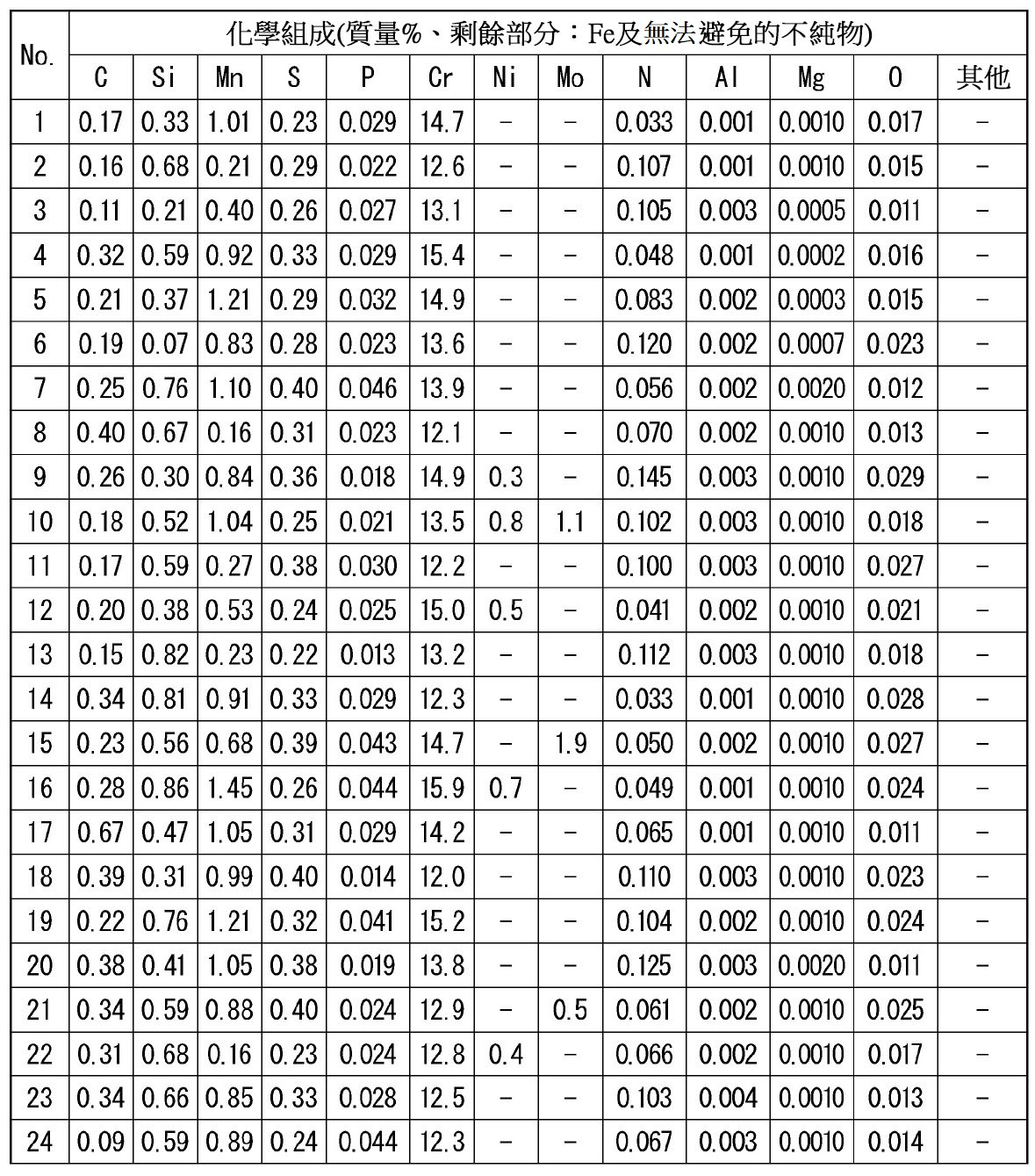
[表2]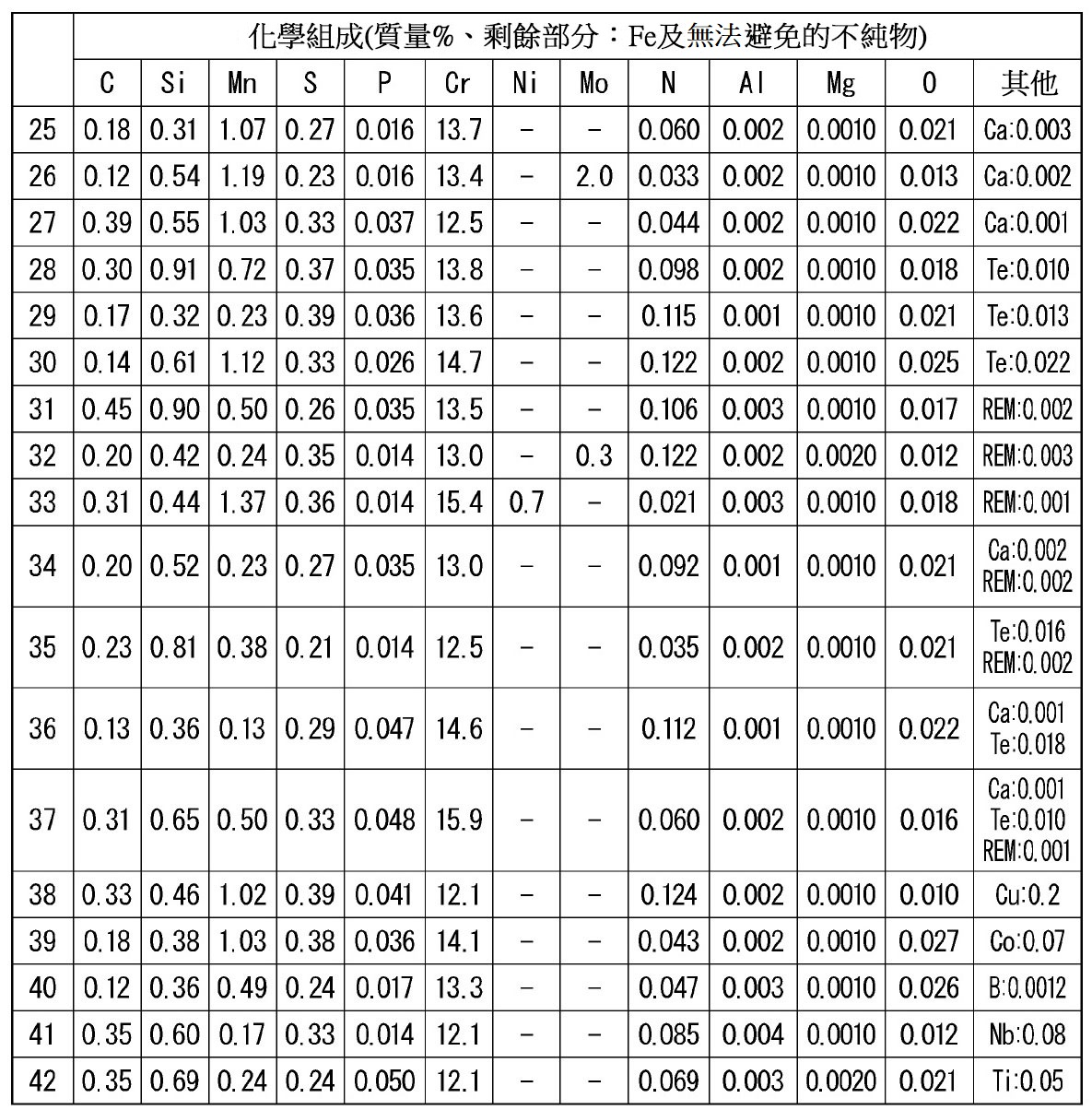
[表3]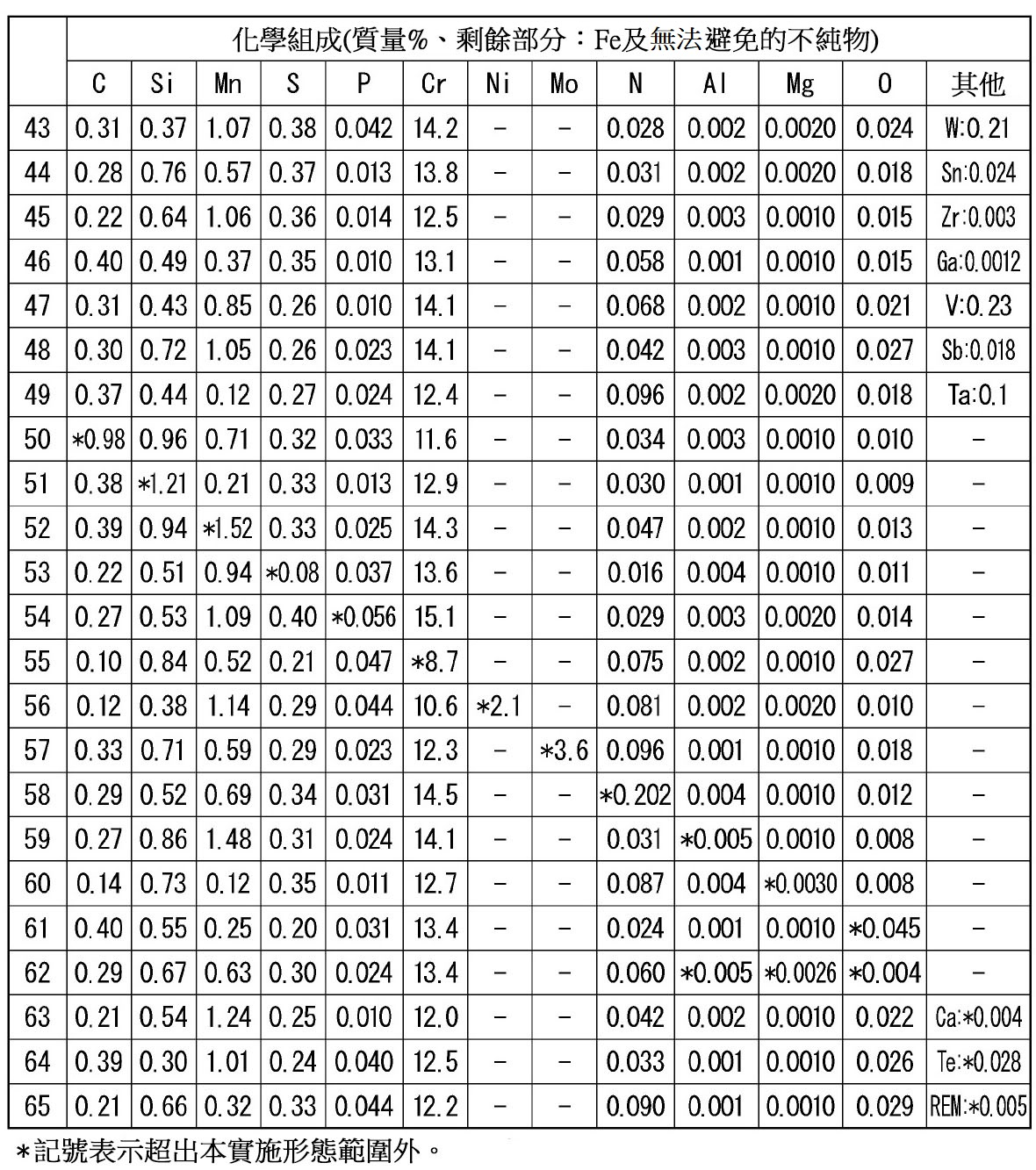
[表4]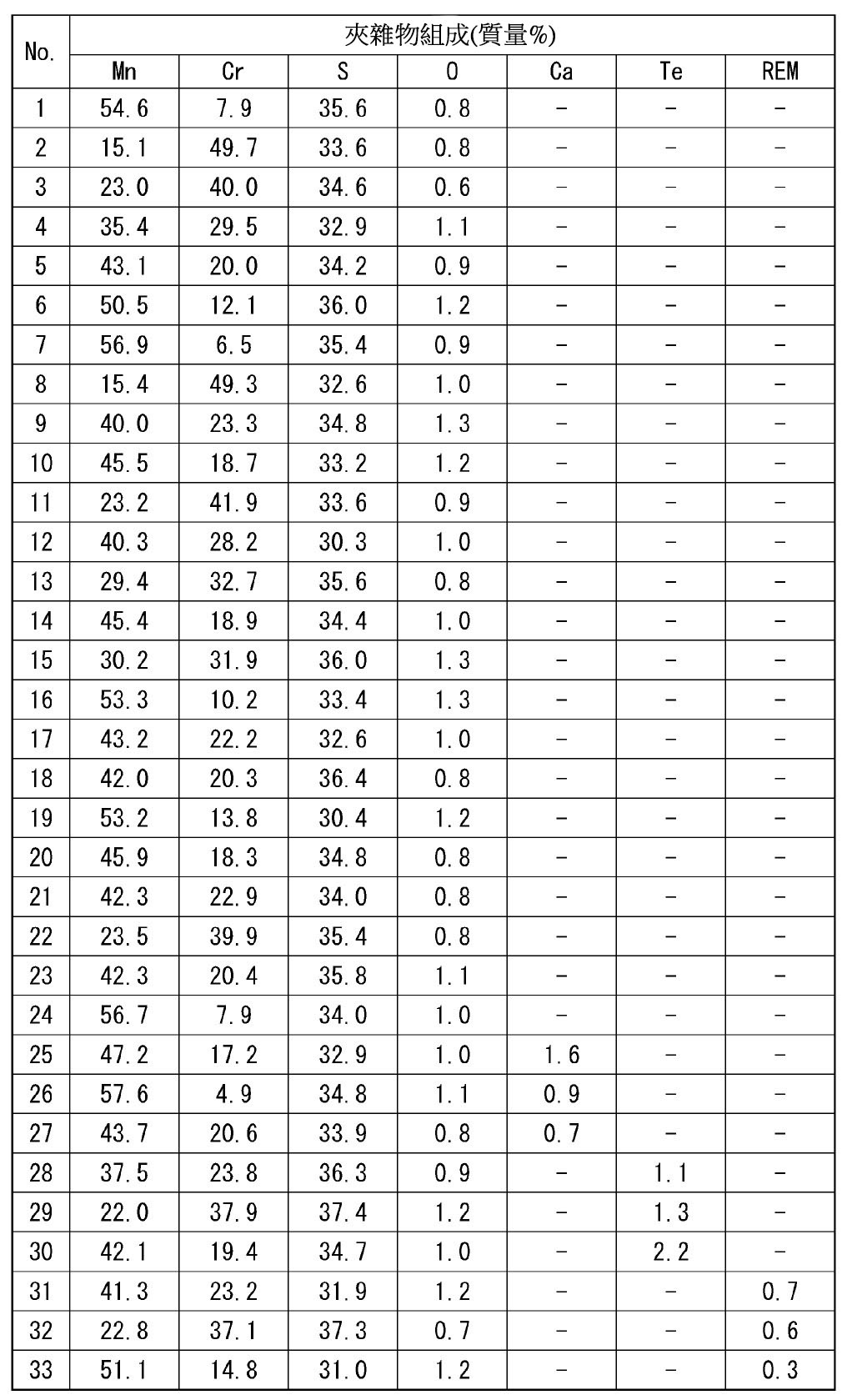
[表5]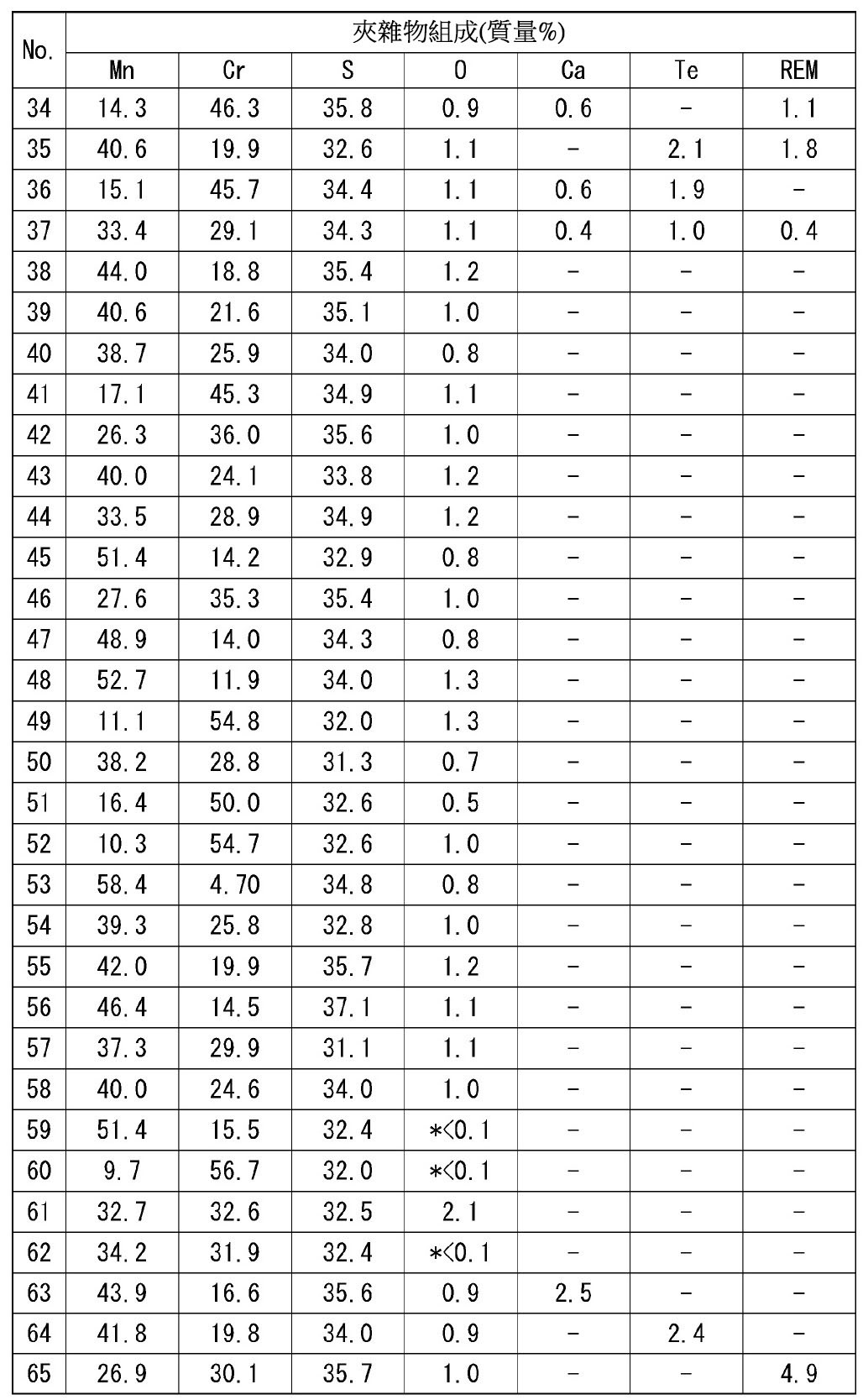
[表6]
[表7]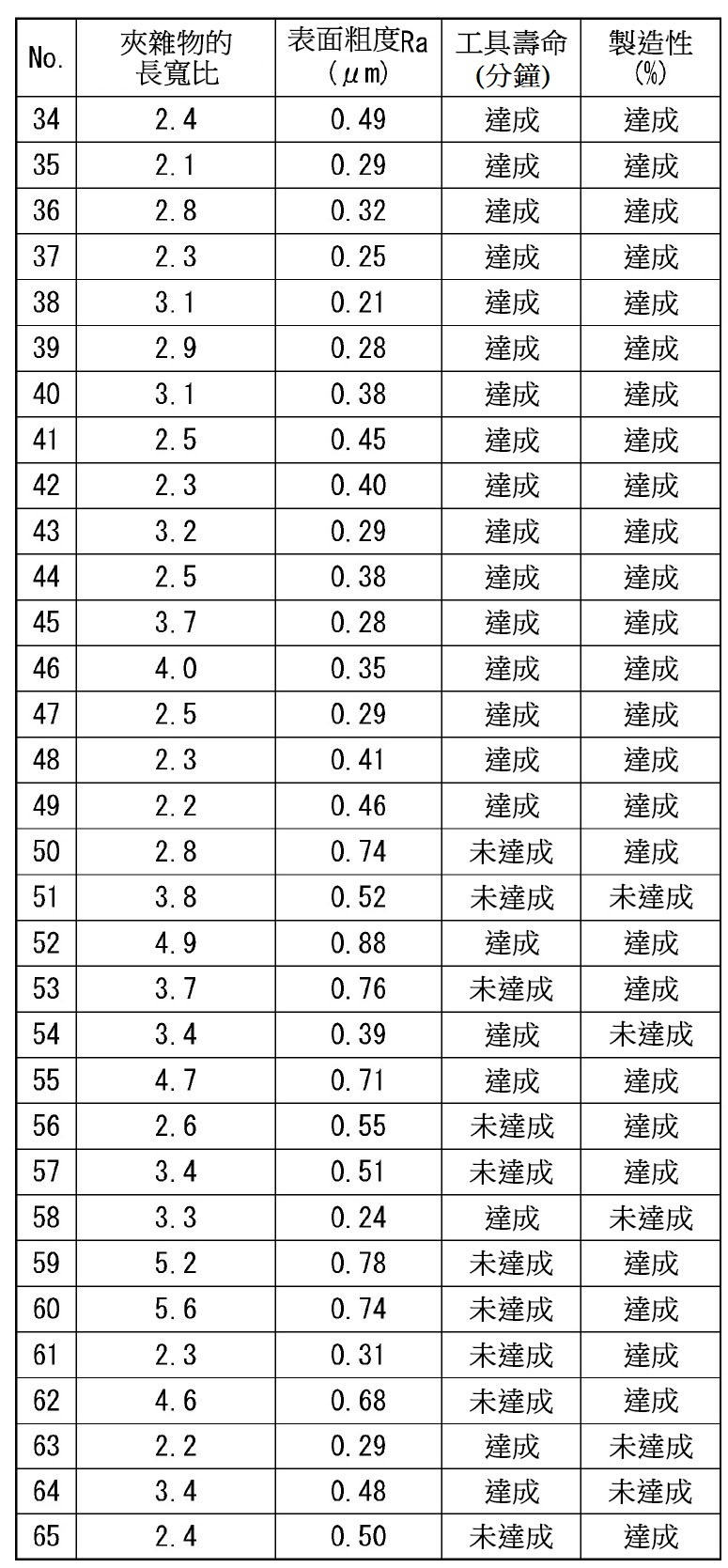
試樣No.1~49為本發明鋼(本發明例),試樣No.50~65為比較鋼(比較例)。 表中的*記號表示該值超出本實施形態範圍外。 針對表4及表5的夾雜物組成進行補充說明,即檢測到Ca、Te及REM中之任1種或2種以上元素的No.25~37及63~65含有(Mn, Cr)(S, O)系夾雜物與(Mn, Cr, Ca, REM)(S, O, Te)系夾雜物兩者。並且,在含有2種夾雜物時,(Mn, Cr)(S, O)系夾雜物與(Mn, Cr, Ca, REM)(S, O, Te)系夾雜物各自的長寬比皆為4.0以下。 又,No.59、60及62中,夾雜物組成中氧量少於0.5質量%。並且該等No.59、60及62中,未含有長寬比為4.0以下的(Mn, Cr)(S, O)系夾雜物。No.52中,Mn量超出本實施形態之範圍外。No.55中,Cr量超出本實施形態之範圍外。並且該等No.52、55中,未含有長寬比為4.0以下的(Mn, Cr)(S, O)系夾雜物。 上述以外之試樣中,則含有長寬比為4.0以下的(Mn, Cr)(S, O)系夾雜物。Samples No. 1 to 49 are inventive steels (inventive examples), and sample Nos. 50 to 65 are comparative steels (comparative examples). The * mark in the table indicates that the value is outside the range of this embodiment. Supplementary explanation of the inclusion composition in Table 4 and Table 5, that is, No.25~37 and 63~65 containing any one or more elements of Ca, Te and REM contain (Mn, Cr)(S , O) inclusions and (Mn, Cr, Ca, REM) (S, O, Te) inclusions. In addition, when two kinds of inclusions are included, the aspect ratios of (Mn, Cr)(S, O)-based inclusions and (Mn, Cr, Ca, REM)(S, O, Te)-based inclusions are both Below 4.0. Also, in Nos. 59, 60 and 62, the oxygen content in the inclusion composition is less than 0.5% by mass. In addition, No. 59, 60, and 62 do not contain (Mn, Cr) (S, O)-based inclusions with an aspect ratio of 4.0 or less. In No. 52, the amount of Mn is outside the scope of this embodiment. In No. 55, the amount of Cr is outside the scope of this embodiment. In addition, these Nos. 52 and 55 do not contain (Mn, Cr) (S, O)-based inclusions with an aspect ratio of 4.0 or less. Samples other than the above contain (Mn, Cr) (S, O)-based inclusions with an aspect ratio of 4.0 or less.
本發明鋼之No.1~No.49係藉著控制麻田散鐵系S快削不鏽鋼之夾雜物的組成,來使切削加工後的表面粗度Ra成為0.50μm以下,並亦使工具磨耗量小於0.2mm,從而達成目標工具壽命基準。並且,製造性亦然,在1000℃下之縮面率為50%以上而達成製造性基準。另一方面,比較鋼之No.50~No.65未滿足實施形態之規定範圍,而未滿足任一個特性。The No. 1 to No. 49 of the steel of the present invention is to control the composition of the inclusions of the Matian loose iron series S free-cutting stainless steel, so that the surface roughness Ra after cutting is 0.50 μm or less, and the tool wear is also reduced Less than 0.2mm to achieve the target tool life benchmark. In addition, the manufacturability is also the same, and the reduction in area at 1000° C. is 50% or more to achieve the manufacturability standard. On the other hand, No. 50 to No. 65 of the comparative steel did not satisfy the prescribed range of the embodiment, and did not satisfy any of the characteristics.
由實施例可知,透過本實施形態,可製造一種麻田散鐵系S快削不鏽鋼,其不含有毒性高的Pb等,且可切削性及製造性優異。As can be seen from the examples, according to the present embodiment, it is possible to produce a Sada free-cutting stainless steel which does not contain highly toxic Pb and the like, and is excellent in machinability and manufacturability.
產業上之可利用性 本實施形態之麻田散鐵系S快削不鏽鋼,舉例而言可作為對可切削性及耐蝕性有所要求的OA設備、電子設備等的精密零件之素材或軸、螺絲、螺栓等零件使用。Industrial availability The Mata loose iron series S free-cutting stainless steel of this embodiment can be used, for example, as a material for precision parts such as OA equipment and electronic equipment that require machinability and corrosion resistance, or parts such as shafts, screws, and bolts.
Claims (6)
Applications Claiming Priority (2)
| Application Number | Priority Date | Filing Date | Title |
|---|---|---|---|
| JP2018-112652 | 2018-06-13 | ||
| JP2018112652 | 2018-06-13 |
Publications (2)
| Publication Number | Publication Date |
|---|---|
| TW202000943A true TW202000943A (en) | 2020-01-01 |
| TWI707047B TWI707047B (en) | 2020-10-11 |
Family
ID=68842205
Family Applications (1)
| Application Number | Title | Priority Date | Filing Date |
|---|---|---|---|
| TW108120444A TWI707047B (en) | 2018-06-13 | 2019-06-13 | Free-cutting s-containing martensitic stainless steel |
Country Status (5)
| Country | Link |
|---|---|
| JP (1) | JP6918238B2 (en) |
| KR (1) | KR102471016B1 (en) |
| CN (1) | CN111989418B (en) |
| TW (1) | TWI707047B (en) |
| WO (1) | WO2019240209A1 (en) |
Cited By (3)
| Publication number | Priority date | Publication date | Assignee | Title |
|---|---|---|---|---|
| TWI785942B (en) * | 2021-01-13 | 2022-12-01 | 日商日鐵不鏽鋼股份有限公司 | Matian loose iron series stainless steel material and manufacturing method thereof |
| TWI788143B (en) * | 2020-12-24 | 2022-12-21 | 日商日鐵不銹鋼股份有限公司 | Precipitation-hardened Asada loose iron-based stainless steel with excellent fatigue resistance |
| TWI891056B (en) * | 2022-09-26 | 2025-07-21 | 日商日鐵不銹鋼股份有限公司 | Matan scattered iron series free-cutting stainless steel rod-shaped steel material and its manufacturing method |
Families Citing this family (9)
| Publication number | Priority date | Publication date | Assignee | Title |
|---|---|---|---|---|
| CN111850407B (en) * | 2020-07-29 | 2021-10-08 | 成都先进金属材料产业技术研究院有限公司 | 850MPa grade titanium-containing free-cutting stainless steel forging bar and preparation method thereof |
| EP3981893A1 (en) * | 2020-10-07 | 2022-04-13 | AMAG rolling GmbH | Plate made of a rolled aluminium alloy and production of such a plate |
| JP7589007B2 (en) * | 2020-10-23 | 2024-11-25 | 日鉄ステンレス株式会社 | Stainless steel plate for brake disc rotor, brake disc rotor, and method for manufacturing stainless steel plate for brake disc rotor |
| JP7719344B2 (en) * | 2021-02-12 | 2025-08-06 | 日本製鉄株式会社 | Martensitic free-cutting stainless steel with excellent precision cutting properties |
| JP7668657B2 (en) * | 2021-03-15 | 2025-04-25 | 日鉄ステンレス株式会社 | Ferritic free-cutting stainless steel with excellent precision cutting properties |
| CN114196875B (en) * | 2021-09-25 | 2022-10-28 | 浙江吉森金属科技有限公司 | Stainless steel for valve plate and heat treatment method thereof |
| CN116121627B (en) * | 2022-11-29 | 2025-04-29 | 成都先进金属材料产业技术研究院股份有限公司 | A composite free-cutting steel containing sulfur, tin and titanium and a vacuum induction preparation method thereof |
| CN116445819B (en) * | 2023-04-19 | 2024-08-30 | 徐工集团工程机械股份有限公司 | Cast iron product and preparation method thereof |
| CN117604377A (en) * | 2023-11-23 | 2024-02-27 | 山西帝思曼特殊金属科技有限公司 | Medium carbon martensitic stainless steel with refined structure and manufacturing method thereof |
Family Cites Families (27)
| Publication number | Priority date | Publication date | Assignee | Title |
|---|---|---|---|---|
| JPS5135918B2 (en) | 1973-09-03 | 1976-10-05 | ||
| JPH0756064A (en) | 1993-08-09 | 1995-03-03 | Sumitomo Electric Ind Ltd | Method and apparatus for manufacturing optical fiber with metal tube |
| JP3025406B2 (en) * | 1994-03-19 | 2000-03-27 | 山陽特殊製鋼株式会社 | Ferritic and martensitic stainless steels with excellent machinability |
| JP3483800B2 (en) * | 1999-06-25 | 2004-01-06 | 山陽特殊製鋼株式会社 | Free-cutting stainless steel with excellent outgassing properties |
| JP2001152298A (en) | 1999-11-29 | 2001-06-05 | Daido Steel Co Ltd | Free cutting martensitic stainless steel part free from emission of sulfurizing gas |
| JP4502519B2 (en) | 2001-01-15 | 2010-07-14 | 新日鐵住金ステンレス株式会社 | Martensitic free-cutting stainless steel |
| JP2002212684A (en) * | 2001-01-23 | 2002-07-31 | Sumitomo Metal Ind Ltd | Martensitic stainless steel with high high-temperature strength |
| EP1391528B1 (en) * | 2001-05-15 | 2008-03-05 | Nisshin Steel Co., Ltd. | Ferritic stainless steal and martensitic stainless steel both being excellent in machinability |
| JP3877590B2 (en) * | 2001-12-25 | 2007-02-07 | 日新製鋼株式会社 | Highly elastic metastable austenitic stainless steel sheet and its manufacturing method |
| JP4264247B2 (en) * | 2002-11-15 | 2009-05-13 | 新日本製鐵株式会社 | Steel with excellent machinability and method for producing the same |
| JP4108506B2 (en) * | 2003-02-26 | 2008-06-25 | 山陽特殊製鋼株式会社 | Martensitic free-cutting stainless steel |
| JP5505487B2 (en) * | 2004-12-28 | 2014-05-28 | Jfeスチール株式会社 | High-strength, high-tough steel plate with excellent cut crack resistance and DWTT properties |
| JP5135918B2 (en) * | 2006-10-03 | 2013-02-06 | 大同特殊鋼株式会社 | Martensitic free-cutting stainless steel |
| EP2096186B1 (en) * | 2006-11-28 | 2012-10-24 | Nippon Steel Corporation | Free-cutting steel excellent in manufacturability |
| JP4193998B1 (en) * | 2007-06-28 | 2008-12-10 | 株式会社神戸製鋼所 | Machine structural steel excellent in machinability and manufacturing method thereof |
| WO2009057731A1 (en) * | 2007-10-29 | 2009-05-07 | Nippon Steel Corporation | Martensitic non-heat-treated steel for hot forging and non-heat-treated steel hot forgings |
| JP5474615B2 (en) * | 2010-03-05 | 2014-04-16 | 新日鐵住金ステンレス株式会社 | Martensitic stainless free-cutting steel bar wire with excellent forgeability |
| FR2964668B1 (en) * | 2010-09-14 | 2012-10-12 | Snecma | OPTIMIZING THE MACHINABILITY OF STAINLESS MARTENSITIC STEELS |
| JP5907760B2 (en) * | 2012-03-07 | 2016-04-26 | 新日鐵住金ステンレス株式会社 | Martensitic free-cutting stainless steel bar wire and manufacturing method thereof |
| CN102676955B (en) * | 2012-06-06 | 2013-08-07 | 安徽工业大学 | Low-carbon high-sulfur free-cutting steel with excellent cutting performance and manufacturing method thereof |
| JP6194696B2 (en) | 2013-08-27 | 2017-09-13 | 大同特殊鋼株式会社 | Martensite Bi free-cutting stainless steel |
| JP6197591B2 (en) * | 2013-11-12 | 2017-09-20 | 新日鐵住金株式会社 | Martensitic Cr-containing steel |
| WO2016174500A1 (en) * | 2015-04-30 | 2016-11-03 | Aperam | Martensitic stainless steel, method for producing a semi-finished product made from said steel and cutting tool produced from said semi-finished product |
| FI127450B (en) * | 2016-06-30 | 2018-06-15 | Outokumpu Oy | Martensitic stainless steel and method for the manufacture |
| JP6635890B2 (en) * | 2016-07-15 | 2020-01-29 | 日鉄ステンレス株式会社 | Martensitic stainless steel sheet for cutting tools with excellent manufacturability and corrosion resistance |
| JP6849360B2 (en) * | 2016-09-26 | 2021-03-24 | 山陽特殊製鋼株式会社 | Martensitic free-cutting stainless steel with excellent rolling fatigue life characteristics |
| CN106591730B (en) * | 2016-11-25 | 2019-02-19 | 邢台钢铁有限责任公司 | Low carbon martensitic free-cutting stainless steel and production method thereof |
-
2019
- 2019-06-13 CN CN201980023405.8A patent/CN111989418B/en active Active
- 2019-06-13 JP JP2020525645A patent/JP6918238B2/en active Active
- 2019-06-13 WO PCT/JP2019/023437 patent/WO2019240209A1/en not_active Ceased
- 2019-06-13 TW TW108120444A patent/TWI707047B/en active
- 2019-06-13 KR KR1020207028397A patent/KR102471016B1/en active Active
Cited By (3)
| Publication number | Priority date | Publication date | Assignee | Title |
|---|---|---|---|---|
| TWI788143B (en) * | 2020-12-24 | 2022-12-21 | 日商日鐵不銹鋼股份有限公司 | Precipitation-hardened Asada loose iron-based stainless steel with excellent fatigue resistance |
| TWI785942B (en) * | 2021-01-13 | 2022-12-01 | 日商日鐵不鏽鋼股份有限公司 | Matian loose iron series stainless steel material and manufacturing method thereof |
| TWI891056B (en) * | 2022-09-26 | 2025-07-21 | 日商日鐵不銹鋼股份有限公司 | Matan scattered iron series free-cutting stainless steel rod-shaped steel material and its manufacturing method |
Also Published As
| Publication number | Publication date |
|---|---|
| JP6918238B2 (en) | 2021-08-11 |
| KR102471016B1 (en) | 2022-11-28 |
| CN111989418B (en) | 2022-02-22 |
| WO2019240209A1 (en) | 2019-12-19 |
| JPWO2019240209A1 (en) | 2020-12-17 |
| KR20200124294A (en) | 2020-11-02 |
| CN111989418A (en) | 2020-11-24 |
| TWI707047B (en) | 2020-10-11 |
Similar Documents
| Publication | Publication Date | Title |
|---|---|---|
| TWI707047B (en) | Free-cutting s-containing martensitic stainless steel | |
| CN106029925B (en) | Steel for High Frequency Quenching | |
| JP5316495B2 (en) | Bearing steel | |
| KR101612474B1 (en) | Ferritic stainless-steel wire with excellent cold forgeability and machinability | |
| JP2012162760A (en) | Free-cutting ferritic stainless steel and method for producing the same | |
| CN104995324B (en) | Lead treated steel | |
| CN109790604B (en) | Cold forging steel and method for producing same | |
| JP7024922B1 (en) | Free-cutting steel and its manufacturing method | |
| JP6814655B2 (en) | Ferritic free-cutting stainless steel wire | |
| JP5474616B2 (en) | Ferritic stainless free-cutting steel rod with excellent forgeability | |
| JP6668741B2 (en) | Hot rolled bar | |
| JP4424503B2 (en) | Steel bar and wire rod | |
| JP5092578B2 (en) | Low carbon sulfur free cutting steel | |
| JPWO2016199843A1 (en) | Free-cutting steel | |
| JP6652021B2 (en) | Hot forging steel and hot forged products | |
| JP7199231B2 (en) | Ferritic S free-cutting stainless steel | |
| JP6927444B1 (en) | Free-cutting steel and its manufacturing method | |
| JP5957241B2 (en) | Ferritic free-cutting stainless steel bar wire and method for producing the same | |
| WO2022107757A1 (en) | Stainless steel bar material and electromagnetic component | |
| CN101268208B (en) | Low-carbon sulfur-containing free-cutting steel with excellent cuttability | |
| JP5583986B2 (en) | Austenitic stainless free-cutting steel rod with excellent forgeability | |
| JP7024921B1 (en) | Free-cutting steel and its manufacturing method | |
| JP2001234279A (en) | Steel for cold forging excellent in treatment of chip | |
| JP6766531B2 (en) | Cold forging steel and its manufacturing method |