TW202016152A - Fusion protein containing progranulin - Google Patents
Fusion protein containing progranulin Download PDFInfo
- Publication number
- TW202016152A TW202016152A TW108121124A TW108121124A TW202016152A TW 202016152 A TW202016152 A TW 202016152A TW 108121124 A TW108121124 A TW 108121124A TW 108121124 A TW108121124 A TW 108121124A TW 202016152 A TW202016152 A TW 202016152A
- Authority
- TW
- Taiwan
- Prior art keywords
- polypeptide
- protein
- seq
- sequence
- precursor
- Prior art date
Links
Images


Classifications
-
- C—CHEMISTRY; METALLURGY
- C07—ORGANIC CHEMISTRY
- C07K—PEPTIDES
- C07K14/00—Peptides having more than 20 amino acids; Gastrins; Somatostatins; Melanotropins; Derivatives thereof
- C07K14/435—Peptides having more than 20 amino acids; Gastrins; Somatostatins; Melanotropins; Derivatives thereof from animals; from humans
- C07K14/475—Growth factors; Growth regulators
-
- A—HUMAN NECESSITIES
- A61—MEDICAL OR VETERINARY SCIENCE; HYGIENE
- A61K—PREPARATIONS FOR MEDICAL, DENTAL OR TOILETRY PURPOSES
- A61K47/00—Medicinal preparations characterised by the non-active ingredients used, e.g. carriers or inert additives; Targeting or modifying agents chemically bound to the active ingredient
- A61K47/50—Medicinal preparations characterised by the non-active ingredients used, e.g. carriers or inert additives; Targeting or modifying agents chemically bound to the active ingredient the non-active ingredient being chemically bound to the active ingredient, e.g. polymer-drug conjugates
- A61K47/51—Medicinal preparations characterised by the non-active ingredients used, e.g. carriers or inert additives; Targeting or modifying agents chemically bound to the active ingredient the non-active ingredient being chemically bound to the active ingredient, e.g. polymer-drug conjugates the non-active ingredient being a modifying agent
- A61K47/54—Medicinal preparations characterised by the non-active ingredients used, e.g. carriers or inert additives; Targeting or modifying agents chemically bound to the active ingredient the non-active ingredient being chemically bound to the active ingredient, e.g. polymer-drug conjugates the non-active ingredient being a modifying agent the modifying agent being an organic compound
- A61K47/55—Medicinal preparations characterised by the non-active ingredients used, e.g. carriers or inert additives; Targeting or modifying agents chemically bound to the active ingredient the non-active ingredient being chemically bound to the active ingredient, e.g. polymer-drug conjugates the non-active ingredient being a modifying agent the modifying agent being an organic compound the modifying agent being also a pharmacologically or therapeutically active agent, i.e. the entire conjugate being a codrug
-
- A—HUMAN NECESSITIES
- A61—MEDICAL OR VETERINARY SCIENCE; HYGIENE
- A61K—PREPARATIONS FOR MEDICAL, DENTAL OR TOILETRY PURPOSES
- A61K47/00—Medicinal preparations characterised by the non-active ingredients used, e.g. carriers or inert additives; Targeting or modifying agents chemically bound to the active ingredient
- A61K47/50—Medicinal preparations characterised by the non-active ingredients used, e.g. carriers or inert additives; Targeting or modifying agents chemically bound to the active ingredient the non-active ingredient being chemically bound to the active ingredient, e.g. polymer-drug conjugates
- A61K47/51—Medicinal preparations characterised by the non-active ingredients used, e.g. carriers or inert additives; Targeting or modifying agents chemically bound to the active ingredient the non-active ingredient being chemically bound to the active ingredient, e.g. polymer-drug conjugates the non-active ingredient being a modifying agent
- A61K47/62—Medicinal preparations characterised by the non-active ingredients used, e.g. carriers or inert additives; Targeting or modifying agents chemically bound to the active ingredient the non-active ingredient being chemically bound to the active ingredient, e.g. polymer-drug conjugates the non-active ingredient being a modifying agent the modifying agent being a protein, peptide or polyamino acid
- A61K47/65—Peptidic linkers, binders or spacers, e.g. peptidic enzyme-labile linkers
-
- A—HUMAN NECESSITIES
- A61—MEDICAL OR VETERINARY SCIENCE; HYGIENE
- A61K—PREPARATIONS FOR MEDICAL, DENTAL OR TOILETRY PURPOSES
- A61K47/00—Medicinal preparations characterised by the non-active ingredients used, e.g. carriers or inert additives; Targeting or modifying agents chemically bound to the active ingredient
- A61K47/50—Medicinal preparations characterised by the non-active ingredients used, e.g. carriers or inert additives; Targeting or modifying agents chemically bound to the active ingredient the non-active ingredient being chemically bound to the active ingredient, e.g. polymer-drug conjugates
- A61K47/51—Medicinal preparations characterised by the non-active ingredients used, e.g. carriers or inert additives; Targeting or modifying agents chemically bound to the active ingredient the non-active ingredient being chemically bound to the active ingredient, e.g. polymer-drug conjugates the non-active ingredient being a modifying agent
- A61K47/68—Medicinal preparations characterised by the non-active ingredients used, e.g. carriers or inert additives; Targeting or modifying agents chemically bound to the active ingredient the non-active ingredient being chemically bound to the active ingredient, e.g. polymer-drug conjugates the non-active ingredient being a modifying agent the modifying agent being an antibody, an immunoglobulin or a fragment thereof, e.g. an Fc-fragment
-
- A—HUMAN NECESSITIES
- A61—MEDICAL OR VETERINARY SCIENCE; HYGIENE
- A61P—SPECIFIC THERAPEUTIC ACTIVITY OF CHEMICAL COMPOUNDS OR MEDICINAL PREPARATIONS
- A61P25/00—Drugs for disorders of the nervous system
- A61P25/28—Drugs for disorders of the nervous system for treating neurodegenerative disorders of the central nervous system, e.g. nootropic agents, cognition enhancers, drugs for treating Alzheimer's disease or other forms of dementia
-
- A—HUMAN NECESSITIES
- A61—MEDICAL OR VETERINARY SCIENCE; HYGIENE
- A61K—PREPARATIONS FOR MEDICAL, DENTAL OR TOILETRY PURPOSES
- A61K38/00—Medicinal preparations containing peptides
-
- C—CHEMISTRY; METALLURGY
- C07—ORGANIC CHEMISTRY
- C07K—PEPTIDES
- C07K2319/00—Fusion polypeptide
- C07K2319/30—Non-immunoglobulin-derived peptide or protein having an immunoglobulin constant or Fc region, or a fragment thereof, attached thereto
-
- C—CHEMISTRY; METALLURGY
- C07—ORGANIC CHEMISTRY
- C07K—PEPTIDES
- C07K2319/00—Fusion polypeptide
- C07K2319/40—Fusion polypeptide containing a tag for immunodetection, or an epitope for immunisation
- C07K2319/41—Fusion polypeptide containing a tag for immunodetection, or an epitope for immunisation containing a Myc-tag
-
- C—CHEMISTRY; METALLURGY
- C07—ORGANIC CHEMISTRY
- C07K—PEPTIDES
- C07K2319/00—Fusion polypeptide
- C07K2319/50—Fusion polypeptide containing protease site
Landscapes
- Health & Medical Sciences (AREA)
- Chemical & Material Sciences (AREA)
- Life Sciences & Earth Sciences (AREA)
- Bioinformatics & Cheminformatics (AREA)
- Engineering & Computer Science (AREA)
- General Health & Medical Sciences (AREA)
- Medicinal Chemistry (AREA)
- Pharmacology & Pharmacy (AREA)
- Animal Behavior & Ethology (AREA)
- Public Health (AREA)
- Veterinary Medicine (AREA)
- Organic Chemistry (AREA)
- Epidemiology (AREA)
- Proteomics, Peptides & Aminoacids (AREA)
- Neurology (AREA)
- Biomedical Technology (AREA)
- Neurosurgery (AREA)
- Immunology (AREA)
- Biophysics (AREA)
- Genetics & Genomics (AREA)
- Molecular Biology (AREA)
- Biochemistry (AREA)
- Gastroenterology & Hepatology (AREA)
- Toxicology (AREA)
- Zoology (AREA)
- Psychiatry (AREA)
- Nuclear Medicine, Radiotherapy & Molecular Imaging (AREA)
- Hospice & Palliative Care (AREA)
- Chemical Kinetics & Catalysis (AREA)
- General Chemical & Material Sciences (AREA)
- Peptides Or Proteins (AREA)
- Medicines That Contain Protein Lipid Enzymes And Other Medicines (AREA)
- Medicinal Preparation (AREA)
Abstract
Description
額顳葉性癡呆(FTD)為進行性神經退化性病症,其佔所有癡呆患者之5-10%及65歲前癡呆發作患者之10-20% (Rademakers等人,Nat Rev Neurol . 8(8):423-34, 2012)。儘管若干基因已與FTD相關聯,但FTD中最頻繁突變之基因之一為GRN ,其定位至人類染色體17q21且編碼富半胱胺酸蛋白顆粒蛋白前體(progranulin,PGRN) (亦稱為前上皮蛋白(前上皮素)及頂顆粒蛋白(acrogranin))。GRN 中之高度滲透性突變於2006年首次報導為家族性FTD之體染色體顯性形式之原因(Baker等人,Nature . 442(7105):916-9, 2006;Cruts等人,Nature . 2006年8月24日;442(7105):920-4;Gass等人,Hum Mol Genet . 15(20):2988-3001, 2006)。最新估計表明GRN 突變佔具有陽性家族史之FTD患者之5-20%及散發病例之1-5% (Rademakers等人,同上 )。Frontotemporal dementia (FTD) is a progressive neurodegenerative disorder, which accounts for 5-10% of all dementia patients and 10-20% of patients with dementia attacks before the age of 65 (Rademakers et al., Nat Rev Neurol . 8(8 ): 423-34, 2012). Although several genes have been associated with FTD, one of the most frequently mutated genes in FTD is GRN , which is located on human chromosome 17q21 and encodes a cysteine-rich protein progranulin (PGRN) (also known as pro Epithelial protein (pre-epithelium) and top granule protein (acrogranin). The highly permeable mutation in GRN was first reported in 2006 as the cause of the somatic dominant form of familial FTD (Baker et al., Nature . 442(7105): 916-9, 2006; Cruts et al., Nature . 2006 August 24; 442(7105): 920-4; Gass et al., Hum Mol Genet . 15(20): 2988-3001, 2006). Recent estimates indicate that GRN mutations account for 5-20% of FTD patients with a positive family history and 1-5% of sporadic cases (Rademakers et al., ibid .).
本文提供包含顆粒蛋白前體多肽或其變異體之融合蛋白及使用該等融合蛋白治療顆粒蛋白前體相關病症(例如神經退化性疾病,諸如額顳葉性癡呆(FTD))之方法。Provided herein are fusion proteins comprising granin precursor polypeptides or variants thereof, and methods of using these fusion proteins to treat granin precursor precursor-related disorders (eg, neurodegenerative diseases such as frontotemporal dementia (FTD)).
本揭示案之一態樣包括一種蛋白質,其包含:(a)特異性結合TfR之經修飾Fc多肽二聚體;及(b)顆粒蛋白前體多肽。在一些實施例中,蛋白質用於療法中。在一些實施例中,蛋白質用於治療神經退化性疾病。One aspect of the present disclosure includes a protein comprising: (a) a modified Fc polypeptide dimer that specifically binds TfR; and (b) a granule protein precursor polypeptide. In some embodiments, the protein is used in therapy. In some embodiments, the protein is used to treat neurodegenerative diseases.
本揭示案之另一態樣包括一種蛋白質,其包含:(a) Fc多肽;及(b)顆粒蛋白前體多肽。在此態樣之一些實施例中,Fc多肽:(i)不包括可變結構域,(ii)包括鉸鏈或部分鉸鏈區,及/或(iii)包括使得Fc多肽特異性結合轉鐵蛋白受體之修飾。Another aspect of the present disclosure includes a protein comprising: (a) an Fc polypeptide; and (b) a granule protein precursor polypeptide. In some embodiments of this aspect, the Fc polypeptide: (i) does not include the variable domain, (ii) includes the hinge or part of the hinge region, and/or (iii) includes the specific binding of the Fc polypeptide to transferrin receptor Body modification.
在另一態樣中,本文提供一種蛋白質,其包含:(a)單一顆粒蛋白前體多肽或其變異體;(b)連接至(a)之顆粒蛋白前體多肽或其變異體之第一Fc多肽;及(c)與第一Fc多肽形成Fc二聚體之第二Fc多肽。在一些實施例中,第一Fc多肽及/或第二Fc多肽不包括免疫球蛋白重及/或輕鏈可變區序列或其抗原結合部分。蛋白質可確切包含一種顆粒蛋白前體多肽或其變異體。In another aspect, provided herein is a protein comprising: (a) a single granule protein precursor polypeptide or a variant thereof; (b) a first granule protein precursor polypeptide or a variant thereof linked to (a) Fc polypeptide; and (c) a second Fc polypeptide that forms an Fc dimer with the first Fc polypeptide. In some embodiments, the first Fc polypeptide and/or the second Fc polypeptide does not include immunoglobulin heavy and/or light chain variable region sequences or antigen-binding portions thereof. The protein may comprise exactly one granule protein precursor polypeptide or a variant thereof.
在此態樣之一些實施例中,顆粒蛋白前體多肽包含與SEQ ID NO:212之胺基酸序列具有大於90%一致性或至少95%一致性之胺基酸序列。在某些實施例中,顆粒蛋白前體多肽包含SEQ ID NO:212之胺基酸序列。In some embodiments of this aspect, the granule precursor polypeptide comprises an amino acid sequence that is greater than 90% identical or at least 95% identical to the amino acid sequence of SEQ ID NO: 212. In certain embodiments, the granule precursor protein comprises the amino acid sequence of SEQ ID NO: 212.
在一些實施例中,第一Fc多肽由肽鍵或由多肽連接子連接至顆粒蛋白前體多肽或其變異體。在一些實施例中,多肽連接子之長度為1至50個、1至25個、1至20個或1至10個胺基酸。舉例而言,多肽連接子之長度可為3至50個、3至25個、5至50個、5至25個、5至20個或10至25個胺基酸。在一些實施例中,多肽連接子為可撓性多肽連接子。可撓性多肽連接子可為富甘胺酸連接子,例如G4 S (SEQ ID NO:277)或(G4 S)2 (SEQ ID NO:276)。In some embodiments, the first Fc polypeptide is linked to the granule protein precursor polypeptide or a variant thereof by a peptide bond or by a polypeptide linker. In some embodiments, the length of the polypeptide linker is 1 to 50, 1 to 25, 1 to 20, or 1 to 10 amino acids. For example, the length of the polypeptide linker may be 3 to 50, 3 to 25, 5 to 50, 5 to 25, 5 to 20, or 10 to 25 amino acids. In some embodiments, the polypeptide linker is a flexible polypeptide linker. The flexible polypeptide linker may be a glycine-rich linker, such as G 4 S (SEQ ID NO:277) or (G 4 S) 2 (SEQ ID NO:276).
在一些實施例中,第一Fc多肽之N末端或C末端連接至顆粒蛋白前體多肽。In some embodiments, the N-terminus or C-terminus of the first Fc polypeptide is linked to a granule precursor polypeptide.
在另一態樣中,本文提供一種蛋白質,其包含:(a)連接至第一顆粒蛋白前體多肽或其變異體之第一Fc多肽;及(b)連接至第二顆粒蛋白前體多肽或其變異體之第二Fc多肽,其中第一Fc多肽與第二Fc多肽形成Fc二聚體且其中第一Fc多肽及/或第二Fc多肽特異性結合至轉鐵蛋白受體。In another aspect, provided herein is a protein comprising: (a) a first Fc polypeptide linked to a first granulin precursor polypeptide or a variant thereof; and (b) linked to a second granulin precursor polypeptide Or a second Fc polypeptide of a variant thereof, wherein the first Fc polypeptide and the second Fc polypeptide form an Fc dimer and wherein the first Fc polypeptide and/or the second Fc polypeptide specifically bind to the transferrin receptor.
在此態樣之一些實施例中,第一Fc多肽及/或第二Fc多肽不包括免疫球蛋白重及/或輕鏈可變區序列或其抗原結合部分。In some embodiments of this aspect, the first Fc polypeptide and/or the second Fc polypeptide does not include immunoglobulin heavy and/or light chain variable region sequences or antigen-binding portions thereof.
在一些實施例中,第一顆粒蛋白前體多肽及第二顆粒蛋白前體多肽中之每一者包含與SEQ ID NO:212之胺基酸序列具有大於90%或至少95%一致性之胺基酸序列。在某些實施例中,第一顆粒蛋白前體多肽及第二顆粒蛋白前體多肽中之每一者包含SEQ ID NO:212之胺基酸序列。In some embodiments, each of the first granule precursor protein and the second granule precursor protein comprises an amine having greater than 90% or at least 95% identity with the amino acid sequence of SEQ ID NO: 212 Acid sequence. In certain embodiments, each of the first granule precursor protein and the second granule precursor protein comprises the amino acid sequence of SEQ ID NO: 212.
在一些實施例中,第一Fc多肽由肽鍵或由多肽連接子連接至第一顆粒蛋白前體多肽或其變異體且其中第二Fc多肽由肽鍵或由多肽連接子連接至第二顆粒蛋白前體多肽或其變異體。在一些實施例中,多肽連接子之長度為1至50個、1至25個、1至20個或1至10個胺基酸。舉例而言,多肽連接子之長度可為3至50個、3至25個、5至50個、5至25個、5至20個或10至25個胺基酸。在一些實施例中,多肽連接子為可撓性多肽連接子。可撓性多肽連接子可為富甘胺酸連接子,例如G4 S (SEQ ID NO:277)或(G4 S)2 (SEQ ID NO:276)。在一些實施例中,第一Fc多肽及/或第二Fc多肽不包括免疫球蛋白重及/或輕鏈可變區序列或其抗原結合部分。In some embodiments, the first Fc polypeptide is linked to the first granule protein precursor polypeptide or a variant thereof by a peptide bond or by a polypeptide linker and wherein the second Fc polypeptide is linked to the second particle by a peptide bond or by a polypeptide linker Protein precursor polypeptide or its variants. In some embodiments, the length of the polypeptide linker is 1 to 50, 1 to 25, 1 to 20, or 1 to 10 amino acids. For example, the length of the polypeptide linker may be 3 to 50, 3 to 25, 5 to 50, 5 to 25, 5 to 20, or 10 to 25 amino acids. In some embodiments, the polypeptide linker is a flexible polypeptide linker. The flexible polypeptide linker may be a glycine-rich linker, such as G 4 S (SEQ ID NO:277) or (G 4 S) 2 (SEQ ID NO:276). In some embodiments, the first Fc polypeptide and/or the second Fc polypeptide does not include immunoglobulin heavy and/or light chain variable region sequences or antigen-binding portions thereof.
在一些實施例中,第一Fc多肽之N末端或C末端連接至第一顆粒蛋白前體多肽,且第二Fc多肽之N末端或C末端連接至第二顆粒蛋白前體多肽。In some embodiments, the N-terminus or C-terminus of the first Fc polypeptide is linked to the first granule precursor protein, and the N-terminus or C-terminus of the second Fc polypeptide is linked to the second granule protein precursor polypeptide.
在一些實施例中,第一Fc多肽之N末端連接至第一顆粒蛋白前體多肽之C末端,且第二Fc多肽之N末端連接至第二顆粒蛋白前體多肽之C末端。In some embodiments, the N-terminus of the first Fc polypeptide is linked to the C-terminus of the first granule precursor protein, and the N-terminus of the second Fc polypeptide is linked to the C-terminus of the second granule protein precursor polypeptide.
在一些實施例中,第一Fc多肽之N末端連接至第一顆粒蛋白前體多肽之C末端,且第二Fc多肽之C末端連接至第二顆粒蛋白前體多肽之N末端。In some embodiments, the N-terminus of the first Fc polypeptide is linked to the C-terminus of the first granule precursor protein, and the C-terminus of the second Fc polypeptide is linked to the N-terminus of the second granule protein precursor polypeptide.
在一些實施例中,第一Fc多肽之C末端連接至第一顆粒蛋白前體多肽之N末端,且第二Fc多肽之C末端連接至第二顆粒蛋白前體多肽之N末端。In some embodiments, the C-terminus of the first Fc polypeptide is linked to the N-terminus of the first granule precursor protein, and the C-terminus of the second Fc polypeptide is linked to the N-terminus of the second granule protein precursor polypeptide.
在先前兩個態樣之一些實施例中,第一Fc多肽為經修飾Fc多肽及/或第二Fc多肽為經修飾Fc多肽。在一些實施例中,第一Fc多肽及第二Fc多肽各自含有促進異二聚化之修飾。在一些實施例中,Fc二聚體為Fc異二聚體。In some embodiments of the previous two aspects, the first Fc polypeptide is a modified Fc polypeptide and/or the second Fc polypeptide is a modified Fc polypeptide. In some embodiments, the first Fc polypeptide and the second Fc polypeptide each contain a modification that promotes heterodimerization. In some embodiments, the Fc dimer is an Fc heterodimer.
在先前兩個態樣之一些實施例中,根據EU編號,Fc多肽之一具有T366W取代且另一Fc多肽具有T366S、L368A及Y407V取代。在一些實施例中,第一Fc多肽含有T366S、L368A及Y407V取代且第二Fc多肽含有T366W取代。In some embodiments of the previous two aspects, according to EU numbering, one of the Fc polypeptides has a T366W substitution and the other Fc polypeptide has T366S, L368A, and Y407V substitutions. In some embodiments, the first Fc polypeptide contains T366S, L368A, and Y407V substitutions and the second Fc polypeptide contains T366W substitutions.
在第一態樣之一些實施例中,第一Fc多肽連接至顆粒蛋白前體多肽且包含SEQ ID NO:213、214、225及226中之任一者之胺基酸序列,且第二Fc多肽包含SEQ ID NO:261之胺基酸序列。In some embodiments of the first aspect, the first Fc polypeptide is linked to a granulin precursor polypeptide and comprises the amino acid sequence of any one of SEQ ID NOs: 213, 214, 225, and 226, and the second Fc The polypeptide comprises the amino acid sequence of SEQ ID NO: 261.
在第二態樣之一些實施例中,第一Fc多肽連接至第一顆粒蛋白前體多肽且包含SEQ ID NO:213、214、225及226中之任一者之胺基酸序列,且第二Fc多肽連接至第二顆粒蛋白前體多肽且包含SEQ ID NO:237、238、249及250中之任一者之胺基酸序列。In some embodiments of the second aspect, the first Fc polypeptide is linked to the first granulin precursor polypeptide and includes the amino acid sequence of any one of SEQ ID NOs: 213, 214, 225, and 226, and the The two Fc polypeptides are linked to the second granulin precursor polypeptide and comprise the amino acid sequence of any one of SEQ ID NOs: 237, 238, 249, and 250.
在先前兩個態樣之一些實施例中,第一Fc多肽含有T366W取代且第二Fc多肽含有T366S、L368A及Y407V取代。In some embodiments of the previous two aspects, the first Fc polypeptide contains the T366W substitution and the second Fc polypeptide contains the T366S, L368A, and Y407V substitutions.
在第一態樣之一些實施例中,第一Fc多肽連接至顆粒蛋白前體多肽且包含SEQ ID NO:237、238、249及250中之任一者之胺基酸序列,且第二Fc多肽包含SEQ ID NO:267之序列。In some embodiments of the first aspect, the first Fc polypeptide is linked to a granulin precursor polypeptide and comprises the amino acid sequence of any one of SEQ ID NOs: 237, 238, 249, and 250, and the second Fc The polypeptide comprises the sequence of SEQ ID NO: 267.
在第二態樣之一些實施例中,第一Fc多肽連接至第一顆粒蛋白前體多肽且包含SEQ ID NO:237、238、249及250中之任一者之胺基酸序列,且第二Fc多肽連接至第二顆粒蛋白前體多肽且包含SEQ ID NO:213、214、225及226中之任一者之胺基酸序列。In some embodiments of the second aspect, the first Fc polypeptide is linked to the first granule protein precursor polypeptide and comprises the amino acid sequence of any one of SEQ ID NOs: 237, 238, 249, and 250, and the The two Fc polypeptides are linked to the second granule precursor protein and comprise the amino acid sequence of any one of SEQ ID NOs: 213, 214, 225, and 226.
在一些實施例中,第一Fc多肽及/或第二Fc多肽包含天然FcRn結合位點。In some embodiments, the first Fc polypeptide and/or the second Fc polypeptide comprise a native FcRn binding site.
在一些實施例中,第一Fc多肽及第二Fc多肽不具有效應子功能。In some embodiments, the first Fc polypeptide and the second Fc polypeptide have no effector function.
在一些實施例中,第一Fc多肽及/或第二Fc多肽包括減弱效應子功能之修飾。在某些實施例中,減弱效應子功能之修飾為根據EU編號在位置234處之Ala及在位置235處之Ala取代。In some embodiments, the first Fc polypeptide and/or the second Fc polypeptide include modifications that attenuate effector function. In certain embodiments, the modification that attenuates effector function is Ala substitution at position 234 and Ala substitution at position 235 according to EU numbering.
在一些實施例中,第一Fc多肽及/或第二Fc多肽相對於天然Fc序列包含延長血清半衰期之胺基酸變化。在某些實施例中,胺基酸變化包含根據EU編號在位置428處之Leu及在位置434處之Ser取代。在某些實施例中,胺基酸變化包含根據EU編號在位置434處之Ser或Ala取代。In some embodiments, the first Fc polypeptide and/or the second Fc polypeptide comprise amino acid changes that extend serum half-life relative to the native Fc sequence. In certain embodiments, the amino acid change includes a Leu at position 428 and a Ser substitution at position 434 according to the EU number. In certain embodiments, the amino acid change comprises a Ser or Ala substitution at position 434 according to the EU number.
在一些實施例中,第一Fc多肽及/或第二Fc多肽特異性結合至轉鐵蛋白受體。在某些實施例中,第一Fc多肽及/或第二Fc多肽結合至轉鐵蛋白受體之頂端結構域。In some embodiments, the first Fc polypeptide and/or the second Fc polypeptide specifically binds to the transferrin receptor. In certain embodiments, the first Fc polypeptide and/or the second Fc polypeptide binds to the apical domain of the transferrin receptor.
在一些實施例中,第一Fc多肽及/或第二Fc多肽包含根據EU編號在選自由384、386、387、388、389、390、413、416及421組成之群的位置處之至少兩個取代。在一些實施例中,第一Fc多肽及/或第二Fc多肽包括在該等位置中之至少三個、四個、五個、六個、七個、八個或九個位置處之取代。在一些實施例中,第一Fc多肽及/或第二Fc多肽進一步包含根據EU編號在包含380、391、392及415之位置處的一個、兩個、三個或四個取代。在某些實施例中,第一Fc多肽及/或第二Fc多肽進一步包含根據EU編號在包含414、424及426之位置處的一個、兩個或三個取代。在特定實施例中,第一Fc多肽及/或第二Fc多肽包含在位置388處之Trp。在一些實施例中,第一Fc多肽及/或第二Fc多肽包含在位置421處之芳族胺基酸(例如在位置421處之Trp或Phe)。In some embodiments, the first Fc polypeptide and/or the second Fc polypeptide comprise at least two positions at a position selected from the group consisting of 384, 386, 387, 388, 389, 390, 413, 416, and 421 according to EU numbering Replaced. In some embodiments, the first Fc polypeptide and/or the second Fc polypeptide includes substitutions at at least three, four, five, six, seven, eight, or nine positions among these positions. In some embodiments, the first Fc polypeptide and/or the second Fc polypeptide further comprises one, two, three, or four substitutions at positions including 380, 391, 392, and 415 according to EU numbering. In certain embodiments, the first Fc polypeptide and/or the second Fc polypeptide further comprises one, two, or three substitutions at positions including 414, 424, and 426 according to EU numbering. In particular embodiments, the first Fc polypeptide and/or the second Fc polypeptide comprise Trp at position 388. In some embodiments, the first Fc polypeptide and/or the second Fc polypeptide comprise an aromatic amino acid at position 421 (eg, Trp or Phe at position 421).
在一些實施例中,第一Fc多肽及/或第二Fc多肽包含選自以下之至少一個位置:位置380為Trp、Leu或Glu;位置384為Tyr或Phe;位置386為Thr;位置387為Glu;位置388為Trp;位置389為Ser、Ala、Val或Asn;位置390為Ser或Asn;位置413為Thr或Ser;位置415為Glu或Ser;位置416為Glu;且位置421為Phe。In some embodiments, the first Fc polypeptide and/or the second Fc polypeptide comprises at least one position selected from: position 380 is Trp, Leu or Glu; position 384 is Tyr or Phe; position 386 is Thr; position 387 is Glu; position 388 is Trp; position 389 is Ser, Ala, Val or Asn; position 390 is Ser or Asn; position 413 is Thr or Ser; position 415 is Glu or Ser; position 416 is Glu; and position 421 is Phe.
在一些實施例中,第一Fc多肽及/或第二Fc多肽包含選自以下之2、3、4、5、6、7、8、9、10或11個位置:位置380為Trp、Leu或Glu;位置384為Tyr或Phe;位置386為Thr;位置387為Glu;位置388為Trp;位置389為Ser、Ala、Val或Asn;位置390為Ser或Asn;位置413為Thr或Ser;位置415為Glu或Ser;位置416為Glu;且位置421為Phe。在某些實施例中,第一Fc多肽及/或第二Fc多肽包含如下11個位置:位置380為Trp、Leu或Glu;位置384為Tyr或Phe;位置386為Thr;位置387為Glu;位置388為Trp;位置389為Ser、Ala、Val或Asn;位置390為Ser或Asn;位置413為Thr或Ser;位置415為Glu或Ser;位置416為Glu;且位置421為Phe。In some embodiments, the first Fc polypeptide and/or the second Fc polypeptide comprises 2, 3, 4, 5, 6, 7, 8, 9, 10, or 11 positions selected from: position 380 is Trp, Leu Or Glu; position 384 is Tyr or Phe; position 386 is Thr; position 387 is Glu; position 388 is Trp; position 389 is Ser, Ala, Val or Asn; position 390 is Ser or Asn; position 413 is Thr or Ser; Position 415 is Glu or Ser; position 416 is Glu; and position 421 is Phe. In certain embodiments, the first Fc polypeptide and/or the second Fc polypeptide comprises the following 11 positions: position 380 is Trp, Leu or Glu; position 384 is Tyr or Phe; position 386 is Thr; position 387 is Glu; Position 388 is Trp; position 389 is Ser, Ala, Val, or Asn; position 390 is Ser or Asn; position 413 is Thr or Ser; position 415 is Glu or Ser; position 416 is Glu; and position 421 is Phe.
在一些實施例中,第一Fc多肽及/或第二Fc多肽具有與SEQ ID NO:34-38、58、60-90、136及137-210中之任一者之胺基酸111-217具有至少85%一致性、至少90%一致性或至少95%一致性的CH3結構域。In some embodiments, the first Fc polypeptide and/or the second Fc polypeptide have amino acids 111-217 of any of SEQ ID NOs: 34-38, 58, 60-90, 136, and 137-210 A CH3 domain with at least 85% identity, at least 90% identity, or at least 95% identity.
在某些實施例中,在對應於SEQ ID NO:34-38、58、60-90、136及137-210中之任一者之EU索引位置380、384、386、387、388、389、390、391、392、413、414、415、416、421、424及426的位置中之至少5、6、7、8、9、10、11、12、13、14、15或16個位置處之殘基未缺失或取代。在一些實施例中,第一Fc多肽及/或第二Fc多肽包含SEQ ID NO:136-210中之任一者之胺基酸序列。在某些實施例中,第一Fc多肽及/或第二Fc多肽包含SEQ ID NO:136、138、150、162、174、186及198中之任一者之胺基酸序列。在某些實施例中,第一Fc多肽及/或第二Fc多肽包含SEQ ID NO:150之胺基酸序列。在某些實施例中,第一Fc多肽及/或第二Fc多肽包含SEQ ID NO:136之胺基酸序列。In certain embodiments, at EU index positions 380, 384, 386, 387, 388, 389, corresponding to any of SEQ ID NOs: 34-38, 58, 60-90, 136, and 137-210, At least 5, 6, 7, 8, 9, 10, 11, 12, 13, 14, 15, or 16 of the positions of 390, 391, 392, 413, 414, 415, 416, 421, 424, and 426 The residues are not deleted or substituted. In some embodiments, the first Fc polypeptide and/or the second Fc polypeptide comprise the amino acid sequence of any one of SEQ ID NOs: 136-210. In certain embodiments, the first Fc polypeptide and/or the second Fc polypeptide comprise the amino acid sequence of any one of SEQ ID NO: 136, 138, 150, 162, 174, 186, and 198. In certain embodiments, the first Fc polypeptide and/or the second Fc polypeptide comprise the amino acid sequence of SEQ ID NO: 150. In certain embodiments, the first Fc polypeptide and/or the second Fc polypeptide comprise the amino acid sequence of SEQ ID NO: 136.
在一些實施例中,蛋白質與轉鐵蛋白受體之結合實質上不抑制轉鐵蛋白與轉鐵蛋白受體之結合。In some embodiments, the binding of the protein to the transferrin receptor does not substantially inhibit the binding of transferrin to the transferrin receptor.
在一些實施例中,第一Fc多肽及/或第二Fc多肽相較於相應野生型Fc多肽具有至少75%或至少80%、85%、90%、92%或95%之胺基酸序列一致性。相應野生型Fc多肽可為人類IgG1、IgG2、IgG3或IgG4 Fc多肽。In some embodiments, the first Fc polypeptide and/or the second Fc polypeptide have at least 75% or at least 80%, 85%, 90%, 92%, or 95% amino acid sequence compared to the corresponding wild-type Fc polypeptide consistency. The corresponding wild-type Fc polypeptide may be a human IgG1, IgG2, IgG3 or IgG4 Fc polypeptide.
在一些實施例中,腦中顆粒蛋白前體多肽之吸收相較於不存在第一Fc多肽及/或第二Fc多肽之情況下顆粒蛋白前體多肽之吸收或相較於無引起轉鐵蛋白受體結合之第一Fc多肽及/或第二Fc多肽之修飾的情況下顆粒蛋白前體多肽之吸收高至少十倍。In some embodiments, the absorption of the granule precursor protein in the brain is compared to the absorption of the granule precursor protein in the absence of the first Fc polypeptide and/or the second Fc polypeptide or compared to the absence of transferrin In the case of modification of the first Fc polypeptide and/or the second Fc polypeptide bound by the receptor, the absorption of the granule precursor protein is at least ten times higher.
在一些實施例中,第一Fc多肽未經修飾以結合至血腦障壁受體且第二Fc多肽經修飾以特異性結合至轉鐵蛋白受體。在一些實施例中,第一Fc多肽經修飾以特異性結合至轉鐵蛋白受體且第二Fc多肽未經修飾以結合至血腦障壁受體。In some embodiments, the first Fc polypeptide is unmodified to bind to the blood-brain barrier receptor and the second Fc polypeptide is modified to specifically bind to the transferrin receptor. In some embodiments, the first Fc polypeptide is modified to specifically bind to the transferrin receptor and the second Fc polypeptide is unmodified to bind to the blood-brain barrier receptor.
在一些實施例中,顆粒蛋白前體多肽或其變異體結合至分揀蛋白(sortilin)或鞘脂激活蛋白原(prosaposin)。在特定實施例中,顆粒蛋白前體多肽或其變異體結合至分揀蛋白。In some embodiments, the progranulin polypeptide or a variant thereof is bound to sortilin or prosaposin. In specific embodiments, the granule protein precursor polypeptide or a variant thereof is bound to the sorting protein.
在另一態樣中,本文提供一種蛋白質,其包含:(a)經多肽連接子連接至顆粒蛋白前體多肽之第一Fc多肽;及(b)與第一Fc多肽形成Fc二聚體之第二Fc多肽,其中根據EU編號方案,第一Fc多肽包含臼突變T366S、L368A及Y407V且第二Fc多肽包含杵突變T366W。In another aspect, provided herein is a protein comprising: (a) a first Fc polypeptide linked to a progranulin protein via a polypeptide linker; and (b) an Fc dimer that forms an Fc dimer with the first Fc polypeptide A second Fc polypeptide, wherein according to the EU numbering scheme, the first Fc polypeptide comprises acetabular mutations T366S, L368A and Y407V and the second Fc polypeptide comprises a pestle mutation T366W.
在一些實施例中,(a)包含SEQ ID NO:213、214、225及226中之任一者之序列且(b)包含SEQ ID NO:261之序列。In some embodiments, (a) includes the sequence of any one of SEQ ID NO: 213, 214, 225, and 226 and (b) includes the sequence of SEQ ID NO: 261.
在一些實施例中,第二Fc多肽進一步包含TfR結合突變。In some embodiments, the second Fc polypeptide further comprises a TfR binding mutation.
在一些實施例中,(a)包含SEQ ID NO:213、214、225及226中之任一者之序列且(b)包含SEQ ID NO:273之序列。In some embodiments, (a) includes the sequence of any one of SEQ ID NO: 213, 214, 225, and 226 and (b) includes the sequence of SEQ ID NO: 273.
在另一態樣中,本文提供一種蛋白質,其包含:(a)經多肽連接子連接至顆粒蛋白前體多肽之第一Fc多肽;及(b)與第一Fc多肽形成Fc二聚體之第二Fc多肽,其中根據EU編號方案,第一Fc多肽包含杵突變T366W且第二Fc多肽包含臼突變T366S、L368A及Y407V。In another aspect, provided herein is a protein comprising: (a) a first Fc polypeptide linked to a progranulin protein via a polypeptide linker; and (b) an Fc dimer that forms an Fc dimer with the first Fc polypeptide A second Fc polypeptide, wherein according to the EU numbering scheme, the first Fc polypeptide comprises a pestle mutation T366W and the second Fc polypeptide comprises a mortar mutation T366S, L368A, and Y407V.
在一些實施例中,(a)包含SEQ ID NO:237、238、249及250中之任一者之序列且(b)包含SEQ ID NO:267之序列。In some embodiments, (a) includes the sequence of any one of SEQ ID NO: 237, 238, 249, and 250 and (b) includes the sequence of SEQ ID NO: 267.
在一些實施例中,第一Fc多肽進一步包含TfR結合突變。In some embodiments, the first Fc polypeptide further comprises a TfR binding mutation.
在一些實施例中,(a)包含SEQ ID NO:274或275之序列且(b)包含SEQ ID NO:267之序列。In some embodiments, (a) comprises the sequence of SEQ ID NO: 274 or 275 and (b) comprises the sequence of SEQ ID NO: 267.
在另一態樣中,本文提供一種蛋白質,其包含:(a)經多肽連接子連接至第一顆粒蛋白前體多肽之第一Fc多肽;及(b)經多肽連接子連接至第二顆粒蛋白前體多肽之第二Fc多肽,其中第一Fc多肽與第二Fc多肽形成Fc二聚體,第一Fc多肽包含臼突變T366S、L368A及Y407V,第二Fc多肽包含杵突變T366W,且其中第一顆粒蛋白前體多肽之N末端經多肽連接子連接至第一Fc多肽之C末端且第二顆粒蛋白前體多肽之N末端經多肽連接子連接至第二Fc多肽之C末端。In another aspect, provided herein is a protein comprising: (a) a first Fc polypeptide linked to a first granule protein precursor polypeptide via a polypeptide linker; and (b) linked to a second particle via a polypeptide linker The second Fc polypeptide of the protein precursor polypeptide, wherein the first Fc polypeptide and the second Fc polypeptide form an Fc dimer, the first Fc polypeptide includes acetabular mutations T366S, L368A, and Y407V, and the second Fc polypeptide includes the pestle mutation T366W, and wherein The N-terminus of the first granule precursor polypeptide is linked to the C-terminus of the first Fc polypeptide via a polypeptide linker and the N-terminus of the second granule precursor polypeptide is linked to the C-terminus of the second Fc polypeptide via a polypeptide linker.
在一些實施例中,(a)包含SEQ ID NO:213或214之序列且(b)包含SEQ ID NO:237或238之序列。In some embodiments, (a) comprises the sequence of SEQ ID NO: 213 or 214 and (b) comprises the sequence of SEQ ID NO: 237 or 238.
在一些實施例中,第二Fc多肽進一步包含TfR結合突變。In some embodiments, the second Fc polypeptide further comprises a TfR binding mutation.
在一些實施例中,(a)包含SEQ ID NO:213或214之序列且(b)包含SEQ ID NO:274之序列。In some embodiments, (a) comprises the sequence of SEQ ID NO: 213 or 214 and (b) comprises the sequence of SEQ ID NO: 274.
在另一態樣中,本文提供一種蛋白質,其包含:(a)經多肽連接子連接至第一顆粒蛋白前體多肽之第一Fc多肽;及(b)經多肽連接子連接至第二顆粒蛋白前體多肽之第二Fc多肽,其中第一Fc多肽與第二Fc多肽形成Fc二聚體,第一Fc多肽包含臼突變T366S、L368A及Y407V,第二Fc多肽包含杵突變T366W,且其中第一顆粒蛋白前體多肽之C末端經多肽連接子連接至第一Fc多肽之N末端且第二顆粒蛋白前體多肽之C末端經多肽連接子連接至第二Fc多肽之N末端。In another aspect, provided herein is a protein comprising: (a) a first Fc polypeptide linked to a first granule protein precursor polypeptide via a polypeptide linker; and (b) linked to a second particle via a polypeptide linker The second Fc polypeptide of the protein precursor polypeptide, wherein the first Fc polypeptide and the second Fc polypeptide form an Fc dimer, the first Fc polypeptide includes acetabular mutations T366S, L368A, and Y407V, and the second Fc polypeptide includes the pestle mutation T366W, and wherein The C-terminus of the first granule precursor polypeptide is linked to the N-terminus of the first Fc polypeptide via a polypeptide linker and the C-terminus of the second granule precursor polypeptide is linked to the N-terminus of the second Fc polypeptide via a polypeptide linker.
在一些實施例中,(a)包含SEQ ID NO:225或226之序列且(b)包含SEQ ID NO:249或250之序列。In some embodiments, (a) comprises the sequence of SEQ ID NO: 225 or 226 and (b) comprises the sequence of SEQ ID NO: 249 or 250.
在一些實施例中,第二Fc多肽進一步包含TfR結合突變。In some embodiments, the second Fc polypeptide further comprises a TfR binding mutation.
在一些實施例中,(a)包含SEQ ID NO:225或226之序列且(b)包含SEQ ID NO:275之序列。In some embodiments, (a) comprises the sequence of SEQ ID NO: 225 or 226 and (b) comprises the sequence of SEQ ID NO: 275.
在另一態樣中,本文提供一種蛋白質,其包含:(a)經多肽連接子連接至第一顆粒蛋白前體多肽之第一Fc多肽;及(b)經多肽連接子連接至第二顆粒蛋白前體多肽之第二Fc多肽,其中第一Fc多肽與第二Fc多肽形成Fc二聚體,第一Fc多肽包含臼突變T366S、L368A及Y407V,第二Fc多肽包含杵突變T366W,且其中第一顆粒蛋白前體多肽之N末端經多肽連接子連接至第一Fc多肽之C末端且第二顆粒蛋白前體多肽之C末端經多肽連接子連接至第二Fc多肽之N末端。In another aspect, provided herein is a protein comprising: (a) a first Fc polypeptide linked to a first granule protein precursor polypeptide via a polypeptide linker; and (b) linked to a second particle via a polypeptide linker The second Fc polypeptide of the protein precursor polypeptide, wherein the first Fc polypeptide and the second Fc polypeptide form an Fc dimer, the first Fc polypeptide includes acetabular mutations T366S, L368A, and Y407V, and the second Fc polypeptide includes the pestle mutation T366W, and wherein The N-terminus of the first granule precursor polypeptide is linked to the C-terminus of the first Fc polypeptide via a polypeptide linker and the C-terminus of the second granule precursor polypeptide is linked to the N-terminus of the second Fc polypeptide via a polypeptide linker.
在一些實施例中,(a)包含SEQ ID NO:213或214之序列且(b)包含SEQ ID NO:249或250之序列。In some embodiments, (a) comprises the sequence of SEQ ID NO: 213 or 214 and (b) comprises the sequence of SEQ ID NO: 249 or 250.
在一些實施例中,第二Fc多肽進一步包含TfR結合突變。In some embodiments, the second Fc polypeptide further comprises a TfR binding mutation.
在一些實施例中,(a)包含SEQ ID NO:213或214之序列且(b)包含SEQ ID NO:275之序列。In some embodiments, (a) comprises the sequence of SEQ ID NO: 213 or 214 and (b) comprises the sequence of SEQ ID NO: 275.
在另一態樣中,本文提供一種蛋白質,其包含:(a)經多肽連接子連接至顆粒蛋白前體多肽之第一Fc多肽;及(b)與第一Fc多肽形成Fc二聚體之第二Fc多肽,其中根據EU編號方案,第一Fc多肽包含臼突變T366S、L368A及Y407V且第二Fc多肽包含杵突變T366W及TfR結合突變。In another aspect, provided herein is a protein comprising: (a) a first Fc polypeptide linked to a progranulin protein via a polypeptide linker; and (b) an Fc dimer that forms an Fc dimer with the first Fc polypeptide A second Fc polypeptide, wherein according to the EU numbering scheme, the first Fc polypeptide comprises acetabular mutations T366S, L368A and Y407V and the second Fc polypeptide comprises pestle mutations T366W and TfR binding mutations.
在此態樣之一些實施例中,(a)包含SEQ ID NO:213、214、225及226中之任一者之序列且(b)包含SEQ ID NO:281之序列。In some embodiments of this aspect, (a) includes the sequence of any one of SEQ ID NO: 213, 214, 225, and 226 and (b) includes the sequence of SEQ ID NO: 281.
在此態樣之一些實施例中,(a)包含SEQ ID NO:213、214、225及226中之任一者之序列且(b)包含SEQ ID NO:286之序列。In some embodiments of this aspect, (a) includes the sequence of any one of SEQ ID NO: 213, 214, 225, and 226 and (b) includes the sequence of SEQ ID NO: 286.
在此態樣之一些實施例中,根據EU編號方案,第二Fc多肽進一步包含帶有或不帶有P329G突變之L234A及L235A突變,及/或M428L及N434S突變。在特定實施例中,(a)包含SEQ ID NO:213、214、225及226中之任一者之序列且(b)包含SEQ ID NO:210及282-285中之任一者之序列。在特定實施例中,(a)包含SEQ ID NO:213、214、225及226中之任一者之序列且(b)包含SEQ ID NO:209及287-290中之任一者之序列。在特定實施例中,(a)包含SEQ ID NO:213、214、225及226中之任一者之序列且(b)包含SEQ ID NO: 291之序列。In some embodiments of this aspect, according to the EU numbering scheme, the second Fc polypeptide further comprises L234A and L235A mutations with or without P329G mutations, and/or M428L and N434S mutations. In particular embodiments, (a) includes the sequence of any one of SEQ ID NO: 213, 214, 225, and 226 and (b) includes the sequence of any one of SEQ ID NO: 210 and 282-285. In particular embodiments, (a) includes the sequence of any one of SEQ ID NO: 213, 214, 225, and 226 and (b) includes the sequence of any one of SEQ ID NO: 209 and 287-290. In particular embodiments, (a) includes the sequence of any one of SEQ ID NO: 213, 214, 225, and 226 and (b) includes the sequence of SEQ ID NO: 291.
在此態樣之一些實施例中,根據EU編號方案,第一Fc多肽進一步包含帶有或不帶有P329G突變之L234A及L235A突變,及/或M428L及N434S突變。在特定實施例中,(a)包含SEQ ID NO:215-224及227-236中之任一者之序列且(b)包含SEQ ID NO:281之序列。在特定實施例中,(a)包含SEQ ID NO:215-224及227-236中之任一者之序列且(b)包含SEQ ID NO:286之序列。In some embodiments of this aspect, according to the EU numbering scheme, the first Fc polypeptide further comprises L234A and L235A mutations with or without P329G mutation, and/or M428L and N434S mutations. In particular embodiments, (a) includes the sequence of any one of SEQ ID NO: 215-224 and 227-236 and (b) includes the sequence of SEQ ID NO: 281. In particular embodiments, (a) includes the sequence of any one of SEQ ID NO: 215-224 and 227-236 and (b) includes the sequence of SEQ ID NO: 286.
在此態樣之一些實施例中,根據EU編號方案,第一Fc多肽及第二Fc多肽中之每一者進一步包含帶有或不帶有P329G突變之L234A及L235A突變,及/或M428L及N434S突變。在特定實施例中,(a)包含SEQ ID NO:215-224及227-236中之任一者之序列且(b)包含SEQ ID NO:210及282-285之序列。在特定實施例中,(a)包含SEQ ID NO:215-224及227-236中之任一者之序列且(b)包含SEQ ID NO:209及287-290之序列。在特定實施例中,(a)包含SEQ ID NO:215-224及227-236中之任一者之序列且(b)包含SEQ ID NO:291之序列。In some embodiments of this aspect, according to the EU numbering scheme, each of the first Fc polypeptide and the second Fc polypeptide further includes L234A and L235A mutations with or without P329G mutation, and/or M428L and N434S mutation. In certain embodiments, (a) includes the sequence of any one of SEQ ID NOs: 215-224 and 227-236 and (b) includes the sequence of SEQ ID NOs: 210 and 282-285. In certain embodiments, (a) includes the sequence of any one of SEQ ID NOs: 215-224 and 227-236 and (b) includes the sequence of SEQ ID NOs: 209 and 287-290. In certain embodiments, (a) includes the sequence of any one of SEQ ID NOs: 215-224 and 227-236 and (b) includes the sequence of SEQ ID NO: 291.
在特定實施例中,(a)包含SEQ ID NO:215之序列且(b)包含SEQ ID NO:210之序列。在特定實施例中,(a)包含SEQ ID NO:227之序列且(b)包含SEQ ID NO:210之序列。在特定實施例中,(a)包含SEQ ID NO:215之序列且(b)包含SEQ ID NO:291之序列。在特定實施例中,(a)包含SEQ ID NO:227之序列且(b)包含SEQ ID NO:291之序列。In certain embodiments, (a) comprises the sequence of SEQ ID NO: 215 and (b) comprises the sequence of SEQ ID NO: 210. In certain embodiments, (a) comprises the sequence of SEQ ID NO: 227 and (b) comprises the sequence of SEQ ID NO: 210. In certain embodiments, (a) comprises the sequence of SEQ ID NO: 215 and (b) comprises the sequence of SEQ ID NO: 291. In certain embodiments, (a) comprises the sequence of SEQ ID NO: 227 and (b) comprises the sequence of SEQ ID NO: 291.
在另一態樣中,本文提供一種包含連接至顆粒蛋白前體多肽或其變異體之Fc多肽的多肽,其中Fc多肽含有促進其與另一Fc多肽異二聚化之一或多個修飾。In another aspect, provided herein is a polypeptide comprising an Fc polypeptide linked to a granulin precursor polypeptide or a variant thereof, wherein the Fc polypeptide contains one or more modifications that promote its heterodimerization with another Fc polypeptide.
在一些實施例中,顆粒蛋白前體多肽包含與SEQ ID NO:212之胺基酸序列具有大於90%或至少95%一致性之胺基酸序列。在某些實施例中,顆粒蛋白前體多肽包含SEQ ID NO:212之胺基酸序列。In some embodiments, the granule precursor protein comprises an amino acid sequence that is greater than 90% or at least 95% identical to the amino acid sequence of SEQ ID NO: 212. In certain embodiments, the granule precursor protein comprises the amino acid sequence of SEQ ID NO: 212.
在一些實施例中,Fc多肽由肽鍵或由多肽連接子連接至顆粒蛋白前體多肽或其變異體。在一些實施例中,多肽連接子之長度為1至50個、1至25個、1至20個或1至10個胺基酸。舉例而言,多肽連接子之長度可為3至50個、3至25個、5至50個、5至25個、5至20個或10至25個胺基酸。在某些實施例中,多肽連接子為可撓性多肽連接子。可撓性多肽連接子可為富甘胺酸連接子(例如G4 S (SEQ ID NO:277)或(G4 S)2 (SEQ ID NO:276))。In some embodiments, the Fc polypeptide is linked to the granule protein precursor polypeptide or a variant thereof by a peptide bond or by a polypeptide linker. In some embodiments, the length of the polypeptide linker is 1 to 50, 1 to 25, 1 to 20, or 1 to 10 amino acids. For example, the length of the polypeptide linker may be 3 to 50, 3 to 25, 5 to 50, 5 to 25, 5 to 20, or 10 to 25 amino acids. In certain embodiments, the polypeptide linker is a flexible polypeptide linker. The flexible polypeptide linker may be a glycine-rich linker (eg, G 4 S (SEQ ID NO:277) or (G 4 S) 2 (SEQ ID NO:276)).
在一些實施例中,Fc多肽之N末端或C末端連接至顆粒蛋白前體多肽。In some embodiments, the N-terminus or C-terminus of the Fc polypeptide is linked to the granule protein precursor polypeptide.
在一些實施例中,根據EU編號,Fc多肽含有T366S、L368A及Y407V取代。In some embodiments, according to EU numbering, the Fc polypeptide contains T366S, L368A, and Y407V substitutions.
在一些實施例中,多肽包含SEQ ID NO:213、214、225及226中之任一者之胺基酸序列。In some embodiments, the polypeptide comprises the amino acid sequence of any one of SEQ ID NO: 213, 214, 225, and 226.
在某些實施例中,Fc多肽含有T366W取代。In certain embodiments, the Fc polypeptide contains a T366W substitution.
在一些實施例中,多肽包含SEQ ID NO:237、238、249及250中之任一者之胺基酸序列。In some embodiments, the polypeptide comprises the amino acid sequence of any one of SEQ ID NOs: 237, 238, 249, and 250.
在一些實施例中,Fc多肽包含減弱效應子功能之修飾。在某些實施例中,減弱效應子功能之修飾為根據EU編號在位置234處之Ala及在位置235處之Ala取代。In some embodiments, the Fc polypeptide includes modifications that attenuate effector function. In certain embodiments, the modification that attenuates effector function is Ala substitution at position 234 and Ala substitution at position 235 according to EU numbering.
在一些實施例中,多肽包含SEQ ID NO:215、216、227、228、239、240、251及252中之任一者之胺基酸序列。In some embodiments, the polypeptide comprises the amino acid sequence of any one of SEQ ID NOs: 215, 216, 227, 228, 239, 240, 251, and 252.
在一些實施例中,Fc多肽相對於天然Fc序列包含延長血清半衰期之胺基酸變化。在一些實施例中,胺基酸變化包含根據EU編號在位置428處之Leu及在位置434處之Ser取代。In some embodiments, the Fc polypeptide contains amino acid changes that extend serum half-life relative to the native Fc sequence. In some embodiments, the amino acid change includes Leu at position 428 and Ser substitution at position 434 according to the EU number.
在一些實施例中,多肽包含SEQ ID NO:219-222、231-234、243-246及255-258中之任一者之胺基酸序列。In some embodiments, the polypeptide comprises the amino acid sequence of any one of SEQ ID NOs: 219-222, 231-234, 243-246, and 255-258.
在一些實施例中,Fc多肽進一步包含TfR結合突變。In some embodiments, the Fc polypeptide further comprises a TfR binding mutation.
在一些實施例中,顆粒蛋白前體多肽或其變異體結合至分揀蛋白或鞘脂激活蛋白原。在特定實施例中,顆粒蛋白前體多肽或其變異體結合至分揀蛋白。In some embodiments, the progranulin polypeptide or a variant thereof binds to sortin or sphingolipid-activated proteinogen. In specific embodiments, the granule protein precursor polypeptide or a variant thereof is bound to the sorting protein.
在另一態樣中,本文提供一種治療顆粒蛋白前體相關病症之方法,該方法包含向有需要之患者投予本文所揭示之蛋白質或多肽,其中顆粒蛋白前體相關病症係選自由神經退化性疾病、動脈粥樣硬化、與TDP-43相關之病症及年齡相關性黃斑變性(AMD)組成之群。In another aspect, provided herein is a method of treating a granuloprotein precursor-related disorder, the method comprising administering a protein or polypeptide disclosed herein to a patient in need thereof, wherein the granulin precursor-related disorder is selected from the group consisting of neurodegeneration Sexual diseases, atherosclerosis, TDP-43 related disorders and age-related macular degeneration (AMD).
在另一態樣中,本文提供一種增加患有顆粒蛋白前體相關病症之患者中之顆粒蛋白前體多肽或其變異體之量的方法,該方法包含向該患者投予本文所揭示之蛋白質或多肽,其中顆粒蛋白前體相關病症係選自由神經退化性疾病、動脈粥樣硬化、與TDP-43相關之病症及年齡相關性黃斑變性(AMD)組成之群。In another aspect, provided herein is a method of increasing the amount of a granulin precursor polypeptide or a variant thereof in a patient suffering from a granuloprotein precursor-related disorder, the method comprising administering to the patient the protein disclosed herein Or polypeptides, wherein the granulose precursor-related disorders are selected from the group consisting of neurodegenerative diseases, atherosclerosis, TDP-43-related disorders, and age-related macular degeneration (AMD).
在另一態樣中,本文提供一種降低患有顆粒蛋白前體相關病症之患者中之組織蛋白酶D活性的方法,該方法包含向該患者投予本文所揭示之蛋白質或多肽,其中顆粒蛋白前體相關病症係選自由神經退化性疾病、動脈粥樣硬化、與TDP-43相關之病症及年齡相關性黃斑變性(AMD)組成之群。In another aspect, provided herein is a method of reducing the activity of cathepsin D in a patient suffering from a precursor protein-associated disorder, the method comprising administering to the patient the protein or polypeptide disclosed herein, wherein the protein Body-related disorders are selected from the group consisting of neurodegenerative diseases, atherosclerosis, TDP-43-related disorders, and age-related macular degeneration (AMD).
在另一態樣中,本文提供一種增加患有顆粒蛋白前體相關病症之患者中之溶酶體降解的方法,該方法包含向該患者投予本文所揭示之蛋白質或多肽,其中顆粒蛋白前體相關病症係選自由神經退化性疾病、動脈粥樣硬化、與TDP-43相關之病症及年齡相關性黃斑變性(AMD)組成之群。In another aspect, provided herein is a method of increasing lysosomal degradation in a patient suffering from a granulose precursor-related disorder, the method comprising administering to the patient the protein or polypeptide disclosed herein, wherein the granule protein before Body-related disorders are selected from the group consisting of neurodegenerative diseases, atherosclerosis, TDP-43-related disorders, and age-related macular degeneration (AMD).
在本文所述之方法之一些實施例中,顆粒蛋白前體相關病症為神經退化性疾病。在本文所述之方法之一些實施例中,神經退化性疾病係選自由以下組成之群:額顳葉性癡呆(FTD)、神經元蠟樣脂褐質貯積病(NCL)、A型尼曼-皮克氏病(Niemann-Pick disease type A,NPA)、B型尼曼-皮克氏病(Niemann-Pick disease type B,NPB)、C型尼曼-皮克氏病(Niemann-Pick disease type C,NPC)、C9ORF72相關肌萎縮側索硬化症(ALS)/FTD、散發性ALS、阿茲海默氏病(Alzheimer's disease,AD)、高歇氏病(Gaucher's disease) (例如2型及3型高歇氏病)及帕金森氏病(Parkinson's disease)。在一些實施例中,神經退化性疾病為額顳葉性癡呆(FTD)。In some embodiments of the methods described herein, the granuloprotein precursor-related disorder is a neurodegenerative disease. In some embodiments of the methods described herein, the neurodegenerative disease is selected from the group consisting of: frontotemporal dementia (FTD), neuronal waxy lipofuscinosis (NCL), type A niger Niemann-Pick disease type A (NPA), type B Niemann-Pick disease type B (NPB), type C Niemann-Pick disease (Niemann-Pick disease disease type C (NPC), C9ORF72-related amyotrophic lateral sclerosis (ALS)/FTD, sporadic ALS, Alzheimer's disease (AD), Gaucher's disease (eg
在一些實施例中,患者在編碼顆粒蛋白前體多肽之基因中具有突變。In some embodiments, the patient has a mutation in the gene encoding the granulin precursor polypeptide.
在另一態樣中,本文提供一種醫藥組成物,其包含本文所述之蛋白質中之任一者或本文所述之肽中之任一者及醫藥學上可接受之載劑。In another aspect, provided herein is a pharmaceutical composition comprising any of the proteins described herein or any of the peptides described herein and a pharmaceutically acceptable carrier.
在另一態樣中,提供一種評價化合物或監測受試者對化合物、其醫藥組成物或給藥方案之反應(例如對本文所述之Fc二聚體:PGRN融合蛋白之反應)用於治療顆粒蛋白前體相關病症的方法,該方法包含:(a)量測來自患有顆粒蛋白前體相關病症之受試者之測試樣品中之一或多種雙(單醯甘油)磷酸酯(BMP)物質的豐度,其中測試樣品或受試者已用化合物或其醫藥組成物治療(例如用本文所述之Fc二聚體:PGRN融合蛋白治療);(b)比較(a)中量測之一或多種BMP物質之豐度與一或多個參考值之間的差異;及(c)自比較確定化合物、其醫藥組成物或給藥方案(例如本文所述之Fc二聚體:PGRN融合蛋白)是否改善一或多種BMP物質水準用於治療顆粒蛋白前體相關病症。In another aspect, providing an evaluation compound or monitoring a subject's response to the compound, its pharmaceutical composition, or dosing regimen (eg, to the Fc dimer described herein: PGRN fusion protein) for treatment A method for a granuloprotein precursor-related disorder, the method comprising: (a) measuring one or more bis(monoglycerol) phosphates (BMP) in a test sample from a subject suffering from a granulin precursor-related disorder The abundance of the substance, where the test sample or subject has been treated with the compound or its pharmaceutical composition (eg, treatment with the Fc dimer described herein: PGRN fusion protein); (b) compared to (a) measured in The difference between the abundance of one or more BMP substances and one or more reference values; and (c) determination of the compound, its pharmaceutical composition, or dosing schedule from comparison (eg, Fc dimer described herein: PGRN fusion Protein) whether it improves one or more BMP substance levels for the treatment of granuloprotein precursor related disorders.
在一些實施例中,本文所提供之方法進一步包含用另一化合物治療另一測試樣品或受試者及選擇改善一或多種BMP物質水準之候選化合物。In some embodiments, the methods provided herein further comprise treating another test sample or subject with another compound and selecting candidate compounds that improve one or more BMP substance levels.
在一些實施例中,本文所提供之方法進一步包含(d)維持或調整向測試樣品或受試者投予化合物(例如本文所述之Fc二聚體:PGRN融合蛋白)之量或頻率;及(e)向測試樣品或向受試者投予化合物。In some embodiments, the methods provided herein further include (d) maintaining or adjusting the amount or frequency of administration of a compound (eg, Fc dimer described herein: PGRN fusion protein) to the test sample or subject; and (e) The compound is administered to the test sample or to the subject.
在另一態樣中,提供一種鑑別患有顆粒蛋白前體相關病症或處於患有顆粒蛋白前體相關病症之風險下之受試者的方法,該方法包含:(a)量測來自受試者之測試樣品中之一或多種BMP物質之豐度;(b)比較(a)中量測之一或多種BMP物質之豐度與一或多個參考值之間的差異;及(c)自比較確定受試者是否患有顆粒蛋白前體相關病症。In another aspect, a method for identifying a subject suffering from or at risk of suffering from a granuloprotein precursor-related disorder, the method comprising: (a) measuring from a subject The abundance of one or more BMP substances in the test sample; (b) compare the difference between the abundance of one or more BMP substances measured in (a) and one or more reference values; and (c) From the comparison, it is determined whether the subject has a granulin precursor related disorder.
在一些實施例中,本文所提供之方法進一步包含向受試者投予用於改善一或多種BMP物質水準之化合物(例如本文所述之Fc二聚體:PGRN融合蛋白)用於治療顆粒蛋白前體相關病症。在一些實施例中,在治療後改善顆粒蛋白前體相關病症之一或多種徵象或症狀中之至少一者。In some embodiments, the methods provided herein further comprise administering to the subject a compound for improving the level of one or more BMP substances (eg, the Fc dimer described herein: PGRN fusion protein) for the treatment of granulin Precursor related disorders. In some embodiments, after treatment, at least one of one or more signs or symptoms of a granuloprotein precursor-related disorder is improved.
在一些實施例中,治療包含向受試者投予顆粒蛋白前體、其衍生物或其醫藥組成物(例如投予本文所述之Fc二聚體:PGRN融合蛋白)。在一些實施例中,顆粒蛋白前體衍生物含有允許顆粒蛋白前體橫跨血腦障壁之化學部分或肽片段(例如顆粒蛋白前體衍生物,諸如本文所述之Fc二聚體:PGRN融合蛋白)。在一些實施例中,治療包含向複數個受試者或測試樣品投予化合物之文庫。In some embodiments, the treatment comprises administering to the subject a precursor of granulin, a derivative thereof, or a pharmaceutical composition thereof (eg, an Fc dimer described herein: PGRN fusion protein). In some embodiments, the granulin precursor derivative contains a chemical moiety or peptide fragment that allows the granulin precursor to cross the blood-brain barrier (eg, a granulin precursor derivative, such as the Fc dimer described herein: PGRN fusion protein). In some embodiments, treatment includes administering a library of compounds to a plurality of subjects or test samples.
在一些實施例中,在自參考受試者或參考受試者之群體獲得之參考樣品中量測參考值。在一些實施例中,參考值為在參考樣品中量測之一或多種BMP物質之豐度。在一些實施例中,參考樣品為與測試樣品相同類型之細胞、組織或流體。在一些實施例中,量測來自不同類型之細胞、組織或流體之至少兩個參考值。In some embodiments, the reference value is measured in a reference sample obtained from a reference subject or a population of reference subjects. In some embodiments, the reference value measures the abundance of one or more BMP substances in the reference sample. In some embodiments, the reference sample is the same type of cell, tissue, or fluid as the test sample. In some embodiments, at least two reference values from different types of cells, tissues or fluids are measured.
在一些實施例中,參考樣品為健康對照。在一些實施例中,參考受試者或參考受試者之群體不具有顆粒蛋白前體相關病症或水準降低之顆粒蛋白前體。在特定實施例中,參考受試者或參考受試者之群體不具有此種病症之任何徵象或症狀。In some embodiments, the reference sample is a healthy control. In some embodiments, the reference subject or the population of reference subjects does not have a granulin precursor related disorder or a reduced level of granulin precursor. In certain embodiments, the reference subject or population of reference subjects does not have any signs or symptoms of such a disorder.
在一些實施例中,相較於健康對照或與顆粒蛋白前體相關病症無關之對照,BMP物質水準在骨髓源性巨噬細胞中提高,所述巨噬細胞活體外來源於患有顆粒蛋白前體相關病症或處於患有顆粒蛋白前體相關病症之風險下之受試者的骨髓細胞。In some embodiments, the BMP substance level is increased in bone marrow-derived macrophages compared to healthy controls or controls that are not related to conditions associated with granulin precursors, which are derived in vitro from patients with granulin Bone marrow cells of a subject in a body-related disorder or at risk of having a granulin precursor related disorder.
在一些實施例中,相較於健康對照或與顆粒蛋白前體相關病症無關之對照,BMP物質水準在患有顆粒蛋白前體相關病症或處於患有顆粒蛋白前體相關病症之風險下之受試者的肝、腦、腦脊髓液、血漿或尿液中降低。In some embodiments, the BMP substance level is affected by or at risk of suffering from a precursor protein-related disorder compared to a healthy control or a control not related to a precursor protein-related disorder The subject's liver, brain, cerebrospinal fluid, plasma or urine decreased.
在一些實施例中,患有顆粒蛋白前體相關病症或處於患有顆粒蛋白前體相關病症之風險下之受試者的測試樣品中之BMP物質之豐度相較於諸如健康對照或與顆粒蛋白前體相關病症無關之對照的對照之參考值具有至少約1.2倍、1.5倍或2倍差異。在其他實施例中,患有顆粒蛋白前體相關病症或處於患有顆粒蛋白前體相關病症之風險下之受試者的測試樣品中之BMP物質之豐度相較於諸如健康對照或與顆粒蛋白前體相關病症無關之對照的對照之參考值具有約1.2倍至約4倍差異。在一些實施例中,相較於參考值之差異為約2倍至約3倍。在一些實施例中,受試者具有與水準降低之顆粒蛋白前體相關之病症及/或與水準降低之顆粒蛋白前體相關之病症的一或多種徵象或症狀。In some embodiments, the abundance of the BMP substance in the test sample of a subject suffering from or at risk of suffering from a precursor proteinaceous granule protein is compared to such as a healthy control or a particle The reference value of the control of the unrelated protein precursor-related disorder has a difference of at least about 1.2 times, 1.5 times or 2 times. In other embodiments, the abundance of the BMP substance in the test sample of a subject suffering from or at risk of having a granulose precursor-related disorder is compared to such as a healthy control or a particle The reference value of the control of the protein precursor-related disorder-related control has a difference of about 1.2 times to about 4 times. In some embodiments, the difference from the reference value is about 2 times to about 3 times. In some embodiments, the subject has one or more signs or symptoms of a disorder associated with a reduced level of progranulin and/or a disorder associated with a reduced level of progranulin.
在一些實施例中,參考值為治療之前的BMP物質值。在一些實施例中,針對水準降低之顆粒蛋白前體或顆粒蛋白前體相關病症治療受試者,且測試樣品包含在已開始治療之前自受試者獲得之一或多個治療前測試樣品及在已開始治療之後自受試者獲得之一或多個治療後測試樣品。在一些實施例中,方法進一步包含當治療後一或多種BMP物質中之至少一者之豐度相對於健康對照顯示優於治療前一或多種BMP物質的改善時確定受試者對治療有反應。In some embodiments, the reference value is the BMP substance value before treatment. In some embodiments, the subject is treated for a reduced level of progranulin or a progranulin precursor-related disorder, and the test sample comprises one or more pre-treatment test samples obtained from the subject before treatment has begun and Obtain one or more post-treatment test samples from the subject after treatment has begun. In some embodiments, the method further comprises determining that the subject responds to the treatment when the abundance of at least one of the one or more BMP substances after treatment shows an improvement over the healthy control over the one or more BMP substances before treatment .
在一些實施例中,方法包含(a)量測自受試者獲得之測試樣品中之一或多種雙(單醯甘油)磷酸酯(BMP)物質之豐度;(b)用化合物、其醫藥組成物或給藥方案治療測試樣品或受試者(例如用本文所述之Fc二聚體:PGRN融合蛋白治療測試樣品或受試者);(c)量測自經治療之受試者獲得之測試樣品中之一或多種BMP物質之豐度;及(d)比較步驟(a)及(c)中量測之一或多種BMP物質之豐度;及(e)確定化合物或給藥方案是否改善BMP水準用於治療顆粒蛋白前體相關病症。In some embodiments, the method includes (a) measuring the abundance of one or more bis(monoglyceride) phosphate (BMP) substances in the test sample obtained from the subject; (b) using the compound, its medicine The composition or dosing regimen treats the test sample or subject (eg, treatment of the test sample or subject with the Fc dimer described herein: PGRN fusion protein); (c) measurement obtained from the treated subject The abundance of one or more BMP substances in the test sample; and (d) the abundance of one or more BMP substances measured in the comparison steps (a) and (c); and (e) determining the compound or dosing regimen Whether to improve the level of BMP is used to treat the conditions associated with progranulin.
在一些實施例中,在已開始治療之後的不同時間點獲得兩個或兩個以上治療後測試樣品,且方法進一步包含當治療後樣品中量測之一或多種BMP物質中之至少一者之豐度a)在骨髓源性巨噬細胞(BMDM)中低於或b)在肝、腦、腦脊髓液、血漿或尿液中高於治療前樣品中量測之相應一或多種BMP物質之豐度時確定受試者對治療有反應。在一些實施例中,當治療後樣品中量測之一或多種BMP物質中之至少一者之豐度相比治療前樣品中量測之相應一或多種BMP物質之豐度a)在BMDM中至少約低1.2倍或b)在肝、腦、腦脊髓液、血漿或尿液中至少約高1.2倍時確定受試者對治療有反應。In some embodiments, two or more post-treatment test samples are obtained at different time points after treatment has begun, and the method further includes measuring at least one of one or more BMP substances in the post-treatment sample Abundance a) lower than in bone marrow-derived macrophages (BMDM) or b) higher in liver, brain, cerebrospinal fluid, plasma or urine than the corresponding one or more BMP substances measured in the pre-treatment sample Degree to determine the subject's response to treatment. In some embodiments, when the abundance of at least one of the one or more BMP substances measured in the sample after treatment is compared to the abundance of the corresponding one or more BMP substances measured in the sample before treatment a) in BMDM At least about 1.2 times lower or b) at least about 1.2 times higher in liver, brain, cerebrospinal fluid, plasma or urine to determine the subject's response to treatment.
在一些實施例中,改善之BMP物質水準為相對於諸如健康對照或與顆粒蛋白前體相關病症無關之對照的對照之參考值優於治療之前BMP物質水準之改善。在一些實施例中,改善之BMP物質水準的值相比治療前BMP物質水準與對照之接近程度更接近於對照。在一些實施例中,改善之BMP物質水準相較於對照具有小於15%、10%或5%之差異。在一些實施例中,改善之BMP物質水準相較於健康對照具有小於10%或5%之差異。在一些實施例中,改善之BMP物質水準相較於健康對照具有小於5%之差異。In some embodiments, the improved BMP substance level is an improvement over the reference value of a control such as a healthy control or a control that is not related to a granuloprotein precursor-related disorder that is superior to the BMP substance level before treatment. In some embodiments, the value of the improved BMP substance level is closer to the control than the BMP substance level before treatment is to the control. In some embodiments, the improved BMP substance level has a difference of less than 15%, 10%, or 5% compared to the control. In some embodiments, the improved BMP substance level has a difference of less than 10% or 5% compared to healthy controls. In some embodiments, the improved BMP substance level has a difference of less than 5% compared to healthy controls.
在一些實施例中,方法進一步包含當一或多個治療後測試樣品中之至少一者中量測的一或多種BMP物質中之至少一者之豐度與健康對照之相應參考值大約相同時確定受試者對治療有反應。In some embodiments, the method further includes when the abundance of at least one of the one or more BMP substances measured in at least one of the one or more post-treatment test samples is approximately the same as the corresponding reference value of the healthy control Determine the subject's response to treatment.
在一些實施例中,測試或參考樣品或一或多個參考值包含或涉及細胞、組織、全血、血漿、血清、腦脊髓液、間隙液、唾液、尿液、糞便、支氣管肺泡灌洗液、淋巴、精液、母乳、羊水或其組合。在一些實施例中,細胞為外周血單核細胞(PBMC)、骨髓源性巨噬細胞(BMDM)、視網膜色素上皮(RPE)細胞、血球、紅血球、白血球、神經細胞、小神經膠質細胞、腦細胞、大腦皮質細胞、脊髓細胞、骨髓細胞、肝細胞、腎細胞、脾細胞、肺細胞、眼細胞、絨毛細胞、肌細胞、皮膚細胞、纖維母細胞、心臟細胞、淋巴結細胞或其組合。在一些實施例中,細胞為經培養之細胞。在一些實施例中,經培養之細胞為BMDM或RPE細胞。In some embodiments, the test or reference sample or one or more reference values comprise or involve cells, tissues, whole blood, plasma, serum, cerebrospinal fluid, interstitial fluid, saliva, urine, feces, bronchoalveolar lavage fluid , Lymph, semen, breast milk, amniotic fluid, or a combination thereof. In some embodiments, the cells are peripheral blood mononuclear cells (PBMC), bone marrow-derived macrophages (BMDM), retinal pigment epithelium (RPE) cells, blood cells, red blood cells, white blood cells, nerve cells, microglia, brain Cells, cerebral cortical cells, spinal cord cells, bone marrow cells, liver cells, kidney cells, spleen cells, lung cells, eye cells, villi cells, muscle cells, skin cells, fibroblasts, heart cells, lymph node cells, or a combination thereof. In some embodiments, the cells are cultured cells. In some embodiments, the cultured cells are BMDM or RPE cells.
在一些實施例中,組織包含腦組織、大腦皮質組織、脊髓組織、肝組織、腎組織、肌肉組織、心臟組織、眼組織、視網膜組織、淋巴結、骨髓、皮膚組織、血管組織、肺組織、脾組織、瓣膜組織或其組合。在一些實施例中,測試及/或參考樣品自細胞及/或組織純化且包含胞內體、溶酶體、細胞外囊泡、胞外體、微泡或其組合。In some embodiments, the tissue includes brain tissue, cerebral cortical tissue, spinal cord tissue, liver tissue, kidney tissue, muscle tissue, heart tissue, eye tissue, retinal tissue, lymph nodes, bone marrow, skin tissue, vascular tissue, lung tissue, spleen Tissue, valve tissue, or a combination thereof. In some embodiments, the test and/or reference samples are purified from cells and/or tissues and comprise endosomes, lysosomes, extracellular vesicles, extracellular bodies, microvesicles, or combinations thereof.
在一些實施例中,一或多種BMP物質包含兩種或兩種以上BMP物質。在一些實施例中,一或多種BMP物質包含BMP(16:0_18:1)、BMP(16:0_18:2)、BMP(18:0_18:0)、BMP(18:0_18:1)、BMP(18:1_18:1)、BMP(16:0_20:3)、BMP(18:1_20:2)、BMP(18:0_20:4)、BMP(16:0_22:5)、BMP(20:4_20:4)、BMP(22:6_22:6)、BMP(20:4_20:5)、BMP(18:2_18:2)、BMP(16:0_20:4)、BMP(18:0_18:2)、BMP(18:0e_22:6)、BMP(18:1e_20:4)、BMP(18:3_22:5)、BMP(20:4_22:6)、BMP(18:0e_20:4)、BMP(18:2_20:4)、BMP(18:1_22:6)、BMP(18:1_20:4)、BMP(18:0_22:6)或其組合。In some embodiments, one or more BMP substances include two or more BMP substances. In some embodiments, one or more BMP substances include BMP(16:0_18:1), BMP(16:0_18:2), BMP(18:0_18:0), BMP(18:0_18:1), BMP( 18:1_18:1), BMP (16:0_20:3), BMP (18:1_20:2), BMP (18:0_20:4), BMP (16:0_22:5), BMP (20:4_20:4 ), BMP (22:6_22:6), BMP (20:4_20:5), BMP (18:2_18:2), BMP (16:0_20:4), BMP (18:0_18:2), BMP (18 :0e_22:6), BMP (18:1e_20:4), BMP (18:3_22:5), BMP (20:4_22:6), BMP (18:0e_20:4), BMP (18:2_20:4) , BMP (18:1_22:6), BMP (18:1_20:4), BMP (18:0_22:6) or a combination thereof.
在一些實施例中,一或多種BMP物質包含BMP(18:1_18:1)、BMP(18:0_20:4)、BMP(20:4_20:4)、BMP(22:6_22:6)、BMP(20:4_22:6)、BMP(18:1_22:6)、BMP(18:1_20:4)、BMP(18:0_22:6)、BMP(18:3_22:5)或其組合。In some embodiments, one or more BMP substances include BMP (18:1_18:1), BMP (18:0_20:4), BMP (20:4_20:4), BMP (22:6_22:6), BMP ( 20:4_22:6), BMP (18:1_22:6), BMP (18:1_20:4), BMP (18:0_22:6), BMP (18:3_22:5) or a combination thereof.
在一些實施例中,測試樣品包含經培養之細胞且一或多種BMP物質包含BMP(18:1_18:1)。在一些實施例中,測試樣品包含血漿、組織、尿液、腦脊髓液(CSF)及/或腦或肝組織,且一或多種BMP物質包含BMP(22:6_22:6)。在一些實施例中,測試樣品包含肝組織且一或多種BMP物質包含BMP(22:6_22:6)、BMP(18:3_22:5)或其組合。在一些實施例中,測試樣品包含CSF或尿液且一或多種BMP物質包含BMP(22:6_22:6)。在一些實施例中,測試樣品包含小神經膠質細胞且一或多種BMP物質包含BMP(18:3_22:5)。In some embodiments, the test sample comprises cultured cells and one or more BMP substances comprise BMP (18:1-18:1). In some embodiments, the test sample includes plasma, tissue, urine, cerebrospinal fluid (CSF), and/or brain or liver tissue, and the one or more BMP substances include BMP (22:6-22:6). In some embodiments, the test sample comprises liver tissue and the one or more BMP substances comprise BMP (22:6_22:6), BMP (18:3_22:5), or a combination thereof. In some embodiments, the test sample contains CSF or urine and one or more BMP substances contain BMP (22:6_22:6). In some embodiments, the test sample contains microglia and one or more BMP substances include BMP (18:3-22:5).
在一些實施例中,一或多種BMP物質之豐度係使用選自由以下組成之群的方法量測:液相層析-質譜法(LC-MS)、液相層析-串聯質譜法(LC-MS/MS)、氣相層析-質譜法(GC-MS)、氣相層析-串聯質譜法(GC-MS/MS)、酶聯免疫吸附檢定(ELISA)及其組合。在一些實施例中,內部BMP標準用於在步驟(a)中量測一或多種BMP物質之豐度及/或確定相應參考值。在一些實施例中,內部BMP標準包含非天然存在於受試者及/或參考受試者或參考受試者之群體中之BMP物質。在一些實施例中,內部BMP標準包含BMP(14:0_14:0)。In some embodiments, the abundance of one or more BMP substances is measured using a method selected from the group consisting of: liquid chromatography-mass spectrometry (LC-MS), liquid chromatography-tandem mass spectrometry (LC -MS/MS), gas chromatography-mass spectrometry (GC-MS), gas chromatography-tandem mass spectrometry (GC-MS/MS), enzyme-linked immunosorbent assay (ELISA) and combinations thereof. In some embodiments, internal BMP standards are used to measure the abundance of one or more BMP substances in step (a) and/or determine corresponding reference values. In some embodiments, the internal BMP standard includes BMP substances that do not naturally occur in the subject and/or the reference subject or a population of reference subjects. In some embodiments, the internal BMP standard includes BMP(14:0_14:0).
在一些實施例中,顆粒蛋白前體相關病症為與顆粒蛋白前體表現、處理、糖基化、細胞吸收、運輸及/或功能相關之病症。在一些實施例中,受試者及/或參考受試者或參考受試者之群體具有水準降低之顆粒蛋白前體及/或與水準降低之顆粒蛋白前體相關之病症,且測試樣品已與候選化合物(例如本文所述之Fc二聚體:PGRN融合蛋白)接觸。在一些實施例中,受試者及/或參考受試者或參考受試者之群體具有與水準降低之顆粒蛋白前體相關之病症的一或多種徵象或症狀。在一些實施例中,受試者及/或參考受試者或參考受試者之群體在顆粒蛋白(GRN
)基因中具有突變。在一些實施例中,GRN
基因中之突變降低顆粒蛋白前體表現及/或活性。在一些實施例中,顆粒蛋白前體相關病症為動脈粥樣硬化、高歇氏病或年齡相關性黃斑變性(AMD)。在一些實施例中,顆粒蛋白前體相關病症為1型高歇氏病。在一些實施例中,顆粒蛋白前體相關病症為與TDP-43相關之病症。在其他實施例中,TDP-43相關病症為AD或ALS。In some embodiments, the granulin precursor related disorder is a disorder related to granule precursor precursor performance, processing, glycosylation, cellular uptake, transport, and/or function. In some embodiments, the subject and/or reference subject or population of reference subjects have a reduced level of progranulin and/or a disorder associated with reduced level of progranulin, and the test sample has Contact with a candidate compound (eg, Fc dimer described herein: PGRN fusion protein). In some embodiments, the subject and/or reference subject or population of reference subjects have one or more signs or symptoms of a disorder associated with a reduced level of progranulin. In some embodiments, the subject and/or reference subject or population of reference subjects have mutations in the granule protein ( GRN ) gene. In some embodiments, mutations in the GRN gene reduce granule protein precursor performance and/or activity. In some embodiments, the granuloprotein precursor-related disorder is atherosclerosis, Gaucher's disease, or age-related macular degeneration (AMD). In some embodiments, the granuloprotein precursor-related disorder is Gaucher's
在一些實施例中,受試者及/或參考受試者為人類、非人類靈長類動物、囓齒動物、犬或豬。In some embodiments, the subject and/or reference subject is a human, non-human primate, rodent, dog, or pig.
在另一態樣中,本揭示案提供一種用於監測受試者中之顆粒蛋白前體水準之套組。在一些實施例中,套組包含雙(單醯甘油)磷酸酯(BMP)標準用於量測自受試者獲得之測試樣品及/或自參考受試者或參考受試者之群體獲得之參考樣品中之一或多種BMP物質的豐度。在一些實施例中,BMP標準包含非天然存在於受試者及/或參考受試者中之BMP物質。在一些實施例中,BMP標準包含BMP(14:0_14:0)。In another aspect, the present disclosure provides a kit for monitoring the level of progranulin in a subject. In some embodiments, the kit includes a bis(monoglyceride) phosphate (BMP) standard for measuring test samples obtained from a subject and/or obtained from a reference subject or a population of reference subjects Refer to the abundance of one or more BMP substances in the sample. In some embodiments, the BMP standard includes BMP substances that are not naturally present in the subject and/or reference subject. In some embodiments, the BMP standard includes BMP(14:0_14:0).
在一些實施例中,套組進一步包含用於自受試者及/或參考受試者獲得樣品、處理樣品、量測一或多種BMP物質之豐度或其組合之試劑。在一些實施例中,套組進一步包含使用說明書。In some embodiments, the kit further includes reagents for obtaining a sample from the subject and/or reference subject, processing the sample, measuring the abundance of one or more BMP substances, or a combination thereof. In some embodiments, the kit further includes instructions for use.
在另一態樣中,本揭示案提供一種非人類轉殖基因動物,其包含(a)編碼包含以下之嵌合TfR多肽之核酸:(i)與SEQ ID NO:296具有至少90%一致性之頂端結構域及(ii)動物之天然TfR多肽之轉鐵蛋白結合位點,及(b)GRN 基因之剔除,且其中嵌合TfR多肽在動物之腦中表現。In another aspect, the present disclosure provides a non-human transgenic animal comprising (a) a nucleic acid encoding a chimeric TfR polypeptide comprising: (i) at least 90% identity with SEQ ID NO: 296 The top domain and (ii) the transferrin binding site of the natural TfR polypeptide of the animal, and (b) the deletion of the GRN gene, and wherein the chimeric TfR polypeptide is expressed in the brain of the animal.
在一些實施例中,頂端結構域包含SEQ ID NO:296之胺基酸序列。在一些實施例中,頂端結構域包含SEQ ID NO:297、SEQ ID NO:298或SEQ ID NO:299之胺基酸序列。In some embodiments, the top domain comprises the amino acid sequence of SEQ ID NO: 296. In some embodiments, the top domain comprises the amino acid sequence of SEQ ID NO: 297, SEQ ID NO: 298, or SEQ ID NO: 299.
在一些實施例中,嵌合TfR多肽包含與SEQ ID NO:300具有至少95%一致性之胺基酸序列。In some embodiments, the chimeric TfR polypeptide comprises an amino acid sequence that is at least 95% identical to SEQ ID NO:300.
在一些實施例中,動物在腦、肝、腎或肺組織中表現一定水準之嵌合TfR多肽,該水準在相同物種之相應野生型動物之相同組織中之TfR表現水準的20%以內(例如18%、16%、14%、12%、10%、8%、6%或4%)。In some embodiments, the animal exhibits a level of chimeric TfR polypeptide in brain, liver, kidney, or lung tissue that is within 20% of the TfR performance level in the same tissue of the corresponding wild-type animal of the same species (eg 18%, 16%, 14%, 12%, 10%, 8%, 6% or 4%).
在一些實施例中,動物包含在相同物種之相應野生型動物中之紅血球計數、血紅蛋白水準或血容比水準的20%以內(例如18%、16%、14%、12%、10%、8%、6%或4%)之紅血球計數、血紅蛋白水準或血容比水準。In some embodiments, the animal contains within 20% of the red blood cell count, hemoglobin level, or hematocrit level in the corresponding wild-type animal of the same species (eg, 18%, 16%, 14%, 12%, 10%, 8 %, 6% or 4%) red blood cell count, hemoglobin level or hematocrit level.
在一些實施例中,編碼頂端結構域之核酸序列包含與SEQ ID NO:301具有至少95% (例如97%、98%或99%)一致性之核酸序列。In some embodiments, the nucleic acid sequence encoding the top domain comprises a nucleic acid sequence that is at least 95% (eg, 97%, 98%, or 99%) identical to SEQ ID NO:301.
在一些實施例中,動物對於編碼嵌合TfR多肽之核酸為同型接合或異型接合的。In some embodiments, the animal is homozygous or heterozygous for the nucleic acid encoding the chimeric TfR polypeptide.
在一些實施例中,GRN 基因之剔除包含GRN 基因之外顯子1-4的缺失。In some embodiments, the gene comprises a deletion GRN remove exons 1-4 of the gene beyond GRN.
在一些實施例中,動物為小鼠或大鼠。In some embodiments, the animal is a mouse or rat.
在另一態樣中,本揭示案提供一種蛋白質,其包含:(a)特異性結合TfR之經修飾Fc多肽二聚體;及(b)顆粒蛋白前體多肽。在某一實施例中,蛋白質進一步包含:(c)多肽連接子,其中該多肽連接子將經修飾Fc多肽二聚體連接至顆粒蛋白前體多肽。In another aspect, the present disclosure provides a protein comprising: (a) a modified Fc polypeptide dimer that specifically binds TfR; and (b) a granule protein precursor polypeptide. In an embodiment, the protein further comprises: (c) a polypeptide linker, wherein the polypeptide linker connects the modified Fc polypeptide dimer to the granule precursor polypeptide.
在一些實施例中,經修飾Fc多肽二聚體特異性結合至TfR之頂端結構域。In some embodiments, the modified Fc polypeptide dimer specifically binds to the apical domain of TfR.
在一些實施例中,經修飾Fc多肽二聚體包含根據EU編號在一個Fc多肽之選自由384、386、387、388、389、390、413、416及421組成之群的位置處之至少兩個取代。在一些實施例中,經修飾Fc多肽二聚體包含在一個Fc多肽之位置中之至少三個、四個、五個、六個、七個、八個或九個位置處之取代。在一些實施例中,經修飾Fc多肽二聚體進一步包含根據EU編號在一個Fc多肽之包含380、391、392及415之位置處的一個、兩個、三個或四個取代。在一些實施例中,經修飾Fc多肽二聚體進一步包含根據EU編號在一個Fc多肽之包含414、424及426之位置處的一個、兩個或三個取代。In some embodiments, the modified Fc polypeptide dimer comprises at least two positions of an Fc polypeptide selected from the group consisting of 384, 386, 387, 388, 389, 390, 413, 416, and 421 according to EU numbering Replaced. In some embodiments, the modified Fc polypeptide dimer comprises substitutions at least three, four, five, six, seven, eight, or nine positions in one Fc polypeptide position. In some embodiments, the modified Fc polypeptide dimer further comprises one, two, three, or four substitutions at positions including 380, 391, 392, and 415 of an Fc polypeptide according to EU numbering. In some embodiments, the modified Fc polypeptide dimer further comprises one, two, or three substitutions at positions including 414, 424, and 426 of an Fc polypeptide according to EU numbering.
在某些實施例中,經修飾Fc多肽二聚體包含在一個Fc多肽之位置388處之Trp。在某些實施例中,經修飾Fc多肽二聚體包含一個Fc多肽之選自以下之至少一個位置:位置380為Trp、Leu或Glu;位置384為Tyr或Phe;位置386為Thr;位置387為Glu;位置388為Trp;位置389為Ser、Ala、Val或Asn;位置390為Ser或Asn;位置413為Thr或Ser;位置415為Glu或Ser;位置416為Glu;且位置421為Phe。In certain embodiments, the modified Fc polypeptide dimer comprises Trp at position 388 of an Fc polypeptide. In certain embodiments, the modified Fc polypeptide dimer comprises at least one position of an Fc polypeptide selected from: position 380 is Trp, Leu, or Glu; position 384 is Tyr or Phe; position 386 is Thr; position 387 Is Glu; position 388 is Trp; position 389 is Ser, Ala, Val or Asn; position 390 is Ser or Asn; position 413 is Thr or Ser; position 415 is Glu or Ser; position 416 is Glu; and position 421 is Phe .
在一些實施例中,經修飾Fc多肽二聚體包含一個Fc多肽之選自以下之2、3、4、5、6、7、8、9、10或11個位置:位置380為Trp、Leu或Glu;位置384為Tyr或Phe;位置386為Thr;位置387為Glu;位置388為Trp;位置389為Ser、Ala、Val或Asn;位置390為Ser或Asn;位置413為Thr或Ser;位置415為Glu或Ser;位置416為Glu;且位置421為Phe。In some embodiments, the modified Fc polypeptide dimer comprises one Fc polypeptide selected from 2, 3, 4, 5, 6, 7, 8, 9, 10, or 11 positions: position 380 is Trp, Leu Or Glu; position 384 is Tyr or Phe; position 386 is Thr; position 387 is Glu; position 388 is Trp; position 389 is Ser, Ala, Val or Asn; position 390 is Ser or Asn; position 413 is Thr or Ser; Position 415 is Glu or Ser; position 416 is Glu; and position 421 is Phe.
在一些實施例中,經修飾Fc多肽二聚體包含與SEQ ID NO:34-38、58、60-90、136及137-210中之任一者之胺基酸111-217具有至少85%一致性、至少90%一致性或至少95%一致性的第一Fc多肽CH3結構域。在某些實施例中,經修飾Fc多肽二聚體包含SEQ ID NO:136-210中之任一者之胺基酸序列。在某些實施例中,經修飾Fc多肽二聚體包含SEQ ID NO:136、138、150、162、174、186及198中之任一者之胺基酸序列。In some embodiments, the modified Fc polypeptide dimer comprises at least 85% of amino acids 111-217 of any one of SEQ ID NOs: 34-38, 58, 60-90, 136, and 137-210 The first Fc polypeptide CH3 domain of identity, at least 90% identity, or at least 95% identity. In certain embodiments, the modified Fc polypeptide dimer comprises the amino acid sequence of any one of SEQ ID NO: 136-210. In certain embodiments, the modified Fc polypeptide dimer comprises the amino acid sequence of any one of SEQ ID NO: 136, 138, 150, 162, 174, 186, and 198.
在一些實施例中,經修飾Fc多肽二聚體包含相較於相應野生型Fc多肽具有至少75%或至少80%、85%、90%、92%或95%之胺基酸序列一致性的Fc多肽。In some embodiments, the modified Fc polypeptide dimer comprises an amino acid sequence identity of at least 75% or at least 80%, 85%, 90%, 92% or 95% compared to the corresponding wild-type Fc polypeptide Fc polypeptide.
在一些實施例中,經修飾Fc多肽二聚體不包括免疫球蛋白重及/或輕鏈可變區序列或其抗原結合部分。In some embodiments, the modified Fc polypeptide dimer does not include immunoglobulin heavy and/or light chain variable region sequences or antigen binding portions thereof.
在一些實施例中,經修飾Fc多肽二聚體中之Fc多肽之C末端連接至顆粒蛋白前體多肽之N末端。在一些實施例中,多肽連接子將經修飾Fc多肽二聚體中之Fc多肽之C末端連接至顆粒蛋白前體多肽之N末端。In some embodiments, the C-terminus of the Fc polypeptide in the modified Fc polypeptide dimer is linked to the N-terminus of the granulin precursor polypeptide. In some embodiments, the polypeptide linker connects the C-terminus of the Fc polypeptide in the modified Fc polypeptide dimer to the N-terminus of the granulin precursor polypeptide.
在一些實施例中,顆粒蛋白前體多肽之C末端連接至經修飾Fc多肽二聚體中之Fc多肽之N末端。在一些實施例中,多肽連接子將顆粒蛋白前體多肽之C末端連接至經修飾Fc多肽二聚體中之Fc多肽之N末端。In some embodiments, the C-terminus of the granulin precursor polypeptide is linked to the N-terminus of the Fc polypeptide in the modified Fc polypeptide dimer. In some embodiments, the polypeptide linker connects the C-terminus of the granulin precursor polypeptide to the N-terminus of the Fc polypeptide in the modified Fc polypeptide dimer.
在一些實施例中,本文所述之蛋白質中之任一者可用於療法中。In some embodiments, any of the proteins described herein can be used in therapy.
在一些實施例中,本文所述之蛋白質中之任一者可用於治療神經退化性疾病。In some embodiments, any of the proteins described herein can be used to treat neurodegenerative diseases.
在一些實施例中,本文所述之蛋白質中之任一者可用於治療選自由以下組成之群的神經退化性疾病:阿茲海默氏病、原發性年齡相關性τ蛋白病、路易體癡呆(lewy body dementia)、進行性核上麻痹(PSP)、額顳葉性癡呆、與染色體17相關之額顳葉性癡呆伴發帕金森氏症、嗜銀顆粒性癡呆、肌萎縮側索硬化症、關島型肌萎縮側索硬化症/帕金森氏症-癡呆複合症(ALS-PDC)、皮質基底核退化、慢性創傷性腦病、克-雅二氏病(Creutzfeldt-Jakob disease)、拳擊員癡呆、瀰漫性神經纖維纏結伴發鈣化、唐氏症候群(Down's syndrome)、家族性英國型癡呆、家族性丹麥型癡呆、傑茨曼-斯脫司勒-史茵克氏病(Gerstmann-Straussler-Scheinker disease)、球狀膠質τ蛋白病、瓜德羅普島型帕金森氏症伴發癡呆(Guadeloupean parkinsonism with dementia)、瓜德羅普島型PSP、哈勒沃登-施帕茨氏病(Hallevorden-Spatz disease)、遺傳性瀰漫性腦白質病伴發軸索球樣變(HDLS)、包涵體肌炎、多系統萎縮、肌強直性營養不良、那須-哈科拉氏病(Nasu-Hakola disease)、神經纖維纏結主導型癡呆、C型尼曼-皮克氏病、蒼白球-橋腦-黑質退化、帕金森氏病、皮克氏病(Pick's disease)、腦炎後帕金森氏症、朊病毒蛋白型大腦澱粉樣血管病、進行性皮質下神經膠質瘤病、亞急性硬化性泛腦炎及單純纏結性癡呆。In some embodiments, any of the proteins described herein can be used to treat neurodegenerative diseases selected from the group consisting of Alzheimer's disease, primary age-related tauopathy, Lewy bodies Dementia (lewy body dementia), progressive supranuclear palsy (PSP), frontotemporal lobar dementia, frontotemporal lobar dementia associated with
在另一態樣中,本揭示案提供一種用於治療神經退化性疾病之蛋白質,其包含(a)經多肽連接子連接至顆粒蛋白前體多肽之第一Fc多肽;及(b)與第一Fc多肽形成Fc二聚體之第二Fc多肽,其中(a)包含SEQ ID NO:213之序列且(b)包含SEQ ID NO:273之序列。In another aspect, the present disclosure provides a protein for treating neurodegenerative diseases, which comprises (a) a first Fc polypeptide linked to a progranulin polypeptide via a polypeptide linker; and (b) and An Fc polypeptide forms the second Fc polypeptide of an Fc dimer, wherein (a) comprises the sequence of SEQ ID NO: 213 and (b) comprises the sequence of SEQ ID NO: 273.
在另一態樣中,本揭示案提供一種用於治療神經退化性疾病之蛋白質,其包含(a)經多肽連接子連接至顆粒蛋白前體多肽之第一Fc多肽;及(b)與第一Fc多肽形成Fc二聚體之第二Fc多肽,其中(a)包含SEQ ID NO:214之序列且(b)包含SEQ ID NO:273之序列。In another aspect, the present disclosure provides a protein for treating neurodegenerative diseases, which comprises (a) a first Fc polypeptide linked to a progranulin polypeptide via a polypeptide linker; and (b) and An Fc polypeptide forms the second Fc polypeptide of an Fc dimer, wherein (a) comprises the sequence of SEQ ID NO: 214 and (b) comprises the sequence of SEQ ID NO: 273.
在另一態樣中,本揭示案提供一種用於治療神經退化性疾病之蛋白質,其包含(a)經多肽連接子連接至顆粒蛋白前體多肽之第一Fc多肽;及(b)與第一Fc多肽形成Fc二聚體之第二Fc多肽,其中(a)包含SEQ ID NO:225之序列且(b)包含SEQ ID NO:273之序列。In another aspect, the present disclosure provides a protein for treating neurodegenerative diseases, which comprises (a) a first Fc polypeptide linked to a progranulin polypeptide via a polypeptide linker; and (b) and An Fc polypeptide forms a second Fc polypeptide of an Fc dimer, wherein (a) comprises the sequence of SEQ ID NO: 225 and (b) comprises the sequence of SEQ ID NO: 273.
在另一態樣中,本揭示案提供一種用於治療神經退化性疾病之蛋白質,其包含(a)經多肽連接子連接至顆粒蛋白前體多肽之第一Fc多肽;及(b)經多肽連接子連接至顆粒蛋白前體多肽之第二Fc多肽,其中第二Fc多肽與第一Fc多肽形成Fc二聚體,且其中(a)包含SEQ ID NO:213之序列且(b)包含SEQ ID NO:274之序列。In another aspect, the present disclosure provides a protein for treating neurodegenerative diseases, which comprises (a) a first Fc polypeptide linked to a progranulin polypeptide via a polypeptide linker; and (b) a polypeptide The linker is linked to the second Fc polypeptide of the granule protein precursor polypeptide, wherein the second Fc polypeptide and the first Fc polypeptide form an Fc dimer, and wherein (a) comprises the sequence of SEQ ID NO: 213 and (b) comprises SEQ ID NO: 274 sequence.
在另一態樣中,本揭示案提供一種用於治療神經退化性疾病之蛋白質,其包含(a)經多肽連接子連接至顆粒蛋白前體多肽之第一Fc多肽;及(b)經多肽連接子連接至顆粒蛋白前體多肽之第二Fc多肽,其中第二Fc多肽與第一Fc多肽形成Fc二聚體,且其中(a)包含SEQ ID NO:213之序列且(b)包含SEQ ID NO:275之序列。In another aspect, the present disclosure provides a protein for treating neurodegenerative diseases, which comprises (a) a first Fc polypeptide linked to a progranulin polypeptide via a polypeptide linker; and (b) a polypeptide The linker is linked to the second Fc polypeptide of the granule protein precursor polypeptide, wherein the second Fc polypeptide and the first Fc polypeptide form an Fc dimer, and wherein (a) comprises the sequence of SEQ ID NO: 213 and (b) comprises SEQ ID NO: 275 sequence.
在另一態樣中,本揭示案提供一種用於治療神經退化性疾病之蛋白質,其包含(a)經多肽連接子連接至顆粒蛋白前體多肽之第一Fc多肽;及(b)經多肽連接子連接至顆粒蛋白前體多肽之第二Fc多肽,其中第二Fc多肽與第一Fc多肽形成Fc二聚體,且其中(a)包含SEQ ID NO:225之序列且(b)包含SEQ ID NO:275之序列。In another aspect, the present disclosure provides a protein for treating neurodegenerative diseases, which comprises (a) a first Fc polypeptide linked to a progranulin polypeptide via a polypeptide linker; and (b) a polypeptide The linker is linked to the second Fc polypeptide of the granule protein precursor polypeptide, wherein the second Fc polypeptide and the first Fc polypeptide form an Fc dimer, and wherein (a) comprises the sequence of SEQ ID NO: 225 and (b) comprises SEQ ID NO: 275 sequence.
在另一態樣中,本揭示案提供一種用於治療神經退化性疾病之蛋白質,其包含(a)經多肽連接子連接至顆粒蛋白前體多肽之第一Fc多肽;及(b)與第一Fc多肽形成Fc二聚體之第二Fc多肽,其中(a)包含SEQ ID NO:213之序列且(b)包含SEQ ID NO:261之序列。In another aspect, the present disclosure provides a protein for treating neurodegenerative diseases, which comprises (a) a first Fc polypeptide linked to a progranulin polypeptide via a polypeptide linker; and (b) and An Fc polypeptide forms the second Fc polypeptide of an Fc dimer, wherein (a) comprises the sequence of SEQ ID NO: 213 and (b) comprises the sequence of SEQ ID NO: 261.
在另一態樣中,本揭示案提供一種用於治療神經退化性疾病之蛋白質,其包含(a)經多肽連接子連接至顆粒蛋白前體多肽之第一Fc多肽;及(b)與第一Fc多肽形成Fc二聚體之第二Fc多肽,其中(a)包含SEQ ID NO:225之序列且(b)包含SEQ ID NO:261之序列。In another aspect, the present disclosure provides a protein for treating neurodegenerative diseases, which comprises (a) a first Fc polypeptide linked to a progranulin polypeptide via a polypeptide linker; and (b) and An Fc polypeptide forms the second Fc polypeptide of an Fc dimer, wherein (a) comprises the sequence of SEQ ID NO: 225 and (b) comprises the sequence of SEQ ID NO: 261.
在另一態樣中,本揭示案提供一種用於治療神經退化性疾病之蛋白質,其包含(a)經多肽連接子連接至顆粒蛋白前體多肽之第一Fc多肽;及(b)與第一Fc多肽形成Fc二聚體之第二Fc多肽,其中(a)包含SEQ ID NO:215之序列且(b)包含SEQ ID NO:110之序列。In another aspect, the present disclosure provides a protein for treating neurodegenerative diseases, which comprises (a) a first Fc polypeptide linked to a progranulin polypeptide via a polypeptide linker; and (b) and An Fc polypeptide forms the second Fc polypeptide of an Fc dimer, wherein (a) comprises the sequence of SEQ ID NO: 215 and (b) comprises the sequence of SEQ ID NO: 110.
在另一態樣中,本揭示案提供一種用於治療神經退化性疾病之蛋白質,其包含(a)經多肽連接子連接至顆粒蛋白前體多肽之第一Fc多肽;及(b)與第一Fc多肽形成Fc二聚體之第二Fc多肽,其中(a)包含SEQ ID NO:227之序列且(b)包含SEQ ID NO:110之序列。In another aspect, the present disclosure provides a protein for treating neurodegenerative diseases, which comprises (a) a first Fc polypeptide linked to a progranulin polypeptide via a polypeptide linker; and (b) and An Fc polypeptide forms a second Fc polypeptide of an Fc dimer, wherein (a) comprises the sequence of SEQ ID NO: 227 and (b) comprises the sequence of SEQ ID NO: 110.
在另一態樣中,本揭示案提供一種用於治療神經退化性疾病之蛋白質,其包含(a)經多肽連接子連接至顆粒蛋白前體多肽之第一Fc多肽;及(b)與第一Fc多肽形成Fc二聚體之第二Fc多肽,其中(a)包含SEQ ID NO:215之序列且(b)包含SEQ ID NO:273之序列。In another aspect, the present disclosure provides a protein for treating neurodegenerative diseases, which comprises (a) a first Fc polypeptide linked to a progranulin polypeptide via a polypeptide linker; and (b) and An Fc polypeptide forms the second Fc polypeptide of an Fc dimer, wherein (a) comprises the sequence of SEQ ID NO: 215 and (b) comprises the sequence of SEQ ID NO: 273.
在另一態樣中,本揭示案提供一種用於治療神經退化性疾病之蛋白質,其包含(a)經多肽連接子連接至顆粒蛋白前體多肽之第一Fc多肽;及(b)與第一Fc多肽形成Fc二聚體之第二Fc多肽,其中(a)包含SEQ ID NO:227之序列且(b)包含SEQ ID NO:273之序列。In another aspect, the present disclosure provides a protein for treating neurodegenerative diseases, which comprises (a) a first Fc polypeptide linked to a progranulin polypeptide via a polypeptide linker; and (b) and An Fc polypeptide forms the second Fc polypeptide of an Fc dimer, wherein (a) comprises the sequence of SEQ ID NO: 227 and (b) comprises the sequence of SEQ ID NO: 273.
在另一態樣中,本揭示案提供一種用於治療神經退化性疾病之蛋白質,其包含(a)經多肽連接子連接至顆粒蛋白前體多肽之第一Fc多肽;及(b)與第一Fc多肽形成Fc二聚體之第二Fc多肽,其中(a)包含SEQ ID NO:215之序列且(b)包含SEQ ID NO:282之序列。In another aspect, the present disclosure provides a protein for treating neurodegenerative diseases, which comprises (a) a first Fc polypeptide linked to a progranulin polypeptide via a polypeptide linker; and (b) and An Fc polypeptide forms the second Fc polypeptide of an Fc dimer, wherein (a) comprises the sequence of SEQ ID NO: 215 and (b) comprises the sequence of SEQ ID NO: 282.
在另一態樣中,本揭示案提供一種用於治療神經退化性疾病之蛋白質,其包含(a)經多肽連接子連接至顆粒蛋白前體多肽之第一Fc多肽;及(b)與第一Fc多肽形成Fc二聚體之第二Fc多肽,其中(a)包含SEQ ID NO:227之序列且(b)包含SEQ ID NO:282之序列。In another aspect, the present disclosure provides a protein for treating neurodegenerative diseases, which comprises (a) a first Fc polypeptide linked to a progranulin polypeptide via a polypeptide linker; and (b) and An Fc polypeptide forms the second Fc polypeptide of an Fc dimer, wherein (a) comprises the sequence of SEQ ID NO: 227 and (b) comprises the sequence of SEQ ID NO: 282.
在另一態樣中,本揭示案提供一種用於治療神經退化性疾病之蛋白質,其包含(a)經多肽連接子連接至顆粒蛋白前體多肽之第一Fc多肽;及(b)與第一Fc多肽形成Fc二聚體之第二Fc多肽,其中(a)包含SEQ ID NO:215之序列且(b)包含SEQ ID NO:284之序列。In another aspect, the present disclosure provides a protein for treating neurodegenerative diseases, which comprises (a) a first Fc polypeptide linked to a progranulin polypeptide via a polypeptide linker; and (b) and An Fc polypeptide forms a second Fc polypeptide of an Fc dimer, wherein (a) comprises the sequence of SEQ ID NO: 215 and (b) comprises the sequence of SEQ ID NO: 284.
在另一態樣中,本揭示案提供一種用於治療神經退化性疾病之蛋白質,其包含(a)經多肽連接子連接至顆粒蛋白前體多肽之第一Fc多肽;及(b)與第一Fc多肽形成Fc二聚體之第二Fc多肽,其中(a)包含SEQ ID NO:227之序列且(b)包含SEQ ID NO:284之序列。In another aspect, the present disclosure provides a protein for treating neurodegenerative diseases, which comprises (a) a first Fc polypeptide linked to a progranulin polypeptide via a polypeptide linker; and (b) and An Fc polypeptide forms the second Fc polypeptide of an Fc dimer, wherein (a) comprises the sequence of SEQ ID NO: 227 and (b) comprises the sequence of SEQ ID NO: 284.
在另一態樣中,本揭示案提供一種用於治療神經退化性疾病之蛋白質,其包含(a)經多肽連接子連接至顆粒蛋白前體多肽之第一Fc多肽;及(b)與第一Fc多肽形成Fc二聚體之第二Fc多肽,其中(a)包含SEQ ID NO:215之序列且(b)包含SEQ ID NO:285之序列。In another aspect, the present disclosure provides a protein for treating neurodegenerative diseases, which comprises (a) a first Fc polypeptide linked to a progranulin polypeptide via a polypeptide linker; and (b) and An Fc polypeptide forms the second Fc polypeptide of an Fc dimer, wherein (a) comprises the sequence of SEQ ID NO: 215 and (b) comprises the sequence of SEQ ID NO: 285.
在另一態樣中,本揭示案提供一種用於治療神經退化性疾病之蛋白質,其包含(a)經多肽連接子連接至顆粒蛋白前體多肽之第一Fc多肽;及(b)與第一Fc多肽形成Fc二聚體之第二Fc多肽,其中(a)包含SEQ ID NO:227之序列且(b)包含SEQ ID NO:285之序列。In another aspect, the present disclosure provides a protein for treating neurodegenerative diseases, which comprises (a) a first Fc polypeptide linked to a progranulin polypeptide via a polypeptide linker; and (b) and An Fc polypeptide forms a second Fc polypeptide of an Fc dimer, wherein (a) comprises the sequence of SEQ ID NO: 227 and (b) comprises the sequence of SEQ ID NO: 285.
在另一態樣中,本揭示案提供一種用於治療神經退化性疾病之蛋白質,其包含(a)經多肽連接子連接至顆粒蛋白前體多肽之第一Fc多肽;及(b)與第一Fc多肽形成Fc二聚體之第二Fc多肽,其中(a)包含SEQ ID NO:215之序列且(b)包含SEQ ID NO:210之序列。In another aspect, the present disclosure provides a protein for treating neurodegenerative diseases, which comprises (a) a first Fc polypeptide linked to a progranulin polypeptide via a polypeptide linker; and (b) and An Fc polypeptide forms the second Fc polypeptide of an Fc dimer, wherein (a) comprises the sequence of SEQ ID NO: 215 and (b) comprises the sequence of SEQ ID NO: 210.
在另一態樣中,本揭示案提供一種用於治療神經退化性疾病之蛋白質,其包含(a)經多肽連接子連接至顆粒蛋白前體多肽之第一Fc多肽;及(b)與第一Fc多肽形成Fc二聚體之第二Fc多肽,其中(a)包含SEQ ID NO:227之序列且(b)包含SEQ ID NO:210之序列。In another aspect, the present disclosure provides a protein for treating neurodegenerative diseases, which comprises (a) a first Fc polypeptide linked to a progranulin polypeptide via a polypeptide linker; and (b) and An Fc polypeptide forms a second Fc polypeptide of an Fc dimer, wherein (a) comprises the sequence of SEQ ID NO: 227 and (b) comprises the sequence of SEQ ID NO: 210.
在另一態樣中,本揭示案提供一種用於治療神經退化性疾病之蛋白質,其包含(a)經多肽連接子連接至顆粒蛋白前體多肽之第一Fc多肽;及(b)與第一Fc多肽形成Fc二聚體之第二Fc多肽,其中(a)包含SEQ ID NO:215之序列且(b)包含SEQ ID NO:291之序列。In another aspect, the present disclosure provides a protein for treating neurodegenerative diseases, which comprises (a) a first Fc polypeptide linked to a progranulin polypeptide via a polypeptide linker; and (b) and An Fc polypeptide forms the second Fc polypeptide of an Fc dimer, wherein (a) comprises the sequence of SEQ ID NO: 215 and (b) comprises the sequence of SEQ ID NO: 291.
在另一態樣中,本揭示案提供一種用於治療神經退化性疾病之蛋白質,其包含(a)經多肽連接子連接至顆粒蛋白前體多肽之第一Fc多肽;及(b)與第一Fc多肽形成Fc二聚體之第二Fc多肽,其中(a)包含SEQ ID NO:227之序列且(b)包含SEQ ID NO:291之序列。In another aspect, the present disclosure provides a protein for treating neurodegenerative diseases, which comprises (a) a first Fc polypeptide linked to a progranulin polypeptide via a polypeptide linker; and (b) and An Fc polypeptide forms the second Fc polypeptide of an Fc dimer, wherein (a) comprises the sequence of SEQ ID NO: 227 and (b) comprises the sequence of SEQ ID NO: 291.
相關申請案之交叉引用 Cross-reference of related applications
本申請案主張2018年6月18日申請之美國臨時申請案第62/686,579號及2018年10月16日申請之美國臨時申請案第62/746,338號之優先權,該等臨時申請案之揭示內容出於所有目的特此以全文引用的方式併入。 I. 前言This application claims the priority of US Provisional Application No. 62/686,579 filed on June 18, 2018 and US Provisional Application No. 62/746,338 filed on October 16, 2018. The content is hereby incorporated by reference in its entirety for all purposes. I. Foreword
吾等已開發包括連接至Fc多肽之顆粒蛋白前體多肽或其變異體之融合蛋白。此等蛋白質可用於治療顆粒蛋白前體相關病症(例如神經退化性疾病,諸如額顳葉性癡呆(FTD))。在一些情況下,蛋白質包括二聚Fc多肽,其中Fc多肽單體之一連接至顆粒蛋白前體多肽。Fc多肽可提高顆粒蛋白前體水準,且在一些情況下可經修飾以向蛋白質賦予額外功能特性。We have developed fusion proteins that include granulin precursor polypeptides or variants linked to Fc polypeptides. These proteins can be used to treat conditions associated with progranulin (eg neurodegenerative diseases such as frontotemporal dementia (FTD)). In some cases, the protein includes a dimeric Fc polypeptide, wherein one of the Fc polypeptide monomers is linked to a granule protein precursor polypeptide. Fc polypeptides can increase the level of granule protein precursors, and in some cases can be modified to impart additional functional properties to the protein.
顆粒蛋白前體(PGRN) (亦稱為前上皮素及頂顆粒蛋白)為由定位至人類染色體17q21之基因GRN 編碼之富半胱胺酸蛋白。顆粒蛋白前體為由保守顆粒蛋白肽之七個半串聯重複組成之溶酶體蛋白以及分泌蛋白,其中每一者為約60個胺基酸長且可由各種細胞外蛋白酶(例如彈性蛋白酶)及溶酶體蛋白酶(例如組織蛋白酶L)經裂解而釋放(Kao等人,Nat Rev Neurosci. 18(6):325-333, 2017)。一般而言,據信顆粒蛋白前體在先天性免疫以及溶酶體功能之控制中起到細胞自主性與非細胞自主性作用,在此其調控各種組織蛋白酶及其他水解酶之活性及水準(Kao等人, 同上)。顆粒蛋白前體亦具有神經營養功能且促進神經突外生及神經元存活(Kao等人, 同上)。Progranulin (PGRN) (also known as pre-epithelium and apical granule protein) is a cysteine-rich protein encoded by the gene GRN mapped to human chromosome 17q21. Pregranulin is a lysosomal protein composed of seven semi-tandem repeats of conserved granulin peptides and secreted proteins, each of which is about 60 amino acids long and can be used by various extracellular proteases (such as elastase) Lysosomal proteases (eg cathepsin L) are released by cleavage (Kao et al., Nat Rev Neurosci. 18(6):325-333, 2017). In general, it is believed that granule protein precursors play a role in cell autonomy and non-cell autonomy in the control of innate immunity and lysosomal function, where they regulate the activities and levels of various cathepsins and other hydrolases ( Kao et al., ibid.). Progranulin also has neurotrophic functions and promotes neurite outgrowth and neuron survival (Kao et al., supra).
本文亦描述促進顆粒蛋白前體多肽跨越血腦障壁(BBB)遞送之融合蛋白。此等蛋白質包含形成二聚體之Fc多肽及經修飾Fc多肽,及連接至Fc區及/或經修飾Fc區之顆粒蛋白前體多肽。經修飾Fc區可特異性結合至BBB受體,諸如轉鐵蛋白受體(TfR)。 II. 定義Also described herein are fusion proteins that facilitate the delivery of granule protein precursor polypeptides across the blood-brain barrier (BBB). These proteins include dimeric Fc polypeptides and modified Fc polypeptides, and granule precursor polypeptides linked to the Fc region and/or modified Fc region. The modified Fc region can specifically bind to BBB receptors, such as transferrin receptor (TfR). II. Definition
除非上下文另作清楚規定,否則如本文所使用,單數形式「一個/種(a/an)」及「該」包括複數個(種)指示物。因此,舉例而言,提及「一個多肽」可包括兩個或兩個以上此類分子,及其類似情況。Unless the context clearly dictates otherwise, as used herein, the singular forms "a/an" and "the" include plural (species) indicators. Thus, for example, reference to "a polypeptide" may include two or more such molecules, and the like.
如本文所使用,術語「約」及「大約」當用於修飾以數字值或範圍指定之量時,指示該數字值以及熟習此項技術者已知的與該值之合理偏差,例如± 20%、± 10%或± 5%係在所述值之預定含義內。As used herein, the terms "about" and "approximately" when used to modify an amount specified by a numerical value or range, indicate the numerical value and a reasonable deviation from that value known to those skilled in the art, such as ± 20 %, ± 10% or ± 5% are within the intended meaning of the stated values.
如本文所使用,術語「BMP」係指雙(單醯甘油)磷酸酯。BMP為帶負電之甘油磷脂(例如在通常存在於晚期胞內體及溶酶體之pH值下),其具有式I中所描繪之結構: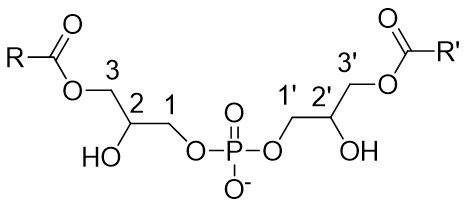
BMP分子包含兩個脂肪酸側鏈。式I中之R及R'代表獨立選擇之飽和或不飽和脂族鏈,其中每一者典型地含有14、16、18、20或22個碳原子。當脂肪酸側鏈不飽和時,其可含有1、2、3、4、5、6個或更多個碳碳雙鍵。此外,BMP分子可含有一或兩個烷基醚取代基,其中一或兩個脂肪酸側鏈之羰基氧經兩個氫原子置換。本文用於描述特定BMP物質之命名係指具有兩個脂肪酸側鏈之物質,其中脂肪酸側鏈之結構在BMP格式中之括號內指示(例如BMP(18:1_18:1))。數字遵循「脂肪酸碳原子數:雙鍵數」之標準脂肪酸記數格式。「e-」字首用於指示烷基醚取代基之存在,其中脂肪酸側鏈之羰基氧經兩個氫原子置換。舉例而言,「BMP(16:0e_18:0)」中之「e」表示具有16個碳原子之側鏈為烷基醚取代基。The BMP molecule contains two fatty acid side chains. R and R'in formula I represent independently selected saturated or unsaturated aliphatic chains, each of which typically contains 14, 16, 18, 20 or 22 carbon atoms. When the fatty acid side chain is unsaturated, it may contain 1, 2, 3, 4, 5, 6 or more carbon-carbon double bonds. In addition, the BMP molecule may contain one or two alkyl ether substituents, in which the carbonyl oxygen of one or two fatty acid side chains is replaced by two hydrogen atoms. The nomenclature used here to describe a specific BMP substance refers to a substance with two fatty acid side chains, where the structure of the fatty acid side chain is indicated in parentheses in the BMP format (eg BMP(18:1_18:1)). The numbers follow the standard fatty acid notation format of "Number of fatty acid carbon atoms: double bonds". The prefix "e-" is used to indicate the presence of an alkyl ether substituent, in which the carbonyl oxygen of the fatty acid side chain is replaced by two hydrogen atoms. For example, the "e" in "BMP(16:0e_18:0)" means that the side chain with 16 carbon atoms is an alkyl ether substituent.
「顆粒蛋白前體多肽」或「PGRN多肽」係指由基因GRN 編碼之富半胱胺酸溶酶體蛋白。顆粒蛋白前體多肽可包含人類顆粒蛋白前體序列,例如SEQ ID NO:211或212之序列。顆粒蛋白前體多肽可為具有SEQ ID NO:211之序列的成熟前顆粒蛋白前體,其中最初17個胺基酸指示信號肽。顆粒蛋白前體多肽可為成熟顆粒蛋白前體,其中17個胺基酸之信號肽經裂解。成熟顆粒蛋白前體可包含SEQ ID NO:212之序列。顆粒蛋白前體多肽可包括呈成熟前或成熟形式之序列,其來自非人類物種,例如小鼠(寄存編號NP_032201.2)、大鼠(NP_058809.2或NP_001139314.1)及黑猩猩(XP_016787144.1或XP_016787145.1)。"Granulin precursor polypeptide" or "PGRN polypeptide" refers to the cysteine-rich lysosomal protein encoded by the gene GRN . The granulin precursor polypeptide may comprise a human granulin precursor sequence, such as the sequence of SEQ ID NO: 211 or 212. The granulin precursor polypeptide may be a mature progranulin precursor having the sequence of SEQ ID NO: 211, where the first 17 amino acids indicate a signal peptide. The granule precursor polypeptide may be a mature granule precursor, in which the signal peptide of 17 amino acids is cleaved. The mature granule protein precursor may comprise the sequence of SEQ ID NO:212. Granulin precursor polypeptides may include sequences in pre-mature or mature form, which are derived from non-human species such as mice (Accession No. NP_032201.2), rats (NP_058809.2 or NP_001139314.1), and chimpanzees (XP_016787144.1 Or XP_016787145.1).
「顆粒蛋白前體多肽變異體」或「PGRN多肽變異體」係指野生型顆粒蛋白前體之功能變異體,其與成熟野生型顆粒蛋白前體多肽(例如SEQ ID NO:212)具有至少90%序列一致性(例如92%、94%、96%、98%或99%序列一致性)。顆粒蛋白前體多肽變異體可具有與野生型顆粒蛋白前體之彼等功能類似之功能,例如其中顆粒蛋白前體多肽變異體亦結合分揀蛋白或鞘脂激活蛋白原,調控各種溶酶體蛋白(例如組織蛋白酶)之活性及水準,促進神經突外生及神經元存活,及/或本文所述之任何其他功能。顆粒蛋白前體多肽變異體包含全長顆粒蛋白前體(例如SEQ ID NO:212)之顆粒蛋白G、F、B、A、C、D及E。"Granulin precursor polypeptide variant" or "PGRN polypeptide variant" refers to a functional variant of a wild-type granulin precursor, which has at least 90% of the mature wild-type granulin precursor polypeptide (eg SEQ ID NO: 212) % Sequence identity (eg 92%, 94%, 96%, 98% or 99% sequence identity). Granulin precursor polypeptide variants can have functions similar to those of wild-type granule precursors. For example, granule precursor protein variants also combine sortin or sphingolipid-activated proprotein to regulate various lysosomes. The activity and level of proteins (such as cathepsins) promote neurite outgrowth and neuronal survival, and/or any other functions described herein. Granulin precursor polypeptide variants include granule proteins G, F, B, A, C, D and E of a full-length granule protein precursor (eg SEQ ID NO: 212).
術語「顆粒蛋白前體相關病症」係指涉及顆粒蛋白前體,包括表現、處理、糖基化、細胞吸收、運輸及/或功能之任何病理性病狀。術語「與水準降低之顆粒蛋白前體相關之病症」係指由不足以能夠執行(亦即,過低而不能執行)細胞、組織及/或受試者內之正常生理功能之顆粒蛋白前體水準直接或間接引起的任何病理性病狀,以及此類病狀之前兆。在一些實施例中,顆粒蛋白前體相關病症為神經退化性疾病(例如額顳葉性癡呆(FTD))或溶酶體貯積症。The term "granuloprotein precursor-related disorder" refers to any pathological condition that involves progranulin precursors, including manifestation, processing, glycosylation, cellular uptake, transport, and/or function. The term "disorders associated with reduced levels of progranulin" refers to pregranular precursors that are insufficient to perform (i.e., too low to perform) normal physiological functions in cells, tissues, and/or subjects Any pathological pathology caused directly or indirectly by the level, and the precursor of such pathology. In some embodiments, the granuloprotein precursor-related disorder is a neurodegenerative disease (eg, frontotemporal dementia (FTD)) or lysosomal storage disease.
術語「顆粒蛋白前體水準」係指存在於受試者中或樣品(例如自受試者獲得之樣品)中之顆粒蛋白前體之量、濃度及/或活性水準。顆粒蛋白前體水準可指所存在之顆粒蛋白前體之絕對量、濃度及/或活性水準,或可指相對量、濃度及/或活性水準。該術語亦指所存在之顆粒蛋白前體多肽及/或顆粒蛋白前體mRNA (例如自GRN 基因表現)之量或濃度。The term "granin precursor level" refers to the amount, concentration, and/or activity level of the granulin precursor present in the subject or in a sample (eg, a sample obtained from the subject). The level of granule protein precursor may refer to the absolute amount, concentration and/or activity level of the granule protein precursor present, or may refer to the relative amount, concentration and/or activity level. The term also refers to the amount or concentration of progranulin precursor polypeptide and/or progranulin precursor mRNA present (eg, expressed from the GRN gene).
術語「骨髓源性巨噬細胞」或「BMDM」係指活體外自哺乳動物骨髓(例如自受試者獲得之骨髓)產生或得到之巨噬細胞。作為非限制性實例,BMDM可藉由在諸如巨噬細胞群落刺激因子(M-CSF)之細胞激素存在下培養未分化之骨髓細胞而產生。The term "bone marrow-derived macrophage" or "BMDM" refers to macrophages produced or obtained in vitro from mammalian bone marrow (eg, bone marrow obtained from a subject). As a non-limiting example, BMDM can be produced by culturing undifferentiated bone marrow cells in the presence of cytokines such as macrophage colony stimulating factor (M-CSF).
如本揭示案之上下文中所使用,「轉鐵蛋白受體」或「TfR」係指轉鐵蛋白受體蛋白質1。人類轉鐵蛋白受體1多肽序列陳述於SEQ ID NO:92中。亦已知來自其他物種之轉鐵蛋白受體蛋白質1 (例如黑猩猩,寄存編號XP_003310238.1;恆河猴,NP_001244232.1;犬,NP_001003111.1;牛,NP_001193506.1;小鼠,NP_035768.1;大鼠,NP_073203.1;及雞,NP_990587.1)。術語「轉鐵蛋白受體」亦涵蓋由轉鐵蛋白受體蛋白質1染色體基因座處之基因編碼之例示性參考序列,例如人類序列的對偶基因變異體。全長轉鐵蛋白受體蛋白質包括短N末端細胞內區、跨膜區及大細胞外結構域。細胞外結構域係由三個結構域表徵:蛋白酶樣結構域、螺旋結構域及頂端結構域。As used in the context of this disclosure, "transferrin receptor" or "TfR" refers to
如本文所使用,術語「Fc多肽」係指由Ig摺疊成結構性結構域表徵之天然存在之免疫球蛋白重鏈多肽的C末端區。Fc多肽含有至少包括CH2結構域及/或CH3結構域之恆定區序列且可含有鉸鏈區之至少一部分。一般而言,Fc多肽不含可變區。As used herein, the term "Fc polypeptide" refers to the C-terminal region of a naturally occurring immunoglobulin heavy chain polypeptide characterized by Ig folding into a structural domain. The Fc polypeptide contains a constant region sequence including at least a CH2 domain and/or a CH3 domain and may contain at least a part of a hinge region. In general, Fc polypeptides do not contain variable regions.
「經修飾Fc多肽」係指相較於野生型免疫球蛋白重鏈Fc多肽序列具有至少一個突變,例如取代、缺失或插入,但保留天然Fc多肽之總體Ig摺疊或結構的Fc多肽。"Modified Fc polypeptide" refers to an Fc polypeptide that has at least one mutation, such as a substitution, deletion, or insertion, but retains the overall Ig folding or structure of the native Fc polypeptide compared to the wild-type immunoglobulin heavy chain Fc polypeptide sequence.
如本文所使用,術語「Fc多肽二聚體」係指兩個Fc多肽之二聚體。在一些實施例中,兩個Fc多肽藉由兩個CH3結構域之間的相互作用二聚化。若鉸鏈區或鉸鏈去之部分存在於兩個Fc多肽中,則一或多個二硫鍵亦可在兩個二聚化Fc多肽之鉸鏈區之間形成。As used herein, the term "Fc polypeptide dimer" refers to a dimer of two Fc polypeptides. In some embodiments, the two Fc polypeptides dimerize by the interaction between the two CH3 domains. If the hinge region or the hinge-deleted portion is present in the two Fc polypeptides, one or more disulfide bonds can also be formed between the hinge regions of the two dimerized Fc polypeptides.
「經修飾Fc多肽二聚體」係指兩個Fc多肽之二聚體,其中至少一個Fc多肽為經修飾Fc多肽,其相較於野生型免疫球蛋白重鏈Fc多肽序列具有至少一個突變,例如取代、缺失或插入。舉例而言,經修飾Fc多肽二聚體特異性結合TfR且具有至少一個經修飾Fc多肽,其相較於野生型免疫球蛋白重鏈Fc多肽序列具有至少一個突變,例如取代、缺失或插入。"Modified Fc polypeptide dimer" refers to a dimer of two Fc polypeptides, at least one of which is a modified Fc polypeptide that has at least one mutation compared to the wild-type immunoglobulin heavy chain Fc polypeptide sequence, For example, substitution, deletion or insertion. For example, the modified Fc polypeptide dimer specifically binds TfR and has at least one modified Fc polypeptide that has at least one mutation, such as a substitution, deletion, or insertion, compared to the wild-type immunoglobulin heavy chain Fc polypeptide sequence.
術語「FcRn」係指新生兒Fc受體。Fc多肽與FcRn之結合降低Fc多肽之清除率且增加其血清半衰期。人類FcRn蛋白為由類似於I類主要組織相容性(MHC)蛋白的大小為約50 kDa之蛋白質及大小為約15 kDa之β2-微球蛋白構成的異二聚體。The term "FcRn" refers to neonatal Fc receptors. The binding of Fc polypeptide to FcRn reduces the clearance rate of Fc polypeptide and increases its serum half-life. The human FcRn protein is a heterodimer composed of a protein with a size of approximately 50 kDa and a β2-microglobulin with a size of approximately 15 kDa similar to the major histocompatibility (MHC) class I protein.
如本文所使用,「FcRn結合位點」係指Fc多肽中結合至FcRn之區域。在人類IgG中,如使用EU索引編號,FcRn結合位點包括T250、L251、M252、I253、S254、R255、T256、T307、E380、M428、H433、N434、H435及Y436。此等位置對應於SEQ ID NO:1之位置20至26、77、150、198及203至206。As used herein, "FcRn binding site" refers to the region of an Fc polypeptide that binds to FcRn. In human IgG, if EU index numbers are used, FcRn binding sites include T250, L251, M252, I253, S254, R255, T256, T307, E380, M428, H433, N434, H435, and Y436. These positions correspond to
如本文所使用,「天然FcRn結合位點」係指Fc多肽中結合至FcRn之區域且其胺基酸序列與天然存在之Fc多肽中結合至FcRn之區域相同。As used herein, "native FcRn binding site" refers to a region of an Fc polypeptide that binds to FcRn and its amino acid sequence is the same as a region of a naturally occurring Fc polypeptide that binds to FcRn.
如本文所使用,術語「CH3結構域」及「CH2結構域」係指免疫球蛋白恆定區結構域多肽。出於本申請案之目的,CH3結構域多肽係指如根據EU編號方案編號自大約位置341至大約位置447之胺基酸的區段,且CH2結構域多肽係指如根據EU編號方案編號自大約位置231至大約位置340之胺基酸的區段且不包括鉸鏈區序列。CH2及CH3結構域多肽亦可藉由IMGT (ImMunoGeneTics)編號方案編號,其中根據IMGT Scientific圖表編號(IMGT網站),CH2結構域編號為1-110且CH3結構域編號為1-107。CH2及CH3結構域為免疫球蛋白Fc區之一部分。Fc區係指如根據EU編號方案編號自大約位置231至自大約位置447之胺基酸的區段,但如本文所使用,其可包括抗體鉸鏈區之至少一部分。說明性鉸鏈區序列為人類IgG1鉸鏈序列EPKSCDKTHTCPPCP (SEQ ID NO:91)。As used herein, the terms "CH3 domain" and "CH2 domain" refer to immunoglobulin constant domain domain polypeptides. For the purposes of this application, a CH3 domain polypeptide refers to a segment of amino acids numbered from approximately position 341 to approximately position 447 as per the EU numbering scheme, and a CH2 domain polypeptide refers to numbering as from the EU numbering scheme The amino acid segment from about position 231 to about position 340 does not include the hinge region sequence. The CH2 and CH3 domain polypeptides can also be numbered by the IMGT (ImMunoGeneTics) numbering scheme, where according to IMGT Scientific chart numbers (IMGT website), the CH2 domain number is 1-110 and the CH3 domain number is 1-107. The CH2 and CH3 domains are part of the immunoglobulin Fc region. The Fc region refers to a segment of amino acids from approximately position 231 to approximately position 447 as numbered according to the EU numbering scheme, but as used herein, it may include at least a portion of the antibody hinge region. The illustrative hinge region sequence is the human IgG1 hinge sequence EPKSCDKTHTCPPCP (SEQ ID NO: 91).
關於CH3或CH2結構域之術語「野生型」、「天然」及「天然存在」在本文中用於指具有自然界中存在之序列的結構域。The terms "wild type", "natural" and "naturally occurring" with respect to the CH3 or CH2 domain are used herein to refer to domains having sequences that exist in nature.
在本揭示案之上下文中,關於突變多肽或突變聚核苷酸之術語「突變體」與「變異體」可互換使用。關於給定野生型CH3或CH2結構域參考序列之變異體可包括天然存在之對偶基因變異體。「非天然」存在之CH3或CH2結構域係指在自然界中不存在於細胞中且藉由例如使用基因工程改造技術或誘變技術對天然CH3結構域或CH2結構域聚核苷酸或多肽進行基因修飾而產生之變異或突變結構域。「變異體」包括關於野生型包含至少一個胺基酸突變之任何結構域。突變可包括取代、插入及缺失。In the context of this disclosure, the terms "mutant" and "variant" with respect to mutant polypeptides or mutant polynucleotides are used interchangeably. Variants for a given wild-type CH3 or CH2 domain reference sequence may include naturally occurring dual gene variants. "Non-natural" CH3 or CH2 domain refers to a polynucleotide or polypeptide that does not exist in the cell in nature and is performed on the natural CH3 domain or CH2 domain by, for example, using genetic engineering techniques or mutagenesis techniques A genetically modified mutation or mutation domain. "Variant" includes any domain that contains at least one amino acid mutation with respect to the wild type. Mutations can include substitutions, insertions, and deletions.
術語「胺基酸」係指天然存在及合成之胺基酸以及胺基酸類似物及以類似於天然存在之胺基酸之方式起作用的胺基酸模擬物。The term "amino acid" refers to naturally occurring and synthetic amino acids and amino acid analogs and amino acid mimetics that function in a manner similar to naturally occurring amino acids.
天然存在之胺基酸為由基因密碼編碼之彼等胺基酸,以及稍後經修飾之彼等胺基酸,例如羥脯胺酸、γ-羧基麩胺酸及O-磷酸絲胺酸。「胺基酸類似物」係指具有與天然存在之胺基酸相同之基本化學結構(亦即,α碳結合至氫、羧基、胺基及R基團)的化合物,例如高絲胺酸、正白胺酸、甲硫胺酸亞碸、甲硫胺酸甲基鋶。該等類似物具有經修飾R基團(例如正白胺酸)或經修飾肽骨架,但保留與天然存在之胺基酸相同之基本化學結構。「胺基酸模擬物」係指具有不同於胺基酸之一般化學結構之結構,但以類似於天然存在之胺基酸之方式起作用的化合物。Naturally occurring amino acids are those amino acids encoded by the genetic code, and those amino acids that are later modified, such as hydroxyproline, γ-carboxyglutamic acid, and O-phosphoserine. "Amino acid analogs" refers to compounds that have the same basic chemical structure as naturally occurring amino acids (ie, the alpha carbon is bonded to hydrogen, carboxyl groups, amino groups, and R groups), such as homoserine, positive Leucine, methionine sulfonate, methionine methyl alkane. These analogs have modified R groups (eg, n-leucine) or modified peptide backbones, but retain the same basic chemical structure as naturally occurring amino acids. "Amino acid mimetics" refers to compounds that have a structure that differs from the general chemical structure of amino acids, but that functions in a manner similar to naturally occurring amino acids.
天然存在之α-胺基酸包括但不限於丙胺酸(Ala)、半胱胺酸(Cys)、天冬胺酸(Asp)、麩胺酸(Glu)、苯丙胺酸(Phe)、甘胺酸(Gly)、組胺酸(His)、異白胺酸(Ile)、精胺酸(Arg)、離胺酸(Lys)、白胺酸(Leu)、甲硫胺酸(Met)、天冬醯胺(Asn)、脯胺酸(Pro)、麩醯胺酸(Gln)、絲胺酸(Ser)、蘇胺酸(Thr)、纈胺酸(Val)、色胺酸(Trp)、酪胺酸(Tyr)及其組合。天然存在之α-胺基酸之立體異構體包括但不限於D-丙胺酸(D-Ala)、D-半胱胺酸(D-Cys)、D-天冬胺酸(D-Asp)、D-麩胺酸(D-Glu)、D-苯丙胺酸(D-Phe)、D-組胺酸(D-His)、D-異白胺酸(D-Ile)、D-精胺酸(D-Arg)、D-離胺酸(D-Lys)、D-白胺酸(D-Leu)、D-甲硫胺酸(D-Met)、D-天冬醯胺(D-Asn)、D-脯胺酸(D-Pro)、D-麩醯胺酸(D-Gln)、D-絲胺酸(D-Ser)、D-蘇胺酸(D-Thr)、D-纈胺酸(D-Val)、D-色胺酸(D-Trp)、D-酪胺酸(D-Tyr)及其組合。Naturally occurring alpha-amino acids include but are not limited to alanine (Ala), cysteine (Cys), aspartic acid (Asp), glutamic acid (Glu), amphetamine (Phe), glycine (Gly), histidine (His), isoleucine (Ile), arginine (Arg), lysine (Lys), leucine (Leu), methionine (Met), aspart Acetamide (Asn), proline (Pro), glutamate (Gln), serine (Ser), threonine (Thr), valine (Val), tryptophan (Trp), casein Amino acid (Tyr) and its combinations. Stereoisomers of naturally occurring α-amino acids include, but are not limited to, D-alanine (D-Ala), D-cysteine (D-Cys), D-aspartic acid (D-Asp) , D-glutamic acid (D-Glu), D-phenylalanine (D-Phe), D-histidine (D-His), D-isoleucine (D-Ile), D-spermine (D-Arg), D-Lysine (D-Lys), D-Leucine (D-Leu), D-Methionine (D-Met), D-Aspartame (D-Asn ), D-proline (D-Pro), D-glutamic acid (D-Gln), D-serine (D-Ser), D-threonine (D-Thr), D-Val Amino acid (D-Val), D-tryptophan (D-Trp), D-tyrosine (D-Tyr) and combinations thereof.
胺基酸在本文中可由其通常已知之三字母符號或由IUPAC-IUB生物化學命名委員會(IUPAC-IUB Biochemical Nomenclature Commission)所推薦之單字母符號提及。Amino acids can be referred to herein by their commonly known three-letter symbols or single-letter symbols recommended by the IUPAC-IUB Biochemical Nomenclature Commission.
術語「多肽」與「蛋白質」在本文中可互換使用以指呈單鏈之胺基酸殘基之聚合物。該等術語適用於一或多個胺基酸殘基為相應天然存在之胺基酸之人工化學模擬物的胺基酸聚合物,以及天然存在之胺基酸聚合物及非天然存在之胺基酸聚合物。胺基酸聚合物可僅包含L-胺基酸,僅包含D-胺基酸,或包含L及D胺基酸之混合物。The terms "polypeptide" and "protein" are used interchangeably herein to refer to a polymer that is a single chain amino acid residue. These terms apply to amino acid polymers in which one or more amino acid residues are artificial chemical mimics of the corresponding naturally occurring amino acids, as well as naturally occurring amino acid polymers and non-naturally occurring amino groups Acid polymer. The amino acid polymer may include only L-amino acids, only D-amino acids, or a mixture of L and D amino acids.
如本文所使用,術語「蛋白質」係指多肽或者單鏈多肽之二聚體(亦即,兩個)或多聚體(亦即,三個或三個以上)。蛋白質之單鏈多肽可由共價鍵(例如二硫鍵)或非共價相互作用接合。As used herein, the term "protein" refers to a dimer (ie, two) or multimer (ie, three or more) of a polypeptide or single chain polypeptide. Single-chain polypeptides of proteins can be joined by covalent bonds (such as disulfide bonds) or non-covalent interactions.
術語「保守取代」、「保守突變」或「保守修飾之變異體」係指使得胺基酸經可歸類為具有類似特徵之另一胺基酸取代的改變。以此種方式定義之保守胺基酸組之類別的實例可包括:「帶電/極性組」,包括Glu (麩胺酸或E)、Asp (天冬胺酸或D)、Asn (天冬醯胺或N)、Gln (麩醯胺酸或Q)、Lys (離胺酸或K)、Arg (精胺酸或R)及His (組胺酸或H);「芳族組」,包括Phe (苯丙胺酸或F)、Tyr (酪胺酸或Y)、Trp (色胺酸或W)及(組胺酸或H);及「脂族組」,包括Gly (甘胺酸或G)、Ala (丙胺酸或A)、Val (纈胺酸或V)、Leu (白胺酸或L)、Ile (異白胺酸或I)、Met (甲硫胺酸或M)、Ser (絲胺酸或S)、Thr (蘇胺酸或T)及Cys (半胱胺酸或C)。在各組內,亦可鑑別亞組。舉例而言,帶電或極性胺基酸組可細分成包括以下之亞組:「帶正電亞組」,包含Lys、Arg及His;「帶負電亞組」,包含Glu及Asp;及「極性亞組」,包含Asn及Gln。在另一實例中,芳族或環狀組可細分成包括以下之亞組:「氮環亞組」,包含Pro、His及Trp;及「苯基亞組」,包含Phe及Tyr。在又另一實例中,脂族組可細分成亞組,例如「脂族非極性亞組」,包含Val、Leu、Gly及Ala;及「脂族弱極性亞組」,包含Met、Ser、Thr及Cys。保守突變之類別的實例包括在上述亞組內之胺基酸之胺基酸取代,諸如但不限於:Lys取代Arg或反之亦然,由此可維持正電荷;Glu取代Asp或反之亦然,由此可維持負電荷;Ser取代Thr或反之亦然,由此可維持游離-OH;及Gln取代Asn或反之亦然,由此可維持游離-NH2 。在一些實施例中,用疏水性胺基酸取代例如在活性位點中之天然存在之疏水性胺基酸,以保持疏水性。The term "conservative substitution", "conservative mutation" or "conservatively modified variant" refers to a change that causes an amino acid to be substituted with another amino acid that can be classified as having similar characteristics. Examples of categories of conservative amino acid groups defined in this way may include: "charged/polar groups", including Glu (glutamic acid or E), Asp (aspartic acid or D), Asn (aspartic acid) Amine or N), Gln (glutamic acid or Q), Lys (ionic acid or K), Arg (arginine or R), and His (histidine or H); "aromatic group", including Phe (Phenylalanine or F), Tyr (tyrosine or Y), Trp (tryptophan or W) and (histidine or H); and "aliphatic group", including Gly (glycine or G), Ala (alanine or A), Val (valine or V), Leu (leucine or L), Ile (isoleucine or I), Met (methionine or M), Ser (serine Acid or S), Thr (threonine or T) and Cys (cysteine or C). Within each group, subgroups can also be identified. For example, the charged or polar amino acid group can be subdivided into the following subgroups: "positively charged subgroup", which includes Lys, Arg, and His; "negatively charged subgroup", which includes Glu and Asp; and "polarity "Subgroup" includes Asn and Gln. In another example, the aromatic or cyclic group can be subdivided into subgroups that include the following: "nitrogen ring subgroup", including Pro, His, and Trp; and "phenyl subgroup," including Phe and Tyr. In yet another example, the aliphatic group can be subdivided into subgroups, such as "aliphatic nonpolar subgroup", including Val, Leu, Gly, and Ala; and "aliphatic weakly polar subgroup", including Met, Ser, Thr and Cys. Examples of categories of conservative mutations include amino acid substitutions of amino acids within the above subgroups, such as but not limited to: Lys replacing Arg or vice versa, thereby maintaining a positive charge; Glu replacing Asp or vice versa, Thus, a negative charge can be maintained; Ser replaces Thr or vice versa, whereby free-OH can be maintained; and Gln replaces Asn or vice versa, thus free-NH 2 can be maintained. In some embodiments, a naturally-occurring hydrophobic amino acid, such as in the active site, is replaced with a hydrophobic amino acid to maintain hydrophobicity.
在兩個或兩個以上多肽序列之情形中,術語「一致」或「一致性」百分比係指當在比較窗口或指定區域內比較及比對以達到最大對應性時,如使用序列比較算法或藉由手動比對及目測檢查所量測,相同的或具有在指定區域內一致之胺基酸殘基之指定百分比,例如至少60%一致性、至少65%、至少70%、至少75%、至少80%、至少85%、至少90%或至少95%或更大一致性的兩個或兩個以上序列或子序列。In the case of two or more polypeptide sequences, the term "identity" or "identity" percentage refers to when comparing and aligning within a comparison window or specified area to achieve maximum correspondence, such as using a sequence comparison algorithm or Measured by manual comparison and visual inspection, the same or a specified percentage of amino acid residues that are identical or consistent within a specified area, such as at least 60% identity, at least 65%, at least 70%, at least 75%, Two or more sequences or subsequences that are at least 80%, at least 85%, at least 90%, or at least 95% or more identical.
對於多肽之序列比較,典型地一個胺基酸序列充當參考序列,以與候選序列相比較。比對可使用熟習此項技術者可用之各種方法,例如目測比對或使用公開可用之軟體使用已知算法進行,以達成最大比對。此類程式包括BLAST程式、ALIGN、ALIGN-2 (Genentech, South San Francisco, Calif.)或Megalign (DNASTAR)。用於比對以達成最大比對之參數可由熟習此項技術者確定。出於本申請案之目的,對於多肽序列之序列比較,使用以預設參數比對兩個蛋白質序列之BLASTP算法標準蛋白質BLAST。For sequence comparison of polypeptides, typically an amino acid sequence serves as a reference sequence for comparison with candidate sequences. The comparison can use various methods available to those skilled in the art, such as visual comparison or using publicly available software using known algorithms to achieve maximum comparison. Such programs include BLAST programs, ALIGN, ALIGN-2 (Genentech, South San Francisco, Calif.) or Megalign (DNASTAR). The parameters used for comparison to achieve maximum comparison can be determined by those skilled in the art. For the purpose of this application, for the sequence comparison of polypeptide sequences, the BLASTP algorithm standard protein BLAST that aligns two protein sequences with preset parameters is used.
當在鑑別多肽序列中之給定胺基酸殘基之情形中使用時,術語「對應於」、「參照……確定」或「參照……編號」係指當將給定胺基酸序列與指定參考序列最大程度地比對及比較時該參考序列之殘基位置。因此,舉例而言,經修飾Fc多肽中之胺基酸殘基當與SEQ ID NO:1最佳地對準時,在殘基與SEQ ID NO:1中之胺基酸比對之情況下,其「對應於」SEQ ID NO:1中之胺基酸。與參考序列比對之多肽無需與參考序列長度相同。When used in the context of identifying a given amino acid residue in a polypeptide sequence, the terms "corresponds to", "refer to... determine" or "reference... number" refer to when the given amino acid sequence is Specify the position of the reference sequence residues for maximum alignment and comparison. Therefore, for example, when the amino acid residue in the modified Fc polypeptide is optimally aligned with SEQ ID NO: 1, in the case where the residue is aligned with the amino acid in SEQ ID NO: 1, It "corresponds" to the amino acid in SEQ ID NO:1. The polypeptide aligned with the reference sequence need not be the same length as the reference sequence.
如本文所使用,「結合親和力」係指兩個分子,例如多肽上之單一結合位點與靶之間的非共價相互作用之強度,該靶為例如多肽所結合之轉鐵蛋白受體。因此,舉例而言,除非上下文另作指示或顯而易見,否則該術語可指多肽與其靶之間的1:1相互作用。結合親和力可藉由量測平衡解離常數(KD )定量,該平衡解離常數係指解離速率常數(kd ,時間-1 )除以締合速率常數(ka ,時間-1 M-1 )。可藉由例如使用表面電漿子共振(SPR)方法,例如Biacore™系統;動力學排除檢定,諸如KinExA® ;及生物膜層干涉法(例如使用ForteBio® Octet® 平台)量測複合物形成及解離之動力學來確定KD 。如本文所使用,「結合親和力」不僅包括形式上之結合親和力,諸如反映多肽與其靶之間的1:1相互作用之彼等結合親和力,而且包括可反映親合性結合之計算KD 之表觀親和力。As used herein, "binding affinity" refers to the strength of a non-covalent interaction between two molecules, such as a single binding site on a polypeptide, and a target, such as a transferrin receptor to which the polypeptide binds. Thus, for example, unless the context indicates otherwise or is obvious, the term may refer to a 1:1 interaction between a polypeptide and its target. The binding affinity can be quantified by measuring the equilibrium dissociation constant (K D ), which is the dissociation rate constant (k d , time -1 ) divided by the association rate constant (k a , time -1 M -1 ) . It may be, for example, by using surface plasmon resonance (SPR) method, for example, Biacore ™ system; kinetic exclusion assay, such as a KinExA ®; and biofilm Interferometry (e.g. internet using ForteBio ® Octet ®) and the measurement of complex formation The kinetics of dissociation is used to determine K D. As used herein, "binding affinity" includes not only the form of the binding affinity, such as to reflect the polypeptide and its target between 1: 1 interaction of their binding affinity, but also including table calculation may reflect the binding affinity of K D Look at affinity.
片語「特異性結合」或「選擇性結合」至靶,例如轉鐵蛋白受體,當涉及包含如本文所述之結合轉鐵蛋白受體之經修飾Fc多肽的多肽時,係指多肽相比其結合至結構上不同之靶,例如不在轉鐵蛋白受體家族中之靶以更高親和力、更大親合力及/或更長持續時間結合至靶的結合反應。在典型實施例中,當在相同親和力檢定條件下檢定時,多肽相較於無關靶對轉鐵蛋白受體具有至少5倍、10倍、25倍、50倍、100倍、1000倍、10,000倍或更高之親和力。如本文所使用,術語「特異性結合」、「特異性結合至」或「特異性針對」特定靶(例如TfR)可例如由對所結合之靶具有例如10-4 M或更小,例如10-5 M、10-6 M、10-7 M、10-8 M、10-9 M、10-10 M、10-11 M或10-12 M之平衡解離常數KD 的分子展現。在一些實施例中,經修飾Fc多肽特異性結合至在物種當中保守(例如在物種當中結構上保守),例如在非人類靈長類動物與人類物種之間保守(例如在非人類靈長類動物與人類物種之間結構上保守)的轉鐵蛋白受體上之抗原決定基。在一些實施例中,多肽可排他性地結合至人類轉鐵蛋白受體。The phrase "specifically binds" or "selectively binds" to a target, such as transferrin receptor, when referring to a polypeptide comprising a modified Fc polypeptide that binds to transferrin receptor as described herein, refers to the polypeptide phase A binding reaction that binds to a target that is structurally different than it does, for example, a target that is not in the transferrin receptor family, binds to the target with higher affinity, greater affinity, and/or longer duration. In a typical embodiment, when tested under the same affinity assay conditions, the polypeptide has at least 5 times, 10 times, 25 times, 50 times, 100 times, 1000 times, 10,000 times the transferrin receptor to the unrelated target Or higher affinity. As used herein, the terms "specifically bind", "specifically bind to" or "specifically target" a specific target (eg, TfR) may, for example, have a target of, for example, 10-4 M or less, such as 10 Molecules exhibiting an equilibrium dissociation constant K D of -5 M, 10 -6 M, 10 -7 M, 10 -8 M, 10 -9 M, 10 -10 M, 10 -11 M or 10 -12 M. In some embodiments, the modified Fc polypeptide specifically binds to be conserved among species (eg, structurally conserved among species), such as between non-human primates and human species (eg, in non-human primates) Structurally conserved between animal and human species) epitopes on the transferrin receptor. In some embodiments, the polypeptide can exclusively bind to human transferrin receptor.
術語「治療(treatment/treat)」及其類似術語在本文中一般用於意指獲得所要藥理學及/或生理學作用。「治療」可指在治療或改善疾病,包括顆粒蛋白前體相關病症,諸如神經退化性疾病(例如額顳葉性癡呆(FTD)、神經元蠟樣脂褐質貯積病(NCL)、A型尼曼-皮克氏病(NPA)、B型尼曼-皮克氏病(NPB)、C型尼曼-皮克氏病(NPC)、C9ORF72相關肌萎縮側索硬化症(ALS)/FTD、散發性ALS、阿茲海默氏病(AD)、高歇氏病(例如2型及3型高歇氏病)及帕金森氏病)、動脈粥樣硬化、與TDP-43相關之病症及年齡相關性黃斑變性(AMD)中之成功的任何指標,包括任何客觀或主觀參數,諸如消除、緩解、患者存活狀況改善、存活時間或存活率增加、減輕症狀或使患者對病症更易忍受、減慢退化或減退之速率,或改善患者之身體或精神健康。症狀之治療或改善可基於客觀或主觀參數。治療作用可與未接受治療之一位個體或一組個體,或與治療之前或在治療期間之不同時間的同一患者相比較。The term "treatment (treat)" and similar terms are generally used herein to mean obtaining the desired pharmacological and/or physiological effects. "Treatment" may refer to the treatment or amelioration of diseases including granular protein precursor-related disorders, such as neurodegenerative diseases (eg, frontotemporal dementia (FTD), neuronal waxy lipofuscinosis (NCL), A Niemann-Pick's disease type (NPA), Niemann-Pick's disease type B (NPB), Niemann-Pick's disease type C (NPC), C9ORF72-related amyotrophic lateral sclerosis (ALS)/ FTD, sporadic ALS, Alzheimer's disease (AD), Gaucher's disease (e.g.,
如本文中可互換使用之術語「受試者」、「個體」及「患者」係指哺乳動物,包括但不限於人類、非人類靈長類動物、囓齒動物(例如大鼠、小鼠及天竺鼠)、兔、牛、豬、馬及其他哺乳動物物種。在一個實施例中,患者為人類。As used herein, the terms "subject", "individual" and "patient" refer to mammals, including but not limited to humans, non-human primates, rodents (such as rats, mice and guinea pigs) ), rabbits, cattle, pigs, horses and other mammalian species. In one embodiment, the patient is a human.
術語「醫藥學上可接受之賦形劑」係指在生物學上或藥理學上相容的用於人類或動物中之非活性醫藥成分,諸如但不限於緩衝劑、載劑或防腐劑。The term "pharmaceutically acceptable excipients" refers to biologically or pharmacologically compatible inactive pharmaceutical ingredients for use in humans or animals, such as but not limited to buffers, carriers, or preservatives.
如本文所使用,藥劑之「治療量」或「治療有效量」為治療受試者之疾病症狀之藥劑的量。As used herein, a "therapeutic amount" or "therapeutically effective amount" of an agent is the amount of the agent that treats the symptoms of a disease in a subject.
術語「投予」係指將藥劑、化合物或組成物遞送至生物作用之所要部位的方法。此等方法包括但不限於局部遞送、非經腸遞送、靜脈內遞送、皮內遞送、肌肉內遞送、鞘內遞送、結腸遞送、直腸遞送或腹膜內遞送。在一個實施例中,本文所述之多肽係靜脈內投予。 III. 顆粒蛋白前體替代療法The term "administering" refers to a method of delivering an agent, compound or composition to a desired site of biological action. Such methods include, but are not limited to, local delivery, parenteral delivery, intravenous delivery, intradermal delivery, intramuscular delivery, intrathecal delivery, colon delivery, rectal delivery, or intraperitoneal delivery. In one embodiment, the polypeptide described herein is administered intravenously. III. Granule precursor replacement therapy
在一些態樣中,本文描述一種包含以下之融合蛋白:(i) Fc多肽,其可含有修飾(例如促進異二聚化之一或多個修飾)或可為野生型Fc多肽;及顆粒蛋白前體多肽;及(ii) Fc多肽,其可含有修飾(例如促進異二聚化之一或多個修飾)或可為野生型Fc多肽;及視情況存在之顆粒蛋白前體多肽。在一些實施例中,一或兩個Fc多肽可含有得以結合至血腦障壁(BBB)受體,例如轉鐵蛋白受體(TfR)之修飾。顆粒蛋白前體多肽可在神經退化性疾病中缺乏。顆粒蛋白前體多肽可在額顳葉性癡呆(FTD)中以及其他疾病,諸如高歇氏病及阿茲海默氏病(AD)中缺乏。併入融合蛋白中之顆粒蛋白前體多肽可結合至分揀蛋白或鞘脂激活蛋白原。在特定實施例中,併入融合蛋白中之顆粒蛋白前體多肽結合至分揀蛋白。In some aspects, described herein is a fusion protein comprising: (i) an Fc polypeptide, which may contain modifications (eg, one or more modifications that promote heterodimerization) or may be wild-type Fc polypeptides; and granule proteins Precursor polypeptides; and (ii) Fc polypeptides, which may contain modifications (eg, one or more modifications that promote heterodimerization) or may be wild-type Fc polypeptides; and optionally granule protein precursor polypeptides. In some embodiments, one or two Fc polypeptides may contain modifications that allow binding to blood-brain barrier (BBB) receptors, such as transferrin receptor (TfR). Granulin precursor polypeptides may be lacking in neurodegenerative diseases. Granulin precursor polypeptides can be lacking in frontotemporal dementia (FTD) and other diseases such as Gaucher's disease and Alzheimer's disease (AD). Granulin precursor polypeptides incorporated into the fusion protein can bind to sortin or sphingolipid activin. In certain embodiments, the granule precursor polypeptide incorporated into the fusion protein binds to the sorting protein.
在一些實施例中,包含顆粒蛋白前體多肽及視情況存在之結合至BBB受體之經修飾Fc多肽,例如TfR結合Fc多肽之融合蛋白包含顆粒蛋白前體多肽之變異體。In some embodiments, a fusion protein comprising a granulin precursor polypeptide and optionally a modified Fc polypeptide that binds to the BBB receptor, such as a TfR binding Fc polypeptide, includes a variant of the granulin precursor polypeptide.
在一些實施例中,存在於本文所述之融合蛋白中之顆粒蛋白前體多肽或其變異體相較於其在未接合至Fc多肽或TfR結合Fc多肽時的活性保留至少25%之其活性。在一些實施例中,存在於本文所述之融合蛋白中之顆粒蛋白前體多肽或其變異體相較於其在未接合至Fc多肽或TfR結合Fc多肽時的活性保留至少10%或至少15%、20%、25%、30%、35%、40%、45%、50%、55%、60%、65%、70%、75%、80%、85%、90%或95%之其活性。在一些實施例中,存在於本文所述之融合蛋白中之顆粒蛋白前體多肽或其變異體相較於其在未接合至Fc多肽或TfR結合Fc多肽時的活性保留至少80%、85%、90%或95%之其活性。本文所述之融合蛋白可為包含以下之Fc二聚體:PGRN融合蛋白:(a)與SEQ ID NO:215之序列具有至少85%一致性、至少90%一致性、至少95%一致性或100%一致性的序列,及(b)與SEQ ID NO:210之序列具有至少85%一致性、至少90%一致性、至少95%一致性或100%一致性的序列。本文所述之融合蛋白可為包含以下之Fc二聚體:PGRN融合蛋白:(a)與SEQ ID NO:227之序列具有至少85%一致性、至少90%一致性、至少95%一致性或100%一致性的序列,及(b)與SEQ ID NO:210之序列具有至少85%一致性、至少90%一致性、至少95%一致性或100%一致性的序列。本文所述之融合蛋白可為包含以下之Fc二聚體:PGRN融合蛋白:(a)與SEQ ID NO:215之序列具有至少85%一致性、至少90%一致性、至少95%一致性或100%一致性的序列,及(b)與SEQ ID NO:291之序列具有至少85%一致性、至少90%一致性、至少95%一致性或100%一致性的序列。本文所述之融合蛋白可為Fc二聚體:PGRN融合蛋白,包含:包含以下之Fc二聚體:PGRN融合蛋白:(a)與SEQ ID NO:227之序列具有至少85%一致性、至少90%一致性、至少95%一致性或100%一致性的序列,及(b)與SEQ ID NO:291之序列具有至少85%一致性、至少90%一致性、至少95%一致性或100%一致性的序列。In some embodiments, the granulin precursor polypeptide or variant thereof present in the fusion protein described herein retains at least 25% of its activity compared to its activity when it is not conjugated to the Fc polypeptide or TfR binds to the Fc polypeptide . In some embodiments, the granulin precursor polypeptide or variant thereof present in the fusion protein described herein retains at least 10% or at least 15 of its activity when it is not conjugated to the Fc polypeptide or TfR binds to the Fc polypeptide %, 20%, 25%, 30%, 35%, 40%, 45%, 50%, 55%, 60%, 65%, 70%, 75%, 80%, 85%, 90% or 95% Its activity. In some embodiments, the granulin precursor polypeptide or variant thereof present in the fusion protein described herein retains at least 80%, 85% of its activity when it is not conjugated to the Fc polypeptide or TfR binds to the Fc polypeptide , 90% or 95% of its activity. The fusion protein described herein may be an Fc dimer comprising: PGRN fusion protein: (a) has at least 85% identity, at least 90% identity, at least 95% identity with the sequence of SEQ ID NO: 215 or A sequence with 100% identity, and (b) a sequence with at least 85% identity, at least 90% identity, at least 95% identity, or 100% identity with the sequence of SEQ ID NO:210. The fusion protein described herein may be an Fc dimer comprising: PGRN fusion protein: (a) has at least 85% identity, at least 90% identity, at least 95% identity with the sequence of SEQ ID NO: 227 or A sequence with 100% identity, and (b) a sequence with at least 85% identity, at least 90% identity, at least 95% identity, or 100% identity with the sequence of SEQ ID NO:210. The fusion protein described herein may be an Fc dimer comprising: PGRN fusion protein: (a) has at least 85% identity, at least 90% identity, at least 95% identity with the sequence of SEQ ID NO: 215 or A sequence with 100% identity, and (b) a sequence with at least 85% identity, at least 90% identity, at least 95% identity, or 100% identity with the sequence of SEQ ID NO:291. The fusion protein described herein may be an Fc dimer: PGRN fusion protein, including: an Fc dimer comprising: PGRN fusion protein: (a) has at least 85% identity with the sequence of SEQ ID NO: 227, at least A sequence of 90% identity, at least 95% identity or 100% identity, and (b) at least 85% identity, at least 90% identity, at least 95% identity or 100 with the sequence of SEQ ID NO: 291 % Consistent sequence.
在一些實施例中,與Fc多肽之融合不降低顆粒蛋白前體多肽或其變異體之表現及/或活性。在一些實施例中,與TfR結合Fc多肽之融合不降低顆粒蛋白前體多肽之表現及/或活性。 IV. 適應症In some embodiments, the fusion with the Fc polypeptide does not reduce the performance and/or activity of the granulin precursor polypeptide or variants thereof. In some embodiments, the fusion with TfR binding Fc polypeptide does not reduce the performance and/or activity of the granule precursor protein. IV. Indications
在一些實施例中,包含顆粒蛋白前體多肽之本文所述之融合蛋白適用於治療一或多種選自由以下組成之群的神經退化性疾病:阿茲海默氏病、原發性年齡相關性τ蛋白病、路易體癡呆、進行性核上麻痹(PSP)、額顳葉性癡呆、與染色體17相關之額顳葉性癡呆伴發帕金森氏症、嗜銀顆粒性癡呆、肌萎縮側索硬化症、關島型肌萎縮側索硬化症/帕金森氏症-癡呆複合症(ALS-PDC)、皮質基底核退化、慢性創傷性腦病、克-雅二氏病、拳擊員癡呆、瀰漫性神經纖維纏結伴發鈣化、唐氏症候群、家族性英國型癡呆、家族性丹麥型癡呆、傑茨曼-斯脫司勒-史茵克氏病、球狀膠質τ蛋白病、瓜德羅普島型帕金森氏症伴發癡呆、瓜德羅普島型PSP、哈勒沃登-施帕茨氏病、遺傳性瀰漫性腦白質病伴發軸索球樣變(HDLS)、包涵體肌炎、多系統萎縮、肌強直性營養不良、那須-哈科拉氏病、神經纖維纏結主導型癡呆、C型尼曼-皮克氏病、蒼白球-橋腦-黑質退化、帕金森氏病、皮克氏病、腦炎後帕金森氏症、朊病毒蛋白型大腦澱粉樣血管病、進行性皮質下神經膠質瘤病、亞急性硬化性泛腦炎及單純纏結性癡呆。In some embodiments, the fusion protein described herein comprising a granule protein precursor polypeptide is suitable for the treatment of one or more neurodegenerative diseases selected from the group consisting of Alzheimer's disease, primary age-related Tauopathy, dementia with Lewy bodies, progressive supranuclear palsy (PSP), frontotemporal lobar dementia, frontotemporal lobar dementia associated with
顆粒蛋白前體相關病症可為神經退化性疾病。許多神經退化性疾病可由溶酶體貯積症引起或與溶酶體貯積症相關聯,該等溶酶體貯積症由最終導致細胞及生物體功能障礙以及臨床異常之未消化或部分消化之巨分子的積聚表徵。溶酶體貯積症係由積聚之物質類型定義,且可分類為膽固醇貯積症、鞘脂貯積病、寡糖貯積病、黏脂貯積病、黏多醣貯積病、脂蛋白貯積症、神經元蠟樣脂褐質貯積病及其他病症。在一些情況下,溶酶體貯積症亦包括導致巨分子積聚之蛋白質的缺乏或缺陷,諸如溶酶體酶之正常轉譯後修飾所必需之蛋白質,或對於適當溶酶體運輸重要之蛋白質。可由溶酶體貯積症引起或與溶酶體貯積症相關聯之神經退化性疾病之實例包括例如額顳葉性癡呆(FTD)、神經元蠟樣脂褐質貯積病(NCL)、A型尼曼-皮克氏病(NPA)、B型尼曼-皮克氏病(NPB)、C型尼曼-皮克氏病(NPC)、C9ORF72相關肌萎縮側索硬化症(ALS)/FTD、散發性ALS、阿茲海默氏病(AD)、高歇氏病(例如2型及3型高歇氏病)及帕金森氏病。其他顆粒蛋白前體相關病症之實例包括例如動脈粥樣硬化、與TDP-43相關之病症及年齡相關性黃斑變性(AMD)。此類顆粒蛋白前體相關病症(例如神經退化性疾病,諸如額顳葉性癡呆(FTD))可得益於如本文所述之包含顆粒蛋白前體多肽或其變異體之融合蛋白或多肽。The granuloprotein precursor-related disorder may be a neurodegenerative disease. Many neurodegenerative diseases can be caused by or associated with lysosomal storage diseases, which are caused by undigested or partially digested cells that eventually lead to cell and organism dysfunction and clinical abnormalities Characterization of the accumulation of giant molecules. Lysosomal storage disease is defined by the type of substance accumulated and can be classified as cholesterol storage disease, sphingolipid storage disease, oligosaccharide storage disease, mucolipid storage disease, mucopolysaccharide storage disease, lipoprotein storage Accumulation disease, neuronal waxy lipofuscinosis and other diseases. In some cases, lysosomal storage diseases also include the lack or defects of proteins that lead to the accumulation of macromolecules, such as proteins necessary for normal post-translational modification of lysosomal enzymes, or proteins important for proper lysosomal transport. Examples of neurodegenerative diseases that can be caused by or associated with lysosomal storage disease include, for example, frontotemporal dementia (FTD), neuronal waxy lipofuscinosis (NCL), Niemann-Pick disease type A (NPA), Niemann-Pick disease type B (NPB), Niemann-Pick disease type C (NPC), C9ORF72-related amyotrophic lateral sclerosis (ALS) /FTD, sporadic ALS, Alzheimer's disease (AD), Gaucher's disease (such as
額顳葉性癡呆(FTD)為進行性神經退化性病症。FTD包括呈現出選擇性涉及額葉及顳葉之一系列臨床上、病理學上及基因學上異質之疾病(Gazzina等人,Eur J Pharmacol . 817:76-85, 2017)。FTD之臨床表現包括行為及個性改變、額葉執行缺陷及語言功能障礙。基於臨床表型之多樣性,已鑑別不同呈現形式,諸如行為變異型FTD (bvFTD)及原發性進行性失語症(PPA),其可為遲滯/語法失能變異型PPA (avPPA)或語義變異型PPA (svPPA)。此等臨床呈現形式亦可與非典型帕金森氏症,諸如皮質基底核症候群(CBS)、進行性核上麻痹(PSP)及肌萎縮側索硬化症(ALS)重疊(Gazzina等人,Eur J Pharmacol . 817:76-85, 2017)。FTD與各種神經病理性標誌相關,包括神經元及星形細胞中之τ蛋白病變或神經元中包括細胞質泛素。具有43 kDa分子量之反式活化DNA結合蛋白(TDP-43)為在大多數FTD病例中以及ALS中積聚之最突出的泛素化蛋白病變(Petkau及Leavitt,Trends Neurosci . 37(7):388-98, 2014)。FTD為高達80%之病例在45歲與64歲之間呈現的早發型癡呆之顯著原因。該疾病亦呈現顯著家族性成分,其中約30-50%之病例報告疾病家族史(Petkau及Leavitt,同上 )。Frontotemporal dementia (FTD) is a progressive neurodegenerative disorder. FTD includes a series of clinically, pathologically, and genetically heterogeneous diseases that exhibit selective involvement of the frontal and temporal lobes (Gazzina et al., Eur J Pharmacol . 817:76-85, 2017). The clinical manifestations of FTD include behavioral and personality changes, frontal executive defects and language dysfunction. Based on the diversity of clinical phenotypes, different presentation forms have been identified, such as behavioral variant FTD (bvFTD) and primary progressive aphasia (PPA), which can be delayed/grammatically disabled variant PPA (avPPA) or semantic variant Type PPA (svPPA). These clinical presentations can also overlap with atypical Parkinson's disease, such as cortical basal nucleus syndrome (CBS), progressive supranuclear palsy (PSP), and amyotrophic lateral sclerosis (ALS) (Gazzina et al., Eur J Pharmacol . 817:76-85, 2017). FTD is associated with various neuropathological markers, including τ protein lesions in neurons and astrocytes or cytoplasmic ubiquitin in neurons. The trans-activated DNA binding protein with a molecular weight of 43 kDa (TDP-43) is the most prominent ubiquitinated protein lesion that accumulates in most FTD cases and in ALS (Petkau and Leavitt, Trends Neurosci . 37(7):388 -98, 2014). FTD is a significant cause of early-onset dementia present in up to 80% of cases between the ages of 45 and 64. The disease also presents a significant familial component, with approximately 30-50% of cases reporting a family history of the disease (Petkau and Leavitt, ibid .).
儘管若干基因已與FTD相關聯,但FTD中最頻繁突變之基因之一為GRN ,其定位至人類染色體17q21且編碼富半胱胺酸蛋白顆粒蛋白前體(亦稱為前上皮素及頂顆粒蛋白)。最新估計表明GRN 突變佔具有陽性家族史之FTD患者之5-20%及散發病例之1-5% (Rademakers等人,同上 )。作為GRN 相關FTD中之神經退化及疾病過程之基礎的精確分子及細胞機制為未知的,不過GRN 剔除小鼠之表型表徵與患者腦部之組織學分析組合表明炎症與溶酶體缺陷均對疾病至關重要(Kao等人,Nat Rev Neurosci. 18(6):325-333, 2017)。的確,大塊性神經膠質瘤病存在於患者之皮質區中(Lui等人,Cell. 165(4):921-35, 2016),且指示溶酶體病症之溶酶體色素脂褐質在包括症狀前個體與患者之突變GRN 攜帶者之眼部及皮質中已有報導(Ward等人,Sci Transl Med . 9(385), 2017)。Although several genes have been associated with FTD, one of the most frequently mutated genes in FTD is GRN , which is located on human chromosome 17q21 and encodes cysteine-rich protein granule protein precursors (also known as pre-epithelium and top granules) protein). Recent estimates indicate that GRN mutations account for 5-20% of FTD patients with a positive family history and 1-5% of sporadic cases (Rademakers et al., ibid .). The precise molecular and cellular mechanisms underlying the neurodegenerative and disease processes in GRN- related FTD are unknown, but the combination of phenotypic characterization of GRN- eliminated mice and histological analysis of the patient’s brain indicates that both inflammation and lysosomal defects are correct Disease is crucial (Kao et al., Nat Rev Neurosci. 18(6):325-333, 2017). Indeed, massive glioma is present in the cortical area of the patient (Lui et al., Cell. 165(4):921-35, 2016), and is indicative of lysosomal pigment lipofuscin in lysosomal disorders. Including pre-symptomatic individuals and patients with mutant GRN carriers have been reported in the eye and cortex (Ward et al., Sci Transl Med . 9 (385), 2017).
超過七十種GRN 疾病突變已有報導且在整個基因中定位,在此該等突變產生經確認或預測之功能損失(LOF)對偶基因(Ji等人J Med Genet. 54:145-154, 2017)。與FTD相關聯之大多數異型接合突變引起mRNA水準之約50%降低,此主要係由於無義mRNA衰減及顆粒蛋白前體之蛋白質水準的可比降低(Petkau及Leavitt,同上 ;Kao等人,同上 )。在包括症狀前個體之攜帶者之血液(血清)及腦脊髓液(CSF)中亦發現顆粒蛋白前體之較低水準(Finch等人,Nat Rev Neurosci . 18(6):325-333, 2017;Goossens等人,Alzheimers Res Ther. 10(1):31, 2018;Meeter等人,Dement Geriatr Cogn Dis Extra. 6(2):330-340, 2016)。因此,據信單倍體不足為GRN 相關FTD中之主要疾病機制,表明升高攜帶者中之顆粒蛋白前體水準之治療方法可延遲發作年齡以及FTD進展(Petkau及Leavitt, 同上;Kao等人, 同上)。此概念係由指示基因TMEM106B 之變異體使顆粒蛋白前體之水準提高25%且使GRN 相關FTD之發作年齡延遲13歲的人類基因研究支持(Nicholson及Rademakers,Acta Neuropathol . 132(5):639-651, 2016)。More than seventy GRN disease mutations have been reported and located throughout the gene, where these mutations produce confirmed or predicted loss-of-function (LOF) dual genes (Ji et al. J Med Genet. 54:145-154, 2017 ). Most heterozygous mutations associated with FTD cause a reduction in mRNA levels of approximately 50%, mainly due to nonsense mRNA attenuation and a comparable decrease in protein levels of progranulin (Petkau and Leavitt, ibid ; Kao et al, ibid ). Lower levels of granule protein precursors are also found in the blood (serum) and cerebrospinal fluid (CSF) of carriers including presymptomatic individuals (Finch et al., Nat Rev Neurosci . 18(6):325-333, 2017 ; Goossens et al., Alzheimers Res Ther. 10(1): 31, 2018; Meeter et al., Dement Geriatr Cogn Dis Extra. 6(2): 330-340, 2016). Therefore, it is believed that haploid deficiency is a major disease mechanism in GRN- related FTD, suggesting that treatment methods that increase the level of granule precursors in carriers can delay the age of onset and the progression of FTD (Petkau and Leavitt, ibid; Kao et al. , Ibid.). This concept is supported by human genetic studies that increase the level of granule protein precursors by 25% of the indicator gene TMEM106B and delay the onset of GRN- related FTD by 13 years (Nicholson and Rademakers, Acta Neuropathol . 132(5):639 -651, 2016).
亦已報導同型接合GRN 突變,不過攜帶者呈現大不相同之臨床表型,稱為神經元蠟樣脂褐質貯積病(NCL) (貝敦氏病(Batten disease);在100,000名活產兒中發病率1-2.5;Cotman等人,Curr Neurol Neurosci Rep. 13(8):366, 2013),其為溶酶體貯積症(Smith等人,Am J Hum Genet. 90(6):1102-7, 2012;Almeida等人,Neurobiol Aging . 41:200.e1-200.e5, 2016)。GRN 實際上為據報導與NCL相關聯之14種蠟樣脂褐質貯積病神經元(CLN )基因之一且GRN 亦稱為CLN11 (Kollmann等人,Biochim Biophys Acta. 1832(11):1866-81, 2013)。如本文所述之包含顆粒蛋白前體多肽或其變異體之融合蛋白或多肽可展現消炎特性且增強溶酶體功能,其中任一者可對NCL有益。 Homozygous GRN mutations have also been reported, but carriers present a very different clinical phenotype called neuronal waxy lipofuscinosis (NCL) (Batten disease); in 100,000 live births Medium incidence 1-2.5; Cotman et al., Curr Neurol Neurosci Rep. 13(8):366, 2013), which is lysosomal storage disease (Smith et al., Am J Hum Genet. 90(6):1102 -7, 2012; Almeida et al., Neurobiol Aging . 41:200.e1-200.e5, 2016). GRN is actually one of the 14 waxy lipofuscin storage neuron ( CLN ) genes reported to be associated with NCL and GRN is also known as CLN11 (Kollmann et al., Biochim Biophys Acta. 1832(11): 1866 -81, 2013). As described herein, a fusion protein or polypeptide comprising a progranulin precursor polypeptide or a variant thereof may exhibit anti-inflammatory properties and enhance lysosomal function, either of which may be beneficial to NCL.
攜帶GBA 基因之同型接合突變之高歇氏病患者在其血清中具有較低水準之顆粒蛋白前體(Jian等人,EBioMedicine 11:127-137, 2016)。具有GBA之異型接合突變之帕金森氏病患者亦可具有較低水準之顆粒蛋白前體。如本文所述之包含顆粒蛋白前體多肽或其變異體之融合蛋白或多肽可在治療高歇氏病或帕金森氏病中提供治療效益。Patients with Gaucher's disease carrying homozygous mutations in the GBA gene have lower levels of progranulin in their serum (Jian et al., EBioMedicine 11:127-137, 2016). Patients with Parkinson's disease with heterozygous mutations in GBA may also have lower levels of progranulin. A fusion protein or polypeptide comprising a granule protein precursor polypeptide or a variant thereof as described herein can provide therapeutic benefits in the treatment of Gaucher's disease or Parkinson's disease.
GRN 變異體已與AD相關聯(Rademakers等人,同上 ;Brouwers等人,Neurology. 71(9):656-64, 2008;Lee等人,Neurodegener Dis. 8(4):216-20, 2011;Viswanathan等人,Am J Med Genet B Neuropsychiatr Genet. 150B(5):747-50, 2009)且TDP-43病變在AD患者之腦中為常見的(Youmans及Wolozin,Exp Neurol. 237(1):90-5, 2012)。亦已顯示顆粒蛋白前體基因遞送減少小鼠AD模型中之澱粉樣蛋白負荷(van Kampen及Kay,PLoS One. 12(8):e0182896, 2017)。因此,如本文所述之包含顆粒蛋白前體多肽或其變異體之融合蛋白或多肽亦可在治療AD中賦予治療效益。 GRN variants have been associated with AD (Rademakers et al., ibid .; Brouwers et al., Neurology. 71(9):656-64, 2008; Lee et al., Neurodegener Dis. 8(4):216-20, 2011; Viswanathan et al., Am J Med Genet B Neuropsychiatr Genet. 150B(5):747-50, 2009) and TDP-43 lesions are common in the brains of AD patients (Youmans and Wolozin, Exp Neurol. 237(1): 90-5, 2012). Granulin precursor gene delivery has also been shown to reduce amyloid load in mouse AD models (van Kampen and Kay, PLoS One. 12(8):e0182896, 2017). Therefore, a fusion protein or polypeptide comprising a progranulin precursor polypeptide or a variant thereof as described herein can also confer therapeutic benefits in the treatment of AD.
A型及B型尼曼-皮克氏病(NPA及NPB)由編碼酸性鞘磷脂酶之基因(SMPD1)的突變引起。C型尼曼-皮克氏病(NPC)由膽固醇轉運中所涉及之基因,亦即,NPC1及NPC2的突變引起(Kolter及Sandhoff,Annu Rev Cell Dev Biol. 21:81-103, 2005;Kobayashi等人,Nat Cell Biol. 1(2):113-8, 1999)。如本文所述之包含顆粒蛋白前體多肽或其變異體之融合蛋白或多肽可在治療NPA、NPB及/或NPC中提供治療效益。Niemann-Pick disease type A and type B (NPA and NPB) are caused by mutations in the gene encoding acid sphingomyelinase (SMPD1). Niemann-Pick's disease type C (NPC) is caused by mutations in genes involved in cholesterol transport, that is, mutations in NPC1 and NPC2 (Kolter and Sandhoff, Annu Rev Cell Dev Biol. 21:81-103, 2005; Kobayashi Et al., Nat Cell Biol. 1(2):113-8, 1999). A fusion protein or polypeptide comprising a progranulin precursor polypeptide or a variant thereof as described herein can provide therapeutic benefits in the treatment of NPA, NPB and/or NPC.
絕大多數ALS病例呈現TDP-43病變,其亦與帶有GRN 突變之患者共享(Petkau及Leavitt,Trends Neurosci . 37(7):388-98, 2014;Rademakers等人,Nat Rev Neurol . 8(8):423-34, 2012)。在所有ALS病例當中,C9ORF72基因內之GGGGCC重複擴展為ALS之最常見原因及FTD之顯著原因。在北美及歐洲人群中報導之平均突變頻率對於家族性ALS為37%,對於散發性ALS為6%,對於家族性FTD為21%,且對於散發性FTD患者為6% (Rademakers等人,同上 )。另外,在GRN 相關FTD中具保護性之TMEM106B 變異體在帶有C9ORF72基因中之重複擴展的FTD患者中亦具保護性(van Blitterswijk等人,Acta Neuropathol. 127(3):397-406, 2014)。如本文所述之包含顆粒蛋白前體多肽或其變異體之融合蛋白或多肽可藉由促進溶酶體功能及/或減輕炎症而減少C9ORF72相關ALS/FTD中之TDP-43病變。The vast majority of ALS cases present with TDP-43 lesions, which are also shared with patients with GRN mutations (Petkau and Leavitt, Trends Neurosci . 37(7):388-98, 2014; Rademakers et al., Nat Rev Neurol . 8( 8): 423-34, 2012). In all ALS cases, the repeated expansion of GGGGCC in the C9ORF72 gene is the most common cause of ALS and a significant cause of FTD. The average mutation frequency reported in North American and European populations is 37% for familial ALS, 6% for sporadic ALS, 21% for familial FTD, and 6% for sporadic FTD patients (Rademakers et al., ibid. ). In addition, the protective TMEM106B variant in the GRN- related FTD is also protective in FTD patients with repeated expansion in the C9ORF72 gene (van Blitterswijk et al., Acta Neuropathol. 127(3):397-406, 2014 ). A fusion protein or polypeptide comprising a progranulin precursor polypeptide or a variant thereof as described herein can reduce TDP-43 lesions in C9ORF72-related ALS/FTD by promoting lysosomal function and/or reducing inflammation.
AMD為退化性疾病及已開發世界中失明之主要原因。其導致對接近視網膜中心之小斑點黃斑及敏銳中心視力所需之眼部分的損傷。眼中退化性變化及視力損失可由溶酶體之受損功能及視網膜後方之有害蛋白質積聚引起(Viiri等人,PLoS One. 8(7):e69563, 2013)。隨著疾病進展,中心視力區中之視網膜感覺細胞受損傷,導致中心視力損失。如本文所述之包含顆粒蛋白前體多肽或其變異體之融合蛋白或多肽可在治療AMD中提供治療效益。 V. 用於血腦障壁(BBB)受體結合之FC多肽修飾AMD is the leading cause of degenerative diseases and blindness in the developed world. It causes damage to the small macula near the center of the retina and the part of the eye that is required for sharp central vision. Degenerative changes in the eye and loss of vision can be caused by impaired lysosome function and accumulation of harmful proteins behind the retina (Viiri et al., PLoS One. 8(7):e69563, 2013). As the disease progresses, retinal sensory cells in the central vision zone are damaged, resulting in loss of central vision. A fusion protein or polypeptide as described herein comprising a granule protein precursor polypeptide or a variant thereof can provide therapeutic benefits in the treatment of AMD. V. Modification of FC peptides used for blood-brain barrier (BBB) receptor binding
在一些態樣中,本文提供能夠跨越血腦障壁(BBB)轉運之融合蛋白。此種蛋白質包含結合至BBB受體之經修飾Fc多肽。BBB受體在BBB內皮以及其他細胞及組織類型上表現。在一些實施例中,BBB受體為轉鐵蛋白受體(TfR)。In some aspects, provided herein are fusion proteins capable of transport across the blood-brain barrier (BBB). Such proteins include modified Fc polypeptides that bind to BBB receptors. BBB receptors are expressed on BBB endothelium and other cell and tissue types. In some embodiments, the BBB receptor is transferrin receptor (TfR).
在各種Fc修飾中指定之胺基酸殘基,包括引入結合至BBB受體(例如TfR)之經修飾Fc多肽中之彼等胺基酸殘基,在本文中係使用EU索引編號進行編號。任何Fc多肽,例如IgG1、IgG2、IgG3或IgG4 Fc多肽可在如本文所述之一或多個位置中具有修飾,例如胺基酸取代。Amino acid residues specified in various Fc modifications, including those amino acid residues introduced into modified Fc polypeptides that bind to BBB receptors (eg, TfR), are numbered herein using EU index numbers. Any Fc polypeptide, such as IgG1, IgG2, IgG3 or IgG4 Fc polypeptide may have a modification in one or more positions as described herein, for example an amino acid substitution.
存在於本文所述之融合蛋白中之經修飾(例如增強異二聚化及/或BBB受體結合) Fc多肽可與天然Fc區序列或其片段,例如長度為至少50個胺基酸或至少100個胺基酸或更長之片段具有至少70%一致性、至少75%一致性、至少80%一致性、至少85%一致性、至少90%一致性或至少95%一致性。在一些實施例中,天然Fc胺基酸序列為SEQ ID NO:1之Fc區序列。在一些實施例中,經修飾Fc多肽與SEQ ID NO:1之胺基酸1-110或與SEQ ID NO:1之胺基酸111-217或其片段,例如長度為至少50個胺基酸或至少100個胺基酸或更長之片段具有至少70%一致性、至少75%一致性、至少80%一致性、至少85%一致性、至少90%一致性或至少95%一致性。Modified (e.g., enhancing heterodimerization and/or BBB receptor binding) Fc polypeptides present in the fusion proteins described herein can bind to native Fc region sequences or fragments thereof, for example, at least 50 amino acids in length or at least A fragment of 100 amino acids or longer has at least 70% identity, at least 75% identity, at least 80% identity, at least 85% identity, at least 90% identity, or at least 95% identity. In some embodiments, the native Fc amino acid sequence is the Fc region sequence of SEQ ID NO: 1. In some embodiments, the modified Fc polypeptide and amino acids 1-110 of SEQ ID NO: 1 or amino acids 111-217 of SEQ ID NO: 1 or fragments thereof, for example, are at least 50 amino acids in length Or a fragment of at least 100 amino acids or longer has at least 70% identity, at least 75% identity, at least 80% identity, at least 85% identity, at least 90% identity, or at least 95% identity.
在一些實施例中,經修飾(例如增強異二聚化及/或BBB受體結合) Fc多肽包含對應於天然Fc區胺基酸序列之至少50個胺基酸,或至少60、65、70、75、80、85、90或95個或更多個,或至少100個或更多個胺基酸。在一些實施例中,經修飾Fc多肽包含對應於天然Fc區胺基酸序列,諸如SEQ ID NO:1之至少25個連續胺基酸,或至少30、35、40或45個連續胺基酸,或50個連續胺基酸,或至少60、65、70、75、80、85、90或95個或更多個連續胺基酸,或100個或更多個連續胺基酸。In some embodiments, the modified (eg, enhanced heterodimerization and/or BBB receptor binding) Fc polypeptide comprises at least 50 amino acids corresponding to the amino acid sequence of the native Fc region, or at least 60, 65, 70 , 75, 80, 85, 90 or 95 or more, or at least 100 or more amino acids. In some embodiments, the modified Fc polypeptide comprises an amino acid sequence corresponding to a native Fc region, such as at least 25 consecutive amino acids of SEQ ID NO: 1, or at least 30, 35, 40, or 45 consecutive amino acids , Or 50 consecutive amino acids, or at least 60, 65, 70, 75, 80, 85, 90 or 95 or more consecutive amino acids, or 100 or more consecutive amino acids.
在一些實施例中,針對BBB受體結合活性修飾之結構域為人類Ig CH3結構域,諸如IgG1 CH3結構域。CH3結構域可屬於任何IgG亞型,亦即,來自IgG1、IgG2、IgG3或IgG4。在IgG1抗體之情形中,CH3結構域係指如根據EU編號方案編號自大約位置341至大約位置447之胺基酸的區段。In some embodiments, the domain modified for BBB receptor binding activity is a human Ig CH3 domain, such as an IgG1 CH3 domain. The CH3 domain can belong to any IgG subtype, that is, from IgG1, IgG2, IgG3, or IgG4. In the case of an IgG1 antibody, the CH3 domain refers to the segment of amino acids as numbered from approximately position 341 to approximately position 447 as per the EU numbering scheme.
在一些實施例中,針對BBB受體結合活性修飾之結構域為人類Ig CH2結構域,諸如IgG CH2結構域。CH2結構域可屬於任何IgG亞型,亦即,來自IgG1、IgG2、IgG3或IgG4。在IgG1抗體之情形中,CH2結構域係指如根據EU編號方案編號自大約位置231至大約位置340之胺基酸的區段。In some embodiments, the domain modified for BBB receptor binding activity is a human Ig CH2 domain, such as an IgG CH2 domain. The CH2 domain can belong to any IgG subtype, that is, from IgG1, IgG2, IgG3, or IgG4. In the case of an IgG1 antibody, the CH2 domain refers to the segment of amino acids as numbered from about position 231 to about position 340 as numbered according to the EU numbering scheme.
在一些實施例中,存在於本文所述之融合蛋白中之經修飾(例如BBB受體結合) Fc多肽包含根據EU編號方案在包含266、267、268、269、270、271、295、297、298及299之胺基酸位置處的至少一個、兩個或三個取代;且在一些實施例中至少四個、五個、六個、七個、八個、九個或十個取代。In some embodiments, the modified (eg, BBB receptor binding) Fc polypeptides present in the fusion proteins described herein comprise 266, 267, 268, 269, 270, 271, 295, 297, At least one, two or three substitutions at the amino acid positions of 298 and 299; and in some embodiments at least four, five, six, seven, eight, nine or ten substitutions.
在一些實施例中,存在於本文所述之融合蛋白中之經修飾(例如BBB受體結合) Fc多肽包含根據EU編號方案在包含274、276、283、285、286、287、288、289及290之胺基酸位置處的至少一個、兩個或三個取代;且在一些實施例中至少四個、五個、六個、七個、八個或九個取代。In some embodiments, the modified (eg, BBB receptor binding) Fc polypeptides present in the fusion proteins described herein comprise 274, 276, 283, 285, 286, 287, 288, 289 and At least one, two or three substitutions at the amino acid position of 290; and in some embodiments at least four, five, six, seven, eight or nine substitutions.
在一些實施例中,存在於本文所述之融合蛋白中之經修飾(例如BBB受體結合) Fc多肽包含根據EU編號方案在包含268、269、270、271、272、292、293、294、296及300之胺基酸位置處的至少一個、兩個或三個取代;且在一些實施例中至少四個、五個、六個、七個、八個、九個或十個取代。In some embodiments, the modified (eg, BBB receptor binding) Fc polypeptides present in the fusion proteins described herein comprise 268, 269, 270, 271, 272, 292, 293, 294, At least one, two or three substitutions at the amino acid positions of 296 and 300; and in some embodiments at least four, five, six, seven, eight, nine or ten substitutions.
在一些實施例中,存在於本文所述之融合蛋白中之經修飾(例如BBB受體結合) Fc多肽包含根據EU編號方案在包含272、274、276、322、324、326、329、330及331之胺基酸位置處的至少一個、兩個或三個取代;且在一些實施例中至少四個、五個、六個、七個、八個或九個取代。In some embodiments, the modified (eg, BBB receptor binding) Fc polypeptides present in the fusion proteins described herein include 272, 274, 276, 322, 324, 326, 329, 330 and At least one, two or three substitutions at the amino acid position of 331; and in some embodiments at least four, five, six, seven, eight or nine substitutions.
在一些實施例中,存在於本文所述之融合蛋白中之經修飾(例如BBB受體結合) Fc多肽包含根據EU編號方案在包含345、346、347、349、437、438、439及440之胺基酸位置處的至少一個、兩個或三個取代;且在一些實施例中至少四個、五個、六個或七個取代。In some embodiments, the modified (e.g., BBB receptor binding) Fc polypeptides present in the fusion proteins described herein comprise 345, 346, 347, 349, 437, 438, 439, and 440 according to the EU numbering scheme. At least one, two or three substitutions at the amino acid position; and in some embodiments at least four, five, six or seven substitutions.
在一些實施例中,存在於本文所述之融合蛋白中之經修飾(例如BBB受體結合) Fc多肽包含根據EU編號方案在包含384、386、387、388、389、390、413、416及421之胺基酸位置處的至少一個、兩個或三個取代;且在一些實施例中至少四個、五個、六個、七個、八個或九個取代。 FcRn結合位點In some embodiments, the modified (eg, BBB receptor binding) Fc polypeptides present in the fusion proteins described herein comprise 384, 386, 387, 388, 389, 390, 413, 416 and At least one, two or three substitutions at the amino acid position of 421; and in some embodiments at least four, five, six, seven, eight or nine substitutions. FcRn binding site
在某些態樣中,存在於本文所述之融合蛋白中之不特異性結合至BBB受體的經修飾(例如BBB受體結合) Fc多肽、或Fc多肽亦可包含FcRn結合位點。在一些實施例中,FcRn結合位點係在Fc多肽或其片段內。In certain aspects, a modified (eg, BBB receptor binding) Fc polypeptide, or Fc polypeptide, present in the fusion protein described herein that does not specifically bind to the BBB receptor may also include an FcRn binding site. In some embodiments, the FcRn binding site is within the Fc polypeptide or fragment thereof.
在一些實施例中,FcRn結合位點包含天然FcRn結合位點。在一些實施例中,相對於天然FcRn結合位點之胺基酸序列,該FcRn結合位點不包含胺基酸變化。在一些實施例中,天然FcRn結合位點為IgG結合位點,例如人類IgG結合位點。在一些實施例中,FcRn結合位點包含改變FcRn結合之修飾。In some embodiments, the FcRn binding site comprises a natural FcRn binding site. In some embodiments, the FcRn binding site does not contain amino acid changes relative to the amino acid sequence of the native FcRn binding site. In some embodiments, the native FcRn binding site is an IgG binding site, such as a human IgG binding site. In some embodiments, the FcRn binding site includes modifications that alter FcRn binding.
在一些實施例中,FcRn結合位點具有一或多個經突變,例如經取代之胺基酸殘基,其中該(該等)突變增加血清半衰期或實質上不縮短血清半衰期(亦即,當在相同條件下檢定時,相較於在突變位置處具有野生型殘基之對應經修飾Fc多肽,血清半衰期縮短不超過25%)。在一些實施例中,FcRn結合位點具有根據EU編號方案在位置250-256、307、380、428及433-436處經取代之一或多個胺基酸殘基。In some embodiments, the FcRn binding site has one or more mutated, such as substituted amino acid residues, wherein the mutation(s) increases serum half-life or does not substantially shorten serum half-life (i.e., when When tested under the same conditions, the serum half-life is reduced by no more than 25% compared to the corresponding modified Fc polypeptide with wild-type residues at the mutation position. In some embodiments, the FcRn binding site has one or more amino acid residues substituted at positions 250-256, 307, 380, 428, and 433-436 according to the EU numbering scheme.
在一些實施例中,相對於天然人類IgG序列,在FcRn結合位點處或附近之一或多個殘基經突變,以延長經修飾多肽之血清半衰期。在一些實施例中,在位置252、254及256中之一個、兩個或三個位置處引入突變。在一些實施例中,突變為M252Y、S254T及T256E。在一些實施例中,經修飾Fc多肽進一步包含突變M252Y、S254T及T256E。在一些實施例中,經修飾Fc多肽包含根據EU編號方案在位置T307、E380及N434中之一個、兩個或全部三個位置處之取代。在一些實施例中,突變為T307Q及N434A。在一些實施例中,經修飾Fc多肽包含突變T307A、E380A及N434A。在一些實施例中,經修飾Fc多肽包含根據EU編號方案在位置T250及M428處之取代。在一些實施例中,經修飾Fc多肽包含突變T250Q及/或M428L。在一些實施例中,經修飾Fc多肽包含根據EU編號方案在位置M428及N434處之取代。在一些實施例中,經修飾Fc多肽包含突變M428L及N434S。在一些實施例中,經修飾Fc多肽包含N434S或N434A突變。 VI. 轉鐵蛋白受體結合Fc多肽In some embodiments, one or more residues at or near the FcRn binding site are mutated relative to the native human IgG sequence to extend the serum half-life of the modified polypeptide. In some embodiments, mutations are introduced at one, two, or three of positions 252, 254, and 256. In some embodiments, the mutations are M252Y, S254T, and T256E. In some embodiments, the modified Fc polypeptide further comprises mutations M252Y, S254T, and T256E. In some embodiments, the modified Fc polypeptide comprises a substitution at one, two, or all three of positions T307, E380, and N434 according to the EU numbering scheme. In some embodiments, the mutations are T307Q and N434A. In some embodiments, the modified Fc polypeptide includes mutations T307A, E380A, and N434A. In some embodiments, the modified Fc polypeptide comprises substitutions at positions T250 and M428 according to the EU numbering scheme. In some embodiments, the modified Fc polypeptide comprises the mutations T250Q and/or M428L. In some embodiments, the modified Fc polypeptide comprises substitutions at positions M428 and N434 according to the EU numbering scheme. In some embodiments, the modified Fc polypeptide comprises mutations M428L and N434S. In some embodiments, the modified Fc polypeptide comprises N434S or N434A mutations. VI. Transferrin receptor binding Fc polypeptide
本章節描述結合至轉鐵蛋白受體(TfR)且能夠跨越血腦障壁(BBB)轉運之根據本揭示案之經修飾Fc多肽的產生。 包含在CH3結構域中之突變的TfR結合Fc多肽This section describes the production of modified Fc polypeptides according to the present disclosure that bind to transferrin receptor (TfR) and are capable of transport across the blood-brain barrier (BBB). The mutated TfR-containing Fc polypeptide contained in the CH3 domain
在一些實施例中,特異性結合至TfR之經修飾Fc多肽包含在CH3結構域中之取代。在一些實施例中,經修飾Fc多肽包含針對TfR結合活性修飾之人類Ig CH3結構域,諸如IgG CH3結構域。CH3結構域可屬於任何IgG亞型,亦即,來自IgG1、IgG2、IgG3或IgG4。在IgG抗體之情形中,CH3結構域係指如根據EU編號方案編號自大約位置341至大約位置447之胺基酸的區段。In some embodiments, the modified Fc polypeptide that specifically binds to TfR includes a substitution in the CH3 domain. In some embodiments, the modified Fc polypeptide comprises a human Ig CH3 domain modified for TfR binding activity, such as an IgG CH3 domain. The CH3 domain can belong to any IgG subtype, that is, from IgG1, IgG2, IgG3, or IgG4. In the case of IgG antibodies, the CH3 domain refers to the segment of amino acids as numbered from approximately position 341 to approximately position 447 as per the EU numbering scheme.
在一些實施例中,特異性結合至TfR之經修飾Fc多肽結合至TfR之頂端結構域且可結合至TfR,而不阻斷或以其他方式抑制轉鐵蛋白與TfR之結合。在一些實施例中,轉鐵蛋白與TfR之結合實質上不受抑制。在一些實施例中,對於轉鐵蛋白與TfR之結合的抑制作用低於約50% (例如低於約45%、40%、35%、30%、25%、20%、15%、10%或5%)。在一些實施例中,對於轉鐵蛋白與TfR之結合的抑制作用低於約20% (例如低於約19%、18%、17%、16%、15%、14%、13%、12%、11%、10%、9%、8%、7%、6%、5%、4%、3%、2%或1%)。In some embodiments, the modified Fc polypeptide that specifically binds to TfR binds to the apical domain of TfR and can bind to TfR without blocking or otherwise inhibiting the binding of transferrin to TfR. In some embodiments, the binding of transferrin to TfR is not substantially inhibited. In some embodiments, the inhibition of transferrin binding to TfR is less than about 50% (eg, less than about 45%, 40%, 35%, 30%, 25%, 20%, 15%, 10% Or 5%). In some embodiments, the inhibition of transferrin binding to TfR is less than about 20% (eg, less than about 19%, 18%, 17%, 16%, 15%, 14%, 13%, 12% , 11%, 10%, 9%, 8%, 7%, 6%, 5%, 4%, 3%, 2% or 1%).
在一些實施例中,特異性結合至TfR之經修飾Fc多肽包含根據EU編號方案在位置384、386、387、388、389、390、413、416及421處之至少兩個、三個、四個、五個、六個、七個、八個或九個取代。可在此等位置處引入之示例性取代示於實例章節末尾處之表6及表7中。在一些實施例中,在位置388及/或421處之胺基酸為芳族胺基酸,例如Trp、Phe或Tyr。在一些實施例中,在位置388處之胺基酸為Trp。在一些實施例中,在位置421處之芳族胺基酸為Trp或Phe。In some embodiments, the modified Fc polypeptide that specifically binds to TfR comprises at least two, three, four at positions 384, 386, 387, 388, 389, 390, 413, 416, and 421 according to the EU numbering scheme , Five, six, seven, eight or nine. Exemplary substitutions that can be introduced at these locations are shown in Table 6 and Table 7 at the end of the example chapter. In some embodiments, the amino acid at positions 388 and/or 421 is an aromatic amino acid, such as Trp, Phe, or Tyr. In some embodiments, the amino acid at position 388 is Trp. In some embodiments, the aromatic amino acid at position 421 is Trp or Phe.
在一些實施例中,如下至少一個位置經取代:在位置384處之Leu、Tyr、Met或Val;在位置386處之Leu、Thr、His或Pro;在位置387處之Val、Pro或酸性胺基酸;在位置388處之芳族胺基酸,例如Trp;在位置389處之Val、Ser或Ala;在位置413處之酸性胺基酸、Ala、Ser、Leu、Thr或Pro;在位置416處之Thr或酸性胺基酸;或在位置421處之Trp、Tyr、His或Phe。在一些實施例中,經修飾Fc多肽可在該組中之一或多個位置處包含指定胺基酸之保守取代,例如在相同電荷分組、疏水性分組、側鏈環結構分組(例如芳族胺基酸)或大小分組及/或極性或非極性分組中之胺基酸。因此,舉例而言,Ile可存在於位置384、386及/或位置413處。在一些實施例中,在位置387、413及416中之一個、兩個或每個位置處之酸性胺基酸為Glu。在其他實施例中,在位置387、413及416中之一個、兩個或每個位置處之酸性胺基酸為Asp。在一些實施例中,位置384、386、387、388、389、413、416及421中之兩個、三個、四個、五個、六個、七個或全部八個位置具有如本段中所指定之胺基酸取代。In some embodiments, at least one of the following positions is substituted: Leu, Tyr, Met or Val at position 384; Leu, Thr, His or Pro at position 386; Val, Pro or acidic amine at position 387 Base acid; aromatic amino acid at position 388, such as Trp; Val, Ser or Ala at position 389; acidic amino acid at position 413, Ala, Ser, Leu, Thr or Pro; at position Thr or acidic amino acid at 416; or Trp, Tyr, His or Phe at position 421. In some embodiments, the modified Fc polypeptide may include a conservative substitution of the specified amino acid at one or more positions in the group, for example in the same charge grouping, hydrophobic grouping, side chain loop structure grouping (eg aromatic Amino acids) or amino acids in size groups and/or polar or non-polar groups. Thus, for example, Ile may exist at positions 384, 386, and/or position 413. In some embodiments, the acidic amino acid at one, two, or each of positions 387, 413, and 416 is Glu. In other embodiments, the acidic amino acid at one, two, or each of positions 387, 413, and 416 is Asp. In some embodiments, two, three, four, five, six, seven, or all eight of the positions 384, 386, 387, 388, 389, 413, 416, and 421 have Amino acid substitutions specified in
在一些實施例中,如前兩段中所述經修飾之Fc多肽包含在位置390處之天然Asn。在一些實施例中,經修飾Fc多肽包含在位置390處之Gly、His、Gln、Leu、Lys、Val、Phe、Ser、Ala或Asp。在一些實施例中,經修飾Fc多肽進一步包含根據EU編號方案在包含380、391、392及415之位置處的一個、兩個、三個或四個取代。在一些實施例中,Trp、Tyr、Leu或Gln可存在於位置380處。在一些實施例中,Ser、Thr、Gln或Phe可存在於位置391處。在一些實施例中,Gln、Phe或His可存在於位置392處。在一些實施例中,Glu可存在於位置415處。In some embodiments, the modified Fc polypeptide as described in the previous two paragraphs includes the natural Asn at position 390. In some embodiments, the modified Fc polypeptide comprises Gly, His, Gln, Leu, Lys, Val, Phe, Ser, Ala, or Asp at position 390. In some embodiments, the modified Fc polypeptide further comprises one, two, three, or four substitutions at positions including 380, 391, 392, and 415 according to the EU numbering scheme. In some embodiments, Trp, Tyr, Leu, or Gln may be present at position 380. In some embodiments, Ser, Thr, Gln, or Phe may be present at position 391. In some embodiments, Gln, Phe, or His may be present at position 392. In some embodiments, Glu may be present at position 415.
在某些實施例中,經修飾Fc多肽包含選自以下之兩個、三個、四個、五個、六個、七個、八個、九個、十個或十一個位置:在位置380處之Trp、Leu或Glu;在位置384處之Tyr或Phe;在位置386處之Thr;在位置387處之Glu;在位置388處之Trp;在位置389處之Ser、Ala、Val或Asn;在位置390處之Ser或Asn;在位置413處之Thr或Ser;在位置415處之Glu或Ser;在位置416處之Glu;及/或在位置421處之Phe。在一些實施例中,經修飾Fc多肽包含如下全部十一個位置:在位置380處之Trp、Leu或Glu;在位置384處之Tyr或Phe;在位置386處之Thr;在位置387處之Glu;在位置388處之Trp;在位置389處之Ser、Ala、Val或Asn;在位置390處之Ser或Asn;在位置413處之Thr或Ser;在位置415處之Glu或Ser;在位置416處之Glu;及/或在位置421處之Phe。In certain embodiments, the modified Fc polypeptide comprises two, three, four, five, six, seven, eight, nine, ten, or eleven positions selected from: Trp, Leu or Glu at 380; Tyr or Phe at position 384; Thr at position 386; Glu at position 387; Trp at position 388; Ser, Ala, Val or at position 389 Asn; Ser or Asn at position 390; Thr or Ser at position 413; Glu or Ser at position 415; Glu at position 416; and/or Phe at position 421. In some embodiments, the modified Fc polypeptide comprises all eleven positions as follows: Trp, Leu, or Glu at position 380; Tyr or Phe at position 384; Thr at position 386; or at position 387 Glu; Trp at position 388; Ser, Ala, Val or Asn at position 389; Ser or Asn at position 390; Thr or Ser at position 413; Glu or Ser at position 415; Glu at position 416; and/or Phe at position 421.
在某些實施例中,經修飾Fc多肽包含在位置384處之Leu或Met;在位置386處之Leu、His或Pro;在位置387處之Val;在位置388處之Trp;在位置389處之Val或Ala;在位置413處之Pro;在位置416處之Thr;及/或在位置421處之Trp。在一些實施例中,經修飾Fc多肽進一步包含在位置391處之Ser、Thr、Gln或Phe。在一些實施例中,經修飾Fc多肽進一步包含在位置380處之Trp、Tyr、Leu或Gln及/或在位置392處之Gln、Phe或His。在一些實施例中,Trp存在於位置380處及/或Gln存在於位置392處。在一些實施例中,經修飾Fc多肽在位置380處不具有Trp。In certain embodiments, the modified Fc polypeptide comprises Leu or Met at position 384; Leu, His, or Pro at position 386; Val at position 387; Trp at position 388; at position 389 Val or Ala; Pro at position 413; Thr at position 416; and/or Trp at position 421. In some embodiments, the modified Fc polypeptide further comprises Ser, Thr, Gln, or Phe at position 391. In some embodiments, the modified Fc polypeptide further comprises Trp, Tyr, Leu or Gln at position 380 and/or Gln, Phe or His at position 392. In some embodiments, Trp is present at position 380 and/or Gln is present at position 392. In some embodiments, the modified Fc polypeptide does not have Trp at position 380.
在其他實施例中,經修飾Fc多肽包含在位置384處之Tyr;在位置386處之Thr;在位置387處之Glu或Val;在位置388處之Trp;在位置389處之Ser;在位置413處之Ser或Thr;在位置416處之Glu;及/或在位置421處之Phe。在一些實施例中,經修飾Fc多肽包含在位置390處之天然Asn。在某些實施例中,經修飾Fc多肽進一步包含在位置380處之Trp、Tyr、Leu或Gln;及/或在位置415處之Glu。在一些實施例中,經修飾Fc多肽進一步包含在位置380處之Trp及/或在位置415處之Glu。In other embodiments, the modified Fc polypeptide comprises Tyr at position 384; Thr at position 386; Glu or Val at position 387; Trp at position 388; Ser at position 389; at position Ser or Thr at 413; Glu at position 416; and/or Phe at position 421. In some embodiments, the modified Fc polypeptide comprises the natural Asn at position 390. In certain embodiments, the modified Fc polypeptide further comprises Trp, Tyr, Leu, or Gln at position 380; and/or Glu at position 415. In some embodiments, the modified Fc polypeptide further comprises Trp at position 380 and/or Glu at position 415.
在額外實施例中,經修飾Fc多肽進一步包含根據EU編號方案在包含414、424及426之位置處的一個、兩個或三個取代。在一些實施例中,位置414為Lys、Arg、Gly或Pro;位置424為Ser、Thr、Glu或Lys;及/或位置426為Ser、Trp或Gly。In additional embodiments, the modified Fc polypeptide further comprises one, two, or three substitutions at positions including 414, 424, and 426 according to the EU numbering scheme. In some embodiments, position 414 is Lys, Arg, Gly, or Pro; position 424 is Ser, Thr, Glu, or Lys; and/or position 426 is Ser, Trp, or Gly.
在一些實施例中,根據EU編號方案,經修飾Fc多肽包含以下取代中之一或多者:在位置380處之Trp;在位置386處之Thr;在位置388處之Trp;在位置389處之Val;在位置413處之Thr或Ser;在位置415處之Glu;及/或在位置421處之Phe。In some embodiments, according to the EU numbering scheme, the modified Fc polypeptide comprises one or more of the following substitutions: Trp at position 380; Thr at position 386; Trp at position 388; at position 389 Val; Thr or Ser at position 413; Glu at position 415; and/or Phe at position 421.
在一些實施例中,經修飾Fc多肽與SEQ ID NO:4-90、93-96及101-104 (例如SEQ ID NO:34-38、58及60-90)中之任一者之胺基酸111-217具有至少70%一致性、至少75%一致性、至少80%一致性、至少85%一致性、至少90%一致性或至少95%一致性。在一些實施例中,經修飾Fc多肽與SEQ ID NO:4-90、93-96及101-104 (例如SEQ ID NO:34-38、58及60-90)中之任一者具有至少70%一致性、至少75%一致性、至少80%一致性、至少85%一致性、至少90%一致性或至少95%一致性。在一些實施例中,經修飾Fc多肽包含在SEQ ID NO:4-90、93-96及101-104 (例如SEQ ID NO:34-38、58及60-90)中之任一者之EU索引位置384-390及/或413-421處的胺基酸。在一些實施例中,經修飾Fc多肽包含在4-90、93-96及101-104 (例如SEQ ID NO:34-38、58及60-90)中之任一者之EU索引位置380-390及/或413-421處的胺基酸。在一些實施例中,經修飾Fc多肽包含在SEQ ID NO:4-90、93-96及101-104 (例如SEQ ID NO:34-38、58及60-90)中之任一者之EU索引位置380-392及/或413-426處的胺基酸。In some embodiments, the modified Fc polypeptide and the amine group of any one of SEQ ID NOs: 4-90, 93-96, and 101-104 (eg, SEQ ID NOs: 34-38, 58, and 60-90) The acids 111-217 have at least 70% identity, at least 75% identity, at least 80% identity, at least 85% identity, at least 90% identity, or at least 95% identity. In some embodiments, the modified Fc polypeptide has at least 70 from any of SEQ ID NOs: 4-90, 93-96, and 101-104 (eg, SEQ ID NOs: 34-38, 58, and 60-90) % Consistency, at least 75% consistency, at least 80% consistency, at least 85% consistency, at least 90% consistency, or at least 95% consistency. In some embodiments, the modified Fc polypeptide comprises the EU of any of SEQ ID NOs: 4-90, 93-96, and 101-104 (eg, SEQ ID NOs: 34-38, 58, and 60-90) Amino acids at index positions 384-390 and/or 413-421. In some embodiments, the modified Fc polypeptide comprises the EU index position 380- of any of 4-90, 93-96, and 101-104 (e.g., SEQ ID NOs: 34-38, 58, and 60-90) Amino acids at 390 and/or 413-421. In some embodiments, the modified Fc polypeptide comprises the EU of any of SEQ ID NOs: 4-90, 93-96, and 101-104 (eg, SEQ ID NOs: 34-38, 58, and 60-90) Amino acids at index positions 380-392 and/or 413-426.
在一些實施例中,經修飾Fc多肽與SEQ ID NO:4-90、93-96及101-104 (例如SEQ ID NO:34-38、58及60-90)中之任一者具有至少75%一致性、至少80%一致性、至少85%一致性、至少90%一致性或至少95%一致性,且進一步包含根據EU索引編號之如下位置中的至少五個、六個、七個、八個、九個、十個、十一個、十二個、十三個、十四個、十五個或十六個位置:在位置380處之Trp、Tyr、Leu、Gln或Glu;在位置384處之Leu、Tyr、Met或Val;在位置386處之Leu、Thr、His或Pro;在位置387處之Val、Pro或酸性胺基酸;在位置388處之芳族胺基酸,例如Trp;在位置389處之Val、Ser或Ala;在位置390處之Ser或Asn;在位置391處之Ser、Thr、Gln或Phe;在位置392處之Gln、Phe或His;在位置413處之酸性胺基酸、Ala、Ser、Leu、Thr或Pro;在位置414處之Lys、Arg、Gly或Pro;在位置415處之Glu或Ser;在位置416處之Thr或酸性胺基酸;在位置421處之Trp、Tyr、His或Phe;在位置424處之Ser、Thr、Glu或Lys;及在位置426處之Ser、Trp或Gly。In some embodiments, the modified Fc polypeptide has at least 75 from any of SEQ ID NOs: 4-90, 93-96, and 101-104 (eg, SEQ ID NOs: 34-38, 58, and 60-90) % Consistency, at least 80% Consistency, at least 85% Consistency, at least 90% Consistency, or at least 95% Consistency, and further includes at least five, six, or seven of the following positions according to the EU index number Eight, nine, ten, eleven, twelve, thirteen, fourteen, fifteen or sixteen positions: Trp, Tyr, Leu, Gln or Glu at position 380; Leu, Tyr, Met or Val at position 384; Leu, Thr, His or Pro at position 386; Val, Pro or acidic amino acid at position 387; aromatic amino acid at position 388, For example Trp; Val, Ser or Ala at position 389; Ser or Asn at position 390; Ser, Thr, Gln or Phe at position 391; Gln, Phe or His at position 392; at position 413 Acidic amino acid at site, Ala, Ser, Leu, Thr or Pro; Lys, Arg, Gly or Pro at position 414; Glu or Ser at position 415; Thr or acidic amino acid at position 416 ; Trp, Tyr, His, or Phe at position 421; Ser, Thr, Glu, or Lys at position 424; and Ser, Trp, or Gly at position 426.
在一些實施例中,經修飾Fc多肽包含SEQ ID NO:34-38、58及60-90中之任一者之胺基酸序列。在其他實施例中,經修飾Fc多肽包含SEQ ID NO:34-38、58及60-90中之任一者之胺基酸序列,但其中一個、兩個或三個胺基酸經取代。In some embodiments, the modified Fc polypeptide comprises the amino acid sequence of any one of SEQ ID NOs: 34-38, 58 and 60-90. In other embodiments, the modified Fc polypeptide comprises the amino acid sequence of any one of SEQ ID NOs: 34-38, 58, and 60-90, but one, two, or three amino acids are substituted.
在一些實施例中,經修飾Fc多肽包含額外突變,諸如以下章節VII中所述之突變,包括但不限於杵突變(例如參照EU編號進行編號之T366W)、臼突變(例如參照EU編號進行編號之T366S、L368A及Y407V)、調節效應子功能之突變(例如參照EU編號進行編號之L234A、L235A及/或P329G (例如L234A及L235A)),及/或增加血清穩定性之突變(例如參照EU編號進行編號之M252Y、S254T及T256E)。舉例說明,SEQ ID NO:136-210提供在CH3結構域(例如純系CH3C.35.21.17、CH3C.35.20.1、CH3C.35.23.2、CH3C.35.23.3、CH3C.35.23.4、CH3C.35.21.17.2及CH3C.35.23)中具有包含此等額外突變中之一或多者之突變的經修飾Fc多肽之非限制性實例。In some embodiments, the modified Fc polypeptide contains additional mutations, such as those described in Section VII below, including but not limited to pestle mutations (eg T366W numbered with reference to EU numbering), mortar mutations (eg numbered with reference to EU numbering) T366S, L368A and Y407V), mutations that regulate effector function (e.g. L234A, L235A and/or P329G (e.g. L234A and L235A) numbered with reference to EU numbers), and/or mutations to increase serum stability (e.g. EU No. M252Y, S254T and T256E). For example, SEQ ID NO: 136-210 are provided in the CH3 domain (e.g., pure line CH3C.35.21.17, CH3C.35.20.1, CH3C.35.23.2, CH3C.35.23.3, CH3C.35.23.4, CH3C. 35.21.17.2 and CH3C.35.23) have non-limiting examples of modified Fc polypeptides that include mutations that include one or more of these additional mutations.
在一些實施例中,經修飾Fc多肽包含杵突變(例如參照EU編號進行編號之T366W),且與SEQ ID NO:136、137、149、161、173、185及197中之任一者之序列具有至少85%一致性、至少90%一致性或至少95%一致性。在一些實施例中,經修飾Fc多肽包含SEQ ID NO:136、137、149、161、173、185及197中之任一者之序列。在一些實施例中,經修飾Fc多肽包含SEQ ID NO:136之序列。In some embodiments, the modified Fc polypeptide comprises a knob mutation (eg, T366W numbered with reference to EU numbering), and has the sequence of any of SEQ ID NO: 136, 137, 149, 161, 173, 185, and 197 Have at least 85% consistency, at least 90% consistency, or at least 95% consistency. In some embodiments, the modified Fc polypeptide comprises the sequence of any one of SEQ ID NO: 136, 137, 149, 161, 173, 185, and 197. In some embodiments, the modified Fc polypeptide comprises the sequence of SEQ ID NO: 136.
在一些實施例中,經修飾Fc多肽包含杵突變(例如參照EU編號進行編號之T366W)及調節效應子功能之突變(例如參照EU編號進行編號之L234A、L235A及/或P329G (例如L234A及L235A)),且與SEQ ID NO:138、139、150、151、162、163、174、175、186、187、198、199、209及210中之任一者之序列具有至少85%一致性、至少90%一致性或至少95%一致性。在一些實施例中,經修飾Fc多肽包含SEQ ID NO:138、139、150、151、162、163、174、175、186、187、198及199中之任一者之序列。在一些實施例中,經修飾Fc多肽包含SEQ ID NO:150之序列。In some embodiments, the modified Fc polypeptides include pestle mutations (eg T366W numbered with reference to EU numbering) and mutations that modulate effector functions (eg L234A, L235A and/or P329G numbered with reference to EU numbering (eg L234A and L235A )) and has at least 85% identity with the sequence of any one of SEQ ID NOs: 138, 139, 150, 151, 162, 163, 174, 175, 186, 187, 198, 199, 209 and 210, At least 90% agreement or at least 95% agreement. In some embodiments, the modified Fc polypeptide comprises the sequence of any one of SEQ ID NO: 138, 139, 150, 151, 162, 163, 174, 175, 186, 187, 198, and 199. In some embodiments, the modified Fc polypeptide comprises the sequence of SEQ ID NO: 150.
在一些實施例中,經修飾Fc多肽包含杵突變(例如參照EU編號進行編號之T366W)及增加血清穩定性之突變(例如參照EU編號進行編號之M252Y、S254T及T256E),且與SEQ ID NO:140、152、164、176、188及200中之任一者之序列具有至少85%一致性、至少90%一致性或至少95%一致性。在一些實施例中,經修飾Fc多肽包含SEQ ID NO:140、152、164、176、188及200中之任一者之序列。In some embodiments, the modified Fc polypeptide includes a knob mutation (eg T366W numbered with reference to EU numbering) and a mutation that increases serum stability (eg M252Y, S254T and T256E numbered with reference to EU numbering), and is identical to SEQ ID NO : The sequence of any one of 140, 152, 164, 176, 188, and 200 has at least 85% identity, at least 90% identity, or at least 95% identity. In some embodiments, the modified Fc polypeptide comprises the sequence of any one of SEQ ID NO: 140, 152, 164, 176, 188, and 200.
在一些實施例中,經修飾Fc多肽包含杵突變(例如參照EU編號進行編號之T366W)、調節效應子功能之突變(例如參照EU編號進行編號之L234A、L235A及/或P329G (例如L234A及L235A))及增加血清穩定性之突變(例如參照EU編號進行編號之M252Y、S254T及T256E),且與SEQ ID NO:141、142、153、154、165、166、177、178、189、190、201及202中之任一者之序列具有至少85%一致性、至少90%一致性或至少95%一致性。在一些實施例中,經修飾Fc多肽包含SEQ ID NO:141、142、153、154、165、166、177、178、189、190、201及202中之任一者之序列。In some embodiments, the modified Fc polypeptide comprises a knob mutation (eg T366W numbered with reference to EU numbering), a mutation that modulates effector function (eg L234A, L235A and/or P329G numbered with reference to EU numbering (eg L234A and L235A )) and mutations that increase serum stability (e.g. M252Y, S254T and T256E numbered with reference to EU numbering) The sequence of any of 201 and 202 has at least 85% identity, at least 90% identity, or at least 95% identity. In some embodiments, the modified Fc polypeptide comprises the sequence of any one of SEQ ID NOs: 141, 142, 153, 154, 165, 166, 177, 178, 189, 190, 201, and 202.
在一些實施例中,經修飾Fc多肽包含臼突變(例如參照EU編號進行編號之T366S、L368A及Y407V),且與SEQ ID NO:143、155、167、179、191及203中之任一者之序列具有至少85%一致性、至少90%一致性或至少95%一致性。在一些實施例中,經修飾Fc多肽包含SEQ ID NO:143、155、167、179、191及203中之任一者之序列。In some embodiments, the modified Fc polypeptide comprises a acetabular mutation (eg, T366S, L368A, and Y407V numbered with reference to EU numbering) and is any of SEQ ID NOs: 143, 155, 167, 179, 191, and 203 The sequence has at least 85% identity, at least 90% identity, or at least 95% identity. In some embodiments, the modified Fc polypeptide comprises the sequence of any one of SEQ ID NO: 143, 155, 167, 179, 191, and 203.
在一些實施例中,經修飾Fc多肽包含臼突變(例如參照EU編號進行編號之T366S、L368A及Y407V)及調節效應子功能之突變(例如參照EU編號進行編號之L234A、L235A及/或P329G (例如L234A及L235A)),且與SEQ ID NO:144、145、156、157、168、169、180、181、192、193、204及205中之任一者之序列具有至少85%一致性、至少90%一致性或至少95%一致性。在一些實施例中,經修飾Fc多肽包含SEQ ID NO:144、145、156、157、168、169、180、181、192、193、204及205中之任一者之序列。In some embodiments, the modified Fc polypeptide includes acetabular mutations (e.g. T366S, L368A and Y407V numbered with reference to EU numbering) and mutations that modulate effector functions (e.g. L234A, L235A and/or P329G numbered with reference to EU numbering ( For example, L234A and L235A)), and at least 85% identity with the sequence of any one of SEQ ID NO: 144, 145, 156, 157, 168, 169, 180, 181, 192, 193, 204, and 205, At least 90% agreement or at least 95% agreement. In some embodiments, the modified Fc polypeptide comprises the sequence of any one of SEQ ID NO: 144, 145, 156, 157, 168, 169, 180, 181, 192, 193, 204, and 205.
在一些實施例中,經修飾Fc多肽包含臼突變(例如參照EU編號進行編號之T366S、L368A及Y407V)及增加血清穩定性之突變(例如參照EU編號進行編號之M252Y、S254T及T256E),且與SEQ ID NO:146、158、170、182、194及206中之任一者之序列具有至少85%一致性、至少90%一致性或至少95%一致性。在一些實施例中,經修飾Fc多肽包含SEQ ID NO:146、158、170、182、194及206中之任一者之序列。In some embodiments, the modified Fc polypeptide includes acetabular mutations (eg, T366S, L368A, and Y407V numbered with reference to EU numbers) and mutations that increase serum stability (eg, M252Y, S254T, and T256E numbered with reference to EU numbers), and Has at least 85% identity, at least 90% identity, or at least 95% identity with the sequence of any of SEQ ID NO: 146, 158, 170, 182, 194, and 206. In some embodiments, the modified Fc polypeptide comprises the sequence of any one of SEQ ID NO: 146, 158, 170, 182, 194, and 206.
在一些實施例中,經修飾Fc多肽包含臼突變(例如參照EU編號進行編號之T366S、L368A及Y407V)、調節效應子功能之突變(例如參照EU編號進行編號之L234A、L235A及/或P329G (例如L234A及L235A))及增加血清穩定性之突變(例如參照EU編號進行編號之M252Y、S254T及T256E),且與SEQ ID NO:147、148、159、160、171、172、183、184、195、196、207及208中之任一者之序列具有至少85%一致性、至少90%一致性或至少95%一致性。在一些實施例中,經修飾Fc多肽包含SEQ ID NO:147、148、159、160、171、172、183、184、195、196、207及208中之任一者之序列。In some embodiments, the modified Fc polypeptides include acetabular mutations (eg T366S, L368A and Y407V numbered with reference to EU numbering), mutations that modulate effector functions (eg L234A, L235A and/or P329G numbered with reference to EU numbering ( (Eg L234A and L235A)) and mutations that increase serum stability (eg M252Y, S254T and T256E numbered with reference to EU numbering) The sequence of any of 195, 196, 207, and 208 has at least 85% identity, at least 90% identity, or at least 95% identity. In some embodiments, the modified Fc polypeptide comprises the sequence of any one of SEQ ID NO: 147, 148, 159, 160, 171, 172, 183, 184, 195, 196, 207, and 208.
在一些實施例中,特異性結合至TfR之經修飾Fc多肽包含根據EU編號方案在位置345、346、347、349、437、438、439及440處之至少兩個、三個、四個、五個、六個、七個或八個取代。示例性經修飾Fc多肽提供於SEQ ID NO:111-115中。在一些實施例中,經修飾Fc多肽包含在位置437處之Gly;在位置438處之Phe;及/或在位置440處之Asp。在一些實施例中,Glu存在於位置440處。在某些實施例中,經修飾Fc多肽包含在如下位置處之至少一個取代:在位置345處之Phe或Ile;在位置346處之Asp、Glu、Gly、Ala或Lys;在位置347處之Tyr、Met、Leu、Ile或Asp;在位置349處之Thr或Ala;在位置437處之Gly;在位置438處之Phe;在位置439處之His、Tyr、Ser或Phe;或在位置440處之Asp。在一些實施例中,位置345、346、347、349、437、438、439及440中之兩個、三個、四個、五個、六個、七個或全部八個位置具有如本段中所指定之取代。在一些實施例中,經修飾Fc多肽可在該組中之一或多個位置處包含指定胺基酸之保守取代,例如在相同電荷分組、疏水性分組、側鏈環結構分組(例如芳族胺基酸)或大小分組及/或極性或非極性分組中之胺基酸。In some embodiments, the modified Fc polypeptide that specifically binds to TfR comprises at least two, three, four, at positions 345, 346, 347, 349, 437, 438, 439, and 440 according to the EU numbering scheme. Replace with five, six, seven or eight. Exemplary modified Fc polypeptides are provided in SEQ ID NO: 111-115. In some embodiments, the modified Fc polypeptide comprises Gly at position 437; Phe at position 438; and/or Asp at position 440. In some embodiments, Glu is present at position 440. In certain embodiments, the modified Fc polypeptide comprises at least one substitution at the following positions: Phe or Ile at position 345; Asp, Glu, Gly, Ala, or Lys at position 346; at position 347 Tyr, Met, Leu, Ile, or Asp; Thr or Ala at position 349; Gly at position 437; Phe at position 438; His, Tyr, Ser, or Phe at position 439; or at position 440 Asp. In some embodiments, two, three, four, five, six, seven, or all eight of the positions 345, 346, 347, 349, 437, 438, 439, and 440 have The replacement specified in. In some embodiments, the modified Fc polypeptide may include a conservative substitution of the specified amino acid at one or more positions in the group, for example in the same charge grouping, hydrophobic grouping, side chain loop structure grouping (eg aromatic Amino acids) or amino acids in size groups and/or polar or non-polar groups.
在一些實施例中,經修飾Fc多肽與SEQ ID NO:111-115中之任一者之胺基酸111-217具有至少70%一致性、至少75%一致性、至少80%一致性、至少85%一致性、至少90%一致性或至少95%一致性。在一些實施例中,經修飾Fc多肽與SEQ ID NO:111-115具有至少70%一致性、至少75%一致性、至少80%一致性、至少85%一致性、至少90%一致性或至少95%一致性。在一些實施例中,經修飾Fc多肽包含SEQ ID NO:111-115中之任一者之胺基酸序列。在其他實施例中,經修飾Fc多肽包含SEQ ID NO:111-115中之任一者之胺基酸序列,但其中一個、兩個或三個胺基酸經取代。 包含在CH2結構域中之突變的TfR結合Fc多肽In some embodiments, the modified Fc polypeptide has at least 70% identity, at least 75% identity, at least 80% identity, and at least 70% identity with amino acids 111-217 of any one of SEQ ID NOs: 111-115, at least 85% consistency, at least 90% consistency, or at least 95% consistency. In some embodiments, the modified Fc polypeptide has at least 70% identity, at least 75% identity, at least 80% identity, at least 85% identity, at least 90% identity, or at least SEQ ID NO: 111-115 95% consistency. In some embodiments, the modified Fc polypeptide comprises the amino acid sequence of any one of SEQ ID NOs: 111-115. In other embodiments, the modified Fc polypeptide comprises the amino acid sequence of any one of SEQ ID NOs: 111-115, but one, two, or three amino acids are substituted. The mutated TfR binding Fc polypeptide contained in the CH2 domain
在一些實施例中,特異性結合至TfR之經修飾Fc多肽包含在CH2結構域中之取代。在一些實施例中,經修飾Fc多肽包含針對TfR結合活性修飾之人類Ig CH2結構域,諸如IgG CH2結構域。CH2結構域可屬於任何IgG亞型,亦即,來自IgG1、IgG2、IgG3或IgG4。在IgG抗體之情形中,CH2結構域係指如根據EU編號方案編號自大約位置231至大約位置340之胺基酸的區段。In some embodiments, the modified Fc polypeptide that specifically binds to TfR includes a substitution in the CH2 domain. In some embodiments, the modified Fc polypeptide comprises a human Ig CH2 domain modified for TfR binding activity, such as an IgG CH2 domain. The CH2 domain can belong to any IgG subtype, that is, from IgG1, IgG2, IgG3, or IgG4. In the case of IgG antibodies, the CH2 domain refers to the segment of amino acids as numbered from about position 231 to about position 340 as numbered according to the EU numbering scheme.
在一些實施例中,特異性結合至TfR之經修飾Fc多肽結合至TfR之頂端結構域且可結合至TfR,而不阻斷或以其他方式抑制轉鐵蛋白與TfR之結合。在一些實施例中,轉鐵蛋白與TfR之結合實質上不受抑制。在一些實施例中,對於轉鐵蛋白與TfR之結合的抑制作用低於約50% (例如低於約45%、40%、35%、30%、25%、20%、15%、10%或5%)。在一些實施例中,對於轉鐵蛋白與TfR之結合的抑制作用低於約20% (例如低於約19%、18%、17%、16%、15%、14%、13%、12%、11%、10%、9%、8%、7%、6%、5%、4%、3%、2%或1%)。In some embodiments, the modified Fc polypeptide that specifically binds to TfR binds to the apical domain of TfR and can bind to TfR without blocking or otherwise inhibiting the binding of transferrin to TfR. In some embodiments, the binding of transferrin to TfR is not substantially inhibited. In some embodiments, the inhibition of transferrin binding to TfR is less than about 50% (eg, less than about 45%, 40%, 35%, 30%, 25%, 20%, 15%, 10% Or 5%). In some embodiments, the inhibition of transferrin binding to TfR is less than about 20% (eg, less than about 19%, 18%, 17%, 16%, 15%, 14%, 13%, 12% , 11%, 10%, 9%, 8%, 7%, 6%, 5%, 4%, 3%, 2% or 1%).
在一些實施例中,特異性結合至TfR之經修飾Fc多肽包含根據EU編號方案在位置274、276、283、285、286、287、288及290處之至少兩個、三個、四個、五個、六個、七個、八個或九個取代。示例性經修飾Fc多肽提供於SEQ ID NO:116-120中。在一些實施例中,經修飾Fc多肽包含在位置287處之Glu及/或在位置288處之Trp。在一些實施例中,經修飾Fc多肽包含在如下位置處之至少一個取代:在位置274處之Glu、Gly、Gln、Ser、Ala、Asn、Tyr或Trp;在位置276處之Ile、Val、Asp、Glu、Thr、Ala或Tyr;在位置283處之Asp、Pro、Met、Leu、Ala、Asn或Phe;在位置285處之Arg、Ser、Ala或Gly;在位置286處之Tyr、Trp、Arg或Val;在位置287處之Glu;在位置288處之Trp或Tyr;在位置289處之Gln、Tyr、His、Ile、Phe、Val或Asp;或在位置290處之Leu、Trp、Arg、Asn、Tyr或Val。在一些實施例中,位置274、276、283、285、286、287、288及290中之兩個、三個、四個、五個、六個、七個、八個或全部九個位置具有如本段中所指定之取代。在一些實施例中,經修飾Fc多肽可在該組中之一或多個位置處包含指定胺基酸之保守取代,例如在相同電荷分組、疏水性分組、側鏈環結構分組(例如芳族胺基酸)或大小分組及/或極性或非極性分組中之胺基酸。In some embodiments, the modified Fc polypeptide that specifically binds to TfR comprises at least two, three, four, at
在一些實施例中,經修飾Fc多肽包含在位置274處之Glu、Gly、Gln、Ser、Ala、Asn、或Tyr;在位置276處之Ile、Val、Asp、Glu、Thr、Ala或Tyr;在位置283處之Asp、Pro、Met、Leu、Ala或Asn;在位置285處之Arg、Ser或Ala;在位置286處之Tyr、Trp、Arg或Val;在位置287處之Glu;在位置288處之Trp;在位置289處之Gln、Tyr、His、Ile、Phe或Val;及/或在位置290處之Leu、Trp、Arg、Asn或Tyr。在一些實施例中,經修飾Fc多肽包含在位置285處之Arg;在位置286處之Tyr或Trp;在位置287處之Glu;在位置288處之Trp;及/或在位置290處之Arg或Trp。In some embodiments, the modified Fc polypeptide comprises Glu, Gly, Gln, Ser, Ala, Asn, or Tyr at position 274; Ile, Val, Asp, Glu, Thr, Ala, or Tyr at position 276; Asp, Pro, Met, Leu, Ala or Asn at
一些實施例中,經修飾Fc多肽與SEQ ID NO:116-120中之任一者之胺基酸1-110具有至少70%一致性、至少75%一致性、至少80%一致性、至少85%一致性、至少90%一致性或至少95%一致性。在一些實施例中,經修飾Fc多肽與SEQ ID NO:116-120具有至少70%一致性、至少75%一致性、至少80%一致性、至少85%一致性、至少90%一致性或至少95%一致性。在一些實施例中,經修飾Fc多肽包含SEQ ID NO:116-120中之任一者之胺基酸序列。在其他實施例中,經修飾Fc多肽包含SEQ ID NO:116-120中之任一者之胺基酸序列,但其中一個、兩個或三個胺基酸經取代。In some embodiments, the modified Fc polypeptide has at least 70% identity, at least 75% identity, at least 80% identity, at least 85 with amino acids 1-110 of any of SEQ ID NOs: 116-120 % Consistency, at least 90% consistency, or at least 95% consistency. In some embodiments, the modified Fc polypeptide has at least 70% identity, at least 75% identity, at least 80% identity, at least 85% identity, at least 90% identity, or at least 90% identity to SEQ ID NO: 116-120 95% consistency. In some embodiments, the modified Fc polypeptide comprises the amino acid sequence of any one of SEQ ID NOs: 116-120. In other embodiments, the modified Fc polypeptide comprises the amino acid sequence of any one of SEQ ID NOs: 116-120, but one, two, or three amino acids are substituted.
在一些實施例中,特異性結合至TfR之經修飾Fc多肽包含根據EU編號方案在位置266、267、268、269、270、271、295、297、298及299處之至少兩個、三個、四個、五個、六個、七個、八個、九個或十個取代。示例性經修飾Fc多肽提供於SEQ ID NO:121-125中。在一些實施例中,經修飾Fc多肽包含在位置270處之Pro、在位置295處之Glu及/或在位置297處之Tyr。在一些實施例中,經修飾Fc多肽包含在如下位置處之至少一個取代:在位置266處之Pro、Phe、Ala、Met或Asp;在位置267處之Gln、Pro、Arg、Lys、Ala、Ile、Leu、Glu、Asp或Tyr;在位置268處之Thr、Ser、Gly、Met、Val、Phe、Trp或Leu;在位置269處之Pro、Val、Ala、Thr或Asp;在位置270處之Pro、Val或Phe;在位置271處之Trp、Gln、Thr或Glu;在位置295處之Glu、Val、Thr、Leu或Trp;在位置297處之Tyr、His、Val或Asp;在位置298處之Thr、His、Gln、Arg、Asn或Val;或在位置299處之Tyr、Asn、Asp、Ser或Pro。在一些實施例中,位置266、267、268、269、270、271、295、297、298及299中之兩個、三個、四個、五個、六個、七個、八個、九個或全部十個位置具有如本段中所指定之取代。在一些實施例中,經修飾Fc多肽可在該組中之一或多個位置處包含指定胺基酸之保守取代,例如在相同電荷分組、疏水性分組、側鏈環結構分組(例如芳族胺基酸)或大小分組及/或極性或非極性分組中之胺基酸。In some embodiments, the modified Fc polypeptide that specifically binds to TfR comprises at least two, three at positions 266, 267, 268, 269, 270, 271, 295, 297, 298, and 299 according to the EU numbering scheme , Four, five, six, seven, eight, nine or ten. Exemplary modified Fc polypeptides are provided in SEQ ID NO: 121-125. In some embodiments, the modified Fc polypeptide comprises Pro at position 270, Glu at position 295, and/or Tyr at position 297. In some embodiments, the modified Fc polypeptide comprises at least one substitution at the following positions: Pro, Phe, Ala, Met, or Asp at position 266; Gln, Pro, Arg, Lys, Ala, at position 267 Ile, Leu, Glu, Asp, or Tyr; Thr, Ser, Gly, Met, Val, Phe, Trp, or Leu at position 268; Pro, Val, Ala, Thr, or Asp at position 269; at position 270 Pro, Val, or Phe; Trp, Gln, Thr, or Glu at position 271; Glu, Val, Thr, Leu, or Trp at position 295; Tyr, His, Val, or Asp at position 297; at position Thr, His, Gln, Arg, Asn or Val at 298; or Tyr, Asn, Asp, Ser or Pro at position 299. In some embodiments, two, three, four, five, six, seven, eight, nine of positions 266, 267, 268, 269, 270, 271, 295, 297, 298, and 299 One or all ten positions have substitutions as specified in this paragraph. In some embodiments, the modified Fc polypeptide may include a conservative substitution of the specified amino acid at one or more positions in the group, for example in the same charge grouping, hydrophobic grouping, side chain loop structure grouping (eg aromatic Amino acids) or amino acids in size groups and/or polar or non-polar groups.
在一些實施例中,經修飾Fc多肽包含在位置266處之Pro、Phe或Ala;在位置267處之Gln、Pro、Arg、Lys、Ala或Ile;在位置268處之Thr、Ser、Gly、Met、Val、Phe或Trp;在位置269處之Pro、Val或Ala;在位置270處之Pro;在位置271處之Trp或Gln;在位置295處之Glu;在位置297處之Tyr;在位置298處之Thr、His或Gln;及/或在位置299處之Tyr、Asn、Asp或Ser。In some embodiments, the modified Fc polypeptide comprises Pro, Phe or Ala at position 266; Gln, Pro, Arg, Lys, Ala or Ile at position 267; Thr, Ser, Gly, at position 268 Met, Val, Phe or Trp; Pro, Val or Ala at position 269; Pro at position 270; Trp or Gln at position 271; Glu at position 295; Tyr at position 297; in Thr, His, or Gln at position 298; and/or Tyr, Asn, Asp, or Ser at position 299.
在一些實施例中,經修飾Fc多肽包含在位置266處之Met;在位置267處之Leu或Glu;在位置268處之Trp;在位置269處之Pro;在位置270處之Val;在位置271處之Thr;在位置295處之Val或Thr;在位置197處之His;在位置198處之His、Arg或Asn;及/或在位置299處之Pro。In some embodiments, the modified Fc polypeptide comprises Met at position 266; Leu or Glu at position 267; Trp at position 268; Pro at position 269; Val at position 270; at position Thr at 271; Val or Thr at position 295; His at position 197; His, Arg or Asn at
在一些實施例中,經修飾Fc多肽包含在位置266處之Asp;在位置267處之Asp;在位置268處之Leu;在位置269處之Thr;在位置270處之Phe;在位置271處之Gln;在位置295處之Val或Leu;在位置297處之Val;在位置298處之Thr;及/或在位置299處之Pro。In some embodiments, the modified Fc polypeptide comprises Asp at position 266; Asp at position 267; Leu at position 268; Thr at position 269; Phe at position 270; at position 271 Gln; Val or Leu at position 295; Val at position 297; Thr at position 298; and/or Pro at position 299.
在一些實施例中,經修飾Fc多肽與SEQ ID NO:121-125中之任一者之胺基酸1-110具有至少70%一致性、至少75%一致性、至少80%一致性、至少85%一致性、至少90%一致性或至少95%一致性。在一些實施例中,經修飾Fc多肽與SEQ ID NO:121-125具有至少70%一致性、至少75%一致性、至少80%一致性、至少85%一致性、至少90%一致性或至少95%一致性。在一些實施例中,經修飾Fc多肽包含SEQ ID NO:121-125中之任一者之胺基酸序列。在其他實施例中,經修飾Fc多肽包含SEQ ID NO:121-125中之任一者之胺基酸序列,但其中一個、兩個或三個胺基酸經取代。In some embodiments, the modified Fc polypeptide has at least 70% identity, at least 75% identity, at least 80% identity, and at least 70% identity with amino acids 1-110 of any of SEQ ID NOs: 121-125, at least 85% consistency, at least 90% consistency, or at least 95% consistency. In some embodiments, the modified Fc polypeptide has at least 70% identity, at least 75% identity, at least 80% identity, at least 85% identity, at least 90% identity, or at least 70% identity to SEQ ID NO: 121-125 95% consistency. In some embodiments, the modified Fc polypeptide comprises the amino acid sequence of any one of SEQ ID NOs: 121-125. In other embodiments, the modified Fc polypeptide comprises the amino acid sequence of any one of SEQ ID NOs: 121-125, but one, two, or three amino acids are substituted.
在一些實施例中,特異性結合至TfR之經修飾Fc多肽包含根據EU編號方案在位置268、269、270、271、272、292、293、294及300處之至少兩個、三個、四個、五個、六個、七個、八個、九個或十個取代。示例性經修飾Fc多肽提供於SEQ ID NO:126-130中。在一些實施例中,經修飾Fc多肽包含在如下位置處之至少一個取代:在位置268處之Val或Asp;在位置269處之Pro、Met或Asp;在位置270處之Pro或Trp;在位置271處之Arg、Trp、Glu或Thr;在位置272處之Met、Tyr或Trp;在位置292處之Leu或Trp;在位置293處之Thr、Val、Ile或Lys;在位置294處之Ser、Lys、Ala或Leu;在位置296處之His、Leu或Pro;或在位置300處之Val或Trp。在一些實施例中,位置268、269、270、271、272、292、293、294及300中之兩個、三個、四個、五個、六個、七個、八個、九個或全部十個位置具有如本段中所指定之取代。在一些實施例中,經修飾Fc多肽可在該組中之一或多個位置處包含指定胺基酸之保守取代,例如在相同電荷分組、疏水性分組、側鏈環結構分組(例如芳族胺基酸)或大小分組及/或極性或非極性分組中之胺基酸。In some embodiments, the modified Fc polypeptide that specifically binds to TfR comprises at least two, three, four at
在一些實施例中,經修飾Fc多肽包含在位置268處之Val;在位置269處之Pro;在位置270處之Pro;在位置271處之Arg或Trp;在位置272處之Met;在位置292處之Leu;在位置293處之Thr;在位置294處之Ser;在位置296處之His;及/或在位置300處之Val。In some embodiments, the modified Fc polypeptide comprises Val at position 268; Pro at position 269; Pro at position 270; Arg or Trp at position 271; Met at position 272; at position Leu at 292; Thr at position 293; Ser at position 294; His at position 296; and/or Val at
在一些實施例中,經修飾Fc多肽包含在位置268處之Asp;在位置269處之Met或Asp;在位置270處之Trp;在位置271處之Glu或Thr;在位置272處之Tyr或Trp;在位置292處之Trp;在位置293處之Val、Ile或Lys;在位置294處之Lys、Ala或Leu;在位置296處之Leu或Pro;及/或在位置300處之Trp。In some embodiments, the modified Fc polypeptide comprises Asp at position 268; Met or Asp at position 269; Trp at position 270; Glu or Thr at position 271; Tyr or at position 272 Trp; Trp at position 292; Val, Ile or Lys at position 293; Lys, Ala or Leu at position 294; Leu or Pro at position 296; and/or Trp at
在一些實施例中,經修飾Fc多肽與SEQ ID NO:126-130中之任一者之胺基酸1-110具有至少70%一致性、至少75%一致性、至少80%一致性、至少85%一致性、至少90%一致性或至少95%一致性。在一些實施例中,經修飾Fc多肽與SEQ ID NO:126-130具有至少70%一致性、至少75%一致性、至少80%一致性、至少85%一致性、至少90%一致性或至少95%一致性。在一些實施例中,經修飾Fc多肽包含SEQ ID NO:126-130中之任一者之胺基酸序列。在其他實施例中,經修飾Fc多肽包含SEQ ID NO:126-130中之任一者之胺基酸序列,但其中一個、兩個或三個胺基酸經取代。In some embodiments, the modified Fc polypeptide has at least 70% identity, at least 75% identity, at least 80% identity, and at least 70% identity with amino acids 1-110 of any of SEQ ID NOs: 126-130, at least 85% consistency, at least 90% consistency, or at least 95% consistency. In some embodiments, the modified Fc polypeptide has at least 70% identity, at least 75% identity, at least 80% identity, at least 85% identity, at least 90% identity, or at least 70% identity with SEQ ID NO: 126-130 95% consistency. In some embodiments, the modified Fc polypeptide comprises the amino acid sequence of any one of SEQ ID NOs: 126-130. In other embodiments, the modified Fc polypeptide comprises the amino acid sequence of any one of SEQ ID NO: 126-130, but one, two, or three amino acids are substituted.
在一些實施例中,特異性結合至TfR之經修飾Fc多肽具有根據EU編號方案在位置272、274、276、322、324、326、329、330及331處之至少兩個、三個、四個、五個、六個、七個、八個、九個或十個取代。示例性經修飾Fc多肽提供於SEQ ID NO:131-135中。在一些實施例中,經修飾Fc多肽包含在位置330處之Trp。在一些實施例中,經修飾Fc多肽包含在如下位置處之至少一個取代:在位置272處之Trp、Val、Ile或Ala;在位置274處之Trp或Gly;在位置276處之Tyr、Arg或Glu;在位置322處之Ser、Arg或Gln;在位置324處之Val、Ser或Phe;在位置326處之Ile、Ser或Trp;在位置329處之Trp、Thr、Ser、Arg或Asp;在位置330處之Trp;或在位置331處之Ser、Lys、Arg或Val。在一些實施例中,位置272、274、276、322、324、326、329、330及331中之兩個、三個、四個、五個、六個、七個、八個或全部九個位置具有如本段中所指定之取代。在一些實施例中,經修飾Fc多肽可在該組中之一或多個位置處包含指定胺基酸之保守取代,例如在相同電荷分組、疏水性分組、側鏈環結構分組(例如芳族胺基酸)或大小分組及/或極性或非極性分組中之胺基酸。In some embodiments, the modified Fc polypeptide that specifically binds to TfR has at least two, three, four at positions 272, 274, 276, 322, 324, 326, 329, 330, and 331 according to the EU numbering scheme , Five, six, seven, eight, nine or ten. Exemplary modified Fc polypeptides are provided in SEQ ID NOs: 131-135. In some embodiments, the modified Fc polypeptide comprises Trp at position 330. In some embodiments, the modified Fc polypeptide comprises at least one substitution at the following positions: Trp, Val, Ile, or Ala at position 272; Trp or Gly at position 274; Tyr, Arg at position 276 Or Glu; Ser, Arg or Gln at position 322; Val, Ser or Phe at position 324; Ile, Ser or Trp at position 326; Trp, Thr, Ser, Arg or Asp at position 329 ; Trp at position 330; or Ser, Lys, Arg, or Val at position 331. In some embodiments, two, three, four, five, six, seven, eight, or all nine of positions 272, 274, 276, 322, 324, 326, 329, 330, and 331 The position has the substitution as specified in this paragraph. In some embodiments, the modified Fc polypeptide may include a conservative substitution of the specified amino acid at one or more positions in the group, for example in the same charge grouping, hydrophobic grouping, side chain loop structure grouping (eg aromatic Amino acids) or amino acids in size groups and/or polar or non-polar groups.
在一些實施例中,經修飾Fc多肽包含選自以下之兩個、三個、四個、五個、六個、七個、八個或九個位置:位置272為Trp、Val、Ile或Ala;位置274為Trp或Gly;位置276為Tyr、Arg或Glu;位置322為Ser、Arg或Gln;位置324為Val、Ser或Phe;位置326為Ile、Ser或Trp;位置329為Trp、Thr、Ser、Arg或Asp;位置330為Trp;且位置331為Ser、Lys、Arg或Val。在一些實施例中,經修飾Fc多肽包含在位置272處之Val或Ile;在位置274處之Gly;在位置276處之Arg;在位置322處之Arg;在位置324處之Ser;在位置326處之Ser;在位置329處之Thr、Ser或Arg;在位置330處之Trp;及/或在位置331處之Lys或Arg。In some embodiments, the modified Fc polypeptide comprises two, three, four, five, six, seven, eight, or nine positions selected from: position 272 is Trp, Val, Ile, or Ala ; Position 274 is Trp or Gly; Position 276 is Tyr, Arg or Glu; Position 322 is Ser, Arg or Gln; Position 324 is Val, Ser or Phe; Position 326 is Ile, Ser or Trp; Position 329 is Trp, Thr , Ser, Arg, or Asp; position 330 is Trp; and position 331 is Ser, Lys, Arg, or Val. In some embodiments, the modified Fc polypeptide comprises Val or Ile at position 272; Gly at position 274; Arg at position 276; Arg at position 322; Ser at position 324; at position Ser at 326; Thr, Ser or Arg at position 329; Trp at position 330; and/or Lys or Arg at position 331.
在一些實施例中,經修飾Fc多肽與SEQ ID NO:131-135中之任一者之胺基酸1-110具有至少70%一致性、至少75%一致性、至少80%一致性、至少85%一致性、至少90%一致性或至少95%一致性。在一些實施例中,經修飾Fc多肽與SEQ ID NO:131-135具有至少70%一致性、至少75%一致性、至少80%一致性、至少85%一致性、至少90%一致性或至少95%一致性。在一些實施例中,經修飾Fc多肽包含SEQ ID NO:131-135中之任一者之胺基酸序列。在其他實施例中,經修飾Fc多肽包含SEQ ID NO:131-135中之任一者之胺基酸序列,但其中一個、兩個或三個胺基酸經取代。 VII. 額外Fc多肽突變In some embodiments, the modified Fc polypeptide has at least 70% identity, at least 75% identity, at least 80% identity, and at least 70% identity with amino acids 1-110 of any of SEQ ID NOs: 131-135, at least 85% consistency, at least 90% consistency, or at least 95% consistency. In some embodiments, the modified Fc polypeptide has at least 70% identity, at least 75% identity, at least 80% identity, at least 85% identity, at least 90% identity, or at least SEQ ID NO: 131-135 identity 95% consistency. In some embodiments, the modified Fc polypeptide comprises the amino acid sequence of any one of SEQ ID NOs: 131-135. In other embodiments, the modified Fc polypeptide comprises the amino acid sequence of any one of SEQ ID NOs: 131-135, but one, two, or three amino acids are substituted. VII. Additional Fc polypeptide mutations
在一些態樣中,本文所述之融合蛋白包含兩個Fc多肽,其各自可包含經獨立選擇之修飾或可為野生型Fc多肽,例如人類IgG1 Fc多肽。在一些實施例中,一或兩個Fc多肽含有促使結合至血腦障壁(BBB)受體,例如轉鐵蛋白受體(TfR)之一或多個修飾。可引入一或兩個Fc多肽中之其他突變之非限制性實例包括例如用以增加血清穩定性、調節效應子功能、影響糖基化、降低在人類中之免疫原性及/或提供Fc多肽之杵及臼異二聚化的突變。In some aspects, the fusion protein described herein includes two Fc polypeptides, each of which may include independently selected modifications or may be a wild-type Fc polypeptide, such as a human IgG1 Fc polypeptide. In some embodiments, one or both Fc polypeptides contain one or more modifications that promote binding to a blood-brain barrier (BBB) receptor, such as transferrin receptor (TfR). Non-limiting examples of other mutations that can be introduced into one or two Fc polypeptides include, for example, to increase serum stability, modulate effector function, affect glycosylation, reduce immunogenicity in humans, and/or provide Fc polypeptides Mutation of heterodimerization of pestle and mortar.
在一些實施例中,存在於融合蛋白中之Fc多肽獨立地與相應野生型Fc多肽(例如人類IgG1、IgG2、IgG3或IgG4 Fc多肽)具有至少約75%、76%、77%、78%、79%、80%、81%、82%、83%、84%、85%、86%、87%、88%、89%、90%、91%、92%、93%、94%、95%、96%、97%、98%或99%之胺基酸序列一致性。In some embodiments, the Fc polypeptide present in the fusion protein independently has at least about 75%, 76%, 77%, 78%, the corresponding wild-type Fc polypeptide (eg, human IgG1, IgG2, IgG3, or IgG4 Fc polypeptide) 79%, 80%, 81%, 82%, 83%, 84%, 85%, 86%, 87%, 88%, 89%, 90%, 91%, 92%, 93%, 94%, 95% , 96%, 97%, 98% or 99% amino acid sequence identity.
在一些實施例中,存在於融合蛋白中之Fc多肽包括杵及臼突變以促進異二聚體形成且阻礙同二聚體形成。一般而言,修飾在第一多肽之界面處引入突起(「杵」)且在第二多肽之界面中引入相應空腔(「臼」),使得突起可安置於空腔中以促進異二聚體形成且由此阻礙同二聚體形成。突起係藉由將來自第一多肽之界面的小胺基酸側鏈用較大側鏈(例如酪胺酸或色胺酸)置換來構築。藉由將較大胺基酸側鏈用較小胺基酸側鏈(例如丙胺酸或蘇胺酸)置換,在第二多肽之界面中產生與突起相同或類似大小之補償性空腔。在一些實施例中,此類額外突變係在Fc多肽中對該多肽與BBB受體,例如TfR之結合無不利影響之位置處。In some embodiments, Fc polypeptides present in fusion proteins include pestle and mortar mutations to promote heterodimer formation and hinder homodimer formation. In general, the modification introduces protrusions ("pebbles") at the interface of the first polypeptide and corresponding cavities ("mortars") at the interface of the second polypeptide so that the protrusions can be placed in the cavity to promote heterogeneity Dimer formation and thus hinder homodimer formation. The protrusions are constructed by replacing small amino acid side chains from the interface of the first polypeptide with larger side chains (such as tyrosine or tryptophan). By replacing the larger amino acid side chain with a smaller amino acid side chain (eg, alanine or threonine), a compensatory cavity of the same or similar size as the protrusion is created in the interface of the second polypeptide. In some embodiments, such additional mutations are at positions in the Fc polypeptide that do not adversely affect the binding of the polypeptide to the BBB receptor, such as TfR.
在杵及臼二聚化方法之一個示例性實施例中,存在於融合蛋白中之Fc多肽之一的位置366 (根據EU編號方案編號)包含色胺酸替代天然蘇胺酸。二聚體中之另一Fc多肽在位置407 (根據EU編號方案編號)處具有纈胺酸替代天然酪胺酸。另一Fc多肽可進一步包含取代,其中在位置366 (根據EU編號方案編號)處之天然蘇胺酸經絲胺酸取代且在位置368 (根據EU編號方案編號)處之天然白胺酸經丙胺酸取代。因此,本文所述之融合蛋白的Fc多肽之一具有T366W杵突變且另一Fc多肽具有Y407V突變,該突變典型地伴隨T366S及L368A臼突變。In an exemplary embodiment of the pestle and mortar dimerization method, position 366 (numbered according to the EU numbering scheme) of one of the Fc polypeptides present in the fusion protein contains tryptophan instead of natural threonine. The other Fc polypeptide in the dimer has valerine instead of natural tyrosine at position 407 (numbering according to the EU numbering scheme). Another Fc polypeptide may further comprise a substitution, wherein the natural threonine at position 366 (numbered according to the EU numbering scheme) is substituted with serine and the natural leucine at position 368 (numbered according to the EU numbering scheme) is propylamine Acid substitution. Thus, one of the Fc polypeptides of the fusion proteins described herein has a T366W pestle mutation and the other Fc polypeptide has a Y407V mutation, which is typically accompanied by T366S and L368A mortar mutations.
在一些實施例中,可引入用以增加血清半衰期之修飾。舉例而言,在一些實施例中,存在於本文所述之融合蛋白中之一或兩個Fc多肽可包含如根據EU編號方案編號在位置252處之酪胺酸、在位置254處之蘇胺酸及在位置256處之麩胺酸。因此,一或兩個Fc多肽可具有M252Y、S254T及T256E突變。或者,一或兩個Fc多肽可具有如根據EU編號方案編號之M428L及N434S取代。或者,一或兩個Fc多肽可具有N434S或N434A取代。In some embodiments, modifications to increase serum half-life may be introduced. For example, in some embodiments, one or both of the Fc polypeptides present in the fusion proteins described herein may comprise tyrosine at position 252, threonine at position 254 as numbered according to the EU numbering scheme Acid and glutamic acid at position 256. Thus, one or two Fc polypeptides may have M252Y, S254T and T256E mutations. Alternatively, one or two Fc polypeptides may have M428L and N434S substitutions as numbered according to the EU numbering scheme. Alternatively, one or two Fc polypeptides may have N434S or N434A substitutions.
在一些實施例中,存在於本文所述之融合蛋白中之一或兩個Fc多肽可包含減弱效應子功能,亦即,在結合至介導效應子功能之效應細胞上表現之Fc受體後誘導某些生物功能之能力減弱的修飾。抗體效應子功能之實例包括但不限於C1q結合及補體依賴性細胞毒性(CDC)、Fc受體結合、抗體依賴性細胞介導之細胞毒性(ADCC)、抗體依賴性細胞介導之吞噬作用(ADCP)、細胞表面受體(例如B細胞受體)下調及B細胞活化。效應子功能可隨抗體類別而變化。舉例而言,天然人類IgG1及IgG3抗體在結合至存在於免疫系統細胞上之適當Fc受體後可引出ADCC及CDC活性;且天然人類IgG1、IgG2、IgG3及IgG4在結合至存在於免疫細胞上之適當Fc受體後可引出ADCP功能。In some embodiments, one or both of the Fc polypeptides present in the fusion proteins described herein may comprise attenuated effector function, ie, after binding to an Fc receptor expressed on effector cells mediating effector function Modification that reduces the ability to induce certain biological functions. Examples of antibody effector functions include, but are not limited to, C1q binding and complement dependent cytotoxicity (CDC), Fc receptor binding, antibody-dependent cell-mediated cytotoxicity (ADCC), antibody-dependent cell-mediated phagocytosis ( ADCP), cell surface receptors (such as B cell receptors) are down-regulated and B cell activation. Effector function may vary with antibody class. For example, natural human IgG1 and IgG3 antibodies can elicit ADCC and CDC activity after binding to appropriate Fc receptors present on cells of the immune system; and natural human IgG1, IgG2, IgG3, and IgG4 are bound to existing on immune cells The proper Fc receptor can elicit ADCP function.
在一些實施例中,存在於本文所述之融合蛋白中之一或兩個Fc多肽亦可經工程改造成含有針對異二聚化之其他修飾,例如在CH3-CH3界面內接觸殘基之靜電工程改造,其為天然帶電或疏水性補丁(patch)修飾。In some embodiments, one or both of the Fc polypeptides present in the fusion proteins described herein can also be engineered to contain other modifications for heterodimerization, such as electrostatic contact of residues within the CH3-CH3 interface Engineering modifications, which are natural charged or hydrophobic patch modifications.
在一些實施例中,存在於本文所述之融合蛋白中之一或兩個Fc多肽可包括調節效應子功能之額外修飾。In some embodiments, one or both Fc polypeptides present in the fusion proteins described herein may include additional modifications that modulate effector function.
在一些實施例中,存在於本文所述之融合蛋白中之一或兩個Fc多肽可包括減弱或去除效應子功能之修飾。減弱效應子功能之示例性Fc多肽突變包括但不限於在CH2結構域中,例如根據EU編號方案在位置234及235處之取代。舉例而言,在一些實施例中,一或兩個Fc多肽可包含在位置234及235處之丙胺酸殘基。因此,一或兩個Fc多肽可具有L234A及L235A (LALA)取代。In some embodiments, one or both Fc polypeptides present in the fusion proteins described herein may include modifications that attenuate or remove effector functions. Exemplary Fc polypeptide mutations that attenuate effector function include, but are not limited to, substitutions in the CH2 domain, such as positions 234 and 235 according to the EU numbering scheme. For example, in some embodiments, one or two Fc polypeptides may include alanine residues at positions 234 and 235. Thus, one or two Fc polypeptides can have L234A and L235A (LALA) substitutions.
調節效應子功能之額外Fc多肽突變包括但不限於以下:位置329可具有脯胺酸經甘胺酸或精胺酸或足夠大以破壞Fc/Fcγ受體界面之胺基酸殘基取代的突變,該Fc/Fcγ受體界面在Fc之脯胺酸329與FcγRIII之色胺酸殘基Trp 87及Trp 110之間形成。根據EU編號方案,額外示例性取代包括S228P、E233P、L235E、N297A、N297D及P331S。亦可存在多個取代,例如根據EU編號方案,人類IgG1 Fc區之L234A及L235A;人類IgG1 Fc區之L234A、L235A及P329G;人類IgG4 Fc區之S228P及L235E;人類IgG1 Fc區之L234A及G237A;人類IgG1 Fc區之L234A、L235A及G237A;人類IgG2 Fc區之V234A及G237A;人類IgG4 Fc區之L235A、G237A及E318A;及人類IgG4 Fc區之S228P及L236E。在一些實施例中,一或兩個Fc多肽可具有一或多個調節ADCC之胺基酸取代,例如根據EU編號方案在位置298、333及334處之取代。 包含額外突變之示例性Fc多肽Additional Fc polypeptide mutations that modulate effector function include, but are not limited to, the following: position 329 may have a mutation in which proline is substituted with amino acid residues of glycine or arginine or sufficiently large to disrupt the Fc/Fcγ receptor interface The Fc/Fcγ receptor interface is formed between the proline 329 of Fc and the tryptophan residues Trp 87 and Trp 110 of FcγRIII. According to the EU numbering scheme, additional exemplary substitutions include S228P, E233P, L235E, N297A, N297D, and P331S. There can also be multiple substitutions, such as L234A and L235A of the human IgG1 Fc region according to the EU numbering scheme; L234A, L235A and P329G of the human IgG1 Fc region; S228P and L235E of the human IgG4 Fc region; L234A and G237A of the human IgG1 Fc region ; L234A, L235A and G237A of the human IgG1 Fc region; V234A and G237A of the human IgG2 Fc region; L235A, G237A and E318A of the human IgG4 Fc region; and S228P and L236E of the human IgG4 Fc region. In some embodiments, one or two Fc polypeptides may have one or more amino acid substitutions that regulate ADCC, such as substitutions at positions 298, 333, and 334 according to the EU numbering scheme. Exemplary Fc polypeptides containing additional mutations
作為非限制性實例,存在於本文所述之融合蛋白中之一或兩個Fc多肽可包含額外突變,包括杵突變(例如根據EU編號方案編號之T366W)、臼突變(例如根據EU編號方案編號之T366S、L368A及Y407V)、調節效應子功能之突變(例如根據EU編號方案編號之L234A、L235A及/或P329G (例如L234A及L235A)),及/或增加血清穩定性之突變(例如根據EU編號方案編號之M252Y、S254T及T256E)。As a non-limiting example, one or both Fc polypeptides present in the fusion proteins described herein may contain additional mutations, including pestle mutations (eg T366W numbered according to the EU numbering scheme), mortar mutations (eg numbered according to the EU numbering scheme) T366S, L368A and Y407V), mutations that regulate effector function (eg L234A, L235A and/or P329G (eg L234A and L235A) numbered according to the EU numbering scheme), and/or mutations that increase serum stability (eg according to the EU Numbering plan number M252Y, S254T and T256E).
在一些實施例中,Fc多肽可具有杵突變(例如根據EU編號方案編號之T366W),且與SEQ ID NO:1、4-90及111-135中之任一者之序列具有至少85%一致性、至少90%一致性或至少95%一致性。在一些實施例中,具有SEQ ID NO:1、4-90及111-135中之任一者之序列的Fc多肽可經修飾成具有杵突變。In some embodiments, the Fc polypeptide may have a pestle mutation (eg, T366W numbered according to the EU numbering scheme) and is at least 85% identical to the sequence of any of SEQ ID NOs: 1, 4-90, and 111-135 Sex, at least 90% consistency, or at least 95% consistency. In some embodiments, Fc polypeptides having the sequence of any of SEQ ID NOs: 1, 4-90, and 111-135 can be modified to have pestle mutations.
在一些實施例中,Fc多肽可具有杵突變(例如根據EU編號方案編號之T366W)、調節效應子功能之突變(例如根據EU編號方案編號之L234A、L235A及/或P329G (例如L234A及L235A)),且與SEQ ID NO:1、4-90及111-135中之任一者之序列具有至少85%一致性、至少90%一致性或至少95%一致性。在一些實施例中,具有SEQ ID NO:1、4-90及111-135中之任一者之序列的Fc多肽可經修飾成具有杵突變及調節效應子功能之突變。In some embodiments, the Fc polypeptide may have pestle mutations (eg T366W numbered according to the EU numbering scheme), mutations that modulate effector functions (eg L234A, L235A and/or P329G numbered according to the EU numbering scheme (eg L234A and L235A) ), and has at least 85% identity, at least 90% identity, or at least 95% identity with the sequence of any of SEQ ID NOs: 1, 4-90, and 111-135. In some embodiments, an Fc polypeptide having the sequence of any one of SEQ ID NOs: 1, 4-90, and 111-135 can be modified to have a pestle mutation and a mutation that regulates effector function.
在一些實施例中,Fc多肽可具有杵突變(例如根據EU編號方案編號之T366W)、增加血清穩定性之突變(例如根據EU編號方案編號之M252Y、S254T及T256E),且與SEQ ID NO:1、4-90及111-135中之任一者之序列具有至少85%一致性、至少90%一致性或至少95%一致性。在一些實施例中,具有SEQ ID NO:1、4-90及111-135中之任一者之序列的Fc多肽可經修飾成具有杵突變及增加血清穩定性之突變。In some embodiments, the Fc polypeptide may have pestle mutations (eg, T366W numbered according to the EU numbering scheme), mutations that increase serum stability (eg, M252Y, S254T, and T256E numbered according to the EU numbering scheme), and are identical to SEQ ID NO: 1. The sequence of any of 4-90 and 111-135 has at least 85% identity, at least 90% identity, or at least 95% identity. In some embodiments, Fc polypeptides having the sequence of any of SEQ ID NOs: 1, 4-90, and 111-135 can be modified to have pestle mutations and mutations that increase serum stability.
在一些實施例中,Fc多肽可具有杵突變(例如根據EU編號方案編號之T366W)、調節效應子功能之突變(例如根據EU編號方案編號之L234A、L235A及/或P329G (例如L234A及L235A))、增加血清穩定性之突變(例如根據EU編號方案編號之M252Y、S254T及T256E),且與SEQ ID NO:1、4-90及111-135中之任一者之序列具有至少85%一致性、至少90%一致性或至少95%一致性。在一些實施例中,具有SEQ ID NO:1、4-90及111-135中之任一者之序列的Fc多肽可經修飾成具有杵突變、調節效應子功能之突變及增加血清穩定性之突變。In some embodiments, the Fc polypeptide may have pestle mutations (eg T366W numbered according to the EU numbering scheme), mutations that modulate effector functions (eg L234A, L235A and/or P329G numbered according to the EU numbering scheme (eg L234A and L235A) ), mutations that increase serum stability (eg M252Y, S254T, and T256E numbered according to the EU numbering scheme), and are at least 85% identical to the sequence of any of SEQ ID NO: 1, 4-90, and 111-135 Sex, at least 90% consistency, or at least 95% consistency. In some embodiments, the Fc polypeptide having the sequence of any one of SEQ ID NOs: 1, 4-90, and 111-135 can be modified to have pestle mutations, mutations that modulate effector functions, and increased serum stability mutation.
在一些實施例中,Fc多肽可具有臼突變(例如根據EU編號方案編號之T366S、L368A及Y407V),且與SEQ ID NO:1、4-90及111-135中之任一者之序列具有至少85%一致性、至少90%一致性或至少95%一致性。在一些實施例中,具有SEQ ID NO:1、4-90及111-135中之任一者之序列的Fc多肽可經修飾成具有臼突變。In some embodiments, the Fc polypeptide may have a acetabular mutation (eg, T366S, L368A, and Y407V numbered according to the EU numbering scheme) and have the sequence of any of SEQ ID NO: 1, 4-90, and 111-135 At least 85% consistency, at least 90% consistency, or at least 95% consistency. In some embodiments, an Fc polypeptide having the sequence of any one of SEQ ID NOs: 1, 4-90, and 111-135 can be modified to have a mortar mutation.
在一些實施例中,Fc多肽可具有臼突變(例如根據EU編號方案編號之T366S、L368A及Y407V)、調節效應子功能之突變(例如根據EU編號方案編號之L234A、L235A及/或P329G (例如L234A及L235A)),且與SEQ ID NO:1、4-90及111-135中之任一者之序列具有至少85%一致性、至少90%一致性或至少95%一致性。在一些實施例中,具有SEQ ID NO:1、4-90及111-135中之任一者之序列的Fc多肽可經修飾成具有臼突變及調節效應子功能之突變。In some embodiments, the Fc polypeptide may have acetabular mutations (eg, T366S, L368A, and Y407V numbered according to the EU numbering scheme), mutations that modulate effector functions (eg, L234A, L235A, and/or P329G (eg, according to the EU numbering scheme) L234A and L235A)), and have at least 85% identity, at least 90% identity, or at least 95% identity with the sequence of any of SEQ ID NOs: 1, 4-90, and 111-135. In some embodiments, an Fc polypeptide having the sequence of any one of SEQ ID NOs: 1, 4-90, and 111-135 can be modified to have a mortar mutation and a mutation that regulates effector function.
在一些實施例中,Fc多肽可具有臼突變(例如根據EU編號方案編號之T366S、L368A及Y407V)、增加血清穩定性之突變(例如根據EU編號方案編號之M252Y、S254T及T256E),且與SEQ ID NO:1、4-90及111-135中之任一者之序列具有至少85%一致性、至少90%一致性或至少95%一致性。在一些實施例中,具有SEQ ID NO:1、4-90及111-135中之任一者之序列的Fc多肽可經修飾成具有臼突變及增加血清穩定性之突變。In some embodiments, the Fc polypeptide may have acetabular mutations (eg, T366S, L368A, and Y407V numbered according to the EU numbering scheme), mutations that increase serum stability (eg, M252Y, S254T, and T256E numbered according to the EU numbering scheme), and The sequence of any of SEQ ID NO: 1, 4-90, and 111-135 has at least 85% identity, at least 90% identity, or at least 95% identity. In some embodiments, Fc polypeptides having the sequence of any of SEQ ID NOs: 1, 4-90, and 111-135 can be modified to have acetabular mutations and mutations that increase serum stability.
在一些實施例中,Fc多肽可具有臼突變(例如根據EU編號方案編號之T366S、L368A及Y407V)、調節效應子功能之突變(例如根據EU編號方案編號之L234A、L235A及/或P329G (例如L234A及L235A))、增加血清穩定性之突變(例如根據EU編號方案編號之M252Y、S254T及T256E),且與SEQ ID NO:1、4-90及111-135中之任一者之序列具有至少85%一致性、至少90%一致性或至少95%一致性。在一些實施例中,具有SEQ ID NO:1、4-90及111-135中之任一者之序列的Fc多肽可經修飾成具有臼突變、調節效應子功能之突變及增加血清穩定性之突變。 VIII. 包含顆粒蛋白前體多肽之示例性融合蛋白In some embodiments, the Fc polypeptide may have acetabular mutations (eg, T366S, L368A, and Y407V numbered according to the EU numbering scheme), mutations that modulate effector functions (eg, L234A, L235A, and/or P329G (eg, according to the EU numbering scheme) L234A and L235A)), mutations that increase serum stability (eg M252Y, S254T and T256E numbered according to the EU numbering scheme), and have the sequence of any of SEQ ID NO: 1, 4-90 and 111-135 At least 85% consistency, at least 90% consistency, or at least 95% consistency. In some embodiments, the Fc polypeptide having the sequence of any one of SEQ ID NOs: 1, 4-90, and 111-135 can be modified to have a mortar mutation, a mutation that regulates effector function, and an increase in serum stability mutation. VIII. Exemplary fusion protein containing granule protein precursor polypeptide
在一些態樣中,本文所述之融合蛋白包含連接至顆粒蛋白前體多肽或其變異體之第一Fc多肽;及與第一Fc多肽形成Fc二聚體之第二Fc多肽。在一些實施例中,第一Fc多肽及/或第二Fc多肽不包括免疫球蛋白重及/或輕鏈可變區序列或其抗原結合部分。在一些實施例中,第一Fc多肽為經修飾Fc多肽及/或第二Fc多肽為經修飾Fc多肽。在一些實施例中,第二Fc多肽為經修飾Fc多肽。在一些實施例中,經修飾Fc多肽含有促進其與另一Fc多肽異二聚化之一或多個修飾。在一些實施例中,經修飾Fc多肽含有減弱效應子功能之一或多個修飾。在一些實施例中,經修飾Fc多肽含有延長血清半衰期之一或多個修飾。在一些實施例中,經修飾Fc多肽含有促使結合至血腦障壁(BBB)受體,例如轉鐵蛋白受體(TfR)之一或多個修飾。In some aspects, the fusion protein described herein includes a first Fc polypeptide linked to a granulin precursor polypeptide or a variant thereof; and a second Fc polypeptide that forms an Fc dimer with the first Fc polypeptide. In some embodiments, the first Fc polypeptide and/or the second Fc polypeptide does not include immunoglobulin heavy and/or light chain variable region sequences or antigen-binding portions thereof. In some embodiments, the first Fc polypeptide is a modified Fc polypeptide and/or the second Fc polypeptide is a modified Fc polypeptide. In some embodiments, the second Fc polypeptide is a modified Fc polypeptide. In some embodiments, the modified Fc polypeptide contains one or more modifications that promote its heterodimerization with another Fc polypeptide. In some embodiments, the modified Fc polypeptide contains one or more modifications that attenuate effector function. In some embodiments, the modified Fc polypeptide contains one or more modifications that extend serum half-life. In some embodiments, the modified Fc polypeptide contains one or more modifications that promote binding to a blood-brain barrier (BBB) receptor, such as transferrin receptor (TfR).
在其他態樣中,本文所述之融合蛋白包含:包含特異性結合至BBB受體,例如TfR之經修飾Fc多肽的第一多肽鏈,及包含與經修飾Fc多肽二聚化以形成Fc二聚體之Fc多肽的第二多肽鏈。顆粒蛋白前體多肽可連接至第一多肽鏈或第二多肽鏈。在一些實施例中,顆粒蛋白前體多肽連接至第二多肽鏈。在一些實施例中,蛋白質包含各自連接至多肽鏈之一的兩個顆粒蛋白前體多肽。在一些實施例中,Fc多肽可為與第一多肽鏈中之經修飾Fc多肽特異性結合至相同BBB受體之BBB受體結合多肽。在一些實施例中,Fc多肽不特異性結合至BBB受體。In other aspects, the fusion protein described herein comprises: a first polypeptide chain comprising a modified Fc polypeptide that specifically binds to a BBB receptor, such as TfR, and comprises dimerization with the modified Fc polypeptide to form an Fc The second polypeptide chain of the dimeric Fc polypeptide. The granule protein precursor polypeptide may be linked to the first polypeptide chain or the second polypeptide chain. In some embodiments, the granule precursor protein is linked to the second polypeptide chain. In some embodiments, the protein comprises two granule protein precursor polypeptides each connected to one of the polypeptide chains. In some embodiments, the Fc polypeptide may be a BBB receptor binding polypeptide that specifically binds to the same BBB receptor as the modified Fc polypeptide in the first polypeptide chain. In some embodiments, the Fc polypeptide does not specifically bind to the BBB receptor.
在一些實施例中,本文所述之融合蛋白包含:包含特異性結合至TfR之經修飾Fc多肽之第一多肽鏈及包含Fc多肽之第二多肽鏈,其中經修飾Fc多肽與Fc多肽二聚化以形成Fc二聚體。在一些實施例中,顆粒蛋白前體多肽連接至第一多肽鏈。在一些實施例中,顆粒蛋白前體多肽連接至第二多肽鏈。在一些實施例中,Fc多肽不特異性結合至BBB受體,例如TfR。In some embodiments, the fusion protein described herein comprises: a first polypeptide chain comprising a modified Fc polypeptide that specifically binds to TfR and a second polypeptide chain comprising an Fc polypeptide, wherein the modified Fc polypeptide and the Fc polypeptide Dimerize to form Fc dimers. In some embodiments, the granule precursor protein is linked to the first polypeptide chain. In some embodiments, the granule precursor protein is linked to the second polypeptide chain. In some embodiments, the Fc polypeptide does not specifically bind to BBB receptors, such as TfR.
在一些實施例中,本文所述之融合蛋白包含:包含結合至TfR且包含T366W (杵)取代之經修飾Fc多肽的第一多肽鏈;及包含含有T366S、L368A及Y407V (臼)取代之Fc多肽的第二多肽鏈。在一些實施例中,經修飾Fc多肽及/或Fc多肽進一步包含L234A及L235A (LALA)取代。在一些實施例中,經修飾Fc多肽及/或Fc多肽進一步包含M252Y、S254T及T256E (YTE)取代。在一些實施例中,經修飾Fc多肽及/或Fc多肽進一步包含L234A及L235A (LALA)取代以及M252Y、S254T及T256E (YTE)取代。在一些實施例中,經修飾Fc多肽及/或Fc多肽包含在位置234、235、252、254、256及366處之人類IgG1野生型殘基。In some embodiments, the fusion proteins described herein include: a first polypeptide chain that includes a modified Fc polypeptide that binds to TfR and that includes a T366W (pestle) substitution; and includes a polypeptide that includes T366S, L368A, and Y407V (mortar) substitutions The second polypeptide chain of the Fc polypeptide. In some embodiments, the modified Fc polypeptide and/or Fc polypeptide further comprises L234A and L235A (LALA) substitutions. In some embodiments, the modified Fc polypeptide and/or Fc polypeptide further comprises M252Y, S254T, and T256E (YTE) substitutions. In some embodiments, the modified Fc polypeptide and/or Fc polypeptide further comprises L234A and L235A (LALA) substitutions and M252Y, S254T and T256E (YTE) substitutions. In some embodiments, the modified Fc polypeptide and/or Fc polypeptide comprises human IgG1 wild-type residues at positions 234, 235, 252, 254, 256, and 366.
在一些實施例中,經修飾Fc多肽包含如對於SEQ ID NO:93-96、136、137-142、149-154、161-166、173-178、185-190及197-202中之任一者所指定之杵、LALA及YTE突變,且與各別序列具有至少85%一致性、至少90%一致性或至少95%一致性;或包含SEQ ID NO:93-96、136、137-142、149-154、161-166、173-178、185-190及197-202中之任一者之序列。在一些實施例中,Fc多肽包含如對於SEQ ID NO:97-100中之任一者所指定之臼、LALA及YTE突變,且與各別序列具有至少85%一致性、至少90%一致性或至少95%一致性;或包含SEQ ID NO:97-100中之任一者之序列。在一些實施例中,經修飾Fc多肽包含SEQ ID NO:93-96、136、137-142、149-154、161-166、173-178、185-190及197-202中之任一者,且Fc多肽包含SEQ ID NO:97-100中之任一者。在一些實施例中,經修飾Fc多肽及/或Fc多肽之N末端包括IgG1鉸鏈區之一部分(例如DKTHTCPPCP;SEQ ID NO:109)。在一些實施例中,經修飾Fc多肽與SEQ ID NO:110、209及210中之任一者具有至少85%、至少90%或至少95%一致性,或包含SEQ ID NO:110、209及210中之任一者之序列。In some embodiments, the modified Fc polypeptide comprises as any of SEQ ID NOs: 93-96, 136, 137-142, 149-154, 161-166, 173-178, 185-190, and 197-202 The designated pestle, LALA, and YTE mutations have at least 85% identity, at least 90% identity, or at least 95% identity with each sequence; or contain SEQ ID NOs: 93-96, 136, 137-142 , 149-154, 161-166, 173-178, 185-190, and any of 197-202. In some embodiments, the Fc polypeptide comprises acetone, LALA, and YTE mutations as specified for any of SEQ ID NOs: 97-100, and has at least 85% identity, at least 90% identity with respective sequences Or at least 95% identity; or a sequence comprising any of SEQ ID NO: 97-100. In some embodiments, the modified Fc polypeptide comprises any one of SEQ ID NOs: 93-96, 136, 137-142, 149-154, 161-166, 173-178, 185-190, and 197-202, And the Fc polypeptide comprises any one of SEQ ID NO: 97-100. In some embodiments, the N-terminus of the modified Fc polypeptide and/or Fc polypeptide includes a portion of the IgG1 hinge region (eg, DKTHTCPPCP; SEQ ID NO: 109). In some embodiments, the modified Fc polypeptide has at least 85%, at least 90%, or at least 95% identity with any of SEQ ID NOs: 110, 209, and 210, or comprises SEQ ID NOs: 110, 209, and The sequence of any of 210.
在一些實施例中,本文所述之融合蛋白包含:包含結合至TfR且包含T366S、L368A及Y407V (臼)取代之經修飾Fc多肽的第一多肽鏈;及包含含有T366W (杵)取代之Fc多肽的第二多肽鏈。在一些實施例中,經修飾Fc多肽及/或Fc多肽進一步包含L234A及L235A (LALA)取代。在一些實施例中,經修飾Fc多肽及/或Fc多肽進一步包含M252Y、S254T及T256E (YTE)取代。在一些實施例中,經修飾Fc多肽及/或Fc多肽進一步包含L234A及L235A (LALA)取代以及M252Y、S254T及T256E (YTE)取代。在一些實施例中,經修飾Fc多肽及/或Fc多肽包含在位置234、235、252、254、256及366處之人類IgG1野生型殘基。In some embodiments, the fusion protein described herein comprises: a first polypeptide chain comprising a modified Fc polypeptide which binds to TfR and comprises T366S, L368A and Y407V (mortar) substitutions; and comprises a T366W (pestle) substitution The second polypeptide chain of the Fc polypeptide. In some embodiments, the modified Fc polypeptide and/or Fc polypeptide further comprises L234A and L235A (LALA) substitutions. In some embodiments, the modified Fc polypeptide and/or Fc polypeptide further comprises M252Y, S254T, and T256E (YTE) substitutions. In some embodiments, the modified Fc polypeptide and/or Fc polypeptide further comprises L234A and L235A (LALA) substitutions and M252Y, S254T and T256E (YTE) substitutions. In some embodiments, the modified Fc polypeptide and/or Fc polypeptide comprises human IgG1 wild-type residues at positions 234, 235, 252, 254, 256, and 366.
在一些實施例中,經修飾Fc多肽包含如對於SEQ ID NO:101-104、143-148、155-160、167-172、179-184、191-196及203-208中之任一者所指定之臼、LALA及YTE突變,且與各別序列具有至少85%一致性、至少90%一致性或至少95%一致性;或包含SEQ ID NO:101-104、143-148、155-160、167-172、179-184、191-196及203-208中之任一者之序列。在一些實施例中,Fc多肽包含如對於SEQ ID NO:105-108中之任一者所指定之杵、LALA及YTE突變,且與各別序列具有至少85%一致性、至少90%一致性或至少95%一致性;或包含SEQ ID NO:105-108中之任一者之序列。在一些實施例中,經修飾Fc多肽包含SEQ ID NO:101-104、143-148、155-160、167-172、179-184、191-196及203-208中之任一者,且Fc多肽包含SEQ ID NO:105-108中之任一者。在一些實施例中,經修飾Fc多肽及/或Fc多肽之N末端包括IgG1鉸鏈區之一部分(例如DKTHTCPPCP;SEQ ID NO:109)。In some embodiments, the modified Fc polypeptide comprises as shown for any of SEQ ID NOs: 101-104, 143-148, 155-160, 167-172, 179-184, 191-196, and 203-208 Specified mortar, LALA, and YTE mutations and have at least 85% identity, at least 90% identity, or at least 95% identity with each sequence; or contain SEQ ID NO: 101-104, 143-148, 155-160 , 167-172, 179-184, 191-196, and 203-208. In some embodiments, the Fc polypeptide comprises pestle, LALA, and YTE mutations as specified for any of SEQ ID NOs: 105-108, and has at least 85% identity, at least 90% identity with each sequence Or at least 95% identity; or a sequence comprising any of SEQ ID NO: 105-108. In some embodiments, the modified Fc polypeptide comprises any one of SEQ ID NOs: 101-104, 143-148, 155-160, 167-172, 179-184, 191-196, and 203-208, and Fc The polypeptide comprises any one of SEQ ID NOs: 105-108. In some embodiments, the N-terminus of the modified Fc polypeptide and/or Fc polypeptide includes a portion of the IgG1 hinge region (eg, DKTHTCPPCP; SEQ ID NO: 109).
在一些實施例中,存在於本文所述之融合蛋白中之顆粒蛋白前體多肽連接至包含與SEQ ID NO:97-100中之任一者具有至少85%、至少90%或至少95%一致性之Fc多肽,或包含SEQ ID NO:97-100中之任一者之序列的多肽鏈(例如作為融合多肽)。在一些實施例中,顆粒蛋白前體多肽係由連接子,諸如可撓性連接子,及/或鉸鏈區或其一部分(例如DKTHTCPPCP;SEQ ID NO:109)連接至Fc多肽。在一些實施例中,融合蛋白包含與SEQ ID NO:93-96、136、137-142、149-154、161-166、173-178、185-190及197-202中之任一者具有至少85%、至少90%或至少95%一致性之經修飾Fc多肽,或包含SEQ ID NO:93-96、136、137-142、149-154、161-166、173-178、185-190及197-202中之任一者之序列。在一些實施例中,Fc多肽及/或經修飾Fc多肽之N末端包括IgG1鉸鏈區之一部分(例如DKTHTCPPCP;SEQ ID NO:109)。在一些實施例中,顆粒蛋白前體多肽包含與SEQ ID NO:212具有大於90%或至少95%一致性之序列,或包含SEQ ID NO:212之序列。在一些實施例中,經修飾Fc多肽與SEQ ID NO:110、209及210中之任一者具有至少85%、至少90%或至少95%一致性,或包含SEQ ID NO:110、209及210中之任一者之序列。In some embodiments, the progranulin polypeptide present in the fusion protein described herein is linked to comprise at least 85%, at least 90%, or at least 95% identity with any of SEQ ID NOs: 97-100 Fc polypeptide, or a polypeptide chain comprising the sequence of any one of SEQ ID NOs: 97-100 (for example, as a fusion polypeptide). In some embodiments, the progranulin precursor polypeptide is linked to the Fc polypeptide by a linker, such as a flexible linker, and/or a hinge region or a portion thereof (eg, DKTHTCPPCP; SEQ ID NO: 109). In some embodiments, the fusion protein comprises at least one of SEQ ID NOs: 93-96, 136, 137-142, 149-154, 161-166, 173-178, 185-190, and 197-202 85%, at least 90% or at least 95% identical modified Fc polypeptide, or comprising SEQ ID NO: 93-96, 136, 137-142, 149-154, 161-166, 173-178, 185-190 and The sequence of any of 197-202. In some embodiments, the N-terminus of the Fc polypeptide and/or modified Fc polypeptide includes a portion of the IgG1 hinge region (eg, DKTHTCPPCP; SEQ ID NO: 109). In some embodiments, the progranulin precursor polypeptide comprises a sequence having greater than 90% or at least 95% identity with SEQ ID NO: 212, or comprises the sequence of SEQ ID NO: 212. In some embodiments, the modified Fc polypeptide has at least 85%, at least 90%, or at least 95% identity with any of SEQ ID NOs: 110, 209, and 210, or comprises SEQ ID NOs: 110, 209, and The sequence of any of 210.
在一些實施例中,存在於本文所述之融合蛋白中之顆粒蛋白前體多肽連接至包含與SEQ ID NO:105-108中之任一者具有至少85%、至少90%或至少95%一致性之Fc多肽,或包含SEQ ID NO:105-108中之任一者之序列的多肽鏈(例如作為融合多肽)。在一些實施例中,顆粒蛋白前體多肽係由連接子,諸如可撓性連接子,及/或鉸鏈區或其一部分(例如DKTHTCPPCP;SEQ ID NO:109)連接至Fc多肽。在一些實施例中,顆粒蛋白前體多肽包含與SEQ ID NO:212具有大於90%或至少95%一致性之序列,或包含SEQ ID NO:212之序列。在一些實施例中,融合蛋白包含與SEQ ID NO:101-104、143-148、155-160、167-172、179-184、191-196及203-208中之任一者具有至少85%、至少90%或至少95%一致性之經修飾Fc多肽,或包含SEQ ID NO:101-104、143-148、155-160、167-172、179-184、191-196及203-208中之任一者之序列。在一些實施例中,Fc多肽及/或經修飾Fc多肽之N末端包括IgG1鉸鏈區之一部分(例如DKTHTCPPCP;SEQ ID NO:109)。In some embodiments, the progranulin precursor polypeptide present in the fusion protein described herein is linked to contain at least 85%, at least 90%, or at least 95% identity with any of SEQ ID NOs: 105-108 Fc polypeptide, or a polypeptide chain comprising the sequence of any one of SEQ ID NOs: 105-108 (eg, as a fusion polypeptide). In some embodiments, the progranulin precursor polypeptide is linked to the Fc polypeptide by a linker, such as a flexible linker, and/or a hinge region or a portion thereof (eg, DKTHTCPPCP; SEQ ID NO: 109). In some embodiments, the progranulin precursor polypeptide comprises a sequence having greater than 90% or at least 95% identity with SEQ ID NO: 212, or comprises the sequence of SEQ ID NO: 212. In some embodiments, the fusion protein comprises at least 85% of any of SEQ ID NOs: 101-104, 143-148, 155-160, 167-172, 179-184, 191-196, and 203-208 , A modified Fc polypeptide that is at least 90% or at least 95% identical, or contains SEQ ID NOs: 101-104, 143-148, 155-160, 167-172, 179-184, 191-196, and 203-208 Sequence of any of them. In some embodiments, the N-terminus of the Fc polypeptide and/or modified Fc polypeptide includes a portion of the IgG1 hinge region (eg, DKTHTCPPCP; SEQ ID NO: 109).
在一些實施例中,存在於本文所述之融合蛋白中之顆粒蛋白前體多肽連接至包含與SEQ ID NO:93-96、136、137-142、149-154、161-166、173-178、185-190及197-202中之任一者具有至少85%、至少90%或至少95%一致性之經修飾Fc多肽,或包含SEQ ID NO:93-96、136、137-142、149-154、161-166、173-178、185-190及197-202中之任一者之序列的多肽鏈(例如作為融合多肽)。在一些實施例中,顆粒蛋白前體多肽係由連接子,諸如可撓性連接子,及/或鉸鏈區或其一部分(例如DKTHTCPPCP;SEQ ID NO:109)連接至經修飾Fc多肽。在一些實施例中,顆粒蛋白前體多肽包含與SEQ ID NO:212具有大於90%或至少95%一致性之序列,或包含SEQ ID NO:212之序列。在一些實施例中,融合蛋白包含與SEQ ID NO:97-100、149及150中之任一者具有至少85%、至少90%或至少95%一致性之Fc多肽,或包含SEQ ID NO:97-100、149及150中之任一者之序列。在一些實施例中,經修飾Fc多肽及/或Fc多肽之N末端包括IgG1鉸鏈區之一部分(例如DKTHTCPPCP;SEQ ID NO:109)。In some embodiments, the progranulin polypeptide present in the fusion protein described herein is linked to a protein comprising SEQ ID NOs: 93-96, 136, 137-142, 149-154, 161-166, 173-178 , 185-190 and 197-202 any one of at least 85%, at least 90% or at least 95% identity of a modified Fc polypeptide, or comprising SEQ ID NO: 93-96, 136, 137-142, 149 -A polypeptide chain of the sequence of any one of -154, 161-166, 173-178, 185-190 and 197-202 (for example as a fusion polypeptide). In some embodiments, the granulin precursor polypeptide is linked to the modified Fc polypeptide by a linker, such as a flexible linker, and/or a hinge region or a portion thereof (eg, DKTHTCPPCP; SEQ ID NO: 109). In some embodiments, the progranulin precursor polypeptide comprises a sequence having greater than 90% or at least 95% identity with SEQ ID NO: 212, or comprises the sequence of SEQ ID NO: 212. In some embodiments, the fusion protein comprises an Fc polypeptide having at least 85%, at least 90%, or at least 95% identity with any of SEQ ID NOs: 97-100, 149, and 150, or comprises SEQ ID NO: The sequence of any of 97-100, 149, and 150. In some embodiments, the N-terminus of the modified Fc polypeptide and/or Fc polypeptide includes a portion of the IgG1 hinge region (eg, DKTHTCPPCP; SEQ ID NO: 109).
在一些實施例中,存在於本文所述之融合蛋白中之顆粒蛋白前體多肽連接至包含與SEQ ID NO:101-104、143-148、155-160、167-172、179-184、191-196及203-208中之任一者具有至少85%、至少90%或至少95%一致性之經修飾Fc多肽,或包含SEQ ID NO:101-104、143-148、155-160、167-172、179-184、191-196及203-208中之任一者之序列的多肽鏈(例如作為融合多肽)。在一些實施例中,顆粒蛋白前體多肽係由連接子,諸如可撓性連接子,及/或鉸鏈區或其一部分(例如DKTHTCPPCP;SEQ ID NO:109)連接至經修飾Fc多肽。在一些實施例中,顆粒蛋白前體多肽包含與SEQ ID NO:212具有大於90%或至少95%一致性之序列,或包含SEQ ID NO:212之序列。在一些實施例中,融合蛋白包含與SEQ ID NO:105-108中之任一者具有至少85%、至少90%或至少95%一致性之Fc多肽,或包含SEQ ID NO:105-108中之任一者之序列。在一些實施例中,經修飾Fc多肽及/或Fc多肽之N末端包括IgG1鉸鏈區之一部分(例如DKTHTCPPCP;SEQ ID NO:109)。 Fc二聚體:PGRN融合蛋白In some embodiments, the progranulin polypeptide present in the fusion protein described herein is linked to a protein comprising SEQ ID NOs: 101-104, 143-148, 155-160, 167-172, 179-184, 191 -196 and 203-208 any one of at least 85%, at least 90% or at least 95% identity of the modified Fc polypeptide, or comprising SEQ ID NO: 101-104, 143-148, 155-160, 167 -A polypeptide chain of the sequence of any of 172, 179-184, 191-196, and 203-208 (for example, as a fusion polypeptide). In some embodiments, the granulin precursor polypeptide is linked to the modified Fc polypeptide by a linker, such as a flexible linker, and/or a hinge region or a portion thereof (eg, DKTHTCPPCP; SEQ ID NO: 109). In some embodiments, the progranulin precursor polypeptide comprises a sequence having greater than 90% or at least 95% identity with SEQ ID NO: 212, or comprises the sequence of SEQ ID NO: 212. In some embodiments, the fusion protein comprises an Fc polypeptide having at least 85%, at least 90%, or at least 95% identity with any of SEQ ID NO: 105-108, or comprises SEQ ID NO: 105-108 Sequence of any of them. In some embodiments, the N-terminus of the modified Fc polypeptide and/or Fc polypeptide includes a portion of the IgG1 hinge region (eg, DKTHTCPPCP; SEQ ID NO: 109). Fc dimer: PGRN fusion protein
在一個實施例中,Fc二聚體:PGRN融合蛋白包含:(a)直接或經多肽連接子(例如GGGGSGGGGS (SEQ ID NO:276)或GGGGS (SEQ ID NO:277))連接至顆粒蛋白前體多肽之第一Fc多肽,其中第一Fc多肽包含根據EU編號方案之臼突變T366S、L368A及Y407V,及(b)包含根據EU編號方案之杵突變T366W之第二Fc多肽。在一些實施例中,顆粒蛋白前體多肽之C末端直接或經多肽連接子連接至第一Fc多肽之N末端。在一些實施例中,顆粒蛋白前體多肽之N末端直接或經多肽連接子連接至第一Fc多肽之C末端。在一些實施例中,第一Fc多肽及/或第二Fc多肽可進一步連接至IgG1鉸鏈區或其一部分(例如SEQ ID NO: 91或109)。在一些實施例中,(a)包含與SEQ ID NO:213、214、225或226之序列具有至少85%一致性、至少90%一致性、至少95%一致性或100%一致性之序列,且(b)包含與SEQ ID NO:261之序列具有至少85%一致性、至少90%一致性、至少95%一致性或100%一致性之序列。In one embodiment, the Fc dimer:PGRN fusion protein comprises: (a) directly or via a polypeptide linker (eg, GGGGSGGGGS (SEQ ID NO: 276) or GGGGS (SEQ ID NO: 277)) connected to the granule protein The first Fc polypeptide of the body polypeptide, wherein the first Fc polypeptide comprises mortar mutations T366S, L368A and Y407V according to the EU numbering scheme, and (b) the second Fc polypeptide comprising pestle mutation T366W according to the EU numbering scheme. In some embodiments, the C-terminus of the progranulin precursor polypeptide is directly or via a polypeptide linker attached to the N-terminus of the first Fc polypeptide. In some embodiments, the N-terminus of the granulin precursor polypeptide is directly or via a polypeptide linker attached to the C-terminus of the first Fc polypeptide. In some embodiments, the first Fc polypeptide and/or the second Fc polypeptide may be further linked to the IgG1 hinge region or a portion thereof (eg SEQ ID NO: 91 or 109). In some embodiments, (a) comprises a sequence having at least 85% identity, at least 90% identity, at least 95% identity, or 100% identity with the sequence of SEQ ID NO: 213, 214, 225, or 226, And (b) comprises a sequence having at least 85% identity, at least 90% identity, at least 95% identity, or 100% identity with the sequence of SEQ ID NO: 261.
在一個實施例中,Fc二聚體:PGRN融合蛋白包含:(a)直接或經多肽連接子(例如GGGGSGGGGS (SEQ ID NO:276)或GGGGS (SEQ ID NO:277))連接至顆粒蛋白前體多肽之第一Fc多肽,其中第一Fc多肽包含根據EU編號方案之臼突變T366S、L368A及Y407V以及L234A及L235A (LALA)突變,及(b)包含根據EU編號方案之杵突變T366W之第二Fc多肽。在一些實施例中,顆粒蛋白前體多肽之C末端直接或經多肽連接子連接至第一Fc多肽之N末端。在一些實施例中,顆粒蛋白前體多肽之N末端直接或經多肽連接子連接至第一Fc多肽之C末端。在一些實施例中,第一Fc多肽及/或第二Fc多肽可進一步連接至IgG1鉸鏈區或其一部分(例如SEQ ID NO: 91或109)。在一些實施例中,(a)包含與SEQ ID NO:215、216、227或228之序列具有至少85%一致性、至少90%一致性、至少95%一致性或100%一致性之序列,且(b)包含與SEQ ID NO:261之序列具有至少85%一致性、至少90%一致性、至少95%一致性或100%一致性之序列。In one embodiment, the Fc dimer:PGRN fusion protein comprises: (a) directly or via a polypeptide linker (eg, GGGGSGGGGS (SEQ ID NO: 276) or GGGGS (SEQ ID NO: 277)) connected to the granule protein The first Fc polypeptide of the body polypeptide, wherein the first Fc polypeptide includes acetabular mutations T366S, L368A, and Y407V and L234A and L235A (LALA) mutations according to the EU numbering scheme, and (b) includes the T366W mutation according to the EU numbering scheme. Two Fc polypeptides. In some embodiments, the C-terminus of the progranulin precursor polypeptide is directly or via a polypeptide linker attached to the N-terminus of the first Fc polypeptide. In some embodiments, the N-terminus of the granulin precursor polypeptide is directly or via a polypeptide linker attached to the C-terminus of the first Fc polypeptide. In some embodiments, the first Fc polypeptide and/or the second Fc polypeptide may be further linked to the IgG1 hinge region or a portion thereof (eg SEQ ID NO: 91 or 109). In some embodiments, (a) comprises a sequence having at least 85% identity, at least 90% identity, at least 95% identity, or 100% identity with the sequence of SEQ ID NO: 215, 216, 227, or 228, And (b) comprises a sequence having at least 85% identity, at least 90% identity, at least 95% identity, or 100% identity with the sequence of SEQ ID NO: 261.
在一個實施例中,Fc二聚體:PGRN融合蛋白包含:(a)直接或經多肽連接子(例如GGGGSGGGGS (SEQ ID NO:276)或GGGGS (SEQ ID NO:277))連接至顆粒蛋白前體多肽之第一Fc多肽,其中第一Fc多肽包含根據EU編號方案之臼突變T366S、L368A及Y407V以及L234A、L235A及P329G (LALAPG)突變,及(b)包含根據EU編號方案之杵突變T366W之第二Fc多肽。在一些實施例中,顆粒蛋白前體多肽之C末端直接或經多肽連接子連接至第一Fc多肽之N末端。在一些實施例中,顆粒蛋白前體多肽之N末端直接或經多肽連接子連接至第一Fc多肽之C末端。在一些實施例中,第一Fc多肽及/或第二Fc多肽可進一步連接至IgG1鉸鏈區或其一部分(例如SEQ ID NO: 91或109)。在一些實施例中,(a)包含與SEQ ID NO:217、218、229或230之序列具有至少85%一致性、至少90%一致性、至少95%一致性或100%一致性之序列,且(b)包含與SEQ ID NO:261之序列具有至少85%一致性、至少90%一致性、至少95%一致性或100%一致性之序列。In one embodiment, the Fc dimer:PGRN fusion protein comprises: (a) directly or via a polypeptide linker (eg, GGGGSGGGGS (SEQ ID NO: 276) or GGGGS (SEQ ID NO: 277)) connected to the granule protein The first Fc polypeptide of the body polypeptide, wherein the first Fc polypeptide comprises mortar mutations T366S, L368A and Y407V and L234A, L235A and P329G (LALAPG) mutations according to the EU numbering scheme, and (b) comprises pestle mutation T366W according to the EU numbering scheme Of the second Fc polypeptide. In some embodiments, the C-terminus of the progranulin precursor polypeptide is directly or via a polypeptide linker attached to the N-terminus of the first Fc polypeptide. In some embodiments, the N-terminus of the granulin precursor polypeptide is directly or via a polypeptide linker attached to the C-terminus of the first Fc polypeptide. In some embodiments, the first Fc polypeptide and/or the second Fc polypeptide may be further linked to the IgG1 hinge region or a portion thereof (eg SEQ ID NO: 91 or 109). In some embodiments, (a) comprises a sequence having at least 85% identity, at least 90% identity, at least 95% identity, or 100% identity with the sequence of SEQ ID NO: 217, 218, 229, or 230, And (b) comprises a sequence having at least 85% identity, at least 90% identity, at least 95% identity, or 100% identity with the sequence of SEQ ID NO: 261.
在一個實施例中,Fc二聚體:PGRN融合蛋白包含:(a)直接或經多肽連接子(例如GGGGSGGGGS (SEQ ID NO:276)或GGGGS (SEQ ID NO:277))連接至顆粒蛋白前體多肽之第一Fc多肽,其中第一Fc多肽包含根據EU編號方案之臼突變T366S、L368A及Y407V以及M428L及N434S (LS)突變,及(b)包含根據EU編號方案之杵突變T366W之第二Fc多肽。在一些實施例中,顆粒蛋白前體多肽之C末端直接或經多肽連接子連接至第一Fc多肽之N末端。在一些實施例中,顆粒蛋白前體多肽之N末端直接或經多肽連接子連接至第一Fc多肽之C末端。在一些實施例中,第一Fc多肽及/或第二Fc多肽可進一步連接至IgG1鉸鏈區或其一部分(例如SEQ ID NO: 91或109)。在一些實施例中,(a)包含與SEQ ID NO:219、220、231或232之序列具有至少85%一致性、至少90%一致性、至少95%一致性或100%一致性之序列,且(b)包含與SEQ ID NO:261之序列具有至少85%一致性、至少90%一致性、至少95%一致性或100%一致性之序列。In one embodiment, the Fc dimer:PGRN fusion protein comprises: (a) directly or via a polypeptide linker (eg, GGGGSGGGGS (SEQ ID NO: 276) or GGGGS (SEQ ID NO: 277)) connected to the granule protein The first Fc polypeptide of the body polypeptide, wherein the first Fc polypeptide includes acetabular mutations T366S, L368A, and Y407V and M428L and N434S (LS) mutations according to the EU numbering scheme, and (b) includes the T366W mutation according to the EU numbering scheme. Two Fc polypeptides. In some embodiments, the C-terminus of the progranulin precursor polypeptide is directly or via a polypeptide linker attached to the N-terminus of the first Fc polypeptide. In some embodiments, the N-terminus of the granulin precursor polypeptide is directly or via a polypeptide linker attached to the C-terminus of the first Fc polypeptide. In some embodiments, the first Fc polypeptide and/or the second Fc polypeptide may be further linked to the IgG1 hinge region or a portion thereof (eg SEQ ID NO: 91 or 109). In some embodiments, (a) comprises a sequence having at least 85% identity, at least 90% identity, at least 95% identity, or 100% identity with the sequence of SEQ ID NO: 219, 220, 231, or 232, And (b) comprises a sequence having at least 85% identity, at least 90% identity, at least 95% identity, or 100% identity with the sequence of SEQ ID NO: 261.
在一個實施例中,Fc二聚體:PGRN融合蛋白包含:(a)直接或經多肽連接子(例如GGGGSGGGGS (SEQ ID NO:276)或GGGGS (SEQ ID NO:277))連接至顆粒蛋白前體多肽之第一Fc多肽,其中第一Fc多肽包含根據EU編號方案之臼突變T366S、L368A及Y407V、L234A及L235A (LALA)突變以及M428L及N434S (LS)突變,及(b)包含根據EU編號方案之杵突變T366W之第二Fc多肽。在一些實施例中,顆粒蛋白前體多肽之C末端直接或經多肽連接子連接至第一Fc多肽之N末端。在一些實施例中,顆粒蛋白前體多肽之N末端直接或經多肽連接子連接至第一Fc多肽之C末端。在一些實施例中,第一Fc多肽及/或第二Fc多肽可進一步連接至IgG1鉸鏈區或其一部分(例如SEQ ID NO: 91或109)。在一些實施例中,(a)包含與SEQ ID NO:221、222、233或234之序列具有至少85%一致性、至少90%一致性、至少95%一致性或100%一致性之序列,且(b)包含與SEQ ID NO:261之序列具有至少85%一致性、至少90%一致性、至少95%一致性或100%一致性之序列。In one embodiment, the Fc dimer:PGRN fusion protein comprises: (a) directly or via a polypeptide linker (eg, GGGGSGGGGS (SEQ ID NO: 276) or GGGGS (SEQ ID NO: 277)) connected to the granule protein The first Fc polypeptide of the body polypeptide, wherein the first Fc polypeptide comprises acetabular mutations T366S, L368A and Y407V, L234A and L235A (LALA) mutations and M428L and N434S (LS) mutations according to the EU numbering scheme, and (b) comprises according to the EU The pestle of the numbering scheme mutates the second Fc polypeptide of T366W. In some embodiments, the C-terminus of the progranulin precursor polypeptide is directly or via a polypeptide linker attached to the N-terminus of the first Fc polypeptide. In some embodiments, the N-terminus of the granulin precursor polypeptide is directly or via a polypeptide linker attached to the C-terminus of the first Fc polypeptide. In some embodiments, the first Fc polypeptide and/or the second Fc polypeptide may be further linked to the IgG1 hinge region or a portion thereof (eg SEQ ID NO: 91 or 109). In some embodiments, (a) comprises a sequence having at least 85% identity, at least 90% identity, at least 95% identity, or 100% identity with the sequence of SEQ ID NO: 221, 222, 233, or 234, And (b) comprises a sequence having at least 85% identity, at least 90% identity, at least 95% identity, or 100% identity with the sequence of SEQ ID NO: 261.
在一個實施例中,Fc二聚體:PGRN融合蛋白包含:(a)直接或經多肽連接子(例如GGGGSGGGGS (SEQ ID NO:276)或GGGGS (SEQ ID NO:277))連接至顆粒蛋白前體多肽之第一Fc多肽,其中第一Fc多肽包含根據EU編號方案之臼突變T366S、L368A及Y407V、L234A、L235A及P329G (LALAPG)突變以及M428L及N434S (LS)突變,及(b)包含根據EU編號方案之杵突變T366W之第二Fc多肽。在一些實施例中,顆粒蛋白前體多肽之C末端直接或經多肽連接子連接至第一Fc多肽之N末端。在一些實施例中,顆粒蛋白前體多肽之N末端直接或經多肽連接子連接至第一Fc多肽之C末端。在一些實施例中,第一Fc多肽及/或第二Fc多肽可進一步連接至IgG1鉸鏈區或其一部分(例如SEQ ID NO: 91或109)。在一些實施例中,(a)包含與SEQ ID NO:223、224、235或236之序列具有至少85%一致性、至少90%一致性、至少95%一致性或100%一致性之序列,且(b)包含與SEQ ID NO:261之序列具有至少85%一致性、至少90%一致性、至少95%一致性或100%一致性之序列。In one embodiment, the Fc dimer:PGRN fusion protein comprises: (a) directly or via a polypeptide linker (eg, GGGGSGGGGS (SEQ ID NO: 276) or GGGGS (SEQ ID NO: 277)) connected to the granule protein The first Fc polypeptide of the body polypeptide, wherein the first Fc polypeptide comprises acetabular mutations T366S, L368A and Y407V, L234A, L235A and P329G (LALAPG) mutations and M428L and N434S (LS) mutations according to the EU numbering scheme, and (b) comprises The second Fc polypeptide of T366W was mutated according to the pestle of the EU numbering scheme. In some embodiments, the C-terminus of the progranulin precursor polypeptide is directly or via a polypeptide linker attached to the N-terminus of the first Fc polypeptide. In some embodiments, the N-terminus of the granulin precursor polypeptide is directly or via a polypeptide linker attached to the C-terminus of the first Fc polypeptide. In some embodiments, the first Fc polypeptide and/or the second Fc polypeptide may be further linked to the IgG1 hinge region or a portion thereof (eg SEQ ID NO: 91 or 109). In some embodiments, (a) comprises a sequence having at least 85% identity, at least 90% identity, at least 95% identity, or 100% identity with the sequence of SEQ ID NO: 223, 224, 235, or 236, And (b) comprises a sequence having at least 85% identity, at least 90% identity, at least 95% identity, or 100% identity with the sequence of SEQ ID NO: 261.
在一個實施例中,Fc二聚體:PGRN融合蛋白包含:(a)直接或經多肽連接子(例如GGGGSGGGGS (SEQ ID NO:276)或GGGGS (SEQ ID NO:277))連接至顆粒蛋白前體多肽之第一Fc多肽,其中第一Fc多肽包含根據EU編號方案之臼突變T366S、L368A及Y407V,及(b)包含根據EU編號方案之杵突變T366W以及L234A及L235A (LALA)突變之第二Fc多肽。在一些實施例中,顆粒蛋白前體多肽之C末端直接或經多肽連接子連接至第一Fc多肽之N末端。在一些實施例中,顆粒蛋白前體多肽之N末端直接或經多肽連接子連接至第一Fc多肽之C末端。在一些實施例中,第一Fc多肽及/或第二Fc多肽可進一步連接至IgG1鉸鏈區或其一部分(例如SEQ ID NO: 91或109)。在一些實施例中,(a)包含與SEQ ID NO:213、214、225或226之序列具有至少85%一致性、至少90%一致性、至少95%一致性或100%一致性之序列,且(b)包含與SEQ ID NO:262之序列具有至少85%一致性、至少90%一致性、至少95%一致性或100%一致性之序列。In one embodiment, the Fc dimer:PGRN fusion protein comprises: (a) directly or via a polypeptide linker (eg, GGGGSGGGGS (SEQ ID NO: 276) or GGGGS (SEQ ID NO: 277)) connected to the granule protein The first Fc polypeptide of the body polypeptide, wherein the first Fc polypeptide includes mortar mutations T366S, L368A, and Y407V according to the EU numbering scheme, and (b) includes the pestle mutation T366W and the L234A and L235A (LALA) mutations according to the EU numbering scheme. Two Fc polypeptides. In some embodiments, the C-terminus of the progranulin precursor polypeptide is directly or via a polypeptide linker attached to the N-terminus of the first Fc polypeptide. In some embodiments, the N-terminus of the granulin precursor polypeptide is directly or via a polypeptide linker attached to the C-terminus of the first Fc polypeptide. In some embodiments, the first Fc polypeptide and/or the second Fc polypeptide may be further linked to the IgG1 hinge region or a portion thereof (eg SEQ ID NO: 91 or 109). In some embodiments, (a) comprises a sequence having at least 85% identity, at least 90% identity, at least 95% identity, or 100% identity with the sequence of SEQ ID NO: 213, 214, 225, or 226, And (b) comprises a sequence having at least 85% identity, at least 90% identity, at least 95% identity, or 100% identity with the sequence of SEQ ID NO: 262.
在一個實施例中,Fc二聚體:PGRN融合蛋白包含:(a)直接或經多肽連接子(例如GGGGSGGGGS (SEQ ID NO:276)或GGGGS (SEQ ID NO:277))連接至顆粒蛋白前體多肽之第一Fc多肽,其中第一Fc多肽包含根據EU編號方案之臼突變T366S、L368A及Y407V,及(b)包含根據EU編號方案之杵突變T366W以及L234A、L235A及P329G (LALAPG)突變之第二Fc多肽。在一些實施例中,顆粒蛋白前體多肽之C末端直接或經多肽連接子連接至第一Fc多肽之N末端。在一些實施例中,顆粒蛋白前體多肽之N末端直接或經多肽連接子連接至第一Fc多肽之C末端。在一些實施例中,第一Fc多肽及/或第二Fc多肽可進一步連接至IgG1鉸鏈區或其一部分(例如SEQ ID NO: 91或109)。在一些實施例中,(a)包含與SEQ ID NO:213、214、225或226之序列具有至少85%一致性、至少90%一致性、至少95%一致性或100%一致性之序列,且(b)包含與SEQ ID NO:263之序列具有至少85%一致性、至少90%一致性、至少95%一致性或100%一致性之序列。In one embodiment, the Fc dimer:PGRN fusion protein comprises: (a) directly or via a polypeptide linker (eg, GGGGSGGGGS (SEQ ID NO: 276) or GGGGS (SEQ ID NO: 277)) connected to the granule protein The first Fc polypeptide of the body polypeptide, wherein the first Fc polypeptide includes mortar mutations T366S, L368A and Y407V according to the EU numbering scheme, and (b) includes pestle mutations T366W and L234A, L235A and P329G (LALAPG) mutations according to the EU numbering scheme Of the second Fc polypeptide. In some embodiments, the C-terminus of the progranulin precursor polypeptide is directly or via a polypeptide linker attached to the N-terminus of the first Fc polypeptide. In some embodiments, the N-terminus of the granulin precursor polypeptide is directly or via a polypeptide linker attached to the C-terminus of the first Fc polypeptide. In some embodiments, the first Fc polypeptide and/or the second Fc polypeptide may be further linked to the IgG1 hinge region or a portion thereof (eg SEQ ID NO: 91 or 109). In some embodiments, (a) comprises a sequence having at least 85% identity, at least 90% identity, at least 95% identity, or 100% identity with the sequence of SEQ ID NO: 213, 214, 225, or 226, And (b) comprises a sequence having at least 85% identity, at least 90% identity, at least 95% identity, or 100% identity with the sequence of SEQ ID NO:263.
在一個實施例中,Fc二聚體:PGRN融合蛋白包含:(a)直接或經多肽連接子(例如GGGGSGGGGS (SEQ ID NO:276)或GGGGS (SEQ ID NO:277))連接至顆粒蛋白前體多肽之第一Fc多肽,其中第一Fc多肽包含根據EU編號方案之臼突變T366S、L368A及Y407V,及(b)包含根據EU編號方案之杵突變T366W以及M428L及N434S (LS)突變之第二Fc多肽。在一些實施例中,顆粒蛋白前體多肽之C末端直接或經多肽連接子連接至第一Fc多肽之N末端。在一些實施例中,顆粒蛋白前體多肽之N末端直接或經多肽連接子連接至第一Fc多肽之C末端。在一些實施例中,第一Fc多肽及/或第二Fc多肽可進一步連接至IgG1鉸鏈區或其一部分(例如SEQ ID NO: 91或109)。在一些實施例中,(a)包含與SEQ ID NO:213、214、225或226之序列具有至少85%一致性、至少90%一致性、至少95%一致性或100%一致性之序列,且(b)包含與SEQ ID NO:264之序列具有至少85%一致性、至少90%一致性、至少95%一致性或100%一致性之序列。In one embodiment, the Fc dimer:PGRN fusion protein comprises: (a) directly or via a polypeptide linker (eg, GGGGSGGGGS (SEQ ID NO: 276) or GGGGS (SEQ ID NO: 277)) connected to the granule protein The first Fc polypeptide of the body polypeptide, wherein the first Fc polypeptide includes mortar mutations T366S, L368A, and Y407V according to the EU numbering scheme, and (b) includes the pestle mutation T366W and M428L and N434S (LS) mutations according to the EU numbering scheme. Two Fc polypeptides. In some embodiments, the C-terminus of the progranulin precursor polypeptide is directly or via a polypeptide linker attached to the N-terminus of the first Fc polypeptide. In some embodiments, the N-terminus of the granulin precursor polypeptide is directly or via a polypeptide linker attached to the C-terminus of the first Fc polypeptide. In some embodiments, the first Fc polypeptide and/or the second Fc polypeptide may be further linked to the IgG1 hinge region or a portion thereof (eg SEQ ID NO: 91 or 109). In some embodiments, (a) comprises a sequence having at least 85% identity, at least 90% identity, at least 95% identity, or 100% identity with the sequence of SEQ ID NO: 213, 214, 225, or 226, And (b) comprises a sequence having at least 85% identity, at least 90% identity, at least 95% identity, or 100% identity with the sequence of SEQ ID NO: 264.
在一個實施例中,Fc二聚體:PGRN融合蛋白包含:(a)直接或經多肽連接子(例如GGGGSGGGGS (SEQ ID NO:276)或GGGGS (SEQ ID NO:277))連接至顆粒蛋白前體多肽之第一Fc多肽,其中第一Fc多肽包含根據EU編號方案之臼突變T366S、L368A及Y407V,及(b)包含根據EU編號方案之杵突變T366W、L234A及L235A (LALA)突變以及M428L及N434S (LS)突變之第二Fc多肽。在一些實施例中,顆粒蛋白前體多肽之C末端直接或經多肽連接子連接至第一Fc多肽之N末端。在一些實施例中,顆粒蛋白前體多肽之N末端直接或經多肽連接子連接至第一Fc多肽之C末端。在一些實施例中,第一Fc多肽及/或第二Fc多肽可進一步連接至IgG1鉸鏈區或其一部分(例如SEQ ID NO: 91或109)。在一些實施例中,(a)包含與SEQ ID NO:213、214、225或226之序列具有至少85%一致性、至少90%一致性、至少95%一致性或100%一致性之序列,且(b)包含與SEQ ID NO:265之序列具有至少85%一致性、至少90%一致性、至少95%一致性或100%一致性之序列。In one embodiment, the Fc dimer:PGRN fusion protein comprises: (a) directly or via a polypeptide linker (eg, GGGGSGGGGS (SEQ ID NO: 276) or GGGGS (SEQ ID NO: 277)) connected to the granule protein The first Fc polypeptide of the body polypeptide, wherein the first Fc polypeptide includes mortar mutations T366S, L368A and Y407V according to the EU numbering scheme, and (b) includes pestle mutations T366W, L234A and L235A (LALA) mutations according to the EU numbering scheme and M428L And N434S (LS) mutant second Fc polypeptide. In some embodiments, the C-terminus of the progranulin precursor polypeptide is directly or via a polypeptide linker attached to the N-terminus of the first Fc polypeptide. In some embodiments, the N-terminus of the granulin precursor polypeptide is directly or via a polypeptide linker attached to the C-terminus of the first Fc polypeptide. In some embodiments, the first Fc polypeptide and/or the second Fc polypeptide may be further linked to the IgG1 hinge region or a portion thereof (eg SEQ ID NO: 91 or 109). In some embodiments, (a) comprises a sequence having at least 85% identity, at least 90% identity, at least 95% identity, or 100% identity with the sequence of SEQ ID NO: 213, 214, 225, or 226, And (b) comprises a sequence having at least 85% identity, at least 90% identity, at least 95% identity, or 100% identity with the sequence of SEQ ID NO:265.
在一個實施例中,Fc二聚體:PGRN融合蛋白包含:(a)直接或經多肽連接子(例如GGGGSGGGGS (SEQ ID NO:276)或GGGGS (SEQ ID NO:277))連接至顆粒蛋白前體多肽之第一Fc多肽,其中第一Fc多肽包含根據EU編號方案之臼突變T366S、L368A及Y407V,及(b)包含根據EU編號方案之杵突變T366W、L234A、L235A及P329G (LALAPG)突變以及M428L及N434S (LS)突變之第二Fc多肽。在一些實施例中,顆粒蛋白前體多肽之C末端直接或經多肽連接子連接至第一Fc多肽之N末端。在一些實施例中,顆粒蛋白前體多肽之N末端直接或經多肽連接子連接至第一Fc多肽之C末端。在一些實施例中,第一Fc多肽及/或第二Fc多肽可進一步連接至IgG1鉸鏈區或其一部分(例如SEQ ID NO: 91或109)。在一些實施例中,(a)包含與SEQ ID NO:213、214、225或226之序列具有至少85%一致性、至少90%一致性、至少95%一致性或100%一致性之序列,且(b)包含與SEQ ID NO:266之序列具有至少85%一致性、至少90%一致性、至少95%一致性或100%一致性之序列。In one embodiment, the Fc dimer:PGRN fusion protein comprises: (a) directly or via a polypeptide linker (eg, GGGGSGGGGS (SEQ ID NO: 276) or GGGGS (SEQ ID NO: 277)) connected to the granule protein The first Fc polypeptide of the body polypeptide, wherein the first Fc polypeptide includes mortar mutations T366S, L368A and Y407V according to the EU numbering scheme, and (b) includes pestle mutations T366W, L234A, L235A and P329G (LALAPG) mutations according to the EU numbering scheme And the second Fc polypeptide mutated by M428L and N434S (LS). In some embodiments, the C-terminus of the progranulin precursor polypeptide is directly or via a polypeptide linker attached to the N-terminus of the first Fc polypeptide. In some embodiments, the N-terminus of the granulin precursor polypeptide is directly or via a polypeptide linker attached to the C-terminus of the first Fc polypeptide. In some embodiments, the first Fc polypeptide and/or the second Fc polypeptide may be further linked to the IgG1 hinge region or a portion thereof (eg SEQ ID NO: 91 or 109). In some embodiments, (a) comprises a sequence having at least 85% identity, at least 90% identity, at least 95% identity, or 100% identity with the sequence of SEQ ID NO: 213, 214, 225, or 226, And (b) comprises a sequence having at least 85% identity, at least 90% identity, at least 95% identity, or 100% identity with the sequence of SEQ ID NO: 266.
在一個實施例中,Fc二聚體:PGRN融合蛋白包含:(a)直接或經多肽連接子(例如GGGGSGGGGS (SEQ ID NO:276)或GGGGS (SEQ ID NO:277))連接至顆粒蛋白前體多肽之第一Fc多肽,其中第一Fc多肽包含根據EU編號方案之臼突變T366S、L368A及Y407V以及L234A及L235A (LALA)突變,及(b)包含根據EU編號方案之杵突變T366W以及L234A及L235A (LALA)突變之第二Fc多肽。在一些實施例中,顆粒蛋白前體多肽之C末端直接或經多肽連接子連接至第一Fc多肽之N末端。在一些實施例中,顆粒蛋白前體多肽之N末端直接或經多肽連接子連接至第一Fc多肽之C末端。在一些實施例中,第一Fc多肽及/或第二Fc多肽可進一步連接至IgG1鉸鏈區或其一部分(例如SEQ ID NO: 91或109)。在一些實施例中,(a)包含與SEQ ID NO:215、216、227或228之序列具有至少85%一致性、至少90%一致性、至少95%一致性或100%一致性之序列,且(b)包含與SEQ ID NO:262之序列具有至少85%一致性、至少90%一致性、至少95%一致性或100%一致性之序列。在一個實施例中,Fc二聚體:PGRN融合蛋白包含:(a)與SEQ ID NO:215之序列具有至少85%一致性、至少90%一致性、至少95%一致性或100%一致性之序列,及(b)與SEQ ID NO:210之序列具有至少85%一致性、至少90%一致性、至少95%一致性或100%一致性之序列。在一個實施例中,Fc二聚體:PGRN融合蛋白包含:(a)與SEQ ID NO:227之序列具有至少85%一致性、至少90%一致性、至少95%一致性或100%一致性之序列,及(b)與SEQ ID NO:210之序列具有至少85%一致性、至少90%一致性、至少95%一致性或100%一致性之序列。在一個實施例中,Fc二聚體:PGRN融合蛋白包含:(a)與SEQ ID NO:215之序列具有至少85%一致性、至少90%一致性、至少95%一致性或100%一致性之序列,及(b)與SEQ ID NO:291之序列具有至少85%一致性、至少90%一致性、至少95%一致性或100%一致性之序列。在一個實施例中,Fc二聚體:PGRN融合蛋白包含:(a)與SEQ ID NO:227之序列具有至少85%一致性、至少90%一致性、至少95%一致性或100%一致性之序列,及(b)與SEQ ID NO:291之序列具有至少85%一致性、至少90%一致性、至少95%一致性或100%一致性之序列。In one embodiment, the Fc dimer:PGRN fusion protein comprises: (a) directly or via a polypeptide linker (eg, GGGGSGGGGS (SEQ ID NO: 276) or GGGGS (SEQ ID NO: 277)) connected to the granule protein The first Fc polypeptide of the body polypeptide, wherein the first Fc polypeptide includes mortar mutations T366S, L368A and Y407V and L234A and L235A (LALA) mutations according to the EU numbering scheme, and (b) includes pestle mutations T366W and L234A according to the EU numbering scheme And L235A (LALA) mutant second Fc polypeptide. In some embodiments, the C-terminus of the progranulin precursor polypeptide is directly or via a polypeptide linker attached to the N-terminus of the first Fc polypeptide. In some embodiments, the N-terminus of the granulin precursor polypeptide is directly or via a polypeptide linker attached to the C-terminus of the first Fc polypeptide. In some embodiments, the first Fc polypeptide and/or the second Fc polypeptide may be further linked to the IgG1 hinge region or a portion thereof (eg SEQ ID NO: 91 or 109). In some embodiments, (a) comprises a sequence having at least 85% identity, at least 90% identity, at least 95% identity, or 100% identity with the sequence of SEQ ID NO: 215, 216, 227, or 228, And (b) comprises a sequence having at least 85% identity, at least 90% identity, at least 95% identity, or 100% identity with the sequence of SEQ ID NO: 262. In one embodiment, the Fc dimer:PGRN fusion protein comprises: (a) at least 85% identity, at least 90% identity, at least 95% identity, or 100% identity with the sequence of SEQ ID NO: 215 Sequence, and (b) a sequence having at least 85% identity, at least 90% identity, at least 95% identity, or 100% identity with the sequence of SEQ ID NO:210. In one embodiment, the Fc dimer:PGRN fusion protein comprises: (a) at least 85% identity, at least 90% identity, at least 95% identity, or 100% identity with the sequence of SEQ ID NO:227 Sequence, and (b) a sequence having at least 85% identity, at least 90% identity, at least 95% identity, or 100% identity with the sequence of SEQ ID NO:210. In one embodiment, the Fc dimer:PGRN fusion protein comprises: (a) at least 85% identity, at least 90% identity, at least 95% identity, or 100% identity with the sequence of SEQ ID NO: 215 Sequence, and (b) a sequence having at least 85% identity, at least 90% identity, at least 95% identity, or 100% identity with the sequence of SEQ ID NO:291. In one embodiment, the Fc dimer:PGRN fusion protein comprises: (a) at least 85% identity, at least 90% identity, at least 95% identity, or 100% identity with the sequence of SEQ ID NO:227 Sequence, and (b) a sequence having at least 85% identity, at least 90% identity, at least 95% identity, or 100% identity with the sequence of SEQ ID NO:291.
在一個實施例中,Fc二聚體:PGRN融合蛋白包含:(a)直接或經多肽連接子(例如GGGGSGGGGS (SEQ ID NO:276)或GGGGS (SEQ ID NO:277))連接至顆粒蛋白前體多肽之第一Fc多肽,其中第一Fc多肽包含根據EU編號方案之臼突變T366S、L368A及Y407V以及L234A、L235A及P329G (LALAPG)突變,及(b)包含根據EU編號方案之杵突變T366W以及L234A、L235A及P329G (LALAPG)突變之第二Fc多肽。在一些實施例中,顆粒蛋白前體多肽之C末端直接或經多肽連接子連接至第一Fc多肽之N末端。在一些實施例中,顆粒蛋白前體多肽之N末端直接或經多肽連接子連接至第一Fc多肽之C末端。在一些實施例中,第一Fc多肽及/或第二Fc多肽可進一步連接至IgG1鉸鏈區或其一部分(例如SEQ ID NO: 91或109)。在一些實施例中,(a)包含與SEQ ID NO:217、218、229或230之序列具有至少85%一致性、至少90%一致性、至少95%一致性或100%一致性之序列,且(b)包含與SEQ ID NO:263之序列具有至少85%一致性、至少90%一致性、至少95%一致性或100%一致性之序列。In one embodiment, the Fc dimer:PGRN fusion protein comprises: (a) directly or via a polypeptide linker (eg, GGGGSGGGGS (SEQ ID NO: 276) or GGGGS (SEQ ID NO: 277)) connected to the granule protein The first Fc polypeptide of the body polypeptide, wherein the first Fc polypeptide comprises mortar mutations T366S, L368A and Y407V and L234A, L235A and P329G (LALAPG) mutations according to the EU numbering scheme, and (b) comprises pestle mutation T366W according to the EU numbering scheme And the second Fc polypeptide mutated by L234A, L235A and P329G (LALAPG). In some embodiments, the C-terminus of the progranulin precursor polypeptide is directly or via a polypeptide linker attached to the N-terminus of the first Fc polypeptide. In some embodiments, the N-terminus of the granulin precursor polypeptide is directly or via a polypeptide linker attached to the C-terminus of the first Fc polypeptide. In some embodiments, the first Fc polypeptide and/or the second Fc polypeptide may be further linked to the IgG1 hinge region or a portion thereof (eg SEQ ID NO: 91 or 109). In some embodiments, (a) comprises a sequence having at least 85% identity, at least 90% identity, at least 95% identity, or 100% identity with the sequence of SEQ ID NO: 217, 218, 229, or 230, And (b) comprises a sequence having at least 85% identity, at least 90% identity, at least 95% identity, or 100% identity with the sequence of SEQ ID NO:263.
在一個實施例中,Fc二聚體:PGRN融合蛋白包含:(a)直接或經多肽連接子(例如GGGGSGGGGS (SEQ ID NO:276)或GGGGS (SEQ ID NO:277))連接至顆粒蛋白前體多肽之第一Fc多肽,其中第一Fc多肽包含根據EU編號方案之臼突變T366S、L368A及Y407V以及M428L及N434S (LS)突變,及(b)包含根據EU編號方案之杵突變T366W以及M428L及N434S (LS)突變之第二Fc多肽。在一些實施例中,顆粒蛋白前體多肽之C末端直接或經多肽連接子連接至第一Fc多肽之N末端。在一些實施例中,顆粒蛋白前體多肽之N末端直接或經多肽連接子連接至第一Fc多肽之C末端。在一些實施例中,第一Fc多肽及/或第二Fc多肽可進一步連接至IgG1鉸鏈區或其一部分(例如SEQ ID NO: 91或109)。在一些實施例中,(a)包含與SEQ ID NO:219、220、231或232之序列具有至少85%一致性、至少90%一致性、至少95%一致性或100%一致性之序列,且(b)包含與SEQ ID NO:264之序列具有至少85%一致性、至少90%一致性、至少95%一致性或100%一致性之序列。In one embodiment, the Fc dimer:PGRN fusion protein comprises: (a) directly or via a polypeptide linker (eg, GGGGSGGGGS (SEQ ID NO: 276) or GGGGS (SEQ ID NO: 277)) connected to the granule protein The first Fc polypeptide of the body polypeptide, wherein the first Fc polypeptide includes mortar mutations T366S, L368A and Y407V and M428L and N434S (LS) mutations according to the EU numbering scheme, and (b) includes pestle mutations T366W and M428L according to the EU numbering scheme And N434S (LS) mutant second Fc polypeptide. In some embodiments, the C-terminus of the progranulin precursor polypeptide is directly or via a polypeptide linker attached to the N-terminus of the first Fc polypeptide. In some embodiments, the N-terminus of the granulin precursor polypeptide is directly or via a polypeptide linker attached to the C-terminus of the first Fc polypeptide. In some embodiments, the first Fc polypeptide and/or the second Fc polypeptide may be further linked to the IgG1 hinge region or a portion thereof (eg SEQ ID NO: 91 or 109). In some embodiments, (a) comprises a sequence having at least 85% identity, at least 90% identity, at least 95% identity, or 100% identity with the sequence of SEQ ID NO: 219, 220, 231, or 232, And (b) comprises a sequence having at least 85% identity, at least 90% identity, at least 95% identity, or 100% identity with the sequence of SEQ ID NO: 264.
在一個實施例中,Fc二聚體:PGRN融合蛋白包含:(a)直接或經多肽連接子(例如GGGGSGGGGS (SEQ ID NO:276)或GGGGS (SEQ ID NO:277))連接至顆粒蛋白前體多肽之第一Fc多肽,其中第一Fc多肽包含根據EU編號方案之臼突變T366S、L368A及Y407V以及L234A及L235A (LALA)突變,及(b)包含根據EU編號方案之杵突變T366W以及M428L及N434S (LS)突變之第二Fc多肽。在一些實施例中,顆粒蛋白前體多肽之C末端直接或經多肽連接子連接至第一Fc多肽之N末端。在一些實施例中,顆粒蛋白前體多肽之N末端直接或經多肽連接子連接至第一Fc多肽之C末端。在一些實施例中,第一Fc多肽及/或第二Fc多肽可進一步連接至IgG1鉸鏈區或其一部分(例如SEQ ID NO: 91或109)。在一些實施例中,(a)包含與SEQ ID NO:215、216、227或228之序列具有至少85%一致性、至少90%一致性、至少95%一致性或100%一致性之序列,且(b)包含與SEQ ID NO:264之序列具有至少85%一致性、至少90%一致性、至少95%一致性或100%一致性之序列。In one embodiment, the Fc dimer:PGRN fusion protein comprises: (a) directly or via a polypeptide linker (eg, GGGGSGGGGS (SEQ ID NO: 276) or GGGGS (SEQ ID NO: 277)) connected to the granule protein The first Fc polypeptide of the body polypeptide, wherein the first Fc polypeptide includes mortar mutations T366S, L368A and Y407V and L234A and L235A (LALA) mutations according to the EU numbering scheme, and (b) includes pestle mutations T366W and M428L according to the EU numbering scheme And N434S (LS) mutant second Fc polypeptide. In some embodiments, the C-terminus of the progranulin precursor polypeptide is directly or via a polypeptide linker attached to the N-terminus of the first Fc polypeptide. In some embodiments, the N-terminus of the granulin precursor polypeptide is directly or via a polypeptide linker attached to the C-terminus of the first Fc polypeptide. In some embodiments, the first Fc polypeptide and/or the second Fc polypeptide may be further linked to the IgG1 hinge region or a portion thereof (eg SEQ ID NO: 91 or 109). In some embodiments, (a) comprises a sequence having at least 85% identity, at least 90% identity, at least 95% identity, or 100% identity with the sequence of SEQ ID NO: 215, 216, 227, or 228, And (b) comprises a sequence having at least 85% identity, at least 90% identity, at least 95% identity, or 100% identity with the sequence of SEQ ID NO: 264.
在一個實施例中,Fc二聚體:PGRN融合蛋白包含:(a)直接或經多肽連接子(例如GGGGSGGGGS (SEQ ID NO:276)或GGGGS (SEQ ID NO:277))連接至顆粒蛋白前體多肽之第一Fc多肽,其中第一Fc多肽包含根據EU編號方案之臼突變T366S、L368A及Y407V以及L234A、L235A及P329G (LALAPG)突變,及(b)包含根據EU編號方案之杵突變T366W以及M428L及N434S (LS)突變之第二Fc多肽。在一些實施例中,顆粒蛋白前體多肽之C末端直接或經多肽連接子連接至第一Fc多肽之N末端。在一些實施例中,顆粒蛋白前體多肽之N末端直接或經多肽連接子連接至第一Fc多肽之C末端。在一些實施例中,第一Fc多肽及/或第二Fc多肽可進一步連接至IgG1鉸鏈區或其一部分(例如SEQ ID NO: 91或109)。在一些實施例中,(a)包含與SEQ ID NO:217、218、229或230之序列具有至少85%一致性、至少90%一致性、至少95%一致性或100%一致性之序列,且(b)包含與SEQ ID NO:264之序列具有至少85%一致性、至少90%一致性、至少95%一致性或100%一致性之序列。In one embodiment, the Fc dimer:PGRN fusion protein comprises: (a) directly or via a polypeptide linker (eg, GGGGSGGGGS (SEQ ID NO: 276) or GGGGS (SEQ ID NO: 277)) connected to the granule protein The first Fc polypeptide of the body polypeptide, wherein the first Fc polypeptide comprises mortar mutations T366S, L368A and Y407V and L234A, L235A and P329G (LALAPG) mutations according to the EU numbering scheme, and (b) comprises pestle mutation T366W according to the EU numbering scheme And the second Fc polypeptide mutated by M428L and N434S (LS). In some embodiments, the C-terminus of the progranulin precursor polypeptide is directly or via a polypeptide linker attached to the N-terminus of the first Fc polypeptide. In some embodiments, the N-terminus of the granulin precursor polypeptide is directly or via a polypeptide linker attached to the C-terminus of the first Fc polypeptide. In some embodiments, the first Fc polypeptide and/or the second Fc polypeptide may be further linked to the IgG1 hinge region or a portion thereof (eg SEQ ID NO: 91 or 109). In some embodiments, (a) comprises a sequence having at least 85% identity, at least 90% identity, at least 95% identity, or 100% identity with the sequence of SEQ ID NO: 217, 218, 229, or 230, And (b) comprises a sequence having at least 85% identity, at least 90% identity, at least 95% identity, or 100% identity with the sequence of SEQ ID NO: 264.
在一個實施例中,Fc二聚體:PGRN融合蛋白包含:(a)直接或經多肽連接子(例如GGGGSGGGGS (SEQ ID NO:276)或GGGGS (SEQ ID NO:277))連接至顆粒蛋白前體多肽之第一Fc多肽,其中第一Fc多肽包含根據EU編號方案之臼突變T366S、L368A及Y407V以及M428L及N434S (LS)突變,及(b)包含根據EU編號方案之杵突變T366W以及L234A及L235A (LALA)突變之第二Fc多肽。在一些實施例中,顆粒蛋白前體多肽之C末端直接或經多肽連接子連接至第一Fc多肽之N末端。在一些實施例中,顆粒蛋白前體多肽之N末端直接或經多肽連接子連接至第一Fc多肽之C末端。在一些實施例中,第一Fc多肽及/或第二Fc多肽可進一步連接至IgG1鉸鏈區或其一部分(例如SEQ ID NO: 91或109)。在一些實施例中,(a)包含與SEQ ID NO:219、220、231或232之序列具有至少85%一致性、至少90%一致性、至少95%一致性或100%一致性之序列,且(b)包含與SEQ ID NO:262之序列具有至少85%一致性、至少90%一致性、至少95%一致性或100%一致性之序列。In one embodiment, the Fc dimer:PGRN fusion protein comprises: (a) directly or via a polypeptide linker (eg, GGGGSGGGGS (SEQ ID NO: 276) or GGGGS (SEQ ID NO: 277)) connected to the granule protein The first Fc polypeptide of the body polypeptide, wherein the first Fc polypeptide includes mortar mutations T366S, L368A and Y407V and M428L and N434S (LS) mutations according to the EU numbering scheme, and (b) includes pestle mutations T366W and L234A according to the EU numbering scheme And L235A (LALA) mutant second Fc polypeptide. In some embodiments, the C-terminus of the progranulin precursor polypeptide is directly or via a polypeptide linker attached to the N-terminus of the first Fc polypeptide. In some embodiments, the N-terminus of the granulin precursor polypeptide is directly or via a polypeptide linker attached to the C-terminus of the first Fc polypeptide. In some embodiments, the first Fc polypeptide and/or the second Fc polypeptide may be further linked to the IgG1 hinge region or a portion thereof (eg SEQ ID NO: 91 or 109). In some embodiments, (a) comprises a sequence having at least 85% identity, at least 90% identity, at least 95% identity, or 100% identity with the sequence of SEQ ID NO: 219, 220, 231, or 232, And (b) comprises a sequence having at least 85% identity, at least 90% identity, at least 95% identity, or 100% identity with the sequence of SEQ ID NO: 262.
在一個實施例中,Fc二聚體:PGRN融合蛋白包含:(a)直接或經多肽連接子(例如GGGGSGGGGS (SEQ ID NO:276)或GGGGS (SEQ ID NO:277))連接至顆粒蛋白前體多肽之第一Fc多肽,其中第一Fc多肽包含根據EU編號方案之臼突變T366S、L368A及Y407V以及M428L及N434S (LS)突變,及(b)包含根據EU編號方案之杵突變T366W以及L234A、L235A及P329G (LALAPG)突變之第二Fc多肽。在一些實施例中,顆粒蛋白前體多肽之C末端直接或經多肽連接子連接至第一Fc多肽之N末端。在一些實施例中,顆粒蛋白前體多肽之N末端直接或經多肽連接子連接至第一Fc多肽之C末端。在一些實施例中,第一Fc多肽及/或第二Fc多肽可進一步連接至IgG1鉸鏈區或其一部分(例如SEQ ID NO: 91或109)。在一些實施例中,(a)包含與SEQ ID NO:219、220、231或232之序列具有至少85%一致性、至少90%一致性、至少95%一致性或100%一致性之序列,且(b)包含與SEQ ID NO:263之序列具有至少85%一致性、至少90%一致性、至少95%一致性或100%一致性之序列。In one embodiment, the Fc dimer:PGRN fusion protein comprises: (a) directly or via a polypeptide linker (eg, GGGGSGGGGS (SEQ ID NO: 276) or GGGGS (SEQ ID NO: 277)) connected to the granule protein The first Fc polypeptide of the body polypeptide, wherein the first Fc polypeptide includes mortar mutations T366S, L368A and Y407V and M428L and N434S (LS) mutations according to the EU numbering scheme, and (b) includes pestle mutations T366W and L234A according to the EU numbering scheme , L235A and P329G (LALAPG) mutant second Fc polypeptide. In some embodiments, the C-terminus of the progranulin precursor polypeptide is directly or via a polypeptide linker attached to the N-terminus of the first Fc polypeptide. In some embodiments, the N-terminus of the granulin precursor polypeptide is directly or via a polypeptide linker attached to the C-terminus of the first Fc polypeptide. In some embodiments, the first Fc polypeptide and/or the second Fc polypeptide may be further linked to the IgG1 hinge region or a portion thereof (eg SEQ ID NO: 91 or 109). In some embodiments, (a) comprises a sequence having at least 85% identity, at least 90% identity, at least 95% identity, or 100% identity with the sequence of SEQ ID NO: 219, 220, 231, or 232, And (b) comprises a sequence having at least 85% identity, at least 90% identity, at least 95% identity, or 100% identity with the sequence of SEQ ID NO:263.
在一個實施例中,Fc二聚體:PGRN融合蛋白包含:(a)直接或經多肽連接子(例如GGGGSGGGGS (SEQ ID NO:276)或GGGGS (SEQ ID NO:277))連接至顆粒蛋白前體多肽之第一Fc多肽,其中第一Fc多肽包含根據EU編號方案之臼突變T366S、L368A及Y407V、L234A及L235A (LALA)突變以及M428L及N434S (LS)突變,及(b)包含根據EU編號方案之杵突變T366W、L234A及L235A (LALA)突變以及M428L及N434S (LS)突變之第二Fc多肽。在一些實施例中,顆粒蛋白前體多肽之C末端直接或經多肽連接子連接至第一Fc多肽之N末端。在一些實施例中,顆粒蛋白前體多肽之N末端直接或經多肽連接子連接至第一Fc多肽之C末端。在一些實施例中,第一Fc多肽及/或第二Fc多肽可進一步連接至IgG1鉸鏈區或其一部分(例如SEQ ID NO: 91或109)。在一些實施例中,(a)包含與SEQ ID NO:221、222、233或234之序列具有至少85%一致性、至少90%一致性、至少95%一致性或100%一致性之序列,且(b)包含與SEQ ID NO:265之序列具有至少85%一致性、至少90%一致性、至少95%一致性或100%一致性之序列。In one embodiment, the Fc dimer:PGRN fusion protein comprises: (a) directly or via a polypeptide linker (eg, GGGGSGGGGS (SEQ ID NO: 276) or GGGGS (SEQ ID NO: 277)) connected to the granule protein The first Fc polypeptide of the body polypeptide, wherein the first Fc polypeptide comprises acetabular mutations T366S, L368A and Y407V, L234A and L235A (LALA) mutations and M428L and N434S (LS) mutations according to the EU numbering scheme, and (b) comprises according to the EU The second Fc polypeptide of the numbering scheme is the pestle mutation T366W, L234A and L235A (LALA) mutation and M428L and N434S (LS) mutation. In some embodiments, the C-terminus of the progranulin precursor polypeptide is directly or via a polypeptide linker attached to the N-terminus of the first Fc polypeptide. In some embodiments, the N-terminus of the granulin precursor polypeptide is directly or via a polypeptide linker attached to the C-terminus of the first Fc polypeptide. In some embodiments, the first Fc polypeptide and/or the second Fc polypeptide may be further linked to the IgG1 hinge region or a portion thereof (eg SEQ ID NO: 91 or 109). In some embodiments, (a) comprises a sequence having at least 85% identity, at least 90% identity, at least 95% identity, or 100% identity with the sequence of SEQ ID NO: 221, 222, 233, or 234, And (b) comprises a sequence having at least 85% identity, at least 90% identity, at least 95% identity, or 100% identity with the sequence of SEQ ID NO:265.
在一個實施例中,Fc二聚體:PGRN融合蛋白包含:(a)直接或經多肽連接子(例如GGGGSGGGGS (SEQ ID NO:276)或GGGGS (SEQ ID NO:277))連接至顆粒蛋白前體多肽之第一Fc多肽,其中第一Fc多肽包含根據EU編號方案之臼突變T366S、L368A及Y407V、L234A、L235A及P329G (LALAPG)突變以及M428L及N434S (LS)突變,及(b)包含根據EU編號方案之杵突變T366W、L234A、L235A及P329G (LALAPG)突變以及M428L及N434S (LS)突變之第二Fc多肽。在一些實施例中,顆粒蛋白前體多肽之C末端直接或經多肽連接子連接至第一Fc多肽之N末端。在一些實施例中,顆粒蛋白前體多肽之N末端直接或經多肽連接子連接至第一Fc多肽之C末端。在一些實施例中,第一Fc多肽及/或第二Fc多肽可進一步連接至IgG1鉸鏈區或其一部分(例如SEQ ID NO: 91或109)。在一些實施例中,(a)包含與SEQ ID NO:223、224、235或236之序列具有至少85%一致性、至少90%一致性、至少95%一致性或100%一致性之序列,且(b)包含與SEQ ID NO:266之序列具有至少85%一致性、至少90%一致性、至少95%一致性或100%一致性之序列。In one embodiment, the Fc dimer:PGRN fusion protein comprises: (a) directly or via a polypeptide linker (eg, GGGGSGGGGS (SEQ ID NO: 276) or GGGGS (SEQ ID NO: 277)) connected to the granule protein The first Fc polypeptide of the body polypeptide, wherein the first Fc polypeptide comprises acetabular mutations T366S, L368A and Y407V, L234A, L235A and P329G (LALAPG) mutations and M428L and N434S (LS) mutations according to the EU numbering scheme, and (b) comprises The second Fc polypeptide with T366W, L234A, L235A, and P329G (LALAPG) mutations and M428L and N434S (LS) mutations according to the EU numbering scheme. In some embodiments, the C-terminus of the progranulin precursor polypeptide is directly or via a polypeptide linker attached to the N-terminus of the first Fc polypeptide. In some embodiments, the N-terminus of the granulin precursor polypeptide is directly or via a polypeptide linker attached to the C-terminus of the first Fc polypeptide. In some embodiments, the first Fc polypeptide and/or the second Fc polypeptide may be further linked to the IgG1 hinge region or a portion thereof (eg SEQ ID NO: 91 or 109). In some embodiments, (a) comprises a sequence having at least 85% identity, at least 90% identity, at least 95% identity, or 100% identity with the sequence of SEQ ID NO: 223, 224, 235, or 236, And (b) comprises a sequence having at least 85% identity, at least 90% identity, at least 95% identity, or 100% identity with the sequence of SEQ ID NO: 266.
在上文所述實施例中之任一者中,Fc二聚體:PGRN融合蛋白可包含具有杵突變T366W之第一Fc多肽及具有臼突變T366S、L368A及Y407V之第二Fc多肽,其中第一Fc多肽直接或經多肽連接子連接至顆粒蛋白前體多肽。In any of the embodiments described above, the Fc dimer:PGRN fusion protein may include a first Fc polypeptide with a pestle mutation T366W and a second Fc polypeptide with a hole mutation T366S, L368A, and Y407V, wherein An Fc polypeptide is directly or via a polypeptide linker connected to the granule protein precursor polypeptide.
在上文所述實施例中之任一者中,顆粒蛋白前體多肽亦可連接至第二Fc多肽,產生包含兩個顆粒蛋白前體多肽之Fc二聚體:PGRN融合蛋白。舉例而言,第一顆粒蛋白前體多肽及第二顆粒蛋白前體多肽之C末端可直接或經多肽連接子分別連接至第一Fc多肽及第二Fc多肽之N末端。在另一實例中,第一顆粒蛋白前體多肽及第二顆粒蛋白前體多肽之N末端可直接或經多肽連接子分別連接至第一Fc多肽及第二Fc多肽之C末端。在另一實例中,第一顆粒蛋白前體多肽之C末端可連接至第一Fc多肽之N末端,且第二顆粒蛋白前體多肽之N末端可連接至第二Fc多肽之C末端。在另一實例中,第一顆粒蛋白前體多肽之N末端可連接至第一Fc多肽之C末端,且第二顆粒蛋白前體多肽之C末端可連接至第二Fc多肽之N末端。在包含兩個顆粒蛋白前體多肽之Fc二聚體:PGRN融合蛋白之一些實施例中,其中兩個顆粒蛋白前體多肽中之每一者經多肽連接子連接至Fc多肽,融合蛋白中之兩個多肽連接子可相同或不同。舉例而言,兩個多肽連接子可各自獨立地為Gly4 -Ser連接子(SEQ ID NO:277)或(Gly4 -Ser)2 連接子(SEQ ID NO:276)。In any of the embodiments described above, the granulin precursor polypeptide can also be linked to a second Fc polypeptide, resulting in an Fc dimer comprising two granulin precursor polypeptides: a PGRN fusion protein. For example, the C-terminus of the first granulin precursor polypeptide and the second granulin precursor polypeptide may be directly or via a polypeptide linker connected to the N-terminus of the first Fc polypeptide and the second Fc polypeptide, respectively. In another example, the N-terminus of the first granulin precursor polypeptide and the second granulin precursor polypeptide can be directly or via a polypeptide linker connected to the C-terminus of the first Fc polypeptide and the second Fc polypeptide, respectively. In another example, the C-terminus of the first granulin precursor polypeptide can be linked to the N-terminus of the first Fc polypeptide, and the N-terminus of the second granulin precursor polypeptide can be linked to the C-terminus of the second Fc polypeptide. In another example, the N-terminus of the first granulin precursor polypeptide can be linked to the C-terminus of the first Fc polypeptide, and the C-terminus of the second granulin precursor polypeptide can be linked to the N-terminus of the second Fc polypeptide. In some embodiments of the Fc dimer:PGRN fusion protein comprising two progranulin precursor polypeptides, where each of the two progranulin precursor polypeptides is connected to the Fc polypeptide via a polypeptide linker, the fusion protein The two polypeptide linkers can be the same or different. For example, the two polypeptide linkers can each independently be the Gly 4 -Ser linker (SEQ ID NO:277) or the (Gly 4 -Ser) 2 linker (SEQ ID NO:276).
在上文所述實施例中之任一者中,第一Fc多肽或第二Fc多肽可包含TfR結合突變。在一些實施例中,第一Fc多肽可包含TfR結合突變。第一Fc多肽可包含SEQ ID NO:101、102、143-145、155-157、167-169、179-181、191-193及203-205中之任一者之序列。在一些實施例中,第二Fc多肽可包含TfR結合突變。第二Fc多肽可包含SEQ ID NO:93、94、136-139、149-151、161-163、173-175、185-187及197-199中之任一者之序列。在一些實施例中,第一Fc多肽與第二Fc多肽均可包含TfR結合突變。In any of the embodiments described above, the first Fc polypeptide or the second Fc polypeptide may comprise a TfR binding mutation. In some embodiments, the first Fc polypeptide may comprise a TfR binding mutation. The first Fc polypeptide may comprise the sequence of any one of SEQ ID NOs: 101, 102, 143-145, 155-157, 167-169, 179-181, 191-193, and 203-205. In some embodiments, the second Fc polypeptide may comprise a TfR binding mutation. The second Fc polypeptide may comprise the sequence of any one of SEQ ID NOs: 93, 94, 136-139, 149-151, 161-163, 173-175, 185-187, and 197-199. In some embodiments, both the first Fc polypeptide and the second Fc polypeptide can comprise TfR binding mutations.
在特定實施例中,Fc二聚體:PGRN融合蛋白包含:(a)直接或經多肽連接子(例如GGGGSGGGGS (SEQ ID NO:276)或GGGGS (SEQ ID NO:277))連接至顆粒蛋白前體多肽之第一Fc多肽,其中第一Fc多肽包含根據EU編號方案之臼突變T366S、L368A及Y407V,及(b)包含根據EU編號方案之杵突變T366W及TfR結合突變之第二Fc多肽。在一些實施例中,顆粒蛋白前體多肽之C末端直接或經多肽連接子連接至第一Fc多肽之N末端。在一些實施例中,顆粒蛋白前體多肽之N末端直接或經多肽連接子連接至第一Fc多肽之C末端。在一些實施例中,第一Fc多肽及/或第二Fc多肽可進一步連接至IgG1鉸鏈區或其一部分(例如SEQ ID NO: 91或109)。在一些實施例中,第一Fc多肽及/或第二Fc多肽可包含帶有或不帶有P329G突變之L234A及L235A,及/或M428L及N434S (LS)突變。In specific embodiments, the Fc dimer:PGRN fusion protein comprises: (a) directly or via a polypeptide linker (eg, GGGGSGGGGS (SEQ ID NO: 276) or GGGGS (SEQ ID NO: 277)) linked to the granule protein The first Fc polypeptide of the body polypeptide, wherein the first Fc polypeptide comprises mortar mutations T366S, L368A and Y407V according to the EU numbering scheme, and (b) the second Fc polypeptide comprising pestle mutations T366W and TfR binding mutations according to the EU numbering scheme. In some embodiments, the C-terminus of the progranulin precursor polypeptide is directly or via a polypeptide linker attached to the N-terminus of the first Fc polypeptide. In some embodiments, the N-terminus of the granulin precursor polypeptide is directly or via a polypeptide linker attached to the C-terminus of the first Fc polypeptide. In some embodiments, the first Fc polypeptide and/or the second Fc polypeptide may be further linked to the IgG1 hinge region or a portion thereof (eg SEQ ID NO: 91 or 109). In some embodiments, the first Fc polypeptide and/or the second Fc polypeptide may comprise L234A and L235A with or without P329G mutations, and/or M428L and N434S (LS) mutations.
在Fc二聚體:PGRN融合蛋白之某些實施例中,(a)包含與SEQ ID NO:213、214、225或226之序列具有至少85%一致性、至少90%一致性、至少95%一致性或100%一致性之序列,且(b)包含與SEQ ID NO:281之序列具有至少85%一致性、至少90%一致性、至少95%一致性或100%一致性之序列。In certain embodiments of the Fc dimer:PGRN fusion protein, (a) comprises at least 85% identity, at least 90% identity, at least 95% identity with the sequence of SEQ ID NO: 213, 214, 225, or 226 Sequences that are identical or 100% identical, and (b) contain sequences that are at least 85% identical, at least 90% identical, at least 95% identical, or 100% identical to the sequence of SEQ ID NO:281.
在Fc二聚體:PGRN融合蛋白之某些實施例中,(a)包含與SEQ ID NO:215、216、227或228之序列具有至少85%一致性、至少90%一致性、至少95%一致性或100%一致性之序列,且(b)包含與SEQ ID NO:281之序列具有至少85%一致性、至少90%一致性、至少95%一致性或100%一致性之序列。In certain embodiments of the Fc dimer:PGRN fusion protein, (a) comprises at least 85% identity, at least 90% identity, at least 95% identity with the sequence of SEQ ID NO: 215, 216, 227, or 228 Sequences that are identical or 100% identical, and (b) contain sequences that are at least 85% identical, at least 90% identical, at least 95% identical, or 100% identical to the sequence of SEQ ID NO:281.
在Fc二聚體:PGRN融合蛋白之某些實施例中,(a)包含與SEQ ID NO:217、218、229或230之序列具有至少85%一致性、至少90%一致性、至少95%一致性或100%一致性之序列,且(b)包含與SEQ ID NO:281之序列具有至少85%一致性、至少90%一致性、至少95%一致性或100%一致性之序列。In certain embodiments of the Fc dimer:PGRN fusion protein, (a) comprises at least 85% identity, at least 90% identity, at least 95% identity with the sequence of SEQ ID NO: 217, 218, 229, or 230 Sequences that are identical or 100% identical, and (b) contain sequences that are at least 85% identical, at least 90% identical, at least 95% identical, or 100% identical to the sequence of SEQ ID NO:281.
在Fc二聚體:PGRN融合蛋白之某些實施例中,(a)包含與SEQ ID NO:219、220、231或232之序列具有至少85%一致性、至少90%一致性、至少95%一致性或100%一致性之序列,且(b)包含與SEQ ID NO:281之序列具有至少85%一致性、至少90%一致性、至少95%一致性或100%一致性之序列。In certain embodiments of the Fc dimer:PGRN fusion protein, (a) comprises at least 85% identity, at least 90% identity, at least 95% identity with the sequence of SEQ ID NO: 219, 220, 231, or 232 Sequences that are identical or 100% identical, and (b) contain sequences that are at least 85% identical, at least 90% identical, at least 95% identical, or 100% identical to the sequence of SEQ ID NO:281.
在Fc二聚體:PGRN融合蛋白之某些實施例中,(a)包含與SEQ ID NO:221、222、233或234之序列具有至少85%一致性、至少90%一致性、至少95%一致性或100%一致性之序列,且(b)包含與SEQ ID NO:281之序列具有至少85%一致性、至少90%一致性、至少95%一致性或100%一致性之序列。In certain embodiments of the Fc dimer:PGRN fusion protein, (a) comprises at least 85% identity, at least 90% identity, at least 95% identity with the sequence of SEQ ID NO: 221, 222, 233, or 234 Sequences that are identical or 100% identical, and (b) contain sequences that are at least 85% identical, at least 90% identical, at least 95% identical, or 100% identical to the sequence of SEQ ID NO:281.
在Fc二聚體:PGRN融合蛋白之某些實施例中,(a)包含與SEQ ID NO:223、224、235或236之序列具有至少85%一致性、至少90%一致性、至少95%一致性或100%一致性之序列,且(b)包含與SEQ ID NO:281之序列具有至少85%一致性、至少90%一致性、至少95%一致性或100%一致性之序列。In certain embodiments of the Fc dimer:PGRN fusion protein, (a) comprises at least 85% identity, at least 90% identity, at least 95% identity with the sequence of SEQ ID NO: 223, 224, 235, or 236 Sequences that are identical or 100% identical, and (b) contain sequences that are at least 85% identical, at least 90% identical, at least 95% identical, or 100% identical to the sequence of SEQ ID NO:281.
在Fc二聚體:PGRN融合蛋白之某些實施例中,(a)包含與SEQ ID NO:213、214、225或226之序列具有至少85%一致性、至少90%一致性、至少95%一致性或100%一致性之序列,且(b)包含與SEQ ID NO:210之序列具有至少85%一致性、至少90%一致性、至少95%一致性或100%一致性之序列。In certain embodiments of the Fc dimer:PGRN fusion protein, (a) comprises at least 85% identity, at least 90% identity, at least 95% identity with the sequence of SEQ ID NO: 213, 214, 225, or 226 Sequences that are identical or 100% identical, and (b) contain sequences that are at least 85% identical, at least 90% identical, at least 95% identical, or 100% identical to the sequence of SEQ ID NO:210.
在Fc二聚體:PGRN融合蛋白之某些實施例中,(a)包含與SEQ ID NO:213、214、225或226之序列具有至少85%一致性、至少90%一致性、至少95%一致性或100%一致性之序列,且(b)包含與SEQ ID NO:282之序列具有至少85%一致性、至少90%一致性、至少95%一致性或100%一致性之序列。In certain embodiments of the Fc dimer:PGRN fusion protein, (a) comprises at least 85% identity, at least 90% identity, at least 95% identity with the sequence of SEQ ID NO: 213, 214, 225, or 226 Sequences that are identical or 100% identical, and (b) contain sequences that are at least 85% identical, at least 90% identical, at least 95% identical, or 100% identical to the sequence of SEQ ID NO: 282.
在Fc二聚體:PGRN融合蛋白之某些實施例中,(a)包含與SEQ ID NO:213、214、225或226之序列具有至少85%一致性、至少90%一致性、至少95%一致性或100%一致性之序列,且(b)包含與SEQ ID NO:283之序列具有至少85%一致性、至少90%一致性、至少95%一致性或100%一致性之序列。In certain embodiments of the Fc dimer:PGRN fusion protein, (a) comprises at least 85% identity, at least 90% identity, at least 95% identity with the sequence of SEQ ID NO: 213, 214, 225, or 226 Sequences that are identical or 100% identical, and (b) contain sequences that are at least 85% identical, at least 90% identical, at least 95% identical, or 100% identical to the sequence of SEQ ID NO:283.
在Fc二聚體:PGRN融合蛋白之某些實施例中,(a)包含與SEQ ID NO:213、214、225或226之序列具有至少85%一致性、至少90%一致性、至少95%一致性或100%一致性之序列,且(b)包含與SEQ ID NO:284之序列具有至少85%一致性、至少90%一致性、至少95%一致性或100%一致性之序列。In certain embodiments of the Fc dimer:PGRN fusion protein, (a) comprises at least 85% identity, at least 90% identity, at least 95% identity with the sequence of SEQ ID NO: 213, 214, 225, or 226 Sequences that are identical or 100% identical, and (b) contain sequences that are at least 85% identical, at least 90% identical, at least 95% identical, or 100% identical to the sequence of SEQ ID NO: 284.
在Fc二聚體:PGRN融合蛋白之某些實施例中,(a)包含與SEQ ID NO:213、214、225或226之序列具有至少85%一致性、至少90%一致性、至少95%一致性或100%一致性之序列,且(b)包含與SEQ ID NO:285之序列具有至少85%一致性、至少90%一致性、至少95%一致性或100%一致性之序列。In certain embodiments of the Fc dimer:PGRN fusion protein, (a) comprises at least 85% identity, at least 90% identity, at least 95% identity with the sequence of SEQ ID NO: 213, 214, 225, or 226 Sequences that are identical or 100% identical, and (b) contain sequences that are at least 85% identical, at least 90% identical, at least 95% identical, or 100% identical to the sequence of SEQ ID NO:285.
在Fc二聚體:PGRN融合蛋白之某些實施例中,(a)包含與SEQ ID NO:215、216、227或228之序列具有至少85%一致性、至少90%一致性、至少95%一致性或100%一致性之序列,且(b)包含與SEQ ID NO:210之序列具有至少85%一致性、至少90%一致性、至少95%一致性或100%一致性之序列。In certain embodiments of the Fc dimer:PGRN fusion protein, (a) comprises at least 85% identity, at least 90% identity, at least 95% identity with the sequence of SEQ ID NO: 215, 216, 227, or 228 Sequences that are identical or 100% identical, and (b) contain sequences that are at least 85% identical, at least 90% identical, at least 95% identical, or 100% identical to the sequence of SEQ ID NO:210.
在Fc二聚體:PGRN融合蛋白之某些實施例中,(a)包含與SEQ ID NO:217、218、229或230之序列具有至少85%一致性、至少90%一致性、至少95%一致性或100%一致性之序列,且(b)包含與SEQ ID NO:282之序列具有至少85%一致性、至少90%一致性、至少95%一致性或100%一致性之序列。In certain embodiments of the Fc dimer:PGRN fusion protein, (a) comprises at least 85% identity, at least 90% identity, at least 95% identity with the sequence of SEQ ID NO: 217, 218, 229, or 230 Sequences that are identical or 100% identical, and (b) contain sequences that are at least 85% identical, at least 90% identical, at least 95% identical, or 100% identical to the sequence of SEQ ID NO: 282.
在Fc二聚體:PGRN融合蛋白之某些實施例中,(a)包含與SEQ ID NO:219、220、231或232之序列具有至少85%一致性、至少90%一致性、至少95%一致性或100%一致性之序列,且(b)包含與SEQ ID NO:283之序列具有至少85%一致性、至少90%一致性、至少95%一致性或100%一致性之序列。In certain embodiments of the Fc dimer:PGRN fusion protein, (a) comprises at least 85% identity, at least 90% identity, at least 95% identity with the sequence of SEQ ID NO: 219, 220, 231, or 232 Sequences that are identical or 100% identical, and (b) contain sequences that are at least 85% identical, at least 90% identical, at least 95% identical, or 100% identical to the sequence of SEQ ID NO:283.
在Fc二聚體:PGRN融合蛋白之某些實施例中,(a)包含與SEQ ID NO:215、216、227或228之序列具有至少85%一致性、至少90%一致性、至少95%一致性或100%一致性之序列,且(b)包含與SEQ ID NO:283之序列具有至少85%一致性、至少90%一致性、至少95%一致性或100%一致性之序列。In certain embodiments of the Fc dimer:PGRN fusion protein, (a) comprises at least 85% identity, at least 90% identity, at least 95% identity with the sequence of SEQ ID NO: 215, 216, 227, or 228 Sequences that are identical or 100% identical, and (b) contain sequences that are at least 85% identical, at least 90% identical, at least 95% identical, or 100% identical to the sequence of SEQ ID NO:283.
在Fc二聚體:PGRN融合蛋白之某些實施例中,(a)包含與SEQ ID NO:217、218、229或230之序列具有至少85%一致性、至少90%一致性、至少95%一致性或100%一致性之序列,且(b)包含與SEQ ID NO:283之序列具有至少85%一致性、至少90%一致性、至少95%一致性或100%一致性之序列。In certain embodiments of the Fc dimer:PGRN fusion protein, (a) comprises at least 85% identity, at least 90% identity, at least 95% identity with the sequence of SEQ ID NO: 217, 218, 229, or 230 Sequences that are identical or 100% identical, and (b) contain sequences that are at least 85% identical, at least 90% identical, at least 95% identical, or 100% identical to the sequence of SEQ ID NO:283.
在Fc二聚體:PGRN融合蛋白之某些實施例中,(a)包含與SEQ ID NO:219、220、231或232之序列具有至少85%一致性、至少90%一致性、至少95%一致性或100%一致性之序列,且(b)包含與SEQ ID NO:210之序列具有至少85%一致性、至少90%一致性、至少95%一致性或100%一致性之序列。In certain embodiments of the Fc dimer:PGRN fusion protein, (a) comprises at least 85% identity, at least 90% identity, at least 95% identity with the sequence of SEQ ID NO: 219, 220, 231, or 232 Sequences that are identical or 100% identical, and (b) contain sequences that are at least 85% identical, at least 90% identical, at least 95% identical, or 100% identical to the sequence of SEQ ID NO:210.
在Fc二聚體:PGRN融合蛋白之某些實施例中,(a)包含與SEQ ID NO:219、220、231或232之序列具有至少85%一致性、至少90%一致性、至少95%一致性或100%一致性之序列,且(b)包含與SEQ ID NO:282之序列具有至少85%一致性、至少90%一致性、至少95%一致性或100%一致性之序列。In certain embodiments of the Fc dimer:PGRN fusion protein, (a) comprises at least 85% identity, at least 90% identity, at least 95% identity with the sequence of SEQ ID NO: 219, 220, 231, or 232 Sequences that are identical or 100% identical, and (b) contain sequences that are at least 85% identical, at least 90% identical, at least 95% identical, or 100% identical to the sequence of SEQ ID NO: 282.
在Fc二聚體:PGRN融合蛋白之某些實施例中,(a)包含與SEQ ID NO:221、222、233或234之序列具有至少85%一致性、至少90%一致性、至少95%一致性或100%一致性之序列,且(b)包含與SEQ ID NO:284之序列具有至少85%一致性、至少90%一致性、至少95%一致性或100%一致性之序列。In certain embodiments of the Fc dimer:PGRN fusion protein, (a) comprises at least 85% identity, at least 90% identity, at least 95% identity with the sequence of SEQ ID NO: 221, 222, 233, or 234 Sequences that are identical or 100% identical, and (b) contain sequences that are at least 85% identical, at least 90% identical, at least 95% identical, or 100% identical to the sequence of SEQ ID NO: 284.
在Fc二聚體:PGRN融合蛋白之某些實施例中,(a)包含與SEQ ID NO:223、224、235或236之序列具有至少85%一致性、至少90%一致性、至少95%一致性或100%一致性之序列,且(b)包含與SEQ ID NO:285之序列具有至少85%一致性、至少90%一致性、至少95%一致性或100%一致性之序列。In certain embodiments of the Fc dimer:PGRN fusion protein, (a) comprises at least 85% identity, at least 90% identity, at least 95% identity with the sequence of SEQ ID NO: 223, 224, 235, or 236 Sequences that are identical or 100% identical, and (b) contain sequences that are at least 85% identical, at least 90% identical, at least 95% identical, or 100% identical to the sequence of SEQ ID NO:285.
在Fc二聚體:PGRN融合蛋白之某些實施例中,(a)包含與SEQ ID NO:213、214、225或226之序列具有至少85%一致性、至少90%一致性、至少95%一致性或100%一致性之序列,且(b)包含與SEQ ID NO:286之序列具有至少85%一致性、至少90%一致性、至少95%一致性或100%一致性之序列。In certain embodiments of the Fc dimer:PGRN fusion protein, (a) comprises at least 85% identity, at least 90% identity, at least 95% identity with the sequence of SEQ ID NO: 213, 214, 225, or 226 Sequences that are identical or 100% identical, and (b) contain sequences that are at least 85% identical, at least 90% identical, at least 95% identical, or 100% identical to the sequence of SEQ ID NO:286.
在Fc二聚體:PGRN融合蛋白之某些實施例中,(a)包含與SEQ ID NO:215、216、227或228之序列具有至少85%一致性、至少90%一致性、至少95%一致性或100%一致性之序列,且(b)包含與SEQ ID NO:286之序列具有至少85%一致性、至少90%一致性、至少95%一致性或100%一致性之序列。In certain embodiments of the Fc dimer:PGRN fusion protein, (a) comprises at least 85% identity, at least 90% identity, at least 95% identity with the sequence of SEQ ID NO: 215, 216, 227, or 228 Sequences that are identical or 100% identical, and (b) contain sequences that are at least 85% identical, at least 90% identical, at least 95% identical, or 100% identical to the sequence of SEQ ID NO:286.
在Fc二聚體:PGRN融合蛋白之某些實施例中,(a)包含與SEQ ID NO:217、218、229或230之序列具有至少85%一致性、至少90%一致性、至少95%一致性或100%一致性之序列,且(b)包含與SEQ ID NO:286之序列具有至少85%一致性、至少90%一致性、至少95%一致性或100%一致性之序列。In certain embodiments of the Fc dimer:PGRN fusion protein, (a) comprises at least 85% identity, at least 90% identity, at least 95% identity with the sequence of SEQ ID NO: 217, 218, 229, or 230 Sequences that are identical or 100% identical, and (b) contain sequences that are at least 85% identical, at least 90% identical, at least 95% identical, or 100% identical to the sequence of SEQ ID NO:286.
在Fc二聚體:PGRN融合蛋白之某些實施例中,(a)包含與SEQ ID NO:219、220、231或232之序列具有至少85%一致性、至少90%一致性、至少95%一致性或100%一致性之序列,且(b)包含與SEQ ID NO:286之序列具有至少85%一致性、至少90%一致性、至少95%一致性或100%一致性之序列。In certain embodiments of the Fc dimer:PGRN fusion protein, (a) comprises at least 85% identity, at least 90% identity, at least 95% identity with the sequence of SEQ ID NO: 219, 220, 231, or 232 Sequences that are identical or 100% identical, and (b) contain sequences that are at least 85% identical, at least 90% identical, at least 95% identical, or 100% identical to the sequence of SEQ ID NO:286.
在Fc二聚體:PGRN融合蛋白之某些實施例中,(a)包含與SEQ ID NO:221、222、233或234之序列具有至少85%一致性、至少90%一致性、至少95%一致性或100%一致性之序列,且(b)包含與SEQ ID NO:286之序列具有至少85%一致性、至少90%一致性、至少95%一致性或100%一致性之序列。In certain embodiments of the Fc dimer:PGRN fusion protein, (a) comprises at least 85% identity, at least 90% identity, at least 95% identity with the sequence of SEQ ID NO: 221, 222, 233, or 234 Sequences that are identical or 100% identical, and (b) contain sequences that are at least 85% identical, at least 90% identical, at least 95% identical, or 100% identical to the sequence of SEQ ID NO:286.
在Fc二聚體:PGRN融合蛋白之某些實施例中,(a)包含與SEQ ID NO:223、224、235或236之序列具有至少85%一致性、至少90%一致性、至少95%一致性或100%一致性之序列,且(b)包含與SEQ ID NO:286之序列具有至少85%一致性、至少90%一致性、至少95%一致性或100%一致性之序列。In certain embodiments of the Fc dimer:PGRN fusion protein, (a) comprises at least 85% identity, at least 90% identity, at least 95% identity with the sequence of SEQ ID NO: 223, 224, 235, or 236 Sequences that are identical or 100% identical, and (b) contain sequences that are at least 85% identical, at least 90% identical, at least 95% identical, or 100% identical to the sequence of SEQ ID NO:286.
在Fc二聚體:PGRN融合蛋白之某些實施例中,(a)包含與SEQ ID NO:213、214、225或226之序列具有至少85%一致性、至少90%一致性、至少95%一致性或100%一致性之序列,且(b)包含與SEQ ID NO:209之序列具有至少85%一致性、至少90%一致性、至少95%一致性或100%一致性之序列。In certain embodiments of the Fc dimer:PGRN fusion protein, (a) comprises at least 85% identity, at least 90% identity, at least 95% identity with the sequence of SEQ ID NO: 213, 214, 225, or 226 Sequences that are identical or 100% identical, and (b) contain sequences that are at least 85% identical, at least 90% identical, at least 95% identical, or 100% identical to the sequence of SEQ ID NO: 209.
在Fc二聚體:PGRN融合蛋白之某些實施例中,(a)包含與SEQ ID NO:213、214、225或226之序列具有至少85%一致性、至少90%一致性、至少95%一致性或100%一致性之序列,且(b)包含與SEQ ID NO:287之序列具有至少85%一致性、至少90%一致性、至少95%一致性或100%一致性之序列。In certain embodiments of the Fc dimer:PGRN fusion protein, (a) comprises at least 85% identity, at least 90% identity, at least 95% identity with the sequence of SEQ ID NO: 213, 214, 225, or 226 Sequences that are identical or 100% identical, and (b) contain sequences that are at least 85% identical, at least 90% identical, at least 95% identical, or 100% identical to the sequence of SEQ ID NO: 287.
在Fc二聚體:PGRN融合蛋白之某些實施例中,(a)包含與SEQ ID NO:213、214、225或226之序列具有至少85%一致性、至少90%一致性、至少95%一致性或100%一致性之序列,且(b)包含與SEQ ID NO:288之序列具有至少85%一致性、至少90%一致性、至少95%一致性或100%一致性之序列。In certain embodiments of the Fc dimer:PGRN fusion protein, (a) comprises at least 85% identity, at least 90% identity, at least 95% identity with the sequence of SEQ ID NO: 213, 214, 225, or 226 Sequences that are identical or 100% identical, and (b) contain sequences that are at least 85% identical, at least 90% identical, at least 95% identical, or 100% identical to the sequence of SEQ ID NO: 288.
在Fc二聚體:PGRN融合蛋白之某些實施例中,(a)包含與SEQ ID NO:213、214、225或226之序列具有至少85%一致性、至少90%一致性、至少95%一致性或100%一致性之序列,且(b)包含與SEQ ID NO:289之序列具有至少85%一致性、至少90%一致性、至少95%一致性或100%一致性之序列。In certain embodiments of the Fc dimer:PGRN fusion protein, (a) comprises at least 85% identity, at least 90% identity, at least 95% identity with the sequence of SEQ ID NO: 213, 214, 225, or 226 Sequences that are identical or 100% identical, and (b) contain sequences that are at least 85% identical, at least 90% identical, at least 95% identical, or 100% identical to the sequence of SEQ ID NO: 289.
在Fc二聚體:PGRN融合蛋白之某些實施例中,(a)包含與SEQ ID NO:213、214、225或226之序列具有至少85%一致性、至少90%一致性、至少95%一致性或100%一致性之序列,且(b)包含與SEQ ID NO:290之序列具有至少85%一致性、至少90%一致性、至少95%一致性或100%一致性之序列。In certain embodiments of the Fc dimer:PGRN fusion protein, (a) comprises at least 85% identity, at least 90% identity, at least 95% identity with the sequence of SEQ ID NO: 213, 214, 225, or 226 Sequences that are identical or 100% identical, and (b) contain sequences that are at least 85% identical, at least 90% identical, at least 95% identical, or 100% identical to the sequence of SEQ ID NO:290.
在Fc二聚體:PGRN融合蛋白之某些實施例中,(a)包含與SEQ ID NO:213、214、225或226之序列具有至少85%一致性、至少90%一致性、至少95%一致性或100%一致性之序列,且(b)包含與SEQ ID NO:291之序列具有至少85%一致性、至少90%一致性、至少95%一致性或100%一致性之序列。In certain embodiments of the Fc dimer:PGRN fusion protein, (a) comprises at least 85% identity, at least 90% identity, at least 95% identity with the sequence of SEQ ID NO: 213, 214, 225, or 226 Sequences that are identical or 100% identical, and (b) contain sequences that are at least 85% identical, at least 90% identical, at least 95% identical, or 100% identical to the sequence of SEQ ID NO:291.
在Fc二聚體:PGRN融合蛋白之某些實施例中,(a)包含與SEQ ID NO:215、216、227或228之序列具有至少85%一致性、至少90%一致性、至少95%一致性或100%一致性之序列,且(b)包含與SEQ ID NO:209之序列具有至少85%一致性、至少90%一致性、至少95%一致性或100%一致性之序列。In certain embodiments of the Fc dimer:PGRN fusion protein, (a) comprises at least 85% identity, at least 90% identity, at least 95% identity with the sequence of SEQ ID NO: 215, 216, 227, or 228 Sequences that are identical or 100% identical, and (b) contain sequences that are at least 85% identical, at least 90% identical, at least 95% identical, or 100% identical to the sequence of SEQ ID NO: 209.
在Fc二聚體:PGRN融合蛋白之某些實施例中,(a)包含與SEQ ID NO:217、218、229或230之序列具有至少85%一致性、至少90%一致性、至少95%一致性或100%一致性之序列,且(b)包含與SEQ ID NO:287之序列具有至少85%一致性、至少90%一致性、至少95%一致性或100%一致性之序列。In certain embodiments of the Fc dimer:PGRN fusion protein, (a) comprises at least 85% identity, at least 90% identity, at least 95% identity with the sequence of SEQ ID NO: 217, 218, 229, or 230 Sequences that are identical or 100% identical, and (b) contain sequences that are at least 85% identical, at least 90% identical, at least 95% identical, or 100% identical to the sequence of SEQ ID NO: 287.
在Fc二聚體:PGRN融合蛋白之某些實施例中,(a)包含與SEQ ID NO:219、220、231或232之序列具有至少85%一致性、至少90%一致性、至少95%一致性或100%一致性之序列,且(b)包含與SEQ ID NO:288之序列具有至少85%一致性、至少90%一致性、至少95%一致性或100%一致性之序列。In certain embodiments of the Fc dimer:PGRN fusion protein, (a) comprises at least 85% identity, at least 90% identity, at least 95% identity with the sequence of SEQ ID NO: 219, 220, 231, or 232 Sequences that are identical or 100% identical, and (b) contain sequences that are at least 85% identical, at least 90% identical, at least 95% identical, or 100% identical to the sequence of SEQ ID NO: 288.
在Fc二聚體:PGRN融合蛋白之某些實施例中,(a)包含與SEQ ID NO:215、216、227或228之序列具有至少85%一致性、至少90%一致性、至少95%一致性或100%一致性之序列,且(b)包含與SEQ ID NO:288之序列具有至少85%一致性、至少90%一致性、至少95%一致性或100%一致性之序列。In certain embodiments of the Fc dimer:PGRN fusion protein, (a) comprises at least 85% identity, at least 90% identity, at least 95% identity with the sequence of SEQ ID NO: 215, 216, 227, or 228 Sequences that are identical or 100% identical, and (b) contain sequences that are at least 85% identical, at least 90% identical, at least 95% identical, or 100% identical to the sequence of SEQ ID NO: 288.
在Fc二聚體:PGRN融合蛋白之某些實施例中,(a)包含與SEQ ID NO:217、218、229或230之序列具有至少85%一致性、至少90%一致性、至少95%一致性或100%一致性之序列,且(b)包含與SEQ ID NO:288之序列具有至少85%一致性、至少90%一致性、至少95%一致性或100%一致性之序列。In certain embodiments of the Fc dimer:PGRN fusion protein, (a) comprises at least 85% identity, at least 90% identity, at least 95% identity with the sequence of SEQ ID NO: 217, 218, 229, or 230 Sequences that are identical or 100% identical, and (b) contain sequences that are at least 85% identical, at least 90% identical, at least 95% identical, or 100% identical to the sequence of SEQ ID NO: 288.
在Fc二聚體:PGRN融合蛋白之某些實施例中,(a)包含與SEQ ID NO:219、220、231或232之序列具有至少85%一致性、至少90%一致性、至少95%一致性或100%一致性之序列,且(b)包含與SEQ ID NO:209之序列具有至少85%一致性、至少90%一致性、至少95%一致性或100%一致性之序列。In certain embodiments of the Fc dimer:PGRN fusion protein, (a) comprises at least 85% identity, at least 90% identity, at least 95% identity with the sequence of SEQ ID NO: 219, 220, 231, or 232 Sequences that are identical or 100% identical, and (b) contain sequences that are at least 85% identical, at least 90% identical, at least 95% identical, or 100% identical to the sequence of SEQ ID NO: 209.
在Fc二聚體:PGRN融合蛋白之某些實施例中,(a)包含與SEQ ID NO:219、220、231或232之序列具有至少85%一致性、至少90%一致性、至少95%一致性或100%一致性之序列,且(b)包含與SEQ ID NO:287之序列具有至少85%一致性、至少90%一致性、至少95%一致性或100%一致性之序列。In certain embodiments of the Fc dimer:PGRN fusion protein, (a) comprises at least 85% identity, at least 90% identity, at least 95% identity with the sequence of SEQ ID NO: 219, 220, 231, or 232 Sequences that are identical or 100% identical, and (b) contain sequences that are at least 85% identical, at least 90% identical, at least 95% identical, or 100% identical to the sequence of SEQ ID NO: 287.
在Fc二聚體:PGRN融合蛋白之某些實施例中,(a)包含與SEQ ID NO:221、222、233或234之序列具有至少85%一致性、至少90%一致性、至少95%一致性或100%一致性之序列,且(b)包含與SEQ ID NO:289之序列具有至少85%一致性、至少90%一致性、至少95%一致性或100%一致性之序列。In certain embodiments of the Fc dimer:PGRN fusion protein, (a) comprises at least 85% identity, at least 90% identity, at least 95% identity with the sequence of SEQ ID NO: 221, 222, 233, or 234 Sequences that are identical or 100% identical, and (b) contain sequences that are at least 85% identical, at least 90% identical, at least 95% identical, or 100% identical to the sequence of SEQ ID NO: 289.
在Fc二聚體:PGRN融合蛋白之某些實施例中,(a)包含與SEQ ID NO:223、224、235或236之序列具有至少85%一致性、至少90%一致性、至少95%一致性或100%一致性之序列,且(b)包含與SEQ ID NO:290之序列具有至少85%一致性、至少90%一致性、至少95%一致性或100%一致性之序列。In certain embodiments of the Fc dimer:PGRN fusion protein, (a) comprises at least 85% identity, at least 90% identity, at least 95% identity with the sequence of SEQ ID NO: 223, 224, 235, or 236 Sequences that are identical or 100% identical, and (b) contain sequences that are at least 85% identical, at least 90% identical, at least 95% identical, or 100% identical to the sequence of SEQ ID NO:290.
在Fc二聚體:PGRN融合蛋白之某些實施例中,(a)包含與SEQ ID NO:223、224、235或236之序列具有至少85%一致性、至少90%一致性、至少95%一致性或100%一致性之序列,且(b)包含與SEQ ID NO:291之序列具有至少85%一致性、至少90%一致性、至少95%一致性或100%一致性之序列。In certain embodiments of the Fc dimer:PGRN fusion protein, (a) comprises at least 85% identity, at least 90% identity, at least 95% identity with the sequence of SEQ ID NO: 223, 224, 235, or 236 Sequences that are identical or 100% identical, and (b) contain sequences that are at least 85% identical, at least 90% identical, at least 95% identical, or 100% identical to the sequence of SEQ ID NO:291.
在Fc二聚體:PGRN融合蛋白之某些實施例中,(a)包含與SEQ ID NO:215之序列具有至少85%一致性、至少90%一致性、至少95%一致性或100%一致性之序列,且(b)包含與SEQ ID NO:210之序列具有至少85%一致性、至少90%一致性、至少95%一致性或100%一致性之序列。In certain embodiments of the Fc dimer:PGRN fusion protein, (a) comprises at least 85% identity, at least 90% identity, at least 95% identity, or 100% identity to the sequence of SEQ ID NO: 215 Sequence, and (b) contains a sequence having at least 85% identity, at least 90% identity, at least 95% identity, or 100% identity with the sequence of SEQ ID NO:210.
在Fc二聚體:PGRN融合蛋白之某些實施例中,(a)包含與SEQ ID NO:227之序列具有至少85%一致性、至少90%一致性、至少95%一致性或100%一致性之序列,且(b)包含與SEQ ID NO:210之序列具有至少85%一致性、至少90%一致性、至少95%一致性或100%一致性之序列。In certain embodiments of the Fc dimer:PGRN fusion protein, (a) comprises at least 85% identity, at least 90% identity, at least 95% identity, or 100% identity to the sequence of SEQ ID NO:227 Sequence, and (b) contains a sequence having at least 85% identity, at least 90% identity, at least 95% identity, or 100% identity with the sequence of SEQ ID NO:210.
在Fc二聚體:PGRN融合蛋白之某些實施例中,(a)包含與SEQ ID NO:215之序列具有至少85%一致性、至少90%一致性、至少95%一致性或100%一致性之序列,且(b)包含與SEQ ID NO:291之序列具有至少85%一致性、至少90%一致性、至少95%一致性或100%一致性之序列。In certain embodiments of the Fc dimer:PGRN fusion protein, (a) comprises at least 85% identity, at least 90% identity, at least 95% identity, or 100% identity to the sequence of SEQ ID NO: 215 Sequence, and (b) contains a sequence having at least 85% identity, at least 90% identity, at least 95% identity, or 100% identity with the sequence of SEQ ID NO: 291.
在Fc二聚體:PGRN融合蛋白之某些實施例中,(a)包含與SEQ ID NO:227之序列具有至少85%一致性、至少90%一致性、至少95%一致性或100%一致性之序列,且(b)包含與SEQ ID NO:291之序列具有至少85%一致性、至少90%一致性、至少95%一致性或100%一致性之序列。In certain embodiments of the Fc dimer:PGRN fusion protein, (a) comprises at least 85% identity, at least 90% identity, at least 95% identity, or 100% identity to the sequence of SEQ ID NO:227 Sequence, and (b) contains a sequence having at least 85% identity, at least 90% identity, at least 95% identity, or 100% identity with the sequence of SEQ ID NO: 291.
在上文所述實施例中之任一者中,可移除存在於SEQ ID NO:209、210、213-275及281-291中之任一者之序列中的部分鉸鏈(DKTHTCPPCP (SEQ ID NO:109))及/或富甘胺酸連接子。在某些實施例中,Fc二聚體:PGRN融合蛋白包含SEQ ID NO:209、210、213-275及281-291中之任一者之序列而無部分鉸鏈及/或富甘胺酸連接子。在其他實施例中,存在於SEQ ID NO:209、210、213-275及281-291中之任一者之序列中的部分鉸鏈可經全鉸鏈序列(例如EPKSCDKTHTCPPCP (SEQ ID NO:91))置換。在上文所述實施例中之任一者中,可移除存在於SEQ ID NO:215或227之序列中的部分鉸鏈(DKTHTCPPCP (SEQ ID NO:109))及/或富甘胺酸連接子。在某些實施例中,Fc二聚體:PGRN融合蛋白包含SEQ ID NO:215或227之序列而無部分鉸鏈及/或富甘胺酸連接子。在其他實施例中,存在於SEQ ID NO:215或227之序列中的部分鉸鏈可經全鉸鏈序列(例如EPKSCDKTHTCPPCP (SEQ ID NO:91))置換。 IX. 結合特性In any of the embodiments described above, the partial hinge (DKTHTCPPCP (SEQ ID is present in the sequence of any of SEQ ID NO: 209, 210, 213-275, and 281-291 NO:109)) and/or glycine rich linker. In certain embodiments, the Fc dimer:PGRN fusion protein comprises the sequence of any one of SEQ ID NOs: 209, 210, 213-275, and 281-291 without partial hinge and/or glycine linkage child. In other embodiments, the partial hinges present in the sequence of any one of SEQ ID NOs: 209, 210, 213-275, and 281-291 may be via a full hinge sequence (eg, EPKSCDKTHTCPPCP (SEQ ID NO: 91)) Replace. In any of the embodiments described above, the partial hinge (DKTHTCPPCP (SEQ ID NO: 109)) and/or glycine-rich linkage present in the sequence of SEQ ID NO: 215 or 227 can be removed child. In certain embodiments, the Fc dimer:PGRN fusion protein comprises the sequence of SEQ ID NO: 215 or 227 without a partial hinge and/or glycine-rich linker. In other embodiments, part of the hinges present in the sequence of SEQ ID NO: 215 or 227 may be replaced by a full hinge sequence (eg EPKSCDKTHTCPPCP (SEQ ID NO: 91)). IX. Combining features
本文所述之融合蛋白可具有大範圍之結合親和力。舉例而言,在一些實施例中,蛋白質對血腦障壁(BBB)受體,例如轉鐵蛋白受體(TfR)具有在1 pM至10 μM範圍內之親和力。在一些實施例中,對TfR之親和力在1 nM至5 μM或10 nM至1 μM之範圍內。The fusion proteins described herein can have a wide range of binding affinities. For example, in some embodiments, the protein has an affinity for blood brain barrier (BBB) receptors, such as transferrin receptor (TfR), in the range of 1 pM to 10 μM. In some embodiments, the affinity for TfR is in the range of 1 nM to 5 μM or 10 nM to 1 μM.
用於分析結合親和力、結合動力學及交叉反應性以分析與BBB受體(例如TfR)之結合的方法在此項技術中為已知的。此等方法包括但不限於固相結合檢定(例如ELISA檢定)、免疫沈澱、表面電漿子共振(例如Biacore™ (GE Healthcare, Piscataway, NJ))、動力學排除檢定(例如KinExA®)、流式細胞量測術、螢光活化細胞分選(FACS)、生物膜層干涉法(例如Octet® (FortéBio, Inc., Menlo Park, CA))及西方墨點分析。在一些實施例中,使用ELISA確定結合親和力及/或交叉反應性。用於進行ELISA檢定之方法在此項技術中為已知的且亦描述於以下實例章節中。在一些實施例中,使用表面電漿子共振(SPR)確定結合親和力、結合動力學及/或交叉反應性。在一些實施例中,使用動力學排除檢定確定結合親和力、結合動力學及/或交叉反應性。在一些實施例中,使用生物膜層干涉檢定確定結合親和力、結合動力學及/或交叉反應性。 X. 顆粒蛋白前體多肽與Fc多肽之間的連接Methods for analyzing binding affinity, binding kinetics, and cross-reactivity to analyze binding to BBB receptors (eg, TfR) are known in the art. Such methods include but are not limited to solid-phase binding assays (eg ELISA assays), immunoprecipitation, surface plasmon resonance (eg Biacore™ (GE Healthcare, Piscataway, NJ)), kinetic exclusion assays (eg KinExA®), flow Cytometry, fluorescence activated cell sorting (FACS), biofilm interference (eg Octet® (FortéBio, Inc., Menlo Park, CA)) and Western blot analysis. In some embodiments, ELISA is used to determine binding affinity and/or cross-reactivity. Methods for performing ELISA assays are known in the art and are also described in the example section below. In some embodiments, surface plasmon resonance (SPR) is used to determine binding affinity, binding kinetics, and/or cross-reactivity. In some embodiments, a kinetic exclusion test is used to determine binding affinity, binding kinetics, and/or cross-reactivity. In some embodiments, biofilm interference assays are used to determine binding affinity, binding kinetics, and/or cross-reactivity. X. Connection between granule protein precursor polypeptide and Fc polypeptide
在一些實施例中,本文所述之融合蛋白包含如本文所述之兩個Fc多肽,且Fc多肽中之一或兩者可進一步包含部分或全鉸鏈區。鉸鏈區可來自任何免疫球蛋白子類或同型。示例性免疫球蛋白鉸鏈為IgG鉸鏈區,諸如IgG1鉸鏈區,例如人類IgG1鉸鏈胺基酸序列EPKSCDKTHTCPPCP (SEQ ID NO:91)或其一部分(例如DKTHTCPPCP;SEQ ID NO:109)。在一些實施例中,鉸鏈區在Fc多肽之N末端區處。In some embodiments, the fusion proteins described herein include two Fc polypeptides as described herein, and one or both of the Fc polypeptides may further include a partial or full hinge region. The hinge region can be from any immunoglobulin subclass or isotype. An exemplary immunoglobulin hinge is an IgG hinge region, such as an IgG1 hinge region, such as the human IgG1 hinge amino acid sequence EPKSCDKTHTCPPCP (SEQ ID NO: 91) or a portion thereof (eg DKTHTCPPCP; SEQ ID NO: 109). In some embodiments, the hinge region is at the N-terminal region of the Fc polypeptide.
在一些實施例中,可移除存在於SEQ ID NO:213-275中之任一者之序列中的部分鉸鏈(DKTHTCPPCP (SEQ ID NO:109))。在其他實施例中,存在於SEQ ID NO:213-275中之任一者之序列中的部分鉸鏈(DKTHTCPPCP (SEQ ID NO:109))可經全鉸鏈(EPKSCDKTHTCPPCP (SEQ ID NO:91))置換。在一些實施例中,可移除存在於SEQ ID NO:215或227之序列中的部分鉸鏈(DKTHTCPPCP (SEQ ID NO:109))。在其他實施例中,存在於SEQ ID NO:215或227之序列中的部分鉸鏈(DKTHTCPPCP (SEQ ID NO:109))可經全鉸鏈(EPKSCDKTHTCPPCP (SEQ ID NO:91))置換。In some embodiments, the partial hinge (DKTHTCPPCP (SEQ ID NO: 109)) present in the sequence of any one of SEQ ID NO: 213-275 can be removed. In other embodiments, the partial hinge (DKTHTCPPCP (SEQ ID NO: 109)) present in the sequence of any one of SEQ ID NO: 213-275 may be via a full hinge (EPKSCDKTHTCPPCP (SEQ ID NO: 91)) Replace. In some embodiments, the partial hinge (DKTHTCPPCP (SEQ ID NO: 109)) present in the sequence of SEQ ID NO: 215 or 227 can be removed. In other embodiments, the partial hinge (DKTHTCPPCP (SEQ ID NO: 109)) present in the sequence of SEQ ID NO: 215 or 227 may be replaced with a full hinge (EPKSCDKTHTCPPCP (SEQ ID NO: 91)).
在一些實施例中,Fc多肽係由連接子,例如多肽連接子接合至顆粒蛋白前體多肽。在一些實施例中,Fc多肽係由肽鍵或由多肽連接子接合至顆粒蛋白前體多肽,例如作為融合多肽。多肽連接子可經組態以使得其允許顆粒蛋白前體多肽相對於所接合之Fc多肽旋轉;及/或對蛋白酶消化具抗性。多肽連接子可含有天然胺基酸、非天然胺基酸或其組合。在一些實施例中,多肽連接子可為可撓性連接子,例如含有胺基酸,諸如Gly、Asn、Ser、Thr、Ala及其類似物。此類連接子係使用已知參數設計且可具有任何長度且含有許多任何長度之重複單位(例如Gly及Ser殘基之重複單位)。舉例而言,連接子可具有重複,諸如兩個、三個、四個、五個或五個以上Gly4 -Ser重複或單一Gly4 -Ser。在一些實施例中,多肽連接子可包括例如由存在於中樞神經系統中之酶可裂解之蛋白酶裂解位點。In some embodiments, the Fc polypeptide is joined to the granule protein precursor polypeptide by a linker, such as a polypeptide linker. In some embodiments, the Fc polypeptide is joined to the granule precursor polypeptide by peptide bonds or by polypeptide linkers, for example as a fusion polypeptide. The polypeptide linker may be configured such that it allows the granule precursor protein to rotate relative to the Fc polypeptide to which it is conjugated; and/or is resistant to protease digestion. The polypeptide linker may contain natural amino acids, unnatural amino acids, or a combination thereof. In some embodiments, the polypeptide linker may be a flexible linker, for example, containing amino acids, such as Gly, Asn, Ser, Thr, Ala, and the like. Such linkers are designed using known parameters and can be of any length and contain many repeating units of any length (eg, repeating units of Gly and Ser residues). For example, the linker may have repeats, such as two, three, four, five, or more than five Gly 4 -Ser repeats or a single Gly 4 -Ser. In some embodiments, the polypeptide linker may include, for example, a protease cleavage site cleavable by an enzyme present in the central nervous system.
在一些實施例中,顆粒蛋白前體多肽係例如由Gly4 -Ser連接子(SEQ ID NO:277)或(Gly4 -Ser)2 連接子(SEQ ID NO:276)接合至Fc多肽之N末端。在一些實施例中,Fc多肽可包含接合至連接子或直接接合至顆粒蛋白前體多肽的在N末端處之鉸鏈序列或部分鉸鏈序列。In some embodiments, the progranulin polypeptide is conjugated to the N of the Fc polypeptide, for example, by the Gly 4 -Ser linker (SEQ ID NO:277) or (Gly 4 -Ser) 2 linker (SEQ ID NO:276) End. In some embodiments, the Fc polypeptide may comprise a hinge sequence or a partial hinge sequence at the N-terminus that is joined to a linker or directly to a progranulin protein.
在一些實施例中,顆粒蛋白前體多肽係例如由Gly4 -Ser連接子(SEQ ID NO:277)或(Gly4 -Ser)2 連接子(SEQ ID NO:276)接合至Fc多肽之C末端。在一些實施例中,Fc多肽之C末端直接接合至顆粒蛋白前體多肽。In some embodiments, the progranulin polypeptide is conjugated to the C of the Fc polypeptide, for example, by the Gly 4 -Ser linker (SEQ ID NO:277) or (Gly 4 -Ser) 2 linker (SEQ ID NO:276) End. In some embodiments, the C-terminus of the Fc polypeptide is directly joined to the granulin precursor polypeptide.
在一些實施例中,Fc多肽與顆粒蛋白前體多肽之間的多肽連接子可具有3-200個(例如3-180、3-160、3-140、3-120、3-100、3-80、3-60、3-40、3-20、3-10、3-5、5-200、10-200、20-200、40-200、60-200、80-200、100-200、120-200、140-200、160-200、180-200、3、5、7、10、20、30、40、50、60、70、80、90、100、110、120、130、140、150、160、170、180、190或200個)胺基酸。適合之多肽連接子在此項技術中為已知的(例如Chen等人Adv. Drug Deliv Rev. 65(10):1357-1369, 2013中所述),且包括例如含有可撓性胺基酸殘基,諸如甘胺酸及絲胺酸之多肽連接子。在某些實施例中,多肽連接子可為聚甘胺酸連接子,例如(Gly)n ,其中n為1與10之間的整數。在某些實施例中,多肽連接子可含有(GS)n 、(GGS)n 、(GGGGS (SEQ ID NO:277))n 、(GGSG (SEQ ID NO:304))n 或(SGGG (SEQ ID NO:305))n 之基元,例如多個或重複基元,其中n為1與10之間的整數。在其他實施例中,多肽連接子亦可含有除甘胺酸及絲胺酸以外之胺基酸,例如KESGSVSSEQLAQFRSLD (SEQ ID NO:306)、EGKSSGSGSESKST (SEQ ID NO:307)及GSAGSAAGSGEF (SEQ ID NO:308)。在其他實施例中,多肽連接子亦可為剛性多肽連接子。在一些實施例中,剛性多肽連接子可採用α-螺旋構形,其可由區段內氫鍵及/或區段內鹽橋穩定。如Chen等人Adv. Drug Deliv Rev. 65(10):1357-1369, 2013中所述,剛性多肽連接子之實例包括但不限於A(EAAAK)n A (SEQ ID NO:309),其中n為2與5之間的整數;及(XP)n ,其中X為Ala、Lys或Glu,且n為1與10之間的整數。In some embodiments, there may be 3-200 (eg, 3-180, 3-160, 3-140, 3-120, 3-100, 3- 80, 3-60, 3-40, 3-20, 3-10, 3-5, 5-200, 10-200, 20-200, 40-200, 60-200, 80-200, 100-200, 120-200, 140-200, 160-200, 180-200, 3, 5, 7, 10, 20, 30, 40, 50, 60, 70, 80, 90, 100, 110, 120, 130, 140, 150, 160, 170, 180, 190 or 200) amino acids. Suitable polypeptide linkers are known in the art (such as described in Chen et al . Adv. Drug Deliv Rev. 65(10):1357-1369, 2013), and include, for example, flexible amino acids Residues, such as polypeptide linkers of glycine and serine. In certain embodiments, the polypeptide linker may be a polyglycine linker, such as (Gly) n , where n is an integer between 1 and 10. In certain embodiments, the polypeptide linker may contain (GS) n , (GGS) n , (GGGGS (SEQ ID NO: 277)) n , (GGSG (SEQ ID NO: 304)) n, or (SGGG (SEQ ID NO:305)) Primitives of n , such as multiple or repeating primitives, where n is an integer between 1 and 10. In other embodiments, the polypeptide linker may also contain amino acids other than glycine and serine, such as KESGSVSSEQLAQFRSLD (SEQ ID NO:306), EGKSSGSGSESKST (SEQ ID NO:307), and GSAGSAAGSGEF (SEQ ID NO :308). In other embodiments, the polypeptide linker may also be a rigid polypeptide linker. In some embodiments, the rigid polypeptide linker may adopt an α-helical configuration, which may be stabilized by intra-segment hydrogen bonding and/or intra-segment salt bridges. As described in Chen et al . Adv. Drug Deliv Rev. 65(10):1357-1369, 2013, examples of rigid polypeptide linkers include but are not limited to A(EAAAK) n A (SEQ ID NO:309), where n Is an integer between 2 and 5; and (XP) n , where X is Ala, Lys, or Glu, and n is an integer between 1 and 10.
在一些實施例中,顆粒蛋白前體多肽係由化學交聯劑接合至Fc多肽。此類偶聯物可使用熟知之化學交聯試劑及方案產生。舉例而言,存在大量化學交聯劑,其為熟習此項技術者所知且適用於使多肽與所關注之藥劑交聯。舉例而言,交聯劑為異雙功能交聯劑,其可用於以逐步方式連接分子。異雙功能交聯劑提供設計用於偶聯蛋白質之更特異性偶合方法,從而減少諸如同源蛋白聚合物之不當副反應發生的能力。多種異雙功能交聯劑在此項技術中為已知的,包括N-羥基丁二醯亞胺(NHS)或其水溶性類似物N-羥基磺基丁二醯亞胺(磺基-NHS)、4-(N-順丁烯二醯亞胺基甲基)環己烷-1-甲酸丁二醯亞胺酯(SMCC)、間順丁烯二醯亞胺基苯甲醯基-N-羥基丁二醯亞胺酯(MBS);(4-碘乙醯基)胺基苯甲酸N-丁二醯亞胺酯(SIAB)、4-(對順丁烯二醯亞胺基苯基)丁酸丁二醯亞胺酯(SMPB)、1-乙基-3-(3-二甲基胺基丙基)碳化二亞胺鹽酸鹽(EDC);4-丁二醯亞胺氧基羰基-a-甲基-a-(2-吡啶基二硫基)-甲苯(SMPT)、3-(2-吡啶基二硫基)丙酸N-丁二醯亞胺酯(SPDP)及6-[3-(2-吡啶基二硫基)丙酸酯]己酸丁二醯亞胺酯(LC-SPDP)。具有N-羥基丁二醯亞胺部分之彼等交聯劑可作為N-羥基磺基丁二醯亞胺類似物獲得,其一般具有較大水溶性。另外,可替代地作為烷基衍生物合成在連接鏈內具有二硫橋之彼等交聯劑以減少活體內連接子裂解之量。除異雙功能交聯劑之外,存在許多其他交聯劑,包括同雙功能及光反應性交聯劑。辛二酸二丁二醯亞胺酯(DSS)、雙順丁烯二醯亞胺基己烷(BMH)及庚二亞胺酸二甲酯二鹽酸鹽(DMP)為有用之同雙功能交聯劑之實例,且雙[B-(4-疊氮基水楊醯胺基)乙基]二硫化物(BASED)及6(4'-疊氮基-2'-硝基苯基胺基)己酸N-丁二醯亞胺酯(SANPAH)為有用之光反應性交聯劑之實例。 XI. 評價融合蛋白之作用In some embodiments, the progranulin precursor polypeptide is conjugated to the Fc polypeptide by a chemical cross-linking agent. Such conjugates can be produced using well-known chemical cross-linking reagents and protocols. For example, there are a large number of chemical cross-linking agents that are known to those skilled in the art and are suitable for cross-linking polypeptides with agents of interest. For example, the cross-linking agent is a heterobifunctional cross-linking agent, which can be used to link molecules in a stepwise manner. Heterobifunctional cross-linking agents provide a more specific coupling method designed for coupling proteins, thereby reducing the ability for inappropriate side reactions such as homologous protein polymers to occur. A variety of heterobifunctional cross-linking agents are known in the art, including N-hydroxysuccinimide (NHS) or its water-soluble analog N-hydroxysulfosuccinimide (sulfo-NHS) ), 4-(N-cis-butenediimidomethyl)cyclohexane-1-carboxylic acid butadiimide (SMCC), m-cis-butenediimidobenzyl-N -Hydroxybutadiene imide (MBS); (4-iodoethynyl) aminobenzoic acid N-butadiene imide (SIAB), 4-(p-cis-butadiene diimide phenyl )Butyric acid butyralimide (SMPB), 1-ethyl-3-(3-dimethylaminopropyl) carbodiimide hydrochloride (EDC); 4-butanediimide oxygen Carboxycarbonyl-a-methyl-a-(2-pyridyldithio)-toluene (SMPT), 3-(2-pyridyldithio) propionate N-succinimide (SPDP) and 6-[3-(2-pyridyldithio) propionate] succinimide hexanoate (LC-SPDP). The other crosslinking agents having an N-hydroxybutanediimide moiety can be obtained as N-hydroxysulfobutadieneimide analogs, which generally have greater water solubility. In addition, crosslinking agents having disulfide bridges in the connecting chain can be synthesized as alkyl derivatives to reduce the amount of linker cleavage in vivo. In addition to heterobifunctional crosslinking agents, there are many other crosslinking agents, including homobifunctional and photoreactive crosslinking agents. Dibutanediimidate (DSS), bismaleimide hexane (BMH) and dimethylpimelimide dihydrochloride (DMP) are useful homobifunctional Examples of crosslinking agents, and bis[B-(4-azidosalicylamido)ethyl] disulfide (BASED) and 6(4'-azido-2'-nitrophenylamine Group) N-butadiene imidohexanoate (SANPAH) is an example of a useful photoreactive crosslinking agent. XI. Evaluation of the role of fusion proteins
可使用各種檢定,包括量測活體外或活體內活性之檢定評估包含顆粒蛋白前體多肽或其變異體之本文所述之融合蛋白的活性。如實例中所述,可使用骨髓源性巨噬細胞(BMDM)及用針對人類顆粒蛋白前體及人類Fc之抗體進行免疫染色來檢定本文所述之融合蛋白的細胞吸收。可使用實例4中所述之DQ-BSA檢定量測在細胞經本文所述之融合蛋白處理後細胞之蛋白水解活性。在細胞經本文所述之融合蛋白處理後可再次評價由GRN 突變引起之細胞效應(例如溶酶體基因,諸如Ctsl 、Tmem106b 及Psap 之增加之組織蛋白酶D活性及升高之mRNA水準) (實例6及7)。在此等檢定中可使用螢光探針及qPCR技術。最後,如實例9及10中所示,可使用野生型及/或轉殖基因小鼠確定本文所述之融合蛋白之藥物動力學特性及腦吸收。Various assays, including assays that measure activity in vitro or in vivo, can be used to assess the activity of fusion proteins described herein that include granule protein precursor polypeptides or variants thereof. As described in the examples, bone marrow-derived macrophages (BMDM) and immunostaining with antibodies against human granule protein precursors and human Fc can be used to characterize the cellular uptake of fusion proteins described herein. The DQ-BSA assay described in Example 4 can be used to quantify the proteolytic activity of cells after they have been treated with the fusion proteins described herein. After the cells are treated with the fusion protein described herein, the cellular effects caused by the GRN mutation can be re-evaluated (eg, increased lysosomal genes such as Ctsl , Tmem106b, and Psap increased cathepsin D activity and elevated mRNA levels) (Example 6 and 7). Fluorescent probes and qPCR technology can be used in these tests. Finally, as shown in Examples 9 and 10, wild-type and/or transgenic mice can be used to determine the pharmacokinetic properties and brain absorption of the fusion proteins described herein.
對於細胞樣品,檢定可包括破碎細胞及破開微泡。細胞破碎可藉由使用凍融及/或音波處理達成。在一些實施例中,評價組織樣品。組織樣品可使用多個,例如2、3、4、5個或更多個凍融循環評價,該等凍融循環係在音波處理步驟之前進行以確保微泡破開。For cell samples, the assay may include breaking cells and breaking microbubbles. Cell disruption can be achieved by using freeze-thaw and/or sonic treatment. In some embodiments, tissue samples are evaluated. Tissue samples can be evaluated using multiple, for example, 2, 3, 4, 5 or more freeze-thaw cycles, which are performed before the sonic processing step to ensure that the microbubbles are broken.
可藉由本文所述之檢定評價之樣品包括例如腦、肝、腎、肺、脾、血漿、血清、腦脊髓液(CSF)及尿液。在一些實施例中,可評價來自接受如本文所述之包含顆粒蛋白前體多肽或其變異體之融合蛋白之患者的CSF樣品。 XII. 雙(單醯甘油)磷酸酯(BMP)Samples that can be evaluated by the assays described herein include, for example, brain, liver, kidney, lung, spleen, plasma, serum, cerebrospinal fluid (CSF), and urine. In some embodiments, a CSF sample from a patient receiving a fusion protein comprising a granulin precursor polypeptide or a variant thereof as described herein can be evaluated. XII. Bis(monoglyceride) phosphate (BMP)
本文提供監測顆粒蛋白前體(例如樣品中、細胞中、組織中及/或受試者中)之水準的方法,其中確定顆粒蛋白前體之水準包含量測雙(單醯甘油)磷酸酯(BMP) (例如樣品、細胞、組織及/或受試者中)之豐度。Provided herein is a method for monitoring the level of a granulose precursor (eg, in a sample, cell, tissue, and/or subject), wherein determining the level of the granulose precursor includes measuring bis(monoglyceride) phosphate ( BMP) (eg in samples, cells, tissues and/or subjects).
在本揭示案之方法之一些實施例中,量測單一BMP物質之豐度。在一些實施例中,量測兩種或兩種以上BMP物質之豐度。在一些實施例中,量測表3中之至少兩種、三種、四種、五種或五種以上BMP物質之豐度。當量測兩種或兩種以上BMP物質之豐度時,可使用不同BMP物質之任何組合。In some embodiments of the method of the present disclosure, the abundance of a single BMP substance is measured. In some embodiments, the abundance of two or more BMP substances is measured. In some embodiments, the abundance of at least two, three, four, five or more BMP substances in Table 3 is measured. When measuring the abundance of two or more BMP substances, any combination of different BMP substances can be used.
在一些實施例中,可合計多於一種BMP物質之豐度,且將總豐度與參考值相比較。舉例而言,可合計1、2、3、4、5、6、7、8、9、10、11、12、13、14、15、16、17、18、19、20、21、22、23、24、25、26、27、28、29、30、31、32、33、34、35、36、37、38、39、40、41、42、43、44、45、46、47、48、49、50、51、52、53、54、55、56、57、58、59、60、61、62、63、64、65、66、67、68、69、70、71、72、73、74、75、76、77、78、79、80、81、82、83、84、85、86、87、88、89、90、91、92、93、94、95、96、97、98、99、100、101、102、103、104、105、106、107、108、109、110、111、112、113、114、115、116、117、118、119、120、121、122、123、124、125、126、127、128、129、130、131、132、133、134、135、136、137、138、139、140、141、142、143、144、145、146、147種或更多種BMP物質(例如表3中所列之BMP物質)中之每一者之豐度,且將總豐度與參考值相比較。In some embodiments, the abundance of more than one BMP substance may be totaled, and the total abundance is compared to a reference value. For example, 1, 2, 3, 4, 5, 6, 7, 8, 9, 10, 11, 12, 13, 14, 15, 16, 17, 18, 19, 20, 21, 22, 23, 24, 25, 26, 27, 28, 29, 30, 31, 32, 33, 34, 35, 36, 37, 38, 39, 40, 41, 42, 43, 44, 45, 46, 47, 48, 49, 50, 51, 52, 53, 54, 55, 56, 57, 58, 59, 60, 61, 62, 63, 64, 65, 66, 67, 68, 69, 70, 71, 72, 73, 74, 75, 76, 77, 78, 79, 80, 81, 82, 83, 84, 85, 86, 87, 88, 89, 90, 91, 92, 93, 94, 95, 96, 97, 98, 99, 100, 101, 102, 103, 104, 105, 106, 107, 108, 109, 110, 111, 112, 113, 114, 115, 116, 117, 118, 119, 120, 121, 122, 123, 124, 125, 126, 127, 128, 129, 130, 131, 132, 133, 134, 135, 136, 137, 138, 139, 140, 141, 142, 143, 144, 145, 146, 147 The abundance of each of the more or more BMP substances (such as the BMP substances listed in Table 3), and the total abundance is compared with the reference value.
在一些情況下,一或多種BMP物質在一種類型之樣品中相較於另一種樣品可有差異地表現(例如更大或更小豐度),諸如基於細胞之樣品(例如經培養之細胞)對比基於組織之樣品或血液樣品。因此,在一些實施例中,一或多種BMP物質之選擇(亦即,用於豐度量測)視樣品類型而定。在一些實施例中,一或多種BMP物質包含BMP(18:1_18:1),例如當樣品(例如測試樣品及/或參考樣品)為骨髓源性巨噬細胞(BMDM)時。在其他實施例中,一或多種BMP物質包含BMP(22:6_22:6),例如當樣品包含組織(例如腦組織、肝組織)或血漿、尿液或CSF時。In some cases, one or more BMP substances may behave differently in one type of sample compared to another sample (eg, greater or less abundant), such as cell-based samples (eg, cultured cells) Compare tissue-based samples or blood samples. Therefore, in some embodiments, the choice of one or more BMP substances (ie, for abundance measurement) depends on the sample type. In some embodiments, the one or more BMP substances include BMP (18:1-18:1), for example, when the sample (eg, test sample and/or reference sample) is bone marrow-derived macrophages (BMDM). In other embodiments, one or more BMP substances comprise BMP (22:6_22:6), for example when the sample contains tissue (eg brain tissue, liver tissue) or plasma, urine or CSF.
在一些實施例中,內部BMP標準(例如BMP(14:0_14:0))用於量測樣品中一或多種BMP物質之豐度及/或確定參考值(例如量測參考樣品中一或多種BMP物質之豐度)。舉例而言,可將已知量之內部BMP標準添加至樣品(例如測試樣品及/或參考樣品)中以充當校準點,使得可確定存在於樣品中之一或多種BMP物質之量。在一些實施例中,自樣品中提取或分離BMP所用之試劑(例如甲醇) 「外加」有內部BMP標準。典型地,內部BMP標準將為不天然存在於受試者中之標準。 XIII. 鑑別患有顆粒蛋白前體相關病症或處於患有顆粒蛋白前體相關病症之風險下之受試者In some embodiments, internal BMP standards (eg, BMP(14:0_14:0)) are used to measure the abundance of one or more BMP substances in the sample and/or determine reference values (eg, measure one or more of the reference samples) Abundance of BMP substances). For example, a known amount of internal BMP standards can be added to a sample (eg, test sample and/or reference sample) to serve as a calibration point, so that the amount of one or more BMP substances present in the sample can be determined. In some embodiments, the reagents (such as methanol) used to extract or isolate BMP from the sample are "extra-added" with internal BMP standards. Typically, the internal BMP standard will be a standard that does not naturally occur in the subject. XIII. Identify subjects with or at risk of having a granuloprotein precursor-related disorder
在一些實施例中,當測試樣品中至少一種(例如至少1、2、3、4、5、10、15、20、25、30、35、40、45、50、55、60、65、70、75、80、85、90、95、100、105、110、115、120、125、130、135、140、145種或更多種) BMP物質(例如表3中所列之BMP物質)之豐度在測試樣品為BMDM時高於或在測試樣品為肝、腦、腦脊髓液、血漿或尿液時低於健康對照或與顆粒蛋白前體相關病症無關之對照的相應細胞、組織或流體之參考值時,確定受試者(例如靶受試者)具有顆粒蛋白前體相關病症或水準降低之顆粒蛋白前體。In some embodiments, when at least one of the test samples (eg, at least 1, 2, 3, 4, 5, 10, 15, 20, 25, 30, 35, 40, 45, 50, 55, 60, 65, 70 , 75, 80, 85, 90, 95, 100, 105, 110, 115, 120, 125, 130, 135, 140, 145 or more) BMP substances (such as the BMP substances listed in Table 3) Abundance when the test sample is BMDM, or when the test sample is liver, brain, cerebrospinal fluid, plasma, or urine is lower than the corresponding cells, tissues, or fluids of the healthy control or the control not related to the conditions associated with the precursor protein When the reference value is determined, it is determined that the subject (eg, target subject) has a granulin precursor related disorder or a reduced level of granulin precursor.
在一些實施例中,當選自由BMP(16:0_18:1)、BMP(16:0_18:2)、BMP(18:0_18:0)、BMP(18:0_18:1)、BMP(18:1_18:1)、BMP(16:0_20:3)、BMP(18:1_20:2)、BMP(18:0_20:4)、BMP(16:0_22:5)、BMP(20:4_20:4)、BMP(22:6_22:6)、BMP(20:4_20:5)、BMP(18:2_18:2)、BMP(16:0_20:4)、BMP(18:0_18:2)、BMP(18:0e_22:6)、BMP(18:1e_20:4)、BMP(20:4_22:6)、BMP(18:0e_20:4)、BMP(18:2_20:4)、BMP(18:1_22:6)、BMP(18:1_20:4)、BMP(18:0_22:6)及BMP(18:3_22:5)組成之群之至少一種(例如1、2、3、4、5、6、7、8、9、10、11、12、13、14、15、16、17、18、19、20、21、22種或全部23種) BMP物質的豐度相較於健康對照或與顆粒蛋白前體相關病症無關之對照的相應細胞、組織或流體之參考值在BMDM中升高或在肝、腦、腦脊髓液、血漿或尿液中降低時,確定受試者(例如靶受試者)具有顆粒蛋白前體相關病症或水準降低之顆粒蛋白前體。In some embodiments, when selected from BMP (16:0_18:1), BMP (16:0_18:2), BMP (18:0_18:0), BMP (18:0_18:1), BMP (18:1_18: 1), BMP(16:0_20:3), BMP(18:1_20:2), BMP(18:0_20:4), BMP(16:0_22:5), BMP(20:4_20:4), BMP( 22:6_22:6), BMP (20:4_20:5), BMP (18:2_18:2), BMP (16:0_20:4), BMP (18:0_18:2), BMP (18:0e_22:6 ), BMP (18:1e_20:4), BMP (20:4_22:6), BMP (18:0e_20:4), BMP (18:2_20:4), BMP (18:1_22:6), BMP (18 :1_20:4), BMP (18:0_22:6) and BMP (18:3_22:5) at least one group (for example 1, 2, 3, 4, 5, 6, 7, 8, 9, 10 , 11, 12, 13, 14, 15, 16, 17, 18, 19, 20, 21, 22, or all 23) the abundance of BMP substances compared to healthy controls or irrelevant to conditions related to granule precursors When the reference value of the corresponding cell, tissue, or fluid of the control is increased in BMDM or decreased in liver, brain, cerebrospinal fluid, plasma, or urine, it is determined that the subject (eg, target subject) has a precursor of granule protein Precursor of granulin associated with a related condition or reduced level.
在一些實施例中,當選自由BMP(18:1_18:1)、BMP(18:0_20:4)、BMP(20:4_20:4)、BMP(22:6_22:6)、BMP(20:4_22:6)、BMP(18:1_22:6)、BMP(18:1_20:4)、BMP(18:0_22:6)及BMP(18:3_22:5)組成之群之至少一種(例如1、2、3、4、5、6、7種或全部8種) BMP物質的豐度相較於健康對照或與顆粒蛋白前體相關病症無關之對照的相應細胞、組織或流體之參考值在BMDM中升高或在肝、腦、腦脊髓液、血漿或尿液中降低時,確定受試者(例如靶受試者)具有顆粒蛋白前體相關病症或水準降低之顆粒蛋白前體。In some embodiments, when selected from BMP (18:1_18:1), BMP (18:0_20:4), BMP (20:4_20:4), BMP (22:6_22:6), BMP (20:4_22: 6), BMP (18:1_22:6), BMP (18:1_20:4), BMP (18:0_22:6) and BMP (18:3_22:5) at least one group (such as 1, 2, (3, 4, 5, 6, 7 or all 8) The abundance of BMP substances is increased in BMDM compared to the reference value of the corresponding cells, tissues or fluids in healthy controls or controls not related to the conditions associated with granule precursors High or reduced in liver, brain, cerebrospinal fluid, plasma, or urine, it is determined that the subject (eg, target subject) has a granulin precursor related disorder or a reduced level of granulin precursor.
在一些實施例中,當BMP(18:1_18:1)水準相較於健康對照或與顆粒蛋白前體相關病症無關之對照的參考值在BMDM中升高時,確定受試者具有顆粒蛋白前體相關病症或水準降低之顆粒蛋白前體。在其他實施例中,當BMP(22:6_22:6)相較於健康對照或與顆粒蛋白前體相關病症無關之對照的參考值在血漿、尿液、腦脊髓液(CSF)及/或腦或肝組織中降低時,確定受試者具有顆粒蛋白前體相關病症或水準降低之顆粒蛋白前體。在其他實施例中,當BMP(22:6_22:6)及/或BMP(18:3_22:5)水準在肝組織中降低時,確定受試者具有顆粒蛋白前體相關病症或水準降低之顆粒蛋白前體。在其他實施例中,當BMP(18:3_22:5)水準在小神經膠質細胞中降低時,確定受試者具有顆粒蛋白前體相關病症或水準降低之顆粒蛋白前體。In some embodiments, when the reference value of the BMP (18:1_18:1) level is increased in the BMDM compared to a healthy control or a control that is not related to a precursor of a granulose precursor, it is determined that the subject has a granulose pre Granular protein precursors with body-related disorders or reduced levels. In other embodiments, when the reference values of BMP (22:6_22:6) compared to healthy controls or controls not related to granulin precursor related disorders are in plasma, urine, cerebrospinal fluid (CSF) and/or brain Or when there is a decrease in liver tissue, it is determined that the subject has a granulin precursor-related disorder or a reduced level of granulin precursor. In other embodiments, when the level of BMP (22:6_22:6) and/or BMP (18:3_22:5) decreases in liver tissue, it is determined that the subject has a granulose precursor-related disorder or a reduced level of particles Protein precursor. In other embodiments, when the BMP (18:3_22:5) level is reduced in microglia, it is determined that the subject has a granuloprotein precursor-related disorder or a reduced level of granulin precursor.
在一些實施例中,當至少一種BMP物質之豐度(例如在測試樣品中量測)相較於健康對照或與顆粒蛋白前體相關病症無關之對照的相應細胞、組織或流體之參考值在BMDM中高或在肝、腦、腦脊髓液、血漿或尿液中低至少約1.1倍(例如約1.1倍、1.2倍、1.3倍、1.4倍、1.5倍、2倍、2.5倍、3倍、3.5倍、4倍、4.5倍、5倍、5.5倍、6倍、6.5倍、7倍、7.5倍、8倍、8.5倍、9倍、9.5倍、10倍或更多倍)時,確定受試者(例如靶受試者)具有顆粒蛋白前體相關病症或水準降低之顆粒蛋白前體。In some embodiments, when the abundance of at least one BMP substance (e.g., measured in a test sample) is compared to the reference value of the corresponding cell, tissue, or fluid of a healthy control or a control that is not related to a condition associated with granule precursors BMDM is moderately high or at least about 1.1 times lower in liver, brain, cerebrospinal fluid, plasma or urine (e.g. about 1.1 times, 1.2 times, 1.3 times, 1.4 times, 1.5 times, 2 times, 2.5 times, 3 times, 3.5 Times, 4 times, 4.5 times, 5 times, 5.5 times, 6 times, 6.5 times, 7 times, 7.5 times, 8 times, 8.5 times, 9 times, 9.5 times, 10 times or more times), determine the test A person (eg, a target subject) has a granulin precursor-related disorder or a reduced level of granulin precursor.
在一些實施例中,當至少一種BMP物質之豐度(例如在測試樣品中量測)比參考值(例如相應參考值)高至少約1.2倍至約4倍(例如至少約1.2倍、1.3倍、1.4倍、1.5倍、1.6倍、1.7倍、1.8倍、1.9倍、2倍、2.1倍、2.2倍、2.3倍、2.4倍、2.5倍、2.6倍、2.7倍、2.8倍、2.9倍、3倍、3.1倍、3.2倍、3.3倍、3.4倍、3.5倍、3.6倍、3.7倍、3.8倍、3.9倍或4倍)時,確定受試者(例如靶受試者)具有顆粒蛋白前體相關病症或水準降低之顆粒蛋白前體。在一些實施例中,當至少一種BMP物質之豐度相較於健康對照或與顆粒蛋白前體相關病症無關之對照的相應細胞、組織或流體之參考值在BMDM中高或在肝、腦、腦脊髓液、血漿或尿液中低約2倍至約3倍(例如約2倍、2.1倍、2.2倍、2.3倍、2.4倍、2.5倍、2.6倍、2.7倍、2.8倍、2.9倍或3倍)時,確定受試者具有顆粒蛋白前體相關病症或水準降低之顆粒蛋白前體。 XIV. 監測對治療之反應In some embodiments, when the abundance of at least one BMP substance (e.g. measured in a test sample) is at least about 1.2 times to about 4 times (e.g. at least about 1.2 times, 1.3 times higher than the reference value (e.g. corresponding reference value) , 1.4 times, 1.5 times, 1.6 times, 1.7 times, 1.8 times, 1.9 times, 2 times, 2.1 times, 2.2 times, 2.3 times, 2.4 times, 2.5 times, 2.6 times, 2.7 times, 2.8 times, 2.9 times, 3 times Times, 3.1 times, 3.2 times, 3.3 times, 3.4 times, 3.5 times, 3.6 times, 3.7 times, 3.8 times, 3.9 times, or 4 times), it is determined that the subject (eg, target subject) has a precursor of granule protein Precursor of granulin associated with a related condition or reduced level In some embodiments, when the abundance of at least one BMP substance is higher than the reference value of the corresponding cell, tissue, or fluid in a healthy control or a control that is not related to a precursor protein-related disorder in BMDM or in the liver, brain, or brain Spinal fluid, plasma or urine is about 2 times to about 3 times lower (e.g. about 2 times, 2.1 times, 2.2 times, 2.3 times, 2.4 times, 2.5 times, 2.6 times, 2.7 times, 2.8 times, 2.9 times or 3 times) Times), it is determined that the subject has a granulin precursor related disorder or a reduced level of granulin precursor. XIV. Monitor response to treatment
在一個態樣中,本揭示案提供用於監測受試者(例如靶受試者)中之顆粒蛋白前體水準之方法。在另外之態樣中,提供用於監測受試者對化合物、其醫藥組成物或給藥方案之反應或對任何療法或治療劑之反應(例如對本文所述之Fc二聚體:PGRN融合蛋白之反應)用於治療顆粒蛋白前體相關病症的方法。In one aspect, the present disclosure provides a method for monitoring the level of progranulin in a subject (eg, a target subject). In another aspect, it is provided for monitoring a subject's response to a compound, its pharmaceutical composition or dosing regimen, or to any therapy or therapeutic agent (eg, to the Fc dimer described herein: PGRN fusion Protein Response) A method used to treat conditions associated with progranulin.
典型地,將測試樣品中之一或多種BMP物質中之每一者的豐度與一或多個參考值(例如相應參考值)相比較。在一些實施例中,在治療之前及在治療之後的一或多個時間點量測BMP值。可將在稍後時間點獲取之豐度值與治療之前的值以及對照值,諸如健康或患病對照之值相比較,以確定受試者對療法反應如何。一或多個參考值可來自對應於測試樣品之細胞、組織或流體的不同細胞、組織或流體。Typically, the abundance of each of the one or more BMP substances in the test sample is compared to one or more reference values (eg, corresponding reference values). In some embodiments, the BMP value is measured before treatment and at one or more time points after treatment. The abundance value obtained at a later time point can be compared with the value before treatment and a control value, such as a healthy or diseased control value, to determine how the subject responds to therapy. The one or more reference values may come from different cells, tissues or fluids corresponding to the cells, tissues or fluids of the test sample.
在一些實施例中,參考值為在參考樣品中量測之一或多種BMP物質之豐度。參考值可為所量測之豐度值(例如在參考樣品中量測之豐度值),或可自所量測之豐度值推導或外推。在一些實施例中,參考值為一定範圍之值,例如當自複數個樣品或受試者之群體獲得參考值時。此外,參考值可呈現為單一值(例如所量測之豐度值、平均值或中位值)或一定範圍之值,帶有或不帶有標準差或標準誤差。In some embodiments, the reference value measures the abundance of one or more BMP substances in the reference sample. The reference value may be the measured abundance value (for example, the measured abundance value in the reference sample), or may be derived or extrapolated from the measured abundance value. In some embodiments, the reference value is a range of values, for example when the reference value is obtained from a plurality of samples or a population of subjects. In addition, the reference value may be presented as a single value (such as the measured abundance value, average value, or median value) or a range of values, with or without standard deviation or standard error.
當獲得兩個或兩個以上測試樣品(例如自受試者)時,獲得測試樣品之時間點可相隔約1、2、3、4、5、6、7、8、9、10、11、12、13、14、15、16、17、18、19、20、21、22、23、24、25、26、27、28、29、30、31、32、33、34、35、36、37、38、39、40、41、42、43、44、45、46、47、48、49、50、51、52、53、54、55、56、57、58、59、60分鐘或以上;約1、2、3、4、5、6、7、8、9、10、11、12、13、14、15、16、17、18、19、20、21、22、23、24小時或以上;約1、2、3、4、5、6、7天或以上;約1、2、3、4、5、6、7、8、9、10週或以上;或甚至更長時間。當獲得三個或三個以上測試樣品時,獲得各測試樣品之間的時間間隔可全部相同,時間間隔可全部不同,或其組合。When two or more test samples are obtained (eg, from a subject), the time points at which the test samples are obtained may be separated by about 1, 2, 3, 4, 5, 6, 7, 8, 9, 10, 11, 12, 13, 14, 15, 16, 17, 18, 19, 20, 21, 22, 23, 24, 25, 26, 27, 28, 29, 30, 31, 32, 33, 34, 35, 36, 37, 38, 39, 40, 41, 42, 43, 44, 45, 46, 47, 48, 49, 50, 51, 52, 53, 54, 55, 56, 57, 58, 59, 60 minutes or more ; About 1, 2, 3, 4, 5, 6, 7, 8, 9, 10, 11, 12, 13, 14, 15, 16, 17, 18, 19, 20, 21, 22, 23, 24 hours Or more; about 1, 2, 3, 4, 5, 6, 7 days or more; about 1, 2, 3, 4, 5, 6, 7, 8, 9, 10 weeks or more; or even longer . When three or more test samples are obtained, the time intervals between obtaining the test samples may all be the same, the time intervals may all be different, or a combination thereof.
在一些實施例中,在已治療受試者之後自受試者(例如靶受試者)獲得第一測試樣品與第二測試樣品,亦即,在治療期間在比第二測試樣品更早之時間點自受試者獲得第一測試樣品。在一些實施例中,在已針對與水準降低之顆粒蛋白前體相關之病症治療受試者之前獲得第一測試樣品(亦即,治療前測試樣品),且在已針對與水準降低之顆粒蛋白前體相關之病症治療受試者之後獲得第二測試樣品(亦即,治療後測試樣品)。在一些實施例中,自受試者獲得多於一個(例如1、2、3、4、5、6、7、8、9、10個或更多個)治療前及/或治療後測試樣品。此外,所獲得之治療前及治療後測試樣品之數目無需相同。In some embodiments, the first test sample and the second test sample are obtained from the subject (eg, the target subject) after the subject has been treated, that is, earlier than the second test sample during treatment The first test sample was obtained from the subject at the time point. In some embodiments, a first test sample (ie, a pre-treatment test sample) is obtained before the subject has been treated for a condition associated with a reduced level of granule protein precursor, and before the reduced level of granule protein has been targeted The precursor-related disorder obtains a second test sample after treatment of the subject (ie, the test sample after treatment). In some embodiments, more than one (
在一些實施例中,當所量測之BMP物質之豐度在參考值之約1%、2%、3%、4%、5%、6%、7%、8%、9%、10%、11%、12%、13%、14%、15%、16%、17%、18%、19%或20%以內時,可確定受試者對治療無反應。In some embodiments, when the measured abundance of the BMP substance is about 1%, 2%, 3%, 4%, 5%, 6%, 7%, 8%, 9%, 10% of the reference value , 11%, 12%, 13%, 14%, 15%, 16%, 17%, 18%, 19% or 20%, it can be determined that the subject does not respond to treatment.
當受試者(例如靶受試者)對治療(例如針對與水準降低之顆粒蛋白前體相關之病症)無反應時,在一些實施例中,改變(例如增加)一或多種治療劑(例如顆粒蛋白前體)之劑量及/或改變給藥時間間隔(例如縮短給藥之間的時間)。在一些實施例中,當受試者對治療無反應時,選擇不同治療劑。在一些實施例中,當受試者對治療無反應時,停用一或多種治療劑。 XV. BMP偵測技術When a subject (e.g., a target subject) does not respond to treatment (e.g., a disorder associated with a reduced level of granulin precursor), in some embodiments, one (e.g., increases) one or more therapeutic agents (e.g., Dosage of granule protein precursor) and/or change the administration time interval (for example, shorten the time between administrations). In some embodiments, when the subject does not respond to treatment, a different therapeutic agent is selected. In some embodiments, when the subject does not respond to treatment, one or more therapeutic agents are discontinued. XV. BMP detection technology
在一些實施例中,抗體可用於偵測及/或量測一或多種BMP物質之豐度。可諸如藉由顯微術或酶聯免疫吸附檢定(ELISA)偵測結合至抗體之BMP物質。In some embodiments, antibodies can be used to detect and/or measure the abundance of one or more BMP substances. BMP substances bound to antibodies can be detected, such as by microscopy or enzyme-linked immunosorbent assay (ELISA).
在其他實施例中,質譜法(MS)用於根據本揭示案之方法偵測及/或量測一或多種BMP物質之豐度。質譜法為使化合物電離,且將所得離子按其質荷比(縮寫為m/Q、m/q、m/Z或m/z)分選之技術。使可呈氣體、液體或固體形式存在之樣品(例如包含BMP分子)電離,接著經電場及/或磁場使所得離子加速,使其按質荷比分離。離子最終撞擊離子偵測器且產生質譜圖。所偵測離子之質荷比連同其相對豐度可用於鑑別母體化合物,有時藉由使已知質量(例如整個或完整分子之質量)與所偵測離子之質量相關聯及/或藉由識別質譜圖中偵測之圖案。In other embodiments, mass spectrometry (MS) is used to detect and/or measure the abundance of one or more BMP substances according to the methods of the present disclosure. Mass spectrometry is a technique that ionizes a compound and sorts the resulting ions according to their mass-to-charge ratio (abbreviated as m/Q, m/q, m/Z, or m/z). Ionize a sample that can exist in the form of a gas, a liquid, or a solid (for example, containing BMP molecules), and then accelerate the resulting ions via an electric and/or magnetic field to separate them by mass-to-charge ratio. The ions eventually hit the ion detector and produce a mass spectrum. The mass-to-charge ratio of the detected ions, together with their relative abundance, can be used to identify the parent compound, sometimes by correlating known masses (such as the mass of whole or intact molecules) with the mass of the detected ions and/or by Identify the patterns detected in the mass spectrum.
質譜儀典型地包括至少四個主要組件:(1)樣品入口裝置(例如汽化器),(2)電離裝置,(3)離子路徑,及(4)離子偵測器。另外,質譜儀通常包含使樣品轉換成適合於入口裝置之形式及/或分離存在於樣品內之化合物的裝置,在一些實施例中可為層析裝置(例如液相或氣相層析)或用於基質輔助雷射解吸/電離(MALDI)或另一種適合於固體樣品之技術的固體靶。質譜儀亦通常包含用於偵測器信號之信號處理之裝置(例如類比數位轉換器(ADC))及/或用於偵測器信號之處理、分析及顯示之軟體。A mass spectrometer typically includes at least four main components: (1) a sample inlet device (such as a vaporizer), (2) an ionization device, (3) an ion path, and (4) an ion detector. In addition, the mass spectrometer usually includes a device that converts the sample into a form suitable for an inlet device and/or separates compounds present in the sample, which in some embodiments may be a chromatographic device (eg, liquid phase or gas chromatography) or A solid target for matrix-assisted laser desorption/ionization (MALDI) or another technique suitable for solid samples. Mass spectrometers also usually include devices for signal processing of detector signals (such as analog-to-digital converters (ADC)) and/or software for processing, analysis, and display of detector signals.
樣品入口裝置有助於固體或液體樣本轉變成氣相,此為後續處理及分析所需。電離裝置可利用例如硬電離(例如電子電離)或軟電離(例如快速原子轟擊(FAB)、化學電離(CI)、電噴霧電離(ESI)、MALDI或大氣壓化學電離(APCI))。ESI方法包含使溶液穿過一定長度之毛細管,向該毛細管之末端施加高正電位或負電位。將到達管末端之溶液汽化成在溶劑蒸氣中包含極小溶液液滴之噴流或噴霧。此液滴噴霧流經蒸發室,該蒸發室經稍加熱以防止冷凝且蒸發溶劑。隨著液滴變得愈來愈小,表面電荷密度增加直至同種電荷之間的自然排斥促使離子以及中性分子釋放。The sample inlet device facilitates the conversion of solid or liquid samples into the gas phase, which is required for subsequent processing and analysis. The ionization device may utilize, for example, hard ionization (eg, electron ionization) or soft ionization (eg, fast atomic bombardment (FAB), chemical ionization (CI), electrospray ionization (ESI), MALDI, or atmospheric pressure chemical ionization (APCI)). The ESI method involves passing a solution through a capillary tube of a certain length and applying a high positive or negative potential to the end of the capillary tube. The solution reaching the end of the tube is vaporized into a jet or spray containing very small solution droplets in the solvent vapor. This droplet spray flows through the evaporation chamber, which is slightly heated to prevent condensation and evaporate the solvent. As the droplet becomes smaller and smaller, the surface charge density increases until the natural repulsion between the same kind of charge promotes the release of ions and neutral molecules.
在離子路徑中,離子自近大氣壓環境轉變至將離子根據其質荷比分離之質量分析器的低壓(例如高真空)環境,且朝向離子偵測器移動。離子偵測器通常為回應離子撞擊而釋放電子級聯之電子倍增器或微通道板。In the ion path, ions change from a near-atmospheric pressure environment to a low-pressure (eg, high vacuum) environment of a mass analyzer that separates ions according to their mass-to-charge ratio, and moves toward the ion detector. Ion detectors are usually electron multipliers or microchannel plates that release electron cascades in response to ion impact.
可使用不同類型之質量分析器,其實例包括扇形場質量分析器、飛行時間(TOF)質量分析器及四極桿質量分析器。扇形場質量分析器使用靜電場及/或磁場以更改離子路徑及/或速度,有效地使離子軌跡根據其質荷比而彎曲。具有較高電荷及/或較低質量之離子將比具有較低電荷及/或較高質量之離子偏轉更大。TOF質量分析器使用電場以經指定電位使離子加速,且量測離子撞擊偵測器所耗費之時間。若所有離子具有相同電荷,則其速度將僅隨其質量而不同,且具有較低質量之離子將首先撞擊偵測器。四極桿質量分析器採用一或多組之四個平行桿(一組之四個平行桿稱為四極桿)以產生振盪電場,當離子穿過在四個桿之間建立的四極桿電場(例如射頻(RF)四極桿縱列)時該等振盪電場使離子路徑穩定或不穩定。詳言之,在任何給定時間僅允許指定質荷比範圍內之離子穿過質量分析器。然而,藉由改變桿上之電位,可快速掃掠大範圍之質荷比。可連續地或藉由指定離散跳躍來掃掠質荷比。Different types of mass analyzers can be used, examples of which include sector-shaped mass analyzers, time-of-flight (TOF) mass analyzers, and quadrupole mass analyzers. The sector field mass analyzer uses an electrostatic field and/or magnetic field to change the ion path and/or velocity, effectively bending the ion trajectory according to its mass-to-charge ratio. Ions with higher charge and/or lower mass will deflect more than ions with lower charge and/or higher mass. The TOF mass analyzer uses an electric field to accelerate ions at a specified potential, and measures the time it takes for the ions to hit the detector. If all ions have the same charge, their speed will only vary with their mass, and ions with lower mass will hit the detector first. The quadrupole mass analyzer uses one or more sets of four parallel rods (a group of four parallel rods is called a quadrupole) to generate an oscillating electric field. When ions pass through the quadrupole electric field established between the four rods In radio frequency (RF) quadrupole columns), these oscillating electric fields make the ion path stable or unstable. In particular, only ions within the specified mass-to-charge ratio range are allowed to pass through the mass analyzer at any given time. However, by changing the potential on the rod, a wide range of mass-to-charge ratios can be quickly swept. The mass-to-charge ratio can be swept continuously or by specifying discrete jumps.
與使用單一質量分析器(例如四極桿)之單一質譜法(MS)相反,串聯質譜法(MS/MS)使用一系列質量分析器(例如三個質量分析器)以進行多輪質譜法,典型地在各輪之間具有分子片段化步驟。作為非限制性實例,MS/MS儀器通常採用三個四極桿質量分析器。第一四極桿(Q1)可充當第一質量過濾器,使所關注之物質或蛋白質與較大異質群體分離。第二四極桿(Q2)可充當碰撞室,其使已穿過Q1之離子穩定且可用低壓氣體填充,離子與該低壓氣體碰撞,促使該等離子片段化(碰撞誘導之片段化(CID))。第三四極桿(Q3)可充當第二質量過濾器,其分離Q2中產生之片段且使其向前傳送至偵測器。或者,替代在空間上進行串聯質譜法,可使用單一質量分析器隨時間進行串聯質譜法,諸如當使用四極桿離子阱且隨時間改變場時。簡言之,四極桿離子阱基於與四極桿質量分析器相同之物理原理工作,但離子俘獲於四極桿內(亦即,電場比離子逃逸所需之時間更快地變化)且隨時間藉由改變四極桿所產生之場選擇性地逐出。In contrast to single mass spectrometry (MS) using a single mass analyzer (eg quadrupole), tandem mass spectrometry (MS/MS) uses a series of mass analyzers (eg three mass analyzers) to perform multiple rounds of mass spectrometry, typically There are molecular fragmentation steps between rounds. As a non-limiting example, MS/MS instruments typically employ three quadrupole mass analyzers. The first quadrupole (Q1) can act as a first mass filter, separating the substance or protein of interest from the larger heterogeneous population. The second quadrupole (Q2) can act as a collision chamber, which stabilizes the ions that have passed through Q1 and can be filled with low-pressure gas, and the ions collide with the low-pressure gas to promote fragmentation of the plasma (Collision-induced Fragmentation (CID)) . The third quadrupole (Q3) can act as a second mass filter, which separates the fragments generated in Q2 and forwards them to the detector. Alternatively, instead of performing tandem mass spectrometry spatially, a single mass analyzer can be used to perform tandem mass spectrometry over time, such as when a quadrupole ion trap is used and the field changes over time. In short, the quadrupole ion trap works based on the same physical principle as the quadrupole mass analyzer, but the ions are trapped in the quadrupole (that is, the electric field changes faster than the time required for the ions to escape) and by time The field produced by changing the quadrupole is selectively ejected.
若干方法可用於片段化,包括但不限於CID、電子捕獲解離(ECD)、電子轉移解離(ETD)、紅外多光子解離(IRMPD)、黑體紅外輻射解離(BIRD)、電子脫離解離(EDD)及表面誘導解離(SID)。Several methods can be used for fragmentation, including but not limited to CID, electron capture dissociation (ECD), electron transfer dissociation (ETD), infrared multiphoton dissociation (IRMPD), black body infrared radiation dissociation (BIRD), electron dissociation dissociation (EDD) and Surface induced dissociation (SID).
串聯質譜儀可用於運作不同類型之實驗,包括全掃描、產物離子掃描、前體離子掃描、中性丟失掃描及選擇性(或多重)反應監測(SRM或MRM)掃描。在全掃描實驗中,掃描兩個質量分析器(例如Q1及Q3)之整個質量範圍(或其一部分)且第二質量分析器(例如Q2)不含任何碰撞氣體。此允許偵測樣品中所含之所有離子。在產物離子掃描實驗中,選擇特定質荷比用於第一質量分析器(例如Q1),用碰撞氣體填充第二質量分析器(例如Q2)以使具有所選質荷比之離子片段化,接著掃描第三質量分析器(例如Q3)之整個質量範圍(或其一部分)。此允許偵測所選前體離子之所有片段離子。在前體離子掃描實驗中,掃描第一質量分析器(例如Q1)之整個質量範圍(或其一部分),用碰撞氣體填充第二質量分析器(例如Q2)以使處於掃描範圍內之離子片段化,且選擇特定質荷比用於第三質量分析器(例如Q3)。藉由使產物離子偵測之間的時間與臨偵測前所選之特定質荷比相關聯,此種類型之實驗可允許使用者確定哪個(些)前體離子可能已產生所關注之產物離子。在中性丟失掃描實驗中,掃描第一質量分析器(例如Q1)之整個質量範圍(或其一部分),用碰撞氣體填充第二質量分析器(例如Q2)以使在掃描範圍內之所有離子片段化,且跨域指定範圍掃描第三質量分析器(例如Q3),該指定範圍對應於在前體掃描範圍內之每個電位離子已發生之單一特定質量的片段化誘導之丟失。此種類型之實驗允許鑑別已丟失共同所關注之特定化學基團(例如甲基)之所有前體。在MRM實驗中,選擇一個特定質荷比用於第一質量分析器(例如Q1),用碰撞氣體填充第二質量分析器(例如Q2),且對於另一特定質荷比設置第三質量分析器(例如Q3)。此種類型之實驗允許高度特異性偵測已知片段化成經選擇用於第三質量分析器中之產物的分子。MS及MS/MS方法進一步描述於Grebe等人Clin. Biochem. Rev. (2011) 32:5-31中,其出於所有目的特此以全文引用的方式併入。Tandem mass spectrometry can be used to run different types of experiments, including full scan, product ion scan, precursor ion scan, neutral loss scan, and selective (or multiple) reaction monitoring (SRM or MRM) scan. In a full scan experiment, the entire mass range (or a portion thereof) of two mass analyzers (such as Q1 and Q3) is scanned and the second mass analyzer (such as Q2) does not contain any collision gas. This allows detection of all ions contained in the sample. In the product ion scanning experiment, a specific mass-to-charge ratio is selected for the first mass analyzer (eg Q1), and the second mass analyzer (eg Q2) is filled with collision gas to fragment the ions with the selected mass-to-charge ratio, Then scan the entire mass range (or part of it) of the third mass analyzer (eg Q3). This allows detection of all fragment ions of the selected precursor ion. In the precursor ion scanning experiment, the entire mass range (or part of it) of the first mass analyzer (eg Q1) is scanned, and the second mass analyzer (eg Q2) is filled with collision gas to make the ion fragments within the scanning range And select a specific mass-to-charge ratio for the third mass analyzer (eg Q3). By correlating the time between product ion detections with the specific mass-to-charge ratio selected immediately before detection, this type of experiment allows the user to determine which precursor ion(s) may have produced the product of interest ion. In the neutral loss scan experiment, scan the entire mass range (or part of it) of the first mass analyzer (such as Q1) and fill the second mass analyzer (such as Q2) with collision gas so that all ions within the scan range Fragmentation, and scan a third mass analyzer (eg, Q3) across a specified range of domains, the specified range corresponding to the fragmentation-induced loss of a single specific mass that has occurred for each potential ion within the precursor scan range. This type of experiment allows identification of all precursors that have lost a specific chemical group of common interest (eg methyl). In the MRM experiment, a specific mass-to-charge ratio is selected for the first mass analyzer (eg Q1), the second mass analyzer (eg Q2) is filled with collision gas, and a third mass analysis is set for another specific mass-to-charge ratio Device (eg Q3). This type of experiment allows highly specific detection of molecules known to be fragmented into products selected for use in the third mass analyzer. The MS and MS/MS methods are further described in Grebe et al . Clin. Biochem. Rev. (2011) 32:5-31, which is hereby incorporated by reference in its entirety for all purposes.
此外,MS及MS/MS技術可與液相層析(LC)或氣相層析(GC)技術相結合。此類液相層析-質譜(LC-MS)、液相層析-串聯質譜(LC-MS/MS)、氣相層析-質譜(GC-MS)及氣相層析-串聯質譜(GC-MS/MS)方法允許比典型地用單獨MS或MS/MS可能達成的增強之質量解析及質量確定。In addition, MS and MS/MS technologies can be combined with liquid chromatography (LC) or gas chromatography (GC) technologies. Such liquid chromatography-mass spectrometry (LC-MS), liquid chromatography-tandem mass spectrometry (LC-MS/MS), gas chromatography-mass spectrometry (GC-MS) and gas chromatography-tandem mass spectrometry (GC -MS/MS) method allows for enhanced quality resolution and quality determination that is typically possible with MS alone or MS/MS.
液相層析係指隨著流體均勻滲透過細粉狀物質之管柱或滲透過毛細通路,選擇性地阻滯流體溶液之一或多種組分的過程。阻滯係由隨著流體相對於固定相移動,混合物之組分在一或多個固定相與主體流體(亦即,移動相)之間分佈而引起。高效液相層析(HPLC),有時亦稱為「高壓液相層析」,為藉由迫使移動相在壓力下穿過固定相而增加分離程度之LC變型,典型地為密集裝填管柱。Liquid chromatography refers to the process of selectively blocking one or more components of a fluid solution as the fluid evenly penetrates through the column of fine powdered material or through capillary channels. Blocking is caused by the distribution of the components of the mixture between one or more stationary phases and the host fluid (ie, the mobile phase) as the fluid moves relative to the stationary phase. High-performance liquid chromatography (HPLC), sometimes called "high-pressure liquid chromatography", is an LC variant that increases the degree of separation by forcing the mobile phase to pass through the stationary phase under pressure, typically a densely packed column .
此外,超高效液相層析(UHPLC),亦稱為「超高壓液相層析」或「超效液相層析(UPLC)」,為使用比傳統HPLC技術高得多的壓力進行之HPLC變型。In addition, Ultra High Performance Liquid Chromatography (UHPLC), also known as "Ultra High Pressure Liquid Chromatography" or "Ultra Effective Liquid Chromatography (UPLC)", is HPLC that uses much higher pressures than traditional HPLC transform.
在一些實施例中,管柱中之粒度小於約2.0 μm (例如約1.9 μm、1.8 μm、1.7 μm、1.6 μm、1.5 μm或更小)。在一些實施例中,粒度為約1.7 μm。In some embodiments, the particle size in the column is less than about 2.0 μm (eg, about 1.9 μm, 1.8 μm, 1.7 μm, 1.6 μm, 1.5 μm or less). In some embodiments, the particle size is about 1.7 μm.
在一些實施例中,管柱上之工作壓力為約400巴至約1,000巴(例如約400、450、500、550、600、650、700、750、800、850、900、950或1,000巴)。In some embodiments, the working pressure on the column is about 400 bar to about 1,000 bar (eg, about 400, 450, 500, 550, 600, 650, 700, 750, 800, 850, 900, 950, or 1,000 bar) .
在一些實施例中,在層析期間將管柱溫度維持於約40℃與約60℃之間的溫度(例如約40℃、41℃、42℃、43℃、44℃、45℃、46℃、47℃、48℃、49℃、50℃、51℃、52℃、53℃、54℃、55℃、56℃、57℃、58℃、59℃或60℃)。在一些實施例中,將管柱維持於約55℃之溫度下。In some embodiments, the column temperature is maintained at a temperature between about 40 °C and about 60 °C during chromatography (eg, about 40 °C, 41 °C, 42 °C, 43 °C, 44 °C, 45 °C, 46 °C , 47 ℃, 48 ℃, 49 ℃, 50 ℃, 51 ℃, 52 ℃, 53 ℃, 54 ℃, 55 ℃, 56 ℃, 57 ℃, 58 ℃, 59 ℃ or 60 ℃). In some embodiments, the column is maintained at a temperature of about 55°C.
在一些實施例中,管柱之流動速率介於約0.10毫升/分鐘與約0.50毫升/分鐘之間(例如約0.10毫升/分鐘、0.11毫升/分鐘、0.12毫升/分鐘、0.13毫升/分鐘、0.14毫升/分鐘、0.15毫升/分鐘、0.16毫升/分鐘、0.17毫升/分鐘、0.18毫升/分鐘、0.19毫升/分鐘、0.20毫升/分鐘、0.21毫升/分鐘、0.22毫升/分鐘、0.23毫升/分鐘、0.24毫升/分鐘、0.25毫升/分鐘、0.26毫升/分鐘、0.27毫升/分鐘、0.28毫升/分鐘、0.29毫升/分鐘、0.30毫升/分鐘、0.31毫升/分鐘、0.32毫升/分鐘、0.33毫升/分鐘、0.34毫升/分鐘、0.35毫升/分鐘、0.36毫升/分鐘、0.37毫升/分鐘、0.38毫升/分鐘、0.39毫升/分鐘、0.40毫升/分鐘、0.41毫升/分鐘、0.42毫升/分鐘、0.43毫升/分鐘、0.44毫升/分鐘、0.45毫升/分鐘、0.46毫升/分鐘、0.47毫升/分鐘、0.48毫升/分鐘、0.49毫升/分鐘或0.50毫升/分鐘)。在一些實施例中,流動速率為約0.40毫升/分鐘。In some embodiments, the flow rate of the column is between about 0.10 mL/min and about 0.50 mL/min (eg, about 0.10 mL/min, 0.11 mL/min, 0.12 mL/min, 0.13 mL/min, 0.14 ML/min, 0.15 mL/min, 0.16 mL/min, 0.17 mL/min, 0.18 mL/min, 0.19 mL/min, 0.20 mL/min, 0.21 mL/min, 0.22 mL/min, 0.23 mL/min, 0.24 ML/min, 0.25 mL/min, 0.26 mL/min, 0.27 mL/min, 0.28 mL/min, 0.29 mL/min, 0.30 mL/min, 0.31 mL/min, 0.32 mL/min, 0.33 mL/min, 0.34 ML/min, 0.35 mL/min, 0.36 mL/min, 0.37 mL/min, 0.38 mL/min, 0.39 mL/min, 0.40 mL/min, 0.41 mL/min, 0.42 mL/min, 0.43 mL/min, 0.44 ML/min, 0.45 mL/min, 0.46 mL/min, 0.47 mL/min, 0.48 mL/min, 0.49 mL/min or 0.50 mL/min). In some embodiments, the flow rate is about 0.40 ml/min.
可使用兩種溶劑(例如A及B溶劑)進行梯度溶離。在一些實施例中,A溶劑為10 mM甲酸銨 + 含0.1%甲酸之水且B溶劑為含0.1%甲酸之乙腈。在一些實施例中,梯度係藉由以下方法產生:5% A及95% B持續1分鐘,經6分鐘變成50% A及50% B,經0.1分鐘變成5% A及95% B,接著維持5% A及95% B持續4.9分鐘。一旦藉由LC、HPLC或UHPLC分離化合物,即可將其引入質譜儀中。Two solvents (such as A and B solvents) can be used for gradient dissolution. In some embodiments, solvent A is 10 mM ammonium formate + water with 0.1% formic acid and solvent B is acetonitrile with 0.1% formic acid. In some embodiments, the gradient is generated by the following methods: 5% A and 95% B for 1 minute, after 6 minutes become 50% A and 50% B, after 0.1 minutes become 5% A and 95% B, then Maintain 5% A and 95% B for 4.9 minutes. Once the compounds are separated by LC, HPLC or UHPLC, they can be introduced into the mass spectrometer.
氣相層析係指用於分離及/或分析可汽化而不分解之化合物的方法。移動相為典型地為惰性氣體(例如氦氣)或非反應性氣體(例如氮氣)之載氣,且固定相典型地為安置於充當「管柱」之玻璃或金屬管內部之惰性固體支撐體上的顯微液體或聚合物層。隨著所關注之氣態化合物與管柱內之固定相相互作用,其有差異地受阻滯且在不同時間自管柱溶離。接著可將經分離之化合物引入質譜儀中。Gas chromatography refers to a method for separating and/or analyzing compounds that can be vaporized without decomposition. The mobile phase is a carrier gas that is typically an inert gas (such as helium) or a non-reactive gas (such as nitrogen), and the stationary phase is typically an inert solid support placed inside a glass or metal tube that acts as a "tube column" On top of the microscopic liquid or polymer layer. As the gaseous compound of interest interacts with the stationary phase within the column, it is differentially blocked and dissolves away from the column at different times. The isolated compound can then be introduced into a mass spectrometer.
在一些實施例中,基於抗體之方法用於偵測及/或量測一或多種BMP物質之豐度。適合方法之非限制性實例包括酶聯免疫吸附檢定(ELISA)、免疫螢光及放射免疫檢定(RIA)技術。用於進行ELISA、免疫螢光及RIA技術之方法在此項技術中為已知的。In some embodiments, antibody-based methods are used to detect and/or measure the abundance of one or more BMP substances. Non-limiting examples of suitable methods include enzyme-linked immunosorbent assay (ELISA), immunofluorescence, and radioimmunoassay (RIA) techniques. Methods for performing ELISA, immunofluorescence, and RIA techniques are known in the art.
許多樣品類型可在本揭示案之方法中用作測試樣品及/或參考樣品,只要樣品包含足以偵測之量的BMP以便可量測豐度即可。非限制性實例包括細胞、組織、血液(例如全血、血漿、血清)、流體(例如腦脊髓液、尿液、支氣管肺泡灌洗液、淋巴、精液、母乳、羊水)、糞便、唾液或其任何組合。適合細胞類型之非限制性實例包括骨髓源性巨噬細胞(BMDM)、血球(例如外周血單核細胞(PBMC)、紅血球、白血球)、神經細胞(例如腦細胞、大腦皮質細胞、脊髓細胞)、骨髓細胞、肝細胞、腎細胞、脾細胞、肺細胞、眼細胞(例如視網膜細胞,諸如視網膜色素上皮(RPE)細胞)、絨毛細胞、肌細胞、皮膚細胞、纖維母細胞、心臟細胞、淋巴結細胞或其組合。在一些實施例中,樣品包含細胞之一部分。在一些實施例中,自細胞或組織純化樣品。經純化樣品之非限制性實例包括胞內體、溶酶體、細胞外囊泡(例如胞外體、微泡)及其組合。Many sample types can be used as test samples and/or reference samples in the method of the present disclosure, as long as the sample contains a sufficient amount of BMP to detect so that abundance can be measured. Non-limiting examples include cells, tissues, blood (e.g. whole blood, plasma, serum), fluids (e.g. cerebrospinal fluid, urine, bronchoalveolar lavage fluid, lymph, semen, breast milk, amniotic fluid), feces, saliva or Any combination. Non-limiting examples of suitable cell types include bone marrow-derived macrophages (BMDM), blood cells (e.g. peripheral blood mononuclear cells (PBMC), red blood cells, white blood cells), nerve cells (e.g. brain cells, cerebral cortical cells, spinal cord cells) , Bone marrow cells, liver cells, kidney cells, spleen cells, lung cells, eye cells (eg retinal cells, such as retinal pigment epithelium (RPE) cells), villi cells, muscle cells, skin cells, fibroblasts, heart cells, lymph nodes Cells or a combination thereof. In some embodiments, the sample contains a portion of cells. In some embodiments, samples are purified from cells or tissues. Non-limiting examples of purified samples include endosomes, lysosomes, extracellular vesicles (eg, extracellular bodies, microvesicles), and combinations thereof.
在一些實施例中,樣品(例如測試樣品及/或參考樣品)包含作為經培養之細胞的細胞。非限制性實例包括BMDM及RPE細胞。BMDM可例如藉由獲取包含PBMC之樣品且培養其中所含之單核細胞而獲得。In some embodiments, the sample (eg, test sample and/or reference sample) comprises cells that are cultured cells. Non-limiting examples include BMDM and RPE cells. BMDM can be obtained, for example, by taking a sample containing PBMC and culturing the mononuclear cells contained therein.
適合組織樣品類型之非限制性實例包括神經組織(例如腦組織、大腦皮質組織、脊髓組織)、肝組織、腎組織、肌肉組織、心臟組織、眼組織(例如視網膜組織)、淋巴結、骨髓、皮膚組織、血管組織、肺組織、脾組織、瓣膜組織及其組合。在一些實施例中,測試樣品及/或參考樣品包含腦組織或肝組織。在一些實施例中,測試及/或參考樣品包含血漿。 XVI. 核酸、載體及宿主細胞Non-limiting examples of suitable tissue sample types include nerve tissue (e.g. brain tissue, cerebral cortex tissue, spinal cord tissue), liver tissue, kidney tissue, muscle tissue, heart tissue, eye tissue (e.g. retinal tissue), lymph nodes, bone marrow, skin Tissue, vascular tissue, lung tissue, spleen tissue, valve tissue, and combinations thereof. In some embodiments, the test sample and/or reference sample comprises brain tissue or liver tissue. In some embodiments, the test and/or reference sample comprises plasma. XVI. Nucleic acids, vectors and host cells
如本文所述之融合蛋白中所含之多肽鏈典型地使用重組方法製備。因此,在一些態樣中,本揭示案提供包含編碼包含如本文所述之Fc多肽之多肽鏈中之任一者的核酸序列之經分離核酸,及在內部引入用於複製多肽編碼核酸及/或表現多肽之核酸的宿主細胞。在一些實施例中,宿主細胞為真核的,例如人類細胞。The polypeptide chains contained in fusion proteins as described herein are typically prepared using recombinant methods. Therefore, in some aspects, the present disclosure provides an isolated nucleic acid comprising a nucleic acid sequence encoding any of the polypeptide chains comprising an Fc polypeptide as described herein, and is internally introduced for replication of the polypeptide encoding nucleic acid and/or Or a host cell expressing the nucleic acid of the polypeptide. In some embodiments, the host cell is eukaryotic, such as a human cell.
在另一態樣中,提供包含編碼本文所述之多肽鏈之核苷酸序列的聚核苷酸。聚核苷酸可為單股或雙股。在一些實施例中,聚核苷酸為DNA。在特定實施例中,聚核苷酸為cDNA。在一些實施例中,聚核苷酸為RNA。In another aspect, a polynucleotide comprising a nucleotide sequence encoding a polypeptide chain described herein is provided. The polynucleotide may be single-stranded or double-stranded. In some embodiments, the polynucleotide is DNA. In certain embodiments, the polynucleotide is cDNA. In some embodiments, the polynucleotide is RNA.
本揭示案提供一種經分離核酸,其包含編碼具有SEQ ID NO:110、210、213-215、225、227、261、273-275、282、284、285及291中之任一者之序列之多肽的核酸序列。The present disclosure provides an isolated nucleic acid comprising a sequence encoding any one of SEQ ID NOs: 110, 210, 213-215, 225, 227, 261, 273-275, 282, 284, 285, and 291 The nucleic acid sequence of a polypeptide.
本揭示案提供一種經分離核酸,其包含編碼具有SEQ ID NO:215之序列之多肽的核酸序列。The present disclosure provides an isolated nucleic acid comprising a nucleic acid sequence encoding a polypeptide having the sequence of SEQ ID NO: 215.
本揭示案提供一種經分離核酸,其包含編碼具有SEQ ID NO:210之序列之多肽的核酸序列。The present disclosure provides an isolated nucleic acid comprising a nucleic acid sequence encoding a polypeptide having the sequence of SEQ ID NO:210.
本揭示案提供一種經分離核酸,其包含編碼具有SEQ ID NO:227之序列之多肽的核酸序列。The present disclosure provides an isolated nucleic acid comprising a nucleic acid sequence encoding a polypeptide having the sequence of SEQ ID NO:227.
本揭示案提供一種經分離核酸,其包含編碼具有SEQ ID NO:291之序列之多肽的核酸序列。The present disclosure provides an isolated nucleic acid comprising a nucleic acid sequence encoding a polypeptide having the sequence of SEQ ID NO: 291.
本揭示案提供經分離核酸,其包含(a)編碼具有SEQ ID NO:215之序列之多肽的核酸序列,及(b)編碼具有SEQ ID NO:210之序列之多肽的核酸序列。The present disclosure provides an isolated nucleic acid comprising (a) a nucleic acid sequence encoding a polypeptide having the sequence of SEQ ID NO: 215, and (b) a nucleic acid sequence encoding a polypeptide having the sequence of SEQ ID NO: 210.
本揭示案提供經分離核酸,其包含(a)編碼具有SEQ ID NO:227之序列之多肽的核酸序列,及(b)編碼具有SEQ ID NO:210之序列之多肽的核酸序列。The present disclosure provides an isolated nucleic acid comprising (a) a nucleic acid sequence encoding a polypeptide having the sequence of SEQ ID NO: 227, and (b) a nucleic acid sequence encoding a polypeptide having the sequence of SEQ ID NO: 210.
本揭示案提供經分離核酸,其包含(a)編碼具有SEQ ID NO:215之序列之多肽的核酸序列,及(b)編碼具有SEQ ID NO:291之序列之多肽的核酸序列。The present disclosure provides an isolated nucleic acid comprising (a) a nucleic acid sequence encoding a polypeptide having the sequence of SEQ ID NO: 215, and (b) a nucleic acid sequence encoding a polypeptide having the sequence of SEQ ID NO: 291.
本揭示案提供經分離核酸,其包含(a)編碼具有SEQ ID NO:227之序列之多肽的核酸序列,及(b)編碼具有SEQ ID NO:291之序列之多肽的核酸序列。The present disclosure provides an isolated nucleic acid comprising (a) a nucleic acid sequence encoding a polypeptide having the sequence of SEQ ID NO: 227, and (b) a nucleic acid sequence encoding a polypeptide having the sequence of SEQ ID NO: 291.
在一些實施例中,聚核苷酸包括於核酸構築體內。在一些實施例中,構築體為可複製載體。在一些實施例中,載體係選自質體、病毒載體、噬菌粒、酵母染色體載體及非附加型哺乳動物載體。In some embodiments, the polynucleotide is included in the nucleic acid construct. In some embodiments, the construct is a replicable vector. In some embodiments, the vector line is selected from plastids, viral vectors, phagemids, yeast chromosome vectors, and non-episomal mammalian vectors.
在一些實施例中,聚核苷酸可操作地連接至表現構築體中之一或多個調控核苷酸序列。在一系列實施例中,核酸表現構築體適於用作表面表現文庫。在一些實施例中,文庫適於酵母中之表面表現。在一些實施例中,文庫適於噬菌體中之表面表現。在另一系列實施例中,核酸表現構築體適於在允許以毫克或克之量分離多肽之系統中的多肽表現。在一些實施例中,系統為哺乳動物細胞表現系統。在一些實施例中,系統為酵母細胞表現系統。In some embodiments, the polynucleotide is operably linked to one or more regulatory nucleotide sequences in the expression construct. In a series of embodiments, nucleic acid expression constructs are suitable for use as surface expression libraries. In some embodiments, the library is suitable for surface expression in yeast. In some embodiments, the library is suitable for surface expression in phage. In another series of embodiments, the nucleic acid expression construct is suitable for polypeptide expression in a system that allows separation of polypeptides in milligrams or grams. In some embodiments, the system is a mammalian cell expression system. In some embodiments, the system is a yeast cell expression system.
用於產生重組多肽之表現運載體包括質體及其他載體。舉例而言,適合之載體包括以下類型之質體:用於在原核細胞,諸如大腸桿菌中表現之源自pBR322之質體、源自pEMBL之質體、源自pEX之質體、源自pBTac之質體及源自pUC之質體。源自pcDNAI/amp、pcDNAI/neo、pRc/CMV、pSV2gpt、pSV2neo、pSV2-dhfr、pTk2、pRSVneo、pMSG、pSVT7、pko-neo及pHyg之載體為適合於轉染真核細胞之哺乳動物表現載體之實例。或者,諸如人乳頭狀瘤病毒(BPV-1)或愛潑斯坦-巴爾病毒(Epstein-Barr virus) (pHEBo,源自pREP,及p205)之病毒衍生物可用於真核細胞中多肽之瞬時表現。在一些實施例中,可能需要藉由使用桿狀病毒表現系統表現重組多肽。此類桿狀病毒表現系統之實例包括源自pVL之載體(諸如pVL1392、pVL1393及pVL941)、源自pAcUW之載體(諸如pAcUW1)及源自pBlueBac之載體。額外表現系統包括腺病毒、腺相關病毒及其他病毒表現系統。Expression vehicles used to produce recombinant polypeptides include plastids and other vectors. For example, suitable vectors include the following types of plastids: pBR322-derived plastids, pEMBL-derived plastids, pEX-derived plastids, and pBTac-derived plastids for expression in prokaryotic cells, such as E. coli. Plastids and pUC-derived plastids. Vectors derived from pcDNAI/amp, pcDNAI/neo, pRc/CMV, pSV2gpt, pSV2neo, pSV2-dhfr, pTk2, pRSVneo, pMSG, pSVT7, pko-neo and pHyg are mammalian expression vectors suitable for transfection of eukaryotic cells Instance. Alternatively, viral derivatives such as human papillomavirus (BPV-1) or Epstein-Barr virus (pHEBo, derived from pREP, and p205) can be used for transient expression of polypeptides in eukaryotic cells . In some embodiments, it may be necessary to express the recombinant polypeptide by using a baculovirus expression system. Examples of such baculovirus expression systems include vectors derived from pVL (such as pVL1392, pVL1393, and pVL941), vectors derived from pAcUW (such as pAcUW1), and vectors derived from pBlueBac. Additional expression systems include adenovirus, adeno-associated virus and other viral expression systems.
載體可轉型至任何適合之宿主細胞中。在一些實施例中,宿主細胞,例如細菌或酵母細胞,可適於用作表面表現文庫。在一些細胞中,在宿主細胞中表現載體以表現相對大量之多肽。此類宿主細胞包括哺乳動物細胞、酵母細胞、昆蟲細胞及原核細胞。在一些實施例中,細胞為哺乳動物細胞,諸如中國倉鼠卵巢(CHO)細胞、幼倉鼠腎(BHK)細胞、NS0細胞、Y0細胞、HEK293細胞、COS細胞、Vero細胞或HeLa細胞。The vector can be transformed into any suitable host cell. In some embodiments, host cells, such as bacterial or yeast cells, may be suitable for use as surface expression libraries. In some cells, the vector is expressed in the host cell to express a relatively large amount of polypeptide. Such host cells include mammalian cells, yeast cells, insect cells, and prokaryotic cells. In some embodiments, the cells are mammalian cells, such as Chinese hamster ovary (CHO) cells, baby hamster kidney (BHK) cells, NS0 cells, Y0 cells, HEK293 cells, COS cells, Vero cells, or HeLa cells.
可在適當條件下培養用編碼如本文所述之一或多個Fc多肽鏈之表現載體轉染的宿主細胞以允許一或多個多肽之表現發生。可自含有多肽之細胞與培養基之混合物分泌及分離多肽。或者,多肽可保留於細胞質中或膜部分中,且收集細胞,使其溶解且使用所要方法分離多肽。 XVII. 治療方法Host cells transfected with expression vectors encoding one or more Fc polypeptide chains as described herein can be cultured under appropriate conditions to allow expression of one or more polypeptides to occur. The polypeptide can be secreted and isolated from the mixture of cells containing the polypeptide and the culture medium. Alternatively, the polypeptide may be retained in the cytoplasm or membrane portion, and the cells are collected, lysed and the polypeptide is isolated using the desired method. XVII. Treatment
可在治療上使用根據本揭示案之融合蛋白以治療顆粒蛋白前體相關病症(例如神經退化性疾病(例如FTD、NCL、NPA、NPB、NPC、C9ORF72相關ALS/FTD、散發性ALS、AD、高歇氏病(例如2型及3型高歇氏病)及帕金森氏病)、動脈粥樣硬化、與TDP-43相關之病症及AMD)。The fusion protein according to the present disclosure can be used therapeutically to treat conditions associated with granule precursors (e.g. neurodegenerative diseases (e.g. FTD, NCL, NPA, NPB, NPC, C9ORF72 related ALS/FTD, sporadic ALS, AD, Gaucher's disease (e.g.,
可向受試者投予治療有效量或劑量的包含顆粒蛋白前體多肽或其變異體之本文所述之融合蛋白。可使用之示例性劑量包括約1 mg/kg至約100 mg/kg或約10 mg/kg至約50 mg/kg之劑量範圍。然而,劑量可根據若干因素而變化,包括給藥頻率、所選投藥途徑、組成物之調配物、患者反應、病狀之嚴重性、受試者之體重及處方醫師之判斷。根據個別患者之要求,劑量可隨時間增加或減少。在一些實施例中,最初向患者給予低劑量,接著將劑量增加至患者可耐受之有效劑量。The subject may be administered a therapeutically effective amount or dose of the fusion protein described herein comprising granin precursor polypeptide or a variant thereof. Exemplary dosages that can be used include a dosage range of about 1 mg/kg to about 100 mg/kg or about 10 mg/kg to about 50 mg/kg. However, the dosage may vary depending on several factors, including the frequency of administration, the selected route of administration, the formulation of the composition, the patient's response, the severity of the condition, the weight of the subject, and the judgment of the prescribing physician. According to the requirements of individual patients, the dose can be increased or decreased over time. In some embodiments, the patient is initially given a low dose, and then the dose is increased to an effective dose that the patient can tolerate.
在各種實施例中,非經腸投予本文所述之融合蛋白。在一些實施例中,靜脈內投予蛋白質。靜脈內投藥可藉由輸注,例如經約10至約30分鐘之時段,或經至少1小時、2小時或3小時之時段。在一些實施例中,作為靜脈內大丸劑投予蛋白質。亦可使用輸注與大丸劑投藥之組合。In various embodiments, the fusion proteins described herein are administered parenterally. In some embodiments, the protein is administered intravenously. Intravenous administration can be by infusion, for example, over a period of about 10 to about 30 minutes, or over a period of at least 1 hour, 2 hours, or 3 hours. In some embodiments, the protein is administered as an intravenous bolus. A combination of infusion and bolus administration can also be used.
在一些非經腸實施例中,腹膜內、皮下、皮內或肌肉內投予融合蛋白。在一些實施例中,皮內或肌肉內投予蛋白質。在一些實施例中,鞘內(諸如藉由硬膜外投藥)或腦室內投予蛋白質。In some parenteral embodiments, the fusion protein is administered intraperitoneally, subcutaneously, intradermally, or intramuscularly. In some embodiments, the protein is administered intradermally or intramuscularly. In some embodiments, the protein is administered intrathecally (such as by epidural administration) or intraventricularly.
在其他實施例中,可經口、藉由肺部投藥、鼻內投藥、眼內投藥或藉由局部投藥投予融合蛋白。亦可採用肺部投藥,例如藉由使用吸入器或噴霧器及與霧化劑調配。 XVIII. 醫藥組成物及套組In other embodiments, the fusion protein can be administered orally, by pulmonary administration, intranasally, intraocularly, or by topical administration. Lung administration can also be used, for example, by using an inhaler or nebulizer and mixing with an aerosolizer. XVIII. Pharmaceutical composition and kit
在其他態樣中,提供包含根據本揭示案之融合蛋白之醫藥組成物及套組。 醫藥組成物In other aspects, a pharmaceutical composition and kit including the fusion protein according to the present disclosure are provided. Pharmaceutical composition
用於製備在本揭示案中使用之調配物之導則可見於熟習此項技術者已知之醫藥製劑及調配物之許多手冊中。Guidelines for preparing the formulations used in the present disclosure can be found in many manuals of pharmaceutical preparations and formulations known to those skilled in the art.
在一些實施例中,醫藥組成物包含如本文所述之融合蛋白且進一步包含一或多種醫藥學上可接受之載劑及/或賦形劑。醫藥學上可接受之載劑包括生理上相容且不干擾或以其他方式抑制活性劑之活性的任何溶劑、分散介質或包衣劑。In some embodiments, the pharmaceutical composition comprises a fusion protein as described herein and further comprises one or more pharmaceutically acceptable carriers and/or excipients. Pharmaceutically acceptable carriers include any solvent, dispersion medium, or coating agent that is physiologically compatible and does not interfere with or otherwise inhibit the activity of the active agent.
在一些實施例中,載劑適合於靜脈內、鞘內、眼內、腦室內、肌肉內、經口、腹膜內、經皮、局部或皮下投藥。醫藥學上可接受之載劑可含有一或多種用以例如使組成物穩定或者增加或減少多肽之吸收的生理上可接受之化合物。生理上可接受之化合物可包括例如碳水化合物,諸如葡萄糖、蔗糖或葡聚糖;抗氧化劑,諸如抗壞血酸或麩胱甘肽;螯合劑;低分子量蛋白質;減少活性劑之清除或水解之組成物;或者賦形劑或其他穩定劑及/或緩衝劑。其他醫藥學上可接受之載劑及其調配物在此項技術中亦為可用的。In some embodiments, the carrier is suitable for intravenous, intrathecal, intraocular, intraventricular, intramuscular, oral, intraperitoneal, transdermal, topical, or subcutaneous administration. Pharmaceutically acceptable carriers can contain one or more physiologically acceptable compounds used to, for example, stabilize the composition or increase or decrease the absorption of the polypeptide. Physiologically acceptable compounds may include, for example, carbohydrates, such as glucose, sucrose, or dextran; antioxidants, such as ascorbic acid or glutathione; chelating agents; low molecular weight proteins; compositions that reduce the clearance or hydrolysis of active agents; Or excipients or other stabilizers and/or buffers. Other pharmaceutically acceptable carriers and their formulations are also available in this technology.
本文所述之醫藥組成物可例如藉助於習知混合、溶解、製粒、製糖衣丸、乳化、囊封、包封或凍乾製程製造。以下方法及賦形劑為例示性的。The pharmaceutical compositions described herein can be manufactured, for example, by means of conventional mixing, dissolving, granulating, dragee-making, emulsifying, encapsulating, encapsulating, or lyophilizing processes. The following methods and excipients are exemplary.
對於經口投藥,如本文所述之融合蛋白可藉由使其與此項技術中熟知的醫藥學上可接受之載劑組合來調配。此類載劑能夠將化合物(例如本文所述之融合蛋白)調配成錠劑、丸劑、糖衣丸、膠囊、乳液、親脂性及親水性懸浮液、液體、凝膠、糖漿、漿液、懸浮液及其類似物,以供待治療之患者經口攝取。可藉由將融合蛋白與固體賦形劑混合,視情況研磨所得混合物,且必要時在添加適合佐劑之後處理顆粒混合物以獲得錠劑或糖衣丸核心來獲得供經口使用之醫藥製劑。適合之賦形劑包括例如填充劑,諸如糖,包括乳糖、蔗糖、甘露糖醇或山梨糖醇;纖維素製劑,諸如玉米澱粉、小麥澱粉、大米澱粉、馬鈴薯澱粉、明膠、黃蓍膠、甲基纖維素、羥丙基甲基纖維素、羧甲基纖維素鈉及/或聚乙烯吡咯啶酮。必要時,可添加崩解劑,諸如交聯聚乙烯吡咯啶酮、瓊脂,或者海藻酸或其鹽,諸如海藻酸鈉。For oral administration, the fusion protein as described herein can be formulated by combining it with a pharmaceutically acceptable carrier well known in the art. Such carriers are capable of formulating compounds such as the fusion proteins described herein into tablets, pills, dragees, capsules, emulsions, lipophilic and hydrophilic suspensions, liquids, gels, syrups, slurries, suspensions and The analogue is for oral ingestion by the patient to be treated. A pharmaceutical preparation for oral use can be obtained by mixing the fusion protein with a solid excipient, grinding the resulting mixture as appropriate, and processing the granular mixture after adding a suitable adjuvant as necessary to obtain a lozenge or dragee core. Suitable excipients include, for example, fillers, such as sugars, including lactose, sucrose, mannitol, or sorbitol; cellulose preparations, such as corn starch, wheat starch, rice starch, potato starch, gelatin, tragacanth, alpha Cellulose, hydroxypropylmethyl cellulose, sodium carboxymethyl cellulose and/or polyvinylpyrrolidone. If necessary, disintegrating agents may be added, such as cross-linked polyvinylpyrrolidone, agar, or alginic acid or its salts, such as sodium alginate.
如上文所揭示,本文所述之融合蛋白可經調配用於藉由注射,例如藉由大丸劑注射或連續輸注而非經腸投予。對於注射,可藉由在水性或非水性溶劑,諸如植物油或其他類似油、合成脂族酸甘油酯、高級脂族酸或丙二醇之酯中溶解、懸浮或乳化融合蛋白;且必要時使用習知添加劑,諸如增溶劑、等張劑、懸浮劑、乳化劑、穩定劑及防腐劑將融合蛋白調配成製劑。在一些實施例中,可在水溶液,諸如生理上相容之緩衝液中調配融合蛋白,該等緩衝液之非限制性實例包括漢氏溶液(Hanks's solution)、林格氏溶液(Ringer's solution)及生理鹽水緩衝液。注射用調配物可呈現為單位劑型,例如在添加有防腐劑之安瓿中或多劑量容器中。組成物可呈如下形式,諸如油性或水性媒劑中之懸浮液、溶液或乳液,且可含有調配劑,諸如懸浮劑、穩定劑及/或分散劑。As disclosed above, the fusion proteins described herein can be formulated for administration by injection, for example by bolus injection or continuous infusion rather than enteral administration. For injection, the fusion protein can be dissolved, suspended or emulsified in an aqueous or non-aqueous solvent such as vegetable oil or other similar oils, synthetic aliphatic glycerides, higher aliphatic acids or propylene glycol esters; Additives, such as solubilizers, isotonic agents, suspending agents, emulsifiers, stabilizers and preservatives, formulate fusion proteins into formulations. In some embodiments, the fusion protein can be formulated in aqueous solutions, such as physiologically compatible buffers. Non-limiting examples of such buffers include Hanks' solution, Ringer's solution, and Saline buffer. Formulations for injection can be presented in unit dosage form, for example, in ampoules or multi-dose containers with added preservatives. The composition may be in a form such as a suspension, solution or emulsion in an oily or aqueous vehicle, and may contain a formulation agent such as a suspending agent, a stabilizer and/or a dispersing agent.
在一些實施例中,如本文所述之融合蛋白經製備用於例如在含有活性劑之固體疏水性聚合物之半滲透基質中以持續釋放、控制釋放、延長釋放、定時釋放或延遲釋放調配物形式遞送。已確立各種類型之持續釋放材料且為熟習此項技術者所熟知。延長釋放調配物包括膜包覆之錠劑、多顆粒或丸粒系統、使用親水性或親脂性材料之基質技術及含成孔賦形劑的基於蠟之錠劑。通常,持續釋放調配物可使用天然存在或合成之聚合物製備,例如聚合乙烯吡咯啶酮,諸如聚乙烯吡咯啶酮;羧基乙烯基親水性聚合物;疏水性及/或親水性水膠體,諸如甲基纖維素、乙基纖維素、羥丙基纖維素及羥丙基甲基纖維素;及羧基聚甲烯。In some embodiments, fusion proteins as described herein are prepared for use in, for example, sustained release, controlled release, extended release, timed release, or delayed release formulations in semi-permeable matrices of solid hydrophobic polymers containing active agents Form delivery. Various types of sustained-release materials have been established and are well known to those skilled in the art. Extended release formulations include film-coated lozenges, multiparticulate or pellet systems, matrix technology using hydrophilic or lipophilic materials, and wax-based lozenges containing pore-forming excipients. Generally, sustained release formulations can be prepared using naturally occurring or synthetic polymers, such as polymeric vinylpyrrolidone, such as polyvinylpyrrolidone; carboxyvinyl hydrophilic polymers; hydrophobic and/or hydrophilic hydrocolloids, such as Methyl cellulose, ethyl cellulose, hydroxypropyl cellulose and hydroxypropyl methyl cellulose; and carboxypolymethylene.
典型地,用於活體內投予之醫藥組成物為無菌的。滅菌可根據此項技術中已知之方法,例如熱滅菌、蒸汽滅菌、無菌過濾或照射來實現。Typically, the pharmaceutical composition used for in vivo administration is sterile. Sterilization can be achieved according to methods known in the art, such as heat sterilization, steam sterilization, sterile filtration or irradiation.
本文所述之醫藥組成物之劑量及所要藥物濃度可視所預期之特定用途而變化。適合之劑量亦描述於上文章節XVII中。 套組The dosage of the pharmaceutical composition described herein and the concentration of the desired drug can vary depending on the specific use expected. Suitable dosages are also described in Section XVII above. Set
在一些實施例中,提供用於治療顆粒蛋白前體相關病症(例如神經退化性疾病(例如FTD、NCL、NPA、NPB、NPC、C9ORF72相關ALS/FTD、散發性ALS、AD、高歇氏病(例如2型及3型高歇氏病)及帕金森氏病)、動脈粥樣硬化、與TDP-43相關之病症及AMD)之套組,其包含如本文所述之融合蛋白。In some embodiments, provided for the treatment of granuloprotein precursor-related disorders (eg, neurodegenerative diseases (eg, FTD, NCL, NPA, NPB, NPC, C9ORF72-related ALS/FTD, sporadic ALS, AD, Gaucher disease (Eg, Gaucher's
在一些實施例中,套組進一步包含一或多種額外治療劑。舉例而言,在一些實施例中,套組包含如本文所述之融合蛋白且進一步包含一或多種用於治療顆粒蛋白前體相關病症(例如神經退化性疾病(例如FTD))之額外治療劑。在一些實施例中,套組進一步包含說明材料,其含有關於實踐本文所述之方法的指導(亦即,方案) (例如關於使用套組投予包含顆粒蛋白前體多肽之融合蛋白跨越血腦障壁的說明書)。儘管說明材料典型地包含書面或印刷材料,但其不限於此。能夠儲存此類說明書並將其傳達給終端使用者之任何媒體均由本揭示案涵蓋。此類媒體包括但不限於電子儲存媒體(例如磁盤、磁帶、盒式磁盤、晶片)、光學媒體(例如CD-ROM)及其類似物。此類媒體可包括提供此類說明材料之網際網路站點的位址。 XIX. 轉殖基因動物In some embodiments, the kit further comprises one or more additional therapeutic agents. For example, in some embodiments, the kit includes a fusion protein as described herein and further includes one or more additional therapeutic agents for the treatment of granuloprotein precursor-related disorders (eg, neurodegenerative diseases (eg, FTD)) . In some embodiments, the kit further includes instructional material containing instructions (ie, protocols) regarding the practice of the methods described herein (eg, regarding the use of the kit to administer a fusion protein comprising a granule precursor protein polypeptide across the blood brain Instructions for the barrier). Although the instructional materials typically include written or printed materials, they are not limited thereto. Any media capable of storing such instructions and communicating them to end users are covered by this disclosure. Such media include, but are not limited to, electronic storage media (eg, magnetic disks, magnetic tapes, cartridges, wafers), optical media (eg, CD-ROM), and the like. Such media may include the addresses of Internet sites that provide such instructional materials. XIX. Transgenic animals
此外,本揭示案亦提供非人類轉殖基因動物,其包含(a)編碼包含以下之嵌合TfR多肽之核酸:(i)與SEQ ID NO:296具有至少90%一致性之頂端結構域及(ii)該動物之天然TfR多肽之轉鐵蛋白結合位點,及(b)GRN 基因之剔除,且其中嵌合TfR多肽在該動物之腦中表現。轉鐵蛋白受體之嵌合形式包括非人類(例如小鼠)哺乳動物轉鐵蛋白結合位點及與含有轉鐵蛋白結合位點之結構域異源之頂端結構域。此等嵌合受體可在轉殖基因動物中表現,尤其在轉鐵蛋白結合位點來源於轉殖基因動物物種之情況下及在頂端結構域來源於靈長類動物(例如人類或猴)之情況下。嵌合TfR多肽可包含與SEQ ID NO:300具有至少95% (例如97%、98%或99%)一致性之胺基酸序列。本文亦描述一種編碼嵌合轉鐵蛋白受體之聚核苷酸,該嵌合轉鐵蛋白受體包含非人類哺乳動物轉鐵蛋白結合位點及具有與SEQ ID NO:296至少80%、90%、95%或98%一致之胺基酸序列的頂端結構域。編碼頂端結構域之核酸序列可包含與SEQ ID NO:301具有至少95% (例如97%、98%或99%)一致性之核酸序列。轉殖基因動物對於編碼嵌合TfR多肽之核酸可為同型接合或異型接合的。此外,GRN 基因之剔除可包含GRN 基因之外顯子1-4的缺失。In addition, the present disclosure also provides non-human transgenic animals comprising (a) a nucleic acid encoding a chimeric TfR polypeptide comprising: (i) a apical domain having at least 90% identity with SEQ ID NO: 296 and (ii) the transferrin binding site of the natural TfR polypeptide of the animal, and (b) the deletion of the GRN gene, and wherein the chimeric TfR polypeptide is expressed in the brain of the animal. Chimeric forms of transferrin receptors include non-human (eg, mouse) mammalian transferrin binding sites and a apical domain heterologous to the domain containing the transferrin binding site. These chimeric receptors can be expressed in transgenic animals, especially where the transferrin binding site is derived from the transgenic animal species and the apical domain is derived from primates (eg humans or monkeys) Circumstances. The chimeric TfR polypeptide may comprise an amino acid sequence having at least 95% (eg, 97%, 98%, or 99%) identity with SEQ ID NO:300. Also described herein is a polynucleotide encoding a chimeric transferrin receptor, the chimeric transferrin receptor comprising a non-human mammal transferrin binding site and having SEQ ID NO: 296 at least 80%, 90 The top domain of the amino acid sequence that is %, 95%, or 98% identical. The nucleic acid sequence encoding the top domain may comprise a nucleic acid sequence having at least 95% (eg, 97%, 98%, or 99%) identity with SEQ ID NO:301. Transgenic animals can be homozygous or heterozygous for nucleic acids encoding chimeric TfR polypeptides. In addition, the deletion of the GRN gene may include the deletion of exons 1-4 of the GRN gene.
用於產生轉殖基因敲入小鼠之方法已在文獻中公開且為熟習此項技術者所熟知。用以產生人類TfR敲入小鼠之方法包括原核注射至單一細胞胚胎中,例如C57Bl6小鼠中,繼而胚胎轉移至假孕雌性。更特定而言,將Cas9、sgRNA及供體DNA引入胚胎中。供體DNA編碼已密碼子最佳化用於在小鼠中表現之人類頂端結構域編碼序列。頂端結構域編碼序列可側接有左及右同源臂。供體序列以使得頂端結構域在第四小鼠外顯子之後插入之方式設計,且在3'末端處立即由第九小鼠外顯子側接。可接著使來自接受胚胎之雌性之子代的首位雄性與野生型雌性繁殖以產生F1異型接合小鼠。隨後可自F1代異型接合小鼠之繁殖產生同型接合小鼠。Methods for generating transgenic knock-in mice have been disclosed in the literature and are well known to those skilled in the art. Methods used to generate human TfR knock-in mice include prokaryotic injection into single-cell embryos, such as C57B16 mice, followed by embryo transfer to pseudo-pregnant females. More specifically, Cas9, sgRNA, and donor DNA are introduced into the embryo. The donor DNA encodes a human top domain coding sequence that has been codon optimized for expression in mice. The coding sequence of the top domain may be flanked by left and right homology arms. The donor sequence was designed in such a way that the top domain was inserted after the fourth mouse exon, and was immediately flanked by the ninth mouse exon at the 3'end. The first male from the offspring of the female who received the embryo can then be bred with wild-type females to produce F1 heterozygous mice. Subsequently, homozygous mice can be produced from the breeding of F1 generation heterozygous mice.
本揭示案亦提供表現此類嵌合TfR及GRN 基因剔除之非人類,例如非靈長類轉殖基因動物(例如小鼠或大鼠)及該非人類轉殖基因動物用以篩選可藉由活體內結合至人類轉鐵蛋白受體(huTfR)而橫跨BBB之多肽的用途。在一些實施例中,非人類轉殖基因動物含有天然轉鐵蛋白受體(諸如小鼠轉鐵蛋白受體(mTfR)),其中頂端結構域經具有與SEQ ID NO:296至少80%、90%、95%或98%一致之胺基酸序列的異種同源頂端結構域置換,從而使天然轉鐵蛋白結合位點及大部分,例如至少70%或至少75%之編碼轉鐵蛋白受體之序列保持完整。此非人類轉殖基因動物由此最大程度地保留非人類動物之內源性轉鐵蛋白受體之轉鐵蛋白結合功能,包括維持適當鐵穩態以及結合並轉運轉鐵蛋白之能力。因此,轉殖基因動物為健康的且適合用於治療腦病之治療劑的發現及開發。 XX. 實例The present disclosure also provides non-humans that exhibit such chimeric TfR and GRN gene knockouts, such as non-primate transgenic animals (such as mice or rats) and the non-human transgenic animals are used to screen for Use of a polypeptide that binds to human transferrin receptor (huTfR) in vivo and spans BBB. In some embodiments, the non-human transgenic animal contains a natural transferrin receptor (such as the mouse transferrin receptor (mTfR)), wherein the apical domain has at least 80%, 90% of SEQ ID NO: 296, 90 %, 95%, or 98% identical amino acid sequence heterologous apical domain substitutions, so that the natural transferrin binding site and most, such as at least 70% or at least 75% of the transferrin receptor encoding The sequence remains intact. This non-human transgenic animal thus maximally retains the transferrin binding function of the non-human animal's endogenous transferrin receptor, including maintaining proper iron homeostasis and the ability to bind and transfer transferrin. Therefore, the transgenic animals are healthy and suitable for the discovery and development of therapeutic agents for the treatment of encephalopathy. XX. Examples
本揭示案將經由特定實例更詳細地描述。以下實例僅出於示例性目的而提供,且不欲以任何方式限制本揭示案。熟習此項技術者將容易識別多種非關鍵參數,其可經改變或更改以得到基本上相同之結果。已努力確保關於所用數字(例如量、溫度等)之精確性,但一些實驗誤差及偏差可能存在。除非另作指示,否則本揭示案之實踐將採用在此項技術之技能範圍內之蛋白質化學、生物化學、重組DNA技術及藥理學之習知方法。此類技術在文獻中全面地解釋。另外,熟習此項技術者應顯而易見,如應用於某些文庫之工程改造方法亦可應用於本文所述之其他文庫。實例 1. 重組 Fc 二聚體 :PGRN 融合蛋白表現及純化 . This disclosure will be described in more detail via specific examples. The following examples are provided for illustrative purposes only, and are not intended to limit the present disclosure in any way. Those skilled in the art will easily recognize a variety of non-critical parameters, which can be changed or modified to obtain substantially the same results. Efforts have been made to ensure accuracy with regard to the numbers used (eg quantity, temperature, etc.), but some experimental errors and deviations may exist. Unless otherwise instructed, the practice of the present disclosure will use conventional methods of protein chemistry, biochemistry, recombinant DNA technology, and pharmacology within the skill of the technology. Such techniques are fully explained in the literature. In addition, it should be obvious to those skilled in the art that engineering modification methods applied to certain libraries can also be applied to other libraries described herein. Example 1. Recombinant Fc dimer : PGRN fusion protein performance and purification .
為在Expi293 (Thermo-Fisher)中表現重組Fc二聚體:PGRN融合蛋白,根據製造商之說明書(Thermo-Fisher)將細胞以2×10⁶
個細胞/毫升之密度用ExpifectamineTM
293/質體DNA複合物轉染。轉染之後,在37℃下在6-8% CO2
之潮濕氛圍中於定軌振盪器(Infors HT Multitron)中培育細胞。轉染後第一天,將ExpifectamineTM
轉染增強劑1及2添加至培養物中。在轉染後96小時之後藉由離心收集培養基上清液。用無EDTA蛋白酶抑制劑(Roche)補充澄清之上清液且在-80℃下儲存。To express recombinant Fc dimer: PGRN fusion protein in Expi293 (Thermo-Fisher), cells were used Expifectamine TM 293/plasmid at a density of 2×10 6 cells/ml according to the manufacturer’s instructions (Thermo-Fisher) Transfection of DNA complexes. After transfection, cells were incubated in an orbital shaker (Infors HT Multitron) at 37°C in a humid atmosphere of 6-8% CO 2 . On the first day after transfection, Expifectamine ™ transfection enhancers 1 and 2 were added to the culture. The culture supernatant was collected by
對於重組融合蛋白分離,將澄清之培養基上清液加載於HiTrap MabSelect SuRe蛋白質A親和管柱(GE Healthcare Life Sciences)上,且用洗滌緩衝液I (PBS緩衝液pH 7.4)及洗滌緩衝液II (PBS緩衝液pH 7.4及150 mM NaCl)洗滌。在50 mM QB檸檬酸鹽緩衝液pH 3.0與150 mM NaCl中溶離融合蛋白。在溶離之後立即添加精胺酸-丁二酸鹽緩衝液(1 M精胺酸、685 mM丁二酸pH 5.0)以調整pH值。藉由尺寸排阻層析(SEC)在Superdex 200提昇16/60 GL管柱(GE Healthcare Life Sciences)上使蛋白質聚集體與單分散之融合蛋白分離。將SEC移動相保持於精胺酸-丁二酸鹽pH 5.0緩衝液中。所有層析步驟均在AKTA純或AKTA Avant系統(GE Healthcare Life Sciences)上進行。For recombinant fusion protein isolation, the clarified medium supernatant was loaded on a HiTrap MabSelect SuRe Protein A affinity column (GE Healthcare Life Sciences), and washed with buffer I (PBS buffer pH 7.4) and washed buffer II ( Wash with PBS buffer pH 7.4 and 150 mM NaCl). The fusion protein was dissolved in 50 mM QB citrate buffer pH 3.0 and 150 mM NaCl. Immediately after dissolution, arginine-succinate buffer (1 M arginine, 685 mM succinic acid pH 5.0) was added to adjust the pH. The protein aggregates were separated from the monodisperse fusion protein on a
圖1A為顯示三種Fc二聚體:PGRN融合蛋白融合物1、融合物2及融合物3之示意圖。在融合物1及融合物2中,PGRN之N末端分別經由(G4
S)2
連接子(SEQ ID NO:276)及G4
S連接子(SEQ ID NO:277)融合至不含TfR結合突變(由星形指示)之Fc多肽之C末端。在融合物3中,PGRN之C末端經由(G4
S)2
連接子融合至不含TfR結合突變(由星形指示)之Fc多肽之N末端。圖1B顯示各自含有一個PGRN分子之融合物1、融合物2及融合物3純化至高於85%純度。FIG. 1A is a schematic diagram showing three Fc dimers: PGRN
圖1C為顯示Fc二聚體:PGRN融合蛋白融合物4、融合物5及融合物6之示意圖。在融合物4中,兩個PGRN分子中之每一者經由連接子(G4
S)2
融合至Fc多肽之C末端。一個PGRN分子融合至含有TfR結合突變(由星形指示)之Fc多肽之C末端,而另一PGRN分子融合至無TfR結合突變之Fc多肽之C末端。在融合物5中,一個PGRN分子經由連接子(G4
S)2
融合至含有TfR結合突變(由星形指示)之Fc多肽之N末端,而另一PGRN分子融合至無TfR結合突變之另一Fc多肽之C末端。在融合物6中,兩個PGRN分子中之每一者經由連接子(G4
S)2
融合至Fc多肽之N末端。一個PGRN分子融合至含有TfR結合突變(由星形指示)之Fc多肽之N末端,而另一PGRN分子融合至無TfR結合突變之Fc多肽之N末端。圖1D顯示各自含有兩個PGRN分子之融合蛋白融合物4及融合物5純化至高於85%純度。FIG. 1C is a schematic diagram showing Fc dimer: PGRN
其他Fc二聚體:PGRN融合蛋白包括融合物7及融合物8 (圖1E)。融合蛋白融合物7與融合物8均含有不含TfR結合突變之Fc多肽。在融合物7中,PGRN之N末端經由連接子(G4
S)2
融合至Fc多肽之C末端。在融合物8中,PGRN之C末端經由連接子(G4
S)2
融合至Fc多肽之N末端。額外Fc二聚體:PGRN融合蛋白描述於下表1中,其列出各融合蛋白之序列。
表1. Fc二聚體:PGRN之序列
所有表面電漿子共振(SPR)實驗均在GE Healthcare Biacore 8K儀器上用S系列感測器晶片CM5及HBS-EP+運作緩衝液在25℃下進行。為量測融合蛋白對hTfR之結合親和力,用抗生蛋白鏈菌素固定感測器晶片且捕獲生物素化AviTag-hTfR。以在25 nM至2 μM範圍內之3倍濃度系列之融合蛋白分析物使用單循環動力學,允許80秒接觸時間、180秒解離時間及30 μL/min流動速率。穩態親和力模型用於證明融合蛋白能夠結合hTfR。All surface plasmon resonance (SPR) experiments were performed on GE Healthcare Biacore 8K instrument using S series sensor wafer CM5 and HBS-EP+ operating buffer at 25°C. To measure the binding affinity of the fusion protein to hTfR, the sensor wafer was fixed with streptavidin and the biotinylated AviTag-hTfR was captured. Single cycle kinetics are used with a three-fold concentration series of fusion protein analytes in the range of 25 nM to 2 μM, allowing 80 seconds contact time, 180 seconds dissociation time, and 30 μL/min flow rate. The steady-state affinity model is used to prove that the fusion protein can bind hTfR.
為量測對分揀蛋白之結合親和力,使用GE Healthcare人類抗體捕獲套組固定之感測器晶片捕獲融合蛋白。以在0.4 nM至100 nM範圍內之3倍濃度系列之分揀蛋白分析物使用多循環動力學,允許300秒接觸時間、600秒解離時間及30 μL/min流動速率。1:1動力學模型用於評價分揀蛋白結合之結合動力學。兩種Fc二聚體:PGRN融合蛋白對分揀蛋白之結合親和力如下:融合物1:19 nM及融合物2:19 nM,其類似於文獻中所報導之PGRN之分揀蛋白結合親和力(約18 nM)。融合物3似乎不結合分揀蛋白。在PGRN之C末端處之Fc融合可能阻斷PGRN之分揀蛋白結合位點。或者,在Biacore檢定中使用之經固定Fc可能引起對分揀蛋白接近PGRN之C末端的空間位阻。實例 3. 細胞吸收 . To measure the binding affinity for the sorted protein, a fusion sensor was captured using a sensor wafer fixed by the GE Healthcare human antibody capture kit. Multi-cycle kinetics are used with sorted protein analytes in a 3-fold concentration series ranging from 0.4 nM to 100 nM, allowing 300 seconds contact time, 600 seconds dissociation time, and 30 μL/min flow rate. The 1:1 kinetic model is used to evaluate the binding kinetics of sortin binding. The binding affinity of two Fc dimers: PGRN fusion protein to sorting protein is as follows: fusion 1: 19 nM and fusion 2: 19 nM, which is similar to the sorting protein binding affinity of PGRN reported in the literature (about 18 nM).
用50 nM重組顆粒蛋白前體(PGRN) (Adipogen)、50 nM Fc二聚體:PGRN融合蛋白或人類PGRN慢病毒將自GRN
WT及KO小鼠分離之骨髓源性巨噬細胞(BMDM)處理16小時。用針對人類PGRN (R&D Systems)及人類Fc (Thermo Fisher Scientific)之抗體對固定之BMDM進行免疫染色。用Opera Phenix高內涵成像平台(PerkinElmer)以共焦模式定量細胞吸收。如藉由PGRN與Fc染色所示(圖2A及2B),用重組PGRN及全長Fc二聚體:PGRN融合蛋白(融合物1、融合物2及融合物3)處理使得細胞PGRN穩固增加,指示有效吸收。顆粒蛋白E融合蛋白(SEQ ID NO:280 (部分鉸鏈-具有臼突變之Fc多肽-(G4
S)2
-顆粒蛋白E融合物(SEQ ID NO:211之胺基酸497-593)),與具有杵突變之Fc多肽二聚化)用作陰性對照。實例 4. 蛋白水解檢定 .
DQ-BSA檢定Treatment of bone marrow-derived macrophages (BMDM) isolated from GRN WT and KO mice with 50 nM recombinant granule protein precursor (PGRN) (Adipogen), 50 nM Fc dimer: PGRN fusion protein or human PGRN lentivirus 16 hours. Immobilized BMDM was immunostained with antibodies against human PGRN (R&D Systems) and human Fc (Thermo Fisher Scientific). Opera Phenix high-content imaging platform (PerkinElmer) was used to quantify cell uptake in confocal mode. As shown by PGRN and Fc staining (Figure 2A and 2B), treatment with recombinant PGRN and full-length Fc dimer: PGRN fusion protein (
DQ-BSA Red為與BODIPY Red染料高度偶聯之BSA蛋白質。DQ-BSA Red為內溶酶體系統之駐留蛋白酶之螢光受質(在590 nm下最大激發、在615 nm下發射)。一旦DQ-BSA在溶酶體內部水解成較小經染料標記之肽,即減輕由Bodipy染料之高度標記所賦予之強自淬滅效應,產生可經受共焦顯微術定量之螢光的大量增加。DQ-BSA Red is a BSA protein highly coupled with BODIPY Red dye. DQ-BSA Red is the fluorescent substrate of the resident protease of the endolysosomal system (maximum excitation at 590 nm, emission at 615 nm). Once DQ-BSA is hydrolyzed into smaller dye-labeled peptides inside the lysosome, the strong self-quenching effect imparted by the high labeling of the Bodipy dye is reduced, resulting in a large increase in fluorescence that can be quantified by confocal microscopy.
在實驗中,在完全培養基中用最終濃度之10 µg/mL DQ-BSA Red將自GRN WT及KO小鼠分離之BMDM處理6小時。此時間段允許DQ-BSA藉由流體相胞吞作用而被動加載至細胞中,使其分佈於整個內溶酶體網路中,且最終使其在溶酶體中蛋白水解。In the experiment, BMDM isolated from GRN WT and KO mice was treated with a final concentration of 10 µg/mL DQ-BSA Red in complete medium for 6 hours. This period of time allows DQ-BSA to be passively loaded into the cells by fluid phase endocytosis, making it distributed throughout the endolysosomal network, and ultimately proteolyzing it in the lysosome.
在6小時處理完成後,將BMDM用PBS洗滌三次且用含4% PFA之PBS固定15分鐘。為標記細胞核用於共焦顯微術,將固定之BMDM用含1 µg/mL DAPI (Thermo-Fisher)之PBS處理10分鐘且在Opera-Phenix高內涵成像平台(PerkinElmer)上成像。藉由在568 nm下激發來量測未淬滅之Bodipy-Red信號,且藉由使用在Harmony軟體(PerkinElmer)中創建之自動分析模組計算每個細胞之積分Bodipy斑點面積來定量內溶酶體蛋白水解。After 6 hours of treatment, the BMDM was washed three times with PBS and fixed with 4% PFA in PBS for 15 minutes. To mark the nuclei for confocal microscopy, the fixed BMDM was treated with PBS containing 1 µg/mL DAPI (Thermo-Fisher) for 10 minutes and imaged on the Opera-Phenix high-content imaging platform (PerkinElmer). The unquenched Bodipy-Red signal was measured by excitation at 568 nm, and the endolysin was quantified by calculating the integrated Bodipy spot area of each cell using an automated analysis module created in the Harmony software (PerkinElmer) Body protein hydrolysis.
用50 nM重組PGRN (Adipogen)、50 nM Fc二聚體:PGRN融合蛋白或人類PGRN慢病毒將GRN
WT及KO BMDM預處理48小時。將經淬滅之螢光Bodipy-BSA偶聯物(DQ-BSA Red, Thermo Fisher Scientific)以10 µg/mL之最終濃度添加至預處理之BMDM中持續6小時。藉由在568 nm下激發使用Opera Phenix高內涵成像平台(PerkinElmer)以共焦模式量測未淬滅之Bodipy-Red信號。藉由使用在Harmony軟體(PerkinElmer)中創建之自動分析模組計算每個細胞之積分Bodipy斑點面積來定量內溶酶體蛋白水解。Fc二聚體:PGRN融合蛋白顯示KO BMDM中之蛋白水解缺陷之損害的完全(融合物1)或部分(融合物2及融合物3)挽救(圖3)。如圖3中所示,顆粒蛋白E融合蛋白(SEQ ID NO:280 (部分鉸鏈-具有臼突變之Fc多肽-(G4
S)2
-顆粒蛋白E融合物(SEQ ID NO:211之胺基酸497-593)),與具有杵突變之Fc多肽二聚化)未能挽救蛋白水解。實例 5. Bodipy-BSA 偶聯物劑量反應 . GRN WT and KO BMDM were pretreated with 50 nM recombinant PGRN (Adipogen), 50 nM Fc dimer: PGRN fusion protein or human PGRN lentivirus for 48 hours. The quenched fluorescent Bodipy-BSA conjugate (DQ-BSA Red, Thermo Fisher Scientific) was added to the pre-treated BMDM at a final concentration of 10 µg/mL for 6 hours. The unquenched Bodipy-Red signal was measured in confocal mode by excitation at 568 nm using the Opera Phenix high-content imaging platform (PerkinElmer). Endolysosomal proteolysis was quantified by calculating the integrated Bodipy spot area of each cell using an automated analysis module created in Harmony software (PerkinElmer). Fc dimer: PGRN fusion protein showed complete (fusion 1) or partial (
在Bodipy-BSA偶聯物(DQ-BSA)檢定中用半對數劑量滴定(100 nM降至10 pM)之Fc二聚體:PGRN融合蛋白(融合物1、融合物3、融合物4及融合物5)將WT及KOGRN
BMDM處理24小時。如先前所述確定內溶酶體蛋白水解。融合物5顯示DQ-BSA中效能增強之證據(圖4)。實例 6. 組織蛋白酶 D 檢定 . In the Bodipy-BSA conjugate (DQ-BSA) assay, Fc dimers were titrated with a semilogarithmic dose (100 nM down to 10 pM): PGRN fusion protein (
螢光探針用於量測細胞溶解產物中之組織蛋白酶D活性。用50 nM Fc二聚體:PGRN融合蛋白將GRN
WT及KO BMDM處理72小時,接著使細胞溶解於CST溶解緩衝液中。將細胞溶解產物稀釋至低pH值檢定緩衝液中且與螢光探針混合。在盤讀取器上讀取組織蛋白酶D活性且以未經處理WT之倍數計算。三種融合蛋白(融合物1、融合物2及融合物3)顯示GRN
KO BMDM中所觀測之組織蛋白酶D活性升高的部分挽救(圖5)。實例 7. 溶酶體基因失調 . Fluorescent probes are used to measure cathepsin D activity in cell lysates. GRN WT and KO BMDM were treated with 50 nM Fc dimer:PGRN fusion protein for 72 hours, and then the cells were lysed in CST lysis buffer. The cell lysate was diluted into a low pH assay buffer and mixed with fluorescent probe. Cathepsin D activity was read on a disk reader and calculated as a multiple of untreated WT. The three fusion proteins (
用介於5 nM與50 nM之間的Fc二聚體:PGRN融合蛋白融合物1將GRN
WT及KO BMDM處理72小時。使細胞溶解且使用Cell-to-CT套組(Fisher Scientific)提取RNA。藉由qPCR量測溶酶體基因Ctsl
、Tmem106b
及Psap
之mRNA水準。用Fc二聚體:PGRN融合蛋白融合物1處理顯示GRN
KO BMDM中之溶酶體基因升高的部分挽救(圖6B-6D)。實例 8. 融合蛋白在血漿及肝中之藥物動力學特性 . GRN WT and KO BMDM were treated with Fc dimer: PGRN
用10 mg/kg Fc二聚體:PGRN融合蛋白融合物1或融合物3向WT小鼠給藥一次,且在所指示之時間點獲得血漿樣品。在CST溶解緩衝液中使用珠粒均化使肝均化。藉由ELISA在血漿與終末肝樣品中使用Fc-捕獲-PGRN-偵測架構來量測各Fc二聚體:PGRN融合蛋白之濃度。PK型態指示兩種融合蛋白之類似清除率及半衰期(圖7A及7B)。實例 9. 融合蛋白在 hTfR 敲入小鼠中之腦吸收 . WT mice were dosed once with 10 mg/kg Fc dimer:PGRN
本研究旨在確定Fc二聚體:PGRN融合蛋白(融合物1及融合物3)是否可在表現hTfR之小鼠腦中偵測到(關於小鼠之描述,參見例如美國專利第10,143,187號)。將融合蛋白經由尾靜脈注射至hTfR敲入(hTfR.KI) (同型接合)及非轉殖基因小鼠中以試圖確定人類顆粒蛋白前體(hPGRN)是否可在hTfR.KI小鼠之腦中偵測到,且若偵測到,則為hTfR.KI小鼠中之hPGRN相對於缺乏hTfR之非轉殖基因注射小鼠的倍數增加。
材料與方法The purpose of this study was to determine whether the Fc dimer: PGRN fusion proteins (
動物:用於本研究之小鼠自JAX Laboratories獲得且由8週齡之16隻hTfR.KI (同型接合)小鼠及10隻非轉殖基因C57BL/6雄性組成。在研究起始之前至少7天,將動物在標準條件下圈養於飼養箱中,隨意取用食物及水。
表2. 研究設計/實驗組
動物分派至實驗組:用於本研究之所有動物均為雄性,但在各實驗組中同等分配以說明同窩仔之間的差異。Animals are assigned to the experimental group: all animals used in this study are male, but equally distributed in each experimental group to account for differences between litters.
調配物:分別以5.87 mg/mL及4.98 mg/mL使用Fc二聚體:PGRN融合蛋白融合物1及融合物3。Formulation: Fc dimer: PGRN
總體程序:當收集組織時實驗條件交替。動物組及樣品收集為隨機的。Overall procedure: The experimental conditions alternate when collecting tissues. Animal groups and samples are collected randomly.
活體程序:使用3 mm柳葉刀(GoldenRod動物用柳葉刀)進行頜下放血。血漿收集:將血液收集於EDTA管(Sarstedt Microvette 500 K3E,參考號201341102)中且緩慢倒轉10次。對於小體積之血液(<100 µL),將血液收集於具有毛細管之EDTA管(Sarstedt Microvette 100 K3E,參考號201278100)中。將EDTA管立即儲存於冰箱中直至血漿製備。儲存與製備之間的時間不超過1小時。始終繼之以收集時間及處理時間。在4℃下使管以12,700 rpm離心7分鐘。將血漿(頂層)轉移至具有橡膠密封件之0.6 mL Matrix管。在乾冰上急速冷凍Matrix管,隨後轉移至-80℃。In vivo procedures: 3 mm lancet (GoldenRod animal lancet) was used for submandibular bleeding. Plasma collection: Blood was collected in an EDTA tube (
終末流體/組織收集程序:經由腹膜內(i.p.)注射2.5%阿佛丁(Avertin)將動物深度麻醉,接著按下文所述之次序收集組織:Terminal fluid/tissue collection procedure: the animals are deeply anesthetized by intraperitoneal (i.p.) injection of 2.5% Avertin (Avertin), followed by tissue collection in the order described below:
在心臟內灌注之前收集之樣品:血漿收集:使用附接至25號針(參考號SS-01T2516) (未用EDTA預調節)之1 mL Terumo結核菌素注射器經由心臟穿刺收集血液。接著拆卸針,且將血液轉移至EDTA管(Sarstedt Microvette 500 K3E,參考號201341102)且緩慢倒轉10次。在此程序之後,如上文活體程序中所述繼續收集後方法。Samples collected before intracardiac perfusion: Plasma collection: Blood was collected via cardiac puncture using a 1 mL Terumo tuberculin syringe attached to a 25 gauge needle (reference number SS-01T2516) (not pre-adjusted with EDTA). Then the needle was disassembled, and the blood was transferred to an EDTA tube (
對於在心臟內灌注之後收集之樣品,使用蠕動泵(Gilson Inc. Minipuls Evolution F110701)以5毫升/分鐘之流動速率用冰冷PBS經心臟灌注動物5分鐘。對於可在收集期間切開並預稱重之組織,將樣品直接置放於1.5 mL Eppendorf管中。按以下次序收集組織:肝(灌注後):將約100 mg肝收集至1.5 mL Eppendorf管中。在乾冰上急速冷凍Eppendorf管,隨後轉移至-80℃。腦:將右半球切成PK及其他腦片。將50 mg PK與其餘腦片收集至1.5 mL Eppendorf管中。在乾冰上急速冷凍Eppendorf管,隨後轉移至-80℃。在4℃下將左半球置放於4 mL新製成之4%多聚甲醛中持續72小時,接著轉移至30%蔗糖中持續72小時,隨後在冷凍切片機上以30微米/切片冠向切割。 用於均化之方案For samples collected after intracardiac perfusion, animals were perfused through the heart with ice cold PBS for 5 minutes using a peristaltic pump (Gilson Inc. Minipuls Evolution F110701) at a flow rate of 5 ml/min. For tissues that can be cut open and pre-weighed during collection, place the sample directly in a 1.5 mL Eppendorf tube. Tissues were collected in the following order: Liver (after perfusion): Approximately 100 mg of liver was collected into a 1.5 mL Eppendorf tube. The Eppendorf tubes were quickly frozen on dry ice and then transferred to -80°C. Brain: Cut the right hemisphere into PK and other brain slices. Collect 50 mg PK and the remaining brain slices into a 1.5 mL Eppendorf tube. The Eppendorf tubes were quickly frozen on dry ice and then transferred to -80°C. Place the left hemisphere in 4 mL of freshly made 4% paraformaldehyde at 4°C for 72 hours, then transfer to 30% sucrose for 72 hours, and then on a cryostat at 30 μm/section crown Cut. Scheme for homogenization
藉由製成1X之Cell Signaling Technology 10X細胞溶解緩衝液(目錄號:9803) (1X緩衝液:20 mM Tris-HCl (pH 7.5)、150 mM NaCl、1 mM Na2 EDTA、1 mM EGTA、1% Triton、2.5 mM焦磷酸鈉、1 mM β-甘油磷酸鹽、1 mM Na3 VO4 、1 µg/mL亮抑酶肽(leupeptin))且用1X蛋白酶抑制劑(完全、微型蛋白酶抑制劑混合物錠劑,Roche目錄號04693124001)及1X磷酸酶抑制劑(PhosSTOP,Roche,目錄號04906837001)補充來製成均化緩衝液。將溶解緩衝液以對於腦及肝樣品之組織重量的約10倍體積添加至1.5 mL管中。將3 mm碳化鎢珠粒(Qiagen,目錄號69997)添加至各管中,且將管加載至TissueLyser卡匣中。在TissueLyser II (Qiagen目錄號85300)上在29 Hz下均化樣品6分鐘(2次3分鐘運作)。接著移出樣品且在4℃下在桌上型離心機上以最大速度(18,000xg)運作30分鐘。將上清液轉移至新1.5 mL Eppendorf管,且使用BCA量測蛋白質濃度。 用於ELISA中hPGRN之Fc捕獲之方案By making 1X Cell Signaling Technology 10X cell lysis buffer (Cat. No. 9803) (1X buffer: 20 mM Tris-HCl (pH 7.5), 150 mM NaCl, 1 mM Na 2 EDTA, 1 mM EGTA, 1 % Triton, 2.5 mM sodium pyrophosphate, 1 mM β-glycerophosphate, 1 mM Na 3 VO 4 , 1 µg/mL leupeptin) and 1X protease inhibitor (complete, mini-protease inhibitor mixture) Lozenges, Roche catalog number 04693124001) and 1X phosphatase inhibitor (PhosSTOP, Roche, catalog number 04906837001) were supplemented to make a homogenization buffer. The dissolution buffer was added to the 1.5 mL tube at approximately 10 times the volume of tissue weight for brain and liver samples. 3 mm tungsten carbide beads (Qiagen, catalog number 69997) were added to each tube, and the tube was loaded into the TissueLyser cassette. Samples were homogenized on TissueLyser II (Qiagen catalog number 85300) at 29 Hz for 6 minutes (2 3 minute runs). The sample was then removed and operated on a tabletop centrifuge at 4°C for 30 minutes at maximum speed (18,000xg). The supernatant was transferred to a new 1.5 mL Eppendorf tube, and the protein concentration was measured using BCA. Scheme for Fc capture of hPGRN in ELISA
對於ELISA,用對人類Fc具特異性之驢多株抗體(Jackson ImmunoResearch編號709-006-098)塗佈384孔透明微量盤(Thermo Fisher Scientific 464718)。將捕獲抗體在碳酸氫鈉緩衝液中稀釋至1 µg/mL之最終濃度。將25微升/孔之捕獲塗佈溶液添加至各檢定盤中,且在4℃下將盤培育隔夜。For ELISA, a 384-well transparent microplate (Thermo Fisher Scientific 464718) was coated with a donkey multiple antibody specific to human Fc (Jackson ImmunoResearch No. 709-006-098). Dilute the capture antibody in sodium bicarbonate buffer to a final concentration of 1 µg/mL. 25 μl/well of the capture coating solution was added to each test disc, and the disc was incubated overnight at 4°C.
在檢定當天,使用自動盤洗滌器(Biotek)用PBST緩衝液將檢定盤洗滌3次,此後添加80微升/孔之阻斷溶液(含5% BSA之PBST緩衝液)。在室溫下將檢定盤在阻斷溶液中培育至少1小時。在阻斷期間,在96孔聚丙烯V底盤(Greiner Bio-One 651201)中在檢定稀釋劑緩衝液(含1% BSA之PBST)中製備血漿、肝溶解產物及腦溶解產物樣品之稀釋液。對於血漿,製備1:10、1:100、1:1000、1:10,000、1:100,000及1:1,000,000之連續稀釋液。對於肝,製備1:20、1:100、1:200、1:400及1:800之連續稀釋液。對於腦,製備1:10及1:40之連續稀釋液。另外,使用與給藥所用之源材料相同之源材料對於融合物1與融合物3製備濃度在2 nM至0 nM範圍內之標準曲線樣品。對於所有樣品及標準,在96孔盤中製備100 µL之最小體積。On the day of the assay, the assay disc was washed 3 times with PBST buffer using an automatic disc washer (Biotek), after which 80 μl/well of blocking solution (PBST buffer containing 5% BSA) was added. Incubate the assay disc in blocking solution for at least 1 hour at room temperature. During the blocking period, dilutions of plasma, liver lysate, and brain lysate samples were prepared in a test diluent buffer (PBST containing 1% BSA) in a 96-well polypropylene V chassis (Greiner Bio-One 651201). For plasma, serial dilutions of 1:10, 1:100, 1:1000, 1:10,000, 1:100,000, and 1:1,000,000 were prepared. For liver, serial dilutions of 1:20, 1:100, 1:200, 1:400 and 1:800 were prepared. For the brain, prepare serial dilutions of 1:10 and 1:40. In addition, a standard curve sample with a concentration in the range of 2 nM to 0 nM was prepared for
在阻斷之後,使用盤洗滌器用PBST將檢定盤洗滌3次,接著使用液體轉移機器人(Hamilton)將25 µL各標準或樣品(一式兩份)轉移至檢定盤。在樣品轉移之後,將檢定盤封蓋且在室溫下培育2小時。After blocking, the assay disc was washed 3 times with PBST using a disc washer, and then 25 μL of each standard or sample (in duplicate) was transferred to the assay disc using a liquid transfer robot (Hamilton). After sample transfer, the assay disc was capped and incubated at room temperature for 2 hours.
藉由將生物素化山羊多株人類顆粒蛋白前體偵測抗體(R&D編號BAF2420;圖8A、8B、9A及9B)或靶向Fc中之位點的另一偵測抗體(圖10A、10B、11A及11B)在檢定稀釋劑緩衝液中稀釋至0.5 µg/mL之最終濃度來製備偵測抗體溶液。在樣品培育之後,使用盤洗滌器用PBST將盤洗滌6次(在最初3次洗滌之後使盤旋轉180度),且將25微升/孔之偵測溶液添加至盤中。在室溫下將檢定盤與偵測抗體培育1小時,此後在盤洗滌器上用PBST洗滌3次。藉由在檢定稀釋劑緩衝液中以1:50,000稀釋抗生蛋白鏈菌素-HRP儲備液來製備抗生蛋白鏈菌素-HRP (Jackson Immunoresearch編號016-030-084)之工作溶液。將25微升/孔之此種溶液添加至各盤中,且在室溫下將盤培育1小時。By biotinylated goat multiple human granulin precursor detection antibodies (R&D number BAF2420; Figures 8A, 8B, 9A, and 9B) or another detection antibody that targets sites in Fc (Figures 10A, 10B , 11A and 11B) Prepare a detection antibody solution by diluting it to a final concentration of 0.5 µg/mL in assay diluent buffer. After sample incubation, the dishes were washed 6 times with PBST using a dish washer (rotating the dish 180 degrees after the first 3 washes), and 25 μl/well of detection solution was added to the dish. The assay disc and the detection antibody were incubated for 1 hour at room temperature, after which they were washed 3 times with PBST on the disc washer. A working solution of streptavidin-HRP (Jackson Immunoresearch No. 016-030-084) was prepared by diluting the streptavidin-HRP stock solution 1:50,000 in the test diluent buffer. 25 μl/well of this solution was added to each dish, and the dish was incubated for 1 hour at room temperature.
在抗生蛋白鏈菌素-HRP培育之後,在盤洗滌器上用PBST將盤洗滌3次,且將25微升/孔之1-Step Ultra-TMB受質溶液(Thermo Fisher編號34029)添加至檢定盤中。在室溫下將檢定盤培育約10分鐘以允許顯色,此後添加25微升/孔之BioFX 450 nm液體終止溶液(Surmodics編號LSTP-1000-01)。在終止溶液添加之後,使用盤讀取器(BioTek)之吸光度模式讀取盤。After incubation with streptavidin-HRP, the dishes were washed 3 times with PBST on a dish washer, and 25 μl/well of 1-Step Ultra-TMB substrate solution (Thermo Fisher No. 34029) was added to the assay Intraday. The assay plate was incubated at room temperature for about 10 minutes to allow color development, after which 25 μl/well of BioFX 450 nm liquid stop solution (Surmodics number LSTP-1000-01) was added. After stopping the solution addition, the disk was read using the absorbance mode of the disk reader (BioTek).
藉由首先自所有檢定孔扣除背景吸光度信號(來自檢定稀釋劑中不含樣品或標準之孔)分析來自ELISA之原始吸光度數據。使用GraphPad Prism軟體將標準曲線樣品之平均值與四參數羅吉斯模型方程擬合,且擬合用於計算各血漿或組織溶解產物樣品中融合物1及融合物3之濃度(在針對樣品稀釋進行校正之後)。對於腦及肝溶解產物,將濃度乘以10以調整在溶解產物製備期間組織之稀釋度來獲得原始組織樣品中之濃度值。
結果The raw absorbance data from the ELISA was analyzed by first subtracting the background absorbance signal (from wells containing no sample or standard in the test diluent) from all the test wells. Use GraphPad Prism software to fit the average value of the standard curve sample to the four-parameter Logis model equation, and the fit is used to calculate the concentration of
hTfR及WT小鼠中Fc二聚體:PGRN融合蛋白之腦及肝水準示於圖8A及8B中(使用生物素化山羊多株人類顆粒蛋白前體偵測抗體(R&D編號BAF2420)產生)。hTfR小鼠相較於WT小鼠顯示Fc二聚體:PGRN融合蛋白吸收之顯著增加。圖9A及9B分別顯示針對WT中之融合物3正規化之Fc二聚體:PGRN融合蛋白融合物1及融合物3的腦:血漿比及腦:肝比。此外,圖10A、10B、11A及11B (使用靶向Fc中之位點的不同偵測抗體產生)亦顯示hTfR小鼠相較於WT小鼠在腦中具有更多Fc二聚體:PGRN融合蛋白吸收。實例 10. 融合蛋白在血漿中之藥物動力學特性 . The brain and liver levels of Fc dimer:PGRN fusion protein in hTfR and WT mice are shown in Figures 8A and 8B (produced using biotinylated goat multiple human granulin precursor detection antibodies (R&D number BAF2420)). hTfR mice showed a significant increase in Fc dimer:PGRN fusion protein uptake compared to WT mice. Figures 9A and 9B show the brain: plasma ratio and brain: liver ratio of Fc dimer normalized to
用10 mg/kg Fc二聚體:PGRN融合蛋白融合物1或融合物3向WT小鼠給藥一次,且在所指示之時間點獲得血漿樣品。藉由ELISA在血漿樣品中使用Fc-捕獲-Fc-偵測架構來量測各Fc二聚體:PGRN融合蛋白之濃度。所使用之偵測抗體偵測融合蛋白之Fc中之位點。圖12A及12B指示融合物1及融合物3之平均血漿濃度。圖12C及12D指示在給藥後0.25小時及4小時融合物1及融合物3之血漿濃度。實例 11. 結合至 TfR 之經修飾 Fc 多肽 . WT mice were dosed once with 10 mg/kg Fc dimer:PGRN
本實例描述賦予轉鐵蛋白受體(TfR)結合及跨越血腦障壁(BBB)轉運之Fc多肽修飾。This example describes Fc polypeptide modifications that confer transferrin receptor (TfR) binding and transport across the blood-brain barrier (BBB).
除非另作指示,否則本章節中之胺基酸殘基位置係基於對於人類IgG1野生型Fc區之EU索引編號進行編號。 在位置384、386、387、388、389、390、413、416及421處包含修飾之Fc多肽的產生及表徵(CH3C純系)Unless otherwise indicated, the amino acid residue positions in this section are numbered based on the EU index number for the human IgG1 wild-type Fc region. Generation and characterization of Fc polypeptides containing modifications at positions 384, 386, 387, 388, 389, 390, 413, 416, and 421 (CH3C pure line)
如下文所述,產生含有在包括胺基酸位置384、386、387、388、389、390、413、416及421之位置中引入修飾之Fc區的酵母文庫。結合至TfR之示例性純系示於實例章節末尾處之表6及表7中。As described below, a yeast library containing Fc regions with modifications introduced in positions including amino acid positions 384, 386, 387, 388, 389, 390, 413, 416, and 421 was generated. Exemplary pure bindings to TfR are shown in Tables 6 and 7 at the end of the Examples chapter.
在額外兩輪分選之後,對單一純系進行測序且鑑別四個獨特序列。此等序列在位置388處具有保守Trp,且在位置421處均具有芳族殘基(亦即,Trp、Tyr或His)。在其他位置處存在較大多樣性。After an additional two rounds of sorting, a single pure line was sequenced and four unique sequences were identified. These sequences have a conserved Trp at position 388 and aromatic residues at position 421 (ie, Trp, Tyr, or His). There is greater diversity at other locations.
在CHO或293細胞中將選自文庫之四個純系表現為Fc與Fab片段之融合物,且藉由蛋白質A及尺寸排阻層析而純化,接著藉由ELISA針對在存在或不存在全鐵轉鐵蛋白(holo-Tf)下與人類TfR之結合進行篩選。該等純系均結合至人類TfR且添加過量(5 µM) holo-Tf不影響結合。亦測試純系與內源性表現人類TfR之293F細胞的結合。該等純系結合至293F細胞,但總體結合實質上弱於高親和力陽性對照。In CHO or 293 cells, four pure lines selected from the library were expressed as fusions of Fc and Fab fragments, and purified by protein A and size exclusion chromatography, followed by ELISA against the presence or absence of total iron Screening for binding to human TfR with transferrin (holo-Tf). These pure lines are bound to human TfR and the addition of excess (5 µM) holo-Tf does not affect the binding. The pure line was also tested for binding to 293F cells endogenously expressing human TfR. These pure lines bind to 293F cells, but the overall binding is substantially weaker than the high-affinity positive control.
接下來,使用純系CH3C.3作為測試純系,測試純系是否可在TfR表現細胞中內化。使黏附HEK 293細胞在96孔盤中生長至約80%匯合,移除培養基且添加1 µM濃度之樣品:純系CH3C.3、抗TfR基準陽性對照抗體(Ab204)、抗BACE1基準陰性對照抗體(Ab107)及人類IgG同型對照(自Jackson Immunoresearch獲得)。在37℃及8% CO2 濃度下將細胞培育30分鐘,接著洗滌,用0.1% Triton™ X-100透性化,且用抗人IgG-Alexa Fluor® 488二次抗體染色。再次洗滌之後,在高內涵螢光顯微鏡(亦即,Opera Phenix™ 系統)下使細胞成像,且定量每個細胞之斑點數。在1 µM下,純系CH3C.3顯示與陽性抗TfR對照類似之內化傾向,而陰性對照不顯示內化。純系之進一步工程改造 Next, the pure line CH3C.3 was used as a test pure line to test whether the pure line could be internalized in TfR expressing cells. The adherent HEK 293 cells were grown to approximately 80% confluence in a 96-well dish, the medium was removed and samples at a concentration of 1 µM were added: pure line CH3C.3, anti-TfR benchmark positive control antibody (Ab204), anti-BACE1 benchmark negative control antibody ( Ab107) and human IgG isotype control (obtained from Jackson Immunoresearch). At 37 [deg.] C and 8% CO 2 concentrations the cells were incubated for 30 minutes, then washed with 0.1% Triton ™ X-100 permeabilization, ® 488 and a secondary antibody stained with anti-human IgG-Alexa Fluor. After washing again, the cells were imaged under a high-content fluorescent microscope (ie, Opera Phenix ™ system), and the number of spots per cell was quantified. At 1 µM, the pure line CH3C.3 showed similar internalization tendency as the positive anti-TfR control, while the negative control did not show internalization. Pure engineering further engineering transformation
使用軟性隨機化方法產生額外文庫以改善初始匹配對人類TfR之親和力,其中基於原始四個匹配中之每一者產生DNA寡核苷酸以引入軟性誘變。鑑別結合TfR之額外純系且進行選擇。所選純系屬於兩個綜合序列組。第1組純系(亦即,純系CH3C.18、CH3C.21、CH3C.25及CH3C.34)具有在位置384處之半保守Leu、在位置386處之Leu或His及分別在位置387及389處之保守及半保守Val,以及分別在位置413、416及421處之半保守P-T-W基元。第2組純系具有在位置384處之保守Tyr、在位置386-390處之基元TXWSX及分別在位置413、416及421處之保守基元S/T-E-F。在額外研究中使用純系CH3C.18及CH3C.35作為各序列組之代表性成員。抗原決定基定位 An additional library was generated using a soft randomization method to improve the affinity of the initial match to human TfR, where DNA oligonucleotides were generated based on each of the original four matches to introduce soft mutagenesis. The additional pure lines that bind TfR are identified and selected. The selected pure lines belong to two comprehensive sequence groups.
為確定工程改造之Fc區是否結合至TfR之頂端結構域,在噬菌體表面上表現TfR頂端結構域。為適當摺疊並展示頂端結構域,必須截短一個環且序列需要進行環狀變換。將純系CH3C.18及CH3C.35塗佈於ELISA盤上且遵循噬菌體ELISA方案。簡言之,在用1% PBSA洗滌並阻斷之後,添加噬菌體展示之稀釋液且在室溫下培育1小時。隨後洗滌盤並添加抗M13-HRP,且再次洗滌之後,用TMB受質使盤顯色並用2N H2 SO4 淬滅。在本檢定中,純系CH3C.18與CH3C.35均結合至頂端結構域。互補位定位 To determine whether the engineered Fc region binds to the top domain of TfR, the top domain of TfR is expressed on the phage surface. In order to properly fold and display the top domain, a loop must be truncated and the sequence needs to undergo a loop transformation. Pure lines CH3C.18 and CH3C.35 were coated on ELISA plates and followed the phage ELISA protocol. Briefly, after washing with 1% PBSA and blocking, the phage display dilution was added and incubated at room temperature for 1 hour. The disk was then washed and anti-M13-HRP was added, and after washing again, the disk was developed with TMB substrate and quenched with 2N H 2 SO 4 . In this test, both pure lines CH3C.18 and CH3C.35 are bound to the top domain. Paratope positioning
為瞭解Fc結構域中對於TfR結合最重要之殘基,產生一系列突變體純系CH3C.18及純系CH3C.35 Fc區,其中各突變體在TfR結合區中具有回復突變成野生型之單一位置。所得變異體重組表現為Fc-Fab融合物且測試其與人類或食蟹獼猴TfR之結合。對於純系CH3C.35,位置388及421對於結合較重要;此等位置回復成野生型完全消除與人類TfR之結合。成熟純系之結合表徵 To understand the most important residues in the Fc domain for TfR binding, a series of mutant pure line CH3C.18 and pure line CH3C.35 Fc regions were generated, where each mutant had a single position in the TfR binding region that was back-mutated to wild-type . The resulting variants were recombinantly expressed as Fc-Fab fusions and tested for binding to human or cynomolgus monkey TfR. For pure line CH3C.35, positions 388 and 421 are more important for binding; reverting to wild type at these positions completely eliminates binding to human TfR. Combined characterization of mature pure lines
如上文所述,用經純化之Fc-Fab融合物變異體與塗佈於盤上之人類或食蟹獼猴TfR進行結合ELISA。來自純系CH3C.18成熟文庫之變異體,亦即純系CH3C.3.2-1、純系CH3C.3.2-5及純系CH3C.3.2-19以大致相等之EC50
值結合人類及食蟹獼猴TfR,而親本純系CH3C.18及CH3C.35與人類TfR之結合比與食蟹獼猴TfR之結合強10倍。As described above, a purified Fc-Fab fusion variant was used to perform a binding ELISA with human or crab-eating macaque TfR coated on a plate. Variants from the pure CH3C.18 mature library, namely pure CH3C.3.2-1, pure CH3C.3.2-5, and pure CH3C.3.2-19, bind human and cynomolgus monkey TfR with approximately equal EC 50 values This pure line CH3C.18 and CH3C.35 bind to
接下來,測試經修飾Fc多肽是否在人類及猴細胞中內化。使用上文所述之方案,測試在人類HEK 293細胞及恆河猴LLC-MK2中之內化。類似地結合人類及食蟹獼猴TfR之變異體,亦即純系CH3C.3.2-5及CH3C.3.2-19相較於純系CH3C.35在LLC-MK2細胞中具有顯著改善之內化。純系之額外工程改造 Next, it was tested whether the modified Fc polypeptide was internalized in human and monkey cells. Using the protocol described above, internalization was tested in human HEK 293 cells and rhesus monkey LLC-MK2. Variants that similarly bind to human and cynomolgus macaque TfR, ie, pure lines CH3C.3.2-5 and CH3C.3.2-19 have significantly improved internalization in LLC-MK2 cells compared to pure lines CH3C.35. Pure engineering additional engineering transformation
針對其他親和力成熟純系CH3C.18及CH3C.35之額外工程改造涉及添加額外突變至經由直接相互作用、第二殼相互作用或結構穩定化而增強結合之位置。此係經由產生「NNK步行(NNK walk)」或「NNK補丁(NNK patch)」文庫並進行選擇來達成。NNK步行文庫涉及使互補位附近之殘基逐一發生NNK突變。藉由觀察結合至FcγRI (PDB ID:4W4O)之Fc的結構,鑑別原始修飾位置附近之44個殘基作為詢問之候選物。具體言之,將以下殘基作為NNK誘變之靶:K248、R255、Q342、R344、E345、Q347、T359、K360、N361、Q362、S364、K370、E380、E382、S383、G385、Y391、K392、T393、D399、S400、D401、S403、K409、L410、T411、V412、K414、S415、Q418、Q419、G420、V422、F423、S424、S426、Q438、S440、S442、L443、S444、P4458、G446及K447。使用Kunkel誘變產生44個單點NNK文庫,且彙集產物並如上文對於其他酵母文庫所述經由電穿孔將其引入酵母中。Additional engineering for other affinity mature pure lines CH3C.18 and CH3C.35 involves adding additional mutations to positions that enhance binding via direct interaction, second shell interaction, or structural stabilization. This is achieved by generating a library of "NNK walk" or "NNK patch" and making a selection. The NNK walking library involves NNK mutations in residues near the paratope. By observing the structure of Fc bound to FcγRI (PDB ID: 4W4O), 44 residues near the original modification position were identified as candidates for interrogation. Specifically, the following residues are used as targets for NNK mutagenesis: K248, R255, Q342, R344, E345, Q347, T359, K360, N361, Q362, S364, K370, E380, E382, S383, G385, Y391, K392 , T393, D399, S400, D401, S403, K409, L410, T411, V412, K414, S415, Q418, Q419, G420, V422, F423, S424, S426, Q438, S440, S442, L443, S444, P4458, G446 And K447. 44 single-point NNK libraries were generated using Kunkel mutagenesis, and the products were pooled and introduced into yeast via electroporation as described above for other yeast libraries.
此等微型文庫(各自具有一個突變位置,產生20種變異體)之組合產生小型文庫,該文庫係使用酵母表面展示引起較高親和力結合之任何位置進行選擇。如上文所述使用TfR頂端結構域蛋白質進行選擇。在三輪分選之後,對來自富集酵母文庫之純系進行測序,且鑑別若干「熱點」位置,其中某些點突變顯著改善與頂端結構域蛋白質之結合。對於純系CH3C.35,此等突變包括E380 (突變成Trp、Tyr、Leu或Gln)及S415 (突變成Glu)。純系CH3C.35單突變體及組合突變體之序列陳述於SEQ ID NO:27-38中。對於純系CH3C.18,此等突變包括E380 (突變成Trp、Tyr或Leu)及K392 (突變成Gln、Phe或His)。純系CH3C.18單突變體之序列陳述於SEQ ID NO:21-26中。 改善純系CH3C.35親和力之額外成熟文庫The combination of these mini-libraries (each with a mutation position, resulting in 20 variants) produces a small library that is selected using any location on the yeast surface display that causes higher affinity binding. TfR top domain proteins were used for selection as described above. After three rounds of sorting, the pure lines from the enriched yeast library were sequenced and several "hot spot" positions were identified, some of which point mutations significantly improved the binding to the top domain protein. For the pure line CH3C.35, these mutations include E380 (mutated to Trp, Tyr, Leu or Gln) and S415 (mutated to Glu). The sequences of pure line CH3C.35 single mutant and combination mutant are set forth in SEQ ID NO: 27-38. For the pure line CH3C.18, these mutations include E380 (mutated to Trp, Tyr or Leu) and K392 (mutated to Gln, Phe or His). The sequence of the pure line CH3C.18 single mutant is set forth in SEQ ID NO: 21-26. Additional mature library to improve the affinity of pure line CH3C.35
如對於先前酵母文庫所述產生額外文庫以鑑別來自NNK步行文庫之突變組合,同時在其周圍添加若干額外位置。在此文庫中,YxTEWSS (SEQ ID NO:302)及TxxExxxxF基元保持恆定,且六個位置完全隨機化:E380、K392、K414、S415、S424及S426。包括位置E380及S415,此係因為該等位置為NNK步行文庫中之「熱點」。包括位置K392、S424及S426,此係因為該等位置構成可定位結合區之核心的一部分,而選擇K414係歸因於其與位置415相鄰。An additional library was generated as described for the previous yeast library to identify mutant combinations from the NNK walking library while adding several additional positions around it. In this library, the YxTEWSS (SEQ ID NO: 302) and TxxExxxxF motifs remain constant, and six positions are completely randomized: E380, K392, K414, S415, S424, and S426. Including locations E380 and S415, this is because these locations are "hot spots" in the NNK walking library. Including positions K392, S424, and S426, because these positions form part of the core of the positionable bonding zone, the selection of K414 is due to its proximity to position 415.
如先前所述,僅用食蟹獼猴TfR頂端結構域分選此文庫。在五輪之後對富集之池進行測序,且所鑑別之獨特純系之經修飾區的序列陳述於SEQ ID NO:42-59中。As mentioned previously, this library was only sorted using the cynomolgus monkey TfR top domain. After five rounds, the enriched pool was sequenced and the sequence of the modified region of the unique pure line identified was set forth in SEQ ID NO: 42-59.
設計下一批文庫以進一步研究主要結合互補位中可接受之多樣性。用NNK密碼子使原始位置(384、386、387、388、389、390、413、416及421)中之每一者加上兩個熱點(380及415)個別地隨機化以在酵母上產生一系列單位置飽和誘變文庫。另外,使各位置個別地回復成野生型殘基,且將此等個別純系展示於酵母上。注意到,位置380、389、390及415為在回復成野生型殘基後與TfR保持實質性結合之唯一位置(對於413回復成野生型觀測到一些殘留但明顯減弱之結合)。The next batch of libraries was designed to further study the diversity of acceptable parasites. Randomly randomize each of the original positions (384, 386, 387, 388, 389, 390, 413, 416, and 421) plus two hotspots (380 and 415) with NNK codons to generate on yeast A series of single-position saturation mutagenesis libraries. In addition, each position was individually restored to a wild-type residue, and these individual pure lines were displayed on yeast. Note that positions 380, 389, 390, and 415 are the only positions that maintain substantial binding to TfR after reverting to wild-type residues (for 413 reverting to wild-type, some residual but significantly weakened binding is observed).
針對人類TfR頂端結構域對單位置NNK文庫進行三輪分選以收集約前5%之結合物,接著對來自各文庫之至少16個純系進行測序。結果指示在純系CH3C.35之背景下各位置處可接受而不會顯著減弱與人類TfR之結合的胺基酸。概述如下: 位置380:Trp、Leu或Glu; 位置384:Tyr或Phe; 位置386:僅Thr; 位置387:僅Glu; 位置388:僅Trp; 位置389:Ser、Ala或Val (儘管野生型Asn殘基看似保持某種結合,但其在文庫分選後未出現); 位置390:Ser或Asn; 位置413:Thr或Ser; 位置415:Glu或Ser; 位置416:僅Glu;及 位置421:僅Phe。Three rounds of single-position NNK libraries were sorted against the human TfR top domain to collect approximately the top 5% of conjugates, and then at least 16 pure lines from each library were sequenced. The results indicate that the amino acid is acceptable at various positions in the context of pure line CH3C.35 without significantly weakening the binding to human TfR. The outline is as follows: Position 380: Trp, Leu or Glu; Position 384: Tyr or Phe; Position 386: Thr only; Position 387: Glu only; Position 388: Trp only; Position 389: Ser, Ala, or Val (although wild-type Asn residues seem to maintain some binding, they did not appear after library sorting); Position 390: Ser or Asn; Position 413: Thr or Ser; Position 415: Glu or Ser; Position 416: Glu only; and Location 421: Phe only.
上述殘基當作為單一變化或以組合形式取代至純系CH3C.35中時,表示保持與TfR頂端結構域之結合的互補位多樣性。在此等位置處具有突變之純系包括表7中所示之彼等純系,且此等純系之CH3結構域之序列陳述於SEQ ID NO:34-38、58及60-90中。實例 12. 可經修飾以賦予 TfR 結合之額外 Fc 位置 . When the above residues are substituted into pure line CH3C.35 as a single change or in combination, it means that the diversity of the paratope binding to the top domain of TfR is maintained. The pure lines having mutations at these positions include their pure lines shown in Table 7, and the sequences of the CH3 domains of these pure lines are set forth in SEQ ID NOs: 34-38, 58 and 60-90. Example 12. Additional Fc positions that can be modified to confer TfR binding .
產生結合至轉鐵蛋白受體(TfR)之額外經修飾Fc多肽,該等多肽在Fc區中之替代位點處,例如在以下位置處具有修飾:
位置274、276、283、285、286、287、288及290 (CH2A2純系);
位置266、267、268、269、270、271、295、297、298及299 (CH2C純系);
位置268、269、270、271、272、292、293、294及300 (CH2D純系);
位置272、274、276、322、324、326、329、330及331 (CH2E3純系);或
位置345、346、347、349、437、438、439及440 (CH3B純系)。Generate additional modified Fc polypeptides that bind to transferrin receptor (TfR), these polypeptides have modifications at alternative sites in the Fc region, for example at the following positions:
結合至TfR之示例性CH3B純系陳述於SEQ ID NO:111-115中。結合至TfR之示例性CH2A2純系陳述於SEQ ID NO:116-120中。結合至TfR之示例性CH2C純系陳述於SEQ ID NO:121-125中。結合至TfR之示例性CH2D純系陳述於SEQ ID NO:126-130中。結合至TfR之示例性CH2E3純系陳述於SEQ ID NO:131-135中。實例 13. 方法 . 產生噬菌體展示文庫Exemplary CH3B pure lines bound to TfR are set forth in SEQ ID NOs: 111-115. An exemplary CH2A2 pure line bound to TfR is set forth in SEQ ID NO: 116-120. Exemplary CH2C pure lines bound to TfR are set forth in SEQ ID NO: 121-125. Exemplary CH2D pure lines bound to TfR are set forth in SEQ ID NO: 126-130. Exemplary CH2E3 pure lines bound to TfR are set forth in SEQ ID NO: 131-135. Example 13. Method . Generating a phage display library
合成編碼野生型人類Fc序列之DNA模板且併入噬菌粒載體中。噬菌粒載體含有ompA或pelB前導序列、融合至c-Myc及6xHis (SEQ ID NO:303)抗原決定基標籤之Fc插入物及琥珀終止密碼子繼之以M13外殼蛋白pIII。A DNA template encoding wild-type human Fc sequence was synthesized and incorporated into the phagemid vector. The phagemid vector contains an ompA or pelB leader sequence, an Fc insert fused to the epitope tag of c-Myc and 6xHis (SEQ ID NO:303), and an amber stop codon followed by the M13 coat protein pIII.
產生在用於修飾之所要位置處含有「NNK」三密碼子之引子,其中N為任何DNA鹼基(亦即,A、C、G或T)且K為G或T。或者,使用「軟性」隨機化之引子,其中對應於70%野生型鹼基及10%其他三種鹼基中之每一者的鹼基混合物用於各隨機化位置。藉由對應於隨機化區之Fc區之片段的PCR擴增來產生文庫,接著使用含有Sfi I限制位點之末端引子進行裝配,接著用Sfi I消化並接合至噬菌粒載體中。或者,引子用於進行Kunkel誘變。將接合產物或Kunkel產物轉型至菌株TG1 (自Lucigen® 獲得)之電轉感受態大腸桿菌細胞中。在回收之後用M13K07輔助噬菌體感染大腸桿菌細胞且生長隔夜,此後用5% PEG/NaCl使文庫噬菌體沈澱,再懸浮於含15%甘油之PBS中,且冷凍直至使用。典型文庫大小在約109 個至約1011 個轉型體之範圍內。經由pIII融合之Fc與未附接至pIII之可溶性Fc (後者係歸因於pIII之前的琥珀終止密碼子而產生)之間的配對在噬菌體上展示Fc二聚體。 產生酵母展示文庫A primer containing the "NNK" triple codon at the desired position for modification is generated, where N is any DNA base (ie, A, C, G, or T) and K is G or T. Alternatively, use "soft" randomized primers, where a mixture of bases corresponding to each of 70% wild-type bases and 10% of the other three bases is used for each randomized position. The library was generated by PCR amplification of fragments corresponding to the Fc region of the randomized region, and then assembled using terminal primers containing Sfi I restriction sites, then digested with Sfi I and ligated into phagemid vectors. Alternatively, primers are used for Kunkel mutagenesis. The bonded or Kunkel product to product transformation strain TGl (obtained from Lucigen ®) of electro-competent E. coli cells. After recovery, M13K07 helper phage was used to infect E. coli cells and grown overnight, after which the library phage was precipitated with 5% PEG/NaCl, resuspended in PBS containing 15% glycerol, and frozen until use. Typical library sizes range from about 109 to about 10 11 transformants. The pairing between Fc fused via pIII and soluble Fc not attached to pIII (the latter is due to the amber stop codon before pIII) displays the Fc dimer on the phage. Yeast display library
合成編碼野生型人類Fc序列之DNA模板且併入酵母展示載體中。對於CH2及CH3文庫,在Aga2p細胞壁蛋白質上展示Fc多肽。兩種載體均含有具有Kex2裂解序列之原前體前導肽及融合至Fc末端之c-Myc抗原決定基標籤。A DNA template encoding a wild-type human Fc sequence was synthesized and incorporated into a yeast display vector. For the CH2 and CH3 libraries, Fc polypeptides are displayed on Aga2p cell wall proteins. Both vectors contain a pro-precursor leader peptide with a Kex2 cleavage sequence and a c-Myc epitope tag fused to the Fc end.
使用與關於噬菌體文庫所述之彼等方法類似之方法組裝噬菌體展示文庫,不同之處為用含有載體之同源末端之引子進行片段擴增。用線性化載體及經裝配之文庫插入物對新鮮製備之電轉感受態酵母(亦即,菌株EBY100)進行電穿孔。電穿孔方法將為熟習此項技術者所知。在選擇性SD-CAA培養基中回收之後,使酵母生長至匯合且分裂兩次,接著藉由轉移至SG-CAA培養基來誘導蛋白質表現。典型文庫大小在約107 個至約109 個轉型體之範圍內。藉由相鄰展示之Fc單體的配對形成Fc二聚體。 用於噬菌體選擇之通用方法The phage display library was assembled using methods similar to those described for the phage library, except that the primers containing the homologous ends of the vector were used for fragment amplification. Freshly prepared electrotransformed yeast (ie, strain EBY100) was electroporated with linearized vectors and assembled library inserts. The electroporation method will be known to those skilled in the art. After recovery in selective SD-CAA medium, yeasts were grown to confluence and split twice, then protein expression was induced by transferring to SG-CAA medium. A typical library size in the range of about 107 to about 109 in transition of ranges. Fc dimers are formed by pairing of adjacently displayed Fc monomers. General method for phage selection
噬菌體方法改編自Phage Display: A Laboratory Manual (Barbas, 2001)。額外方案詳情可自此參考文獻獲得。盤分選法 The phage method was adapted from Phage Display: A Laboratory Manual (Barbas, 2001). Additional program details can be obtained from this reference. Disk sorting
將抗原塗佈於MaxiSorp® 微量滴定盤上(典型地1-10 µg/mL),在4℃下隔夜。將噬菌體文庫添加至各孔中且培育隔夜以供結合。用含有0.05% Tween® 20之PBS (PBST)充分洗滌微量滴定孔,且藉由將該等孔與酸(典型地50 mM HCl與500 mM KCl,或100 mM甘胺酸,pH 2.7)培育30分鐘來溶離經結合之噬菌體。用1 M Tris (pH 8)中和經溶離之噬菌體,且使用TG1細胞及M13/KO7輔助噬菌體進行擴增,且在37℃下於含有50 µg/mL羧苄西林(carbenacillin)及50 ug/mL卡那黴素(Kanamycin)之2YT培養基中生長隔夜。將自含靶孔溶離之噬菌體之力價與自非含靶孔回收之噬菌體之力價相比較來評估富集。藉由隨後縮短結合期間之培育時間且增加洗滌時間及洗滌次數來增加選擇嚴格度。珠粒分選法 Spread the antigen on a MaxiSorp ® microtiter plate (typically 1-10 µg/mL) at 4°C overnight. The phage library was added to each well and incubated overnight for binding. The microtiter wells were thoroughly washed with PBS containing 0.05% Tween ® 20 (PBST), and incubated by incubating the isotrin with acid (typically 50 mM HCl and 500 mM KCl, or 100 mM glycine, pH 2.7) for 30 Dissolve the bound phage in minutes. Neutralized phage was neutralized with 1 M Tris (pH 8), and amplified using TG1 cells and M13/KO7 helper phage, and containing 50 µg/mL carbenicillin (carbenacillin) and 50 ug/ at 37°C. mL of Kanamycin (Kanamycin) was grown overnight in 2YT medium. Enrichment was evaluated by comparing the force value of the phage dissociated from the target well with the force value of the phage recovered from the non-target well. The selection stringency is increased by subsequently shortening the incubation time during the binding period and increasing the washing time and washing times. Bead sorting
使用NHS-PEG4-生物素(自Pierce™ 獲得)經游離胺使抗原生物素化。對於生物素化反應,在PBS中使用3倍至5倍莫耳過量之生物素試劑。用Tris淬滅反應,繼而在PBS中充分透析。將生物素化抗原固定於塗有抗生蛋白鏈菌素之磁珠(亦即,自Thermo Fisher獲得之M280-抗生蛋白鏈菌素珠粒)上。在室溫下將噬菌體展示文庫與塗有抗原之珠粒培育1小時。接著移除未結合之噬菌體且用PBST洗滌珠粒。藉由與含有500 mM KCl (或0.1 M甘胺酸,pH 2.7)之50 mM HCl培育30分鐘來溶離經結合之噬菌體,接著如上文關於盤分選所述進行中和及繁殖。The antigen was biotinylated with free amine using NHS-PEG4-biotin (obtained from Pierce ™ ). For the biotinylation reaction, use a 3-fold to 5-fold molar excess of biotin reagent in PBS. The reaction was quenched with Tris, followed by full dialysis in PBS. The biotinylated antigen was immobilized on magnetic beads coated with streptavidin (ie, M280-streptavidin beads obtained from Thermo Fisher). The phage display library was incubated with antigen-coated beads for 1 hour at room temperature. Then unbound phages were removed and the beads were washed with PBST. The bound phages were dissociated by incubation with 50 mM HCl containing 500 mM KCl (or 0.1 M glycine, pH 2.7) for 30 minutes, followed by neutralization and propagation as described above for disk sorting.
在三輪至五輪淘選之後,藉由在噬菌體上表現Fc或在大腸桿菌周質中可溶性表現Fc來篩選單一純系。此類表現方法將為熟習此項技術者所知。使個別噬菌體上清液或周質提取物暴露於塗有抗原或陰性對照之經阻斷ELISA盤,隨後對於周質提取物使用HRP偶聯之山羊抗Fc (自Jackson Immunoresearch獲得)或對於噬菌體使用抗M13 (GE Healthcare)進行偵測,接著用TMB試劑(自Thermo Fisher獲得)顯色。將OD450 值比背景約高5倍之孔視為陽性純系並測序,此後將一些純系表現為可溶性Fc片段或表現為融合至Fab片段。 用於酵母選擇之通用方法珠粒分選 ( 磁性輔助之細胞分選 (MACS)) 方法 After three to five rounds of panning, single pure lines were screened by expressing Fc on phage or soluble Fc in E. coli periplasm. Such performance methods will be known to those skilled in the art. Expose individual phage supernatants or periplasmic extracts to blocked ELISA plates coated with antigen or negative control, and then use HRP-conjugated goat anti-Fc (obtained from Jackson Immunoresearch) for periplasmic extracts or for phage Anti-M13 (GE Healthcare) was detected and then developed with TMB reagent (obtained from Thermo Fisher). Wells with an OD 450 value about 5 times higher than the background were regarded as positive pure lines and sequenced, after which some pure lines were expressed as soluble Fc fragments or as fusion to Fab fragments. General method for yeast selection Bead sorting ( magnetic assisted cell sorting (MACS)) method
以與Ackerman等人, 2009Biotechnol. Prog . 25(3), 774中所述類似之方法進行MACS及FACS選擇。用生物素化抗原標記抗生蛋白鏈菌素磁珠(例如來自ThermoFisher之M-280抗生蛋白鏈菌素珠粒)且與酵母(典型地5-10×文庫多樣性)一起培育。移除未結合之酵母,洗滌珠粒,且使經結合之酵母在選擇性培養基中生長並誘導用於後續數輪選擇。螢光活化細胞分選 (FACS) 方法 MACS and FACS selection was performed in a similar manner as described in Ackerman et al., 2009 Biotechnol. Prog . 25(3), 774. The streptavidin magnetic beads (eg M-280 streptavidin beads from ThermoFisher) are labeled with biotinylated antigen and incubated with yeast (typically 5-10× library diversity). Unbound yeast is removed, the beads are washed, and the bound yeast is grown in selective media and induced for subsequent rounds of selection. Fluorescence activated cell sorting (FACS) method
用抗c-Myc抗體標記酵母以監測表現及生物素化抗原(濃度視分選輪次而變化)。在一些實驗中,將抗原與抗生蛋白鏈菌素-Alexa Fluor® 647預混合以增強相互作用之親合力。在其他實驗中,在與抗生蛋白鏈菌素-Alexa Fluor® 647結合並洗滌之後偵測生物素化抗原。使用FACS Aria III細胞分選儀分選具有結合之單一酵母。使分選之酵母在選擇性培養基中生長,接著誘導用於後續數輪選擇。Yeast was labeled with anti-c-Myc antibody to monitor performance and biotinylated antigen (concentration varies depending on the sorting round). In some experiments, the antigen was pre-mixed with streptavidin-Alexa Fluor ® 647 to enhance the affinity of the interaction. In other experiments, biotinylated antigen was detected after binding and washing with streptavidin-Alexa Fluor ® 647. A single yeast with binding was sorted using the FACS Aria III cell sorter. The sorted yeasts were grown in selective media and then induced for subsequent rounds of selection.
在達成富集之酵母群體之後,將酵母塗鋪於SD-CAA瓊脂盤上且使單一群落生長並誘導表現,接著如上文所述進行標記以確定其結合至靶之傾向。隨後對結合抗原之陽性單一純系進行測序,此後將一些純系表現為可溶性Fc片段或表現為融合至Fab片段。 用於篩選之通用方法藉由 ELISA 篩選 After reaching an enriched yeast population, yeast was spread on SD-CAA agar plates and a single colony was grown and performance was induced, followed by labeling as described above to determine its propensity to bind to the target. The positive single pure lines that bind to the antigen are subsequently sequenced, after which some of the pure lines appear as soluble Fc fragments or as fusions to Fab fragments. General method for screening by ELISA screening
自淘選輸出物選擇純系且使其在96孔深孔盤之個別孔中生長。將該等純系使用自動誘導培養基(自EMD Millipore獲得)誘導用於周質表現,或用輔助噬菌體感染用於在噬菌體上噬菌體展示個別Fc變異體。用典型地0.5 mg/mL之抗原塗佈ELISA盤隔夜,接著用1% BSA阻斷,隨後添加噬菌體或周質提取物。在培育1小時並洗去未結合之蛋白質之後,添加HRP偶聯之二次抗體(亦即,抗Fc或抗M13分別用於可溶性Fc或噬菌體展示之Fc)並培育30分鐘。再次洗滌盤,接著用TMB試劑顯色並用2N硫酸淬滅。使用盤讀取器(BioTek® )定量450 nm下之吸光度,且在適用情況下使用Prism軟體繪製結合曲線。在一些檢定中,在結合步驟期間添加典型地顯著莫耳過量之可溶性轉鐵蛋白或其他競爭劑。藉由流式細胞量測術篩選 The pure line was selected from the panning output and grown in individual wells of a 96-well deep well plate. These pure lines were induced using an automatic induction medium (obtained from EMD Millipore) for periplasmic performance, or infected with helper phage for phage display of individual Fc variants on the phage. ELISA discs were coated with typically 0.5 mg/mL of antigen overnight, followed by blocking with 1% BSA, and then phage or periplasmic extracts were added. After incubating for 1 hour and washing away unbound protein, a HRP-conjugated secondary antibody (ie, anti-Fc or anti-M13 for soluble Fc or phage-displayed Fc, respectively) was added and incubated for 30 minutes. The dish was washed again, then developed with TMB reagent and quenched with 2N sulfuric acid. A disk reader (BioTek ® ) was used to quantify the absorbance at 450 nm, and the Prism software was used to draw the binding curve where applicable. In some assays, soluble transferrin or other competitors are typically added in a significant molar excess during the binding step. Screening by flow cytometry
將Fc變異體多肽(在噬菌體上、在周質提取物中或以與Fab片段之融合物形式可溶地表現)添加至96孔V底盤中之細胞中(每孔約100,000個細胞,於PBS+1% BSA (PBSA)中),且在4℃下培育1小時。隨後使盤旋轉且移除培養基,接著用PBSA洗滌細胞一次。使細胞再懸浮於含有二次抗體(典型地山羊抗人IgG-Alexa Fluor® 647 (自Thermo Fisher獲得))之PBSA中。30分鐘後,使盤旋轉且移除培養基,用PBSA洗滌細胞1-2次,接著在流式細胞儀(亦即,FACSCanto™ II流式細胞儀)上讀取盤。使用FlowJo軟體對於各條件計算中位螢光值,且用Prism軟體繪製結合曲線。實例 14. 脂質體學及質譜方法 . 質譜樣品製備Add Fc variant polypeptides (on phage, in periplasmic extracts or as soluble fusions with Fab fragments) to cells in a 96-well V-chassis (approximately 100,000 cells per well in PBS +1% BSA (PBSA)) and incubated at 4°C for 1 hour. The disk was then rotated and the medium was removed, then the cells were washed once with PBSA. The cells were then suspended in a secondary antibody (typically goat anti-human IgG-Alexa Fluor ® 647 (obtained from Thermo Fisher)) is in PBSA. After 30 minutes, the disk was rotated and the medium was removed, the cells were washed 1-2 times with PBSA, and then the disk was read on a flow cytometer (ie, FACSCanto™ II flow cytometer). Use FlowJo software to calculate the median fluorescence value for each condition, and use Prism software to draw the binding curve. Example 14. Liposome and mass spectrometry methods . Mass spectrometry sample preparation
用PBS充分洗滌細胞(例如骨髓源性巨噬細胞(BMDM)),且用外加有作為內部標準之BMP(14:0_14:0)的甲醇提取BMP物質。在用甲醇提取BMP物質之後,使樣品渦旋混合且以14,000 rpm及在4℃下離心20分鐘。接著將上清液轉移至液相層析-質譜小瓶用於進一步分析。The cells (for example, bone marrow-derived macrophages (BMDM)) were sufficiently washed with PBS, and the BMP substance was extracted with methanol added with BMP (14:0_14:0) as an internal standard. After extracting the BMP material with methanol, the sample was vortexed and centrifuged at 14,000 rpm and 4°C for 20 minutes. The supernatant was then transferred to liquid chromatography-mass spectrometry vials for further analysis.
將組織樣品稱重(例如20 mg),接著使用TissueLyser均化器(Qiagen, Valencia, CA, USA)在外加有BMP(14:0_14:0)之甲醇(200 µL)中均化。在4℃下使均質物以14,000 rpm旋轉20分鐘。接著將上清液轉移至液相層析-質譜小瓶用於進一步分析。Tissue samples were weighed (for example, 20 mg) and then homogenized in methanol (200 µL) plus BMP (14:0_14:0) in methanol using a TissueLyser homogenizer (Qiagen, Valencia, CA, USA). The homogenate was rotated at 14,000 rpm for 20 minutes at 4°C. The supernatant was then transferred to liquid chromatography-mass spectrometry vials for further analysis.
用含有BMP(14:0_14:0)之甲醇(100 µL)使生物流體(10 µL)蛋白質沈澱且在4℃下以14,000 rpm旋轉20分鐘。接著將上清液轉移至液相層析-質譜小瓶用於進一步分析。 脂質體學程序Biofluid (10 µL) protein was precipitated with methanol (100 µL) containing BMP (14:0_14:0) and rotated at 14,000 rpm for 20 minutes at 4°C. The supernatant was then transferred to liquid chromatography-mass spectrometry vials for further analysis. Liposome program
總體程序:動物組及樣品收集在脂質提取期間為隨機的。Overall procedure: Animal groups and sample collection are random during lipid extraction.
自尿液提取脂質及代謝物:將尿液收集至Thermo Matrix管中且在-80℃下儲存。使尿液在冰上解凍,且在4℃下以1,000 xg離心10分鐘以移除微粒。將10 µL尿液及200 µL含有內部標準混合物(每個樣品2 µL)之冰冷MS級甲醇轉移至2.0 mL Safe-Lock Eppendorf管(Eppendorf目錄號022600044)中。使樣品以2,500 rpm渦旋5分鐘。在4℃下使樣品以21,000 xg離心20分鐘。將甲醇上清液轉移至96孔盤中之LCMS玻璃小瓶。在-80℃下儲存樣品直至在LCMS上運作。Extracting lipids and metabolites from urine: Collect urine into Thermo Matrix tubes and store at -80°C. The urine was thawed on ice and centrifuged at 1,000 xg for 10 minutes at 4°C to remove particles.
自血漿提取脂質及代謝物:使血漿樣品在冰上解凍。將血漿/血清(10 µL)或尿液(20 µL)轉移至2 mL Safe-Lock Eppendorf管(Eppendorf目錄號022600044)中。使含有內部標準混合物(每個樣品2 µL)之冰冷MS級甲醇(200 µL)渦旋5分鐘,接著在4℃下以21,000 xg離心20分鐘。將甲醇上清液轉移至96孔盤中之LCMS玻璃小瓶中用於脂質體學及代謝體學分析。在-80℃下儲存樣品直至在LCMS上運作。Extracting lipids and metabolites from plasma: Thaw plasma samples on ice. Transfer plasma/serum (10 µL) or urine (20 µL) to a 2 mL Safe-Lock Eppendorf tube (Eppendorf catalog number 022600044). Vortex ice-cold MS-grade methanol (200 µL) containing the internal standard mixture (2 µL per sample) for 5 minutes, then centrifuge at 21,000 xg for 20 minutes at 4°C. The methanol supernatant was transferred to a LCMS glass vial in a 96-well dish for liposome and metabolomics analysis. Store samples at -80°C until operating on LCMS.
自腦提取脂質及代謝物:將小鼠腦(18-20 mg)之額葉皮質轉移至保持於含有5 mm不鏽鋼珠粒(QIAGEN目錄號69989)之乾冰中的2 mL Safe-Lock Eppendorf管(Eppendorf目錄號022600044)中。添加含有內部標準混合物(每個樣品2 µL)之MS級甲醇(400 µL)。在25 Hz下在冷室中用Tissuelyser使組織均化30秒,接著在4℃下以21,000 xg離心20分鐘(珠粒保留於管中)。將甲醇上清液轉移至新的1.5 mL Eppendorf小瓶中,且在-20℃下保持1小時以允許蛋白質進一步沈澱。在4℃下使小瓶以21,000 xg離心20分鐘,且將甲醇上清液轉移至LCMS玻璃小瓶中用於脂質體學及代謝體學分析。在-80℃下儲存樣品直至在LCMS上運作。Extracting lipids and metabolites from the brain: Transfer the frontal cortex of the mouse brain (18-20 mg) to a 2 mL Safe-Lock Eppendorf tube (5 mL stainless steel beads (QIAGEN catalog number 69989)) in dry ice ( Eppendorf catalog number 022600044). Add MS grade methanol (400 µL) containing internal standard mixture (2 µL per sample). The tissue was homogenized with Tissuelyser in a cold room at 25 Hz for 30 seconds, followed by centrifugation at 21,000 xg for 20 minutes at 4°C (beads remained in the tube). The methanol supernatant was transferred to a new 1.5 mL Eppendorf vial and kept at -20°C for 1 hour to allow the protein to precipitate further. The vial was centrifuged at 21,000 xg for 20 minutes at 4°C, and the methanol supernatant was transferred to an LCMS glass vial for liposome and metabolomics analysis. Store samples at -80°C until operating on LCMS.
自CSF提取脂質及代謝物:用移液管法自小鼠收集CSF。將CSF (5 µL)添加至直接在玻璃小瓶中之含有內部標準混合物(每個樣品0.2 µL)之冰冷MS級MeOH (100 µL)中。使含CSF及MeOH之玻璃小瓶渦旋5分鐘且直接在LCMS上運作。Extraction of lipids and metabolites from CSF: CSF was collected from mice by pipette method. Add CSF (5 µL) to ice-cold MS-grade MeOH (100 µL) containing the internal standard mixture (0.2 µL per sample) directly in a glass vial. The glass vial containing CSF and MeOH was vortexed for 5 minutes and operated directly on the LCMS.
自肝提取脂質及代謝物:將肝(20 mg)轉移至保持於含有5 mm不鏽鋼珠粒(QIAGEN目錄號69989)之乾冰中的2 mL Safe-Lock Eppendorf管(Eppendorf目錄號022600044)中。接著添加含有內部標準混合物(每個樣品2 µL)之MS級甲醇(400 µL)。在25 Hz下(在冷室中)用Tissuelyser使組織均化30秒,且在4℃下以21,000 xg離心20分鐘(珠粒保留於管中)。將甲醇上清液轉移至新的1.5 mL Eppendorf小瓶,且在-20℃下保持三小時以允許蛋白質進一步沈澱。在4℃下使小瓶以21,000 xg離心20分鐘,且將甲醇上清液轉移至LCMS玻璃小瓶用於脂質體學及代謝體學分析。在-80℃下儲存樣品直至在LCMS上運作。 液相層析-質譜法Extraction of lipids and metabolites from the liver: The liver (20 mg) was transferred to a 2 mL Safe-Lock Eppendorf tube (Eppendorf catalog number 022600044) kept in dry ice containing 5 mm stainless steel beads (QIAGEN catalog number 69989). Next, add MS grade methanol (400 µL) containing the internal standard mixture (2 µL per sample). The tissue was homogenized with Tissuelyser at 25 Hz (in the cold room) for 30 seconds, and centrifuged at 21,000 xg for 20 minutes at 4°C (beads remained in the tube). The methanol supernatant was transferred to a new 1.5 mL Eppendorf vial and kept at -20°C for three hours to allow the protein to precipitate further. The vial was centrifuged at 21,000 xg for 20 minutes at 4°C, and the methanol supernatant was transferred to an LCMS glass vial for liposome and metabolomics analysis. Store samples at -80°C until operating on LCMS. Liquid chromatography-mass spectrometry
藉由液相層析(Shimadzu Nexera X2系統, Shimadzu Scientific Instrument, Columbia, MD, USA)與電噴霧質譜法(Sciex 6500+ QTRAP, Sciex, Framingham, MA, USA)相結合來進行BMP分析。對於各分析,在55℃下使用0.40 mL/min之流動速率將5 µL樣品注射至BEH醯胺1.7 µm 2.1×150 mm管柱(Waters Corporation, Milford, Massachusetts, USA)上。移動相A由含10 mM甲酸銨 + 0.1%甲酸之水組成。移動相B由含0.1%甲酸之乙腈組成。梯度如下程式化:在95% B下0.0-1.0分鐘;1.0-7.0分鐘至50% B;7.0-7.1分鐘至95% B;及在95% B下7.1-12.0分鐘。使用以下設置以負離子模式進行電噴霧電離:氣簾氣,25;碰撞氣體在中間設置;離子噴霧電壓,-4500;溫度,600;離子源氣體1,50;離子源氣體2,60;碰撞能,-50;CXP,-15;DP,-60;EP,-10;停留時間,20 ms。使用Analyst 1.6.3 (Sciex)以多反應監測模式(MRM)進行數據擷取。使用表3中所報導之MRM轉變參數偵測BMP物質。使用BMP(14:0_14:0)作為內部標準定量BMP物質。BMP物質係基於其滯留時間及MRM特性來鑑別。在針對同位素重疊校正之後使用MultiQuant 3.02 (Sciex)進行定量。將BMP物質針對總蛋白量、組織重量或生物流體體積正規化。使用二喹啉甲酸(BCA)檢定(Pierce, Rockford, IL, USA)量測蛋白質濃度。BMP analysis was performed by combining liquid chromatography (Shimadzu Nexera X2 system, Shimadzu Scientific Instrument, Columbia, MD, USA) with electrospray mass spectrometry (Sciex 6500+ QTRAP, Sciex, Framingham, MA, USA). For each analysis, a 5 µL sample was injected onto a BEH amide 1.7 µm 2.1×150 mm column (Waters Corporation, Milford, Massachusetts, USA) using a flow rate of 0.40 mL/min at 55°C. Mobile phase A consists of water containing 10 mM ammonium formate + 0.1% formic acid. Mobile phase B consists of acetonitrile containing 0.1% formic acid. The gradient is programmed as follows: 0.0-1.0 minutes at 95% B; 1.0-7.0 minutes to 50% B; 7.0-7.1 minutes to 95% B; and 7.1-12.0 minutes at 95% B. Use the following settings for electrospray ionization in negative ion mode: air curtain gas, 25; collision gas is set in the middle; ion spray voltage, -4500; temperature, 600;
前體(Q1) [M-H]-
及產物離子(Q3)m/z
轉變用於量測BMP物質。根據表3自Q1及Q3值鑑別BMP物質。縮寫在本文中用於指具有兩個側鏈之物質,其中脂肪酸側鏈之結構在BMP格式中之括號內指示(例如BMP(18:1_18:1))。數字遵循脂肪酸碳原子數:雙鍵數之標準脂肪酸記數格式。「e-」字首用於指示烷基醚取代基之存在(例如BMP (16:0e_18:0)),其中脂肪酸側鏈之羰基氧經兩個氫原子置換。或者,BMP物質可一般性地根據碳原子總數:雙鍵總數提及;具有類似值之物質可由其Q1及Q3值區分。
表3. BMP物質及MRM轉變參數
使用與Trouplin等人J. Vis. Exp.
2013 (81) 50966中類似之方法活體外自野生型及GRN
剔除小鼠之骨髓得到BMDM,但將重組M-CSF直接添加至細胞生長培養基中以誘導分化。用表1之50 nM Fc二聚體:PGRN融合蛋白融合物11及融合物12或RSV (呼吸道融合性病毒)對照將BMDM處理72小時。經由添加含有內部標準混合物之甲醇提取細胞脂質,且藉由液相層析-質譜法(LC-MS/MS)在Q-trap 6500 (SCIEX)上量測BMP豐度。如圖13A及13B中所示,BMP(18:1_18:1)及BMP(20:4_20:4)之豐度在來自未經處理之GRN
剔除小鼠之BMDM中相較於野生型對照增加。此外,在如圖13C及13D中所示之獨立實驗(三次技術重複)中,總BMP及BMP(18:1_18:1)豐度在經重組顆粒蛋白前體(Adipogen)或由慢病毒表現之顆粒蛋白前體處理的GRN
剔除BMDM中降低。Using a method similar to that in Trouplin et al . J. Vis. Exp. 2013 (81) 50966 to obtain BMDM in vitro from bone marrow of wild-type and GRN- deleted mice, but adding recombinant M-CSF directly to the cell growth medium to induce Differentiation. BMDM was treated with the 50 nM Fc dimer of Table 1: PGRN
據發現在來源於顆粒蛋白(GRN
)剔除動物之BMDM中豐度增加之BMP物質示於表4中。展現尤其明顯之豐度增加之物質以星號標記。
表4.GRN
KO小鼠之BMDM中升高之BMP物質
將表1之融合物11及融合物12經由尾靜脈注射至GRN
WT及GRN
KO小鼠中以確定在單次50 mg/kg注射之後是否可挽救外周及CNSGRN
KO表型。
材料與方法
動物:用於本研究之小鼠自JAX Laboratories獲得且由3-5月齡之21隻GRN
KO小鼠(n=12隻雄性,n=9隻雌性)及10隻GRN
WT小鼠(n=5隻雄性,n=5隻雌性)組成(表5)。在研究起始之前至少7天,將動物在標準條件下圈養於飼養箱中,隨意取用食物及水。
表5. 研究設計/實驗組
動物分派至實驗組:小鼠在各實驗組中同等分配以說明同窩仔、性別及年齡之間的差異。Animals were assigned to the experimental group: mice were equally distributed in each experimental group to account for differences in litter size, sex, and age.
調配物:分別以5.05 mg/mL及4.90 mg/mL鹽水使用Fc二聚體:PGRN融合蛋白融合物11及融合物12。Formulation: Fc dimer: PGRN
總體程序:當收集組織時實驗條件交替。動物組及樣品收集為隨機的。Overall procedure: The experimental conditions alternate when collecting tissues. Animal groups and samples are collected randomly.
活體程序:使用3 mm柳葉刀(GoldenRod動物用柳葉刀)進行頜下放血。血漿收集:將血液收集於EDTA管(Sarstedt Microvette 500 K3E,參考號201341102)中且緩慢倒轉10次。對於小體積之血液(<100 µL),將血液收集於具有毛細管之EDTA管(Sarstedt Microvette 100 K3E,參考號201278100)中。將EDTA管立即儲存於冰箱中直至血漿製備。儲存與製備之間的時間不超過1小時。始終繼之以收集時間及處理時間。在4℃下使管以12,700 rpm離心7分鐘。將血漿(頂層)轉移至具有橡膠密封件之0.6 mL Matrix管。在乾冰上急速冷凍Matrix管,隨後轉移至-80℃。尿液收集:藉由將小鼠約束於塑膠稱重船中,使其中大多數排出尿液至稱重船中來收集尿液。用p200移液管收集尿液,將其轉移至具有橡膠密封件之0.6 mL matrix管。在乾冰上急速冷凍Matrix管,隨後轉移至-80℃。In vivo procedures: 3 mm lancet (GoldenRod animal lancet) was used for submandibular bleeding. Plasma collection: Blood was collected in an EDTA tube (
終末流體/組織收集程序:經由腹膜內(i.p.)注射2.5%阿佛丁將動物深度麻醉,接著按下文所述之次序收集組織:End-of-life fluid/tissue collection procedure: the animals are deeply anesthetized by intraperitoneal (i.p.) injection of 2.5% avertin, followed by tissue collection in the order described below:
在心臟內灌注之前收集之樣品:血漿收集:使用附接至25號針(參考號SS-01T2516) (未用EDTA預調節)之1 mL Terumo結核菌素注射器經由心臟穿刺收集血液。接著拆卸針,且將血液轉移至EDTA管(Sarstedt Microvette 500 K3E,參考號201341102)且緩慢倒轉10次。在此程序之後,如上文活體程序中所述繼續收集後方法。腦脊髓液收集:用小剪刀及鉗剝離頸部後側上之三個肌肉層,且燒灼所露出之小腦延髓池周圍之區域以防止受血液污染,且用Q-tip及PBS清潔膜。使膜乾燥且用28 ½號胰島素注射針之尖端刺穿小腦延髓池。接著將p20移液管快速置放於新刺穿之孔上且向上抽吸CSF至移液管尖端中。將CSF置放於0.5 mL Lo-bind Eppendorf管中且在4℃下以12,700 rpm旋轉7分鐘。將CSF上清液轉移至0.5 mL Lo-bind Eppendorf管,且在乾冰上急速冷凍,隨後轉移至-80℃。Samples collected before intracardiac perfusion: Plasma collection: Blood was collected via cardiac puncture using a 1 mL Terumo tuberculin syringe attached to a 25 gauge needle (reference number SS-01T2516) (not pre-adjusted with EDTA). Then the needle was removed, and the blood was transferred to an EDTA tube (
對於在心臟內灌注之後收集之樣品,使用蠕動泵(Gilson Inc. Minipuls Evolution F110701)以5毫升/分鐘之流動速率用冰冷PBS經心臟灌注動物5分鐘。對於可在收集期間切開並預稱重之組織,將樣品直接置放於1.5 mL Eppendorf管中。按以下次序收集組織:肝(灌注後):將約150 mg肝收集至1.5 mL Eppendorf管中。在乾冰上急速冷凍Eppendorf管,隨後轉移至-80℃。眼:移出兩隻眼,移除肌肉及視神經,且將眼置放於單一1.5 mL Eppendorf管中。在乾冰上急速冷凍Eppendorf管,隨後轉移至-80℃。腦:收集無嗅球及小腦之右半球並稱重,隨後置放於1.5 mL Eppendorf管中。在乾冰上急速冷凍Eppendorf管,隨後轉移至-80℃。For samples collected after intracardiac perfusion, animals were perfused through the heart with ice cold PBS for 5 minutes using a peristaltic pump (Gilson Inc. Minipuls Evolution F110701) at a flow rate of 5 ml/min. For tissues that can be cut open and pre-weighed during collection, place the sample directly in a 1.5 mL Eppendorf tube. Tissues were collected in the following order: Liver (after perfusion): Approximately 150 mg of liver was collected into a 1.5 mL Eppendorf tube. The Eppendorf tubes were quickly frozen on dry ice and then transferred to -80°C. Eyes: Remove both eyes, remove the muscles and optic nerve, and place the eyes in a single 1.5 mL Eppendorf tube. The Eppendorf tubes were quickly frozen on dry ice and then transferred to -80°C. Brain: Collect and weigh the olfactory bulb and the right hemisphere of the cerebellum, then place in a 1.5 mL Eppendorf tube. Eppendorf tubes were quickly frozen on dry ice and then transferred to -80°C.
如圖14-20中所示,發現Fc二聚體:PGRN融合蛋白融合物11及融合物12之投藥增加並恢復肝、血漿、尿液、CSF及腦中之BMP水準。實例 17. 橫跨 BBB 之融合蛋白 . As shown in Figures 14-20, the administration of Fc dimer: PGRN
將表1之融合物11及融合物12經由尾靜脈注射至與hTfR KI小鼠(GRN
KO/hTfR.KI小鼠)雜交之GRN
KO小鼠(Jackson Laboratory,儲備編號013175)中以測試其橫跨BBB之能力。hTfR KI小鼠之描述可見於國際專利公開案第WO2018152285號中。為產生GRN
KO/hTfR.KI小鼠,在第一輪育種中,使GRN
異型接合(GRN
HET)小鼠與TfRms/hu
KI同型接合(TfRms/hu
.KI HOM)小鼠雜交以產生GRN
HET × TfRms/hu
.KI HET子代。接著使GRN
HET × TfRms/hu
.KI HET小鼠與TfRms/hu
.KI HOM小鼠雜交以在此第二輪中獲得GRN
HET × TfRms/hu
.KI HOM子代。在第三輪及最後一輪育種中,使GRN
HET × TfRms/hu
.KI HOM小鼠與GRN
HET × TfRms/hu
.KI HOM小鼠雜交以產生用於本研究之最終GRN
KO × TfRms/hu
.KI HOM小鼠。
向2-3月齡之GRN
KO/hTfR.KI小鼠經由尾靜脈經靜脈內給予50 mg/kg無菌鹽水(媒劑)、融合物7、融合物11或融合物12 (表8)。在處理之後24小時用阿佛丁使小鼠鎮靜,且進行心臟穿刺以收集全血用於血漿分離。用冷卻之1X PBS以5毫升/分鐘之速率經心臟灌注動物5-8分鐘,或直至肝清除血液。收集肝之100 mg部分並收集腦之左半球且立即在乾冰上急速冷凍。
表8. 研究設計/實驗組
將組織樣品稱重且在按重量計10X體積之補充有1X蛋白酶抑制劑(Roche)及1X磷酸酶抑制劑(Roche)之細胞溶解緩衝液(Cell Signaling Technologies;20 mM Tris-HCl pH 7.5、150 mM NaCl、1 mM Na2 EDTA、1 mM EGTA、1% Triton、2.5 mM焦磷酸鈉、1 mM β-甘油磷酸鹽、1 mM Na3 VO4 及1 µg/mL亮抑酶肽)中均化。在29 Hz下使用具有3 mm金屬珠粒之TissueLyzer均化樣品,2次3分鐘。在均化之後,在4℃下在桌上型離心機上使樣品以最大速度旋轉20分鐘。將上清液轉移至新管,且使用彼等樣品運作Fc-PGRN ELISA檢定(Fc捕獲及PGRN偵測ELISA)及Fc-Fc ELISA檢定(Fc捕獲及Fc偵測ELISA)。Tissue samples were weighed and in a 10X volume by weight cell lysis buffer supplemented with 1X protease inhibitor (Roche) and 1X phosphatase inhibitor (Roche) (Cell Signaling Technologies; 20 mM Tris-HCl pH 7.5, 150 mM NaCl, 1 mM Na 2 EDTA, 1 mM EGTA, 1% Triton, 2.5 mM sodium pyrophosphate, 1 mM β-glycerophosphate, 1 mM Na 3 VO 4 and 1 µg/mL leupeptin) . Samples were homogenized using TissueLyzer with 3 mm metal beads at 29 Hz, 2 times for 3 minutes. After homogenization, the sample was rotated at maximum speed for 20 minutes on a tabletop centrifuge at 4°C. The supernatant was transferred to a new tube, and Fc-PGRN ELISA assay (Fc capture and PGRN detection ELISA) and Fc-Fc ELISA assay (Fc capture and Fc detection ELISA) were run using their samples.
圖21A-21C中之數據顯示融合物11及融合物12能夠橫跨GRN
KO/hTfR.KI小鼠之腦中的BBB。
表6. CH3結構域修飾

應瞭解,本文所述之實例及實施例僅出於示例性目的,且熟習此項技術者將提出根據該等實例及實施例之更改或變化且該等更改或變化將包括於本申請案之精神及範圍以及隨附申請專利範圍之範疇內。本文所列舉之序列寄存編號之序列特此以引用的方式併入。非正式序列表 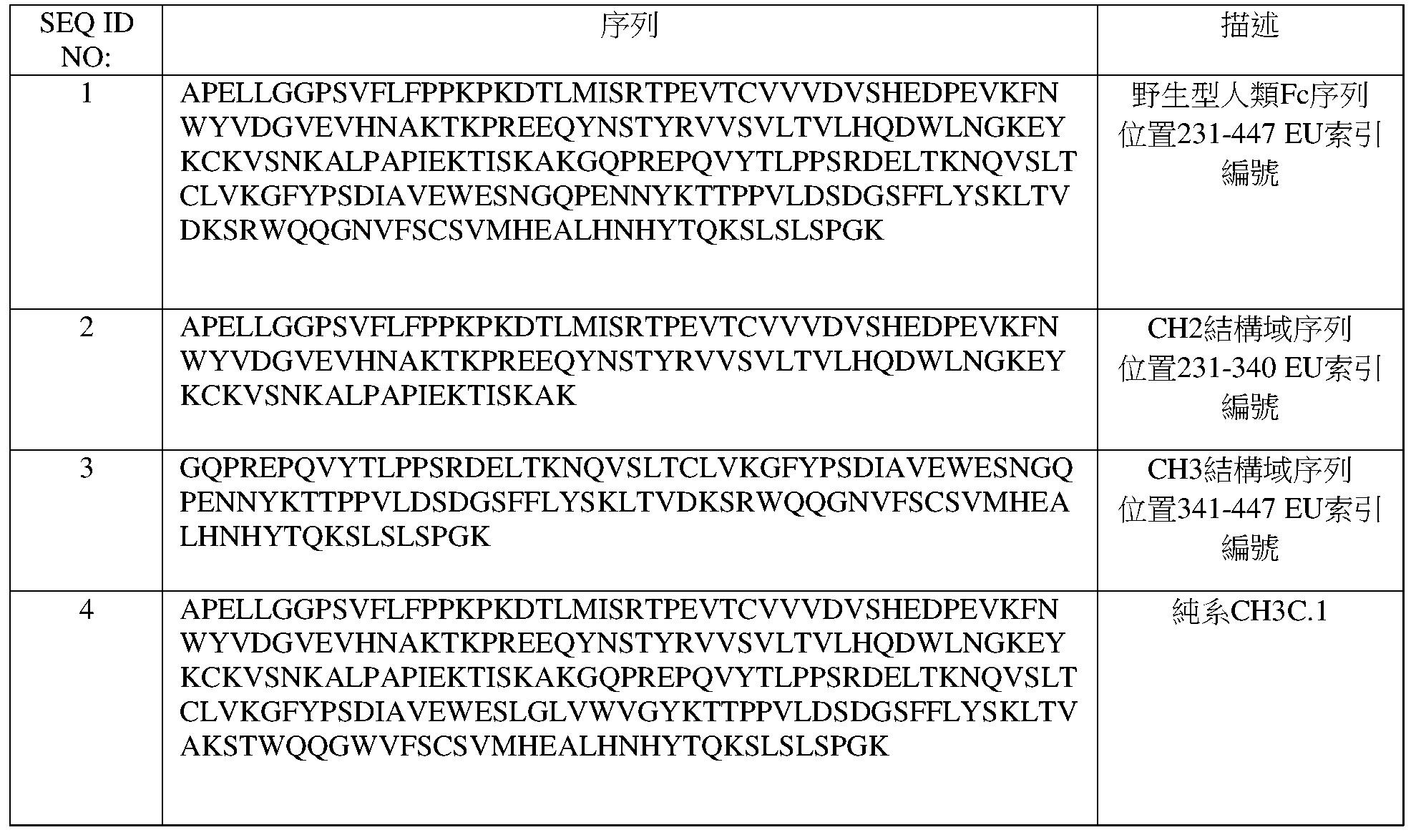
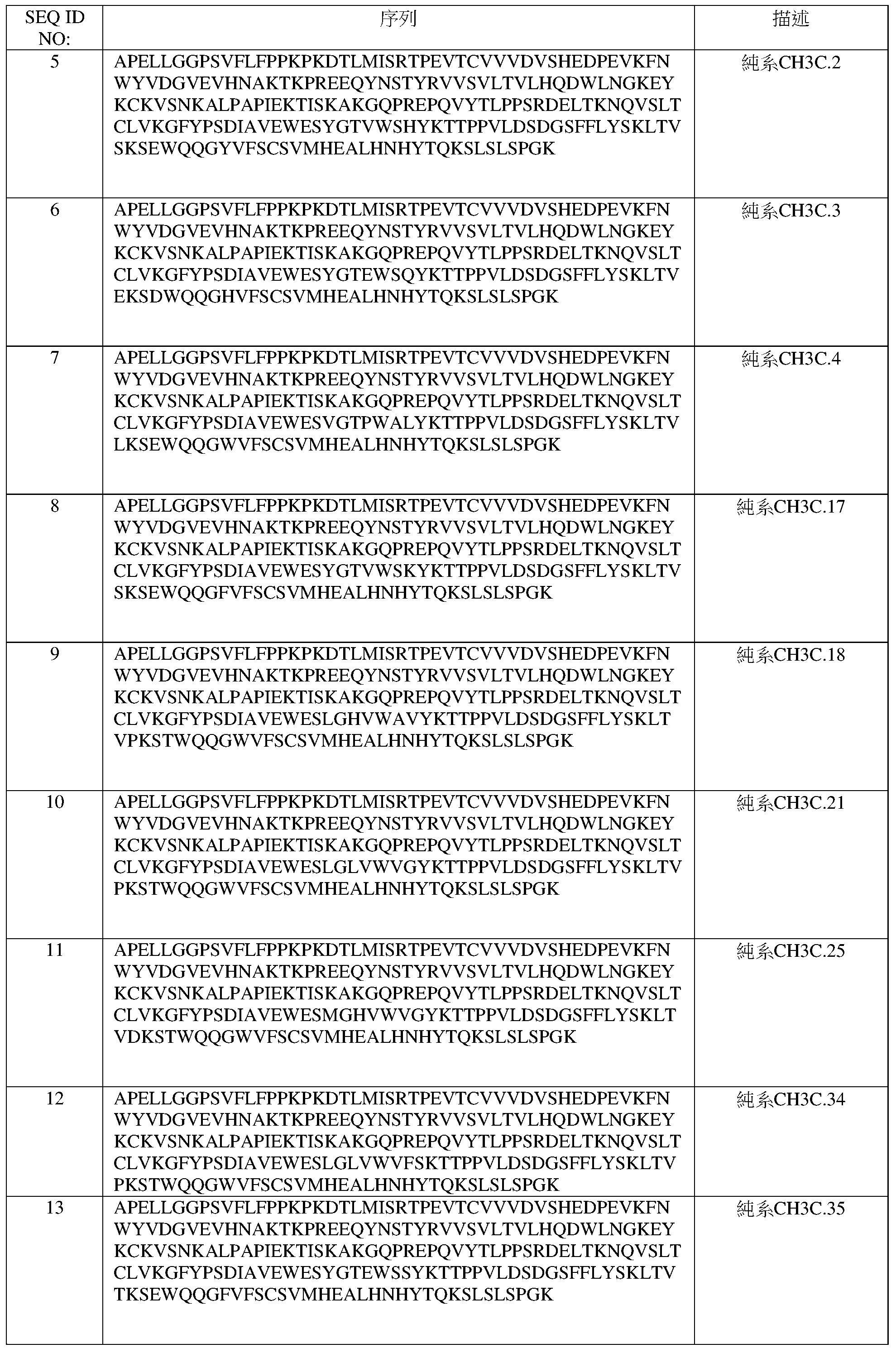
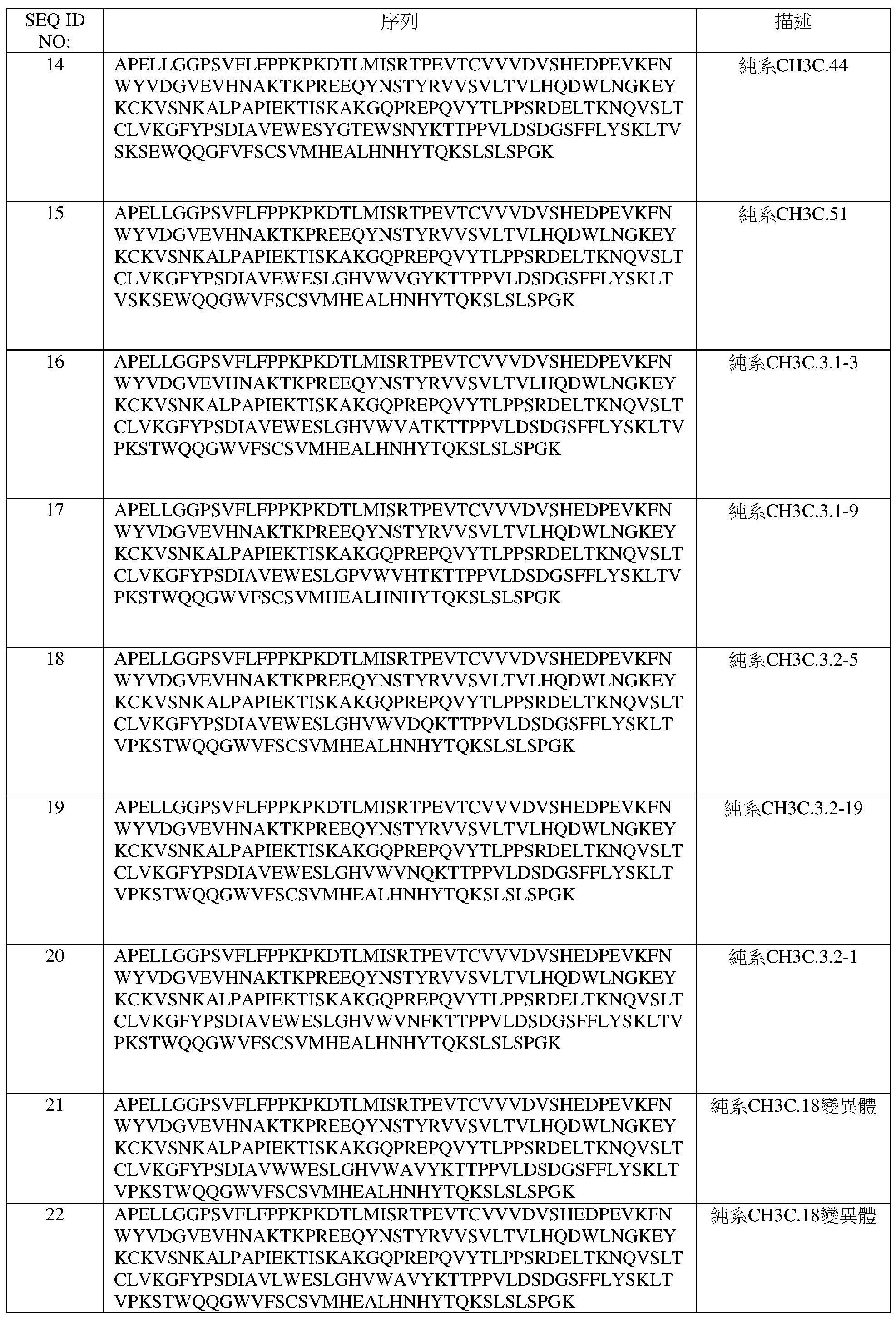
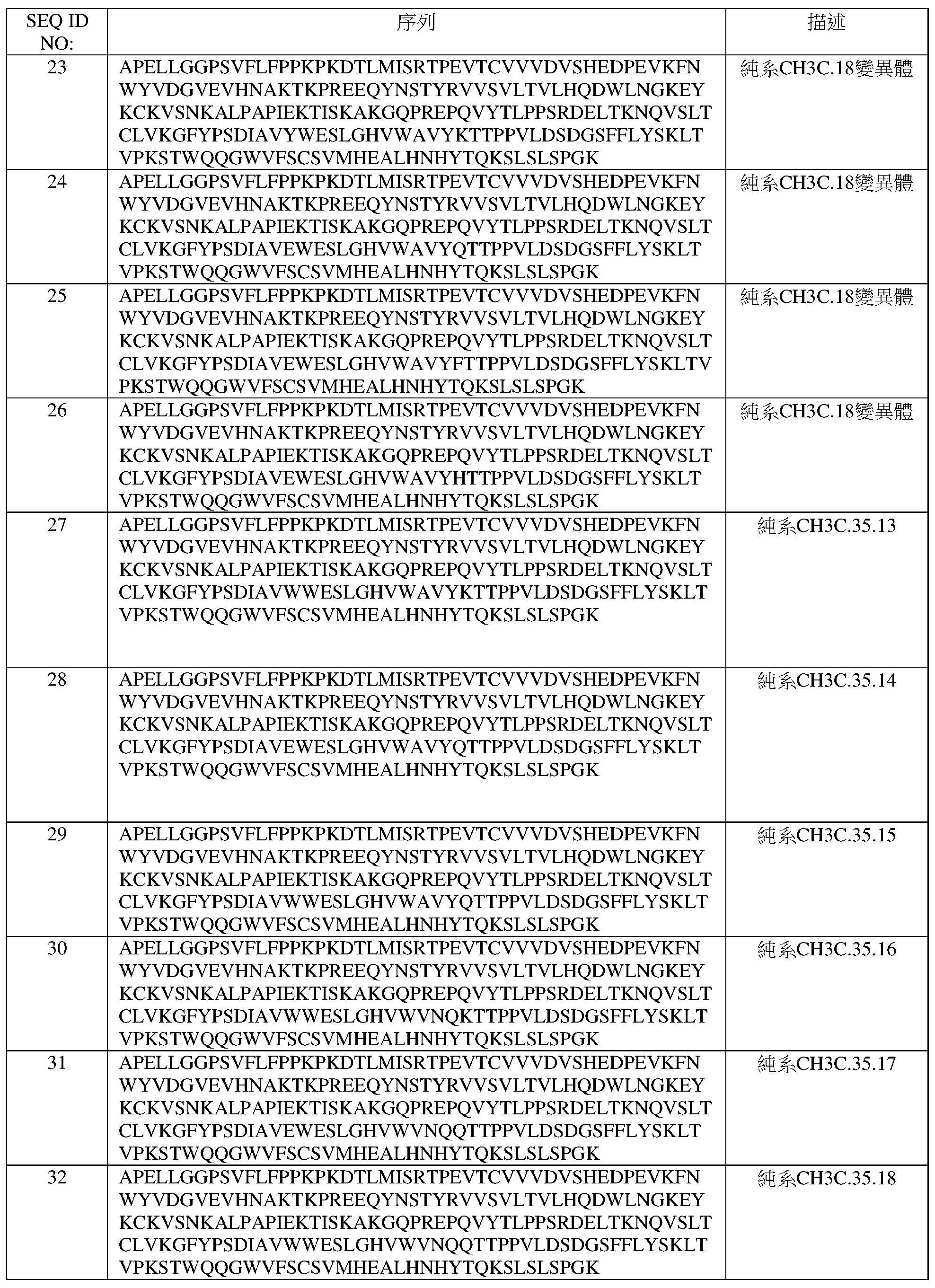
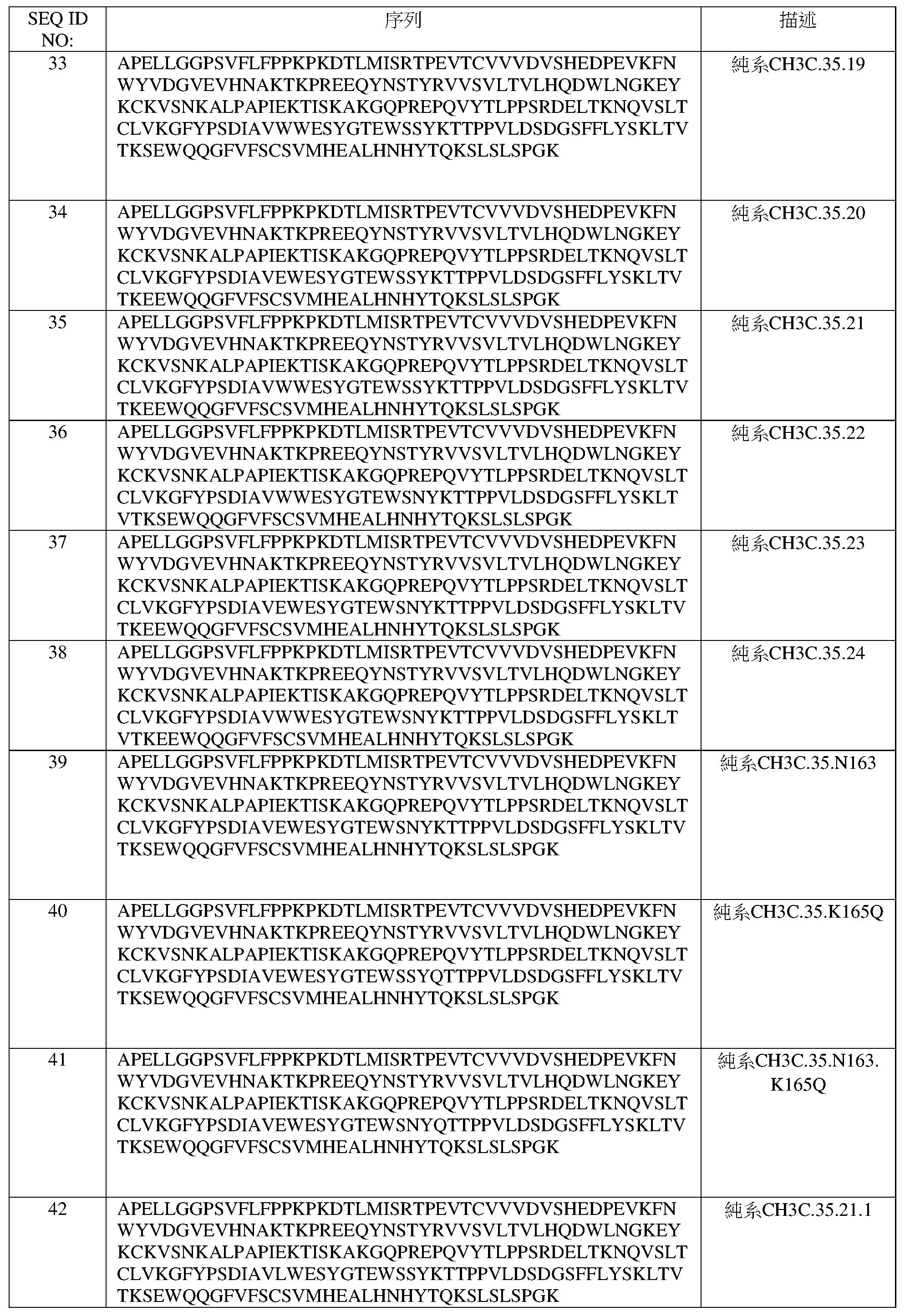
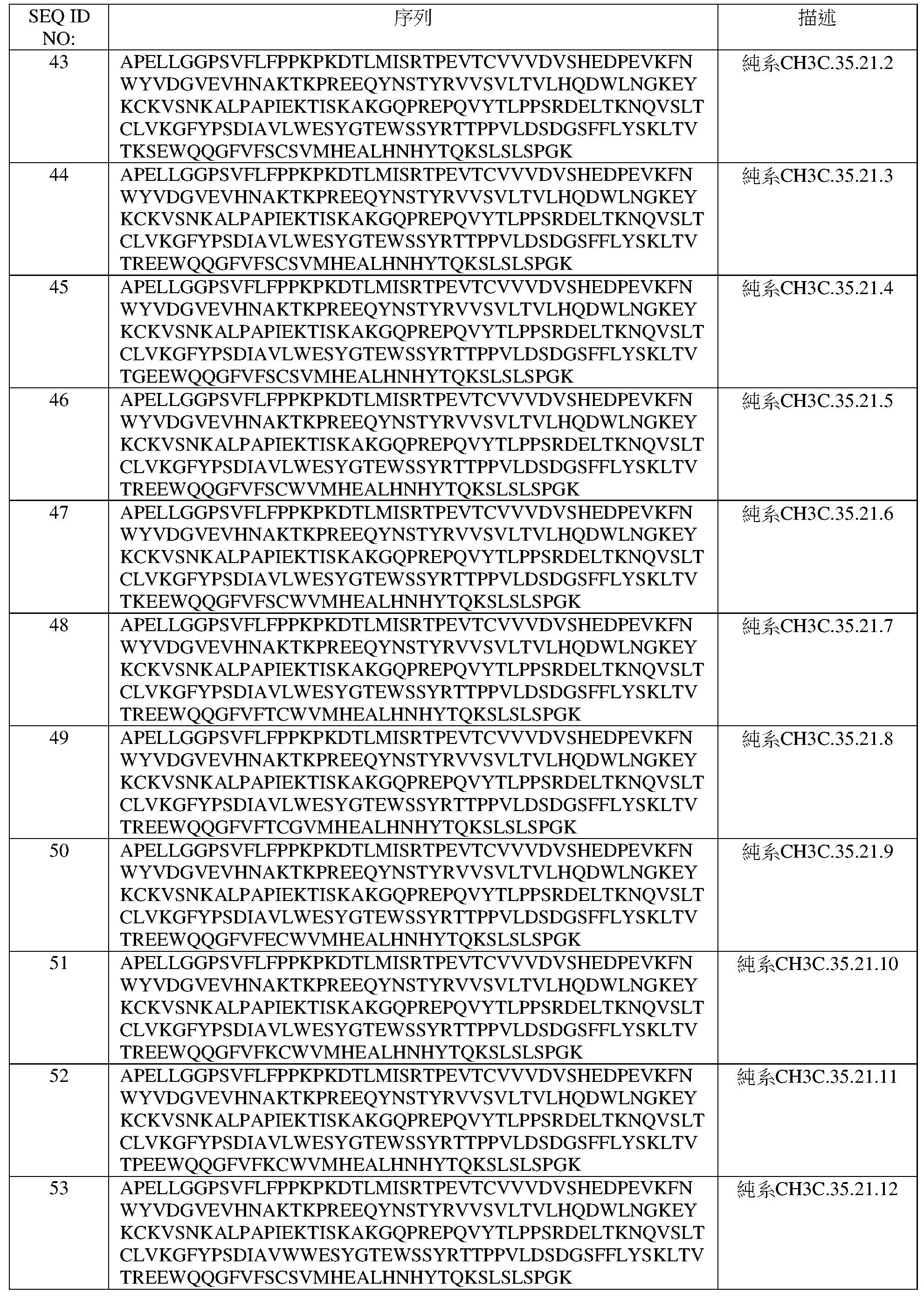
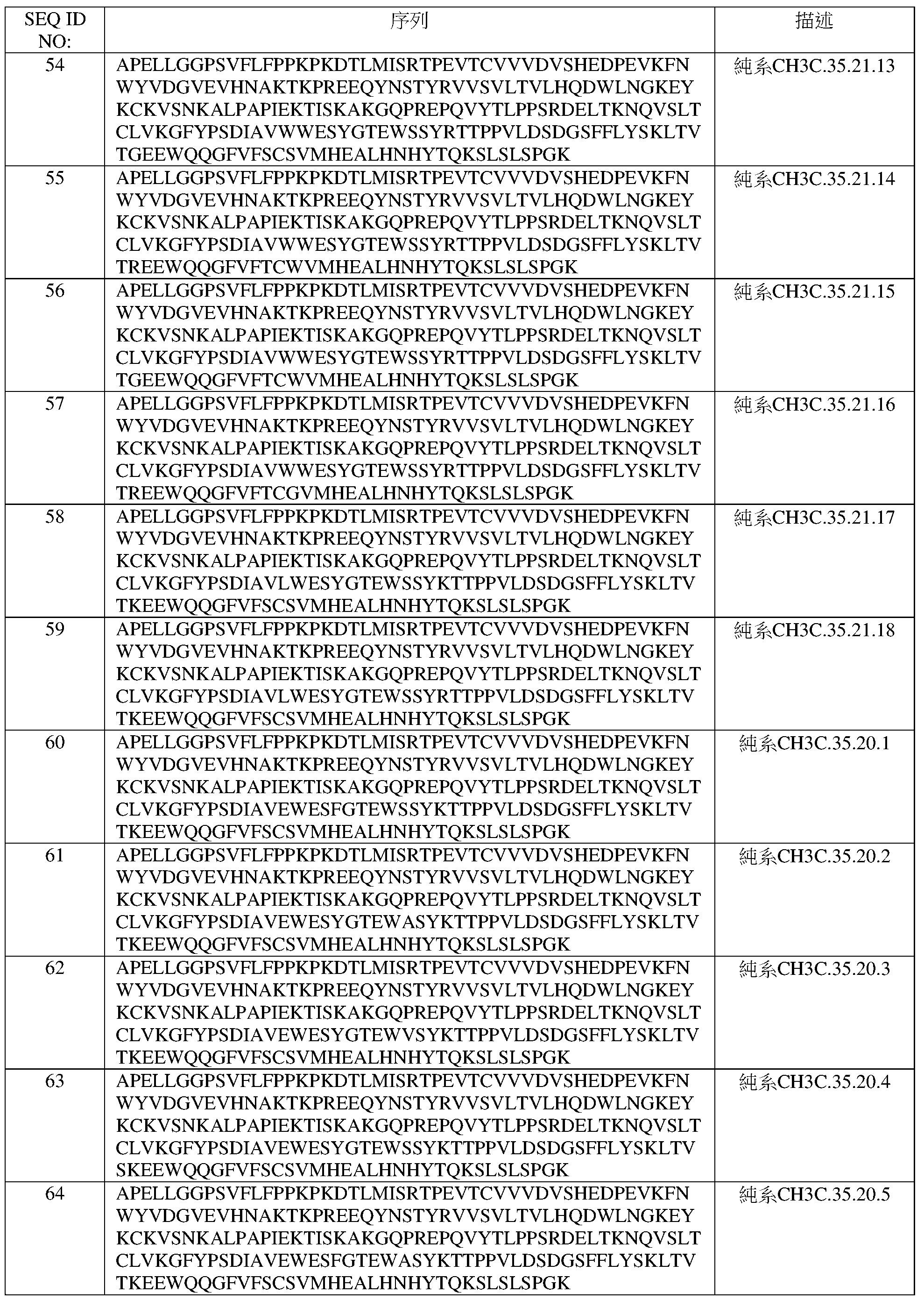
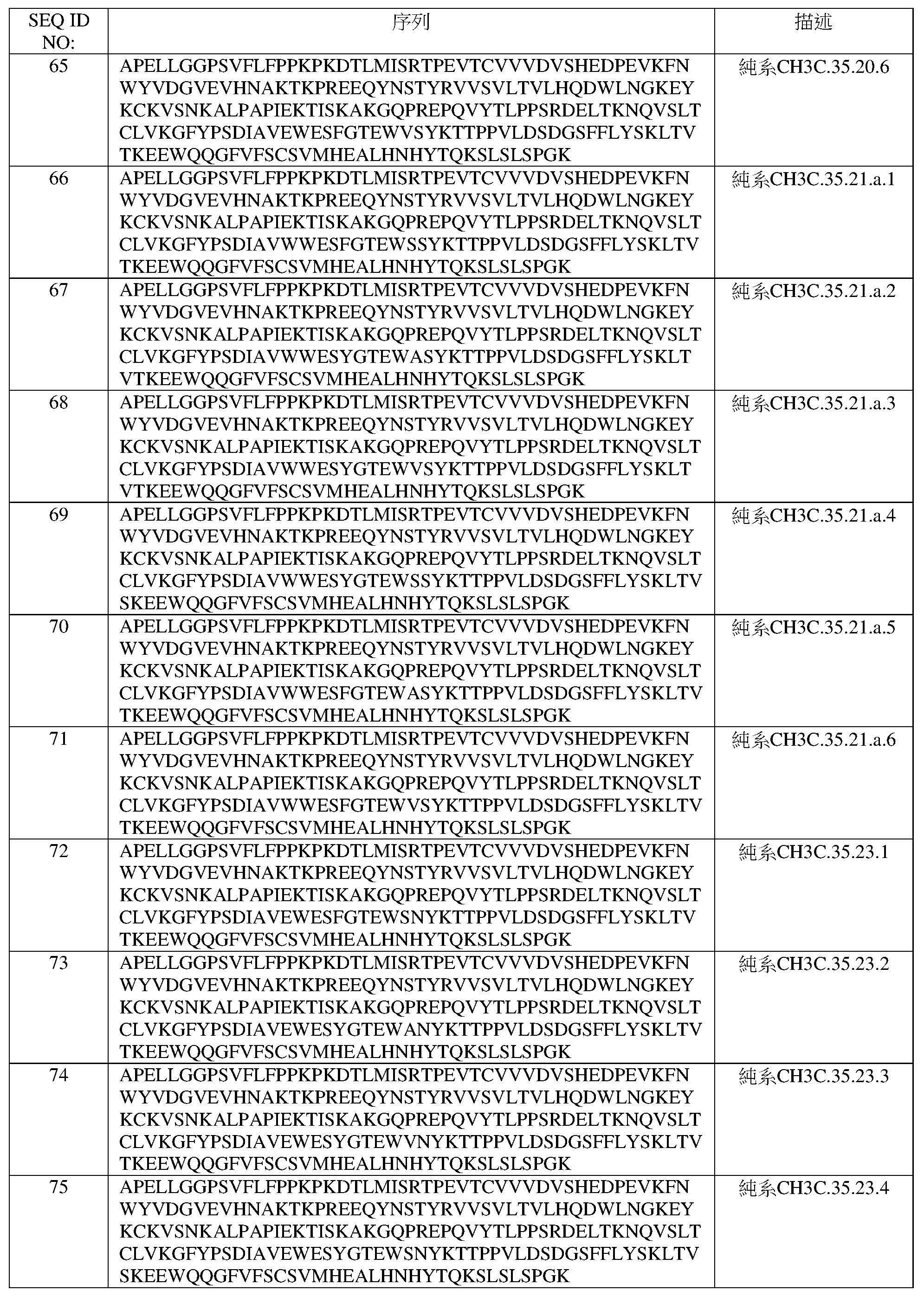
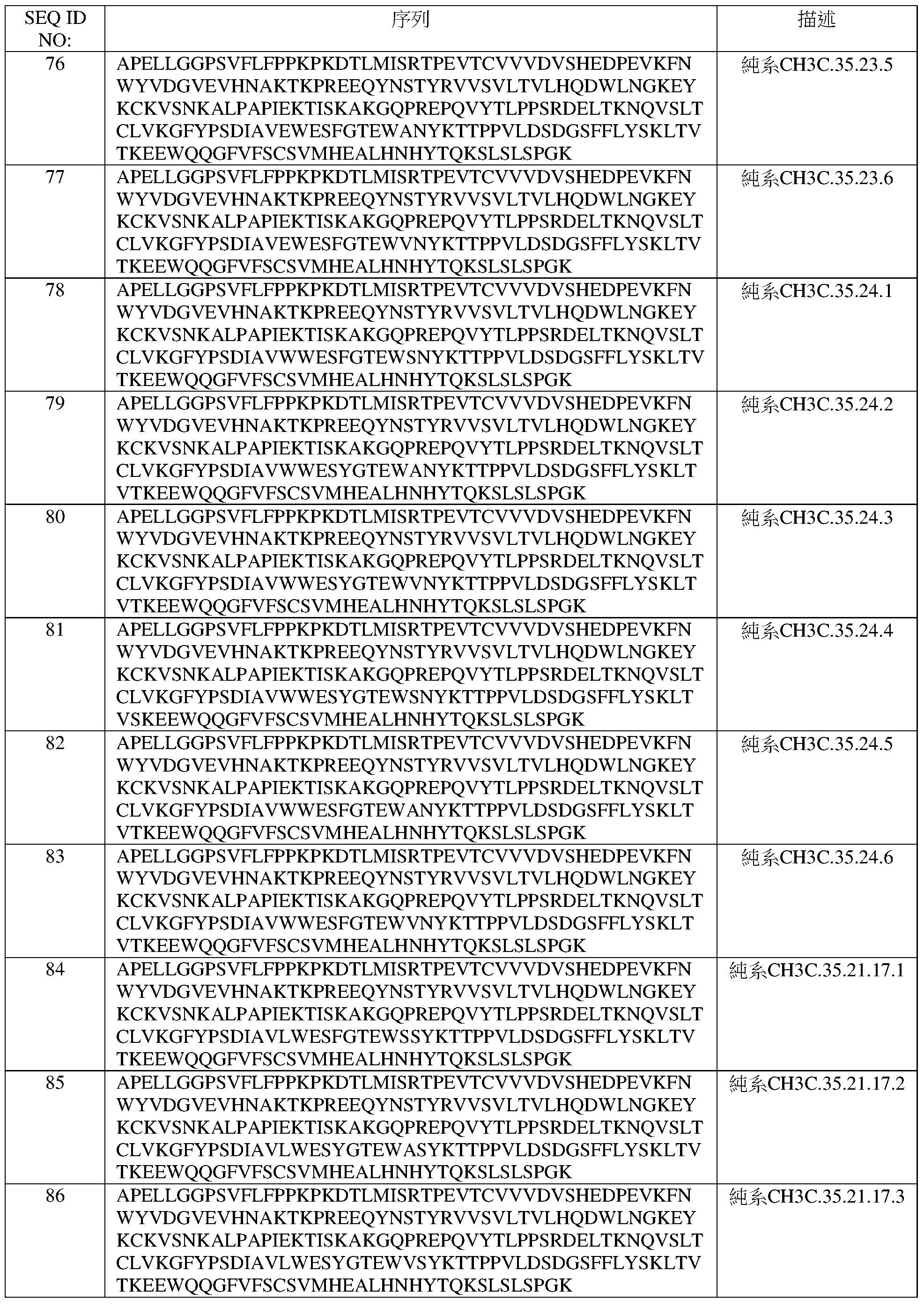
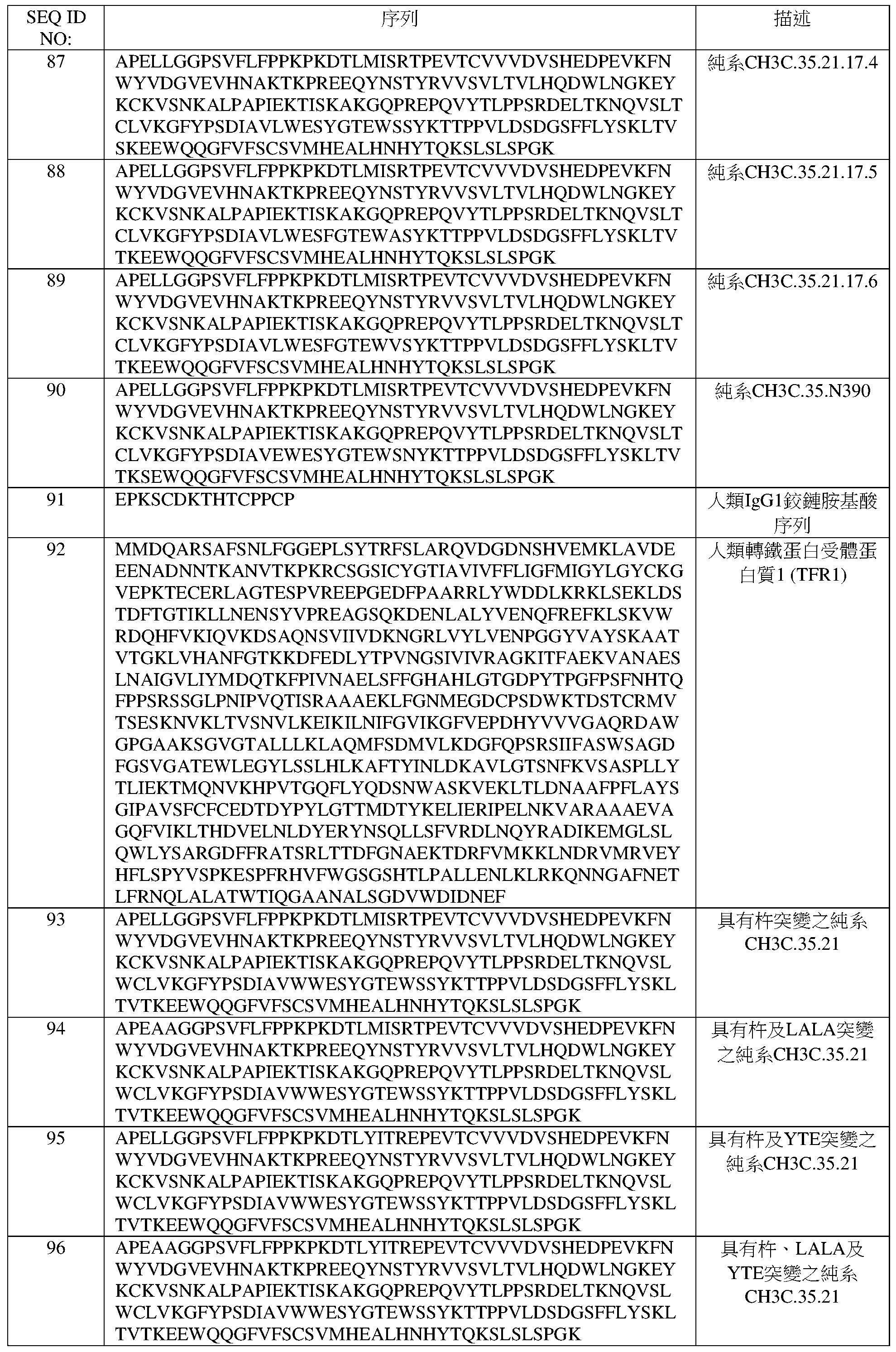
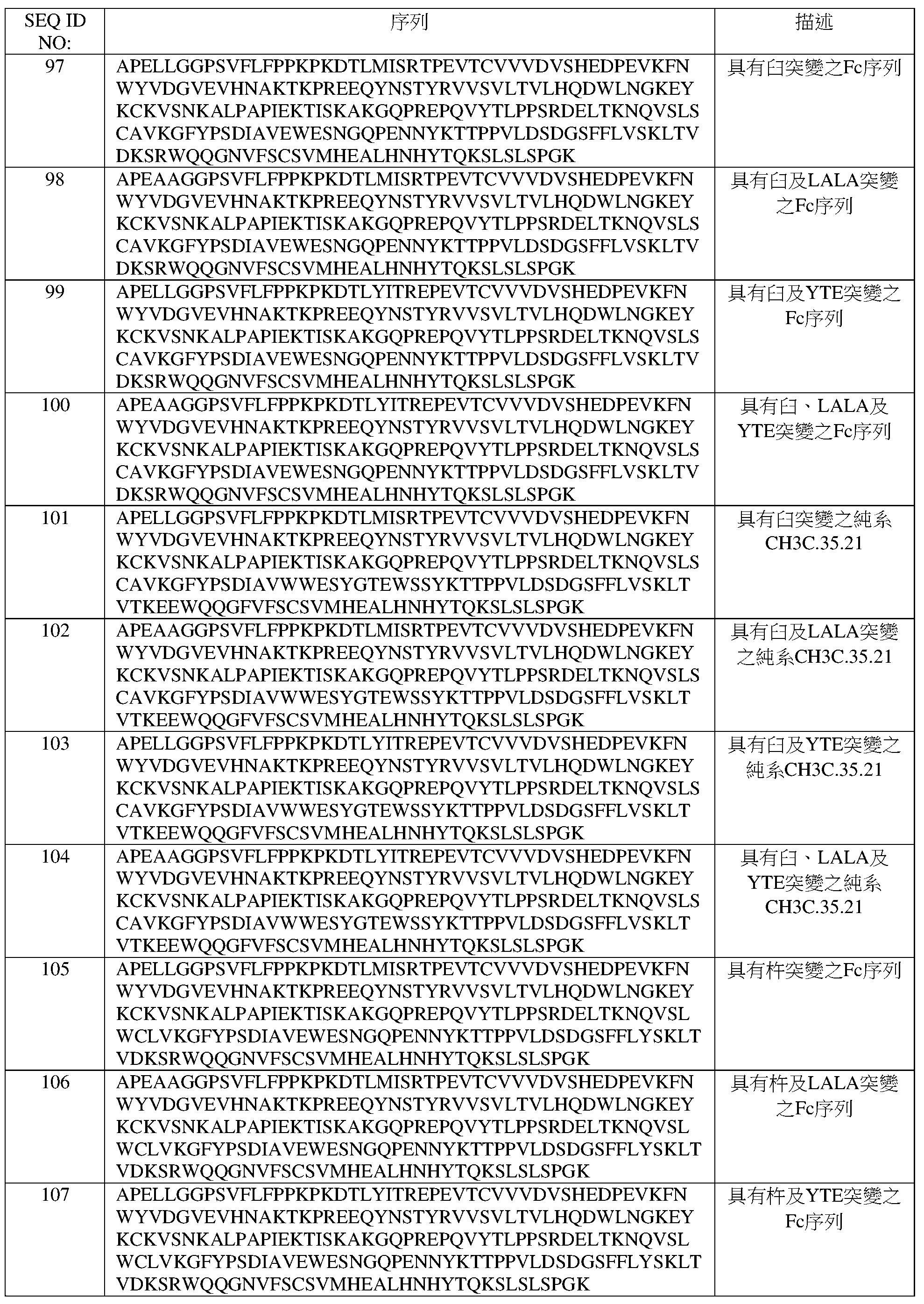
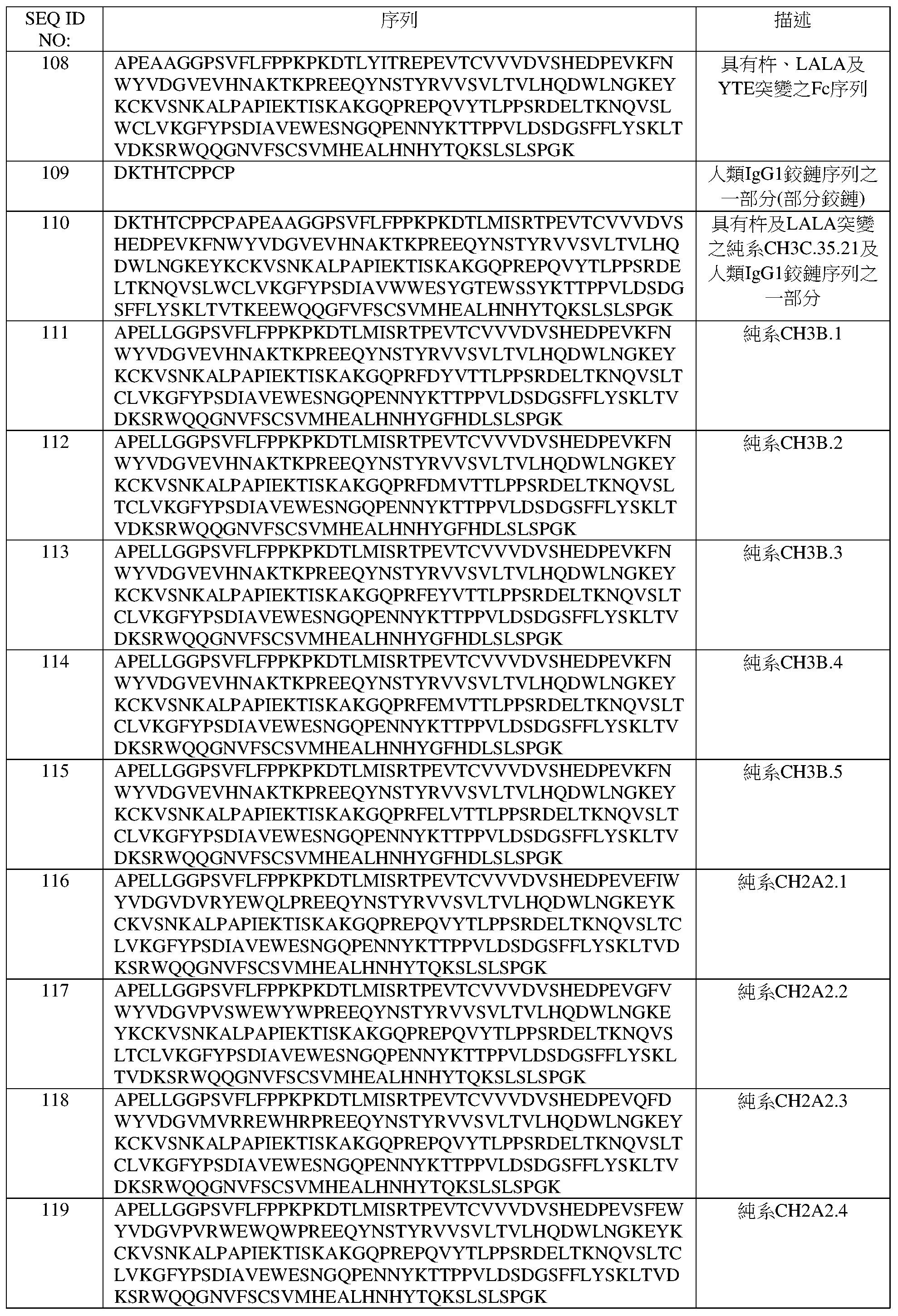
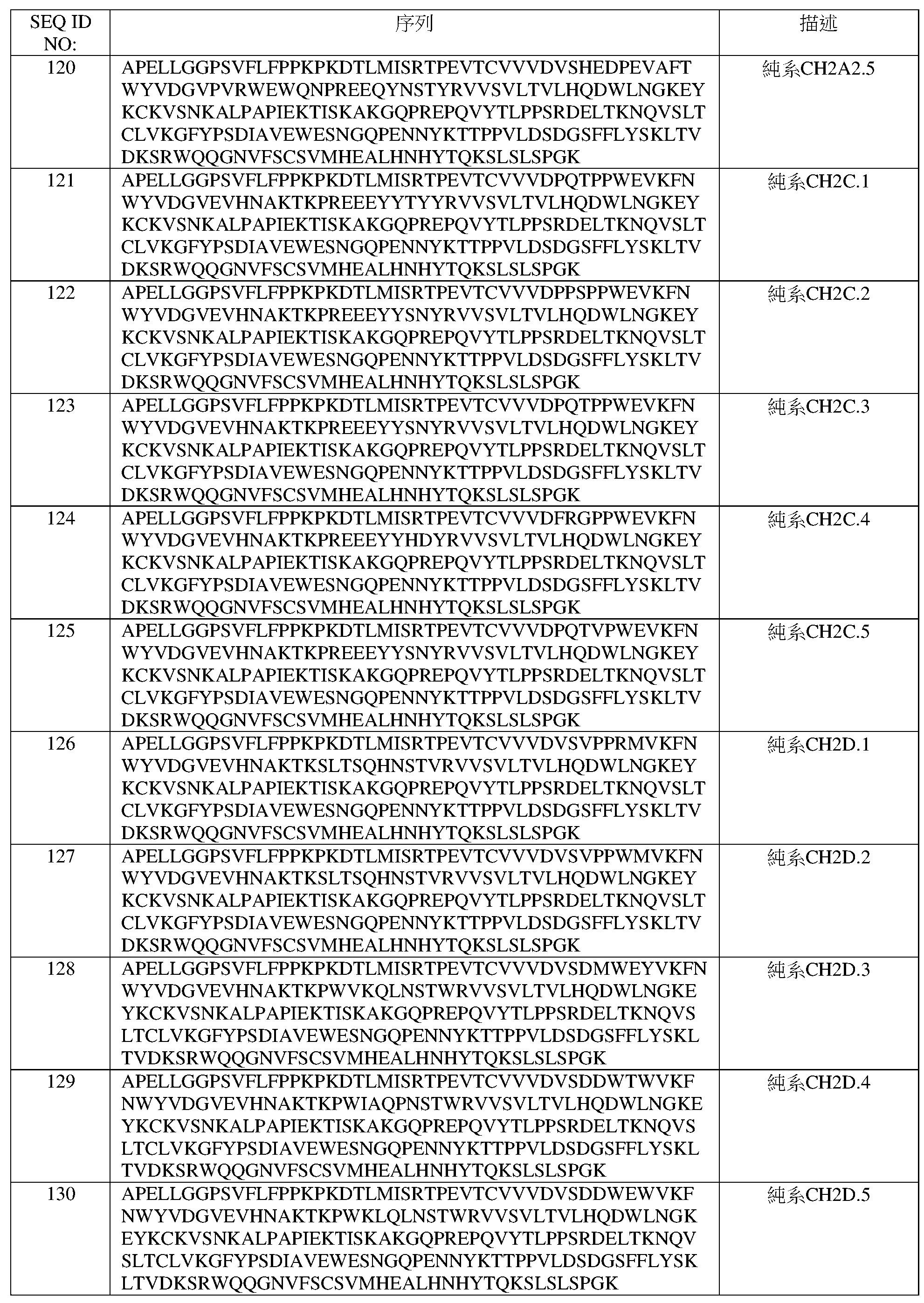
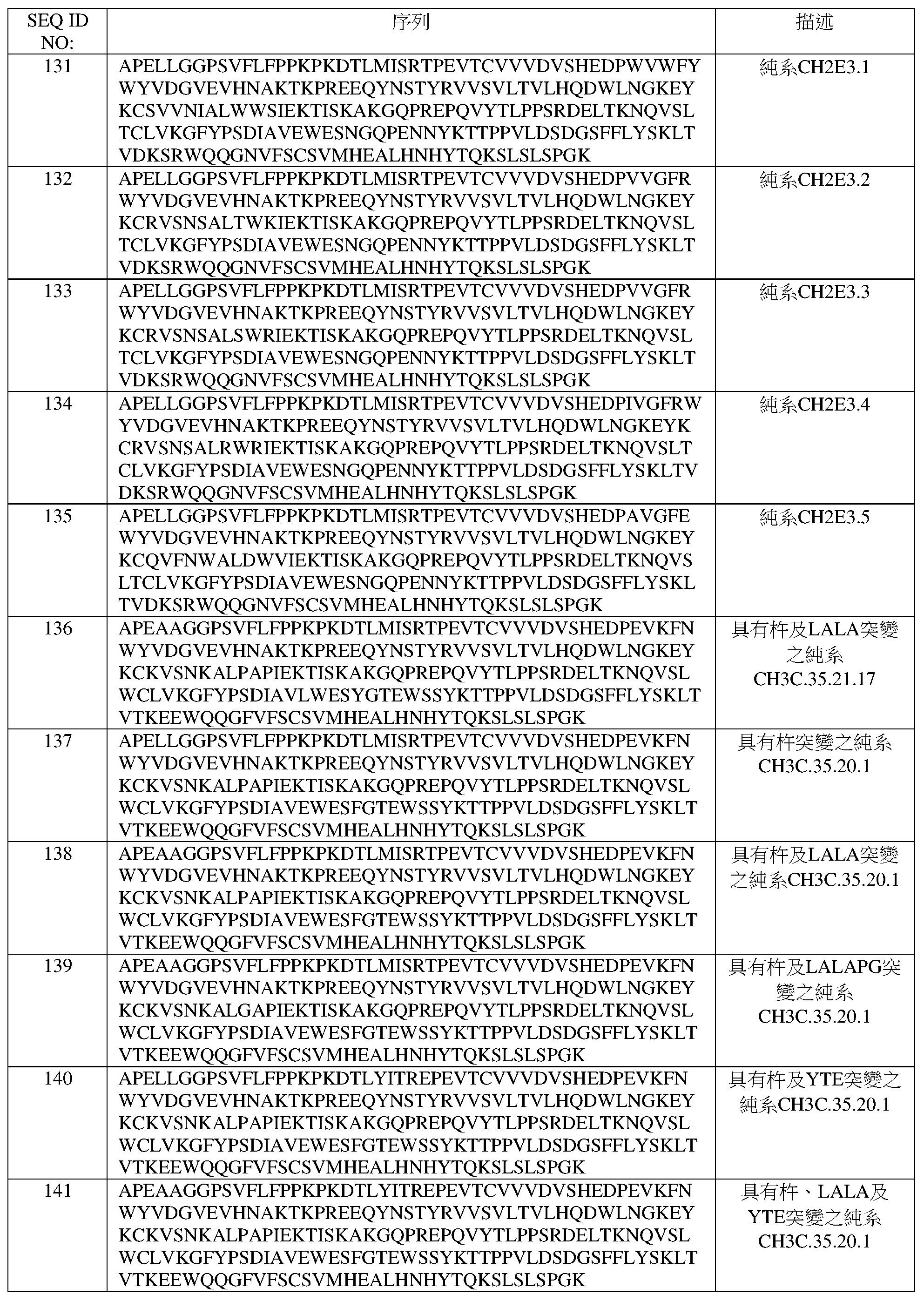
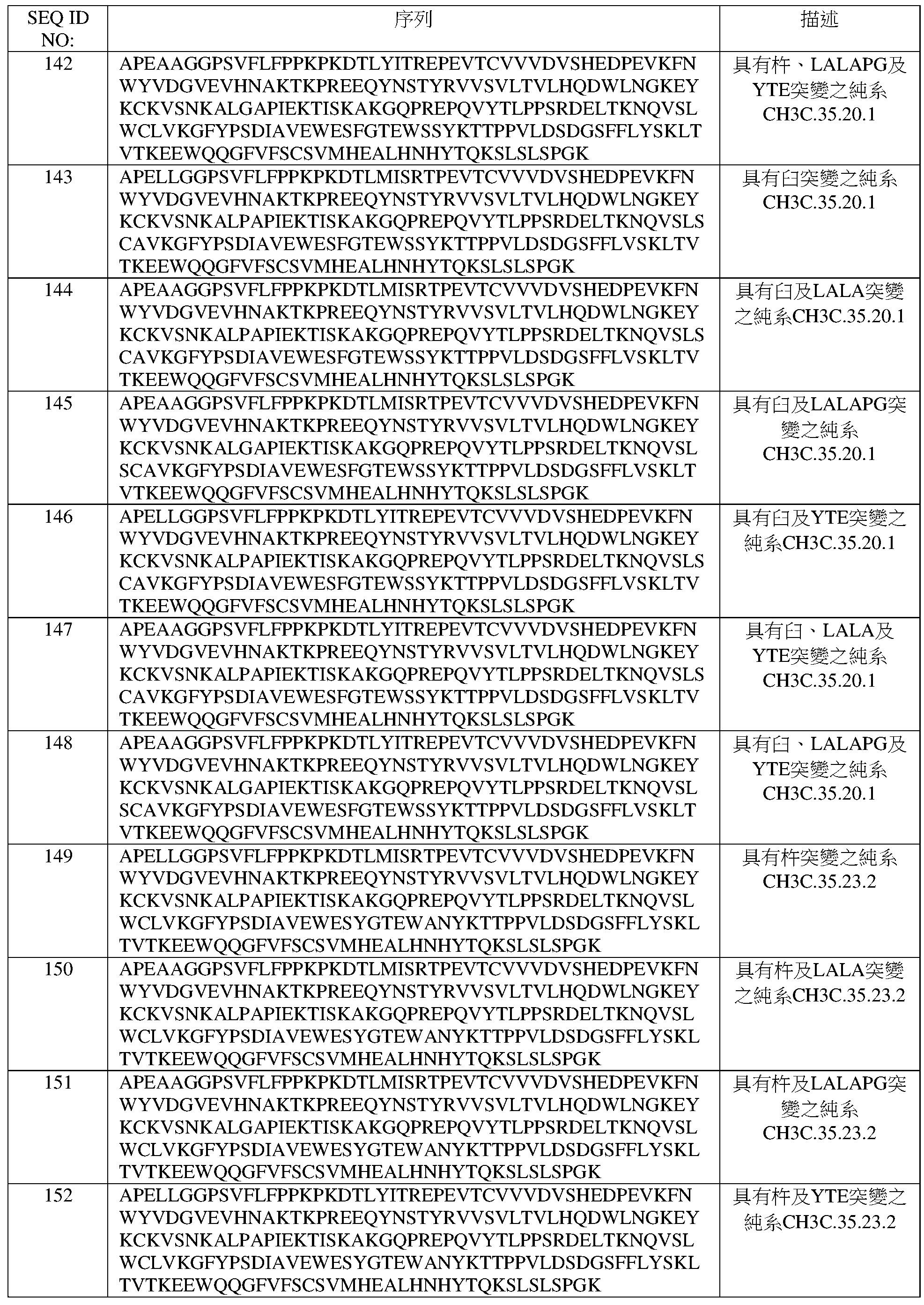

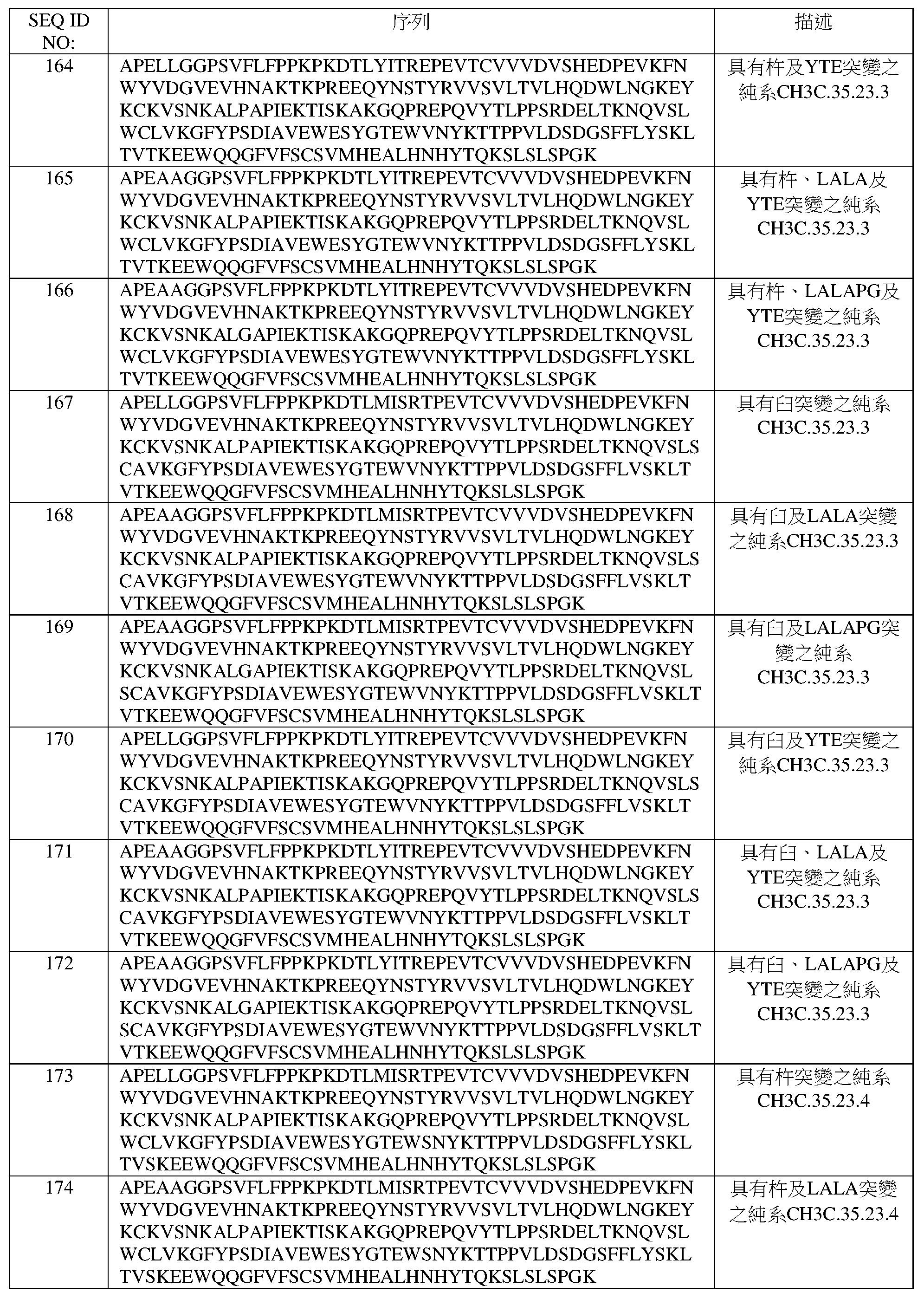
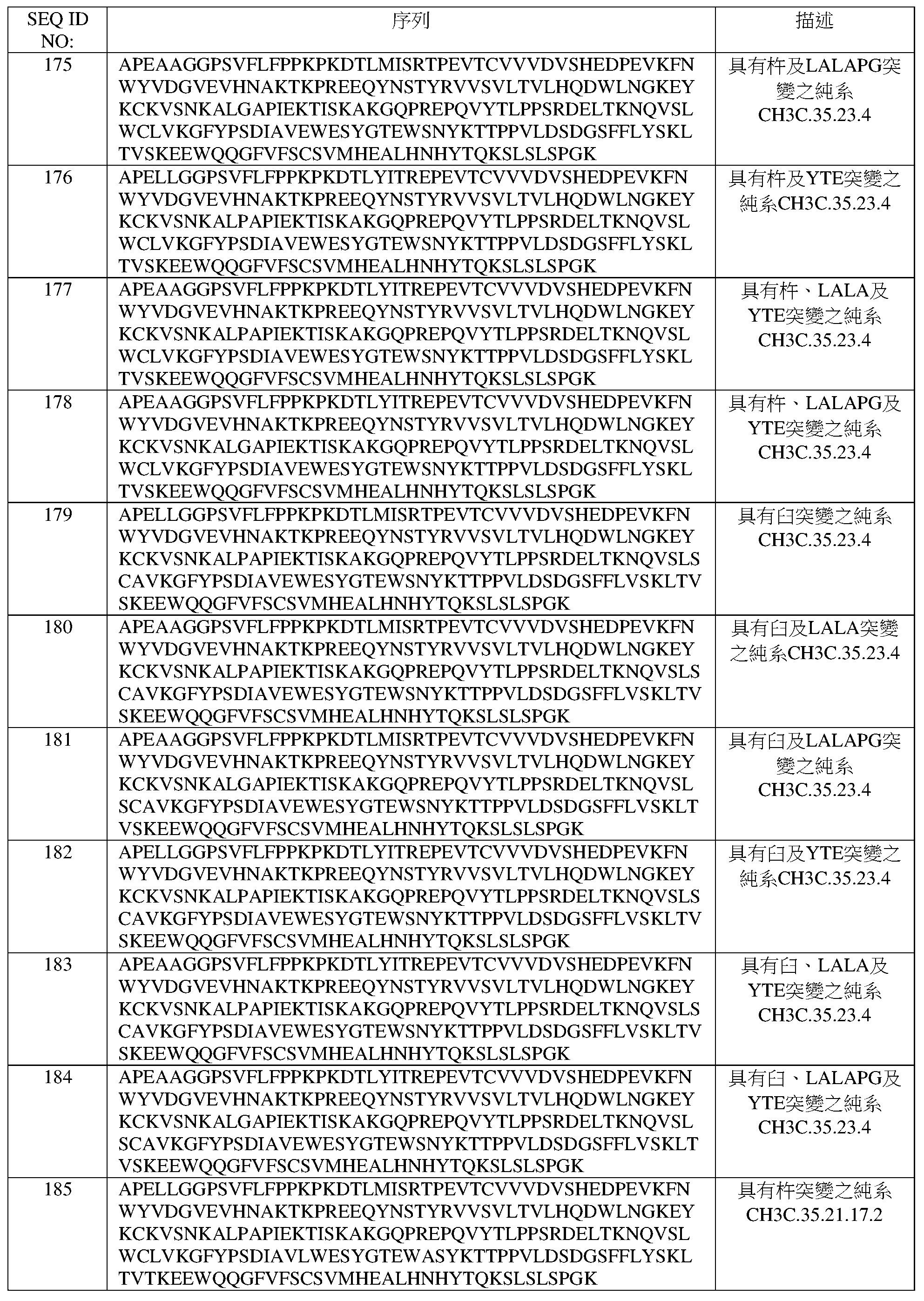
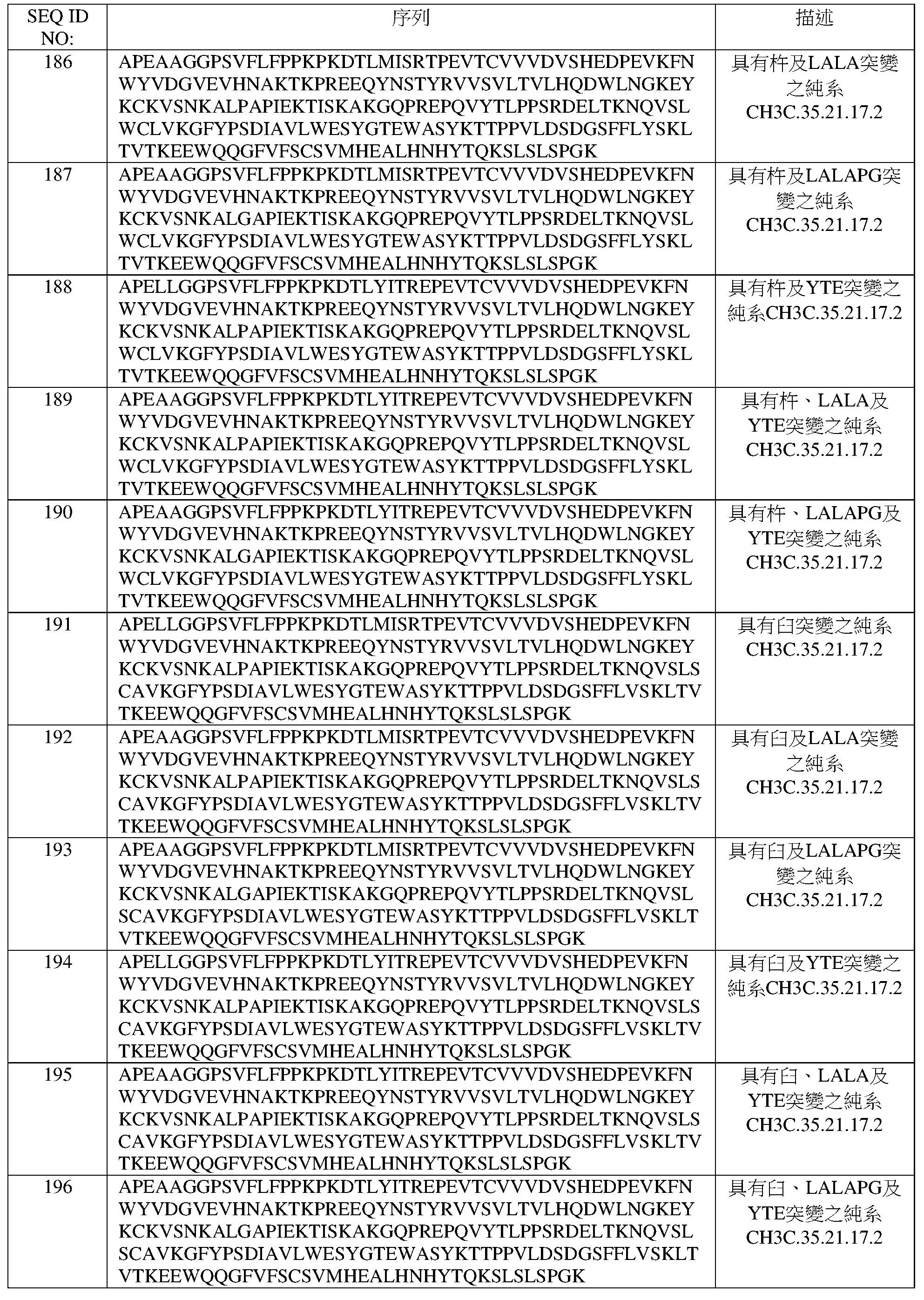
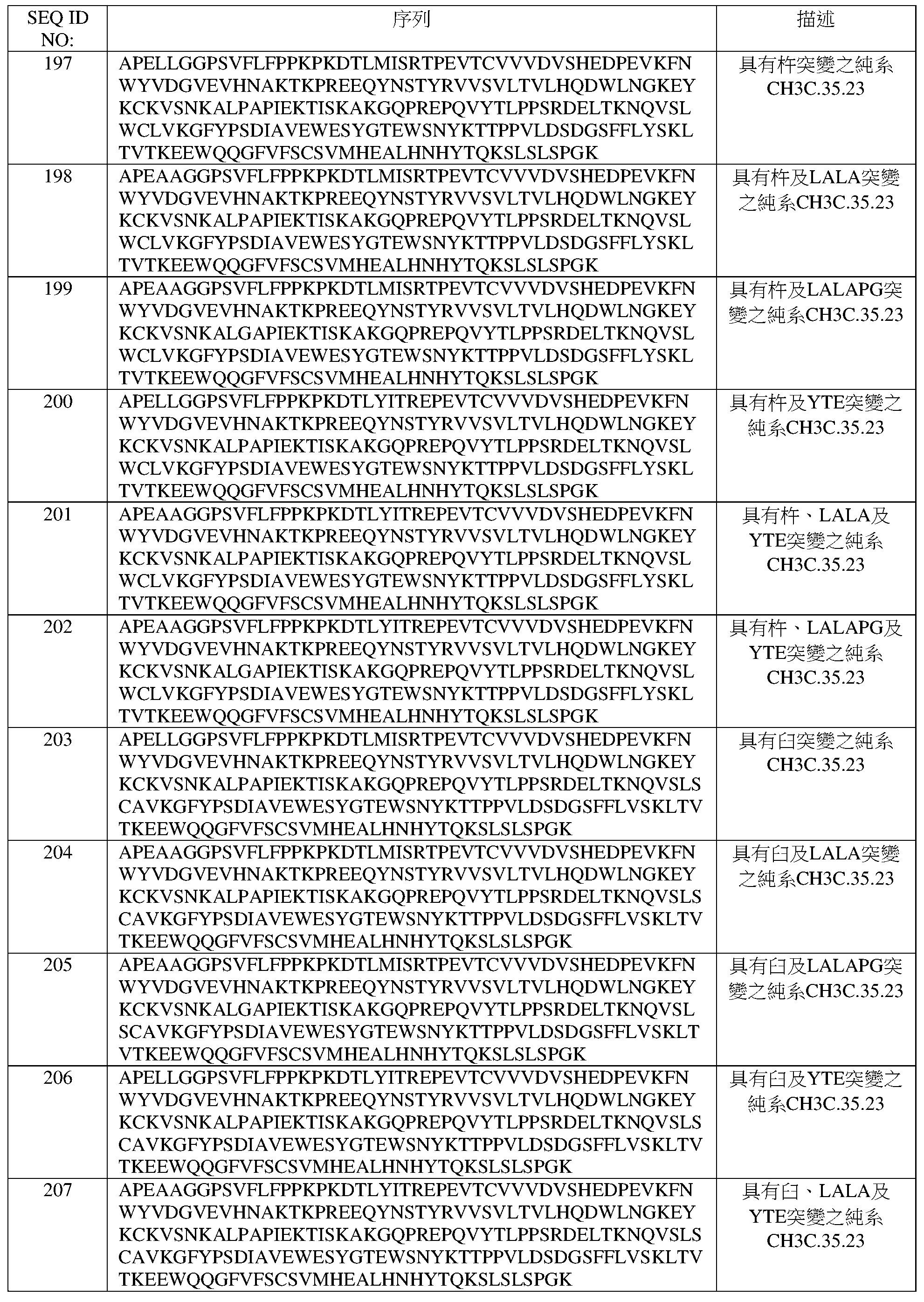

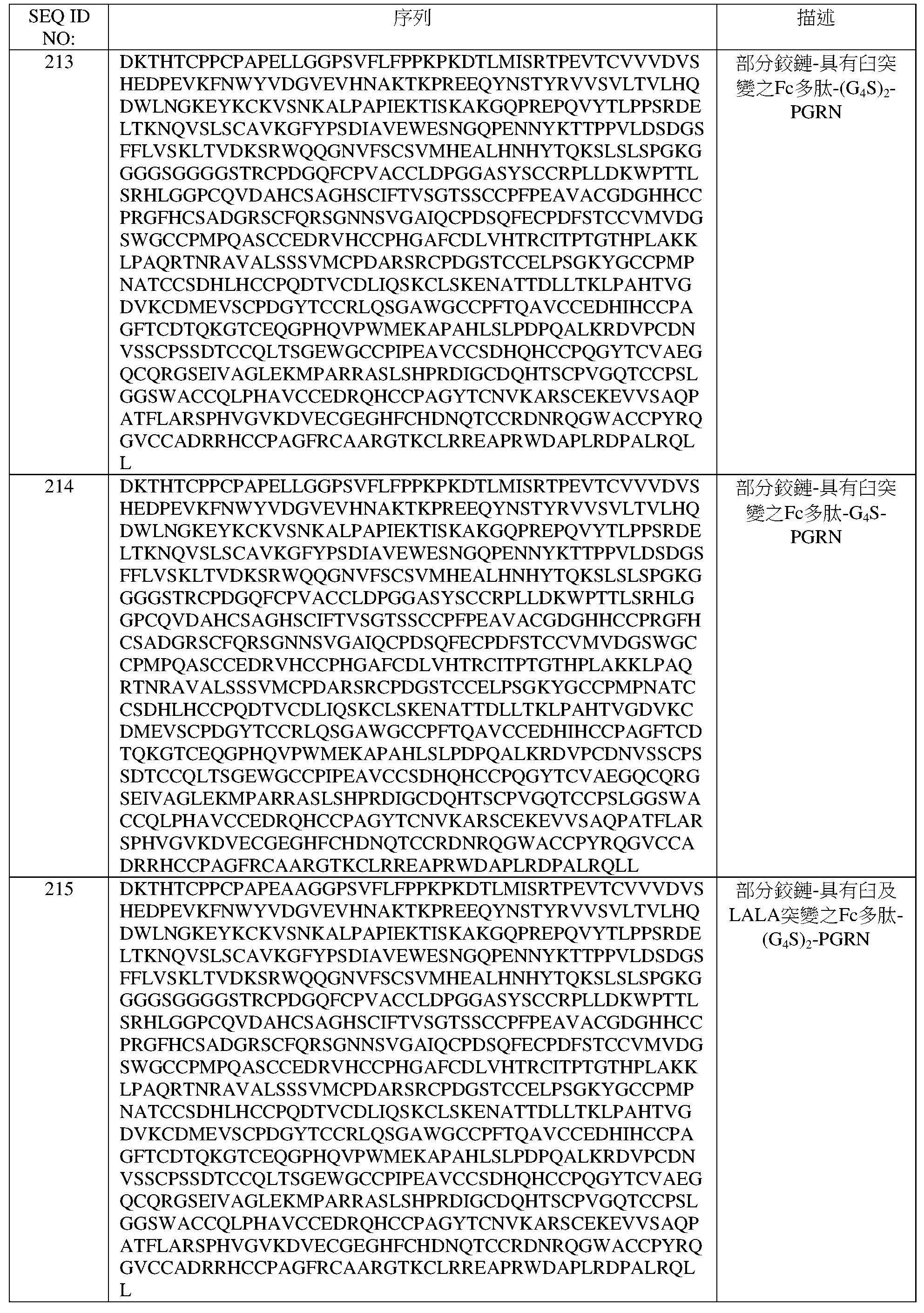
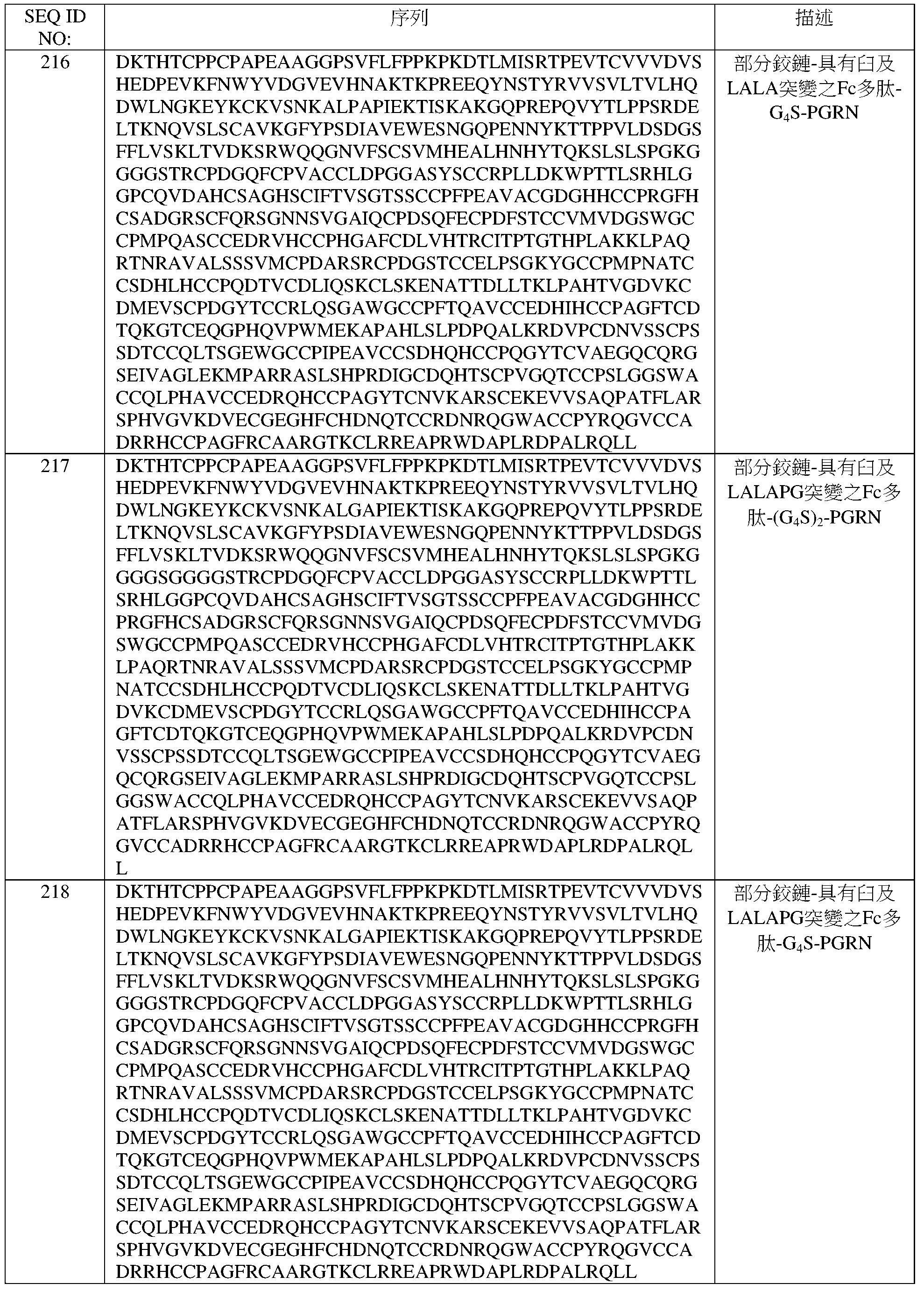
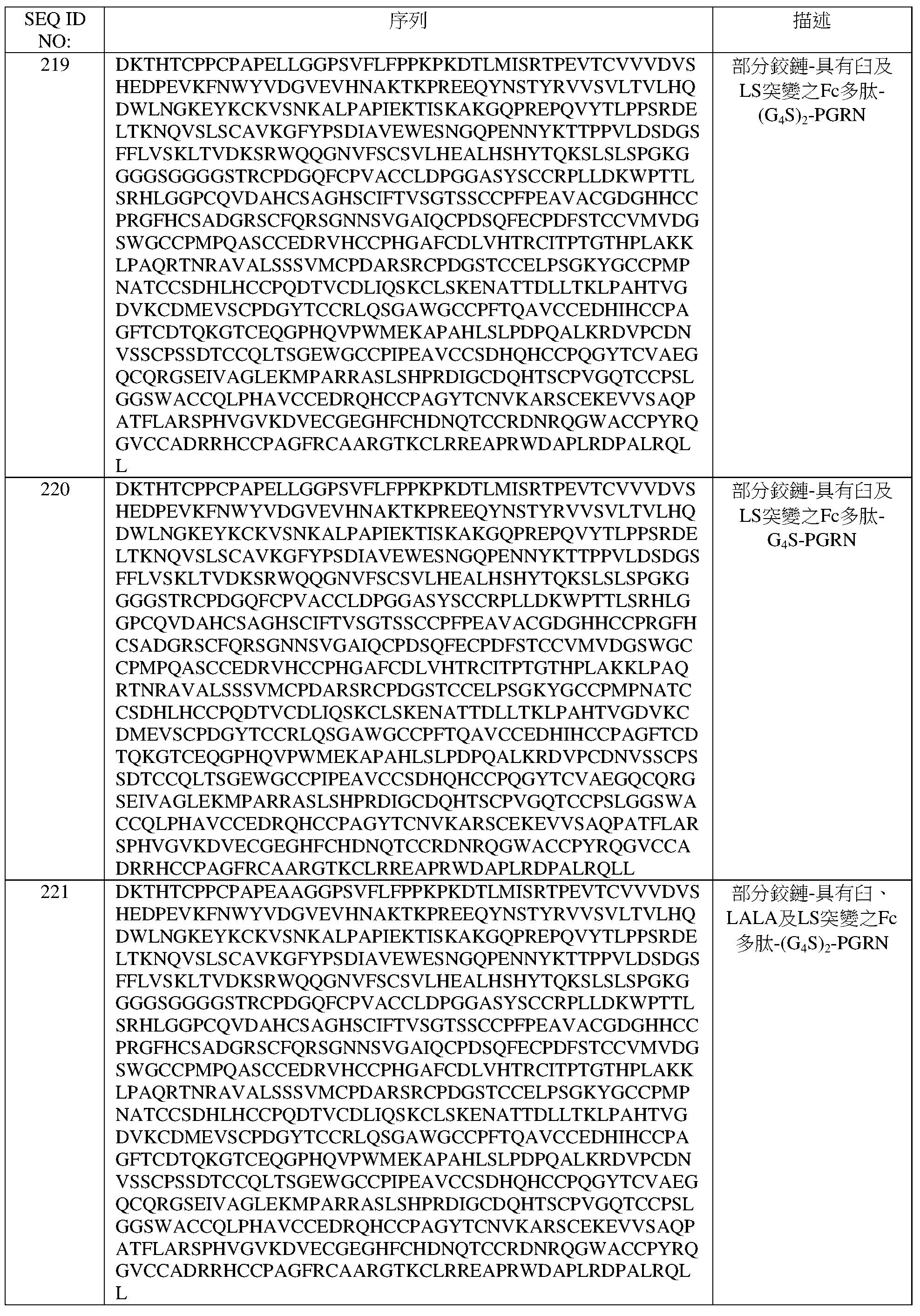
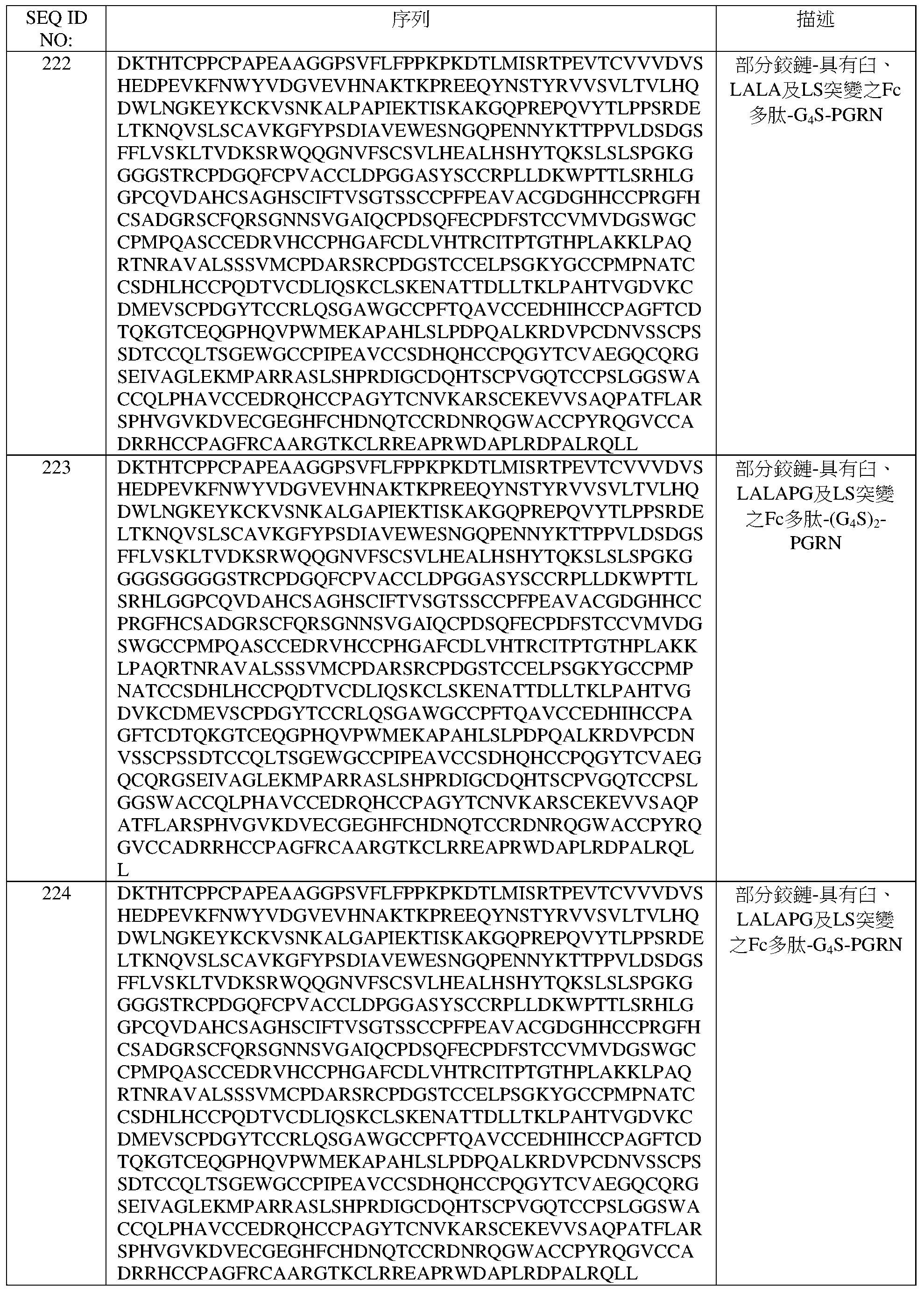
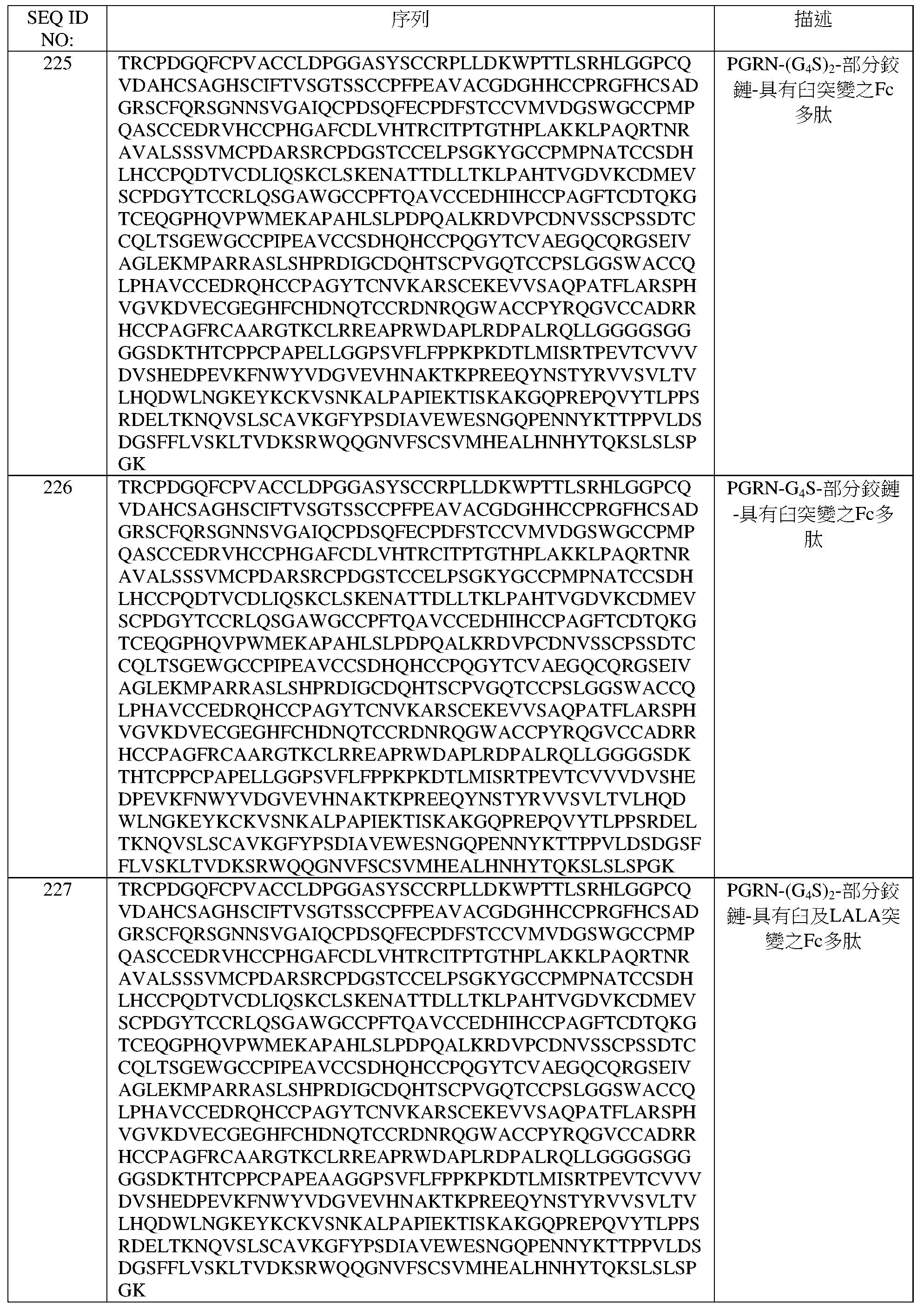
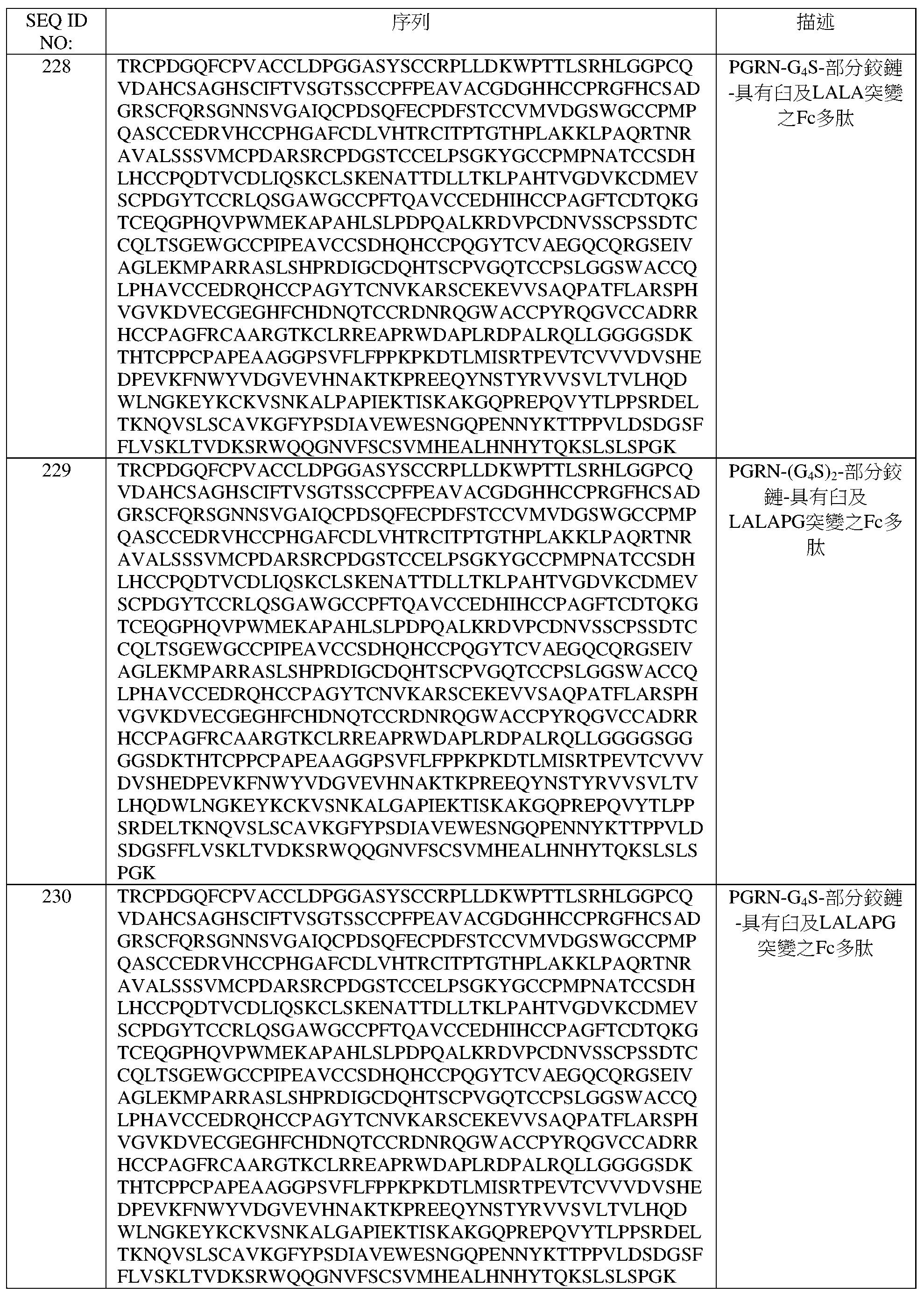
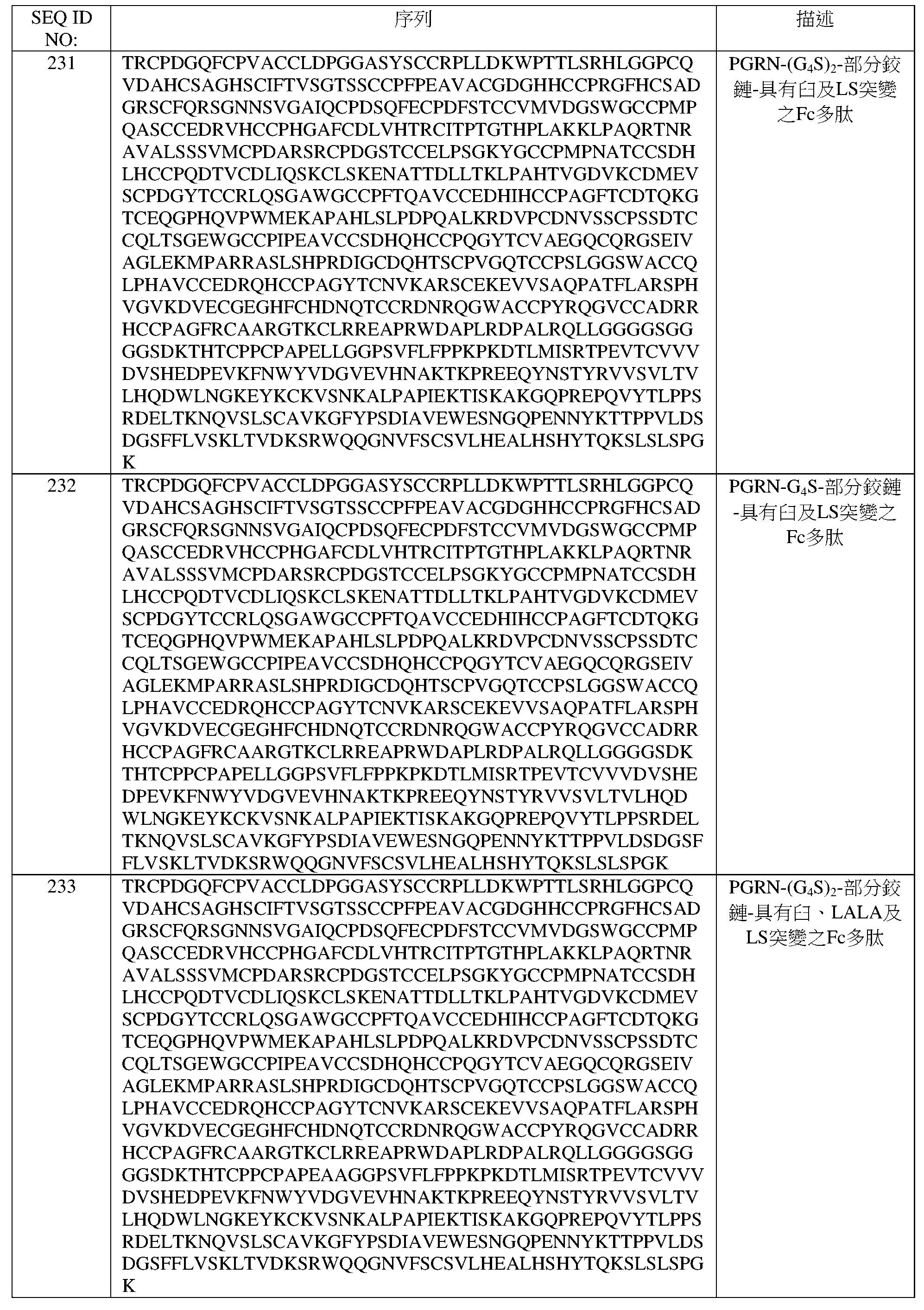
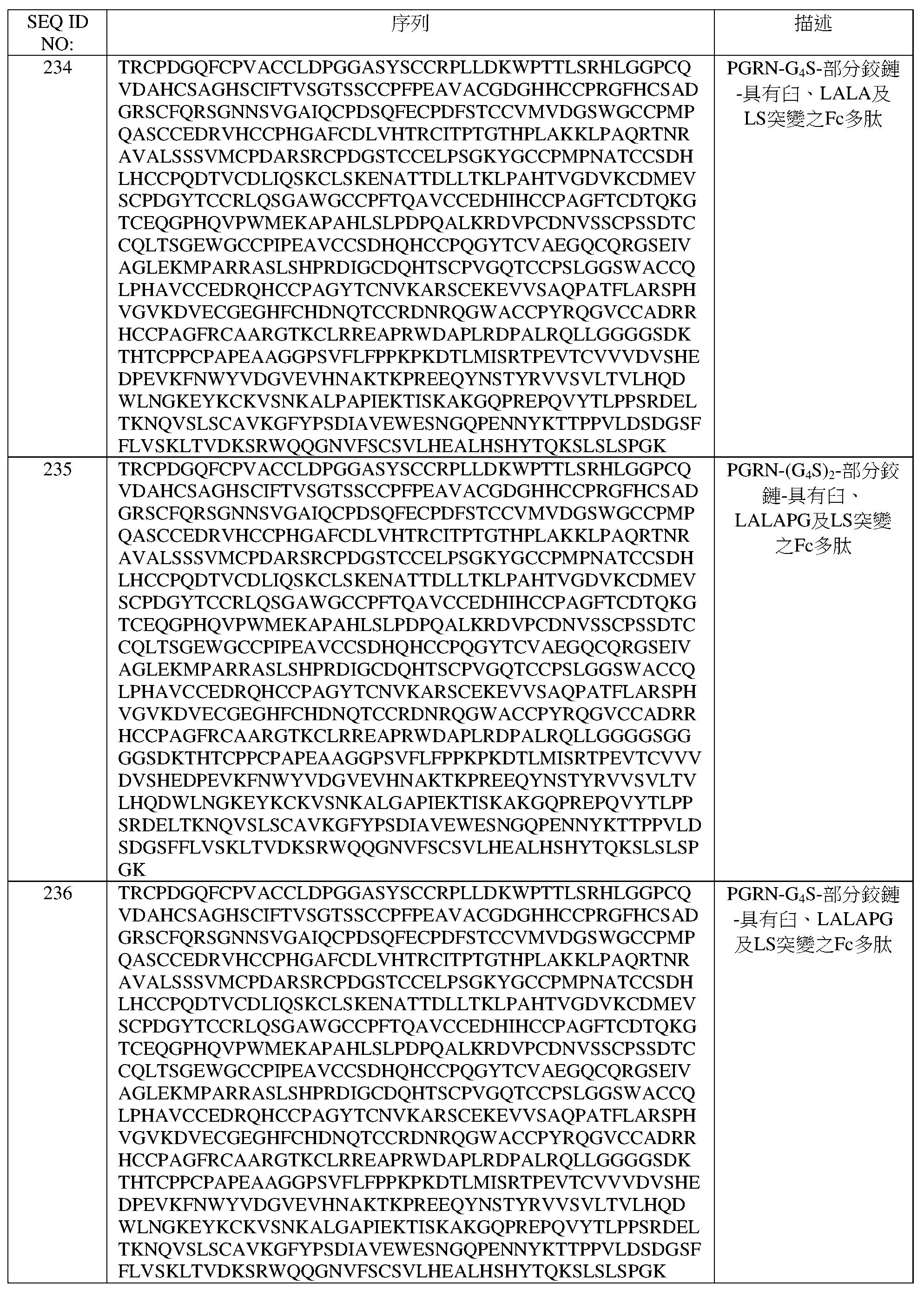
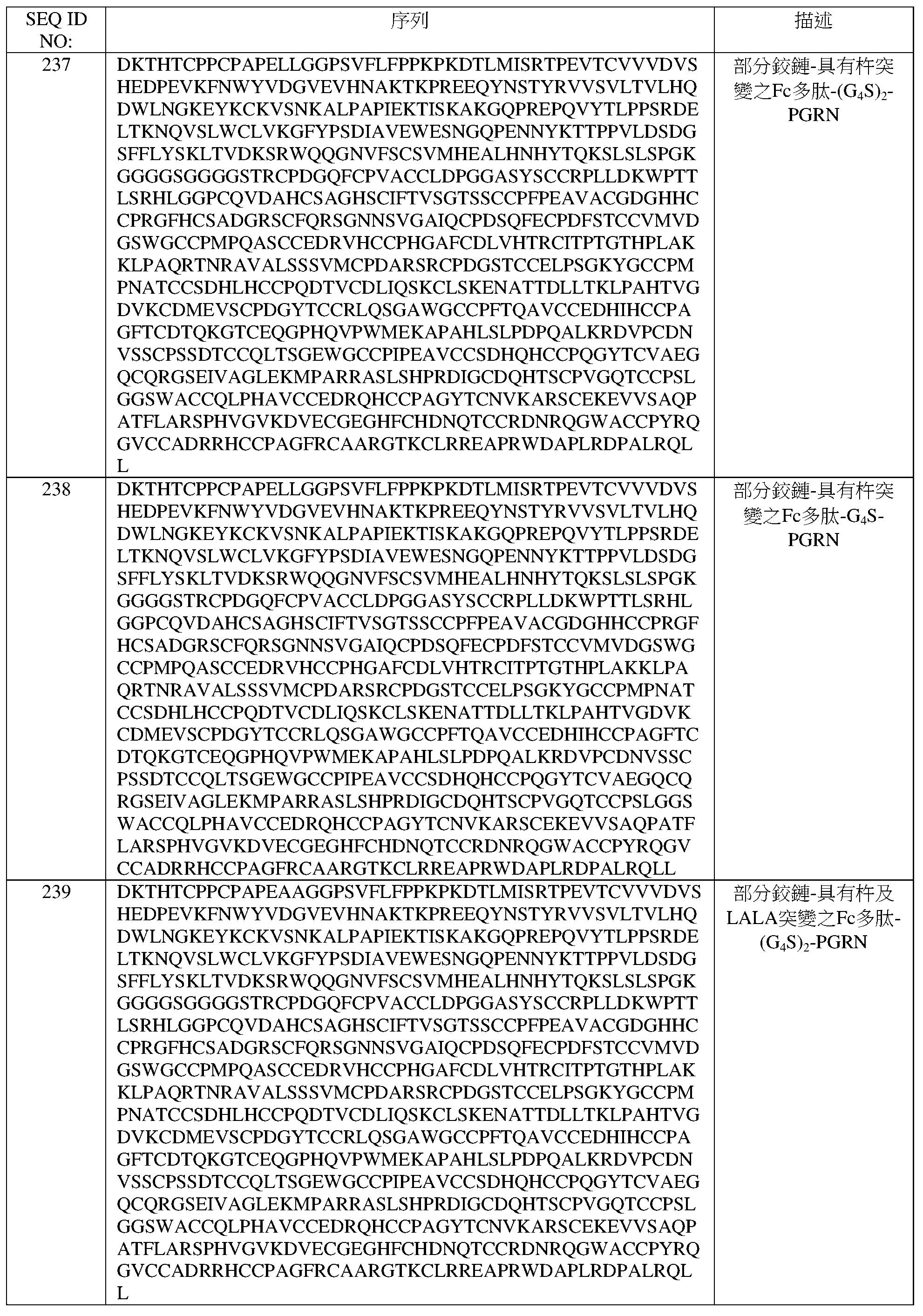
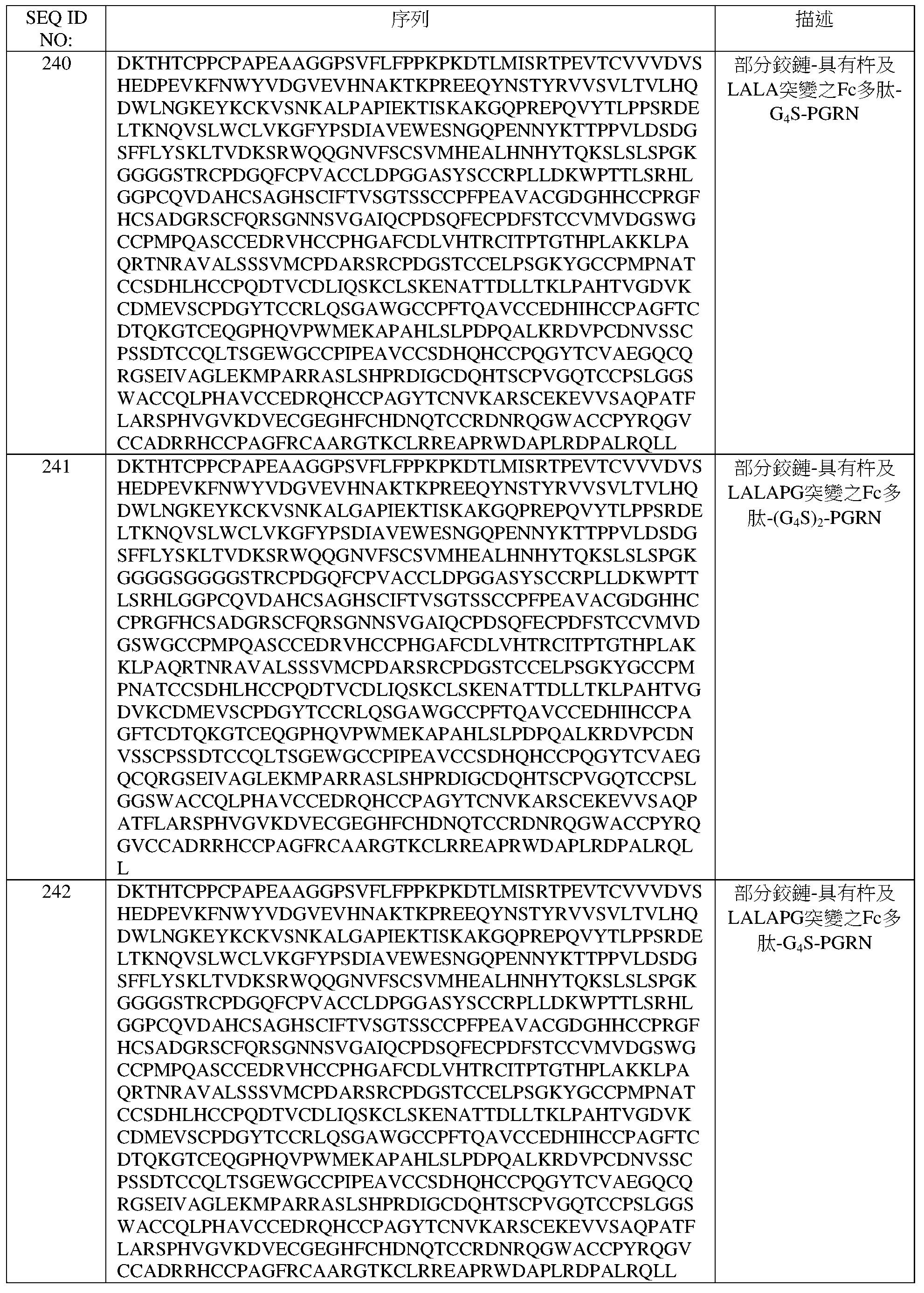
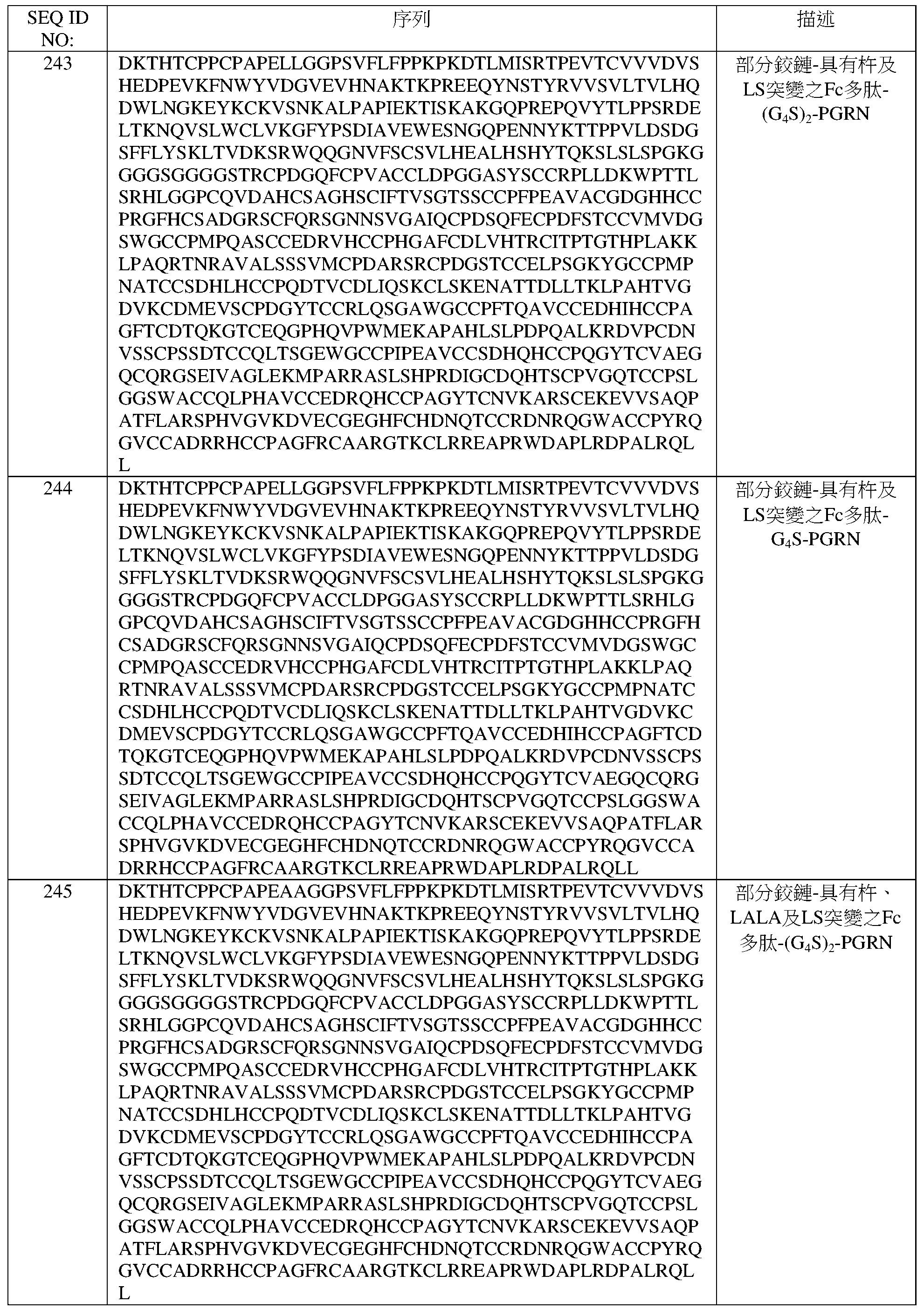
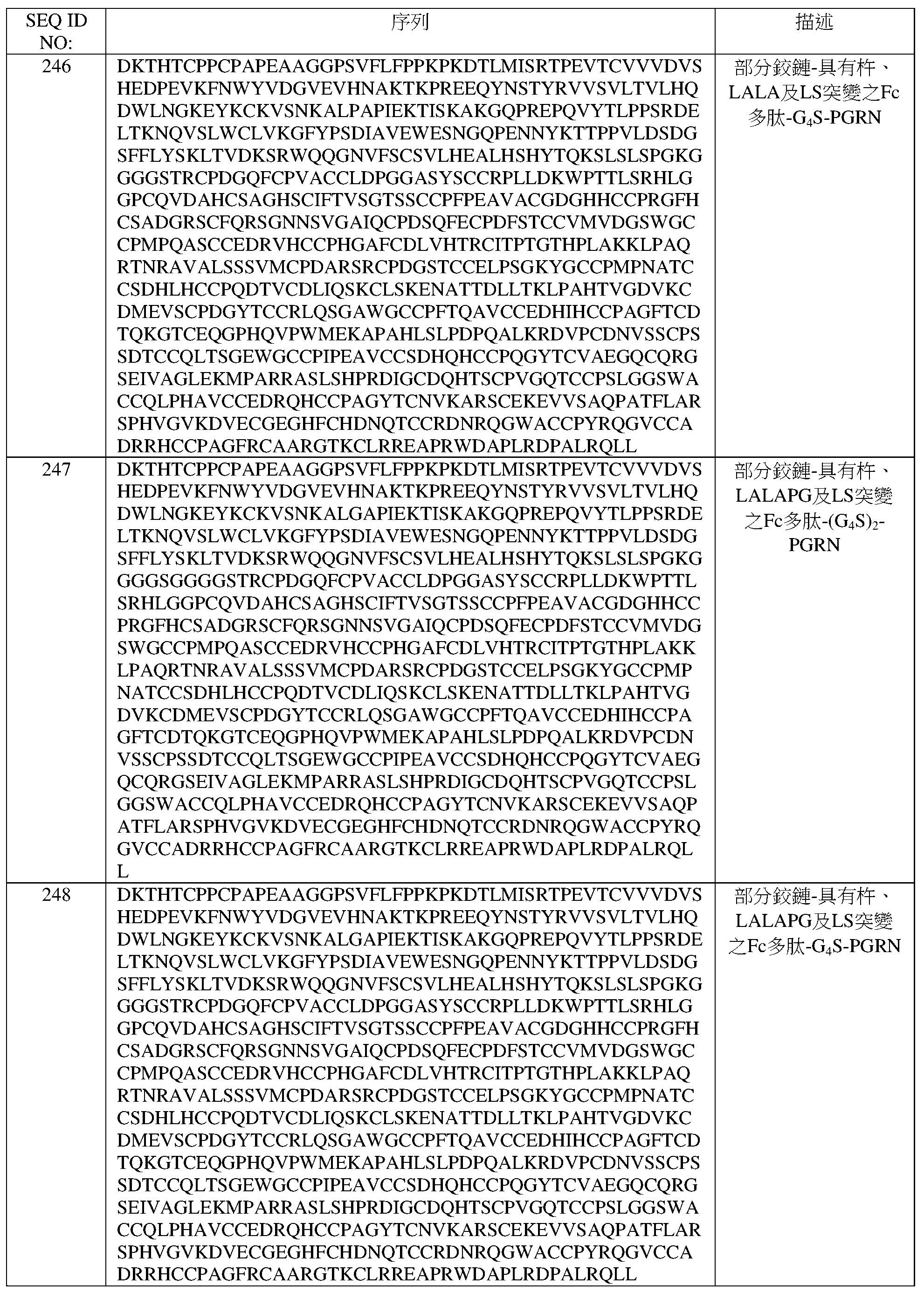
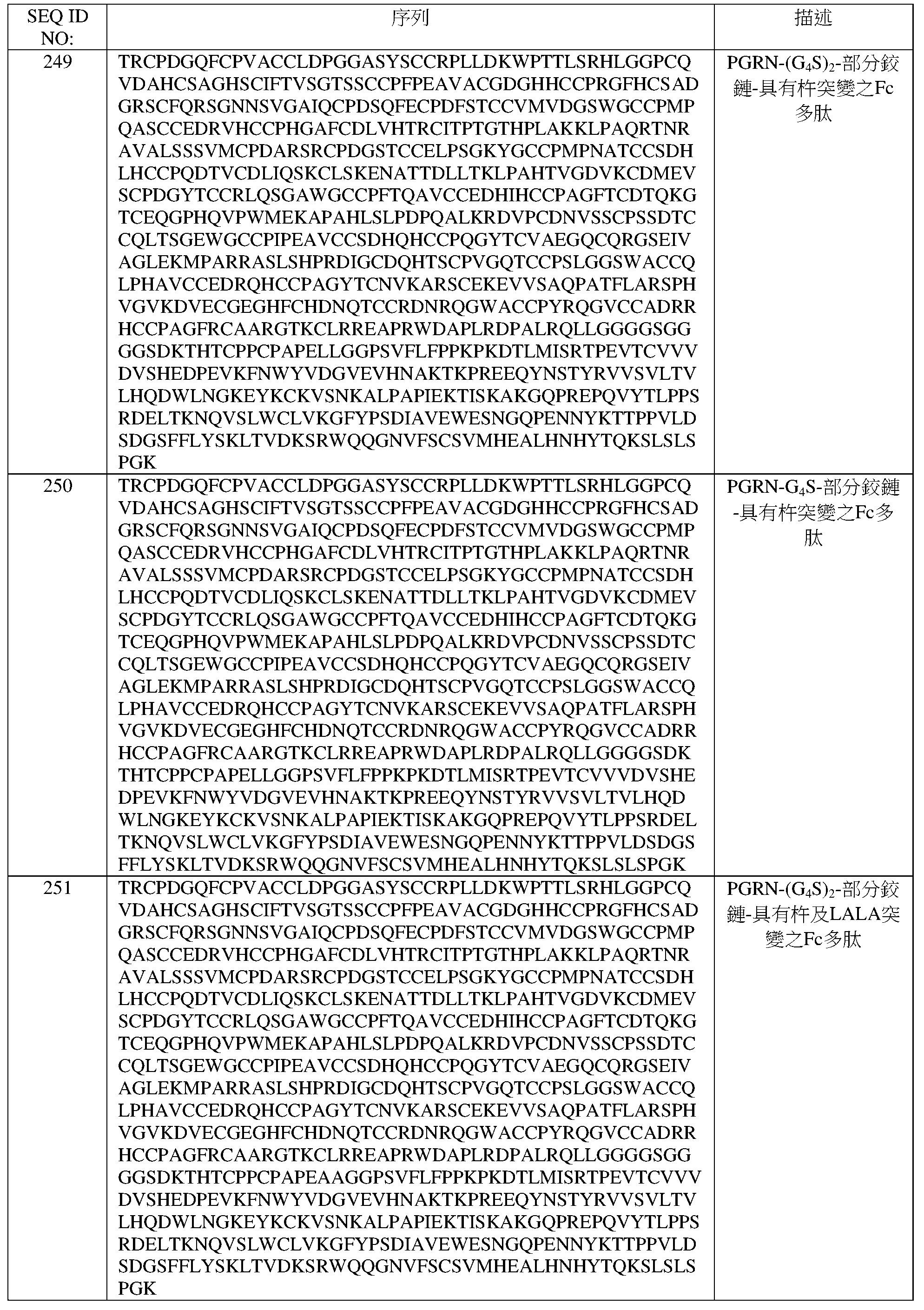
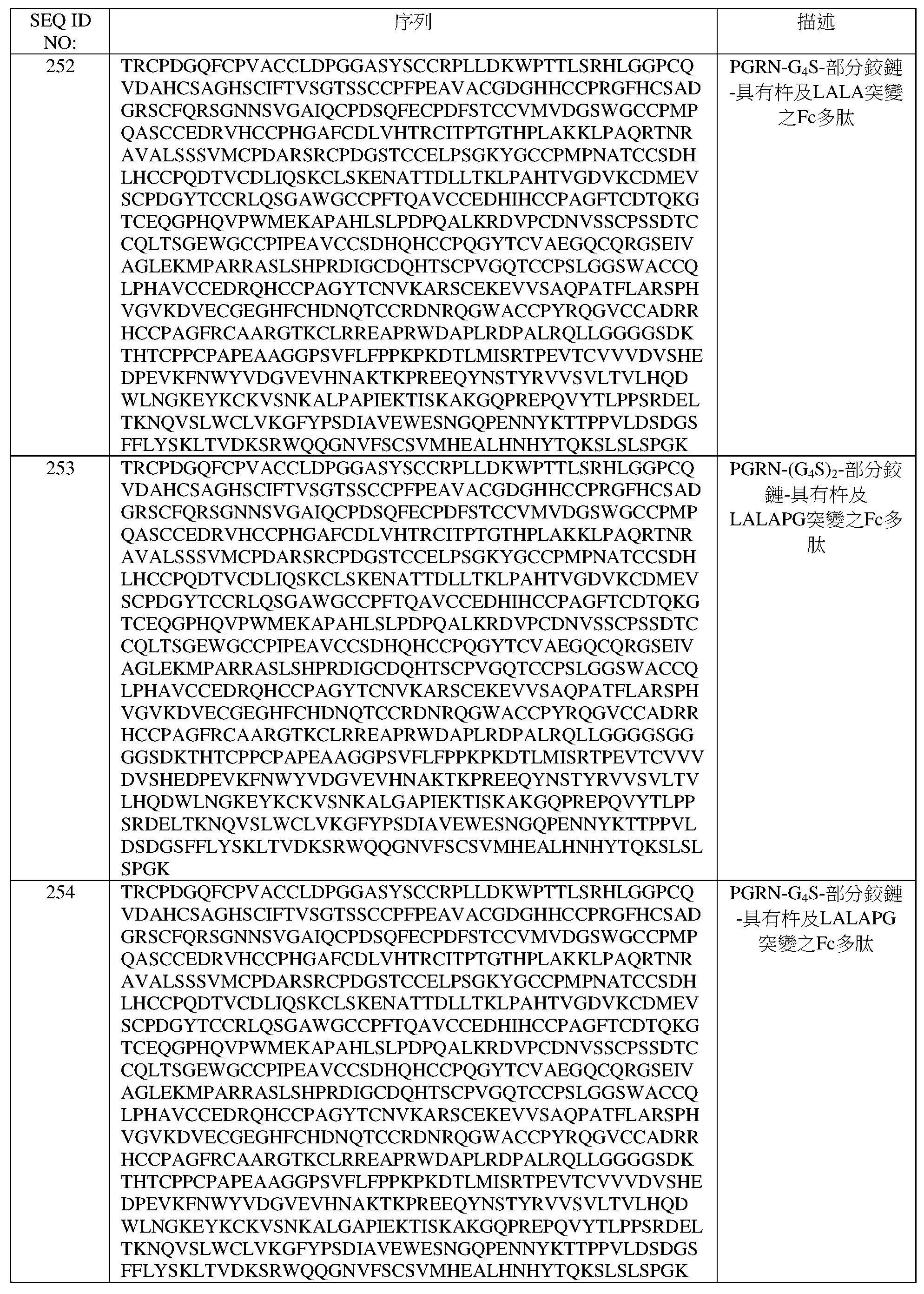

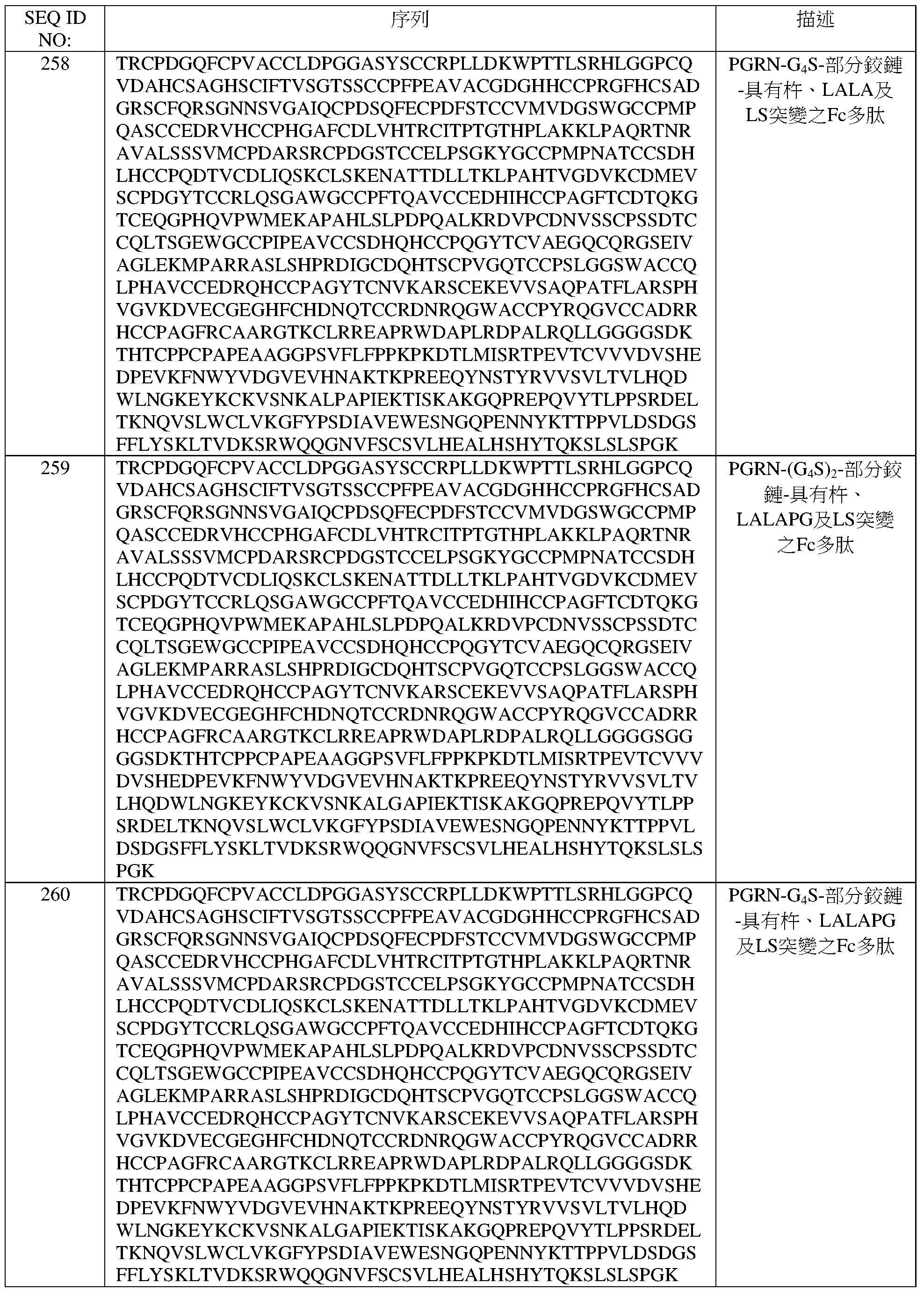
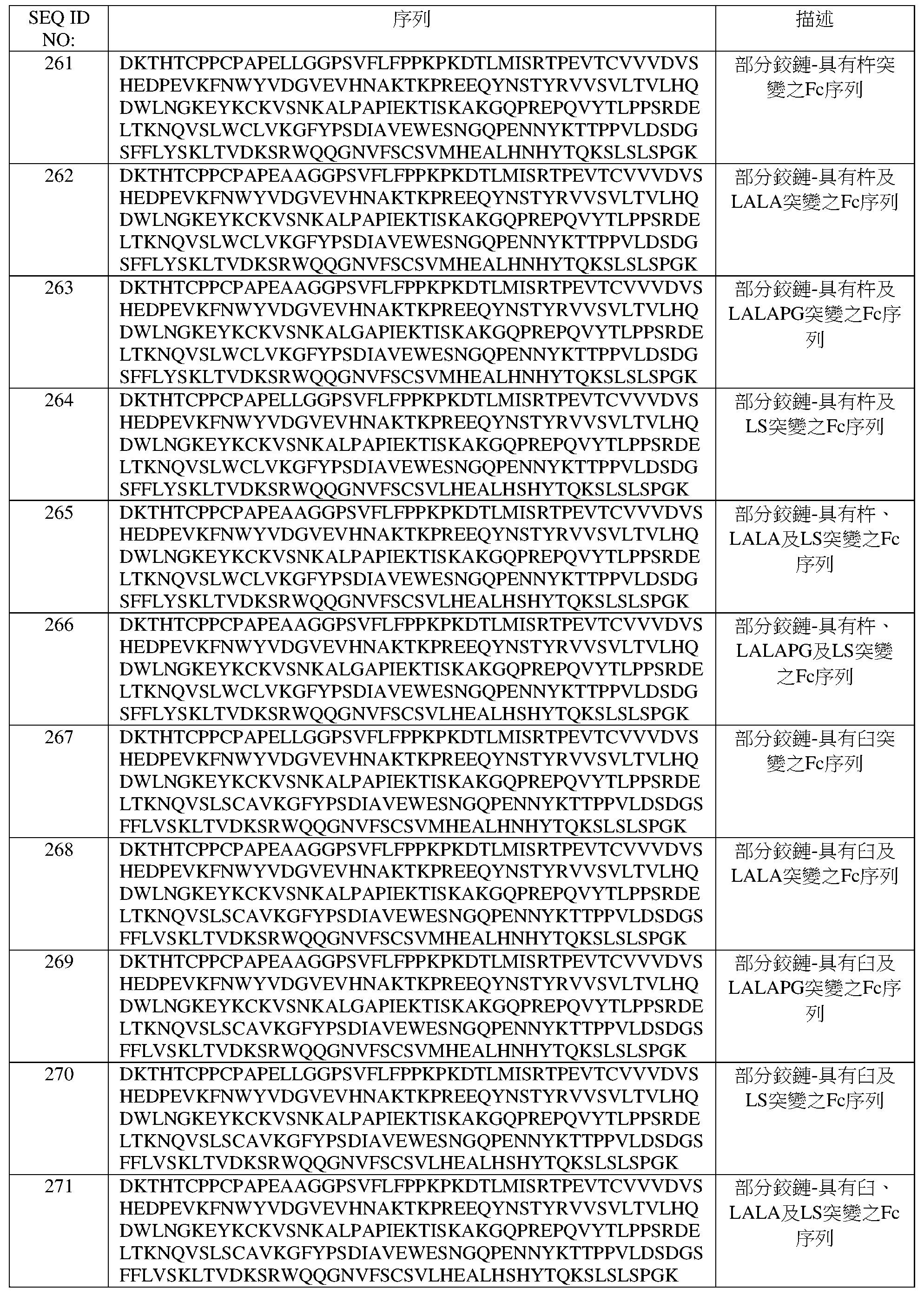


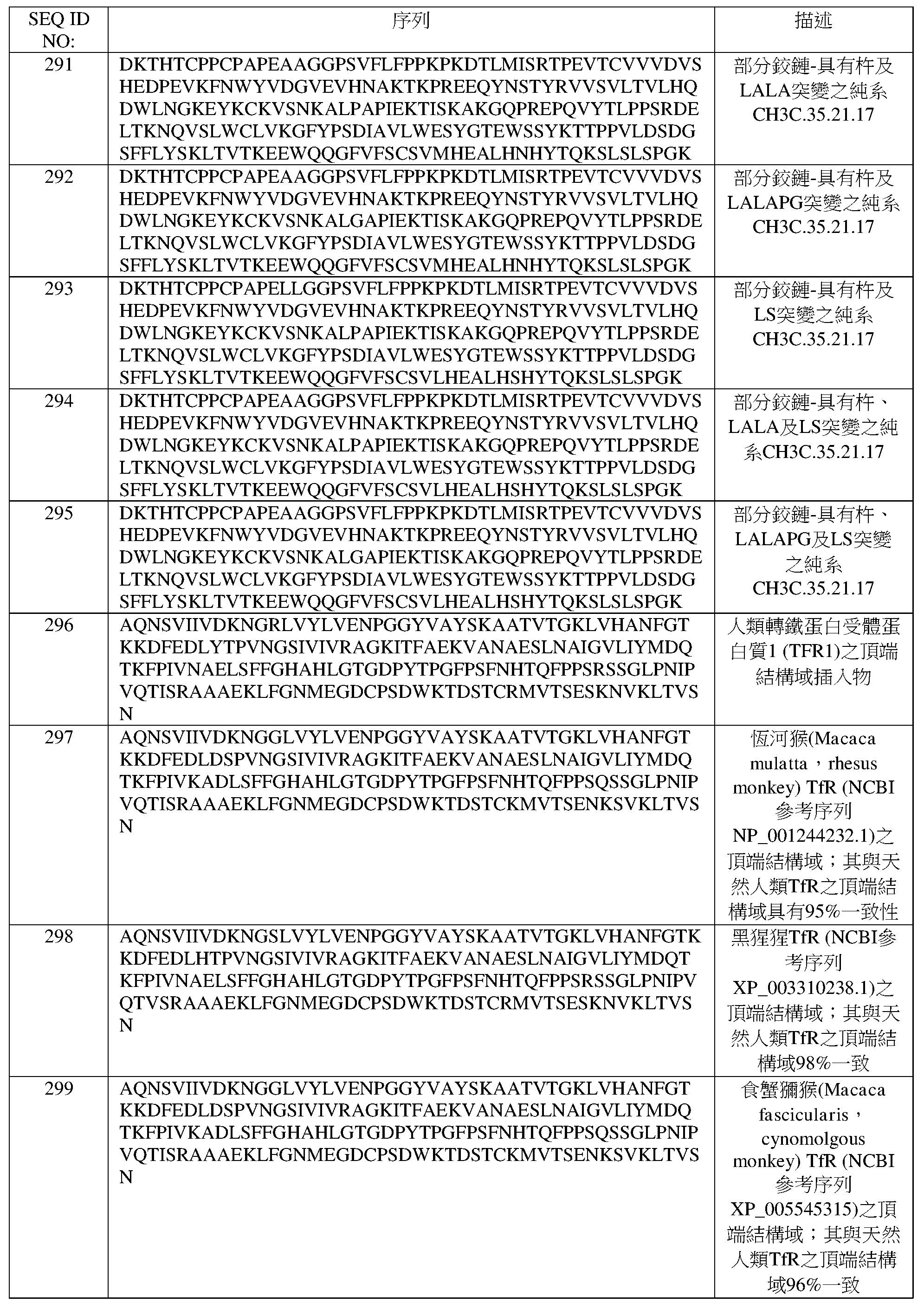
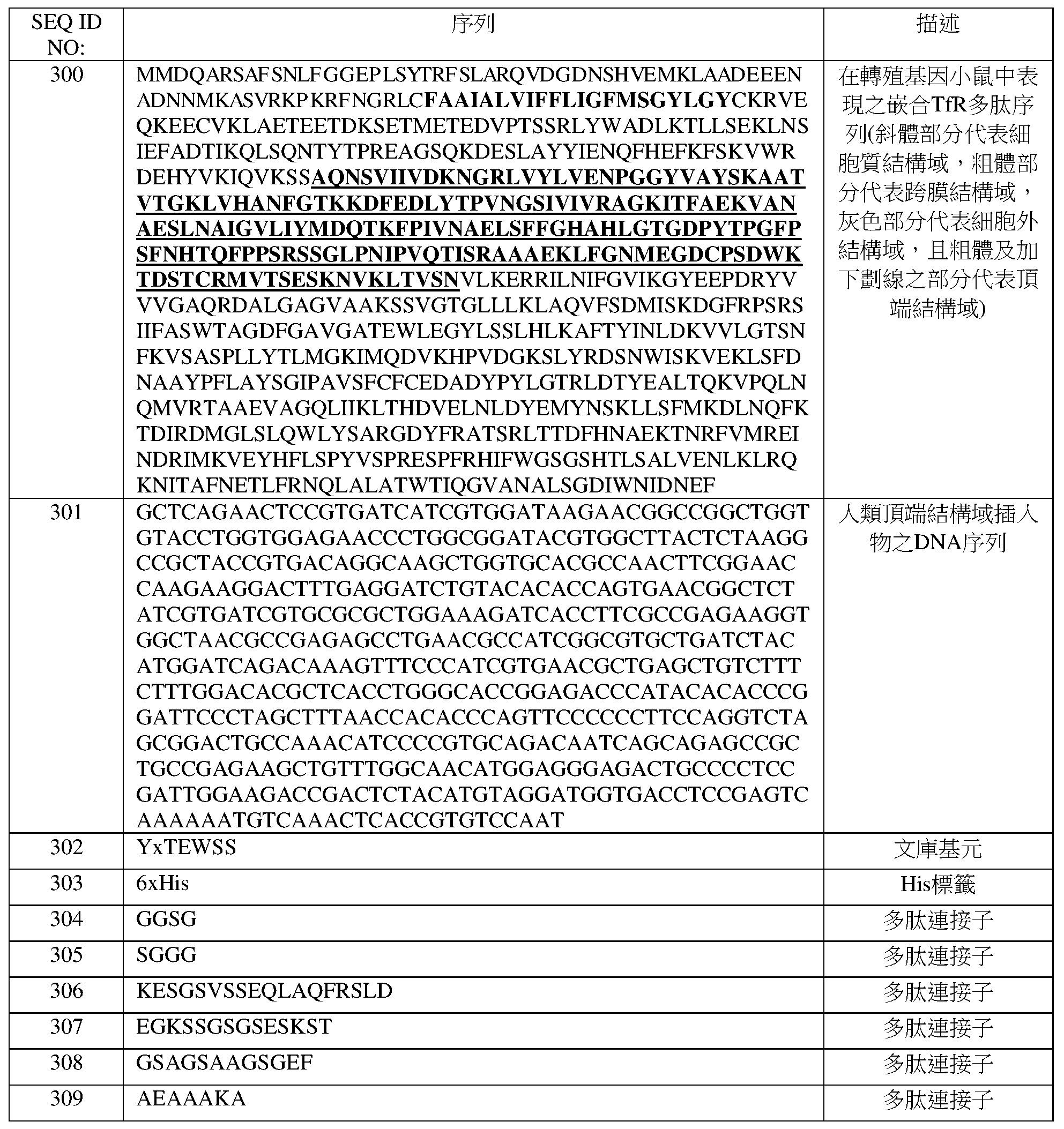
圖1A顯示三種Fc二聚體:PGRN融合蛋白融合物1、融合物2及融合物3之示意圖。在融合物1及融合物2中,PGRN之N末端分別經由(G4
S)2
連接子(SEQ ID NO:276)及G4
S連接子(SEQ ID NO:277)融合至不含TfR結合突變(由星形指示)之Fc多肽之C末端。在融合物3中,PGRN之C末端經由(G4
S)2
連接子融合至不含TfR結合突變(由星形指示)之Fc多肽之N末端。Figure 1A shows a schematic diagram of three Fc dimers: PGRN
圖1B顯示SDS-PAGE凝膠,其證明各自含有一個PGRN分子之融合蛋白融合物1、融合物2及融合物3純化至高於85%純度。Figure 1B shows an SDS-PAGE gel demonstrating that
圖1C為顯示Fc二聚體:PGRN融合蛋白融合物4、融合物5及融合物6之示意圖。在融合物4中,兩個PGRN分子中之每一者經由連接子(G4
S)2
(SEQ ID NO:276)融合至Fc多肽之C末端。一個PGRN分子融合至含有TfR結合突變(由星形指示)之Fc多肽之C末端,而另一PGRN分子融合至無TfR結合突變之Fc多肽之C末端。在融合物5中,一個PGRN分子經由連接子(G4
S)2
融合至含有TfR結合突變(由星形指示)之Fc多肽之N末端,而另一PGRN分子融合至無TfR結合突變之另一Fc多肽之C末端。在融合物6中,兩個PGRN分子中之每一者經由連接子(G4
S)2
融合至Fc多肽之N末端。一個PGRN分子融合至含有TfR結合突變(由星形指示)之Fc多肽之N末端,而另一PGRN分子融合至無TfR結合突變之Fc多肽之N末端。FIG. 1C is a schematic diagram showing Fc dimer: PGRN
圖1D顯示各自含有兩個PGRN分子之Fc二聚體:PGRN融合蛋白融合物4及融合物5純化至高於85%純度。Figure ID shows the purification of Fc dimers each containing two PGRN molecules: PGRN
圖1E為顯示Fc二聚體:PGRN融合蛋白融合物7及融合物8之示意圖。融合蛋白融合物7與融合物8均含有不含TfR結合突變之Fc多肽。在融合物7中,PGRN之N末端經由連接子(G4
S)2
(SEQ ID NO:276)融合至Fc多肽之C末端。在融合物8中,PGRN之C末端經由連接子(G4
S)2
融合至Fc多肽之N末端。Figure 1E is a schematic diagram showing Fc dimer: PGRN
圖2A及2B顯示如由PGRN (圖2A)與Fc染色(圖2B)指示之重組PGRN及Fc二聚體:PGRN融合蛋白(融合物1、融合物2及融合物3)之有效細胞吸收。Figures 2A and 2B show the effective cellular uptake of recombinant PGRN and Fc dimers: PGRN fusion proteins (
圖3顯示Fc二聚體:PGRN融合蛋白(融合物1、融合物2及融合物3)能夠挽救GRN
KO BMDM中之蛋白水解缺陷。Figure 3 shows that Fc dimer: PGRN fusion proteins (
圖4顯示在使用Bodipy-BSA偶聯物(DQ-BSA)之內溶酶體蛋白水解檢定中Fc二聚體:PGRN融合蛋白(融合物1、融合物3、融合物4及融合物5)之劑量反應。Figure 4 shows the Fc dimer in the endolysosomal proteolysis assay using Bodipy-BSA conjugate (DQ-BSA): PGRN fusion protein (
圖5顯示Fc二聚體:PGRN融合蛋白(融合物1、融合物2及融合物3)能夠挽救GRN
KO BMDM中所觀測之升高之組織蛋白酶D活性。Figure 5 shows that Fc dimer: PGRN fusion proteins (
圖6A-6D顯示Fc二聚體:PGRN融合蛋白融合物1能夠挽救GRN
KO BMDM中之溶酶體基因Ctsl
、Tmem106b
及Psap
之升高之mRNA水準。6A-6D show that Fc dimer:PGRN
圖7A及7B顯示Fc二聚體:PGRN融合蛋白融合物1及融合物3展現用此等融合蛋白給藥之WT小鼠之血漿及肝樣品中之類似藥物動力學型態。7A and 7B show that Fc dimer: PGRN
圖8A及8B顯示在給藥後4小時,分別在WT及hTfR小鼠之腦溶解產物及肝溶解產物中量測之Fc二聚體:PGRN融合蛋白融合物1及融合物3濃度(nM)所指示之平均值及SEM的散佈圖。使用生物素化山羊多株人類顆粒蛋白前體偵測抗體(R&D Systems編號BAF2420)產生數據。8A and 8B show the concentration of Fc dimer measured in brain lysate and liver lysate of WT and
圖9A顯示針對WT中之融合物3正規化之Fc二聚體:PGRN融合蛋白融合物1及融合物3之腦:血漿比所指示之平均值及SEM的散佈圖。FIG. 9A shows the mean and SEM scatter plots of the brain-to-plasma ratio indicated for the Fc dimer: PGRN
圖9B顯示針對WT中之融合物3正規化之Fc二聚體:PGRN融合蛋白融合物1及融合物3之腦:肝比所指示之平均值及SEM的散佈圖。FIG. 9B shows the mean value and the SEM scatter diagram of the brain-to-liver ratio of the normalized Fc dimer: PGRN
圖10A及10B顯示在給藥後4小時,分別在WT及hTfR小鼠之腦溶解產物及肝溶解產物中量測之Fc二聚體:PGRN融合蛋白融合物1及融合物3濃度(nM)所指示之平均值及SEM的散佈圖。使用靶向Fc中之位點之偵測抗體產生數據。10A and 10B show the concentration of Fc dimer measured in brain lysate and liver lysate of WT and
圖11A及11B顯示在給藥後4小時,分別在WT及hTfR小鼠之腦溶解產物及肝溶解產物中量測之Fc二聚體:PGRN融合蛋白融合物1及融合物3濃度(ng/mg總蛋白)所指示之平均值及SEM的散佈圖。使用靶向Fc中之位點之偵測抗體產生數據。11A and 11B show the concentration of Fc dimer measured in brain lysate and liver lysate of WT and
圖12A及12B顯示分別在hTfR及WT小鼠中之Fc二聚體:PGRN融合蛋白融合物1及融合物3之平均血漿濃度(nM)之時程的半對數圖。Figures 12A and 12B show a semi-logarithmic graph of the time course of the average plasma concentration (nM) of Fc dimer: PGRN
圖12C及12D顯示分別在給藥後0.25小時及4小時,Fc二聚體:PGRN融合蛋白融合物1及融合物3之血漿濃度(nM)所指示之平均值及SEM的散佈圖。Figures 12C and 12D show the mean values and SEM scattergrams indicated by the plasma concentrations (nM) of Fc dimer: PGRN
圖13A及13B顯示GRN
剔除小鼠之骨髓源性巨噬細胞(BMDM)中之雙(單醯甘油)磷酸酯(BMP)物質的水準相較於野生型提高。圖13A顯示用實例1之表1中所示之Fc二聚體:PGRN融合蛋白融合物11及融合物12處理GRN
剔除小鼠BMDM降低升高之BMP(18:1_18:1)水準。圖13B顯示用Fc二聚體:PGRN融合蛋白融合物11及融合物12處理GRN
剔除小鼠BMDM降低升高之BMP (20:4_20:4)水準。13A and 13B show that the level of bis(monoglyceride) phosphate (BMP) substance in bone marrow-derived macrophages (BMDM) of GRN- eliminated mice is increased compared to the wild type. Figure 13A shows that treatment of GRN- eliminated mice with Fc dimer: PGRN
圖13C及13D顯示用由慢病毒表現之重組顆粒蛋白前體(Adipogen)或顆粒蛋白前體處理GRN 剔除小鼠BMDM降低升高之BMP水準(總BMP以及18:1_18:1)。Figures 13C and 13D show that treatment of GRN- eliminated mice with recombinant granule protein precursors (Adipogen) or granule protein precursors expressed by lentiviruses reduced the elevated BMP levels (total BMP and 18:1-18:1).
圖14A顯示GRN 剔除小鼠之外周肝臟、血漿及尿液中之BMP 44:12相較於野生型減少。Figure 14A shows that BMP 44:12 in the liver, plasma and urine of GRN- eliminated mice is reduced compared to the wild type.
圖14B顯示中樞神經系統(CNS)之腦脊髓液(CSF)及腦中之BMP 44:12相較於野生型減少。Figure 14B shows that the cerebrospinal fluid (CSF) of the central nervous system (CNS) and BMP 44:12 in the brain are reduced compared to the wild type.
圖15顯示在2至19個月範圍內之GRN 剔除小鼠展現血漿BMP 44:12相較於野生型之年齡非依賴性減少。Figure 15 shows that GRN knockout mice in the range of 2 to 19 months exhibit an age-independent decrease in plasma BMP 44:12 compared to wild type.
圖16A及16B顯示用Fc二聚體:PGRN融合蛋白融合物11及融合物12處理GRN
剔除小鼠提高肝BMP 44:12及20:4_20:4水準。16A and 16B show that treatment of GRN- eliminated mice with Fc dimer: PGRN
圖17顯示用Fc二聚體:PGRN融合蛋白融合物11及融合物12處理GRN
剔除小鼠提高血漿BMP 44:12水準。Figure 17 shows that treatment of GRN- eliminated mice with Fc dimer: PGRN
圖18顯示用Fc二聚體:PGRN融合蛋白融合物11及融合物12處理GRN
剔除小鼠提高尿液BMP 44:12水準(針對肌酸正規化)。Figure 18 shows that treatment of GRN- eliminated mice with Fc dimer: PGRN
圖19顯示用Fc二聚體:PGRN融合蛋白融合物11及融合物12處理GRN
剔除小鼠提高CSF BMP 44:12水準。Figure 19 shows that treatment of GRN- eliminated mice with Fc dimer: PGRN
圖20A及20B顯示用Fc二聚體:PGRN融合蛋白融合物11及融合物12處理GRN
剔除小鼠分別提高腦BMP 44:12及20:4_20:4水準。20A and 20B show that treatment of GRN- eliminated mice with Fc dimer: PGRN
圖21A-21C顯示融合物11及融合物12能夠橫跨GRN
KO/hTfR.KI小鼠之腦中之BBB。21A-21C show that


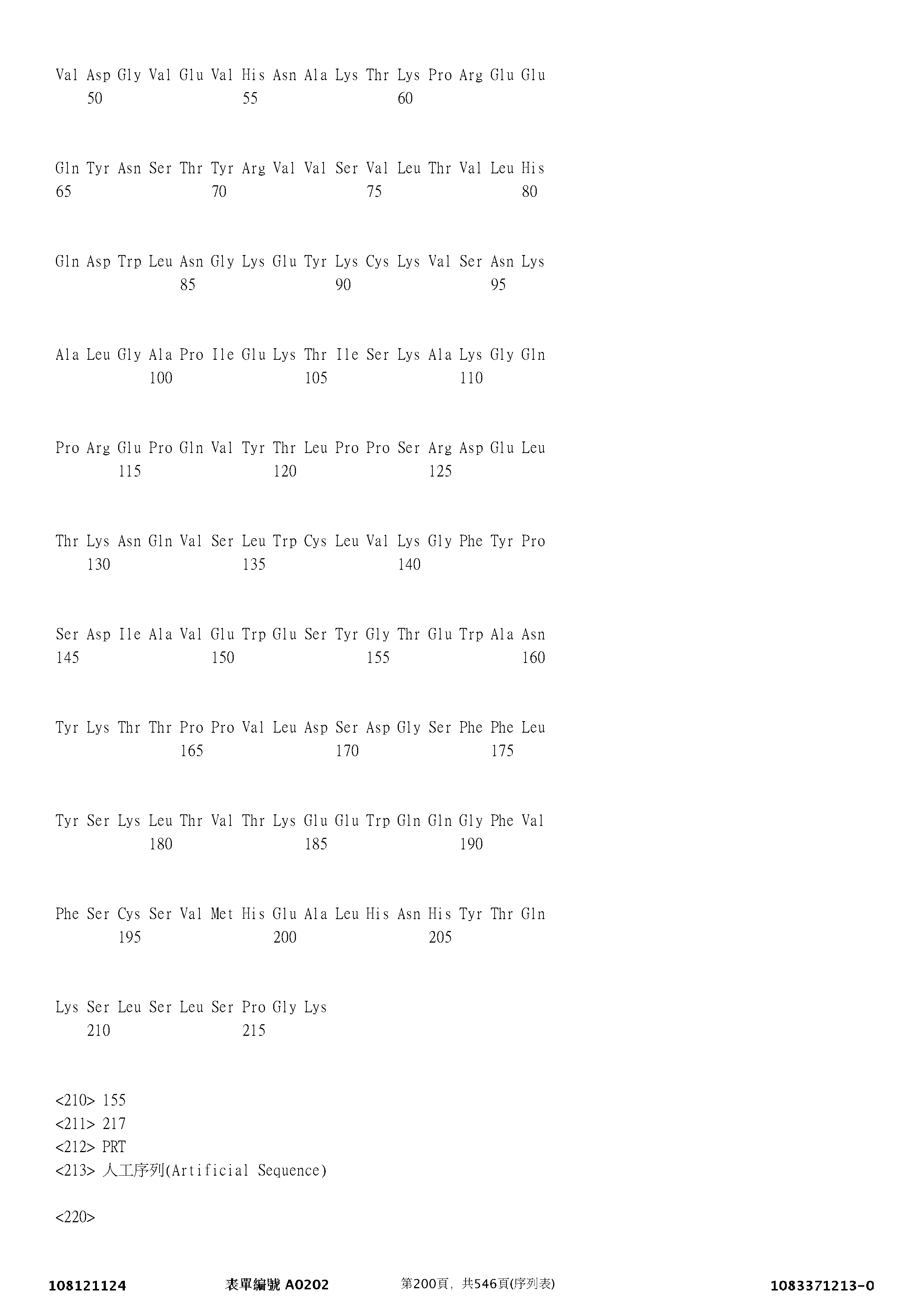


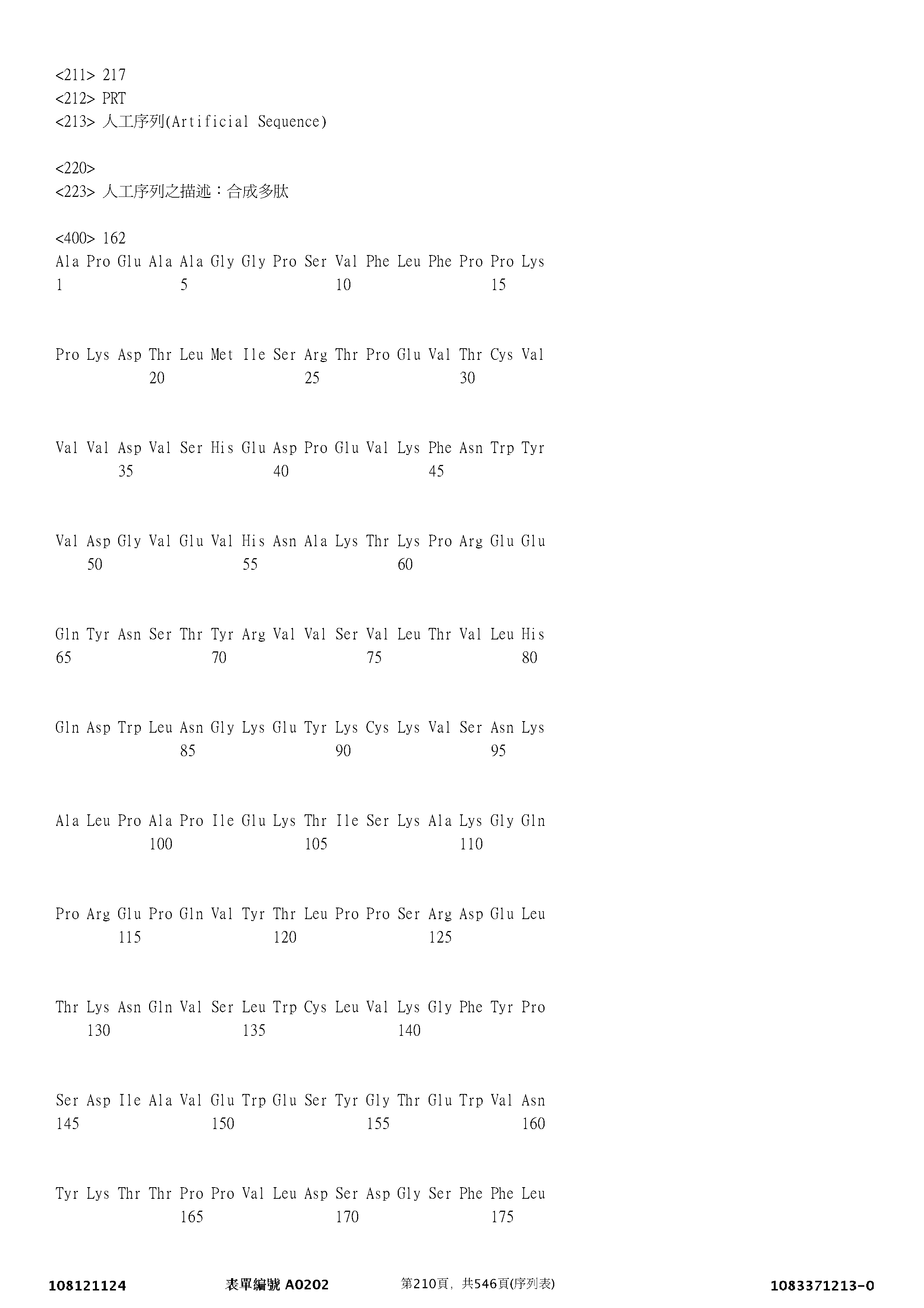


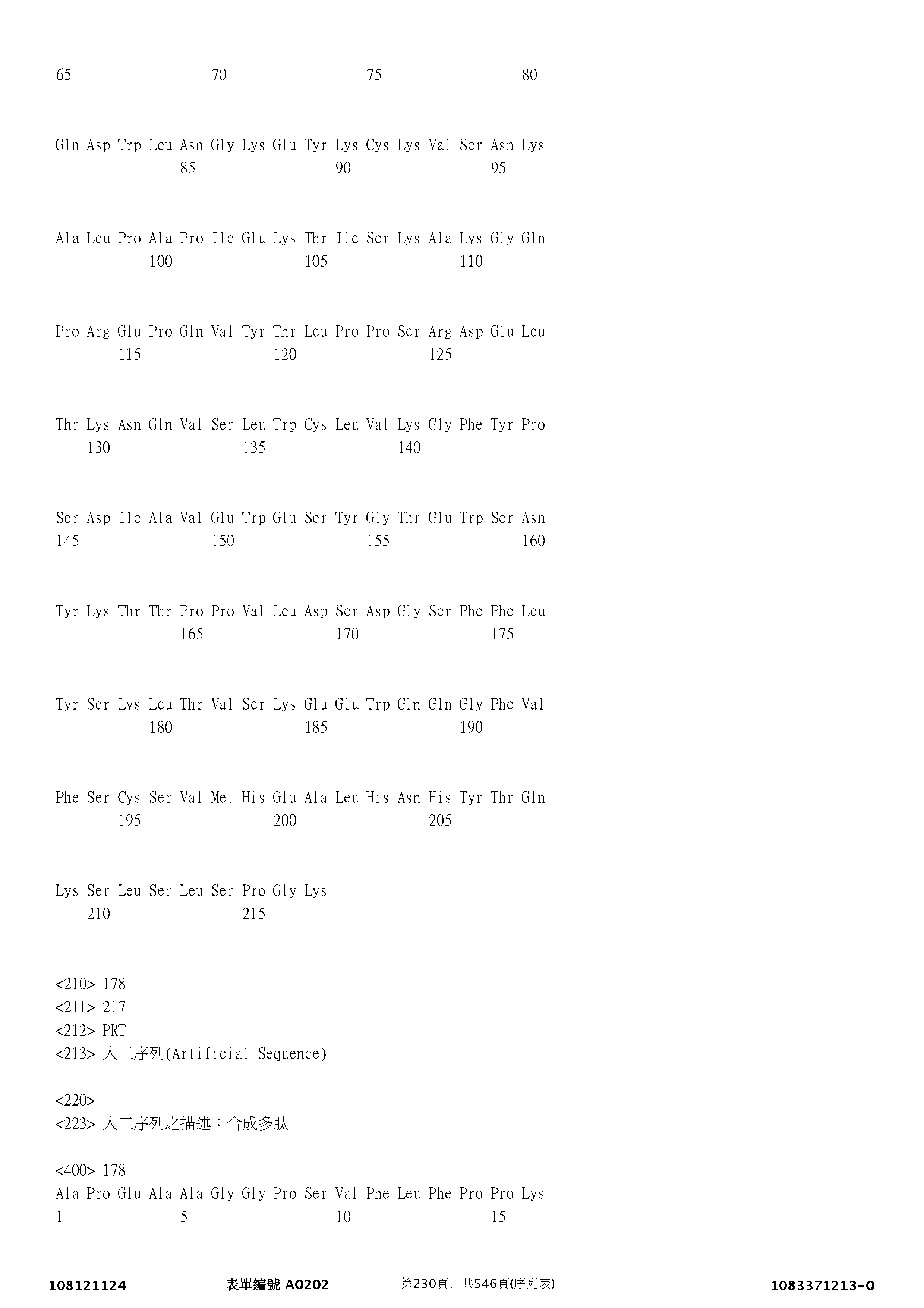


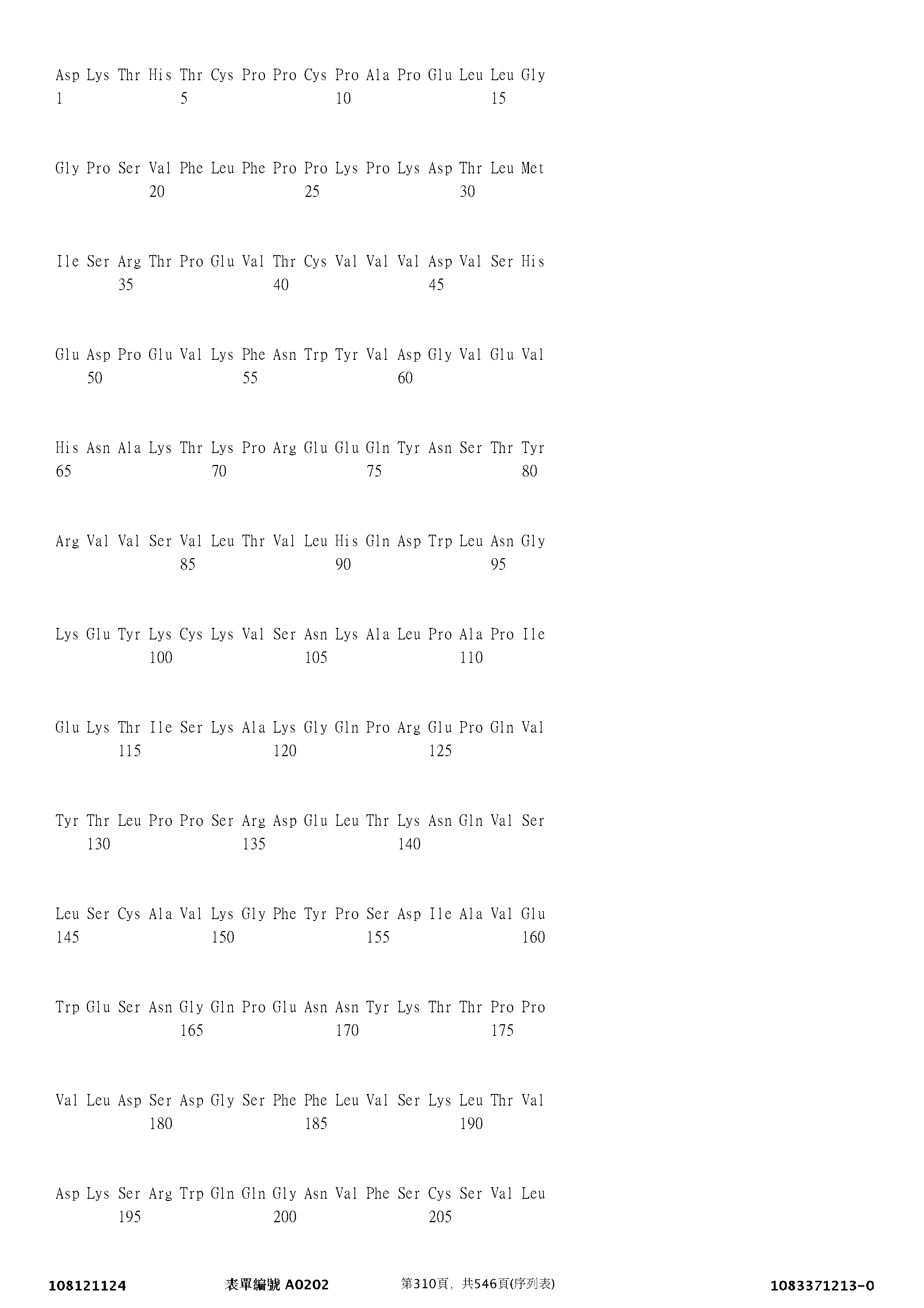


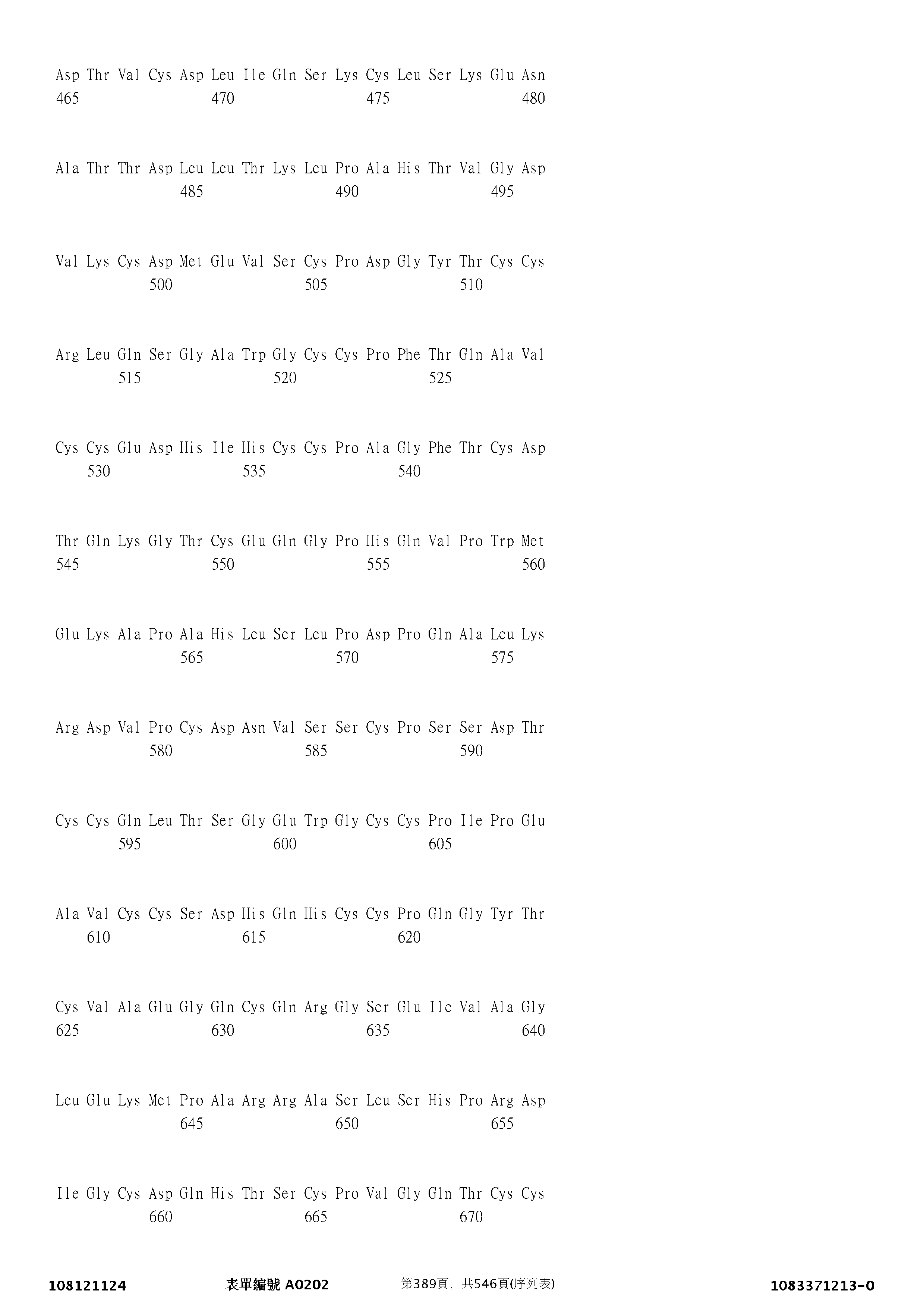


Claims (159)
Applications Claiming Priority (4)
| Application Number | Priority Date | Filing Date | Title |
|---|---|---|---|
| US201862686579P | 2018-06-18 | 2018-06-18 | |
| US62/686,579 | 2018-06-18 | ||
| US201862746338P | 2018-10-16 | 2018-10-16 | |
| US62/746,338 | 2018-10-16 |
Publications (2)
| Publication Number | Publication Date |
|---|---|
| TW202016152A true TW202016152A (en) | 2020-05-01 |
| TWI874321B TWI874321B (en) | 2025-03-01 |
Family
ID=67138158
Family Applications (1)
| Application Number | Title | Priority Date | Filing Date |
|---|---|---|---|
| TW108121124A TWI874321B (en) | 2018-06-18 | 2019-06-18 | Fusion proteins comprising progranulin |
Country Status (17)
| Country | Link |
|---|---|
| US (3) | US20210284702A1 (en) |
| EP (1) | EP3807322A1 (en) |
| JP (1) | JP7517997B2 (en) |
| KR (1) | KR20210027377A (en) |
| CN (1) | CN112424233A (en) |
| AU (1) | AU2019288212B2 (en) |
| BR (1) | BR112020025306A2 (en) |
| CA (1) | CA3101202A1 (en) |
| CL (1) | CL2020003255A1 (en) |
| EC (1) | ECSP20081591A (en) |
| IL (1) | IL279510B2 (en) |
| MX (1) | MX2020012518A (en) |
| PE (1) | PE20210323A1 (en) |
| PH (1) | PH12020552189A1 (en) |
| SG (1) | SG11202011743SA (en) |
| TW (1) | TWI874321B (en) |
| WO (1) | WO2019246071A1 (en) |
Cited By (1)
| Publication number | Priority date | Publication date | Assignee | Title |
|---|---|---|---|---|
| TWI919303B (en) | 2023-06-21 | 2026-03-21 | 美商美國禮來大藥廠 | Compounds for the delivery of granulin across the blood brain barrier |
Families Citing this family (25)
| Publication number | Priority date | Publication date | Assignee | Title |
|---|---|---|---|---|
| EP3991748A3 (en) | 2015-04-07 | 2022-08-24 | Alector LLC | Anti-sortilin antibodies and methods of use thereof |
| EP3689139B1 (en) * | 2015-05-29 | 2025-01-01 | Regeneron Pharmaceuticals, Inc. | Rodent cells having a disruption in a c9orf72 locus |
| NZ756763A (en) | 2017-02-17 | 2023-04-28 | Denali Therapeutics Inc | Engineered transferrin receptor binding polypeptides |
| MX2020002918A (en) | 2017-10-02 | 2020-07-22 | Denali Therapeutics Inc | FUSION PROTEINS COMPRISING ENZYMES OF ENZYME REPLACEMENT THERAPY. |
| PT3618928T (en) | 2018-07-13 | 2023-03-29 | Alector Llc | Anti-sortilin antibodies and methods of use thereof |
| CA3109763A1 (en) * | 2018-08-16 | 2020-02-20 | Denali Therapeutics Inc. | Engineered bispecific proteins |
| CN113164627B (en) * | 2018-10-16 | 2024-10-29 | 戴纳立制药公司 | Methods for treating and monitoring progranulin-related disorders |
| PH12021552002A1 (en) | 2019-02-20 | 2022-09-19 | Denali Therapeutics Inc | Anti-trem2 antibodies and methods of use thereof |
| MX2022007486A (en) | 2019-12-23 | 2022-06-29 | Denali Therapeutics Inc | PROGRANULIN VARIANTS. |
| KR20220131246A (en) | 2020-01-13 | 2022-09-27 | 데날리 테라퓨틱스 인크. | Anti-TREM2 antibodies and methods of use thereof |
| KR20230029671A (en) | 2020-05-27 | 2023-03-03 | 아리아리스 테라퓨틱스, 인크. | Anti-human NR1 antibody derivatives |
| US20210393787A1 (en) * | 2020-06-17 | 2021-12-23 | Bioasis Technologies, Inc. | Compositions and methods for treating frontotemporal dementia |
| JP7817757B2 (en) * | 2020-09-18 | 2026-02-19 | アイユーシーエフ-エイチワイユー(インダストリー-ユニバーシティ コーオペレーション ファウンデーション ハンヤン ユニバーシティ) | PTP sigma-Fc fusion protein and pharmaceutical composition containing the same |
| KR102666958B1 (en) * | 2020-09-18 | 2024-05-23 | 한양대학교 산학협력단 | PTPsigma-Fc Fusion Protein and Pharmaceutical Composition Comprising Same |
| AU2021362209B2 (en) | 2020-10-14 | 2026-02-12 | Denali Therapeutics Inc. | Fusion proteins comprising sulfoglucosamine sulfohydrolase enzymes and methods thereof |
| JP2023545462A (en) | 2020-10-14 | 2023-10-30 | デナリ セラピューティクス インコーポレイテッド | Methods for treating and monitoring frontotemporal dementia |
| CA3231484A1 (en) | 2021-10-01 | 2023-04-06 | Qinwen Mao | Pathologic tdp-43 as a biomarker for the diagnosis of tdp-43 proteinopathy |
| EP4448746A1 (en) * | 2021-12-17 | 2024-10-23 | Denali Therapeutics Inc. | Fusion proteins comprising alpha-l-iduronidase enzymes and methods |
| WO2023198661A1 (en) * | 2022-04-12 | 2023-10-19 | F. Hoffmann-La Roche Ag | Fusion proteins targeted to the central nervous system |
| EP4526344A1 (en) * | 2022-05-16 | 2025-03-26 | Denali Therapeutics Inc. | Transferrin receptor-binding domains and proteins comprising the same |
| KR20250122468A (en) * | 2022-12-06 | 2025-08-13 | 프로테인큐어 인코포레이티드 | Sortillin targeting |
| AU2024311750A1 (en) * | 2023-06-21 | 2025-12-18 | Eli Lilly And Company | Compounds for the delivery of granulin across the blood brain barrier |
| WO2025051953A1 (en) * | 2023-09-07 | 2025-03-13 | Novo Nordisk A/S | Sortilin-1 binders, constructs and uses thereof |
| TW202542190A (en) | 2023-12-20 | 2025-11-01 | 美商戴納立製藥公司 | Fusion proteins comprising acid alpha-glucosidase enzymes and methods thereof |
| WO2025166077A1 (en) * | 2024-01-31 | 2025-08-07 | Alector Llc | Compositions comprising progranulin and uses thereof |
Family Cites Families (6)
| Publication number | Priority date | Publication date | Assignee | Title |
|---|---|---|---|---|
| WO2010022175A1 (en) | 2008-08-19 | 2010-02-25 | Yale University | Identification of sortilin as a neuronal receptor for the frontotemporal dementia protein, progranulin |
| EP3991748A3 (en) * | 2015-04-07 | 2022-08-24 | Alector LLC | Anti-sortilin antibodies and methods of use thereof |
| CR20210429A (en) | 2015-06-24 | 2021-09-24 | Hoffmann La Roche | TRANSFERRIN ANTI-RECEPTOR ANTIBODIES WITH DESIGNED AFFINITY (Divisional 2017-0562) |
| CN107698684B (en) * | 2016-08-03 | 2021-09-28 | 广东东阳光药业有限公司 | GLP-1 fusion proteins comprising a mutated immunoglobulin Fc portion |
| US10143187B2 (en) | 2017-02-17 | 2018-12-04 | Denali Therapeutics Inc. | Transferrin receptor transgenic models |
| JP7669113B2 (en) | 2017-02-17 | 2025-04-28 | デナリ セラピューティクス インコーポレイテッド | Transferrin receptor transgenic model |
-
2019
- 2019-06-18 EP EP19735097.8A patent/EP3807322A1/en active Pending
- 2019-06-18 AU AU2019288212A patent/AU2019288212B2/en active Active
- 2019-06-18 TW TW108121124A patent/TWI874321B/en active
- 2019-06-18 US US17/253,391 patent/US20210284702A1/en not_active Abandoned
- 2019-06-18 JP JP2020570444A patent/JP7517997B2/en active Active
- 2019-06-18 SG SG11202011743SA patent/SG11202011743SA/en unknown
- 2019-06-18 PE PE2020002083A patent/PE20210323A1/en unknown
- 2019-06-18 IL IL279510A patent/IL279510B2/en unknown
- 2019-06-18 CA CA3101202A patent/CA3101202A1/en active Pending
- 2019-06-18 WO PCT/US2019/037695 patent/WO2019246071A1/en not_active Ceased
- 2019-06-18 KR KR1020217001552A patent/KR20210027377A/en not_active Ceased
- 2019-06-18 CN CN201980039158.0A patent/CN112424233A/en active Pending
- 2019-06-18 MX MX2020012518A patent/MX2020012518A/en unknown
- 2019-06-18 BR BR112020025306-5A patent/BR112020025306A2/en unknown
-
2020
- 2020-12-11 PH PH12020552189A patent/PH12020552189A1/en unknown
- 2020-12-16 CL CL2020003255A patent/CL2020003255A1/en unknown
- 2020-12-16 EC ECSENADI202081591A patent/ECSP20081591A/en unknown
-
2023
- 2023-04-12 US US18/299,458 patent/US20230406898A1/en not_active Abandoned
-
2025
- 2025-02-04 US US19/044,856 patent/US20260001925A1/en active Pending
Cited By (1)
| Publication number | Priority date | Publication date | Assignee | Title |
|---|---|---|---|---|
| TWI919303B (en) | 2023-06-21 | 2026-03-21 | 美商美國禮來大藥廠 | Compounds for the delivery of granulin across the blood brain barrier |
Also Published As
| Publication number | Publication date |
|---|---|
| IL279510B1 (en) | 2025-07-01 |
| JP2021527656A (en) | 2021-10-14 |
| US20230406898A1 (en) | 2023-12-21 |
| SG11202011743SA (en) | 2021-01-28 |
| CL2020003255A1 (en) | 2021-05-28 |
| CN112424233A (en) | 2021-02-26 |
| PH12020552189A1 (en) | 2021-06-28 |
| CA3101202A1 (en) | 2019-12-26 |
| JP7517997B2 (en) | 2024-07-17 |
| IL279510A (en) | 2021-01-31 |
| AU2019288212A1 (en) | 2020-12-03 |
| AU2019288212B2 (en) | 2026-04-16 |
| KR20210027377A (en) | 2021-03-10 |
| IL279510B2 (en) | 2025-11-01 |
| WO2019246071A1 (en) | 2019-12-26 |
| EP3807322A1 (en) | 2021-04-21 |
| US20210284702A1 (en) | 2021-09-16 |
| ECSP20081591A (en) | 2021-01-29 |
| MX2020012518A (en) | 2021-02-16 |
| TWI874321B (en) | 2025-03-01 |
| PE20210323A1 (en) | 2021-02-18 |
| US20260001925A1 (en) | 2026-01-01 |
| BR112020025306A2 (en) | 2021-03-09 |
Similar Documents
| Publication | Publication Date | Title |
|---|---|---|
| TWI874321B (en) | Fusion proteins comprising progranulin | |
| JP7854267B2 (en) | Enzyme-containing fusion protein for enzyme replacement therapy | |
| US11643446B2 (en) | Progranulin variants | |
| JP2020508049A (en) | Engineered transferrin receptor binding polypeptide | |
| JP2020530293A (en) | Manipulated transferrin receptor binding polypeptide | |
| WO2021133907A1 (en) | Progranulin variants | |
| EA049541B1 (en) | FUSION PROTEINS CONTAINING PROGRANULIN | |
| HK40046687A (en) | Fusion proteins comprising progranulin | |
| JP2026077678A (en) | Enzyme-containing fusion protein for enzyme replacement therapy | |
| EA049817B1 (en) | PROGRANULIN OPTIONS | |
| HK40079659A (en) | Progranulin variants | |
| HK40063309A (en) | Fusion proteins comprising enzyme replacement therapy enzymes | |
| HK40031685A (en) | Fusion proteins comprising enzyme replacement therapy enzymes |