TW202026327A - Organic electronic material, liquid composition, organic layer, organic electronic element, organic electroluminescent element, display element, lighting device, display device, and method for manufacturing organic electronic element - Google Patents
Organic electronic material, liquid composition, organic layer, organic electronic element, organic electroluminescent element, display element, lighting device, display device, and method for manufacturing organic electronic element Download PDFInfo
- Publication number
- TW202026327A TW202026327A TW108135236A TW108135236A TW202026327A TW 202026327 A TW202026327 A TW 202026327A TW 108135236 A TW108135236 A TW 108135236A TW 108135236 A TW108135236 A TW 108135236A TW 202026327 A TW202026327 A TW 202026327A
- Authority
- TW
- Taiwan
- Prior art keywords
- organic
- organic electronic
- charge transporting
- transporting polymer
- polymer
- Prior art date
Links
Images

Classifications
-
- C—CHEMISTRY; METALLURGY
- C08—ORGANIC MACROMOLECULAR COMPOUNDS; THEIR PREPARATION OR CHEMICAL WORKING-UP; COMPOSITIONS BASED THEREON
- C08G—MACROMOLECULAR COMPOUNDS OBTAINED OTHERWISE THAN BY REACTIONS ONLY INVOLVING UNSATURATED CARBON-TO-CARBON BONDS
- C08G61/00—Macromolecular compounds obtained by reactions forming a carbon-to-carbon link in the main chain of the macromolecule
-
- G—PHYSICS
- G09—EDUCATION; CRYPTOGRAPHY; DISPLAY; ADVERTISING; SEALS
- G09F—DISPLAYING; ADVERTISING; SIGNS; LABELS OR NAME-PLATES; SEALS
- G09F9/00—Indicating arrangements for variable information in which the information is built-up on a support by selection or combination of individual elements
- G09F9/30—Indicating arrangements for variable information in which the information is built-up on a support by selection or combination of individual elements in which the desired character or characters are formed by combining individual elements
-
- H—ELECTRICITY
- H05—ELECTRIC TECHNIQUES NOT OTHERWISE PROVIDED FOR
- H05B—ELECTRIC HEATING; ELECTRIC LIGHT SOURCES NOT OTHERWISE PROVIDED FOR; CIRCUIT ARRANGEMENTS FOR ELECTRIC LIGHT SOURCES, IN GENERAL
- H05B33/00—Electroluminescent light sources
- H05B33/10—Apparatus or processes specially adapted to the manufacture of electroluminescent light sources
-
- H—ELECTRICITY
- H10—SEMICONDUCTOR DEVICES; ELECTRIC SOLID-STATE DEVICES NOT OTHERWISE PROVIDED FOR
- H10K—ORGANIC ELECTRIC SOLID-STATE DEVICES
- H10K59/00—Integrated devices, or assemblies of multiple devices, comprising at least one organic light-emitting element covered by group H10K50/00
- H10K59/50—OLEDs integrated with light modulating elements, e.g. with electrochromic elements, photochromic elements or liquid crystal elements
Landscapes
- Engineering & Computer Science (AREA)
- Chemical & Material Sciences (AREA)
- Physics & Mathematics (AREA)
- General Physics & Mathematics (AREA)
- Theoretical Computer Science (AREA)
- Manufacturing & Machinery (AREA)
- Health & Medical Sciences (AREA)
- Chemical Kinetics & Catalysis (AREA)
- Medicinal Chemistry (AREA)
- Polymers & Plastics (AREA)
- Organic Chemistry (AREA)
- Electroluminescent Light Sources (AREA)
Abstract
Description
本發明的實施形態是有關於一種有機電子材料、液狀組成物、有機層、有機電子元件、有機電致發光(electroluminescence)元件、顯示元件、照明裝置、顯示裝置及有機電子元件的製造方法。Embodiments of the present invention relate to an organic electronic material, a liquid composition, an organic layer, an organic electronic element, an organic electroluminescence element, a display element, a lighting device, a display device, and a method for manufacturing the organic electronic element.
有機電子元件是使用有機物來進行電氣運作的元件,期待可發揮節能、價格低、柔軟性等特長,作為替換現有的以矽為主體的無機半導體的技術受到關注。作為有機電子元件的例子,可列舉有機電致發光元件(有機EL元件)、有機光電轉換元件、有機電晶體等。Organic electronic devices use organic materials to perform electrical operations. They are expected to offer advantages such as energy efficiency, low cost, and flexibility, and are attracting attention as a technology that could replace existing inorganic semiconductors, which are primarily based on silicon. Examples of organic electronic devices include organic electroluminescent devices (organic EL devices), organic photoelectric converters, and organic transistors.
有機EL元件作為例如用作白熾燈或氣體填充燈的替代品的大面積固態(solid state)光源的應用受到關注。另外,作為替換平板顯示器(flat panel display,FPD)領域中的液晶顯示器(liquid crystal display,LCD)的最有力的自發光顯示器亦受到關注,推進製品化。Organic EL devices are attracting attention as large-area solid-state light sources, serving as alternatives to incandescent lamps and gas-filled lamps. They are also gaining attention as the most promising self-luminous display to replace liquid crystal displays (LCDs) in the flat panel display (FPD) field, and their commercialization is progressing.
根據所使用的有機材料,有機EL元件大致分為低分子型有機EL元件及高分子型有機EL元件兩種。高分子型有機EL元件中使用高分子化合物作為有機材料,低分子型有機EL元件中使用低分子化合物。另一方面,有機EL元件的製造方法大致區分為主要於真空系統中進行成膜的乾式製程及藉由凸版印刷、凹版印刷等有版印刷、噴墨等無版印刷等來進行成膜的濕式製程兩種。由於能夠實現簡易成膜,因而對於今後的大畫面有機EL顯示器而言濕式製程作為不可或缺的方法受到期待。Organic EL devices are broadly classified into two types based on the organic materials used: low-molecular-weight organic EL devices and high-molecular-weight organic EL devices. High-molecular-weight organic EL devices use high-molecular-weight compounds as their organic materials, while low-molecular-weight organic EL devices use low-molecular-weight compounds. Organic EL device manufacturing methods are broadly divided into two types: dry processes, which primarily form films in a vacuum system, and wet processes, which form films using plate-based printing methods such as letterpress and gravure, or plateless printing methods such as inkjet. Due to its ability to easily form films, wet processes are expected to become essential for future large-screen organic EL displays.
因此,進行適用於濕式製程的材料的開發,例如,正在進行利用具有聚合性官能基的電荷傳輸性化合物來形成多層結構的研究(參照專利文獻1)。 [現有技術文獻] [專利文獻]Therefore, research is underway to develop materials suitable for wet processes. For example, research is underway to form multilayer structures using charge-transporting compounds with polymerizable functional groups (see Patent Document 1). [Prior Art Document] [Patent Document]
專利文獻1:日本專利特開2006-279007號公報Patent document 1: Japanese Patent Publication No. 2006-279007
[發明所欲解決之課題] 於濕式製程中,一般塗佈使有機材料溶解於溶媒中而得的溶液,形成塗佈層,繼而使塗佈層乾燥,藉此形成有機層。因此,為了形成具有充分的膜厚的有機層,較佳為使用高濃度的溶液。但是,於含有高分子化合物的溶液中,有若濃度升高則黏度上升的傾向。若溶液的黏度高,則根據塗佈方法的不同,有時難以形成有機層。[Problem to be Solved by the Invention] In wet processes, a solution consisting of an organic material dissolved in a solvent is typically applied to form a coating layer, which is then dried to form the organic layer. Therefore, to form an organic layer with sufficient film thickness, a highly concentrated solution is preferred. However, solutions containing polymer compounds tend to increase in viscosity as their concentration increases. High solution viscosity can make it difficult to form an organic layer, depending on the coating method.
因此,本發明的實施形態的課題在於提供一種能夠藉由濕式製程形成具有充分的膜厚的有機層的有機電子材料及液狀組成物。另外,本發明的實施形態的課題在於提供一種具有充分的膜厚且可藉由濕式製程容易地形成的有機層。進而,本發明的實施形態的課題在於提供一種具有優異的特性的有機電子元件、有機EL元件、顯示元件、照明裝置及顯示裝置。 [解決課題之手段]Therefore, an embodiment of the present invention aims to provide an organic electronic material and liquid composition capable of forming an organic layer having a sufficient film thickness by a wet process. Furthermore, an embodiment of the present invention aims to provide an organic layer having a sufficient film thickness that can be easily formed by a wet process. Furthermore, an embodiment of the present invention aims to provide an organic electronic device, an organic EL device, a display device, a lighting device, and a display device having excellent characteristics. [Means for Solving the Problem]
本發明中包括各種實施形態。以下列舉實施形態的例子。本發明並不限定於以下的實施形態。The present invention includes various embodiments. The following are examples of embodiments. The present invention is not limited to the following embodiments.
一實施形態是有關於一種有機電子材料,其為含有電荷傳輸性聚合物的有機電子材料,所述電荷傳輸性聚合物具有分支結構,所述電荷傳輸性聚合物的重量平均分子量為20,000以上,於製備含有所述電荷傳輸性聚合物及甲苯、所述電荷傳輸性聚合物的濃度為10質量%的溶液的情況下,所述溶液的室溫下的黏度小於3.0 mPa·s。One embodiment relates to an organic electronic material comprising a charge transporting polymer having a branched structure and a weight-average molecular weight of 20,000 or greater. When a solution containing the charge transporting polymer and toluene at a concentration of 10% by mass of the charge transporting polymer is prepared, the viscosity of the solution at room temperature is less than 3.0 mPa·s.
另一實施形態是有關於一種含有所述有機電子材料及溶媒的液狀組成物。Another embodiment relates to a liquid composition containing the organic electronic material and a solvent.
又一實施形態是有關於一種使用所述有機電子材料、或者所述液狀組成物而形成的有機層。Yet another embodiment relates to an organic layer formed using the organic electronic material or the liquid composition.
又一實施形態是有關於一種包括所述有機層的有機電子元件。Yet another embodiment relates to an organic electronic device including the organic layer.
又一實施形態是有關於一種包括所述有機層的有機電致發光元件。Yet another embodiment relates to an organic electroluminescent device including the organic layer.
又一實施形態是有關於一種包括所述有機電致發光元件的顯示元件;一種包括所述有機電致發光元件的照明裝置;或者一種包括所述照明裝置及作為顯示構件的液晶元件的顯示裝置。Yet another embodiment relates to a display element including the organic electroluminescent element; a lighting device including the organic electroluminescent element; or a display device including the lighting device and a liquid crystal element as a display component.
進而又一實施形態是有關於一種有機電子元件的製造方法,包括:使用所述有機電子材料、或者所述液狀組成物來形成有機層。 [發明的效果]Yet another embodiment relates to a method for manufacturing an organic electronic device, comprising: forming an organic layer using the organic electronic material or the liquid composition. [Effects of the Invention]
根據本發明的實施形態,可提供一種能夠藉由濕式製程形成具有充分的膜厚的有機層的有機電子材料及液狀組成物。另外,根據本發明的實施形態,可提供一種具有充分的膜厚且可藉由濕式製程容易地形成的有機層。進而,根據本發明的實施形態,可提供一種具有優異的特性的有機電子元件、有機EL元件、顯示元件、照明裝置及顯示裝置。According to embodiments of the present invention, an organic electronic material and liquid composition can be provided that enable formation of an organic layer having a sufficient film thickness by a wet process. Furthermore, according to embodiments of the present invention, an organic layer having a sufficient film thickness that can be easily formed by a wet process can be provided. Furthermore, according to embodiments of the present invention, an organic electronic device, an organic EL device, a display device, a lighting device, and a display device having excellent characteristics can be provided.
對本發明的實施形態進行說明。本發明並不限定於以下的實施形態。The present invention is not limited to the following embodiments.
<有機電子材料> 作為本發明的實施形態的有機電子材料含有電荷傳輸性聚合物,所述電荷傳輸性聚合物具有分支結構,重量平均分子量為20,000以上,且滿足下述內容。 於製備含有電荷傳輸性聚合物及甲苯、電荷傳輸性聚合物的濃度為10質量%的溶液的情況下,所述溶液的室溫下的黏度小於3.0 mPa·s。<Organic Electronic Material> An embodiment of the present invention comprises an organic electronic material comprising a charge transporting polymer having a branched structure, a weight-average molecular weight of 20,000 or greater, and satisfying the following requirements: When a solution containing the charge transporting polymer and toluene at a concentration of 10% by mass of the charge transporting polymer is prepared, the viscosity of the solution at room temperature is less than 3.0 mPa·s.
[電荷傳輸性聚合物] 電荷傳輸性聚合物為分支狀聚合物,於分子內具有分支結構。構成電荷傳輸性聚合物的結構單元至少包含三價以上的結構單元B及一價結構單元T,亦可更包含二價結構單元。結構單元B為構成分支部的結構單元。結構單元T為構成分子鏈的末端部的結構單元。結構單元L較佳為具有電荷傳輸性的結構單元。Charge Transporting Polymers Charge transporting polymers are branched polymers with a branched structure within the molecule. The structural units that comprise the charge transporting polymers include at least trivalent or higher-valent structural units B and monovalent structural units T, and may also include divalent structural units. Structural units B form the branches. Structural units T form the terminal ends of the molecular chain. Structural units L preferably have charge transport properties.
關於各結構單元,電荷傳輸性聚合物中可分別僅含有一種,或者亦可分別含有多種。電荷傳輸性聚合物中,各結構單元於「一個」~「三個以上」的鍵結部位相互鍵結。關於各結構單元將於下文敘述。The charge transporting polymer may contain only one or more of each structural unit. In the charge transporting polymer, each structural unit is bonded to each other at one to three or more bonding sites. Each structural unit is described below.
電荷傳輸性聚合物的重量平均分子量為20,000以上。於重量平均分子量為20,000以上的情況下,可形成具有優異的成膜性、耐熱性及穩定性的有機層。重量平均分子量較佳為25,000以上,更佳為30,000以上,進而佳為35,000以上。另一方面,電荷傳輸性聚合物的重量平均分子量較佳為1,000,000以下,更佳為700,000以下,進而佳為400,000以下。於為1,000,000以下的情況下,保持於溶媒中的良好溶解性,可容易地製備液狀組成物。特別是電荷傳輸性聚合物的重量平均分子量較佳為200,000以下,更佳為100,000以下,進而佳為80,000以下。於為200,000以下的情況下,有容易形成具有厚膜厚的有機層的傾向。電荷傳輸性聚合物的重量平均分子量越大,溶液的黏度傾向變得越高,電荷傳輸性聚合物的重量平均分子量越小,溶液的黏度傾向變得越低。The weight-average molecular weight of the charge transporting polymer is 20,000 or greater. A weight-average molecular weight of 20,000 or greater allows the formation of an organic layer with excellent film-forming properties, heat resistance, and stability. The weight-average molecular weight is preferably 25,000 or greater, more preferably 30,000 or greater, and even more preferably 35,000 or greater. On the other hand, the weight-average molecular weight of the charge transporting polymer is preferably 1,000,000 or less, more preferably 700,000 or less, and even more preferably 400,000 or less. A weight-average molecular weight of 1,000,000 or less maintains good solubility in the solvent, allowing for easy preparation of a liquid composition. In particular, the weight-average molecular weight of the charge transporting polymer is preferably 200,000 or less, more preferably 100,000 or less, and even more preferably 80,000 or less. A weight-average molecular weight of 200,000 or less tends to facilitate the formation of thick organic layers. The viscosity of the solution tends to increase as the weight-average molecular weight of the charge transporting polymer increases, while the viscosity of the solution tends to decrease as the weight-average molecular weight of the charge transporting polymer decreases.
電荷傳輸性聚合物的數量平均分子量較佳為10,000以上,更佳為12,000以上,進而佳為15,000以上。於數量平均分子量為10,000以上的情況下,可形成具有優異的成膜性、耐熱性及穩定性的有機層。另一方面,電荷傳輸性聚合物的數量平均分子量較佳為500,000以下,更佳為100,000以下。於為500,000以下的情況下,保持於溶媒中的良好溶解性,可容易地製備液狀組成物。特別是電荷傳輸性聚合物的數量平均分子量較佳為50,000以下,更佳為40,000以下,進而佳為30,000以下。於為50,000以下的情況下,有容易形成具有厚膜厚的有機層的傾向。電荷傳輸性聚合物的數量平均分子量越大,溶液的黏度傾向變得越高,電荷傳輸性聚合物的數量平均分子量越小,溶液的黏度傾向變得越低。The number average molecular weight of the charge transporting polymer is preferably 10,000 or greater, more preferably 12,000 or greater, and even more preferably 15,000 or greater. When the number average molecular weight is 10,000 or greater, an organic layer with excellent film-forming properties, heat resistance, and stability can be formed. On the other hand, the number average molecular weight of the charge transporting polymer is preferably 500,000 or less, more preferably 100,000 or less. When the number average molecular weight is 500,000 or less, good solubility in the solvent is maintained, making it easy to prepare a liquid composition. In particular, the number average molecular weight of the charge transporting polymer is preferably 50,000 or less, more preferably 40,000 or less, and even more preferably 30,000 or less. When the molecular weight is 50,000 or less, it tends to be easy to form a thick organic layer. The viscosity of the solution tends to increase as the number average molecular weight of the charge transporting polymer increases, and the viscosity of the solution tends to decrease as the number average molecular weight of the charge transporting polymer decreases.
重量平均分子量及數量平均分子量可藉由凝膠滲透層析法(Gel Permeation Chromatography,GPC),使用標準聚苯乙烯的校準曲線進行測定。The weight-average molecular weight and number-average molecular weight can be determined by gel permeation chromatography (GPC) using a calibration curve of standard polystyrene.
GPC的測定條件例如只要設為以下條件即可。 裝置: 高效液相層析儀 普洛敏思(Prominence) 島津製作所股份有限公司 送液泵(LC-20AD) 脫氣單元(DGU-20A) 自動取樣器(SIL-20AHT) 管柱烘箱(CTO-20A) 光電二極體陣列(photodiode array,PDA)檢測器(SPD-M20A) 示差折射率檢測器(RID-20A) 管柱: 吉爾帕(Gelpack)(註冊商標) GL-A160S(製造編號:686-1J27) GL-A150S(製造編號:685-1J27)日立化成股份有限公司 洗滌液:四氫呋喃(tetrahydrofuran,THF)(高效液相層析(High Performance Liquid Chromatography,HPLC)用,含穩定劑)富士軟片和光純藥工業股份有限公司 流速:1 mL/min 管柱溫度:40℃ 檢測波長:254 nm 分子量標準物質:PStQuick A/B/C 東曹股份有限公司GPC measurement conditions can be set to the following, for example. Equipment: High-Performance Liquid Chromatography (HPLC) Prominence, Shimadzu Corporation Liquid Delivery Pump (LC-20AD) Degassing Unit (DGU-20A) Autosampler (SIL-20AHT) Column Oven (CTO-20A) Photodiode Array (PDA) Detector (SPD-M20A) Differential Refractive Index Detector (RID-20A) Column: Gelpack (Registered Trademark) GL-A160S (Manufacturer Number: 686-1J27) GL-A150S (Manufacturer Number: 685-1J27) Hitachi Chemical Co., Ltd. Eluent: Tetrahydrofuran (THF) (High Performance Liquid Chromatography) Liquid Chromatography (HPLC), with stabilizer. Fujifilm Wako Pure Chemical Industries, Ltd. Flow rate: 1 mL/min Column temperature: 40°C Detection wavelength: 254 nm Molecular weight standards: PStQuick A/B/C Tosoh Corporation
電荷傳輸性聚合物為滿足下述內容的聚合物。 於製備含有電荷傳輸性聚合物及甲苯、電荷傳輸性聚合物的濃度為10質量%的溶液的情況下,所述溶液的室溫下的黏度小於3.0 mPa·s。The charge transport polymer is a polymer that satisfies the following requirements. When a solution containing the charge transport polymer and toluene is prepared at a concentration of 10% by mass of the charge transport polymer, the viscosity of the solution at room temperature is less than 3.0 mPa·s.
黏度的測定是於室溫(25℃)下進行。黏度的測定中使用將溫度調整為25℃的溶液。電荷傳輸性聚合物的濃度是以溶液的質量為基準的濃度。黏度的測定中例如可使用利用了VROC技術(晶片上的黏度計/流變儀(Viscometer/Rheometer-on-a-Chip)(VROC(R)) technology)的測定裝置。作為測定裝置的例子,可列舉銳歐森(RheoSense)公司製造的「微比斯克(microVISCO)(註冊商標)」。亦可實施多次測定,將多次測定值的平均值作為黏度的值。具體而言,測定用溶液可藉由實施例中記載的方法進行製備。另外,具體而言,溶液的黏度可藉由實施例中記載的方法進行測定。The viscosity is measured at room temperature (25°C). A solution adjusted to 25°C is used for the viscosity measurement. The concentration of the charge transport polymer is based on the mass of the solution. For example, a measuring device using VROC technology (Viscometer/Rheometer-on-a-Chip (VROC(R)) technology) can be used for the viscosity measurement. An example of a measuring device is "microVISCO (registered trademark)" manufactured by RheoSense. Multiple measurements can also be performed, and the average value of the multiple measurement values can be used as the viscosity value. Specifically, the measurement solution can be prepared by the method described in the embodiment. In addition, specifically, the viscosity of the solution can be measured by the method described in the embodiment.
於溶液的黏度小於3.0 mPa·s的情況下,可使用電荷傳輸性聚合物容易地形成具有充分的膜厚的有機層。溶液的黏度較佳為小於3.0 mPa·s,更佳為2.8 mPa·s以下,進而佳為2.7 mPa·s以下。另一方面,黏度的下限並無特別限定。有黏度越低,越可容易地形成具有充分的膜厚的有機層的傾向。例如,若考慮形成有機層時的作業性,則溶液的黏度較佳為1.0 mPa·s以上,更佳為1.5 mPa·s以上,進而佳為2.0 mPa·s以上。When the viscosity of the solution is less than 3.0 mPa·s, an organic layer having a sufficient film thickness can be easily formed using a charge transport polymer. The viscosity of the solution is preferably less than 3.0 mPa·s, more preferably 2.8 mPa·s or less, and even more preferably 2.7 mPa·s or less. On the other hand, the lower limit of the viscosity is not particularly limited. The lower the viscosity, the easier it is to form an organic layer having a sufficient film thickness. For example, considering the workability when forming the organic layer, the viscosity of the solution is preferably 1.0 mPa·s or more, more preferably 1.5 mPa·s or more, and even more preferably 2.0 mPa·s or more.
溶液的黏度可藉由改變電荷傳輸性聚合物中的結構單元的比率、電荷傳輸性聚合物的分子量等來調整。The viscosity of the solution can be adjusted by changing the ratio of structural units in the charge transport polymer, the molecular weight of the charge transport polymer, etc.
若使用10質量%甲苯溶液的黏度小於3.0 mPa·s的電荷傳輸性聚合物,則可獲得濃度高且黏度低的液狀組成物。藉由將濃度高且黏度低的液狀組成物應用於例如噴墨法,能夠容易地形成具有充分的膜厚的有機層。Using a charge-transporting polymer with a 10% by mass toluene solution viscosity of less than 3.0 mPa·s yields a highly concentrated, low-viscosity liquid composition. By applying this highly concentrated, low-viscosity liquid composition to, for example, an inkjet method, it is possible to easily form an organic layer with a sufficient film thickness.
電荷傳輸性聚合物較佳為具有傳輸電洞的能力的電洞傳輸性聚合物。更佳為電荷傳輸性聚合物含有包含選自由芳香族胺結構、咔唑結構、噻吩結構、芴結構、苯結構、吡咯結構、苯胺結構及啡噁嗪結構所組成的群組中的至少一種結構的結構單元。該些結構可經取代或未經取代。另外,該些結構單元可作為「一價」~「三價以上」的任一結構單元包含。即,較佳為結構單元B、結構單元L及結構單元T中的至少任一者含有包含選自由經取代或未經取代的芳香族胺結構、咔唑結構、噻吩結構、芴結構、苯結構、吡咯結構、苯胺結構及啡噁嗪結構所組成的群組中的至少一種結構的結構單元。更佳為結構單元B、結構單元L及結構單元T中的至少任一者含有包含選自由經取代或未經取代的芳香族胺結構、咔唑結構、噻吩結構、芴結構、苯結構及吡咯結構所組成的群組中的至少一種結構的結構單元,進而佳為含有包含選自由經取代或未經取代的芳香族胺結構、咔唑結構、噻吩結構及吡咯結構所組成的群組中的至少一種結構的結構單元。芳香族胺結構較佳為選自由二芳基胺結構及三芳基胺結構所組成的群組中的結構,更佳為三芳基胺結構,進而佳為三苯基胺結構。The charge-transporting polymer is preferably a hole-transporting polymer capable of transporting holes. More preferably, the charge-transporting polymer contains a structural unit comprising at least one structure selected from the group consisting of an aromatic amine structure, a carbazole structure, a thiophene structure, a fluorene structure, a benzene structure, a pyrrole structure, an aniline structure, and a phenoxazine structure. These structures may be substituted or unsubstituted. In addition, these structural units may be included as any structural unit having a valency of "monovalent" to "trivalent or higher." In other words, it is preferred that at least one of structural unit B, structural unit L, and structural unit T contains a structural unit comprising at least one structure selected from the group consisting of a substituted or unsubstituted aromatic amine structure, a carbazole structure, a thiophene structure, a fluorene structure, a benzene structure, a pyrrole structure, an aniline structure, and a phenoxazine structure. More preferably, at least one of structural unit B, structural unit L, and structural unit T contains a structural unit comprising at least one structure selected from the group consisting of a substituted or unsubstituted aromatic amine structure, a carbazole structure, a thiophene structure, a fluorene structure, a benzene structure, and a pyrrole structure. More preferably, at least one of structural unit B, structural unit L, and structural unit T contains a structural unit comprising at least one structure selected from the group consisting of a substituted or unsubstituted aromatic amine structure, a carbazole structure, a thiophene structure, and a pyrrole structure. The aromatic amine structure is preferably a structure selected from the group consisting of a diarylamine structure and a triarylamine structure, more preferably a triarylamine structure, and even more preferably a triphenylamine structure.
(結構) 電荷傳輸性聚合物為分支狀的聚合物。根據分支狀的電荷傳輸性聚合物,可效率良好地形成具有充分的膜厚的有機層。(Structure) The charge-transporting polymer is a branched polymer. This branched structure allows for efficient formation of an organic layer with sufficient film thickness.
根據較佳實施形態,分支結構至少包括一個結構單元B、及與該一個結構單元B鍵結的三個以上的結構單元L。較佳為分支結構包括多重分支結構,該多重分支結構具有一個結構單元B、及與該一個結構單元B鍵結的三個以上的結構單元L,進而對於所述三個以上的結構單元L中的每一個,至少具有與該結構單元L鍵結的另外一個結構單元B、及與該另外一個結構單元B鍵結的另外兩個以上的結構單元L。According to a preferred embodiment, the branch structure includes at least one structural unit B and three or more structural units L bonded to the one structural unit B. Preferably, the branch structure includes a multi-branch structure, which has one structural unit B and three or more structural units L bonded to the one structural unit B, and each of the three or more structural units L has at least another structural unit B bonded to the structural unit L and two or more other structural units L bonded to the other structural unit B.
作為電荷傳輸性聚合物中所含有的部分結構的例子,可列舉以下。電荷傳輸性聚合物並不限定於具有以下的部分結構的聚合物。部分結構中,「L」表示結構單元L,「T」表示結構單元T,「B」表示結構單元B。本說明書中,「*」表示與其他結構的鍵結部位。以下的部分結構中,多個L可為彼此相同的結構單元,亦可為彼此不同的結構單元。關於T及B,亦同樣如此。The following are examples of partial structures contained in charge-transporting polymers. Charge-transporting polymers are not limited to those having the following partial structures. In the partial structures, "L" represents a structural unit L, "T" represents a structural unit T, and "B" represents a structural unit B. In this specification, "*" indicates a bonding site with another structure. In the following partial structures, multiple Ls may be the same structural unit or different structural units. The same applies to T and B.
[化1]
(結構單元L) 結構單元L較佳為具有電荷傳輸性的二價結構單元。結構單元L只要包含具有傳輸電荷的能力的原子團即可,並無特別限定。例如,結構單元L選自經取代或未經取代的芳香族胺結構、咔唑結構、噻吩結構、芴結構、苯結構、伸聯苯結構、伸聯三苯結構、萘結構、蒽結構、稠四苯結構、菲結構、二氫菲結構、吡啶結構、吡嗪結構、喹啉結構、異喹啉結構、喹噁啉結構、吖啶結構、二氮雜菲結構、呋喃結構、吡咯結構、噁唑結構、噁二唑結構、噻唑結構、噻二唑結構、三唑結構、苯並噻吩結構、苯並噁唑結構、苯並噁二唑結構、苯並噻唑結構、苯並噻二唑結構、苯並三唑結構、及包含該些的一種或兩種以上的結構中。芳香族胺結構較佳為選自由二芳基胺結構及三芳基胺結構所組成的群組中的結構,更佳為三芳基胺結構,進而佳為三苯基胺結構。(Structural Unit L) Structural Unit L is preferably a divalent structural unit with charge transport properties. Structural Unit L is not particularly limited as long as it contains an atomic group capable of charge transport. For example, the structural unit L is selected from a substituted or unsubstituted aromatic amine structure, a carbazole structure, a thiophene structure, a fluorene structure, a benzene structure, a biphenyl structure, a triphenyl structure, a naphthalene structure, an anthracene structure, a fused tetraphenyl structure, a phenanthrene structure, a dihydrophenanthrene structure, a pyridine structure, a pyrazine structure, a quinoline structure, an isoquinoline structure, a quinoxaline structure, an acridine structure, a diazophene structure, a furan structure, a pyrrole structure, an oxazole structure, an oxadiazole structure, a thiazole structure, a thiadiazole structure, a triazole structure, a benzothiophene structure, a benzoxazole structure, a benzoxadiazole structure, a benzothiazole structure, a benzothiadiazole structure, a benzotriazole structure, and structures comprising one or more of these. The aromatic amine structure is preferably a structure selected from the group consisting of a diarylamine structure and a triarylamine structure, more preferably a triarylamine structure, and even more preferably a triphenylamine structure.
於一實施形態中,就獲得優異的電洞傳輸性的觀點而言,結構單元L較佳為選自經取代或未經取代的芳香族胺結構、咔唑結構、噻吩結構、芴結構、苯結構、吡咯結構、苯胺結構、啡噁嗪結構及包含該些的一種或兩種以上的結構中,更佳為選自經取代或未經取代的芳香族胺結構、咔唑結構、噻吩結構、芴結構、苯結構、吡咯結構及包含該些的一種或兩種以上的結構中,進而佳為選自經取代或未經取代的芳香族胺結構、咔唑結構、噻吩結構、吡咯結構及包含該些的一種或兩種以上的結構中,特佳為選自經取代或未經取代的芳香族胺結構、咔唑結構及包含該些的一種或兩種以上的結構中。於另一實施形態中,就獲得優異的電子傳輸性的觀點而言,結構單元L較佳為選自經取代或未經取代的芴結構、苯結構、菲結構、吡啶結構、喹啉結構、及包含該些的一種或兩種以上的結構中。In one embodiment, from the perspective of obtaining excellent hole transport properties, the structural unit L is preferably selected from a substituted or unsubstituted aromatic amine structure, a carbazole structure, a thiophene structure, a fluorene structure, a benzene structure, a pyrrole structure, an aniline structure, a phenoxazine structure, and structures comprising one or more thereof; more preferably selected from a substituted or unsubstituted aromatic amine structure, a carbazole structure, a thiophene structure, a fluorene structure, a benzene structure, a pyrrole structure, and structures comprising one or more thereof; further preferably selected from a substituted or unsubstituted aromatic amine structure, a carbazole structure, a thiophene structure, a pyrrole structure, and structures comprising one or more thereof; and particularly preferably selected from a substituted or unsubstituted aromatic amine structure, a carbazole structure, and structures comprising one or more thereof. In another embodiment, from the perspective of obtaining excellent electron transport properties, the structural unit L is preferably selected from a substituted or unsubstituted fluorene structure, a benzene structure, a phenanthrene structure, a pyridine structure, a quinoline structure, and structures containing one or more of these.
作為結構單元L的具體例,可列舉以下。結構單元L並不限定於以下。The following are specific examples of the structural unit L. The structural unit L is not limited to the following.
[化2]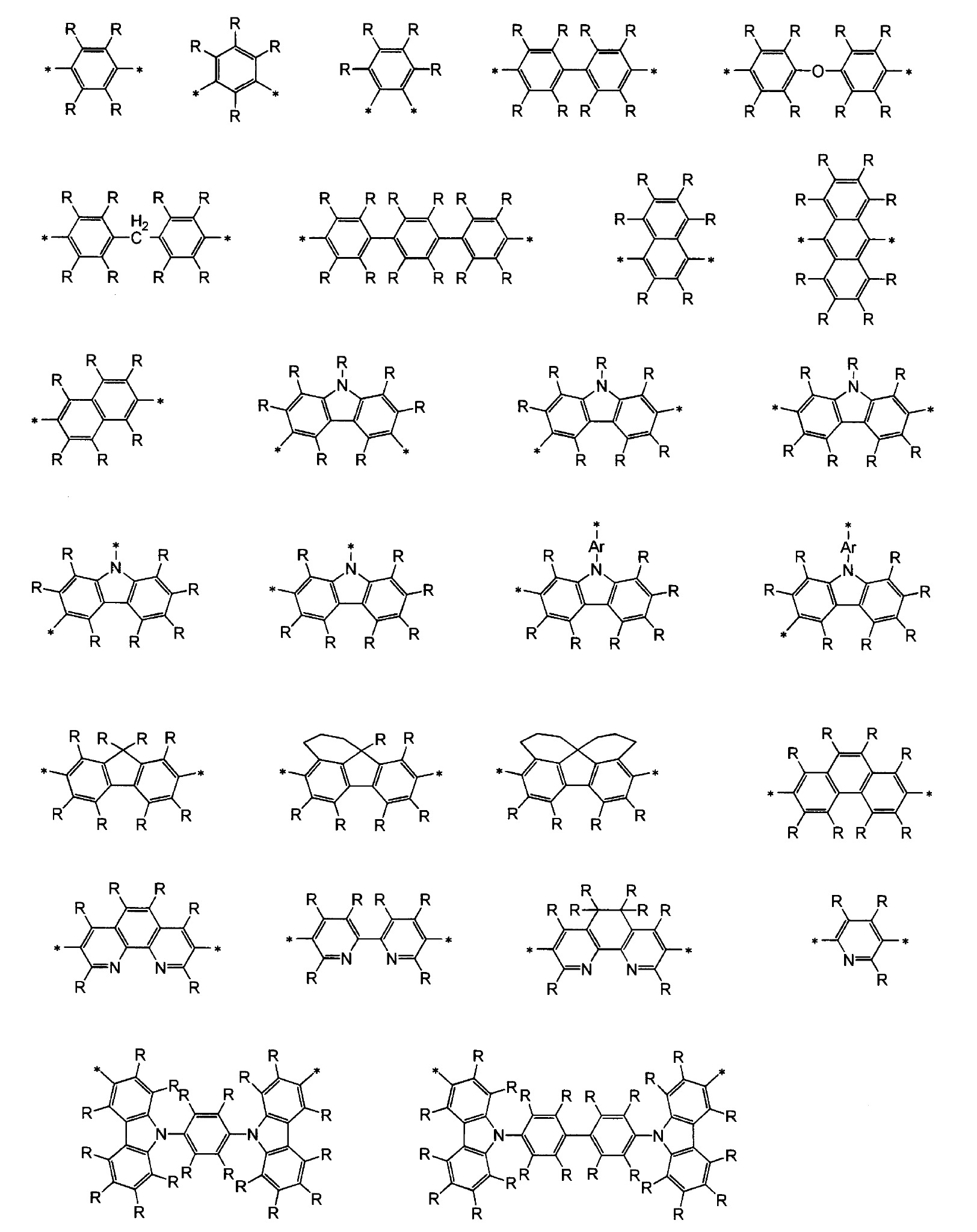
[化3]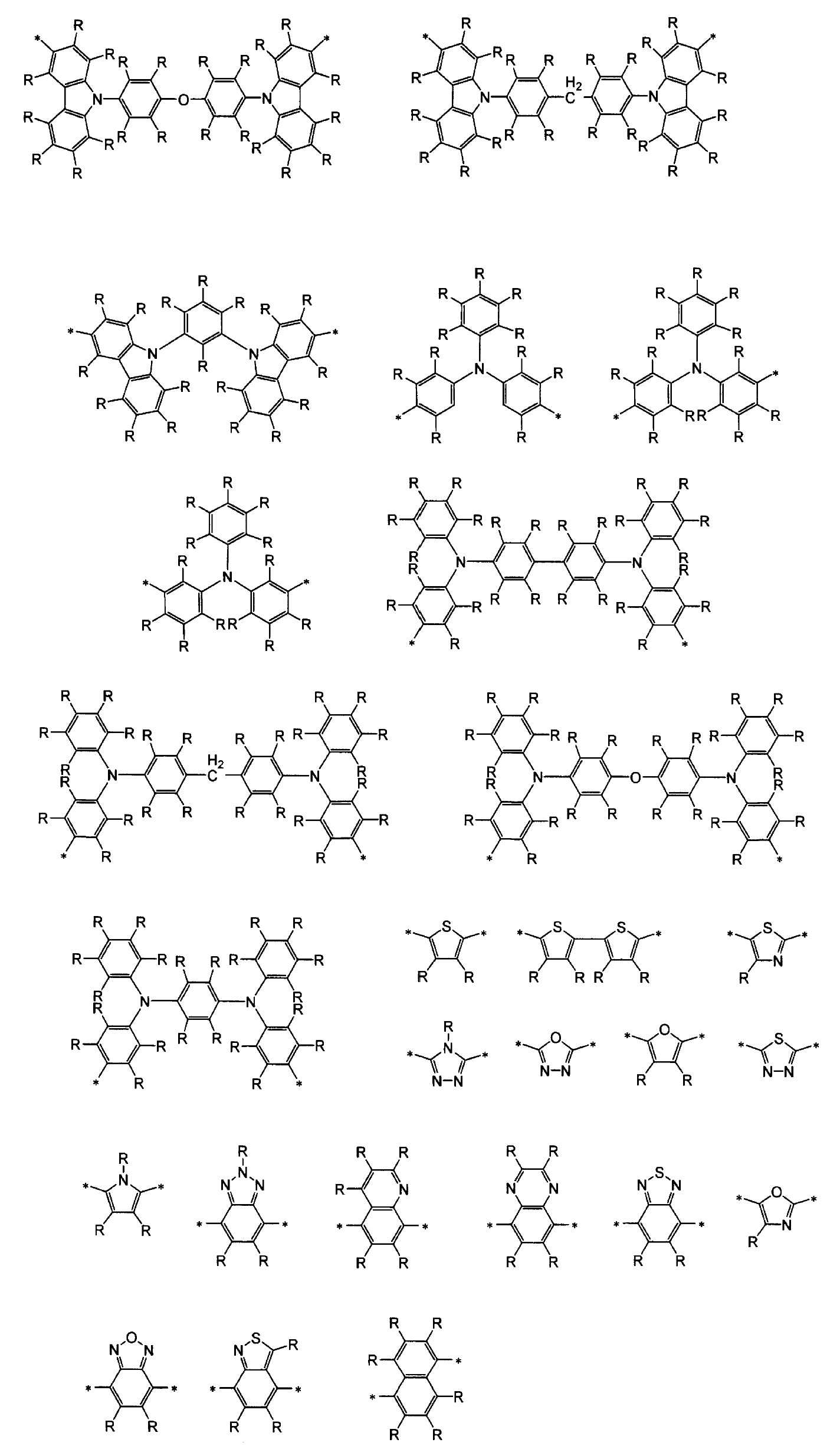
R分別獨立地表示氫原子或取代基。於R為取代基的情況下,取代基較佳為分別獨立地選自由-R1 、-OR2 、-SR3 、-OCOR4 、-COOR5 、-SiR6 R7 R8 、鹵素原子、及包含後述的聚合性官能基的基所組成的群組中。R1 表示碳數1個~22個的直鏈、環狀或分支烷基;或者碳數2個~30個的芳基或雜芳基。R2 ~R8 分別獨立地表示氫原子;碳數1個~22個的直鏈、環狀或分支烷基;或者碳數2個~30個的芳基或雜芳基。烷基、芳基及雜芳基可經取代或者未經取代。作為烷基、芳基及雜芳基更具有取代基的情況下的取代基的例子,可列舉-R1 、-OR2 、-SR3 、-OCOR4 、-COOR5 、-SiR6 R7 R8 、鹵素原子、及包含後述的聚合性官能基的基,較佳為-R1 。 R較佳為氫原子、烷基、芳基、經烷基取代的芳基、鹵素原子、經鹵素取代的烷基等。 Ar分別獨立地表示二價連結基,例如分別獨立地表示伸芳基或雜伸芳基。Ar較佳為碳數2個~30個的伸芳基或雜伸芳基,更佳為碳數2個~30個的伸芳基,進而佳為伸苯基。R each independently represents a hydrogen atom or a substituent. When R is a substituent, the substituent is preferably independently selected from the group consisting of -R 1 , -OR 2 , -SR 3 , -OCOR 4 , -COOR 5 , -SiR 6 R 7 R 8 , a halogen atom, and a group containing a polymerizable functional group described below. R 1 represents a linear, cyclic, or branched alkyl group having 1 to 22 carbon atoms; or an aryl or heteroaryl group having 2 to 30 carbon atoms. R 2 to R 8 each independently represent a hydrogen atom; a linear, cyclic, or branched alkyl group having 1 to 22 carbon atoms; or an aryl or heteroaryl group having 2 to 30 carbon atoms. The alkyl, aryl, and heteroaryl groups may be substituted or unsubstituted. Examples of substituents when alkyl, aryl, and heteroaryl groups further have substituents include -R 1 , -OR 2 , -SR 3 , -OCOR 4 , -COOR 5 , -SiR 6 R 7 R 8 , halogen atoms, and groups containing polymerizable functional groups described below, with -R 1 being preferred. R is preferably a hydrogen atom, an alkyl group, an aryl group, an alkyl-substituted aryl group, a halogen atom, or a halogen-substituted alkyl group. Ar each independently represents a divalent linking group, such as an arylene group or a heteroarylene group. Ar is preferably an arylene group or a heteroarylene group having 2 to 30 carbon atoms, more preferably an arylene group having 2 to 30 carbon atoms, and even more preferably a phenylene group.
芳基為自芳香族烴除去一個氫原子而得的原子團。雜芳基為自芳香族雜環化合物除去一個氫原子而得的原子團。伸芳基為自芳香族烴除去兩個氫原子而得的原子團。雜伸芳基為自芳香族雜環化合物除去兩個氫原子而得的原子團。An aryl group is an atomic radical derived by removing one hydrogen atom from an aromatic hydrocarbon. A heteroaryl group is an atomic radical derived by removing one hydrogen atom from an aromatic heterocyclic compound. An arylene group is an atomic radical derived by removing two hydrogen atoms from an aromatic hydrocarbon. A heteroarylene group is an atomic radical derived by removing two hydrogen atoms from an aromatic heterocyclic compound.
作為芳香族烴,可列舉單環、稠環、或選自單環及稠環中的兩個以上經由直接鍵結而鍵結的多環。作為芳香族雜環化合物,可列舉單環、稠環、或選自單環及稠環中的兩個以上經由直接鍵結而鍵結的多環。Examples of aromatic hydrocarbons include monocyclic, fused, or polycyclic rings in which two or more selected from monocyclic and fused rings are directly bonded. Examples of aromatic heterocyclic compounds include monocyclic, fused, or polycyclic rings in which two or more selected from monocyclic and fused rings are directly bonded.
(結構單元B) 結構單元B為於電荷傳輸性聚合物具有分支結構的情況下,構成分支部的三價以上的結構單元。就有機電子元件的耐久性提高的觀點而言,結構單元B較佳為六價以下,更佳為五價以下,進而佳為四價或三價。結構單元B較佳為具有電荷傳輸性的單元。例如,就有機電子元件的耐久性提高的觀點而言,結構單元B選自經取代或未經取代的芳香族胺結構、咔唑結構、縮合多環式芳香族烴結構、及含有該些的一種或兩種以上的結構中。芳香族胺結構較佳為選自由二芳基胺結構及三芳基胺結構所組成的群組中的結構,更佳為三芳基胺結構,進而佳為三苯基胺結構。(Structural Unit B) When the charge transport polymer has a branched structure, structural unit B is a trivalent or higher valent structural unit that constitutes the branched portion. To improve the durability of the organic electronic device, structural unit B is preferably hexavalent or lower, more preferably pentavalent or lower, and even more preferably tetravalent or trivalent. Structural unit B is preferably a unit having charge transport properties. For example, to improve the durability of the organic electronic device, structural unit B is selected from a substituted or unsubstituted aromatic amine structure, a carbazole structure, a condensed polycyclic aromatic hydrocarbon structure, and structures containing one or more of these. The aromatic amine structure is preferably selected from the group consisting of a diarylamine structure and a triarylamine structure, more preferably a triarylamine structure, and even more preferably a triphenylamine structure.
作為結構單元B的具體例,可列舉以下。結構單元B並不限定於以下。The following are specific examples of the structural unit B. The structural unit B is not limited to the following.
[化4]
W表示三價連結基,例如表示碳數2個~30個的芳烴三基或雜芳烴三基。 Ar分別獨立地表示二價連結基,例如分別獨立地表示伸芳基或雜伸芳基。Ar較佳為碳數2個~30個的伸芳基或雜伸芳基,更佳為碳數2個~30個的伸芳基,進而佳為伸苯基。 Y表示直接鍵結或二價連結基,例如可列舉自結構單元L中的R(其中排除包含聚合性官能基的基)中具有一個以上的氫原子的基,進而除去一個氫原子而得的二價基。 Z表示碳原子、矽原子、或磷原子的任一者。 結構單元中,苯環及Ar可具有取代基,作為取代基的例子,可列舉結構單元L中的R。W represents a trivalent linking group, for example, an aromatic triyl group or a heteroaromatic triyl group having 2 to 30 carbon atoms. Ar each independently represents a divalent linking group, for example, an arylene group or a heteroarylene group. Ar is preferably an arylene group or a heteroarylene group having 2 to 30 carbon atoms, more preferably an arylene group having 2 to 30 carbon atoms, and even more preferably a phenylene group. Y represents a direct bond or a divalent linking group, for example, a divalent group obtained by removing one hydrogen atom from R (excluding groups containing polymerizable functional groups) in the structural unit L. Z represents a carbon atom, a silicon atom, or a phosphorus atom. In the structural unit, the benzene ring and Ar may have a substituent. Examples of the substituent include R in the structural unit L.
芳烴三基為自芳香族烴除去三個氫原子而得的原子團。雜芳烴三基為自芳香族雜環化合物除去三個氫原子而得的原子團。關於芳香族烴及芳香族雜環化合物,如上所述。An arene triyl group is an atomic group derived by removing three hydrogen atoms from an aromatic hydrocarbon. A heteroarene triyl group is an atomic group derived by removing three hydrogen atoms from an aromatic heterocyclic compound. Aromatic hydrocarbons and aromatic heterocyclic compounds are as described above.
(結構單元T) 結構單元T為構成電荷傳輸性聚合物的末端部的一價結構單元。結構單元T並無特別限定,例如選自經取代或未經取代的芳香族烴結構、芳香族雜環結構及包含該些的一種或兩種以上的結構中。結構單元T可具有與結構單元L相同的結構。於一實施形態中,就賦予耐久性而不降低電荷的傳輸性的觀點而言,結構單元T較佳為經取代或未經取代的芳香族烴結構,更佳為經取代或未經取代的苯結構。另外,於另一實施形態中,如後述般,於電荷傳輸性聚合物在末端部具有聚合性官能基的情況下,結構單元T可為能夠聚合的結構(例如吡咯-基等聚合性官能基)。(Structural Unit T) Structural unit T is a monovalent structural unit that constitutes the terminal portion of the charge transporting polymer. Structural unit T is not particularly limited and may be, for example, selected from a substituted or unsubstituted aromatic hydrocarbon structure, an aromatic heterocyclic structure, or a structure containing one or more of these. Structural unit T may have the same structure as structural unit L. In one embodiment, from the perspective of imparting durability without reducing charge transport, structural unit T is preferably a substituted or unsubstituted aromatic hydrocarbon structure, more preferably a substituted or unsubstituted benzene structure. Furthermore, in another embodiment, as described below, when the charge transporting polymer has a polymerizable functional group at its terminal portion, structural unit T may be a polymerizable structure (e.g., a polymerizable functional group such as a pyrrolyl group).
作為結構單位T的具體例,可列舉以下。結構單位T並不限定於以下。The following are specific examples of the structural unit T. The structural unit T is not limited to the following.
[化5]
R分別獨立地與結構單元L中的R相同。於電荷傳輸性聚合物在末端部具有聚合性官能基的情況下,結構單元T較佳為包含所述式中R中的至少任一個為包含聚合性官能基的基的結構單元。為了提高電荷傳輸性聚合物於溶媒中的溶解性,較佳為結構單元T較佳為包含所述式中R中的至少任一個為烷基或氟烷基的結構單元。烷基較佳為直鏈狀烷基,更佳為碳數20以下的直鏈狀烷基,進而佳為碳數6~12的直鏈狀烷基。氟烷基較佳為全氟烷基,更佳為全氟甲基或全氟乙基,進而佳為全氟甲基。R is independently the same as R in the structural unit L. When the charge transporting polymer has a polymerizable functional group at the end, the structural unit T is preferably a structural unit comprising at least one of the R in the formula being a group containing a polymerizable functional group. In order to improve the solubility of the charge transporting polymer in the solvent, it is preferred that the structural unit T is preferably a structural unit comprising at least one of the R in the formula being an alkyl group or a fluoroalkyl group. The alkyl group is preferably a linear alkyl group, more preferably a linear alkyl group having 20 or less carbon atoms, and further preferably a linear alkyl group having 6 to 12 carbon atoms. The fluoroalkyl group is preferably a perfluoroalkyl group, more preferably a perfluoromethyl group or a perfluoroethyl group, and further preferably a perfluoromethyl group.
(聚合性官能基) 於一實施形態中,就藉由聚合反應而硬化、改變溶劑中的溶解度的觀點而言,電荷傳輸性聚合物較佳為具有至少一個聚合性官能基。所謂「聚合性官能基」,是指藉由施加熱、光等而能夠相互形成鍵結的官能基。(Polymerizable Functional Group) In one embodiment, the charge transport polymer preferably has at least one polymerizable functional group, from the perspective of curing through polymerization and changing its solubility in a solvent. A "polymerizable functional group" refers to a functional group capable of forming a bond with heat, light, or the like.
作為聚合性官能基,可列舉:經取代或未經取代的具有碳-碳多重鍵的基(例如乙烯基、苯乙烯基、烯丙基、丁烯基、乙炔基、丙烯醯基、丙烯醯氧基、丙烯醯基胺基、甲基丙烯醯基、甲基丙烯醯氧基、甲基丙烯醯基胺基、乙烯基氧基、乙烯基胺基等)、具有小員環的基(例如環丙基、苯並環丁烯基、環丁基等環狀烷基;環氧基(氧雜環丙基(oxiranyl group))、氧雜環丁烷基(oxetane group)(氧雜環丁基(oxetanyl group))等具有環狀醚結構的基;雙乙烯酮(diketene)基;環硫基;內酯基;內醯胺基等)、雜環基(例如呋喃-基、吡咯-基、噻吩-基、噻咯-基)等。Examples of the polymerizable functional group include: substituted or unsubstituted groups having carbon-carbon multiple bonds (e.g., vinyl, styryl, allyl, butenyl, ethynyl, acryl, acryloxy, acrylamido, methacryl, methacryloyloxy, methacryloamido, vinyloxy, vinylamido, etc.), groups having a small ring member (e.g., cyclopropyl, benzocyclobutenyl, cyclobutyl, etc. cyclic alkyl groups; cyclooxy groups (oxiranyl groups), oxetane groups (oxetanyl groups), group)) having a cyclic ether structure; diketene group; cyclic sulfhydryl group; lactone group; lactamide group, etc.), heterocyclic groups (such as furan-yl, pyrrol-yl, thien-yl, thiole-yl), etc.
該些基經取代的情況下的取代基並無特別限定,例如可列舉直鏈、環狀或分支烷基。烷基的碳數較佳為1~22,更佳為1~10,進而佳為1~4。When these groups are substituted, the substituents are not particularly limited, and examples thereof include linear, cyclic, or branched alkyl groups. The alkyl group preferably has 1 to 22 carbon atoms, more preferably 1 to 10 carbon atoms, and even more preferably 1 to 4 carbon atoms.
作為聚合性官能基,較佳為經取代或未經取代的具有環狀醚結構的基或具有碳-碳多重鍵的基,更佳為經取代或未經取代的乙烯基、苯乙烯基、丙烯醯基、甲基丙烯醯基、環氧基、或氧雜環丁烷基,就反應性及有機電子元件的特性的觀點而言,進而佳為經取代或未經取代的乙烯基或氧雜環丁烷基。The polymerizable functional group is preferably a substituted or unsubstituted group having a cyclic ether structure or a group having a carbon-carbon multiple bond, more preferably a substituted or unsubstituted vinyl group, a styryl group, an acryl group, a methacryl group, an epoxy group, or an oxacyclobutane group. From the viewpoint of reactivity and the properties of the organic electronic device, a substituted or unsubstituted vinyl group or an oxacyclobutane group is further preferred.
就提高聚合性官能基的自由度,容易發生聚合反應的觀點而言,電荷傳輸性聚合物的骨架結構與聚合性官能基可經由伸烷基鏈(例如碳數1~8的直鏈狀的伸烷基鏈)等連結基而鍵結。藉由伸烷基鏈,電荷傳輸性聚合物於溶媒中的溶解性亦有提高的傾向。另外,例如於在電極上形成有機層的情況下,就提高與氧化銦錫(indium tin oxide,ITO)等親水性電極的親和性的觀點而言,可經由乙二醇鏈、二乙二醇鏈等親水性的連結基而鍵結。進而,就為了導入聚合性官能基而使用的單體的製備變容易的觀點而言,亦可於骨架結構與聚合性官能基之間具有包含選自醚鍵、酯鍵等中的一種以上的連結基。To increase the degree of freedom of the polymerizable functional groups and facilitate polymerization reactions, the backbone structure of the charge transport polymer and the polymerizable functional groups can be bonded via a linking group such as an alkylene chain (e.g., a linear alkylene chain with 1 to 8 carbon atoms). The alkylene chain also tends to improve the solubility of the charge transport polymer in a solvent. Furthermore, when forming an organic layer on an electrode, for example, to enhance affinity for hydrophilic electrodes such as indium tin oxide (ITO), the charge transport polymer can be bonded via a hydrophilic linking group such as an ethylene glycol chain or a diethylene glycol chain. Furthermore, from the perspective of facilitating the preparation of monomers used to introduce polymerizable functional groups, one or more linking groups selected from ether bonds, ester bonds, and the like may be present between the skeleton structure and the polymerizable functional group.
另一方面,於不含伸烷基鏈、乙二醇鏈、二乙二醇鏈等連結基的情況下,有有機層的耐熱性提高的傾向。On the other hand, when no linking groups such as alkylene chains, ethylene glycol chains, and diethylene glycol chains are present, the heat resistance of the organic layer tends to be improved.
上文所述的「包含聚合性官能基的基」的例子中包含「聚合性官能基」其自身、及「將聚合性官能基及伸烷基鏈、醚鍵等連結基組合而得的基」。作為包含聚合性官能基的基,例如可適宜地使用國際公開第2010/140553號中所例示的基。Examples of the "group containing a polymerizable functional group" mentioned above include the "polymerizable functional group" itself and a group formed by combining a polymerizable functional group with a linking group such as an alkylene chain or an ether bond. As the group containing a polymerizable functional group, for example, the groups exemplified in International Publication No. 2010/140553 can be suitably used.
聚合性官能基可導入至電荷傳輸性聚合物的末端部(即結構單元T),亦可導入至末端部以外的部分(即結構單元B或結構單元L),亦可導入至末端部及末端部以外的部分的兩者。就硬化性的觀點而言,較佳為至少導入至末端部,就可實現兼具硬化性及電荷傳輸性的觀點而言,較佳為僅導入至末端部。另外,聚合性官能基可導入至電荷傳輸性聚合物的主鏈,亦可導入至側鏈,亦可導入至主鏈及側鏈兩者。The polymerizable functional group can be introduced into the terminal portion (i.e., structural unit T) of the charge transporting polymer, into a portion other than the terminal portion (i.e., structural unit B or structural unit L), or into both the terminal portion and the portion other than the terminal portion. From the perspective of curability, it is preferred to introduce the polymerizable functional group at least into the terminal portion. From the perspective of achieving both curability and charge transport properties, it is preferred to introduce the polymerizable functional group only into the terminal portion. Furthermore, the polymerizable functional group can be introduced into the main chain of the charge transporting polymer, into the side chains, or into both the main chain and the side chains.
就有助於藉由硬化來改變溶解度的觀點而言,聚合性官能基較佳為於電荷傳輸性聚合物中大量包含。另一方面,就不妨礙電荷傳輸性的觀點而言,較佳為電荷傳輸性聚合物中所包含的量少。聚合性官能基的含量可考慮該些而適當設定。From the perspective of contributing to changes in solubility through curing, it is preferable that the charge transporting polymer contain a large amount of polymerizable functional groups. On the other hand, from the perspective of not hindering charge transport, it is preferable that the charge transporting polymer contain a small amount. The content of the polymerizable functional groups can be appropriately set in consideration of these factors.
例如,就可充分改變溶解度、容易進行多層化的觀點而言,電荷傳輸性聚合物每一分子的聚合性官能基個數較佳為兩個以上,更佳為三個以上。另外,就確保電荷傳輸性的觀點而言,聚合性官能基個數較佳為1,000個以下,更佳為500個以下,進而佳為300個以下。For example, from the perspective of sufficient solubility and ease of multilayer formation, the number of polymerizable functional groups per molecule of the charge transporting polymer is preferably two or more, more preferably three or more. Furthermore, from the perspective of ensuring charge transport properties, the number of polymerizable functional groups is preferably 1,000 or less, more preferably 500 or less, and even more preferably 300 or less.
電荷傳輸性聚合物每一分子的聚合性官能基個數可使用為了合成電荷傳輸性聚合物而使用的,聚合性官能基的添加量(例如具有聚合性官能基的單體的添加量)、各結構單元所對應的單體的添加量、電荷傳輸性聚合物的重量平均分子量等,作為平均值而求出。另外,聚合性官能基的個數可利用電荷傳輸性聚合物的1 H核磁共振(nuclear magnetic resonance,NMR)光譜中的源自聚合性官能基的訊號的積分值與所有光譜的積分值的比、電荷傳輸性聚合物的重量平均分子量等,作為平均值而算出。The number of polymerizable functional groups per molecule of a charge transporting polymer can be calculated as an average value using the amount of polymerizable functional groups added to synthesize the charge transporting polymer (e.g., the amount of monomers containing polymerizable functional groups), the amount of monomers corresponding to each structural unit, and the weight-average molecular weight of the charge transporting polymer. Alternatively, the number of polymerizable functional groups can be calculated as an average value using the ratio of the integrated value of the signal derived from the polymerizable functional groups in the 1H nuclear magnetic resonance (NMR) spectrum of the charge transporting polymer to the integrated value of the entire spectrum, and the weight-average molecular weight of the charge transporting polymer.
(結構單元的比例) 就將液狀組成物的黏度抑制得低且提高有機電子元件的耐久性的觀點而言,以所有結構單元為基準,電荷傳輸性聚合物中所含有的結構單元B的比例較佳為1莫耳%以上,更佳為5莫耳%以上,進而佳為10莫耳%以上。另外,就將液狀組成物的黏度抑制得低、獲得具有充分的膜厚的有機層的觀點而言,結構單元B的比例較佳為17莫耳%以下,更佳為16莫耳%以下,進而佳為15莫耳%以下。(Ratio of Structural Units) From the perspective of suppressing the viscosity of the liquid composition and improving the durability of the organic electronic device, the ratio of structural unit B contained in the charge transport polymer, based on all structural units, is preferably 1 mol% or greater, more preferably 5 mol% or greater, and even more preferably 10 mol% or greater. Furthermore, from the perspective of suppressing the viscosity of the liquid composition and obtaining an organic layer with a sufficient film thickness, the ratio of structural unit B is preferably 17 mol% or less, more preferably 16 mol% or less, and even more preferably 15 mol% or less.
於電荷傳輸性聚合物含有結構單元L的情況下,就獲得充分的電荷傳輸性的觀點而言,以所有結構單元為基準,結構單元L的比例較佳為10莫耳%以上,更佳為20莫耳%以上,進而佳為30莫耳%以上。另外,若考慮結構單元T及結構單元B,則結構單元L的比例較佳為95莫耳%以下,更佳為90莫耳%以下,進而佳為85莫耳%以下。When the charge transport polymer contains structural units L, from the perspective of achieving sufficient charge transport properties, the proportion of structural units L, based on all structural units, is preferably 10 mol% or greater, more preferably 20 mol% or greater, and even more preferably 30 mol% or greater. Furthermore, considering structural units T and B, the proportion of structural units L is preferably 95 mol% or less, more preferably 90 mol% or less, and even more preferably 85 mol% or less.
就有機電子元件的特性提高的觀點或抑制黏度的上升、良好地進行電荷傳輸性聚合物的合成的觀點而言,以所有結構單元為基準,電荷傳輸性聚合物中所含有的結構單元T的比例較佳為5莫耳%以上,更佳為10莫耳%以上,進而佳為15莫耳%以上。另外,就獲得充分的電荷傳輸性的觀點而言,結構單元T的比例較佳為60莫耳%以下,更佳為55莫耳%以下,進而佳為50莫耳%以下。From the perspective of improving the properties of organic electronic devices, suppressing viscosity increases, and successfully synthesizing a charge transporting polymer, the proportion of structural units T contained in the charge transporting polymer is preferably 5 mol% or greater, more preferably 10 mol% or greater, and even more preferably 15 mol% or greater, based on all structural units. Furthermore, from the perspective of achieving sufficient charge transport properties, the proportion of structural units T is preferably 60 mol% or less, more preferably 55 mol% or less, and even more preferably 50 mol% or less.
若列舉一例,於電荷傳輸性聚合物包含結構單元L、結構單元T及結構單元B的情況下,結構單元L、結構單元T及結構單元B的比例較佳為滿足L:T:B=((2x+100)/3):(200-5x)/3):x。x為以電荷傳輸性聚合物中所含有的所有結構單元為基準的結構單元B的比例(莫耳%)。x較佳為1莫耳%以上,更佳為5莫耳%以上,進而佳為10莫耳%以上。x較佳為17莫耳%以下,更佳為16莫耳%以下,進而佳為15莫耳%以下。一般認為結構單元B的比例越大溶液的黏度越低,但為使所述黏度小於3.0 mPa·s,較佳為x為17莫耳%以下。For example, in a charge transporting polymer comprising structural units L, T, and B, the ratio of structural units L, T, and B preferably satisfies L:T:B = ((2x + 100)/3):(200 - 5x)/3):x. x is the molar ratio of structural unit B relative to all structural units in the charge transporting polymer. x is preferably 1 molar% or greater, more preferably 5 molar% or greater, and even more preferably 10 molar% or greater. x is preferably 17 molar% or less, more preferably 16 molar% or less, and even more preferably 15 molar% or less. It is generally believed that a greater proportion of structural unit B results in a lower solution viscosity. However, to achieve a viscosity of less than 3.0 mPa·s, x is preferably 17 molar% or less.
於電荷傳輸性聚合物具有聚合性官能基的情況下,就使電荷傳輸性聚合物效率良好地硬化的觀點而言,以所有結構單元為基準,聚合性官能基的比例較佳為0.1莫耳%以上,更佳為1莫耳%以上,進而佳為3莫耳%以上。另外,就獲得良好的電荷傳輸性的觀點而言,聚合性官能基的比例較佳為70莫耳%以下,更佳為60莫耳%以下,進而佳為50莫耳%以下。再者,此處所謂的「聚合性官能基的比例」是指具有聚合性官能基的結構單元的比例。When the charge transport polymer has polymerizable functional groups, from the perspective of efficiently curing the charge transport polymer, the ratio of polymerizable functional groups, based on all structural units, is preferably 0.1 mol% or greater, more preferably 1 mol% or greater, and even more preferably 3 mol% or greater. Furthermore, from the perspective of achieving good charge transport properties, the ratio of polymerizable functional groups is preferably 70 mol% or less, more preferably 60 mol% or less, and even more preferably 50 mol% or less. The term "ratio of polymerizable functional groups" herein refers to the ratio of structural units having polymerizable functional groups.
若考慮電荷傳輸性、耐久性、生產性等的平衡,則結構單元L、結構單元T及結構單元B的比例(莫耳比)較佳為L:T:B=100:10~200:10~100,更佳為100:20~180:20~90,進而佳為100:40~160:30~80。Considering the balance between charge transportability, durability, and productivity, the ratio (molar ratio) of structural unit L, structural unit T, and structural unit B is preferably L:T:B = 100:10 to 200:10 to 100, more preferably 100:20 to 180:20 to 90, and even more preferably 100:40 to 160:30 to 80.
結構單元的比例可使用為了合成電荷傳輸性聚合物而使用的,各結構單元所對應的單體的添加量而求出。另外,結構單元的比例可利用電荷傳輸性聚合物的1 H NMR光譜中的源自各結構單元的光譜的積分值,作為平均值而算出。就簡便而言,於添加量明確的情況下,較佳為採用使用添加量而求出的值。The ratio of the structural units can be determined using the amount of monomer corresponding to each structural unit used to synthesize the charge transporting polymer. Alternatively, the ratio of the structural units can be calculated by averaging the integral of the spectra derived from each structural unit in the 1H NMR spectrum of the charge transporting polymer. For simplicity, when the amount of addition is known, it is preferable to use the value determined using the amount.
(製造方法) 電荷傳輸性聚合物可藉由各種合成方法來製造,並無特別限定。例如,可利用鈴木偶合、根岸偶合、薗頭偶合(Sonogashira coupling)、施蒂勒(Stille)偶合、布赫瓦爾德-哈特維希(Buchwald-Hartwig)偶合等公知的偶合反應。鈴木偶合為在芳香族硼酸衍生物與芳香族鹵化物之間,引起使用Pd觸媒的交叉偶合反應者。根據鈴木偶合,可藉由使所期望的芳香環彼此鍵結而簡便地製造電荷傳輸性聚合物。(Production Method) Charge transport polymers can be produced using a variety of synthetic methods, without particular limitation. For example, well-known coupling reactions such as the Suzuki coupling, Negishi coupling, Sonogashira coupling, Stille coupling, and Buchwald-Hartwig coupling can be utilized. The Suzuki coupling is a Pd-catalyzed cross-coupling reaction between an aromatic boronic acid derivative and an aromatic halide. Using the Suzuki coupling, charge transport polymers can be easily produced by bonding desired aromatic rings.
偶合反應中,作為觸媒,例如使用Pd(0)化合物、Pd(II)化合物、Ni化合物等。另外,亦可使用將三(二亞苄基丙酮)二鈀(0)、乙酸鈀(II)等作為前驅物,藉由與膦配位體混合而產生的觸媒種類。關於電荷傳輸性聚合物的合成方法,例如可參照國際公開第2010/140553號的記載。In the coupling reaction, catalysts such as Pd(0) compounds, Pd(II) compounds, and Ni compounds are used. Alternatively, catalysts produced by mixing tris(dibenzylideneacetone)dipalladium(0) or palladium(II) acetate with a phosphine ligand as a precursor may be used. For the synthesis of charge-transporting polymers, see, for example, International Publication No. 2010/140553.
[摻雜劑] 有機電子材料可包含任意的添加劑,例如可更含有摻雜劑。摻雜劑只要為藉由添加至有機電子材料而顯現摻雜效果、可提高電荷的傳輸性的化合物即可,並無特別限制。摻雜有p型摻雜及n型摻雜,p型摻雜中,摻雜劑使用作為電子受體發揮作用的物質,n型摻雜中,摻雜劑使用作為電子供體發揮作用的物質。為了提高電洞傳輸性,較佳為進行p型摻雜,為了提高電子傳輸性,較佳為進行n型摻雜。有機電子材料中使用的摻雜劑可為顯現p型摻雜或n型摻雜的任一效果的摻雜劑。另外,可單獨添加一種摻雜劑,亦可混合添加多種摻雜劑。[Dopant] Organic electronic materials may contain any additives, including, for example, dopants. Dopants are not particularly limited, as long as they exhibit a doping effect and enhance charge transport when added to the organic electronic material. Doping can be either p-type or n-type. For p-type doping, the dopant acts as an electron acceptor, while for n-type doping, the dopant acts as an electron donor. P-type doping is preferred for improving hole transport, while n-type doping is preferred for improving electron transport. Dopants used in organic electronic materials can exhibit either p-type or n-type doping effects. A single dopant may be added, or a mixture of multiple dopants may be added.
p型摻雜中使用的摻雜劑為電子接受性的化合物,例如可列舉:路易斯酸、質子酸、過渡金屬化合物、離子化合物、鹵素化合物、π共軛系化合物等。具體而言,作為路易斯酸,可列舉:FeCl3 、PF5 、AsF5 、SbF5 、BF5 、BCl3 、BBr3 等;作為質子酸,可列舉:HF、HCl、HBr、HNO3 、H2 SO4 、HClO4 等無機酸,苯磺酸、對甲苯磺酸、十二烷基苯磺酸、聚乙烯基磺酸、甲磺酸、三氟甲磺酸、三氟乙酸、1-丁磺酸、乙烯基苯基磺酸、樟腦磺酸等有機酸;作為過渡金屬化合物,可列舉:FeOCl、TiCl4 、ZrCl4 、HfCl4 、NbF5 、AlCl3 、NbCl5 、TaCl5 、MoF5 ;作為離子化合物,可列舉:四(五氟苯基)硼酸根離子、三(三氟甲磺醯基)甲基化物離子、雙(三氟甲磺醯基)醯亞胺離子、六氟銻酸根離子、AsF6 - (六氟砷酸根離子)、BF4 - (四氟硼酸根離子)、PF6 - (六氟磷酸根離子)等具有全氟陰離子的鹽、具有所述質子酸的共軛鹼作為陰離子的鹽等;作為鹵素化合物,可列舉Cl2 、Br2 、I2 、ICl、ICl3 、IBr、IF等;作為π共軛系化合物,可列舉TCNE(四氰基乙烯)、TCNQ(四氰基對苯二醌二甲烷)等。亦能夠使用所述以外的公知的電子接受性化合物。較佳為路易斯酸、離子化合物、π共軛系化合物等。The dopant used in p-type doping is an electron-accepting compound, such as Lewis acids, protonic acids, transition metal compounds, ionic compounds, halogen compounds, and π-conjugated compounds. Specifically, examples of Lewis acids include FeCl 3 , PF 5 , AsF 5 , SbF 5 , BF 5 , BCl 3 , and BBr 3 ; examples of protonic acids include inorganic acids such as HF, HCl, HBr, HNO 3 , H 2 SO 4 , and HClO 4 ; and organic acids such as benzenesulfonic acid, p-toluenesulfonic acid, dodecylbenzenesulfonic acid, polyvinylsulfonic acid, methanesulfonic acid, trifluoromethanesulfonic acid, trifluoroacetic acid, 1-butanesulfonic acid, vinylphenylsulfonic acid, and camphorsulfonic acid ; and examples of transition metal compounds include FeOCl, TiCl 4 , ZrCl 4 , HfCl 4 , NbF 5 , AlCl 3 , NbCl 5 , TaCl 5 , and MoF 5 Examples of ionic compounds include tetrakis(pentafluorophenyl)borate ions, tris(trifluoromethanesulfonyl)methide ions, bis(trifluoromethanesulfonyl)imide ions, hexafluoroantimonate ions, AsF 6 - (hexafluoroarsenate ions), BF 4 - (tetrafluoroborate ions), PF 6 - (hexafluorophosphate ions), and salts having a conjugate base of the above-mentioned protonic acid as an anion. Examples of halogen compounds include Cl 2 , Br 2 , I 2 , ICl 3 , IBr, IF, etc.; examples of π-conjugated compounds include TCNE (tetracyanoethylene) and TCNQ (tetracyanoquinodimethane). Other known electron-accepting compounds can also be used. Preferred are Lewis acids, ionic compounds, and π-conjugated compounds.
n型摻雜中所使用的摻雜劑為供電子性的化合物,例如可列舉:Li、Cs等鹼金屬;Mg、Ca等鹼土金屬;LiF、Cs2 CO3 等鹼金屬及/或鹼土金屬的鹽;金屬錯合物;供電子性有機化合物等。The dopant used in n-type doping is an electron-donating compound, for example: alkali metals such as Li and Cs; alkaline earth metals such as Mg and Ca; salts of alkali metals and/or alkaline earth metals such as LiF and Cs2CO3 ; metal complexes; electron-donating organic compounds, etc.
於電荷傳輸性聚合物具有聚合性官能基的情況下,為了容易地藉由有機層的硬化來改變溶解度,較佳為使用可對聚合性官能基發揮作為聚合起始劑的作用的化合物作為摻雜劑。When the charge transport polymer has a polymerizable functional group, it is preferable to use a compound that can function as a polymerization initiator for the polymerizable functional group as a dopant in order to easily change the solubility by hardening the organic layer.
[其他任意成分] 有機電子材料亦可更含有電荷傳輸性低分子化合物、其他聚合物等。[Other Optional Ingredients] Organic electronic materials may further contain charge-transporting low-molecular-weight compounds, other polymers, etc.
[含量] 就獲得良好的電荷傳輸性的觀點而言,相對於有機電子材料的總質量,有機電子材料中的電荷傳輸性聚合物的含量較佳為50質量%以上,更佳為70質量%以上,進而佳為80質量%以上。電荷傳輸性聚合物的含量的上限並無特別限定,亦能夠設為100質量%。亦可考慮包含摻雜劑等添加劑,而將電荷傳輸性聚合物的含量設為例如95質量%以下或90質量%以下。[Content] To achieve good charge transport properties, the charge transport polymer content in the organic electronic material is preferably 50% by mass or greater, more preferably 70% by mass or greater, and even more preferably 80% by mass or greater, relative to the total mass of the organic electronic material. The upper limit of the charge transport polymer content is not particularly limited and can be 100% by mass. Taking into account the inclusion of additives such as dopants, the charge transport polymer content can be set to, for example, 95% by mass or less, or 90% by mass or less.
於含有摻雜劑的情況下,就提高有機電子材料的電荷傳輸性的觀點而言,相對於有機電子材料的總質量,摻雜劑的含量較佳為0.01質量%以上,更佳為0.1質量%以上,進而佳為0.5質量%以上。另外,就良好地保持成膜性的觀點而言,相對於有機電子材料的總質量,較佳為50質量%以下,更佳為30質量%以下,進而佳為20質量%以下。When a dopant is included, from the perspective of improving the charge transport properties of the organic electronic material, the dopant content is preferably 0.01% by mass or greater, more preferably 0.1% by mass or greater, and even more preferably 0.5% by mass or greater, relative to the total mass of the organic electronic material. Furthermore, from the perspective of maintaining good film-forming properties, the dopant content is preferably 50% by mass or less, more preferably 30% by mass or less, and even more preferably 20% by mass or less, relative to the total mass of the organic electronic material.
<液狀組成物> 作為本發明的實施形態的液狀組成物含有所述有機電子材料及溶媒。藉由含有溶媒的液狀組成物,可藉由塗佈法等簡便的方法而容易地形成有機層。液狀組成物可製成墨水組成物使用。<Liquid Composition> The liquid composition of an embodiment of the present invention contains the aforementioned organic electronic material and a solvent. This liquid composition containing a solvent allows for easy formation of an organic layer using simple methods such as coating. The liquid composition can be used as an ink composition.
[溶媒] 作為溶媒,可使用水、有機溶媒、或該些的混合溶媒等任意的溶媒。作為有機溶媒,可列舉:甲醇、乙醇、異丙醇等醇;戊烷、己烷、辛烷等烷烴;環己烷等環狀烷烴;苯、甲苯、二甲苯、均三甲苯、四氫萘、二苯基甲烷等芳香族烴;乙二醇二甲醚、乙二醇二乙醚、丙二醇-1-單甲醚乙酸酯等脂肪族醚;1,2-二甲氧基苯、1,3-二甲氧基苯、苯甲醚、苯乙醚、2-甲氧基甲苯、3-甲氧基甲苯、4-甲氧基甲苯、2,3-二甲基苯甲醚、2,4-二甲基苯甲醚等芳香族醚;乙酸乙酯、乙酸正丁酯、乳酸乙酯、乳酸正丁酯等脂肪族酯;乙酸苯酯、丙酸苯酯、苯甲酸甲酯、苯甲酸乙酯、苯甲酸丙酯、苯甲酸正丁酯等芳香族酯;N,N-二甲基甲醯胺、N,N-二甲基乙醯胺等醯胺系溶媒;二甲基亞碸、四氫呋喃、丙酮、氯仿、二氯甲烷等。較佳為芳香族烴、脂肪族酯、芳香族酯、脂肪族醚及芳香族醚,更佳為芳香族烴。[Solvent] The solvent may be any solvent, such as water, an organic solvent, or a mixture thereof. Examples of organic solvents include: alcohols such as methanol, ethanol, and isopropyl alcohol; alkanes such as pentane, hexane, and octane; cycloalkanes such as cyclohexane; aromatic hydrocarbons such as benzene, toluene, xylene, mesitylene, tetrahydronaphthalene, and diphenylmethane; aliphatic ethers such as ethylene glycol dimethyl ether, ethylene glycol diethyl ether, and propylene glycol-1-monomethyl ether acetate; 1,2-dimethoxybenzene, 1,3-dimethoxybenzene, anisole, phenethyl ether, 2-methoxytoluene, 3-methoxytoluene, 4- Aromatic ethers such as methoxytoluene, 2,3-dimethylanisole, and 2,4-dimethylanisole; aliphatic esters such as ethyl acetate, n-butyl acetate, ethyl lactate, and n-butyl lactate; aromatic esters such as phenyl acetate, phenyl propionate, methyl benzoate, ethyl benzoate, propyl benzoate, and n-butyl benzoate; amide solvents such as N,N-dimethylformamide and N,N-dimethylacetamide; dimethyl sulfoxide, tetrahydrofuran, acetone, chloroform, and dichloromethane. Preferred solvents include aromatic hydrocarbons, aliphatic esters, aromatic esters, aliphatic ethers, and aromatic ethers, and more preferred solvents include aromatic hydrocarbons.
[聚合起始劑] 於電荷傳輸性聚合物具有聚合性官能基的情況下,液狀組成物較佳為含有聚合起始劑。作為聚合起始劑,可使用公知的自由基聚合起始劑、陽離子聚合起始劑、陰離子聚合起始劑等。就可簡便地製備液狀組成物的觀點而言,較佳為使用兼具作為摻雜劑的功能及作為聚合起始劑的功能的物質。作為此種物質,例如可列舉所述離子化合物。[Polymerization Initiator] If the charge transport polymer has a polymerizable functional group, the liquid composition preferably contains a polymerization initiator. Examples of polymerization initiators include known free radical polymerization initiators, cationic polymerization initiators, and anionic polymerization initiators. To facilitate preparation of the liquid composition, it is preferable to use a substance that functions as both a dopant and a polymerization initiator. Examples of such substances include the aforementioned ionic compounds.
[添加劑] 液狀組成物可更含有添加劑作為任意成分。作為添加劑,例如可列舉:聚合抑制劑、穩定劑、增稠劑、凝膠化劑、阻燃劑、抗氧化劑、還原防止劑、氧化劑、還原劑、表面改質劑、乳化劑、消泡劑、分散劑、界面活性劑等。[Additives] The liquid composition may further contain additives as optional ingredients. Examples of additives include polymerization inhibitors, stabilizers, thickeners, gelling agents, flame retardants, antioxidants, reduction inhibitors, oxidizing agents, reducing agents, surface modifiers, emulsifiers, defoaming agents, dispersants, and surfactants.
[含量] 液狀組成物中的溶媒的含量可考慮於各種塗佈方法中的應用來確定。例如,溶媒的含量較佳為電荷傳輸性聚合物相對於溶媒的比例為0.1質量%以上的量,更佳為0.2質量%以上的量,進而佳為0.5質量%以上的量。另外,溶媒的含量較佳為電荷傳輸性聚合物相對於溶媒的比例為20質量%以下的量,更佳為15質量%以下的量,進而佳為10質量%以下的量。[Content] The solvent content in the liquid composition can be determined based on the application method. For example, the solvent content is preferably such that the ratio of the charge transport polymer to the solvent is 0.1% by mass or greater, more preferably 0.2% by mass or greater, and even more preferably 0.5% by mass or greater. Furthermore, the solvent content is preferably such that the ratio of the charge transport polymer to the solvent is 20% by mass or less, more preferably 15% by mass or less, and even more preferably 10% by mass or less.
<有機層> 作為本發明的實施形態的有機層是使用所述有機電子材料或所述液狀組成物而形成的層。有機層顯示良好的電荷傳輸性。藉由使用液狀組成物,可藉由塗佈法而良好且簡便地形成有機層。作為塗佈方法,例如可列舉:旋塗法;流延法;浸漬法;凸版印刷、凹版印刷、膠版印刷、平版印刷、凸版反轉膠版印刷、網版印刷、凹版(gravure)印刷等有版印刷法;噴墨法等無版印刷法等公知的方法。於藉由塗佈法來形成有機層的情況下,可利用加熱處理來使塗佈後所得的塗佈層乾燥,將溶媒除去。<Organic Layer> The organic layer in embodiments of the present invention is formed using the aforementioned organic electronic material or liquid composition. The organic layer exhibits excellent charge transport properties. Using a liquid composition allows for efficient and simple coating. Examples of coating methods include spin coating, casting, dipping, plate printing methods such as relief printing, gravure printing, offset printing, lithography, letterpress reverse offset printing, screen printing, and gravure printing, and plateless printing methods such as inkjet printing. When the organic layer is formed by coating, the coating layer obtained after coating can be dried by heat treatment to remove the solvent.
於電荷傳輸性聚合物具有聚合性官能基的情況下,可藉由光照射、加熱處理等來進行電荷傳輸性聚合物的聚合反應,改變塗佈層的溶解度。就簡便而言,較佳為加熱處理。藉由將改變塗佈層的溶解度而獲得的有機層積層,能夠容易地實現有機電子元件的多層化。If the charge transport polymer has polymerizable functional groups, polymerization can be initiated by light irradiation or heat treatment, altering the solubility of the coating layer. Heat treatment is preferred for simplicity. By stacking the organic layers obtained by altering the solubility of the coating layer, multilayered organic electronic devices can be easily achieved.
加熱處理可於大氣環境下或惰性氣體環境下實施。作為惰性氣體,例如可列舉氦氣、氬氣、氮氣及該些的混合氣體。「惰性氣體環境」較佳為惰性氣體的濃度以體積比計為99.5%以上的環境,更佳為99.9%以上的環境,進而佳為99.99%以上的環境。The heat treatment can be performed in an atmospheric environment or an inert gas environment. Examples of inert gases include helium, argon, nitrogen, and mixtures thereof. The "inert gas environment" preferably has an inert gas concentration of 99.5% or greater by volume, more preferably 99.9% or greater, and even more preferably 99.99% or greater.
加熱處理例如可使用加熱板、烘箱等加熱器來實施。為了實施惰性氣體環境下的加熱處理,例如於惰性氣體環境下使用加熱板,或者將烘箱內設為惰性氣體環境下。The heat treatment can be performed using a heater such as a hot plate or an oven. To perform the heat treatment in an inert gas environment, for example, a hot plate can be used in an inert gas environment, or an oven can be set to an inert gas environment.
就效率良好地除去溶媒的觀點而言,加熱處理較佳為以溶媒的沸點以上的溫度實施。另外,於使電荷傳輸性聚合物的聚合反應進行的情況下,較佳為聚合反應效率良好地進行的溫度。於一實施形態中,加熱處理的溫度較佳為140℃以上,更佳為180℃以上,進而佳為190℃以上。另一方面,就抑制由加熱處理導致的劣化的觀點而言,較佳為300℃以下,更佳為280℃以下,進而佳為250℃以下。From the perspective of efficiently removing the solvent, the heat treatment is preferably performed at a temperature above the boiling point of the solvent. Furthermore, when the polymerization reaction of the charge transport polymer is being carried out, a temperature at which the polymerization reaction proceeds efficiently is preferred. In one embodiment, the heat treatment temperature is preferably 140°C or higher, more preferably 180°C or higher, and even more preferably 190°C or higher. On the other hand, from the perspective of suppressing degradation caused by the heat treatment, the temperature is preferably 300°C or lower, more preferably 280°C or lower, and even more preferably 250°C or lower.
就提高電荷傳輸的效率的觀點而言,乾燥後或硬化後的有機層的厚度較佳為0.1 nm以上,更佳為1 nm以上,進而佳為3 nm以上。另外,就減小電阻的觀點而言,有機層的厚度較佳為300 nm以下,更佳為200 nm以下,進而佳為100 nm以下。From the perspective of improving charge transfer efficiency, the thickness of the organic layer after drying or curing is preferably 0.1 nm or greater, more preferably 1 nm or greater, and even more preferably 3 nm or greater. Furthermore, from the perspective of reducing electrical resistance, the thickness of the organic layer is preferably 300 nm or less, more preferably 200 nm or less, and even more preferably 100 nm or less.
<有機電子元件> 作為本發明的實施形態的有機電子元件具有至少一層所述有機層。作為有機電子元件,例如可列舉有機EL元件、有機光電轉換元件、有機電晶體等。有機電子元件較佳為具有在至少一對電極之間配置有有機層的結構。有機電子元件可藉由如下製造方法來製造,該製造方法包括使用所述有機電子材料或所述液狀組成物來形成有機層。<Organic Electronic Component> An organic electronic component according to an embodiment of the present invention comprises at least one organic layer. Examples of such an organic electronic component include an organic EL element, an organic photoelectric conversion element, and an organic electronic crystal. The organic electronic component preferably has a structure in which the organic layer is disposed between at least one pair of electrodes. The organic electronic component can be manufactured by a manufacturing method comprising forming the organic layer using the organic electronic material or the liquid composition.
<有機EL元件> 作為本發明的實施形態的有機EL元件具有至少一層所述有機層。有機EL元件通常包括發光層、陽極、陰極及基板,視需要而包括電洞注入層、電子注入層、電洞傳輸層、電子傳輸層等其他功能層。各層可藉由蒸鍍法形成,亦可藉由塗佈法形成。有機EL元件較佳為具有所述有機層作為發光層或其他功能層,更佳為具有所述有機層作為其他功能層,進而佳為具有所述有機層作為電洞注入層及電洞傳輸層的至少一者。<Organic EL Device> An organic EL device according to an embodiment of the present invention comprises at least one organic layer as described above. An organic EL device typically includes a light-emitting layer, an anode, a cathode, and a substrate, and optionally includes other functional layers such as a hole injection layer, an electron injection layer, a hole transport layer, and an electron transport layer. Each layer can be formed by evaporation or coating. The organic EL device preferably comprises the organic layer as a light-emitting layer or another functional layer, more preferably as another functional layer, and even more preferably as at least one of a hole injection layer and a hole transport layer.
圖1是表示有機EL元件的一實施形態的剖面示意圖。圖1的有機EL元件為多層結構的元件,依序包括:基板8、陽極2、電洞注入層3、電洞傳輸層6、發光層1、電子傳輸層7、電子注入層5、及陰極4。Figure 1 is a schematic cross-sectional view of one embodiment of an organic EL element. The organic EL element in Figure 1 has a multi-layer structure, comprising, in order: a
[發光層] 作為發光層中所使用的材料,可使用低分子化合物、聚合物、樹枝狀聚合物(dendrimer)等發光材料。聚合物於溶媒中的溶解性高,適用於塗佈法,因而較佳。作為發光材料,可列舉螢光材料、磷光材料、熱活化延遲螢光材料(thermally activated delayed fluorescence,TADF)等。[Luminescent Layer] The materials used in the luminescent layer include low molecular weight compounds, polymers, dendrimers, and other luminescent materials. Polymers are preferred due to their high solubility in solvents and suitability for coating. Examples of luminescent materials include fluorescent materials, phosphorescent materials, and thermally activated delayed fluorescence (TADF).
作為螢光材料,可列舉:芘、香豆素、紅螢烯(rubrene)、喹吖啶酮、二苯乙烯、染料雷射用色素、鋁錯合物、該些的衍生物等低分子化合物;聚芴、聚伸苯、聚苯乙炔、聚乙烯基咔唑、芴-苯並噻二唑共聚物、芴-三苯基胺共聚物、該些的衍生物等聚合物;該些的混合物等。Examples of fluorescent materials include low molecular weight compounds such as pyrene, coumarin, rubrene, quinacridone, stilbene, dye laser pigments, aluminum complexes, and their derivatives; polymers such as polyfluorene, polyphenylene glycol, polyphenylene vinylene, polyvinylcarbazole, fluorene-benzothiadiazole copolymers, fluorene-triphenylamine copolymers, and their derivatives; and mixtures thereof.
作為磷光材料,可使用包含Ir、Pt等金屬的金屬錯合物等。作為Ir錯合物,例如可列舉:發藍色光的FIr(pic)(銥(III)雙[(4,6-二氟苯基)-吡啶-N,C2 ]吡啶甲酸)、發綠色光的Ir(ppy)3 (面式-三(2-苯基吡啶)銥)、發紅色光的(btp)2 Ir(acac)(雙〔2-(2'-苯並[4,5-α]噻吩基)吡啶-N,C3 〕銥(乙醯丙酮化物))、Ir(piq)3 (三(1-苯基異喹啉)銥)等。作為Pt錯合物,例如可列舉發紅色光的PtOEP(2,3,7,8,12,13,17,18-八乙基-21H,23H-卟吩鉑)等。As phosphorescent materials, metal complexes containing metals such as Ir and Pt can be used. Examples of Ir complexes include FIr(pic) (iridium(III)bis[(4,6-difluorophenyl)pyridine-N,C 2 ]picolinate), which emits blue light; Ir(ppy) 3 (fa-tris(2-phenylpyridinium)iridium), which emits green light; (btp) 2 Ir(acac) (bis[2-(2'-benzo[4,5-α]thienyl)pyridinium-N,C 3 ]iridium (acetylacetonate), which emits red light; and Ir(piq) 3 (tris(1-phenylisoquinolinium)iridium). Examples of Pt complexes include PtOEP (2,3,7,8,12,13,17,18-octaethyl-21H,23H-porphine platinum), which emits red light.
於發光層包含磷光材料的情況下,較佳為除磷光材料以外更包含主體材料。作為主體材料,可使用低分子化合物、聚合物、或樹枝狀聚合物。作為低分子化合物,例如可列舉:CBP(4,4'-雙(9H-咔唑-9-基)聯苯)、mCP(1,3-雙(9-咔唑基)苯)、CDBP(4,4'-雙(咔唑-9-基)-2,2'-二甲基聯苯)、該些的衍生物等,作為聚合物,可列舉所述有機電子材料、聚乙烯基咔唑、聚伸苯、聚芴、該些的衍生物等。When the light-emitting layer includes a phosphorescent material, it preferably includes a host material in addition to the phosphorescent material. The host material can be a low molecular weight compound, a polymer, or a dendrimer. Examples of low molecular weight compounds include CBP (4,4'-bis(9H-carbazol-9-yl)biphenyl), mCP (1,3-bis(9-carbazol-1-yl)benzene), CDBP (4,4'-bis(carbazol-9-yl)-2,2'-dimethylbiphenyl), and their derivatives. Examples of polymers include the aforementioned organic electronic materials, polyvinylcarbazole, polyphenylene glycol, polyfluorene, and their derivatives.
作為熱活化延遲螢光材料,例如可列舉:PIC-TRZ(2-聯苯基-4,6-雙(12-苯基吲哚並[2,3-a]咔唑-11-基)-1,3,5-三嗪)(2-biphenyl-4,6-bis(12-phenylindolo[2,3-a]carbazol-11-yl)-1,3,5-triazine)、Spiro-CN(2',7'-雙(二-對甲苯基胺基)-9,9'-螺二芴-s,7-二甲腈)(2',7'-bis(di-p-tolylamino)-9,9'-spirobifluorene-s,7-dicarbonitrile)、CC2TA(2,4-雙{3-(9H-咔唑-9-基)-9H-咔唑-9-基}-6-苯基-1,3,5-三嗪)(2,4-bis{3-(9H-carbazol-9-yl)-9H-carbazol-9-yl}-6-phenyl-1,3,5-triazine)、CZ-PS(9,9'-(4,4'-磺醯基雙(4,1-伸苯基))雙(3,6-二-第三丁基-9H-咔唑))(9,9'-(4,4'-sulfonylbis(4,1-phenylene))bis(3,6-di-tert-butyl-9H-carbazole))、4CzPN(3,4,5,6-四(9H-咔唑-9-基)酞腈)(3,4,5,6-tetra(9H-carbazol-9-yl)phthalonitrile)、HAP-3TPA(4,4',4''-(1,3,3a1 ,4,6,7,9-七氮雜萉-2,5,8-三基)三(N,N-雙(4-(第三丁基)苯基)苯胺))(4,4',4''-(1,3,3a1 ,4,6,7,9-heptaazaphenalene-2,5,8-triyl)tris(N,N-bis(4-(tert-butyl)phenyl)aniline))、4CzIPN(1,2,3,5-四(咔唑-9-基)-4,6-二氰基苯)(1,2,3,5-tetrakis(carbazol-9-yl)-4,6-dicyanobenzene)等化合物。Examples of thermally activated delayed fluorescence materials include PIC-TRZ (2-biphenyl-4,6-bis(12-phenylindolo[2,3-a]carbazol-11-yl)-1,3,5-triazine), Spiro-C N (2',7'-bis(di-p-tolylamino)-9,9'-spirobifluorene-s,7-dicarbonitrile), CC2TA (2,4-bis{3-(9H-carbazol-9-yl)-9H-carbazol-9-yl}-6-phenyl-1,3,5 -triazine)(2,4-bis{3-(9H-carbazol-9-yl)-9H-carbazol-9-yl}-6-phenyl-1,3,5-triazine), CZ-PS (9,9'-(4,4'-sulfonylbis(4,1-phenylene))bis(3,6-di-tert-butyl-9H-carbazole)), 4CzPN (3,4,5,6-tetra(9H-carbazol-9-yl)phthalonitrile), HAP-3TPA (4,4',4''-(1,3,3a Compounds such as 1,4,6,7,9 -heptaazaphenalene-2,5,8-triyl)tris(N,N-bis(4-(tert-butyl)phenyl)aniline)), 4CzIPN(1,2,3,5-tetrakis ( carbazol-9-yl)-4,6-dicyanobenzene), and others.
[電洞注入層、電洞傳輸層] 較佳為將所述有機層用作電洞注入層及電洞傳輸層的至少一者。如上所述,藉由使用包含有機電子材料及溶媒的液狀組成物,可容易地形成該些層。[Hole Injection Layer, Hole Transport Layer] Preferably, the organic layer described above serves as at least one of a hole injection layer and a hole transport layer. As described above, these layers can be easily formed using a liquid composition comprising an organic electronic material and a solvent.
於有機EL元件具有所述有機層作為電洞注入層且更具有電洞傳輸層的情況下,電洞傳輸層可使用公知的材料。另外,於有機EL元件具有所述有機層作為電洞傳輸層且更具有電洞注入層的情況下,電洞注入層可使用公知的材料。亦可為電洞注入層及電洞傳輸層的兩者為所述有機層。作為公知的材料,例如可列舉芳香族胺系化合物(例如N,N'-二(萘-1-基)-N,N'-二苯基-聯苯胺(α-NPD)等芳香族二胺)、酞青系化合物、噻吩系化合物(例如聚(3,4-乙烯二氧基噻吩):聚(4-苯乙烯磺酸鹽)(PEDOT:PSS)等噻吩系導電性聚合物)等。When the organic EL element includes the aforementioned organic layer as a hole injection layer and further includes a hole transport layer, a known material can be used for the hole transport layer. Furthermore, when the organic EL element includes the aforementioned organic layer as a hole transport layer and further includes a hole injection layer, a known material can be used for the hole injection layer. Alternatively, both the hole injection layer and the hole transport layer may be the aforementioned organic layer. Examples of known materials include aromatic amine compounds (e.g., aromatic diamines such as N,N'-di(naphthalene-1-yl)-N,N'-diphenyl-benzidine (α-NPD)), phthalocyanine compounds, and thiophene compounds (e.g., thiophene-based conductive polymers such as poly(3,4-ethylenedioxythiophene):poly(4-styrenesulfonate) (PEDOT:PSS)).
於電洞傳輸層為藉由聚合而改變了溶解度的有機層的情況下,能夠藉由濕式製程於其上層容易地形成發光層。該情況下,聚合起始劑可含有於作為電洞傳輸層的有機層中,或者亦可含有於位於電洞傳輸層的下層的有機層中。If the hole transport layer is an organic layer whose solubility changes through polymerization, a light-emitting layer can be easily formed on top of it using a wet process. In this case, the polymerization initiator can be contained in the organic layer serving as the hole transport layer or in an organic layer located below the hole transport layer.
[電子傳輸層、電子注入層] 作為電子傳輸層及電子注入層中所使用的材料,例如可列舉:啡啉(phenanthroline)衍生物、聯吡啶衍生物、硝基取代芴衍生物、二苯基醌衍生物、二氧化噻喃衍生物、萘、苝等稠環四羧酸酐、碳二亞胺、亞芴基甲烷衍生物、蒽醌並二甲烷及蒽酮衍生物、噁二唑衍生物、噻二唑衍生物、苯並咪唑衍生物、喹噁啉衍生物、鋁錯合物等。另外,亦可使用所述有機電子材料。[Electron Transport Layer, Electron Injection Layer] Examples of materials used in the electron transport layer and electron injection layer include phenanthroline derivatives, bipyridine derivatives, nitro-substituted fluorene derivatives, diphenylquinone derivatives, thiopyran dioxide derivatives, fused-ring tetracarboxylic anhydrides such as naphthalene and perylene, carbodiimides, fluorenylidenemethane derivatives, anthraquinone dimethane and anthrone derivatives, oxadiazole derivatives, thiadiazole derivatives, benzimidazole derivatives, quinoxaline derivatives, and aluminum complexes. Additionally, the aforementioned organic electronic materials may be used.
[陰極] 作為陰極材料,例如可使用Li、Ca、Mg、Al、In、Cs、Ba、Mg/Ag、LiF、CsF等金屬或金屬合金。[Cathode] Cathode materials include metals or metal alloys such as Li, Ca, Mg, Al, In, Cs, Ba, Mg/Ag, LiF, and CsF.
[陽極] 作為陽極材料,例如可使用金屬(例如Au)或具有導電性的其他材料。作為其他材料,例如可列舉氧化物(例如ITO:氧化銦/氧化錫)、導電性高分子(例如聚噻吩-聚苯乙烯磺酸混合物(PEDOT:PSS))。[Anode] Anode materials include metals (e.g., Au) or other conductive materials. Examples of other materials include oxides (e.g., ITO: indium oxide/tin oxide) and conductive polymers (e.g., polythiophene-polystyrene sulfonate mixture (PEDOT:PSS)).
[基板] 作為基板,可使用玻璃、塑膠等。基板較佳為透明,另外,較佳為具有可撓性。可較佳地使用石英玻璃、樹脂膜等。[Substrate] The substrate can be made of glass, plastic, or other materials. It is preferably transparent and flexible. Quartz glass or resin film are suitable.
作為樹脂膜,較佳為透光性樹脂膜。作為樹脂膜,例如可列舉以聚對苯二甲酸乙二酯、聚萘二甲酸乙二酯、聚醚碸、聚醚醯亞胺、聚醚醚酮、聚苯硫醚、聚芳酯、聚醯亞胺、聚碳酸酯、三乙酸纖維素、纖維素乙酸酯丙酸酯等為主成分的膜。The resin film is preferably a light-transmitting resin film. Examples of the resin film include films containing polyethylene terephthalate, polyethylene naphthalate, polyether sulfone, polyether imide, polyether ether ketone, polyphenylene sulfide, polyarylate, polyimide, polycarbonate, cellulose triacetate, cellulose acetate propionate, and the like as main components.
於使用樹脂膜的情況下,為了抑制水蒸氣、氧等透過,亦可對樹脂膜塗佈氧化矽、氮化矽等無機物來使用。When using a resin film, in order to suppress the permeation of water vapor, oxygen, etc., the resin film can also be coated with inorganic materials such as silicon oxide and silicon nitride.
[密封] 為了減少外部氣體的影響來延長壽命,可將有機EL元件密封。作為密封中所使用的材料,可使用玻璃、環氧樹脂、丙烯酸樹脂、聚對苯二甲酸乙二酯、聚萘二甲酸乙二酯等塑膠膜、或氧化矽、氮化矽等無機物,但並不限定於該些。密封的方法亦無特別限定,可利用公知的方法來進行。[Sealing] To reduce the effects of external gases and extend their lifespan, organic EL elements can be sealed. Materials used for sealing include, but are not limited to, glass, epoxy resins, acrylic resins, plastic films such as polyethylene terephthalate, and polyethylene naphthalate, or inorganic materials such as silicon oxide and silicon nitride. The sealing method is also not particularly limited and can be performed using known methods.
[發光色] 有機EL元件的發光色並無特別限定。白色的有機EL元件可用於家庭用照明、車內照明、時鐘或液晶的背光等各種照明器具中,因而較佳。[Luminescence Color] There are no specific restrictions on the color of light emitted by organic EL devices. White organic EL devices are preferred for use in various lighting fixtures, including home lighting, interior lighting, clocks, and LCD backlights.
作為形成白色的有機EL元件的方法,可利用使用多種發光材料同時發出多種發光色來進行混色的方法。多種發光色的組合並無特別限定,可列舉:含有藍色、綠色及紅色三個最大發光波長的組合;含有藍色與黃色、黃綠色與橙色等兩個最大發光波長的組合等。發光色的控制可藉由調整發光材料的種類及量來進行。One method for creating white organic EL elements is to use multiple luminescent materials to simultaneously emit multiple colors, thereby mixing colors. The combination of multiple luminescent colors is not particularly limited, but examples include combinations with three maximum emission wavelengths: blue, green, and red; combinations with two maximum emission wavelengths: blue and yellow, or yellow-green and orange. The luminescent color can be controlled by adjusting the type and amount of luminescent materials.
<顯示元件、照明裝置、顯示裝置> 作為本發明的實施形態的顯示元件包括所述有機EL元件。例如,藉由使用有機EL元件作為對應於紅、綠及藍(RGB)各畫素的元件,可獲得彩色的顯示元件。圖像的形成方法有:單純矩陣型,其利用呈矩陣狀配置的電極直接驅動平板上所排列的各個有機EL元件;以及主動矩陣型,其對各元件配置薄膜電晶體來進行驅動。<Display Element, Illuminating Device, Display Device> A display element as an embodiment of the present invention includes the aforementioned organic EL element. For example, by using organic EL elements as elements corresponding to red, green, and blue (RGB) pixels, a color display can be achieved. Image formation methods include simple matrix type, in which individual organic EL elements arranged on a flat plate are directly driven by electrodes arranged in a matrix, and active matrix type, in which thin-film transistors are placed on each element for driving.
另外,作為本發明的實施形態的照明裝置包括所述有機EL元件。進而,作為本發明的實施形態的顯示裝置包括照明裝置、及作為顯示構件的液晶元件。例如,顯示裝置可設為使用所述照明裝置作為背光,使用公知的液晶元件作為顯示構件的顯示裝置,即液晶顯示裝置。In addition, an illumination device according to an embodiment of the present invention includes the organic EL element. Furthermore, a display device according to an embodiment of the present invention includes an illumination device and a liquid crystal element as a display component. For example, the display device can be a liquid crystal display device that uses the illumination device as a backlight and a known liquid crystal element as a display component.
<實施形態的例子> 以下列舉本發明的實施形態的較佳例。本發明的實施形態並不限定於以下的例子。<Examples of Implementation> The following are some preferred examples of implementation of the present invention. The implementation of the present invention is not limited to the following examples.
(1)一種有機電子材料,其為含有電荷傳輸性聚合物的有機電子材料, 所述電荷傳輸性聚合物具有分支結構, 所述電荷傳輸性聚合物的重量平均分子量為20,000以上, 於製備含有所述電荷傳輸性聚合物及甲苯、所述電荷傳輸性聚合物的濃度為10質量%的溶液的情況下,所述溶液的室溫下的黏度小於3.0 mPa·s。(1) An organic electronic material comprising a charge transporting polymer, wherein the charge transporting polymer has a branched structure, the weight average molecular weight of the charge transporting polymer is 20,000 or greater, and when a solution containing the charge transporting polymer and toluene at a concentration of 10% by mass of the charge transporting polymer is prepared, the viscosity of the solution at room temperature is less than 3.0 mPa·s.
(2)如所述(1)所記載的有機電子材料,其中所述電荷傳輸性聚合物含有三價以上的結構單元,以所有結構單元為基準,所述三價以上的結構單元的含有率為17莫耳%以下。(2) The organic electronic material according to (1), wherein the charge transporting polymer contains trivalent or higher valent structural units, and the content of the trivalent or higher valent structural units is 17 mol% or less based on all structural units.
(3)如所述(2)所記載的有機電子材料,其中所述電荷傳輸性聚合物更含有二價結構單元及一價結構單元。(3) The organic electronic material according to (2), wherein the charge transporting polymer further contains a divalent structural unit and a monovalent structural unit.
(4)如所述(1)~(3)中任一項所記載的有機電子材料,其中所述電荷傳輸性聚合物含有包含選自由芳香族胺結構、咔唑結構、噻吩結構、芴結構、苯結構、吡咯結構、苯胺結構及啡噁嗪結構所組成的群組中的至少一種結構的結構單元。(4) The organic electronic material according to any one of (1) to (3), wherein the charge transporting polymer contains a structural unit comprising at least one structure selected from the group consisting of an aromatic amine structure, a carbazole structure, a thiophene structure, a fluorene structure, a benzene structure, a pyrrole structure, an aniline structure, and a phenoxazine structure.
(5)如所述(1)~(4)中任一項所記載的有機電子材料,其中所述電荷傳輸性聚合物具有至少一個聚合性官能基。(5) The organic electronic material according to any one of (1) to (4), wherein the charge transporting polymer has at least one polymerizable functional group.
(6)如所述(1)~(5)中任一項所記載的有機電子材料,其中所述電荷傳輸性聚合物為電洞傳輸性聚合物。(6) The organic electronic material according to any one of (1) to (5), wherein the charge transporting polymer is a hole transporting polymer.
(7)一種液狀組成物,含有:如所述(1)~(6)中任一項所記載的有機電子材料;以及溶媒。(7) A liquid composition comprising: the organic electronic material according to any one of (1) to (6); and a solvent.
(8)一種有機層,其是使用如所述(1)~(6)中任一項所記載的有機電子材料、或者如所述(7)所記載的液狀組成物而形成。(8) An organic layer formed using the organic electronic material described in any one of (1) to (6) above, or the liquid composition described in (7) above.
(9)一種有機電子元件,包括如所述(8)所記載的有機層。(9) An organic electronic device comprising the organic layer described in (8).
(10)一種有機電致發光元件,包括如所述(8)所記載的有機層。(10) An organic electroluminescent element comprising the organic layer described in (8).
(11)一種有機電致發光元件,包括如所述(8)所記載的有機層作為電洞注入層或電洞傳輸層。(11) An organic electroluminescent element comprising the organic layer described in (8) as a hole injection layer or a hole transport layer.
(12)一種顯示元件,包括如所述(10)或(11)所記載的有機電致發光元件。(12) A display element comprising the organic electroluminescent element as described in (10) or (11).
(13)一種照明裝置,包括如所述(10)或(11)所記載的有機電致發光元件。(13) A lighting device comprising the organic electroluminescent element as described in (10) or (11).
(14)一種顯示裝置,包括:如所述(13)所記載的照明裝置;以及作為顯示構件的液晶元件。(14) A display device comprising: the lighting device as described in (13); and a liquid crystal element as a display component.
(15)一種有機電子元件的製造方法,包括:使用如所述(1)~(6)中任一項所記載的有機電子材料、或者如所述(7)所記載的液狀組成物來形成有機層。(15) A method for manufacturing an organic electronic element, comprising: forming an organic layer using the organic electronic material described in any one of (1) to (6) or the liquid composition described in (7).
本申請案揭示的內容與2018年9月28日提出申請的日本專利特願2018-183978號所記載的主題相關聯,將其所揭示的全部內容藉由引用而併入本文中。 [實施例]The content disclosed in this application is related to the subject matter described in Japanese Patent Application No. 2018-183978, filed on September 28, 2018, and the entire disclosure of that application is incorporated herein by reference. [Examples]
以下,藉由實施例來更具體地說明本發明。本發明並不限定於以下的實施例。 <電荷傳輸性聚合物的製備> [Pd觸媒的製備] 於氮氣環境下的手套箱(glove box)中,於室溫下向樣品管中秤取三(二亞苄基丙酮)二鈀(73.2 mg、80 μmol),加入甲苯(15 mL),攪拌30分鐘。同樣地,向樣品管中秤取三(第三丁基)膦(129.6 mg、640 μmol),加入甲苯(5 mL),攪拌5分鐘。將該些溶液混合,於室溫下攪拌30分鐘,獲得觸媒的溶液(以下記為「Pd觸媒溶液」)。於Pd觸媒的製備中,所有溶媒是於藉由氮氣起泡而脫氣30分鐘以上後使用。The present invention will be described in more detail below using examples. The present invention is not limited to the following examples. <Preparation of Charge Transport Polymer> [Preparation of Pd Catalyst] In a glove box under a nitrogen atmosphere, tris(dibenzylideneacetone)dipalladium (73.2 mg, 80 μmol) was weighed into a sample tube at room temperature, toluene (15 mL) was added, and the mixture was stirred for 30 minutes. Similarly, tri(tert-butyl)phosphine (129.6 mg, 640 μmol) was weighed into a sample tube, toluene (5 mL) was added, and the mixture was stirred for 5 minutes. These solutions were mixed and stirred at room temperature for 30 minutes to obtain a catalyst solution (hereinafter referred to as the "Pd catalyst solution"). In the preparation of Pd catalysts, all solvents were degassed by nitrogen bubbling for more than 30 minutes before use.
[電荷傳輸性聚合物的製備]
使用以下單體製備電荷傳輸性聚合物1~電荷傳輸性聚合物8。[Preparation of Charge Transporting Polymers]
[化6]
(電荷傳輸性聚合物1) 於三口圓底燒瓶中加入單體A1(3.0 mmol)、單體B1(1.0 mmol)、單體C1(3.0 mmol)、甲基三-正辛基氯化銨(阿法埃莎(Alfa Aesar)公司「阿里誇特(Aliquat)336」)(0.03 g)、氫氧化鉀(1.12 g)、純水(5.54 mL)及甲苯(15 mL),進而加入所述Pd觸媒溶液(1.0 mL)進行混合。將所得的混合液加熱回流2小時。至此為止的所有操作是於氮氣氣流下進行。另外,所有溶媒是於藉由氮氣起泡而脫氣30分鐘以上後使用。(Charge Transporting Polymer 1) To a three-necked round-bottom flask, monomer A1 (3.0 mmol), monomer B1 (1.0 mmol), monomer C1 (3.0 mmol), methyltri-n-octylammonium chloride (Alfa Aesar Aliquat 336) (0.03 g), potassium hydroxide (1.12 g), pure water (5.54 mL), and toluene (15 mL) were added. The Pd catalyst solution (1.0 mL) was then added and mixed. The resulting mixture was heated under reflux for 2 hours. All operations to this point were performed under a nitrogen flow. All solvents were degassed by bubbling nitrogen for at least 30 minutes before use.
於反應結束後,對有機層進行水洗,將有機層注入至甲醇-水(9:1)中。藉由抽吸過濾來回收所產生的沈澱,利用甲醇-水(9:1)進行清洗。將所得的沈澱溶解於甲苯中,自甲醇進行再沈澱。藉由抽吸過濾來回收所得的沈澱,並溶解於甲苯中,加入金屬吸附劑(施特雷姆化學(Strem Chemicals)公司製造的「三苯基膦(Triphenylphosphine),鍵結於苯乙烯-二乙烯基苯共聚物上的聚合物(polymer-bound on styrene-divinylbenzene copolymer)」,相對於沈澱物100 mg為200 mg),於80℃下攪拌2小時。攪拌結束後,藉由過濾而將金屬吸附劑及不溶物去除後,進行自甲醇的再沈澱。藉由抽吸過濾來回收所產生的沈澱,利用甲醇進行清洗。對所得的沈澱進行真空乾燥,獲得電荷傳輸性聚合物1。電荷傳輸性聚合物1的數量平均分子量為7,600,重量平均分子量為36,000。After the reaction is complete, the organic layer is washed with water and poured into a 9:1 methanol-water mixture. The resulting precipitate is recovered by suction filtration and washed with 9:1 methanol-water mixture. The resulting precipitate is dissolved in toluene and reprecipitated from methanol. The resulting precipitate is recovered by suction filtration and dissolved in toluene. A metal adsorbent (200 mg of "triphenylphosphine polymer-bound on styrene-divinylbenzene copolymer" manufactured by Strem Chemicals, per 100 mg of precipitate) is added and stirred at 80°C for 2 hours. After stirring, the metal adsorbent and insoluble matter were removed by filtration, followed by reprecipitation from methanol. The resulting precipitate was recovered by suction filtration and washed with methanol. The resulting precipitate was vacuum dried to obtain
數量平均分子量及重量平均分子量是藉由洗滌液使用四氫呋喃(THF)的GPC(聚苯乙烯換算)而測定。測定條件如上所述。The number average molecular weight and weight average molecular weight were measured by GPC (polystyrene equivalent) using tetrahydrofuran (THF) as the washing liquid. The measurement conditions were as described above.
(電荷傳輸性聚合物2)
於三口圓底燒瓶中加入單體A1(3.0 mmol)、單體B1(1.0 mmol)、單體C1(1.5 mmol)、單體C2(1.5 mmol)、甲基三-正辛基氯化銨(阿法埃莎(Alfa Aesar)公司「阿里誇特(Aliquat)336」)(0.03 g)、氫氧化鉀(1.12 g)、純水(5.54 mL)及甲苯(17 mL),進而加入Pd觸媒溶液(1.0 mL)進行混合。在此之後,進行與電荷傳輸性聚合物1的製備相同的操作,獲得電荷傳輸性聚合物2。電荷傳輸性聚合物2的數量平均分子量為8,700,重量平均分子量為36,000。(Charge Transporting Polymer 2)
In a three-necked round-bottom flask, monomer A1 (3.0 mmol), monomer B1 (1.0 mmol), monomer C1 (1.5 mmol), monomer C2 (1.5 mmol), methyltri-n-octylammonium chloride (Alfa Aesar Aliquat 336) (0.03 g), potassium hydroxide (1.12 g), pure water (5.54 mL), and toluene (17 mL) were added. Pd catalyst solution (1.0 mL) was then added and mixed. The same procedures as for the preparation of
(電荷傳輸性聚合物3)
於三口圓底燒瓶中加入單體A1(3.0 mmol)、單體B1(1.0 mmol)、單體C1(1.5 mmol)、單體C3(1.5 mmol)、甲基三-正辛基氯化銨(阿法埃莎(Alfa Aesar)公司「阿里誇特(Aliquat)336」)(0.03 g)、氫氧化鉀(1.12 g)、純水(5.54 mL)及甲苯(17 mL),進而加入Pd觸媒溶液(1.0 mL)進行混合。在此之後,進行與電荷傳輸性聚合物1相同的操作,獲得電荷傳輸性聚合物3。電荷傳輸性聚合物3的數量平均分子量為12,200,重量平均分子量為40,000。(Charge Transporting Polymer 3)
In a three-necked round-bottom flask, monomer A1 (3.0 mmol), monomer B1 (1.0 mmol), monomer C1 (1.5 mmol), monomer C3 (1.5 mmol), methyltri-n-octylammonium chloride (Alfa Aesar Aliquat 336) (0.03 g), potassium hydroxide (1.12 g), pure water (5.54 mL), and toluene (17 mL) were added. Pd catalyst solution (1.0 mL) was then added and mixed. The same procedures as for
(電荷傳輸性聚合物4)
於三口圓底燒瓶中加入單體A1(3.0 mmol)、單體B1(1.0 mmol)、單體C4(3.0 mmol)、甲基三-正辛基氯化銨(阿法埃莎(Alfa Aesar)公司「阿里誇特(Aliquat)336」)(0.03 g)、氫氧化鉀(1.12 g)、純水(5.54 mL)及甲苯(17 mL),進而加入Pd觸媒溶液(1.0 mL)進行混合。在此之後,進行與電荷傳輸性聚合物1相同的操作,獲得電荷傳輸性聚合物4。電荷傳輸性聚合物4的數量平均分子量為10,000,重量平均分子量為36,000。(Charge Transporting Polymer 4)
To a three-necked round-bottom flask, monomer A1 (3.0 mmol), monomer B1 (1.0 mmol), monomer C4 (3.0 mmol), methyltri-n-octylammonium chloride (Alfa Aesar Aliquat 336) (0.03 g), potassium hydroxide (1.12 g), pure water (5.54 mL), and toluene (17 mL) were added. Pd catalyst solution (1.0 mL) was then added and mixed. The same procedures as for
(電荷傳輸性聚合物5)
於三口圓底燒瓶中加入單體A1(5.0 mmol)、單體B1(2.0 mmol)、單體C1(4.0 mmol)、甲基三-正辛基氯化銨(阿法埃莎(Alfa Aesar)公司「阿里誇特(Aliquat)336」)(0.03 g)、氫氧化鉀(1.12 g)、純水(5.54 mL)及甲苯(50 mL),進而加入Pd觸媒溶液(1.0 mL)進行混合。在此之後,進行與電荷傳輸性聚合物1相同的操作,獲得電荷傳輸性聚合物5。電荷傳輸性聚合物5的數量平均分子量為8,720,重量平均分子量為30,000。(Charge Transporting Polymer 5)
To a three-necked round-bottom flask, monomer A1 (5.0 mmol), monomer B1 (2.0 mmol), monomer C1 (4.0 mmol), methyltri-n-octylammonium chloride (Alfa Aesar Aliquat 336) (0.03 g), potassium hydroxide (1.12 g), pure water (5.54 mL), and toluene (50 mL) were added. Pd catalyst solution (1.0 mL) was then added and mixed. The same procedures as for
(電荷傳輸性聚合物6)
於三口圓底燒瓶中加入單體A1(5.0 mmol)、單體B1(2.0 mmol)、單體C1(2.0 mmol)、單體C2(2.0 mmol)、甲基三-正辛基氯化銨(阿法埃莎(Alfa Aesar)公司「阿里誇特(Aliquat)336」)(0.03 g)、氫氧化鉀(1.12 g)、純水(5.54 mL)及甲苯(50 mL),進而加入Pd觸媒溶液(1.0 mL)進行混合。在此之後,進行與電荷傳輸性聚合物1相同的操作,獲得電荷傳輸性聚合物6。電荷傳輸性聚合物6的數量平均分子量為12,000,重量平均分子量為60,000。(Charge Transporting Polymer 6)
To a three-necked round-bottom flask, monomer A1 (5.0 mmol), monomer B1 (2.0 mmol), monomer C1 (2.0 mmol), monomer C2 (2.0 mmol), methyltri-n-octylammonium chloride (Alfa Aesar Aliquat 336) (0.03 g), potassium hydroxide (1.12 g), pure water (5.54 mL), and toluene (50 mL) were added. Pd catalyst solution (1.0 mL) was then added and mixed. The same procedures as for
(電荷傳輸性聚合物7)
於三口圓底燒瓶中加入單體A1(5.0 mmol)、單體B1(2.0 mmol)、單體C1(2.0 mmol)、單體C3(2.0 mmol)、甲基三-正辛基氯化銨(阿法埃莎(Alfa Aesar)公司「阿里誇特(Aliquat)336」)(0.03 g)、氫氧化鉀(1.12 g)、純水(5.54 mL)及甲苯(50 mL),進而加入Pd觸媒溶液(1.0 mL)進行混合。在此之後,進行與電荷傳輸性聚合物1相同的操作,獲得電荷傳輸性聚合物7。電荷傳輸性聚合物7的數量平均分子量為15,000,重量平均分子量為56,000。(Charge Transporting Polymer 7)
To a three-necked round-bottom flask, monomer A1 (5.0 mmol), monomer B1 (2.0 mmol), monomer C1 (2.0 mmol), monomer C3 (2.0 mmol), methyltri-n-octylammonium chloride (Alfa Aesar Aliquat 336) (0.03 g), potassium hydroxide (1.12 g), pure water (5.54 mL), and toluene (50 mL) were added. Pd catalyst solution (1.0 mL) was then added and mixed. The same procedures as for
(電荷傳輸性聚合物8)
於三口圓底燒瓶中加入單體A1(5.0 mmol)、單體B1(2.0 mmol)、單體C4(4.0 mmol)、甲基三-正辛基氯化銨(阿法埃莎(Alfa Aesar)公司「阿里誇特(Aliquat)336」)(0.03 g)、氫氧化鉀(1.12 g)、純水(5.54 mL)及甲苯(50 mL),進而加入Pd觸媒溶液(1.0 mL)進行混合。在此之後,進行與電荷傳輸性聚合物1相同的操作,獲得電荷傳輸性聚合物8。電荷傳輸性聚合物8的數量平均分子量為13,000,重量平均分子量為40,000。(Charge Transporting Polymer 8)
In a three-necked round-bottom flask, monomer A1 (5.0 mmol), monomer B1 (2.0 mmol), monomer C4 (4.0 mmol), methyltri-n-octylammonium chloride (Alfa Aesar Aliquat 336) (0.03 g), potassium hydroxide (1.12 g), pure water (5.54 mL), and toluene (50 mL) were added. Pd catalyst solution (1.0 mL) was then added and mixed. The same procedures as for
[黏度的測定]
使用電荷傳輸性聚合物1~電荷傳輸性聚合物8製備甲苯溶液,測定甲苯溶液的黏度。[Viscosity Measurement]
Toluene solutions were prepared using
將各電荷傳輸性聚合物50 mg秤量至樣品管中,加入甲苯520 μL。然後,於室溫(25℃)下放置5小時,使電荷傳輸性聚合物溶解於甲苯中,獲得評價用溶液。使用銳歐森(RheoSense)公司製造的「微比斯克(microVISCO)(註冊商標)」測定評價用溶液的黏度。實施5次測定,求出5次測定值的平均值,作為評價用溶液的黏度。將黏度示於表1中。50 mg of each charge transport polymer was weighed into a sample tube, and 520 μL of toluene was added. The sample was then left at room temperature (25°C) for 5 hours to dissolve the charge transport polymer in the toluene, resulting in an evaluation solution. The viscosity of the evaluation solution was measured using a microVISCO (registered trademark) instrument manufactured by RheoSense. Five measurements were performed, and the average of the five measured values was calculated as the viscosity of the evaluation solution. The viscosities are shown in Table 1.
[表1]
藉由使用如下的有機電子材料,其含有滿足10質量%甲苯溶液的黏度小於3.0 mPa·s的電荷傳輸性聚合物,能夠製造濃度高且黏度低的墨水組成物。若使用濃度高且黏度低的墨水組成物,則可容易地獲得具有厚膜厚的有機層。By using an organic electronic material containing a charge-transporting polymer with a viscosity of less than 3.0 mPa·s as a 10% by mass toluene solution, it is possible to produce an ink composition with high concentration and low viscosity. Using an ink composition with high concentration and low viscosity makes it easy to form thick organic layers.
<電荷傳輸性聚合物(有機電子材料)的溶解性評價>
對電荷傳輸性聚合物1~電荷傳輸性聚合物8於溶媒中的溶解性進行評價。
將各電荷傳輸性聚合物10 mg秤量至樣品管(亞速旺(ASONE)股份有限公司製造,6 mL)中。然後,放入攪拌翼,於室溫(25℃)下加入甲苯(25℃)1,145 μL,利用攪拌器(stirrer)進行攪拌(轉速600 min-1
)。關於溶解時間,藉由目視進行觀察,測定剛加入甲苯後至聚合物混合液變為透明所需的時間(溶解時間)。按照以下基準來評價電荷傳輸性聚合物的溶解性。將溶解時間及評價結果示於表2中。
A:溶解時間為5分鐘以下
B:溶解時間超過5分鐘<Evaluation of the solubility of charge transporting polymers (organic electronic materials)> The solubility of
[表2]
如表2所示,電荷傳輸性聚合物1~電荷傳輸性聚合物4的溶解時間短。可知,含有滿足10質量%甲苯溶液的黏度小於3.0 mPa·s的電荷傳輸性聚合物的有機電子材料顯示出高溶解性。As shown in Table 2,
<有機EL元件的製作及評價>
[有機EL元件的製作]
(有機EL元件1)
將電荷傳輸性聚合物1(10.0 mg)溶解於甲苯(2,200 μL)中,獲得聚合物溶液。另外,將下述鎓鹽(0.1 mg)溶解於甲苯(100 μL)中,獲得鎓鹽溶液。將所得的聚合物溶液與鎓鹽溶液混合,製備含有電荷傳輸性聚合物1的墨水組成物。於大氣下,於將ITO圖案化為1.6 mm的寬度的玻璃基板上,以3,000 min-1
旋塗墨水組成物後,於加熱板上以200℃加熱30分鐘,形成電洞注入層(20 nm)。<Fabrication and Evaluation of Organic EL Devices> [Fabrication of Organic EL Devices] (Organic EL Device 1) Charge transport polymer 1 (10.0 mg) was dissolved in toluene (2,200 μL) to obtain a polymer solution. Separately, the following onium salt (0.1 mg) was dissolved in toluene (100 μL) to obtain an onium salt solution. The resulting polymer solution and onium salt solution were mixed to prepare an ink composition containing
[化7]
然後,將玻璃基板移至真空蒸鍍機中,於電洞注入層上,按照NPD(40 nm)、CBP:Ir(ppy)3 (94:6,30 nm)、BAlq(10 nm)、Alq3 (30 nm)、LiF(0.8 nm)及Al(100 nm)的順序藉由蒸鍍法成膜,進行密封處理,製作有機EL元件。The glass substrate was then moved to a vacuum evaporator, where NPD (40 nm), CBP:Ir(ppy) 3 (94:6, 30 nm), BAlq (10 nm), Alq 3 (30 nm), LiF (0.8 nm), and Al (100 nm) were deposited on the hole injection layer in that order. This was then sealed to create an organic EL device.
(有機EL元件2~有機EL元件8)
除了用電荷傳輸性聚合物2~電荷傳輸性聚合物8來代替電荷傳輸性聚合物1以外,以與有機EL元件1相同的方式製作有機EL元件2~有機EL元件8。(Organic EL Elements 2-8)
Organic EL Elements 2-8 were fabricated in the same manner as
[有機EL元件的評價] 對以上所得的有機EL元件施加電壓,結果確認到綠色發光。對各個元件,測定發光亮度1,000 cd/m2 時的驅動電壓及發光效率、以及初始亮度5,000 cd/m2 下的發光壽命(亮度減半時間)。將測定結果示於表3中。[Evaluation of Organic EL Devices] Green luminescence was confirmed when voltage was applied to the organic EL devices obtained above. For each device, the driving voltage and luminous efficiency at a luminance of 1,000 cd/ m² , as well as the luminous life (half-luminance reduction time) at an initial luminance of 5,000 cd/ m² , were measured. The results are shown in Table 3.
[表3]
如表3所示,使用電荷傳輸性聚合物1~電荷傳輸性聚合物8所製作的有機EL元件顯示出同等的驅動電壓、發光效率及發光壽命。As shown in Table 3, the organic EL devices fabricated using
根據以上,藉由使用如下的有機電子材料,其含有滿足10質量%甲苯溶液的黏度小於3.0 mPa·s的電荷傳輸性聚合物,可在不影響有機電子元件的特性的情況下形成具有充分的膜厚的有機層。As described above, by using an organic electronic material containing a charge transporting polymer having a viscosity of less than 3.0 mPa·s as a 10 mass % toluene solution, an organic layer having a sufficient film thickness can be formed without affecting the characteristics of the organic electronic device.
1:發光層 2:陽極 3:電洞注入層 4:陰極 5:電子注入層 6:電洞傳輸層 7:電子傳輸層 8:基板1: Light-emitting layer 2: Anode 3: Hole injection layer 4: Cathode 5: Electron injection layer 6: Hole transport layer 7: Electron transport layer 8: Substrate
圖1是表示作為本發明的一實施形態的有機EL元件的一例的剖面示意圖。FIG1 is a schematic cross-sectional view showing an example of an organic EL element as an embodiment of the present invention.
1:發光層 1: Luminescent layer
2:陽極 2: Anode
3:電洞注入層 3: Hole injection layer
4:陰極 4: Cathode
5:電子注入層 5: Electron injection layer
6:電洞傳輸層 6: Hole transport layer
7:電子傳輸層 7: Electron transmission layer
8:基板 8:Substrate
Claims (15)
Applications Claiming Priority (2)
| Application Number | Priority Date | Filing Date | Title |
|---|---|---|---|
| JP2018-183978 | 2018-09-28 | ||
| JP2018183978 | 2018-09-28 |
Publications (1)
| Publication Number | Publication Date |
|---|---|
| TW202026327A true TW202026327A (en) | 2020-07-16 |
Family
ID=69950106
Family Applications (1)
| Application Number | Title | Priority Date | Filing Date |
|---|---|---|---|
| TW108135236A TW202026327A (en) | 2018-09-28 | 2019-09-27 | Organic electronic material, liquid composition, organic layer, organic electronic element, organic electroluminescent element, display element, lighting device, display device, and method for manufacturing organic electronic element |
Country Status (4)
| Country | Link |
|---|---|
| JP (1) | JPWO2020067300A1 (en) |
| CN (1) | CN112771687A (en) |
| TW (1) | TW202026327A (en) |
| WO (1) | WO2020067300A1 (en) |
Families Citing this family (2)
| Publication number | Priority date | Publication date | Assignee | Title |
|---|---|---|---|---|
| JP7764685B2 (en) * | 2020-09-29 | 2025-11-06 | 株式会社レゾナック | Charge transport material, ink composition, organic layer, organic electronics element, organic electroluminescence element, lighting device, display element, and display device |
| JP7593032B2 (en) * | 2020-09-29 | 2024-12-03 | 株式会社レゾナック | Charge transporting polymer, charge transporting material, ink composition, organic layer, organic electronics element, organic electroluminescence element, lighting device, display element, and display device |
Family Cites Families (3)
| Publication number | Priority date | Publication date | Assignee | Title |
|---|---|---|---|---|
| JP6221230B2 (en) * | 2012-12-26 | 2017-11-01 | 日立化成株式会社 | Organic electronic device and method for manufacturing the same |
| CN108431985B (en) * | 2016-01-08 | 2020-06-23 | 日立化成株式会社 | Organic electronic materials, organic electronic components and organic electroluminescent components |
| JP2017218426A (en) * | 2016-06-08 | 2017-12-14 | 日立化成株式会社 | Ionic compound, organic electronic material, organic electronic element, and organic electroluminescent element |
-
2019
- 2019-09-26 WO PCT/JP2019/037883 patent/WO2020067300A1/en not_active Ceased
- 2019-09-26 CN CN201980063265.7A patent/CN112771687A/en active Pending
- 2019-09-26 JP JP2020549360A patent/JPWO2020067300A1/en active Pending
- 2019-09-27 TW TW108135236A patent/TW202026327A/en unknown
Also Published As
| Publication number | Publication date |
|---|---|
| JPWO2020067300A1 (en) | 2021-08-30 |
| CN112771687A (en) | 2021-05-07 |
| WO2020067300A1 (en) | 2020-04-02 |
Similar Documents
| Publication | Publication Date | Title |
|---|---|---|
| JP7425418B2 (en) | Charge transport materials, organic electronic devices, and organic electroluminescent devices | |
| JP7044063B2 (en) | Organic electronics materials and their use | |
| US11398604B2 (en) | Organic electronic material, organic layer, organic electronic element, organic electroluminescent element, display element, illumination device, and display device | |
| US11508909B2 (en) | Organic electronic material and use of same | |
| CN113767483A (en) | Organic electronic material and method for producing charge-transporting polymer | |
| JP6782418B2 (en) | Organic electronics materials and their use | |
| JPWO2018143438A1 (en) | Organic electronics materials and their use | |
| KR102537757B1 (en) | Organic electronic materials and their uses | |
| TWI875716B (en) | Organic electronic material, liquid composition, organic layer, organic electronic element, organic electroluminescent element, display element, lighting device, display device, and method for manufacturing organic electronic element | |
| TW202026327A (en) | Organic electronic material, liquid composition, organic layer, organic electronic element, organic electroluminescent element, display element, lighting device, display device, and method for manufacturing organic electronic element | |
| JP6641845B2 (en) | Charge transporting material, ink composition using the material, organic electronic device, organic electroluminescent device, display device, lighting device, and display device | |
| US20210226129A1 (en) | Charge transport material, ink composition using said material, organic electronic element, organic electroluminescent element, display element, lighting device and display device | |
| US11476421B2 (en) | Organic electronics material and organic electronics element | |
| JP6816540B2 (en) | Charge-transporting material, ink composition using the material, organic electronics element, organic electroluminescence element, display element, lighting device, and display device. | |
| JP2019131670A (en) | Organic electronics material | |
| JP6657663B2 (en) | Charge transporting material, ink composition using the material, organic electronic device, organic electroluminescent device, display device, display device, and lighting device | |
| TW201938762A (en) | Organic electronic material and organic electronic element | |
| TW201938763A (en) | Organic electronic material and organic electronic element | |
| JP2019116588A (en) | Charge transport material, ink composition containing the material, organic electronics element, organic electroluminescence element, display element, illumination device, and display device |