TW202031237A - Compositions and methods for application over skin - Google Patents
Compositions and methods for application over skin Download PDFInfo
- Publication number
- TW202031237A TW202031237A TW108134831A TW108134831A TW202031237A TW 202031237 A TW202031237 A TW 202031237A TW 108134831 A TW108134831 A TW 108134831A TW 108134831 A TW108134831 A TW 108134831A TW 202031237 A TW202031237 A TW 202031237A
- Authority
- TW
- Taiwan
- Prior art keywords
- skin
- composition
- agents
- agent
- dimethyl polysiloxane
- Prior art date
Links
- 239000000203 mixture Substances 0.000 title claims abstract description 586
- 238000000034 method Methods 0.000 title claims description 88
- VYPSYNLAJGMNEJ-UHFFFAOYSA-N Silicium dioxide Chemical compound O=[Si]=O VYPSYNLAJGMNEJ-UHFFFAOYSA-N 0.000 claims description 234
- 239000004205 dimethyl polysiloxane Substances 0.000 claims description 205
- 229920000435 poly(dimethylsiloxane) Polymers 0.000 claims description 205
- 239000003795 chemical substances by application Substances 0.000 claims description 113
- -1 hydride group Chemical group 0.000 claims description 96
- 239000000377 silicon dioxide Substances 0.000 claims description 96
- 125000000391 vinyl group Chemical group [H]C([*])=C([H])[H] 0.000 claims description 79
- 229920002554 vinyl polymer Polymers 0.000 claims description 76
- 229920000642 polymer Polymers 0.000 claims description 59
- 229920001296 polysiloxane Polymers 0.000 claims description 49
- 239000003814 drug Substances 0.000 claims description 35
- VGGSQFUCUMXWEO-UHFFFAOYSA-N Ethene Chemical group C=C VGGSQFUCUMXWEO-UHFFFAOYSA-N 0.000 claims description 32
- 239000002537 cosmetic Substances 0.000 claims description 31
- 230000001588 bifunctional effect Effects 0.000 claims description 30
- 239000003054 catalyst Substances 0.000 claims description 30
- 229910052751 metal Inorganic materials 0.000 claims description 28
- 239000002184 metal Substances 0.000 claims description 28
- 229920005573 silicon-containing polymer Polymers 0.000 claims description 27
- 238000005728 strengthening Methods 0.000 claims description 27
- 238000006116 polymerization reaction Methods 0.000 claims description 18
- 229940124597 therapeutic agent Drugs 0.000 claims description 18
- GWEVSGVZZGPLCZ-UHFFFAOYSA-N Titan oxide Chemical compound O=[Ti]=O GWEVSGVZZGPLCZ-UHFFFAOYSA-N 0.000 claims description 16
- 239000007854 depigmenting agent Substances 0.000 claims description 15
- 208000003251 Pruritus Diseases 0.000 claims description 14
- KPUWHANPEXNPJT-UHFFFAOYSA-N disiloxane Chemical class [SiH3]O[SiH3] KPUWHANPEXNPJT-UHFFFAOYSA-N 0.000 claims description 14
- XLOMVQKBTHCTTD-UHFFFAOYSA-N Zinc monoxide Chemical compound [Zn]=O XLOMVQKBTHCTTD-UHFFFAOYSA-N 0.000 claims description 12
- 239000003242 anti bacterial agent Substances 0.000 claims description 12
- 229940106189 ceramide Drugs 0.000 claims description 11
- 239000002085 irritant Substances 0.000 claims description 11
- YDNKGFDKKRUKPY-JHOUSYSJSA-N C16 ceramide Natural products CCCCCCCCCCCCCCCC(=O)N[C@@H](CO)[C@H](O)C=CCCCCCCCCCCCCC YDNKGFDKKRUKPY-JHOUSYSJSA-N 0.000 claims description 10
- CRJGESKKUOMBCT-VQTJNVASSA-N N-acetylsphinganine Chemical compound CCCCCCCCCCCCCCC[C@@H](O)[C@H](CO)NC(C)=O CRJGESKKUOMBCT-VQTJNVASSA-N 0.000 claims description 10
- 239000003963 antioxidant agent Substances 0.000 claims description 10
- ZVEQCJWYRWKARO-UHFFFAOYSA-N ceramide Natural products CCCCCCCCCCCCCCC(O)C(=O)NC(CO)C(O)C=CCCC=C(C)CCCCCCCCC ZVEQCJWYRWKARO-UHFFFAOYSA-N 0.000 claims description 10
- 210000000987 immune system Anatomy 0.000 claims description 10
- VVGIYYKRAMHVLU-UHFFFAOYSA-N newbouldiamide Natural products CCCCCCCCCCCCCCCCCCCC(O)C(O)C(O)C(CO)NC(=O)CCCCCCCCCCCCCCCCC VVGIYYKRAMHVLU-UHFFFAOYSA-N 0.000 claims description 10
- 229940021182 non-steroidal anti-inflammatory drug Drugs 0.000 claims description 10
- YGSDEFSMJLZEOE-UHFFFAOYSA-N salicylic acid Chemical compound OC(=O)C1=CC=CC=C1O YGSDEFSMJLZEOE-UHFFFAOYSA-N 0.000 claims description 10
- 229930003231 vitamin Natural products 0.000 claims description 10
- 239000011782 vitamin Substances 0.000 claims description 10
- 229940088594 vitamin Drugs 0.000 claims description 10
- 235000013343 vitamin Nutrition 0.000 claims description 10
- 125000000304 alkynyl group Chemical group 0.000 claims description 9
- 150000001277 beta hydroxy acids Chemical class 0.000 claims description 9
- 235000012239 silicon dioxide Nutrition 0.000 claims description 9
- 238000011065 in-situ storage Methods 0.000 claims description 8
- BASFCYQUMIYNBI-UHFFFAOYSA-N platinum Chemical group [Pt] BASFCYQUMIYNBI-UHFFFAOYSA-N 0.000 claims description 8
- 239000004408 titanium dioxide Substances 0.000 claims description 8
- 239000004909 Moisturizer Substances 0.000 claims description 7
- 230000003712 anti-aging effect Effects 0.000 claims description 7
- 239000003246 corticosteroid Substances 0.000 claims description 7
- 230000001333 moisturizer Effects 0.000 claims description 7
- 239000002260 anti-inflammatory agent Substances 0.000 claims description 6
- 229940121363 anti-inflammatory agent Drugs 0.000 claims description 6
- 229940088710 antibiotic agent Drugs 0.000 claims description 6
- 235000014113 dietary fatty acids Nutrition 0.000 claims description 6
- 239000000194 fatty acid Substances 0.000 claims description 6
- 229930195729 fatty acid Natural products 0.000 claims description 6
- 150000004665 fatty acids Chemical class 0.000 claims description 6
- 238000010438 heat treatment Methods 0.000 claims description 6
- 239000010445 mica Substances 0.000 claims description 6
- 229910052618 mica group Inorganic materials 0.000 claims description 6
- 239000002858 neurotransmitter agent Substances 0.000 claims description 6
- 108090000623 proteins and genes Proteins 0.000 claims description 6
- 102000004169 proteins and genes Human genes 0.000 claims description 6
- 239000011787 zinc oxide Substances 0.000 claims description 6
- 125000003903 2-propenyl group Chemical group [H]C([*])([H])C([H])=C([H])[H] 0.000 claims description 5
- PMATZTZNYRCHOR-CGLBZJNRSA-N Cyclosporin A Chemical compound CC[C@@H]1NC(=O)[C@H]([C@H](O)[C@H](C)C\C=C\C)N(C)C(=O)[C@H](C(C)C)N(C)C(=O)[C@H](CC(C)C)N(C)C(=O)[C@H](CC(C)C)N(C)C(=O)[C@@H](C)NC(=O)[C@H](C)NC(=O)[C@H](CC(C)C)N(C)C(=O)[C@H](C(C)C)NC(=O)[C@H](CC(C)C)N(C)C(=O)CN(C)C1=O PMATZTZNYRCHOR-CGLBZJNRSA-N 0.000 claims description 5
- 108010036949 Cyclosporine Proteins 0.000 claims description 5
- FBOZXECLQNJBKD-ZDUSSCGKSA-N L-methotrexate Chemical compound C=1N=C2N=C(N)N=C(N)C2=NC=1CN(C)C1=CC=C(C(=O)N[C@@H](CCC(O)=O)C(O)=O)C=C1 FBOZXECLQNJBKD-ZDUSSCGKSA-N 0.000 claims description 5
- QJJXYPPXXYFBGM-LFZNUXCKSA-N Tacrolimus Chemical compound C1C[C@@H](O)[C@H](OC)C[C@@H]1\C=C(/C)[C@@H]1[C@H](C)[C@@H](O)CC(=O)[C@H](CC=C)/C=C(C)/C[C@H](C)C[C@H](OC)[C@H]([C@H](C[C@H]2C)OC)O[C@@]2(O)C(=O)C(=O)N2CCCC[C@H]2C(=O)O1 QJJXYPPXXYFBGM-LFZNUXCKSA-N 0.000 claims description 5
- 229940061720 alpha hydroxy acid Drugs 0.000 claims description 5
- 150000001280 alpha hydroxy acids Chemical class 0.000 claims description 5
- 239000000058 anti acne agent Substances 0.000 claims description 5
- 230000001153 anti-wrinkle effect Effects 0.000 claims description 5
- 229940124340 antiacne agent Drugs 0.000 claims description 5
- 239000000043 antiallergic agent Substances 0.000 claims description 5
- 229940121375 antifungal agent Drugs 0.000 claims description 5
- 239000000739 antihistaminic agent Substances 0.000 claims description 5
- 239000004599 antimicrobial Substances 0.000 claims description 5
- 239000002246 antineoplastic agent Substances 0.000 claims description 5
- 239000003443 antiviral agent Substances 0.000 claims description 5
- LMEKQMALGUDUQG-UHFFFAOYSA-N azathioprine Chemical compound CN1C=NC([N+]([O-])=O)=C1SC1=NC=NC2=C1NC=N2 LMEKQMALGUDUQG-UHFFFAOYSA-N 0.000 claims description 5
- 229960002170 azathioprine Drugs 0.000 claims description 5
- 230000033228 biological regulation Effects 0.000 claims description 5
- 230000008614 cellular interaction Effects 0.000 claims description 5
- 230000005754 cellular signaling Effects 0.000 claims description 5
- 229960001265 ciclosporin Drugs 0.000 claims description 5
- 239000011280 coal tar Substances 0.000 claims description 5
- 238000001816 cooling Methods 0.000 claims description 5
- 229930182912 cyclosporin Natural products 0.000 claims description 5
- 239000006185 dispersion Substances 0.000 claims description 5
- 238000009499 grossing Methods 0.000 claims description 5
- 125000006038 hexenyl group Chemical group 0.000 claims description 5
- 239000002955 immunomodulating agent Substances 0.000 claims description 5
- 229940121354 immunomodulator Drugs 0.000 claims description 5
- 239000003112 inhibitor Substances 0.000 claims description 5
- 229910052500 inorganic mineral Inorganic materials 0.000 claims description 5
- 239000000077 insect repellent Substances 0.000 claims description 5
- 125000005394 methallyl group Chemical group 0.000 claims description 5
- 229960000485 methotrexate Drugs 0.000 claims description 5
- 244000005700 microbiome Species 0.000 claims description 5
- 239000011707 mineral Substances 0.000 claims description 5
- 239000002480 mineral oil Substances 0.000 claims description 5
- 235000010446 mineral oil Nutrition 0.000 claims description 5
- 125000004365 octenyl group Chemical group C(=CCCCCCC)* 0.000 claims description 5
- 229940124641 pain reliever Drugs 0.000 claims description 5
- FJKROLUGYXJWQN-UHFFFAOYSA-N papa-hydroxy-benzoic acid Natural products OC(=O)C1=CC=C(O)C=C1 FJKROLUGYXJWQN-UHFFFAOYSA-N 0.000 claims description 5
- 238000001126 phototherapy Methods 0.000 claims description 5
- KASDHRXLYQOAKZ-ZPSXYTITSA-N pimecrolimus Chemical compound C/C([C@H]1OC(=O)[C@@H]2CCCCN2C(=O)C(=O)[C@]2(O)O[C@@H]([C@H](C[C@H]2C)OC)[C@@H](OC)C[C@@H](C)C/C(C)=C/[C@H](C(C[C@H](O)[C@H]1C)=O)CC)=C\[C@@H]1CC[C@@H](Cl)[C@H](OC)C1 KASDHRXLYQOAKZ-ZPSXYTITSA-N 0.000 claims description 5
- 229960005330 pimecrolimus Drugs 0.000 claims description 5
- 239000000419 plant extract Substances 0.000 claims description 5
- 229920001184 polypeptide Polymers 0.000 claims description 5
- 108090000765 processed proteins & peptides Proteins 0.000 claims description 5
- 102000004196 processed proteins & peptides Human genes 0.000 claims description 5
- 150000004492 retinoid derivatives Chemical class 0.000 claims description 5
- 229960004889 salicylic acid Drugs 0.000 claims description 5
- 125000005504 styryl group Chemical group 0.000 claims description 5
- 235000000346 sugar Nutrition 0.000 claims description 5
- 230000000475 sunscreen effect Effects 0.000 claims description 5
- 239000000516 sunscreening agent Substances 0.000 claims description 5
- 229960001967 tacrolimus Drugs 0.000 claims description 5
- QJJXYPPXXYFBGM-SHYZHZOCSA-N tacrolimus Natural products CO[C@H]1C[C@H](CC[C@@H]1O)C=C(C)[C@H]2OC(=O)[C@H]3CCCCN3C(=O)C(=O)[C@@]4(O)O[C@@H]([C@H](C[C@H]4C)OC)[C@@H](C[C@H](C)CC(=C[C@@H](CC=C)C(=O)C[C@H](O)[C@H]2C)C)OC QJJXYPPXXYFBGM-SHYZHZOCSA-N 0.000 claims description 5
- QYSXJUFSXHHAJI-YRZJJWOYSA-N vitamin D3 Chemical class C1(/[C@@H]2CC[C@@H]([C@]2(CCC1)C)[C@H](C)CCCC(C)C)=C\C=C1\C[C@@H](O)CCC1=C QYSXJUFSXHHAJI-YRZJJWOYSA-N 0.000 claims description 5
- 206010020843 Hyperthermia Diseases 0.000 claims description 4
- 239000004902 Softening Agent Substances 0.000 claims description 4
- 239000003429 antifungal agent Substances 0.000 claims description 4
- 230000003078 antioxidant effect Effects 0.000 claims description 4
- 239000004927 clay Substances 0.000 claims description 4
- 230000012010 growth Effects 0.000 claims description 4
- 230000036031 hyperthermia Effects 0.000 claims description 4
- 239000000041 non-steroidal anti-inflammatory agent Substances 0.000 claims description 4
- TWNQGVIAIRXVLR-UHFFFAOYSA-N oxo(oxoalumanyloxy)alumane Chemical compound O=[Al]O[Al]=O TWNQGVIAIRXVLR-UHFFFAOYSA-N 0.000 claims description 4
- 229910052697 platinum Inorganic materials 0.000 claims description 4
- 239000000080 wetting agent Substances 0.000 claims description 4
- 239000004266 EU approved firming agent Substances 0.000 claims description 3
- 238000006459 hydrosilylation reaction Methods 0.000 claims description 3
- 150000003722 vitamin derivatives Chemical class 0.000 claims description 3
- SNKDCTFPQUHAPR-UHFFFAOYSA-N 1-fluoropyrimidine-2,4-dione Chemical compound FN1C=CC(=O)NC1=O SNKDCTFPQUHAPR-UHFFFAOYSA-N 0.000 claims description 2
- 239000004342 Benzoyl peroxide Substances 0.000 claims description 2
- OMPJBNCRMGITSC-UHFFFAOYSA-N Benzoylperoxide Chemical compound C=1C=CC=CC=1C(=O)OOC(=O)C1=CC=CC=C1 OMPJBNCRMGITSC-UHFFFAOYSA-N 0.000 claims description 2
- WJOHZNCJWYWUJD-IUGZLZTKSA-N Fluocinonide Chemical compound C1([C@@H](F)C2)=CC(=O)C=C[C@]1(C)[C@]1(F)[C@@H]2[C@@H]2C[C@H]3OC(C)(C)O[C@@]3(C(=O)COC(=O)C)[C@@]2(C)C[C@@H]1O WJOHZNCJWYWUJD-IUGZLZTKSA-N 0.000 claims description 2
- GUGOEEXESWIERI-UHFFFAOYSA-N Terfenadine Chemical compound C1=CC(C(C)(C)C)=CC=C1C(O)CCCN1CCC(C(O)(C=2C=CC=CC=2)C=2C=CC=CC=2)CC1 GUGOEEXESWIERI-UHFFFAOYSA-N 0.000 claims description 2
- 230000000202 analgesic effect Effects 0.000 claims description 2
- NUZWLKWWNNJHPT-UHFFFAOYSA-N anthralin Chemical compound C1C2=CC=CC(O)=C2C(=O)C2=C1C=CC=C2O NUZWLKWWNNJHPT-UHFFFAOYSA-N 0.000 claims description 2
- 230000001387 anti-histamine Effects 0.000 claims description 2
- 235000019400 benzoyl peroxide Nutrition 0.000 claims description 2
- 229960002311 dithranol Drugs 0.000 claims description 2
- 229960000785 fluocinonide Drugs 0.000 claims description 2
- 230000002584 immunomodulator Effects 0.000 claims description 2
- 230000023555 blood coagulation Effects 0.000 claims 1
- 238000004132 cross linking Methods 0.000 claims 1
- 239000003208 petroleum Substances 0.000 claims 1
- XLYOFNOQVPJJNP-UHFFFAOYSA-N water Substances O XLYOFNOQVPJJNP-UHFFFAOYSA-N 0.000 abstract description 79
- 230000008591 skin barrier function Effects 0.000 abstract description 28
- 230000037067 skin hydration Effects 0.000 abstract description 14
- 230000008901 benefit Effects 0.000 abstract description 10
- 230000001225 therapeutic effect Effects 0.000 abstract description 10
- 239000013535 sea water Substances 0.000 abstract description 5
- 230000009182 swimming Effects 0.000 abstract description 4
- 239000013505 freshwater Substances 0.000 abstract description 3
- 230000005923 long-lasting effect Effects 0.000 abstract description 3
- FAPWRFPIFSIZLT-UHFFFAOYSA-M Sodium chloride Chemical compound [Na+].[Cl-] FAPWRFPIFSIZLT-UHFFFAOYSA-M 0.000 abstract description 2
- 210000003491 skin Anatomy 0.000 description 266
- 235000013870 dimethyl polysiloxane Nutrition 0.000 description 204
- 239000010410 layer Substances 0.000 description 176
- 238000012360 testing method Methods 0.000 description 152
- 238000009472 formulation Methods 0.000 description 90
- 239000010408 film Substances 0.000 description 74
- 239000000523 sample Substances 0.000 description 68
- 238000005259 measurement Methods 0.000 description 54
- 239000004480 active ingredient Substances 0.000 description 46
- 230000035699 permeability Effects 0.000 description 45
- 239000000758 substrate Substances 0.000 description 44
- 125000004122 cyclic group Chemical group 0.000 description 42
- 230000000694 effects Effects 0.000 description 42
- 239000001257 hydrogen Substances 0.000 description 41
- 229910052739 hydrogen Inorganic materials 0.000 description 41
- 229910002012 Aerosil® Inorganic materials 0.000 description 40
- 125000004435 hydrogen atom Chemical class [H]* 0.000 description 40
- 238000007790 scraping Methods 0.000 description 40
- ZQTYRTSKQFQYPQ-UHFFFAOYSA-N trisiloxane Chemical compound [SiH3]O[SiH2]O[SiH3] ZQTYRTSKQFQYPQ-UHFFFAOYSA-N 0.000 description 40
- 230000008859 change Effects 0.000 description 38
- 201000004624 Dermatitis Diseases 0.000 description 37
- 239000000463 material Substances 0.000 description 37
- 239000001301 oxygen Substances 0.000 description 34
- 229910052760 oxygen Inorganic materials 0.000 description 34
- QVGXLLKOCUKJST-UHFFFAOYSA-N atomic oxygen Chemical compound [O] QVGXLLKOCUKJST-UHFFFAOYSA-N 0.000 description 33
- 238000000338 in vitro Methods 0.000 description 33
- 239000002245 particle Substances 0.000 description 33
- 238000001035 drying Methods 0.000 description 32
- 206010021198 ichthyosis Diseases 0.000 description 32
- 206010000496 acne Diseases 0.000 description 31
- 208000002874 Acne Vulgaris Diseases 0.000 description 29
- 239000003607 modifier Substances 0.000 description 27
- 208000024891 symptom Diseases 0.000 description 27
- 230000004888 barrier function Effects 0.000 description 25
- 208000037265 diseases, disorders, signs and symptoms Diseases 0.000 description 25
- 230000003287 optical effect Effects 0.000 description 25
- 208000010668 atopic eczema Diseases 0.000 description 24
- 210000004379 membrane Anatomy 0.000 description 24
- 239000012528 membrane Substances 0.000 description 24
- 230000035882 stress Effects 0.000 description 24
- 238000011282 treatment Methods 0.000 description 24
- 239000004743 Polypropylene Substances 0.000 description 22
- 206010052428 Wound Diseases 0.000 description 21
- 229920001155 polypropylene Polymers 0.000 description 21
- 201000004681 Psoriasis Diseases 0.000 description 20
- 208000027418 Wounds and injury Diseases 0.000 description 19
- 206010025135 lupus erythematosus Diseases 0.000 description 19
- 201000004700 rosacea Diseases 0.000 description 19
- 229920001577 copolymer Polymers 0.000 description 18
- 230000001771 impaired effect Effects 0.000 description 18
- 239000010985 leather Substances 0.000 description 18
- 230000007613 environmental effect Effects 0.000 description 16
- 230000005540 biological transmission Effects 0.000 description 15
- 230000004224 protection Effects 0.000 description 15
- PXHVJJICTQNCMI-UHFFFAOYSA-N Nickel Chemical compound [Ni] PXHVJJICTQNCMI-UHFFFAOYSA-N 0.000 description 14
- 241001303601 Rosacea Species 0.000 description 14
- 208000035475 disorder Diseases 0.000 description 14
- 239000004814 polyurethane Substances 0.000 description 14
- 229920002635 polyurethane Polymers 0.000 description 14
- 208000025865 Ulcer Diseases 0.000 description 13
- 239000011324 bead Substances 0.000 description 13
- 230000001684 chronic effect Effects 0.000 description 13
- 230000009477 glass transition Effects 0.000 description 13
- 230000037311 normal skin Effects 0.000 description 13
- 231100000397 ulcer Toxicity 0.000 description 13
- 206010040844 Skin exfoliation Diseases 0.000 description 12
- 238000004458 analytical method Methods 0.000 description 12
- 230000015572 biosynthetic process Effects 0.000 description 12
- 239000007788 liquid Substances 0.000 description 12
- UHOVQNZJYSORNB-UHFFFAOYSA-N Benzene Chemical compound C1=CC=CC=C1 UHOVQNZJYSORNB-UHFFFAOYSA-N 0.000 description 11
- XMSXQFUHVRWGNA-UHFFFAOYSA-N Decamethylcyclopentasiloxane Chemical compound C[Si]1(C)O[Si](C)(C)O[Si](C)(C)O[Si](C)(C)O[Si](C)(C)O1 XMSXQFUHVRWGNA-UHFFFAOYSA-N 0.000 description 11
- 201000010099 disease Diseases 0.000 description 11
- 229940079593 drug Drugs 0.000 description 11
- 125000000524 functional group Chemical group 0.000 description 11
- 239000000975 dye Substances 0.000 description 10
- 230000036074 healthy skin Effects 0.000 description 10
- 239000002985 plastic film Substances 0.000 description 10
- 230000004044 response Effects 0.000 description 10
- 239000000126 substance Substances 0.000 description 10
- 208000001913 Lamellar ichthyosis Diseases 0.000 description 9
- 229910052796 boron Inorganic materials 0.000 description 9
- 239000003086 colorant Substances 0.000 description 9
- 229920006037 cross link polymer Polymers 0.000 description 9
- 230000006378 damage Effects 0.000 description 9
- 239000011254 layer-forming composition Substances 0.000 description 9
- 125000003837 (C1-C20) alkyl group Chemical group 0.000 description 8
- 206010013786 Dry skin Diseases 0.000 description 8
- 230000003796 beauty Effects 0.000 description 8
- 230000037336 dry skin Effects 0.000 description 8
- 150000004678 hydrides Chemical class 0.000 description 8
- 239000006210 lotion Substances 0.000 description 8
- 230000005855 radiation Effects 0.000 description 8
- 229960001866 silicon dioxide Drugs 0.000 description 8
- 206010012438 Dermatitis atopic Diseases 0.000 description 7
- 201000009053 Neurodermatitis Diseases 0.000 description 7
- 239000004677 Nylon Substances 0.000 description 7
- 206010041955 Stasis dermatitis Diseases 0.000 description 7
- 201000008937 atopic dermatitis Diseases 0.000 description 7
- 238000000576 coating method Methods 0.000 description 7
- 230000008602 contraction Effects 0.000 description 7
- 238000001704 evaporation Methods 0.000 description 7
- 230000008020 evaporation Effects 0.000 description 7
- 239000012530 fluid Substances 0.000 description 7
- 229910052759 nickel Inorganic materials 0.000 description 7
- 229920001778 nylon Polymers 0.000 description 7
- 239000000049 pigment Substances 0.000 description 7
- 229920003023 plastic Polymers 0.000 description 7
- 239000004033 plastic Substances 0.000 description 7
- 239000007921 spray Substances 0.000 description 7
- 208000011580 syndromic disease Diseases 0.000 description 7
- 206010039793 Seborrhoeic dermatitis Diseases 0.000 description 6
- 206010040954 Skin wrinkling Diseases 0.000 description 6
- CGMFKBXPQJJHBR-UHFFFAOYSA-N [SiH3]O[SiH](C=C)C=C Chemical compound [SiH3]O[SiH](C=C)C=C CGMFKBXPQJJHBR-UHFFFAOYSA-N 0.000 description 6
- 239000013543 active substance Substances 0.000 description 6
- 201000000751 autosomal recessive congenital ichthyosis Diseases 0.000 description 6
- 239000000839 emulsion Substances 0.000 description 6
- 239000011521 glass Substances 0.000 description 6
- 239000004615 ingredient Substances 0.000 description 6
- 238000002156 mixing Methods 0.000 description 6
- 229920006255 plastic film Polymers 0.000 description 6
- 208000008742 seborrheic dermatitis Diseases 0.000 description 6
- 230000004215 skin function Effects 0.000 description 6
- 125000006850 spacer group Chemical group 0.000 description 6
- OKTJSMMVPCPJKN-UHFFFAOYSA-N Carbon Chemical compound [C] OKTJSMMVPCPJKN-UHFFFAOYSA-N 0.000 description 5
- 206010015150 Erythema Diseases 0.000 description 5
- JHWNWJKBPDFINM-UHFFFAOYSA-N Laurolactam Chemical compound O=C1CCCCCCCCCCCN1 JHWNWJKBPDFINM-UHFFFAOYSA-N 0.000 description 5
- 208000003351 Melanosis Diseases 0.000 description 5
- 229920000299 Nylon 12 Polymers 0.000 description 5
- 239000004698 Polyethylene Substances 0.000 description 5
- 238000005299 abrasion Methods 0.000 description 5
- 239000000654 additive Substances 0.000 description 5
- 125000003342 alkenyl group Chemical group 0.000 description 5
- ZUMQLFHCCNIEAO-UHFFFAOYSA-N bis(ethenyl)-silyloxysilane platinum Chemical compound [Pt].[SiH3]O[SiH](C=C)C=C ZUMQLFHCCNIEAO-UHFFFAOYSA-N 0.000 description 5
- 239000006071 cream Substances 0.000 description 5
- 238000013461 design Methods 0.000 description 5
- 238000009792 diffusion process Methods 0.000 description 5
- 239000003995 emulsifying agent Substances 0.000 description 5
- 210000000245 forearm Anatomy 0.000 description 5
- 239000000499 gel Substances 0.000 description 5
- 210000004209 hair Anatomy 0.000 description 5
- 230000033001 locomotion Effects 0.000 description 5
- 230000035515 penetration Effects 0.000 description 5
- 230000000704 physical effect Effects 0.000 description 5
- 229920000573 polyethylene Polymers 0.000 description 5
- 239000012462 polypropylene substrate Substances 0.000 description 5
- 238000003756 stirring Methods 0.000 description 5
- 238000002560 therapeutic procedure Methods 0.000 description 5
- 230000037303 wrinkles Effects 0.000 description 5
- 229960001296 zinc oxide Drugs 0.000 description 5
- NIXOWILDQLNWCW-UHFFFAOYSA-M Acrylate Chemical compound [O-]C(=O)C=C NIXOWILDQLNWCW-UHFFFAOYSA-M 0.000 description 4
- 241000195940 Bryophyta Species 0.000 description 4
- 206010012442 Dermatitis contact Diseases 0.000 description 4
- RTZKZFJDLAIYFH-UHFFFAOYSA-N Diethyl ether Chemical compound CCOCC RTZKZFJDLAIYFH-UHFFFAOYSA-N 0.000 description 4
- 206010014190 Eczema asteatotic Diseases 0.000 description 4
- JOYRKODLDBILNP-UHFFFAOYSA-N Ethyl urethane Chemical compound CCOC(N)=O JOYRKODLDBILNP-UHFFFAOYSA-N 0.000 description 4
- XQFRJNBWHJMXHO-RRKCRQDMSA-N IDUR Chemical compound C1[C@H](O)[C@@H](CO)O[C@H]1N1C(=O)NC(=O)C(I)=C1 XQFRJNBWHJMXHO-RRKCRQDMSA-N 0.000 description 4
- 208000006787 Port-Wine Stain Diseases 0.000 description 4
- 206010037575 Pustular psoriasis Diseases 0.000 description 4
- 208000033809 Suppuration Diseases 0.000 description 4
- 241000700605 Viruses Species 0.000 description 4
- NIXOWILDQLNWCW-UHFFFAOYSA-N acrylic acid group Chemical group C(C=C)(=O)O NIXOWILDQLNWCW-UHFFFAOYSA-N 0.000 description 4
- 235000006708 antioxidants Nutrition 0.000 description 4
- 230000009286 beneficial effect Effects 0.000 description 4
- 208000002352 blister Diseases 0.000 description 4
- 239000003153 chemical reaction reagent Substances 0.000 description 4
- 239000000701 coagulant Substances 0.000 description 4
- 208000010247 contact dermatitis Diseases 0.000 description 4
- DTPCFIHYWYONMD-UHFFFAOYSA-N decaethylene glycol Chemical compound OCCOCCOCCOCCOCCOCCOCCOCCOCCOCCO DTPCFIHYWYONMD-UHFFFAOYSA-N 0.000 description 4
- 239000003599 detergent Substances 0.000 description 4
- 238000005516 engineering process Methods 0.000 description 4
- 239000003623 enhancer Substances 0.000 description 4
- 238000011156 evaluation Methods 0.000 description 4
- 230000004907 flux Effects 0.000 description 4
- 239000006260 foam Substances 0.000 description 4
- FFUAGWLWBBFQJT-UHFFFAOYSA-N hexamethyldisilazane Chemical compound C[Si](C)(C)N[Si](C)(C)C FFUAGWLWBBFQJT-UHFFFAOYSA-N 0.000 description 4
- 230000036571 hydration Effects 0.000 description 4
- 238000006703 hydration reaction Methods 0.000 description 4
- QQVIHTHCMHWDBS-UHFFFAOYSA-N isophthalic acid Chemical compound OC(=O)C1=CC=CC(C(O)=O)=C1 QQVIHTHCMHWDBS-UHFFFAOYSA-N 0.000 description 4
- 238000002653 magnetic therapy Methods 0.000 description 4
- 235000010755 mineral Nutrition 0.000 description 4
- 235000011929 mousse Nutrition 0.000 description 4
- 230000002956 necrotizing effect Effects 0.000 description 4
- 210000000653 nervous system Anatomy 0.000 description 4
- 239000002674 ointment Substances 0.000 description 4
- 235000019271 petrolatum Nutrition 0.000 description 4
- 229920003229 poly(methyl methacrylate) Polymers 0.000 description 4
- 239000004926 polymethyl methacrylate Substances 0.000 description 4
- 239000003755 preservative agent Substances 0.000 description 4
- 230000008569 process Effects 0.000 description 4
- 210000004915 pus Anatomy 0.000 description 4
- 150000003839 salts Chemical class 0.000 description 4
- 206010040882 skin lesion Diseases 0.000 description 4
- 231100000444 skin lesion Toxicity 0.000 description 4
- 239000000243 solution Substances 0.000 description 4
- 210000004243 sweat Anatomy 0.000 description 4
- 230000000699 topical effect Effects 0.000 description 4
- IEKHISJGRIEHRE-UHFFFAOYSA-N 16-methylheptadecanoic acid;propan-2-ol;titanium Chemical compound [Ti].CC(C)O.CC(C)CCCCCCCCCCCCCCC(O)=O.CC(C)CCCCCCCCCCCCCCC(O)=O.CC(C)CCCCCCCCCCCCCCC(O)=O IEKHISJGRIEHRE-UHFFFAOYSA-N 0.000 description 3
- QCDWFXQBSFUVSP-UHFFFAOYSA-N 2-phenoxyethanol Chemical compound OCCOC1=CC=CC=C1 QCDWFXQBSFUVSP-UHFFFAOYSA-N 0.000 description 3
- 229910052582 BN Inorganic materials 0.000 description 3
- PZNSFCLAULLKQX-UHFFFAOYSA-N Boron nitride Chemical compound N#B PZNSFCLAULLKQX-UHFFFAOYSA-N 0.000 description 3
- 206010011878 Deafness Diseases 0.000 description 3
- 208000010201 Exanthema Diseases 0.000 description 3
- UUOUOERPONYGOS-CLCRDYEYSA-N Fluocinolone Chemical compound O=C1C=C[C@]2(C)[C@@]3(F)[C@@H](O)C[C@](C)([C@@]([C@H](O)C4)(O)C(=O)CO)[C@@H]4[C@@H]3C[C@H](F)C2=C1 UUOUOERPONYGOS-CLCRDYEYSA-N 0.000 description 3
- GHASVSINZRGABV-UHFFFAOYSA-N Fluorouracil Chemical compound FC1=CNC(=O)NC1=O GHASVSINZRGABV-UHFFFAOYSA-N 0.000 description 3
- WSFSSNUMVMOOMR-UHFFFAOYSA-N Formaldehyde Chemical compound O=C WSFSSNUMVMOOMR-UHFFFAOYSA-N 0.000 description 3
- 206010048218 Xeroderma Diseases 0.000 description 3
- 238000010521 absorption reaction Methods 0.000 description 3
- 239000013566 allergen Substances 0.000 description 3
- 229940035676 analgesics Drugs 0.000 description 3
- 239000000730 antalgic agent Substances 0.000 description 3
- 229940125715 antihistaminic agent Drugs 0.000 description 3
- 239000012298 atmosphere Substances 0.000 description 3
- 238000003287 bathing Methods 0.000 description 3
- 210000004369 blood Anatomy 0.000 description 3
- 239000008280 blood Substances 0.000 description 3
- ILMMCBFQWHPTHE-UHFFFAOYSA-N butane-1,1-diol Chemical compound CCCC(O)O.CCCC(O)O ILMMCBFQWHPTHE-UHFFFAOYSA-N 0.000 description 3
- 229910052799 carbon Inorganic materials 0.000 description 3
- 235000013339 cereals Nutrition 0.000 description 3
- 239000011248 coating agent Substances 0.000 description 3
- 229960001334 corticosteroids Drugs 0.000 description 3
- 231100000895 deafness Toxicity 0.000 description 3
- 239000008367 deionised water Substances 0.000 description 3
- 229910021641 deionized water Inorganic materials 0.000 description 3
- 230000005611 electricity Effects 0.000 description 3
- 150000002148 esters Chemical class 0.000 description 3
- 201000005884 exanthem Diseases 0.000 description 3
- 229940043075 fluocinolone Drugs 0.000 description 3
- 229960002949 fluorouracil Drugs 0.000 description 3
- 230000006870 function Effects 0.000 description 3
- 208000016354 hearing loss disease Diseases 0.000 description 3
- 230000003993 interaction Effects 0.000 description 3
- 230000007803 itching Effects 0.000 description 3
- 238000011068 loading method Methods 0.000 description 3
- RRIWRJBSCGCBID-UHFFFAOYSA-L nickel sulfate hexahydrate Chemical compound O.O.O.O.O.O.[Ni+2].[O-]S([O-])(=O)=O RRIWRJBSCGCBID-UHFFFAOYSA-L 0.000 description 3
- OEIJHBUUFURJLI-UHFFFAOYSA-N octane-1,8-diol Chemical compound OCCCCCCCCO OEIJHBUUFURJLI-UHFFFAOYSA-N 0.000 description 3
- 229920000620 organic polymer Polymers 0.000 description 3
- 229960005323 phenoxyethanol Drugs 0.000 description 3
- 239000002861 polymer material Substances 0.000 description 3
- OJTDGPLHRSZIAV-UHFFFAOYSA-N propane-1,2-diol Chemical compound CC(O)CO.CC(O)CO OJTDGPLHRSZIAV-UHFFFAOYSA-N 0.000 description 3
- 206010037844 rash Diseases 0.000 description 3
- 230000008439 repair process Effects 0.000 description 3
- 238000011160 research Methods 0.000 description 3
- 231100000241 scar Toxicity 0.000 description 3
- 230000037390 scarring Effects 0.000 description 3
- 230000001953 sensory effect Effects 0.000 description 3
- 230000037075 skin appearance Effects 0.000 description 3
- 239000004094 surface-active agent Substances 0.000 description 3
- 230000008961 swelling Effects 0.000 description 3
- 239000000454 talc Substances 0.000 description 3
- 229910052623 talc Inorganic materials 0.000 description 3
- 238000010998 test method Methods 0.000 description 3
- 239000002562 thickening agent Substances 0.000 description 3
- 210000001519 tissue Anatomy 0.000 description 3
- 210000002700 urine Anatomy 0.000 description 3
- 239000004034 viscosity adjusting agent Substances 0.000 description 3
- 230000029663 wound healing Effects 0.000 description 3
- 206010000501 Acne conglobata Diseases 0.000 description 2
- 208000005151 Acquired ichthyosis Diseases 0.000 description 2
- 201000004384 Alopecia Diseases 0.000 description 2
- 206010062542 Arterial insufficiency Diseases 0.000 description 2
- 208000023275 Autoimmune disease Diseases 0.000 description 2
- 208000023095 Autosomal dominant epidermolytic ichthyosis Diseases 0.000 description 2
- 208000035143 Bacterial infection Diseases 0.000 description 2
- 208000019838 Blood disease Diseases 0.000 description 2
- 208000025480 CHILD syndrome Diseases 0.000 description 2
- 229920000298 Cellophane Polymers 0.000 description 2
- 208000032544 Cicatrix Diseases 0.000 description 2
- 206010012455 Dermatitis exfoliative Diseases 0.000 description 2
- 206010012468 Dermatitis herpetiformis Diseases 0.000 description 2
- 208000008960 Diabetic foot Diseases 0.000 description 2
- 208000006926 Discoid Lupus Erythematosus Diseases 0.000 description 2
- 241000196324 Embryophyta Species 0.000 description 2
- 241001481760 Erethizon dorsatum Species 0.000 description 2
- 239000005977 Ethylene Substances 0.000 description 2
- 208000003790 Foot Ulcer Diseases 0.000 description 2
- 208000001034 Frostbite Diseases 0.000 description 2
- 206010017533 Fungal infection Diseases 0.000 description 2
- 206010020649 Hyperkeratosis Diseases 0.000 description 2
- 206010021199 Ichthyosis acquired Diseases 0.000 description 2
- 208000028603 Interstitial lung disease specific to childhood Diseases 0.000 description 2
- 208000002260 Keloid Diseases 0.000 description 2
- 206010023330 Keloid scar Diseases 0.000 description 2
- 206010048786 Keratitis-ichthyosis-deafness syndrome Diseases 0.000 description 2
- 208000034693 Laceration Diseases 0.000 description 2
- 208000006802 Lupus erythematosus panniculitis Diseases 0.000 description 2
- 206010027026 Mechanical acne Diseases 0.000 description 2
- XUMBMVFBXHLACL-UHFFFAOYSA-N Melanin Chemical compound O=C1C(=O)C(C2=CNC3=C(C(C(=O)C4=C32)=O)C)=C2C4=CNC2=C1C XUMBMVFBXHLACL-UHFFFAOYSA-N 0.000 description 2
- 208000031888 Mycoses Diseases 0.000 description 2
- 206010028980 Neoplasm Diseases 0.000 description 2
- 208000011219 Netherton syndrome Diseases 0.000 description 2
- 208000033161 Neutral lipid storage disease with ichthyosis Diseases 0.000 description 2
- 229920002292 Nylon 6 Polymers 0.000 description 2
- 206010068786 Overlap syndrome Diseases 0.000 description 2
- 229910019142 PO4 Inorganic materials 0.000 description 2
- 239000002033 PVDF binder Substances 0.000 description 2
- 206010034960 Photophobia Diseases 0.000 description 2
- 239000004793 Polystyrene Substances 0.000 description 2
- 208000004210 Pressure Ulcer Diseases 0.000 description 2
- 206010036790 Productive cough Diseases 0.000 description 2
- 208000005587 Refsum Disease Diseases 0.000 description 2
- XUIMIQQOPSSXEZ-UHFFFAOYSA-N Silicon Chemical group [Si] XUIMIQQOPSSXEZ-UHFFFAOYSA-N 0.000 description 2
- BQCADISMDOOEFD-UHFFFAOYSA-N Silver Chemical compound [Ag] BQCADISMDOOEFD-UHFFFAOYSA-N 0.000 description 2
- 206010058679 Skin oedema Diseases 0.000 description 2
- 206010042674 Swelling Diseases 0.000 description 2
- 206010043189 Telangiectasia Diseases 0.000 description 2
- 208000003059 Trichothiodystrophy Syndromes Diseases 0.000 description 2
- 208000036142 Viral infection Diseases 0.000 description 2
- 208000001001 X-linked ichthyosis Diseases 0.000 description 2
- 230000001154 acute effect Effects 0.000 description 2
- 208000030597 adult Refsum disease Diseases 0.000 description 2
- PNEYBMLMFCGWSK-UHFFFAOYSA-N aluminium oxide Inorganic materials [O-2].[O-2].[O-2].[Al+3].[Al+3] PNEYBMLMFCGWSK-UHFFFAOYSA-N 0.000 description 2
- 238000002266 amputation Methods 0.000 description 2
- ATUINOWSBQKFKB-UHFFFAOYSA-N anthracene phenol Chemical compound C1=CC=CC2=CC3=CC=CC=C3C=C12.C1(=CC=CC=C1)O ATUINOWSBQKFKB-UHFFFAOYSA-N 0.000 description 2
- 238000000149 argon plasma sintering Methods 0.000 description 2
- 239000010426 asphalt Substances 0.000 description 2
- 201000000750 autosomal recessive congenital ichthyosis 1 Diseases 0.000 description 2
- 201000001289 autosomal recessive congenital ichthyosis 4A Diseases 0.000 description 2
- 230000001580 bacterial effect Effects 0.000 description 2
- 208000022362 bacterial infectious disease Diseases 0.000 description 2
- TZCXTZWJZNENPQ-UHFFFAOYSA-L barium sulfate Chemical compound [Ba+2].[O-]S([O-])(=O)=O TZCXTZWJZNENPQ-UHFFFAOYSA-L 0.000 description 2
- KQNZLOUWXSAZGD-UHFFFAOYSA-N benzylperoxymethylbenzene Chemical compound C=1C=CC=CC=1COOCC1=CC=CC=C1 KQNZLOUWXSAZGD-UHFFFAOYSA-N 0.000 description 2
- 239000011230 binding agent Substances 0.000 description 2
- 210000001124 body fluid Anatomy 0.000 description 2
- 239000010839 body fluid Substances 0.000 description 2
- 201000011510 cancer Diseases 0.000 description 2
- 239000000919 ceramic Substances 0.000 description 2
- 210000003756 cervix mucus Anatomy 0.000 description 2
- 238000006243 chemical reaction Methods 0.000 description 2
- 150000001875 compounds Chemical class 0.000 description 2
- 238000012669 compression test Methods 0.000 description 2
- 239000004020 conductor Substances 0.000 description 2
- 239000008406 cosmetic ingredient Substances 0.000 description 2
- 208000004921 cutaneous lupus erythematosus Diseases 0.000 description 2
- 238000005520 cutting process Methods 0.000 description 2
- 230000007547 defect Effects 0.000 description 2
- 230000006735 deficit Effects 0.000 description 2
- 230000003412 degenerative effect Effects 0.000 description 2
- 229940124447 delivery agent Drugs 0.000 description 2
- 206010012601 diabetes mellitus Diseases 0.000 description 2
- 238000012377 drug delivery Methods 0.000 description 2
- 208000033286 epidermolytic ichthyosis Diseases 0.000 description 2
- 231100000321 erythema Toxicity 0.000 description 2
- 201000003585 eunuchism Diseases 0.000 description 2
- 239000000284 extract Substances 0.000 description 2
- 239000000945 filler Substances 0.000 description 2
- 239000007850 fluorescent dye Substances 0.000 description 2
- 208000032636 follicular ichthyosis Diseases 0.000 description 2
- 229910021485 fumed silica Inorganic materials 0.000 description 2
- ZZUFCTLCJUWOSV-UHFFFAOYSA-N furosemide Chemical compound C1=C(Cl)C(S(=O)(=O)N)=CC(C(O)=O)=C1NCC1=CC=CO1 ZZUFCTLCJUWOSV-UHFFFAOYSA-N 0.000 description 2
- 230000035876 healing Effects 0.000 description 2
- 208000014951 hematologic disease Diseases 0.000 description 2
- 208000018706 hematopoietic system disease Diseases 0.000 description 2
- 208000002557 hidradenitis Diseases 0.000 description 2
- 201000007162 hidradenitis suppurativa Diseases 0.000 description 2
- 239000003906 humectant Substances 0.000 description 2
- 230000001969 hypertrophic effect Effects 0.000 description 2
- 201000002597 ichthyosis vulgaris Diseases 0.000 description 2
- 238000005286 illumination Methods 0.000 description 2
- 238000001727 in vivo Methods 0.000 description 2
- 239000012212 insulator Substances 0.000 description 2
- 210000001117 keloid Anatomy 0.000 description 2
- 201000011486 lichen planus Diseases 0.000 description 2
- 210000000088 lip Anatomy 0.000 description 2
- 239000000314 lubricant Substances 0.000 description 2
- 239000006249 magnetic particle Substances 0.000 description 2
- 208000037106 male hypogonadism Diseases 0.000 description 2
- 238000007726 management method Methods 0.000 description 2
- PSGAAPLEWMOORI-PEINSRQWSA-N medroxyprogesterone acetate Chemical compound C([C@@]12C)CC(=O)C=C1[C@@H](C)C[C@@H]1[C@@H]2CC[C@]2(C)[C@@](OC(C)=O)(C(C)=O)CC[C@H]21 PSGAAPLEWMOORI-PEINSRQWSA-N 0.000 description 2
- 208000030159 metabolic disease Diseases 0.000 description 2
- 150000002739 metals Chemical class 0.000 description 2
- TZIHFWKZFHZASV-UHFFFAOYSA-N methyl formate Chemical compound COC=O TZIHFWKZFHZASV-UHFFFAOYSA-N 0.000 description 2
- 125000002496 methyl group Chemical group [H]C([H])([H])* 0.000 description 2
- 230000000813 microbial effect Effects 0.000 description 2
- 210000004400 mucous membrane Anatomy 0.000 description 2
- 201000001119 neuropathy Diseases 0.000 description 2
- 230000007823 neuropathy Effects 0.000 description 2
- 239000003921 oil Substances 0.000 description 2
- 239000012188 paraffin wax Substances 0.000 description 2
- 244000052769 pathogen Species 0.000 description 2
- 208000033808 peripheral neuropathy Diseases 0.000 description 2
- 239000010452 phosphate Substances 0.000 description 2
- NBIIXXVUZAFLBC-UHFFFAOYSA-K phosphate Chemical compound [O-]P([O-])([O-])=O NBIIXXVUZAFLBC-UHFFFAOYSA-K 0.000 description 2
- 201000003192 photosensitive trichothiodystrophy Diseases 0.000 description 2
- 208000007578 phototoxic dermatitis Diseases 0.000 description 2
- 229920002223 polystyrene Polymers 0.000 description 2
- 229920001343 polytetrafluoroethylene Polymers 0.000 description 2
- 239000004810 polytetrafluoroethylene Substances 0.000 description 2
- 229920002981 polyvinylidene fluoride Polymers 0.000 description 2
- 239000011148 porous material Substances 0.000 description 2
- 239000000843 powder Substances 0.000 description 2
- 230000003449 preventive effect Effects 0.000 description 2
- 230000002633 protecting effect Effects 0.000 description 2
- 230000001681 protective effect Effects 0.000 description 2
- 230000001185 psoriatic effect Effects 0.000 description 2
- 208000026079 recessive X-linked ichthyosis Diseases 0.000 description 2
- 230000009467 reduction Effects 0.000 description 2
- 210000003296 saliva Anatomy 0.000 description 2
- 230000037387 scars Effects 0.000 description 2
- 210000002374 sebum Anatomy 0.000 description 2
- 210000000582 semen Anatomy 0.000 description 2
- 239000004065 semiconductor Substances 0.000 description 2
- 229910052709 silver Inorganic materials 0.000 description 2
- 239000004332 silver Substances 0.000 description 2
- 230000036558 skin tension Effects 0.000 description 2
- 239000007787 solid Substances 0.000 description 2
- 210000003802 sputum Anatomy 0.000 description 2
- 208000024794 sputum Diseases 0.000 description 2
- 229910001220 stainless steel Inorganic materials 0.000 description 2
- 239000010935 stainless steel Substances 0.000 description 2
- 150000008163 sugars Chemical class 0.000 description 2
- 239000000725 suspension Substances 0.000 description 2
- 230000035900 sweating Effects 0.000 description 2
- 230000009885 systemic effect Effects 0.000 description 2
- 210000001138 tear Anatomy 0.000 description 2
- 208000009056 telangiectasis Diseases 0.000 description 2
- 238000002411 thermogravimetry Methods 0.000 description 2
- 229920001187 thermosetting polymer Polymers 0.000 description 2
- 230000009974 thixotropic effect Effects 0.000 description 2
- 230000002792 vascular Effects 0.000 description 2
- 230000003612 virological effect Effects 0.000 description 2
- 238000005160 1H NMR spectroscopy Methods 0.000 description 1
- WSSJONWNBBTCMG-UHFFFAOYSA-N 2-hydroxybenzoic acid (3,3,5-trimethylcyclohexyl) ester Chemical compound C1C(C)(C)CC(C)CC1OC(=O)C1=CC=CC=C1O WSSJONWNBBTCMG-UHFFFAOYSA-N 0.000 description 1
- HOZMLTCHTRHKRK-UHFFFAOYSA-N 2-methyl-1-silylprop-2-en-1-one Chemical compound CC(=C)C([SiH3])=O HOZMLTCHTRHKRK-UHFFFAOYSA-N 0.000 description 1
- 229910018072 Al 2 O 3 Inorganic materials 0.000 description 1
- VHUUQVKOLVNVRT-UHFFFAOYSA-N Ammonium hydroxide Chemical compound [NH4+].[OH-] VHUUQVKOLVNVRT-UHFFFAOYSA-N 0.000 description 1
- 238000012935 Averaging Methods 0.000 description 1
- 241000894006 Bacteria Species 0.000 description 1
- 206010004950 Birth mark Diseases 0.000 description 1
- BTBUEUYNUDRHOZ-UHFFFAOYSA-N Borate Chemical compound [O-]B([O-])[O-] BTBUEUYNUDRHOZ-UHFFFAOYSA-N 0.000 description 1
- ZOXJGFHDIHLPTG-UHFFFAOYSA-N Boron Chemical compound [B] ZOXJGFHDIHLPTG-UHFFFAOYSA-N 0.000 description 1
- AFUWHLXUBJOPNO-UHFFFAOYSA-N CCCCCCCCCCCCCCCC[SiH3] Chemical compound CCCCCCCCCCCCCCCC[SiH3] AFUWHLXUBJOPNO-UHFFFAOYSA-N 0.000 description 1
- 229910021532 Calcite Inorganic materials 0.000 description 1
- OYPRJOBELJOOCE-UHFFFAOYSA-N Calcium Chemical compound [Ca] OYPRJOBELJOOCE-UHFFFAOYSA-N 0.000 description 1
- 239000004215 Carbon black (E152) Substances 0.000 description 1
- 102000019034 Chemokines Human genes 0.000 description 1
- 108010012236 Chemokines Proteins 0.000 description 1
- 206010008570 Chloasma Diseases 0.000 description 1
- VYZAMTAEIAYCRO-UHFFFAOYSA-N Chromium Chemical compound [Cr] VYZAMTAEIAYCRO-UHFFFAOYSA-N 0.000 description 1
- RYGMFSIKBFXOCR-UHFFFAOYSA-N Copper Chemical compound [Cu] RYGMFSIKBFXOCR-UHFFFAOYSA-N 0.000 description 1
- 229920000742 Cotton Polymers 0.000 description 1
- 102000004127 Cytokines Human genes 0.000 description 1
- 108090000695 Cytokines Proteins 0.000 description 1
- 206010014970 Ephelides Diseases 0.000 description 1
- 206010053177 Epidermolysis Diseases 0.000 description 1
- 235000009161 Espostoa lanata Nutrition 0.000 description 1
- 240000001624 Espostoa lanata Species 0.000 description 1
- 208000031797 Harlequin ichthyosis Diseases 0.000 description 1
- 208000009349 Ichthyosis Bullosa of Siemens Diseases 0.000 description 1
- 206010061218 Inflammation Diseases 0.000 description 1
- FYYHWMGAXLPEAU-UHFFFAOYSA-N Magnesium Chemical compound [Mg] FYYHWMGAXLPEAU-UHFFFAOYSA-N 0.000 description 1
- 208000002720 Malnutrition Diseases 0.000 description 1
- 241001465754 Metazoa Species 0.000 description 1
- YBGZDTIWKVFICR-JLHYYAGUSA-N Octyl 4-methoxycinnamic acid Chemical compound CCCCC(CC)COC(=O)\C=C\C1=CC=C(OC)C=C1 YBGZDTIWKVFICR-JLHYYAGUSA-N 0.000 description 1
- 240000007594 Oryza sativa Species 0.000 description 1
- 235000007164 Oryza sativa Nutrition 0.000 description 1
- 206010034972 Photosensitivity reaction Diseases 0.000 description 1
- 208000012641 Pigmentation disease Diseases 0.000 description 1
- 239000004721 Polyphenylene oxide Substances 0.000 description 1
- 229920000388 Polyphosphate Polymers 0.000 description 1
- 206010037083 Prurigo Diseases 0.000 description 1
- 229920001954 Restylane Polymers 0.000 description 1
- 206010039509 Scab Diseases 0.000 description 1
- 206010070834 Sensitisation Diseases 0.000 description 1
- 229910004298 SiO 2 Inorganic materials 0.000 description 1
- FOIXSVOLVBLSDH-UHFFFAOYSA-N Silver ion Chemical compound [Ag+] FOIXSVOLVBLSDH-UHFFFAOYSA-N 0.000 description 1
- 206010040799 Skin atrophy Diseases 0.000 description 1
- 206010040925 Skin striae Diseases 0.000 description 1
- 208000031439 Striae Distensae Diseases 0.000 description 1
- QAOWNCQODCNURD-UHFFFAOYSA-L Sulfate Chemical compound [O-]S([O-])(=O)=O QAOWNCQODCNURD-UHFFFAOYSA-L 0.000 description 1
- 206010042496 Sunburn Diseases 0.000 description 1
- 239000004809 Teflon Substances 0.000 description 1
- 229920006362 Teflon® Polymers 0.000 description 1
- 108010057266 Type A Botulinum Toxins Proteins 0.000 description 1
- 230000006750 UV protection Effects 0.000 description 1
- 239000005083 Zinc sulfide Substances 0.000 description 1
- MCMNRKCIXSYSNV-UHFFFAOYSA-N ZrO2 Inorganic materials O=[Zr]=O MCMNRKCIXSYSNV-UHFFFAOYSA-N 0.000 description 1
- 238000002835 absorbance Methods 0.000 description 1
- 239000002250 absorbent Substances 0.000 description 1
- 230000002745 absorbent Effects 0.000 description 1
- 239000002253 acid Substances 0.000 description 1
- 230000006978 adaptation Effects 0.000 description 1
- 239000000853 adhesive Substances 0.000 description 1
- 230000001070 adhesive effect Effects 0.000 description 1
- 230000032683 aging Effects 0.000 description 1
- 150000001298 alcohols Chemical class 0.000 description 1
- 150000001335 aliphatic alkanes Chemical class 0.000 description 1
- 150000001336 alkenes Chemical class 0.000 description 1
- 125000003545 alkoxy group Chemical group 0.000 description 1
- 125000000217 alkyl group Chemical group 0.000 description 1
- 231100000360 alopecia Toxicity 0.000 description 1
- 229920005603 alternating copolymer Polymers 0.000 description 1
- 150000001412 amines Chemical class 0.000 description 1
- 239000000908 ammonium hydroxide Substances 0.000 description 1
- 238000012653 anionic ring-opening polymerization Methods 0.000 description 1
- 239000003146 anticoagulant agent Substances 0.000 description 1
- 229940127219 anticoagulant drug Drugs 0.000 description 1
- 125000003118 aryl group Chemical group 0.000 description 1
- 201000001286 autosomal recessive congenital ichthyosis 4B Diseases 0.000 description 1
- XNEFYCZVKIDDMS-UHFFFAOYSA-N avobenzone Chemical compound C1=CC(OC)=CC=C1C(=O)CC(=O)C1=CC=C(C(C)(C)C)C=C1 XNEFYCZVKIDDMS-UHFFFAOYSA-N 0.000 description 1
- 229960005193 avobenzone Drugs 0.000 description 1
- 230000000740 bleeding effect Effects 0.000 description 1
- 229920001400 block copolymer Polymers 0.000 description 1
- 230000036760 body temperature Effects 0.000 description 1
- 229940089093 botox Drugs 0.000 description 1
- 244000309464 bull Species 0.000 description 1
- 201000002006 bullous congenital ichthyosiform erythroderma Diseases 0.000 description 1
- GBAJYMPPJATTKV-UHFFFAOYSA-N butyl(trifluoro)silane Chemical compound CCCC[Si](F)(F)F GBAJYMPPJATTKV-UHFFFAOYSA-N 0.000 description 1
- 229910052791 calcium Inorganic materials 0.000 description 1
- 239000011575 calcium Substances 0.000 description 1
- 239000000378 calcium silicate Substances 0.000 description 1
- 229910052918 calcium silicate Inorganic materials 0.000 description 1
- OYACROKNLOSFPA-UHFFFAOYSA-N calcium;dioxido(oxo)silane Chemical compound [Ca+2].[O-][Si]([O-])=O OYACROKNLOSFPA-UHFFFAOYSA-N 0.000 description 1
- 150000004649 carbonic acid derivatives Chemical class 0.000 description 1
- 150000001783 ceramides Chemical class 0.000 description 1
- 238000012512 characterization method Methods 0.000 description 1
- 230000000052 comparative effect Effects 0.000 description 1
- 238000010924 continuous production Methods 0.000 description 1
- 229910052802 copper Inorganic materials 0.000 description 1
- 239000010949 copper Substances 0.000 description 1
- 239000008341 cosmetic lotion Substances 0.000 description 1
- 238000005336 cracking Methods 0.000 description 1
- JJRDHFIVAPVZJN-UHFFFAOYSA-N cyclotrisiloxane Chemical compound O1[SiH2]O[SiH2]O[SiH2]1 JJRDHFIVAPVZJN-UHFFFAOYSA-N 0.000 description 1
- 230000013872 defecation Effects 0.000 description 1
- 238000000151 deposition Methods 0.000 description 1
- 229910003460 diamond Inorganic materials 0.000 description 1
- 239000010432 diamond Substances 0.000 description 1
- 239000003085 diluting agent Substances 0.000 description 1
- JGUQDUKBUKFFRO-CIIODKQPSA-N dimethylglyoxime Chemical compound O/N=C(/C)\C(\C)=N\O JGUQDUKBUKFFRO-CIIODKQPSA-N 0.000 description 1
- LRCFXGAMWKDGLA-UHFFFAOYSA-N dioxosilane;hydrate Chemical compound O.O=[Si]=O LRCFXGAMWKDGLA-UHFFFAOYSA-N 0.000 description 1
- 229910001882 dioxygen Inorganic materials 0.000 description 1
- OKBPCTLSPGDQBO-UHFFFAOYSA-L disodium;dichloride Chemical compound [Na+].[Na+].[Cl-].[Cl-] OKBPCTLSPGDQBO-UHFFFAOYSA-L 0.000 description 1
- 230000035622 drinking Effects 0.000 description 1
- 235000013399 edible fruits Nutrition 0.000 description 1
- 239000013013 elastic material Substances 0.000 description 1
- 229920001971 elastomer Polymers 0.000 description 1
- 239000000806 elastomer Substances 0.000 description 1
- 239000003974 emollient agent Substances 0.000 description 1
- 210000002615 epidermis Anatomy 0.000 description 1
- 238000002474 experimental method Methods 0.000 description 1
- 230000001815 facial effect Effects 0.000 description 1
- 239000000835 fiber Substances 0.000 description 1
- 238000007667 floating Methods 0.000 description 1
- 125000001153 fluoro group Chemical group F* 0.000 description 1
- 235000013305 food Nutrition 0.000 description 1
- 210000001061 forehead Anatomy 0.000 description 1
- 238000007656 fracture toughness test Methods 0.000 description 1
- 239000007789 gas Substances 0.000 description 1
- 150000004676 glycans Chemical class 0.000 description 1
- PCHJSUWPFVWCPO-UHFFFAOYSA-N gold Chemical compound [Au] PCHJSUWPFVWCPO-UHFFFAOYSA-N 0.000 description 1
- 229910052737 gold Inorganic materials 0.000 description 1
- 239000010931 gold Substances 0.000 description 1
- 229920000578 graft copolymer Polymers 0.000 description 1
- 229910021389 graphene Inorganic materials 0.000 description 1
- 239000010439 graphite Substances 0.000 description 1
- 229910002804 graphite Inorganic materials 0.000 description 1
- 230000005484 gravity Effects 0.000 description 1
- 230000003370 grooming effect Effects 0.000 description 1
- 208000024963 hair loss Diseases 0.000 description 1
- 230000003676 hair loss Effects 0.000 description 1
- 125000005843 halogen group Chemical group 0.000 description 1
- 229920006158 high molecular weight polymer Polymers 0.000 description 1
- 229920001519 homopolymer Polymers 0.000 description 1
- 229960004881 homosalate Drugs 0.000 description 1
- 239000005556 hormone Substances 0.000 description 1
- 229940088597 hormone Drugs 0.000 description 1
- NYMPGSQKHIOWIO-UHFFFAOYSA-N hydroxy(diphenyl)silicon Chemical compound C=1C=CC=CC=1[Si](O)C1=CC=CC=C1 NYMPGSQKHIOWIO-UHFFFAOYSA-N 0.000 description 1
- PQPVPZTVJLXQAS-UHFFFAOYSA-N hydroxy-methyl-phenylsilicon Chemical compound C[Si](O)C1=CC=CC=C1 PQPVPZTVJLXQAS-UHFFFAOYSA-N 0.000 description 1
- 208000000069 hyperpigmentation Diseases 0.000 description 1
- 230000003810 hyperpigmentation Effects 0.000 description 1
- 230000002977 hyperthermial effect Effects 0.000 description 1
- 208000031346 hystrix-like with hearing loss ichthyosis Diseases 0.000 description 1
- 238000003384 imaging method Methods 0.000 description 1
- 208000015181 infectious disease Diseases 0.000 description 1
- 230000004054 inflammatory process Effects 0.000 description 1
- 231100000021 irritant Toxicity 0.000 description 1
- 230000002045 lasting effect Effects 0.000 description 1
- 230000003902 lesion Effects 0.000 description 1
- 150000002632 lipids Chemical class 0.000 description 1
- 230000007774 longterm Effects 0.000 description 1
- 229910052749 magnesium Inorganic materials 0.000 description 1
- 239000011777 magnesium Substances 0.000 description 1
- 230000005389 magnetism Effects 0.000 description 1
- 230000014759 maintenance of location Effects 0.000 description 1
- 230000001071 malnutrition Effects 0.000 description 1
- 235000000824 malnutrition Nutrition 0.000 description 1
- 238000000691 measurement method Methods 0.000 description 1
- 229910044991 metal oxide Inorganic materials 0.000 description 1
- 150000004706 metal oxides Chemical class 0.000 description 1
- 230000027939 micturition Effects 0.000 description 1
- 238000012986 modification Methods 0.000 description 1
- 230000004048 modification Effects 0.000 description 1
- NJTGANWAUPEOAX-UHFFFAOYSA-N molport-023-220-454 Chemical compound OCC(O)CO.OCC(O)CO NJTGANWAUPEOAX-UHFFFAOYSA-N 0.000 description 1
- 210000000282 nail Anatomy 0.000 description 1
- 230000007935 neutral effect Effects 0.000 description 1
- 229940116202 nickel sulfate hexahydrate Drugs 0.000 description 1
- 208000015380 nutritional deficiency disease Diseases 0.000 description 1
- 229960001679 octinoxate Drugs 0.000 description 1
- FMJSMJQBSVNSBF-UHFFFAOYSA-N octocrylene Chemical group C=1C=CC=CC=1C(=C(C#N)C(=O)OCC(CC)CCCC)C1=CC=CC=C1 FMJSMJQBSVNSBF-UHFFFAOYSA-N 0.000 description 1
- 229960000601 octocrylene Drugs 0.000 description 1
- JRZJOMJEPLMPRA-UHFFFAOYSA-N olefin Natural products CCCCCCCC=C JRZJOMJEPLMPRA-UHFFFAOYSA-N 0.000 description 1
- 230000003534 oscillatory effect Effects 0.000 description 1
- DXGLGDHPHMLXJC-UHFFFAOYSA-N oxybenzone Chemical compound OC1=CC(OC)=CC=C1C(=O)C1=CC=CC=C1 DXGLGDHPHMLXJC-UHFFFAOYSA-N 0.000 description 1
- 229960001173 oxybenzone Drugs 0.000 description 1
- RVTZCBVAJQQJTK-UHFFFAOYSA-N oxygen(2-);zirconium(4+) Chemical compound [O-2].[O-2].[Zr+4] RVTZCBVAJQQJTK-UHFFFAOYSA-N 0.000 description 1
- 239000003002 pH adjusting agent Substances 0.000 description 1
- 239000003973 paint Substances 0.000 description 1
- 230000007170 pathology Effects 0.000 description 1
- 230000000149 penetrating effect Effects 0.000 description 1
- 230000000737 periodic effect Effects 0.000 description 1
- 150000002978 peroxides Chemical class 0.000 description 1
- 239000000906 photoactive agent Substances 0.000 description 1
- 230000036211 photosensitivity Effects 0.000 description 1
- 230000037081 physical activity Effects 0.000 description 1
- 229920000768 polyamine Polymers 0.000 description 1
- 239000004417 polycarbonate Substances 0.000 description 1
- 229920000515 polycarbonate Polymers 0.000 description 1
- 229920000728 polyester Polymers 0.000 description 1
- 229920000570 polyether Polymers 0.000 description 1
- 229920000223 polyglycerol Polymers 0.000 description 1
- 239000001205 polyphosphate Substances 0.000 description 1
- 235000011176 polyphosphates Nutrition 0.000 description 1
- 229920001282 polysaccharide Polymers 0.000 description 1
- 239000005017 polysaccharide Substances 0.000 description 1
- 238000002360 preparation method Methods 0.000 description 1
- 125000002924 primary amino group Chemical group [H]N([H])* 0.000 description 1
- 238000012545 processing Methods 0.000 description 1
- 230000035755 proliferation Effects 0.000 description 1
- 230000002285 radioactive effect Effects 0.000 description 1
- 229920005604 random copolymer Polymers 0.000 description 1
- 239000000376 reactant Substances 0.000 description 1
- 238000007634 remodeling Methods 0.000 description 1
- 230000003252 repetitive effect Effects 0.000 description 1
- 238000012827 research and development Methods 0.000 description 1
- 230000000717 retained effect Effects 0.000 description 1
- 238000000518 rheometry Methods 0.000 description 1
- 235000009566 rice Nutrition 0.000 description 1
- 238000007665 sagging Methods 0.000 description 1
- 239000000565 sealant Substances 0.000 description 1
- 210000001732 sebaceous gland Anatomy 0.000 description 1
- 230000008313 sensitization Effects 0.000 description 1
- 238000000926 separation method Methods 0.000 description 1
- 229960004029 silicic acid Drugs 0.000 description 1
- 229910052710 silicon Inorganic materials 0.000 description 1
- 239000010703 silicon Substances 0.000 description 1
- 229910052814 silicon oxide Inorganic materials 0.000 description 1
- 239000013464 silicone adhesive Substances 0.000 description 1
- 230000037384 skin absorption Effects 0.000 description 1
- 231100000274 skin absorption Toxicity 0.000 description 1
- 230000037394 skin elasticity Effects 0.000 description 1
- 159000000000 sodium salts Chemical class 0.000 description 1
- 239000002904 solvent Substances 0.000 description 1
- 238000013112 stability test Methods 0.000 description 1
- 229920006301 statistical copolymer Polymers 0.000 description 1
- 210000000434 stratum corneum Anatomy 0.000 description 1
- 125000000020 sulfo group Chemical group O=S(=O)([*])O[H] 0.000 description 1
- 208000031509 superficial epidermolytic ichthyosis Diseases 0.000 description 1
- 238000004381 surface treatment Methods 0.000 description 1
- 238000001356 surgical procedure Methods 0.000 description 1
- 238000002636 symptomatic treatment Methods 0.000 description 1
- 238000003786 synthesis reaction Methods 0.000 description 1
- 229920003051 synthetic elastomer Polymers 0.000 description 1
- 239000005061 synthetic rubber Substances 0.000 description 1
- 239000012085 test solution Substances 0.000 description 1
- 238000002076 thermal analysis method Methods 0.000 description 1
- 229960005196 titanium dioxide Drugs 0.000 description 1
- 239000003860 topical agent Substances 0.000 description 1
- 230000036572 transepidermal water loss Effects 0.000 description 1
- 230000032258 transport Effects 0.000 description 1
- 230000001960 triggered effect Effects 0.000 description 1
- 238000002604 ultrasonography Methods 0.000 description 1
- 235000013311 vegetables Nutrition 0.000 description 1
- 238000005406 washing Methods 0.000 description 1
- 238000005303 weighing Methods 0.000 description 1
- 230000004584 weight gain Effects 0.000 description 1
- 235000019786 weight gain Nutrition 0.000 description 1
- 238000009736 wetting Methods 0.000 description 1
- 229910052984 zinc sulfide Inorganic materials 0.000 description 1
- DRDVZXDWVBGGMH-UHFFFAOYSA-N zinc;sulfide Chemical compound [S-2].[Zn+2] DRDVZXDWVBGGMH-UHFFFAOYSA-N 0.000 description 1
Classifications
-
- A—HUMAN NECESSITIES
- A61—MEDICAL OR VETERINARY SCIENCE; HYGIENE
- A61K—PREPARATIONS FOR MEDICAL, DENTAL OR TOILETRY PURPOSES
- A61K8/00—Cosmetics or similar toiletry preparations
- A61K8/18—Cosmetics or similar toiletry preparations characterised by the composition
- A61K8/72—Cosmetics or similar toiletry preparations characterised by the composition containing organic macromolecular compounds
- A61K8/84—Cosmetics or similar toiletry preparations characterised by the composition containing organic macromolecular compounds obtained by reactions otherwise than those involving only carbon-carbon unsaturated bonds
- A61K8/89—Polysiloxanes
- A61K8/895—Polysiloxanes containing silicon bound to unsaturated aliphatic groups, e.g. vinyl dimethicone
-
- A—HUMAN NECESSITIES
- A61—MEDICAL OR VETERINARY SCIENCE; HYGIENE
- A61K—PREPARATIONS FOR MEDICAL, DENTAL OR TOILETRY PURPOSES
- A61K31/00—Medicinal preparations containing organic active ingredients
- A61K31/74—Synthetic polymeric materials
- A61K31/80—Polymers containing hetero atoms not provided for in groups A61K31/755 - A61K31/795
-
- A—HUMAN NECESSITIES
- A61—MEDICAL OR VETERINARY SCIENCE; HYGIENE
- A61K—PREPARATIONS FOR MEDICAL, DENTAL OR TOILETRY PURPOSES
- A61K45/00—Medicinal preparations containing active ingredients not provided for in groups A61K31/00 - A61K41/00
- A61K45/06—Mixtures of active ingredients without chemical characterisation, e.g. antiphlogistics and cardiaca
-
- A—HUMAN NECESSITIES
- A61—MEDICAL OR VETERINARY SCIENCE; HYGIENE
- A61K—PREPARATIONS FOR MEDICAL, DENTAL OR TOILETRY PURPOSES
- A61K8/00—Cosmetics or similar toiletry preparations
- A61K8/02—Cosmetics or similar toiletry preparations characterised by special physical form
- A61K8/0204—Specific forms not provided for by any of groups A61K8/0208 - A61K8/14
-
- A—HUMAN NECESSITIES
- A61—MEDICAL OR VETERINARY SCIENCE; HYGIENE
- A61K—PREPARATIONS FOR MEDICAL, DENTAL OR TOILETRY PURPOSES
- A61K8/00—Cosmetics or similar toiletry preparations
- A61K8/18—Cosmetics or similar toiletry preparations characterised by the composition
- A61K8/19—Cosmetics or similar toiletry preparations characterised by the composition containing inorganic ingredients
- A61K8/25—Silicon; Compounds thereof
-
- A—HUMAN NECESSITIES
- A61—MEDICAL OR VETERINARY SCIENCE; HYGIENE
- A61K—PREPARATIONS FOR MEDICAL, DENTAL OR TOILETRY PURPOSES
- A61K9/00—Medicinal preparations characterised by special physical form
- A61K9/0012—Galenical forms characterised by the site of application
- A61K9/0014—Skin, i.e. galenical aspects of topical compositions
-
- A—HUMAN NECESSITIES
- A61—MEDICAL OR VETERINARY SCIENCE; HYGIENE
- A61Q—SPECIFIC USE OF COSMETICS OR SIMILAR TOILETRY PREPARATIONS
- A61Q19/00—Preparations for care of the skin
-
- A—HUMAN NECESSITIES
- A61—MEDICAL OR VETERINARY SCIENCE; HYGIENE
- A61K—PREPARATIONS FOR MEDICAL, DENTAL OR TOILETRY PURPOSES
- A61K2800/00—Properties of cosmetic compositions or active ingredients thereof or formulation aids used therein and process related aspects
- A61K2800/80—Process related aspects concerning the preparation of the cosmetic composition or the storage or application thereof
- A61K2800/88—Two- or multipart kits
- A61K2800/882—Mixing prior to application
-
- A—HUMAN NECESSITIES
- A61—MEDICAL OR VETERINARY SCIENCE; HYGIENE
- A61K—PREPARATIONS FOR MEDICAL, DENTAL OR TOILETRY PURPOSES
- A61K2800/00—Properties of cosmetic compositions or active ingredients thereof or formulation aids used therein and process related aspects
- A61K2800/80—Process related aspects concerning the preparation of the cosmetic composition or the storage or application thereof
- A61K2800/95—Involves in-situ formation or cross-linking of polymers
Landscapes
- Health & Medical Sciences (AREA)
- Life Sciences & Earth Sciences (AREA)
- Public Health (AREA)
- Veterinary Medicine (AREA)
- Animal Behavior & Ethology (AREA)
- General Health & Medical Sciences (AREA)
- Epidemiology (AREA)
- Chemical & Material Sciences (AREA)
- Birds (AREA)
- Pharmacology & Pharmacy (AREA)
- Medicinal Chemistry (AREA)
- Dermatology (AREA)
- Inorganic Chemistry (AREA)
- Cosmetics (AREA)
- Medicinal Preparation (AREA)
- Pharmaceuticals Containing Other Organic And Inorganic Compounds (AREA)
Abstract
Description
本文提供用於改良皮膚功能及外觀且保護皮膚之組合物、裝置及方法,其中在個體皮膚上形成迅速形成且較薄、耐用、非侵襲性、易於使用並具有皮膚樣性質之層。Provided herein are compositions, devices, and methods for improving skin function and appearance and protecting the skin, wherein a layer that is rapidly formed and thinner, durable, non-invasive, easy to use, and has skin-like properties is formed on the skin of an individual.
國際申請案公開案第WO2012/030984號、第WO2012/030993號、第WO2013/044098號及第WO2017/083398號揭示適用於美容及治療應用之皮膚護理產品之組合物及聚合物材料。模擬正常年輕皮膚之性質之彈性、可穿戴交聯聚合物層(XPL)之合成及應用已闡述於Yu, Betty等人,「An elastic second skin,」Nature materials 15.8 (2016): 911中。International Application Publication Nos. WO2012/030984, WO2012/030993, WO2013/044098, and WO2017/083398 disclose compositions and polymer materials suitable for skin care products for cosmetic and therapeutic applications. The synthesis and application of elastic, wearable cross-linked polymer layer (XPL), which simulates the properties of normal young skin, has been described in Yu, Betty et al., "An elastic second skin," Nature materials 15.8 (2016): 911.
減少皮膚瑕疵(例如皺紋、細紋、老人斑、毛孔或疤痕擴大)之出現之當前方法包含侵襲性以及非侵襲性方法及組合物。侵襲性技術(例如手術、填充劑(例如Restylane、Juvederm)、雷射磨皮或Botox®)可提供較持久效應且可治療顯著瑕疵。然而,許多消費者不能承受或不期望經受該等激烈性美容治療。Current methods to reduce the appearance of skin blemishes (such as wrinkles, fine lines, age spots, pores or scar enlargement) include invasive and non-invasive methods and compositions. Invasive techniques (such as surgery, fillers (such as Restylane, Juvederm), laser microdermabrasion, or Botox®) can provide longer-lasting effects and can treat significant blemishes. However, many consumers cannot afford or do not expect to undergo such intense cosmetic treatments.
非侵襲性方法之實例包含藉由向皮膚施加粉底型彩妝或施加美容組合物來隱藏瑕疵,該美容組合物包含可減少瑕疵隨時間之出現之成分(例如抗皺霜)。不幸的是,粉底彩妝不耐用且不能減少顯著皮膚瑕疵(例如深皺紋或疤痕)之出現,而含有可減少瑕疵出現之成分之美容組合物則需要一定時間方產生效應,且亦不能減少顯著瑕疵之出現。特定而言,許多當前美容組合物不具有減少顯著瑕疵外觀所需之機械性質。Examples of non-invasive methods include concealing blemishes by applying foundation-type makeup to the skin or applying a cosmetic composition that includes ingredients that reduce the appearance of blemishes over time (for example, anti-wrinkle cream). Unfortunately, foundation makeup is not durable and does not reduce the appearance of significant skin blemishes (such as deep wrinkles or scars), and beauty compositions containing ingredients that reduce the appearance of blemishes require a certain amount of time to have an effect and cannot reduce significant blemishes. The appearance. In particular, many current cosmetic compositions do not have the mechanical properties required to reduce the appearance of significant blemishes.
已嘗試使用高分子量聚合物(包含蛋白質及多醣)來研發抗衰老皮膚護理美容組合物(Jachowicz等人,Skin Res. and Tech. , 2008, 14:312-319)。儘管該等聚合物在施加至皮膚時可改變皮膚之物理性質(例如彈性及勁性),但其並不提供使得能夠進行自然、重複面部運動以延長穿戴之耐用性。當前皮膚護理產品中所使用之市售聚合物材料不一定能提供用於達成持久產品性能之彈性、抗環境性及皮膚黏著性,且其亦不能提供美容產品消費者所需之美學感受及外觀。Attempts have been made to use high molecular weight polymers (including proteins and polysaccharides) to develop anti-aging skin care beauty compositions (Jachowicz et al., Skin Res. and Tech. , 2008, 14:312-319). Although these polymers can change the physical properties of the skin (such as elasticity and stiffness) when applied to the skin, they do not provide the ability to perform natural, repetitive facial movements to extend the durability of wear. The commercially available polymer materials used in current skin care products may not provide the elasticity, environmental resistance and skin adhesion to achieve long-lasting product performance, and they cannot provide the aesthetic feeling and appearance required by consumers of beauty products .
皮膚用作針對外部環境之保護障壁。在受到損害時,觸發一系列事件以修復經損害組織。傷口癒合係複雜過程,其經歷4個階段(發炎、增殖、重塑及上皮化)來修復經損害區域。儘管傷口癒合係天然過程,但破壞所涉及事件可導致癒合不完全且進一步損害組織。治療傷口之當前方法包含向傷口施加敷料以止血,預防感染且促進癒合。傷口敷料通常係自透氣材料(例如紗布)製得。已在傷口上使用封閉敷料,但受傷皮膚上之封閉效應並未完全理解(例如參見 Leow及Maibach;J Dermatol Treat , (1997) 8, 139-142)。然而,在受傷皮膚上使用封閉之當前方法並不令人滿意,此乃因當前封閉敷料並不耐用、便利或持久。此外,一些當前封閉覆蓋物需要個體在擬治療區域包裹塑膠,從而降低了個體順從性,此乃因該治療較為麻煩且不舒服。最後,當前封閉覆蓋物不允許基於傷口性質來調節傷口在環境中之暴露。舉例而言,當前封閉敷料經設計以排除空氣及水,且通常不可能允許暴露於一者而不暴露於另一者。當前治療產品中所使用之市售聚合物材料不一定能提供用於達成長期產品性能之彈性、抗環境性及皮膚黏著性,且其亦不能提供治療產品消費者所需之美學感受及外觀。The skin acts as a protective barrier against the external environment. When damaged, a series of events are triggered to repair the damaged tissue. Wound healing is a complex process, which goes through 4 stages (inflammation, proliferation, remodeling and epithelialization) to repair the damaged area. Although wound healing is a natural process, the events involved in destruction can lead to incomplete healing and further damage to tissues. Current methods of treating wounds include applying dressings to the wound to stop bleeding, prevent infection and promote healing. Wound dressings are usually made from breathable materials such as gauze. Occlusive dressings have been used on wounds, but the occlusive effect on injured skin is not fully understood ( see , for example, Leow and Maibach; J Dermatol Treat , (1997) 8, 139-142). However, the current method of using occlusion on injured skin is not satisfactory because current occlusive dressings are not durable, convenient or long-lasting. In addition, some current closed covers require the individual to wrap plastic in the area to be treated, thereby reducing the individual's compliance, because the treatment is troublesome and uncomfortable. Finally, the current closure covering does not allow the wound to be exposed to the environment based on the nature of the wound. For example, current occlusive dressings are designed to exclude air and water, and it is generally impossible to allow exposure to one without being exposed to the other. The commercially available polymer materials used in current therapeutic products may not necessarily provide elasticity, environmental resistance and skin adhesion to achieve long-term product performance, and they cannot provide the aesthetic feeling and appearance required by consumers of therapeutic products.
因此,仍需要用於改良皮膚功能及外觀且保護皮膚之組合物、裝置及方法。Therefore, there is still a need for compositions, devices and methods for improving skin function and appearance and protecting the skin.
本文提供用於在個體皮膚上形成膜之組合物,其包括:a)具有一個不飽和基團及一個氫化物基團之雙官能有機聚矽氧烷聚合物;及b)強化組分,其適於在個體皮膚上形成膜。在一實施例中,雙官能有機聚矽氧烷聚合物係直鏈矽氧烷聚合物。在一實施例中,雙官能有機聚矽氧烷聚合物係具支鏈矽氧烷聚合物。在一實施例中,不飽和基團或氫化物基團係末端基團。在一實施例中,直鏈矽氧烷聚合物具有至少20之聚合度及小於約1.2之分散指數,且其中不飽和末端基團對氫化物末端基團之比率實質上為1:1。在一實施例中,聚合度為約20至約200。在一實施例中,不飽和末端基團係選自由以下組成之群:乙烯基、苯乙烯基、烯丙基、甲基烯丙基、己烯基、辛烯基及炔基。在一實施例中,雙官能有機聚矽氧烷聚合物具有選自由以下組成之群之矽氧烷主鏈:二苯基矽氧烷、苯基甲基矽氧烷、三氟丙基甲基矽氧烷、二甲基矽基乙基矽氧烷及烷基甲基矽氧烷。在一實施例中,矽氧烷主鏈係二甲基矽氧烷且不飽和基團係乙烯基。在一實施例中,膜並無明顯交聯。在一實施例中,直鏈矽氧烷聚合物係單乙烯基-單氫化物封端聚矽氧烷。在一實施例中,膜係經由直鏈矽氧烷聚合物之矽氫化逐步生長聚合來形成。在一實施例中,直鏈矽氧烷聚合物能夠與金屬觸媒進行反應以在個體皮膚上形成膜。在一實施例中,金屬觸媒係鉑觸媒。在一實施例中,強化組分係發煙二氧化矽。在一實施例中,直鏈矽氧烷聚合物係單乙烯基-單氫化物封端聚二甲基矽氧烷。在一實施例中,強化組分係選自由以下組成之群:視情況經表面處理之雲母、氧化鋅、二氧化鈦、氧化鋁、黏土或二氧化矽。Provided herein is a composition for forming a film on the skin of an individual, which comprises: a) a bifunctional organopolysiloxane polymer having an unsaturated group and a hydride group; and b) a strengthening component, which Suitable for forming a film on the skin of individuals. In one embodiment, the bifunctional organopolysiloxane polymer is a linear silicone polymer. In one embodiment, the bifunctional organopolysiloxane polymer is a branched siloxane polymer. In one embodiment, the unsaturated group or hydride group is the terminal group. In one embodiment, the linear silicone polymer has a degree of polymerization of at least 20 and a dispersion index of less than about 1.2, and the ratio of unsaturated end groups to hydride end groups is substantially 1:1. In one embodiment, the degree of polymerization is about 20 to about 200. In one embodiment, the unsaturated end group is selected from the group consisting of vinyl, styryl, allyl, methallyl, hexenyl, octenyl, and alkynyl. In one embodiment, the bifunctional organopolysiloxane polymer has a silicone backbone selected from the group consisting of diphenylsiloxane, phenylmethylsiloxane, and trifluoropropylmethyl Silicone, dimethylsilylethylsiloxane, and alkylmethylsiloxane. In one embodiment, the silicone backbone is dimethylsiloxane and the unsaturated group is vinyl. In one example, the film was not significantly cross-linked. In one embodiment, the linear silicone polymer is a monovinyl-monohydride terminated polysiloxane. In one embodiment, the film is formed by the stepwise growth polymerization of linear siloxane polymer by hydrosilation. In one embodiment, the linear siloxane polymer can react with a metal catalyst to form a film on the skin of an individual. In one embodiment, the metal catalyst is a platinum catalyst. In one embodiment, the strengthening component is fuming silica. In one embodiment, the linear silicone polymer is monovinyl-monohydride terminated polydimethylsiloxane. In one embodiment, the strengthening component is selected from the group consisting of mica, zinc oxide, titanium dioxide, aluminum oxide, clay, or silicon dioxide that has been surface-treated as appropriate.
在一實施例中,該組合物進一步包括一種試劑,其中該試劑係抗氧化劑、維他命、維他命D3類似物、類視色素、礦物質、礦物油、石油膠、脂肪酸、植物提取物、多肽、抗體、蛋白質、糖、保濕劑、軟化劑或其組合。In one embodiment, the composition further includes an agent, wherein the agent is an antioxidant, vitamins, vitamin D3 analogs, retinoids, minerals, mineral oil, petroleum jelly, fatty acids, plant extracts, polypeptides, antibodies , Protein, sugar, moisturizer, softener or a combination thereof.
在一實施例中,該組合物進一步包括一種試劑,其中該試劑係美容劑。在一實施例中,美容劑係潤濕劑、防曬劑、UV保護劑、皮膚保護劑、皮膚舒緩劑、皮膚美白劑、皮膚增亮劑、皮膚軟化劑、皮膚平滑劑、皮膚漂白劑、皮膚去角質劑、皮膚緊緻劑、藥妝劑、維他命、抗氧化劑、細胞信號傳導劑、細胞調節劑、細胞相互作用劑、皮膚鞣劑、抗衰老劑、抗皺紋劑、祛斑劑、α-羥基酸、β-羥基酸、神經醯胺或其組合。In one embodiment, the composition further includes an agent, wherein the agent is a cosmetic agent. In one embodiment, the cosmetic agent is a moisturizer, sunscreen, UV protectant, skin protectant, skin soothing agent, skin whitening agent, skin lightening agent, skin softening agent, skin smoothing agent, skin bleaching agent, skin Exfoliants, skin tightening agents, cosmeceuticals, vitamins, antioxidants, cell signaling agents, cell regulators, cell interaction agents, skin tanning agents, anti-aging agents, anti-wrinkle agents, freckle agents, α-hydroxy Acid, β-hydroxy acid, ceramide, or a combination thereof.
在一實施例中,該組合物進一步包括一種試劑,其中該試劑係治療劑。在一實施例中,治療劑係神經調節劑、疼痛緩解劑、止痛劑、抗瘙癢劑、抗刺激劑(anti-irritant、counterirritant)、免疫調節劑、免疫系統加強劑、免疫系統抑制劑、蒽酚(anthralin)、氟輕松(fluocinonide)、胺甲喋呤(methotrexate)、環孢素、吡美莫司(pimecrolimus)、他克莫司(tacrolimus)、硫唑嘌呤(azathioprine)、氟尿嘧啶(fluoruracil)、神經醯胺、抗痤瘡劑(β-羥基酸、水楊酸、過氧化苯甲醯)、抗發炎劑、抗組胺、皮質類固醇、NSAID (非類固醇抗發炎藥)、凝血劑、抗腫瘤劑、微生物群系調節劑、抗敗血劑、抗生素、抗細菌劑、抗真菌劑、抗病毒劑、抗過敏劑、皮膚保護劑、煤焦油、驅蟲劑、光療劑、磁療劑、超音波治療劑、熱療劑、皮膚熱調控(冷卻或加熱)劑或其組合。In one embodiment, the composition further includes an agent, wherein the agent is a therapeutic agent. In one embodiment, the therapeutic agent is neuromodulator, pain reliever, analgesic, anti-pruritus, anti-irritant (anti-irritant, counterirritant), immunomodulator, immune system booster, immune system inhibitor, anthracene Phenol (anthralin), fluocinonide, methotrexate, cyclosporine, pimecrolimus, tacrolimus, azathioprine, fluoruracil , Ceramide, anti-acne agents (β-hydroxy acid, salicylic acid, benzoyl peroxide), anti-inflammatory agent, antihistamine, corticosteroid, NSAID (non-steroidal anti-inflammatory drug), blood coagulant, anti-tumor Agents, microbiome regulators, antiseptic agents, antibiotics, antibacterial agents, antifungal agents, antiviral agents, antiallergic agents, skin protectants, coal tar, insect repellents, phototherapy agents, magnetic therapy agents, ultra Sonic therapeutic agents, hyperthermic agents, skin thermal regulation (cooling or heating) agents, or combinations thereof.
本文提供用於在個體皮膚上形成膜之套組,其中該套組包括:a)第一容器,其包括技術方案1之組合物;及b)第二容器,其包括金屬觸媒。Provided herein is a kit for forming a film on the skin of an individual, wherein the kit includes: a) a first container, which includes the composition of claim 1; and b) a second container, which includes a metal catalyst.
本文提供將藥劑遞送至個體之方法,其包括(無特定順序):a)向該個體之皮膚施加技術方案1之組合物;及b)向該個體之皮膚施加金屬觸媒;其中該金屬觸媒催化雙官能有機聚矽氧烷聚合物之原位聚合,從而在皮膚上形成膜,由此將藥劑遞送至個體;其中一或多種藥劑至少存在於a)或b)中。在一實施例中,步驟(a)發生於步驟(b)之前。在一實施例中,步驟(a)發生於步驟(b)之後。在一實施例中,步驟(a)及步驟(b)同時發生。在一實施例中,預混合第一容器之內容物及第二容器之內容物並一起施加。Provided herein is a method for delivering an agent to an individual, which comprises (in no particular order): a) applying the composition of claim 1 to the skin of the individual; and b) applying a metal catalyst to the skin of the individual; wherein the metal catalyst The mediator catalyzes the in-situ polymerization of the bifunctional organopolysiloxane polymer to form a film on the skin, thereby delivering the agent to the individual; one or more agents are present at least in a) or b). In one embodiment, step (a) occurs before step (b). In one embodiment, step (a) occurs after step (b). In one embodiment, step (a) and step (b) occur simultaneously. In one embodiment, the contents of the first container and the contents of the second container are premixed and applied together.
本文提供在個體皮膚上形成膜之方法,其包括(無特定順序):a)向該個體之皮膚施加技術方案1之組合物;及b)向該個體之皮膚施加金屬觸媒;其中該金屬觸媒催化雙官能有機聚矽氧烷聚合物之原位聚合,從而在皮膚上形成膜,由此將藥劑遞送至個體;其中一或多種藥劑至少存在於a)或b)中。在一實施例中,步驟(a)發生於步驟(b)之前。在一實施例中,步驟(a)發生於步驟(b)之後。在一實施例中,步驟(a)及步驟(b)同時發生。在一實施例中,預混合第一容器之內容物及第二容器之內容物並一起施加。 4 術語、縮寫及慣例Provided herein is a method for forming a film on the skin of an individual, which includes (in no particular order): a) applying the composition of claim 1 to the skin of the individual; and b) applying a metal catalyst to the skin of the individual; wherein the metal The catalyst catalyzes the in-situ polymerization of the bifunctional organopolysiloxane polymer, thereby forming a film on the skin, thereby delivering the agent to the individual; one or more agents are present at least in a) or b). In one embodiment, step (a) occurs before step (b). In one embodiment, step (a) occurs after step (b). In one embodiment, step (a) and step (b) occur simultaneously. In one embodiment, the contents of the first container and the contents of the second container are premixed and applied together. 4 Terms, abbreviations and conventions
如本文中所使用,術語「皮膚」包含其中正常皮膚保持完整、受損或部分地或完全損失或去除之身體表面。皮膚進一步包含通常視為「皮膚」之一部分之皮膚瑕疵。皮膚瑕疵之實例包含皺紋、創痂、雀斑、痤瘡、痣、疣、病灶、疤痕、紋身、擦傷、皮膚缺損、胎記、曬傷、年齡損害、斑點(例如老人斑)、膚色不均、皮膚下垂、浮肉、妊娠紋、皮膚彈性損失、皮膚粗糙、毛孔擴大、色素沉著過度、毛細血管擴張、發紅、發亮、葡萄酒色痣(或鮮紅斑痣,例如家族性多發性鮮紅斑痣或中線鮮紅斑痣)及黑斑病。皮膚進一步包含在上面施加任一美容、個人護理、醫學、塗料或任一其他外來材料或其組合之皮膚區域。As used herein, the term "skin" encompasses the surface of the body in which normal skin remains intact, damaged, or partially or completely lost or removed. The skin further includes skin imperfections that are generally regarded as part of the "skin". Examples of skin blemishes include wrinkles, scabs, freckles, acne, moles, warts, lesions, scars, tattoos, abrasions, skin defects, birthmarks, sunburns, age damage, spots (such as age spots), uneven skin tone, sagging skin , Floating flesh, stretch marks, loss of skin elasticity, rough skin, enlarged pores, hyperpigmentation, telangiectasia, redness, shiny, port wine stains (or port wine stains, such as familial port wine stains or medium Line port wine stains) and black spots. The skin further comprises the skin area on which any cosmetic, personal care, medical, paint or any other foreign material or combination thereof is applied.
如本文中所使用,術語「層」包含形成於、噴霧於或散佈於表面上之覆蓋物、膜、薄片、障壁、塗層、膜、裝置或人工皮膚。層可(但未必)為連續的。層可(但未必)具有實質上平坦及/或均勻之厚度。As used herein, the term "layer" includes coverings, films, sheets, barriers, coatings, films, devices, or artificial skin formed on, sprayed on, or spread on a surface. The layers may (but not necessarily) be continuous. The layer may (but does not necessarily) have a substantially flat and/or uniform thickness.
如本文中所使用術語「皮膚障壁功能受損」、「皮膚障壁受損」或「皮膚受損病狀」包含諸如皮膚學病症、皮膚病狀及傷口等病狀。As used herein, the terms "skin barrier function impaired", "skin barrier damage" or "skin barrier condition" include conditions such as dermatological conditions, skin conditions, and wounds.
如本文中所使用,術語「皮膚學病症」包含在個體皮膚上引起至少一種症狀之可能需要醫學治療之病症。皮膚學病症可尤其由自體免疫病症及/或環境因素(例如過敏原或化學物質)引起。皮膚學病症之症狀實例包含(但不限於)皮膚搔癢、皮膚乾燥、結痂、起皰或皮膚破裂、皮膚炎、皮膚水腫或形成皮膚病灶。皮膚學病症包含(但不限於)濕疹、牛皮癬、魚鱗癬、酒渣鼻、慢性皮膚乾燥、皮膚狼瘡、慢性單純苔蘚、乾皮病、痤瘡、疾病驅動之繼發性皮膚學病症及潰瘍。As used herein, the term "dermatological disorder" includes a disorder that may require medical treatment that causes at least one symptom on the skin of an individual. Dermatological disorders can be caused in particular by autoimmune disorders and/or environmental factors such as allergens or chemical substances. Examples of symptoms of dermatological disorders include, but are not limited to, itchy skin, dry skin, crusting, blistering or skin rupture, dermatitis, skin edema or formation of skin lesions. Dermatological conditions include (but are not limited to) eczema, psoriasis, ichthyosis, rosacea, chronic dry skin, skin lupus, chronic lichen simplex, xeroderma, acne, disease-driven secondary dermatological conditions and ulcers.
如本文中所使用,濕疹包含(例如)異位性濕疹、異位性皮膚炎、接觸性皮膚炎、光毒性皮膚炎、乾燥性濕疹(亦稱為乾性濕疹、裂紋或開裂濕疹、冬季瘙癢或乾燥性瘙癢)、脂溢性皮膚炎(或脂溢性濕疹)、出汗不良(亦稱為汗皰濕疹、汗皰疹、水泡性掌蹠皮膚炎或家庭主婦濕疹)、盤狀濕疹(亦稱為錢幣狀濕疹、滲出性濕疹、微生物性濕疹)、靜脈性濕疹(亦稱為引力性濕疹、淤滯性皮膚炎、靜脈曲張濕疹)、皰疹樣皮膚炎(亦稱為杜林氏病(Duhring’s Disease))、神經性皮膚炎(亦稱為慢性單純苔蘚、局部擦傷性皮膚炎)、自體濕疹化及類視色素誘導性皮膚炎。As used herein, eczema includes, for example, atopic eczema, atopic dermatitis, contact dermatitis, phototoxic dermatitis, dry eczema (also known as dry eczema, cracked or cracked wet Rash, winter itching or dry itching), seborrheic dermatitis (or seborrheic eczema), poor sweating (also known as sweat herpes, sweat herpes, vesicular palmoplantar dermatitis, or housewife wetness Rash), discoid eczema (also known as nummular eczema, exudative eczema, microbial eczema), venous eczema (also known as gravitational eczema, stasis dermatitis, varicose eczema) , Herpetic dermatitis (also known as Duhring's Disease), neurodermatitis (also known as chronic lichen simplex, local abrasion dermatitis), autologous eczema and retinoid induced Dermatitis.
如本文中所使用,牛皮癬包含(例如)尋常性牛皮癬(亦稱為斑塊狀牛皮癬)、牛皮癬性紅皮病、膿皰性牛皮癬(包含全身膿皰型、掌蹠及肢端膿皰病牛皮癬)、藥物誘導性牛皮癬、皮褶型牛皮癬、脂溢性皮炎樣牛皮癬及滴狀牛皮癬。As used herein, psoriasis includes, for example, psoriasis vulgaris (also known as plaque psoriasis), psoriatic erythroderma, pustular psoriasis (including systemic pustular, palmoplantar, and acral pustular psoriasis) ), drug-induced psoriasis, skinfold psoriasis, seborrheic dermatitis-like psoriasis and globular psoriasis.
如本文中所使用,魚鱗癬包含(例如)尋常性魚鱗癬、獲得性魚鱗癬、X-聯鎖魚鱗癬、非大皰性先天性魚鱗癬樣紅斑(nbCIE)、表皮松解角化過度症(大皰性魚鱗癬,bCIE)、丑角樣魚鱗癬、西門子大皰性魚鱗病(ichthyosis bullosa of Siemens)、豪豬狀魚鱗癬、柯思-麥克林型、豪豬樣魚鱗癬伴耳聾(Curth-Macklin type, Hystrix-like ichthyosis with deafness)、1型片層狀魚鱗癬、2型片層狀魚鱗癬、3型片層狀魚鱗癬、4型片層狀魚鱗癬、5型片層狀魚鱗癬、CHILD症候群、康拉迪-亨納曼症候群(Conradi-Hünermann syndrome)、毛囊性魚鱗癬伴脫髮及畏光症候群、角膜炎-魚鱗癬-耳聾症候群、內塞頓症候群(Netherton syndrome)、中性脂質貯積病伴魚鱗癬、成人雷夫敘姆病(adult Refsum disease)、魚鱗癬伴男性性腺功能減退症、薛格連-拉松症候群(Sjögren-Larsson syndrome)及光敏性毛髮低硫營養不良(IBIDS症候群)。As used herein, ichthyosis includes, for example, ichthyosis vulgaris, acquired ichthyosis, X-linked ichthyosis, nonbulous congenital ichthyosis-like erythema (nbCIE), hyperepidermolytic hyperkeratosis (Bulbous ichthyosis, bCIE), Harlequin ichthyosis, Siemens bullosa ichthyosis (ichthyosis bullosa of Siemens), Porcupine ichthyosis, Coss-Macklin type, Porcupine ichthyosis with deafness (Curth-Macklin) type, Hystrix-like ichthyosis with deafness), type 1 lamellar ichthyosis with deafness, type 2 lamellar ichthyosis, type 3 lamellar ichthyosis, type 4 lamellar ichthyosis, type 5 lamellar ichthyosis, CHILD syndrome, Conradi-Hünermann syndrome, follicular ichthyosis with alopecia and photophobia syndrome, keratitis-ichthyosis-deafness syndrome, Netherton syndrome, neutral lipid Storage disease with ichthyosis, adult Refsum disease (adult Refsum disease), ichthyosis with male hypogonadism, Sjögren-Larsson syndrome (Sjögren-Larsson syndrome), and photosensitive hair hyposulfur dystrophy (IBIDS syndrome ).
如本文中所使用,酒渣鼻包含(例如)紅斑性毛細血管擴張性酒渣鼻、丘疹膿皰性酒渣鼻、腫塊型酒渣鼻(例如肥大性酒渣鼻)及肉芽腫性酒渣鼻。As used herein, rosacea includes, for example, erythematous telangiectasia rosacea, papulpustular rosacea, lumpy rosacea (e.g., hypertrophic rosacea), and granulomatous rosacea nose.
如本文中所使用,皮膚狼瘡包含(例如)急性皮膚狼瘡、亞急性皮膚狼瘡、慢性皮膚狼瘡、凍瘡樣紅斑狼瘡、盤狀紅斑狼瘡、紅斑狼瘡-扁平苔癬重疊症候群、紅斑狼瘡性脂膜炎、腫脹型紅斑狼瘡及疣狀紅斑狼瘡。As used herein, cutaneous lupus includes, for example, acute cutaneous lupus, subacute cutaneous lupus, chronic cutaneous lupus, frostbite lupus erythematosus, discoid lupus erythematosus, lupus erythematosus-lichen planus overlap syndrome, lupus erythematosus panniculitis , Swollen lupus erythematosus and verrucous lupus erythematosus.
如本文中所使用,痤瘡包含(例如)尋常性痤瘡、夏令痤瘡、聚合性痤瘡、化妝品痤瘡、暴發性痤瘡、項部疤痕疙瘩性痤瘡、機械性痤瘡、藥物性痤瘡(亦稱為藥物誘導性痤瘡,例如類固醇性痤瘡)、粟粒性壞死性痤瘡、壞死性痤瘡、酒渣鼻痤瘡及化膿性汗腺炎。As used herein, acne includes, for example, acne vulgaris, summer acne, acne conglobata, cosmetic acne, acne fulminant, keloid acne, mechanical acne, drug-induced acne (also known as drug-induced acne) Acne, such as steroid acne), miliary necrotizing acne, necrotizing acne, rosacea acne, and hidradenitis suppurativa.
如本文中所使用,術語「疾病驅動之繼發性皮膚學病症」係指可能需要治療且由非皮膚學病症引起或與其有關之皮膚學病狀。「非皮膚學病症」 包含並不主要與皮膚有關但可產生、涉及或繼發性表現皮膚病狀之病症(例如個體之循環系統或代謝病症)。疾病驅動之繼發性皮膚學病症包含(例如)由糖尿病(例如糖尿病性足潰瘍)、細菌、病毒或真菌感染、癌症、壓力(例如褥瘡)、血液病症、影響神經系統之病狀(例如神經病變性潰瘍(亦稱為「足部穿通性潰瘍」))、影響神經系統之病狀(例如動脈供血不足潰瘍(亦稱為「缺血性潰瘍」)或血管潰瘍)及/或慢性傷口引起之潰瘍。As used herein, the term "disease-driven secondary dermatological conditions" refers to dermatological conditions that may require treatment and are caused by or related to non-dermatological conditions. "Non-dermatological disorders" include disorders that are not primarily related to the skin but can produce, involve, or show secondary skin conditions (for example, an individual's circulatory system or metabolic disorders). Disease-driven secondary dermatological conditions include (e.g.) caused by diabetes (e.g. diabetic foot ulcers), bacterial, viral or fungal infections, cancer, stress (e.g. bedsores), blood disorders, conditions affecting the nervous system (e.g. neuropathy) Degenerative ulcers (also known as ``penetrating foot ulcers''), conditions affecting the nervous system (such as arterial insufficiency ulcers (also known as ``ischemic ulcers'') or vascular ulcers) and/or chronic wounds ulcer.
如本文中所使用,術語「皮膚病狀」包含(但不限於)皮膚瘙癢、生皮、皮膚乾燥、皮膚剝落或剝離、皮膚起泡、發紅、皮膚腫脹或發炎以及皮膚滲出、結疤或脫皮。皮膚病狀亦包含由雷射、光或化學剝離治療引起之皮膚障壁受損病狀。As used herein, the term "dermatological condition" includes (but is not limited to) itchy skin, raw skin, dry skin, peeling or peeling skin, blistering, redness, swelling or inflammation of the skin, and skin exudation, scarring or peeling . Skin conditions also include skin barrier damage caused by laser, light or chemical peeling treatment.
如本文中所使用,術語「傷口」包含其中皮膚經受撕裂、切割或穿刺之皮膚損傷。傷口包含開放性傷口,例如擦傷、撕裂傷、切口、穿刺、撕脫傷或截肢。傷口亦包含燒傷傷口,其係一類由熱、電、風、化學物質、光、輻射或摩擦引起之皮膚及/或肉體損傷。As used herein, the term "wound" includes skin lesions in which the skin is torn, cut, or punctured. Wounds include open wounds, such as abrasions, lacerations, incisions, punctures, avulsions, or amputations. Wounds also include burn wounds, which are a type of skin and/or physical damage caused by heat, electricity, wind, chemicals, light, radiation, or friction.
如本文中所使用,術語「治療(treat、treating及treatment)」包含治療性及防治性/預防性措施。「治療(treat、treating及treatment)」進一步包含病症改良性治療及症狀性治療。治療可改善皮膚障壁功能受損病狀之至少一種症狀或減小其嚴重程度及/或持續時間。治療亦可使得自皮膚障壁功能受損病狀完全恢復。As used herein, the term "treat (treat, treating, and treatment)" includes therapeutic and preventive/preventive measures. "Treat (treat, treating, and treatment)" further includes modified treatments and symptomatic treatments. Treatment can improve at least one symptom or reduce the severity and/or duration of at least one symptom of impaired skin barrier function. Treatment can also completely recover from the impaired skin barrier function.
如本文中所使用,術語「施加(apply、applied及application)」包含使本文所提供之組合物接觸或投與個體之皮膚或身體之任何及所有已知方法。施加可藉由手指、手、刷子、棉球、棉簽、棉紙、墊、海綿、輥、刮勺、分配器、滴劑、噴霧、飛濺劑、發泡體、摩絲、美容液、噴劑及其他適當方法進行。As used herein, the term "apply, applied, and application" includes any and all known methods of contacting or administering the compositions provided herein to the skin or body of an individual. Application can be done with fingers, hands, brushes, cotton balls, cotton swabs, tissue paper, pads, sponges, rollers, spatulas, dispensers, drops, sprays, splash agents, foams, mousses, beauty liquids, sprays And other appropriate methods.
如本文中所使用,術語「個體」包含其中本文所揭示之組合物適於使用之個體,尤其係動物(例如人類)。個體可進一步包含植物,其中皮膚係指植物中可受益於施加組合物之部分(例如花、葉、果實、莖、枝、皮及根)之表面。As used herein, the term "individual" includes individuals in which the compositions disclosed herein are suitable for use, especially animals (such as humans). The individual may further comprise a plant, where the skin refers to the surface of the parts of the plant (e.g., flowers, leaves, fruits, stems, branches, barks, and roots) that can benefit from applying the composition.
如本文中所使用,術語「活體外」意指並不在個體之皮膚或身體上面、其中或上方測試或形成。As used herein, the term "in vitro" means not tested or formed on, in or on the skin or body of an individual.
如本文中所使用,術語「日常活動」包含工具性日常生活活動,例如餵食(例如進食、飲水、服藥)、大小便控制(例如排尿及排便)、如廁、穿衣、洗浴(例如淋浴、沐浴)、梳洗、身體活動(例如步行、使用交通工具)、談話(例如使用電話)、準備食物、家政、洗衣、購物及理財。該等日常活動之實例闡述於Lawton及Brody, Assessment of older people: self-maintaining and instrumental activities of daily living,Gerontologist 1969 Autumn;9(3):179-86及Katz等人,Studies of Illness in the Aged. The Index of ADL: A Standardized Measure of Biological and Psychosocial Function,JAMA 1963 Sep 21;185:914-9中。As used herein, the term "daily activities" includes instrumental activities of daily living, such as feeding (e.g. eating, drinking, taking medication), control of urine and bowel (e.g. urination and defecation), toileting, dressing, bathing (e.g. showering, Bathing), grooming, physical activity (such as walking, using transportation), talking (such as using the phone), food preparation, housekeeping, laundry, shopping and financial management. Examples of these daily activities are described in Lawton and Brody, Assessment of older people: self-maintaining and instrumental activities of daily living, Gerontologist 1969 Autumn;9(3):179-86 and Katz et al., Studies of Illness in the Aged . The Index of ADL: A Standardized Measure of Biological and Psychosocial Function, JAMA 1963 Sep 21;185:914-9.
如本文中所使用,術語「苛刻活動」包含與由日常活動生成之勞損或壓力相比在個體皮膚上生成較高程度之勞損及/或壓力之活動。該等苛刻活動之實例包含運動、游泳(在海-水、淡水或氯化水中)、蒸汽室(高濕熱)、桑拿浴(低濕熱)及其他類似活性。As used herein, the term "harsh activity" includes activities that generate a higher degree of strain and/or stress on an individual's skin compared to strain or stress generated by daily activities. Examples of such demanding activities include sports, swimming (in sea-water, fresh water or chlorinated water), steam rooms (high humidity and heat), sauna bathing (low humidity and heat) and other similar activities.
除非另外陳述,否則用作本文所揭示任一組合物之一部分之所闡述任一材料係在使該材料與其他組合物成分混合、組合及/或反應之前作為組合物成分的材料。Unless otherwise stated, any material described as part of any composition disclosed herein is a material that is a component of the composition prior to mixing, combining, and/or reacting that material with other composition components.
如本文中所使用,術語「可交聯聚合物」係指可以物理方式或以化學方式本身或與其他聚合物相互作用或以物理方式且以化學方式相互作用以在施加表面(例如皮膚、皮革、玻璃、塑膠、金屬)上形成層之聚合物。「以物理方式相互作用」係指在兩個或更多個聚合物鏈之間形成非共價相互作用(例如氫鍵或靜電、極性、離子、凡得瓦爾(van der Waals)或倫敦力)。「以化學方式相互作用」係指在兩個或更多個聚合物鏈之間形成共價鍵。共價鍵可經由自發發生或由(例如)觸媒、水分、熱、壓力、pH變化或輻射引發之化學反應來形成。可交聯聚合物可為均聚物或共聚物,例如隨機共聚物、交替共聚物、週期共聚物、統計共聚物、嵌段共聚物、接枝共聚物(graft或grafted copolymer)或其組合。在一實施例中,可交聯聚合物係聚甘油。在一實施例中,可交聯聚合物係KSG-710。在一實施例中,可交聯聚合物係由Shin-Etsu供應之KSG-710。As used herein, the term "crosslinkable polymer" means that it can interact physically or chemically by itself or with other polymers or interact physically and chemically to apply to the surface (such as skin, leather , Glass, plastic, metal) forming a layer of polymer. "Physically interacting" refers to the formation of non-covalent interactions between two or more polymer chains (e.g. hydrogen bonds or electrostatic, polar, ionic, van der Waals or London force) . "Chemically interacting" refers to the formation of covalent bonds between two or more polymer chains. Covalent bonds can be formed through chemical reactions that occur spontaneously or are initiated by, for example, catalysts, moisture, heat, pressure, pH changes, or radiation. The crosslinkable polymer may be a homopolymer or a copolymer, such as a random copolymer, an alternating copolymer, a periodic copolymer, a statistical copolymer, a block copolymer, a graft copolymer (graft or grafted copolymer), or a combination thereof. In one embodiment, the crosslinkable polymer is polyglycerol. In one embodiment, the crosslinkable polymer is KSG-710. In one embodiment, the crosslinkable polymer is KSG-710 supplied by Shin-Etsu.
在較佳實施例中,該組合物包括一或多種有機聚合物。「有機聚合物」係指包含碳之聚合物。在較佳實施例中,有機聚合物係雙官能有機聚矽氧烷聚合物。在較佳實施例中,雙官能有機聚矽氧烷聚合物係直鏈矽氧烷聚合物。在較佳實施例中,雙官能有機聚矽氧烷聚合物係具支鏈矽氧烷聚合物。In a preferred embodiment, the composition includes one or more organic polymers. "Organic polymer" refers to a polymer containing carbon. In a preferred embodiment, the organic polymer is a bifunctional organopolysiloxane polymer. In a preferred embodiment, the bifunctional organopolysiloxane polymer is a linear silicone polymer. In a preferred embodiment, the bifunctional organopolysiloxane polymer is a branched silicone polymer.
術語「黏度」係指因剪切應力或拉伸應力而變形之流體之抗性之量度。組合物之黏度影響形成於基板上之層之厚度、散佈性及平坦性及/或均勻性。黏度可報告為動力學黏度(亦稱為絕對黏度,典型單位為Pa·s、泊、P、cP)或運動黏度(典型單位為cm2 /s、斯托克斯(Stokes)、St、cSt),運動黏度為動力學黏度除以所量測流體之密度。本文所揭示成分之黏度範圍通常由成分供應商以運動黏度單位(例如cSt)提供,如使用流變儀或坎農-芬斯克管式黏度計(Cannon-Fenske Tube Viscometer)所量測。The term "viscosity" refers to a measure of the resistance of fluids deformed by shear stress or tensile stress. The viscosity of the composition affects the thickness, spreadability, flatness and/or uniformity of the layer formed on the substrate. Viscosity can be reported as dynamic viscosity (also called absolute viscosity, typical units are Pa·s, poise, P, cP) or kinematic viscosity (typical units are cm 2 /s, Stokes, St, cSt ), the kinematic viscosity is the dynamic viscosity divided by the density of the measured fluid. The viscosity range of the ingredients disclosed herein is usually provided by the ingredient supplier in kinematic viscosity units (such as cSt), as measured by a rheometer or a Cannon-Fenske Tube Viscometer.
可在活體外(例如)使用流變儀(例如線性剪切流變儀或動態剪切流變儀)或黏度計(viscometer,亦稱為viscosimeter) (例如毛細管黏度計或旋轉黏度計)在儀器比應變下來量測流體黏度。舉例而言,Thomas G. Mezger, The Rheology Handbook: For Users of Rotational and Oscillatory Rheometers (第2版), Vincentz Network, 2006及美國測試與材料協會(American Society for Testing and Materials,ASTM)標準(例如ASTM D3835-08、ASTM D2857-95、ASTM D2196-10及ASTM D2983-09)提供關於如何量測流體黏度之說明書。較佳地,在活體外使用本文所闡述之流變儀黏度量測測試來量測流體黏度。流體密度可隨溫度或壓力而變化。除非另外指定,否則本文所揭示之組合物、層及/或裝置之所有性質(包含黏度)皆係在室溫(約25℃)及約1大氣壓下所量測。A rheometer (such as a linear shear rheometer or a dynamic shear rheometer) or a viscometer (also called a viscosimeter) (such as a capillary viscometer or a rotary viscometer) can be used in vitro (for example) in the instrument The specific strain is used to measure fluid viscosity. For example, Thomas G. Mezger, The Rheology Handbook: For Users of Rotational and Oscillatory Rheometers (2nd Edition), Vincentz Network, 2006 and American Society for Testing and Materials (ASTM) standards (such as ASTM) D3835-08, ASTM D2857-95, ASTM D2196-10 and ASTM D2983-09) provide instructions on how to measure fluid viscosity. Preferably, the rheometer viscosity measurement test described herein is used to measure fluid viscosity in vitro. Fluid density can vary with temperature or pressure. Unless otherwise specified, all properties (including viscosity) of the compositions, layers, and/or devices disclosed herein are measured at room temperature (about 25° C.) and about 1 atmosphere.
無水組合物之儲放壽命通常長於含有類似成分之乳液,從而無需針對細菌或模具之防腐劑。本文所用之「無水」係指含有小於約10%、小於約5%、小於約2%、小於約1%或小於約0.1%之水成分。在一些實施例中,組合物係無水的。在一些實施例中,組合物係乳液。在一些實施例中,組合物係分散液。在一些實施例中,組合物係懸浮液。在一些實施例中,組合物係膏。在一些實施例中,組合物係半固體。在一些實施例中,組合物係軟膏。在一些實施例中,組合物係乳霜。在一些實施例中,組合物係美容液。在一些實施例中,組合物係洗劑。在一些實施例中,組合物係貼劑。在某些實施例中,可將組合物散佈、噴霧、模壓、圖案化、補綴、轉移、層鋪、覆蓋或噴灑於皮膚上。The shelf life of anhydrous compositions is generally longer than that of emulsions containing similar ingredients, so that no preservatives against bacteria or molds are required. As used herein, "anhydrous" means less than about 10%, less than about 5%, less than about 2%, less than about 1%, or less than about 0.1% water content. In some embodiments, the composition is anhydrous. In some embodiments, the composition is an emulsion. In some embodiments, the composition is a dispersion. In some embodiments, the composition is a suspension. In some embodiments, the composition is a paste. In some embodiments, the composition is semi-solid. In some embodiments, the composition is an ointment. In some embodiments, the composition is a cream. In some embodiments, the composition is a cosmetic lotion. In some embodiments, the composition is a lotion. In some embodiments, the composition is a patch. In certain embodiments, the composition can be spread, sprayed, molded, patterned, patched, transferred, layered, covered, or sprayed on the skin.
術語「玻璃轉變溫度」係指自固態轉變成液態之溫度。玻璃轉變溫度可報告為溫度(℃、℉或K)。可在活體外(例如)使用熱分析儀器(例如差示掃描量熱儀(DSC)或熱重分析(TGA))來量測玻璃轉變溫度。The term "glass transition temperature" refers to the temperature at which a solid state changes to a liquid state. The glass transition temperature can be reported as temperature (℃, ℉ or K). The glass transition temperature can be measured in vitro, for example, using a thermal analysis instrument such as a differential scanning calorimeter (DSC) or thermogravimetric analysis (TGA).
術語「無黏性時間」係指層已充分固化以致其不再在小於0.15牛頓(Newton)之法向力下黏著至與其輕微接觸之手指或基板(從而對膜產生黏性)之時間。The term "tack-free time" refers to the time that the layer has been sufficiently cured so that it no longer adheres to the finger or substrate that is slightly in contact with it under a normal force of less than 0.15 Newton (Newton) (thus making the film sticky).
術語「黏著力」係指每單位長度中分離黏著至標準基板(例如皮革或聚丙烯或聚胺基甲酸酯)之材料所需之力。在某些實施例中,聚丙烯基板上之層之黏著力大於約2 N/m。The term "adhesive force" refers to the force required to separate materials that adhere to a standard substrate (such as leather or polypropylene or polyurethane) per unit length. In some embodiments, the adhesion of the layer on the polypropylene substrate is greater than about 2 N/m.
術語「拉伸強度」或「極限拉伸強度」或「破裂應力」或「斷裂應力」或「最大拉伸應力」或「極限拉伸應力」或「破裂強度」或「斷裂強度」係指樣品經由破裂而失效之應力。可在活體外(例如)使用如本文所闡述之循環及延伸拉動測試在自組合物形成之樣品上來量測拉伸強度。The terms "tensile strength" or "ultimate tensile strength" or "breaking stress" or "breaking stress" or "maximum tensile stress" or "ultimate tensile stress" or "breaking strength" or "breaking strength" refer to the sample The stress of failure through rupture. The tensile strength can be measured on a sample formed from the composition in vitro, for example, using cyclic and extension pull tests as described herein.
術語「破裂應變」或「斷裂伸長」或「斷裂伸展」或「斷裂應變」或「最大伸長」或「最大應變」或「最大伸展」或「斷裂延伸」或「最大延伸」係指樣品經由破裂而失效時之應變。可在活體外(例如)使用如本文所闡述之循環及延伸拉動測試在自組合物形成之樣品上來量測破裂應變。The terms "breaking strain" or "breaking elongation" or "breaking extension" or "breaking strain" or "maximum elongation" or "maximum strain" or "maximum extension" or "breaking extension" or "maximum extension" refer to the sample through fracture And the strain at failure. The rupture strain can be measured on a sample formed from the composition in vitro, for example, using cyclic and extension pull tests as described herein.
術語「拉伸模數」或「楊氏模數(Young’s modulus)」或「彈性模數(modulus of elasticity)」或「勁性」或「拉伸勁性」或「彈性模數(elastic modulus)」係指每單位面積中使材料伸展且變形超過初始長度所需之力。拉伸模數係順從性(與材料超過初始長度之撓性或可變形性相關)之倒數。可在活體外(例如)使用如本文所闡述之循環及延伸拉動測試在自組合物形成之樣品上來量測拉伸模數。亦可使用ASTM D5083-使用直邊型樣品之強化熱塑性塑膠之拉伸性質(Tensile Properties of Reinforced Thermosetting Plastics Using Straight-Sided Specimens)標準測試來量測拉伸模數。The term "tensile modulus" or "Young's modulus" or "modulus of elasticity" or "stiffness" or "stretch stiffness" or "elastic modulus" "Refers to the force required to stretch and deform a material beyond the initial length per unit area. The tensile modulus is the reciprocal of compliance (related to the flexibility or deformability of the material beyond the initial length). The tensile modulus can be measured on a sample formed from the composition in vitro, for example, using cyclic and extension pull tests as described herein. ASTM D5083-Tensile Properties of Reinforced Thermosetting Plastics Using Straight-Sided Specimens (Tensile Properties of Reinforced Thermosetting Plastics Using Straight-Sided Specimens) standard test can also be used to measure the tensile modulus.
術語「剪切模數」或「剛性模數」或「剪切勁性」係指每單位面積中使材料剪切且變形超過初始長度所需之力。在活體外藉由使用ASTM D7175-使用動態剪切流變儀測定瀝青黏合劑之流變學性質(Determining the Rheological Properties of Asphalt Binder using a Dynamic Shear Rheometer)在自組合物形成之樣品上來量測剪切模數。The term "shear modulus" or "rigid modulus" or "shear stiffness" refers to the force required to shear and deform a material beyond the initial length per unit area. In vitro by using ASTM D7175-using a dynamic shear rheometer to determine the rheological properties of asphalt binder (Determining the Rheological Properties of Asphalt Binder using a Dynamic Shear Rheometer) on a sample formed from the composition to measure shear Cutting modulus.
術語「循環拉伸殘餘應變」係指在循環拉伸變形之後之拉伸殘餘應變。術語「殘餘應變」係指材料中在已去除原始應力起因之後保留之應變。殘餘應變可報告為塑膠應變、無彈性應變、非彈性應變或黏彈性應變。可在活體外(例如)使用如本文所闡述之循環及延伸拉動測試在自組合物形成之樣品上來量測循環拉伸殘餘應變。The term "cyclic tensile residual strain" refers to the tensile residual strain after cyclic tensile deformation. The term "residual strain" refers to the strain remaining in the material after the original stress cause has been removed. Residual strain can be reported as plastic strain, inelastic strain, inelastic strain or viscoelastic strain. Cyclic tensile residual strain can be measured on samples formed from the composition in vitro, for example, using cyclic and extension pull tests as described herein.
術語「循環拉伸滯後損失能量」或「循環滯後應變能量」係指在樣品經受循環拉伸變形時以熱量形式耗散之過量能量。可在活體外(例如)使用如本文所闡述之循環及延伸拉動測試在自組合物形成之樣品上來量測循環拉伸滯後損失能量。The term "cyclic tensile hysteresis loss energy" or "cyclic hysteresis strain energy" refers to the excess energy dissipated in the form of heat when the sample undergoes cyclic tensile deformation. The cyclic stretch hysteresis loss energy can be measured in vitro, for example, using the cyclic and extension pull test as described herein on a sample formed from the composition.
術語「破裂韌性」或「韌性」或「拉伸韌性」或「變形能量」或「失效能量」或「破裂能量」係指在失效之前每單位體積吸收機械變形能量之能力。可在活體外(例如)使用如本文所闡述之循環及延伸拉動測試在自組合物形成之樣品上來量測破裂韌性。The term "fracture toughness" or "toughness" or "tensile toughness" or "deformation energy" or "failure energy" or "rupture energy" refers to the ability to absorb mechanical deformation energy per unit volume before failure. The fracture toughness can be measured on a sample formed from the composition in vitro, for example, using cyclic and extension pull tests as described herein.
術語「透氧率」或OTR係指氧穿過具有某一厚度之膜之滲透通量。可在活體外(例如)使用ASTM F2622-使用各種感測器之穿過塑膠膜及薄片之氧氣透過率(Oxygen Gas Transmission Rate Through Plastic Film and Sheeting Using Various Sensors)測試在自組合物形成之樣品上來量測透氧率。The term "oxygen permeability" or OTR refers to the permeation flux of oxygen through a membrane having a certain thickness. It can be tested in vitro (for example) using ASTM F2622-Oxygen Gas Transmission Rate Through Plastic Film and Sheeting Using Various Sensors using various sensors on samples formed from the composition Measure the oxygen transmission rate.
術語「透氧性」係指在每單位膜間氧蒸氣壓差(通常以cmHg形式)下氧穿過具有某一厚度之膜之滲透通量。可在活體外(例如)使用ASTM F2622-使用各種感測器之穿過塑膠膜及薄片之氧氣透過率測試在自組合物形成之樣品上來量測透氧性。The term "oxygen permeability" refers to the permeation flux of oxygen through a membrane with a certain thickness per unit of oxygen vapor pressure difference between the membranes (usually in the form of cmHg). The oxygen permeability can be measured in vitro (for example) using ASTM F2622-the oxygen permeability test through plastic film and sheet using various sensors on a sample formed from the composition.
術語「氧滲透性係數」或「固有氧滲透性」係指氧可移動穿過膜之速度之量度,其涉及使氧吸收至膜中且隨後使氧擴散穿過膜之連續過程。可在活體外(例如)使用ASTM F2622-使用各種感測器之穿過塑膠膜及薄片之氧氣透過率測試在自組合物形成之樣品上來量測氧滲透性係數。The term "oxygen permeability coefficient" or "intrinsic oxygen permeability" refers to a measure of the speed at which oxygen can move through a membrane, which involves the continuous process of allowing oxygen to be absorbed into the membrane and then diffused through the membrane. The oxygen permeability coefficient can be measured on a sample formed from the composition in vitro (for example) using ASTM F2622-Oxygen Permeability Test through Plastic Films and Sheets Using Various Sensors.
術語「水蒸氣透過率」或WVTR係指水蒸氣穿過具有某一厚度之膜之滲透通量。可在活體外(例如)使用ASTM F1249-使用調製紅外感測器之穿過塑膠膜及薄片之水蒸氣透過率(Water Vapor Transmission Rate Through Plastic Film and Sheeting Using a Modulated Infrared Sensor)測試在自組合物形成之樣品上來量測水蒸氣透過率。The term "water vapor transmission rate" or WVTR refers to the permeation flux of water vapor through a membrane having a certain thickness. It can be tested in vitro (for example) using ASTM F1249-Water Vapor Transmission Rate Through Plastic Film and Sheeting Using a Modulated Infrared Sensor using a modulated infrared sensor. The formed sample is used to measure the water vapor transmission rate.
術語「水蒸氣滲透性」係指在障壁之一側與另一側之間之每單位水蒸氣壓力差(通常以cmHg形式)下水蒸氣穿過具有某一厚度之障壁之滲透通量。可在活體外(例如)使用ASTM F1249-使用調製紅外感測器之穿過塑膠膜及薄片之水蒸氣透過率測試在自組合物形成之樣品上來量測水蒸氣透過率。The term "water vapor permeability" refers to the permeation flux of water vapor through a barrier wall of a certain thickness per unit water vapor pressure difference (usually in the form of cmHg) between one side of the barrier wall and the other side. The water vapor transmission rate can be measured in vitro (for example) using ASTM F1249-Water vapor transmission rate through plastic film and sheet using modulated infrared sensor on a sample formed from the composition.
術語「水蒸氣滲透性係數」或「固有水蒸氣滲透性」係指水蒸氣可移動穿過障壁之速度之量度,其涉及使水蒸氣吸收至障壁中且隨後使水蒸氣擴散穿過障壁之連續過程。可在活體外(例如)使用ASTM F1249-使用調製紅外感測器之穿過塑膠膜及薄片之水蒸氣透過率測試在自組合物形成之樣品上來量測水蒸氣滲透性係數。The term "water vapor permeability coefficient" or "intrinsic water vapor permeability" refers to a measure of the speed at which water vapor can move through a barrier, which involves the continuous absorption of water vapor into the barrier and subsequent diffusion of water vapor through the barrier. process. The water vapor permeability coefficient can be measured in vitro (for example) using ASTM F1249-water vapor transmission rate through plastic film and sheet using modulated infrared sensor on a sample formed from the composition.
術語「經皮水損失」係指經由擴散及蒸發過程自身體內部通過表皮層進入周圍大氣之水量之量度。藉由使用如本文所闡述之經皮水損失(TEWL)量測測試來量測經皮水損失。由所測試個體之年齡、種族、性別及/或皮膚區域引起之TEWL量測差通常小於TEWL量測中之標準誤差。The term "transcutaneous water loss" refers to the measurement of the amount of water that enters the surrounding atmosphere from the inside of the body through the epidermal layer through the process of diffusion and evaporation. The transcutaneous water loss is measured by using the transcutaneous water loss (TEWL) measurement test as described herein. The TEWL measurement difference caused by the age, race, gender, and/or skin area of the tested individual is usually less than the standard error in the TEWL measurement.
術語「皮膚水合」係指皮膚水含量之量度,其通常經由皮膚水分測試儀基於靠近皮膚表面之介電介質之電容量測來測定。The term "skin hydration" refers to the measurement of skin moisture content, which is usually measured by a skin moisture tester based on the capacitance measurement of the dielectric medium near the skin surface.
術語「收縮時間」係指在藉由吸杯(Suction Cup)裝置進行初始變形之後皮膚返回其原始狀態所需之時間。可(例如)使用皮膚彈性測試儀/吸杯根據如H. Dobrev, 「Use of Cutometer to assess epidermal hydration」,Skin Research and Technolog 2000, 6(4):239-244中所闡述之程序來量測皮膚收縮時間。The term "contraction time" refers to the time required for the skin to return to its original state after the initial deformation by the Suction Cup device. Can (for example) use a skin elasticity tester/suction cup according to the procedure described in H. Dobrev, "Use of Cutometer to assess epidermal hydration", Skin Research and Technolog 2000, 6(4):239-244 Skin contraction time.
本申請案主張2018年9月27日提出申請之美國臨時申請案第62/737,652號之權益,該申請案之全部內容以引用方式併入本文中。This application claims the rights and interests of U.S. Provisional Application No. 62/737,652 filed on September 27, 2018, and the entire content of the application is incorporated herein by reference.
本文提供在個體皮膚上產生具有本文所闡述性質之膜之組合物。在某些實施例中,該膜可用於美容及治療應用。 5.1 用於本文所提供方法中之組合物Provided herein is a composition that produces a film having the properties described herein on the skin of an individual. In certain embodiments, the film can be used for cosmetic and therapeutic applications. 5.1 Composition used in the methods provided in this article
在某些實施例中,本文提供用於在個體皮膚上形成層之組合物,其包括:a)具有一個不飽和基團及一個氫化物基團之雙官能有機聚矽氧烷聚合物;及b)強化組分,其適於在個體皮膚上形成膜。在某些實施例中,雙官能有機聚矽氧烷聚合物係直鏈矽氧烷聚合物。在某些實施例中,雙官能有機聚矽氧烷聚合物係具支鏈矽氧烷聚合物。In certain embodiments, provided herein is a composition for forming a layer on the skin of an individual, which includes: a) a bifunctional organopolysiloxane polymer having an unsaturated group and a hydride group; and b) A strengthening component, which is suitable for forming a film on the skin of an individual. In certain embodiments, the bifunctional organopolysiloxane polymer is a linear silicone polymer. In some embodiments, the bifunctional organopolysiloxane polymer is a branched siloxane polymer.
在某些實施例中,不飽和基團並無特定限制,且可為(例如)乙烯基、苯乙烯基、烯丙基、甲基烯丙基、己烯基、辛烯基或炔基。較佳不飽和基團係乙烯基。In certain embodiments, the unsaturated group is not particularly limited, and may be, for example, vinyl, styryl, allyl, methallyl, hexenyl, octenyl, or alkynyl. Preferably the unsaturated group is a vinyl group.
在某些實施例中,不飽和基團或氫化物基團係末端基團。In certain embodiments, the unsaturated group or hydride group is a terminal group.
在某些實施例中,矽氧烷聚合物具有至少20之聚合度及小於約1.2之分散指數,且其中不飽和末端基團對氫化物末端基團之比率實質上為1:1。在某些實施例中,聚合度為約20至約200。在某些實施例中,不飽和末端基團係選自由以下組成之群:乙烯基、苯乙烯基、烯丙基、甲基烯丙基、己烯基、辛烯基及炔基。在某些實施例中,矽氧烷主鏈係選自由以下組成之群:二苯基矽氧烷、苯基甲基矽氧烷、三氟丙基甲基矽氧烷、二甲基矽基乙基矽氧烷及烷基甲基矽氧烷。在某些實施例中,矽氧烷主鏈係二甲基矽氧烷且不飽和基團係乙烯基。在某些實施例中,膜並無明顯交聯。在某些實施例中,直鏈矽氧烷聚合物係單乙烯基-單氫化物封端聚矽氧烷。在某些實施例中,膜係經由直鏈矽氧烷聚合物之矽氫化逐步生長聚合來形成。在某些實施例中,直鏈矽氧烷聚合物能夠與金屬觸媒進行反應以在個體皮膚上形成膜。在某些實施例中,直鏈矽氧烷聚合物在與金屬觸媒反應之前與強化組分複合。在某些實施例中,金屬觸媒係鉑觸媒。在某些實施例中,強化組分係發煙二氧化矽。在某些實施例中,直鏈矽氧烷聚合物係單乙烯基-單氫化物封端聚二甲基矽氧烷。In certain embodiments, the silicone polymer has a degree of polymerization of at least 20 and a dispersion index of less than about 1.2, and the ratio of unsaturated end groups to hydride end groups is substantially 1:1. In certain embodiments, the degree of polymerization is about 20 to about 200. In certain embodiments, the unsaturated end groups are selected from the group consisting of vinyl, styryl, allyl, methallyl, hexenyl, octenyl, and alkynyl. In some embodiments, the silicone backbone is selected from the group consisting of diphenylsiloxane, phenylmethylsiloxane, trifluoropropylmethylsiloxane, dimethylsilyl Ethyl siloxane and alkyl methyl siloxane. In certain embodiments, the silicone backbone is dimethylsiloxane and the unsaturated group is vinyl. In some embodiments, the film is not significantly cross-linked. In certain embodiments, the linear silicone polymer is a monovinyl-monohydride terminated polysiloxane. In some embodiments, the film is formed by the stepwise growth polymerization of linear siloxane polymers by hydrosilation. In some embodiments, the linear silicone polymer can react with a metal catalyst to form a film on the skin of an individual. In certain embodiments, the linear silicone polymer is compounded with the strengthening component before reacting with the metal catalyst. In some embodiments, the metal catalyst is a platinum catalyst. In some embodiments, the strengthening component is fuming silica. In certain embodiments, the linear silicone polymer is a monovinyl-monohydride terminated polydimethylsiloxane.
在某些實施例中,組合物係兩部分組合物,例如第一部分及第二部分。在某些實施例中,一次一個地或組合施加第一部分及第二部分以形成層。在某些實施例中,第一部分包括如本文所闡述之雙官能有機聚矽氧烷聚合物。在某些實施例中,第一部分進一步包括在末端處或在側鏈處或在二者處具有至少兩個烯基官能基或至少一個炔基官能基之有機聚矽氧烷,如式(I)中所展示:
在某些實施例中,第一部分進一步包括在末端處或在側鏈處或在二者處具有至少兩個氫化物官能基之有機聚矽氧烷,如式(II)中所展示: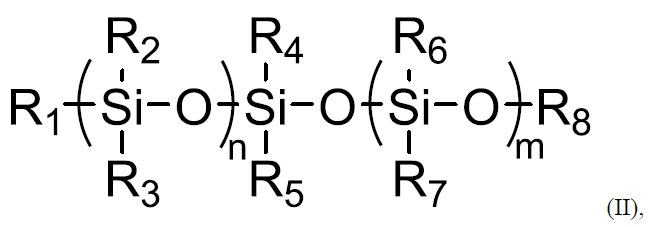
在某些實施例中,第一部分進一步包括在末端處或在側鏈處或在二者處具有至少一個烯基官能基或至少一個炔基官能基及至少一個氫化物官能基之有機聚矽氧烷,如式(III)中所展示: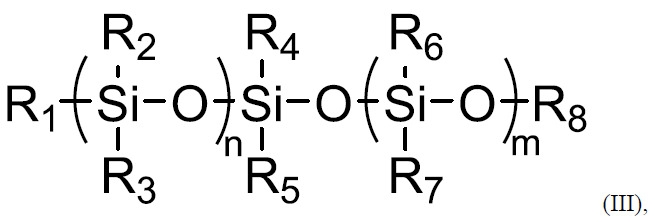
在某些實施例中,第一部分進一步包括強化組分。在某些實施例中,第一部分進一步包括選自由以下組成之群之強化組分:視情況經表面處理之雲母、氧化鋅、二氧化鈦、氧化鋁、黏土或二氧化矽。In certain embodiments, the first part further includes a strengthening component. In some embodiments, the first part further includes a strengthening component selected from the group consisting of: optionally surface-treated mica, zinc oxide, titanium dioxide, aluminum oxide, clay, or silicon dioxide.
在某些實施例中,第一部分進一步包括一種試劑,其中該試劑係抗氧化劑、維他命、維他命D3類似物、類視色素、礦物質、礦物油、石油膠、脂肪酸、植物提取物、多肽、抗體、蛋白質、糖、保濕劑、軟化劑或其組合。在某些實施例中,第一部分進一步包括美容劑。在某些實施例中,第一部分進一步包括選自以下之美容劑:潤濕劑、防曬劑、UV保護劑、皮膚保護劑、皮膚舒緩劑、皮膚美白劑、皮膚增亮劑、皮膚軟化劑、皮膚平滑劑、皮膚漂白劑、皮膚去角質劑、皮膚緊緻劑、藥妝劑、維他命、抗氧化劑、細胞信號傳導劑、細胞調節劑、細胞相互作用劑、皮膚鞣劑、抗衰老劑、抗皺紋劑、祛斑劑、α-羥基酸、β-羥基酸、神經醯胺或其組合。在某些實施例中,第一部分進一步包括治療劑。在某些實施例中,第一部分進一步包括選自以下之治療劑:神經調節劑、疼痛緩解劑、止痛劑、抗瘙癢劑、抗刺激劑(anti-irritant、counterirritant)、免疫調節劑、免疫系統加強劑、免疫系統抑制劑、蒽酚、氟輕松、胺甲喋呤、環孢素、吡美莫司、他克莫司、硫唑嘌呤、氟尿嘧啶、神經醯胺、抗痤瘡劑(β-羥基酸、水楊酸、過氧化苯甲醯)、抗發炎劑、抗組胺、皮質類固醇、NSAID (非類固醇抗發炎藥)、凝血劑、抗腫瘤劑、微生物群系調節劑、抗敗血劑、抗生素、抗細菌劑、抗真菌劑、抗病毒劑、抗過敏劑、皮膚保護劑、煤焦油、驅蟲劑、光療劑、磁療劑、超音波治療劑、熱療劑、皮膚熱調控(冷卻或加熱)劑或其組合。In some embodiments, the first part further includes an agent, wherein the agent is an antioxidant, vitamin, vitamin D3 analog, retinoid, mineral, mineral oil, petroleum jelly, fatty acid, plant extract, polypeptide, antibody , Protein, sugar, moisturizer, softener or a combination thereof. In certain embodiments, the first part further includes a cosmetic agent. In certain embodiments, the first part further includes a cosmetic agent selected from the group consisting of wetting agents, sunscreens, UV protectants, skin protectants, skin soothing agents, skin lightening agents, skin lightening agents, skin softening agents, Skin smoothing agents, skin bleaching agents, skin exfoliants, skin firming agents, cosmeceuticals, vitamins, antioxidants, cell signaling agents, cell regulators, cell interaction agents, skin tanning agents, anti-aging agents, anti-aging agents Wrinkle agents, anti-spot agents, α-hydroxy acid, β-hydroxy acid, ceramide, or a combination thereof. In certain embodiments, the first part further includes a therapeutic agent. In some embodiments, the first part further includes a therapeutic agent selected from the group consisting of neuromodulators, pain relievers, analgesics, anti-pruritus, anti-irritants (anti-irritant, counterirritant), immunomodulators, immune system Booster, immune system inhibitor, anthraphenol, fluocinolone, methotrexate, cyclosporine, pimecrolimus, tacrolimus, azathioprine, fluorouracil, ceramide, anti-acne agents (β-hydroxyl Acid, salicylic acid, benzyl peroxide), anti-inflammatory agents, antihistamines, corticosteroids, NSAIDs (non-steroidal anti-inflammatory drugs), coagulants, antitumor agents, microbiome regulators, antiseptic agents , Antibiotics, antibacterial agents, antifungal agents, antiviral agents, antiallergic agents, skin protectants, coal tar, insect repellents, phototherapy agents, magnetic therapy agents, ultrasonic therapy agents, hyperthermia agents, skin heat regulation ( Cooling or heating) agent or a combination thereof.
在某些實施例中,第二部分包括能夠催化個體皮膚上之膜形成之觸媒。在某些實施例中,第二部分包括金屬觸媒。在某些實施例中,第二部分包括鉑觸媒。In some embodiments, the second part includes a catalyst capable of catalyzing the formation of a film on the individual's skin. In some embodiments, the second part includes a metal catalyst. In some embodiments, the second part includes platinum catalyst.
在某些實施例中,第二部分進一步包括在末端處或在側鏈處或在二者處具有至少兩個烯基官能基之有機聚矽氧烷,如本文之式(I)中所展示。在某些實施例中,第二部分進一步包括一種試劑,其中該試劑係抗氧化劑、維他命、維他命D3類似物、類視色素、礦物質、礦物油、石油膠、脂肪酸、植物提取物、多肽、抗體、蛋白質、糖、保濕劑、軟化劑或其組合。在某些實施例中,第二部分進一步包括美容劑。在某些實施例中,第二部分進一步包括選自以下之美容劑:潤濕劑、防曬劑、UV保護劑、皮膚保護劑、皮膚舒緩劑、皮膚美白劑、皮膚增亮劑、皮膚軟化劑、皮膚平滑劑、皮膚漂白劑、皮膚去角質劑、皮膚緊緻劑、藥妝劑、維他命、抗氧化劑、細胞信號傳導劑、細胞調節劑、細胞相互作用劑、皮膚鞣劑、抗衰老劑、抗皺紋劑、祛斑劑、α-羥基酸、β-羥基酸、神經醯胺或其組合。在某些實施例中,第二部分進一步包括治療劑。在某些實施例中,第二部分進一步包括選自以下之治療劑:神經調節劑、疼痛緩解劑、止痛劑、抗瘙癢劑、抗刺激劑(anti-irritant、counterirritant)、免疫調節劑、免疫系統加強劑、免疫系統抑制劑、蒽酚、氟輕松、胺甲喋呤、環孢素、吡美莫司、他克莫司、硫唑嘌呤、氟尿嘧啶、神經醯胺、抗痤瘡劑(β-羥基酸、水楊酸、過氧化苯甲醯)、抗發炎劑、抗組胺、皮質類固醇、NSAID (非類固醇抗發炎藥)、凝血劑、抗腫瘤劑、微生物群系調節劑、抗敗血劑、抗生素、抗細菌劑、抗真菌劑、抗病毒劑、抗過敏劑、皮膚保護劑、煤焦油、驅蟲劑、光療劑、磁療劑、超音波治療劑、熱療劑、皮膚熱調控(冷卻或加熱)劑或其組合。In certain embodiments, the second part further includes an organopolysiloxane having at least two alkenyl functional groups at the terminal or at the side chain or both, as shown in formula (I) herein . In some embodiments, the second part further includes an agent, wherein the agent is antioxidant, vitamin, vitamin D3 analog, retinoid, mineral, mineral oil, petroleum jelly, fatty acid, plant extract, polypeptide, Antibodies, proteins, sugars, humectants, emollients, or combinations thereof. In certain embodiments, the second part further includes a cosmetic agent. In some embodiments, the second part further includes a cosmetic agent selected from the group consisting of a wetting agent, a sunscreen, a UV protectant, a skin protectant, a skin soothing agent, a skin whitening agent, a skin lightening agent, and a skin softening agent , Skin smoothing agents, skin bleaching agents, skin exfoliants, skin firming agents, cosmeceuticals, vitamins, antioxidants, cell signaling agents, cell regulators, cell interaction agents, skin tanning agents, anti-aging agents, Anti-wrinkle agents, freckle agents, α-hydroxy acids, β-hydroxy acids, ceramide, or combinations thereof. In certain embodiments, the second part further includes a therapeutic agent. In certain embodiments, the second part further includes a therapeutic agent selected from the group consisting of neuromodulators, pain relievers, analgesics, anti-pruritus, anti-irritants (anti-irritant, counterirritant), immunomodulators, immune System booster, immune system inhibitor, anthraphenol, fluocinolone, methotrexate, cyclosporine, pimecrolimus, tacrolimus, azathioprine, fluorouracil, ceramide, anti-acne agent (β- Hydroxy acids, salicylic acid, benzyl peroxide), anti-inflammatory agents, antihistamines, corticosteroids, NSAIDs (non-steroidal anti-inflammatory drugs), coagulants, antitumor agents, microbiome regulators, antiseptic agents Agents, antibiotics, antibacterial agents, antifungal agents, antiviral agents, antiallergic agents, skin protectants, coal tar, insect repellents, phototherapy agents, magnetic therapy agents, ultrasound therapy agents, hyperthermia agents, skin heat regulation (Cooling or heating) agent or a combination thereof.
在某些實施例中,第一部分在約25℃下具有高於約1cP、高於約10cP、高於約100 cP、高於約500 cP或高於約1000 cP之黏度。在較佳實施例中,第一部分在約25℃下具有高於約2000 cP、高於約5000 cP之黏度。在其他較佳實施例中,第一部分在約25℃下具有高於約15,000 cP之黏度。在某些實施例中,第一部分在約25℃下具有低於約1,000,000 cP、低於約750,000 cP、低於約500,000 cP或低於約250,000 cP之黏度。在較佳實施例中,第一部分在約25℃下具有低於約200,000 cP、低於約175,000 cP、低於約150,000 cP、低於約125,000 cP、低於約100,000 cP或低於約50,000 cP或低於25,000 cP之黏度。In certain embodiments, the first portion has a viscosity greater than about 1 cP, greater than about 10 cP, greater than about 100 cP, greater than about 500 cP, or greater than about 1000 cP at about 25°C. In a preferred embodiment, the first part has a viscosity higher than about 2000 cP and higher than about 5000 cP at about 25°C. In other preferred embodiments, the first part has a viscosity higher than about 15,000 cP at about 25°C. In certain embodiments, the first portion has a viscosity of less than about 1,000,000 cP, less than about 750,000 cP, less than about 500,000 cP, or less than about 250,000 cP at about 25°C. In a preferred embodiment, the first part has less than about 200,000 cP, less than about 175,000 cP, less than about 150,000 cP, less than about 125,000 cP, less than about 100,000 cP, or less than about 50,000 cP at about 25°C. Or less than 25,000 cP viscosity.
在某些實施例中,第二部分在約25℃下具有高於約1cP、高於約10cP、高於約100 cP、高於約500 cP或高於約1000 cP之黏度。在較佳實施例中,第一部分在約25℃下具有高於約2000 cP、高於約5000 cP之黏度。在其他較佳實施例中,第一部分在約25℃下具有高於約15,000 cP之黏度。在某些實施例中,第一部分在約25℃下具有低於約1,000,000 cP、低於約750,000 cP、低於約500,000 cP或低於約250,000 cP之黏度。在較佳實施例中,第一部分在約25℃下具有低於約200,000 cP、低於約175,000 cP、低於約150,000 cP、低於約125,000 cP、低於約100,000 cP或低於約50,000 cP或低於25,000 cP之黏度。In certain embodiments, the second part has a viscosity greater than about 1 cP, greater than about 10 cP, greater than about 100 cP, greater than about 500 cP, or greater than about 1000 cP at about 25°C. In a preferred embodiment, the first part has a viscosity higher than about 2000 cP and higher than about 5000 cP at about 25°C. In other preferred embodiments, the first part has a viscosity higher than about 15,000 cP at about 25°C. In certain embodiments, the first portion has a viscosity of less than about 1,000,000 cP, less than about 750,000 cP, less than about 500,000 cP, or less than about 250,000 cP at about 25°C. In a preferred embodiment, the first part has less than about 200,000 cP, less than about 175,000 cP, less than about 150,000 cP, less than about 125,000 cP, less than about 100,000 cP, or less than about 50,000 cP at about 25°C. Or less than 25,000 cP viscosity.
本文所提供之另一態樣係關於形成並不顯著改變組合物施加區域之光輝及/或光澤之層的組合物。可在活體外(例如)使用光澤計根據ASTM D523鏡面光澤測試於20°、60°及/或85°量測角下在自組合物形成之樣品上來量測光輝及/或光澤。可基於預期光澤範圍來選擇光及量測角。舉例而言,若在60°下所獲得之量測值大於約70個光澤單位(GU),則量測角應變為20°以最佳化量測準確度。與之相反,若在60°下所獲得之量測值小於約10 GU,則量測角應變為85°以最佳化量測準確度。端視用於測試之基板之光澤,亦可使用45°或75°量測角。可使用各種材料作為模擬用於測試之正常、健康皮膚之基板,例如呈天然色彩之牛皮加工皮革(Cowhide Tooling leather)。光輝及/或光澤變化係由與治療之前相比在治療之後量測區域中之光澤單位的增加或降低百分比來指示。在某些實施例中,經組合物治療之區域之發亮及/或光澤變化小於約20%。在較佳實施例中,經組合物治療之區域之發亮及/或光澤變化小於約10%。在其他較佳實施例中,經組合物治療之區域之發亮及/或光澤變化小於約5%。Another aspect provided herein relates to a composition that forms a layer that does not significantly change the brightness and/or gloss of the area where the composition is applied. The brilliance and/or gloss can be measured on a sample formed from the composition at 20°, 60°, and/or 85° measurement angles in vitro, for example, using a gloss meter according to the ASTM D523 specular gloss test. The light and measurement angle can be selected based on the expected gloss range. For example, if the measured value obtained at 60° is greater than about 70 gloss units (GU), the measurement angular strain is 20° to optimize the measurement accuracy. On the contrary, if the measured value obtained at 60° is less than about 10 GU, the measurement angle strain is 85° to optimize the measurement accuracy. Depending on the gloss of the substrate used for testing, 45° or 75° measurement angles can also be used. Various materials can be used as a substrate for simulating normal and healthy skin for testing, such as natural color cowhide processing leather (Cowhide Tooling leather). The brilliance and/or gloss change is indicated by the percentage increase or decrease of the gloss unit in the measurement area after the treatment compared to before the treatment. In certain embodiments, the shine and/or gloss change of the area treated with the composition is less than about 20%. In a preferred embodiment, the shine and/or gloss change of the area treated by the composition is less than about 10%. In other preferred embodiments, the shine and/or gloss change of the area treated by the composition is less than about 5%.
在某些實施例中,平均層厚度小於約0.5 mm (500微米)。在較佳實施例中,平均層厚度為約0.5微米至約500微米、約1微米至約250微米、約10微米至約100微米、約30微米至約70微米、約40微米至約60微米。在其他較佳實施例中,平均層厚度為約50微米。In some embodiments, the average layer thickness is less than about 0.5 mm (500 microns). In a preferred embodiment, the average layer thickness is about 0.5 microns to about 500 microns, about 1 microns to about 250 microns, about 10 microns to about 100 microns, about 30 microns to about 70 microns, about 40 microns to about 60 microns . In other preferred embodiments, the average layer thickness is about 50 microns.
在某些實施例中,形成層之組合物具有低於約37℃之玻璃轉變溫度。在較佳實施例中,形成層之組合物具有低於約25℃之玻璃轉變溫度。在其他較佳實施例中,形成層之組合物具有低於約0℃之玻璃轉變溫度。在某些實施例中,形成層之組合物之第一部分具有低於約37℃之玻璃轉變溫度。在較佳實施例中,形成層之組合物之第一部分具有低於約25℃之玻璃轉變溫度。在其他較佳實施例中,形成層之組合物之第一部分具有低於約0℃之玻璃轉變溫度。在某些實施例中,形成層之組合物之第二部分具有低於約37℃之玻璃轉變溫度。在較佳實施例中,形成層之組合物之第二部分具有低於約25℃之玻璃轉變溫度。在其他較佳實施例中,形成層之組合物之第二部分具有低於約0℃之玻璃轉變溫度。In certain embodiments, the layer-forming composition has a glass transition temperature of less than about 37°C. In a preferred embodiment, the layer-forming composition has a glass transition temperature below about 25°C. In other preferred embodiments, the layer-forming composition has a glass transition temperature lower than about 0°C. In certain embodiments, the first part of the layer-forming composition has a glass transition temperature below about 37°C. In a preferred embodiment, the first part of the layer-forming composition has a glass transition temperature below about 25°C. In other preferred embodiments, the first part of the layer-forming composition has a glass transition temperature below about 0°C. In certain embodiments, the second part of the layer-forming composition has a glass transition temperature of less than about 37°C. In a preferred embodiment, the second part of the layer-forming composition has a glass transition temperature below about 25°C. In other preferred embodiments, the second part of the layer-forming composition has a glass transition temperature below about 0°C.
在某些實施例中,組合物具有大於約1秒且小於約10分鐘之接觸乾燥時間。在較佳實施例中,組合物具有大於約30秒且小於約4分鐘之接觸乾燥時間。在其他較佳實施例中,組合物具有大於約30秒且小於約2分鐘之接觸乾燥時間。在其他較佳實施例中,組合物具有大於約1分鐘且小於約2分鐘之接觸乾燥時間。在其他較佳實施例中,組合物具有約1.5分鐘之接觸乾燥時間。聚胺基甲酸酯及聚丙烯具有較佳地用於量測接觸乾燥時間之表面條件,此乃因其具有平滑性以及低縱橫比及類似於活體內皮膚上固化特性之活體外固化特性。In certain embodiments, the composition has a contact drying time greater than about 1 second and less than about 10 minutes. In a preferred embodiment, the composition has a contact drying time of greater than about 30 seconds and less than about 4 minutes. In other preferred embodiments, the composition has a contact drying time of greater than about 30 seconds and less than about 2 minutes. In other preferred embodiments, the composition has a contact drying time of greater than about 1 minute and less than about 2 minutes. In other preferred embodiments, the composition has a contact drying time of about 1.5 minutes. Polyurethane and polypropylene have better surface conditions for measuring contact drying time because of their smoothness, low aspect ratio, and in vitro curing characteristics similar to curing characteristics on skin in vivo.
在某些實施例中,組合物具有大於約1秒且小於約10分鐘之無黏性時間。在較佳實施例中,組合物具有大於約30秒且小於約4分鐘之無黏性時間。在其他較佳實施例中,組合物具有大於約30秒且小於約2分鐘之無黏性時間。在其他較佳實施例中,組合物具有大於約1分鐘且小於約2分鐘之無黏性時間。在其他較佳實施例中,組合物具有約1.5分鐘之無黏性時間。聚胺基甲酸酯及聚丙烯具有較佳地用於量測無黏性時間之表面條件,此乃因其具有平滑表面以及低縱橫比及類似於活體內皮膚上固化特性之活體外固化特性。In certain embodiments, the composition has a tack-free time of greater than about 1 second and less than about 10 minutes. In a preferred embodiment, the composition has a tack-free time of greater than about 30 seconds and less than about 4 minutes. In other preferred embodiments, the composition has a tack-free time of greater than about 30 seconds and less than about 2 minutes. In other preferred embodiments, the composition has a tack-free time of greater than about 1 minute and less than about 2 minutes. In other preferred embodiments, the composition has a tack-free time of about 1.5 minutes. Polyurethane and polypropylene have better surface conditions for measuring tack-free time because of their smooth surface, low aspect ratio, and in vitro curing properties similar to those on in vivo skin. .
在某些實施例中,在普通日常活動及/或苛刻活動下,該層在皮膚上保持實質上完整達約24小時或更長時間。在較佳實施例中,在普通日常活動及/或苛刻活動下,該層在皮膚上保持實質上完整達至少約30小時、約36小時、約48小時、約60小時、約72小時、約84小時或約96小時。在其他較佳實施例中,在普通日常活動及/或苛刻活動下,該層在皮膚上保持實質上完整達至少約120小時、約144小時或約168小時。「保持實質上完整」意指,該層保持於至少約50%、至少約60%、至少約70%、至少約80%、至少約90%、至少約95%之最初施加其之皮膚區域上,或至少約50%、至少約60%、至少約70%、至少約80%、至少約90%、至少約95%之重量保留於皮膚上。In certain embodiments, under ordinary daily activities and/or demanding activities, this layer remains substantially intact on the skin for about 24 hours or more. In a preferred embodiment, under ordinary daily activities and/or harsh activities, this layer remains substantially intact on the skin for at least about 30 hours, about 36 hours, about 48 hours, about 60 hours, about 72 hours, about 84 hours or about 96 hours. In other preferred embodiments, the layer remains substantially intact on the skin for at least about 120 hours, about 144 hours, or about 168 hours under ordinary daily activities and/or harsh activities. "Remain substantially intact" means that the layer remains on at least about 50%, at least about 60%, at least about 70%, at least about 80%, at least about 90%, at least about 95% of the area of the skin where it was originally applied , Or at least about 50%, at least about 60%, at least about 70%, at least about 80%, at least about 90%, at least about 95% of the weight remains on the skin.
在某些實施例中,在普通日常活動及/或苛刻活動下,該層之面積或重量在皮膚上保持至少約50%完整、至少約60%完整、至少約70%完整達約24小時或更長時間。在較佳實施例中,在普通日常活動及/或苛刻活動下,該層之面積或重量在皮膚上保持至少約80%完整達約24小時或更長時間。在其他較佳實施例中,在普通日常活動及/或苛刻活動下,該層之面積或重量在皮膚上保持至少約90%完整或至少約95%完整達約24小時或更長時間。在某些實施例中,在普通日常活動及/或苛刻活動下,該層之面積或重量在皮膚上保持至少約50%完整、至少約60%完整、至少約70%完整達至少約30小時、約36小時、約48小時、約60小時、約72小時、約84小時、約96小時、至少約120小時、約144小時或約168小時。在較佳實施例中,在普通日常活動及/或苛刻活動下,該層之面積或重量在皮膚上保持至少約80%完整達至少約30小時、約36小時、約48小時、約60小時、約72小時、約84小時、約96小時、至少約120小時、約144小時或約168小時。在其他較佳實施例中,在普通日常活動及/或苛刻活動下,該層之面積或重量在皮膚上保持至少約90%完整或至少約95%完整達至少約30小時、約36小時、約48小時、約60小時、約72小時、約84小時、約96小時、至少約120小時、約144小時或約168小時。In certain embodiments, under ordinary daily activities and/or harsh activities, the area or weight of this layer remains at least about 50% intact, at least about 60% intact, at least about 70% intact on the skin for about 24 hours or Longer. In a preferred embodiment, under ordinary daily activities and/or harsh activities, the area or weight of this layer remains at least about 80% intact on the skin for about 24 hours or more. In other preferred embodiments, under ordinary daily activities and/or severe activities, the area or weight of the layer remains at least about 90% complete or at least about 95% complete on the skin for about 24 hours or more. In certain embodiments, the area or weight of this layer remains at least about 50% intact, at least about 60% intact, at least about 70% intact on the skin for at least about 30 hours under ordinary daily activities and/or harsh activities , About 36 hours, about 48 hours, about 60 hours, about 72 hours, about 84 hours, about 96 hours, at least about 120 hours, about 144 hours, or about 168 hours. In a preferred embodiment, under ordinary daily activities and/or harsh activities, the area or weight of this layer remains at least about 80% intact on the skin for at least about 30 hours, about 36 hours, about 48 hours, about 60 hours , About 72 hours, about 84 hours, about 96 hours, at least about 120 hours, about 144 hours, or about 168 hours. In other preferred embodiments, under ordinary daily activities and/or harsh activities, the area or weight of the layer remains at least about 90% complete or at least about 95% complete on the skin for at least about 30 hours, about 36 hours, About 48 hours, about 60 hours, about 72 hours, about 84 hours, about 96 hours, at least about 120 hours, about 144 hours, or about 168 hours.
本文所提供之另一態樣係關於在皮膚上形成抵抗剝離之層之組合物。藉由使用本文所闡述之剝離黏著測試量測黏著力來測定抗剝離性。在較佳實施例中,聚丙烯基板上之層之黏著力大於約5 N/m。在其他較佳實施例中,聚丙烯基板上之層之黏著力大於約20 N/m、40 N/m、60 N/m、80 N/m、大於約100 N/m或大於約200 N/m。Another aspect provided herein relates to a composition that forms a peel-resistant layer on the skin. The peel resistance is determined by measuring the adhesion using the peel adhesion test described in this article. In a preferred embodiment, the adhesion of the layer on the polypropylene substrate is greater than about 5 N/m. In other preferred embodiments, the adhesion of the layer on the polypropylene substrate is greater than about 20 N/m, 40 N/m, 60 N/m, 80 N/m, greater than about 100 N/m, or greater than about 200 N /m.
本文所提供之另一態樣係關於形成抵抗環境因素之層之組合物,該等環境因素係(例如)暴露於熱、冷、風、水、濕度、體液(例如血液、膿/膿清、尿、唾液、痰液、淚液、精液、乳液或陰道分泌液)、皮脂、鹽水、海水、肥皂水、洗滌劑水或氯化水。該抗環境因素性表現為在暴露於該等環境因素時具有最小增重。藉由使用ASTM D2765-95-交聯乙烯塑膠之凝膠含量及膨脹比之測定(Determination of Gel Content and Swell Ratio of Crosslinked Ethylene Plastics)測試且使用計重秤來測定層重量變化。在某些實施例中,在暴露於該等環境因素約1小時時間點(亦即在施加本文所揭示之組合物之後1小時)、約4小時、約6小時、約12小時、約24小時、約30小時、約36小時、約48小時或介於48小時與一週之間之時間點後,層重量之增加小於約10%。在較佳實施例中,在暴露於於該等環境因素約1小時、約4小時、約6小時、約12小時、約24小時、約30小時、約36小時、約48小時或介於48小時與一週之間之時間點後,層重量之增加小於約5%或小於約1%。在其他較佳實施例中,在暴露於於該等環境因素約1小時、約4小時、約6小時、約12小時、約24小時、約30小時、約36小時、約48小時或介於48小時與一週之間之時間點後,層重量之增加小於約0.5%。Another aspect provided herein relates to a composition that forms a layer that resists environmental factors, such as exposure to heat, cold, wind, water, humidity, body fluids (such as blood, pus/pus, etc.) Urine, saliva, sputum, tears, semen, lotions or vaginal secretions), sebum, salt water, sea water, soapy water, detergent water or chlorinated water. The resistance to environmental factors is manifested as having minimal weight gain when exposed to these environmental factors. By using ASTM D2765-95-Determination of Gel Content and Swell Ratio of Crosslinked Ethylene Plastics (Determination of Gel Content and Swell Ratio of Crosslinked Ethylene Plastics) test and using a weight scale to determine the layer weight change. In certain embodiments, the time point of exposure to these environmental factors is about 1 hour (ie, 1 hour after applying the composition disclosed herein), about 4 hours, about 6 hours, about 12 hours, about 24 hours After about 30 hours, about 36 hours, about 48 hours, or a time point between 48 hours and one week, the increase in layer weight is less than about 10%. In a preferred embodiment, after being exposed to these environmental factors for about 1 hour, about 4 hours, about 6 hours, about 12 hours, about 24 hours, about 30 hours, about 36 hours, about 48 hours, or between 48 hours After the time point between hours and one week, the layer weight has increased by less than about 5% or less than about 1%. In other preferred embodiments, after being exposed to these environmental factors for about 1 hour, about 4 hours, about 6 hours, about 12 hours, about 24 hours, about 30 hours, about 36 hours, about 48 hours, or between After the time point between 48 hours and one week, the layer weight has increased by less than about 0.5%.
在某些實施例中,在暴露於該等環境因素約1小時時間點(亦即在施加本文所揭示之組合物之後1小時)、約4小時、約6小時、約12小時、約24小時、約30小時、約36小時、約48小時或介於48小時與一週之間之時間點後,層重量之增加小於約50%。在較佳實施例中,在暴露於於該等環境因素約1小時、約4小時、約6小時、約12小時、約24小時、約30小時、約36小時、約48小時或介於48小時與一週之間之時間點後,層重量之增加小於約5%或小於約1%。在其他較佳實施例中,在暴露於於該等環境因素約1小時、約4小時、約6小時、約12小時、約24小時、約30小時、約36小時、約48小時或介於48小時與一週之間之時間點後,層重量之增加小於約0.5%。In certain embodiments, the time point of exposure to these environmental factors is about 1 hour (ie, 1 hour after applying the composition disclosed herein), about 4 hours, about 6 hours, about 12 hours, about 24 hours After about 30 hours, about 36 hours, about 48 hours, or a time point between 48 hours and one week, the increase in layer weight is less than about 50%. In a preferred embodiment, after being exposed to these environmental factors for about 1 hour, about 4 hours, about 6 hours, about 12 hours, about 24 hours, about 30 hours, about 36 hours, about 48 hours, or between 48 hours After the time point between hours and one week, the layer weight has increased by less than about 5% or less than about 1%. In other preferred embodiments, after being exposed to these environmental factors for about 1 hour, about 4 hours, about 6 hours, about 12 hours, about 24 hours, about 30 hours, about 36 hours, about 48 hours, or between After the time point between 48 hours and one week, the layer weight has increased by less than about 0.5%.
本文所提供之另一態樣係關於形成撓性、可伸展、彈性及身體運動順從性之層之組合物。藉由拉伸模數、剪切模數、循環拉伸殘餘應變、循環拉伸滯後損失能量、破裂應變、破裂應力及破裂韌性量測來表示層之該等撓性、可伸展、彈性及身體運動順從性性質,該等參數可在活體外使用本文所闡述之方法在自組合物形成之樣品上來測試。對於具有正常、健康皮膚之外觀及耐用性之層而言,層之該等物理性質較佳地歸屬於特定範圍內,從而該層在因身體移動而變形時並不斷裂且在身體返回原始狀態時亦返回基本上相同狀態。Another aspect provided herein relates to a composition that forms a layer of flexibility, stretchability, elasticity, and body movement compliance. The flexibility, stretchability, elasticity and body of the layer are measured by tensile modulus, shear modulus, cyclic tensile residual strain, cyclic tensile hysteresis energy loss, rupture strain, rupture stress and fracture toughness measurements Sports compliance properties, these parameters can be tested in vitro using the methods described herein on samples formed from the composition. For a layer with the appearance and durability of normal and healthy skin, the physical properties of the layer are preferably within a specific range, so that the layer does not break when deformed by body movement and returns to its original state Time also returns to basically the same state.
在某些實施例中,層之拉伸強度大於約0.05 MPa或大於0.10 MPa或大於0.20 MPa或大於約0.5 MPa。在較佳實施例中,層之拉伸強度大於約1.0 MPa或大於約2.0 MPa。在較佳實施例中,層之拉伸強度小於約5 MPa。在其他較佳實施例中,層之拉伸強度為約3.0 MPa。In some embodiments, the tensile strength of the layer is greater than about 0.05 MPa or greater than 0.10 MPa or greater than 0.20 MPa or greater than about 0.5 MPa. In a preferred embodiment, the tensile strength of the layer is greater than about 1.0 MPa or greater than about 2.0 MPa. In a preferred embodiment, the tensile strength of the layer is less than about 5 MPa. In other preferred embodiments, the tensile strength of the layer is about 3.0 MPa.
在某些實施例中,層之破裂應變大於約25%、大於50%、大於約100%、大於約200%或大於約400%。在其他較佳實施例中,層之破裂應變大於約600%、大於約800%、大於約1000%、大於約1200%或大於約1500%。In certain embodiments, the fracture strain of the layer is greater than about 25%, greater than 50%, greater than about 100%, greater than about 200%, or greater than about 400%. In other preferred embodiments, the fracture strain of the layer is greater than about 600%, greater than about 800%, greater than about 1000%, greater than about 1200%, or greater than about 1500%.
在某些實施例中,層之拉伸模數為約0.01 MPa至約40 MPa。在較佳實施例中,層之拉伸模數為約0.05 MPa至約20 MPa或約0.1 MPa至約10 MPa、約0.1 MPa至約5 MPa、約0.1 MPa至約1 MPa。在其他較佳實施例中,層之拉伸模數為約0.25 MPa至約0.75 MPa。在其他較佳實施例中,層之拉伸模數為約0.5 MPa。In some embodiments, the tensile modulus of the layer is about 0.01 MPa to about 40 MPa. In a preferred embodiment, the tensile modulus of the layer is about 0.05 MPa to about 20 MPa, or about 0.1 MPa to about 10 MPa, about 0.1 MPa to about 5 MPa, and about 0.1 MPa to about 1 MPa. In other preferred embodiments, the tensile modulus of the layer is about 0.25 MPa to about 0.75 MPa. In other preferred embodiments, the tensile modulus of the layer is about 0.5 MPa.
在某些實施例中,層之剪切模數為約0.005 MPa至約10 MPa。在較佳實施例中,層之剪切模數為約0.05 MPa至約5 MPa或約0.1 MPa至約1 MPa。在其他較佳實施例中,層之剪切模數為約0.25 MPa至約0.75 MPa。在其他較佳實施例中,層之剪切模數為約0.5 MPa。In some embodiments, the shear modulus of the layer is about 0.005 MPa to about 10 MPa. In a preferred embodiment, the shear modulus of the layer is about 0.05 MPa to about 5 MPa or about 0.1 MPa to about 1 MPa. In other preferred embodiments, the shear modulus of the layer is about 0.25 MPa to about 0.75 MPa. In other preferred embodiments, the shear modulus of the layer is about 0.5 MPa.
在某些實施例中,層之循環拉伸殘餘應變小於約10%。在較佳實施例中,層之循環拉伸殘餘應變小於約5%或小於約2.5%。在其他較佳實施例中,層之循環拉伸殘餘應變小於約1%。在其他較佳實施例中,層之循環拉伸殘餘應變小於約0.5%、小於約0.25%或小於約0.1%。In certain embodiments, the cyclic tensile residual strain of the layer is less than about 10%. In a preferred embodiment, the cyclic tensile residual strain of the layer is less than about 5% or less than about 2.5%. In other preferred embodiments, the cyclic tensile residual strain of the layer is less than about 1%. In other preferred embodiments, the cyclic tensile residual strain of the layer is less than about 0.5%, less than about 0.25%, or less than about 0.1%.
在某些實施例中,層之循環拉伸滯後損失能量小於約1 kJ/m3 。在較佳實施例中,層之循環拉伸滯後損失能量小於約0.5 kJ/m3 。在其他較佳實施例中,層之循環拉伸滯後損失能量小於約0.2 kJ/m3 。In some embodiments, the cyclic stretching hysteresis energy loss of the layer is less than about 1 kJ/m 3 . In a preferred embodiment, the cyclic stretching hysteresis energy loss of the layer is less than about 0.5 kJ/m 3 . In other preferred embodiments, the cyclic stretching hysteresis energy loss of the layer is less than about 0.2 kJ/m 3 .
在某些實施例中,層之破裂韌性大於約500 kJ/m3 。在較佳實施例中,層之破裂韌性大於約5,000 kJ/m3 。在其他較佳實施例中,層之破裂韌性大於約10,000 kJ/m3 或大於約50,000 kJ/m3 。In some embodiments, the fracture toughness of the layer is greater than about 500 kJ/m 3 . In a preferred embodiment, the fracture toughness of the layer is greater than about 5,000 kJ/m 3 . In other preferred embodiments, the fracture toughness of the layer is greater than about 10,000 kJ/m 3 or greater than about 50,000 kJ/m 3 .
本文所提供之另一態樣係關於形成可滲透氧及水蒸氣之層之組合物,該滲透性如藉由氧滲透性係數、水蒸氣滲透性係數、透氧率、水蒸氣透過率、氧滲透性及/或水蒸氣滲透性(其係在活體外使用本文所闡述之方法來測試)所表示。Another aspect provided herein relates to a composition that forms a layer permeable to oxygen and water vapor. The permeability is determined by the oxygen permeability coefficient, the water vapor permeability coefficient, the oxygen permeability, the water vapor permeability, and the oxygen permeability coefficient. Permeability and/or water vapor permeability (which are tested in vitro using the method described herein) are expressed.
在某些實施例中,層之透氧率大於約5×10⁻⁹ cm3 /(cm2 ·s)。在較佳實施例中,層之透氧率大於約5×10⁻⁷ cm3 /(cm2 ·s)。在其他較佳實施例中,層之透氧率大於約5×10⁻⁵ cm3 /(cm2 ·s)。在其他較佳實施例中,層之透氧率大於約5×10⁻⁴ cm3 /(cm2 ·s)、大於約5×10⁻³ cm3 /(cm2 ·s)、大於約5×10⁻² cm3 /(cm2 ·s)、大於約0.5 cm3 /(cm2 ·s)。在較佳實施例中,層之透氧率小於約5 cm3 /(cm2 ·s)。In some embodiments, the oxygen permeability of the layer is greater than about 5×10 -9 cm 3 /(cm 2 ·s). In a preferred embodiment, the oxygen permeability of the layer is greater than about 5×10 -7 cm 3 /(cm 2 ·s). In other preferred embodiments, the oxygen permeability of the layer is greater than about 5×10 -5 cm 3 /(cm 2 ·s). In other preferred embodiments, the oxygen permeability of the layer is greater than about 5×10 -4 cm 3 /(cm 2 ·s), greater than about 5×10 -3 cm 3 /(cm 2 ·s), and greater than about 5 ×10 -2 cm 3 /(cm 2 ·s), more than about 0.5 cm 3 /(cm 2 ·s). In a preferred embodiment, the oxygen permeability of the layer is less than about 5 cm 3 /(cm 2 ·s).
在某些實施例中,層之氧滲透性大於約5×10-11 cm3 /(cm2 ·s·cm Hg)。在較佳實施例中,層之氧滲透性大於約5×10⁻⁹ cm3 /(cm2 ·s·cm Hg)或大於約5×10⁻⁷ cm3 /(cm2 ·s·cm Hg)。在其他較佳實施例中,層之氧滲透性大於約5×10⁻⁶ cm3 /(cm2 ·s·cm Hg)。在其他較佳實施例中,層之氧滲透性大於約5×10⁻⁵ cm3 /(cm2 ·s·cm Hg)、大於約5×10⁻⁴ cm3 /(cm2 ·s·cm Hg)、大於約5×10⁻³ cm3 /(cm2 ·s·cm Hg)或大於約5×10⁻² cm3 /(cm2 ·s·cm Hg)。在較佳實施例中,層之氧滲透性小於約0.5 cm3 /(cm2 ·s·cm Hg)。In some embodiments, the oxygen permeability of the layer is greater than about 5×10 −11 cm 3 /(cm 2 ·s·cm Hg). In a preferred embodiment, the oxygen permeability of the layer is greater than about 5×10 -9 cm 3 /(cm 2 ·s·cm Hg) or greater than about 5×10 -7 cm 3 /(cm 2 ·s·cm Hg ). In other preferred embodiments, the oxygen permeability of the layer is greater than about 5×10 -6 cm 3 /(cm 2 ·s·cm Hg). In other preferred embodiments, the oxygen permeability of the layer is greater than about 5×10 -5 cm 3 /(cm 2 ·s·cm Hg) and greater than about 5×10 -4 cm 3 /(cm 2 ·s·cm Hg), greater than about 5×10 -3 cm 3 /(cm 2 ·s·cm Hg) or greater than about 5×10 -2 cm 3 /(cm 2 ·s·cm Hg). In a preferred embodiment, the oxygen permeability of the layer is less than about 0.5 cm 3 /(cm 2 ·s·cm Hg).
在某些實施例中,層之氧滲透性係數大於約5×10⁻⁴ 巴爾(Barrer)。在較佳實施例中,層之氧滲透性係數大於約5×10⁻² 巴爾、大於約5巴爾或大於約50巴爾。在其他較佳實施例中,層之氧滲透性係數大於約500巴爾。在其他較佳實施例中,層之氧滲透性係數大於約5,000巴爾。在較佳實施例中,層之氧滲透性係數小於約20,000巴爾。In certain embodiments, the oxygen permeability coefficient of the layer is greater than about 5×10 -4 Barrer. In a preferred embodiment, the oxygen permeability coefficient of the layer is greater than about 5 x 10 -2 barr, greater than about 5 barr, or greater than about 50 barr. In other preferred embodiments, the oxygen permeability coefficient of the layer is greater than about 500 Barr. In other preferred embodiments, the oxygen permeability coefficient of the layer is greater than about 5,000 Barr. In a preferred embodiment, the oxygen permeability coefficient of the layer is less than about 20,000 Barr.
在某些實施例中,層之水蒸氣透過率大於約1×10⁻⁹ cm3 /(cm2 ·s)且小於約1.5 ×10⁻¹ cm3 /(cm2 ·s)。在較佳實施例中,層之水蒸氣透過率大於約1×10⁻⁸ cm3 /(cm2 ·s)。在其他較佳實施例中,層之水蒸氣透過率大於約1×10⁻⁷ cm3 /(cm2 ·s)。在其他較佳實施例中,層之水蒸氣透過率大於約1×10⁻⁶ cm3 /(cm2 ·s)、大於約1×10⁻⁵ cm3 /(cm2 ·s)或大於約1×10⁻⁴ cm3 /(cm2 ·s)。在較佳實施例中,層之水蒸氣透過率小於約1.5×10⁻² cm3 /(cm2 ·s)。In some embodiments, the water vapor transmission rate of the layer is greater than about 1×10 -9 cm 3 /(cm 2 ·s) and less than about 1.5 × 10 -1 cm 3 /(cm 2 ·s). In a preferred embodiment, the water vapor transmission rate of the layer is greater than about 1×10 -8 cm 3 /(cm 2 ·s). In other preferred embodiments, the water vapor transmission rate of the layer is greater than about 1×10 -7 cm 3 /(cm 2 ·s). In other preferred embodiments, the water vapor transmission rate of the layer is greater than about 1×10 -6 cm 3 /(cm 2 ·s), greater than about 1×10 -5 cm 3 /(cm 2 ·s) or greater than about 1×10 -4 cm 3 /(cm 2 ·s). In a preferred embodiment, the water vapor transmission rate of the layer is less than about 1.5×10 -2 cm 3 /(cm 2 ·s).
在某些實施例中,層之水蒸氣滲透性大於約1×10-11 cm3 /(cm2 ·s·cm Hg)且小於約2×10⁻³ cm3 /(cm2 ·s·cm Hg)。在較佳實施例中,層之水蒸氣滲透性大於約1×10⁻¹⁰ cm3 /(cm2 ·s·cm Hg)或大於約1×10⁻⁹ cm3 /(cm2 ·s·cm Hg)。在其他較佳實施例中,層之水蒸氣滲透性大於約1×10⁻⁸ cm3 /(cm2 ·s·cm Hg)。在其他較佳實施例中,層之水蒸氣滲透性大於1×10⁻⁷ cm3 /(cm2 ·s·cm Hg)或大於1×10⁻⁶ cm3 /(cm2 ·s·cm Hg)。在較佳實施例中,層之水蒸氣滲透性小於約2×10⁻² cm3 /(cm2 ·s·cm Hg)。In some embodiments, the water vapor permeability of the layer is greater than about 1×10 -11 cm 3 /(cm 2 ·s·cm Hg) and less than about 2×10 -3 cm 3 /(cm 2 ·s·cm Hg). In a preferred embodiment, the water vapor permeability of the layer is greater than about 1×10 -10 cm 3 /(cm 2 ·s·cm Hg) or greater than about 1×10 -9 cm 3 /(cm 2 ·s·cm Hg). In other preferred embodiments, the water vapor permeability of the layer is greater than about 1×10 -8 cm 3 /(cm 2 ·s·cm Hg). In other preferred embodiments, the water vapor permeability of the layer is greater than 1×10 -7 cm 3 /(cm 2 ·s·cm Hg) or greater than 1×10 -6 cm 3 /(cm 2 ·s·cm Hg ). In a preferred embodiment, the water vapor permeability of the layer is less than about 2×10 -2 cm 3 /(cm 2 ·s·cm Hg).
在某些實施例中,層之水蒸氣滲透性係數大於約1×10⁻³ 巴爾且小於約1×10⁶ 巴爾。在較佳實施例中,層之水蒸氣滲透性係數大於約0.01巴爾、大於約0.1巴爾、大於約1巴爾、大於約10巴爾、大於約100巴爾或大於約1×10³ 巴爾。在其他較佳實施例中,層之水蒸氣滲透性係數大於約1×10⁴ 巴爾且小於約1×10⁵ 巴爾。In certain embodiments, the water vapor permeability coefficient of the layer is greater than about 1×10 -3 Barr and less than about 1×10 6 Barr. In a preferred embodiment, the water vapor permeability coefficient of the layer is greater than about 0.01 Barr, greater than about 0.1 Barr, greater than about 1 Barr, greater than about 10 Barr, greater than about 100 Barr, or greater than about 1×10 3 Barr. In other preferred embodiments, the water vapor permeability coefficient of the layer is greater than about 1×10 4 Barr and less than about 1×10 5 Barr.
本文所提供之另一態樣係關於一種組合物,該組合物在皮膚上形成層,從而經該組合物治療之區域之經皮水損失有所減小或與未治療皮膚相當。可在約30分鐘時間點或之後之任一時間(例如在約1小時、約4小時、約6小時、約12小時、約24小時、約30小時、約36小時、約48小時或介於48小時與一週之間之時間點)進行TEWL量測。在某些實施例中,在施加組合物之後之經皮水損失小於約40 g/(m2 ·hr)。在較佳實施例中,在施加組合物之後之經皮水損失小於約20 g/(m2 ·hr)。在其他較佳實施例中,在施加組合物之後之經皮水損失小於約10 g/(m2 ·hr)。在其他較佳實施例中,在施加組合物之後之經皮水損失小於約5 g/(m2 ·hr)或小於約1 g/(m2 ·hr)。Another aspect provided herein relates to a composition that forms a layer on the skin so that the transdermal water loss of the area treated by the composition is reduced or is comparable to untreated skin. It can be at about 30 minutes time point or any time thereafter (e.g., at about 1 hour, about 4 hours, about 6 hours, about 12 hours, about 24 hours, about 30 hours, about 36 hours, about 48 hours or between Time point between 48 hours and one week) Perform TEWL measurement. In certain embodiments, the transdermal water loss after application of the composition is less than about 40 g/(m 2 ·hr). In a preferred embodiment, the transdermal water loss after application of the composition is less than about 20 g/(m 2 ·hr). In other preferred embodiments, the transdermal water loss after application of the composition is less than about 10 g/(m 2 ·hr). In other preferred embodiments, the transdermal water loss after application of the composition is less than about 5 g/(m 2 ·hr) or less than about 1 g/(m 2 ·hr).
本文所提供之另一態樣係關於一種組合物,該組合物在皮膚上形成層,從而經該組合物治療之區域之皮膚水合有所改良或與未治療皮膚相當。可在約30分鐘時間點或之後之任一時間(例如在約1小時、約4小時、約6小時、約12小時、約24小時、約30小時、約36小時、約48小時或介於48小時與一週之間之時間點)進行皮膚水合量測。可(例如)使用皮膚水分測試儀根據如H. Dobrev, 「Use of Cutometer to assess epidermal hydration」,Skin Research and Technology 2000, 6(4):239-244中所闡述之程序來量測皮膚水合。在某些實施例中,在施加組合物之後之皮膚水合大於皮膚水分測試儀之約20個任意單位(正規化水合值)。在較佳實施例中,在施加組合物之後之皮膚水合大於皮膚水分測試儀之約40個任意單位。在其他較佳實施例中,在施加組合物之後之皮膚水合大於皮膚水分測試儀之約60個任意單位或大於皮膚水分測試儀之約80個任意單位。Another aspect provided herein relates to a composition that forms a layer on the skin so that the skin hydration of the area treated by the composition is improved or is comparable to untreated skin. It can be at about 30 minutes time point or any time thereafter (e.g., at about 1 hour, about 4 hours, about 6 hours, about 12 hours, about 24 hours, about 30 hours, about 36 hours, about 48 hours or between At the time point between 48 hours and one week) skin hydration measurement was performed. For example, a skin moisture tester can be used to measure skin hydration according to the procedure described in H. Dobrev, "Use of Cutometer to assess epidermal hydration", Skin Research and Technology 2000, 6(4):239-244. In some embodiments, the skin hydration after application of the composition is greater than about 20 arbitrary units (normalized hydration value) of the skin moisture tester. In a preferred embodiment, the skin hydration after application of the composition is greater than about 40 arbitrary units of the skin moisture tester. In other preferred embodiments, the skin hydration after applying the composition is greater than about 60 arbitrary units of the skin moisture tester or greater than about 80 arbitrary units of the skin moisture tester.
亦可(例如)使用如Clarys等人,Hydration measurements of the stratum corneum: comparison between the capacitance method (digital version of the Corneometer CM 825 (R)) and the impedance method (Skicon-200EX (R)),Skin Research and Technology 2011, 18(3):316-23中所闡述之程序來量測皮膚水合。在某些實施例中,在施加組合物之後之皮膚水合大於約20微西門子(microSiemens)。在較佳實施例中,在施加組合物之後之皮膚水合大於約50微西門子。在其他較佳實施例中,在施加組合物之後之皮膚水合大於約100微西門子或大於約200微西門子或約400微西門子。It can also be used (for example) such as Clarys et al., Hydration measurements of the stratum corneum: comparison between the capacitance method (digital version of the Corneometer CM 825 (R)) and the impedance method (Skicon-200EX (R)), Skin Research and Technology 2011, 18(3):316-23 to measure skin hydration. In certain embodiments, the skin hydration after application of the composition is greater than about 20 microSiemens. In a preferred embodiment, skin hydration after application of the composition is greater than about 50 microsiemens. In other preferred embodiments, the skin hydration after application of the composition is greater than about 100 microsiemens or greater than about 200 microsiemens or about 400 microsiemens.
本文所提供之另一態樣係關於在皮膚上形成使皮膚收緊之層之組合物。在活體外藉由使用如本文所闡述之活體外捲曲測試自形成自組合物之樣品來量化藉由增加皮膚張力而引起之收緊效應。在某些實施例中,張力之增加大於0.1 N/m。在較佳實施例中,張力之增加大於0.2 N/m。在較佳實施例中,張力之增加大於0.5 N/m、大於1.0 N/m、大於2.0 N/m、大於5.0 N/m、大於10 N/m、大於20 N/m、大於50 N/m、大於100 N/m、大於500 N/m或大於1,000 N/m。Another aspect provided herein relates to a composition that forms a skin tightening layer on the skin. The tightening effect caused by the increase in skin tension was quantified in vitro by using the in vitro curl test as described herein to self-form a sample of the composition. In some embodiments, the increase in tension is greater than 0.1 N/m. In a preferred embodiment, the increase in tension is greater than 0.2 N/m. In a preferred embodiment, the increase in tension is greater than 0.5 N/m, greater than 1.0 N/m, greater than 2.0 N/m, greater than 5.0 N/m, greater than 10 N/m, greater than 20 N/m, greater than 50 N/m m, greater than 100 N/m, greater than 500 N/m, or greater than 1,000 N/m.
本文所提供之另一態樣係關於一種組合物,該組合物在皮膚上形成層,從而可調節皮膚之表面輪廓。在施加測試組合物之前及之後,使用Canfield 3-D成像系統來觀察「皮膚之表面輪廓」或使用對比照片目測觀察。Another aspect provided herein relates to a composition that forms a layer on the skin to adjust the surface contour of the skin. Before and after applying the test composition, use the Canfield 3-D imaging system to observe the "surface contour of the skin" or visually observe with contrast photos.
在較佳實施例中,組合物形成化妝上優美之層且施加該組合物或層之個體具有正常、健康及年輕之皮膚的外觀。因此,該層可賦予減少任何衰老跡象(包含眼袋、笑紋、魚尾紋、前額紋及皺紋)之出現之美容及治療益處。In a preferred embodiment, the composition forms a cosmetically beautiful layer and the individual applying the composition or layer has the appearance of normal, healthy and youthful skin. Therefore, this layer can impart cosmetic and therapeutic benefits that reduce the appearance of any signs of aging (including eye bags, laugh lines, crow's feet, forehead lines and wrinkles).
本文所提供之另一態樣係關於一種組合物,該組合物在皮膚上形成層,從而經該組合物治療之區域之收縮時間小於未治療皮膚。可在約30分鐘時間點或之後之任一時間(例如在約1小時、約4小時、約6小時、約12小時、約24小時、約30小時、約36小時、約48小時或介於48小時與一週之間之時間點)進行皮膚收縮時間量測。在某些實施例中,在施加組合物之後之皮膚收縮時間降低約5%至約75%。在較佳實施例中,在施加組合物之後之皮膚收縮時間之降低大於約10%。在其他較佳實施例中,在施加組合物之後之皮膚收縮時間之降低大於約25%或大於約50%。Another aspect provided herein relates to a composition that forms a layer on the skin such that the contraction time of the area treated with the composition is less than that of untreated skin. It can be at about 30 minutes time point or any time thereafter (e.g., at about 1 hour, about 4 hours, about 6 hours, about 12 hours, about 24 hours, about 30 hours, about 36 hours, about 48 hours or between At the time point between 48 hours and one week), the skin contraction time was measured. In certain embodiments, the skin contraction time after application of the composition is reduced by about 5% to about 75%. In a preferred embodiment, the reduction in skin contraction time after application of the composition is greater than about 10%. In other preferred embodiments, the reduction in skin contraction time after application of the composition is greater than about 25% or greater than about 50%.
在某些實施例中,本文提供藉由在個體皮膚上形成層來改良皮膚功能之組合物、裝置及方法,該層可迅速形成且具有較薄、耐用、非侵襲性、易於使用及皮膚樣性質。In certain embodiments, provided herein are compositions, devices and methods for improving skin function by forming a layer on the skin of an individual. The layer can be formed quickly and is thinner, durable, non-invasive, easy to use and skin-like. nature.
本文揭示可在皮膚上形成覆蓋物、層、膜、裝置及/或人工皮膚之組合物,該覆蓋物、層、膜、裝置及/或人工皮膚具有低黏性且迅速形成,從而產生可舒適地穿戴以提供皮膚水合及其他治療、美學及/或美容益處之可穿戴、舒適(維持類似於正常、健康皮膚之溫度及濕度)、透氣、較薄、光學不可見、化妝上優美、撓性、可伸展、彈性及身體運動順從性且持久之覆蓋物、層、膜、裝置及/或人工皮膚。This document discloses a composition capable of forming a covering, layer, film, device and/or artificial skin on the skin, the covering, layer, film, device and/or artificial skin having low viscosity and rapid formation, thereby producing comfortable Wearable to provide skin hydration and other treatment, aesthetics and/or beauty benefits, wearable, comfortable (maintain temperature and humidity similar to normal and healthy skin), breathable, thin, optically invisible, beautiful in makeup, and flexible , Stretchable, elastic, and durable coverings, layers, films, devices and/or artificial skins that are compliant with body movement.
本文提供尤其在較苛刻活動(例如運動、淋浴及游泳(在海水、淡水或氯化水中)、蒸汽室(高濕熱)及桑拿浴(低濕熱))期間與先前組合物相比更持久及性能更佳之新穎組合物。其他益處在於,層之延長可穿戴性及/或耐用性使得無需重複施加以維持其益處。所形成層可穿戴於約24小時時段內或更長時間且無需再施加。This article provides longer lasting and performance, especially during more demanding activities (e.g., exercise, showering and swimming (in sea water, fresh water or chlorinated water), steam room (high humidity and heat) and sauna (low humidity and heat)) compared to previous compositions A better novel composition. Other benefits are that the extended wearability and/or durability of the layer eliminates the need for repeated application to maintain its benefits. The formed layer can be worn for a period of about 24 hours or more without reapplication.
特定而言,自本文所揭示之組合物形成之層調控皮膚之經皮傳輸性質,藉由在皮膚上提供防止水蒸氣自身體損失至環境中之額外障壁來幫助維持皮膚水合,幫助保護身體免於外部及內部攻擊(例如環境因素(例如熱、冷、風、水、濕度)、體液(例如血液、膿/膿清、尿、唾液、痰液、淚液、精液、乳液或陰道分泌液)、皮脂、鹽水、海水、肥皂水、洗滌劑水、氯化水、病原體、過敏原及致癢原),且幫助在新皮膚層形成(例如最小化疤痕形成之傷口癒合)期間維持適於皮膚修復之條件。Specifically, the layer formed from the composition disclosed herein regulates the transdermal transport properties of the skin, and helps maintain skin hydration by providing an additional barrier on the skin to prevent the loss of water vapor from the body to the environment, and help protect the body from External and internal attacks (e.g. environmental factors (e.g. heat, cold, wind, water, humidity), body fluids (e.g. blood, pus/pus, urine, saliva, sputum, tears, semen, lotion or vaginal secretions), Sebum, salt water, sea water, soapy water, detergent water, chlorinated water, pathogens, allergens and prurigos), and help maintain suitable skin repair during the formation of new skin layers (such as wound healing that minimizes scarring) The conditions.
除增加與以每天一次或更小頻率施加美觀組合物之順從性外,該等組合物使用者亦受益於治療效應。本文所闡述之組合物及方法可更有吸引力地替代用於皮膚障壁功能受損病狀之當前治療選擇。In addition to increasing and applying the aesthetic composition once a day or less frequently, users of these compositions also benefit from therapeutic effects. The compositions and methods described herein can more attractively replace current treatment options for impaired skin barrier function.
本發明組合物適於容易地局部施加以形成可安全穿戴於皮膚上之美學不可見、彈性、皮膚順從性覆蓋物、層、膜、裝置及/或人工皮膚。本發明組合物中所使用之材料較佳地選自美國食品藥物監督管理局(US Food and Drug Administration)之通常視為安全(GRAS)之物質或其等效物之清單,或係另外可安全用於皮膚及/或身體應用者。The composition of the present invention is suitable for easy topical application to form an aesthetically invisible, elastic, skin-compliant covering, layer, film, device and/or artificial skin that can be safely worn on the skin. The materials used in the composition of the present invention are preferably selected from the US Food and Drug Administration (US Food and Drug Administration) generally regarded as safe (GRAS) substances or their equivalent list, or are otherwise safe For skin and/or body applications.
本文所提供之一態樣係關於在表面上原位(亦即在施加本文所揭示之組合物之位置中)形成層之組合物,該表面係(例如)皮革、玻璃、塑膠、金屬、陶瓷、半導體、絕緣體、導體或皮膚或黏膜或唇或毛髮或指甲。較佳地,無需加熱或UV或光或電或磁或壓力或聲音暴露即可形成層。層可另外在暴露於加熱、UV、光、電、磁、壓力及聲音中之一或多者下形成。本文所提供之另一態樣係關於在表面(例如皮革、玻璃、塑膠、陶瓷、半導體、絕緣體、導體或金屬)上形成層之組合物,該構造然後施加於個體之皮膚或黏膜或唇或毛髮或指甲上。One aspect provided herein relates to a composition that forms a layer on a surface in situ (that is, in the location where the composition disclosed herein is applied), the surface being (for example) leather, glass, plastic, metal, ceramic , Semiconductors, insulators, conductors or skin or mucous membranes or lips or hair or nails. Preferably, the layer can be formed without heating or UV or light or electric or magnetic or pressure or sound exposure. The layer may additionally be formed under exposure to one or more of heat, UV, light, electricity, magnetism, pressure, and sound. Another aspect provided herein relates to a composition that forms a layer on a surface (such as leather, glass, plastic, ceramic, semiconductor, insulator, conductor, or metal), which is then applied to the skin or mucous membrane or lips of an individual On hair or nails.
在較佳實施例中,組合物進一步包括一或多種光學改良劑。在其他較佳實施例中,第一部分及/或第二部分進一步獨立地包括一或多種光學改良劑或顆粒。光學改良劑或顆粒引入對光學或光子相互作用具有反應之表面(例如針對光散射之粗糙度),由此賦予超過或相當於正常、健康皮膚之期望發亮、有光澤、發光、無光澤外觀,較佳地避免與正常皮膚相比顯著更高的發亮及/或有光澤外觀。適宜光學改良劑或顆粒包含(例如)顏料、染料、聚合物(例如耐綸(nylon) (例如耐綸-6、耐綸-10、耐綸-12)、聚矽氧、丙烯酸系物、丙烯酸酯/胺基甲酸酯或其他聚合物或共聚物珠粒或顆粒、聚乙烯珠粒、聚甲基丙烯酸甲酯珠粒、聚苯乙烯珠粒、聚胺基甲酸酯珠粒);無機物,例如二氧化矽(例如二氧化矽及DMPA/間苯二甲酸/SMDI共聚物(可以ChronoSphere® Opticals自Lonza Group獲得))、氮化硼、滑石粉、雲母、氧化鋁、二氧化鈦;金屬,例如銀奈米顆粒;及聚矽氧、丙烯酸系物、丙烯酸酯/胺基甲酸酯或其他聚合物或共聚物珠粒或顆粒。在某些實施例中,光學改良劑或顆粒具有介於約1 μm與約20 μm之間之平均粒徑。在較佳實施例中,光學改良劑或顆粒具有介於約0.1 μm與約20 μm之間之平均粒徑。在較佳實施例中,光學改良劑或顆粒具有2 μm至15 μm及另外較佳地5 μm至10 μm之平均粒徑。In a preferred embodiment, the composition further includes one or more optical modifiers. In other preferred embodiments, the first part and/or the second part further independently include one or more optical modifiers or particles. Optical modifiers or particles are introduced into surfaces that are responsive to optical or photon interactions (such as roughness for light scattering), thereby imparting a bright, shiny, luminous, and matt appearance that exceeds or is equivalent to normal and healthy skin , It is better to avoid a significantly higher shiny and/or shiny appearance compared to normal skin. Suitable optical modifiers or particles include, for example, pigments, dyes, polymers (e.g. nylon (nylon) (e.g. nylon-6, nylon-10, nylon-12), silicone, acrylic, acrylic Ester/urethane or other polymer or copolymer beads or particles, polyethylene beads, polymethylmethacrylate beads, polystyrene beads, polyurethane beads); inorganic , Such as silicon dioxide (such as silicon dioxide and DMPA/isophthalic acid/SMDI copolymer (available from ChronoSphere® Opticals from Lonza Group)), boron nitride, talc, mica, alumina, titanium dioxide; metals, such as Silver nano particles; and polysilicone, acrylic, acrylate/urethane or other polymer or copolymer beads or particles. In certain embodiments, the optical modifier or particles have an average particle size between about 1 μm and about 20 μm. In a preferred embodiment, the optical modifier or particles have an average particle diameter between about 0.1 μm and about 20 μm. In a preferred embodiment, the optical modifier or particles have an average particle diameter of 2 μm to 15 μm and more preferably 5 μm to 10 μm.
本文所提供之另一態樣係關於形成並不顯著改變組合物施加區域之光輝及/或光澤之層的組合物。可在活體外(例如)使用光澤計根據ASTM D523鏡面光澤測試於20°、60°及/或85°量測角下在自組合物形成之樣品上量測光輝及/或光澤。可基於預期光澤範圍來選擇光及量測角。舉例而言,若在60°下所獲得之量測值大於約70個光澤單位(GU),則應將量測角改為20°以最佳化量測準確度。與之相反,若在60°下所獲得之量測值小於約10 GU,則應將量測角改為85°以最佳化量測準確度。端視用於測試之基板之光澤,亦可使用45°或75°量測角。可使用各種材料作為模擬用於測試之正常、健康皮膚之基板,例如呈天然色彩之牛皮加工皮革。光輝及/或光澤變化係由與治療之前相比在治療之後量測區域中之光澤單位的增加或降低百分比來指示。在某些實施例中,經組合物治療之區域之發亮及/或光澤變化小於約20%。在較佳實施例中,經組合物治療之區域之發亮及/或光澤變化小於約10%。在其他較佳實施例中,經組合物治療之區域之發亮及/或光澤變化小於約5%。Another aspect provided herein relates to a composition that forms a layer that does not significantly change the brightness and/or gloss of the area where the composition is applied. The brilliance and/or gloss can be measured on a sample formed from the composition at measuring angles of 20°, 60°, and/or 85° in vitro, for example, using a gloss meter according to the ASTM D523 specular gloss test. The light and measurement angle can be selected based on the expected gloss range. For example, if the measured value obtained at 60° is greater than about 70 gloss units (GU), the measurement angle should be changed to 20° to optimize the measurement accuracy. On the contrary, if the measured value obtained at 60° is less than about 10 GU, the measurement angle should be changed to 85° to optimize the measurement accuracy. Depending on the gloss of the substrate used for testing, 45° or 75° measurement angles can also be used. Various materials can be used as substrates for simulating normal and healthy skin for testing, such as cowhide processed leather with natural color. The brilliance and/or gloss change is indicated by the percentage increase or decrease of the gloss unit in the measurement area after the treatment compared to before the treatment. In certain embodiments, the shine and/or gloss change of the area treated with the composition is less than about 20%. In a preferred embodiment, the shine and/or gloss change of the area treated by the composition is less than about 10%. In other preferred embodiments, the shine and/or gloss change of the area treated by the composition is less than about 5%.
本文所提供之另一態樣係關於形成澄清、透明及/或光學不可見之層之組合物。本文所提供之另一態樣係關於一種組合物,該組合物形成層,從而施加組合物之區域在施加之前及之後具有最小色彩變化(例如色彩L*標度變化、色彩a*標度變化及/或色彩b*標度變化)。色彩L*標度、色彩a*標度及色彩b*標度係由國際照明委員會(International Commission on Illumination)指定之L*a*b*三色彩空間。可在活體外(例如)使用Minolta色彩儀錶根據ASTM E313-自根據儀器量測之色彩坐標來計算黃度及白度指數(Calculating Yellowness and Whiteness Indices from Instrumentally Measured Color Coordinates)在自組合物形成之樣品上來量測色彩L*標度、色彩a*標度及色彩b*標度之變化。可使用各種材料作為模擬用於測試之正常、健康皮膚之基板,例如呈天然色彩之牛皮加工皮革。Another aspect provided herein relates to a composition that forms a clear, transparent and/or optically invisible layer. Another aspect provided herein relates to a composition that forms a layer so that the area where the composition is applied has minimal color changes before and after application (eg color L* scale change, color a* scale change And/or color b* scale change). Color L* scale, color a* scale, and color b* scale are the three color spaces of L*a*b* specified by the International Commission on Illumination. The Minolta color meter can be used in vitro (for example) to calculate yellowness and whiteness indicators from Instrumentally Measured Color Coordinates in accordance with ASTM E313-color coordinates measured by the instrument. Measure the changes of color L* scale, color a* scale and color b* scale. Various materials can be used as substrates for simulating normal and healthy skin for testing, such as cowhide processed leather with natural color.
在某些實施例中,經組合物治療之區域之色彩L*標度變化小於約2。在較佳實施例中,經組合物治療之區域之色彩L*標度變化小於約1.5。在其他較佳實施例中,經組合物治療之區域之色彩L*標度變化小於約1或小於約0.5。在某些實施例中,經組合物治療之區域之色彩a*標度變化小於約2。在較佳實施例中,經組合物治療之區域之色彩a*標度變化小於約1.5。在其他較佳實施例中,經組合物治療之區域之色彩a*標度變化小於約1或小於約0.5。在某些實施例中,經組合物治療之區域之色彩b*標度變化小於約2。在較佳實施例中,經組合物治療之區域之色彩b*標度變化小於約1.5。在其他較佳實施例中,經組合物治療之區域之色彩b*標度變化小於約1或小於約0.5。In certain embodiments, the color L* scale change of the area treated with the composition is less than about 2. In a preferred embodiment, the color L* scale change of the area treated with the composition is less than about 1.5. In other preferred embodiments, the color L* scale change of the area treated by the composition is less than about 1 or less than about 0.5. In certain embodiments, the color a* scale change of the area treated with the composition is less than about 2. In a preferred embodiment, the color a* scale change of the area treated with the composition is less than about 1.5. In other preferred embodiments, the color a* scale change of the area treated by the composition is less than about 1 or less than about 0.5. In certain embodiments, the color b* scale change of the area treated with the composition is less than about 2. In a preferred embodiment, the color b* scale change of the area treated with the composition is less than about 1.5. In other preferred embodiments, the color b* scale change of the area treated by the composition is less than about 1 or less than about 0.5.
本文所提供之另一態樣係關於形成半透明或不透明層之組合物。在某些實施例中,組合物進一步包括一或多種著色劑,包含(但不限於)顏料、染料(包含螢光染料)、FD&C染料、D&C染料、色澱染料、其他賦予色彩之化合物及其組合。其他適宜著色劑揭示於(例如) CTFA Cosmetic Ingredient Handbook,第2版,1992中。在較佳實施例中,層色彩實質上匹配個體之正常、健康皮膚之色彩。在其他較佳實施例中,層進一步包括各種著色劑、珠光劑、圖案、設計或其組合,由此賦予化妝、美容、美學及/或裝飾性益處。Another aspect provided herein relates to a composition that forms a translucent or opaque layer. In some embodiments, the composition further includes one or more coloring agents, including (but not limited to) pigments, dyes (including fluorescent dyes), FD&C dyes, D&C dyes, lake dyes, other color-imparting compounds, and combination. Other suitable colorants are disclosed in, for example, the CTFA Cosmetic Ingredient Handbook, 2nd edition, 1992. In a preferred embodiment, the layer color substantially matches the color of the individual's normal and healthy skin. In other preferred embodiments, the layer further includes various coloring agents, pearlescent agents, patterns, designs, or combinations thereof, thereby imparting cosmetic, cosmetic, aesthetic and/or decorative benefits.
在某些實施例中,可在層形成期間或之後與層一起或在層上施加整理組合物以提供期望觸感或美學外觀。舉例而言,整理組合物可提供柔滑、柔軟及/或平滑之觸感或如露、新鮮、無光澤、發亮或發光之美學外觀。在某些實施例中,整理組合物包括以下中之一或多者:油、酯或醚、感覺改良劑、黏性改良劑、擴散增強劑、黏著改良劑、乳化劑、軟化劑、表面活性劑、增稠劑、成膜劑、保濕劑、防腐劑、美容劑及/或治療劑。In certain embodiments, the finishing composition can be applied with or on the layer during or after formation of the layer to provide a desired tactile or aesthetic appearance. For example, the finishing composition can provide a smooth, soft and/or smooth touch or an aesthetic appearance such as dew, fresh, matte, shiny or luminous. In certain embodiments, the finishing composition includes one or more of the following: oil, ester or ether, sensory modifier, viscosity modifier, diffusion enhancer, adhesion modifier, emulsifier, softener, surface active Agents, thickeners, film formers, moisturizers, preservatives, cosmetics and/or therapeutics.
在某些實施例中,整理組合物包括光學改良劑或顆粒、著色劑、珠光劑、圖案及/或設計。In certain embodiments, the finishing composition includes optical modifiers or particles, colorants, pearlescent agents, patterns and/or designs.
在某些實施例中,整理組合物可呈各種形式,例如液體、洗劑、乳霜、軟膏、美容液、凝膠、噴霧、發泡體、摩絲、噴劑、粉劑或其他適宜形式。In certain embodiments, the finishing composition may be in various forms, such as liquid, lotion, cream, ointment, beauty lotion, gel, spray, foam, mousse, spray, powder or other suitable forms.
本文所提供之另一態樣係關於形成澄清、透明及/或光學不可見之層之組合物。本文所提供之另一態樣係關於一種組合物,該組合物形成層,從而施加組合物之區域在施加之前及之後具有最小色彩變化(例如色彩L*標度變化、色彩a*標度變化及/或色彩b*標度變化)。色彩L*標度、色彩a*標度及色彩b*標度係由國際照明委員會指定之L*a*b*三色彩空間。可在活體外(例如)使用Minolta色彩儀錶根據ASTM E313-自根據儀器量測之色彩坐標來計算黃度及白度指數在自組合物形成之樣品上來量測色彩L*標度、色彩a*標度及色彩b*標度之變化。可使用各種材料作為模擬用於測試之正常、健康皮膚之基板,例如呈天然色彩之牛皮加工皮革。Another aspect provided herein relates to a composition that forms a clear, transparent and/or optically invisible layer. Another aspect provided herein relates to a composition that forms a layer so that the area where the composition is applied has minimal color changes before and after application (eg color L* scale change, color a* scale change And/or color b* scale change). Color L* scale, color a* scale and color b* scale are the three color spaces of L*a*b* designated by the International Commission of Illumination. It can be used in vitro (for example) using Minolta color meter according to ASTM E313-from the color coordinates measured by the instrument to calculate the yellowness and whiteness index. On the sample formed from the composition to measure the color L* scale, color a* Changes in scale and color b* scale. Various materials can be used as substrates for simulating normal and healthy skin for testing, such as cowhide processed leather with natural color.
在某些實施例中,經組合物治療之區域之色彩L*標度變化小於約2。在較佳實施例中,經組合物治療之區域之色彩L*標度變化小於約1.5。在其他較佳實施例中,經組合物治療之區域之色彩L*標度變化小於約1或小於約0.5。在某些實施例中,經組合物治療之區域之色彩a*標度變化小於約2。在較佳實施例中,經組合物治療之區域之色彩a*標度變化小於約1.5。在其他較佳實施例中,經組合物治療之區域之色彩a*標度變化小於約1或小於約0.5。在某些實施例中,經組合物治療之區域之色彩b*標度變化小於約2。在較佳實施例中,經組合物治療之區域之色彩b*標度變化小於約1.5。在其他較佳實施例中,經組合物治療之區域之色彩b*標度變化小於約1或小於約0.5。In certain embodiments, the color L* scale change of the area treated with the composition is less than about 2. In a preferred embodiment, the color L* scale change of the area treated with the composition is less than about 1.5. In other preferred embodiments, the color L* scale change of the area treated by the composition is less than about 1 or less than about 0.5. In certain embodiments, the color a* scale change of the area treated with the composition is less than about 2. In a preferred embodiment, the color a* scale change of the area treated with the composition is less than about 1.5. In other preferred embodiments, the color a* scale change of the area treated by the composition is less than about 1 or less than about 0.5. In certain embodiments, the color b* scale change of the area treated with the composition is less than about 2. In a preferred embodiment, the color b* scale change of the area treated with the composition is less than about 1.5. In other preferred embodiments, the color b* scale change of the area treated by the composition is less than about 1 or less than about 0.5.
本文所提供之另一態樣係關於形成半透明或不透明層之組合物。在某些實施例中,組合物進一步包括一或多種著色劑,包含(但不限於)顏料、染料(包含螢光染料)、FD&C染料、D&C染料、色澱染料、其他賦予色彩之化合物及其組合。其他適宜著色劑揭示於(例如) CTFA Cosmetic Ingredient Handbook,第2版,1992中。在較佳實施例中,層色彩實質上匹配個體之正常、健康皮膚之色彩。在其他較佳實施例中,層進一步包括各種著色劑、珠光劑、圖案、設計或其組合,由此賦予化妝、美容、美學及/或裝飾性益處。Another aspect provided herein relates to a composition that forms a translucent or opaque layer. In some embodiments, the composition further includes one or more coloring agents, including (but not limited to) pigments, dyes (including fluorescent dyes), FD&C dyes, D&C dyes, lake dyes, other color-imparting compounds, and combination. Other suitable colorants are disclosed in, for example, the CTFA Cosmetic Ingredient Handbook, 2nd edition, 1992. In a preferred embodiment, the layer color substantially matches the color of the individual's normal and healthy skin. In other preferred embodiments, the layer further includes various coloring agents, pearlescent agents, patterns, designs, or combinations thereof, thereby imparting cosmetic, cosmetic, aesthetic and/or decorative benefits.
在某些實施例中,可在層形成期間或之後與層一起或在層上施加整理組合物以提供期望觸感或美學外觀。舉例而言,整理組合物可提供柔滑、柔軟及/或平滑之觸感或如露、新鮮、無光澤、發亮或發光之美學外觀。在某些實施例中,整理組合物包括以下中之一或多者:油、酯或醚、感覺改良劑、黏性改良劑、擴散增強劑、黏著改良劑、乳化劑、軟化劑、表面活性劑、增稠劑、成膜劑、保濕劑、防腐劑、美容劑及/或治療劑。In certain embodiments, the finishing composition can be applied with or on the layer during or after formation of the layer to provide a desired tactile or aesthetic appearance. For example, the finishing composition can provide a smooth, soft and/or smooth touch or an aesthetic appearance such as dew, fresh, matte, shiny or luminous. In certain embodiments, the finishing composition includes one or more of the following: oil, ester or ether, sensory modifier, viscosity modifier, diffusion enhancer, adhesion modifier, emulsifier, softener, surface active Agents, thickeners, film formers, moisturizers, preservatives, cosmetics and/or therapeutics.
在某些實施例中,整理組合物包括光學改良劑或顆粒、著色劑、珠光劑、圖案及/或設計。In certain embodiments, the finishing composition includes optical modifiers or particles, colorants, pearlescent agents, patterns and/or designs.
在某些實施例中,整理組合物可呈各種形式,例如液體、洗劑、乳霜、軟膏、美容液、凝膠、噴霧、發泡體、摩絲、噴劑、粉劑或其他適宜形式。In certain embodiments, the finishing composition may be in various forms, such as liquid, lotion, cream, ointment, beauty lotion, gel, spray, foam, mousse, spray, powder or other suitable forms.
在組合物係兩部分組合物之某些實施例中,一次一個地或組合施加第一部分及第二部分以形成層。In certain embodiments where the composition is a two-part composition, the first part and the second part are applied one at a time or in combination to form a layer.
在某些實施例中,第一部分係無水的。或者,第一部分係乳液。在某些實施例中,第一部分可散佈、噴霧或噴灑於皮膚上。In some embodiments, the first part is anhydrous. Alternatively, the first part is an emulsion. In certain embodiments, the first part may be spread, sprayed, or sprayed on the skin.
在某些實施例中,第二部分係無水的。或者,第二部分係乳液。在某些實施例中,第二部分可散佈、噴霧或噴灑於皮膚上。In some embodiments, the second part is anhydrous. Alternatively, the second part is an emulsion. In certain embodiments, the second part can be spread, sprayed or sprayed on the skin.
本文所提供之另一態樣係關於在皮膚上形成層之組合物,其中該組合物具有約為或低於體溫之玻璃轉變溫度。Another aspect provided herein relates to a composition that forms a layer on the skin, wherein the composition has a glass transition temperature of about or below body temperature.
本文所提供之另一態樣係關於形成黏性較低且迅速形成之層之組合物。在層係「接觸乾燥」時,其變得實質上抵抗環境因素,由此容許使用者恢復預期活動。在層係「無黏性」時,其變得實質上抵抗表面摩擦及來自環境因素之擦傷,由此容許使用者進一步恢復預期活動。因此,層之適當接觸乾燥時間及無黏性時間較為重要:較長接觸乾燥時間及無黏性時間需要使用者在恢復活動之前等待較長時間,從而影響消費者順從性;而較短接觸乾燥時間及無黏性時間需要較迅速地處置、施加及/或散佈組合物,此不能由所有使用者達成,或可另外負面影響層之連續性、平坦性、均勻性及/或物理性質。Another aspect provided herein relates to a composition that forms a layer that is less viscous and forms quickly. When the layer is "contact dry", it becomes substantially resistant to environmental factors, thereby allowing the user to resume expected activities. When the layer is "non-sticky", it becomes substantially resistant to surface friction and scratches from environmental factors, thereby allowing the user to further resume expected activities. Therefore, proper contact drying time and non-sticking time of the layer are more important: Longer contact drying time and non-sticking time require users to wait a long time before resuming activities, which affects consumer compliance; and shorter contact drying Time and tack-free time require relatively rapid disposal, application and/or dispersion of the composition, which cannot be achieved by all users, or may otherwise negatively affect the continuity, flatness, uniformity, and/or physical properties of the layer.
在較佳實施例中,組合物進一步包括一或多種光學改良劑。在其他較佳實施例中,第一部分及/或第二部分進一步獨立地包括一或多種光學改良劑或顆粒。光學改良劑或顆粒引入對光學或光子相互作用具有反應之表面(例如針對光散射之粗糙度),由此賦予超過或相當於正常、健康皮膚之期望發亮、有光澤、發光、無光澤外觀,較佳地應避免發亮及/或有光澤外觀顯著大於正常皮膚。適宜光學改良劑或顆粒包含(例如)顏料、染料、聚合物(例如耐綸(例如耐綸-6、耐綸-10、耐綸-12)、聚矽氧、丙烯酸系物、丙烯酸酯/胺基甲酸酯或其他聚合物或共聚物珠粒或顆粒、聚乙烯珠粒、聚甲基丙烯酸甲酯珠粒、聚苯乙烯珠粒、聚胺基甲酸酯珠粒);無機物,例如二氧化矽(例如二氧化矽及DMPA/間苯二甲酸/SMDI共聚物(可以ChronoSphere® Opticals形式自Lonza Group獲得))、氮化硼、滑石粉、雲母、氧化鋁、二氧化鈦;金屬,例如銀奈米顆粒;及聚矽氧、丙烯酸系物、丙烯酸酯/胺基甲酸酯或其他聚合物或共聚物珠粒或顆粒。在某些實施例中,光學改良劑或顆粒具有介於約1 μm與約20 μm之間之平均粒徑。在較佳實施例中,光學改良劑或顆粒具有介於約0.1 μm與約20 μm之間之平均粒徑。在較佳實施例中,光學改良劑或顆粒具有2 μm至15 μm及另外較佳地5 μm至10 μm之平均粒徑。In a preferred embodiment, the composition further includes one or more optical modifiers. In other preferred embodiments, the first part and/or the second part further independently include one or more optical modifiers or particles. Optical modifiers or particles are introduced into surfaces that are responsive to optical or photon interactions (such as roughness for light scattering), thereby imparting a bright, shiny, luminous, and matt appearance that exceeds or is equivalent to normal and healthy skin , Preferably should avoid shiny and/or shiny appearance significantly larger than normal skin. Suitable optical modifiers or particles include (e.g.) pigments, dyes, polymers (e.g. nylon (e.g. nylon-6, nylon-10, nylon-12), silicone, acrylic, acrylate/amine Beads or particles of methyl formate or other polymers or copolymers, polyethylene beads, polymethyl methacrylate beads, polystyrene beads, polyurethane beads); inorganic substances, such as two Silicon oxide (such as silicon dioxide and DMPA/isophthalic acid/SMDI copolymer (available from Lonza Group as ChronoSphere® Opticals)), boron nitride, talc, mica, alumina, titanium dioxide; metals, such as silver Rice particles; and polysilicone, acrylic, acrylate/urethane or other polymer or copolymer beads or particles. In certain embodiments, the optical modifier or particles have an average particle size between about 1 μm and about 20 μm. In a preferred embodiment, the optical modifier or particles have an average particle diameter between about 0.1 μm and about 20 μm. In a preferred embodiment, the optical modifier or particles have an average particle diameter of 2 μm to 15 μm and more preferably 5 μm to 10 μm.
在某些實施例中,組合物進一步包括介於0.05重量%與30重量%之間之一或多種影響組合物之接觸乾燥時間的聚合物及/或非聚合物。其他適宜聚合物包含(但不限於)聚四氟乙烯(PTFE)、聚(甲基丙烯酸甲酯) (PMMA)、聚乙烯(polyethylene) (PE或聚乙烯(polyethene))、聚丙烯(polypropylene) (PP或聚丙烯(polypropene))、聚二氟亞乙烯(PVDF)、聚胺基甲酸酯、丙烯酸酯、聚酯(例如耐綸)、聚醚、聚碳酸酯、聚碸、聚磷酸酯或其組合。適宜非聚合物包含(但不限於)顆粒,例如碳、二氧化矽、氮化硼、金屬氧化物(例如氧化鋅、二氧化鈦);及鹽,例如碳酸鹽(例如鈣、鎂、鈉鹽)、硫酸鹽、磷酸鹽、硼酸鹽、鹵化鹽;或其組合。In certain embodiments, the composition further includes one or more polymers and/or non-polymers between 0.05% and 30% by weight that affect the contact drying time of the composition. Other suitable polymers include (but are not limited to) polytetrafluoroethylene (PTFE), poly(methyl methacrylate) (PMMA), polyethylene (PE or polyethylene (polyethene)), polypropylene (polypropylene) (PP or polypropylene (polypropene)), polyvinylidene fluoride (PVDF), polyurethane, acrylate, polyester (e.g. nylon), polyether, polycarbonate, polypropene, polyphosphate Or a combination. Suitable non-polymers include (but are not limited to) particles such as carbon, silicon dioxide, boron nitride, metal oxides (such as zinc oxide, titanium dioxide); and salts, such as carbonates (such as calcium, magnesium, sodium salts), Sulfate, phosphate, borate, halogenated salt; or a combination thereof.
可在測試個體上(例如)使用本文所闡述之接觸乾燥時間及無黏性時間膜測試(如自ASTM D5895-03所修改)來量測接觸乾燥時間。亦可在活體外(例如)使用本文所闡述之接觸乾燥時間膜測試且使用適宜基板(例如聚胺基甲酸酯、聚丙烯及/或牛皮加工皮革)來量測接觸乾燥時間。The contact drying time and tack-free time film test described herein (as modified from ASTM D5895-03) can be used, for example, to measure the contact drying time on the test individual. It is also possible to measure the contact drying time in vitro (for example) using the contact drying time film test described herein and using a suitable substrate (for example, polyurethane, polypropylene and/or cowhide processed leather).
在測試個體上藉由使用本文所闡述之接觸乾燥時間及無黏性時間膜測試(如自ASTM D5895-03所修改)來量測無黏性時間。亦可在活體外藉由使用本文所闡述之接觸乾燥時間及無黏性時間膜測試在適宜基板(例如聚胺基甲酸酯、聚丙烯及牛皮加工皮革)上來量測無黏性時間。The tack-free time is measured on the test individual by using the contact drying time and tack-free time film test described in this article (as modified from ASTM D5895-03). The tack-free time can also be measured in vitro by using the contact drying time and tack-free time film test described herein on a suitable substrate (such as polyurethane, polypropylene and cowhide processed leather).
本文所提供之另一態樣係關於在皮膚上形成薄層之組合物。層厚度影響其透氣性、不可見性、可壓縮性及其皮膚閉塞效應。「厚度」係指施加至表面之平均層厚度。可在活體外(例如)於層橫截面上使用具有鏡臺或目鏡測微尺之顯微鏡來量測所形成層之厚度。在活體外藉由使用ASTM D3767-使用Mitutoyo厚度計之尺寸橡膠量測(Rubber-Measurement of Dimensions using the Mitutoyo Thickness Gauge)測試(經修改以用於獨立膜上或層上)於基板(例如聚胺基甲酸酯、聚丙烯及牛皮加工皮革)上在室溫及約50%相對濕度下在自組合物形成之樣品上來量測層厚度。聚胺基甲酸酯及聚丙烯具有較佳地用於厚度量測之表面條件,此乃因其具有平滑表面與低縱橫率,從而使得可容易地以獨立層形式去除層。牛皮加工皮革具有厚度量測所需之較佳水吸收及晶粒表面條件。牛皮加工皮革通常經植物鞣製且易於吸水並迅速乾燥,此乃因纖維結構之緻密性小於鉻鞣製皮革。牛皮加工皮革係「全晶粒」,此意指已去除毛髮且保留原始晶粒。亦可在活體外(例如)使用ASTM D-6132-使用PosiTector超音波塗層厚度計非破壞性量測所施加有機塗層之乾燥膜厚度(Nondestructive Measurement of Dry Film Thickness of Applied Organic Coatings using the PosiTector Ultrasonic Coating Thickness Gauges)測試(經修改以使用聚胺基甲酸酯作為基板)在室溫及約50%相對濕度下於自組合物形成之樣品上來量測層厚度。Another aspect provided herein relates to a composition that forms a thin layer on the skin. The thickness of the layer affects its breathability, invisibility, compressibility and its skin-occlusive effect. "Thickness" refers to the average layer thickness applied to the surface. A microscope with stage or eyepiece micrometer can be used to measure the thickness of the formed layer outside the body (for example) on the layer cross section. In vitro by using ASTM D3767-Rubber-Measurement of Dimensions using the Mitutoyo Thickness Gauge test (modified for use on a separate film or layer) on a substrate (such as polyamine) The thickness of the layer is measured on a sample formed from the composition at room temperature and about 50% relative humidity on carbamic acid ester, polypropylene, and cowhide processed leather. Polyurethane and polypropylene have better surface conditions for thickness measurement because they have a smooth surface and low aspect ratio, so that the layer can be easily removed as a separate layer. Cowhide processed leather has better water absorption and grain surface conditions required for thickness measurement. Cowhide processed leather is usually vegetable tanned and easily absorbs water and dries quickly. This is because the fiber structure is less dense than chrome tanned leather. The cowhide processed leather is "full grain", which means that the hair has been removed and the original grain is retained. It can also be used in vitro (for example) using ASTM D-6132-Nondestructive Measurement of Dry Film Thickness of Applied Organic Coatings (Nondestructive Measurement of Dry Film Thickness of Applied Organic Coatings) using a PosiTector ultrasonic coating thickness meter. Using the PosiTector Ultrasonic Coating Thickness Gauges) test (modified to use polyurethane as the substrate) was used to measure the thickness of the layer on a sample formed from the composition at room temperature and about 50% relative humidity.
在施加組合物之前及之後量測基板厚度,其中在施加組合物之前及之後之厚度差指示層厚度。The thickness of the substrate is measured before and after applying the composition, where the difference in thickness between before and after applying the composition indicates the thickness of the layer.
本文所提供之另一態樣係關於在皮膚上形成耐用層之組合物。可(例如)使用本文所闡述之皮膚上之膜耐用性測試來測定皮膚上之層之耐用性。 5.1.1 用於本文所提供之組合物及方法中之雙官能有機聚矽氧烷聚合物Another aspect provided herein relates to a composition that forms a durable layer on the skin. The durability of the layers on the skin can be determined, for example, using the membrane durability test on the skin described herein. 5.1.1 Difunctional organopolysiloxane polymers used in the compositions and methods provided herein
在某些實施例中,用於本文所提供之組合物及方法中之雙官能有機聚矽氧烷聚合物係直鏈矽氧烷聚合物。在某些實施例中,用於本文所提供之組合物及方法中之雙官能有機聚矽氧烷聚合物係具支鏈矽氧烷聚合物。In certain embodiments, the bifunctional organopolysiloxane polymer used in the compositions and methods provided herein is a linear siloxane polymer. In certain embodiments, the bifunctional organopolysiloxane polymer used in the compositions and methods provided herein is a branched siloxane polymer.
在某些實施例中,直鏈矽氧烷聚合物係含有一個氫化物官能基末端及一個不飽和官能基末端之雙官能低-中-高分子量直鏈矽氧烷聚合物。氫化物官能基及不飽和官能基各自連接至直鏈矽氧烷聚合物之相對端上之不同矽原子。該等材料係具有在約5 cSt至約100,000 cSt範圍內之黏度及低多分散性之液體。該等材料係具有在約3 cSt至約200,000 cSt範圍內之黏度及低多分散性之液體。該等材料係具有在約2 cSt至約400,000 cSt範圍內之黏度及低多分散性之液體。該等材料係具有在約1 cSt至約800,000 cSt範圍內之黏度及低多分散性之液體。該等材料係具有在約1 cSt至約1600,000 cSt範圍內之黏度及低多分散性之液體。該等材料係具有在約1 cSt至約3200,000 cSt範圍內之黏度及低多分散性之液體。In some embodiments, the linear silicone polymer is a bifunctional low-medium-high molecular weight linear silicone polymer containing one hydride functional group end and one unsaturated functional group end. The hydride functional group and the unsaturated functional group are each connected to different silicon atoms on the opposite ends of the linear silicone polymer. These materials are liquids with a viscosity and low polydispersity ranging from about 5 cSt to about 100,000 cSt. These materials are liquids with a viscosity and low polydispersity in the range of about 3 cSt to about 200,000 cSt. These materials are liquids with a viscosity and low polydispersity in the range of about 2 cSt to about 400,000 cSt. These materials are liquids with viscosity and low polydispersity in the range of about 1 cSt to about 800,000 cSt. These materials are liquids with viscosity and low polydispersity in the range of about 1 cSt to about 1600,000 cSt. These materials are liquids with viscosity and low polydispersity in the range of about 1 cSt to about 3200,000 cSt.
在某些實施例中,術語「低多分散性」可理解為係指小於約1.6、更佳地小於約1.4、最佳地小於約1.2之多分散性。矽氧烷之聚合度較佳地大於6、更佳地6至約1000、最佳地約10至約200。至關重要的,雙官能材料在每一聚合物分子內具有實質上1:1之不飽和基團末端對氫化物基團末端之比率。在某些實施例中,術語「實質上1:1」意指,該比率在1:1之約5%內、更佳地在1:1之約3%內。可基於1H NMR、GPC或逐步生長聚合數據之組合來估計不飽和基團末端對氫化物基團末端之比率。達成此1:1比率之最有效方法係下述「活」陰離子開環聚合(「活」 AROP)方法。In certain embodiments, the term "low polydispersity" can be understood to mean a polydispersity of less than about 1.6, more preferably less than about 1.4, and most preferably less than about 1.2. The degree of polymerization of silicone is preferably greater than 6, more preferably 6 to about 1,000, and most preferably about 10 to about 200. Crucially, the bifunctional material has a substantially 1:1 ratio of unsaturated group ends to hydride group ends in each polymer molecule. In certain embodiments, the term "substantially 1:1" means that the ratio is within about 5% of 1:1, more preferably within about 3% of 1:1. The ratio of unsaturated group ends to hydride group ends can be estimated based on a combination of 1H NMR, GPC, or stepwise growth polymerization data. The most effective way to achieve this 1:1 ratio is the following "living" anionic ring-opening polymerization ("living" AROP) method.
在某些實施例中,雙官能低-中-高分子量直鏈矽氧烷聚合物具有約3200道爾頓至約160000道爾頓之分子量。在某些實施例中,雙官能低-中-高分子量直鏈矽氧烷聚合物具有約4700道爾頓至約235000道爾頓之分子量。在某些實施例中,雙官能低-中-高分子量直鏈矽氧烷聚合物具有約6180道爾頓至約309000道爾頓之分子量。在某些實施例中,雙官能低-中-高分子量直鏈矽氧烷聚合物具有約3200道爾頓至約32000道爾頓之分子量。在某些實施例中,雙官能低-中-高分子量直鏈矽氧烷聚合物具有約4700道爾頓至約47000道爾頓之分子量。在某些實施例中,雙官能低-中-高分子量直鏈矽氧烷聚合物具有約6180道爾頓至約61800道爾頓之分子量。In certain embodiments, the bifunctional low-medium-high molecular weight linear silicone polymer has a molecular weight of about 3200 Daltons to about 160,000 Daltons. In certain embodiments, the bifunctional low-medium-high molecular weight linear silicone polymer has a molecular weight of about 4700 Daltons to about 235,000 Daltons. In certain embodiments, the bifunctional low-medium-high molecular weight linear silicone polymer has a molecular weight of about 6180 Daltons to about 309,000 Daltons. In certain embodiments, the bifunctional low-medium-high molecular weight linear silicone polymer has a molecular weight of about 3200 Daltons to about 32,000 Daltons. In certain embodiments, the bifunctional low-medium-high molecular weight linear silicone polymer has a molecular weight of about 4700 Daltons to about 47000 Daltons. In certain embodiments, the bifunctional low-medium-high molecular weight linear silicone polymer has a molecular weight of about 6180 Daltons to about 61800 Daltons.
不飽和官能基並無特定限制,且可為(例如)乙烯基、苯乙烯基、烯丙基、甲基烯丙基、己烯基、辛烯基或炔基。較佳不飽和官能基係乙烯基。矽氧烷主鏈可為(例如)衍生自環三矽氧烷之二烷基矽氧烷(例如二甲基矽氧烷、乙基甲基矽氧烷、二乙基矽氧烷、二甲基矽基乙基矽氧烷、三氟丙基甲基矽氧烷)或芳香族經取代矽氧烷(例如二苯基矽氧烷或苯基甲基矽氧烷)。產生符合「活」 AROP之矽氧烷-烴共聚物之其他可能者包含2,2,5,5-四甲基-2,5-二矽雜-1-氧雜環戊烷及相關環約束你好系統。The unsaturated functional group is not particularly limited, and may be, for example, vinyl, styryl, allyl, methallyl, hexenyl, octenyl, or alkynyl. Preferably, the unsaturated functional group is a vinyl group. The silicone backbone can be, for example, a dialkylsiloxane derived from cyclotrisiloxane (e.g., dimethylsiloxane, ethylmethylsiloxane, diethylsiloxane, dimethylsiloxane). Silyl ethyl siloxane, trifluoropropyl methyl siloxane) or aromatic substituted siloxane (such as diphenyl siloxane or phenyl methyl siloxane). Other possibilities to produce silicone-hydrocarbon copolymers that meet the "live" AROP include 2,2,5,5-tetramethyl-2,5-disila-1-oxolane and related ring constraints Hello system.
在某些實施例中,矽氧烷聚合物具有二甲基矽氧烷主鏈、不飽和基團及氫化物基團,如式(IV)中所展示: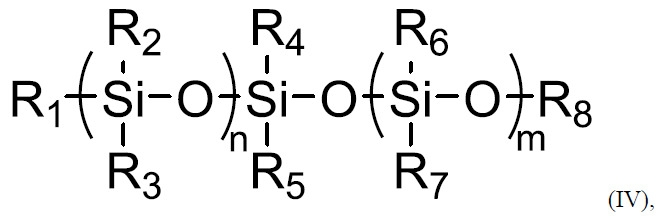
較佳矽氧烷聚合物具有二甲基矽氧烷主鏈及乙烯基(作為不飽和官能基),如式(V)中所展示: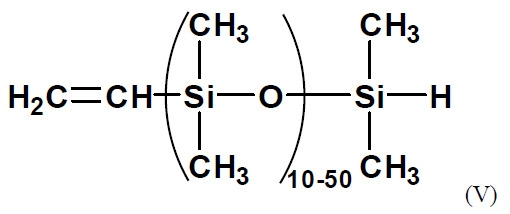
在某些實施例中,單不飽和-單氫化物封端矽氧烷係具有中等黏度之穩定、不可燃性液體,其可藉由傾倒、抽吸或藉助注射器來轉移。在某些實施例中,矽氧烷可與各種強化劑以及觸變及非觸變填充劑(包含發煙二氧化矽)複合。在某些實施例中,單乙烯基苯基封端矽氧烷係有利的,此乃因其能夠控制光學性質(折射率)及熱性質。In some embodiments, the monounsaturated-monohydride-terminated siloxane is a stable, non-flammable liquid with a medium viscosity, which can be transferred by pouring, aspirating or using a syringe. In certain embodiments, silicones can be compounded with various strengthening agents and thixotropic and non-thixotropic fillers (including fuming silica). In certain embodiments, monovinylphenyl-terminated silicone is advantageous because it can control optical properties (refractive index) and thermal properties.
在某些實施例中,可根據美國專利第8,952,118號之揭示內容中所闡述之方法來製備直鏈矽氧烷聚合物,該專利之揭示內容之全部內容以引用方式併入本文中。亦可根據熟習此項技術者所明瞭之其他方法來製備直鏈矽氧烷聚合物。 5.1.2 用於本文所提供方法中之強化組分In certain embodiments, the linear siloxane polymer can be prepared according to the method described in the disclosure of US Patent No. 8,952,118, the entire disclosure of which is incorporated herein by reference. The linear siloxane polymer can also be prepared according to other methods known to those skilled in the art. 5.1.2 Strengthening components used in the methods provided in this article
在較佳實施例中,組合物進一步包括一或多種強化組分。在某些實施例中,強化組分係選自經表面處理之碳、銀、金、金剛石、銅、雲母、硫化鋅、氧化鋅、二氧化鈦、氧化鋁、黏土(例如Al2 O3 、SiO2 )、白堊、滑石粉、方解石(例如CaCO3 )、硫酸鋇、二氧化鋯、聚合物珠粒及二氧化矽(例如矽鋁酸鹽(silica aluminate)、矽酸鈣或經表面處理之二氧化矽(例如發煙二氧化矽、水合二氧化矽或無水二氧化矽))或其組合。該等強化組分強化了如本文所論述之層之物理性質。在較佳實施例中,強化組分係經表面處理之二氧化矽,例如經六甲基二矽氮烷、聚二甲基矽氧烷、十六烷基矽烷或甲基丙烯醯基矽烷處理之二氧化矽。在其他較佳實施例中,強化組分係發煙二氧化矽,包含經六甲基二矽氮烷表面處理之發煙二氧化矽。In a preferred embodiment, the composition further includes one or more strengthening components. In some embodiments, the strengthening component is selected from surface-treated carbon, silver, gold, diamond, copper, mica, zinc sulfide, zinc oxide, titanium dioxide, aluminum oxide, clay (e.g., Al 2 O 3 , SiO 2 ), chalk, talc, calcite (e.g. CaCO 3 ), barium sulfate, zirconium dioxide, polymer beads and silica (e.g. silica aluminate, calcium silicate or surface-treated dioxide Silicon (such as fuming silica, hydrated silica or anhydrous silica)) or a combination thereof. The strengthening components strengthen the physical properties of the layers as discussed herein. In a preferred embodiment, the strengthening component is surface-treated silicon dioxide, such as hexamethyldisilazane, polydimethylsiloxane, hexadecyl silane or methacryloyl silane. Of silicon dioxide. In other preferred embodiments, the strengthening component is fumed silica, including fumed silica with hexamethyldisilazane surface treatment.
在某些實施例中,強化組分之顆粒具有介於約50 m2 /g與約1000 m2 /g之間之平均表面積。在較佳實施例中,強化組分之顆粒具有大於約300 m2 /g之平均表面積。在較佳實施例中,強化組分之顆粒具有介於約600 m2 /g與約800 m2 /g之間之平均表面積。在較佳實施例中,強化組分之顆粒具有介於約100 m2 /g與約600 m2 /g之間之平均表面積。在其他較佳實施例中,強化組分之顆粒具有平均介於約135 m2 /g與約250 m2 /g之間之表面積。在某些實施例中,強化組分具有介於約1 nm與約20 μm之間之平均粒徑。在較佳實施例中,強化組分之平均粒徑介於約2 nm與約1 μm之間,且另外較佳地介於約5 nm與約50 nm之間。In certain embodiments, the particles of the strengthening component have an average surface area between about 50 m 2 /g and about 1000 m 2 /g. In a preferred embodiment, the particles of the strengthening component have an average surface area greater than about 300 m 2 /g. In a preferred embodiment, the particles of the strengthening component have an average surface area between about 600 m 2 /g and about 800 m 2 /g. In a preferred embodiment, the particles of the strengthening component have an average surface area between about 100 m 2 /g and about 600 m 2 /g. In other preferred embodiments, the particles of the strengthening component have an average surface area between about 135 m 2 /g and about 250 m 2 /g. In certain embodiments, the strengthening component has an average particle size between about 1 nm and about 20 μm. In a preferred embodiment, the average particle size of the strengthening component is between about 2 nm and about 1 μm, and more preferably between about 5 nm and about 50 nm.
在某些實施例中,強化組分適於美容性施加於個體皮膚上。在某些實施例中,強化組分適於治療性施加於個體皮膚上。5.2 用於本文所提供之組合物及方法中之添加劑 In certain embodiments, the strengthening component is suitable for cosmetic application to the skin of an individual. In certain embodiments, the strengthening component is suitable for therapeutic application to the skin of an individual. 5.2 Additives used in the compositions and methods provided herein
在某些實施例中,組合物進一步包括一或多種添加劑。在某些實施例中,第一部分及/或第二部分進一步獨立地包括一或多種添加劑。適宜添加劑包含(但不限於)感覺改良劑、黏性改良劑、擴散增強劑、稀釋劑、黏著改良劑、揮發性矽氧烷、乳化劑、軟化劑、表面活性劑、潤滑劑、增稠劑、溶劑、成膜劑、保濕劑、防腐劑、顏料、皮膚滲透增強劑、光學改良劑、氣體傳輸改良劑、液體傳輸改良劑、pH改良劑、敏化改良劑、美學改良劑及其組合。其他適宜添加劑揭示於美容成分國際命名(INCI)字典中,該字典之全部內容以引用方式併入本文中。在較佳實施例中,乳化劑係烷氧基二甲基聚矽氧烷、烷基二甲基聚矽氧烷、胺基二甲基聚矽氧烷、磺基二甲基聚矽氧烷、磷酸二甲基聚矽氧烷、硼二甲基聚矽氧烷、鹵基二甲基聚矽氧烷、氟二甲基聚矽氧烷、氯二甲基聚矽氧烷、溴二甲基聚矽氧烷、帶電二甲基聚矽氧烷及其組合。在較佳實施例中,乳化劑係直鏈型、支鏈型、彈性型網絡、彈性型有機/無機網絡及其組合。In certain embodiments, the composition further includes one or more additives. In certain embodiments, the first part and/or the second part further independently include one or more additives. Suitable additives include (but are not limited to) sensory modifiers, viscosity modifiers, diffusion enhancers, diluents, adhesion modifiers, volatile silicones, emulsifiers, softeners, surfactants, lubricants, thickeners , Solvents, film formers, humectants, preservatives, pigments, skin penetration enhancers, optical modifiers, gas transmission modifiers, liquid transmission modifiers, pH modifiers, sensitization modifiers, aesthetic modifiers and combinations thereof. Other suitable additives are disclosed in the International Nomenclature of Beauty Ingredients (INCI) dictionary, the entire contents of which are incorporated herein by reference. In a preferred embodiment, the emulsifier is alkoxy dimethyl polysiloxane, alkyl dimethyl polysiloxane, amino dimethyl polysiloxane, sulfo dimethyl polysiloxane , Phosphate dimethyl polysiloxane, boron dimethyl polysiloxane, halo dimethyl polysiloxane, fluoro dimethyl polysiloxane, chlorodimethyl polysiloxane, bromodimethyl Base polysiloxane, charged dimethyl polysiloxane and combinations thereof. In a preferred embodiment, the emulsifier is linear, branched, elastic network, elastic organic/inorganic network, and combinations thereof.
在某些實施例中,組合物進一步包括一或多種其他試劑。在某些實施例中,第一部分及/或第二部分進一步獨立地包括一或多種其他試劑,該等試劑包含美容劑、治療劑、刺激物反應劑、敏化劑、藥物遞送劑、光學試劑、著色劑、顏料、散射劑、吸收劑、溫度活性劑、熱活性劑、UV活性劑、光活性劑、聲音活性劑、壓力活性劑、運動活性劑、放射活性劑、電試劑、磁試劑及其他有益試劑。 5.2.1 美容劑In certain embodiments, the composition further includes one or more other agents. In some embodiments, the first part and/or the second part further independently include one or more other reagents including cosmetic agents, therapeutic agents, irritant reactants, sensitizers, drug delivery agents, and optical agents , Colorants, pigments, scattering agents, absorbents, temperature active agents, thermal active agents, UV active agents, photoactive agents, sound active agents, pressure active agents, sports active agents, radioactive agents, electrical reagents, magnetic reagents and Other beneficial agents. 5.2.1 Cosmetics
適宜美容劑包含(但不限於)潤濕劑、防曬劑、UV保護劑、皮膚保護劑、皮膚舒緩劑、皮膚美白劑、皮膚增亮劑、皮膚軟化劑、皮膚平滑劑、皮膚漂白劑、皮膚去角質劑、皮膚緊緻劑、藥妝劑、維他命、抗氧化劑、細胞信號傳導劑、細胞調節劑、細胞相互作用劑、皮膚鞣劑、抗衰老劑、抗皺紋劑、祛斑劑、α-羥基酸、β-羥基酸、神經醯胺及其組合。 5.2.2 治療劑Suitable cosmetic agents include (but are not limited to) wetting agents, sunscreens, UV protectants, skin protectants, skin soothing agents, skin whitening agents, skin lightening agents, skin softeners, skin smoothing agents, skin bleaching agents, skin Exfoliants, skin tightening agents, cosmeceuticals, vitamins, antioxidants, cell signaling agents, cell regulators, cell interaction agents, skin tanning agents, anti-aging agents, anti-wrinkle agents, freckle agents, α-hydroxy Acid, β-hydroxy acid, ceramide and combinations thereof. 5.2.2 Therapeutics
適宜治療劑包含(但不限於)神經調節劑、疼痛緩解劑、止痛劑、抗瘙癢劑、抗刺激劑(anti-irritant、counterirritant)、免疫調節劑、免疫系統加強劑、免疫系統抑制劑、蒽酚、氟輕松、胺甲喋呤、環孢素、吡美莫司、他克莫司、硫唑嘌呤、氟尿嘧啶、神經醯胺、抗痤瘡劑(β-羥基酸、水楊酸、過氧化苯甲醯)、抗發炎劑、抗組胺、皮質類固醇、NSAID (非類固醇抗發炎藥)、凝血劑、抗腫瘤劑、微生物群系調節劑、抗敗血劑、抗生素、抗細菌劑、抗真菌劑、抗病毒劑、抗過敏劑、皮膚保護劑、煤焦油、驅蟲劑、光療劑、磁療劑、超音波治療劑、熱療劑、皮膚熱調控(冷卻或加熱)劑或其組合。 5.2.3 有益試劑Suitable therapeutic agents include (but are not limited to) neuromodulators, pain relievers, analgesics, anti-pruritus, anti-irritant (anti-irritant, counterirritant), immunomodulators, immune system boosters, immune system inhibitors, anthracene Phenol, fluocinolone, methotrexate, cyclosporine, pimecrolimus, tacrolimus, azathioprine, fluorouracil, ceramide, anti-acne agents (β-hydroxy acid, salicylic acid, benzene peroxide Formaldehyde), anti-inflammatory agents, antihistamines, corticosteroids, NSAIDs (non-steroidal anti-inflammatory drugs), blood coagulants, antitumor agents, microbiome regulators, antiseptic agents, antibiotics, antibacterial agents, antifungals Agent, antiviral agent, antiallergic agent, skin protectant, coal tar, insect repellent, phototherapy agent, magnetic therapy agent, ultrasonic therapy agent, hyperthermia agent, skin thermal regulation (cooling or heating) agent or a combination thereof. 5.2.3 Beneficial reagent
適宜有益試劑包含(但不限於)抗氧化劑、維他命、維他命D3 類似物、類視色素、礦物質、礦物油、石油膠、脂肪酸、植物提取物、多肽、抗體、蛋白質、糖、脂質、脂肪酸、醇、酯、神經醯胺、趨化介素、細胞介素、激素、神經傳遞質、潤滑劑、保濕劑、軟化劑、其組合及業內已知之有益於局部施加之其他類似試劑。5.3 使用方法 Suitable beneficial agents include (but are not limited to) antioxidants, vitamins, vitamin D 3 analogs, retinoids, minerals, mineral oil, petroleum jelly, fatty acids, plant extracts, polypeptides, antibodies, proteins, sugars, lipids, fatty acids , Alcohols, esters, ceramides, chemokines, cytokines, hormones, neurotransmitters, lubricants, moisturizers, softeners, combinations thereof, and other similar agents known in the industry that are beneficial for topical application. 5.3 How to use
本文所提供之另一態樣係關於藉由包含遞送劑(治療劑及美容劑)來改良皮膚功能之方法。可改良之皮膚功能之非限制性實例係皮膚障壁功能;皮膚色素沉著;皮膚外觀,包含(但不限於)凹凸部(wards)、痤瘡(皮脂腺)、黑斑病、白斑病(ventiligo)、牛皮癬;接觸性皮膚炎或其他皮膚炎(例如淤滯性皮膚炎);及搔癢症。可包含之治療劑之非限制性實例係抗發炎劑、抗凝血劑、抗生素及抗菌劑。藉由向個體之皮膚或身體施加如本文所闡述之組合物來將治療劑及美容劑投與有需要之個體。Another aspect provided herein relates to methods for improving skin function by including delivery agents (therapeutic agents and cosmetic agents). Non-limiting examples of skin functions that can be improved are skin barrier function; skin pigmentation; skin appearance, including (but not limited to) bumps (wards), acne (sebaceous glands), melasma, ventiligo, psoriasis ; Contact dermatitis or other dermatitis (such as stasis dermatitis); and pruritus. Non-limiting examples of therapeutic agents that can be included are anti-inflammatory agents, anticoagulants, antibiotics, and antibacterial agents. The therapeutic and cosmetic agents are administered to the individual in need by applying the composition as described herein to the skin or body of the individual.
本文所提供之另一態樣係關於治療有需要之個體之皮膚障壁功能受損病狀(包含皮膚學病症、皮膚病狀及傷口)的方法,其係藉由向個體之皮膚或身體施加如本文所闡述之組合物來達成。Another aspect provided herein relates to a method for treating impaired skin barrier function conditions (including dermatological disorders, skin conditions, and wounds) of an individual in need, by applying such as The composition described in this article is achieved.
本文所提供之另一態樣係關於治療有需要之個體中皮膚障壁功能受損病狀之症狀的方法,其包括向個體之皮膚或身體施加如本文所闡述之組合物,由此治療皮膚障壁功能受損病狀之一或多種症狀。Another aspect provided herein relates to a method for treating symptoms of impaired skin barrier function in an individual in need thereof, which comprises applying the composition as described herein to the skin or body of the individual, thereby treating the skin barrier One or more symptoms of impaired function.
本文所提供之另一態樣係關於閉塞有需要之個體之皮膚的方法,其包括向個體之皮膚或身體施加如本文所闡述之組合物,由此閉塞皮膚。「閉塞皮膚」意指形成在皮膚上直接或間接半滲透或不滲透水蒸氣之障壁。在某些實施例中,層係半閉塞的,其中組合物形成半滲透水蒸氣之層。或者,層係完全閉塞的,其中組合物形成不滲透水蒸氣之層。Another aspect provided herein relates to a method for occluding the skin of an individual in need, which includes applying the composition as described herein to the skin or body of the individual, thereby occluding the skin. "Occluded skin" means a barrier that is directly or indirectly semi-permeable or impermeable to water vapor formed on the skin. In certain embodiments, the layer is semi-occlusive, wherein the composition forms a layer that is semi-permeable to water vapor. Alternatively, the layer is completely occluded, where the composition forms a layer impermeable to water vapor.
在本文所提供之另一態樣中,閉塞可增強亦投與患者皮膚之局部藥物之效能。在一實施例中,局部藥物係皮質類固醇且投與皮質類固醇所治療之疾病係濕疹。在一實施例中,閉塞可恢復皮膚之障壁功能。在一實施例中,閉塞可增強藥物遞送。In another aspect provided herein, occlusion can enhance the efficacy of topical drugs that are also administered to the patient's skin. In one embodiment, the topical drug is a corticosteroid and the disease treated by the corticosteroid is eczema. In one embodiment, the occlusion can restore the barrier function of the skin. In one embodiment, occlusion can enhance drug delivery.
已充分建立尤其用於異位性皮膚炎治療之使用半閉塞或完全閉塞層之閉塞療法(細節可參考:Misha M. Heller, Eric S. Lee, Faranak Kamangar, Wilson Liao 及 John Y. M. Koo (2012). Occlusive Therapy in Atopic Dermatitis, Atopic Dermatitis - Disease Etiology and Clinical Management,Dr. Jorge Esparza-Gordillo ( 編輯 ) , ISBN: 978-953-51-0110-9)。Occlusion therapy using semi-occlusive or complete occlusive layer, especially for the treatment of atopic dermatitis, has been well established (for details, please refer to: Misha M. Heller, Eric S. Lee, Faranak Kamangar, Wilson Liao and John YM Koo (2012) . Occlusive Therapy in Atopic Dermatitis, Atopic Dermatitis-Disease Etiology and Clinical Management, Dr. Jorge Esparza-Gordillo ( Editor ) , ISBN: 978-953-51-0110-9).
在某些實施例中,使用本文所提供之方法/組合物生成之膜可賦予閉塞益處以改良及/或恢復皮膚之障壁功能。In certain embodiments, the films produced using the methods/compositions provided herein can impart occlusive benefits to improve and/or restore the barrier function of the skin.
本文所提供之另一態樣係關於治療個體之皮膚障壁功能受損病狀或治療此一病狀之症狀的方法,其包括向個體之皮膚或身體施加如本文所闡述之組合物。Another aspect provided herein relates to a method for treating a condition of impaired skin barrier function of an individual or treating a symptom of such a condition, which includes applying the composition as described herein to the skin or body of the individual.
本文所提供之另一態樣係關於將藥劑遞送至個體以治療皮膚障壁功能受損病狀或治療此一病狀之症狀的方法,其包括向個體之皮膚或身體施加如本文所闡述之組合物,由此將藥劑遞送至個體。Another aspect provided herein relates to a method of delivering an agent to an individual to treat a condition of impaired skin barrier function or to treat a symptom of this condition, which includes applying a combination as described herein to the skin or body of the individual To deliver the agent to the individual.
本文所提供之另一態樣係關於向個體遞送治療劑以治療皮膚障壁功能受損病狀或治療此一病狀之症狀之方法,其包括向個體之皮膚或身體施加如本文所闡述之組合物。Another aspect provided herein relates to a method of delivering a therapeutic agent to an individual to treat a condition of impaired skin barrier function or to treat a symptom of this condition, which includes applying a combination as described herein to the skin or body of the individual Things.
本文所提供之另一態樣係關於遮蔽、隱藏或覆蓋皮膚障壁功能受損病狀、皮膚障壁功能受損症狀及/或皮膚瑕疵之方法,其包括向個體之皮膚或身體施加如本文所闡述之組合物,由此遮蔽、隱藏或覆蓋具有皮膚障壁功能受損病狀、皮膚障壁功能受損症狀及/或皮膚瑕疵之區域。Another aspect provided herein relates to a method for covering, concealing or covering impaired skin barrier function symptoms, symptoms of impaired skin barrier function and/or skin blemishes, which includes applying to the skin or body of an individual as described herein The composition of the invention thus masks, hides or covers areas with impaired skin barrier function, symptoms of impaired skin barrier function, and/or skin blemishes.
本文所提供之另一態樣係關於聯合其他治療劑(局部藥劑、美容劑及/或個人護理產品,呈軟膏、乳霜、洗劑、凝膠、噴霧、發泡體、摩絲之形式或其他適宜形式)來治療皮膚障壁功能受損病狀、皮膚障壁功能受損症狀及/或皮膚瑕疵之方法,其中首先將該(等)其他治療劑施加至皮膚,然後將本文所揭示之組合物施加於該(等)其他治療劑上以向其他治療劑提供耐用障壁。Another aspect provided herein relates to the combination of other therapeutic agents (topical agents, cosmetics and/or personal care products, in the form of ointments, creams, lotions, gels, sprays, foams, mousses or Other suitable forms) to treat skin barrier function impairment symptoms, skin barrier function impairment symptoms and/or skin blemishes, wherein the other therapeutic agent(s) is first applied to the skin, and then the composition disclosed herein It is applied to the other therapeutic agent(s) to provide a durable barrier to the other therapeutic agent.
在某些實施例中,皮膚障壁功能受損病狀係選自以下之皮膚學病症:濕疹、牛皮癬、魚鱗癬、酒渣鼻、慢性皮膚乾燥、皮膚狼瘡、慢性單純苔蘚、乾皮病、痤瘡、疾病驅動之繼發性皮膚學病症、潰瘍及其組合。在較佳實施例中,皮膚障壁功能受損病狀係選自濕疹、牛皮癬、魚鱗癬、酒渣鼻及慢性皮膚乾燥。In some embodiments, the impaired skin barrier function is a dermatological disorder selected from the group consisting of eczema, psoriasis, ichthyosis, rosacea, chronic dry skin, cutaneous lupus, chronic lichen simplex, xeroderma, Acne, disease-driven secondary dermatological conditions, ulcers and combinations thereof. In a preferred embodiment, the symptoms of impaired skin barrier function are selected from eczema, psoriasis, ichthyosis, rosacea, and chronic dry skin.
可鑑別及/或預處理皮膚功能區域(例如洗滌、剃須或以其他方式準備處理用區域)。在可選預處理之後,將組合物施加至需要治療之區域以在需要治療之區域之全部部分或一部分上形成層,由此治療皮膚功能病狀。Functional areas of the skin can be identified and/or pre-treated (e.g., areas for washing, shaving or otherwise preparing for treatment). After the optional pretreatment, the composition is applied to the area in need of treatment to form a layer on all or part of the area in need of treatment, thereby treating functional skin conditions.
本文所提供之另一態樣係關於改良皮膚表面之方法。在一些實施例中,以化學方式藉由改變表面pH來改良皮膚表面。在一些實施例中,藉由使用黑色素覆蓋表面部分以進行UV保護來改良皮膚。在一些實施例中,藉由使用聚矽氧覆蓋表面部分以減小摩擦來改良皮膚。在一些實施例中,以物理方式改良皮膚,從而減少眼袋及/或笑紋。在一些實施例中,藉由使用顏料覆蓋表面部分以達成美容目的來改良皮膚。在一些實施例中,藉由使用柔光成分覆蓋表面部分以改良皮膚外觀來改良皮膚。在一些實施例中,藉由使用容許電反應之組分覆蓋表面部分(例如藉由較佳地在第一部分中納入石墨烯或磁顆粒)來改良皮膚。Another aspect provided in this article relates to methods of improving the skin surface. In some embodiments, the skin surface is modified chemically by changing the surface pH. In some embodiments, the skin is improved by covering part of the surface with melanin for UV protection. In some embodiments, the skin is improved by covering part of the surface with silicone to reduce friction. In some embodiments, the skin is physically modified to reduce eye bags and/or laugh lines. In some embodiments, the skin is improved by covering part of the surface with pigments for cosmetic purposes. In some embodiments, the skin is improved by covering part of the surface with a soft light component to improve the appearance of the skin. In some embodiments, the skin is modified by covering part of the surface with a component that allows electrical reaction (e.g., by preferably including graphene or magnetic particles in the first part).
本文所提供之另一態樣係關於改良皮膚張力之方法。皮膚張力之變化可改良皮膚之表面輪廓及/或皮膚在壓力反應後之回彈動力學。隨著個體變老,其通常損失皮膚張力及皮膚回彈動力學反應。Another aspect provided in this article relates to methods for improving skin tone. Changes in skin tension can improve the surface contour of the skin and/or the skin's rebound kinetics after pressure response. As individuals get older, they usually lose skin tone and the kinetic response of skin rebound.
所施加組合物之量取決於擬治療區域之大小及位置以及擬治療皮膚功能(例如受損皮膚障壁功能)之病狀的類型。The amount of the applied composition depends on the size and location of the area to be treated and the type of pathology of the skin function (for example, damaged skin barrier function) to be treated.
層可保留於該區域中直至皮膚障壁功能受損病狀消退或改良為止,或可在如由熟習此項技術者(例如開業醫師,例如醫師)或由個體所確定之適當時間段之後去除。可視需要儘可能多次重複施加以達成期望結果。The layer may remain in the area until the impaired skin barrier function subsides or improves, or may be removed after an appropriate period of time as determined by a person familiar with the art (e.g., a medical practitioner, such as a physician) or by the individual. It can be repeated as many times as necessary to achieve the desired result.
在某些實施例中,本文提供將藥劑遞送至個體之方法,其包括(無特定順序):a)向該個體之皮膚施加本文所揭示之組合物;及b)向該個體之皮膚施加金屬觸媒;其中該金屬觸媒催化雙官能有機聚矽氧烷聚合物之原位聚合,從而在皮膚上形成膜,由此將藥劑遞送至個體;其中一或多種藥劑存在於至少a)或b)中。在某些實施例中,步驟(a)發生於步驟(b)之前。在某些實施例中,步驟(a)發生於步驟(b)之後。在某些實施例中,步驟(a)及步驟(b)同時發生。在某些實施例中,預混合第一容器之內容物及第二容器之內容物並一起施加。In certain embodiments, provided herein is a method of delivering an agent to an individual, which includes (in no particular order): a) applying the composition disclosed herein to the skin of the individual; and b) applying the metal to the skin of the individual Catalyst; wherein the metal catalyst catalyzes the in-situ polymerization of the bifunctional organopolysiloxane polymer, thereby forming a film on the skin, thereby delivering the agent to the individual; wherein one or more agents are present in at least a) or b )in. In some embodiments, step (a) occurs before step (b). In some embodiments, step (a) occurs after step (b). In some embodiments, step (a) and step (b) occur simultaneously. In certain embodiments, the contents of the first container and the contents of the second container are premixed and applied together.
在某些實施例中,本文提供在個體皮膚上形成膜之方法,其包括(無特定順序):a)向該個體之皮膚施加本文所揭示之組合物;及b)向該個體之皮膚施加金屬觸媒;其中該金屬觸媒催化雙官能有機聚矽氧烷聚合物之原位聚合,從而在皮膚上形成膜,由此將藥劑遞送至個體;其中一或多種藥劑至少存在於a)或b)中。在某些實施例中,步驟(a)發生於步驟(b)之前。在某些實施例中,步驟(a)發生於步驟(b)之後。在某些實施例中,步驟(a)及步驟(b)同時發生。在某些實施例中,預混合第一容器之內容物及第二容器之內容物並一起施加。In certain embodiments, provided herein is a method of forming a film on the skin of an individual, which includes (in no particular order): a) applying the composition disclosed herein to the skin of the individual; and b) applying the skin of the individual Metal catalyst; wherein the metal catalyst catalyzes the in-situ polymerization of the bifunctional organopolysiloxane polymer, thereby forming a film on the skin, thereby delivering the agent to the individual; wherein one or more agents are present at least in a) or b) In. In some embodiments, step (a) occurs before step (b). In some embodiments, step (a) occurs after step (b). In some embodiments, step (a) and step (b) occur simultaneously. In certain embodiments, the contents of the first container and the contents of the second container are premixed and applied together.
在一些實施例中,觸媒催化本文所提供之組合物之原位聚合,從而在皮膚上形成膜。In some embodiments, the catalyst catalyzes the in-situ polymerization of the compositions provided herein, thereby forming a film on the skin.
在一些實施例中,本文提供用於去除個體皮膚上之膜之去膜清潔劑。在將去膜清潔劑施加至膜時,其分解膜組分,從而可自皮膚去除膜。在一些實施例中,膜清潔劑藉由潤濕膜、滲透膜、使膜溶脹並自皮膚釋放膜來去除膜。In some embodiments, provided herein are peeling cleansers for removing film from the skin of an individual. When the peeling cleanser is applied to the film, it decomposes the film components so that the film can be removed from the skin. In some embodiments, the membrane cleanser removes the membrane by wetting the membrane, penetrating the membrane, swelling the membrane, and releasing the membrane from the skin.
在某些實施例中,本文所提供之組合物及方法可用於治療、預防或改善皮膚病狀之症狀。皮膚病狀包含(但不限於)皮膚瘙癢、生皮、皮膚乾燥、皮膚剝落或剝離、皮膚起泡、發紅、皮膚腫脹或發炎以及皮膚滲出、結疤或脫皮。皮膚病狀亦包含由雷射、光或化學剝離治療引起之皮膚障壁受損病狀。In certain embodiments, the compositions and methods provided herein can be used to treat, prevent or ameliorate the symptoms of skin conditions. Skin conditions include, but are not limited to, itchy skin, raw skin, dry skin, peeling or peeling skin, blistering, redness, swelling or inflammation of the skin, and skin oozing, scarring, or peeling. Skin conditions also include skin barrier damage caused by laser, light or chemical peeling treatment.
在某些實施例中,本文所提供之組合物及方法可用於治療、預防或改善傷口症狀。傷口包含其中皮膚經受撕裂、切割或穿刺之皮膚損傷。傷口包含開放性傷口,例如擦傷、撕裂傷、切口、穿刺、撕脫傷或截肢。傷口亦包含燒傷傷口,其係一類由熱、電、風、化學物質、光、輻射或摩擦引起之皮膚及/或肉體損傷。In certain embodiments, the compositions and methods provided herein can be used to treat, prevent or ameliorate wound symptoms. Wounds include skin lesions in which the skin is torn, cut, or punctured. Wounds include open wounds, such as abrasions, lacerations, incisions, punctures, avulsions, or amputations. Wounds also include burn wounds, which are a type of skin and/or physical damage caused by heat, electricity, wind, chemicals, light, radiation, or friction.
在某些實施例中,本文所提供之組合物及方法可用於治療、預防或改善皮膚學病症之症狀。皮膚學病症包含在個體皮膚上引起至少一種症狀之可能需要醫學治療之病症。皮膚學病症可尤其由自體免疫病症及/或環境因素(例如過敏原或化學物質)引起。皮膚學病症之症狀實例包含(但不限於)皮膚搔癢、皮膚乾燥、結痂、起皰或皮膚破裂、皮膚炎、皮膚水腫或形成皮膚病灶。皮膚學病症包含(但不限於)濕疹、牛皮癬、魚鱗癬、酒渣鼻、慢性皮膚乾燥、皮膚狼瘡、慢性單純苔蘚、乾皮病、痤瘡、疾病驅動之繼發性皮膚學病症及潰瘍。In certain embodiments, the compositions and methods provided herein can be used to treat, prevent or ameliorate the symptoms of dermatological disorders. Dermatological conditions include conditions that may require medical treatment that cause at least one symptom on the skin of an individual. Dermatological disorders can be caused in particular by autoimmune disorders and/or environmental factors such as allergens or chemical substances. Examples of symptoms of dermatological disorders include, but are not limited to, itchy skin, dry skin, crusting, blistering or skin rupture, dermatitis, skin edema or formation of skin lesions. Dermatological conditions include (but are not limited to) eczema, psoriasis, ichthyosis, rosacea, chronic dry skin, skin lupus, chronic lichen simplex, xeroderma, acne, disease-driven secondary dermatological conditions and ulcers.
在某些實施例中,本文所提供之組合物及方法可用於治療、預防或改善濕疹症狀。濕疹包含(例如)異位性濕疹、異位性皮膚炎、接觸性皮膚炎、光毒性皮膚炎、乾燥性濕疹(亦稱為乾性濕疹、裂紋或開裂濕疹、冬季瘙癢或乾燥性瘙癢)、脂溢性皮膚炎(或脂溢性濕疹)、出汗不良(亦稱為汗皰濕疹、汗皰疹、水泡性掌蹠皮膚炎或家庭主婦濕疹)、盤狀濕疹(亦稱為錢幣狀濕疹、滲出性濕疹、微生物性濕疹)、靜脈性濕疹(亦稱為引力性濕疹、淤滯性皮膚炎、靜脈曲張濕疹)、皰疹樣皮膚炎(亦稱為杜林氏病)、神經性皮膚炎(亦稱為慢性單純苔蘚、局部擦傷性皮膚炎)、自體濕疹化及類視色素誘導性皮膚炎。In certain embodiments, the compositions and methods provided herein can be used to treat, prevent or ameliorate the symptoms of eczema. Eczema includes, for example, atopic eczema, atopic dermatitis, contact dermatitis, phototoxic dermatitis, dry eczema (also known as dry eczema, cracked or cracked eczema, winter itching or dry Pruritus), seborrheic dermatitis (or seborrheic eczema), poor sweating (also known as sweat herpes eczema, sweat herpes, vesicular palmoplantar dermatitis or housewife eczema), discoid wetness Rash (also called nummular eczema, exudative eczema, microbial eczema), venous eczema (also called gravitational eczema, stasis dermatitis, varicose eczema), herpetic dermatitis (Also known as Duhring's disease), neurodermatitis (also known as chronic lichen simplex, local abrasion dermatitis), autologous eczema, and retinoid-induced dermatitis.
在某些實施例中,本文所提供之組合物及方法可用於治療、預防或改善牛皮癬症狀。牛皮癬包含(例如)尋常性牛皮癬(亦稱為斑塊狀牛皮癬)、牛皮癬性紅皮病、膿皰性牛皮癬(包含全身膿皰型、掌蹠及肢端膿皰病牛皮癬)、藥物誘導性牛皮癬、皮褶型牛皮癬、脂溢性皮炎樣牛皮癬及滴狀牛皮癬。In certain embodiments, the compositions and methods provided herein can be used to treat, prevent or ameliorate the symptoms of psoriasis. Psoriasis includes, for example, psoriasis vulgaris (also known as plaque psoriasis), psoriatic erythroderma, pustular psoriasis (including systemic pustular, palmoplantar and acral pustular psoriasis), and drug-induced psoriasis , Skinfold psoriasis, seborrheic dermatitis-like psoriasis and globular psoriasis.
在某些實施例中,本文所提供之組合物及方法可用於治療、預防或改善魚鱗癬症狀。魚鱗癬包含(例如)尋常性魚鱗癬、獲得性魚鱗癬、X-聯鎖魚鱗癬、非大皰性先天性魚鱗癬樣紅斑(nbCIE)、表皮松解角化過度症(大皰性魚鱗癬,bCIE)、丑角樣魚鱗癬、西門子大皰性魚鱗病、豪豬狀魚鱗癬、柯思-麥克林型、豪豬樣魚鱗癬伴耳聾、1型片層狀魚鱗癬、2型片層狀魚鱗癬、3型片層狀魚鱗癬、4型片層狀魚鱗癬、5型片層狀魚鱗癬、CHILD症候群、康拉迪-亨納曼症候群、毛囊性魚鱗癬伴脫髮及畏光症候群、角膜炎-魚鱗癬-耳聾症候群、內塞頓綜症候群、中性脂質貯積病伴魚鱗癬、成人雷夫敘姆病、魚鱗癬伴男性性腺功能減退症、薛格連-拉松症候群及光敏性毛髮低硫營養不良(IBIDS症候群)。In certain embodiments, the compositions and methods provided herein can be used to treat, prevent or ameliorate the symptoms of ichthyosis. Ichthyosis includes, for example, ichthyosis vulgaris, acquired ichthyosis, X-linked ichthyosis, non-bulls congenital ichthyosis-like erythema (nbCIE), epidermolysis hyperkeratosis (bulus ichthyosis) , BCIE), harlequin-like ichthyosis, Siemens bullous ichthyosis, porcupine-like ichthyosis, Cos-Mclean type, porcupine-like ichthyosis with deafness, type 1 lamellar ichthyosis, type 2 lamellar ichthyosis , Type 3 lamellar ichthyosis, type 4 lamellar ichthyosis, type 5 lamellar ichthyosis, CHILD syndrome, Conrad-Henneman syndrome, follicular ichthyosis with hair loss and photophobia syndrome, keratitis -Ichthyosis-deafness syndrome, Netherton syndrome, neutral lipid storage disease with ichthyosis, Revesum's disease in adults, ichthyosis with male hypogonadism, Schögren-Lasson syndrome, and photosensitivity hair hyposulfur Malnutrition (IBIDS syndrome).
在某些實施例中,本文所提供之組合物及方法可用於治療、預防或改善酒渣鼻症狀。酒渣鼻包含(例如)紅斑性毛細血管擴張性酒渣鼻、丘疹膿皰性酒渣鼻、腫塊型酒渣鼻(例如肥大性酒渣鼻)及肉芽腫性酒渣鼻。In certain embodiments, the compositions and methods provided herein can be used to treat, prevent or ameliorate the symptoms of rosacea. Rosacea includes, for example, erythematous telangiectatic rosacea, papulpustular rosacea, lumpy rosacea (eg, hypertrophic rosacea), and granulomatous rosacea.
在某些實施例中,本文所提供之組合物及方法可用於治療、預防或改善皮膚狼瘡症狀。皮膚狼瘡包含(例如)急性皮膚狼瘡、亞急性皮膚狼瘡、慢性皮膚狼瘡、凍瘡樣紅斑狼瘡、盤狀紅斑狼瘡、紅斑狼瘡-扁平苔癬重疊症候群、紅斑狼瘡性脂膜炎、腫脹型紅斑狼瘡及疣狀紅斑狼瘡。In certain embodiments, the compositions and methods provided herein can be used to treat, prevent or ameliorate skin lupus symptoms. Skin erythematosus includes, for example, acute cutaneous lupus, subacute cutaneous lupus, chronic cutaneous lupus, frostbite-like lupus erythematosus, discoid lupus erythematosus, lupus erythematosus-lichen planus overlap syndrome, lupus erythematosus panniculitis, swollen lupus erythematosus and Verrucous lupus erythematosus.
在某些實施例中,本文所提供之組合物及方法可用於治療、預防或改善痤瘡症狀。痤瘡包含(例如)尋常性痤瘡、夏令痤瘡、聚合性痤瘡、化妝品痤瘡、暴發性痤瘡、項部疤痕疙瘩性痤瘡、機械性痤瘡、藥物性痤瘡(亦稱為藥物誘導性痤瘡,例如類固醇性痤瘡)、粟粒性壞死性痤瘡、壞死性痤瘡、酒渣鼻痤瘡及化膿性汗腺炎。In certain embodiments, the compositions and methods provided herein can be used to treat, prevent or ameliorate acne symptoms. Acne includes, for example, acne vulgaris, summer acne, acne conglobata, cosmetic acne, acne fulminant, keloid acne, mechanical acne, drug-induced acne (also known as drug-induced acne, such as steroid acne ), miliary necrotizing acne, necrotizing acne, rosacea acne and hidradenitis suppurativa.
在某些實施例中,本文所提供之組合物及方法可用於治療、預防或改善疾病驅動之繼發性皮膚學病症之症狀。疾病驅動之繼發性皮膚學病症係指可能需要治療且由非皮膚學病症引起或與其有關之皮膚學病狀。非皮膚學病症包含並不主要與皮膚有關但可產生、涉及或繼發性表現皮膚病狀之病症(例如個體之循環系統或代謝病症)。疾病驅動之繼發性皮膚學病症包含(例如)由糖尿病(例如糖尿病性足潰瘍)、細菌、病毒或真菌感染、癌症、壓力(例如褥瘡)、血液病症、影響神經系統之病狀(例如神經病變性潰瘍(亦稱為「足部穿通性潰瘍」))、影響神經系統之病狀(例如動脈供血不足潰瘍(亦稱為「缺血性潰瘍」)或血管潰瘍)及/或慢性傷口引起之潰瘍。5.4 用於本文所提供之組合物及方法中之套組 In certain embodiments, the compositions and methods provided herein can be used to treat, prevent, or ameliorate the symptoms of disease-driven secondary dermatological disorders. Disease-driven secondary dermatological conditions refer to dermatological conditions that may require treatment and are caused by or related to non-dermatological conditions. Non-dermatological disorders include disorders that are not primarily related to the skin but can produce, involve, or show secondary skin conditions (for example, an individual's circulatory system or metabolic disorders). Disease-driven secondary dermatological conditions include (e.g.) caused by diabetes (e.g. diabetic foot ulcers), bacterial, viral or fungal infections, cancer, stress (e.g. bedsores), blood disorders, conditions affecting the nervous system (e.g. neuropathy) Degenerative ulcers (also known as ``penetrating foot ulcers''), conditions affecting the nervous system (such as arterial insufficiency ulcers (also known as ``ischemic ulcers'') or vascular ulcers) and/or chronic wounds ulcer. 5.4 Sets used in the compositions and methods provided herein
本文所提供之另一態樣係關於用於改良個體之皮膚病狀、治療皮膚障壁功能受損病狀之套組。在某些實施例中,套組包括(i)本文所揭示之組合物及(ii)使用說明書。Another aspect provided herein relates to a kit for improving the skin condition of an individual and treating the condition of impaired skin barrier function. In certain embodiments, the kit includes (i) the composition disclosed herein and (ii) instructions for use.
在某些實施例中,套組包括(i)本文所揭示之第一部分(如在部分5.1中於段落[0065]處及下文中所闡述)、(ii)本文所揭示之第二部分(如在部分5.1中於段落[0065]處及下文中所闡述)及(iii)使用說明書。在較佳實施例中,防止第一部分及第二部分在使用之前發生接觸。在較佳實施例中,將第一部分及第二部分包裝於單獨容器或腔室中,且一次一個地施加或在使用之前或使用時混合至一起。In certain embodiments, the kit includes (i) the first part disclosed herein (as described in section 5.1 at paragraph [0065] and below), (ii) the second part disclosed herein (such as Explained in section 5.1 at paragraph [0065] and below) and (iii) Instructions for Use. In a preferred embodiment, the first part and the second part are prevented from contacting before use. In a preferred embodiment, the first part and the second part are packaged in separate containers or chambers and applied one at a time or mixed together before or during use.
在某些實施例中,套組進一步包括整理組合物。在某些實施例中,套組進一步包括適於自皮膚去除層之清潔劑(例如美國專利第8,691,202號中所揭示之清潔劑)。在某些實施例中,套組進一步包括一或多種海綿、墊子、刷子、拭子及/或鏡子。In certain embodiments, the kit further includes a finishing composition. In some embodiments, the kit further includes a cleansing agent suitable for removing the layer from the skin (such as the cleansing agent disclosed in US Patent No. 8,691,202). In some embodiments, the kit further includes one or more sponges, pads, brushes, swabs, and/or mirrors.
本文所提供之另一態樣係關於藉由施加本文所揭示之任一組合物所形成之裝置。本文所提供之另一態樣係調節皮膚上之水分滯留、氧滲透性及水蒸氣滲透性之人工裝置(例如人工皮膚),其係藉由施加本文所揭示之任一組合物所形成。本文所提供之另一態樣係調節皮膚上之光學外觀之人工裝置(例如人工皮膚),其係藉由施加本文所揭示之任一組合物所形成。本文所提供之另一態樣係調節皮膚上之機械反應之人工裝置(例如人工皮膚),其係藉由施加本文所揭示之任一組合物所形成。本文所提供之另一態樣係調節皮膚之電反應(例如藉由在本文在(例如)部分5.1中於段落[0065]及下列段落處所揭示之組合物之第一部分或第二部分中納入石墨烯或磁顆粒)之人工裝置(例如人工皮膚),其係藉由施加本文所揭示之任一組合物所形成。本文所提供之另一態樣係調節皮膚之磁反應之人工裝置(例如人工皮膚),其係藉由施加本文所揭示之任一組合物所形成。本文所提供之另一態樣係調節皮膚之壓力反應之人工裝置(例如人工皮膚),其係藉由施加本文所揭示之任一組合物所形成。本文所提供之另一態樣係調節皮膚之pH反應之人工裝置(例如人工皮膚),其係藉由施加本文所揭示之任一組合物所形成。本文所提供之另一態樣係調節皮膚之溫度反應之人工裝置(例如人工皮膚),其係藉由施加本文所揭示之任一組合物所形成。本文所提供之另一態樣係調節皮膚之熱反應之人工裝置(例如人工皮膚),其係藉由施加本文所揭示之任一組合物所形成。本文所提供之另一態樣係調節皮膚之聲音反應之人工裝置(例如人工皮膚),其係藉由施加本文所揭示之任一組合物所形成。Another aspect provided herein relates to a device formed by applying any of the compositions disclosed herein. Another aspect provided herein is an artificial device (such as artificial skin) that regulates moisture retention, oxygen permeability, and water vapor permeability on the skin, which is formed by applying any of the compositions disclosed herein. Another aspect provided herein is an artificial device (such as artificial skin) that adjusts the optical appearance on the skin, which is formed by applying any of the compositions disclosed herein. Another aspect provided herein is an artificial device (such as artificial skin) that regulates the mechanical response on the skin, which is formed by applying any of the compositions disclosed herein. Another aspect provided herein is to regulate the electrical response of the skin (for example, by including graphite in the first part or the second part of the composition disclosed in paragraph [0065] and the following paragraphs in (for example) section 5.1 herein Artificial devices (such as artificial skin) of olefin or magnetic particles) are formed by applying any of the compositions disclosed herein. Another aspect provided herein is an artificial device (for example, artificial skin) that modulates the magnetic response of the skin, which is formed by applying any of the compositions disclosed herein. Another aspect provided herein is an artificial device (for example, artificial skin) that regulates the pressure response of the skin, which is formed by applying any of the compositions disclosed herein. Another aspect provided herein is an artificial device (for example, artificial skin) that adjusts the pH response of the skin, which is formed by applying any of the compositions disclosed herein. Another aspect provided herein is an artificial device (for example, artificial skin) that regulates the temperature response of the skin, which is formed by applying any of the compositions disclosed herein. Another aspect provided herein is an artificial device (for example, artificial skin) that regulates the thermal response of the skin, which is formed by applying any of the compositions disclosed herein. Another aspect provided herein is an artificial device (for example, artificial skin) that regulates the sound response of the skin, which is formed by applying any of the compositions disclosed herein.
在某些實施例中,本文提供用於在個體皮膚上形成膜之套組,其中該套組包括:a)第一容器,其包括本文所揭示之組合物;及b)第二容器,其包括金屬觸媒。In certain embodiments, provided herein is a kit for forming a film on the skin of an individual, wherein the kit includes: a) a first container including the composition disclosed herein; and b) a second container, which Including metal catalysts.
使用所陳述之方法(標準或本文所闡述)及裝置來量測組合物之物理性質。該等方法及裝置僅係實例性,且可已知或研發適於測試所揭示組合物之性質之其他測試、方法、材料及/或裝置。Use the stated methods (standards or described herein) and devices to measure the physical properties of the composition. These methods and devices are only exemplary, and other tests, methods, materials, and/or devices suitable for testing the properties of the disclosed composition may be known or developed.
除非另外指定,否則本文所揭示之組合物、層及/或裝置之所有性質皆係在室溫(約22-25℃)及約1大氣壓下所量測。5.5 用於本文所提供之組合物及方法之分析 Unless otherwise specified, all properties of the compositions, layers and/or devices disclosed herein are measured at room temperature (about 22-25° C.) and about 1 atmosphere. 5.5 Analysis of the compositions and methods used in this article
可使用下列分析來證實使用本文所提供之組合物及方法所生成之膜之性質。 5.5.1 流變儀黏度量測測試The following analyses can be used to confirm the properties of the films produced using the compositions and methods provided herein. 5.5.1 Rheometer viscosity measurement test
可使用下列測試方法使用安裝有20mm平行板幾何結構之Bohlin CVO100流變儀(Malvern Instruments)來測定流體材料在0.5 s-1 下之動力學黏度(Pa·s)。可使用類似流變儀來量測黏度。對於所測試每一材料而言,量測至少3個試樣,且記錄該等量測之平均黏度及標準偏差。The following test method can be used to determine the dynamic viscosity (Pa·s) of fluid materials at 0.5 s -1 using a Bohlin CVO100 rheometer (Malvern Instruments) installed with a 20mm parallel plate geometry. A similar rheometer can be used to measure viscosity. For each material tested, measure at least 3 samples, and record the average viscosity and standard deviation of these measurements.
需要約1 g之每一測試試樣。目視檢查試樣以確保試樣看起來均勻。開啟Bohlin流變儀及溫度控制器;啟動Bohlin軟體且加載黏度穩定性測試模板;安裝幾何結構且將儀器調零。確保幾何結構及板係清潔的,此對於準確的測試結果至關重要。將約1 g測試試樣置於流變儀之底板上,在幾何結構下方居中呈凸起形式。使幾何結構下降至正確間隙(約250µm)。使用刮勺之扁平端清洗幾何結構側面之任何過量試樣。開始測試且容許測試運行完整,然後記錄黏度(Pa·s)數據。Approximately 1 g of each test sample is required. Visually inspect the sample to ensure that the sample looks uniform. Turn on the Bohlin rheometer and temperature controller; start the Bohlin software and load the viscosity stability test template; install the geometry and set the instrument to zero. Ensure that the geometry and board are clean, which is essential for accurate test results. Place about 1 g of the test sample on the bottom plate of the rheometer, centered under the geometric structure in a convex form. Lower the geometry to the correct gap (approximately 250µm). Use the flat end of the spatula to clean any excess sample on the side of the geometry. Start the test and allow the test to run completely, and then record the viscosity (Pa·s) data.
在某些實施例中,使用本文所提供之組合物及方法生成之膜具有特定動力學黏度。在某些實施例中,可使用本文所提供之流變儀黏度量測測試分析來測定動力學黏度。 5.5.2 皮膚上之膜耐用性測試In certain embodiments, the films produced using the compositions and methods provided herein have a specific dynamic viscosity. In certain embodiments, the rheometer viscosity measurement test analysis provided herein can be used to determine the dynamic viscosity. 5.5.2 Membrane durability test on the skin
測試組合物之施加 。 選擇健康個體(至少3個),不論年齡、種族或性別如何。在室溫及約50%相對濕度下實施測試。使用標準模板作為嚮導在所選手掌前臂區域繪製4×4 cm2 正方形輪廓。使用天平稱取適當量(例如約0.1 g至約0.3 g)之測試組合物(或在兩部分組合物之情形下約0.1 g第一部分及約0.15 g第二部分)至稱量盤上(在兩部分組合物之情形下不混合)。使用指尖(較佳地穿戴指套)將測試組合物均勻施加於前臂上之4×4 cm2 正方形上。確保正方形之所有區域皆由組合物覆蓋。在兩部分組合物之情形下,應使用清潔指尖或新指套將第二部分輕微散佈於第一部分上,從而覆蓋整個第一部分區域。 Application of test composition . Choose healthy individuals (at least 3), regardless of age, race or gender. The test is performed at room temperature and about 50% relative humidity. Use the standard template as a guide to draw a 4×4 cm 2 square outline on the forearm area of the player. Use a balance to weigh an appropriate amount (e.g., about 0.1 g to about 0.3 g) of the test composition (or about 0.1 g first part and about 0.15 g second part in the case of a two-part composition) onto a weighing pan (in the Do not mix in the case of a two-part composition). Using fingertips (preferably wearing a finger cot), apply the test composition evenly on a 4×4 cm 2 square on the forearm. Ensure that all areas of the square are covered by the composition. In the case of a two-part composition, clean fingertips or new finger cots should be used to lightly spread the second part on the first part so as to cover the entire first part area.
量測 . 使組合物在不接觸下靜置於該區域中約15分鐘。然後使個體恢復日常活動。允許個體僅實施日常活動,或實施日常活動以及苛刻活動(例如運動、游泳、蒸汽室、桑拿浴及諸如此類)。記錄每一苛刻活動之類型及持續時間。使由測試組合物形成之層在皮膚上保留約24小時或更長時間。在施加組合物之後之某些時間下,藉由使用8×8正方形柵格(各0.5×0.5 cm2 ,總共64個正方形)量測皮膚上完整區域之百分比來評價層之耐用性。在評估中不考慮4×4 cm2 正方形區域之外之任一多餘層。每一正方形僅在層並無可見瑕疵(例如接縫、剝落、破裂及/或剝離)時視為耐用。記錄觀察。 Measurement . Allow the composition to sit in the area for about 15 minutes without contact. Then the individual resumes daily activities. Individuals are allowed to perform only daily activities, or perform daily activities and demanding activities (such as sports, swimming, steam rooms, saunas, and the like). Record the type and duration of each demanding activity. The layer formed by the test composition is allowed to remain on the skin for about 24 hours or more. At some time after the composition was applied, the durability of the layer was evaluated by measuring the percentage of the complete area on the skin using 8×8 square grids (each 0.5×0.5 cm 2 , a total of 64 squares). Any extra layer outside the 4×4 cm 2 square area is not considered in the evaluation. Each square is considered durable only if the layer has no visible defects (such as seams, peeling, cracking, and/or peeling). Record observations.
在某些實施例中,使用本文所提供之組合物及方法生成之膜具有特定膜耐用性。在某些實施例中,可使用本文所提供之皮膚上之膜耐用性測試分析來測定膜耐用性。 5.5.3 膜接觸乾燥時間及無黏性時間測試In certain embodiments, the films produced using the compositions and methods provided herein have specific film durability. In certain embodiments, the membrane durability test analysis on the skin provided herein can be used to determine membrane durability. 5.5.3 Film contact drying time and non-stick time test
此方法係修改自ASTM D5895-03-使用機械記錄儀評估有機塗層膜形成期間之乾燥或固化(Evaluating Drying or Curing During Film Formation of Organic Coatings Using Mechanical Recorders)。測試組合物之材料及其在所選個體上之施加與皮膚上之膜耐用性測試中所闡述相同。亦可在其他基板(代替人類皮膚)上實施測試,例如在呈天然色彩之牛皮加工皮革、聚胺基甲酸酯或聚丙烯基板上實施且獲得相當之結果。對於每一所測試組合物而言,測試至少3個試樣,且記錄該等量測之平均接觸乾燥時間、平均無黏性時間及標準偏差。This method is modified from ASTM D5895-03-Evaluating Drying or Curing During Film Formation of Organic Coatings Using Mechanical Recorders. The materials of the test composition and its application on the selected individual are the same as those described in the membrane durability test on the skin. Tests can also be performed on other substrates (instead of human skin), such as natural-colored cowhide processed leather, polyurethane or polypropylene substrates, and comparable results have been obtained. For each tested composition, test at least 3 samples, and record the average contact drying time, average tack-free time and standard deviation of these measurements.
量測 . 在將測試組合物(或在兩部分組合物之情形下之第二部分)施加至前臂上之整個測試區域時,啟動計時器。使組合物在不接觸下靜置於該區域中某一時間段(例如30秒或一分鐘)。在某些時間點下,使用指尖輕微接觸測試區域之一個拐角,且目測評估以下各項:首先係指尖上之任一測試組合物之存在或不存在(接觸乾燥時間);然後係由指尖拉起之任一膜表面之存在或不存在(膜無黏性時間測試)。以某一時間間隔(例如每15秒或30秒或一分鐘)在測試區域之未接觸部分上重複指尖評估。將在指尖上不再觀察到測試組合物之時間報告為測試組合物之「接觸乾燥時間」。將不再由指尖拉起膜表面之時間報告為測試組合物之「無黏性時間」。 Measurement . The timer is started when the test composition (or the second part in the case of a two-part composition) is applied to the entire test area on the forearm. The composition is allowed to stand in the area for a certain period of time (for example, 30 seconds or one minute) without contact. At certain points in time, use your fingertip to lightly touch a corner of the test area, and visually evaluate the following: first the presence or absence of any test composition on the fingertip (contact drying time); then The presence or absence of any film surface pulled up by the fingertips (membrane non-stick time test). Repeat the fingertip evaluation on the untouched part of the test area at a certain time interval (for example every 15 seconds or 30 seconds or one minute). The time when the test composition is no longer observed on the fingertips is reported as the "contact drying time" of the test composition. The time when the film surface is no longer pulled up by the fingertips is reported as the "tack-free time" of the test composition.
在某些實施例中,使用本文所提供之組合物及方法生成之膜具有特定接觸乾燥時間及無黏性時間。在某些實施例中,可使用本文所提供之膜接觸乾燥時間及無黏性時間測試分析來測定接觸乾燥時間及無黏性時間。 5.5.4 活體外膜接觸乾燥時間及無黏性時間測試In certain embodiments, the films produced using the compositions and methods provided herein have specific contact drying time and tack-free time. In some embodiments, the film contact drying time and tack-free time test analysis provided herein can be used to determine the contact drying time and tack-free time. 5.5.4 Test of drying time and non-sticking time of in vitro membrane contact
此方法係修改自ASTM D5895-03-使用機械記錄儀評估有機塗層膜形成期間之乾燥或固化。測試組合物之材料及其在所選基板上之施加闡述如下:將50微米間隔體(例如一層3M Magic Scotch膠帶)置於大小為4.5''×1.5''之基板上,形成3.75''×0.75''之矩形開口且暴露基板表面。將測試組合物施加於基板上,然後沿間隔體邊緣來回滑動載玻片以沈積平滑且均勻之測試組合物層。亦可在許多基板上(例如在呈天然色彩之牛皮加工皮革、聚胺基甲酸酯或聚丙烯基板上)實施測試且獲得相當之結果。對於每一所測試組合物而言,測試至少3個試樣,且記錄該等量測之平均接觸乾燥時間、平均無黏性時間及標準偏差。This method is modified from ASTM D5895-03-Use a mechanical recorder to evaluate the drying or curing of the organic coating film during its formation. The material of the test composition and its application on the selected substrate are described as follows: A 50 micron spacer (for example, a layer of 3M Magic Scotch tape) is placed on a substrate with a size of 4.5”×1.5” to form 3.75”× The rectangular opening of 0.75" exposes the substrate surface. The test composition is applied on the substrate, and then the slide glass is slid back and forth along the edge of the spacer to deposit a smooth and uniform layer of the test composition. It can also be tested on many substrates (for example, natural-colored cowhide processed leather, polyurethane or polypropylene substrates) and obtain comparable results. For each tested composition, test at least 3 samples, and record the average contact drying time, average tack-free time and standard deviation of these measurements.
量測 . 在將測試組合物(或在兩部分組合物之情形下之第二部分)施加至基板上之整個測試區域時,啟動計時器。使組合物在不接觸下於室溫及環境濕度下靜置於該區域中某一時間段(例如30秒或一分鐘)。在某些時間點下,將1.5cm×4cm聚丙烯薄片置於測試組合物表面上,然後將15g砝碼置於聚丙烯薄片頂部。等待2秒,然後自測試組合物表面去除砝碼及聚丙烯薄片。首先目測評估聚丙烯薄片上之任一測試組合物之存在或不存在。以某一時間間隔(例如每15秒或30秒或一分鐘)在測試區域之未接觸部分上重複聚丙烯薄片評估。將在聚丙烯薄片上不再觀察到測試組合物之時間報告為測試組合物之「接觸乾燥時間」。在報告「接觸乾燥時間」之後,將樣品轉移至30°斜表面上以評估「無黏性時間」。將樣品置於沿斜率表面自最低點向上6英吋處且將樣品固定於斜表面上。自膜表面上方一英吋之距離將1/32''直徑不銹鋼球投入膜表面之頂部部分上。觀察在不銹鋼球在其自身重力下滾動時該球在膜表面上之移動。在球能夠自膜表面之頂部部分連續滾動至底部部分時,報告「無黏性時間」,而隨著膜變得無黏性,不存在來自摩擦膜表面之任何中斷。 Measurement . The timer is started when the test composition (or the second part in the case of a two-part composition) is applied to the entire test area on the substrate. The composition is allowed to stand in the area for a certain period of time (for example, 30 seconds or one minute) at room temperature and ambient humidity without contact. At some point in time, a 1.5 cm x 4 cm polypropylene sheet was placed on the surface of the test composition, and then a 15 g weight was placed on top of the polypropylene sheet. Wait 2 seconds, and then remove the weight and polypropylene sheet from the surface of the test composition. First visually assess the presence or absence of any test composition on the polypropylene sheet. Repeat the polypropylene sheet evaluation on the non-contacted part of the test area at certain time intervals (for example every 15 seconds or 30 seconds or one minute). The time when the test composition is no longer observed on the polypropylene sheet is reported as the "contact drying time" of the test composition. After reporting the "contact drying time", the sample was transferred to a 30° inclined surface to evaluate the "tack-free time". Place the sample 6 inches up from the lowest point along the slope surface and fix the sample on the slope surface. A 1/32" diameter stainless steel ball is dropped onto the top part of the membrane surface from a distance of one inch above the membrane surface. Observe the movement of the stainless steel ball on the surface of the film as it rolls under its own gravity. When the ball can continuously roll from the top part to the bottom part of the film surface, the "non-stick time" is reported, and as the film becomes non-sticky, there is no interruption from the friction film surface.
在某些實施例中,使用本文所提供之組合物及方法生成之膜具有特定接觸乾燥時間及無黏性時間。在某些實施例中,可使用本文所提供之活體外膜接觸乾燥時間及無黏性時間測試分析來測定接觸乾燥時間及無黏性時間。 5.5.5 剝離黏著測試In certain embodiments, the films produced using the compositions and methods provided herein have specific contact drying time and tack-free time. In some embodiments, the in vitro membrane contact drying time and tack-free time test analysis provided herein can be used to determine the contact drying time and tack-free time. 5.5.5 Peel adhesion test
此黏著力測試方法係根據ASTM C794-彈性接頭密封劑之黏著-剝離(Adhesion-in-Peel of Elastomeric Joint Sealants)所研發。可使用具有安裝有延伸夾持幾何結構之100N加載單元(Instron第2519-103號)之Instron 3342單管柱張力/壓縮測試系統(Instron, Norwood, MA),且使用1/32''厚之聚丙烯薄片作為測試基板。亦可使用其他類似設備及其他軟、撓性測試基板來量測剝離力。測試組合物之材料及其在所選基板上之施加闡述如下:將50微米間隔體(例如一層3M Magic Scotch膠帶)置於大小為4.5''×1.5''之基板上,形成3.75''×0.75''之矩形開口且暴露基板表面。將測試組合物施加於基板上,然後沿間隔體邊緣來回滑動載玻片以沈積平滑且均勻之測試組合物層。使測試組合物在不接觸下於室溫及環境濕度下在該區域中靜置3小時。然後,將0.75''寬聚矽氧黏著劑膠帶(Mepitac)置於膜頂部以完全覆蓋聚丙烯基板上之膜表面,從而準備量測。對於所測試每一材料而言,量測至少3個試樣,且記錄該等量測之平均剝離力及標準偏差。This adhesion test method is developed according to ASTM C794-Adhesion-in-Peel of Elastomeric Joint Sealants. Can use Instron 3342 single column tension/compression test system (Instron, Norwood, MA) with 100N loading unit (Instron No. 2519-103) installed with extended clamping geometry, and use 1/32" thick A polypropylene sheet was used as the test substrate. Other similar equipment and other soft and flexible test substrates can also be used to measure the peel force. The material of the test composition and its application on the selected substrate are described as follows: A 50 micron spacer (for example, a layer of 3M Magic Scotch tape) is placed on a substrate with a size of 4.5”×1.5” to form 3.75”× The rectangular opening of 0.75" exposes the substrate surface. The test composition is applied on the substrate, and then the slide glass is slid back and forth along the edge of the spacer to deposit a smooth and uniform layer of the test composition. The test composition was allowed to stand in the area for 3 hours at room temperature and ambient humidity without contact. Then, 0.75" wide silicone adhesive tape (Mepitac) was placed on the top of the film to completely cover the surface of the film on the polypropylene substrate to prepare for measurement. For each material tested, measure at least 3 samples, and record the average peel force and standard deviation of these measurements.
量測 . 在一端以手動方式部分地剝離經聚矽氧膠帶覆蓋之測試樣品以自聚丙烯基板分離足夠多之經聚矽氧膠帶覆蓋之膜,從而可由安裝於儀器中之延伸夾持幾何結構有效夾持。將每一剝離側固定於其自身儀器夾具中。確保條帶之箝持方向實質上平行於幾何結構。以1 mm/s之速率實施延伸測試直至兩條剝離條帶彼此完全分離為止。記錄剝離力與時間之數據。藉由平均化藉由儀器在藉由試樣寬度(0.75''或0.019 m)正規化之實驗期間量測之瞬時力(N)來計算試樣之平均剝離力(N/m)。 Measurement . Partially peel off the test sample covered by silicone tape at one end manually to separate enough film covered by silicone tape from the polypropylene substrate, so that the geometry can be clamped by the extension installed in the instrument Effective clamping. Fix each peeled side in its own instrument fixture. Ensure that the gripping direction of the strip is substantially parallel to the geometric structure. Perform an extension test at a rate of 1 mm/s until the two peel strips are completely separated from each other. Record peel force and time data. Calculate the average peel force (N/m) of the sample by averaging the instantaneous force (N) measured by the instrument during the experiment normalized by the sample width (0.75" or 0.019 m).
在某些實施例中,使用本文所提供之組合物及方法生成之膜具有特定黏著力。在某些實施例中,可使用本文所提供之剝離黏著測試分析來測定黏著力。 5.5.6 彎曲樣品之表面張力之捲曲測試In certain embodiments, the films produced using the compositions and methods provided herein have specific adhesion. In some embodiments, the peel adhesion test analysis provided herein can be used to determine adhesion. 5.5.6 Curl test of surface tension of bent samples
將測試物品沈積於基板(例如皮膚或彈性帶或石蠟膜)上可因體積損失(應變)而在膜內產生殘餘壓縮應力,該殘餘壓縮應力繼而轉變成基板下方之拉伸應力。可觀察到沈積於基板上之膜之組合結果且基於在沈積膜之後基板之表面彎曲程度進行量化。Depositing the test article on a substrate (such as skin or elastic band or paraffin film) can generate residual compressive stress in the film due to volume loss (strain), which in turn transforms into tensile stress under the substrate. The combined result of the films deposited on the substrate can be observed and quantified based on the degree of surface curvature of the substrate after the film is deposited.
為製備用於捲曲測試之測試物品,首先將測試物品沈積於彈性合成橡膠薄片或石蠟膜基板上,如先前在將測試組合物施加至所選基板時所闡述。測試組合物之材料及其在所選基板上之施加闡述如下:將50微米間隔體(例如一層3M Magic Scotch膠帶)置於大小為4.5''×1.5''之基板上,形成3.75''×0.75''之矩形開口且暴露基板表面。將測試組合物施加於基板上,然後沿間隔體邊緣來回滑動載玻片以沈積平滑且均勻之測試組合物層。使測試組合物在不接觸下於室溫及環境濕度下在該區域中靜置24小時。To prepare the test article for the curl test, the test article is first deposited on an elastic synthetic rubber sheet or paraffin film substrate, as previously described when applying the test composition to the selected substrate. The material of the test composition and its application on the selected substrate are described as follows: A 50 micron spacer (for example, a layer of 3M Magic Scotch tape) is placed on a substrate with a size of 4.5”×1.5” to form 3.75”× The rectangular opening of 0.75" exposes the substrate surface. The test composition is applied on the substrate, and then the slide glass is slid back and forth along the edge of the spacer to deposit a smooth and uniform layer of the test composition. The test composition was allowed to stand in the area for 24 hours at room temperature and ambient humidity without contact.
量測 . 使用游標卡尺量測向上彎曲之測試樣品之寬度側之端距。端距係指形成不完整向上圓之弦長,其中隨後計算相應圓半徑。報告半徑值且其倒數(作為「曲度」值)。使用曲度值計算基板上所產生之表面張力。在具有固有表面張力之原本彎曲表面(例如皮膚)之情形下,由所沈積頂部層引起之表面張力變化將由此改良固有表面張力。 Measurement . Use a vernier caliper to measure the end distance on the width side of the upwardly bent test sample. End distance refers to the chord length of an incomplete upward circle, where the corresponding circle radius is then calculated. Report the radius value and its reciprocal (as the "curvature" value). Use the curvature value to calculate the surface tension generated on the substrate. In the case of an inherently curved surface (such as skin) with inherent surface tension, the change in surface tension caused by the deposited top layer will thereby improve the inherent surface tension.
在某些實施例中,使用本文所提供之組合物及方法生成之膜具有特定表面張力。在某些實施例中,可使用本文所提供之彎曲樣品之表面張力之捲曲測試分析來測定表面張力。 5.5.7 循環及延伸拉動測試In certain embodiments, the films produced using the compositions and methods provided herein have a specific surface tension. In some embodiments, the curl test analysis of the surface tension of the curved samples provided herein can be used to determine the surface tension. 5.5.7 Cycle and extension pull test
研發用於循環拉伸殘餘應變(瞬時殘餘應變)、循環拉伸滯後損失能量、拉伸(楊氏)模數、剪切模數、拉伸強度/最大應力、破裂應變及破裂韌性之該等測試方法以更加地適用於本文所揭示符合ASTM D638、ASTM D412、ASTM D1876測試導則之樣品。可使用具有安裝有延伸夾持幾何結構之100N加載單元(Instron第2519-103號)之Instron 3342單管柱張力/壓縮測試系統(Instron, Norwood, MA)。亦可使用其他類似設備來量測本文所測試之性質。對於所測試每一材料而言,量測至少3個試樣,且記錄該等量測之平均結果及標準偏差。Research and development for cyclic tensile residual strain (instantaneous residual strain), cyclic tensile hysteresis energy loss, tensile (Young's) modulus, shear modulus, tensile strength/maximum stress, fracture strain, and fracture toughness The test method is more suitable for the samples disclosed in this article that comply with ASTM D638, ASTM D412, and ASTM D1876 test guidelines. An Instron 3342 single-column tension/compression test system (Instron, Norwood, MA) with a 100N loading unit (Instron No. 2519-103) installed with an extended clamping geometry can be used. Other similar equipment can also be used to measure the properties tested in this article. For each material tested, measure at least 3 samples, and record the average result and standard deviation of these measurements.
每一試樣需要約10 g測試組合物。根據ASTM D638導則,將試樣澆注於安裝於Teflon上之啞鈴形模具內側。模具之「頸部」之尺寸為約20 mm度、約5 mm寬及約1.5 mm深。模具之「手柄/鐘罩」之尺寸為約20 mm長、約15 mm寬及約1.5 mm深,此提供適當區域來在測試期間固定無滑動夾具。使用平滑顯微鏡載玻片將經填充模具之頂表面調平。確保所填充模具不含空隙且頂表面係平滑的。使經澆注試樣完全固化並乾燥約20小時至約30小時。藉助刮勺自個別模具提取所形成樣品。使用測徑器量測最終樣品之「頸部」之寬度及厚度,記錄並輸入儀器中。藉由寬度及厚度來計算樣品之「頸部」部分之面積。Each sample requires about 10 g of test composition. According to ASTM D638 guidelines, the sample was poured on the inside of a dumbbell-shaped mold mounted on Teflon. The size of the "neck" of the mold is about 20 mm, about 5 mm wide and about 1.5 mm deep. The size of the "handle/bell jar" of the mold is about 20 mm long, about 15 mm wide, and about 1.5 mm deep. This provides a suitable area to fix the non-sliding fixture during the test. A smooth microscope slide was used to level the top surface of the filled mold. Ensure that the filled mold does not contain voids and the top surface is smooth. Allow the cast sample to fully cure and dry for about 20 hours to about 30 hours. Extract the formed samples from the individual molds with the help of a spatula. Use a caliper to measure the width and thickness of the "neck" of the final sample, record and input it into the instrument. Calculate the area of the "neck" part of the sample from the width and thickness.
亦可在與基板分離之後立即測試由本文所揭示組合物形成之層。此一層可形成或修剪為矩形形狀,且可藉由其寬度及厚度來計算層之橫截面面積。在此一情形下,矩形樣品之兩端將視為「手柄/鐘罩」部分,而矩形樣品之中部將視為「頸部」部分。The layer formed from the composition disclosed herein can also be tested immediately after separation from the substrate. This layer can be formed or trimmed into a rectangular shape, and the cross-sectional area of the layer can be calculated by its width and thickness. In this case, the two ends of the rectangular sample will be regarded as the "handle/bell jar" part, and the middle part of the rectangular sample will be regarded as the "neck" part.
在配備有100N加載單元之Instron 3342 (Instron, Norwood MA)上實施樣品之機械表徵。在每一端經由Instron 2710-101夾具將啞鈴形或矩形樣品安裝於儀器上,該等夾具經改良以確保樣品並不在測試期間於夾具內部滑動或失效。將樣品安裝於儀器上,從而樣品之所有矩形「手柄/鐘罩」部分及並無樣品之「頸部」固定於儀器夾具內。確保樣品之兩個垂直平面實質上垂直安裝。調節儀器夾具距離,從而試樣位於中性延伸下,如藉由儀器力接近0 (±0.01 N)所指示。Mechanical characterization of the samples was performed on an Instron 3342 (Instron, Norwood MA) equipped with a 100N loading unit. The dumbbell-shaped or rectangular samples are mounted on the instrument via Instron 2710-101 clamps at each end. The clamps are modified to ensure that the sample does not slide or fail inside the clamp during the test. Install the sample on the instrument, so that all the rectangular "handle/bell jar" parts of the sample and the "neck" without the sample are fixed in the instrument fixture. Ensure that the two vertical planes of the sample are installed substantially vertically. Adjust the instrument clamp distance so that the specimen is under neutral extension, as indicated by the instrument force close to 0 (±0.01 N).
在每一樣品上依序實施兩類測試,首先係循環測試,隨後係延伸拉動測試。應注意,循環測試對同一樣品之延伸拉動測試之結果具有可忽略效應。將每一測試預程式化至儀器中。Two types of tests are carried out in sequence on each sample, the first is the cyclic test, and then the extension pull test. It should be noted that the loop test has a negligible effect on the results of the extension pull test of the same sample. Pre-program each test into the instrument.
循環測試 : 設計循環測試以藉由量測循環拉伸殘餘應變(瞬時殘餘應變)來測定測試材料之彈性。通常,材料之彈性愈大,則其在變形之後愈迅速地返回其原始形狀。較低循環拉伸殘餘應變評分指示較佳彈性。對於完全彈性材料而言,循環拉伸殘餘應變及循環測試區域應接近零。 Cycle test : Design a cycle test to measure the elasticity of the test material by measuring the cyclic tensile residual strain (instant residual strain). Generally, the greater the elasticity of the material, the more quickly it returns to its original shape after deformation. A lower cyclic tensile residual strain score indicates better elasticity. For a completely elastic material, the residual strain of cyclic extension and the cyclic test area should be close to zero.
將樣品安裝於如上文所闡述之儀器上。藉由升高幾何結構來以約1 mm/s輕微伸展樣品直至藉由儀器記錄到0.06-0.08 N之力為止,將樣品之「頸部」部分之伸展長度記錄為初始樣品長度。以約1 mm/s實施循環延伸直至達到15%初始樣品長度之最大延伸。執行總共15 (且最多100)個循環且記錄應力應變數據。Mount the sample on the instrument as described above. Slightly stretch the sample at about 1 mm/s by raising the geometry until a force of 0.06-0.08 N is recorded by the instrument, and record the stretched length of the "neck" part of the sample as the initial sample length. Perform cyclic extension at about 1 mm/s until the maximum extension of 15% of the initial sample length is reached. Perform a total of 15 (and up to 100) cycles and record the stress and strain data.
將循環拉伸模數計算為第一循環之應力-應變曲線在1%與4%應變之間之直線斜率。直鏈擬合之R平方值應大於0.99或測試數據應記錄為離群值並棄除。將每一循環之循環拉伸殘餘應變計算為在第一循環期間所達成最大應力之一半應力下加載曲線與未加載曲線之間的應變差。記錄第一循環之循環拉伸殘餘應變以及第2至第12循環之平均循環拉伸殘餘應變。亦將由每一循環之加載曲線及未加載曲線界定之面積計算為循環拉伸滯後損失能量。在循環拉伸殘餘應變與所計算循環面積之間觀察到良好一致性。The cyclic tensile modulus is calculated as the linear slope of the stress-strain curve of the first cycle between 1% and 4% strain. The R-squared value of linear fitting should be greater than 0.99 or the test data should be recorded as an outlier and discarded. The cyclic tensile residual strain of each cycle is calculated as the strain difference between the loaded curve and the unloaded curve at half of the maximum stress reached during the first cycle. Record the cyclic tensile residual strain of the first cycle and the average cyclic tensile residual strain of the 2nd to 12th cycles. The area defined by the load curve and the unloaded curve of each cycle is also calculated as the cyclic tension hysteresis loss energy. A good agreement was observed between the cyclic tensile residual strain and the calculated cyclic area.
大部分由本文所揭示組合物形成之樣品具有足夠撓性及彈性,從而可在同一試樣上重複循環測試且所計算性質並無顯著變化,此表明此測試並不使測試樣品產生持久性變化。Most of the samples formed from the composition disclosed herein are sufficiently flexible and elastic to allow repeated cyclic testing on the same sample without significant changes in the calculated properties, which indicates that this test does not cause permanent changes to the test sample .
延伸拉動測試 : 使用延伸拉動測試藉由分別量測拉伸/楊氏模數及破裂應變來測定材料之勁性及伸展/撓性。 Extension pull test : Use the extension pull test to measure the stiffness and elongation/flexibility of the material by measuring the tensile/Young's modulus and breaking strain respectively.
將樣品安裝於如上文所闡述之儀器上。藉由升高幾何結構來以約10 mm/s輕微伸展樣品直至藉由儀器記錄到0.01-0.02 N之力為止,將樣品之「頸部」部分之伸展長度記錄為「原始長度」。將延伸拉伸/楊氏模數計算為應力-應變曲線在6%與11%應變之間之直線斜率。線性擬合之R平方值應大於0.99或自應力應變曲線中之較線性5%應變範圍來計算拉伸/楊氏模數。Mount the sample on the instrument as described above. Slightly stretch the sample at about 10 mm/s by raising the geometric structure until a force of 0.01-0.02 N is recorded by the instrument, and record the stretched length of the "neck" part of the sample as the "original length". The elongation/Young's modulus is calculated as the linear slope of the stress-strain curve between 6% and 11% strain. The R-squared value of the linear fit should be greater than 0.99 or the strain range from the linear 5% of the stress-strain curve to calculate the tensile/Young's modulus.
自相同應變範圍以拉伸/楊氏模數形式來測定剪切模數。將剪切模數計算為所記錄應力與α - 1/α2 之間之最佳線擬合之斜率,其中α係1加上瞬時應變。The shear modulus is determined in the form of tensile/Young's modulus from the same strain range. The shear modulus is calculated as the slope of the best line fit between the recorded stress and α-1/α 2 , where α is 1 plus the instantaneous strain.
以約10 mm/s伸展樣品直至其在一側斷裂或完全斷裂為止。將在樣品斷裂時施加之力記錄為「最大拉伸力」。將在斷裂時延伸超過樣品之原始長度時樣品之「頸部」部分之長度記錄為「最大伸長長度」。將拉伸強度/最大應力計算為樣品之「頸部」部分區域上之最大拉伸力。將破裂應變計算為最大伸長長度佔原始長度之百分比。Stretch the sample at about 10 mm/s until it breaks on one side or completely breaks. Record the force applied when the sample breaks as the "maximum tensile force". Record the length of the "neck" part of the sample when it extends beyond the original length of the sample at break as the "maximum elongation length". Calculate the tensile strength/maximum stress as the maximum tensile force on the "neck" part of the sample. The rupture strain is calculated as the percentage of the maximum elongation length to the original length.
將破裂韌性(kJ/m3 )計算為延伸拉動測試中之應力-應變曲線下面積。將屈服應變測定為所量測應力與Neo-Hookean應力(剪切模數及(α - 1/α2 )之乘積)相差大於10%下之應變。The fracture toughness (kJ/m 3 ) was calculated as the area under the stress-strain curve in the extension pull test. The yield strain is measured as the strain at which the measured stress and Neo-Hookean stress (the product of shear modulus and (α-1/α 2 )) differ by more than 10%.
在某些實施例中,使用本文所提供之組合物及方法生成之膜具有特定循環拉伸殘餘應變(瞬時殘餘應變)、循環拉伸滯後損失能量、拉伸(楊氏)模數、剪切模數、拉伸強度/最大應力、破裂應變及破裂韌性。在某些實施例中,可使用本文所提供之循環及延伸拉動測試分析來測定循環拉伸殘餘應變(瞬時殘餘應變)、環狀拉伸滯後損失能量、拉伸(楊氏)模數、剪切模數、拉伸強度/最大應力、破裂應變及破裂韌性。 5.5.8 經皮水損失(TEWL)量測測試In some embodiments, the films produced using the compositions and methods provided herein have specific cyclic tensile residual strain (instantaneous residual strain), cyclic tensile hysteresis loss energy, tensile (Young's) modulus, shear Modulus, tensile strength/maximum stress, fracture strain and fracture toughness. In some embodiments, the cyclic and extensional pull test analysis provided herein can be used to determine the cyclic tensile residual strain (instantaneous residual strain), the hysteresis loss energy of the loop extension, the tensile (Young's) modulus, the shear Cutting modulus, tensile strength/maximum stress, fracture strain and fracture toughness. 5.5.8 Transcutaneous water loss (TEWL) measurement test
蒸發水損失量測提供皮膚障壁功能之儀器性評價。使用TEWL探針之蒸發測定法充分闡述於Grove等人,Comparative metrology of the evaporimeter and the DermaLab® TEWL probe,Skin Res. & Tech. 1999, 5:1-8及Grove等人,Computerized evaporimetry using the DermaLab® TEWL probe,Skin Res.& Tech. 1999, 5:9-13中。由Pinnagoda (Pinnagoda等人,Guidelines for transepidermal water loss (TEWL) measurement,Contact Dermatitis 1990, 22:164-178)所闡述經確立用於使用Servo Med蒸發測定儀之導則亦適用於DermaLab® TEWL探針。The evaporative water loss measurement provides an instrumental evaluation of the skin barrier function. The evaporative measurement method using TEWL probe is fully described in Grove et al., Comparative metrology of the evaporimeter and the DermaLab® TEWL probe, Skin Res. & Tech. 1999, 5:1-8 and Grove et al., Computerized evaporimetry using the DermaLab ® TEWL probe, Skin Res. & Tech. 1999, 5:9-13. The guidelines established by Pinnagoda (Pinnagoda et al., Guidelines for transepidermal water loss (TEWL) measurement, Contact Dermatitis 1990, 22:164-178) for the use of Servo Med evaporation testers also apply to DermaLab® TEWL probes .
可使用最新校準之Servo Med蒸發測定儀來量測蒸發水損失。或者,可使用具有TEWL探針(由丹麥Cortex Technology of Hadsund製得且可在美國經由cyberDERM, Inc. Broomall, PA獲得)之最新校準之cyberDERM RG1蒸發測定儀系統(Broomall, PA)或其他類似設備來進行該等量測。The newly calibrated Servo Med evaporation tester can be used to measure the evaporation water loss. Alternatively, the latest calibrated cyberDERM RG1 evaporation analyzer system (Broomall, PA) or other similar equipment with TEWL probe (made by Cortex Technology of Hadsund, Denmark and available in the United States through cyberDERM, Inc. Broomall, PA) can be used To make these measurements.
兩種蒸發測定儀皆係基於由Gert E. Nilsson (例如Nilsson, G.E., Measurement of water exchange through skin, Med Biol Eng Comput 1977, 15:209-218)提出之蒸氣壓梯度估計方法。存在輕微尺寸差異且感測器技術在DermaLab® TEWL探針中大大改良,但潛在量測原理保持相同。兩種探針皆含有兩個感測器,該等感測器量測沿垂直於皮膚表面之軸之兩個固定點處之溫度及相對濕度。此配置使得該裝置可以電子方式導出對應於蒸發水損失(以gm/(m2 ·hr)形式表示)之值。蒸發測定儀系統可提取在達成穩態條件後立即以20秒間隔收集之平均蒸發水損失率之值。Both evaporation analyzers are based on the vapor pressure gradient estimation method proposed by Gert E. Nilsson (eg Nilsson, GE, Measurement of water exchange through skin, Med Biol Eng Comput 1977, 15:209-218). There are slight size differences and the sensor technology is greatly improved in the DermaLab® TEWL probe, but the underlying measurement principle remains the same. Both probes contain two sensors that measure the temperature and relative humidity at two fixed points along an axis perpendicular to the skin surface. This configuration allows the device to electronically derive the value corresponding to the loss of evaporated water (expressed in gm/(m 2 ·hr)). The evaporator system can extract the average evaporative water loss rate collected at 20 second intervals immediately after reaching the steady-state condition.
使用測試組合物在所選手掌前臂測試區域治療個體,如皮膚上之膜耐用性測試中所闡述。在治療之前及在施加組合物之後之各個時間點(例如在約1小時、約4小時、約6小時、約12小時、約24小時、約30小時、約36小時、約48小時或介於48小時與一週之間之時間點)下自每一手掌前臂位點獲取量測值。在於相對濕度維持於小於約50%且溫度維持於約19-22℃之受控環境中最小25分鐘適應期後獲取量測值。一式兩份自每一位點獲取水損失讀數。基於由儀器記錄之數據來計算TEWL性質(g/(m2 ·hr))。 基於色彩L*a*b*測試之光學量測The test composition is used to treat the individual in the test area of the palm forearm of the player, as described in the test of membrane durability on the skin. Before treatment and at various time points after applying the composition (e.g., at about 1 hour, about 4 hours, about 6 hours, about 12 hours, about 24 hours, about 30 hours, about 36 hours, about 48 hours, or between At the time point between 48 hours and one week), the measurement value was obtained from the forearm position of each palm. The measurement value is obtained after a minimum of 25 minutes adaptation period in a controlled environment where the relative humidity is maintained at less than about 50% and the temperature is maintained at about 19-22°C. Obtain water loss readings from each location in duplicate. The TEWL properties (g/(m 2 ·hr)) are calculated based on the data recorded by the instrument. Optical measurement based on color L*a*b* test
此測試根據業內通常已知之製造商說明書來使用Minolta CR-400 Chroma計量器。然後在測試物品之≥6個不同位置一式三份收集L*(D65)、a*(D65)及b*(D65)量測值。 基於病毒滲透之障壁保護測試This test uses the Minolta CR-400 Chroma meter according to the manufacturer's instructions commonly known in the industry. Then collect L*(D65), a*(D65) and b*(D65) measurement values in triplicate at ≥6 different positions of the test article. Barrier protection test based on virus penetration
實施基於病毒滲透之障壁保護測試以評估保護材料之障壁性能,該等保護材料意欲防止血液性病原體危害。將測試物品在21 ± 5℃及60 ± 10%相對濕度(%RH)下條理最小24小時且然後使用ΦX174噬菌體懸浮液來測試病毒滲透。在測試結束時,使用無菌介質沖洗測試物品之觀察側並分析ΦX174噬菌體之存在。病毒滲透方法與ISO 16604一致。一式三份自每一測試物品獲取讀數。Implement barrier protection test based on virus penetration to evaluate the barrier performance of protective materials, which are intended to prevent the harm of blood pathogens. The test article is organized at 21 ± 5°C and 60 ± 10% relative humidity (%RH) for a minimum of 24 hours, and then the ΦX174 phage suspension is used to test virus penetration. At the end of the test, use sterile media to rinse the observation side of the test item and analyze the presence of ΦX174 phage. The virus penetration method is consistent with ISO 16604. Obtain readings from each test item in triplicate.
在某些實施例中,使用本文所提供之組合物及方法生成之膜具有特定蒸發水損失。在某些實施例中,可使用本文所提供之經皮水損失(TEWL)量測測試分析來測定蒸發水損失。 5.5.9 基於針對鎳接觸之化學保護之障壁保護測試In certain embodiments, films produced using the compositions and methods provided herein have specific evaporation water losses. In certain embodiments, the transcutaneous water loss (TEWL) measurement test analysis provided herein can be used to determine evaporative water loss. 5.5.9 Barrier protection test based on chemical protection against nickel contact
可使用含有1%二甲基乙二肟及10%氫氧化銨溶液之簡單斑點測試來檢測ppm含量之鎳,該溶液在與鎳接觸時變為粉紅色。將0.2 M六水合硫酸鎳(II)溶液添加至基板中,且藉由測試物品覆蓋二者。隨後在測試中施加斑點測試溶液。色彩變為粉紅色指示,鎳已滲透測試物品且與彩色溶液接觸,或反之亦然。與之相比,不存在色彩變化指示,測試物品並未滲透且其障壁功能係完整的。A simple spot test containing 1% dimethylglyoxime and 10% ammonium hydroxide solution can be used to detect the ppm content of nickel. The solution turns pink when it comes into contact with nickel. A 0.2 M nickel sulfate hexahydrate (II) solution was added to the substrate, and both were covered by the test article. The spot test solution is then applied during the test. The color changes to pink to indicate that nickel has penetrated the test article and is in contact with the color solution, or vice versa. In contrast, there is no color change indication, the test article has not penetrated and its barrier function is complete.
在某些實施例中,使用本文所提供之組合物及方法生成之膜提供針對鎳接觸之特定障壁保護。在某些實施例中,可使用本文所提供之基於針對鎳接觸之化學保護之障壁保護測試分析來測定針對鎳接觸之障壁保護。 5.5.10 基於紫外輻射保護之障壁保護測試In some embodiments, films produced using the compositions and methods provided herein provide specific barrier protection against nickel contact. In some embodiments, the barrier protection test analysis based on chemical protection against nickel contact provided herein can be used to determine the barrier protection against nickel contact. 5.5.10 Barrier protection test based on UV radiation protection
存在測試物品可幫助減小紫外光之皮膚吸收,尤其在測試物品含有SPF活性成分(例如二氧化鈦、氧化鋅、阿伏苯宗(avobenzone)、奧西諾酯(octinoxate)、奧克立林(octocrylene)、胡莫柳酯(homosalate)或氧苯酮(oxybenzone))時。The presence of test items can help reduce skin absorption of UV light, especially when test items contain SPF active ingredients (such as titanium dioxide, zinc oxide, avobenzone, octinoxate, octocrylene ), homosalate or oxybenzone).
為製備用於針對UV輻射之障壁保護之測試物品,首先將測試物品沈積於空白Cellophane薄片基板上,如先前在將測試組合物施加至所選基板時所闡述。採用Cellophane薄片大小12.78cm(L) × 8.55cm(W)以匹配UV-Vis分光光度計之底片夾。使用UV-Vis分光光度計自260 nm至400 nm波長以1 nm掃描間隔來量測UV吸光度。基於至少4個不同斑點位置之平均值來報告吸收數據。To prepare a test article for barrier protection against UV radiation, the test article is first deposited on a blank Cellophane sheet substrate, as previously described when applying the test composition to the selected substrate. Use Cellophane sheet size 12.78cm(L)×8.55cm(W) to match the film holder of UV-Vis spectrophotometer. A UV-Vis spectrophotometer was used to measure the UV absorbance from 260 nm to 400 nm wavelength with 1 nm scanning interval. Report absorption data based on the average of at least 4 different spot positions.
在某些實施例中,使用本文所提供之組合物及方法生成之膜提供針對UV輻射之特定障壁保護。在某些實施例中,可使用本文所提供之基於紫外輻射保護之障壁保護測試分析來測定針對UV輻射之障壁保護。
6 實例6.1 實例 1 :組合物部分 1 ( 配方 P1-001)
表1.配方P1-001之活性成分
將組分1-3及6添加至容器中並在2000 rpm下混合2分鐘。然後,將組分4添加至混合物中並在2000 rpm下混合12分鐘(以每2分鐘間隔手動刮擦容器壁以確保組分4完全分散)。然後,將組分5緩慢添加至混合物中並在500 rpm下混合30分鐘。6.2 實例 2 :組合物部分 1 ( 配方 P1-002)
表1.配方P1-002之活性成分
將組分1-3及6添加至容器中並在2000 rpm下混合2分鐘。然後,將組分4添加至混合物中並在2000 rpm下混合12分鐘(以每2分鐘間隔手動刮擦容器壁以確保組分4完全分散)。然後,將組分5緩慢添加至混合物中並在500 rpm下混合30分鐘。6.3 實例 3 :組合物部分 1 ( 配方 P1-003)
表1.配方P1-003之活性成分
將組分1-3及6添加至容器中並在2000 rpm下混合2分鐘。然後,將組分4添加至混合物中並在2000 rpm下混合12分鐘(以每2分鐘間隔手動刮擦容器壁以確保組分4完全分散)。然後,將組分5緩慢添加至混合物中並在500 rpm下混合30分鐘。6.4 實例 4 :組合物部分 1 ( 配方 P1-004)
表1.配方P1-004之活性成分
將組分1-3及6添加至容器中並在2000 rpm下混合2分鐘。然後,將組分4添加至混合物中並在2000 rpm下混合12分鐘(以每2分鐘間隔手動刮擦容器壁以確保組分4完全分散)。然後,將組分5緩慢添加至混合物中並在500 rpm下混合30分鐘。6.5 實例 5 :組合物部分 1 ( 配方 P1-005)
表1.配方P1-005之活性成分
將組分1-3及6添加至容器中並在2000 rpm下混合2分鐘。然後,將組分4添加至混合物中並在2000 rpm下混合12分鐘(以每2分鐘間隔手動刮擦容器壁以確保組分4完全分散)。然後,將組分5緩慢添加至混合物中並在500 rpm下混合30分鐘。6.6 實例 6 :組合物部分 1 ( 配方 P1-006)
表1.配方P1-006之活性成分
將組分1-3及6添加至容器中並在2000 rpm下混合2分鐘。然後,將組分4添加至混合物中並在2000 rpm下混合12分鐘(以每2分鐘間隔手動刮擦容器壁以確保組分4完全分散)。然後,將組分5緩慢添加至混合物中並在500 rpm下混合30分鐘。6.7 實例 7 :組合物部分 1 ( 配方 P1-007)
表1.配方P1-007之活性成分
將組分1-3及6添加至容器中並在2000 rpm下混合2分鐘。然後,將組分4添加至混合物中並在2000 rpm下混合12分鐘(以每2分鐘間隔手動刮擦容器壁以確保組分4完全分散)。然後,將組分5緩慢添加至混合物中並在500 rpm下混合30分鐘。6.8 實例 8 :組合物部分 1 ( 配方 P1-008)
表1.配方P1-008之活性成分
將組分1-3及6添加至容器中並在2000 rpm下混合2分鐘。然後,將組分4添加至混合物中並在2000 rpm下混合12分鐘(以每2分鐘間隔手動刮擦容器壁以確保組分4完全分散)。然後,將組分5緩慢添加至混合物中並在500 rpm下混合30分鐘。6.9 實例 9 :組合物部分 1 ( 配方 P1-009)
表1.配方P1-009之活性成分
將組分1-3及6添加至容器中並在2000 rpm下混合2分鐘。然後,將組分4添加至混合物中並在2000 rpm下混合12分鐘(以每2分鐘間隔手動刮擦容器壁以確保組分4完全分散)。然後,將組分5緩慢添加至混合物中並在500 rpm下混合30分鐘。6.10 實例 10 :組合物部分 1 ( 配方 P1-010)
表1.配方P1-010之活性成分
將組分1-3及6添加至容器中並在2000 rpm下混合2分鐘。然後,將組分4添加至混合物中並在2000 rpm下混合12分鐘(以每2分鐘間隔手動刮擦容器壁以確保組分4完全分散)。然後,將組分5緩慢添加至混合物中並在500 rpm下混合30分鐘。6.11 實例 11 :組合物部分 1 ( 配方 P1-011)
表1.配方P1-011之活性成分
將組分1-3及6添加至容器中並在2000 rpm下混合2分鐘。然後,將組分4添加至混合物中並在2000 rpm下混合12分鐘(以每2分鐘間隔手動刮擦容器壁以確保組分4完全分散)。然後,將組分5緩慢添加至混合物中並在500 rpm下混合30分鐘。6.12 實例 12 :組合物部分 1 ( 配方 P1-012)
表1.配方P1-012之活性成分
將組分1-3及6添加至容器中並在2000 rpm下混合2分鐘。然後,將組分4添加至混合物中並在2000 rpm下混合12分鐘(以每2分鐘間隔手動刮擦容器壁以確保組分4完全分散)。然後,將組分5緩慢添加至混合物中並在500 rpm下混合30分鐘。6.13 實例 13 :組合物部分 1 ( 配方 P1-013)
表1.配方P1-013之活性成分
將組分1-3及6添加至容器中並在2000 rpm下混合2分鐘。然後,將組分4添加至混合物中並在2000 rpm下混合12分鐘(以每2分鐘間隔手動刮擦容器壁以確保組分4完全分散)。然後,將組分5緩慢添加至混合物中並在500 rpm下混合30分鐘。6.14 實例 14 :組合物部分 1 ( 配方 P1-014)
表1.配方P1-014之活性成分
將組分1-3及6添加至容器中並在2000 rpm下混合2分鐘。然後,將組分4添加至混合物中並在2000 rpm下混合12分鐘(以每2分鐘間隔手動刮擦容器壁以確保組分4完全分散)。然後,將組分5緩慢添加至混合物中並在500 rpm下混合30分鐘。6.15 實例 15 :組合物部分 1 ( 配方 P1-015)
表1.配方P1-015之活性成分
將組分1-3及6添加至容器中並在2000 rpm下混合2分鐘。然後,將組分4添加至混合物中並在2000 rpm下混合12分鐘(以每2分鐘間隔手動刮擦容器壁以確保組分4完全分散)。然後,將組分5緩慢添加至混合物中並在500 rpm下混合30分鐘。6.16 實例 16 :組合物部分 1 ( 配方 P1-016)
表1.配方P1-016之活性成分
將組分1-3及6添加至容器中並在2000 rpm下混合2分鐘。然後,將組分4添加至混合物中並在2000 rpm下混合12分鐘(以每2分鐘間隔手動刮擦容器壁以確保組分4完全分散)。然後,將組分5緩慢添加至混合物中並在500 rpm下混合30分鐘。6.17 實例 17 :組合物部分 1 ( 配方 P1-017)
表1.配方P1-017之活性成分
將組分1-3及6添加至容器中並在2000 rpm下混合2分鐘。然後,將組分4添加至混合物中並在2000 rpm下混合12分鐘(以每2分鐘間隔手動刮擦容器壁以確保組分4完全分散)。然後,將組分5緩慢添加至混合物中並在500 rpm下混合30分鐘。6.18 實例 18 :組合物部分 1 ( 配方 P1-018)
表1.配方P1-018之活性成分
將組分1-3及6添加至容器中並在2000 rpm下混合2分鐘。然後,將組分4添加至混合物中並在2000 rpm下混合12分鐘(以每2分鐘間隔手動刮擦容器壁以確保組分4完全分散)。然後,將組分5緩慢添加至混合物中並在500 rpm下混合30分鐘。6.19 實例 19 :組合物部分 1 ( 配方 P1-019)
表1.配方P1-019之活性成分
將組分1-3及6添加至容器中並在2000 rpm下混合2分鐘。然後,將組分4添加至混合物中並在2000 rpm下混合12分鐘(以每2分鐘間隔手動刮擦容器壁以確保組分4完全分散)。然後,將組分5緩慢添加至混合物中並在500 rpm下混合30分鐘。6.20 實例 20 :組合物部分 1 ( 配方 P1-020)
表1.配方P1-020之活性成分
將組分1-3及6添加至容器中並在2000 rpm下混合2分鐘。然後,將組分4添加至混合物中並在2000 rpm下混合12分鐘(以每2分鐘間隔手動刮擦容器壁以確保組分4完全分散)。然後,將組分5緩慢添加至混合物中並在500 rpm下混合30分鐘。6.21 實例 21 :組合物部分 1 ( 配方 P1-021)
表1.配方P1-021之活性成分
將組分1-3及6添加至容器中並在2000 rpm下混合2分鐘。然後,將組分4添加至混合物中並在2000 rpm下混合12分鐘(以每2分鐘間隔手動刮擦容器壁以確保組分4完全分散)。然後,將組分5緩慢添加至混合物中並在500 rpm下混合30分鐘。6.22 實例 22 :組合物部分 1 ( 配方 P1-022)
表1.配方P1-022之活性成分
將組分1-3及6添加至容器中並在2000 rpm下混合2分鐘。然後,將組分4添加至混合物中並在2000 rpm下混合12分鐘(以每2分鐘間隔手動刮擦容器壁以確保組分4完全分散)。然後,將組分5緩慢添加至混合物中並在500 rpm下混合30分鐘。6.23 實例 23 :組合物部分 1 ( 配方 P1-023)
表1.配方P1-023之活性成分
將組分1-3及6添加至容器中並在2000 rpm下混合2分鐘。然後,將組分4添加至混合物中並在2000 rpm下混合12分鐘(以每2分鐘間隔手動刮擦容器壁以確保組分4完全分散)。然後,將組分5緩慢添加至混合物中並在500 rpm下混合30分鐘。6.24 實例 24 :組合物部分 1 ( 配方 P1-024)
表1.配方P1-024之活性成分
將組分1-3及6添加至容器中並在2000 rpm下混合2分鐘。然後,將組分4添加至混合物中並在2000 rpm下混合12分鐘(以每2分鐘間隔手動刮擦容器壁以確保組分4完全分散)。然後,將組分5緩慢添加至混合物中並在500 rpm下混合30分鐘。6.25 實例 25 :組合物部分 1 ( 配方 P1-025)
表1.配方P1-025之活性成分
將組分1-3及6添加至容器中並在2000 rpm下混合2分鐘。然後,將組分4添加至混合物中並在2000 rpm下混合12分鐘(以每2分鐘間隔手動刮擦容器壁以確保組分4完全分散)。然後,將組分5緩慢添加至混合物中並在500 rpm下混合30分鐘。6.26 實例 26 :組合物部分 1 ( 配方 P1-026)
表1.配方P1-026之活性成分
將組分1-3及6添加至容器中並在2000 rpm下混合2分鐘。然後,將組分4添加至混合物中並在2000 rpm下混合12分鐘(以每2分鐘間隔手動刮擦容器壁以確保組分4完全分散)。然後,將組分5緩慢添加至混合物中並在500 rpm下混合30分鐘。6.27 實例 27 :組合物部分 1 ( 配方 P1-027)
表1.配方P1-027之活性成分
將組分1-3及6添加至容器中並在2000 rpm下混合2分鐘。然後,將組分4添加至混合物中並在2000 rpm下混合12分鐘(以每2分鐘間隔手動刮擦容器壁以確保組分4完全分散)。然後,將組分5緩慢添加至混合物中並在500 rpm下混合30分鐘。6.28 實例 28 :組合物部分 1 ( 配方 P1-028)
表1.配方P1-028之活性成分
將組分1-3及6添加至容器中並在2000 rpm下混合2分鐘。然後,將組分4添加至混合物中並在2000 rpm下混合12分鐘(以每2分鐘間隔手動刮擦容器壁以確保組分4完全分散)。然後,將組分5緩慢添加至混合物中並在500 rpm下混合30分鐘。6.29 實例 29 :組合物部分 1 ( 配方 P1-029)
表1.配方P1-029之活性成分
將組分1-3及6添加至容器中並在2000 rpm下混合2分鐘。然後,將組分4添加至混合物中並在2000 rpm下混合12分鐘(以每2分鐘間隔手動刮擦容器壁以確保組分4完全分散)。然後,將組分5緩慢添加至混合物中並在500 rpm下混合30分鐘。6.30 實例 30 :組合物部分 1 ( 配方 P1-030)
表1.配方P1-030之活性成分
將組分1-3及6添加至容器中並在2000 rpm下混合2分鐘。然後,將組分4添加至混合物中並在2000 rpm下混合12分鐘(以每2分鐘間隔手動刮擦容器壁以確保組分4完全分散)。然後,將組分5緩慢添加至混合物中並在500 rpm下混合30分鐘。6.31 實例 31 :組合物部分 1 ( 配方 P1-031)
表1.配方P1-031之活性成分
將組分1-3及6添加至容器中並在2000 rpm下混合2分鐘。然後,將組分4添加至混合物中並在2000 rpm下混合12分鐘(以每2分鐘間隔手動刮擦容器壁以確保組分4完全分散)。然後,將組分5緩慢添加至混合物中並在500 rpm下混合30分鐘。6.32 實例 32 :組合物部分 1 ( 配方 P1-032)
表1.配方P1-032之活性成分
將組分1-3及6添加至容器中並在2000 rpm下混合2分鐘。然後,將組分4添加至混合物中並在2000 rpm下混合12分鐘(以每2分鐘間隔手動刮擦容器壁以確保組分4完全分散)。然後,將組分5緩慢添加至混合物中並在500 rpm下混合30分鐘。6.33 實例 33 :組合物部分 1 ( 配方 P1-033)
表1.配方P1-033之活性成分
將組分1-3及6添加至容器中並在2000 rpm下混合2分鐘。然後,將組分4添加至混合物中並在2000 rpm下混合12分鐘(以每2分鐘間隔手動刮擦容器壁以確保組分4完全分散)。然後,將組分5緩慢添加至混合物中並在500 rpm下混合30分鐘。6.34 實例 34 :組合物部分 1 ( 配方 P1-034)
表1.配方P1-034之活性成分
將組分1-3及6添加至容器中並在2000 rpm下混合2分鐘。然後,將組分4添加至混合物中並在2000 rpm下混合12分鐘(以每2分鐘間隔手動刮擦容器壁以確保組分4完全分散)。然後,將組分5緩慢添加至混合物中並在500 rpm下混合30分鐘。6.35 實例 35 :組合物部分 1 ( 配方 P1-035)
表1.配方P1-035之活性成分
將組分1-3及6添加至容器中並在2000 rpm下混合2分鐘。然後,將組分4添加至混合物中並在2000 rpm下混合12分鐘(以每2分鐘間隔手動刮擦容器壁以確保組分4完全分散)。然後,將組分5緩慢添加至混合物中並在500 rpm下混合30分鐘。6.36 實例 36 :組合物部分 1 ( 配方 P1-036)
表1.配方P1-036之活性成分
將組分1-3及6添加至容器中並在2000 rpm下混合2分鐘。然後,將組分4添加至混合物中並在2000 rpm下混合12分鐘(以每2分鐘間隔手動刮擦容器壁以確保組分4完全分散)。然後,將組分5緩慢添加至混合物中並在500 rpm下混合30分鐘。6.37 實例 37 :組合物部分 1 ( 配方 P1-037)
表1.配方P1-037之活性成分
將組分1-3及6添加至容器中並在2000 rpm下混合2分鐘。然後,將組分4添加至混合物中並在2000 rpm下混合12分鐘(以每2分鐘間隔手動刮擦容器壁以確保組分4完全分散)。然後,將組分5緩慢添加至混合物中並在500 rpm下混合30分鐘。6.38 實例 38 :組合物部分 1 ( 配方 P1-038)
表1.配方P1-038之活性成分
將組分1-3及6添加至容器中並在2000 rpm下混合2分鐘。然後,將組分4添加至混合物中並在2000 rpm下混合12分鐘(以每2分鐘間隔手動刮擦容器壁以確保組分4完全分散)。然後,將組分5緩慢添加至混合物中並在500 rpm下混合30分鐘。6.39 實例 39 :組合物部分 1 ( 配方 P1-039)
表1.配方P1-039之活性成分
將組分1-3及6添加至容器中並在2000 rpm下混合2分鐘。然後,將組分4添加至混合物中並在2000 rpm下混合12分鐘(以每2分鐘間隔手動刮擦容器壁以確保組分4完全分散)。然後,將組分5緩慢添加至混合物中並在500 rpm下混合30分鐘。6.40 實例 40 :組合物部分 1 ( 配方 P1-040)
表1.配方P1-040之活性成分
將組分1-3及6添加至容器中並在2000 rpm下混合2分鐘。然後,將組分4添加至混合物中並在2000 rpm下混合12分鐘(以每2分鐘間隔手動刮擦容器壁以確保組分4完全分散)。然後,將組分5緩慢添加至混合物中並在500 rpm下混合30分鐘。6.41 實例 41 :組合物部分 2 ( 配方 P2-001)
表41.配方P2-001之活性成分
將組分2添加至組分1中並在250 rpm下混合15分鐘。6.42 實例 42 :組合物部分 2 ( 配方 P2-002)
表42.配方P2-002之活性成分
將組分2緩慢添加至組分1中且同時在500 rpm下混合,然後在500 rpm下攪拌20分鐘。將組分3-6在單獨容器中於500 rpm下混合5分鐘。將組分1-2混合物添加至含有組分3-6混合物之容器中,然後在500 rpm下攪拌10分鐘。所得組分1-6混合物係相A。在單獨容器中,將組分7-12在400 rpm下混合10分鐘。所得組分7-12混合物係相B。然後將相B緩慢添加至相A中且同時在500 rpm下混合,然後在500 rpm下攪拌15分鐘。然後將所得乳液在1150 rpm下均質化15分鐘。6.43 實例 43 :組合物部分 2 ( 配方 P2-003)
表43.配方P2-003之活性成分
將組分2緩慢添加至組分1中且同時在500 rpm下混合,然後在500 rpm下攪拌20分鐘。將組分3-6在單獨容器中於500 rpm下混合5分鐘。將組分1-2混合物添加至含有組分3-6混合物之容器中,然後在500 rpm下攪拌10分鐘。將組分7緩慢添加至組分1-6混合物中且同時在500 rpm下混合,然後在500 rpm下攪拌5分鐘。將組分8添加至組分1-7混合物中並在500 rpm下攪拌5分鐘。所得組分1-8混合物係相A。在單獨容器中,將組分9-13在400 rpm下混合10分鐘。所得組分9-13混合物係相B。然後將相B緩慢添加至相A中且同時在500 rpm下混合,然後在500 rpm下攪拌15分鐘。然後將所得乳液在1150 rpm下均質化15分鐘。6.44 實例 44 :組合物部分 2 ( 配方 P2-004)
表44.配方P2-004之活性成分
使用與配方P2-003相同之方法來製備配方P2-004。6.45 實例 45 :第二部分 ( 配方 P2-005)
表45.配方P2-005之活性成分
添加每一組分並在250 rpm下一起混合15分鐘。Add each component and mix together for 15 minutes at 250 rpm.
儘管已參照實例性實施例闡述了本發明,但應理解,本發明並不限於所揭示之實例性實施例。 擬賦予下列申請專利範圍之範圍最廣泛之詮釋以涵蓋所有此類修改以及等效結構及功能。Although the present invention has been described with reference to the exemplary embodiments, it should be understood that the present invention is not limited to the disclosed exemplary embodiments. It is proposed to give the broadest interpretation of the scope of the following patent applications to cover all such modifications and equivalent structures and functions.
Claims (33)
Applications Claiming Priority (2)
| Application Number | Priority Date | Filing Date | Title |
|---|---|---|---|
| US201862737652P | 2018-09-27 | 2018-09-27 | |
| US62/737,652 | 2018-09-27 |
Publications (2)
| Publication Number | Publication Date |
|---|---|
| TW202031237A true TW202031237A (en) | 2020-09-01 |
| TWI878244B TWI878244B (en) | 2025-04-01 |
Family
ID=68344958
Family Applications (1)
| Application Number | Title | Priority Date | Filing Date |
|---|---|---|---|
| TW108134831A TWI878244B (en) | 2018-09-27 | 2019-09-26 | Compositions and methods for application over skin |
Country Status (6)
| Country | Link |
|---|---|
| US (2) | US12257338B2 (en) |
| EP (1) | EP3856138A1 (en) |
| JP (1) | JP2022502396A (en) |
| CN (2) | CN112584819A (en) |
| TW (1) | TWI878244B (en) |
| WO (1) | WO2020067582A1 (en) |
Families Citing this family (17)
| Publication number | Priority date | Publication date | Assignee | Title |
|---|---|---|---|---|
| MX2013002382A (en) | 2010-08-31 | 2013-04-03 | Living Proof Inc | Skin compositions and methods of use thereof. |
| CN113797119A (en) | 2015-11-09 | 2021-12-17 | 株式会社资生堂 | Compositions and methods for application to the skin |
| US10323147B1 (en) | 2016-05-26 | 2019-06-18 | Marathon Petroleum Company Lp | Asphalt composition containing ester bottoms |
| EP3856138A1 (en) | 2018-09-27 | 2021-08-04 | Shiseido Company, Ltd. | Compositions and methods for application over skin |
| US11814506B2 (en) | 2019-07-02 | 2023-11-14 | Marathon Petroleum Company Lp | Modified asphalts with enhanced rheological properties and associated methods |
| US12304377B2 (en) | 2020-05-21 | 2025-05-20 | Marathon Petroleum Company Lp | Systems and methods for venting tanks to enhance transporting asphalt |
| US12528913B2 (en) * | 2020-05-28 | 2026-01-20 | Ethicon, Inc. | Antimicrobial anhydrous topical skin closure compositions and systems |
| US12465577B2 (en) | 2020-05-28 | 2025-11-11 | Ethicon, Inc. | Antimicrobial topical skin closure compositions and systems |
| US11718753B2 (en) | 2020-05-28 | 2023-08-08 | Ethicon, Inc. | Topical skin closure compositions and systems |
| WO2022004429A2 (en) * | 2020-07-02 | 2022-01-06 | Shiseido Company, Ltd. | Compositions and methods for application over skin |
| CN114159317B (en) * | 2020-09-11 | 2025-08-05 | 上海家化联合股份有限公司 | Wrinkle-removing and/or skin elasticity-enhancing kit and its application |
| CN114159345B (en) * | 2020-09-11 | 2025-11-14 | 上海家化联合股份有限公司 | Long-lasting fragrance sets and their applications |
| CN114159344B (en) * | 2020-09-11 | 2025-08-05 | 上海家化联合股份有限公司 | Waterproof, sweat-resistant and mosquito-repellent suit and its application |
| CN112675097A (en) * | 2021-02-01 | 2021-04-20 | 厦门力嘉诚生物科技有限公司 | Graphene-containing peony essence stock solution mask and preparation method thereof |
| CN112716863A (en) * | 2021-02-22 | 2021-04-30 | 厦门力嘉诚生物科技有限公司 | Graphene rose essence facial mask and preparation method thereof |
| US12145338B2 (en) * | 2021-03-12 | 2024-11-19 | Zeus Company Llc | Tube/mandrel assemblies |
| EP4635522A1 (en) * | 2024-04-15 | 2025-10-22 | EmergoPharm Sp. z.o.o. Sp.K. | Pharmaceutical composition for preventing of abnormal scars growth and treatment of scars |
Family Cites Families (119)
| Publication number | Priority date | Publication date | Assignee | Title |
|---|---|---|---|---|
| US3261802A (en) | 1966-07-19 | Vinyl chain-stopped organopolysiloxane and ferric oxide masterbatches milled with organopolysiloxane compositions | ||
| US3419006A (en) | 1966-08-08 | 1968-12-31 | Union Carbide Corp | Novel dressing and use thereof |
| US3635743A (en) | 1969-01-06 | 1972-01-18 | Gen Electric | Reinforcing silica filler |
| US3950300A (en) | 1972-10-11 | 1976-04-13 | Wacker-Chemie Gmbh | Dental impression materials |
| US3957713A (en) | 1973-04-13 | 1976-05-18 | General Electric Company | High strength organopolysiloxane compositions |
| US3884866A (en) | 1973-04-13 | 1975-05-20 | Gen Electric | High strength organopolysiloxane compositions |
| US3882083A (en) | 1973-11-21 | 1975-05-06 | Gen Electric | Latent addition curable organopolysiloxane compositions |
| DE2433697C3 (en) * | 1974-07-12 | 1979-12-06 | Wacker-Chemie Gmbh, 8000 Muenchen | Manufacture of organopolysiloxane molding compounds that can be crosslinked to form elastomers |
| JPS5214654A (en) | 1975-07-24 | 1977-02-03 | Shin Etsu Chem Co Ltd | An organopolysiloxane composition |
| JPS60181162A (en) | 1984-02-28 | 1985-09-14 | Toray Silicone Co Ltd | Curable organopolysiloxane composition |
| US4908140A (en) | 1989-02-21 | 1990-03-13 | Dow Corning Corporation | Method of enhancing fabric rewettability with an aqueous emulsion of branched and cross-linked polydimethylsiloxane |
| US5219560A (en) | 1989-03-20 | 1993-06-15 | Kobayashi Kose Co., Ltd. | Cosmetic composition |
| US4978527A (en) | 1989-04-10 | 1990-12-18 | Minnesota Mining And Manufacturing Company | Film-forming emulsion containing iodine and methods of use |
| US5049377A (en) | 1990-03-02 | 1991-09-17 | Dow Corning Corporation | Hair-care composition and methods of treating hair |
| US5190827A (en) | 1991-03-26 | 1993-03-02 | General Electric Company | Silicone pressure sensitive adhesive compositions having high solids content |
| JP2832084B2 (en) | 1993-12-22 | 1998-12-02 | シェーリング−プラウ ヘルスケア プロダクツ,インコーポレイテッド | Flexible polysiloxane with pressure sensitive adhesive |
| US5616632A (en) | 1994-05-09 | 1997-04-01 | Shin-Etsu Chemical Co., Ltd. | Silicone compositions |
| IL115693A (en) | 1994-10-25 | 2000-08-13 | Revlon Consumer Prod Corp | Cosmetic compositions with improved transfer resistance |
| US5525344A (en) | 1995-01-03 | 1996-06-11 | Chesebrough-Pond's Usa Co., Division Of Conopco, Inc. | Clear cold cream cosmetic compositions |
| US5534609A (en) | 1995-02-03 | 1996-07-09 | Osi Specialties, Inc. | Polysiloxane compositions |
| US5830951A (en) | 1995-04-13 | 1998-11-03 | Dentsply Detrey G.M.B.H. | Polyvinylsiloxane impression material |
| US5955513A (en) | 1995-04-13 | 1999-09-21 | Dentsply Research & Development Corp. | Very high viscosity polyvinylsiloxane impression material |
| FR2744911B1 (en) | 1996-02-19 | 1998-03-20 | Oreal | USE OF AN ELASTOMERIC SOLID ORGANOPOLYSILOXANE COMBINED WITH A FAT PHASE FOR THE PREPARATION OF A COMPOSITION OR IN A CARE OR MAKE-UP COMPOSITION FOR MATIFYING THE SKIN |
| US6313190B1 (en) | 1996-04-18 | 2001-11-06 | Kettenbach Gmbh & Co. Kg | Addition cross-linking, two-component silicone material with high shore hardness and high modulus of elasticity |
| US5919437A (en) | 1996-05-24 | 1999-07-06 | Colgate-Palmolive Company | Cosmetic cream composition containing silicone gel material |
| FR2753901B1 (en) | 1996-09-30 | 2001-03-09 | Oreal | USE OF A POLYDIMETHYLSILOXANE WITH CARBOHYDRATE GROUPS AS A MOISTURIZING AGENT IN A COMPOSITION COSMETIC OR DERMATOLOGICAL COMPOSITION |
| GB9626889D0 (en) | 1996-12-24 | 1997-02-12 | Dow Corning | Curable organosilicon compositions with improved adhesion |
| FR2760971B1 (en) | 1997-03-20 | 1999-12-10 | Dow Corning Sa | PROCESS FOR PRODUCING A CONTROLLED RELEASE COMPOSITION |
| FR2764894B1 (en) | 1997-06-24 | 1999-09-24 | Rhodia Chimie Sa | PROCESS FOR THE PREPARATION OF A SILICA SUSPENSION IN A VULCANIZABLE SILICONE MATRIX WITH AMBIENT AND HOT TEMPERATURE TO FORM ELASTOMERS |
| FR2776183B1 (en) | 1998-03-17 | 2004-05-28 | Oreal | USE OF A SILKONE SURFACTANT OF THE ALKYLDIMETHICONE COPOLYOL TYPE FOR THE PREPARATION OF SOLID WATER-IN-OIL COSMETIC EMULSIONS AND SOLID WATER-IN-OIL EMULSIONS THUS OBTAINED |
| US6682749B1 (en) | 1998-04-03 | 2004-01-27 | Colgate-Palmolive Company | Low Residue cosmetic composition |
| FR2791566B1 (en) | 1999-03-31 | 2001-05-11 | Oreal | COMPOSITION CONTAINING AN ACTIVE UNSTABLE IN AN OXIDIZING MEDIUM, AND ITS IN PARTICULAR COSMETIC USES |
| FR2791996B1 (en) | 1999-04-09 | 2001-06-01 | Rhodia Chimie Sa | HYDROPHILIC SILICONE ELASTOMERIC MATERIAL, ESPECIALLY FOR TAKING DENTAL IMPRESSIONS |
| US6423322B1 (en) | 1999-05-22 | 2002-07-23 | Wacker Silicones Corporation | Organopolysiloxane gels for use in cosmetics |
| US6471985B2 (en) | 1999-06-04 | 2002-10-29 | Bahman Guyuron | Use of RTV silicone compositions for wound dressing |
| FR2795957B1 (en) | 1999-07-08 | 2001-09-28 | Oreal | MAKEUP COMPOSITION COMPRISING FIBERS |
| US6573299B1 (en) | 1999-09-20 | 2003-06-03 | Advanced Medical Instruments | Method and compositions for treatment of the aging eye |
| JP4639361B2 (en) | 2000-05-26 | 2011-02-23 | 東レ・ダウコーニング株式会社 | Silicone composition for forming a peelable cured film |
| US6512072B1 (en) | 2000-06-12 | 2003-01-28 | Dow Corning Corporation | Fast cure film forming formulation |
| US20020022040A1 (en) | 2000-07-10 | 2002-02-21 | The Proctor & Gamble Company | Methods of enhancing delivery of oil-soluble skin care actives |
| US6613185B1 (en) | 2000-07-24 | 2003-09-02 | Specialty Silicone Products, Inc. | Curable silicone elastomer and process of production thereof and method of bonding therewith |
| US20020122771A1 (en) | 2000-09-23 | 2002-09-05 | Troy Holland | Spray hydrogel wound dressings |
| US6355724B1 (en) | 2000-12-06 | 2002-03-12 | Clariant Lsm (Florida), Inc. | Cosmetic compositions containing silicone gel |
| DE10121513A1 (en) | 2001-05-03 | 2002-11-14 | Wacker Chemie Gmbh | Highly viscous alkenyl-terminated polydiorganosiloxanes containing addition-crosslinkable silicone compositions |
| FR2825914B1 (en) | 2001-06-14 | 2003-09-19 | Oreal | COMPOSITION BASED ON SILICONE OIL STRUCTURED IN RIGID FORM, IN PARTICULAR FOR COSMETIC USE |
| FR2826013B1 (en) | 2001-06-14 | 2005-10-28 | Rhodia Chimie Sa | HYDROPHILIC SILICONE ELASTOMERIC MATERIAL, ESPECIALLY FOR TAKING DENTAL IMPRESSIONS |
| US7270828B2 (en) | 2001-06-20 | 2007-09-18 | The Procter & Gamble Company | Personal care composition comprising hydrophobic gel |
| US7425292B2 (en) | 2001-10-12 | 2008-09-16 | Monosol Rx, Llc | Thin film with non-self-aggregating uniform heterogeneity and drug delivery systems made therefrom |
| DE10155792A1 (en) | 2001-11-14 | 2003-05-22 | Beiersdorf Ag | Self-foaming, foam-like, post-foaming or foamable cosmetic or dermatological preparations containing siloxane elastomers |
| FR2833963B1 (en) | 2001-12-21 | 2004-03-12 | Rhodia Chimie Sa | CROSSLINKER FOR A CROSSLINKABLE SILICONE COMPOSITION WITH LOW PLATINUM RATES, BASED ON HYDROGENATED SILICONE OIL COMPRISING Si-H PATTERNS AT THE END OF THE CHAIN AND IN THE CHAIN |
| US20030180281A1 (en) | 2002-03-11 | 2003-09-25 | Bott Richard R. | Preparations for topical skin use and treatment |
| FR2840910B1 (en) | 2002-06-17 | 2004-08-27 | Rhodia Chimie Sa | SILICONE COMPOSITION FOR THE PRODUCTION OF AN ASSEMBLY COMPRISING SEVERAL SILICONE ELEMENTS CROSSLINKED BY POLYADDITION TIGHTLY ADHERING TO OTHERS |
| DE20221002U1 (en) | 2002-12-12 | 2004-12-16 | Kettenbach Gmbh & Co. Kg | Addition-curing two-component silicone materials with high Shore D hardness |
| EP1592452B1 (en) | 2003-02-05 | 2008-10-08 | Galderma Research & Development | Invert emulsion type composition containing at least one active agent sensitive to the presence of water, and its uses in cosmetics and in dermatology |
| US20050158260A1 (en) | 2003-12-12 | 2005-07-21 | L'oreal | Cosmetic composition containing a polyorganosiloxane polymer |
| US20050175562A1 (en) | 2004-01-05 | 2005-08-11 | Anke Hadasch | Skin makeup composition |
| US7015284B2 (en) | 2004-01-06 | 2006-03-21 | The Goodyear Tire & Rubber Company | Thermoplastic elastomer composition |
| CN100532432C (en) | 2004-04-12 | 2009-08-26 | 陶氏康宁公司 | Silsesquioxane resin wax |
| US7591806B2 (en) | 2004-05-18 | 2009-09-22 | Bai Xu | High-aspect-ratio microdevices and methods for transdermal delivery and sampling of active substances |
| US20070212314A1 (en) | 2004-09-07 | 2007-09-13 | Dow Corning Corporation | Silicone Adhesive Formulation Containing An Antiperspirant |
| US7452957B2 (en) | 2005-08-31 | 2008-11-18 | Kimberly-Clark Worldwide, Inc. | Hydrophilic silicone elastomers |
| FR2894817B1 (en) | 2005-12-20 | 2008-05-09 | Oreal | A METHOD OF MAKE-UP OR CARE OF KERATINIC MATERIALS COMPRISING THE APPLICATION OF COMPOUNDS A AND B OF WHICH AT LEAST ONE IS SILICONE |
| KR20080082995A (en) | 2005-12-20 | 2008-09-12 | 로레알 | Kit containing silicone oil and silicone compound X or Y which can react together on the eyelashes |
| US8034323B2 (en) | 2005-12-21 | 2011-10-11 | Avon Products, Inc. | Cosmetic compositions having in-situ silicone condensation cross-linking |
| US7750106B2 (en) | 2005-12-21 | 2010-07-06 | Avon Products, Inc. | Cosmetic compositions having in-situ hydrosilylation cross-linking |
| ES2354376T3 (en) | 2005-12-21 | 2011-03-14 | France Telecom | OPTICAL TRANSMISSION BETWEEN A CENTRAL TERMINAL AND A PLURALITY OF CLIENT TERMINALS THROUGH AN OPTICAL NETWORK. |
| US20070292463A1 (en) | 2005-12-22 | 2007-12-20 | Donald Spector | Compositions and methods comprising energizable particles for health use |
| EP2001934B9 (en) | 2006-03-21 | 2016-02-24 | Dow Corning Corporation | Silicone-organic elastomer gels |
| DE102006016753A1 (en) | 2006-04-10 | 2007-10-11 | Wacker Chemie Ag | Crosslinkable compositions based on organosilicon compounds |
| US20080102050A1 (en) | 2006-10-26 | 2008-05-01 | Mingxla Li | Water-based skin care composition with polyalkylsilsesquioxane powder emulsion and method for making the same |
| FR2910291A1 (en) | 2006-12-20 | 2008-06-27 | Oreal | Cosmetic method of making-up keratin materials involves application to keratin materials, composition comprising silicone compound, compound that can be react with silicone by catalytic hydrosilylation or condensation; and compatible oil |
| US20080159970A1 (en) | 2006-12-20 | 2008-07-03 | L'oreal | Kit comprising silicone compounds and a cosmetic and/or dermatological active agent |
| FR2910289B1 (en) | 2006-12-20 | 2013-04-05 | Oreal | COSMETIC KIT COMPRISING SILICON REACTIVE COMPOUNDS AND BRILLIANT OIL |
| FR2910295B3 (en) | 2006-12-20 | 2009-09-18 | Oreal | METHOD OF MAKE-UP OF KERATINIC MATERIALS AND KIT FOR IMPLEMENTING SUCH A METHOD |
| WO2008075282A2 (en) | 2006-12-20 | 2008-06-26 | L'oreal | Cosmetic kit for providing a hydrophobic film |
| KR20090094044A (en) | 2006-12-29 | 2009-09-02 | 다우 코닝 코포레이션 | Personal care compositions containing silicone elastomer gels |
| US8133478B2 (en) | 2007-05-09 | 2012-03-13 | Avon Products Inc. | Cosmetic nanocomposites based on in-situ cross-linked POSS materials |
| US20080281055A1 (en) | 2007-05-09 | 2008-11-13 | Momentive Performance Materials Inc. | Branched polysiloxane of reduced molecular weight and viscosity |
| US9186315B2 (en) | 2007-06-20 | 2015-11-17 | Silicone Arts Laboratories, Inc. | Methods for disguising dermatological blemishes |
| DE102007030642A1 (en) | 2007-07-02 | 2009-01-08 | Momentive Performance Materials Gmbh | Process for the preparation of polyorganosiloxanes having (C6-C60) -alkylmethylsiloxy groups and dimethylsiloxy groups |
| US8263055B2 (en) | 2007-08-01 | 2012-09-11 | Avon Products, Inc. | Long lasting and waterproof lash extension composition |
| KR20100065161A (en) | 2007-09-26 | 2010-06-15 | 다우 코닝 코포레이션 | Personal care compositions containing hydrophobic silicone-organic gel blends |
| US20110046242A1 (en) | 2008-01-17 | 2011-02-24 | Jean-Luc Garaud | Film Forming, Silicone Containing Compositions |
| WO2009090242A1 (en) | 2008-01-17 | 2009-07-23 | L'oreal | Process for making up or caring for keratin materials, comprising the application of compounds a, b and c, which are silicone-based |
| EP2090294A1 (en) | 2008-02-12 | 2009-08-19 | Coty Deutschland GmbH | Two-part cosmetic product with swelling effect to biological surfaces |
| CN102449073B (en) | 2009-07-03 | 2013-11-13 | 道康宁公司 | Film forming, silicone containing compositions |
| WO2011001217A1 (en) | 2009-07-03 | 2011-01-06 | L'oreal | Cosmetic process for coating keratin material |
| US8720913B2 (en) | 2009-08-11 | 2014-05-13 | Fresenius Medical Care Holdings, Inc. | Portable peritoneal dialysis carts and related systems |
| JP5801028B2 (en) | 2009-10-21 | 2015-10-28 | 株式会社Adeka | Silicon-containing curable composition and cured product thereof |
| FR2954143B1 (en) | 2009-12-18 | 2012-02-24 | Oreal | PROCESS FOR COSMETIC TREATMENT OF RELEASED SKINS |
| US8865816B2 (en) | 2010-01-06 | 2014-10-21 | Johns Manville | Formaldehyde-free binder compositions containing metal-ion crosslinkers and products made there from |
| JP2011146917A (en) | 2010-01-14 | 2011-07-28 | Fujitsu Ltd | Interface device, demultiplexing method, and multiplexing method |
| FR2956319B1 (en) | 2010-02-17 | 2012-03-09 | Oreal | COSMETIC KIT COMPRISING SILICONE REACTIVE COMPOUNDS AND COPOLYMER BASED ON SILICONE RESIN AND SILICONE FLUID |
| US9308221B2 (en) | 2010-08-31 | 2016-04-12 | Olivo Laboratories, Llc | Skin compositions and methods of use thereof |
| US20120237461A1 (en) * | 2010-08-31 | 2012-09-20 | Betty Yu | Skin compositions and methods of use thereof |
| MX2013002382A (en) | 2010-08-31 | 2013-04-03 | Living Proof Inc | Skin compositions and methods of use thereof. |
| TWI522423B (en) | 2010-08-31 | 2016-02-21 | 道康寧東麗股份有限公司 | Polysiloxane composition and cured product thereof |
| KR101830303B1 (en) | 2010-12-27 | 2018-02-20 | 다우 코닝 도레이 캄파니 리미티드 | Cosmetic containing liquid organopolysiloxane |
| US8952118B2 (en) * | 2011-08-12 | 2015-02-10 | Gelest Technologies, Inc. | Dual functional linear siloxanes, step-growth polymers derived therefrom, and methods of preparation thereof |
| US20130052356A1 (en) | 2011-08-31 | 2013-02-28 | Wacker Chemical Corporation | Paper Coating Compositions For Grease and Water Resistance |
| AU2012312170C1 (en) | 2011-09-21 | 2018-01-04 | Shiseido Company, Ltd. | Compositions and methods for treating conditions of compromised skin barrier function |
| JP5674610B2 (en) | 2011-09-21 | 2015-02-25 | 日東電工株式会社 | Silicone resin sheet, manufacturing method thereof, sealing sheet, and light emitting diode device |
| JP2014534324A (en) | 2011-11-08 | 2014-12-18 | ダウ コーニング コーポレーションDow Corning Corporation | Organopolysiloxane composition and surface modification of curable silicone elastomer |
| US8580238B2 (en) | 2011-11-11 | 2013-11-12 | Avon Products, Inc. | Cosmetic compositions of reactively blended copolymers |
| US20150159066A1 (en) | 2011-11-25 | 2015-06-11 | Smith & Nephew Plc | Composition, apparatus, kit and method and uses thereof |
| US20140010769A1 (en) | 2012-04-18 | 2014-01-09 | Joseph Lomakin | Color correcting compositions and methods of use thereof |
| CN104395377B (en) | 2012-08-01 | 2017-02-22 | 道康宁公司 | Aqueous silicone dispersions and films and their preparation |
| US20150274971A1 (en) | 2012-10-09 | 2015-10-01 | Dow Corning Toray Co., Ltd. | Curable organopolysiloxane composition, sheet-like article having a cured layer formed from said composition, and laminate |
| US20150284590A1 (en) | 2012-10-09 | 2015-10-08 | Dow Corning Toray Co., Ltd. | Curable organopolysiloxane composition, sheet-like article having a cured layer formed from said composition, and laminate |
| WO2014100305A1 (en) | 2012-12-19 | 2014-06-26 | Dentsply International Inc. | Polyvinylsiloxane based curable dental retraction composition |
| US9145474B2 (en) * | 2013-03-14 | 2015-09-29 | Gelest Technologies, Inc. | Method for producing silicone step-growth elastomers from dual functional siloxanes |
| JP6469122B2 (en) | 2013-11-11 | 2019-02-13 | 東レ・ダウコーニング株式会社 | Curable organopolysiloxane composition and release film for dielectric ceramic layer molding material using the same |
| US9511034B1 (en) | 2013-12-09 | 2016-12-06 | Bio-Silicote, Inc. | Method for applying a skin treatment |
| CN103920179B (en) | 2014-04-22 | 2015-12-09 | 楚立云 | A kind of Graphene wound dressing |
| CN113797119A (en) | 2015-11-09 | 2021-12-17 | 株式会社资生堂 | Compositions and methods for application to the skin |
| US20170189317A1 (en) | 2015-12-31 | 2017-07-06 | L'oreal | Compositions and methods for improving the appearance of the skin |
| CN106236608B (en) | 2016-08-16 | 2020-04-03 | 李隽巍 | Composition for forming in-situ polymerized film, in-situ polymerized film and application thereof |
| EP3856138A1 (en) | 2018-09-27 | 2021-08-04 | Shiseido Company, Ltd. | Compositions and methods for application over skin |
| TW202103672A (en) | 2019-04-15 | 2021-02-01 | 日商資生堂股份有限公司 | Compositions and methods for application over skin |
-
2019
- 2019-09-26 EP EP19794714.6A patent/EP3856138A1/en active Pending
- 2019-09-26 US US17/273,492 patent/US12257338B2/en active Active
- 2019-09-26 JP JP2021516833A patent/JP2022502396A/en active Pending
- 2019-09-26 TW TW108134831A patent/TWI878244B/en active
- 2019-09-26 WO PCT/JP2019/039031 patent/WO2020067582A1/en not_active Ceased
- 2019-09-26 CN CN201980055062.3A patent/CN112584819A/en active Pending
- 2019-09-26 CN CN202311679770.9A patent/CN117618292A/en active Pending
-
2025
- 2025-02-14 US US19/054,406 patent/US20250186332A1/en active Pending
Also Published As
| Publication number | Publication date |
|---|---|
| US20250186332A1 (en) | 2025-06-12 |
| JP2022502396A (en) | 2022-01-11 |
| EP3856138A1 (en) | 2021-08-04 |
| TWI878244B (en) | 2025-04-01 |
| US12257338B2 (en) | 2025-03-25 |
| US20210338562A1 (en) | 2021-11-04 |
| CN117618292A (en) | 2024-03-01 |
| CN112584819A (en) | 2021-03-30 |
| WO2020067582A1 (en) | 2020-04-02 |
Similar Documents
| Publication | Publication Date | Title |
|---|---|---|
| TWI878244B (en) | Compositions and methods for application over skin | |
| JP7202422B2 (en) | Compositions and methods for skin application | |
| US10973848B2 (en) | Compositions and methods for treating conditions of compromised skin barrier function | |
| US20120237461A1 (en) | Skin compositions and methods of use thereof | |
| JP2025024010A (en) | Compositions and methods for application to the skin | |
| HK1260580B (en) | Compositions and methods for application over skin |