TW202100568A - Zwitterionic copolymer coatings and related methods - Google Patents
Zwitterionic copolymer coatings and related methods Download PDFInfo
- Publication number
- TW202100568A TW202100568A TW109108407A TW109108407A TW202100568A TW 202100568 A TW202100568 A TW 202100568A TW 109108407 A TW109108407 A TW 109108407A TW 109108407 A TW109108407 A TW 109108407A TW 202100568 A TW202100568 A TW 202100568A
- Authority
- TW
- Taiwan
- Prior art keywords
- copolymer
- poly
- mole percent
- methyl
- substrate
- Prior art date
Links
- 229920001577 copolymer Polymers 0.000 title claims abstract description 429
- 238000000576 coating method Methods 0.000 title claims abstract description 104
- 238000000034 method Methods 0.000 title claims description 114
- -1 polyethylene Polymers 0.000 claims description 166
- 239000004800 polyvinyl chloride Substances 0.000 claims description 164
- 229920000915 polyvinyl chloride Polymers 0.000 claims description 158
- 239000000203 mixture Substances 0.000 claims description 102
- 239000011248 coating agent Substances 0.000 claims description 89
- 239000000758 substrate Substances 0.000 claims description 83
- 238000001179 sorption measurement Methods 0.000 claims description 71
- 125000002496 methyl group Chemical group [H]C([H])([H])* 0.000 claims description 58
- 239000001257 hydrogen Substances 0.000 claims description 45
- 229910052739 hydrogen Inorganic materials 0.000 claims description 45
- 239000004014 plasticizer Substances 0.000 claims description 44
- 210000004369 blood Anatomy 0.000 claims description 43
- 239000008280 blood Substances 0.000 claims description 43
- 238000011109 contamination Methods 0.000 claims description 43
- 229910052760 oxygen Inorganic materials 0.000 claims description 42
- 102000004506 Blood Proteins Human genes 0.000 claims description 35
- 108010017384 Blood Proteins Proteins 0.000 claims description 35
- 239000004743 Polypropylene Substances 0.000 claims description 33
- 125000001165 hydrophobic group Chemical group 0.000 claims description 33
- 229920001155 polypropylene Polymers 0.000 claims description 33
- UFHFLCQGNIYNRP-UHFFFAOYSA-N Hydrogen Chemical compound [H][H] UFHFLCQGNIYNRP-UHFFFAOYSA-N 0.000 claims description 32
- 239000004814 polyurethane Substances 0.000 claims description 31
- RTZKZFJDLAIYFH-UHFFFAOYSA-N Diethyl ether Chemical compound CCOCC RTZKZFJDLAIYFH-UHFFFAOYSA-N 0.000 claims description 26
- 238000004132 cross linking Methods 0.000 claims description 25
- 229910052727 yttrium Inorganic materials 0.000 claims description 24
- 239000004793 Polystyrene Substances 0.000 claims description 21
- 229920002635 polyurethane Polymers 0.000 claims description 21
- 239000004698 Polyethylene Substances 0.000 claims description 20
- 229920000747 poly(lactic acid) Polymers 0.000 claims description 20
- 229920000728 polyester Polymers 0.000 claims description 20
- 229920000573 polyethylene Polymers 0.000 claims description 20
- 229920002981 polyvinylidene fluoride Polymers 0.000 claims description 20
- 150000002430 hydrocarbons Chemical class 0.000 claims description 18
- 229920000139 polyethylene terephthalate Polymers 0.000 claims description 18
- 239000004215 Carbon black (E152) Substances 0.000 claims description 17
- 229930195733 hydrocarbon Natural products 0.000 claims description 17
- 230000002401 inhibitory effect Effects 0.000 claims description 17
- 239000005020 polyethylene terephthalate Substances 0.000 claims description 17
- 239000004952 Polyamide Substances 0.000 claims description 15
- 239000012528 membrane Substances 0.000 claims description 15
- 229920002647 polyamide Polymers 0.000 claims description 15
- 150000002431 hydrogen Chemical class 0.000 claims description 13
- 229920003229 poly(methyl methacrylate) Polymers 0.000 claims description 12
- 239000004926 polymethyl methacrylate Substances 0.000 claims description 12
- 229920000098 polyolefin Polymers 0.000 claims description 12
- 125000003118 aryl group Chemical group 0.000 claims description 11
- 239000008199 coating composition Substances 0.000 claims description 11
- BQCIDUSAKPWEOX-UHFFFAOYSA-N 1,1-Difluoroethene Chemical compound FC(F)=C BQCIDUSAKPWEOX-UHFFFAOYSA-N 0.000 claims description 10
- 229920002678 cellulose Polymers 0.000 claims description 10
- 239000001913 cellulose Substances 0.000 claims description 10
- 229920002301 cellulose acetate Polymers 0.000 claims description 10
- 229920003023 plastic Polymers 0.000 claims description 10
- 239000004033 plastic Substances 0.000 claims description 10
- 229920000435 poly(dimethylsiloxane) Polymers 0.000 claims description 10
- 239000004417 polycarbonate Substances 0.000 claims description 10
- 229920000515 polycarbonate Polymers 0.000 claims description 10
- 238000000502 dialysis Methods 0.000 claims description 9
- 239000004642 Polyimide Substances 0.000 claims description 6
- 229920001721 polyimide Polymers 0.000 claims description 6
- 238000005507 spraying Methods 0.000 claims description 6
- 230000001680 brushing effect Effects 0.000 claims description 5
- 238000005096 rolling process Methods 0.000 claims description 5
- 238000009987 spinning Methods 0.000 claims description 5
- 238000001631 haemodialysis Methods 0.000 claims description 4
- 230000000322 hemodialysis Effects 0.000 claims description 4
- 125000003010 ionic group Chemical group 0.000 claims description 4
- 239000002473 artificial blood Substances 0.000 claims description 3
- 210000004204 blood vessel Anatomy 0.000 claims description 3
- 210000004072 lung Anatomy 0.000 claims description 3
- 150000002148 esters Chemical class 0.000 claims description 2
- BAPJBEWLBFYGME-UHFFFAOYSA-N Methyl acrylate Chemical compound COC(=O)C=C BAPJBEWLBFYGME-UHFFFAOYSA-N 0.000 claims 4
- 229920002125 Sokalan® Polymers 0.000 claims 4
- 239000004584 polyacrylic acid Substances 0.000 claims 4
- UCKMPCXJQFINFW-UHFFFAOYSA-N Sulphide Chemical compound [S-2] UCKMPCXJQFINFW-UHFFFAOYSA-N 0.000 claims 1
- 229920000642 polymer Polymers 0.000 description 162
- 102000004169 proteins and genes Human genes 0.000 description 80
- 108090000623 proteins and genes Proteins 0.000 description 80
- 239000000243 solution Substances 0.000 description 69
- 239000000463 material Substances 0.000 description 60
- 230000002209 hydrophobic effect Effects 0.000 description 59
- LFQSCWFLJHTTHZ-UHFFFAOYSA-N Ethanol Chemical compound CCO LFQSCWFLJHTTHZ-UHFFFAOYSA-N 0.000 description 55
- 210000002966 serum Anatomy 0.000 description 55
- XLYOFNOQVPJJNP-UHFFFAOYSA-N water Substances O XLYOFNOQVPJJNP-UHFFFAOYSA-N 0.000 description 51
- 239000002953 phosphate buffered saline Substances 0.000 description 44
- SOGAXMICEFXMKE-UHFFFAOYSA-N Butylmethacrylate Chemical compound CCCCOC(=O)C(C)=C SOGAXMICEFXMKE-UHFFFAOYSA-N 0.000 description 40
- 210000004027 cell Anatomy 0.000 description 38
- 230000027455 binding Effects 0.000 description 36
- 239000000178 monomer Substances 0.000 description 32
- 238000002198 surface plasmon resonance spectroscopy Methods 0.000 description 31
- 229920005604 random copolymer Polymers 0.000 description 29
- 238000012360 testing method Methods 0.000 description 29
- AFYNADDZULBEJA-UHFFFAOYSA-N bicinchoninic acid Chemical compound C1=CC=CC2=NC(C=3C=C(C4=CC=CC=C4N=3)C(=O)O)=CC(C(O)=O)=C21 AFYNADDZULBEJA-UHFFFAOYSA-N 0.000 description 27
- 238000004833 X-ray photoelectron spectroscopy Methods 0.000 description 26
- 230000010118 platelet activation Effects 0.000 description 26
- 238000010186 staining Methods 0.000 description 25
- 238000003860 storage Methods 0.000 description 24
- 238000012512 characterization method Methods 0.000 description 23
- 239000010410 layer Substances 0.000 description 22
- 230000004048 modification Effects 0.000 description 21
- 238000012986 modification Methods 0.000 description 21
- QRZAKQDHEVVFRX-UHFFFAOYSA-N biphenyl-4-ylacetic acid Chemical compound C1=CC(CC(=O)O)=CC=C1C1=CC=CC=C1 QRZAKQDHEVVFRX-UHFFFAOYSA-N 0.000 description 19
- 238000006243 chemical reaction Methods 0.000 description 19
- 239000000126 substance Substances 0.000 description 19
- 229940012952 fibrinogen Drugs 0.000 description 18
- 230000024203 complement activation Effects 0.000 description 17
- 239000012620 biological material Substances 0.000 description 16
- 230000003993 interaction Effects 0.000 description 16
- 238000002360 preparation method Methods 0.000 description 16
- 239000000523 sample Substances 0.000 description 16
- 108010047303 von Willebrand Factor Proteins 0.000 description 16
- 102100036537 von Willebrand factor Human genes 0.000 description 16
- 229960001134 von willebrand factor Drugs 0.000 description 16
- 108091006905 Human Serum Albumin Proteins 0.000 description 15
- 102000008100 Human Serum Albumin Human genes 0.000 description 15
- 108090000672 Annexin A5 Proteins 0.000 description 14
- 102000004121 Annexin A5 Human genes 0.000 description 14
- 102000008946 Fibrinogen Human genes 0.000 description 14
- 108010049003 Fibrinogen Proteins 0.000 description 14
- 238000002835 absorbance Methods 0.000 description 14
- 210000002381 plasma Anatomy 0.000 description 14
- 229920001223 polyethylene glycol Polymers 0.000 description 14
- 238000006116 polymerization reaction Methods 0.000 description 14
- 239000003153 chemical reaction reagent Substances 0.000 description 13
- 238000003618 dip coating Methods 0.000 description 13
- 238000005516 engineering process Methods 0.000 description 13
- 238000001228 spectrum Methods 0.000 description 13
- OZAIFHULBGXAKX-UHFFFAOYSA-N 2-(2-cyanopropan-2-yldiazenyl)-2-methylpropanenitrile Chemical compound N#CC(C)(C)N=NC(C)(C)C#N OZAIFHULBGXAKX-UHFFFAOYSA-N 0.000 description 12
- OZAIFHULBGXAKX-VAWYXSNFSA-N AIBN Substances N#CC(C)(C)\N=N\C(C)(C)C#N OZAIFHULBGXAKX-VAWYXSNFSA-N 0.000 description 12
- IJGRMHOSHXDMSA-UHFFFAOYSA-N Atomic nitrogen Chemical compound N#N IJGRMHOSHXDMSA-UHFFFAOYSA-N 0.000 description 12
- 239000004803 Di-2ethylhexylphthalate Substances 0.000 description 12
- DBMJMQXJHONAFJ-UHFFFAOYSA-M Sodium laurylsulphate Chemical compound [Na+].CCCCCCCCCCCCOS([O-])(=O)=O DBMJMQXJHONAFJ-UHFFFAOYSA-M 0.000 description 12
- 230000002411 adverse Effects 0.000 description 12
- BJQHLKABXJIVAM-UHFFFAOYSA-N bis(2-ethylhexyl) phthalate Chemical compound CCCCC(CC)COC(=O)C1=CC=CC=C1C(=O)OCC(CC)CCCC BJQHLKABXJIVAM-UHFFFAOYSA-N 0.000 description 12
- HRPVXLWXLXDGHG-UHFFFAOYSA-N Acrylamide Chemical compound NC(=O)C=C HRPVXLWXLXDGHG-UHFFFAOYSA-N 0.000 description 11
- 230000006399 behavior Effects 0.000 description 11
- 239000003999 initiator Substances 0.000 description 11
- 239000002609 medium Substances 0.000 description 11
- 229920002223 polystyrene Polymers 0.000 description 11
- 230000003068 static effect Effects 0.000 description 11
- WYURNTSHIVDZCO-UHFFFAOYSA-N Tetrahydrofuran Chemical compound C1CCOC1 WYURNTSHIVDZCO-UHFFFAOYSA-N 0.000 description 10
- 230000003373 anti-fouling effect Effects 0.000 description 10
- 238000011156 evaluation Methods 0.000 description 10
- 210000002950 fibroblast Anatomy 0.000 description 10
- 239000007788 liquid Substances 0.000 description 10
- 238000010526 radical polymerization reaction Methods 0.000 description 10
- 150000003839 salts Chemical group 0.000 description 10
- 239000002904 solvent Substances 0.000 description 10
- CSCPPACGZOOCGX-UHFFFAOYSA-N Acetone Chemical compound CC(C)=O CSCPPACGZOOCGX-UHFFFAOYSA-N 0.000 description 9
- QTGYBEIPHGSBDO-UHFFFAOYSA-N C=CC(=O)NC1=CC=C(C=C1)CC2=CC=CC=C2 Chemical compound C=CC(=O)NC1=CC=C(C=C1)CC2=CC=CC=C2 QTGYBEIPHGSBDO-UHFFFAOYSA-N 0.000 description 9
- WQZGKKKJIJFFOK-GASJEMHNSA-N Glucose Natural products OC[C@H]1OC(O)[C@H](O)[C@@H](O)[C@@H]1O WQZGKKKJIJFFOK-GASJEMHNSA-N 0.000 description 9
- 102000003855 L-lactate dehydrogenase Human genes 0.000 description 9
- 108700023483 L-lactate dehydrogenases Proteins 0.000 description 9
- 229920012485 Plasticized Polyvinyl chloride Polymers 0.000 description 9
- 238000010521 absorption reaction Methods 0.000 description 9
- 230000004913 activation Effects 0.000 description 9
- 239000002585 base Substances 0.000 description 9
- 230000015572 biosynthetic process Effects 0.000 description 9
- 239000012503 blood component Substances 0.000 description 9
- 239000000872 buffer Substances 0.000 description 9
- 239000006143 cell culture medium Substances 0.000 description 9
- 230000008859 change Effects 0.000 description 9
- 230000000694 effects Effects 0.000 description 9
- 239000011521 glass Substances 0.000 description 9
- 239000008103 glucose Substances 0.000 description 9
- 238000002834 transmittance Methods 0.000 description 9
- NQTADLQHYWFPDB-UHFFFAOYSA-N N-Hydroxysuccinimide Chemical compound ON1C(=O)CCC1=O NQTADLQHYWFPDB-UHFFFAOYSA-N 0.000 description 8
- RWCCWEUUXYIKHB-UHFFFAOYSA-N benzophenone Chemical compound C=1C=CC=CC=1C(=O)C1=CC=CC=C1 RWCCWEUUXYIKHB-UHFFFAOYSA-N 0.000 description 8
- 125000003178 carboxy group Chemical group [H]OC(*)=O 0.000 description 8
- 238000005259 measurement Methods 0.000 description 8
- 230000007935 neutral effect Effects 0.000 description 8
- 239000013641 positive control Substances 0.000 description 8
- 238000003786 synthesis reaction Methods 0.000 description 8
- 210000001519 tissue Anatomy 0.000 description 8
- 241000894006 Bacteria Species 0.000 description 7
- JVTAAEKCZFNVCJ-UHFFFAOYSA-M Lactate Chemical compound CC(O)C([O-])=O JVTAAEKCZFNVCJ-UHFFFAOYSA-M 0.000 description 7
- 239000007864 aqueous solution Substances 0.000 description 7
- 229910002091 carbon monoxide Inorganic materials 0.000 description 7
- 230000004154 complement system Effects 0.000 description 7
- 231100000135 cytotoxicity Toxicity 0.000 description 7
- 230000003013 cytotoxicity Effects 0.000 description 7
- 239000012153 distilled water Substances 0.000 description 7
- 108010074605 gamma-Globulins Proteins 0.000 description 7
- PCHJSUWPFVWCPO-UHFFFAOYSA-N gold Chemical compound [Au] PCHJSUWPFVWCPO-UHFFFAOYSA-N 0.000 description 7
- 238000004519 manufacturing process Methods 0.000 description 7
- 239000000047 product Substances 0.000 description 7
- IZMVGEWQSBMVIU-UHFFFAOYSA-N 2-(2-azaniumyl-1-hydroxycyclobutyl)acetate Chemical group NC1CCC1(O)CC(O)=O IZMVGEWQSBMVIU-UHFFFAOYSA-N 0.000 description 6
- 108091003079 Bovine Serum Albumin Proteins 0.000 description 6
- HEDRZPFGACZZDS-UHFFFAOYSA-N Chloroform Chemical compound ClC(Cl)Cl HEDRZPFGACZZDS-UHFFFAOYSA-N 0.000 description 6
- 239000006144 Dulbecco’s modified Eagle's medium Substances 0.000 description 6
- 102000004190 Enzymes Human genes 0.000 description 6
- 108090000790 Enzymes Proteins 0.000 description 6
- 108010001336 Horseradish Peroxidase Proteins 0.000 description 6
- VEXZGXHMUGYJMC-UHFFFAOYSA-N Hydrochloric acid Chemical compound Cl VEXZGXHMUGYJMC-UHFFFAOYSA-N 0.000 description 6
- VTXVGVNLYGSIAR-UHFFFAOYSA-N decane-1-thiol Chemical compound CCCCCCCCCCS VTXVGVNLYGSIAR-UHFFFAOYSA-N 0.000 description 6
- 229940088598 enzyme Drugs 0.000 description 6
- 239000012091 fetal bovine serum Substances 0.000 description 6
- 239000010931 gold Substances 0.000 description 6
- 229910052737 gold Inorganic materials 0.000 description 6
- 230000036541 health Effects 0.000 description 6
- 230000036571 hydration Effects 0.000 description 6
- 238000006703 hydration reaction Methods 0.000 description 6
- 230000005661 hydrophobic surface Effects 0.000 description 6
- 230000001976 improved effect Effects 0.000 description 6
- JVTAAEKCZFNVCJ-UHFFFAOYSA-N lactic acid Chemical compound CC(O)C(O)=O JVTAAEKCZFNVCJ-UHFFFAOYSA-N 0.000 description 6
- 210000001161 mammalian embryo Anatomy 0.000 description 6
- 229910052757 nitrogen Inorganic materials 0.000 description 6
- 229920001296 polysiloxane Polymers 0.000 description 6
- 239000006228 supernatant Substances 0.000 description 6
- 238000006557 surface reaction Methods 0.000 description 6
- 230000004083 survival effect Effects 0.000 description 6
- 231100000331 toxic Toxicity 0.000 description 6
- 230000002588 toxic effect Effects 0.000 description 6
- 238000012546 transfer Methods 0.000 description 6
- YHHSONZFOIEMCP-UHFFFAOYSA-N 2-(trimethylazaniumyl)ethyl hydrogen phosphate Chemical group C[N+](C)(C)CCOP(O)([O-])=O YHHSONZFOIEMCP-UHFFFAOYSA-N 0.000 description 5
- 102000016359 Fibronectins Human genes 0.000 description 5
- 108010067306 Fibronectins Proteins 0.000 description 5
- 101000622137 Homo sapiens P-selectin Proteins 0.000 description 5
- 238000005481 NMR spectroscopy Methods 0.000 description 5
- 102100023472 P-selectin Human genes 0.000 description 5
- FAPWRFPIFSIZLT-UHFFFAOYSA-M Sodium chloride Chemical compound [Na+].[Cl-] FAPWRFPIFSIZLT-UHFFFAOYSA-M 0.000 description 5
- LSNNMFCWUKXFEE-UHFFFAOYSA-N Sulfurous acid Chemical compound OS(O)=O LSNNMFCWUKXFEE-UHFFFAOYSA-N 0.000 description 5
- 208000007536 Thrombosis Diseases 0.000 description 5
- 238000000862 absorption spectrum Methods 0.000 description 5
- 238000009825 accumulation Methods 0.000 description 5
- 150000001412 amines Chemical class 0.000 description 5
- 230000006907 apoptotic process Effects 0.000 description 5
- 230000008901 benefit Effects 0.000 description 5
- RIIWUGSYXOBDMC-UHFFFAOYSA-N benzene-1,2-diamine;hydron;dichloride Chemical compound Cl.Cl.NC1=CC=CC=C1N RIIWUGSYXOBDMC-UHFFFAOYSA-N 0.000 description 5
- 239000012141 concentrate Substances 0.000 description 5
- 230000021615 conjugation Effects 0.000 description 5
- LOKCTEFSRHRXRJ-UHFFFAOYSA-I dipotassium trisodium dihydrogen phosphate hydrogen phosphate dichloride Chemical compound P(=O)(O)(O)[O-].[K+].P(=O)(O)([O-])[O-].[Na+].[Na+].[Cl-].[K+].[Cl-].[Na+] LOKCTEFSRHRXRJ-UHFFFAOYSA-I 0.000 description 5
- 125000000524 functional group Chemical group 0.000 description 5
- 238000011534 incubation Methods 0.000 description 5
- 230000033001 locomotion Effects 0.000 description 5
- SHXOKQKTZJXHHR-UHFFFAOYSA-N n,n-diethyl-5-iminobenzo[a]phenoxazin-9-amine;hydrochloride Chemical compound [Cl-].C1=CC=C2C3=NC4=CC=C(N(CC)CC)C=C4OC3=CC(=[NH2+])C2=C1 SHXOKQKTZJXHHR-UHFFFAOYSA-N 0.000 description 5
- 239000000843 powder Substances 0.000 description 5
- 238000000746 purification Methods 0.000 description 5
- 230000002829 reductive effect Effects 0.000 description 5
- YLQBMQCUIZJEEH-UHFFFAOYSA-N tetrahydrofuran Natural products C=1C=COC=1 YLQBMQCUIZJEEH-UHFFFAOYSA-N 0.000 description 5
- 230000001960 triggered effect Effects 0.000 description 5
- 239000011701 zinc Substances 0.000 description 5
- 206010067484 Adverse reaction Diseases 0.000 description 4
- VUGCWEKLLPRLMV-UHFFFAOYSA-N CC(C([O-])=O)[N+](C)(C)CCCNC(C=C)=O Chemical compound CC(C([O-])=O)[N+](C)(C)CCCNC(C=C)=O VUGCWEKLLPRLMV-UHFFFAOYSA-N 0.000 description 4
- 108090000190 Thrombin Proteins 0.000 description 4
- 230000006838 adverse reaction Effects 0.000 description 4
- 239000012298 atmosphere Substances 0.000 description 4
- 230000001580 bacterial effect Effects 0.000 description 4
- 230000008512 biological response Effects 0.000 description 4
- 230000021164 cell adhesion Effects 0.000 description 4
- 210000000170 cell membrane Anatomy 0.000 description 4
- 238000001514 detection method Methods 0.000 description 4
- 238000010586 diagram Methods 0.000 description 4
- 238000002474 experimental method Methods 0.000 description 4
- 238000007306 functionalization reaction Methods 0.000 description 4
- 238000002347 injection Methods 0.000 description 4
- 239000007924 injection Substances 0.000 description 4
- 230000000877 morphologic effect Effects 0.000 description 4
- 239000013642 negative control Substances 0.000 description 4
- 230000037361 pathway Effects 0.000 description 4
- 239000012460 protein solution Substances 0.000 description 4
- 238000000425 proton nuclear magnetic resonance spectrum Methods 0.000 description 4
- 150000003254 radicals Chemical class 0.000 description 4
- 230000004044 response Effects 0.000 description 4
- 230000001954 sterilising effect Effects 0.000 description 4
- 238000004659 sterilization and disinfection Methods 0.000 description 4
- 229960004072 thrombin Drugs 0.000 description 4
- 230000001988 toxicity Effects 0.000 description 4
- 231100000419 toxicity Toxicity 0.000 description 4
- 238000001392 ultraviolet--visible--near infrared spectroscopy Methods 0.000 description 4
- 238000009736 wetting Methods 0.000 description 4
- 125000006273 (C1-C3) alkyl group Chemical group 0.000 description 3
- RZVAJINKPMORJF-UHFFFAOYSA-N Acetaminophen Chemical compound CC(=O)NC1=CC=C(O)C=C1 RZVAJINKPMORJF-UHFFFAOYSA-N 0.000 description 3
- 102000009027 Albumins Human genes 0.000 description 3
- 108010088751 Albumins Proteins 0.000 description 3
- VMQMZMRVKUZKQL-UHFFFAOYSA-N Cu+ Chemical compound [Cu+] VMQMZMRVKUZKQL-UHFFFAOYSA-N 0.000 description 3
- 108090000288 Glycoproteins Proteins 0.000 description 3
- 102000003886 Glycoproteins Human genes 0.000 description 3
- CERQOIWHTDAKMF-UHFFFAOYSA-M Methacrylate Chemical compound CC(=C)C([O-])=O CERQOIWHTDAKMF-UHFFFAOYSA-M 0.000 description 3
- 108091034117 Oligonucleotide Proteins 0.000 description 3
- CBENFWSGALASAD-UHFFFAOYSA-N Ozone Chemical compound [O-][O+]=O CBENFWSGALASAD-UHFFFAOYSA-N 0.000 description 3
- 206010034972 Photosensitivity reaction Diseases 0.000 description 3
- VMHLLURERBWHNL-UHFFFAOYSA-M Sodium acetate Chemical compound [Na+].CC([O-])=O VMHLLURERBWHNL-UHFFFAOYSA-M 0.000 description 3
- 241000191963 Staphylococcus epidermidis Species 0.000 description 3
- JLCPHMBAVCMARE-UHFFFAOYSA-N [3-[[3-[[3-[[3-[[3-[[3-[[3-[[3-[[3-[[3-[[3-[[5-(2-amino-6-oxo-1H-purin-9-yl)-3-[[3-[[3-[[3-[[3-[[3-[[5-(2-amino-6-oxo-1H-purin-9-yl)-3-[[5-(2-amino-6-oxo-1H-purin-9-yl)-3-hydroxyoxolan-2-yl]methoxy-hydroxyphosphoryl]oxyoxolan-2-yl]methoxy-hydroxyphosphoryl]oxy-5-(5-methyl-2,4-dioxopyrimidin-1-yl)oxolan-2-yl]methoxy-hydroxyphosphoryl]oxy-5-(6-aminopurin-9-yl)oxolan-2-yl]methoxy-hydroxyphosphoryl]oxy-5-(6-aminopurin-9-yl)oxolan-2-yl]methoxy-hydroxyphosphoryl]oxy-5-(6-aminopurin-9-yl)oxolan-2-yl]methoxy-hydroxyphosphoryl]oxy-5-(6-aminopurin-9-yl)oxolan-2-yl]methoxy-hydroxyphosphoryl]oxyoxolan-2-yl]methoxy-hydroxyphosphoryl]oxy-5-(5-methyl-2,4-dioxopyrimidin-1-yl)oxolan-2-yl]methoxy-hydroxyphosphoryl]oxy-5-(4-amino-2-oxopyrimidin-1-yl)oxolan-2-yl]methoxy-hydroxyphosphoryl]oxy-5-(5-methyl-2,4-dioxopyrimidin-1-yl)oxolan-2-yl]methoxy-hydroxyphosphoryl]oxy-5-(5-methyl-2,4-dioxopyrimidin-1-yl)oxolan-2-yl]methoxy-hydroxyphosphoryl]oxy-5-(6-aminopurin-9-yl)oxolan-2-yl]methoxy-hydroxyphosphoryl]oxy-5-(6-aminopurin-9-yl)oxolan-2-yl]methoxy-hydroxyphosphoryl]oxy-5-(4-amino-2-oxopyrimidin-1-yl)oxolan-2-yl]methoxy-hydroxyphosphoryl]oxy-5-(4-amino-2-oxopyrimidin-1-yl)oxolan-2-yl]methoxy-hydroxyphosphoryl]oxy-5-(4-amino-2-oxopyrimidin-1-yl)oxolan-2-yl]methoxy-hydroxyphosphoryl]oxy-5-(6-aminopurin-9-yl)oxolan-2-yl]methoxy-hydroxyphosphoryl]oxy-5-(4-amino-2-oxopyrimidin-1-yl)oxolan-2-yl]methyl [5-(6-aminopurin-9-yl)-2-(hydroxymethyl)oxolan-3-yl] hydrogen phosphate Polymers Cc1cn(C2CC(OP(O)(=O)OCC3OC(CC3OP(O)(=O)OCC3OC(CC3O)n3cnc4c3nc(N)[nH]c4=O)n3cnc4c3nc(N)[nH]c4=O)C(COP(O)(=O)OC3CC(OC3COP(O)(=O)OC3CC(OC3COP(O)(=O)OC3CC(OC3COP(O)(=O)OC3CC(OC3COP(O)(=O)OC3CC(OC3COP(O)(=O)OC3CC(OC3COP(O)(=O)OC3CC(OC3COP(O)(=O)OC3CC(OC3COP(O)(=O)OC3CC(OC3COP(O)(=O)OC3CC(OC3COP(O)(=O)OC3CC(OC3COP(O)(=O)OC3CC(OC3COP(O)(=O)OC3CC(OC3COP(O)(=O)OC3CC(OC3COP(O)(=O)OC3CC(OC3COP(O)(=O)OC3CC(OC3COP(O)(=O)OC3CC(OC3CO)n3cnc4c(N)ncnc34)n3ccc(N)nc3=O)n3cnc4c(N)ncnc34)n3ccc(N)nc3=O)n3ccc(N)nc3=O)n3ccc(N)nc3=O)n3cnc4c(N)ncnc34)n3cnc4c(N)ncnc34)n3cc(C)c(=O)[nH]c3=O)n3cc(C)c(=O)[nH]c3=O)n3ccc(N)nc3=O)n3cc(C)c(=O)[nH]c3=O)n3cnc4c3nc(N)[nH]c4=O)n3cnc4c(N)ncnc34)n3cnc4c(N)ncnc34)n3cnc4c(N)ncnc34)n3cnc4c(N)ncnc34)O2)c(=O)[nH]c1=O JLCPHMBAVCMARE-UHFFFAOYSA-N 0.000 description 3
- 125000000217 alkyl group Chemical group 0.000 description 3
- 125000003277 amino group Chemical group 0.000 description 3
- 239000000427 antigen Substances 0.000 description 3
- WQZGKKKJIJFFOK-VFUOTHLCSA-N beta-D-glucose Chemical compound OC[C@H]1O[C@@H](O)[C@H](O)[C@@H](O)[C@@H]1O WQZGKKKJIJFFOK-VFUOTHLCSA-N 0.000 description 3
- 230000015556 catabolic process Effects 0.000 description 3
- KRKNYBCHXYNGOX-UHFFFAOYSA-N citric acid Chemical compound OC(=O)CC(O)(C(O)=O)CC(O)=O KRKNYBCHXYNGOX-UHFFFAOYSA-N 0.000 description 3
- 239000000306 component Substances 0.000 description 3
- 239000013068 control sample Substances 0.000 description 3
- 230000006378 damage Effects 0.000 description 3
- 230000007423 decrease Effects 0.000 description 3
- 238000006731 degradation reaction Methods 0.000 description 3
- 238000003745 diagnosis Methods 0.000 description 3
- 239000003480 eluent Substances 0.000 description 3
- 239000012527 feed solution Substances 0.000 description 3
- 238000001914 filtration Methods 0.000 description 3
- 239000001963 growth medium Substances 0.000 description 3
- 230000005660 hydrophilic surface Effects 0.000 description 3
- 230000003834 intracellular effect Effects 0.000 description 3
- 230000001678 irradiating effect Effects 0.000 description 3
- 239000004310 lactic acid Substances 0.000 description 3
- 235000014655 lactic acid Nutrition 0.000 description 3
- 239000004816 latex Substances 0.000 description 3
- 229920000126 latex Polymers 0.000 description 3
- 210000000265 leukocyte Anatomy 0.000 description 3
- 230000007774 longterm Effects 0.000 description 3
- 239000003550 marker Substances 0.000 description 3
- 238000002715 modification method Methods 0.000 description 3
- 238000012544 monitoring process Methods 0.000 description 3
- 239000012299 nitrogen atmosphere Substances 0.000 description 3
- 150000003904 phospholipids Chemical class 0.000 description 3
- 230000036211 photosensitivity Effects 0.000 description 3
- 150000003071 polychlorinated biphenyls Chemical class 0.000 description 3
- 238000011176 pooling Methods 0.000 description 3
- 230000010069 protein adhesion Effects 0.000 description 3
- 239000005297 pyrex Substances 0.000 description 3
- 239000002094 self assembled monolayer Substances 0.000 description 3
- 239000013545 self-assembled monolayer Substances 0.000 description 3
- 239000001632 sodium acetate Substances 0.000 description 3
- 235000017281 sodium acetate Nutrition 0.000 description 3
- 239000011780 sodium chloride Substances 0.000 description 3
- 238000001308 synthesis method Methods 0.000 description 3
- 238000009281 ultraviolet germicidal irradiation Methods 0.000 description 3
- CSWRCKVZMMKVDC-UHFFFAOYSA-N 3-[dimethyl-[2-(2-methylprop-2-enoyloxy)ethyl]azaniumyl]propanoate Chemical compound CC(=C)C(=O)OCC[N+](C)(C)CCC([O-])=O CSWRCKVZMMKVDC-UHFFFAOYSA-N 0.000 description 2
- KWOLFJPFCHCOCG-UHFFFAOYSA-N Acetophenone Chemical compound CC(=O)C1=CC=CC=C1 KWOLFJPFCHCOCG-UHFFFAOYSA-N 0.000 description 2
- NIXOWILDQLNWCW-UHFFFAOYSA-M Acrylate Chemical compound [O-]C(=O)C=C NIXOWILDQLNWCW-UHFFFAOYSA-M 0.000 description 2
- VVJKKWFAADXIJK-UHFFFAOYSA-N Allylamine Chemical compound NCC=C VVJKKWFAADXIJK-UHFFFAOYSA-N 0.000 description 2
- 108091023037 Aptamer Proteins 0.000 description 2
- 108010034753 Complement Membrane Attack Complex Proteins 0.000 description 2
- KCXVZYZYPLLWCC-UHFFFAOYSA-N EDTA Chemical compound OC(=O)CN(CC(O)=O)CCN(CC(O)=O)CC(O)=O KCXVZYZYPLLWCC-UHFFFAOYSA-N 0.000 description 2
- 238000002965 ELISA Methods 0.000 description 2
- MHAJPDPJQMAIIY-UHFFFAOYSA-N Hydrogen peroxide Chemical compound OO MHAJPDPJQMAIIY-UHFFFAOYSA-N 0.000 description 2
- 206010061218 Inflammation Diseases 0.000 description 2
- 229920001213 Polysorbate 20 Polymers 0.000 description 2
- 241000589517 Pseudomonas aeruginosa Species 0.000 description 2
- MTCFGRXMJLQNBG-UHFFFAOYSA-N Serine Natural products OCC(N)C(O)=O MTCFGRXMJLQNBG-UHFFFAOYSA-N 0.000 description 2
- 238000000692 Student's t-test Methods 0.000 description 2
- PPBRXRYQALVLMV-UHFFFAOYSA-N Styrene Chemical compound C=CC1=CC=CC=C1 PPBRXRYQALVLMV-UHFFFAOYSA-N 0.000 description 2
- RTAQQCXQSZGOHL-UHFFFAOYSA-N Titanium Chemical compound [Ti] RTAQQCXQSZGOHL-UHFFFAOYSA-N 0.000 description 2
- 108090000631 Trypsin Proteins 0.000 description 2
- 102000004142 Trypsin Human genes 0.000 description 2
- 208000034953 Twin anemia-polycythemia sequence Diseases 0.000 description 2
- 208000024248 Vascular System injury Diseases 0.000 description 2
- 208000012339 Vascular injury Diseases 0.000 description 2
- HCHKCACWOHOZIP-UHFFFAOYSA-N Zinc Chemical compound [Zn] HCHKCACWOHOZIP-UHFFFAOYSA-N 0.000 description 2
- 239000000654 additive Substances 0.000 description 2
- 230000001464 adherent effect Effects 0.000 description 2
- 230000004520 agglutination Effects 0.000 description 2
- 230000000845 anti-microbial effect Effects 0.000 description 2
- 230000009830 antibody antigen interaction Effects 0.000 description 2
- 108091007433 antigens Proteins 0.000 description 2
- 102000036639 antigens Human genes 0.000 description 2
- 230000001640 apoptogenic effect Effects 0.000 description 2
- 239000003125 aqueous solvent Substances 0.000 description 2
- 238000003556 assay Methods 0.000 description 2
- 238000003149 assay kit Methods 0.000 description 2
- QVGXLLKOCUKJST-UHFFFAOYSA-N atomic oxygen Chemical compound [O] QVGXLLKOCUKJST-UHFFFAOYSA-N 0.000 description 2
- 239000012148 binding buffer Substances 0.000 description 2
- 229920000249 biocompatible polymer Polymers 0.000 description 2
- 230000032770 biofilm formation Effects 0.000 description 2
- 239000004305 biphenyl Substances 0.000 description 2
- 235000010290 biphenyl Nutrition 0.000 description 2
- 125000006267 biphenyl group Chemical group 0.000 description 2
- 230000000740 bleeding effect Effects 0.000 description 2
- 230000017531 blood circulation Effects 0.000 description 2
- YCIMNLLNPGFGHC-UHFFFAOYSA-N catechol Chemical compound OC1=CC=CC=C1O YCIMNLLNPGFGHC-UHFFFAOYSA-N 0.000 description 2
- 238000004113 cell culture Methods 0.000 description 2
- 239000000919 ceramic Substances 0.000 description 2
- 239000007795 chemical reaction product Substances 0.000 description 2
- 230000035602 clotting Effects 0.000 description 2
- 230000015271 coagulation Effects 0.000 description 2
- 238000005345 coagulation Methods 0.000 description 2
- 230000000295 complement effect Effects 0.000 description 2
- 150000001875 compounds Chemical class 0.000 description 2
- 230000008878 coupling Effects 0.000 description 2
- 238000010168 coupling process Methods 0.000 description 2
- 238000005859 coupling reaction Methods 0.000 description 2
- 230000009089 cytolysis Effects 0.000 description 2
- 230000003247 decreasing effect Effects 0.000 description 2
- 238000013461 design Methods 0.000 description 2
- 238000010894 electron beam technology Methods 0.000 description 2
- 230000010102 embolization Effects 0.000 description 2
- 210000003743 erythrocyte Anatomy 0.000 description 2
- 230000005284 excitation Effects 0.000 description 2
- 238000000684 flow cytometry Methods 0.000 description 2
- 239000012530 fluid Substances 0.000 description 2
- MHMNJMPURVTYEJ-UHFFFAOYSA-N fluorescein-5-isothiocyanate Chemical compound O1C(=O)C2=CC(N=C=S)=CC=C2C21C1=CC=C(O)C=C1OC1=CC(O)=CC=C21 MHMNJMPURVTYEJ-UHFFFAOYSA-N 0.000 description 2
- 239000007789 gas Substances 0.000 description 2
- 230000012010 growth Effects 0.000 description 2
- 238000010191 image analysis Methods 0.000 description 2
- 239000003547 immunosorbent Substances 0.000 description 2
- 238000000338 in vitro Methods 0.000 description 2
- 230000001939 inductive effect Effects 0.000 description 2
- 230000004054 inflammatory process Effects 0.000 description 2
- 230000005764 inhibitory process Effects 0.000 description 2
- 238000007689 inspection Methods 0.000 description 2
- 238000011835 investigation Methods 0.000 description 2
- AMXOYNBUYSYVKV-UHFFFAOYSA-M lithium bromide Chemical compound [Li+].[Br-] AMXOYNBUYSYVKV-UHFFFAOYSA-M 0.000 description 2
- 239000006166 lysate Substances 0.000 description 2
- 230000002503 metabolic effect Effects 0.000 description 2
- 229910052751 metal Inorganic materials 0.000 description 2
- 239000002184 metal Substances 0.000 description 2
- 229910001092 metal group alloy Inorganic materials 0.000 description 2
- 150000002739 metals Chemical class 0.000 description 2
- 210000003470 mitochondria Anatomy 0.000 description 2
- 239000012046 mixed solvent Substances 0.000 description 2
- 239000011664 nicotinic acid Substances 0.000 description 2
- 231100000252 nontoxic Toxicity 0.000 description 2
- 230000003000 nontoxic effect Effects 0.000 description 2
- 239000003960 organic solvent Substances 0.000 description 2
- 239000001301 oxygen Substances 0.000 description 2
- 239000003973 paint Substances 0.000 description 2
- 230000002572 peristaltic effect Effects 0.000 description 2
- 230000035699 permeability Effects 0.000 description 2
- CTRLRINCMYICJO-UHFFFAOYSA-N phenyl azide Chemical class [N-]=[N+]=NC1=CC=CC=C1 CTRLRINCMYICJO-UHFFFAOYSA-N 0.000 description 2
- 125000001997 phenyl group Chemical group [H]C1=C([H])C([H])=C(*)C([H])=C1[H] 0.000 description 2
- ZUOUZKKEUPVFJK-UHFFFAOYSA-N phenylbenzene Natural products C1=CC=CC=C1C1=CC=CC=C1 ZUOUZKKEUPVFJK-UHFFFAOYSA-N 0.000 description 2
- YHHSONZFOIEMCP-UHFFFAOYSA-O phosphocholine Chemical compound C[N+](C)(C)CCOP(O)(O)=O YHHSONZFOIEMCP-UHFFFAOYSA-O 0.000 description 2
- 229950004354 phosphorylcholine Drugs 0.000 description 2
- 125000005498 phthalate group Chemical class 0.000 description 2
- 210000004623 platelet-rich plasma Anatomy 0.000 description 2
- 239000002861 polymer material Substances 0.000 description 2
- 239000000256 polyoxyethylene sorbitan monolaurate Substances 0.000 description 2
- 235000010486 polyoxyethylene sorbitan monolaurate Nutrition 0.000 description 2
- 238000004321 preservation Methods 0.000 description 2
- 230000008569 process Effects 0.000 description 2
- 238000012545 processing Methods 0.000 description 2
- 230000035945 sensitivity Effects 0.000 description 2
- VWDWKYIASSYTQR-UHFFFAOYSA-N sodium nitrate Chemical compound [Na+].[O-][N+]([O-])=O VWDWKYIASSYTQR-UHFFFAOYSA-N 0.000 description 2
- 238000000935 solvent evaporation Methods 0.000 description 2
- 239000003381 stabilizer Substances 0.000 description 2
- 238000007619 statistical method Methods 0.000 description 2
- UCSJYZPVAKXKNQ-HZYVHMACSA-N streptomycin Chemical compound CN[C@H]1[C@H](O)[C@@H](O)[C@H](CO)O[C@H]1O[C@@H]1[C@](C=O)(O)[C@H](C)O[C@H]1O[C@@H]1[C@@H](NC(N)=N)[C@H](O)[C@@H](NC(N)=N)[C@H](O)[C@H]1O UCSJYZPVAKXKNQ-HZYVHMACSA-N 0.000 description 2
- 238000005211 surface analysis Methods 0.000 description 2
- 238000004114 suspension culture Methods 0.000 description 2
- 239000010936 titanium Substances 0.000 description 2
- 229910052719 titanium Inorganic materials 0.000 description 2
- 239000012588 trypsin Substances 0.000 description 2
- 229920002554 vinyl polymer Polymers 0.000 description 2
- 238000005406 washing Methods 0.000 description 2
- 229910052725 zinc Inorganic materials 0.000 description 2
- RBKHNGHPZZZJCI-UHFFFAOYSA-N (4-aminophenyl)-phenylmethanone Chemical compound C1=CC(N)=CC=C1C(=O)C1=CC=CC=C1 RBKHNGHPZZZJCI-UHFFFAOYSA-N 0.000 description 1
- 238000005160 1H NMR spectroscopy Methods 0.000 description 1
- JKMHFZQWWAIEOD-UHFFFAOYSA-N 2-[4-(2-hydroxyethyl)piperazin-1-yl]ethanesulfonic acid Chemical compound OCC[NH+]1CCN(CCS([O-])(=O)=O)CC1 JKMHFZQWWAIEOD-UHFFFAOYSA-N 0.000 description 1
- CVOFKRWYWCSDMA-UHFFFAOYSA-N 2-chloro-n-(2,6-diethylphenyl)-n-(methoxymethyl)acetamide;2,6-dinitro-n,n-dipropyl-4-(trifluoromethyl)aniline Chemical compound CCC1=CC=CC(CC)=C1N(COC)C(=O)CCl.CCCN(CCC)C1=C([N+]([O-])=O)C=C(C(F)(F)F)C=C1[N+]([O-])=O CVOFKRWYWCSDMA-UHFFFAOYSA-N 0.000 description 1
- UTMWFJSRHLYRPY-UHFFFAOYSA-N 3,3',5,5'-tetrachlorobiphenyl Chemical compound ClC1=CC(Cl)=CC(C=2C=C(Cl)C=C(Cl)C=2)=C1 UTMWFJSRHLYRPY-UHFFFAOYSA-N 0.000 description 1
- WRKNMMSOYSGPCZ-UHFFFAOYSA-N 3-(2-hydroxyethylamino)propane-1-sulfonic acid Chemical compound OCCNCCCS(O)(=O)=O WRKNMMSOYSGPCZ-UHFFFAOYSA-N 0.000 description 1
- BSCYXQIPEYZODK-UHFFFAOYSA-N 3-(diethylamino)propyl-(ethyliminomethylidene)azanium;chloride Chemical compound Cl.CCN=C=NCCCN(CC)CC BSCYXQIPEYZODK-UHFFFAOYSA-N 0.000 description 1
- XEIDUZRBVMUZIQ-UHFFFAOYSA-N 4-azido-3-methylchromen-2-one Chemical class C1=CC=C2OC(=O)C(C)=C(N=[N+]=[N-])C2=C1 XEIDUZRBVMUZIQ-UHFFFAOYSA-N 0.000 description 1
- 239000012103 Alexa Fluor 488 Substances 0.000 description 1
- 206010048610 Cardiotoxicity Diseases 0.000 description 1
- 206010053567 Coagulopathies Diseases 0.000 description 1
- IGXWBGJHJZYPQS-SSDOTTSWSA-N D-Luciferin Chemical compound OC(=O)[C@H]1CSC(C=2SC3=CC=C(O)C=C3N=2)=N1 IGXWBGJHJZYPQS-SSDOTTSWSA-N 0.000 description 1
- 102000003844 DNA helicases Human genes 0.000 description 1
- 108090000133 DNA helicases Proteins 0.000 description 1
- CYCGRDQQIOGCKX-UHFFFAOYSA-N Dehydro-luciferin Natural products OC(=O)C1=CSC(C=2SC3=CC(O)=CC=C3N=2)=N1 CYCGRDQQIOGCKX-UHFFFAOYSA-N 0.000 description 1
- 238000008157 ELISA kit Methods 0.000 description 1
- 206010063003 Endocrine toxicity Diseases 0.000 description 1
- VGGSQFUCUMXWEO-UHFFFAOYSA-N Ethene Chemical compound C=C VGGSQFUCUMXWEO-UHFFFAOYSA-N 0.000 description 1
- 239000005977 Ethylene Substances 0.000 description 1
- 108010073385 Fibrin Proteins 0.000 description 1
- 102000009123 Fibrin Human genes 0.000 description 1
- BWGVNKXGVNDBDI-UHFFFAOYSA-N Fibrin monomer Chemical compound CNC(=O)CNC(=O)CN BWGVNKXGVNDBDI-UHFFFAOYSA-N 0.000 description 1
- 229920001917 Ficoll Polymers 0.000 description 1
- BJGNCJDXODQBOB-UHFFFAOYSA-N Fivefly Luciferin Natural products OC(=O)C1CSC(C=2SC3=CC(O)=CC=C3N=2)=N1 BJGNCJDXODQBOB-UHFFFAOYSA-N 0.000 description 1
- YCKRFDGAMUMZLT-UHFFFAOYSA-N Fluorine atom Chemical compound [F] YCKRFDGAMUMZLT-UHFFFAOYSA-N 0.000 description 1
- SXRSQZLOMIGNAQ-UHFFFAOYSA-N Glutaraldehyde Chemical compound O=CCCCC=O SXRSQZLOMIGNAQ-UHFFFAOYSA-N 0.000 description 1
- 108010043121 Green Fluorescent Proteins Proteins 0.000 description 1
- 239000007995 HEPES buffer Substances 0.000 description 1
- 241000282412 Homo Species 0.000 description 1
- 102000003839 Human Proteins Human genes 0.000 description 1
- 108090000144 Human Proteins Proteins 0.000 description 1
- 108090001090 Lectins Proteins 0.000 description 1
- 102000004856 Lectins Human genes 0.000 description 1
- DDWFXDSYGUXRAY-UHFFFAOYSA-N Luciferin Natural products CCc1c(C)c(CC2NC(=O)C(=C2C=C)C)[nH]c1Cc3[nH]c4C(=C5/NC(CC(=O)O)C(C)C5CC(=O)O)CC(=O)c4c3C DDWFXDSYGUXRAY-UHFFFAOYSA-N 0.000 description 1
- 206010029155 Nephropathy toxic Diseases 0.000 description 1
- 206010029350 Neurotoxicity Diseases 0.000 description 1
- 229930182555 Penicillin Natural products 0.000 description 1
- JGSARLDLIJGVTE-MBNYWOFBSA-N Penicillin G Chemical compound N([C@H]1[C@H]2SC([C@@H](N2C1=O)C(O)=O)(C)C)C(=O)CC1=CC=CC=C1 JGSARLDLIJGVTE-MBNYWOFBSA-N 0.000 description 1
- 108010043958 Peptoids Proteins 0.000 description 1
- 206010057249 Phagocytosis Diseases 0.000 description 1
- BELBBZDIHDAJOR-UHFFFAOYSA-N Phenolsulfonephthalein Chemical compound C1=CC(O)=CC=C1C1(C=2C=CC(O)=CC=2)C2=CC=CC=C2S(=O)(=O)O1 BELBBZDIHDAJOR-UHFFFAOYSA-N 0.000 description 1
- 108010045766 Platelet Glycoprotein GPIb-IX Complex Proteins 0.000 description 1
- 102000023159 Platelet Glycoprotein GPIb-IX Complex Human genes 0.000 description 1
- 229920003171 Poly (ethylene oxide) Polymers 0.000 description 1
- 229920002732 Polyanhydride Polymers 0.000 description 1
- 239000002202 Polyethylene glycol Substances 0.000 description 1
- 229920002396 Polyurea Polymers 0.000 description 1
- BLRPTPMANUNPDV-UHFFFAOYSA-N Silane Chemical compound [SiH4] BLRPTPMANUNPDV-UHFFFAOYSA-N 0.000 description 1
- XUIMIQQOPSSXEZ-UHFFFAOYSA-N Silicon Chemical compound [Si] XUIMIQQOPSSXEZ-UHFFFAOYSA-N 0.000 description 1
- 206010044221 Toxic encephalopathy Diseases 0.000 description 1
- HFBMWMNUJJDEQZ-UHFFFAOYSA-N acryloyl chloride Chemical compound ClC(=O)C=C HFBMWMNUJJDEQZ-UHFFFAOYSA-N 0.000 description 1
- 230000003213 activating effect Effects 0.000 description 1
- 239000012190 activator Substances 0.000 description 1
- 239000000853 adhesive Substances 0.000 description 1
- 230000001070 adhesive effect Effects 0.000 description 1
- WNLRTRBMVRJNCN-UHFFFAOYSA-L adipate(2-) Chemical compound [O-]C(=O)CCCCC([O-])=O WNLRTRBMVRJNCN-UHFFFAOYSA-L 0.000 description 1
- 125000001931 aliphatic group Chemical group 0.000 description 1
- 239000003513 alkali Substances 0.000 description 1
- 125000002947 alkylene group Chemical group 0.000 description 1
- 238000003928 amperometric titration Methods 0.000 description 1
- 230000003698 anagen phase Effects 0.000 description 1
- 238000004458 analytical method Methods 0.000 description 1
- 150000004056 anthraquinones Chemical class 0.000 description 1
- 230000002785 anti-thrombosis Effects 0.000 description 1
- 239000003146 anticoagulant agent Substances 0.000 description 1
- 239000012062 aqueous buffer Substances 0.000 description 1
- 239000012736 aqueous medium Substances 0.000 description 1
- 150000008365 aromatic ketones Chemical class 0.000 description 1
- 125000004429 atom Chemical group 0.000 description 1
- 229940067597 azelate Drugs 0.000 description 1
- 150000001540 azides Chemical class 0.000 description 1
- 230000010065 bacterial adhesion Effects 0.000 description 1
- 230000009286 beneficial effect Effects 0.000 description 1
- 230000003592 biomimetic effect Effects 0.000 description 1
- 229960000074 biopharmaceutical Drugs 0.000 description 1
- 229920001400 block copolymer Polymers 0.000 description 1
- 230000023555 blood coagulation Effects 0.000 description 1
- KGBXLFKZBHKPEV-UHFFFAOYSA-N boric acid Chemical compound OB(O)O KGBXLFKZBHKPEV-UHFFFAOYSA-N 0.000 description 1
- 239000004327 boric acid Substances 0.000 description 1
- 230000003139 buffering effect Effects 0.000 description 1
- 125000000484 butyl group Chemical group [H]C([*])([H])C([H])([H])C([H])([H])C([H])([H])[H] 0.000 description 1
- 238000004364 calculation method Methods 0.000 description 1
- 231100000259 cardiotoxicity Toxicity 0.000 description 1
- 239000000969 carrier Substances 0.000 description 1
- 230000006037 cell lysis Effects 0.000 description 1
- 230000005754 cellular signaling Effects 0.000 description 1
- 239000013043 chemical agent Substances 0.000 description 1
- 239000003795 chemical substances by application Substances 0.000 description 1
- 239000003593 chromogenic compound Substances 0.000 description 1
- 239000007979 citrate buffer Substances 0.000 description 1
- 238000004140 cleaning Methods 0.000 description 1
- 238000007796 conventional method Methods 0.000 description 1
- 238000007334 copolymerization reaction Methods 0.000 description 1
- 230000007797 corrosion Effects 0.000 description 1
- 238000005260 corrosion Methods 0.000 description 1
- 238000012258 culturing Methods 0.000 description 1
- 125000004122 cyclic group Chemical group 0.000 description 1
- 230000001086 cytosolic effect Effects 0.000 description 1
- 230000002950 deficient Effects 0.000 description 1
- 238000004925 denaturation Methods 0.000 description 1
- 230000036425 denaturation Effects 0.000 description 1
- 238000011161 development Methods 0.000 description 1
- 230000018109 developmental process Effects 0.000 description 1
- 238000010790 dilution Methods 0.000 description 1
- 239000012895 dilution Substances 0.000 description 1
- CZZYITDELCSZES-UHFFFAOYSA-N diphenylmethane Chemical group C=1C=CC=CC=1CC1=CC=CC=C1 CZZYITDELCSZES-UHFFFAOYSA-N 0.000 description 1
- 238000007598 dipping method Methods 0.000 description 1
- XCXGMRBXICPEKF-UHFFFAOYSA-L disodium;dodecane;sulfate Chemical compound [Na+].[Na+].[O-]S([O-])(=O)=O.CCCCCCCCCCCC XCXGMRBXICPEKF-UHFFFAOYSA-L 0.000 description 1
- 229940079593 drug Drugs 0.000 description 1
- 239000003814 drug Substances 0.000 description 1
- 238000004043 dyeing Methods 0.000 description 1
- 229920001971 elastomer Polymers 0.000 description 1
- 239000000806 elastomer Substances 0.000 description 1
- 231100000146 endocrine toxicity Toxicity 0.000 description 1
- 230000007613 environmental effect Effects 0.000 description 1
- IDGUHHHQCWSQLU-UHFFFAOYSA-N ethanol;hydrate Chemical compound O.CCO IDGUHHHQCWSQLU-UHFFFAOYSA-N 0.000 description 1
- 125000001495 ethyl group Chemical group [H]C([H])([H])C([H])([H])* 0.000 description 1
- 239000000284 extract Substances 0.000 description 1
- 238000000605 extraction Methods 0.000 description 1
- 229950003499 fibrin Drugs 0.000 description 1
- 238000002189 fluorescence spectrum Methods 0.000 description 1
- 229910052731 fluorine Inorganic materials 0.000 description 1
- 239000011737 fluorine Substances 0.000 description 1
- 238000004108 freeze drying Methods 0.000 description 1
- 239000012737 fresh medium Substances 0.000 description 1
- 235000011389 fruit/vegetable juice Nutrition 0.000 description 1
- IXCSERBJSXMMFS-UHFFFAOYSA-N hcl hcl Chemical compound Cl.Cl IXCSERBJSXMMFS-UHFFFAOYSA-N 0.000 description 1
- 230000008821 health effect Effects 0.000 description 1
- 230000023597 hemostasis Effects 0.000 description 1
- 230000002439 hemostatic effect Effects 0.000 description 1
- 231100000304 hepatotoxicity Toxicity 0.000 description 1
- 238000000265 homogenisation Methods 0.000 description 1
- 125000002887 hydroxy group Chemical group [H]O* 0.000 description 1
- 238000007654 immersion Methods 0.000 description 1
- 229940127121 immunoconjugate Drugs 0.000 description 1
- 238000011065 in-situ storage Methods 0.000 description 1
- 230000006698 induction Effects 0.000 description 1
- 230000028709 inflammatory response Effects 0.000 description 1
- 210000005007 innate immune system Anatomy 0.000 description 1
- 230000002427 irreversible effect Effects 0.000 description 1
- 238000009533 lab test Methods 0.000 description 1
- 238000002372 labelling Methods 0.000 description 1
- 239000002523 lectin Substances 0.000 description 1
- 230000003902 lesion Effects 0.000 description 1
- 230000000670 limiting effect Effects 0.000 description 1
- 125000005647 linker group Chemical group 0.000 description 1
- 230000007056 liver toxicity Effects 0.000 description 1
- 230000008376 long-term health Effects 0.000 description 1
- 210000004962 mammalian cell Anatomy 0.000 description 1
- 239000011159 matrix material Substances 0.000 description 1
- 229940127554 medical product Drugs 0.000 description 1
- VHRYZQNGTZXDNX-UHFFFAOYSA-N methacryloyl chloride Chemical compound CC(=C)C(Cl)=O VHRYZQNGTZXDNX-UHFFFAOYSA-N 0.000 description 1
- 230000005012 migration Effects 0.000 description 1
- 238000013508 migration Methods 0.000 description 1
- 239000013580 millipore water Substances 0.000 description 1
- 125000004108 n-butyl group Chemical group [H]C([H])([H])C([H])([H])C([H])([H])C([H])([H])* 0.000 description 1
- 231100000417 nephrotoxicity Toxicity 0.000 description 1
- 230000007694 nephrotoxicity Effects 0.000 description 1
- 231100000228 neurotoxicity Toxicity 0.000 description 1
- 230000007135 neurotoxicity Effects 0.000 description 1
- 231100001083 no cytotoxicity Toxicity 0.000 description 1
- BDJRBEYXGGNYIS-UHFFFAOYSA-N nonanedioic acid Chemical compound OC(=O)CCCCCCCC(O)=O BDJRBEYXGGNYIS-UHFFFAOYSA-N 0.000 description 1
- 231100000065 noncytotoxic Toxicity 0.000 description 1
- 108020004707 nucleic acids Proteins 0.000 description 1
- 102000039446 nucleic acids Human genes 0.000 description 1
- 150000007523 nucleic acids Chemical class 0.000 description 1
- 235000006286 nutrient intake Nutrition 0.000 description 1
- XNGIFLGASWRNHJ-UHFFFAOYSA-N o-dicarboxybenzene Natural products OC(=O)C1=CC=CC=C1C(O)=O XNGIFLGASWRNHJ-UHFFFAOYSA-N 0.000 description 1
- 230000003287 optical effect Effects 0.000 description 1
- 230000003647 oxidation Effects 0.000 description 1
- 238000007254 oxidation reaction Methods 0.000 description 1
- 230000020477 pH reduction Effects 0.000 description 1
- 230000000149 penetrating effect Effects 0.000 description 1
- 230000035515 penetration Effects 0.000 description 1
- 229940049954 penicillin Drugs 0.000 description 1
- 230000008782 phagocytosis Effects 0.000 description 1
- 150000002989 phenols Chemical class 0.000 description 1
- 229960003531 phenolsulfonphthalein Drugs 0.000 description 1
- 150000003022 phthalic acids Chemical class 0.000 description 1
- 230000004962 physiological condition Effects 0.000 description 1
- 230000035479 physiological effects, processes and functions Effects 0.000 description 1
- 229920002401 polyacrylamide Polymers 0.000 description 1
- 229920000647 polyepoxide Polymers 0.000 description 1
- 229920000570 polyether Polymers 0.000 description 1
- 229920000223 polyglycerol Polymers 0.000 description 1
- 229920002338 polyhydroxyethylmethacrylate Polymers 0.000 description 1
- 239000005077 polysulfide Substances 0.000 description 1
- 229920001021 polysulfide Polymers 0.000 description 1
- 150000008117 polysulfides Polymers 0.000 description 1
- 229920001343 polytetrafluoroethylene Polymers 0.000 description 1
- 239000004810 polytetrafluoroethylene Substances 0.000 description 1
- 238000005381 potential energy Methods 0.000 description 1
- 239000003761 preservation solution Substances 0.000 description 1
- 108090000765 processed proteins & peptides Proteins 0.000 description 1
- 102000004196 processed proteins & peptides Human genes 0.000 description 1
- 230000035755 proliferation Effects 0.000 description 1
- 230000001737 promoting effect Effects 0.000 description 1
- 125000001436 propyl group Chemical group [H]C([*])([H])C([H])([H])C([H])([H])[H] 0.000 description 1
- QQONPFPTGQHPMA-UHFFFAOYSA-N propylene Natural products CC=C QQONPFPTGQHPMA-UHFFFAOYSA-N 0.000 description 1
- 125000004805 propylene group Chemical group [H]C([H])([H])C([H])([*:1])C([H])([H])[*:2] 0.000 description 1
- 230000001681 protective effect Effects 0.000 description 1
- 230000006916 protein interaction Effects 0.000 description 1
- ZCCUUQDIBDJBTK-UHFFFAOYSA-N psoralen Chemical class C1=C2OC(=O)C=CC2=CC2=C1OC=C2 ZCCUUQDIBDJBTK-UHFFFAOYSA-N 0.000 description 1
- 125000001453 quaternary ammonium group Chemical group 0.000 description 1
- 230000009257 reactivity Effects 0.000 description 1
- 208000017443 reproductive system disease Diseases 0.000 description 1
- 238000011160 research Methods 0.000 description 1
- 230000000241 respiratory effect Effects 0.000 description 1
- 230000000284 resting effect Effects 0.000 description 1
- 239000012723 sample buffer Substances 0.000 description 1
- 238000001878 scanning electron micrograph Methods 0.000 description 1
- 238000012216 screening Methods 0.000 description 1
- 238000000926 separation method Methods 0.000 description 1
- 231100000161 signs of toxicity Toxicity 0.000 description 1
- 229910000077 silane Inorganic materials 0.000 description 1
- 229910052710 silicon Inorganic materials 0.000 description 1
- 239000010703 silicon Substances 0.000 description 1
- 239000002210 silicon-based material Substances 0.000 description 1
- 239000004317 sodium nitrate Substances 0.000 description 1
- 235000010344 sodium nitrate Nutrition 0.000 description 1
- 241000894007 species Species 0.000 description 1
- 230000009870 specific binding Effects 0.000 description 1
- 230000003595 spectral effect Effects 0.000 description 1
- 238000004528 spin coating Methods 0.000 description 1
- 238000010561 standard procedure Methods 0.000 description 1
- 229960005322 streptomycin Drugs 0.000 description 1
- 229920001059 synthetic polymer Polymers 0.000 description 1
- 230000008685 targeting Effects 0.000 description 1
- 238000002560 therapeutic procedure Methods 0.000 description 1
- 229920001187 thermosetting polymer Polymers 0.000 description 1
- 206010043554 thrombocytopenia Diseases 0.000 description 1
- 231100000027 toxicology Toxicity 0.000 description 1
- 125000002023 trifluoromethyl group Chemical group FC(F)(F)* 0.000 description 1
- 238000002604 ultrasonography Methods 0.000 description 1
- 238000000870 ultraviolet spectroscopy Methods 0.000 description 1
- 238000001291 vacuum drying Methods 0.000 description 1
- 125000000391 vinyl group Chemical group [H]C([*])=C([H])[H] 0.000 description 1
- 229920003169 water-soluble polymer Polymers 0.000 description 1
- 230000029663 wound healing Effects 0.000 description 1
- 150000003752 zinc compounds Chemical class 0.000 description 1
Images


Classifications
-
- C—CHEMISTRY; METALLURGY
- C09—DYES; PAINTS; POLISHES; NATURAL RESINS; ADHESIVES; COMPOSITIONS NOT OTHERWISE PROVIDED FOR; APPLICATIONS OF MATERIALS NOT OTHERWISE PROVIDED FOR
- C09D—COATING COMPOSITIONS, e.g. PAINTS, VARNISHES OR LACQUERS; FILLING PASTES; CHEMICAL PAINT OR INK REMOVERS; INKS; CORRECTING FLUIDS; WOODSTAINS; PASTES OR SOLIDS FOR COLOURING OR PRINTING; USE OF MATERIALS THEREFOR
- C09D133/00—Coating compositions based on homopolymers or copolymers of compounds having one or more unsaturated aliphatic radicals, each having only one carbon-to-carbon double bond, and at least one being terminated by only one carboxyl radical, or of salts, anhydrides, esters, amides, imides, or nitriles thereof; Coating compositions based on derivatives of such polymers
- C09D133/24—Homopolymers or copolymers of amides or imides
- C09D133/26—Homopolymers or copolymers of acrylamide or methacrylamide
-
- A—HUMAN NECESSITIES
- A61—MEDICAL OR VETERINARY SCIENCE; HYGIENE
- A61L—METHODS OR APPARATUS FOR STERILISING MATERIALS OR OBJECTS IN GENERAL; DISINFECTION, STERILISATION OR DEODORISATION OF AIR; CHEMICAL ASPECTS OF BANDAGES, DRESSINGS, ABSORBENT PADS OR SURGICAL ARTICLES; MATERIALS FOR BANDAGES, DRESSINGS, ABSORBENT PADS OR SURGICAL ARTICLES
- A61L29/00—Materials for catheters, medical tubing, cannulae, or endoscopes or for coating catheters
- A61L29/04—Macromolecular materials
- A61L29/041—Macromolecular materials obtained by reactions only involving carbon-to-carbon unsaturated bonds
-
- A—HUMAN NECESSITIES
- A61—MEDICAL OR VETERINARY SCIENCE; HYGIENE
- A61L—METHODS OR APPARATUS FOR STERILISING MATERIALS OR OBJECTS IN GENERAL; DISINFECTION, STERILISATION OR DEODORISATION OF AIR; CHEMICAL ASPECTS OF BANDAGES, DRESSINGS, ABSORBENT PADS OR SURGICAL ARTICLES; MATERIALS FOR BANDAGES, DRESSINGS, ABSORBENT PADS OR SURGICAL ARTICLES
- A61L29/00—Materials for catheters, medical tubing, cannulae, or endoscopes or for coating catheters
- A61L29/04—Macromolecular materials
- A61L29/06—Macromolecular materials obtained otherwise than by reactions only involving carbon-to-carbon unsaturated bonds
-
- A—HUMAN NECESSITIES
- A61—MEDICAL OR VETERINARY SCIENCE; HYGIENE
- A61L—METHODS OR APPARATUS FOR STERILISING MATERIALS OR OBJECTS IN GENERAL; DISINFECTION, STERILISATION OR DEODORISATION OF AIR; CHEMICAL ASPECTS OF BANDAGES, DRESSINGS, ABSORBENT PADS OR SURGICAL ARTICLES; MATERIALS FOR BANDAGES, DRESSINGS, ABSORBENT PADS OR SURGICAL ARTICLES
- A61L29/00—Materials for catheters, medical tubing, cannulae, or endoscopes or for coating catheters
- A61L29/08—Materials for coatings
- A61L29/085—Macromolecular materials
-
- A—HUMAN NECESSITIES
- A61—MEDICAL OR VETERINARY SCIENCE; HYGIENE
- A61L—METHODS OR APPARATUS FOR STERILISING MATERIALS OR OBJECTS IN GENERAL; DISINFECTION, STERILISATION OR DEODORISATION OF AIR; CHEMICAL ASPECTS OF BANDAGES, DRESSINGS, ABSORBENT PADS OR SURGICAL ARTICLES; MATERIALS FOR BANDAGES, DRESSINGS, ABSORBENT PADS OR SURGICAL ARTICLES
- A61L29/00—Materials for catheters, medical tubing, cannulae, or endoscopes or for coating catheters
- A61L29/08—Materials for coatings
- A61L29/10—Inorganic materials
-
- A—HUMAN NECESSITIES
- A61—MEDICAL OR VETERINARY SCIENCE; HYGIENE
- A61L—METHODS OR APPARATUS FOR STERILISING MATERIALS OR OBJECTS IN GENERAL; DISINFECTION, STERILISATION OR DEODORISATION OF AIR; CHEMICAL ASPECTS OF BANDAGES, DRESSINGS, ABSORBENT PADS OR SURGICAL ARTICLES; MATERIALS FOR BANDAGES, DRESSINGS, ABSORBENT PADS OR SURGICAL ARTICLES
- A61L29/00—Materials for catheters, medical tubing, cannulae, or endoscopes or for coating catheters
- A61L29/14—Materials characterised by their function or physical properties, e.g. lubricating compositions
- A61L29/141—Plasticizers
-
- A—HUMAN NECESSITIES
- A61—MEDICAL OR VETERINARY SCIENCE; HYGIENE
- A61L—METHODS OR APPARATUS FOR STERILISING MATERIALS OR OBJECTS IN GENERAL; DISINFECTION, STERILISATION OR DEODORISATION OF AIR; CHEMICAL ASPECTS OF BANDAGES, DRESSINGS, ABSORBENT PADS OR SURGICAL ARTICLES; MATERIALS FOR BANDAGES, DRESSINGS, ABSORBENT PADS OR SURGICAL ARTICLES
- A61L29/00—Materials for catheters, medical tubing, cannulae, or endoscopes or for coating catheters
- A61L29/14—Materials characterised by their function or physical properties, e.g. lubricating compositions
- A61L29/145—Hydrogels or hydrocolloids
-
- A—HUMAN NECESSITIES
- A61—MEDICAL OR VETERINARY SCIENCE; HYGIENE
- A61L—METHODS OR APPARATUS FOR STERILISING MATERIALS OR OBJECTS IN GENERAL; DISINFECTION, STERILISATION OR DEODORISATION OF AIR; CHEMICAL ASPECTS OF BANDAGES, DRESSINGS, ABSORBENT PADS OR SURGICAL ARTICLES; MATERIALS FOR BANDAGES, DRESSINGS, ABSORBENT PADS OR SURGICAL ARTICLES
- A61L33/00—Antithrombogenic treatment of surgical articles, e.g. sutures, catheters, prostheses, or of articles for the manipulation or conditioning of blood; Materials for such treatment
- A61L33/0005—Use of materials characterised by their function or physical properties
- A61L33/0011—Anticoagulant, e.g. heparin, platelet aggregation inhibitor, fibrinolytic agent, other than enzymes, attached to the substrate
-
- A—HUMAN NECESSITIES
- A61—MEDICAL OR VETERINARY SCIENCE; HYGIENE
- A61L—METHODS OR APPARATUS FOR STERILISING MATERIALS OR OBJECTS IN GENERAL; DISINFECTION, STERILISATION OR DEODORISATION OF AIR; CHEMICAL ASPECTS OF BANDAGES, DRESSINGS, ABSORBENT PADS OR SURGICAL ARTICLES; MATERIALS FOR BANDAGES, DRESSINGS, ABSORBENT PADS OR SURGICAL ARTICLES
- A61L33/00—Antithrombogenic treatment of surgical articles, e.g. sutures, catheters, prostheses, or of articles for the manipulation or conditioning of blood; Materials for such treatment
- A61L33/0005—Use of materials characterised by their function or physical properties
- A61L33/0052—Plasticizers
-
- A—HUMAN NECESSITIES
- A61—MEDICAL OR VETERINARY SCIENCE; HYGIENE
- A61L—METHODS OR APPARATUS FOR STERILISING MATERIALS OR OBJECTS IN GENERAL; DISINFECTION, STERILISATION OR DEODORISATION OF AIR; CHEMICAL ASPECTS OF BANDAGES, DRESSINGS, ABSORBENT PADS OR SURGICAL ARTICLES; MATERIALS FOR BANDAGES, DRESSINGS, ABSORBENT PADS OR SURGICAL ARTICLES
- A61L33/00—Antithrombogenic treatment of surgical articles, e.g. sutures, catheters, prostheses, or of articles for the manipulation or conditioning of blood; Materials for such treatment
- A61L33/02—Use of inorganic materials
-
- A—HUMAN NECESSITIES
- A61—MEDICAL OR VETERINARY SCIENCE; HYGIENE
- A61L—METHODS OR APPARATUS FOR STERILISING MATERIALS OR OBJECTS IN GENERAL; DISINFECTION, STERILISATION OR DEODORISATION OF AIR; CHEMICAL ASPECTS OF BANDAGES, DRESSINGS, ABSORBENT PADS OR SURGICAL ARTICLES; MATERIALS FOR BANDAGES, DRESSINGS, ABSORBENT PADS OR SURGICAL ARTICLES
- A61L33/00—Antithrombogenic treatment of surgical articles, e.g. sutures, catheters, prostheses, or of articles for the manipulation or conditioning of blood; Materials for such treatment
- A61L33/06—Use of macromolecular materials
- A61L33/068—Use of macromolecular materials obtained otherwise than by reactions only involving carbon-to-carbon unsaturated bonds
-
- C—CHEMISTRY; METALLURGY
- C08—ORGANIC MACROMOLECULAR COMPOUNDS; THEIR PREPARATION OR CHEMICAL WORKING-UP; COMPOSITIONS BASED THEREON
- C08J—WORKING-UP; GENERAL PROCESSES OF COMPOUNDING; AFTER-TREATMENT NOT COVERED BY SUBCLASSES C08B, C08C, C08F, C08G or C08H
- C08J3/00—Processes of treating or compounding macromolecular substances
- C08J3/28—Treatment by wave energy or particle radiation
-
- C—CHEMISTRY; METALLURGY
- C08—ORGANIC MACROMOLECULAR COMPOUNDS; THEIR PREPARATION OR CHEMICAL WORKING-UP; COMPOSITIONS BASED THEREON
- C08L—COMPOSITIONS OF MACROMOLECULAR COMPOUNDS
- C08L101/00—Compositions of unspecified macromolecular compounds
- C08L101/02—Compositions of unspecified macromolecular compounds characterised by the presence of specified groups, e.g. terminal or pendant functional groups
-
- C—CHEMISTRY; METALLURGY
- C08—ORGANIC MACROMOLECULAR COMPOUNDS; THEIR PREPARATION OR CHEMICAL WORKING-UP; COMPOSITIONS BASED THEREON
- C08L—COMPOSITIONS OF MACROMOLECULAR COMPOUNDS
- C08L75/00—Compositions of polyureas or polyurethanes; Compositions of derivatives of such polymers
- C08L75/04—Polyurethanes
-
- A—HUMAN NECESSITIES
- A61—MEDICAL OR VETERINARY SCIENCE; HYGIENE
- A61L—METHODS OR APPARATUS FOR STERILISING MATERIALS OR OBJECTS IN GENERAL; DISINFECTION, STERILISATION OR DEODORISATION OF AIR; CHEMICAL ASPECTS OF BANDAGES, DRESSINGS, ABSORBENT PADS OR SURGICAL ARTICLES; MATERIALS FOR BANDAGES, DRESSINGS, ABSORBENT PADS OR SURGICAL ARTICLES
- A61L2400/00—Materials characterised by their function or physical properties
- A61L2400/18—Modification of implant surfaces in order to improve biocompatibility, cell growth, fixation of biomolecules, e.g. plasma treatment
-
- A—HUMAN NECESSITIES
- A61—MEDICAL OR VETERINARY SCIENCE; HYGIENE
- A61L—METHODS OR APPARATUS FOR STERILISING MATERIALS OR OBJECTS IN GENERAL; DISINFECTION, STERILISATION OR DEODORISATION OF AIR; CHEMICAL ASPECTS OF BANDAGES, DRESSINGS, ABSORBENT PADS OR SURGICAL ARTICLES; MATERIALS FOR BANDAGES, DRESSINGS, ABSORBENT PADS OR SURGICAL ARTICLES
- A61L2420/00—Materials or methods for coatings medical devices
- A61L2420/02—Methods for coating medical devices
-
- C—CHEMISTRY; METALLURGY
- C08—ORGANIC MACROMOLECULAR COMPOUNDS; THEIR PREPARATION OR CHEMICAL WORKING-UP; COMPOSITIONS BASED THEREON
- C08J—WORKING-UP; GENERAL PROCESSES OF COMPOUNDING; AFTER-TREATMENT NOT COVERED BY SUBCLASSES C08B, C08C, C08F, C08G or C08H
- C08J2333/00—Characterised by the use of homopolymers or copolymers of compounds having one or more unsaturated aliphatic radicals, each having only one carbon-to-carbon double bond, and only one being terminated by only one carboxyl radical, or of salts, anhydrides, esters, amides, imides, or nitriles thereof; Derivatives of such polymers
- C08J2333/24—Homopolymers or copolymers of amides or imides
- C08J2333/26—Homopolymers or copolymers of acrylamide or methacrylamide
-
- C—CHEMISTRY; METALLURGY
- C08—ORGANIC MACROMOLECULAR COMPOUNDS; THEIR PREPARATION OR CHEMICAL WORKING-UP; COMPOSITIONS BASED THEREON
- C08L—COMPOSITIONS OF MACROMOLECULAR COMPOUNDS
- C08L2312/00—Crosslinking
- C08L2312/06—Crosslinking by radiation
Landscapes
- Health & Medical Sciences (AREA)
- Chemical & Material Sciences (AREA)
- Life Sciences & Earth Sciences (AREA)
- Epidemiology (AREA)
- Animal Behavior & Ethology (AREA)
- General Health & Medical Sciences (AREA)
- Public Health (AREA)
- Veterinary Medicine (AREA)
- Chemical Kinetics & Catalysis (AREA)
- Materials Engineering (AREA)
- Engineering & Computer Science (AREA)
- Organic Chemistry (AREA)
- Hematology (AREA)
- Surgery (AREA)
- Wood Science & Technology (AREA)
- Medicinal Chemistry (AREA)
- Polymers & Plastics (AREA)
- Inorganic Chemistry (AREA)
- Dispersion Chemistry (AREA)
- Materials For Medical Uses (AREA)
- Paints Or Removers (AREA)
Abstract
Description
本申請案主張在2019年3月14日提出的美國專利申請案第62/818,265號、在2019年3月14日提出的美國專利申請案第62/818,283號、及在2019年3月14日提出的美國專利申請案第62/818,299號之優先權,其各特意在此全部納入作為參考。This application claims U.S. Patent Application No. 62/818,265 filed on March 14, 2019, U.S. Patent Application No. 62/818,283 filed on March 14, 2019, and on March 14, 2019 The priority of the proposed US Patent Application No. 62/818,299 is hereby expressly incorporated by reference in its entirety.
本發明依照由國家健康科學研究院(National Institute of Health Sciences)補助的No. R01 HL089043號補助款,由美國政府資助完成。美國政府對本發明擁有相關權利。The present invention is based on the subsidy No. R01 HL089043 subsidized by the National Institute of Health Sciences and was completed by the US government. The US government has related rights in this invention.
血液接觸醫療器材表面之生物沾污一直是血栓生成的重大顧慮。蛋白質吸附為在接觸生物介質的生物材料表面上發生的主要事件。非特定蛋白質吸附引起生物沾污且終究造成嚴重的不良生物回應,如血小板活化、血栓形成、補體活化、及發炎反應等。因此,現在力圖以抗血栓之血液接觸器材有效避免非特定蛋白質吸附。其係經由血液成分與接觸表面之間有超低沾污界面而產生。具有親水性及電中性特徵之合成聚合物生物材料由於其高生物相容性而被看好。過去已使用習知的生物材料,如聚(甲基丙烯酸2-羥乙酯)(聚(HEMA))及聚(乙二醇) (PEG),作為表面修改的黃金標準。然而,聚(HEMA)的水含量低且抗蛋白質吸附性不良,而PEG會誘發不良反應,包括抗PEG抗體及PEG誘發性組織病變之發生。Biological contamination of the surface of blood contacting medical equipment has always been a major concern for thrombosis. Protein adsorption is the main event that occurs on the surface of biological materials in contact with biological media. Non-specific protein adsorption causes biological contamination and ultimately causes serious adverse biological responses, such as platelet activation, thrombosis, complement activation, and inflammation. Therefore, we are now trying to effectively prevent non-specific protein adsorption with anti-thrombotic blood contact equipment. It is produced by an ultra-low contamination interface between blood components and the contact surface. Synthetic polymer biomaterials with hydrophilic and electrically neutral characteristics are favored due to their high biocompatibility. In the past, well-known biological materials such as poly(2-hydroxyethyl methacrylate) (poly(HEMA)) and poly(ethylene glycol) (PEG) have been used as the gold standard for surface modification. However, poly(HEMA) has low water content and poor anti-protein adsorption, and PEG can induce adverse reactions, including anti-PEG antibodies and PEG-induced tissue lesions.
已知在聚合物鏈表面上形成永固水合層可高效能排斥生物分子吸附。因此,水合誘發性抗沾污力為親水性抗沾污聚合物生物材料的優勢特點。在過去二十年間,包含超親水性兩性離子基之兩性離子化合物,尤其是磷酸膽鹼(PC)、羧基甜菜鹼(CB)、與硫代甜菜鹼(SB),已普遍作為血液惰性生物材料。具有內部鹽結構的超親水性及電中性之兩性離子基可形成一層不會被生物活性物種取代之強烈結合的水分子,如此抑制非特定蛋白質吸附。近來CB系聚合物對各種應用顯示優良的水合誘發性抗沾污力,使其對於血液接觸表面用途極具吸引力。此外,CB基具有將生物分子,如蛋白質、酵素及寡核苷酸,共價地固定於其羧基的獨特能力。It is known that forming a permanent hydration layer on the surface of polymer chains can effectively repel the adsorption of biomolecules. Therefore, hydration-inducing anti-fouling power is an advantageous feature of hydrophilic anti-fouling polymer biomaterials. In the past two decades, zwitterionic compounds containing superhydrophilic zwitterionic groups, especially phosphocholine (PC), carboxybetaine (CB), and thiobetaine (SB), have been widely used as blood inert biological materials . The super-hydrophilic and electrically neutral zwitterionic group with internal salt structure can form a layer of strongly bound water molecules that will not be replaced by biologically active species, thus inhibiting non-specific protein adsorption. Recently, CB-based polymers exhibit excellent hydration-induced stain resistance for various applications, making them very attractive for blood contact surface applications. In addition, the CB group has the unique ability to covalently fix biomolecules, such as proteins, enzymes and oligonucleotides, to their carboxyl groups.
使用兩性離子聚合物進行表面修改可經由「接枝」或「接枝到」方法完成。為了讓各種形狀及大小的超大模塑醫療器材得到非侵入性表面塗層,「接枝到」聚合物顯示遠比對各種表面僅經由矽烷、兒茶酚、及光/熱誘發性共價鍵結施加至各種結構不同的聚合物(如同元聚合物、無規共聚物、及二/三/多嵌段共聚物)更強健。其中無規型雙親性兩性離子共聚物為簡單卻有效的抗沾污材料,其可在血液接觸表面有效地長期抗拒蛋白質吸附及血小板黏附。具有30莫耳百分比之親水性單元之聚(MPC-共 -甲基丙烯酸正丁酯) (BMA)已被施加於許多醫療器材表面且具有優良的生物相容性。然而,迄今仍缺少CB無規共聚物的詳盡調查。此外,其將終端羧基進行表面官能化的能力使其為具吸引力的表面修改材料。Surface modification using zwitterionic polymers can be accomplished by "grafting" or "grafting to" methods. In order to obtain non-invasive surface coatings for over-sized molded medical devices of various shapes and sizes, the "grafted to" polymer has been shown to be far better than a variety of surfaces via silane, catechol, and light/heat induced covalent bonds. Knots are more robust when applied to polymers with different structures (eomers, random copolymers, and di/tri/multi-block copolymers). Among them, the random amphiphilic zwitterionic copolymer is a simple but effective anti-staining material, which can effectively resist protein adsorption and platelet adhesion on the blood contact surface for a long time. Poly(MPC- co -n-butyl methacrylate) (BMA) with 30 mole percent of hydrophilic units has been applied to the surface of many medical devices and has excellent biocompatibility. However, there is still a lack of detailed investigations of CB random copolymers. In addition, its ability to surface functionalize terminal carboxyl groups makes it an attractive surface modification material.
儘管抗沾污聚合材料之發展及其在表面塗料的用途有所進步,現在仍有改良的材料及表面塗料之需求,尤其是可易被塗覆在表面上而有利地對血液接觸醫療器材表面提供抗沾污表面之改良材料。本發明尋求滿足此需求並提供更為相關的優點。Although the development of anti-fouling polymer materials and their use in surface coatings has improved, there is still a need for improved materials and surface coatings, especially those that can be easily coated on the surface and are beneficial to the surface of blood contact medical devices. Provide improved materials for anti-contamination surfaces. The present invention seeks to satisfy this need and provide more relevant advantages.
本發明提供兩性離子共聚物,及其用於塗料以對表面,尤其是血液接觸醫療器材的表面,賦與抗沾污及官能性之用途。在特定態樣中,本發明提供經官能化以固定於表面之兩性離子共聚物、包括該兩性離子共聚物之塗料組成物、由該兩性離子共聚物所製備的表面塗料、表面經該兩性離子共聚物修改之基材、及表面經該兩性離子共聚物修改之醫療器材。The present invention provides zwitterionic copolymers and their use in coatings to impart anti-staining and functional properties to surfaces, especially blood-contacting medical equipment surfaces. In a specific aspect, the present invention provides a zwitterionic copolymer functionalized to be fixed on the surface, a coating composition including the zwitterionic copolymer, a surface coating prepared from the zwitterionic copolymer, and the surface is coated with the zwitterionic copolymer. The base material modified by the copolymer and the medical device whose surface is modified by the zwitterionic copolymer.
在一態樣中,本發明提供一種抑制或防止塑化劑從基材表面滲出之方法,其包含: (a)將基材表面之至少一部分以包含共聚物之組成物塗覆而提供經塗覆表面,該共聚物包含第一重複單元及第二重複單元,其中各第一重複單元包含側接兩性離子基,及其中各第二重複單元包含有效交聯表面上的共聚物之側接光反應性基,而提供經塗覆表面;及 (b)以有效交聯表面上的共聚物之光,該經塗覆表面,因而提供有效抑制或防止塑化劑從表面滲出的經塗覆表面。In one aspect, the present invention provides a method for inhibiting or preventing the exudation of plasticizer from the surface of the substrate, which comprises: (a) Coating at least a part of the surface of the substrate with a composition containing a copolymer to provide a coated surface. The copolymer includes a first repeating unit and a second repeating unit, wherein each first repeating unit includes a pendant amphoteric The ionic group, and each of the second repeating units therein, comprise a pendant photoreactive group that effectively crosslinks the copolymer on the surface to provide a coated surface; and (b) By effectively crosslinking the light of the copolymer on the surface, the coated surface thus provides a coated surface that effectively inhibits or prevents the seepage of the plasticizer from the surface.
在特定具體實施例中,該共聚物進一步包含第三重複單元,其中各第三重複單元包含將該共聚物有效吸附到表面之側接疏水性基。In a specific embodiment, the copolymer further includes a third repeating unit, wherein each third repeating unit includes a pendant hydrophobic group that effectively adsorbs the copolymer to the surface.
有利地經以上方法處理的表面包括烴系表面,如血液接觸表面。代表性表面包括聚烯烴、聚酯、聚碳酸酯、聚胺基甲酸酯(PU)、聚碸(PSF)、聚(醚碸)(PES)、聚醯胺、聚丙烯酸系、聚醯亞胺、芳香族聚酯、聚乙烯(PE)、聚丙烯(PP)、聚苯乙烯(PS)、聚(對苯二甲酸乙二酯)(PET)、聚(氯乙烯)(PVC)、聚(二甲基矽氧烷)(PMDS)、聚(偏二氟乙烯)(PVDF)、聚(乳酸)(PLA)、及聚(甲基丙烯酸甲酯)(PMMA)表面。在特定具體實施例中,該表面為聚氯乙烯表面或聚胺基甲酸酯表面。在其他具體實施例中,該表面為纖維素或乙酸纖維素表面。The surfaces favorably treated by the above method include hydrocarbon-based surfaces, such as blood contact surfaces. Representative surfaces include polyolefin, polyester, polycarbonate, polyurethane (PU), poly (PSF), poly (ether sulfite) (PES), polyamide, polyacrylic, polyamide Amine, aromatic polyester, polyethylene (PE), polypropylene (PP), polystyrene (PS), poly(ethylene terephthalate) (PET), poly(vinyl chloride) (PVC), poly (Dimethylsiloxane) (PMDS), poly(vinylidene fluoride) (PVDF), poly(lactic acid) (PLA), and poly(methyl methacrylate) (PMMA) surfaces. In certain embodiments, the surface is a polyvinyl chloride surface or a polyurethane surface. In other specific embodiments, the surface is a cellulose or cellulose acetate surface.
在特定具體實施例中,該表面為聚氯乙烯管件或聚胺基甲酸酯管件的表面。In a specific embodiment, the surface is the surface of a polyvinyl chloride pipe or a polyurethane pipe.
在其他具體實施例中,該表面為血液接觸表面,如透析膜或烴系膜容器。In other specific embodiments, the surface is a blood contact surface, such as a dialysis membrane or a hydrocarbon membrane container.
在以上方法中,將表面以組成物塗覆包含將該表面浸入該組成物中。在其他具體實施例中,塗覆該表面之至少一部分包含將該組成物噴灑、旋塗、刷塗、或滾轉到該表面上。In the above method, coating the surface with the composition includes immersing the surface in the composition. In other specific embodiments, coating at least a portion of the surface includes spraying, spinning, brushing, or rolling the composition onto the surface.
在特定具體實施例中,該方法利用式(III)之共聚物: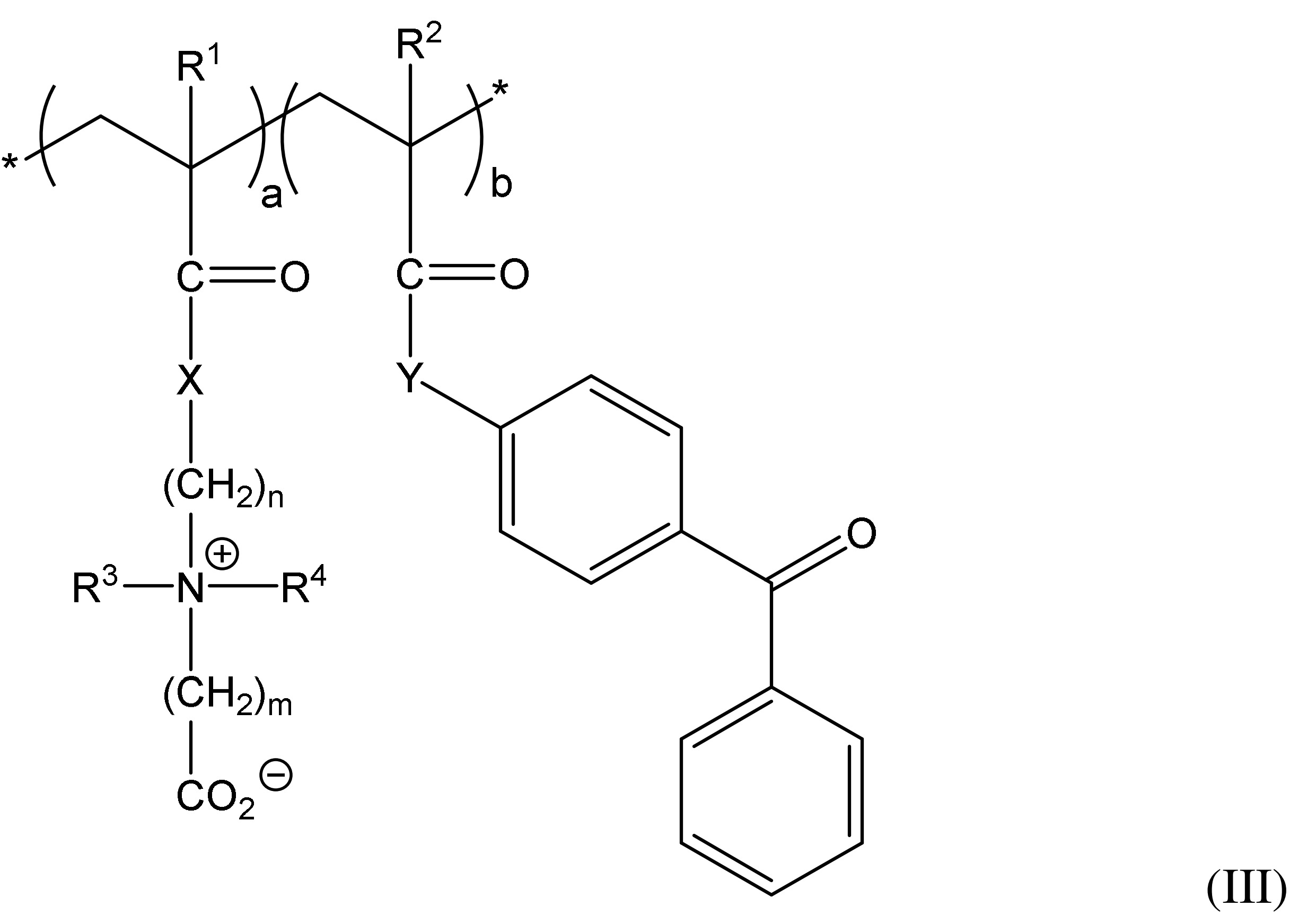
在特定的這些具體實施例中,R1 為氫或甲基,R2 為氫或甲基,R3 與R4 為甲基,且X為NH及Y為NH。在其他的這些具體實施例中,R1 為氫或甲基,R2 為氫或甲基,R3 與R4 為甲基,X為O,及Y為O。在特定具體實施例中,n為2或3。在特定具體實施例中,m為1或2。在特定具體實施例中,a為約0.70至約0.90莫耳百分比。在特定的這些具體實施例中,a為約0.80莫耳百分比。在特定具體實施例中,b為約0.10至約0.30莫耳百分比。在特定的這些具體實施例中,b為約0.20莫耳百分比。In these specific embodiments, R 1 is hydrogen or methyl, R 2 is hydrogen or methyl, R 3 and R 4 are methyl, and X is NH and Y is NH. In these other specific embodiments, R 1 is hydrogen or methyl, R 2 is hydrogen or methyl, R 3 and R 4 are methyl, X is O, and Y is O. In certain embodiments, n is 2 or 3. In certain embodiments, m is 1 or 2. In certain embodiments, a is about 0.70 to about 0.90 mole percent. In certain of these specific embodiments, a is about 0.80 mole percent. In certain embodiments, b is about 0.10 to about 0.30 mole percent. In certain of these specific embodiments, b is about 0.20 mole percent.
在一具體實施例中,該方法利用式(III)之共聚物,其中R1 為氫,R2 為氫,R3 與R4 為甲基,X為NH,Y為NH,n為3,及m為1。在特定的這些具體實施例中,a為約0.80莫耳百分比。在特定的這些具體實施例中,b為約0.20莫耳百分比。In a specific embodiment, the method uses a copolymer of formula (III), wherein R 1 is hydrogen, R 2 is hydrogen, R 3 and R 4 are methyl groups, X is NH, Y is NH, and n is 3, And m is 1. In certain of these specific embodiments, a is about 0.80 mole percent. In certain of these specific embodiments, b is about 0.20 mole percent.
在其他具體實施例中,該方法利用式(IV)之共聚物:
在另一態樣中,本發明提供可用於塗覆表面而對經塗覆表面賦與抗沾污性質之兩性離子共聚物。In another aspect, the present invention provides zwitterionic copolymers that can be used to coat surfaces to impart anti-staining properties to the coated surfaces.
在一具體實施例中,本發明提供一種包含第一重複單元及第二重複單元之共聚物,其中各第一重複單元包含側接兩性離子基,及其中各第二重複單元包含有效交聯該共聚物之側接光反應性基。在一相關具體實施例中,該共聚物進一步包含第三重複單元,其中各第三重複單元包含將該共聚物有效吸附到表面之疏水性基。In a specific embodiment, the present invention provides a copolymer comprising a first repeating unit and a second repeating unit, wherein each of the first repeating units includes pendant zwitterionic groups, and each of the second repeating units includes effective crosslinking of the The pendant of the copolymer is photoreactive group. In a related embodiment, the copolymer further includes a third repeating unit, wherein each third repeating unit includes a hydrophobic group that effectively adsorbs the copolymer to the surface.
在另一具體實施例中,本發明提供一種包含第一重複單元、選用第二重複單元、及選用第三重複單元之共聚物,其條件為該共聚物包含至少第一重複單元與選用第二重複單元、或至少第一重複單元與選用第三重複單元,其中各第一重複單元包含側接兩性離子基,其中各第二重複單元包含有效交聯該共聚物之側接光反應性基,及其中各第三重複單元包含將該共聚物有效吸附到表面之側接疏水性基。In another specific embodiment, the present invention provides a copolymer comprising a first repeating unit, a second repeating unit, and a third repeating unit. The condition is that the copolymer includes at least the first repeating unit and the second repeating unit. The repeating unit, or at least the first repeating unit and optional third repeating unit, wherein each first repeating unit includes a pendant zwitterionic group, and each second repeating unit includes a pendant photoreactive group that effectively crosslinks the copolymer, Each of the third repeating units includes pendant hydrophobic groups that effectively adsorb the copolymer to the surface.
在一進一步具體實施例中,本發明提供由式(I)表示之共聚物: *-(P1 )a (P2 )x (P3 )y -* (I) 其中 P1 為具有側接兩性離子基之重複單元, P2 為具有側接疏水性基之重複單元, P3 為具有側接光反應性基之重複單元, a為約0.10至約0.90莫耳百分比, x為0至約0.95莫耳百分比, y為0至約0.95莫耳百分比, 其條件為x與y不均為0,及 a + x + y為1.0。In a further specific embodiment, the present invention provides a copolymer represented by formula (I): *-(P 1 ) a (P 2 ) x (P 3 ) y -* (I) where P 1 is a side connection The repeating unit of zwitterionic group, P 2 is the repeating unit with pendant hydrophobic group, P 3 is the repeating unit with pendant photoreactive group, a is about 0.10 to about 0.90 mole percent, and x is 0 to about 0.95 mole percentage, y is 0 to about 0.95 mole percentage, and the condition is that x and y are not both 0, and a + x + y is 1.0.
在另一具體實施例中,本發明提供具有式(II)之兩性離子/疏水性共聚物: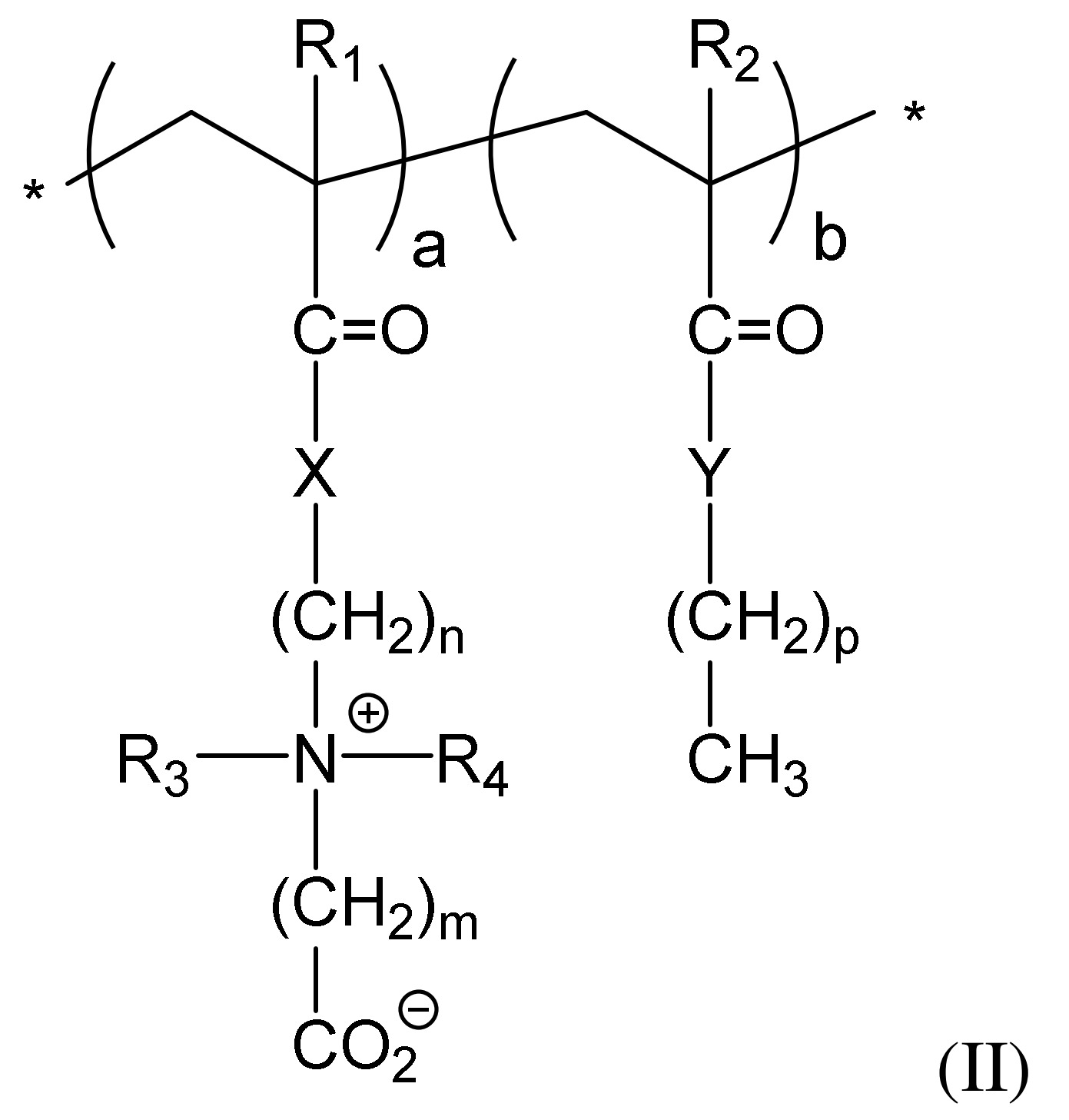
在另一具體實施例中,本發明提供具有式(III)之兩性離子/疏水性共聚物: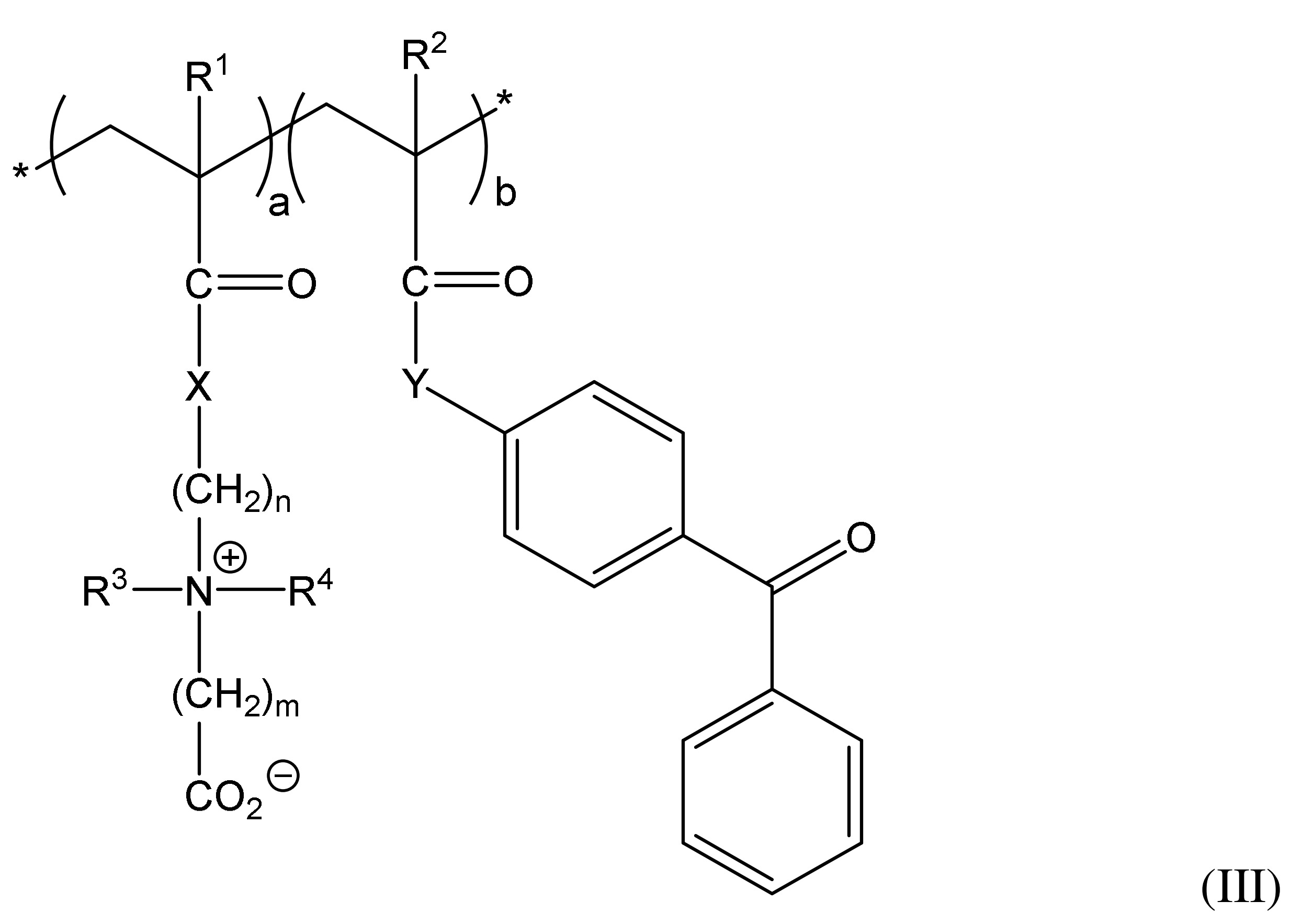
在一進一步具體實施例中,本發明提供具有式(IV)之兩性離子/疏水性共聚物: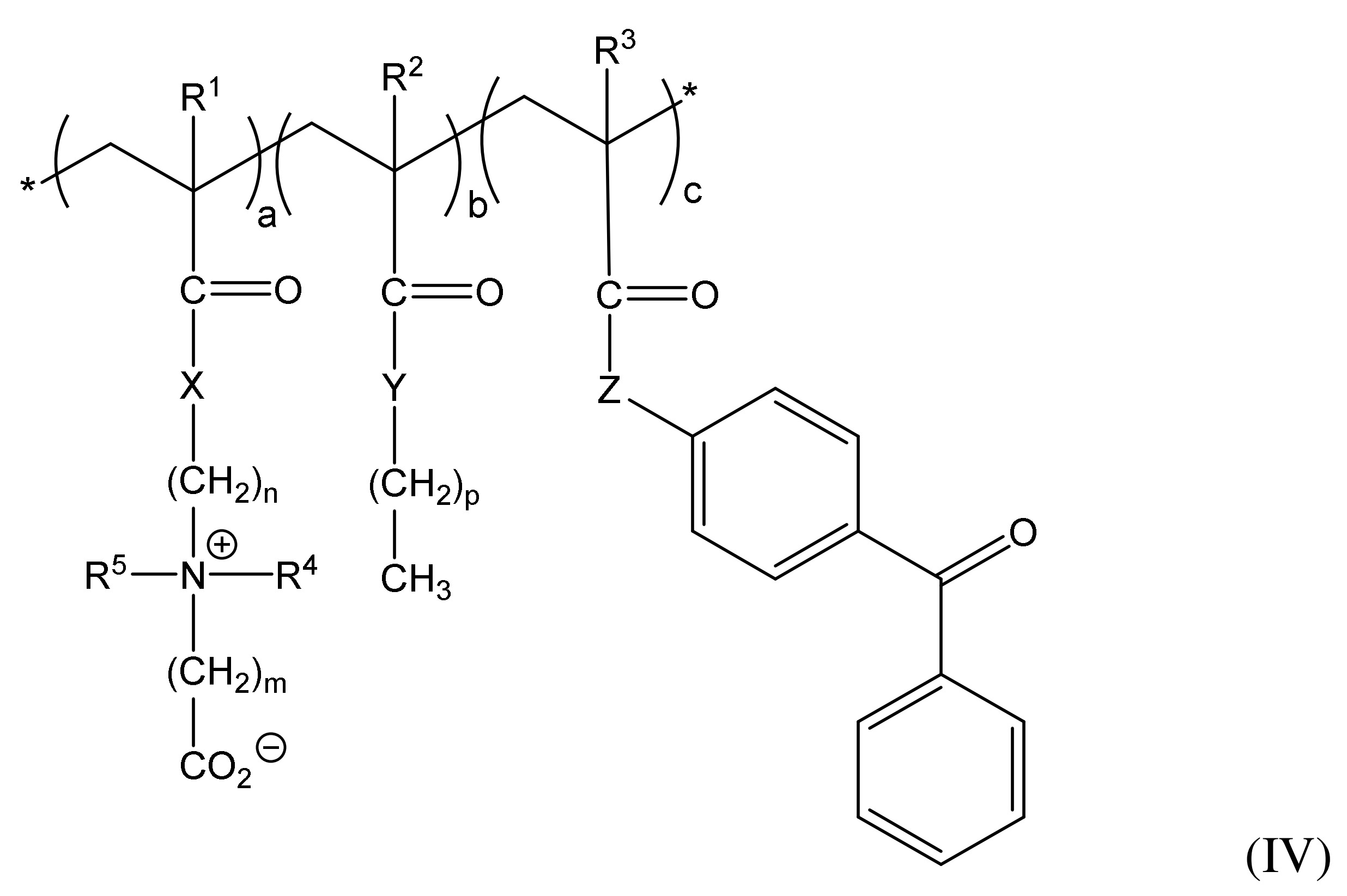
在進一步態樣中,本發明提供包括兩性離子共聚物之塗料組成物、及使用該兩性離子共聚物與塗料組成物製備的經塗覆表面。在特定具體實施例中,該塗料組成物包括在此所述的兩性離子共聚物,視情況及載劑。在特定具體實施例中,該塗料包括在此所述的兩性離子共聚物,或為衍生自在此所述的兩性離子共聚物(例如經光交聯的兩性離子共聚物)。In a further aspect, the present invention provides a coating composition including a zwitterionic copolymer, and a coated surface prepared using the zwitterionic copolymer and the coating composition. In certain embodiments, the coating composition includes the zwitterionic copolymer described herein, as appropriate, and a carrier. In certain embodiments, the coating includes the zwitterionic copolymer described herein, or is derived from the zwitterionic copolymer described herein (e.g., a photocrosslinked zwitterionic copolymer).
在特定具體實施例中,本發明提供一種其表面之至少一部分或全部經本發明之兩性離子共聚物塗覆的基材。合適的表面包括烴系表面及塑膠表面。代表性表面包括聚烯烴、聚酯、聚碳酸酯、聚胺基甲酸酯(PU)、聚碸(PSF)、聚(醚碸)(PES)、聚醯胺、聚丙烯酸系、聚醯亞胺、芳香族聚酯、聚乙烯(PE)、聚丙烯(PP)、聚苯乙烯(PS)、聚(對苯二甲酸乙二酯)(PET)、聚(氯乙烯)(PVC)、聚(二甲基矽氧烷)(PMDS)、聚(偏二氟乙烯)(PVDF)、聚(乳酸)(PLA)、及聚(甲基丙烯酸甲酯)(PMMA)表面。在特定具體實施例中,該表面為聚氯乙烯表面或聚胺基甲酸酯表面。在其他具體實施例中,該表面為纖維素或乙酸纖維素表面。In a specific embodiment, the present invention provides a substrate whose surface is at least partially or entirely coated with the zwitterionic copolymer of the present invention. Suitable surfaces include hydrocarbon surfaces and plastic surfaces. Representative surfaces include polyolefin, polyester, polycarbonate, polyurethane (PU), poly (PSF), poly (ether sulfite) (PES), polyamide, polyacrylic, polyamide Amine, aromatic polyester, polyethylene (PE), polypropylene (PP), polystyrene (PS), poly(ethylene terephthalate) (PET), poly(vinyl chloride) (PVC), poly (Dimethylsiloxane) (PMDS), poly(vinylidene fluoride) (PVDF), poly(lactic acid) (PLA), and poly(methyl methacrylate) (PMMA) surfaces. In certain embodiments, the surface is a polyvinyl chloride surface or a polyurethane surface. In other specific embodiments, the surface is a cellulose or cellulose acetate surface.
在特定具體實施例中,該基材為PVC管件、聚胺基甲酸酯管件、聚碸透析膜、或烴系膜容器。In a specific embodiment, the substrate is a PVC pipe fitting, a polyurethane pipe fitting, a poly dialysis membrane, or a hydrocarbon membrane container.
在特定具體實施例中,該基材為其表面之至少一部分或全部經在此所述的兩性離子共聚物塗覆之醫療器材。In a specific embodiment, the substrate is a medical device whose surface is at least partly or entirely coated with the zwitterionic copolymer described herein.
在特定具體實施例中,該器材為第I類、第II類、或第III類之植入/非植入醫療器材。在特定具體實施例中,該器材為板、盤、管件、尖端物、導管、人造血管、人工心臟、或人工肺。在其他具體實施例中,該器材為血透析器、PVC管件、或聚胺基甲酸酯管件。In certain embodiments, the device is an implanted/non-implanted medical device of type I, type II, or type III. In certain embodiments, the device is a plate, disc, tube, tip, catheter, artificial blood vessel, artificial heart, or artificial lung. In other specific embodiments, the equipment is a hemodialysis device, a PVC pipe fitting, or a polyurethane pipe fitting.
本發明之另一態樣提供使用該兩性離子共聚物之方法。Another aspect of the present invention provides a method of using the zwitterionic copolymer.
在一具體實施例中,本發明提供一種塗覆基材表面之方法,其包含將該表面以包含在此所述的本發明兩性離子共聚物之組成物接觸。In one embodiment, the present invention provides a method of coating the surface of a substrate, which comprises contacting the surface with a composition comprising the zwitterionic copolymer of the present invention described herein.
在一相關具體實施例中,本發明提供一種塗覆基材表面之方法,其包含: (a)將基材表面之至少一部分以包含在此所述的兩性離子共聚物之組成物塗覆;及 (b)將該基材表面以有效交聯該共聚物之光進行照射。In a related embodiment, the present invention provides a method for coating the surface of a substrate, which comprises: (a) Coating at least a part of the surface of the substrate with a composition comprising the zwitterionic copolymer described herein; and (b) Irradiating the surface of the substrate with light that effectively crosslinks the copolymer.
在另一具體實施例中,本發明提供一種使基材表面抗沾污之方法,其包含將該表面之至少一部分以包含在此所述的兩性離子共聚物之組成物塗覆。In another embodiment, the present invention provides a method for making the surface of a substrate stain resistant, which comprises coating at least a portion of the surface with a composition comprising the zwitterionic copolymer described herein.
在一相關具體實施例中,本發明提供一種使基材表面抗沾污之方法,其包含: (a)將基材表面之至少一部分以包含在此所述的兩性離子共聚物之組成物塗覆;及 (b)將該基材表面以有效交聯該共聚物之光進行照射。In a related embodiment, the present invention provides a method for making the surface of a substrate stain resistant, which comprises: (a) Coating at least a part of the surface of the substrate with a composition comprising the zwitterionic copolymer described herein; and (b) Irradiating the surface of the substrate with light that effectively crosslinks the copolymer.
在一進一步具體實施例中,本發明提供一種抑制基材表面上的血蛋白吸附之方法,其包含將該表面之至少一部分以包含在此所述的兩性離子共聚物之組成物塗覆。In a further embodiment, the present invention provides a method for inhibiting the adsorption of blood proteins on the surface of a substrate, which comprises coating at least a part of the surface with a composition comprising the zwitterionic copolymer described herein.
在一相關方法中,本發明提供一種抑制基材表面上的血蛋白吸附之方法,其包含: (a)將基材表面之至少一部分以包含在此所述的兩性離子共聚物之組成物塗覆;及 (b)將該基材表面以有效交聯該共聚物之光進行照射。In a related method, the present invention provides a method for inhibiting the adsorption of blood proteins on the surface of a substrate, which comprises: (a) Coating at least a part of the surface of the substrate with a composition comprising the zwitterionic copolymer described herein; and (b) Irradiating the surface of the substrate with light that effectively crosslinks the copolymer.
在另一具體實施例中,本發明提供一種抑制或防止塑化劑從基材表面滲出之方法,其包含: (a)將基材表面之至少一部分以包含在此所述的兩性離子共聚物之組成物塗覆,而提供經塗覆表面。In another specific embodiment, the present invention provides a method for inhibiting or preventing the exudation of plasticizer from the surface of a substrate, which comprises: (a) Coating at least a part of the surface of the substrate with a composition containing the zwitterionic copolymer described herein to provide a coated surface.
在一相關具體實施例中,本發明提供一種抑制或防止塑化劑從基材表面滲出之方法,其包含: (a)將基材表面之至少一部分以包含在此所述的光反應性兩性離子共聚物之組成物塗覆,而提供經塗覆表面;及 (b)將該經塗覆表面以有效交聯表面上的共聚物之光進行照射,因而提供有效抑制或防止塑化劑從表面滲出的經塗覆表面。In a related embodiment, the present invention provides a method for inhibiting or preventing the exudation of plasticizer from the surface of a substrate, which comprises: (a) coating at least a part of the surface of the substrate with a composition comprising the photoreactive zwitterionic copolymer described herein to provide a coated surface; and (b) The coated surface is irradiated with light that effectively crosslinks the copolymer on the surface, thereby providing a coated surface that effectively inhibits or prevents the seepage of the plasticizer from the surface.
在特定的以上方法中,將表面以組成物接觸或塗覆包含將該表面浸入該組成物(例如兩性離子共聚物)中。在其他具體實施例中,將表面以組成物接觸或塗覆包含將該組成物噴灑、旋塗、刷塗、或滾轉到該表面上。In the specific above method, contacting or coating the surface with the composition includes immersing the surface in the composition (for example, a zwitterionic copolymer). In other specific embodiments, contacting or coating the surface with the composition includes spraying, spinning, brushing, or rolling the composition onto the surface.
合適的表面包括烴系表面及塑膠表面。代表性表面包括聚烯烴、聚酯、聚碳酸酯、聚胺基甲酸酯(PU)、聚碸(PSF)、聚(醚碸)(PES)、聚醯胺、聚丙烯酸系、聚醯亞胺、芳香族聚酯、聚乙烯(PE)、聚丙烯(PP)、聚苯乙烯(PS)、聚(對苯二甲酸乙二酯)(PET)、聚(氯乙烯)(PVC)、聚(二甲基矽氧烷)(PMDS)、聚(偏二氟乙烯)(PVDF)、聚(乳酸)(PLA)、及聚(甲基丙烯酸甲酯)(PMMA)表面。在特定具體實施例中,該表面為聚氯乙烯表面或聚胺基甲酸酯表面。在其他具體實施例中,該表面為纖維素或乙酸纖維素表面。Suitable surfaces include hydrocarbon surfaces and plastic surfaces. Representative surfaces include polyolefin, polyester, polycarbonate, polyurethane (PU), poly (PSF), poly (ether sulfite) (PES), polyamide, polyacrylic, polyamide Amine, aromatic polyester, polyethylene (PE), polypropylene (PP), polystyrene (PS), poly(ethylene terephthalate) (PET), poly(vinyl chloride) (PVC), poly (Dimethylsiloxane) (PMDS), poly(vinylidene fluoride) (PVDF), poly(lactic acid) (PLA), and poly(methyl methacrylate) (PMMA) surfaces. In certain embodiments, the surface is a polyvinyl chloride surface or a polyurethane surface. In other specific embodiments, the surface is a cellulose or cellulose acetate surface.
本發明提供兩性離子共聚物,及其用於塗料以對表面,尤其是血液接觸醫療器材的表面,賦與抗沾污及官能性之用途。本發明提供經官能化以固定於表面之兩性離子共聚物、包括該兩性離子共聚物之塗料組成物、由該兩性離子共聚物製備的表面塗料、表面經該兩性離子共聚物修改之基材、及表面經該兩性離子共聚物修改之醫療器材。兩性離子共聚物 The present invention provides zwitterionic copolymers and their use in coatings to impart anti-staining and functional properties to surfaces, especially blood-contacting medical equipment surfaces. The present invention provides a zwitterionic copolymer functionalized to be fixed on the surface, a coating composition including the zwitterionic copolymer, a surface coating prepared from the zwitterionic copolymer, a substrate whose surface is modified by the zwitterionic copolymer, And medical devices whose surfaces are modified by the zwitterionic copolymer. Zwitterionic copolymer
在一態樣中,本發明提供經官能化以固定於表面之兩性離子共聚物。In one aspect, the present invention provides zwitterionic copolymers functionalized to be immobilized on the surface.
在特定具體實施例中,本發明提供一種可用於塗覆表面之共聚物,該共聚物包含第一重複單元及第二重複單元,其中各第一重複單元包含側接兩性離子基,及其中各第二重複單元包含將該共聚物有效交聯到塑膠表面之側接光反應性基。在特定的這些具體實施例中,該共聚物進一步包含第三重複單元,其中各第三重複單元包含將該共聚物有效吸附到塑膠表面之疏水性基。In a specific embodiment, the present invention provides a copolymer that can be used to coat a surface. The copolymer includes a first repeating unit and a second repeating unit, wherein each first repeating unit includes a pendant zwitterionic group, and each The second repeating unit contains pendant photoreactive groups that effectively crosslink the copolymer to the plastic surface. In these specific embodiments, the copolymer further includes a third repeating unit, wherein each third repeating unit includes a hydrophobic group that effectively adsorbs the copolymer to the plastic surface.
在特定具體實施例中,本發明提供一種可用於塗覆表面之共聚物,該共聚物包含第一重複單元、選用第二重複單元、及選用第三重複單元,其條件為該共聚物包含至少第一重複單元與選用第二重複單元、或至少第一重複單元與選用第三重複單元,其中各第一重複單元包含側接兩性離子基,其中各第二重複單元包含將該共聚物有效交聯到表面之側接光反應性基,及其中各第三重複單元包含將該共聚物有效吸附到表面之側接疏水性基。在這些具體實施例中,該共聚物由式(I)表示: *-(P1 )a (P2 )x (P3 )y -* (I) 其中 P1 為具有側接兩性離子基之重複單元, P2 為具有側接疏水性基之重複單元, P3 為具有側接光反應性基之重複單元, a為約0.10至約0.90莫耳百分比, x為0至約0.95莫耳百分比, y為0至約0.95莫耳百分比, 其條件為x與y不均為0,及 a + x + y為1.0。In a specific embodiment, the present invention provides a copolymer that can be used to coat a surface. The copolymer includes a first repeating unit, a second repeating unit, and a third repeating unit, provided that the copolymer includes at least The first repeating unit and the optional second repeating unit, or at least the first repeating unit and the optional third repeating unit, wherein each first repeating unit contains a pendant zwitterionic group, and each second repeating unit contains the effective cross-linking of the copolymer The pendant photoreactive group connected to the surface, and each third repeating unit therein includes a pendant hydrophobic group that effectively adsorbs the copolymer to the surface. In these specific examples, the copolymer is represented by formula (I): *-(P 1 ) a (P 2 ) x (P 3 ) y -* (I) where P 1 is a pendent zwitterionic group Repeating unit, P 2 is a repeating unit with pendant hydrophobic groups, P 3 is a repeating unit with pendant photoreactive groups, a is about 0.10 to about 0.90 mole percent, x is 0 to about 0.95 mole percent , Y is 0 to about 0.95 mole percentage, provided that x and y are not both 0, and a + x + y is 1.0.
本發明之共聚物包含衍生自可聚合單體與共單體的重複單元。在由式(I)表示的共聚物中,重複單元P1 、P2 與P3 一起形成共聚物之主幹。各重複單元包括兩性離子基、疏水性基、或光反應性基。在特定具體實施例中,各兩性離子基、疏水性基、及光反應性基為側接基(即這些基從共聚物主幹懸垂)。在特定的這些具體實施例中,該具有側接基之共聚物係由具有該側接基之可聚合單體與共單體製備。The copolymer of the present invention contains repeating units derived from polymerizable monomers and comonomers. In the copolymer represented by formula (I), the repeating units P 1 , P 2 and P 3 together form the backbone of the copolymer. Each repeating unit includes a zwitterionic group, a hydrophobic group, or a photoreactive group. In certain embodiments, each zwitterionic group, hydrophobic group, and photoreactive group are pendant groups (that is, these groups are suspended from the backbone of the copolymer). In these specific embodiments, the copolymer with pendant groups is prepared from polymerizable monomers and comonomers with pendant groups.
共聚物主幹的本性並不嚴格,只要主幹不負面影響共聚物的整體性能;共聚物之兩性離子基、疏水性基、及光反應性基的性能。合適的共聚物主幹包括聚酯、聚碳酸酯、聚胺基甲酸酯、聚脲、聚硫化物、聚碸、聚醯亞胺、聚環氧化物、芳香族聚酯、纖維素系、氟聚合物、聚丙烯酸系、聚醯胺、聚酐、聚醚、乙烯基聚合物、酚系、彈性體、及其他加成聚合物。代表性共聚物主幹包括在此詳述者。The nature of the copolymer backbone is not critical, as long as the backbone does not negatively affect the overall performance of the copolymer; the properties of the zwitterionic group, hydrophobic group, and photoreactive group of the copolymer. Suitable copolymer backbones include polyester, polycarbonate, polyurethane, polyurea, polysulfide, polyimide, polyimide, polyepoxide, aromatic polyester, cellulosic, fluorine Polymers, polyacrylic, polyamides, polyanhydrides, polyethers, vinyl polymers, phenols, elastomers, and other addition polymers. Representative copolymer backbones include those detailed here.
在此使用的術語「兩性離子基」表示包括至少兩個官能基之基,其一為正且另一為負電荷,及該基之淨電荷為零。代表性兩性離子基包括羧基甜菜鹼(CB)基、硫代甜菜鹼(SB)基、磷代甜菜鹼(PHB)基、與磷酸膽鹼(PC)基。該兩性離子基對經該共聚物處理或塗覆的表面賦與低沾污及可官能化性質。The term "zwitterionic group" as used herein refers to a group including at least two functional groups, one of which is positive and the other is negative, and the net charge of the group is zero. Representative zwitterionic groups include carboxybetaine (CB) group, thiobetaine (SB) group, phosphobetaine (PHB) group, and phosphocholine (PC) group. The zwitterionic group imparts low staining and functionalizable properties to the surface treated or coated with the copolymer.
術語「疏水性基」表示為烴且本性為非極性之基。該疏水性基用以利於共聚物結合經該共聚物處理的表面(例如經由疏水性-疏水性交互作用)。該共聚物之疏水性基的本性並不嚴格,只要該基可使共聚物結合到表面足以達成經處理或塗覆的表面之意圖用途,及不會不良影響共聚物之兩性離子基或光反應性基的性能。合適的疏水性基包括烴基,如具有2個或以上、3個或以上、或4個或以上的碳之烷基與伸烷基(例如乙基、伸乙基、丙基、伸丙基、丁基、伸丁基)。代表性疏水性基包括C3-C20烷基(例如正丁基)、含苯環基(例如苯基)、氟化烷基(例如三氟甲基)、及氟化芳基。The term "hydrophobic group" means a hydrocarbon and non-polar in nature. The hydrophobic group is used to facilitate the binding of the copolymer to the surface treated with the copolymer (for example, through hydrophobic-hydrophobic interaction). The nature of the hydrophobic base of the copolymer is not critical, as long as the base can bind the copolymer to the surface enough to achieve the intended use of the treated or coated surface, and does not adversely affect the zwitterionic group or photoreaction of the copolymer Sex-based performance. Suitable hydrophobic groups include hydrocarbon groups, such as alkyl groups and alkylene groups having 2 or more, 3 or more, or 4 or more carbons (e.g., ethyl, ethylene, propyl, propylene, Butyl, butylated). Representative hydrophobic groups include C3-C20 alkyl groups (such as n-butyl), benzene ring-containing groups (such as phenyl), fluorinated alkyl groups (such as trifluoromethyl), and fluorinated aryl groups.
術語「光反應性基」表示在以紫外光照射時對交聯變為反應性之基。側接光反應性基(即交聯基)用以利於共聚物結合經該共聚物處理的表面。該共聚物之光反應性基的本性並不嚴格,只要該基可使共聚物交聯到表面足以安定該經處理或經塗覆表面上的共聚物,及不會不良影響共聚物之兩性離子基或疏水性基的性能。合適的光反應性基包括在以適當波長之光(例如紫外線,250-370奈米)照射時進行交聯之基。合適的光反應性基衍生自芳香族酮類、疊氮化物類、重氮二氮環丙烯基。代表性光反應性基包括二苯基酮、苯乙酮、苯基疊氮化物類、芳基疊氮化物類(例如苯基疊氮化物)、疊氮基-甲基-香豆素類、蒽醌類、及補骨脂素衍生物。The term "photoreactive group" means a group that becomes reactive to crosslinking when irradiated with ultraviolet light. Pendant photoreactive groups (ie, crosslinking groups) are used to facilitate the bonding of the copolymer to the surface treated by the copolymer. The nature of the photoreactive base of the copolymer is not critical, as long as the base can crosslink the copolymer to the surface enough to stabilize the copolymer on the treated or coated surface, and will not adversely affect the zwitterions of the copolymer Base or hydrophobic base performance. Suitable photoreactive groups include groups that undergo cross-linking when irradiated with light of an appropriate wavelength (for example, ultraviolet light, 250-370 nm). Suitable photoreactive groups are derived from aromatic ketones, azides, and diazocyclopropenyl groups. Representative photoreactive groups include diphenyl ketone, acetophenone, phenyl azides, aryl azides (e.g. phenyl azides), azido-methyl-coumarins, Anthraquinones, and psoralen derivatives.
在此所述的兩性離子聚合物之光反應性基有效交聯該共聚物。該光反應性基亦將該兩性離子共聚物有效交聯到其上已塗覆該共聚物的表面,其中該表面包括對該光反應性基為反應性之C-H。該兩性離子共聚物可被交聯之代表性表面包括含C-H的表面,如聚乙烯、聚苯乙烯、聚對苯二甲酸乙二酯、聚氯乙烯、及環狀聚烯烴表面。在此所述的光反應性兩性離子共聚物不交聯到不包括C-H反應性基的金屬、金屬合金、或陶瓷表面。使用在此所述的光反應性兩性離子共聚物提供具有耐久性網狀聚合物膜的表面。The photoreactive group of the zwitterionic polymer described herein effectively crosslinks the copolymer. The photoreactive group also effectively crosslinks the zwitterionic copolymer to the surface on which the copolymer has been coated, wherein the surface includes C-H reactive to the photoreactive group. Representative surfaces on which the zwitterionic copolymer can be crosslinked include C-H-containing surfaces, such as polyethylene, polystyrene, polyethylene terephthalate, polyvinyl chloride, and cyclic polyolefin surfaces. The photoreactive zwitterionic copolymers described herein are not cross-linked to the surface of metals, metal alloys, or ceramics that do not include C-H reactive groups. The use of the photoreactive zwitterionic copolymer described herein provides a surface with a durable network polymer film.
在其他具體實施例中,該兩性離子共聚物包括以光及熱活化之交聯基。在進一步具體實施例中,該共聚物包括以熱活化之交聯基。In other specific embodiments, the zwitterionic copolymer includes a crosslinking group activated by light and heat. In a further embodiment, the copolymer includes a crosslinking group activated by heat.
本發明及可用於本發明方法之共聚物包括藉共單體共聚合所製備的無規共聚物(例如帶有兩性離子基之可聚合單體、帶有疏水性基之可聚合單體、及帶有光反應性基之可聚合單體進行共聚合(例如式(I)、(II)、(III)、及(IV)之共聚物))。在此所述及顯示的共聚物化學式中,描述包括兩性離子基的重複單元、包括疏水性基的重複單元、及包括光反應性基的重複單元。參見例如式(I)、(II)、(III)、及(IV)。該描述不意圖限制該共聚物的本性;所描述的共聚物可為具有指定數量的重複單元之無規共聚物(例如式(I)有“a”個包括兩性離子基的重複單元、“x”個包括疏水性基的重複單元、及“y”個包括光反應性基的重複單元)。The present invention and the copolymers that can be used in the method of the present invention include random copolymers prepared by copolymerization of comonomers (e.g., polymerizable monomers with zwitterionic groups, polymerizable monomers with hydrophobic groups, and Polymerizable monomers with photoreactive groups are copolymerized (for example, copolymers of formula (I), (II), (III), and (IV))). In the copolymer chemical formula described and shown here, the repeating unit including a zwitterionic group, the repeating unit including a hydrophobic group, and the repeating unit including a photoreactive group are described. See, for example, formulas (I), (II), (III), and (IV). This description is not intended to limit the nature of the copolymer; the described copolymer may be a random copolymer with a specified number of repeating units (for example, formula (I) has "a" repeating units including zwitterionic groups, "x "" repeating units including hydrophobic groups, and "y" repeating units including photoreactive groups).
在此所述的共聚物可包括額外的重複單元,只要該額外的重複單元不干擾或不良地影響該共聚物意圖用途的性質,如上所示。這些本發明之共聚物「包含」例如包括兩性離子基的重複單元、包括疏水性基的重複單元、及包括光反應性基的重複單元,以及其他的重複單元。The copolymers described herein may include additional repeating units, as long as the additional repeating units do not interfere with or adversely affect the properties of the copolymer for the intended use, as shown above. These copolymers of the present invention "comprise", for example, repeating units including zwitterionic groups, repeating units including hydrophobic groups, repeating units including photoreactive groups, and other repeating units.
在特定具體實施例中,本發明之共聚物僅包括例如包括兩性離子基的重複單元、包括疏水性基的重複單元、及包括光反應性基的重複單元。這些本發明之共聚物由包括兩性離子基的重複單元、包括疏水性基的重複單元、及包括光反應性基的重複單元所「組成」,且不包括其他的重複單元。In a specific embodiment, the copolymer of the present invention only includes, for example, a repeating unit including a zwitterionic group, a repeating unit including a hydrophobic group, and a repeating unit including a photoreactive group. These copolymers of the present invention are "composed" of repeating units including zwitterionic groups, repeating units including hydrophobic groups, and repeating units including photoreactive groups, and do not include other repeating units.
本發明之兩性離子共聚物包括至多約90莫耳百分比之兩性離子基。對於包括疏水性基的本發明之兩性離子共聚物,該共聚物包括至多約70莫耳百分比之疏水性基。對於包括光反應性基的本發明之兩性離子共聚物,該共聚物包括至多約30莫耳百分比之光反應性基。The zwitterionic copolymer of the present invention includes up to about 90 mole percent zwitterionic groups. For the zwitterionic copolymer of the present invention that includes a hydrophobic group, the copolymer includes up to about 70 mole percent of the hydrophobic group. For the zwitterionic copolymer of the present invention that includes photoreactive groups, the copolymer includes up to about 30 mole percent of photoreactive groups.
本發明之兩性離子共聚物的重量平均分子量為約1,000至約2,000,000。兩性離子 / 疏水性共聚物 The weight average molecular weight of the zwitterionic copolymer of the present invention is about 1,000 to about 2,000,000. Zwitterionic / hydrophobic copolymer
在一具體實施例中,本發明提供具有兩性離子基及疏水性基之共聚物,其各側接共聚物主幹(即兩性離子/疏水性共聚物)。該側接兩性離子基對經該共聚物處理或塗覆的表面賦與低沾污及可官能化性質。該側接疏水性基用以利於共聚物結合經該共聚物處理的表面(例如經由疏水性-疏水性交互作用)。側接共聚物主幹之兩性離子基與疏水性基的相對量可經由共聚物合成方法調整,而得到所欲程度的低沾污及官能化及共聚物對表面的結合,其各可依欲處理或塗覆表面的本性(例如組成)而調節。In a specific embodiment, the present invention provides a copolymer having a zwitterionic group and a hydrophobic group, each of which is pendant to the backbone of the copolymer (ie, a zwitterionic/hydrophobic copolymer). The pendant zwitterionic group imparts low staining and functionalizable properties to the surface treated or coated with the copolymer. The pendant hydrophobic group is used to facilitate the binding of the copolymer to the surface treated with the copolymer (for example, through hydrophobic-hydrophobic interaction). The relative amount of the zwitterionic group and the hydrophobic group of the pendant copolymer backbone can be adjusted by the copolymer synthesis method to obtain the desired degree of low staining and functionalization and the binding of the copolymer to the surface, each of which can be treated as desired Or the nature (such as composition) of the coated surface is adjusted.
在特定態樣中,本發明提供一種經由浸塗技術使用雙親性兩性離子(例如羧基甜菜鹼CB)無規共聚物,對疏水性材料之簡單卻有效的修改方法。調整此系列雙親性共聚物中的親水性及疏水性單元的組成,而探索聚合性雙親性對抗沾污力的影響,並建立表面塗料的最適組成。對塗覆CB無規共聚物的表面測量100%人類血清吸附。將結果比較具有「超低附著表面」之市售96孔培養板者。此外,繼而將CB共聚物表面以抗纖維蛋白原藉CB內羧基與抗原內胺基之間的共價鍵結而官能化。因此,此CB聚合物材料及修改技術因廣泛的應用範圍而被看好,包括抗沾污醫療器材及醫療診斷。In a specific aspect, the present invention provides a simple but effective method for modifying hydrophobic materials using amphiphilic zwitterionic (such as carboxybetaine CB) random copolymers via dip coating technology. Adjust the composition of the hydrophilic and hydrophobic units in this series of amphiphilic copolymers, and explore the influence of polymeric amphiphilicity on stain resistance, and establish the most suitable composition of surface coatings. The 100% human serum adsorption was measured on the surface coated with CB random copolymer. Compare the results with commercially available 96-well culture plates with "ultra-low adhesion surface". In addition, the surface of the CB copolymer was then functionalized with anti-fibrinogen by covalent bonding between the carboxyl group in the CB and the amine group in the antigen. Therefore, this CB polymer material and modification technology are favored for a wide range of applications, including anti-contamination medical equipment and medical diagnosis.
在一具體實施例中,本發明提供式(II)之共聚物: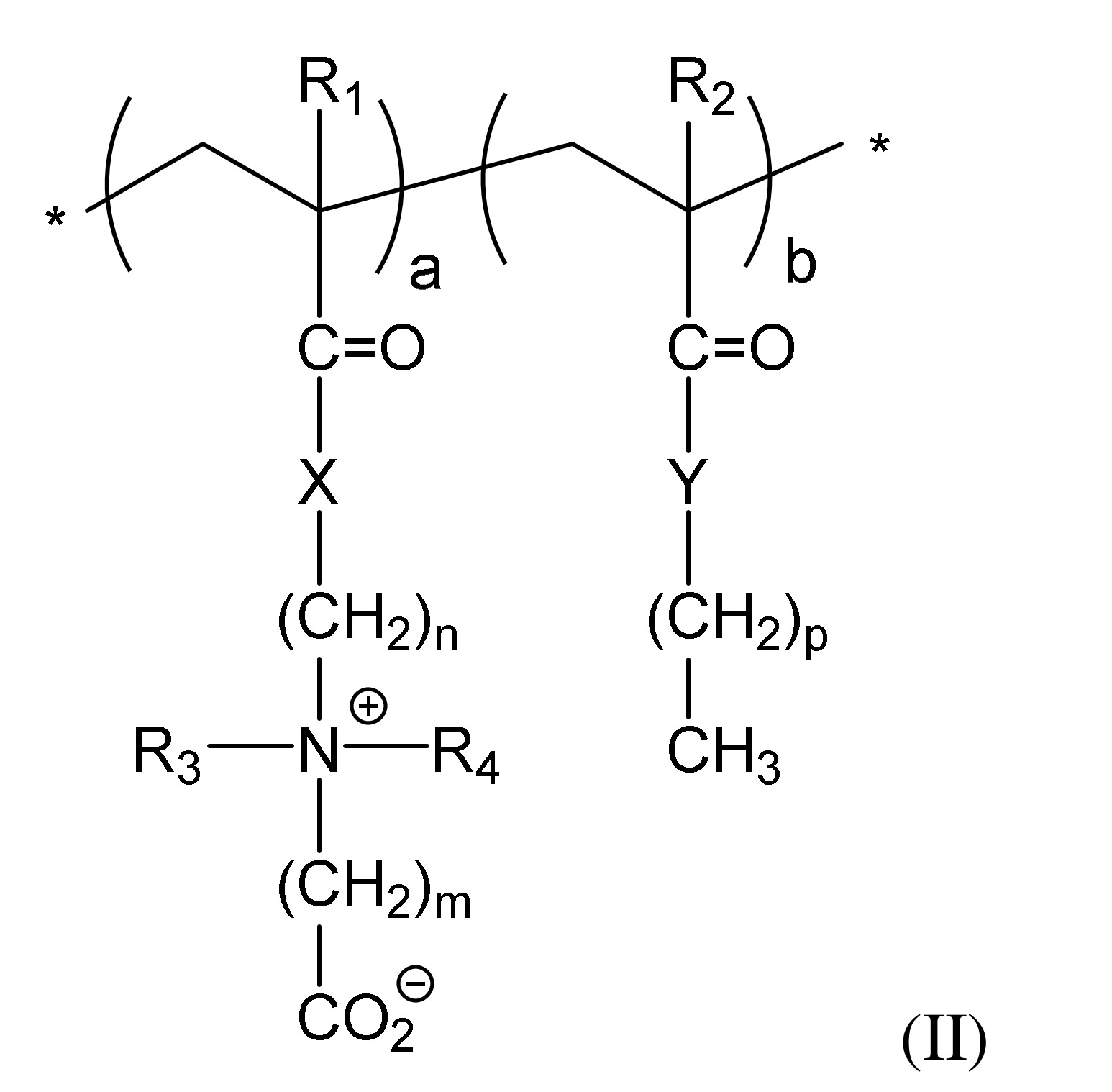
在特定的這些具體實施例中,R1 與R2 獨立選自由氫與甲基所組成的群組。In these specific embodiments, R 1 and R 2 are independently selected from the group consisting of hydrogen and methyl.
在特定具體實施例中,R3 與R4 獨立選自由氫與C1-C3烷基所組成的群組。In certain embodiments, R 3 and R 4 are independently selected from the group consisting of hydrogen and C1-C3 alkyl.
在特定具體實施例中,n為1、2、3、4、5、或6。在一些具體實施例中,n為2或3。In certain embodiments, n is 1, 2, 3, 4, 5, or 6. In some specific embodiments, n is 2 or 3.
在特定具體實施例中,m為1、2、3、4、5、或6。在一些具體實施例中,m為1或2。In certain embodiments, m is 1, 2, 3, 4, 5, or 6. In some specific embodiments, m is 1 or 2.
在特定具體實施例中,p為1、2、3、4、5、或6。在一些具體實施例中,p為3。In certain embodiments, p is 1, 2, 3, 4, 5, or 6. In some embodiments, p is 3.
在特定具體實施例中,a為約0.20至約0.40莫耳百分比。在一些具體實施例中,a為約0.30莫耳百分比。In certain embodiments, a is about 0.20 to about 0.40 mole percent. In some embodiments, a is about 0.30 mole percent.
在特定具體實施例中,b為約0.60至約0.80莫耳百分比。在一些具體實施例中,b為約0.70莫耳百分比。In certain embodiments, b is about 0.60 to about 0.80 mole percent. In some embodiments, b is about 0.70 mole percent.
在特定具體實施例中,R1 為氫或甲基,R2 為氫或甲基,R3 與R4 為甲基,且X為NH及Y為O。In a specific embodiment, R 1 is hydrogen or methyl, R 2 is hydrogen or methyl, R 3 and R 4 are methyl, and X is NH and Y is O.
在其他具體實施例中,R1 為氫或甲基,R2 為氫或甲基,R3 與R4 為甲基,X為O,及Y為O。In other specific embodiments, R 1 is hydrogen or methyl, R 2 is hydrogen or methyl, R 3 and R 4 are methyl, X is O, and Y is O.
在進一步具體實施例中,R1 為氫,R2 為甲基,R3 與R4 為甲基,X為NH,Y為O,n為3,m為1,及p為2。在特定的這些具體實施例中,a為約0.30莫耳百分比。In a further specific embodiment, R 1 is hydrogen, R 2 is methyl, R 3 and R 4 are methyl, X is NH, Y is O, n is 3, m is 1, and p is 2. In certain of these specific embodiments, a is about 0.30 mole percent.
在其他具體實施例中,R1 為甲基,R2 為甲基,R3 與R4 為甲基,X為O,Y為O,n為2,m為2,及p為2。在特定的這些具體實施例中,a為約0.30莫耳百分比。In other specific embodiments, R 1 is methyl, R 2 is methyl, R 3 and R 4 are methyl, X is O, Y is O, n is 2, m is 2, and p is 2. In certain of these specific embodiments, a is about 0.30 mole percent.
以下說明本發明之代表性兩性離子/疏水性共聚物的製備、特徵化及用途,及其在本發明之組成物及方法中之用途。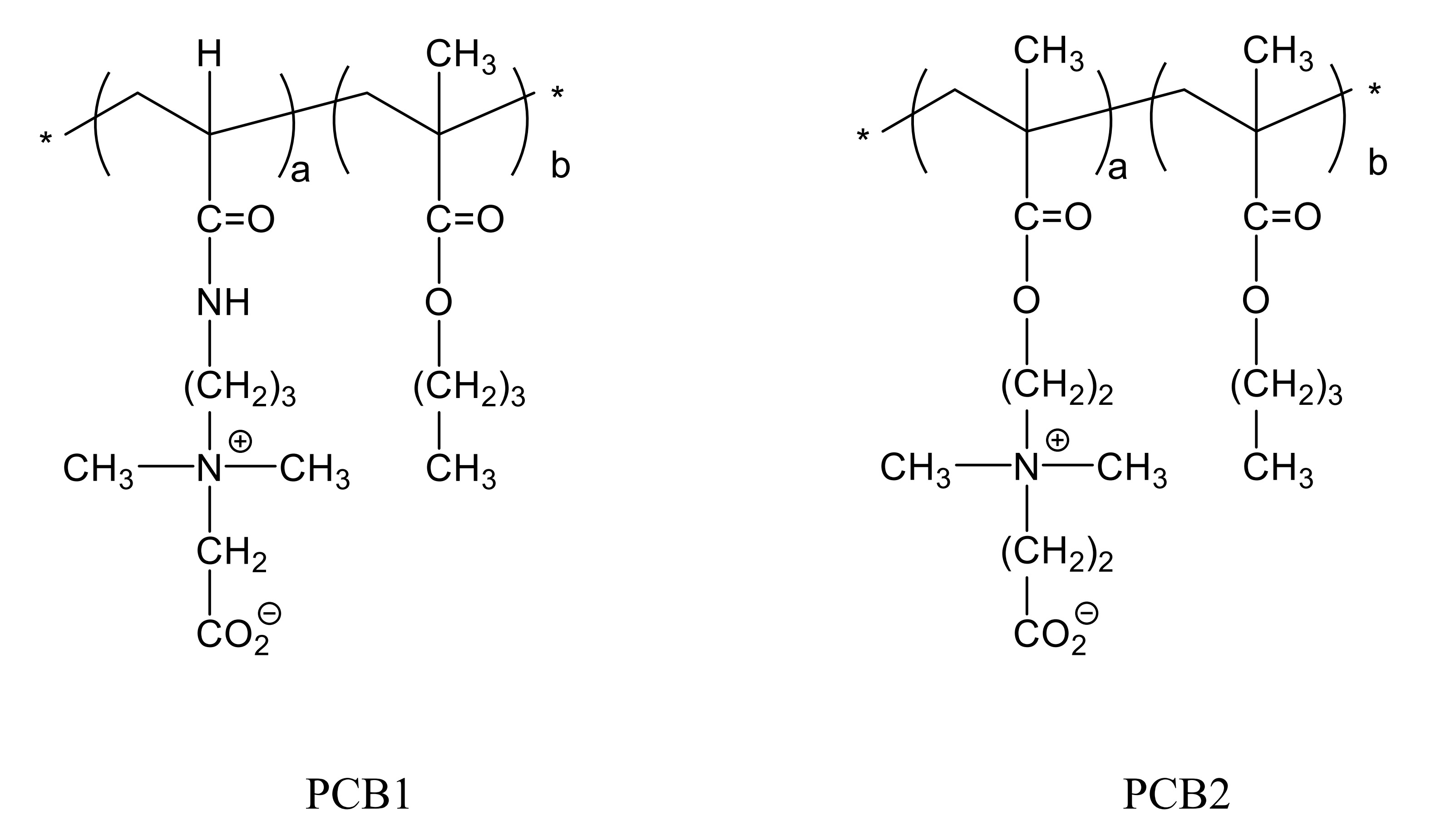
本發明提供一種使用超低沾污/可官能化羧基甜菜鹼(CB)共聚物,經由浸塗技術對疏水性表面賦與超親水性之有效的表面修改方式。一系列具有各種雙親性之CB無規共聚物被合成及塗覆在疏水性聚丙烯(PP)與聚苯乙烯(PS)表面上。藉酵素結合免疫吸附檢驗法(ELISA)篩檢各塗層的抗沾污力,且進一步藉Micro BCA蛋白質檢驗套件針對100%人類血清詳盡評量。含有約30莫耳百分比之CB單元的無規共聚物顯示在DI水中的最大空氣接觸角超過165°之超親水性,且對100%人類血清有最佳的抗沾污力。塗覆最適CB無規共聚物的96孔培養板表面顯示抗沾污力顯著優於具有超低附著表面之市售96孔培養板者。鼠胚纖維母細胞(NIH3T3)對塗覆CB無規共聚物的表面的黏附被完全抑制。此外,將最適的抗沾污CB共聚物表面以抗原經由共價鍵結官能化,如此驗證其與其抗體進行特定的交互作用。因此,此CB無規共聚物可對血液接觸器材的疏水性表面賦與超低沾污及可官能化能力。The present invention provides an effective surface modification method that uses ultra-low staining/functionalizable carboxybetaine (CB) copolymer to impart super-hydrophilicity to hydrophobic surfaces through dip coating technology. A series of CB random copolymers with various amphiphilic properties are synthesized and coated on the surface of hydrophobic polypropylene (PP) and polystyrene (PS). The anti-staining ability of each coating was screened by the enzyme-binding immunosorbent assay (ELISA), and the Micro BCA protein test kit was further used to evaluate the 100% human serum in detail. The random copolymer containing about 30 mole percent of CB units shows super-hydrophilicity with the maximum air contact angle in DI water exceeding 165°, and has the best stain resistance to 100% human serum. The surface of the 96-well culture plate coated with the most suitable CB random copolymer showed significantly better stain resistance than the commercially available 96-well culture plate with ultra-low adhesion surface. The adhesion of mouse embryo fibroblasts (NIH3T3) to the surface coated with CB random copolymer was completely inhibited. In addition, the surface of the most suitable anti-fouling CB copolymer was functionalized with an antigen via covalent bonding, thus verifying its specific interaction with its antibody. Therefore, this CB random copolymer can impart ultra-low staining and functionalization capabilities to the hydrophobic surface of blood contact devices.
以下揭述代表性聚羧基甜菜鹼、其性質、其在製備抗沾污表面之用途、及經塗覆表面的性質。The following describes representative polycarboxybetaines, their properties, their use in preparing stain-resistant surfaces, and the properties of coated surfaces.
無規共聚物之合成 。聚烯烴已被廣泛製造用於生醫應用。然而,這些疏水性聚合烴系材料觸發非特定蛋白質吸附、血小板活化、血凝固、血塊形成、及其他的生物沾污附帶問題。對於實際應用,現在非常希望使用最簡單的方式達成這些目標。自由基聚合方法為從小規模實驗室試驗製造聚合物到大規模產業應用之最常用及有用的方式之一,尤其是乙烯基單體聚合。經由習知自由基聚合方法,使用AIBN作為熱自由基引發劑而合成雙親性無規共聚物。這些反應溶液的黏度隨同65℃聚合處理逐漸增加,表示單體轉化成共聚物。從1 H-NMR光譜中的特徵峰積分值得到各單體的單元比例:CB1單元為3.82 ppm (-CH2 -,2H),CB2單元為2.42 ppm(-CH2 -,2H),及BMA單元為1.45-1.63 ppm(-CH2 -,4H)。關於這些聚合物的化學結構及合成細節分別示於圖2A及2B以及表1(圖3)。聚合物鏈中的親水性CB單元及疏水性BMA單元為無規分布,且全部組成大致等於單體進料溶液的組成。CB無規共聚物在水溶液中的溶解度主要依CB單元組成而定。含有超過30莫耳百分比之CB單元的共聚物易溶於水溶液,而小於30莫耳百分比則便成水不溶性(表1)。因此,含有30莫耳百分比之CB單元的水不溶性CB共聚物為這些共聚物中最佳的塗料材料。這些結果符合含有磷酸膽鹼基之其他無規共聚物,其已被廣泛用於生醫器材的表面修改。 Synthesis of random copolymers . Polyolefins have been widely manufactured for biomedical applications. However, these hydrophobic polymeric hydrocarbon materials trigger non-specific protein adsorption, platelet activation, blood coagulation, blood clot formation, and other biological contamination incidental problems. For practical applications, now I very much hope to use the simplest way to achieve these goals. The free radical polymerization method is one of the most commonly used and useful methods from small-scale laboratory experiments to manufacturing polymers to large-scale industrial applications, especially vinyl monomer polymerization. Through the conventional free radical polymerization method, using AIBN as a thermal free radical initiator to synthesize an amphiphilic random copolymer. The viscosity of these reaction solutions gradually increased with the 65°C polymerization treatment, indicating the conversion of monomers to copolymers. The unit ratio of each monomer is obtained from the integral value of the characteristic peaks in the 1 H-NMR spectrum: CB1 unit is 3.82 ppm (-CH 2 -,2H), CB2 unit is 2.42 ppm (-CH 2 -,2H), and BMA The unit is 1.45-1.63 ppm (-CH 2 -, 4H). The chemical structure and synthesis details of these polymers are shown in Figures 2A and 2B and Table 1 (Figure 3), respectively. The hydrophilic CB units and hydrophobic BMA units in the polymer chain are randomly distributed, and the overall composition is approximately equal to the composition of the monomer feed solution. The solubility of CB random copolymer in aqueous solution is mainly determined by the composition of CB unit. Copolymers containing more than 30 mole percent of CB units are easily soluble in aqueous solutions, and less than 30 mole percent are water-insoluble (Table 1). Therefore, a water-insoluble CB copolymer containing 30 mole percent of CB units is the best coating material among these copolymers. These results are consistent with other random copolymers containing phosphorylcholine groups, which have been widely used in surface modification of biomedical equipment.
空氣接觸角及塗料對蛋白質吸附的篩檢 。疏水性/親水性組成物不同的雙親性CB共聚物可賦與不同的抗沾污力。親水性(CB)單元可促進離子性誘發水合,其可強烈結合水分子而強化抗沾污力。然而,強烈水合力會造成塗料材料從表面脫離。疏水性(BMA)單元在水溶液中強烈結合疏水性基材表面而安定表面上的CB單元,並增加塗料耐久性。因此,將這些塗料無規聚合物以適當的CB/BMA莫耳比例製備為必要的,以將抗沾污及表面結合性質最大化。圖5A及5B中空氣接觸角的結果顯示,含有約30莫耳百分比之CB單元的共聚物呈現空氣接觸角至多165°的超親水性。其超親水性關聯圖6A所示的優良性能,其中具有約30莫耳百分比之CB單元的無規聚合物有最強的蛋白質排斥力。具有更高CB組成的其他聚合物由於其在水溶液中的高溶解度而易從PP表面脫離。雖然PCB1-28及PCB1-37均為水不溶性,但更高的CB組成可增加其針對非特定蛋白質吸附的排斥力。另外,聚合物溶液的濃度為影響兩性離子聚合物塗覆量、因此及抗沾污力的另一必要因素。如圖6B所示,相較於未塗覆基材,Fg吸收量隨聚合物濃度從0.03增加到0.5重量百分比而戲劇性減少,而超過0.5重量百分比則沾污達到飽和為小於15%的相對低程度。另外,PCB1-37及PCB2-37聚合物顯示類似的抗沾污性質(圖4)。 Screening of air contact angle and paint adsorption of protein . Amphiphilic CB copolymers with different hydrophobic/hydrophilic compositions can impart different stain resistance. Hydrophilic (CB) units can promote ionic induction of hydration, which can strongly bind water molecules to enhance stain resistance. However, strong hydration forces can cause the coating material to detach from the surface. The hydrophobic (BMA) unit strongly binds to the surface of the hydrophobic substrate in the aqueous solution to stabilize the CB unit on the surface and increase the durability of the coating. Therefore, it is necessary to prepare these coating random polymers with an appropriate CB/BMA molar ratio to maximize stain resistance and surface bonding properties. The air contact angle results in Figures 5A and 5B show that a copolymer containing about 30 mole percent of CB units exhibits superhydrophilic properties with an air contact angle of up to 165°. Its superhydrophilicity correlates with the excellent performance shown in Figure 6A, in which random polymers with CB units of about 30 mole percent have the strongest protein repulsion. Other polymers with higher CB composition are easily detached from the PP surface due to their high solubility in aqueous solutions. Although PCB1-28 and PCB1-37 are both water-insoluble, a higher CB composition can increase their repulsion for non-specific protein adsorption. In addition, the concentration of the polymer solution is another necessary factor that affects the coating amount of the zwitterionic polymer, and therefore the stain resistance. As shown in Figure 6B, compared to the uncoated substrate, Fg absorption decreases dramatically as the polymer concentration increases from 0.03 to 0.5% by weight, and when the polymer concentration exceeds 0.5% by weight, the contamination reaches a saturation level of less than 15%. degree. In addition, PCB1-37 and PCB2-37 polymers show similar anti-staining properties (Figure 4).
使用分光橢圓偏光儀比較將塗覆CB的金片在PBS (1×, pH 7.4)中浸泡前後的聚合物厚度,而證實CB聚合物(約30莫耳百分比之CB單元)塗層在乾燥條件下的安定性。金基材上經修改CB聚合物層的厚度經計算在浸泡前為29.38±1.10奈米。在將基材浸入PBS中經過2個月後此值未顯著改變,此時膜厚度仍有28.80±0.73奈米。A spectroscopic ellipsometer was used to compare the polymer thickness before and after the CB-coated gold flakes were immersed in PBS (1×, pH 7.4), and it was confirmed that the CB polymer (approximately 30 mole percent of CB units) coating was in dry conditions Stability under. The thickness of the modified CB polymer layer on the gold substrate is calculated to be 29.38±1.10 nm before immersion. This value did not change significantly after immersing the substrate in PBS for 2 months. At this time, the film thickness was still 28.80±0.73 nm.
來自 100% 血蛋白及血清的蛋白質吸附 。血液成分與生物材料之間的交互作用會觸發一系列的後續複雜生物回應,包括蛋白質吸附、血小板黏附/活化、凝血、及血栓形成。血漿蛋白的快速非特定吸附已被視為在血液/材料交互作用期間,在生物材料表面上最先發生的事件。因此,為了了解生物材料的血液相容性,評估主要血漿蛋白(例如纖維蛋白原、白蛋白與γ-球蛋白)的吸附為重要的。重點為,其經常將10%稀釋的單一蛋白質溶液用於此評估,但是此測試條件仍遠異於實際的血液環境。如同在此所述,其使用100%單一血蛋白與100%人類血清。非特定蛋白吸附量係藉Micro BCA蛋白質檢驗套件測試。 Protein adsorption from 100% blood protein and serum . The interaction between blood components and biological materials triggers a series of subsequent complex biological responses, including protein adsorption, platelet adhesion/activation, coagulation, and thrombosis. The rapid non-specific adsorption of plasma proteins has been regarded as the first event that occurs on the surface of biological materials during the blood/material interaction. Therefore, in order to understand the blood compatibility of biological materials, it is important to evaluate the adsorption of major plasma proteins such as fibrinogen, albumin, and gamma-globulin. The point is that it often uses a 10% diluted single protein solution for this evaluation, but the test conditions are still far different from the actual blood environment. As described here, it uses 100% single blood protein and 100% human serum. The amount of non-specific protein adsorption is tested by the Micro BCA protein test kit.
在圖7A至7D中,將塗覆CB聚合物的表面相較於未塗覆表面,不同型式的蛋白質及未稀釋血清的吸附量在10%及100%濃度均顯著降低,表示兩性離子CB聚合物塗層可賦與對疏水性烴系表面超低沾污力。雖然具有超低附著表面之市售96孔培養板可排斥來自低濃度(10%)單一蛋白質溶液的蛋白質吸附,但當蛋白質濃度增加到100%時仍有大約50%之蛋白質吸附(圖7A及7B)。重點為,雖然市售表面可排斥10%濃度的單一血蛋白吸附,但其在100%人類血清或100% γ-球蛋白環境中浸泡後完全失去抗沾污力(圖7C及7D)。In Figures 7A to 7D, comparing the surface of the coated CB polymer to the uncoated surface, the adsorption capacity of different types of protein and undiluted serum is significantly reduced at 10% and 100%, indicating that zwitterionic CB polymerization The material coating can impart ultra-low staining power to hydrophobic hydrocarbon surfaces. Although commercially available 96-well culture plates with ultra-low adhesion surfaces can reject protein adsorption from a low concentration (10%) single protein solution, there is still about 50% protein adsorption when the protein concentration is increased to 100% (Figure 7A and 7B). The point is that although the commercially available surface can reject the adsorption of a single blood protein at a concentration of 10%, it completely loses its stain resistance after being immersed in 100% human serum or 100% γ-globulin environment (Figure 7C and 7D).
細胞黏附 。NIH3T3細胞亦在正常組織培養聚苯乙烯(TCPS)板上黏附、增殖、及移動。在將其接種在部分塗覆兩性離子CB共聚物的TCPS板表面上之後,細胞逐漸黏附在TCPS表面上且散開。相反地,大部分細胞維持球形且無法黏附到CB共聚物表面。在培養72小時且以新鮮介質稍微沖洗之後,在塗覆CB共聚物的表面上未觀察到黏附的細胞,而在通常TCPS表面上的細胞則增殖且達到次合流,且有非常明確的邊界(圖8)。對於纖維母細胞,黏附對於維持多細胞結構及功能為必要的,其對於後續增殖及移動為重要的。纖維接合素在許多種細胞型式的黏附中扮演重要角色,且纖維接合素吸附直接影響對基材表面的細胞黏附。超親水性兩性離子聚合物表面對非特定蛋白質(包括纖維接合素)有優良的抗沾污力。因此,CB聚合物塗層完全防止纖維母細胞黏附。 Cell adhesion . NIH3T3 cells also adhered, proliferated, and migrated on normal tissue culture polystyrene (TCPS) plates. After it was seeded on the surface of TCPS plate partially coated with zwitterionic CB copolymer, the cells gradually adhered to the surface of TCPS and spread out. On the contrary, most cells remain spherical and cannot adhere to the surface of the CB copolymer. After culturing for 72 hours and rinsing slightly with fresh medium, no adherent cells were observed on the surface of the CB copolymer coating, while the cells on the surface of the usual TCPS proliferated and reached sub-confluence, and there was a very clear boundary ( Figure 8). For fibroblasts, adhesion is necessary to maintain multicellular structure and function, and it is important for subsequent proliferation and migration. Fibronectin plays an important role in the adhesion of many types of cells, and the adsorption of fibronectin directly affects cell adhesion to the substrate surface. The surface of super-hydrophilic zwitterionic polymer has excellent stain resistance to non-specific proteins (including fibronectin). Therefore, the CB polymer coating completely prevents the adhesion of fibroblasts.
表面官能化 。為了進一步評估經CB無規共聚物修改的96孔聚苯乙烯培養板對於共軛生物分子的能力及通用性,將Fg及HSA分別經由EDC/NHS偶合化學共價固定。然後經由酵素顯色反應進行抗體偵測。將典型抗體(共軛HRP之抗Fg)加入各孔且確保與表面充分接觸。顏色反應程度可間接顯示抗體偵測量。未活化CB表面在表面上無任何黏附的生物分子而維持抗沾污力,其導致後續未偵測到抗體(圖9,Fg未活化)。共價鍵結HSA而接觸抗Fg的表面亦無特定抗體-抗原誘發結合(圖9,HSA活化及HSA未活化)。表面官能化程度可藉由改變EDC/NHS濃度及抗體共軛緩衝液的pH而調整。先前的研究已顯示,即使與生物分子部分共軛,CB表面仍可維持抗沾污力。因此,將此經CB聚合物修改的96孔培養板用於偵測錯合介質中的生物分子被看好,包括血清、血漿及血液。 Surface functionalization . In order to further evaluate the ability and versatility of the 96-well polystyrene culture plate modified by CB random copolymer for conjugated biomolecules, Fg and HSA were covalently immobilized through EDC/NHS coupling chemistry. Then through the enzyme color reaction for antibody detection. Add a typical antibody (anti-Fg conjugated to HRP) to each well and ensure full contact with the surface. The degree of color response can indirectly indicate the amount of antibody detection. The non-activated CB surface does not have any attached biomolecules on the surface to maintain the anti-staining ability, which leads to subsequent failure to detect antibodies (Figure 9, Fg is not activated). HSA is covalently bonded to the surface of anti-Fg and no specific antibody-antigen induces binding (Figure 9, HSA activated and HSA not activated). The degree of surface functionalization can be adjusted by changing the EDC/NHS concentration and the pH of the antibody conjugate buffer. Previous studies have shown that even if partially conjugated with biomolecules, the CB surface can still maintain stain resistance. Therefore, it is promising that the 96-well culture plate modified by CB polymer is used to detect biomolecules in mismatched media, including serum, plasma and blood.
實施例1揭述本發明之代表性兩性離子/疏水性共聚物的製備、特徵化及用途。兩性離子 / 光反應性共聚物 Example 1 discloses the preparation, characterization and use of the representative zwitterionic/hydrophobic copolymer of the present invention. Zwitterionic / photoreactive copolymer
在另一具體實施例中,本發明提供具有各側接共聚物主幹之兩性離子基及光反應性基的共聚物。側接兩性離子基對經該共聚物處理或塗覆的表面賦與低沾污及可官能化性質。側接光反應性基用以利於共聚物結合(即共價偶合)經該共聚物處理的表面。側接共聚物主幹之兩性離子基與光反應性基的相對量可經由共聚物合成方法調整,而得到所欲程度的低沾污及官能化及共聚物對表面的結合,其各可依欲處理或塗覆表面的本性(例如組成)而調節。In another embodiment, the present invention provides a copolymer having zwitterionic groups and photoreactive groups pendant to the backbone of the copolymer. The pendant zwitterionic groups impart low staining and functionalizable properties to the surface treated or coated with the copolymer. The pendant photoreactive group is used to facilitate the bonding (ie, covalent coupling) of the copolymer to the surface treated by the copolymer. The relative amount of the zwitterionic group and the photoreactive group of the pendant copolymer backbone can be adjusted by the copolymer synthesis method to obtain the desired degree of low staining and functionalization and the binding of the copolymer to the surface. The nature (such as composition) of the treated or coated surface is adjusted.
植入的血液接觸醫療器材表面上的生物沾污仍為不良生物反應的嚴重顧慮。數十年來市場已使用醫療級聚氯乙烯(PVC)材料,尤其是作為血液接觸管件。然而,在臨床應用期間仍面對嚴重的生物沾污問題。本性顯示低黏附及高可濕潤表面為抑制表面生物沾污及非輕度交互作用誘發血液成分變動的關鍵。Biofouling on the surface of the implanted blood contacting medical equipment is still a serious concern for adverse biological reactions. For decades, the market has used medical grade polyvinyl chloride (PVC) materials, especially as blood contact pipe fittings. However, there are still serious biological contamination problems during clinical application. The nature shows that low-adhesion and high-wettable surfaces are the key to inhibiting surface biological contamination and non-mild interactions that induce changes in blood composition.
醫療級聚氯乙烯(PVC)管件抗許多種化學物、溶劑、腐蝕,且預期使用期限長,亦耐大部分滅菌方法。PVC的極光滑表面提供最大的流體流動特徵,且減少會導致非特定血蛋白吸附及細菌生長的沾污累積。然而必須知道,大部分市售醫療級PVC管件摻有塑化劑(至多40%)以確保機械撓性,且其表面為相當疏水性,當接觸人類血液時會造成嚴重的不良反應,包括血蛋白吸附、血小板活化/凝集、紅血球胞溶、補體活化等。雖然目前市場中的醫療級PVC管件數十年來已在醫院中被用於血液接觸應用,但該管件原本並未設計成避免以上問題。基於醫療級疏水性PVC的材料顯然顯示嚴重的凝血酶產生、補體活化等。因此,現在急需對醫療級PVC管件表面賦與生物相容性之組成物及方法。Medical-grade polyvinyl chloride (PVC) pipe fittings are resistant to many kinds of chemicals, solvents, and corrosion, and have a long expected service life, as well as most sterilization methods. The extremely smooth surface of PVC provides maximum fluid flow characteristics and reduces the accumulation of contamination that can cause non-specific blood protein adsorption and bacterial growth. However, it must be known that most of the commercially available medical-grade PVC pipe fittings are mixed with plasticizer (up to 40%) to ensure mechanical flexibility, and their surface is quite hydrophobic, which will cause serious adverse reactions when contacted with human blood, including blood Protein adsorption, platelet activation/agglutination, red blood cell lysis, complement activation, etc. Although medical grade PVC pipe fittings in the current market have been used in hospitals for blood contact applications for decades, the pipe fittings were not originally designed to avoid the above problems. Materials based on medical-grade hydrophobic PVC clearly show severe thrombin production, complement activation, etc. Therefore, there is an urgent need for a composition and method for imparting biocompatibility to the surface of medical grade PVC pipe fittings.
親水性仿生抗沾污材料數十年來已被用於醫療器材的表面塗料。作為獨特的兩性離子材料,聚(羧基甜菜鹼)(PCB)顯示針對未稀釋人類血清或血漿偵測不到蛋白質吸收(<0.3奈克/平方公分),且在廣大範圍的生醫應用中廣泛地報告未觸發不利的生物反應,其超越習知親水性或雙親性聚合物(例如PEG)的性能。具有內部鹽結構的超親水性及電中性之羧基甜菜鹼(CB)基可形成一層不會被生物活性物種取代之強烈結合的水分子,如此完全抑制血液成分與管件表面之間的非特定交互作用。儘管如此,為了以簡單且有效的方法用於實際臨床應用,在市售疏水性產品的表面上直接安定超親水性CB聚合物仍有所挑戰。Hydrophilic bionic anti-fouling materials have been used in surface coatings for medical devices for decades. As a unique zwitterionic material, poly(Carboxybetaine) (PCB) shows no detectable protein absorption (<0.3 ng/cm²) for undiluted human serum or plasma, and is widely used in a wide range of biomedical applications It is reported that no adverse biological reactions are triggered, which surpass the properties of conventional hydrophilic or amphiphilic polymers (such as PEG). The superhydrophilic and electrically neutral carboxybetaine (CB) group with an internal salt structure can form a layer of strongly bound water molecules that will not be replaced by biologically active species, thus completely inhibiting the non-specific relationship between blood components and the surface of the pipe. Interaction. Nevertheless, in order to use a simple and effective method for practical clinical applications, it is still a challenge to directly stabilize the superhydrophilic CB polymer on the surface of the commercially available hydrophobic product.
在特定具體實施例中,該兩性離子/光反應性共聚物具有超親水性羧基甜菜鹼(CB)單元及疏水性/光敏性N
-(4-苯甲醯基苯基)丙烯醯胺(BPAA)單元。在特定的這些具體實施例中,該兩性離子/光反應性共聚物具有式(III):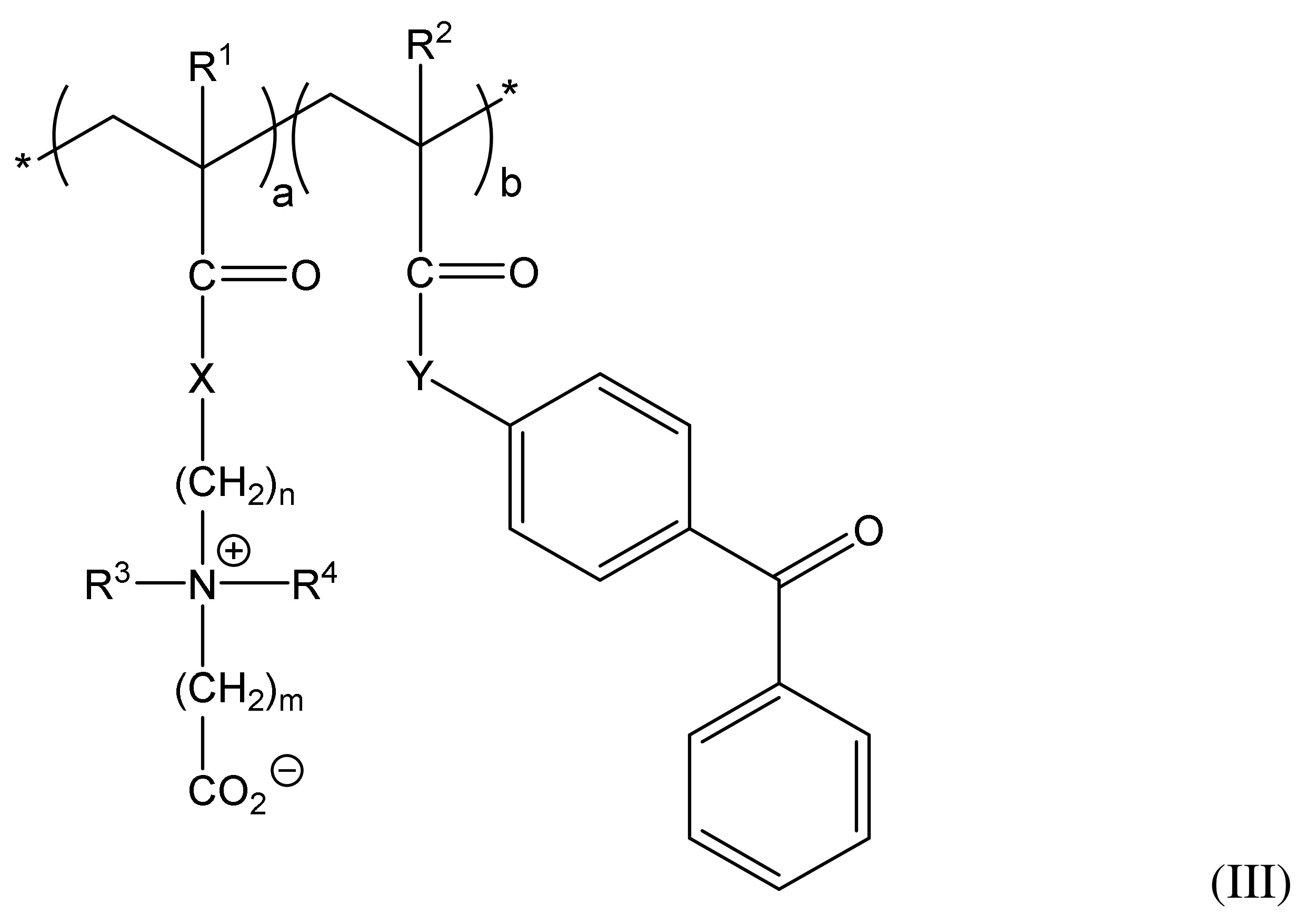
在特定的這些具體實施例中,R1 與R2 獨立選自由氫與甲基所組成的群組。In these specific embodiments, R 1 and R 2 are independently selected from the group consisting of hydrogen and methyl.
在特定具體實施例中,R3 與R4 獨立選自由氫與C1-C3烷基所組成的群組。In certain embodiments, R 3 and R 4 are independently selected from the group consisting of hydrogen and C1-C3 alkyl.
在特定具體實施例中,n為1、2、3、4、5、或6。在一些具體實施例中,n為2或3。In certain embodiments, n is 1, 2, 3, 4, 5, or 6. In some specific embodiments, n is 2 or 3.
在特定具體實施例中,m為1、2、3、4、5、或6。在一些具體實施例中,m為1或2。In certain embodiments, m is 1, 2, 3, 4, 5, or 6. In some specific embodiments, m is 1 or 2.
在特定具體實施例中,a為約0.70至約0.90莫耳百分比。在一些具體實施例中,a為約0.80莫耳百分比。In certain embodiments, a is about 0.70 to about 0.90 mole percent. In some embodiments, a is about 0.80 mole percent.
在特定具體實施例中,b為約0.10至約0.30莫耳百分比。在一些具體實施例中,b為約0.20莫耳百分比。In certain embodiments, b is about 0.10 to about 0.30 mole percent. In some embodiments, b is about 0.20 mole percent.
在特定具體實施例中,R1 為氫或甲基,R2 為氫或甲基,R3 與R4 為甲基,且X為NH及Y為NH。In certain embodiments, R 1 is hydrogen or methyl, R 2 is hydrogen or methyl, R 3 and R 4 are methyl, and X is NH and Y is NH.
在其他具體實施例中,R1 為氫或甲基,R2 為氫或甲基,R3 與R4 為甲基,X為O,及Y為O。In other specific embodiments, R 1 is hydrogen or methyl, R 2 is hydrogen or methyl, R 3 and R 4 are methyl, X is O, and Y is O.
在進一步具體實施例中,R1 為氫,R2 為氫,R3 與R4 為甲基,X為NH,Y為NH,n為3,及m為1。在特定的這些具體實施例中,a為約0.80莫耳百分比,及b為約0.20莫耳百分比。In a further specific embodiment, R 1 is hydrogen, R 2 is hydrogen, R 3 and R 4 are methyl, X is NH, Y is NH, n is 3, and m is 1. In certain of these embodiments, a is about 0.80 mol percent, and b is about 0.20 mol percent.
以下說明本發明之代表性兩性離子/光反應性共聚物的製備、特徵化及用途,及其在本發明之組成物及方法中之用途。The following describes the preparation, characterization and use of the representative zwitterion/photoreactive copolymer of the present invention, and its use in the composition and method of the present invention.
本發明提供一種表面修改策略,其經由簡單且有效的浸塗方法,直接對市售疏水性醫療級PVC管件賦與超親水性及抗沾污力。該策略經由將兩性離子羧基甜菜鹼(CB)共聚物藉光誘發共軛及自我交聯,而共價接枝到PVC管件內表面而實現。該塗覆CB共聚物的市售醫療級PVC管件(Streamline Airless System Set, Medisystems Corporation,美國麻州)顯示高表面濕潤力,且對100%人類血清為超低沾污。The present invention provides a surface modification strategy, which directly imparts super-hydrophilicity and anti-fouling power to commercially available hydrophobic medical-grade PVC pipe fittings through a simple and effective dip coating method. This strategy is achieved by covalently grafting zwitterionic carboxybetaine (CB) copolymers to the inner surface of PVC pipes by light-induced conjugation and self-crosslinking. The commercially available medical grade PVC pipe fittings (Streamline Airless System Set, Medisystems Corporation, Massachusetts, USA) coated with CB copolymer show high surface wetting power and have ultra-low contamination to 100% human serum.
圖10A為描述本發明方法之示意圖:將CB共聚物藉光誘發共軛及交聯,而共價接枝到醫療級PVC管件內表面。經由習知自由基聚合製備代表性光反應性CB共聚物(圖10B),且將合成的聚合物塗覆醫療級PVC管件並在UV照射下安定化。經由浸塗以PCB共聚物接枝的表面顯示,針對100%人類血清之非特定蛋白質吸附的抗性顯著優於未塗覆管件。因此,此表面修改策略因改良現有市售的醫療級PVC管件的生物相容性而極被看好。Fig. 10A is a schematic diagram describing the method of the present invention: CB copolymer is covalently grafted to the inner surface of medical-grade PVC pipes by light-induced conjugation and cross-linking. A representative photoreactive CB copolymer was prepared through conventional free radical polymerization (Figure 10B), and the synthesized polymer was coated with medical grade PVC pipe fittings and stabilized under UV irradiation. The surface grafted with PCB copolymer by dip coating shows that the resistance to non-specific protein adsorption of 100% human serum is significantly better than that of uncoated pipes. Therefore, this surface modification strategy is extremely promising for improving the biocompatibility of existing commercially available medical-grade PVC pipe fittings.
經由習知自由基聚合方法,使用AIBN作為熱自由基引發劑而合成雙親性無規共聚物。這些反應溶液的黏度隨著在65℃的聚合過程而逐漸增加,表示單體轉化成共聚物。從1 H NMR光譜中的特徵峰積分值的計算中,得到各單體的單元比例。以1 H NMR驗證所有官能基單元之存在,其中由特徵峰積分值得到各單體的單元比例:CB單元為3.82 ppm (-CH2 -, 2H)及BPAA單元為6.80-7.85 ppm(二苯基酮-H,9H)。此聚合物的化學結構示於圖10B。聚合物鏈中的親水性CB單體及疏水性/光敏性BPAA為無規分布,且全部組成大致等於單體進料溶液的組成。這些結果高度符合含有磷酸膽鹼基之其他無規共聚物,其已被廣泛用生醫器材的表面修改。Through the conventional free radical polymerization method, using AIBN as a thermal free radical initiator to synthesize an amphiphilic random copolymer. The viscosity of these reaction solutions gradually increased with the polymerization process at 65°C, indicating the conversion of monomers to copolymers. From the calculation of the integral value of the characteristic peak in the 1 H NMR spectrum, the unit ratio of each monomer is obtained. The existence of all functional units was verified by 1 H NMR, and the unit ratio of each monomer was obtained from the characteristic peak integral value: CB unit was 3.82 ppm (-CH 2 -, 2H) and BPAA unit was 6.80-7.85 ppm (diphenyl) Base ketone-H, 9H). The chemical structure of this polymer is shown in Figure 10B. The hydrophilic CB monomer and hydrophobic/photosensitive BPAA in the polymer chain are randomly distributed, and the total composition is approximately equal to the composition of the monomer feed solution. These results are highly consistent with other random copolymers containing phosphorylcholine groups, which have been widely used for surface modification of biomedical equipment.
UV光透度測試顯示PVC管件在波長312奈米有50%之透光,其為二苯基酮基的最佳照射波長(圖11A)。因此,內表面上的物理黏附聚合物可容易藉由施加外部UV光而安定化。結果顯示此聚合物對UV光(312奈米)非常敏感且吸收光譜變動為300至350奈米,表示對PVC管件表面發生光誘發共價結合及自我交聯(圖11B)。UV light transmittance test shows that the PVC pipe has 50% light transmittance at a wavelength of 312 nm, which is the best irradiation wavelength for diphenyl ketone groups (Figure 11A). Therefore, the physical adhesion polymer on the inner surface can be easily stabilized by applying external UV light. The results show that this polymer is very sensitive to UV light (312 nm) and the absorption spectrum varies from 300 to 350 nm, indicating that light-induced covalent bonding and self-crosslinking have occurred on the surface of the PVC pipe (Figure 11B).
親水性本性為PCB接枝表面的關鍵特徵之一。直接對經塗覆及未塗覆醫療級PVC管件,測量乾燥條件下的水接觸角。結果顯示在彎曲PVC管件上(圖12A),塗覆PCB的管件上的水接觸角遠小於未塗覆者。通常在塗覆PCB的平坦PVC表面上的水接觸角為約10°,而在未塗覆的PVC平坦表面上為大於85°(圖12B)。因此,PCB共聚物之接枝將疏水性PVC管件表面轉化成超親水性表面。Hydrophilic nature is one of the key features of PCB grafting surface. Directly measure the water contact angle under dry conditions on coated and uncoated medical grade PVC pipe fittings. The results showed that on the bent PVC pipe (Figure 12A), the water contact angle on the PCB-coated pipe was much smaller than that of the uncoated pipe. Typically, the water contact angle on the flat PVC surface of the coated PCB is about 10°, and it is greater than 85° on the flat surface of the uncoated PVC (Figure 12B). Therefore, the grafting of the PCB copolymer transforms the surface of the hydrophobic PVC pipe into a super-hydrophilic surface.
為了使本發明之技術更貼近臨床應用而使用X射線光電子分光術(XPS)驗證有無PCB聚合物及安定性。使用在285電子伏特處之C 1s峰作為參考而改正結合能(BE)。XPS結果顯示塗覆PCB的表面有與原本的PCB聚合物相同的N 1s 峰(圖13A至13D),且即使是以乾燥狀態及室溫保存3週之後,仍得到穩定的原子組成(表1)。
表1.不同樣品的表面原子組成
結果顯示PCB被成功接枝到市售醫療級PVC管件內表面上且具有優良的安定性。有趣的是從調查光譜亦觀察到鋅峰(Zn 2p),表示有ZnO,其常被塗覆在醫療級PVC表面上以改良抗微生物力。The results showed that PCB was successfully grafted onto the inner surface of commercially available medical-grade PVC pipe fittings and had excellent stability. Interestingly, a zinc peak (
為了評估現有設計策略的臨床應用可能性,生物沾污評量為必要的。蛋白質吸附為在接觸生物環境之生物材料的表面上發生的主要事件。在圖14中,塗覆CB聚合物的管件之血清蛋白吸附量相較於未塗覆管件顯著減小,表示兩性離子CB聚合物塗層有高抗沾污力。重點為,將塗覆PCB的管件保存1週及3週的沾污程度無差異。其進一步證明PCB塗層的安定性及XPS結果的一致性。所有的結果均顯示代表性PCB共聚物可對醫療級PVC管件賦與超親水性及耐久抗沾污力。In order to evaluate the possibility of clinical application of existing design strategies, biological contamination assessment is necessary. Protein adsorption is the main event that occurs on the surface of biological materials in contact with the biological environment. In Figure 14, the amount of serum protein adsorbed by the CB polymer-coated tube is significantly reduced compared to the uncoated tube, indicating that the zwitterionic CB polymer coating has high stain resistance. The important point is that there is no difference in the degree of contamination of PCB-coated pipes for 1 week and 3 weeks. It further proves the stability of PCB coating and the consistency of XPS results. All results show that representative PCB copolymers can impart super-hydrophilicity and durable stain resistance to medical-grade PVC pipe fittings.
總之,在一態樣中,本發明提供一種具有超親水性羧基甜菜鹼(CB)單元及疏水性/光敏性N ‑(4-苯甲醯基苯基)丙烯醯胺(BPAA)單元之官能化無規型雙親性兩性離子共聚物,其可作為表面塗覆材料。該經CB無規共聚物修改的醫療級PVC管件具有比具有超低附著表面之市售未塗覆醫療級PVC管件顯著改良的抗沾污性質。該表面塗覆有利之處為經由浸塗方法對於大規模應用為簡單且有效。其用途進一步經由其得到非侵入性塗層及長期耐久性的能力而驗證。因此,此技術因廣泛的醫療及工程應用範圍而被看好,尤其是對於醫療級PVC管件。In a word, in one aspect, the present invention provides a function with superhydrophilic carboxybetaine (CB) unit and hydrophobic/photosensitive N- (4-benzylphenyl)acrylamide (BPAA) unit Chemical random type amphiphilic zwitterionic copolymer, which can be used as surface coating material. The medical grade PVC pipes modified by CB random copolymers have significantly improved anti-contamination properties than commercially available uncoated medical grade PVC pipes with ultra-low adhesion surfaces. The advantage of this surface coating is that it is simple and effective for large-scale applications via the dip coating method. Its use is further verified by its ability to obtain non-invasive coatings and long-term durability. Therefore, this technology is favored because of its wide range of medical and engineering applications, especially for medical-grade PVC pipe fittings.
實施例2揭述本發明之代表性兩性離子/光反應性共聚物的製備、特徵化及用途。Example 2 discloses the preparation, characterization and use of the representative zwitterionic/photoreactive copolymer of the present invention.
在相關具體實施例中,本發明提供一種表面修改策略,其經由簡單且有效的方法直接抑制或防止塑化劑從表面(例如塑膠表面,如聚氯乙烯(PVC)或聚胺基甲酸酯(PU)表面)滲出,如市售疏水性醫療級PVC或PU管件。在一具體實施例中,該策略經由將兩性離子羧基甜菜鹼(CB)共聚物藉光誘發共軛及自我交聯,而共價接枝到PVC管件內表面而實現。In related embodiments, the present invention provides a surface modification strategy, which directly inhibits or prevents plasticizers from being removed from the surface (such as plastic surfaces, such as polyvinyl chloride (PVC) or polyurethane) through a simple and effective method. (PU) surface) seepage, such as commercially available hydrophobic medical grade PVC or PU pipe fittings. In a specific embodiment, this strategy is achieved by covalently grafting zwitterionic carboxybetaine (CB) copolymer to the inner surface of the PVC pipe by light-induced conjugation and self-crosslinking.
將市售聚氯乙烯(PVC)醫療器材以本發明之兩性離子共聚物進行表面修改,以改良PVC的生物相容性,且防止塑化劑(例如苯二甲酸酯,如苯二甲酸二-2-乙基己酯(DEHP))從PVC在各種剪切應力下移動到病人。Commercially available polyvinyl chloride (PVC) medical devices are surface modified with the zwitterionic copolymer of the present invention to improve the biocompatibility of PVC and prevent plasticizers (such as phthalates, such as phthalic acid esters). -2-Ethylhexyl (DEHP)) moves from PVC to the patient under various shear stresses.
以下說明本發明之代表性兩性離子/光反應性共聚物的製備、特徵化,及對聚氯乙烯賦與生物相容性及抑制塑化劑滲出之用途。The following describes the preparation and characterization of the representative zwitterionic/photoreactive copolymer of the present invention, as well as its use for imparting biocompatibility to polyvinyl chloride and inhibiting the exudation of plasticizers.
植入的血液接觸醫療器材表面上的生物沾污仍為不良生物反應的嚴重顧慮。數十年來市場已使用醫療級聚氯乙烯(PVC)材料,尤其是作為血液接觸管件及容器。然而,這些材料在臨床應用面對(a)生物沾污相關問題(例如血小板活化、補體活化及凝血酶產生)及(b)毒性塑化劑滲出問題。本發明提供提供一種表面修改方法,其對市售醫療級PVC材料在各種動態干擾下戲劇性防止血蛋白沾污、人類血小板活化及補體活化。該表面塗層可使用由兩性離子羧基甜菜鹼(CB)基及光敏性交聯基組成的生物相容性聚合物,經由簡單卻有效的浸塗繼而以光照射而完成。此具有可調節官能基之生物相容性聚合物可按任何規模常規製造,並對市售PVC材料賦與超親水性及抗沾污力。此外,該聚合物有效防止毒性塑化劑從市售醫療級PVC材料滲出。此技術易於應用在許多其他需要生物相容性表面的醫療器材。Biofouling on the surface of the implanted blood contacting medical equipment is still a serious concern for adverse biological reactions. For decades, the market has used medical grade polyvinyl chloride (PVC) materials, especially as blood contact pipe fittings and containers. However, these materials face (a) biological contamination related problems (such as platelet activation, complement activation, and thrombin production) and (b) toxic plasticizer exudation problems in clinical applications. The present invention provides a surface modification method, which can dramatically prevent blood protein contamination, human platelet activation and complement activation under various dynamic disturbances on commercially available medical grade PVC materials. The surface coating can use a biocompatible polymer composed of zwitterionic carboxybetaine (CB) groups and photosensitive crosslinking groups, which can be completed by simple but effective dip coating followed by light irradiation. This biocompatible polymer with adjustable functional groups can be conventionally manufactured on any scale, and can impart super-hydrophilicity and stain resistance to commercially available PVC materials. In addition, the polymer effectively prevents toxic plasticizers from oozing out from commercially available medical grade PVC materials. This technology is easy to apply to many other medical devices that require biocompatible surfaces.
由於其耐大部分化學物、溶劑及滅菌方法且成本低,醫療級聚氯乙烯(PVC)已被用於撓性醫療產品。雖然這些產品已通過最初的臨界毒物學、生物學及生理學測試,但醫療級PVC系材料由於出現嚴重的血蛋白吸附、血小板活化/凝集、紅血球胞溶、凝血酶產生、補體活化等,而持續受到越來越多的批評,因為非生物相容性PVC與血液成分之間發生不利的交互作用。血蛋白黏附在決定材料的生物相容性中扮演重要角色,其已被視為觸發後續不良反應的主要事件。因此,對醫療級PVC賦與生物相容性表面將有效減少生物沾污累積。Due to its resistance to most chemicals, solvents and sterilization methods and its low cost, medical grade polyvinyl chloride (PVC) has been used in flexible medical products. Although these products have passed the initial critical toxicology, biology and physiology tests, medical-grade PVC-based materials have suffered severe blood protein adsorption, platelet activation/agglutination, lysis of red blood cells, thrombin production, complement activation, etc. It continues to be criticized more and more because of the adverse interaction between non-biocompatible PVC and blood components. Blood protein adhesion plays an important role in determining the biocompatibility of materials, and it has been regarded as the main event that triggers subsequent adverse reactions. Therefore, giving medical grade PVC a biocompatible surface will effectively reduce the accumulation of biofouling.
事實上,醫院使用的所有塑膠系拋棄式醫療器材之約30%通常由撓性PVC製造,其被物理摻合至多40重量百分比之塑化劑(例如苯二甲酸酯),以確保其作為血液接觸管件、容器等的機械撓性。重點為,在接觸血液時,該塑化劑會以不同的程度從PVC材料滲入病人體中,其在特定的病人族群中可能造成嚴重的不良健康影響(例如腎毒性、內分泌毒性、生殖系統疾病、神經毒性、肝毒性及心臟毒性)。因此,現已報告許多關於非毒性塑化劑及不移動的替代塑化劑的研究。然而,由於缺乏其長期健康影響、功能性效果及成本考量的詳盡評估,目前市場上的大部分醫療級PVC材料仍以習知方法製備,且面對毒性塑化劑的滲出問題。因此,希望將醫療級PVC產品以有效排除生物沾污誘發的不良反應,且防止毒性塑化劑移動,但不影響PVC基質的傑出性質(如惰性、滅菌力及撓性)之生物相容性材料進行修改。In fact, about 30% of all plastic disposable medical devices used in hospitals are usually made of flexible PVC, which is physically blended with up to 40% by weight of plasticizers (such as phthalates) to ensure their performance The blood contacts the mechanical flexibility of pipes, containers, etc. The key point is that when in contact with blood, the plasticizer will penetrate into the patient's body to varying degrees from the PVC material, which may cause serious adverse health effects in specific patient groups (such as nephrotoxicity, endocrine toxicity, reproductive system diseases) , Neurotoxicity, liver toxicity and cardiotoxicity). Therefore, many studies on non-toxic plasticizers and non-moving alternative plasticizers have been reported. However, due to the lack of detailed evaluation of its long-term health effects, functional effects, and cost considerations, most medical-grade PVC materials currently on the market are still prepared by conventional methods and face the problem of toxic plasticizer leakage. Therefore, it is hoped that medical-grade PVC products can effectively eliminate the adverse reactions induced by biological contamination and prevent the movement of toxic plasticizers, but does not affect the outstanding properties of the PVC matrix (such as inertness, sterilization and flexibility) biocompatibility The material is modified.
目前改良醫療級PVC材料的生物相容性之方法包括輸入疏水性成分(例如聚矽氧衍生物及聚四氟乙烯),將親水性抗沾污材料(例如烯丙胺、聚(丙烯醯胺)、聚乙二醇)接枝,及改變表面奈/微米結構。然而,其均未明確證明同時解決非生物相容性及塑化劑滲出的問題的能力。含有沾污釋放部分之疏水性材料(例如聚矽氧衍生物)在黏附釋放循環期間顯然有可能呈現不良的生物回應,如血小板/補體活化。重點為,血蛋白與疏水性表面有較高的黏附親和力,且其在吸附到疏水性表面時顯示比到親水性表面較無組織化的二級表面。Current methods to improve the biocompatibility of medical-grade PVC materials include importing hydrophobic components (such as polysiloxane derivatives and polytetrafluoroethylene), and adding hydrophilic antifouling materials (such as allylamine, poly(acrylamide)) , Polyethylene glycol) grafting, and change the surface nano/micron structure. However, none of them has clearly demonstrated the ability to simultaneously solve the problems of non-biocompatibility and plasticizer exudation. Hydrophobic materials (such as polysiloxane derivatives) that contain stain-releasing parts are obviously likely to exhibit poor biological responses, such as platelet/complement activation, during the adhesion release cycle. The important point is that blood proteins have a higher adhesion affinity to hydrophobic surfaces, and when they are adsorbed to hydrophobic surfaces, they show a less organized secondary surface than hydrophilic surfaces.
親水性抗沾污材料數十年來已被用於醫療器材的表面塗料,其包括兩性離子聚合物、聚(乙二醇)、聚(羥基官能基丙烯酸酯)、聚(2-
在一具體實施例中,為了直接對市售疏水性醫療級塑化PVC管件(Streamline Airless System Set, Medisystems Corporation,美國麻州)賦與超親水性及抗沾污力且塑化劑從PVC管件移動極小,本發明提供一種羧基甜菜鹼共聚物(PCB)之表面修改方法。該具有可調節官能基(即兩性離子羧基甜菜鹼基及光敏性交聯基)之PCB共聚物係經由自由基聚合而製備。將醫療級塑化PVC管件使用此聚合物浸塗,繼而將波長312奈米之紫外光(UV)施加在經塗覆表面上以安定經塗覆PCB聚合物層,及經由表面交聯防止塑化劑移動。將PCB聚合物的安定性及非細胞毒性分別以X-射線光電子分光術(XPS)證實,並根據ISO 10993-5準則檢查。將經塗覆的PVC表面的濕潤力及抗沾污力、血小板活化程度、以及補體活化程度直接比較未塗覆者。使用表面電漿子共振(SPR)顯然驗證在不同的動態干擾/剪切應力下針對100%人類血清的抗沾污力,並有效防止來自PVC管件的塑化劑移動。藉該方法證明PCB共聚物在不同的動態干擾下的生物相容性及抑制塑化劑滲出的能力。另外,這些材料及表面修改策略均適用於其他的醫療器材。In a specific embodiment, in order to directly impart super-hydrophilicity and stain resistance to commercially available hydrophobic medical-grade plasticized PVC pipe fittings (Streamline Airless System Set, Medisystems Corporation, Massachusetts, USA), the plasticizer is used from PVC pipe fittings. The movement is extremely small. The present invention provides a surface modification method of carboxybetaine copolymer (PCB). The PCB copolymer with adjustable functional groups (that is, zwitterionic carboxybetaine groups and photosensitive crosslinking groups) is prepared through free radical polymerization. The medical-grade plasticized PVC pipe fittings are dip-coated with this polymer, and then ultraviolet light (UV) with a wavelength of 312 nm is applied to the coated surface to stabilize the coated PCB polymer layer, and prevent plasticization through surface cross-linking Chemical agent moves. The stability and non-cytotoxicity of the PCB polymer were confirmed by X-ray photoelectron spectroscopy (XPS) and checked according to ISO 10993-5 guidelines. The wettability and stain resistance of the coated PVC surface, the degree of platelet activation, and the degree of complement activation were directly compared with the uncoated PVC surface. The use of surface plasmon resonance (SPR) clearly verifies the stain resistance against 100% human serum under different dynamic interference/shear stresses, and effectively prevents plasticizers from PVC pipes from moving. This method was used to prove the biocompatibility of PCB copolymers under different dynamic disturbances and the ability to inhibit the exudation of plasticizers. In addition, these materials and surface modification strategies are applicable to other medical devices.
共聚物之合成
。經由習知自由基聚合方法,使用AIBN作為熱自由基引發劑而合成光反應性雙親性無規共聚物。此方法可確保具有可調節官能基之聚合物可按任何規模(特別是工業規模)常規製造。這些反應溶液的黏度隨同65℃聚合過程逐漸增加,表示單體轉化成共聚物。聚(CBAA-共
-BPAA) (PCB)聚合物的化學結構示於圖15A。CBAA基為超親水性及整體電中性,其可有效抑制血蛋白、細胞、及細菌黏附。光敏性基(BPAA)可經由光誘發交聯安定PVC表面上的聚合物,且進一步防止塑化劑移動。以1
H NMR驗證所有官能基單元之存在,其中由特徵峰積分值得到各單體的單元比例:CB單元為3.82 ppm (-CH2
-, 2H)及BPAA單元為6.80-7.85 ppm(二苯基酮-H,9H)。聚合物鏈中的親水性CB單體及疏水性/光敏性BPAA為無規分布,且全部組成大致等於單體進料溶液的組成(表2)。聚(CBAA-共
-BPAA-共
-NB丙烯醯胺) (PCB-NB)及聚(PEGMA-共
-BPAA) (PPB)的化學結構分別示於圖15B及15C。
表2.代表性合成共聚物的特徵a
a [單體]=0.5莫耳/升。所有聚合物之引發劑均為AIBN。聚合溫度為65℃。b 由CD3 OD中1 H NMR光譜測定。c 分子量係藉GPC在乙醇/水=7/3,[LiBr]=10毫莫耳/升,及以聚(環氧乙烷)標準品測定。Mw 及Mn 分別表示重量平均分子量及數量平均分子量。d 溶解度係以濃度為10毫克/毫升之各聚合物樣品測定,且以在25℃溶解(+)或不溶解(-)說明。e 進料及共聚物中的莫耳比例為PEGMA/BPAA。 a [Monomer]=0.5 mol/liter. The initiator of all polymers is AIBN. The polymerization temperature was 65°C. b is determined by 1 H NMR spectrum in CD 3 OD. c The molecular weight is determined by GPC at ethanol/water=7/3, [LiBr]=10 millimoles/liter, and poly(ethylene oxide) standards. M w and M n represent weight average molecular weight and number average molecular weight, respectively. d Solubility is measured with each polymer sample at a concentration of 10 mg/ml, and is indicated by dissolving (+) or insoluble (-) at 25°C. The molar ratio of e feed and copolymer is PEGMA/BPAA.
表面特徵化 。UV光透度測試顯示市售PVC管件在波長312奈米有50%之透光(圖16A及16B),其為PCB共聚物中二苯基酮基的最佳照射波長。因此,施加外部UV光會安定管件內表面上的PCB聚合物。圖16C的結果顯示此聚合物對UV光(312奈米)非常敏感且吸收光譜變動為300至350奈米,表示對PVC管件表面發生光誘發共價結合及自我交聯。親水性本性為PCB接枝表面的關鍵特徵之一。直接對經塗覆及未塗覆醫療級PVC管件測量在乾燥條件下的水接觸角。在塗覆PCB的管件上的水接觸角遠小於未塗覆者(圖16D)。通常在塗覆PCB的平坦PVC表面上的水接觸角為約10°,而在未塗覆PVC平坦表面上為大於85°。因此,PCB共聚物接枝將疏水性PVC管件表面轉化成超親水性。 Surface characterization . UV light transmittance test showed that commercially available PVC pipe fittings have 50% light transmittance at a wavelength of 312 nm (Figures 16A and 16B), which is the best irradiation wavelength for diphenyl ketone groups in PCB copolymers. Therefore, applying external UV light stabilizes the PCB polymer on the inner surface of the pipe. The result of Figure 16C shows that this polymer is very sensitive to UV light (312 nm) and the absorption spectrum varies from 300 to 350 nm, indicating that light-induced covalent bonding and self-crosslinking on the surface of the PVC pipe. Hydrophilic nature is one of the key features of PCB grafting surface. Directly measure the water contact angle of coated and uncoated medical grade PVC pipes under dry conditions. The water contact angle on the PCB-coated pipe is much smaller than that of the uncoated pipe (Figure 16D). Typically, the water contact angle on the flat PVC surface of the coated PCB is about 10°, and it is greater than 85° on the flat surface of the uncoated PVC. Therefore, the PCB copolymer grafting transforms the surface of the hydrophobic PVC pipe fittings into super hydrophilic.
塗層安定性
。US FDA要求接觸血液及血液成分之容器無塗料滲出問題。為了使該技術更貼近實際應用而使用X-射線光電子分光術(XPS)驗證PCB聚合物之存在及安定性。使用在285電子伏特處之C 1s峰作為參考而改正結合能(BE)。XPS結果顯示塗覆PCB的表面有與原本的PCB聚合物相同的N 1s 峰(圖16E至16H),且即使是以乾燥狀態及室溫保存3週之後仍得到穩定的原子組成。因此,PCB被成功接枝到市售醫療級PVC管件內表面上且具有優良的安定性。從調查光譜亦觀察到鋅峰(Zn 2p),表示有鋅化合物(例如ZnO),其常被塗覆在醫療級PVC表面上以改良抗微生物力。另外,評估PCB在潮濕條件下的安定性。將市售管件塗以螢光標記PCB聚合物(PCB-NB),並浸泡在37℃之PBS/100%人類血漿中。經由波長590奈米之UV/Vis光譜分析評估溶液中的PCB-NB滲出量。結果顯示在37℃之PBS或100%人類血漿中浸泡24小時之後,未觀察到PCB聚合物吸收峰,表示PCB聚合物在潮濕條件下安定。 Coating stability . The US FDA requires that containers that come in contact with blood and blood components have no paint leakage problems. In order to make the technology closer to practical applications, X-ray photoelectron spectroscopy (XPS) is used to verify the existence and stability of PCB polymers. Correct the binding energy (BE) using the
生物沾污評量 。蛋白質吸附在生物相容性評估中扮演重要角色,且其為生物環境中在生物材料表面上發生的主要事件。重點為,蛋白質吸附行為依生物材料的表面特徵及各種剪切應力而定。相較於羥基封端親水性表面,白蛋白及纖維蛋白原均顯示強烈的結合親和力,及相對疏水性烷基表面為較無組織化的二級結構,且對白蛋白觀察到的效果較大。隨剪切率增加,觀察到聚胺基甲酸酯表面上的血漿蛋白吸附變少。在此揭述在動態及靜態條件下,分別使用具有可調流速的表面電漿子共振(SPR)生物感測器及Micro BCA蛋白質檢驗套件之血漿蛋白對兩性離子羧基甜菜鹼聚合物表面的吸附行為。 Biological contamination assessment . Protein adsorption plays an important role in biocompatibility assessment, and it is the main event that occurs on the surface of biological materials in a biological environment. The important point is that the protein adsorption behavior depends on the surface characteristics of the biological material and various shear stresses. Compared with the hydroxyl-terminated hydrophilic surface, albumin and fibrinogen both show strong binding affinity, and the relatively hydrophobic alkyl surface has a less organized secondary structure, and has a greater effect on albumin. As the shear rate increases, less plasma protein adsorption on the polyurethane surface is observed. This article describes the adsorption of zwitterionic carboxybetaine polymer on the surface of zwitterionic carboxybetaine polymer using the surface plasma resonance (SPR) biosensor with adjustable flow rate and the Micro BCA protein test kit under dynamic and static conditions. behavior.
在血清注射前及緩衝液清洗後,使用SPR評估未塗覆(塗覆PVC的SPR片)及塗覆PCB(塗覆PVC第一層及PCB聚合物第二層的SPR片)的表面之非特定吸附的蛋白質的量(圖17A至17D)。血清注射後之急劇增加歸因於整體折射率的變化。為了補償由於經塗覆聚合物層造成的SPR表面敏感度損失,在不同的聚合物厚度校正對蛋白質吸附的感測器回應。在塗覆PCB的表面上的4種不同流速10、40、100、與200微升/分鐘下的蛋白質吸附量為4.3、3.3、3.6、與4.4奈克/平方公分,而在未塗覆表面上為78.7、85.9、81.9、與81.4奈克/平方公分(圖17E)。此結果顯示在動態條件下無關剪切應力,塗覆PCB的表面有超低沾污(<5.0奈克/平方公分)能力及相較於未塗覆表面為<10%之沾污,且此結果與在靜態條件下得自Micro BCA蛋白質檢驗套件的結果(圖17F)一致。此外,將塗覆PCB的管件在PBS中保存1週及3週的沾污程度無差異。其進一步證明在乾燥條件下PCB塗層的安定性及XPS結果的一致性。因此,該兩性離子PCB共聚物可對醫療級PVC管件賦與超親水性及耐久抗沾污力。Before serum injection and after buffer cleaning, SPR was used to evaluate the non-coating (PVC coated SPR sheet) and PCB coated (PVC first layer and PCB polymer second layer SPR sheet). The amount of protein specifically adsorbed (Figures 17A to 17D). The sharp increase after serum injection was attributed to the change in overall refractive index. In order to compensate for the loss of SPR surface sensitivity due to the coated polymer layer, the sensor response to protein adsorption was corrected at different polymer thicknesses. The protein adsorption capacity at 4 different flow rates of 10, 40, 100, and 200 μl/min on the coated PCB surface were 4.3, 3.3, 3.6, and 4.4 ng/cm², while on the uncoated surface The above values are 78.7, 85.9, 81.9, and 81.4 ng/cm² (Figure 17E). This result shows that there is no shear stress under dynamic conditions, and the surface of the coated PCB has ultra-low contamination (<5.0 ng/cm²) and less than 10% contamination compared to the uncoated surface. The results are consistent with those obtained from the Micro BCA protein test kit under static conditions (Figure 17F). In addition, there was no difference in the degree of contamination of PCB-coated tubes stored in PBS for 1 week and 3 weeks. It further proves the stability of the PCB coating under dry conditions and the consistency of the XPS results. Therefore, the zwitterionic PCB copolymer can impart super-hydrophilicity and durable stain resistance to medical-grade PVC pipe fittings.
PCB 聚合物毒性
。根據ISO 10993-5準則檢查PCB聚合物的細胞毒性。觀察在含有溶解PCB聚合物之塗覆PCB的管件的溶析液或介質中培養的NIH3T3的形態並比較對照。如圖18A所示,在來自塗覆PCB的管件之溶析液中培養的NIH3T3的形態與未塗覆管件上者及正常細胞培養基中的對照樣品並無差異。相反地,細胞在作為陽性對照之毒性材料的乳膠溶析液中培養之後失去其原本的紡錘形狀。在含有溶解的PCB聚合物之培養基中培養的細胞的形態相較於對照亦未改變(圖18B)。因此,PCB聚合物根據ISO 10993-5準則為無毒性。亦藉滲漏到培養基中的LDH評量由濃度不同(0.00125、0.0025、0.01、與0.1毫克/毫升)的PCB聚合物誘發的細胞毒性。使用在560奈米的吸收度值與相對LDH濃度之間的正相關,來評估該聚合物造成的細胞膜損壞。來自以含有PCB的培養基培養的細胞之LDH釋放量與在正常條件下培養者無顯著差異。相反地,來自以0.20體積百分比之Tween 20培養基溶液培養的細胞之LDH釋放含量遠高於其他(圖18C)。這些結果表示PCB聚合物不對活體細胞之細胞膜產生細胞毒性影響。 PCB polymer toxicity . Check the cytotoxicity of PCB polymers according to ISO 10993-5 guidelines. Observe the morphology of NIH3T3 cultured in the eluent or medium of PCB-coated pipes containing dissolved PCB polymers and compare them with controls. As shown in FIG. 18A, the morphology of NIH3T3 cultured in the eluent from PCB-coated tubing is not different from that of the uncoated tubing and the control sample in normal cell culture medium. In contrast, the cells lost their original spindle shape after being cultured in the latex lysate of the toxic material used as the positive control. The morphology of the cells cultured in the medium containing the dissolved PCB polymer was also unchanged compared to the control (Figure 18B). Therefore, PCB polymers are non-toxic according to ISO 10993-5 guidelines. The cytotoxicity induced by PCB polymers of different concentrations (0.00125, 0.0025, 0.01, and 0.1 mg/ml) was also measured by LDH leaking into the culture medium. The positive correlation between the absorbance value at 560 nm and the relative LDH concentration was used to evaluate the cell membrane damage caused by the polymer. The amount of LDH released from cells cultured in a medium containing PCB is not significantly different from that of cells cultured under normal conditions. On the contrary, the LDH release content from cells cultured with 0.20
PCB 聚合物對血小板品質的影響 。比較塗覆PCB的PVC表面及未塗覆PVC表面中的血小板的品質,以驗證PCB聚合物對血液接觸醫療器材的可行性。血小板活化程度及馮威里氏因子(VWF)結合親和力為評量血小板凝固的最重要參數,其直接反映血小板品質。p -選滯蛋白(CD62)為醣蛋白且為血小板活化之已清楚說明標示劑。在血小板活化期間,p -選滯蛋白從細胞內粒體移位到外膜。塗覆PCB的表面中的血小板活化程度遠低於未塗覆PVC表面,表示經由使用PCB聚合物有效抑制血小板活化(圖19A)。血小板的功能測試為評量血小板凝固能力的最重要參數。作為黏附性血漿醣蛋白,VWF在生理條件下的血小板血栓形成中扮演基本角色,其將血小板循環到血管損傷的黏附及栓塞位置。VWF結合親和力越高,則平均螢光強度(MFI)因而越高(圖19B)。從0至168小時,塗覆PCB的表面上的血小板之VWF結合親和力較未塗覆者高,其在168小時後更為明顯。膜聯蛋白V因其結合磷脂醯絲胺酸的能力而常被用於偵測凋亡細胞,當在血漿膜外葉上發生時,其為血小板凋亡標記。因此,膜聯蛋白V結合越多表示細胞凋亡增加而存活率降低。如圖19C所示,塗覆PCB的親水性表面上的血小板之膜聯蛋白V結合含量比未塗覆者低,表示經PCB修改的表面可有效維持血小板存活率。健康的未活化血小板呈現最大直徑為2-3微米的雙凸盤形結構。血小板健康退化則發生形狀從盤形改變成似球體(盤體成球體之變形)。使用形態分數(MS)作為血小板健康的簡單指標,且定義為4×(盤體%)+2×(球體%)+(枝體%)。塗覆PCB的表面上的血小板之MS值遠高於未塗覆PVC表面(圖19D)。因此,疏水性PVC表面上的PCB聚合物可有效防止血小板品質退化,其使將PCB聚合物用於製造血液接觸器材被看好。 The effect of PCB polymer on platelet quality . Compare the quality of platelets in the PVC surface of PCB coated and uncoated PVC surface to verify the feasibility of PCB polymer for blood contact with medical equipment. The degree of platelet activation and VWF binding affinity are the most important parameters for evaluating platelet coagulation, which directly reflect platelet quality. p -selective protein (CD62) is a glycoprotein and a clearly stated labeling agent for platelet activation. During platelet activation, p -selection protein translocates from the intracellular mitochondria to the outer membrane. The degree of platelet activation in the PCB-coated surface was much lower than that in the uncoated PVC surface, indicating that platelet activation was effectively inhibited through the use of PCB polymer (Figure 19A). The function test of platelets is the most important parameter for evaluating platelet clotting ability. As an adhesive plasma glycoprotein, VWF plays a basic role in platelet thrombosis under physiological conditions, which circulates platelets to the adhesion and embolization sites of vascular injury. The higher the binding affinity of VWF, the higher the average fluorescence intensity (MFI) and therefore (Figure 19B). From 0 to 168 hours, the VWF binding affinity of platelets on the surface of the coated PCB is higher than that of the uncoated plate, which is more obvious after 168 hours. Annexin V is often used to detect apoptotic cells due to its ability to bind phospholipid serine. When it occurs on the outer lobes of the plasma membrane, it is a marker of platelet apoptosis. Therefore, more annexin V binding means increased apoptosis and decreased survival rate. As shown in Figure 19C, the platelets on the hydrophilic surface of the coated PCB have a lower binding content of Annexin V than the uncoated plate, indicating that the surface modified by the PCB can effectively maintain the platelet survival rate. Healthy unactivated platelets present a biconvex disc structure with a maximum diameter of 2-3 microns. The health of platelets degenerates and the shape changes from a disk to a sphere (the deformation of the disk to a sphere). The morphological score (MS) is used as a simple indicator of platelet health, and is defined as 4×(disc%)+2×(sphere%)+(branch%). The MS value of platelets on the PCB-coated surface is much higher than that of the uncoated PVC surface (Figure 19D). Therefore, the PCB polymer on the hydrophobic PVC surface can effectively prevent the degradation of platelet quality, which makes the use of PCB polymer to manufacture blood contact devices to be promising.
塑化劑滲出 。苯二甲酸酯,尤其是苯二甲酸二-2-乙基己酯(DEHP),由於易於塑化及加工且成本有競爭力,而為最常用於市售PVC的塑化劑。然而,含有DEHP的PVC材料仍有爭議且未在生醫應用禁用,雖然許多研究已證明DEHP的毒性。目前排除經塑化材料的毒性之方法包括(a)抑制DEHP塑化劑在化學或物理表面修改中滲出,(b)發展DEHP的替代品(例如己二酸酯、壬二酸酯、檸檬酸酯、與1,2,4-苯三甲酸酯),及(c)製造PVC的無塑化劑替代聚合物(例如聚矽氧、聚胺基甲酸酯、與聚烯烴)。抑制DEHP滲出為需要長期及詳盡評量之最詳細評估方法。PVC材料的表面交聯顯然為現階段有效防止DEHP滲出的最成功技術。DEHP有3個在約210奈米、225奈米及275奈米之光譜帶。如同在此所述,比較經塗覆及未塗覆PVC管件在波長275奈米的吸收值。圖20的結果顯示從塗覆PCB的PVC管件滲出的DEHP含量顯著小於從未塗覆滲出者,且在24小時為未塗覆管件之約12%。其證明在表面接枝的光反應性PCB聚合物有效防止DEHP移動,而被看好作為排除經塑化PVC材料的毒性之應用。PCB聚合物之光誘發表面交聯為安定PVC表面上的PCB聚合物及防止塑化劑移動的關鍵。 Plasticizer oozes . Phthalic acid esters, especially di-2-ethylhexyl phthalate (DEHP), are the most commonly used plasticizers for commercially available PVC due to their ease of plasticization and processing and cost competitiveness. However, PVC materials containing DEHP are still controversial and have not been banned in biomedical applications, although many studies have proven the toxicity of DEHP. The current methods of eliminating the toxicity of plasticized materials include (a) inhibiting the exudation of DEHP plasticizers during chemical or physical surface modification, and (b) developing alternatives to DEHP (such as adipate, azelate, and citric acid) Ester, and 1,2,4-trimellitic acid esters), and (c) Plasticizer-free alternative polymers for the manufacture of PVC (such as silicone, polyurethane, and polyolefin). Inhibition of DEHP exudation is the most detailed evaluation method that requires long-term and detailed evaluation. The surface cross-linking of PVC materials is obviously the most successful technology to effectively prevent the exudation of DEHP at this stage. DEHP has 3 spectral bands at approximately 210 nm, 225 nm and 275 nm. As described here, compare the absorption values of coated and uncoated PVC pipes at a wavelength of 275 nm. The results in Fig. 20 show that the DEHP content exuded from PCB-coated PVC pipe fittings is significantly less than that of uncoated PVC pipe fittings, and is about 12% of uncoated pipe fittings in 24 hours. It proves that the photoreactive PCB polymer grafted on the surface can effectively prevent the movement of DEHP, and it is regarded as an application to eliminate the toxicity of plasticized PVC materials. The light-induced surface cross-linking of the PCB polymer is the key to stabilize the PCB polymer on the PVC surface and prevent the plasticizer from moving.
補體活化 。補體系統含有一系列超過20個蛋白質在血液及組織液中循環,且為先天免疫系統之主要貢獻者,其可經由直接胞溶或藉由召集白血球(促進吞噬作用)而掃蕩外來細胞及有機體。補體系統係經由三種路徑活化:傳統、替代、及凝集素路徑。人造生物材料表面主要藉可代謝補體蛋白質C3b的吸附觸發替代路徑,其進一步引起總補體級聯,而誘發終端補體錯合物(sC5b-9)形成,其活化白血球並誘發發炎回應。因此,sC5b-9量反映生物材料刺激補體系統的能力。重點為,聚(乙二醇) (PEG)鏈之終端羥基(-OH)及氧化均經由替代路徑強烈活化補體系統,使得共聚物聚(PEGMA-共 -BPAA) (PPB)成為補體系統活化劑(陽性對照)。圖21的結果顯示接觸塗覆或未塗覆PCB的醫療級PVC材料之血清的終端補體錯合物(sC5b-9)之含量比經PPB塗覆者低,證明PCB聚合物活化補體系統的親和力比塗覆PPB者低。另外,補體級聯在塗覆或未塗覆PCB的表面上均未被完全抑制且其間無顯著差異。其係因為在血清與空氣之間的界面處(血漿蛋白在此被變性及/或改變構形)觸發外補體活化,及該活化被放大且一旦觸發則無法終止。對於塗覆PPB的表面,PPB共聚物造成的活化遠比血清/空氣界面者嚴重,因此總活化程度高。因此,這些結果證明PCB聚合物不為補體活化生物材料。 Complement activation . The complement system contains a series of more than 20 proteins circulating in blood and tissue fluid, and is the main contributor to the innate immune system. It can sweep foreign cells and organisms through direct lysis or by recruiting white blood cells (promoting phagocytosis). The complement system is activated via three pathways: traditional, alternative, and lectin pathways. The surface of artificial biomaterials mainly triggers alternative pathways by the adsorption of the metabolizable complement protein C3b, which further causes the total complement cascade and induces the formation of terminal complement complexes (sC5b-9), which activate white blood cells and induce an inflammatory response. Therefore, the amount of sC5b-9 reflects the ability of biological materials to stimulate the complement system. The important point is that the terminal hydroxyl (-OH) and oxidation of the poly(ethylene glycol) (PEG) chain strongly activate the complement system through alternative pathways, making the copolymer poly(PEGMA- co- BPAA) (PPB) a complement system activator (Positive control). The result of Figure 21 shows that the content of terminal complement complex (sC5b-9) in serum of medical grade PVC material contacted with coated or uncoated PCB is lower than that of PPB coated ones, which proves the affinity of PCB polymer to activate the complement system Lower than those coated with PPB. In addition, the complement cascade was not completely suppressed on coated or uncoated PCB surfaces and there was no significant difference therebetween. This is because the external complement activation is triggered at the interface between serum and air (where plasma proteins are denatured and/or changed configuration), and the activation is amplified and cannot be terminated once triggered. For the surface coated with PPB, the activation caused by PPB copolymer is much more serious than that of the serum/air interface, so the total activation degree is high. Therefore, these results prove that PCB polymer is not a complement activating biomaterial.
總之,在一具體實施例中,本發明提供一種包括超親水性羧基甜菜鹼(CB)單元及疏水性/光敏性N ‑(4-苯甲醯基苯基)丙烯醯胺(BPAA)之官能化無規型雙親性兩性離子共聚物,其可作為表面塗覆材料。該經CB無規共聚物修改的市售醫療級PVC管件在不同的動態干擾下可戲劇性防止血蛋白沾污、人類血小板活化、及補體活化。此表面塗料有利之處為經由浸塗方法繼而UV光照射成為簡單且有效之大規模應用。其用途進一步經由其得到非侵入性塗層及長期耐久性的能力而驗證。此外,該聚合物有效防止毒性塑化劑從市售醫療級PVC材料滲出。因此,此方法同時解決PVC材料之非生物相容性及塑化劑滲出的問題。該方法已適用於許多需要生物相容性及附加抑制滲出表面之其他醫療器材。In a word, in a specific embodiment, the present invention provides a function including superhydrophilic carboxybetaine (CB) unit and hydrophobic/photosensitive N- (4-benzylphenyl)acrylamide (BPAA) Chemical random type amphiphilic zwitterionic copolymer, which can be used as surface coating material. The commercially available medical grade PVC pipes modified by CB random copolymers can dramatically prevent blood protein contamination, human platelet activation, and complement activation under different dynamic disturbances. The advantage of this surface coating is that the dipping method followed by UV light irradiation becomes a simple and effective large-scale application. Its use is further verified by its ability to obtain non-invasive coatings and long-term durability. In addition, the polymer effectively prevents toxic plasticizers from oozing out from commercially available medical grade PVC materials. Therefore, this method simultaneously solves the problems of non-biocompatibility and plasticizer exudation of PVC materials. This method has been applied to many other medical devices that require biocompatibility and additional anti-exudation surfaces.
實施例3揭述本發明之代表性兩性離子/光反應性共聚物的製備、特徵化,及防止塑化劑從塑化表面滲出之用途。兩性離子 / 疏水性 / 光反應性共聚物 Example 3 discloses the preparation, characterization, and use of the representative zwitterionic/photoreactive copolymer of the present invention to prevent the plasticizer from oozing out of the plasticized surface. Zwitterionic / hydrophobic / photoreactive copolymer
在一進一步具體實施例中,本發明提供具有兩性離子基、疏水性基及光反應性基之共聚物,各該等基側接共聚物主幹。該側接兩性離子基對經該共聚物處理或塗覆的表面賦與低沾污及可官能化性質。該側接疏水性基用以利於共聚物結合至經該共聚物處理的表面(例如經由疏水性-疏水性交互作用)。該側接光反應性基用以利於在經該共聚物處理的表面上的共聚物之共聚物交聯。側接共聚物主幹之兩性離子基、疏水性基與光反應性基的相對量可經由共聚物合成方法調整,而得到所欲程度的低沾污及官能化及共聚物對表面的結合,其各可依欲處理或塗覆表面的本性(例如組成)而調節。In a further embodiment, the present invention provides a copolymer having a zwitterionic group, a hydrophobic group and a photoreactive group, each of which is pendant to the backbone of the copolymer. The pendant zwitterionic group imparts low staining and functionalizable properties to the surface treated or coated with the copolymer. The pendant hydrophobic group is used to facilitate the binding of the copolymer to the surface treated with the copolymer (for example, through hydrophobic-hydrophobic interaction). The pendant photoreactive group is used to facilitate the copolymer crosslinking of the copolymer on the surface treated with the copolymer. The relative amount of zwitterionic groups, hydrophobic groups and photoreactive groups in the pendant copolymer backbone can be adjusted by the copolymer synthesis method to obtain the desired degree of low staining and functionalization and the binding of the copolymer to the surface. Each can be adjusted according to the nature (such as composition) of the surface to be treated or coated.
在特定的這些具體實施例中,本發明提供一種可作為血小板儲存袋表面之塗覆材料的具有超親水性羧基甜菜鹼(CB)單元、疏水性結合甲基丙烯酸正丁酯(BMA)單元、及疏水性/光敏性N -(4-苯甲醯基苯基)丙烯醯胺(BPAA)單元之兩性離子共聚物、以該共聚物塗覆血小板儲存袋表面之方法、及經該共聚物塗覆的血小板儲存袋。In these specific embodiments, the present invention provides a superhydrophilic carboxybetaine (CB) unit, a hydrophobic binding n-butyl methacrylate (BMA) unit, a coating material for the surface of a platelet storage bag, And hydrophobic/photosensitive N- (4-benzylphenyl) acrylamide (BPAA) unit zwitterionic copolymer, a method for coating the surface of a platelet storage bag with the copolymer, and coating with the copolymer Covered platelet storage bag.
血小板為獨特的血液成分,其在止血、血栓形成、發炎、及傷口癒合中扮演重要角色。基於血小板的治療(血小板輸血)為治療具有血小板減少症或血小板功能缺陷的人類流血之有效方法。重點為,在現有標準條件下體外保存的血小板之儲存壽命僅為體內血流者(8-10日)之半(4-7日)。因此,必須改良血小板儲存條件而提高其儲存壽命以減緩上生的血小板需求。血小板之儲存壽命強烈受兩個原因影響:(i)細菌污染及(ii)血小板儲存損害(PSL)。細菌污染的風險可經由嚴格的無菌採集及高敏感性細菌診斷而緩和,而PSL的主要限制因子強烈受儲存條件影響,包括容器、緩衝化合物、溫度、呼吸氣體交換效率、pH降低、乳酸累積、養分消耗等。雖然已對實際應用實行許多嚐試,包括新穎的儲存介質添加劑、冷卻儲存、及冷凍乾燥,但在疏水性(例如聚(氯乙烯))袋內部,現有的標準血小板保存在室溫(20-24℃)仍擾亂血小板。事實上,高品質的血小板儲存從未達到8日。誘發品質損失的關鍵之一為血小板與非生物相容性儲存袋表面之間的不利交互作用,包括不能復原的血漿蛋白變性、血小板活化、及在疏水性塑化PVC材料上的生物膜形成。醫療級疏水性PVC系材料顯然亦顯示嚴重的凝血酶產生及補體活化。因此,對儲存袋的疏水性表面賦與生物相容性仍為重大挑戰。Platelets are unique blood components that play an important role in hemostasis, thrombosis, inflammation, and wound healing. Platelet-based therapy (platelet transfusion) is an effective method for treating bleeding in humans with thrombocytopenia or defective platelet function. The important point is that the shelf life of platelets stored in vitro under existing standard conditions is only half (4-7 days) of blood flow in the body (8-10 days). Therefore, it is necessary to improve the storage conditions of platelets and increase their storage life to slow down the demand for platelets. The storage life of platelets is strongly affected by two reasons: (i) bacterial contamination and (ii) platelet storage damage (PSL). The risk of bacterial contamination can be mitigated by strict aseptic collection and highly sensitive bacterial diagnosis. The main limiting factors of PSL are strongly affected by storage conditions, including containers, buffer compounds, temperature, respiratory gas exchange efficiency, pH reduction, lactic acid accumulation, Nutrient consumption, etc. Although many attempts have been made for practical applications, including novel storage medium additives, cold storage, and freeze-drying, the existing standard platelets are stored at room temperature (20-24) inside hydrophobic (such as poly(vinyl chloride)) bags. °C) still disturbs platelets. In fact, high-quality platelet storage has never reached 8 days. One of the keys to inducing quality loss is the adverse interaction between platelets and the surface of non-biocompatible storage bags, including unrecoverable plasma protein denaturation, platelet activation, and biofilm formation on hydrophobic plasticized PVC materials. Medical-grade hydrophobic PVC-based materials apparently also show severe thrombin production and complement activation. Therefore, imparting biocompatibility to the hydrophobic surface of the storage bag remains a major challenge.
目前從兩方面改良血小板袋的生物相容性:(i)以沾污釋放材料(例如聚矽氧衍生物)的混合物改變表面奈/微米結構/圖樣而賦與超疏水性,及(ii)將中性仿生抗沾污材料(例如兩性離子聚合物、聚(乙二醇)、或聚(2-
在特定具體實施例中,本發明提供式(IV)之共聚物: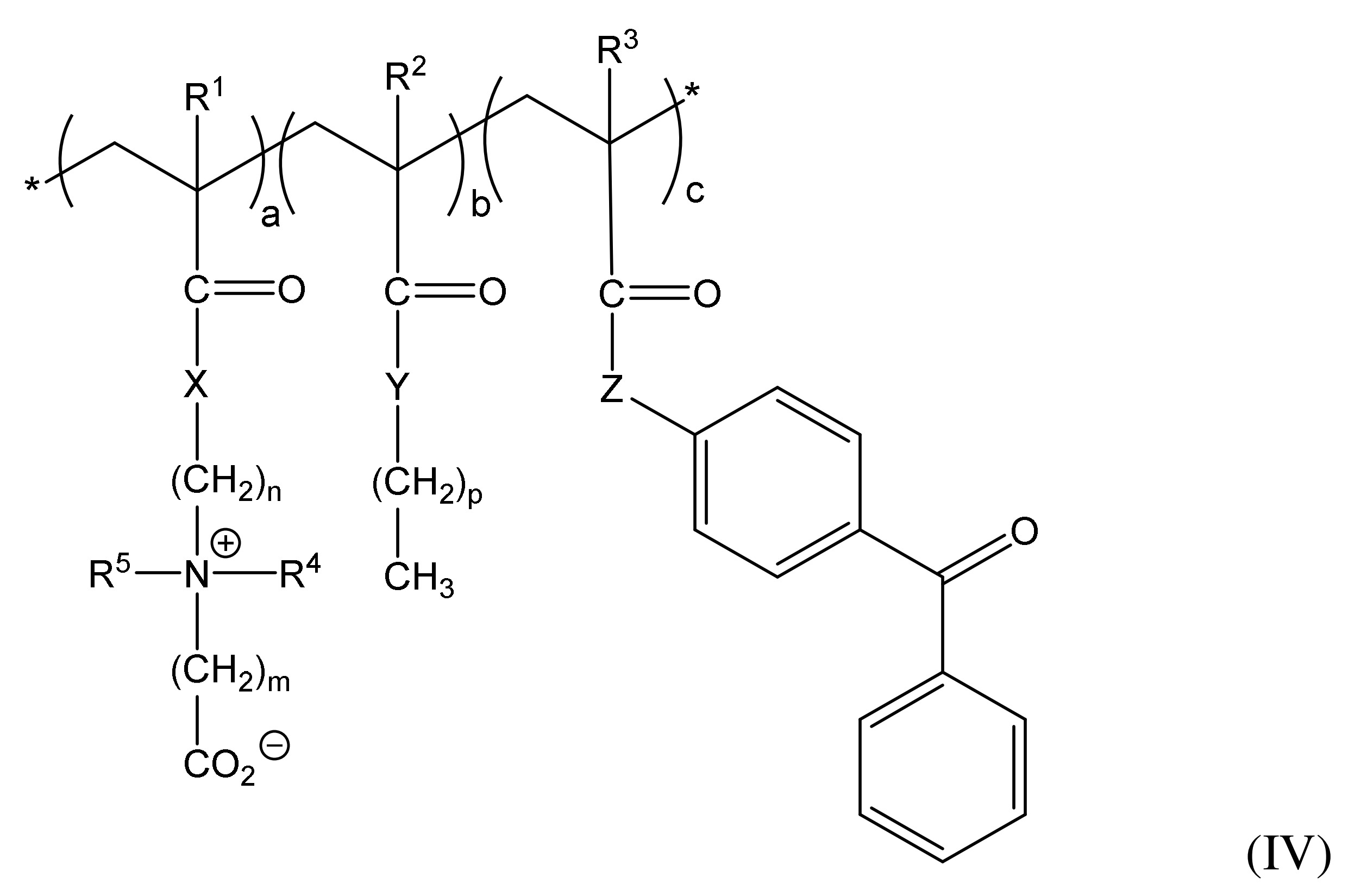
在特定的這些具體實施例中,R1 、R2 與R3 獨立選自由氫與甲基所組成的群組。In these specific embodiments, R 1 , R 2 and R 3 are independently selected from the group consisting of hydrogen and methyl.
在特定具體實施例中,R3 與R4 獨立選自由氫與C1-C3烷基所組成的群組。In certain embodiments, R 3 and R 4 are independently selected from the group consisting of hydrogen and C1-C3 alkyl.
在特定具體實施例中,n為1、2、3、4、5、或6。在一些具體實施例中,n為2或3。In certain embodiments, n is 1, 2, 3, 4, 5, or 6. In some specific embodiments, n is 2 or 3.
在特定具體實施例中,m為1、2、3、4、5、或6。在一些具體實施例中,m為1或2。In certain embodiments, m is 1, 2, 3, 4, 5, or 6. In some specific embodiments, m is 1 or 2.
在特定具體實施例中,p為1、2、3、4、5、或6。在一些具體實施例中,p為3。In certain embodiments, p is 1, 2, 3, 4, 5, or 6. In some embodiments, p is 3.
在特定具體實施例中,a為約0.70至約0.90莫耳百分比。在一些具體實施例中,a為約0.70莫耳百分比。In certain embodiments, a is about 0.70 to about 0.90 mole percent. In some embodiments, a is about 0.70 mole percent.
在特定具體實施例中,b為約0.05至約0.25莫耳百分比。在一些具體實施例中,b為約0.20莫耳百分比。In certain embodiments, b is about 0.05 to about 0.25 mole percent. In some embodiments, b is about 0.20 mole percent.
在特定具體實施例中,c為約0.05至約0.20莫耳百分比。在一些具體實施例中,c為約0.10莫耳百分比。In certain embodiments, c is about 0.05 to about 0.20 mole percent. In some embodiments, c is about 0.10 mole percent.
在一具體實施例中,R1 、R2 與R3 為氫,R3 與R4 為甲基,且X為NH,Y為O,及Z為NH。In a specific embodiment, R 1 , R 2 and R 3 are hydrogen, R 3 and R 4 are methyl, and X is NH, Y is O, and Z is NH.
在另一具體實施例中,R1 、R2 與R3 為氫,R4 與R5 為甲基,且X為NH,Y為O,及Z為NH,n為3,m為1,及p為3。In another specific embodiment, R 1 , R 2 and R 3 are hydrogen, R 4 and R 5 are methyl, and X is NH, Y is O, and Z is NH, n is 3, and m is 1, And p is 3.
在特定的以上具體實施例中,a為約0.70莫耳百分比,b為約0.20莫耳百分比,及c為約0.10莫耳百分比。In certain specific embodiments above, a is about 0.70 mol percent, b is about 0.20 mol percent, and c is about 0.10 mol percent.
以下說明本發明之代表性兩性離子/疏水性/光反應性共聚物的製備、特徵化及用途,及其在本發明之組成物及方法中之用途。The following describes the preparation, characterization and use of the representative zwitterionic/hydrophobic/photoreactive copolymer of the present invention, and its use in the composition and method of the present invention.
本發明提供一種CB聚合物表面修改策略,其經由極為簡單且有效的浸塗技術,直接對市售疏水性血小板儲存袋賦與超親水性及抗沾污力。其經由將CB共聚物藉光誘發共軛及交聯而共價接枝到儲存袋內表面而實現(圖22A)。CB部分為超親水性,使其難以附著市售疏水性血小板儲存袋,該共聚物中包括疏水性結合基(甲基丙烯酸正丁酯,BMA)(例如20莫耳百分比)及光敏性基(二苯基酮)(例如10莫耳百分比)。二苯基酮基已被廣泛作為光引發劑以促進化學共軛,其在250至365奈米之UV照射下產生二自由基而摘取脂肪族氫形成共價結合。為了將此結合基引入共聚物中,其合成單體N ‑(4-苯甲醯基苯基)丙烯醯胺(BPAA),然後與其他單體共聚合而形成多官能基共聚物(圖22B)。以1 H NMR驗證官能基單元之存在,其中由特徵峰積分值得到各單體的單元比例:CB單元為3.82 ppm (-CH2 -, 2H),BMA單元為1.45-1.63 ppm (-CH2 -, 4H),及BPAA單元為6.80-7.85 ppm(二苯基酮-H,9H)。結果顯示此聚合物對UV光(312奈米)非常敏感且吸收光譜變動為300至350奈米,表示發生光誘發共價結合(圖22C)。The present invention provides a CB polymer surface modification strategy, which directly imparts super-hydrophilicity and anti-staining power to a commercially available hydrophobic platelet storage bag through an extremely simple and effective dip coating technology. This is achieved by covalently grafting the CB copolymer to the inner surface of the storage bag by light-induced conjugation and crosslinking (Figure 22A). The CB part is super-hydrophilic, making it difficult to attach to commercially available hydrophobic platelet storage bags. The copolymer includes a hydrophobic binding group (n-butyl methacrylate, BMA) (for example, 20 mole percent) and a photosensitive group ( Diphenyl ketone) (e.g. 10 mole percent). The diphenyl ketone group has been widely used as a photoinitiator to promote chemical conjugation. It generates two free radicals under UV irradiation of 250 to 365 nanometers and extracts aliphatic hydrogen to form a covalent bond. In order to introduce this binding group into the copolymer, the monomer N- (4-benzylphenyl) acrylamide (BPAA) is synthesized, and then copolymerized with other monomers to form a multifunctional copolymer (Figure 22B) ). The existence of functional group units was verified by 1 H NMR, and the unit ratio of each monomer was obtained from the characteristic peak integral value: CB unit was 3.82 ppm (-CH 2 -, 2H), BMA unit was 1.45-1.63 ppm (-CH 2 -, 4H), and the BPAA unit is 6.80-7.85 ppm (Diphenylketone-H, 9H). The results show that this polymer is very sensitive to UV light (312 nm) and the absorption spectrum varies from 300 to 350 nm, indicating that light-induced covalent bonding has occurred (Figure 22C).
市售血小板袋的修改僅發生在內表面上而不損壞原本的袋性質。為了達成此目標,將代表性PCB聚合物以極低的濃度(0.5重量百分比)溶於DI水中,繼而注射到袋中且輕微搖動以確保全部表面均會被該聚合物塗覆。UV光透度測試顯示此袋在波長312奈米有70%之透光,其正為二苯基酮基的最佳照射波長(圖23A)。因此,內表面上的物理黏附聚合物可容易藉由施加外部UV光而安定化。使用此技術的共聚物塗層厚度通常為約<50奈米,使得由SEM影像無法見到明顯差異(圖23B)。有趣的是發現有紋理表面,且此形態可防止內表面在熱滅菌或血液處理期間阻塞。其他的研究已顯示該有紋理表面相較於光滑表面有更為嚴重的生物沾污。市售血小板袋主要以PVC製造,其摻有塑化劑(至多40%)以確保固有袋機械撓性及透氣性。因此,以乙醇簡單清洗表面短時間(10秒)以降低塑化劑對PCB安定性的滲出效應。The modification of the commercially available platelet bag only occurs on the inner surface without damaging the original bag properties. In order to achieve this goal, a representative PCB polymer was dissolved in DI water at a very low concentration (0.5 weight percent), and then injected into the bag and slightly shaken to ensure that the entire surface would be coated by the polymer. UV light transmittance test showed that the bag has 70% light transmittance at a wavelength of 312 nm, which is the optimal irradiation wavelength for diphenyl ketone groups (Figure 23A). Therefore, the physical adhesion polymer on the inner surface can be easily stabilized by applying external UV light. The thickness of the copolymer coating using this technique is usually about <50 nm, so that no significant difference can be seen from the SEM image (Figure 23B). It is interesting to find a textured surface, and this morphology prevents the inner surface from clogging during heat sterilization or blood processing. Other studies have shown that the textured surface has more serious biological contamination than smooth surfaces. Commercial platelet bags are mainly made of PVC, which is mixed with a plasticizer (up to 40%) to ensure the inherent mechanical flexibility and air permeability of the bag. Therefore, simply clean the surface with ethanol for a short time (10 seconds) to reduce the bleeding effect of the plasticizer on the stability of the PCB.
美國食品藥物管理局(FDA)要求接觸血液及血液成分之空容器無滲出問題。因此,為了使該技術更貼近臨床應用而使用X-射線光電子分光術(XPS)驗證PCB安定性。使用在285電子伏特處之C 1s峰作為參考而改正結合能(BE)。XPS結果顯示塗覆PCB的表面有與原本的PCB聚合物相同的N 1s 峰(圖23C及23D),且即使是在緩衝液中浸泡2週之後仍得到穩定的原子組成(圖23E),其可涵括血小板的全部壽命時間。因此,PCB被成功接枝到市售血小板袋內表面上且具有優良的安定性。有趣的是從調查光譜觀察到2支矽峰(Si 2s及Si 2p),證明此袋經疏水性矽系材料處理而具有沾污釋放性質。此現象進一步經由對100%人類血清在動態條件下即時監控沾污而驗證(圖24A)。親水性本性為PCB接枝表面的關鍵特徵之一。測量在乾燥條件下的水接觸角及在水性介質中的空氣接觸角。所有的接觸角均直接從照相影像測量。塗覆PCB的表面上的水接觸角從90°戲劇性減小到10°,且空氣接觸角從80°顯著增加到160°(圖23F)。因此,PCB共聚物接枝將疏水性表面轉化成超親水性。The U.S. Food and Drug Administration (FDA) requires that empty containers in contact with blood and blood components have no leakage problems. Therefore, in order to make this technology closer to clinical applications, X-ray photoelectron spectroscopy (XPS) is used to verify PCB stability. Correct the binding energy (BE) using the
植入的血液接觸醫療器材表面上的生物沾污經過數十年的研究仍為嚴重顧慮。塗覆PCB的血小板袋將被用於血小板保存,其涉及直接接觸人類血蛋白,最終及血小板。因此,生物沾污評量對於評估現有設計策略的臨床應用可行性為必要的。蛋白質吸附為在接觸生物環境之生物材料的表面上發生的主要事件。蛋白質可能在動態及靜態條件下顯示不同的吸附行為。因此,在動態條件及靜態條件下分別使用表面電漿子共振(SPR)及Micro BCA蛋白質檢驗套件,針對100%人類血清評估塗覆PCB的市售血小板袋。SPR被廣泛用於將聚合物表面與蛋白質之間的原處即時交互作用特徵化,其偵測限度<0.3奈克/平方公分。SPR片連續以市售血小板袋/THF溶液及PCB共聚物/DI水溶液旋塗。在乾燥條件下測量第一層(熔化的PVC袋)及第二層(PCB聚合物)的厚度且為18±1.2奈米及20 ±2.1奈米之值。圖24A顯示歸因於血清吸附的SPR信號變化為時間的函數。對於塗覆熔化血小板袋的片,持續流動100%人類血清時波長位移增加繼而顯示穩定減小趨勢,表示以XPS結果證實的聚矽氧系添加劑可能誘發沾污釋放行為。在血清注射處急劇的信號增加歸因於整體折射率的變化。由從注射蛋白質前到以緩衝液清洗後的波長位移評估非特定吸附量。塗覆及未塗覆PCB的片之波長位移為0.20及2.24奈米,其分別對應3.4及38.1奈克/平方公分的血清吸附。此結果顯示在動態條件下,塗覆PCB的表面有超低沾污(<5.0奈克/平方公分)能力及相較於未塗覆表面為<10%之沾污,其與Micro BCA蛋白質檢驗套件結果(圖24B)一致。The biological contamination of the implanted blood contacting the surface of medical equipment remains a serious concern after decades of research. The PCB-coated platelet bags will be used for platelet preservation, which involves direct contact with human blood proteins and ultimately platelets. Therefore, biological contamination assessment is necessary to evaluate the feasibility of clinical application of existing design strategies. Protein adsorption is the main event that occurs on the surface of biological materials in contact with the biological environment. Proteins may show different adsorption behaviors under dynamic and static conditions. Therefore, surface plasmon resonance (SPR) and Micro BCA protein test kits were used under dynamic and static conditions to evaluate PCB-coated commercial platelet bags against 100% human serum. SPR is widely used to characterize the real-time interaction between the polymer surface and the protein in situ, and its detection limit is <0.3 ng/cm². The SPR sheet is continuously spin-coated with commercially available platelet bag/THF solution and PCB copolymer/DI aqueous solution. Measure the thickness of the first layer (melted PVC bag) and the second layer (PCB polymer) under dry conditions and the values are 18±1.2nm and 20±2.1nm. Figure 24A shows the change in SPR signal due to serum adsorption as a function of time. For the sheet coated with melted platelet bags, the wavelength shift increases when 100% human serum is continuously flowing and then shows a steady decrease trend, indicating that the polysiloxane-based additives confirmed by the XPS results may induce contamination release behavior. The sharp signal increase at the serum injection is attributed to the change in overall refractive index. The non-specific adsorption amount was evaluated from the wavelength shift from before protein injection to after washing with buffer. The wavelength shifts of the coated and uncoated PCB sheets were 0.20 and 2.24 nanometers, which corresponded to 3.4 and 38.1 nanograms/cm² respectively. This result shows that under dynamic conditions, the surface of the coated PCB has ultra-low contamination (<5.0 ng/cm²) and less than 10% contamination compared to the uncoated surface, which is comparable to Micro BCA protein inspection The kit results (Figure 24B) are consistent.
纖維接合素在許多種細胞型式的黏附中扮演重要角色,包括纖維母細胞。因此,NIH3T3纖維母細胞對塗覆PCB的抗沾污表面的黏附被完全抑制(圖24C)。血小板黏附強烈取決於吸附的纖維蛋白原/纖維蛋白、馮威里氏因子(VWF)、纖維接合素等,且10奈克/平方公分的纖維蛋白原吸附可誘發全規模的血小板黏附。具有PCB親水性水合層的抗沾污表面可有效保護表面免於沾污及血小板活化(圖24D)。雖然PVC系材料已顯示對細菌形成生物膜的結合親和力,且表皮葡萄球菌的革蘭氏陽性菌株顯示無法偵測的緩慢生長速率,但塗覆PCB的表面完全抑制細菌黏附(圖24E及24F)。有趣的是細菌偏好在有紋理表面的凹部區域生長及形成生物膜。Fibronectin plays an important role in the adhesion of many cell types, including fibroblasts. Therefore, the adhesion of NIH3T3 fibroblasts to the stain-resistant surface of the coated PCB was completely inhibited (Figure 24C). Platelet adhesion strongly depends on the adsorbed fibrinogen/fibrin, von Willebrand factor (VWF), fibronectin, etc., and fibrinogen adsorption of 10 ng/cm² can induce full-scale platelet adhesion. The stain-resistant surface with the hydrophilic hydration layer of PCB can effectively protect the surface from staining and platelet activation (Figure 24D). Although PVC-based materials have shown binding affinity for bacteria to form biofilms, and gram-positive strains of Staphylococcus epidermidis show an undetectable slow growth rate, the surface of the coated PCB completely inhibits bacterial adhesion (Figure 24E and 24F) . It is interesting that bacteria prefer to grow and form biofilms in the recessed areas of the textured surface.
雖然血小板活化已被視為因纖維蛋白原吸附造成的黏附之後續回應,但非血小板/蛋白質黏附表面不完全防止血小板活化。膜聯蛋白V因其結合磷脂醯絲胺酸的能力而常被用於偵測凋亡細胞,當在血漿膜外葉上發生時,其為血小板凋亡標記。因此,膜聯蛋白V結合含量越高表示細胞凋亡越嚴重。結果顯示保存在塗覆PCB的親水性袋中的血小板之膜聯蛋白V結合含量比未塗覆袋者低,表示PCB表面可有效維持血小板存活率(圖25A)。血小板在正常條件下維持休止狀態,然而,當遭受血管損傷時,由於血流速度改變引起的剪切應力連同後續的細胞傳訊事件造成不可逆的血小板活化。p -選滯蛋白(CD62)為醣蛋白且為血小板活化之已清楚說明標記。在血小板活化期間,p -選滯蛋白從細胞內粒體移位到外膜。圖25B顯示,由於非特定血小板-表面交互作用相較於對照表面為低,故對塗覆PCB袋有效抑制血小板活化。塗覆PCB袋中的第8日血小板活化程度近似對照樣品第5日。儘管如此,血小板相較於冷藏儲存者仍具有非常高的代謝活性,故即使是塗覆PCB者,活化程度仍顯示穩定增加趨勢。同時,血小板的高代謝活性及活化會造成葡萄糖消耗增加(圖25G)、乳酸累積(圖25H),結果若超過緩衝力則pH下降(圖25F)。pH下降到6.2或以下會顯著降低輸血期間的血小板存活率。對於塗覆PCB的樣品,葡萄糖消耗及乳酸累積相較於對照未嚴重影響pH值(>6.8)。使用形態分數(MS)作為血小板健康的簡單指標,且定義為4×(盤體%)+ 2×(球體%)+(枝體%)。具有健康盤體形態之血小板的百分比越高則MS值越高。儲存在塗覆PCB袋中的血小板即使是在8日後仍具有極高的MS值(圖25C)。VWF結合血小板依結合血小板GPIbα的A1域之構形而定,且較高的MFI(平均螢光強度)關聯較高的結合親和力。其為血小板止血功能的判斷基準。結果顯示塗覆PCB樣品第8日的MFI (320)高於對照樣品第5日(300)(圖25D)。以上所有的血小板評估結果均表示兩性離子PCB共聚物表面可有效緩和非特定交互作用誘發的血小板損害,其使本聚合物及表面修改策略對臨床應用更具潛力。Although platelet activation has been regarded as a subsequent response to adhesion caused by fibrinogen adsorption, non-platelet/protein adhesion surfaces do not completely prevent platelet activation. Annexin V is often used to detect apoptotic cells due to its ability to bind phospholipid serine. When it occurs on the outer lobes of the plasma membrane, it is a marker of platelet apoptosis. Therefore, the higher the binding content of Annexin V, the more serious the apoptosis. The results showed that the annexin V binding content of platelets stored in the hydrophilic bag coated with PCB was lower than that of the uncoated bag, indicating that the surface of the PCB can effectively maintain the platelet survival rate (Figure 25A). Platelets maintain a resting state under normal conditions. However, when suffering from vascular injury, the shear stress caused by the change of blood flow velocity together with subsequent cell signaling events causes irreversible platelet activation. p -selectin (CD62) is a glycoprotein and a clearly stated marker for platelet activation. During platelet activation, p -selection protein translocates from the intracellular mitochondria to the outer membrane. Figure 25B shows that since the non-specific platelet-surface interaction is lower than the control surface, the coated PCB bag effectively inhibits platelet activation. The degree of platelet activation on the 8th day in the coated PCB bag was similar to that on the 5th day of the control sample. Nevertheless, platelets still have a very high metabolic activity compared to those stored in cold storage, so even those coated with PCBs still show a steady increase in the degree of activation. At the same time, the high metabolic activity and activation of platelets will increase glucose consumption (Figure 25G) and lactic acid accumulation (Figure 25H). As a result, if the buffering capacity is exceeded, the pH will decrease (Figure 25F). A drop in pH of 6.2 or below will significantly reduce platelet survival during transfusion. For the PCB-coated samples, glucose consumption and lactic acid accumulation did not seriously affect the pH value (>6.8) compared to the control. The morphological score (MS) is used as a simple indicator of platelet health and is defined as 4×(disc%) + 2×(sphere%)+(branch%). The higher the percentage of platelets with healthy disc morphology, the higher the MS value. The platelets stored in the coated PCB bags had extremely high MS values even after 8 days (Figure 25C). VWF binding platelets depends on the configuration of the A1 domain that binds platelets GPIbα, and higher MFI (average fluorescence intensity) is associated with higher binding affinity. It is a criterion for the determination of platelet hemostatic function. The results showed that the MFI (320) of the coated PCB sample on day 8 was higher than that of the control sample on day 5 (300) (Figure 25D). All the above platelet evaluation results indicate that the zwitterionic PCB copolymer surface can effectively alleviate the platelet damage induced by non-specific interactions, which makes the polymer and surface modification strategies more potential for clinical applications.
總之,在一態樣中,本發明提供一種由超親水性羧基甜菜鹼(CB)單元、疏水性甲基丙烯酸正丁酯(BMA)單元、及光敏性N ‑(4-苯甲醯基苯基)丙烯醯胺(BPAA)單元所組成之多官能基無規型雙親性兩性離子共聚物,其可作為表面塗覆材料。此聚合物可經由簡單且有效的浸塗方法,對市售疏水性血小板袋非侵入性地賦與超親水性及抗沾污力。保存在此塗覆PCB共聚物的血小板袋中的人類血小板顯示比現有標準保存方法顯著改良的性質(例如較高的存活率,較小的活化率,較高的形態分數,及較高的VWF結合親和力)。該塗覆策略經由浸塗方法提供一種簡單卻有效的大規模應用。因此,此技術因廣泛的醫療及工程應用範圍而被看好,尤其是關於延長人類血小板儲存期限超過現有標準方法。In a word, in one aspect, the present invention provides a superhydrophilic carboxybetaine (CB) unit, a hydrophobic n-butyl methacrylate (BMA) unit, and a photosensitive N- (4-benzylbenzene) unit. A polyfunctional random amphiphilic zwitterionic copolymer composed of acrylamide (BPAA) units, which can be used as a surface coating material. This polymer can non-invasively impart super-hydrophilicity and anti-staining power to commercially available hydrophobic platelet bags through a simple and effective dip coating method. The human platelets stored in this PCB copolymer-coated platelet bag show significantly improved properties (such as higher survival rate, lower activation rate, higher morphology fraction, and higher VWF) than the existing standard preservation methods Binding affinity). This coating strategy provides a simple but effective large-scale application via a dip coating method. Therefore, this technology is promising because of its wide range of medical and engineering applications, especially for extending the shelf life of human platelets beyond the existing standard methods.
實施例4揭述本發明之代表性兩性離子/疏水性/光反應性共聚物的製備、特徵化及用途。兩性離子共聚物塗料組成物及塗覆的基材表面 Example 4 discloses the preparation, characterization and use of the representative zwitterionic/hydrophobic/photoreactive copolymer of the present invention. Zwitterionic copolymer coating composition and coated substrate surface
本發明之另一態樣提供塗料組成物。該塗料組成物包括在此所述的兩性離子共聚物(例如式(I)、(II)、(III)、或(IV)之共聚物)。除了該兩性離子共聚物,該塗料組成物視情況包括將該兩性離子共聚物有效輸送到欲塗覆表面之載劑或媒液。代表性載劑包括溶劑,如有機溶劑、水性溶劑、及混合有機與水性溶劑,其中欲塗佈的兩性離子共聚物可溶於其中。該塗料組成物對基材表面有效提供塗層。Another aspect of the present invention provides a coating composition. The coating composition includes the zwitterionic copolymer described herein (for example, a copolymer of formula (I), (II), (III), or (IV)). In addition to the zwitterionic copolymer, the coating composition optionally includes a carrier or vehicle for effectively transporting the zwitterionic copolymer to the surface to be coated. Representative carriers include solvents, such as organic solvents, aqueous solvents, and mixed organic and aqueous solvents, in which the zwitterionic copolymer to be coated is soluble. The coating composition effectively provides a coating on the surface of the substrate.
對於使用包括光反應性基之兩性離子共聚物的具體實施例,該塗料衍生自在此所述的共聚物。在將該共聚物固定於表面之過程中,照射塗覆在表面上的共聚物以進行共聚物交聯,且依表面而定將該共聚物交聯到表面。因此,對於這些具體實施例,該塗料包含交聯的兩性離子共聚物,且依表面而定,亦及交聯到表面之交聯的兩性離子共聚物。For specific examples using zwitterionic copolymers that include photoreactive groups, the coating is derived from the copolymers described herein. In the process of fixing the copolymer on the surface, the copolymer coated on the surface is irradiated to crosslink the copolymer, and depending on the surface, the copolymer is crosslinked to the surface. Therefore, for these specific examples, the coating contains a cross-linked zwitterionic copolymer, and it depends on the surface, as well as a cross-linked zwitterionic copolymer that is cross-linked to the surface.
在一進一步態樣中,本發明提供一種基材,其表面(例如外或內)之至少一部分或全部經本發明之共聚物(例如式(I)、(II)、(III)、或(IV)之共聚物)或包含本發明共聚物之組成物塗覆。In a further aspect, the present invention provides a substrate whose surface (e.g., outer or inner) at least part or all of the copolymer (e.g. formula (I), (II), (III), or (IV) of the present invention ) Copolymer) or a composition containing the copolymer of the present invention.
合適的基材具有烴系表面之表面。合適的表面包括塑膠表面及聚合性表面。代表性表面包括聚烯烴、聚酯、聚碳酸酯、聚胺基甲酸酯(PU)、聚碸(PSF)、聚(醚碸)(PES)、聚醯胺、聚丙烯酸系、聚醯亞胺、芳香族聚酯、聚乙烯(PE)、聚丙烯(PP)、聚苯乙烯(PS)、聚(對苯二甲酸乙二酯)(PET)、聚(氯乙烯)(PVC)、聚(二甲基矽氧烷)(PMDS)、聚(偏二氟乙烯) (PVDF)、聚(乳酸)(PLA)、及聚(甲基丙烯酸甲酯)(PMMA)表面。在特定具體實施例中,該表面為聚氯乙烯表面或聚胺基甲酸酯表面。在其他具體實施例中,該表面為纖維素或乙酸纖維素表面。A suitable substrate has a surface with a hydrocarbon-based surface. Suitable surfaces include plastic surfaces and polymerized surfaces. Representative surfaces include polyolefin, polyester, polycarbonate, polyurethane (PU), poly (PSF), poly (ether sulfite) (PES), polyamide, polyacrylic, polyamide Amine, aromatic polyester, polyethylene (PE), polypropylene (PP), polystyrene (PS), poly(ethylene terephthalate) (PET), poly(vinyl chloride) (PVC), poly (Dimethylsiloxane) (PMDS), poly(vinylidene fluoride) (PVDF), poly(lactic acid) (PLA), and poly(methyl methacrylate) (PMMA) surfaces. In certain embodiments, the surface is a polyvinyl chloride surface or a polyurethane surface. In other specific embodiments, the surface is a cellulose or cellulose acetate surface.
其他合適的表面包括金屬、金屬合金、及陶瓷表面。Other suitable surfaces include metals, metal alloys, and ceramic surfaces.
在特定具體實施例中,本發明提供一種醫療器材,其表面之至少一部分或全部經本發明之共聚物或包含本發明共聚物之組成物塗覆。合適的醫療器材包括表面為烴系表面之器材。代表性表面包括聚烯烴、聚酯、聚碳酸酯、聚胺基甲酸酯(PU)、聚碸(PSF)、聚(醚碸)(PES)、聚醯胺、聚丙烯酸系、聚醯亞胺、芳香族聚酯、聚乙烯(PE)、聚丙烯(PP)、聚苯乙烯(PS)、聚(對苯二甲酸乙二酯)(PET)、聚(氯乙烯)(PVC)、聚(二甲基矽氧烷)(PMDS)、聚(偏二氟乙烯)(PVDF)、聚(乳酸)(PLA)、及聚(甲基丙烯酸甲酯)(PMMA)表面。在特定具體實施例中,該表面為聚氯乙烯表面或聚胺基甲酸酯表面。在其他具體實施例中,該表面為纖維素或乙酸纖維素表面。In a specific embodiment, the present invention provides a medical device, at least a part or all of its surface is coated with the copolymer of the present invention or a composition containing the copolymer of the present invention. Suitable medical devices include those with hydrocarbon-based surfaces. Representative surfaces include polyolefin, polyester, polycarbonate, polyurethane (PU), poly (PSF), poly (ether sulfite) (PES), polyamide, polyacrylic, polyamide Amine, aromatic polyester, polyethylene (PE), polypropylene (PP), polystyrene (PS), poly(ethylene terephthalate) (PET), poly(vinyl chloride) (PVC), poly (Dimethylsiloxane) (PMDS), poly(vinylidene fluoride) (PVDF), poly(lactic acid) (PLA), and poly(methyl methacrylate) (PMMA) surfaces. In certain embodiments, the surface is a polyvinyl chloride surface or a polyurethane surface. In other specific embodiments, the surface is a cellulose or cellulose acetate surface.
代表性器材包括板、盤、管件、尖端物、導管、人造血管、人工心臟、或人工肺之器材。Representative equipment includes equipment such as plates, discs, tubes, pointed objects, catheters, artificial blood vessels, artificial hearts, or artificial lungs.
在一具體實施例中,本發明提供一種聚氯乙烯管件,其內表面之至少一部分或全部經本發明之組成物或共聚物塗覆。In a specific embodiment, the present invention provides a polyvinyl chloride pipe, at least a part or all of its inner surface is coated with the composition or copolymer of the present invention.
在另一具體實施例中,本發明提供一種聚胺基甲酸酯管件,其內表面之至少一部分或全部經本發明之組成物或共聚物塗覆。In another specific embodiment, the present invention provides a polyurethane pipe fitting, at least a part or all of its inner surface is coated with the composition or copolymer of the present invention.
在一進一步具體實施例中,本發明提供一種聚碸透析膜,其表面之至少一部分或全部經本發明之組成物或共聚物塗覆。In a further specific embodiment, the present invention provides a polymer dialysis membrane, at least a part or all of its surface is coated with the composition or copolymer of the present invention.
在另一具體實施例中,本發明提供一種烴系膜容器,其內表面之至少一部分或全部經本發明之組成物或共聚物塗覆。In another specific embodiment, the present invention provides a hydrocarbon-based membrane container, at least a part or all of its inner surface is coated with the composition or copolymer of the present invention.
在另一具體實施例中,本發明提供一種血小板儲存袋,其內表面之至少一部分或全部經本發明之組成物或共聚物塗覆。In another embodiment, the present invention provides a platelet storage bag, at least a part or all of its inner surface is coated with the composition or copolymer of the present invention.
其他的代表性器材,其中有至少一個或以上的表面有利地經本發明之共聚物或包含本發明之共聚物的組成物塗覆,該其他的代表性器材包括第I類、第II類、或第III類之植入/非植入醫療器材。Other representative devices, in which at least one or more surfaces are favorably coated with the copolymer of the present invention or a composition containing the copolymer of the present invention. The other representative devices include Class I, Class II, or Class III implanted/non-implanted medical devices.
如上所示,在此所述的兩性離子共聚物可用於塗覆血液接觸表面以對這些表面賦與各種優點。包括血液接觸表面之器材為血液透析器材的組件。有利地以在此所述的兩性離子共聚物進行處理的血液透析器材的組件包括透析膜(例如血液純化膜)及透析管件(例如聚氯乙烯與聚胺基甲酸酯管件)。有利地塗覆該兩性離子共聚物之膜的表面包括纖維素、乙酸纖維素、聚碸(PSF)、聚(醚碸)(PES)、聚(二甲基矽氧烷)(PMDS)、聚(偏二氟乙烯)(PVDF)、聚(乳酸)(PLA)、聚胺基甲酸酯(PU)、及聚丙烯(PP)。使用該兩性離子共聚物之方法 As indicated above, the zwitterionic copolymers described herein can be used to coat blood contact surfaces to impart various advantages to these surfaces. The equipment including the blood contact surface is a component of the hemodialysis equipment. The components of the hemodialysis device advantageously treated with the zwitterionic copolymers described herein include dialysis membranes (such as blood purification membranes) and dialysis tubing (such as polyvinyl chloride and polyurethane tubing). The surface of the film that advantageously coats the zwitterionic copolymer includes cellulose, cellulose acetate, polyfloc (PSF), poly(ether floc) (PES), poly(dimethylsiloxane) (PMDS), poly (Vinylidene fluoride) (PVDF), poly(lactic acid) (PLA), polyurethane (PU), and polypropylene (PP). Method of using the zwitterionic copolymer
在一進一步態樣中,本發明提供使用本發明之兩性離子共聚物(例如式(I)、(II)、(III)、或(IV)之共聚物)及共聚物組成物之方法。In a further aspect, the present invention provides methods of using the zwitterionic copolymers of the present invention (for example, copolymers of formula (I), (II), (III), or (IV)) and copolymer compositions.
在一具體實施例中,本發明提供一種塗覆基材表面之方法,其包含將該基材表面以本發明之共聚物(例如式(I)、(II)、(III)、或(IV)之共聚物)或包含本發明共聚物之組成物接觸。In a specific embodiment, the present invention provides a method for coating the surface of a substrate, which comprises using the surface of the substrate with the copolymer of the present invention (for example, formula (I), (II), (III), or (IV) )) or the composition comprising the copolymer of the present invention.
在一相關具體實施例中,本發明提供一種塗覆基材表面而抗沾污之方法,其包含將該基材表面之至少一部分塗覆本發明之共聚物(例如式(I)、(III)或(IV)之共聚物)或包含本發明共聚物之組成物,及將該基材表面以有效交聯表面上的共聚物之光照射。In a related embodiment, the present invention provides a method for coating the surface of a substrate to resist contamination, which comprises coating at least a portion of the surface of the substrate with the copolymer of the present invention (for example, formula (I), (III) ) Or (IV) copolymer) or a composition containing the copolymer of the present invention, and the surface of the substrate is irradiated with light that effectively crosslinks the copolymer on the surface.
在另一具體實施例中,本發明提供一種使基材表面抗沾污之方法,其包含將該基材表面之至少一部分塗覆本發明之共聚物(例如式(I)、(II)、(III)、或(IV)之共聚物)或包含本發明共聚物之組成物。In another specific embodiment, the present invention provides a method for making the surface of a substrate anti-staining, which comprises coating at least a portion of the surface of the substrate with the copolymer of the present invention (for example, formula (I), (II), (III) or (IV) copolymer) or a composition comprising the copolymer of the present invention.
在一相關具體實施例中,本發明提供一種使基材表面抗沾污之方法,其包含將該基材表面之至少一部分塗覆本發明之共聚物(例如式(I)、(III)或(IV)之共聚物)或包含本發明共聚物之組成物,及將該基材表面以有效交聯表面上的共聚物之光照射。In a related embodiment, the present invention provides a method for making the surface of a substrate anti-staining, which comprises coating at least a part of the surface of the substrate with the copolymer of the present invention (for example, formula (I), (III) or (IV) Copolymer) or a composition containing the copolymer of the present invention, and the surface of the substrate is irradiated with light that effectively crosslinks the copolymer on the surface.
在一進一步具體實施例中,本發明提供一種抑制基材表面上的血蛋白吸附之方法,其包含將該基材表面之至少一部分塗覆本發明之共聚物(例如式(I)、(II)、(III)、或(IV)之共聚物)或包含本發明共聚物之組成物。In a further embodiment, the present invention provides a method for inhibiting the adsorption of blood proteins on the surface of a substrate, which comprises coating at least a portion of the surface of the substrate with the copolymer of the present invention (for example, formula (I), (II) ), (III), or (IV) copolymer) or a composition comprising the copolymer of the present invention.
在一相關具體實施例中,本發明提供一種抑制基材表面上的血蛋白吸附之方法,其包含將該基材表面之至少一部分塗覆本發明之共聚物(例如式(I)、(III)或(IV)之共聚物)或包含本發明共聚物之組成物,及將該基材表面以有效交聯表面上的共聚物之光照射。In a related embodiment, the present invention provides a method for inhibiting the adsorption of blood proteins on the surface of a substrate, which comprises coating at least a portion of the surface of the substrate with the copolymer of the present invention (for example, formula (I), (III) ) Or (IV) copolymer) or a composition containing the copolymer of the present invention, and the surface of the substrate is irradiated with light that effectively crosslinks the copolymer on the surface.
在另一具體實施例中,本發明提供一種塗覆血小板儲存袋內表面之方法,其包含將血小板儲存袋內表面以本發明之共聚物(例如式(I)、(III)或(IV)之共聚物)或包含本發明共聚物之組成物接觸,及將該血小板儲存袋之經接觸的內表面以有效交聯表面上的共聚物之光照射。In another specific embodiment, the present invention provides a method for coating the inner surface of a platelet storage bag, which comprises using the copolymer of the present invention (for example, formula (I), (III) or (IV)) on the inner surface of the platelet storage bag. The copolymer) or the composition containing the copolymer of the present invention are contacted, and the contacted inner surface of the platelet storage bag is irradiated with light that effectively crosslinks the copolymer on the surface.
在一進一步具體實施例中,本發明提供一種塗覆聚氯乙烯管件內表面之方法,其包含將血小板儲存袋內表面以本發明之共聚物(例如式(I)、(III)或(IV)之共聚物)或包含本發明共聚物之組成物接觸,及將該聚氯乙烯管件的接觸內表面以有效交聯表面上的共聚物之光照射。In a further embodiment, the present invention provides a method for coating the inner surface of a polyvinyl chloride pipe, which comprises applying the copolymer of the present invention to the inner surface of a platelet storage bag (for example, formula (I), (III) or (IV) ) Or the composition containing the copolymer of the present invention, and the contact inner surface of the polyvinyl chloride pipe is irradiated with light that effectively crosslinks the copolymer on the surface.
在其他具體實施例中,本發明提供抑制或防止塑化劑從基材表面滲出之方法。在特定的這些具體實施例中,該方法包含: (a)將基材表面之至少一部分以包含共聚物之組成物塗覆而提供經塗覆表面,該共聚物包含第一重複單元及第二重複單元,其中各第一重複單元包含側接兩性離子基,及其中各第二重複單元包含有效交聯表面上的共聚物之側接光反應性基,而提供經塗覆表面;及 (b)將該經塗覆表面以有效交聯表面上的共聚物之光照射,因而提供有效抑制或防止塑化劑從表面滲出的經塗覆表面。In other specific embodiments, the present invention provides methods for inhibiting or preventing the exudation of the plasticizer from the surface of the substrate. In these specific embodiments, the method includes: (a) Coating at least a part of the surface of the substrate with a composition containing a copolymer to provide a coated surface. The copolymer includes a first repeating unit and a second repeating unit, wherein each first repeating unit includes a pendant amphoteric The ionic group, and each of the second repeating units therein, comprise a pendant photoreactive group that effectively crosslinks the copolymer on the surface to provide a coated surface; and (b) The coated surface is irradiated with light that effectively crosslinks the copolymer on the surface, thereby providing a coated surface that effectively inhibits or prevents the seepage of the plasticizer from the surface.
在特定具體實施例中,該共聚物進一步包含第三重複單元,其中各第三重複單元包含將該共聚物有效吸附到表面之側接疏水性基。可使用的兩性離子共聚物包括式(I)、(III)及(IV)。In a specific embodiment, the copolymer further includes a third repeating unit, wherein each third repeating unit includes a pendant hydrophobic group that effectively adsorbs the copolymer to the surface. Zwitterionic copolymers that can be used include formulas (I), (III) and (IV).
在特定的以上具體實施例中,將表面以組成物接觸包含將該表面浸入該共聚物或組成物中。在其他的這些具體實施例中,將該表面以組成物接觸包含將該共聚物或組成物噴灑、旋塗、刷塗、或滾轉到該表面上。In certain embodiments above, contacting the surface with the composition includes immersing the surface in the copolymer or composition. In these other specific embodiments, contacting the surface with the composition includes spraying, spinning, brushing, or rolling the copolymer or composition onto the surface.
在本發明方法之特定具體實施例中,將表面以共聚物或共聚物組成物接觸,或將表面以共聚物或共聚物組成物塗覆,包含將該表面浸入該共聚物或共聚物組成物中。在其他的這些具體實施例中,將表面以共聚物或共聚物組成物接觸,或將表面以共聚物或共聚物組成物塗覆,包含將該共聚物或共聚物組成物噴灑、旋塗、刷塗、或滾轉到該表面上。In a specific embodiment of the method of the present invention, contacting the surface with a copolymer or copolymer composition or coating the surface with a copolymer or copolymer composition includes immersing the surface in the copolymer or copolymer composition in. In these other specific embodiments, contacting the surface with a copolymer or copolymer composition, or coating the surface with a copolymer or copolymer composition, includes spraying, spin coating, or coating the copolymer or copolymer composition. Brush, or roll onto the surface.
在此使用的術語「約」表示指定值之±5%。The term "about" used here means ±5% of the specified value.
為了例證目的而提供以下實施例,其並非限制本發明。實施例 實施例 1 代表性兩性離子 / 疏水性共聚物的製備、特徵化及用途 The following examples are provided for illustrative purposes, which do not limit the invention. Examples Example 1 Preparation, characterization and use of representative zwitterionic / hydrophobic copolymers
此實施例說明本發明之代表性兩性離子/疏水性共聚物的製備、特徵化及用途。This example illustrates the preparation, characterization and use of a representative zwitterionic/hydrophobic copolymer of the present invention.
材料 。依照先前所述方法分別合成羧基甜菜鹼丙烯醯胺,1-羧基-N,N -二甲基-N -(3’-丙烯醯胺基丙基)乙銨內鹽(CB1),及羧基甜菜鹼甲基丙烯酸酯,2-羧基-N,N -二甲基-N -(2’-甲基丙烯醯氧基乙基)乙銨內鹽(CB2)。以下的材料及試劑均得自Sigma-Aldrich(美國密蘇里州聖路易)且無任何進一步純化而使用:2,2’-偶氮貳異丁腈(AIBN)、人類血漿纖維蛋白原(Fg)、人類血清白蛋白(HSA)、人類血液γ -球蛋白、乙酸鈉(SA)、N -[參(羥甲基)甲基]-3-胺基丙磺酸(TAPS)、1-癸硫醇、正十二烷基硫酸鈉(SDS)、N -羥基琥珀醯亞胺(NHS)、N -乙基-N’ -(3-二乙基胺基丙基)碳化二亞胺鹽酸鹽(EDC)。甲基丙烯酸正丁酯(BMA)購自Tokyo Chemical Industry Co., Ltd.(美國奧瑞岡州波特蘭)。以山葵過氧化酶(HRP)共軛的抗纖維蛋白原抗體購自Novus Biologicals(美國科羅拉多州Littleton)。鄰苯二胺二鹽酸鹽(OPD)得自Pierce(美國伊利諾州Rockford)。經磷酸鹽緩衝的鹽水(10×,溶液)、過氧化氫(H2 O2 ,30%於水中)、及氫氯酸(HCl)得自Fisher Scientific Co.(紐澤西州Fair Lawn)。標準人類血清(性別合併混合)購自BioChemed Services(美國維吉尼亞州Winchester)。Micro BCA蛋白質檢驗套件及RBS™ 35濃縮物購自Thermo Scientific(美國麻州Waltham)。具有超低附著表面的多孔培養板購自Corning Costar Corp.(紐約州Corning)。絕對乙醇(200 proof)購自Decon Labs(賓州King of Prussia)。水得自Millipore純水系統且最小電阻率為18.0 MΩ公分。其他的有機試劑及溶劑為市售超純級試劑且收到直接使用。 Material . According to the method described previously, carboxybetaine acrylamide, 1-carboxy- N,N -dimethyl- N -(3'-acrylamidopropyl) ethylammonium internal salt (CB1), and carboxybeet were synthesized separately Alkali methacrylate, 2-carboxy- N,N -dimethyl- N- (2'-methacryloxyethyl)ethylammonium inner salt (CB2). The following materials and reagents were obtained from Sigma-Aldrich (St. Louis, Missouri, USA) and used without any further purification: 2,2'-azoisobutyronitrile (AIBN), human plasma fibrinogen (Fg), Human serum albumin (HSA), human blood γ -globulin, sodium acetate (SA), N -[(hydroxymethyl)methyl]-3-aminopropanesulfonic acid (TAPS), 1-decanethiol , Sodium dodecyl sulfate (SDS), N -hydroxysuccinimide (NHS), N -ethyl- N' -(3-diethylaminopropyl)carbodiimide hydrochloride ( EDC). N-Butyl methacrylate (BMA) was purchased from Tokyo Chemical Industry Co., Ltd. (Portland, Oregon, USA). Anti-fibrinogen antibody conjugated with horseradish peroxidase (HRP) was purchased from Novus Biologicals (Littleton, Colorado, USA). O-phenylenediamine dihydrochloride (OPD) was obtained from Pierce (Rockford, Illinois, USA). Phosphate buffered saline (10×, solution), hydrogen peroxide (H 2 O 2 , 30% in water), and hydrochloric acid (HCl) were obtained from Fisher Scientific Co. (Fair Lawn, New Jersey). Standard human serum (gender pooling mix) was purchased from BioChemed Services (Winchester, Virginia, USA). Micro BCA protein test kit and RBS™ 35 concentrate were purchased from Thermo Scientific (Waltham, MA, USA). Multi-well culture plates with ultra-low adhesion surfaces were purchased from Corning Costar Corp. (Corning, NY). Absolute ethanol (200 proof) was purchased from Decon Labs (King of Prussia, Pennsylvania). The water was obtained from the Millipore pure water system and had a minimum resistivity of 18.0 MΩ cm. Other organic reagents and solvents are commercially available ultra-pure reagents and are used directly.
聚合物之合成 。藉習知自由基聚合方法,使用AIBN作為引發劑而合成雙親性無規共聚物,聚(CB1-共 -BMA) (PCB1)及聚(CB2-共 -BMA) (PCB2),且先前已報告類似方法(Lin, X.; Konno, T.; Ishihara, K., Cell-Membrane-Permeable and Cytocompatible Phospholipid Polymer Nanoprobes Conjugated with Molecular Beacons.Biomacromolecules 2014,15 (1), 150-157;及Lin, X.; Fukazawa, K.; Ishihara, K., Photoinduced inhibition of DNA unwinding in vitro with water-soluble polymers containing both phosphorylcholine and photoreactive groups.Acta Biomater. 2016,40 , 226-234)。簡言之,將所欲量的CB單體、BMA(各莫耳比例的CB/BMA:2/8、3/7、4/6、5/5、6/4、8/2)、與AIBN溶於乙醇中。將溶液轉移到Pyrex® Vista™玻璃管反應器及在室溫進一步以氮氣排氣30分鐘。聚合係在密封玻璃管中在氮氣保護大氣下實行。聚合後將反應溶液輕微滴入醚/氯仿之混合溶劑中以沈澱共聚物。將共聚物過濾及在室溫真空乾燥24小時後收集成為白色粉末。以大量Millipore水清洗收集的白色聚合物粉末而移除殘餘CB單體。然後將共聚物再度過濾,以液態氮冷凍,及以凍乾器(密蘇里州堪薩斯市之Labconco Co., Ltd.)在-80℃處理48小時,而將其轉化成乾燥白色粉末。使用1 H-NMR(AV-500, Bruker,德國)證實經純化共聚物的化學結構,及將聚合物在-20℃冷凍保存。 Synthesis of polymers . Using the known free radical polymerization method, using AIBN as the initiator to synthesize amphiphilic random copolymers, poly(CB1- co- BMA) (PCB1) and poly(CB2- co- BMA) (PCB2), which have been reported previously Similar methods (Lin, X.; Konno, T.; Ishihara, K., Cell-Membrane-Permeable and Cytocompatible Phospholipid Polymer Nanoprobes Conjugated with Molecular Beacons. Biomacromolecules 2014, 15 (1), 150-157; and Lin, X. ; Fukazawa, K.; Ishihara, K., Photoinduced inhibition of DNA unwinding in vitro with water-soluble polymers containing both phosphorylcholine and photoreactive groups. Acta Biomater. 2016, 40 , 226-234). In short, the desired amount of CB monomer, BMA (CB/BMA in each molar ratio: 2/8, 3/7, 4/6, 5/5, 6/4, 8/2), and AIBN is dissolved in ethanol. The solution was transferred to a Pyrex ® Vista™ glass tube reactor and further vented with nitrogen at room temperature for 30 minutes. The polymerization is carried out in a sealed glass tube under a nitrogen atmosphere. After polymerization, the reaction solution was slightly dropped into a mixed solvent of ether/chloroform to precipitate the copolymer. The copolymer was filtered and vacuum dried at room temperature for 24 hours, and collected as a white powder. Wash the collected white polymer powder with a large amount of Millipore water to remove residual CB monomer. The copolymer was then filtered again, frozen with liquid nitrogen, and treated with a lyophilizer (Labconco Co., Ltd., Kansas City, Missouri) at -80°C for 48 hours to convert it into a dry white powder. The chemical structure of the purified copolymer was confirmed using 1 H-NMR (AV-500, Bruker, Germany), and the polymer was stored frozen at -20°C.
塗覆條件最適化 。將聚丙烯(PP)基材(ePlastic,美國加州聖地牙哥)切成0.5公分×0.5公分,在乙醇中進行超音波清洗10分鐘,及在室溫乾燥。將雙親性不同的CB共聚物以0.50重量百分比的濃度分別溶於乙醇中。將各基材在聚合物溶液中浸漬10秒,繼而在室溫於乙醇蒸汽保護性環境中在大氣壓力下蒸發溶劑。將所有經修改的PP基材在經磷酸鹽緩衝的鹽水(PBS, 1×, pH 7.4)中在室溫浸泡1小時。然後將基材以DI水沖洗及室溫下在真空乾燥中乾燥24小時。為了測定聚合物濃度對塗覆效率的影響,將乾淨的PP基材以濃度不同(0.03、0.06、0.13、0.25、0.5、及1.00重量百分比)的CB共聚物塗覆而進一步測試。 The coating conditions are optimized . A polypropylene (PP) substrate (ePlastic, San Diego, California, USA) was cut into 0.5 cm×0.5 cm, ultrasonically cleaned in ethanol for 10 minutes, and dried at room temperature. CB copolymers with different amphiphiles were dissolved in ethanol at a concentration of 0.50 weight percent. Each substrate was immersed in the polymer solution for 10 seconds, and then the solvent was evaporated under atmospheric pressure in an ethanol vapor protective environment at room temperature. All modified PP substrates were soaked in phosphate buffered saline (PBS, 1×, pH 7.4) for 1 hour at room temperature. The substrate was then rinsed with DI water and dried in vacuum drying at room temperature for 24 hours. To determine the effect of polymer concentration on coating efficiency, clean PP substrates were coated with CB copolymers of different concentrations (0.03, 0.06, 0.13, 0.25, 0.5, and 1.00 weight percent) for further testing.
為了快速評估各塗層的抗沾污力,藉酵素結合免疫吸附檢驗法(ELISA)測量吸附的單一蛋白質(纖維蛋白原)。簡言之,將塗覆聚合物的PP基材在PBS中預先濕潤過夜,然後在25℃在1.0毫克/毫升之纖維蛋白原於PBS中浸漬1小時。在以新鮮PBS沖洗之後,將PP基材在以HRP共軛的抗纖維蛋白原抗體溶液中在室溫浸泡30分鐘。然後將基材再度沖洗及以OPD/H2 O2 混合物溶液反應又15分鐘;該混合物溶液含有1.0毫克/毫升之OPD及1000倍稀釋的H2 O2 於檸檬酸鹽緩衝液(1×, pH 5.0)中。在將反應以1.0 N之HCl淬熄之後,使用微量盤讀數器(BioTek Instruments Inc.,佛蒙特州Winooski)測量各溶液在492奈米的吸收度。In order to quickly evaluate the stain resistance of each coating, the adsorbed single protein (fibrinogen) was measured by enzyme-binding immunosorbent assay (ELISA). In short, the polymer-coated PP substrate was pre-wetted in PBS overnight, and then immersed in PBS with 1.0 mg/ml fibrinogen at 25°C for 1 hour. After rinsing with fresh PBS, the PP substrate was soaked in an anti-fibrinogen antibody solution conjugated with HRP for 30 minutes at room temperature. Then rinse the substrate again and react with OPD/H 2 O 2 mixture solution for another 15 minutes; the mixture solution contains 1.0 mg/ml OPD and 1000 times diluted H 2 O 2 in citrate buffer (1×, pH 5.0). After the reaction was quenched with 1.0 N HCl, a microplate reader (BioTek Instruments Inc., Winooski, Vermont) was used to measure the absorbance of each solution at 492 nm.
多孔培養板及金片上的表面塗層 。使用上述的浸塗溶劑蒸發方法,將由原始聚苯乙烯製成的96孔培養板以CB共聚物簡單修改。比較具有超低附著表面之市售96孔培養板與未塗覆聚苯乙烯96孔培養板的抗沾污力。金片係使用電子束蒸發器,由塗有第一鈦膜層(~2奈米)及第二金層(~48奈米)之BK7玻璃載片製成。將該片以丙酮、DI水及乙醇在各溶劑中進行超音波清洗5分鐘。繼而將其以UV/臭氧清潔器處理30分鐘,及在0.2 mM之1-癸硫醇中浸漬24小時而形成疏水性自組單層。最後使用以上的相同步驟將該片以CB聚合物浸塗。將塗覆的聚合物層在乾燥條件下以分光橢圓偏光儀(α-SE;J. A. Woolam Co., Inc.,日本東京)測量厚度。 The surface coating on the multi-well culture plate and gold plate . Using the above-mentioned dip coating solvent evaporation method, the 96-well culture plate made of original polystyrene was simply modified with CB copolymer. Compare the stain resistance of commercially available 96-well culture plates with ultra-low adhesion surfaces and uncoated polystyrene 96-well culture plates. The gold sheet is made of a BK7 glass slide coated with a first titanium layer (~2nm) and a second gold layer (~48nm) using an electron beam evaporator. The sheet was ultrasonically cleaned with acetone, DI water and ethanol in each solvent for 5 minutes. Then it was treated with a UV/ozone cleaner for 30 minutes, and immersed in 0.2 mM 1-decanethiol for 24 hours to form a hydrophobic self-assembled monolayer. Finally, the sheet was dip-coated with CB polymer using the same steps as above. The thickness of the coated polymer layer was measured with a spectroscopic ellipsometer (α-SE; JA Woolam Co., Inc., Tokyo, Japan) under dry conditions.
來自單一蛋白質溶液及 100% 人類血清的蛋白質吸附 。針對單一蛋白質及人類全血血清,詳盡測試CB無規共聚物塗層的抗沾污力。濃度為10%之單一血蛋白已經常被作為評量各種表面上的生物沾污之標準品。因此,針對100%單一血蛋白及100%人類血清的抗沾污力評估具吸引力且對血液接觸器材為重要的。測試蛋白質吸附前將塗覆的96孔培養板在室溫以DI水預先濕潤。使用Micro BCA蛋白質檢驗套件對人類血漿纖維蛋白原(Fg)、人類血清白蛋白(HSA)、人類血液γ -球蛋白、及人類血清評估蛋白質吸附。Fg、HSA及γ -球蛋白的濃度分別為3.0、45及16毫克/毫升,其等於在人類血漿中實測為100%之濃度。直接使用收到的標準人類血清(100%,性別合併混合)。簡言之,將人類蛋白質(溶於PBS,1×,pH 7.4)或未稀釋人類血清在預先濕潤的孔內在37℃培養2小時,及以新鮮PBS (1×, pH 7.4)沖洗。吸附的蛋白質在1.0毫升的1.0重量百分比之硫酸正十二烷基鈉(SDS)溶液中脫離。將150微升之液態上清液轉移到96孔培養板且溫和混合另外150微升之二喹啉甲酸(BCA)試劑。在37℃培養2小時之後,由兩個BCA分子與一個亞銅離子(Cu+1 )(因鹼性環境中的蛋白質而從Cu+2 還原)的鉗合大致形成紫色產物。最後使用微量盤讀數器測定在562奈米的吸收度。在562奈米的吸收度顯示蛋白質吸附量為線形增加。 Protein adsorption from a single protein solution and 100% human serum . For single protein and human whole blood serum, the anti-staining ability of CB random copolymer coating was tested in detail. A single blood protein at a concentration of 10% has often been used as a standard for measuring biological contamination on various surfaces. Therefore, the evaluation of stain resistance against 100% single blood protein and 100% human serum is attractive and important for blood contact devices. Before testing protein adsorption, the coated 96-well culture plate was pre-moistened with DI water at room temperature. The Micro BCA protein test kit was used to evaluate protein adsorption for human plasma fibrinogen (Fg), human serum albumin (HSA), human blood gamma globulin, and human serum. The concentrations of Fg, HSA, and γ -globulin are 3.0, 45, and 16 mg/ml, respectively, which are equivalent to the actual concentrations of 100% in human plasma. Use the received standard human serum (100%, gender combined and mixed). In brief, human protein (dissolved in PBS, 1×, pH 7.4) or undiluted human serum was incubated in pre-moistened wells at 37°C for 2 hours, and washed with fresh PBS (1×, pH 7.4). The adsorbed protein was detached in 1.0 ml of 1.0 wt% sodium n-dodecyl sulfate (SDS) solution. Transfer 150 microliters of liquid supernatant to a 96-well culture plate and gently mix another 150 microliters of bicinchoninic acid (BCA) reagent. After incubating for 2 hours at 37°C, a purple product was roughly formed by the clamp between two BCA molecules and one cuprous ion (Cu +1 ) (reduced from Cu +2 due to proteins in an alkaline environment). Finally, a microplate reader was used to measure the absorbance at 562 nm. The absorbance at 562 nm shows a linear increase in protein adsorption.
細胞黏附 。將得自American Type Culture Collection(ATCC,馬里蘭州Rockville)之NIH3T3鼠胚纖維母細胞在37℃於含有5.0%之CO2 的加濕大氣中,以在補充有10%之胎牛血清(FBS)的杜爾貝寇(Dulbecco)改良伊格爾(Eagle)培養基(DMEM)中,接種到聚苯乙烯組織培養盤(Φ = 10公分,5.0×104 個細胞/毫升)中。使用0.25%之胰蛋白酶/EDTA傳送次合流細胞培養基。將經滅菌的CB聚合物溶液(0.5重量百分比,乙醇)滴在組織培養板表面上且在細胞培養抽氣罩中蒸發。然後將經塗覆表面在室溫以PBS (1×, pH 7.4)沖洗及以DMEM預先濕潤過夜,將NIH3T3細胞在37℃於含有5.0%之CO2 的加濕大氣中,以5.0×10⁴ 個細胞/毫升的濃度於補充有10%之FBS的DMEM 中,接種到部分塗覆培養盤中。在培養3日之後更換培養基,及使用Nikon Eclipse TE2000-U顯微鏡(Nikon Instruments,紐約州Melville)觀察部分塗覆表面上的細胞形態。 Cell adhesion . The NIH3T3 mouse embryo fibroblasts from the American Type Culture Collection (ATCC, Rockville, Maryland) were placed at 37°C in a humidified atmosphere containing 5.0% CO 2 to be supplemented with 10% fetal bovine serum (FBS) Dulbecco's modified Eagle medium (DMEM) was inoculated into a polystyrene tissue culture dish (Φ = 10 cm, 5.0×10 4 cells/ml). Use 0.25% trypsin/EDTA to deliver sub-confluent cell culture media. The sterilized CB polymer solution (0.5 weight percent, ethanol) was dropped on the surface of the tissue culture plate and evaporated in a cell culture hood. Then the coated surface was rinsed with PBS (1×, pH 7.4) at room temperature and pre-moistened with DMEM overnight. NIH3T3 cells were heated at 37°C in a humidified atmosphere containing 5.0% CO 2 to 5.0×10 4 Cells/ml were inoculated in DMEM supplemented with 10% FBS and inoculated into partially coated culture dishes. After 3 days of culture, the medium was changed, and the cell morphology on the partially coated surface was observed using a Nikon Eclipse TE2000-U microscope (Nikon Instruments, Melville, NY).
表面官能化
。對塗覆PCB2-37的96孔苯乙烯培養板實行表面官能化。表面官能化步驟已詳述於上使用浸塗及溶劑蒸發方法。聚合物表面上的羧基可容易藉EDC/NHS化學活化,並共價鍵結例如蛋白質、酵素、及適配體/寡核苷酸之胺基。簡言之,首先在25℃將0.15毫升之含0.1 M之NHS及0.4 M之EDC於DI水中的新鮮製備溶液加入經塗覆96孔培養板經過30分鐘,而將羧基活化。其次移除EDC與NHS溶液,且將孔表面以10 mM之SA緩衝液(pH 5.0)沖洗3次。第三,將0.15毫升之Fg溶液(1.0毫克/毫升)於10 mM之TAPS中(pH 8.2)加入活化孔中及在25℃反應30分鐘。繼而在評估抗體-抗原特定交互作用之前,將官能化表面以BA緩衝液(10 mM之硼酸與300 mM之氯化鈉,pH 9.0)然後為經磷酸鹽緩衝的鹽水(PBS, 1×, pH 7.4)清洗3次。隨同以上的蛋白質固定過程,亦將殘餘的活化羧基去活化。將經Fg官能化的96孔培養板以新鮮PBS溫和沖洗3次。繼而將0.15毫升之以HRP共軛的抗纖維蛋白原抗體於PBS溶液中在25℃加入各孔經過30分鐘。然後再度將孔沖洗及以0.15毫升之OPD/H2
O2
溶液反應又15分鐘。經由添加0.15毫升之1.0 N之氫氯酸溶液而將顯色反應淬熄。使用上述的微量盤讀數器測量各溶液在492奈米的吸收度。為了比較,使用以Fg接觸的塗覆未活化CB聚合物的96孔培養板、及有活化的CB聚合物表面但以HSA官能化,作為對照。 Surface functionalization . Surface functionalization was performed on a 96-well styrene culture plate coated with PCB2-37. The surface functionalization step has been detailed above using dip coating and solvent evaporation methods. The carboxyl groups on the polymer surface can be easily chemically activated by EDC/NHS, and covalently bond to the amine groups of proteins, enzymes, and aptamers/oligonucleotides. In short, firstly, 0.15 ml of a freshly prepared solution containing 0.1 M NHS and 0.4 M EDC in DI water was added to a coated 96-well culture plate at 25° C. for 30 minutes to activate the carboxyl groups. Secondly, the EDC and NHS solutions were removed, and the surface of the well was washed with 10 mM SA buffer (pH 5.0) 3 times. Third, add 0.15 ml of Fg solution (1.0 mg/ml) in 10 mM TAPS (pH 8.2) into the activated wells and react at 25°C for 30 minutes. Then, before evaluating the specific antibody-antigen interaction, the functionalized surface was treated with BA buffer (10 mM boric acid and 300 mM sodium chloride, pH 9.0) and then phosphate buffered saline (PBS, 1×, pH 7.4)
統計分析 。所有的圖表及棒形圖均以3或5次上述重複實驗的平均值±標準差(SD)表示。進行學生t-檢定以測定觀察到的差異是否為統計上顯著。實施例 2 代表性兩性離子 / 光反應性共聚物的製備、特徵化及用途 Statistical analysis . All graphs and bar graphs are expressed as the mean±standard deviation (SD) of 3 or 5 repeated experiments. A student t-test is performed to determine whether the observed difference is statistically significant. Example 2 Preparation, characterization and use of representative zwitterionic / photoreactive copolymers
此實施例說明本發明之代表性兩性離子/光反應性共聚物的製備、特徵化及用途。This example illustrates the preparation, characterization and use of a representative zwitterionic/photoreactive copolymer of the present invention.
材料 。依照先前報告的方法(Zhang, Z.; Vaisocherová, H.; Cheng, G.; Yang, W.; Xue, H.; Jiang, S., Nonfouling Behavior of Polycarboxybetaine-Grafted Surfaces: Structural and Environmental Effects.Biomacromolecules 2008,9 , 2686-2692)合成羧基甜菜鹼丙烯醯胺,1-羧基N,N -二甲基-N -(3’-丙烯醯胺基丙基)乙銨內鹽(CBAA)。以下的材料及試劑均得自Sigma-Aldrich(密蘇里州聖路易)且無任何進一步純化而使用:2,2’-偶氮貳異丁腈(AIBN)、1-癸硫醇及正十二烷基硫酸鈉(SDS)。經磷酸鹽緩衝的鹽水(10×,溶液)得自Fisher Scientific Co.(紐澤西州Fair Lawn)。標準人類血清(性別合併混合)購自BioChemed Services(維吉尼亞州Winchester)。Micro BCA蛋白質檢驗套件及RBS™ 35濃縮物購自Thermo Scientific(麻州Waltham)。絕對乙醇(200 proof)購自Decon Labs(賓州King of Prussia)。水得自Millipore純水系統且最小電阻率為18.0 MΩ公分。其他的有機試劑及溶劑為市售超純級試劑且收到直接使用。 Material . According to the previously reported method (Zhang, Z.; Vaisocherová, H.; Cheng, G.; Yang, W.; Xue, H.; Jiang, S., Nonfouling Behavior of Polycarboxybetaine-Grafted Surfaces: Structural and Environmental Effects. Biomacromolecules 2008, September , 2686-2692) Synthesis of carboxybetaine acrylamide, 1-carboxyl N,N -dimethyl- N- (3'-acrylamidopropyl) ethylammonium inner salt (CBAA). The following materials and reagents were obtained from Sigma-Aldrich (St. Louis, MO) and used without any further purification: 2,2'-azoisobutyronitrile (AIBN), 1-decanethiol and n-dodecane Sodium Sulfate (SDS). Phosphate buffered saline (10x, solution) was obtained from Fisher Scientific Co. (Fair Lawn, New Jersey). Standard human serum (gender pooled mix) was purchased from BioChemed Services (Winchester, Virginia). Micro BCA protein test kit and RBS™ 35 concentrate were purchased from Thermo Scientific (Waltham, Massachusetts). Absolute ethanol (200 proof) was purchased from Decon Labs (King of Prussia, Pennsylvania). The water was obtained from the Millipore pure water system and had a minimum resistivity of 18.0 MΩ cm. Other organic reagents and solvents are commercially available ultra-pure reagents and are used directly.
聚合物合成及特徵化 。經由甲基丙烯醯氯與4-胺基二苯基酮之間的反應合成光敏性單體N ‑(4-苯甲醯基苯基)丙烯醯胺(BPAA)。藉習知自由基聚合方法,使用AIBN作為熱引發劑而合成雙親性PCB共聚物,聚(CBAA-共 -BPAA)(先前已報告類似方法:Lin, X.; Fukazawa, K.; Ishihara, K., Photoreactive Polymers Bearing a Zwitterionic Phosphorylcholine Group for Surface Modification of Biomaterials.ACS Applied Materials & Interfaces 2015,7 , 17489-17498)。簡言之,將所欲量的CB單體與引發劑溶於乙醇中。將溶液轉移到Pyrex® Vista™玻璃管反應器及在室溫進一步以氮氣排氣30分鐘。聚合係在密封玻璃管中在氮氣保護大氣下實行。聚合後將反應溶液輕微滴入醚/氯仿之混合不良溶劑中以沈澱共聚物。將共聚物過濾及在室溫真空乾燥24小時後收集成為白色粉末。以DI水透析4日而移除殘餘的水溶性單體。然後將共聚物以液態氮冷凍,及以凍乾器(Labconco Co., Ltd.,密蘇里州堪薩斯市)在-80℃處理48小時。使用1 H NMR(AV-500, Bruker,德國)證實經純化共聚物的化學結構,及將聚合物在-20℃冷凍保存。使用Varian Cary 5000 UV-Vis-NIR分光儀對此聚合物施加UV光(312奈米,600毫焦/平方公分)及評估光敏性。 Polymer synthesis and characterization . The photosensitive monomer N- (4-benzylphenyl)acrylamide (BPAA) is synthesized through the reaction between methacrylic acid chloride and 4-aminodiphenyl ketone. Using the known free radical polymerization method, using AIBN as a thermal initiator to synthesize an amphiphilic PCB copolymer, poly(CBAA- co- BPAA) (similar methods have been reported previously: Lin, X.; Fukazawa, K.; Ishihara, K ., Photoreactive Polymers Bearing a Zwitterionic Phosphorylcholine Group for Surface Modification of Biomaterials. ACS Applied Materials & Interfaces 2015, 7 , 17489-17498). In short, the desired amount of CB monomer and initiator are dissolved in ethanol. The solution was transferred to a Pyrex ® Vista™ glass tube reactor and further vented with nitrogen at room temperature for 30 minutes. The polymerization is carried out in a sealed glass tube under a nitrogen atmosphere. After polymerization, the reaction solution was slightly dropped into a mixed poor solvent of ether/chloroform to precipitate the copolymer. The copolymer was filtered and vacuum dried at room temperature for 24 hours, and collected as a white powder. Dialysis was performed with DI water for 4 days to remove residual water-soluble monomers. The copolymer was then frozen with liquid nitrogen and treated with a lyophilizer (Labconco Co., Ltd., Kansas City, Missouri) at -80°C for 48 hours. The chemical structure of the purified copolymer was confirmed using 1 H NMR (AV-500, Bruker, Germany), and the polymer was stored frozen at -20°C. A Varian Cary 5000 UV-Vis-NIR spectrometer was used to apply UV light (312 nm, 600 mJ/cm²) to the polymer and evaluate the photosensitivity.
表面修改 。將得自Streamline Airless System Set(Medisystems Corporation,麻州)之醫療級PVC管件切成10公分長。然後將PCB共聚物溶液(0.5重量百分比,乙醇)填充到管件中,繼而將其密封及置於轉動器上經過10分鐘,以確保全部內表面均接觸聚合物溶液。然後移除聚合物溶液,及將經塗覆管件在室溫以乾風吹。對經塗覆管件施加外部UV光(312奈米,600毫焦/平方公分)以安定內表面上的聚合物。使用經滅菌的PBS (1×, pH 7.4)洗掉不安定聚合物,及在添加人類血清以進行沾污試驗之前將表面預先濕潤。溶液通過0.45微米過濾器過濾而滅菌。 Surface modification . A medical grade PVC pipe obtained from Streamline Airless System Set (Medisystems Corporation, Massachusetts) was cut into 10 cm lengths. Then, the PCB copolymer solution (0.5 weight percent, ethanol) was filled into the tube, and then it was sealed and placed on the rotator for 10 minutes to ensure that all inner surfaces were in contact with the polymer solution. The polymer solution was then removed, and the coated pipe was blown with dry air at room temperature. External UV light (312 nm, 600 mJ/cm²) was applied to the coated pipe to stabilize the polymer on the inner surface. Use sterilized PBS (1×, pH 7.4) to wash off unstable polymers, and pre-moisten the surface before adding human serum for stain testing. The solution is sterilized by filtering through a 0.45 micron filter.
表面特徵化 。測量水接觸角而將各樣品的表面濕潤力特徵化。將蒸餾水加入未塗覆及塗覆PCB的PVC管件中,繼而觀察水接觸角。使用Kratos AXIS Ultra DLD光譜儀實行X-射線光電子分光術(XPS)。對4種不同的樣品分析調查光譜及原子:(a) PCB共聚物,(b)未塗覆市售PVC管件,(c)塗覆PCB的市售PVC管件在乾燥條件儲存1週,及(d)塗覆PCB的市售PVC管件在乾燥條件儲存3週。 Surface characterization . The water contact angle was measured to characterize the surface wetting force of each sample. Distilled water was added to uncoated and PCB-coated PVC pipes, and then the water contact angle was observed. X-ray photoelectron spectroscopy (XPS) was performed using Kratos AXIS Ultra DLD spectrometer. Analyze and investigate the spectra and atoms of 4 different samples: (a) PCB copolymer, (b) uncoated commercial PVC pipe fittings, (c) PCB-coated commercial PVC pipe fittings stored in dry conditions for 1 week, and ( d) Commercially available PVC pipes coated with PCB are stored in dry conditions for 3 weeks.
生物沾污評量 。使用Micro BCA蛋白質檢驗套件,針對100%人類血清評估人類血蛋白對塗覆PCB的市售PVC管件的吸附。直接使用收到的標準人類血清(100%,性別合併混合)。簡言之,將塗覆及未塗覆PCB的PVC管件(10公分長)以100%人類血清填充並在37℃培養2小時。然後將管件以新鮮PBS(1×, pH 7.4)沖洗。吸附的蛋白質在1.0重量百分比之硫酸正十二烷基鈉(SDS)溶液中脫離。將150微升之液態上清液轉移到96孔培養板,且溫和混合另外150微升之二喹啉甲酸(BCA)試劑。在37℃培養2小時之後,由兩個BCA分子與一個亞銅離子(Cu+1 )(因鹼性環境中的蛋白質而從Cu+2 還原)的鉗合形成紫色反應產物。最後使用微量盤讀數器測定在562奈米的吸收度。在562奈米的吸收度顯示蛋白質吸附量為線形增加。實施例 3 代表性兩性離子 / 光反應性共聚物的製備、特徵化,及防止塑化劑從塑膠表面滲出之用途 Biological contamination assessment . The Micro BCA protein test kit was used to evaluate the adsorption of human blood proteins on PCB-coated commercial PVC pipes against 100% human serum. Use the received standard human serum (100%, gender combined and mixed). In short, PVC pipes (10 cm long) coated and uncoated with PCB were filled with 100% human serum and incubated at 37°C for 2 hours. Then rinse the tube with fresh PBS (1×, pH 7.4). The adsorbed protein is desorbed in 1.0 weight percent sodium dodecyl sulfate (SDS) solution. Transfer 150 microliters of liquid supernatant to a 96-well culture plate, and gently mix another 150 microliters of bicinchoninic acid (BCA) reagent. After incubating at 37°C for 2 hours, a purple reaction product was formed by the clamp between two BCA molecules and one cuprous ion (Cu +1 ) (reduced from Cu +2 due to proteins in an alkaline environment). Finally, a microplate reader was used to measure the absorbance at 562 nm. The absorbance at 562 nm shows a linear increase in protein adsorption. Example 3 Preparation and characterization of representative zwitterion / photoreactive copolymers, and the use of preventing plasticizers from oozing out from plastic surfaces
此實施例說明本發明之代表性兩性離子/光反應性共聚物的製備、特徵化,及防止塑化劑從塑膠表面滲出之用途。This example illustrates the preparation, characterization, and use of the representative zwitterionic/photoreactive copolymer of the present invention to prevent the plasticizer from oozing out of the plastic surface.
材料 。如實施例2所述而合成羧基甜菜鹼丙烯醯胺,1-羧基-N,N -二甲基-N -(3’-丙烯醯胺基丙基)乙銨內鹽(CBAA)。以下的材料及試劑均得自Sigma-Aldrich(美國密蘇里州聖路易)且無任何進一步純化而使用:2,2’-偶氮貳異丁腈(AIBN)、1-癸硫醇、正十二烷基硫酸鈉(SDS)、聚(乙二醇)甲基丙烯酸酯(PEGMA)(平均Mn為360)。尼羅藍(NB)丙烯醯胺購自Polysciences, Inc.(美國賓州Warrington)。標準人類血清(100%,性別合併混合)購自BioChemed Services(美國維吉尼亞州Winchester)。Micro BCA蛋白質檢驗套件及RBS™ 35濃縮物購自Thermo Scientific(美國麻州Waltham)。經磷酸鹽緩衝的鹽水(10×,溶液)得自Fisher Scientific Co.(美國紐澤西州Fair Lawn)。標準人類血清(100%,性別合併混合)購自BioChemed Services(美國維吉尼亞州Winchester)。Micro BCA蛋白質檢驗套件及RBS™ 35濃縮物購自Thermo Scientific(美國麻州Waltham)。絕對乙醇(200 proof)購自Decon Labs(美國賓州King of Prussia)。水得自Millipore純水系統且最小電阻率為18.0 MΩ公分。其他的有機試劑及溶劑為市售超純級試劑且收到直接使用。 Material . The carboxybetaine acrylamide, 1-carboxy- N,N -dimethyl- N- (3'-acrylamidopropyl) ethylammonium internal salt (CBAA) was synthesized as described in Example 2. The following materials and reagents were obtained from Sigma-Aldrich (St. Louis, Missouri, USA) and used without any further purification: 2,2'-azoisobutyronitrile (AIBN), 1-decanethiol, n-dodecane Sodium alkyl sulfate (SDS), poly(ethylene glycol) methacrylate (PEGMA) (average Mn is 360). Nile blue (NB) acrylamide was purchased from Polysciences, Inc. (Warrington, Pennsylvania, USA). Standard human serum (100%, gender pooling mix) was purchased from BioChemed Services (Winchester, Virginia, USA). Micro BCA protein test kit and RBS™ 35 concentrate were purchased from Thermo Scientific (Waltham, MA, USA). Phosphate buffered saline (10x, solution) was obtained from Fisher Scientific Co. (Fair Lawn, New Jersey, USA). Standard human serum (100%, gender pooling mix) was purchased from BioChemed Services (Winchester, Virginia, USA). Micro BCA protein test kit and RBS™ 35 concentrate were purchased from Thermo Scientific (Waltham, MA, USA). Absolute ethanol (200 proof) was purchased from Decon Labs (King of Prussia, Pennsylvania, USA). The water was obtained from the Millipore pure water system and had a minimum resistivity of 18.0 MΩ cm. Other organic reagents and solvents are commercially available ultra-pure reagents and are used directly.
聚合物合成及特徵化 。經由丙烯醯氯與4-胺基二苯基酮之間的反應合成光敏性單體N ‑(4-苯甲醯基苯基)丙烯醯胺(BPAA)。藉習知自由基聚合方法,使用AIBN作為熱引發劑而合成雙親性PCB共聚物,聚(CBAA-共 -BPAA),及如實施例2所述而特徵化。 Polymer synthesis and characterization . The photosensitive monomer N- (4-benzylphenyl) acrylamide (BPAA) is synthesized through the reaction between acryl chloride and 4-amino benzophenone. By conventional free radical polymerization methods, using AIBN as a thermal initiator, an amphiphilic PCB copolymer, poly(CBAA- co- BPAA), was synthesized, and characterized as described in Example 2.
表面修改 。將得自Streamline Airless System Set (Medisystems Corporation,美國麻州)之醫療級PVC管件切成15公分長。然後將PCB共聚物溶液(0.5重量百分比)填充到管件中,繼而將其密封及置於轉動器上經過10分鐘,以確保全部內表面均接觸聚合物溶液。然後移除聚合物溶液,及將經塗覆管件在室溫以乾風吹。對經塗覆管件施加外部UV光(312奈米,600毫焦/平方公分)以安定內表面上的聚合物。使用經滅菌的PBS (1×, pH 7.4)洗掉物理吸附聚合物,及在添加人類血清以進行後續測試之前將表面預先濕潤。為了評估PCB聚合物對血小板品質的影響,依照以上方法塗覆由塑化PVC製成的市售血小板袋(Teruflex,150毫升,Terumo Corporation,日本東京)。溶液通過0.45微米過濾器過濾而滅菌。為了評估塗層安定性,依照上述方法將以尼羅藍標記的PCB聚合物(PCB-NB)塗覆在PVC管件上。將管件填充經滅菌的PBS (1×, pH 7.4)且在37℃培養所欲時間。使用UV-Vis-NIR分光儀及螢光分光儀得到溶液的UV/Vis吸收光譜(250-800奈米)及螢光光譜(激發:590奈米,200-900奈米)。 Surface modification . The medical grade PVC pipe fittings obtained from Streamline Airless System Set (Medisystems Corporation, Massachusetts, USA) were cut into 15 cm lengths. Then, the PCB copolymer solution (0.5 weight percent) was filled into the tube, and then it was sealed and placed on the rotator for 10 minutes to ensure that all inner surfaces were in contact with the polymer solution. The polymer solution was then removed, and the coated pipe was blown with dry air at room temperature. External UV light (312 nm, 600 mJ/cm²) was applied to the coated pipe to stabilize the polymer on the inner surface. Use sterilized PBS (1×, pH 7.4) to wash off the physical adsorption polymer, and pre-wet the surface before adding human serum for subsequent testing. In order to evaluate the effect of PCB polymer on platelet quality, a commercially available platelet bag made of plasticized PVC (Teruflex, 150 ml, Terumo Corporation, Tokyo, Japan) was coated according to the above method. The solution is sterilized by filtering through a 0.45 micron filter. In order to evaluate the stability of the coating, the PCB polymer (PCB-NB) marked with Nile Blue was coated on the PVC pipe according to the above method. The tube was filled with sterilized PBS (1×, pH 7.4) and incubated at 37°C for the desired time. Use UV-Vis-NIR spectrometer and fluorescence spectrometer to obtain the UV/Vis absorption spectrum (250-800 nm) and fluorescence spectrum (excitation: 590 nm, 200-900 nm) of the solution.
SPR片連續以丙酮、DI水及乙醇循序進行超音波清洗各5分鐘。繼而使用UV/臭氧清潔器將其清潔30分鐘,及在0.2 mM之1-癸硫醇中浸漬24小時而形成疏水性自組單層。將市售PVC管件及PCB聚合物分別溶於四氫呋喃(THF)及DI水中。將SPR片以此兩種溶液連續旋塗。對經塗覆的片表面施加UV光(312奈米,600毫焦/平方公分)。將塗覆的聚合物層在乾燥條件下以分光橢圓偏光儀(α-SE;J. A. Woolam Co., Inc.,日本東京)測量厚度。SPR tablets were washed with acetone, DI water and ethanol in order of ultrasound for 5 minutes each. Then use a UV/ozone cleaner to clean it for 30 minutes, and immerse it in 0.2 mM 1-decanethiol for 24 hours to form a hydrophobic self-assembled monolayer. Commercially available PVC pipe fittings and PCB polymer were dissolved in tetrahydrofuran (THF) and DI water, respectively. The SPR sheet was continuously spin-coated with these two solutions. UV light (312 nm, 600 mJ/cm²) was applied to the surface of the coated sheet. The thickness of the coated polymer layer was measured with a spectroscopic ellipsometer (α-SE; J. A. Woolam Co., Inc., Tokyo, Japan) under dry conditions.
表面特徵化
。測量水接觸角而將各樣品的表面濕潤力特徵化。將蒸餾水加入未塗覆及塗覆PCB的PVC管件中,繼而在10秒內經由照相影像分析觀察水接觸角。對各樣品取5次測量。使用Kratos AXIS Ultra DLD光譜儀實行X-射線光電子分光術(XPS)。對4種樣品分析調查光譜及原子組成:(1) PCB共聚物,(2)未塗覆市售PVC管件,(3)塗覆PCB的市售PVC管件在乾燥條件儲存1週,及(4)塗覆PCB的市售PVC管件在乾燥條件儲存3週。使用在285電子伏特處之C 1s峰作為參考而改正結合能(BE)。得到XPS調查光譜,C 1s、O 1s與N 1s之高解析光譜,及原子組成用於表面分析。 Surface characterization . The water contact angle was measured to characterize the surface wetting force of each sample. Distilled water was added to the uncoated and PCB-coated PVC pipes, and then the water contact angle was observed through photographic image analysis within 10 seconds. Take 5 measurements for each sample. X-ray photoelectron spectroscopy (XPS) was performed using Kratos AXIS Ultra DLD spectrometer. Analyze and investigate the spectrum and atomic composition of 4 samples: (1) PCB copolymer, (2) uncoated commercial PVC pipe fittings, (3) commercial PVC pipe fittings coated with PCB stored in dry conditions for 1 week, and (4) ) Commercially available PVC pipes coated with PCB are stored in dry conditions for 3 weeks. Correct the binding energy (BE) using the
生物沾污評量 。在靜態條件及動態條件下,分別使用Micro BCA蛋白質檢驗套件及表面電漿子共振(SPR),針對100%人類血清評估人類血蛋白對塗覆PCB的市售PVC管件的吸附。簡言之,將塗覆及未塗覆PCB的PVC管件(10公分長)以100%人類血清填充並在37℃培養2小時。然後將管件以新鮮PBS (1×, pH 7.4)沖洗。吸附的蛋白質在1.0重量百分比之硫酸正十二烷基鈉(SDS)溶液中脫離。將液態上清液溫和混合二喹啉甲酸(BCA)試劑。使用微量盤讀數器(BioTek Instruments Inc.,美國佛蒙特州Winooski)測量在562奈米的吸收度。使用SPR計算人類血蛋白在動態條件下的吸附,其裝有4個個別流動管道、溫度控制器、強度安定器、及用於輸送液態樣品之蠕動泵,而即時監控聚合物表面與蛋白質溶液之間的交互作用。將經塗覆SPR片在PBS (1×, pH 7.4)中預先濕潤。繼而在25℃流動以下溶液而監控塗覆PCB的SPR片表面上的蛋白質吸附行為:(a) PBS溶液(1×, pH 7.4),10分鐘;(b)未稀釋標準人類血清,10分鐘;及(c) PBS溶液(1×, pH 7.4),10分鐘,在4種不同流速(10、40、100、及200微升/分鐘)下。隨同流動不同溶液而記錄在波長750奈米的資料,並測定表面上的蛋白質吸附所致在波長上的變化而將沾污量定量。 Biological contamination assessment . Under static and dynamic conditions, Micro BCA protein test kit and surface plasmon resonance (SPR) were used to evaluate the adsorption of human blood proteins on PCB-coated commercial PVC pipes against 100% human serum. In short, PVC pipes (10 cm long) coated and uncoated with PCB were filled with 100% human serum and incubated at 37°C for 2 hours. Then rinse the tube with fresh PBS (1×, pH 7.4). The adsorbed protein is desorbed in 1.0 weight percent sodium dodecyl sulfate (SDS) solution. The liquid supernatant was gently mixed with bicinchoninic acid (BCA) reagent. A microplate reader (BioTek Instruments Inc., Winooski, Vermont, USA) was used to measure the absorbance at 562 nm. Use SPR to calculate the adsorption of human blood proteins under dynamic conditions. It is equipped with 4 individual flow pipes, temperature controllers, intensity stabilizers, and peristaltic pumps for transporting liquid samples, and real-time monitoring of the polymer surface and protein solution Interaction between. The coated SPR sheet was pre-moistened in PBS (1×, pH 7.4). Then flow the solution below 25℃ to monitor the protein adsorption behavior on the surface of the PCB-coated SPR sheet: (a) PBS solution (1×, pH 7.4), 10 minutes; (b) undiluted standard human serum, 10 minutes; And (c) PBS solution (1×, pH 7.4) for 10 minutes at 4 different flow rates (10, 40, 100, and 200 μl/min). Record the data at the wavelength of 750 nm along with the flow of different solutions, and measure the change in wavelength caused by the adsorption of proteins on the surface to quantify the amount of contamination.
聚合物細胞毒性 。根據ISO 10993-5準則檢查PCB聚合物的細胞毒性。簡言之,將快速生長細胞株NIH3T3鼠胚纖維母細胞接種到12孔培養板中而在24小時內產生次合流培養液。將經塗覆及未塗覆PVC管件切成形狀相同的0.2克,及置入含有細胞培養基的培養板之2個分別的TCPS孔中,繼而在37℃培養24小時,而作為溶析樣品。使用在標準培養基中培養的TCPS培養板之空白孔作為陰性對照,同時使用小片乳膠(從吸量球切下並在70%乙醇中滅菌)作為陽性對照。對於各欲測試材料的三份樣品,各將萃取培養基從材料樣品轉移到次合流細胞之一個孔中。將培養液在37℃培養又48小時,且在24及48小時處移出進行顯微檢驗。觀察細胞由相較於陰性對照細胞之正常形態的任何變化表示可視毒性信號。使用由ISO 10993-5發展的準則,將反應性等級從0至4評分。將PCB聚合物以不同的濃度(0.00125、0.0025、 0.01、及0.1毫克/毫升)溶於細胞培養基,並轉移到有NIH3T3細胞的TCPS孔而在37℃培養又48小時。實行上述的相同檢驗協定。另外,使用乳酸酯去氫酶活性檢驗套件(Sigma-Aldrich,美國密蘇里州聖路易)測定細胞質酵素乳酸酯去氫酶(LDH)之釋放,其對應合成PCB聚合物的細胞毒性。 Polymer cytotoxicity . Check the cytotoxicity of PCB polymers according to ISO 10993-5 guidelines. In short, the fast-growing cell strain NIH3T3 mouse embryo fibroblasts were inoculated into a 12-well culture plate to produce sub-confluent culture medium within 24 hours. The coated and uncoated PVC pipes were cut into 0.2 grams of the same shape, and placed in two separate TCPS wells of a culture plate containing cell culture medium, and then incubated at 37°C for 24 hours to serve as a lysate sample. Use blank wells of TCPS culture plate cultured in standard medium as negative control, and use small pieces of latex (cut from pipette ball and sterilized in 70% ethanol) as positive control. For each of the three samples of the material to be tested, transfer the extraction medium from the material sample to one well of the sub-confluent cell. The culture broth was incubated at 37°C for another 48 hours, and removed at 24 and 48 hours for microscopic examination. Observe that any changes in the normal morphology of the observed cells compared to the negative control cells indicate visible signs of toxicity. Use the criteria developed by ISO 10993-5 to score the reactivity from 0 to 4. The PCB polymer was dissolved in cell culture medium at different concentrations (0.00125, 0.0025, 0.01, and 0.1 mg/ml), and transferred to TCPS wells with NIH3T3 cells and cultured at 37°C for another 48 hours. Implement the same inspection agreement as described above. In addition, a lactate dehydrogenase activity test kit (Sigma-Aldrich, St. Louis, Missouri, USA) was used to determine the release of the cytoplasmic enzyme lactate dehydrogenase (LDH), which corresponds to the cytotoxicity of the synthetic PCB polymer.
塑化劑滲出 。將塗覆及未塗覆PCB的PVC管件(15公分長)填充PBS溶液(1×, pH 7.4)及在37℃培養24小時。在4、12及24小時的時間點將管件內部溶液取出。使用UV-Vis-NIR分光儀得到UV/Vis吸收光譜(200-800奈米)。比較經塗覆與未塗覆PVC管件在波長275奈米的吸收值。 Plasticizer oozes . The PVC pipes (15 cm long) with and without PCB coating were filled with PBS solution (1×, pH 7.4) and incubated at 37°C for 24 hours. The solution inside the tube was taken out at 4, 12, and 24 hours. Use UV-Vis-NIR spectrometer to obtain UV/Vis absorption spectrum (200-800nm). Compare the absorption value of coated and uncoated PVC pipes at a wavelength of 275 nm.
血小板品質 。使用由塑化PVC製成的市售撓性血小板袋(Teruflex,150毫升,Terumo Corporation,日本東京),詳盡評估PCB聚合物對血小板品質的影響。使用類似以上協定之簡單浸塗方法,將市售血小板袋以PCB聚合物塗覆。將相同體積(30毫米)的新鮮血小板溶液分別加入塗覆及未塗覆PCB的市售袋中。所有的實驗均在工作台上實行,且將樣品儲存在保溫箱(5% CO2 , 25℃)中的軌道式搖動器(15 rpm)上。評估膜聯蛋白V及p -選滯蛋白的表現、血小板形態分數、及馮威里氏因子(VWF)的血小板結合力。 Platelet quality . A commercially available flexible platelet bag (Teruflex, 150 ml, Terumo Corporation, Tokyo, Japan) made of plasticized PVC was used to thoroughly evaluate the effect of PCB polymer on platelet quality. Using a simple dip coating method similar to the above agreement, the commercially available platelet bag is coated with PCB polymer. The same volume (30 mm) of fresh platelet solution was added to the commercial bags of coated and uncoated PCBs. All experiments are performed on the workbench, and the samples are stored on an orbital shaker (15 rpm) in an incubator (5% CO 2 , 25°C). To evaluate the performance of annexin V and p -selection protein, platelet morphology score, and platelet binding ability of von Willebrand factor (VWF).
補體活化 。補體活化係使用對應的人類ELISA套件(Quidel,美國聖地牙哥)根據sC5b-9測量。將經塗覆PVC管件(15公分長)填充未活化人類血清,及在以膠帶密封後在37℃輕微轉動而培養。在經過所欲的培養時間(90分鐘)之後,將培養的血清取出且以由供應商提供的樣品緩衝液稀釋,並施加於預先塗覆有關sC5b-9的抗體之96孔培養板。嚴格遵守由供應商提供的協定而實行其他步驟。使用微量盤讀數器(BioTek Instruments Inc.,美國佛蒙特州Winooski)測量sC5b-9濃度,作如顯色基材吸收度(450奈米)。以與PCB相同的聚合及純化方法製備雙親性共聚物,聚(PEGMA-共 -BPAA) (PPB)。使用塗覆PPB的市售PVC管件作為陽性對照樣品。 Complement activation . Complement activation was measured according to sC5b-9 using the corresponding human ELISA kit (Quidel, San Diego, USA). The coated PVC pipe (15 cm long) was filled with unactivated human serum, and after being sealed with tape, it was incubated at 37° C. by slight rotation. After the desired incubation time (90 minutes), the cultured serum was taken out, diluted with the sample buffer provided by the supplier, and applied to a 96-well culture plate pre-coated with antibodies related to sC5b-9. Strictly follow the agreement provided by the supplier and implement other steps. A microplate reader (BioTek Instruments Inc., Winooski, Vermont, USA) was used to measure the concentration of sC5b-9, as the absorbance of the chromogenic substrate (450 nm). The amphiphilic copolymer, poly(PEGMA- co- BPAA) (PPB) is prepared by the same polymerization and purification method as PCB. Commercially available PVC pipes coated with PPB were used as positive control samples.
統計分析 。所有的圖表及棒形圖均以3或5次上述重複實驗的平均值±標準差(SD)表示。進行學生t-檢定以測定觀察到的差異是否為統計上顯著。實施例 4 代表性兩性離子 / 疏水性 / 光反應性共聚物的製備、特徵化及用途 Statistical analysis . All graphs and bar graphs are expressed as the mean±standard deviation (SD) of 3 or 5 repeated experiments. A student t-test is performed to determine whether the observed difference is statistically significant. Example 4 Preparation, characterization and use of representative zwitterionic / hydrophobic / photoreactive copolymers
此實施例說明本發明之代表性兩性離子/疏水性/光反應性共聚物的製備、特徵化及用途。This example illustrates the preparation, characterization and use of a representative zwitterionic/hydrophobic/photoreactive copolymer of the present invention.
聚合物合成及特徵化 。合成光敏性單體N ‑(4-苯甲醯基苯基)丙烯醯胺(BPAA)作為共價結合基。藉習知自由基聚合方法,使用AIBN作為引發劑而合成雙親性PCB共聚物,聚(CBAA-共-BMA-共-BPAA)。簡言之,將所欲量的CB單體與引發劑溶於乙醇中。將溶液轉移到Pyrex Vista玻璃管反應器及在室溫進一步以氮氣排氣30分鐘。聚合係在密封玻璃管中在氮氣保護大氣下實行。聚合後將反應溶液輕微滴入醚/氯仿之混合溶劑中以沈澱共聚物。將共聚物過濾及在室溫真空乾燥24小時後收集成為白色粉末。以DI水透析4日而移除殘餘的水溶性單體。然後將共聚物以液態氮冷凍,及以凍乾器(Labconco Co., Ltd.,密蘇里州堪薩斯市)在-80℃處理48小時。使用1 H NMR(AV-500, Bruker,德國)證實經純化共聚物的化學結構,及將聚合物在-20℃冷凍保存。使用Varian Cary 5000 UV-Vis-NIR分光儀對此聚合物施加UV光(312奈米,600毫焦/平方公分)及評估光敏性。 Polymer synthesis and characterization . Synthesize the photosensitive monomer N- (4-benzylphenyl) acrylamide (BPAA) as a covalent bonding group. By the conventional free radical polymerization method, using AIBN as initiator to synthesize amphiphilic PCB copolymer, poly(CBAA-co-BMA-co-BPAA). In short, the desired amount of CB monomer and initiator are dissolved in ethanol. The solution was transferred to a Pyrex Vista glass tube reactor and further vented with nitrogen for 30 minutes at room temperature. The polymerization is carried out in a sealed glass tube under a nitrogen atmosphere. After polymerization, the reaction solution was slightly dropped into a mixed solvent of ether/chloroform to precipitate the copolymer. The copolymer was filtered and vacuum dried at room temperature for 24 hours, and collected as a white powder. Dialysis was performed with DI water for 4 days to remove residual water-soluble monomers. The copolymer was then frozen with liquid nitrogen and treated with a lyophilizer (Labconco Co., Ltd., Kansas City, Missouri) at -80°C for 48 hours. The chemical structure of the purified copolymer was confirmed using 1 H NMR (AV-500, Bruker, Germany), and the polymer was stored frozen at -20°C. A Varian Cary 5000 UV-Vis-NIR spectrometer was used to apply UV light (312 nm, 600 mJ/cm²) to the polymer and evaluate the photosensitivity.
表面修改 。將市售血小板袋(Teruflex,150毫升,Terumo Corporation,日本東京)以10毫升之乙醇清洗10秒,及在室溫以乾風吹。然後將20毫升之PCB聚合物水溶液(0.5重量百分比,DI水)注射到袋中,及將該袋置於血小板儲存搖動器上經過10分鐘,以確保全部內表面均接觸聚合物溶液。繼而使用針筒移除聚合物溶液,及將經塗覆袋在室溫以乾風吹過夜。對經塗覆袋各側施加UV光(312奈米,600毫焦/平方公分)以安定表面上的聚合物。使用經滅菌的PBS (1×, pH 7.4)洗掉不安定聚合物,及在添加人類血小板溶液之前將表面預先濕潤。溶液通過0.45微米過濾器過濾而滅菌。使用類似的浸塗方法塗覆市售血小板袋的小片(1公分×1公分)。SPR片係使用電子束蒸發器,由塗有第一鈦膜層(約2奈米)及第二金層(約48奈米)之BK7玻璃載片製成。將該片以丙酮、DI水及乙醇在各溶劑中進行超音波清洗5分鐘。繼而藉UV/臭氧清潔器將其處理30分鐘,及在0.2 mM之1-癸硫醇中浸漬24小時而形成疏水性自組單層。將市售血小板袋切開及以0.5重量百分比溶於THF溶液中。將該片以市售血小板袋/THF溶液及PCB共聚物/DI水溶液連續旋塗。對經塗覆的片表面施加UV光(312奈米,600毫焦/平方公分)。將塗覆的聚合物層在乾燥條件下以分光橢圓偏光儀(α-SE;J. A. Woolam Co., Inc.,日本東京)測量厚度。 Surface modification . A commercially available platelet bag (Teruflex, 150 ml, Terumo Corporation, Tokyo, Japan) was washed with 10 ml of ethanol for 10 seconds and blown with dry air at room temperature. Then 20 ml of PCB polymer aqueous solution (0.5 weight percent, DI water) was injected into the bag, and the bag was placed on a platelet storage shaker for 10 minutes to ensure that all inner surfaces were in contact with the polymer solution. Then use a syringe to remove the polymer solution, and blow the coated bag with dry air overnight at room temperature. UV light (312 nm, 600 mJ/cm²) was applied to each side of the coated bag to stabilize the polymer on the surface. Use sterilized PBS (1×, pH 7.4) to wash off unstable polymers, and pre-moisten the surface before adding human platelet solution. The solution is sterilized by filtering through a 0.45 micron filter. A similar dip coating method was used to coat small pieces (1 cm x 1 cm) of commercially available platelet bags. The SPR film uses an electron beam evaporator and is made of a BK7 glass slide coated with a first titanium film layer (about 2 nanometers) and a second gold layer (about 48 nanometers). The sheet was ultrasonically cleaned with acetone, DI water and ethanol in each solvent for 5 minutes. Then it was treated with a UV/ozone cleaner for 30 minutes, and immersed in 0.2 mM 1-decanethiol for 24 hours to form a hydrophobic self-assembled monolayer. The commercially available platelet bag was cut open and dissolved in THF solution at 0.5 weight percent. The sheet was continuously spin-coated with a commercially available platelet bag/THF solution and PCB copolymer/DI aqueous solution. UV light (312 nm, 600 mJ/cm²) was applied to the surface of the coated sheet. The thickness of the coated polymer layer was measured with a spectroscopic ellipsometer (α-SE; JA Woolam Co., Inc., Tokyo, Japan) under dry conditions.
表面特徵化
。以靜態接觸角測角器測量水接觸角及空氣接觸角,而將各樣品的表面濕潤力特徵化。將蒸餾水滴置於基材表面上,及在10秒內經由照相影像分析測量水接觸角。關於測量空氣接觸角,在測量前將全部樣品在蒸餾水中浸漬1.0小時。將樣品固定在訂製保持器上,繼而浸漬在玻璃容器的蒸餾水中。將氣泡經由U形針引到各樣品底下而接觸測量表面。對各樣品測量5個不同處。使用Kratos AXIS Ultra DLD光譜儀對5個不同樣品實行XPS分析:(1) PCB共聚物,(2)市售血小板袋,(3)經乙醇沖洗的市售血小板袋,(4)塗覆PCB的市售血小板袋,及(5)浸泡在緩衝液中的塗覆PCB的市售血小板袋。記錄XPS調查光譜,C 1s、O 1s與N 1s之高解析光譜,及原子組成用於表面分析。使用可攜式測氧計,測試經塗覆袋的O2
滲透力。 Surface characterization . A static contact angle goniometer was used to measure the water contact angle and air contact angle, and the surface wetting force of each sample was characterized. Place distilled water droplets on the surface of the substrate, and measure the water contact angle via photographic image analysis within 10 seconds. Regarding the measurement of the air contact angle, all samples were immersed in distilled water for 1.0 hour before the measurement. The sample is fixed on a custom holder, and then immersed in distilled water in a glass container. The air bubbles are guided to the bottom of each sample through the U-shaped needle to contact the measurement surface. Five different points were measured for each sample. Using Kratos AXIS Ultra DLD spectrometer to perform XPS analysis on 5 different samples: (1) PCB copolymer, (2) commercially available platelet bags, (3) commercially available platelet bags washed with ethanol, (4) PCB-coated market Platelet bags are sold, and (5) PCB-coated commercially available platelet bags soaked in buffer. Record XPS survey spectra, high resolution spectra of
人類血蛋白吸附 。在靜態條件及動態條件下,分別使用Micro BCA蛋白質檢驗套件及表面電漿子共振(SPR),針對100%人類血清評估人類血蛋白對塗覆PCB的市售血小板袋的吸附。直接使用收到的標準人類血清(100%,性別合併混合)。簡言之,將市售血小板袋之塗覆PCB的小片(1公分×1公分)在37℃以血清培養2小時,繼而以新鮮PBS (1×, pH 7.4)沖洗。吸附的蛋白質在1.0毫升之1.0重量百分比之硫酸正十二烷基鈉(SDS)溶液中脫離。將150微升之液態上清液轉移到96孔培養板且溫和混合另150微升之二喹啉甲酸(BCA)試劑。在37℃培養2小時之後,由兩個BCA分子與一個亞銅離子(Cu+1 )(因鹼性環境中的蛋白質而從Cu+2 還原)的鉗合而形成紫色反應產物。最後使用微量盤讀數器測定在562奈米的吸收度。在562奈米的吸收度顯示蛋白質吸附量為線形增加。使用SPR記錄人類血蛋白在動態條件下的吸附,其裝有4個個別流動管道、溫度控制器、強度安定器、及用於輸送液態樣品之蠕動泵,而即時監控聚合物表面與蛋白質之間的交互作用。將經塗覆SPR片在PBS (1×, pH 7.4)中預先濕潤。在測量前,液體流經之處經PBS (1×)、H2 O、HCl (0.1 N)、及PBS (1×, pH 7.4)充分沖洗。繼而在25℃流動以下溶液,而監控塗覆PCB的SPR片表面上的蛋白質吸附行為:(a) PBS溶液(1×, pH 7.4),10分鐘,40微升/分鐘;(b)未稀釋標準人類血清,10分鐘,40微升/分鐘;及(c) PBS溶液(1×, pH 7.4),10分鐘,40微升/分鐘。記錄流動不同溶液在750奈米的波長。藉由測量蛋白質吸附前後在750奈米的波長變化,而定量沾污量。 Human blood protein adsorption . Under static and dynamic conditions, Micro BCA protein test kits and surface plasmon resonance (SPR) were used to evaluate the adsorption of human blood proteins on PCB-coated commercial platelet bags against 100% human serum. Use the received standard human serum (100%, gender combined and mixed). In short, the PCB-coated small pieces (1 cm×1 cm) of commercially available platelet bags were incubated with serum for 2 hours at 37°C, and then washed with fresh PBS (1×, pH 7.4). The adsorbed protein was desorbed in 1.0 ml of 1.0 weight percent sodium n-dodecyl sulfate (SDS) solution. Transfer 150 microliters of liquid supernatant to a 96-well culture plate and gently mix another 150 microliters of bicinchoninic acid (BCA) reagent. After incubating at 37°C for 2 hours, a purple reaction product was formed by the clamp between two BCA molecules and one cuprous ion (Cu +1 ) (reduced from Cu +2 due to proteins in an alkaline environment). Finally, a microplate reader was used to measure the absorbance at 562 nm. The absorbance at 562 nm shows a linear increase in protein adsorption. Use SPR to record the adsorption of human blood protein under dynamic conditions. It is equipped with 4 individual flow pipes, temperature controller, intensity stabilizer, and peristaltic pump for transporting liquid samples, and real-time monitoring of the polymer surface and protein Interaction. The coated SPR sheet was pre-moistened in PBS (1×, pH 7.4). Before the measurement, the place where the liquid flows is thoroughly rinsed with PBS (1×), H 2 O, HCl (0.1 N), and PBS (1×, pH 7.4). Then flow the following solution at 25℃ to monitor the protein adsorption behavior on the surface of the PCB-coated SPR sheet: (a) PBS solution (1×, pH 7.4), 10 minutes, 40 μl/min; (b) undiluted Standard human serum, 10 minutes, 40 μl/min; and (c) PBS solution (1×, pH 7.4), 10 minutes, 40 μl/min. Record the wavelengths of different solutions flowing at 750 nm. The amount of contamination is quantified by measuring the wavelength change at 750 nm before and after protein adsorption.
細胞黏附 。將得自American Type Culture Collection(ATCC,馬里蘭州Rockville)之NIH3T3鼠胚纖維母細胞在37℃於含有5.0%之CO2 的加濕大氣中,以在補充有10%之FBS的杜爾貝寇改良伊格爾培養基(DMEM) 中,接種到聚苯乙烯組織培養盤(Φ = 10公分,5.0×104 個細胞/毫升)中。使用0.25%之胰蛋白酶/EDTA傳送次合流細胞培養基。將經滅菌的CB聚合物溶液(0.5重量百分比,乙醇)滴在組織培養板表面上且在細胞培養抽氣罩中蒸發。然後將經塗覆表面在UV照射(312奈米,600毫焦/平方公分)下滅菌及以PBS (1×, pH 7.4)沖洗。將NIH3T3細胞在37℃於含有5.0%之CO2 的加濕大氣中以5.0×10⁴ 個細胞/毫升的濃度接種到補充有10%之FBS的DMEM中。在培養3日之後更換培養基,及使用Nikon Eclipse TE2000-U顯微鏡(Nikon Instruments,紐約州Melville)觀察部分塗覆表面上的細胞形態。 Cell adhesion . The NIH3T3 mouse embryo fibroblasts obtained from American Type Culture Collection (ATCC, Rockville, Maryland) were placed in a humidified atmosphere containing 5.0% CO 2 at 37° C. to be used in Dulbecco supplemented with 10% FBS. Modified Eagle's medium (DMEM) was inoculated into a polystyrene tissue culture dish (Φ = 10 cm, 5.0×10 4 cells/ml). Use 0.25% trypsin/EDTA to deliver sub-confluent cell culture media. The sterilized CB polymer solution (0.5 weight percent, ethanol) was dropped on the surface of the tissue culture plate and evaporated in a cell culture hood. The coated surface was then sterilized under UV irradiation (312 nm, 600 mJ/cm²) and rinsed with PBS (1×, pH 7.4). NIH3T3 cells were inoculated into DMEM supplemented with 10% FBS at a concentration of 5.0×10 4 cells/ml in a humidified atmosphere containing 5.0% CO 2 at 37°C. After 3 days of culture, the medium was changed, and the cell morphology on the partially coated surface was observed using a Nikon Eclipse TE2000-U microscope (Nikon Instruments, Melville, NY).
人類血小板黏附 。從Bloodworks Northwest(華盛頓州西雅圖)在捐血日收到新鮮人類血小板。將500微升之富血小板血漿(PRP)接種到24孔培養板中的樣品上面,並在37℃培養45分鐘。然後將樣品以經滅菌的標準鹽水(NS)沖洗,及在25℃使用2.5%之戊二醛溶液固定4小時。然後再度將樣品以經滅菌的標準鹽水(NS)沖洗及在25℃乾燥。使用Nikon Eclipse TE2000-U顯微鏡及掃描電子顯微鏡(SEM;SNE-3200M, SEC,韓國)觀察樣品表面。 Adhesion of human platelets . Received fresh human platelets from Bloodworks Northwest (Seattle, WA) on blood donation day. 500 microliters of platelet-rich plasma (PRP) were inoculated onto the samples in the 24-well culture plate and incubated at 37°C for 45 minutes. The samples were then rinsed with sterilized standard saline (NS) and fixed with a 2.5% glutaraldehyde solution at 25°C for 4 hours. Then the sample was rinsed with sterilized standard saline (NS) and dried at 25°C. Nikon Eclipse TE2000-U microscope and scanning electron microscope (SEM; SNE-3200M, SEC, Korea) were used to observe the sample surface.
細菌黏附測試 。將表皮葡萄球菌的革蘭氏陽性菌株與綠膿桿菌之革蘭氏陰性菌株在37℃分別在胰酪酶大豆汁(TSB)中生長12小時且以200 rpm搖動。將懸浮培養液稀釋,然後另外在TSB中生長2小時而到達指數增長階段。當第二懸浮培養液到達在600奈米為1.0的光學密度時,將細菌以8000 rpm離心及再懸浮於滅菌PBS (1×, pH 7.4)中成為約1×10⁸ CFU/毫升的濃度。然後將成指數增長的細菌置於24孔培養板中的樣品上,並在37℃培養24小時。接著將樣品以滅菌PBS溫和清洗以移除未黏附細菌,然後以50 nM之SYTO9(綠色螢光核酸染色劑)染色。使用Nikon Eclipse TE2000-U顯微鏡直接觀察結果。 Bacteria adhesion test . The gram-positive strain of Staphylococcus epidermidis and the gram-negative strain of Pseudomonas aeruginosa were grown in tryptic soy juice (TSB) at 37°C for 12 hours and shaken at 200 rpm. The suspension culture was diluted and then grown in TSB for another 2 hours to reach the exponential growth phase. When the second suspension culture solution reached an optical density of 1.0 at 600 nm, the bacteria were centrifuged at 8000 rpm and resuspended in sterile PBS (1×, pH 7.4) to a concentration of about 1×10 8 CFU/ml. The exponentially growing bacteria were then placed on the samples in a 24-well culture plate and incubated at 37°C for 24 hours. Then the sample was gently washed with sterile PBS to remove non-adherent bacteria, and then stained with 50 nM SYTO9 (green fluorescent nucleic acid stain). Use Nikon Eclipse TE2000-U microscope to directly observe the results.
血小板性質評量 。從Bloodworks Northwest(華盛頓州西雅圖)在捐血日收到新鮮人類血小板。使用訂製的菲科爾(Ficoll)方案稀釋白血球分離術產品,及將血小板以(2.0-4.3)×108 個細胞/毫升之間的濃度移到指定袋(Teruflex,Terumo Corporation,日本東京)。所有儲存的血小板收集物的血小板濃度、血小板總數及儲存體積,均符合如Bloodworks NW所報告的製造者準則。使用血液分析儀(ABX Diagnostics,加州Irvine)實行血小板計數。所有的實驗均在工作台上實行,且將樣品儲存在保溫箱(5% CO2 , 25℃)中的軌道式搖動器(15 rpm)上。將相同體積(30毫升)的新鮮血小板溶液在室溫攪動加入塗覆及未塗覆PCB的市售袋(Teruflex,150毫升,Terumo Corporation,日本東京)。在此分別評估膜聯蛋白V及p -選滯蛋白的表現;血小板溶液的pH、葡萄糖及乳酸酯含量;血小板形態分數及馮威里氏因子(VWF)的血小板結合力。 Evaluation of platelet properties . Received fresh human platelets from Bloodworks Northwest (Seattle, WA) on blood donation day. Use the customized Ficoll protocol to dilute the leukocyte separation product, and transfer the platelets to the designated bag at a concentration of (2.0-4.3)×10 8 cells/ml (Teruflex, Terumo Corporation, Tokyo, Japan) . The platelet concentration, total number of platelets, and storage volume of all stored platelet collections are in compliance with the manufacturer's guidelines as reported by Bloodworks NW. A blood analyzer (ABX Diagnostics, Irvine, California) was used to perform platelet counts. All experiments are performed on the workbench, and the samples are stored on an orbital shaker (15 rpm) in an incubator (5% CO 2 , 25°C). The same volume (30 ml) of fresh platelet solution was stirred at room temperature into a commercially available bag (Teruflex, 150 ml, Terumo Corporation, Tokyo, Japan) of coated and uncoated PCB. Here we evaluate the performance of Annexin V and p -selective protein; the pH, glucose and lactate content of the platelet solution; the morphological fraction of platelets and the platelet binding capacity of von Willebrand factor (VWF).
膜聯蛋白 V 。在不同的培養時間(1、6、24、48、120、144、168、192、及216小時)後採收血小板,並在濃度為5.0×10⁶ 個細胞/毫升且為300 g 的PBS (1×, pH 7.4)溶液中清洗8分鐘。在拋棄上清液之後,將血小板與2.0毫升之結合緩衝液(膜聯蛋白V結合緩衝液,10×濃縮液,BD Pharmingen™ Becton, Dickinson and Company,紐澤西州)重組並溫和混合。然後將100微升轉移到5.0毫升之培養液聚苯乙烯流動血細胞計數管(Falcon™, Thermo Fischer Scientific),以1.0微升之FITC膜聯蛋白V細胞凋亡偵測套件I(BD Biosciences,激發/發射:496/578奈米)染色。將細胞在室溫於黑暗中培養20分鐘。在培養之後以FACScan流動血細胞計數器(Becton-Dickinson,加州San Jose)分析樣品而偵測膜聯蛋白V結合含量。使用保存在未塗覆袋中的血小板作為對照樣品。 Annexin V. Platelets were harvested after different incubation times (1, 6, 24, 48, 120, 144, 168, 192, and 216 hours), and platelets were harvested at a concentration of 5.0×10 6 cells/ml and 300 g PBS ( 1×, pH 7.4) wash in solution for 8 minutes. After discarding the supernatant, the platelets were reconstituted and gently mixed with 2.0 ml of binding buffer (Annexin V binding buffer, 10× concentrate, BD Pharmingen™ Becton, Dickinson and Company, New Jersey). Then transfer 100 μl to 5.0 ml of culture medium polystyrene flow cytometer (Falcon™, Thermo Fischer Scientific), and use 1.0 μl of FITC Annexin V Apoptosis Detection Kit I (BD Biosciences, stimulate / Launch: 496/578 nm) dyeing. The cells were incubated in the dark at room temperature for 20 minutes. After incubation, the samples were analyzed with a FACScan flow cytometer (Becton-Dickinson, San Jose, California) to detect Annexin V binding content. Platelets stored in uncoated bags were used as control samples.
p - 選滯蛋白 (CD62) 。在與上示相同的培養時間之後採收血小板,且將其以5.0×10⁶ 個細胞/毫升再懸浮於含有PBS (1×, pH 7.2)、0.2%之胎牛血清、與0.09%之疊氮化鈉的水性緩衝液中。繼而將其以300 g離心8分鐘。在拋棄上清液之後,將血小板以最終濃度為1:100之1.0微升之單株鼠抗人抗體(FITC鼠抗人,CD62P,激發/發射:494/520m)染色,並以旋渦混合器溫和均化。然後將細胞在室溫於黑暗中培養30分鐘。在培養之後以FACSCAN分析樣品。使用保存在未塗覆袋中的血小板作為對照樣品。 p - selective lag protein (CD62) . Platelets were harvested after the same incubation time as shown above, and resuspended at 5.0×10 6 cells/ml in PBS (1×, pH 7.2), 0.2% fetal bovine serum, and 0.09% stack Sodium nitrate in an aqueous buffer. It was then centrifuged at 300 g for 8 minutes. After discarding the supernatant, the platelets were stained with 1.0 μl of monoclonal mouse anti-human antibody (FITC mouse anti-human, CD62P, excitation/emission: 494/520m) at a final concentration of 1:100, and vortex mixer Gentle homogenization. The cells were then incubated in the dark at room temperature for 30 minutes. After incubation, the samples were analyzed with FACSCAN. Platelets stored in uncoated bags were used as control samples.
形態分數 。最健康的血小板呈現盤體形狀,且可能的最大分數為400(表示100%盤體形態),而新鮮捐贈者的血小板通常為約380之分數。通常使用定義形狀的形態分數預測血小板健康,且定義為: M=4×(盤體%)+2×(球體%)+1×(枝體%) Shape score . The healthiest platelets are in the shape of a plate, and the maximum possible score is 400 (indicating a 100% plate shape), while platelets from fresh donors usually have a score of about 380. The shape score of the defined shape is usually used to predict platelet health, and it is defined as: M=4×(disc%)+2×(sphere%)+1×(branch%)
VWF 結合親和力之 MFI 。使用醣蛋白Ib-α (BPIb-α)(抗CD42b螢光素;Life Technologies,加州Carlsbad)的表現。使用以Alexa Fluor 488標記的多株抗VWF抗體測定VWF對血小板的結合。將血小板在室溫於10 mM之HEPES緩衝液,pH 7.4,與0.9%之NaCl,且補充有1.0 mM之MgSO4 中培養15分鐘。收集抗VWF信號的培養基螢光強度(MFI),在此將新鮮血小板的情況設為100%。 The MFI of VWF binding affinity . Performance using glycoprotein Ib-α (BPIb-α) (anti-CD42b luciferin; Life Technologies, Carlsbad, California). Multiple anti-VWF antibodies labeled with Alexa Fluor 488 were used to determine the binding of VWF to platelets. Platelets were incubated in 10 mM HEPES buffer, pH 7.4, and 0.9% NaCl, supplemented with 1.0 mM MgSO 4 for 15 minutes at room temperature. The medium fluorescence intensity (MFI) of the anti-VWF signal was collected, and the case of fresh platelets was set to 100% here.
葡萄糖及乳酸酯量
。使用血中氣體分析儀(ABL 800, Radiometer,丹麥Copenhagen),經由第1、3、5、及7日的電化學信號測量葡萄糖(毫莫耳/升)及乳酸酯(毫莫耳/升)量。葡萄糖測量係測量血漿溶液中的葡萄糖濃度;其作為能量供應的指標。乳酸酯測量係測量血漿溶液中的乳酸酯濃度;其作為組織氧的需求與供應之間不均衡的指標。在此使用伏特計記錄電極鏈電位能,並使用能士特(Nernst)方程式而關聯樣品濃度。在測量及校正期間,電極信號係以0.982秒間隔登記。其使用利用對各物種(葡萄糖或乳酸酯)有選擇性之膜之電流滴定法。 The amount of glucose and lactate . Use a blood gas analyzer (
雖然現已描述及說明例證性具體實施例,但應了解,其中可進行各種變化而不背離本發明之精神及範圍。Although illustrative specific embodiments have been described and illustrated, it should be understood that various changes can be made therein without departing from the spirit and scope of the present invention.
無。no.
結合附圖參考以下詳細說明以更佳地了解,本發明之以上態樣及許多附帶優點更易領會。
圖1為依照本發明製備超低沾污及可官能化羧基甜菜鹼(CB)聚合物表面之示意圖。
圖2A及2B描述本發明之代表性羧基甜菜鹼(CB)無規共聚物的化學結構:聚(CB1-共
-BMA)(PCB1)(圖1A)及聚(CB2-共
-BMA)(PCB2)(圖1B)。CB後面的數字1及2表示羧基與四級銨陽離子之間的碳數。共聚物中各單元之組成物係將1
H-NMR光譜中的特徵質子積分而計算,其中CB1單元為3.82 ppm(-CH2
-,2H),CB2單元為2.42ppm(-CH2
-,2H),及BMA單元為1.45-1.63ppm(-CH2
-,4H)。PCB2中的羧基可藉EDC/NHS化學活化,並共價鍵結例如蛋白質、酵素、及適配體/寡核苷酸之胺基。CB1為羧基甜菜鹼丙烯醯胺,1-羧基-N,N
-二甲基-N
-(3’-丙烯醯胺基丙基)乙銨內鹽(ethanaminium inner salt);CB2為羧基甜菜鹼甲基丙烯酸酯,2‑羧基-N,N
-二甲基-N
-(2’-甲基丙烯醯氧基乙基)乙銨內鹽;及BMA為甲基丙烯酸正丁酯。
圖3為歸納本發明之代表性羧基甜菜鹼無規共聚物的特徵之表。
圖4比較塗覆濃度為0.5重量百分比之本發明之代表性羧基甜菜鹼無規共聚物(PCB1-37與PCB2-37)的PP表面上的纖維蛋白原相對吸收度(1.0毫克/毫升,1×PBS,pH 7.4)。
圖5A及5B比較對經不同的CB無規共聚物(5A)與PCB1-37(5B)以不同的濃度修改之聚丙烯(PP)基材在蒸餾水中測量的空氣接觸角。數字代號表示共聚物中二單元的莫耳比例(即PCB1-28中的28表示此共聚物中CB/BMA的莫耳比例為2/8)。5A中的單星(*)表示相較於PCB1-37有統計上顯著差異(p
< 0.05,n
= 5);及5B中的單星(*)表示相較於0.50重量百分比有統計上顯著差異(p
< 0.05,n
= 5)。
圖6A及6B比較塗覆濃度不同的CB無規共聚物(6A)與PCB1-37(6B)的PP表面上的纖維蛋白原相對吸附量(1.0毫克/毫升,1×PBS,pH 7.4)。數字代號表示共聚物中二單元的莫耳比例(即PCB1-28中的28表示此共聚物中CB/BMA的莫耳比例為2/8)。5A中的單星(*)表示相較於PCB1-37有統計上顯著差異(p
< 0.05,n
= 5);及5B中的單星(*)表示相較於0.50重量百分比有統計上顯著差異(p
< 0.05,n
= 5)。492奈米的相對吸收度表示纖維蛋白原相對吸附量。
圖7A至7D在具有3種表面之96孔培養板上:未塗覆聚苯乙烯表面、塗覆PCB1-37的聚苯乙烯表面、及具有超低附著表面之市售培養板(Corning Costar Corp.,美國紐約州Corning),針對人類血漿纖維蛋白原(Fg)(7A)、人類血清白蛋白(HSA)(7B)、人類血液γ-球蛋白(7C)、與人類血清(7D)的非特定蛋白質吸附進行比較。Corning超低表面塗料為共價鍵結聚苯乙烯表面之親水性、電中性塗料。使用10%及100%之單獨血蛋白與人類血清評估其抗沾污力。利用未塗覆表面及具有超低附著表面之市售產品作為對照。血液中100%之Fg、HSA、與γ-球蛋白的濃度分別為3.0、45及16毫克/毫升。直接使用收到的標準人類血清(性別合併混合)而不稀釋。單星(*)表示相較於未塗覆表面或市售超低附著表面均有統計上顯著差異(p
< 0.01,n
= 5);及雙星(**)表示相較於未塗覆表面有統計上顯著差異(p
< 0.01,n
= 5)。
圖8比較表面影像,其描述NIH3T3鼠胚纖維母細胞對塗覆CB聚合物(PCB1-37)的TCPS表面(左)及對原本的TCPS表面(右)的黏附及移動行為。
圖9比較在經CB無規共聚物(PCB2-37)塗覆之96孔培養板上的表面官能化及指定抗體-抗原交互作用。Fg與HSA均共軛至經EDC/NHS化學活化的CB聚合物表面。利用共軛HRP之抗Fg來評估特定結合,以進一步驗證使用96孔培養板診斷的可行性。492奈米的吸收度間接代表表面上的共軛抗Fg量。利用未活化表面及共軛HSA的表面作為對照。單星(*)表示有統計上顯著差異(p
< 0.001,n
= 5)。
圖10A為塗覆兩性離子羧基甜菜鹼(CB)共聚物的市售醫療級血液接觸PVC管件之示意圖。
圖10B描述可用於本發明方法之代表性光反應性羧基甜菜鹼(CB)聚合物的化學結構。
圖11A描述通過市售醫療級PVC管件之UV光透度。
圖11B描述PCB共聚物上的光敏性(二苯基酮)基之滲透光誘發降解。
圖12A描述市售平坦PVC管件。
圖12B比較未塗覆PVC膜及塗覆PCB的PVC膜的水接觸角。
圖13A至13D比較以下四者的X-射線光電子分光術(XPS)調查光譜:代表性PCB共聚物(13A)、未塗覆市售PVC管件(13B)、塗覆PCB的市售PVC管件在乾燥條件儲存1週(13C)、及塗覆PCB的市售PVC管件在乾燥條件儲存3週(13D)。
圖14比較100%人類血清對塗覆及未塗覆PCB的醫療級PVC管件之相對沾污。
圖15A至15C描述以下聚合物的化學結構:聚(CBAA-共-BPAA)(PCB)(15A);聚(CBAA-共-BPAA-共-NB丙烯醯胺)(PCB-NB)(15B);聚(PEGMA-共-BPAA)(PPB)(15C)。CBAA:羧基甜菜鹼丙烯醯胺。BPAA:N
-(4-苯甲醯基苯基)丙烯醯胺。NB丙烯醯胺:尼羅藍丙烯醯胺。PEGMA:平均Mn為360之聚(乙二醇)甲基丙烯酸酯。
圖16A至16H有關PCB聚合物在內管件表面上之光誘發交聯:PCB聚合物在內管件表面上之透射光誘發交聯(16A);通過市售醫療級PVC管件之UV光透度(16B);內管件表面上的PCB共聚物對透射光之光敏度(16C);純DI水在未塗覆及塗覆PCB的PVC表面上的水接觸角(16D);PCB共聚物之X-射線光電子分光術(XPS)調查光譜(16E);未塗覆市售PVC管件(16F);塗覆PCB的市售PVC管件在乾燥條件儲存1週(16G);及塗覆PCB的市售PVC管件在乾燥條件儲存3週(16H)。使用在285電子伏特處之C 1s峰作為參考而改正結合能(BE)。
圖17A至17F顯示抗沾污力評量:以表面電漿子共振(SPR)生物感測器測試100%人類血清在PVC表面上及在塗覆PCB聚合物的PVC表面上,在4種流速不同(10、40、100、及200微升/分鐘)的動態條件之吸附行為(17A至17D)。不同的流速造成在血清與管件間界面上的剪切力不同。未塗覆:塗覆PVC的SPR片。塗覆PCB:塗覆PVC第一層及PCB聚合物第二層的SPR片。在乾燥條件下分別測量PVC及PCB的厚度且為18±0.8奈米及21±1.2奈米之值。圖17F顯示使用Micro BCA蛋白質檢驗套件測試100%人類血清在靜態條件下之吸附。未塗覆:市售PVC管件。塗覆PCB:將塗覆PCB的PVC管件在37℃之PBS (1×, pH 7.4)中浸泡1週或3週。結果以平均值±SD表示(n
= 3;*p
< 0.001,及**p
> 0.05)。
圖18A至18C描述PCB聚合物之細胞毒性評估。NIH3T3鼠胚纖維母細胞以來自塗覆PCB的管件、未塗覆管件、乳膠、與標準細胞培養基(18A),及含有濃度不同的PCB聚合物之細胞培養基(18B)的溶析液培養48小時後之位相差顯微影像。尺度條:50奈米。根據ISO 10993-5準則檢查PCB聚合物之細胞毒性。將細胞在37℃於5% CO2
中以濃度不同的PCB聚合物培養1小時,而測定細胞內酵素乳酸酯去氫酶(LDH)之釋放(18C)。陰性對照(NC):將細胞以標準無血清細胞培養基培養。陽性對照(PC):將細胞以無血清細胞培養基中0.2體積百分比之Tween 20培養。所有的培養基均補充酚紅及1×盤尼西林/鏈黴素。結果以平均值±SD表示(n
= 5;*p
< 0.001,及**p
> 0.05)。
圖19A至19D描述PCB聚合物對血小板品質的影響。活化程度係藉流動式細胞分析術經由p
-選擇蛋白%評量(19A)。官能性係經由馮威里氏因子(VWF)結合親和力評量(19B)。存活率係藉流動式細胞分析術經由膜聯蛋白V百分比評量(19C)。使用形態分數(MS)作為血小板健康的簡單指標,且定義為4×(盤體%)+ 2×(球體%)+(枝體%)(19D)。塗覆PCB:塗覆PCB的PVC表面。未塗覆:未塗覆PVC表面。結果以平均值±SD表示(n
= 5;*p
< 0.001,及**p
> 0.05)。
圖20比較塑化劑從塗覆光反應性PCB聚合物的塑化PVC及未塗覆的塑化PVC管件移動。波長275奈米的吸收度與塑化劑滲出濃度成正比。結果以平均值±SD表示(n
= 3;*p
< 0.001,及**p
> 0.05)。
圖21比較補體系統對不同的PVC管件之活化:塗覆PCB、未塗覆、及塗覆PPB。波長450奈米的吸收度與終端補體錯合物(sC5b-9)濃度成正比。結果以平均值±SD表示(n
= 3;*p
< 0.001,及**p
> 0.05)。
圖22A為代表性市售血小板袋經羧基甜菜鹼(CB)共聚物進行表面修改之示意圖。
圖22B描述本發明之代表性兩性離子羧基甜菜鹼(CB)共聚物的化學結構。
圖22C描述代表性光反應性CB共聚物的光敏度。
圖23A至23F描述依照本發明之代表性表面修改:通過市售血小板袋的UV光透度及光敏性(二苯基酮)基之滲透光誘發降解(23A);血小板袋在塗覆前後之表面形態(23B);X-射線光電子分光術(XPS)調查光譜,C 1s、O 1s與N 1s之高解析光譜,及5種不同樣品之原子組成:(1)PCB共聚物,(2)市售血小板袋,(3)經乙醇清洗的市售血小板袋,(4)塗覆PCB的市售血小板袋,及(5)將塗覆PCB的市售血小板袋浸泡於緩衝液中(分別為23C至23E);以及在蒸餾水中靜態空氣接觸角與在乾燥條件下的靜態水接觸角(23F)。
圖24A至24F描述本發明之代表性兩性離子羧基甜菜鹼(CB)共聚物之抗沾污力評量:以表面電漿子共振(SPR)測試人類血蛋白在動態條件之吸附(24A);使用Micro BCA蛋白質檢驗套件測試人類血蛋白在靜態條件下之吸附(24B);哺乳動物細胞(NIH3T3)的黏附行為(24C);新鮮人類血小板的黏附行為(24D);表皮葡萄球菌的革蘭氏陽性菌株(24E)與綠膿桿菌之革蘭氏陰性菌株(24F)的黏附及生物膜形成。
圖25A至25H提供依照本發明之代表性方法保存的血小板之評估:膜聯蛋白V對保存血小板之表現含量(25A);p
-選滯蛋白(CD62)對保存血小板之表現含量(25B);保存血小板之形態分數(25C);馮威里氏因子(VWF)結合親和力(25D);在栓塞測試期間到達100 nN臨界值的時間(25E);及血小板保存液中的pH (25F)、葡萄糖含量(25G)、與乳酸酯含量(25H)。For a better understanding of the following detailed description with reference to the accompanying drawings, the above aspects and many incidental advantages of the present invention are more easily understood. Figure 1 is a schematic diagram of the ultra-low staining and functionalizable carboxybetaine (CB) polymer surface prepared according to the present invention. Figures 2A and 2B depict the chemical structure of representative carboxybetaine (CB) random copolymers of the present invention: poly(CB1- co- BMA) (PCB1) (Figure 1A) and poly(CB2- co- BMA) (PCB2) ) (Figure 1B). The
Claims (90)
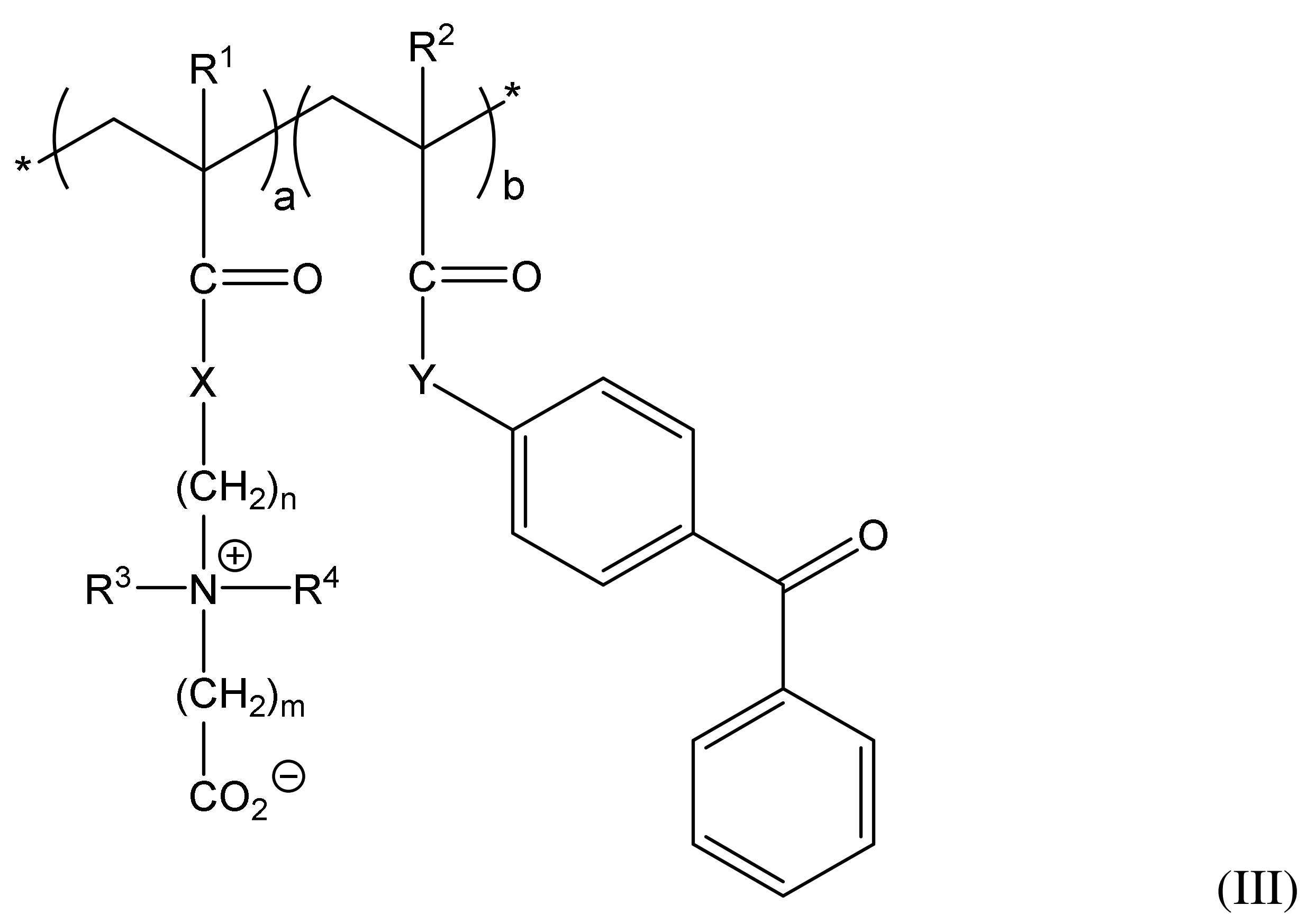
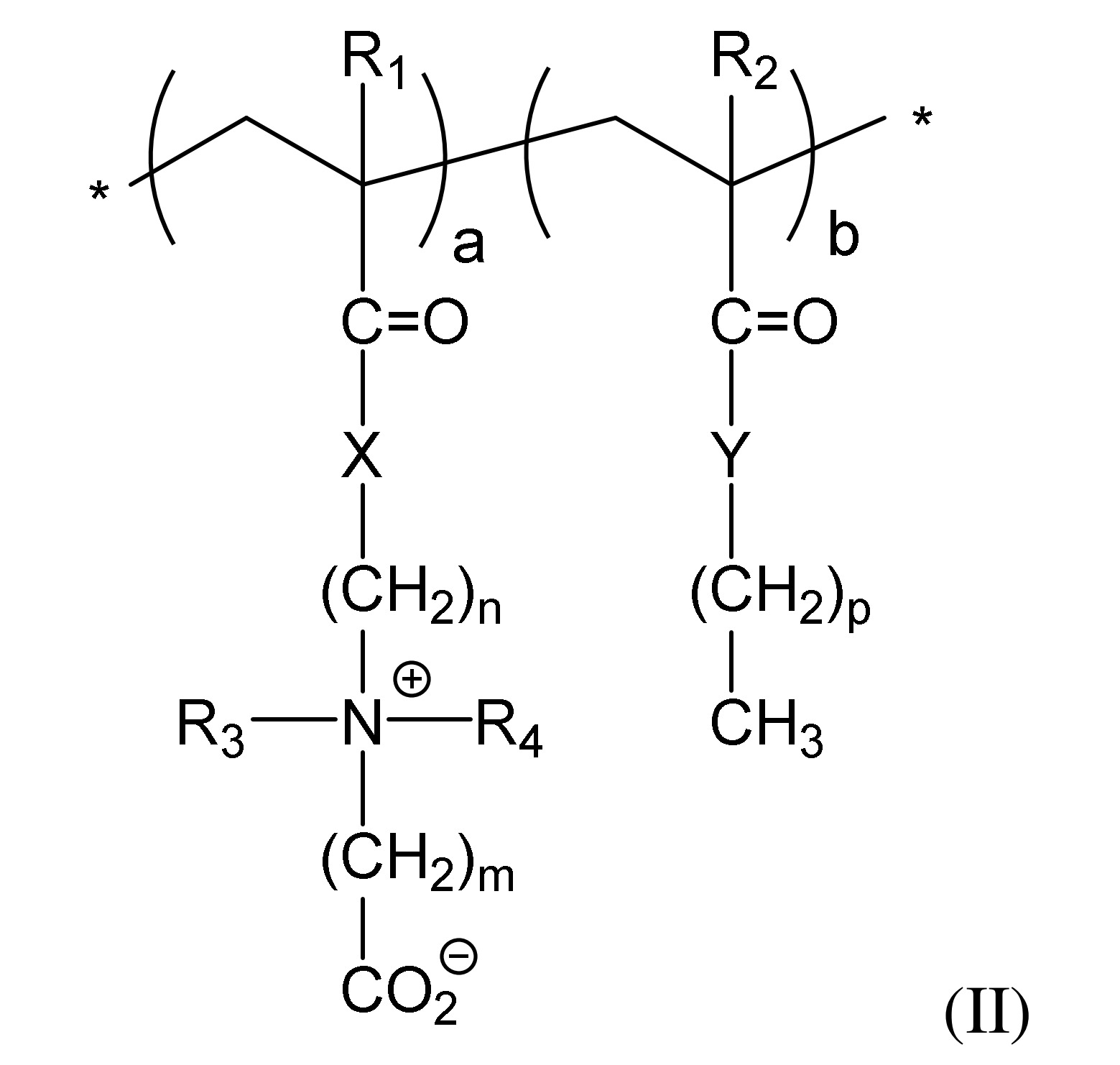
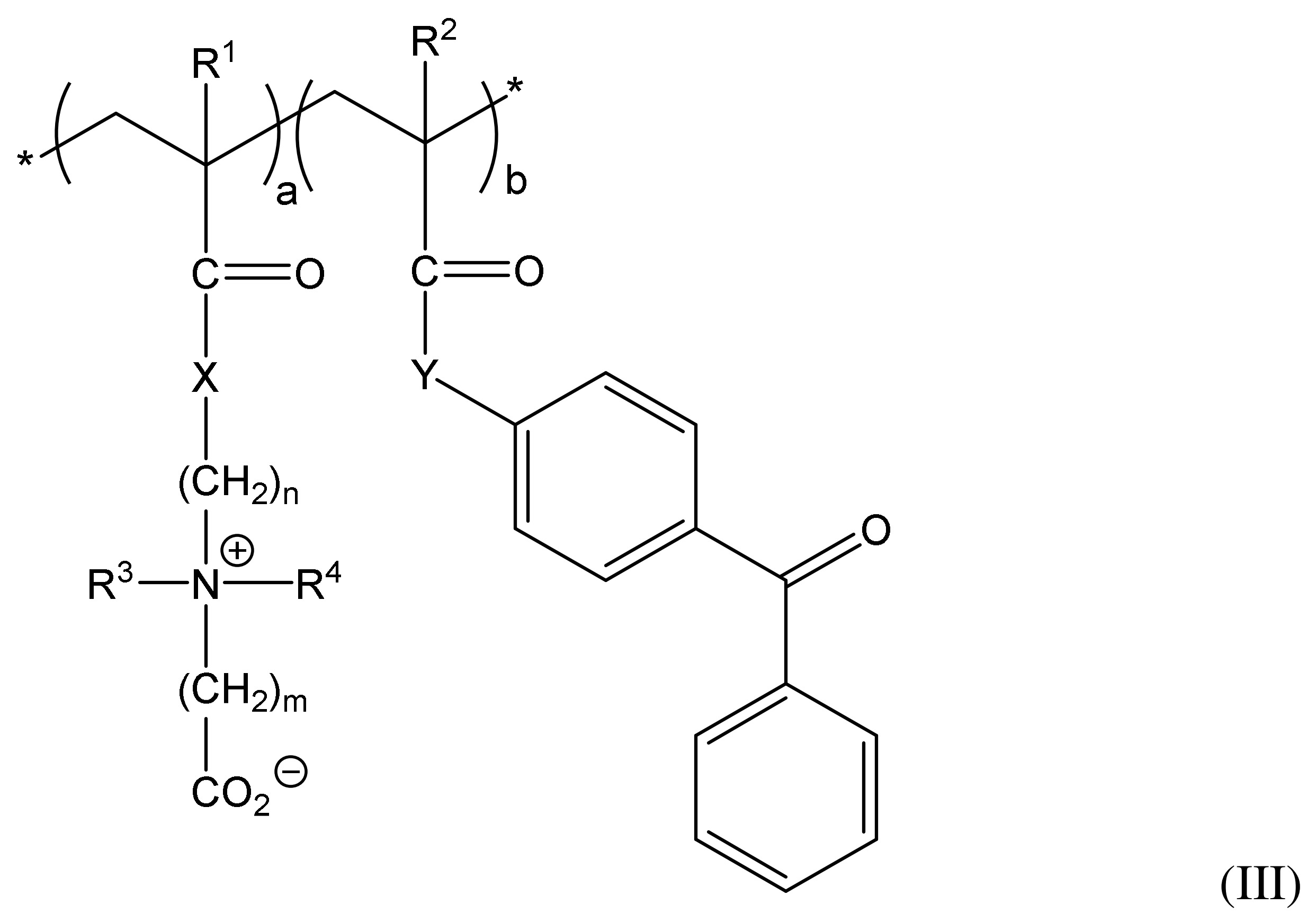
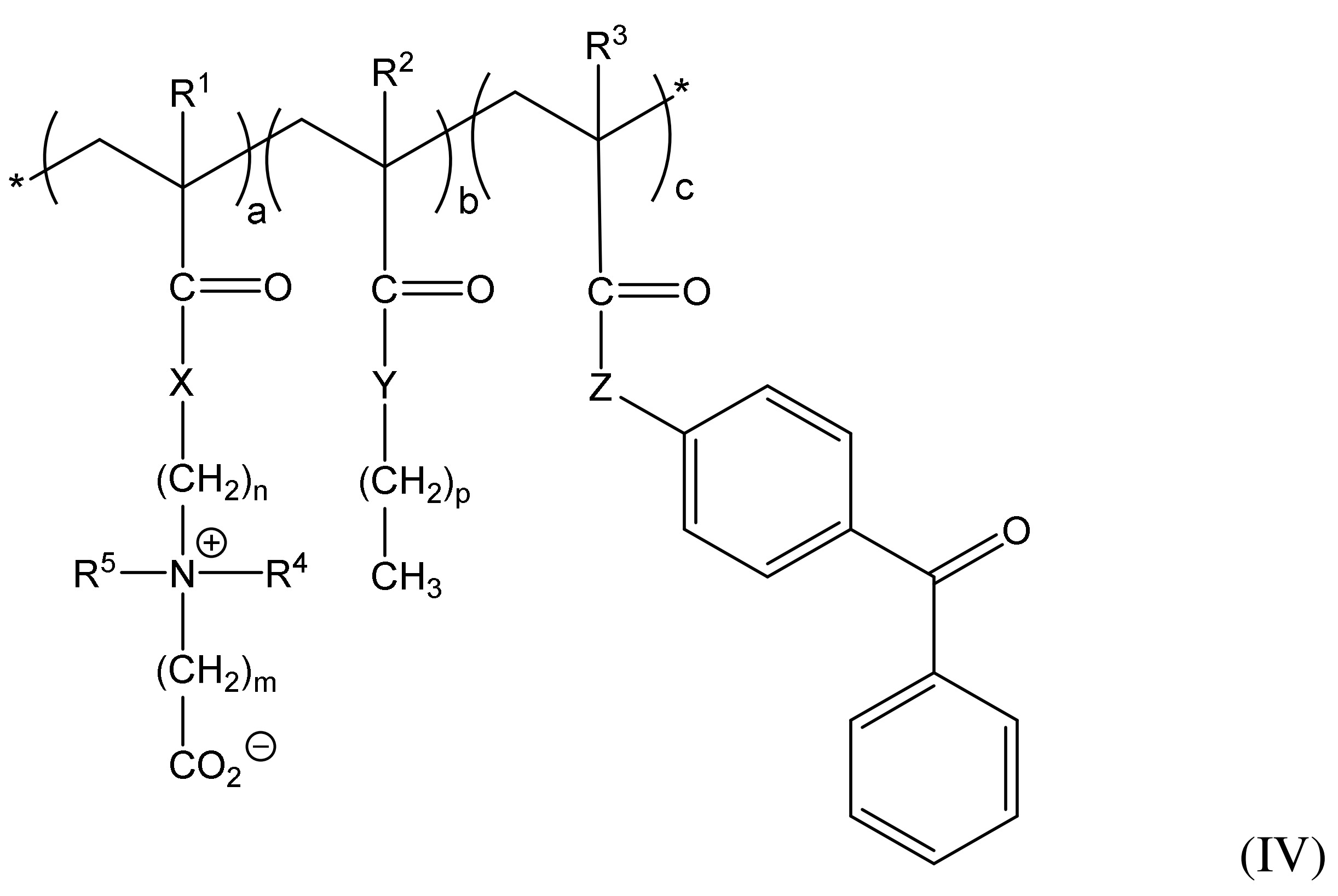
Applications Claiming Priority (6)
| Application Number | Priority Date | Filing Date | Title |
|---|---|---|---|
| US201962818265P | 2019-03-14 | 2019-03-14 | |
| US201962818299P | 2019-03-14 | 2019-03-14 | |
| US201962818283P | 2019-03-14 | 2019-03-14 | |
| US62/818,283 | 2019-03-14 | ||
| US62/818,299 | 2019-03-14 | ||
| US62/818,265 | 2019-03-14 |
Publications (1)
| Publication Number | Publication Date |
|---|---|
| TW202100568A true TW202100568A (en) | 2021-01-01 |
Family
ID=72427074
Family Applications (1)
| Application Number | Title | Priority Date | Filing Date |
|---|---|---|---|
| TW109108407A TW202100568A (en) | 2019-03-14 | 2020-03-13 | Zwitterionic copolymer coatings and related methods |
Country Status (12)
| Country | Link |
|---|---|
| US (4) | US11441049B2 (en) |
| EP (1) | EP3937995B1 (en) |
| JP (1) | JP7653711B2 (en) |
| KR (1) | KR20210142664A (en) |
| CN (1) | CN113646013B (en) |
| AU (1) | AU2020235117A1 (en) |
| BR (1) | BR112021018248A2 (en) |
| CA (1) | CA3129877A1 (en) |
| IL (1) | IL286304B2 (en) |
| MX (1) | MX2021011113A (en) |
| TW (1) | TW202100568A (en) |
| WO (1) | WO2020186134A1 (en) |
Families Citing this family (9)
| Publication number | Priority date | Publication date | Assignee | Title |
|---|---|---|---|---|
| KR20210142664A (en) | 2019-03-14 | 2021-11-25 | 유니버시티 오브 워싱턴 | Zwitterionic Copolymer Coatings and Related Methods |
| US12522683B2 (en) | 2020-11-16 | 2026-01-13 | Cornell University | Amphiphilic copolymer with zwitterionic and fluorinated moieties |
| GB2608837A (en) * | 2021-07-13 | 2023-01-18 | Univ Stellenbosch | Zwitterionic polymers for forming nanodiscs |
| US20230033481A1 (en) * | 2021-07-27 | 2023-02-02 | Convatec Limited | Intermittent catheters |
| WO2023089167A1 (en) * | 2021-11-22 | 2023-05-25 | Facellitate Gmbh | Photobioreactor with an adsorbed layer of antifouling zwitterionic copolymer |
| JP2025517917A (en) * | 2022-05-16 | 2025-06-12 | トラスティーズ オブ タフツ カレッジ | Crosslinkable charged zwitterionic polymers and membranes containing same - Patents.com |
| CN116178769B (en) * | 2022-11-14 | 2026-03-10 | 陕西师范大学 | Method for inhibiting migration of toxic small molecules in plastic based on protein-based phase transition composite coating |
| WO2024145480A2 (en) * | 2022-12-29 | 2024-07-04 | Dexcom, Inc. | Aptamer protective material and biosensor |
| CN117417676A (en) * | 2023-10-17 | 2024-01-19 | 深圳库珀医疗股份有限公司 | Coating and preparation method thereof, coating and coating-containing biological material preparation method |
Family Cites Families (27)
| Publication number | Priority date | Publication date | Assignee | Title |
|---|---|---|---|---|
| GB1435714A (en) * | 1972-06-05 | 1976-05-12 | Ici Ltd | Lacquer |
| WO1992007464A1 (en) * | 1990-10-24 | 1992-05-14 | University Of Florida | Combined plasma and gamma radiation polymerization method for modifying surfaces |
| JP4637468B2 (en) * | 2002-10-01 | 2011-02-23 | エスケー化研株式会社 | Plasticizer migration-preventing paint, plasticizer migration-preventing sheet, and plasticizer migration-preventing method using them |
| JP4507184B2 (en) * | 2003-12-02 | 2010-07-21 | エスケー化研株式会社 | Sheet lamination method |
| WO2008021500A2 (en) * | 2006-08-17 | 2008-02-21 | University Of Pittsburgh-Of The Commonwealth System Of Higher Education | Modification of surfaces with polymers |
| US11389171B2 (en) * | 2006-11-21 | 2022-07-19 | David S. Goldsmith | Integrated system for the infixion and retrieval of implants |
| KR101240740B1 (en) * | 2008-01-24 | 2013-03-07 | 주식회사 엘지화학 | Acrylic polymeric plasticizer and plastisol comprising the same |
| CN101302712A (en) * | 2008-06-12 | 2008-11-12 | 上海交通大学 | Preparation method of sulfonate betaine modified non-woven fabric for blood filtration |
| DE102008032571A1 (en) * | 2008-07-11 | 2010-01-14 | Tesa Se | Pressure-sensitive adhesives and process for their preparation |
| US8691983B2 (en) * | 2009-03-03 | 2014-04-08 | Innovative Surface Technologies, Inc. | Brush polymer coating by in situ polymerization from photoreactive surface |
| US8957173B2 (en) * | 2009-04-24 | 2015-02-17 | Next21 K.K. | Resin product for medical use and respiration-assisting tube |
| NZ603705A (en) | 2010-06-09 | 2014-10-31 | Semprus Biosciences Corp | Non-fouling, anti-microbial, anti-thrombogenic graft-from compositions |
| JP5763564B2 (en) * | 2012-02-01 | 2015-08-12 | 住友ゴム工業株式会社 | Surface modification method and surface modified elastic body |
| CN102775831B (en) * | 2012-07-31 | 2014-11-12 | 华南理工大学 | Method for curing and grafting amphoteric ion gel coat on external surface on material surface by ultraviolet |
| CN103724595B (en) * | 2013-12-17 | 2015-10-07 | 天津大学 | Amphoteric ion polymer modified polyurethane material and preparation method |
| JP6366322B2 (en) * | 2014-03-26 | 2018-08-01 | 住友ゴム工業株式会社 | Gasket for syringe |
| CN104356569B (en) * | 2014-11-28 | 2016-08-24 | 云南云天化股份有限公司 | A kind of polyvinyl alcohol film and preparation method thereof and a kind of polaroid |
| WO2017015571A1 (en) * | 2015-07-23 | 2017-01-26 | Novaflux, Inc. | Implants and constructs including hollow fibers |
| JP2017052706A (en) * | 2015-09-07 | 2017-03-16 | 一丸ファルコス株式会社 | Cosmetic composition containing granules |
| WO2017222863A1 (en) * | 2016-06-22 | 2017-12-28 | 3M Innovative Properties Company | Multilayer articles with a barrier film including a thermoplastic aliphatic polyester, a polyvinyl alkanoate polymer, and a plasticizer |
| CN109562202B (en) * | 2016-06-24 | 2022-09-27 | 艾奥瓦大学研究基金会 | Durable photopolymerizable crosslinked antifouling coatings |
| TWI712621B (en) * | 2016-06-29 | 2020-12-11 | 國立大學法人東京大學 | Copolymers and uses thereof |
| AU2017317423B2 (en) * | 2016-08-25 | 2019-08-15 | Terumo Kabushiki Kaisha | Hydrophilic copolymer and medical device |
| WO2018174108A1 (en) * | 2017-03-21 | 2018-09-27 | 京セラ株式会社 | Resin moulded body, and method for producing resin moulded body |
| CN107617126A (en) * | 2017-08-11 | 2018-01-23 | 天津大学 | A kind of surface modification method of porous material and application |
| US11370934B2 (en) * | 2017-10-20 | 2022-06-28 | University Of Georgia Research Foundation, Inc. | Surfaces and coating compositions having antifouling, antithrombotic, and antibacterial properties and methods of making |
| KR20210142664A (en) * | 2019-03-14 | 2021-11-25 | 유니버시티 오브 워싱턴 | Zwitterionic Copolymer Coatings and Related Methods |
-
2020
- 2020-03-13 KR KR1020217032448A patent/KR20210142664A/en active Pending
- 2020-03-13 AU AU2020235117A patent/AU2020235117A1/en not_active Abandoned
- 2020-03-13 CN CN202080021266.8A patent/CN113646013B/en active Active
- 2020-03-13 TW TW109108407A patent/TW202100568A/en unknown
- 2020-03-13 CA CA3129877A patent/CA3129877A1/en active Pending
- 2020-03-13 IL IL286304A patent/IL286304B2/en unknown
- 2020-03-13 EP EP20770976.7A patent/EP3937995B1/en active Active
- 2020-03-13 JP JP2021555162A patent/JP7653711B2/en active Active
- 2020-03-13 MX MX2021011113A patent/MX2021011113A/en unknown
- 2020-03-13 BR BR112021018248A patent/BR112021018248A2/en not_active IP Right Cessation
- 2020-03-13 US US17/435,654 patent/US11441049B2/en active Active
- 2020-03-13 WO PCT/US2020/022543 patent/WO2020186134A1/en not_active Ceased
-
2022
- 2022-09-12 US US17/931,474 patent/US20230014056A1/en not_active Abandoned
-
2023
- 2023-09-12 US US18/465,867 patent/US12528967B2/en active Active
-
2025
- 2025-12-22 US US19/428,975 patent/US20260117086A1/en active Pending
Also Published As
| Publication number | Publication date |
|---|---|
| AU2020235117A1 (en) | 2021-09-02 |
| EP3937995A1 (en) | 2022-01-19 |
| US12528967B2 (en) | 2026-01-20 |
| BR112021018248A2 (en) | 2021-11-23 |
| KR20210142664A (en) | 2021-11-25 |
| WO2020186134A1 (en) | 2020-09-17 |
| CA3129877A1 (en) | 2020-09-17 |
| CN113646013B (en) | 2024-02-20 |
| IL286304B2 (en) | 2024-10-01 |
| EP3937995A4 (en) | 2022-12-07 |
| US20230014056A1 (en) | 2023-01-19 |
| JP7653711B2 (en) | 2025-03-31 |
| US20250163290A9 (en) | 2025-05-22 |
| IL286304B1 (en) | 2024-06-01 |
| JP2022525305A (en) | 2022-05-12 |
| EP3937995B1 (en) | 2024-08-07 |
| IL286304A (en) | 2021-10-31 |
| US20260117086A1 (en) | 2026-04-30 |
| US20240279504A1 (en) | 2024-08-22 |
| US20220041886A1 (en) | 2022-02-10 |
| CN113646013A (en) | 2021-11-12 |
| US11441049B2 (en) | 2022-09-13 |
| MX2021011113A (en) | 2021-10-13 |
Similar Documents
| Publication | Publication Date | Title |
|---|---|---|
| CN113646013B (en) | Zwitterionic copolymer coatings and related methods | |
| Liu et al. | The recent advances in surface antibacterial strategies for biomedical catheters | |
| US12319828B2 (en) | Surfaces and coating compositions having antifouling, antithrombotic, and antibacterial properties and methods of making | |
| Lin et al. | Zwitterionic carboxybetaine polymers extend the shelf-life of human platelets | |
| Lin et al. | Photoreactive carboxybetaine copolymers impart biocompatibility and inhibit plasticizer leaching on polyvinyl chloride | |
| Liu et al. | Covalent grafting of antifouling phosphorylcholine-based copolymers with antimicrobial nitric oxide releasing polymers to enhance infection-resistant properties of medical device coatings | |
| Li et al. | Integrated antibacterial and antifouling surfaces via cross-linking chitosan-g-eugenol/zwitterionic copolymer on electrospun membranes | |
| Wang et al. | Design of hemocompatible and antifouling PET sheets with synergistic zwitterionic surfaces | |
| Liang et al. | A new approach to fabricate polyimidazolium salt (PIMS) coatings with efficient antifouling and antibacterial properties | |
| Chou et al. | Bioinspired pseudozwitterionic hydrogels with bioactive enzyme immobilization via pH-responsive regulation | |
| Yang et al. | Thermally stable bioinert zwitterionic sulfobetaine interfaces tolerated in the medical sterilization process | |
| Chu et al. | Significantly improved antifouling capability of silicone rubber surfaces by covalently bonded acrylated agarose towards biomedical applications | |
| Lin et al. | [Retracted] Loading Gentamicin and Zn2+ on TiO2 Nanotubes to Improve Anticoagulation, Endothelial Cell Growth, and Antibacterial Activities | |
| Liu et al. | A green, versatile, and facile strategy for anti-biofouling surface with ultra-high graft density polyethylene glycol | |
| Zhu et al. | Surface immobilization of sulfobetaine zwitterionic and quaternary ammonium copolymers on polyurethane surfaces to improve antifouling and bactericidal activities | |
| Zheng et al. | Tough, Antibacterial, and antithrombogenic hydrogel coatings for blood-contacting silicone medical devices | |
| TWI808510B (en) | A zwitterionic material capable of preventing bio-inert performance decay, its fabricating membrane and application | |
| HK40057671B (en) | Zwitterionic copolymer coatings and related methods | |
| HK40057671A (en) | Zwitterionic copolymer coatings and related methods | |
| Caron et al. | Straightforward Preparation of Polyurethane‐Based Biomaterials with Dual Antibacterial and Anti‐Adhesive Properties for Long‐Lasting Catheter Applications | |
| Asha | Bioinspired Surface Modification for Antifouling and Antibacterial Applications | |
| Liu et al. | A Facile, Scalable, and Universal Strategy to Construct Densely Packed l-Lysine-Derived Zwitterionic Brushes for Blood-Contacting Catheters | |
| Hadjesfandiari | Improving platelet storage bags: antifouling polymer coatings, antimicrobial peptides and surface topography | |
| Marques | Antifouling surfaces as a strategy to prevent microorganism’s adhesion on medical devices |