TW202128751A - Anti-gdf15 antibody - Google Patents
Anti-gdf15 antibody Download PDFInfo
- Publication number
- TW202128751A TW202128751A TW109142627A TW109142627A TW202128751A TW 202128751 A TW202128751 A TW 202128751A TW 109142627 A TW109142627 A TW 109142627A TW 109142627 A TW109142627 A TW 109142627A TW 202128751 A TW202128751 A TW 202128751A
- Authority
- TW
- Taiwan
- Prior art keywords
- amino acid
- acid sequence
- seq
- variable region
- chain variable
- Prior art date
Links
Images


Classifications
-
- A—HUMAN NECESSITIES
- A61—MEDICAL OR VETERINARY SCIENCE; HYGIENE
- A61P—SPECIFIC THERAPEUTIC ACTIVITY OF CHEMICAL COMPOUNDS OR MEDICINAL PREPARATIONS
- A61P35/00—Antineoplastic agents
-
- C—CHEMISTRY; METALLURGY
- C07—ORGANIC CHEMISTRY
- C07K—PEPTIDES
- C07K16/00—Immunoglobulins [IG], e.g. monoclonal or polyclonal antibodies
- C07K16/18—Immunoglobulins [IG], e.g. monoclonal or polyclonal antibodies against material from animals or humans
- C07K16/22—Immunoglobulins [IG], e.g. monoclonal or polyclonal antibodies against material from animals or humans against growth factors ; against growth regulators
-
- C—CHEMISTRY; METALLURGY
- C07—ORGANIC CHEMISTRY
- C07K—PEPTIDES
- C07K16/00—Immunoglobulins [IG], e.g. monoclonal or polyclonal antibodies
- C07K16/18—Immunoglobulins [IG], e.g. monoclonal or polyclonal antibodies against material from animals or humans
- C07K16/24—Immunoglobulins [IG], e.g. monoclonal or polyclonal antibodies against material from animals or humans against cytokines, lymphokines or interferons
-
- C—CHEMISTRY; METALLURGY
- C12—BIOCHEMISTRY; BEER; SPIRITS; WINE; VINEGAR; MICROBIOLOGY; ENZYMOLOGY; MUTATION OR GENETIC ENGINEERING
- C12N—MICROORGANISMS OR ENZYMES; COMPOSITIONS THEREOF; PROPAGATING, PRESERVING, OR MAINTAINING MICROORGANISMS; MUTATION OR GENETIC ENGINEERING; CULTURE MEDIA
- C12N15/00—Mutation or genetic engineering; DNA or RNA concerning genetic engineering, vectors, e.g. plasmids, or their isolation, preparation or purification; Use of hosts therefor
- C12N15/09—Recombinant DNA-technology
- C12N15/63—Introduction of foreign genetic material using vectors; Vectors; Use of hosts therefor; Regulation of expression
- C12N15/74—Vectors or expression systems specially adapted for prokaryotic hosts other than E. coli, e.g. Lactobacillus, Micromonospora
-
- C—CHEMISTRY; METALLURGY
- C12—BIOCHEMISTRY; BEER; SPIRITS; WINE; VINEGAR; MICROBIOLOGY; ENZYMOLOGY; MUTATION OR GENETIC ENGINEERING
- C12N—MICROORGANISMS OR ENZYMES; COMPOSITIONS THEREOF; PROPAGATING, PRESERVING, OR MAINTAINING MICROORGANISMS; MUTATION OR GENETIC ENGINEERING; CULTURE MEDIA
- C12N15/00—Mutation or genetic engineering; DNA or RNA concerning genetic engineering, vectors, e.g. plasmids, or their isolation, preparation or purification; Use of hosts therefor
- C12N15/09—Recombinant DNA-technology
- C12N15/63—Introduction of foreign genetic material using vectors; Vectors; Use of hosts therefor; Regulation of expression
- C12N15/79—Vectors or expression systems specially adapted for eukaryotic hosts
- C12N15/80—Vectors or expression systems specially adapted for eukaryotic hosts for fungi
- C12N15/81—Vectors or expression systems specially adapted for eukaryotic hosts for fungi for yeasts
-
- A—HUMAN NECESSITIES
- A61—MEDICAL OR VETERINARY SCIENCE; HYGIENE
- A61K—PREPARATIONS FOR MEDICAL, DENTAL OR TOILETRY PURPOSES
- A61K39/00—Medicinal preparations containing antigens or antibodies
- A61K2039/505—Medicinal preparations containing antigens or antibodies comprising antibodies
-
- A—HUMAN NECESSITIES
- A61—MEDICAL OR VETERINARY SCIENCE; HYGIENE
- A61K—PREPARATIONS FOR MEDICAL, DENTAL OR TOILETRY PURPOSES
- A61K39/00—Medicinal preparations containing antigens or antibodies
- A61K2039/545—Medicinal preparations containing antigens or antibodies characterised by the dose, timing or administration schedule
-
- C—CHEMISTRY; METALLURGY
- C07—ORGANIC CHEMISTRY
- C07K—PEPTIDES
- C07K2317/00—Immunoglobulins specific features
- C07K2317/20—Immunoglobulins specific features characterized by taxonomic origin
- C07K2317/24—Immunoglobulins specific features characterized by taxonomic origin containing regions, domains or residues from different species, e.g. chimeric, humanized or veneered
-
- C—CHEMISTRY; METALLURGY
- C07—ORGANIC CHEMISTRY
- C07K—PEPTIDES
- C07K2317/00—Immunoglobulins specific features
- C07K2317/30—Immunoglobulins specific features characterized by aspects of specificity or valency
- C07K2317/34—Identification of a linear epitope shorter than 20 amino acid residues or of a conformational epitope defined by amino acid residues
-
- C—CHEMISTRY; METALLURGY
- C07—ORGANIC CHEMISTRY
- C07K—PEPTIDES
- C07K2317/00—Immunoglobulins specific features
- C07K2317/50—Immunoglobulins specific features characterized by immunoglobulin fragments
- C07K2317/56—Immunoglobulins specific features characterized by immunoglobulin fragments variable (Fv) region, i.e. VH and/or VL
- C07K2317/565—Complementarity determining region [CDR]
-
- C—CHEMISTRY; METALLURGY
- C07—ORGANIC CHEMISTRY
- C07K—PEPTIDES
- C07K2317/00—Immunoglobulins specific features
- C07K2317/50—Immunoglobulins specific features characterized by immunoglobulin fragments
- C07K2317/56—Immunoglobulins specific features characterized by immunoglobulin fragments variable (Fv) region, i.e. VH and/or VL
- C07K2317/567—Framework region [FR]
-
- C—CHEMISTRY; METALLURGY
- C07—ORGANIC CHEMISTRY
- C07K—PEPTIDES
- C07K2317/00—Immunoglobulins specific features
- C07K2317/90—Immunoglobulins specific features characterized by (pharmaco)kinetic aspects or by stability of the immunoglobulin
- C07K2317/92—Affinity (KD), association rate (Ka), dissociation rate (Kd) or EC50 value
Landscapes
- Health & Medical Sciences (AREA)
- Chemical & Material Sciences (AREA)
- Life Sciences & Earth Sciences (AREA)
- Organic Chemistry (AREA)
- Genetics & Genomics (AREA)
- General Health & Medical Sciences (AREA)
- Medicinal Chemistry (AREA)
- Engineering & Computer Science (AREA)
- Biochemistry (AREA)
- Biophysics (AREA)
- Molecular Biology (AREA)
- General Engineering & Computer Science (AREA)
- Zoology (AREA)
- Wood Science & Technology (AREA)
- Bioinformatics & Cheminformatics (AREA)
- Biotechnology (AREA)
- Biomedical Technology (AREA)
- Proteomics, Peptides & Aminoacids (AREA)
- Immunology (AREA)
- Public Health (AREA)
- Pharmacology & Pharmacy (AREA)
- General Chemical & Material Sciences (AREA)
- Veterinary Medicine (AREA)
- Chemical Kinetics & Catalysis (AREA)
- Animal Behavior & Ethology (AREA)
- Nuclear Medicine, Radiotherapy & Molecular Imaging (AREA)
- Physics & Mathematics (AREA)
- Microbiology (AREA)
- Plant Pathology (AREA)
- Mycology (AREA)
- Peptides Or Proteins (AREA)
- Medicines Containing Antibodies Or Antigens For Use As Internal Diagnostic Agents (AREA)
- Micro-Organisms Or Cultivation Processes Thereof (AREA)
Abstract
Description
本申請係對國際申請編號PCT/JP2019/047956主張優先權者,且此處藉由參照而將其整體併入本說明書中。 本發明係關於一種抗GDF15抗體及其用途。This application is the one claiming priority to the International Application No. PCT/JP2019/047956, and the entirety is incorporated into this specification by reference here. The present invention relates to an anti-GDF15 antibody and its use.
惡病質係一種常伴慢性疾病之複合性代謝性疾病,具有體重減少、肌肉無力之特徵。其中,癌症惡病質在眾多進展期癌症患者中可見,由於會使患者之預後或QOL(Quality of life,生活質量)變差,故需要積極治療。然而,惡病質之病情複雜,發生機制亦有較多不明之處,目前不存在有效之治療藥。Cachexia is a complex metabolic disease that often accompanies chronic diseases. It is characterized by weight loss and muscle weakness. Among them, cancer cachexia can be seen in many advanced cancer patients, and it needs active treatment because it will worsen the prognosis or QOL (Quality of life) of the patients. However, the condition of cachexia is complicated, and the mechanism of its occurrence is also unclear. There is no effective treatment at present.
GDF15(Growth Differentiation Factor 15,生長分化因子15)係TGF-β超家族之分泌蛋白,且報告有與癌症或糖尿病等各種疾病相關。目前有多個與血中GDF15濃度相關之臨床研究報告,例如報告有:癌症患者之血中及癌組織之GDF15量較高;癌症患者之血中GDF15量與預後相關。又,已知GDF15會作用於大腦攝食中樞而誘發食慾不振,與惡病質之發病相關。GDF15 (
[發明所欲解決之問題][The problem to be solved by the invention]
本發明之目的在於提供一種對治療與GDF15相關之疾病或症狀有用之抗GDF15抗體。 [解決問題之技術手段]The purpose of the present invention is to provide an anti-GDF15 antibody useful for treating diseases or symptoms related to GDF15. [Technical means to solve the problem]
本發明於某一態樣中提供一種抗hGDF15抗體,其與包含DHCPLGPGRCCRLH(序列編號3)之胺基酸序列之hGDF15之表位結合。In a certain aspect, the present invention provides an anti-hGDF15 antibody that binds to an epitope of hGDF15 containing the amino acid sequence of DHCPLGPGRCCRLH (SEQ ID NO: 3).
本發明於又一態樣中提供一種抗hGDF15抗體,其包括: 重鏈可變區,其含有: 包含序列編號4之胺基酸序列之重鏈可變區所包含之CDR1、或包含於上述CDR1之胺基酸序列中有1~3個胺基酸殘基改性而成之胺基酸序列之CDR1、 包含序列編號4之胺基酸序列之重鏈可變區所包含之CDR2、或包含於上述CDR2之胺基酸序列中有1~3個胺基酸殘基改性而成之胺基酸序列之CDR2、及 包含序列編號4之胺基酸序列之重鏈可變區所包含之CDR3、或包含於上述CDR3之胺基酸序列中有1~3個胺基酸殘基改性而成之胺基酸序列之CDR3;及 輕鏈可變區,其含有: 包含序列編號5之胺基酸序列之輕鏈可變區所包含之CDR1、或包含於上述CDR1之胺基酸序列中有1~3個胺基酸殘基改性而成之胺基酸序列之CDR1、 包含序列編號5之胺基酸序列之輕鏈可變區所包含之CDR2、或包含於上述CDR2之胺基酸序列中有1~3個胺基酸殘基改性而成之胺基酸序列之CDR2、及 包含序列編號5之胺基酸序列之輕鏈可變區所包含之CDR3、或包含於上述CDR3之胺基酸序列中有1~3個胺基酸殘基改性而成之胺基酸序列之CDR3。In another aspect, the present invention provides an anti-hGDF15 antibody, which includes: The variable region of the heavy chain, which contains: The CDR1 contained in the heavy chain variable region containing the amino acid sequence of SEQ ID NO: 4, or the amino acid sequence modified from 1 to 3 amino acid residues contained in the amino acid sequence of the above CDR1 CDR1, The CDR2 contained in the heavy chain variable region containing the amino acid sequence of SEQ ID NO: 4, or the amino acid sequence modified with 1 to 3 amino acid residues contained in the amino acid sequence of the above CDR2 CDR2, and The CDR3 contained in the heavy chain variable region containing the amino acid sequence of SEQ ID NO: 4, or the amino acid sequence modified from 1 to 3 amino acid residues contained in the amino acid sequence of the above CDR3 CDR3; and The light chain variable region, which contains: The CDR1 contained in the light chain variable region containing the amino acid sequence of SEQ ID NO: 5, or the amino acid sequence modified from 1 to 3 amino acid residues contained in the amino acid sequence of the above CDR1 CDR1, The CDR2 contained in the light chain variable region containing the amino acid sequence of SEQ ID NO: 5, or the amino acid sequence modified from 1 to 3 amino acid residues contained in the amino acid sequence of the above CDR2 CDR2, and The CDR3 contained in the light chain variable region containing the amino acid sequence of SEQ ID NO: 5, or the amino acid sequence modified from 1 to 3 amino acid residues contained in the amino acid sequence of the above CDR3 CDR3.
本發明於又一態樣中提供一種抗hGDF15抗體,其包括: 重鏈可變區,其含有: 包含序列編號18之胺基酸序列或於上述胺基酸序列中有1~3個胺基酸殘基改性而成之胺基酸序列之CDR1、 包含序列編號19之胺基酸序列或於上述胺基酸序列中有1~3個胺基酸殘基改性而成之胺基酸序列之CDR2、及 包含序列編號20之胺基酸序列或於上述胺基酸序列中有1~3個胺基酸殘基改性而成之胺基酸序列之CDR3;及 輕鏈可變區,其含有: 包含序列編號21之胺基酸序列或於上述胺基酸序列中有1~3個胺基酸殘基改性而成之胺基酸序列之CDR1、 包含序列編號22之胺基酸序列或於上述胺基酸序列中有1~3個胺基酸殘基改性而成之胺基酸序列之CDR2、及 包含序列編號23之胺基酸序列或於上述胺基酸序列中有1~3個胺基酸殘基改性而成之胺基酸序列之CDR3。In another aspect, the present invention provides an anti-hGDF15 antibody, which includes: The variable region of the heavy chain, which contains: CDR1 of the amino acid sequence containing the amino acid sequence of SEQ ID NO: 18 or the amino acid sequence modified from 1 to 3 amino acid residues in the above amino acid sequence CDR2 of the amino acid sequence containing the amino acid sequence of SEQ ID NO: 19 or the amino acid sequence modified with 1 to 3 amino acid residues in the above amino acid sequence, and CDR3 containing the amino acid sequence of SEQ ID NO: 20 or the amino acid sequence modified by 1 to 3 amino acid residues in the above amino acid sequence; and The light chain variable region, which contains: CDR1, including the amino acid sequence of SEQ ID NO: 21 or the amino acid sequence modified by 1 to 3 amino acid residues in the above amino acid sequence CDR2, including the amino acid sequence of SEQ ID NO: 22 or the amino acid sequence modified with 1 to 3 amino acid residues in the above amino acid sequence, and Contains the amino acid sequence of SEQ ID NO: 23 or CDR3 of the amino acid sequence modified by 1 to 3 amino acid residues in the above amino acid sequence.
本發明於又一態樣中提供一種抗hGDF15抗體,其包括:
重鏈可變區,其含有:與序列編號8之胺基酸序列具有80%、85%、90%、或95%以上之序列同一性之胺基酸序列、或序列編號8之胺基酸序列或者於序列編號8之胺基酸序列中有1~20個、1~15個、1~10個、1~5個、或1~3個胺基酸殘基改性而成之胺基酸序列;及
輕鏈可變區,其含有:與序列編號9之胺基酸序列具有80%、85%、90%、或95%以上之序列同一性之胺基酸序列、或序列編號9之胺基酸序列或者於序列編號9之胺基酸序列中有1~20個、1~15個、1~10個、1~5個、或1~3個胺基酸殘基改性而成之胺基酸序列。In another aspect, the present invention provides an anti-hGDF15 antibody, which includes:
A heavy chain variable region, which contains: an amino acid sequence with 80%, 85%, 90%, or 95% or more sequence identity with the amino acid sequence of SEQ ID NO: 8, or an amino acid of SEQ ID NO: 8 The sequence or the amino acid sequence of
本發明於又一態樣中提供一種抗hGDF15抗體,其包括: 重鏈可變區,其含有: 包含序列編號133之胺基酸序列之重鏈可變區所包含之CDR1、或包含於上述CDR1之胺基酸序列中有1~3個胺基酸殘基改性而成之胺基酸序列之CDR1、 包含序列編號133之胺基酸序列之重鏈可變區所包含之CDR2、或包含於上述CDR2之胺基酸序列中有1~3個胺基酸殘基改性而成之胺基酸序列之CDR2、及 包含序列編號133之胺基酸序列之重鏈可變區所包含之CDR3、或包含於上述CDR3之胺基酸序列中有1~3個胺基酸殘基改性而成之胺基酸序列之CDR3;及 輕鏈可變區,其含有: 包含序列編號134之胺基酸序列之輕鏈可變區所包含之CDR1、或包含於上述CDR1之胺基酸序列中有1~3個胺基酸殘基改性而成之胺基酸序列之CDR1、 包含序列編號134之胺基酸序列之輕鏈可變區所包含之CDR2、或包含於上述CDR2之胺基酸序列中有1~3個胺基酸殘基改性而成之胺基酸序列之CDR2、及 包含序列編號134之胺基酸序列之輕鏈可變區所包含之CDR3、或包含於上述CDR3之胺基酸序列中有1~3個胺基酸殘基改性而成之胺基酸序列之CDR3。In another aspect, the present invention provides an anti-hGDF15 antibody, which includes: The variable region of the heavy chain, which contains: CDR1 contained in the heavy chain variable region containing the amino acid sequence of SEQ ID NO: 133, or an amino acid sequence modified with 1 to 3 amino acid residues contained in the amino acid sequence of the above CDR1 CDR1, The CDR2 contained in the heavy chain variable region containing the amino acid sequence of SEQ ID NO: 133, or the amino acid sequence modified with 1 to 3 amino acid residues contained in the amino acid sequence of the above CDR2 CDR2, and The CDR3 contained in the heavy chain variable region containing the amino acid sequence of SEQ ID NO: 133, or the amino acid sequence modified with 1 to 3 amino acid residues contained in the amino acid sequence of the above CDR3 CDR3; and The light chain variable region, which contains: The CDR1 contained in the light chain variable region containing the amino acid sequence of SEQ ID NO. 134, or the amino acid sequence modified from 1 to 3 amino acid residues contained in the amino acid sequence of the above CDR1 CDR1, The CDR2 contained in the light chain variable region containing the amino acid sequence of SEQ ID NO. 134, or the amino acid sequence modified from 1 to 3 amino acid residues contained in the amino acid sequence of the above CDR2 CDR2, and The CDR3 contained in the light chain variable region containing the amino acid sequence of SEQ ID NO. 134, or the amino acid sequence modified from 1 to 3 amino acid residues contained in the amino acid sequence of the above CDR3 CDR3.
本發明於又一態樣中提供一種抗hGDF15抗體,其包括: 重鏈可變區,其含有: 包含序列編號137之胺基酸序列或於上述胺基酸序列中有1~3個胺基酸殘基改性而成之胺基酸序列之CDR1、 包含序列編號138之胺基酸序列或於上述胺基酸序列中有1~3個胺基酸殘基改性而成之胺基酸序列之CDR2、及 包含序列編號139之胺基酸序列或於上述胺基酸序列中有1~3個胺基酸殘基改性而成之胺基酸序列之CDR3;及 輕鏈可變區,其含有: 包含序列編號140之胺基酸序列或於上述胺基酸序列中有1~3個胺基酸殘基改性而成之胺基酸序列之CDR1、 包含序列編號141之胺基酸序列或於上述胺基酸序列中有1~3個胺基酸殘基改性而成之胺基酸序列之CDR2、及 包含序列編號142之胺基酸序列或於上述胺基酸序列中有1~3個胺基酸殘基改性而成之胺基酸序列之CDR3。In another aspect, the present invention provides an anti-hGDF15 antibody, which includes: The variable region of the heavy chain, which contains: CDR1 of the amino acid sequence containing the amino acid sequence of SEQ ID NO: 137 or the amino acid sequence modified from 1 to 3 amino acid residues in the above amino acid sequence The CDR2 of the amino acid sequence containing the amino acid sequence of SEQ ID NO: 138 or the amino acid sequence modified by 1 to 3 amino acid residues in the above amino acid sequence, and CDR3 containing the amino acid sequence of SEQ ID NO: 139 or the amino acid sequence modified by 1 to 3 amino acid residues in the above amino acid sequence; and The light chain variable region, which contains: CDR1 of the amino acid sequence containing the amino acid sequence of SEQ ID NO: 140 or the amino acid sequence modified from 1 to 3 amino acid residues in the above amino acid sequence The CDR2 of the amino acid sequence containing the amino acid sequence of SEQ ID NO: 141 or the amino acid sequence modified from 1 to 3 amino acid residues in the above amino acid sequence, and CDR3 containing the amino acid sequence of SEQ ID NO: 142 or the amino acid sequence modified by 1 to 3 amino acid residues in the above amino acid sequence.
本發明於又一態樣中提供一種抗hGDF15抗體,其包括: 重鏈可變區,其含有: 包含序列編號135之胺基酸序列之重鏈可變區所包含之CDR1、或包含於上述CDR1之胺基酸序列中有1~3個胺基酸殘基改性而成之胺基酸序列之CDR1、 包含序列編號135之胺基酸序列之重鏈可變區所包含之CDR2、或包含於上述CDR2之胺基酸序列中有1~3個胺基酸殘基改性而成之胺基酸序列之CDR2、及 包含序列編號135之胺基酸序列之重鏈可變區所包含之CDR3、或包含於上述CDR3之胺基酸序列中有1~3個胺基酸殘基改性而成之胺基酸序列之CDR3;及 輕鏈可變區,其含有: 包含序列編號136之胺基酸序列之輕鏈可變區所包含之CDR1、或包含於上述CDR1之胺基酸序列中有1~3個胺基酸殘基改性而成之胺基酸序列之CDR1、 包含序列編號136之胺基酸序列之輕鏈可變區所包含之CDR2、或包含於上述CDR2之胺基酸序列中有1~3個胺基酸殘基改性而成之胺基酸序列之CDR2、及 包含序列編號136之胺基酸序列之輕鏈可變區所包含之CDR3、或包含於上述CDR3之胺基酸序列中有1~3個胺基酸殘基改性而成之胺基酸序列之CDR3。In another aspect, the present invention provides an anti-hGDF15 antibody, which includes: The variable region of the heavy chain, which contains: The CDR1 contained in the heavy chain variable region containing the amino acid sequence of SEQ ID NO: 135, or the amino acid sequence modified from 1 to 3 amino acid residues contained in the amino acid sequence of the above CDR1 CDR1, The CDR2 contained in the heavy chain variable region containing the amino acid sequence of SEQ ID NO. 135, or the amino acid sequence modified with 1 to 3 amino acid residues contained in the amino acid sequence of the above CDR2 CDR2, and The CDR3 contained in the heavy chain variable region containing the amino acid sequence of SEQ ID NO: 135, or the amino acid sequence modified from 1 to 3 amino acid residues contained in the amino acid sequence of the above CDR3 CDR3; and The light chain variable region, which contains: The CDR1 contained in the light chain variable region containing the amino acid sequence of SEQ ID NO: 136, or the amino acid sequence modified with 1 to 3 amino acid residues contained in the amino acid sequence of the above CDR1 CDR1, The CDR2 contained in the light chain variable region containing the amino acid sequence of SEQ ID NO: 136, or the amino acid sequence contained in the amino acid sequence of the above CDR2 modified with 1 to 3 amino acid residues CDR2, and The CDR3 contained in the light chain variable region containing the amino acid sequence of SEQ ID NO: 136, or an amino acid sequence modified from 1 to 3 amino acid residues contained in the amino acid sequence of the above CDR3 CDR3.
本發明於又一態樣中提供一種抗hGDF15抗體,其包括: 重鏈可變區,其含有: 包含序列編號143之胺基酸序列或於上述胺基酸序列中有1~3個胺基酸殘基改性而成之胺基酸序列之CDR1、 包含序列編號144之胺基酸序列或於上述胺基酸序列中有1~3個胺基酸殘基改性而成之胺基酸序列之CDR2、及 包含序列編號145之胺基酸序列或於上述胺基酸序列中有1~3個胺基酸殘基改性而成之胺基酸序列之CDR3;及 輕鏈可變區,其含有: 包含序列編號146之胺基酸序列或於上述胺基酸序列中有1~3個胺基酸殘基改性而成之胺基酸序列之CDR1、 包含序列編號147之胺基酸序列或於上述胺基酸序列中有1~3個胺基酸殘基改性而成之胺基酸序列之CDR2、及 包含序列編號148之胺基酸序列或於上述胺基酸序列中有1~3個胺基酸殘基改性而成之胺基酸序列之CDR3。In another aspect, the present invention provides an anti-hGDF15 antibody, which includes: The variable region of the heavy chain, which contains: CDR1 of the amino acid sequence containing the amino acid sequence of SEQ ID NO: 143 or the amino acid sequence modified by 1 to 3 amino acid residues in the above amino acid sequence The CDR2 of the amino acid sequence containing the amino acid sequence of SEQ ID NO: 144 or the amino acid sequence modified from 1 to 3 amino acid residues in the above amino acid sequence, and CDR3 containing the amino acid sequence of SEQ ID NO: 145 or the amino acid sequence modified by 1 to 3 amino acid residues in the above amino acid sequence; and The light chain variable region, which contains: CDR1 of the amino acid sequence containing the amino acid sequence of SEQ ID NO: 146 or the amino acid sequence modified from 1 to 3 amino acid residues in the above amino acid sequence CDR2, including the amino acid sequence of SEQ ID NO: 147 or the amino acid sequence modified from 1 to 3 amino acid residues in the above amino acid sequence, and CDR3 containing the amino acid sequence of SEQ ID NO: 148 or the amino acid sequence modified with 1 to 3 amino acid residues in the above amino acid sequence.
本發明於又一態樣中提供一種抗hGDF15抗體,其和上述任一抗體競爭性地與hGDF15結合。In another aspect, the present invention provides an anti-hGDF15 antibody, which competitively binds to hGDF15 with any of the above antibodies.
本發明於又一態樣中提供一種編碼上述任一抗體之聚核苷酸、包含上述聚核苷酸之表現載體、或包含上述聚核苷酸之轉形細胞。In another aspect, the present invention provides a polynucleotide encoding any of the above-mentioned antibodies, an expression vector containing the above-mentioned polynucleotide, or a transformed cell containing the above-mentioned polynucleotide.
本發明於又一態樣中提供一種醫藥組合物,其包含上述任一抗體。 [發明之效果]In another aspect, the present invention provides a pharmaceutical composition comprising any of the above-mentioned antibodies. [Effects of Invention]
本發明之抗hGDF15抗體會識別與既有之抗hGDF15抗體不同之表位,對與GDF15相關之疾病或症狀之治療有用。The anti-hGDF15 antibody of the present invention recognizes an epitope different from the existing anti-hGDF15 antibody, and is useful for the treatment of diseases or symptoms related to GDF15.
除非另有特別規定,本說明書中所使用之用語具有業者在有機化學、醫學、藥學、分子生物學、微生物學等領域中通常理解之含義。以下記載若干有關本說明書中所使用之用語之定義,但該等定義於本說明書中優先於通常之理解。Unless otherwise specified, the terms used in this specification have the meanings commonly understood by the industry in the fields of organic chemistry, medicine, pharmacy, molecular biology, and microbiology. The following describes some definitions of terms used in this specification, but these definitions take precedence over ordinary understanding in this specification.
本發明中,於數值帶有用語「約」之情形時,意指包含該值±10%之範圍。例如「約20」視為包括「18~22」。數值之範圍包含兩端點間之所有數值及兩端點之數值。關於範圍之「約」適用於該範圍之兩端點。因此,例如「約20~30」視為包括「18~33」。In the present invention, when a numerical value has the term "about", it means a range including ±10% of the value. For example, "about 20" is regarded as including "18-22". The range of values includes all the values between the two end points and the values between the two end points. The "about" of the scope applies to the two ends of the scope. Therefore, for example, "about 20-30" is regarded as including "18-33".
本說明書中,胺基酸殘基以下述縮寫來表示。 Ala或A:丙胺酸 Arg或R:精胺酸 Asn或N:天冬醯胺 Asp或D:天冬胺酸 Cys或C:半胱胺酸 Gln或Q:麩醯胺 Glu或E:麩胺酸 Gly或G:甘胺酸 His或H:組胺酸 Ile或I:異白胺酸 Leu或L:白胺酸 Lys或K:離胺酸 Met或M:甲硫胺酸 Phe或F:苯基丙胺酸 Pro或P:脯胺酸 Ser或S:絲胺酸 Thr或T:蘇胺酸 Trp或W:色胺酸 Tyr或Y:酪胺酸 Val或V:纈胺酸 本說明書中,某一胺基酸序列中之胺基酸殘基有時以表示其位置之數字及表示胺基酸殘基之縮寫(例如,將第13號之精胺酸殘基表示為「13R」)來表示。In this specification, amino acid residues are represented by the following abbreviations. Ala or A: Alanine Arg or R: Arginine Asn or N: Asparagine Asp or D: Aspartic acid Cys or C: Cysteine Gln or Q: glutamine Glu or E: Glutamate Gly or G: Glycine His or H: Histidine Ile or I: isoleucine Leu or L: Leucine Lys or K: Lysine Met or M: Methionine Phe or F: Phenylalanine Pro or P: Proline Ser or S: Serine Thr or T: Threonine Trp or W: Tryptophan Tyr or Y: Tyrosine Val or V: Valine In this specification, the amino acid residue in a certain amino acid sequence is sometimes represented by a number indicating its position and an abbreviation indicating the amino acid residue (for example, the No. 13 arginine residue is expressed as " 13R”).
GDF15(Growth Differentiation Factor 15)係作為MIC-1、PLAB、PDF、NAG-1為人所知之TGF-β超家族之分泌蛋白。GDF15基因表現作為前驅物之前導GDF15,該前導GDF15被膜型金屬內切蛋白酶切斷而生成成熟GDF15。GDF15為可溶型,認為會形成二聚物並被作為其受體之GFRAL所識別。除特別記載之情形外,本說明書中用語GDF15意指成熟GDF15。GDF15 (Growth Differentiation Factor 15) is a secreted protein of the TGF-β superfamily known as MIC-1, PLAB, PDF, and NAG-1. The GDF15 gene appears as a precursor to lead GDF15, which is cleaved by a membrane-type metalloprotease to generate mature GDF15. GDF15 is a soluble type, which is thought to form dimers and is recognized by GFRAL as its receptor. Except as otherwise noted, the term GDF15 in this specification means mature GDF15.
本說明書中,用語GDF15係以包含所有生物物種之GDF15之含義來使用。於某一實施形態中,GDF15係人類GDF15(hGDF15)。將前導hGDF15之代表性胺基酸序列示於序列編號1。前導hGDF15係包含如下308個胺基酸之多肽,即包含29個胺基酸之訊息肽(下劃線)、包含167個胺基酸之前導肽、及包含112個胺基酸之成熟肽(雙下劃線、hGDF15)。將hGDF15之代表性胺基酸序列示於序列編號2,但本發明中之hGDF15並不限定於包含序列編號2之胺基酸序列者。
前導hGDF15(序列編號1)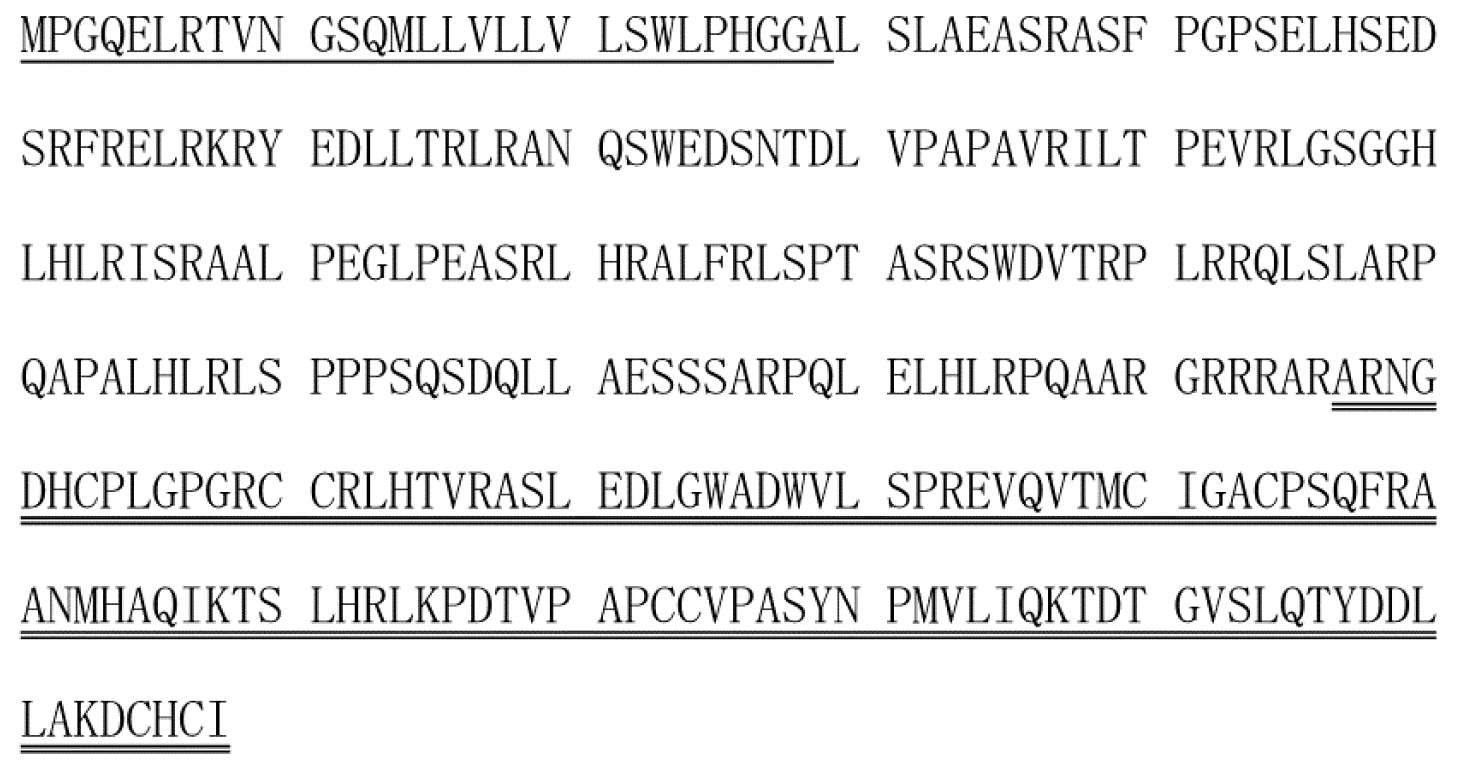
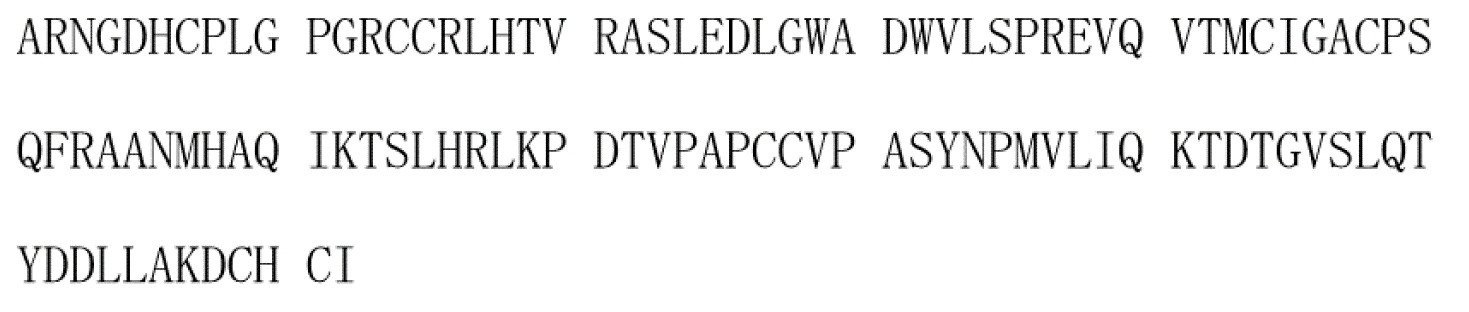
本說明書中之用語「抗體」意指具有對於抗原之結合性之免疫球蛋白或包含其一部分之分子,不僅意指天然之免疫球蛋白之形態之分子,亦意指嵌合抗體、人類化抗體、多重特異性抗體、抗體片段等包含各種結構之分子。本說明書中用語「單株」係用以與「多株抗體」區分來使用,該「多株抗體」係針對各不相同之表位之複數種抗體的混合物,該用語「單株」意指由單一種類之抗體集群獲得。因此,用語「單株抗體」例如可意指嵌合抗體、人類化抗體、人類抗體、多重特異性抗體、及抗體片段。抗體片段意指包含免疫球蛋白之一部分作為構成要素之分子,例如可例舉抗體之重鏈及輕鏈可變區(VH 及VL )、F(ab')2 、Fab'、Fab、Fv、二硫鍵連接之FV(sdFv)、單鏈FV(scFV)及其等之聚合物,並無限定。抗體之來源並無限定,例如可例舉來自小鼠、大鼠、兔、山羊、人類之抗體。The term "antibody" in this specification means an immunoglobulin or a molecule containing a part of it that has binding ability to an antigen. It not only means a molecule in the form of a natural immunoglobulin, but also means a chimeric antibody or a humanized antibody , Multispecific antibodies, antibody fragments and other molecules containing various structures. In this specification, the term "monoclonal" is used to distinguish it from "multi-strain antibody". The "multi-strain antibody" is a mixture of multiple antibodies against different epitopes. The term "monoclonal" means Obtained from a single type of antibody cluster. Therefore, the term "monoclonal antibody" can mean, for example, chimeric antibodies, humanized antibodies, human antibodies, multispecific antibodies, and antibody fragments. Means an antibody fragment comprises a portion of an immunoglobulin molecule as a constituent element of the, for example, include heavy and light chain variable regions of an antibody (V H and V L), F (ab ' ) 2, Fab', Fab, Fv, disulfide bond-linked FV (sdFv), single-chain FV (scFV) and their polymers are not limited. The source of the antibody is not limited. For example, antibodies from mice, rats, rabbits, goats, and humans can be mentioned.
本說明書中用語「單離出」意指某一生物學分子(例如,抗體或聚核苷酸)於天然環境下實質上自其他成分中分離出。The term "isolated" in this specification means that a certain biological molecule (for example, antibody or polynucleotide) is substantially isolated from other components in a natural environment.
抗體之免疫球蛋白類型係基於重鏈恆定區來決定。作為免疫球蛋白類型,可例舉:IgA、IgD、IgE、IgG、及IgM,與其等對應之重鏈分別稱為α鏈、δ鏈、ε鏈、γ鏈、及μ鏈。可將免疫球蛋白類型進一步分類為亞型(同型)、例如IgG1、IgG2、IgG3、IgG4、IgA1及IgA2。本說明書中之抗體之免疫球蛋白類型及亞型並無特比限定。於某一實施形態中,免疫球蛋白類型為IgG。抗體之輕鏈可基於其恆定區而分為κ鏈及λ鏈,但本說明書中之抗體可具有κ鏈及λ鏈之任一者。The immunoglobulin type of the antibody is determined based on the constant region of the heavy chain. Examples of immunoglobulin types include IgA, IgD, IgE, IgG, and IgM, and their corresponding heavy chains are called α chain, δ chain, ε chain, γ chain, and μ chain, respectively. Immunoglobulin types can be further classified into subtypes (isotypes), such as IgG1, IgG2, IgG3, IgG4, IgA1, and IgA2. The immunoglobulin types and subtypes of antibodies in this specification are not particularly limited. In a certain embodiment, the immunoglobulin type is IgG. The light chain of an antibody can be divided into a kappa chain and a lambda chain based on its constant region, but the antibody in this specification may have either a kappa chain or a lambda chain.
抗體之可變區一般由夾在4個構架區(framework region)(亦記載為FR)之3個互補決定區(complementarity determining region)(亦記載為CDR)所構成。FR及CDR一般來說,輕鏈及重鏈均以FR1-CDR1-FR2-CDR2-FR3-CDR3-FR4之順序存在。定義抗體之可變區或CDR之方法報告有複數種,例如有Kabat之定義(Sequences of Proteins of Immunological Interest, 5th ed., Public Health Service, National Institutes of Health, Bethesda, MD. 1991)、Chothia之定義(Chothia et al., J. Mol. Biol., 1987; 196: 901-917)、AbM之定義(Martin et al., Proc.Natl.Acad.Sci.USA, 1989; 86: 9268-9272)、Contact之定義(MacCallum et al., J. Mol. Biol. 1996; 262: 732-745)、及IMGT之定義(Lefranc et al., Dev Comp Immunol. 2003; 27(1): 55-77)等。於本說明書中,除特別記載之情形外,均使用Kabat之定義。The variable region of an antibody is generally composed of three complementarity determining regions (also referred to as CDR) sandwiched between four framework regions (also referred to as FR). FR and CDR Generally speaking, the light chain and the heavy chain exist in the order of FR1-CDR1-FR2-CDR2-FR3-CDR3-FR4. There are multiple reports of methods for defining the variable regions or CDRs of antibodies, such as Kabat’s definition (Sequences of Proteins of Immunological Interest, 5th ed., Public Health Service, National Institutes of Health, Bethesda, MD. 1991), Chothia’s Definition (Chothia et al., J. Mol. Biol., 1987; 196: 901-917), definition of AbM (Martin et al., Proc.Natl.Acad.Sci.USA, 1989; 86: 9268-9272) , The definition of Contact (MacCallum et al., J. Mol. Biol. 1996; 262: 732-745), and the definition of IMGT (Lefranc et al., Dev Comp Immunol. 2003; 27(1): 55-77) Wait. In this specification, unless otherwise specified, Kabat's definition is used.
本說明書中,抗hGDF15抗體意指以足夠發揮所需效果之親和性與hGDF15結合之抗體。本發明之抗hGDF15抗體可使用hGDF15或其一部分作為免疫原並藉由普通方法取得。免疫原可藉由通常之肽合成法,例如藉由基因工程方法或化學合成來製作。或者,本發明之抗體亦可藉由使用基因工程方法製作包含抗體基因之表現載體,利用細胞使之表現而獲得。In the present specification, an anti-hGDF15 antibody means an antibody that binds to hGDF15 with sufficient affinity to exert the desired effect. The anti-hGDF15 antibody of the present invention can be obtained by ordinary methods using hGDF15 or a part thereof as an immunogen. The immunogen can be prepared by usual peptide synthesis methods, for example, by genetic engineering methods or chemical synthesis. Alternatively, the antibody of the present invention can also be obtained by using genetic engineering methods to produce an expression vector containing the antibody gene, and using cells to express it.
多株抗體可藉由「Antibodies: A Laboratory Manual, Lane, H. D. et al. eds., Cold Spring Harbor Laboratory Press, New York, 1989」等中記載之普通方法來製造。具體而言,可藉由利用上述免疫原對大鼠、小鼠、兔、山羊、馬等哺乳動物進行免疫來製作。Multiple antibodies can be produced by ordinary methods described in "Antibodies: A Laboratory Manual, Lane, H. D. et al. eds., Cold Spring Harbor Laboratory Press, New York, 1989" and the like. Specifically, it can be produced by immunizing mammals such as rats, mice, rabbits, goats, and horses with the aforementioned immunogen.
單株抗體可藉由如下公知方法來取得,即製作會產生抗體之融合瘤之方法;使用基因工程方法製作包含抗體基因之表現載體並利用細胞使之表現的方法等。Monoclonal antibodies can be obtained by the following well-known methods, namely, the method of producing antibody-producing fusion tumors; the method of producing expression vectors containing antibody genes using genetic engineering methods and using cells to express them.
會分泌單株抗體之融合瘤可依據Kohler et al., Nature 256:495, 1975中記載之方法來製作。首先,將免疫原、與用以提高抗原性之適當物質(例如匙孔螺血氰蛋白或牛血清血蛋白等)、及視需要之免疫活化劑(弗氏完全佐劑或不完全佐劑等)一同混合,來對大鼠、小鼠、兔、山羊、馬等非人類哺乳動物進行免疫。通常,免疫動物以3~10天為間隔免疫複數次,且作為免疫原之肽被投予1~100 μg。繼而,自經複數次免疫之免疫動物回收免疫活性適格細胞(免疫動物中具有抗體產生能力之細胞),使之與無自我抗體產生能力之骨髓瘤細胞(例如,來自小鼠、大鼠、豚鼠、倉鼠、兔或人類等哺乳動物之細胞)進行細胞融合。細胞融合可使用聚乙二醇法、電融合法等。進而,基於融合細胞所具有之選擇標記來選擇成功細胞融合之細胞,藉由下述免疫測定法等來確認所選擇之細胞所產生之抗體對於免疫源之反應性,藉此獲得產生目標單株抗體之融合瘤。單株抗體可自將所獲得之融合瘤於試管內進行培養所得之培養上清液中進行單離。又,亦可於小鼠、大鼠、豚鼠、倉鼠或兔等之腹水中等活體內進行培養,並自腹水中進行單離。Fusion tumors that secrete monoclonal antibodies can be produced according to the method described in Kohler et al., Nature 256:495, 1975. First of all, the immunogen, an appropriate substance to improve antigenicity (such as keyhole cyanogen protein or bovine serum albumin, etc.), and optionally an immune activator (Freund's complete adjuvant or incomplete adjuvant, etc.) ) Are mixed together to immunize non-human mammals such as rats, mice, rabbits, goats, and horses. Generally, the immunized animal is immunized multiple times at intervals of 3 to 10 days, and the peptide as the immunogen is administered 1 to 100 μg. Then, immune competent cells (cells with antibody-producing ability in immunized animals) are recovered from immunized animals that have undergone multiple immunizations, and are combined with myeloma cells without self-antibody-producing ability (for example, from mice, rats, and guinea pigs). , Hamster, rabbit, human and other mammalian cells) for cell fusion. Cell fusion can use polyethylene glycol method, electrofusion method, etc. Furthermore, based on the selection markers possessed by the fused cells, cells that successfully cell fused are selected, and the reactivity of the antibodies produced by the selected cells to the immune source is confirmed by the following immunoassays, etc., thereby obtaining the target clone Fusion tumor of antibody. The monoclonal antibody can be isolated from the culture supernatant obtained by culturing the obtained fusion tumor in a test tube. In addition, it can also be cultured in vivo in the ascites of mice, rats, guinea pigs, hamsters, rabbits, etc., and isolated from the ascites.
又,單株抗體可藉由製作包含抗體基因之表現載體並利用宿主細胞使之表現而獲得(P.J.Delves., ANTIBODY PRODUCTION ESSENTIAL TECHNIQUES., 1997 WILEY; P.Shepherd and C.Dean., Monoclonal Antibodies., 2000 OXFORD UNIVERSITY PRESS; J.W. Goding., Monoclonal Antibodies:principles and practice., 1993 ACADEMIC PRESS)。進而,亦可使用基因轉殖動物製作技術,製作於內源性基因中組入有目標抗體之基因之基因轉殖動物(例如,牛、山羊、綿羊或豬),自該基因轉殖動物之乳汁中取得來自其抗體基因之單株抗體。In addition, monoclonal antibodies can be obtained by producing expression vectors containing antibody genes and using host cells to express them (PJDelves., ANTIBODY PRODUCTION ESSENTIAL TECHNIQUES., 1997 WILEY; P. Shepherd and C. Dean., Monoclonal Antibodies. , 2000 OXFORD UNIVERSITY PRESS; JW Goding., Monoclonal Antibodies:principles and practice., 1993 ACADEMIC PRESS). Furthermore, gene transgenic animal production technology can also be used to produce transgenic animals (for example, cattle, goats, sheep or pigs) that incorporate the gene of the target antibody into the endogenous gene, from the genetically transgenic animals Monoclonal antibodies derived from its antibody genes are obtained from milk.
所獲得之單株抗體可藉由將該領域中周知之方法、例如利用蛋白A管柱之層析法、離子交換層析法、疏水層析法、硫酸銨沈澱法、凝膠過濾、親和層析法等適當組合來進行純化。The obtained monoclonal antibody can be obtained by methods known in the art, such as chromatography using protein A column, ion exchange chromatography, hydrophobic chromatography, ammonium sulfate precipitation, gel filtration, affinity layer Analytical method and the like are appropriately combined for purification.
嵌合抗體係包含來源互不相同之序列之抗體,例如為將來源互不相同之可變區與恆定區連結而成之抗體。於某一實施形態中,嵌合抗體包含來自人類以外之哺乳動物之抗體之可變區、與來自人類抗體之恆定區。嵌合抗體例如可藉由如下方式取得:將編碼來自人類以外之哺乳動物之抗體之可變區的聚核苷酸與編碼人類抗體之恆定區的聚核苷酸連結並組入至表現載體中,將該表現載體導入至宿主並使之表現。The chimeric antibody system includes antibodies with sequences of different origins, for example, antibodies formed by linking variable regions and constant regions with different origins. In a certain embodiment, the chimeric antibody includes the variable region of an antibody derived from a mammal other than a human, and the constant region of an antibody derived from a human. Chimeric antibodies can be obtained, for example, by linking polynucleotides encoding the variable regions of antibodies from mammals other than humans and polynucleotides encoding the constant regions of human antibodies and incorporating them into the expression vector , Introduce the expression vector into the host and make it express.
CDR係實質上決定抗體之結合特異性之區域,其胺基酸序列富有多樣性。另一方面,即便於具有不同結合特異性之抗體之間,構成FR之胺基酸序列亦顯示較高之同源性。因此,可藉由移植CDR而將某抗體之結合特異性移植至其他抗體。CDR is a region that substantially determines the binding specificity of an antibody, and its amino acid sequence is rich in diversity. On the other hand, even among antibodies with different binding specificities, the amino acid sequences constituting the FR also show high homology. Therefore, the binding specificity of a certain antibody can be transplanted to other antibodies by CDR grafting.
CDR移植方法已知有多種,例如記載於下述文獻中:美國專利第7,022,500號說明書、美國專利第6,982,321號說明書、美國專利第6,180,370號說明書、美國專利第6,054,297號說明書、美國專利第5,693,762號說明書、美國專利第5,859,205號、美國專利第5,693,761號、美國專利第5,565,332號說明書;美國專利第5,585,089號說明書、美國專利第5,530,101號說明書、美國專利第5,225,539號說明書; Jones et al. (1986) Nature 321:522-525; Riechmann et al. (1988) Nature 332: 323-327; Queen, et al. (1989) Proc. Natl. Acad. U.S.A. 86:10029-10033; Verhoeyen et al. (1988) Science 239:1534-1536; Winter (1998) FEBS lett 430:92-94。There are many known methods of CDR transplantation, such as those described in the following documents: US Patent No. 7,022,500, US Patent No. 6,982,321, US Patent No. 6,180,370, US Patent No. 6,054,297, US Patent No. 5,693,762 , U.S. Patent No. 5,859,205, U.S. Patent No. 5,693,761, U.S. Patent No. 5,565,332 Specification; U.S. Patent No. 5,585,089 Specification, U.S. Patent No. 5,530,101, U.S. Patent No. 5,225,539 Specification; Jones et al. (1986) Nature 321 :522-525; Riechmann et al. (1988) Nature 332: 323-327; Queen, et al. (1989) Proc. Natl. Acad. USA 86:10029-10033; Verhoeyen et al. (1988) Science 239: 1534-1536; Winter (1998) FEBS lett 430:92-94.
人類化抗體一般來說,包含來自人類以外之動物之抗體之CDR、與來自人類抗體之FR及來自人類抗體之恆定區。人類化抗體可藉由將來自人類以外之動物之抗體之CDR移植至人類抗體而獲得。人類化抗體可藉由各種方法來製作,作為一例,可例舉:重疊延伸PCR(Almagro and Fransson, Front. Biosci. 13:1619-1633 (2008))。本方法中,使用在來自人類以外之動物之抗體(例如小鼠抗體)之CDR與人類抗體之FR的末端具有重疊部分之寡核苷酸作為引子來進行PCR,合成將來自人類以外之動物之抗體之CDR與人類抗體之FR連結而成的聚核苷酸。繼而,將所獲得之聚核苷酸與編碼人類抗體之恆定區之聚核苷酸連結並組入至表現載體,將該表現載體導入至宿主並使之表現,藉此可取得人類化抗體。Humanized antibodies generally include CDRs from antibodies from animals other than humans, FRs from human antibodies, and constant regions from human antibodies. Humanized antibodies can be obtained by transplanting CDRs of antibodies from animals other than humans to human antibodies. Humanized antibodies can be produced by various methods. As an example, one can cite: overlap extension PCR (Almagro and Fransson, Front. Biosci. 13:1619-1633 (2008)). In this method, PCR is performed using oligonucleotides having overlapping portions between the CDRs of antibodies from animals other than humans (for example, mouse antibodies) and the FRs of human antibodies as primers, and the synthesis of those from animals other than humans A polynucleotide formed by linking the CDR of an antibody with the FR of a human antibody. Then, the obtained polynucleotide and the polynucleotide encoding the constant region of the human antibody are linked and incorporated into the expression vector, and the expression vector is introduced into the host and expressed, thereby obtaining the humanized antibody.
FR之序列例如可基於揭示生殖細胞系列之抗體基因序列之資料庫(例如,VBase, https://www2.mrc-lmb.cam.ac.uk/vbase/)或參考文獻(例如,Kabat et al., Sequences of Proteins of Immunological Interest, 5th ed., Public Health Service, National Institutes of Health, Bethesda, MD. 1991); Tomlinson, I. M. et al. (1992) J. Mol. Biol. 227:776-798; Cox, J. P. L. et al. (1994) Eur. J Immunol. 24:827-836)來決定。FR與生殖細胞系列之序列相比,亦可含有1個以上之胺基酸變異。FR之適宜選擇方法眾所周知,例如可使用藉由最適方法(Sims et al. J. Immunol. 151:2296 (1993))所選擇出之FR、來自人類抗體之輕鏈或重鏈可變區之特定亞群之一致序列的FR(Carter et al. Proc. Natl. Acad. Sci. USA 89:4285 (1992); Presta et al. J. Immunol. 151:2623 (1993))。The sequence of FR can be based on a database (e.g., VBase, https://www2.mrc-lmb.cam.ac.uk/vbase/) or references (e.g., Kabat et al. ., Sequences of Proteins of Immunological Interest, 5th ed., Public Health Service, National Institutes of Health, Bethesda, MD. 1991); Tomlinson, IM et al. (1992) J. Mol. Biol. 227:776-798; Cox, JPL et al. (1994) Eur. J Immunol. 24:827-836). Compared with the sequence of the germ cell series, FR can also contain more than one amino acid variation. The suitable selection method of FR is well known. For example, FR selected by the optimal method (Sims et al. J. Immunol. 151:2296 (1993)), specific light chain or heavy chain variable regions from human antibodies can be used. The FR of the consensus sequence of the subgroups (Carter et al. Proc. Natl. Acad. Sci. USA 89:4285 (1992); Presta et al. J. Immunol. 151:2623 (1993)).
人類抗體例如可藉由於試管內利用所需抗原使人類淋巴細胞致敏,繼而使致敏淋巴細胞與人類骨髓瘤細胞融合而取得(特公平1-59878號公報)。作為融合搭配物之人類骨髓瘤細胞例如可利用U266等。又,人類抗體亦可藉由利用所需抗原對具有全部人類抗體基因儲備庫之基因轉殖動物進行免疫而取得(Lonberg, Nat. Biotech. 23: 1117-1125, 2005)。進而,亦已知使用人類抗體庫,藉由淘選而取得人類抗體之技術(Antibody Phage Display: Methods and Protocols, Methods in Molecular Biology 178, 2001)。例如,藉由噬菌體呈現法,使人類抗體之可變區以單鏈抗體(scFv)之形式於噬菌體表面表現,選擇與抗原結合之噬菌體,對選擇出之噬菌體之基因進行分析,藉此可決定編碼與抗原結合之人類抗體之可變區之DNA序列。繼而,將該可變區序列與人類抗體恆定區之序列在框內(in-frame)連結,插入至適當之表現載體中,將該表現載體導入至宿主並使之表現,藉此可取得人類抗體。Human antibodies can be obtained, for example, by sensitizing human lymphocytes with a desired antigen in a test tube, and then fusing the sensitized lymphocytes with human myeloma cells (Japanese Patent Publication No. 1-59878). As the human myeloma cell as the fusion partner, for example, U266 and the like can be used. In addition, human antibodies can also be obtained by immunizing transgenic animals with all human antibody gene reserves with the required antigen (Lonberg, Nat. Biotech. 23: 1117-1125, 2005). Furthermore, a technique for obtaining human antibodies by panning using a human antibody library is also known (Antibody Phage Display: Methods and Protocols, Methods in Molecular Biology 178, 2001). For example, by phage display method, the variable region of human antibody is expressed on the surface of phage in the form of single-chain antibody (scFv), the phage that binds to the antigen is selected, and the genes of the selected phage are analyzed to determine A DNA sequence encoding the variable region of a human antibody that binds to an antigen. Then, the variable region sequence and the human antibody constant region sequence are linked in-frame, inserted into an appropriate expression vector, and the expression vector is introduced into the host and expressed, thereby obtaining human Antibody.
多重特異性抗體係與至少2個不同之部位結合之抗體。作為多重特異性抗體,可例舉:雙重特異性抗體、三重特異性抗體等。於某一實施形態中,多重特異性抗體係與hGDF15及1個以上之其他抗原結合。多重特異性抗體例如可藉由基因工程方法來製作,或藉由結合識別抗原不同之2個以上之抗體來製作。A multi-specific antibody system that binds to at least 2 different parts of the antibody. Examples of multispecific antibodies include dual specific antibodies and triple specific antibodies. In a certain embodiment, the multispecific antibody system binds to hGDF15 and one or more other antigens. Multispecific antibodies can be produced, for example, by genetic engineering methods, or by combining two or more antibodies that recognize different antigens.
抗體片段例如可藉由利用木瓜酶、胃蛋白酶等蛋白酶來消化抗體而獲得。或者,可藉由將包含編碼抗體片段之聚核苷酸之表現載體導入至宿主細胞並使之表現而獲得(例如,Co, M. S. et al., J. Immunol. (1994) 152, 2968-2976; Better, M. and Horwitz, A. H., Methods Enzymol. (1989) 178, 476-496; Pluckthun, A. and Skerra, A., Methods Enzymol. (1989) 178, 497-515; Lamoyi, E., Methods Enzymol. (1986) 121, 652-663; Rousseaux, J. et al., Methods Enzymol. (1986) 121, 663-669; Bird, R. E. and Walker, B. W., Trends Biotechnol. (1991) 9, 132-137; Hudson et al., Nat. Med., (2003) 9, 129-134)。Antibody fragments can be obtained, for example, by digesting antibodies with proteases such as papain and pepsin. Alternatively, it can be obtained by introducing expression vectors containing polynucleotides encoding antibody fragments into host cells and expressing them (for example, Co, MS et al., J. Immunol. (1994) 152, 2968-2976 ; Better, M. and Horwitz, AH, Methods Enzymol. (1989) 178, 476-496; Pluckthun, A. and Skerra, A., Methods Enzymol. (1989) 178, 497-515; Lamoyi, E., Methods Enzymol. (1986) 121, 652-663; Rousseaux, J. et al., Methods Enzymol. (1986) 121, 663-669; Bird, RE and Walker, BW, Trends Biotechnol. (1991) 9, 132-137 ; Hudson et al., Nat. Med., (2003) 9, 129-134).
如上所述,抗體可藉由將包含編碼其之聚核苷酸之表現載體導入至細胞並使之表現而獲得。具體而言,構建如編碼抗體之序列會基於增強子或啟動子等表現控制區來表現之表現載體,利用該表現載體將宿主細胞進行轉形,而使抗體表現。As described above, antibodies can be obtained by introducing expression vectors containing polynucleotides encoding them into cells and expressing them. Specifically, construct an expression vector that encodes an antibody sequence based on expression control regions such as an enhancer or a promoter, and use the expression vector to transform the host cell to express the antibody.
即,本發明又提供一種編碼抗hGDF15抗體之聚核苷酸、包含上述聚核苷酸之表現載體、及包含能夠表現上述抗體之聚核苷酸之轉形細胞。That is, the present invention also provides a polynucleotide encoding an anti-hGDF15 antibody, an expression vector containing the above-mentioned polynucleotide, and a transformed cell containing the polynucleotide capable of expressing the above-mentioned antibody.
作為宿主細胞,例如可使用動物細胞、植物細胞、真菌細胞等真核細胞。作為動物細胞,可例舉:哺乳類細胞(例如,CHO(chinese hamster ovary,中國倉鼠卵巢)、COS、NIH3T3、骨髓瘤、BHK(baby hamster kidney,幼倉鼠腎)、HeLa、Vero)、兩栖類細胞(例如非洲爪蟾卵母細胞)、或昆蟲細胞(例如,Sf9、Sf21、Tn5)。作為真菌細胞,可例舉:酵母(例如酵母(Saccharomyces)屬、例如釀酒酵母(Saccharomyces cerevisiae))、絲狀菌(例如麴菌(Aspergillus)屬、例如黑麴菌(Aspergillus niger))等。又,亦可使用大腸桿菌(E. coli)(例如,JM109、DH5α、HB101等)、枯草桿菌等原核細胞作為宿主細胞。向宿主細胞導入載體時,例如可藉由磷酸鈣法、DEAE(Diethylaminoethanol,二乙胺基乙醇)葡聚糖法、電穿孔法、脂轉染法等方法來進行。As the host cell, for example, eukaryotic cells such as animal cells, plant cells, and fungal cells can be used. Examples of animal cells include mammalian cells (for example, CHO (chinese hamster ovary), COS, NIH3T3, myeloma, BHK (baby hamster kidney), HeLa, Vero), and amphibians. Cells (e.g. Xenopus oocytes), or insect cells (e.g., Sf9, Sf21, Tn5). Examples of fungal cells include yeast (for example, Saccharomyces genus, for example, Saccharomyces cerevisiae), filamentous fungi (for example, Aspergillus genus, for example, Aspergillus niger), and the like. In addition, E. coli (for example, JM109, DH5α, HB101, etc.), prokaryotic cells such as Bacillus subtilis can also be used as host cells. When the vector is introduced into the host cell, it can be performed by methods such as calcium phosphate method, DEAE (Diethylaminoethanol) dextran method, electroporation method, lipofection method, and the like.
所獲得之抗體向抗原之結合可藉由酵素免疫測定法(EIA)(包含ELISA)、放射免疫測定法(RIA)、化學發光免疫測定法(CIA)、螢光免疫測定法(FIA)等免疫測定法;或BIACORE(註冊商標)表面電漿子共振分析等進行確認。抗體向抗原之結合亦可藉由競爭檢定來進行確認。例如可藉由如下方式進行確認,即調查所獲得之抗體是否和確認到與hGDF15結合之抗hGDF15抗體競爭。The binding of the obtained antibody to the antigen can be immunized by enzyme immunoassay (EIA) (including ELISA), radioimmunoassay (RIA), chemiluminescence immunoassay (CIA), fluorescence immunoassay (FIA), etc. Measurement method; or BIACORE (registered trademark) surface plasmon resonance analysis, etc. to confirm. The binding of antibodies to antigens can also be confirmed by competition assays. For example, it can be confirmed by investigating whether the obtained antibody competes with the anti-hGDF15 antibody that has been confirmed to bind to hGDF15.
本說明書中,所謂和規定抗hGDF15抗體(即,參照抗體)競爭之抗體,意指於在實施例所記載之條件下進行測定之情形時,使參照抗體與hGDF15之結合顯著減少之抗體。於某一實施形態中,本發明之抗體使參照抗體與hGDF15之結合減少10%、20%、30%、40%、50%、60%、70%、80%、90%、或95%以上。In the present specification, an antibody that competes with a prescribed anti-hGDF15 antibody (ie, a reference antibody) means an antibody that significantly reduces the binding of the reference antibody to hGDF15 when the measurement is performed under the conditions described in the Examples. In a certain embodiment, the antibody of the present invention reduces the binding of the reference antibody to hGDF15 by 10%, 20%, 30%, 40%, 50%, 60%, 70%, 80%, 90%, or 95% or more .
於某一實施形態中,本發明之抗hGDF15抗體與包含DHCPLGPGRCCRLH(序列編號3)之胺基酸序列之hGDF15之表位結合。序列編號3之胺基酸序列相當於序列編號2之第5號~第18號之胺基酸殘基。是否與包含DHCPLGPGRCCRLH(序列編號3)之胺基酸序列之表位結合可藉由如下方式進行確認,即調查是否和包括包含序列編號8之胺基酸序列之重鏈可變區及包含序列編號9之胺基酸序列之輕鏈可變區的抗體競爭性地與hGDF15結合。In a certain embodiment, the anti-hGDF15 antibody of the present invention binds to an epitope of hGDF15 including the amino acid sequence of DHCPLGPGRCCRLH (SEQ ID NO: 3). The amino acid sequence of SEQ ID NO: 3 corresponds to the amino acid residues of No. 5 to No. 18 of SEQ ID NO: 2. Whether it binds to the epitope containing the amino acid sequence of DHCPLGPGRCCRLH (SEQ ID NO. 3) can be confirmed by investigating whether the heavy chain variable region including the amino acid sequence of SEQ ID NO. 8 and the sequence number is included The antibody of the light chain variable region of the amino acid sequence of 9 competitively binds to hGDF15.
於又一實施形態中,本發明之抗hGDF15抗體和規定抗hGDF15抗體競爭性地與hGDF15結合。於某一實施形態中,本發明之抗體和包括包含序列編號8之胺基酸序列之重鏈可變區及包含序列編號9之胺基酸序列之輕鏈可變區的抗體競爭性地與hGDF15結合。In another embodiment, the anti-hGDF15 antibody of the present invention and the prescribed anti-hGDF15 antibody competitively bind to hGDF15. In one embodiment, the antibody of the present invention and the antibody comprising the heavy chain variable region comprising the amino acid sequence of SEQ ID NO: 8 and the light chain variable region comprising the amino acid sequence of SEQ ID NO: 9 compete with hGDF15 binding.
於又一實施形態中,本發明之抗hGDF15抗體包括如下重鏈可變區及輕鏈可變區: 重鏈可變區,其含有: 包含序列編號4之胺基酸序列之重鏈可變區所包含之CDR1、或包含於上述CDR1之胺基酸序列中有1~3個胺基酸殘基改性而成之胺基酸序列之CDR1、 包含序列編號4之胺基酸序列之重鏈可變區所包含之CDR2、或包含於上述CDR2之胺基酸序列中有1~3個胺基酸殘基改性而成之胺基酸序列之CDR2、及 包含序列編號4之胺基酸序列之重鏈可變區所包含之CDR3、或包含於上述CDR3之胺基酸序列中有1~3個胺基酸殘基改性而成之胺基酸序列之CDR3; 輕鏈可變區,其含有: 包含序列編號5之胺基酸序列之輕鏈可變區所包含之CDR1、或包含於上述CDR1之胺基酸序列中有1~3個胺基酸殘基改性而成之胺基酸序列之CDR1、 包含序列編號5之胺基酸序列之輕鏈可變區所包含之CDR2、或包含於上述CDR2之胺基酸序列中有1~3個胺基酸殘基改性而成之胺基酸序列之CDR2、及 包含序列編號5之胺基酸序列之輕鏈可變區所包含之CDR3、或包含於上述CDR3之胺基酸序列中有1~3個胺基酸殘基改性而成之胺基酸序列之CDR3; 重鏈可變區,其含有: 包含序列編號133之胺基酸序列之重鏈可變區所包含之CDR1、或包含於上述CDR1之胺基酸序列中有1~3個胺基酸殘基改性而成之胺基酸序列之CDR1、 包含序列編號133之胺基酸序列之重鏈可變區所包含之CDR2、或包含於上述CDR2之胺基酸序列中有1~3個胺基酸殘基改性而成之胺基酸序列之CDR2、及 包含序列編號133之胺基酸序列之重鏈可變區所包含之CDR3、或包含於上述CDR3之胺基酸序列中有1~3個胺基酸殘基改性而成之胺基酸序列之CDR3; 輕鏈可變區,其含有: 包含序列編號134之胺基酸序列之輕鏈可變區所包含之CDR1、或包含於上述CDR1之胺基酸序列中有1~3個胺基酸殘基改性而成之胺基酸序列之CDR1、 包含序列編號134之胺基酸序列之輕鏈可變區所包含之CDR2、或包含於上述CDR2之胺基酸序列中有1~3個胺基酸殘基改性而成之胺基酸序列之CDR2、及 包含序列編號134之胺基酸序列之輕鏈可變區所包含之CDR3、或包含於上述CDR3之胺基酸序列中有1~3個胺基酸殘基改性而成之胺基酸序列之CDR3;或 重鏈可變區,其含有: 包含序列編號135之胺基酸序列之重鏈可變區所包含之CDR1、或包含於上述CDR1之胺基酸序列中有1~3個胺基酸殘基改性而成之胺基酸序列之CDR1、 包含序列編號135之胺基酸序列之重鏈可變區所包含之CDR2、或包含於上述CDR2之胺基酸序列中有1~3個胺基酸殘基改性而成之胺基酸序列之CDR2、及 包含序列編號135之胺基酸序列之重鏈可變區所包含之CDR3、或包含於上述CDR3之胺基酸序列中有1~3個胺基酸殘基改性而成之胺基酸序列之CDR3; 輕鏈可變區,其含有: 包含序列編號136之胺基酸序列之輕鏈可變區所包含之CDR1、或包含於上述CDR1之胺基酸序列中有1~3個胺基酸殘基改性而成之胺基酸序列之CDR1、 包含序列編號136之胺基酸序列之輕鏈可變區所包含之CDR2、或包含於上述CDR2之胺基酸序列中有1~3個胺基酸殘基改性而成之胺基酸序列之CDR2、及 包含序列編號136之胺基酸序列之輕鏈可變區所包含之CDR3、或包含於上述CDR3之胺基酸序列中有1~3個胺基酸殘基改性而成之胺基酸序列之CDR3。 於本實施形態中,CDR可藉由任何方法來特定。所謂規定之重鏈或輕鏈可變區所包含之CDR,意指包含藉由任一種方法自上述規定之重鏈或輕鏈可變區中特定出之胺基酸序列之CDR,包含該CDR之重鏈或輕鏈可變區中,CDR以外之序列亦可與上述規定之重鏈或輕鏈可變區不同。業者可考慮各種條件,藉由適宜方法來特定CDR。於某一實施形態中,CDR係藉由選自Kabat、Chothia、AbM、Contact、及IMGT中之任一種定義來特定。In another embodiment, the anti-hGDF15 antibody of the present invention includes the following heavy chain variable regions and light chain variable regions: The variable region of the heavy chain, which contains: The CDR1 contained in the heavy chain variable region containing the amino acid sequence of SEQ ID NO: 4, or the amino acid sequence modified from 1 to 3 amino acid residues contained in the amino acid sequence of the above CDR1 CDR1, The CDR2 contained in the heavy chain variable region containing the amino acid sequence of SEQ ID NO: 4, or the amino acid sequence modified with 1 to 3 amino acid residues contained in the amino acid sequence of the above CDR2 CDR2, and The CDR3 contained in the heavy chain variable region containing the amino acid sequence of SEQ ID NO: 4, or the amino acid sequence modified from 1 to 3 amino acid residues contained in the amino acid sequence of the above CDR3 CDR3; The light chain variable region, which contains: The CDR1 contained in the light chain variable region containing the amino acid sequence of SEQ ID NO: 5, or the amino acid sequence modified from 1 to 3 amino acid residues contained in the amino acid sequence of the above CDR1 CDR1, The CDR2 contained in the light chain variable region containing the amino acid sequence of SEQ ID NO: 5, or the amino acid sequence modified from 1 to 3 amino acid residues contained in the amino acid sequence of the above CDR2 CDR2, and The CDR3 contained in the light chain variable region containing the amino acid sequence of SEQ ID NO: 5, or the amino acid sequence modified from 1 to 3 amino acid residues contained in the amino acid sequence of the above CDR3 CDR3; The variable region of the heavy chain, which contains: CDR1 contained in the heavy chain variable region containing the amino acid sequence of SEQ ID NO: 133, or an amino acid sequence modified with 1 to 3 amino acid residues contained in the amino acid sequence of the above CDR1 CDR1, The CDR2 contained in the heavy chain variable region containing the amino acid sequence of SEQ ID NO: 133, or the amino acid sequence modified with 1 to 3 amino acid residues contained in the amino acid sequence of the above CDR2 CDR2, and The CDR3 contained in the heavy chain variable region containing the amino acid sequence of SEQ ID NO: 133, or the amino acid sequence modified with 1 to 3 amino acid residues contained in the amino acid sequence of the above CDR3 CDR3; The light chain variable region, which contains: The CDR1 contained in the light chain variable region containing the amino acid sequence of SEQ ID NO. 134, or the amino acid sequence modified from 1 to 3 amino acid residues contained in the amino acid sequence of the above CDR1 CDR1, The CDR2 contained in the light chain variable region containing the amino acid sequence of SEQ ID NO. 134, or the amino acid sequence modified from 1 to 3 amino acid residues contained in the amino acid sequence of the above CDR2 CDR2, and The CDR3 contained in the light chain variable region containing the amino acid sequence of SEQ ID NO. 134, or the amino acid sequence modified from 1 to 3 amino acid residues contained in the amino acid sequence of the above CDR3 CDR3; or The variable region of the heavy chain, which contains: The CDR1 contained in the heavy chain variable region containing the amino acid sequence of SEQ ID NO: 135, or the amino acid sequence modified from 1 to 3 amino acid residues contained in the amino acid sequence of the above CDR1 CDR1, The CDR2 contained in the heavy chain variable region containing the amino acid sequence of SEQ ID NO. 135, or the amino acid sequence modified with 1 to 3 amino acid residues contained in the amino acid sequence of the above CDR2 CDR2, and The CDR3 contained in the heavy chain variable region containing the amino acid sequence of SEQ ID NO: 135, or the amino acid sequence modified from 1 to 3 amino acid residues contained in the amino acid sequence of the above CDR3 CDR3; The light chain variable region, which contains: The CDR1 contained in the light chain variable region containing the amino acid sequence of SEQ ID NO: 136, or the amino acid sequence modified with 1 to 3 amino acid residues contained in the amino acid sequence of the above CDR1 CDR1, The CDR2 contained in the light chain variable region containing the amino acid sequence of SEQ ID NO: 136, or the amino acid sequence contained in the amino acid sequence of the above CDR2 modified with 1 to 3 amino acid residues CDR2, and The CDR3 contained in the light chain variable region containing the amino acid sequence of SEQ ID NO: 136, or an amino acid sequence modified from 1 to 3 amino acid residues contained in the amino acid sequence of the above CDR3 CDR3. In this embodiment, the CDR can be specified by any method. The so-called CDR contained in the specified heavy chain or light chain variable region means the CDR containing the amino acid sequence specified from the above specified heavy chain or light chain variable region by any method, including the CDR In the heavy chain or light chain variable region, the sequence other than the CDR may be different from the heavy chain or light chain variable region specified above. The industry can consider various conditions and use appropriate methods to specify the CDR. In a certain embodiment, CDR is specified by any one of definitions selected from Kabat, Chothia, AbM, Contact, and IMGT.
於又一實施形態中,本發明之抗hGDF15抗體包括: 重鏈可變區,其含有: 包含序列編號18之胺基酸序列或於上述胺基酸序列中有1~3個胺基酸殘基改性而成之胺基酸序列之CDR1、 包含序列編號19之胺基酸序列或於上述胺基酸序列中有1~3個胺基酸殘基改性而成之胺基酸序列之CDR2、及 包含序列編號20之胺基酸序列或於上述胺基酸序列中有1~3個胺基酸殘基改性而成之胺基酸序列之CDR3;及 輕鏈可變區,其含有: 包含序列編號21之胺基酸序列或於上述胺基酸序列中有1~3個胺基酸殘基改性而成之胺基酸序列之CDR1、 包含序列編號22之胺基酸序列或於上述胺基酸序列中有1~3個胺基酸殘基改性而成之胺基酸序列之CDR2、及 包含序列編號23之胺基酸序列或於上述胺基酸序列中有1~3個胺基酸殘基改性而成之胺基酸序列之CDR3。In another embodiment, the anti-hGDF15 antibody of the present invention includes: The variable region of the heavy chain, which contains: CDR1 of the amino acid sequence containing the amino acid sequence of SEQ ID NO: 18 or the amino acid sequence modified from 1 to 3 amino acid residues in the above amino acid sequence CDR2 of the amino acid sequence containing the amino acid sequence of SEQ ID NO: 19 or the amino acid sequence modified with 1 to 3 amino acid residues in the above amino acid sequence, and CDR3 containing the amino acid sequence of SEQ ID NO: 20 or the amino acid sequence modified by 1 to 3 amino acid residues in the above amino acid sequence; and The light chain variable region, which contains: CDR1, including the amino acid sequence of SEQ ID NO: 21 or the amino acid sequence modified by 1 to 3 amino acid residues in the above amino acid sequence CDR2, including the amino acid sequence of SEQ ID NO: 22 or the amino acid sequence modified with 1 to 3 amino acid residues in the above amino acid sequence, and Contains the amino acid sequence of SEQ ID NO: 23 or CDR3 of the amino acid sequence modified by 1 to 3 amino acid residues in the above amino acid sequence.
於又一實施形態中,本發明之抗hGDF15抗體包括:
重鏈可變區,其含有:
包含選自序列編號18、38~44、及149~150中之任一胺基酸序列之CDR1、
包含選自序列編號19、45~48、52~66、及151~153中之任一胺基酸序列之CDR2、及
包含選自序列編號20、49、50及67~80中之任一胺基酸序列之CDR3;及
輕鏈可變區,其含有:
包含選自序列編號21、81~89、100~104、及154中之任一胺基酸序列之CDR1、
包含選自序列編號22、90、106~115、及155~157中之任一胺基酸序列之CDR2、及
包含選自序列編號23、91~99、及118~132中之任一胺基酸序列之CDR3。In another embodiment, the anti-hGDF15 antibody of the present invention includes:
The variable region of the heavy chain, which contains:
CDR1 comprising any amino acid sequence selected from SEQ ID NO: 18, 38-44, and 149-150
CDR2, comprising any amino acid sequence selected from SEQ ID NO: 19, 45-48, 52-66, and 151-153, and
CDR3 comprising any amino acid sequence selected from the group consisting of
於又一實施形態中,本發明之抗hGDF15抗體包括: 重鏈可變區,其含有: 包含選自序列編號18、38~42、及149~150中之任一胺基酸序列之CDR1、 包含選自序列編號19、46~48、52~66、及151~152中之任一胺基酸序列之CDR2、及 包含選自序列編號20、71、73、77、及79中之任一胺基酸序列之CDR3;及 輕鏈可變區,其含有: 包含選自序列編號21、81~83、85~89、100~104、及154中之任一胺基酸序列之CDR1、 包含選自序列編號22、90、106、108~111、113~115、及155~157中之任一胺基酸序列之CDR2、及 包含選自序列編號23、93、95~99、121、122、124、125、131、及132中之任一胺基酸序列之CDR3。In another embodiment, the anti-hGDF15 antibody of the present invention includes: The variable region of the heavy chain, which contains: CDR1 comprising any amino acid sequence selected from SEQ ID NO: 18, 38-42, and 149-150 CDR2, comprising any amino acid sequence selected from SEQ ID NO: 19, 46-48, 52-66, and 151-152, and CDR3 comprising any amino acid sequence selected from SEQ ID NO: 20, 71, 73, 77, and 79; and The light chain variable region, which contains: CDR1 containing any amino acid sequence selected from the group consisting of SEQ ID NO: 21, 81-83, 85-89, 100-104, and 154 CDR2 containing any amino acid sequence selected from SEQ ID NO: 22, 90, 106, 108-111, 113-115, and 155-157, and A CDR3 containing any amino acid sequence selected from SEQ ID NO: 23, 93, 95-99, 121, 122, 124, 125, 131, and 132.
於又一實施形態中,本發明之抗hGDF15抗體包括:選自下述(1)~(3)中之任一重鏈可變區、及選自下述(4)~(6)中之任一輕鏈可變區: (1)重鏈可變區,其含有: 包含選自序列編號18、38~44、及149~150中之任一胺基酸序列之CDR1、 包含序列編號19之胺基酸序列之CDR2、及 包含序列編號20之胺基酸序列之CDR3; (2)重鏈可變區,其含有: 包含序列編號18之胺基酸序列之CDR1、 包含選自序列編號19、45~48、52~66、及151~153中之任一胺基酸序列之CDR2、及 包含序列編號20之胺基酸序列之CDR3; (3)重鏈可變區,其含有: 包含序列編號18之胺基酸序列之CDR1、 包含序列編號19之胺基酸序列之CDR2、及 包含選自序列編號20、49、50及67~80中之任一胺基酸序列之CDR3; (4)輕鏈可變區,其含有: 包含選自序列編號21、81~89、100~104、及154中之任一胺基酸序列之CDR1、 包含序列編號22之胺基酸序列之CDR2、及 包含序列編號23之胺基酸序列之CDR3; (5)輕鏈可變區,其含有: 包含序列編號21之胺基酸序列之CDR1、 包含選自序列編號22、90、106~115、及155~157中之任一胺基酸序列之CDR2、及 包含序列編號23之胺基酸序列之CDR3; (6)輕鏈可變區,其含有: 包含序列編號21之胺基酸序列之CDR1、 包含序列編號22之胺基酸序列之CDR2、及 包含選自序列編號23、91~99、及118~132中之任一胺基酸序列之CDR3。In another embodiment, the anti-hGDF15 antibody of the present invention includes: a heavy chain variable region selected from any one of the following (1) to (3), and any one selected from the following (4) to (6) A light chain variable region: (1) The variable region of the heavy chain, which contains: CDR1 comprising any amino acid sequence selected from SEQ ID NO: 18, 38-44, and 149-150 CDR2 comprising the amino acid sequence of SEQ ID NO: 19, and CDR3 containing the amino acid sequence of SEQ ID NO: 20; (2) The variable region of the heavy chain, which contains: CDR1 comprising the amino acid sequence of SEQ ID NO: 18 CDR2, comprising any amino acid sequence selected from SEQ ID NO: 19, 45-48, 52-66, and 151-153, and CDR3 containing the amino acid sequence of SEQ ID NO: 20; (3) The variable region of the heavy chain, which contains: CDR1 comprising the amino acid sequence of SEQ ID NO: 18 CDR2 comprising the amino acid sequence of SEQ ID NO: 19, and CDR3 comprising any amino acid sequence selected from the group consisting of sequence numbers 20, 49, 50 and 67-80; (4) The light chain variable region, which contains: CDR1 comprising any amino acid sequence selected from the group consisting of sequence numbers 21, 81 to 89, 100 to 104, and 154 CDR2 comprising the amino acid sequence of SEQ ID NO: 22, and CDR3 containing the amino acid sequence of SEQ ID NO: 23; (5) The light chain variable region, which contains: CDR1 comprising the amino acid sequence of SEQ ID NO: 21 CDR2, comprising any amino acid sequence selected from SEQ ID NO: 22, 90, 106-115, and 155-157, and CDR3 containing the amino acid sequence of SEQ ID NO: 23; (6) The light chain variable region, which contains: CDR1 comprising the amino acid sequence of SEQ ID NO: 21 CDR2 comprising the amino acid sequence of SEQ ID NO: 22, and CDR3 containing any amino acid sequence selected from SEQ ID NO: 23, 91-99, and 118-132.
於又一實施形態中,本發明之抗hGDF15抗體包括:選自下述(1)~(3)中之任一重鏈可變區、及選自下述(4)~(6)中之任一輕鏈可變區: (1)重鏈可變區,其含有: 包含選自序列編號18、38~42、及149~150中之任一胺基酸序列之CDR1、 包含序列編號19之胺基酸序列之CDR2、及 包含序列編號20之胺基酸序列之CDR3; (2)重鏈可變區,其含有: 包含序列編號18之胺基酸序列之CDR1、 包含選自序列編號19、46~48、52~66、及151~152中之任一胺基酸序列之CDR2、及 包含序列編號20之胺基酸序列之CDR3; (3)重鏈可變區,其含有: 包含序列編號18之胺基酸序列之CDR1、 包含序列編號19之胺基酸序列之CDR2、及 包含選自序列編號20、71、73、77、及79中之任一胺基酸序列之CDR3; (4)輕鏈可變區,其含有: 包含選自序列編號21、81~83、85~89、100~104、及154中之任一胺基酸序列之CDR1、 包含序列編號22之胺基酸序列之CDR2、及 包含序列編號23之胺基酸序列之CDR3; (5)輕鏈可變區,其含有: 包含序列編號21之胺基酸序列之CDR1、 包含選自序列編號22、90、106、108~111、113~115、及155~157中之任一胺基酸序列之CDR2、及 包含序列編號23之胺基酸序列之CDR3; (6)輕鏈可變區,其含有: 包含序列編號21之胺基酸序列之CDR1、 包含序列編號22之胺基酸序列之CDR2、及 包含選自序列編號23、93、95~99、121、122、124、125、131、及132中之任一胺基酸序列之CDR3。In another embodiment, the anti-hGDF15 antibody of the present invention includes: a heavy chain variable region selected from any one of the following (1) to (3), and any one selected from the following (4) to (6) A light chain variable region: (1) The variable region of the heavy chain, which contains: CDR1 comprising any amino acid sequence selected from SEQ ID NO: 18, 38-42, and 149-150 CDR2 comprising the amino acid sequence of SEQ ID NO: 19, and CDR3 containing the amino acid sequence of SEQ ID NO: 20; (2) The variable region of the heavy chain, which contains: CDR1 comprising the amino acid sequence of SEQ ID NO: 18 CDR2, comprising any amino acid sequence selected from SEQ ID NO: 19, 46-48, 52-66, and 151-152, and CDR3 containing the amino acid sequence of SEQ ID NO: 20; (3) The variable region of the heavy chain, which contains: CDR1 comprising the amino acid sequence of SEQ ID NO: 18 CDR2 comprising the amino acid sequence of SEQ ID NO: 19, and CDR3 comprising any amino acid sequence selected from SEQ ID NO: 20, 71, 73, 77, and 79; (4) The light chain variable region, which contains: CDR1 containing any amino acid sequence selected from the group consisting of SEQ ID NO: 21, 81-83, 85-89, 100-104, and 154 CDR2 comprising the amino acid sequence of SEQ ID NO: 22, and CDR3 containing the amino acid sequence of SEQ ID NO: 23; (5) The light chain variable region, which contains: CDR1 comprising the amino acid sequence of SEQ ID NO: 21 CDR2 containing any amino acid sequence selected from SEQ ID NO: 22, 90, 106, 108-111, 113-115, and 155-157, and CDR3 containing the amino acid sequence of SEQ ID NO: 23; (6) The light chain variable region, which contains: CDR1 comprising the amino acid sequence of SEQ ID NO: 21 CDR2 comprising the amino acid sequence of SEQ ID NO: 22, and A CDR3 containing any amino acid sequence selected from SEQ ID NO: 23, 93, 95-99, 121, 122, 124, 125, 131, and 132.
於又一實施形態中,本發明之抗hGDF15抗體包括:選自下述(1)~(3)中之任一重鏈可變區、及選自下述(4)~(6)中之任一輕鏈可變區: (1)重鏈可變區,其含有: 包含選自序列編號18、38、及39中之任一胺基酸序列之CDR1、 包含序列編號19之胺基酸序列之CDR2、及 包含序列編號20之胺基酸序列之CDR3; (2)重鏈可變區,其含有: 包含序列編號18之胺基酸序列之CDR1、 包含選自序列編號19、52、及66中之任一胺基酸序列之CDR2、及 包含序列編號20之胺基酸序列之CDR3; (3)重鏈可變區,其含有: 包含序列編號18之胺基酸序列之CDR1、 包含序列編號19之胺基酸序列之CDR2、及 包含選自序列編號20及77中之任一胺基酸序列之CDR3; (4)輕鏈可變區,其含有: 包含選自序列編號21及85中之任一胺基酸序列之CDR1、 包含序列編號22之胺基酸序列之CDR2、及 包含序列編號23之胺基酸序列之CDR3; (5)輕鏈可變區,其含有: 包含序列編號21之胺基酸序列之CDR1、 包含選自序列編號22、155、及157中之任一胺基酸序列之CDR2、及 包含序列編號23之胺基酸序列之CDR3; (6)輕鏈可變區,其含有: 包含序列編號21之胺基酸序列之CDR1、 包含序列編號22之胺基酸序列之CDR2、及 包含選自序列編號23及95中之任一胺基酸序列之CDR3。In another embodiment, the anti-hGDF15 antibody of the present invention includes: a heavy chain variable region selected from any one of the following (1) to (3), and any one selected from the following (4) to (6) A light chain variable region: (1) The variable region of the heavy chain, which contains: CDR1 comprising any amino acid sequence selected from SEQ ID NO: 18, 38, and 39 CDR2 comprising the amino acid sequence of SEQ ID NO: 19, and CDR3 containing the amino acid sequence of SEQ ID NO: 20; (2) The variable region of the heavy chain, which contains: CDR1 comprising the amino acid sequence of SEQ ID NO: 18 Contains CDR2, and any amino acid sequence selected from SEQ ID NO: 19, 52, and 66 CDR3 containing the amino acid sequence of SEQ ID NO: 20; (3) The variable region of the heavy chain, which contains: CDR1 comprising the amino acid sequence of SEQ ID NO: 18 CDR2 comprising the amino acid sequence of SEQ ID NO: 19, and CDR3 containing any amino acid sequence selected from SEQ ID NO: 20 and 77; (4) The light chain variable region, which contains: CDR1 comprising any amino acid sequence selected from SEQ ID NO: 21 and 85 CDR2 comprising the amino acid sequence of SEQ ID NO: 22, and CDR3 containing the amino acid sequence of SEQ ID NO: 23; (5) The light chain variable region, which contains: CDR1 comprising the amino acid sequence of SEQ ID NO: 21 Contains CDR2, and any amino acid sequence selected from SEQ ID NO: 22, 155, and 157 CDR3 containing the amino acid sequence of SEQ ID NO: 23; (6) The light chain variable region, which contains: CDR1 comprising the amino acid sequence of SEQ ID NO: 21 CDR2 comprising the amino acid sequence of SEQ ID NO: 22, and CDR3 containing any amino acid sequence selected from the group consisting of SEQ ID Nos. 23 and 95.
於又一實施形態中,本發明之抗hGDF15抗體包括如下重鏈可變區及輕鏈可變區: (i)重鏈可變區,其含有: 包含選自序列編號18、38~44、及149~150中之任一胺基酸序列之CDR1、 包含序列編號19之胺基酸序列之CDR2、及 包含序列編號20之胺基酸序列自CDR3; 輕鏈可變區,其含有: 包含序列編號21之胺基酸序列之CDR1、 包含序列編號22之胺基酸序列之CDR2、及 包含序列編號23之胺基酸序列之CDR3; (ii)重鏈可變區,其含有: 包含序列編號18之胺基酸序列之CDR1、 包含選自序列編號19、45~48、52~66、及151~153中之任一胺基酸序列之CDR2、及 包含序列編號20之胺基酸序列之CDR3; 輕鏈可變區,其含有: 包含序列編號21之胺基酸序列之CDR1、 包含序列編號22之胺基酸序列之CDR2、及 包含序列編號23之胺基酸序列之CDR3; (iii)重鏈可變區,其含有: 包含序列編號18之胺基酸序列之CDR1、 包含序列編號19之胺基酸序列之CDR2、及 包含選自序列編號20、49、50及67~80中之任一胺基酸序列之CDR3; 輕鏈可變區,其含有: 包含序列編號21之胺基酸序列之CDR1、 包含序列編號22之胺基酸序列之CDR2、及 包含序列編號23之胺基酸序列之CDR3; (iv)重鏈可變區,其含有: 包含序列編號18之胺基酸序列之CDR1、 包含序列編號19之胺基酸序列之CDR2、及 包含序列編號20之胺基酸序列之CDR3; 輕鏈可變區,其含有: 包含選自序列編號21、81~89、100~104、及154中之任一胺基酸序列之CDR1、 包含序列編號22之胺基酸序列之CDR2、及 包含序列編號23之胺基酸序列之CDR3; (v)重鏈可變區,其含有: 包含序列編號18之胺基酸序列之CDR1、 包含序列編號19之胺基酸序列之CDR2、及 包含序列編號20之胺基酸序列之CDR3; 輕鏈可變區,其含有: 包含序列編號21之胺基酸序列之CDR1、 包含選自序列編號22、90、106~115、及155~157中之任一胺基酸序列之CDR2、及 包含序列編號23之胺基酸序列之CDR3;或 (vi)重鏈可變區,其含有: 包含序列編號18之胺基酸序列之CDR1、 包含序列編號19之胺基酸序列之CDR2、及 包含序列編號20之胺基酸序列之CDR3; 輕鏈可變區,其含有: 包含序列編號21之胺基酸序列之CDR1、 包含序列編號22之胺基酸序列之CDR2、及 包含選自序列編號23、91~99、及118~132中之任一胺基酸序列之CDR3。In another embodiment, the anti-hGDF15 antibody of the present invention includes the following heavy chain variable regions and light chain variable regions: (i) The variable region of the heavy chain, which contains: CDR1 comprising any amino acid sequence selected from SEQ ID NO: 18, 38-44, and 149-150 CDR2 comprising the amino acid sequence of SEQ ID NO: 19, and Contains the amino acid sequence of SEQ ID NO: 20 from CDR3; The light chain variable region, which contains: CDR1 comprising the amino acid sequence of SEQ ID NO: 21 CDR2 comprising the amino acid sequence of SEQ ID NO: 22, and CDR3 containing the amino acid sequence of SEQ ID NO: 23; (ii) The variable region of the heavy chain, which contains: CDR1 comprising the amino acid sequence of SEQ ID NO: 18 CDR2, comprising any amino acid sequence selected from SEQ ID NO: 19, 45-48, 52-66, and 151-153, and CDR3 containing the amino acid sequence of SEQ ID NO: 20; The light chain variable region, which contains: CDR1 comprising the amino acid sequence of SEQ ID NO: 21 CDR2 comprising the amino acid sequence of SEQ ID NO: 22, and CDR3 containing the amino acid sequence of SEQ ID NO: 23; (iii) Heavy chain variable region, which contains: CDR1 comprising the amino acid sequence of SEQ ID NO: 18 CDR2 comprising the amino acid sequence of SEQ ID NO: 19, and CDR3 comprising any amino acid sequence selected from the group consisting of sequence numbers 20, 49, 50 and 67-80; The light chain variable region, which contains: CDR1 comprising the amino acid sequence of SEQ ID NO: 21 CDR2 comprising the amino acid sequence of SEQ ID NO: 22, and CDR3 containing the amino acid sequence of SEQ ID NO: 23; (iv) Heavy chain variable region, which contains: CDR1 comprising the amino acid sequence of SEQ ID NO: 18 CDR2 comprising the amino acid sequence of SEQ ID NO: 19, and CDR3 containing the amino acid sequence of SEQ ID NO: 20; The light chain variable region, which contains: CDR1 comprising any amino acid sequence selected from the group consisting of sequence numbers 21, 81 to 89, 100 to 104, and 154 CDR2 comprising the amino acid sequence of SEQ ID NO: 22, and CDR3 containing the amino acid sequence of SEQ ID NO: 23; (v) The variable region of the heavy chain, which contains: CDR1 comprising the amino acid sequence of SEQ ID NO: 18 CDR2 comprising the amino acid sequence of SEQ ID NO: 19, and CDR3 containing the amino acid sequence of SEQ ID NO: 20; The light chain variable region, which contains: CDR1 comprising the amino acid sequence of SEQ ID NO: 21 CDR2, comprising any amino acid sequence selected from SEQ ID NO: 22, 90, 106-115, and 155-157, and CDR3 containing the amino acid sequence of SEQ ID NO: 23; or (vi) The variable region of the heavy chain, which contains: CDR1 comprising the amino acid sequence of SEQ ID NO: 18 CDR2 comprising the amino acid sequence of SEQ ID NO: 19, and CDR3 containing the amino acid sequence of SEQ ID NO: 20; The light chain variable region, which contains: CDR1 comprising the amino acid sequence of SEQ ID NO: 21 CDR2 comprising the amino acid sequence of SEQ ID NO: 22, and CDR3 containing any amino acid sequence selected from SEQ ID NO: 23, 91-99, and 118-132.
於又一實施形態中,本發明之抗hGDF15抗體包括如下重鏈可變區及輕鏈可變區: (i)重鏈可變區,其含有: 包含選自序列編號18、38~42、及149~150中之任一胺基酸序列之CDR1、 包含序列編號19之胺基酸序列之CDR2、及 包含序列編號20之胺基酸序列之CDR3; 輕鏈可變區,其含有: 包含序列編號21之胺基酸序列之CDR1、 包含序列編號22之胺基酸序列之CDR2、及 包含序列編號23之胺基酸序列之CDR3; (ii)重鏈可變區,其含有: 包含序列編號18之胺基酸序列之CDR1、 包含選自序列編號19、45~48、52~66、及151~152中之任一胺基酸序列之CDR2、及 包含序列編號20之胺基酸序列之CDR3; 輕鏈可變區,其含有: 包含序列編號21之胺基酸序列之CDR1、 包含序列編號22之胺基酸序列之CDR2、及 包含序列編號23之胺基酸序列之CDR3; (iii)重鏈可變區,其含有: 包含序列編號18之胺基酸序列之CDR1、 包含序列編號19之胺基酸序列之CDR2、及 包含選自序列編號20、71、73、77、及79中之任一胺基酸序列之CDR3; 輕鏈可變區,其含有: 包含序列編號21之胺基酸序列之CDR1、 包含序列編號22之胺基酸序列之CDR2、及 包含序列編號23之胺基酸序列之CDR3; (iv)重鏈可變區,其含有: 包含序列編號18之胺基酸序列之CDR1、 包含序列編號19之胺基酸序列之CDR2、及 包含序列編號20之胺基酸序列之CDR3; 輕鏈可變區,其含有: 包含選自序列編號21、81~83、85~89、100~104、及154中之任一胺基酸序列之CDR1、 包含序列編號22之胺基酸序列之CDR2、及 包含序列編號23之胺基酸序列之CDR3; (v)重鏈可變區,其含有: 包含序列編號18之胺基酸序列之CDR1、 包含序列編號19之胺基酸序列之CDR2、及 包含序列編號20之胺基酸序列之CDR3; 輕鏈可變區,其含有: 包含序列編號21之胺基酸序列之CDR1、 包含選自序列編號22、90、106、108~111、113~115、及155~157中之任一胺基酸序列之CDR2、及 包含序列編號23之胺基酸序列之CDR3;或 (vi)重鏈可變區,其含有: 包含序列編號18之胺基酸序列之CDR1、 包含序列編號19之胺基酸序列之CDR2、及 包含序列編號20之胺基酸序列之CDR3; 輕鏈可變區,其含有: 包含序列編號21之胺基酸序列之CDR1、 包含序列編號22之胺基酸序列之CDR2、及 包含選自序列編號23、93、95~99、121、122、124、125、131、及132中之任一胺基酸序列之CDR3。In another embodiment, the anti-hGDF15 antibody of the present invention includes the following heavy chain variable regions and light chain variable regions: (i) The variable region of the heavy chain, which contains: CDR1 comprising any amino acid sequence selected from SEQ ID NO: 18, 38-42, and 149-150 CDR2 comprising the amino acid sequence of SEQ ID NO: 19, and CDR3 containing the amino acid sequence of SEQ ID NO: 20; The light chain variable region, which contains: CDR1 comprising the amino acid sequence of SEQ ID NO: 21 CDR2 comprising the amino acid sequence of SEQ ID NO: 22, and CDR3 containing the amino acid sequence of SEQ ID NO: 23; (ii) The variable region of the heavy chain, which contains: CDR1 comprising the amino acid sequence of SEQ ID NO: 18 CDR2, including any amino acid sequence selected from SEQ ID NO: 19, 45-48, 52-66, and 151-152, and CDR3 containing the amino acid sequence of SEQ ID NO: 20; The light chain variable region, which contains: CDR1 comprising the amino acid sequence of SEQ ID NO: 21 CDR2 comprising the amino acid sequence of SEQ ID NO: 22, and CDR3 containing the amino acid sequence of SEQ ID NO: 23; (iii) Heavy chain variable region, which contains: CDR1 comprising the amino acid sequence of SEQ ID NO: 18 CDR2 comprising the amino acid sequence of SEQ ID NO: 19, and CDR3 comprising any amino acid sequence selected from SEQ ID NO: 20, 71, 73, 77, and 79; The light chain variable region, which contains: CDR1 comprising the amino acid sequence of SEQ ID NO: 21 CDR2 comprising the amino acid sequence of SEQ ID NO: 22, and CDR3 containing the amino acid sequence of SEQ ID NO: 23; (iv) Heavy chain variable region, which contains: CDR1 comprising the amino acid sequence of SEQ ID NO: 18 CDR2 comprising the amino acid sequence of SEQ ID NO: 19, and CDR3 containing the amino acid sequence of SEQ ID NO: 20; The light chain variable region, which contains: CDR1 containing any amino acid sequence selected from the group consisting of SEQ ID NO: 21, 81-83, 85-89, 100-104, and 154 CDR2 comprising the amino acid sequence of SEQ ID NO: 22, and CDR3 containing the amino acid sequence of SEQ ID NO: 23; (v) The variable region of the heavy chain, which contains: CDR1 comprising the amino acid sequence of SEQ ID NO: 18 CDR2 comprising the amino acid sequence of SEQ ID NO: 19, and CDR3 containing the amino acid sequence of SEQ ID NO: 20; The light chain variable region, which contains: CDR1 comprising the amino acid sequence of SEQ ID NO: 21 CDR2 containing any amino acid sequence selected from SEQ ID NO: 22, 90, 106, 108-111, 113-115, and 155-157, and CDR3 containing the amino acid sequence of SEQ ID NO: 23; or (vi) The variable region of the heavy chain, which contains: CDR1 comprising the amino acid sequence of SEQ ID NO: 18 CDR2 comprising the amino acid sequence of SEQ ID NO: 19, and CDR3 containing the amino acid sequence of SEQ ID NO: 20; The light chain variable region, which contains: CDR1 comprising the amino acid sequence of SEQ ID NO: 21 CDR2 comprising the amino acid sequence of SEQ ID NO: 22, and A CDR3 containing any amino acid sequence selected from SEQ ID NO: 23, 93, 95-99, 121, 122, 124, 125, 131, and 132.
於又一實施形態中,本發明之抗hGDF15抗體包括: 重鏈可變區,其含有: 包含序列編號137之胺基酸序列或於上述胺基酸序列中有1~3個胺基酸殘基改性而成之胺基酸序列之CDR1、 包含序列編號138之胺基酸序列或於上述胺基酸序列中有1~3個胺基酸殘基改性而成之胺基酸序列之CDR2、及 包含序列編號139之胺基酸序列或於上述胺基酸序列中有1~3個胺基酸殘基改性而成之胺基酸序列之CDR3;及 輕鏈可變區,其含有: 包含序列編號140之胺基酸序列或於上述胺基酸序列中有1~3個胺基酸殘基改性而成之胺基酸序列之CDR1、 包含序列編號141之胺基酸序列或於上述胺基酸序列中有1~3個胺基酸殘基改性而成之胺基酸序列之CDR2、及 包含序列編號142之胺基酸序列或於上述胺基酸序列中有1~3個胺基酸殘基改性而成之胺基酸序列之CDR3。In another embodiment, the anti-hGDF15 antibody of the present invention includes: The variable region of the heavy chain, which contains: CDR1 of the amino acid sequence containing the amino acid sequence of SEQ ID NO: 137 or the amino acid sequence modified from 1 to 3 amino acid residues in the above amino acid sequence The CDR2 of the amino acid sequence containing the amino acid sequence of SEQ ID NO: 138 or the amino acid sequence modified by 1 to 3 amino acid residues in the above amino acid sequence, and CDR3 containing the amino acid sequence of SEQ ID NO: 139 or the amino acid sequence modified by 1 to 3 amino acid residues in the above amino acid sequence; and The light chain variable region, which contains: CDR1 of the amino acid sequence containing the amino acid sequence of SEQ ID NO: 140 or the amino acid sequence modified from 1 to 3 amino acid residues in the above amino acid sequence The CDR2 of the amino acid sequence containing the amino acid sequence of SEQ ID NO: 141 or the amino acid sequence modified from 1 to 3 amino acid residues in the above amino acid sequence, and CDR3 containing the amino acid sequence of SEQ ID NO: 142 or the amino acid sequence modified by 1 to 3 amino acid residues in the above amino acid sequence.
於又一實施形態中,本發明之抗hGDF15抗體包括: 重鏈可變區,其含有: 包含序列編號143之胺基酸序列或於上述胺基酸序列中有1~3個胺基酸殘基改性而成之胺基酸序列之CDR1、 包含序列編號144之胺基酸序列或於上述胺基酸序列中有1~3個胺基酸殘基改性而成之胺基酸序列之CDR2、及 包含序列編號145之胺基酸序列或於上述胺基酸序列中有1~3個胺基酸殘基改性而成之胺基酸序列之CDR3;及 輕鏈可變區,其含有: 包含序列編號146之胺基酸序列或於上述胺基酸序列中有1~3個胺基酸殘基改性而成之胺基酸序列之CDR1、 包含序列編號147之胺基酸序列或於上述胺基酸序列中有1~3個胺基酸殘基改性而成之胺基酸序列之CDR2、及 包含序列編號148之胺基酸序列或於上述胺基酸序列中有1~3個胺基酸殘基改性而成之胺基酸序列之CDR3。In another embodiment, the anti-hGDF15 antibody of the present invention includes: The variable region of the heavy chain, which contains: CDR1 of the amino acid sequence containing the amino acid sequence of SEQ ID NO: 143 or the amino acid sequence modified by 1 to 3 amino acid residues in the above amino acid sequence The CDR2 of the amino acid sequence containing the amino acid sequence of SEQ ID NO: 144 or the amino acid sequence modified from 1 to 3 amino acid residues in the above amino acid sequence, and CDR3 containing the amino acid sequence of SEQ ID NO: 145 or the amino acid sequence modified by 1 to 3 amino acid residues in the above amino acid sequence; and The light chain variable region, which contains: CDR1 of the amino acid sequence containing the amino acid sequence of SEQ ID NO: 146 or the amino acid sequence modified from 1 to 3 amino acid residues in the above amino acid sequence CDR2, including the amino acid sequence of SEQ ID NO: 147 or the amino acid sequence modified from 1 to 3 amino acid residues in the above amino acid sequence, and CDR3 containing the amino acid sequence of SEQ ID NO: 148 or the amino acid sequence modified with 1 to 3 amino acid residues in the above amino acid sequence.
於又一實施形態中,本發明之抗hGDF15抗體包括:
重鏈可變區,其含有:與序列編號8之胺基酸序列具有80%、85%、90%、或95%以上之序列同一性之胺基酸序列、或序列編號8之胺基酸序列或者於序列編號8之胺基酸序列中有1~20個、1~15個、1~10個、1~5個、或1~3個胺基酸殘基改性而成之胺基酸序列;及
輕鏈可變區,其含有:與序列編號9之胺基酸序列具有80%、85%、90%、或95%以上之序列同一性之胺基酸序列、或序列編號9之胺基酸序列或者於序列編號9之胺基酸序列中有1~20個、1~15個、1~10個、1~5個、或1~3個胺基酸殘基改性而成之胺基酸序列。In another embodiment, the anti-hGDF15 antibody of the present invention includes:
A heavy chain variable region, which contains: an amino acid sequence with 80%, 85%, 90%, or 95% or more sequence identity with the amino acid sequence of SEQ ID NO: 8, or an amino acid of SEQ ID NO: 8 The sequence or the amino acid sequence of
於又一實施形態中,本發明之抗hGDF15抗體包括: 重鏈可變區,其含有序列編號8之胺基酸序列、或於序列編號8之胺基酸序列中包含選自H48R、H49R、H49D、H50R、H50S、H50F、H52R、H52Q、H72R、H73D、H73R、H73Y、H119R、H119F、H48S、H71Y、H72A、H72L、H72N、H72T、H72W、H75H、H75L、H75N、H75Q、H79H、H79K、H79Q、H79R、H83R、H117Q、H119E、H119H、H119K、H119N、H119Q、H119S、H119T、H120A、H120D、H120F、H120N、H120Q、H122F、H54T、H54N、H71R、H71H、及H71I中之任一種胺基酸置換之胺基酸序列;及 輕鏈可變區,其含有序列編號9之胺基酸序列、或於序列編號9之胺基酸序列中包含選自L47R、L48E、L48R、L48S、L48K、L50D、L50R、L50F、L50Y、L73R、L111F、L111Y、L112E、L112R、L112D、L112F、L113D、L113R、L113F、L48H、L48Y、L50Q、L50W、L51Q、L69Y、L70F、L70H、L72D、L72E、L72R、L72Y、L73K、L73N、L73Y、L75Q、L87K、L87N、L111A、L111N、L111S、L112H、L112Q、L112T、L112Y、L113S、L114F、L114H、L114I、L114N、L114Y、L116H、L116Y、L51Y、L72F、L73Q、及L74H中之任一種胺基酸置換之胺基酸序列。In another embodiment, the anti-hGDF15 antibody of the present invention includes: The heavy chain variable region, which contains the amino acid sequence of SEQ ID NO: 8, or the amino acid sequence of SEQ ID NO: 8 is selected from H48R, H49R, H49D, H50R, H50S, H50F, H52R, H52Q, H72R, H73D , H73R, H73Y, H119R, H119F, H48S, H71Y, H72A, H72L, H72N, H72T, H72W, H75H, H75L, H75N, H75Q, H79H, H79K, H79Q, H79R, H83R, H117Q, H119E, H119H, H119H , H119Q, H119S, H119T, H120A, H120D, H120F, H120N, H120Q, H122F, H54T, H54N, H71R, H71H, and H71I amino acid substituted amino acid sequence; and The light chain variable region, which contains the amino acid sequence of SEQ ID NO: 9 or the amino acid sequence of SEQ ID NO: 9 is selected from L47R, L48E, L48R, L48S, L48K, L50D, L50R, L50F, L50Y, L73R , L111F, L111Y, L112E, L112R, L112D, L112F, L113D, L113R, L113F, L48H, L48Y, L50Q, L50W, L51Q, L69Y, L70F, L70H, L72D, L72E, L72R, L72Y, L73K, L73N, L73Y, L73N , L87K, L87N, L111A, L111N, L111S, L112H, L112Q, L112T, L112Y, L113S, L114F, L114H, L114I, L114N, L114Y, L116H, L116Y, L51Y, L72F, L73Q, and L74H Replaced amino acid sequence.
於又一實施形態中,本發明之抗hGDF15抗體包括: 重鏈可變區,其含有序列編號8之胺基酸序列、或於序列編號8之胺基酸序列中包含選自H49R、H49D、H50R、H50S、H50F、H73D、H73R、H73Y、H48S、H71Y、H72A、H72L、H72N、H72T、H72W、H75H、H75L、H75N、H75Q、H79H、H79K、H79Q、H79R、H83R、H119N、H119S、H120F、H120Q、H54T、H54N、H71R、及H71H中之任一種胺基酸置換之胺基酸序列;及 輕鏈可變區,其含有序列編號9之胺基酸序列、或於序列編號9之胺基酸序列中包含選自L47R、L48E、L48R、L48K、L50D、L50R、L50F、L50Y、L73R、L112E、L112D、L112F、L113D、L113R、L113F、L48H、L48Y、L50Q、L50W、L51Q、L70F、L72D、L72E、L72R、L72Y、L73N、L73Y、L75Q、L112H、L112Q、L112Y、L113S、L116H、L116Y、L51Y、L72F、L73Q、及L74H中之任一種胺基酸置換之胺基酸序列。In another embodiment, the anti-hGDF15 antibody of the present invention includes: Heavy chain variable region, which contains the amino acid sequence of SEQ ID NO: 8 or the amino acid sequence of SEQ ID NO: 8 is selected from H49R, H49D, H50R, H50S, H50F, H73D, H73R, H73Y, H48S, H71Y , H72A, H72L, H72N, H72T, H72W, H75H, H75L, H75N, H75Q, H79H, H79K, H79Q, H79R, H83R, H119N, H119S, H120F, H120Q, H54T, H54N, H71R, and H71H The amino acid sequence replaced by the base acid; and The light chain variable region, which contains the amino acid sequence of SEQ ID NO: 9, or the amino acid sequence of SEQ ID NO: 9 is selected from L47R, L48E, L48R, L48K, L50D, L50R, L50F, L50Y, L73R, L112E , L112D, L112F, L113D, L113R, L113F, L48H, L48Y, L50Q, L50W, L51Q, L70F, L72D, L72E, L72R, L72Y, L73N, L73Y, L75Q, L112H, L112Q, L112Y, L113S, L116H, L116H , L72F, L73Q, and L74H, the amino acid sequence replaced by any one of the amino acids.
於又一實施形態中,本發明之抗hGDF15抗體包括: 重鏈可變區,其含有序列編號8之胺基酸序列、或於序列編號8之胺基酸序列中包含選自H49R、H49D、H48S、H71Y、H83R、及H120F中之任一種胺基酸置換之胺基酸序列;及 輕鏈可變區,其含有序列編號9之胺基酸序列、或於序列編號9之胺基酸序列中包含選自L48K、L112D、L72F、及L74H中之任一種胺基酸置換之胺基酸序列。In another embodiment, the anti-hGDF15 antibody of the present invention includes: The heavy chain variable region, which contains the amino acid sequence of SEQ ID NO: 8 or the amino acid sequence of SEQ ID NO: 8 contains any one selected from the group consisting of H49R, H49D, H48S, H71Y, H83R, and H120F The substituted amino acid sequence; and The light chain variable region, which contains the amino acid sequence of SEQ ID NO: 9, or the amino acid sequence of SEQ ID NO: 9 contains an amino acid substituted with any one selected from L48K, L112D, L72F, and L74H Acid sequence.
於該等實施形態中,胺基酸置換係由表示置換前之胺基酸殘基之縮寫、表示其位置之數字、及表示置換後之胺基酸殘基之縮寫表示。例如,「H48R」意指第48號之組胺酸殘基向精胺酸殘基之置換。In these embodiments, the amino acid substitution is represented by the abbreviation indicating the amino acid residue before the substitution, the number indicating the position, and the abbreviation indicating the amino acid residue after the substitution. For example, "H48R" refers to the replacement of No. 48 histidine residues to arginine residues.
於又一實施形態中,本發明之抗hGDF15抗體包括:包含序列編號8之胺基酸序列之重鏈可變區、及包含序列編號9之胺基酸序列之輕鏈可變區。In another embodiment, the anti-hGDF15 antibody of the present invention includes: a heavy chain variable region including the amino acid sequence of SEQ ID NO: 8 and a light chain variable region including the amino acid sequence of SEQ ID NO: 9.
於又一實施形態中,本發明之抗hGDF15抗體包括如下重鏈可變區及輕鏈可變區: 重鏈可變區,其含有與序列編號4之胺基酸序列具有80%、85%、90%、或95%以上之序列同一性之胺基酸序列、或序列編號4之胺基酸序列或者於序列編號4之胺基酸序列中有1~20個、1~15個、1~10個、1~5個、或1~3個胺基酸殘基改性而成之胺基酸序列;及 輕鏈可變區,其含有與序列編號5之胺基酸序列具有80%、85%、90%、或95%以上之序列同一性之胺基酸序列、或序列編號5之胺基酸序列或者於序列編號5之胺基酸序列中有1~20個、1~15個、1~10個、1~5個、或1~3個胺基酸殘基改性而成之胺基酸序列; 重鏈可變區,其含有與序列編號6之胺基酸序列具有80%、85%、90%、或95%以上之序列同一性之胺基酸序列、或序列編號6之胺基酸序列或者於序列編號6之胺基酸序列中有1~20個、1~15個、1~10個、1~5個、或1~3個胺基酸殘基改性而成之胺基酸序列;及 輕鏈可變區,其含有與序列編號7之胺基酸序列具有80%、85%、90%、或95%以上之序列同一性之胺基酸序列、或序列編號7之胺基酸序列或者於序列編號7之胺基酸序列中有1~20個、1~15個、1~10個、1~5個、或1~3個胺基酸殘基改性而成之胺基酸序列; 重鏈可變區,其含有與序列編號133之胺基酸序列具有80%、85%、90%、或95%以上之序列同一性之胺基酸序列、或序列編號133之胺基酸序列或者於序列編號133之胺基酸序列中有1~20個、1~15個、1~10個、1~5個、或1~3個胺基酸殘基改性而成之胺基酸序列;及 輕鏈可變區,其含有與序列編號134之胺基酸序列具有80%、85%、90%、或95%以上之序列同一性之胺基酸序列、或序列編號134之胺基酸序列或者於序列編號134之胺基酸序列中有1~20個、1~15個、1~10個、1~5個、或1~3個胺基酸殘基改性而成之胺基酸序列;或 重鏈可變區,其含有與序列編號135之胺基酸序列具有80%、85%、90%、或95%以上之序列同一性之胺基酸序列、或序列編號135之胺基酸序列或者於序列編號135之胺基酸序列中有1~20個、1~15個、1~10個、1~5個、或1~3個胺基酸殘基改性而成之胺基酸序列;及 輕鏈可變區,其含有與序列編號136之胺基酸序列具有80%、85%、90%、或95%以上之序列同一性之胺基酸序列、或序列編號136之胺基酸序列或者於序列編號136之胺基酸序列中有1~20個、1~15個、1~10個、1~5個、或1~3個胺基酸殘基改性而成之胺基酸序列。In another embodiment, the anti-hGDF15 antibody of the present invention includes the following heavy chain variable regions and light chain variable regions: The heavy chain variable region, which contains an amino acid sequence having 80%, 85%, 90%, or 95% or more sequence identity with the amino acid sequence of SEQ ID NO: 4, or the amino acid sequence of SEQ ID NO: 4 Or there are 1-20, 1-15, 1-10, 1-5, or 1-3 amino acid residues in the amino acid sequence of SEQ ID NO. 4 Sequence; and The light chain variable region, which contains an amino acid sequence with 80%, 85%, 90%, or 95% or more sequence identity with the amino acid sequence of SEQ ID NO: 5, or the amino acid sequence of SEQ ID NO: 5 Or in the amino acid sequence of sequence number 5, there are 1-20, 1-15, 1-10, 1-5, or 1-3 amino acids modified by amino acid residues sequence; The heavy chain variable region, which contains an amino acid sequence having 80%, 85%, 90%, or 95% or more sequence identity with the amino acid sequence of SEQ ID NO: 6, or the amino acid sequence of SEQ ID NO: 6 Or there are 1-20, 1-15, 1-10, 1-5, or 1-3 amino acid residues in the amino acid sequence of SEQ ID NO: 6 Sequence; and A light chain variable region, which contains an amino acid sequence with 80%, 85%, 90%, or 95% or more sequence identity to the amino acid sequence of SEQ ID NO: 7, or the amino acid sequence of SEQ ID NO: 7 Or there are 1-20, 1-15, 1-10, 1-5, or 1-3 amino acid residues in the amino acid sequence of SEQ ID NO: 7 sequence; The heavy chain variable region, which contains an amino acid sequence with 80%, 85%, 90%, or 95% or more sequence identity to the amino acid sequence of SEQ ID NO: 133, or the amino acid sequence of SEQ ID NO: 133 Or there are 1-20, 1-15, 1-10, 1-5, or 1-3 amino acid residues in the amino acid sequence of SEQ ID NO: 133. Sequence; and The light chain variable region, which contains an amino acid sequence with 80%, 85%, 90%, or 95% or more sequence identity to the amino acid sequence of SEQ ID NO. 134, or the amino acid sequence of SEQ ID NO: 134 Or there are 1-20, 1-15, 1-10, 1-5, or 1-3 amino acid residues in the amino acid sequence of SEQ ID NO. 134 Sequence; or The heavy chain variable region, which contains an amino acid sequence having 80%, 85%, 90%, or more than 95% sequence identity with the amino acid sequence of SEQ ID NO: 135, or the amino acid sequence of SEQ ID NO: 135 Or there are 1-20, 1-15, 1-10, 1-5, or 1-3 amino acid residues in the amino acid sequence of SEQ ID NO. 135. Sequence; and The light chain variable region, which contains an amino acid sequence with 80%, 85%, 90%, or 95% or more sequence identity to the amino acid sequence of SEQ ID NO: 136, or the amino acid sequence of SEQ ID NO: 136 Or in the amino acid sequence of SEQ ID NO: 136, there are 1-20, 1-15, 1-10, 1-5, or 1-3 amino acids modified by amino acid residues sequence.
於本說明書中,胺基酸之改性包括胺基酸之缺失、置換、插入、及附加。改性可為缺失、置換、插入、及附加中之任一種,亦可為其等2種以上之組合。改性之數量並無限定,例如為1~20個、1~15個、1~10個、1~5個、或1~3個。於某一實施形態中,胺基酸之改性係胺基酸之置換。於又一實施形態中,胺基酸之改性係1~3個胺基酸之改性。於又一實施形態中,胺基酸之改性係1個胺基酸之置換。In this specification, the modification of amino acid includes deletion, substitution, insertion, and addition of amino acid. The modification may be any of deletion, substitution, insertion, and addition, or a combination of two or more of them. The number of modifications is not limited, and is, for example, 1 to 20, 1 to 15, 1 to 10, 1 to 5, or 1 to 3. In one embodiment, the modification of the amino acid is the replacement of the amino acid. In another embodiment, the modification of the amino acid is the modification of 1 to 3 amino acids. In another embodiment, the modification of the amino acid is the replacement of one amino acid.
於本說明書中,「包含」規定胺基酸序列之胺基酸序列包括:向該規定胺基酸序列附加1個以上之胺基酸殘基而成之胺基酸序列、及包含該規定胺基酸序列之序列。In this specification, an amino acid sequence that "comprises" a predetermined amino acid sequence includes: an amino acid sequence formed by adding one or more amino acid residues to the predetermined amino acid sequence, and including the predetermined amine The sequence of the base acid sequence.
於本說明書中,關於包含與規定重鏈可變區或輕鏈可變區之胺基酸序列具有80%、85%、90%、或95%以上之序列同一性之胺基酸序列的重鏈可變區或輕鏈可變區、及包含於規定重鏈可變區或輕鏈可變區之胺基酸序列中有1~20個、1~15個、1~10個、1~5個、或1~3個胺基酸殘基改性而成之胺基酸序列的重鏈可變區或輕鏈可變區,包括該規定重鏈可變區或輕鏈可變區之胺基酸序列中CDR未產生改性之重鏈可變區或輕鏈可變區。In this specification, regarding the weight of amino acid sequences containing 80%, 85%, 90%, or 95% or more sequence identity with the amino acid sequence of the specified heavy chain variable region or light chain variable region There are 1-20, 1-15, 1-10, 1~20 in the chain variable region or light chain variable region, and the amino acid sequence contained in the predetermined heavy chain variable region or light chain variable region. The heavy chain variable region or light chain variable region of the amino acid sequence modified by 5 or 1 to 3 amino acid residues, including the specified heavy chain variable region or light chain variable region The CDR in the amino acid sequence did not produce a modified heavy chain variable region or light chain variable region.
本說明書中所謂與胺基酸序列相關之「序列同一性」,意指橫跨比較對象之序列與最佳狀態(一致成為最大之狀態)匹配之2個序列間一致之胺基酸殘基的比例。此處,比較對象之序列亦可於2個序列之最佳匹配中具有附加或缺失(例如空位(gap)等)。序列同一性可使用公共資料庫(例如,DDBJ(http://www.ddbj.nig.ac.jp))中所提供之FASTA、BLAST、CLUSTAL W等程式而算出。或者,亦可使用市售之序列分析軟體(例如,Vector NTI(註冊商標)軟體、GENETYX(註冊商標) ver. 12)來求出。In this specification, the "sequence identity" related to the amino acid sequence refers to the amino acid residues that are identical between the two sequences that match the sequence of the comparison target and the best state (the state where the agreement becomes the largest). Proportion. Here, the sequence of the comparison object may also have additions or deletions (for example, gaps, etc.) in the best match of the two sequences. Sequence identity can be calculated using programs such as FASTA, BLAST, CLUSTAL W provided in a public database (for example, DDBJ (http://www.ddbj.nig.ac.jp)). Alternatively, it can also be obtained using commercially available sequence analysis software (for example, Vector NTI (registered trademark) software, GENETYX (registered trademark) ver. 12).
作為將胺基酸序列改性而獲得具有所需特性之抗體之方法,已知有各種方法。例如改善了結合親和性之變異體可藉由基於噬菌體呈現之方法獲得。於該方法中,例如藉由丙胺酸掃描變異導入法,對會影響抗體與抗原之相互作用的胺基酸殘基進行鑑定,或者對抗原抗體複合體之結晶結構進行分析而鑑定抗體與抗原之間之接觸點等,從而決定變異導入部位。藉由易錯PCR或定點變異導入等而製作將該部位之胺基酸改性所得之變異體,對所獲得之變異體進行庫篩選,藉此可獲得具有所需特性之變異體。As a method for modifying the amino acid sequence to obtain an antibody with desired characteristics, various methods are known. For example, variants with improved binding affinity can be obtained by methods based on phage display. In this method, for example, by the alanine scanning mutation introduction method, the amino acid residues that affect the interaction between the antibody and the antigen are identified, or the crystalline structure of the antigen-antibody complex is analyzed to identify the relationship between the antibody and the antigen. The contact points between the two determine the location of mutation introduction. By error-prone PCR or site-directed mutation introduction, etc., a variant obtained by modifying the amino acid of the site is produced, and the obtained variants are screened in a library, thereby obtaining variants with desired characteristics.
本發明之抗體具有使血中GDF15濃度降低之作用。是否具有此作用,可藉由如下方式進行確認,即如實施例中所記載般,評價於移植有GDF15表現癌細胞之動物中與對照抗體相比,是否使血中GDF15濃度明顯減少。認為本發明之抗體會抑制前導GDF15之切斷,藉此使血中GDF15濃度降低,但此不受任何理論拘束。又,本發明之抗體可具有與成熟GDF15結合,抑制自GDF15之訊息傳遞之作用。The antibody of the present invention has the effect of reducing the concentration of GDF15 in the blood. Whether it has this effect can be confirmed by evaluating whether the GDF15 concentration in the blood is significantly reduced in the animal transplanted with GDF15 expressing cancer cells compared with the control antibody as described in the examples. It is believed that the antibody of the present invention inhibits the cleavage of the leading GDF15, thereby reducing the concentration of GDF15 in the blood, but this is not bound by any theory. In addition, the antibody of the present invention can bind to mature GDF15 and inhibit the transmission of messages from GDF15.
本發明之抗體可藉由使血中GDF15濃度降低(視情形,進而抑制GDF15之訊息傳遞),而發揮改善體重減少、食慾不振、晝夜節律障礙等症狀之作用。The antibody of the present invention can reduce the concentration of GDF15 in the blood (and inhibit GDF15's message transmission depending on the situation), thereby improving symptoms such as weight loss, loss of appetite, and circadian rhythm disorder.
為了調節抗體依賴性細胞毒殺(ADCC)活性、補體依賴性細胞毒殺(CDC)活性或體內動態,抗體可選擇免疫球蛋白之亞型,亦可將Fc區之胺基酸序列或糖鏈加以改性。例如為了降低補體活化能力,可選擇IgG4。又,可進行如下改性等,例如降低或增強與Fc受體或C1q之結合性之改性、為了延長血中半衰期而提昇與FcRn之結合親和性之改性。In order to adjust antibody-dependent cytotoxicity (ADCC) activity, complement-dependent cytotoxicity (CDC) activity or in vivo dynamics, antibodies can choose the subtype of immunoglobulin, and the amino acid sequence or sugar chain of the Fc region can also be modified. sex. For example, in order to reduce the ability of complement activation, IgG4 can be selected. In addition, the following modifications may be performed, such as modification to reduce or enhance the binding to Fc receptor or C1q, and modification to increase the binding affinity to FcRn in order to prolong the half-life in the blood.
又,例如為了延長抗體之血中半衰期、或改善穩定性等,抗體亦可與聚乙二醇(PEG)、聚丙二醇、聚氧伸烷基二醇或聚乙二醇與聚丙二醇之共聚物等聚合物結合。In addition, for example, in order to extend the half-life of the antibody in the blood, or to improve the stability, the antibody can also be combined with polyethylene glycol (PEG), polypropylene glycol, polyoxyalkylene glycol or a copolymer of polyethylene glycol and polypropylene glycol. And other polymers combined.
又,抗體亦可與化學療法藥、毒性肽、放射性同位素等結合。作為化學療法藥,可例舉:順鉑、卡鉑、奧沙利鉑、二氯甲基二乙胺、環磷醯胺、氯芥苯丁酸、及異環磷醯胺等烷基化藥;硫唑嘌呤及巰嘌呤等代謝拮抗藥;長春花屬生物鹼(例如,長春新鹼、長春花鹼、長春瑞賓、及長春地辛)、紫杉烷(例如,紫杉醇、歐洲紫杉醇)、依託泊苷及替尼泊苷等生物鹼;喜樹鹼(例如伊立替康及托泊替康)等拓樸異構酶抑制劑;放射菌素、蒽環黴素、多柔比星、柔紅黴素、戊柔比星、艾達黴素、表柔比星、博來黴素、光輝黴素及絲裂黴素等細胞毒殺性抗生素等。In addition, antibodies can also be combined with chemotherapy drugs, toxic peptides, radioisotopes, and the like. Examples of chemotherapeutic drugs include alkylating drugs such as cisplatin, carboplatin, oxaliplatin, dichloromethyldiethylamine, cyclophosphamide, chlorsenebutyric acid, and ifosfamide ; Metabolic antagonists such as azathioprine and mercaptopurine; vinca alkaloids (e.g., vincristine, vinblastine, vinorelbine, and vindesine), taxanes (e.g., paclitaxel, European paclitaxel), Alkaloids such as etoposide and teniposide; topoisomerase inhibitors such as camptothecin (such as irinotecan and topotecan); actinomycin, anthracycline, doxorubicin, daunorubicin Cytotoxic antibiotics such as erythromycin, valrubicin, idamycin, epirubicin, bleomycin, mithomycin and mitomycin, etc.
本發明之抗體可用作醫藥組合物之有效成分。本發明之抗體具有使血中GDF15濃度降低之作用(視情形,進而抑制GDF15之訊息傳遞之作用),對於與GDF15相關之疾病或症狀之治療有用。作為與GDF15相關之疾病或症狀,可例舉:體重減少、食慾不振、肌量降低、活動性下降、晝夜節律障礙、腦下垂體激素分泌異常、體溫調節障礙、惡病質、癌症、糖尿病、腎功能衰竭、心衰竭、AIDS(Acquired Immune Deficiency Syndrome,後天性免疫不全症候群)、COPD(Chronic obstructive pulmonary disease,慢性阻塞性肺疾病)、多發性硬化症、類風濕性關節炎、敗血症、結核病、肌肉減少症、癌之骨轉移、抗癌劑誘發性噁心嘔吐、妊娠劇吐、慢性骨髓增生性疾病(例如,骨髓纖維症、真性紅細胞增多症、特發性血小板增多症)、神經性厭食症、躁鬱症、粒線體病、ICU獲得性肌無力等。The antibody of the present invention can be used as an effective ingredient of a pharmaceutical composition. The antibody of the present invention has the effect of reducing the concentration of GDF15 in the blood (and inhibiting the message transmission effect of GDF15 as the case may be), and is useful for the treatment of diseases or symptoms related to GDF15. Examples of diseases or symptoms related to GDF15 include: weight loss, loss of appetite, decreased muscle mass, decreased activity, circadian rhythm disorder, abnormal secretion of pituitary hormones, hypothermia, cachexia, cancer, diabetes, kidney function Failure, heart failure, AIDS (Acquired Immune Deficiency Syndrome), COPD (Chronic obstructive pulmonary disease, chronic obstructive pulmonary disease), multiple sclerosis, rheumatoid arthritis, sepsis, tuberculosis, muscle loss Disease, bone metastasis of cancer, anticancer agent-induced nausea and vomiting, hyperemesis gravidarum, chronic myeloproliferative diseases (for example, myelofibrosis, polycythemia vera, idiopathic thrombocythemia), anorexia nervosa, bipolar disorder Disease, mitochondrial disease, ICU-acquired myasthenia, etc.
於某一實施形態中,惡病質係伴隨癌症、糖尿病、腎功能衰竭、心衰竭、AIDS、COPD、多發性硬化症、類風濕性關節炎、敗血症、或結核病之惡病質。於又一實施形態中,惡病質係癌症惡病質。惡病質之治療包括:對選自體重減少、食慾不振、肌量降低、活動性下降、晝夜節律障礙、腦下垂體激素分泌異常、及體溫調節障礙中之1種以上之症狀進行改善。In one embodiment, cachexia is cachexia associated with cancer, diabetes, renal failure, heart failure, AIDS, COPD, multiple sclerosis, rheumatoid arthritis, sepsis, or tuberculosis. In another embodiment, cachexia is cancer cachexia. The treatment of cachexia includes: improving one or more symptoms selected from weight loss, loss of appetite, muscle mass loss, decreased activity, circadian rhythm disorders, abnormal pituitary hormone secretion, and thermoregulation disorders.
癌症並無限定,可例舉:胃癌、食管癌、大腸癌、肺癌、胰腺癌、腎癌、前列腺癌、卵巢癌、乳癌、宮頸癌、子宮體癌、睾丸癌、膀胱癌、甲狀腺癌、肝細胞癌、肝內膽管癌、頭頸癌、白血病、多發性骨髓瘤、淋巴瘤、腦瘤、神經膠瘤、黑色素瘤等。Cancer is not limited. Examples include: stomach cancer, esophageal cancer, colorectal cancer, lung cancer, pancreatic cancer, kidney cancer, prostate cancer, ovarian cancer, breast cancer, cervical cancer, uterine body cancer, testicular cancer, bladder cancer, thyroid cancer, liver Cell carcinoma, intrahepatic cholangiocarcinoma, head and neck cancer, leukemia, multiple myeloma, lymphoma, brain tumor, glioma, melanoma, etc.
本發明之抗體以可發揮所需效果(例如,與GDF15相關之疾病或症狀之治療)之量(於本說明書中稱為有效量)向對象投予。抗體之投予量係根據投予方法、投予對象年齡、體重、健康狀態等來適當選擇。例如,成人可每天以10 μg/kg~100 mg/kg、100 μg/kg~10 mg/kg、或1 mg/kg~10 mg/kg之量連日投予、或間隔數天、1週、數週、1個月或數個月投予1次,並不限定於此。抗體之投予方法亦根據投予對象年齢、體重、健康狀態等來適當選擇。投予方法可經口投予,亦可非經口投予,較佳為非經口投予。作為非經口投予,可例舉皮下投予、皮內投予、肌肉內投予、靜脈內投予等,較佳為靜脈內投予。The antibody of the present invention is administered to a subject in an amount (referred to as an effective amount in this specification) that can exert a desired effect (for example, treatment of a disease or symptom related to GDF15). The dosage of the antibody is appropriately selected according to the method of administration, the age, weight, and health status of the subject to be administered. For example, adults can be administered daily at 10 μg/kg~100 mg/kg, 100 μg/kg~10 mg/kg, or 1 mg/kg~10 mg/kg every day, or at intervals of several days, 1 week, It is not limited to one administration every several weeks, one month or several months. The method of antibody administration is also appropriately selected according to the age, weight, and health status of the subject to be administered. The method of administration may be oral administration or parenteral administration, preferably parenteral administration. Examples of parenteral administration include subcutaneous administration, intradermal administration, intramuscular administration, and intravenous administration, and intravenous administration is preferred.
本說明書中,「對象」為哺乳動物。作為哺乳動物,例如可例舉小鼠、大鼠、兔、貓、狗、綿羊、豬、馬、牛、猴、及人類,但並不限定於其等。於某一實施形態中,對象為人類。In this specification, the "subject" is a mammal. Examples of mammals include mice, rats, rabbits, cats, dogs, sheep, pigs, horses, cows, monkeys, and humans, but are not limited to them. In a certain embodiment, the subject is a human being.
醫藥組合物可藉由常規方法進行製劑化。醫藥組合物除抗體以外,還可包含殺菌水、生理食鹽水、穩定劑、賦形劑、抗氧化劑、緩衝劑、防腐劑、界面活性劑、螯合劑、黏合劑等醫藥上所容許之載體或添加劑。The pharmaceutical composition can be formulated by a conventional method. In addition to antibodies, the pharmaceutical composition may also contain bactericidal water, physiological saline, stabilizers, excipients, antioxidants, buffers, preservatives, surfactants, chelating agents, binders and other pharmaceutically acceptable carriers or additive.
本發明之抗體亦可與其他治療藥併用。本說明書中,於併用2種以上之有效成分之情形時,其全部或一部分之有效成分可包含在同一組合物中,亦可所有藥劑包含在另一組合物中。又,2種以上之有效成分之投予排程可相同亦可不同。The antibody of the present invention can also be used in combination with other therapeutic drugs. In the present specification, when two or more active ingredients are used in combination, all or part of the active ingredients may be included in the same composition, or all drugs may be included in another composition. In addition, the schedule for the administration of two or more active ingredients may be the same or different.
於某一實施形態中,本發明之抗體係與癌症治療藥併用。作為癌症治療藥,並無限定,可例舉:順鉑、卡鉑、奧沙利鉑、二氯甲基二乙胺、環磷醯胺、氯芥苯丁酸、及異環磷醯胺等烷基化藥;硫唑嘌呤及巰嘌呤等代謝拮抗藥;長春花屬生物鹼(例如,長春新鹼、長春花鹼、長春瑞賓、及長春地辛)、紫杉烷(例如,紫杉醇、歐洲紫杉醇)、依託泊苷及替尼泊苷等生物鹼;喜樹鹼(例如伊立替康及托泊替康)等拓樸異構酶抑制劑;放射菌素、蒽環黴素、多柔比星、柔紅黴素、戊柔比星、艾達黴素、表柔比星、博來黴素、光輝黴素及絲裂黴素等細胞毒殺性抗生素;EGFR抑制劑、HER2抑制劑、ALK抑制劑、VEGFR抑制劑等分子靶向藥;抗PD-1抗體、抗PD-L1抗體等免疫檢查點抑制劑。In a certain embodiment, the anti-system of the present invention is used in combination with a cancer therapeutic agent. There are no limitations on cancer treatments, and examples include cisplatin, carboplatin, oxaliplatin, dichloromethyldiethylamine, cyclophosphamide, chlorsalicylic acid, and ifosfamide, etc. Alkylation drugs; metabolic antagonists such as azathioprine and mercaptopurine; vinca alkaloids (e.g., vincristine, vinblastine, vinorelbine, and vindesine), taxanes (e.g., paclitaxel, European paclitaxel), alkaloids such as etoposide and teniposide; camptothecin (such as irinotecan and topotecan) and other topoisomerase inhibitors; actinomycin, anthracycline, doxorubicin Bicin, daunorubicin, valrubicin, idamycin, epirubicin, bleomycin, mitomycin and mitomycin and other cytotoxic antibiotics; EGFR inhibitors, HER2 inhibitors, Molecular targeted drugs such as ALK inhibitors and VEGFR inhibitors; immune checkpoint inhibitors such as anti-PD-1 antibodies and anti-PD-L1 antibodies.
於以下記載本發明之例示實施形態。An exemplary embodiment of the present invention is described below.
[1]
一種抗hGDF15抗體,其與包含DHCPLGPGRCCRLH(序列編號3)之胺基酸序列之hGDF15之表位結合。
[2]
如上述1記載之抗體,其包括:
重鏈可變區,其含有:
包含序列編號4之胺基酸序列之重鏈可變區所包含之CDR1、或包含於上述CDR1之胺基酸序列中有1~3個胺基酸殘基改性而成之胺基酸序列之CDR1、
包含序列編號4之胺基酸序列之重鏈可變區所包含之CDR2、或包含於上述CDR2之胺基酸序列中有1~3個胺基酸殘基改性而成之胺基酸序列之CDR2、及
包含序列編號4之胺基酸序列之重鏈可變區所包含之CDR3、或包含於上述CDR3之胺基酸序列中有1~3個胺基酸殘基改性而成之胺基酸序列之CDR3;及
輕鏈可變區,其含有:
包含序列編號5之胺基酸序列之輕鏈可變區所包含之CDR1、或包含於上述CDR1之胺基酸序列中有1~3個胺基酸殘基改性而成之胺基酸序列之CDR1、
包含序列編號5之胺基酸序列之輕鏈可變區所包含之CDR2、或包含於上述CDR2之胺基酸序列中有1~3個胺基酸殘基改性而成之胺基酸序列之CDR2、及
包含序列編號5之胺基酸序列之輕鏈可變區所包含之CDR3、或包含於上述CDR3之胺基酸序列中有1~3個胺基酸殘基改性而成之胺基酸序列之CDR3。
[3]
如上述1或2記載之抗體,其包括:
重鏈可變區,其含有:
包含序列編號18之胺基酸序列或於上述胺基酸序列中有1~3個胺基酸殘基改性而成之胺基酸序列之CDR1、
包含序列編號19之胺基酸序列或於上述胺基酸序列中有1~3個胺基酸殘基改性而成之胺基酸序列之CDR2、及
包含序列編號20之胺基酸序列或於上述胺基酸序列中有1~3個胺基酸殘基改性而成之胺基酸序列之CDR3;及
輕鏈可變區,其含有:
包含序列編號21之胺基酸序列或於上述胺基酸序列中有1~3個胺基酸殘基改性而成之胺基酸序列之CDR1、
包含序列編號22之胺基酸序列或於上述胺基酸序列中有1~3個胺基酸殘基改性而成之胺基酸序列之CDR2、及
包含序列編號23之胺基酸序列或於上述胺基酸序列中有1~3個胺基酸殘基改性而成之胺基酸序列之CDR3。
[4]
一種抗hGDF15抗體,其包括:
重鏈可變區,其含有:
包含序列編號4之胺基酸序列之重鏈可變區所包含之CDR1、或包含於上述CDR1之胺基酸序列中有1~3個胺基酸殘基改性而成之胺基酸序列之CDR1、
包含序列編號4之胺基酸序列之重鏈可變區所包含之CDR2、或包含於上述CDR2之胺基酸序列中有1~3個胺基酸殘基改性而成之胺基酸序列之CDR2、及
包含序列編號4之胺基酸序列之重鏈可變區所包含之CDR3、或包含於上述CDR3之胺基酸序列中有1~3個胺基酸殘基改性而成之胺基酸序列之CDR3;及
輕鏈可變區,其含有:
包含序列編號5之胺基酸序列之輕鏈可變區所包含之CDR1、或包含於上述CDR1之胺基酸序列中有1~3個胺基酸殘基改性而成之胺基酸序列之CDR1、
包含序列編號5之胺基酸序列之輕鏈可變區所包含之CDR2、或包含於上述CDR2之胺基酸序列中有1~3個胺基酸殘基改性而成之胺基酸序列之CDR2、及
包含序列編號5之胺基酸序列之輕鏈可變區所包含之CDR3、或包含於上述CDR3之胺基酸序列中有1~3個胺基酸殘基改性而成之胺基酸序列之CDR3。
[5]
一種抗hGDF15抗體,其包括:
重鏈可變區,其含有:
包含序列編號18之胺基酸序列或於上述胺基酸序列中有1~3個胺基酸殘基改性而成之胺基酸序列之CDR1、
包含序列編號19之胺基酸序列或於上述胺基酸序列中有1~3個胺基酸殘基改性而成之胺基酸序列之CDR2、及
包含序列編號20之胺基酸序列或於上述胺基酸序列中有1~3個胺基酸殘基改性而成之胺基酸序列之CDR3;及
輕鏈可變區,其含有:
包含序列編號21之胺基酸序列或於上述胺基酸序列中有1~3個胺基酸殘基改性而成之胺基酸序列之CDR1、
包含序列編號22之胺基酸序列或於上述胺基酸序列中有1~3個胺基酸殘基改性而成之胺基酸序列之CDR2、及
包含序列編號23之胺基酸序列或於上述胺基酸序列中有1~3個胺基酸殘基改性而成之胺基酸序列之CDR3。
[6]
如上述2至5中任一項記載之抗體,其中上述1~3個胺基酸殘基之改性為1個胺基酸殘基之改性。
[7]
如上述2至6中任一項記載之抗體,其中上述胺基酸殘基之改性為胺基酸殘基之置換。
[8]
如上述2至7中任一項記載之抗體,其中上述1~3個胺基酸殘基之改性為1個胺基酸殘基之置換。
[9]
如上述1至8中任一項記載之抗體,其包括包含CDR3之重鏈可變區,該CDR3包含序列編號20之胺基酸序列。
[10]
如上述1至9中任一項記載之抗體,其包括包含CDR3之輕鏈可變區,該CDR3包含序列編號23之胺基酸序列。
[11]
如上述1至10中任一項記載之抗體,其包括:
重鏈可變區,其含有:
包含選自序列編號18、38~44、及149~150中之任一胺基酸序列之CDR1、
包含選自序列編號19、45~48、52~66、及151~153中之任一胺基酸序列之CDR2、及
包含選自序列編號20、49、50及67~80中之任一胺基酸序列之CDR3;及
輕鏈可變區,其含有:
包含選自序列編號21、81~89、100~104、及154中之任一胺基酸序列之CDR1、
包含選自序列編號22、90、106~115、及155~157中之任一胺基酸序列之CDR2、及
包含選自序列編號23、91~99、及118~132中之任一胺基酸序列之CDR3。
[12]
如上述1至11中任一項記載之抗體,其包括:
重鏈可變區,其含有:
包含選自序列編號18、38~42、及149~150中之任一胺基酸序列之CDR1、
包含選自序列編號19、46~48、52~66、及151~152中之任一胺基酸序列之CDR2、及
包含選自序列編號20、71、73、77、及79中之任一胺基酸序列之CDR3;及
輕鏈可變區,其含有:
包含選自序列編號21、81~83、85~89、100~104、及154中之任一胺基酸序列之CDR1、
包含選自序列編號22、90、106、108~111、113~115、及155~157中之任一胺基酸序列之CDR2、及
包含選自序列編號23、93、95~99、121、122、124、125、131、及132中之任一胺基酸序列之CDR3。
[13]
如上述1至12中任一項記載之抗體,其包括:
重鏈可變區,其含有:
包含選自序列編號18及38~44中之任一胺基酸序列之CDR1、
包含選自序列編號19、45~48、及52~66中之任一胺基酸序列之CDR2、及
包含選自序列編號20、49、50及67~80中之任一胺基酸序列之CDR3;
輕鏈可變區,其含有:
包含選自序列編號21、81~89、及100~104中之任一胺基酸序列之CDR1、
包含選自序列編號22、90、及106~115中之任一胺基酸序列之CDR2、及
包含選自序列編號23、91~99、及118~132中之任一胺基酸序列之CDR3。
[14]
如上述1至13中任一項記載之抗體,其包括:
重鏈可變區,其含有:
包含選自序列編號18及38~42中之任一胺基酸序列之CDR1、
包含選自序列編號19、46~48、及52~66中之任一胺基酸序列之CDR2、及
包含選自序列編號20、71、73、77、及79中之任一胺基酸序列之CDR3;及
輕鏈可變區,其含有:
包含選自序列編號21、81~83、85~89、及100~104中之任一胺基酸序列之CDR1、
包含選自序列編號22、90、106、108~111、及113~115中之任一胺基酸序列之CDR2、及
包含選自序列編號23、93、95~99、121、122、124、125、131、及132中之任一胺基酸序列之CDR3。
[15]
如上述1至14中任一項記載之抗體,其包括:選自下述(1)~(3)中之任一重鏈可變區、及選自下述(4)~(6)中之任一輕鏈可變區:
(1)重鏈可變區,其含有:
包含選自序列編號18、38~44、及149~150中之任一胺基酸序列之CDR1、
包含序列編號19之胺基酸序列之CDR2、及
包含序列編號20之胺基酸序列之CDR3;
(2)重鏈可變區,其含有:
包含序列編號18之胺基酸序列之CDR1、
包含選自序列編號19、45~48、52~66、及151~153中之任一胺基酸序列之CDR2、及
包含序列編號20之胺基酸序列之CDR3;
(3)重鏈可變區,其含有:
包含序列編號18之胺基酸序列之CDR1、
包含序列編號19之胺基酸序列之CDR2、及
包含選自序列編號20、49、50及67~80中之任一胺基酸序列之CDR3;
(4)輕鏈可變區,其含有:
包含選自序列編號21、81~89、100~104、及154中之任一胺基酸序列之CDR1、
包含序列編號22之胺基酸序列之CDR2、及
包含序列編號23之胺基酸序列之CDR3;
(5)輕鏈可變區,其含有:
包含序列編號21之胺基酸序列之CDR1、
包含選自序列編號22、90、106~115、及155~157中之任一胺基酸序列之CDR2、及
包含序列編號23之胺基酸序列之CDR3;
(6)輕鏈可變區,其含有:
包含序列編號21之胺基酸序列之CDR1、
包含序列編號22之胺基酸序列之CDR2、及
包含選自序列編號23、91~99、及118~132中之任一胺基酸序列之CDR3。
[16]
如上述1至15中任一項記載之抗體,其包括:選自下述(1)~(3)中之任一重鏈可變區、及選自下述(4)~(6)中之任一輕鏈可變區:
(1)重鏈可變區,其含有:
包含選自序列編號18、38~42、及149~150中之任一胺基酸序列之CDR1、
包含序列編號19之胺基酸序列之CDR2、及
包含序列編號20之胺基酸序列之CDR3;
(2)重鏈可變區,其含有:
包含序列編號18之胺基酸序列之CDR1、
包含選自序列編號19、46~48、52~66、及151~152中之任一胺基酸序列之CDR2、及
包含序列編號20之胺基酸序列之CDR3;
(3)重鏈可變區,其含有:
包含序列編號18之胺基酸序列之CDR1、
包含序列編號19之胺基酸序列之CDR2、及
包含選自序列編號20、71、73、77、及79中之任一胺基酸序列之CDR3;
(4)輕鏈可變區,其含有:
包含選自序列編號21、81~83、85~89、100~104、及154中之任一胺基酸序列之CDR1、
包含序列編號22之胺基酸序列之CDR2、及
包含序列編號23之胺基酸序列之CDR3;
(5)輕鏈可變區,其含有:
包含序列編號21之胺基酸序列之CDR1、
包含選自序列編號22、90、106、108~111、113~115、及155~157中之任一胺基酸序列之CDR2、及
包含序列編號23之胺基酸序列之CDR3;
(6)輕鏈可變區,其含有:
包含序列編號21之胺基酸序列之CDR1、
包含序列編號22之胺基酸序列之CDR2、及
包含選自序列編號23、93、95~99、121、122、124、125、131、及132中之任一胺基酸序列之CDR3。
[17]
如上述1至16中任一項記載之抗體,其包括:選自下述(1)~(3)中之任一重鏈可變區、及選自下述(4)~(6)中之任一輕鏈可變區:
(1)重鏈可變區,其含有:
包含選自序列編號18、38、及39中之任一胺基酸序列之CDR1、
包含序列編號19之胺基酸序列之CDR2、及
包含序列編號20之胺基酸序列之CDR3;
(2)重鏈可變區,其含有:
包含序列編號18之胺基酸序列之CDR1、
包含選自序列編號19、52、及66中之任一胺基酸序列之CDR2、及
包含序列編號20之胺基酸序列之CDR3;
(3)重鏈可變區,其含有:
包含序列編號18之胺基酸序列之CDR1、
包含序列編號19之胺基酸序列之CDR2、及
包含選自序列編號20及77中之任一胺基酸序列之CDR3;
(4)輕鏈可變區,其含有:
包含選自序列編號21及85中之任一胺基酸序列之CDR1、
包含序列編號22之胺基酸序列之CDR2、及
包含序列編號23之胺基酸序列之CDR3;
(5)輕鏈可變區,其含有:
包含序列編號21之胺基酸序列之CDR1、
包含選自序列編號22、155、及157中之任一胺基酸序列之CDR2、及
包含序列編號23之胺基酸序列之CDR3;
(6)輕鏈可變區,其含有:
包含序列編號21之胺基酸序列之CDR1、
包含序列編號22之胺基酸序列之CDR2、及
包含選自序列編號23及95中之任一胺基酸序列之CDR3。
[18]
如上述1至17中任一項記載之抗體,其包括如下重鏈可變區及輕鏈可變區:
(i)重鏈可變區,其含有:
包含選自序列編號18、38~44、及149~150中之任一胺基酸序列之CDR1、
包含序列編號19之胺基酸序列之CDR2、及
包含序列編號20之胺基酸序列之CDR3;
輕鏈可變區,其含有:
包含序列編號21之胺基酸序列之CDR1、
包含序列編號22之胺基酸序列之CDR2、及
包含序列編號23之胺基酸序列之CDR3;
(ii)重鏈可變區,其含有:
包含序列編號18之胺基酸序列之CDR1、
包含選自序列編號19、45~48、52~66、及151~153中之任一胺基酸序列之CDR2、及
包含序列編號20之胺基酸序列之CDR3;
輕鏈可變區,其含有:
包含序列編號21之胺基酸序列之CDR1、
包含序列編號22之胺基酸序列之CDR2、及
包含序列編號23之胺基酸序列之CDR3;
(iii)重鏈可變區,其含有:
包含序列編號18之胺基酸序列之CDR1、
包含序列編號19之胺基酸序列之CDR2、及
包含選自序列編號20、49、50及67~80中之任一胺基酸序列之CDR3;
輕鏈可變區,其含有:
包含序列編號21之胺基酸序列之CDR1、
包含序列編號22之胺基酸序列之CDR2、及
包含序列編號23之胺基酸序列之CDR3;
(iv)重鏈可變區,其含有:
包含序列編號18之胺基酸序列之CDR1、
包含序列編號19之胺基酸序列之CDR2、及
包含序列編號20之胺基酸序列之CDR3;
輕鏈可變區,其含有:
包含選自序列編號21、81~89、100~104、及154中之任一胺基酸序列之CDR1、
包含序列編號22之胺基酸序列之CDR2、及
包含序列編號23之胺基酸序列之CDR3;
(v)重鏈可變區,其含有:
包含序列編號18之胺基酸序列之CDR1、
包含序列編號19之胺基酸序列之CDR2、及
包含序列編號20之胺基酸序列之CDR3;
輕鏈可變區,其含有:
包含序列編號21之胺基酸序列之CDR1、
包含選自序列編號22、90、106~115、及155~157中之任一胺基酸序列之CDR2、及
包含序列編號23之胺基酸序列之CDR3;或
(vi)重鏈可變區,其含有:
包含序列編號18之胺基酸序列之CDR1、
包含序列編號19之胺基酸序列之CDR2、及
包含序列編號20之胺基酸序列之CDR3;
輕鏈可變區,其含有:
包含序列編號21之胺基酸序列之CDR1、
包含序列編號22之胺基酸序列之CDR2、及
包含選自序列編號23、91~99、及118~132中之任一胺基酸序列之CDR3。
[19]
如上述1至18中任一項記載之抗體,其包括如下重鏈可變區及輕鏈可變區:
(i)重鏈可變區,其含有:
包含選自序列編號18、38~42、及149~150中之任一胺基酸序列之CDR1、
包含序列編號19之胺基酸序列之CDR2、及
包含序列編號20之胺基酸序列之CDR3;
輕鏈可變區,其含有:
包含序列編號21之胺基酸序列之CDR1、
包含序列編號22之胺基酸序列之CDR2、及
包含序列編號23之胺基酸序列之CDR3;
(ii)重鏈可變區,其含有:
包含序列編號18之胺基酸序列之CDR1、
包含選自序列編號19、45~48、52~66、及151~152中之任一胺基酸序列之CDR2、及
包含序列編號20之胺基酸序列之CDR3;
輕鏈可變區,其含有:
包含序列編號21之胺基酸序列之CDR1、
包含序列編號22之胺基酸序列之CDR2、及
包含序列編號23之胺基酸序列之CDR3;
(iii)重鏈可變區,其含有:
包含序列編號18之胺基酸序列之CDR1、
包含序列編號19之胺基酸序列之CDR2、及
包含選自序列編號20、71、73、77、及79中之任一胺基酸序列之CDR3;
輕鏈可變區,其含有:
包含序列編號21之胺基酸序列之CDR1、
包含序列編號22之胺基酸序列之CDR2、及
包含序列編號23之胺基酸序列之CDR3;
(iv)重鏈可變區,其含有:
包含序列編號18之胺基酸序列之CDR1、
包含序列編號19之胺基酸序列之CDR2、及
包含序列編號20之胺基酸序列之CDR3;
輕鏈可變區,其含有:
包含選自序列編號21、81~83、85~89、100~104、及154中之任一胺基酸序列之CDR1、
包含序列編號22之胺基酸序列之CDR2、及
包含序列編號23之胺基酸序列之CDR3;
(v)重鏈可變區,其含有:
包含序列編號18之胺基酸序列之CDR1、
包含序列編號19之胺基酸序列之CDR2、及
包含序列編號20之胺基酸序列之CDR3;
輕鏈可變區,其含有:
包含序列編號21之胺基酸序列之CDR1、
包含選自序列編號22、90、106、108~111、113~115、及155~157中之任一胺基酸序列之CDR2、及
包含序列編號23之胺基酸序列之CDR3;或
(vi)重鏈可變區,其含有:
包含序列編號18之胺基酸序列之CDR1、
包含序列編號19之胺基酸序列之CDR2、及
包含序列編號20之胺基酸序列之CDR3;
輕鏈可變區,其含有:
包含序列編號21之胺基酸序列之CDR1、
包含序列編號22之胺基酸序列之CDR2、及
包含選自序列編號23、93、95~99、121、122、124、125、131、及132中之任一胺基酸序列之CDR3。
[20]
如上述1至19中任一項記載之抗體,其包括如下重鏈可變區及輕鏈可變區:
(i)重鏈可變區,其含有:
包含選自序列編號18及38~44中之任一胺基酸序列之CDR1、
包含序列編號19之胺基酸序列之CDR2、及
包含序列編號20之胺基酸序列之CDR3;
輕鏈可變區,其含有:
包含序列編號21之胺基酸序列之CDR1、
包含序列編號22之胺基酸序列之CDR2、及
包含序列編號23之胺基酸序列之CDR3;
(ii)重鏈可變區,其含有:
包含序列編號18之胺基酸序列之CDR1、
包含選自序列編號19、45~48、及52~66中之任一胺基酸序列之CDR2、及
包含序列編號20之胺基酸序列之CDR3;
輕鏈可變區,其含有:
包含序列編號21之胺基酸序列之CDR1、
包含序列編號22之胺基酸序列之CDR2、及
包含序列編號23之胺基酸序列之CDR3;
(iii)重鏈可變區,其含有:
包含序列編號18之胺基酸序列之CDR1、
包含序列編號19之胺基酸序列之CDR2、及
包含選自序列編號20、49、50及67~80中之任一胺基酸序列之CDR3;
輕鏈可變區,其含有:
包含序列編號21之胺基酸序列之CDR1、
包含序列編號22之胺基酸序列之CDR2、及
包含序列編號23之胺基酸序列之CDR3;
(iv)重鏈可變區,其含有:
包含序列編號18之胺基酸序列之CDR1、
包含序列編號19之胺基酸序列之CDR2、及
包含序列編號20之胺基酸序列之CDR3;
輕鏈可變區,其含有:
包含選自序列編號21、81~89、及100~104中之任一胺基酸序列之CDR1、
包含序列編號22之胺基酸序列之CDR2、及
包含序列編號23之胺基酸序列之CDR3;
(v)重鏈可變區,其含有:
包含序列編號18之胺基酸序列之CDR1、
包含序列編號19之胺基酸序列之CDR2、及
包含序列編號20之胺基酸序列之CDR3;
輕鏈可變區,其含有:
包含序列編號21之胺基酸序列之CDR1、
包含選自序列編號22、90、及106~115中之任一胺基酸序列之CDR2、及
包含序列編號23之胺基酸序列之CDR3;或
(vi)重鏈可變區,其含有:
包含序列編號18之胺基酸序列之CDR1、
包含序列編號19之胺基酸序列之CDR2、及
包含序列編號20之胺基酸序列之CDR3;
輕鏈可變區,其含有:
包含序列編號21之胺基酸序列之CDR1、
包含序列編號22之胺基酸序列之CDR2、及
包含選自序列編號23、91~99、及118~132中之任一胺基酸序列之CDR3。
[21]
如上述1至20中任一項記載之抗體,其包括如下重鏈可變區及輕鏈可變區:
(i)重鏈可變區,其含有:
包含選自序列編號18及38~42中之任一胺基酸序列之CDR1、
包含序列編號19之胺基酸序列之CDR2、及
包含序列編號20之胺基酸序列之CDR3;
輕鏈可變區,其含有:
包含序列編號21之胺基酸序列之CDR1、
包含序列編號22之胺基酸序列之CDR2、及
包含序列編號23之胺基酸序列之CDR3;
(ii)重鏈可變區,其含有:
包含序列編號18之胺基酸序列之CDR1、
包含選自序列編號19、46~48、及52~66中之任一胺基酸序列之CDR2、及
包含序列編號20之胺基酸序列之CDR3;
輕鏈可變區,其含有:
包含序列編號21之胺基酸序列之CDR1、
包含序列編號22之胺基酸序列之CDR2、及
包含序列編號23之胺基酸序列之CDR3;
(iii)重鏈可變區,其含有:
包含序列編號18之胺基酸序列之CDR1、
包含序列編號19之胺基酸序列之CDR2、及
包含選自序列編號20、71、73、77、及79中之任一胺基酸序列之CDR3;
輕鏈可變區,其含有:
包含序列編號21之胺基酸序列之CDR1、
包含序列編號22之胺基酸序列之CDR2、及
包含序列編號23之胺基酸序列之CDR3;
(iv)重鏈可變區,其含有:
包含序列編號18之胺基酸序列之CDR1、
包含序列編號19之胺基酸序列之CDR2、及
包含序列編號20之胺基酸序列之CDR3;
輕鏈可變區,其含有:
包含選自序列編號21、81~83、85~89、及100~104中之任一胺基酸序列之CDR1、
包含序列編號22之胺基酸序列之CDR2、及
包含序列編號23之胺基酸序列之CDR3;
(v)重鏈可變區,其含有:
包含序列編號18之胺基酸序列之CDR1、
包含序列編號19之胺基酸序列之CDR2、及
包含序列編號20之胺基酸序列之CDR3;
輕鏈可變區,其含有:
包含序列編號21之胺基酸序列之CDR1、
包含選自序列編號22、90、106、108~111、及113~115中之任一胺基酸序列之CDR2、及
包含序列編號23之胺基酸序列之CDR3;或
(vi)重鏈可變區,其含有:
包含序列編號18之胺基酸序列之CDR1、
包含序列編號19之胺基酸序列之CDR2、及
包含序列編號20之胺基酸序列之CDR3;
輕鏈可變區,其含有:
包含序列編號21之胺基酸序列之CDR1、
包含序列編號22之胺基酸序列之CDR2、及
包含選自序列編號23、93、95~99、121、122、124、125、131、及132中之任一胺基酸序列之CDR3。
[22]
如上述1至21中任一項記載之抗體,其包括:
重鏈可變區,其含有:
包含序列編號18之胺基酸序列之CDR1、
包含序列編號19之胺基酸序列之CDR2、及
包含序列編號20之胺基酸序列之CDR3;及
輕鏈可變區,其含有:
包含序列編號21之胺基酸序列之CDR1、
包含序列編號22之胺基酸序列之CDR2、及
包含序列編號23之胺基酸序列之CDR3。
[23]
如上述1至22中記載之抗體,其包括:包含序列編號4之胺基酸序列之重鏈可變區所包含之CDR1、CDR2、及CDR3;及包含序列編號5之胺基酸序列之輕鏈可變區所包含之CDR1、CDR2、及CDR3。
[24]
如上述1中記載之抗體,其包括:
重鏈可變區,其含有:
包含序列編號133之胺基酸序列之重鏈可變區所包含之CDR1、或包含於上述CDR1之胺基酸序列中有1~3個胺基酸殘基改性而成之胺基酸序列之CDR1、
包含序列編號133之胺基酸序列之重鏈可變區所包含之CDR2、或包含於上述CDR2之胺基酸序列中有1~3個胺基酸殘基改性而成之胺基酸序列之CDR2、及
包含序列編號133之胺基酸序列之重鏈可變區所包含之CDR3、或包含於上述CDR3之胺基酸序列中有1~3個胺基酸殘基改性而成之胺基酸序列之CDR3;及
輕鏈可變區,其含有:
包含序列編號134之胺基酸序列之輕鏈可變區所包含之CDR1、或包含於上述CDR1之胺基酸序列中有1~3個胺基酸殘基改性而成之胺基酸序列之CDR1、
包含序列編號134之胺基酸序列之輕鏈可變區所包含之CDR2、或包含於上述CDR2之胺基酸序列中有1~3個胺基酸殘基改性而成之胺基酸序列之CDR2、及
包含序列編號134之胺基酸序列之輕鏈可變區所包含之CDR3、或包含於上述CDR3之胺基酸序列中有1~3個胺基酸殘基改性而成之胺基酸序列之CDR3。
[25]
如上述1或24中記載之抗體,其包括:
重鏈可變區,其含有:
包含序列編號137之胺基酸序列或於上述胺基酸序列中有1~3個胺基酸殘基改性而成之胺基酸序列之CDR1、
包含序列編號138之胺基酸序列或於上述胺基酸序列中有1~3個胺基酸殘基改性而成之胺基酸序列之CDR2、及
包含序列編號139之胺基酸序列或於上述胺基酸序列中有1~3個胺基酸殘基改性而成之胺基酸序列之CDR3;及
輕鏈可變區,其含有:
包含序列編號140之胺基酸序列或於上述胺基酸序列中有1~3個胺基酸殘基改性而成之胺基酸序列之CDR1、
包含序列編號141之胺基酸序列或於上述胺基酸序列中有1~3個胺基酸殘基改性而成之胺基酸序列之CDR2、及
包含序列編號142之胺基酸序列或於上述胺基酸序列中有1~3個胺基酸殘基改性而成之胺基酸序列之CDR3。
[26]
一種抗hGDF15抗體,其包括:
重鏈可變區,其含有:
包含序列編號133之胺基酸序列之重鏈可變區所包含之CDR1、或包含於上述CDR1之胺基酸序列中有1~3個胺基酸殘基改性而成之胺基酸序列之CDR1、
包含序列編號133之胺基酸序列之重鏈可變區所包含之CDR2、或包含於上述CDR2之胺基酸序列中有1~3個胺基酸殘基改性而成之胺基酸序列之CDR2、及
包含序列編號133之胺基酸序列之重鏈可變區所包含之CDR3、或包含於上述CDR3之胺基酸序列中有1~3個胺基酸殘基改性而成之胺基酸序列之CDR3;及
輕鏈可變區,其含有:
包含序列編號134之胺基酸序列之輕鏈可變區所包含之CDR1、或包含於上述CDR1之胺基酸序列中有1~3個胺基酸殘基改性而成之胺基酸序列之CDR1、
包含序列編號134之胺基酸序列之輕鏈可變區所包含之CDR2、或包含於上述CDR2之胺基酸序列中有1~3個胺基酸殘基改性而成之胺基酸序列之CDR2、及
包含序列編號134之胺基酸序列之輕鏈可變區所包含之CDR3、或包含於上述CDR3之胺基酸序列中有1~3個胺基酸殘基改性而成之胺基酸序列之CDR3。
[27]
一種抗hGDF15抗體,其包括:
重鏈可變區,其含有:
包含序列編號137之胺基酸序列或於上述胺基酸序列中有1~3個胺基酸殘基改性而成之胺基酸序列之CDR1、
包含序列編號138之胺基酸序列或於上述胺基酸序列中有1~3個胺基酸殘基改性而成之胺基酸序列之CDR2、及
包含序列編號139之胺基酸序列或於上述胺基酸序列中有1~3個胺基酸殘基改性而成之胺基酸序列之CDR3;及
輕鏈可變區,其含有:
包含序列編號140之胺基酸序列或於上述胺基酸序列中有1~3個胺基酸殘基改性而成之胺基酸序列之CDR1、
包含序列編號141之胺基酸序列或於上述胺基酸序列中有1~3個胺基酸殘基改性而成之胺基酸序列之CDR2、及
包含序列編號142之胺基酸序列或於上述胺基酸序列中有1~3個胺基酸殘基改性而成之胺基酸序列之CDR3。
[28]
如上述24至27中任一項記載之抗體,其中上述1~3個胺基酸殘基之改性為1個胺基酸殘基之改性。
[29]
如上述28記載之抗體,其中上述胺基酸殘基之改性為胺基酸殘基之置換。
[30]
如上述28或29記載之抗體,其中上述1~3個胺基酸殘基之改性為1個胺基酸殘基之置換。
[31]
如上述1及24至30中任一項記載之抗體,其包括包含CDR3之重鏈可變區,該CDR3包含序列編號139之胺基酸序列。
[32]
如上述1及24至31中任一項記載之抗體,其包括包含CDR3之輕鏈可變區,該CDR3包含序列編號142之胺基酸序列。
[33]
如上述1及24至32中任一項記載之抗體,其包括:
重鏈可變區,其含有:
包含序列編號137之胺基酸序列之CDR1、
包含序列編號138之胺基酸序列之CDR2、及
包含序列編號139之胺基酸序列之CDR3;及
輕鏈可變區,其含有:
包含序列編號140之胺基酸序列之CDR1、
包含序列編號141之胺基酸序列之CDR2、及
包含序列編號142之胺基酸序列之CDR3。
[34]
如上述1及24至33中任一項記載之抗體,其包括:包含序列編號133之胺基酸序列之重鏈可變區所包含之CDR1、CDR2、及CDR3;及包含序列編號134之胺基酸序列之輕鏈可變區所包含之CDR1、CDR2、及CDR3。
[35]
如上述1記載之抗體,其包括:
重鏈可變區,其含有:
包含序列編號135之胺基酸序列之重鏈可變區所包含之CDR1、或包含於上述CDR1之胺基酸序列中有1~3個胺基酸殘基改性而成之胺基酸序列之CDR1、
包含序列編號135之胺基酸序列之重鏈可變區所包含之CDR2、或包含於上述CDR2之胺基酸序列中有1~3個胺基酸殘基改性而成之胺基酸序列之CDR2、及
包含序列編號135之胺基酸序列之重鏈可變區所包含之CDR3、或包含於上述CDR3之胺基酸序列中有1~3個胺基酸殘基改性而成之胺基酸序列之CDR3;及
輕鏈可變區,其含有:
包含序列編號136之胺基酸序列之輕鏈可變區所包含之CDR1、或包含於上述CDR1之胺基酸序列中有1~3個胺基酸殘基改性而成之胺基酸序列之CDR1、
包含序列編號136之胺基酸序列之輕鏈可變區所包含之CDR2、或包含於上述CDR2之胺基酸序列中有1~3個胺基酸殘基改性而成之胺基酸序列之CDR2、及
包含序列編號136之胺基酸序列之輕鏈可變區所包含之CDR3、或包含於上述CDR3之胺基酸序列中有1~3個胺基酸殘基改性而成之胺基酸序列之CDR3。
[36]
如上述1或35記載之抗體,其包括:
重鏈可變區,其含有:
包含序列編號143之胺基酸序列或於上述胺基酸序列中有1~3個胺基酸殘基改性而成之胺基酸序列之CDR1、
包含序列編號144之胺基酸序列或於上述胺基酸序列中有1~3個胺基酸殘基改性而成之胺基酸序列之CDR2、及
包含序列編號145之胺基酸序列或於上述胺基酸序列中有1~3個胺基酸殘基改性而成之胺基酸序列之CDR3;及
輕鏈可變區,其含有:
包含序列編號146之胺基酸序列或於上述胺基酸序列中有1~3個胺基酸殘基改性而成之胺基酸序列之CDR1、
包含序列編號147之胺基酸序列或於上述胺基酸序列中有1~3個胺基酸殘基改性而成之胺基酸序列之CDR2、及
包含序列編號148之胺基酸序列或於上述胺基酸序列中有1~3個胺基酸殘基改性而成之胺基酸序列之CDR3。
[37]
一種抗hGDF15抗體,其包括:
重鏈可變區,其含有:
包含序列編號135之胺基酸序列之重鏈可變區所包含之CDR1、或包含於上述CDR1之胺基酸序列中有1~3個胺基酸殘基改性而成之胺基酸序列之CDR1、
包含序列編號135之胺基酸序列之重鏈可變區所包含之CDR2、或包含於上述CDR2之胺基酸序列中有1~3個胺基酸殘基改性而成之胺基酸序列之CDR2、及
包含序列編號135之胺基酸序列之重鏈可變區所包含之CDR3、或包含於上述CDR3之胺基酸序列中有1~3個胺基酸殘基改性而成之胺基酸序列之CDR3;及
輕鏈可變區,其含有:
包含序列編號136之胺基酸序列之輕鏈可變區所包含之CDR1、或包含於上述CDR1之胺基酸序列中有1~3個胺基酸殘基改性而成之胺基酸序列之CDR1、
包含序列編號136之胺基酸序列之輕鏈可變區所包含之CDR2、或包含於上述CDR2之胺基酸序列中有1~3個胺基酸殘基改性而成之胺基酸序列之CDR2、及
包含序列編號136之胺基酸序列之輕鏈可變區所包含之CDR3、或包含於上述CDR3之胺基酸序列中有1~3個胺基酸殘基改性而成之胺基酸序列之CDR3。
[38]
一種抗hGDF15抗體,其包括:
重鏈可變區,其含有:
包含序列編號143之胺基酸序列或於上述胺基酸序列中有1~3個胺基酸殘基改性而成之胺基酸序列之CDR1、
包含序列編號144之胺基酸序列或於上述胺基酸序列中有1~3個胺基酸殘基改性而成之胺基酸序列之CDR2、及
包含序列編號145之胺基酸序列或於上述胺基酸序列中有1~3個胺基酸殘基改性而成之胺基酸序列之CDR3;及
輕鏈可變區,其含有:
包含序列編號146之胺基酸序列或於上述胺基酸序列中有1~3個胺基酸殘基改性而成之胺基酸序列之CDR1、
包含序列編號147之胺基酸序列或於上述胺基酸序列中有1~3個胺基酸殘基改性而成之胺基酸序列之CDR2、及
包含序列編號148之胺基酸序列或於上述胺基酸序列中有1~3個胺基酸殘基改性而成之胺基酸序列之CDR3。
[39]
如上述35至38中任一項記載之抗體,其中上述1~3個胺基酸殘基之改性為1個胺基酸殘基之改性。
[40]
如上述39記載之抗體,其中上述胺基酸殘基之改性為胺基酸殘基之置換。
[41]
如上述39或40記載之抗體,其中上述1~3個胺基酸殘基之改性為1個胺基酸殘基之置換。
[42]
如上述1及35至41中任一項記載之抗體,其包括包含CDR3之重鏈可變區,該CDR3包含序列編號145之胺基酸序列。
[43]
如上述1及35至42中任一項記載之抗體,其包括包含CDR3之輕鏈可變區,該CDR3包含序列編號148之胺基酸序列。
[44]
如上述1及35至43中任一項記載之抗體,其包括:
重鏈可變區,其含有:
包含序列編號143之胺基酸序列之CDR1、
包含序列編號144之胺基酸序列之CDR2、及
包含序列編號145之胺基酸序列之CDR3;及
輕鏈可變區,其含有:
包含序列編號146之胺基酸序列之CDR1、
包含序列編號147之胺基酸序列之CDR2、及
包含序列編號148之胺基酸序列之CDR3。
[45]
如上述1及35至44中任一項記載之抗體,其包括:包含序列編號135之胺基酸序列之重鏈可變區所包含之CDR1、CDR2、及CDR3;及包含序列編號136之胺基酸序列之輕鏈可變區所包含之CDR1、CDR2、及CDR3。
[46]
如上述1至45中任一項記載之抗體,其包括:
重鏈可變區,其含有:與序列編號8之胺基酸序列具有80%、85%、90%、或95%以上之序列同一性之胺基酸序列、或序列編號8之胺基酸序列或者於序列編號8之胺基酸序列中有1~20個、1~15個、1~10個、1~5個、或1~3個胺基酸殘基改性而成之胺基酸序列;及
輕鏈可變區,其含有:與序列編號9之胺基酸序列具有80%、85%、90%、或95%以上之序列同一性之胺基酸序列、或序列編號9之胺基酸序列或者於序列編號9之胺基酸序列中有1~20個、1~15個、1~10個、1~5個、或1~3個胺基酸殘基改性而成之胺基酸序列。
[47]
一種抗hGDF15抗體,其包括:
重鏈可變區,其含有:與序列編號8之胺基酸序列具有80%、85%、90%、或95%以上之序列同一性之胺基酸序列、或序列編號8之胺基酸序列或者於序列編號8之胺基酸序列中有1~20個、1~15個、1~10個、1~5個、或1~3個胺基酸殘基改性而成之胺基酸序列;及
輕鏈可變區,其含有:與序列編號9之胺基酸序列具有80%、85%、90%、或95%以上之序列同一性之胺基酸序列、或序列編號9之胺基酸序列或者於序列編號9之胺基酸序列中有1~20個、1~15個、1~10個、1~5個、或1~3個胺基酸殘基改性而成之胺基酸序列。
[48]
如上述1至47中任一項記載之抗體,其包括:包含序列編號8之胺基酸序列之重鏈可變區、及包含序列編號9之胺基酸序列之輕鏈可變區。
[49]
如上述1至48中任一項記載之抗體,其包括:
重鏈可變區,其含有:序列編號8之胺基酸序列、或於序列編號8之胺基酸序列中包含選自H48R、H49R、H49D、H50R、H50S、H50F、H52R、H52Q、H72R、H73D、H73R、H73Y、H119R、H119F、H48S、H71Y、H72A、H72L、H72N、H72T、H72W、H75H、H75L、H75N、H75Q、H79H、H79K、H79Q、H79R、H83R、H117Q、H119E、H119H、H119K、H119N、H119Q、H119S、H119T、H120A、H120D、H120F、H120N、H120Q、H122F、H54T、H54N、H71R、H71H、及H71I中之任一種胺基酸置換之胺基酸序列;及
輕鏈可變區,其含有:序列編號9之胺基酸序列、或於序列編號9之胺基酸序列中包含選自L47R、L48E、L48R、L48S、L48K、L50D、L50R、L50F、L50Y、L73R、L111F、L111Y、L112E、L112R、L112D、L112F、L113D、L113R、L113F、L48H、L48Y、L50Q、L50W、L51Q、L69Y、L70F、L70H、L72D、L72E、L72R、L72Y、L73K、L73N、L73Y、L75Q、L87K、L87N、L111A、L111N、L111S、L112H、L112Q、L112T、L112Y、L113S、L114F、L114H、L114I、L114N、L114Y、L116H、L116Y、L51Y、L72F、L73Q、及L74H中之任一種胺基酸置換之胺基酸序列。
[50]
如上述1至49中任一項記載之抗體,其包括:
重鏈可變區,其含有:序列編號8之胺基酸序列、或於序列編號8之胺基酸序列中包含選自H49R、H49D、H50R、H50S、H50F、H73D、H73R、H73Y、H48S、H71Y、H72A、H72L、H72N、H72T、H72W、H75H、H75L、H75N、H75Q、H79H、H79K、H79Q、H79R、H83R、H119N、H119S、H120F、H120Q、H54T、H54N、H71R、及H71H中之任一種胺基酸置換之胺基酸序列;及
輕鏈可變區,其含有:序列編號9之胺基酸序列、或於序列編號9之胺基酸序列中包含選自L47R、L48E、L48R、L48K、L50D、L50R、L50F、L50Y、L73R、L112E、L112D、L112F、L113D、L113R、L113F、L48H、L48Y、L50Q、L50W、L51Q、L70F、L72D、L72E、L72R、L72Y、L73N、L73Y、L75Q、L112H、L112Q、L112Y、L113S、L116H、L116Y、L51Y、L72F、L73Q、及L74H中之任一種胺基酸置換之胺基酸序列。
[51]
如上述1至50中任一項記載之抗體,其包括:
重鏈可變區,其含有:序列編號8之胺基酸序列、或於序列編號8之胺基酸序列中包含選自H49R、H49D、H48S、H71Y、H83R、及H120F中之任一種胺基酸置換之胺基酸序列;及
輕鏈可變區,其含有:序列編號9之胺基酸序列、或於序列編號9之胺基酸序列中包含選自L48K、L112D、L72F、及L74H中之任一種胺基酸置換之胺基酸序列。
[52]
如上述1至51中任一項記載之抗體,其和抗hGDF15抗體競爭性地與hGDF15結合,該抗hGDF15抗體包括:包含序列編號8之胺基酸序列之重鏈可變區及包含序列編號9之胺基酸序列之輕鏈可變區。
[53]
如上述1至52中任一項記載之抗體,其係單株抗體。[1]
An anti-hGDF15 antibody that binds to the epitope of hGDF15 containing the amino acid sequence of DHCPLGPGRCCRLH (SEQ ID NO: 3).
[2]
The antibody as described in 1 above, which includes:
The variable region of the heavy chain, which contains:
The CDR1 contained in the heavy chain variable region containing the amino acid sequence of SEQ ID NO: 4, or the amino acid sequence modified from 1 to 3 amino acid residues contained in the amino acid sequence of the above CDR1 CDR1,
The CDR2 contained in the heavy chain variable region containing the amino acid sequence of SEQ ID NO: 4, or the amino acid sequence modified with 1 to 3 amino acid residues contained in the amino acid sequence of the above CDR2 CDR2, and
The CDR3 contained in the heavy chain variable region containing the amino acid sequence of SEQ ID NO: 4, or the amino acid sequence modified from 1 to 3 amino acid residues contained in the amino acid sequence of the above CDR3 CDR3; and
The light chain variable region, which contains:
The CDR1 contained in the light chain variable region containing the amino acid sequence of SEQ ID NO: 5, or the amino acid sequence modified from 1 to 3 amino acid residues contained in the amino acid sequence of the above CDR1 CDR1,
The CDR2 contained in the light chain variable region containing the amino acid sequence of SEQ ID NO: 5, or the amino acid sequence modified from 1 to 3 amino acid residues contained in the amino acid sequence of the above CDR2 CDR2, and
The CDR3 contained in the light chain variable region containing the amino acid sequence of SEQ ID NO: 5, or the amino acid sequence modified from 1 to 3 amino acid residues contained in the amino acid sequence of the above CDR3 CDR3.
[3]
The antibody as described in 1 or 2 above, which includes:
The variable region of the heavy chain, which contains:
CDR1 of the amino acid sequence containing the amino acid sequence of SEQ ID NO: 18 or the amino acid sequence modified from 1 to 3 amino acid residues in the above amino acid sequence
CDR2 of the amino acid sequence containing the amino acid sequence of SEQ ID NO: 19 or the amino acid sequence modified with 1 to 3 amino acid residues in the above amino acid sequence, and
CDR3 containing the amino acid sequence of SEQ ID NO: 20 or the amino acid sequence modified by 1 to 3 amino acid residues in the above amino acid sequence; and
The light chain variable region, which contains:
CDR1, including the amino acid sequence of SEQ ID NO: 21 or the amino acid sequence modified by 1 to 3 amino acid residues in the above amino acid sequence
CDR2, including the amino acid sequence of SEQ ID NO: 22 or the amino acid sequence modified with 1 to 3 amino acid residues in the above amino acid sequence, and
Contains the amino acid sequence of SEQ ID NO: 23 or CDR3 of the amino acid sequence modified by 1 to 3 amino acid residues in the above amino acid sequence.
[4]
An anti-hGDF15 antibody, which comprises:
The variable region of the heavy chain, which contains:
The CDR1 contained in the heavy chain variable region containing the amino acid sequence of SEQ ID NO: 4, or the amino acid sequence modified from 1 to 3 amino acid residues contained in the amino acid sequence of the above CDR1 CDR1,
The CDR2 contained in the heavy chain variable region containing the amino acid sequence of SEQ ID NO: 4, or the amino acid sequence modified with 1 to 3 amino acid residues contained in the amino acid sequence of the above CDR2 CDR2, and
The CDR3 contained in the heavy chain variable region containing the amino acid sequence of SEQ ID NO: 4, or the amino acid sequence modified from 1 to 3 amino acid residues contained in the amino acid sequence of the above CDR3 CDR3; and
The light chain variable region, which contains:
The CDR1 contained in the light chain variable region containing the amino acid sequence of SEQ ID NO: 5, or the amino acid sequence modified from 1 to 3 amino acid residues contained in the amino acid sequence of the above CDR1 CDR1,
The CDR2 contained in the light chain variable region containing the amino acid sequence of SEQ ID NO: 5, or the amino acid sequence modified from 1 to 3 amino acid residues contained in the amino acid sequence of the above CDR2 CDR2, and
The CDR3 contained in the light chain variable region containing the amino acid sequence of SEQ ID NO: 5, or the amino acid sequence modified from 1 to 3 amino acid residues contained in the amino acid sequence of the above CDR3 CDR3.
[5]
An anti-hGDF15 antibody, which comprises:
The variable region of the heavy chain, which contains:
CDR1 of the amino acid sequence containing the amino acid sequence of SEQ ID NO: 18 or the amino acid sequence modified from 1 to 3 amino acid residues in the above amino acid sequence
CDR2 of the amino acid sequence containing the amino acid sequence of SEQ ID NO: 19 or the amino acid sequence modified with 1 to 3 amino acid residues in the above amino acid sequence, and
CDR3 containing the amino acid sequence of SEQ ID NO: 20 or the amino acid sequence modified by 1 to 3 amino acid residues in the above amino acid sequence; and
The light chain variable region, which contains:
CDR1, including the amino acid sequence of SEQ ID NO: 21 or the amino acid sequence modified by 1 to 3 amino acid residues in the above amino acid sequence
CDR2, including the amino acid sequence of SEQ ID NO: 22 or the amino acid sequence modified with 1 to 3 amino acid residues in the above amino acid sequence, and
Contains the amino acid sequence of SEQ ID NO: 23 or CDR3 of the amino acid sequence modified by 1 to 3 amino acid residues in the above amino acid sequence.
[6]
The antibody according to any one of the above 2 to 5, wherein the modification of 1 to 3 amino acid residues is the modification of 1 amino acid residue.
[7]
The antibody according to any one of 2 to 6 above, wherein the modification of the amino acid residues is the substitution of amino acid residues.
[8]
The antibody according to any one of the above 2 to 7, wherein the modification of the above 1 to 3 amino acid residues is the substitution of 1 amino acid residue.
[9]
The antibody according to any one of 1 to 8 above, which comprises a heavy chain variable region comprising CDR3, and the CDR3 comprises the amino acid sequence of SEQ ID NO: 20.
[10]
The antibody according to any one of 1 to 9 above, which comprises a light chain variable region comprising CDR3 comprising the amino acid sequence of SEQ ID NO: 23.
[11]
The antibody as described in any one of 1 to 10 above, which includes:
The variable region of the heavy chain, which contains:
CDR1 comprising any amino acid sequence selected from SEQ ID NO: 18, 38-44, and 149-150
CDR2, comprising any amino acid sequence selected from SEQ ID NO: 19, 45-48, 52-66, and 151-153, and
CDR3 comprising any amino acid sequence selected from the group consisting of
[54] 一種抗hGDF15抗體,其和如上述1至53中任一項記載之抗體競爭性地與hGDF15結合。 [55] 如上述54記載之抗體,其和抗hGDF15抗體競爭,該抗hGDF15抗體包括:包含序列編號8之胺基酸序列之重鏈可變區及包含序列編號9之胺基酸序列之輕鏈可變區。 [56] 如上述54或55記載之抗體,其使血中GDF15濃度降低。 [57] 如上述54至56中任一項記載之抗體,其抑制前導GDF15之切斷。 [58] 如上述54至56中任一項記載之抗體,其係單株抗體。[54] An anti-hGDF15 antibody that competitively binds to hGDF15 with the antibody described in any one of 1 to 53 above. [55] The antibody described in 54 above, which competes with an anti-hGDF15 antibody, which includes: a heavy chain variable region comprising the amino acid sequence of SEQ ID NO: 8 and a light chain variable region comprising the amino acid sequence of SEQ ID NO: 9 Area. [56] The antibody described in 54 or 55 above reduces the concentration of GDF15 in the blood. [57] The antibody as described in any one of 54 to 56 above, which inhibits the cleavage of the leader GDF15. [58] The antibody as described in any one of 54 to 56 above, which is a monoclonal antibody.
[59] 一種聚核苷酸,其編碼如上述1至58中任一項記載之抗體。 [60] 如上述59所記載之聚核苷酸,其包含序列編號24及/或25之核酸序列。 [61] 一種表現載體,其包含如上述59或60記載之聚核苷酸。 [62] 一種轉形細胞,其包含如上述59或60記載之聚核苷酸。[59] A polynucleotide encoding the antibody described in any one of 1 to 58 above. [60] The polynucleotide described in 59 above includes the nucleic acid sequence of SEQ ID NO: 24 and/or 25. [61] An expression vector comprising the polynucleotide as described in 59 or 60 above. [62] A transformed cell comprising the polynucleotide as described in 59 or 60 above.
[63] 一種醫藥組合物,其包含如上述1至58中任一項記載之抗體。 [64] 如上述63記載之醫藥組合物,其用以治療與GDF15相關之疾病或症狀。 [65] 如上述64記載之醫藥組合物,其中與GDF15相關之疾病或症狀為癌症。 [66] 如上述64記載之醫藥組合物,其中與GDF15相關之疾病或症狀為惡病質。 [67] 如上述66記載之醫藥組合物,其中惡病質為癌症惡病質。 [68] 如上述63記載之醫藥組合物,其用以使血中GDF15濃度降低。[63] A pharmaceutical composition comprising the antibody described in any one of 1 to 58 above. [64] The pharmaceutical composition described in 63 above is used to treat diseases or symptoms related to GDF15. [65] The pharmaceutical composition as described in 64 above, wherein the disease or symptom associated with GDF15 is cancer. [66] The pharmaceutical composition as described in 64 above, wherein the disease or symptom associated with GDF15 is cachexia. [67] The pharmaceutical composition described in 66 above, wherein the cachexia is cancer cachexia. [68] The pharmaceutical composition described in 63 above is used to reduce the concentration of GDF15 in the blood.
[69] 如上述1至58中任一項記載之抗體,其用以治療與GDF15相關之疾病或症狀。 [70] 如上述1至58中任一項記載之抗體,其用以使血中GDF15濃度降低。 [71] 一種治療與GDF15相關之疾病或症狀之方法,其包括:向需要治療之對象投予有效量之如上述1至58中任一項記載之抗體。 [72] 一種用以使血中GDF15濃度降低之方法,其包括:向上述需要降低血中GDF15濃度之對象投予有效量之如上述1至58中任一項記載之抗體。 [73] 一種如上述1至58中任一項記載之抗體之用途,其用以製造用以治療與GDF15相關之疾病或症狀之醫藥。 [74] 一種如上述1至58中任一項記載之抗體之用途,其用以製造用以降低血中GDF15濃度之醫藥。[69] The antibody as described in any one of 1 to 58 above, which is used to treat diseases or symptoms related to GDF15. [70] The antibody described in any one of 1 to 58 above is used to reduce the concentration of GDF15 in the blood. [71] A method for treating diseases or symptoms related to GDF15, which comprises: administering an effective amount of an antibody as described in any one of 1 to 58 above to a subject in need of treatment. [72] A method for reducing the concentration of GDF15 in the blood, comprising: administering an effective amount of the antibody described in any one of 1 to 58 above to the above-mentioned subject who needs to reduce the concentration of GDF15 in the blood. [73] A use of the antibody described in any one of 1 to 58 above to manufacture a medicine for treating diseases or symptoms related to GDF15. [74] A use of the antibody described in any one of 1 to 58 above to manufacture a medicine for reducing the concentration of GDF15 in the blood.
藉由以下實施例對本發明進一步進行說明,無論何種含義,本發明均不限定於本實施例。 [實施例]The present invention is further illustrated by the following examples. No matter what the meaning, the present invention is not limited to this example. [Example]
I.抗體製作(1)
A.抗hGDF15抗體之製作
1 對動物之免疫
日程
Day1;初次免疫(25 μg/shot/body、Abisco-100、ip)
Day10;第二次免疫(25 μg/shot/body、Abisco-100、ip)
Day17;第三次免疫(25 μg/shot/body、Abisco-100、ip)
Day21;效價檢測
Day24;最終增強免疫(25 μg/shot/body、Abisco-100、ip)
Day27;脾臟摘除、細胞融合
試劑
・重組人GDF15(rhGDF15)、R&D、957-GD-025/CF、25 μg
・Abisco-100 (ISCONOVA)
動物
・3H/HeJ Jms Slc-lpr/lpr (5W、日本SLC、雌性)I. Antibody production (1)
A. Production of
步序
1.將50 μL之hGDF15 (0.5 mg/mL)、25 μL之Abisco-100、175 μL之PBS加以混合並投予至小鼠之腹腔內(初次免疫)。
2.在初次免疫後之10天及17天後,均腹腔內投予與初次免疫同樣地製備之hGDF15溶液。
3.在初次免疫後之21天後,使用毛細管採血管自小鼠尾部進行採血,藉由離心分離獲得血漿。
4.血漿係稀釋100倍、1000倍、及10000倍,使用固相有hGDF15之96孔盤進行ELISA,確認到對hGDF15之抗體效價上升。
5.在初次免疫後之24天後,腹腔內投予與初次免疫同樣地製備之hGDF15溶液。
6.在初次免疫後之27天後,於麻醉下摘除脾臟,進行細胞融合。
2 細胞融合及HAT選擇 細胞 ・Sp2/o-14Ag(以下Sp2/o細胞、ATCC # CRL-1581) 以不會超過3×10⁵ cells/mL之方式進行繼代 試劑 ・DMEM (GIBCO、10313-021) ・FBS(56℃,經30分鐘滅活處理) ・青黴素-鏈黴素-麩醯胺酸(Invitrogen、10378-016) ・製備成胰島素(舟越、BT-243)10 mg/mL ・55 mM 2-巰基乙醇(1000×)(Invitrogen、21985-023) ・rIL-6 ・PBS ・特克溶液 ・台盼藍 ・紅細胞裂解液(SIGMA、R7757) ・PEG1500 (羅氏、108014) ・HAT培養基添加劑(50×) Hybri-Max(SIGMA、H0262) ・HT培養基添加劑(50×) Hybri-Max(SIGMA、H0137) 器具 ・6孔盤(BD、353046) ・懸浮細胞培養用大燒瓶 ・手術用鑷子(3把) ・手術用剪刀(3把) ・50 mL Falcon管 ・1 mL 注射器 ・23G 注射針 ・細胞濾網 40 μm(BD、352340) 培養基組成 ・Sp2/o培養用培養基 DMEM 500 mL FBS 55 mL(最終 10%) 青黴素-鏈黴素-麩醯胺酸(100×) 5 mL(最終 1×) ・細胞融合用培養基 DMEM ・融合瘤用培養基 DMEM 500 mL FBS 55 mL(最終 10%) 青黴素-鏈黴素-麩醯胺酸 (100×) 5 mL(最終 1×) 2ME 500 μL(最終 0.1%) 胰島素(10 mg/mL) 250 μL(最終 5 μg/mL) rIL-6 適宜(最終 5 ng/mL) ・HAT選擇培養基 融合瘤用培養基 50×HAT 適宜(最終 1×)2 Cell fusion and HAT selection cells・Sp2/o-14Ag (Sp2/o cells below, ATCC # CRL-1581) Substitution reagents are performed in a manner that does not exceed 3×10 5 cells/mL・DMEM (GIBCO, 10313- 021) ・FBS (56°C, 30 minutes inactivation treatment) ・Penicillin-streptomycin-glutamic acid (Invitrogen, 10378-016) ・Prepared into insulin (Funakoshi, BT-243) 10 mg/mL ・55 mM 2-Mercaptoethanol (1000×) (Invitrogen, 21985-023) ・rIL-6 ・PBS ・Turk solution ・Trypan blue ・Red blood cell lysate (SIGMA, R7757) ・PEG1500 (Roche, 108014) ・HAT medium additive (50×) Hybri-Max (SIGMA, H0262) ・HT medium additive (50×) Hybri-Max (SIGMA, H0137) Apparatus・6-well plate (BD, 353046) ・Large flask for suspension cell culture・Surgery forceps ( 3 pieces) ・Surgery scissors (3 pieces) ・50 mL Falcon tube ・1 mL syringe ・23G injection needle ・Cell strainer 40 μm (BD, 352340) Medium composition ・Sp2/o culture medium DMEM 500 mL FBS 55 mL (Final 10%) Penicillin-streptomycin-glutamic acid (100×) 5 mL (final 1×) ・Cell fusion medium DMEM ・Fusion tumor medium DMEM 500 mL FBS 55 mL (final 10%) Penicillin- Streptomycin-glutamic acid (100×) 5 mL (final 1×) 2ME 500 μL (final 0.1%) Insulin (10 mg/mL) 250 μL (final 5 μg/mL) rIL-6 suitable (final 5 ng/mL) ・HAT selection medium fusion tumor medium 50×HAT suitable (final 1×)
步序 ・骨髓瘤之準備(細胞融合1週前) 1.使冷凍保存之Sp2/o細胞(約1×106 cells/vial)融解,使之於預先分注至15 mL之Falcon管中之Sp2/o用培養基10 mL中懸浮,以1500 rpm進行3分鐘離心分離,進行洗淨,將上清液去除。 2.使顆粒(Sp2/o細胞)於Sp2/o用培養基4 ml中懸浮。 3.預先向6孔盤之各孔中加入Sp2/o用培養基4 mL,將2.中懸浮之Sp2/o細胞以2倍系列進行稀釋。 4.於37℃、5.5%CO2 下培養1~2天。 5.藉由顯微鏡觀察,回收狀態良好之孔中之細胞,於懸浮細胞培養用大燒瓶(或中燒瓶)中進行擴大培養。於細胞融合2天前進行繼代。(於細胞融合當天成為5×10⁵ cells/mL左右之細胞密度)Procedure・Preparation of myeloma (1 week before cell fusion) 1. Thaw the cryopreserved Sp2/o cells (about 1×10 6 cells/vial), and place them in a pre-dispensed 15 mL Falcon tube Sp2/o was suspended in 10 mL of medium, centrifuged at 1500 rpm for 3 minutes, washed, and the supernatant was removed. 2. Suspend the particles (Sp2/o cells) in 4 ml of Sp2/o medium. 3. Add 4 mL of Sp2/o medium to each well of the 6-well plate in advance, and dilute the Sp2/o cells suspended in 2. in a 2-fold series. 4. Incubate at 37°C and 5.5% CO 2 for 1 to 2 days. 5. Observed by microscope, recover the cells in the well in good condition, and expand the culture in the large flask (or middle flask) for suspension cell culture. Subculture was performed 2 days before cell fusion. (On the day of cell fusion, the cell density will be about 5×10 5 cells/mL)
・小鼠脾臟之摘除
1.對小鼠進行麻醉,充分地吹送70%乙醇後,於安全櫃內進行開腹。為了無菌地摘除脾臟,殺菌過之鑷子、剪刀係準備外皮用及腹腔內用之器具。
2.於麻醉下自腹主動脈全採血後,摘除脾臟。
3.向預先裝有PBS之50 mL之Falcon管放入脾臟,放置於冰上直至細胞融合。・Removal of
・細胞融合(融合瘤之製作)
預先將DMEM(無血清)及PEG於37℃培養箱中進行加溫,並進行以下操作。
1.回收Sp2/o細胞,對細胞數進行計數。僅使用1×106
cells/mL以下之燒瓶內之細胞。
2.於6孔Falcon培養盤之1孔中準備10 mL左右之PBS,向其中放入所摘除之脾臟,將周邊殘留之脂肪組織去除。
3.向剩餘之其中一個孔中新加入PBS 10 mL,將脾臟移至其中。利用殺菌過之鑷子及剪刀將脾臟切成兩半。
4.將23G之注射針安裝於1 mL注射器,吸出PBS並注入至切成兩半之脾臟中,將脾細胞擠出至PBS中。反覆進行此操作直至脾臟變白。
5.於50 mL Falcon管上部設置殺菌過之篩網,使包含脾細胞之PBS通過篩網,藉此去除脾細胞以外之組織。添加細胞融合用培養基直至總量成為40 mL。
6.以1500 rpm進行3分鐘離心分離,將上清液去除。
7.使脾細胞於細胞融合用培養基20 mL中懸浮,使用特克溶液進行染色(特克溶液:懸浮液=10:1),對白血球進行計數。(一般而言,成為1×10⁸
cells、 5×10⁶
cells/mL左右)
8.以1500 rpm進行3分鐘離心分離,將上清液去除。
9.於紅細胞裂解液3 mL中懸浮,於冰上靜置3分鐘。
10.添加細胞融合用培養基17 mL,以1500 rpm進行3分鐘離心分離,回收脾細胞。
11.將包含Sp2/o細胞之培養基以用細胞數計成為脾細胞:Sp2/o細胞=5:1之方式進行添加,使細胞懸浮。
12.以1500 rpm進行3分鐘離心分離,將上清液去除。
13.以輕敲之方式,使沈澱之細胞再懸浮。
14.一面緩慢地攪拌一面歷時1分鐘滴加1 mL之PEG1500。
15.進而持續攪拌1分鐘。
16.與14同樣地滴加細胞融合用培養基1 mL。
17.進而歷時3分鐘添加細胞融合用培養基3 mL。
18.進而歷時1分鐘添加細胞融合用培養基10 mL。
19.於37℃下靜置10分鐘。
20.以總量成為40 mL之方式添加細胞融合用培養基。
21.以1500 rpm進行3分鐘離心分離,將上清液去除。
22.以用脾細胞數計每1 mL成為1×10⁶
cells之方式於融合瘤用培養基中懸浮,向96孔平底培養盤以每孔為100 μL之方式散佈融合瘤。
23.於37℃、CO2
5.5%下進行o/n培養。
24.添加100 μL/孔之2×HAT選擇培養基,繼續進行培養。
25.每隔1天去除上清液100 μL,添加100 μL之1×HAT選擇培養基,藉此進行培養基交換。・Cell fusion (production of fusion tumor) DMEM (serum-free) and PEG are warmed in a 37°C incubator in advance, and the following operations are performed. 1. Recover Sp2/o cells and count the number of cells. Only use the cells in the flask under 1×10 6 cells/mL. 2. Prepare about 10 mL of PBS in 1 well of the 6-well Falcon culture plate, put the removed spleen into it, and remove the remaining adipose tissue around it. 3. Add 10 mL of PBS to one of the remaining wells and move the spleen into it. Use sterilized tweezers and scissors to cut the spleen in half. 4. Install a 23G injection needle in a 1 mL syringe, aspirate the PBS and inject it into the spleen cut in half, and squeeze out the spleen cells into the PBS. Repeat this operation until the spleen turns white. 5. Set a sterile screen on the upper part of the 50 mL Falcon tube, and let the PBS containing spleen cells pass through the screen to remove tissues other than spleen cells. Add cell fusion medium until the total amount becomes 40 mL. 6. Centrifuge at 1500 rpm for 3 minutes to remove the supernatant. 7. Suspend spleen cells in 20 mL of cell fusion medium, stain with Turk solution (Turk solution: suspension = 10:1), and count white blood cells. (Generally speaking, it will be about 1×10 8 cells, 5×10 6 cells/mL) 8. Centrifuge at 1500 rpm for 3 minutes to remove the supernatant. 9. Suspend in 3 mL of red blood cell lysate and let stand on ice for 3 minutes. 10. Add 17 mL of cell fusion medium, centrifuge at 1500 rpm for 3 minutes, and recover spleen cells. 11. The medium containing Sp2/o cells is added so that the number of cells becomes spleen cells: Sp2/o cells=5:1, and the cells are suspended. 12. Centrifuge at 1500 rpm for 3 minutes to remove the supernatant. 13. Resuspend the precipitated cells by tapping. 14. While stirring slowly, add 1 mL of PEG1500 dropwise for 1 minute. 15. Continue stirring for 1 minute. 16. Add 1 mL of cell fusion medium dropwise in the same manner as in 14. 17. Further add 3 mL of cell fusion medium over 3 minutes. 18. Further add 10 mL of cell fusion medium over 1 minute. 19. Let stand for 10 minutes at 37°C. 20. Add the cell fusion medium so that the total amount becomes 40 mL. 21. Centrifuge at 1500 rpm for 3 minutes to remove the supernatant. 22. Suspend in the fusion tumor culture medium so that the number of spleen cells becomes 1×10 6 cells per 1 mL, and spread the fusion tumor in a 96-well flat-bottomed culture dish at a rate of 100 μL per well. 23. Perform o/n culture at 37°C and
3 抗體之篩選 選擇會產生抗hGDF15抗體之融合瘤時,於利用96孔盤開始培養後經過5天後,使用融合瘤上清液,藉由ELISA進行測定,以所測得之對於hGDF15之結合強度作為指標,以如下方式來進行篩選。3 Screening of antibodies When selecting fusion tumors that produce anti-hGDF15 antibodies, after 5 days after starting the culture in a 96-well plate, use the fusion tumor supernatant to measure by ELISA, and use the measured binding strength to hGDF15 as an indicator. The screening is performed in the following manner.
向固相化有hGDF15(R&D Systems,957-GD-025/CF)之96孔盤之各孔中添加100 μL之培養上清液,於室溫下反應2小時。將孔洗淨後,添加檢測用2次抗體(HRP標記抗小鼠IgG抗體(Promega、W402B)),於室溫下反應1小時。將孔洗淨後,使用TMB溶液(Sigma、T2885)進行顯色,利用讀板儀測定450 nm之吸光度。Add 100 μL of culture supernatant to each well of a 96-well plate with hGDF15 (R&D Systems, 957-GD-025/CF) immobilized, and react at room temperature for 2 hours. After washing the wells, the secondary antibody for detection (HRP-labeled anti-mouse IgG antibody (Promega, W402B)) was added, and the reaction was carried out at room temperature for 1 hour. After the wells were washed, TMB solution (Sigma, T2885) was used for color development, and the absorbance at 450 nm was measured with a plate reader.
將450 nm吸光度為1.0以上之孔之融合瘤進而藉由極限稀釋法進行單純系化。最終獲得16個純系。所獲得之16個純系中,將為IgM之1個純系、及非特異性地與複數種蛋白質顯示結合之2個純系除外,對剩餘之13個純系進行培養。Fusion tumors with pores with an absorbance of 1.0 or more at 450 nm were further purified by the limiting dilution method. In the end, 16 pure lines were obtained. Among the 16 pure lines obtained, except for 1 pure line of IgM and 2 pure lines that showed non-specific binding to multiple proteins, the remaining 13 pure lines were cultured.
使用HiTrap rProtein A FF(GE Healthcare Life Sciences,17508001),自培養上清液進行抗體之純化。純化抗體之濃度係使用NanoDrop(Thermo Scientific),使用吸光度280 nm來進行測量。The antibody was purified from the culture supernatant using HiTrap rProtein A FF (GE Healthcare Life Sciences, 17508001). The concentration of the purified antibody was measured using NanoDrop (Thermo Scientific) and absorbance at 280 nm.
利用ELISA,以如下方式對經純化之各抗體與hGDF15之結合親和性進行測定。將200 ng/mL濃度之hGDF15以100 μL/孔添加至孔中。於固相化有hGDF15之96孔盤中,使0.39 ng/mL至25 ng/mL之連續稀釋後之純化抗體以100 μL/孔進行反應後,利用HRP偶聯物2次抗體對hGDF15-抗hGDF15抗體複合體進行檢測。顯色係測定450 nm之吸光度,並使用四參數邏輯曲線算出濃度5 ng/mL之抗體量的值。各抗體之結合值係以純系MAB17之值作為100,算出相對值。Using ELISA, the binding affinity of each purified antibody to hGDF15 was determined in the following manner. Add hGDF15 at a concentration of 200 ng/mL to the wells at 100 μL/well. In a 96-well plate with hGDF15 immobilized, the purified antibody after serial dilutions ranging from 0.39 ng/mL to 25 ng/mL was reacted at 100 μL/well, and the HRP conjugate was used for secondary antibody to hGDF15-antibody. hGDF15 antibody complex is detected. The chromogenic system measures the absorbance at 450 nm, and uses a four-parameter logistic curve to calculate the antibody amount at a concentration of 5 ng/mL. The binding value of each antibody is taken as the value of pure MAB17 as 100, and the relative value is calculated.
將所獲得之抗hGDF15抗體與hGDF15之親和性之結果示於表1。使顯示出遠強於MAB17之結合之MAB2人類化。
[表1]
4 人類化抗體之製作 ・細胞 細胞株名:ExpiCHO 來源:中國倉鼠 細胞供應商:Thermo Fisher Scientific(A29127) 培養液:ExpiCHO表現培養基 培養液供應商:Thermo Fisher Scientific(A2910001)4 Production of humanized antibodies ·cell Cell line name: ExpiCHO Source: Chinese Hamster Cell supplier: Thermo Fisher Scientific (A29127) Culture medium: ExpiCHO expression medium Culture fluid supplier: Thermo Fisher Scientific (A2910001)
・表現載體 載體名:pcDNA-3.1 cDNA來源:全合成 供應商:Thermo Fisher Scientific・Expression carrier Vector name: pcDNA-3.1 cDNA source: total synthesis Supplier: Thermo Fisher Scientific
・重組蛋白 蛋白質名:人類GDF15 來源:CHO細胞 供應商:R&D systems(957-GD-025/CF)·Recombinant protein Protein name: Human GDF15 Source: CHO cells Supplier: R&D systems(957-GD-025/CF)
・嵌合抗體之序列之設計 將來自小鼠之抗體即MAB2之包含CDR序列之可變區與貝伐單抗(bevacizumab)之恆定區連結而製成嵌合抗體之序列。・Sequence design of chimeric antibody The sequence of the chimeric antibody is made by linking the variable region containing the CDR sequence of the antibody from mouse MAB2 and the constant region of bevacizumab.
・人類化抗體之序列之設計 利用Blast檢索對與MAB2相似性較高之人類抗體進行檢索。於該等人類抗體中對CDR序列進行置換,製作可變區並使之與貝伐單抗之恆定區連結,而製成全長人類化抗體。又,關於根據結構預測而認為對維持結構較為重要之胺基酸,小鼠抗體之胺基酸直接殘留,成為人類化抗體之一部分。・Design of humanized antibody sequence Use Blast search to search for human antibodies that are more similar to MAB2. The CDR sequences are replaced in these human antibodies, and the variable regions are made and linked with the constant regions of bevacizumab to make full-length humanized antibodies. In addition, with regard to amino acids that are considered important for structure maintenance based on structural predictions, the amino acids of mouse antibodies remain directly and become part of humanized antibodies.
・抗體之製作與純化 全合成重鏈及輕鏈基因並分別組入至表現載體中。向24孔盤接種ExpiCHO細胞,第二天,將重鏈及輕鏈表現載體利用TransIT-CHO套組(Takara、V2170)進行基因轉殖(共轉染),使重鏈及輕鏈共表現。5天後,將包含所產生之抗體之培養上清液全部回收,使用Hitrap rProteinA FF管柱(GE healthcare、17-5080-01)對抗體純化。・Preparation and purification of antibodies The heavy chain and light chain genes are fully synthesized and incorporated into the expression vector respectively. ExpiCHO cells were inoculated into a 24-well plate, and on the second day, the heavy chain and light chain expression vectors were transIT-CHO kits (Takara, V2170) for gene transfection (co-transfection), so that the heavy and light chains co-expressed. After 5 days, all the culture supernatant containing the produced antibody was recovered, and the antibody was purified using Hitrap rProteinA FF column (GE healthcare, 17-5080-01).
・抗體濃度之測定 上清液中之抗體濃度係利用人類IgG EIA套組(Takara、MK136),依據隨附之操作說明所測得。純化抗體係利用NanoDrop(Thermo Fisher Scientific),在吸光度280 nm下進行測定,從而確定濃度。・Determination of antibody concentration The antibody concentration in the supernatant was measured using the human IgG EIA kit (Takara, MK136) according to the attached operating instructions. The purified antibody system uses NanoDrop (Thermo Fisher Scientific), and the absorbance is measured at 280 nm to determine the concentration.
・與hGDF15之結合量之測定(ELISA) 向96孔盤中加入100 μL之人類GDF15溶液(0.4 μg/mL),進行靜置直至第二天早晨,製作ELISA培養盤。培養盤之阻斷係利用1%BSA進行1小時,包含抗體之培養上清液係製作公比3之稀釋系列,於ELISA培養盤中各添加100 μL,靜置2小時。2次抗體之反應係添加經20000倍稀釋之HRP複合抗人類IgG抗體(Gene Tex、GTX26759)100 μL並反應1小時。顯色反應係使用TMB(Sigma、T-0440),反應終止液係使用2當量濃度之硫酸。吸光度係於450 nm下進行測定。・Determination of binding to hGDF15 (ELISA) Add 100 μL of human GDF15 solution (0.4 μg/mL) to the 96-well plate, and let it stand until the next morning to make an ELISA culture plate. The blocking system of the culture plate was performed with 1% BSA for 1 hour, and the culture supernatant containing the antibody was used to make a dilution series of 3 cm ratio. Add 100 μL each to the ELISA culture plate and let it stand for 2 hours. The secondary antibody reaction is to add 100 μL of HRP complex anti-human IgG antibody (Gene Tex, GTX26759) diluted 20,000 times and react for 1 hour. The color reaction system uses TMB (Sigma, T-0440), and the reaction termination liquid uses 2 equivalents of sulfuric acid. The absorbance is measured at 450 nm.
・使用BLITZ之結合親和性之測定 抗體之結合親和性係使用作為生物分子間相互作用分析系統之BLITZ(Pall ForteBio)所測得。感測器晶片係使用Anti-HIS(Pall ForteBio、18-5114),洗淨液係使用ForteBio Sample Diluent(Pall ForteBio、18-1048)。測定程序中,將hGDF15向感測器晶片之吸附設定為60秒,將抗體之結合設定為120秒,將解離設定為120秒。・Measurement of binding affinity using BLITZ The binding affinity of the antibody was measured using BLITZ (Pall ForteBio) as a system for analyzing interactions between biomolecules. The sensor chip uses Anti-HIS (Pall ForteBio, 18-5114), and the cleaning solution uses ForteBio Sample Diluent (Pall ForteBio, 18-1048). In the measurement procedure, the adsorption of hGDF15 to the sensor chip was set to 60 seconds, the binding of antibody was set to 120 seconds, and the dissociation was set to 120 seconds.
B.序列測定
1 試驗方法
由在10 cm培養皿中進行培養所得之融合瘤製備總RNA,使用SMARTer RACE 5'/3'套組(Takara、634858)來合成cDNA。將所合成之cDNA組入至pCR4Blunt-TOPO載體中,使用大腸桿菌進行擴增,對質體DNA進行純化。DNA之序列測定係使用BigDyeTM
Terminator v3.1循環測序套組(Thermo Fisher Scientific, 4337454)及M13引子,利用ABI 3130xl遺傳分析儀(Applied Biosystems)來進行。
2 結果
將MAB17、MAB2、及HuMAB2之胺基酸序列示於表2,將CDR序列示於表3,將HuMAB2之cDNA序列示於表4。CDR係根據Kabat之定義來特定。
[表2-1]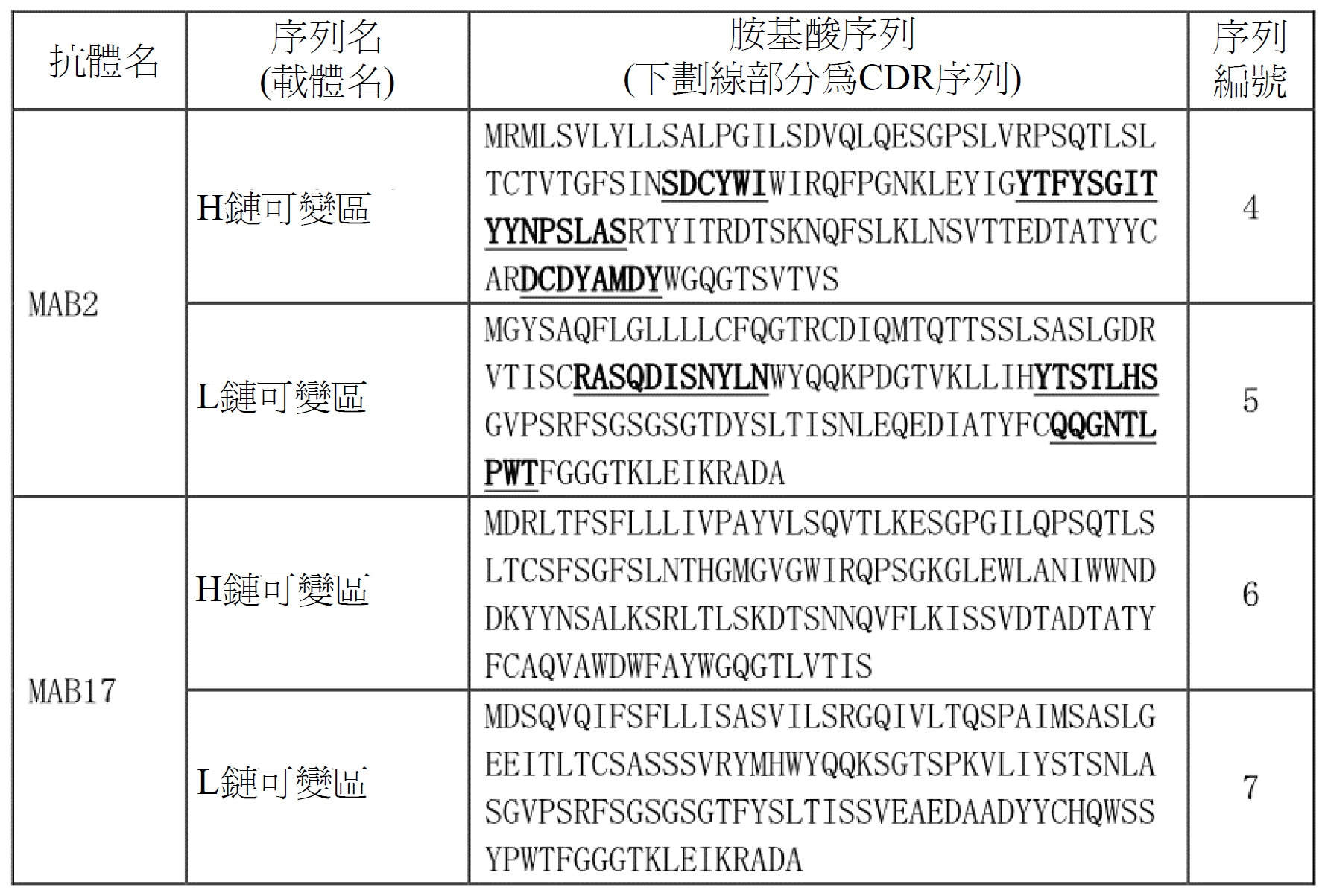
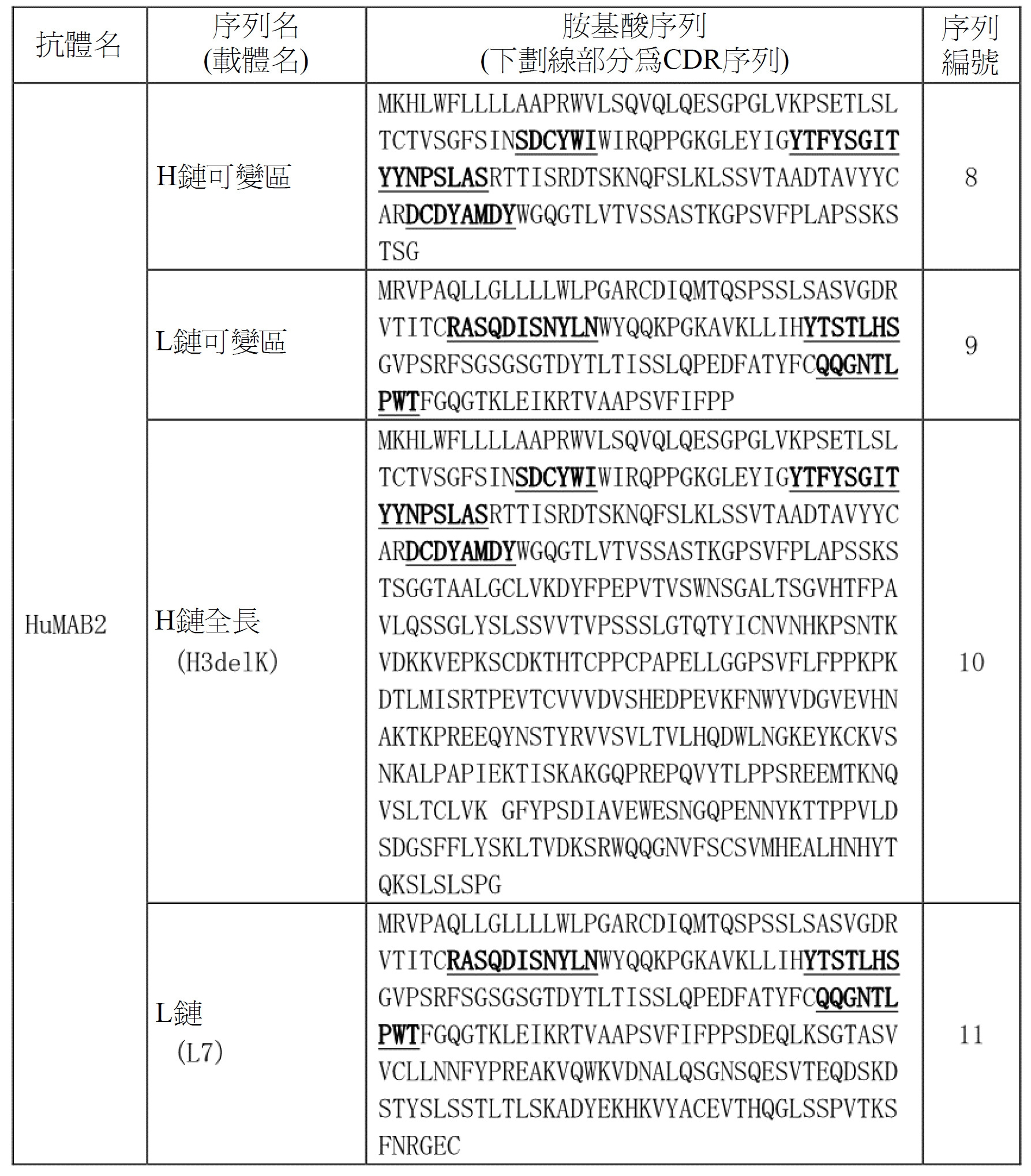
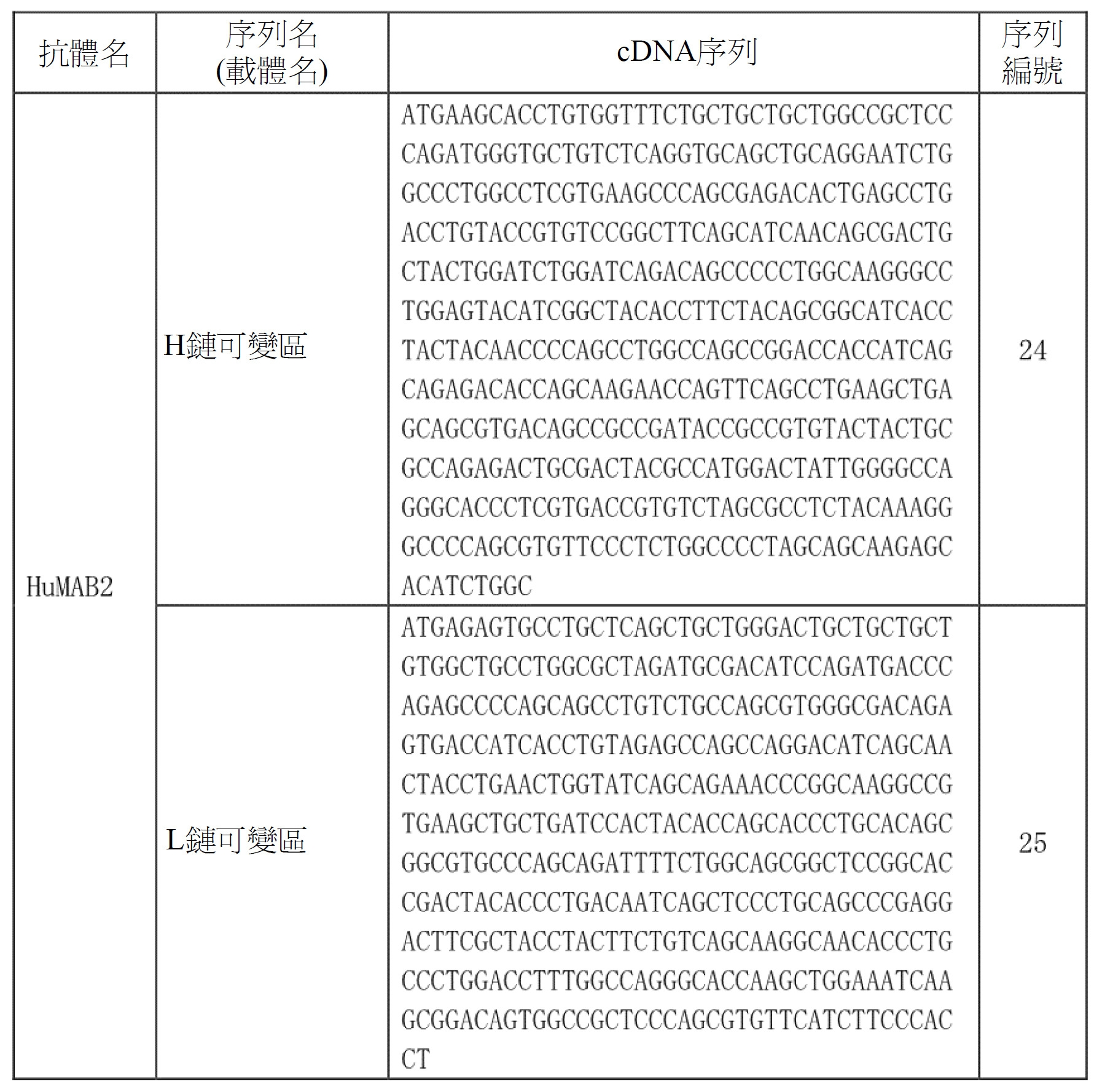
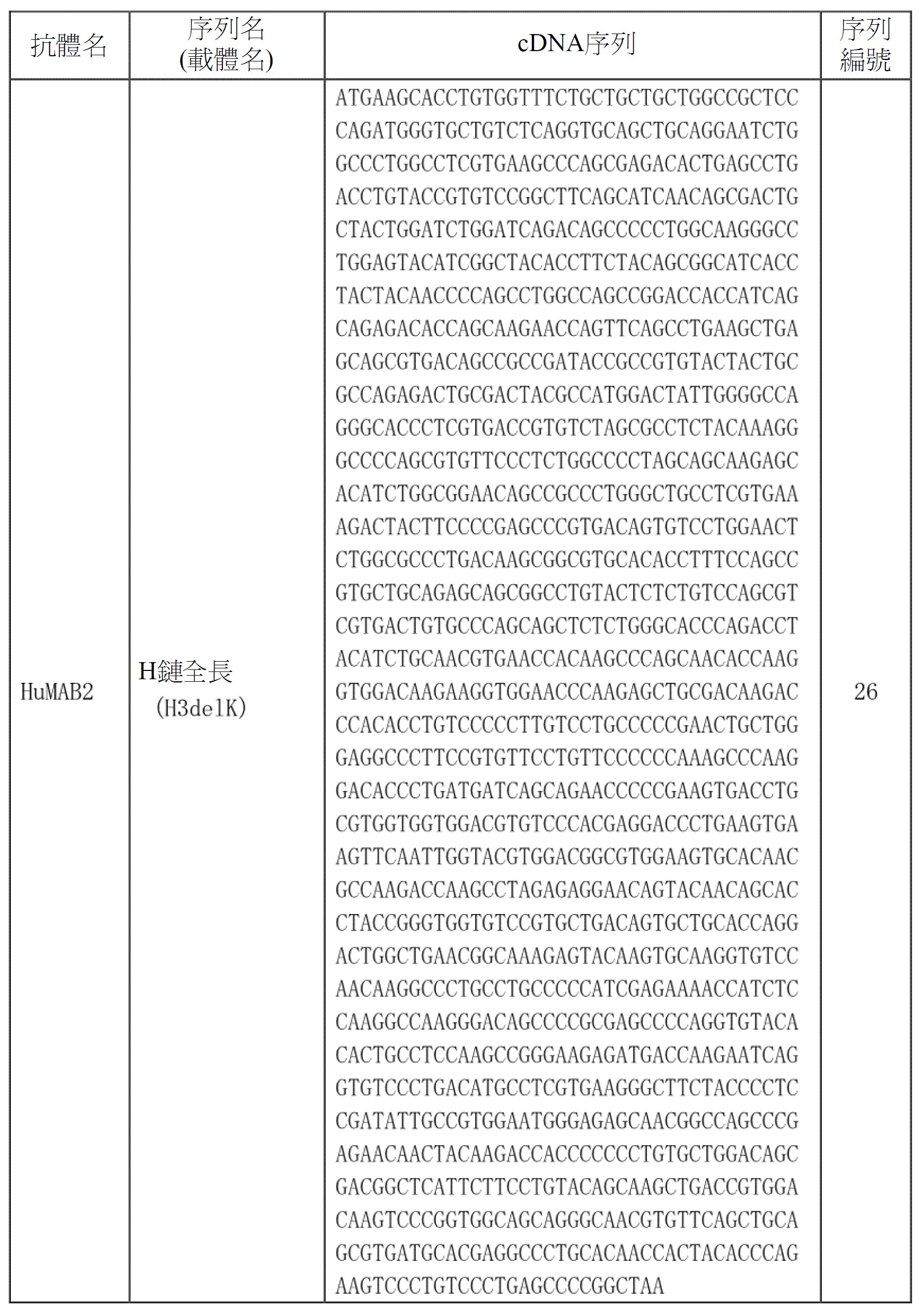
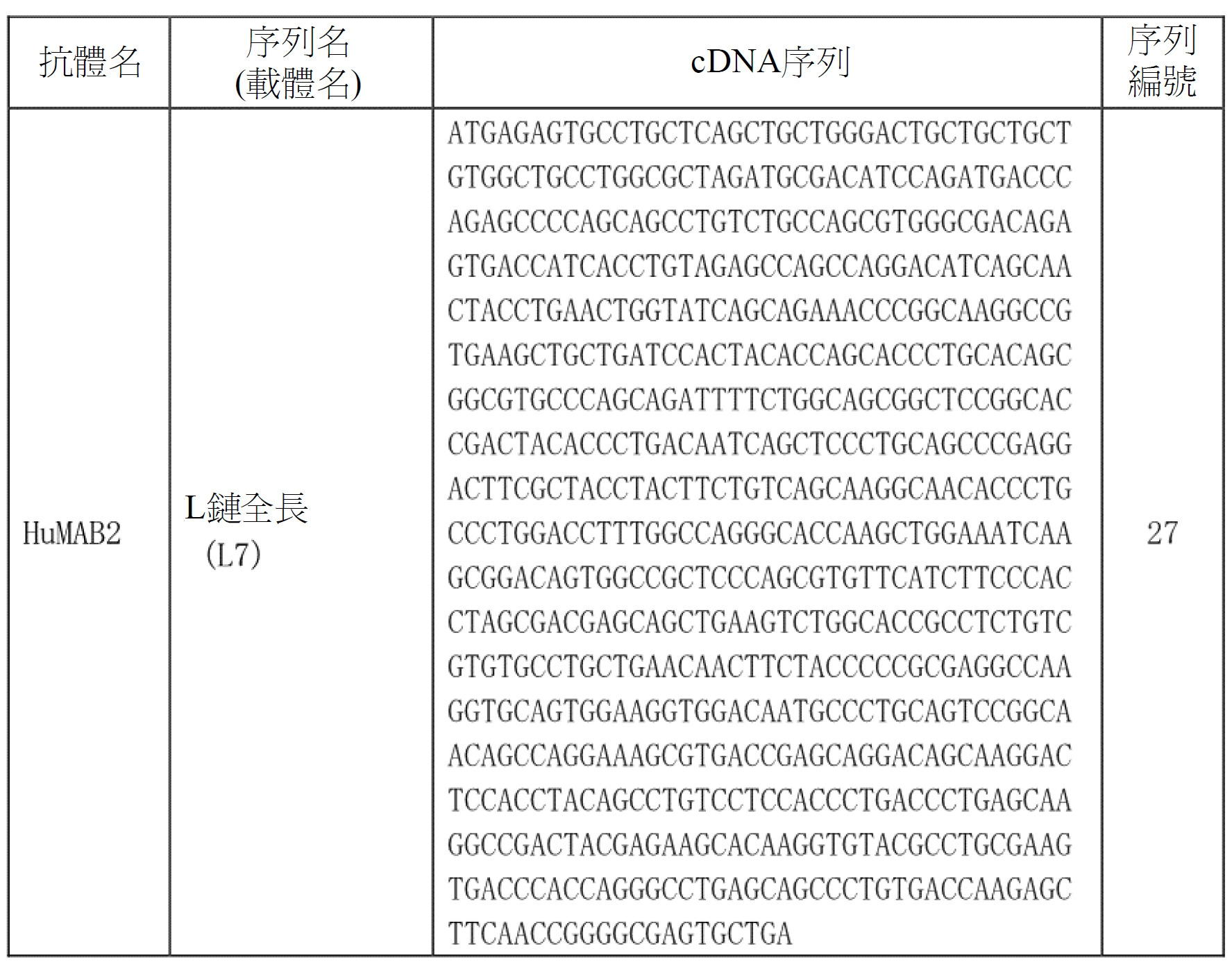
C.與既有之抗hGDF15抗體之比較
1 試驗材料及方法
抗hGDF15抗體
將與HuMAB2之反應性比較所使用之抗體示於表5。
[表5]
試驗方法 將HuMAB2及表5所示之抗GDF15單株抗體(2 μg/mL)以100 μL/孔添加於96孔盤中並分別進行固相化,於該培養盤中,使自1 ng/ml之濃度起經連續稀釋之hGDF15(R&D Systems、957-GD-025/CF)以100 μL/孔進行反應。將經EZ-Link Micro NHS-PEG4-生物素化套組(Thermo Fisher Scientific、21955)生物素化之HuMAB2用作檢測抗體(將1 μg/mL以100 μL/孔進行添加)。夾層ELISA能夠成立係使用人類GDF15 ELISA套組(R&D Systems、DY957)所隨附之抗生蛋白鏈菌素-HRP共軛物來檢測。作為夾層ELISA之陽性對照抗體(PC),使用所有單株抗體均能夠進行夾層法之人類GDF15 ELISA套組(R&D Systems、DY957)所隨附的檢測抗體(表5)。experiment method HuMAB2 and the anti-GDF15 monoclonal antibody (2 μg/mL) shown in Table 5 were added to a 96-well plate at 100 μL/well and solid-phased separately. The concentration of hGDF15 (R&D Systems, 957-GD-025/CF), which was serially diluted, was reacted at 100 μL/well. HuMAB2 biotinylated with EZ-Link Micro NHS-PEG4-Biotinylation Kit (Thermo Fisher Scientific, 21955) was used as the detection antibody (1 μg/mL was added at 100 μL/well). Sandwich ELISA can be established using the streptavidin-HRP conjugate provided with the human GDF15 ELISA kit (R&D Systems, DY957) for detection. As the positive control antibody (PC) of the sandwich ELISA, the detection antibody attached to the human GDF15 ELISA kit (R&D Systems, DY957) that can carry out the sandwich method is used (Table 5).
2 結果 認為於經固相化之抗體與經生物素化之抗體識別相似表位之情形時,會引起競爭抑制,但於識別不同表位之情形時,不會引起競爭抑制。如圖1所示,HuMAB2與其他抗體同時識別出hGDF15。由此提示出,HuMAB2識別與其他抗體不同之表位。2 Results It is believed that when the immobilized antibody and the biotinylated antibody recognize similar epitopes, it will cause competitive inhibition, but when they recognize different epitopes, it will not cause competitive inhibition. As shown in Figure 1, HuMAB2 recognizes hGDF15 at the same time as other antibodies. This suggests that HuMAB2 recognizes a different epitope from other antibodies.
如上所述,明確HuMAB2不會與既有之抗體競爭。此處,藉由與上述相同之方法來對此次獲得之其他抗體是否與HuMAB2競爭進行試驗。以抑制%算出結果並示於表6。明確經過試驗之8個純系中4個純系(MAB1、MAB11、MAB12及MAB13)將HuMAB2與hGDF15之結合抑制70%以上。
[表6]
各hGDF15單株抗體之競爭試驗結果
D. hGDF15與HuMAB2 Fab之複合體之結晶化
1 試驗材料及方法
將HuMAB2 Fab(包括:包含序列編號8之胺基酸序列之多肽及包含序列編號9之胺基酸序列之多肽)(20 ml Tris-HCl、200 mM NaCl、pH7.2)以莫耳比1:1且濃度成為5 mg/mL之方式混合至hGDF15(R&D Systems、9279-GD-050),而製備複合體之蛋白溶液。HuMAB2結晶化係利用沉滴式蒸氣擴散法來進行。蛋白溶液與貯液器溶液之混合比係設為1:1。使用利用篩選套組Crystal Screen 2(Hampton Research、HR2-112)所獲得之結晶,於分解能2.8 Å下來確定複合體之結晶結構。相位確定係利用分子置換法來進行。D. Crystallization of the complex of hGDF15 and
2 結果
藉由立體結構分析可知,hGDF15形成同型二聚物,hGDF15之二聚物上結合有2分子之HuMAB2之Fab(圖2A)。將於HuMAB2與hGDF15之結合交界面排列之胺基酸分別鑑定為互補位與表位(圖2B)。表7中用下劃線來表示對所鑑定之hGDF15之表位及結合較為重要之HuMAB2上之胺基酸。
[表7]
將使用MOE(Molecular Operating Envirounment)進行分析所得之hGDF15之表位示於圖3。明確HuMAB2與1個(Monomer1)hGDF15單體上之N端側之第5號天冬胺酸至第18號組胺酸為止的14個胺基酸、第45號異白胺酸(45I)及第46號甘胺酸(46G),且與另一個單體(Monomer2)上之第71號天冬胺酸(71D)及第72號蘇胺酸(72T)結合。The epitope of hGDF15 obtained by analysis using MOE (Molecular Operating Envirounment) is shown in FIG. 3. Identify the 14 amino acids from No. 5 aspartic acid to No. 18 histidine on the N-terminal side of HuMAB2 and 1 (Monomer1) hGDF15 monomer, No. 45 isoleucine (45I) and Glycine No. 46 (46G) is combined with aspartic acid No. 71 (71D) and threonine No. 72 (72T) on another monomer (Monomer2).
使用MOE之Protein Contacts來計算表位內推測與HuMAB2之相互作用特別密切相關之胺基酸殘基(表8)。其結果為,顯示圖3所示之胺基酸與HuMAB2特別強地結合。
[表8]
E. 抗hGDF15抗體對hGDF15及突變hGDF15之反應性
1 試驗材料及方法
試驗材料
將與HuMAB2抗體之反應性比較所使用之抗體示於表9。
[表9]
試驗方法 試驗概要 將突變hGDF15表現用構建物向ExpiCHO-S細胞進行轉染,進行培養後,回收培養上清液。利用市售之GDF15測定用ELISA套組對所回收之培養上清液中之各突變hGDF15之表現進行確認後,藉由ELISA法對HuMAB2對各突變hGDF15之反應性進行評價。表位中特別重要之胺基酸殘基之鑑定中,藉由ELISA及生物分子間相互作用分析系統這兩種方法,對HuMAB2對突變導入GDF15之反應性進行評價。驗證由HuMAB2與其他抗hGDF15抗體之表位不同導致之差異化係藉由如下方式來進行,即,利用夾層ELISA法對其他抗hGDF15抗體對突變hGDF15之反應性及HuMAB2對突變hGDF15之反應性進行比較。experiment method Test summary The mutant hGDF15 expression construct was transfected into ExpiCHO-S cells, and after culture, the culture supernatant was recovered. After confirming the expression of each mutant hGDF15 in the recovered culture supernatant using a commercially available ELISA kit for GDF15 measurement, the reactivity of HuMAB2 to each mutant hGDF15 was evaluated by the ELISA method. In the identification of particularly important amino acid residues in the epitope, the reactivity of HuMAB2 to the introduction of mutations into GDF15 was evaluated by two methods: ELISA and biomolecular interaction analysis system. It was verified that the difference caused by the epitope difference between HuMAB2 and other anti-hGDF15 antibodies was carried out by the following method, that is, the reactivity of other anti-hGDF15 antibodies to the mutant hGDF15 and the reactivity of HuMAB2 to the mutant hGDF15 were carried out using a sandwich ELISA method. Compare.
突變hGDF15之製備 使用ExpiCHOTM 表現系統套組(Thermo Fisher Scientific、A29133),將導入有各突變hGDF15基因之pcDNA-3.1載體(Thermo Fisher Scientific)向套組中所包含之ExpiCHO-S(Thermo Fisher Scientific)細胞進行轉染。將轉染後第10天之培養上清液於4℃下以8000 rpm進行30分鐘離心分離,回收培養上清液。所回收之培養上清液係進行冷凍(設定溫度-20℃)保存。The preparation of mutant hGDF15 uses ExpiCHO TM expression system kit (Thermo Fisher Scientific, A29133), and the pcDNA-3.1 vector (Thermo Fisher Scientific) introduced with each mutant hGDF15 gene is transferred to the ExpiCHO-S (Thermo Fisher Scientific) included in the kit. ) Cells are transfected. The culture supernatant on the 10th day after transfection was centrifuged at 4°C and 8000 rpm for 30 minutes, and the culture supernatant was recovered. The collected culture supernatant is frozen (set temperature -20°C) for storage.
突變hGDF15之表現確認 所回收之培養上清液中之突變hGDF15係使用人類GDF15 ELISA套組(R&D Systems、DY957),依據套組之隨附文書來實施測定,確認表現並測定濃度。Confirmation of the performance of mutant hGDF15 The human GDF15 ELISA kit (R&D Systems, DY957) was used for the mutant hGDF15 in the collected culture supernatant, and the assay was performed according to the accompanying documents of the kit to confirm the performance and determine the concentration.
GDF15抗體對於突變hGDF15之反應性評價 野生型(Wild-type: Wt)hGDF15係使用重組人GDF15(R&D Systems、957-GD-025/CF)。於固相有各hGDF15抗體之培養盤中使經連續稀釋之Wt及突變hGDF15反應,使用人類GDF15 ELISA套組(R&D Systems、DY957)之檢測抗體(表9),對所結合之Wt及突變hGDF15進行檢測。Evaluation of the reactivity of GDF15 antibody to mutant hGDF15 The wild-type (Wild-type: Wt) hGDF15 line uses recombinant human GDF15 (R&D Systems, 957-GD-025/CF). The serially diluted Wt and mutant hGDF15 were reacted in a culture plate with each hGDF15 antibody in the solid phase, and the detection antibody of the human GDF15 ELISA kit (R&D Systems, DY957) (Table 9) was used to detect the bound Wt and mutant hGDF15 Perform testing.
藉由生物分子間相互作用分析系統來評價HuMAB2對突變導入GDF15之反應性 各突變hGDF15係使用於瓊脂糖凝膠(GE Healthcare、17-0906-01)中固定有MAB17之親和・管柱來純化。利用生物分子間相互作用分析系統之評價係使用OCTET QKe (ForteBio)來進行。Wt之GDF15係使用重組人GDF15(R&D Systems、957-GD-025/CF)。使Wt及突變hGDF15與生物感測器Ni-NTA(ForteBio、18-5101)結合,繼而使經連續稀釋之HuMAB2反應,對突變hGDF15與HuMAB2間之相互作用評價。分析係使用動力學方法來實施。Evaluation of the responsiveness of HuMAB2 to the introduction of mutations into GDF15 by the analysis system of biomolecular interactions Each mutant hGDF15 was purified using an affinity column with MAB17 immobilized on agarose gel (GE Healthcare, 17-0906-01). The evaluation using the biomolecular interaction analysis system is performed using OCTET QKe (ForteBio). GDF15 of Wt uses recombinant human GDF15 (R&D Systems, 957-GD-025/CF). Wt and mutant hGDF15 were combined with biosensor Ni-NTA (ForteBio, 18-5101), and then serially diluted HuMAB2 was reacted to evaluate the interaction between mutant hGDF15 and HuMAB2. The analysis department uses kinetic methods to implement.
2 結果
將野生型(WT)hGDF15及突變hGDF15之胺基酸序列示於表10。以下劃線表示將野生型hGDF15之胺基酸置換成丙胺酸之部位。
[表10]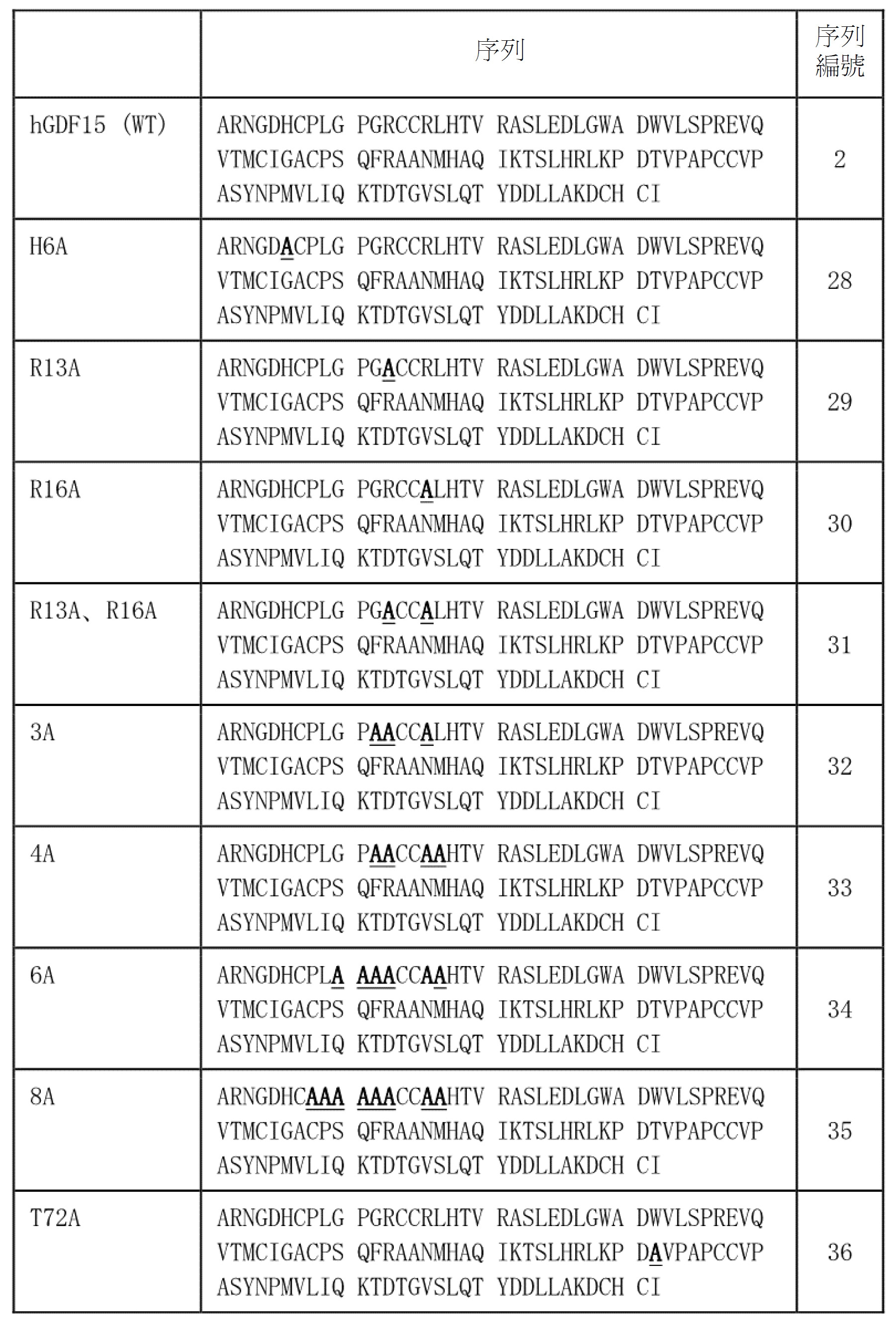
表11中表示4種抗hGDF15抗體與hGDF15及突變hGDF15之結合。HuMAB2未與突變hGDF15結合,或相較於與野生型hGDF15之結合,與突變hGDF15較弱地結合,但其他抗hGDF15抗體與hGDF15之結合未受突變影響。由此可知,HuMAB2之hGDF15之表位中N末端側之5DHCPLGPGRCCRLH18(序列編號3)對於結合較為重要,尤其是13R與16R對於HuMAB2之結合較為重要。又,該結果還支持MAB17、Hu01G06-127、及MAB957之表位與HuMAB2之表位不同。
[表11]
F. HuMAB2抗體對於表位區肽之反應性評價
1 試驗方法
已明確hGDF15之第5號天冬醯胺殘基直至第18號組胺酸殘基為止之14個殘基(DHCPLGPGRCCRLH、序列編號3)對於HuMAB2之結合較為重要,因此由GenScript公司合成該序列之肽(表12)。肽1係兩末端均未修飾,關於肽2,由於該區域在hGDF15內係內部區域,故為了模擬其狀態而使胺基末端乙醯化,使羧基末端醯胺化來合成。向以100 μL/孔添加並固相有10 μg/mL之肽溶液之96孔盤,以100 μL/孔添加HuMAB2抗體(10 μg/mL)並進行反應(3小時、25℃)。針對所結合之HuMAB2抗體,將經5000倍稀釋之抗人IgG-HRP(Jackson ImmunoResearch、109-035-008)以100 μL/孔進行添加,於25℃下進行1小時反應並進行檢測。作為培養盤之對照,使用固相有hGDF15(R&D Systems、957-GD-025/CF)之培養盤。作為會與肽反應之陽性對照抗體,使用人類GDF15 ELISA套組(R&D Systems、DY957)之檢測抗體(表9),作為陰性對照抗體,使用人類IgG1同型對照(Abcam、ab206198)。
[表12]
2 結果 如圖4所示,作為陽性對照抗體之抗hGDF15多株抗體與2種肽及hGDF15均發生反應。相對於此,HuMAB2僅與hGDF15反應,對於2種合成肽,與作為陰性對照抗體之人類IgG1同型對照(hIgG1)同樣地未顯示反應。根據該結果提示,對HuMAB2向hGDF15之表位之結合來說,重要的是周邊之序列或立體結構。2 Results As shown in Figure 4, multiple strains of anti-hGDF15 antibodies as positive control antibodies reacted with both peptides and hGDF15. In contrast, HuMAB2 only reacted with hGDF15, and the two synthetic peptides showed no reaction similar to the human IgG1 isotype control (hIgG1) as a negative control antibody. Based on the results, it is suggested that for the binding of HuMAB2 to the epitope of hGDF15, the surrounding sequence or three-dimensional structure is important.
G.由CDR中之胺基酸置換產生之HuMAB2變異體向hGDF15之結合
1 試驗材料及方法
試驗體系
細胞
1)細胞株名:ExpiCHO
2)來源:中國倉鼠
3)細胞供應商:Thermo Fisher Scientific(A29127)
4)培養液:ExpiCHO表現培養基
5)培養液供應商:Thermo Fisher Scientific(A2910001)
抗體表現載體
1)載體名:pcDNA-3.1
2)cDNA來源:全合成
3)供應商:Thermo Fisher Scientific
重組蛋白
1)蛋白質名:人類GDF15 (hGDF15)
2)來源:CHO細胞
3)供應商:R&D systems(957-GD-025/CF)G. Binding of HuMAB2 variants generated by amino acid substitution in CDR to
試驗方法 表現載體之設計 根據藉由HuMAB2與hGDF15之結晶結構分析所獲得之資訊,設計出如下表現載體,該表現載體係將在抗體與抗原之結合交界面上排列之胺基酸作為互補位及表位,並向HuMAB2之重鏈或輕鏈插入胺基酸變異而成。表13中顯示變異抗體之列表(將經改性之胺基酸以下劃線表示)。重鏈及輕鏈均自N末端起以FR1-CDR1-FR2-CDR2-FR3-CDR3-FR4之順序排列。experiment method Performance vector design Based on the information obtained by the analysis of the crystal structure of HuMAB2 and hGDF15, the following expression carrier was designed. The expression carrier system uses the amino acids arranged at the binding interface of the antibody and antigen as paratopes and epitopes, and transfers them to HuMAB2. The heavy chain or light chain is inserted into the amino acid mutation. Table 13 shows a list of variant antibodies (modified amino acids are underlined). Both the heavy chain and the light chain are arranged in the order of FR1-CDR1-FR2-CDR2-FR3-CDR3-FR4 from the N-terminus.
表現載體之細胞導入 向24孔盤接種CHO細胞,第二天,將表13之變異抗體之表現載體之重鏈及輕鏈進行組合,利用TransIT-CHO套組(Takara、V2170)進行基因轉殖。5天後回收所有上清液,於設定為-20℃之冷凍庫中進行保存直至使用為止。Expression vector cell introduction The 24-well plate was seeded with CHO cells. The next day, the heavy chain and light chain of the expression vector of the variant antibody in Table 13 were combined, and the TransIT-CHO kit (Takara, V2170) was used for gene transfer. After 5 days, all supernatants were recovered and stored in a freezer set at -20°C until use.
對於hGDF15之結合量之測定
向96孔盤添加100 μL之hGDF15溶液(0.4 μg/ml),於4℃下進行靜置直至第二天早晨,製作ELISA培養盤。添加1%BSA,進行1小時阻斷,包含變異抗體之培養上清液係自30倍稀釋起製作稀釋系列(稀釋倍率之公比3),向ELISA培養盤各添加100 μL,並靜置2小時。作為2次抗體,添加HRP複合抗人類IgG抗體(Gene Tex、GTX26759)(20000倍稀釋),並靜置1小時。顯色反應係使用TMB(Sigma、T-0440),反應終止液係使用2當量濃度之硫酸。吸光度係測定450 nm。For the determination of the binding capacity of
使用OCTET之抗體濃度之測定 培養上清液中之抗體濃度係利用作為生物分子間相互作用分析系統之OCTET QKe(Pall ForteBio)所測得。感測器晶片係使用Protein L(Pall ForteBio、18-5085),感測器晶片之再生液係使用10 mM甘胺酸(pH1.1),洗淨液係使用ForteBio樣本稀釋劑(Pall ForteBio、18-1048)。標準係使用50 mg/mL、10 mg/mL、1 mg/mL、及0.1 mg/mL之IgG from human serum regent grade(Sigma-Aldrich、I12511-10MG),供進行測定之培養上清液係利用樣本稀釋劑(Pall ForteBio、18-1104)稀釋2倍來使用。測定程序之設定如下:將感測器晶片之再生設定為5秒,將洗淨設定為5秒,將該感測器晶片之再生及洗淨反覆進行3個循環後,將抗體濃度測定設定為120秒。Determination of antibody concentration using OCTET The antibody concentration in the culture supernatant was measured using OCTET QKe (Pall ForteBio) as a system for analyzing interactions between biomolecules. The sensor chip uses Protein L (Pall ForteBio, 18-5085), the sensor chip's regeneration solution uses 10 mM glycine (pH 1.1), and the cleaning solution uses ForteBio sample diluent (Pall ForteBio, 18-1048). The standard system uses 50 mg/mL, 10 mg/mL, 1 mg/mL, and 0.1 mg/mL IgG from human serum regent grade (Sigma-Aldrich, I12511-10MG) for the use of the culture supernatant for the determination The sample diluent (Pall ForteBio, 18-1104) was diluted 2 times and used. The setting of the measurement program is as follows: set the regeneration of the sensor chip to 5 seconds, set the cleaning to 5 seconds, repeat the regeneration and cleaning of the sensor chip for 3 cycles, and set the antibody concentration measurement to 120 seconds.
與HuMAB2之結合量之比較 將抗體5 ng/mL中對於人類hGDF15之結合量於excel上進行計算,將HuMAB2對於hGDF15之結合量設為100,將此時之各變異抗體之結合量以相對值表示。進行3次獨立之試驗,求出平均值±標準誤差。因引入變異而抗體變得不再表現之抗體之結合量設為0。將結果示於圖5A~D。Comparison of binding capacity with HuMAB2 The binding amount of the antibody to human hGDF15 at 5 ng/mL was calculated on excel, the binding amount of HuMAB2 to hGDF15 was set to 100, and the binding amount of each variant antibody at this time was expressed as a relative value. Carry out 3 independent experiments and find the average ± standard error. The binding amount of the antibody whose antibody no longer behaves due to the introduced mutation is set to zero. The results are shown in Figures 5A to D.
2 結果
相對結合量顯示HuMAB2之1.5倍以上之抗體發現有5種。另一方面,50%以下之結合量之降低於30種抗體中被觀察到。圖5A之「H鏈改性抗體1/2」中顯示出2種「H50S-L7」之結果,其等結果係由在培養及ELISA中為了確認孔間誤差而設置之相同載體所引起。由於2個均為相同程度之值,故表示試驗體系穩定。2 Results
There are 5 kinds of antibodies with a relative binding amount showing 1.5 times or more of HuMAB2. On the other hand, a decrease in binding capacity of less than 50% was observed in 30 kinds of antibodies. The results of two types of "H50S-L7" are shown in the "H chain modified
關於作為重鏈變異抗體之H48S-L7、H83R-L7、及H120F-L7;作為輕鏈變異抗體之H3-L48K及H3-L112D,與HuMAB2相比,結合力上升約1.5倍。另一方面,HuMAB2之輕鏈之第111號甘胺酸(111G)之變異體及第114號白胺酸(114L)之變異體均觀察到結合量降低,因此提示該等胺基酸係對於向hGDF15之結合及HuMAB2之CDR序列之結構維持較為重要的部位。Regarding H48S-L7, H83R-L7, and H120F-L7 as heavy chain variant antibodies, and H3-L48K and H3-L112D as light chain variant antibodies, the binding force is about 1.5 times higher than that of HuMAB2. On the other hand, both the 111th glycine (111G) variant and the 114th leucine (114L) variant of the light chain of HuMAB2 have reduced binding capacity, which suggests that these amino acids are The binding to hGDF15 and the structure of the CDR sequence of HuMAB2 maintain the more important positions.
[表13-1]
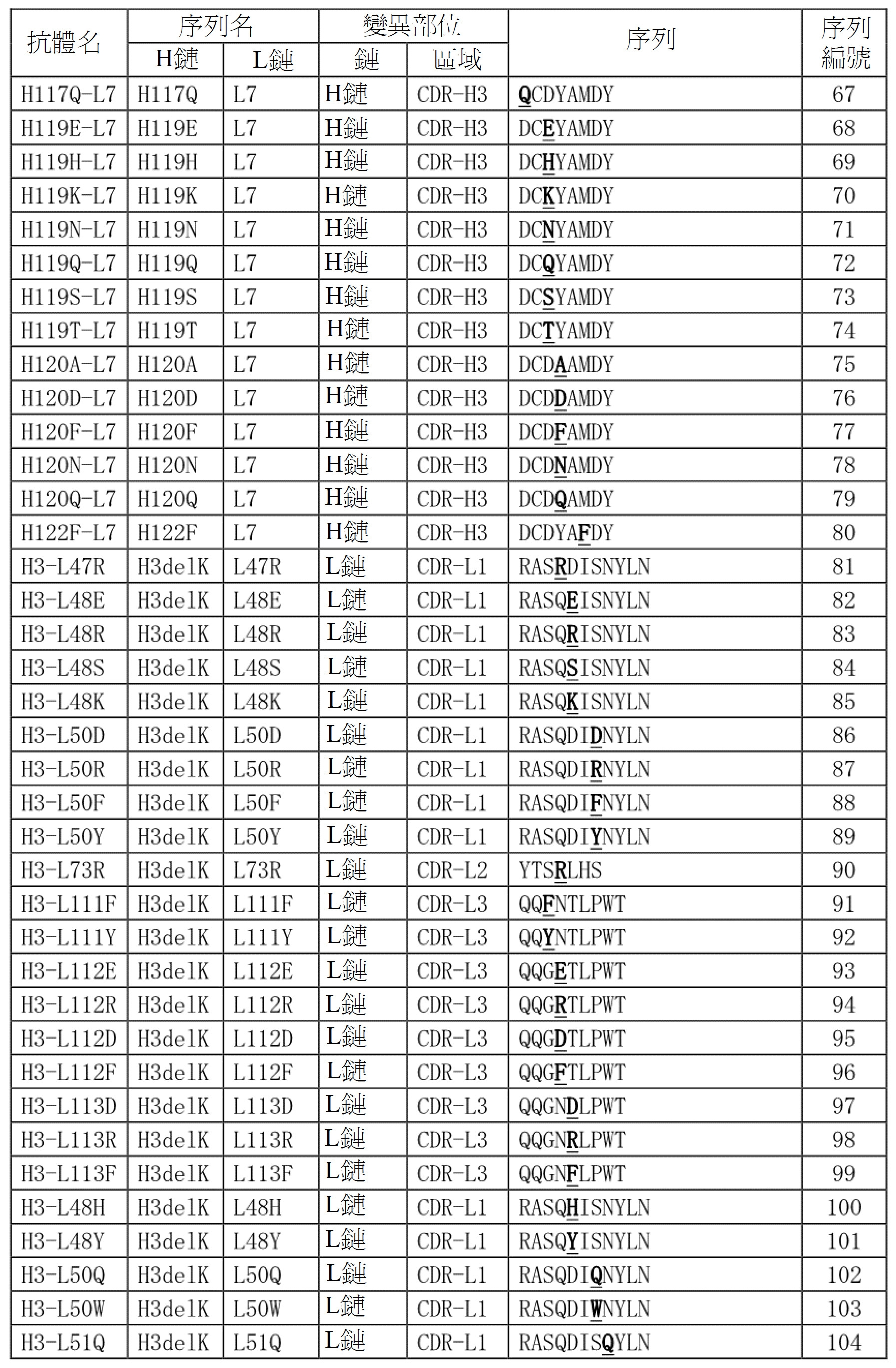
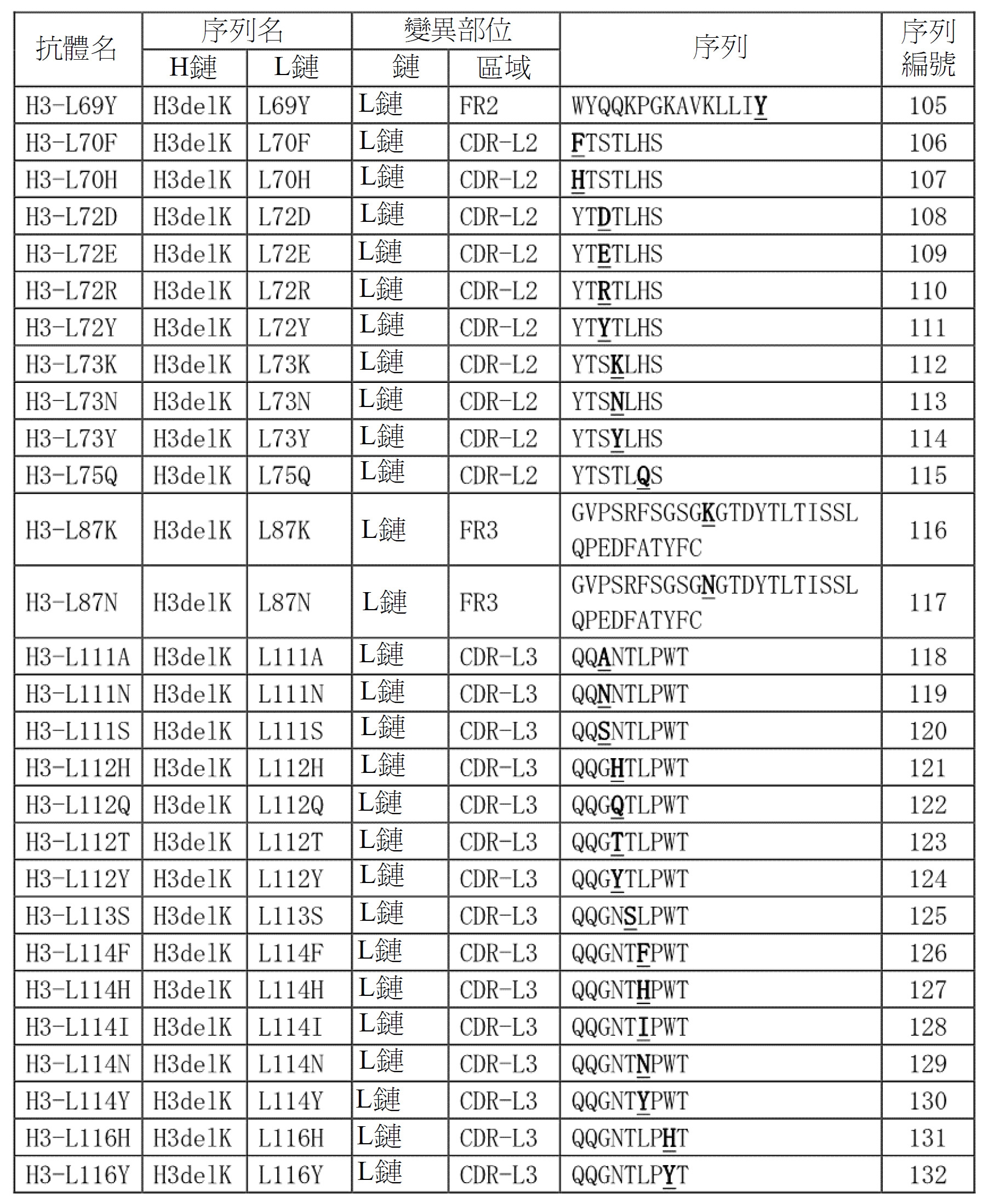
II.藥理試驗 (1)
A.血中hGDF15之捕獲
1 試驗材料及方法
動物
1) 物種/系統:mouse/ BALB-c Slc-nu/nu
2) 微生物學等級:無特定病原(SPF)
3) 供應商:Japan SLC
4) 性別:雌性
5) 週齡:6週齡(hGDF15、抗體投予時)
6) 飼養條件
於設定為下述條件之環境下進行動物之飼養。
a)溫度:23±2℃
b)濕度:60±10%
c)照明:照明時間:上午7點~下午7點
熄燈時間:下午7點~上午7點
d)食料及水:自由攝取、CRF-1(Oriental Yeast(股))、自來水II. Pharmacological test (1)
A. Capture of hGDF15 in
試驗排程
表14中顯示以抗體投予日作為0天之試驗排程。
[表14]
動物之飼養方法 在搬入日後之3天後,將小鼠分在不同之籠中。為了適應分開飼養,將分群前之適應期間設為5天。How to raise animals Three days after moving in, the mice were divided into different cages. In order to adapt to separate rearing, the adaptation period before grouping is set to 5 days.
分群 以體重為基礎,並利用實驗資料收集處理系統(SAS institute Japan、R9.3)以每群各6隻,共計6群之方式進行分群。Grouping Based on body weight, and using the experimental data collection and processing system (SAS institute Japan, R9.3), each group is divided into 6 groups for a total of 6 groups.
抗hGDF15抗體之投予
rhGDF15、HuMAB2抗體、及MAB17抗體係以10 mL/kg進行腹腔內投予。對照群係以10 mL/kg投予Dulbecco's磷酸鹽緩衝液(DPBS)。群構成如表15所示。
[表15]
體重及攝食量之測定 體重及攝食量係於分群日及投予0天、1天、2天、3天後進行測定。Determination of body weight and food intake Body weight and food intake were measured on the day of grouping and 0 days, 1 day, 2 days, and 3 days after administration.
採血、解剖 採血係於抗體投予後第3天自以吸入異氟醚方式麻醉之小鼠之下腔靜脈來進行。使用EDTA2K之採血管獲得血漿,於設定為-80℃之冷凍庫中進行保存直至使用。對於採血後之小鼠,在麻醉下直接切開腹部下腔靜脈,以放血方式使動物安樂死。Blood collection, dissection Blood collection was performed from the inferior vena cava of mice anesthetized with isoflurane inhalation on the 3rd day after antibody administration. Use EDTA2K blood collection tube to obtain plasma, and store it in a freezer set at -80°C until use. For the mice after blood collection, the inferior vena cava of the abdomen was directly incised under anesthesia, and the animals were euthanized by bloodletting.
血中未結合hGDF15濃度
為了測定血中未與抗體結合之hGDF15(未結合hGDF15),將抗原抗體複合體按照以下步序去除。將5 μL 蛋白A/G瓊脂糖珠(Thermo scientific、20421)、與50 μL之小鼠血漿及145 μL之PBS加以混合,於4℃下混合2小時。離心分離後,將上清液移至新的微量管,於設定為-80℃之冷凍庫中進行保存直至使用。其後之血中GDF15測定係使用GDF15測定ELISA套組(R&D systems、DY957),步序係依據套組之說明書。關於檢測極限以下之檢體,將血中GDF15濃度視為0 pg/mL。Concentration of unbound hGDF15 in blood
In order to determine the hGDF15 that is not bound to the antibody (unbound hGDF15) in the blood, the antigen-antibody complex is removed according to the following procedure.
統計分析方法 關於血中未結合GDF15濃度,進行Wilcoxon秩和檢定。統計分析係使用SAS軟體(SAS institute Japan、R9.3)。Statistical analysis method Regarding the concentration of unbound GDF15 in blood, Wilcoxon rank sum test was performed. The statistical analysis department uses SAS software (SAS institute Japan, R9.3).
2 結果 結果如圖6所示。hGDF15之血中濃度係rhGDF15之投予量依存性地增加,MAB17及HuMAB2均捕獲到血中GDF15。2 Results The result is shown in Figure 6. The blood concentration of hGDF15 increased depending on the dosage of rhGDF15, and both MAB17 and HuMAB2 captured GDF15 in the blood.
B.荷癌小鼠模型之血中GDF15濃度之減少
1 試驗材料及方法
試驗物質
・HuMAB2
・MAB1
・MAB13
對照物質
・MAB17
・MAB957(R&D Systems)
・Hu01G06-127 (WO2014/100689)B. Decrease of GDF15 concentration in blood of cancer-bearing
試驗物質及對照物質之製備 將所有抗體於DPBS中製備成為1 mg/mL,於設定為-80℃之冷凍庫中進行保存直至投予日。Preparation of test substances and reference substances All antibodies were prepared at 1 mg/mL in DPBS, and stored in a freezer set at -80°C until the day of administration.
試驗體系 細胞 1) 細胞株名:MKN45 2) 來源:人類胃癌 3) 供應商:JCRB (Japanese Collection of Research Bioresources) cell bank 4) 培養條件:37℃、5% CO2 a) 培養液:RPMI1640 i) 供應商:life technologies b) 血清:胎牛血清 i) 濃度:10% ii) 供應商:Tissue Culture Biology 動物 5) 物種/系統:mouse/ BALB-c Slc-nu/nu 6) 微生物學等級:無特定病原(SPF) 7) 供應商:Japan SLC 8) 性別:雌性 9) 週齡:7週齡(細胞移植時) 10) 於上述「A. 血中hGDF15之捕獲」中所記載之環境下進行動物之飼養。Test system cells 1) Cell line name: MKN45 2) Source: Human gastric cancer 3) Supplier: JCRB (Japanese Collection of Research Bioresources) cell bank 4) Culture conditions: 37℃, 5% CO 2 a) Culture medium: RPMI1640 i ) Supplier: life technologies b) Serum: Fetal Bovine Serum i) Concentration: 10% ii) Supplier: Tissue Culture Biology Animal 5) Species/System: mouse/ BALB-c Slc-nu/nu 6) Microbiology grade: No specific pathogen (SPF) 7) Supplier: Japan SLC 8) Gender: Female 9) Week old: 7 weeks old (at the time of cell transplantation) 10) Under the environment described in the above "A. Capture of hGDF15 in blood" Carry out animal breeding.
群構成
[表16]
試驗方法 動物之飼養方法 在搬入日後之3天後,將小鼠分在不同之籠中。為了適應分開飼養,將移植MKN45之前之適應期間設為5天。experiment method How to raise animals Three days after moving in, the mice were divided into different cages. In order to adapt to separate rearing, the adaptation period before transplanting MKN45 was set to 5 days.
細胞之製備及向動物之細胞移植 MKN45細胞係於150 mm之培養皿中進行培養,於移植日利用0.25%胰蛋白酶-EDTA(SIGMA、T6689)處理來回收細胞,藉由離心分離(1200 rpm、5分鐘)去除上清液。利用DPBS以成為5×10⁶ cells/mL之方式進行懸浮,以0.2 mL/body(1×106 cells/body)移植至以吸入異氟醚方式麻醉之小鼠之腹部皮下。Preparation of cells and transplantation of cells into animals. The MKN45 cell line was cultured in a 150 mm petri dish. The cells were recovered by 0.25% trypsin-EDTA (SIGMA, T6689) treatment on the day of transplantation. The cells were separated by centrifugation (1200 rpm, 5 minutes) Remove the supernatant. DPBS was used to suspend at 5×10 6 cells/mL, and 0.2 mL/body (1×10 6 cells/body) was transplanted into the subcutaneous abdomen of mice anesthetized with isoflurane inhalation.
分群
於試驗1中,在MKN45移植前自42隻小鼠中隨機選出5隻以作為正常(媒液)群,向剩餘之37隻小鼠移植MKN45。在MKN45移植後之12天後,以體重為基礎,利用SAS軟體(SAS institute Japan、R9.4)以每群5隻,共計6群之方式進行分群,分配成MKN45(媒液)群、MKN45(MAB17)群、MKN45(MAB957)群、MKN45(Hu01G06-127)群、及MKN45(HuMAB2)群。同樣地,於試驗2中亦以每群5隻之方式分配成正常(媒液)群、MKN45(媒液)群、MKN45(MAB17)群、MKN45(MAB1)群、及MKN45(13)群。分群後,對於多餘動物,於異氟醚麻醉下以放血方式使動物安樂死。Grouping
In
DPBS及抗體之投予
在MKN45移植後之14天後(分群後之2天後)腹腔內投予DPBS及抗體(10 mL/kg)。於試驗1中,在抗體投予開始後第7天亦投予DPBS及抗體。Administration of DPBS and antibody
DPBS and antibodies (10 mL/kg) were intraperitoneally administered 14 days after MKN45 transplantation (2 days after grouping). In
採血 採血係於抗體投予開始後第14天(試驗1)或7天後(試驗2),自以吸入異氟醚方式麻醉之小鼠之下腔靜脈來進行。使用EDTA2K之採血管獲得血漿,於設定為-80℃之冷凍庫中進行保存直至使用。對於採血後之小鼠,在麻醉下直接切開腹部下腔靜脈,藉此以放血方式使動物安樂死。Blood collection Blood collection was performed from the inferior vena cava of mice anesthetized with isoflurane inhalation on the 14th day (test 1) or 7 days after the start of antibody administration (test 2). Use EDTA2K blood collection tube to obtain plasma, and store it in a freezer set at -80°C until use. For the mice after blood collection, the inferior vena cava of the abdomen was directly incised under anesthesia to euthanize the animals by bleeding.
血中未結合hGDF15濃度
為了測定血中未與抗體結合之hGDF15(未結合hGDF15),將抗原抗體複合體按照以下步序去除。將5 μL 蛋白A/G瓊脂糖珠(Thermo scientific、20421)、與50 μL之小鼠血漿及145 μL之PBS加以混合,於4℃下混合2小時。離心分離後,將上清液移至新的微量管,於設定為-80℃之冷凍庫中進行保存直至使用。其後之血中GDF15測定係使用GDF15測定ELISA套組(R&D systems、DY957),步序係依據套組之說明書。關於檢測極限以下(62.5 pg/mL以下)之檢體,將血中GDF15濃度視為0 pg/mL。Concentration of unbound hGDF15 in blood
In order to determine the hGDF15 that is not bound to the antibody (unbound hGDF15) in the blood, the antigen-antibody complex is removed according to the following procedure.
統計分析方法 對於抗體投予開始後第14天(試驗1)或7天後(試驗2)之血中未結合hGDF15濃度,進行Wilcoxon秩和檢定。統計分析係使用SAS軟體(SAS institute Japan、R9.4)。Statistical analysis method For the concentration of unbound hGDF15 in the blood on the 14th day (test 1) or 7 days after the start of antibody administration (test 2), Wilcoxon rank sum test was performed. The statistical analysis department uses SAS software (SAS institute Japan, R9.4).
2 結果
試驗1中,移植有MKN45細胞之MKN45群之血中hGDF15濃度約為2000 pg/mL。於向移植有MKN45細胞之模型小鼠投予有抗體之群中,觀察到MAB17、MAB957、Hu01G06-127抗體投予群與溶劑投予群相比,血中hGDF15濃度上升。另一方面,於HuMAB2投予群中,血中hGDF15濃度減少(圖7)。2 Results
In
試驗2中,將以溶劑投予群之血中hGDF15濃度作為100之情形時之相對值示於表18。與HuMAB2同樣地,觀察到血中hGDF15濃度亦因MAB1及MAB13而減少。
[表18]
上述結果係與投予有重組hGDF15之試驗(圖6)中之MAB17之結果不同。作為原因之一,可例舉:HuMAB2與試驗中所使用之其他3個抗體之表位不同。hGDF15係前導hGDF15被蛋白質分解酵素切斷而產生(A. R. Bauson et al. Cancer Res. 2005; 65 (6): 2320-2336)。HuMAB2之表位存在於該切斷部位之附近,認為藉由結合於此處,有可能抑制hGDF15之產生。目前為止,有某抗CCL-2中和抗體(ABN912)未改善風濕患者之病情而是使之惡化之報告,認為該惡化之一個原因在於血中CCL-2濃度之抗體用量依存性地上升,因此提示出減少血中抗原濃度之重要性(J.J.Haringman et al. Arthritis & Rheumatism 2006; 54 (8): 2387-2392)。由此期待,如HuMAB2之會減少血中GDF15量之抗GDF15抗體較會增加血中hGDF15之抗體,在臨床上有用。The above results are different from the results of MAB17 in the trial administered with recombinant hGDF15 (Figure 6). As one of the reasons, one can exemplify: HuMAB2 has a different epitope from the other three antibodies used in the experiment. hGDF15 is produced when the leading hGDF15 is cleaved by proteolytic enzymes (A. R. Bauson et al. Cancer Res. 2005; 65 (6): 2320-2336). The epitope of HuMAB2 exists near the cut site, and it is believed that by binding to this site, it is possible to inhibit the production of hGDF15. So far, there have been reports that a certain anti-CCL-2 neutralizing antibody (ABN912) has not improved the condition of rheumatism patients but has worsened it. It is believed that one of the reasons for the deterioration is that the CCL-2 concentration in the blood increases depending on the amount of antibody. This suggests the importance of reducing the concentration of antigen in the blood (JJ Haringman et al. Arthritis & Rheumatism 2006; 54 (8): 2387-2392). Therefore, it is expected that the anti-GDF15 antibody, such as HuMAB2, which reduces the amount of GDF15 in the blood, will increase the antibody against hGDF15 in the blood, which is clinically useful.
C.荷癌小鼠模型之惡病質症狀之改善 (1) 1 試驗材料及方法 1.1 試驗物質之製備 將HuMAB2於DPBS中製備成1 mg/mL,於設定為-80℃之冷凍庫中進行保存直至投予日。C. Improvement of cachexia symptoms in cancer-bearing mouse models (1) 1 Test materials and methods 1.1 Preparation of test substance HuMAB2 was prepared at 1 mg/mL in DPBS, and stored in a freezer set at -80°C until the day of administration.
1.2 試驗體系 1.2.1 細胞 1) 細胞株名:MKN45 2) 來源:人類胃癌 3) 供應商:JCRB (Japanese Collection of Research Bioresources) cell bank 4) 培養條件:37℃、5% CO2 a) 培養液:RPMI 1640 i) 供應商:life technologies b) 血清:胎牛血清 i) 濃度:10% ii) 供應商:Tissue Culture Biology 1.2.2 動物 1) 物種/系統:mouse/ BALB-c Slc-nu/nu 2) 微生物學等級:無特定病原(SPF) 3) 供應商:Japan SLC 4) 性別:雌性 5) 週齡:7週齡(細胞移植時) 6) 飼養條件 於設定為下述條件之環境下進行動物之飼養。 a) 溫度:23±2℃ b) 濕度:60± 10% c) 照明:照明時間:上午7點~下午7點 熄燈時間:下午7點~上午7點 d) 食料及水:自由攝取、CRF-1(Oriental Yeast(股))、自來水1.2 Test system 1.2.1 Cells 1) Cell line name: MKN45 2) Source: Human gastric cancer 3) Supplier: JCRB (Japanese Collection of Research Bioresources) cell bank 4) Culture conditions: 37℃, 5% CO 2 a) Cultivation Solution: RPMI 1640 i) Supplier: life technologies b) Serum: Fetal Bovine Serum i) Concentration: 10% ii) Supplier: Tissue Culture Biology 1.2.2 Animal 1) Species/System: mouse/ BALB-c Slc-nu /nu 2) Microbiology level: No specific pathogen (SPF) 3) Supplier: Japan SLC 4) Gender: Female 5) Week age: 7 weeks old (at the time of cell transplantation) 6) Feeding conditions are set to one of the following conditions Keep animals in the environment. a) Temperature: 23±2℃ b) Humidity: 60± 10% c) Lighting: Lighting time: 7 am to 7 pm Turn off time: 7 pm to 7 am d) Food and water: free intake, CRF -1 (Oriental Yeast (share)), tap water
1.2.3 群構成
[表19]
1.3 試驗方法
1.3.1 試驗排程
表20中顯示以抗體投予日作為0天之試驗排程。
[表20]
1.3.2 動物之飼養方法 在搬入日後之3天後,將小鼠分在不同之籠中。為了適應分開飼養,將移植MKN45之前之適應期間設為5天。1.3.2 How to raise animals Three days after moving in, the mice were divided into different cages. In order to adapt to separate rearing, the adaptation period before transplanting MKN45 was set to 5 days.
1.3.3 細胞之製備及向動物之細胞移植 MKN45細胞係於150 mm之培養皿中進行培養,於移植日利用0.25%胰蛋白酶-EDTA(SIGMA、T6689)處理來回收細胞,藉由離心分離(1200 rpm、5分鐘)將上清液去除。利用DBPS以成為5×10⁶ cells/mL之方式進行懸浮,以0.2 mL/body(1×106 cells/body)移植至以吸入異氟醚方式麻醉之小鼠之腹部皮下。1.3.3 Preparation of cells and transplantation of cells to animals. The MKN45 cell line was cultured in a 150 mm petri dish, and the cells were recovered by treatment with 0.25% trypsin-EDTA (SIGMA, T6689) on the day of transplantation. The cells were separated by centrifugation ( 1200 rpm, 5 minutes) to remove the supernatant. DBPS was used to suspend at 5×10 6 cells/mL, and transplanted at 0.2 mL/body (1×10 6 cells/body) into the subcutaneous abdomen of mice anesthetized with isoflurane inhalation.
1.3.4 分群
於MKN45移植前自32隻小鼠中隨機選出8隻以作為正常群,向剩餘之24隻小鼠移植MKN45。在MKN45移植後之12天後,以體重為基礎,利用實驗資料收集處理系統(EDCS、ver.2.1)以每群8隻,共計2群之方式進行分群,分配成MKN45群及HuMAB2群。在分群後,對於多餘動物,在異氟醚麻醉下以放血方式使動物安樂死。1.3.4 Grouping
Before MKN45 transplantation, 8 mice were randomly selected from 32 mice as the normal group, and MKN45 was transplanted to the remaining 24 mice. Twelve days after MKN45 transplantation, on the basis of body weight, the experimental data collection and processing system (EDCS, ver.2.1) was used to
1.3.5 DPBS及HuMAB2之投予 在MKN45移植後之14天後(分群後之2天後)投予DPBS及HuMAB2。DPBS及HuMAB2係以10 mL/kg進行腹腔內投予。1.3.5 Vote for DPBS and HuMAB2 DPBS and HuMAB2 were administered 14 days after MKN45 transplantation (2 days after grouping). DPBS and HuMAB2 were administered intraperitoneally at 10 mL/kg.
1.3.6 體重及攝食量之測定 體重及攝食量係自MKN45移植日至抗體投予日每隔3天測定一次。抗體投予日後,在投予0天、2天、4天、7天後進行測定。1.3.6 Determination of body weight and food intake Body weight and food intake were measured every 3 days from the day of MKN45 transplantation to the day of antibody administration. After the day of antibody administration, the measurement was performed at 0, 2, 4, and 7 days after the administration.
1.3.7 採血、解剖 採血係於抗體投予後第7天,自以吸入異氟醚方式麻醉之小鼠之下腔靜脈來進行。使用EDTA2K之採血管獲得血漿,於設定為-80℃之冷凍庫中進行保存直至使用。對於採血後之小鼠,在麻醉下直接切開腹部下腔靜脈,藉此以放血方式使動物安樂死。腫瘤係切開腫瘤部之皮膚,使用手術用剪刀來採集,並測定重量。1.3.7 Blood collection and dissection Blood collection was performed from the inferior vena cava of mice anesthetized by inhalation isoflurane on the 7th day after antibody administration. Use EDTA2K blood collection tube to obtain plasma, and store it in a freezer set at -80°C until use. For the mice after blood collection, the inferior vena cava of the abdomen was directly incised under anesthesia to euthanize the animals by bleeding. The tumor is cut through the skin of the tumor, collected with surgical scissors, and weighed.
1.4 統計分析方法
關於抗體投予7天後之體重及腫瘤重量、抗體投予日後第7天為止之累積攝食量,分別針對正常群及MKN45群、MKN45群及HuMAB2群,進行無對應之t檢驗。關於血中未結合GDF15濃度,進行Wilcoxon秩和檢定。統計分析係使用SAS軟體 (SAS institute Japan、R9.3)。1.4 Statistical analysis methods
Regarding the body weight and
2 結果
使用荷癌(MKN45細胞移植)小鼠,對HuMAB2對於癌症性惡病質之症狀即體重及攝食量之變化的效果進行研究,亦研究對血中未結合GDF15量之影響。圖8中表示體重之變化、及抗體投予後7天期間之累積攝食量、抗體投予7天後之血中未結合GDF15濃度。關於抗體投予7天後之體重,與正常群相比,MKN45群減少4 g左右,發現藉由移植MKN45細胞而體重減少顯著(P<0.01)。另一方面,於HuMAB2群中,在抗體投予後觀察到體重減少之恢復,與MKN45群相比,發現體重增加顯著(P<0.01)。同樣地,關於抗體投予後7天期間之累積攝食量,於MKN45群中發現累積攝食量顯著地減少(P<0.01),於HuMAB2群中,發現與MKN45群相比,累積攝食量顯著地增大(P<0.01)。血中未結合GDF15濃度於正常群中未檢測到,但於MKN45群中,顯著地上升至1500 pg/mL左右(P<0.01),與圖7之結果同樣地,於HuMAB2群中,顯著地減少至20分之1左右(P<0.01)。根據該等結果確認到,MKN45移植小鼠之惡病質樣症狀(體重減少、攝食量)因投予HuMAB2而恢復。2 Results
Using cancer-bearing (MKN45 cell transplantation) mice, the effect of HuMAB2 on the symptoms of cancer cachexia, namely changes in body weight and food intake, was studied, and the effect on the amount of unbound GDF15 in the blood was also studied. Figure 8 shows the change in body weight, the cumulative food intake during 7 days after antibody administration, and the unbound GDF15 concentration in the
D. 荷癌小鼠模型之惡病質症狀之改善 (2) 1 試驗材料及方法 1.1 試驗物質之製備 將HuMAB2於DPBS中製備成1 mg/mL,於設定為-80℃之冷凍庫中進行保存直至投予日。D. Improvement of cachexia symptoms in cancer-bearing mouse models (2) 1 Test materials and methods 1.1 Preparation of test substance HuMAB2 was prepared at 1 mg/mL in DPBS, and stored in a freezer set at -80°C until the day of administration.
1.2 試驗系
1.2.1 細胞
1) 細胞株名:MKN45
1) 來源:人類(人類胃癌組織)
2) 供應商:JCRB(Japanese Collection of Research Bioresources)
3) 培養條件:37℃ 5% CO2
預培養條件:37℃ 5% CO2
a) 培養液:RPMI1640
i) 供應商:life technologies
b) 血清:胎牛血清
i) 濃度:10%
ii) 供應商:Tissue Culture Biology
1.2.2 動物
1) 物種/系統:小鼠/BALB-c Slc-nu/nu
2) 微生物學等級:無特定病原(SPF)
3) 供應商:Japan SLC
4) 性別:雌性
5) 週齡:6-12週齡
6) 飼養條件
於設定為下述條件之環境下進行動物飼養。
a) 溫度:23±2℃
b) 濕度:60±10%
c) 照明:照明時間:上午7點~下午7點
熄燈時間:下午7點~上午7點
d) 食料及水:自由攝取(試驗1之成對飼養群係每天餵食規定量)、CRF-1(Oriental Yeast(股))、自來水1.2 Test system 1.2.1 Cells 1) Cell line name: MKN45 1) Source: Human (human gastric cancer tissue) 2) Supplier: JCRB (Japanese Collection of Research Bioresources) 3) Culture conditions: 37
1.2.3 群構成
[表21]
1.3 試驗方法 1.3.1 模型之製作、分群、抗體之投予 首先,隨機選出5隻作為正常群。惡病質模型製作係如上述C中記載所示來進行,抗體係進行腹腔內投予(圖9)。1.3 Test method 1.3.1 Model production, grouping, and antibody delivery First, randomly select 5 animals as the normal group. The cachexia model was prepared as described in C above, and the anti-system was administered intraperitoneally (Figure 9).
1.3.2 自發運動量之測定 自發運動量之測定係於籠內設置無線轉輪(BrainScience idea公司、ENV-044),測定轉輪之轉速作為自發運動量。測定值係對光期(上午7點至下午7點為止)與暗期(下午7點至上午7點為止)每12小時統計一次。1.3.2 Determination of spontaneous exercise volume The spontaneous exercise volume is measured by setting up a wireless runner (BrainScience idea company, ENV-044) in the cage, and measuring the rotating speed of the runner as the spontaneous exercise volume. The measured value is calculated every 12 hours for the light period (from 7 am to 7 pm) and the dark period (from 7 pm to 7 am).
1.4 評價項目 ・ 體重 ・ 自發運動量1.4 Evaluation items · weight ・ Spontaneous exercise
1.5 統計分析方法 關於分群,以一個維度進行,即以體重作為指標。關於分群及檢驗,使用SAS軟體(SAS institute Japan、R9.3)。1.5 Statistical analysis methods Regarding grouping, one dimension is used, that is, weight is used as an indicator. For grouping and inspection, SAS software (SAS institute Japan, R9.3) is used.
2 結果 為了評價由GDF15所誘發之惡病質樣症狀,於籠內放入轉輪來測定自發運動量。圖9中顯示試驗排程。與正常群相比,於MKN45群中,活動量減少至10分之1左右。已明確該活動量之減少在HuMAB2投予後3天左右時大致恢復至與正常群同等程度。又,於MKN45群中,判明不僅活動量減少,活動方式亦存在差異。在正常群中,觀察到在暗期變得活躍,在光期活動性降低之夜行性動物之特徵,但於MKN45群中,其活動方式明顯發生反轉。並且,於投予有抗體之HuMAB2群中,其活動方式亦恢復至與正常群相同。2 Results In order to evaluate the cachexia-like symptoms induced by GDF15, a runner was placed in the cage to measure the amount of spontaneous exercise. The test schedule is shown in Figure 9. Compared with the normal group, the amount of activity in the MKN45 group was reduced to about 1/10. It has been clarified that this reduction in activity level was almost restored to the same level as the normal group at about 3 days after HuMAB2 administration. Also, in the MKN45 group, it was found that not only did the amount of activity decrease, but there were also differences in the way of activity. In the normal group, the characteristics of nocturnal animals that become active in the dark period and decreased in the light period are observed, but in the MKN45 group, their activity patterns are obviously reversed. In addition, in the HuMAB2 group administered with antibodies, the activity mode also returned to the same as the normal group.
III.抗體製作(2) A.序列測定 針對MAB1及MAB13(表1),與MAB2同樣地測定胺基酸序列。將H鏈及L鏈可變區之胺基酸序列示於表22,將CDR序列所示於表23。III. Antibody production (2) A. Sequence determination For MAB1 and MAB13 (Table 1), the amino acid sequence was measured in the same manner as MAB2. The amino acid sequences of the H chain and L chain variable regions are shown in Table 22, and the CDR sequences are shown in Table 23.
[表22]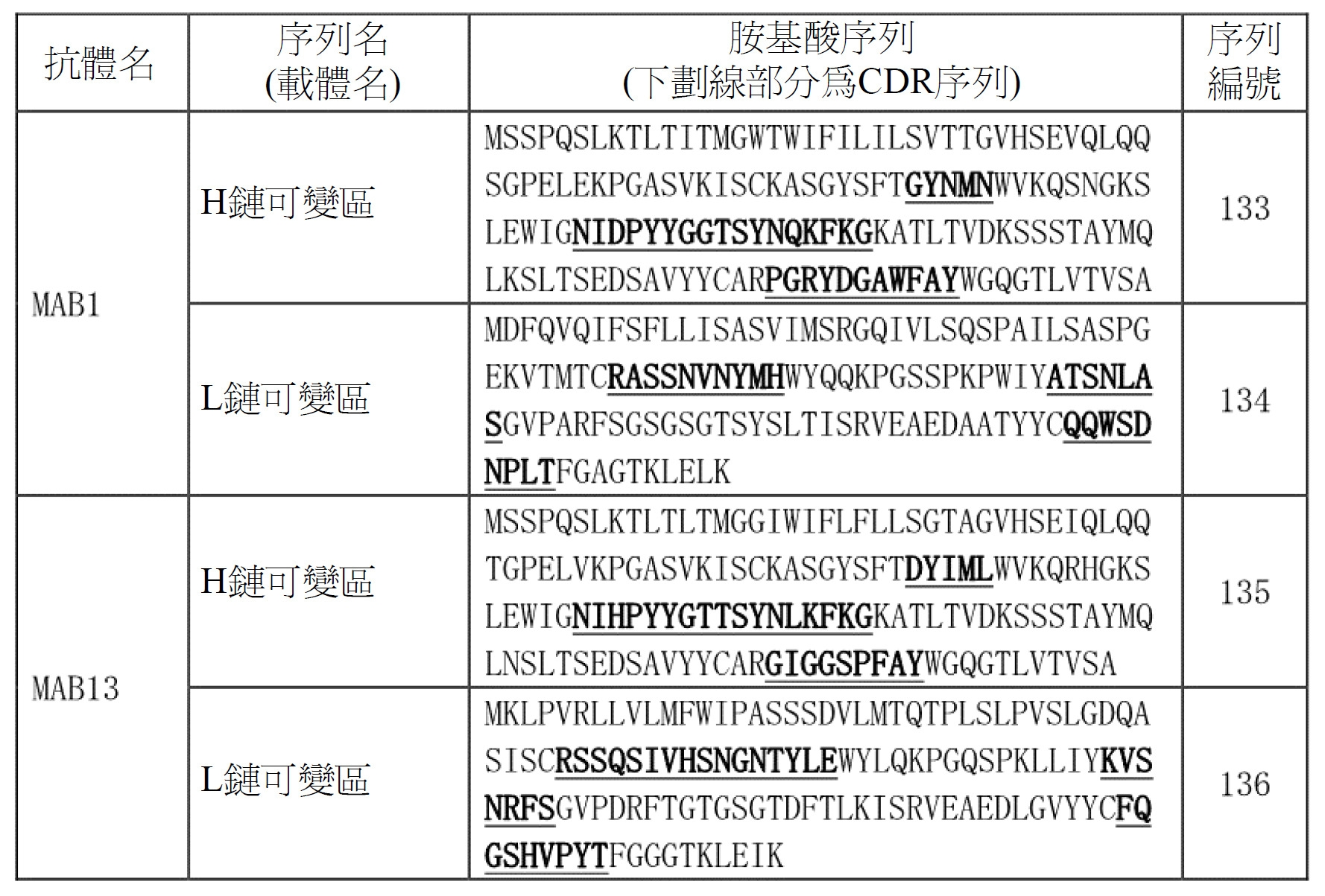
[表23]
B.變異抗體之製作
與上述「I. 抗體製作(1) G. 藉由CDR中之胺基酸置換產生之HuMAB2變異體向hGDF15之結合」同樣地,製作表24所示之又一個HuMAB2變異體。將HuMAB2向hGDF15之結合量作為100時之各變異抗體之結合量示於圖10。獲得了複數個顯示與HuMAB2同等以上之結合量之抗體。
[表24]
進而,將向hGDF15之結合力較高之HuMAB2變異體之H鏈(H49R、H49D、H48S、H71Y、H83R、或H120F)及L鏈(L48K、L112D、L72F、或L74H)(表25)組合,對所獲得之抗體與hGDF15之結合進行調查。將結果示於圖11。獲得了顯示與HuMAB2同等以上之結合量之多個抗體。
[表25]
C.對GDF15、GFRAL及RET複合體形成之抑制活性評價 GDF15與作為受體之GFRAL及作為輔受體之RET形成複合體,而於細胞內傳遞訊息。因此,HuMAB2對GDF15、GFRAL及RET複合體形成之影響進行了研究。C. Evaluation of inhibitory activity on the formation of GDF15, GFRAL and RET complex GDF15 forms a complex with GFRAL as a receptor and RET as a co-receptor to transmit information in the cell. Therefore, the effect of HuMAB2 on the formation of GDF15, GFRAL and RET complexes was studied.
首先,研究對GDF15與GFRAL之複合體形成之影響(圖12)。於固相化有GFRAL(R&D systems、9697-GR)之培養盤中,使經EZ-Link Micro NHS-PEG4-生物素化套組(Thermo Fisher Scientific, 21955)生物素化之GDF15(R&D Systems, 957-GD/CF)與抗GDF15單株抗體(表26)之連續稀釋液進行反應。作為陰性對照用抗體,使用人類IgG1, kappa-同型對照(Abcam)。使用Pierce高敏感度抗生蛋白鏈菌素-HRP(Thermo Fisher Scientific, 21130)檢測出與GFRAL結合之GDF15。顯色係使用TMB 1-Component Microwell Peroxidase Substrate, SureBlue(SeraCare Life Sciences),反應係添加終止液(Wako)來終止。吸光度係使用Emax(Molecular Devices)於450 nm(OD450)下進行測定。% of control值係以未添加抗體時之OD450值作為對照,根據添加各抗體時之OD450值,使用式-1算出。IC50值係根據所獲得之% of control值,使用式-2算出抑制率,並使用Excel IC50算出宏而求出。 % of control=抗體添加樣本之OD450之值÷未添加抗體時之OD450之值×100 (式-1) 抑制率=100-% of control (式-2)First, the effect on the formation of the complex of GDF15 and GFRAL was studied (Figure 12). In a culture plate with GFRAL (R&D systems, 9697-GR) immobilized, GDF15 (R&D Systems, R&D Systems, 957-GD/CF) was reacted with serial dilutions of anti-GDF15 monoclonal antibody (Table 26). As a negative control antibody, human IgG1, kappa-isotype control (Abcam) was used. GDF15 bound to GFRAL was detected using Pierce's highly sensitive streptavidin-HRP (Thermo Fisher Scientific, 21130). The color development system uses TMB 1-Component Microwell Peroxidase Substrate, SureBlue (SeraCare Life Sciences), and the reaction system is terminated by adding a stop solution (Wako). The absorbance was measured using Emax (Molecular Devices) at 450 nm (OD450). The% of control value is based on the OD450 value when no antibody is added as a control, and is calculated using formula-1 based on the OD450 value when each antibody is added. The IC50 value is calculated based on the obtained% of control value, using formula -2 to calculate the inhibition rate, and using Excel IC50 to calculate the macro. % of control = the value of OD450 of the sample with antibody added ÷ the value of OD450 when no antibody is added × 100 (Equation-1) Inhibition rate = 100-% of control (Formula-2)
如表26所示,除HuMAB2外之抗GDF15抗體抑制了GDF15與GFRAL之複合體形成,HuMAB2並未抑制。認為此不同係由該等抗體之表位之不同導致。
[表26]
繼而,研究對GDF15、GFRAL及RET之複合體形成之影響。向固相化有30 nM之GFRAL(R&D systems)之ELISA培養盤添加50 nM之GDF15(R&D Systems、9279-GD)、30 nM之RET(R&D Systems、1168-CR)及HuMAB2之連續稀釋液(0-500 nM)的混合液。作為陰性對照用抗體,使用人類IgG1, kappa-同型對照(Abcam)。使用Anti-His過氧化酶綴合抗體(R&D systems、MAB050H)來檢測所形成之GDF15/GFRAL/RET複合體。顯色係使用TMB 1-Component Microwell Peroxidase Substrate, SureBlue(SeraCare Life Sciences),反應係添加終止液(Wako)來終止。吸光度係使用Emax(Molecular Devices)於450 nm下進行測定。% of control值係以抗體濃度(0 nM)(未添加抗體時)之OD450值作為對照,根據添加各抗體時之OD450值,使用式-1而算出。IC50值係根據所獲得之% of control值,使用式-2算出抑制率,並使用Excel IC50算出宏而求出。Then, study the effect on the formation of the complex of GDF15, GFRAL and RET. Add 50 nM GDF15 (R&D Systems, 9279-GD), 30 nM RET (R&D Systems, 1168-CR) and HuMAB2 serial dilutions ( 0-500 nM) mixture. As a negative control antibody, human IgG1, kappa-isotype control (Abcam) was used. Anti-His peroxidase conjugated antibody (R&D systems, MAB050H) was used to detect the formed GDF15/GFRAL/RET complex. The color development system uses TMB 1-Component Microwell Peroxidase Substrate, SureBlue (SeraCare Life Sciences), and the reaction system is terminated by adding a stop solution (Wako). The absorbance was measured using Emax (Molecular Devices) at 450 nm. The% of control value is calculated with the OD450 value of the antibody concentration (0 nM) (when no antibody is added) as a control, and calculated using formula-1 based on the OD450 value when each antibody is added. The IC50 value is calculated based on the obtained% of control value, using formula -2 to calculate the inhibition rate, and using Excel IC50 to calculate the macro.
HuMAB2未對GDF15/GFRAL複合體形成顯示抑制活性(表26),但對GDF15/GFRAL/RET複合體形成顯示出抑制活性(圖13)。根據該等結果,認為HuMAB2藉由抑制與具有將訊息向細胞內傳遞之功能之RET形成複合體,而發揮出GDF15之功能之抑制活性。HuMAB2 did not show inhibitory activity on GDF15/GFRAL complex formation (Table 26), but showed inhibitory activity on GDF15/GFRAL/RET complex formation (Figure 13). Based on these results, it is believed that HuMAB2 exhibits the inhibitory activity of GDF15 by inhibiting the formation of a complex with RET, which has the function of transmitting messages into cells.
VI.藥理試驗(2)
A.荷癌小鼠模型之惡病質症狀之改善(3)
與上述「II. 藥理試驗(1) C. 荷癌小鼠模型之惡病質症狀之改善(1)」同樣地,使用荷癌(MKN45細胞移植)小鼠,研究MAB1對於體重、攝食量、及血中未結合GDF15量之影響。群構成所表27所示。
[表27]
圖14中表示體重之變化、抗體投予後7天期間之累積攝食量、及抗體投予7天後之血中未結合GDF15濃度。MKN45群中觀察到體重減少,相對於此,於MAB1群中,在抗體之投予後觀察到體重減少之恢復。關於抗體投予後7天期間之累積攝食量,發現有於MAB1群中,與MKN45群相比有所增大之傾向。因MKN45移植而增大之血中未結合GDF15濃度與HuMAB2(圖8)同樣地,因MAB1而減少。根據該等結果確認到,MKN45移植小鼠之惡病質樣症狀(體重減少、攝食量)因MAB1之投予而恢復。Figure 14 shows changes in body weight, cumulative food intake during 7 days after antibody administration, and unbound GDF15 concentration in
圖1係表示使用4種抗hGDF15單株抗體(HuMAB2、MAB17、Hu01G06-127、MAB957)之競爭試驗之結果。
圖2A係表示HuMAB2之Fab與hGDF15之共結晶之立體結構分析的結果。
圖2B係表示利用HuMAB2之Fab與hGDF15之共結晶之立體結構分析所獲得的表位及互補位之分析結果。
圖3係HuMAB2之Fab與hGDF15之結合之立體結構分析結果。hGDF15形成同型二聚物,將HuMAB2所結合之胺基酸中存在於1個hGDF15單體(Monomer1)中之胺基酸以下劃線表示,將存在於另一個單體(Monomer2)中之胺基酸(71D72T)以雙下劃線表示。將對結合較為重要之胺基酸以粗體表示,將結合特別強之胺基酸以箭頭表示。
圖4係表示hGDF15或DHCPLGPGRCCRLH(序列編號3)之合成肽與HuMAB2之結合試驗之結果。
圖5A係表示HuMAB2變異體與hGDF15之結合(H鏈改性抗體 1/2)。
圖5B係表示HuMAB2變異體與hGDF15之結合(H鏈改性抗體 2/2)。
圖5C係表示HuMAB2變異體與hGDF15之結合(L鏈改性抗體 1/2)。
圖5D係表示HuMAB2變異體與hGDF15之結合(L鏈改性抗體 2/2)。
圖6係表示利用HuMAB2及MAB17捕捉血中hGDF15。
圖7係表示抗hGDF15抗體對於荷癌小鼠模型之血中未結合hGDF15濃度之效果。
圖8係表示HuMAB2對於荷癌小鼠模型之體重減少、累積攝食量、及血中未結合hGDF15濃度之效果。
圖9係表示HuMAB2對於荷癌小鼠模型之活動性(晝夜節律)之效果。
圖10係表示HuMAB2變異體與hGDF15之結合。
圖11係表示包含具有變異之H鏈(H49R、H49D、H48S、H71Y、H83R、或H120F)及L鏈(L48K、L112D、L72F、或L24H)的HuMAB2變異體與hGDF15之結合。
圖12係表示抗GDF15抗體對於GDF15及GFRAL之複合體形成之抑制活性之評價的模式圖。
圖13係表示HuMAB2對於GDF15、GFRAL及RET之複合體形成之抑制活性之評價的模式圖及其評價結果。
圖14係表示MAB1對於荷癌小鼠模型之體重減少、累積攝食量、及血中未結合hGDF15濃度之效果。Figure 1 shows the results of competition experiments using four anti-hGDF15 monoclonal antibodies (HuMAB2, MAB17, Hu01G06-127, MAB957).
Figure 2A shows the results of the three-dimensional structure analysis of the co-crystal of Fab of HuMAB2 and hGDF15.
Figure 2B shows the epitope and paratope analysis results obtained by the three-dimensional structure analysis of the co-crystal of Fab of HuMAB2 and hGDF15.
Figure 3 shows the results of the three-dimensional structure analysis of the binding of the Fab of HuMAB2 and hGDF15. hGDF15 forms a homodimer. The amino acid that exists in one hGDF15 monomer (Monomer1) among the amino acids bound by HuMAB2 is underlined to indicate that the amino acid that will exist in the other monomer (Monomer2) is underlined. The acid (71D72T) is double-underlined. The amino acids that are more important for binding are indicated in bold, and the amino acids that bind particularly strongly are indicated by arrows.
Figure 4 shows the results of the binding test of synthetic peptides of hGDF15 or DHCPLGPGRCCRLH (SEQ ID NO: 3) and HuMAB2.
Figure 5A shows the binding of HuMAB2 variants to hGDF15 (H chain modified


Claims (26)
Applications Claiming Priority (2)
| Application Number | Priority Date | Filing Date | Title |
|---|---|---|---|
| WOPCT/JP2019/047956 | 2019-12-06 | ||
| PCT/JP2019/047956 WO2021111636A1 (en) | 2019-12-06 | 2019-12-06 | Anti-gdf15 antibody |
Publications (1)
| Publication Number | Publication Date |
|---|---|
| TW202128751A true TW202128751A (en) | 2021-08-01 |
Family
ID=76221180
Family Applications (1)
| Application Number | Title | Priority Date | Filing Date |
|---|---|---|---|
| TW109142627A TW202128751A (en) | 2019-12-06 | 2020-12-03 | Anti-gdf15 antibody |
Country Status (9)
| Country | Link |
|---|---|
| US (1) | US20230036655A1 (en) |
| EP (1) | EP4070816A4 (en) |
| JP (2) | JP7810556B2 (en) |
| KR (1) | KR20220110522A (en) |
| CN (1) | CN114746443A (en) |
| AU (1) | AU2020396341A1 (en) |
| CA (1) | CA3164041A1 (en) |
| TW (1) | TW202128751A (en) |
| WO (2) | WO2021111636A1 (en) |
Families Citing this family (1)
| Publication number | Priority date | Publication date | Assignee | Title |
|---|---|---|---|---|
| CN116444667B (en) * | 2023-06-13 | 2023-09-01 | 上海驯鹿生物技术有限公司 | GDF 15-targeted fully-humanized antibody and application thereof |
Family Cites Families (14)
| Publication number | Priority date | Publication date | Assignee | Title |
|---|---|---|---|---|
| US5225539A (en) | 1986-03-27 | 1993-07-06 | Medical Research Council | Recombinant altered antibodies and methods of making altered antibodies |
| US6548640B1 (en) | 1986-03-27 | 2003-04-15 | Btg International Limited | Altered antibodies |
| US5530101A (en) | 1988-12-28 | 1996-06-25 | Protein Design Labs, Inc. | Humanized immunoglobulins |
| US5859205A (en) | 1989-12-21 | 1999-01-12 | Celltech Limited | Humanised antibodies |
| WO1994004679A1 (en) | 1991-06-14 | 1994-03-03 | Genentech, Inc. | Method for making humanized antibodies |
| US5565332A (en) | 1991-09-23 | 1996-10-15 | Medical Research Council | Production of chimeric antibodies - a combinatorial approach |
| JP3117662B2 (en) | 1997-08-07 | 2000-12-18 | セキ工業株式会社 | Parts alignment device |
| US9212221B2 (en) * | 2010-03-03 | 2015-12-15 | Detroit R & D, Inc. | Form-specific antibodies for NAG-1 (MIC-1, GDF-15), H6D and other TGF-β subfamily and heart disease and cancer diagnoses |
| RS59045B1 (en) * | 2012-09-26 | 2019-08-30 | Univ Wuerzburg J Maximilians | Monoclonal antibodies to growth and differentiation factor 15 (gdf-15) |
| ES2791183T3 (en) | 2012-12-21 | 2020-11-03 | Aveo Pharmaceuticals Inc | Anti-GDF15 antibodies |
| TW201619200A (en) * | 2014-10-10 | 2016-06-01 | 麥迪紐有限責任公司 | Humanized anti-OX40 antibodies and uses thereof |
| CN108463246B (en) * | 2015-10-02 | 2025-02-28 | 尤利乌斯·马克西米利安维尔茨堡大学 | Combination therapy with human growth differentiation factor 15 (GDF-15) inhibitors and immune checkpoint blockade |
| WO2017189724A1 (en) * | 2016-04-27 | 2017-11-02 | Novartis Ag | Antibodies against growth differentiation factor 15 and uses thereof |
| KR20230107309A (en) * | 2020-11-10 | 2023-07-14 | 카탈임 게엠베하 | Anti-GDF15 Antibodies and Dosing Regimen for Cancer Treatment |
-
2019
- 2019-12-06 WO PCT/JP2019/047956 patent/WO2021111636A1/en not_active Ceased
-
2020
- 2020-12-03 TW TW109142627A patent/TW202128751A/en unknown
- 2020-12-03 CN CN202080083545.7A patent/CN114746443A/en active Pending
- 2020-12-03 CA CA3164041A patent/CA3164041A1/en active Pending
- 2020-12-03 JP JP2021562720A patent/JP7810556B2/en active Active
- 2020-12-03 WO PCT/JP2020/045062 patent/WO2021112185A1/en not_active Ceased
- 2020-12-03 AU AU2020396341A patent/AU2020396341A1/en active Pending
- 2020-12-03 US US17/782,456 patent/US20230036655A1/en active Pending
- 2020-12-03 EP EP20895663.1A patent/EP4070816A4/en active Pending
- 2020-12-03 KR KR1020227022234A patent/KR20220110522A/en active Pending
-
2025
- 2025-09-30 JP JP2025163286A patent/JP2026004412A/en active Pending
Also Published As
| Publication number | Publication date |
|---|---|
| US20230036655A1 (en) | 2023-02-02 |
| JP7810556B2 (en) | 2026-02-03 |
| AU2020396341A1 (en) | 2022-07-14 |
| EP4070816A1 (en) | 2022-10-12 |
| JPWO2021112185A1 (en) | 2021-06-10 |
| KR20220110522A (en) | 2022-08-08 |
| JP2026004412A (en) | 2026-01-14 |
| WO2021111636A1 (en) | 2021-06-10 |
| EP4070816A4 (en) | 2023-12-27 |
| WO2021112185A1 (en) | 2021-06-10 |
| CA3164041A1 (en) | 2021-06-10 |
| CN114746443A (en) | 2022-07-12 |
Similar Documents
| Publication | Publication Date | Title |
|---|---|---|
| JP7610302B2 (en) | CCR8 antibodies and uses thereof | |
| TWI823895B (en) | Anti-b7-h4 antibody, antigen binding fragment thereof and medical use thereof | |
| CN105037543B (en) | Therapeutic DLL4 binding proteins | |
| EP2493928A1 (en) | Antibodies to ion channels | |
| WO2019141268A1 (en) | Anti-4-1bb antibody, antigen-binding fragment thereof and medical use thereof | |
| JP2025503772A (en) | Anti-B7-H7 antibody or antigen-binding fragment thereof, and production method and application | |
| WO2023273913A1 (en) | Anti-b7-h3 monoclonal antibody and use thereof | |
| WO2019001559A1 (en) | Anti-gitr antibody, antigen-binding fragment thereof, and pharmaceutical use thereof | |
| CN112243443A (en) | anti-TROP-2 antibodies, antigen-binding fragments thereof, and medical uses thereof | |
| JP2026004412A (en) | Anti-GDF15 antibody | |
| TW202144433A (en) | Antibody or antigen-binding fragment, preparation method and pharmaceutical use thereof | |
| JP2026506565A (en) | Trispecific antigen-binding molecules and uses thereof | |
| CN115335402B (en) | Specific antigen binding molecules, methods of preparation and medical uses thereof | |
| CN120554509A (en) | Antibodies or antigen-binding fragments thereof targeting CD3e/g, and their preparation and use | |
| JP7851924B2 (en) | Anti-TROP-2 antibodies, their antigen-binding fragments or variants, and their medical use | |
| TWI918704B (en) | Anti-ccr8 antibody and application thereof | |
| HK40081009A (en) | Anti-gdf15 antibody | |
| HK40075921A (en) | Anti-gdf15 antibody | |
| WO2025113639A1 (en) | Anti-gdf15 antibody, and method and use therefor | |
| AU2026201066A1 (en) | Anti-B7-H4 antibody, antigen-binding fragment thereof and pharmaceutical use thereof | |
| HK40012331B (en) | Anti-b7-h4 antibody, antigen-binding fragment thereof and pharmaceutical use thereof | |
| WO2022144025A1 (en) | Anti-erbb3 receptor antibody or antigen-binding fragment thereof, and medical use thereof | |
| HK40036076A (en) | Anti-trop-2 antibody, antigen binding fragment thereof and medical use thereof | |
| HK40036076B (en) | Anti-trop-2 antibody, antigen binding fragment thereof and medical use thereof |