TW202128794A - Thermoplastic copolymer and resin molded body - Google Patents
Thermoplastic copolymer and resin molded body Download PDFInfo
- Publication number
- TW202128794A TW202128794A TW109141546A TW109141546A TW202128794A TW 202128794 A TW202128794 A TW 202128794A TW 109141546 A TW109141546 A TW 109141546A TW 109141546 A TW109141546 A TW 109141546A TW 202128794 A TW202128794 A TW 202128794A
- Authority
- TW
- Taiwan
- Prior art keywords
- monomer
- thermoplastic copolymer
- mentioned
- compound
- hca
- Prior art date
Links
- 229920001169 thermoplastic Polymers 0.000 title claims abstract description 54
- 239000004416 thermosoftening plastic Substances 0.000 title claims abstract description 54
- 229920005989 resin Polymers 0.000 title claims description 33
- 239000011347 resin Substances 0.000 title claims description 33
- 239000000178 monomer Substances 0.000 claims abstract description 117
- 150000001875 compounds Chemical class 0.000 claims abstract description 45
- -1 monosubstituted ethylenes Chemical class 0.000 claims abstract description 21
- 229920000642 polymer Polymers 0.000 claims abstract description 17
- NLHHRLWOUZZQLW-UHFFFAOYSA-N Acrylonitrile Chemical compound C=CC#N NLHHRLWOUZZQLW-UHFFFAOYSA-N 0.000 claims description 6
- 150000002734 metacrylic acid derivatives Chemical class 0.000 claims description 4
- 150000003440 styrenes Chemical class 0.000 claims description 4
- UYMKPFRHYYNDTL-UHFFFAOYSA-N ethenamine Chemical class NC=C UYMKPFRHYYNDTL-UHFFFAOYSA-N 0.000 claims description 3
- 150000001252 acrylic acid derivatives Chemical class 0.000 claims description 2
- 238000006243 chemical reaction Methods 0.000 description 30
- 238000005259 measurement Methods 0.000 description 17
- OZAIFHULBGXAKX-UHFFFAOYSA-N 2-(2-cyanopropan-2-yldiazenyl)-2-methylpropanenitrile Chemical compound N#CC(C)(C)N=NC(C)(C)C#N OZAIFHULBGXAKX-UHFFFAOYSA-N 0.000 description 16
- PPBRXRYQALVLMV-UHFFFAOYSA-N Styrene Chemical compound C=CC1=CC=CC=C1 PPBRXRYQALVLMV-UHFFFAOYSA-N 0.000 description 16
- 229920001577 copolymer Polymers 0.000 description 16
- 238000000034 method Methods 0.000 description 13
- 238000000465 moulding Methods 0.000 description 13
- 238000012360 testing method Methods 0.000 description 13
- OKKJLVBELUTLKV-UHFFFAOYSA-N Methanol Chemical compound OC OKKJLVBELUTLKV-UHFFFAOYSA-N 0.000 description 12
- 230000000052 comparative effect Effects 0.000 description 12
- 229920001519 homopolymer Polymers 0.000 description 12
- 239000000463 material Substances 0.000 description 10
- 239000000243 solution Substances 0.000 description 10
- FXHOOIRPVKKKFG-UHFFFAOYSA-N N,N-Dimethylacetamide Chemical compound CN(C)C(C)=O FXHOOIRPVKKKFG-UHFFFAOYSA-N 0.000 description 9
- ZMXDDKWLCZADIW-UHFFFAOYSA-N N,N-Dimethylformamide Chemical compound CN(C)C=O ZMXDDKWLCZADIW-UHFFFAOYSA-N 0.000 description 9
- 238000006116 polymerization reaction Methods 0.000 description 9
- 239000007870 radical polymerization initiator Substances 0.000 description 9
- VVQNEPGJFQJSBK-UHFFFAOYSA-N Methyl methacrylate Chemical compound COC(=O)C(C)=C VVQNEPGJFQJSBK-UHFFFAOYSA-N 0.000 description 8
- 238000002834 transmittance Methods 0.000 description 8
- 239000007810 chemical reaction solvent Substances 0.000 description 7
- 238000010526 radical polymerization reaction Methods 0.000 description 7
- 239000007787 solid Substances 0.000 description 7
- IJGRMHOSHXDMSA-UHFFFAOYSA-N Atomic nitrogen Chemical compound N#N IJGRMHOSHXDMSA-UHFFFAOYSA-N 0.000 description 6
- IAZDPXIOMUYVGZ-UHFFFAOYSA-N Dimethylsulphoxide Chemical compound CS(C)=O IAZDPXIOMUYVGZ-UHFFFAOYSA-N 0.000 description 6
- WQDUMFSSJAZKTM-UHFFFAOYSA-N Sodium methoxide Chemical compound [Na+].[O-]C WQDUMFSSJAZKTM-UHFFFAOYSA-N 0.000 description 6
- WYURNTSHIVDZCO-UHFFFAOYSA-N Tetrahydrofuran Chemical compound C1CCOC1 WYURNTSHIVDZCO-UHFFFAOYSA-N 0.000 description 6
- 238000011156 evaluation Methods 0.000 description 6
- 238000005227 gel permeation chromatography Methods 0.000 description 6
- VLKZOEOYAKHREP-UHFFFAOYSA-N n-Hexane Chemical compound CCCCCC VLKZOEOYAKHREP-UHFFFAOYSA-N 0.000 description 6
- WHNWPMSKXPGLAX-UHFFFAOYSA-N N-Vinyl-2-pyrrolidone Chemical compound C=CN1CCCC1=O WHNWPMSKXPGLAX-UHFFFAOYSA-N 0.000 description 5
- 238000005481 NMR spectroscopy Methods 0.000 description 5
- 125000003118 aryl group Chemical group 0.000 description 5
- 238000009835 boiling Methods 0.000 description 5
- CQEYYJKEWSMYFG-UHFFFAOYSA-N butyl acrylate Chemical compound CCCCOC(=O)C=C CQEYYJKEWSMYFG-UHFFFAOYSA-N 0.000 description 5
- XLYOFNOQVPJJNP-UHFFFAOYSA-N water Substances O XLYOFNOQVPJJNP-UHFFFAOYSA-N 0.000 description 5
- 238000005160 1H NMR spectroscopy Methods 0.000 description 4
- RNFJDJUURJAICM-UHFFFAOYSA-N 2,2,4,4,6,6-hexaphenoxy-1,3,5-triaza-2$l^{5},4$l^{5},6$l^{5}-triphosphacyclohexa-1,3,5-triene Chemical compound N=1P(OC=2C=CC=CC=2)(OC=2C=CC=CC=2)=NP(OC=2C=CC=CC=2)(OC=2C=CC=CC=2)=NP=1(OC=1C=CC=CC=1)OC1=CC=CC=C1 RNFJDJUURJAICM-UHFFFAOYSA-N 0.000 description 4
- CSCPPACGZOOCGX-UHFFFAOYSA-N Acetone Chemical compound CC(C)=O CSCPPACGZOOCGX-UHFFFAOYSA-N 0.000 description 4
- HEDRZPFGACZZDS-MICDWDOJSA-N Trichloro(2H)methane Chemical compound [2H]C(Cl)(Cl)Cl HEDRZPFGACZZDS-MICDWDOJSA-N 0.000 description 4
- 238000004458 analytical method Methods 0.000 description 4
- 230000015572 biosynthetic process Effects 0.000 description 4
- 239000007795 chemical reaction product Substances 0.000 description 4
- 239000003063 flame retardant Substances 0.000 description 4
- 238000010438 heat treatment Methods 0.000 description 4
- 230000000379 polymerizing effect Effects 0.000 description 4
- 239000002904 solvent Substances 0.000 description 4
- 238000003756 stirring Methods 0.000 description 4
- 239000000725 suspension Substances 0.000 description 4
- QMMFVYPAHWMCMS-UHFFFAOYSA-N Dimethyl sulfide Chemical compound CSC QMMFVYPAHWMCMS-UHFFFAOYSA-N 0.000 description 3
- WOBHKFSMXKNTIM-UHFFFAOYSA-N Hydroxyethyl methacrylate Chemical compound CC(=C)C(=O)OCCO WOBHKFSMXKNTIM-UHFFFAOYSA-N 0.000 description 3
- SECXISVLQFMRJM-UHFFFAOYSA-N N-Methylpyrrolidone Chemical compound CN1CCCC1=O SECXISVLQFMRJM-UHFFFAOYSA-N 0.000 description 3
- YXFVVABEGXRONW-UHFFFAOYSA-N Toluene Chemical compound CC1=CC=CC=C1 YXFVVABEGXRONW-UHFFFAOYSA-N 0.000 description 3
- 238000010348 incorporation Methods 0.000 description 3
- 239000011259 mixed solution Substances 0.000 description 3
- 229910052757 nitrogen Inorganic materials 0.000 description 3
- 230000003287 optical effect Effects 0.000 description 3
- 239000000843 powder Substances 0.000 description 3
- 238000000425 proton nuclear magnetic resonance spectrum Methods 0.000 description 3
- 150000003254 radicals Chemical class 0.000 description 3
- 238000003786 synthesis reaction Methods 0.000 description 3
- YLQBMQCUIZJEEH-UHFFFAOYSA-N tetrahydrofuran Natural products C=1C=COC=1 YLQBMQCUIZJEEH-UHFFFAOYSA-N 0.000 description 3
- BSYJHYLAMMJNRC-UHFFFAOYSA-N 2,4,4-trimethylpentan-2-ol Chemical compound CC(C)(C)CC(C)(C)O BSYJHYLAMMJNRC-UHFFFAOYSA-N 0.000 description 2
- YEJRWHAVMIAJKC-UHFFFAOYSA-N 4-Butyrolactone Chemical compound O=C1CCCO1 YEJRWHAVMIAJKC-UHFFFAOYSA-N 0.000 description 2
- SOGAXMICEFXMKE-UHFFFAOYSA-N Butylmethacrylate Chemical compound CCCCOC(=O)C(C)=C SOGAXMICEFXMKE-UHFFFAOYSA-N 0.000 description 2
- HEDRZPFGACZZDS-UHFFFAOYSA-N Chloroform Chemical compound ClC(Cl)Cl HEDRZPFGACZZDS-UHFFFAOYSA-N 0.000 description 2
- 102100026735 Coagulation factor VIII Human genes 0.000 description 2
- LFQSCWFLJHTTHZ-UHFFFAOYSA-N Ethanol Chemical compound CCO LFQSCWFLJHTTHZ-UHFFFAOYSA-N 0.000 description 2
- LYCAIKOWRPUZTN-UHFFFAOYSA-N Ethylene glycol Chemical compound OCCO LYCAIKOWRPUZTN-UHFFFAOYSA-N 0.000 description 2
- 101000911390 Homo sapiens Coagulation factor VIII Proteins 0.000 description 2
- BAPJBEWLBFYGME-UHFFFAOYSA-N Methyl acrylate Chemical compound COC(=O)C=C BAPJBEWLBFYGME-UHFFFAOYSA-N 0.000 description 2
- 229920006397 acrylic thermoplastic Polymers 0.000 description 2
- 238000007259 addition reaction Methods 0.000 description 2
- 239000000654 additive Substances 0.000 description 2
- 230000003712 anti-aging effect Effects 0.000 description 2
- 239000003963 antioxidant agent Substances 0.000 description 2
- 239000012298 atmosphere Substances 0.000 description 2
- 239000003153 chemical reaction reagent Substances 0.000 description 2
- 239000003795 chemical substances by application Substances 0.000 description 2
- 238000000576 coating method Methods 0.000 description 2
- JHIVVAPYMSGYDF-UHFFFAOYSA-N cyclohexanone Chemical compound O=C1CCCCC1 JHIVVAPYMSGYDF-UHFFFAOYSA-N 0.000 description 2
- 239000004210 ether based solvent Substances 0.000 description 2
- 239000011261 inert gas Substances 0.000 description 2
- 239000010410 layer Substances 0.000 description 2
- 239000007788 liquid Substances 0.000 description 2
- AMXOYNBUYSYVKV-UHFFFAOYSA-M lithium bromide Chemical compound [Li+].[Br-] AMXOYNBUYSYVKV-UHFFFAOYSA-M 0.000 description 2
- 238000004519 manufacturing process Methods 0.000 description 2
- 239000000203 mixture Substances 0.000 description 2
- 150000002825 nitriles Chemical class 0.000 description 2
- 239000012299 nitrogen atmosphere Substances 0.000 description 2
- 229910052698 phosphorus Inorganic materials 0.000 description 2
- 239000011574 phosphorus Substances 0.000 description 2
- 229920003229 poly(methyl methacrylate) Polymers 0.000 description 2
- 238000012667 polymer degradation Methods 0.000 description 2
- 239000000047 product Substances 0.000 description 2
- 229920005604 random copolymer Polymers 0.000 description 2
- 239000002994 raw material Substances 0.000 description 2
- ISXSCDLOGDJUNJ-UHFFFAOYSA-N tert-butyl prop-2-enoate Chemical compound CC(C)(C)OC(=O)C=C ISXSCDLOGDJUNJ-UHFFFAOYSA-N 0.000 description 2
- AVQQQNCBBIEMEU-UHFFFAOYSA-N 1,1,3,3-tetramethylurea Chemical compound CN(C)C(=O)N(C)C AVQQQNCBBIEMEU-UHFFFAOYSA-N 0.000 description 1
- CYSGHNMQYZDMIA-UHFFFAOYSA-N 1,3-Dimethyl-2-imidazolidinon Chemical compound CN1CCN(C)C1=O CYSGHNMQYZDMIA-UHFFFAOYSA-N 0.000 description 1
- WNXJIVFYUVYPPR-UHFFFAOYSA-N 1,3-dioxolane Chemical compound C1COCO1 WNXJIVFYUVYPPR-UHFFFAOYSA-N 0.000 description 1
- RYHBNJHYFVUHQT-UHFFFAOYSA-N 1,4-Dioxane Chemical compound C1COCCO1 RYHBNJHYFVUHQT-UHFFFAOYSA-N 0.000 description 1
- ZRZHXNCATOYMJH-UHFFFAOYSA-N 1-(chloromethyl)-4-ethenylbenzene Chemical compound ClCC1=CC=C(C=C)C=C1 ZRZHXNCATOYMJH-UHFFFAOYSA-N 0.000 description 1
- ARXJGSRGQADJSQ-UHFFFAOYSA-N 1-methoxypropan-2-ol Chemical compound COCC(C)O ARXJGSRGQADJSQ-UHFFFAOYSA-N 0.000 description 1
- OEPOKWHJYJXUGD-UHFFFAOYSA-N 2-(3-phenylmethoxyphenyl)-1,3-thiazole-4-carbaldehyde Chemical compound O=CC1=CSC(C=2C=C(OCC=3C=CC=CC=3)C=CC=2)=N1 OEPOKWHJYJXUGD-UHFFFAOYSA-N 0.000 description 1
- ZNQVEEAIQZEUHB-UHFFFAOYSA-N 2-ethoxyethanol Chemical compound CCOCCO ZNQVEEAIQZEUHB-UHFFFAOYSA-N 0.000 description 1
- WFUGQJXVXHBTEM-UHFFFAOYSA-N 2-hydroperoxy-2-(2-hydroperoxybutan-2-ylperoxy)butane Chemical compound CCC(C)(OO)OOC(C)(CC)OO WFUGQJXVXHBTEM-UHFFFAOYSA-N 0.000 description 1
- LTKVXDIHYHECND-UHFFFAOYSA-N 2-hydroxyethyl 2-methylprop-2-enoate Chemical compound CC(=C)C(=O)OCCO.CC(=C)C(=O)OCCO LTKVXDIHYHECND-UHFFFAOYSA-N 0.000 description 1
- KGIGUEBEKRSTEW-UHFFFAOYSA-N 2-vinylpyridine Chemical class C=CC1=CC=CC=N1 KGIGUEBEKRSTEW-UHFFFAOYSA-N 0.000 description 1
- JLBJTVDPSNHSKJ-UHFFFAOYSA-N 4-Methylstyrene Chemical compound CC1=CC=C(C=C)C=C1 JLBJTVDPSNHSKJ-UHFFFAOYSA-N 0.000 description 1
- XESZUVZBAMCAEJ-UHFFFAOYSA-N 4-tert-butylcatechol Chemical compound CC(C)(C)C1=CC=C(O)C(O)=C1 XESZUVZBAMCAEJ-UHFFFAOYSA-N 0.000 description 1
- 229920000742 Cotton Polymers 0.000 description 1
- XTHFKEDIFFGKHM-UHFFFAOYSA-N Dimethoxyethane Chemical compound COCCOC XTHFKEDIFFGKHM-UHFFFAOYSA-N 0.000 description 1
- OAICVXFJPJFONN-UHFFFAOYSA-N Phosphorus Chemical compound [P] OAICVXFJPJFONN-UHFFFAOYSA-N 0.000 description 1
- LRMBRFABGNDSDR-UHFFFAOYSA-N [Li].CCOCC Chemical compound [Li].CCOCC LRMBRFABGNDSDR-UHFFFAOYSA-N 0.000 description 1
- QVMHUALAQYRRBM-UHFFFAOYSA-N [P].[P] Chemical compound [P].[P] QVMHUALAQYRRBM-UHFFFAOYSA-N 0.000 description 1
- 238000010521 absorption reaction Methods 0.000 description 1
- 238000000862 absorption spectrum Methods 0.000 description 1
- 150000003926 acrylamides Chemical class 0.000 description 1
- NIXOWILDQLNWCW-UHFFFAOYSA-N acrylic acid group Chemical group C(C=C)(=O)O NIXOWILDQLNWCW-UHFFFAOYSA-N 0.000 description 1
- 150000001298 alcohols Chemical class 0.000 description 1
- 229910052783 alkali metal Inorganic materials 0.000 description 1
- 150000001336 alkenes Chemical group 0.000 description 1
- XYLMUPLGERFSHI-UHFFFAOYSA-N alpha-Methylstyrene Chemical compound CC(=C)C1=CC=CC=C1 XYLMUPLGERFSHI-UHFFFAOYSA-N 0.000 description 1
- 229920005603 alternating copolymer Polymers 0.000 description 1
- 150000001408 amides Chemical class 0.000 description 1
- KQNZLOUWXSAZGD-UHFFFAOYSA-N benzylperoxymethylbenzene Chemical compound C=1C=CC=CC=1COOCC1=CC=CC=C1 KQNZLOUWXSAZGD-UHFFFAOYSA-N 0.000 description 1
- 229920001400 block copolymer Polymers 0.000 description 1
- 238000000071 blow moulding Methods 0.000 description 1
- 239000004566 building material Substances 0.000 description 1
- 229920002678 cellulose Polymers 0.000 description 1
- 239000001913 cellulose Substances 0.000 description 1
- 239000012295 chemical reaction liquid Substances 0.000 description 1
- 229910052801 chlorine Inorganic materials 0.000 description 1
- 125000001309 chloro group Chemical group Cl* 0.000 description 1
- 239000011248 coating agent Substances 0.000 description 1
- 125000004122 cyclic group Chemical group 0.000 description 1
- LSXWFXONGKSEMY-UHFFFAOYSA-N di-tert-butyl peroxide Chemical compound CC(C)(C)OOC(C)(C)C LSXWFXONGKSEMY-UHFFFAOYSA-N 0.000 description 1
- 239000012969 di-tertiary-butyl peroxide Substances 0.000 description 1
- MTHSVFCYNBDYFN-UHFFFAOYSA-N diethylene glycol Chemical compound OCCOCCO MTHSVFCYNBDYFN-UHFFFAOYSA-N 0.000 description 1
- HQWPLXHWEZZGKY-UHFFFAOYSA-N diethylzinc Chemical compound CC[Zn]CC HQWPLXHWEZZGKY-UHFFFAOYSA-N 0.000 description 1
- SBZXBUIDTXKZTM-UHFFFAOYSA-N diglyme Chemical compound COCCOCCOC SBZXBUIDTXKZTM-UHFFFAOYSA-N 0.000 description 1
- 230000008034 disappearance Effects 0.000 description 1
- 230000000694 effects Effects 0.000 description 1
- 239000003759 ester based solvent Substances 0.000 description 1
- SUPCQIBBMFXVTL-UHFFFAOYSA-N ethyl 2-methylprop-2-enoate Chemical compound CCOC(=O)C(C)=C SUPCQIBBMFXVTL-UHFFFAOYSA-N 0.000 description 1
- 125000004494 ethyl ester group Chemical group 0.000 description 1
- 238000001125 extrusion Methods 0.000 description 1
- 238000001914 filtration Methods 0.000 description 1
- 125000005843 halogen group Chemical group 0.000 description 1
- WGCNASOHLSPBMP-UHFFFAOYSA-N hydroxyacetaldehyde Natural products OCC=O WGCNASOHLSPBMP-UHFFFAOYSA-N 0.000 description 1
- 238000001746 injection moulding Methods 0.000 description 1
- 150000002576 ketones Chemical class 0.000 description 1
- 238000002386 leaching Methods 0.000 description 1
- JILPJDVXYVTZDQ-UHFFFAOYSA-N lithium methoxide Chemical compound [Li+].[O-]C JILPJDVXYVTZDQ-UHFFFAOYSA-N 0.000 description 1
- 230000014759 maintenance of location Effects 0.000 description 1
- 238000002844 melting Methods 0.000 description 1
- 230000008018 melting Effects 0.000 description 1
- FQPSGWSUVKBHSU-UHFFFAOYSA-N methacrylamide Chemical compound CC(=C)C(N)=O FQPSGWSUVKBHSU-UHFFFAOYSA-N 0.000 description 1
- VMGAPWLDMVPYIA-HIDZBRGKSA-N n'-amino-n-iminomethanimidamide Chemical compound N\N=C\N=N VMGAPWLDMVPYIA-HIDZBRGKSA-N 0.000 description 1
- 239000012044 organic layer Substances 0.000 description 1
- 239000008188 pellet Substances 0.000 description 1
- UCUUFSAXZMGPGH-UHFFFAOYSA-N penta-1,4-dien-3-one Chemical class C=CC(=O)C=C UCUUFSAXZMGPGH-UHFFFAOYSA-N 0.000 description 1
- XNLICIUVMPYHGG-UHFFFAOYSA-N pentan-2-one Chemical compound CCCC(C)=O XNLICIUVMPYHGG-UHFFFAOYSA-N 0.000 description 1
- QIWKUEJZZCOPFV-UHFFFAOYSA-N phenyl 2-methylprop-2-enoate Chemical compound CC(=C)C(=O)OC1=CC=CC=C1 QIWKUEJZZCOPFV-UHFFFAOYSA-N 0.000 description 1
- 238000002360 preparation method Methods 0.000 description 1
- QQONPFPTGQHPMA-UHFFFAOYSA-N propylene Natural products CC=C QQONPFPTGQHPMA-UHFFFAOYSA-N 0.000 description 1
- LLHKCFNBLRBOGN-UHFFFAOYSA-N propylene glycol methyl ether acetate Chemical compound COCC(C)OC(C)=O LLHKCFNBLRBOGN-UHFFFAOYSA-N 0.000 description 1
- 125000004805 propylene group Chemical group [H]C([H])([H])C([H])([*:1])C([H])([H])[*:2] 0.000 description 1
- 230000035484 reaction time Effects 0.000 description 1
- BOLDJAUMGUJJKM-LSDHHAIUSA-N renifolin D Natural products CC(=C)[C@@H]1Cc2c(O)c(O)ccc2[C@H]1CC(=O)c3ccc(O)cc3O BOLDJAUMGUJJKM-LSDHHAIUSA-N 0.000 description 1
- 238000011160 research Methods 0.000 description 1
- 238000007086 side reaction Methods 0.000 description 1
- QDRKDTQENPPHOJ-UHFFFAOYSA-N sodium ethoxide Chemical compound [Na+].CC[O-] QDRKDTQENPPHOJ-UHFFFAOYSA-N 0.000 description 1
- 230000003595 spectral effect Effects 0.000 description 1
- CIHOLLKRGTVIJN-UHFFFAOYSA-N tert‐butyl hydroperoxide Chemical compound CC(C)(C)OO CIHOLLKRGTVIJN-UHFFFAOYSA-N 0.000 description 1
- 229920005992 thermoplastic resin Polymers 0.000 description 1
- LALRXNPLTWZJIJ-UHFFFAOYSA-N triethylborane Chemical compound CCB(CC)CC LALRXNPLTWZJIJ-UHFFFAOYSA-N 0.000 description 1
- 229920002554 vinyl polymer Polymers 0.000 description 1
- 239000011701 zinc Substances 0.000 description 1
Images

Classifications
-
- C—CHEMISTRY; METALLURGY
- C08—ORGANIC MACROMOLECULAR COMPOUNDS; THEIR PREPARATION OR CHEMICAL WORKING-UP; COMPOSITIONS BASED THEREON
- C08F—MACROMOLECULAR COMPOUNDS OBTAINED BY REACTIONS ONLY INVOLVING CARBON-TO-CARBON UNSATURATED BONDS
- C08F230/00—Copolymers of compounds having one or more unsaturated aliphatic radicals, each having only one carbon-to-carbon double bond, and containing phosphorus, selenium, tellurium or a metal
- C08F230/02—Copolymers of compounds having one or more unsaturated aliphatic radicals, each having only one carbon-to-carbon double bond, and containing phosphorus, selenium, tellurium or a metal containing phosphorus
Landscapes
- Chemical & Material Sciences (AREA)
- Health & Medical Sciences (AREA)
- Chemical Kinetics & Catalysis (AREA)
- Medicinal Chemistry (AREA)
- Polymers & Plastics (AREA)
- Organic Chemistry (AREA)
- Addition Polymer Or Copolymer, Post-Treatments, Or Chemical Modifications (AREA)
Abstract
Description
本發明係關於一種熱塑性共聚物以及樹脂成形體。The present invention relates to a thermoplastic copolymer and a resin molded body.
近年來,著眼研究顯示阻燃性之聚合物。例如,於2012年發行之聚合物降解與穩定性(Polymer Degradation and Stability)(vol.97)之第2611頁-第2618頁所記載的A. Dumitrascu et al.之論文「通過摻入同時含有氮及磷之苯乙烯單體而獲得之阻燃性聚合材料(Flame retardant polymeric materials achieved by incorporation of styrene monomers containing both nitrogen and phosphorus)(非專利文獻1)」中報告有,下述式:In recent years, attention has been paid to polymers showing flame retardancy. For example, the paper by A. Dumitrascu et al. described on pages 2611-2618 of Polymer Degradation and Stability (Vol. 97) published in 2012, "Containing nitrogen at the same time by incorporation Flame retardant polymeric materials achieved by incorporation of styrene monomers containing both nitrogen and phosphorus (Non-Patent Document 1)” reported in the following formula:
[化1]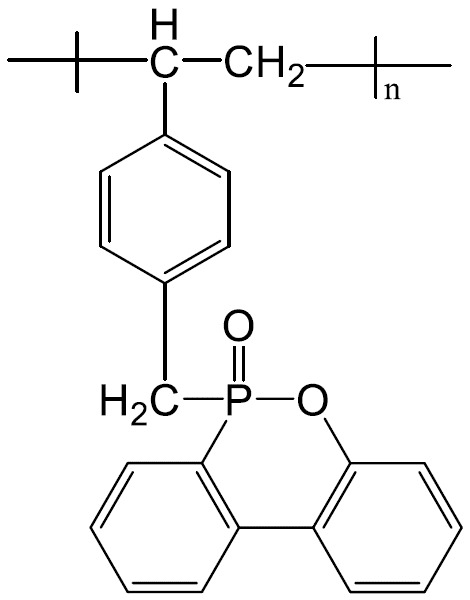
所表示之均聚物顯示較高之阻燃性。 [先前技術文獻] [非專利文獻]The homopolymer shown shows high flame retardancy. [Prior Technical Literature] [Non-Patent Literature]
[非專利文獻1]A. Dumitrascu et al.,「通過摻入同時含有氮及磷之苯乙烯單體而獲得之阻燃性聚合材料(Flame retardant polymeric materials achieved by incorporation of styrene monomers containing both nitrogen and phosphorus)」,聚合物降解與穩定性(Polymer Degradation and Stability),vol.97,2012年,第2611頁-第2618頁[Non-Patent Document 1] A. Dumitrascu et al., "Flame retardant polymeric materials achieved by incorporation of styrene monomers containing both nitrogen and phosphorus phosphorus)", Polymer Degradation and Stability, vol.97, 2012, page 2611-page 2618
[發明所欲解決之問題][The problem to be solved by the invention]
然而,即便於此種非專利文獻1所記載之均聚物中,阻燃性亦未必充分,期望出現具有更高之阻燃性之聚合物。However, even in such a homopolymer described in Non-Patent Document 1, the flame retardancy is not necessarily sufficient, and a polymer with higher flame retardancy is expected.
本發明係鑒於上述先前技術所具有之課題而成者,目的在於提供一種可具有更高之阻燃性且具有充分高之折射率及透明性之熱塑性共聚物以及將該熱塑性共聚物成形而成之樹脂成形體。 [解決問題之技術手段]The present invention was made in view of the above-mentioned problems of the prior art, and its purpose is to provide a thermoplastic copolymer that can have higher flame retardancy and sufficiently high refractive index and transparency, and to form the thermoplastic copolymer. The resin molded body. [Technical means to solve the problem]
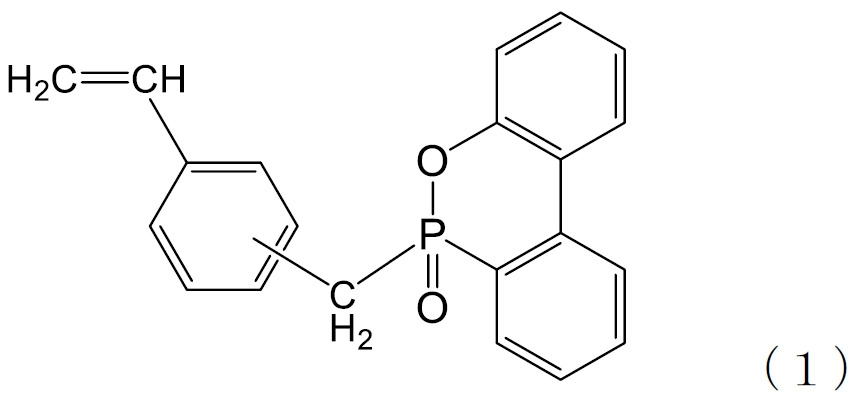
本發明人等為了達成上述目的,反覆進行銳意研究,結果發現,藉由使單體(I)與單體(II)共聚,能夠使所獲得之聚合物成為具有更高之阻燃性且具有充分高之折射率及透明性之熱塑性共聚物,從而完成本發明,上述單體(I)由下述通式(1)表示,上述單體(II)係除了該單體(I)以外者,係選自由一取代乙烯及1,1-二取代乙烯所組成之群中之至少1種化合物。In order to achieve the above-mentioned object, the inventors have conducted intensive research and found that by copolymerizing monomer (I) and monomer (II), the obtained polymer can be made to have higher flame retardancy and A thermoplastic copolymer with sufficiently high refractive index and transparency to complete the present invention. The above-mentioned monomer (I) is represented by the following general formula (1), and the above-mentioned monomer (II) is other than the monomer (I) , Is at least one compound selected from the group consisting of monosubstituted ethylene and 1,1-disubstituted ethylene.
即,本發明之熱塑性共聚物係單體(I)與單體(II)之聚合物, 上述單體(I)由下述通式(1):That is, the thermoplastic copolymer of the present invention is a polymer of monomer (I) and monomer (II), The above monomer (I) is represented by the following general formula (1):
[化2]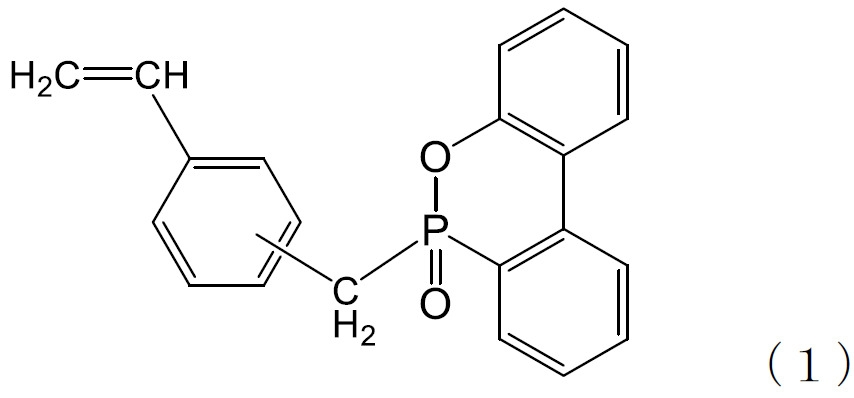
表示, 上述單體(II)係除了該單體(I)以外者,係選自由一取代乙烯及1,1-二取代乙烯所組成之群中之至少1種化合物。Express, The above-mentioned monomer (II) is at least one compound selected from the group consisting of monosubstituted ethylene and 1,1-disubstituted ethylene other than the monomer (I).
於上述本發明之熱塑性共聚物中,選為上述單體(II)之上述化合物較佳為折射率為1.35以上之化合物。In the above-mentioned thermoplastic copolymer of the present invention, the above-mentioned compound selected as the above-mentioned monomer (II) is preferably a compound having a refractive index of 1.35 or more.
又,於上述本發明之熱塑性共聚物中,上述單體(II)較佳為選自由苯乙烯類、丙烯酸酯類、甲基丙烯酸酯類、N-乙烯基醯胺類及丙烯腈所組成之群中之至少1種化合物。In addition, in the thermoplastic copolymer of the present invention, the monomer (II) is preferably selected from the group consisting of styrenes, acrylates, methacrylates, N-vinylamines and acrylonitrile. At least one compound in the group.
又,本發明之樹脂成形體係上述本發明之熱塑性共聚物之成形體。 [發明之效果]In addition, the resin molding system of the present invention is a molded body of the above-mentioned thermoplastic copolymer of the present invention. [Effects of Invention]
根據本發明,可提供一種具有更高之阻燃性且具有充分高之折射率及透明性之熱塑性共聚物以及將該熱塑性共聚物成形而成之樹脂成形體。According to the present invention, it is possible to provide a thermoplastic copolymer having higher flame retardancy and sufficiently high refractive index and transparency, and a resin molded body formed by molding the thermoplastic copolymer.
以下,對本發明結合其較佳之實施方式詳細地進行說明。Hereinafter, the present invention will be described in detail in conjunction with its preferred embodiments.
[熱塑性共聚物] 本發明之熱塑性共聚物係單體(I)與單體(II)之聚合物(共聚物), 上述單體(I)由上述通式(1)表示, 上述單體(II)係除了該單體(I)以外者,係選自由一取代乙烯及1,1-二取代乙烯所組成之群中之至少1種化合物。[Thermoplastic Copolymer] The thermoplastic copolymer of the present invention is a polymer (copolymer) of monomer (I) and monomer (II), The above monomer (I) is represented by the above general formula (1), The above-mentioned monomer (II) is at least one compound selected from the group consisting of monosubstituted ethylene and 1,1-disubstituted ethylene other than the monomer (I).
用作本發明之熱塑性共聚物之單體(monomer)之單體(I)係上述通式(1)所表示之化合物。此種單體(I)可單獨利用1種上述通式(1)所表示之化合物,或組合利用2種以上之上述通式(1)所表示之化合物。又,作為此種單體(I),就成為自由基聚合性及耐熱性更高者之觀點而言,更佳為下述式(2):The monomer (I) used as the monomer of the thermoplastic copolymer of the present invention is a compound represented by the above general formula (1). Such a monomer (I) may use one kind of the compound represented by the above general formula (1) alone or in combination of two or more kinds of the compound represented by the above general formula (1). In addition, as such a monomer (I), from the viewpoint of having higher radical polymerizability and heat resistance, the following formula (2) is more preferable:
[化3]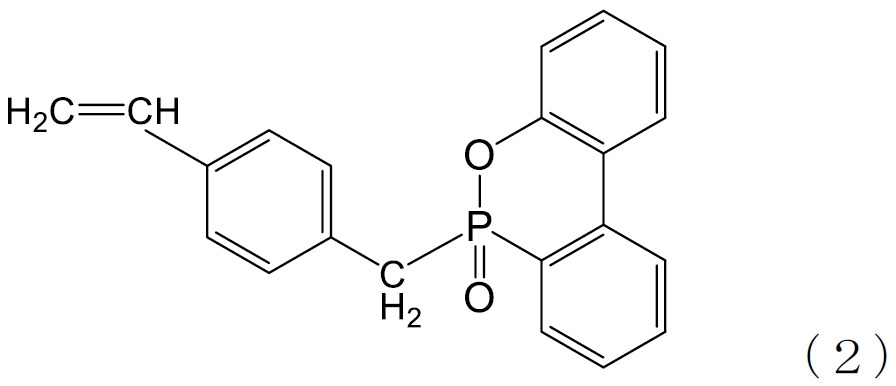
所表示之化合物,及/或下述式(3):The compound represented, and/or the following formula (3):
[化4]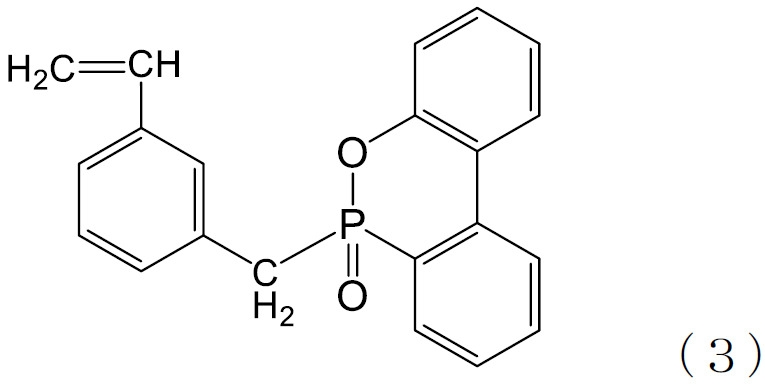
所表示之化合物。再者,此種單體(I)亦可採用上述非專利文獻1所記載之方法進行製備。The compound represented. Furthermore, such a monomer (I) can also be prepared by the method described in Non-Patent Document 1 above.
又,作為用於製造此種單體(I)之方法,較佳為採用如下方法,即,藉由於溶劑及反應試劑之存在下使下述式:In addition, as a method for producing such monomer (I), it is preferable to adopt a method in which the following formula is used due to the presence of a solvent and a reaction reagent:
[化5]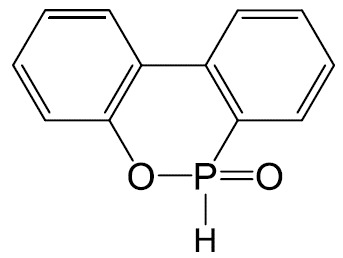
所表示之化合物(9,10-二氫-9-氧雜-10-磷雜菲-10-氧化物)、與下述通式(4):The compound represented (9,10-dihydro-9-oxa-10-phosphaphenanthrene-10-oxide) and the following general formula (4):
[化6]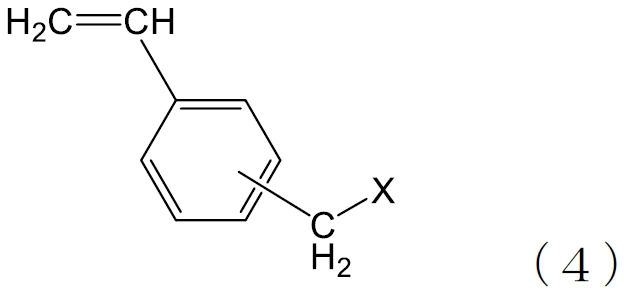
(式中,X表示鹵素原子(更佳為氯原子)) 所表示之鹵化化合物發生加成反應而獲得單體(I)。再者,作為此種溶劑,可適當利用醇類(例如甲醇、乙醇等)、酮類(例如丙酮等)、醯胺類(例如甲醯胺等)等。又,作為此種反應試劑,就能夠抑制副反應而進一步提高產率之方面而言,較佳為利用鹼金屬烷氧化物(鈉甲氧化物、鈉乙氧化物、鋰甲氧化物、鋰乙氧化物等)。再者,作為此種加成反應之反應溫度,通常較佳為10~60℃左右。(In the formula, X represents a halogen atom (more preferably a chlorine atom)) The halogenated compound shown undergoes an addition reaction to obtain monomer (I). In addition, as such a solvent, alcohols (for example, methanol, ethanol, etc.), ketones (for example, acetone, etc.), amides (for example, formazan, etc.), etc. can be suitably used. In addition, as such a reaction reagent, it is preferable to use an alkali metal alkoxide (sodium methoxide, sodium ethoxide, lithium methoxide, lithium ethyl oxide) in terms of suppressing side reactions and further improving the yield. Oxide, etc.). In addition, the reaction temperature of such an addition reaction is usually preferably about 10 to 60°C.
又,用作本發明之熱塑性共聚物之單體(monomer)之單體(II)係除了上述單體(I)以外者,係選自由一取代乙烯及1,1-二取代乙烯所組成之群中之至少1種化合物。In addition, the monomer (II) used as the monomer of the thermoplastic copolymer of the present invention is selected from the group consisting of monosubstituted ethylene and 1,1-disubstituted ethylene in addition to the above-mentioned monomer (I) At least one compound in the group.
作為可用作此種一取代乙烯之化合物,例如可列舉:苯乙烯類、丙烯酸酯類、乙烯基吡啶類、乙烯基酮類、丙烯腈、丙烯醯胺類、N-乙烯基醯胺類。又,作為此種一取代乙烯,具體而言,可列舉:苯乙烯、4-甲基苯乙烯、丙烯酸甲酯、丙烯酸丁酯、丙烯腈、N-乙烯基吡咯啶酮。又,作為可用作1,1-二取代乙烯之化合物,例如可列舉:甲基丙烯酸酯類、甲基丙烯醯胺、偏二鹵乙烯、α-取代苯乙烯類。又,作為此種1,1-二取代乙烯,具體而言,可列舉:甲基丙烯酸甲酯、甲基丙烯酸乙酯、甲基丙烯酸丁酯、甲基丙烯酸苯酯、甲基丙烯酸2-羥基乙酯、偏二氯乙烯、α-甲基苯乙烯。Examples of compounds that can be used as such monosubstituted ethylene include styrenes, acrylic esters, vinyl pyridines, vinyl ketones, acrylonitrile, acrylamides, and N-vinyl amines. In addition, specific examples of such monosubstituted ethylene include styrene, 4-methylstyrene, methyl acrylate, butyl acrylate, acrylonitrile, and N-vinylpyrrolidone. In addition, examples of compounds that can be used as 1,1-disubstituted ethylene include methacrylates, methacrylamide, vinylidene halides, and α-substituted styrenes. In addition, as such 1,1-disubstituted ethylene, specific examples include methyl methacrylate, ethyl methacrylate, butyl methacrylate, phenyl methacrylate, and 2-hydroxy methacrylate. Ethyl ester, vinylidene chloride, α-methylstyrene.
又,於本發明中,選為上述單體(II)之上述化合物較佳為折射率為1.35以上(更佳為1.39以上)之化合物。如此,於選為單體(II)所使用之上述化合物均為折射率為1.35以上之化合物之情形時,可更高效率地獲得如折射率為1.6以上之高折射率之熱塑性共聚物。再者,選為上述單體(II)之上述化合物之「折射率」係藉由臨界角法(方式:阿貝式)所測定之對於波長589 nm之光(D射線)之折射率(nD),可採用藉由利用所謂阿貝折射計(例如,Atago股份有限公司製造之「多波長阿貝折射計 DR-M2」等)進行測定所求得之值。選為此種單體(II)所使用之上述化合物之折射率例如可藉由如下方式而求得,即,準備上述化合物之膜或板狀成形品作為測定試樣,藉由上述阿貝折射計,於23℃之溫度條件下,測定對於波長589 nm之光(D射線)之折射率。Furthermore, in the present invention, the above-mentioned compound selected as the above-mentioned monomer (II) is preferably a compound having a refractive index of 1.35 or higher (more preferably 1.39 or higher). In this way, when the above-mentioned compounds selected as the monomer (II) are all compounds with a refractive index of 1.35 or higher, a thermoplastic copolymer with a high refractive index such as a refractive index of 1.6 or higher can be obtained more efficiently. Furthermore, the "refractive index" of the compound selected as the monomer (II) is the refractive index (nD ), the value obtained by measuring with a so-called Abbe refractometer (for example, "Multi-wavelength Abbe refractometer DR-M2" manufactured by Atago Co., Ltd., etc.) can be used. The refractive index of the above-mentioned compound used as the monomer (II) can be obtained, for example, by preparing a film or plate-shaped molded article of the above-mentioned compound as a measurement sample, and performing the above-mentioned Abbe refraction Measure the refractive index of light (D-ray) with a wavelength of 589 nm at a temperature of 23°C.
又,就能夠成為阻燃性更高者之方面而言,上述單體(II)較佳為選自由苯乙烯類、丙烯酸酯類、甲基丙烯酸酯類、N-乙烯基醯胺類及丙烯腈所組成之群中之至少1種化合物,其中,更佳為選自由苯乙烯、丙烯酸丁酯、甲基丙烯酸2-羥基乙酯、甲基丙烯酸甲酯、N-乙烯基吡咯啶酮及丙烯腈所組成之群中之至少1種化合物。又,作為可選為單體(II)之上述化合物,就藉由利用該化合物而能夠更高效率地達成如於UL94V試驗中成為等級「V-0」之更高之阻燃度之觀點而言,進而較佳為苯乙烯、丙烯酸丁酯、甲基丙烯酸甲酯、N-乙烯基吡咯啶酮、丙烯腈,就亦能夠發揮更高之耐熱性之觀點而言,尤佳為苯乙烯、丙烯酸丁酯、甲基丙烯酸甲酯、N-乙烯基吡咯啶酮。再者,可作為此種單體(II)選擇之上述化合物可單獨利用1種,或組合利用2種以上。Furthermore, in terms of being able to be more flame-retardant, the monomer (II) is preferably selected from the group consisting of styrenes, acrylics, methacrylates, N-vinylamides, and acrylics. At least one compound in the group consisting of nitriles, more preferably selected from styrene, butyl acrylate, 2-hydroxyethyl methacrylate, methyl methacrylate, N-vinylpyrrolidone and propylene At least one compound in the group consisting of nitriles. In addition, as the above-mentioned compound that can be selected as the monomer (II), it is possible to achieve a higher flame retardancy such as the grade "V-0" in the UL94V test more efficiently by using the compound. In other words, styrene, butyl acrylate, methyl methacrylate, N-vinylpyrrolidone, and acrylonitrile are more preferred, and from the viewpoint that higher heat resistance can also be exhibited, styrene, Butyl acrylate, methyl methacrylate, N-vinylpyrrolidone. In addition, the above-mentioned compounds which can be selected as such monomer (II) may be used alone or in combination of two or more kinds.
又,選為上述單體(II)之上述化合物較佳為沸點為40℃以上(更佳為60℃以上)之化合物。若此種沸點未達上述下限,則於進行聚合反應之加熱下會成為氣體狀態,因此會變為加壓下之反應,需要特殊之反應器等,難以高效率地製造聚合物,有使聚合物之製造成本增加之傾向。In addition, the above-mentioned compound selected as the above-mentioned monomer (II) is preferably a compound having a boiling point of 40°C or higher (more preferably 60°C or higher). If the boiling point does not reach the above lower limit, it will become a gaseous state under the heating for the polymerization reaction. Therefore, it will become a reaction under pressure. A special reactor is required. It is difficult to efficiently produce the polymer. The tendency of the manufacturing cost of things to increase.
本發明之熱塑性共聚物係上述單體(I)與上述單體(II)之聚合物(共聚物)。如此,藉由將熱塑性共聚物設為使上述單體(I)與上述單體(II)聚合而成者,而與上述單體(I)之均聚物(homopolymer)對比,能夠發揮更高之阻燃性,且能夠充分維持較高之水準之透明性及折射率。如此,於本發明之熱塑性共聚物中,藉由製成對於上述特定之單體(I)組合上述特定之單體(II)所獲得之聚合物,能夠發揮更高之水準之阻燃性。對此,雖於上述非專利文獻1中記載有形成該文獻所記載之單體之均聚物,但終歸完全未言及使該文獻所記載之單體與其他單體共聚等。The thermoplastic copolymer of the present invention is a polymer (copolymer) of the above-mentioned monomer (I) and the above-mentioned monomer (II). In this way, by setting the thermoplastic copolymer as a polymer obtained by polymerizing the above-mentioned monomer (I) and the above-mentioned monomer (II), it can perform higher than the homopolymer of the above-mentioned monomer (I). It is flame retardant, and can fully maintain a high level of transparency and refractive index. In this way, in the thermoplastic copolymer of the present invention, a polymer obtained by combining the above-mentioned specific monomer (I) with the above-mentioned specific monomer (II) can exhibit a higher level of flame retardancy. In this regard, although the aforementioned Non-Patent Document 1 describes the formation of homopolymers of the monomers described in this document, it does not mention at all that the monomers described in this document are copolymerized with other monomers.
又,本發明之熱塑性共聚物係使上述單體(I)與上述單體(II)聚合而成者。當進行此種聚合時,上述單體(I)與上述單體(II)之使用比率並無特別限制,為了獲得更高之阻燃性及成形體之更高之強度,更佳為設為如莫耳比([單體(I)]/[單體(II)])成為10/1~1/10(進而較佳為5/1~1/5,尤佳為3/1~1/3)之比率。In addition, the thermoplastic copolymer of the present invention is obtained by polymerizing the above-mentioned monomer (I) and the above-mentioned monomer (II). When performing such polymerization, the ratio of the above monomer (I) to the above monomer (II) is not particularly limited. In order to obtain higher flame retardancy and higher strength of the molded body, it is more preferably set as For example, the molar ratio ([monomer(I)]/[monomer(II)]) becomes 10/1~1/10 (further preferably 5/1~1/5, particularly preferably 3/1~1 /3) ratio.
再者,此種熱塑性共聚物只要為上述單體(I)與上述單體(II)之聚合物(共聚物)即可,其種類無特別限制,例如可為無規共聚物、嵌段共聚物、或交替共聚物中之任一種。再者,就更容易製備之觀點而言,此種熱塑性共聚物較佳為上述單體(I)與上述單體(II)之無規共聚物。Furthermore, such a thermoplastic copolymer may be a polymer (copolymer) of the above-mentioned monomer (I) and the above-mentioned monomer (II), and the type is not particularly limited. For example, it may be a random copolymer or a block copolymer. Any of materials, or alternating copolymers. Furthermore, from the viewpoint of easier preparation, such a thermoplastic copolymer is preferably a random copolymer of the aforementioned monomer (I) and the aforementioned monomer (II).
又,作為用於製備上述本發明之熱塑性共聚物之方法,除了利用上述單體(I)及上述單體(II)作為單體以外,可適當採用能夠使2種以上之單體聚合而獲得共聚物之公知之方法。其中,製備上述本發明之熱塑性共聚物時之聚合反應之形態無特別限定,但就上述單體(I)及上述單體(II)均具有自由基聚合性基之方面而言,較佳為於該等單體之間進行自由基聚合。於如此進行自由基聚合之情形時,較佳為於反應溶劑中、於自由基聚合起始劑之存在下,使上述單體(I)及上述單體(II)反應。In addition, as a method for preparing the thermoplastic copolymer of the present invention, in addition to using the above monomer (I) and the above monomer (II) as monomers, it can be obtained by polymerizing two or more monomers. The well-known method of copolymers. Among them, the form of the polymerization reaction when preparing the thermoplastic copolymer of the present invention is not particularly limited, but in terms of both the monomer (I) and the monomer (II) having a radical polymerizable group, it is preferably Free radical polymerization is carried out between these monomers. In the case of performing radical polymerization in this way, it is preferable to react the monomer (I) and the monomer (II) in the reaction solvent in the presence of a radical polymerization initiator.
作為此種自由基聚合起始劑,無特別限制,例如可適當利用偶氮二異丁腈(AIBN)、二第三丁基過氧化物、第三丁基過氧化氫、過氧化苯甲醯(BPO)、過氧化甲基乙基酮、三乙基硼烷(Et3 B)、二乙基鋅(Et2 Zn)等公知之自由基聚合起始劑。The radical polymerization initiator is not particularly limited. For example, azobisisobutyronitrile (AIBN), di-tertiary butyl peroxide, tertiary butyl hydroperoxide, and benzyl peroxide can be suitably used. (BPO), methyl ethyl ketone peroxide, triethyl borane (Et 3 B), diethyl zinc (Et 2 Zn) and other known radical polymerization initiators.
又,作為上述反應溶劑,亦無特別限制,可適當利用自由基聚合所能夠利用之公知之溶劑,例如可適當利用:四氫呋喃(THF)、二㗁烷、二氧雜環戊烷、丙酮、氯仿、甲苯、二甲基甲醯胺(DMF)、二甲基乙醯胺(DMAc)、N-甲基吡咯啶酮(NMP)、二甲基亞碸(DMSO)、γ-丁內酯、環戊酮、環己酮、四甲基脲、1,3-二甲基-2-咪唑啶酮、二乙二醇二甲醚等乙二醇二甲醚系溶劑、乙基溶纖劑等溶纖劑系溶劑、丙二醇單甲醚乙酸酯等二醇酯系溶劑、丙二醇單甲醚等二醇醚系溶劑等。作為此種反應溶劑,就單體(I)之溶解性之觀點而言,尤佳為DMF、DMAc、NMP、DMSO。In addition, there are no particular restrictions on the above-mentioned reaction solvent. Well-known solvents that can be used in radical polymerization can be suitably used. For example, tetrahydrofuran (THF), dioxane, dioxolane, acetone, chloroform can be suitably used. , Toluene, dimethylformamide (DMF), dimethylacetamide (DMAc), N-methylpyrrolidone (NMP), dimethyl sulfide (DMSO), γ-butyrolactone, cyclic Glycol dimethyl ether solvents such as pentanone, cyclohexanone, tetramethylurea, 1,3-dimethyl-2-imidazolidinone, diethylene glycol dimethyl ether, ethyl cellosolve, etc. Cellulose solvents, glycol ester solvents such as propylene glycol monomethyl ether acetate, glycol ether solvents such as propylene glycol monomethyl ether, and the like. As such a reaction solvent, from the viewpoint of the solubility of the monomer (I), DMF, DMAc, NMP, and DMSO are particularly preferred.
作為用於使上述單體(I)及上述單體(II)之間進行自由基聚合(聚合反應)所可採用之反應條件,無特別限定,例如可於惰性氣體氛圍下(例如氮氣氛圍下),將反應溫度(聚合溫度)設為室溫(25℃)~150℃左右進行聚合反應。再者,此種聚合溫度較佳為以滿足單體(II)之沸點以下、反應溶劑之沸點以下、及自由基聚合起始劑之自由基產生溫度(例如10小時半衰期溫度)以上等條件之方式進行設定(選擇)。又,此種聚合反應之反應時間無特別限制,例如可於上述反應條件下反應1~48小時左右。再者,當進行此種自由基聚合時,就單體之轉化率提高之觀點而言,例如於自由基聚合起始劑使用偶氮二異丁腈之情形時,亦可採用如下條件,即,於惰性氣體氛圍下,將反應溫度設為50~100℃反應3~30小時後,進而將反應溫度設為80~150℃反應1~15小時。又,如此進行自由基聚合時之自由基聚合起始劑之使用量等亦無特別限制,只要於能夠進行自由基聚合之範圍內進行適當調整即可。再者,當進行此種聚合時,於最終所獲得之聚合物(共聚物)為無損本發明之主旨之範圍內者之情形時,可適當含有各種添加劑(抗老化劑、抗氧化劑等)或其他種類之單體等。如此,本發明之熱塑性共聚物亦可根據其用途等而含有各種添加劑(抗老化劑、抗氧化劑等)等,進而亦可使該共聚物於無損本發明之主旨之範圍內包含源自其他單體之重複單元。The reaction conditions that can be used for radical polymerization (polymerization reaction) between the monomer (I) and the monomer (II) are not particularly limited. For example, they may be under an inert gas atmosphere (for example, under a nitrogen atmosphere). ), the reaction temperature (polymerization temperature) is set to room temperature (25°C) to about 150°C to carry out the polymerization reaction. Furthermore, the polymerization temperature is preferably to satisfy the following conditions: the boiling point of the monomer (II), the boiling point of the reaction solvent, and the radical generation temperature of the radical polymerization initiator (for example, the 10-hour half-life temperature). Way to set (select). Moreover, the reaction time of such a polymerization reaction is not specifically limited, For example, it can react under the above-mentioned reaction conditions for about 1 to 48 hours. Furthermore, when carrying out such radical polymerization, from the viewpoint of increasing the conversion rate of monomers, for example, when azobisisobutyronitrile is used as the radical polymerization initiator, the following conditions can also be adopted, namely In an inert gas atmosphere, the reaction temperature is set to 50 to 100°C for 3 to 30 hours, and then the reaction temperature is set to 80 to 150°C for 1 to 15 hours. In addition, the amount of the radical polymerization initiator used in such radical polymerization is not particularly limited, as long as it is appropriately adjusted within the range in which radical polymerization can be carried out. Furthermore, when such polymerization is carried out, when the finally obtained polymer (copolymer) is within a range that does not impair the gist of the present invention, various additives (anti-aging agents, antioxidants, etc.) or Other types of monomers, etc. In this way, the thermoplastic copolymer of the present invention may contain various additives (anti-aging agents, antioxidants, etc.) according to its use, etc., and the copolymer may also include other monomers within a range that does not impair the gist of the present invention. The repeating unit of the body.
如此,藉由利用上述單體(I)與上述單體(II)作為單體進行聚合,可製備上述本發明之熱塑性共聚物。此種本發明之熱塑性共聚物與非專利文獻1所記載之均聚物相比,能夠具有更高之阻燃性且使折射率及透明性維持在充分高之水準。此處,此種熱塑性共聚物之折射率較佳為1.5以上。藉由上述熱塑性共聚物之折射率滿足上述條件,亦可較佳地應用於例如透鏡等光學用途等。再者,此種熱塑性共聚物之折射率係指藉由臨界角法(方式:阿貝式)所測定之對於波長589 nm之光(D射線)之折射率(nD),可採用利用所謂阿貝折射計(例如,Atago股份有限公司製造之「多波長阿貝折射計 DR-M2」等)於23℃之溫度條件下所測定之值。又,本發明之熱塑性共聚物為了能夠達成更高之透明性,更佳為全光線透過率為80%以上(進而較佳為85%以上)。此種全光線透過率可藉由進行依據JIS K7361-1(1997年發行)之測定而求得。In this way, the above-mentioned thermoplastic copolymer of the present invention can be prepared by polymerizing the above-mentioned monomer (I) and the above-mentioned monomer (II) as monomers. Compared with the homopolymer described in Non-Patent Document 1, the thermoplastic copolymer of the present invention can have higher flame retardancy and maintain a sufficiently high level of refractive index and transparency. Here, the refractive index of such a thermoplastic copolymer is preferably 1.5 or more. Since the refractive index of the above-mentioned thermoplastic copolymer satisfies the above-mentioned conditions, it can also be preferably applied to optical applications such as lenses. Furthermore, the refractive index of this thermoplastic copolymer refers to the refractive index (nD) for light (D-ray) with a wavelength of 589 nm measured by the critical angle method (method: Abbe's type). Refractometer (for example, "Multi-wavelength Abbe Refractometer DR-M2" manufactured by Atago Co., Ltd., etc.) measured at a temperature of 23°C. In addition, in order to achieve higher transparency of the thermoplastic copolymer of the present invention, the total light transmittance is more preferably 80% or more (more preferably 85% or more). Such total light transmittance can be obtained by measuring in accordance with JIS K7361-1 (issued in 1997).
[樹脂成形體] 本發明之樹脂成形體係上述本發明之熱塑性共聚物之成形體。[Resin molded body] The resin molding system of the present invention is a molded body of the above-mentioned thermoplastic copolymer of the present invention.
由於此種樹脂成形體係將上述本發明之熱塑性共聚物成形而成者,故而具有更高之阻燃性,且具有充分高之折射率及透明性。再者,作為此種樹脂成形體之製備方法,無特別限制,除了使用上述本發明之熱塑性共聚物以外,可適當採用能夠將熱塑性樹脂成形之公知之方法(例如,擠出成形法、射出成形法、壓延成形法、吹塑成形法、加壓成形法等)。又,此種樹脂成形體之形態無特別限制,只要根據用途適當成形為各種形狀即可,例如可製成膜狀、板狀、片狀、顆粒狀等形態。 [實施例]Since this resin molding system is formed by molding the above-mentioned thermoplastic copolymer of the present invention, it has higher flame retardancy, and has sufficiently high refractive index and transparency. Furthermore, there are no particular restrictions on the method for preparing such resin molded bodies. In addition to using the thermoplastic copolymer of the present invention, a known method capable of molding a thermoplastic resin (for example, extrusion molding, injection molding, etc.) can be suitably used. Method, calender molding method, blow molding method, press molding method, etc.). In addition, the form of such a resin molded body is not particularly limited, as long as it is appropriately molded into various shapes according to the application, and it can be formed into a film shape, a plate shape, a sheet shape, a pellet shape, etc., for example. [Example]
以下,基於實施例及比較例更具體地說明本發明,但本發明並不限定於以下之實施例。Hereinafter, the present invention will be explained more specifically based on examples and comparative examples, but the present invention is not limited to the following examples.
(合成例1:單體(I)之合成) 於各實施例等中,用作單體(I)之化合物係以如下方式合成。即,首先,將9,10-二氫-9-氧雜-10-磷雜菲-10-氧化物(HCA、3 g、0.0138 mol)、甲醇(13.2 g:HCA之質量之4.4倍)加入至50 ml之反應容器中,獲得懸濁液。其次,於冰浴下,對所獲得之懸濁液,加入甲醇中以28質量%之比率包含鈉甲氧化物之溶液(溶液中之NaOMe之總量:0.0145 mol)後,於相同溫度之條件下滴加4-(氯甲基)苯乙烯(CMS、0.0131 mol),藉此獲得混合液。其後,將上述混合液於20℃下靜置21小時,藉此於該混合液中進行HCA與CMS之反應,獲得反應液。(Synthesis example 1: Synthesis of monomer (I)) In each example, etc., the compound used as the monomer (I) was synthesized in the following manner. That is, first, add 9,10-dihydro-9-oxa-10-phosphaphenanthrene-10-oxide (HCA, 3 g, 0.0138 mol), methanol (13.2 g: 4.4 times the mass of HCA) To a 50 ml reaction vessel, obtain a suspension. Secondly, under an ice bath, add a solution containing sodium methoxide at a ratio of 28% by mass in methanol (total amount of NaOMe in the solution: 0.0145 mol) to the obtained suspension, and then at the same temperature. 4-(chloromethyl)styrene (CMS, 0.0131 mol) was added dropwise to obtain a mixed solution. After that, the above-mentioned mixed liquid was allowed to stand at 20° C. for 21 hours, whereby the reaction between HCA and CMS was carried out in the mixed liquid to obtain a reaction liquid.
其次,對上述反應結束後所獲得之反應液,加入水(1 ml)、4-第三丁基兒茶酚(2.3 mg)、及己烷(30 ml)進行攪拌,藉此獲得有機層與水層之2層懸濁液。其後,將所獲得之懸濁液注入至水(40~50 ml)中,濾取所析出之固體。其後,水洗上述固體後,藉由己烷洗淨。其次,將上述洗淨後之固體於40℃下整夜減壓乾燥,獲得反應產物。Next, add water (1 ml), 4-tert-butylcatechol (2.3 mg), and hexane (30 ml) to the reaction solution obtained after the above reaction, and stir to obtain an organic layer and The two-layer suspension of the water layer. After that, the obtained suspension was poured into water (40-50 ml), and the precipitated solid was collected by filtration. After that, the solid was washed with water and then washed with hexane. Next, the washed solid was dried under reduced pressure at 40°C overnight to obtain a reaction product.
將如此獲得之反應產物溶解於氘代氯仿後,使用NMR測定機(JEOL公司製造之商品名「AL-400」)進行1 H-NMR之測定,結果可知,所獲得之反應產物之1 H-NMR之測定結果與上述非專利文獻1所記載之「4-[(6-氧化物-6H-二苯并[c,e][1,2]氧磷雜己烷-6-基)]甲基苯乙烯(M4)」之光譜資料之值大致一致,因此所獲得之化合物為下述式: After dissolving the reaction product thus obtained in deuterated chloroform, 1 H-NMR measurement was carried out using an NMR measuring machine (trade name "AL-400" manufactured by JEOL). As a result, it can be seen that the 1 H- The NMR measurement results are similar to the "4-[(6-oxide-6H-dibenzo[c,e][1,2]oxaphosphahexan-6-yl)] described in Non-Patent Document 1 above. The value of the spectral data of styrene (M4)" is roughly the same, so the obtained compound has the following formula:
[化7]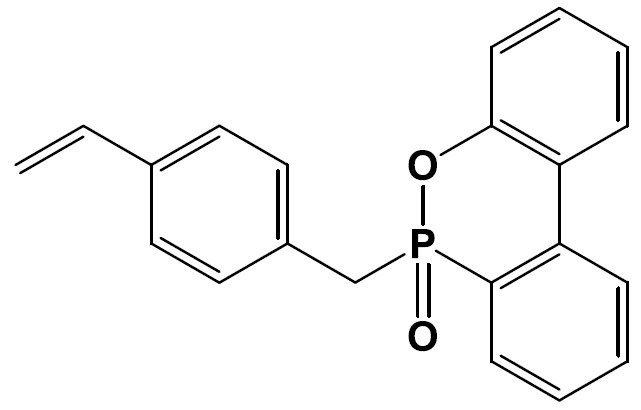
所表示之化合物(HCA-MS)(再者,以下視情況將該化合物簡稱為「HCA-MS」。HCA-MS之特性:分子量332、熔點128℃、製成均聚物時之折射率1.65(參照後述之比較例1))。再者,以下表示所獲得之反應產物之1 H-NMR之測定結果。The indicated compound (HCA-MS) (Furthermore, the compound will be referred to as "HCA-MS" as appropriate below. The characteristics of HCA-MS: molecular weight 332, melting point 128°C, and refractive index of 1.65 when made into a homopolymer (Refer to Comparative Example 1 described later)). Furthermore, the 1 H-NMR measurement results of the obtained reaction product are shown below.
[反應產物之1 H-NMR光譜資料]1 H NMR (400 MHz, CDCl3 , δ) 3.4-3.41 (m, 2H, P-CH2 ), 5.19-5.21 (d, 1H, CH = CH2 ), 5.64-5.69 (d, 1H, CH = CH2 ), 6.59-6.66 (dd, 1H, CH = CH2 ), 7.00-7.02 (m, 2H, aromatic), 7.16-7.23 (m, 4H, aromatic), 7.34-7.46 (m, 2H, aromatic), 7.65-7.74 (m, 2H, aromatic), 7.83-7.91 (m, 2H, aromatic)。 [1 H-NMR spectrum data of reaction products ] 1 H NMR (400 MHz, CDCl 3 , δ) 3.4-3.41 (m, 2H, P-CH 2 ), 5.19-5.21 (d, 1H, CH = CH 2 ) , 5.64-5.69 (d, 1H, CH = CH 2 ), 6.59-6.66 (dd, 1H, CH = CH 2 ), 7.00-7.02 (m, 2H, aromatic), 7.16-7.23 (m, 4H, aromatic) , 7.34-7.46 (m, 2H, aromatic), 7.65-7.74 (m, 2H, aromatic), 7.83-7.91 (m, 2H, aromatic).
(關於單體(II)) 將下述各實施例中用作單體(II)之化合物之名稱、縮寫及該化合物之特性示於下述表1。再者,於以下之實施例等中,用作單體(II)之化合物用縮寫記載。(About monomer (II)) The name, abbreviation and characteristics of the compound used as the monomer (II) in the following examples are shown in Table 1 below. In addition, in the following Examples, etc., the compound used as the monomer (II) is described by abbreviations.
[表1]
(實施例1) 利用HCA-MS(合成例1所獲得之化合物)作為單體(I),且利用St作為單體(II),藉由下述第一步驟及第二步驟製造熱塑性共聚物。(Example 1) Using HCA-MS (the compound obtained in Synthesis Example 1) as the monomer (I) and St as the monomer (II), a thermoplastic copolymer was produced by the following first and second steps.
(第一步驟) 將HCA-MS(100 g、0.30 mol)、St(31 g、0.30 mol)、偶氮二異丁腈(AIBN:47 mg、用作自由基聚合起始劑)溶解於脫水二甲基乙醯胺(脫水DMAc:86 g、用作反應溶劑),獲得混合液。其次,於氮氣氛圍下,一面持續攪拌上述混合液,一面進行加熱,於90℃(第一反應溫度)下保持13小時後,於110℃(第二反應溫度)下保持13小時,獲得反應液(如此,藉由一面加熱混合液一面進行攪拌,而使HCA-MS(單體(I))與St(單體(II))發生反應)。(First step) Dissolve HCA-MS (100 g, 0.30 mol), St (31 g, 0.30 mol), azobisisobutyronitrile (AIBN: 47 mg, used as a radical polymerization initiator) in dehydrated dimethylacetate Amine (dehydrated DMAc: 86 g, used as a reaction solvent) to obtain a mixed solution. Next, under a nitrogen atmosphere, the mixture was heated while continuously stirring the mixture, and then kept at 90°C (the first reaction temperature) for 13 hours, and then kept at 110°C (the second reaction temperature) for 13 hours to obtain a reaction solution (In this way, the HCA-MS (monomer (I)) and St (monomer (II)) are reacted by stirring while heating the mixed solution).
(第二步驟) 如此加熱攪拌而獲得反應液後,對所獲得之反應液追加DMAc(300 ml)後,將該反應液注入至水(2 L)中,使固形物成分析出。其次,濾取所析出之固形物成分。其次,使所獲得之固形物成分分散於甲醇(1.5 L)中後,再次濾取。其後,將所獲得之固形物成分乾燥、粉碎而獲得熱塑性共聚物(126 g:粉末狀)。(Second step) After heating and stirring to obtain a reaction solution, DMAc (300 ml) was added to the obtained reaction solution, and the reaction solution was poured into water (2 L) to analyze the solid content. Secondly, filter out the precipitated solid components. Next, after dispersing the obtained solid content in methanol (1.5 L), it was filtered again. After that, the obtained solid content was dried and pulverized to obtain a thermoplastic copolymer (126 g: powder form).
將如此獲得之熱塑性共聚物溶解於氘代氯仿後,使用NMR測定機(JEOL公司製造之商品名「AL-400」)進行1 H-NMR測定。將藉由此種NMR測定所獲得之結果(化合物之1 H-NMR光譜)示於圖1。又,對於熱塑性共聚物(粉末),使用紅外線吸收光譜測定機(IR測定機:Thermo Fisher公司製造之商品名「SI-50」)進行IR測定(ATR法)。以下表示所獲得之結果。 [熱塑性共聚物之紅外線吸收光譜之測定結果] IR (cm-1 ): 3024, 2916, 1595, 1583, 1510, 1493, 1476, 1447, 1430, 1237, 1204, 1147, 1117, 1082, 1044, 906, 840, 750, 715, 700, 615, 595, 515, 483, 429。 After dissolving the thus-obtained thermoplastic copolymer in deuterated chloroform, 1 H-NMR measurement was performed using an NMR measuring machine (trade name "AL-400" manufactured by JEOL). The result obtained by such NMR measurement ( 1 H-NMR spectrum of the compound) is shown in FIG. 1. In addition, with respect to the thermoplastic copolymer (powder), IR measurement (ATR method) was performed using an infrared absorption spectrometer (IR measuring machine: trade name "SI-50" manufactured by Thermo Fisher). The results obtained are shown below. [Measurement result of infrared absorption spectrum of thermoplastic copolymer] IR (cm -1 ): 3024, 2916, 1595, 1583, 1510, 1493, 1476, 1447, 1430, 1237, 1204, 1147, 1117, 1082, 1044, 906 , 840, 750, 715, 700, 615, 595, 515, 483, 429.
根據此種1 H-NMR測定之結果(圖1)及IR測定之結果可知,由於確認到烯烴部之消失與磷化合物之波峰,故而所獲得之熱塑性共聚物為HCA-MS與St之共聚物(聚合物)。再者,對於以與上述第一步驟相同之方式所獲得之反應液進行凝膠滲透層析分析(GPC分析:再者,測定使用測定裝置(高速GPC裝置):東曹股份有限公司製造之商品名「HLC-8420GPC」、溶離液:THF、檢測器:示差折射率檢測器及UV(ultraviolet,紫外線)檢測器),結果可知,HCA-MS之轉化率為87%。又,將所獲得之熱塑性共聚物溶解於DMAc,進行凝膠滲透層析分析(GPC分析:再者,測定使用測定裝置(高速GPC裝置):東曹股份有限公司製造之商品名「HLC-8320GPC」、溶離液:以0.1 mM之濃度包含LiBr之DMAc溶液、檢測器:示差折射率檢測器),結果確認到,所獲得之熱塑性共聚物之數量平均分子量(Mn)為88400。According to the results of 1 H-NMR measurement (Figure 1) and IR measurement, it can be seen that the disappearance of the olefin part and the peak of the phosphorus compound are confirmed, so the obtained thermoplastic copolymer is a copolymer of HCA-MS and St. (polymer). Furthermore, gel permeation chromatography analysis (GPC analysis: furthermore, the measurement device (high-speed GPC device) used for the measurement) was performed on the reaction solution obtained in the same manner as in the first step above: a product manufactured by Tosoh Co., Ltd. Name "HLC-8420GPC", eluate: THF, detector: differential refractive index detector and UV (ultraviolet) detector), the result shows that the conversion rate of HCA-MS is 87%. In addition, the obtained thermoplastic copolymer was dissolved in DMAc and subjected to gel permeation chromatography analysis (GPC analysis: In addition, the measurement device (high-speed GPC device) was used for the measurement: the product name "HLC-8320GPC" manufactured by Tosoh Co., Ltd. "Leaching solution: DMAc solution containing LiBr at a concentration of 0.1 mM, detector: differential refractive index detector), the result confirmed that the number average molecular weight (Mn) of the obtained thermoplastic copolymer was 88,400.
(實施例2~7) 將第一步驟中單體(II)之種類自St變更為表2所示之化合物(用縮寫記載),且將第一步驟中與單體(I)之使用量、單體(II)之使用量、AIBN(自由基聚合起始劑)之使用量、第一反應溫度、第一反應溫度下之保持時間、及脫水DMAc(反應溶劑)之使用量相關之條件變更為表2所示之條件,除此以外,以與實施例1相同之方式分別獲得熱塑性共聚物。再者,於實施例2~7中,分別以與實施例1所採用之方法相同之方法測定HCA-MS之轉化率及熱塑性共聚物之數量平均分子量(Mn),將所獲得之結果示於表2。(Examples 2-7) The type of monomer (II) in the first step was changed from St to the compound shown in Table 2 (indicated by abbreviations), and the amount of monomer (I) used in the first step and the amount of monomer (II) The usage amount, the usage amount of AIBN (radical polymerization initiator), the first reaction temperature, the holding time at the first reaction temperature, and the conditions related to the usage amount of dehydrated DMAc (reaction solvent) are changed to those shown in Table 2. Except for the conditions, thermoplastic copolymers were obtained in the same manner as in Example 1, respectively. Furthermore, in Examples 2-7, the conversion rate of HCA-MS and the number average molecular weight (Mn) of the thermoplastic copolymer were measured by the same method as that used in Example 1, and the obtained results are shown in Table 2.
(比較例1) 僅利用單體(I)而不利用單體(II),將第一步驟中與單體(I)之使用量、AIBN(自由基聚合起始劑)之使用量、第一反應溫度、第一反應溫度下之保持時間、及脫水DMAc(反應溶劑)之使用量相關之條件變更為表2所示之條件,除此以外,以與實施例1相同之方式獲得HCA-MS之均聚物(homopolymer)。(Comparative example 1) Using only monomer (I) instead of monomer (II), the amount of monomer (I) used in the first step, the amount of AIBN (radical polymerization initiator) used, the first reaction temperature, and the The conditions related to the retention time at a reaction temperature and the amount of dehydrated DMAc (reaction solvent) used were changed to the conditions shown in Table 2. Except for this, the homopolymer of HCA-MS was obtained in the same manner as in Example 1. (homopolymer).
[表2]
(實施例8~14及比較例2) 分別使用實施例1~7所獲得之熱塑性共聚物(copolymer)及比較例1所獲得之均聚物(homopolymer)作為原料(材料),使用真空加熱加壓機並採用下述加壓成形之條件,藉此進行加壓成形,分別製備樹脂板(板狀之樹脂成形體)。再者,將實施例8~14及比較例2所分別利用之原料(材料)之種類示於表3。 [加壓成形之條件] 材料之使用量(所利用之聚合物(粉末)之量):20 g 成形條件:溫度200℃、成形壓力5 MPa、成形時間:20分鐘 所利用之模具之尺寸:縱130 mm、橫90 mm、厚1.5 mm。(Examples 8-14 and Comparative Example 2) Using the thermoplastic copolymer obtained in Examples 1-7 and the homopolymer obtained in Comparative Example 1 as raw materials (materials), a vacuum heating press was used and the following pressure molding conditions were used In this way, press molding is performed to prepare resin plates (plate-shaped resin molded bodies). In addition, the types of raw materials (materials) used in Examples 8 to 14 and Comparative Example 2 are shown in Table 3. [Conditions for pressure forming] The amount of material used (the amount of polymer (powder) used): 20 g Forming conditions: temperature 200℃, forming pressure 5 MPa, forming time: 20 minutes The size of the mold used: length 130 mm, width 90 mm, thickness 1.5 mm.
[實施例8~14及比較例2所獲得之樹脂成形體之特性之評價] (全光線透過率之測定) 直接使用各實施例等所獲得之樹脂板(板狀之樹脂成形體)作為測定用之試樣,使用日本電色工業股份有限公司製造之「濁度計NDH-2000」作為測定裝置,進行依據JIS K7361-1(1997年發行)之測定,藉此求得全光線透過率(單位:%)。將所獲得之結果示於表3。[Evaluation of the characteristics of the resin molded bodies obtained in Examples 8-14 and Comparative Example 2] (Determination of total light transmittance) The resin plate (plate-shaped resin molded body) obtained in each example was directly used as the measurement sample, and the "turbidity meter NDH-2000" manufactured by Nippon Denshoku Industry Co., Ltd. was used as the measurement device. JIS K7361-1 (issued in 1997) was measured to obtain the total light transmittance (unit: %). The results obtained are shown in Table 3.
(折射率之測定) 直接使用各實施例等所獲得之樹脂板(板狀之樹脂成形體)作為測定用之試樣,利用Atago股份有限公司製造之「多波長阿貝折射計 DR-M2」作為測定裝置,於23℃之溫度條件下,測定對於波長589 nm之光(D射線)之折射率(nD),藉此求得折射率。將所獲得之結果示於表3。(Measurement of refractive index) The resin plate (plate-shaped resin molded body) obtained in each example was used directly as the measurement sample, and the "Multiwavelength Abbe Refractometer DR-M2" manufactured by Atago Co., Ltd. was used as the measurement device. Under the temperature condition of ℃, the refractive index (nD) for light (D-ray) with a wavelength of 589 nm is measured to obtain the refractive index. The results obtained are shown in Table 3.
(阻燃性之評價試驗) 使用各實施例等所獲得之樹脂板(板狀之樹脂成形體)製作試片(長度:120 mm、寬度:13 mm、厚度:1.5 mm),進行依據UL94標準(美國保險商實驗室(Underwriter Laboratories Inc.)所規定之標準)之垂直燃燒試驗(V試驗)之阻燃性之評價試驗(UL94V試驗)。再者,於該試驗中,將火焰之大小設為20 mm,對試片進行第1次火焰接觸10秒後,與火消失之同時進行第2次火焰接觸10秒。然後,確認進行第2次火焰接觸後之試片之狀態或由源自試片之滴下物造成之影響等,藉由下述評價基準評價各樹脂板之阻燃性。將所獲得之結果示於表3。 [阻燃性之評價基準] A:未使試片著火,符合UL94標準之等級「V-0」。 B:雖未使試片著火,但因熔融滴下物而導致棉著火,相當於UL94標準之等級「V-2」。(Evaluation test of flame retardancy) A test piece (length: 120 mm, width: 13 mm, thickness: 1.5 mm) was prepared using the resin plate (plate-shaped resin molded body) obtained in each example, etc., and was carried out in accordance with the UL94 standard (Underwriters Laboratories (Underwriters Laboratories)). The flame retardancy evaluation test (UL94V test) of the vertical burning test (V test) specified by Laboratories Inc.). Furthermore, in this test, the size of the flame was set to 20 mm. After the first flame contact was performed on the test piece for 10 seconds, the second flame contact was performed for 10 seconds while the fire disappeared. Then, the state of the test piece after the second flame contact or the influence caused by drips from the test piece were confirmed, and the flame retardancy of each resin board was evaluated according to the following evaluation criteria. The results obtained are shown in Table 3. [Evaluation criteria for flame retardancy] A: The test piece is not ignited, and it meets the UL94 standard "V-0". B: Although the test piece was not ignited, the cotton ignited due to molten dripping, which is equivalent to the UL94 standard "V-2".
[表3]
根據表3所示之結果,亦明顯確認到,實施例8~14所獲得之樹脂板(將實施例1~7所獲得之單體(I)與單體(II)之共聚物成形而成之成形體)與比較例1所獲得之樹脂板(將HCA-MS之均聚物成形而成之成形體)相比,阻燃性變得更高。又,實施例8~14所獲得之樹脂板均具有與比較例1所獲得之樹脂板同等程度的較高之全光線透過率及較高之折射率。根據此種結果可知,藉由利用HCA-MS(單體(I))與上述單體(II)之共聚物(實施例1~7)製備樹脂成形體,而與利用HCA-MS之均聚物製備樹脂成形體之情形相比,能夠獲得顯示更高之阻燃性之樹脂成形體,進而能夠獲得具有與利用HCA-MS之均聚物所獲得之樹脂成形體相同程度的充分高之折射率及充分之透明性(將全光線透過率作為基準)之樹脂成形體。 [產業上之可利用性]According to the results shown in Table 3, it is also clearly confirmed that the resin plates obtained in Examples 8 to 14 (the copolymers of monomer (I) and monomer (II) obtained in Examples 1 to 7 are molded into Compared with the resin plate obtained in Comparative Example 1 (a molded body formed by molding a homopolymer of HCA-MS), the flame retardancy becomes higher. In addition, the resin plates obtained in Examples 8 to 14 all had a higher total light transmittance and a higher refractive index equivalent to the resin plates obtained in Comparative Example 1. Based on this result, it can be seen that by using the copolymer of HCA-MS (monomer (I)) and the above-mentioned monomer (II) (Examples 1 to 7) to prepare resin moldings, it is combined with the homopolymerization of HCA-MS Compared with the case of preparing a resin molded body, a resin molded body showing higher flame retardancy can be obtained, and a sufficiently high refractive index can be obtained with the same degree as the resin molded body obtained by using the homopolymer of HCA-MS A resin molded body with high efficiency and sufficient transparency (based on total light transmittance). [Industrial availability]
如上所說明,根據本發明,可提供一種可具有更高之阻燃性且具有充分高之折射率及透明性之熱塑性共聚物以及將該熱塑性共聚物成形而成之樹脂成形體。如此,本發明之熱塑性共聚物可具有充分高之阻燃性且具有優異之光學特性(較高之折射率、或將全光線透過率作為基準之較高之透明性),因此特別是作為用於透鏡等光學用途、建築材料、塗佈材料、塗料等用途之樹脂成形體之材料等較為有用。As explained above, according to the present invention, it is possible to provide a thermoplastic copolymer having higher flame retardancy and sufficiently high refractive index and transparency, and a resin molded body formed by molding the thermoplastic copolymer. In this way, the thermoplastic copolymer of the present invention can have sufficiently high flame retardancy and excellent optical properties (higher refractive index, or higher transparency based on total light transmittance), so it is especially useful for It is more useful as a material for resin molded bodies for optical applications such as lenses, building materials, coating materials, and coatings.
圖1係實施例1所獲得之熱塑性共聚物之1 H-NMR光譜。 Figure 1 is the 1 H-NMR spectrum of the thermoplastic copolymer obtained in Example 1.
Claims (4)
Applications Claiming Priority (2)
| Application Number | Priority Date | Filing Date | Title |
|---|---|---|---|
| JP2019-216842 | 2019-11-29 | ||
| JP2019216842A JP2021085006A (en) | 2019-11-29 | 2019-11-29 | Thermoplastic copolymer and resin molded body |
Publications (1)
| Publication Number | Publication Date |
|---|---|
| TW202128794A true TW202128794A (en) | 2021-08-01 |
Family
ID=76086929
Family Applications (1)
| Application Number | Title | Priority Date | Filing Date |
|---|---|---|---|
| TW109141546A TW202128794A (en) | 2019-11-29 | 2020-11-26 | Thermoplastic copolymer and resin molded body |
Country Status (3)
| Country | Link |
|---|---|
| JP (1) | JP2021085006A (en) |
| TW (1) | TW202128794A (en) |
| WO (1) | WO2021106687A1 (en) |
Families Citing this family (1)
| Publication number | Priority date | Publication date | Assignee | Title |
|---|---|---|---|---|
| EP4720141A1 (en) * | 2023-06-02 | 2026-04-08 | Henkel AG & Co. KGaA | Halogen-free flame retardant (meth)acrylate resins |
Family Cites Families (3)
| Publication number | Priority date | Publication date | Assignee | Title |
|---|---|---|---|---|
| JP2006341390A (en) * | 2005-06-07 | 2006-12-21 | Fujifilm Holdings Corp | Recording material |
| JP2012177776A (en) * | 2011-02-25 | 2012-09-13 | Fujifilm Corp | Photosensitive composition, photosensitive film, photosensitive laminate, permanent pattern formation method and printed substrate |
| JP2020023651A (en) * | 2018-08-08 | 2020-02-13 | Jxtgエネルギー株式会社 | Thermosetting resin composition, resin molded body, and fiber reinforced resin composite |
-
2019
- 2019-11-29 JP JP2019216842A patent/JP2021085006A/en active Pending
-
2020
- 2020-11-17 WO PCT/JP2020/042843 patent/WO2021106687A1/en not_active Ceased
- 2020-11-26 TW TW109141546A patent/TW202128794A/en unknown
Also Published As
| Publication number | Publication date |
|---|---|
| JP2021085006A (en) | 2021-06-03 |
| WO2021106687A1 (en) | 2021-06-03 |
Similar Documents
| Publication | Publication Date | Title |
|---|---|---|
| JPH0440365B2 (en) | ||
| KR102904174B1 (en) | Hydrophobic high-temperature optical acrylic copolymer | |
| JP7197968B2 (en) | methacrylic resin | |
| CN105745239A (en) | Polymer, production method for same, and molded article | |
| JP7302685B2 (en) | Copolymer, resin composition, molded article, film-like molded article, and method for producing copolymer | |
| CN104204867B (en) | Light-diffusing resin composition and its products formed | |
| JPH0463810A (en) | Acrylic-norbornene terpolymer and preparation thereof | |
| US9796812B2 (en) | Polymers and processes for preparing the polymers | |
| Matsumoto et al. | Thermal and mechanical properties of random copolymers of diisopropyl fumarate with 1‐adamantyl and bornyl acrylates with high glass transition temperatures | |
| JPH0455601B2 (en) | ||
| TW202128794A (en) | Thermoplastic copolymer and resin molded body | |
| JPWO2019216008A1 (en) | Optical resin composition and optical lens | |
| JP2010054817A (en) | Optical component and thermoplastic resin | |
| JP6642008B2 (en) | (Meth) acrylic resin composition and (meth) acrylic resin molded article | |
| MX2014012181A (en) | Polycarbonate blend articles and method of producing the same. | |
| JP5349972B2 (en) | Novel (meth) acrylic acid ester copolymer, composition, optical member and electric member | |
| JPS58455B2 (en) | Method for manufacturing solvent-resistant acrylic resin | |
| US20140296461A1 (en) | Aromatic Vinyl Copolymer, Method for Preparing the Same, and Molded Article Including the Same | |
| JP2006063127A (en) | Thermoplastic transparent resin | |
| WO2022196827A1 (en) | Methacrylic copolymer and method for producing same | |
| JPH07145138A (en) | Acrylic acid derivative | |
| CN106928394A (en) | Thermoplastic resin composition and molded article formed therefrom | |
| JP5590486B2 (en) | Fumarate ester block polymer and process for producing the same | |
| Yamada et al. | Preparation and polymerization behavior of 2‐[2, 2, 2‐tris‐(alkoxycarbonyl) ethyl] acrylic ester as a sterically congested monomer | |
| KR102958582B1 (en) | Cyclocarbonate group-containing (meth)acrylate monomers and polymers |