TW202144331A - Heteroaromatic carboxamide derivatives as plasma kallikrein inhibitors - Google Patents
Heteroaromatic carboxamide derivatives as plasma kallikrein inhibitors Download PDFInfo
- Publication number
- TW202144331A TW202144331A TW110104876A TW110104876A TW202144331A TW 202144331 A TW202144331 A TW 202144331A TW 110104876 A TW110104876 A TW 110104876A TW 110104876 A TW110104876 A TW 110104876A TW 202144331 A TW202144331 A TW 202144331A
- Authority
- TW
- Taiwan
- Prior art keywords
- methyl
- hex
- compound
- compounds
- azabicyclo
- Prior art date
Links
Classifications
-
- C—CHEMISTRY; METALLURGY
- C07—ORGANIC CHEMISTRY
- C07D—HETEROCYCLIC COMPOUNDS
- C07D401/00—Heterocyclic compounds containing two or more hetero rings, having nitrogen atoms as the only ring hetero atoms, at least one ring being a six-membered ring with only one nitrogen atom
- C07D401/14—Heterocyclic compounds containing two or more hetero rings, having nitrogen atoms as the only ring hetero atoms, at least one ring being a six-membered ring with only one nitrogen atom containing three or more hetero rings
-
- A—HUMAN NECESSITIES
- A61—MEDICAL OR VETERINARY SCIENCE; HYGIENE
- A61K—PREPARATIONS FOR MEDICAL, DENTAL OR TOILETRY PURPOSES
- A61K45/00—Medicinal preparations containing active ingredients not provided for in groups A61K31/00 - A61K41/00
- A61K45/06—Mixtures of active ingredients without chemical characterisation, e.g. antiphlogistics and cardiaca
-
- C—CHEMISTRY; METALLURGY
- C07—ORGANIC CHEMISTRY
- C07D—HETEROCYCLIC COMPOUNDS
- C07D403/00—Heterocyclic compounds containing two or more hetero rings, having nitrogen atoms as the only ring hetero atoms, not provided for by group C07D401/00
- C07D403/14—Heterocyclic compounds containing two or more hetero rings, having nitrogen atoms as the only ring hetero atoms, not provided for by group C07D401/00 containing three or more hetero rings
Landscapes
- Chemical & Material Sciences (AREA)
- Organic Chemistry (AREA)
- Health & Medical Sciences (AREA)
- Animal Behavior & Ethology (AREA)
- Epidemiology (AREA)
- Life Sciences & Earth Sciences (AREA)
- Pharmacology & Pharmacy (AREA)
- General Health & Medical Sciences (AREA)
- Public Health (AREA)
- Veterinary Medicine (AREA)
- Medicinal Chemistry (AREA)
- Pharmaceuticals Containing Other Organic And Inorganic Compounds (AREA)
- Plural Heterocyclic Compounds (AREA)
- Medicines That Contain Protein Lipid Enzymes And Other Medicines (AREA)
Abstract

Description
本發明係關於作為血漿激肽釋放酶抑制劑之新穎雜芳族甲醯胺衍生物及其醫藥上可接受之鹽。另外,本發明係關於包含該等化合物之醫藥組合物及組合及關於其在用於治療可受抑制血漿激肽釋放酶所影響之疾病之方法中之用途。特別地,本發明之醫藥組合物適用於糖尿病性併發症、眼病及水腫相關疾病,特別是糖尿病性黃斑水腫、年齡相關黃斑變性、脈絡膜新血管生成、遺傳性血管水腫及中風後腦水腫之預防及/或療法。The present invention relates to novel heteroaromatic formamide derivatives and pharmaceutically acceptable salts thereof as plasma kallikrein inhibitors. In addition, the present invention relates to pharmaceutical compositions and combinations comprising these compounds and to their use in methods for the treatment of diseases that can be affected by inhibition of plasma kallikrein. In particular, the pharmaceutical composition of the present invention is suitable for the prevention and treatment of diabetic complications, eye diseases and edema-related diseases, especially diabetic macular edema, age-related macular degeneration, choroidal neovascularization, hereditary angioedema and post-stroke brain edema. / or therapy.
血漿激肽釋放酶(PKK)為由肝臟中肝細胞分泌之作為非活性血漿前激肽釋放酶之胰蛋白酶樣絲胺酸蛋白酶,其在血漿中以游離酶原或以結合至高分子量激肽原(其經活化以得到活性PKK,除加工其他受質外可自激肽原釋放激肽)之異二聚體複合物循環。激肽係發炎之強效介體,其透過G蛋白偶聯受體諸如緩激肽受體起作用。Plasma kallikrein (PKK) is a trypsin-like serine protease secreted by hepatocytes in the liver as an inactive plasma kallikrein that is either free or bound to high molecular weight kininogen in plasma (which is activated to give active PKK, which in addition to processing other substrates can release kallikrein from kallikrein) circulates in a heterodimeric complex. Kinin is a potent mediator of inflammation that acts through G protein-coupled receptors such as bradykinin receptors.
據認為,PKK在許多發炎病症中起作用且可在諸如以下之病症中具有許多牽連:遺傳性血管水腫(HAE)、視網膜病變或糖尿病性視網膜病變、增生性及非增生性視網膜病變、糖尿病性黃斑水腫(DME)、有臨床意義之黃斑水腫(CSME)、黃斑囊樣水腫(CME)、白內障摘除後之CME、冷凍療法誘導之CME、葡萄膜炎誘導之CME、眼內炎、血管阻塞(例如,視網膜中央靜脈阻塞、視網膜分支靜脈阻塞或半側視網膜靜脈阻塞)後之CME、視網膜水腫、與糖尿病性視網膜病變之白內障手術有關併發症、高血壓性視網膜病變、視網膜創傷、乾性及濕性年齡相關黃斑變性(AMD)、息肉狀脈絡膜血管病變(PCV)、脈絡膜新血管生成(CNV;例如非滲出性脈絡膜新血管生成)、後玻璃體剝離(PVD)、缺血性再灌注損傷,例如在與組織及/或器官移植相關之各種情況、手術誘導之腦損傷、局部腦缺血、全腦缺血、與神經膠質瘤相關之水腫、脊髓損傷、疼痛、缺血、局部腦缺血、神經及認知缺陷、深靜脈血栓形成、中風(包括中風後中樞神經系統水腫)、心肌梗塞、獲得性血管水腫、與藥物有關的水腫(包括ACE抑制劑誘導之水腫以及組織纖溶酶原活化物(tPA)誘導之血管水腫)、高海拔腦水腫、細胞毒性腦水腫、滲透性腦水腫、阻塞性腦積水、輻射誘導之水腫、淋巴水腫、顱腦損傷、出血性中風(例如腦中風或蛛網膜下腔中風)、腦內出血、缺血性中風之出血性轉化、與損傷或手術相關之腦創傷、腦動脈瘤、動靜脈畸形、外科手術(例如心胸手術,諸如心肺繞道或冠狀動脈繞道接枝)期間之血液損失減少、瘙癢、具有發炎成分之病症(例如多發性硬化症)、癲癇、腦炎、阿茲海默氏症(Alzheimer's disease)、白天過度嗜睡、原發性高血壓、與糖尿病或高血脂症相關之血壓升高、腎功能不全、慢性腎臟疾病、心臟衰竭、微量白蛋白尿、白蛋白尿、蛋白尿、與血管滲透性增加(例如視網膜血管滲透性增加、腿、腳、踝血管滲透性增加)相關之病症、腦出血、凝血病症(諸如血栓形成)、深靜脈血栓形成、纖溶治療後之凝血、心絞痛、血管水腫、敗血症、關節炎(例如類風濕性關節炎、骨關節炎、感染性關節炎(infection arthritis))、狼瘡、痛風、牛皮癬、發炎性腸病(IBD,諸如潰瘍性結腸炎(UC)及克羅恩氏病(Crohn´s disease;CD))、糖尿病、糖尿病性併發症、由代謝症候群、傳染性疾病、與星形膠質細胞活化有關的疾病(例如阿茲海默氏症或多發性硬化症)、帕金森氏病(Parkinson's disease)、肌萎縮性側索硬化症、庫賈氏病(Creutzfeld-Jacob disease)、中風、癲癇及創傷(例如腦創傷)引起之併發症、過敏性水腫(例如慢性過敏性鼻竇炎或常年性鼻炎之氣流阻塞);急性哮喘之氣流阻塞;與全身性紅斑狼瘡(SLE)相關之漿膜炎、急性呼吸窘迫症候群(ARDS)、冠狀病毒疾病2019 (COVID-19)有關肺炎、纖維化疾病、肝纖維化、非酒精性脂肪性肝炎(NASH)、腎損傷及其他疾病。亦認為PKK在血液透析期間之過敏反應及血栓形成中起著重要作用。PKK is believed to play a role in a number of inflammatory conditions and may have numerous implication in conditions such as hereditary angioedema (HAE), retinopathy or diabetic retinopathy, proliferative and non-proliferative retinopathy, diabetic retinopathy Macular edema (DME), clinically significant macular edema (CSME), cystoid macular edema (CME), CME after cataract extraction, cryotherapy-induced CME, uveitis-induced CME, endophthalmitis, vascular occlusion ( For example, CME after central retinal vein occlusion, branch retinal vein occlusion or hemi-retinal vein occlusion), retinal edema, complications related to cataract surgery for diabetic retinopathy, hypertensive retinopathy, retinal trauma, dry and wet Age-related macular degeneration (AMD), polypoid choroidal vasculopathy (PCV), choroidal neovascularization (CNV; eg, non-exudative choroidal neovascularization), posterior vitreous dissection (PVD), ischemia-reperfusion injury, eg, in Various conditions associated with tissue and/or organ transplantation, surgically induced brain injury, focal cerebral ischemia, global cerebral ischemia, edema associated with glioma, spinal cord injury, pain, ischemia, focal cerebral ischemia, neurological and cognitive deficits, deep vein thrombosis, stroke (including post-stroke CNS edema), myocardial infarction, acquired angioedema, drug-related edema (including ACE inhibitor-induced edema, and tissue plasminogen activator ( tPA)-induced angioedema), high-altitude cerebral edema, cytotoxic cerebral edema, osmotic cerebral edema, obstructive hydrocephalus, radiation-induced edema, lymphedema, head injury, hemorrhagic stroke (eg, cerebral stroke or arachnoid Inferior cavity stroke), intracerebral hemorrhage, hemorrhagic transformation of ischemic stroke, brain trauma associated with injury or surgery, cerebral aneurysm, arteriovenous malformation, surgical procedures (e.g. cardiothoracic procedures such as cardiopulmonary bypass or coronary artery bypass grafting) ), pruritus, conditions with an inflammatory component (eg, multiple sclerosis), epilepsy, encephalitis, Alzheimer's disease, excessive daytime sleepiness, essential hypertension, and diabetes or hyperlipidemia-related increased blood pressure, renal insufficiency, chronic kidney disease, heart failure, microalbuminuria, albuminuria, proteinuria, and increased vascular permeability (eg, increased retinal vascular permeability, legs, feet, disorders associated with increased ankle vascular permeability), cerebral hemorrhage, coagulation disorders (such as thrombosis), deep vein thrombosis, coagulation after fibrinolytic therapy, angina pectoris, angioedema, sepsis, arthritis (such as rheumatoid arthritis, osteoarthritis, infectious arthritis), lupus, gout, psoriasis, inflammatory bowel disease (IBD, such as ulcerative colitis (UC) and Crohn's disease (CD)) , diabetes, diabetic complications, caused by metabolic syndrome, infectious diseases, diseases related to astrocyte activation (eg Alzheimer's or multiple sclerosis), Parkinson's disease, amyotrophic lateral sclerosis, Creutzfeld-Jacob disease, stroke, epilepsy and trauma (eg brain Complications caused by trauma), allergic edema (such as airflow obstruction in chronic allergic rhinosinusitis or perennial rhinitis); airflow obstruction in acute asthma; serositis associated with systemic lupus erythematosus (SLE), acute respiratory distress syndrome ( ARDS), coronavirus disease 2019 (COVID-19) related to pneumonia, fibrotic disease, liver fibrosis, nonalcoholic steatohepatitis (NASH), kidney damage and other diseases. PKK is also believed to play an important role in allergic reactions and thrombosis during hemodialysis.
像本發明化合物,PKK抑制劑被認為可用於治療例如如前文所提及的多種病症;特別地,其應具有減少與糖尿病性視網膜病變及糖尿病性黃斑水腫或水腫相關疾病相關之視網膜血管滲透性之治療效用。Like the compounds of the present invention, PKK inhibitors are believed to be useful in the treatment of various conditions such as those mentioned above; in particular, they should have the ability to reduce retinal vascular permeability associated with diabetic retinopathy and diabetic macular edema or edema-related diseases the therapeutic effect.
PKK抑制劑應特別可用於治療疾病中之水腫形成,例如與缺血性再灌注損傷、視網膜病變或水腫相關疾病(諸如遺傳性血管水腫、黃斑水腫及腦水腫)有關的水腫形成。PKK抑制劑被認為尤其可用於治療視網膜病變,例如糖尿病及/或高血壓相關之視網膜病變,及可用於治療黃斑水腫,例如與糖尿病及/或高血壓相關之黃斑水腫。PKK inhibitors should be particularly useful in the treatment of edema formation in diseases such as edema formation associated with ischemic reperfusion injury, retinopathy or edema related diseases such as hereditary angioedema, macular edema and cerebral edema. PKK inhibitors are believed to be particularly useful in the treatment of retinopathy, such as those associated with diabetes and/or hypertension, and in the treatment of macular edema, such as those associated with diabetes and/or hypertension.
糖尿病之其他併發症,諸如腦出血、腎病、心肌病及神經病變,其等均與PKK相關,亦可被視為係PKK抑制劑之標靶。Other complications of diabetes, such as cerebral hemorrhage, nephropathy, cardiomyopathy and neuropathy, are all associated with PKK and can also be considered as targets of PKK inhibitors.
適用於治療性及/或預防性用途之PKK抑制劑應強效結合至PKK且具有針對PKK之高選擇性。其應自胃腸道被充分吸收,係足夠代謝穩定且具有有利之藥物動力學性質。其應係非毒性且證實很少副作用。PKK inhibitors suitable for therapeutic and/or prophylactic use should bind potently to PKK and have high selectivity for PKK. It should be well absorbed from the gastrointestinal tract, be sufficiently metabolically stable and have favorable pharmacokinetic properties. It should be non-toxic and demonstrate few side effects.
此項技術中已知低分子量PKK抑制劑,例如,揭示於WO 2009/097141、WO 2013/111107、WO 2013/111108、WO 2014/188211、WO 2017/072020、WO 2017/072021及WO 2018/192866中之化合物。Low molecular weight PKK inhibitors are known in the art, eg disclosed in WO 2009/097141, WO 2013/111107, WO 2013/111108, WO 2014/188211, WO 2017/072020, WO 2017/072021 and WO 2018/192866 compounds in.
在第一態樣中,本發明係關於一種式(I)化合物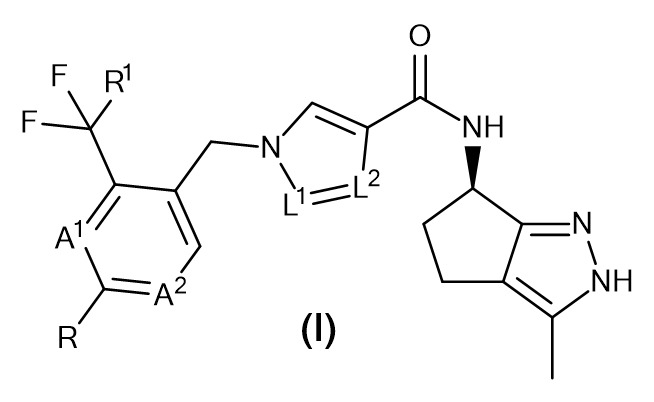

在第二態樣中,本發明係關於一種醫藥組合物,其包含一或多種如上文或下文所定義的式(I)化合物、及/或其互變異構體或其醫藥上可接受之鹽,視需要連同一或多種惰性載劑及/或稀釋劑。In a second aspect, the present invention relates to a pharmaceutical composition comprising one or more compounds of formula (I) as defined above or below, and/or tautomers or pharmaceutically acceptable salts thereof , optionally together with one or more inert carriers and/or diluents.
在第三態樣中,本發明係關於一種醫藥組合物,其包含一或多種如上文或下文所定義的式(I)化合物、及/或其互變異構體或其醫藥上可接受之鹽、及一或多種另外治療劑,視需要連同一或多種惰性載劑及/或稀釋劑。In a third aspect, the present invention relates to a pharmaceutical composition comprising one or more compounds of formula (I) as defined above or below, and/or tautomers or pharmaceutically acceptable salts thereof , and one or more additional therapeutic agents, optionally together with one or more inert carriers and/or diluents.
在第四態樣中,本發明係關於如上文或下文所定義的式(I)化合物、及/或其互變異構體或其醫藥上可接受之鹽,其用作藥物。In a fourth aspect, the present invention relates to a compound of formula (I) as defined above or below, and/or a tautomer or a pharmaceutically acceptable salt thereof, for use as a medicament.
在第五態樣中,本發明係關於一種用於有需要的患者之可受抑制血漿激肽釋放酶所影響之疾病或病狀之治療(亦即療法)及/或預防之方法,該方法包括對患者投與一或多種如上文或下文所定義的式(I)化合物及/或其互變異構體或其醫藥上可接受之鹽。In a fifth aspect, the present invention relates to a method for the treatment (ie therapy) and/or prevention of a disease or condition affected by inhibition of plasma kallikrein in a patient in need thereof, the method This includes administering to a patient one or more compounds of formula (I) as defined above or below and/or tautomers or pharmaceutically acceptable salts thereof.
另外,本發明係關於一種一或多種如上文或下文所定義的式(I)化合物及/或其互變異構體或其醫藥上可接受之鹽於製造用於可受抑制血漿激肽釋放酶所影響之疾病或病狀之治療(亦即療法)及/或預防之藥物之用途。Furthermore, the present invention relates to one or more compounds of formula (I) as defined above or below and/or tautomers or pharmaceutically acceptable salts thereof for the manufacture of inhibitable plasma kallikrein The use of drugs for the treatment (ie therapy) and/or prevention of the disease or condition affected.
此外,本發明係關於如上文或下文所定義的式(I)化合物及/或其互變異構體或其醫藥上可接受之鹽,其用於有需要的患者中之可受抑制血漿激肽釋放酶所影響之疾病或病狀之治療(亦即療法)及/或預防之方法。Furthermore, the present invention relates to a compound of formula (I) as defined above or below and/or a tautomer or a pharmaceutically acceptable salt thereof for use in inhibitable plasma kinin in a patient in need thereof A method of treatment (ie therapy) and/or prevention of a disease or condition affected by the release enzyme.
熟習此項技術者將直接自前述及以下描述及實例明瞭本發明之其他態樣。 一般術語及定義Other aspects of the invention will be apparent to those skilled in the art directly from the foregoing and following descriptions and examples. General terms and definitions
本文未具體定義的術語應由熟習此項技術者根據本發明及上下文提供給其之含義。然而,如本說明書所用,除非另有相反指明,否則以下術語具有所指示的含義且遵守以下約定。Terms not specifically defined herein are to be given the meanings given to them by those skilled in the art in light of the invention and context. However, as used in this specification, unless otherwise indicated to the contrary, the following terms have the meanings indicated and the following conventions are followed.
術語「根據本發明之化合物」、「式(I)化合物」、「本發明化合物」及類似者表示根據本發明之式(I)化合物,包括其互變異構體、立體異構體及其混合物及其鹽,特別是其醫藥上可接受之鹽,及此類化合物之溶劑合物、水合物及共晶體,特別是其醫藥上可接受之共晶體,包括此類互變異構體、立體異構體及其鹽之溶劑合物、水合物及共晶體。The terms "compounds according to the invention", "compounds of formula (I)", "compounds of the invention" and the like refer to compounds of formula (I) according to the invention, including tautomers, stereoisomers and mixtures thereof and their salts, especially their pharmaceutically acceptable salts, and solvates, hydrates and co-crystals of such compounds, especially their pharmaceutically acceptable co-crystals, including such tautomers, stereoisomers Solvates, hydrates and co-crystals of the structure and its salts.
再者,除非具體指示,否則在本說明書及隨附申請專利範圍中,給定的化學式或名稱應涵蓋互變異構體及所有立體、光學及幾何異構體(例如對映異構體、非對映異構體、E/Z異構體等)及其外消旋異構體以及不同比例之單獨對映異構體之混合物、非對映異構體之混合物、或任何前述形式之混合物(其中存在此類異構體及對映異構體)、以及鹽(包括其醫藥上可接受之鹽)、及其溶劑合物(諸如例如水合物,包括游離化合物之溶劑合物或化合物之鹽之溶劑合物)、及其共晶體(包括其醫藥上可接受之共晶體及游離化合物或其鹽之共晶體)。Furthermore, unless specifically indicated otherwise, within the scope of this specification and the appended claims, a given chemical formula or name shall encompass tautomers and all stereo, optical and geometric isomers (e.g. enantiomers, non- enantiomers, E/Z isomers, etc.) and their racemic isomers, as well as mixtures of individual enantiomers in different proportions, mixtures of diastereomers, or mixtures of any of the foregoing forms (wherein such isomers and enantiomers exist), as well as salts (including pharmaceutically acceptable salts thereof), and solvates thereof (such as, for example, hydrates, including solvates of free compounds or of compounds solvates of salts), and co-crystals thereof (including pharmaceutically acceptable co-crystals thereof and co-crystals of free compounds or salts thereof).
片語「醫藥上可接受」在本文中用於指在合理醫學判斷範圍內適用於與人類及動物之組織接觸而無過度毒性、刺激、過敏反應或其他問題或併發症且符合合理效益/風險比之其等化合物、物質、組合物及/或劑型。The phrase "pharmaceutically acceptable" is used herein to mean that, within the scope of sound medical judgment, it is suitable for use in contact with human and animal tissue without undue toxicity, irritation, allergic reactions or other problems or complications and with reasonable benefit/risk than its equivalent compounds, substances, compositions and/or dosage forms.
如本文所用,「醫藥上可接受之鹽」係指所揭示的化合物之衍生物,其中該親本化合物係藉由製備其酸或鹼鹽經修飾。醫藥上可接受之鹽之實例包括但不限於鹼性殘基(諸如胺)之無機酸或有機酸鹽;酸性殘基(諸如羧酸)之鹼性或有機鹽;及類似者。As used herein, "pharmaceutically acceptable salts" refer to derivatives of the disclosed compounds, wherein the parent compound is modified by making acid or base salts thereof. Examples of pharmaceutically acceptable salts include, but are not limited to, mineral or organic acid salts of basic residues such as amines; basic or organic salts of acidic residues such as carboxylic acids; and the like.
例如,此類鹽包括來自苯磺酸、苯甲酸、檸檬酸、乙磺酸、富馬酸、龍膽酸、氫溴酸、鹽酸、馬來酸、蘋果酸、丙二酸、扁桃酸、甲磺酸、4-甲基苯磺酸、磷酸、水楊酸、琥珀酸、硫酸及酒石酸之鹽。For example, such salts include those derived from benzenesulfonic acid, benzoic acid, citric acid, ethanesulfonic acid, fumaric acid, gentisic acid, hydrobromic acid, hydrochloric acid, maleic acid, malic acid, malonic acid, mandelic acid, methyl alcohol Salts of sulfonic acid, 4-methylbenzenesulfonic acid, phosphoric acid, salicylic acid, succinic acid, sulfuric acid and tartaric acid.
本發明之醫藥上可接受之鹽可藉由習知化學方法自包含鹼性或酸性部分之親本化合物合成。一般而言,此類鹽可藉由使此等化合物之游離酸或鹼形式與足量適宜鹼或酸在水中或在有機稀釋劑(像醚、EtOAc、EtOH、異丙醇或MeCN、或其混合物)中反應來製備。The pharmaceutically acceptable salts of the present invention can be synthesized from the parent compound containing a basic or acidic moiety by conventional chemical methods. In general, such salts can be prepared by combining the free acid or base form of these compounds with a sufficient amount of a suitable base or acid in water or in an organic diluent such as ether, EtOAc, EtOH, isopropanol or MeCN, or mixture) to prepare.
除彼等以上所提及者以外的例如可用於純化或分離本發明化合物之其他酸之鹽(例如三氟乙酸鹽)亦構成本發明之一部分。Salts of other acids than those mentioned above, such as those useful in the purification or isolation of the compounds of the invention, such as trifluoroacetic acid salts, also form part of the invention.
如本文所用,「醫藥上可接受之共晶體」係指所揭示的化合物之衍生物,其中該親本化合物係藉由藉助於一或多種共形成劑製備其共晶體經修飾。再者,涵蓋所揭示的化合物之溶劑合物及/或鹽之共晶體。As used herein, "pharmaceutically acceptable co-crystals" refer to derivatives of the disclosed compounds wherein the parent compound is modified by preparing a co-crystal thereof with the aid of one or more co-formers. Furthermore, co-crystals of solvates and/or salts of the disclosed compounds are encompassed.
例如,共形成劑包括氫鍵供體(諸如羧酸)及氫鍵受體(諸如胺及醯胺)。For example, co-formers include hydrogen bond donors such as carboxylic acids and hydrogen bond acceptors such as amines and amides.
可自親本化合物藉由熟習此項技術者已知的方法,包括基於固體之方法,諸如固態研磨、熔融擠出及熔融結晶、及基於液體之方法,諸如溶液結晶、溶劑蒸發、冷卻結晶、超臨界流體輔助結晶、超音波輔助結晶、噴霧乾燥、液體輔助研磨及行星式滾軋(planetary milling)來合成本發明之醫藥上可接受之共晶體。The parent compound can be prepared from the parent compound by methods known to those skilled in the art, including solid-based methods such as solid state milling, melt extrusion and melt crystallization, and liquid-based methods such as solution crystallization, solvent evaporation, cooling crystallization, Supercritical fluid assisted crystallization, ultrasonic assisted crystallization, spray drying, liquid assisted milling and planetary milling are used to synthesize the pharmaceutically acceptable co-crystals of the present invention.
假若本發明化合物以化學名稱之形式及呈式子描繪,則在存在任何差異之情況下應以式子為準。If the compounds of the present invention are depicted by chemical names and by formulas, in the event of any discrepancies, the formulas shall control.
在以下所定義的基團(group)、基團(radical)或部分中,經常在基團之前指定碳原子數,例如C1-6 -烷基意指具有1至6個碳原子之烷基基團(group/radical)。In a group, radical or moiety as defined below, the number of carbon atoms is often specified before the group, eg C1-6 -alkyl means an alkyl group having 1 to 6 carbon atoms group/radical.
可在子式中使用星號以指示連接至如所定義的核心分子之鍵。就子式中之超過一個連接點,亦即超過一個星號而言,星號可進一步由核心分子之所連接部分之帶括號標識指定。Asterisks may be used in subformulae to indicate bonds to the core molecule as defined. For more than one point of attachment in a subformula, ie, more than one asterisk, the asterisk may be further specified by a bracketed designation of the linked portion of the core molecule.
取代基之原子數以最接近核心或該取代基所連接的基團之原子開始。The atomic number of a substituent begins with the atom closest to the core or group to which the substituent is attached.
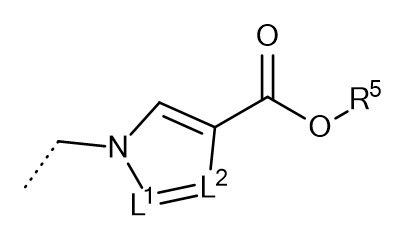
例如,術語「3-羧基丙基基團」表示以下取代基: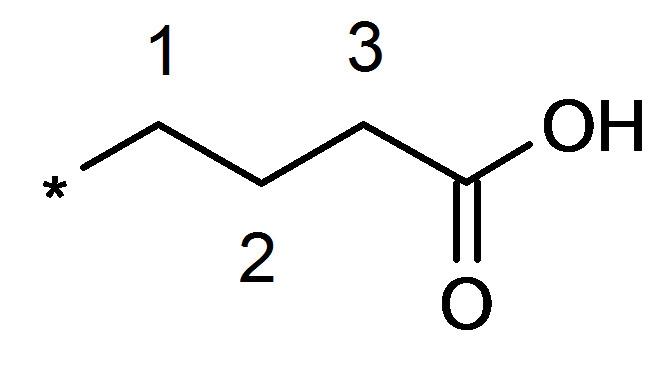
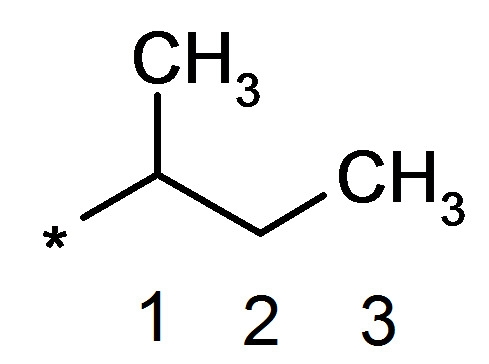
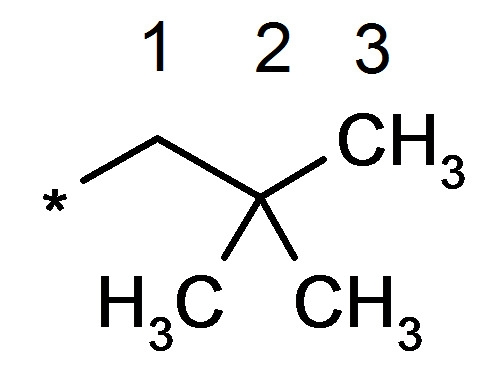
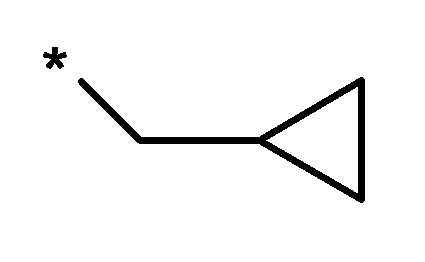
單獨或與另一基團組合之術語「C1-n -烷基」 (其中n為1至n之整數)表示具有1至n個C原子之非環狀、飽和、分支鏈或直鏈烴基團。例如,術語C1-5 -烷基包括基團H3 C-、H3 C-CH2 -、H3 C-CH2 -CH2 -、H3 C-CH(CH3 )-、H3 C-CH2 -CH2 -CH2 -、H3 C-CH2 -CH(CH3 )-、H3 C-CH(CH3 )-CH2 -、H3 C-C(CH3 )2 -、H3 C-CH2 -CH2 -CH2 -CH2 -、H3 C-CH2 -CH2 -CH(CH3 )-、H3 C-CH2 -CH(CH3 )-CH2 -、H3 C-CH(CH3 )-CH2 -CH2 -、H3 C-CH2 -C(CH3 )2 -、H3 C-C(CH3 )2 -CH2 -、H3 C-CH(CH3 )-CH(CH3 )-及H3 C-CH2 -CH(CH2 CH3 )-。 The term "Ci-n -alkyl" (wherein n is an integer from 1 to n), alone or in combination with another group, denotes an acyclic, saturated, branched or straight chain hydrocarbon group having 1 to n C atoms group. For example, the term C 1-5 - alkyl group comprising H 3 C-, H 3 C- CH 2 -, H 3 C-CH 2 -CH 2 -, H 3 C-CH (CH 3) -, H 3 C-CH 2 -CH 2 -CH 2 -, H 3 C-CH 2 -CH(CH 3 )-, H 3 C-CH(CH 3 )-CH 2 -, H 3 CC(CH 3 ) 2 -, H 3 C-CH 2 -CH 2 -CH 2 -CH 2 -, H 3 C-CH 2 -CH 2 -CH(CH 3 )-, H 3 C-CH 2 -CH(CH 3 )-CH 2 - , H 3 C-CH(CH 3 )-CH 2 -CH 2 -, H 3 C-CH 2 -C(CH 3 ) 2 -, H 3 CC(CH 3 ) 2 -CH 2 -, H 3 C- CH (CH 3) -CH (CH 3) - , and H 3 C-CH 2 -CH ( CH 2 CH 3) -.
術語「治療(treatment/treating)」如本文所用既包括治療性,亦即治癒性及/或姑息性又包括預防性,亦即預防性治療。The term "treatment/treating" as used herein includes both therapeutic, ie, curative and/or palliative, and prophylactic, ie, prophylactic treatment.
治療性治療係指已經發展出明顯、急性或慢性形式之一或多種該等病狀之患者的治療。治療性治療可為對症治療以便減輕特定適應症之症狀或為因果治療以便逆轉或部分逆轉適應症之病狀症狀或停止或減慢疾病之進展。Therapeutic treatment refers to the treatment of patients who have developed overt, acute or chronic forms of one or more of these conditions. Therapeutic treatment can be symptomatic treatment to relieve symptoms of a particular indication or causal treatment to reverse or partially reverse the symptoms of an indication or halt or slow the progression of the disease.
預防性治療(「預防」)係指在疾病之臨床發作之前治療處在發展出一或多種該等病狀風險中之患者以便降低該風險。Prophylactic treatment ("prevention") refers to the treatment of patients at risk of developing one or more of these conditions prior to the clinical onset of the disease in order to reduce that risk.
術語「治療(treatment/treating)」包括投與一或多種活性化合物以便預防或延遲症狀或併發症之發作及預防或延遲發展出疾病、病狀或病症及/或以便消除或控制疾病、病狀或病症以及減輕與疾病、病狀或病症相關之症狀或併發症。The term "treatment/treating" includes the administration of one or more active compounds in order to prevent or delay the onset of symptoms or complications and to prevent or delay the development of a disease, condition or disorder and/or to eliminate or control a disease, condition or condition and alleviation of symptoms or complications associated with the disease, condition or condition.
當本發明提及需要治療的患者時,本發明主要係關於哺乳動物(特別是人類)之治療。When the present invention refers to a patient in need of treatment, the present invention is primarily concerned with the treatment of mammals, particularly humans.
術語「治療有效量」意指(i)治療或預防特定疾病或病狀,(ii)減輕、改善或消除特定疾病或病狀之一或多種症狀,或(iii)預防或延遲本文所述之特定疾病或病狀之一或多種症狀之發作之本發明化合物之量。The term "therapeutically effective amount" means (i) treating or preventing a specified disease or condition, (ii) alleviating, ameliorating or eliminating one or more symptoms of a specified disease or condition, or (iii) preventing or delaying the described herein The amount of a compound of the invention for the onset of one or more symptoms of a particular disease or condition.
本發明揭示新穎雜芳族甲醯胺衍生物,其為有效血漿激肽釋放酶(PKK)抑制劑且具有適宜藥理及藥物動力學性質以將其用作用於治療可受PKK抑制影響之疾病及/或病狀之藥物,該等疾病及/或病狀包括但不限於糖尿病性併發症、眼病及水腫相關疾病,特別是糖尿病性黃斑水腫、年齡相關黃斑變性、脈絡膜新血管生成、遺傳性血管水腫及中風後腦水腫。The present invention discloses novel heteroaromatic formamide derivatives which are potent plasma kallikrein (PKK) inhibitors and possess suitable pharmacological and pharmacokinetic properties for their use in the treatment of diseases that can be affected by PKK inhibition and Medicines for conditions and/or conditions including, but not limited to, diabetic complications, eye diseases and edema-related diseases, especially diabetic macular edema, age-related macular degeneration, choroidal neovascularization, hereditary blood vessels Edema and post-stroke brain edema.
本發明化合物可提供幾個優點,諸如增強之效價、高代謝及/或化學穩定性、高選擇性、安全性及耐受性、增強之溶解度、增強之滲透性、期望之血漿蛋白結合、增強之生物利用度、改良之藥物動力學性質及形成穩定鹽之可能性。本發明化合物 The compounds of the present invention may provide several advantages such as enhanced potency, high metabolic and/or chemical stability, high selectivity, safety and tolerability, enhanced solubility, enhanced permeability, desirable plasma protein binding, Enhanced bioavailability, improved pharmacokinetic properties and the potential to form stable salts. Compounds of the present invention
在本發明之第一態樣中,發現式(I)化合物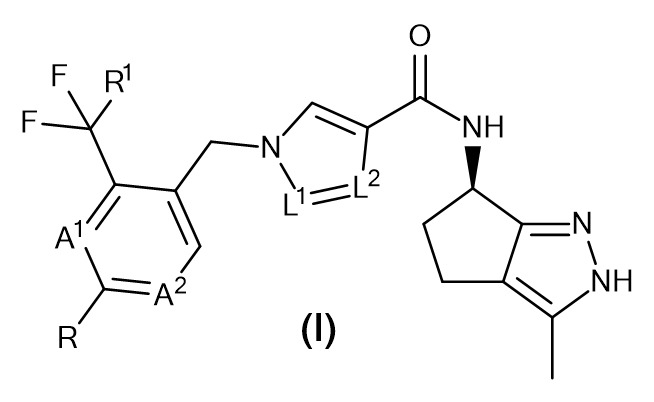
因此,預期如上文或下文所定義的式(I)化合物或其醫藥上可接受之鹽可用於治療可受PKK抑制影響之疾病及/或病狀。Accordingly, it is contemplated that a compound of formula (I), or a pharmaceutically acceptable salt thereof, as defined above or below, is useful in the treatment of diseases and/or conditions that may be affected by PKK inhibition.
因此,根據本發明之一個態樣,提供式(I)化合物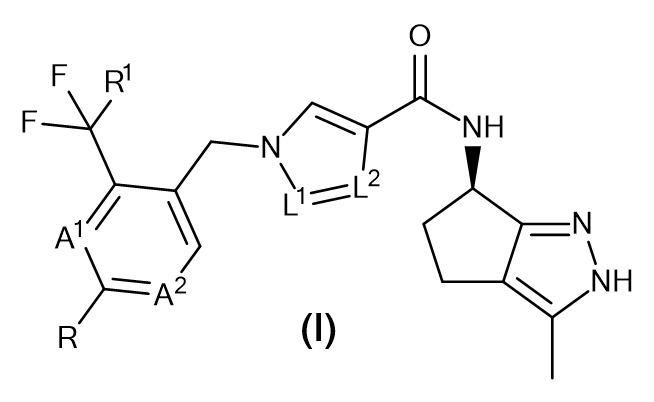
除非另有說明,否則基團(group)、基團(residue)及取代基,特別是R、R1 、A1 、A2 、L1 及L2 係如上文或下文所定義。將於下文給出式(I)之取代基R、R1 、A1 、A2 、L1 及L2 之較佳含義作為本發明之實施例。此等定義及實施例中之任何一者可彼此組合。R : Unless otherwise indicated, a group (Group), a group (Residue) and substituents, particularly R, R 1, A 1, A 2, L 1 and L 2 defined above or below based. Preferred meanings of the substituents R, R 1 , A 1 , A 2 , L 1 and L 2 of formula (I) will be given below as examples of the present invention. Any of these definitions and embodiments may be combined with each other. R :
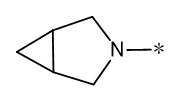
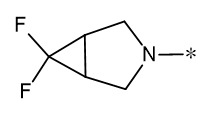
根據一個實施例,R係選自由
根據另一個實施例,R係選自由
根據另一個實施例,R係選自由
根據另一個實施例,R係選自由
根據一個實施例,R1 係選自由H及F組成之基團R1 -G1。According to one embodiment, R 1 is selected from the group R 1 -G1 consisting of H and F.
根據另一個實施例,R1 係選自由H組成之基團R1 -G2。According to another embodiment, R 1 is selected from the group consisting of H, R 1 -G2.
根據另一個實施例,R1 係選自由F組成之基團R1 -G3。A1 、 A2 : According to another embodiment, R 1 is selected from the group R 1 -G3 consisting of F. A 1, A 2:
根據一個實施例,部分=A1 -CR=A2 -係選自由=N-CR=N-、=N-CR=CH-及=CH-CR=N-組成之基團A-G1。According to one embodiment, the moiety =A 1 -CR=A 2 - is selected from the group A-G1 consisting of =N-CR=N-, =N-CR=CH- and =CH-CR=N-.
根據另一個實施例,部分=A1 -CR=A2 -係選自由=N-CR=N-組成之基團A-G2。According to another embodiment, the moiety =A 1 -CR=A 2 - is selected from the group A-G2 consisting of =N-CR=N-.
根據另一個實施例,部分=A1 -CR=A2 -係選自由=N-CR=CH-組成之基團A-G3。According to another embodiment, the moiety =A 1 -CR=A 2 - is selected from the groups A-G3 consisting of =N-CR=CH-.
根據另一個實施例,部分=A1 -CR=A2 -係選自由=CH-CR=N-組成之基團A-G4。According to another embodiment, the moiety =A 1 -CR=A 2 - is selected from the groups A-G4 consisting of =CH-CR=N-.
對於部分=A1 -CR=A2 -之以上定義,3個次單元之順序表示該部分之定向,亦即例如在基團A-G3中,A1 為N及A2 為CH。L1 、 L2 : For some = A 1 -CR = A 2 - of as defined above, units of three sequential views showing the orientation of the part, i.e. for example the group A-G3, A 1 is N and A 2 is CH. L 1 , L 2 :
根據一個實施例,-L1 =L2 -係選自由-N=N-、-N=CH-及-CH=N-組成之基團L-G1。According to one embodiment, -L 1 =L 2 - is selected from the group L-G1 consisting of -N=N-, -N=CH- and -CH=N-.
根據另一個實施例,-L1 =L2 -係選自由-N=N-組成之基團L-G2。According to another embodiment, -L 1 =L 2 - is selected from the group L-G2 consisting of -N=N-.
根據另一個實施例,-L1 =L2 -係選自由-N=CH-組成之基團L-G3。According to another embodiment, -L 1 =L 2 - is selected from the group L-G3 consisting of -N=CH-.
根據另一個實施例,-L1 =L2 -係選自由-CH=N-組成之基團L-G4。According to another embodiment, -L 1 =L 2 - is selected from the group L-G4 consisting of -CH=N-.
對於部分-L1 =L2 -之以上定義,2個次單元之順序表示部分之定向,亦即例如在基團L-G3中,L1 為N及L2 為CH。For the above definition of moiety -L 1 =L 2 -, the order of the 2 subunits indicates the orientation of the moiety, ie for example in a group L-G3 L 1 is N and L 2 is CH.
式(I)化合物之更佳亞類實施例經闡述為下表1中之實施例(I-a)至(I-u),其中使用該等以上提及的取代基定義。例如,列R及行(I-a)中之項–G1意指在實施例(I-a)中,取代基R係選自指定為R-G1之定義。其類似地應用於併入通式中之其他變量。表 1 :
特佳化合物,包括其互變異構體、其鹽或其任何溶劑合物或水合物為以下: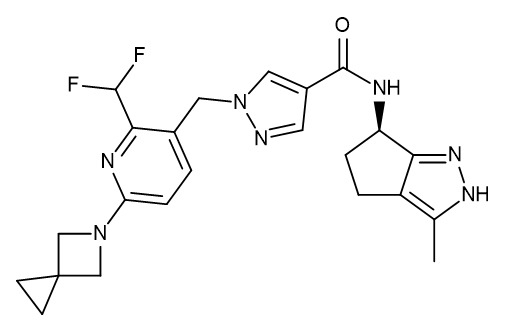
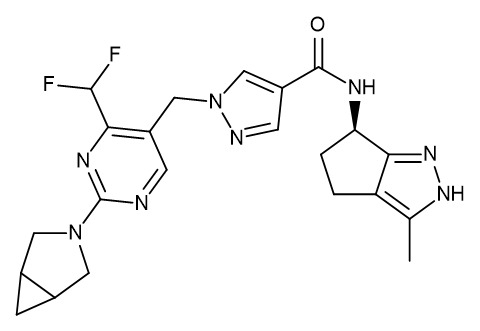
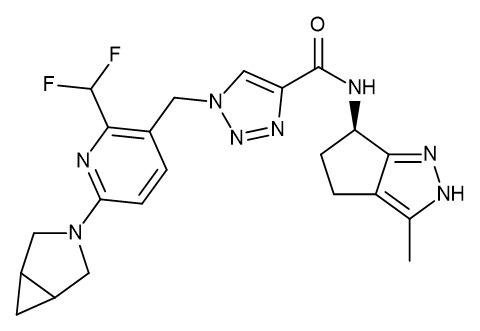
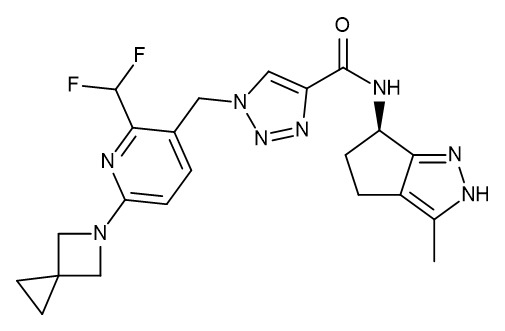

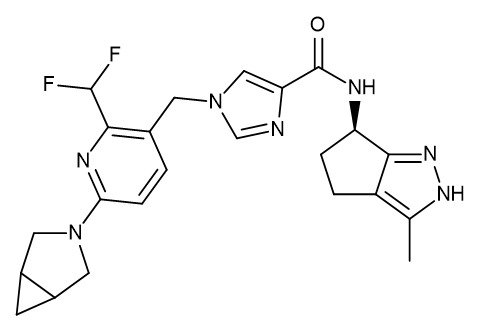

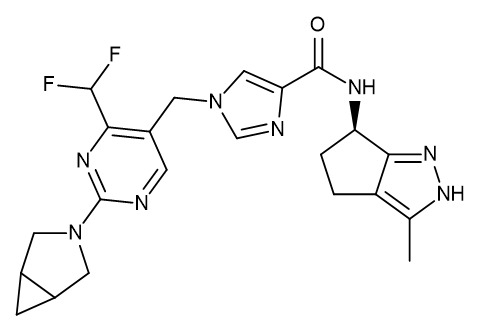
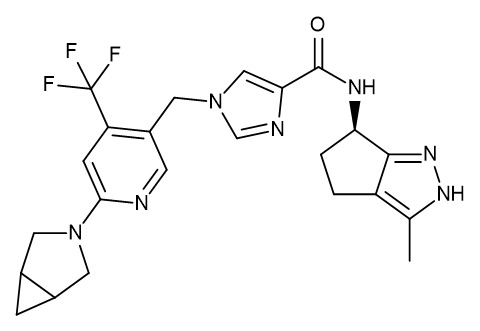
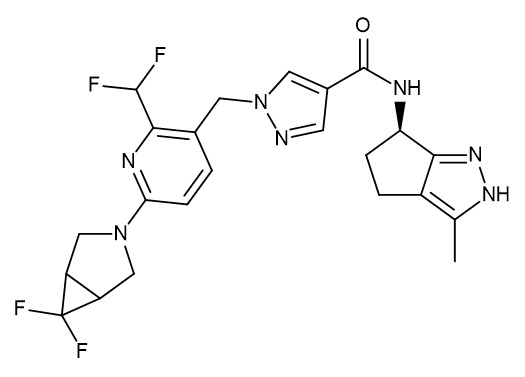
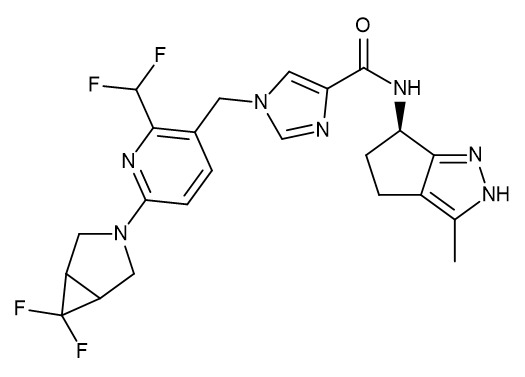

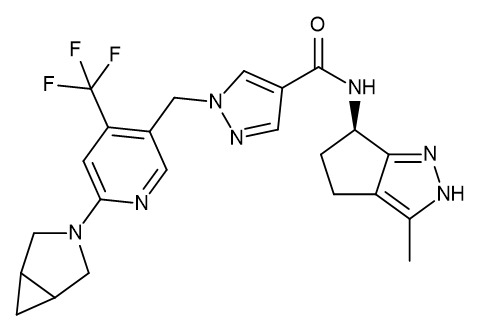
根據本發明之化合物及其中間物可使用熟習此項技術者已知且描述於有機合成文獻中之合成方法,例如使用描述於「Comprehensive Organic Transformations」,第2版,Richard C. Larock,John Wiley & Sons,2010、及「March’s Advanced Organic Chemistry」,第7版,Michael B. Smith,John Wiley & Sons,2013中之方法來獲得。較佳地,該等化合物係類似於下文更充分解釋的製備方法(特別是如實驗部分中所述)來獲得。在一些情況下,可改變實施反應圖所採用的順序。亦可使用熟練技術者已知但在此未詳細描述之此等反應之變化。熟練技術者在研究隨後的反應圖時將明瞭用於製備根據本發明之化合物之一般製程。起始化合物可商業購得或可藉由描述於文獻或本文中之方法來製備,或可以類似或相似方式來製備。在進行反應之前,可使用習知保護基保護起始化合物中之任何相應官能基。可使用熟練技術者熟悉且描述於文獻中,例如描述於「Protecting Groups」,第3版,Philip J. Kocienski,Thieme,2005、及「Protective Groups in Organic Synthesis」,第4版,Peter G. M. Wuts、Theodora W. Greene、John Wiley & Sons,2006中之方法在反應順序內的適宜階段再次裂解此等保護基。反應圖 1 : 
反應圖 1 :
式(I’)化合物可藉由使式(II)之適宜酸 (呈游離酸或與適宜金屬陽離子(諸如Li+
、Na+
、K+
等)之羧酸鹽)及式(III)之適宜胺(呈游離胺或鹽(諸如鹽酸鹽、氫溴酸鹽等))在適宜溶劑(例如DCM、THF、1,4-二噁烷、DMF、N,N-二甲基乙醯胺及1-甲基-2-吡咯啶酮)中於存在適宜偶聯劑(例如六氟磷酸O-(7-氮雜苯并三唑-1-基)-N,N,N’,N’-四甲基脲鎓(HATU)、四氟硼酸O-(苯并三唑-1-基)-N,N,N’,N’-四甲基脲鎓(TBTU)、六氟磷酸(苯并三唑-1-基氧基)三吡咯啶鏻(PyBOP)、碳二亞胺試劑等)及鹼(例如三乙胺、N,N-二異丙基乙胺、吡啶等)下反應形成醯胺鍵來製備;反應圖1中之R、R1
、A1
、A2
、L1
及L2
具有如上文所定義的含義。或者,將羧酸轉化為羧酸醯氯(carboxylic chloride) (使用例如在DCM中之草醯氯或亞硫醯氯)且如此與胺(III)在適宜鹼(例如三乙胺、N,N-二異丙基乙胺、吡啶等)的存在下偶聯。假若採用在吡唑環上具有保護基(PG不為H)之胺(III),則隨後藉由有機化學文獻中報導的標準程序將此基團裂解除去。2-三甲基矽基乙基氧基甲基及第三丁酯較佳在酸性條件下用例如TFA或鹽酸在溶劑(諸如DCM、1,4-二噁烷、異丙醇或EtOAc)中來裂解。2-三甲基矽基乙基氧基甲基亦可藉由在適合溶劑(諸如THF)中使用氟化物源(例如 n
Bu4
NF)來移除。苄基氧基甲基基團可藉由使用氫氣在過渡金屬(諸如碳載鈀)的存在下來移除。苯環上具有供電子基團(諸如甲氧基)之苄基氧基甲基基團亦可在氧化條件(利用例如硝酸鈰銨(CAN)或2,3-二氯-5,6-二氰基醌(DDQ))或酸性條件(利用例如TFA或鹽酸)下來裂解。反應圖 2 : 
反應圖 2 :
式(II)之酸(其中反應圖2中之R、R1
、A1
、A2
、L1
及L2
具有如上文所定義的含義)較佳自相應酯(IV)透過水解或氫解(取決於R5
之性質)來製備。低碳數烷基酯(諸如乙酯或甲酯)較佳在環境溫度或升高之溫度下藉由用氫氧化物鹽(諸如NaOH、LiOH或KOH)在水及適宜可混溶溶劑(例如THF、MeOH、EtOH、1,4-二噁烷或此等之混合物)之混合物中水解來裂解。該酸可呈與金屬陽離子之鹽或呈游離酸分離。第三丁酯較佳藉由在適宜溶劑(例如DCM、1,4-二噁烷、MeOH、EtOH、THF、水或此等之混合物)中用酸(例如鹽酸或TFA)處理來裂解。苄酯較佳藉由在氫氣氣氛(較佳1至5巴)下用適宜觸媒(例如碳載鈀)在適宜溶劑(例如EtOH、MeOH、THF、DCM或EtOAc)中氫解來裂解。反應圖 3 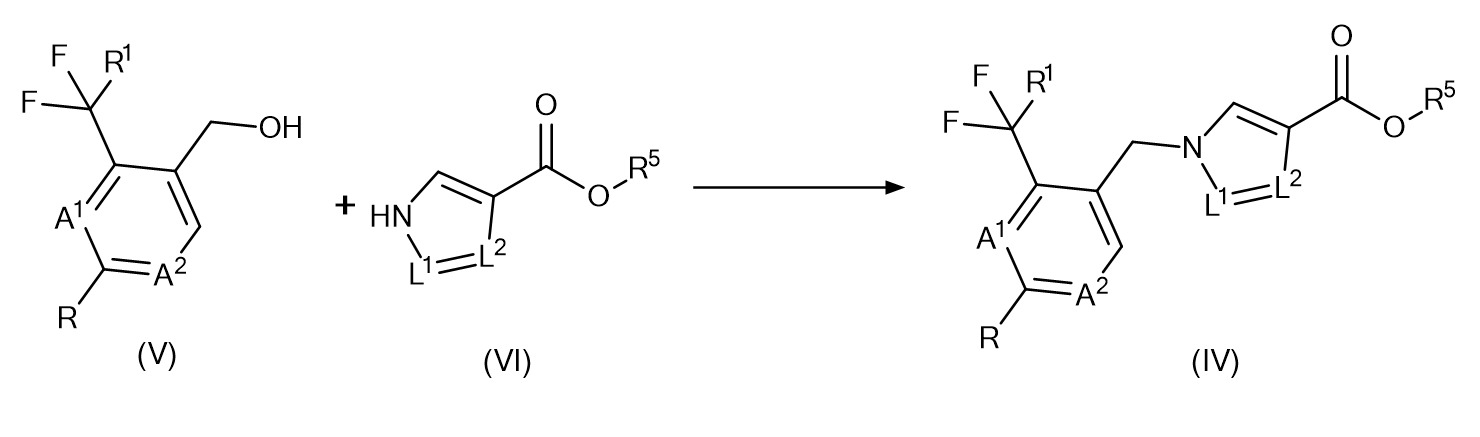
反應圖 3
:一些化合物(IV)可藉由使醇(V)與酯(VI)採用光延反應條件(例如三苯基膦或三正丁基膦與例如偶氮二甲酸二乙酯(DEAD)、偶氮二甲酸二異丙酯(DIAD)或偶氮二甲酸二第三丁酯(DBAD)之組合在溶劑(諸如THF、1,4-二噁烷、甲苯等)中)反應來製備;反應圖3中之R、R1
、A1
、A2
、L1
及L2
具有如上文所定義的含義。醇(V)可在雜芳族環或離去基上具有所需基團R而不是稍後引入R。或者,一些化合物(IV)可藉由在升高之溫度(20至120℃)下使醇(V)與酯(VI)在路易斯酸(Lewis acid)或布朗斯特酸(Brønsted acid) (例如4-甲苯磺酸)的存在下在適合溶劑(例如MeCN)中反應來獲得。反應圖 4 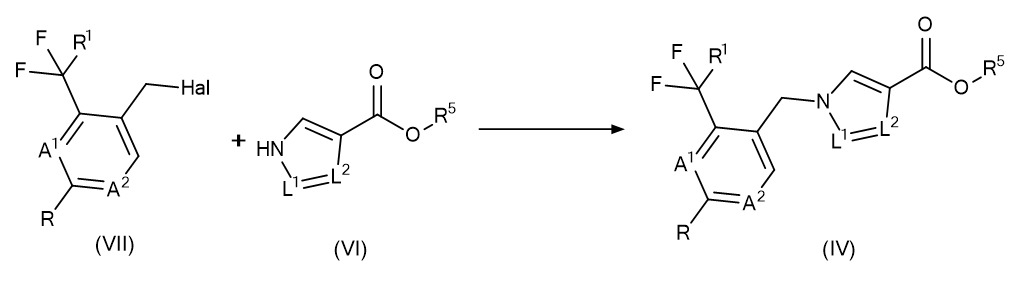
反應圖 4
:一些化合物(IV)亦可藉由使在雜芳基甲基位置具有離去基(諸如Cl、Br或甲磺醯氧基(mesyloxy) (甲磺醯基氧基))之化合物(VII)與酯(VI)在適宜鹼(例如氫化鈉、碳酸銫、碳酸鉀或三乙胺)的存在下在適宜溶劑(例如THF、DMF)中反應來製備;反應圖4中之R、R1
、A1
、A2
、L1
及L2
具有如上文所定義的含義。化合物(VII)可在雜芳族環或可置換基團上具有所需基團R而不是稍後引入R。反應圖 5 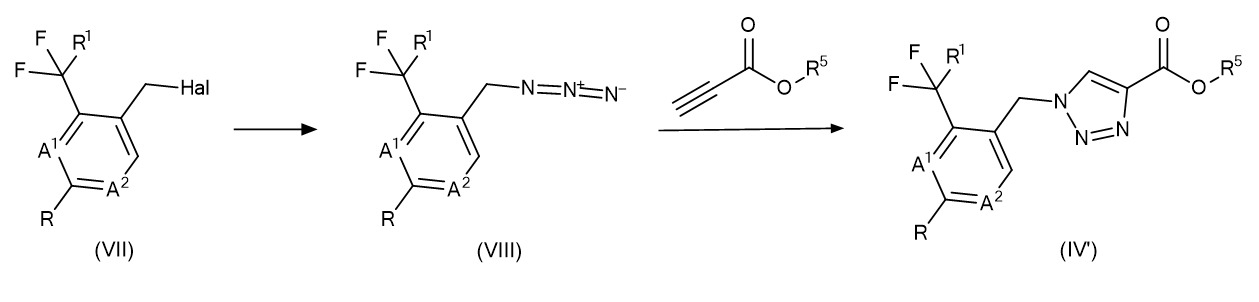
反應圖 5 :
一些式(IV’)酯(其中反應圖5中之R、R1
、A1
及A2
具有上文定義的含義)可藉由在DMF或另一適宜溶劑中用疊氮化鈉處理相應式(VII)之烷基鹵(溴化物或氯化物)或磺酸鹽(例如甲磺酸鹽)以得到式(VIII)之中間物然後使其與適宜丙酸酯在銅介導之條件(例如丙酸乙酯或丙酸第三丁酯與催化硫酸銅及抗壞血酸鈉在水/第三丁醇中)下反應以得到化合物(IV’)來製備。或者,疊氮化物(VIII)可自式(V) (或(VII),其中Hal為OH)之醇藉由在適宜鹼(諸如DBU)的存在下在適宜溶劑(例如THF或DMF)中用二苯基磷醯疊氮處理來獲得。化合物(VII)可在雜芳族環或離去基上具有所需基團R而不是稍後引入R。反應圖 6 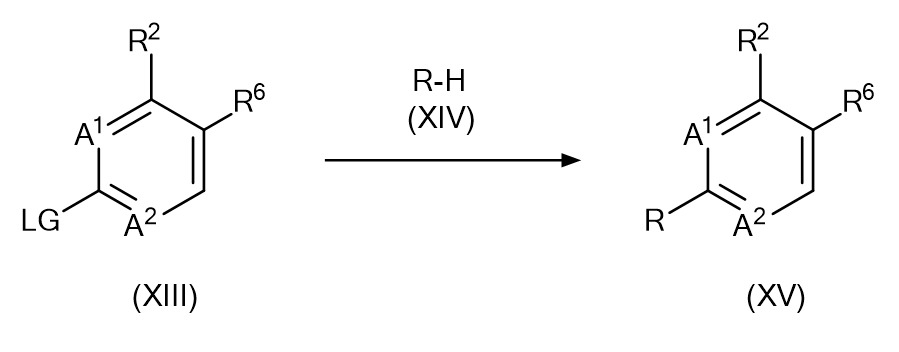
反應圖 6 :
式(XV)之中間物可自芳族化合物(XIII)及胺(XIV)經由雜芳環上之親核取代反應或過渡金屬催化偶聯反應來製備;反應圖6中之A1
、A2
及R具有上文定義的含義。(XIII)中雜芳族環上之離去基經化合物(XIV)中之N親核取代可在環境溫度或升高之溫度下在適宜鹼(例如氫化鈉、碳酸銫、碳酸鉀、N,N-二異丙基乙胺)的存在下在適宜溶劑(例如THF、1,4-二噁烷、DMF、DMSO)中進行。過渡金屬催化偶聯反應較佳地,用化合物(XIII)之氯化物、溴化物或碘化物以類似於有機化學文獻中報導的稱為烏爾曼或布赫瓦爾德/哈特維希偶聯反應之程序,使用適宜銅或鈀鹽或其複合物視需要與另外配位體組合在鹼的存在下且在適合溶劑中來進行。反應圖 7 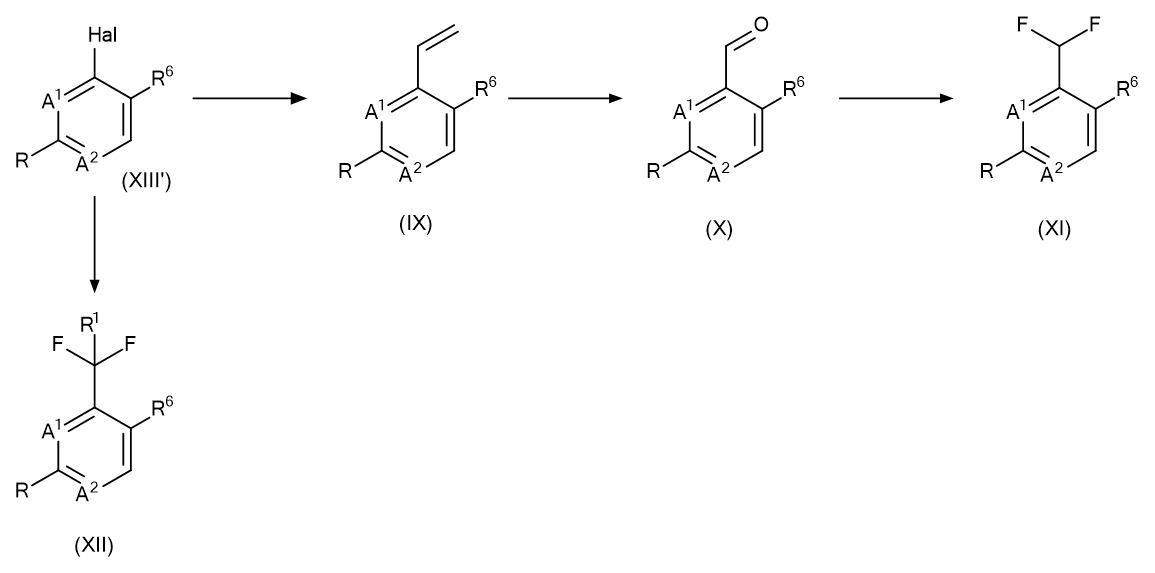

反應圖 7 : 式(XII)之中間物可自化合物(XIII’)經由與適合二氟甲基或三氟甲基親核劑或其前驅物之過渡金屬催化偶聯反應來獲得;反應圖7中之R、R1 、A1 、A2 、L1 及L2 具有上文定義的含義。將二氟甲基三甲基矽烷或三氟甲基三甲基矽烷作為各自的親核劑前驅物在環境溫度或升高之溫度(20至150℃)下與銅鹽(例如CuI)及鹼(例如CsF或KF)在適合溶劑(例如NMP或DMF)中組合,可提供式(XII)化合物。可同樣在所報導的條件(例如在DMF中,在80至100℃下;參見例如Org. Lett. 2014,16,1744−1747)下使用已經併入諸如在F3 CCu(phen) (phen = 菲咯啉)中之觸媒之較佳親核劑而提供化合物(XII)。 Scheme 7: formula (XII) may be from the intermediate compound (XIII ') via a suitable difluoromethyl or trifluoromethyl nucleophilic agent or a transition metal catalyzed coupling reactions to obtain the precursor; Scheme 7 wherein R, R 1 , A 1 , A 2 , L 1 and L 2 have the meanings defined above. Difluoromethyltrimethylsilane or trifluoromethyltrimethylsilane as respective nucleophile precursors were combined with copper salts (eg CuI) and bases at ambient or elevated temperature (20 to 150°C) (eg CsF or KF) in a suitable solvent (eg NMP or DMF) can provide compounds of formula (XII). Can also be used under reported conditions (e.g. in DMF at 80 to 100°C; see e.g. Org. Lett. 2014, 16, 1744-1747) that have incorporated such as in F 3 CCu(phen) (phen = The preferred nucleophile for the catalyst in phenanthroline) provides compound (XII).
化合物(XI)亦可自鹵化物(XIII’)經由三步驟合成順序來獲得。因此,將鹵化物(XIII’)採用適合的乙烯基親核劑(例如,氯化乙烯基鋅或乙烯基二羥基硼酸或酯)及針對於所謂的根岸(例如用Pd(PPh3
)4
,在THF中,在30至60℃下)或鈴木偶聯反應報導之條件(例如用PdCl2
(dppf),在Na2
CO3
及水的存在下,在1,4-二噁烷或DMF中,在60至110℃下)乙烯基化,形成化合物(IX)。然後將化合物(IX)置於C=C裂解條件(例如在-70℃下在DCM中進行臭氧分解,接著用PPh3
或Me2
S進行還原淬滅,或在環境溫度下用OsO4
在丙酮、第三丁醇及水中進行雙羥化,然後在環境溫度下用NaIO4
在水、第三丁醇及丙酮中對所得的中間物進行乙二醇裂解)。隨後醛(X)在環境溫度至升高之溫度下使用適合的脫氧氟化劑(例如DAST (Et2
NSF3
)、Deoxofluor ((MeOCH2
CH2
)2
NSF3
)或XtalFluor-E ([Et2
NSF2
]BF4
))在適合溶劑(例如DCM或甲苯)中,視需要在催化量之甲醇或氟化物鹽的存在下之脫氧氟化結束此序列。反應圖 8 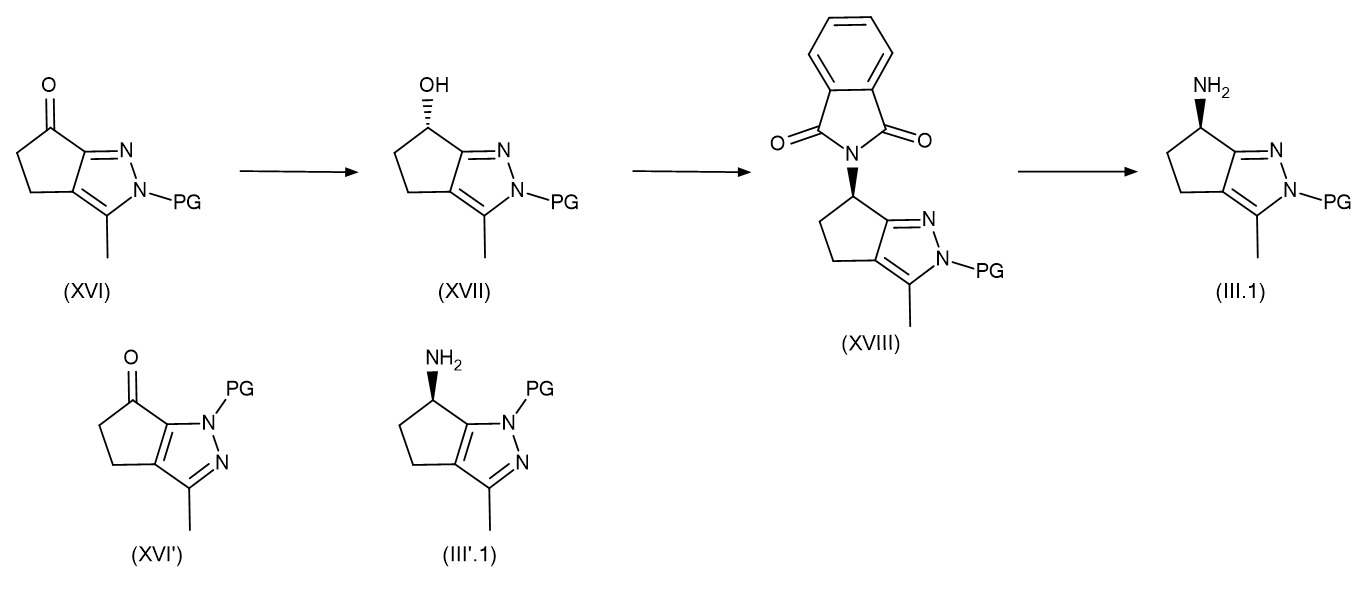
反應圖 8 : 式(III.1)及(III’.1)之對映純胺可分別自酮(XVI)及(XVI’)如反應圖8中所述進行製備。可在報導於有機化學文獻(例如J. Am. Chem. Soc. 1995,117,7562-3;Org. Lett. 2010,12,1756-9;Org. Proc. Res. Dev. 2006,10,949-958;Tetrahedron: Asymmetry 2003,14,2659-2681;Tetrahedron Lett. 2014,55,3635-40;及其中引用之參考文獻)中之各種條件下將式(XVI)之酮對映立體選擇性還原以得到式(XVII)或(XVII’) (未顯示)之對映純或富對映醇(衍生自酮之化合物(XVI’))。然後可使該醇與足夠酸性之含N-H分子(諸如鄰苯二甲醯亞胺或(第三-Bu-OCO)2 NH)以光延或光延型反應(使用例如三苯基膦或三-正丁基膦與偶氮二甲酸二甲酯或二乙酯或二異丙酯、偶氮二甲酸二-(4-氯苄酯)、偶氮二甲酸二苄酯、DBAD、偶氮二甲酸雙-(二甲基醯胺)、偶氮二甲酸二哌啶或偶氮二甲酸二嗎啉組合在適宜溶劑(例如THF、1,4-二噁烷、EtOAc、苯、甲苯等))而導致引入N基團且立體中心之構型反轉(-> (XVIII))。或者,在用疊氮化物反轉相鄰碳原子之構型下,可採用磷醯疊氮(例如二苯基磷醯疊氮)來置換(XVII)中之OH。可自鄰苯二甲醯亞胺基團藉由用例如肼、羥胺、甲胺、正丁胺或乙醇胺在適宜溶劑(例如EtOH、MeOH、MeCN、THF、二噁烷、DMSO、N,N-二甲基乙醯胺、水或此等之混合物)中必要時在進行加熱下處理來釋放胺基基團以得到式(III.1)化合物。較佳在酸性條件(使用例如TFA或鹽酸)下移除第三-Bu-O-CO以得到胺(III.1)。可用例如氫在過渡金屬(例如在碳上之Pd、雷氏鎳(Raney-Ni)、PtO2 等)或膦(例如三苯基膦)的存在下將疊氮化物還原為胺(III.1)。 Scheme 8: formula (III.1) and (III'.1) of enantiomerically pure amines from ketones respectively (XVI) and (XVI ') in FIG. 8 as the reaction be prepared. It can be reported in the organic chemistry literature (eg J. Am. Chem. Soc. 1995, 117, 7562-3; Org. Lett. 2010, 12, 1756-9; Org. Proc. Res. Dev. 2006, 10, 949 -958; Tetrahedron: Asymmetry 2003, 14, 2659-2681; Tetrahedron Lett. 2014, 55, 3635-40; and references cited therein) under various conditions for the enantioselective reduction of ketones of formula (XVI) to obtain enantiopure or enantiorich alcohols of formula (XVII) or (XVII') (not shown) (compounds (XVI') derived from ketones). The alcohol can then be sufficiently acidic with the NH-containing molecule (such as phthaloyl (PEI) or (third -Bu-OCO) 2 NH) in a Mitsunobu reaction or a Mitsunobu type (e.g. using triphenylphosphine or tri - n Butyl phosphine with dimethyl or diethyl or diisopropyl azodicarboxylate, bis-(4-chlorobenzyl azodicarboxylate), dibenzyl azodicarboxylate, DBAD, bis-azodicarboxylate -(dimethylamide), dipiperidine azodicarboxylate or dimorpholine azodicarboxylate combined in a suitable solvent (eg THF, 1,4-dioxane, EtOAc, benzene, toluene, etc.) resulting in An N group was introduced and the configuration of the stereocenter was reversed (-> (XVIII)). Alternatively, a phosphonium azide (eg, diphenylphosphoryl azide) can be used to replace the OH in (XVII) with an azide inverting the configuration of the adjacent carbon atom. The phthalimide group can be isolated by using, for example, hydrazine, hydroxylamine, methylamine, n-butylamine, or ethanolamine in a suitable solvent (eg, EtOH, MeOH, MeCN, THF, dioxane, DMSO, N,N- dimethylacetamide, water, or a mixture of these), if necessary, with heating to liberate the amine group to give compounds of formula (III.1). The tertiary-Bu-O-CO is preferably removed under acidic conditions (using eg TFA or hydrochloric acid) to give the amine (III.1). For example hydrogen can be used in a transition metal (e.g. Pd on carbon, the Raney nickel was (Raney-Ni), PtO 2, etc.) or in the presence of a phosphine (e.g. triphenylphosphine) the azide is reduced to amine (III.1 ).
或者,可自酮(XVI)經由3步驟合成順序來獲得化合物(III.1),在環境溫度或升高之溫度下採用對映純第三丁磺醯胺在鈦醇鹽(例如Ti(OEt)4
或Ti (O i
Pr)4
)的存在下在溶劑(例如THF、DCM、甲苯或無溶劑(neat))中產生相應對映純第三丁基亞磺醯基化亞胺,該對映純第三丁基亞磺醯基化亞胺可使用氫化物(例如硼氫化鋰或硼氫化鈉、三異丁基硼氫化鋰(L-selectride)、氫化二異丁基鋁等)在適合溶劑(例如THF、甲苯、MeOH等,取決於所使用的氫化物源而定)中非對映立體選擇性地還原為相應第三丁基亞磺醯基化胺。第三丁基亞磺醯基基團可在環境溫度或升高之溫度下在適宜溶劑(例如甲苯、DCM、二噁烷、醇、水等)中使用酸(例如TFA或鹽酸)來裂解除去。反應圖 9 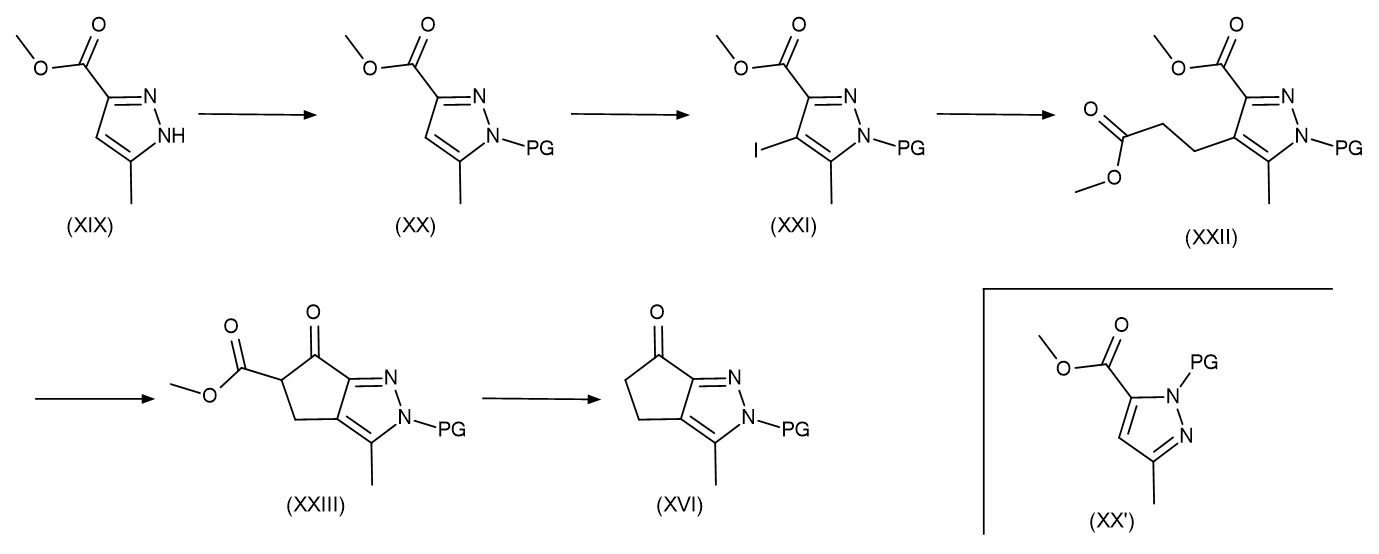
反應圖 9 : 可自所報導的酯(XIX) (或相應高碳數烷基酯,例如乙酯、丙酯、異丙酯或第三丁酯)以由5或6個反應步驟所組成的序列獲得化合物(XVI)。化合物(XIX)可在其N原子中之一者上用報導於有機化學文獻中之廣泛範圍之保護基衍化。例如,可將化合物(XIX)用鹼(例如氫化物(諸如氫化鈉)、氫氧化物(諸如氫氧化鈉)、碳酸鹽(諸如碳酸鈉或碳酸鉀)、醇鹽(諸如甲醇鋰或第三丁醇鉀)、有機胺(諸如三乙胺、亨氏鹼(Hünig’s base)、DABCO、DBN、或DBU)、磷腈(諸如P2 Et磷腈)、醯胺(諸如二異丙胺鋰或六甲基二矽基胺基鋰(lithium hexamethyldisilazide)))在適合溶劑(例如苯、甲苯、DCM、THF、二噁烷、EtOAc、ACN、DMF、N,N-二甲基乙醯胺、N-甲基吡咯啶酮等,取決於所使用鹼之性質而定)中處理且同時或隨後與適合保護基之親電子劑(具有離去基,諸如氯離子、溴離子、碘離子、烷基-或芳基磺醯基氧基、烷基氧基、醯基氧基等之保護基)(例如用於引入2-三甲基矽基乙基氧基甲基作為保護基之2-三甲基矽基乙基氧基甲基氯)反應轉化為化合物(XX)。化合物(XX)可採用相應鹵素之適合親電子源(例如Cl之N-氯琥珀醯亞胺、Br之N-溴琥珀醯亞胺或Br2 、I之N-碘琥珀醯亞胺、I2 或ICl,視需要在添加劑(諸如銀鹽或酸)的存在下)在適合溶劑(例如DCM、二氯乙烷、二噁烷、MeCN、DMF等)中氯化、溴化或碘化。例如,可使用N-碘琥珀醯亞胺及TFA在MeCN中引入碘以提供化合物(XXI)。然後化合物(XXII)可由相應鹵化物(例如碘化物(XXI))採用1-或2步驟合成途徑製備,涵蓋Heck偶聯反應(廣泛涵蓋於有機化學文獻中,例如涵蓋於Catalysts 2017,7,267及其中引用的參考文獻中)用丙烯醛二烷基縮醛(例如丙烯醛二甲基縮醛)或丙烯酸酯(例如丙烯酸甲酯);使用後一偶聯搭配物需要另一步驟來還原形成的烯鍵,此可用氫氣在過渡金屬觸媒(例如Pd (諸如鈀碳)、Ni (諸如雷氏鎳)、Pt (諸如氧化鉑)、Rh (諸如銠碳)等)存在下在適合溶劑(例如DCM、二噁烷、THF、EtOAc、醇(諸如MeOH)、水等)中進行。酮酯(XXIII)可在化合物(XXII)用鹼(例如氫化物(諸如氫化鈉)、醇鹽(諸如甲醇鋰或第三丁醇鉀)、有機胺(諸如DBU)、磷腈(諸如P2 Et磷腈)、醯胺(諸如二異丙胺鋰,六甲基二矽基胺基鋰、鈉或鉀等)在適合溶劑(例如苯、甲苯、二噁烷、THF、醇等,取決於所使用鹼而定)中在低溫至升高之溫度(-78℃至100℃,取決於所採用鹼及溶劑而定)處理時產生。化合物(XXIII)中酯基之水解接著脫羧化可藉由該化合物在溶劑(例如二噁烷、THF、MeCN、DMF、N,N-二甲基乙醯胺、DMSO、醇、水等,或此等之混合物)中,視需要在鹼(例如氫氧化鈉)、鹵鹽(諸如碘化鋰或氯化鋰)或酸(例如鹽酸)存在下在0至140℃攪拌得到酮(XVI)來達成。整個序列可類似地應用於異構性保護之化合物(XX‘)以得到酮(XVI’),且不一定依賴於保護基之使用,且因此可在無保護基 (PG = H)下進行。 Reaction Scheme 9 : Can be composed of 5 or 6 reaction steps from the reported ester (XIX) (or the corresponding higher alkyl ester such as ethyl, propyl, isopropyl or tert-butyl) The sequence yields compound (XVI). Compound (XIX) can be derivatized on one of its N atoms with a wide range of protecting groups reported in the organic chemistry literature. For example, compound (XIX) can be treated with a base such as a hydride such as sodium hydride, a hydroxide such as sodium hydroxide, a carbonate such as sodium carbonate or potassium carbonate, an alkoxide such as lithium methoxide or a third butoxide), organic amines (such as triethylamine, Heinz base (Hünig's base), DABCO, DBN, or DBU), polyphosphazene (such as a phosphazene P 2 Et), acyl amines (such as lithium diisopropylamide or hexamethyl (lithium hexamethyldisilazide)) in suitable solvents (e.g. benzene, toluene, DCM, THF, dioxane, EtOAc, ACN, DMF, N,N-dimethylacetamide, N-methylacetamide) pyrrolidone, etc., depending on the nature of the base used) and simultaneously or subsequently with an electrophile (with a leaving group such as chloride, bromide, iodide, alkyl- or Protecting groups of arylsulfonyloxy, alkyloxy, acyloxy, etc.) (for example, 2-trimethylsilyl used to introduce 2-trimethylsilylethyloxymethyl as a protecting group ylethyloxymethyl chloride) to convert to compound (XX). Compound (XX) can adopt a suitable electrophilic source of the corresponding halogen (such as N-chlorosuccinimide for Cl, N-bromosuccinimide for Br or Br 2 , N-iodosuccinimide for I, I 2 ). or ICl, optionally chlorinated, brominated or iodinated in a suitable solvent (eg, DCM, dichloroethane, dioxane, MeCN, DMF, etc.) in the presence of additives such as silver salts or acids. For example, iodine can be introduced in MeCN using N-iodosuccinimide and TFA to provide compound (XXI). Compound (XXII) can then be prepared from the corresponding halide (e.g. iodide (XXI)) using a 1- or 2-step synthetic route, covering Heck coupling reactions (covered extensively in the organic chemistry literature, e.g. in Catalysts 2017, 7, 267 and references cited therein) with acrolein dialkyl acetals (such as acrolein dimethyl acetal) or acrylates (such as methyl acrylate); use of the latter coupling partner requires another step to reduce the formation of olefinic bond, which can be done with hydrogen in the presence of a transition metal catalyst (e.g., Pd (such as palladium carbon), Ni (such as Reinhardt nickel), Pt (such as platinum oxide), Rh (such as rhodium carbon), etc. in a suitable solvent ( For example, in DCM, dioxane, THF, EtOAc, alcohols such as MeOH, water, etc.). Ketoesters (XXIII) can be prepared in compound (XXII) with bases such as hydrides such as sodium hydride, alkoxides such as lithium methoxide or potassium tert-butoxide, organic amines such as DBU, phosphazenes such as P 2 Et phosphazene), amides (such as lithium diisopropylamide, lithium hexamethyldisilazide, sodium or potassium, etc.) in a suitable solvent (such as benzene, toluene, dioxane, THF, alcohols, etc., depending on the produced upon treatment at low temperature to elevated temperature (-78°C to 100°C, depending on the base and solvent employed). Hydrolysis of the ester group in compound (XXIII) followed by decarboxylation can be achieved by The compound is in a solvent (such as dioxane, THF, MeCN, DMF, N,N-dimethylacetamide, DMSO, alcohol, water, etc., or a mixture of these), optionally in a base (such as hydroxide sodium), a halide salt (such as lithium iodide or lithium chloride) or an acid (such as hydrochloric acid) to give the ketone (XVI) by stirring at 0 to 140° C. The entire sequence can be applied analogously to isomerically protected compounds (XX') to give the ketone (XVI'), and does not necessarily depend on the use of protecting groups, and can therefore be carried out without protecting groups (PG=H).
如上所提及,可將式(I)化合物轉化為鹽,特別是就醫藥用途而言,轉化為醫藥上可接受之鹽。如本文所用,「醫藥上可接受之鹽」係指所揭示的化合物之衍生物,其中該親本化合物係藉由製備其酸或鹼鹽經修飾。As mentioned above, the compounds of formula (I) can be converted into salts, especially for pharmaceutical use, into pharmaceutically acceptable salts. As used herein, "pharmaceutically acceptable salts" refer to derivatives of the disclosed compounds, wherein the parent compound is modified by making acid or base salts thereof.
使用描述於隨後的實例中之方法,該方法亦可針對於此目的與熟練技術者自文獻已知的方法組合,亦可有利地獲得根據本發明之化合物。Using the methods described in the examples that follow, which can also be combined for this purpose with methods known to the skilled person from the literature, the compounds according to the invention can also advantageously be obtained.
因此,根據本發明之另一個態樣,提供用於合成式(I)化合物之方法。Accordingly, according to another aspect of the present invention, methods for the synthesis of compounds of formula (I) are provided.
根據本發明之另一個態樣,提供合成式(I)化合物之中間物。藥理學活性 本發明化合物之活性可使用以下分析來證實:生物學方法 使用以下生物化學分析,在分析緩衝液(100 mM Tris、150 mM NaCl,用HCl調整至7.8之pH,且包含0.1% (w/v) BSA及0.05% (v/v) 吐溫20 (Tween 20))中在1% (v/v) DMSO的存在下,來測定式(I)化合物抑制血漿激肽釋放酶(PKK)、因子XIIa (FXIIa)、因子XIa (FXIa)、因子Xa (FXa)、因子IIa (α-凝血酶;FIIa)、胞漿素、胰蛋白酶、組織激肽釋放酶1 (TK1)、因子VIIa (FVIIa);或與組織因子、磷脂及CaCl2 錯合之FVIIa (FVIIa/TF/PL/CaCl2 )之能力: 使用終點分析來評估PKK之抑制According to another aspect of the present invention, intermediates for the synthesis of compounds of formula (I) are provided. Pharmacological Activity The activity of the compounds of the present invention can be demonstrated using the following assays: Biological Methods using the following biochemical assays in assay buffer (100 mM Tris, 150 mM NaCl, adjusted to pH 7.8 with HCl, and containing 0.1% ( Inhibition of plasma kallikrein (PKK) by compounds of formula (I) in the presence of 1% (v/v) DMSO in w/v) BSA and 0.05% (v/v) Tween 20 ), factor XIIa (FXIIa), factor XIa (FXIa), factor Xa (FXa), factor IIa (α-thrombin; FIIa), cytoplasmin, trypsin, tissue kallikrein 1 (TK1), factor VIIa (of FVIIa); or tissue factor, phospholipids and CaCl 2 malocclusion of FVIIa (FVIIa / TF / PL / CaCl 2) the ability to: using an endpoint analysis to assess inhibition of PKK
在室溫下,將人類PKK (0.01 U/mL;Enzyme Research Laboratories)或大鼠PKK (0.625 nM;內部生產的)與0.10 µM螢光受質H-Pro-Phe-Arg-AMC (I1295,來自Bachem)及各種濃度之測試化合物在分析緩衝液中培養1小時。隨後,添加PPACK II (Calbiochem)作為終止溶液以達成1 µM之最終濃度且使用Envision讀數器(PerkinElmer)在355 nm之波長激發設置及460 nm之波長激發設置下測定螢光。At room temperature, human PKK (0.01 U/mL; Enzyme Research Laboratories) or rat PKK (0.625 nM; produced in-house) were mixed with 0.10 µM fluorescent substrate H-Pro-Phe-Arg-AMC (I1295 from Bachem) and various concentrations of test compounds were incubated in assay buffer for 1 hour. Subsequently, PPACK II (Calbiochem) was added as a stop solution to achieve a final concentration of 1 μM and fluorescence was measured using an Envision reader (PerkinElmer) at a wavelength excitation setting of 355 nm and a wavelength excitation setting of 460 nm.
根據本發明之化合物之IC50
值顯示於下表中。化合物之編號對應於實驗部分中實例之編號。
在37℃下,將自人類全血獲得,經檸檬酸鈉(Na-Citrate)抗凝之缺乏血小板之血漿(PPP)與各種濃度之測試化合物以及25、75、250或750 µg/mL高嶺土在分析緩衝液中培養20分鐘使得對於所使用的每種高嶺土劑量,獲得測試化合物之濃度反應。隨後,將0.25 mM螢光受質H-Pro-Phe-Arg-AMC (I1295,來自Bachem)添加至該混合物且歷時12分鐘以每2分鐘之動力學時間間隔使用Spectramax M5 (Molecular Devices)利用以下350 nm之波長激發及450 nm之波長發射之設置進行測量。pIC50及pIC90值係獲自經GraphPad prism 7.0擬合之4 x/y-曲線(x=log M,化合物;y=δ rfu/min) (公式:log(促效劑)相對於反應--Find ECanything;針對於測試化合物獲得的四個濃度反應曲線(各者使用不同高嶺土劑量獲得)係使用整體擬合程序擬合,產生共用pIC50或pIC90值)。Platelet-deficient plasma (PPP) obtained from human whole blood, anticoagulated with sodium citrate (PPP) with various concentrations of test compound and 25, 75, 250 or 750 µg/mL kaolin at 37°C was Incubation in assay buffer for 20 minutes allowed a concentration response of the test compound to be obtained for each kaolin clay dose used. Subsequently, 0.25 mM fluorescent substrate H-Pro-Phe-Arg-AMC (I1295 from Bachem) was added to the mixture and the kinetic interval of every 2 minutes for 12 minutes using Spectramax M5 (Molecular Devices) using the following Measurements were made with a setup of excitation at 350 nm and emission at 450 nm. pIC50 and pIC90 values were obtained from 4 x/y-curves (x=log M, compound; y=δ rfu/min) fitted by GraphPad prism 7.0 (formula: log(agonist) vs. response--Find ECanything; the four concentration-response curves obtained for the test compounds (each obtained using a different kaolin dose) were fitted using an ensemble fitting procedure, yielding a common pIC50 or pIC90 value).
根據本發明之化合物之IC90
值顯示於下表中。化合物之編號對應於實驗部分中實例之編號。
在24℃下,將人類PKK (1.78 nM或0.025 U/mL;Enzyme Research Laboratories)與0.25 mM螢光受質H-Pro-Phe-Arg-AMC (I1295,來自Bachem)及各種濃度之測試化合物在分析緩衝液中培養。歷時16分鐘以每2分鐘之動力學時間間隔使用Spectramax M5 (Molecular Devices)在以下350 nm之波長激發及450 nm之波長發射之設置下進行測量。 評估FXIIa之抑制(Ki )Human PKK (1.78 nM or 0.025 U/mL; Enzyme Research Laboratories) was combined with 0.25 mM fluorescent substrate H-Pro-Phe-Arg-AMC (I1295 from Bachem) and various concentrations of test compounds at 24°C. Incubate in assay buffer. Measurements were performed using a Spectramax M5 (Molecular Devices) at the following settings of excitation at 350 nm and emission at 450 nm at kinetic intervals of 2 minutes for 16 minutes. Assessing inhibition of FXIIa (K i )
在24℃下,將人類FXIIa (47.5 nM或1.1 U/mL;Enzyme Research Laboratories)與0.5 mM發色受質S2302 (Chromogenix)及各種濃度之測試化合物在分析緩衝液中培養。歷時16分鐘以每第2分鐘之動力學時間間隔使用Spectramax M5 (Molecular Devices)測量在405 nm處之光學吸光度進行測量。 評估FXIa之抑制(Ki )Human FXIIa (47.5 nM or 1.1 U/mL; Enzyme Research Laboratories) was incubated with 0.5 mM chromogenic substrate S2302 (Chromogenix) and various concentrations of test compounds in assay buffer at 24°C. Measurements were performed using a Spectramax M5 (Molecular Devices) to measure optical absorbance at 405 nm with every 2 minute kinetic interval over 16 minutes. Assessing inhibition of FXIa (K i )
在24℃下,將人類FXIa (0.5 nM或0.016 U/mL;Enzyme Research Laboratories)與0.25 mM螢光受質Boc-Glu(OBzl)-Ala-Arg-AMC • HCl (I1575,來自Bachem)及各種濃度之測試化合物在分析緩衝液中培養。歷時16分鐘以每第2分鐘之動力學時間間隔使用Spectramax M5 (Molecular Devices)在以下350 nm之波長激發及450 nm之波長發射之設置下進行測量。 評估FXa之抑制(Ki )Human FXIa (0.5 nM or 0.016 U/mL; Enzyme Research Laboratories) was mixed with 0.25 mM fluorescent substrate Boc-Glu(OBzl)-Ala-Arg-AMC•HCl (I1575 from Bachem) and various Concentrations of test compounds are incubated in assay buffer. Measurements were performed using a Spectramax M5 (Molecular Devices) at the following settings of excitation at 350 nm and emission at 450 nm at kinetic intervals of every 2 minutes for 16 minutes. Assessing FXa inhibition (K i )
在24℃下,將人類FXa (0.86 nM或0.01 U/mL;Enzyme Research Laboratories)與0.5 mM發色受質S2765 (Chromogenix)及各種濃度之測試化合物在分析緩衝液中培養。歷時16分鐘以每第2分鐘之動力學時間間隔使用Spectramax M5 (Molecular Devices)測量在405 nm處之光學吸光度進行測量。 評估FIIa之抑制(Ki )Human FXa (0.86 nM or 0.01 U/mL; Enzyme Research Laboratories) was incubated with 0.5 mM chromogenic substrate S2765 (Chromogenix) and various concentrations of test compounds in assay buffer at 24°C. Measurements were performed using a Spectramax M5 (Molecular Devices) to measure optical absorbance at 405 nm with every 2 minute kinetic interval over 16 minutes. Assessing inhibition of FIIa (K i )
在24℃下,將人類FIIa (44.6 nM或5 U/mL;Enzyme Research Laboratories)與0.5 mM發色受質S2238 (Chromogenix)及各種濃度之測試化合物在分析緩衝液中培養。歷時16分鐘以每第2分鐘之動力學時間間隔使用Spectramax M5 (Molecular Devices)測量在405 nm處之光學吸光度進行測量。 評估胞漿素之抑制(Ki )Human FIIa (44.6 nM or 5 U/mL; Enzyme Research Laboratories) was incubated with 0.5 mM chromogenic substrate S2238 (Chromogenix) and various concentrations of test compounds in assay buffer at 24°C. Measurements were performed using a Spectramax M5 (Molecular Devices) to measure optical absorbance at 405 nm with every 2 minute kinetic interval over 16 minutes. Assessing cytoplasmin inhibition (K i )
在24℃下,將人類胞漿素(64.1 nM或0.0275 U/mL;Enzyme Research Laboratories)與0.3 mM發色受質S2251 (Chromogenix)及各種濃度之測試化合物在分析緩衝液中培養。歷時16分鐘以每第2分鐘之動力學時間間隔使用Spectramax M5 (Molecular Devices)測量在405 nm處之光學吸光度進行測量。 評估胰蛋白酶之抑制(Ki )Human cytoplasmin (64.1 nM or 0.0275 U/mL; Enzyme Research Laboratories) was incubated with 0.3 mM chromogenic substrate S2251 (Chromogenix) and various concentrations of test compounds in assay buffer at 24°C. Measurements were performed using a Spectramax M5 (Molecular Devices) to measure optical absorbance at 405 nm with every 2 minute kinetic interval over 16 minutes. Assess trypsin inhibition (K i )
在24℃下,將人類胰蛋白酶(4.54 nM或250 U/mL;Calbiochem)與0.5 mM發色受質S2222 (Chromogenix)及各種濃度之測試化合物在分析緩衝液中培養。歷時16分鐘以每第2分鐘之動力學時間間隔使用Spectramax M5 (Molecular Devices)測量在405 nm處之光學吸光度進行測量。 評估TK1之抑制(Ki )Human trypsin (4.54 nM or 250 U/mL; Calbiochem) was incubated with 0.5 mM chromogenic substrate S2222 (Chromogenix) and various concentrations of test compounds in assay buffer at 24°C. Measurements were performed using a Spectramax M5 (Molecular Devices) to measure optical absorbance at 405 nm with every 2 minute kinetic interval over 16 minutes. Assessing inhibition of TK1 (K i )
在分析之前,人類TK1 (R&D Systems)藉由在37℃下與人類胰蛋白酶(Calbiochem)以1:10,000比培養15分鐘而活化。為分析TK1抑制活性,在24℃下,將經活化之TK1 (31.25 nM或1 U/mL)與0.1 mM螢光受質H-Pro-Phe-Arg-AMC (I1295,來自Bachem)及各種濃度之測試化合物在分析緩衝液中培養。歷時16分鐘以每第2分鐘之動力學時間間隔使用Spectramax M5 (Molecular Devices)在以下350 nm之波長激發及450 nm之波長發射之設置下進行測量。Prior to analysis, human TK1 (R&D Systems) was activated by incubating with human trypsin (Calbiochem) at a ratio of 1:10,000 for 15 minutes at 37°C. To analyze TK1 inhibitory activity, activated TK1 (31.25 nM or 1 U/mL) was combined with 0.1 mM fluorescent substrate H-Pro-Phe-Arg-AMC (I1295, from Bachem) and various concentrations at 24°C. The test compounds were incubated in assay buffer. Measurements were performed using a Spectramax M5 (Molecular Devices) at the following settings of excitation at 350 nm and emission at 450 nm at kinetic intervals of every 2 minutes for 16 minutes.
根據本發明之化合物之Ki
值顯示於下表中。化合物之編號對應於實驗部分中實例之編號。
在24℃下,將人類FVIIa (0.86 nM或0.01 U/mL;Enzyme Research Laboratories)與1.5 mM發色Pefachrome® FVIIa (Loxo)及各種濃度之測試化合物在分析緩衝液中培養。歷時16分鐘以每第2分鐘之動力學時間間隔使用Spectramax M5 (Molecular Devices)測量在405 nm處之光學吸光度進行測量。 評估FVIIa/TF/PL/CaCl2 之抑制(Ki )At 24 ℃, human FVIIa (0.86 nM or 0.01 U / mL; Enzyme Research Laboratories ) and 1.5 mM chromogenic Pefachrome ® FVIIa (Loxo) and various concentrations of the test compounds in culture assay buffer. Measurements were performed using a Spectramax M5 (Molecular Devices) to measure optical absorbance at 405 nm with every 2 minute kinetic interval over 16 minutes. Assessing inhibition (K i ) of FVIIa/TF/PL/CaCl 2
在24℃下,將人類FVIIa (300 nM或585 U/mL;Enzyme Research Laboratories)以及10 mM CaCl2 *2H2 O及13.3% (v/v) Dade® Innovin® (Siemens;OQUMI94E0002(5534),其包含重組人類組織因子合成磷脂(凝血酶原))與1.5 mM發色Pefachrome® FVIIa (Loxo)及各種濃度之測試化合物在分析緩衝液中培養。歷時16分鐘以每第2分鐘之動力學時間間隔使用Spectramax M5 (Molecular Devices)測量在405 nm處之光學吸光度進行測量。 計算pIC50 及pKi 值At 24 ℃, human FVIIa (300 nM or 585 U / mL; Enzyme Research Laboratories ) and 10 mM CaCl 2 * 2H 2 O and 13.3% (v / v) Dade ® Innovin ® (Siemens; OQUMI94E0002 (5534), recombinant human tissue factor which comprises a synthetic phospholipids (prothrombin)) and 1.5 mM chromogenic test compound Pefachrome ® FVIIa (Loxo) and various concentrations of cultured in assay buffer. Measurements were performed using a Spectramax M5 (Molecular Devices) to measure optical absorbance at 405 nm with every 2 minute kinetic interval over 16 minutes. Calculate pIC 50 and pK i values
將啟動分析後2至12分鐘之時間間隔之平均Vmax
值(分別表示為針對使用發色受質之分析的δ OD/min或針對使用螢光受質之分析的δ RFU/min)與所評估的抑制劑化合物之莫耳濃度對數製圖。然後使用使用GraphPad Prism (版本6;GraphPad Software,Inc.)之四參數擬合程序擬合pIC50
值。藉由使用以下式子校正所使用受質之各自的KM
值之IC50
值來獲得各自的Ki
值(關於所使用受質之所獲得的KM
值,參見表A):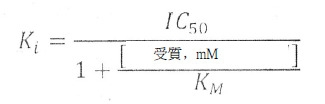
將Caco-2細胞(1至2 x 10⁵ 個細胞/1 cm2 面積)接種於過濾器插板(Costar transwell聚碳酸酯或PET過濾器,0.4 μm孔徑)且培養(DMEM) 10至25天。The Caco-2 cells (1 to 2 x 10 5 cells / 1 cm 2 area) was inoculated to the filter card (Costar transwell polycarbonate or PET filter, 0.4 μm pore size) and incubated (DMEM) 10 to 25 days .
將化合物溶解於適宜溶劑(像DMSO,1至20 mM儲備溶液)中。用包含0.25% BSA之HTP-4緩衝液(128.13 mM NaCl、5.36 mM KCl、1 mM MgSO4 、1.8 mM CaCl2 、4.17 mM NaHCO3 、1.19 mM Na2 HPO4 x 7H2 O、0.41 mM NaH2 PO4 x H2 O、15 mM HEPES、20 mM葡萄糖,pH 7.2)稀釋儲備溶液以製備輸送溶液(0.1至300 μM化合物,最終DMSO <= 0.5%)。將輸送溶液(TL)應用於頂端或底側供體側以分別測量A-B或B-A滲透性(2個過濾器重複)。接受側包含補充0.25% BSA之HTP-4緩衝液。在實驗開始及結束時自供體且長達2小時以不同時間間隔收集樣品,亦自接受側收集樣品,以藉由HPLC-MS/MS或閃爍計數進行濃度測量。採樣接受體積將替換為新製接受溶液。評估人類或大鼠肝臟微粒體 中 之代謝穩定性 Compounds are dissolved in a suitable solvent (like DMSO, 1 to 20 mM stock solution). with HTP-4 buffer (128.13 mM NaCl, 5.36 mM KCl, 1 mM MgSO 4 , 1.8 mM CaCl 2 , 4.17 mM NaHCO 3 , 1.19 mM Na 2 HPO 4 x 7H 2 O, 0.41 mM NaH 2 ) containing 0.25% BSA PO 4 x H 2 O, 15 mM HEPES, 20 mM glucose, pH 7.2) diluted stock solutions to prepare delivery solutions (0.1 to 300 μM compound, final DMSO <= 0.5%). The transport solution (TL) was applied to the apical or basal donor side to measure AB or BA permeability, respectively (2 filter replicates). The receiving side contained HTP-4 buffer supplemented with 0.25% BSA. Samples were collected at various time intervals from the donor and up to 2 hours at the beginning and end of the experiment, and also from the receiver side for concentration measurement by HPLC-MS/MS or scintillation counting. The sample acceptance volume will be replaced with a fresh acceptance solution. Metabolic assessment of human or rat liver microsomes of stability
在37℃下,用組併的人類(HLM)或大鼠肝臟微粒體(RLM)分析測試化合物之代謝降解。60 μl/時間點之最終培養體積包含RT下的TRIS緩衝液pH 7.6 (0.1M)、氯化鎂(5 mM)、微粒體蛋白(HLM:1 mg/mL、RLM:0.5 mg/mL)及最終濃度為1 μM之測試化合物。Test compounds were assayed for metabolic degradation using pooled human (HLM) or rat liver microsomes (RLM) at 37°C. A final culture volume of 60 μl/time point contains TRIS buffer pH 7.6 (0.1 M), magnesium chloride (5 mM), microsomal proteins (HLM: 1 mg/mL, RLM: 0.5 mg/mL) and final concentrations at RT Test compound at 1 μM.
在37℃下的短預培養期之後,藉由添加β-菸鹼醯胺腺嘌呤二核苷酸磷酸,還原形式(NADPH,1 mM)啟動反應且藉由在不同時間點後將等分試樣轉移至溶劑中終止。另外,此外,在不使用NADPH之培養中監測與NADPH無關之降解,在最後時間點終止。藉由離心(10000 g,5分鐘)使經淬滅之培養物成團。藉由LC-MS/MS分析上清液之等分試樣之親本化合物的量。半衰期(t1/2 INVITRO)藉由濃度-時間曲線之半對數座標圖之斜率來定。評估人類或大鼠肝細胞 中 之代謝穩定性 After a short pre-incubation period at 37°C, the reaction was initiated by addition of β-nicotinamide adenine dinucleotide phosphate, reduced form (NADPH, 1 mM) and by aliquoting after various time points Transfer the sample to the solvent to stop. In addition, NADPH-independent degradation was monitored in cultures without NADPH, terminated at the last time point. The quenched cultures were pelleted by centrifugation (10000 g, 5 min). An aliquot of the supernatant was analyzed for the amount of parent compound by LC-MS/MS. Half-life (t1/2 INVITRO) is determined by the slope of the semi-logarithmic plot of the concentration-time curve. Assessment of metabolic stability in human or rat hepatocytes
在肝細胞懸浮液中分析測試化合物之代謝降解。自冷凍保存恢復之後,將人類或大鼠肝細胞在補充有3.5 µg升糖素/500 ml、2.5 mg胰島素/500 ml及3.75 mg/500 ml氫皮質酮(hydrocortisone)之包含5%或50%人類或大鼠血清或無血清之杜貝卡氏改良依格培養基(Dulbecco´s modified eagle medium)中培養。Test compounds were assayed for metabolic degradation in hepatocyte suspensions. After recovery from cryopreservation, human or rat hepatocytes were prepared in 5% or 50% supplemented with 3.5 µg glucagon/500 ml, 2.5 mg insulin/500 ml, and 3.75 mg/500 ml hydrocortisone. Human or rat serum or serum-free Dulbecco's modified eagle medium (Dulbecco's modified eagle medium).
在細胞培養箱(37℃,10% CO2 )中進行30分鐘預培養之後,將測試化合物溶液外加至肝細胞懸浮液中以獲得1.0*106 個細胞/ml之最終細胞密度、1 µM之最終測試化合物濃度及0.05%之最終DMSO濃度。After a 30-minute pre-incubation in a cell incubator (37°C, 10% CO 2 ), the test compound solution was spiked into the hepatocyte suspension to obtain a final cell density of 1.0*10 6 cells/ml, 1 µM of Final test compound concentration and final DMSO concentration of 0.05%.
將該等細胞培養六小時(培養箱,水平振盪器)且在0、0.5、1、2、4及6小時後自培養箱取樣品。用乙腈淬滅樣品且藉由離心成團。將上清液轉移至96深孔板,且準備用於藉由HPLC-MS/MS分析親本化合物之下降。The cells were cultured for six hours (incubator, horizontal shaker) and samples were taken from the incubator after 0, 0.5, 1, 2, 4 and 6 hours. Samples were quenched with acetonitrile and pelleted by centrifugation. The supernatant was transferred to a 96 deep well plate and was ready for analysis of parent compound drop by HPLC-MS/MS.
CLint 計算如下: CLint = 劑量/AUC = (C0/CD) / (AUD + clast/k) x 1000/60 C0:培養物中之初始濃度[µM],CD:活細胞之細胞密度[10e6個細胞/ml],AUD:數據下面積[µM x h],clast:最後一個數據點之濃度[µM],k:親本下降之回歸線之斜率[h-1 ]。CL int is calculated as follows: CL int = dose/AUC = (C0/CD) / (AUD + clast/k) x 1000/60 C0: initial concentration in culture [µM], CD: cell density of viable cells [10e6 cells/ml], AUD: area under data [µM xh], clast: concentration of last data point [µM], k: slope of regression line for parental decline [h -1 ].
活體外肝内在清除率計算值可放大至内在活體內肝清除率且用於藉由使用肝臟模型(充分攪拌模型)預測肝活體內血液清除率(CL)。評估血漿蛋白結合 Calculations of in vitro hepatic clearance can be scaled to in vivo hepatic clearance and used to predict hepatic in vivo blood clearance (CL) by using a liver model (well-stirred model). Assess plasma protein binding
平衡透析(ED)技術係應用Dianorm Teflon透析單元(micro 0.2)用於測定測試化合物與血漿蛋白質之近似活體外分級結合。各透析單元由供體及受體腔室間隔具有5 kDa截止分子量之超薄半透膜所組成。各測試化合物之儲備溶液均在DMSO中以1 mM製得且連續稀釋以獲得1 µM之最終測試濃度。在血漿(經補充NaEDTA作為抗凝血劑)中製備隨後的透析溶液,且將200 µl測試化合物透析溶液含在血漿中之等分試樣分配至供體(血漿)腔室中。將200 µl透析緩衝液(100 mM磷酸鉀,pH 7.4)之等分試樣分配至緩衝液(受體)腔室中。在37℃下於旋轉下進行培養2小時以建立平衡。Equilibrium dialysis (ED) techniques were employed using a Dianorm Teflon dialysis unit (micro 0.2) for the determination of approximately in vitro fractionated binding of test compounds to plasma proteins. Each dialysis unit consists of an ultrathin semipermeable membrane with a molecular weight cut-off of 5 kDa between the donor and acceptor chambers. Stock solutions of each test compound were made at 1 mM in DMSO and serially diluted to obtain a final test concentration of 1 μM. Subsequent dialysis solutions were prepared in plasma (supplemented with NaEDTA as anticoagulant) and 200 μl aliquots of test compound dialysis solutions in plasma were dispensed into the donor (plasma) chamber. An aliquot of 200 µl of dialysis buffer (100 mM potassium phosphate, pH 7.4) was dispensed into the buffer (acceptor) chamber. Incubation was performed at 37°C for 2 hours with rotation to establish equilibrium.
在透析期結束時,將自供體及受體腔室分別獲得之等分試樣轉移至反應管中,外加內部標準溶液且經處理以用於HPLC-MS/MS分析。藉由HPLC-MS/MS對外部校準曲線定量樣品之等分試樣之分析物濃度。At the end of the dialysis period, aliquots obtained from the donor and acceptor chambers, respectively, were transferred to reaction tubes, plus internal standard solutions and processed for HPLC-MS/MS analysis. Analyte concentrations of aliquots of the samples were quantified by HPLC-MS/MS against an external calibration curve.
結合百分比使用下式計算: 結合%=(血漿濃度-緩衝液濃度/血漿濃度) X 100評估溶解度 The percent bound was calculated using the following formula: % bound = (plasma concentration - buffer concentration/plasma concentration) X 100 Estimated solubility
測試化合物之水性溶解度藉由比較溶解於緩衝液中之量與溶於ACN/水(1/1)溶液中之量來測定。自10 mM DMSO儲備溶液開始,用乙腈/水(1/1)或緩衝液分別稀釋等分試樣。24小時振盪之後,過濾溶液且藉由LC-UV分析。將溶解於緩衝液中之量與含在ACN溶液中之量進行比較。Aqueous solubility of test compounds was determined by comparing the amount dissolved in buffer with the amount dissolved in ACN/water (1/1) solution. Starting with a 10 mM DMSO stock solution, aliquots were diluted separately with acetonitrile/water (1/1) or buffer. After 24 hours of shaking, the solution was filtered and analyzed by LC-UV. The amount dissolved in the buffer was compared to the amount contained in the ACN solution.
在2.5%之DMSO濃度下,通常測得0.001至0.125 mg/mL之溶解度。若超過90%之化合物溶解於緩衝液中,則該值標記為「>」。評估齧齒動物 中之 藥物動力學特性 Solubility of 0.001 to 0.125 mg/mL was typically measured at a DMSO concentration of 2.5%. If more than 90% of the compound was dissolved in the buffer, the value was marked as ">". Assess the dynamics of drugs in rodents
將測試化合物經靜脈內投與給進食大鼠或經口投與給空腹大鼠。在施用測試化合物後的幾個時間點採集血液樣品,進行抗凝然後離心。Test compounds are administered intravenously to fed rats or orally to fasting rats. Blood samples were collected at several time points following administration of test compounds, anticoagulated and centrifuged.
定量血漿樣品中之分析物(所投與的化合物及/或代謝產物)之濃度。The concentration of analytes (administered compounds and/or metabolites) in plasma samples is quantified.
PK參數係使用非分區方法來計算。將AUC及Cmax標準化為1 µmol/kg之劑量。評估細胞色素 P450 同工酶催化 之 反應之抑制 PK parameters are calculated using a non-partitioned method. AUC and Cmax were normalized to a dose of 1 µmol/kg. Assessing inhibition of reactions catalyzed by cytochrome P450 isoenzymes
細胞色素P450同工酶催化之反應由測試化合物之抑制係在37℃下用人類肝臟微粒體進行分析。所有分析均在384孔板上之自動化系統上進行。藉由聲學液體分配(使用Labyte ECHO® 系統)將測試化合物直接自DMSO儲液點樣至培養板中。最終培養體積包含TRIS緩衝液(0.1M)、MgCl2 (5 mM)、人類肝臟微粒體、特定細胞色素P450同工酶受質及五種不同濃度之測試化合物或無化合物(高對照),一式兩份(例如最高濃度50 µM,隨後連續1:4稀釋)。在短預培養期之後,用輔因子(NADPH,1 mM)開始反應且藉由將培養物冷卻降至8℃且隨後藉由添加一體積之乙腈來終止。在淬滅培養之後添加內部標準溶液——通常係所形成的代謝產物之穩定同位素。藉由LC-MS/MS確定峰面積分析物(=所形成的代謝產物)及內部標準。此等培養中之所得的分析物與內部標準峰面積比與不含測試化合物之對照活性進行比較。在各分析運行中,測定陽性對照抑制劑之IC50 。根據以下公式藉由最小二乘回歸計算得實驗IC50值: 對照活性% = (100%對照活性/(1+(I/IC50 )S)))-b 其中 I=抑制劑濃度 S=斜率因子 B=背景活性Inhibition of cytochrome P450 isoenzyme-catalyzed reactions by test compounds was assayed using human liver microsomes at 37°C. All assays were performed on an automated system in 384-well plates. With acoustic liquid dispensing (using Labyte ECHO ® System) The test compounds from DMSO stock directly spotted onto plates. The final culture volume comprising TRIS buffer (0.1M), MgCl 2 (5 mM), human liver microsomes, cytochrome P450 isoenzymes particular compound under test substance and with or without varying concentrations of five kinds of the compound (high control), a formula Duplicate (e.g. maximum concentration of 50 µM followed by serial 1:4 dilutions). After a short pre-incubation period, the reaction was started with cofactor (NADPH, 1 mM) and stopped by cooling the culture to 8°C and then by adding one volume of acetonitrile. An internal standard solution, usually a stable isotope of the metabolite formed, is added after the quench incubation. Peak area analytes (= metabolites formed) and internal standards were determined by LC-MS/MS. The resulting analyte-to-internal standard peak area ratios in these cultures were compared to control activity without test compound. In each assay run, the assay positive control IC 50 of the inhibitor. Experimental IC50 values were calculated by least squares regression according to the following formula: % control activity = (100% control activity/(1+(I/IC 50 )S)))-b where I=inhibitor concentration S=slope factor B = background activity
若在最低濃度之測試化合物下反應之抑制已經為>50%,則IC50 指定為「<所測試的最低濃度」 (通常<0.2 µM)。若在最高濃度之測試化合物下反應之抑制仍<50%,則IC50指定為「>所測試的最高濃度」 (通常>50 µM)。評估細胞色素 P450 3A4 催化 之 咪達唑侖轉換 (MIDAZOLAM TURNOVER) 之基於機轉之抑制 (MBI) If the test compounds inhibit the reaction of the already lowest concentration> 50%, the IC 50 is designated as "<lowest concentration tested" (typically <0.2 μM). IC50s were assigned as ">highest concentration tested" (usually >50 µM) if inhibition of the response was still <50% at the highest concentration of test compound. Assessment of Cytochrome P450 3A4 catalyzed conversion of midazolam (MIDAZOLAM TURNOVER) based on the inhibition of the rotation of the machine (MBI)
在人類肝臟微粒體(0.02 mg/ml)中以咪達唑侖(15 uM)作為受質分析對CYP3A4之基於機轉之抑制。Mechanism-based inhibition of CYP3A4 was assayed in human liver microsomes (0.02 mg/ml) using midazolam (15 uM) as substrate.
在37℃下,在NADPH的存在下,用濃度為5 uM及25 uM之人類肝臟微粒體(0.2 mg/ml)預培養測試化合物0分鐘、10分鐘或30分鐘。預培養後,稀釋1:10培養物且添加受質咪達唑侖以進行主要培養(15分鐘)。用乙腈淬滅主要培養且經由LC/MS-MS定量羥基-咪達唑侖之形成。Test compounds were preincubated with human liver microsomes (0.2 mg/ml) at concentrations of 5 uM and 25 uM in the presence of NADPH at 37°C for 0, 10 or 30 minutes. After pre-incubation, cultures were diluted 1:10 and substrate midazolam was added for main incubation (15 minutes). Primary incubations were quenched with acetonitrile and hydroxy-midazolam formation was quantified via LC/MS-MS.
計算轉換率(單位為pmol/min/mg蛋白質)且將在10及30分鐘預培養時間後之活性與相應化合物/濃度之0分鐘預培養之活性進行比較(CTRL% = 相應化合物/濃度之0分鐘對照%)。另外,將轉換率相對於不添加化合物之受質反應之轉換率表示(TR% = 無化合物之轉換率的%),以便識別競爭抑制效應。治療方法 Conversion rates (in pmol/min/mg protein) were calculated and the activity after 10 and 30 min preincubation times was compared to the activity of the corresponding compound/concentration at 0 min preincubation (CTRL% = 0 corresponding compound/concentration) minute control %). In addition, the turnover rate was expressed relative to the turnover rate of the substrate reaction without compound added (TR% = % of turnover without compound) in order to identify competitive inhibition effects. treatment method
在本發明之另一個態樣中,發現式(I)化合物或其醫藥上可接受之鹽具有用於療法及/或預防中,亦即用作藥物之適宜性質。特別地,式(I)化合物或其醫藥上可接受之鹽以及包含其之醫藥組合物可用於治療(亦即療法及/或預防(prevention/prophylaxis))患者之可受抑制血漿激肽釋放酶影響(例如由非所需PKK活性所介導或PKK之抑制係有益)之疾病或病狀。In another aspect of the present invention, compounds of formula (I), or pharmaceutically acceptable salts thereof, were found to possess suitable properties for use in therapy and/or prophylaxis, ie as a medicament. In particular, compounds of formula (I) or pharmaceutically acceptable salts thereof and pharmaceutical compositions comprising the same are useful for the treatment (ie therapy and/or prevention/prophylaxis) of inhibitable plasma kallikrein in patients A disease or condition that affects (eg, is mediated by undesired PKK activity or where inhibition of PKK is beneficial).
可受抑制PKK影響(例如由非所需PKK活性所介導或PKK之抑制係有益)之疾病或病狀為例如本發明之先前技術節中提及的彼等,特別是糖尿病性併發症、糖尿病性視網膜病變、增生性及非增生性視網膜病變、糖尿病性黃斑水腫(DME)、有臨床意義之黃斑水腫(CSME)、黃斑囊樣水腫(CME)、白內障摘除後之CME、冷凍療法誘導之CME、葡萄膜炎誘導之CME、眼內炎、血管阻塞(例如視網膜中央靜脈阻塞、視網膜分支靜脈阻塞或半側視網膜靜脈阻塞)後之CME、視網膜水腫、與糖尿病性視網膜病變之白內障手術有關的併發症、高血壓性視網膜病變、視網膜創傷、乾性及濕性年齡相關黃斑變性(AMD)、息肉狀脈絡膜血管病變(PCV)、脈絡膜新血管生成(CNV;例如非滲出性脈絡膜新血管生成)、遺傳性血管水腫(HAE)、急性呼吸道窘迫症候群(ARDS)、中風後出血及水腫,例如中風、血管性癡呆、阿茲海默氏症、纖維化疾病、結腸炎、關節炎及腎損傷後之腦水腫。Diseases or conditions that can be affected by inhibition of PKK (eg mediated by undesired PKK activity or where inhibition of PKK is beneficial) are, for example, those mentioned in the prior art section of the present invention, in particular diabetic complications, Diabetic retinopathy, proliferative and nonproliferative retinopathy, diabetic macular edema (DME), clinically significant macular edema (CSME), cystoid macular edema (CME), CME after cataract extraction, cryotherapy-induced CME, uveitis-induced CME, endophthalmitis, CME following vascular occlusion (eg, central retinal vein occlusion, branch retinal vein occlusion, or hemi-retinal vein occlusion), retinal edema, cataract surgery related to diabetic retinopathy Complications, hypertensive retinopathy, retinal trauma, dry and wet age-related macular degeneration (AMD), polypoid choroidal vasculopathy (PCV), choroidal neovascularization (CNV; eg, non-exudative choroidal neovascularization), Hereditary Angioedema (HAE), Acute Respiratory Distress Syndrome (ARDS), Post-stroke hemorrhage and edema, e.g. after stroke, vascular dementia, Alzheimer's disease, fibrotic disease, colitis, arthritis and kidney injury Brain edema.
因此,本發明之化合物及醫藥組合物特別適於治療眼病,包括糖尿病性視網膜病變、增生性及非增生性視網膜病變、糖尿病性黃斑水腫(DME)、視網膜靜脈阻塞、年齡相關黃斑變性(AMD)、息肉狀脈絡膜血管病變(PCV)及脈絡膜新血管生成(CNV;例如非滲出性脈絡膜新血管生成)。Therefore, the compounds and pharmaceutical compositions of the present invention are particularly suitable for the treatment of eye diseases, including diabetic retinopathy, proliferative and non-proliferative retinopathy, diabetic macular edema (DME), retinal vein occlusion, age-related macular degeneration (AMD) , polypoid choroidal vasculopathy (PCV), and choroidal neovascularization (CNV; eg, non-exudative choroidal neovascularization).
此外,根據本發明之化合物及醫藥組合物特別適於治療水腫,諸如遺傳性血管水腫(HAE)及中風後腦水腫。Furthermore, the compounds and pharmaceutical compositions according to the present invention are particularly suitable for the treatment of edema, such as hereditary angioedema (HAE) and post-stroke brain edema.
特別地,根據本發明之化合物及醫藥組合物係適於治療糖尿病性視網膜病變、增生性及非增生性視網膜病變、糖尿病性黃斑水腫(DME)、年齡相關黃斑變性(AMD)、息肉狀脈絡膜血管病變(PCV)、脈絡膜新血管生成(CNV)、遺傳性血管水腫(HAE)及中風後腦水腫。In particular, the compounds and pharmaceutical compositions according to the invention are suitable for the treatment of diabetic retinopathy, proliferative and non-proliferative retinopathy, diabetic macular edema (DME), age-related macular degeneration (AMD), polypoid choroidal vessels Lesions (PCV), choroidal neovascularization (CNV), hereditary angioedema (HAE), and post-stroke brain edema.
根據本發明之化合物及醫藥組合物最特別適於治療糖尿病性黃斑水腫(DME)、濕性年齡相關黃斑變性(AMD)、非滲出性脈絡膜新血管生成(CNV)、遺傳性血管水腫(HAE)及中風後腦水腫。The compounds and pharmaceutical compositions according to the invention are most particularly suitable for the treatment of diabetic macular edema (DME), wet age-related macular degeneration (AMD), non-exudative choroidal neovascularization (CNV), hereditary angioedema (HAE) and post-stroke brain edema.
例如,其特別適於預防糖尿病性黃斑水腫(DME)、濕性年齡相關黃斑變性(AMD)、遺傳性血管水腫(HAE)及中風後腦水腫以及適於預防自非滲出性脈絡膜新血管生成(neCNV)轉化為滲出性脈絡膜新血管生成(eCNV)。For example, it is particularly suitable for preventing diabetic macular edema (DME), wet age-related macular degeneration (AMD), hereditary angioedema (HAE) and post-stroke brain edema and for preventing choroidal neovascularization from non-exudative (neCNV) ) into exudative choroidal neovascularization (eCNV).
每天適用的式(I)化合物之劑量範圍通常為0.01至10 mg/kg體重。實際治療有效量或治療劑量當然將取決於熟習此項技術者已知的因素,諸如患者之年齡及體重、投與途徑及疾病之嚴重度。在任何情況下,該化合物或組合物將以允許基於患者的獨特病狀遞送治療有效量之劑量及方式投與。Appropriate daily doses of compounds of formula (I) are generally in the range of 0.01 to 10 mg/kg body weight. The actual therapeutically effective amount or dose will, of course, depend on factors known to those skilled in the art, such as the age and weight of the patient, the route of administration, and the severity of the disease. In any event, the compound or composition will be administered in a dose and manner that allows delivery of a therapeutically effective amount based on the patient's unique condition.
根據本發明之化合物及組合物(包括與一或多種另外治療劑之任何組合)可藉由經口、玻璃體內、經皮、吸入、非經腸或舌下途徑投與。在可能的投與方法中,以經口或玻璃體內投與為較佳。在玻璃體內注射之情況下,較佳劑量應不超過5 mg/眼睛。The compounds and compositions according to the present invention (including any combination with one or more additional therapeutic agents) may be administered by oral, intravitreal, transdermal, inhalation, parenteral or sublingual routes. Among the possible administration methods, oral or intravitreal administration is preferred. In the case of intravitreal injection, the preferred dose should not exceed 5 mg/eye.
待治療的患者較佳係哺乳動物,最佳係人類患者。The patient to be treated is preferably a mammal, most preferably a human patient.
因此,根據另一個態樣,本發明提供式(I)化合物及其互變異構體,包括其醫藥上可接受之鹽,其用作藥物。Thus, according to another aspect, the present invention provides compounds of formula (I) and tautomers thereof, including pharmaceutically acceptable salts thereof, for use as a medicament.
在另一個態樣中,本發明提供一種用於治療有需要的患者之由非所需血漿激肽釋放酶活性所介導或血漿激肽釋放酶之抑制係有益之疾病或病狀之方法。In another aspect, the present invention provides a method for treating a disease or condition in a patient in need thereof, in which undesired plasma kallikrein activity is mediated or where inhibition of plasma kallikrein is beneficial.
同樣地,本發明提供一種式(I)化合物及/或其互變異構體或醫藥上可接受之鹽,其用於治療有需要的患者之由非所需血漿激肽釋放酶活性所介導或血漿激肽釋放酶之抑制係有益之疾病或病狀之方法。Likewise, the present invention provides a compound of formula (I) and/or a tautomer or pharmaceutically acceptable salt thereof for use in the treatment of a patient in need thereof mediated by undesired plasma kallikrein activity Or inhibition of plasma kallikrein is a method of beneficial disease or condition.
同樣地,本發明提供一種式(I)化合物及/或其互變異構體或醫藥上可接受之鹽之用途,其用於製造用於治療有需要的患者之由非所需血漿激肽釋放酶活性所介導或血漿激肽釋放酶之抑制係有益之疾病或病狀之方法之藥物。Likewise, the present invention provides the use of a compound of formula (I) and/or a tautomer or pharmaceutically acceptable salt thereof for the manufacture of undesired plasma kallikrein for the treatment of a patient in need thereof Medication of enzymatic activity or inhibition of plasma kallikrein is a method of medicine for a beneficial disease or condition.
同樣地,本發明提供一種式(I)化合物及/或其互變異構體或醫藥上可接受之鹽之用途,其用於治療有需要的患者之由非所需血漿激肽釋放酶活性所介導或血漿激肽釋放酶之抑制係有益之疾病或病狀之方法。Likewise, the present invention provides the use of a compound of formula (I) and/or a tautomer or pharmaceutically acceptable salt thereof for the treatment of a patient in need thereof, which is affected by undesired plasma kallikrein activity Mediated or inhibited plasma kallikrein is a method of beneficial disease or condition.
根據一個實施例,該治療方法包括對患者投與一或多種式(I)化合物及/或其互變異構體或其醫藥上可接受之鹽,較佳係對患者投與治療有效量之一或多種式(I)化合物及/或其互變異構體或其醫藥上可接受之鹽。According to one embodiment, the method of treatment comprises administering to a patient one or more compounds of formula (I) and/or tautomers or pharmaceutically acceptable salts thereof, preferably one of a therapeutically effective amount to the patient or more compounds of formula (I) and/or tautomers or pharmaceutically acceptable salts thereof.
根據另一個實施例,該治療方法包括對患者投與根據本發明之醫藥組合物。According to another embodiment, the method of treatment comprises administering to a patient a pharmaceutical composition according to the present invention.
根據一個實施例,該由非所需血漿激肽釋放酶活性所介導或血漿激肽釋放酶之抑制係有益之疾病或病狀係選自眼科適應症,諸如糖尿病性視網膜病變、增生性及非增生性視網膜病變、糖尿病性黃斑水腫(DME)、年齡相關黃斑變性(AMD)、息肉狀脈絡膜血管病變(PCV)及脈絡膜新血管生成(CNV)。According to one embodiment, the disease or condition mediated by undesired plasma kallikrein activity or for which inhibition of plasma kallikrein is beneficial is selected from ophthalmic indications such as diabetic retinopathy, proliferative and Nonproliferative retinopathy, diabetic macular edema (DME), age-related macular degeneration (AMD), polypoid choroidal vasculopathy (PCV), and choroidal neovascularization (CNV).
根據另一個實施例,該由非所需血漿激肽釋放酶活性所介導或血漿激肽釋放酶之抑制係有益之疾病或病狀係選自水腫相關疾病,諸如遺傳性血管水腫(HAE)及中風後腦水腫。According to another embodiment, the disease or condition mediated by undesired plasma kallikrein activity or in which inhibition of plasma kallikrein is beneficial is selected from edema-related diseases, such as hereditary angioedema (HAE) and post-stroke brain edema.
根據另一個實施例,該由非所需血漿激肽釋放酶活性所介導或血漿激肽釋放酶之抑制係有益之疾病或病狀係選自糖尿病性併發症,諸如與糖尿病性視網膜病變及糖尿病性黃斑水腫相關之視網膜血管滲透性。According to another embodiment, the disease or condition mediated by undesired plasma kallikrein activity or for which inhibition of plasma kallikrein is beneficial is selected from diabetic complications, such as with diabetic retinopathy and Retinal vascular permeability associated with diabetic macular edema.
根據一個實施例,患者為人類患者。醫藥組合物 According to one embodiment, the patient is a human patient. pharmaceutical composition
在本發明之另一個態樣中,描述本發明化合物或其醫藥上可接受之鹽可用作醫藥組合物中之活性成分。In another aspect of the present invention, it is described that a compound of the present invention, or a pharmaceutically acceptable salt thereof, can be used as an active ingredient in a pharmaceutical composition.
用於投與本發明化合物視需要與一或多種其他治療劑組合之適宜製劑為熟習此項技術者所明瞭且包括例如錠劑、丸劑、膠囊、栓劑、含片、片劑、溶液、糖漿、酏劑、藥囊(sachet)、注射液、吸入劑及粉末等。以口服調配物,特別是固體形式,諸如例如錠劑或膠囊為較佳。對於玻璃體內注射,以溶液為較佳。醫藥活性化合物之含量有利地在整體組合物之0.1至90重量%,例如1至70重量%之範圍內。Suitable formulations for administering a compound of the present invention, optionally in combination with one or more other therapeutic agents, will be apparent to those skilled in the art and include, for example, lozenges, pills, capsules, suppositories, lozenges, tablets, solutions, syrups, Elixirs, sachets, injections, inhalants, and powders. Oral formulations, especially solid forms such as, for example, lozenges or capsules are preferred. For intravitreal injection, solutions are preferred. The content of the pharmaceutically active compound is advantageously in the range of 0.1 to 90% by weight, eg 1 to 70% by weight of the overall composition.
適宜錠劑可例如藉由將一或多種根據式(I)之化合物與已知賦形劑,例如惰性稀釋劑、載劑、崩解劑、佐劑、表面活性劑、黏結劑及/或潤滑劑混合而獲得。錠劑亦可由幾層組成。熟練技術者基於其專家知識基礎上將熟悉適於所需製劑之特定賦形劑、載劑及/或稀釋劑。較佳者為適於特定調配物及所需的投與方法之彼等。根據本發明之製劑或調配物可使用熟練技術者熟悉的本身已知的方法,諸如例如藉由將至少一種根據本發明之式(I)化合物或此種化合物之醫藥上可接受之鹽及一或多種賦形劑、載劑及/或稀釋劑混合或組合來製備。Suitable lozenges may be prepared, for example, by combining one or more compounds according to formula (I) with known excipients such as inert diluents, carriers, disintegrants, adjuvants, surfactants, binders and/or lubricants obtained by mixing the agents. A lozenge may also consist of several layers. The skilled artisan, on the basis of his expert knowledge, will be familiar with specific excipients, carriers and/or diluents suitable for the desired formulation. Preferred are those suitable for the particular formulation and desired method of administration. Formulations or formulations according to the present invention may use methods known per se familiar to the skilled person, such as, for example, by combining at least one compound of formula (I) according to the present invention or a pharmaceutically acceptable salt of such a compound and a or multiple excipients, carriers and/or diluents in admixture or combination.
因此,根據本發明之另一個態樣,提供一種醫藥組合物,其包含視需要連同一或多種惰性載劑及/或稀釋劑一起之一或多種式(I)化合物及/或其互變異構體或其醫藥上可接受之鹽。Accordingly, according to another aspect of the present invention, there is provided a pharmaceutical composition comprising, optionally together with one or more inert carriers and/or diluents, one or more compounds of formula (I) and/or tautomers thereof body or a pharmaceutically acceptable salt thereof.
再者,提供一種用於組合物,其包含視需要與一或多種惰性載劑及/或稀釋劑一起之一或多種上述化合物或其醫藥上可接受之鹽,其用於治療有需要的患者之由非所需血漿激肽釋放酶活性所介導或血漿激肽釋放酶之抑制係有益之疾病或病狀之方法。Furthermore, there is provided a composition for use comprising one or more of the above-mentioned compounds or a pharmaceutically acceptable salt thereof together with one or more inert carriers and/or diluents as required, for use in the treatment of a patient in need thereof The mediated by undesired plasma kallikrein activity or inhibition of plasma kallikrein is a method of beneficial diseases or conditions.
特別地,本發明提供一種根據本發明之醫藥組合物,其用於治療眼科適應症,諸如糖尿病性視網膜病變、增生性及非增生性視網膜病變、糖尿病性黃斑水腫(DME)、年齡相關黃斑變性(AMD)、息肉狀脈絡膜血管病變(PCV)及脈絡膜新血管生成(CNV)及治療水腫相關疾病,諸如遺傳性血管水腫(HAE)及中風後腦水腫之方法。In particular, the present invention provides a pharmaceutical composition according to the present invention for the treatment of ophthalmic indications such as diabetic retinopathy, proliferative and non-proliferative retinopathy, diabetic macular edema (DME), age-related macular degeneration (AMD), polypoid choroidal vasculopathy (PCV) and choroidal neovascularization (CNV) and methods of treating edema-related diseases such as hereditary angioedema (HAE) and post-stroke brain edema.
此外,本發明係關於一種根據本發明之醫藥組合物之用途,其用於治療患者(特別是人類)之由非所需血漿激肽釋放酶活性所介導之疾病或病狀。Furthermore, the present invention relates to the use of a pharmaceutical composition according to the present invention for the treatment of diseases or conditions mediated by undesired plasma kallikrein activity in patients, in particular humans.
再者,本發明係關於一種根據本發明之醫藥組合物之用途,其用於治療患者(特別是人類)之血漿激肽釋放酶之抑制係有益之疾病或病狀。Furthermore, the present invention relates to the use of a pharmaceutical composition according to the present invention for the treatment of a disease or condition in a patient (especially a human) where inhibition of plasma kallikrein is beneficial.
根據另一個實施例,提供一種醫藥組合物,其包含醫藥組合物,其包含視需要與一或多種惰性載劑及/或稀釋劑一起之一或多種式(I)化合物及/或其互變異構體或其醫藥上可接受之鹽及一或多種另外治療劑。According to another embodiment, there is provided a pharmaceutical composition comprising a pharmaceutical composition comprising one or more compounds of formula (I) and/or tautomers thereof, optionally together with one or more inert carriers and/or diluents A construct or a pharmaceutically acceptable salt thereof and one or more additional therapeutic agents.
較佳地,此組合物包含一種式(I)化合物及/或其互變異構體或其醫藥上可接受之鹽及一或多種另外治療劑。組合療法 Preferably, the composition comprises a compound of formula (I) and/or a tautomer or a pharmaceutically acceptable salt thereof and one or more additional therapeutic agents. combination therapy
本發明之化合物可進一步與一或多種(較佳一種)另外治療劑組合。The compounds of the present invention may be further combined with one or more (preferably one) additional therapeutic agents.
根據一個實施例,該另外治療劑係選自以下之群:可用於治療上文所述的疾病或病狀,特別是與代謝疾病或病狀相關者,諸如例如糖尿病、肥胖、糖尿病性併發症、高血壓、高血脂症之治療劑或可用於治療眼病之治療劑。According to one embodiment, the additional therapeutic agent is selected from the group useful for the treatment of the diseases or conditions described above, especially those associated with metabolic diseases or conditions, such as eg diabetes, obesity, diabetic complications , A therapeutic agent for hypertension and hyperlipidemia or a therapeutic agent for the treatment of eye diseases.
適於此種組合之另外治療劑尤其包括彼等例如相對於所提及適應症中之一者增強一或多種活性物質之治療效應及/或允許一或多種活性物質之劑量減低之治療劑。Additional therapeutic agents suitable for such a combination include in particular those which, for example, enhance the therapeutic effect of the one or more active substances and/or allow a dose reduction of the one or more active substances relative to one of the indications mentioned.
因此,可將本發明之化合物與一或多種選自由抗糖尿病藥劑、用於治療超重及/或肥胖之藥劑、用於治療高血壓、心臟衰竭及/或動脈粥樣硬化之藥劑及用於治療眼病之藥劑組成之群之另外治療劑組合。Thus, the compounds of the present invention can be combined with one or more agents selected from the group consisting of antidiabetic agents, agents for the treatment of overweight and/or obesity, agents for the treatment of hypertension, heart failure and/or atherosclerosis, and agents for the treatment of An additional therapeutic agent combination of the group consisting of agents for eye diseases.
抗糖尿病藥劑為例如二甲雙胍、磺醯脲、那替格列(nateglinide)、瑞格列奈(repaglinide)、噻唑啶二酮、PPAR- (α、γ或α/γ)促效劑或調節劑、α-葡糖苷酶抑制劑、DPPIV抑制劑、SGLT2-抑制劑、胰島素及胰島素類似物、GLP-1及GLP-1類似物或澱粉素及澱粉素類似物、塞克洛瑟(cycloset)、11β-HSD抑制劑。其他適宜組合搭配物為蛋白酪胺酸磷酸酶1之抑制劑、影響肝臟中去調控葡萄糖產生之物質,諸如例如葡萄糖-6-磷酸酶(或果糖-1,6-雙磷酸酶)之抑制劑、糖原磷酸化酶、糖原受體拮抗劑及磷酸烯醇丙酮酸羧激酶、糖原合成酶激酶或丙酮酸脫氫激酶之抑制劑、α2-拮抗劑、CCR-2拮抗劑或葡萄糖激酶活化劑。一或多種降脂質劑亦適用作組合搭配物,諸如例如HMG-CoA-還原酶抑制劑、貝特類(fibrates)、菸酸及其衍生物、PPAR-(α、γ或α/γ)促效劑或調節劑、PPAR-δ促效劑、ACAT抑制劑或膽固醇吸收抑制劑(諸如膽汁酸結合物質,諸如迴腸膽汁酸輸送之抑制劑)、MTP抑制劑或升HDL化合物(諸如CETP抑制劑或ABC1調節劑)。Antidiabetic agents are, for example, metformin, sulfonylurea, nateglinide, repaglinide, thiazolidinediones, PPAR-(alpha, gamma or alpha/gamma) agonists or modulators, Alpha-glucosidase inhibitors, DPPIV inhibitors, SGLT2-inhibitors, insulin and insulin analogs, GLP-1 and GLP-1 analogs or amyloid and amyloid analogs, cycloset, 11β -HSD inhibitors. Other suitable combination partners are inhibitors of protein tyrosine phosphatase 1, substances that affect deregulated glucose production in the liver, such as, for example, inhibitors of glucose-6-phosphatase (or fructose-1,6-bisphosphatase) , glycogen phosphorylase, glycogen receptor antagonists and inhibitors of phosphoenolpyruvate carboxykinase, glycogen synthase kinase or pyruvate dehydrokinase, α2-antagonists, CCR-2 antagonists or glucokinase activator. One or more lipid-lowering agents are also suitable as combination partners, such as, for example, HMG-CoA-reductase inhibitors, fibrates, niacin and its derivatives, PPAR-(alpha, gamma or alpha/gamma) promoters agonists or modulators, PPAR-delta agonists, ACAT inhibitors or cholesterol absorption inhibitors (such as bile acid binding substances, such as inhibitors of ileal bile acid transport), MTP inhibitors or HDL raising compounds (such as CETP inhibitors) or ABC1 modulators).
用於治療超重及/或肥胖之治療劑為例如大麻素1受體之拮抗劑、MCH-1受體拮抗劑、MC4受體促效劑、NPY5或NPY2拮抗劑、β3-促效劑、瘦素或瘦素模擬物、5HT2c受體之促效劑。Therapeutic agents for the treatment of overweight and/or obesity are, for example, cannabinoid 1 receptor antagonists, MCH-1 receptor antagonists, MC4 receptor agonists, NPY5 or NPY2 antagonists, β3-agonists, lean leptin or leptin mimetics, agonists of 5HT2c receptors.
用於治療高血壓、慢性心臟衰竭及/或動脈粥樣硬化之治療劑為例如A-II拮抗劑或ACE抑制劑,ECE抑制劑、利尿劑、β-阻斷劑、Ca-拮抗劑、中樞作用之抗高血壓藥、α-2-腎上腺素能受體之拮抗劑、中性內肽酶之抑制劑、血栓細胞聚集抑制劑等或其組合係適宜的。通常與利尿劑(諸如氫氯噻嗪)組合之血管收縮素II受體拮抗劑較佳用於治療或預防高血壓及糖尿病之併發症。Therapeutic agents for the treatment of hypertension, chronic heart failure and/or atherosclerosis are eg A-II antagonists or ACE inhibitors, ECE inhibitors, diuretics, beta-blockers, Ca-antagonists, central Active antihypertensives, alpha-2-adrenergic receptor antagonists, neutral endopeptidase inhibitors, thrombocyte aggregation inhibitors, etc. or combinations thereof are suitable. Angiotensin II receptor antagonists, often combined with diuretics such as hydrochlorothiazide, are preferred for the treatment or prevention of complications of hypertension and diabetes.
用於治療眼病之治療劑可包括例如經玻璃體內投與之皮質類固醇、經玻璃體內投與之抗VEGF療法、抗Ang2抑制劑、雙重抗VEGF/抗Ang2抑制劑、抗PDGF、雙重抗VEGF/抗PDGF、VAP-1 (AOC3)抑制劑、補體抑制劑(例如補體因子3、5、B及D抑制劑)、緩激肽受體1拮抗劑、CCR-2拮抗劑。Therapeutic agents for the treatment of eye diseases may include, for example, intravitreal administration of corticosteroids, intravitreal administration of anti-VEGF therapy, anti-Ang2 inhibitors, dual anti-VEGF/anti-Ang2 inhibitors, anti-PDGF, dual anti-VEGF/ Anti-PDGF, VAP-1 (AOC3) inhibitors, complement inhibitors (eg complement factor 3, 5, B and D inhibitors), bradykinin receptor 1 antagonists, CCR-2 antagonists.
用於眼病之其他治療可包括雷射凝固療法。Other treatments for eye disease may include laser coagulation therapy.
較佳地,視需要與一或多種另外治療劑組合之本發明化合物及/或包含本發明化合物之醫藥組合物係結合運動及/或飲食投與。Preferably, the compounds of the present invention and/or pharmaceutical compositions comprising the compounds of the present invention, optionally combined with one or more additional therapeutic agents, are administered in conjunction with exercise and/or diet.
以上提及的組合搭配物之劑量通常為通常推薦的最低劑量之1/5高至通常推薦的劑量之1/1。The doses of the above-mentioned combination partners will generally range from 1/5 of the generally recommended minimum dose up to 1/1 of the generally recommended dose.
根據本發明之化合物與另外治療劑組合之使用可同時地或在錯開時間進行。The use of the compound according to the invention in combination with the additional therapeutic agent can be performed simultaneously or at staggered times.
根據本發明之化合物及一或多種另外治療劑均可一起存在於一種調配物(例如錠劑或膠囊)中,或分開存在於兩種相同或不同調配物中,例如呈所謂的組份套組 (kit-of-parts)。A compound according to the invention and one or more additional therapeutic agents may be present together in one formulation (eg a tablet or capsule), or separately in two identical or different formulations, eg in a so-called kit of parts (kit-of-parts).
因此,根據另一個態樣,本發明係關於一種醫藥組合物,其包含一或多種根據本發明之化合物及一或多種另外治療劑視需要與一或多種惰性載劑及/或稀釋劑一起。Thus, according to another aspect, the present invention relates to a pharmaceutical composition comprising one or more compounds according to the present invention and one or more additional therapeutic agents, optionally together with one or more inert carriers and/or diluents.
根據另一個態樣,本發明提供一種用於治療有需要的患者之由非所需血漿激肽釋放酶活性所介導或血漿激肽釋放酶之抑制係有益之疾病或病狀之方法,該方法包括對患者投與一或多種式(I)化合物及/或其互變異構體或其醫藥上可接受之鹽與一或多種上文及下文中所述之另外治療劑組合, 較佳對患者投與治療有效量之一或多種式(I)化合物及/或其互變異構體或其醫藥上可接受之鹽與治療有效量之一或多種上文及下文中所述之另外治療劑組合。According to another aspect, the present invention provides a method for treating a disease or condition in a patient in need thereof in which undesired plasma kallikrein activity is mediated or where inhibition of plasma kallikrein is beneficial, the The methods comprise administering to a patient one or more compounds of formula (I) and/or tautomers or pharmaceutically acceptable salts thereof in combination with one or more additional therapeutic agents described above and below, Preferably the patient is administered a therapeutically effective amount of one or more compounds of formula (I) and/or tautomers or pharmaceutically acceptable salts thereof and a therapeutically effective amount of one or more of the compounds described above and below Additional therapeutic agent combinations.
同樣地,本發明提供式(I)化合物及/或其互變異構體或醫藥上可接受之鹽與上文或下文所述的一或多種另外治療劑組合,用於治療有需要的患者之由非所需血漿激肽釋放酶活性所介導或血漿激肽釋放酶之抑制係有益之疾病或病狀之方法。Likewise, the present invention provides a compound of formula (I) and/or a tautomer or pharmaceutically acceptable salt thereof, in combination with one or more additional therapeutic agents as described above or below, for the treatment of a patient in need thereof. Mediated by undesired plasma kallikrein activity or inhibition of plasma kallikrein is a method of beneficial diseases or conditions.
同樣地,本發明提供一種式(I)化合物及/或其互變異構體或醫藥上可接受之鹽與上文或下文所述的一或多種另外治療劑組合之用途,其用於製造用於治療有需要的患者之由非所需血漿激肽釋放酶活性所介導或血漿激肽釋放酶之抑制係有益之疾病或病狀之方法中之藥物。Likewise, the present invention provides the use of a compound of formula (I) and/or a tautomer or pharmaceutically acceptable salt thereof in combination with one or more additional therapeutic agents as described above or below, for the manufacture of A drug in a method of treating a disease or condition mediated by undesired plasma kallikrein activity or inhibition of plasma kallikrein is beneficial in a patient in need thereof.
同樣地,本發明提供一種式(I)化合物及/或其互變異構體或醫藥上可接受之鹽與上文或下文所述的一或多種另外治療劑組合之用途,其用於治療有需要的患者之由非所需血漿激肽釋放酶活性所介導或血漿激肽釋放酶之抑制係有益之疾病或病狀之方法中。Likewise, the present invention provides the use of a compound of formula (I) and/or a tautomer or pharmaceutically acceptable salt thereof, in combination with one or more additional therapeutic agents as described above or below, for the treatment of patients with In a patient in need thereof, mediated by undesired plasma kallikrein activity or inhibition of plasma kallikrein is beneficial in a method for a disease or condition.
根據一個實施例,該治療方法包括對患者投與一或多種式(I)化合物及/或其互變異構體或其醫藥上可接受之鹽與一或多種上文及下文所述的另外治療劑組合, 較佳對患者投與治療有效量之一或多種式(I)化合物及/或其互變異構體或其醫藥上可接受之鹽與治療有效量之一或多種上文及下文中所述之另外治療劑組合。According to one embodiment, the method of treatment comprises administering to the patient one or more compounds of formula (I) and/or tautomers or pharmaceutically acceptable salts thereof and one or more additional treatments as described above and below combination of agents, Preferably the patient is administered a therapeutically effective amount of one or more compounds of formula (I) and/or tautomers or pharmaceutically acceptable salts thereof and a therapeutically effective amount of one or more of the compounds described above and below Additional therapeutic agent combinations.
根據另一個實施例,該治療方法包括對患者投與包含一或多種根據本發明之化合物及一或多種上文及下文所述的另外治療劑視需要與一或多種惰性載劑及/或稀釋劑一起之醫藥組合物。According to another embodiment, the method of treatment comprises administering to a patient a compound comprising one or more compounds according to the invention and one or more additional therapeutic agents described above and below, optionally together with one or more inert carriers and/or dilutions A pharmaceutical composition together with an agent.
根據一個實施例,該一或多種另外治療劑係選自抗糖尿病藥劑、用於治療超重及/或肥胖之藥劑,用於治療高血壓、心臟衰竭及/或動脈粥樣硬化之藥劑,及用於治療眼病之藥劑,特別是選自以上特別提及的藥劑。According to one embodiment, the one or more additional therapeutic agents are selected from antidiabetic agents, agents for the treatment of overweight and/or obesity, agents for the treatment of hypertension, heart failure and/or atherosclerosis, and The medicament for the treatment of eye diseases is in particular selected from the medicaments specifically mentioned above.
根據一個實施例,該由非所需血漿激肽釋放酶活性所介導或血漿激肽釋放酶之抑制係有益之疾病或病狀係選自眼科適應症,諸如糖尿病性視網膜病變、增生性及非增生性視網膜病變、糖尿病性黃斑水腫(DME)、年齡相關黃斑變性(AMD)、息肉狀脈絡膜血管病變(PCV)及脈絡膜新血管生成(CNV);選自水腫相關疾病,諸如遺傳性血管水腫(HAE)及中風後腦水腫;或選自糖尿病性併發症,諸如與糖尿病性視網膜病變及糖尿病性黃斑水腫相關之視網膜血管滲透性。According to one embodiment, the disease or condition mediated by undesired plasma kallikrein activity or for which inhibition of plasma kallikrein is beneficial is selected from ophthalmic indications such as diabetic retinopathy, proliferative and Non-proliferative retinopathy, diabetic macular edema (DME), age-related macular degeneration (AMD), polypoid choroidal vasculopathy (PCV), and choroidal neovascularization (CNV); selected from edema-related diseases such as hereditary angioedema (HAE) and post-stroke brain edema; or selected from diabetic complications such as retinal vascular permeability associated with diabetic retinopathy and diabetic macular edema.
根據一個實施例,患者為人類患者。According to one embodiment, the patient is a human patient.
自以下更詳細實例將明瞭本發明之其他特徵及優點,該等實例舉例說明本發明之原理。 實例及實驗資料Other features and advantages of the invention will become apparent from the following more detailed examples, which illustrate the principles of the invention. Examples and experimental data
以下實例僅出於說明本發明之目的而非意圖以任何方式限制本發明之範疇。縮寫 : Ac 乙醯基 ACN 乙腈 AMC 7-胺基-4-甲基香豆素 Boc 第三丁基氧基羰基 BSA 牛血清白蛋白 Bzl 苄基 d 天 DABCO 1,4-二氮雜雙環[2.2.2]辛烷 DAD 二極體陣列偵測器 DBAD 偶氮二甲酸二第三丁酯 DBU 1,8-二氮雜雙環[5.4.0]十一-7-烯 DBN 1,5-二氮雜雙環[4.3.0]壬-5-烯 DCM 二氯甲烷 DIPEA N,N-二異丙基乙胺 DMEM 杜貝卡氏改良依格培養基 DMF N,N-二甲基甲醯胺 DMSO 二甲基亞碸 EDTA 乙二胺四乙酸酯 ESI 電噴霧電離(在MS中) EtOAc 乙酸乙酯 EtOH 乙醇 h 小時 HATU 六氟磷酸O-(7-氮雜苯并三唑-1-基)-N,N,N’,N’-四甲基脲鎓 HPLC 高效液相層析 HPLC-MS 耦合之高效液相層析-質譜法 LC 液相層析 LC-MS 耦合之液相層析–質譜法 LG 離去基 M 莫耳濃度(mol/L) MeOH 甲醇 min 分鐘 MS 質譜法 NADPH 菸鹼醯胺腺嘌呤二核苷酸磷酸 NMP N-甲基-2-吡咯啶酮 NMR 核磁共振 PET 聚對苯二甲酸乙二酯 PyBop 六氟磷酸(苯并三唑-1-基氧基)三吡咯啶基鏻 Rf 延遲因子 RFU 相對螢光單位 RP 反相 rt 室溫 tR 滯留時間(在HPLC/LC中) TBTU 四氟硼酸O-(苯并三唑-1-基)-N,N,N’,N’-四甲基脲鎓 TFA 三氟乙酸 THF 四氫呋喃 UV 紫外線The following examples are for the purpose of illustrating the invention only and are not intended to limit the scope of the invention in any way. Abbreviations : Ac Acetyl ACN Acetonitrile AMC 7-amino-4-methylcoumarin Boc tert-butyloxycarbonyl BSA Bovine Serum Albumin Bzl Benzyl d day DABCO 1,4-diazabicyclo[2.2 .2] Octane DAD Diode Array Detector DBAD Di-tert-butyl azodicarboxylate DBU 1,8-diazabicyclo[5.4.0]undec-7-ene DBN 1,5-diaza Heterobicyclo[4.3.0]non-5-ene DCM Dichloromethane DIPEA N,N-diisopropylethylamine DMEM Dubeca's Modified Egger's Medium DMF N,N-Dimethylformamide DMSO Dimethyl Ethylene diamine EDTA ethylenediaminetetraacetate ESI electrospray ionization (in MS) EtOAc ethyl acetate EtOH ethanol h HATU hexafluorophosphate O-(7-azabenzotriazol-1-yl)-N ,N,N',N'-Tetramethyluronium HPLC High Performance Liquid Chromatography HPLC-MS Coupled High Performance Liquid Chromatography-Mass Spectrometry LC Liquid Chromatography LC-MS Coupled Liquid Chromatography-Mass Spectrometry LG leaving group M molar concentration (mol/L) MeOH methanol min min MS mass spectrometry NADPH nicotinamide adenine dinucleotide phosphate NMP N-methyl-2-pyrrolidone NMR nuclear magnetic resonance PET polyparaphenylene Ethylene Dicarboxylate PyBop Hexafluorophosphate (benzotriazol-1-yloxy)tripyrrolidinylphosphonium R f Retardation Factor RFU Relative Fluorescence Units RP Reverse Phase rt Room Temperature t R Retention Time (in HPLC/LC Middle) TBTU Tetrafluoroborate O-(benzotriazol-1-yl)-N,N,N',N'-tetramethyluronium TFA Trifluoroacetic acid THF Tetrahydrofuran UV Ultraviolet
術語「環境溫度」及「室溫」可互換使用且表示約20℃,例如15至25℃之溫度。The terms "ambient temperature" and "room temperature" are used interchangeably and refer to a temperature of about 20°C, eg, 15 to 25°C.
通常,已獲得所製備之化合物之1 H-NMR及/或質譜。 Typically, 1 H-NMR and/or mass spectra of the compounds prepared have been obtained.
除非另有說明,否則包含對掌性中心之化合物具有所描繪的立體化學。已藉由使用具有已知立體化學之對掌性起始物質,藉由立體選擇性合成已知立體化學或藉由生物活性進行立體化學之指定。分析方法
用於產生根據本發明之化合物之製程中之起始物質及中間物可自市面購得或其可藉由描述於以下或已由熟習此項技術者自文獻,例如自WO 2017/072020、WO 2017/072021及WO 2018/192866 (其等之全文係以引用之方式併入本文中)已知之方法(或藉由與彼等類似或相似之方法)來製備。中間物 1 (6R)‐3‐ 甲基 ‐2H,4H,5H,6H‐ 環戊 [c] 吡唑 ‐6‐ 胺;半 -(2S,3S)‐2,3‐ 雙 (4‐ 甲基苯甲醯基氧基 ) 丁二酸鹽 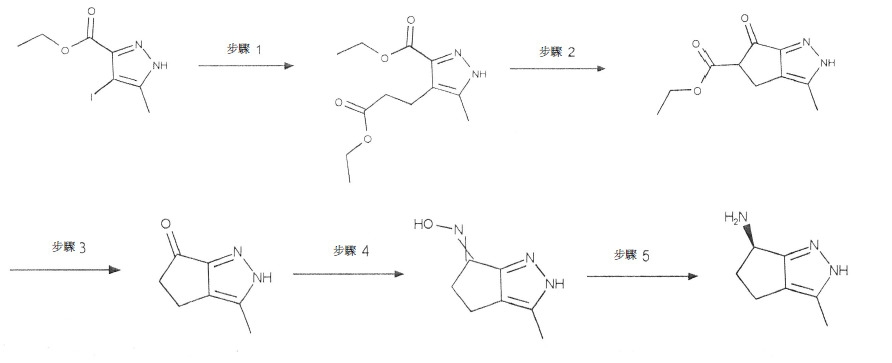
在氬氣氣氛下,將4‐碘‐5‐甲基‐1H‐吡唑‐3‐甲酸乙酯(220 g)、3,3‐二乙氧基丙‐1‐烯(112 g)、乙酸鈀-II (Pd(OAc)2 ,35.3 g)、氯化四丁基銨(240 g)及DIPEA (203 g)在DMF (900 mL)中之混合物在110℃下攪拌2小時且在120℃下攪拌1小時。冷卻至約67℃後,添加EtOAc (1.5 L)。將該混合物冷卻至rt,經矽藻土過濾且用EtOAc (2x)洗滌濾餅。用半飽和NaCl水溶液(3x)及水(4x)洗滌經合併之濾液。乾燥(MgSO4 )後,在真空中濃縮該混合物以得到粗產物,其係直接按原樣用於下一步驟中。質譜(ESI+ ):m/z = 255 [M+H]+ 。步驟 2 : 3‐ 甲基 ‐6‐ 側氧基 ‐2H,4H,5H,6H‐ 環戊 [c] 吡唑 ‐5‐ 甲酸乙酯 Under argon atmosphere, ethyl 4-iodo-5-methyl-1H-pyrazole-3-carboxylate (220 g), 3,3-diethoxyprop-1-ene (112 g), acetic acid A mixture of palladium-II (Pd(OAc) 2 , 35.3 g), tetrabutylammonium chloride (240 g) and DIPEA (203 g) in DMF (900 mL) was stirred at 110 °C for 2 hours and at 120 °C under stirring for 1 hour. After cooling to about 67°C, EtOAc (1.5 L) was added. The mixture was cooled to rt, filtered through celite and the filter cake was washed with EtOAc (2x). The combined filtrates were washed with half-saturated aqueous NaCl (3x) and water (4x). After drying (MgSO 4), and the mixture was concentrated in vacuo to give the crude product, which is based directly as such in the next step. Mass spectrum (ESI + ): m/z = 255 [M+H] + . Step 2 : 3- Methyl -6 - Pendant Oxy-2H,4H,5H,6H- Cyclopenta [c] pyrazole- 5 -ethylcarboxylate
在氬氣氣氛下,將4‐(3‐乙氧基‐3‐側氧基丙基)‐5‐甲基‐1H‐吡唑‐3‐甲酸乙酯(191 g)在THF (500 mL)中之溶液在41℃至64℃之間添加至NaN(Si(CH3 )3 )2 之溶液(2M含在THF中,1.3 L)。將該混合物在60℃下攪拌15分鐘且在rt下攪拌1小時。然後將該混合物倒入至HCl水溶液(6N,851 mL)、冰(1 kg)及2-甲基-四氫呋喃(2.5 L)之混合物中。攪拌10分鐘後,分離相。在真空中濃縮有機相以得到粗產物,其係直接按原樣用於下一步驟中。 質譜(ESI+ ):m/z = 209 [M+H]+ 。步驟 3 : 3‐ 甲基 ‐2H,4H,5H,6H‐ 環戊 [c] 吡唑 ‐6‐ 酮 Under argon atmosphere, 4-(3-ethoxy-3-pentoxypropyl)-5-methyl-1H-pyrazole-3-ethylcarboxylate (191 g) in THF (500 mL) in the solution was added at 64 deg.] C to between 41 ℃ to NaN (Si (CH 3) 3 ) 2 the solution (2M in THF containing, 1.3 L). The mixture was stirred at 60°C for 15 minutes and at rt for 1 hour. The mixture was then poured into a mixture of aqueous HCl (6N, 851 mL), ice (1 kg) and 2-methyl-tetrahydrofuran (2.5 L). After stirring for 10 minutes, the phases were separated. The organic phase was concentrated in vacuo to give the crude product, which was used as such in the next step. Mass spectrum (ESI + ): m/z = 209 [M+H] + . Step 3 : 3- Methyl- 2H,4H,5H,6H- cyclopenta [c] pyrazole- 6- one
將3‐甲基‐6‐側氧基‐2H,4H,5H,6H‐環戊[c]吡唑‐5‐甲酸乙酯(363 g)在1,4-二噁烷(1.5 L)及水(110 mL)中之混合物加熱至90℃持續22小時。在真空中濃縮該混合物以得到粗產物,其係直接按原樣用於下一步驟中。質譜(ESI+ ):m/z = 137 [M+H]+ 。步驟 4 : N‐[3‐ 甲基 ‐2H,4H,5H,6H‐ 環戊 [c] 亞吡唑 ‐6‐ 基 ] 羥胺;鹽酸鹽 Mix 3-methyl-6-oxy-2H,4H,5H,6H-cyclopenta[c]pyrazole-5-carboxylate (363 g) in 1,4-dioxane (1.5 L) and The mixture in water (110 mL) was heated to 90°C for 22 hours. The mixture was concentrated in vacuo to give the crude product, which was used as such in the next step. Mass spectrum (ESI + ): m/z = 137 [M+H] + . Step 4 : N-[3- methyl- 2H,4H,5H,6H- cyclopenta [c] pyrazol- 6- yl ] hydroxylamine; hydrochloride
將3‐甲基‐2H,4H,5H,6H‐環戊[c]吡唑‐6‐酮(294 g)在EtOH (800 mL)中之溶液加熱至65℃且用鹽酸羥胺(52.5 g)處理。將混合物在60℃下攪拌2小時且在rt下攪拌12小時。收集沉澱且用EtOH及第三丁基甲基醚洗滌。在真空中乾燥粗產物且按原樣用於下一步驟中。質譜(ESI+ ):m/z = 152 [M+H]+ 。步驟 5 : (6R)‐3‐ 甲基 ‐2H,4H,5H,6H‐ 環戊 [c] 吡唑 ‐6‐ 胺;半 -(2S,3S)‐2,3‐ 雙 (4‐ 甲基苯甲醯基氧基 )- 丁二酸鹽 A solution of 3-methyl-2H,4H,5H,6H-cyclopenta[c]pyrazole-6-one (294 g) in EtOH (800 mL) was heated to 65°C and treated with hydroxylamine hydrochloride (52.5 g) deal with. The mixture was stirred at 60°C for 2 hours and at rt for 12 hours. The precipitate was collected and washed with EtOH and t-butyl methyl ether. The crude product was dried in vacuo and used as such in the next step. Mass spectrum (ESI + ): m/z = 152 [M+H] + . Step 5 : (6R)-3 -methyl- 2H,4H,5H,6H- cyclopenta [c] pyrazole- 6- amine; hemi- (2S,3S)-2,3- bis (4 -methyl) Benzyloxy ) -succinate
將N‐[3‐甲基‐2H,4H,5H,6H‐環戊[c]亞吡唑‐6‐基]羥胺;鹽酸鹽(85 g)懸浮在MeOH (2.2 L)中,用(1R)‐1‐苯基乙‐1‐胺(165 g)處理且在40℃下攪拌30分鐘。添加碳載20% Pd(OH)2
(18 g)且將該混合物在氫氣氣氛(21巴)於65℃下攪拌8小時且在100℃下攪拌12小時。將該混合物冷卻至rt,經矽藻土過濾且在真空中濃縮。將殘餘物溶解於異丙醇(1.4 L)及水(70 mL)中,加熱至60℃且用K2
CO3
(94 g)處理。將該混合物在60℃下攪拌10分鐘,在55℃下攪拌50分鐘然後過濾。用異丙醇洗滌濾餅。在真空中濃縮合併之濾液。將殘餘物溶解於異丙醇(100 mL)中,加熱至60℃且用(2S,3S)‐2,3‐雙(4‐甲基苯甲醯基氧基)丁二酸(79 g)在異丙醇(700 mL)及水(40 mL)中之溶液處理。將該混合物加熱至35℃然後過濾。將濾液攪拌30分鐘,加熱至60℃持續1小時且然後在rt下持續12小時。藉由過濾收集沉澱且用異丙醇及第三丁基甲基醚洗滌。在真空中乾燥粗產物且按原樣用於下一步驟中。質譜(ESI+
):m/z = 138 [M+H]+
。中間物 2 6‐{5‐ 氮雜螺 [2.3] 己 ‐5‐ 基 }‐2‐ 氯吡啶 ‐3‐ 甲醛 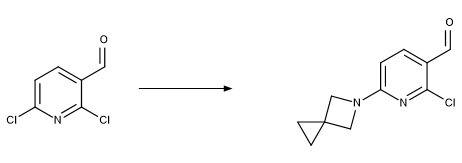
在氬氣氣氛下,將2,6‐二氯吡啶‐3‐甲醛(10 g)、5‐氮雜螺[2.3]己烷三氟乙酸鹽(16 g)及DIPEA (40 mL)在DMF (40 mL)中之混合物加熱至40℃持續12小時。將混合物冷卻,濃縮,分配在水與DCM之間且分離相。用鹽水洗滌有機相,乾燥(MgSO4 ),濃縮然後在矽膠上層析(石油醚/EtOAc 90:10 → 70:30)殘餘物以得到標題化合物。LC (方法2):tR = 1.03分鐘;質譜(ESI+):m/z = 223 [M+H]+ 。Under argon atmosphere, 2,6-dichloropyridine-3-carbaldehyde (10 g), 5-azaspiro[2.3]hexane trifluoroacetate (16 g) and DIPEA (40 mL) were mixed in DMF ( The mixture in 40 mL) was heated to 40°C for 12 hours. The mixture was cooled, concentrated, partitioned between water and DCM and the phases were separated. The organic phase was washed with brine, dried (MgSO 4), concentrated and then chromatographed (petroleum ether / EtOAc 90:10 → 70:30) the residue on silica to give the title compound. LC (Method 2): t R = 1.03 min; Mass Spec (ESI+): m/z = 223 [M+H] + .
類似於中間物2來製備中間物 2-1 至 2-4
: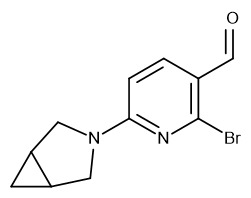

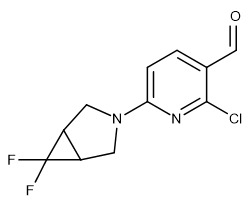
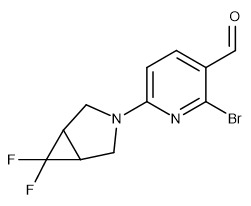
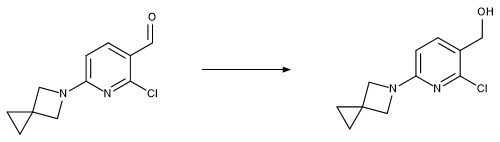
將NaBH4 (2.1 g)逐份添加至冰冷之6‐{5‐氮雜螺[2.3]己‐5‐基}‐2‐氯吡啶‐3‐甲醛(12 g)在THF (300 mL)及水(3 mL)中之混合物。將該混合物在0℃下攪拌20分鐘且在rt下攪拌30分鐘。然後將該混合物倒入500 g冰及飽和NH4 Cl水溶液(500 mL)之混合物中。以DCM萃取水相兩次。乾燥(MgSO4 )合併的有機相且在真空中濃縮以得到標題化合物。LC (方法2):tR = 0.84分鐘;質譜(ESI+):m/z = 225 [M+H]+ 。The NaBH 4 (2.1 g) was added portionwise to the solution of 6- {5-azaspiro [2.3] hex-5-yl} -2-chloro-3-carbaldehyde (12 g) in THF (300 mL) and mixture in water (3 mL). The mixture was stirred at 0°C for 20 minutes and at rt for 30 minutes. The mixture was then poured into 500 g 4 Cl ice and saturated aqueous NH (500 mL) of the mixture. The aqueous phase was extracted twice with DCM. The organic phase was dried (MgSO 4) combined and concentrated in vacuo to give the title compound. LC (Method 2): t R = 0.84 min; Mass Spec (ESI+): m/z = 225 [M+H] + .
類似於中間物3來製備中間物 3-1 至 3-4
: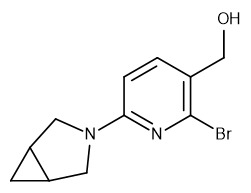
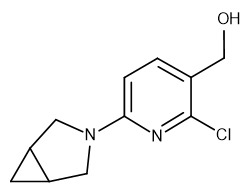
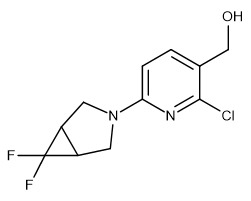
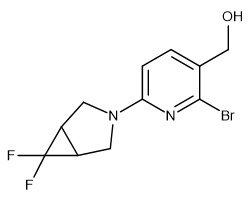
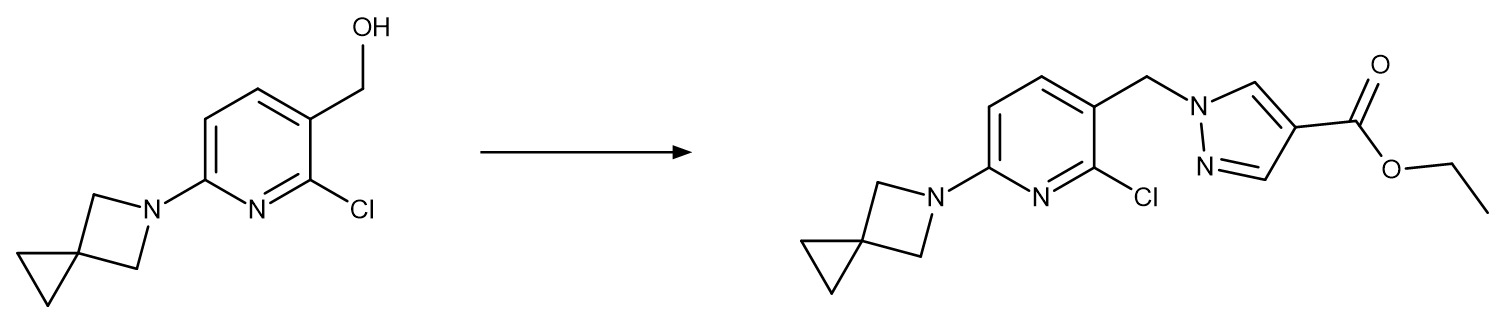
將(6‐{5‐氮雜螺[2.3]己‐5‐基}‐2‐氯吡啶‐3‐基)甲醇(5.6 g)、1H‐吡唑‐4‐甲酸乙酯(3.6 g)及對甲苯磺酸(2.6 g)在ACN (80 mL)中之混合物加熱2小時至60℃。冷卻至rt後,將該混合物分配在飽和NaHCO3 水溶液與EtOAc之間。以EtOAc萃取水相且乾燥(MgSO4 )合併的有機相然後濃縮。將殘餘物在矽膠上層析(石油醚/EtOAc 100:0 → 50:50)以得到標題化合物。 LC (方法2):tR = 1.05分鐘;質譜(ESI+):m/z = 347 [M+H]+ 。(6-{5-azaspiro[2.3]hex-5-yl}-2-chloropyridin-3-yl)methanol (5.6 g), 1H-pyrazole-4-ethylcarboxylate (3.6 g) and A mixture of p-toluenesulfonic acid (2.6 g) in ACN (80 mL) was heated to 60 °C for 2 h. After cooling to rt, the mixture was partitioned between saturated aqueous NaHCO 3 and EtOAc. The aqueous phase was extracted with EtOAc and dried (MgSO 4) organic phases were combined and then concentrated. The residue was chromatographed on silica gel (petroleum ether/EtOAc 100:0→50:50) to give the title compound. LC (Method 2): t R = 1.05 min; Mass Spec (ESI+): m/z = 347 [M+H] + .
類似於中間物4來製備中間物 4-1 至 4-9
:
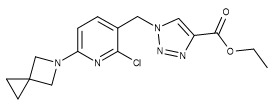
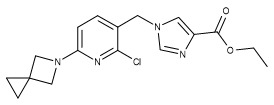


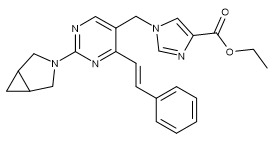
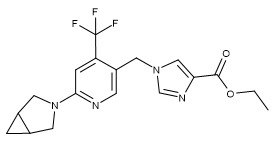
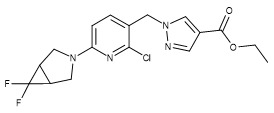
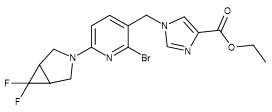

在微波小瓶中,用氬氣沖洗1‐[(6‐{5‐氮雜螺[2.3]己‐5‐基}‐2‐氯吡啶‐3‐基)甲基]‐1H‐吡唑‐4‐甲酸乙酯(1.2 g)、乙烯基三氟硼酸鉀(535 mg)、K2 CO3 (920 mg)及THF (25 mL)之混合物10分鐘。添加1,1'-雙(二苯基膦基)二茂鐵二氯化鈀(II) (Pd(dppf)Cl2 ,120 mg),密封該小瓶且將該混合物加熱至80℃持續12小時。冷卻至rt後,用EtOAc稀釋該混合物。依次用水及鹽水洗滌該混合物。乾燥(MgSO4 )後,在真空中濃縮該混合物且將殘餘物在矽膠上層析(石油醚/EtOAc 60:40 → 40:60)以得到標題化合物。 LC (方法2):tR = 0.78分鐘;質譜(ESI+):m/z = 339 [M+H]+ 。In a microwave vial, flush 1-[(6-{5-azaspiro[2.3]hex-5-yl}-2-chloropyridin-3-yl)methyl]-1H-pyrazole-4 with argon - carboxylic acid ethyl ester mixture (1.2 g), potassium vinyltrifluoroborate (535 mg), K 2 CO 3 (920 mg) and THF (25 mL) within 10 min. Add 1,1'-bis (diphenylphosphino) ferrocene palladium (II) dichloride (Pd (dppf) Cl 2, 120 mg), the vial was sealed and the mixture was heated to 80 deg.] C for 12 hours . After cooling to rt, the mixture was diluted with EtOAc. The mixture was washed sequentially with water and brine. After drying (MgSO 4), and the mixture was concentrated in vacuo and the residue was chromatographed on silica gel (petroleum ether / EtOAc 60:40 → 40:60) to give the title compound. LC (Method 2): t R = 0.78 min; Mass Spec (ESI+): m/z = 339 [M+H] + .
類似於中間物5來製備中間物 5-1
: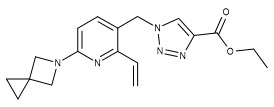

將OsO4 (4%含在水中,285 µL)添加至1‐[(6‐{5‐氮雜螺[2.3]己‐5‐基}‐2‐乙烯基吡啶‐3‐基)甲基]‐1H‐吡唑‐4‐甲酸乙酯(760 mg)在1,4-二噁烷(20 mL)及水(2 mL)中之混合物。將該混合物攪拌30分鐘,用NaIO4 (1.5 g)處理且在rt下攪拌2小時。用EtOAc稀釋該混合物且依次用水、含在水中之10% Na2 S2 O3 及鹽水洗滌。乾燥(MgSO4 )後,在真空中濃縮該混合物且將殘餘物在矽膠上層析(石油醚/EtOAc 80:20 → 50:50)以得到標題化合物。 LC (方法2):tR = 0.93分鐘;質譜(ESI+):m/z = 341 [M+H]+ 。OsO 4 (4% in water, 285 µL) was added to 1-[(6-{5-azaspiro[2.3]hex-5-yl}-2-vinylpyridin-3-yl)methyl] A mixture of -1H-pyrazole-4-ethyl carboxylate (760 mg) in 1,4-dioxane (20 mL) and water (2 mL). The mixture was stirred for 30 minutes, treated with NaIO 4 (1.5 g) and stirred at rt 2 h. The mixture was diluted with EtOAc and washed sequentially with water, the wash water contained in 10% Na 2 S 2 O 3 and brine. After drying (MgSO 4), and the mixture was concentrated in vacuo and the residue was chromatographed on silica gel (petroleum ether / EtOAc 80:20 → 50:50) to give the title compound. LC (Method 2): t R = 0.93 min; Mass Spec (ESI+): m/z = 341 [M+H] + .
類似於中間物6來製備中間物 6-1 至 6-8
:
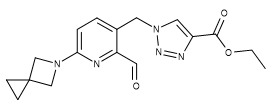

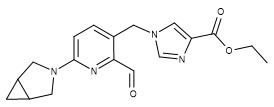

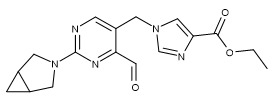
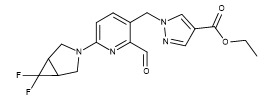


在微波小瓶中,將1‐[(6‐{5‐氮雜螺[2.3]己‐5‐基}‐2‐甲醯基吡啶‐3‐基)甲基]‐1H‐吡唑‐4‐甲酸乙酯(584 mg)溶解於DCM (7 mL)中。添加三氟化二乙基胺基硫(DAST,700 µL),密封該小瓶且將該混合物加熱至50℃持續12小時。冷卻至rt後,用1N NaHCO3 水溶液小心地處理該混合物直至氣體逸出停止。然後將該混合物分配在飽和NaHCO3 水溶液與DCM之間。分離相且以DCM萃取水相。用鹽水洗滌合併的有機相,乾燥(MgSO4 )然後濃縮。將殘餘物在矽膠上層析(石油醚/EtOAc 99:1 → 50:50)以得到標題化合物。LC (方法2):tR = 1.09分鐘;質譜(ESI+):m/z = 363 [M+H]+ 。In a microwave vial, add 1-[(6-{5-azaspiro[2.3]hex-5-yl}-2-carboxypyridin-3-yl)methyl]-1H-pyrazole-4- Ethyl formate (584 mg) was dissolved in DCM (7 mL). Diethylaminosulfur trifluoride (DAST, 700 µL) was added, the vial was sealed and the mixture was heated to 50°C for 12 hours. After cooling to rt, the mixture was treated cautiously until gas evolution ceased with 1N NaHCO 3 aq. The mixture was then partitioned between saturated aqueous NaHCO 3 and DCM. The phases were separated and the aqueous phase was extracted with DCM. The combined organic phases were washed with brine, dried (MgSO 4) and concentrated. The residue was chromatographed on silica gel (petroleum ether/EtOAc 99:1→50:50) to give the title compound. LC (Method 2): t R = 1.09 min; Mass Spec (ESI+): m/z = 363 [M+H] + .
類似於中間物7來製備中間物 7-1 至 7-8
:

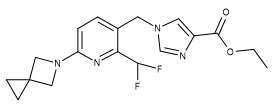
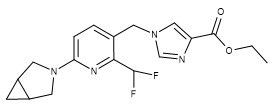

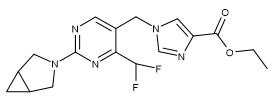

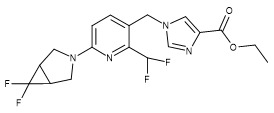

將1‐[(6‐{5‐氮雜螺[2.3]己‐5‐基}‐2‐(二氟甲基)吡啶‐3‐基)甲基]‐1H‐吡唑‐4‐甲酸乙酯(148 mg)、EtOH (3 mL)及NaOH (4M水溶液,400 µL)之混合物在rt下攪拌48小時。添加HCl水溶液(4M,400 µL)且藉由反相HPLC(ACN,水)純化該混合物以得到標題化合物。 LC (方法2):tR = 0.93分鐘;質譜(ESI+):m/z = 335 [M+H]+ 。Ethyl 1-[(6-{5-azaspiro[2.3]hex-5-yl}-2-(difluoromethyl)pyridin-3-yl)methyl]-1H-pyrazole-4-carboxylate A mixture of ester (148 mg), EtOH (3 mL) and NaOH (4M aq, 400 µL) was stirred at rt for 48 h. Aqueous HCl (4M, 400 µL) was added and the mixture was purified by reverse phase HPLC (ACN, water) to give the title compound. LC (Method 2): t R = 0.93 min; Mass Spec (ESI+): m/z = 335 [M+H] + .
類似於中間物8來製備中間物 8-1 至 8-10
: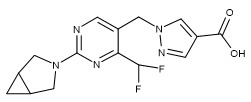
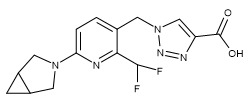
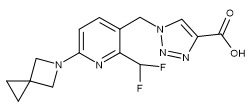
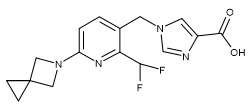
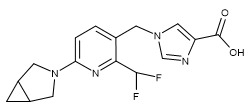
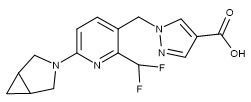
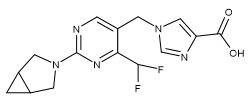
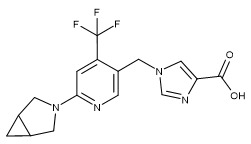

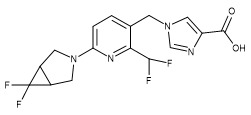
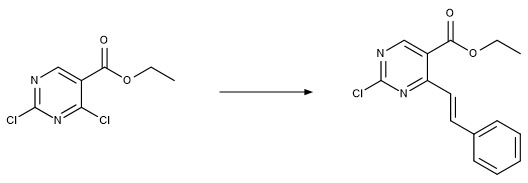
在微波小瓶中,用氬氣沖洗2,4‐二氯嘧啶‐5‐甲酸乙酯(2.5 g)、反式-β-苯乙烯基三氟硼酸鉀(2.5 g)、Na2
CO3
(2M水溶液,12.5 mL)及1,4-二噁烷(50 mL)之混合物10分鐘。添加雙(二-第三丁基(4-二甲基胺基苯基)膦)二氯鈀(II) (Pd(amphos)2
Cl2
,300 mg),密封該小瓶且將該混合物加熱至50℃持續2小時。冷卻至rt後,將該混合物分配在EtOAc與水之間。用鹽水洗滌有機相,乾燥(MgSO4
)然後濃縮。將殘餘物在矽膠上層析(石油醚/EtOAc 80:20 → 60:40)以得到標題化合物。
LC (方法2):tR
= 1.21分鐘;質譜(ESI+):m/z = 289 [M+H]+
。中間物 10 2‐{3‐ 氮雜雙環 [3.1.0] 己 ‐3‐ 基 }‐4‐[(1E)‐2‐ 苯基乙烯基 ] 嘧啶 ‐5‐ 甲酸乙酯 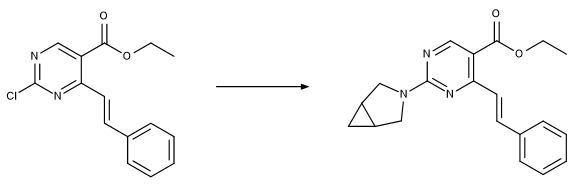
在氬氣氣氛下,將2‐氯‐4‐[(1E)‐2‐苯基乙烯基]嘧啶‐5‐甲酸乙酯(2.56 g)、3-氮雜雙環[3.1.0]己烷鹽酸鹽(1.3 g)及KHCO3 (2.3 g)在THF (30 mL)中之混合物在rt下攪拌12小時。將該混合物分配在飽和NH4 Cl水溶液與EtOAc之間且分離相。用鹽水洗滌有機相。乾燥(MgSO4 )有機相,濃縮且將殘餘物在矽膠上層析(石油醚/EtOAc 80:20 → 60:40)以得到標題化合物。 LC (方法2):tR = 1.27分鐘;質譜(ESI+):m/z = 336 [M+H]+ 。Under argon atmosphere, ethyl 2-chloro-4-[(1E)-2-phenylvinyl]pyrimidine-5-carboxylate (2.56 g), 3-azabicyclo[3.1.0]hexane salt was mixed acid (1.3 g) and KHCO 3 (2.3 g) was stirred at rt in a mixture (30 mL) in the THF 12 hours. The mixture was partitioned between saturated aqueous NH 4 Cl and EtOAc and the phases were separated. The organic phase was washed with brine. Dried (MgSO 4) organic phase was concentrated and the residue was chromatographed on silica gel (petroleum ether / EtOAc 80:20 → 60:40) to give the title compound. LC (Method 2): t R = 1.27 min; Mass Spec (ESI+): m/z = 336 [M+H] + .
類似於中間物10來製備中間物 10-1
: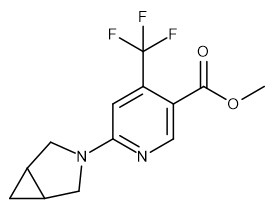
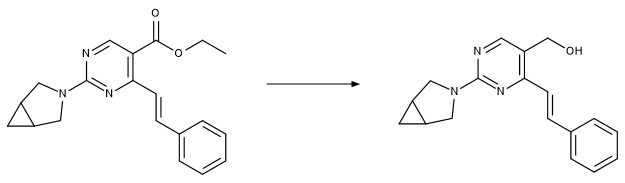
在氬氣氣氛下,用氫化二異丁基鋁(DIBAH,1M含在THF中,25 mL)逐滴處理2‐{3‐氮雜雙環[3.1.0]己‐3‐基}‐4‐[(1E)‐2‐苯基乙烯基]嘧啶‐5‐甲酸乙酯(1.96 g)在THF (40 mL)中之混合物。將該混合物在rt下攪拌2小時,冷卻至0℃且用4M HCl水溶液(15 mL)逐滴處理。然後將該混合物攪拌5分鐘且添加4M NaOH水溶液(15 mL)。將該混合物分配在鹽水與DCM之間且分離相。乾燥(MgSO4
)有機相,濃縮且將殘餘物在矽膠上層析(DCM/MeOH 98:2 → 90:10)以得到標題化合物。
LC (方法2):tR
= 0.84分鐘;質譜(ESI+):m/z = 294 [M+H]+
。中間物 12 1‐[(2‐{3‐ 氮雜雙環 [3.1.0] 己 ‐3‐ 基 }‐4‐[(1E)‐2‐ 苯基乙烯基 ] 嘧啶 ‐5‐ 基 ) 甲基 ]‐1H‐ 吡唑 ‐4‐ 甲酸乙酯 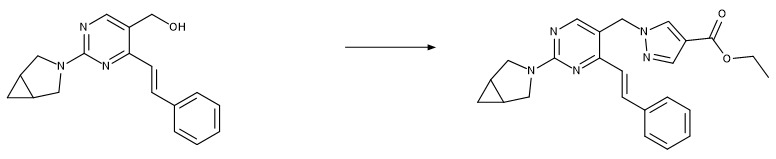
在氬氣氣氛下,將SOCl2
(5 mL)添加至(2‐{3‐氮雜雙環[3.1.0]己‐3‐基}‐4‐[(1E)‐2‐苯基乙烯基]嘧啶‐5‐基)甲醇(1.89 g)在甲苯(20 mL)中之混合物。將該混合物加熱至60℃持續3小時,冷卻至rt且在真空中濃縮。將殘餘物溶解於DCM (20 mL)中且逐滴添加至1H‐吡唑‐4‐甲酸乙酯(950 mg)及DIPEA (2.2 mL)在DCM (20 mL)中之混合物。在rt下攪拌12小時後,將該混合物分配在水與DCM之間。用鹽水洗滌有機相,乾燥(MgSO4
),濃縮且將殘餘物在矽膠上層析(石油醚/EtOAc 50:50 → 0:100)以得到標題化合物。
LC (方法2):tR
= 1.06分鐘;質譜(ESI+):m/z = 416 [M+H]+
。中間物 13 1‐[(6‐{3‐ 氮雜雙環 [3.1.0] 己 ‐3‐ 基 }‐2‐( 二氟甲基 ) 吡啶 ‐3‐ 基 ) 甲基 ]‐1H‐1,2,3‐ 三唑 ‐4‐ 甲酸乙酯 
用Ar噴沖裝有攪拌棒、1‐[(6‐{3‐氮雜雙環[3.1.0]己‐3‐基}‐2‐溴吡啶‐3‐基)甲基]‐1H‐1,2,3‐三唑‐4‐甲酸乙酯(300 mg)及NMP (4 mL)之微波小瓶5分鐘。依次添加CsF (349 mg)、CuF (146 mg)及二氟甲基-三甲基矽烷(522 µL),密封該小瓶,且將該混合物在120℃下攪拌1.5小時。冷卻至rt後,將該混合物分配在水與EtOAc之間。經矽藻土過濾該混合物,分離相且以EtOAc萃取水相。乾燥(MgSO4
)合併的有機相然後濃縮。藉由反相HPLC (ACN,水)純化殘餘物以得到標題化合物。
LC (方法2):tR
= 1.08分鐘;質譜(ESI+):m/z = 364 [M+H]+
。中間物 14 1‐[(6‐{5‐ 氮雜螺 [2.3] 己 ‐5‐ 基 }‐2‐ 乙烯基吡啶 ‐3‐ 基 ) 甲基 ]‐1H‐ 咪唑 ‐4‐ 甲酸乙酯 
用氬氣沖洗裝有攪拌棒、1‐[(6‐{5‐氮雜螺[2.3]己‐5‐基}‐2‐氯吡啶‐3‐基)甲基]‐1H‐咪唑‐4‐甲酸乙酯(2.6 g)、乙烯基二羥基硼酸頻哪醇酯(1.4 mL)、Na2 CO3 (1M水溶液,18.6 mL)及1,4-二噁烷(40 mL)之微波小瓶5分鐘。添加1,1'-雙(二苯基膦基)二茂鐵二氯化鈀(II)(Pd(dppf)Cl2 ,304 mg),密封該小瓶,且將該混合物在100℃下攪拌6小時。冷卻至rt後,將該混合物分配在水與EtOAc之間。以EtOAc萃取水相兩次。用鹽水洗滌合併的有機相,乾燥(MgSO4 ),然後濃縮。將殘餘物在矽膠上層析(石油醚/EtOAc 50:50 → 0:100)以得到標題化合物。 LC (方法1):tR = 1.01分鐘;質譜(ESI+):m/z = 339 [M+H]+ 。Flush with argon gas containing a stir bar, 1-[(6-{5-azaspiro[2.3]hex-5-yl}-2-chloropyridin-3-yl)methyl]-1H-imidazole-4- carboxylic acid ethyl ester (2.6 g), vinyl boronic acid pinacol ester dihydroxy (1.4 mL) frequency, Na 2 CO 3 (1M aq, 18.6 mL) and 1,4-dioxane (40 mL) 5 minutes of microwave vial . Add 1,1'-bis (diphenylphosphino) ferrocene palladium (II) dichloride (Pd (dppf) Cl 2, 304 mg), the vial was sealed, and the mixture was stirred at 100 ℃ 6 Hour. After cooling to rt, the mixture was partitioned between water and EtOAc. The aqueous phase was extracted twice with EtOAc. The combined organic phases were washed with brine, dried (MgSO 4), then concentrated. The residue was chromatographed on silica gel (petroleum ether/EtOAc 50:50→0:100) to give the title compound. LC (Method 1): t R = 1.01 min; Mass Spec (ESI+): m/z = 339 [M+H] + .
類似於中間物14來製備中間物 14-1 至 14-4
: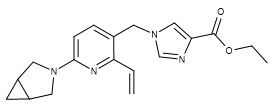
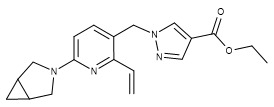
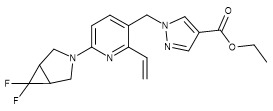
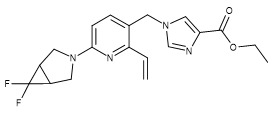

將6‐{3‐氮雜雙環[3.1.0]己‐3‐基}‐4‐(三氟甲基)吡啶‐3‐甲酸甲酯(1.1 g)在THF (15 mL)中之混合物冷卻至-50℃且用LiAlH4
(1M溶液含在THF中,3.5 mL)逐滴處理。將該混合物在-25℃下攪拌3小時且然後用10% NH4
Cl水溶液小心處理。然後將該混合物分配在水與EtOAc之間且經矽藻土過濾。分離相且以EtOAc萃取水相。乾燥(MgSO4
)合併的有機相且在真空中濃縮以得到粗產物,其係直接用於下一步驟中。LC (方法1):tR
= 0.93分鐘;質譜(ESI+):m/z = 259 [M+H]+
。中間物 16 1‐[(6‐{3‐ 氮雜雙環 [3.1.0] 己 ‐3‐ 基 }‐2‐( 三氟甲基 ) 吡啶 ‐3‐ 基 ) 甲基 ]‐N‐[(6R)‐3‐ 甲基 ‐2‐{[2‐( 三甲基矽基 ) 乙氧基 ] 甲基 }‐2H,4H,5H,6H‐ 環戊 [c] 吡唑 ‐6‐ 基 ]‐1H‐ 吡唑 ‐4‐ 甲醯胺 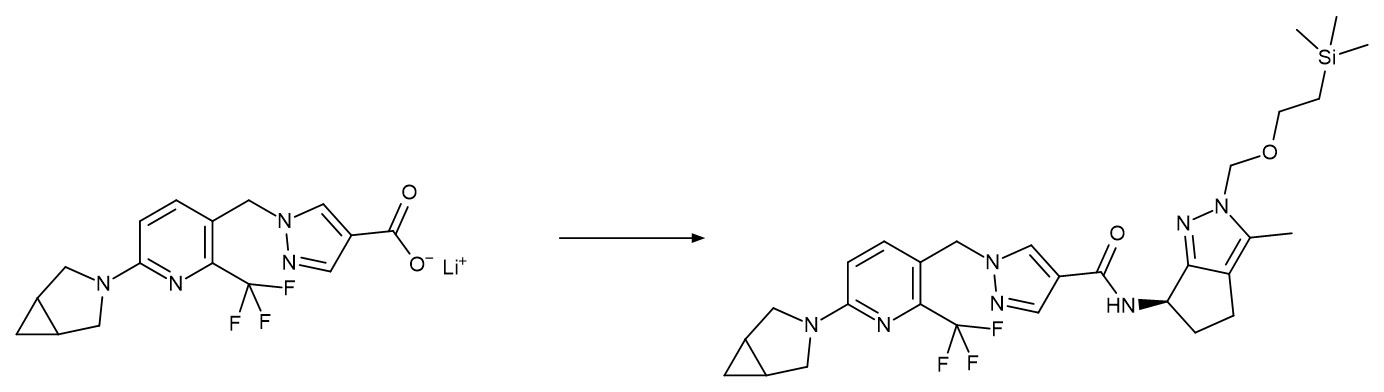
將1‐[(6‐{3‐氮雜雙環[3.1.0]己‐3‐基}‐2‐(三氟甲基)吡啶‐3‐基)甲基]‐1H‐吡唑‐4‐甲酸鋰鹽(30 mg)、DIPEA (90 µL)及六氟磷酸O-(7-氮雜苯并三唑-1-基)-N,N,N’,N’-四甲基脲鎓(HATU,50 mg)在DMF (2 mL)中之混合物攪拌5分鐘。添加(6R)‐3‐甲基‐2‐{[2‐(三甲基矽基)乙氧基]甲基}‐2H,4H,5H,6H‐環戊[c]吡唑‐6‐胺(30 mg)且將該混合物攪拌1小時。用EtOAc稀釋該混合物,用水及鹽水洗滌,乾燥(MgSO4
),在真空中濃縮且將殘餘物在矽膠上層析(DCM/MeOH 98:2 → 90:10)以得到標題化合物。
LC (方法2):tR
= 1.25分鐘;質譜(ESI+
):m/z = 602 [M+H]+
。中間物 17 (6R)‐3‐ 甲基 ‐2‐{[2‐( 三甲基矽基 ) 乙氧基 ] 甲基 }‐2H,4H,5H,6H‐ 環戊 [c] 吡唑 ‐6‐ 胺 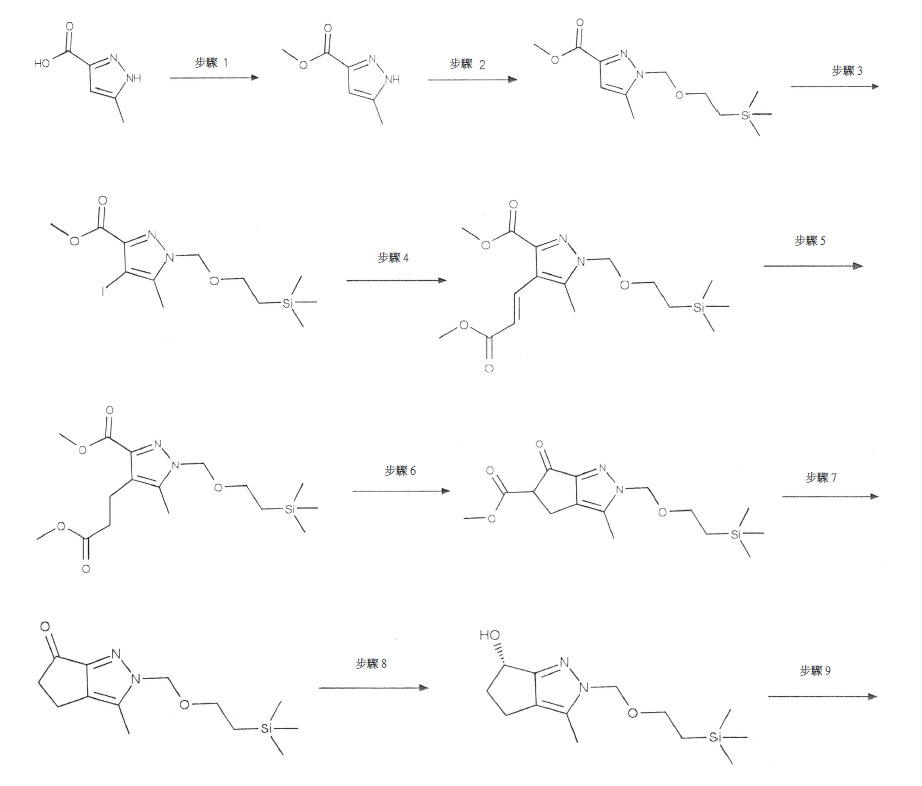
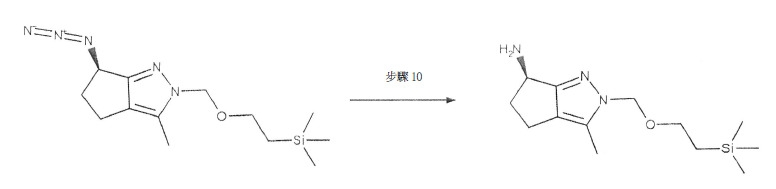
將亞硫醯氯(58 mL)逐滴添加至5‐甲基‐1H‐吡唑‐3‐甲酸(45 g)在MeOH (450 mL)中之溶液。添加後,將該混合物在rt下攪拌16小時。在真空中濃縮該混合物。將殘餘物溶解於EtOAc中,依次用飽和NaHCO3 水溶液及鹽水洗滌。乾燥(MgSO4 )後,在真空中濃縮該混合物以得到標題化合物。 LC (方法1):tR = 0.64分鐘;質譜(ESI+ ):m/z = 141 [M+H]+ 。步驟 2 : 5‐ 甲基 ‐1‐{[2‐( 三甲基矽基 ) 乙氧基 ] 甲基 }‐1H‐ 吡唑 ‐3‐ 甲酸甲酯 Thionite chloride (58 mL) was added dropwise to a solution of 5-methyl-1H-pyrazole-3-carboxylic acid (45 g) in MeOH (450 mL). After addition, the mixture was stirred at rt for 16 hours. The mixture was concentrated in vacuo. The residue was dissolved in EtOAc, washed successively with saturated aqueous NaHCO 3 and brine. After drying (MgSO 4), and the mixture was concentrated in vacuo to give the title compound. LC (Method 1): t R = 0.64 min; Mass spectrum (ESI +): m / z = 141 [M + H] +. Step 2: 5-Methyl-1 - {[2- (trimethyl silicon based) ethoxy] methyl} -1H- pyrazole-3-carboxylate
將氫化鈉(60%含在礦物油中,16.8 g)逐份添加至DMF (470 mL)。將該混合物攪拌10分鐘,冷卻至0℃且用5‐甲基‐1H‐吡唑‐3‐甲酸甲酯(46.9 g)在DMF (470 mL)中之溶液逐滴處理。攪拌20分鐘後,逐滴添加[2‐(氯甲氧基)乙基]三甲基矽烷(SEM-Cl,77.7 mL)。將該混合物攪拌2小時,用EtOAc稀釋且依次用水及鹽水洗滌。乾燥(MgSO4 )後,在真空中濃縮該混合物且將殘餘物於矽膠上用石油醚/EtOAc 2:1層析。在真空中蒸發溶劑以得到標題化合物,其係直接用於下一步驟中。步驟 3 : 4‐ 碘 ‐5‐ 甲基 ‐1‐{[2‐( 三甲基矽基 ) 乙氧基 ] 甲基 }‐1H‐ 吡唑 ‐3‐ 甲酸甲酯 Sodium hydride (60% in mineral oil, 16.8 g) was added portionwise to DMF (470 mL). The mixture was stirred for 10 minutes, cooled to 0 °C and treated dropwise with a solution of methyl 5-methyl-1H-pyrazole-3-carboxylate (46.9 g) in DMF (470 mL). After stirring for 20 minutes, [2-(chloromethoxy)ethyl]trimethylsilane (SEM-Cl, 77.7 mL) was added dropwise. The mixture was stirred for 2 hours, diluted with EtOAc and washed sequentially with water and brine. After drying (MgSO 4), and the mixture was concentrated in vacuo and the residue was purified on a silica gel petroleum ether / EtOAc 2 with: 1 chromatography. The solvent was evaporated in vacuo to give the title compound, which was used directly in the next step. Step 3 : 4- Iodo -5- methyl- 1-{[2-( trimethylsilyl ) ethoxy ] methyl }-1H- pyrazole- 3- carboxylate methyl ester
將TFA (2.7 mL)及N-碘琥珀醯亞胺(94.2 g)添加至5‐甲基‐1‐{[2‐(三甲基矽基)乙氧基]甲基}‐1H‐吡唑‐3‐甲酸甲酯(94.4 g)在ACN (1.4 L)中之溶液。將該混合物攪拌48小時,用EtOAc稀釋且依次用水、飽和Na2 S2 O3 水溶液及鹽水洗滌。乾燥(MgSO4 )後,在真空中濃縮該混合物且將殘餘物於矽膠上用石油醚/EtOAc 2:1層析。在真空中蒸發溶劑以得到標題化合物,其包含約15%之區位異構4-碘‐3‐甲基‐1‐{[2‐(三甲基矽基)乙氧基]甲基}‐1H‐吡唑‐5‐甲酸甲酯。 LC (方法1):tR = 1.17分鐘;質譜(ESI+ ):m/z = 397 [M+H]+ 。步驟 4 : 4‐[(1E)‐3‐ 甲氧基 ‐3‐ 側氧基丙 ‐1‐ 烯 ‐1‐ 基 ]‐5‐ 甲基 ‐1‐{[2‐( 三甲基矽基 ) 乙氧基 ] 甲基 }‐1H‐ 吡唑 ‐3‐ 甲酸甲酯 TFA (2.7 mL) and N-iodosuccinimide (94.2 g) were added to 5-methyl-1-{[2-(trimethylsilyl)ethoxy]methyl}-1H-pyrazole - A solution of methyl 3-formate (94.4 g) in ACN (1.4 L). The mixture was stirred for 48 hours, diluted with EtOAc and washed with water, saturated Na 2 S 2 O 3 solution and brine. After drying (MgSO 4), and the mixture was concentrated in vacuo and the residue was purified on a silica gel petroleum ether / EtOAc 2 with: 1 chromatography. The solvent was evaporated in vacuo to give the title compound containing about 15% of the regioisomeric 4-iodo-3-methyl-1-{[2-(trimethylsilyl)ethoxy]methyl}-1H ‐Pyrazole‐5‐methyl formate. LC (Method 1): t R = 1.17 min; Mass spectrum (ESI +): m / z = 397 [M + H] +. Step 4: 4 - [(1E) -3- methoxy-3-oxoprop-1-en-1-yl] -5-methyl-1 - {[2- (trimethyl silicon based) Ethoxy ] methyl }-1H- pyrazole- 3- carboxylate methyl ester
將4‐碘‐5‐甲基‐1‐{[2‐(三甲基矽基)乙氧基]甲基}‐1H‐吡唑‐3‐甲酸甲酯(44 g)、丙烯酸甲酯(15 mL)及N-甲基二環己胺(35 mL)溶解於二甲基乙醯胺(430 mL)及水(110 mL)中。用氬氣沖洗該混合物10分鐘。添加二氯雙(三-鄰-甲苯基膦)鈀(II) (PdCl2 [P(o-Tol)3 ]2 ,2.6 g)且將該混合物在85℃下攪拌2小時。然後用EtOAc稀釋該混合物且依次用1M H3 PO4 水溶液及鹽水洗滌。乾燥(MgSO4 )後,在真空中濃縮該混合物且將殘餘物在矽膠上層析(石油醚/EtOAc 95:5 → 50:50)以得到標題化合物。 LC (方法1):tR = 1.13分鐘;質譜(ESI+ ):m/z = 355 [M+H]+ 。步驟 5 : 4‐(3‐ 甲氧基 ‐3‐ 側氧基丙基 )‐5‐ 甲基 ‐1‐{[2‐( 三甲基矽基 ) 乙氧基 ] 甲基 }‐1H‐ 吡唑 ‐3‐ 甲酸甲酯 4-Iodo-5-methyl-1-{[2-(trimethylsilyl)ethoxy]methyl}-1H-pyrazole-3-methylcarboxylate (44 g), methyl acrylate ( 15 mL) and N-methyldicyclohexylamine (35 mL) were dissolved in dimethylacetamide (430 mL) and water (110 mL). The mixture was flushed with argon for 10 minutes. Was added dichlorobis (tri - o - tolylphosphine) palladium (II) (PdCl 2 [P (o-Tol) 3] 2, 2.6 g) and the mixture stirred at 85 ℃ 2 hours. The mixture was then diluted with EtOAc and washed successively with 1M H 3 PO 4 solution and brine. After drying (MgSO 4), and the mixture was concentrated in vacuo and the residue was chromatographed on silica gel (petroleum ether / EtOAc 95: 5 → 50:50) to give the title compound. LC (method 1): t R = 1.13 min; mass spectrum (ESI + ): m/z = 355 [M+H] + . Step 5 : 4-(3 -Methoxy- 3 -Pendant oxypropyl )-5- methyl- 1-{[2-( trimethylsilyl ) ethoxy ] methyl }-1H- pyridine Methyl azole- 3-carboxylate
在氫氣氣氛(3巴)下,在rt下,振盪4‐[(1E)‐3‐甲氧基‐3‐側氧基丙‐1‐烯‐1‐基]‐5‐甲基‐1‐{[2‐(三甲基矽基)乙氧基]甲基}‐1H‐吡唑‐3‐甲酸甲酯(38.6 g)及10%碳載鈀(5.8 g)在EtOAc (580 mL)中之混合物3小時。過濾該混合物,且濃縮濾液以得到標題化合物。 LC (方法1):tR = 1.10分鐘;質譜(ESI+ ):m/z = 357 [M+H]+ 。步驟 6 : 3‐ 甲基 ‐6‐ 側氧基 ‐2‐{[2‐( 三甲基矽基 ) 乙氧基 ] 甲基 }‐2H,4H,5H,6H‐ 環戊 [c] 吡唑 ‐5‐ 甲酸甲酯 Shake 4-[(1E)-3-methoxy-3-pendoxoprop-1-en-1-yl]-5-methyl-1- under hydrogen atmosphere (3 bar) at rt {[2-(trimethylsilyl)ethoxy]methyl}-1H-pyrazole-3-carboxylate methyl ester (38.6 g) and 10% palladium on carbon (5.8 g) in EtOAc (580 mL) the mixture for 3 hours. The mixture was filtered, and the filtrate was concentrated to give the title compound. LC (Method 1): t R = 1.10 min; Mass Spec (ESI + ): m/z = 357 [M+H] + . Step 6 : 3- methyl -6 -oxy -2-{[2-( trimethylsilyl ) ethoxy ] methyl }-2H,4H,5H,6H- cyclopenta [c] pyrazole ‐5‐ methyl formate
將4‐(3‐甲氧基‐3‐側氧基丙基)‐5‐甲基‐1‐{[2‐(三甲基矽基)乙氧基]甲基}‐1H‐吡唑‐3‐甲酸甲酯(37.8 g)在THF中之溶液冷卻至0℃,用NaN(Si(CH3 )3 )2 (40%含在THF中;105 mL)處理且攪拌15分鐘。在冰冷下將該混合物倒入且劇烈攪拌至1M H3 PO4 水溶液中。分離有機相,用鹽水洗滌然後乾燥(MgSO4 )。在真空中蒸發溶劑以得到標題化合物。 LC (方法1):tR = 1.06分鐘;質譜(ESI+ ):m/z = 325 [M+H]+ 。步驟 7 : 3‐ 甲基 ‐2‐{[2‐( 三甲基矽基 ) 乙氧基 ] 甲基 }‐2H,4H,5H,6H‐ 環戊 [c] 吡唑 ‐6‐ 酮 4-(3-methoxy-3-pendoxopropyl)-5-methyl-1-{[2-(trimethylsilyl)ethoxy]methyl}-1H-pyrazole- 3- carboxylate (37.8 g) in THF the solution was cooled to 0 ℃, with NaN (Si (CH 3) 3 ) 2 (40% containing in THF; 105 mL) and stirred for 15 min. The mixture was poured under ice-cooling and stirred vigorously until 1M H 3 PO 4 aqueous solution. The organic phase was separated, washed with brine and then dried (MgSO 4). The solvent was evaporated in vacuo to give the title compound. LC (Method 1): t R = 1.06 min; Mass spectrum (ESI +): m / z = 325 [M + H] +. Step 7 : 3- Methyl- 2-{[2-( trimethylsilyl ) ethoxy ] methyl }-2H,4H,5H,6H- cyclopenta [c] pyrazole- 6- one
將3‐甲基‐6‐側氧基‐2‐{[2‐(三甲基矽基)乙氧基]甲基}‐2H,4H,5H,6H‐環戊[c]吡唑‐5‐甲酸甲酯(34.9 g)在1,4-二噁烷(350 mL)及水(9 mL)中之溶液在回流下加熱12小時。在真空中蒸發溶劑且將殘餘物在矽膠上層析(石油醚/EtOAc 80:20 → 40:60)以得到標題化合物。LC (方法1):tR = 1.05分鐘;質譜(ESI+ ):m/z = 267 [M+H]+ 。步驟 8 : (6S)‐3‐ 甲基 ‐2‐{[2‐( 三甲基矽基 ) 乙氧基 ] 甲基 }‐2H,4H,5H,6H‐ 環戊 [c] 吡唑 ‐6‐ 醇 3-methyl-6-oxy-2-{[2-(trimethylsilyl)ethoxy]methyl}-2H,4H,5H,6H-cyclopenta[c]pyrazole-5 - A solution of methyl formate (34.9 g) in 1,4-dioxane (350 mL) and water (9 mL) was heated at reflux for 12 hours. The solvent was evaporated in vacuo and the residue was chromatographed on silica gel (petroleum ether/EtOAc 80:20→40:60) to give the title compound. LC (Method 1): t R = 1.05 min; Mass Spec (ESI + ): m/z = 267 [M+H] + . Step 8 : (6S)-3 -methyl- 2-{[2-( trimethylsilyl ) ethoxy ] methyl }-2H,4H,5H,6H- cyclopenta [c] pyrazole- 6 ‐ Alcohol
在0℃下,將甲酸(11 mL)添加至三乙胺(27 mL)在DCM (260 mL)中之溶液。使該混合物升溫至rt且添加3‐甲基‐2‐{[2‐(三甲基矽基)乙氧基]甲基}‐2H,4H,5H,6H‐環戊[c]吡唑‐6‐酮(26 g)。用氬氣沖洗10分鐘後,添加[N-[(1S,2S)-2-(胺基-κN)-1,2-二苯基乙基]-4-甲基苯磺醯胺基-κN]氯-[(1,2,3,4,5,6-η)-1,3,5-三甲基苯]-釕(RuCl[(S ,S )-TsDPEN](均三甲苯);0.5 g)且在rt下,將該混合物攪拌48小時。然後在劇烈攪拌下用1M NaHCO3 水溶液處理該混合物。分離相且以DCM萃取水相。用水及鹽水洗滌合併的有機相。乾燥(MgSO4 )後,在真空中蒸發溶劑且將殘餘物在矽膠上層析(DCM/MeOH 98:2 → 90:10)以得到對映異構體過量(ee)為84%之標題化合物。 LC (方法1):tR = 0.99分鐘;質譜(ESI+ ):m/z = 269 [M+H]+ 。步驟 9 : (6R)‐6‐ 疊氮基 ‐3‐ 甲基 ‐2‐{[2‐( 三甲基矽基 ) 乙氧基 ] 甲基 }‐2H,4H,5H,6H‐ 環戊 [c] 吡唑 Formic acid (11 mL) was added to a solution of triethylamine (27 mL) in DCM (260 mL) at 0 °C. The mixture was warmed to rt and 3-methyl-2-{[2-(trimethylsilyl)ethoxy]methyl}-2H,4H,5H,6H-cyclopenta[c]pyrazole- 6-ketone (26 g). After flushing with argon for 10 minutes, [N-[(1S,2S)-2-(amino-κN)-1,2-diphenylethyl]-4-methylbenzenesulfonamido-κN was added ] Chloro-[(1,2,3,4,5,6-η)-1,3,5-trimethylbenzene]-ruthenium (RuCl[( S , S )-TsDPEN](mesitylene); 0.5 g) and the mixture was stirred at rt for 48 hours. The mixture was then treated with aqueous 1M NaHCO 3 under vigorous stirring. The phases were separated and the aqueous phase was extracted with DCM. The combined organic phases were washed with water and brine. After drying (MgSO 4), the solvent was evaporated in vacuo and the residue was chromatographed on silica gel (DCM / MeOH 98: 2 → 90:10) to give the title enantiomeric excess (ee) of 84% of compound . LC (Method 1): t R = 0.99 min; Mass spectrum (ESI +): m / z = 269 [M + H] +. Step 9 : (6R)-6- azido- 3 -methyl- 2-{[2-( trimethylsilyl ) ethoxy ] methyl }-2H,4H,5H,6H- cyclopenta [ c] Pyrazole
在氬氣氣氛下,將DBU (16 mL)添加至(6S)‐3‐甲基‐2‐{[2‐(三甲基矽基)乙氧基]甲基}‐2H,4H,5H,6H‐環戊[c]吡唑‐6‐醇(25.5 g)在甲苯(250 mL)中之溶液。將該混合物冷卻至0℃且歷經1小時逐滴添加二苯基磷醯疊氮(22 mL)。將該混合物攪拌12小時同時升溫至rt。然後添加MeOH (25 mL)且將該混合物攪拌1小時。用水洗滌該混合物兩次,乾燥(MgSO4 )然後在真空中濃縮。將殘餘物在Al2 O3 (DCM)上層析以得到標題化合物。 LC (方法1):tR = 1.15分鐘;質譜(ESI+ ):m/z = 294 [M+H]+ 。步驟 10 : (6R)‐3‐ 甲基 ‐2‐{[2‐( 三甲基矽基 ) 乙氧基 ] 甲基 }‐2H,4H,5H,6H‐ 環戊 [c] 吡唑 ‐6‐ 胺 Under argon atmosphere, DBU (16 mL) was added to (6S)-3-methyl-2-{[2-(trimethylsilyl)ethoxy]methyl}-2H,4H,5H, A solution of 6H-cyclopenta[c]pyrazole-6-ol (25.5 g) in toluene (250 mL). The mixture was cooled to 0 °C and diphenylphosphonium azide (22 mL) was added dropwise over 1 hour. The mixture was stirred for 12 hours while warming to rt. MeOH (25 mL) was then added and the mixture was stirred for 1 hour. The mixture was washed twice with water, dried (MgSO 4) and concentrated in vacuo. The residue was purified on Al 2 O 3 (DCM) chromatography to give the title compound. LC (Method 1): t R = 1.15 min; Mass Spec (ESI + ): m/z = 294 [M+H] + . Step 10 : (6R)-3 -methyl- 2-{[2-( trimethylsilyl ) ethoxy ] methyl }-2H,4H,5H,6H- cyclopenta [c] pyrazole- 6 - amine
在氫氣氣氛(3巴)下,在rt下,將(6R)‐6‐疊氮基‐3‐甲基‐2‐{[2‐(三甲基矽基)乙氧基]甲基}‐2H,4H,5H,6H‐環戊[c]吡唑(19.7 g)及10%碳載鈀(3 g)在EtOH (200 mL)中之混合物振盪12小時。過濾該混合物,然後濃縮濾液以得到標題化合物。
LC (方法1):tR
= 0.80分鐘;質譜(ESI+
):m/z = 268 [M+H]+
。
實例之合成:實例 1 1‐[(6‐{5‐ 氮雜螺 [2.3] 己 ‐5‐ 基 }‐2‐( 二氟甲基 ) 吡啶 ‐3‐ 基 ) 甲基 ]‐N‐[(6R)‐3‐ 甲基 ‐2H,4H,5H,6H‐ 環戊 [c] 吡唑 ‐6‐ 基 ]‐1H‐ 吡唑 ‐4‐ 甲醯胺 
將1‐[(6‐{5‐氮雜螺[2.3]己‐5‐基}‐2‐(二氟甲基)吡啶‐3‐基)甲基]‐1H‐吡唑‐4‐甲酸(110 mg)、DIPEA (280 µL)及六氟磷酸O-(7-氮雜苯并三唑-1-基)-N,N,N’,N’-四甲基脲鎓(HATU,130 mg)在DMF (2 mL)中之混合物攪拌20分鐘。添加(6R)‐3‐甲基‐2H,4H,5H,6H‐環戊[c]吡唑‐6‐胺;半-(2S,3S)‐2,3‐雙(4‐甲基苯甲醯基氧基)丁二酸(130 mg)且將該混合物攪拌1小時。藉由反相HPLC(ACN,水)純化該混合物以得到標題化合物。 LC (方法1):tR = 0.97分鐘;質譜(ESI+ ):m/z = 454 [M+H]+ 。1-[(6-{5-azaspiro[2.3]hex-5-yl}-2-(difluoromethyl)pyridin-3-yl)methyl]-1H-pyrazole-4-carboxylic acid ( 110 mg), DIPEA (280 µL), and O-(7-azabenzotriazol-1-yl)-N,N,N',N'-tetramethyluronium hexafluorophosphate (HATU, 130 mg) ) in DMF (2 mL) was stirred for 20 minutes. Addition of (6R)-3-methyl-2H,4H,5H,6H-cyclopenta[c]pyrazole-6-amine; hemi-(2S,3S)-2,3-bis(4-methylbenzyl) Acyloxy)succinic acid (130 mg) and the mixture was stirred for 1 hour. The mixture was purified by reverse phase HPLC (ACN, water) to give the title compound. LC (Method 1): t R = 0.97 min; Mass Spec (ESI + ): m/z = 454 [M+H] + .
類似於實例1來製備實例 2 至 12
: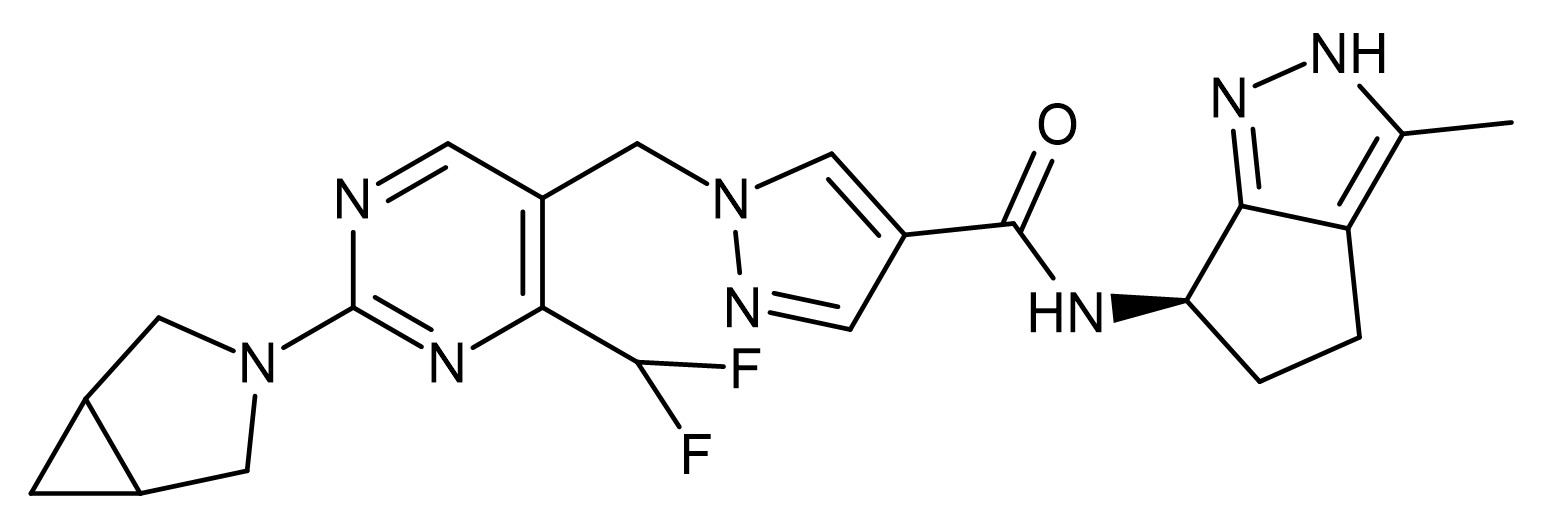
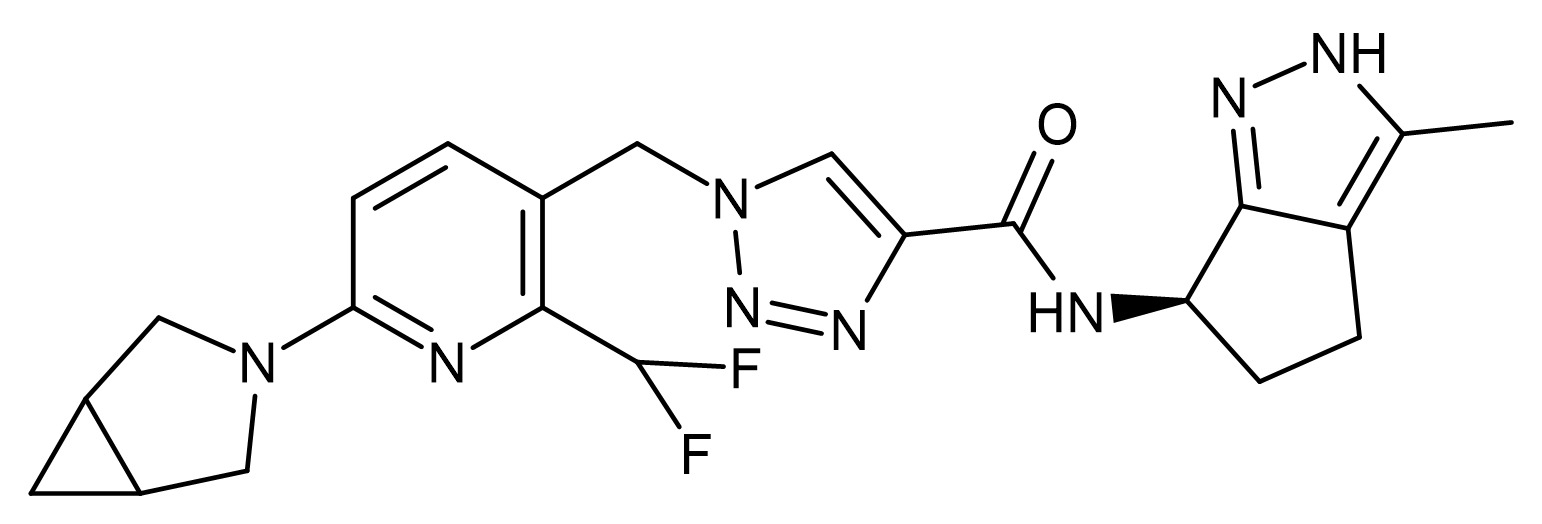
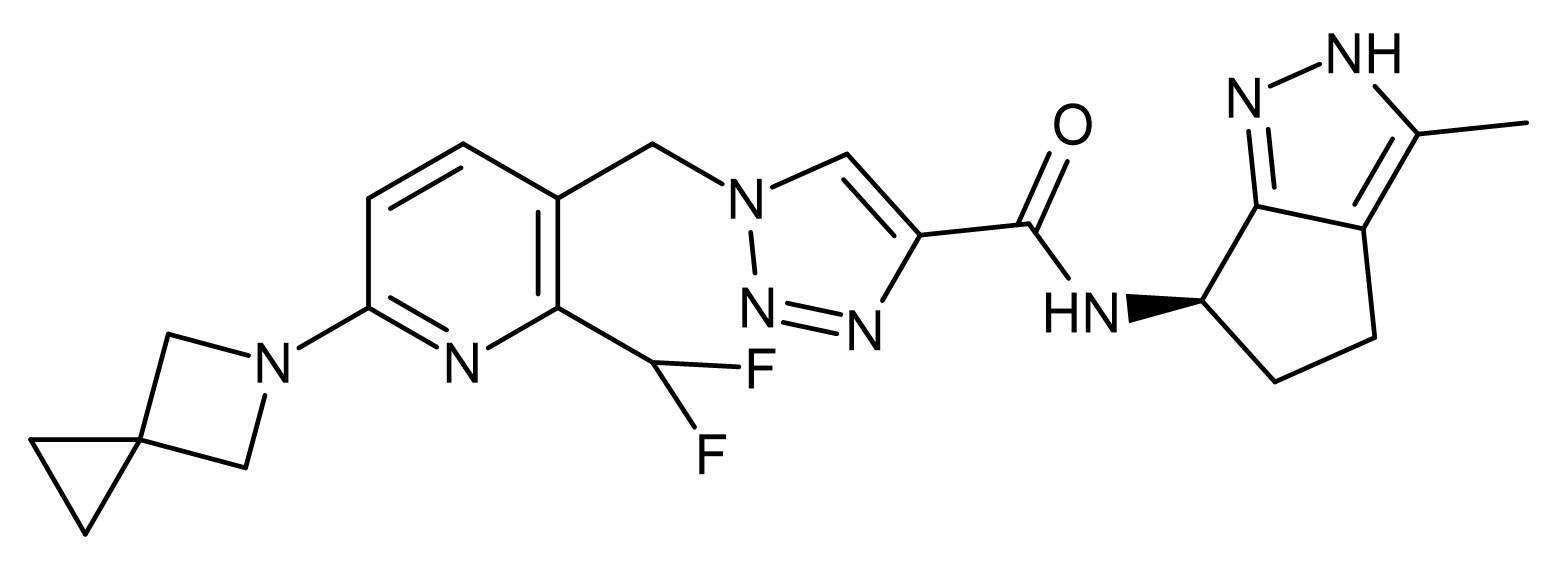

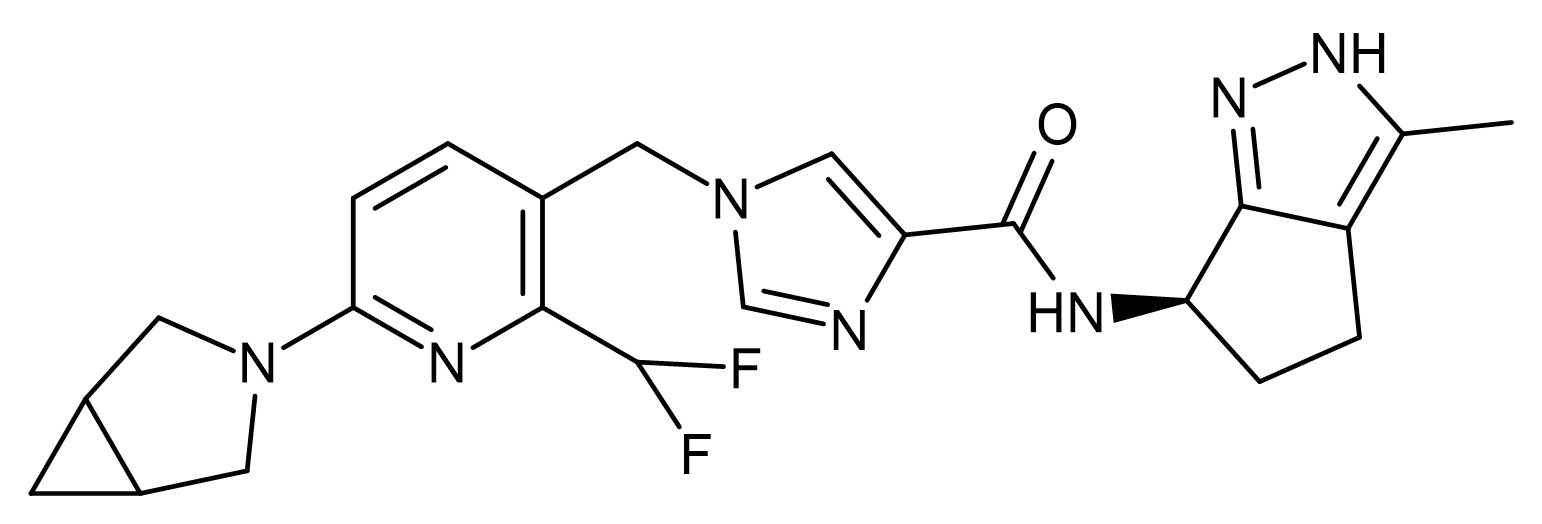

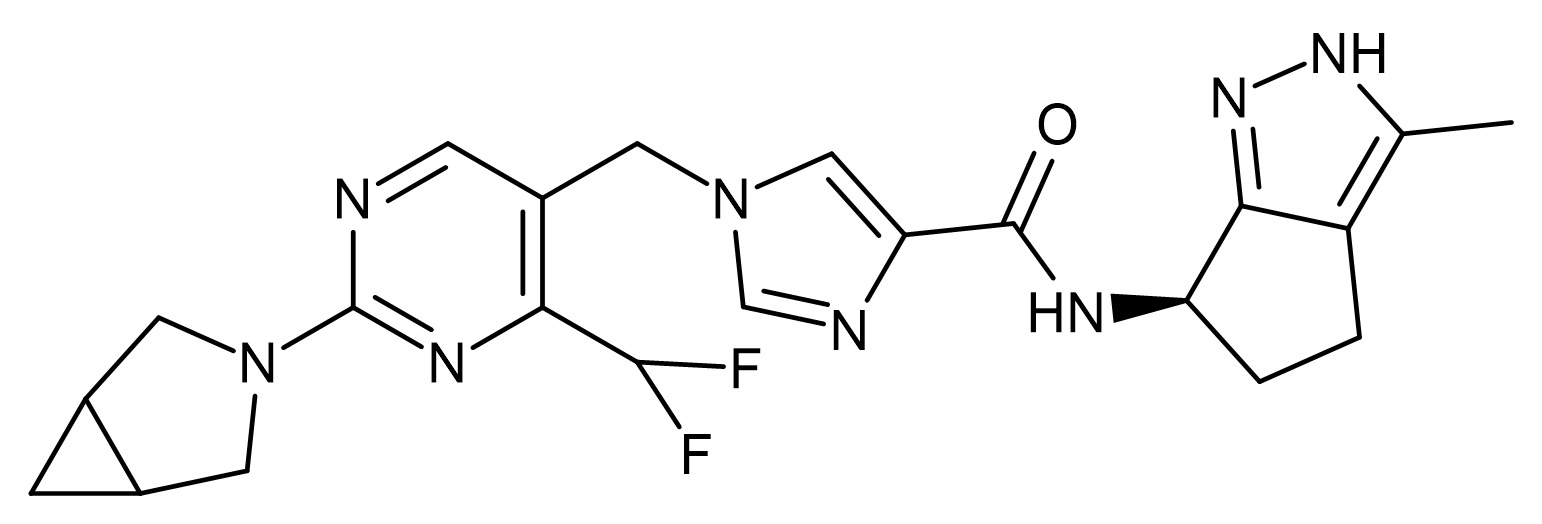
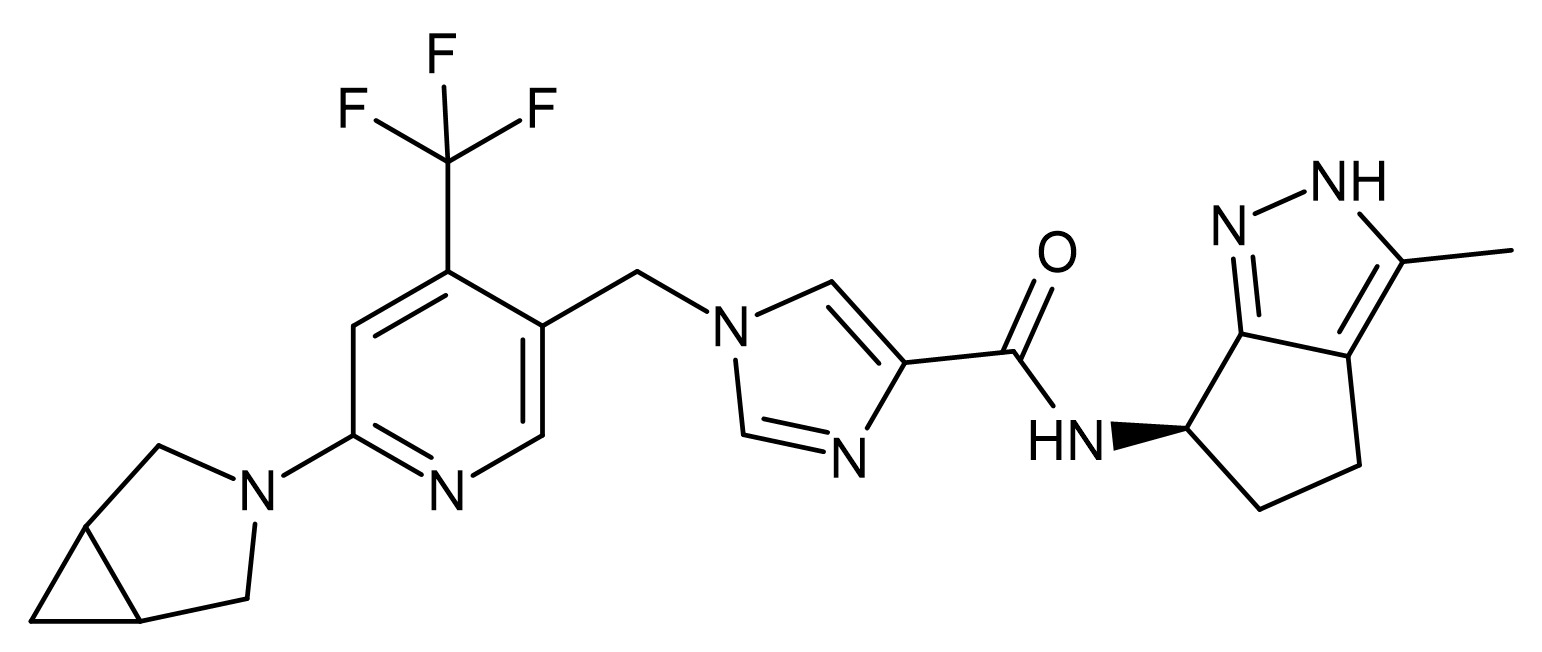
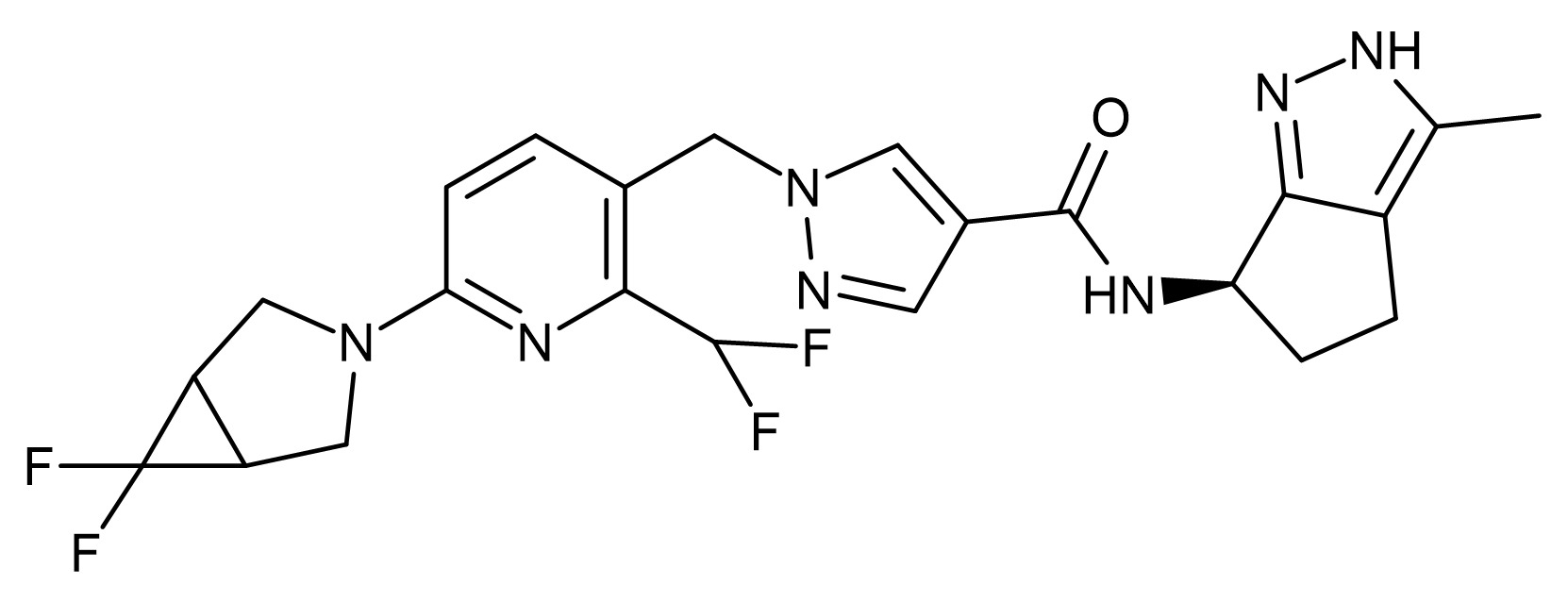
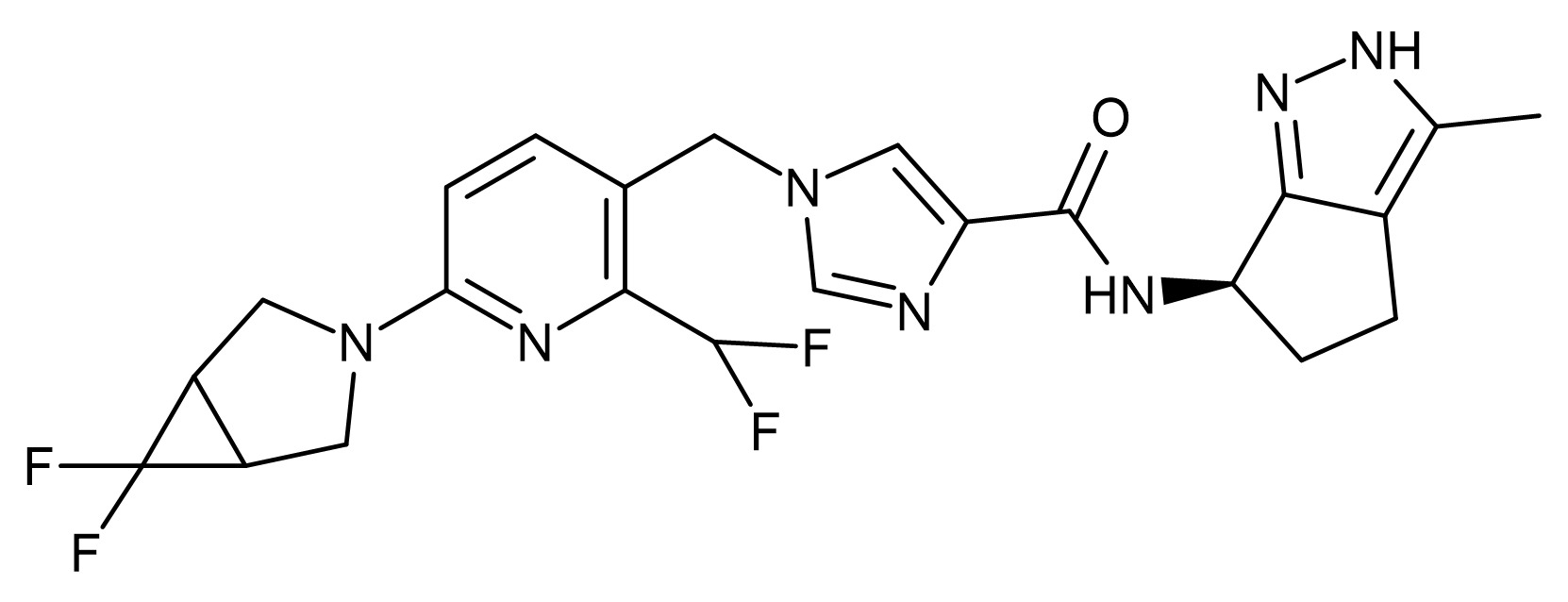


將1‐[(6‐{3‐氮雜雙環[3.1.0]己‐3‐基}‐2‐(三氟甲基)吡啶‐3‐基)甲基]‐N‐[(6R)‐3‐甲基‐2‐{[2‐(三甲基矽基)乙氧基]甲基}‐2H,4H,5H,6H‐環戊[c]吡唑‐6‐基]‐1H‐吡唑‐4‐甲醯胺(45 mg)及三氟乙酸(1 mL)在DCM (2 mL)中之混合物在rt下攪拌12小時。在真空中濃縮該混合物,溶解於MeOH (2 mL)中且用NH3 之MeOH溶液(7M,5 mL)處理。將該混合物轉移至微波小瓶。密封該小瓶且將該混合物加熱12小時至80℃。冷卻至rt後,在真空中濃縮該混合物且藉由反相HPLC(ACN,水)純化以得到標題化合物。 LC (方法3):tR = 1.25分鐘;質譜(ESI+ ):m/z = 602 [M+H]+ 。1-[(6-{3-azabicyclo[3.1.0]hex-3-yl}-2-(trifluoromethyl)pyridin-3-yl)methyl]-N-[(6R)- 3-Methyl-2-{[2-(trimethylsilyl)ethoxy]methyl}-2H,4H,5H,6H-cyclopenta[c]pyrazol-6-yl]-1H-pyridine A mixture of azole-4-carboxamide (45 mg) and trifluoroacetic acid (1 mL) in DCM (2 mL) was stirred at rt for 12 h. The mixture was concentrated in vacuo, dissolved in MeOH (2 mL) and treated with a solution of 3 of NH MeOH (7M, 5 mL). The mixture was transferred to a microwave vial. The vial was sealed and the mixture was heated to 80°C for 12 hours. After cooling to rt, the mixture was concentrated in vacuo and purified by reverse phase HPLC (ACN, water) to give the title compound. LC (Method 3): t R = 1.25 min; Mass Spec (ESI + ): m/z = 602 [M+H] + .

Claims (17)
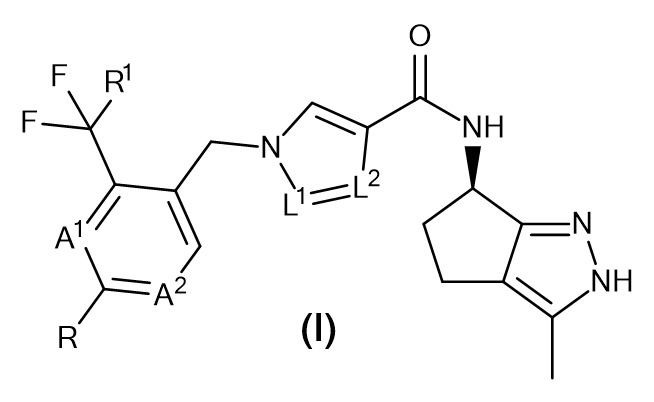
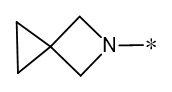
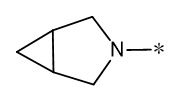
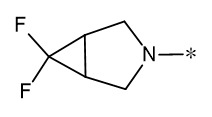

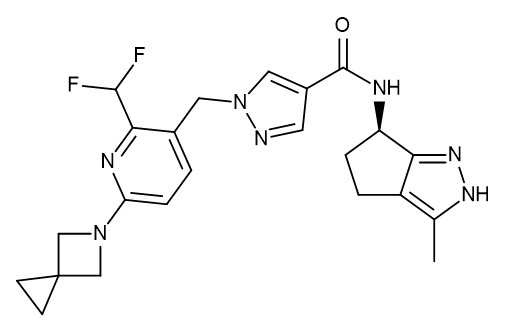
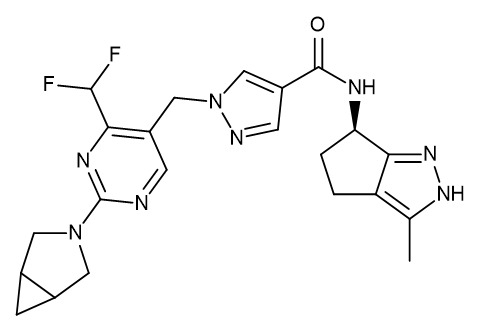
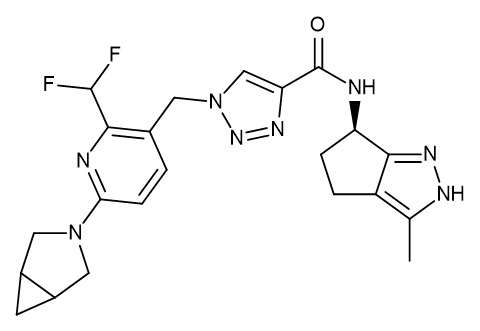
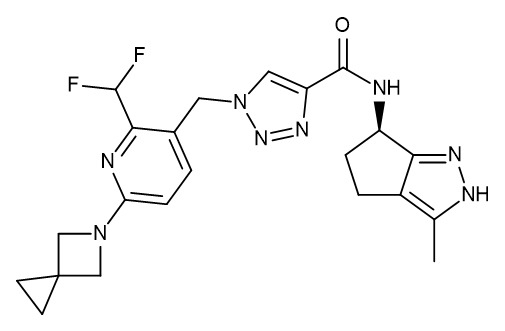

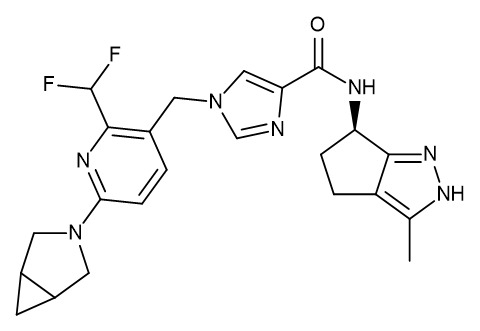

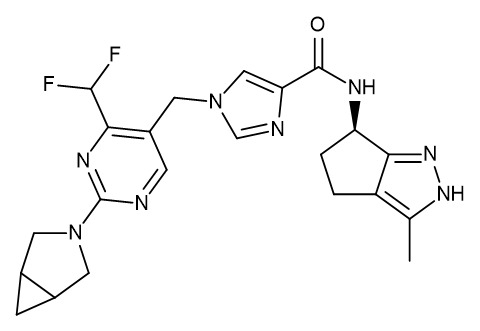
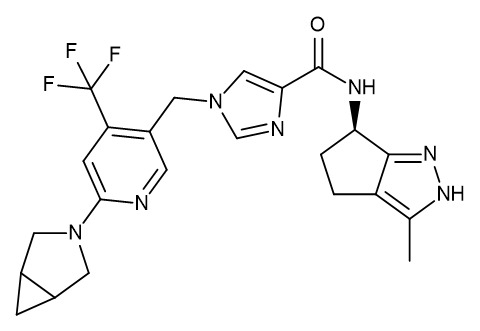
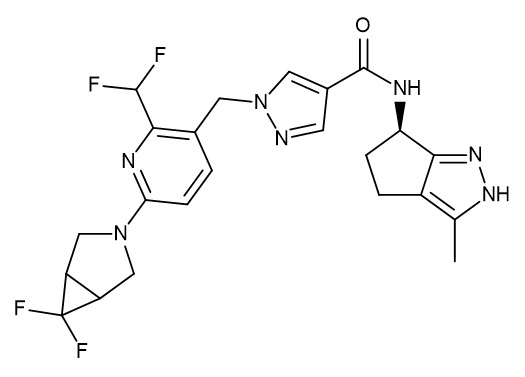
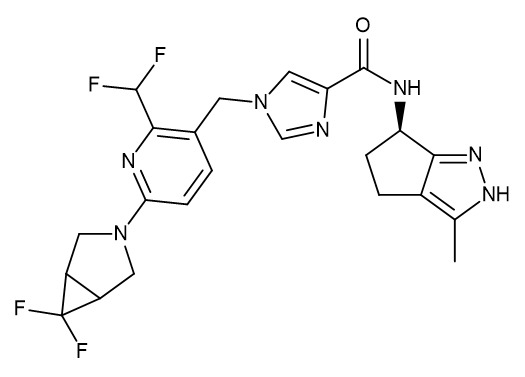
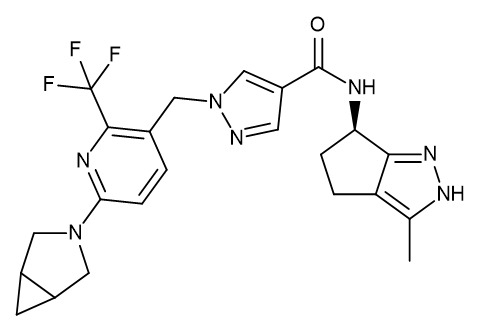
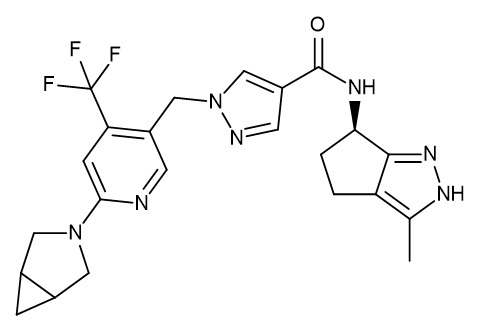
Applications Claiming Priority (2)
| Application Number | Priority Date | Filing Date | Title |
|---|---|---|---|
| EP20157257.5 | 2020-02-13 | ||
| EP20157257 | 2020-02-13 |
Publications (1)
| Publication Number | Publication Date |
|---|---|
| TW202144331A true TW202144331A (en) | 2021-12-01 |
Family
ID=69591570
Family Applications (1)
| Application Number | Title | Priority Date | Filing Date |
|---|---|---|---|
| TW110104876A TW202144331A (en) | 2020-02-13 | 2021-02-09 | Heteroaromatic carboxamide derivatives as plasma kallikrein inhibitors |
Country Status (7)
| Country | Link |
|---|---|
| US (1) | US11851418B2 (en) |
| EP (1) | EP4103561A1 (en) |
| JP (1) | JP7686002B2 (en) |
| CN (1) | CN115087652B (en) |
| AR (1) | AR121340A1 (en) |
| TW (1) | TW202144331A (en) |
| WO (1) | WO2021160716A1 (en) |
Families Citing this family (3)
| Publication number | Priority date | Publication date | Assignee | Title |
|---|---|---|---|---|
| US12091399B2 (en) | 2018-10-10 | 2024-09-17 | Boehringer Ingelheim International Gmbh | Phenyltetrazole derivatives as plasma kallikrein inhibitors |
| TWI873290B (en) | 2020-02-13 | 2025-02-21 | 德商百靈佳殷格翰國際股份有限公司 | Heteroaromatic carboxamide derivatives as plasma kallikrein inhibitors |
| TW202144331A (en) | 2020-02-13 | 2021-12-01 | 德商百靈佳殷格翰國際股份有限公司 | Heteroaromatic carboxamide derivatives as plasma kallikrein inhibitors |
Family Cites Families (19)
| Publication number | Priority date | Publication date | Assignee | Title |
|---|---|---|---|---|
| TWI243164B (en) | 2001-02-13 | 2005-11-11 | Aventis Pharma Gmbh | Acylated indanyl amines and their use as pharmaceuticals |
| US20050090529A1 (en) | 2003-07-31 | 2005-04-28 | Pfizer Inc | 3,5 Disubstituted indazole compounds with nitrogen-bearing 5-membered heterocycles, pharmaceutical compositions, and methods for mediating or inhibiting cell proliferation |
| JP2005089362A (en) | 2003-09-17 | 2005-04-07 | Sumitomo Chemical Co Ltd | Aryl pyrazoline compounds and uses thereof |
| US8658685B2 (en) | 2008-01-31 | 2014-02-25 | Activesite Pharmaceuticals, Inc. | Methods for treatment of kallikrein-related disorders |
| WO2013111107A1 (en) | 2012-01-27 | 2013-08-01 | Novartis Ag | Aminopyridine derivatives as plasma kallikrein inhibitors |
| WO2013111108A1 (en) | 2012-01-27 | 2013-08-01 | Novartis Ag | 5-membered heteroarylcarboxamide derivatives as plasma kallikrein inhibitors |
| BR112015028879B1 (en) | 2013-05-23 | 2022-12-20 | Kalvista Pharmaceuticals Limited | HETEROCYCLIC DERIVATIVE COMPOUNDS, PHARMACEUTICAL COMPOSITION INCLUDING THE SAID COMPOUNDS AND THEIR USES |
| LT3113772T (en) * | 2014-03-07 | 2020-12-28 | Biocryst Pharmaceuticals, Inc. | Trifluoromethyl substituted pyrazoles as human plasma kallikrein inhibitors |
| GB201421083D0 (en) * | 2014-11-27 | 2015-01-14 | Kalvista Pharmaceuticals Ltd | Enzyme inhibitors |
| PL3355890T3 (en) * | 2015-10-01 | 2022-02-21 | Biocryst Pharmaceuticals, Inc. | Human plasma kallikrein inhibitors |
| WO2017072021A1 (en) * | 2015-10-27 | 2017-05-04 | Boehringer Ingelheim International Gmbh | Heteroarylcarboxamide derivatives as plasma kallikrein inhibitors |
| WO2017072020A1 (en) | 2015-10-27 | 2017-05-04 | Boehringer Ingelheim International Gmbh | Heteroarylcarboxamide derivatives as plasma kallikrein inhibitors |
| WO2017207983A1 (en) | 2016-05-31 | 2017-12-07 | Kalvista Pharmaceuticals Limited | Pyrazole derivatives as plasma kallikrein inhibitors |
| EP3481391A4 (en) | 2016-07-11 | 2020-03-11 | Lifesci Pharmaceuticals, Inc. | Therapeutic inhibitory compounds |
| EP3612523B1 (en) | 2017-04-21 | 2021-06-09 | Boehringer Ingelheim International GmbH | Heteroarylcarboxamide derivatives as plasma kallikrein inhibitors |
| EP3837252B1 (en) * | 2018-08-16 | 2025-12-10 | Boehringer Ingelheim International GmbH | Heteroaromatic carboxamide derivatives as plasma kallikrein inhibitors |
| PT4031547T (en) * | 2019-09-18 | 2024-08-27 | Takeda Pharmaceuticals Co | Plasma kallikrein inhibitors and uses thereof |
| TWI873290B (en) * | 2020-02-13 | 2025-02-21 | 德商百靈佳殷格翰國際股份有限公司 | Heteroaromatic carboxamide derivatives as plasma kallikrein inhibitors |
| TW202144331A (en) | 2020-02-13 | 2021-12-01 | 德商百靈佳殷格翰國際股份有限公司 | Heteroaromatic carboxamide derivatives as plasma kallikrein inhibitors |
-
2021
- 2021-02-09 TW TW110104876A patent/TW202144331A/en unknown
- 2021-02-11 JP JP2022548997A patent/JP7686002B2/en active Active
- 2021-02-11 US US17/173,212 patent/US11851418B2/en active Active
- 2021-02-11 CN CN202180014104.6A patent/CN115087652B/en active Active
- 2021-02-11 EP EP21704539.2A patent/EP4103561A1/en active Pending
- 2021-02-11 WO PCT/EP2021/053284 patent/WO2021160716A1/en not_active Ceased
- 2021-02-12 AR ARP210100384A patent/AR121340A1/en not_active Application Discontinuation
Also Published As
| Publication number | Publication date |
|---|---|
| US20210276976A1 (en) | 2021-09-09 |
| CN115087652B (en) | 2024-05-07 |
| WO2021160716A1 (en) | 2021-08-19 |
| JP7686002B2 (en) | 2025-05-30 |
| US11851418B2 (en) | 2023-12-26 |
| JP2023513906A (en) | 2023-04-04 |
| EP4103561A1 (en) | 2022-12-21 |
| AR121340A1 (en) | 2022-05-11 |
| CN115087652A (en) | 2022-09-20 |
Similar Documents
| Publication | Publication Date | Title |
|---|---|---|
| EP3368529B1 (en) | Heteroarylcarboxamide derivatives as plasma kallikrein inhibitors | |
| JP7703587B2 (en) | Heteroaromatic Carboxyamide Derivatives as Plasma Kallikrein Inhibitors - Patent application | |
| JP6828191B2 (en) | Complex aromatic carboxamide derivative as plasma kallikrein inhibitor | |
| JP7175914B2 (en) | Heteroarylcarboxamide derivatives as plasma kallikrein inhibitors | |
| JP2018535963A (en) | Heteroaryl carboxamide derivatives as plasma kallikrein inhibitors | |
| JP7686002B2 (en) | Heteroaromatic carboxamide derivatives as plasma kallikrein inhibitors | |
| JP2022541065A (en) | N-Methyl, N-(6-(Methoxy)pyridazin-3-yl)amine Derivatives as Autotaxin (ATX) Modulators for the Treatment of Inflammatory Airway Diseases or Fibrotic Diseases | |
| JP7378470B2 (en) | Phenyltetrazole derivatives as plasma kallikrein inhibitors | |
| TW202237620A (en) | Cyclopentathiophene carboxamide derivatives as platelet activating factor receptor antagonists | |
| TW202233592A (en) | Heteroaromatic carboxamide derivatives as plasma kallikrein inhibitors | |
| BR122025021106A2 (en) | HETEROAROMATIC CARBOXAMIDE DERIVED COMPOUNDS AS INHIBITORS OF PLASMA KALLICREIN, SALT THEREOF, PHARMACEUTICAL COMPOSITION COMPRISING THEREOF, AND THEIR USES | |
| EA049265B1 (en) | HETEROAROMATIC CARBOXAMIDE DERIVATIVES AS PLASMA KALLIKREIN INHIBITORS |