TW202306902A - Proton conductor and method for producing same - Google Patents
Proton conductor and method for producing same Download PDFInfo
- Publication number
- TW202306902A TW202306902A TW111110319A TW111110319A TW202306902A TW 202306902 A TW202306902 A TW 202306902A TW 111110319 A TW111110319 A TW 111110319A TW 111110319 A TW111110319 A TW 111110319A TW 202306902 A TW202306902 A TW 202306902A
- Authority
- TW
- Taiwan
- Prior art keywords
- proton conductor
- geo
- lithium ions
- protons
- hydrogen
- Prior art date
Links
- 239000004020 conductor Substances 0.000 title claims abstract description 68
- 238000004519 manufacturing process Methods 0.000 title claims abstract description 16
- 229910001416 lithium ion Inorganic materials 0.000 claims abstract description 38
- HBBGRARXTFLTSG-UHFFFAOYSA-N Lithium ion Chemical compound [Li+] HBBGRARXTFLTSG-UHFFFAOYSA-N 0.000 claims abstract description 37
- 239000002253 acid Substances 0.000 claims abstract description 11
- YXFVVABEGXRONW-UHFFFAOYSA-N Toluene Chemical compound CC1=CC=CC=C1 YXFVVABEGXRONW-UHFFFAOYSA-N 0.000 claims description 39
- QTBSBXVTEAMEQO-UHFFFAOYSA-N Acetic acid Chemical compound CC(O)=O QTBSBXVTEAMEQO-UHFFFAOYSA-N 0.000 claims description 30
- ZMXDDKWLCZADIW-UHFFFAOYSA-N N,N-Dimethylformamide Chemical compound CN(C)C=O ZMXDDKWLCZADIW-UHFFFAOYSA-N 0.000 claims description 12
- MUBZPKHOEPUJKR-UHFFFAOYSA-N Oxalic acid Chemical compound OC(=O)C(O)=O MUBZPKHOEPUJKR-UHFFFAOYSA-N 0.000 claims description 12
- 239000003125 aqueous solvent Substances 0.000 claims description 12
- WPYMKLBDIGXBTP-UHFFFAOYSA-N benzoic acid Chemical compound OC(=O)C1=CC=CC=C1 WPYMKLBDIGXBTP-UHFFFAOYSA-N 0.000 claims description 12
- IAZDPXIOMUYVGZ-UHFFFAOYSA-N Dimethylsulphoxide Chemical compound CS(C)=O IAZDPXIOMUYVGZ-UHFFFAOYSA-N 0.000 claims description 10
- AFVFQIVMOAPDHO-UHFFFAOYSA-N Methanesulfonic acid Chemical compound CS(O)(=O)=O AFVFQIVMOAPDHO-UHFFFAOYSA-N 0.000 claims description 8
- WYURNTSHIVDZCO-UHFFFAOYSA-N Tetrahydrofuran Chemical compound C1CCOC1 WYURNTSHIVDZCO-UHFFFAOYSA-N 0.000 claims description 8
- JOXIMZWYDAKGHI-UHFFFAOYSA-N toluene-4-sulfonic acid Chemical compound CC1=CC=C(S(O)(=O)=O)C=C1 JOXIMZWYDAKGHI-UHFFFAOYSA-N 0.000 claims description 8
- 239000005711 Benzoic acid Substances 0.000 claims description 6
- 235000010233 benzoic acid Nutrition 0.000 claims description 6
- RTZZCYNQPHTPPL-UHFFFAOYSA-N 3-nitrophenol Chemical compound OC1=CC=CC([N+]([O-])=O)=C1 RTZZCYNQPHTPPL-UHFFFAOYSA-N 0.000 claims description 4
- 229940098779 methanesulfonic acid Drugs 0.000 claims description 4
- 235000006408 oxalic acid Nutrition 0.000 claims description 4
- YLQBMQCUIZJEEH-UHFFFAOYSA-N tetrahydrofuran Natural products C=1C=COC=1 YLQBMQCUIZJEEH-UHFFFAOYSA-N 0.000 claims description 4
- 239000002152 aqueous-organic solution Substances 0.000 abstract description 6
- 229910005833 GeO4 Inorganic materials 0.000 abstract 4
- 239000000446 fuel Substances 0.000 description 80
- 239000011701 zinc Substances 0.000 description 62
- 229910052739 hydrogen Inorganic materials 0.000 description 44
- 239000001257 hydrogen Substances 0.000 description 44
- UFHFLCQGNIYNRP-UHFFFAOYSA-N Hydrogen Chemical compound [H][H] UFHFLCQGNIYNRP-UHFFFAOYSA-N 0.000 description 43
- UAEPNZWRGJTJPN-UHFFFAOYSA-N methylcyclohexane Chemical compound CC1CCCCC1 UAEPNZWRGJTJPN-UHFFFAOYSA-N 0.000 description 40
- 238000005342 ion exchange Methods 0.000 description 34
- GYNNXHKOJHMOHS-UHFFFAOYSA-N methyl-cycloheptane Natural products CC1CCCCCC1 GYNNXHKOJHMOHS-UHFFFAOYSA-N 0.000 description 20
- 239000000126 substance Substances 0.000 description 20
- 238000000034 method Methods 0.000 description 15
- 239000003054 catalyst Substances 0.000 description 14
- 238000006243 chemical reaction Methods 0.000 description 14
- 238000006356 dehydrogenation reaction Methods 0.000 description 14
- 239000000843 powder Substances 0.000 description 14
- 229910005317 Li14Zn(GeO4)4 Inorganic materials 0.000 description 12
- 239000007784 solid electrolyte Substances 0.000 description 12
- OKKJLVBELUTLKV-UHFFFAOYSA-N Methanol Chemical compound OC OKKJLVBELUTLKV-UHFFFAOYSA-N 0.000 description 9
- QPTUMKXXAAHOOE-UHFFFAOYSA-M cesium;hydron;phosphate Chemical compound [Cs+].OP(O)([O-])=O QPTUMKXXAAHOOE-UHFFFAOYSA-M 0.000 description 9
- 239000012528 membrane Substances 0.000 description 9
- 238000010248 power generation Methods 0.000 description 9
- 239000002904 solvent Substances 0.000 description 9
- LFQSCWFLJHTTHZ-UHFFFAOYSA-N Ethanol Chemical compound CCO LFQSCWFLJHTTHZ-UHFFFAOYSA-N 0.000 description 8
- XLOMVQKBTHCTTD-UHFFFAOYSA-N Zinc monoxide Chemical compound [Zn]=O XLOMVQKBTHCTTD-UHFFFAOYSA-N 0.000 description 8
- 230000000052 comparative effect Effects 0.000 description 8
- 238000005516 engineering process Methods 0.000 description 8
- 239000003014 ion exchange membrane Substances 0.000 description 8
- 238000011161 development Methods 0.000 description 6
- 230000018109 developmental process Effects 0.000 description 6
- 230000000694 effects Effects 0.000 description 6
- 150000004678 hydrides Chemical class 0.000 description 6
- 239000002227 LISICON Substances 0.000 description 5
- 229920000557 Nafion® Polymers 0.000 description 5
- 229910021293 PO 4 Inorganic materials 0.000 description 5
- PNEYBMLMFCGWSK-UHFFFAOYSA-N aluminium oxide Inorganic materials [O-2].[O-2].[O-2].[Al+3].[Al+3] PNEYBMLMFCGWSK-UHFFFAOYSA-N 0.000 description 5
- 239000008188 pellet Substances 0.000 description 5
- 239000007787 solid Substances 0.000 description 5
- QGZKDVFQNNGYKY-UHFFFAOYSA-N Ammonia Chemical compound N QGZKDVFQNNGYKY-UHFFFAOYSA-N 0.000 description 4
- LCGLNKUTAGEVQW-UHFFFAOYSA-N Dimethyl ether Chemical compound COC LCGLNKUTAGEVQW-UHFFFAOYSA-N 0.000 description 4
- NBIIXXVUZAFLBC-UHFFFAOYSA-N Phosphoric acid Chemical compound OP(O)(O)=O NBIIXXVUZAFLBC-UHFFFAOYSA-N 0.000 description 4
- MCMNRKCIXSYSNV-UHFFFAOYSA-N Zirconium dioxide Chemical compound O=[Zr]=O MCMNRKCIXSYSNV-UHFFFAOYSA-N 0.000 description 4
- 238000010304 firing Methods 0.000 description 4
- 150000002500 ions Chemical class 0.000 description 4
- 239000007788 liquid Substances 0.000 description 4
- 238000005259 measurement Methods 0.000 description 4
- VNWKTOKETHGBQD-UHFFFAOYSA-N methane Chemical compound C VNWKTOKETHGBQD-UHFFFAOYSA-N 0.000 description 4
- BDAGIHXWWSANSR-UHFFFAOYSA-N methanoic acid Natural products OC=O BDAGIHXWWSANSR-UHFFFAOYSA-N 0.000 description 4
- 239000000203 mixture Substances 0.000 description 4
- BASFCYQUMIYNBI-UHFFFAOYSA-N platinum Chemical compound [Pt] BASFCYQUMIYNBI-UHFFFAOYSA-N 0.000 description 4
- 239000000047 product Substances 0.000 description 4
- 239000002994 raw material Substances 0.000 description 4
- 230000036647 reaction Effects 0.000 description 4
- 238000003756 stirring Methods 0.000 description 4
- XLYOFNOQVPJJNP-UHFFFAOYSA-N water Substances O XLYOFNOQVPJJNP-UHFFFAOYSA-N 0.000 description 4
- 239000011787 zinc oxide Substances 0.000 description 4
- KFZMGEQAYNKOFK-UHFFFAOYSA-N Isopropanol Chemical compound CC(C)O KFZMGEQAYNKOFK-UHFFFAOYSA-N 0.000 description 3
- LRHPLDYGYMQRHN-UHFFFAOYSA-N N-Butanol Chemical compound CCCCO LRHPLDYGYMQRHN-UHFFFAOYSA-N 0.000 description 3
- 239000003792 electrolyte Substances 0.000 description 3
- 238000005984 hydrogenation reaction Methods 0.000 description 3
- 239000003960 organic solvent Substances 0.000 description 3
- BDERNNFJNOPAEC-UHFFFAOYSA-N propan-1-ol Chemical compound CCCO BDERNNFJNOPAEC-UHFFFAOYSA-N 0.000 description 3
- OSWFIVFLDKOXQC-UHFFFAOYSA-N 4-(3-methoxyphenyl)aniline Chemical compound COC1=CC=CC(C=2C=CC(N)=CC=2)=C1 OSWFIVFLDKOXQC-UHFFFAOYSA-N 0.000 description 2
- BVKZGUZCCUSVTD-UHFFFAOYSA-L Carbonate Chemical compound [O-]C([O-])=O BVKZGUZCCUSVTD-UHFFFAOYSA-L 0.000 description 2
- WHXSMMKQMYFTQS-UHFFFAOYSA-N Lithium Chemical compound [Li] WHXSMMKQMYFTQS-UHFFFAOYSA-N 0.000 description 2
- WMFOQBRAJBCJND-UHFFFAOYSA-M Lithium hydroxide Chemical compound [Li+].[OH-] WMFOQBRAJBCJND-UHFFFAOYSA-M 0.000 description 2
- 229910000147 aluminium phosphate Inorganic materials 0.000 description 2
- 229910021529 ammonia Inorganic materials 0.000 description 2
- 239000007864 aqueous solution Substances 0.000 description 2
- 238000009835 boiling Methods 0.000 description 2
- NNBZCPXTIHJBJL-UHFFFAOYSA-N decalin Chemical compound C1CCCC2CCCCC21 NNBZCPXTIHJBJL-UHFFFAOYSA-N 0.000 description 2
- 239000012024 dehydrating agents Substances 0.000 description 2
- 238000005868 electrolysis reaction Methods 0.000 description 2
- 235000019253 formic acid Nutrition 0.000 description 2
- YBMRDBCBODYGJE-UHFFFAOYSA-N germanium oxide Inorganic materials O=[Ge]=O YBMRDBCBODYGJE-UHFFFAOYSA-N 0.000 description 2
- 150000002431 hydrogen Chemical class 0.000 description 2
- 150000002483 hydrogen compounds Chemical class 0.000 description 2
- 229910052744 lithium Inorganic materials 0.000 description 2
- XGZVUEUWXADBQD-UHFFFAOYSA-L lithium carbonate Chemical compound [Li+].[Li+].[O-]C([O-])=O XGZVUEUWXADBQD-UHFFFAOYSA-L 0.000 description 2
- 229910052808 lithium carbonate Inorganic materials 0.000 description 2
- 231100000053 low toxicity Toxicity 0.000 description 2
- 239000004570 mortar (masonry) Substances 0.000 description 2
- 238000000465 moulding Methods 0.000 description 2
- 239000003345 natural gas Substances 0.000 description 2
- PVADDRMAFCOOPC-UHFFFAOYSA-N oxogermanium Chemical compound [Ge]=O PVADDRMAFCOOPC-UHFFFAOYSA-N 0.000 description 2
- 239000001301 oxygen Substances 0.000 description 2
- 229910052760 oxygen Inorganic materials 0.000 description 2
- 239000012071 phase Substances 0.000 description 2
- 229910052697 platinum Inorganic materials 0.000 description 2
- 229920000642 polymer Polymers 0.000 description 2
- 238000002360 preparation method Methods 0.000 description 2
- 238000003860 storage Methods 0.000 description 2
- 238000002411 thermogravimetry Methods 0.000 description 2
- 238000012795 verification Methods 0.000 description 2
- IJGRMHOSHXDMSA-UHFFFAOYSA-N Atomic nitrogen Chemical compound N#N IJGRMHOSHXDMSA-UHFFFAOYSA-N 0.000 description 1
- XDTMQSROBMDMFD-UHFFFAOYSA-N Cyclohexane Chemical compound C1CCCCC1 XDTMQSROBMDMFD-UHFFFAOYSA-N 0.000 description 1
- 229910005793 GeO 2 Inorganic materials 0.000 description 1
- 229910018068 Li 2 O Inorganic materials 0.000 description 1
- 229910018119 Li 3 PO 4 Inorganic materials 0.000 description 1
- 229910013553 LiNO Inorganic materials 0.000 description 1
- 229910004283 SiO 4 Inorganic materials 0.000 description 1
- 239000003513 alkali Substances 0.000 description 1
- 239000000010 aprotic solvent Substances 0.000 description 1
- 239000012298 atmosphere Substances 0.000 description 1
- 239000002585 base Substances 0.000 description 1
- 239000006227 byproduct Substances 0.000 description 1
- 239000000969 carrier Substances 0.000 description 1
- 238000006555 catalytic reaction Methods 0.000 description 1
- 239000013025 ceria-based material Substances 0.000 description 1
- 230000008859 change Effects 0.000 description 1
- 239000003153 chemical reaction reagent Substances 0.000 description 1
- 238000002485 combustion reaction Methods 0.000 description 1
- 238000001816 cooling Methods 0.000 description 1
- 239000002989 correction material Substances 0.000 description 1
- 238000000354 decomposition reaction Methods 0.000 description 1
- 230000007423 decrease Effects 0.000 description 1
- 229910001873 dinitrogen Inorganic materials 0.000 description 1
- 238000001035 drying Methods 0.000 description 1
- 230000005611 electricity Effects 0.000 description 1
- 238000011156 evaluation Methods 0.000 description 1
- 238000001914 filtration Methods 0.000 description 1
- 239000010419 fine particle Substances 0.000 description 1
- 239000002803 fossil fuel Substances 0.000 description 1
- 239000007789 gas Substances 0.000 description 1
- 239000003502 gasoline Substances 0.000 description 1
- 125000004435 hydrogen atom Chemical group [H]* 0.000 description 1
- 239000003317 industrial substance Substances 0.000 description 1
- 239000010416 ion conductor Substances 0.000 description 1
- 239000000463 material Substances 0.000 description 1
- 239000000155 melt Substances 0.000 description 1
- 229910052751 metal Inorganic materials 0.000 description 1
- 239000002184 metal Substances 0.000 description 1
- 239000013081 microcrystal Substances 0.000 description 1
- 238000012986 modification Methods 0.000 description 1
- 230000004048 modification Effects 0.000 description 1
- 229910000510 noble metal Inorganic materials 0.000 description 1
- 239000011356 non-aqueous organic solvent Substances 0.000 description 1
- 150000002894 organic compounds Chemical class 0.000 description 1
- 229920000620 organic polymer Polymers 0.000 description 1
- 125000004430 oxygen atom Chemical group O* 0.000 description 1
- 239000003973 paint Substances 0.000 description 1
- 239000002245 particle Substances 0.000 description 1
- 239000005518 polymer electrolyte Substances 0.000 description 1
- -1 polytetrafluoroethylene Polymers 0.000 description 1
- 229920001343 polytetrafluoroethylene Polymers 0.000 description 1
- 239000004810 polytetrafluoroethylene Substances 0.000 description 1
- 230000008569 process Effects 0.000 description 1
- 230000001737 promoting effect Effects 0.000 description 1
- RUOJZAUFBMNUDX-UHFFFAOYSA-N propylene carbonate Chemical compound CC1COC(=O)O1 RUOJZAUFBMNUDX-UHFFFAOYSA-N 0.000 description 1
- 230000009467 reduction Effects 0.000 description 1
- 238000011160 research Methods 0.000 description 1
- 239000002002 slurry Substances 0.000 description 1
- 238000003746 solid phase reaction Methods 0.000 description 1
- 238000010532 solid phase synthesis reaction Methods 0.000 description 1
- 239000006104 solid solution Substances 0.000 description 1
- 239000000243 solution Substances 0.000 description 1
- 239000010409 thin film Substances 0.000 description 1
- 230000007704 transition Effects 0.000 description 1
- 229910052725 zinc Inorganic materials 0.000 description 1
Images

Classifications
-
- H—ELECTRICITY
- H01—ELECTRIC ELEMENTS
- H01M—PROCESSES OR MEANS, e.g. BATTERIES, FOR THE DIRECT CONVERSION OF CHEMICAL ENERGY INTO ELECTRICAL ENERGY
- H01M8/00—Fuel cells; Manufacture thereof
- H01M8/10—Fuel cells with solid electrolytes
- H01M8/12—Fuel cells with solid electrolytes operating at high temperature, e.g. with stabilised ZrO2 electrolyte
- H01M8/124—Fuel cells with solid electrolytes operating at high temperature, e.g. with stabilised ZrO2 electrolyte characterised by the process of manufacturing or by the material of the electrolyte
- H01M8/1246—Fuel cells with solid electrolytes operating at high temperature, e.g. with stabilised ZrO2 electrolyte characterised by the process of manufacturing or by the material of the electrolyte the electrolyte consisting of oxides
-
- H—ELECTRICITY
- H01—ELECTRIC ELEMENTS
- H01B—CABLES; CONDUCTORS; INSULATORS; SELECTION OF MATERIALS FOR THEIR CONDUCTIVE, INSULATING OR DIELECTRIC PROPERTIES
- H01B1/00—Conductors or conductive bodies characterised by the conductive materials; Selection of materials as conductors
- H01B1/06—Conductors or conductive bodies characterised by the conductive materials; Selection of materials as conductors mainly consisting of other non-metallic substances
- H01B1/08—Conductors or conductive bodies characterised by the conductive materials; Selection of materials as conductors mainly consisting of other non-metallic substances oxides
-
- H—ELECTRICITY
- H01—ELECTRIC ELEMENTS
- H01M—PROCESSES OR MEANS, e.g. BATTERIES, FOR THE DIRECT CONVERSION OF CHEMICAL ENERGY INTO ELECTRICAL ENERGY
- H01M10/00—Secondary cells; Manufacture thereof
- H01M10/05—Accumulators with non-aqueous electrolyte
- H01M10/056—Accumulators with non-aqueous electrolyte characterised by the materials used as electrolytes, e.g. mixed inorganic/organic electrolytes
- H01M10/0561—Accumulators with non-aqueous electrolyte characterised by the materials used as electrolytes, e.g. mixed inorganic/organic electrolytes the electrolyte being constituted of inorganic materials only
- H01M10/0562—Solid materials
-
- H—ELECTRICITY
- H01—ELECTRIC ELEMENTS
- H01M—PROCESSES OR MEANS, e.g. BATTERIES, FOR THE DIRECT CONVERSION OF CHEMICAL ENERGY INTO ELECTRICAL ENERGY
- H01M8/00—Fuel cells; Manufacture thereof
- H01M8/10—Fuel cells with solid electrolytes
- H01M8/1016—Fuel cells with solid electrolytes characterised by the electrolyte material
-
- H—ELECTRICITY
- H01—ELECTRIC ELEMENTS
- H01M—PROCESSES OR MEANS, e.g. BATTERIES, FOR THE DIRECT CONVERSION OF CHEMICAL ENERGY INTO ELECTRICAL ENERGY
- H01M8/00—Fuel cells; Manufacture thereof
- H01M8/10—Fuel cells with solid electrolytes
- H01M8/12—Fuel cells with solid electrolytes operating at high temperature, e.g. with stabilised ZrO2 electrolyte
- H01M2008/1293—Fuel cells with solid oxide electrolytes
-
- H—ELECTRICITY
- H01—ELECTRIC ELEMENTS
- H01M—PROCESSES OR MEANS, e.g. BATTERIES, FOR THE DIRECT CONVERSION OF CHEMICAL ENERGY INTO ELECTRICAL ENERGY
- H01M2300/00—Electrolytes
- H01M2300/0017—Non-aqueous electrolytes
- H01M2300/0065—Solid electrolytes
- H01M2300/0068—Solid electrolytes inorganic
-
- Y—GENERAL TAGGING OF NEW TECHNOLOGICAL DEVELOPMENTS; GENERAL TAGGING OF CROSS-SECTIONAL TECHNOLOGIES SPANNING OVER SEVERAL SECTIONS OF THE IPC; TECHNICAL SUBJECTS COVERED BY FORMER USPC CROSS-REFERENCE ART COLLECTIONS [XRACs] AND DIGESTS
- Y02—TECHNOLOGIES OR APPLICATIONS FOR MITIGATION OR ADAPTATION AGAINST CLIMATE CHANGE
- Y02E—REDUCTION OF GREENHOUSE GAS [GHG] EMISSIONS, RELATED TO ENERGY GENERATION, TRANSMISSION OR DISTRIBUTION
- Y02E60/00—Enabling technologies; Technologies with a potential or indirect contribution to GHG emissions mitigation
- Y02E60/30—Hydrogen technology
- Y02E60/50—Fuel cells
-
- Y—GENERAL TAGGING OF NEW TECHNOLOGICAL DEVELOPMENTS; GENERAL TAGGING OF CROSS-SECTIONAL TECHNOLOGIES SPANNING OVER SEVERAL SECTIONS OF THE IPC; TECHNICAL SUBJECTS COVERED BY FORMER USPC CROSS-REFERENCE ART COLLECTIONS [XRACs] AND DIGESTS
- Y02—TECHNOLOGIES OR APPLICATIONS FOR MITIGATION OR ADAPTATION AGAINST CLIMATE CHANGE
- Y02P—CLIMATE CHANGE MITIGATION TECHNOLOGIES IN THE PRODUCTION OR PROCESSING OF GOODS
- Y02P70/00—Climate change mitigation technologies in the production process for final industrial or consumer products
- Y02P70/50—Manufacturing or production processes characterised by the final manufactured product
Landscapes
- Engineering & Computer Science (AREA)
- Manufacturing & Machinery (AREA)
- Chemical & Material Sciences (AREA)
- Chemical Kinetics & Catalysis (AREA)
- General Chemical & Material Sciences (AREA)
- Electrochemistry (AREA)
- Sustainable Energy (AREA)
- Life Sciences & Earth Sciences (AREA)
- Sustainable Development (AREA)
- Physics & Mathematics (AREA)
- Condensed Matter Physics & Semiconductors (AREA)
- General Physics & Mathematics (AREA)
- Inorganic Chemistry (AREA)
- Fuel Cell (AREA)
- Conductive Materials (AREA)
- Superconductors And Manufacturing Methods Therefor (AREA)
Abstract
Description
本發明係關於質子導體,關於一種在200℃以上、更佳為在300~600℃之中溫區域中具有充分質子導電率的質子導體。The present invention relates to a proton conductor, and relates to a proton conductor having sufficient proton conductivity in a temperature region of 200°C or higher, more preferably 300 to 600°C.
利用於汽車之固體高分子型燃料電池(PEFC)、作為定置型燃料電池而利用之磷酸型燃料電池(PAFC)、熔融碳酸鹽型燃料電池(MCFC)、及固體氧化物型燃料電池(SOFC)已進入實際運用。就運作溫度而言,固體高分子型燃料電池為常溫~100℃、磷酸型燃料電池為180~200℃、熔融碳酸鹽型燃料電池為600~700℃、固體氧化物型燃料電池為600~900℃。但是,並不存在於200~600℃之中溫區域運作的燃料電池。Solid polymer fuel cells (PEFC) used in automobiles, phosphoric acid fuel cells (PAFC) used as stationary fuel cells, molten carbonate fuel cells (MCFC), and solid oxide fuel cells (SOFC) has been put into practical use. As far as the operating temperature is concerned, the solid polymer fuel cell is normal temperature ~ 100 ° C, the phosphoric acid fuel cell is 180 ~ 200 ° C, the molten carbonate fuel cell is 600 ~ 700 ° C, and the solid oxide fuel cell is 600 ~ 900 ° C ℃. However, there is no fuel cell that operates at a medium temperature range of 200 to 600°C.
於200~600℃之中溫區域運作的燃料電池,不只適用為氫-氧燃料電池,亦適用為直接型燃料電池,該直接型燃料電池係於燃料電池之燃料極室內從各種燃料產生氫,並藉由使用所產生之氫進行之燃料電池反應來發電。又,於200~600℃之中溫區域運作的燃料電池,其相比起於200℃以下之低溫區域運作的燃料電池,可更促進燃料電池反應,因此可更提升效率。Fuel cells operating in the medium temperature range of 200~600 °C are not only suitable for hydrogen-oxygen fuel cells, but also suitable for direct fuel cells. The direct fuel cells generate hydrogen from various fuels in the fuel cell of the fuel cell. And generate electricity by fuel cell reaction using the generated hydrogen. In addition, fuel cells operating in a medium-temperature region of 200-600° C. can promote fuel cell reactions more than fuel cells operating in a low-temperature region below 200° C., thereby improving efficiency.
不存在於200~600℃之中溫區域運作的燃料電池的理由,是因為不存在於此溫度區域具有充分離子導電率的離子導體。至今為止,於1997年發現之磷酸二氫銫(CsH 2PO 4)係作為最高效的質子導體而受注目。但是,由磷酸二氫銫在270℃以上會發生相轉移來看,其使用的限界溫度已被設為270℃。磷酸二氫銫通常以250℃作為運作溫度,此時導電率σ(S/cm)為0.008左右。因此,實現於中溫區域運作之燃料電池,自1990年代開始即成為重要的研究課題。 The reason why there is no fuel cell operating in the middle temperature range of 200 to 600°C is because there is no ion conductor with sufficient ion conductivity in this temperature range. So far, cesium dihydrogen phosphate (CsH 2 PO 4 ), discovered in 1997, has attracted attention as the most efficient proton conductor. However, since cesium dihydrogen phosphate will undergo phase transition above 270°C, the limit temperature for its use has been set at 270°C. Cesium dihydrogen phosphate usually takes 250°C as the operating temperature, and at this time the conductivity σ (S/cm) is about 0.008. Therefore, realizing fuel cells operating in the medium temperature region has become an important research topic since the 1990s.
專利文獻1揭示一種直接型燃料電池。直接型燃料電池係將甲基環己烷及十氫萘等有機氫化物作為燃料供給於燃料電池單元,並使其與固定於燃料極之電極的貴金屬觸媒接觸而進行脫氫反應。於燃料極產生之氫,會將電子傳遞給燃料極而成為質子。質子會於電解質膜中移動,並與在對極之空氣極活化後之氧原子一同接收從電極而來的電子而進行燃料電池反應。電解質膜係由磷酸二氫銫(CsH
2PO
4)之微結晶與聚四氟乙烯之混合物所構成之膜。專利文獻1之直接型燃料電池在170~220℃之運作溫度下,其輸出達40mW/cm
2。
但是,利用屬有機膜之固體電解質時,運作溫度一般為100℃以下,有機膜在200℃以上之耐熱性並不充分。磷酸二氫銫係以可在200℃以上利用之固體電解質而為人所知。但是,由於使用磷酸二氫銫之限界溫度為270℃,因此期望有可在更高溫度下使用之嶄新質子導體。However, when a solid electrolyte that is an organic membrane is used, the operating temperature is generally below 100°C, and the heat resistance of the organic membrane above 200°C is not sufficient. Cesium dihydrogen phosphate is known as a solid electrolyte that can be used at temperatures above 200°C. However, since the limit temperature of cesium dihydrogen phosphate is 270°C, it is expected to have a new proton conductor that can be used at a higher temperature.
對於以上期望,非專利文獻1揭示了Li
13.9Sr
0.1Zn(GeO
4)
4,其係以Sr取代Li
14Zn(GeO
4)
4之Li的一部分者,該Li
14Zn(GeO
4)
4係屬於固體電解質之LISICON的一種。Li
13.9Sr
0.1Zn(GeO
4)
4在600℃下展現出0.039S/cm之導電率,相較於以往之二氧化鋯系材料或二氧化鈰系材料之固體電解質,其具有更高的導電率。又,應用Li
13.9Sr
0.1Zn(GeO
4)
4的燃料電池在600℃之運作溫度下,有約0.4W/cm
2之輸出。又,若將Li
13.9Sr
0.1Zn(GeO
4)
4中之可移動的鋰離子完全取代成質子,則其在600℃之運作溫度下,導電率會提升至0.048S/cm。鋰離子與質子之交換係於水、稀乙酸中進行。作為例子,離子交換係藉由於5mM之乙酸水溶液中將Li
13.9Sr
0.1Zn(GeO
4)
4攪拌24小時來進行。
Regarding the above expectations,
非專利文獻2揭示一種質子導體,其係將Li
14-2xZn
1 +x(GeO
4)
4在5mM乙酸水溶液中進行離子交換處理而交換鋰離子與質子者。非專利文獻2係對改變了Li
+/Zn
2 +比之Li
14Zn(GeO
4)
4、Li
12Zn
2(GeO
4)
4、Li
10Zn
3(GeO
4)
4進行離子交換,並藉由鑑別各樣品、及測定升溫時之重量變化,而確認了鋰量越多之樣品其對質子之離子交換量越多。又,非專利文獻2從使用質子導體之氫濃差電池其電動勢之測定結果,發現了獲得與非專利文獻1所揭示之質子導體相同導電率的可能性。
Non-Patent Document 2 discloses a proton conductor that exchanges lithium ions and protons by ion-exchanging Li 14-2x Zn 1 +x (GeO 4 ) 4 in 5 mM acetic acid aqueous solution. Non-Patent Document 2 is to perform ion exchange on Li 14 Zn (GeO 4 ) 4 , Li 12 Zn 2 (GeO 4 ) 4 , Li 10 Zn 3 (GeO 4 ) 4 with changed Li + /Zn 2 + ratio, and borrow From the identification of each sample and the measurement of the weight change when the temperature was raised, it was confirmed that the ion exchange capacity for protons was larger for samples with a larger amount of lithium. Also, Non-Patent Document 2 found the possibility of obtaining the same conductivity as the proton conductor disclosed in
[先行技術文獻] [專利文獻] [專利文獻1]日本特開2005-166486號公報 [非專利文獻1]Chem.Mater.,2017,29,1490-1495 [非專利文獻2]公益社團法人電氣化學會,2018年秋季大會予稿集,1B02 [Prior Art Literature] [Patent Document] [Patent Document 1] Japanese Unexamined Patent Publication No. 2005-166486 [Non-Patent Document 1] Chem. Mater., 2017, 29, 1490-1495 [Non-Patent Document 2] Electrochemical Society, 2018 Autumn General Assembly, Collection of Papers, 1B02
[發明概要] [發明所欲解決之課題] 但是,現正期望於200~600℃之溫度區域中具有更高導電率之嶄新質子導體。 [Outline of Invention] [Problem to be Solved by the Invention] However, new proton conductors with higher conductivity in the temperature region of 200~600°C are now expected.
有鑑於以上背景,本發明係以提供適合於200~600℃之溫度區域使用之質子導體為課題。又,本發明係以提供適合於200~600℃之溫度區域使用之質子導體的製造方法為課題。In view of the above background, the subject of the present invention is to provide a proton conductor suitable for use in the temperature range of 200~600°C. Furthermore, the object of the present invention is to provide a method for producing a proton conductor suitable for use in a temperature range of 200 to 600°C.
[用以解決課題之手段] 用以解決上述課題之本發明態樣,係提供一種質子導體,其為Li 14-2xZn 1 +x(GeO 4) 4之鋰離子的一部分被取代成質子者,且其於300℃下具有0.01S/cm以上之導電率。於此x係0以上之數字。x亦可包含小數。又,Li 14-2xZn 1 +x(GeO 4) 4可表示為Li 2 +2yZn 1-yGeO 4。於此,x=3-4y。又,Li 14-2xZn 1 +x(GeO 4) 4之鋰離子的一部分被取代成質子之結構,可表示為(Li,H) 14-2xZn 1 +x(GeO 4) 4或(Li,H) 2 +2yZn 1-yGeO 4。此態樣中,前述x亦可為0。 [Means for Solving the Problems] An aspect of the present invention for solving the above-mentioned problems is to provide a proton conductor in which a part of lithium ions of Li 14-2x Zn 1 +x (GeO 4 ) 4 is replaced with protons, And it has a conductivity above 0.01S/cm at 300°C. Here, x is a number of 0 or more. x can also contain decimals. Also, Li 14-2x Zn 1 +x (GeO 4 ) 4 can be expressed as Li 2 +2y Zn 1-y GeO 4 . Here, x=3-4y. In addition, Li 14-2x Zn 1 +x (GeO 4 ) 4 has a structure in which part of the lithium ion is replaced by a proton, which can be expressed as (Li,H) 14-2x Zn 1 +x (GeO 4 ) 4 or (Li,H ) 2 +2y Zn 1-y GeO 4 . In this aspect, the aforementioned x may also be 0.
根據此態樣,可提供一種可於200~600℃之溫度區域中使用的質子導體。According to this aspect, a proton conductor usable in a temperature range of 200 to 600° C. can be provided.
上述態樣中,亦可Li 14-2xZn 1 +x(GeO 4) 4所含之可動鋰離子的40%以上且70%以下被取代成質子。又,亦可Li 14-2xZn 1 +x(GeO 4) 4所含之可動鋰離子的50%以上且60%以下的Li被取代成質子。可動鋰離子係指Li 14-2xZn 1 +x(GeO 4) 4所含之全部鋰離子之中,可在Li 14-2xZn 1 +x(GeO 4) 4內移動之鋰離子。Li 14-2xZn 1 +x(GeO 4) 4之可動鋰離子相對於全部鋰離子的比例為(3-x)/(14-2x)。 In the above aspect, 40% or more and 70% or less of the movable lithium ions contained in Li 14-2x Zn 1 +x (GeO 4 ) 4 may be substituted with protons. In addition, 50% or more and 60% or less Li of the movable lithium ions contained in Li 14-2x Zn 1 +x (GeO 4 ) 4 may be substituted with protons. Movable lithium ions refer to lithium ions that can move within Li 14-2x Zn 1 +x (GeO 4 ) 4 among all lithium ions contained in Li 14-2x Zn 1 +x (GeO 4 ) 4 . The ratio of the movable lithium ions of Li 14-2x Zn 1 +x (GeO 4 ) 4 to all lithium ions is (3-x)/(14-2x).
本發明之其他態樣係質子導體的製造方法,其包含一將Li 14-2xZn 1 +x(GeO 4) 4浸漬於包含酸之非水系有機溶劑,藉此將鋰離子之一部分取代成質子的步驟。於此x為0以上之整數。x亦可包含小數。此態樣中,前述x亦可為0。 Another aspect of the present invention is a method for producing a proton conductor, which includes a method of immersing Li 14-2x Zn 1 +x (GeO 4 ) 4 in a non-aqueous organic solvent containing an acid, thereby substituting a part of lithium ions with protons step. Here, x is an integer of 0 or more. x can also contain decimals. In this aspect, the aforementioned x may also be 0.
根據此態樣,可製造一種可於200~600℃之溫度區域使用的質子導體。藉由將Li 14-2xZn 1 +x(GeO 4) 4浸漬於包含酸之非水系有機溶液,可使Li 14-2xZn 1 +x(GeO 4) 4所含之可動鋰離子對質子之離子交換率為40%以上且70%以下。可動鋰離子對質子之離子交換率為40%以上且70%以下時,質子導體之結構安定性提升,導電率會變得較高。 According to this aspect, a proton conductor usable in the temperature range of 200-600° C. can be manufactured. By immersing Li 14-2x Zn 1 +x (GeO 4 ) 4 in a non-aqueous organic solution containing acid, the ion exchange of the mobile lithium ions contained in Li 14-2x Zn 1 +x (GeO 4 ) 4 for protons The rate is more than 40% and less than 70%. When the ion exchange rate of movable lithium ions to protons is not less than 40% and not more than 70%, the structural stability of the proton conductor is improved, and the conductivity becomes higher.
上述態樣中,前述酸宜包含:選自包含苯甲酸、m-硝基苯酚、乙酸、p-甲苯磺酸、草酸、及甲基磺酸之群組中之至少一者。又,前述非水系溶劑宜包含:選自包含甲苯、二甲基亞碸、四氫呋喃、N,N-二甲基甲醯胺之群組中之至少一者。In the above aspect, the aforementioned acid preferably includes: at least one member selected from the group consisting of benzoic acid, m-nitrophenol, acetic acid, p-toluenesulfonic acid, oxalic acid, and methanesulfonic acid. In addition, the aforementioned non-aqueous solvent preferably includes: at least one selected from the group consisting of toluene, dimethylsulfoxide, tetrahydrofuran, and N,N-dimethylformamide.
[發明效果] 根據以上構成,可提供一種適合於200~600℃之溫度區域使用的質子導體。又,可提供一種適合於200~600℃之溫度區域使用的質子導體的製造方法。 [Invention effect] According to the above constitution, it is possible to provide a proton conductor suitable for use in the temperature range of 200 to 600°C. In addition, a method for producing a proton conductor suitable for use in a temperature range of 200 to 600° C. can be provided.
[用以實施發明之形態] 以下針對本發明之質子導體的實施形態進行說明。質子導體具有Li 14-2xZn 1 +x(GeO 4) 4之Li的一部分被取代成質子的結構。於此,x為0以上之數字,亦可包含小數。Li 14-2xZn 1 +x(GeO 4) 4可表示為Li 2 +2yZn 1-yGeO 4。於此,x=3-4y。又,Li 14-2xZn 1 +x(GeO 4) 4之鋰離子的一部分被取代成質子的結構,可表示為(Li,H) 14-2xZn 1 +x(GeO 4) 4或(Li,H) 2 +2yZn 1-yGeO 4。Li 14-2xZn 1 +x(GeO 4) 4係屬於固體電解質之LISICON(鋰超離子導體)的一種。x例如宜為0、1、2。 [Embodiments for Carrying Out the Invention] Hereinafter, embodiments of the proton conductor of the present invention will be described. The proton conductor has a structure in which part of Li of Li 14-2x Zn 1 +x (GeO 4 ) 4 is substituted with protons. Here, x is a number of 0 or more and may include decimals. Li 14-2x Zn 1 +x (GeO 4 ) 4 can be expressed as Li 2 +2y Zn 1-y GeO 4 . Here, x=3-4y. Also, the structure in which a part of Li ions of Li 14-2x Zn 1 +x (GeO 4 ) 4 is replaced by protons can be expressed as (Li,H) 14-2x Zn 1 +x (GeO 4 ) 4 or (Li,H ) 2 +2y Zn 1-y GeO 4 . Li 14-2x Zn 1 +x (GeO 4 ) 4 is a kind of LISICON (lithium superionic conductor) of solid electrolyte. x is preferably 0, 1, or 2, for example.
LISICON(Lithium super ionic conductor)具有由下述者形成之骨架結構:γ–Li 3PO 4型之LiO 4、GeO 4、SiO 4、PO 4、ZnO 4、VO 4之四面體與LiO 6之八面體。Li 14Zn(GeO 4) 4係以Li 4GeO 4為母結構並固溶Zn者,其具有高傳導性。 LISICON (Lithium super ionic conductor) has a skeleton structure formed by the following: γ-Li 3 PO 4 type LiO 4 , GeO 4 , SiO 4 , PO 4 , ZnO 4 , VO 4 tetrahedron and LiO 6 tetrahedron surface body. Li 14 Zn (GeO 4 ) 4 is based on Li 4 GeO 4 as the parent structure and Zn is dissolved in solid solution, which has high conductivity.
質子導體在300℃下具有0.01S/cm以上之導電率。質子導體之Li
14-2xZn
1 +x(GeO
4)
4所含之可動鋰離子的40%以上且70%以下被取代成質子。又,宜質子導體之Li
14-2xZn
1 +x(GeO
4)
4所含之可動鋰離子的50%以上且60%以下之Li被取代成質子。
A proton conductor has a conductivity of 0.01 S/cm or higher at 300°C. Not less than 40% and not more than 70% of the movable lithium ions contained in Li 14-2x Zn 1 +x (GeO 4 ) 4 of the proton conductor are substituted with protons. Furthermore, Li 14-2x Zn 1 +x (GeO 4 ) 4 , which is suitable as a proton conductor, contains 50% or more and 60% or less Li of the movable lithium ions contained in Li 14-2x
以下針對質子導體的製造方法進行說明。首先,針對離子交換前之Li 14-2xZn 1 +x(GeO 4) 4之調製方法進行說明。Li 14-2xZn 1 +x(GeO 4) 4之調製方法亦揭示於上述非專利文獻2中。Li 14-2xZn 1 +x(GeO 4) 4可藉由固相法來調製。將Li源、Zn源、及Ge源之試藥粉末於有機溶劑中進行一晩的混合,且於粉碎後蒸發有機溶劑,製得混合物。Li源宜包含:選自包含LiOH、Li 2O、及LiNO 3之群組中之至少一者。Zn源宜包含:選自包含Zn(OH) 2、ZnCO 3、及Zn(NO 3) 2之群組中之至少一者。Ge源宜包含:選自包含GeO、及GeCl 2之群組中之至少一者。Li源、Zn源、及Ge源的組合,例如宜為Li 2CO 3、ZnO、GeO 2。有機溶劑宜為選自包含乙醇、甲醇、1-丙醇、2-丙醇、及1-丁醇之群組中之至少一者。之後,用成型機將混合物成形為丸粒狀,並在空氣中燒成成形物,之後將其粉碎而粉末化,製得Li 14-2xZn 1 +x(GeO 4) 4。 A method for producing a proton conductor will be described below. First, the preparation method of Li 14-2x Zn 1 +x (GeO 4 ) 4 before ion exchange will be described. The modulation method of Li 14-2x Zn 1 +x (GeO 4 ) 4 is also disclosed in the above-mentioned non-patent document 2. Li 14-2x Zn 1 +x (GeO 4 ) 4 can be modulated by a solid phase method. The reagent powders of Li source, Zn source, and Ge source were mixed overnight in an organic solvent, and after crushing, the organic solvent was evaporated to obtain a mixture. The Li source preferably includes: at least one selected from the group consisting of LiOH, Li 2 O, and LiNO 3 . The Zn source preferably includes: at least one selected from the group consisting of Zn(OH) 2 , ZnCO 3 , and Zn(NO 3 ) 2 . The Ge source preferably includes: at least one selected from the group consisting of GeO and GeCl 2 . The combination of Li source, Zn source, and Ge source is preferably Li 2 CO 3 , ZnO, GeO 2 , for example. The organic solvent is preferably at least one selected from the group consisting of ethanol, methanol, 1-propanol, 2-propanol, and 1-butanol. Thereafter, the mixture was molded into pellets with a molding machine, and the molded product was fired in air, and then pulverized and powdered to obtain Li 14-2x Zn 1 +x (GeO 4 ) 4 .
成形物之空氣燒成溫度宜為1000~1200℃、較佳為1100~1150℃。燒成溫度低於1000℃時,會發生固相反應不會進行的問題,燒成溫度高於1200℃時,會發生成形物熔解的問題。成形物之燒成時間宜為3~7小時、較佳為4~6小時。成形物例如宜在空氣中以1150℃燒成5小時。The air firing temperature of the formed product is preferably 1000~1200°C, preferably 1100~1150°C. When the firing temperature is lower than 1000°C, there is a problem that the solid phase reaction does not proceed, and when the firing temperature is higher than 1200°C, there is a problem that the molded product melts. The firing time of the molding is preferably 3-7 hours, preferably 4-6 hours. The molded product is preferably fired at 1150° C. for 5 hours in air, for example.
Li 14-2xZn 1 + x(GeO 4) 4例如宜為Li 14Zn(GeO 4) 4、Li 12Zn 2(GeO 4) 4、Li 10Zn 3(GeO 4) 4。Li 14-2xZn 1 + x(GeO 4) 4中Li與Zn的比,可因應所混合之Li源、Zn源、及Ge源的比來變化。 Li 14-2x Zn 1 + x (GeO 4 ) 4 is preferably Li 14 Zn (GeO 4 ) 4 , Li 12 Zn 2 (GeO 4 ) 4 , or Li 10 Zn 3 (GeO 4 ) 4 , for example. The ratio of Li to Zn in Li 14-2x Zn 1 + x (GeO 4 ) 4 can vary according to the ratio of the Li source, Zn source, and Ge source mixed.
接下來,針對將Li 14-2xZn 1 +x(GeO 4) 4之鋰的一部分交換為質子的方法進行說明。在包含酸之非水系溶劑中攪拌Li 14-2xZn 1 +x(GeO 4) 4之粉末樣品,藉此將Li 14-2xZn 1 +x(GeO 4) 4所含之可動鋰離子的一部分取代成質子。非水系溶劑宜為非質子性溶劑。非水系溶劑宜包含:選自包含甲苯、二甲基亞碸、四氫呋喃、N,N-二甲基甲醯胺之群組中之至少一者。酸宜包含:選自包含苯甲酸、m-硝基苯酚、乙酸、p-甲苯磺酸、草酸、及甲基磺酸之群組中之至少一者。例如宜在非水系有機溶液100mL中攪拌Li 14-2xZn 1 +x(GeO 4) 424小時來進行離子交換,該非水系有機溶液係使用以脫水劑去除水分後之甲苯作為非水系溶劑,並溶解有作為質子源之苯甲酸成為5mM濃度者。 Next, a method of exchanging a part of lithium of Li 14-2x Zn 1 +x (GeO 4 ) 4 for protons will be described. Stir the powder sample of Li 14-2x Zn 1 +x (GeO 4 ) 4 in a non-aqueous solvent containing acid, thereby replacing a part of the mobile lithium ions contained in Li 14-2x Zn 1 +x (GeO 4 ) 4 with proton. The non-aqueous solvent is preferably an aprotic solvent. The non-aqueous solvent preferably includes: at least one selected from the group consisting of toluene, dimethylsulfoxide, tetrahydrofuran, and N,N-dimethylformamide. The acid preferably includes: at least one selected from the group consisting of benzoic acid, m-nitrophenol, acetic acid, p-toluenesulfonic acid, oxalic acid, and methanesulfonic acid. For example, it is advisable to stir Li 14-2x Zn 1 +x (GeO 4 ) 4 in 100 mL of non-aqueous organic solution for 24 hours to carry out ion exchange. The non-aqueous organic solution uses toluene after dehydrating with a dehydrating agent as the non-aqueous solvent, and dissolves In some cases, the concentration of benzoic acid as a proton source was 5 mM.
Li 14-2xZn 1 +x(GeO 4) 4所含之可動鋰離子對質子之離子交換率,可藉由變更相對於溶劑之Li 14-2xZn 1 +x(GeO 4) 4濃度、及酸的種類來調整。已確認當溶劑為水系且酸的種類為乙酸時,Li 14-2xZn 1 +x(GeO 4) 4所含之可動鋰離子對質子之離子交換率變成100%。 The ion exchange rate of mobile lithium ions contained in Li 14-2x Zn 1 +x (GeO 4 ) 4 to protons can be changed by changing the concentration of Li 14-2x Zn 1 +x (GeO 4 ) 4 relative to the solvent and the concentration of the acid type to adjust. It was confirmed that when the solvent is an aqueous system and the type of acid is acetic acid, the ion exchange rate of the movable lithium ions contained in Li 14-2x Zn 1 +x (GeO 4 ) 4 for protons becomes 100%.
離子交換後之質子導體粉末可藉由去除溶劑而製得。此時的乾燥溫度宜為所使用之溶劑的沸點以上且300℃以下。若溫度較沸點低,會發生溶劑殘留的問題,若較300℃更高溫,會發生樣品中之質子脫離的問題。藉此,可製得粉末狀之質子導體。The proton conductor powder after ion exchange can be prepared by removing the solvent. The drying temperature at this time is preferably not less than the boiling point of the solvent used and not more than 300°C. If the temperature is lower than the boiling point, the problem of solvent residue will occur, and if the temperature is higher than 300°C, the problem of proton detachment in the sample will occur. In this way, a powdery proton conductor can be produced.
如上述般調製的粉末狀質子導體可成形為薄膜狀,而可作為燃料電池、電解槽、固體電池等之電解質膜來利用。屬於燃料電池之一種的直接燃料電池,係將不同於氫之物質作為燃料供給於燃料電池的燃料極,並藉由燃料極之產氫反應從燃料生成氫,並使用產生之氫使氫-氧燃料電池運作。於此,所產生之氫氣的化學能量大多較所利用之燃料高,因此,從燃料產生氫之反應成為吸熱反應。另一方面,在對極即生成水的極那一側,係進行氫的燃燒反應,將其轉換為電能量與熱能量。就直接燃料電池而言,此熱能量可利用於燃料極之吸熱反應,因此可有效率地在單元內供給產生氫所需要的能量,而有下述優點:可大幅提升直至包含氫製造步驟之發電為止的能量效率。The powdery proton conductor prepared as above can be formed into a thin film, and can be used as an electrolyte membrane for fuel cells, electrolyzers, solid batteries, and the like. A direct fuel cell, which is a type of fuel cell, supplies a substance other than hydrogen as fuel to the fuel electrode of the fuel cell, generates hydrogen from the fuel through the hydrogen production reaction of the fuel electrode, and uses the generated hydrogen to make hydrogen-oxygen Fuel cell operation. Here, the chemical energy of the generated hydrogen is often higher than that of the fuel used, so the reaction of generating hydrogen from the fuel becomes an endothermic reaction. On the other hand, on the opposite pole, that is, the side of the pole that generates water, the combustion reaction of hydrogen is carried out, and it is converted into electrical energy and thermal energy. As far as direct fuel cells are concerned, this thermal energy can be used for the endothermic reaction of the fuel electrode, so the energy required to generate hydrogen can be efficiently supplied in the unit, and there are the following advantages: It can be greatly improved up to and including hydrogen production steps. Energy efficiency up to power generation.
綜上所述,藉由將本實施形態之質子導體作為離子交換膜來利用,可構成一種燃料電池,其係於200℃以上之溫度區域運作,且以氫、甲基環己烷、氨、甲醇、二甲醚、甲酸等作為燃料。從此等燃料產生氫時的反應溫度係於300~500℃之溫度區域,且宜使用因應各燃料之產氫觸媒。產氫觸媒可為公知觸媒,亦可為氨分解觸媒、甲醇、二甲醚、或甲酸等改質觸媒。In summary, by using the proton conductor of this embodiment as an ion exchange membrane, a fuel cell can be constructed that operates in a temperature range above 200°C and uses hydrogen, methylcyclohexane, ammonia, Methanol, dimethyl ether, formic acid, etc. are used as fuels. The reaction temperature when generating hydrogen from these fuels is in the temperature range of 300~500°C, and it is advisable to use hydrogen-producing catalysts corresponding to each fuel. The hydrogen-producing catalyst can be a known catalyst, or a modified catalyst such as an ammonia decomposition catalyst, methanol, dimethyl ether, or formic acid.
直接燃料電池中,作為燃料使用之環己烷,其係被作為氫能源載體而受期待之有機化學氫化合物的一種。有機化學氫化物法係下述方法:藉由化學反應,將氫作成已納入化學品之分子結構中的有機化學氫化合物(氫化有機化合物)來進行「儲存」「運送」。此方法中作為氫之儲藏步驟,係以氫化反應裝置使氫氣與甲苯反應,而製造甲基環己烷(MCH)。甲苯係常溫・常壓下為液體之化學品,其係被當作低毒性的泛用溶劑而被大量廣泛利用作為塗料等之溶劑的泛用化學品。此氫化步驟中,氫原子被納入MCH之分子中。MCH與甲苯相同,在常溫・常壓下為液體狀態,除了與甲苯同樣在化學品之輸送上已能用現存的化學液體貨運載船實際進行大規模輸送,MCH還是被當作修正液的溶劑而作為家庭亦可使用之事務用品來利用的工業用藥劑,乃毒性低的泛用化學品。可將此MCH以化學液體貨運載船等大型船隻進行大規模的海上輸送。In direct fuel cells, cyclohexane used as a fuel is one of the organic chemical hydrogen compounds expected as a hydrogen energy carrier. The organic chemical hydride method is a method of "storing" and "transporting" hydrogen into organic chemical hydrogen compounds (hydrogenated organic compounds) incorporated in the molecular structure of chemicals through chemical reactions. As a hydrogen storage step in this method, a hydrogenation reactor is used to react hydrogen gas with toluene to produce methylcyclohexane (MCH). Toluene is a chemical that is liquid at normal temperature and normal pressure. It is a general-purpose chemical that is widely used as a solvent for paints and the like as a general-purpose solvent with low toxicity. During this hydrogenation step, hydrogen atoms are incorporated into the MCH molecule. Like toluene, MCH is in a liquid state at normal temperature and pressure. In addition to being able to transport chemicals on a large scale with existing chemical liquid cargo ships like toluene, MCH is also used as a solvent for correction fluids. Industrial chemicals used as office supplies that can also be used at home are general-purpose chemicals with low toxicity. This MCH can be used for large-scale sea transportation by large ships such as chemical liquid cargo carriers.
經海上輸送之MCH為用於發電、化學原料的情況下,會被卸載至臨海處的貨運載船以供利用,由利用化學卡車、鐵道貨物之陸上輸送亦已實用化來看,其可與現存的媒油、汽油等同樣運輸到加氫站、當地據點、及離島等。When the MCH transported by sea is used for power generation and chemical raw materials, it will be unloaded to the cargo ship near the sea for use. From the perspective of the practical use of land transport of chemical trucks and railway cargo, it can be compared with Existing medium oil, gasoline, etc. are also transported to hydrogen refueling stations, local bases, and outlying islands.
如此一來,輸送至利用氫的場所之MCH,其藉由脫氫裝置進行產氫,並將產生之氫作為發電、化學原料來供給。經此脫氫反應產生氫後之MCH會變回甲苯,因此,可將甲苯再輸送至製造氫的場所,並將其再度作為氫化反應之原料再利用,而進行重複利用。有機化學氫化物法的特徴、以及在2020年已結束東南亞與日本間的國際間氫供應鏈驗證並轉移至商業化階段的經過,有被介紹於文獻中(參照Gas Turbine 學會誌,Vol.49,No.2,p.1-6(2021))。In this way, the MCH transported to the place where hydrogen is used produces hydrogen through the dehydrogenation device, and supplies the produced hydrogen as power generation and chemical raw materials. The MCH produced by this dehydrogenation reaction will turn back to toluene. Therefore, toluene can be transported to the place where hydrogen is produced, and it can be reused as a raw material for hydrogenation reaction for repeated use. The characteristics of the organic chemical hydride method and the process of completing the verification of the international hydrogen supply chain between Southeast Asia and Japan and moving to the commercialization stage in 2020 have been introduced in the literature (refer to Journal of the Gas Turbine Society, Vol.49 , No.2, p.1-6(2021)).
有機化學氫化物法雖為從1980年代就被提倡的方法,但由於從納入氫之MCH產生氫的脫氫觸媒其壽命極短,而難以在工業上實施,因此其為未被實用化的方法,技術開發的關鍵為:開發具有可利用於工業上之觸媒壽命等充足性能的嶄新脫氫觸媒。現在的情況除了已經完成開發具有高性能之白金載持氧化鋁觸媒,亦正實施有助於降低上述方案之各步驟成本的技術改良,利用有機化學氫化物法之氫能源載體系統,係唯一完成全部步驟之驗證而確立技術並可早期實用化的系統。Although the organic chemical hydride method has been advocated since the 1980s, it has not been put into practical use because the dehydrogenation catalyst that generates hydrogen from MCH incorporating hydrogen has an extremely short life and is difficult to implement industrially. The key to method and technology development is to develop a new dehydrogenation catalyst with sufficient performance such as catalyst life that can be used in industry. In the current situation, in addition to the completion of the development of high-performance platinum-supported alumina catalysts, technical improvements that help reduce the cost of each step of the above-mentioned scheme are being implemented. The hydrogen energy carrier system using the organic chemical hydride method is the only one Complete the verification of all steps to establish the technology and a system that can be put into practical use in the early stage.
另一方面,我國係從震災後之第4次能源基本計畫開始加入將氫能源的實用化與普及作為國策推進的方針,繼氫・燃料電池技術藍圖的策劃之後,於2017年內閣決議了氫基本戰略。上述有機化學氫化物法作為大規模進行氫能源之「儲存」、「運送」的氫能源載體,其實用化已列入氫基本戰略中,並揭露2030年前的氫供給價格目標為¥30/Nm 3,以2050年作為目標為¥20/Nm 3。因此,現正謀求持續開發改良技術以降低成本。 On the other hand, since the 4th energy basic plan after the earthquake disaster, Japan has joined the policy of promoting the practical application and popularization of hydrogen energy as a national policy. Following the planning of the hydrogen fuel cell technology blueprint, the cabinet decided in 2017 The hydrogen basic strategy. The above-mentioned organic chemical hydride method is used as a hydrogen energy carrier for large-scale hydrogen energy "storage" and "transportation". Nm 3 , with the target of 2050 being ¥20/Nm 3 . Therefore, continuous development of improved technologies is being sought to reduce costs.
對此,對於2030年¥30/Nm 3之目標,係計畫藉由對技術改良、現存設備之轉用等下工夫來達成該目標,但已認識到要達成2050年目標之¥20/Nm 3需要進一步的技術創新,現階段正在計畫MCH製造端、貨運載船的大型化、輸送MCH後的利用方法等各式各樣的改良開發,從本發明之質子導體可利用於MCH直接燃料電池就已認識到其為一種可期待用於發電時會帶來極高降低成本效果之技術。 In this regard, for the goal of ¥30/Nm 3 in 2030, it is planned to achieve the goal by improving technology and converting existing equipment, but it has been recognized that the goal of ¥20/Nm 3 in 2050 must be achieved Further technological innovation is needed, and various improvements and developments are being planned at the present stage, such as the MCH manufacturing end, the large-scale cargo carrier, and the utilization method after transporting MCH. The proton conductor of the present invention can be used in MCH direct fuel cells It has been recognized as a technology that can be expected to bring extremely high cost reduction effects when used for power generation.
MCH之脫氫反應與使用前述其他產氫原料的情況同為吸熱反應,相當於以MCH形式輸送之氫所具能量的30%之熱,係脫氫反應所需要的。因此,以現有的脫氫裝置產生氫,並將其供於渦輪機、SOFC等之發電燃料時,需要將此等高溫發電設備所產生之熱供於脫氫反應,而有發電效率降低的課題,同時,從將化石燃料利用於熱源時會產生CO 2來看,亦會發生利用氫時LCA CO 2增加的課題。 The dehydrogenation reaction of MCH is the same endothermic reaction as the case of using other hydrogen-producing raw materials mentioned above, which is equivalent to 30% of the energy of the hydrogen transported in the form of MCH, which is required for the dehydrogenation reaction. Therefore, when using existing dehydrogenation equipment to generate hydrogen and supply it to power generation fuels such as turbines and SOFCs, it is necessary to supply the heat generated by these high-temperature power generation equipment to the dehydrogenation reaction, and there is a problem of lower power generation efficiency. At the same time, since CO 2 is generated when fossil fuels are used as heat sources, there is also a problem that LCA CO 2 increases when hydrogen is used.
如前所述,從若可將MCH作為燃料利用於直接燃料電池便可將燃料極之對極所生之熱利用於燃料極之脫氫反應來看,除了可削減熱源成本之外,亦解決了LCA CO 2增加的課題。購入天然氣作為熱源來利用時,在將氫供給成本設為2030年之¥30/Nm 3的情況下,購入脫氫熱源所需之天然氣的成本為¥5/Nm 3以上。由此看來,MCH直接燃料電池不需要熱源的話,有削減¥5/Nm 3以上之成本的效果。 As mentioned above, if MCH can be used as fuel in direct fuel cells, the heat generated by the opposite pole of the fuel pole can be used for the dehydrogenation reaction of the fuel pole. In addition to reducing the cost of heat sources, it also solves the problem of The subject of LCA CO 2 increase. When purchasing natural gas and using it as a heat source, if the hydrogen supply cost is set at ¥30/Nm 3 in 2030, the cost of purchasing natural gas required for dehydrogenation heat source is ¥5/Nm 3 or more. From this point of view, if the MCH direct fuel cell does not require a heat source, it has the effect of reducing the cost by more than ¥5/Nm 3 .
就MCH直接燃料電池而言,需要在燃料極附近進行脫氫反應來產生氫。此時需要脫氫觸媒,但可使用前述現有技術中所利用之脫氫觸媒。此觸媒係將活性金屬之白金以微粒子形式載持於γ-氧化鋁載體的白金載持氧化鋁觸媒,其特長在於比起以往的白金氧化鋁觸媒,其載持了白金粒子尺寸極小的白金粒子。As far as MCH direct fuel cells are concerned, a dehydrogenation reaction near the fuel electrode is required to generate hydrogen. In this case, a dehydrogenation catalyst is required, but the dehydrogenation catalyst utilized in the aforementioned prior art can be used. This catalyst is a platinum-supported alumina catalyst in which the active metal platinum is supported on a γ-alumina carrier in the form of fine particles. platinum particles.
又,本實施形態之質子導體可作為電解槽之質子交換膜來利用。藉此,可提供於200~600℃之中溫區域運作的電解槽。就現狀而言,下述電解槽業經實用化:在90℃左右運作之氯鹼型電解槽、在用以電解水之高分子電解質膜兩側設有兩電極之PEM型電解槽。又,現已研究開發固體電解質電解槽(SOEC),其係將SOFC燃料電池之單元利用於高溫電解者。但是現況上,於200~600℃之中溫區域運作之電解槽,因沒有在此溫度區域具有充分導電率之導電材料,而無法確立開發目標。本實施形態之質子導體在200~600℃具有高導電率,因此可將質子導體作為離子交換膜來利用,藉此構成於200℃以上之溫度區域運作的各種電解槽。近年,以電解反應來製造各式各樣物質的技術開發日漸興盛。本實施形態之質子導體可使此等電解槽高溫化,可提升效率。本實施形態之質子導體其應用範圍廣,且所波及之效果非常大。Also, the proton conductor of this embodiment can be utilized as a proton exchange membrane of an electrolytic cell. Thereby, an electrolytic cell operating in a medium temperature range of 200~600°C can be provided. As far as the present situation is concerned, the following electrolytic cells have been put into practical use: a chlor-alkali type electrolytic cell operating at about 90°C, and a PEM type electrolytic cell with two electrodes on both sides of a polymer electrolyte membrane for electrolyzing water. In addition, solid electrolyte electrolyzer (SOEC) has been researched and developed, which uses the unit of SOFC fuel cell for high-temperature electrolysis. However, at present, electrolytic cells operating in the middle temperature range of 200~600 °C cannot establish development goals because there is no conductive material with sufficient conductivity in this temperature range. The proton conductor of this embodiment has high electrical conductivity at 200°C to 600°C, so the proton conductor can be used as an ion exchange membrane to form various electrolytic cells operating in a temperature range above 200°C. In recent years, the development of technologies for producing various substances through electrolytic reactions has been flourishing. The proton conductor of this embodiment can increase the temperature of these electrolytic cells and improve efficiency. The proton conductor of this embodiment has a wide range of applications, and the effect it affects is very large.
以下針對本實施形態之質子導體的效果進行說明。圖1係表示各種固體電解質之導電率的圖表。圖中之星記號表示磷酸二氫銫(CsH 2PO 4)於250℃下之導電率σ(0.008S/cm)(logσ=-2.1)。以圈記號描繪之導電率表示本實施形態之質子導體((Li,H) 14Zn(GeO 4) 4)的導電率。本實施形態之質子導體於300℃下之導電率較磷酸二氫銫(CsH 2PO 4)於250℃下之導電率高。又,本實施形態之質子導體於600℃下之導電率較利用於SOFC之各種固體電解質高。 The effect of the proton conductor of this embodiment will be described below. Fig. 1 is a graph showing the conductivity of various solid electrolytes. The star mark in the figure indicates the conductivity σ (0.008S/cm) (logσ=-2.1) of cesium dihydrogen phosphate (CsH 2 PO 4 ) at 250°C. The electrical conductivity drawn with circle marks represents the electrical conductivity of the proton conductor ((Li,H) 14 Zn(GeO 4 ) 4 ) of this embodiment. The conductivity of the proton conductor in this embodiment at 300°C is higher than that of cesium dihydrogen phosphate (CsH 2 PO 4 ) at 250°C. Also, the conductivity of the proton conductor of this embodiment at 600°C is higher than that of various solid electrolytes used in SOFC.
又,圖中的右上係表示Nafion離子交換膜(Nafion117)的導電率,Nafion離子交換膜係利用於汽車用燃料電池之有機聚合物離子交換膜的一種。本實施形態之質子導體於500~600℃之導電率係與Nafion膜在運作溫度90℃左右之導電率同等。利用Nafion離子交換膜之PEFC為100kW級燃料電池,其尺寸小。SOFC比起PEFC,其尺寸非常大。將本實施形態之質子導體作為固體電解質利用時,可使現在的SOFC之運作溫度低溫化,同時亦可使尺寸變小。In addition, the upper right in the figure shows the conductivity of Nafion ion exchange membrane (Nafion117). Nafion ion exchange membrane is a kind of organic polymer ion exchange membrane used in automotive fuel cells. The conductivity of the proton conductor in this embodiment at 500~600°C is the same as that of the Nafion membrane at an operating temperature of about 90°C. PEFC using Nafion ion exchange membrane is a 100kW class fuel cell with small size. SOFC has a very large size compared to PEFC. When the proton conductor of this embodiment is used as a solid electrolyte, the operating temperature of the current SOFC can be lowered, and the size can also be reduced.
本實施形態之質子導體,其作為於200℃~250℃之溫度區域運作之固體電解質,具有較磷酸二氫銫之導電率高的導電率。又,本實施形態之質子導體於300~600℃之溫度區域中亦具有高導電率。本實施形態之質子導體於500℃以上之溫度區域中,具有與使用於汽車用燃料電池之Nafion離子交換膜同等的導電率。又,本實施形態之質子導體在600℃以上之高溫下亦可使用,其在600℃下之導電率與現存的使用於SOFC之固體電解質同等。本實施形態之質子導體並非使氧化物離子移動而是使質子移動,因此,可將其運作溫度低溫化至600℃左右。其結果,本實施形態之質子導體可提供較現存的SOFC高效率且易於操作的燃料電池。The proton conductor of this embodiment is a solid electrolyte operating in a temperature range of 200° C. to 250° C., and has a conductivity higher than that of cesium dihydrogen phosphate. In addition, the proton conductor of this embodiment has high conductivity also in the temperature range of 300 to 600°C. The proton conductor of this embodiment has the same electrical conductivity as the Nafion ion exchange membrane used in automotive fuel cells in the temperature range of 500°C or higher. Also, the proton conductor of this embodiment can be used at a high temperature of 600°C or higher, and its conductivity at 600°C is equivalent to that of an existing solid electrolyte used in SOFC. The proton conductor of this embodiment moves protons instead of oxide ions, so its operating temperature can be lowered to about 600°C. As a result, the proton conductor of this embodiment can provide a fuel cell that is more efficient and easier to handle than existing SOFCs.
本實施形態之質子導體的製造方法,係將Li 14-2xZn 1 +x(GeO 4) 4浸漬於包含酸之非水系有機溶液,並且加以攪拌,藉此可使Li 14-2xZn 1 +x(GeO 4) 4所含之可動鋰離子對質子之離子交換率為40%以上且70%以下。可動鋰離子對質子之離子交換率為40%以上且70%以下時,質子導體之結構安定性提升,導電率會變得較高。相對於此,已確認將Li 14-2xZn 1 +x(GeO 4) 4溶解於乙酸水溶液時,Li 14-2xZn 1 +x(GeO 4) 4所含之可動鋰離子對質子之離子交換率會成為100%。但是,已確認此情況下的質子導體結構安定性低,在成型粉末時會生成副產生相,因此導電率會變低。製造質子導體時使用非水系溶劑的情況,雖然相較於使用水系溶劑的情況來說離子交換率會下降,但因結構安定性提升而導電率變高。 The production method of the proton conductor according to this embodiment involves immersing Li 14-2x Zn 1 +x (GeO 4 ) 4 in a non-aqueous organic solution containing an acid and stirring it, whereby Li 14-2x Zn 1 +x ( The ion exchange rate of movable lithium ions contained in GeO 4 ) 4 to protons is not less than 40% and not more than 70%. When the ion exchange rate of movable lithium ions to protons is not less than 40% and not more than 70%, the structural stability of the proton conductor is improved, and the conductivity becomes higher. On the other hand, it has been confirmed that when Li 14-2x Zn 1 +x (GeO 4 ) 4 is dissolved in an aqueous acetic acid solution, the ion exchange rate of the mobile lithium ions contained in Li 14-2x Zn 1 +x (GeO 4 ) 4 for protons decreases. Be 100%. However, in this case, it has been confirmed that the structural stability of the proton conductor is low, and a by-product phase is formed when powder is molded, so that the electrical conductivity becomes low. When a non-aqueous solvent is used in the production of a proton conductor, the ion exchange rate is lower than when a water-based solvent is used, but the electrical conductivity becomes higher due to the improved structural stability.
[實施例] (Li 14Zn(GeO 4) 4的調製方法) 使用碳酸鋰作為Li源,使用氧化鋅作為Zn源,使用氧化鍺作為Ge源。以重量比25:4:21之比率添加碳酸鋰、氧化鋅、氧化鍺,並在密閉容器內將其等與乙醇、二氧化鋯球一同微細化混合24小時而作成漿料,將該漿料以130℃乾燥獲得粉末,並以壓力機將該粉末成型為丸粒。將此丸粒在氧化鋁坩堝內於空氣中以1150℃燒成5小時後,以磁研缽粉碎2小時,並再次將其成型為丸粒,在氧化鋁坩堝內於空氣中以1150℃燒成5小時。再次將燒成後之丸粒以磁研缽粉碎2小時,獲得離子交換前之Li 14Zn(GeO 4) 4粉末。 [Example] (Preparation method of Li 14 Zn(GeO 4 ) 4 ) Lithium carbonate was used as a Li source, zinc oxide was used as a Zn source, and germanium oxide was used as a Ge source. Add lithium carbonate, zinc oxide, and germanium oxide at a weight ratio of 25:4:21, and mix them together with ethanol and zirconia balls in a closed container for 24 hours to make a slurry. The obtained powder was dried at 130°C, and the powder was molded into pellets with a press. The pellets were fired in an alumina crucible at 1150°C in air for 5 hours, pulverized with a magnetic mortar for 2 hours, molded into pellets again, and fired at 1150°C in air in an alumina crucible. into 5 hours. The calcined pellets were crushed again with a magnetic mortar for 2 hours to obtain Li 14 Zn (GeO 4 ) 4 powder before ion exchange.
(實施例1) 將離子交換前之Li 14Zn(GeO 4) 4粉末樣品2.5g在非水系有機溶液100ml中攪拌24小時來實施離子交換,該非水系有機溶液係使用以脫水劑去除水分後之甲苯作為非水系溶劑,並於其中溶解有作為質子源之苯甲酸溶解成為5mM濃度者。離子交換後進行過濾而回收粉末,並以甲苯洗淨後,在130℃下進行一晩的真空乾燥,藉此獲得實施例1之離子交換粉末。實施例1之質子導體的可動鋰離子對質子之離子交換率為52%。 (Example 1) Li 14 Zn (GeO 4 ) 4 powder sample 2.5 g before ion exchange was stirred in 100 ml of non-aqueous organic solution for 24 hours to carry out ion exchange. Toluene was used as a non-aqueous solvent in which benzoic acid as a proton source was dissolved to a concentration of 5 mM. After the ion exchange, the powder was recovered by filtration, washed with toluene, and vacuum-dried overnight at 130°C to obtain the ion-exchange powder of Example 1. The ion exchange rate of movable lithium ions to protons in the proton conductor of Example 1 was 52%.
(比較例1) 於室溫下將離子交換前之Li 14Zn(GeO 4) 4粉末在其重量40倍的5mM乙酸水溶液中攪拌24小時進行離子交換,過濾洗淨後以130℃之真空乾燥機進行乾燥,獲得比較例1之離子交換體。比較例1之質子導體的可動鋰離子對質子之離子交換率為100%。 (Comparative Example 1) The Li 14 Zn (GeO 4 ) 4 powder before ion exchange was stirred in 5 mM acetic acid aqueous solution 40 times its weight at room temperature for 24 hours for ion exchange, filtered and washed, and then vacuum-dried at 130°C machine to dry, to obtain the ion exchanger of Comparative Example 1. In the proton conductor of Comparative Example 1, the ion exchange rate of movable lithium ions to protons was 100%.
(實施例1與比較例1之比較)
測定實施例1及比較例1之離子交換體的導電率。測定係使用電化學評價裝置(Solartron analytical公司製,ModuLab),在10%加濕氮氣氣體環境下,以直流四端點法及交流二端點法進行。測定結果表示於以下表1。
[表1]
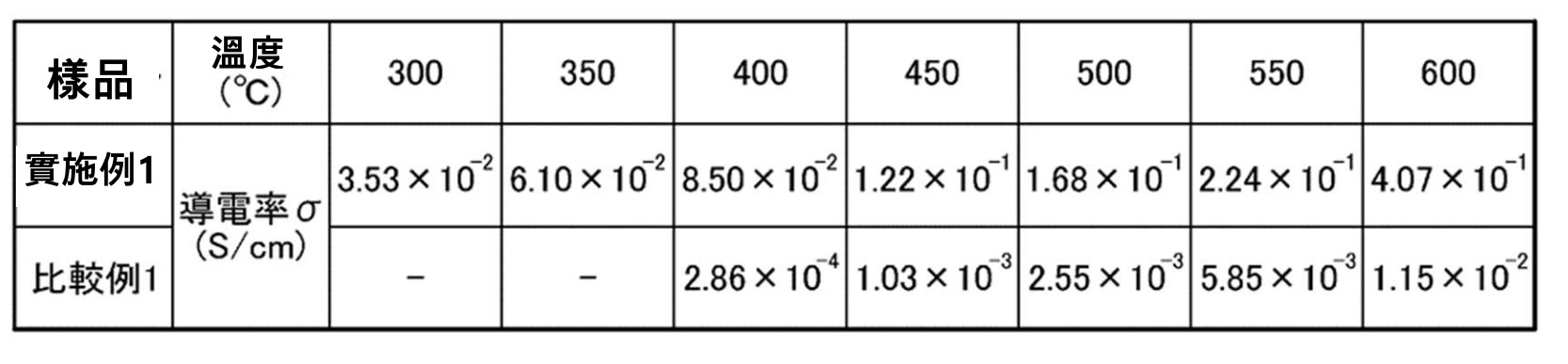
如表1所示,已確認實施例1比起比較例1具有更高導電率。As shown in Table 1, it was confirmed that Example 1 had higher conductivity than Comparative Example 1.
(實施例2) 使用二甲基亞碸作為非水系溶劑,使用m-硝基苯酚、乙酸、苯甲酸、p-甲苯磺酸、草酸、甲基磺酸作為質子源,在5~100mM之範圍改變濃度,並以與實施例1相同的方法來進行離子交換操作。其後,對進行離子交換操作後之Li 14Zn(GeO 4) 4粉末進行熱重量分析,藉此確認離子交換量。結果,對於各質子源,離子交換率為45~65%。 (Example 2) Use dimethylsulfoxide as a non-aqueous solvent, use m-nitrophenol, acetic acid, benzoic acid, p-toluenesulfonic acid, oxalic acid, methanesulfonic acid as a proton source, in the range of 5~100mM The concentration was changed, and the ion exchange operation was performed in the same manner as in Example 1. Thereafter, thermogravimetric analysis was performed on the Li 14 Zn (GeO 4 ) 4 powder after the ion exchange operation, thereby confirming the ion exchange capacity. As a result, the ion exchange rate was 45 to 65% for each proton source.
(比較例2) 確認了僅以非水溶劑對離子交換前之Li 14Zn(GeO 4) 4粉末進行離子交換時的效果。以脫水劑對甲苯、四氫呋喃、乙醇、N,N-二甲基甲醯胺、二甲基亞碸、碳酸丙烯酯進行處理後作為非水溶劑使用,且不使用質子源,以與比較例1相同的方法進行離子交換操作。其後,對進行離子交換操作後之Li 14Zn(GeO 4) 4粉末進行熱重量分析,藉此確認離子交換量。結果,確認了離子交換幾乎沒有進行。 (Comparative Example 2) The effect of ion-exchanging Li 14 Zn (GeO 4 ) 4 powder before ion exchange with only a non-aqueous solvent was confirmed. Treat toluene, tetrahydrofuran, ethanol, N,N-dimethylformamide, dimethylsulfoxide, and propylene carbonate with a dehydrating agent and use it as a non-aqueous solvent without using a proton source. In order to compare with Comparative Example 1 The ion exchange operation was carried out in the same way. Thereafter, thermogravimetric analysis was performed on the Li 14 Zn (GeO 4 ) 4 powder after the ion exchange operation, thereby confirming the ion exchange capacity. As a result, it was confirmed that ion exchange hardly proceeded.
[產業上之可利用性] 本發明之質子導電材料可作為至今不存在之於200~600℃之中溫區域運作的各種燃料電池、及各種電解槽之離子交換膜來適宜利用。具體而言,將可在中溫區域產生氫之各種燃料作為燃料電池之燃料直接供給於燃料電池,並利用在單元內之觸媒反應產生氫而進行燃料電池發電,與此同時,從燃料產生氫之反應所需之反應熱可由燃料電池反應來供給,並不需要熱源,可助於降低燃料電池發電之成本。又,就現存供給氫燃料的燃料電池而言,除了可提供比起低溫型可於中溫區域運作之高效率的燃料電池之外,亦可實現高溫型SOFC燃料電池所追求之往中溫區域低溫化的目標。進一步可應用於中溫型之電解槽。如此這般,本發明係關於利用於燃料電池、及電解等之單元中之質子導體的基本技術,故為產業上之可利用性極高的發明。 [Industrial availability] The proton conductive material of the present invention can be suitably used as ion exchange membranes of various fuel cells and various electrolyzers which do not exist in the middle temperature range of 200-600°C. Specifically, various fuels that can generate hydrogen in a medium temperature region are directly supplied to the fuel cell as fuel for the fuel cell, and hydrogen is generated by the catalytic reaction in the unit to perform fuel cell power generation. The reaction heat required for the hydrogen reaction can be supplied by the fuel cell reaction without the need for a heat source, which can help reduce the cost of fuel cell power generation. In addition, as far as the existing fuel cells supplying hydrogen fuel are concerned, in addition to providing high-efficiency fuel cells that can operate in the middle temperature region compared with the low-temperature type, it can also achieve the middle-temperature region that the high-temperature type SOFC fuel cell pursues. goal of cooling. It can further be applied to medium-temperature electrolytic cells. As such, the present invention relates to the basic technology of proton conductors used in cells such as fuel cells and electrolysis, and thus is an invention with extremely high industrial applicability.
以上結束了對具體實施形態之說明,但本發明不受上述實施形態之限制,可廣泛地變形來實施。The above is the end of the description of the specific embodiments, but the present invention is not limited to the above-mentioned embodiments, and can be implemented in a wide variety of modifications.
(無)(none)
圖1為顯示固體電解質之導電率的圖表。FIG. 1 is a graph showing the conductivity of a solid electrolyte.
Claims (9)
Applications Claiming Priority (2)
| Application Number | Priority Date | Filing Date | Title |
|---|---|---|---|
| WOPCT/JP2021/029746 | 2021-08-12 | ||
| PCT/JP2021/029746 WO2023017602A1 (en) | 2021-08-12 | 2021-08-12 | Proton conductor and method for producing same |
Publications (2)
| Publication Number | Publication Date |
|---|---|
| TW202306902A true TW202306902A (en) | 2023-02-16 |
| TWI814287B TWI814287B (en) | 2023-09-01 |
Family
ID=85199696
Family Applications (1)
| Application Number | Title | Priority Date | Filing Date |
|---|---|---|---|
| TW111110319A TWI814287B (en) | 2021-08-12 | 2022-03-21 | Proton conductor and its manufacturing method |
Country Status (9)
| Country | Link |
|---|---|
| US (1) | US20240055641A1 (en) |
| EP (1) | EP4386923A4 (en) |
| JP (1) | JP7709177B2 (en) |
| KR (1) | KR20230110567A (en) |
| CN (1) | CN116711118A (en) |
| AU (1) | AU2021459856B2 (en) |
| CA (1) | CA3204729A1 (en) |
| TW (1) | TWI814287B (en) |
| WO (1) | WO2023017602A1 (en) |
Families Citing this family (1)
| Publication number | Priority date | Publication date | Assignee | Title |
|---|---|---|---|---|
| CN117466652B (en) * | 2023-10-11 | 2025-10-24 | 山东科技大学 | A preparation method for improving the stability of proton conductor electrolyte in carbon dioxide |
Family Cites Families (6)
| Publication number | Priority date | Publication date | Assignee | Title |
|---|---|---|---|---|
| DE19632285A1 (en) * | 1996-08-09 | 1998-02-19 | Hoechst Ag | Proton conductor with a temperature resistance in a wide range and good proton conductivities |
| JP2005166486A (en) | 2003-12-03 | 2005-06-23 | Kri Inc | Direct type fuel cell system |
| JP4889413B2 (en) * | 2006-09-04 | 2012-03-07 | 三菱電機株式会社 | Conductive composition |
| EP4181241A1 (en) * | 2011-04-05 | 2023-05-17 | Brilliant Light Power, Inc. | H20 - based electrochemical hydrogen - catalyst power system |
| US20130026409A1 (en) * | 2011-04-08 | 2013-01-31 | Recapping, Inc. | Composite ionic conducting electrolytes |
| CN109761598A (en) * | 2019-01-12 | 2019-05-17 | 杨忠华 | A kind of preparation method of ceramic electrolyte |
-
2021
- 2021-08-12 AU AU2021459856A patent/AU2021459856B2/en active Active
- 2021-08-12 CA CA3204729A patent/CA3204729A1/en active Pending
- 2021-08-12 CN CN202180089839.5A patent/CN116711118A/en active Pending
- 2021-08-12 EP EP21953497.1A patent/EP4386923A4/en active Pending
- 2021-08-12 KR KR1020237020756A patent/KR20230110567A/en active Pending
- 2021-08-12 US US18/260,842 patent/US20240055641A1/en active Pending
- 2021-08-12 WO PCT/JP2021/029746 patent/WO2023017602A1/en not_active Ceased
- 2021-08-12 JP JP2023541186A patent/JP7709177B2/en active Active
-
2022
- 2022-03-21 TW TW111110319A patent/TWI814287B/en active
Also Published As
| Publication number | Publication date |
|---|---|
| CN116711118A (en) | 2023-09-05 |
| EP4386923A1 (en) | 2024-06-19 |
| EP4386923A4 (en) | 2025-04-09 |
| JPWO2023017602A1 (en) | 2023-02-16 |
| JP7709177B2 (en) | 2025-07-16 |
| US20240055641A1 (en) | 2024-02-15 |
| WO2023017602A1 (en) | 2023-02-16 |
| TWI814287B (en) | 2023-09-01 |
| AU2021459856B2 (en) | 2024-08-01 |
| AU2021459856A1 (en) | 2023-08-17 |
| CA3204729A1 (en) | 2022-02-16 |
| KR20230110567A (en) | 2023-07-24 |
| AU2021459856A9 (en) | 2024-07-18 |
Similar Documents
| Publication | Publication Date | Title |
|---|---|---|
| Bae et al. | Properties of selected sulfonated polymers as proton-conducting electrolytes for polymer electrolyte fuel cells | |
| CN110611105B (en) | Preparation method of ORR catalyst | |
| Xia et al. | Sulfonic acid functionalized covalent organic frameworks for lithium-sulfur battery separator and oxygen evolution electrocatalyst | |
| US20180013150A1 (en) | Fuel cell catalyst suitable for non-humidified conditions and method for manufacturing the same | |
| TWI814287B (en) | Proton conductor and its manufacturing method | |
| Afroze et al. | Super–protonic conductors for solid acid fuel cells (SAFCs): a review | |
| CN113527684A (en) | Oxygen reduction catalyst layer based on grafted polybenzimidazole as proton conductor and preparation method thereof | |
| Matsui et al. | Development of novel proton conductors consisting of solid acid/pyrophosphate composite for intermediate-temperature fuel cells | |
| JP7499419B2 (en) | Electrochemical cell, power generation method using electrochemical cell, and method for producing hydrogen gas using electrochemical cell | |
| Devi Renuka et al. | Unitized regenerative fuel cells: Future of renewable energy research | |
| CA3192944C (en) | Electrochemical cell, power generation method using electrochemical cell, and manufacturing method of hydrogen gas using electrochemical cell | |
| KR102958963B1 (en) | Electrochemical cell, method of power generation using an electrochemical cell, and method of producing hydrogen gas using an electrochemical cell | |
| CN109818022B (en) | Preparation method of electrolyte material | |
| Park et al. | Intermediate Temperature CsH2PO4-Based Solid Acid Electrolytes Expressing Super-Protonic Behavior | |
| de Souza et al. | Low-carbon Fuel Cell Materials | |
| Ravikumar et al. | for High-Temperature Steam Electrolysis | |
| MATSUDA | Advanced Materials for Next Generation Power Source and Storage | |
| Pilatowsky et al. | Selected Fuel Cells for Cogeneration CHP Processes | |
| Bagotsky | Schematic layout of a hydrogen-oxygen fuel cell Hydrogen oxidation and oxygen reduction in an individual fuel cell | |
| Moraw | Hybrid PEM fuel cell: redox cathode approach | |
| Grey | Lithium Ion Batteries for Transportation and Electrical Energy Storage Applications: Nuclear Magnetic | |
| Samanta et al. | Biswajit Mandal 5 Swarnajit Bhattacharya 6 1 Indorama India Private Ltd Haldia West Bengal India 2 Haldia Petrochemicals Ltd Haldia West Bengal India 3 Dept of Chem. Engg Heritage Institute of Technology Kolkata WB India | |
| Mohammed | Zirconium Phosphate/Ionic Liquid Proton Conductors for High Temperature Fuel Cell Applications | |
| Parvathy et al. | Organic-Inorganic Hybrid Nanomaterials for Fuel Cells | |
| Simmons et al. | Manganese based transition metal oxide catalysts for oxygen electrodes in fuel cells |