TWI663246B - Organic electroluminescent device - Google Patents
Organic electroluminescent device Download PDFInfo
- Publication number
- TWI663246B TWI663246B TW107123613A TW107123613A TWI663246B TW I663246 B TWI663246 B TW I663246B TW 107123613 A TW107123613 A TW 107123613A TW 107123613 A TW107123613 A TW 107123613A TW I663246 B TWI663246 B TW I663246B
- Authority
- TW
- Taiwan
- Prior art keywords
- substituted
- group
- unsubstituted
- biphenyl
- general formula
- Prior art date
Links
- -1 arylamine compound Chemical class 0.000 claims abstract description 196
- 239000000126 substance Substances 0.000 claims abstract description 140
- 238000002347 injection Methods 0.000 claims abstract description 38
- 239000007924 injection Substances 0.000 claims abstract description 38
- 230000005525 hole transport Effects 0.000 claims abstract description 31
- 238000005401 electroluminescence Methods 0.000 claims abstract description 5
- 150000001875 compounds Chemical class 0.000 claims description 128
- 125000001424 substituent group Chemical group 0.000 claims description 116
- 125000006615 aromatic heterocyclic group Chemical group 0.000 claims description 90
- 125000004432 carbon atom Chemical group C* 0.000 claims description 86
- 125000002029 aromatic hydrocarbon group Chemical group 0.000 claims description 81
- ZUOUZKKEUPVFJK-UHFFFAOYSA-N diphenyl Chemical compound C1=CC=CC=C1C1=CC=CC=C1 ZUOUZKKEUPVFJK-UHFFFAOYSA-N 0.000 claims description 74
- 239000004305 biphenyl Substances 0.000 claims description 41
- 235000010290 biphenyl Nutrition 0.000 claims description 41
- 125000001997 phenyl group Chemical group [H]C1=C([H])C([H])=C(*)C([H])=C1[H] 0.000 claims description 33
- 125000004435 hydrogen atom Chemical group [H]* 0.000 claims description 30
- 125000005577 anthracene group Chemical group 0.000 claims description 29
- 125000000217 alkyl group Chemical group 0.000 claims description 27
- UHOVQNZJYSORNB-UHFFFAOYSA-N monobenzene Natural products C1=CC=CC=C1 UHOVQNZJYSORNB-UHFFFAOYSA-N 0.000 claims description 27
- 125000006617 triphenylamine group Chemical group 0.000 claims description 27
- 125000005842 heteroatom Chemical group 0.000 claims description 25
- 125000001624 naphthyl group Chemical group 0.000 claims description 25
- 229910052757 nitrogen Inorganic materials 0.000 claims description 24
- 125000003342 alkenyl group Chemical group 0.000 claims description 23
- 125000003545 alkoxy group Chemical group 0.000 claims description 23
- 125000003983 fluorenyl group Chemical group C1(=CC=CC=2C3=CC=CC=C3CC12)* 0.000 claims description 22
- YBYIRNPNPLQARY-UHFFFAOYSA-N 1H-indene Natural products C1=CC=C2CC=CC2=C1 YBYIRNPNPLQARY-UHFFFAOYSA-N 0.000 claims description 19
- 125000002178 anthracenyl group Chemical group C1(=CC=CC2=CC3=CC=CC=C3C=C12)* 0.000 claims description 19
- 125000004104 aryloxy group Chemical group 0.000 claims description 19
- 125000003454 indenyl group Chemical group C1(C=CC2=CC=CC=C12)* 0.000 claims description 19
- 125000004431 deuterium atom Chemical group 0.000 claims description 18
- 125000004093 cyano group Chemical group *C#N 0.000 claims description 16
- BBEAQIROQSPTKN-UHFFFAOYSA-N pyrene Chemical compound C1=CC=C2C=CC3=CC=CC4=CC=C1C2=C43 BBEAQIROQSPTKN-UHFFFAOYSA-N 0.000 claims description 16
- 125000000000 cycloalkoxy group Chemical group 0.000 claims description 15
- 229910052717 sulfur Chemical group 0.000 claims description 15
- 125000004434 sulfur atom Chemical group 0.000 claims description 15
- 125000000753 cycloalkyl group Chemical group 0.000 claims description 14
- 125000000449 nitro group Chemical group [O-][N+](*)=O 0.000 claims description 14
- 125000004433 nitrogen atom Chemical group N* 0.000 claims description 14
- 150000004945 aromatic hydrocarbons Chemical class 0.000 claims description 13
- 229910052799 carbon Inorganic materials 0.000 claims description 13
- 125000001570 methylene group Chemical group [H]C([H])([*:1])[*:2] 0.000 claims description 13
- 125000004430 oxygen atom Chemical group O* 0.000 claims description 13
- 229910052805 deuterium Inorganic materials 0.000 claims description 12
- 125000005843 halogen group Chemical group 0.000 claims description 11
- SLGBZMMZGDRARJ-UHFFFAOYSA-N Triphenylene Natural products C1=CC=C2C3=CC=CC=C3C3=CC=CC=C3C2=C1 SLGBZMMZGDRARJ-UHFFFAOYSA-N 0.000 claims description 10
- 125000005580 triphenylene group Chemical group 0.000 claims description 10
- 229910052801 chlorine Inorganic materials 0.000 claims description 9
- 229910052731 fluorine Inorganic materials 0.000 claims description 9
- 125000005504 styryl group Chemical group 0.000 claims description 9
- 125000001309 chloro group Chemical group Cl* 0.000 claims description 8
- GVEPBJHOBDJJJI-UHFFFAOYSA-N fluoranthrene Natural products C1=CC(C2=CC=CC=C22)=C3C2=CC=CC3=C1 GVEPBJHOBDJJJI-UHFFFAOYSA-N 0.000 claims description 8
- 125000001153 fluoro group Chemical group F* 0.000 claims description 8
- 125000002023 trifluoromethyl group Chemical group FC(F)(F)* 0.000 claims description 2
- 125000002080 perylenyl group Chemical group C1(=CC=C2C=CC=C3C4=CC=CC5=CC=CC(C1=C23)=C45)* 0.000 claims 16
- 125000001792 phenanthrenyl group Chemical group C1(=CC=CC=2C3=CC=CC=C3C=CC12)* 0.000 claims 16
- CSHWQDPOILHKBI-UHFFFAOYSA-N peryrene Natural products C1=CC(C2=CC=CC=3C2=C2C=CC=3)=C3C2=CC=CC3=C1 CSHWQDPOILHKBI-UHFFFAOYSA-N 0.000 claims 9
- 125000001725 pyrenyl group Chemical group 0.000 claims 9
- PJANXHGTPQOBST-VAWYXSNFSA-N Stilbene Natural products C=1C=CC=CC=1/C=C/C1=CC=CC=C1 PJANXHGTPQOBST-VAWYXSNFSA-N 0.000 claims 7
- 125000000218 acetic acid group Chemical group C(C)(=O)* 0.000 claims 7
- 125000005282 allenyl group Chemical group 0.000 claims 7
- 125000002529 biphenylenyl group Chemical group C1(=CC=CC=2C3=CC=CC=C3C12)* 0.000 claims 7
- 235000021286 stilbenes Nutrition 0.000 claims 7
- 150000001555 benzenes Chemical class 0.000 claims 1
- 238000006467 substitution reaction Methods 0.000 claims 1
- 239000000463 material Substances 0.000 abstract description 81
- 230000000903 blocking effect Effects 0.000 abstract description 14
- 239000010410 layer Substances 0.000 description 131
- 238000005160 1H NMR spectroscopy Methods 0.000 description 44
- 239000000843 powder Substances 0.000 description 44
- OKKJLVBELUTLKV-UHFFFAOYSA-N Methanol Chemical compound OC OKKJLVBELUTLKV-UHFFFAOYSA-N 0.000 description 36
- 239000010408 film Substances 0.000 description 33
- 238000000034 method Methods 0.000 description 31
- 230000032258 transport Effects 0.000 description 26
- YXFVVABEGXRONW-UHFFFAOYSA-N Toluene Chemical compound CC1=CC=CC=C1 YXFVVABEGXRONW-UHFFFAOYSA-N 0.000 description 24
- 238000005481 NMR spectroscopy Methods 0.000 description 23
- 229910052739 hydrogen Inorganic materials 0.000 description 22
- 239000001257 hydrogen Substances 0.000 description 22
- 238000005259 measurement Methods 0.000 description 22
- 230000015572 biosynthetic process Effects 0.000 description 21
- 125000000319 biphenyl-4-yl group Chemical group [H]C1=C([H])C([H])=C([H])C([H])=C1C1=C([H])C([H])=C([*])C([H])=C1[H] 0.000 description 21
- 238000004020 luminiscence type Methods 0.000 description 20
- 238000003786 synthesis reaction Methods 0.000 description 19
- RFFLAFLAYFXFSW-UHFFFAOYSA-N 1,2-dichlorobenzene Chemical compound ClC1=CC=CC=C1Cl RFFLAFLAYFXFSW-UHFFFAOYSA-N 0.000 description 15
- IJGRMHOSHXDMSA-UHFFFAOYSA-N nitrogen Substances N#N IJGRMHOSHXDMSA-UHFFFAOYSA-N 0.000 description 14
- 239000010409 thin film Substances 0.000 description 14
- OQDRCEJRWJDMRJ-UHFFFAOYSA-N 1-(4-phenylphenyl)-9h-fluorene Chemical compound C=12CC3=CC=CC=C3C2=CC=CC=1C(C=C1)=CC=C1C1=CC=CC=C1 OQDRCEJRWJDMRJ-UHFFFAOYSA-N 0.000 description 13
- 238000006243 chemical reaction Methods 0.000 description 13
- NIHNNTQXNPWCJQ-UHFFFAOYSA-N o-biphenylenemethane Natural products C1=CC=C2CC3=CC=CC=C3C2=C1 NIHNNTQXNPWCJQ-UHFFFAOYSA-N 0.000 description 12
- RMBPEFMHABBEKP-UHFFFAOYSA-N fluorene Chemical compound C1=CC=C2C3=C[CH]C=CC3=CC2=C1 RMBPEFMHABBEKP-UHFFFAOYSA-N 0.000 description 11
- 238000007740 vapor deposition Methods 0.000 description 11
- UFWIBTONFRDIAS-UHFFFAOYSA-N Naphthalene Chemical compound C1=CC=CC2=CC=CC=C21 UFWIBTONFRDIAS-UHFFFAOYSA-N 0.000 description 10
- YNPNZTXNASCQKK-UHFFFAOYSA-N phenanthrene Chemical compound C1=CC=C2C3=CC=CC=C3C=CC2=C1 YNPNZTXNASCQKK-UHFFFAOYSA-N 0.000 description 10
- 125000003118 aryl group Chemical group 0.000 description 9
- 150000001721 carbon Chemical group 0.000 description 9
- 238000009833 condensation Methods 0.000 description 9
- 230000005494 condensation Effects 0.000 description 9
- 238000001914 filtration Methods 0.000 description 9
- 150000001412 amines Chemical class 0.000 description 8
- 239000012043 crude product Substances 0.000 description 8
- 239000000758 substrate Substances 0.000 description 8
- 150000004982 aromatic amines Chemical class 0.000 description 7
- 230000000052 comparative effect Effects 0.000 description 7
- 125000005561 phenanthryl group Chemical group 0.000 description 7
- 238000004528 spin coating Methods 0.000 description 7
- LFQSCWFLJHTTHZ-UHFFFAOYSA-N Ethanol Chemical compound CCO LFQSCWFLJHTTHZ-UHFFFAOYSA-N 0.000 description 6
- OAICVXFJPJFONN-UHFFFAOYSA-N Phosphorus Chemical compound [P] OAICVXFJPJFONN-UHFFFAOYSA-N 0.000 description 6
- MWPLVEDNUUSJAV-UHFFFAOYSA-N anthracene Chemical compound C1=CC=CC2=CC3=CC=CC=C3C=C21 MWPLVEDNUUSJAV-UHFFFAOYSA-N 0.000 description 6
- 125000003785 benzimidazolyl group Chemical group N1=C(NC2=C1C=CC=C2)* 0.000 description 6
- 125000001164 benzothiazolyl group Chemical group S1C(=NC2=C1C=CC=C2)* 0.000 description 6
- 125000004623 carbolinyl group Chemical group 0.000 description 6
- 125000004988 dibenzothienyl group Chemical group C1(=CC=CC=2SC3=C(C21)C=CC=C3)* 0.000 description 6
- 230000009477 glass transition Effects 0.000 description 6
- 125000001041 indolyl group Chemical group 0.000 description 6
- 125000002971 oxazolyl group Chemical group 0.000 description 6
- BWHMMNNQKKPAPP-UHFFFAOYSA-L potassium carbonate Chemical compound [K+].[K+].[O-]C([O-])=O BWHMMNNQKKPAPP-UHFFFAOYSA-L 0.000 description 6
- 125000003226 pyrazolyl group Chemical group 0.000 description 6
- 125000004076 pyridyl group Chemical group 0.000 description 6
- 125000002943 quinolinyl group Chemical group N1=C(C=CC2=CC=CC=C12)* 0.000 description 6
- 125000005605 benzo group Chemical group 0.000 description 5
- 125000000499 benzofuranyl group Chemical group O1C(=CC2=C1C=CC=C2)* 0.000 description 5
- 125000004196 benzothienyl group Chemical group S1C(=CC2=C1C=CC=C2)* 0.000 description 5
- 125000000609 carbazolyl group Chemical group C1(=CC=CC=2C3=CC=CC=C3NC12)* 0.000 description 5
- 238000001816 cooling Methods 0.000 description 5
- 238000000151 deposition Methods 0.000 description 5
- 230000008021 deposition Effects 0.000 description 5
- 125000002541 furyl group Chemical group 0.000 description 5
- 125000000623 heterocyclic group Chemical group 0.000 description 5
- 150000002430 hydrocarbons Chemical group 0.000 description 5
- 125000002183 isoquinolinyl group Chemical group C1(=NC=CC2=CC=CC=C12)* 0.000 description 5
- 229910052751 metal Inorganic materials 0.000 description 5
- 239000002184 metal Substances 0.000 description 5
- 238000002156 mixing Methods 0.000 description 5
- QJGQUHMNIGDVPM-UHFFFAOYSA-N nitrogen group Chemical group [N] QJGQUHMNIGDVPM-UHFFFAOYSA-N 0.000 description 5
- 125000003367 polycyclic group Chemical group 0.000 description 5
- 125000001567 quinoxalinyl group Chemical group N1=C(C=NC2=CC=CC=C12)* 0.000 description 5
- 239000002356 single layer Substances 0.000 description 5
- 125000001544 thienyl group Chemical group 0.000 description 5
- 125000001637 1-naphthyl group Chemical group [H]C1=C([H])C([H])=C2C(*)=C([H])C([H])=C([H])C2=C1[H] 0.000 description 4
- 0 CC1C(*2ccc(C)cc2)=CC=CC1 Chemical compound CC1C(*2ccc(C)cc2)=CC=CC1 0.000 description 4
- KDLHZDBZIXYQEI-UHFFFAOYSA-N Palladium Chemical compound [Pd] KDLHZDBZIXYQEI-UHFFFAOYSA-N 0.000 description 4
- 239000002585 base Substances 0.000 description 4
- 125000000484 butyl group Chemical group [H]C([*])([H])C([H])([H])C([H])([H])C([H])([H])[H] 0.000 description 4
- 125000004122 cyclic group Chemical group 0.000 description 4
- 230000003111 delayed effect Effects 0.000 description 4
- TXCDCPKCNAJMEE-UHFFFAOYSA-N dibenzofuran Chemical compound C1=CC=C2C3=CC=CC=C3OC2=C1 TXCDCPKCNAJMEE-UHFFFAOYSA-N 0.000 description 4
- 125000001495 ethyl group Chemical group [H]C([H])([H])C([H])([H])* 0.000 description 4
- 239000011521 glass Substances 0.000 description 4
- 125000000959 isobutyl group Chemical group [H]C([H])([H])C([H])(C([H])([H])[H])C([H])([H])* 0.000 description 4
- 125000001972 isopentyl group Chemical group [H]C([H])([H])C([H])(C([H])([H])[H])C([H])([H])C([H])([H])* 0.000 description 4
- 125000001449 isopropyl group Chemical group [H]C([H])([H])C([H])(*)C([H])([H])[H] 0.000 description 4
- AWJUIBRHMBBTKR-UHFFFAOYSA-N isoquinoline Chemical compound C1=NC=CC2=CC=CC=C21 AWJUIBRHMBBTKR-UHFFFAOYSA-N 0.000 description 4
- PQXKHYXIUOZZFA-UHFFFAOYSA-M lithium fluoride Chemical compound [Li+].[F-] PQXKHYXIUOZZFA-UHFFFAOYSA-M 0.000 description 4
- 238000002844 melting Methods 0.000 description 4
- 230000008018 melting Effects 0.000 description 4
- 125000004108 n-butyl group Chemical group [H]C([H])([H])C([H])([H])C([H])([H])C([H])([H])* 0.000 description 4
- 125000001280 n-hexyl group Chemical group C(CCCCC)* 0.000 description 4
- 125000000740 n-pentyl group Chemical group [H]C([H])([H])C([H])([H])C([H])([H])C([H])([H])C([H])([H])* 0.000 description 4
- 125000004123 n-propyl group Chemical group [H]C([H])([H])C([H])([H])C([H])([H])* 0.000 description 4
- 125000001971 neopentyl group Chemical group [H]C([*])([H])C(C([H])([H])[H])(C([H])([H])[H])C([H])([H])[H] 0.000 description 4
- 238000000746 purification Methods 0.000 description 4
- 125000000168 pyrrolyl group Chemical group 0.000 description 4
- YJTKZCDBKVTVBY-UHFFFAOYSA-N 1,3-Diphenylbenzene Chemical group C1=CC=CC=C1C1=CC=CC(C=2C=CC=CC=2)=C1 YJTKZCDBKVTVBY-UHFFFAOYSA-N 0.000 description 3
- JSRLURSZEMLAFO-UHFFFAOYSA-N 1,3-dibromobenzene Chemical compound BrC1=CC=CC(Br)=C1 JSRLURSZEMLAFO-UHFFFAOYSA-N 0.000 description 3
- 125000003903 2-propenyl group Chemical group [H]C([*])([H])C([H])=C([H])[H] 0.000 description 3
- RFTRFDMRINNTSI-UHFFFAOYSA-N 9,9-dimethyl-n-phenylfluoren-2-amine Chemical group C1=C2C(C)(C)C3=CC=CC=C3C2=CC=C1NC1=CC=CC=C1 RFTRFDMRINNTSI-UHFFFAOYSA-N 0.000 description 3
- OKTJSMMVPCPJKN-UHFFFAOYSA-N Carbon Chemical compound [C] OKTJSMMVPCPJKN-UHFFFAOYSA-N 0.000 description 3
- 239000004215 Carbon black (E152) Substances 0.000 description 3
- XEKOWRVHYACXOJ-UHFFFAOYSA-N Ethyl acetate Chemical compound CCOC(C)=O XEKOWRVHYACXOJ-UHFFFAOYSA-N 0.000 description 3
- WSFSSNUMVMOOMR-UHFFFAOYSA-N Formaldehyde Chemical class O=C WSFSSNUMVMOOMR-UHFFFAOYSA-N 0.000 description 3
- KFZMGEQAYNKOFK-UHFFFAOYSA-N Isopropanol Chemical compound CC(C)O KFZMGEQAYNKOFK-UHFFFAOYSA-N 0.000 description 3
- WTKZEGDFNFYCGP-UHFFFAOYSA-N Pyrazole Chemical compound C=1C=NNC=1 WTKZEGDFNFYCGP-UHFFFAOYSA-N 0.000 description 3
- VYPSYNLAJGMNEJ-UHFFFAOYSA-N Silicium dioxide Chemical compound O=[Si]=O VYPSYNLAJGMNEJ-UHFFFAOYSA-N 0.000 description 3
- 229910052782 aluminium Inorganic materials 0.000 description 3
- XAGFODPZIPBFFR-UHFFFAOYSA-N aluminium Chemical compound [Al] XAGFODPZIPBFFR-UHFFFAOYSA-N 0.000 description 3
- 125000005428 anthryl group Chemical group [H]C1=C([H])C([H])=C2C([H])=C3C(*)=C([H])C([H])=C([H])C3=C([H])C2=C1[H] 0.000 description 3
- 150000001716 carbazoles Chemical group 0.000 description 3
- 229940126214 compound 3 Drugs 0.000 description 3
- 238000002425 crystallisation Methods 0.000 description 3
- 230000008025 crystallization Effects 0.000 description 3
- 230000000694 effects Effects 0.000 description 3
- 239000007772 electrode material Substances 0.000 description 3
- 229930195733 hydrocarbon Natural products 0.000 description 3
- 125000002496 methyl group Chemical group [H]C([H])([H])* 0.000 description 3
- 239000012046 mixed solvent Substances 0.000 description 3
- PKVRJCUKSNFIBN-UHFFFAOYSA-N palladium;triphenylphosphane Chemical compound [Pd].C1=CC=CC=C1P(C=1C=CC=CC=1)C1=CC=CC=C1.C1=CC=CC=C1P(C=1C=CC=CC=1)C1=CC=CC=C1.C1=CC=CC=C1P(C=1C=CC=CC=1)C1=CC=CC=C1 PKVRJCUKSNFIBN-UHFFFAOYSA-N 0.000 description 3
- 125000000951 phenoxy group Chemical group [H]C1=C([H])C([H])=C(O*)C([H])=C1[H] 0.000 description 3
- 125000005575 polycyclic aromatic hydrocarbon group Chemical group 0.000 description 3
- 229910000027 potassium carbonate Inorganic materials 0.000 description 3
- 125000000714 pyrimidinyl group Chemical group 0.000 description 3
- 238000010992 reflux Methods 0.000 description 3
- 239000000741 silica gel Substances 0.000 description 3
- 229910002027 silica gel Inorganic materials 0.000 description 3
- 238000003756 stirring Methods 0.000 description 3
- BWHDROKFUHTORW-UHFFFAOYSA-N tritert-butylphosphane Chemical compound CC(C)(C)P(C(C)(C)C)C(C)(C)C BWHDROKFUHTORW-UHFFFAOYSA-N 0.000 description 3
- 238000002604 ultrasonography Methods 0.000 description 3
- 238000005406 washing Methods 0.000 description 3
- XLYOFNOQVPJJNP-UHFFFAOYSA-N water Substances O XLYOFNOQVPJJNP-UHFFFAOYSA-N 0.000 description 3
- VJLYHTOSFSGXGH-CQSZACIVSA-N (2R)-1-[3-[4-(aminomethyl)-6-(trifluoromethyl)pyridin-2-yl]oxybenzoyl]pyrrolidine-2-carboxylic acid Chemical compound NCC1=CC(=NC(=C1)C(F)(F)F)OC=1C=C(C(=O)N2[C@H](CCC2)C(=O)O)C=CC=1 VJLYHTOSFSGXGH-CQSZACIVSA-N 0.000 description 2
- ZXAQFYZQHPGMMN-BZSJEYESSA-N (3R)-3-[4-(aminomethyl)-6-(trifluoromethyl)pyridin-2-yl]oxy-N-phenylcyclohexane-1-carboxamide Chemical compound C1C[C@H](CC(C1)C(=O)NC2=CC=CC=C2)OC3=CC(=CC(=N3)C(F)(F)F)CN ZXAQFYZQHPGMMN-BZSJEYESSA-N 0.000 description 2
- SNAKUPLQASYKTC-AWEZNQCLSA-N (3S)-3-[[4-(aminomethyl)-6-(trifluoromethyl)pyridin-2-yl]oxymethyl]-N-phenylpiperidine-1-carboxamide Chemical compound NCC1=CC(=NC(=C1)C(F)(F)F)OC[C@@H]1CN(CCC1)C(=O)NC1=CC=CC=C1 SNAKUPLQASYKTC-AWEZNQCLSA-N 0.000 description 2
- RYHBNJHYFVUHQT-UHFFFAOYSA-N 1,4-Dioxane Chemical compound C1COCCO1 RYHBNJHYFVUHQT-UHFFFAOYSA-N 0.000 description 2
- SWJPEBQEEAHIGZ-UHFFFAOYSA-N 1,4-dibromobenzene Chemical compound BrC1=CC=C(Br)C=C1 SWJPEBQEEAHIGZ-UHFFFAOYSA-N 0.000 description 2
- FCEHBMOGCRZNNI-UHFFFAOYSA-N 1-benzothiophene Chemical compound C1=CC=C2SC=CC2=C1 FCEHBMOGCRZNNI-UHFFFAOYSA-N 0.000 description 2
- CTPUUDQIXKUAMO-UHFFFAOYSA-N 1-bromo-3-iodobenzene Chemical compound BrC1=CC=CC(I)=C1 CTPUUDQIXKUAMO-UHFFFAOYSA-N 0.000 description 2
- JNTPESLCFLAUMV-UHFFFAOYSA-N 1-naphthalen-1-yl-9h-fluorene Chemical group C1=CC=C2C(C=3C=CC=C4C5=CC=CC=C5CC=34)=CC=CC2=C1 JNTPESLCFLAUMV-UHFFFAOYSA-N 0.000 description 2
- NSMJMUQZRGZMQC-UHFFFAOYSA-N 2-naphthalen-1-yl-1H-imidazo[4,5-f][1,10]phenanthroline Chemical compound C12=CC=CN=C2C2=NC=CC=C2C2=C1NC(C=1C3=CC=CC=C3C=CC=1)=N2 NSMJMUQZRGZMQC-UHFFFAOYSA-N 0.000 description 2
- SHBHYINHXNTBRP-UHFFFAOYSA-N 3-[4-(aminomethyl)-6-(trifluoromethyl)pyridin-2-yl]oxy-N-(2-methylsulfonylethyl)benzamide Chemical compound NCC1=CC(=NC(=C1)C(F)(F)F)OC=1C=C(C(=O)NCCS(=O)(=O)C)C=CC=1 SHBHYINHXNTBRP-UHFFFAOYSA-N 0.000 description 2
- LIDBMZYKSAXTQG-UHFFFAOYSA-N 3-[4-(aminomethyl)-6-(trifluoromethyl)pyridin-2-yl]oxy-N-(2-sulfamoylethyl)benzamide Chemical compound NCC1=CC(=NC(=C1)C(F)(F)F)OC=1C=C(C(=O)NCCS(N)(=O)=O)C=CC=1 LIDBMZYKSAXTQG-UHFFFAOYSA-N 0.000 description 2
- SONNQRNOTIAJDS-GFCCVEGCSA-N 3-[4-(aminomethyl)-6-(trifluoromethyl)pyridin-2-yl]oxy-N-[(2R)-2,3-dihydroxypropyl]benzamide Chemical compound NCC1=CC(=NC(=C1)C(F)(F)F)OC=1C=C(C(=O)NC[C@H](CO)O)C=CC=1 SONNQRNOTIAJDS-GFCCVEGCSA-N 0.000 description 2
- FJPUKTJEFOXMJX-UHFFFAOYSA-N 3-[4-(aminomethyl)-6-(trifluoromethyl)pyridin-2-yl]oxy-N-[1-(hydroxymethyl)cyclopropyl]benzamide Chemical compound NCC1=CC(=NC(=C1)C(F)(F)F)OC=1C=C(C(=O)NC2(CC2)CO)C=CC=1 FJPUKTJEFOXMJX-UHFFFAOYSA-N 0.000 description 2
- QEIVWSRXBYOTAZ-UHFFFAOYSA-N 4-[4-(aminomethyl)-6-(trifluoromethyl)pyridin-2-yl]oxy-N-phenylpiperidine-1-carboxamide Chemical compound NCC1=CC(=NC(=C1)C(F)(F)F)OC1CCN(CC1)C(=O)NC1=CC=CC=C1 QEIVWSRXBYOTAZ-UHFFFAOYSA-N 0.000 description 2
- HOWFLZVASJDZRZ-UHFFFAOYSA-N 4-[[4-(aminomethyl)-6-(trifluoromethyl)pyridin-2-yl]oxymethyl]-N-phenylpiperidine-1-carboxamide Chemical compound NCC1=CC(=NC(=C1)C(F)(F)F)OCC1CCN(CC1)C(=O)NC1=CC=CC=C1 HOWFLZVASJDZRZ-UHFFFAOYSA-N 0.000 description 2
- AWXGSYPUMWKTBR-UHFFFAOYSA-N 4-carbazol-9-yl-n,n-bis(4-carbazol-9-ylphenyl)aniline Chemical compound C12=CC=CC=C2C2=CC=CC=C2N1C1=CC=C(N(C=2C=CC(=CC=2)N2C3=CC=CC=C3C3=CC=CC=C32)C=2C=CC(=CC=2)N2C3=CC=CC=C3C3=CC=CC=C32)C=C1 AWXGSYPUMWKTBR-UHFFFAOYSA-N 0.000 description 2
- JAUCIDPGGHZXRP-UHFFFAOYSA-N 4-phenyl-n-(4-phenylphenyl)aniline Chemical compound C=1C=C(C=2C=CC=CC=2)C=CC=1NC(C=C1)=CC=C1C1=CC=CC=C1 JAUCIDPGGHZXRP-UHFFFAOYSA-N 0.000 description 2
- NRLQBVLOUUPAMI-UHFFFAOYSA-N 8-[3-[4-(aminomethyl)-6-(trifluoromethyl)pyridin-2-yl]oxybenzoyl]-1-oxa-3,8-diazaspiro[4.5]decan-2-one Chemical compound NCC1=CC(=NC(=C1)C(F)(F)F)OC=1C=C(C(=O)N2CCC3(CNC(O3)=O)CC2)C=CC=1 NRLQBVLOUUPAMI-UHFFFAOYSA-N 0.000 description 2
- VFUDMQLBKNMONU-UHFFFAOYSA-N 9-[4-(4-carbazol-9-ylphenyl)phenyl]carbazole Chemical group C12=CC=CC=C2C2=CC=CC=C2N1C1=CC=C(C=2C=CC(=CC=2)N2C3=CC=CC=C3C3=CC=CC=C32)C=C1 VFUDMQLBKNMONU-UHFFFAOYSA-N 0.000 description 2
- UJOBWOGCFQCDNV-UHFFFAOYSA-N 9H-carbazole Chemical compound C1=CC=C2C3=CC=CC=C3NC2=C1 UJOBWOGCFQCDNV-UHFFFAOYSA-N 0.000 description 2
- WKBOTKDWSSQWDR-UHFFFAOYSA-N Bromine atom Chemical compound [Br] WKBOTKDWSSQWDR-UHFFFAOYSA-N 0.000 description 2
- 101100042788 Caenorhabditis elegans him-1 gene Proteins 0.000 description 2
- YLQBMQCUIZJEEH-UHFFFAOYSA-N Furan Chemical compound C=1C=COC=1 YLQBMQCUIZJEEH-UHFFFAOYSA-N 0.000 description 2
- 101000837344 Homo sapiens T-cell leukemia translocation-altered gene protein Proteins 0.000 description 2
- YNAVUWVOSKDBBP-UHFFFAOYSA-N Morpholine Chemical compound C1COCCN1 YNAVUWVOSKDBBP-UHFFFAOYSA-N 0.000 description 2
- IMNFDUFMRHMDMM-UHFFFAOYSA-N N-Heptane Chemical compound CCCCCCC IMNFDUFMRHMDMM-UHFFFAOYSA-N 0.000 description 2
- 229920001609 Poly(3,4-ethylenedioxythiophene) Polymers 0.000 description 2
- JUJWROOIHBZHMG-UHFFFAOYSA-N Pyridine Chemical compound C1=CC=NC=C1 JUJWROOIHBZHMG-UHFFFAOYSA-N 0.000 description 2
- KAESVJOAVNADME-UHFFFAOYSA-N Pyrrole Chemical compound C=1C=CNC=1 KAESVJOAVNADME-UHFFFAOYSA-N 0.000 description 2
- LOUPRKONTZGTKE-WZBLMQSHSA-N Quinine Chemical compound C([C@H]([C@H](C1)C=C)C2)C[N@@]1[C@@H]2[C@H](O)C1=CC=NC2=CC=C(OC)C=C21 LOUPRKONTZGTKE-WZBLMQSHSA-N 0.000 description 2
- SMWDFEZZVXVKRB-UHFFFAOYSA-N Quinoline Chemical compound N1=CC=CC2=CC=CC=C21 SMWDFEZZVXVKRB-UHFFFAOYSA-N 0.000 description 2
- PPBRXRYQALVLMV-UHFFFAOYSA-N Styrene Chemical compound C=CC1=CC=CC=C1 PPBRXRYQALVLMV-UHFFFAOYSA-N 0.000 description 2
- 102100028692 T-cell leukemia translocation-altered gene protein Human genes 0.000 description 2
- YTPLMLYBLZKORZ-UHFFFAOYSA-N Thiophene Chemical compound C=1C=CSC=1 YTPLMLYBLZKORZ-UHFFFAOYSA-N 0.000 description 2
- RWQJLIWMOBYOTI-AWEZNQCLSA-N [(3S)-3-[4-(aminomethyl)-6-(trifluoromethyl)pyridin-2-yl]oxypiperidin-1-yl]-pyridin-3-ylmethanone Chemical compound NCC1=CC(=NC(=C1)C(F)(F)F)O[C@@H]1CN(CCC1)C(=O)C=1C=NC=CC=1 RWQJLIWMOBYOTI-AWEZNQCLSA-N 0.000 description 2
- ZEEBGORNQSEQBE-UHFFFAOYSA-N [2-(3-phenylphenoxy)-6-(trifluoromethyl)pyridin-4-yl]methanamine Chemical compound C1(=CC(=CC=C1)OC1=NC(=CC(=C1)CN)C(F)(F)F)C1=CC=CC=C1 ZEEBGORNQSEQBE-UHFFFAOYSA-N 0.000 description 2
- GXFIJNNOECYQOJ-UHFFFAOYSA-N [2-[1-(1-methylpyrazol-4-yl)indol-4-yl]oxy-6-(trifluoromethyl)pyridin-4-yl]methanamine Chemical compound CN1N=CC(=C1)N1C=CC2=C(C=CC=C12)OC1=NC(=CC(=C1)CN)C(F)(F)F GXFIJNNOECYQOJ-UHFFFAOYSA-N 0.000 description 2
- REAYFGLASQTHKB-UHFFFAOYSA-N [2-[3-(1H-pyrazol-4-yl)phenoxy]-6-(trifluoromethyl)pyridin-4-yl]methanamine Chemical compound N1N=CC(=C1)C=1C=C(OC2=NC(=CC(=C2)CN)C(F)(F)F)C=CC=1 REAYFGLASQTHKB-UHFFFAOYSA-N 0.000 description 2
- ABRVLXLNVJHDRQ-UHFFFAOYSA-N [2-pyridin-3-yl-6-(trifluoromethyl)pyridin-4-yl]methanamine Chemical group FC(C1=CC(=CC(=N1)C=1C=NC=CC=1)CN)(F)F ABRVLXLNVJHDRQ-UHFFFAOYSA-N 0.000 description 2
- JOSCNYCOYXTLTN-GFCCVEGCSA-N [3-[4-(aminomethyl)-6-(trifluoromethyl)pyridin-2-yl]oxyphenyl]-[(3R)-3-(hydroxymethyl)pyrrolidin-1-yl]methanone Chemical compound NCC1=CC(=NC(=C1)C(F)(F)F)OC=1C=C(C=CC=1)C(=O)N1C[C@@H](CC1)CO JOSCNYCOYXTLTN-GFCCVEGCSA-N 0.000 description 2
- KDSYNTPPPISIJB-UHFFFAOYSA-N [3-[[4-(aminomethyl)-6-(trifluoromethyl)pyridin-2-yl]oxymethyl]phenyl]-(3-fluoro-4-hydroxypyrrolidin-1-yl)methanone Chemical compound NCc1cc(OCc2cccc(c2)C(=O)N2CC(O)C(F)C2)nc(c1)C(F)(F)F KDSYNTPPPISIJB-UHFFFAOYSA-N 0.000 description 2
- UGKIKJFPXNOHHA-UHFFFAOYSA-N [5-[4-(aminomethyl)-6-(trifluoromethyl)pyridin-2-yl]oxypyridin-3-yl]-(3-fluoro-4-hydroxypyrrolidin-1-yl)methanone Chemical compound NCC1=CC(=NC(=C1)C(F)(F)F)OC=1C=C(C=NC=1)C(=O)N1CC(C(C1)O)F UGKIKJFPXNOHHA-UHFFFAOYSA-N 0.000 description 2
- DZBUGLKDJFMEHC-UHFFFAOYSA-N acridine Chemical compound C1=CC=CC2=CC3=CC=CC=C3N=C21 DZBUGLKDJFMEHC-UHFFFAOYSA-N 0.000 description 2
- 125000003670 adamantan-2-yl group Chemical group [H]C1([H])C(C2([H])[H])([H])C([H])([H])C3([H])C([*])([H])C1([H])C([H])([H])C2([H])C3([H])[H] 0.000 description 2
- 150000001454 anthracenes Chemical class 0.000 description 2
- 125000003609 aryl vinyl group Chemical group 0.000 description 2
- HFACYLZERDEVSX-UHFFFAOYSA-N benzidine Chemical class C1=CC(N)=CC=C1C1=CC=C(N)C=C1 HFACYLZERDEVSX-UHFFFAOYSA-N 0.000 description 2
- 150000001556 benzimidazoles Chemical class 0.000 description 2
- IOJUPLGTWVMSFF-UHFFFAOYSA-N benzothiazole Chemical compound C1=CC=C2SC=NC2=C1 IOJUPLGTWVMSFF-UHFFFAOYSA-N 0.000 description 2
- 125000000051 benzyloxy group Chemical group [H]C1=C([H])C([H])=C(C([H])=C1[H])C([H])([H])O* 0.000 description 2
- UFVXQDWNSAGPHN-UHFFFAOYSA-K bis[(2-methylquinolin-8-yl)oxy]-(4-phenylphenoxy)alumane Chemical compound [Al+3].C1=CC=C([O-])C2=NC(C)=CC=C21.C1=CC=C([O-])C2=NC(C)=CC=C21.C1=CC([O-])=CC=C1C1=CC=CC=C1 UFVXQDWNSAGPHN-UHFFFAOYSA-K 0.000 description 2
- XJHCXCQVJFPJIK-UHFFFAOYSA-M caesium fluoride Chemical compound [F-].[Cs+] XJHCXCQVJFPJIK-UHFFFAOYSA-M 0.000 description 2
- 238000004440 column chromatography Methods 0.000 description 2
- 239000000470 constituent Substances 0.000 description 2
- 125000000113 cyclohexyl group Chemical group [H]C1([H])C([H])([H])C([H])([H])C([H])(*)C([H])([H])C1([H])[H] 0.000 description 2
- 125000001511 cyclopentyl group Chemical group [H]C1([H])C([H])([H])C([H])([H])C([H])(*)C1([H])[H] 0.000 description 2
- IYYZUPMFVPLQIF-UHFFFAOYSA-N dibenzothiophene Chemical compound C1=CC=C2C3=CC=CC=C3SC2=C1 IYYZUPMFVPLQIF-UHFFFAOYSA-N 0.000 description 2
- 239000002019 doping agent Substances 0.000 description 2
- 238000010438 heat treatment Methods 0.000 description 2
- PQNFLJBBNBOBRQ-UHFFFAOYSA-N indane Chemical compound C1=CC=C2CCCC2=C1 PQNFLJBBNBOBRQ-UHFFFAOYSA-N 0.000 description 2
- 230000001678 irradiating effect Effects 0.000 description 2
- IBHBKWKFFTZAHE-UHFFFAOYSA-N n-[4-[4-(n-naphthalen-1-ylanilino)phenyl]phenyl]-n-phenylnaphthalen-1-amine Chemical compound C1=CC=CC=C1N(C=1C2=CC=CC=C2C=CC=1)C1=CC=C(C=2C=CC(=CC=2)N(C=2C=CC=CC=2)C=2C3=CC=CC=C3C=CC=2)C=C1 IBHBKWKFFTZAHE-UHFFFAOYSA-N 0.000 description 2
- 125000005186 naphthyloxy group Chemical group C1(=CC=CC2=CC=CC=C12)O* 0.000 description 2
- 239000012044 organic layer Substances 0.000 description 2
- 239000011368 organic material Substances 0.000 description 2
- 229910052763 palladium Inorganic materials 0.000 description 2
- BASFCYQUMIYNBI-UHFFFAOYSA-N platinum Chemical compound [Pt] BASFCYQUMIYNBI-UHFFFAOYSA-N 0.000 description 2
- 229920001467 poly(styrenesulfonates) Polymers 0.000 description 2
- 239000002861 polymer material Substances 0.000 description 2
- 239000002244 precipitate Substances 0.000 description 2
- 150000004322 quinolinols Chemical class 0.000 description 2
- XSCHRSMBECNVNS-UHFFFAOYSA-N quinoxaline Chemical compound N1=CC=NC2=CC=CC=C21 XSCHRSMBECNVNS-UHFFFAOYSA-N 0.000 description 2
- 150000003254 radicals Chemical class 0.000 description 2
- 238000001953 recrystallisation Methods 0.000 description 2
- 229920002379 silicone rubber Polymers 0.000 description 2
- 239000004945 silicone rubber Substances 0.000 description 2
- 239000007787 solid Substances 0.000 description 2
- 239000000243 solution Substances 0.000 description 2
- 238000001179 sorption measurement Methods 0.000 description 2
- 125000005338 substituted cycloalkoxy group Chemical group 0.000 description 2
- 239000011593 sulfur Substances 0.000 description 2
- 230000007704 transition Effects 0.000 description 2
- 150000003852 triazoles Chemical class 0.000 description 2
- DETFWTCLAIIJRZ-UHFFFAOYSA-N triphenyl-(4-triphenylsilylphenyl)silane Chemical compound C1=CC=CC=C1[Si](C=1C=CC(=CC=1)[Si](C=1C=CC=CC=1)(C=1C=CC=CC=1)C=1C=CC=CC=1)(C=1C=CC=CC=1)C1=CC=CC=C1 DETFWTCLAIIJRZ-UHFFFAOYSA-N 0.000 description 2
- ODHXBMXNKOYIBV-UHFFFAOYSA-N triphenylamine Chemical compound C1=CC=CC=C1N(C=1C=CC=CC=1)C1=CC=CC=C1 ODHXBMXNKOYIBV-UHFFFAOYSA-N 0.000 description 2
- 239000001211 (E)-4-phenylbut-3-en-2-one Substances 0.000 description 1
- SFPQFQUXAJOWNF-UHFFFAOYSA-N 1,3-diiodobenzene Chemical group IC1=CC=CC(I)=C1 SFPQFQUXAJOWNF-UHFFFAOYSA-N 0.000 description 1
- WNXJIVFYUVYPPR-UHFFFAOYSA-N 1,3-dioxolane Chemical compound C1COCO1 WNXJIVFYUVYPPR-UHFFFAOYSA-N 0.000 description 1
- FLBAYUMRQUHISI-UHFFFAOYSA-N 1,8-naphthyridine Chemical compound N1=CC=CC2=CC=CN=C21 FLBAYUMRQUHISI-UHFFFAOYSA-N 0.000 description 1
- XHTUOWXUBNMVEU-UHFFFAOYSA-N 1-benzoyl-5-ethyl-5-(3-methylbutyl)-1,3-diazinane-2,4,6-trione Chemical group O=C1C(CC)(CCC(C)C)C(=O)NC(=O)N1C(=O)C1=CC=CC=C1 XHTUOWXUBNMVEU-UHFFFAOYSA-N 0.000 description 1
- UHJWZORSTYATLW-UHFFFAOYSA-N 1-phenoxy-2-phenylbenzene Chemical group C=1C=CC=C(C=2C=CC=CC=2)C=1OC1=CC=CC=C1 UHJWZORSTYATLW-UHFFFAOYSA-N 0.000 description 1
- XNCMQRWVMWLODV-UHFFFAOYSA-N 1-phenylbenzimidazole Chemical compound C1=NC2=CC=CC=C2N1C1=CC=CC=C1 XNCMQRWVMWLODV-UHFFFAOYSA-N 0.000 description 1
- ZABORCXHTNWZRV-UHFFFAOYSA-N 10-[4-(4,6-diphenyl-1,3,5-triazin-2-yl)phenyl]phenoxazine Chemical compound O1C2=CC=CC=C2N(C2=CC=C(C=C2)C2=NC(=NC(=N2)C2=CC=CC=C2)C2=CC=CC=C2)C2=C1C=CC=C2 ZABORCXHTNWZRV-UHFFFAOYSA-N 0.000 description 1
- HYZJCKYKOHLVJF-UHFFFAOYSA-N 1H-benzimidazole Chemical compound C1=CC=C2NC=NC2=C1 HYZJCKYKOHLVJF-UHFFFAOYSA-N 0.000 description 1
- IVCGJOSPVGENCT-UHFFFAOYSA-N 1h-pyrrolo[2,3-f]quinoline Chemical class N1=CC=CC2=C(NC=C3)C3=CC=C21 IVCGJOSPVGENCT-UHFFFAOYSA-N 0.000 description 1
- PRWATGACIORDEL-UHFFFAOYSA-N 2,4,5,6-tetra(carbazol-9-yl)benzene-1,3-dicarbonitrile Chemical compound C12=CC=CC=C2C2=CC=CC=C2N1C1=C(C#N)C(N2C3=CC=CC=C3C3=CC=CC=C32)=C(N2C3=CC=CC=C3C3=CC=CC=C32)C(N2C3=CC=CC=C3C3=CC=CC=C32)=C1C#N PRWATGACIORDEL-UHFFFAOYSA-N 0.000 description 1
- GVPODVKBTHCGFU-UHFFFAOYSA-N 2,4,6-tribromoaniline Chemical compound NC1=C(Br)C=C(Br)C=C1Br GVPODVKBTHCGFU-UHFFFAOYSA-N 0.000 description 1
- STTGYIUESPWXOW-UHFFFAOYSA-N 2,9-dimethyl-4,7-diphenyl-1,10-phenanthroline Chemical compound C=12C=CC3=C(C=4C=CC=CC=4)C=C(C)N=C3C2=NC(C)=CC=1C1=CC=CC=C1 STTGYIUESPWXOW-UHFFFAOYSA-N 0.000 description 1
- RIKNNBBGYSDYAX-UHFFFAOYSA-N 2-[1-[2-(4-methyl-n-(4-methylphenyl)anilino)phenyl]cyclohexyl]-n,n-bis(4-methylphenyl)aniline Chemical compound C1=CC(C)=CC=C1N(C=1C(=CC=CC=1)C1(CCCCC1)C=1C(=CC=CC=1)N(C=1C=CC(C)=CC=1)C=1C=CC(C)=CC=1)C1=CC=C(C)C=C1 RIKNNBBGYSDYAX-UHFFFAOYSA-N 0.000 description 1
- GEQBRULPNIVQPP-UHFFFAOYSA-N 2-[3,5-bis(1-phenylbenzimidazol-2-yl)phenyl]-1-phenylbenzimidazole Chemical compound C1=CC=CC=C1N1C2=CC=CC=C2N=C1C1=CC(C=2N(C3=CC=CC=C3N=2)C=2C=CC=CC=2)=CC(C=2N(C3=CC=CC=C3N=2)C=2C=CC=CC=2)=C1 GEQBRULPNIVQPP-UHFFFAOYSA-N 0.000 description 1
- 125000004974 2-butenyl group Chemical group C(C=CC)* 0.000 description 1
- ZGNCKIDXVHSMJL-UHFFFAOYSA-N 2-methylquinoline-8-carboxylic acid Chemical compound C1=CC=C(C(O)=O)C2=NC(C)=CC=C21 ZGNCKIDXVHSMJL-UHFFFAOYSA-N 0.000 description 1
- VQGHOUODWALEFC-UHFFFAOYSA-N 2-phenylpyridine Chemical compound C1=CC=CC=C1C1=CC=CC=N1 VQGHOUODWALEFC-UHFFFAOYSA-N 0.000 description 1
- GOLORTLGFDVFDW-UHFFFAOYSA-N 3-(1h-benzimidazol-2-yl)-7-(diethylamino)chromen-2-one Chemical compound C1=CC=C2NC(C3=CC4=CC=C(C=C4OC3=O)N(CC)CC)=NC2=C1 GOLORTLGFDVFDW-UHFFFAOYSA-N 0.000 description 1
- FVQKGQNSCKJPIJ-UHFFFAOYSA-N 3-[4-(aminomethyl)-6-(trifluoromethyl)pyridin-2-yl]oxy-N-[2-(2-oxo-1,3-oxazolidin-3-yl)ethyl]benzamide Chemical compound NCC1=CC(=NC(=C1)C(F)(F)F)OC=1C=C(C(=O)NCCN2C(OCC2)=O)C=CC=1 FVQKGQNSCKJPIJ-UHFFFAOYSA-N 0.000 description 1
- OGGKVJMNFFSDEV-UHFFFAOYSA-N 3-methyl-n-[4-[4-(n-(3-methylphenyl)anilino)phenyl]phenyl]-n-phenylaniline Chemical compound CC1=CC=CC(N(C=2C=CC=CC=2)C=2C=CC(=CC=2)C=2C=CC(=CC=2)N(C=2C=CC=CC=2)C=2C=C(C)C=CC=2)=C1 OGGKVJMNFFSDEV-UHFFFAOYSA-N 0.000 description 1
- ZOKIJILZFXPFTO-UHFFFAOYSA-N 4-methyl-n-[4-[1-[4-(4-methyl-n-(4-methylphenyl)anilino)phenyl]cyclohexyl]phenyl]-n-(4-methylphenyl)aniline Chemical compound C1=CC(C)=CC=C1N(C=1C=CC(=CC=1)C1(CCCCC1)C=1C=CC(=CC=1)N(C=1C=CC(C)=CC=1)C=1C=CC(C)=CC=1)C1=CC=C(C)C=C1 ZOKIJILZFXPFTO-UHFFFAOYSA-N 0.000 description 1
- ZCYVEMRRCGMTRW-UHFFFAOYSA-N 7553-56-2 Chemical compound [I] ZCYVEMRRCGMTRW-UHFFFAOYSA-N 0.000 description 1
- MZYDBGLUVPLRKR-UHFFFAOYSA-N 9-(3-carbazol-9-ylphenyl)carbazole Chemical compound C12=CC=CC=C2C2=CC=CC=C2N1C1=CC(N2C3=CC=CC=C3C3=CC=CC=C32)=CC=C1 MZYDBGLUVPLRKR-UHFFFAOYSA-N 0.000 description 1
- FOUNKDBOYUMWNP-UHFFFAOYSA-N 9-[4-[2-(4-carbazol-9-ylphenyl)-2-adamantyl]phenyl]carbazole Chemical compound C12=CC=CC=C2C2=CC=CC=C2N1C(C=C1)=CC=C1C1(C=2C=CC(=CC=2)N2C3=CC=CC=C3C3=CC=CC=C32)C(C2)CC3CC1CC2C3 FOUNKDBOYUMWNP-UHFFFAOYSA-N 0.000 description 1
- GFEWJHOBOWFNRV-UHFFFAOYSA-N 9-[4-[9-(4-carbazol-9-ylphenyl)fluoren-9-yl]phenyl]carbazole Chemical compound C12=CC=CC=C2C2=CC=CC=C2N1C(C=C1)=CC=C1C1(C=2C=CC(=CC=2)N2C3=CC=CC=C3C3=CC=CC=C32)C2=CC=CC=C2C2=CC=CC=C12 GFEWJHOBOWFNRV-UHFFFAOYSA-N 0.000 description 1
- PIVQQUNOTICCSA-UHFFFAOYSA-N ANTU Chemical compound C1=CC=C2C(NC(=S)N)=CC=CC2=C1 PIVQQUNOTICCSA-UHFFFAOYSA-N 0.000 description 1
- 229910001316 Ag alloy Inorganic materials 0.000 description 1
- GELIVCNHYFKSKX-UHFFFAOYSA-N C1(=CC=CC=2C3=CC=CC=C3CC12)C1=C(C(=C(C(=C1C1=CC=CC=2C3=CC=CC=C3CC12)N)C1=CC=C(C=C1)C1=CC=CC=C1)C1=CC=C(C=C1)C1=CC=CC=C1)B(O)O Chemical group C1(=CC=CC=2C3=CC=CC=C3CC12)C1=C(C(=C(C(=C1C1=CC=CC=2C3=CC=CC=C3CC12)N)C1=CC=C(C=C1)C1=CC=CC=C1)C1=CC=C(C=C1)C1=CC=CC=C1)B(O)O GELIVCNHYFKSKX-UHFFFAOYSA-N 0.000 description 1
- JMOZZSGQWMXLIX-UHFFFAOYSA-N C1(=CC=CC=C1)B(O)O.C1(=CC=C(C=C1)C1=C(C=2CC3=CC=CC=C3C2C=C1)N)C1=CC=CC=C1 Chemical compound C1(=CC=CC=C1)B(O)O.C1(=CC=C(C=C1)C1=C(C=2CC3=CC=CC=C3C2C=C1)N)C1=CC=CC=C1 JMOZZSGQWMXLIX-UHFFFAOYSA-N 0.000 description 1
- QKBMOSXOFODUGU-UHFFFAOYSA-N C1(=CC=CC=C1)B(O)O.CC1(C2=CC=CC=C2C=2C=CC(=CC12)C1=C(C=2CC3=CC=CC=C3C2C=C1)NC1=CC=CC=C1)C Chemical compound C1(=CC=CC=C1)B(O)O.CC1(C2=CC=CC=C2C=2C=CC(=CC12)C1=C(C=2CC3=CC=CC=C3C2C=C1)NC1=CC=CC=C1)C QKBMOSXOFODUGU-UHFFFAOYSA-N 0.000 description 1
- FPGFHUGHJHLTAK-UHFFFAOYSA-N C1(=CC=CC=C1)C1=CC=C(C=C1)C1=C(C=2CC3=CC=CC=C3C2C=C1)C1=CC=C(C=C1)C1=CC=CC=C1 Chemical group C1(=CC=CC=C1)C1=CC=C(C=C1)C1=C(C=2CC3=CC=CC=C3C2C=C1)C1=CC=C(C=C1)C1=CC=CC=C1 FPGFHUGHJHLTAK-UHFFFAOYSA-N 0.000 description 1
- GVXGYHLBQBHAFQ-UHFFFAOYSA-N C1(=CC=CC=C1)C1=CC=CC=C1.BrC1=CC=C(NC2=C(C=CC=3C4=CC=CC=C4CC23)C2=CC=C(C=C2)C2=CC=C(C=C2)C2=CC=CC=3C4=CC=CC=C4CC23)C=C1 Chemical group C1(=CC=CC=C1)C1=CC=CC=C1.BrC1=CC=C(NC2=C(C=CC=3C4=CC=CC=C4CC23)C2=CC=C(C=C2)C2=CC=C(C=C2)C2=CC=CC=3C4=CC=CC=C4CC23)C=C1 GVXGYHLBQBHAFQ-UHFFFAOYSA-N 0.000 description 1
- UUCIDEWJQBCOAR-UHFFFAOYSA-N C1(=CC=CC=C1)CCO[O] Chemical compound C1(=CC=CC=C1)CCO[O] UUCIDEWJQBCOAR-UHFFFAOYSA-N 0.000 description 1
- ZCEZTMYXVHJRQD-UHFFFAOYSA-N C1=CC=CC=C1.C1(=CC=CC=C1)C1=CC=CC=C1.C1(=CC=C(C=C1)C1=C(C=2CC3=CC=CC=C3C2C=C1)N)C1=CC=CC=C1 Chemical compound C1=CC=CC=C1.C1(=CC=CC=C1)C1=CC=CC=C1.C1(=CC=C(C=C1)C1=C(C=2CC3=CC=CC=C3C2C=C1)N)C1=CC=CC=C1 ZCEZTMYXVHJRQD-UHFFFAOYSA-N 0.000 description 1
- ZAMOUSCENKQFHK-UHFFFAOYSA-N Chlorine atom Chemical compound [Cl] ZAMOUSCENKQFHK-UHFFFAOYSA-N 0.000 description 1
- 235000001258 Cinchona calisaya Nutrition 0.000 description 1
- 241000284156 Clerodendrum quadriloculare Species 0.000 description 1
- YZCKVEUIGOORGS-OUBTZVSYSA-N Deuterium Chemical compound [2H] YZCKVEUIGOORGS-OUBTZVSYSA-N 0.000 description 1
- 241000790917 Dioxys <bee> Species 0.000 description 1
- PXGOKWXKJXAPGV-UHFFFAOYSA-N Fluorine Chemical compound FF PXGOKWXKJXAPGV-UHFFFAOYSA-N 0.000 description 1
- DGAQECJNVWCQMB-PUAWFVPOSA-M Ilexoside XXIX Chemical compound C[C@@H]1CC[C@@]2(CC[C@@]3(C(=CC[C@H]4[C@]3(CC[C@@H]5[C@@]4(CC[C@@H](C5(C)C)OS(=O)(=O)[O-])C)C)[C@@H]2[C@]1(C)O)C)C(=O)O[C@H]6[C@@H]([C@H]([C@@H]([C@H](O6)CO)O)O)O.[Na+] DGAQECJNVWCQMB-PUAWFVPOSA-M 0.000 description 1
- 229910000846 In alloy Inorganic materials 0.000 description 1
- SIKJAQJRHWYJAI-UHFFFAOYSA-N Indole Chemical compound C1=CC=C2NC=CC2=C1 SIKJAQJRHWYJAI-UHFFFAOYSA-N 0.000 description 1
- CSNNHWWHGAXBCP-UHFFFAOYSA-L Magnesium sulfate Chemical compound [Mg+2].[O-][S+2]([O-])([O-])[O-] CSNNHWWHGAXBCP-UHFFFAOYSA-L 0.000 description 1
- 229910000861 Mg alloy Inorganic materials 0.000 description 1
- REOQGLVJFHZAFW-UHFFFAOYSA-N NC1=CC=CC=C1.C1(=CC=CC=C1)P Chemical compound NC1=CC=CC=C1.C1(=CC=CC=C1)P REOQGLVJFHZAFW-UHFFFAOYSA-N 0.000 description 1
- SHDKOAHUZDSPSP-UHFFFAOYSA-N O(C#N)C1=C(C(=C2C=3C(=C(C(=NC3C3=CC=CC=C3C2=C1)OC#N)OC#N)OC#N)OC#N)OC#N Chemical group O(C#N)C1=C(C(=C2C=3C(=C(C(=NC3C3=CC=CC=C3C2=C1)OC#N)OC#N)OC#N)OC#N)OC#N SHDKOAHUZDSPSP-UHFFFAOYSA-N 0.000 description 1
- CBENFWSGALASAD-UHFFFAOYSA-N Ozone Chemical compound [O-][O+]=O CBENFWSGALASAD-UHFFFAOYSA-N 0.000 description 1
- CZPWVGJYEJSRLH-UHFFFAOYSA-N Pyrimidine Chemical compound C1=CN=CN=C1 CZPWVGJYEJSRLH-UHFFFAOYSA-N 0.000 description 1
- NRCMAYZCPIVABH-UHFFFAOYSA-N Quinacridone Chemical compound N1C2=CC=CC=C2C(=O)C2=C1C=C1C(=O)C3=CC=CC=C3NC1=C2 NRCMAYZCPIVABH-UHFFFAOYSA-N 0.000 description 1
- NINIDFKCEFEMDL-UHFFFAOYSA-N Sulfur Chemical compound [S] NINIDFKCEFEMDL-UHFFFAOYSA-N 0.000 description 1
- 239000007983 Tris buffer Substances 0.000 description 1
- WGCOQYDRMPFAMN-ZDUSSCGKSA-N [(3S)-3-[4-(aminomethyl)-6-(trifluoromethyl)pyridin-2-yl]oxypiperidin-1-yl]-pyrimidin-5-ylmethanone Chemical compound NCC1=CC(=NC(=C1)C(F)(F)F)O[C@@H]1CN(CCC1)C(=O)C=1C=NC=NC=1 WGCOQYDRMPFAMN-ZDUSSCGKSA-N 0.000 description 1
- FUHDUDFIRJUPIV-UHFFFAOYSA-N [4-[9-(4-carbazol-9-ylphenyl)fluoren-9-yl]phenyl]-triphenylsilane Chemical compound C1=CC=CC=C1[Si](C=1C=CC(=CC=1)C1(C2=CC=CC=C2C2=CC=CC=C21)C=1C=CC(=CC=1)N1C2=CC=CC=C2C2=CC=CC=C21)(C=1C=CC=CC=1)C1=CC=CC=C1 FUHDUDFIRJUPIV-UHFFFAOYSA-N 0.000 description 1
- JHYLKGDXMUDNEO-UHFFFAOYSA-N [Mg].[In] Chemical compound [Mg].[In] JHYLKGDXMUDNEO-UHFFFAOYSA-N 0.000 description 1
- 125000004054 acenaphthylenyl group Chemical group C1(=CC2=CC=CC3=CC=CC1=C23)* 0.000 description 1
- HXGDTGSAIMULJN-UHFFFAOYSA-N acetnaphthylene Natural products C1=CC(C=C2)=C3C2=CC=CC3=C1 HXGDTGSAIMULJN-UHFFFAOYSA-N 0.000 description 1
- CUJRVFIICFDLGR-UHFFFAOYSA-N acetylacetonate Chemical compound CC(=O)[CH-]C(C)=O CUJRVFIICFDLGR-UHFFFAOYSA-N 0.000 description 1
- 239000002253 acid Substances 0.000 description 1
- 229910052783 alkali metal Inorganic materials 0.000 description 1
- 229910052784 alkaline earth metal Inorganic materials 0.000 description 1
- 229910045601 alloy Inorganic materials 0.000 description 1
- 239000000956 alloy Substances 0.000 description 1
- PNEYBMLMFCGWSK-UHFFFAOYSA-N aluminium oxide Inorganic materials [O-2].[O-2].[O-2].[Al+3].[Al+3] PNEYBMLMFCGWSK-UHFFFAOYSA-N 0.000 description 1
- SNAAJJQQZSMGQD-UHFFFAOYSA-N aluminum magnesium Chemical compound [Mg].[Al] SNAAJJQQZSMGQD-UHFFFAOYSA-N 0.000 description 1
- UUESRJFGZMCELZ-UHFFFAOYSA-K aluminum;2-methylquinoline-8-carboxylate;4-phenylphenolate Chemical compound [Al+3].C1=CC([O-])=CC=C1C1=CC=CC=C1.C1=CC=C(C([O-])=O)C2=NC(C)=CC=C21.C1=CC=C(C([O-])=O)C2=NC(C)=CC=C21 UUESRJFGZMCELZ-UHFFFAOYSA-K 0.000 description 1
- 229940058303 antinematodal benzimidazole derivative Drugs 0.000 description 1
- 150000001491 aromatic compounds Chemical class 0.000 description 1
- 125000003710 aryl alkyl group Chemical group 0.000 description 1
- 125000002102 aryl alkyloxo group Chemical group 0.000 description 1
- 125000004429 atom Chemical group 0.000 description 1
- QVGXLLKOCUKJST-UHFFFAOYSA-N atomic oxygen Chemical compound [O] QVGXLLKOCUKJST-UHFFFAOYSA-N 0.000 description 1
- 150000007980 azole derivatives Chemical class 0.000 description 1
- PXXJHWLDUBFPOL-UHFFFAOYSA-N benzamidine Chemical compound NC(=N)C1=CC=CC=C1 PXXJHWLDUBFPOL-UHFFFAOYSA-N 0.000 description 1
- RFRXIWQYSOIBDI-UHFFFAOYSA-N benzarone Chemical compound CCC=1OC2=CC=CC=C2C=1C(=O)C1=CC=C(O)C=C1 RFRXIWQYSOIBDI-UHFFFAOYSA-N 0.000 description 1
- 150000001562 benzopyrans Chemical class 0.000 description 1
- 229930008407 benzylideneacetone Natural products 0.000 description 1
- 230000008033 biological extinction Effects 0.000 description 1
- 125000006267 biphenyl group Chemical group 0.000 description 1
- GDTBXPJZTBHREO-UHFFFAOYSA-N bromine Substances BrBr GDTBXPJZTBHREO-UHFFFAOYSA-N 0.000 description 1
- 229910052794 bromium Inorganic materials 0.000 description 1
- 150000001718 carbodiimides Chemical class 0.000 description 1
- 239000000969 carrier Substances 0.000 description 1
- 239000000460 chlorine Substances 0.000 description 1
- LOUPRKONTZGTKE-UHFFFAOYSA-N cinchonine Natural products C1C(C(C2)C=C)CCN2C1C(O)C1=CC=NC2=CC=C(OC)C=C21 LOUPRKONTZGTKE-UHFFFAOYSA-N 0.000 description 1
- 239000004927 clay Substances 0.000 description 1
- 238000010549 co-Evaporation Methods 0.000 description 1
- 239000011248 coating agent Substances 0.000 description 1
- 238000000576 coating method Methods 0.000 description 1
- 229920001688 coating polymer Polymers 0.000 description 1
- 150000004696 coordination complex Chemical class 0.000 description 1
- 230000006866 deterioration Effects 0.000 description 1
- XNKVIGSNRYAOQZ-UHFFFAOYSA-N dibenzofluorene Chemical class C12=CC=CC=C2C2=CC=CC=C2C2=C1CC1=CC=CC=C12 XNKVIGSNRYAOQZ-UHFFFAOYSA-N 0.000 description 1
- 230000005684 electric field Effects 0.000 description 1
- 239000003480 eluent Substances 0.000 description 1
- 125000000816 ethylene group Chemical group [H]C([H])([*:1])C([H])([H])[*:2] 0.000 description 1
- 238000001704 evaporation Methods 0.000 description 1
- 230000008020 evaporation Effects 0.000 description 1
- 238000000605 extraction Methods 0.000 description 1
- 125000003914 fluoranthenyl group Chemical group C1(=CC=C2C=CC=C3C4=CC=CC=C4C1=C23)* 0.000 description 1
- 239000011737 fluorine Substances 0.000 description 1
- PCHJSUWPFVWCPO-UHFFFAOYSA-N gold Chemical compound [Au] PCHJSUWPFVWCPO-UHFFFAOYSA-N 0.000 description 1
- 229910052737 gold Inorganic materials 0.000 description 1
- 239000010931 gold Substances 0.000 description 1
- RBTKNAXYKSUFRK-UHFFFAOYSA-N heliogen blue Chemical compound [Cu].[N-]1C2=C(C=CC=C3)C3=C1N=C([N-]1)C3=CC=CC=C3C1=NC([N-]1)=C(C=CC=C3)C3=C1N=C([N-]1)C3=CC=CC=C3C1=N2 RBTKNAXYKSUFRK-UHFFFAOYSA-N 0.000 description 1
- 150000002391 heterocyclic compounds Chemical class 0.000 description 1
- 150000007857 hydrazones Chemical class 0.000 description 1
- 229910052740 iodine Inorganic materials 0.000 description 1
- 239000011630 iodine Substances 0.000 description 1
- 229910052741 iridium Inorganic materials 0.000 description 1
- GKOZUEZYRPOHIO-UHFFFAOYSA-N iridium atom Chemical compound [Ir] GKOZUEZYRPOHIO-UHFFFAOYSA-N 0.000 description 1
- 125000000555 isopropenyl group Chemical group [H]\C([H])=C(\*)C([H])([H])[H] 0.000 description 1
- 239000007788 liquid Substances 0.000 description 1
- 239000004973 liquid crystal related substance Substances 0.000 description 1
- ORUIBWPALBXDOA-UHFFFAOYSA-L magnesium fluoride Chemical compound [F-].[F-].[Mg+2] ORUIBWPALBXDOA-UHFFFAOYSA-L 0.000 description 1
- 229910001635 magnesium fluoride Inorganic materials 0.000 description 1
- SJCKRGFTWFGHGZ-UHFFFAOYSA-N magnesium silver Chemical compound [Mg].[Ag] SJCKRGFTWFGHGZ-UHFFFAOYSA-N 0.000 description 1
- 238000004519 manufacturing process Methods 0.000 description 1
- 229910044991 metal oxide Inorganic materials 0.000 description 1
- 150000004706 metal oxides Chemical class 0.000 description 1
- FXEGVNLNFNKFST-UHFFFAOYSA-N n,n,2,3-tetraphenylaniline Chemical compound C1=CC=CC=C1N(C=1C(=C(C=2C=CC=CC=2)C=CC=1)C=1C=CC=CC=1)C1=CC=CC=C1 FXEGVNLNFNKFST-UHFFFAOYSA-N 0.000 description 1
- DCZNSJVFOQPSRV-UHFFFAOYSA-N n,n-diphenyl-4-[4-(n-phenylanilino)phenyl]aniline Chemical compound C1=CC=CC=C1N(C=1C=CC(=CC=1)C=1C=CC(=CC=1)N(C=1C=CC=CC=1)C=1C=CC=CC=1)C1=CC=CC=C1 DCZNSJVFOQPSRV-UHFFFAOYSA-N 0.000 description 1
- BWMWHPFEZIXUNP-UHFFFAOYSA-N n-phenylphenanthren-9-amine Chemical group C=1C2=CC=CC=C2C2=CC=CC=C2C=1NC1=CC=CC=C1 BWMWHPFEZIXUNP-UHFFFAOYSA-N 0.000 description 1
- 150000002829 nitrogen Chemical class 0.000 description 1
- 150000002894 organic compounds Chemical class 0.000 description 1
- 229910052762 osmium Inorganic materials 0.000 description 1
- SYQBFIAQOQZEGI-UHFFFAOYSA-N osmium atom Chemical compound [Os] SYQBFIAQOQZEGI-UHFFFAOYSA-N 0.000 description 1
- 125000001820 oxy group Chemical group [*:1]O[*:2] 0.000 description 1
- 229910052760 oxygen Inorganic materials 0.000 description 1
- 239000001301 oxygen Substances 0.000 description 1
- YJVFFLUZDVXJQI-UHFFFAOYSA-L palladium(ii) acetate Chemical compound [Pd+2].CC([O-])=O.CC([O-])=O YJVFFLUZDVXJQI-UHFFFAOYSA-L 0.000 description 1
- HYWAQJYWMPGRDG-UHFFFAOYSA-N phenol;quinoline Chemical class OC1=CC=CC=C1.N1=CC=CC2=CC=CC=C21 HYWAQJYWMPGRDG-UHFFFAOYSA-N 0.000 description 1
- 125000000843 phenylene group Chemical group C1(=C(C=CC=C1)*)* 0.000 description 1
- 108091008695 photoreceptors Proteins 0.000 description 1
- 230000000704 physical effect Effects 0.000 description 1
- 229910052697 platinum Inorganic materials 0.000 description 1
- 229920000642 polymer Polymers 0.000 description 1
- 239000000047 product Substances 0.000 description 1
- 125000002572 propoxy group Chemical group [*]OC([H])([H])C(C([H])([H])[H])([H])[H] 0.000 description 1
- UMJSCPRVCHMLSP-UHFFFAOYSA-N pyridine Natural products COC1=CC=CN=C1 UMJSCPRVCHMLSP-UHFFFAOYSA-N 0.000 description 1
- 150000003222 pyridines Chemical class 0.000 description 1
- 229940083082 pyrimidine derivative acting on arteriolar smooth muscle Drugs 0.000 description 1
- 150000003230 pyrimidines Chemical class 0.000 description 1
- 229960000948 quinine Drugs 0.000 description 1
- 238000005215 recombination Methods 0.000 description 1
- 230000006798 recombination Effects 0.000 description 1
- PYWVYCXTNDRMGF-UHFFFAOYSA-N rhodamine B Chemical compound [Cl-].C=12C=CC(=[N+](CC)CC)C=C2OC2=CC(N(CC)CC)=CC=C2C=1C1=CC=CC=C1C(O)=O PYWVYCXTNDRMGF-UHFFFAOYSA-N 0.000 description 1
- YYMBJDOZVAITBP-UHFFFAOYSA-N rubrene Chemical compound C1=CC=CC=C1C(C1=C(C=2C=CC=CC=2)C2=CC=CC=C2C(C=2C=CC=CC=2)=C11)=C(C=CC=C2)C2=C1C1=CC=CC=C1 YYMBJDOZVAITBP-UHFFFAOYSA-N 0.000 description 1
- 230000035945 sensitivity Effects 0.000 description 1
- 238000000926 separation method Methods 0.000 description 1
- 150000003967 siloles Chemical class 0.000 description 1
- 229910052708 sodium Inorganic materials 0.000 description 1
- 239000011734 sodium Substances 0.000 description 1
- MFRIHAYPQRLWNB-UHFFFAOYSA-N sodium tert-butoxide Chemical compound [Na+].CC(C)(C)[O-] MFRIHAYPQRLWNB-UHFFFAOYSA-N 0.000 description 1
- 239000002904 solvent Substances 0.000 description 1
- 150000003463 sulfur Chemical class 0.000 description 1
- 229940042055 systemic antimycotics triazole derivative Drugs 0.000 description 1
- 229920001897 terpolymer Polymers 0.000 description 1
- 125000000999 tert-butyl group Chemical group [H]C([H])([H])C(*)(C([H])([H])[H])C([H])([H])[H] 0.000 description 1
- 150000004867 thiadiazoles Chemical class 0.000 description 1
- 150000007979 thiazole derivatives Chemical class 0.000 description 1
- 229930192474 thiophene Natural products 0.000 description 1
- BWHOZHOGCMHOBV-BQYQJAHWSA-N trans-benzylideneacetone Chemical compound CC(=O)\C=C\C1=CC=CC=C1 BWHOZHOGCMHOBV-BQYQJAHWSA-N 0.000 description 1
- 125000005259 triarylamine group Chemical group 0.000 description 1
- 150000001651 triphenylamine derivatives Chemical class 0.000 description 1
- 238000007738 vacuum evaporation Methods 0.000 description 1
- 125000000391 vinyl group Chemical group [H]C([*])=C([H])[H] 0.000 description 1
- 229920002554 vinyl polymer Polymers 0.000 description 1
Classifications
-
- C—CHEMISTRY; METALLURGY
- C07—ORGANIC CHEMISTRY
- C07C—ACYCLIC OR CARBOCYCLIC COMPOUNDS
- C07C211/00—Compounds containing amino groups bound to a carbon skeleton
- C07C211/43—Compounds containing amino groups bound to a carbon skeleton having amino groups bound to carbon atoms of six-membered aromatic rings of the carbon skeleton
- C07C211/54—Compounds containing amino groups bound to a carbon skeleton having amino groups bound to carbon atoms of six-membered aromatic rings of the carbon skeleton having amino groups bound to two or three six-membered aromatic rings
-
- C—CHEMISTRY; METALLURGY
- C07—ORGANIC CHEMISTRY
- C07C—ACYCLIC OR CARBOCYCLIC COMPOUNDS
- C07C211/00—Compounds containing amino groups bound to a carbon skeleton
- C07C211/43—Compounds containing amino groups bound to a carbon skeleton having amino groups bound to carbon atoms of six-membered aromatic rings of the carbon skeleton
- C07C211/57—Compounds containing amino groups bound to a carbon skeleton having amino groups bound to carbon atoms of six-membered aromatic rings of the carbon skeleton having amino groups bound to carbon atoms of six-membered aromatic rings being part of condensed ring systems of the carbon skeleton
-
- C—CHEMISTRY; METALLURGY
- C07—ORGANIC CHEMISTRY
- C07C—ACYCLIC OR CARBOCYCLIC COMPOUNDS
- C07C211/00—Compounds containing amino groups bound to a carbon skeleton
- C07C211/43—Compounds containing amino groups bound to a carbon skeleton having amino groups bound to carbon atoms of six-membered aromatic rings of the carbon skeleton
- C07C211/57—Compounds containing amino groups bound to a carbon skeleton having amino groups bound to carbon atoms of six-membered aromatic rings of the carbon skeleton having amino groups bound to carbon atoms of six-membered aromatic rings being part of condensed ring systems of the carbon skeleton
- C07C211/58—Naphthylamines; N-substituted derivatives thereof
-
- C—CHEMISTRY; METALLURGY
- C07—ORGANIC CHEMISTRY
- C07C—ACYCLIC OR CARBOCYCLIC COMPOUNDS
- C07C211/00—Compounds containing amino groups bound to a carbon skeleton
- C07C211/43—Compounds containing amino groups bound to a carbon skeleton having amino groups bound to carbon atoms of six-membered aromatic rings of the carbon skeleton
- C07C211/57—Compounds containing amino groups bound to a carbon skeleton having amino groups bound to carbon atoms of six-membered aromatic rings of the carbon skeleton having amino groups bound to carbon atoms of six-membered aromatic rings being part of condensed ring systems of the carbon skeleton
- C07C211/61—Compounds containing amino groups bound to a carbon skeleton having amino groups bound to carbon atoms of six-membered aromatic rings of the carbon skeleton having amino groups bound to carbon atoms of six-membered aromatic rings being part of condensed ring systems of the carbon skeleton with at least one of the condensed ring systems formed by three or more rings
-
- H—ELECTRICITY
- H10—SEMICONDUCTOR DEVICES; ELECTRIC SOLID-STATE DEVICES NOT OTHERWISE PROVIDED FOR
- H10K—ORGANIC ELECTRIC SOLID-STATE DEVICES
- H10K50/00—Organic light-emitting devices
- H10K50/10—OLEDs or polymer light-emitting diodes [PLED]
- H10K50/14—Carrier transporting layers
- H10K50/15—Hole transporting layers
- H10K50/156—Hole transporting layers comprising a multilayered structure
-
- H—ELECTRICITY
- H10—SEMICONDUCTOR DEVICES; ELECTRIC SOLID-STATE DEVICES NOT OTHERWISE PROVIDED FOR
- H10K—ORGANIC ELECTRIC SOLID-STATE DEVICES
- H10K85/00—Organic materials used in the body or electrodes of devices covered by this subclass
- H10K85/60—Organic compounds having low molecular weight
- H10K85/615—Polycyclic condensed aromatic hydrocarbons, e.g. anthracene
- H10K85/626—Polycyclic condensed aromatic hydrocarbons, e.g. anthracene containing more than one polycyclic condensed aromatic rings, e.g. bis-anthracene
-
- H—ELECTRICITY
- H10—SEMICONDUCTOR DEVICES; ELECTRIC SOLID-STATE DEVICES NOT OTHERWISE PROVIDED FOR
- H10K—ORGANIC ELECTRIC SOLID-STATE DEVICES
- H10K85/00—Organic materials used in the body or electrodes of devices covered by this subclass
- H10K85/60—Organic compounds having low molecular weight
- H10K85/631—Amine compounds having at least two aryl rest on at least one amine-nitrogen atom, e.g. triphenylamine
-
- H—ELECTRICITY
- H10—SEMICONDUCTOR DEVICES; ELECTRIC SOLID-STATE DEVICES NOT OTHERWISE PROVIDED FOR
- H10K—ORGANIC ELECTRIC SOLID-STATE DEVICES
- H10K85/00—Organic materials used in the body or electrodes of devices covered by this subclass
- H10K85/60—Organic compounds having low molecular weight
- H10K85/631—Amine compounds having at least two aryl rest on at least one amine-nitrogen atom, e.g. triphenylamine
- H10K85/633—Amine compounds having at least two aryl rest on at least one amine-nitrogen atom, e.g. triphenylamine comprising polycyclic condensed aromatic hydrocarbons as substituents on the nitrogen atom
-
- H—ELECTRICITY
- H10—SEMICONDUCTOR DEVICES; ELECTRIC SOLID-STATE DEVICES NOT OTHERWISE PROVIDED FOR
- H10K—ORGANIC ELECTRIC SOLID-STATE DEVICES
- H10K85/00—Organic materials used in the body or electrodes of devices covered by this subclass
- H10K85/60—Organic compounds having low molecular weight
- H10K85/631—Amine compounds having at least two aryl rest on at least one amine-nitrogen atom, e.g. triphenylamine
- H10K85/636—Amine compounds having at least two aryl rest on at least one amine-nitrogen atom, e.g. triphenylamine comprising heteroaromatic hydrocarbons as substituents on the nitrogen atom
-
- H—ELECTRICITY
- H10—SEMICONDUCTOR DEVICES; ELECTRIC SOLID-STATE DEVICES NOT OTHERWISE PROVIDED FOR
- H10K—ORGANIC ELECTRIC SOLID-STATE DEVICES
- H10K85/00—Organic materials used in the body or electrodes of devices covered by this subclass
- H10K85/60—Organic compounds having low molecular weight
- H10K85/649—Aromatic compounds comprising a hetero atom
- H10K85/657—Polycyclic condensed heteroaromatic hydrocarbons
- H10K85/6572—Polycyclic condensed heteroaromatic hydrocarbons comprising only nitrogen in the heteroaromatic polycondensed ring system, e.g. phenanthroline or carbazole
-
- H—ELECTRICITY
- H10—SEMICONDUCTOR DEVICES; ELECTRIC SOLID-STATE DEVICES NOT OTHERWISE PROVIDED FOR
- H10K—ORGANIC ELECTRIC SOLID-STATE DEVICES
- H10K85/00—Organic materials used in the body or electrodes of devices covered by this subclass
- H10K85/60—Organic compounds having low molecular weight
- H10K85/649—Aromatic compounds comprising a hetero atom
- H10K85/657—Polycyclic condensed heteroaromatic hydrocarbons
- H10K85/6574—Polycyclic condensed heteroaromatic hydrocarbons comprising only oxygen in the heteroaromatic polycondensed ring system, e.g. cumarine dyes
-
- C—CHEMISTRY; METALLURGY
- C07—ORGANIC CHEMISTRY
- C07C—ACYCLIC OR CARBOCYCLIC COMPOUNDS
- C07C2603/00—Systems containing at least three condensed rings
- C07C2603/02—Ortho- or ortho- and peri-condensed systems
- C07C2603/04—Ortho- or ortho- and peri-condensed systems containing three rings
- C07C2603/06—Ortho- or ortho- and peri-condensed systems containing three rings containing at least one ring with less than six ring members
- C07C2603/10—Ortho- or ortho- and peri-condensed systems containing three rings containing at least one ring with less than six ring members containing five-membered rings
- C07C2603/12—Ortho- or ortho- and peri-condensed systems containing three rings containing at least one ring with less than six ring members containing five-membered rings only one five-membered ring
- C07C2603/18—Fluorenes; Hydrogenated fluorenes
-
- H—ELECTRICITY
- H10—SEMICONDUCTOR DEVICES; ELECTRIC SOLID-STATE DEVICES NOT OTHERWISE PROVIDED FOR
- H10K—ORGANIC ELECTRIC SOLID-STATE DEVICES
- H10K50/00—Organic light-emitting devices
- H10K50/10—OLEDs or polymer light-emitting diodes [PLED]
- H10K50/14—Carrier transporting layers
- H10K50/16—Electron transporting layers
-
- H—ELECTRICITY
- H10—SEMICONDUCTOR DEVICES; ELECTRIC SOLID-STATE DEVICES NOT OTHERWISE PROVIDED FOR
- H10K—ORGANIC ELECTRIC SOLID-STATE DEVICES
- H10K85/00—Organic materials used in the body or electrodes of devices covered by this subclass
- H10K85/60—Organic compounds having low molecular weight
- H10K85/615—Polycyclic condensed aromatic hydrocarbons, e.g. anthracene
-
- H—ELECTRICITY
- H10—SEMICONDUCTOR DEVICES; ELECTRIC SOLID-STATE DEVICES NOT OTHERWISE PROVIDED FOR
- H10K—ORGANIC ELECTRIC SOLID-STATE DEVICES
- H10K85/00—Organic materials used in the body or electrodes of devices covered by this subclass
- H10K85/60—Organic compounds having low molecular weight
- H10K85/615—Polycyclic condensed aromatic hydrocarbons, e.g. anthracene
- H10K85/622—Polycyclic condensed aromatic hydrocarbons, e.g. anthracene containing four rings, e.g. pyrene
Landscapes
- Chemical & Material Sciences (AREA)
- Organic Chemistry (AREA)
- Physics & Mathematics (AREA)
- Spectroscopy & Molecular Physics (AREA)
- Engineering & Computer Science (AREA)
- Materials Engineering (AREA)
- Optics & Photonics (AREA)
- Electroluminescent Light Sources (AREA)
- Organic Low-Molecular-Weight Compounds And Preparation Thereof (AREA)
- Furan Compounds (AREA)
Abstract
本發明藉由將作為高效率、高耐久性之有機電致發光元件用材料之電洞及電子之注入・輸送性能、電子阻擋能力、薄膜狀態之安定性或耐久性優異之有機電致發光元件用的各種材料以各材料擁有之特性能有效展現的方式組合,以提供高效率、低驅動電壓、長壽命之有機電致發光元件。一種有機電致發光元件,至少按順序具有陽極、電洞注入層、第1電洞輸送層、第2電洞輸送層、發光層、電子輸送層及陰極,其特徵為:前述第2電洞輸送層含有下列通式(1)表示之芳胺化合物。 [化1](1)In the present invention, an organic electroluminescent device having excellent hole and electron injection and transport properties, electron blocking ability, film stability, or durability as a material for an organic electroluminescent device with high efficiency and high durability is excellent. The various materials used are combined in such a way that the characteristics possessed by each material are effectively exhibited to provide high efficiency, low driving voltage, and long life organic electroluminescent elements. An organic electroluminescence element has at least an anode, a hole injection layer, a first hole transport layer, a second hole transport layer, a light emitting layer, an electron transport layer, and a cathode in order, and is characterized in that: the aforementioned second hole The transport layer contains an arylamine compound represented by the following general formula (1). [Chemical 1] (1)
Description
本發明係關於適於各種顯示裝置之係自發光元件的有機電致發光元件,詳言之,係關於使用了特定之芳胺化合物(及具有特定之蒽環結構的化合物)之有機電致發光元件(以下簡稱有機EL元件)。The present invention relates to organic electroluminescence elements that are self-luminous elements suitable for various display devices. In particular, the present invention relates to organic electroluminescence using a specific aromatic amine compound (and a compound having a specific anthracene ring structure). Element (hereinafter referred to as an organic EL element).
有機電致發光元件由於係自發光性元件,故比起液晶元件,較明亮且可見性優異,可為鮮明的顯示,已受人積極研究。Since organic electroluminescence elements are self-luminous elements, they are brighter and have better visibility than liquid crystal elements, and can be used as bright displays, which have been actively studied.
1987年由伊士曼・柯達公司的C. W. Tang等人開發了將各種作用分配到各材料而得的疊層結構元件,使得使用有機材料之有機電致發光元件實用化。該等人係將能輸送電子的螢光體、與能輸送電洞的有機物予以疊層,並將兩者的電荷注入螢光體層之中使發光,而於10V以下之電壓獲得了1000cd/m2 以上的高亮度(例如參照專利文獻1及專利文獻2)。In 1987, Eastman Kodak's CW Tang and others developed a laminated structure element obtained by distributing various functions to various materials, making organic electroluminescent elements using organic materials practical. These people laminated a phosphor that can transport electrons and an organic substance that can transport holes, and injected the charge of the two into the phosphor layer to emit light, and obtained 1000 cd / m at a voltage below 10V. High brightness of 2 or more (see, for example, Patent Literature 1 and Patent Literature 2).
直到現在,為了有機EL元件的實用化已有許多改良,疊層結構的各種作用更為細分,藉由在基板上依序設有陽極、電洞注入層、電洞輸送層、發光層、電子輸送層、電子注入層、陰極的電場發光元件,能達成高效率與耐久性(例如:參照非專利文獻1)。Until now, there have been many improvements for the practical use of organic EL elements. The various functions of the laminated structure have been further subdivided. By sequentially providing an anode, a hole injection layer, a hole transport layer, a light emitting layer, and an electron on the substrate, The electric field light-emitting element of the transport layer, the electron injection layer, and the cathode can achieve high efficiency and durability (for example, refer to Non-Patent Document 1).
也有人為了更提高發光效率而嘗試利用三線態激發子,也有人探討磷光發光體的利用(例如參照非專利文獻2)。 並且,也已開發出利用熱活化延遲螢光(TADF)之發光的元件。2011年,九州大學的安達等人已利用使用了熱活化延遲螢光材料的元件達成5.3%的外部量子效率(例如參照非專利文獻3)。There have also been attempts to use triplet excitons in order to further improve luminous efficiency, and some have also examined the use of phosphorescent emitters (for example, see Non-Patent Document 2). In addition, light emitting devices utilizing thermally activated delayed fluorescence (TADF) have also been developed. In 2011, Anda et al. Of Kyushu University have achieved an external quantum efficiency of 5.3% using a device using a thermally activated delayed fluorescent material (for example, refer to Non-Patent Document 3).
發光層,也可在一般稱為主體材料的電荷輸送性的化合物摻雜螢光體或磷光發光體或發射延遲螢光的材料而製作。如前述非專利文獻之記載,有機EL元件中之有機材料之選擇,對於該元件的效率或耐久性等諸特性會造成重大影響(例如參照非專利文獻2)。The light-emitting layer can also be produced by doping a phosphor or phosphorescent phosphor or a material that emits delayed fluorescence to a charge-transporting compound generally called a host material. As described in the aforementioned non-patent literature, the selection of an organic material in an organic EL device has a significant effect on various characteristics such as the efficiency and durability of the device (for example, refer to Non-Patent Literature 2).
有機EL元件中,從兩電極注入的電荷於發光層再結合會獲得發光,但電洞、電子之兩種電荷要如何以良好效率傳遞到發光層為重要,須為載子均衡性優異之元件。又,藉由提高電洞注入性,提高阻擋從陰極注入之電子的電子阻擋性,能提高電洞與電子再結合的機率,而且藉由幽禁在發光層內生成的激發子,能獲得高發光效率。所以電洞輸送材料發揮的作用係為重要,尋求電洞注入性高、電洞之移動度大、電子阻擋性高,而且對電子之耐久性高的電洞輸送材料。In organic EL devices, the charge injected from the two electrodes is combined with the light-emitting layer to obtain light emission, but how to transfer the two charges of holes and electrons to the light-emitting layer with good efficiency is important. It must be an element with excellent carrier balance. . In addition, by improving the hole injection property and the electron blocking property of blocking electrons injected from the cathode, the probability of recombination of holes and electrons can be increased, and high luminescence can be obtained by confining excitons generated in the light emitting layer effectiveness. Therefore, the role of the hole transport material is important, and seek for a hole transport material with high hole injection, large hole mobility, high electron blocking, and high durability for electrons.
又,關於元件的壽命,材料之耐熱性或非晶性亦為重要。耐熱性低的材料,會由於元件驅動時產生的熱,而即使在低的溫度也發生熱分解,材料劣化。非晶性低的材料,即使在短時間仍會發生薄膜之結晶化,導致元件劣化。所以,使用之材料希望有耐熱性高、非晶性良好的性質。In addition, regarding the life of the device, the heat resistance or amorphousness of the material is also important. Materials with low heat resistance will be thermally decomposed even at low temperatures due to the heat generated when the element is driven, and the material will deteriorate. A material with low amorphousness will crystallize a thin film even in a short period of time, resulting in deterioration of the device. Therefore, the materials used are desired to have high heat resistance and good amorphous properties.
至今為止作為有機EL元件使用的電洞輸送材料,已知有N,N’-二苯基-N,N’-二(α-萘基)聯苯胺(以後簡稱為NPD)、各種芳香族胺衍生物(例如參照專利文獻1及專利文獻2)。NPD具有良好的電洞輸送能力,但是成為耐熱性指標之玻璃轉移點(Tg)為96℃之低,在高溫條件下會由於結晶化造成引起元件特性下降(例如參照非專利文獻4)。又,前述專利文獻記載之芳香族胺衍生物之中,已知有電洞移動度為10-3 cm2 /Vs以上之具有優良移動度的化合物(例如參照專利文獻1及專利文獻2),但由於電子阻擋性不足,所以有一部分電子會穿過發光層,無法期待發光效率提高等,為了更高效率化,正尋求電子阻擋性更高、薄膜更安定且耐熱性高的材料。又,有人報導高耐久性之芳香族胺衍生物(例如參照專利文獻3),但其係作為電子照相感光體使用之電荷輸送材料,並無作為有機EL元件使用之例。N, N'-diphenyl-N, N'-bis (α-naphthyl) benzidine (hereinafter abbreviated as NPD) and various aromatic amines have been known as hole transport materials used in organic EL devices. Derivatives (see, for example, Patent Literature 1 and Patent Literature 2). NPD has a good hole-transporting ability, but the glass transition point (Tg), which is an index of heat resistance, is as low as 96 ° C, and the device characteristics are lowered due to crystallization under high temperature conditions (for example, refer to Non-Patent Document 4). Further, among the aromatic amine derivatives described in the aforementioned patent documents, compounds having excellent mobility of hole mobility of 10 -3 cm 2 / Vs or more are known (for example, refer to Patent Documents 1 and 2). However, due to insufficient electron blocking properties, some electrons pass through the light-emitting layer, and improvement in luminous efficiency cannot be expected. For higher efficiency, materials with higher electron blocking properties, more stable films, and high heat resistance are being sought. In addition, an aromatic amine derivative having high durability has been reported (for example, refer to Patent Document 3), but it is a charge transport material used as an electrophotographic photoreceptor, and has not been used as an organic EL element.
作為已改良耐熱性或電洞注入性等特性的化合物,已有人提出具有取代咔唑結構之芳胺化合物(例如參照專利文獻4及專利文獻5),但是使用該等化合物於電洞注入層或電洞輸送層的元件,雖然耐熱性、發光效率等有所改良,但仍未稱得上充分,尋求更低驅動電壓化、更高發光效率。As compounds having improved properties such as heat resistance and hole injection properties, arylamine compounds having a substituted carbazole structure have been proposed (for example, refer to Patent Documents 4 and 5). However, these compounds are used in hole injection layers or Although the elements of the hole transport layer have improved heat resistance and luminous efficiency, they are still not sufficient, and a lower driving voltage and higher luminous efficiency have been sought.
為了改善有機EL元件之元件特性或提高元件製作的產率,尋求利用組合電洞及電子之注入・輸送性能、薄膜安定性或耐久性優異之材料,以獲得電洞及電子能以高效率再結合之發光效率高、驅動電壓低、長壽命的元件。In order to improve the device characteristics of organic EL devices or increase the production yield of devices, we have sought to use materials with excellent hole injection and transport performance, film stability, and durability to obtain holes and electrons with high efficiency. Combined with high luminous efficiency, low driving voltage and long life.
又,為了改善有機EL元件之元件特性,尋求藉由組合電洞及電子之注入・輸送性能、薄膜安定性、耐久性優異之材料,以獲得取得載子均衡性之高效率、低驅動電壓、長壽命的元件。 [先前技術文獻] [專利文獻]In addition, in order to improve the device characteristics of organic EL devices, materials with excellent hole injection and transport performance, thin film stability, and durability have been sought to achieve high efficiency, low drive voltage, and carrier balance. Long-life components. [Prior Art Literature] [Patent Literature]
[專利文獻1]日本特開平8-048656號公報 [專利文獻2]日本專利第3194657號公報 [專利文獻3]日本專利第4943840號公報 [專利文獻4]日本特開2006-151979號公報 [專利文獻5]WO2008/62636號 [專利文獻6]日本特開平7-126615號公報 [專利文獻7]專利平8-048656號公報 [專利文獻8]日本特開2005-108804號公報 [專利文獻9]WO2011/059000號 [專利文獻10]WO2003/060956號 [非專利文獻][Patent Document 1] Japanese Patent Laid-Open No. 8-048656 [Patent Document 2] Japanese Patent No. 3194657 [Patent Document 3] Japanese Patent No. 4943840 [Patent Document 4] Japanese Patent Laid-Open No. 2006-151979 [Patent] Document 5] WO2008 / 62636 [Patent Document 6] Japanese Patent Application Publication No. 7-12615 [Patent Document 7] Patent Publication No. 8-048656 [Patent Document 8] Japanese Patent Application Publication No. 2005-108804 [Patent Document 9] WO2011 / 059000 [Patent Document 10] WO2003 / 060956 [Non-Patent Document]
[非專利文獻1]應用物理學會第9次講習會論文集55~61頁(2001) [非專利文獻2]應用物理學會第9次講習會論文集第23~31頁(2001) [非專利文獻3]Appl. Phys. Let., 98, 083302(2011) [非專利文獻4]有機EL討論會第三次例會論文集13~14頁(2006)[Non-Patent Document 1] Proceedings of the 9th Workshop of the Applied Physics Society, pages 55 ~ 61 (2001) [Non-Patent Document 2] Proceedings of the 9th Workshop of the Applied Physics Society, pages 23 ~ 31 (2001) [Non-patent Document 3] Appl. Phys. Let., 98, 083302 (2011) [Non-Patent Document 4] Proceedings of the third regular meeting of the Organic EL Symposium, pages 13 to 14 (2006)
[發明欲解決之課題][Questions to be Solved by the Invention]
本發明之目的在於將作為高效率、高耐久性之有機EL元件用之材料的電洞及電子之注入・輸送性能、電子阻擋能力、薄膜狀態之安定性、耐久性優異之有機EL元件用的各種材料,以各材料擁有之特性能有效展現的方式予以組合,以提供高效率、低驅動電壓、長壽命的有機EL元件。The object of the present invention is to provide holes and electrons as materials for organic EL elements with high efficiency and high durability. The electron injection and transport performance, electron blocking ability, film state stability, and durability of organic EL elements are excellent. Various materials are combined in such a way that the characteristics possessed by each material are effectively displayed to provide organic EL elements with high efficiency, low driving voltage, and long life.
本發明欲提供之有機化合物應具備之物理特性,可列舉:(1)電洞注入特性良好、(2)電洞之移動度大、(3)電子阻擋能力優異、(4)薄膜狀態安定、(5)耐熱性優異。又,本發明欲提供之有機EL元件應具備之物理特性,可舉例如:(1)發光效率及電力效率高、(2)發光起始電壓低、(3)實用驅動電壓低、(4)長壽命。 [解決課題之方式]The physical characteristics that the organic compound to be provided by the present invention should possess include: (1) good hole injection characteristics, (2) large hole mobility, (3) excellent electron blocking ability, (4) stable film state, (5) Excellent heat resistance. In addition, the physical characteristics that the organic EL element to be provided by the present invention should possess include, for example: (1) high luminous efficiency and power efficiency, (2) low light emission starting voltage, (3) low practical driving voltage, (4) long life. [Solution to the problem]
而本案發明人等為了達成上述目的,著眼於芳胺系材料的電洞注入及輸送能力、薄膜安定性、耐久性優異,選擇特定的2種芳胺化合物,製作以能向發光層以良好效率將電洞注入・輸送的方式組合第1電洞輸送材料與第2電洞輸送材料而得的各種有機EL元件,並努力進行元件的特性評價。又,著眼於具蒽環結構之化合物的電子注入及輸送能力、薄膜安定性、耐久性優異,選擇特定2種芳胺化合物與特定的具蒽環結構的化合物,製作能取得載子均衡性的組合的各種有機EL元件,並努力進行元件之特性評價。其結果完成本發明。In order to achieve the above-mentioned object, the inventors of the present invention focused on the hole injection and transportation capabilities, film stability, and durability of the arylamine-based material, and selected two specific arylamine compounds to fabricate the light-emitting layer with good efficiency. Various types of organic EL devices are obtained by combining hole injection and transportation methods with the first hole transportation material and the second hole transportation material, and strive to evaluate the characteristics of the device. In addition, focusing on the electron injection and transport ability of compounds with anthracene ring structure, excellent film stability, and durability, specific two kinds of aromatic amine compounds and specific compounds with anthracene ring structure were selected to produce carriers that can achieve carrier balance. Various organic EL elements have been combined and efforts have been made to evaluate the characteristics of the elements. As a result, the present invention has been completed.
亦即依照本發明提供以下之有機EL元件。That is, according to the present invention, the following organic EL elements are provided.
1) 一種有機EL元件,至少按順序具有陽極、電洞注入層、第1電洞輸送層、第2電洞輸送層、發光層、電子輸送層及陰極,其特徵為:前述第2電洞輸送層含有下列通式(1)表示之芳胺化合物。1) An organic EL element having at least an anode, a hole injection layer, a first hole transport layer, a second hole transport layer, a light-emitting layer, an electron transport layer, and a cathode in order, characterized in that: the aforementioned second hole The transport layer contains an arylamine compound represented by the following general formula (1).
【化1】(1)[Chemical 1] (1)
(式中,Ar1 ~Ar4 彼此可相同也可不同,表示經取代或未經取代之芳香族烴基、經取代或未經取代之芳香族雜環基、或經取代或未經取代之縮合多環芳香族基。惟排除形成4,4’’-二胺基-[1,1’;4’,1’’]聯三苯骨架的情形。)(Wherein Ar 1 to Ar 4 may be the same as or different from each other, and represent a substituted or unsubstituted aromatic hydrocarbon group, a substituted or unsubstituted aromatic heterocyclic group, or a substituted or unsubstituted condensation Polycyclic aromatic group. Except for the formation of 4,4 ''-diamino- [1,1 ';4', 1 ''] bitriphenyl skeleton.)
2) 如1)之有機EL元件,其中,前述第1電洞輸送層含有在分子中有將3個~6個三苯胺結構以單鍵或不含雜原子之2價基連結之結構的芳胺化合物。2) The organic EL device according to 1), wherein the first hole transport layer contains an aromatic compound having a structure in which three to six triphenylamine structures are connected by a single bond or a divalent group containing no hetero atom in the molecule. Amine compounds.
3) 如2)之有機EL元件,其中,前述分子中有將3個~6個三苯胺結構以單鍵或不含雜原子之2價基連結之結構的芳胺化合物係下列通式(2)表示之於分子中有4個三苯胺結構之芳胺化合物。3) The organic EL device according to 2), wherein the above-mentioned molecule has an aromatic amine compound having a structure in which 3 to 6 triphenylamine structures are connected by a single bond or a divalent group containing no hetero atom, which are the following formula (2 ) Represents an aromatic amine compound having 4 triphenylamine structures in the molecule.
【化2】(2)[Chemical 2] (2)
(式中,R1 ~R12 表示氘原子、氟原子、氯原子、氰基、硝基、也可以有取代基之碳原子數1至6之直鏈狀或分支狀烷基、也可以有取代基之碳原子數5至10之環烷基、也可以有取代基之碳原子數2至6之直鏈狀或分支狀烯基、也可以有取代基之碳原子數1至6之直鏈狀或分支狀烷氧基、也可以有取代基之碳原子數5至10之環烷氧基、經取代或未經取代之芳香族烴基、經取代或未經取代之芳香族雜環基、經取代或未經取代之縮合多環芳香族基、或經取代或未經取代之芳氧基。r1 ~r12 可相同也可不同,r1 、r2 、r5 、r8 、r11 、r12 表示0或1~5之整數,r3 、r4 、r6 、r7 、r9 、r10 表示0或1~4之整數。r1 、r2 、r5 、r8 、r11 、r12 為2~5之整數時、或r3 、r4 、r6 、r7 、r9 、r10 為2~4之整數時,在同一苯環鍵結多個的R1 ~R12 彼此可相同也可不同,也可介隔單鍵、經取代或未經取代之亞甲基、氧原子或硫原子而彼此鍵結形成環。A1 、A2 、A3 可相同也可不同,表示下列結構式(B)~(G)表示之2價基或單鍵。)(Wherein R 1 to R 12 represent a deuterium atom, a fluorine atom, a chlorine atom, a cyano group, a nitro group, a linear or branched alkyl group having 1 to 6 carbon atoms which may have a substituent, and may have A cycloalkyl group having 5 to 10 carbon atoms as a substituent, a linear or branched alkenyl group having 2 to 6 carbon atoms as a substituent, or a straight chain having 1 to 6 carbon atoms as a substituent. Chain or branched alkoxy, optionally substituted cycloalkoxy having 5 to 10 carbon atoms, substituted or unsubstituted aromatic hydrocarbon group, substituted or unsubstituted aromatic heterocyclic group , Substituted or unsubstituted condensed polycyclic aromatic groups, or substituted or unsubstituted aryloxy groups. R 1 to r 12 may be the same or different, r 1 , r 2 , r 5 , r 8 , r 11 and r 12 represent integers of 0 or 1 to 5. r 3 , r 4 , r 6 , r 7 , r 9 , and r 10 represent integers of 0 or 1 to 4. r 1 , r 2 , r 5 , r When 8 , r 11 , r 12 are integers of 2 to 5, or r 3 , r 4 , r 6 , r 7 , r 9 , r 10 are integers of 2 to 4, multiple bonds are bonded to the same benzene ring. R 1 ~ R 12 may be the same or different from each other, it may be interposed a single bond, a substituted or The substituted methylene group, an oxygen atom or a sulfur atom bonded to each other to form a ring .A 1, A 2, A 3 may be the same or different, it represents a divalent group represented by the following structural formula (B) ~ (G) or single bond.)
【化3】(B)[Chemical 3] (B)
(式中,n1表示1~3之整數。)(In the formula, n1 represents an integer of 1 to 3.)
【化4】(C)[Chemical 4] (C)
【化5】(D)[Chemical 5] (D)
【化6】(E)[Chemical 6] (E)
【化7】(F)[Chemical 7] (F)
【化8】(G)[Chemical 8] (G)
4) 如1)之有機EL元件,其中,前述第1電洞輸送層含有在分子中有將2個三苯胺結構以單鍵或不含雜原子2價基連結而得之結構的芳胺化合物。4) The organic EL device according to 1), wherein the first hole-transporting layer contains an aromatic amine compound having a structure in which two triphenylamine structures are connected by a single bond or a divalent group containing no hetero atom in the molecule. .
5) 如4)之有機EL元件,其中,前述分子中有將2個三苯胺結構以單鍵或不含雜原子之2價基連結而得之結構的芳胺化合物係下列通式(3)表示之芳胺化合物。5) The organic EL element according to 4), wherein the above-mentioned molecule has an aromatic amine compound having a structure in which two triphenylamine structures are connected by a single bond or a divalent group containing no hetero atom, which is the following general formula (3) Represents an arylamine compound.
【化9】(3)[Chemical 9] (3)
(式中,R13 ~R18 表示氘原子、氟原子、氯原子、氰基、硝基、也可以有取代基之碳原子數1至6之直鏈狀或分支狀烷基、也可以有取代基之碳原子數5至10之環烷基、也可以有取代基之碳原子數2至6之直鏈狀或分支狀烯基、也可以有取代基之碳原子數1至6之直鏈狀或分支狀烷氧基、也可以有取代基之碳原子數5至10之環烷氧基、經取代或未經取代之芳香族烴基、經取代或未經取代之芳香族雜環基、經取代或未經取代之縮合多環芳香族基、或經取代或未經取代之芳氧基。r13 ~r18 可相同也可不同,r13 、r14 、r17 、r18 表示0或1~5之整數,r15 、r16 表示0或1~4之整數。r13 、r14 、r17 、r18 為2~5之整數時、或r15 、r16 為2~4之整數時,在同一苯環鍵結多個的R13 ~R18 彼此可相同也可不同,也可介隔單鍵、經取代或未經取代之亞甲基、氧原子或硫原子而彼此鍵結形成環。A4 表示下列結構式(C)~(G)表示之2價基或單鍵。)(Wherein R 13 to R 18 represent a deuterium atom, a fluorine atom, a chlorine atom, a cyano group, a nitro group, a linear or branched alkyl group having 1 to 6 carbon atoms which may have a substituent, and may have A cycloalkyl group having 5 to 10 carbon atoms as a substituent, a linear or branched alkenyl group having 2 to 6 carbon atoms as a substituent, or a straight chain having 1 to 6 carbon atoms as a substituent. Chain or branched alkoxy, optionally substituted cycloalkoxy having 5 to 10 carbon atoms, substituted or unsubstituted aromatic hydrocarbon group, substituted or unsubstituted aromatic heterocyclic group , Substituted or unsubstituted condensed polycyclic aromatic groups, or substituted or unsubstituted aryloxy groups. R 13 to r 18 may be the same or different, and r 13 , r 14 , r 17 , and r 18 represent An integer of 0 or 1 to 5; r 15 and r 16 represent integers of 0 or 1 to 4. When r 13 , r 14 , r 17 , and r 18 are integers of 2 to 5, or r 15 and r 16 are 2 to 5 When the integer is 4, multiple R 13 to R 18 bonded to the same benzene ring may be the same as or different from each other, or may be separated by a single bond, a substituted or unsubstituted methylene group, an oxygen atom, or a sulfur atom. Bond to each other to form a ring. A 4 represents a divalent group or a single bond represented by the following structural formulae (C) to (G).)
【化10】(C)[Chemical 10] (C)
【化11】(D)[Chemical 11] (D)
【化12】(E)[Chemical 12] (E)
【化13】(F)[Chemical 13] (F)
【化14】(G)[Chemical 14] (G)
6) 如1)之有機EL元件,其中,前述電子輸送層含有下列通式(4)表示之具有蒽環結構之化合物。6) The organic EL device according to 1), wherein the electron transporting layer contains a compound having an anthracene ring structure represented by the following general formula (4).
【化15】(4)[Chemical 15] (4)
(式中,A5 表示經取代或未經取代之芳香族烴之2價基、經取代或未經取代之芳香族雜環之2價基、經取代或未經取代之縮合多環芳香族之2價基、或單鍵,B表示經取代或未經取代之芳香族雜環基,C表示經取代或未經取代之芳香族烴基、經取代或未經取代之芳香族雜環基或經取代或未經取代之縮合多環芳香族基,D彼此可相同也可不同,表示氫原子、氘原子、氟原子、氯原子、氰基、三氟甲基、碳原子數1至6之直鏈狀或分支狀烷基、經取代或未經取代之芳香族烴基、經取代或未經取代之芳香族雜環基或經取代或未經取代之縮合多環芳香族基,p、q維持使p與q之和成為9的關係,且p表示7或8,q表示1或2。)(In the formula, A 5 represents a divalent group of a substituted or unsubstituted aromatic hydrocarbon, a divalent group of a substituted or unsubstituted aromatic heterocyclic ring, or a substituted or unsubstituted condensed polycyclic aromatic hydrocarbon. A divalent group or a single bond, B represents a substituted or unsubstituted aromatic heterocyclic group, and C represents a substituted or unsubstituted aromatic hydrocarbon group, a substituted or unsubstituted aromatic heterocyclic group, or A substituted or unsubstituted condensed polycyclic aromatic group, D may be the same as or different from each other, and represents a hydrogen atom, a deuterium atom, a fluorine atom, a chlorine atom, a cyano group, a trifluoromethyl group, and a carbon number of 1 to 6. Linear or branched alkyl group, substituted or unsubstituted aromatic hydrocarbon group, substituted or unsubstituted aromatic heterocyclic group or substituted or unsubstituted condensed polycyclic aromatic group, p, q Maintain the relationship such that the sum of p and q becomes 9, and p represents 7 or 8, and q represents 1 or 2.)
7) 如6)之有機EL元件,其中,前述具有蒽環結構之化合物係下列通式(4a)表示之具有蒽環結構之化合物。7) The organic EL device according to 6), wherein the compound having an anthracene ring structure is a compound having an anthracene ring structure represented by the following general formula (4a).
【化16】(4a)[Chemical 16] (4a)
(式中,Ar5 、Ar6 、Ar7 彼此可相同也可不同,表示經取代或未經取代之芳香族烴基、經取代或未經取代之芳香族雜環基、或經取代或未經取代之縮合多環芳香族基。R19 ~R25 彼此可相同也可不同,表示氫原子、氘原子、氟原子、氯原子、氰基、硝基、也可以有取代基之碳原子數1至6之直鏈狀或分支狀烷基、也可以有取代基之碳原子數5至10之環烷基、也可以有取代基之碳原子數2至6之直鏈狀或分支狀烯基、也可以有取代基之碳原子數1至6之直鏈狀或分支狀烷氧基、也可以有取代基之碳原子數5至10之環烷氧基、經取代或未經取代之芳香族烴基、經取代或未經取代之芳香族雜環基、經取代或未經取代之縮合多環芳香族基、或經取代或未經取代之芳氧基,也可介隔單鍵、經取代或未經取代之亞甲基、氧原子或硫原子而彼此鍵結形成環。X1 、X2 、X3 、X4 表示碳原子或氮原子,且X1 、X2 、X3 、X4 中只有任一者為氮原子,此時之氮原子會使R19 ~R22 之氫原子或取代基的數目成為0。)(Wherein Ar 5 , Ar 6 , and Ar 7 may be the same as or different from each other, and represent a substituted or unsubstituted aromatic hydrocarbon group, a substituted or unsubstituted aromatic heterocyclic group, or a substituted or unsubstituted Substituted condensed polycyclic aromatic groups. R 19 to R 25 may be the same as or different from each other, and represent a hydrogen atom, a deuterium atom, a fluorine atom, a chlorine atom, a cyano group, a nitro group, or a carbon atom having 1 substituent. A linear or branched alkyl group of 6 to 6, a cycloalkyl group having 5 to 10 carbon atoms having a substituent, or a linear or branched alkenyl group having 2 to 6 carbon atoms having a substituent It may have a linear or branched alkoxy group having 1 to 6 carbon atoms in a substituent, a cycloalkoxy group having 5 to 10 carbon atoms in a substituent, a substituted or unsubstituted aromatic group. Hydrocarbon groups, substituted or unsubstituted aromatic heterocyclic groups, substituted or unsubstituted condensed polycyclic aromatic groups, or substituted or unsubstituted aryloxy groups, which may also be separated by a single bond, Substituted or unsubstituted methylene, oxygen or sulfur atoms are bonded to each other to form a ring. X 1 , X 2 , X 3 , X 4 represent carbon Atom or nitrogen atom, and only one of X 1 , X 2 , X 3 , and X 4 is a nitrogen atom. At this time, the nitrogen atom will make the number of hydrogen atoms or substituents of R 19 to R 22 become 0.)
8) 如6)之有機EL元件,其中,前述具有蒽環結構之化合物係下列通式(4b)表示之具有蒽環結構之化合物。8) The organic EL device according to 6), wherein the compound having an anthracene ring structure is a compound having an anthracene ring structure represented by the following general formula (4b).
【化17】(4b)[Chem. 17] (4b)
(式中,A5 表示經取代或未經取代之芳香族烴之2價基、經取代或未經取代之芳香族雜環之2價基、經取代或未經取代之縮合多環芳香族之2價基、或單鍵,Ar8 、Ar9 、Ar10 彼此可相同也可不同,表示經取代或未經取代之芳香族烴基、經取代或未經取代之芳香族雜環基、或經取代或未經取代之縮合多環芳香族基。)(In the formula, A 5 represents a divalent group of a substituted or unsubstituted aromatic hydrocarbon, a divalent group of a substituted or unsubstituted aromatic heterocyclic ring, or a substituted or unsubstituted condensed polycyclic aromatic hydrocarbon. A divalent group or a single bond, Ar 8 , Ar 9 , Ar 10 may be the same as or different from each other, and represent a substituted or unsubstituted aromatic hydrocarbon group, a substituted or unsubstituted aromatic heterocyclic group, or (Substituted or unsubstituted condensed polycyclic aromatic groups.)
9) 如1)之有機EL元件,其中,前述通式(1)表示之芳胺化合物為下列通式(1a)表示之芳胺化合物。9) The organic EL device according to 1), wherein the aromatic amine compound represented by the general formula (1) is an aromatic amine compound represented by the following general formula (1a).
【化18】(1a)[Chemical 18] (1a)
(式中,Ar1 ~Ar4 彼此可相同也可不同,表示經取代或未經取代之芳香族烴基、經取代或未經取代之芳香族雜環基、或經取代或未經取代之縮合多環芳香族基。)(Wherein Ar 1 to Ar 4 may be the same as or different from each other, and represent a substituted or unsubstituted aromatic hydrocarbon group, a substituted or unsubstituted aromatic heterocyclic group, or a substituted or unsubstituted condensation Polycyclic aromatic group.)
10) 如9)之有機EL元件,其中,前述通式(1)表示之芳胺化合物為下列通式(1a-a)表示之芳胺化合物。10) The organic EL device according to 9), wherein the aromatic amine compound represented by the general formula (1) is an aromatic amine compound represented by the following general formula (1a-a).
【化19】(1a-a)[Chemical 19] (1a-a)
(式中,Ar1 ~Ar4 彼此可相同也可不同,表示經取代或未經取代之芳香族烴基、經取代或未經取代之芳香族雜環基、或經取代或未經取代之縮合多環芳香族基。)(Wherein Ar 1 to Ar 4 may be the same as or different from each other, and represent a substituted or unsubstituted aromatic hydrocarbon group, a substituted or unsubstituted aromatic heterocyclic group, or a substituted or unsubstituted condensation Polycyclic aromatic group.)
11) 如9)之有機EL元件,其中,前述通式(1)表示之芳胺化合物為下列通式(1a-b)表示之芳胺化合物。11) The organic EL device according to 9), wherein the aromatic amine compound represented by the general formula (1) is an aromatic amine compound represented by the following general formula (1a-b).
【化20】(1a-b)[Chemical 20] (1a-b)
(式中,Ar1 ~Ar4 彼此可相同也可不同,表示經取代或未經取代之芳香族烴基、經取代或未經取代之芳香族雜環基、或經取代或未經取代之縮合多環芳香族基。)(Wherein Ar 1 to Ar 4 may be the same as or different from each other, and represent a substituted or unsubstituted aromatic hydrocarbon group, a substituted or unsubstituted aromatic heterocyclic group, or a substituted or unsubstituted condensation Polycyclic aromatic group.)
12) 如1)之有機EL元件,其中,前述通式(1)表示之芳胺化合物為下列通式(1b)表示之芳胺化合物。12) The organic EL device according to 1), wherein the aromatic amine compound represented by the general formula (1) is an aromatic amine compound represented by the following general formula (1b).
【化21】(1b)[Chemical 21] (1b)
(式中,Ar1 ~Ar4 彼此可相同也可不同,表示經取代或未經取代之芳香族烴基、經取代或未經取代之芳香族雜環基、或經取代或未經取代之縮合多環芳香族基。)(Wherein Ar 1 to Ar 4 may be the same as or different from each other, and represent a substituted or unsubstituted aromatic hydrocarbon group, a substituted or unsubstituted aromatic heterocyclic group, or a substituted or unsubstituted condensation Polycyclic aromatic group.)
13) 如12)之有機EL元件,其中,前述通式(1)表示之芳胺化合物為下列通式(1b-a)表示之芳胺化合物。13) The organic EL device according to 12), wherein the aromatic amine compound represented by the general formula (1) is an aromatic amine compound represented by the following general formula (1b-a).
【化22】(1b-a)[Chemical 22] (1b-a)
(式中,Ar1 ~Ar4 彼此可相同也可不同,表示經取代或未經取代之芳香族烴基、經取代或未經取代之芳香族雜環基、或經取代或未經取代之縮合多環芳香族基。)(Wherein Ar 1 to Ar 4 may be the same as or different from each other, and represent a substituted or unsubstituted aromatic hydrocarbon group, a substituted or unsubstituted aromatic heterocyclic group, or a substituted or unsubstituted condensation Polycyclic aromatic group.)
14) 如1)之有機EL元件,其中,前述通式(1)表示之芳胺化合物為下列通式(1c)表示之芳胺化合物。14) The organic EL device according to 1), wherein the aromatic amine compound represented by the general formula (1) is an aromatic amine compound represented by the following general formula (1c).
【化23】(1c)[Chemical 23] (1c)
(式中,Ar1 ~Ar4 彼此可相同也可不同,表示經取代或未經取代之芳香族烴基、經取代或未經取代之芳香族雜環基、或經取代或未經取代之縮合多環芳香族基。惟排除形成4,4’’-二胺基-[1,1’;4’,1’’]聯三苯骨架的情形。)(Wherein Ar 1 to Ar 4 may be the same as or different from each other, and represent a substituted or unsubstituted aromatic hydrocarbon group, a substituted or unsubstituted aromatic heterocyclic group, or a substituted or unsubstituted condensation Polycyclic aromatic group. Except for the formation of 4,4 ''-diamino- [1,1 ';4', 1 ''] bitriphenyl skeleton.)
15) 如14)之有機EL元件,其中,前述通式(1)表示之芳胺化合物為下列通式(1c-a)表示之芳胺化合物。15) The organic EL device according to 14), wherein the aromatic amine compound represented by the general formula (1) is an aromatic amine compound represented by the following general formula (1c-a).
【化24】(1c-a)[Chemical 24] (1c-a)
(式中,Ar1 ~Ar4 彼此可相同也可不同,表示經取代或未經取代之芳香族烴基、經取代或未經取代之芳香族雜環基、或經取代或未經取代之縮合多環芳香族基。)(Wherein Ar 1 to Ar 4 may be the same as or different from each other, and represent a substituted or unsubstituted aromatic hydrocarbon group, a substituted or unsubstituted aromatic heterocyclic group, or a substituted or unsubstituted condensation Polycyclic aromatic group.)
16) 如14)之有機EL元件,其中,前述通式(1)表示之芳胺化合物為下列通式(1c-b)表示之芳胺化合物。16) The organic EL device according to 14), wherein the aromatic amine compound represented by the general formula (1) is an aromatic amine compound represented by the following general formula (1c-b).
【化25】(1c-b)[Chemical 25] (1c-b)
(式中,Ar1 ~Ar4 彼此可相同也可不同,表示經取代或未經取代之芳香族烴基、經取代或未經取代之芳香族雜環基、或經取代或未經取代之縮合多環芳香族基。)(Wherein Ar 1 to Ar 4 may be the same as or different from each other, and represent a substituted or unsubstituted aromatic hydrocarbon group, a substituted or unsubstituted aromatic heterocyclic group, or a substituted or unsubstituted condensation Polycyclic aromatic group.)
17) 如1)之有機EL元件,其中,前述通式(1)中,Ar1 ~Ar4 為經取代或未經取代之芳香族烴基、或經取代或未經取代之縮合多環芳香族基。17) The organic EL device according to 1), wherein in the general formula (1), Ar 1 to Ar 4 are substituted or unsubstituted aromatic hydrocarbon groups, or substituted or unsubstituted condensed polycyclic aromatic hydrocarbons. base.
18) 如1)之有機EL元件,其中,前述通式(1)中,Ar1 及Ar4 為經取代或未經取代之苯基。18) The organic EL device according to 1), wherein in the general formula (1), Ar 1 and Ar 4 are substituted or unsubstituted phenyl groups.
19) 如18)之有機EL元件,其中,前述通式(1)中,Ar1 及Ar4 為有取代基之苯基。19) The organic EL device according to 18), wherein in the general formula (1), Ar 1 and Ar 4 are a phenyl group having a substituent.
20) 如19)之有機EL元件,其中,前述通式(1)中,Ar1 及Ar4 為具有選自於氘原子、鹵素原子、縮合多環芳香族基、及芳香族雜環基中的取代基的苯基。20) The organic EL device according to 19), wherein in the general formula (1), Ar 1 and Ar 4 have a member selected from the group consisting of a deuterium atom, a halogen atom, a condensed polycyclic aromatic group, and an aromatic heterocyclic group. The substituent of phenyl.
21) 如18)之有機EL元件,其中,前述通式(1)中,Ar1 及Ar4 為無取代之苯基。21) The organic EL device according to 18), wherein in the general formula (1), Ar 1 and Ar 4 are unsubstituted phenyl groups.
22) 如1)之有機EL元件,其中,前述通式(1)中,Ar1 及Ar4 為經取代或未經取代之縮合多環芳香族基。22) The organic EL device according to 1), wherein in the general formula (1), Ar 1 and Ar 4 are substituted or unsubstituted condensed polycyclic aromatic groups.
作為通式(1)中之Ar1 ~Ar4 表示之「經取代或未經取代之芳香族烴基」、「經取代或未經取代之芳香族雜環基」或「經取代或未經取代之縮合多環芳香族基」中之「芳香族烴基」、「芳香族雜環基」或「縮合多環芳香族基」,具體而言可列舉苯基、聯苯基、聯三苯基、萘基、蒽基、菲基、茀基、茚基、芘基、苝基、丙二烯合茀基(Fluoranthenyl)基、聯三伸苯基、吡啶基、呋喃基、吡咯基、噻吩基、喹啉基、異喹啉基、苯并呋喃基、苯并噻吩基、吲哚基、咔唑基、苯并唑基、苯并噻唑基、喹喔啉基、苯并咪唑基、吡唑基、二苯并呋喃基、二苯并噻吩基、及咔啉基等。又,Ar1 與Ar2 、或Ar3 與Ar4 也可介隔單鍵、經取代或未經取代之亞甲基、氧原子或硫原子而彼此鍵結形成環。As the "substituted or unsubstituted aromatic hydrocarbon group", "substituted or unsubstituted aromatic heterocyclic group" or "substituted or unsubstituted" represented by Ar 1 to Ar 4 in the general formula (1) Specific examples of the "aromatic hydrocarbon group", "aromatic heterocyclic group" or "condensed polycyclic aromatic group" in the "condensed polycyclic aromatic group" include phenyl, biphenyl, bitriphenyl, Naphthyl, anthryl, phenanthryl, fluorenyl, indenyl, fluorenyl, fluorenyl, fluorobuthenyl (fluoranthenyl), ditriphenylene, pyridyl, furyl, pyrrolyl, thienyl, Quinolinyl, isoquinolinyl, benzofuranyl, benzothienyl, indolyl, carbazolyl, benzo An oxazolyl group, a benzothiazolyl group, a quinoxalinyl group, a benzimidazolyl group, a pyrazolyl group, a dibenzofuranyl group, a dibenzothienyl group, a carbolinyl group, and the like. In addition, Ar 1 and Ar 2 or Ar 3 and Ar 4 may be bonded to each other to form a ring through a single bond, a substituted or unsubstituted methylene group, an oxygen atom, or a sulfur atom.
作為通式(1)中之Ar1 ~Ar4 表示之「經取代之芳香族烴基」、「經取代之芳香族雜環基」或「經取代之縮合多環芳香族基」中之「取代基」,具體而言可列舉氘原子、氰基、硝基;氟原子、氯原子、溴原子、碘原子等鹵素原子;甲基、乙基、正丙基、異丙基、正丁基、異丁基、第三丁基、正戊基、異戊基、新戊基、正己基等碳原子數1至6之直鏈狀或分支狀烷基;甲氧基、乙氧基、丙氧基等碳原子數1至6之直鏈狀或分支狀烷氧基;烯丙基等烯基;苯氧基、甲苯氧基等芳氧基;苄氧基、苯乙氧基等芳基烷氧基;苯基、聯苯基、聯三苯基、萘基、蒽基、菲基、茀基、茚基、芘基、苝基、丙二烯合茀基、聯三伸苯基等芳香族烴基或縮合多環芳香族基;吡啶基、噻吩基、呋喃基、吡咯基、喹啉基、異喹啉基、苯并呋喃基、苯并噻吩基、吲哚基、咔唑基、苯并唑基、苯并噻唑基、喹喔啉基、苯并咪唑基、吡唑基、二苯并呋喃基、二苯并噻吩基、咔啉基等芳香族雜環基;苯乙烯基、萘基乙烯基等芳基乙烯基;乙醯基、苯甲醯基等醯基之類的基團,該等取代基也可進一步經前述例示之取代基取代。 又,該等取代基彼此也可介隔單鍵、經取代或未經取代之亞甲基、氧原子或硫原子而彼此鍵結形成環。As the "substituted" in the "substituted aromatic hydrocarbon group", "substituted aromatic heterocyclic group" or "substituted condensed polycyclic aromatic group" represented by Ar 1 to Ar 4 in the general formula (1) Specific examples include deuterium, cyano, and nitro; halogen atoms such as fluorine, chlorine, bromine, and iodine; methyl, ethyl, n-propyl, isopropyl, n-butyl, Isobutyl, third butyl, n-pentyl, isopentyl, neopentyl, n-hexyl, etc. linear or branched alkyl groups having 1 to 6 carbon atoms; methoxy, ethoxy, propoxy Straight-chain or branched alkoxy groups having 1 to 6 carbon atoms; alkenyl groups such as allyl groups; aryloxy groups such as phenoxy and tolyloxy; arylalkyl groups such as benzyloxy and phenethyloxy Oxygen; phenyl, biphenyl, bitriphenyl, naphthyl, anthryl, phenanthryl, fluorenyl, indenyl, fluorenyl, fluorenyl, allenyl fluorenyl, bitriphenylene, etc. Hydrocarbon group or condensed polycyclic aromatic group; pyridyl, thienyl, furyl, pyrrolyl, quinolinyl, isoquinolinyl, benzofuranyl, benzothienyl, indolyl, carbazolyl, benzene and Aromatic heterocyclic groups such as oxazolyl, benzothiazolyl, quinoxalinyl, benzimidazolyl, pyrazolyl, dibenzofuranyl, dibenzothienyl, and carbolinyl; styryl, naphthyl Aryl vinyl groups such as vinyl; groups such as fluorenyl groups such as ethylfluorenyl and benzamidine; these substituents may be further substituted with the substituents exemplified above. The substituents may be bonded to each other to form a ring through a single bond, a substituted or unsubstituted methylene group, an oxygen atom, or a sulfur atom.
作為通式(1)中之Ar1 ~Ar4 表示之「經取代或未經取代之芳香族雜環基」中之「芳香族雜環基」,宜為噻吩基、苯并噻吩基、苯并噻唑基、二苯并噻吩基等含硫芳香族雜環基或呋喃基、苯并呋喃基、苯并唑基、二苯并呋喃基等含氧芳香族雜環、或具有選自前述例示之「芳香族烴基」或「縮合多環芳香族基」之取代基的N-取代咔唑基為較佳。 作為通式(1)中之Ar1 ~Ar4 ,宜為「經取代或未經取代之芳香族烴基」、「經取代或未經取代之含硫芳香族雜環基」或「經取代或未經取代之縮合多環芳香族基」較理想、苯基、聯苯基、聯三苯基、萘基、菲基、聯三伸苯基、茀基、二苯并噻吩基更理想。 通式(1)中,Ar1 與Ar2 或Ar3 與Ar4 為不同的基團較佳,Ar1 與Ar2 及Ar3 與Ar4 為不同的基團更佳。 作為通式(1)中之伸苯基之結合態樣,考量對於元件壽命造成影響的薄膜安定性之觀點,像成為4,4’’-二胺基-[1,1’;4’,1’’]聯三苯骨架般的全部的鍵結成為1,4-鍵者不理想,而是混雜1,2-鍵或1,3-鍵較佳,如4,4’’-二胺基-[1,1’;3’,1’’]聯三苯骨架、3,3’’-二胺基-[1,1’;3’,1’’]聯三苯骨架、2,2’’-二胺基-[1,1’;3’,1’’]聯三苯骨架、4,4’’-二胺基-[1,1’;’’]聯三苯骨架、3,3’’-二胺基-[1,1’;2’,1’’]聯三苯骨架、2,2’’-二胺基-[1,1’;2’,1’’]聯三苯骨架、2,4’’-二胺基-[1,1’;4’,1’’]聯三苯骨架、2,2’’-二胺基-[1,1’;4’,1’’]聯三苯骨架、3,3’’-二胺基-[1,1’;4’,1’’]聯三苯骨架等般未以直線連結者較佳。As the "aromatic heterocyclic group" in the "substituted or unsubstituted aromatic heterocyclic group" represented by Ar 1 to Ar 4 in the general formula (1), a thienyl group, a benzothienyl group, and a benzene group are preferable. Sulfur-containing aromatic heterocyclic groups such as benzothiazolyl, dibenzothienyl, or furanyl, benzofuranyl, benzo Oxygen-containing aromatic heterocyclic rings such as oxazolyl and dibenzofuranyl, or N-substituted carbazolyl having a substituent selected from the "aromatic hydrocarbon group" or "condensed polycyclic aromatic group" exemplified above are preferred. . As Ar 1 to Ar 4 in the general formula (1), it is preferably "substituted or unsubstituted aromatic hydrocarbon group", "substituted or unsubstituted sulfur-containing aromatic heterocyclic group" or "substituted or "Unsubstituted condensed polycyclic aromatic groups" are more preferable, and phenyl, biphenyl, bitriphenyl, naphthyl, phenanthryl, bitriphenylene, fluorenyl, and dibenzothienyl are more preferable. In the general formula (1), it is preferable that Ar 1 and Ar 2 or Ar 3 and Ar 4 are different groups, and Ar 1 and Ar 2 and Ar 3 and Ar 4 are different groups. As the bonding state of the phenylene group in the general formula (1), considering the viewpoint of the stability of the thin film that affects the life of the device, it becomes like 4,4 ''-diamine- [1,1 ';4', It is not ideal to have all the bonds of a triphenyl skeleton like 1,4-bonds become 1,4-bonds, but it is better to mix 1,2- or 1,3-bonds, such as 4,4 ''-diamine -[1,1 ';3', 1 ''] bitriphenyl skeleton, 3,3 ''-diamino- [1,1 ';3', 1 ''] bitriphenyl skeleton, 2, 2 ''-diamino- [1,1 ';3', 1 ''] bitriphenyl skeleton, 4,4 ''-diamino- [1,1 ';''] bitriphenyl skeleton, 3,3 ''-diamino- [1,1 ';2', 1 ''] bitriphenyl skeleton, 2,2 ''-diamino- [1,1 ';2', 1 '' ] Bitriphenyl skeleton, 2,4 ''-diamino- [1,1 ';4', 1 ''] bitriphenyl skeleton, 2,2 ''-diamino- [1,1 '; 4 ', 1''] bitriphenyl skeleton, 3,3''-diamino-[1,1'; 4 ', 1''] bitriphenyl skeleton, etc. are not preferably connected in a straight line.
作為通式(2)中之R1 ~R12 表示之「也可以有取代基之碳原子數1至6之直鏈狀或分支狀烷基」、「也可以有取代基之碳原子數5至10之環烷基」或「也可以有取代基之碳原子數2至6之直鏈狀或分支狀烯基」中之「碳原子數1至6之直鏈狀或分支狀烷基」、「碳原子數5至10之環烷基」或「碳原子數2至6之直鏈狀或分支狀烯基」,具體而言,可以列舉甲基、乙基、正丙基、異丙基、正丁基、異丁基、第三丁基、正戊基、異戊基、新戊基、正己基、環戊基、環己基、1-金剛烷基、2-金剛烷基、乙烯基、烯丙基、異丙烯基、2-丁烯基等。又,該等基在同一苯環上有多個鍵結時(r1 、r2 、r5 、r8 、r11 、r12 為2~5之整數時、或r3 、r4 、r6 、r7 、r9 、r10 為2~4之整數時),該等基彼此也可介隔單鍵、經取代或未經取代之亞甲基、氧原子或硫原子而彼此鍵結形成環。As "R 1 to R 12 in general formula (2)", "there may be a linear or branched alkyl group having 1 to 6 carbon atoms having a substituent", and "the carbon number 5 may have a substituent. "Cycloalkyl to 10" or "linear or branched alkenyl having 2 to 6 carbon atoms which may have a substituent""linear or branched alkyl having 1 to 6 carbon atoms" , "Cycloalkyl having 5 to 10 carbon atoms" or "straight or branched alkenyl having 2 to 6 carbon atoms", specifically, methyl, ethyl, n-propyl, isopropyl Base, n-butyl, isobutyl, third butyl, n-pentyl, isopentyl, neopentyl, n-hexyl, cyclopentyl, cyclohexyl, 1-adamantyl, 2-adamantyl, ethylene Group, allyl, isopropenyl, 2-butenyl and the like. When these groups have multiple bonds on the same benzene ring (when r 1 , r 2 , r 5 , r 8 , r 11 , r 12 are integers of 2 to 5, or r 3 , r 4 , r 6, r 7, r 9, r 10 when an integer of 2 to 4), such groups may also be interposed to each other a single bond, a substituted or non-substituted methylene group, an oxygen atom or a sulfur atom bonded to each other Form a ring.
作為通式(2)中之R1 ~R12 表示之「有取代基之碳原子數1至6之直鏈狀或分支狀烷基」、「有取代基之碳原子數5至10之環烷基」或「有取代基之碳原子數2至6之直鏈狀或分支狀烯基」中之「取代基」,可列舉與在關於上述通式(1)中之Ar1 ~Ar4 表示之「經取代之芳香族烴基」、「經取代之芳香族雜環基」或「經取代之縮合多環芳香族基」中之「取代基」列舉者為同樣者,可採取的態樣也可列舉同樣者。As "R 1 to R 12 in the general formula (2)," a linear or branched alkyl group having 1 to 6 carbon atoms having a substituent "and" a ring having 5 to 10 carbon atoms having a substituent " Examples of the "substituent" in the "alkyl group" or "the linear or branched alkenyl group having 2 to 6 carbon atoms having a substituent" include the same as Ar 1 to Ar 4 in the general formula (1). The "substituent" in the "substituted aromatic hydrocarbon group", "substituted aromatic heterocyclic group", or "substituted condensed polycyclic aromatic group" indicated are the same and can take the same form. The same can also be cited.
作為通式(2)中之R1 ~R12 表示之「也可以有取代基之碳原子數1至6之直鏈狀或分支狀烷氧基」或「也可以有取代基之碳原子數5至10之環烷氧基」中之「碳原子數1至6之直鏈狀或分支狀烷氧基」或「碳原子數5至10之環烷氧基」,具體而言可以列舉甲氧基、乙氧基、正丙氧基、異丙氧基、正丁氧基、第三丁氧基、正戊氧基、正己氧基、環戊氧基、環己氧基、環庚氧基、環辛氧基、1-金剛烷氧基、2-金剛烷氧基等。又,該等基在同一苯環上有多個鍵結時(r1 、r2 、r5 、r8 、r11 、r12 為2~5之整數時、或r3 、r4 、r6 、r7 、r9 、r10 為2~4之整數時),該等基彼此也可介隔單鍵、經取代或未經取代之亞甲基、氧原子或硫原子而彼此鍵結形成環。As "R 1 to R 12 in general formula (2)", "the number of carbon atoms having 1 to 6 carbon atoms which may have a substituent may be linear or branched" or "the number of carbon atoms having a substituent group may be "Cycloalkoxy of 5 to 10", "linear or branched alkoxy having 1 to 6 carbon atoms" or "Cycloalkoxy of 5 to 10 carbon atoms", specifically, Oxy, ethoxy, n-propoxy, isopropoxy, n-butoxy, third-butoxy, n-pentyloxy, n-hexyloxy, cyclopentyloxy, cyclohexyloxy, cycloheptyloxy Radical, cyclooctyloxy, 1-adamantyloxy, 2-adamantyloxy and the like. When these groups have multiple bonds on the same benzene ring (when r 1 , r 2 , r 5 , r 8 , r 11 , r 12 are integers of 2 to 5, or r 3 , r 4 , r 6, r 7, r 9, r 10 when an integer of 2 to 4), such groups may also be interposed to each other a single bond, a substituted or non-substituted methylene group, an oxygen atom or a sulfur atom bonded to each other Form a ring.
作為通式(2)中之R1 ~R12 表示之「有取代基之碳原子數1至6之直鏈狀或分支狀烷氧基」或「有取代基之碳原子數5至10之環烷氧基」中之「取代基」,可列舉與在關於上述通式(1)中之Ar1 ~Ar4 表示之「經取代之芳香族烴基」、「經取代之芳香族雜環基」或「經取代之縮合多環芳香族基」中之「取代基」列者者為同樣者,可採取的態樣也可列舉同樣者。As a "linear or branched alkoxy group having 1 to 6 carbon atoms having a substituent" represented by R 1 to R 12 in the general formula (2), or "having 5 to 10 carbon atoms having a substituent" Examples of the "substituent group" in the "cycloalkoxy group" include the "substituted aromatic hydrocarbon group" and "substituted aromatic heterocyclic group" represented by Ar 1 to Ar 4 in the general formula (1). "Or" Substituent "in" Substituted Condensed Polycyclic Aromatic Group "is the same, and the same can be cited as the possible forms.
作為通式(2)中之R1 ~R12 表示之「經取代或未經取代之芳香族烴基」、「經取代或未經取代之芳香族雜環基」或「經取代或未經取代之縮合多環芳香族基」中之「芳香族烴基」、「芳香族雜環基」或「縮合多環芳香族基」,可以列舉與在關於上述通式(1)中之Ar1 ~Ar4 表示之「經取代或未經取代之芳香族烴基」、「經取代或未經取代之芳香族雜環基」或「經取代或未經取代之縮合多環芳香族基」中之「芳香族烴基」、「芳香族雜環基」或「縮合多環芳香族基」例示者為同樣者。又,該等基在同一苯環上有多個鍵結時(r1 、r2 、r5 、r8 、r11 、r12 為2~5之整數時、或r3 、r4 、r6 、r7 、r9 、r10 為2~4之整數時),該等基彼此也可介隔單鍵、經取代或未經取代之亞甲基、氧原子或硫原子而彼此鍵結形成環。As a "substituted or unsubstituted aromatic hydrocarbon group", a "substituted or unsubstituted aromatic heterocyclic group", or a "substituted or unsubstituted aromatic hydrocarbon group" represented by R 1 to R 12 in the general formula (2) Examples of the "aromatic hydrocarbon group", "aromatic heterocyclic group", or "condensed polycyclic aromatic group" in the "condensed polycyclic aromatic group" include Ar 1 to Ar in the general formula (1). 4 represents the "substituted or non-substituted aromatic hydrocarbon group", "substituted or non-substituted aromatic heterocyclic group" or "substituted or non-substituted condensed polycyclic aromatic group" in the "aromatic The same is exemplified for the "group hydrocarbon group", "aromatic heterocyclic group" or "condensed polycyclic aromatic group". When these groups have multiple bonds on the same benzene ring (when r 1 , r 2 , r 5 , r 8 , r 11 , r 12 are integers of 2 to 5, or r 3 , r 4 , r 6, r 7, r 9, r 10 when an integer of 2 to 4), such groups may also be interposed to each other a single bond, a substituted or non-substituted methylene group, an oxygen atom or a sulfur atom bonded to each other Form a ring.
作為通式(2)中之R1 ~R12 表示之「經取代之芳香族烴基」、「經取代之芳香族雜環基」或「經取代之縮合多環芳香族基」中之「取代基」,可以列舉與在關於上述通式(1)中之Ar1 ~Ar4 表示之「經取代之芳香族烴基」、「經取代之芳香族雜環基」或「經取代之縮合多環芳香族基」中之「取代基」例示者為同樣者,可採取的態樣也可列舉同樣者。As the "substituted" in the "substituted aromatic hydrocarbon group", "substituted aromatic heterocyclic group" or "substituted condensed polycyclic aromatic group" represented by R 1 to R 12 in the general formula (2) The "group" includes "substituted aromatic hydrocarbon groups", "substituted aromatic heterocyclic groups", or "substituted condensed polycyclic rings" represented by Ar 1 to Ar 4 in the general formula (1). The "substituent" in the "aromatic group" is exemplified by the same one, and the same thing can be cited as the possible forms.
作為通式(2)中之R1 ~R12 表示之「經取代或未經取代之芳氧基」中之「芳氧基」,具體而言可以列舉苯氧基、聯苯氧基、聯三苯氧基、萘氧基、蒽氧基、菲氧基、茀氧基、茚氧基、芘氧基、苝氧基等。又,該等基在同一苯環上有多個鍵結時(r1 、r2 、r5 、r8 、r11 、r12 為2~5之整數時、或r3 、r4 、r6 、r7 、r9 、r10 為2~4之整數時),該等基彼此也可介隔單鍵、經取代或未經取代之亞甲基、氧原子或硫原子而彼此鍵結形成環。Specific examples of the "aryloxy group" in the "substituted or unsubstituted aryloxy group" represented by R 1 to R 12 in the general formula (2) include a phenoxy group, a biphenyloxy group, and a biphenyl group. Triphenoxy, naphthyloxy, anthracenyloxy, phenanthryloxy, fluorenyloxy, indenyloxy, fluorenyloxy, fluorenyloxy and the like. When these groups have multiple bonds on the same benzene ring (when r 1 , r 2 , r 5 , r 8 , r 11 , r 12 are integers of 2 to 5, or r 3 , r 4 , r 6, r 7, r 9, r 10 when an integer of 2 to 4), such groups may also be interposed to each other a single bond, a substituted or non-substituted methylene group, an oxygen atom or a sulfur atom bonded to each other Form a ring.
作為通式(2)中之R1 ~R12 表示之「取代芳氧基」中之「取代基」,可以列舉與在關於上述通式(1)中之Ar1 ~Ar4 表示之「經取代之芳香族烴基」、「經取代之芳香族雜環基」或「經取代之縮合多環芳香族基」中之「取代基」例示者為同樣者,可採取的態樣也可列舉同樣者。Examples of the "substituent group" in the "substituted aryloxy group" represented by R 1 to R 12 in the general formula (2) include the "substituents" represented by Ar 1 to Ar 4 in the general formula (1). Examples of the "substituent" in the "substituted aromatic hydrocarbon group", "substituted aromatic heterocyclic group", or "substituted substituted polycyclic aromatic group" are the same, and the same may be cited in the same form. By.
通式(2)中,r1 ~r12 可相同也可不同,r1 、r2 、r5 、r8 、r11 、r12 表示0或1~5之整數,r3 、r4 、r6 、r7 、r9 、r10 表示0或1~4之整數。r1 、r2 、r3 、r4 、r5 、r6 、r7 、r8 、r9 、r10 、r11 或r12 為0時,苯環上之R1 、R2 、R3 、R4 、R5 、R6 、R7 、R8 、R9 、R10 、R11 或R12 不存在,亦即,代表未以R1 、R2 、R3 、R4 、R5 、R6 、R7 、R8 、R9 、R10 、R11 或R12 表示之基取代苯環。In the general formula (2), r 1 to r 12 may be the same or different, r 1 , r 2 , r 5 , r 8 , r 11 , r 12 represent integers of 0 or 1 to 5, and r 3 , r 4 , r 6 , r 7 , r 9 , and r 10 represent integers of 0 or 1 to 4. When r 1 , r 2 , r 3 , r 4 , r 5 , r 6 , r 7 , r 8 , r 9 , r 10 , r 11 or r 12 are 0, R 1 , R 2 , R on the benzene ring 3, R 4, R 5, R 6, R 7, R 8, R 9, R 10, R 11 or R 12 is absent, i.e., it represents an order R 1, R 2, R 3 , R 4, R The group represented by 5 , R 6 , R 7 , R 8 , R 9 , R 10 , R 11 or R 12 substitutes a benzene ring.
作為通式(3)中之R13 ~R18 表示之「也可以有取代基之碳原子數1至6之直鏈狀或分支狀烷基」、「也可以有取代基之碳原子數5至10之環烷基」或「也可以有取代基之碳原子數2至6之直鏈狀或分支狀烯基」中之「碳原子數1至6之直鏈狀或分支狀烷基」、「碳原子數5至10之環烷基」或「碳原子數2至6之直鏈狀或分支狀烯基」,可以列舉與在關於上述通式(2)中之R1 ~R12 表示之「有取代基之碳原子數1至6之直鏈狀或分支狀烷基」、「有取代基之碳原子數5至10之環烷基」或「有取代基之碳原子數2至6之直鏈狀或分支狀烯基」例示者為同樣者,可採取的態樣也可列舉同樣者。 又,該等基也可以有取代基,作為取代基,可以列舉與在關於上述通式(1)中之Ar1 ~Ar4 表示之「經取代之芳香族烴基」、「經取代之芳香族雜環基」或「經取代之縮合多環芳香族基」中之「取代基」例示者為同樣者,可採取的態樣也可列舉同樣者。As "R 13 to R 18 " in the general formula (3), "the substituent may have a linear or branched alkyl group having 1 to 6 carbon atoms", and "the substituent may have 5 carbon atoms. "Cycloalkyl to 10" or "linear or branched alkenyl having 2 to 6 carbon atoms which may have a substituent""linear or branched alkyl having 1 to 6 carbon atoms""Cycloalkyl group with 5 to 10 carbon atoms" or "Straight chain or branched alkenyl group with 2 to 6 carbon atoms", examples of which are related to R 1 to R 12 in the general formula (2) above Represents "a linear or branched alkyl group having 1 to 6 carbon atoms with a substituent", a "cycloalkyl group having 5 to 10 carbon atoms with a substituent" or "a carbon atom having 2 substituents The straight-chain or branched alkenyl to 6 "is exemplified by the same ones, and the same may be mentioned as the possible forms. These groups may have a substituent. Examples of the substituent include the "substituted aromatic hydrocarbon group" and "substituted aromatic group" represented by Ar 1 to Ar 4 in the general formula (1). The "substituent" in the "heterocyclic group" or the "substituted condensed polycyclic aromatic group" is exemplified by the same ones, and the same can be cited as the possible forms.
作為通式(3)中之R13 ~R18 表示之「也可以有取代基之碳原子數1至6之直鏈狀或分支狀烷氧基」或「也可以有取代基之碳原子數5至10之環烷氧基」中之「碳原子數1至6之直鏈狀或分支狀烷氧基」或「碳原子數5至10之環烷氧基」,可以列舉與在關於上述通式(2)中之R1 ~R12 表示之「也可以有取代基之碳原子數1至6之直鏈狀或分支狀烷氧基」或「也可以有取代基之碳原子數5至10之環烷氧基」中之「碳原子數1至6之直鏈狀或分支狀烷氧基」或「碳原子數5至10之環烷氧基」例示者為同樣者,可採取的態樣也可列舉同樣者。 又,該等基也可以有取代基,就取代基而言可以列舉與在關於上述通式(1)中之Ar1 ~Ar4 表示之「經取代之芳香族烴基」、「經取代之芳香族雜環基」或「經取代之縮合多環芳香族基」中之「取代基」例示者為同樣者,可採取的態樣也可列舉同樣者。As "R 13 to R 18 in the general formula (3)", "the carbon atom having a substituent may have a linear or branched alkoxy group of 1 to 6" or "the carbon atom may have a substituent "Cycloalkoxy groups of 5 to 10", "linear or branched alkoxy groups of 1 to 6 carbon atoms" or "cycloalkoxy groups of 5 to 10 carbon atoms" can be exemplified as described above in relation to the above. In the general formula (2), R 1 to R 12 represent "a linear or branched alkoxy group having 1 to 6 carbon atoms which may have a substituent" or "a carbon atom 5 which may have a substituent. "Cycloalkoxy group of 10 to 10", "linear or branched alkoxy group of 1 to 6 carbon atoms" or "cycloalkoxy group of 5 to 10 carbon atoms" is exemplified as the same, and can be adopted. The same can be cited for the aspect. These groups may have a substituent. Examples of the substituent include the "substituted aromatic hydrocarbon group" and "substituted aromatic group" represented by Ar 1 to Ar 4 in the general formula (1). Examples of the "substituent" in the "heterocyclic group" or "substituted condensed polycyclic aromatic group" are the same, and the same thing can be cited as the possible forms.
作為通式(3)中之R13 ~R18 表示之「經取代或未經取代之芳香族烴基」、「經取代或未經取代之芳香族雜環基」或「經取代或未經取代之縮合多環芳香族基」中之「芳香族烴基」、「芳香族雜環基」或「縮合多環芳香族基」,可以列舉與在關於上述通式(1)中之Ar1 ~Ar4 表示之「經取代或未經取代之芳香族烴基」、「經取代或未經取代之芳香族雜環基」或「經取代或未經取代之縮合多環芳香族基」中之「芳香族烴基」、「芳香族雜環基」或「縮合多環芳香族基」例示者為同樣者,該等基彼此也可介隔單鍵、經取代或未經取代之亞甲基、氧原子或硫原子而彼此鍵結形成環。 又,該等基也可以有取代基,作為取代基可列舉與在關於上述通式(1)中之Ar1 ~Ar4 表示之「經取代之芳香族烴基」、「經取代之芳香族雜環基」或「經取代之縮合多環芳香族基」中之「取代基」例示者為同樣者,可採取的態樣也可列舉同樣者。As a "substituted or unsubstituted aromatic hydrocarbon group", a "substituted or unsubstituted aromatic heterocyclic group", or a "substituted or unsubstituted aromatic hydrocarbon group" represented by R 13 to R 18 in the general formula (3) Examples of the "aromatic hydrocarbon group", "aromatic heterocyclic group", or "condensed polycyclic aromatic group" in the "condensed polycyclic aromatic group" include Ar 1 to Ar in the general formula (1). 4 represents the "substituted or non-substituted aromatic hydrocarbon group", "substituted or non-substituted aromatic heterocyclic group" or "substituted or non-substituted condensed polycyclic aromatic group" in the "aromatic "Group hydrocarbon group", "aromatic heterocyclic group" or "condensed polycyclic aromatic group" is exemplified as the same, these groups may also be separated by a single bond, substituted or unsubstituted methylene, oxygen atom Or sulfur atoms are bonded to each other to form a ring. These groups may have a substituent. Examples of the substituent include the "substituted aromatic hydrocarbon group" and "substituted aromatic heterocyclic group" represented by Ar 1 to Ar 4 in the general formula (1). Examples of the "substituent" in the "cyclic group" or the "substituted condensed polycyclic aromatic group" are the same, and the same can be cited as the possible forms.
作為通式(3)中之R13 ~R18 表示之「經取代或未經取代之芳氧基」中之「芳氧基」,可以列舉與在關於上述通式(2)中之R1 ~R12 表示之「經取代或未經取代之芳氧基」中之「芳氧基」例示者為同樣者,可採取的態樣也可列舉同樣者。 又,該等基也可以有取代基,作為取代基可以列舉與在關於上述通式(1)中之Ar1 ~Ar4 表示之「經取代之芳香族烴基」、「經取代之芳香族雜環基」或「經取代之縮合多環芳香族基」中之「取代基」例示者為同樣者,可採取的態樣也可列舉同樣者。The general formula R (3) in the 13 ~ R 18 represents the "substituted or non-substituted aryloxy group" in the "aryloxy group" can be exemplified in the above general formula R (2) in the 1 The "aryloxy" in the "substituted or unsubstituted aryloxy" represented by ~ R 12 is the same, and the same thing can be cited as the possible modes. These groups may have a substituent, and examples of the substituent include the "substituted aromatic hydrocarbon group" and "substituted aromatic heterocyclic group" represented by Ar 1 to Ar 4 in the general formula (1). Examples of the "substituent" in the "cyclic group" or the "substituted condensed polycyclic aromatic group" are the same, and the same can be cited as the possible forms.
通式(3)中,r13 ~r18 可相同也可不同,r13 、r14 、r17 、r18 表示0或1~5之整數,r15 、r16 表示0或1~4之整數。r13 、r14 、r15 、r16 、r17 或r18 為0時,苯環上之R13 、R14 、R15 、R16 、R17 或R18 不存在,亦即,代表苯環未經R13 、R14 、R15 、R16 、R17 或R18 表示之基取代。In the general formula (3), r 13 to r 18 may be the same or different, r 13 , r 14 , r 17 , and r 18 represent integers of 0 or 1 to 5, and r 15 and r 16 represent integers of 0 or 1 to 4. Integer. When r 13 , r 14 , r 15 , r 16 , r 17 or r 18 is 0, R 13 , R 14 , R 15 , R 16 , R 17 or R 18 on the benzene ring does not exist, that is, represents benzene The ring is not substituted with a group represented by R 13 , R 14 , R 15 , R 16 , R 17 or R 18 .
作為通式(4)中之A5 表示之「經取代或未經取代之芳香族烴之2價基」、「經取代或未經取代之芳香族雜環之2價基」或「經取代或未經取代之縮合多環芳香族之2價基」中之「經取代或未經取代之芳香族烴」、「經取代或未經取代之芳香族雜環」或「經取代或未經取代之縮合多環芳香族」之「芳香族烴」、「芳香族雜環」或「縮合多環芳香族」,具體而言可以列舉苯、聯苯、聯三苯、聯四苯、苯乙烯、萘、蒽、萘并乙烯(acenaphthylene)、茀、菲、茚滿、芘、吡啶、嘧啶、三、吡咯、呋喃、噻吩、喹啉、異喹啉、苯并呋喃、苯并噻吩、吲哚啉、咔唑、咔啉、苯并唑、苯并噻唑、喹喔啉(quinoxaline)、苯并咪唑、吡唑、二苯并呋喃、二苯并噻吩、 啶(naphthyridine)、啡啉、吖啶等。 並且,通式(4)中之A5 表示之「經取代或未經取代之芳香族烴之2價基」、「經取代或未經取代之芳香族雜環之2價基」或「經取代或未經取代之縮合多環芳香族之2價基」,代表從上述「芳香族烴」、「芳香族雜環」或「縮合多環芳香族」取走2個氫原子而成的2價基。A "divalent group of a substituted or unsubstituted aromatic hydrocarbon", a "divalent group of a substituted or unsubstituted aromatic heterocyclic ring", or a "substituted group" represented by A 5 in the general formula (4) "Substituted or unsubstituted aromatic hydrocarbons", "substituted or unsubstituted aromatic heterocycles" or "substituted or unsubstituted condensed polycyclic aromatic divalent radicals" or "substituted or unsubstituted "Aromatic hydrocarbons", "aromatic heterocycles" or "condensed polycyclic aromatics" of the substituted condensed polycyclic aromatics, specifically, benzene, biphenyl, bitriphenyl, tetratetraphenyl, styrene , Naphthalene, anthracene, acenaphthylene, fluorene, phenanthrene, indane, pyrene, pyridine, pyrimidine, triphenylene , Pyrrole, furan, thiophene, quinoline, isoquinoline, benzofuran, benzothiophene, indolinoline, carbazole, carboline, benzo Azole, benzothiazole, quinoxaline, benzimidazole, pyrazole, dibenzofuran, dibenzothiophene, naphthyridine, morpholine, acridine, and the like. In addition, A 5 in the general formula (4) represents "a divalent group of a substituted or unsubstituted aromatic hydrocarbon", "a divalent group of a substituted or unsubstituted aromatic heterocyclic ring", or "a "Substituted or unsubstituted condensed polycyclic aromatic divalent group" represents 2 obtained by removing two hydrogen atoms from the above "aromatic hydrocarbon", "aromatic heterocycle" or "condensed polycyclic aromatic". Price base.
作為通式(4)中之A5 表示之「經取代或未經取代之芳香族烴之2價基」、「經取代或未經取代之芳香族雜環之2價基」或「經取代或未經取代之縮合多環芳香族之2價基」中之「取代芳香族烴」、「取代芳香族雜環」或「取代縮合多環芳香族」之「取代基」,可以列舉與在關於上述通式(1)中之Ar1 ~Ar4 表示之「經取代之芳香族烴基」、「經取代之芳香族雜環基」或「經取代之縮合多環芳香族基」中之「取代基」例示者為同樣者,可採取的態樣也可列舉同樣者。A "divalent group of a substituted or unsubstituted aromatic hydrocarbon", a "divalent group of a substituted or unsubstituted aromatic heterocyclic ring", or a "substituted group" represented by A 5 in the general formula (4) The "substituted aromatic hydrocarbons", "substituted aromatic heterocycles" or "substituted condensed polycyclic aromatic""substituents" of the unsubstituted condensed polycyclic aromatic divalent radicals can be listed and described in Regarding the "substituted aromatic hydrocarbon group", "substituted aromatic heterocyclic group" or "substituted condensed polycyclic aromatic group" represented by Ar 1 to Ar 4 in the above general formula (1), "Substituents" are exemplified by the same ones, and the same may be cited as possible aspects.
作為通式(4)中之B表示之「經取代或未經取代之芳香族雜環基」中之「芳香族雜環基」,具體而言,可以列舉吡啶基、嘧啶基、呋喃基、吡咯基、噻吩基、喹啉基、異喹啉基、苯并呋喃基、苯并噻吩基、吲哚基、咔唑基、苯并唑基、苯并噻唑基、喹喔啉基、苯并咪唑基、吡唑基、二苯并呋喃基、二苯并噻吩基、及咔啉基等。Specific examples of the "aromatic heterocyclic group" in the "substituted or unsubstituted aromatic heterocyclic group" represented by B in the general formula (4) include a pyridyl group, a pyrimidinyl group, a furanyl group, Pyrrolyl, thienyl, quinolinyl, isoquinolinyl, benzofuranyl, benzothienyl, indolyl, carbazolyl, benzo An oxazolyl group, a benzothiazolyl group, a quinoxalinyl group, a benzimidazolyl group, a pyrazolyl group, a dibenzofuranyl group, a dibenzothienyl group, a carbolinyl group, and the like.
作為通式(4)中之B表示之「經取代之芳香族雜環基」中之「取代基」,具體而言可以列舉氘原子、氰基、硝基;氟原子、氯原子、溴原子、碘原子等鹵素原子;甲基、乙基、正丙基、異丙基、正丁基、異丁基、第三丁基、正戊基、異戊基、新戊基、正己基等碳原子數1至6之直鏈狀或分支狀烷基;環戊基、環己基、1-金剛烷基、2-金剛烷基等碳原子數5至10之環烷基;甲氧基、乙氧基、丙氧基等碳原子數1至6之直鏈狀或分支狀烷氧基;環戊氧基、環己氧基、1-金剛烷氧基、2-金剛烷氧基等碳原子數5至10之環烷氧基;烯丙基等烯基;苯氧基、甲苯氧基等芳氧基;苄氧基、苯乙氧基等芳基烷氧基;苯基、聯苯基、聯三苯基、萘基、蒽基、菲基、茀基、茚基、芘基、苝基、丙二烯合茀基、聯三伸苯基等芳香族烴基或縮合多環芳香族基;吡啶基、噻吩基、呋喃基、吡咯基、喹啉基、異喹啉基、苯并呋喃基、苯并噻吩基、吲哚基、咔唑基、苯并唑基、苯并噻唑基、喹喔啉基、苯并咪唑基、吡唑基、二苯并呋喃基、二苯并噻吩基、咔啉基等芳香族雜環基;苯氧基、聯苯氧基、萘氧基、蒽氧基、菲氧基等芳氧基;苯乙烯基、萘基乙烯基等芳基乙烯基;乙醯基、苯甲醯基等醯基之類的基團,該等取代基也可進一步經前述例示之取代基取代。 又,該等取代基彼此也可介隔單鍵、經取代或未經取代之亞甲基、氧原子或硫原子而彼此鍵結形成環。Specific examples of the "substituent" in the "substituted aromatic heterocyclic group" represented by B in the general formula (4) include a deuterium atom, a cyano group, and a nitro group; a fluorine atom, a chlorine atom, and a bromine atom And halogen atoms such as iodine, methyl; ethyl, n-propyl, isopropyl, n-butyl, isobutyl, third butyl, n-pentyl, isopentyl, neopentyl, n-hexyl, etc. Linear or branched alkyl groups having 1 to 6 atoms; cyclopentyl, cyclohexyl, 1-adamantyl, 2-adamantyl, etc. cycloalkyl groups having 5 to 10 carbon atoms; methoxy, ethyl Linear or branched alkoxy groups having 1 to 6 carbon atoms such as oxy and propoxy; carbon atoms such as cyclopentyloxy, cyclohexyloxy, 1-adamantyloxy, 2-adamantyloxy Cycloalkoxy groups of 5 to 10; Alkenyl groups such as allyl groups; Aryloxy groups such as phenoxy and tolyloxy; Arylalkoxy groups such as benzyloxy and phenethyloxy; phenyl and biphenyl Aromatic hydrocarbon groups or condensed polycyclic aromatic groups such as triphenyl, naphthyl, anthryl, phenanthryl, fluorenyl, indenyl, fluorenyl, fluorenyl, allenylfluorenyl, ditriphenylene, etc. ; Pyridyl, thienyl, furyl, pyr Rotyl, quinolinyl, isoquinolinyl, benzofuranyl, benzothienyl, indolyl, carbazolyl, benzo Aromatic heterocyclic groups such as oxazolyl, benzothiazolyl, quinoxalinyl, benzimidazolyl, pyrazolyl, dibenzofuranyl, dibenzothienyl, and carbolinyl; phenoxy, biphenyl Aryloxy groups such as oxy, naphthyloxy, anthracenoxy, and phenanthryloxy; arylvinyl groups such as styryl and naphthylvinyl; fluorenyl groups such as ethylfluorenyl and benzamyl, These substituents may be further substituted with the substituents exemplified above. The substituents may be bonded to each other to form a ring through a single bond, a substituted or unsubstituted methylene group, an oxygen atom, or a sulfur atom.
作為通式(4)中之C表示之「經取代或未經取代之芳香族烴基」、「經取代或未經取代之芳香族雜環基」或「經取代或未經取代之縮合多環芳香族基」中之「芳香族烴基」、「芳香族雜環基」或「縮合多環芳香族基」,可以列舉和關於上述通式(1)中之Ar1 ~Ar4 表示之「經取代或未經取代之芳香族烴基」、「經取代或未經取代之芳香族雜環基」或「經取代或未經取代之縮合多環芳香族基」中之「芳香族烴基」、「芳香族雜環基」或「縮合多環芳香族基」例示者為同樣者。又,該等基當於同一蒽環有多個鍵結時(q為2時),彼此可以相同也可以不同。As the "substituted or unsubstituted aromatic hydrocarbon group", "substituted or unsubstituted aromatic heterocyclic group" or "substituted or unsubstituted condensed polycyclic ring" represented by C in the general formula (4) Examples of the "aromatic hydrocarbon group", "aromatic heterocyclic group", or "condensed polycyclic aromatic group" in the "aromatic group" include the "transitions" represented by Ar 1 to Ar 4 in the general formula (1). "Substituted or unsubstituted aromatic hydrocarbon groups", "substituted or unsubstituted aromatic heterocyclic groups" or "substituted or unsubstituted condensed polycyclic aromatic groups", "aromatic hydrocarbon groups", ""Aromatic heterocyclic groups" or "condensed polycyclic aromatic groups" are exemplified by the same. When these groups have multiple bonds to the same anthracene ring (when q is 2), they may be the same as or different from each other.
作為通式(4)中之C表示之「經取代之芳香族烴基」、「經取代之芳香族雜環基」或「經取代之縮合多環芳香族基」中之「取代基」,可以列舉和在關於上述通式(1)中之Ar1 ~Ar4 表示之「經取代之芳香族烴基」、「經取代之芳香族雜環基」或「經取代之縮合多環芳香族基」中之「取代基」例示者為同樣者,可採取的態樣也可列舉同樣者。As the "substituent" in the "substituted aromatic hydrocarbon group", "substituted aromatic heterocyclic group" or "substituted condensed polycyclic aromatic group" represented by C in the general formula (4), The "substituted aromatic hydrocarbon group", "substituted aromatic heterocyclic group", or "substituted condensed polycyclic aromatic group" represented by Ar 1 to Ar 4 in the general formula (1) above and listed The "substituent" in the examples is the same, and the same thing can be cited as the possible forms.
作為通式(4)中之D表示之「碳原子數1至6之直鏈狀或分支狀烷基」,具體而言可列舉甲基、乙基、正丙基、異丙基、正丁基、異丁基、第三丁基、正戊基、異戊基、新戊基、正己基等。又,多個存在的D彼此可相同也可不同,該等基彼此也可介隔單鍵、經取代或未經取代之亞甲基、氧原子或硫原子而彼此鍵結形成環。Specific examples of the "linear or branched alkyl group having 1 to 6 carbon atoms" represented by D in the general formula (4) include methyl, ethyl, n-propyl, isopropyl, and n-butyl. Group, isobutyl, third butyl, n-pentyl, isopentyl, neopentyl, n-hexyl and the like. In addition, a plurality of D may be the same or different, and the groups may be bonded to each other to form a ring through a single bond, a substituted or unsubstituted methylene group, an oxygen atom, or a sulfur atom.
作為通式(4)中之D表示之「經取代或未經取代之芳香族烴基」、「經取代或未經取代之芳香族雜環基」或「經取代或未經取代之縮合多環芳香族基」中之「芳香族烴基」、「芳香族雜環基」或「縮合多環芳香族基」,可以列舉和關於上述通式(1)中之Ar1 ~Ar4 表示之「經取代或未經取代之芳香族烴基」、「經取代或未經取代之芳香族雜環基」或「經取代或未經取代之縮合多環芳香族基」中之「芳香族烴基」、「芳香族雜環基」或「縮合多環芳香族基」例示者為同樣者。又,多個存在的D彼此可相同也可不同,該等基彼此也可介隔單鍵、經取代或未經取代之亞甲基、氧原子或硫原子而彼此鍵結形成環。A "substituted or unsubstituted aromatic hydrocarbon group", a "substituted or unsubstituted aromatic heterocyclic group", or a "substituted or unsubstituted condensed polycyclic ring" represented by D in the general formula (4) Examples of the "aromatic hydrocarbon group", "aromatic heterocyclic group", or "condensed polycyclic aromatic group" in the "aromatic group" include the "transitions" represented by Ar 1 to Ar 4 in the general formula (1). "Substituted or unsubstituted aromatic hydrocarbon groups", "substituted or unsubstituted aromatic heterocyclic groups" or "substituted or unsubstituted condensed polycyclic aromatic groups", "aromatic hydrocarbon groups", ""Aromatic heterocyclic groups" or "condensed polycyclic aromatic groups" are exemplified by the same. In addition, a plurality of D may be the same or different, and the groups may be bonded to each other to form a ring through a single bond, a substituted or unsubstituted methylene group, an oxygen atom, or a sulfur atom.
作為通式(4)中之D表示之「經取代之芳香族烴基」、「經取代之芳香族雜環基」或「經取代之縮合多環芳香族基」中之「取代基」,可以列舉和在關於上述通式(1)中之Ar1 ~Ar4 表示之「經取代之芳香族烴基」、「經取代之芳香族雜環基」或「經取代之縮合多環芳香族基」中之「取代基」例示者為同樣者,可採取的態樣也可列舉同樣者。As the "substituent" in the "substituted aromatic hydrocarbon group", "substituted aromatic heterocyclic group", or "substituted condensed polycyclic aromatic group" represented by D in the general formula (4), The "substituted aromatic hydrocarbon group", "substituted aromatic heterocyclic group", or "substituted condensed polycyclic aromatic group" represented by Ar 1 to Ar 4 in the general formula (1) above and listed The "substituent" in the examples is the same, and the same thing can be cited as the possible forms.
作為通式(4)中之A5 ,宜為「經取代或未經取代之芳香族烴之2價基」、「經取代或未經取代之縮合多環芳香族之2價基」或單鍵較理想,從苯、聯苯、聯三苯、萘、蒽、茀、菲衍生的2價基或單鍵更佳,從苯、聯苯、萘、茀、菲衍生的2價基或單鍵尤佳。 作為通式(4)中之B,宜為吡啶基、嘧啶基、吡咯基、喹啉基、異喹啉基、吲哚基、咔唑基、苯并唑基、苯并噻唑基、喹喔啉基、苯并咪唑基、吡唑基、及咔啉基等含氮芳香族雜環基較理想,吡啶基、嘧啶基、喹啉基、異喹啉基、吲哚基、苯并咪唑基、吡唑基、咔啉基更理想。 作為通式(4)中之C,宜為「經取代或未經取代之芳香族烴基」或「經取代或未經取代之縮合多環芳香族基」較理想,苯基、聯苯基、萘基、蒽基、菲基、茀基更理想。 通式(4)中,A5 宜鍵結於蒽環之2位較佳。 並且,q為2的話(p為7),從化合物安定性之觀點較理想。As A 5 in the general formula (4), it is preferably "divalent group of substituted or unsubstituted aromatic hydrocarbon", "divalent group of substituted or unsubstituted condensed polycyclic aromatic group" or mono Bonds are ideal. Divalent or single bonds derived from benzene, biphenyl, bitriphenyl, naphthalene, anthracene, fluorene, and phenanthrene are more preferred. Divalent groups or monovalent derived from benzene, biphenyl, naphthalene, fluorene, and phenanthrene. The keys are particularly preferred. As B in the general formula (4), pyridyl, pyrimidinyl, pyrrolyl, quinolinyl, isoquinolinyl, indolyl, carbazolyl, benzo Nitrogen-containing aromatic heterocyclic groups such as oxazolyl, benzothiazolyl, quinoxalinyl, benzimidazolyl, pyrazolyl, and carbolinyl are preferred, pyridyl, pyrimidinyl, quinolinyl, isoquinoline More preferably, it is a base, an indolyl group, a benzimidazolyl group, a pyrazolyl group, and a carbolinyl group. As C in the general formula (4), it is preferable to be "substituted or unsubstituted aromatic hydrocarbon group" or "substituted or unsubstituted condensed polycyclic aromatic group". Phenyl, biphenyl, Naphthyl, anthracenyl, phenanthryl and fluorenyl are more preferred. In the general formula (4), A 5 is preferably bonded to the 2-position of the anthracene ring. When q is 2 (p is 7), it is preferable from the viewpoint of compound stability.
作為通式(4a)中之Ar5 、Ar6 、Ar7 表示之「經取代或未經取代之芳香族烴基」、「經取代或未經取代之芳香族雜環基」或「經取代或未經取代之縮合多環芳香族基」中之「芳香族烴基」、「芳香族雜環基」或「縮合多環芳香族基」,可以列舉和在關於上述通式(1)中之Ar1 ~Ar4 表示之「經取代或未經取代之芳香族烴基」、「經取代或未經取代之芳香族雜環基」或「經取代或未經取代之縮合多環芳香族基」中之「芳香族烴基」、「芳香族雜環基」或「縮合多環芳香族基」例示者為同樣者。As the "substituted or unsubstituted aromatic hydrocarbon group", "substituted or unsubstituted aromatic heterocyclic group", or "substituted or unsubstituted aromatic hydrocarbon group" represented by Ar 5 , Ar 6 , and Ar 7 in the general formula (4a) The "aromatic hydrocarbon group", "aromatic heterocyclic group", or "condensed polycyclic aromatic group" in the "unsubstituted condensed polycyclic aromatic group" can be exemplified by Ar in the general formula (1) above. In the "substituted or unsubstituted aromatic hydrocarbon group", "substituted or unsubstituted aromatic heterocyclic group" or "substituted or unsubstituted condensed polycyclic aromatic group" represented by 1 to Ar 4 Examples of the "aromatic hydrocarbon group", "aromatic heterocyclic group", or "condensed polycyclic aromatic group" are the same.
作為通式(4a)中之Ar5 、Ar6 、Ar7 表示之「經取代之芳香族烴基」、「經取代之芳香族雜環基」或「經取代之縮合多環芳香族基」中之「取代基」,可以列舉和在關於上述通式(1)中之Ar1 ~Ar4 表示之「經取代之芳香族烴基」、「經取代之芳香族雜環基」或「經取代之縮合多環芳香族基」中之「取代基」例示者為同樣者,可採取的態樣也可列舉同樣者。Among the "substituted aromatic hydrocarbon group", "substituted aromatic heterocyclic group" or "substituted condensed polycyclic aromatic group" represented by Ar 5 , Ar 6 and Ar 7 in the general formula (4a) Examples of the "substituent group" include "substituted aromatic hydrocarbon group", "substituted aromatic heterocyclic group", or "substituted group" represented by Ar 1 to Ar 4 in the general formula (1). The "substituent" in the "condensed polycyclic aromatic group" is exemplified by the same one, and the same thing can be cited as the possible forms.
作為通式(4a)中之R19 ~R25 表示之「也可以有取代基之碳原子數1至6之直鏈狀或分支狀烷基」、「也可以有取代基之碳原子數5至10之環烷基」或「也可以有取代基之碳原子數2至6之直鏈狀或分支狀烯基」中之「碳原子數1至6之直鏈狀或分支狀烷基」、「碳原子數5至10之環烷基」或「碳原子數2至6之直鏈狀或分支狀烯基」,可以列舉和在關於上述通式(2)中之R1 ~R12 表示之「有取代基之碳原子數1至6之直鏈狀或分支狀烷基」、「有取代基之碳原子數5至10之環烷基」或「有取代基之碳原子數2至6之直鏈狀或分支狀烯基」例示者為同樣者,可採取的態樣也可列舉同樣者。 又,該等基也可以有取代基,作為取代基,可以列舉和在關於上述通式(1)中之Ar1 ~Ar4 表示之「經取代之芳香族烴基」、「經取代之芳香族雜環基」或「經取代之縮合多環芳香族基」中之「取代基」例示者為同樣者,可採取的態樣也可列舉同樣者。As "R 19 to R 25 in the general formula (4a)", "the substituent may have a linear or branched alkyl group having 1 to 6 carbon atoms", and "the substituent may have 5 carbon atoms. "Cycloalkyl to 10" or "linear or branched alkenyl having 2 to 6 carbon atoms which may have a substituent""linear or branched alkyl having 1 to 6 carbon atoms""Cycloalkyl group with 5 to 10 carbon atoms" or "Straight chain or branched alkenyl group with 2 to 6 carbon atoms", and R 1 to R 12 in the general formula (2) mentioned above can be listed. Represents "a linear or branched alkyl group having 1 to 6 carbon atoms with a substituent", a "cycloalkyl group having 5 to 10 carbon atoms with a substituent" or "a carbon atom having 2 substituents The straight-chain or branched alkenyl to 6 "is exemplified by the same ones, and the same may be mentioned as the possible forms. These groups may have a substituent. Examples of the substituent include "substituted aromatic hydrocarbon groups" and "substituted aromatics" represented by Ar 1 to Ar 4 in the general formula (1). The "substituent" in the "heterocyclic group" or the "substituted condensed polycyclic aromatic group" is exemplified by the same ones, and the same can be cited as the possible forms.
作為通式(4a)中之R19 ~R25 表示之「也可以有取代基之碳原子數1至6之直鏈狀或分支狀烷氧基」或「也可以有取代基之碳原子數5至10之環烷氧基」中之「碳原子數1至6之直鏈狀或分支狀烷氧基」或「碳原子數5至10之環烷氧基」,可以列舉和在關於上述通式(2)中之R1 ~R12 表示之「也可以有取代基之碳原子數1至6之直鏈狀或分支狀烷氧基」或「也可以有取代基之碳原子數5至10之環烷氧基」中之「碳原子數1至6之直鏈狀或分支狀烷氧基」或「碳原子數5至10之環烷氧基」例示者為同樣者,可採取的態樣也可列舉同樣者。 又,該等基也可以有取代基,作為取代基,可以列舉和在關於上述通式(1)中之Ar1 ~Ar4 表示之「經取代之芳香族烴基」、「經取代之芳香族雜環基」或「經取代之縮合多環芳香族基」中之「取代基」例示者為同樣者,可採取的態樣也可列舉同樣者。As "R 19 to R 25 in general formula (4a)", "the number of carbon atoms having 1 to 6 carbon atoms which may have a substituent may be linear or branched" or "the number of carbon atoms which may have a substituent. "Cycloalkoxy groups of 5 to 10", "linear or branched alkoxy groups of 1 to 6 carbon atoms" or "cycloalkoxy groups of 5 to 10 carbon atoms" can be exemplified and described in relation to the above In the general formula (2), R 1 to R 12 represent "a linear or branched alkoxy group having 1 to 6 carbon atoms which may have a substituent" or "a carbon atom 5 which may have a substituent. "Cycloalkoxy group of 10 to 10", "linear or branched alkoxy group of 1 to 6 carbon atoms" or "cycloalkoxy group of 5 to 10 carbon atoms" is exemplified as the same, and can be adopted. The same can be cited for the aspect. These groups may have a substituent. Examples of the substituent include "substituted aromatic hydrocarbon groups" and "substituted aromatics" represented by Ar 1 to Ar 4 in the general formula (1). The "substituent" in the "heterocyclic group" or the "substituted condensed polycyclic aromatic group" is exemplified by the same ones, and the same can be cited as the possible forms.
作為通式(4a)中之R19 ~R25 表示之「經取代或未經取代之芳香族烴基」、「經取代或未經取代之芳香族雜環基」或「經取代或未經取代之縮合多環芳香族基」中之「芳香族烴基」、「芳香族雜環基」或「縮合多環芳香族基」,可以列舉和在關於上述通式(1)中之Ar1 ~Ar4 表示之「經取代或未經取代之芳香族烴基」、「經取代或未經取代之芳香族雜環基」或「經取代或未經取代之縮合多環芳香族基」中之「芳香族烴基」、「芳香族雜環基」或「縮合多環芳香族基」例示者為同樣者,該等基彼此也可介隔單鍵、經取代或未經取代之亞甲基、氧原子或硫原子而彼此鍵結形成環。 又,該等基也可以有取代基,作為取代基,可以列舉和在關於上述通式(1)中之Ar1 ~Ar4 表示之「經取代之芳香族烴基」、「經取代之芳香族雜環基」或「經取代之縮合多環芳香族基」中之「取代基」例示者為同樣者,可採取的態樣也可列舉同樣者。The "substituted or unsubstituted aromatic hydrocarbon group", the "substituted or unsubstituted aromatic heterocyclic group", or the "substituted or unsubstituted aromatic hydrocarbon group" represented by R 19 to R 25 in the general formula (4a) Examples of the "aromatic hydrocarbon group", "aromatic heterocyclic group", or "condensed polycyclic aromatic group" in the "condensed polycyclic aromatic group" include Ar 1 to Ar in the general formula (1). 4 represents the "substituted or non-substituted aromatic hydrocarbon group", "substituted or non-substituted aromatic heterocyclic group" or "substituted or non-substituted condensed polycyclic aromatic group" in the "aromatic "Group hydrocarbon group", "aromatic heterocyclic group" or "condensed polycyclic aromatic group" is exemplified as the same, these groups may also be separated by a single bond, substituted or unsubstituted methylene, oxygen atom Or sulfur atoms are bonded to each other to form a ring. These groups may have a substituent. Examples of the substituent include "substituted aromatic hydrocarbon groups" and "substituted aromatics" represented by Ar 1 to Ar 4 in the general formula (1). The "substituent" in the "heterocyclic group" or the "substituted condensed polycyclic aromatic group" is exemplified by the same ones, and the same can be cited as the possible forms.
作為通式(4a)中之R19 ~R25 表示之「經取代或未經取代之芳氧基」中之「芳氧基」,具體而言可以列舉和在關於上述通式(2)中之R1 ~R12 表示之「經取代或未經取代之芳氧基」中之「芳氧基」例示者為同樣者,可採取的態樣也可列舉同樣者。 又,該等基也可以有取代基,作為取代基可以列舉和在關於上述通式(1)中之Ar1 ~Ar4 表示之「經取代之芳香族烴基」、「經取代之芳香族雜環基」或「經取代之縮合多環芳香族基」中之「取代基」例示者為同樣者,可採取的態樣也可列舉同樣者。General formula (4a) in the R 19 ~ R 25 represents the "substituted or non-substituted aryloxy group" in the "aryloxy group", and specifically include the above general formula (2) The "aryloxy group" in the "substituted or unsubstituted aryloxy group" represented by R 1 to R 12 is the same, and the same can be cited as the possible modes. These groups may have a substituent. Examples of the substituent include the "substituted aromatic hydrocarbon group" and "substituted aromatic heterocyclic group" represented by Ar 1 to Ar 4 in the general formula (1). Examples of the "substituent" in the "cyclic group" or the "substituted condensed polycyclic aromatic group" are the same, and the same can be cited as the possible forms.
通式(4a)中,X1 、X2 、X3 、X4 表示碳原子或氮原子,X1 、X2 、X3 、X4 中只有任一者為氮原子。X1 、X2 、X3 、X4 中的任一者為氮原子時,此氮原子使R19 ~R22 之氫原子或取代基的數目成為0。亦即,X1 為氮原子時,R19 不存在,X2 為氮原子時則R20 不存在,X3 為氮原子時則R21 不存在,X4 為氮原子時則R22 不存在。In the general formula (4a), X 1 , X 2 , X 3 , and X 4 represent a carbon atom or a nitrogen atom, and only one of X 1 , X 2 , X 3 , and X 4 is a nitrogen atom. When any of X 1 , X 2 , X 3 , and X 4 is a nitrogen atom, this nitrogen atom makes the number of hydrogen atoms or substituents of R 19 to R 22 0. That is, when X 1 is a nitrogen atom, R 19 does not exist, when X 2 is a nitrogen atom, R 20 does not exist, when X 3 is a nitrogen atom, R 21 does not exist, and when X 4 is a nitrogen atom, R 22 does not exist. .
作為通式(4a)中之Ar5 、Ar6 、Ar7 ,宜為「經取代或未經取代之芳香族烴基」或「經取代或未經取代之縮合多環芳香族基」較理想,苯基、聯苯基、萘基、蒽基、菲基、茀基更理想。 通式(4a)中,只有X3 為氮原子(基R21 不存在)較佳。 通式(4a)表示之具有蒽環結構之化合物之中,宜為下列通式(4a’)表示之具有蒽環結構之化合物為較佳。As Ar 5 , Ar 6 and Ar 7 in the general formula (4a), it is preferable to be "substituted or unsubstituted aromatic hydrocarbon group" or "substituted or unsubstituted condensed polycyclic aromatic group", Phenyl, biphenyl, naphthyl, anthracenyl, phenanthryl, and fluorenyl are more preferred. In the general formula (4a), it is preferable that only X 3 is a nitrogen atom (the group R 21 is absent). Among the compounds having an anthracene ring structure represented by the general formula (4a), the compounds having an anthracene ring structure represented by the following general formula (4a ') are preferable.
【化26】(4a’)[Chem. 26] (4a ')
(式中,Ar5 、Ar6 、Ar7 、R19 、R20 、R22 ~R25 同前述通式(4a)記載的含意。)(In the formula, Ar 5 , Ar 6 , Ar 7 , R 19 , R 20 , and R 22 to R 25 have the same meanings as described in the aforementioned general formula (4a).)
作為通式(4b)中之Ar8 、Ar9 、Ar10 表示之「經取代或未經取代之芳香族烴基」、「經取代或未經取代之芳香族雜環基」或「經取代或未經取代之縮合多環芳香族基」中之「芳香族烴基」、「芳香族雜環基」或「縮合多環芳香族基」,可以列舉和在關於上述通式(1)中之Ar1 ~Ar4 表示之「經取代或未經取代之芳香族烴基」、「經取代或未經取代之芳香族雜環基」或「經取代或未經取代之縮合多環芳香族基」中之「芳香族烴基」、「芳香族雜環基」或「縮合多環芳香族基」例示者為同樣者。 又,該等基也可以有取代基,作為取代基可以列舉和在關於上述通式(1)中之Ar1 ~Ar4 表示之「經取代之芳香族烴基」、「經取代之芳香族雜環基」或「經取代之縮合多環芳香族基」中之「取代基」例示者為同樣者,可採取的態樣也可列舉同樣者。As the "substituted or unsubstituted aromatic hydrocarbon group", "substituted or unsubstituted aromatic heterocyclic group", or "substituted or unsubstituted aromatic hydrocarbon group" represented by Ar 8 , Ar 9 and Ar 10 in the general formula (4b) The "aromatic hydrocarbon group", "aromatic heterocyclic group", or "condensed polycyclic aromatic group" in the "unsubstituted condensed polycyclic aromatic group" can be exemplified by Ar in the general formula (1) above. In the "substituted or unsubstituted aromatic hydrocarbon group", "substituted or unsubstituted aromatic heterocyclic group" or "substituted or unsubstituted condensed polycyclic aromatic group" represented by 1 to Ar 4 Examples of the "aromatic hydrocarbon group", "aromatic heterocyclic group", or "condensed polycyclic aromatic group" are the same. These groups may have a substituent. Examples of the substituent include the "substituted aromatic hydrocarbon group" and "substituted aromatic heterocyclic group" represented by Ar 1 to Ar 4 in the general formula (1). Examples of the "substituent" in the "cyclic group" or the "substituted condensed polycyclic aromatic group" are the same, and the same can be cited as the possible forms.
作為通式(4b)中之A5 ,宜為「經取代或未經取代之芳香族烴之2價基」、「經取代或未經取代之縮合多環芳香族之2價基」或單鍵較理想,從苯、聯苯、聯三苯、萘、蒽、茀、菲衍生的2價基更佳,從苯、聯苯、萘、茀、菲衍生的2價基尤佳。 作為通式(4b)中之Ar8 、Ar9 、Ar10 ,宜為「經取代或未經取代之芳香族烴基」或「經取代或未經取代之縮合多環芳香族基」較理想,苯基、聯苯基、萘基、蒽基、菲基、茀基更理想。As A 5 in the general formula (4b), it is preferably "divalent group of substituted or unsubstituted aromatic hydrocarbon", "divalent group of substituted or unsubstituted condensed polycyclic aromatic group" or mono The bond is ideal, and the divalent group derived from benzene, biphenyl, terphenyl, naphthalene, anthracene, fluorene, and phenanthrene is more preferable, and the divalent group derived from benzene, biphenyl, naphthalene, fluorene, and phenanthrene is particularly preferable. As Ar 8 , Ar 9 , Ar 10 in the general formula (4b), it is preferable to be "substituted or unsubstituted aromatic hydrocarbon group" or "substituted or unsubstituted condensed polycyclic aromatic group", Phenyl, biphenyl, naphthyl, anthracenyl, phenanthryl, and fluorenyl are more preferred.
通式(2)中之前述結構式(B)中,n1表示1~3之整數。 通式(4)中之p、q係維持p與q之和(p+q)成為9的關係,p表示7或8,q表示1或2。 通式(4)表示之具有蒽環結構之化合物之中,使用通式(4a)或通式(4b)表示之具有蒽環結構之化合物更佳。In the aforementioned structural formula (B) in the general formula (2), n1 represents an integer of 1 to 3. In the general formula (4), p and q maintain a relationship in which the sum of p and q (p + q) is 9, p represents 7 or 8, and q represents 1 or 2. Among the compounds having an anthracene ring structure represented by the general formula (4), it is more preferable to use compounds having an anthracene ring structure represented by the general formula (4a) or (4b).
本發明之有機EL元件使用之前述通式(1)表示之芳胺化合物、前述通式(2)表示之在分子中有將4個三苯胺結構以單鍵或不含雜原子2價基連結而得之結構的芳胺化合物或前述通式(3)表示之在分子中有將2個三苯胺結構以單鍵或不含雜原子之2價基連結而得之結構的芳胺化合物,可作為有機EL元件之電洞注入層或電洞輸送層之構成材料使用。 前述通式(1)表示之芳胺化合物、前述通式(2)表示之在分子中有將4個三苯胺結構以單鍵或不含雜原子之2價基連結而得之結構之芳胺化合物或前述通式(3)表示之在分子中有將2個三苯胺結構以單鍵或不含雜原子之2價基連結而得之結構之芳胺化合物,電洞移動度高,係作為電洞注入層或電洞輸送層之材料的理想化合物。The aromatic amine compound represented by the aforementioned general formula (1) and the aforementioned general formula (2) used in the organic EL device of the present invention have four triphenylamine structures connected by a single bond or a divalent group containing no hetero atom in the molecule. An aromatic amine compound having the structure or an aromatic amine compound having a structure obtained by linking two triphenylamine structures with a single bond or a divalent group containing no hetero atom represented by the aforementioned general formula (3) may be It is used as a constituent material of a hole injection layer or a hole transport layer of an organic EL element. An aromatic amine compound represented by the aforementioned general formula (1) and an aromatic amine having a structure obtained by linking four triphenylamine structures with a single bond or a divalent group containing no hetero atom in the molecule represented by the aforementioned general formula (2) A compound or an aromatic amine compound represented by the aforementioned general formula (3) and having a structure in which two triphenylamine structures are connected by a single bond or a divalent group containing no hetero atom, has high hole mobility, and is used as Ideal compound for hole injection layer or hole transport layer.
本發明之有機EL元件使用之前述通式(4)表示之具有蒽環結構之化合物,可以作為有機EL元件之電子輸送層之構成材料。 前述通式(4)表示之具有蒽環結構之化合物,電子注入及輸送能力優異,是作為電子輸送層之材料的理想化合物。The compound having an anthracene ring structure represented by the aforementioned general formula (4) used in the organic EL element of the present invention can be used as a constituent material of an electron transport layer of an organic EL element. The compound having an anthracene ring structure represented by the aforementioned general formula (4) is excellent in electron injection and transport capabilities, and is an ideal compound as a material for an electron transport layer.
本發明之有機EL元件,因將電洞及電子之注入・輸送性能、薄膜安定性或耐久性優異之有機EL元件用材料以考慮載子均衡性的狀態組合,所以比起以往的有機EL元件,電洞輸送層向發光層之電洞輸送效率提高(再者,使用特定之具有蒽環結構之化合物之態樣中,從電子輸送層向發光層之電子輸送效率也提高), 藉此發光效率提高,且同時驅動電壓降低,能使有機EL元件之耐久性提高。 可達成高效率、低驅動電壓、長壽命的有機EL元件。 [發明之效果]The organic EL device of the present invention is a combination of materials for organic EL devices having excellent hole and electron injection / transport performance, thin film stability, and durability in a state in which carrier balance is taken into consideration. Therefore, the organic EL device is compared with conventional organic EL devices. The hole transporting efficiency of the hole transporting layer to the light emitting layer is improved (in addition, in the case of using a specific compound having an anthracene ring structure, the electron transporting efficiency from the electron transporting layer to the light emitting layer is also improved), thereby emitting light The efficiency is improved, and at the same time the driving voltage is reduced, the durability of the organic EL element can be improved. Organic EL devices with high efficiency, low driving voltage, and long life can be achieved. [Effect of the invention]
本發明之有機EL元件藉由選擇電洞及電子注入・輸送性能、薄膜安定性或耐久性優異、電洞注入・輸送的作用能有效展現的特定的2種芳胺化合物的組合,能向發光層將電洞以良好效率注入・輸送,能達成高效率、低驅動電壓、長壽命的有機EL元件。又,選擇特定之2種芳胺化合物與特定之具有蒽環結構之化合物,並以使達到載體均衡性的方式將其組合,能達成高效率、低驅動電壓、長壽命之有機EL元件。依照本發明,能改良以往的有機EL元件的發光效率及驅動電壓、以及耐久性。The organic EL device of the present invention can emit light by selecting a combination of two specific aromatic amine compounds that exhibit excellent hole stability and electron injection / transport performance, excellent film stability or durability, and effective hole injection / transport effects. The layer injects and transports holes with good efficiency, and can achieve high efficiency, low driving voltage, and long life organic EL elements. In addition, by selecting two specific arylamine compounds and a specific compound having an anthracene ring structure, and combining them in such a manner as to achieve carrier balance, an organic EL device with high efficiency, low driving voltage, and long life can be achieved. According to the present invention, it is possible to improve the luminous efficiency, driving voltage, and durability of a conventional organic EL element.
本發明之有機EL元件可理想的使用的前述通式(1)表示之芳胺化合物之中,理想化合物之具體例如以下所示,但不限定於該等化合物。Among the aromatic amine compounds represented by the general formula (1) that can be preferably used for the organic EL device of the present invention, specific examples of the ideal compounds are shown below, but are not limited to these compounds.
【化27】(1-1)[Chemical 27] (1-1)
【化28】(1-2)[Chemical 28] (1-2)
【化29】(1-3)[Chem. 29] (1-3)
【化30】(1-4)[Hua 30] (1-4)
【化31】(1-5)[Chemical 31] (1-5)
【化32】(1-6)[Chemical 32] (1-6)
【化33】(1-7)[Chemical 33] (1-7)
【化34】(1-8)[Chem 34] (1-8)
【化35】(1-9)[Chem. 35] (1-9)
【化36】(1-10)[Chemical 36] (1-10)
【化37】(1-11)[Chem. 37] (1-11)
【化38】(1-12)[Chemical 38] (1-12)
【化39】(1-13)[Chemical 39] (1-13)
【化40】(1-14)[Chemical 40] (1-14)
【化41】(1-15)[Chemical 41] (1-15)
【化42】(1-16)[Chemical 42] (1-16)
【化43】(1-17)[Chemical 43] (1-17)
【化44】(1-18)[Chemical 44] (1-18)
【化45】(1-19)[Chemical 45] (1-19)
【化46】(1-20)[Chemical 46] (1-20)
【化47】(1-21)[Chemical 47] (1-21)
【化48】(1-22)[Chemical 48] (1-22)
【化49】(1-23)[Chemical 49] (1-23)
【化50】(1-24)[Chemical 50] (1-24)
【化51】(1-25)[Chemical 51] (1-25)
【化52】(1-26)[Chemical 52] (1-26)
【化53】(1-27)[Chem 53] (1-27)
【化54】(1-28)[Chem. 54] (1-28)
【化55】(1-29)[Chem 55] (1-29)
【化56】(1-30)[Chemical] 56 (1-30)
【化57】(1-31)[Chemical] 57 (1-31)
【化58】(1-32)[Chemical] 58 (1-32)
【化59】(1-33)[Chemical 59] (1-33)
【化60】(1-34)[Chemical 60] (1-34)
【化61】(1-35)[Chem. 61] (1-35)
【化62】(1-36)[Chem 62] (1-36)
【化63】(1-37)[Chem 63] (1-37)
【化64】(1-38)[Chemical 64] (1-38)
【化65】(1-39)[Chem. 65] (1-39)
【化66】(1-40)[Chemical 66] (1-40)
【化67】(1-41)[Chemical 67] (1-41)
【化68】(1-42)[Chemical 68] (1-42)
【化69】(1-43)[Chemical 69] (1-43)
【化70】(1-44)[Chemical 70] (1-44)
【化71】(1-45)[Chemical 71] (1-45)
【化72】(1-46)[Chemical 72] (1-46)
【化73】(1-47)[Chemical 73] (1-47)
【化74】(1-48)[Chemical 74] (1-48)
【化75】(1-49)[Chemical 75] (1-49)
【化76】(1-50)[Chemical 76] (1-50)
【化77】(1-51)[Chemical 77] (1-51)
【化78】(1-52)[Chem. 78] (1-52)
【化79】(1-53)[Chemical 79] (1-53)
【化80】(1-54)[Chemical 80] (1-54)
【化81】(1-55)[Chem. 81] (1-55)
【化82】(1-56)[Chemical 82] (1-56)
【化83】(1-57)[Chemical 83] (1-57)
【化84】(1-58)[Chemical 84] (1-58)
【化85】(1-59)[Chemical 85] (1-59)
【化86】(1-60)[Chemical 86] (1-60)
【化87】(1-61)[Chemical 87] (1-61)
【化88】(1-62)[Chem 88] (1-62)
【化89】(1-63)[Chemical 89] (1-63)
【化90】(1-64)[Chemical 90] (1-64)
【化91】(1-65)[Chemical 91] (1-65)
本發明之有機EL元件可理想地使用的前述分子中有將3個~6個三苯胺結構以單鍵或不含雜原子之2價基連結之結構的芳胺化合物之中,更理想為使用前述通式(2)表示之在分子中有將4個三苯胺結構以單鍵或不含雜原子之2價基連結而得之結構的芳胺化合物。前述通式(2)表示之在分子中有將4個三苯胺結構以單鍵或不含雜原子之2價基連結而得之結構的芳胺化合物之中,理想化合物之具體例如以下所示但不限定於該等化合物。Among the above-mentioned molecules that can be ideally used for the organic EL device of the present invention are aromatic amine compounds having a structure in which three to six triphenylamine structures are connected by a single bond or a divalent group containing no hetero atom, and are more preferably used. The molecule represented by the aforementioned general formula (2) has an aromatic amine compound having a structure in which four triphenylamine structures are connected by a single bond or a divalent group containing no hetero atom. Among the aromatic amine compounds represented by the aforementioned general formula (2), which have a structure in which four triphenylamine structures are connected by a single bond or a divalent group containing no hetero atom, specific examples of the ideal compound are shown below. It is not limited to these compounds.
【化92】(2-1)[Chemical 92] (2-1)
【化93】(2-2)【Chem 93】 (2-2)
【化94】(2-3)[Chemical 94] (2-3)
【化95】(2-4)[Chem 95] (2-4)
【化96】(2-5)[Chem. 96] (2-5)
【化97】(2-6)[Chem. 97] (2-6)
【化98】(2-7)[Chemical Chemistry] (2-7)
【化99】(2-8)【Chemical 99】 (2-8)
【化100】(2-9)[Chemical 100] (2-9)
【化101】(2-10)[Chemical 101] (2-10)
【化102】(2-11)[Chemical 102] (2-11)
【化103】(2-12)【Chemical 103】 (2-12)
【化104】(2-13)[Chemical 104] (2-13)
【化105】(2-14)[Chemical 105] (2-14)
【化106】(2-15)[Chemical 106] (2-15)
【化107】(2-16)[Chemical 107] (2-16)
【化108】(2-17)【Chemical 108】 (2-17)
本發明之有機EL元件中適合使用的前述分子中有將3~6個三苯胺結構以單鍵或不含雜原子之2價基連結而得之結構之芳胺化合物中,前述通式(2)表示之在分子中有將4個三苯胺結構以單鍵或不含雜原子之2價基連結而得之結構之芳胺化合物以外,理想化合物之具體例如以下所示但不限定於該等化合物。Among the aforementioned molecules suitable for use in the organic EL device of the present invention are aromatic amine compounds having a structure in which 3 to 6 triphenylamine structures are connected by a single bond or a divalent group containing no hetero atom, the general formula (2 ) Represents an aromatic amine compound having a structure in which four triphenylamine structures are connected by a single bond or a divalent group containing no heteroatom in the molecule. Specific examples of the ideal compound are shown below, but are not limited to these. Compound.
【化109】(2’-1)[Chemical 109] (2'-1)
【化110】(2’-2)[Chemical 110] (2'-2)
本發明之有機EL元件適合使用的前述通式(3)表示之在分子中有將2個三苯胺結構以單鍵或不含雜原子之2價基連結之結構的芳胺化合物之中,理想化合物之具體例如以下所示但不限定於該等化合物。The organic EL device of the present invention is preferably an aromatic amine compound represented by the above-mentioned general formula (3) and having an aromatic amine compound having a structure in which two triphenylamine structures are connected by a single bond or a divalent group containing no hetero atom in the molecule. Specific examples of the compounds are shown below, but are not limited to these compounds.
【化111】(3-1)[Chemical 111] (3-1)
【化112】(3-2)[Chemical 112] (3-2)
【化113】(3-3)[Chem 113] (3-3)
【化114】(3-4)[Chemical 114] (3-4)
【化115】(3-5)[Chem. 115] (3-5)
【化116】(3-6)[Chem. 116] (3-6)
【化117】(3-7)[Chemical 117] (3-7)
【化118】(3-8)[Chemization 118] (3-8)
【化119】(3-9)[Chemical 119] (3-9)
【化120】(3-10)[Chem 120] (3-10)
【化121】(3-11)[Chemical 121] (3-11)
【化122】(3-12)[Chemical 122] (3-12)
【化123】(3-13)[Chemical 123] (3-13)
【化124】(3-14)[Chem 124] (3-14)
【化125】(3-15)[Chemical 125] (3-15)
【化126】(3-16)[Chemical 126] (3-16)
【化127】(3-17)[Chemical 127] (3-17)
【化128】(3-18)[Hua 128] (3-18)
【化129】(3-19)[Chemical 129] (3-19)
【化130】(3-20)[Chem 130] (3-20)
【化131】(3-21)[Chemical 131] (3-21)
【化132】(3-22)【Chem 132】 (3-22)
【化133】(3-23)【Chemical 133】 (3-23)
本發明之有機EL元件使用之在分子中有2個三苯胺結構之芳胺化合物中,除了前述通式(3)表示之在分子中有將2個三苯胺結構以單鍵或不含雜原子之2價基連結之結構的芳胺化合物以外,理想化合物之具體例如以下所示但不限定於該等化合物。Among the aromatic amine compounds having two triphenylamine structures in the molecule used in the organic EL device of the present invention, in addition to the foregoing general formula (3), there are two triphenylamine structures in the molecule with a single bond or containing no heteroatoms. Specific examples of the ideal compound other than the aromatic amine compound having a divalent group structure are shown below, but are not limited to these compounds.
【化134】(3’-1)[Chemical 134] (3'-1)
【化135】(3’-2)[Chemical 135] (3'-2)
又,前述在分子中有將3個~6個三苯胺結構以單鍵或不含雜原子之2價基連結之結構的芳胺化合物、或在分子中有將2個三苯胺結構以單鍵或不含雜原子之2價基連結之結構的芳胺化合物,可以用其本身公知的方法合成(例如參照專利文獻6~8)。In addition, the molecule includes an aromatic amine compound having a structure in which three to six triphenylamine structures are connected by a single bond or a divalent group containing no hetero atom, or a molecule in which two triphenylamine structures are connected by a single bond. An aromatic amine compound having a structure in which a divalent group containing no hetero atom is linked can be synthesized by a known method (for example, refer to Patent Documents 6 to 8).
本發明之有機EL元件可理想地使用的前述通式(4a)表示之具有蒽環結構之化合物之中,理想化合物之具體例如以下所示但不限定於該等化合物。Among the compounds having an anthracene ring structure represented by the aforementioned general formula (4a) that can be preferably used for the organic EL device of the present invention, specific examples of the ideal compounds are shown below but are not limited to these compounds.
【化136】(4a-1)[Chemical 136] (4a-1)
【化137】(4a-2)[Chemical 137] (4a-2)
【化138】(4a-3)【Chemical 138】 (4a-3)
【化139】(4a-4)[Chemical 139] (4a-4)
【化140】(4a-5)[Chem 140] (4a-5)
【化141】(4a-6)[Chemical 141] (4a-6)
【化142】(4a-7)[Chemical 142] (4a-7)
【化143】(4a-8)[Chemical 143] (4a-8)
【化144】(4a-9)[Chemical 144] (4a-9)
【化145】(4a-10)[Chemical 145] (4a-10)
【化146】(4a-11)[Chemical 146] (4a-11)
【化147】(4a-12)[Chemical 147] (4a-12)
【化148】(4a-13)[Chemical 148] (4a-13)
本發明之有機EL元件可理想地使用的前述通式(4b)表示之具有蒽環結構之化合物之中,理想化合物之具體例如以下所示但不限定於該等化合物。Among the compounds having an anthracene ring structure represented by the aforementioned general formula (4b) that can be preferably used for the organic EL device of the present invention, specific examples of the ideal compounds are shown below but are not limited to these compounds.
【化149】(4b-1)[Chemical 149] (4b-1)
【化150】(4b-2)[Chemical 150] (4b-2)
【化151】(4b-3)[Chemical 151] (4b-3)
【化152】(4b-4)[Chemical 152] (4b-4)
【化153】(4b-5)[Chemical 153] (4b-5)
【化154】(4b-6)[Chemical 154] (4b-6)
【化155】(4b-7)[Chemical 155] (4b-7)
【化156】(4b-8)[Chemical 156] (4b-8)
【化157】(4b-9)[Chemical 157] (4b-9)
【化158】(4b-10)[Chemical 158] (4b-10)
【化159】(4b-11)[Chemical 159] (4b-11)
【化160】(4b-12)[Chemical 160] (4b-12)
【化161】(4b-13)[Chemical 161] (4b-13)
【化162】(4b-14)[Chemical 162] (4b-14)
【化163】(4b-15)[Chemical 163] (4b-15)
【化164】(4b-16)[Chemical 164] (4b-16)
又,上述具有蒽環結構之化合物可依其本身公知之方法合成(例如:參照專利文獻9~10)。The compound having an anthracene ring structure can be synthesized by a known method (for example, refer to Patent Documents 9 to 10).
通式(1)表示之芳胺化合物之精製係藉由利用管柱層析進行之精製、利用矽膠、活性碳、活性白土等進行之吸附精製、利用溶劑進行之再結晶或晶析法等以實施。化合物之鑑定利用NMR分析實施。就物性値而言,係測定熔點、玻璃轉移點(Tg)及功函數。熔點係成為蒸鍍性之指標,玻璃轉移點(Tg)係成為薄膜狀態之安定性之指標,功函數係成為電洞輸送性之指標。The purification of the aromatic amine compound represented by the general formula (1) is performed by purification by column chromatography, adsorption purification by silica gel, activated carbon, activated clay, etc., recrystallization or crystallization by a solvent, etc. Implementation. Compounds were identified by NMR analysis. In terms of physical properties, the melting point, glass transition point (Tg), and work function are measured. The melting point is an index of vapor deposition property, the glass transition point (Tg) is an index of stability of a thin film state, and the work function is an index of hole transportability.
熔點與玻璃轉移點(Tg),係使用粉體以高感度差示掃描熱量計(Bruker AXS製、DSC3100S)測定。Melting points and glass transition points (Tg) are measured using powders with a high sensitivity differential scanning calorimeter (manufactured by Bruker AXS, DSC3100S).
功函數,係在ITO基板之上製作膜厚100nm之薄膜,並以游離電位測定裝置(住友重機械工業製、PYS-202型)求取。The work function was obtained by forming a thin film with a thickness of 100 nm on an ITO substrate and using a free potential measuring device (manufactured by Sumitomo Heavy Industries, PYS-202).
作為本發明之有機EL元件之結構,例如在基板上依序由陽極、電洞注入層、第1電洞輸送層、第2電洞輸送層、發光層、電子輸送層、及陰極構成,又,例如,第2電洞輸送層與發光層之間有電子阻擋層者、在發光層與電子輸送層之間有電洞阻擋層者、在電子輸送層與陰極之間有電子注入層者。該等多層結構中可省略或兼用幾層有機層,例如可為兼用為電洞注入層與第1電洞輸送層之構成、兼用為電子注入層與電子輸送層之構成等。As a structure of the organic EL element of the present invention, for example, an anode, a hole injection layer, a first hole transport layer, a second hole transport layer, a light emitting layer, an electron transport layer, and a cathode are sequentially formed on a substrate. For example, a person having an electron blocking layer between the second hole transporting layer and the light emitting layer, a person having a hole blocking layer between the light emitting layer and the electron transporting layer, and a person having an electron injection layer between the electron transporting layer and the cathode. In these multilayer structures, several organic layers may be omitted or used in combination. For example, they may have a configuration in which both a hole injection layer and a first hole transport layer are used, and a structure in which both an electron injection layer and an electron transport layer are used.
本發明之有機EL元件之陽極可使用如ITO或金之類之功函數大的電極材料。 作為本發明之有機EL元件之電洞注入層,除了前述通式(1)表示之芳胺化合物、前述通式(2)表示之分子中有4個三苯胺結構以單鍵或不含雜原子之2價基連結而得之結構之芳胺化合物、前述通式(3)表示之分子中有2個三苯胺結構以單鍵或不含雜原子之2價基連結而得之結構之芳胺化合物以外,尚有光芒(starburst)型之三苯胺衍生物、各種三苯胺4聚物等材料;以銅酞花青為代表之聚卟啉化合物;如六氰基氮雜聯三伸苯化合物之類的受體性雜環化合物或塗佈型高分子材料等。該等材料除了蒸鍍法以外,也可使用旋塗法或噴墨法等公知方法形成薄膜。The anode of the organic EL element of the present invention may use an electrode material having a large work function such as ITO or gold. As the hole injection layer of the organic EL device of the present invention, in addition to the aromatic amine compound represented by the aforementioned general formula (1) and the molecule represented by the aforementioned general formula (2), there are four triphenylamine structures with single bonds or no heteroatoms. An aromatic amine compound having a structure obtained by linking a divalent group, and an aromatic amine structure having two triphenylamine structures in a molecule represented by the aforementioned general formula (3) with a single bond or a divalent group containing no hetero atom. In addition to compounds, there are materials such as starburst triphenylamine derivatives, various triphenylamine tetramers; polyporphyrin compounds represented by copper phthalocyanine; such as hexacyanatoazatriphenylene compounds Receptor-like heterocyclic compounds or coating polymer materials. In addition to the vapor deposition method, these materials can be formed into a thin film by a known method such as a spin coating method or an inkjet method.
作為本發明之有機EL元件之第1電洞輸送層,除了前述通式(2)表示之分子中有4個三苯胺結構以單鍵或不含雜原子之2價基連結而得之結構之芳胺化合物、前述通式(3)表示之分子中有2個三苯胺結構以單鍵或不含雜原子之2價基連結而得之結構之芳胺化合物以外,也可採用N,N’-二苯基-N,N’-二(間甲苯基)-聯苯胺(以下簡稱為TPD)或N,N’-二苯基-N,N’-二(α-萘基)-聯苯胺(以下簡稱為NPD)、N, N,N’,N’-四聯苯基聯苯胺等聯苯胺衍生物、1,1-雙[(二-4-甲苯胺基)苯基]環己烷(以下簡稱為TAPC)、各種三苯胺3聚物及4聚物等。此等可以單獨成膜,但也可以與其他材料一起混合並成膜為單層之形式,也可為單獨成膜之層彼此之疊層結構、混合成膜之層彼此之疊層結構、或與單獨成膜之層混合而成膜之層之疊層結構。又,作為電洞之注入・輸送層,可使用聚(3,4-乙烯二氧噻吩)(以下簡稱為PEDOT)/聚(苯乙烯磺酸酯)(以下簡稱為PSS)等塗佈型之高分子材料。該等材料,除了使用蒸鍍法以外,也可使用旋塗法或噴墨法等公知之方法形成薄膜。As the first hole-transporting layer of the organic EL device of the present invention, in addition to the structure in which four triphenylamine structures in the molecule represented by the aforementioned general formula (2) are connected by a single bond or a divalent group containing no hetero atom, An aromatic amine compound or an aromatic amine compound having two triphenylamine structures in a molecule represented by the aforementioned general formula (3) and having a single bond or a divalent group containing no heteroatom, may be used in addition to N, N ' -Diphenyl-N, N'-bis (m-tolyl) -benzidine (hereinafter referred to as TPD) or N, N'-diphenyl-N, N'-bis (α-naphthyl) -benzidine (Hereinafter abbreviated as NPD), benzidine derivatives such as N, N, N ', N'-tetraphenylbenzidine, 1,1-bis [(di-4-tolylamino) phenyl] cyclohexane (Hereinafter referred to as TAPC), various triphenylamine terpolymers and tetramers, and the like. These can be formed separately, but can also be mixed with other materials and formed into a single layer, or it can be a layered structure of layers formed separately, a layered structure of layers formed by mixing, or A layered structure of layers that are mixed with layers that are formed separately. In addition, as the hole injection / transport layer, a coating type such as poly (3,4-ethylenedioxythiophene) (hereinafter referred to as PEDOT) / poly (styrene sulfonate) (hereinafter referred to as PSS) can be used. Polymer Materials. These materials may be formed into a thin film by a known method such as a spin coating method or an inkjet method, in addition to the vapor deposition method.
又,電洞注入層或第1電洞輸送層中,可使用對於該層通常使用之材料進一步P型摻雜三溴苯胺六氯銻等者,或於其次結構具有TPD等聯苯胺衍生物之結構之高分子化合物等。The hole injection layer or the first hole transporting layer may be one that is further P-type doped with tribromoaniline hexachloroantimony, etc., or a material having a benzidine derivative such as TPD in its secondary structure. Structured polymer compounds.
作為本發明之有機EL元件之第2電洞輸送層,使用前述通式(1)表示之芳胺化合物。該等材料,除了使用蒸鍍法以外,也可使用旋塗法或噴墨法等公知之方法形成薄膜。As the second hole transporting layer of the organic EL element of the present invention, an aromatic amine compound represented by the aforementioned general formula (1) is used. These materials may be formed into a thin film by a known method such as a spin coating method or an inkjet method, in addition to the vapor deposition method.
作為本發明之有機EL元件之電子阻擋層,除了使用前述通式(2)表示之分子中有4個三苯胺結構以單鍵或不含雜原子之2價基連結而得之結構之芳胺化合物、前述通式(3)表示之分子中有2個三苯胺結構以單鍵或不含雜原子之2價基連結而得之結構之芳胺化合物以外,也可使用4,4’,4’’-三(N-咔唑基)胺(以下簡稱為TCTA)、9,9-雙[4-(咔唑-9-基)苯基]茀、1,3-雙(咔唑-9-基)苯(以下簡稱為mCP)、2,2-雙(4-咔唑-9-基苯基)金剛烷(以下簡稱為Ad-Cz)等咔唑衍生物、9-[4-(咔唑-9-基)苯基]-9-[4-(三苯基矽基)苯基]-9H-茀為代表之具三苯基矽基與三芳胺結構之化合物等具有電子阻擋作用之化合物。此等可以單獨成膜,但也可以與其他材料一起混合並成膜為單層之形式,也可為單獨成膜之層彼此之疊層結構、混合成膜之層彼此之疊層結構、或與單獨成膜之層混合而成膜之層之疊層結構。該等材料除了使用蒸鍍法以外,也可利用旋塗法或噴墨法等公知方法形成薄膜。As the electron blocking layer of the organic EL device of the present invention, in addition to using an aromatic amine having four triphenylamine structures in the molecule represented by the aforementioned general formula (2) and having a single bond or a divalent group containing no heteroatoms, Compounds, aromatic amine compounds having two triphenylamine structures in a molecule represented by the aforementioned general formula (3) and having a single bond or a divalent group not containing a heteroatom, may be used in addition to 4,4 ', 4 '' -Tris (N-carbazolyl) amine (hereinafter abbreviated as TCTA), 9,9-bis [4- (carbazole-9-yl) phenyl] fluorene, 1,3-bis (carbazole-9 -Yl) benzene (hereinafter referred to as mCP), 2,2-bis (4-carbazole-9-ylphenyl) adamantane (hereinafter referred to as Ad-Cz), carbazole derivatives, 9- [4- ( Carbazole-9-yl) phenyl] -9- [4- (triphenylsilyl) phenyl] -9H-fluorene is a compound having a triphenylsilyl group and a triarylamine structure, and the like has an electron blocking effect. Of compounds. These can be formed separately, but can also be mixed with other materials and formed into a single layer, or it can be a layered structure of layers formed separately, a layered structure of layers formed by mixing, or A layered structure of layers that are mixed with layers that are formed separately. These materials may be formed into a thin film by a known method such as a spin coating method or an inkjet method, in addition to the vapor deposition method.
作為本發明之有機EL元件之發光層,除了以Alq3 等之喹啉酚衍生物之金屬錯合物以外,也可使用各種金屬錯合物、蒽衍生物、雙苯乙烯基苯衍生物、芘衍生物、唑衍生物、聚對伸苯基伸乙烯基衍生物等。又,發光層也可由主體材料與摻雜物材料構成,作為主體材料,前述發光材料可再使用噻唑衍生物、苯并咪唑衍生物、聚二烷基茀衍生物等。又,摻雜物材料可使用喹吖啶酮、香豆素、紅螢烯、苝、芘及此等之衍生物、苯并吡喃衍生物、茚并菲衍生物、若丹明(rhodamine)衍生物、胺基苯乙烯基衍生物等。此等可以單獨成膜,但也可以與其他材料一起混合並成膜為單層之形式,也可為單獨成膜之層彼此之疊層結構、混合成膜之層彼此之疊層結構、或與單獨成膜之層混合而成膜之層之疊層結構。As the light-emitting layer of the organic EL device of the present invention, in addition to metal complexes of quinolinol derivatives such as Alq 3 , various metal complexes, anthracene derivatives, bisstyrylbenzene derivatives,芘 derivatives, An azole derivative, a polyparaphenylene vinylene derivative, and the like. The light-emitting layer may be composed of a host material and a dopant material. As the host material, a thiazole derivative, a benzimidazole derivative, a polydialkylfluorene derivative, or the like may be used as the light-emitting material. Further, as the dopant material, quinacridone, coumarin, rubrene, fluorene, osmium, and derivatives thereof, benzopyran derivatives, indenophenanthrene derivatives, and rhodamine can be used. Derivatives, aminostyryl derivatives, and the like. These can be formed separately, but can also be mixed with other materials and formed into a single layer, or it can be a layered structure of layers formed separately, a layered structure of layers formed by mixing, or A layered structure of layers that are mixed with layers that are formed separately.
又,作為發光材料也可使用磷光性之發光材料。磷光性之發光體,可使用銥或鉑等金屬錯合物之磷光發光體。可使用Ir(ppy)3等綠色的磷光發光體、FIrpic、 FIr6等藍色的磷光發光體、Btp2 Ir(acac)等紅色的磷光發光體等,此時的主體材料, 就電洞注入・輸送性之主體材料而言,可使用4,4’-二(N-咔唑基)聯苯(以下簡稱為CBP)或TCTA、mCP等咔唑衍生物等。作為電子輸送性之主體材料,可使用對雙(三苯基矽基)苯(以下簡稱為UGH2),或2,2’,2’’-(1,3,5-伸苯基)-參(1-苯基-1H-苯并咪唑)(以下簡稱為TPBI)等,可製作高性能之有機EL元件。A phosphorescent light-emitting material can also be used as the light-emitting material. As the phosphorescent phosphor, a phosphorescent phosphor having a metal complex such as iridium or platinum can be used. Green phosphorescent emitters such as Ir (ppy) 3, blue phosphorescent emitters such as FIrpic and FIr6, red phosphorescent emitters such as Btp 2 Ir (acac), etc. can be used as the host material at this time. For the transportable host material, 4,4'-bis (N-carbazolyl) biphenyl (hereinafter referred to as CBP) or carbazole derivatives such as TCTA and mCP can be used. As the host material for electron transportability, p-bis (triphenylsilyl) benzene (hereinafter referred to as UGH2) or 2,2 ', 2''-(1,3,5-phenylene) -parameter (1-phenyl-1H-benzimidazole) (hereinafter referred to as TPBI), etc., can produce high-performance organic EL elements.
磷光性之發光材料對於主體材料的摻雜,為避免濃度消光,宜於對於發光層全體為1~30重量%之範圍,以共蒸鍍進行摻雜較佳。For the doping of the phosphorescent light-emitting material to the host material, in order to avoid concentration extinction, it is suitable for the entire light-emitting layer to be in a range of 1 to 30% by weight, and it is better to dope by co-evaporation.
又,作為發光材料,也可使用PIC-TRZ、CC2TA、PXZ-TRZ、4CzIPN等CDCB衍生物等發射延遲螢光的材料(例如參照非專利文獻3)。In addition, as the light-emitting material, a material that emits delayed fluorescence such as CDCB derivatives such as PIC-TRZ, CC2TA, PXZ-TRZ, and 4CzIPN (for example, refer to Non-Patent Document 3) can also be used.
該等材料除以蒸鍍法以外,也可使用旋塗法、噴墨法等公知方法形成薄膜。These materials may be formed into a thin film by a known method such as a spin coating method or an inkjet method, in addition to the vapor deposition method.
作為本發明之有機EL元件之電洞阻擋層,可使用浴銅靈(Bathocuproin)(以下稱為BCP)等啡啉衍生物或雙(2-甲基-8-喹啉酸)-4-苯基苯酚鋁(III)(aluminum(III) bis(2-methyl-8-quinolinate)-4-phenylphenolate,以下簡稱為BAlq)等喹啉酚衍生物之金屬錯合物,此外,可使用各種稀土類錯合物、三唑衍生物、三衍生物、二唑衍生物等具有電洞阻擋作用之化合物。該等材料也可兼做為電子輸送層之材料。此等可以單獨成膜,但也可以與其他材料一起混合並成膜為單層之形式,也可為單獨成膜之層彼此之疊層結構、混合成膜之層彼此之疊層結構、或與單獨成膜之層混合而成膜之層之疊層結構。該等材料除了蒸鍍法以外,也可採用旋塗法或噴墨法等公知方法形成薄膜。As the hole blocking layer of the organic EL device of the present invention, a phenanthroline derivative such as Bathocuproin (hereinafter referred to as BCP) or bis (2-methyl-8-quinolinic acid) -4-benzene can be used. Metal complexes of quinoline phenol derivatives such as aluminum (III) bis (2-methyl-8-quinolinate) -4-phenylphenolate (hereinafter abbreviated as BAlq). In addition, various rare earths can be used. Complex, triazole derivative, triazole derivative, Compounds that have hole blocking effects, such as diazole derivatives. These materials can also be used as materials for the electron transport layer. These can be formed separately, but can also be mixed with other materials and formed into a single layer, or it can be a layered structure of layers formed separately, a layered structure of layers formed by mixing, or A layered structure of layers that are mixed with layers that are formed separately. In addition to the vapor deposition method, these materials may be formed into a thin film by a known method such as a spin coating method or an inkjet method.
作為本發明之有機EL元件之電子輸送層,可使用前述(4a)或(4b)表示之具有蒽環結構之化合物。此外,可使用以Alq3 、BAlq等的喹啉酚衍生物的金屬錯合物、各種金屬錯合物、三唑衍生物、三衍生物、二唑衍生物、吡啶衍生物、嘧啶衍生物、苯并咪唑衍生物、噻二唑衍生物、蒽衍生物、碳二醯亞胺衍生物、喹啉衍生物、吡啶并吲哚衍生物、啡啉衍生物、矽羅(silole)衍生物等。此等可以單獨成膜,但也可以與其他材料一起混合並成膜為單層之形式,也可為單獨成膜之層彼此之疊層結構、混合成膜之層彼此之疊層結構、或與單獨成膜之層混合而成膜之層之疊層結構。此等材料除了蒸鍍法以外,也可使用旋塗法或噴墨法等公知的方法進行薄膜形成。As the electron-transporting layer of the organic EL element of the present invention, a compound having an anthracene ring structure represented by the aforementioned (4a) or (4b) can be used. In addition, metal complexes of quinolinol derivatives such as Alq 3 and BAlq, various metal complexes, triazole derivatives, derivative, Diazole derivatives, pyridine derivatives, pyrimidine derivatives, benzimidazole derivatives, thiadiazole derivatives, anthracene derivatives, carbodiimide derivatives, quinine A phthaloline derivative, a pyridoindole derivative, a phenanthroline derivative, a silole derivative, and the like. These can be formed separately, but can also be mixed with other materials and formed into a single layer, or it can be a layered structure of layers formed separately, a layered structure of layers formed by mixing, or A layered structure of layers that are mixed with layers that are formed separately. In addition to the vapor deposition method, these materials may be formed into a thin film by a known method such as a spin coating method or an inkjet method.
作為本發明之有機EL元件之電子注入層,可使用氟化鋰、氟化銫等鹼金屬鹽、氟化鎂等鹼土類金屬鹽、氧化鋁等金屬氧化物等,但於電子輸送層與陰極之理想選擇,也可將其省略。As the electron injection layer of the organic EL device of the present invention, alkali metal salts such as lithium fluoride and cesium fluoride, alkaline earth metal salts such as magnesium fluoride, and metal oxides such as alumina can be used. It is the ideal choice and can be omitted.
作為本發明之有機EL元件之陰極,可使用如鋁之功函數低之電極材料、或如鎂銀合金、鎂銦合金、鋁鎂合金之功函數更低之合金當作電極材料。As the cathode of the organic EL element of the present invention, an electrode material with a low work function such as aluminum, or an alloy with a lower work function such as a magnesium-silver alloy, a magnesium-indium alloy, or an aluminum-magnesium alloy can be used as the electrode material.
以下針對本發明之實施形態,以實施例具體説明,但本發明不限於以下實施例。 [實施例1]The following specifically describes the embodiments of the present invention with examples, but the present invention is not limited to the following examples. [Example 1]
<4,4’’-雙{(聯苯-4-基)-苯胺基}-1,1’:3’,1’’-聯三苯(化合物1-1)之合成> 在經氮氣取代的反應容器中加入3-溴碘苯8.83g、(聯苯-4-基)-{4-(4,4,5,5-四甲基-[1,3,2]二氧雜環戊硼烷-2-基)苯基}-苯胺30.5g、碳酸鉀13.0g、水30ml、甲苯300ml、乙醇75ml,邊照射30分鐘超音波邊通入氮氣。添加肆(三苯基膦)鈀1.1g並加熱,於80℃攪拌16小時。冷卻至室溫,添加甲醇300ml,利用過濾收集析出的固體,添加1,2-二氯苯270ml並加熱溶解後,添加矽膠16g並攪拌30分鐘。以過濾去除不溶物後,添加甲醇300ml,利用過濾收集析出的粗製物。對於粗製物實施使用甲醇200ml之回流洗滌,藉此獲得4,4’’-雙{(聯苯-4-基)-苯胺基}-1,1’:3’,1’’-聯三苯(化合物1-1)之白色粉體14.3g(產率71%)。<Synthesis of 4,4 ''-bisfluoren (biphenyl-4-yl) -anilinofluorene-1,1 ': 3', 1 ''-bitriphenyl (compound 1-1)> Substituted by nitrogen 8.83 g of 3-bromoiodobenzene, (biphenyl-4-yl) -fluorene 4- (4,4,5,5-tetramethyl- [1,3,2] dioxolane 30.5 g of borane-2-yl) phenylphosphonium-aniline, 13.0 g of potassium carbonate, 30 ml of water, 300 ml of toluene, and 75 ml of ethanol. Nitrogen was introduced while irradiating with ultrasound for 30 minutes. 1.1 g of tris (triphenylphosphine) palladium was added and heated, and it stirred at 80 degreeC for 16 hours. After cooling to room temperature, 300 ml of methanol was added, and the precipitated solid was collected by filtration. After adding 270 ml of 1,2-dichlorobenzene and heating and dissolving, 16 g of silicone rubber was added and stirred for 30 minutes. After removing insoluble matter by filtration, 300 ml of methanol was added, and the precipitated crude product was collected by filtration. The crude product was subjected to reflux washing with 200 ml of methanol, thereby obtaining 4,4 "-bisfluoren (biphenyl-4-yl) -anilinofluorene-1,1 ': 3', 1 ''-bitriphenylbenzene. (Compound 1-1) 14.3 g (71% yield) of white powder.
針對獲得之白色粉體,使用NMR鑑定結構。1 H-NMR(CDCl3 )檢測到以下40個氫的信號。 δ(ppm)=7.87(1H)、7.64-7.50(12H)、7.48-7.32(6H)、7.31-6.98(21H)。 [實施例2]For the obtained white powder, the structure was identified using NMR. 1 H-NMR (CDCl 3 ) detected the following 40 hydrogen signals. δ (ppm) = 7.87 (1H), 7.64-7.50 (12H), 7.48-7.32 (6H), 7.31-6.98 (21H). [Example 2]
<4,4’’-雙{(聯苯-4-基)-(苯基-d5 )胺基}-1,1’:3’,1’’-聯三苯(化合物1-2)之合成> 在經氮氣取代的反應容器中添加1,3-二溴苯6.51g、(聯苯-4-基)-{4-(4,4,5,5-四甲基-[1,3,2]二氧雜環戊硼烷-2-基)苯基}-(苯基-d5 )胺26.9g、碳酸鉀11.4g、水50ml、甲苯200ml、乙醇50ml,邊照射30分鐘超音波邊通入氮氣。加入肆(三苯基膦)鈀0.95g並加熱,於70℃攪拌12小時。冷卻至室溫並添加甲醇200ml,利用過濾收集析出的固體,添加1,2-二氯苯400ml並加熱溶解後,加入矽膠20g並攪拌30分鐘。以過濾去除不溶物後,加入甲醇500ml,將因此生成的析出物以過濾收集。於析出物加入1,2-二氯苯100ml並溶解,添加甲苯100ml、甲醇100ml,利用過濾收集因此而析出的粗製物。對於粗製物實施使用甲醇250ml之回流洗滌,獲得4,4’’-雙{(聯苯-4-基)-(苯基-d5 )胺基}-1,1’:3’,1’’-聯三苯(化合物1-2)之白色粉體18.3g(產率91%)。<4,4 ''-bisfluoren (biphenyl-4-yl)-(phenyl-d 5 ) aminofluorene-1,1 ': 3', 1 ''-bitriphenyl (Compound 1-2) Synthesis> In a reaction vessel substituted with nitrogen, 6.51 g of 1,3-dibromobenzene and (biphenyl-4-yl) -fluorene 4- (4,4,5,5-tetramethyl- [1, 3,2] dioxolane-2-yl) phenylhydrazone- (phenyl-d 5 ) amine 26.9 g, potassium carbonate 11.4 g, 50 ml of water, 200 ml of toluene, 50 ml of ethanol, and irradiate for 30 minutes The sonic edge was purged with nitrogen. 0.95 g of tris (triphenylphosphine) palladium was added, heated, and stirred at 70 ° C for 12 hours. After cooling to room temperature, 200 ml of methanol was added, and the precipitated solid was collected by filtration. After adding 400 ml of 1,2-dichlorobenzene and heating and dissolving, 20 g of silicone rubber was added and stirred for 30 minutes. After removing insoluble matter by filtration, 500 ml of methanol was added, and the precipitate thus formed was collected by filtration. 100 ml of 1,2-dichlorobenzene was added to the precipitate and dissolved, 100 ml of toluene and 100 ml of methanol were added, and the crude product thus precipitated was collected by filtration. The crude product was subjected to reflux washing with 250 ml of methanol to obtain 4,4 "-bisfluoren (biphenyl-4-yl)-(phenyl-d 5 ) aminofluorene-1,1 ': 3', 1 ' 18.3 g of white powder of '-bitriphenyl (Compound 1-2) (91% yield).
針對獲得之白色粉體,使用NMR鑑定結構。1 H-NMR(CDCl3 )檢測到以下30個氫的信號。 δ(ppm)=7.87(1H)、7.64-7.32(18H)、7.31-6.98(11H)。 [實施例3]For the obtained white powder, the structure was identified using NMR. 1 H-NMR (CDCl 3 ) detected the following 30 hydrogen signals. δ (ppm) = 7.87 (1H), 7.64-7.32 (18H), 7.31-6.98 (11H). [Example 3]
<4,4’’-雙{(萘-1-基)-苯胺基}-1,1’:3’,1’’-聯三苯(化合物1-3)之合成> 將實施例2中之(聯苯-4-基)-{4-(4,4,5,5-四甲基-[1,3,2]二氧雜環戊硼烷-2-基)苯基}-(苯基-d5 )胺替換為使用(萘-1-基)-{4-(4,4,5,5-四甲基-[1,3,2]二氧雜環戊硼烷-2-基)苯基}-苯胺,利用同樣條件進行反應,獲得4,4’’-雙{(萘-1-基)-苯胺基}-1,1’:3’,1’’-聯三苯(化合物1-3)之白色粉體8.8g(產率59%)。<Synthesis of 4,4 ''-bis (naphthalene-1-yl) -anilinopyrene-1,1 ': 3', 1 ''-bitriphenyl (compound 1-3)> In Example 2, ((Biphenyl-4-yl) -fluorene 4- (4,4,5,5-tetramethyl- [1,3,2] dioxolane-2-yl) phenylfluorene- ( Phenyl-d 5 ) amine was replaced with (naphthalene-1-yl) -fluorene 4- (4,4,5,5-tetramethyl- [1,3,2] dioxolane-2 -Yl) phenylfluorene-aniline, and reacted under the same conditions to obtain 4,4 ''-bisfluorene (naphthalene-1-yl) -anilinefluorene-1,1 ': 3', 1 ''-terttriene 8.8 g of white powder of benzene (Compound 1-3) (59% yield).
針對獲得之白色粉體,使用NMR鑑定結構。1 H-NMR(CDCl3 )檢測到以下36個氫的信號。 δ(ppm)=7.99(2H)、7.92(2H)、7.81(2H)、7.72(1H)、7.57-6.92(29H)。 [實施例4]For the obtained white powder, the structure was identified using NMR. 1 H-NMR (CDCl 3 ) detected the following 36 hydrogen signals. δ (ppm) = 7.99 (2H), 7.92 (2H), 7.81 (2H), 7.72 (1H), 7.57-6.92 (29H). [Example 4]
<4,4’’-雙[{4-(二苯并呋喃-4-基)苯基}-苯胺基]-1,1’:3’,1’’-聯三苯(化合物1-6)之合成> 將實施例2中的(聯苯-4-基)-{4-(4,4,5,5-四甲基-[1,3,2]二氧雜環戊硼烷-2-基)苯基}-(苯基-d5 )胺替換為使用{4-(二苯并呋喃-4-基)苯基}-{4-(4,4,5,5-四甲基-[1,3,2]二氧雜環戊硼烷-2-基)苯基}-苯胺,利用同樣條件進行反應,獲得4,4’’-雙[{4-(二苯并呋喃-4-基)苯基}-苯胺基]-1,1’:3’,1’’-聯三苯(化合物1-6)之白色粉體6.8g(產率86%)。<4,4 ''-bis [fluorene 4- (dibenzofuran-4-yl) phenylfluorene-aniline] -1,1 ': 3', 1 ''-bitriphenyl (Compound 1-6 ) Synthesis> (Biphenyl-4-yl) -fluorene 4- (4,4,5,5-tetramethyl- [1,3,2] dioxolane- 2-yl) phenylfluorene- (phenyl-d 5 ) amine was replaced with fluorene 4- (dibenzofuran-4-yl) phenyl) -fluorene 4- (4,4,5,5-tetramethyl -[1,3,2] dioxolane-2-yl) phenylfluorene-aniline, and reacted under the same conditions to obtain 4,4 ''-bis [fluorene 4- (dibenzofuran) -4-g) phenylfluorenyl-aniline] -1,1 ': 3', 1 ''-bitriphenyl (compound 1-6) white powder 6.8 g (86% yield).
針對獲得之白色粉體,使用NMR鑑定結構。1 H-NMR(CDCl3 )檢測到以下44個氫的信號。 δ(ppm)=8.01(2H)、7.97-7.82(8H)、7.67-7.24(34H)。 [實施例5]For the obtained white powder, the structure was identified using NMR. 1 H-NMR (CDCl 3 ) detected the following 44 hydrogen signals. δ (ppm) = 8.01 (2H), 7.97-7.82 (8H), 7.67-7.24 (34H). [Example 5]
<2,4’’-雙{(聯苯-4-基)-苯胺基}-1,1’:4’,1’’-聯三苯(化合物1-24)之合成> 在經氮氣取代的反應容器中添加4-溴-4’-{(聯苯-4-基)-苯胺基}-聯苯16.8g、(聯苯-4-基)-{2-(4,4,5,5-四甲基-[1,3,2]二氧雜環戊硼烷-2-基)苯基}-苯胺19.0g、碳酸鉀7.4g、水26ml、甲苯200ml、乙醇50ml,邊照射30分鐘超音波邊通入氮氣。加入肆(三苯基膦)鈀0.87g並加熱,邊攪拌邊回流20小時。冷卻至室溫,利用分液操作收集有機層,使用無水硫酸鎂脱水後,進行濃縮以獲得粗製物。將粗製物利用管柱層析(擔體:矽膠、溶離液:庚烷/甲苯)精製後,實施使用乙酸乙酯/甲醇之混合溶劑的晶析,以獲得2,4’’-雙{(聯苯-4-基)-苯胺基}-1,1’:4’,1’’-聯三苯(化合物1-24)之白色粉體20.8g(產率82%)。<Synthesis of 2,4 ''-bisfluoren (biphenyl-4-yl) -anilinofluorene-1,1 ': 4', 1 ''-bitriphenyl (compounds 1-24)> Substituted by nitrogen 16.8 g of 4-bromo-4'-fluoren (biphenyl-4-yl) -anilinofluorene-biphenyl, (biphenyl-4-yl) -fluorene 2- (4,4,5, 5-Tetramethyl- [1,3,2] dioxolane-2-yl) phenylhydrazone-aniline 19.0 g, potassium carbonate 7.4 g, 26 ml of water, 200 ml of toluene, 50 ml of ethanol, and irradiate 30 Nitrogen was passed through the minute ultrasound. 0.87 g of tris (triphenylphosphine) palladium was added, heated, and refluxed for 20 hours while stirring. After cooling to room temperature, the organic layer was collected by a liquid separation operation, dehydrated with anhydrous magnesium sulfate, and then concentrated to obtain a crude product. The crude product was purified by column chromatography (support: silica gel, eluent: heptane / toluene), and then subjected to crystallization using a mixed solvent of ethyl acetate / methanol to obtain 2,4 ''-double hydrazone ( Biphenyl-4-yl) -anilinopyrene-1,1 ': 4', 1 ''-bitriphenyl (compound 1-24) white powder 20.8 g (82% yield).
針對獲得之白色粉體,使用NMR鑑定結構。1 H-NMR(CDCl3 )檢測到以下40個氫的信號。 δ(ppm)=7.61(2H)、7.56-6.83(38H)。 [實施例6]For the obtained white powder, the structure was identified using NMR. 1 H-NMR (CDCl 3 ) detected the following 40 hydrogen signals. δ (ppm) = 7.61 (2H), 7.56-6.83 (38H). [Example 6]
<4,4’’-雙{(聯伸三苯-2-基)-苯胺基}-1,1’:3’,1’’-聯三苯(化合物1-25)之合成> 在經氮氣取代的反應容器中加入4,4’’-二溴-1,1’:3’,1’’-聯三苯8.2g、(聯伸三苯-2-基)-苯胺15.4g、第三丁氧基鈉5.1g、甲苯180ml,邊照射30分鐘超音波邊通入氮氣。加入乙酸鈀0.11g、50%(w/v)之三第三丁基膦之甲苯溶液0.31ml並加熱,邊攪拌邊進行5小時回流。 冷卻至室溫,實施使用1,2-二氯苯之萃取操作後,實施使用矽膠之吸附精製,然後實施使用1,2-二氯苯/甲醇之混合溶劑之晶析,獲得4,4’’-雙{(聯伸三苯-2-基)-苯胺基}-1,1’:3’,1’’-聯三苯(化合物1-25)之黃白色粉體11.67g(產率64%)。<Synthesis of 4,4 ''-bis (triphenyl-2-phenyl) -aniline fluorene-1,1 ': 3', 1 ''-bitriphenyl (compound 1-25)> Under nitrogen In the substituted reaction vessel, 8.2 g of 4,4 ''-dibromo-1,1 ': 3', 1 ''-bitriphenyl, 15.4 g of (diphenyltriphenyl-2-yl) -aniline, and tert-butyl 5.1 g of sodium oxylate and 180 ml of toluene were passed under nitrogen while irradiating with ultrasound for 30 minutes. 0.11 g of palladium acetate, 0.31 ml of a 50% (w / v) solution of tris-tert-butylphosphine in toluene was added and heated, and refluxed for 5 hours while stirring. After cooling to room temperature, an extraction operation using 1,2-dichlorobenzene was performed, followed by adsorption purification using silica gel, and then crystallizing using a mixed solvent of 1,2-dichlorobenzene / methanol to obtain 4,4 '. '-Bis (triphenyl-2-yl) -aniline fluoren-1,1': 3 ', 1' '-bitriphenyl (compound 1-25) yellow-white powder 11.67 g (yield 64 %).
針對獲得之黃白色粉體使用NMR鑑定結構。1 H-NMR(CDCl3 )檢測到以下44個氫的信號。 δ(ppm)=8.67(4H)、8.57(4H)、8.41(2H)、8.36(2H)、7.88(1H)、7.70-7.10(31H)。 [實施例7]The structure of the obtained yellow-white powder was identified using NMR. 1 H-NMR (CDCl 3 ) detected the following 44 hydrogen signals. δ (ppm) = 8.67 (4H), 8.57 (4H), 8.41 (2H), 8.36 (2H), 7.88 (1H), 7.70-7.10 (31H). [Example 7]
<4,4’’-雙{(菲-9-基)-苯胺基}-1,1’:3’,1’’-聯三苯(化合物1-26)之合成> 將實施例6中之(聯伸三苯-2-基)-苯胺替換為(菲-9-基)-苯胺,利用同樣條件進行反應,獲得4,4’’-雙{(菲-9-基)-苯胺基}-1,1’:3’,1’’-聯三苯(化合物1-26)之黃白色粉體8.0g(產率50%)。<Synthesis of 4,4 ''-bisfluoren (phenanthrene-9-yl) -anilinopyrene-1,1 ': 3', 1 ''-bitriphenyl (compound 1-26)> In Example 6, (Diphenyltriphenyl-2-yl) -aniline was replaced with (phenanthrene-9-yl) -aniline, and the reaction was performed under the same conditions to obtain 4,4 ''-bis (phenanthrene-9-yl) -anilide -1,1 ': 3', 1 ''-bitriphenyl (Compound 1-26) as a yellow-white powder 8.0 g (yield 50%).
針對獲得之黃白色粉體使用NMR鑑定結構。1 H-NMR(CDCl3 )檢測到以下40個氫的信號。 δ(ppm)=8.81-8.71(4H)、8.10(2H)、7.83-7.39(20H)、7.29-6.97(14H)。 [實施例8]The structure of the obtained yellow-white powder was identified using NMR. 1 H-NMR (CDCl 3 ) detected the following 40 hydrogen signals. δ (ppm) = 8.81-8.71 (4H), 8.10 (2H), 7.83-7.39 (20H), 7.29-6.97 (14H). [Example 8]
<4-{雙(聯苯-4-基)胺基}-2’’-{(聯苯-4-基)-苯胺基}-1,1’:4’,1’’-聯三苯(化合物1-27)之合成> 在經氮氣取代的反應容器中加入2-{(聯苯-4-基)-苯胺基}-4’’-溴-1,1’:4’,1’’-聯三苯12.1g、雙(聯苯-4-基)胺8.0g、參二亞苄基丙酮鈀0.6g、三第三丁基膦0.22g、第三丁氧基鈉6.3g並加熱,邊攪拌邊進行3小時回流。冷卻至室溫,添加甲醇600 ml,利用過濾收集析出的粗製物。將粗製物溶於甲苯,以過濾去除不溶物後,實施使用甲醇之晶析精製。然後,實施使用THF/甲醇之混合溶劑之再結晶,獲得4-{雙(聯苯-4-基)胺基}-2’’-{(聯苯-4-基)-苯胺基}-1,1’:4’,1’’-聯三苯(化合物1-27)之白色粉體15g(產率87%)。<4-fluorenebis (biphenyl-4-yl) aminofluorene-2 ''-fluorene (biphenyl-4-yl) -anilinofluorene-1,1 ': 4', 1 ''-bitriphenyl Synthesis of (Compound 1-27) > In a reaction vessel substituted with nitrogen, add 2-fluoren (biphenyl-4-yl) -anilinofluorene-4 ''-bromo-1,1 ': 4', 1 ' 12.1 g of '-bitriphenyl, 8.0 g of bis (biphenyl-4-yl) amine, 0.6 g of palladium benzylideneacetone palladium, 0.22 g of tri-tert-butylphosphine, 6.3 g of tert-butoxy sodium , Reflux for 3 hours while stirring. After cooling to room temperature, 600 ml of methanol was added, and the precipitated crude product was collected by filtration. The crude product was dissolved in toluene to remove insoluble matter by filtration, and then crystallized and purified using methanol. Then, recrystallization was performed using a mixed solvent of THF / methanol to obtain 4-fluorenebis (biphenyl-4-yl) aminofluorene-2 ''-fluorene (biphenyl-4-yl) -anilinefluorene-1 15g of white powder of 1 ′: 4 ′, 1 ″ -bitriphenyl (compound 1-27) (yield 87%).
針對獲得之白色粉體,使用NMR鑑定結構。1 H-NMR(CDCl3 )檢測到以下44個氫的信號。 δ(ppm)=7.62(4H)、7.58-6.91(38H)、6.87(2H)。 [實施例9]For the obtained white powder, the structure was identified using NMR. 1 H-NMR (CDCl 3 ) detected the following 44 hydrogen signals. δ (ppm) = 7.62 (4H), 7.58-6.91 (38H), 6.87 (2H). [Example 9]
<4,4’’-雙{(萘-1-基)-(苯基-d5 )胺基}-1,1’:3’,1’’-聯三苯(化合物1-28)之合成> 將實施例2中之(聯苯-4-基)-{4-(4,4,5,5-四甲基-[1,3,2]二氧雜環戊硼烷-2-基)苯基}-(苯基-d5 )胺替換為使用(萘-1-基)-{4-(4,4,5,5-四甲基-[1,3,2]二氧雜環戊硼烷-2-基)苯基}-(苯基-d5 )胺,利用同樣條件進行反應,獲得4,4’’-雙{(萘-1-基)-(苯基-d5 )胺基}-1,1’:3’,1’’-聯三苯(化合物1-28)之白色粉體5.2g(產率30%)。<4,4 ''-bis (naphthalene-1-yl)-(phenyl-d 5 ) aminofluorene-1,1 ': 3', 1 ''-bitriphenyl (compounds 1-28) Synthesis> (Biphenyl-4-yl) -fluorene 4- (4,4,5,5-tetramethyl- [1,3,2] dioxolane-2- Phenyl) phenylfluorene- (phenyl-d 5 ) amine was replaced with (naphthalene-1-yl) -fluorene 4- (4,4,5,5-tetramethyl- [1,3,2] dioxy Heteropentylborane-2-yl) phenylfluorene- (phenyl-d 5 ) amine, and reacted under the same conditions to obtain 4,4 ''-bisfluorene (naphthalene-1-yl)-(phenyl- d 5 ) 5.2 g (yield 30%) of white powder of aminoamidine-1,1 ': 3', 1 ''-bitriphenyl (compound 1-28).
針對獲得之白色粉體,使用NMR鑑定結構。1 H-NMR(CDCl3 )檢測到以下26個氫的信號。 δ(ppm)=7.99(2H)、7.92(2H)、7.81(2H)、7.72(1H)、7.55-7.36(15H)、7.13-7.07 (4H)。 [實施例10]For the obtained white powder, the structure was identified using NMR. 1 H-NMR (CDCl 3 ) detected the following 26 hydrogen signals. δ (ppm) = 7.99 (2H), 7.92 (2H), 7.81 (2H), 7.72 (1H), 7.55-7.36 (15H), 7.13-7.07 (4H). [Example 10]
<2-{雙(聯苯-4-基)胺基}-4’’-{(聯苯-4-基)-苯胺基}-1,1’:4’,1’’-聯三苯(化合物1-30)之合成> 將實施例5中之(聯苯-4-基)-{2-(4,4,5,5-四甲基-[1,3,2]二氧雜環戊硼烷-2-基)苯基}-苯胺替換為使用雙(聯苯-4-基)-{2-(4,4,5,5-四甲基-[1,3,2]二氧雜環戊硼烷-2-基)苯基}胺,利用同樣條件進行反應,獲得2-{雙(聯苯-4-基)胺基}-4’’-{(聯苯-4-基)-苯胺基}-1,1’:4’,1’’-聯三苯(化合物1-30)之白色粉體15.7g(產率94%)。<2-fluorenebis (biphenyl-4-yl) aminofluorene-4 ''-fluorene (biphenyl-4-yl) -anilinefluorene-1,1 ': 4', 1 ''-bitriphenyl Synthesis of (Compound 1-30) > (Biphenyl-4-yl) -fluorene 2- (4,4,5,5-tetramethyl- [1,3,2] dioxane in Example 5 Cyclopentyl-2-yl) phenylfluorene-aniline was replaced with bis (biphenyl-4-yl) -fluorene 2- (4,4,5,5-tetramethyl- [1,3,2] Dioxolane-2-yl) phenylphosphoniumamine was reacted under the same conditions to obtain 2-fluorenebis (biphenyl-4-yl) aminofluorene-4 ''-fluorene (biphenyl-4 -Yl) -anilinopyrene-1,1 ': 4', 1 ''-bitriphenyl (compound 1-30) as white powder 15.7 g (94% yield).
針對獲得之白色粉體,使用NMR鑑定結構。1 H-NMR(CDCl3 )檢測到以下44個氫的信號。 δ(ppm)=7.60(2H)、7.56-6.97(42H)。 [實施例11]For the obtained white powder, the structure was identified using NMR. 1 H-NMR (CDCl 3 ) detected the following 44 hydrogen signals. δ (ppm) = 7.60 (2H), 7.56-6.97 (42H). [Example 11]
<2、4’’-雙{雙(聯苯-4-基)胺基}-1,1’:4’,1’’-聯三苯(化合物1-31)之合成> 將實施例5中之4-溴-4’-{(聯苯-4-基)-苯胺基}-聯苯替換為使用4-溴-4’-{雙(聯苯-4-基)胺基}-聯苯,將(聯苯-4-基)-{2-(4,4,5,5-四甲基-[1,3,2]二氧雜環戊硼烷-2-基)苯基}-苯胺替換為使用2-{雙(聯苯-4-基)胺基}苯基硼酸,利用同樣條件進行反應,獲得2、4’’-雙{雙(聯苯-4-基)胺基}-1,1’:4’,1’’-聯三苯(化合物1-31)之白色粉體12g(產率76%)。<Synthesis of 2,4 ''-bispyridinebis (biphenyl-4-yl) aminopyrene-1,1 ': 4', 1 ''-bitriphenyl (compound 1-31)> Example 5 4-bromo-4'-fluorenyl (biphenyl-4-yl) -anilinofluorene-biphenyl was replaced with 4-bromo-4'-fluorenylbis (biphenyl-4-yl) aminofluorene-biphenyl Benzene, (biphenyl-4-yl) -fluorene 2- (4,4,5,5-tetramethyl- [1,3,2] dioxolane-2-yl) phenylfluorene -Aniline was replaced with 2-fluorenylbis (biphenyl-4-yl) aminofluorenylphenylboronic acid, and the reaction was performed under the same conditions to obtain 2,4 ''-bisfluorinated bis (biphenyl-4-yl) amine Thallium-1,1 ': 4', 1 ''-bitriphenyl (Compound 1-31) white powder 12 g (yield 76%).
針對獲得之白色粉體,使用NMR鑑定結構。1 H-NMR(CDCl3 )檢測到以下48個氫的信號。 δ(ppm)=7.65-6.98(48H)。 [實施例12]For the obtained white powder, the structure was identified using NMR. 1 H-NMR (CDCl 3 ) detected the following 48 hydrogen signals. δ (ppm) = 7.65-6.98 (48H). [Example 12]
<4,4’’-雙{(聯苯-4-基)-(萘-1-基)胺基}-1,1’:3’,1’’-聯三苯(化合物1-33)之合成> 將實施例6中之(聯伸三苯-2-基)-苯胺替換為使用(聯苯-4-基)-(萘-1-基)胺,利用同樣條件進行反應,獲得4,4’’-雙{(聯苯-4-基)-(萘-1-基)胺基}-1,1’:3’,1’’-聯三苯(化合物1-33)之白色粉體6.4g(產率36%)。<4,4 ''-bis (biphenyl-4-yl)-(naphthalene-1-yl) aminofluorene-1,1 ': 3', 1 ''-bitriphenyl (Compound 1-33) Synthesis> (Diphenyltriphenyl-2-yl) -aniline in Example 6 was replaced with (biphenyl-4-yl)-(naphthalene-1-yl) amine, and the reaction was performed under the same conditions to obtain 4, White powder of 4``-bis (biphenyl-4-yl)-(naphthalene-1-yl) aminofluorene-1,1 ': 3', 1 ''-bitriphenyl (compound 1-33) 6.4 g (36% yield).
針對獲得之白色粉體,使用NMR鑑定結構。1 H-NMR(CDCl3 )檢測到以下44個氫的信號。 δ(ppm)=8.02(2H)、7.94(2H)、7.84(2H)、7.76(1H)、7.62-7.38(27H)、7.33(2H)、7.19-7.13(8H)。 [實施例13]For the obtained white powder, the structure was identified using NMR. 1 H-NMR (CDCl 3 ) detected the following 44 hydrogen signals. δ (ppm) = 8.02 (2H), 7.94 (2H), 7.84 (2H), 7.76 (1H), 7.62-7.38 (27H), 7.33 (2H), 7.19-7.13 (8H) [Example 13]
<4,4’’-雙{(9,9-二甲基-9H-茀-2-基)-苯胺基}-1,1’:3’,1’’-聯三苯(化合物1-34)之合成> 將實施例6中之(聯伸三苯-2-基)-苯胺替換為使用(9,9-二甲基-9H-茀-2-基)-苯胺,利用同樣條件進行反應,獲得4,4’’-雙{(9,9-二甲基-9H-茀-2-基)-苯胺基}-1,1’:3’,1’’-聯三苯(化合物1-34)之白色粉體14.6g(產率80%)。<4,4 ''-bis (9,9-dimethyl-9H-fluoren-2-yl) -anilinopyrene-1,1 ': 3', 1 ''-bitriphenyl (Compound 1- 34) Synthesis> The (diphenyltriphenyl-2-yl) -aniline in Example 6 was replaced with (9,9-dimethyl-9H-fluoren-2-yl) -aniline, and the reaction was performed under the same conditions. To obtain 4,4 ''-bisfluorene (9,9-dimethyl-9H-fluoren-2-yl) -anilinofluorene-1,1 ': 3', 1 ''-bitriphenyl (Compound 1 -34) of white powder 14.6 g (80% yield).
針對獲得之白色粉體,使用NMR鑑定結構。1 H-NMR(CDCl3 )檢測到以下48個氫的信號。 δ(ppm)=7.84(1H)、7.70-7.03(35H)、1.48(12H)。 [實施例14]For the obtained white powder, the structure was identified using NMR. 1 H-NMR (CDCl 3 ) detected the following 48 hydrogen signals. δ (ppm) = 7.84 (1H), 7.70-7.03 (35H), 1.48 (12H). [Example 14]
<2-{雙(聯苯-4-基)胺基}-4’’-{(萘-1-基)-苯胺基}-1,1’:4’,1’’-聯三苯(化合物1-36)之合成> 將實施例5中之4-溴-4’-{(聯苯-4-基)-苯胺基}-聯苯替換為使用4-溴-4’-{(萘-1-基)-苯胺基}-聯苯,將(聯苯-4-基)-{2-(4,4,5,5-四甲基-[1,3,2]二氧雜環戊硼烷-2-基)苯基}-苯胺替換為使用2-{雙(聯苯-4-基)胺基}苯基硼酸,利用同樣條件進行反應,獲得2-{雙(聯苯-4-基)胺基}-4’’-{(萘-1-基)-苯胺基}-1,1’:4’,1’’-聯三苯(化合物1-36)之白色粉體12.8g(產率75%)。<2-fluorenebis (biphenyl-4-yl) aminofluorene-4 ''-fluorene (naphthalene-1-yl) -anilinofluorene-1,1 ': 4', 1 ''-bitriphenyl ( Synthesis of compound 1-36)> 4-Bromo-4'-fluoren (biphenyl-4-yl) -anilinium-biphenyl in Example 5 was replaced with 4-bromo-4'-fluorene (naphthalene -1-yl) -anilinofluorene-biphenyl, (biphenyl-4-yl) -fluorene 2- (4,4,5,5-tetramethyl- [1,3,2] dioxane Pentaborane-2-yl) phenylfluorene-aniline was replaced with 2-fluorenebis (biphenyl-4-yl) aminofluorenephenylboronic acid, and the reaction was performed under the same conditions to obtain 2-fluorenebis (biphenyl- 4-yl) aminofluorene-4 ''-fluorene (naphthalene-1-yl) -anilinofluorene-1,1 ': 4', 1 ''-bitriphenyl (compound 1-36) white powder 12.8 g (75% yield).
針對獲得之白色粉體,使用NMR鑑定結構。1 H-NMR(CDCl3 )檢測到以下42個氫的信號。 δ(ppm)=7.99(2H)、7.93(2H)、7.81(2H)、7.57-6.96(36H)。 [實施例15]For the obtained white powder, the structure was identified using NMR. 1 H-NMR (CDCl 3 ) detected the following 42 hydrogen signals. δ (ppm) = 7.99 (2H), 7.93 (2H), 7.81 (2H), 7.57-6.96 (36H). [Example 15]
<2-{(聯苯-4-基)-苯胺基}-4’’-{(9,9-二甲基-9H-茀-2-基)-苯胺基}-1,1’:4’,1’’-聯三苯(化合物1-37)之合成> 將實施例5中之4-溴-4’-{(聯苯-4-基)-苯胺基}-聯苯替換為使用4-溴-4’-{(9,9-二甲基-9H-茀-2-基)-苯胺基}-聯苯,利用同樣條件進行反應,獲得2-{(聯苯-4-基)-苯胺基}-4’’-{(9,9-二甲基-9H-茀-2-基)-苯胺基}-1,1’:4’,1’’-聯三苯(化合物1-37)之白色粉體11.7g(產率73%)。<2-fluoren (biphenyl-4-yl) -anilinofluorene-4 ''-fluorene (9,9-dimethyl-9H-fluoren-2-yl) -anilinofluorene-1,1 ': 4 Synthesis of ', 1' '-bitriphenyl (Compound 1-37)> 4-Bromo-4'-fluoren (biphenyl-4-yl) -aniline fluorene-biphenyl in Example 5 was used instead 4-bromo-4'-fluoren (9,9-dimethyl-9H-fluoren-2-yl) -anilinofluorene-biphenyl was reacted under the same conditions to obtain 2-fluoren (biphenyl-4-yl ) -Anilinofluorene-4 ''-fluorene (9,9-dimethyl-9H-fluoren-2-yl) -anilinofluorene-1,1 ': 4', 1 ''-terphenyl (compound 1-37) of white powder 11.7 g (73% yield).
針對獲得之白色粉體,使用NMR鑑定結構。1 H-NMR(CDCl3 )檢測到以下44個氫的信號。 δ(ppm)=7.68(1H)、7.64-6.84(37H)、1.48(6H)。 [實施例16]For the obtained white powder, the structure was identified using NMR. 1 H-NMR (CDCl 3 ) detected the following 44 hydrogen signals. δ (ppm) = 7.68 (1H), 7.64-6.84 (37H), 1.48 (6H). [Example 16]
<4,4’’-雙{(聯苯-4-基)-(萘-1-基)胺基}-1,1’:2’,1’’-聯三苯(化合物1-41)之合成> 將實施例6中之4,4’’-二溴-1,1’:3’,1’’-聯三苯替換為使用4,4’’-二溴-1,1’:2’,1’’-聯三苯,將(聯伸三苯-2-基)-苯胺替換為使用(聯苯-4-基)-(萘-1-基)胺,利用同樣條件進行反應,獲得4,4’’-雙{(聯苯-4-基)-(萘-1-基)胺基}-1,1’:2’,1’’-聯三苯(化合物1-41)之白色粉體5.0g(產率30%)。<4,4 ''-bis (biphenyl-4-yl)-(naphthalene-1-yl) aminofluorene-1,1 ': 2', 1 ''-bitriphenyl (Compound 1-41) Synthesis> Replace 4,4 ''-dibromo-1,1 ': 3', 1 ''-bitriphenyl in Example 6 with 4,4 ''-dibromo-1,1 ': 2 ', 1' '-bitriphenyl, and (diphenyltriphenyl-2-yl) -aniline was replaced with (biphenyl-4-yl)-(naphthalene-1-yl) amine, and the reaction was carried out under the same conditions, Obtained 4,4 ''-bis (biphenyl-4-yl)-(naphthalene-1-yl) aminofluorene-1,1 ': 2', 1 ''-bitriphenyl (Compound 1-41) 5.0 g of white powder (30% yield).
針對獲得之白色粉體,使用NMR鑑定結構。1 H-NMR(CDCl3 )檢測到以下44個氫的信號。 δ(ppm)=7.93-7.84(4H)、7.79(2H)、7.60-7.26(24H)、7.25-6.92(14H) [實施例17]For the obtained white powder, the structure was identified using NMR. 1 H-NMR (CDCl 3 ) detected the following 44 hydrogen signals. δ (ppm) = 7.93-7.84 (4H), 7.79 (2H), 7.60-7.26 (24H), 7.25-6.92 (14H) [Example 17]
<4,4’’-雙[{4-(萘-1-基)苯基}-苯胺基]-1,1’:2’,1’’-聯三苯(化合物1-42)之合成> 將實施例6中之4,4’’-二溴-1,1’:3’,1’’-聯三苯替換為使用4,4’’-二溴-1,1’:2’,1’’-聯三苯,將(聯伸三苯-2-基)-苯胺替換為使用{4-(萘-1-基)苯基}-苯胺,利用同樣條件進行反應,獲得4,4’’-雙[{4-(萘-1-基)苯基}-苯胺基]-1,1’:2’,1’’-聯三苯(化合物1-42)之白色粉體7.3g(產率43%)。<4,4 ''-bis [{4- (naphthalene-1-yl) phenylfluorene-aniline] -1,1 ': 2', 1 ''-bitriphenyl (Compound 1-42) > Replace 4,4 ''-dibromo-1,1 ': 3', 1 ''-bitriphenyl in Example 6 with 4,4 ''-dibromo-1,1 ': 2' , 1 ''-bitriphenyl, (diphenyltriphenyl-2-yl) -aniline was replaced with fluorene 4- (naphthalen-1-yl) phenylfluorene-aniline, and the reaction was performed under the same conditions to obtain 4,4 '' -Bis [4- (naphthalene-1-yl) phenylfluorene-aniline] -1,1 ': 2', 1 ''-bitriphenyl (Compound 1-42) white powder 7.3g (43% yield).
針對獲得之白色粉體,使用NMR鑑定結構。1 H-NMR(CDCl3 )檢測到以下44個氫的信號。 δ(ppm)=8.01(2H)、7.91(2H)、7.84(2H)、7.53-6.98(38H) [實施例18]For the obtained white powder, the structure was identified using NMR. 1 H-NMR (CDCl 3 ) detected the following 44 hydrogen signals. δ (ppm) = 8.01 (2H), 7.91 (2H), 7.84 (2H), 7.53-6.98 (38H) [Example 18]
<2,2’’-雙[{4-(萘-1-基)苯基}-苯胺基]-1,1’:3’,1’’-聯三苯(化合物1-43)之合成> 將實施例1中之3-溴碘苯替換為使用1,3-二碘苯,將(聯苯-4-基)-{4-(4,4,5,5-四甲基-[1,3,2]二氧雜環戊硼烷-2-基)苯基}-苯胺替換為使用2-[{4-(萘-1-基)苯基}-苯胺基]-苯基硼酸,利用同樣條件進行反應,獲得2,2’’-雙[{4-(萘-1-基)苯基}-苯胺基]-1,1’:3’,1’’-聯三苯(化合物1-43)之白色粉體7.3g(產率43%)。<2,2 ''-bis [{4- (naphthalene-1-yl) phenylfluorene-aniline] -1,1 ': 3', 1 ''-bitriphenyl (Compound 1-43) > The 3-bromoiodobenzene in Example 1 was replaced with 1,3-diiodobenzene, and (biphenyl-4-yl) -fluorene 4- (4,4,5,5-tetramethyl- [ 1,3,2] dioxolane-2-yl) phenylfluorene-aniline was replaced with 2- [fluorene 4- (naphthalen-1-yl) phenylfluorene-aniline] -phenylboronic acid The reaction was carried out under the same conditions to obtain 2,2 "-bis [{4- (naphthalen-1-yl) phenylfluorene-aniline] -1,1 ': 3', 1 ''-bitriphenyl ( Compound 1-43) was 7.3 g of a white powder (yield: 43%).
針對獲得之白色粉體,使用NMR鑑定結構。1 H-NMR(CDCl3 )檢測到以下44個氫的信號。 δ(ppm)=7.94-6.85(44H)。 [實施例19]For the obtained white powder, the structure was identified using NMR. 1 H-NMR (CDCl 3 ) detected the following 44 hydrogen signals. δ (ppm) = 7.94-6.85 (44H). [Example 19]
<4,4’’-雙[{4-(萘-1-基)苯基}-苯胺基]-1,1’:3’,1’’-聯三苯(化合物1-45)之合成> 將實施例6中之(聯伸三苯-2-基)-苯胺替換為使用{4-(萘-1-基)苯基}-苯胺,利用同樣條件進行反應,獲得4,4’’-雙[{4-(萘-1-基)苯基}-苯胺基]-1,1’:3’,1’’-聯三苯(化合物1-45)之白色粉體16.7g(產率79%)。<4,4 ''-bis [{4- (naphthalen-1-yl) phenylfluorene-aniline] -1,1 ': 3', 1 ''-bitriphenyl (Compound 1-45) > (Diphenyltriphenyl-2-yl) -aniline in Example 6 was replaced with fluorene 4- (naphthalene-1-yl) phenylfluorene-aniline, and the reaction was performed under the same conditions to obtain 4,4 ''- 16.7 g of bis [fluorene 4- (naphthalene-1-yl) phenylfluorene-aniline] -1,1 ': 3', 1 ''-bitriphenyl (compound 1-45) (yield 79%).
針對獲得之白色粉體,使用NMR鑑定結構。1 H-NMR(CDCl3 )檢測到以下44個氫的信號。 δ(ppm)=8.08(2H)、7.94(2H)、7.90-7.80(3H)、7.65-7.00(37H)。 [實施例20]For the obtained white powder, the structure was identified using NMR. 1 H-NMR (CDCl 3 ) detected the following 44 hydrogen signals. δ (ppm) = 8.08 (2H), 7.94 (2H), 7.90-7.80 (3H), 7.65-7.00 (37H). [Example 20]
<2,2’’-雙{(9,9-二甲基-9H-茀-2-基)-苯胺基}-1,1’:4’,1’’-聯三苯(化合物1-49)之合成> 將實施例2中之1,3-二溴苯替換為使用1,4-二溴苯,將(聯苯-4-基)-{4-(4,4,5,5-四甲基-[1,3,2]二氧雜環戊硼烷-2-基)苯基}-(苯基-d5 )胺替換為使用2-{(9,9-二甲基-9H-茀-2-基)-苯胺基}-苯基硼酸,利用同樣條件進行反應,獲得2,2’’-雙{(9,9-二甲基-9H-茀-2-基)-苯胺基}-1,1’:4’,1’’-聯三苯(化合物1-49)之白色粉體13.7g(產率76%)。<2,2 ''-bis (9,9-dimethyl-9H-fluoren-2-yl) -anilinopyrene-1,1 ': 4', 1 ''-bitriphenyl (Compound 1- 49) Synthesis> The 1,3-dibromobenzene in Example 2 was replaced by the use of 1,4-dibromobenzene and (biphenyl-4-yl) -fluorene 4- (4,4,5,5 -Tetramethyl- [1,3,2] dioxolane-2-yl) phenylfluorene- (phenyl-d 5 ) amine was replaced with 2-fluorene (9,9-dimethyl -9H-fluoren-2-yl) -anilinofluorene-phenylboronic acid, which was reacted under the same conditions to obtain 2,2 ''-bisfluorene (9,9-dimethyl-9H-fluoren-2-yl) -Aniline hydrazone-1,1 ': 4', 1 ''-bitriphenyl (compound 1-49) as a white powder 13.7 g (yield 76%).
針對獲得之白色粉體,使用NMR鑑定結構。1 H-NMR(THF-d8 )檢測到以下48個氫的信號。 δ(ppm)=7.53(2H)、7.35-6.81(30H)、6.76(2H)、6.67(2H)、1.29(12H)。 [實施例21]For the obtained white powder, the structure was identified using NMR. 1 H-NMR (THF-d 8 ) detected the following 48 hydrogen signals. δ (ppm) = 7.53 (2H), 7.35-6.81 (30H), 6.76 (2H), 6.67 (2H), 1.29 (12H). [Example 21]
<2,2’’-雙{雙(聯苯-4-基)胺基}-1,1’:4’,1’’-聯三苯(化合物1-50)之合成> 將實施例2中之1,3-二溴苯替換為使用1,4-二溴苯,將(聯苯-4-基)-{4-(4,4,5,5-四甲基-[1,3,2]二氧雜環戊硼烷-2-基)苯基}-(苯基-d5 )胺替換為使用2-{雙(聯苯-4-基)胺基}-苯基硼酸,利用同樣條件進行反應,獲得2,2’’-雙{雙(聯苯-4-基)胺基}-1,1’:4’,1’’-聯三苯(化合物1-50)之白色粉體15.7g(產率78%)。<Synthesis of 2,2 ''-bispyridinebis (biphenyl-4-yl) aminopyrene-1,1 ': 4', 1 ''-bitriphenyl (compound 1-50)> Example 2 Replace 1,3-dibromobenzene with 1,4-dibromobenzene and replace (biphenyl-4-yl) -fluorene 4- (4,4,5,5-tetramethyl- [1,3 , 2] Dioxolane-2-yl) phenylfluorene- (phenyl-d 5 ) amine was replaced with 2-fluorenebis (biphenyl-4-yl) aminofluorene-phenylboronic acid, The reaction was carried out under the same conditions to obtain 2,2 ''-bispyridinebis (biphenyl-4-yl) aminopyrene-1,1 ': 4', 1 ''-bitriphenyl (compounds 1-50). 15.7 g of white powder (78% yield).
針對獲得之白色粉體,使用NMR鑑定結構。1 H-NMR(THF-d8 )檢測到以下48個氫的信號。 δ(ppm)=7.51-7.45(8H)、7.33-7.18(28H)、7.00(4H)、6.90-6.82(8H)。 [實施例22]For the obtained white powder, the structure was identified using NMR. 1 H-NMR (THF-d 8 ) detected the following 48 hydrogen signals. δ (ppm) = 7.51-7.45 (8H), 7.33-7.18 (28H), 7.00 (4H), 6.90-6.82 (8H). [Example 22]
<2-{(9,9-二甲基-9H-茀-2-基)-苯胺基}-2’’-[{4-(萘-1-基)苯基}-苯胺基]-1,1’: 4’,1’’-聯三苯(化合物1-55)之合成> 將實施例5中之4-溴-4’-{(聯苯-4-基)-苯胺基}-聯苯替換為使用4-溴-2’-{4-(萘-1-基)苯基}-苯胺基}-聯苯,將(聯苯-4-基)-{2-(4,4,5,5-四甲基-[1,3,2]二氧雜環戊硼烷-2-基)苯基}-苯胺替換為使用2-{(9,9-二甲基-9H-茀-2-基)-苯胺基}-苯基硼酸,利用同樣條件進行反應,獲得2-{(9,9-二甲基-9H-茀-2-基)-苯胺基}-2’’-[{4- (萘-1-基)苯基}-苯胺基]-1,1’:4’,1’’-聯三苯(化合物1-55)之白色粉體7.3g(產率48%)。<2-fluoren (9,9-dimethyl-9H-fluoren-2-yl) -aniline fluorene-2 ''-[fluorene 4- (naphthalene-1-yl) phenylfluorene-aniline] -1 , 1 ': Synthesis of 4', 1 ''-bitriphenyl (Compound 1-55)> 4-Bromo-4'-fluorene (biphenyl-4-yl) -anilinofluorene- Biphenyl was replaced with 4-bromo-2'-fluorene 4- (naphthalene-1-yl) phenylfluorene-anilinofluorene-biphenyl, and (biphenyl-4-yl) -fluorene 2- (4,4 , 5,5-Tetramethyl- [1,3,2] dioxolane-2-yl) phenylfluorene-aniline was replaced with 2-fluorene (9,9-dimethyl-9H- (Fluoren-2-yl) -anilinofluorene-phenylboronic acid, which was reacted under the same conditions to obtain 2-fluoren (9,9-dimethyl-9H-fluoren-2-yl) -anilinofluorene-2 '' -[{4- (naphthalen-1-yl) phenylfluorene-aniline] -1,1 ': 4', 1 ''-bitriphenyl (compound 1-55) white powder 7.3 g (yield 48%).
針對獲得之白色粉體,使用NMR鑑定結構。1 H-NMR(THF-d8 )檢測到以下46個氫的信號。 δ(ppm)=7.89-7.76(3H)、7.55-6.69(37H)、1.29(6H)。 [實施例23]For the obtained white powder, the structure was identified using NMR. 1 H-NMR (THF-d 8 ) detected the following 46 hydrogen signals. δ (ppm) = 7.89-7.76 (3H), 7.55-6.69 (37H), 1.29 (6H). [Example 23]
針對通式(1)表示之芳胺化合物,利用高感度差示掃描熱量計(BRUKER AXS製、DSC3100SA)求取熔點與玻璃轉移點。
通式(1)表示之芳胺化合物有100℃以上的玻璃轉移點,顯示為薄膜狀態安定者。 [實施例24]The aromatic amine compound represented by the general formula (1) has a glass transition point of 100 ° C. or higher, and is shown to be stable in a thin film state. [Example 24]
使用通式(1)表示之芳胺化合物在ITO基板之上製作膜厚100nm之蒸鍍膜,並以游離電位測定裝置(住友重機械工業(股)公司、PYS-202)測定功函數。
通式(1)表示之芳胺化合物,和NPD、TPD等一般的電洞輸送材料帶有的功函數5.4eV相比較,顯示理想的能量準位,可知有良好電洞輸送能力。 [實施例25]The aromatic amine compound represented by the general formula (1) shows an ideal energy level compared with a work function of 5.4 eV carried by general hole transport materials such as NPD and TPD, and it can be seen that the hole transport ability is good. [Example 25]
有機EL元件,係如圖23所示,在玻璃基板1上預先形成作為透明陽極2之ITO電極之上,按順序蒸鍍電洞注入層3、第1電洞輸送層4、第2電洞輸送層5、發光層6、電子輸送層7、電子注入層8、陰極(鋁電極)9以製作。As shown in FIG. 23, the organic EL element is formed in advance on the ITO electrode as a transparent anode 2 on a glass substrate 1, and the hole injection layer 3, the first hole transport layer 4, and the second hole are vapor-deposited in this order. The transport layer 5, the light emitting layer 6, the electron transport layer 7, the electron injection layer 8, and the cathode (aluminum electrode) 9 are fabricated.
具體而言,將已形成膜厚150nm之ITO膜的玻璃基板1在異丙醇中實施超音波洗滌20分鐘後,於加熱至200℃之熱板上實施10分鐘乾燥。之後實施UV臭氧處理15分鐘後,將此附有ITO之玻璃基板安裝在真空蒸鍍機內,減壓至0.001Pa以下。然後,以被覆透明陽極2的方式,形成下列結構式之HIM-1的膜厚5nm的膜,以作為電洞注入層3。在此電洞注入層3之上,將下列結構式之化合物3-1形成膜厚60nm以作為第1電洞輸送層4。在此第1電洞輸送層4之上,將實施例1之化合物(1-1)形成膜厚5nm以作為第2電洞輸送層5。在此第2電洞輸送層5之上,將EMD-1(SFC(股)公司製NUBD370)與EMH-1(SFC(股)公司製ABH113)以蒸鍍速度比成為EMD-1:EMH-1=5:95之蒸鍍速度進行二元蒸鍍,以形成膜厚20nm,作為發光層6。在此發光層6之上,將下列結構式之化合物4a-1與下列結構式之ETM- 1以蒸鍍速度比成為化合物4a-1:ETM-1=50:50之蒸鍍速度進行二元蒸鍍,以形成膜厚30nm,作為電子輸送層7。在此電子輸送層7之上,將氟化鋰形成膜厚1nm以作為電子注入層8。最後蒸鍍鋁100nm而形成陰極9。針對製作之有機EL元件於大氣中,常溫實施特性測定。對於製作之有機EL元件施加直流電壓時之發光特性之測定結果彙整示於表1。Specifically, the glass substrate 1 having an ITO film having a thickness of 150 nm was subjected to ultrasonic washing in isopropyl alcohol for 20 minutes, and then dried on a hot plate heated to 200 ° C for 10 minutes. After 15 minutes of UV ozone treatment, the glass substrate with ITO was mounted in a vacuum evaporation machine, and the pressure was reduced to 0.001 Pa or less. Then, a 5 nm-thick film of HIM-1 having the following structural formula was formed so as to cover the transparent anode 2 as the hole injection layer 3. On the hole injection layer 3, a compound 3-1 having the following structural formula is formed into a film thickness of 60 nm as the first hole transport layer 4. On the first hole transporting layer 4, the compound (1-1) of Example 1 was formed into a film thickness of 5 nm as the second hole transporting layer 5. On this second hole transport layer 5, EMD-1 (NUBD370 manufactured by SFC Corporation) and EMH-1 (ABH113 manufactured by SFC Corporation) are converted to EMD-1 at a vapor deposition rate ratio: EMH- Binary evaporation was performed at a vapor deposition rate of 1 = 5: 95 to form a film thickness of 20 nm as the light emitting layer 6. On this light-emitting layer 6, a compound 4a-1 of the following structural formula and ETM-1 of the following structural formula are compounded at a deposition rate ratio of compound 4a-1: ETM-1 = 50: 50 to perform binary deposition. As an electron transporting layer 7, a film thickness of 30 nm was formed by vapor deposition. On the electron transporting layer 7, lithium fluoride was formed to a thickness of 1 nm as the electron injection layer 8. Finally, 100 nm of aluminum was evaporated to form a cathode 9. The produced organic EL element was measured in the atmosphere at room temperature. Table 1 shows the measurement results of the luminescence characteristics when a DC voltage was applied to the produced organic EL device.
【化165】(HIM-1)[Chemical 165] (HIM-1)
【化166】(3-1)[Chemical 166] (3-1)
【化167】(4a-1)[Chemical 167] (4a-1)
【化168】(ETM-1) [實施例26][Chemical 168] (ETM-1) [Example 26]
將實施例25中之第2電洞輸送層5之材料從實施例1之化合物(1-1)替換為實施例2之化合物(1-2),並製成膜厚5nm,除此以外以同樣條件製作有機EL元件。針對製作之有機EL元件於大氣中,常溫實施特性測定。對於製作之有機EL元件施加直流電壓時之發光特性之測定結果彙整示於表1。 [實施例27]The material of the second hole transporting layer 5 in Example 25 was replaced by the compound (1-1) of Example 1 with the compound (1-2) of Example 2 and the film thickness was 5 nm. Conditions to produce organic EL elements. The produced organic EL element was measured in the atmosphere at room temperature. Table 1 shows the measurement results of the luminescence characteristics when a DC voltage was applied to the produced organic EL device. [Example 27]
將實施例25中之作為電子輸送層7之材料的化合物4a-1替換為使用下列結構式之化合物4b-1,除此以外以同樣條件製作有機EL元件。針對製作之有機EL元件於大氣中,常溫實施特性測定。對於製作之有機EL元件施加直流電壓時之發光特性之測定結果彙整示於表1。An organic EL device was fabricated under the same conditions except that the compound 4a-1 as the material of the electron transport layer 7 in Example 25 was replaced with the compound 4b-1 having the following structural formula. The produced organic EL element was measured in the atmosphere at room temperature. Table 1 shows the measurement results of the luminescence characteristics when a DC voltage was applied to the produced organic EL device.
【化169】(4b-1) [實施例28][Chemical 169] (4b-1) [Example 28]
將實施例27中之作為第2電洞輸送層5之材料之實施例1之化合物(1-1)替換為實施例3之化合物(1-3),並製成膜厚5nm,除此以外以同樣條件製作有機EL元件。針對製作之有機EL元件於大氣中,常溫實施特性測定。對於製作之有機EL元件施加直流電壓時之發光特性之測定結果彙整示於表1。 [實施例29]The compound (1-1) of Example 1 as the material of the second hole transporting layer 5 in Example 27 was replaced with the compound (1-3) of Example 3, and the film thickness was 5 nm. An organic EL device was fabricated under the same conditions. The produced organic EL element was measured in the atmosphere at room temperature. Table 1 shows the measurement results of the luminescence characteristics when a DC voltage was applied to the produced organic EL device. [Example 29]
將實施例27中之作為第2電洞輸送層5之材料之實施例1之化合物(1-1)替換為使用實施例5之化合物(1-24),並製成膜厚5nm,除此以外以同樣條件製作有機EL元件。針對製作之有機EL元件於大氣中,常溫實施特性測定。對於製作之有機EL元件施加直流電壓時之發光特性之測定結果彙整示於表1。 [實施例30]The compound (1-1) of Example 1 as the material of the second hole transporting layer 5 in Example 27 was replaced with the compound (1-24) of Example 5 and the film thickness was 5 nm. An organic EL element was produced under the same conditions. The produced organic EL element was measured in the atmosphere at room temperature. Table 1 shows the measurement results of the luminescence characteristics when a DC voltage was applied to the produced organic EL device. [Example 30]
將實施例27中之作為第2電洞輸送層5之材料之實施例1之化合物(1-1)替換為使用實施例7之化合物(1-26)並製成膜厚5nm,除此以外以同樣條件製作有機EL元件。針對製作之有機EL元件於大氣中,常溫實施特性測定。對於製作之有機EL元件施加直流電壓時之發光特性之測定結果彙整示於表1。 [實施例31]The compound (1-1) of Example 1 as the material of the second hole transporting layer 5 in Example 27 was replaced with the compound (1-26) of Example 7 and the film thickness was 5 nm. An organic EL device was fabricated under the same conditions. The produced organic EL element was measured in the atmosphere at room temperature. Table 1 shows the measurement results of the luminescence characteristics when a DC voltage was applied to the produced organic EL device. [Example 31]
將實施例27中之作為第2電洞輸送層5之材料之實施例1之化合物(1-1)替換為使用實施例8之化合物(1-27)並製成膜厚5nm,除此以外以同樣條件製作有機EL元件。針對製作之有機EL元件於大氣中,常溫實施特性測定。對於製作之有機EL元件施加直流電壓時之發光特性之測定結果彙整示於表1。 [實施例32]The compound (1-1) of Example 1 as the material of the second hole transport layer 5 in Example 27 was replaced with the compound (1-27) of Example 8 and the film thickness was 5 nm. An organic EL device was fabricated under the same conditions. The produced organic EL element was measured in the atmosphere at room temperature. Table 1 shows the measurement results of the luminescence characteristics when a DC voltage was applied to the produced organic EL device. [Example 32]
將實施例27中之作為第2電洞輸送層5之材料之實施例1之化合物(1-1)替換為使用實施例10之化合物(1-30)並製成膜厚5nm,除此以外以同樣條件製作有機EL元件。針對製作之有機EL元件於大氣中,常溫實施特性測定。對於製作之有機EL元件施加直流電壓時之發光特性之測定結果彙整示於表1。 [實施例33]The compound (1-1) of Example 1 as the material of the second hole transporting layer 5 in Example 27 was replaced with the compound (1-30) of Example 10 and the film thickness was 5 nm. An organic EL device was fabricated under the same conditions. The produced organic EL element was measured in the atmosphere at room temperature. Table 1 shows the measurement results of the luminescence characteristics when a DC voltage was applied to the produced organic EL device. [Example 33]
將實施例27中之作為第2電洞輸送層5之材料之實施例1之化合物(1-1)替換為使用實施例11之化合物(1-31)並製成膜厚5nm,除此以外以同樣條件製作有機EL元件。針對製作之有機EL元件於大氣中,常溫實施特性測定。對於製作之有機EL元件施加直流電壓時之發光特性之測定結果彙整示於表1。 [實施例34]The compound (1-1) of Example 1 as the material of the second hole transporting layer 5 in Example 27 was replaced with the compound (1-31) of Example 11 and the film thickness was 5 nm. An organic EL device was fabricated under the same conditions. The produced organic EL element was measured in the atmosphere at room temperature. Table 1 shows the measurement results of the luminescence characteristics when a DC voltage was applied to the produced organic EL device. [Example 34]
將實施例27中之作為第2電洞輸送層5之材料之實施例1之化合物(1-1)替換為使用實施例12之化合物(1-33)並製成膜厚5nm,除此以外以同樣條件製作有機EL元件。針對製作之有機EL元件於大氣中,常溫實施特性測定。對於製作之有機EL元件施加直流電壓時之發光特性之測定結果彙整示於表1。 [實施例35]The compound (1-1) of Example 1 as the material of the second hole transporting layer 5 in Example 27 was replaced with the compound (1-33) of Example 12 and the film thickness was 5 nm. An organic EL device was fabricated under the same conditions. The produced organic EL element was measured in the atmosphere at room temperature. Table 1 summarizes the measurement results of the light-emitting characteristics when a DC voltage was applied to the produced organic EL device. [Example 35]
將實施例27中之作為第2電洞輸送層5之材料之實施例1之化合物(1-1)替換為使用實施例13之化合物(1-34)並製成膜厚5nm,除此以外以同樣條件製作有機EL元件。針對製作之有機EL元件於大氣中,常溫實施特性測定。對於製作之有機EL元件施加直流電壓時之發光特性之測定結果彙整示於表1。 [實施例36]The compound (1-1) of Example 1 as the material of the second hole transport layer 5 in Example 27 was replaced with the compound (1-34) of Example 13 and the film thickness was 5 nm. An organic EL device was fabricated under the same conditions. The produced organic EL element was measured in the atmosphere at room temperature. Table 1 shows the measurement results of the luminescence characteristics when a DC voltage was applied to the produced organic EL device. [Example 36]
將實施例27中之作為第2電洞輸送層5之材料之實施例1之化合物(1-1)替換為使用實施例14之化合物(1-36)並製成膜厚5nm,除此以外以同樣條件製作有機EL元件。針對製作之有機EL元件於大氣中,常溫實施特性測定。對於製作之有機EL元件施加直流電壓時之發光特性之測定結果彙整示於表1。 [實施例37]The compound (1-1) of Example 1 which is the material of the second hole transporting layer 5 in Example 27 was replaced with the compound (1-36) of Example 14 and the film thickness was 5 nm. An organic EL device was fabricated under the same conditions. The produced organic EL element was measured in the atmosphere at room temperature. Table 1 shows the measurement results of the luminescence characteristics when a DC voltage was applied to the produced organic EL device. [Example 37]
將實施例27中之作為第2電洞輸送層5之材料之實施例1之化合物(1-1)替換為使用實施例15之化合物(1-37)並製成膜厚5nm,除此以外以同樣條件製作有機EL元件。針對製作之有機EL元件於大氣中,常溫實施特性測定。對於製作之有機EL元件施加直流電壓時之發光特性之測定結果彙整示於表1。 [實施例38]The compound (1-1) of Example 1 as the material of the second hole transporting layer 5 in Example 27 was replaced with the compound (1-37) of Example 15 and the film thickness was 5 nm. An organic EL device was fabricated under the same conditions. The produced organic EL element was measured in the atmosphere at room temperature. Table 1 shows the measurement results of the luminescence characteristics when a DC voltage was applied to the produced organic EL device. [Example 38]
將實施例27中之作為第2電洞輸送層5之材料之實施例1之化合物(1-1)替換為使用實施例16之化合物(1-41)並製成膜厚5nm,除此以外以同樣條件製作有機EL元件。針對製作之有機EL元件於大氣中,常溫實施特性測定。對於製作之有機EL元件施加直流電壓時之發光特性之測定結果彙整示於表1。 [實施例39]The compound (1-1) of Example 1 as the material of the second hole transport layer 5 in Example 27 was replaced with the compound (1-41) of Example 16 and the film thickness was 5 nm. An organic EL device was fabricated under the same conditions. The produced organic EL element was measured in the atmosphere at room temperature. Table 1 shows the measurement results of the luminescence characteristics when a DC voltage was applied to the produced organic EL device. [Example 39]
將實施例27中之作為第2電洞輸送層5之材料之實施例1之化合物(1-1)替換為使用實施例19之化合物(1-45)並製成膜厚5nm,除此以外以同樣條件製作有機EL元件。針對製作之有機EL元件於大氣中,常溫實施特性測定。對於製作之有機EL元件施加直流電壓時之發光特性之測定結果彙整示於表1。 [實施例40]The compound (1-1) of Example 1 as the material of the second hole transporting layer 5 in Example 27 was replaced with the compound (1-45) of Example 19 and the film thickness was 5 nm. An organic EL device was fabricated under the same conditions. The produced organic EL element was measured in the atmosphere at room temperature. Table 1 shows the measurement results of the luminescence characteristics when a DC voltage was applied to the produced organic EL device. [Example 40]
將實施例27中之作為第2電洞輸送層5之材料之實施例1之化合物(1-1)替換為使用實施例21之化合物(1-50)並製成膜厚5nm,除此以外以同樣條件製作有機EL元件。針對製作之有機EL元件於大氣中,常溫實施特性測定。對於製作之有機EL元件施加直流電壓時之發光特性之測定結果彙整示於表1。 [實施例41]The compound (1-1) of Example 1 as the material of the second hole transport layer 5 in Example 27 was replaced with the compound (1-50) of Example 21 and the film thickness was 5 nm. An organic EL device was fabricated under the same conditions. The produced organic EL element was measured in the atmosphere at room temperature. Table 1 shows the measurement results of the luminescence characteristics when a DC voltage was applied to the produced organic EL device. [Example 41]
將實施例25中之作為第1電洞輸送層4之材料之前述結構式之化合物3-1替換為使用下列結構式之化合物3’-2,並且將作為發光層6之材料之EMD-1(SFC(股)公司製NUBD370)與EMH-1(SFC(股)公司製ABH113)替換為使用EMD-2(SFC(股)公司製SBD160)與EMH-2(SFC(股)公司製ABH401),以蒸鍍速度比成為EMD-2:EMH-2=5:95之蒸鍍速度進行二元蒸鍍,除此以外以同樣條件製作有機EL元件。針對製作之有機EL元件於大氣中,常溫實施特性測定。對於製作之有機EL元件施加直流電壓時之發光特性之測定結果彙整示於表1。The compound 3-1 in the foregoing structural formula as the material of the first hole transport layer 4 in Example 25 was replaced with the compound 3′-2 using the following structural formula, and EMD-1 as the material of the light emitting layer 6 (SFC (stock) company NUBD370) and EMH-1 (SFC (stock) company ABH113) replaced with EMD-2 (SFC (stock) company SBD160) and EMH-2 (SFC (stock) company ABH401) An organic EL device was produced under the same conditions except that binary deposition was performed at a deposition rate of EMD-2: EMH-2 = 5: 95 at a deposition rate ratio. The produced organic EL element was measured in the atmosphere at room temperature. Table 1 shows the measurement results of the luminescence characteristics when a DC voltage was applied to the produced organic EL device.
【化170】(3’-2) [實施例42]【Chem 170】 (3'-2) [Example 42]
將實施例41中之作為第2電洞輸送層5之材料之實施例1之化合物(1-1)替換為使用實施例2之化合物(1-2)並製成膜厚5nm,除此以外以同樣條件製作有機EL元件。針對製作之有機EL元件於大氣中,常溫實施特性測定。對於製作之有機EL元件施加直流電壓時之發光特性之測定結果彙整示於表1。 [實施例43]The compound (1-1) of Example 1 as the material of the second hole transporting layer 5 in Example 41 was replaced with the compound (1-2) of Example 2 and the film thickness was 5 nm. An organic EL device was fabricated under the same conditions. The produced organic EL element was measured in the atmosphere at room temperature. Table 1 shows the measurement results of the luminescence characteristics when a DC voltage was applied to the produced organic EL device. [Example 43]
將實施例41中之作為電子輸送層7之材料之化合物4a-1替換為使用前述結構式之化合物4b-1,除此以外以同樣條件製作有機EL元件。針對製作之有機EL元件於大氣中,常溫實施特性測定。對於製作之有機EL元件施加直流電壓時之發光特性之測定結果彙整示於表1。An organic EL device was fabricated under the same conditions except that the compound 4a-1 as the material of the electron transport layer 7 in Example 41 was replaced with the compound 4b-1 having the aforementioned structural formula. The produced organic EL element was measured in the atmosphere at room temperature. Table 1 shows the measurement results of the luminescence characteristics when a DC voltage was applied to the produced organic EL device.
[比較例1] 為了做比較,將實施例25中之作為第1電洞輸送層4之材料之前述結構式之化合物3-1形成膜厚60nm後,將作為第2電洞輸送層5之材料之實施例1之化合物(1-1)替換為使用前述結構式之化合物3-1並形成膜厚5nm,除此以外以同樣條件製作有機EL元件。針對製作之有機EL元件於大氣中,常溫實施特性測定。對於製作之有機EL元件施加直流電壓時之發光特性之測定結果彙整示於表1。[Comparative Example 1] For comparison, the compound 3-1 of the aforementioned structural formula as the material of the first hole transporting layer 4 in Example 25 was formed into a film thickness of 60 nm, and then used as the second hole transporting layer 5. An organic EL device was produced under the same conditions except that the compound (1-1) of Example 1 was replaced with the compound 3-1 of the aforementioned structural formula and a film thickness of 5 nm was formed. The produced organic EL element was measured in the atmosphere at room temperature. Table 1 summarizes the measurement results of the light-emitting characteristics when a DC voltage was applied to the produced organic EL device.
[比較例2] 為了做比較,將實施例41中之作為第1電洞輸送層4之材料之前述結構式之化合物3’-2形成膜厚60nm後,將作為第2電洞輸送層5之材料之實施例1之化合物(1-1)替換為使用前述結構式之化合物3’-2並形成膜厚5nm,除此以外以同樣條件製作有機EL元件。針對製作之有機EL元件於大氣中,常溫實施特性測定。對於製作之有機EL元件施加直流電壓時之發光特性之測定結果彙整示於表1。[Comparative Example 2] For comparison, the compound 3′-2 of the aforementioned structural formula, which is the material of the first hole transport layer 4 in Example 41, was formed into a film thickness of 60 nm, and then used as the second hole transport layer 5 The organic EL device was produced under the same conditions except that the compound (1-1) of Example 1 was replaced with the compound 3′-2 of the aforementioned structural formula and a film thickness of 5 nm was formed. The produced organic EL element was measured in the atmosphere at room temperature. Table 1 shows the measurement results of the luminescence characteristics when a DC voltage was applied to the produced organic EL device.
使用實施例25~43及比較例1~2製作之有機EL元件,測定元件壽命,結果彙整示於表1。元件壽命係測定令發光開始時之發光亮度(初始亮度)為2000cd/m2 而實施定電流驅動時,發光亮度衰減到成為1900cd/m2 (相當於令初始亮度為100%時之95%:衰減為95%)的時間。The organic EL devices produced in Examples 25 to 43 and Comparative Examples 1 to 2 were used to measure the life of the devices. The results are shown in Table 1. Element lifetime based measurement orders start of light emission luminance (initial luminance) of 2000cd / m 2 while a constant current embodiment, the emission luminance decay becomes 1900cd / m 2 (equivalent to 95% to make the initial luminance of 100%: Attenuation of 95%).
【表1】 【Table 1】
如表1所示,流過電流密度10mA/cm2 之電流時之發光效率,比較例1~2之有機EL元件為6.69~6.80cd/A,相對於此,實施例25~43之有機EL元件為7.13~7.77 cd/A,均較高效率。又,電力效率方面,比較例1~2之有機EL元件為5.25~5.34lm/ W,相對於此,實施例25~43之有機EL元件為5.72~6.18lm/W,均較高效率。另一方面,元件壽命(衰減為95%)方面,比較例1~2之有機EL元件為57~60小時,相對於此,實施例25~43之有機EL元件為94~183小時,可知壽命大幅變長。As shown in Table 1, the luminous efficiency when a current with a current density of 10 mA / cm 2 was passed. The organic EL elements of Comparative Examples 1 to 2 were 6.69 to 6.80 cd / A. In contrast, the organic EL elements of Examples 25 to 43 The components are 7.13 ~ 7.77 cd / A, all of which have high efficiency. In terms of power efficiency, the organic EL elements of Comparative Examples 1 to 2 are 5.25 to 5.34 lm / W. In contrast, the organic EL elements of Examples 25 to 43 are 5.72 to 6.18 lm / W, all of which have high efficiency. On the other hand, in terms of element life (attenuation of 95%), the organic EL elements of Comparative Examples 1 to 2 were 57 to 60 hours. In contrast, the organic EL elements of Examples 25 to 43 were 94 to 183 hours. Significantly longer.
可知:本發明之有機EL元件,藉由組合特定2種芳胺化合物與特定之具有蒽環結構之化合物,而改善有機EL元件內部之載子均衡性,比起以往的有機EL元件,可達成高發光效率、長壽命之有機EL元件。 [產業利用性]It can be seen that the organic EL element of the present invention can improve the carrier balance inside the organic EL element by combining a specific two kinds of aromatic amine compounds and a specific compound having an anthracene ring structure, which can be achieved compared with conventional organic EL elements. Organic EL element with high luminous efficiency and long life. [Industrial availability]
本發明之組合了特定2種芳胺化合物與特定之具有蒽環結構之化合物而成之有機EL元件,發光效率提高而且有機EL元件之耐久性改善,例如可開拓在家庭電化製品或照明的用途。The organic EL device formed by combining the specific two kinds of aromatic amine compounds and the specific compound having an anthracene ring structure has improved luminous efficiency and improved durability of the organic EL device. For example, it can be used in household electrochemical products or lighting applications. .
1‧‧‧玻璃基板1‧‧‧ glass substrate
2‧‧‧透明陽極2‧‧‧ transparent anode
3‧‧‧電洞注入層3‧‧‧ Hole injection layer
4‧‧‧第1電洞輸送層4‧‧‧The first electric hole transport layer
5‧‧‧第2電洞輸送層5‧‧‧The second electric hole transport layer
6‧‧‧發光層6‧‧‧ luminescent layer
7‧‧‧電子輸送層7‧‧‧ electron transport layer
8‧‧‧電子注入層8‧‧‧ electron injection layer
9‧‧‧陰極9‧‧‧ cathode
【圖1】顯示本發明實施例1之化合物(1-1)之1 H-NMR圖。 【圖2】顯示本發明實施例2之化合物(1-2)之1 H-NMR圖。 【圖3】顯示本發明實施例3之化合物(1-3)之1 H-NMR圖。 【圖4】顯示本發明實施例4之化合物(1-6)之1 H-NMR圖。 【圖5】顯示本發明實施例5之化合物(1-24)之1 H-NMR圖。 【圖6】顯示本發明實施例6之化合物(1-25)之1 H-NMR圖。 【圖7】顯示本發明實施例7之化合物(1-26)之1 H-NMR圖。 【圖8】顯示本發明實施例8之化合物(1-27)之1 H-NMR圖。 【圖9】顯示本發明實施例9之化合物(1-28)之1 H-NMR圖。 【圖10】顯示本發明實施例10之化合物(1-30)之1 H-NMR圖。 【圖11】顯示本發明實施例11之化合物(1-31)之1 H-NMR圖。 【圖12】顯示本發明實施例12之化合物(1-33)之1 H-NMR圖。 【圖13】顯示本發明實施例13之化合物(1-34)之1 H-NMR圖。 【圖14】顯示本發明實施例14之化合物(1-36)之1 H-NMR圖。 【圖15】顯示本發明實施例15之化合物(1-37)之1 H-NMR圖。 【圖16】顯示本發明實施例16之化合物(1-41)之1 H-NMR圖。 【圖17】顯示本發明實施例17之化合物(1-42)之1 H-NMR圖。 【圖18】顯示本發明實施例18之化合物(1-43)之1 H-NMR圖。 【圖19】顯示本發明實施例19之化合物(1-45)之1 H-NMR圖。 【圖20】顯示本發明實施例20之化合物(1-49)之1 H-NMR圖。 【圖21】顯示本發明實施例21之化合物(1-50)之1 H-NMR圖。 【圖22】顯示本發明實施例22之化合物(1-55)之1 H-NMR圖。 【圖23】顯示實施例25~43、比較例1、2之有機EL元件構成。Fig. 1 shows a 1 H-NMR chart of the compound (1-1) of Example 1 of the present invention. Fig. 2 shows a 1 H-NMR chart of a compound (1-2) of Example 2 of the present invention. Fig. 3 shows a 1 H-NMR chart of a compound (1-3) of Example 3 of the present invention. Fig. 4 shows a 1 H-NMR chart of a compound (1-6) of Example 4 of the present invention. Fig. 5 shows a 1 H-NMR chart of a compound (1-24) of Example 5 of the present invention. Fig. 6 shows a 1 H-NMR chart of the compound (1-25) of Example 6 of the present invention. Fig. 7 shows a 1 H-NMR chart of the compound (1-26) of Example 7 of the present invention. Fig. 8 shows a 1 H-NMR chart of a compound (1-27) of Example 8 of the present invention. Fig. 9 shows a 1 H-NMR chart of a compound (1-28) of Example 9 of the present invention. Fig. 10 shows a 1 H-NMR chart of a compound (1-30) of Example 10 of the present invention. Fig. 11 shows a 1 H-NMR chart of the compound (1-31) of Example 11 of the present invention. Fig. 12 shows a 1 H-NMR chart of a compound (1-33) of Example 12 of the present invention. Fig. 13 shows a 1 H-NMR chart of the compound (1-34) of Example 13 of the present invention. 14 is a 1 H-NMR chart of a compound (1-36) of Example 14 of the present invention. Fig. 15 shows a 1 H-NMR chart of the compound (1-37) of Example 15 of the present invention. Fig. 16 shows a 1 H-NMR chart of the compound (1-41) of Example 16 of the present invention. Fig. 17 shows a 1 H-NMR chart of the compound (1-42) of Example 17 of the present invention. Fig. 18 shows a 1 H-NMR chart of the compound (1-43) of Example 18 of the present invention. Fig. 19 shows a 1 H-NMR chart of a compound (1-45) of Example 19 of the present invention. Fig. 20 shows a 1 H-NMR chart of the compound (1-49) of Example 20 of the present invention. Fig. 21 shows a 1 H-NMR chart of the compound (1-50) of Example 21 of the present invention. Fig. 22 shows a 1 H-NMR chart of a compound (1-55) of Example 22 of the present invention. FIG. 23 shows the organic EL element configurations of Examples 25 to 43 and Comparative Examples 1 and 2. FIG.
Claims (13)


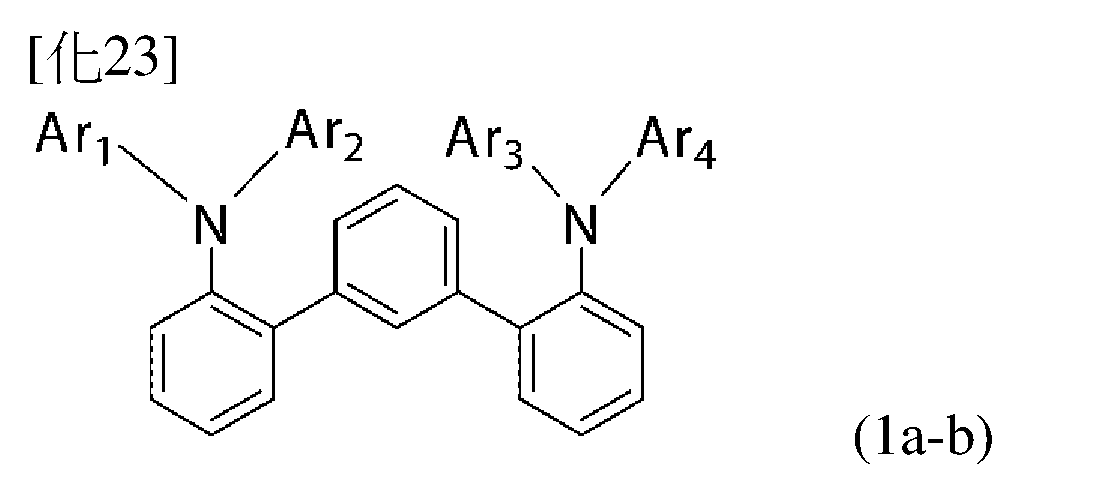

Applications Claiming Priority (2)
| Application Number | Priority Date | Filing Date | Title |
|---|---|---|---|
| JP2013-146010 | 2013-07-12 | ||
| JP2013146010 | 2013-07-12 |
Publications (2)
| Publication Number | Publication Date |
|---|---|
| TW201835302A TW201835302A (en) | 2018-10-01 |
| TWI663246B true TWI663246B (en) | 2019-06-21 |
Family
ID=52279584
Family Applications (2)
| Application Number | Title | Priority Date | Filing Date |
|---|---|---|---|
| TW107123613A TWI663246B (en) | 2013-07-12 | 2014-07-10 | Organic electroluminescent device |
| TW103123853A TWI632222B (en) | 2013-07-12 | 2014-07-10 | Organic electroluminescent device |
Family Applications After (1)
| Application Number | Title | Priority Date | Filing Date |
|---|---|---|---|
| TW103123853A TWI632222B (en) | 2013-07-12 | 2014-07-10 | Organic electroluminescent device |
Country Status (7)
| Country | Link |
|---|---|
| US (1) | US20160118591A1 (en) |
| EP (2) | EP3021372B1 (en) |
| JP (2) | JP5753635B1 (en) |
| KR (2) | KR102355739B1 (en) |
| CN (2) | CN105378964B (en) |
| TW (2) | TWI663246B (en) |
| WO (1) | WO2015004875A1 (en) |
Families Citing this family (18)
| Publication number | Priority date | Publication date | Assignee | Title |
|---|---|---|---|---|
| JP6157718B2 (en) | 2014-02-28 | 2017-07-05 | 出光興産株式会社 | COMPOUND, MATERIAL FOR ORGANIC ELECTROLUMINESCENT ELEMENT, ORGANIC ELECTROLUMINESCENT ELEMENT AND ELECTRONIC DEVICE |
| KR102316844B1 (en) * | 2014-06-26 | 2021-10-22 | 호도가야 가가쿠 고교 가부시키가이샤 | Organic electroluminescent element |
| JP6788335B2 (en) | 2014-08-11 | 2020-11-25 | 三星ディスプレイ株式會社Samsung Display Co.,Ltd. | Monoamine materials for organic electroluminescence devices and organic electroluminescence devices using them |
| EP3244463B1 (en) | 2015-01-08 | 2020-07-22 | Hodogaya Chemical Co., Ltd. | Organic electroluminescent device |
| US10326079B2 (en) * | 2015-04-27 | 2019-06-18 | Hodogaya Chemical Co., Ltd. | Organic electroluminescent device |
| KR102636244B1 (en) | 2016-03-30 | 2024-02-15 | 삼성디스플레이 주식회사 | Organic light emitting device |
| WO2018168991A1 (en) * | 2017-03-15 | 2018-09-20 | 保土谷化学工業株式会社 | Organic electroluminescent element |
| WO2019026728A1 (en) * | 2017-08-04 | 2019-02-07 | 保土谷化学工業株式会社 | Organic electroluminescence element containing compound having benzoazole ring structure |
| JP7163311B2 (en) * | 2017-12-05 | 2022-10-31 | 保土谷化学工業株式会社 | organic electroluminescence element |
| KR102757332B1 (en) * | 2018-07-27 | 2025-01-21 | 삼성디스플레이 주식회사 | Amine compound and organic light emitting device comprising the same |
| EP3925958A1 (en) * | 2019-02-13 | 2021-12-22 | Hodogaya Chemical Co., Ltd. | Compound having benzazole ring structure, and organic electroluminescent device |
| CN111176570B (en) | 2019-12-27 | 2021-07-16 | 浪潮电子信息产业股份有限公司 | A method, device, device and medium for creating a thick provisioned volume |
| JP7498727B2 (en) * | 2020-01-22 | 2024-06-12 | 保土谷化学工業株式会社 | Organic electroluminescence element |
| CN111470984B (en) * | 2020-04-16 | 2022-12-13 | 苏州欧谱科显示科技有限公司 | Hole transport material and preparation method and application thereof |
| KR102866465B1 (en) | 2020-07-20 | 2025-10-01 | 삼성디스플레이 주식회사 | Organic electroluminescence device and diamine compound for organic electroluminescence device |
| CN115885022A (en) * | 2020-08-17 | 2023-03-31 | 保土谷化学工业株式会社 | Organic electroluminescent element |
| WO2023038006A1 (en) | 2021-09-07 | 2023-03-16 | 保土谷化学工業株式会社 | Organic electroluminescent element |
| CN117343078A (en) | 2021-11-25 | 2024-01-05 | 北京夏禾科技有限公司 | Organic electroluminescent materials and devices |
Citations (2)
| Publication number | Priority date | Publication date | Assignee | Title |
|---|---|---|---|---|
| WO2011059000A1 (en) * | 2009-11-12 | 2011-05-19 | 保土谷化学工業株式会社 | Compound having a substituted anthracene ring structure and pyridoindole ring structure, and organic electroluminescent element |
| CN102712612A (en) * | 2010-01-21 | 2012-10-03 | 出光兴产株式会社 | Aromatic amine derivative and organic electroluminescent device using same |
Family Cites Families (24)
| Publication number | Priority date | Publication date | Assignee | Title |
|---|---|---|---|---|
| JPS4943840B1 (en) | 1970-12-25 | 1974-11-25 | ||
| JP3194657B2 (en) | 1993-11-01 | 2001-07-30 | 松下電器産業株式会社 | EL device |
| JP3828595B2 (en) | 1994-02-08 | 2006-10-04 | Tdk株式会社 | Organic EL device |
| KR100691543B1 (en) | 2002-01-18 | 2007-03-09 | 주식회사 엘지화학 | New material for electron transport and organic light emitting device using the same |
| TWI223569B (en) * | 2002-03-20 | 2004-11-01 | Sanyo Electric Co | Method for reducing light quantity of organic EL panel and organic EL panel |
| JP2003282241A (en) * | 2002-03-25 | 2003-10-03 | Pioneer Electronic Corp | Organic electroluminescent display panel and manufacturing method |
| US6967062B2 (en) * | 2003-03-19 | 2005-11-22 | Eastman Kodak Company | White light-emitting OLED device having a blue light-emitting layer doped with an electron-transporting or a hole-transporting material or both |
| JP4487587B2 (en) | 2003-05-27 | 2010-06-23 | 株式会社デンソー | Organic EL device and method for manufacturing the same |
| KR20050015902A (en) * | 2003-08-14 | 2005-02-21 | 엘지전자 주식회사 | Organic electroluminescence device and fabrication method of the same |
| KR100787425B1 (en) | 2004-11-29 | 2007-12-26 | 삼성에스디아이 주식회사 | Phenylcarbazole compound and organic electroluminescent device using same |
| CN1956945B (en) | 2004-05-25 | 2010-09-22 | 保土谷化学工业株式会社 | P-terphenyl compound and electrophotographic photoreceptor using the same |
| KR101267114B1 (en) * | 2005-04-18 | 2013-05-23 | 이데미쓰 고산 가부시키가이샤 | Aromatic triamine compound and organic electroluminescent device using same |
| JP5242016B2 (en) * | 2006-03-31 | 2013-07-24 | 双葉電子工業株式会社 | COMPOUND FOR ORGANIC EL ELEMENT AND ORGANIC EL ELEMENT |
| JP5298460B2 (en) * | 2006-06-08 | 2013-09-25 | コニカミノルタ株式会社 | Organic electroluminescence element, display device and lighting device |
| JP5133259B2 (en) | 2006-11-24 | 2013-01-30 | 出光興産株式会社 | Aromatic amine derivative and organic electroluminescence device using the same |
| JP5264197B2 (en) * | 2008-01-23 | 2013-08-14 | キヤノン株式会社 | Thin film transistor |
| WO2009151039A1 (en) * | 2008-06-11 | 2009-12-17 | 保土谷化学工業株式会社 | Organic electroluminescent element |
| WO2010035723A1 (en) * | 2008-09-24 | 2010-04-01 | 保土谷化学工業株式会社 | Compound having substituted anthracene ring structure and pyridoindole ring structure and organic electroluminescence device |
| JP2010226059A (en) * | 2009-03-25 | 2010-10-07 | Toshiba Corp | Organic electroluminescence device |
| JP2011098948A (en) * | 2009-06-25 | 2011-05-19 | Yamagata Promotional Organization For Industrial Technology | Bipyridine derivative and organic electroluminescent element containing the same |
| JP5585044B2 (en) * | 2009-10-20 | 2014-09-10 | 東ソー株式会社 | Carbazole compounds and uses thereof |
| US9650565B2 (en) * | 2009-10-20 | 2017-05-16 | Tosoh Corporation | Carbazole compound and use thereof |
| EP2578572A4 (en) * | 2010-06-07 | 2013-11-20 | Hodogaya Chemical Co Ltd | COMPOUNDS WITH CYCLIC ACRIDANE STRUCTURES AND ORGANIC ELECTROLUMINESCENT ELEMENTS |
| JP3194657U (en) | 2014-09-19 | 2014-12-04 | 恵美子 青柳 | Thermal necklace |
-
2014
- 2014-07-01 CN CN201480039850.0A patent/CN105378964B/en active Active
- 2014-07-01 WO PCT/JP2014/003498 patent/WO2015004875A1/en not_active Ceased
- 2014-07-01 JP JP2014557898A patent/JP5753635B1/en active Active
- 2014-07-01 EP EP14823323.2A patent/EP3021372B1/en active Active
- 2014-07-01 KR KR1020217013240A patent/KR102355739B1/en active Active
- 2014-07-01 CN CN201711351553.1A patent/CN107978693B/en active Active
- 2014-07-01 EP EP20154629.8A patent/EP3671885B1/en active Active
- 2014-07-01 US US14/897,943 patent/US20160118591A1/en not_active Abandoned
- 2014-07-01 KR KR1020157036001A patent/KR20160030109A/en not_active Ceased
- 2014-07-10 TW TW107123613A patent/TWI663246B/en active
- 2014-07-10 TW TW103123853A patent/TWI632222B/en active
- 2014-11-28 JP JP2014240864A patent/JP5851014B2/en active Active
Patent Citations (2)
| Publication number | Priority date | Publication date | Assignee | Title |
|---|---|---|---|---|
| WO2011059000A1 (en) * | 2009-11-12 | 2011-05-19 | 保土谷化学工業株式会社 | Compound having a substituted anthracene ring structure and pyridoindole ring structure, and organic electroluminescent element |
| CN102712612A (en) * | 2010-01-21 | 2012-10-03 | 出光兴产株式会社 | Aromatic amine derivative and organic electroluminescent device using same |
Also Published As
| Publication number | Publication date |
|---|---|
| KR102355739B1 (en) | 2022-01-25 |
| US20160118591A1 (en) | 2016-04-28 |
| EP3671885B1 (en) | 2023-03-01 |
| EP3671885A1 (en) | 2020-06-24 |
| CN107978693B (en) | 2020-07-28 |
| EP3021372A4 (en) | 2017-04-05 |
| EP3021372B1 (en) | 2020-03-18 |
| TW201510174A (en) | 2015-03-16 |
| TW201835302A (en) | 2018-10-01 |
| JP5753635B1 (en) | 2015-07-22 |
| TWI632222B (en) | 2018-08-11 |
| CN107978693A (en) | 2018-05-01 |
| CN105378964B (en) | 2018-01-09 |
| KR20210054030A (en) | 2021-05-12 |
| KR20160030109A (en) | 2016-03-16 |
| EP3021372A1 (en) | 2016-05-18 |
| CN105378964A (en) | 2016-03-02 |
| JP2015092581A (en) | 2015-05-14 |
| JP5851014B2 (en) | 2016-02-03 |
| WO2015004875A1 (en) | 2015-01-15 |
| JPWO2015004875A1 (en) | 2017-03-02 |
Similar Documents
| Publication | Publication Date | Title |
|---|---|---|
| TWI663246B (en) | Organic electroluminescent device | |
| TWI627259B (en) | Organic electroluminescent element | |
| JP6675321B2 (en) | Organic electroluminescence device | |
| TWI699350B (en) | Organic electroluminescent device | |
| TWI802612B (en) | Organic electroluminescence device | |
| JP6749892B2 (en) | Organic electroluminescent device | |
| TWI720044B (en) | Organic electroluminescent device | |
| CN107210382B (en) | Organic electroluminescent device | |
| TWI631095B (en) | Organic electroluminescent device | |
| TWI682919B (en) | Organic electroluminescent device | |
| KR102319951B1 (en) | Organic electroluminescent element | |
| TW201829734A (en) | Organic electroluminescent element | |
| TW201803967A (en) | Organic electroluminescent element | |
| JPWO2016111270A1 (en) | Organic electroluminescence device | |
| TW202031867A (en) | Organic electroluminescence element | |
| JP2014074073A (en) | Novel thieno indole derivative and organic electroluminescent element using the derivative | |
| TW201811731A (en) | Aryl diamine compound and organic electroluminescent element |