TWI697256B - Organic electroluminescence devices - Google Patents
Organic electroluminescence devices Download PDFInfo
- Publication number
- TWI697256B TWI697256B TW104124461A TW104124461A TWI697256B TW I697256 B TWI697256 B TW I697256B TW 104124461 A TW104124461 A TW 104124461A TW 104124461 A TW104124461 A TW 104124461A TW I697256 B TWI697256 B TW I697256B
- Authority
- TW
- Taiwan
- Prior art keywords
- group
- general formula
- atom
- aromatic hydrocarbon
- groups
- Prior art date
Links
- 0 c(cc1)cc2*1c*cc2 Chemical compound c(cc1)cc2*1c*cc2 0.000 description 14
- XMJFOTBBDPVFAL-UHFFFAOYSA-N C1=CC(c2cccc(-c3cc(-c4cccc(-c5cnccc5)c4)nc(-c4cccc(-c5c(cccc6)c6c(-c6ccccc6)c6c5cccc6)c4)n3)c2)=[N]=C1 Chemical compound C1=CC(c2cccc(-c3cc(-c4cccc(-c5cnccc5)c4)nc(-c4cccc(-c5c(cccc6)c6c(-c6ccccc6)c6c5cccc6)c4)n3)c2)=[N]=C1 XMJFOTBBDPVFAL-UHFFFAOYSA-N 0.000 description 1
- MFQDVIJKKIAGRA-UHFFFAOYSA-N CC1N=CC=CC1c1cccc(-c2cc(-c3cnccc3)nc(-c3cccc(-c4c(cccc5)c5c(-c5ccccc5)c5c4cccc5)c3)n2)c1 Chemical compound CC1N=CC=CC1c1cccc(-c2cc(-c3cnccc3)nc(-c3cccc(-c4c(cccc5)c5c(-c5ccccc5)c5c4cccc5)c3)n2)c1 MFQDVIJKKIAGRA-UHFFFAOYSA-N 0.000 description 1
- BSBPRURXHXAVLU-RQOWECAXSA-N [IH]=CC/C=C\N=[IH] Chemical compound [IH]=CC/C=C\N=[IH] BSBPRURXHXAVLU-RQOWECAXSA-N 0.000 description 1
- MZRLJMHCUMLTGD-UHFFFAOYSA-O [NH3+]c(cc1)ccc1C1=CCC[I]=C1 Chemical compound [NH3+]c(cc1)ccc1C1=CCC[I]=C1 MZRLJMHCUMLTGD-UHFFFAOYSA-O 0.000 description 1
- DYOZJLVPXQHCPC-UHFFFAOYSA-N c(cc1)ccc1-c1c(cccc2)c2c(-c2cc(-c3nc(-c(cc4)ccc4-c4cnccc4)cc(-c4cc(cccc5)c5c5ccccc45)n3)ccc2)c2c1cccc2 Chemical compound c(cc1)ccc1-c1c(cccc2)c2c(-c2cc(-c3nc(-c(cc4)ccc4-c4cnccc4)cc(-c4cc(cccc5)c5c5ccccc45)n3)ccc2)c2c1cccc2 DYOZJLVPXQHCPC-UHFFFAOYSA-N 0.000 description 1
- FVXWVNJHMBHFQZ-UHFFFAOYSA-N c(cc1)ccc1-c1c(cccc2)c2c(-c2cc(-c3nc(-c(cc4)ccc4-c4cnccc4)cc(-c4cc5ccccc5cc4)n3)ccc2)c2c1cccc2 Chemical compound c(cc1)ccc1-c1c(cccc2)c2c(-c2cc(-c3nc(-c(cc4)ccc4-c4cnccc4)cc(-c4cc5ccccc5cc4)n3)ccc2)c2c1cccc2 FVXWVNJHMBHFQZ-UHFFFAOYSA-N 0.000 description 1
- HOUHYUIQOLEAQS-UHFFFAOYSA-N c(cc1)ccc1-c1c(cccc2)c2c(-c2cc(-c3nc(-c(cc4)ccc4-c4cnccc4)cc(-c4cccc5ccccc45)n3)ccc2)c2c1cccc2 Chemical compound c(cc1)ccc1-c1c(cccc2)c2c(-c2cc(-c3nc(-c(cc4)ccc4-c4cnccc4)cc(-c4cccc5ccccc45)n3)ccc2)c2c1cccc2 HOUHYUIQOLEAQS-UHFFFAOYSA-N 0.000 description 1
- UHOVQNZJYSORNB-UHFFFAOYSA-N c1ccccc1 Chemical compound c1ccccc1 UHOVQNZJYSORNB-UHFFFAOYSA-N 0.000 description 1
Images


Classifications
-
- H—ELECTRICITY
- H10—SEMICONDUCTOR DEVICES; ELECTRIC SOLID-STATE DEVICES NOT OTHERWISE PROVIDED FOR
- H10K—ORGANIC ELECTRIC SOLID-STATE DEVICES
- H10K85/00—Organic materials used in the body or electrodes of devices covered by this subclass
- H10K85/60—Organic compounds having low molecular weight
- H10K85/631—Amine compounds having at least two aryl rest on at least one amine-nitrogen atom, e.g. triphenylamine
-
- C—CHEMISTRY; METALLURGY
- C07—ORGANIC CHEMISTRY
- C07C—ACYCLIC OR CARBOCYCLIC COMPOUNDS
- C07C211/00—Compounds containing amino groups bound to a carbon skeleton
- C07C211/43—Compounds containing amino groups bound to a carbon skeleton having amino groups bound to carbon atoms of six-membered aromatic rings of the carbon skeleton
- C07C211/54—Compounds containing amino groups bound to a carbon skeleton having amino groups bound to carbon atoms of six-membered aromatic rings of the carbon skeleton having amino groups bound to two or three six-membered aromatic rings
-
- C—CHEMISTRY; METALLURGY
- C07—ORGANIC CHEMISTRY
- C07C—ACYCLIC OR CARBOCYCLIC COMPOUNDS
- C07C211/00—Compounds containing amino groups bound to a carbon skeleton
- C07C211/43—Compounds containing amino groups bound to a carbon skeleton having amino groups bound to carbon atoms of six-membered aromatic rings of the carbon skeleton
- C07C211/57—Compounds containing amino groups bound to a carbon skeleton having amino groups bound to carbon atoms of six-membered aromatic rings of the carbon skeleton having amino groups bound to carbon atoms of six-membered aromatic rings being part of condensed ring systems of the carbon skeleton
- C07C211/58—Naphthylamines; N-substituted derivatives thereof
-
- C—CHEMISTRY; METALLURGY
- C07—ORGANIC CHEMISTRY
- C07C—ACYCLIC OR CARBOCYCLIC COMPOUNDS
- C07C211/00—Compounds containing amino groups bound to a carbon skeleton
- C07C211/43—Compounds containing amino groups bound to a carbon skeleton having amino groups bound to carbon atoms of six-membered aromatic rings of the carbon skeleton
- C07C211/57—Compounds containing amino groups bound to a carbon skeleton having amino groups bound to carbon atoms of six-membered aromatic rings of the carbon skeleton having amino groups bound to carbon atoms of six-membered aromatic rings being part of condensed ring systems of the carbon skeleton
- C07C211/61—Compounds containing amino groups bound to a carbon skeleton having amino groups bound to carbon atoms of six-membered aromatic rings of the carbon skeleton having amino groups bound to carbon atoms of six-membered aromatic rings being part of condensed ring systems of the carbon skeleton with at least one of the condensed ring systems formed by three or more rings
-
- C—CHEMISTRY; METALLURGY
- C07—ORGANIC CHEMISTRY
- C07C—ACYCLIC OR CARBOCYCLIC COMPOUNDS
- C07C217/00—Compounds containing amino and etherified hydroxy groups bound to the same carbon skeleton
- C07C217/78—Compounds containing amino and etherified hydroxy groups bound to the same carbon skeleton having amino groups and etherified hydroxy groups bound to carbon atoms of six-membered aromatic rings of the same carbon skeleton
- C07C217/80—Compounds containing amino and etherified hydroxy groups bound to the same carbon skeleton having amino groups and etherified hydroxy groups bound to carbon atoms of six-membered aromatic rings of the same carbon skeleton having amino groups and etherified hydroxy groups bound to carbon atoms of non-condensed six-membered aromatic rings
- C07C217/82—Compounds containing amino and etherified hydroxy groups bound to the same carbon skeleton having amino groups and etherified hydroxy groups bound to carbon atoms of six-membered aromatic rings of the same carbon skeleton having amino groups and etherified hydroxy groups bound to carbon atoms of non-condensed six-membered aromatic rings of the same non-condensed six-membered aromatic ring
- C07C217/90—Compounds containing amino and etherified hydroxy groups bound to the same carbon skeleton having amino groups and etherified hydroxy groups bound to carbon atoms of six-membered aromatic rings of the same carbon skeleton having amino groups and etherified hydroxy groups bound to carbon atoms of non-condensed six-membered aromatic rings of the same non-condensed six-membered aromatic ring the oxygen atom of at least one of the etherified hydroxy groups being further bound to a carbon atom of a six-membered aromatic ring, e.g. amino-diphenylethers
-
- C—CHEMISTRY; METALLURGY
- C07—ORGANIC CHEMISTRY
- C07D—HETEROCYCLIC COMPOUNDS
- C07D235/00—Heterocyclic compounds containing 1,3-diazole or hydrogenated 1,3-diazole rings, condensed with other rings
- C07D235/02—Heterocyclic compounds containing 1,3-diazole or hydrogenated 1,3-diazole rings, condensed with other rings condensed with carbocyclic rings or ring systems
- C07D235/04—Benzimidazoles; Hydrogenated benzimidazoles
- C07D235/06—Benzimidazoles; Hydrogenated benzimidazoles with only hydrogen atoms, hydrocarbon or substituted hydrocarbon radicals, directly attached in position 2
- C07D235/08—Radicals containing only hydrogen and carbon atoms
-
- C—CHEMISTRY; METALLURGY
- C07—ORGANIC CHEMISTRY
- C07D—HETEROCYCLIC COMPOUNDS
- C07D239/00—Heterocyclic compounds containing 1,3-diazine or hydrogenated 1,3-diazine rings
- C07D239/02—Heterocyclic compounds containing 1,3-diazine or hydrogenated 1,3-diazine rings not condensed with other rings
- C07D239/24—Heterocyclic compounds containing 1,3-diazine or hydrogenated 1,3-diazine rings not condensed with other rings having three or more double bonds between ring members or between ring members and non-ring members
- C07D239/26—Heterocyclic compounds containing 1,3-diazine or hydrogenated 1,3-diazine rings not condensed with other rings having three or more double bonds between ring members or between ring members and non-ring members with only hydrogen atoms, hydrocarbon or substituted hydrocarbon radicals, directly attached to ring carbon atoms
-
- C—CHEMISTRY; METALLURGY
- C07—ORGANIC CHEMISTRY
- C07D—HETEROCYCLIC COMPOUNDS
- C07D307/00—Heterocyclic compounds containing five-membered rings having one oxygen atom as the only ring hetero atom
- C07D307/77—Heterocyclic compounds containing five-membered rings having one oxygen atom as the only ring hetero atom ortho- or peri-condensed with carbocyclic rings or ring systems
- C07D307/91—Dibenzofurans; Hydrogenated dibenzofurans
-
- C—CHEMISTRY; METALLURGY
- C07—ORGANIC CHEMISTRY
- C07D—HETEROCYCLIC COMPOUNDS
- C07D333/00—Heterocyclic compounds containing five-membered rings having one sulfur atom as the only ring hetero atom
- C07D333/50—Heterocyclic compounds containing five-membered rings having one sulfur atom as the only ring hetero atom condensed with carbocyclic rings or ring systems
- C07D333/76—Dibenzothiophenes
-
- C—CHEMISTRY; METALLURGY
- C07—ORGANIC CHEMISTRY
- C07D—HETEROCYCLIC COMPOUNDS
- C07D401/00—Heterocyclic compounds containing two or more hetero rings, having nitrogen atoms as the only ring hetero atoms, at least one ring being a six-membered ring with only one nitrogen atom
- C07D401/02—Heterocyclic compounds containing two or more hetero rings, having nitrogen atoms as the only ring hetero atoms, at least one ring being a six-membered ring with only one nitrogen atom containing two hetero rings
- C07D401/10—Heterocyclic compounds containing two or more hetero rings, having nitrogen atoms as the only ring hetero atoms, at least one ring being a six-membered ring with only one nitrogen atom containing two hetero rings linked by a carbon chain containing aromatic rings
-
- C—CHEMISTRY; METALLURGY
- C07—ORGANIC CHEMISTRY
- C07D—HETEROCYCLIC COMPOUNDS
- C07D401/00—Heterocyclic compounds containing two or more hetero rings, having nitrogen atoms as the only ring hetero atoms, at least one ring being a six-membered ring with only one nitrogen atom
- C07D401/14—Heterocyclic compounds containing two or more hetero rings, having nitrogen atoms as the only ring hetero atoms, at least one ring being a six-membered ring with only one nitrogen atom containing three or more hetero rings
-
- C—CHEMISTRY; METALLURGY
- C07—ORGANIC CHEMISTRY
- C07D—HETEROCYCLIC COMPOUNDS
- C07D403/00—Heterocyclic compounds containing two or more hetero rings, having nitrogen atoms as the only ring hetero atoms, not provided for by group C07D401/00
- C07D403/02—Heterocyclic compounds containing two or more hetero rings, having nitrogen atoms as the only ring hetero atoms, not provided for by group C07D401/00 containing two hetero rings
- C07D403/04—Heterocyclic compounds containing two or more hetero rings, having nitrogen atoms as the only ring hetero atoms, not provided for by group C07D401/00 containing two hetero rings directly linked by a ring-member-to-ring-member bond
-
- C—CHEMISTRY; METALLURGY
- C07—ORGANIC CHEMISTRY
- C07D—HETEROCYCLIC COMPOUNDS
- C07D403/00—Heterocyclic compounds containing two or more hetero rings, having nitrogen atoms as the only ring hetero atoms, not provided for by group C07D401/00
- C07D403/02—Heterocyclic compounds containing two or more hetero rings, having nitrogen atoms as the only ring hetero atoms, not provided for by group C07D401/00 containing two hetero rings
- C07D403/10—Heterocyclic compounds containing two or more hetero rings, having nitrogen atoms as the only ring hetero atoms, not provided for by group C07D401/00 containing two hetero rings linked by a carbon chain containing aromatic rings
-
- C—CHEMISTRY; METALLURGY
- C07—ORGANIC CHEMISTRY
- C07D—HETEROCYCLIC COMPOUNDS
- C07D403/00—Heterocyclic compounds containing two or more hetero rings, having nitrogen atoms as the only ring hetero atoms, not provided for by group C07D401/00
- C07D403/14—Heterocyclic compounds containing two or more hetero rings, having nitrogen atoms as the only ring hetero atoms, not provided for by group C07D401/00 containing three or more hetero rings
-
- C—CHEMISTRY; METALLURGY
- C07—ORGANIC CHEMISTRY
- C07D—HETEROCYCLIC COMPOUNDS
- C07D409/00—Heterocyclic compounds containing two or more hetero rings, at least one ring having sulfur atoms as the only ring hetero atoms
- C07D409/02—Heterocyclic compounds containing two or more hetero rings, at least one ring having sulfur atoms as the only ring hetero atoms containing two hetero rings
- C07D409/12—Heterocyclic compounds containing two or more hetero rings, at least one ring having sulfur atoms as the only ring hetero atoms containing two hetero rings linked by a chain containing hetero atoms as chain links
-
- C—CHEMISTRY; METALLURGY
- C07—ORGANIC CHEMISTRY
- C07D—HETEROCYCLIC COMPOUNDS
- C07D471/00—Heterocyclic compounds containing nitrogen atoms as the only ring hetero atoms in the condensed system, at least one ring being a six-membered ring with one nitrogen atom, not provided for by groups C07D451/00 - C07D463/00
- C07D471/02—Heterocyclic compounds containing nitrogen atoms as the only ring hetero atoms in the condensed system, at least one ring being a six-membered ring with one nitrogen atom, not provided for by groups C07D451/00 - C07D463/00 in which the condensed system contains two hetero rings
- C07D471/04—Ortho-condensed systems
-
- C—CHEMISTRY; METALLURGY
- C07—ORGANIC CHEMISTRY
- C07D—HETEROCYCLIC COMPOUNDS
- C07D491/00—Heterocyclic compounds containing in the condensed ring system both one or more rings having oxygen atoms as the only ring hetero atoms and one or more rings having nitrogen atoms as the only ring hetero atoms, not provided for by groups C07D451/00 - C07D459/00, C07D463/00, C07D477/00 or C07D489/00
- C07D491/02—Heterocyclic compounds containing in the condensed ring system both one or more rings having oxygen atoms as the only ring hetero atoms and one or more rings having nitrogen atoms as the only ring hetero atoms, not provided for by groups C07D451/00 - C07D459/00, C07D463/00, C07D477/00 or C07D489/00 in which the condensed system contains two hetero rings
- C07D491/04—Ortho-condensed systems
- C07D491/044—Ortho-condensed systems with only one oxygen atom as ring hetero atom in the oxygen-containing ring
- C07D491/048—Ortho-condensed systems with only one oxygen atom as ring hetero atom in the oxygen-containing ring the oxygen-containing ring being five-membered
-
- C—CHEMISTRY; METALLURGY
- C07—ORGANIC CHEMISTRY
- C07D—HETEROCYCLIC COMPOUNDS
- C07D493/00—Heterocyclic compounds containing oxygen atoms as the only ring hetero atoms in the condensed system
- C07D493/02—Heterocyclic compounds containing oxygen atoms as the only ring hetero atoms in the condensed system in which the condensed system contains two hetero rings
- C07D493/04—Ortho-condensed systems
-
- C—CHEMISTRY; METALLURGY
- C07—ORGANIC CHEMISTRY
- C07D—HETEROCYCLIC COMPOUNDS
- C07D495/00—Heterocyclic compounds containing in the condensed system at least one hetero ring having sulfur atoms as the only ring hetero atoms
- C07D495/02—Heterocyclic compounds containing in the condensed system at least one hetero ring having sulfur atoms as the only ring hetero atoms in which the condensed system contains two hetero rings
- C07D495/04—Ortho-condensed systems
-
- C—CHEMISTRY; METALLURGY
- C07—ORGANIC CHEMISTRY
- C07D—HETEROCYCLIC COMPOUNDS
- C07D495/00—Heterocyclic compounds containing in the condensed system at least one hetero ring having sulfur atoms as the only ring hetero atoms
- C07D495/12—Heterocyclic compounds containing in the condensed system at least one hetero ring having sulfur atoms as the only ring hetero atoms in which the condensed system contains three hetero rings
- C07D495/14—Ortho-condensed systems
-
- C—CHEMISTRY; METALLURGY
- C07—ORGANIC CHEMISTRY
- C07F—ACYCLIC, CARBOCYCLIC OR HETEROCYCLIC COMPOUNDS CONTAINING ELEMENTS OTHER THAN CARBON, HYDROGEN, HALOGEN, OXYGEN, NITROGEN, SULFUR, SELENIUM OR TELLURIUM
- C07F15/00—Compounds containing elements of Groups 8, 9, 10 or 18 of the Periodic Table
- C07F15/0006—Compounds containing elements of Groups 8, 9, 10 or 18 of the Periodic Table compounds of the platinum group
- C07F15/0033—Iridium compounds
-
- C—CHEMISTRY; METALLURGY
- C09—DYES; PAINTS; POLISHES; NATURAL RESINS; ADHESIVES; COMPOSITIONS NOT OTHERWISE PROVIDED FOR; APPLICATIONS OF MATERIALS NOT OTHERWISE PROVIDED FOR
- C09K—MATERIALS FOR MISCELLANEOUS APPLICATIONS, NOT PROVIDED FOR ELSEWHERE
- C09K11/00—Luminescent materials, e.g. electroluminescent or chemiluminescent
- C09K11/06—Luminescent materials, e.g. electroluminescent or chemiluminescent containing organic luminescent materials
-
- H—ELECTRICITY
- H10—SEMICONDUCTOR DEVICES; ELECTRIC SOLID-STATE DEVICES NOT OTHERWISE PROVIDED FOR
- H10K—ORGANIC ELECTRIC SOLID-STATE DEVICES
- H10K50/00—Organic light-emitting devices
- H10K50/10—OLEDs or polymer light-emitting diodes [PLED]
- H10K50/11—OLEDs or polymer light-emitting diodes [PLED] characterised by the electroluminescent [EL] layers
-
- H—ELECTRICITY
- H10—SEMICONDUCTOR DEVICES; ELECTRIC SOLID-STATE DEVICES NOT OTHERWISE PROVIDED FOR
- H10K—ORGANIC ELECTRIC SOLID-STATE DEVICES
- H10K50/00—Organic light-emitting devices
- H10K50/10—OLEDs or polymer light-emitting diodes [PLED]
- H10K50/14—Carrier transporting layers
- H10K50/15—Hole transporting layers
-
- H—ELECTRICITY
- H10—SEMICONDUCTOR DEVICES; ELECTRIC SOLID-STATE DEVICES NOT OTHERWISE PROVIDED FOR
- H10K—ORGANIC ELECTRIC SOLID-STATE DEVICES
- H10K85/00—Organic materials used in the body or electrodes of devices covered by this subclass
- H10K85/60—Organic compounds having low molecular weight
- H10K85/615—Polycyclic condensed aromatic hydrocarbons, e.g. anthracene
-
- H—ELECTRICITY
- H10—SEMICONDUCTOR DEVICES; ELECTRIC SOLID-STATE DEVICES NOT OTHERWISE PROVIDED FOR
- H10K—ORGANIC ELECTRIC SOLID-STATE DEVICES
- H10K85/00—Organic materials used in the body or electrodes of devices covered by this subclass
- H10K85/60—Organic compounds having low molecular weight
- H10K85/615—Polycyclic condensed aromatic hydrocarbons, e.g. anthracene
- H10K85/626—Polycyclic condensed aromatic hydrocarbons, e.g. anthracene containing more than one polycyclic condensed aromatic rings, e.g. bis-anthracene
-
- H—ELECTRICITY
- H10—SEMICONDUCTOR DEVICES; ELECTRIC SOLID-STATE DEVICES NOT OTHERWISE PROVIDED FOR
- H10K—ORGANIC ELECTRIC SOLID-STATE DEVICES
- H10K85/00—Organic materials used in the body or electrodes of devices covered by this subclass
- H10K85/60—Organic compounds having low molecular weight
- H10K85/631—Amine compounds having at least two aryl rest on at least one amine-nitrogen atom, e.g. triphenylamine
- H10K85/633—Amine compounds having at least two aryl rest on at least one amine-nitrogen atom, e.g. triphenylamine comprising polycyclic condensed aromatic hydrocarbons as substituents on the nitrogen atom
-
- H—ELECTRICITY
- H10—SEMICONDUCTOR DEVICES; ELECTRIC SOLID-STATE DEVICES NOT OTHERWISE PROVIDED FOR
- H10K—ORGANIC ELECTRIC SOLID-STATE DEVICES
- H10K85/00—Organic materials used in the body or electrodes of devices covered by this subclass
- H10K85/60—Organic compounds having low molecular weight
- H10K85/631—Amine compounds having at least two aryl rest on at least one amine-nitrogen atom, e.g. triphenylamine
- H10K85/636—Amine compounds having at least two aryl rest on at least one amine-nitrogen atom, e.g. triphenylamine comprising heteroaromatic hydrocarbons as substituents on the nitrogen atom
-
- H—ELECTRICITY
- H10—SEMICONDUCTOR DEVICES; ELECTRIC SOLID-STATE DEVICES NOT OTHERWISE PROVIDED FOR
- H10K—ORGANIC ELECTRIC SOLID-STATE DEVICES
- H10K85/00—Organic materials used in the body or electrodes of devices covered by this subclass
- H10K85/60—Organic compounds having low molecular weight
- H10K85/649—Aromatic compounds comprising a hetero atom
- H10K85/654—Aromatic compounds comprising a hetero atom comprising only nitrogen as heteroatom
-
- H—ELECTRICITY
- H10—SEMICONDUCTOR DEVICES; ELECTRIC SOLID-STATE DEVICES NOT OTHERWISE PROVIDED FOR
- H10K—ORGANIC ELECTRIC SOLID-STATE DEVICES
- H10K85/00—Organic materials used in the body or electrodes of devices covered by this subclass
- H10K85/60—Organic compounds having low molecular weight
- H10K85/649—Aromatic compounds comprising a hetero atom
- H10K85/657—Polycyclic condensed heteroaromatic hydrocarbons
-
- H—ELECTRICITY
- H10—SEMICONDUCTOR DEVICES; ELECTRIC SOLID-STATE DEVICES NOT OTHERWISE PROVIDED FOR
- H10K—ORGANIC ELECTRIC SOLID-STATE DEVICES
- H10K85/00—Organic materials used in the body or electrodes of devices covered by this subclass
- H10K85/60—Organic compounds having low molecular weight
- H10K85/649—Aromatic compounds comprising a hetero atom
- H10K85/657—Polycyclic condensed heteroaromatic hydrocarbons
- H10K85/6572—Polycyclic condensed heteroaromatic hydrocarbons comprising only nitrogen in the heteroaromatic polycondensed ring system, e.g. phenanthroline or carbazole
-
- H—ELECTRICITY
- H10—SEMICONDUCTOR DEVICES; ELECTRIC SOLID-STATE DEVICES NOT OTHERWISE PROVIDED FOR
- H10K—ORGANIC ELECTRIC SOLID-STATE DEVICES
- H10K85/00—Organic materials used in the body or electrodes of devices covered by this subclass
- H10K85/60—Organic compounds having low molecular weight
- H10K85/649—Aromatic compounds comprising a hetero atom
- H10K85/657—Polycyclic condensed heteroaromatic hydrocarbons
- H10K85/6574—Polycyclic condensed heteroaromatic hydrocarbons comprising only oxygen in the heteroaromatic polycondensed ring system, e.g. cumarine dyes
-
- H—ELECTRICITY
- H10—SEMICONDUCTOR DEVICES; ELECTRIC SOLID-STATE DEVICES NOT OTHERWISE PROVIDED FOR
- H10K—ORGANIC ELECTRIC SOLID-STATE DEVICES
- H10K85/00—Organic materials used in the body or electrodes of devices covered by this subclass
- H10K85/60—Organic compounds having low molecular weight
- H10K85/649—Aromatic compounds comprising a hetero atom
- H10K85/657—Polycyclic condensed heteroaromatic hydrocarbons
- H10K85/6576—Polycyclic condensed heteroaromatic hydrocarbons comprising only sulfur in the heteroaromatic polycondensed ring system, e.g. benzothiophene
-
- C—CHEMISTRY; METALLURGY
- C07—ORGANIC CHEMISTRY
- C07C—ACYCLIC OR CARBOCYCLIC COMPOUNDS
- C07C2603/00—Systems containing at least three condensed rings
- C07C2603/02—Ortho- or ortho- and peri-condensed systems
- C07C2603/04—Ortho- or ortho- and peri-condensed systems containing three rings
- C07C2603/06—Ortho- or ortho- and peri-condensed systems containing three rings containing at least one ring with less than six ring members
- C07C2603/10—Ortho- or ortho- and peri-condensed systems containing three rings containing at least one ring with less than six ring members containing five-membered rings
- C07C2603/12—Ortho- or ortho- and peri-condensed systems containing three rings containing at least one ring with less than six ring members containing five-membered rings only one five-membered ring
- C07C2603/18—Fluorenes; Hydrogenated fluorenes
-
- C—CHEMISTRY; METALLURGY
- C09—DYES; PAINTS; POLISHES; NATURAL RESINS; ADHESIVES; COMPOSITIONS NOT OTHERWISE PROVIDED FOR; APPLICATIONS OF MATERIALS NOT OTHERWISE PROVIDED FOR
- C09K—MATERIALS FOR MISCELLANEOUS APPLICATIONS, NOT PROVIDED FOR ELSEWHERE
- C09K2211/00—Chemical nature of organic luminescent or tenebrescent compounds
- C09K2211/10—Non-macromolecular compounds
- C09K2211/1018—Heterocyclic compounds
- C09K2211/1025—Heterocyclic compounds characterised by ligands
- C09K2211/1029—Heterocyclic compounds characterised by ligands containing one nitrogen atom as the heteroatom
-
- H—ELECTRICITY
- H10—SEMICONDUCTOR DEVICES; ELECTRIC SOLID-STATE DEVICES NOT OTHERWISE PROVIDED FOR
- H10K—ORGANIC ELECTRIC SOLID-STATE DEVICES
- H10K2101/00—Properties of the organic materials covered by group H10K85/00
- H10K2101/10—Triplet emission
-
- H—ELECTRICITY
- H10—SEMICONDUCTOR DEVICES; ELECTRIC SOLID-STATE DEVICES NOT OTHERWISE PROVIDED FOR
- H10K—ORGANIC ELECTRIC SOLID-STATE DEVICES
- H10K50/00—Organic light-emitting devices
- H10K50/10—OLEDs or polymer light-emitting diodes [PLED]
- H10K50/11—OLEDs or polymer light-emitting diodes [PLED] characterised by the electroluminescent [EL] layers
- H10K50/12—OLEDs or polymer light-emitting diodes [PLED] characterised by the electroluminescent [EL] layers comprising dopants
-
- H—ELECTRICITY
- H10—SEMICONDUCTOR DEVICES; ELECTRIC SOLID-STATE DEVICES NOT OTHERWISE PROVIDED FOR
- H10K—ORGANIC ELECTRIC SOLID-STATE DEVICES
- H10K50/00—Organic light-emitting devices
- H10K50/10—OLEDs or polymer light-emitting diodes [PLED]
- H10K50/14—Carrier transporting layers
- H10K50/15—Hole transporting layers
- H10K50/156—Hole transporting layers comprising a multilayered structure
-
- H—ELECTRICITY
- H10—SEMICONDUCTOR DEVICES; ELECTRIC SOLID-STATE DEVICES NOT OTHERWISE PROVIDED FOR
- H10K—ORGANIC ELECTRIC SOLID-STATE DEVICES
- H10K50/00—Organic light-emitting devices
- H10K50/10—OLEDs or polymer light-emitting diodes [PLED]
- H10K50/14—Carrier transporting layers
- H10K50/16—Electron transporting layers
-
- H—ELECTRICITY
- H10—SEMICONDUCTOR DEVICES; ELECTRIC SOLID-STATE DEVICES NOT OTHERWISE PROVIDED FOR
- H10K—ORGANIC ELECTRIC SOLID-STATE DEVICES
- H10K85/00—Organic materials used in the body or electrodes of devices covered by this subclass
- H10K85/30—Coordination compounds
- H10K85/341—Transition metal complexes, e.g. Ru(II)polypyridine complexes
- H10K85/342—Transition metal complexes, e.g. Ru(II)polypyridine complexes comprising iridium
Landscapes
- Chemical & Material Sciences (AREA)
- Organic Chemistry (AREA)
- Engineering & Computer Science (AREA)
- Materials Engineering (AREA)
- Physics & Mathematics (AREA)
- Spectroscopy & Molecular Physics (AREA)
- Optics & Photonics (AREA)
- Electroluminescent Light Sources (AREA)
- Nitrogen Condensed Heterocyclic Rings (AREA)
- Plural Heterocyclic Compounds (AREA)
- Heterocyclic Carbon Compounds Containing A Hetero Ring Having Oxygen Or Sulfur (AREA)
- Indole Compounds (AREA)
Abstract
Description
本發明係關於適合各種顯示裝置之為自發光元件之有機電致發光元件((以下有時稱為有機EL元件),詳言之係關於使用了特定之芳胺化合物與特定之具縮合環結構之雜環化合物(及特定之苯并三唑衍生物或特定之蒽衍生物)的有機EL元件。The present invention relates to an organic electroluminescent element (hereinafter sometimes referred to as an organic EL element) suitable for various display devices as a self-luminous element, and specifically relates to the use of a specific aromatic amine compound and a specific condensed ring structure Organic EL devices of heterocyclic compounds (and specific benzotriazole derivatives or specific anthracene derivatives).
有機EL元件由於係自發光性元件,故比起液晶元件,較明亮且可見性優異,可為鮮明的顯示。所以已有人積極研究。Since the organic EL element is a self-luminous element, it is brighter than a liquid crystal element and is excellent in visibility, and can display clearly. So there have been active research.
1987年由伊士曼・柯達公司的C.W.Tang等人開發了將各種作用分配到各材料而得的疊層結構元件,使得使用有機材料之有機EL元件實用化。該有機EL元件係將能輸送電子的螢光體與能輸送電洞的有機物予以疊層而構成,並將正電荷與負電荷注入螢光體層之中使發光,而於10V以下之電壓獲得了1000cd/m2
以上的高亮度(參照專利文獻1及專利文獻2)。In 1987, CWTang et al. of Eastman Kodak Company developed a laminated structure element obtained by distributing various functions to various materials, making organic EL elements using organic materials practical. The organic EL element is formed by stacking a phosphor capable of transporting electrons and an organic substance capable of transporting holes, and injecting positive and negative charges into the phosphor layer to emit light, and a voltage of 10V or less is obtained High brightness of 1000 cd/m 2 or more (refer to
直到現在,為了有機EL元件的實用化已有許多改良,疊層結構之各種作用更為細分,已知有在基板上依序設有陽極、電洞注入層、電洞輸送層、發光層、電子輸送層、電子注入層、陰極的電場發光元件,一般已知藉由如此的元件能達成高效率與耐久性。Up to now, there have been many improvements for the practical application of organic EL devices, and the various functions of the laminated structure have been further subdivided. It is known that an anode, a hole injection layer, a hole transport layer, a light emitting layer, etc. are sequentially provided on the substrate. Electron emission layers, electron injection layers, and cathode electroluminescent devices are generally known to achieve high efficiency and durability with such devices.
也有人為了更提高發光效率而嘗試利用三重態激發子,也有人探討磷光發光體的利用。 而且也已開發出利用熱活化延遲螢光(TADF)所致發光的元件。2011年九州大學的安達等人利用使用熱活化延遲螢光材料的元件,達成了5.3%的外部量子效率。Some people have tried to use triplet excitons in order to improve the luminous efficiency, while others have explored the use of phosphorescent emitters. Furthermore, devices using thermally activated delayed fluorescence (TADF) luminescence have also been developed. In 2011, Anda and others of Kyushu University used an element using thermally activated delayed fluorescent materials to achieve an external quantum efficiency of 5.3%.
發光層,一般而言可以於稱為主體材料的電荷輸送性之化合物摻雜螢光性化合物或磷光發光性化合物、發射延遲螢光之材料而製作。有機EL元件中的有機材料的選擇會對於此元件的效率或耐久性等各特性給予重大的影響。The light-emitting layer can be generally produced by doping a charge-transporting compound called host material with a fluorescent compound, a phosphorescent compound, or a material that emits delayed fluorescence. The choice of organic materials in an organic EL device will have a significant influence on the characteristics of the device such as efficiency and durability.
有機EL元件中,從兩電極注入的電荷會於發光層再結合而發光,但是電洞、電子兩電荷要如何以良好效率傳遞到發光層係為重要,須成為載子均衡性優異之元件。例如藉由提高電洞注入性,提高阻擋從陰極注入之電子的電子阻擋性,使電洞與電子再結合的機率提高,進而藉由幽禁在發光層內生成的激子,可獲得高發光效率。所以,電洞輸送材料發揮的效果重要,尋求電洞注入性高、電洞移動度大、電子阻擋性高,進而對於電子之耐久性高的電洞輸送材料。In the organic EL device, the charges injected from the two electrodes recombine in the light-emitting layer to emit light. However, it is important how the electric charges of the hole and the electron are transferred to the light-emitting layer system with good efficiency, and must be an element with excellent carrier balance. For example, by improving the hole injection property and the electron blocking property of the electrons injected from the cathode, the probability of recombination of the hole and the electrons is improved, and the exciton generated in the light emitting layer by confinement can obtain high luminous efficiency . Therefore, the effect of the hole transport material is important, and a hole transport material that has high hole injection, high hole mobility, and high electron blocking property, and thus has high durability for electrons is sought.
又,關於元件壽命,材料之耐熱性或非晶性亦為重要。耐熱性低的材料,會由於元件驅動時產生的熱,而即使在低的溫度也發生熱分解,材料劣化。非晶性低的材料,即使在短時間仍會發生薄膜之結晶化,元件劣化。所以,使用之材料希望有耐熱性高、非晶性良好的性質。Also, regarding the life of the device, the heat resistance or amorphousness of the material is also important. A material with low heat resistance will decompose due to the heat generated when the device is driven, and the material will deteriorate even at a low temperature. For materials with low amorphousness, the crystallization of the thin film will occur even in a short time, and the device will deteriorate. Therefore, the materials used are expected to have high heat resistance and good amorphous properties.
迄今在有機EL元件使用的電洞輸送材料已知有N,N’-二苯基-N,N’-二(α-萘基)聯苯胺(NPD)、各種芳香族胺衍生物(參照專利文獻1及專利文獻2)。NPD有良好的電洞輸送能力,但成為耐熱性指標之玻璃轉移點(Tg)為96℃之低,於高溫條件下會因結晶化導致元件特性下降。 又,專利文獻1、2記載的芳香族胺衍生物之中已知有電洞移動度為10-3
cm2
/Vs以上的有優良移動度的化合物,但電子阻擋性不足,會有一部分電子穿越發光層,無法期待發光效率提升,為了進一步高效率化,尋求電子阻擋性更高、薄膜更安定且耐熱性高的材料。 又,有人報告耐久性高之芳香族胺衍生物(參照專利文獻3),係作為電子照片感光體使用之電荷輸送材料,並無作為有機EL元件使用之例。So far, the hole transport materials used in organic EL devices are known as N,N'-diphenyl-N,N'-bis(α-naphthyl) benzidine (NPD), and various aromatic amine derivatives (see
作為已改良耐熱性、電洞注入性等特性之化合物,有人提出有取代咔唑結構之芳胺化合物(參照專利文獻4及專利文獻5),使用該等化合物於電洞注入層或電洞輸送層之元件雖然耐熱性、發光效率等有所改良,但未稱得上令人滿意,尋求更低驅動電壓、更高發光效率。As compounds having improved properties such as heat resistance and hole injection properties, there have been proposed aromatic amine compounds having a substituted carbazole structure (refer to
為了改善有機EL元件之元件特性、提高元件製作之良率,尋求藉由組合電洞及電子之注入・輸送性能、薄膜之安定性、耐久性優異之材料以能製成使電洞及電子以高效率再結合、發光效率高、驅動電壓低、長壽命之元件。In order to improve the device characteristics of organic EL devices and improve the yield of device manufacturing, it is sought to combine materials with excellent injection and transport performance of holes and electrons, film stability, and durability to make holes and electrons High-efficiency recombination, high luminous efficiency, low driving voltage, long life component.
又,為了改善有機EL元件之元件特性,尋求藉由組合電洞及電子之注入・輸送性能、薄膜安定性、耐久性優異之材料以成為取得載子均衡性之高效率、低驅動電壓、長壽命之元件。 [先前技術文獻] [專利文獻]In addition, in order to improve the device characteristics of organic EL devices, we seek materials that combine hole injection and electron injection/transport performance, film stability, and durability to achieve high efficiency, low drive voltage, and long carrier balance Components of life. [Prior Art Literature] [Patent Literature]
[專利文獻1]日本特開平8-048656號公報 [專利文獻2]日本專利第3194657號公報 [專利文獻3]日本專利第4943840號公報 [專利文獻4]日本特開2006-151979號公報 [專利文獻5]國際公開第2008/62636號 [專利文獻6]日本特表2014-513064號公報 [專利文獻7]國際公開第2013/054764號 [專利文獻8]國際公開第2011/059000號 [專利文獻9]國際公開第2003/060956號 [專利文獻10]韓國公開專利2013-060157號公報 [專利文獻11]日本特開平7-126615號公報 [專利文獻12]日本特開2005-108804號公報 [非專利文獻][Patent Document 1] Japanese Patent Laid-Open No. 8-048656 [Patent Document 2] Japanese Patent No. 3194657 [Patent Document 3] Japanese Patent No. 4943840 [Patent Document 4] Japanese Patent Laid-Open No. 2006-151979 [Patent Document 5] International Publication No. 2008/62636 [Patent Document 6] Japanese Patent Publication No. 2014-513064 [Patent Document 7] International Publication No. 2013/054764 [Patent Document 8] International Publication No. 2011/059000 [Patent Document 9] International Publication No. 2003/060956 [Patent Document 10] Korean Patent Publication 2013-060157 [Patent Document 11] Japanese Patent Laid-Open No. 7-126615 [Patent Document 12] Japanese Patent Laid-Open No. 2005-108804 [Non Patent Literature]
[非專利文獻1]Appl.Phys.Let.,98,083302(2011)[Non-Patent Literature 1] Appl. Phys. Let., 98, 083302 (2011)
[發明欲解決之課題][Problem to be solved by invention]
本發明之目的在於藉由將電洞及電子注入・輸送性能、電子阻擋能力、於薄膜狀態之安定性、耐久性優異之有機EL元件用之各種材料加以組合使各材料擁有之特性能有效展現,以提供高效率、低驅動電壓、長壽命之有機EL元件。 [解決課題之方式]The purpose of the present invention is to effectively display the characteristics possessed by each material by combining various materials for organic EL devices with excellent hole and electron injection/transport performance, electron blocking ability, stability in thin film state, and durability , To provide high efficiency, low driving voltage, long life organic EL devices. [Method of solving the problem]
本案發明人等為了達成上述目的,著眼於:芳胺系材料的電洞注入及輸送能力、薄膜安定性、耐久性優異、具縮合環結構之含氮雜環化合物(尤其茚并吲哚衍生物或咔唑衍生物)之發光效率優異、苯并三唑衍生物、蒽衍生物之電子注入及輸送能力、薄膜安定性、耐久性優異,選擇特定之芳胺化合物與具特定結構之茚并吲哚衍生物或特定之咔唑衍生物,製作組合了電洞輸送材料與發光層之材料之各種有機EL元件,使電洞向發光層能以良好效率注入・輸送,且能取得符合發光層之材料特性之載子均衡性,並努力地評價元件之特性。又,製作為了使提高電子向發光層之注入・輸送效率也提高,使載子均衡性更符合發光層之材料之特性之組合了電洞輸送材料、發光層之材料及電子輸送材料之各種有機EL元件,並努力進行元件之特性評價。再者,使電洞輸送層成為第1電洞輸送層與第2電洞輸送層之2層結構,選擇特定之芳胺化合物作為第1電洞輸送層之材料以使電洞能向發光層以良好效率注入・輸送,並選擇電子阻擋性優良之另一芳胺衍生物作為第2電洞輸送層之材料,製成取得載子均衡性之組合予以精緻化之各種有機EL元件,並努力進行元件之特性評價。其結果完成本發明。In order to achieve the above object, the inventors of the present invention focused on: the hole injection and transport capabilities of arylamine-based materials, the stability of the thin film, excellent durability, and nitrogen-containing heterocyclic compounds (especially indenoindole derivatives) with a condensed ring structure Or carbazole derivatives) excellent luminous efficiency, electron injection and transport capabilities of benzotriazole derivatives, anthracene derivatives, excellent film stability and durability, select specific aromatic amine compounds and indenoindines with specific structures Indole derivatives or specific carbazole derivatives are used to fabricate various organic EL devices that combine the hole transport material and the light-emitting layer material, so that holes can be injected and transported into the light-emitting layer with good efficiency, and can meet the requirements of the light-emitting layer. Carrier balance of material characteristics, and strive to evaluate the characteristics of components. In addition, various organic materials combining hole transport materials, light-emitting layer materials, and electron transport materials have been fabricated to improve the injection and transport efficiency of electrons into the light-emitting layer, and to make the carrier balance more in line with the characteristics of the material of the light-emitting layer. EL components, and strive to evaluate the characteristics of the components. Furthermore, the hole transport layer is made into a two-layer structure of the first hole transport layer and the second hole transport layer, and a specific aromatic amine compound is selected as the material of the first hole transport layer so that the hole can flow toward the light emitting layer Inject and transport with good efficiency, and select another aromatic amine derivative with excellent electron blocking properties as the material for the second hole transport layer, and make various organic EL devices that are refined by a combination of carrier balance, and work hard The characteristics of the device are evaluated. As a result, the present invention has been completed.
亦即依照本發明提供以下的有機EL元件。 一種有機EL元件,按順序具有陽極、電洞輸送層、發光層、電子輸送層及陰極,其特徵為:前述電洞輸送層含有下列通式(1)表示之芳胺化合物,且前述發光層含有下列通式(2)表示之茚并吲哚衍生物或下列通式(3)表示之咔唑衍生物。 【化1】
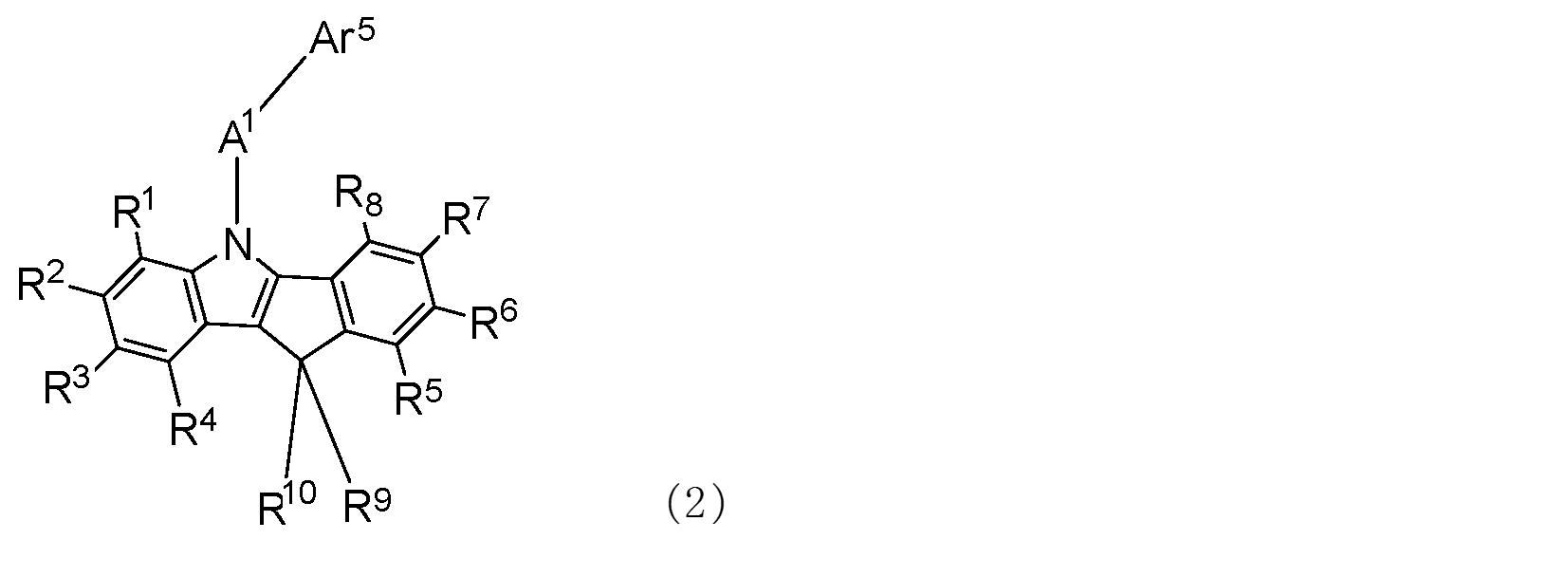
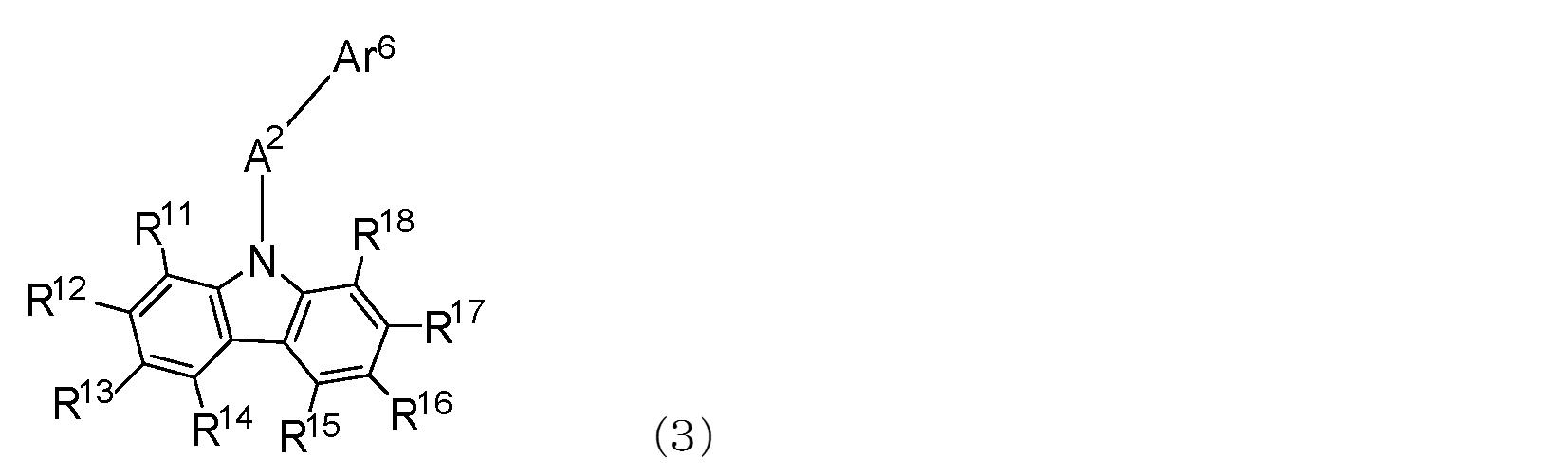
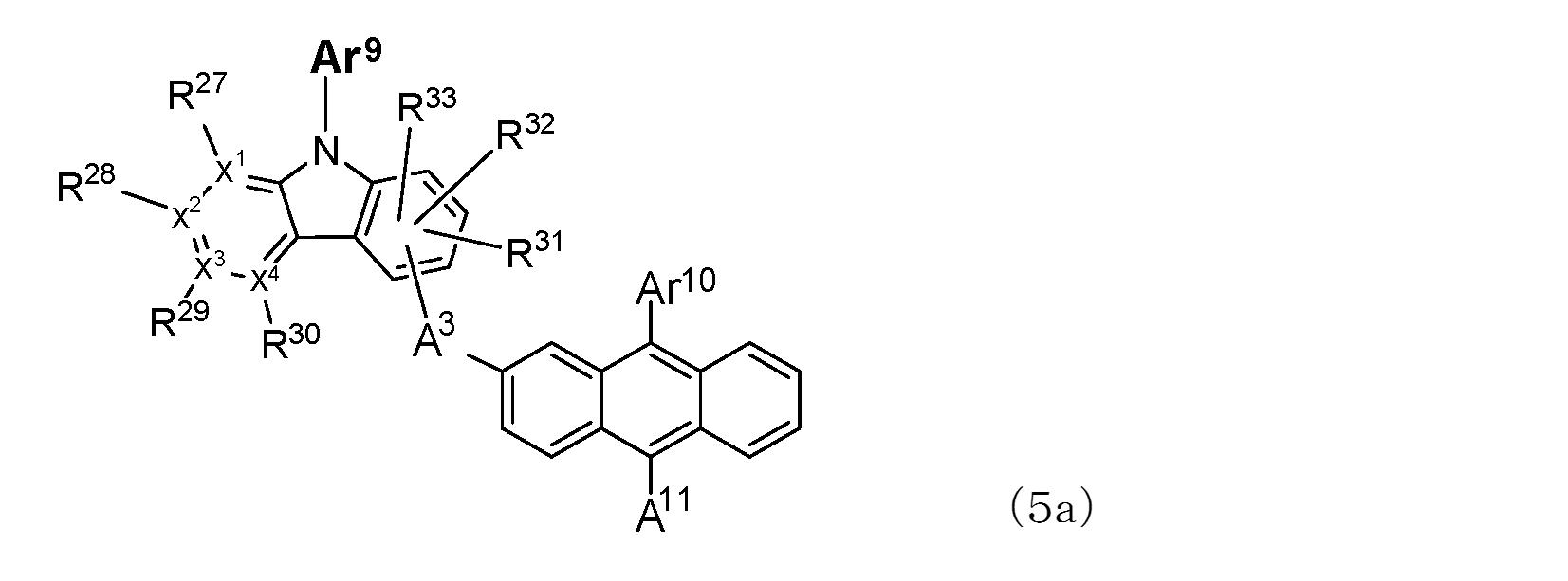
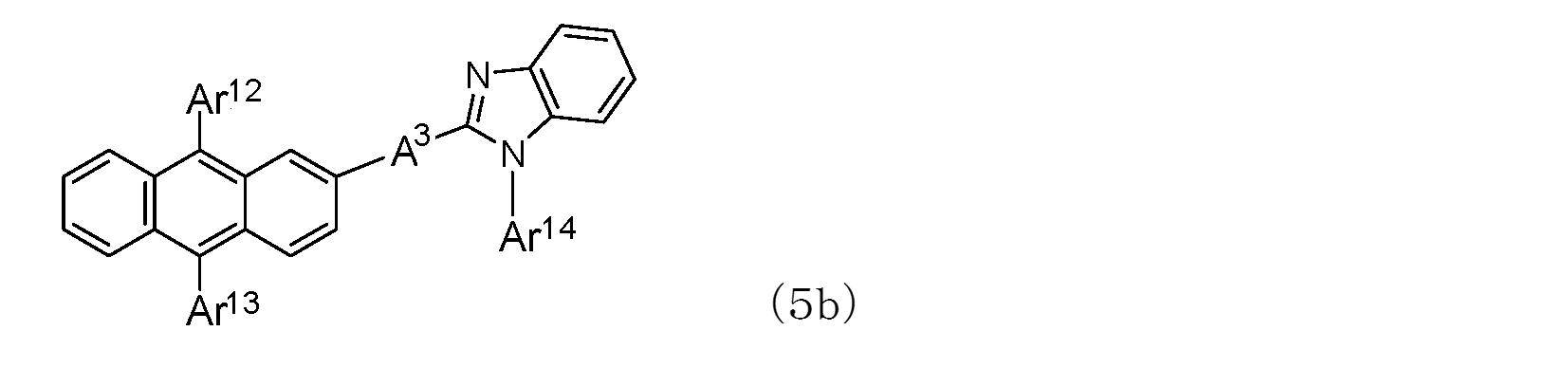
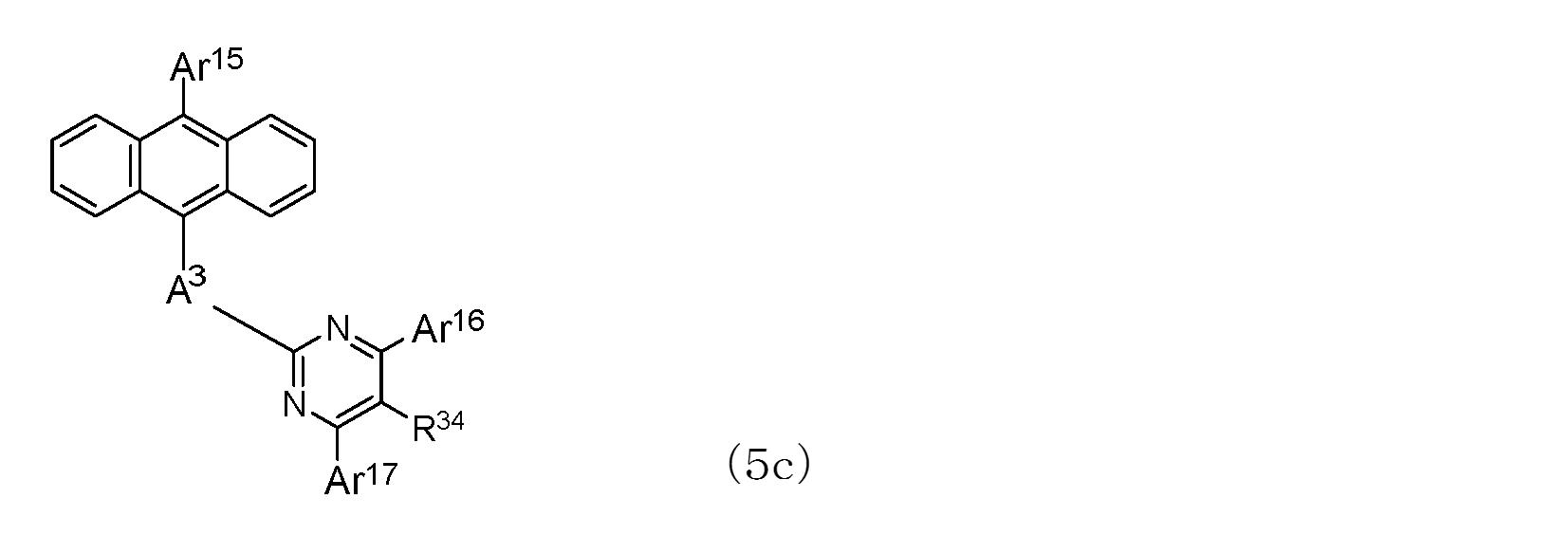
本發明之有機EL元件中,宜為: (1)前述電子輸送層含有下列通式(4)表示之苯并三唑衍生物; 【化4】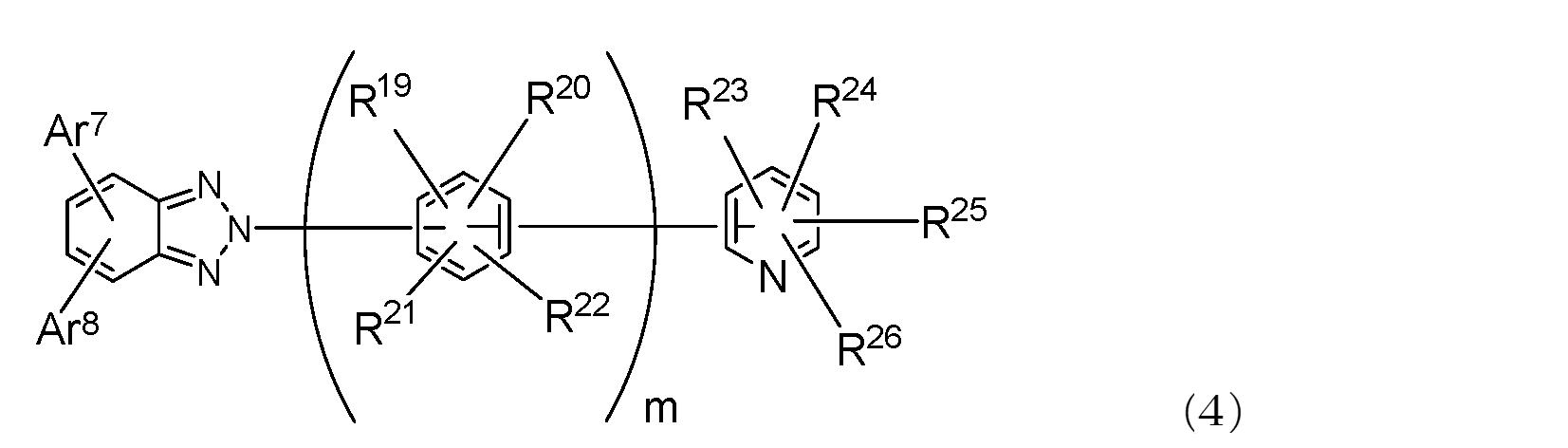

本發明之有機EL元件,選擇電洞之注入・輸送性能、薄膜之安定性、耐久性優異、能有效展現電洞之注入・輸送作用的特定芳胺化合物作為電洞輸送層之材料。所以,能以良好效率將電洞向發光層注入・輸送,可達成高效率、低驅動電壓、長壽命之有機EL元件。又,不只選擇特定芳胺化合物作為電洞輸送材料,尚選擇特定之電子輸送材料,以取得配合有特定結構之發光層之材料之特性之載子均衡性,可達成高效率、低驅動電壓且特別長壽命之有機EL元件。再者,本發明中之電洞輸送層為第1電洞輸送層與第2電洞輸送層之2層結構時,藉由將有特定結構之二種芳胺化合物於考慮載子均衡性、材料特性之狀態予以組合,能達成更高發光效率,且驅動電壓降低且更長壽命之有機EL元件。亦即,本發明之有機EL元件和習知之有機EL元件相比,能改善電洞電洞輸送層向發光層之輸送效率,且電子從電子輸送層向發光層之電子輸送效率也改善。The organic EL device of the present invention selects a specific aromatic amine compound that has excellent hole injection/transport performance, thin film stability, durability, and can effectively exhibit hole injection/transport functions as the hole transport layer material. Therefore, holes can be injected and transported into the light-emitting layer with good efficiency, and an organic EL device with high efficiency, low driving voltage, and long life can be achieved. In addition, not only the specific aromatic amine compound is selected as the hole transport material, but also the specific electron transport material to obtain the carrier balance with the characteristics of the material with the light emitting layer of the specific structure, which can achieve high efficiency, low driving voltage and Particularly long-life organic EL device. In addition, when the hole transport layer in the present invention has a two-layer structure of a first hole transport layer and a second hole transport layer, by considering the two kinds of aromatic amine compounds having a specific structure in consideration of carrier balance, The combination of material characteristics can achieve higher luminous efficiency, lower driving voltage and longer life of organic EL devices. That is, the organic EL device of the present invention can improve the transport efficiency of the hole transport layer to the light-emitting layer compared to the conventional organic EL device, and the electron transport efficiency of electrons from the electron transport layer to the light-emitting layer is also improved.
本發明之有機EL元件,具有在玻璃基板、透明塑膠基板(例如聚對苯二甲酸乙二醇酯基板)等透明基板上按順序形成陽極、電洞輸送層、發光層、電子輸送層及陰極之基本結構。只要是具有如此的基本結構即可,其層結構可採用各種態樣。例如:各層可以為單層結構也可以為疊層結構。尤其電洞輸送層可為位在陽極側之第1電洞輸送層以及和發光層相鄰之第2電洞輸送層的2層結構。又,也可於透明電極與電洞輸送層之間設置電洞注入層,也可以於電子輸送層與陰極之間設置電子注入層。再者,各層之形成可使用1種材料,也可組合使用2種以上之材料。 例如圖1顯示後述實施例採用之層結構,此例中,係於透明基板1上按順序形成陽極2、電洞注入層3、第1電洞輸送層5a、第2電洞輸送層5b、發光層6、電子輸送層7、電子注入層8及陰極9。 以下針對構成本發明之有機EL元件之各層説明。The organic EL device of the present invention has an anode, a hole transport layer, a light-emitting layer, an electron transport layer, and a cathode formed in this order on a transparent substrate such as a glass substrate, a transparent plastic substrate (such as a polyethylene terephthalate substrate), etc. The basic structure. As long as it has such a basic structure, its layer structure can adopt various aspects. For example, each layer may be a single layer structure or a laminated structure. In particular, the hole transport layer may have a two-layer structure of a first hole transport layer on the anode side and a second hole transport layer adjacent to the light emitting layer. In addition, a hole injection layer may be provided between the transparent electrode and the hole transport layer, or an electron injection layer may be provided between the electron transport layer and the cathode. Furthermore, one material may be used to form each layer, or two or more materials may be used in combination. For example, FIG. 1 shows the layer structure used in the embodiment described later. In this example, an
<陽極> 陽極2係利用蒸鍍如ITO、金之工作函數大的電極材料而形成在透明基板1上。<Anode> The
<電洞輸送層> 電洞輸送層5設於上述陽極2與發光層6之間。本發明中,此電洞輸送層5包括下列通式(1)表示之芳胺化合物(以下有時稱為「通式(1)之芳胺化合物」)。 【化9】
通式(1)中之Ar1
~Ar4
表示之芳香族烴基或縮合多環芳香族基,例如可列舉如下。 芳香族烴基; 苯基、聯苯基、聯三苯基、萘基、蒽基、菲基、茀基、茚基、芘基、苝基、丙二烯合茀基(Fluoranthenyl)基、三亞苯基等。 芳香族雜環基; 吡啶基、嘧啶基、三


Ar1
~Ar4
表示之芳香族烴基及縮合多環芳香族基可以無取代也可以有取代基。取代基除了氘原子、氰基、硝基,尚可列舉如下。 鹵素原子,例如氟原子、氯原子、溴原子、碘原子; 碳數1~6之烷基,例如甲基、乙基、正丙基、異丙基、正丁基、異丁基、第三丁基、正戊基、異戊基、新戊基、正己基; 碳數1~6之烷氧基,例如甲氧基、乙氧基、丙氧基; 烯基,例如乙烯基、烯丙基; 芳氧基,例如苯氧基、甲苯氧基; 芳基烷氧基,例如苄氧基、苯乙氧基; 芳香族烴基,例如苯基、聯苯基、聯三苯基、萘基、蒽基、菲基、茀基、茚基、芘基、苝基、丙二烯合茀基、三亞苯基; 芳香族雜環基,例如吡啶基、嘧啶基、三
(理想之態樣) 通式(1)之芳胺化合物之中,考量薄膜安定性之觀點,下列通式(1a-a)、(1a-b)、(1b-a)、(1c-a)或(1c-b)表示之芳胺化合物為較佳。(Ideal form) Among the aromatic amine compounds of the general formula (1), considering the viewpoint of film stability, the following general formulas (1a-a), (1a-b), (1b-a), (1c-a ) Or (1c-b) is preferred.
【化10】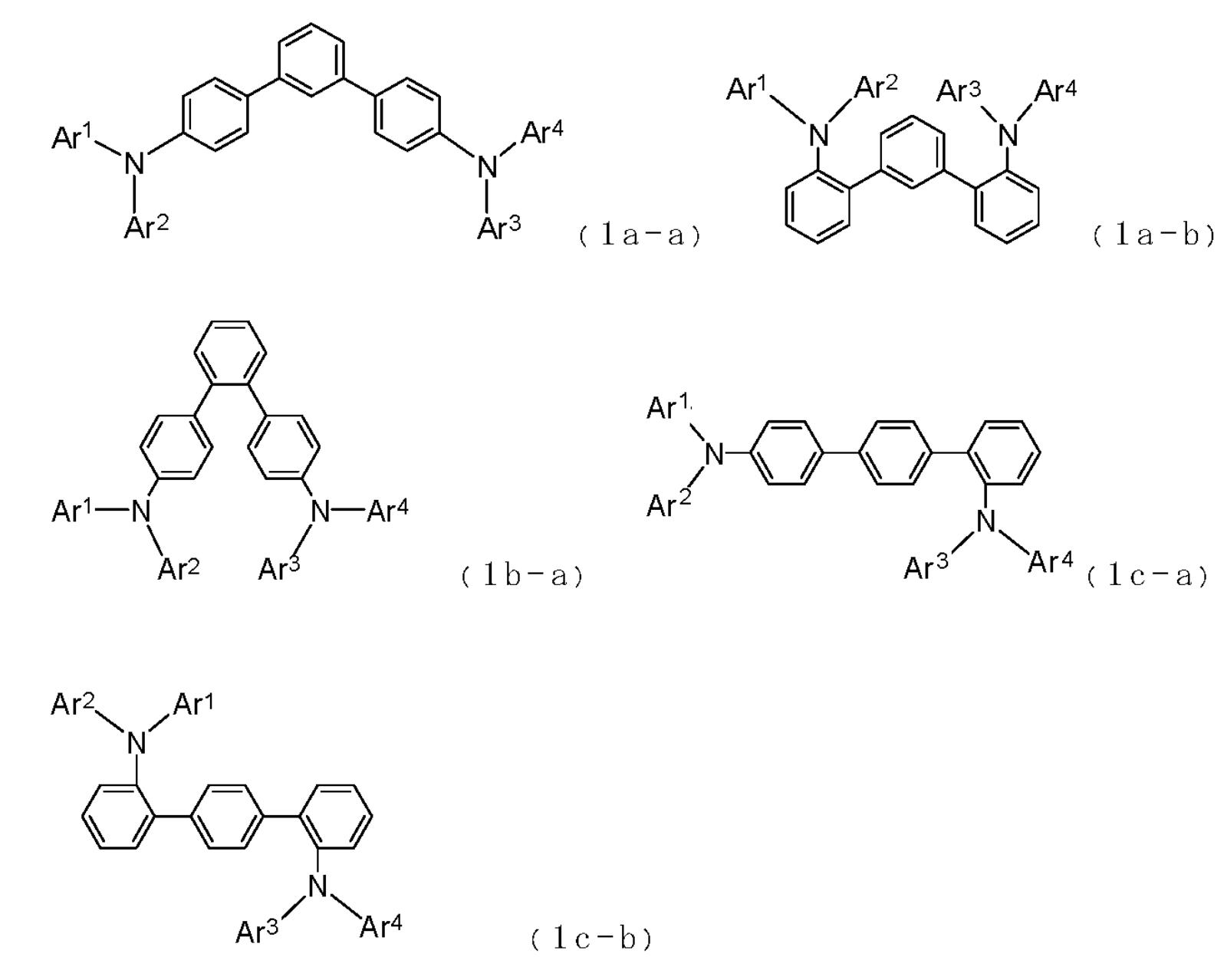
Ar1 ~Ar4 宜為芳香族烴基較理想,其中,苯基、聯苯基、萘基、茀基為較佳。Ar 1 to Ar 4 are preferably aromatic hydrocarbon groups, among which phenyl, biphenyl, naphthyl and fluorenyl are preferred.
Ar1 ~Ar4 表示之芳香族烴基或芳香族雜環基具有取代基時,該取代基宜為氘原子、碳數1~6之烷基、碳數2~6之烯基或芳香族烴基較理想,氘原子、苯基、聯苯基、萘基、乙烯基更理想。又,該等基彼此介隔單鍵而彼此鍵結形成縮合芳香環之態樣亦為理想。When the aromatic hydrocarbon group or aromatic heterocyclic group represented by Ar 1 to Ar 4 has a substituent, the substituent is preferably a deuterium atom, an alkyl group having 1 to 6 carbon atoms, an alkenyl group having 2 to 6 carbon atoms, or an aromatic hydrocarbon group Ideally, deuterium atoms, phenyl, biphenyl, naphthyl, vinyl are more desirable. In addition, it is also desirable that these groups intersect with each other through a single bond and form a condensed aromatic ring.
前述通式(1)之芳胺化合物可利用鈴木偶聯等公知方法合成。The arylamine compound of the general formula (1) can be synthesized by a known method such as Suzuki coupling.
前述通式(1)之芳胺化合物之理想具體例可列舉具有圖2~圖17表示之結構式之化合物(1-1)~(1-92)。該等圖也一併顯示各化合物屬於通式(1a―a)、(1a―b)、(1b-a)、(1c-a)及(1c-b)中之哪一者。任一者均不屬於時,記載為「-」。Preferred specific examples of the aromatic amine compound of the general formula (1) include compounds (1-1) to (1-92) having the structural formulas shown in FIGS. 2 to 17. The figures also show which of the general formulae (1a-a), (1a-b), (1b-a), (1c-a) and (1c-b) each compound belongs to. When neither of them belongs, it is described as "-".
通式(1)之芳胺化合物之精製可利用管柱層析所為之精製、矽膠、活性碳、活性白土等所為之吸附精製、溶劑所為之再結晶、晶析法、昇華精製法等以進行。本發明中,通式(1)之芳胺化合物最後利用昇華精製法精製並供使用。The purification of the aromatic amine compound of the general formula (1) can be carried out by purification by column chromatography, adsorption purification by silica gel, activated carbon, activated clay, etc., recrystallization by solvents, crystallization method, sublimation purification method, etc. . In the present invention, the aromatic amine compound of the general formula (1) is finally refined and used by the sublimation purification method.
化合物之鑑定可以利用NMR分析進行。物性値可測定玻璃轉移點(Tg)與工作函數。玻璃轉移點(Tg)成為薄膜狀態之安定性之指標。工作函數成為電洞輸送性之指標。The identification of the compound can be performed by NMR analysis. The physical property value can determine the glass transition point (Tg) and working function. The glass transition point (Tg) becomes an indicator of the stability of the film state. The work function becomes an indicator of hole transportability.
玻璃轉移點(Tg)可使用粉體利用高感度差示掃描熱量計(Bruker AXS製DSC3100SA)求出。The glass transition point (Tg) can be determined using a powder using a high-sensitivity differential scanning calorimeter (DSC3100SA manufactured by Bruker AXS).
工作函數,可於ITO基板之上製作100nm之薄膜,利用游離電位測定裝置(住友重機械工業(股)公司製PYS-202)求得。The working function can be obtained by forming a 100 nm thin film on an ITO substrate and using a free potential measuring device (PYS-202 manufactured by Sumitomo Heavy Industries, Ltd.).
本發明中,上述通式(1)之芳胺化合物可以單獨使用1種也可混用2種以上,再者,於無損通式(1)之芳胺化合物擁有之優良特性之範圍內,也可以和公知之電洞輸送劑併用而形成電洞輸送層。In the present invention, the aromatic amine compound of the general formula (1) may be used alone or in combination of two or more, and it may be within the range that does not impair the excellent characteristics possessed by the aromatic amine compound of the general formula (1) Used together with a well-known hole transport agent to form a hole transport layer.
作為如此之公知之電洞輸送劑,可列舉如下。 聯苯胺衍生物,例如 N,N’-二苯基-N,N’-二(間甲苯基)聯苯胺 (TPD)、N,N’-二苯基-N,N’-二(α-萘基)聯苯胺(NPD)、N,N,N’,N’-四聯苯基聯苯胺; 1,1-雙[4-(二-4-甲苯胺基)苯基]環己烷(TAPC); 後述通式(6)或通式(7)表示之芳基胺衍生物; 各種三苯胺3聚物;Examples of such well-known hole transport agents include the following. Benzidine derivatives, such as N,N'-diphenyl-N,N'-bis(m-tolyl)benzidine (TPD), N,N'-diphenyl-N,N'-bis(α- Naphthyl) benzidine (NPD), N,N,N',N'-tetrabiphenyl benzidine; 1,1-bis[4-(di-4-tolylamino)phenyl]cyclohexane ( TAPC); arylamine derivatives represented by general formula (6) or general formula (7) described later; various triphenylamine 3-polymers;
又,本發明中,含有上述芳胺化合物之電洞輸送層,例如如圖1,宜為有位在陽極側之第1電洞輸送層5a與位在發光層6側之第2電洞輸送層5b之二層結構。針對如此之二層結構之電洞輸送層將如後述。In addition, in the present invention, the hole transport layer containing the arylamine compound, for example, as shown in FIG. 1, is preferably a first
本發明中,可使用於電洞輸送層P型摻雜了參溴苯胺六氯銻等、軸烯(radialene)衍生物(參照國際公開2014/009310號))等、分子中具有TPD等聯苯胺衍生物之結構之高分子化合物等。In the present invention, P-type doped with bromoaniline, hexachloroantimony, etc., radialene derivatives (refer to International Publication No. 2014/009310), etc. can be used for the hole transport layer, and benzidine such as TPD in the molecule Derivative structure of high molecular compounds, etc.
上述電洞輸送層宜利用將含有通式(1)之芳胺化合物之氣體蒸鍍或共蒸鍍以形成,也可利用旋塗法、噴墨法等公知方法形成。The hole transport layer is preferably formed by vapor-depositing or co-evaporating a gas containing an aromatic amine compound of the general formula (1), or may be formed by a known method such as spin coating or inkjet method.
如此之電洞輸送層之厚度通常為約25~60nm,因為能以低驅動電壓使其發光,故即使厚度厚達例如100nm以上仍能壓抑驅動電壓上昇。亦即,電洞輸送層之厚度自由度高,例如能以20~300nm,尤其20~200nm之厚度維持實用驅動電壓。The thickness of such a hole transport layer is usually about 25 to 60 nm. Because it can emit light with a low driving voltage, the driving voltage can be suppressed from rising even if the thickness is more than 100 nm or more. That is, the thickness of the hole transport layer has a high degree of freedom, for example, a practical driving voltage can be maintained at a thickness of 20 to 300 nm, especially 20 to 200 nm.
<發光層> 本發明中,發光層包括下列通式(2)表示之茚并吲哚衍生物(以下有時稱為「通式(2)之茚并吲哚衍生物」)或(3)表示之咔唑衍生物(以下有時稱為「通式(3)之咔唑衍生物」)。<Light-emitting layer> In the present invention, the light-emitting layer includes an indenoindole derivative represented by the following general formula (2) (hereinafter sometimes referred to as "indenoindole derivative of the general formula (2)") or (3) A carbazole derivative represented (hereinafter sometimes referred to as "carbazole derivative of general formula (3)").
通式(2)表示之茚并吲哚衍生物; 【化11】
(通式(2)中之A1
) 通式(2)中之A1
表示之芳香族烴之2價基或芳香族雜環之2價基之芳香族烴或芳香族雜環具體而言可列舉如下。 芳香族烴; 苯、聯苯、聯三苯、聯四苯、苯乙烯、萘、蒽、乙烯合萘、茀、菲、二氫茚、芘、三亞苯、丙二烯合茀等。 芳香族雜環; 吡啶、嘧啶、三
上述芳香族烴之2價基及芳香族雜環之2價基可以從上述芳香族烴及芳香族雜環取走2個氫原子而成。The divalent group of the aromatic hydrocarbon and the divalent group of the aromatic heterocyclic ring can be obtained by taking two hydrogen atoms from the aromatic hydrocarbon and the aromatic heterocyclic ring.
該等2價基可以無取代也可以有取代基。取代基可列舉和就前述通式(1)中之Ar1 ~Ar4 表示之芳香族烴基及芳香族雜環基也可擁有之取代基例舉者為同樣者る。取代基可採取之態樣亦同。These divalent groups may be unsubstituted or may have a substituent. Examples of the substituents are the same as those exemplified for the aromatic hydrocarbon groups and aromatic heterocyclic groups represented by Ar 1 to Ar 4 in the general formula (1). Substituents can take the same form.
(通式(2)中之Ar5 ) 作為通式(2)中之Ar5 表示之芳香族烴基或芳香族雜環基,可列舉和就前述通式(1)中之Ar1 ~Ar4 表示之芳香族烴基或芳香族雜環基列舉者為同樣者。該等基可以無取代也可以有取代基。取代基可列舉和就前述通式(1)中之Ar1 ~Ar4 表示之芳香族烴基及芳香族雜環基也可擁有之取代基列舉者為同樣者。取代基可採取之態樣亦同。(Ar 5 in the general formula (2)) Examples of the aromatic hydrocarbon group or aromatic heterocyclic group represented by Ar 5 in the general formula (2) include Ar 1 to Ar 4 in the general formula (1) The aromatic hydrocarbon groups or aromatic heterocyclic groups represented are the same. These groups may be unsubstituted or substituted. Examples of the substituents are the same as those listed for the aromatic hydrocarbon groups and aromatic heterocyclic groups represented by Ar 1 to Ar 4 in the general formula (1). Substituents can take the same form.
(通式(2)中之R1 ~R8 ) 作為通式(2)中之R1 ~R8 表示之碳數1~6之烷基、碳數5~10之環烷基或碳數2~6之烯基,具體而言可列舉甲基、乙基、正丙基、異丙基、正丁基、異丁基、第三丁基、正戊基、異戊基、新戊基、正己基、環戊基、環己基、1-金剛烷基、2-金剛烷基、乙烯基、烯丙基、異丙烯基、2-丁烯基等。 又,碳數1~6之烷基及碳數2~6之烯基可為直鏈狀也可為分枝狀。(R 1 to R 8 in the general formula (2)) As the alkyl group having 1 to 6 carbon atoms, the cycloalkyl group having 5 to 10 carbon atoms or the carbon number represented by R 1 to R 8 in the general formula (2) The alkenyl group of 2 to 6, specifically, methyl, ethyl, n-propyl, isopropyl, n-butyl, isobutyl, tertiary butyl, n-pentyl, isopentyl, neopentyl , N-hexyl, cyclopentyl, cyclohexyl, 1-adamantyl, 2-adamantyl, vinyl, allyl, isopropenyl, 2-butenyl, etc. In addition, the alkyl group having 1 to 6 carbon atoms and the alkenyl group having 2 to 6 carbon atoms may be linear or branched.
R1
~R8
表示之碳數1~6之烷基、碳數5~10之環烷基及碳數2~6之烯基可以無取代也可以有取代基。取代基除了氘原子、氰基、硝基尚可列舉如下。 鹵素原子,例如氟原子、氯原子、溴原子、碘原子; 碳數1~6之烷氧基,例如甲氧基、乙氧基、丙氧基; 烯基,例如乙烯基、烯丙基; 芳氧基,例如苯氧基、甲苯氧基; 芳基烷氧基,例如苄氧基、苯乙氧基; 芳香族烴基,例如苯基、聯苯基、聯三苯基、萘基、蒽基、菲基、茀基、茚基、芘基、苝基、丙二烯合茀基、三亞苯基; 芳香族雜環基,例如吡啶基、嘧啶基、三
作為通式(2)中之R1 ~R8 表示之碳數1~6之烷氧基或碳數5~10之環烷氧基,具體而言可列舉甲氧基、乙氧基、正丙氧基、異丙氧基、正丁氧基、第三丁氧基、正戊氧基、正己氧基、環戊氧基、環己氧基、環庚氧基、環辛氧基、1-金剛烷氧基、2-金剛烷氧基等。又,碳數1~6之烷氧基可為直鏈狀也可為分枝狀。該等基可以無取代也可以有取代基。取代基可列舉和就前述通式(2)中之R1 ~R8 表示之碳數1~6之烷基、碳數5~10之環烷基及碳數2~6之烯基也可擁有之取代基列舉者為同樣者。取代基可採取之態樣亦同。Examples of the alkoxy groups having 1 to 6 carbon atoms or the cycloalkoxy groups having 5 to 10 carbon atoms represented by R 1 to R 8 in the general formula (2) specifically include methoxy, ethoxy, and n Propoxy, isopropoxy, n-butoxy, third butoxy, n-pentyloxy, n-hexyloxy, cyclopentyloxy, cyclohexyloxy, cycloheptyloxy, cyclooctyloxy, 1 -Adamantyloxy, 2-adamantyloxy, etc. In addition, the alkoxy group having 1 to 6 carbon atoms may be linear or branched. These groups may be unsubstituted or substituted. Examples of the substituents include alkyl groups having 1 to 6 carbon atoms, cycloalkyl groups having 5 to 10 carbon atoms and alkenyl groups having 2 to 6 carbon atoms represented by R 1 to R 8 in the general formula (2). The enumerators listed are the same. Substituents can take the same form.
作為通式(2)中之R1 ~R8 表示之芳香族烴基或芳香族雜環基,可列舉和就前述通式(1)中之Ar1 ~Ar4 表示之芳香族烴基或芳香族雜環基列舉者為同樣者。該等基可以無取代也可以有取代基。取代基可列舉和就前述通式(1)中之Ar1 ~Ar4 表示之芳香族烴基及芳香族雜環基也可擁有之取代基列舉者為同樣者。取代基可採取之態樣亦同。Examples of the aromatic hydrocarbon group or aromatic heterocyclic group represented by R 1 to R 8 in the general formula (2) include the aromatic hydrocarbon groups or aromatic groups represented by Ar 1 to Ar 4 in the general formula (1). Heterocyclic group enumerators are the same. These groups may be unsubstituted or substituted. Examples of the substituents are the same as those listed for the aromatic hydrocarbon groups and aromatic heterocyclic groups represented by Ar 1 to Ar 4 in the general formula (1). Substituents can take the same form.
通式(2)中之R1 ~R8 表示之芳氧基,具體而言可列舉苯氧基、聯苯氧基、聯三苯氧基、萘氧基、蒽氧基、菲氧基、茀氧基、茚氧基、芘氧基、苝氧基等。該芳氧基可以無取代也可以有取代基。取代基可列舉和就前述通式(1)中之Ar1 ~Ar4 表示之芳香族烴基及芳香族雜環基也可擁有之取代基列舉者為同樣者。取代基可採取之態樣亦同。The aryloxy groups represented by R 1 to R 8 in the general formula (2) specifically include phenoxy, biphenoxy, terphenyloxy, naphthoxy, anthracenyloxy, phenanthrenyloxy, Fenoxy, indenyloxy, pyreneoxy, peryleneoxy, etc. The aryloxy group may be unsubstituted or substituted. Examples of the substituents are the same as those listed for the aromatic hydrocarbon groups and aromatic heterocyclic groups represented by Ar 1 to Ar 4 in the general formula (1). Substituents can take the same form.
作為通式(2)中之R1 ~R8 表示之「具有芳香族烴基或芳香族雜環基作為取代基之二取代胺基」之芳香族烴基或芳香族雜環基,可列舉和就前述通式(1)中之Ar1 ~Ar4 表示之芳香族烴基或芳香族雜環基列舉者為同樣者。二取代胺基可以無取代也可以有取代基。取代基可列舉和就前述通式(1)中之Ar1 ~Ar4 表示之芳香族烴基及芳香族雜環基也可擁有之取代基列舉者為同樣者。取代基可採取之態樣亦同。As the aromatic hydrocarbon group or aromatic heterocyclic group "disubstituted amine group having an aromatic hydrocarbon group or aromatic heterocyclic group as a substituent" represented by R 1 to R 8 in the general formula (2), there can be cited and The aromatic hydrocarbon groups or aromatic heterocyclic groups represented by Ar 1 to Ar 4 in the general formula (1) are the same. The disubstituted amine group may have no substitution or may have a substituent. Examples of the substituents are the same as those listed for the aromatic hydrocarbon groups and aromatic heterocyclic groups represented by Ar 1 to Ar 4 in the general formula (1). Substituents can take the same form.
R1 ~R4 彼此可各自獨立存在而不形成環,也可介隔單鍵、有取代或無取代之亞甲基、氧原子或硫原子而彼此鍵結形成環。同樣地,R5 ~R8 彼此可各自獨立存在而不形成環,也可介隔單鍵、有取代或無取代之亞甲基、氧原子或硫原子而彼此鍵結形成環。R 1 to R 4 may exist independently of each other without forming a ring, or may be bonded to each other through a single bond, a substituted or unsubstituted methylene group, an oxygen atom, or a sulfur atom to form a ring. Similarly, R 5 to R 8 may exist independently of each other without forming a ring, or may be bonded to each other through a single bond, a substituted or unsubstituted methylene group, an oxygen atom, or a sulfur atom to form a ring.
又,例如如圖18之化合物(2-1)~(2-6),於R1 ~R4 之一部分脱離且因為此脱離而產生之空位,R1 ~R4 之其他基也可介隔有取代或無取代之亞甲基、氧原子、硫原子或單芳胺基而鍵結形成環。同樣地,於R5 ~R8 之一部分脱離且因為此脱離而產生之空位,R5 ~R8 之其他基也可介隔有取代或無取代之亞甲基、氧原子、硫原子或單芳胺基而鍵結形成環。Also, for example, compounds (2-1) to (2-6) as shown in FIG. 18, a part of R 1 to R 4 is detached and a vacancy generated due to this detachment, other groups of R 1 to R 4 may also be The substituted or unsubstituted methylene group, oxygen atom, sulfur atom or monoarylamine group is bonded to form a ring. Similarly, in a part of R 5 ~R 8 that is detached and the vacancy created by this detachment, other groups of R 5 ~R 8 may also be interrupted by substituted or unsubstituted methylene groups, oxygen atoms, sulfur atoms Or a single aromatic amine group and bond to form a ring.
作為此情形之單芳胺基之芳基,可列舉和就前述通式(1)中之Ar1 ~Ar4 表示之芳香族烴基或芳香族雜環基列舉者為同樣者。芳基可以無取代也可以有取代基。取代基可列舉和就前述通式(1)中之Ar1 ~Ar4 表示之芳香族烴基及芳香族雜環基也可擁有之取代基列舉者為同樣者。取代基可採取之態樣亦同。Examples of the aryl group of the monoarylamine group in this case include the same as those exemplified for the aromatic hydrocarbon group or aromatic heterocyclic group represented by Ar 1 to Ar 4 in the general formula (1). The aryl group may be unsubstituted or may have a substituent. Examples of the substituents are the same as those listed for the aromatic hydrocarbon groups and aromatic heterocyclic groups represented by Ar 1 to Ar 4 in the general formula (1). Substituents can take the same form.
(通式(2)中之R9 、R10 ) 通式(2)中之R9 、R10 表示之碳數1~6之烷基可列舉和就前述通式(2)中之R1 ~R8 表示之碳數1~6之烷基列舉者為同樣者。 該烷基可以無取代也可以有取代基。取代基可列舉和就前述通式(2)中之R1 ~R8 表示之碳數1~6之烷基、碳數5~10之環烷基及碳數2~6之烯基也可擁有之取代基列舉者為同樣者。取代基可採取之態樣亦同。(R 9 and R 10 in the general formula (2)) The alkyl groups having 1 to 6 carbon atoms represented by R 9 and R 10 in the general formula (2) can be exemplified and described as R 1 in the general formula (2) The alkyl groups having 1 to 6 carbon atoms represented by ~R 8 are the same. The alkyl group may be unsubstituted or substituted. Examples of the substituents include alkyl groups having 1 to 6 carbon atoms, cycloalkyl groups having 5 to 10 carbon atoms and alkenyl groups having 2 to 6 carbon atoms represented by R 1 to R 8 in the general formula (2). The enumerators listed are the same. Substituents can take the same form.
R9 、R10 表示之芳香族烴基或芳香族雜環基可列舉和就前述通式(1)中之Ar1 ~Ar4 表示之芳香族烴基或芳香族雜環基列舉者為同樣者。 該等基也可以有取代基。取代基可列舉和就前述通式(1)中之Ar1 ~Ar4 表示之芳香族烴及芳香族雜環基也可擁有之取代基列舉者為同樣者。取代基可採取之態樣亦同。Examples of the aromatic hydrocarbon group or aromatic heterocyclic group represented by R 9 and R 10 are the same as those listed for the aromatic hydrocarbon group or aromatic heterocyclic group represented by Ar 1 to Ar 4 in the general formula (1). These groups may also have substituents. Examples of the substituents are the same as those listed for the aromatic hydrocarbons and aromatic heterocyclic groups represented by Ar 1 to Ar 4 in the general formula (1). Substituents can take the same form.
R9 、R10 彼此可各自獨立存在而形成環,也可介隔單鍵、有取代或無取代之亞甲基、氧原子或硫原子而彼此鍵結形成環。R 9 and R 10 may each independently exist to form a ring, or may be bonded to each other through a single bond, a substituted or unsubstituted methylene group, an oxygen atom, or a sulfur atom to form a ring.
(通式(2)之理想態樣) A1 宜為芳香族烴之2價基或單鍵較理想,從苯、聯苯或萘取走2個氫原子而成之2價基或單鍵更佳,從苯取走2個氫原子而成之2價基或單鍵尤佳。(Ideal form of general formula (2)) A 1 is preferably a divalent group or single bond of an aromatic hydrocarbon. A divalent group or single bond formed by removing two hydrogen atoms from benzene, biphenyl or naphthalene More preferably, a divalent group or single bond formed by taking two hydrogen atoms from benzene is preferable.
Ar5
宜為苯基、聯苯基、萘基、或芳香族雜環基較理想,芳香族雜環基更理想。芳香族雜環基宜為三
針對理想的R1 ~R4 ,例如後述通式(2a)~(2c)所示,R1 ~R4 中之任一者為芳香族烴基或芳香族雜環基,進而R1 ~R4 之另一者脱離而產生空位,該芳香族烴基或芳香族雜環基經由有取代或無取代之亞甲基、氧原子、硫原子或單芳胺基而鍵結於此空位並形成環之態樣為較佳。此情形之芳香族烴基或芳香族雜環基,宜為苯基、茚基、吲哚基、苯并呋喃基或苯并噻吩基為較佳。該芳香族烴基或芳香族雜環基與R1 ~R4 所鍵結之苯環形成之環宜為茀環、咔唑環、二苯并呋喃環、二苯并噻吩環、茚并吲哚環、茚并苯并呋喃環、茚并苯并噻吩環、苯并呋喃并吲哚環、苯并噻吩并吲哚環或吲哚并吲哚環為較佳。 又,針對理想之R1 ~R4 ,例如後述通式(2d)~(2e)所示,R1 ~R4 中之相鄰的二個基為碳數2~6之烯基、芳香族烴基或芳香族雜環基,且相鄰的二個基(R1 ~R4 )彼此介隔單鍵而彼此鍵結,而和R1 ~R4 所鍵結之苯環一起形成縮合環或有縮合結構之雜環之態樣為較佳。此情形之碳數2~6之烯基或芳香族烴基為乙烯基或苯基為較佳。形成之縮合環宜為萘環、菲環或三亞苯環為較佳。 又,通式(2a)~(2e)之化合物均為新穎化合物,藉由將此等作為發光層之材料使用,可達成高發光效率。For ideal R 1 ~R 4 , for example, as shown in the general formulae (2a)~(2c) described below, any one of R 1 ~R 4 is an aromatic hydrocarbon group or an aromatic heterocyclic group, and further R 1 ~R 4 The other is detached to create a vacancy. The aromatic hydrocarbon group or aromatic heterocyclic group is bonded to this vacancy through a substituted or unsubstituted methylene group, oxygen atom, sulfur atom or monoarylamine group to form a ring. The appearance is better. In this case, the aromatic hydrocarbon group or aromatic heterocyclic group is preferably phenyl, indenyl, indolyl, benzofuranyl or benzothienyl. The ring formed by the aromatic hydrocarbon group or aromatic heterocyclic group and the benzene ring bonded to R 1 to R 4 is preferably a fused ring, carbazole ring, dibenzofuran ring, dibenzothiophene ring, indenoindole Rings, indenobenzofuran rings, indenobenzothiophene rings, benzofuroindole rings, benzothienoindole rings or indoloindole rings are preferred. In addition, for ideal R 1 to R 4 , for example, as shown in the general formulae (2d) to (2e) described below, the adjacent two groups in R 1 to R 4 are alkenyl groups having 2 to 6 carbon atoms and aromatic groups. Hydrocarbon group or aromatic heterocyclic group, and the two adjacent groups (R 1 ~R 4 ) are bonded to each other via a single bond, and together with the benzene ring bonded by R 1 ~R 4 form a condensed ring or The heterocyclic ring having a condensed structure is preferred. In this case, the C2-C6 alkenyl group or aromatic hydrocarbon group is preferably vinyl or phenyl. The condensed ring formed is preferably a naphthalene ring, a phenanthrene ring or a triphenylene ring. In addition, the compounds of the general formulas (2a) to (2e) are all novel compounds. By using these as materials for the light-emitting layer, high luminous efficiency can be achieved.
【化12】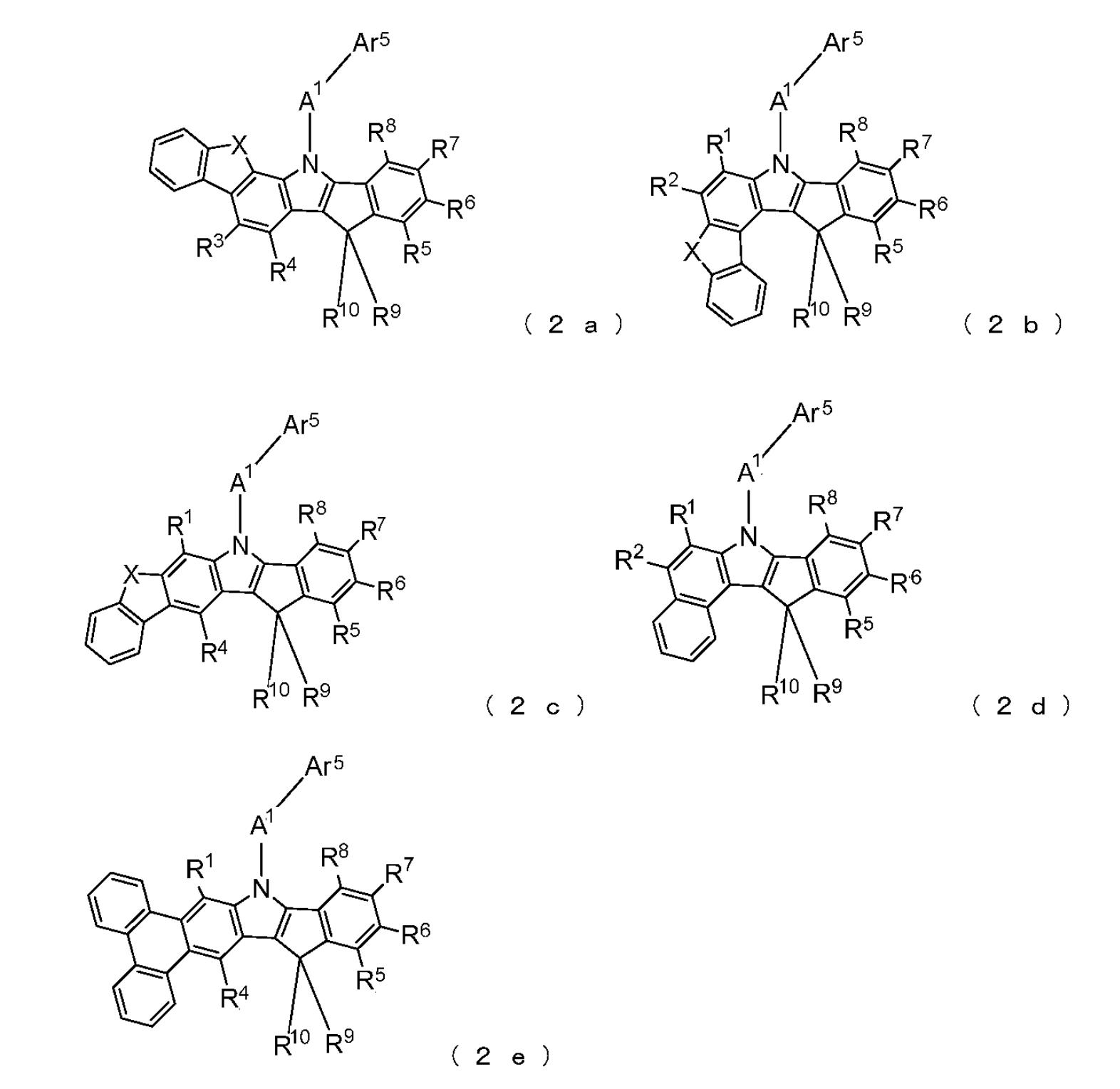
關於理想之R5 ~R8 ,為R5 ~R8 中之相鄰之二個基或全部基為乙烯基且相鄰之二個乙烯基介隔單鍵彼此鍵結而形成縮合環之態樣,亦即R5 ~R8 和R5 ~R8 所鍵結之苯環一起形成萘環或菲環之態樣為較佳。Ideal of R 5 ~ R 8, 8 of the adjacent R 5 ~ R groups or two group is vinyl and all of the two adjacent dielectric spacers vinyl bond state bonded to each other to form a condensed ring of It is preferable that the benzene rings bonded to R 5 to R 8 and R 5 to R 8 form a naphthalene ring or a phenanthrene ring together.
R9 、R10 為碳數1~6之烷基較理想,甲基尤佳。R 9 and R 10 are preferably alkyl groups having 1 to 6 carbon atoms, and methyl groups are particularly preferred.
前述通式(2)之茚并吲哚衍生物之理想具體例可列舉具圖18~圖20表示之結構式之化合物(2-1)~(2-15),但通式(2)之化合物不限定於此。該等圖也一併顯示各化合物屬於通式(2a)~(2e)之哪一者。均不屬於時,記載為「-」。The ideal specific examples of the indenoindole derivatives of the aforementioned general formula (2) include compounds (2-1) to (2-15) having the structural formulas shown in FIGS. 18 to 20, but the general formula (2) The compound is not limited to this. The figures also show which of the general formulas (2a) to (2e) each compound belongs to. When none of them belong, it is described as "-".
上述茚并吲哚衍生物可依其本身公知之方法或此等而合成 (參照專利文獻6)。例如:如後述實施例,可以於三第三丁基四氟硼酸鏻等硼試藥與參(二亞苄基丙酮)二鈀等觸媒存在下,使具有相當於-A1 -Ar5 之結構與具鹵素原子之化合物和在相當於-A1 -Ar5 之部分具氫原子之茚并吲哚衍生物,實施鈴木偶聯以合成。The indenoindole derivative can be synthesized according to a method known per se or the like (refer to Patent Document 6). For example, as in the embodiment described later, in the presence of boron reagents such as tri-tertiary butylphosphonium tetrafluoroborate and ginseng (dibenzylideneacetone) dipalladium and other catalysts, the equivalent of -A 1 -Ar 5 The structure and the compound having a halogen atom and the indenoindole derivative having a hydrogen atom in the part corresponding to -A 1 -Ar 5 were synthesized by Suzuki coupling.
合成之化合物之精製,可依使用管柱層析之精製、使用矽膠、活性碳、活性白土等之吸附精製、使用溶劑之再結晶、晶析法、昇華精製法等進行。本發明之有機EL元件使用,最後利用昇華精製法精製並供使用。The purification of the synthesized compound can be performed according to the purification using column chromatography, the adsorption purification using silica gel, activated carbon, activated clay, etc., the recrystallization using a solvent, the crystallization method, and the sublimation purification method. The organic EL device of the present invention is used and finally refined and used by the sublimation purification method.
通式(3)表示之咔唑衍生物; 【化13】
(通式(3)中之A2 ) 作為通式(3)中之A2 表示之芳香族烴之2價基或芳香族雜環之2價基,可列舉和就前述通式(2)中之A1 表示之芳香族烴之2價基或芳香族雜環之2價基列舉者為同樣者。該等基可以無取代也可以有取代基。取代基可列舉和就前述通式(2)中之A1 表示之芳香族烴之2價基及芳香族雜環之2價基也可擁有之取代基列舉者為同樣者。取代基可採取之態樣亦同。(A 2 in the general formula (3)) As the divalent group of the aromatic hydrocarbon represented by A 2 in the general formula (3) or the divalent group of the aromatic heterocyclic ring, the aforementioned general formula (2) can be mentioned. Among them, the divalent group of the aromatic hydrocarbon represented by A 1 or the divalent group of the aromatic heterocycle are the same. These groups may be unsubstituted or substituted. The substituents may be the same as those listed for the divalent group of the aromatic hydrocarbon represented by A 1 in the general formula (2) and the divalent group of the aromatic heterocycle. Substituents can take the same form.
(通式(3)中之Ar6 ) 作為通式(3)中之Ar6 表示之芳香族烴基或芳香族雜環基,可列舉和就前述通式(1)中之Ar1 ~Ar4 表示之芳香族烴基或芳香族雜環基列舉者為同樣者。該等基可以無取代也可以有取代基。取代基可列舉和就前述通式(1)中之Ar1 ~Ar4 表示之芳香族烴基及芳香族雜環基也可擁有之取代基列舉者為同樣者。取代基可採取之態樣亦同。(Ar 6 in the general formula (3)) Examples of the aromatic hydrocarbon group or aromatic heterocyclic group represented by Ar 6 in the general formula (3) include Ar 1 to Ar 4 in the general formula (1) The aromatic hydrocarbon groups or aromatic heterocyclic groups represented are the same. These groups may be unsubstituted or substituted. Examples of the substituents are the same as those listed for the aromatic hydrocarbon groups and aromatic heterocyclic groups represented by Ar 1 to Ar 4 in the general formula (1). Substituents can take the same form.
(通式(3)中之R11 ~R18 ) 作為通式(3)中之R11 ~R18 表示之碳數1~6之烷基、碳數5~10之環烷基或碳數2~6之烯基,可列舉和就前述通式(2)中之R1 ~R8 表示之碳數1~6之烷基、碳數5~10之環烷基或碳數2~6之烯基列舉者為同樣者。該等基可以無取代也可以有取代基。取代基可列舉和就前述通式(2)中之R1 ~R8 表示之碳數1~6之烷基、碳數5~10之環烷基及碳數2~6之烯基也可擁有之取代基列舉者為同樣者。取代基可採取之態樣亦同。(R 11 to R 18 in the general formula (3)) As the alkyl group having 1 to 6 carbon atoms, the cycloalkyl group having 5 to 10 carbon atoms or the carbon number represented by R 11 to R 18 in the general formula (3) The alkenyl group of 2 to 6 may be exemplified by the alkyl group having 1 to 6 carbon atoms, the cycloalkyl group having 5 to 10 carbon atoms or the carbon atom having 2 to 6 carbon atoms represented by R 1 to R 8 in the general formula (2). The alkenyl enumerators are the same. These groups may be unsubstituted or substituted. Examples of the substituents include alkyl groups having 1 to 6 carbon atoms, cycloalkyl groups having 5 to 10 carbon atoms and alkenyl groups having 2 to 6 carbon atoms represented by R 1 to R 8 in the general formula (2). The enumerators listed are the same. Substituents can take the same form.
作為通式(3)中之R11 ~R18 表示之碳數1~6之烷氧基或碳數5~10之環烷氧基,可列舉和就前述通式(2)中之R1 ~R8 表示之碳數1~6之烷氧基或碳數5~10之環烷氧基列舉者為同樣者。該等基可以無取代也可以有取代基。取代基可列舉和就前述通式(2)中之R1 ~R8 表示之碳數1~6之烷基、碳數5~10之環烷基及碳數2~6之烯基也可擁有之取代基列舉者為同樣者。取代基可採取之態樣亦同。As the alkoxy group having 1 to 6 carbon atoms or the cycloalkoxy group having 5 to 10 carbon atoms represented by R 11 to R 18 in the general formula (3), R 1 in the general formula (2) can be exemplified. The exemplified alkoxy groups having 1 to 6 carbon atoms or cycloalkoxy groups having 5 to 10 carbon atoms represented by ~R 8 are the same. These groups may be unsubstituted or substituted. Examples of the substituents include alkyl groups having 1 to 6 carbon atoms, cycloalkyl groups having 5 to 10 carbon atoms and alkenyl groups having 2 to 6 carbon atoms represented by R 1 to R 8 in the general formula (2). The enumerators listed are the same. Substituents can take the same form.
作為通式(3)中之R11 ~R18 表示之芳香族烴基或芳香族雜環基,可列舉和就前述通式(2)中之R1 ~R8 表示之芳香族烴基或芳香族雜環基列舉者為同樣者。該等基可以無取代也可以有取代基。取代基可列舉和就前述通式(2)中之R1 ~R8 表示之芳香族烴基及芳香族雜環基也可擁有之取代基列舉者為同樣者。取代基可採取之態樣亦同。Examples of the aromatic hydrocarbon group or aromatic heterocyclic group represented by R 11 to R 18 in the general formula (3) include the aromatic hydrocarbon groups or aromatic groups represented by R 1 to R 8 in the foregoing general formula (2) Heterocyclic group enumerators are the same. These groups may be unsubstituted or substituted. Examples of the substituents are the same as those listed for the aromatic hydrocarbon groups and aromatic heterocyclic groups represented by R 1 to R 8 in the general formula (2). Substituents can take the same form.
作為通式(3)中之R11 ~R18 表示之芳氧基,可列舉和就前述通式(2)中之R1 ~R8 表示之芳氧基列舉者為同樣者。芳氧基可以無取代也可以有取代基。取代基可列舉和就前述通式(2)中之R1 ~R8 表示之芳氧基也可擁有之取代基列舉者為同樣者。取代基可採取之態樣亦同。Examples of the aryloxy groups represented by R 11 to R 18 in the general formula (3) include the same as those exemplified for the aryloxy groups represented by R 1 to R 8 in the general formula (2). The aryloxy group may have no substitution or may have a substituent. The substituents may be the same as those listed for the aryloxy group represented by R 1 to R 8 in the general formula (2). Substituents can take the same form.
作為通式(3)中之R11 ~R18 表示之「具有芳香族烴基或芳香族雜環基作為取代基之二取代胺基」,可列舉和就前述通式(2)中之R1 ~R8 表示之「具有芳香族烴基或芳香族雜環基作為取代基之二取代胺基」列舉者為同樣者。二取代胺基可以無取代也可以有取代基。取代基可列舉和就前述通式(2)中之R1 ~R8 表示之「具有芳香族烴基或芳香族雜環基作為取代基之二取代胺基」也可擁有之取代基列舉者為同樣者。取代基可採取之態樣亦同。The general formula R (3) in the 11 ~ R 18 represents the "aromatic hydrocarbon group or an aromatic heterocyclic group as a substituent of the di-substituted amino group", and can include the general formula (2) R 1 in the The examples of "disubstituted amine groups having aromatic hydrocarbon groups or aromatic heterocyclic groups as substituents" represented by ~R 8 are the same. The disubstituted amine group may have no substitution or may have a substituent. The substituents may be enumerated, and the "disubstituted amine groups having an aromatic hydrocarbon group or aromatic heterocyclic group as substituents" represented by R 1 to R 8 in the aforementioned general formula (2) may also be enumerated as: The same. Substituents can take the same form.
R11 ~R14 彼此可各自獨立存在而不形成環,但也可介隔單鍵、有取代或無取代之亞甲基、氧原子或硫原子而彼此鍵結形成環。同樣地,R15 ~R18 彼此可各自獨立存在而不形成環,但也可介隔單鍵、有取代或無取代之亞甲基、氧原子或硫原子而彼此鍵結形成環。R 11 to R 14 may exist independently of each other without forming a ring, but may be bonded to each other to form a ring through a single bond, a substituted or unsubstituted methylene group, an oxygen atom, or a sulfur atom. Similarly, R 15 to R 18 may exist independently of each other without forming a ring, but may also bond to each other to form a ring through a single bond, a substituted or unsubstituted methylene group, an oxygen atom, or a sulfur atom.
或例如圖21之化合物(3-1)~(3-6),於R11 ~R14 之一部分脱離且因為此脱離而產生之空位,R11 ~R14 之其他基也可介隔有取代或無取代之亞甲基、氧原子、硫原子或單芳胺基而鍵結形成環。同樣地,於R15 ~R18 之一部分脱離且因為此脱離而產生之空位,R15 ~R18 之其他基也可介隔有取代或無取代之亞甲基、氧原子、硫原子或單芳胺基而鍵結形成環。Or, for example, compounds (3-1) to (3-6) in FIG. 21, a part of R 11 to R 14 is detached and a vacancy is generated due to this detachment, and other groups of R 11 to R 14 may also be separated A substituted or unsubstituted methylene group, oxygen atom, sulfur atom or monoarylamine group is bonded to form a ring. Similarly, in a part of R 15 ~ R 18 is detached and the vacancy generated due to this detachment, other groups of R 15 ~ R 18 may also be interrupted by a substituted or unsubstituted methylene group, oxygen atom, sulfur atom Or a single aromatic amine group and bond to form a ring.
於此情形,作為單芳胺基之芳基可列舉和就關於前述通式(2)中可存在之單芳胺基之芳基所列舉者為同樣者。單芳胺基之芳基可以無取代也可以有取代基。取代基可列舉和前述通式(2)中可存在之單芳胺基之芳基也可擁有之取代基列舉者為同樣者。取代基可採取之態樣亦同。In this case, the aryl group as the monoarylamine group may be the same as those exemplified for the aryl group of the monoarylamine group that may be present in the general formula (2). The aryl group of the monoarylamine group may be unsubstituted or may have a substituent. Examples of the substituents are the same as those of the substituents which may be possessed by the aryl group of the monoarylamine group which may be present in the general formula (2). Substituents can take the same form.
(通式(3)之理想態樣) 作為A2 ,宜為芳香族烴之2價基或單鍵較理想,從苯、聯苯或萘取走2個氫原子而成之2價基或單鍵更佳,從苯取走2個氫原子而成之2價基或單鍵尤佳。(Ideal form of general formula (3)) As A 2 , it is preferably a divalent group or a single bond of an aromatic hydrocarbon, a divalent group formed by removing two hydrogen atoms from benzene, biphenyl or naphthalene or The single bond is better, and the divalent group or single bond formed by taking 2 hydrogen atoms from benzene is preferable.
作為Ar6
宜為苯基、聯苯基、萘基或芳香族雜環基較理想,芳香族雜環基更理想。作為芳香族雜環基宜為三
關於R11 ~R14 ,宜為R11 ~R14 之二個相鄰之基為碳數2~6之烯基、芳香族烴基或芳香族雜環基且相鄰之二個基(R11 ~R14 )介隔單鍵而彼此鍵結並和R11 ~R14 所鍵結之苯環一起形成縮合環之態樣較佳。作為此情形之碳數2~6之烯基、芳香族烴基或芳香族雜環基,乙烯基、苯基為較佳。作為該芳香族烴基或芳香族雜環基和R11 ~R14 所鍵結之苯環一起形成之環,宜為萘環、菲環或三亞苯環較佳。Regarding R 11 to R 14 , it is preferable that the two adjacent groups of R 11 to R 14 are alkenyl groups having 2 to 6 carbon atoms, aromatic hydrocarbon groups or aromatic heterocyclic groups and the two adjacent groups (R 11 ~R 14 ) is bonded to each other via a single bond and forms a condensed ring together with the benzene ring bonded to R 11 ~R 14 . As the alkenyl group having 2 to 6 carbon atoms, aromatic hydrocarbon group or aromatic heterocyclic group in this case, vinyl group and phenyl group are preferred. The ring formed by the aromatic hydrocarbon group or aromatic heterocyclic group together with the benzene ring bonded to R 11 to R 14 is preferably a naphthalene ring, a phenanthrene ring or a triphenylene ring.
又,如下列通式(3a-1)~(3a-4)及(3b-1),R11 ~R14 中之任一者為芳香族烴基或芳香族雜環基,且進而R11 ~R14 之另一者脱離而產生空位,該芳香族烴基或芳香族雜環基介隔有取代或無取代之亞甲基、氧原子、硫原子或單芳胺基而鍵結於此空位並形成環之態樣較佳。作為此情形之芳香族烴基或芳香族雜環基,宜為苯基、茚基、吲哚基、苯并呋喃基或苯并噻吩基為較佳。作為該芳香族烴基或芳香族雜環基和R11 ~R14 所鍵結之苯環一起形成之環,宜為茀環、咔唑環、二苯并呋喃環、二苯并噻吩環、茚并吲哚環、茚并苯并呋喃環、茚并苯并噻吩環、苯并呋喃并吲哚環、苯并噻吩并吲哚環或吲哚并吲哚環較佳。 又,通式(3a-1)~(3b-1)之化合物為新穎化合物,可藉由此等化合物作為發光層之材料,而達成高發光效率。Also, as in the following general formulas (3a-1) to (3a-4) and (3b-1), any one of R 11 to R 14 is an aromatic hydrocarbon group or an aromatic heterocyclic group, and further R 11 to The other of R 14 is detached to generate a vacancy. The aromatic hydrocarbon group or aromatic heterocyclic group is bonded to this vacancy through a substituted or unsubstituted methylene group, oxygen atom, sulfur atom or monoarylamine group It is better to form a ring. As the aromatic hydrocarbon group or aromatic heterocyclic group in this case, phenyl, indenyl, indolyl, benzofuranyl or benzothienyl is preferred. The ring formed by the aromatic hydrocarbon group or aromatic heterocyclic group and the benzene ring bonded to R 11 to R 14 is preferably a fused ring, carbazole ring, dibenzofuran ring, dibenzothiophene ring, indene The indole ring, the indenobenzofuran ring, the indenobenzothiophene ring, the benzofuro indole ring, the benzothieno indole ring or the indolo indole ring are preferred. In addition, the compounds of the general formula (3a-1) to (3b-1) are novel compounds, and these compounds can be used as materials of the light-emitting layer to achieve high luminous efficiency.
【化14】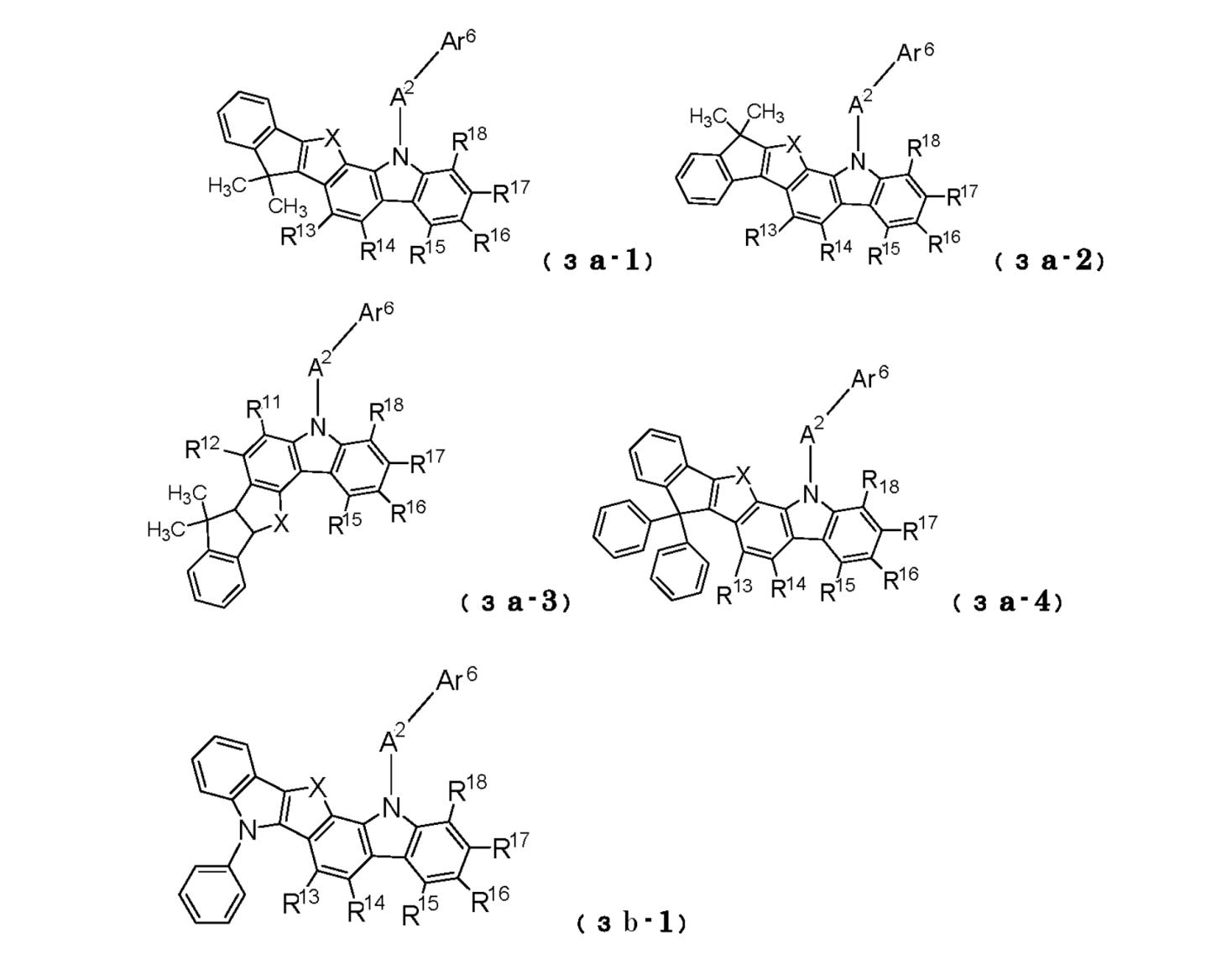
關於R15 ~R18 ,R15 ~R18 中之2個相鄰之基或全部基為乙烯基且相鄰之二個乙烯基介隔單鍵彼此鍵結而形成縮合環之態樣,亦即R15 ~R18 和R15 ~R18 所鍵結之苯環一起形成萘環或菲環之態樣較佳。 或R15 ~R18 中之任一者為芳香族烴基或芳香族雜環基之態樣亦較理想。於此情形,R15 ~R18 中之任一者宜為選自於茀基、咔唑基、二苯并呋喃基及二苯并噻吩基之基較佳,R16 為茀基、咔唑基、二苯并呋喃基或二苯并噻吩基且R15 、R17 及R18 為氫原子更佳。Regarding R 15 ~R 18 , two adjacent groups or all groups in R 15 ~R 18 are vinyl groups and two adjacent vinyl groups are bonded to each other via a single bond to form a condensed ring, also That is, it is preferable that the benzene rings bonded to R 15 to R 18 and R 15 to R 18 form a naphthalene ring or a phenanthrene ring together. Or, any one of R 15 to R 18 is an aromatic hydrocarbon group or an aromatic heterocyclic group, which is also preferable. In this case, any one of R 15 to R 18 is preferably a group selected from the group consisting of stilbene, carbazolyl, dibenzofuranyl, and dibenzothienyl, and R 16 is stilbene, carbazole Radical, dibenzofuranyl or dibenzothienyl and R 15 , R 17 and R 18 are more preferably hydrogen atoms.
前述通式(3)之咔唑衍生物之理想具體例可列舉具有圖21~圖24表示之結構式之化合物(3-1)~(3-23),但通式(3)之化合物不限定於此。該等圖中,將各化合物屬於通式(3a-1)~(3a-4)及(3b-1)哪一者一併顯示。任一者均不屬於時,則記載為「-」。Preferred specific examples of the carbazole derivatives of the aforementioned general formula (3) include compounds (3-1) to (3-23) having the structural formulas shown in FIGS. 21 to 24, but the compounds of the general formula (3) are not Limited to this. In these figures, each compound belongs to the general formulas (3a-1) to (3a-4) and (3b-1). When neither of them belongs, it is described as "-".
通式(3)之咔唑衍生物可依其本身公知之方法或此等合成(參照專利文獻6)。例如:如後述實施例所示,可藉由於三第三丁基四氟硼酸鏻等硼試藥與參(二亞苄基丙酮)二鈀等觸媒存在下,使用具有相當於-A2 -Ar6 之結構與鹵素原子之化合物和在相當於-A2 -Ar6 之部分具有氫原子之咔唑衍生物進行鈴木偶聯以合成。The carbazole derivative of the general formula (3) can be synthesized according to a method known per se or the like (refer to Patent Document 6). For example: as shown in the examples described below, it is possible to use the equivalent of -A 2 -in the presence of catalysts such as tri-tributylphosphonium tetrafluoroborate boron reagents and ginseng (dibenzylideneacetone) dipalladium and other catalysts. The structure of Ar 6 is synthesized with a halogen atom compound and a carbazole derivative having a hydrogen atom in a part corresponding to -A 2 -Ar 6 by Suzuki coupling.
合成之化合物之精製可採用利用管柱層析所為之精製、利用矽膠、活性碳、活性白土等所為之吸附精製、利用溶劑所為之再結晶、晶析法、昇華精製法等以進行。本發明之有機EL元件使用之化合物,最後利用昇華精製法精製並供使用。The purification of the synthesized compound can be carried out by purification using column chromatography, adsorption purification using silica gel, activated carbon, activated clay, etc., recrystallization using solvents, crystallization, sublimation purification, etc. The compound used in the organic EL device of the present invention is finally refined and used by the sublimation purification method.
本發明之有機EL元件之發光層係使用前述通式(2)之茚并吲哚衍生物或前述通式(3)之咔唑衍生物,但除此以外也可以併用公知之材料。公知之材料,例如以下之材料。 Alq3
為主之喹啉酚衍生物之金屬錯合物等各種之金屬錯合物; 蒽衍生物; 雙苯乙烯基苯衍生物; 芘衍生物;
本發明中,發光層也可由主體材料與摻雜物材料構成。 主體材料可理想地使用前述通式(2)之茚并吲哚衍生物或前述通式(3)之咔唑衍物,但除此以外也可使用前述發光材料;噻唑衍生物;苯并咪唑衍生物;聚二烷基茀衍生物。In the present invention, the light-emitting layer may also be composed of a host material and a dopant material. As the host material, the indenoindole derivative of the aforementioned general formula (2) or the carbazole derivative of the aforementioned general formula (3) can be desirably used, but in addition to this, the aforementioned luminescent material; thiazole derivative; benzimidazole Derivatives; polydialkyl stilbene derivatives.
摻雜物材料可以使用喹吖啶酮、香豆素、紅螢烯、苝、芘及此等之衍生物;苯并哌喃衍生物、茚并菲衍生物、若丹明衍生物、胺基苯乙烯基衍生物等。The dopant material can use quinacridone, coumarin, rubrene, perylene, pyrene and their derivatives; benzopiperan derivatives, indenophenanthrene derivatives, rhodamine derivatives, amino groups Styrene derivatives, etc.
本發明之發光層宜含有磷光性之發光材料較佳。磷光性之發光材料宜為銥、鉑等金屬錯合物之磷光發光體為較佳。具體而言,可使用: 紅色磷光發光體,例如 雙(3-甲基-2-苯基喹啉)乙醯基丙酮銥(III)(Ir(3’-Mepq)2 (acac))、Ir(piq)3 、Btp2 Ir(acac); 綠色磷光發光體,例如Ir(ppy)3 ; 藍色磷光發光體,例如FIrpic、FIr6; 等。尤其理想者為使用紅色磷光發光體作為摻雜物。 此時,主體材料宜為前述通式(2)之茚并吲哚衍生物或前述通式(3)之咔唑衍生物為較佳,但此外也可使用喹唑啉衍生物等,又,作為電洞注入・輸送性之主體材料,也可使用咔唑衍生物,例如4,4’-二(N-咔唑基)聯苯(CBP)、TCTA、mCP、電子輸送性之主體材料,例如對雙(三苯基矽基)苯(UGH2)、2,2’,2’’-(1,3,5-伸苯基)-參(1-苯基-1H-苯并咪唑)(TPBI)等。藉由使用如此的主體材料,能製作高性能之有機EL元件。The light-emitting layer of the present invention preferably contains a phosphorescent light-emitting material. The phosphorescent light-emitting material is preferably a phosphorescent light-emitting body of metal complex compounds such as iridium and platinum. Specifically, red phosphorescent emitters such as bis(3-methyl-2-phenylquinoline)acetoneacetoneiridium(III)(Ir(3'-Mepq) 2 (acac)), Ir (piq) 3 , Btp 2 Ir(acac); green phosphorescent emitters, such as Ir(ppy) 3 ; blue phosphorescent emitters, such as FIrpic, FIr6; etc. It is particularly desirable to use red phosphorescent emitters as dopants. In this case, the host material is preferably an indenoindole derivative of the aforementioned general formula (2) or a carbazole derivative of the aforementioned general formula (3), but in addition, a quinazoline derivative or the like may be used. As the host material for hole injection and transport, carbazole derivatives such as 4,4'-bis(N-carbazolyl)biphenyl (CBP), TCTA, mCP, and electron transport host materials can also be used. For example, p-bis(triphenylsilyl)benzene (UGH2), 2,2',2''-(1,3,5-phenylene)-ginseng (1-phenyl-1H-benzimidazole) ( TPBI) etc. By using such a host material, a high-performance organic EL device can be manufactured.
磷光性發光材料對於主體材料的摻雜,為避免濃度消光,宜於對於發光層全體為1~30重量%之範圍,以共蒸鍍進行摻雜較佳。The doping of the phosphorescent light-emitting material to the host material is preferably in the range of 1 to 30% by weight for the entire light-emitting layer in order to avoid concentration extinction. Co-evaporation is preferred for doping.
又,發光材料也可使用PIC-TRZ、CC2TA、PXZ-TRZ、4CzIPN等CDCB衍生物等發射延遲螢光之材料(例如參照非專利文獻1)。Further, as the light-emitting material, a material that emits delayed fluorescence such as CDCB derivatives such as PIC-TRZ, CC2TA, PXZ-TRZ, and 4CzIPN may be used (for example, refer to Non-Patent Document 1).
上述發光層宜藉由將含有通式(2)之茚并吲哚衍生物或通式(3)之咔唑衍生物之氣體蒸鍍或共蒸鍍形成,但也可利用旋塗法、噴墨法等公知方法形成。The light-emitting layer is preferably formed by vapor deposition or co-evaporation of a gas containing an indenoindole derivative of the general formula (2) or a carbazole derivative of the general formula (3), but spin coating or spraying can also be used. It is formed by a well-known method such as the ink method.
<電子輸送層> 本發明中,上述發光層之上設置之電子輸送層(例如圖1之7表示之層)可使用公知電子輸送性材料以蒸鍍法、旋塗法、噴墨法等公知方法形成。<Electron transport layer> In the present invention, the electron transport layer provided on the light-emitting layer (for example, the layer shown as 7 in FIG. 1) can be known by using a known electron transport material by vapor deposition method, spin coating method, inkjet method, etc. Method formation.
公知電子輸送材料可列舉如下。 Alq3
、Balq為主之喹啉酚衍生物之金屬錯合物等各種金屬錯合物;三唑衍生物;三
本發明宜使用下列通式(4)表示之苯并三唑衍生物(以下有時稱為「通式(4)之苯并三唑衍生物」)或下列通式(5)表示之蒽衍生物(以下有時稱為「通式(5)之蒽衍生物」)作為電子輸送材料而形成電子輸送層較佳。The present invention preferably uses a benzotriazole derivative represented by the following general formula (4) (hereinafter sometimes referred to as "benzotriazole derivative of general formula (4)") or an anthracene derivative represented by the following general formula (5) It is preferable that the substance (hereinafter sometimes referred to as "anthracene derivative of the general formula (5)") forms an electron transport layer as an electron transport material.
通式(4)表示之苯并三唑衍生物; 【化15】
前述通式(4)之苯并三唑衍生物的電子注入・輸送能力優異,且薄膜安定性、耐久性優異。利用如此之苯并三唑衍生物形成之電子輸送層藉由和含有前述通式(1)之芳胺化合物之電洞輸送層組合,能將電洞與電子以良好效率注入到發光層,藉此能確保最適載子均衡性,能使有機EL元件之特性大幅改善。The benzotriazole derivative of the aforementioned general formula (4) is excellent in electron injection and transport capabilities, and is excellent in film stability and durability. The electron transport layer formed by using such a benzotriazole derivative, by combining with the hole transport layer containing the aromatic amine compound of the general formula (1), can inject holes and electrons into the light emitting layer with good efficiency, by This can ensure optimal carrier balance and can greatly improve the characteristics of the organic EL device.
(通式(4)中之Ar7 、Ar8 ) 作為通式(4)中之Ar7 、Ar8 表示之芳香族烴基或芳香族雜環基,可列舉和就關於前述通式(1)中之Ar1 ~Ar4 表示之芳香族烴基或芳香族雜環基所示者為同樣者。該等基可以無取代也可以有取代基。取代基可列舉和就前述通式(1)中之Ar1 ~Ar4 表示之芳香族烴基及芳香族雜環基也可擁有之取代基列舉者為同樣者。取代基可採取之態樣亦同。(Ar 7 and Ar 8 in the general formula (4)) Examples of the aromatic hydrocarbon group or aromatic heterocyclic group represented by Ar 7 and Ar 8 in the general formula (4) include the above general formula (1) Among them, the aromatic hydrocarbon groups or aromatic heterocyclic groups represented by Ar 1 to Ar 4 are the same. These groups may be unsubstituted or substituted. Examples of the substituents are the same as those listed for the aromatic hydrocarbon groups and aromatic heterocyclic groups represented by Ar 1 to Ar 4 in the general formula (1). Substituents can take the same form.
(通式(4)中之R19 ~R26 ) 通式(4)中之R19 ~R26 表示之碳數1~6之烷基可為直鏈狀也可為分枝狀。碳數1~6之烷基之具體例可列舉甲基、乙基、正丙基、異丙基、正丁基、異丁基、第三丁基、正戊基、異戊基、新戊基、正己基等。(R 19 to R 26 in the general formula (4)) The alkyl group having 1 to 6 carbon atoms represented by R 19 to R 26 in the general formula (4) may be linear or branched. Specific examples of the alkyl group having 1 to 6 carbon atoms include methyl, ethyl, n-propyl, isopropyl, n-butyl, isobutyl, tertiary butyl, n-pentyl, isopentyl, and neopentyl Base, n-hexyl, etc.
R19
~R26
表示之碳數1~6之烷基可以無取代也可以有取代基。取代基除了氘原子、氰基、硝基尚可列舉如下。 鹵素原子,例如氟原子、氯原子、溴原子、碘原子; 碳數1~6之烷氧基,例如甲氧基、乙氧基、丙氧基; 烯基,例如乙烯基、烯丙基; 芳氧基,例如苯氧基、甲苯氧基; 芳基烷氧基,例如苄氧基、苯乙氧基; 芳香族烴基,例如苯基、聯苯基、聯三苯基、萘基、蒽基、菲基、茀基、茚基、芘基、苝基、丙二烯合茀基、三亞苯基; 芳香族雜環基,例如吡啶基、嘧啶基、三
作為通式(4)中之R19 ~R26 表示之芳香族烴基或芳香族雜環基,可列舉和就關於前述通式(1)中之Ar1 ~Ar4 表示之芳香族烴基或芳香族雜環基列舉者為同樣者。該等基可以無取代也可以有取代基。取代基可列舉和就前述通式(1)中之Ar1 ~Ar4 表示之芳香族烴基及芳香族雜環基也可擁有之取代基列舉者為同樣者。取代基可採取之態樣亦同。Examples of the aromatic hydrocarbon group or aromatic heterocyclic group represented by R 19 to R 26 in the general formula (4) include the aromatic hydrocarbon groups or aromatic groups represented by Ar 1 to Ar 4 in the general formula (1). The enumerators of group heterocyclic groups are the same. These groups may be unsubstituted or substituted. Examples of the substituents are the same as those listed for the aromatic hydrocarbon groups and aromatic heterocyclic groups represented by Ar 1 to Ar 4 in the general formula (1). Substituents can take the same form.
R19 ~R26 彼此可各自獨立存在而形成環,也可介隔單鍵、有取代或無取代之亞甲基、氧原子或硫原子而彼此鍵結形成環。R 19 to R 26 may exist independently of each other to form a ring, or may be bonded to each other through a single bond, a substituted or unsubstituted methylene group, an oxygen atom or a sulfur atom to form a ring.
(通式(4)之理想態樣) Ar7 宜為芳香族烴基或咔唑基較理想,苯基、聯苯基、聯三苯基、萘基、蒽基、菲基、茀基、芘基、三亞苯基或N-苯基咔唑基更理想。(Ideal form of general formula (4)) Ar 7 is preferably an aromatic hydrocarbon group or a carbazolyl group, and phenyl, biphenyl, biphenyl, naphthyl, anthracenyl, phenanthryl, stilbene, pyrene Group, triphenylene or N-phenylcarbazolyl is more desirable.
Ar8 宜為氫原子、氘原子、芳香族烴基或咔唑基較理想,氫原子、氘原子、苯基、聯苯基、聯三苯基、萘基、蒽基、菲基、茀基、芘基、三亞苯基或N-苯基咔唑基更佳,氫原子、氘原子特別理想,氫原子最理想。Ar 8 is preferably a hydrogen atom, a deuterium atom, an aromatic hydrocarbon group or a carbazolyl group. A hydrogen atom, a deuterium atom, a phenyl group, a biphenyl group, a biphenyl group, a naphthyl group, an anthracenyl group, a phenanthryl group, a fluorenyl group, Pyrene, triphenylene, or N-phenylcarbazolyl is more preferable, and hydrogen atom and deuterium atom are particularly ideal, and hydrogen atom is most ideal.
又,Ar8 為芳香族烴基或芳香族雜環基時,Ar8 與Ar7 為相同基的話,考量合成上之觀點較理想。In addition, when Ar 8 is an aromatic hydrocarbon group or an aromatic heterocyclic group, when Ar 8 and Ar 7 are the same group, it is preferable from the viewpoint of synthesis.
Ar7 、Ar8 也可以具有之取代基宜為芳香族烴基、喹啉基或異喹啉基較理想,苯基、聯苯基、聯三苯基、聯肆苯基、苯乙烯基、萘基、蒽基、乙烯合萘基、菲基、茀基、茚基、芘基、三亞苯基、喹啉基或異喹啉基更理想。The substituents that Ar 7 and Ar 8 may also have are preferably aromatic hydrocarbon groups, quinoline groups or isoquinoline groups, and phenyl, biphenyl, biphenyl, biphenyl, styryl, naphthalene Group, anthracenyl group, vinyl naphthyl group, phenanthrenyl group, fluorenyl group, indenyl group, pyrenyl group, triphenylene group, quinolinyl group or isoquinolinyl group is more desirable.
m為1較佳。m=1時,作為吡啶環之苯環之鍵結位置,宜如下列通式(4a)及(4b)所示,苯環鍵結於吡啶環之3位或4位較佳。又,m=1時,就苯環之苯并三唑與吡啶環之位置關係而言,宜如下列通式(4c)及(4d)所示,在苯環中,苯并三唑環相對於吡啶基鍵結於對位或間位較佳。 【化16】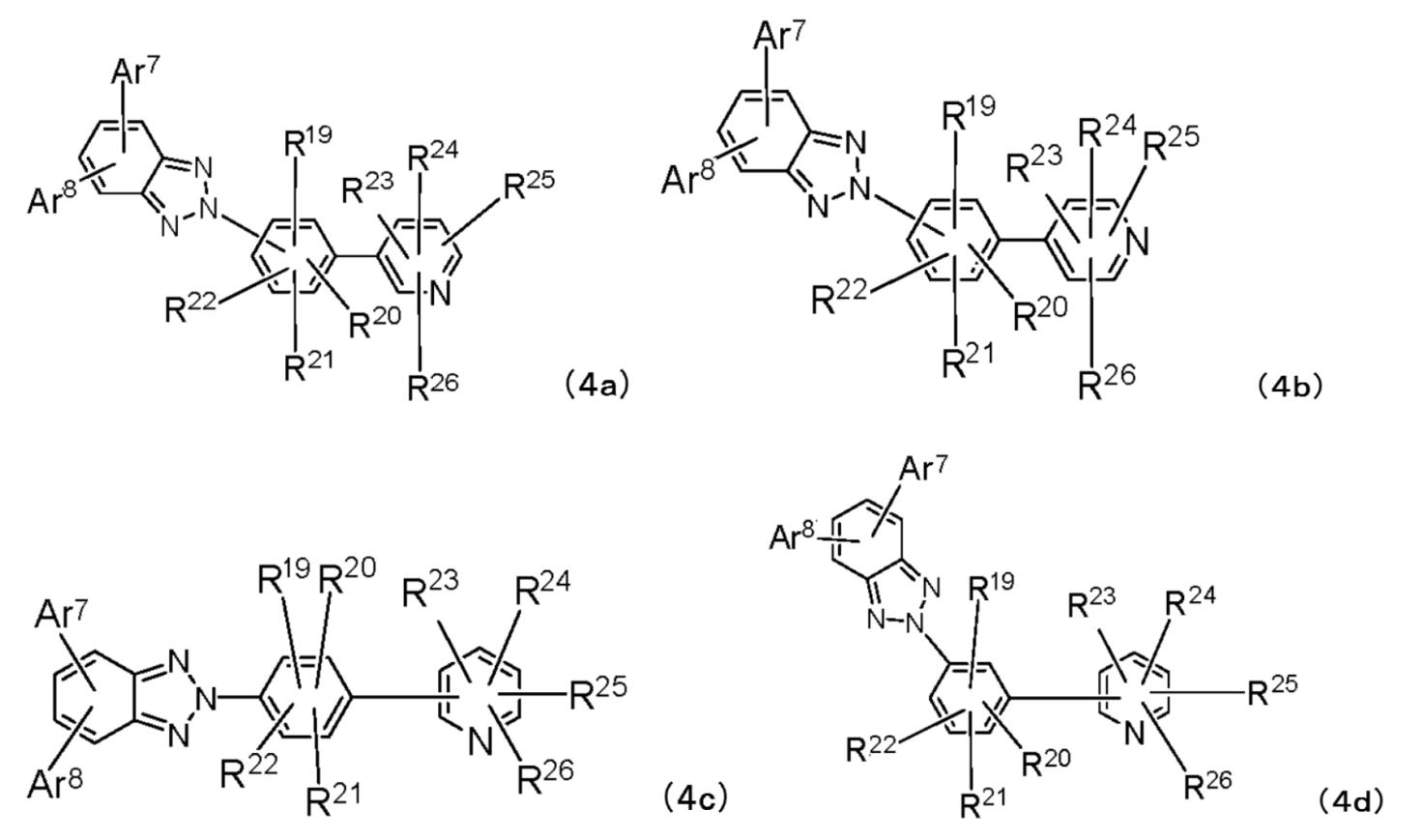
前述通式(4)之苯并三唑衍生物之理想具體例,可列舉具圖25~圖28表示之結構式之化合物(4-1)~(4-20),但通式(4)之化合物不限定於此。該等圖中也一併顯示各化合物屬於通式(4a)~(4d)中之哪一者。The preferred specific examples of the benzotriazole derivatives of the general formula (4) include compounds (4-1) to (4-20) having the structural formulas shown in FIGS. 25 to 28, but the general formula (4) The compound is not limited to this. These figures also show which of the general formulas (4a) to (4d) each compound belongs to.
通式(4)之苯并三唑衍生物可依其本身公知之方法合成 (參照專利文獻7)。The benzotriazole derivative of the general formula (4) can be synthesized according to a method known per se (refer to Patent Document 7).
已合成之化合物之精製可利用管柱層析所為之精製、矽膠、活性碳、活性白土等所為之吸附精製、溶劑所為之再結晶、晶析法、昇華精製法等進行。本發明之有機EL元件使用之化合物最後利用昇華精製法精製並供使用。Refining of synthesized compounds can be carried out by purification by column chromatography, adsorption purification by silica gel, activated carbon, activated clay, etc., recrystallization by solvents, crystallization method, sublimation purification method, etc. The compound used in the organic EL device of the present invention is finally refined and used by the sublimation purification method.
通式(5)表示之蒽衍生物; 【化17】
由上述通式(5)可理解:此蒽衍生物具有藉由2價基或單鍵將蒽環與基B連結而成的分子結構,基B所連結之蒽環鍵結有1或2個1價芳香族烴基或1價芳香族雜環基(基C)作為取代基。It can be understood from the above general formula (5): this anthracene derivative has a molecular structure formed by linking an anthracene ring and a group B through a divalent group or a single bond, and the anthracene ring connected to the group B has 1 or 2 bonds A monovalent aromatic hydrocarbon group or a monovalent aromatic heterocyclic group (group C) is used as a substituent.
前述通式(5)之蒽衍生物的電子注入・輸送能力優異,而且薄膜之安定性、耐久性優異。利用如此的蒽衍生物形成之電子輸送層藉由和含有前述通式(1)之芳胺化合物之電洞輸送層組合,能以良好效率地將電洞與電子注入到發光層,藉此能確保最理想的載子均衡性,能使有機EL元件之特性大幅改善。The anthracene derivative of the aforementioned general formula (5) is excellent in electron injection and transport ability, and is excellent in stability and durability of the thin film. By combining the electron transport layer formed with such an anthracene derivative with the hole transport layer containing the aromatic amine compound of the aforementioned general formula (1), holes and electrons can be injected into the light emitting layer with good efficiency, whereby Ensuring optimal carrier balance can greatly improve the characteristics of organic EL elements.
(通式(5)中之A3 ) 作為通式(5)中之A3 表示之芳香族烴之2價基或芳香族雜環之2價基,可列舉和就關於前述通式(2)中之A1 表示之芳香族烴之2價基或芳香族雜環之2價基所示者為同樣之基。該等2價基也可以無取代,但在無損此蒽衍生物之優良特性之限度內,也可導入取代基。取代基可列舉和前述通式(1)中之Ar1 ~Ar4 表示之芳香族烴基及芳香族雜環基也可擁有之取代基列舉者為同樣者。取代基可採取之態樣亦同。(A 3 in the general formula (5)) As the divalent group of the aromatic hydrocarbon represented by A 3 in the general formula (5) or the divalent group of the aromatic heterocyclic ring, the aforementioned general formula (2 ), the divalent group of the aromatic hydrocarbon represented by A 1 or the divalent group of the aromatic heterocycle is the same group. These divalent groups may be unsubstituted, but within the limit that does not impair the excellent characteristics of the anthracene derivative, a substituent may be introduced. The substituents may be the same as those listed for the aromatic hydrocarbon groups and aromatic heterocyclic groups represented by Ar 1 to Ar 4 in the general formula (1). Substituents can take the same form.
(通式(5)中之B) 作為通式(5)中之B表示之芳香族雜環基,具體而言可列舉吡啶基、嘧啶基、呋喃基、吡咯基、噻吩基、喹啉基、異喹啉基、苯并呋喃基、苯并噻吩基、吲哚基、咔唑基、苯并
B表示之芳香族雜環基可以無取代,但在無損通式(5)之蒽衍生物之優良特性之限度內,也可以具有能導入之取代基。取代基可列舉氘原子、氰基、硝基,此外可列舉如下。 鹵素原子,例如氟原子、氯原子、溴原子、碘原子; 碳數1~6之烷基,例如甲基、乙基、正丙基、異丙基、正丁基、異丁基、第三丁基、正戊基、異戊基、新戊基、正己基; 碳數5~10之環烷基,例如環戊基、環己基、1-金剛烷基、2-金剛烷基; 碳數1~6之烷氧基,例如甲氧基、乙氧基、丙氧基; 碳數5~10之環烷氧基,例如環戊氧基、環己氧基、1-金剛烷氧基、2-金剛烷氧基; 烯基,例如乙烯基、烯丙基; 芳氧基,例如苯氧基、甲苯氧基; 芳基烷氧基,例如苄氧基、苯乙氧基; 芳香族烴基,例如苯基、聯苯基、聯三苯基、萘基、蒽基、菲基、茀基、茚基、芘基、苝基、丙二烯合茀基、三亞苯基; 芳香族雜環基,例如吡啶基、呋喃基、噻吩基、吡咯基、喹啉基、異喹啉基、苯并呋喃基、苯并噻吩基、吲哚基、咔唑基、苯并
(通式(5)中之C) 作為通式(5)中之C表示之芳香族烴基或芳香族雜環基,可列舉和就關於前述通式(1)中之Ar1 ~Ar4 表示之芳香族烴基或芳香族雜環基所示者為同樣之基。該等基在同一蒽環鍵結多個時(q為2時),多個存在之C彼此可相同也可不同。該等基可以無取代也可以有取代基。取代基可列舉和就關於前述通式(1)中之Ar1 ~Ar4 表示之芳香族烴基及芳香族雜環基也可擁有之取代基例示者為同樣者。取代基可採取之態樣亦同。(C in the general formula (5)) Examples of the aromatic hydrocarbon group or aromatic heterocyclic group represented by C in the general formula (5) include Ar 1 to Ar 4 in the general formula (1). The aromatic hydrocarbon group or aromatic heterocyclic group shown is the same group. When these groups are bonded to the same anthracene ring (when q is 2), the multiple existing Cs may be the same or different from each other. These groups may be unsubstituted or substituted. Examples of the substituents are the same as those exemplified for the substituents which may be possessed by the aromatic hydrocarbon groups and aromatic heterocyclic groups represented by Ar 1 to Ar 4 in the general formula (1). Substituents can take the same form.
(通式(5)中之D) 通式(5)中之D表示之碳數1~6之烷基可為直鏈狀也可為分枝狀。碳數1~6之烷基之具體例可列舉甲基、乙基、正丙基、異丙基、正丁基、異丁基、第三丁基、正戊基、異戊基、新戊基、正己基等。(D in the general formula (5)) The C 1-6 alkyl group represented by D in the general formula (5) may be linear or branched. Specific examples of the alkyl group having 1 to 6 carbon atoms include methyl, ethyl, n-propyl, isopropyl, n-butyl, isobutyl, tertiary butyl, n-pentyl, isopentyl, and neopentyl Base, n-hexyl, etc.
多個存在之D彼此可相同也可不同,該等基彼此可各自獨立存在而形成環,也可介隔單鍵、有取代或無取代之亞甲基、氧原子或硫原子而彼此鍵結形成環。Multiple existing Ds may be the same or different from each other. These groups may exist independently of each other to form a ring, or they may be bonded to each other via a single bond, a substituted or unsubstituted methylene group, an oxygen atom, or a sulfur atom. Form a ring.
(通式(5)之理想態樣) 就A3 而言,芳香族烴之2價基或單鍵較理想,從苯、聯苯、聯三苯、萘、蒽、茀或菲衍生之2價基或單鍵更佳,從苯、聯苯、萘、茀或菲衍生之2價基或單鍵尤佳。(Ideal form of the general formula (5)) As far as A 3 is concerned, the divalent group or single bond of the aromatic hydrocarbon is ideal, and 2 derived from benzene, biphenyl, triphenyl, naphthalene, anthracene, stilbene or phenanthrene The valence group or single bond is more preferable, and the divalent group or single bond derived from benzene, biphenyl, naphthalene, stilbene or phenanthrene is particularly preferable.
作為B宜為芳香族雜環基、具體而言、吡啶基、嘧啶基、吡咯基、喹啉基、異喹啉基、吲哚基、咔唑基、苯并
作為B之取代基宜為芳香族烴基較理想,苯基、聯苯基、菲基、蒽基、茀基尤佳。The substituent of B is preferably an aromatic hydrocarbon group, and phenyl, biphenyl, phenanthrenyl, anthracenyl, and fluorenyl are particularly preferred.
作為C宜為芳香族烴基較理想,苯基、聯苯基、萘基、蒽基、菲基或茀基更理想。As C is preferably an aromatic hydrocarbon group, phenyl, biphenyl, naphthyl, anthracenyl, phenanthrenyl or fluorenyl is more desirable.
通式(5)中,B為含氮雜環且D為氫原子較佳。如此之理想態樣之蒽衍生物,尤其如下列通式(5a)、(5b)或(5c)表示。In the general formula (5), B is preferably a nitrogen-containing heterocycle and D is a hydrogen atom. Such an ideal form of anthracene derivative is especially represented by the following general formula (5a), (5b) or (5c).
通式(5a)表示之蒽衍生物; 【化18】
A3 所鍵結之3環結構之含氮雜環相當於通式(5)之基B。Ar9 係鍵結於該含氮芳香族環之取代基,Ar10 及Ar11 相當於通式(5)中之C(亦即,q=2)。The nitrogen-containing heterocyclic ring of the 3-ring structure bonded to A 3 corresponds to the group B of the general formula (5). Ar 9 is a substituent bonded to the nitrogen-containing aromatic ring, and Ar 10 and Ar 11 correspond to C in the general formula (5) (that is, q=2).
Ar9 ~Ar11 : 作為通式(5a)中之Ar9 ~Ar11 表示之芳香族烴基或芳香族雜環基,可列舉和關於前述通式(1)中之Ar1 ~Ar4 表示之芳香族烴基或芳香族雜環基所例示者為同樣之基。該等基可以無取代也可以有取代基。取代基可列舉和前述通式(1)中之Ar1 ~Ar4 表示之芳香族烴基及芳香族雜環基也可擁有之取代基列舉者為同樣者。取代基可採取之態樣亦同。Ar 9 to Ar 11 : As the aromatic hydrocarbon group or aromatic heterocyclic group represented by Ar 9 to Ar 11 in the general formula (5a), there may be mentioned and represented by Ar 1 to Ar 4 in the general formula (1) Examples of the aromatic hydrocarbon group or aromatic heterocyclic group are the same. These groups may be unsubstituted or substituted. The substituents may be the same as those listed for the aromatic hydrocarbon groups and aromatic heterocyclic groups represented by Ar 1 to Ar 4 in the general formula (1). Substituents can take the same form.
Ar9 ~Ar11 宜為芳香族烴基較理想,苯基、聯苯基、萘基、蒽基、菲基或茀基更理想。Ar 9 ~Ar 11 is preferably an aromatic hydrocarbon group, and phenyl, biphenyl, naphthyl, anthracenyl, phenanthrenyl, or fluorenyl is more desirable.
R27 ~R33 : 作為通式(5a)中之R27 ~R33 表示之碳數1~6之烷基、碳數5~10之環烷基或碳數2~6之烯基,可列舉和就關於前述通式(2)中之R1 ~R8 表示之碳數1~6之烷基、碳數5~10之環烷基或碳數2~6之烯基列舉者為同樣之基。該等基可以無取代也可以有取代基。取代基可列舉和前述通式(2)中之R1 ~R8 表示之碳數1~6之烷基、碳數5~10之環烷基及碳數2~6之烯基也可擁有之取代基列舉者為同樣者。取代基可採取之態樣亦同。R 27 ~ R 33 : As the alkyl group having 1 to 6 carbon atoms, the cycloalkyl group having 5 to 10 carbon atoms or the alkenyl group having 2 to 6 carbon atoms represented by R 27 to R 33 in the general formula (5a), The enumeration is the same as the enumeration of the alkyl groups having 1 to 6 carbon atoms, the cycloalkyl groups having 5 to 10 carbon atoms or the alkenyl groups having 2 to 6 carbon atoms represented by R 1 to R 8 in the general formula (2) Basis. These groups may be unsubstituted or substituted. Examples of the substituent include the alkyl groups having 1 to 6 carbon atoms, the cycloalkyl groups having 5 to 10 carbon atoms, and the alkenyl groups having 2 to 6 carbon atoms represented by R 1 to R 8 in the general formula (2). The enumerators are the same. Substituents can take the same form.
作為通式(5a)中之R27 ~R33 表示之碳數1~6之烷氧基或碳數5~10之環烷氧基,可列舉和就關於前述通式(2)中之R1 ~R8 表示之碳數1~6之烷氧基或碳數5~10之環烷氧基所示者為同樣之基。該等基可以無取代也可以有取代基。取代基可列舉和前述通式(2)中之R1 ~R8 表示之碳數1~6之烷基、碳數5~10之環烷基及碳數2~6之烯基也可擁有之取代基列舉者為同樣者。取代基可採取之態樣亦同。As the alkoxy group having 1 to 6 carbon atoms or the cycloalkoxy group having 5 to 10 carbon atoms represented by R 27 to R 33 in the general formula (5a), the R in the general formula (2) can be exemplified. The alkoxy group having 1 to 6 carbon atoms represented by 1 to R 8 or the cycloalkoxy group having 5 to 10 carbon atoms is the same group. These groups may be unsubstituted or substituted. Examples of the substituent include the alkyl groups having 1 to 6 carbon atoms, the cycloalkyl groups having 5 to 10 carbon atoms, and the alkenyl groups having 2 to 6 carbon atoms represented by R 1 to R 8 in the general formula (2). The enumerators are the same. Substituents can take the same form.
作為通式(5a)中之R27 ~R33 表示之芳香族烴基或芳香族雜環基,可列舉和就關於前述通式(1)中之Ar1 ~Ar4 表示之芳香族烴基或芳香族雜環基列舉者為同樣者。該等基可以無取代也可以有取代基。取代基可列舉和就關於前述通式(1)中之Ar1 ~Ar4 表示之芳香族烴基及芳香族雜環基也可擁有之取代基列舉者為同樣者。取代基可採取之態樣亦同。Examples of the aromatic hydrocarbon group or aromatic heterocyclic group represented by R 27 to R 33 in the general formula (5a) include the aromatic hydrocarbon groups or aromatic groups represented by Ar 1 to Ar 4 in the general formula (1). The enumerators of group heterocyclic groups are the same. These groups may be unsubstituted or substituted. Examples of the substituents are the same as those listed for the aromatic hydrocarbon groups and aromatic heterocyclic groups represented by Ar 1 to Ar 4 in the general formula (1). Substituents can take the same form.
作為通式(5a)中之R27 ~R33 表示之芳氧基,可列舉和就關於前述通式(2)中之R1 ~R8 表示之芳氧基為同樣之基。該等基可以無取代也可以有取代基。取代基可列舉和就關於前述通式(1)中之Ar1 ~Ar4 表示之芳香族烴基及芳香族雜環基也可擁有之取代基列舉者為同樣者。取代基可採取之態樣亦同。Examples of the aryloxy group represented by R 27 to R 33 in the general formula (5a) include the same groups as the aryloxy groups represented by R 1 to R 8 in the general formula (2). These groups may be unsubstituted or substituted. Examples of the substituents are the same as those listed for the aromatic hydrocarbon groups and aromatic heterocyclic groups represented by Ar 1 to Ar 4 in the general formula (1). Substituents can take the same form.
R27 ~R33 彼此可各自獨立存在而形成環,也可介隔單鍵、有取代或無取代之亞甲基、氧原子或硫原子而彼此鍵結形成環。R 27 to R 33 may exist independently of each other to form a ring, or they may be bonded to each other through a single bond, a substituted or unsubstituted methylene group, an oxygen atom, or a sulfur atom to form a ring.
X1 ~X4 : 上式(5a)中之X1 、X2 、X3 及X4 係構成上述含氮雜環之一部分的環內元素,條件為該等中只有任一者為氮原子,且各表示碳原子或氮原子。R1 ~R7 及Ar9 代表鍵結於此含氮雜環之基。 亦即,X1 、X2 、X3 及X4 形成之環雖揭示R1 ~R4 作為取代基,但此環內元素為氮原子時,則此氮原子未鍵結R1 ~R4 中之任一者(包括氫原子)。例如:X1 為氮原子時則不存在R27 ,X2 為氮原子時則不存在R28 ,X3 為氮原子時則不存在R29 ,X4 為氮原子時則不存在R30 。X 1 ~X 4 : X 1 , X 2 , X 3 and X 4 in the above formula (5a) are intra-ring elements that form part of the above nitrogen-containing heterocyclic ring, provided that only one of these is a nitrogen atom , And each represents a carbon atom or a nitrogen atom. R 1 ~R 7 and Ar 9 represent a group bonded to this nitrogen-containing heterocyclic ring. That is, although the ring formed by X 1 , X 2 , X 3 and X 4 reveals R 1 to R 4 as a substituent, when the element in the ring is a nitrogen atom, the nitrogen atom is not bonded to R 1 to R 4 Any of them (including hydrogen atoms). For example, when X 1 is a nitrogen atom, there is no R 27 , when X 2 is a nitrogen atom, there is no R 28 , when X 3 is a nitrogen atom, there is no R 29 , and when X 4 is a nitrogen atom, there is no R 30 .
宜只有X3
為氮原子(X1
、X2
、X4
為碳原子,不存在基R29
)。尤佳為如下列通式(5a’)所示,只有X3
為氮原子,A3
為單鍵,且A3
在苯環中相對於氮原子鍵結於對位。 【化19】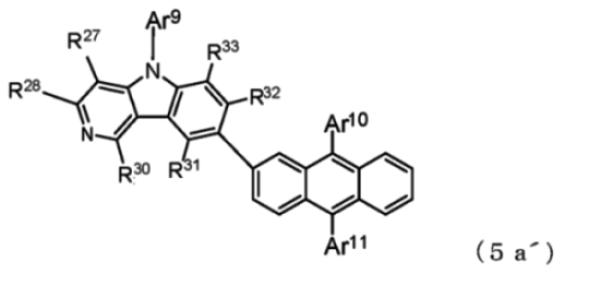
作為前述通式(5a)之蒽衍生物之理想具體例,可列舉具有圖29~圖32表示之結構式之化合物(5a-1)~(5a-20),但通式(5a)之化合物不限定於此。又,該等圖記載了各化合物是否屬於通式(5a’)。不屬於時記載為「-」。As an ideal specific example of the anthracene derivative of the general formula (5a), compounds (5a-1) to (5a-20) having the structural formulas shown in FIGS. 29 to 32 can be cited, but compounds of the general formula (5a) Not limited to this. In addition, these figures show whether each compound belongs to the general formula (5a'). When it does not belong, it is described as "-"
通式(5b)表示之蒽衍生物; 【化20】
上述通式(5b)中之Ar12 及Ar13 相當於通式(5)中之C(亦即,q=2),A3 所鍵結之含氮芳香族雜環相當於通式(5)之基B。Ar14 係鍵結於該含氮芳香族環之取代基。Ar 12 and Ar 13 in the above general formula (5b) correspond to C (that is, q=2) in the general formula (5), and the nitrogen-containing aromatic heterocyclic ring bonded to A 3 corresponds to the general formula (5 )Base B. Ar 14 is a substituent bonded to the nitrogen-containing aromatic ring.
Ar12 ~Ar14 : 作為通式(5b)中之Ar12 ~Ar14 表示之芳香族烴基或芳香族雜環基,可列舉和就關於前述通式(1)中之Ar1 ~Ar4 表示之芳香族烴基或芳香族雜環基例示者為同樣者。該等基可以無取代也可以有取代基。作為取代基可列舉和就關於前述通式(1)中之Ar1 ~Ar4 表示之芳香族烴基及芳香族雜環基也可擁有之取代基例示者為同樣者。取代基可採取之態樣亦同。Ar 12 to Ar 14 : As the aromatic hydrocarbon group or aromatic heterocyclic group represented by Ar 12 to Ar 14 in the general formula (5b), there may be mentioned and represented about Ar 1 to Ar 4 in the general formula (1) Examples of the aromatic hydrocarbon group or aromatic heterocyclic group are the same. These groups may be unsubstituted or substituted. Examples of the substituents are the same as those exemplified for the substituents which may be possessed by the aromatic hydrocarbon groups and aromatic heterocyclic groups represented by Ar 1 to Ar 4 in the general formula (1). Substituents can take the same form.
Ar12 ~Ar14 宜為芳香族烴基較理想,苯基、聯苯基、萘基、蒽基、菲基或茀基更理想。Ar 12 to Ar 14 are preferably aromatic hydrocarbon groups, and phenyl, biphenyl, naphthyl, anthracenyl, phenanthrenyl, or fluorenyl are more desirable.
作為前述通式(5b)之蒽衍生物之理想具體例,可列舉具有圖33~圖35表示之結構式之化合物(5b-1)~(5b-16),但通式(5b)之化合物不限定於此等。As an ideal specific example of the anthracene derivative of the general formula (5b), compounds (5b-1) to (5b-16) having the structural formulas shown in FIGS. 33 to 35, but compounds of the general formula (5b) Not limited to this.
通式(5c)表示之蒽衍生物; 【化21】
通式(5c)中,A3 所鍵結之含氮雜環相當於通式(5)之基B。再者,上述通式(5c)中之Ar15 相當於通式(5)中之C (亦即,q=1)。Ar16 、Ar17 及R8 係鍵結於前述含氮芳香族環之取代基。In the general formula (5c), the nitrogen-containing heterocyclic ring bonded to A 3 corresponds to the group B of the general formula (5). In addition, Ar 15 in the above general formula (5c) corresponds to C in the general formula (5) (that is, q=1). Ar 16 , Ar 17 and R 8 are substituents bonded to the aforementioned nitrogen-containing aromatic ring.
Ar15 ~Ar17 ; 作為通式(5c)中之Ar15 ~Ar17 表示之芳香族烴基或芳香族雜環基,可列舉和就關於前述通式(1)中之Ar1 ~Ar4 表示之芳香族烴基或芳香族雜環基列舉者為同樣者。該等基可以無取代也可以有取代基。取代基可列舉和就關於前述通式(1)中之Ar1 ~Ar4 表示之芳香族烴基及芳香族雜環基也可擁有之取代基列舉者為同樣者。取代基可採取之態樣亦同。Ar 15 to Ar 17 ; As the aromatic hydrocarbon group or aromatic heterocyclic group represented by Ar 15 to Ar 17 in the general formula (5c), there may be mentioned and expressed about Ar 1 to Ar 4 in the general formula (1) Examples of the aromatic hydrocarbon group or aromatic heterocyclic group are the same. These groups may be unsubstituted or substituted. Examples of the substituents are the same as those listed for the aromatic hydrocarbon groups and aromatic heterocyclic groups represented by Ar 1 to Ar 4 in the general formula (1). Substituents can take the same form.
Ar15 ~Ar17 宜為芳香族烴基、吡啶基、喹啉基、異喹啉基或咔啉基較理想,苯基、聯苯基、萘基、蒽基、菲基、茀基、吡啶基、喹啉基、異喹啉基或咔啉基更理想。Ar 15 ~Ar 17 are preferably aromatic hydrocarbon groups, pyridyl, quinolinyl, isoquinolinyl or carboline groups, phenyl, biphenyl, naphthyl, anthracenyl, phenanthryl, fluorenyl, pyridyl , Quinolinyl, isoquinolinyl or carboline is more desirable.
R34 ; 作為通式(5c)中之R34 表示之碳數1~6之烷基、碳數5~10之環烷基或碳數2~6之烯基,可列舉和就關於前述通式(2)中之R1 ~R8 表示之碳數1~6之烷基、碳數5~10之環烷基或碳數2~6之烯基列舉者為同樣者。該等基可以無取代也可以有取代基。作為取代基可列舉和前述通式(2)中之R1 ~R8 表示之碳數1~6之烷基、碳數5~10之環烷基及碳數2~6之烯基也可擁有之取代基列舉者為同樣者。取代基可採取之態樣亦同。R 34 ; As the alkyl group having 1 to 6 carbon atoms, cycloalkyl group having 5 to 10 carbon atoms or alkenyl group having 2 to 6 carbon atoms represented by R 34 in the general formula (5c), In the formula (2), R 1 to R 8 represent the same as the alkyl group having 1 to 6 carbon atoms, the cycloalkyl group having 5 to 10 carbon atoms, or the alkenyl group having 2 to 6 carbon atoms. These groups may be unsubstituted or substituted. Examples of the substituents include the alkyl groups having 1 to 6 carbon atoms, the cycloalkyl groups having 5 to 10 carbon atoms, and the alkenyl groups having 2 to 6 carbon atoms represented by R 1 to R 8 in the general formula (2). The enumerators listed are the same. Substituents can take the same form.
作為通式(5c)中之R34 表示之碳數1~6之烷氧基或碳數5~10之環烷氧基,可列舉和就關於前述通式(2)中之R1 ~R8 表示之碳數1~6之烷氧基或碳數5~10之環烷氧基列舉者為同樣者。該等基可以無取代也可以有取代基。取代基可列舉和就關於前述通式(2)中之R1 ~R8 表示之碳數1~6之烷基、碳數5~10之環烷基及碳數2~6之烯基也可擁有之取代基列舉者為同樣者。取代基可採取之態樣亦同。As the alkoxy group having 1 to 6 carbon atoms or the cycloalkoxy group having 5 to 10 carbon atoms represented by R 34 in the general formula (5c), the above-mentioned R 1 to R in the general formula (2) can be cited. The alkoxy groups having 1 to 6 carbon atoms represented by 8 or the cycloalkoxy groups having 5 to 10 carbon atoms are the same. These groups may be unsubstituted or substituted. Examples of the substituents include the alkyl groups having 1 to 6 carbon atoms, the cycloalkyl groups having 5 to 10 carbon atoms and the alkenyl groups having 2 to 6 carbon atoms represented by R 1 to R 8 in the general formula (2). The enumerable substituents are the same. Substituents can take the same form.
作為通式(5c)中之R34 表示之芳香族烴基或芳香族雜環基,可列舉和就關於前述通式(1)中之Ar1 ~Ar4 表示之芳香族烴基或芳香族雜環基列舉者為同樣者。該等基可以無取代也可以有取代基。取代基可列舉和就關於前述通式(1)中之Ar1 ~Ar4 表示之芳香族烴基及芳香族雜環基也可擁有之取代基列舉者為同樣者。取代基可採取之態樣亦同。Examples of the aromatic hydrocarbon group or aromatic heterocyclic group represented by R 34 in the general formula (5c) include the aromatic hydrocarbon groups or aromatic heterocyclic groups represented by Ar 1 to Ar 4 in the aforementioned general formula (1) The base enumerator is the same. These groups may be unsubstituted or substituted. Examples of the substituents are the same as those listed for the aromatic hydrocarbon groups and aromatic heterocyclic groups represented by Ar 1 to Ar 4 in the general formula (1). Substituents can take the same form.
作為通式(5c)中之R34 表示之芳氧基,可列舉和就關於前述通式(2)中之R1 ~R8 表示之芳氧基列舉者為同樣之基。該等基可以無取代也可以有取代基。取代基可列舉和就前述通式(1)中之Ar1 ~Ar4 表示之芳香族烴基及芳香族雜環基也可擁有之取代基列舉者為同樣者。取代基可採取之態樣亦同。As the aryloxy group represented by R 34 in the general formula (5c), the same groups as those listed for the aryloxy groups represented by R 1 to R 8 in the aforementioned general formula (2) can be cited. These groups may be unsubstituted or substituted. Examples of the substituents are the same as those listed for the aromatic hydrocarbon groups and aromatic heterocyclic groups represented by Ar 1 to Ar 4 in the general formula (1). Substituents can take the same form.
作為前述通式(5c)之蒽衍生物之理想具體例可列舉具圖36~圖41表示之結構式之化合物(5c-1)~(5c-30),但通式(5c)之化合物不限定於此等。As an ideal specific example of the anthracene derivative of the general formula (5c), the compounds (5c-1) to (5c-30) having the structural formulas shown in FIGS. 36 to 41 can be cited, but the compound of the general formula (5c) is not Limited to this.
上述通式(5)之蒽衍生物可依其本身公知之方法合成(參照專利文獻8~10)。The anthracene derivative of the general formula (5) can be synthesized according to a method known per se (refer to
合成之化合物之精製可依利用管柱層析所為之精製、依矽膠、活性碳、活性白土等所為之吸附精製、利用溶劑所為之再結晶、晶析法、昇華精製法等實施。本發明之有機EL元件使用之化合物最後利用昇華精製法精製並供使用。The purification of the synthesized compound can be carried out by purification by column chromatography, adsorption purification by silica gel, activated carbon, activated clay, etc., recrystallization by solvent, crystallization method, sublimation purification method, etc. The compound used in the organic EL device of the present invention is finally refined and used by the sublimation purification method.
<陰極> 本發明之有機EL元件之陰極係使用如鋁之工作函數低之電極材料、如鎂銀合金、鎂銦合金、鋁鎂合金之工作函數更低之合金作為電極材料。<Cathode> The cathode of the organic EL device of the present invention uses an electrode material with a low working function such as aluminum, an alloy with a lower working function such as magnesium silver alloy, magnesium indium alloy, and aluminum magnesium alloy as the electrode material.
<其他層> 本發明之有機EL元件可因應必要具有其他層。例如:圖1表示之例中,在陽極2與電洞輸送層5之間設有電洞注入層3,在陰極9與電子輸送層7之間設有電子注入層8。再者,雖未圖示,可在電洞輸送層5與發光層6之間設置電子阻擋層,也可在發光層6與電子輸送層7之間設置電洞阻擋層。 適當設置之各層可由其本身公知之材料形成,均可因應使用之材料之種類利用蒸鍍法、旋塗法、噴墨法等公知方法形成。<Other layers> The organic EL device of the present invention may have other layers as necessary. For example, in the example shown in FIG. 1, a
電洞注入層; 陽極2與電洞輸送層5之間適當形成之電洞注入層3可使用本身公知之材料,例如: 光芒型之三苯胺衍生物、各種三苯胺4聚物等材料; 銅酞花青為代表之聚卟啉化合物; 六氰基氮雜聯三苯之類之接受體性之雜環化合物; 塗佈型之高分子材料。又,前述通式(1)之芳胺化合物、後述通式(6)或(7)表示之三芳胺衍生物顯示之電洞移動度大,也可使用該芳胺化合物形成電洞注入層。The hole injection layer; the
又,電洞注入層中,可使用對該層通常使用的材料進一步以P型摻雜參溴苯胺六氯銻等者、軸烯(radialene)衍生物(參照國際公開2014/009310號))等、或在其次結構有TPD等聯苯胺衍生物之結構之高分子化合物等。In addition, for the hole injection layer, materials commonly used in this layer can be further doped with P-type doped parabromoaniline, hexachloroantimony, etc., radialene derivatives (see International Publication No. 2014/009310), etc. Or, a high molecular compound with the structure of a benzidine derivative such as TPD in the secondary structure.
電子注入層; 電子注入層之形成可使用氟化鋰、氟化銫等鹼金屬塩;氟化鎂等鹼土類金屬鹽;氧化鋁等金屬氧化物; 等,但於電子輸送層與陰極之理想選擇中,可將其省略。Electron injection layer; The formation of the electron injection layer can use alkali metal salts such as lithium fluoride and cesium fluoride; alkaline earth metal salts such as magnesium fluoride; metal oxides such as aluminum oxide; etc., but ideal for the electron transport layer and cathode It can be omitted during selection.
電子阻擋層; 電子阻擋層於圖1未顯示,係設於電洞輸送層與發光層之間,用於阻擋電子從發光層穿透,並使發光效率提高。用以形成電子阻擋層之材料,除了前述通式(1)之芳胺化合物以外,尚可使用例如以下之有電子阻擋作用之化合物。 咔唑衍生物,例如4,4’;4’’-三(N-咔唑基)三苯基胺(TCTA)、9,9-雙[4-(咔唑-9-基)苯基]茀、1,3-雙(咔唑-9-基)苯(mCP)、2,2-雙(4-咔唑-9-基苯基)金剛烷(Ad-Cz);具有三苯基矽基與三芳胺結構之化合物、 例如9-[4-(咔唑-9-基)苯基]-9-[4- (三苯基矽基)苯基]-9H-茀;Electron blocking layer; The electron blocking layer is not shown in FIG. 1 and is arranged between the hole transport layer and the light emitting layer, and is used to block the penetration of electrons from the light emitting layer and improve the luminous efficiency. As the material for forming the electron blocking layer, in addition to the aromatic amine compound of the general formula (1), for example, the following compounds having an electron blocking effect can be used. Carbazole derivatives such as 4,4'; 4"-tris(N-carbazolyl)triphenylamine (TCTA), 9,9-bis[4-(carbazol-9-yl)phenyl] Fusel, 1,3-bis(carbazol-9-yl)benzene (mCP), 2,2-bis(4-carbazol-9-ylphenyl)adamantane (Ad-Cz); with triphenyl silicon Compound with triarylamine structure, such as 9-[4-(carbazol-9-yl)phenyl]-9-[4-(triphenylsilyl)phenyl]-9H-fusel;
電洞阻擋層; 電洞阻擋層於圖1也未顯示,係適當設於電子輸送層與發光層之間,用於阻擋電洞從發光層穿透,並使可發光效率提高。用於形成電洞阻擋層之材料,例如可列舉如下。 啡啉衍生物,例如可使用浴銅靈(Bathocuproin)(BCP);雙(2-甲基-8-喹啉酚)-4-苯基酚酸鋁(III)(BAlq)等喹啉酚衍生物之金屬錯合物;各種稀土類錯合物;三唑衍生物;三
<2層結構之電洞輸送層> 本發明之有機EL元件中,前述通式(1)之芳胺化合物係作為電洞輸送劑使用,但如前述,可將含有如此之芳胺化合物之電洞輸送層製作成2層結構。 亦即,如圖1所示,將電洞輸送層5製作成分成位在陽極2側之第1電洞輸送層5a與位在發光層6側之第2電洞輸送層5b的2層結構,使前述通式(1)之芳胺化合物含有第2電洞輸送層5b為理想。於此情形,第1電洞輸送層5a使用和第2電洞輸送層5b使用者為不同的芳胺。<The two-layer structure hole transport layer> In the organic EL device of the present invention, the arylamine compound of the general formula (1) is used as a hole transport agent, but as described above, electricity containing such an arylamine compound can be used. The hole transport layer is made into a two-layer structure. That is, as shown in FIG. 1, the
如上述電洞輸送層分成2層時,發光層6側之第2電洞輸送層5b顯示電洞輸送性且同時顯示極高的電子阻擋性。原因為:前述通式(1)之芳胺化合物顯示優良的電洞輸送性,此外顯示高電子阻擋性。因此尤其如圖1,藉由使第2電洞輸送層5b和發光層6相鄰,能於發光層6保持更高的載子均衡性,對於改善有機EL元件之特性方面極有利。As described above, when the hole transport layer is divided into two layers, the second
第1電洞輸送層5a係使用和第2電洞輸送層5b之形成使用之芳胺化合物為不同的芳胺衍生物形成。原因為:芳胺骨架顯示優良的電洞輸送性。The first
第1電洞輸送層5a形成時使用之芳基胺衍生物和第2電洞輸送層5b形成時使用者為不同即可,可為前述通式(1)之芳胺化合物,但因為第1電洞輸送層5a不是這麼地要求電子阻擋性,故宜使用作為電洞輸送劑使用之公知芳胺衍生物來形成第1電洞輸送層5a。The arylamine derivative used in the formation of the first
公知之芳胺衍生物具有2個芳胺骨架以單鍵或2價烴基鍵結之分子結構,分子中具有2~6個芳胺骨架較佳。 本發明中,考量電洞輸送性,此外考量薄膜安定性、耐熱性優異及合成容易之觀點,宜使用下列通式(6)或(7)表示之三芳胺衍生物形成第1電洞輸送層5a更佳。該三芳胺衍生物可以單獨使用1種也可混用2種以上。Known aromatic amine derivatives have a molecular structure in which two aromatic amine skeletons are bonded with a single bond or a divalent hydrocarbon group, and it is preferable to have 2 to 6 aromatic amine skeletons in the molecule. In the present invention, considering the hole transportability, in addition to considering the stability of the film, excellent heat resistance, and ease of synthesis, it is preferable to use the triarylamine derivative represented by the following general formula (6) or (7) to form the first
通式(6)表示之三芳胺衍生物; 【化22】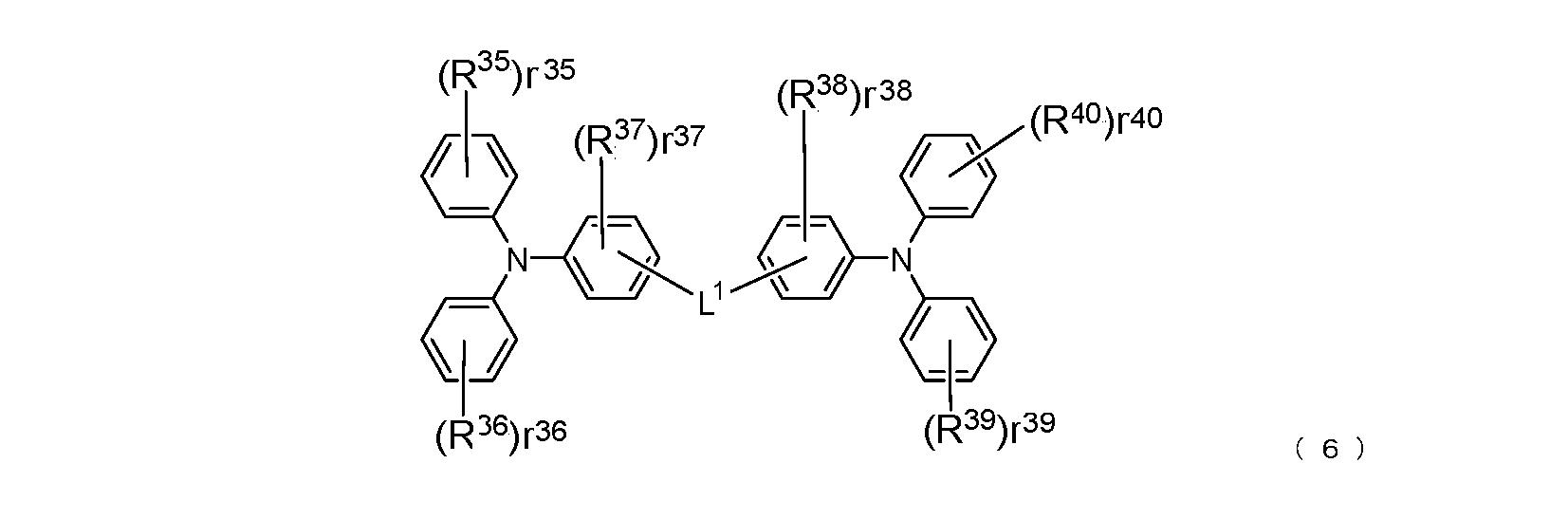
該通式(6)表示之三芳胺衍生物具有2個三芳胺骨架。The triarylamine derivative represented by the general formula (6) has two triarylamine skeletons.
(通式(6)中之r35 ~r40 ) 通式(6)中,r35 、r36 、r39 、r40 表示0~5之整數,r37 、r38 表示0~4之整數。r35 、r36 、r39 、r40 為2~5之整數時或r37 、r38 為2~4之整數時,於同一苯環鍵結之多個R35 ~R40 彼此可相同也可不同,又,可各自獨立存在而形成環,也可介隔單鍵、有取代或無取代之亞甲基、氧原子或硫原子而彼此鍵結形成環。(R 35 ~ r 40 in general formula (6)) In general formula (6), r 35 , r 36 , r 39 and r 40 represent integers from 0 to 5, r 37 and r 38 represent integers from 0 to 4 . When r 35 , r 36 , r 39 , and r 40 are integers of 2 to 5, or when r 37 and r 38 are integers of 2 to 4, multiple R 35 to R 40 bonded to the same benzene ring may be the same as each other. It may be different, and each may exist independently to form a ring, or it may be bonded to each other through a single bond, a substituted or unsubstituted methylene group, an oxygen atom, or a sulfur atom to form a ring.
(通式(6)中之R35
~R40
) 通式(6)中,R35
~R40
各表示氘原子、氟原子、氯原子、氰基、硝基、碳數1~6之烷基、碳數5~10之環烷基、碳數2~6之烯基、碳數1~6之烷氧基、碳數5~10之環烷氧基、芳香族烴基、芳香族雜環基或芳氧基。該等基於同一苯環有多個存在時,該等基也可介隔單鍵、也可以有取代基亞甲基、氧原子或硫原子而彼此鍵結形成環。(R 35 to R 40 in the general formula (6)) In the general formula (6), each of the R 35 to R 40 represents a deuterium atom, a fluorine atom, a chlorine atom, a cyano group, a nitro group, and a
作為通式(6)中之R35 ~R40 表示之碳數1~6之烷基、碳數5~10之環烷基或碳數2~6之烯基,具體而言可列舉甲基、乙基、正丙基、異丙基、正丁基、異丁基、第三丁基、正戊基、異戊基、新戊基、正己基、環戊基、環己基、1-金剛烷基、2-金剛烷基、乙烯基、烯丙基、異丙烯基、2-丁烯基等。 又,碳數1~6之烷基及碳數2~6之烯基可為直鏈狀也可為分枝狀。As the alkyl group having 1 to 6 carbon atoms, the cycloalkyl group having 5 to 10 carbon atoms or the alkenyl group having 2 to 6 carbon atoms represented by R 35 to R 40 in the general formula (6), specifically, a methyl group , Ethyl, n-propyl, isopropyl, n-butyl, isobutyl, tertiary butyl, n-pentyl, isopentyl, neopentyl, n-hexyl, cyclopentyl, cyclohexyl, 1-adamantyl Alkyl, 2-adamantyl, vinyl, allyl, isopropenyl, 2-butenyl, etc. In addition, the alkyl group having 1 to 6 carbon atoms and the alkenyl group having 2 to 6 carbon atoms may be linear or branched.
該等基可以無取代也可以有取代基。取代基除了氘原子、氰基、硝基以外,尚可列舉如下。 鹵素原子,例如氟原子、氯原子、溴原子、碘原子; 碳數1~6之烷氧基,例如甲氧基、乙氧基、丙氧基; 烯基,例如乙烯基、烯丙基; 芳氧基,例如苯氧基、甲苯氧基; 芳基烷氧基,例如苄氧基、苯乙氧基; 芳香族烴基,例如苯基、聯苯基、聯三苯基、萘基、蒽基、菲基、茀基、茚基、芘基、苝基、丙二烯合茀基、三亞苯基; 芳香族雜環基,例如吡啶基、嘧啶基、三
作為通式(6)中之R35 ~R40 表示之碳數1~6之烷氧基或碳數5~10之環烷氧基,具體而言可列舉甲氧基、乙氧基、正丙氧基、異丙氧基、正丁氧基、第三丁氧基、正戊氧基、正己氧基、環戊氧基、環己氧基、環庚氧基、環辛氧基、1-金剛烷氧基、2-金剛烷氧基等。碳數1~6之烷氧基可為直鏈狀也可為分枝狀。該等基可以無取代也可以有取代基。取代基可列舉和就前述通式(6)中之R35 ~R40 表示之碳數1~6之烷基、碳數5~10之環烷基及碳數2~6之烯基也可擁有之取代基列舉者為同樣者。取代基可採取之態樣亦同。Examples of the alkoxy groups having 1 to 6 carbon atoms or the cycloalkoxy groups having 5 to 10 carbon atoms represented by R 35 to R 40 in the general formula (6) specifically include methoxy, ethoxy, and n Propoxy, isopropoxy, n-butoxy, third butoxy, n-pentyloxy, n-hexyloxy, cyclopentyloxy, cyclohexyloxy, cycloheptyloxy, cyclooctyloxy, 1 -Adamantyloxy, 2-adamantyloxy, etc. The alkoxy group having 1 to 6 carbon atoms may be linear or branched. These groups may be unsubstituted or substituted. Examples of the substituents include alkyl groups having 1 to 6 carbon atoms, cycloalkyl groups having 5 to 10 carbon atoms and alkenyl groups having 2 to 6 carbon atoms represented by R 35 to R 40 in the general formula (6). The enumerators listed are the same. Substituents can take the same form.
作為通式(6)中之R35 ~R40 表示之芳香族烴基或芳香族雜環基,可列舉和就關於前述通式(1)中之Ar1 ~Ar4 表示之芳香族烴基或芳香族雜環基列舉者為同樣者。該等基可以無取代也可以有取代基。取代基可列舉和就前述通式(1)中之Ar1 ~Ar4 表示之芳香族烴基及芳香族雜環基也可擁有之取代基列舉者為同樣者。取代基可採取之態樣亦同。Examples of the aromatic hydrocarbon group or aromatic heterocyclic group represented by R 35 to R 40 in the general formula (6) include the aromatic hydrocarbon groups or aromatic groups represented by Ar 1 to Ar 4 in the general formula (1). The enumerators of group heterocyclic groups are the same. These groups may be unsubstituted or substituted. Examples of the substituents are the same as those listed for the aromatic hydrocarbon groups and aromatic heterocyclic groups represented by Ar 1 to Ar 4 in the general formula (1). Substituents can take the same form.
作為通式(6)中之R35 ~R40 表示之芳氧基,具體而言可列舉苯氧基、聯苯氧基、聯三苯氧基、萘氧基、蒽氧基、菲氧基、茀氧基、茚氧基、芘氧基、苝氧基等。該等基可以無取代也可以有取代基。取代基可列舉和就前述通式(1)中之Ar1 ~Ar4 表示之芳香族烴基及芳香族雜環基也可擁有之取代基列舉者為同樣者。取代基可採取之態樣亦同。As the aryloxy group represented by R 35 to R 40 in the general formula (6), specifically, phenoxy group, biphenoxy group, triphenyloxy group, naphthyloxy group, anthraceneoxy group, phenanthryloxy group , Stilboxy, indoxy, pyreneoxy, peryleneoxy, etc. These groups may be unsubstituted or substituted. Examples of the substituents are the same as those listed for the aromatic hydrocarbon groups and aromatic heterocyclic groups represented by Ar 1 to Ar 4 in the general formula (1). Substituents can take the same form.
R35 ~R40 表示之基彼此可各自獨立存在而形成環,也可介隔單鍵、有取代或無取代之亞甲基、氧原子或硫原子而彼此鍵結形成環。The groups represented by R 35 to R 40 may exist independently of each other to form a ring, or may be bonded to each other through a single bond, a substituted or unsubstituted methylene group, an oxygen atom, or a sulfur atom to form a ring.
(通式(6)中之L1 ) 通式(6)中,L1 係將2個芳胺骨架鍵結之橋聯基,代表下列結構式(C)~(G)中之任一者表示之2價基或單鍵。(L 1 in general formula (6)) In general formula (6), L 1 is a bridging group that bonds two aromatic amine skeletons, and represents any one of the following structural formulas (C) to (G) Represents a 2-valent base or single bond.
【化23】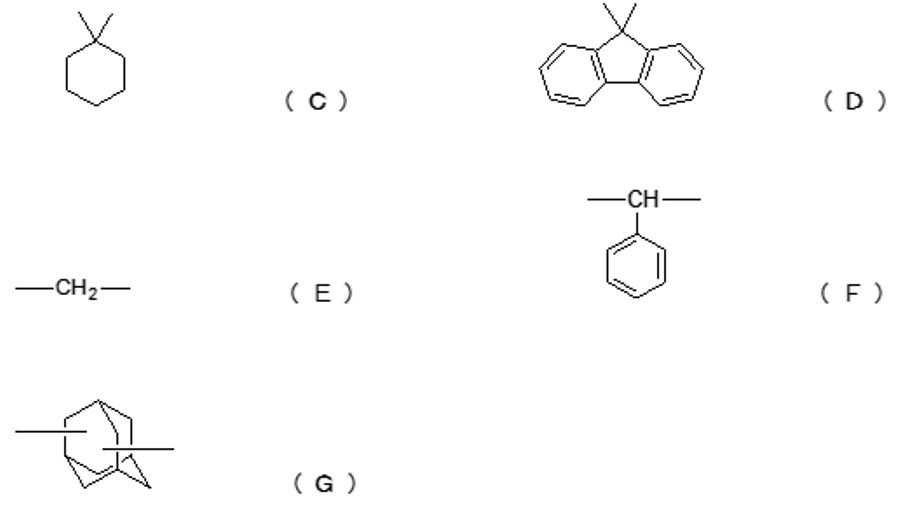
前述通式(6)之三芳胺衍生物之理想具體例可列舉具有圖42~圖45表示之結構式之化合物(6-1)~(6-23)。通式(6)之化合物不限於該等化合物。Preferred specific examples of the triarylamine derivative of the aforementioned general formula (6) include compounds (6-1) to (6-23) having the structural formulas shown in FIGS. 42 to 45. The compound of the general formula (6) is not limited to these compounds.
作為第1電洞輸送層可理想使用之具有2個芳胺骨架以單鍵或不含雜原子之2價基鍵結之分子結構且於分子中具有2個芳胺骨架之芳胺衍生物且是前述通式(6)之三芳胺衍生物以外之理想具體例,可列舉具有圖46表示之結構式之化合物(6’-1)~(6’-2)。As the first hole transport layer, an aromatic amine derivative having a molecular structure in which two aromatic amine skeletons are bonded with a single bond or a divalent group containing no hetero atoms and having two aromatic amine skeletons in the molecule can be ideally used. It is an ideal specific example other than the triarylamine derivative of the general formula (6), and compounds (6′-1) to (6′-2) having the structural formula shown in FIG. 46 can be cited.
前述通式(6)之三芳胺衍生物可依其本身公知之方法合成(參照專利文獻11~12)。 同樣地,化合物(6’-1)~(6’-2)也可依其本身公知之方法合成(參照專利文獻11~12)。The triarylamine derivative of the aforementioned general formula (6) can be synthesized according to a method known per se (refer to Patent
合成之化合物之精製,可依利用管柱層析所為之精製、利用矽膠、活性碳、活性白土等所為之吸附精製、利用溶劑再結晶、晶析法、昇華精製法等實施。本發明之有機EL元件使用之化合物於最後利用昇華精製法精製並供使用。The purification of the synthesized compound can be carried out according to purification by column chromatography, adsorption purification by silica gel, activated carbon, activated clay, etc., solvent recrystallization, crystallization, sublimation purification, etc. The compound used in the organic EL device of the present invention is finally refined and used by the sublimation purification method.
通式(7)表示之三芳胺衍生物; 【化24】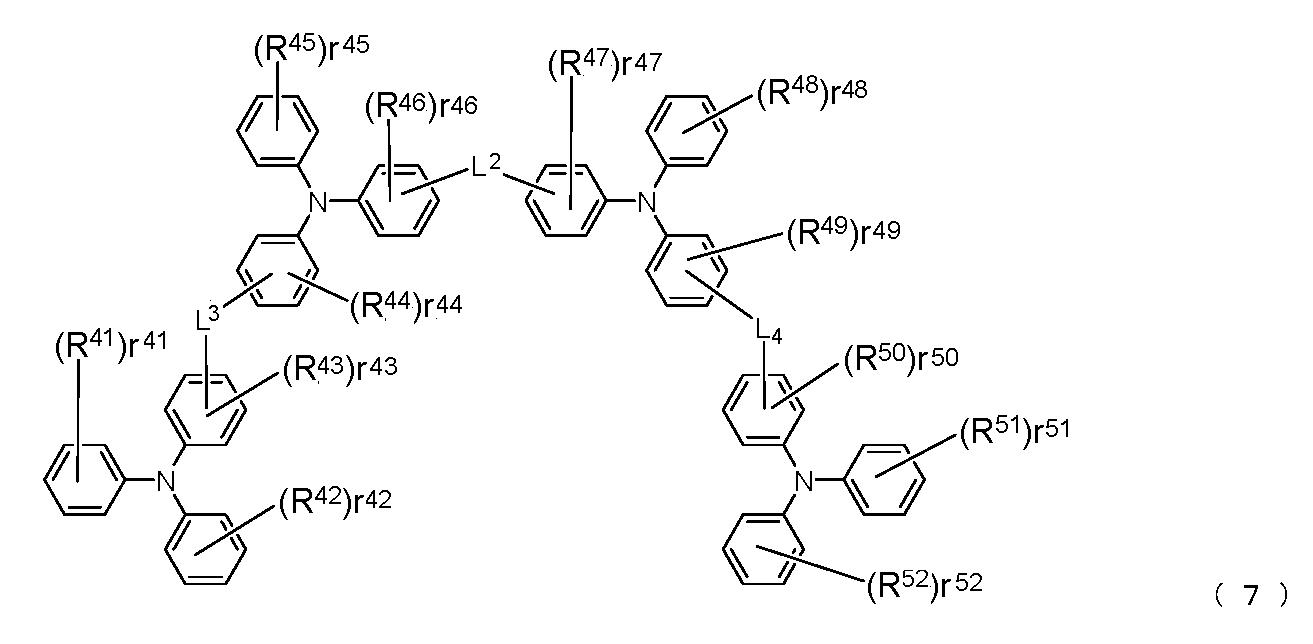
該通式(7)表示之三芳胺衍生物具有4個三芳胺骨架。The triarylamine derivative represented by the general formula (7) has four triarylamine skeletons.
(通式(7)中之r41 ~r52 ) 通式(7)中,r41~ r51 各為代表鍵結於芳香族環之取代基R41 ~R52 之數目之整數。r41 、r42 、r45 、r48 、r51 及r52 各表示0~5之整數,r43 、r44 、r46 、r47 、r49 及r50 各表示0~4之整數。(R 41 to r 52 in the general formula (7)) In the general formula (7), r 41 to r 51 are each an integer representing the number of substituents R 41 to R 52 bonded to the aromatic ring. r 41 , r 42 , r 45 , r 48 , r 51 and r 52 each represent an integer of 0~5, r 43 , r 44 , r 46 , r 47 , r 49 and r 50 each represent an integer of 0~4.
r41 、r42 、r45 、r48 、r51 、r52 為2~5之整數時或r43 、r44 、r46 、r47 、r49 、r50 為2~4之整數時,於同一苯環鍵結之多個R41 ~R52 彼此可相同也可不同,又,可各自獨立存在而形成環,也可介隔單鍵、有取代或無取代之亞甲基、氧原子或硫原子而彼此鍵結形成環。When r 41 , r 42 , r 45 , r 48 , r 51 , r 52 are integers from 2 to 5 or when r 43 , r 44 , r 46 , r 47 , r 49 , and r 50 are integers from 2 to 4, Multiple R 41 ~R 52 bonded to the same benzene ring may be the same or different from each other, and may each exist independently to form a ring, or may be separated by a single bond, a substituted or unsubstituted methylene group, an oxygen atom Or sulfur atoms are bonded to each other to form a ring.
(通式(7)中之R41 ~R52 ) 通式(7)中,鍵結於芳香族環之取代基R41 ~R52 各表示氘原子、氟原子、氯原子、氰基、硝基、碳數1~6之烷基、碳數5~10之環烷基、碳數2~6之烯基、碳數1~6之烷氧基、碳數5~10之環烷氧基、芳香族烴基、芳香族雜環基或芳氧基。(R 41 to R 52 in the general formula (7)) In the general formula (7), the substituents R 41 to R 52 bonded to the aromatic ring each represent a deuterium atom, a fluorine atom, a chlorine atom, a cyano group, a nitrate Group, alkyl group having 1 to 6 carbon atoms, cycloalkyl group having 5 to 10 carbon atoms, alkenyl group having 2 to 6 carbon atoms, alkoxy group having 1 to 6 carbon atoms, cycloalkoxy group having 5 to 10 carbon atoms , Aromatic hydrocarbon group, aromatic heterocyclic group or aryloxy group.
該等基於同一苯環有多個存在時,該等基也可介隔單鍵、也可以有取代基亞甲基、氧原子或硫原子而彼此鍵結形成環。When there are a plurality of the same benzene rings, the groups may be bonded to each other through a single bond, or may have a substituent methylene group, an oxygen atom, or a sulfur atom to form a ring.
作為通式(7)中之R41 ~R52 表示之碳數1~6之烷基、碳數5~10之環烷基或碳數2~6之烯基,可列舉和就關於前述通式(6)中之R35 ~R40 表示之碳數1~6之烷基、碳數5~10之環烷基或碳數2~6之烯基列舉者為同樣者。可採取之態樣亦同。該等基可以無取代也可以有取代基。取代基可列舉和就前述通式(6)中之R35 ~R40 表示之碳數1~6之烷基、碳數5~10之環烷基或碳數2~6之烯基也可擁有之取代基列舉者為同樣者。取代基可採取之態樣亦同。As the alkyl group having 1 to 6 carbon atoms, the cycloalkyl group having 5 to 10 carbon atoms, or the alkenyl group having 2 to 6 carbon atoms represented by R 41 to R 52 in the general formula (7), In the formula (6), R 35 to R 40 represent the same as the alkyl group having 1 to 6 carbon atoms, the cycloalkyl group having 5 to 10 carbon atoms, or the alkenyl group having 2 to 6 carbon atoms. The same can be done. These groups may be unsubstituted or substituted. Examples of the substituents include alkyl groups having 1 to 6 carbon atoms, cycloalkyl groups having 5 to 10 carbon atoms or alkenyl groups having 2 to 6 carbon atoms represented by R 35 to R 40 in the general formula (6). The enumerators listed are the same. Substituents can take the same form.
作為R41 ~R52 表示之碳數1~6之烷氧基或碳數5~10之環烷氧基,可列舉和就關於前述通式(6)中之R35 ~R40 表示之碳數1~6之烷氧基或碳數5~10之環烷氧基列舉者為同樣者。能採用的態樣亦同。該等基可以無取代也可以有取代基。取代基可列舉和就前述通式(6)中之R35 ~R40 表示之碳數1~6之烷基、碳數5~10之環烷基或碳數2~6之烯基也可擁有之取代基列舉者為同樣者。取代基可採取之態樣亦同。Examples of the alkoxy groups having 1 to 6 carbon atoms or the cycloalkoxy groups having 5 to 10 carbon atoms represented by R 41 to R 52 include the carbon atoms represented by R 35 to R 40 in the aforementioned general formula (6). The alkoxy groups having 1 to 6 or cycloalkoxy groups having 5 to 10 carbon atoms are the same. The same applies. These groups may be unsubstituted or substituted. Examples of the substituents include alkyl groups having 1 to 6 carbon atoms, cycloalkyl groups having 5 to 10 carbon atoms or alkenyl groups having 2 to 6 carbon atoms represented by R 35 to R 40 in the general formula (6). The enumerators listed are the same. Substituents can take the same form.
作為R41 ~R52 表示之芳香族烴基或芳香族雜環基,可列舉和就關於前述通式(1)中之Ar1 ~Ar4 表示之芳香族烴基或芳香族雜環基列舉者為同樣者。該等基可以無取代也可以有取代基。取代基可列舉和前述通式(1)中之Ar1 ~Ar4 表示之芳香族烴及芳香族雜環基也可擁有之取代基列舉者為同樣者。取代基可採取之態樣亦同。As the aromatic hydrocarbon group or aromatic heterocyclic group represented by R 41 to R 52 , the aromatic hydrocarbon group or aromatic heterocyclic group represented by Ar 1 to Ar 4 in the aforementioned general formula (1) may be exemplified by The same. These groups may be unsubstituted or substituted. Examples of the substituents are the same as those listed for the aromatic hydrocarbons and aromatic heterocyclic groups represented by Ar 1 to Ar 4 in the general formula (1). Substituents can take the same form.
作為R41 ~R52 表示之芳氧基と可列舉和就關於前述通式(6)中之R35 ~R40 表示之芳氧基列舉者為同樣者。該等基可以無取代也可以有取代基。取代基可列舉和就前述通式(1)中之Ar1 ~Ar4 表示之芳香族烴基及芳香族雜環基也可擁有之取代基列舉者為同樣者。取代基可採取之態樣亦同。Examples of the aryloxy groups represented by R 41 to R 52 are the same as those exemplified for the aryloxy groups represented by R 35 to R 40 in the general formula (6). These groups may be unsubstituted or substituted. Examples of the substituents are the same as those listed for the aromatic hydrocarbon groups and aromatic heterocyclic groups represented by Ar 1 to Ar 4 in the general formula (1). Substituents can take the same form.
R41 ~R52 彼此可各自獨立存在而不形成環,也可介隔單鍵、有取代或無取代之亞甲基、氧原子或硫原子而彼此鍵結形成環。R 41 to R 52 may exist independently of each other without forming a ring, or may be bonded to each other through a single bond, a substituted or unsubstituted methylene group, an oxygen atom, or a sulfur atom to form a ring.
(通式(7)中之L2
~L4
) 通式(7)中,L2
~L4
可相同也可不同,表示下列結構式(H)~(I)中之任一者表示之2價基、前述通式(6)之結構式(C)~(G)中之任一者表示之2價基、或單鍵。 【化25】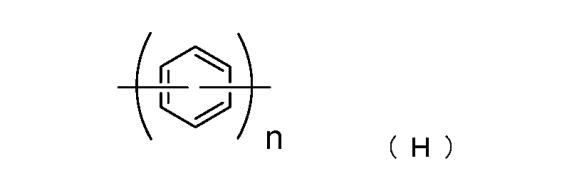

前述通式(7)之三芳胺衍生物之理想具體例可列舉具有圖47~圖50表示之結構式之化合物(7-1)~(7-17)。通式(7)之化合物不限定於此。Preferable specific examples of the triarylamine derivative of the aforementioned general formula (7) include compounds (7-1) to (7-17) having the structural formulas shown in FIGS. 47 to 50. The compound of the general formula (7) is not limited thereto.
前述通式(7)之三芳胺衍生物可依其本身公知之方法合成(參照專利文獻11~12)。The triarylamine derivative of the aforementioned general formula (7) can be synthesized according to a method known per se (refer to Patent
合成之化合物之精製可利用管柱層析所為之精製、矽膠、活性碳、活性白土等所為之吸附精製、溶劑所為之再結晶、晶析法、昇華精製法等以進行。本發明之有機EL元件使用之化合物最後利用昇華精製法精製並供使用。 [實施例]The purification of the synthesized compound can be carried out by purification by column chromatography, adsorption purification by silica gel, activated carbon, activated clay, etc., recrystallization by solvent, crystallization method, sublimation purification method, etc. The compound used in the organic EL device of the present invention is finally refined and used by the sublimation purification method. [Example]
以下針對本發明之實施形態利用實施例具體説明,但本發明不限於以下的實施例。The embodiments of the present invention will be specifically described below using examples, but the present invention is not limited to the following examples.
<實施例1:化合物1-5> 4-{(聯苯-4-基)-苯胺基}-4’’-{(9,9-二甲基-9H-茀-2-基)-苯胺基}-1,1’:3’,1’’-聯三苯之合成; 於經氮氣取代之反應容器中添加N-(聯苯-4-基)-N-(4-溴苯基)苯胺8.0g、N-(9,9-二甲基-9H-茀-2-基)-N-{3’-(4,4,5,5-四甲基-[1,3,2]二氧雜環戊硼烷-2-基)聯苯-4-基}苯胺11.4g、碳酸鉀7.5g、水64ml、甲苯64ml、乙醇16ml及肆(三苯基膦)鈀0.8g並加熱,於70℃攪拌16小時。冷卻至室溫,添加乙酸乙酯與水後,利用分液操作收集有機層。將有機層濃縮後,實施使用THF/丙酮之混合溶劑之再結晶。其結果獲得4-{(聯苯-4-基)-苯胺基}-4’’-{(9,9-二甲基-9H-茀-2-基)-苯胺基}-1,1’:3’,1’’-聯三苯(化合物1-5)之白色粉體9.54g(產率69%)。 【化27】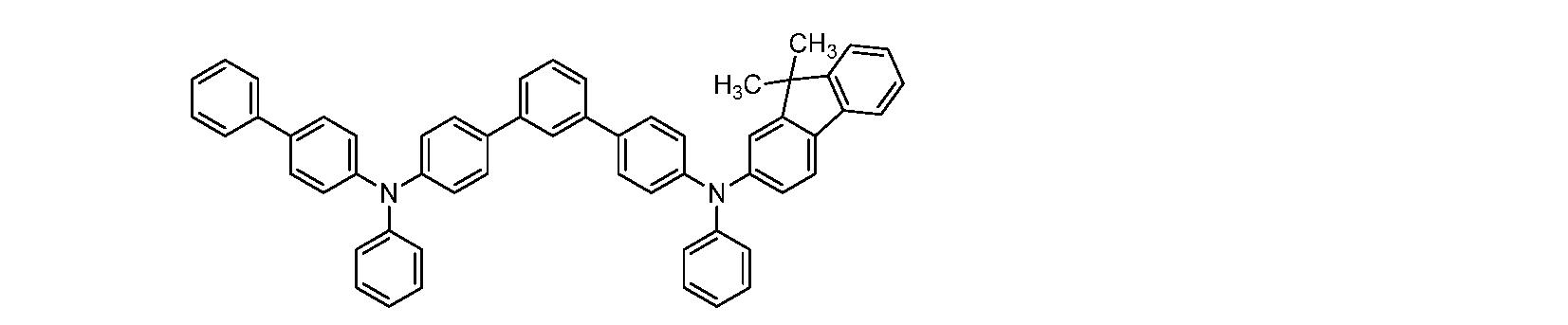
針對獲得之白色粉體使用NMR鑑別結構。1 H-NMR(THF-d8 )檢測到以下44個氫的信號。 δ(ppm)=7.86(1H)、7.68-6.97(37H)、1.41(6H)NMR was used to identify the structure of the obtained white powder. 1 H-NMR (THF-d 8 ) detected the following 44 hydrogen signals. δ (ppm) = 7.86 (1H), 7.68-6.97 (37H), 1.41 (6H)
<實施例2:化合物1-6> 4-{(9,9-二甲基-9H-茀-2-基)-苯胺基}-4’’-{(萘-1-基)-苯胺基}-1,1’:3’,1’’-聯三苯之合成; 將實施例1中之N-(聯苯-4-基)-N-(4-溴苯基)苯胺改為使用N-(3’-溴聯苯-4-基)-N-(萘-1-基)苯胺,N-(9,9-二甲基-9H-茀-2-基)-N-{3’-(4,4,5,5-四甲基-[1,3,2]二氧雜環戊硼烷-2-基)聯苯-4-基}苯胺改為使用4-{N-(9,9-二甲基-9H-茀-2-基) -苯胺基}-苯基硼酸,除此以外以同樣的條件進行反應。其結果獲得4-{(9,9-二甲基-9H-茀-2-基)-苯胺基}-4’’-{(萘-1-基)-苯胺基}-1,1’:3’,1’’-聯三苯(化合物1-6)之淡黃白色粉體7.88g(產率62%)。 【化28】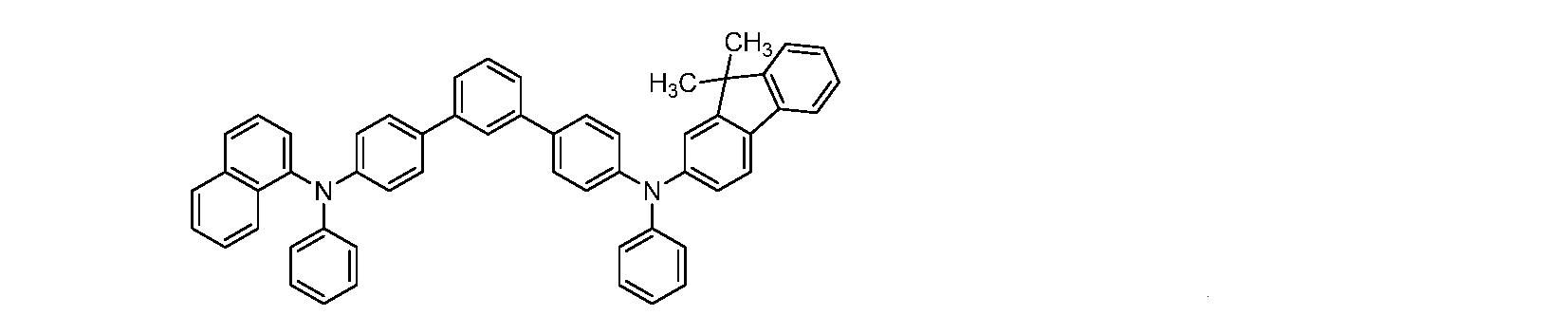
針對獲得之淡黃白色粉體使用NMR鑑別結構。1 H-NMR(CDCl3 )檢測到以下42個氫的信號。 δ(ppm)=7.98(1H)、7.92(1H)、7.84-7.75(2H)、7.70-6.94(32H)、1.49(6H)NMR was used to identify the structure of the obtained yellowish white powder. 1 H-NMR (CDCl 3 ) detected the following 42 hydrogen signals. δ(ppm)=7.98(1H), 7.92(1H), 7.84-7.75(2H), 7.70-6.94(32H), 1.49(6H)
<實施例3:化合物1-21> 3.3’’-雙{(聯苯-4-基)-苯胺基}-1,1’:4’,1’’-聯三苯之合成; 於經氮氣取代之反應容器中添加1,4-二溴苯6.20g、N-(聯苯-4-基)-N-{3-(4,4,5,5-四甲基-[1,3,2]二氧雜環戊硼烷-2-基)苯基}-苯胺25.1g、碳酸鉀10.8g、水39ml、 甲苯380ml及乙醇95ml,邊照射超音波邊通入氮氣30分鐘。添加肆(三苯基膦)鈀0.95g並加熱,回流攪拌18小時。冷卻至室溫,添加水200ml及庚烷190ml後,以過濾收集析出物。將析出物加熱溶解於1,2-二氯苯1200ml,實施使用矽膠39g之吸附精製,然後實施使用活性白土19g之吸附精製後,加入甲醇725ml,利用過濾收集析出之粗製物。重複實施粗製物使用1,2-二氯甲烷/甲醇之混合溶劑之晶析後,實施使用甲醇300ml之回流洗滌。其結果獲得3,3’’-雙{(聯苯-4-基)-苯胺基}-1,1’:4’,1’’-聯三苯(化合物1-21)之白色粉體15.22g(產率81%)。 【化29】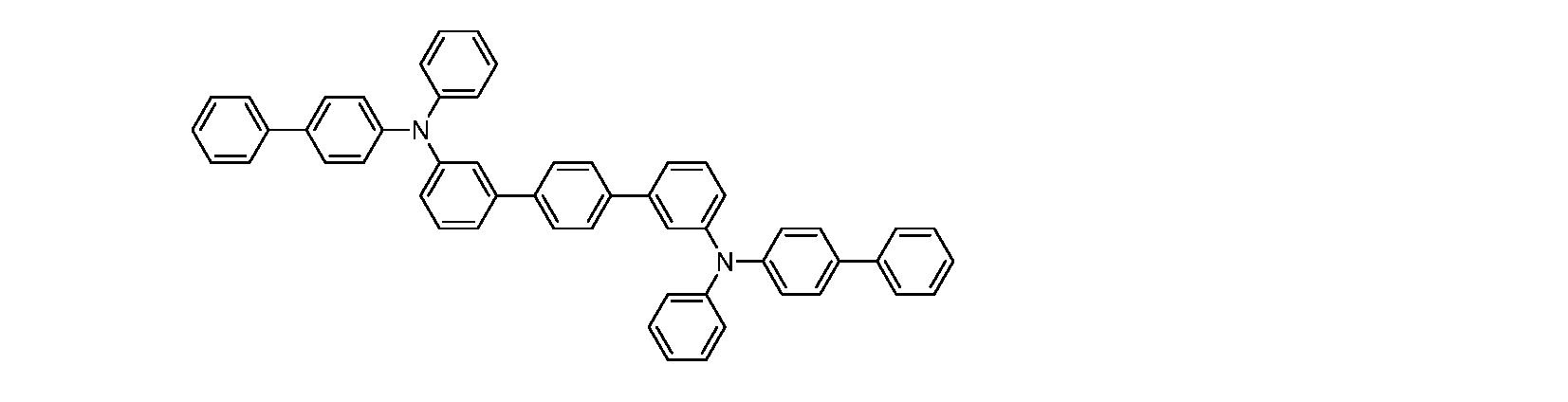
針對獲得之白色粉體使用NMR鑑別結構。1 H-NMR(CDCl3 )檢測到以下40個氫的信號。 δ(ppm)=7.61(2H)、7.56-6.83(38H)NMR was used to identify the structure of the obtained white powder. 1 H-NMR (CDCl 3 ) detected the following 40 hydrogen signals. δ(ppm)=7.61(2H), 7.56-6.83(38H)
<實施例4:化合物1-22> 2、2’’-雙{(聯苯-4-基)-苯胺基}-1,1’:4’,1’’-聯三苯之合成; 將實施例3中之N-(聯苯-4-基)-N-{3-(4,4,5,5-四甲基-[1,3,2]二氧雜環戊硼烷-2-基)苯基}-苯胺改為使用N-(聯苯-4-基)-N-{2-(4,4,5,5-四甲基-[1,3,2]二氧雜環戊硼烷-2-基)苯基}-苯胺,除此以外以同樣的條件進行反應。其結果獲得2、2’’-雙{(聯苯-4-基)-苯胺基}-1,1’:4’,1’’-聯三苯(化合物1-22)之白色粉體11.11g(產率58%)。 【化30】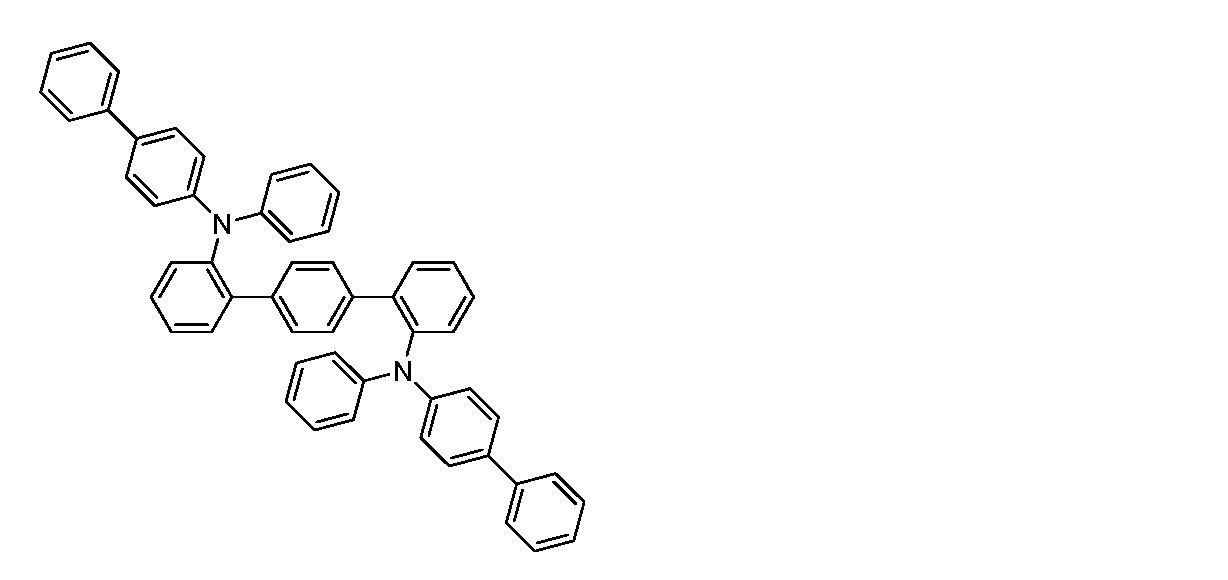
針對獲得之白色粉體使用NMR鑑別結構。1 H-NMR(THF-d8 )檢測到以下40個氫的信號。 δ(ppm)=7.52(4H)、7.40-7.20(18H)、7.03(8H)、6.90-6.75(10H)NMR was used to identify the structure of the obtained white powder. 1 H-NMR (THF-d 8 ) detected the following 40 hydrogen signals. δ (ppm) = 7.52 (4H), 7.40-7.20 (18H), 7.03 (8H), 6.90-6.75 (10H)
<實施例5:化合物1-32> 4-{(聯苯-4-基)-苯胺基}-2’’-{(9,9-二甲基-9H-茀-2-基)-苯胺基}-1,1’:4’,1’’-聯三苯之合成; 於經氮氣取代之反應容器中添加N-(聯苯-4-基)-N-(2’’-溴-1,1’:4’,1’’-聯三苯-4-基)苯胺10.0g、2-(苯胺基)-9,9-二甲基-9H-茀6.2g、乙酸鈀0.081g、第三丁醇鈉3.5g、三第三丁基膦之50%(w/v)甲苯溶液0.146g及甲苯100ml並加熱,於100℃攪拌一夜。利用過濾去除不溶物,濃縮後實施使用管柱層析(擔體:矽膠、溶離液:庚烷/二氯甲烷)之精製。其結果獲得4-{(聯苯-4-基)-苯胺基}-2’’-{(9,9-二甲基-9H-茀-2-基)-苯胺基}-1,1’:4’,1’’-聯三苯(化合物1-32)之白色粉體4.77g(產率35%)。 【化31】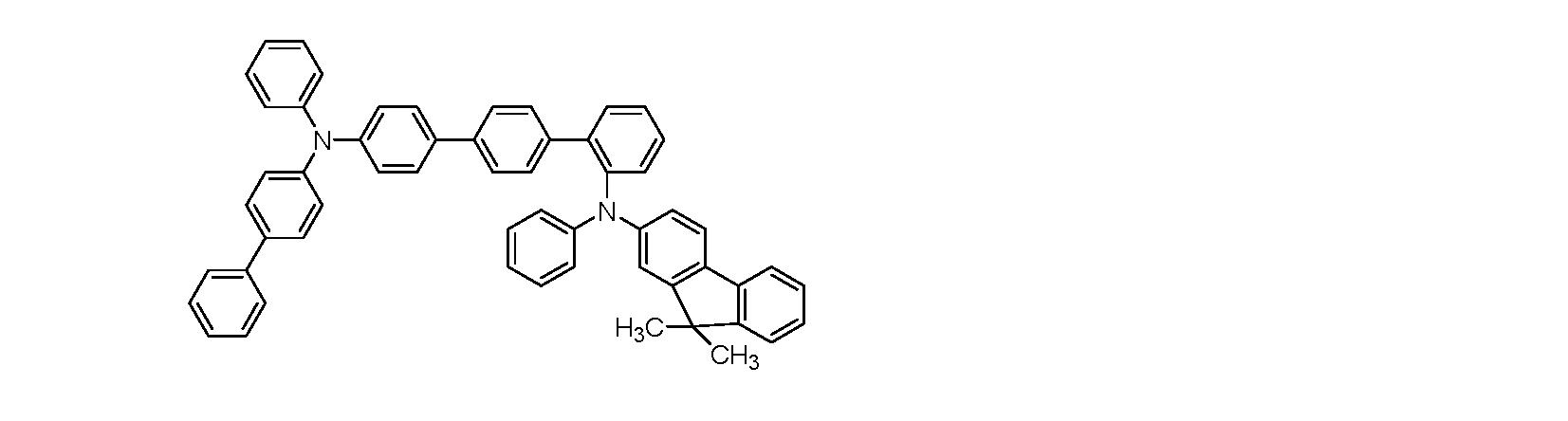
針對獲得之白色粉體使用NMR鑑別結構。1 H-NMR(THF-d8 )檢測到以下44個氫的信號。 δ(ppm)=7.61-7.48(4H)、7.42-6.92(32H)、6.81(1H)、6.76(1H)、1.28(6H)NMR was used to identify the structure of the obtained white powder. 1 H-NMR (THF-d 8 ) detected the following 44 hydrogen signals. δ(ppm)=7.61-7.48(4H), 7.42-6.92(32H), 6.81(1H), 6.76(1H), 1.28(6H)
<實施例6:化合物1-34> 4,4’’-雙{(9,9-二甲基-9H-茀-2-基)-苯胺基}-1,1’:3’,1’’-聯三苯之合成; 於經氮氣取代之反應容器中添加4,4’’-二溴-1,1’:3’,1’’-聯三苯8.81g、2-(苯胺基)-9,9-二甲基-9H-茀13.6g、第三丁醇鈉5.12g、參(二亞苄基丙酮)二鈀0.33g及三第三丁基膦之50%(w/v)甲苯溶液0.63ml並加熱,回流攪拌2小時。放冷後加入甲醇,以過濾收集析出物。將析出物加熱溶解於氯苯,實施使用矽膠之吸附精製,然後實施使用活性白土之吸附精製後,實施使用氯苯/甲醇之混合溶劑之晶析後,實施使用甲醇之回流洗滌。其結果獲得4,4’’-雙{(9,9-二甲基-9H-茀-2-基)-苯胺基}-1,1’:3’,1’’-聯三苯(化合物1-34)之白色粉體16.25g(產率90%)。 【化32】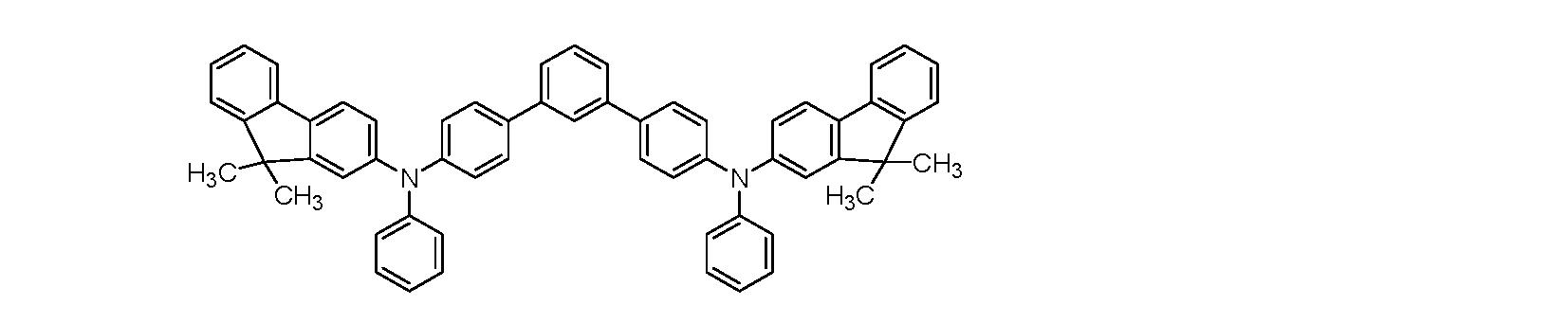
針對獲得之白色粉體使用NMR鑑別結構。1 H-NMR(CDCl3 )檢測到以下48個氫的信號。 δ(ppm)=7.84(1H)、7.70-7.03(35H)、1.48(12H)NMR was used to identify the structure of the obtained white powder. 1 H-NMR (CDCl 3 ) detected the following 48 hydrogen signals. δ (ppm) = 7.84 (1H), 7.70-7.03 (35H), 1.48 (12H)
<實施例7:化合物1-37> 2-{(聯苯-4-基)-苯胺基}-4’’-{(9,9-二甲基-9H-茀-2-基)-苯胺基}-1,1’:4’,1’’-聯三苯之合成; 將實施例5中之N-(聯苯-4-基)-N-(2’’-溴-1, 1’:4’,1’’-聯三苯-4-基)苯胺改為使用N-(9,9-二甲基-9H-茀-2-基)-N- (2’’-溴-1,1’:4’,1’’-聯三苯-4-基)苯胺,2-(苯胺基)-9,9-二甲基-9H-茀改為使用N-(聯苯-4-基)-N-苯基苯胺,除此以外以同樣的條件進行反應。其結果獲得2-{(聯苯-4-基)-苯胺基}-4’’-{(9,9-二甲基-9H-茀-2-基)-苯胺基}-1,1’:4’,1’’-聯三苯(化合物1-37)之白色粉體11.7g(產率73%)。 【化33】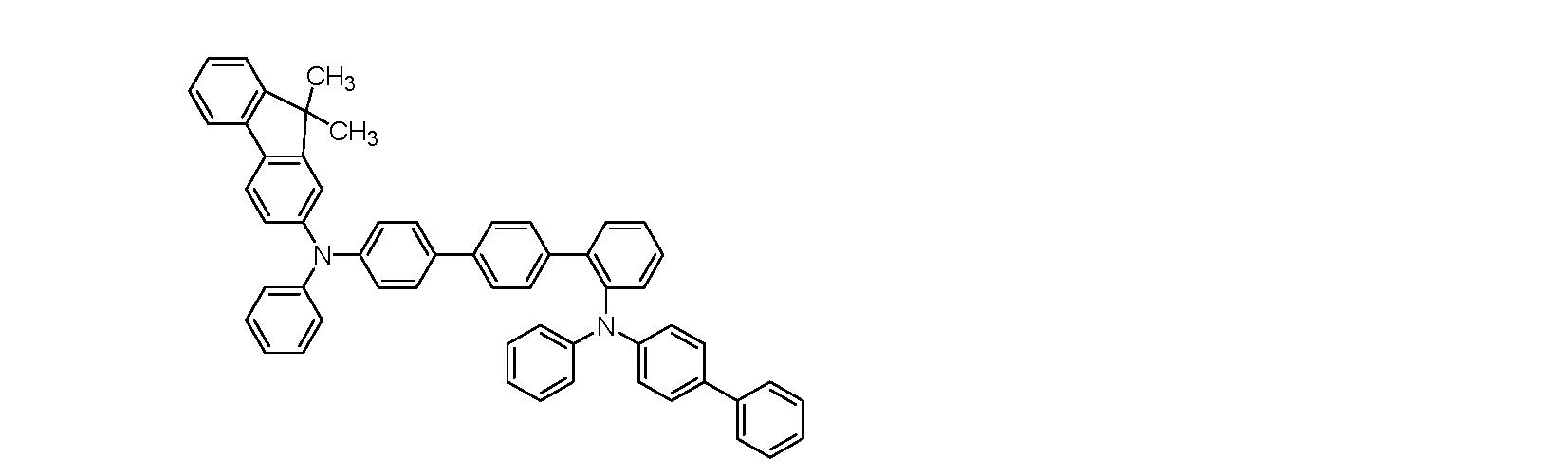
針對獲得之白色粉體使用NMR鑑別結構。1 H-NMR(CDCl3 )檢測到以下44個氫的信號。 δ(ppm)=7.68(1H)、7.64-6.84(37H)、1.48(6H)NMR was used to identify the structure of the obtained white powder. 1 H-NMR (CDCl 3 ) detected the following 44 hydrogen signals. δ(ppm)=7.68(1H), 7.64-6.84(37H), 1.48(6H)
<實施例8:化合物1-38> 4,4’’-雙{N-(9,9-二甲基-9H-茀-2-基)-苯胺基}-1,1’:2’,1’’-聯三苯之合成; 將實施例3中之1,4-二溴苯改為使用1,2-二碘苯,N-(聯苯-4-基)-N-{3-(4,4,5,5-四甲基-[1,3,2]二氧雜環戊硼烷-2-基)苯基}-苯胺改為使用4-{(9,9-二甲基-9H-茀-2-基)-苯基胺基}-苯基硼酸,除此以外以同樣的條件進行反應。其結果獲得4,4’’-雙{N-(9,9-二甲基-9H-茀-2-基)-苯胺基}-1,1’:2’,1’’-聯三苯(化合物1-38)之白色粉體6.6g(產率39%)。 【化34】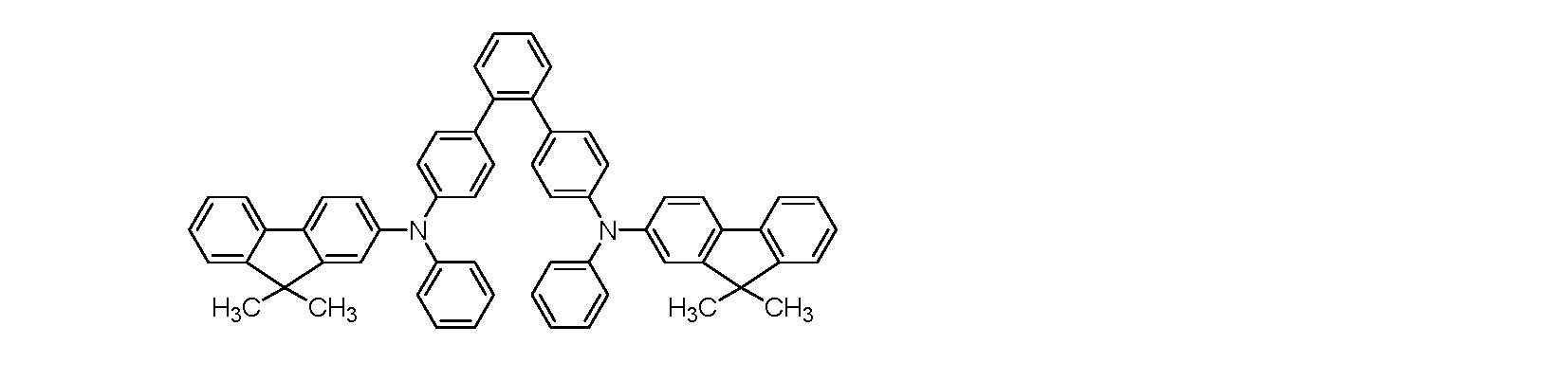
針對獲得之白色粉體使用NMR鑑別結構。1 H-NMR(CDCl3 )檢測到以下48個氫的信號。 δ(ppm)=7.64(2H)、7.58(2H)、7.45-6.99(32H)、1.38(12H)NMR was used to identify the structure of the obtained white powder. 1 H-NMR (CDCl 3 ) detected the following 48 hydrogen signals. δ (ppm) = 7.64 (2H), 7.58 (2H), 7.45-6.99 (32H), 1.38 (12H)
<實施例9:化合物1-39> 4,4’’-雙{N-雙(聯苯-4-基)胺基}-1,1’:2’,1’’-聯三苯之合成; 將實施例3中之1,4-二溴苯改為使用1,2-二碘苯, N-(聯苯-4-基)-N-{3-(4,4,5,5-四甲基-[1,3,2]二氧雜環戊硼烷-2-基)苯基}-苯胺改為使用4-{雙(聯苯-4-基)胺基}-苯基硼酸,除此以外以同樣條件實施反應。其結果獲得4,4’’-雙{N-雙(聯苯-4-基)胺基}-1,1’:2’,1’’-聯三苯(化合物1-39)之白色粉體4.6g(產率24%)。 【化35】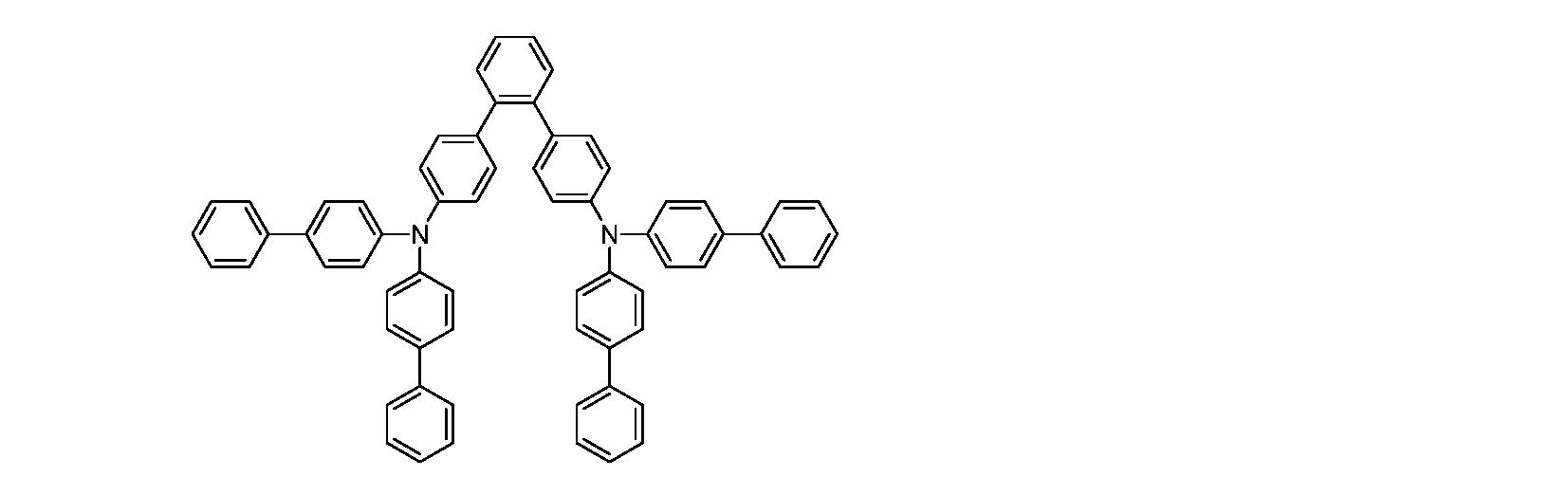
針對獲得之白色粉體使用NMR鑑別結構。1 H-NMR(CDCl3 )檢測到以下48個氫的信號。 δ(ppm)=7.57-7.28(32H)、7.21(8H)、7.11(8H)NMR was used to identify the structure of the obtained white powder. 1 H-NMR (CDCl 3 ) detected the following 48 hydrogen signals. δ(ppm)=7.57-7.28(32H), 7.21(8H), 7.11(8H)
<實施例10:化合物1-41> 4,4’’-雙{(聯苯-4-基)-(萘-1-基)胺基}-1,1’:2’,1’’-聯三苯之合成; 將實施例6中之4,4’’-二溴-1,1’:3’,1’’-聯三苯改為使用4,4’’-二溴-1,1’:2’,1’’-聯三苯, 2-(苯胺基)-9,9-二甲基-9H-茀改為使用N-(聯苯-4-基)-(萘-1-基)胺,除此以外以同樣的條件進行反應。其結果獲得4,4’’-雙{(聯苯-4-基)-(萘-1-基)胺基}-1,1’:2’,1’’-聯三苯(化合物1-41)之白色粉體5.0g(產率30%)。 【化36】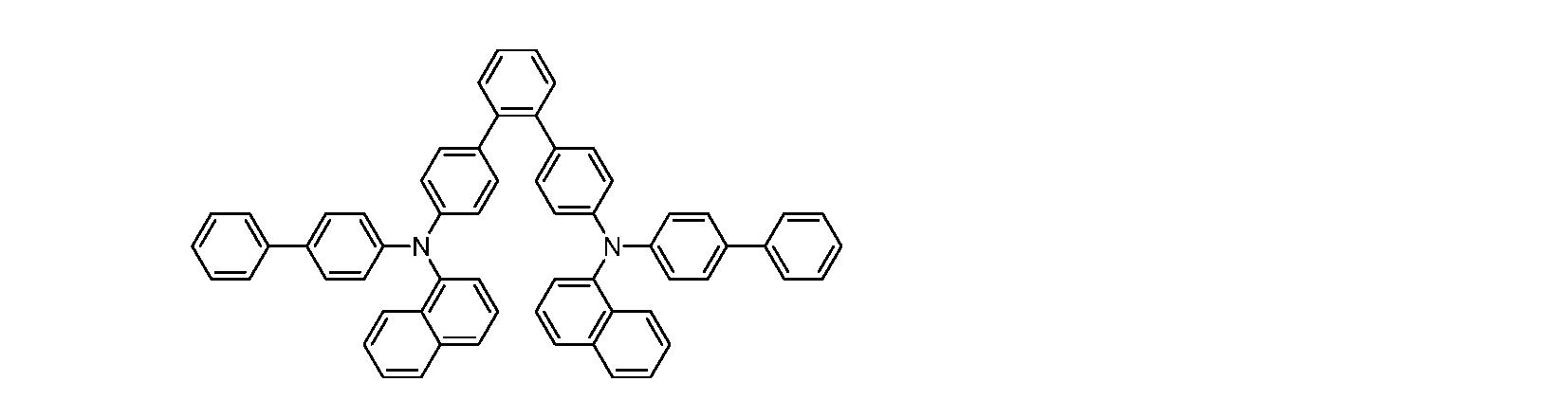
針對獲得之白色粉體使用NMR鑑別結構。1 H-NMR(CDCl3 )檢測到以下44個氫的信號。 δ(ppm)=7.93-7.84(4H)、7.79(2H)、7.60-7.26(24H)、7.25-6.92(14H)NMR was used to identify the structure of the obtained white powder. 1 H-NMR (CDCl 3 ) detected the following 44 hydrogen signals. δ(ppm)=7.93-7.84(4H), 7.79(2H), 7.60-7.26(24H), 7.25-6.92(14H)
<實施例11:化合物1-42> 4,4’’-雙[{4-(萘-1-基)苯基}-苯胺基]-1,1’:2’,1’’-聯三苯之合成; 將實施例6中之4,4’’-二溴-1,1’:3’,1’’-聯三苯改為使用4,4’’-二溴-1,1’:2’,1’’-聯三苯, 2-(苯胺基)-9,9-二甲基-9H-茀改為使用{4-(萘-1-基)苯基}-苯胺,除此以外以同樣的條件進行反應。其結果獲得4,4’’-雙[{4-(萘-1-基)苯基}-苯胺基]-1,1’:2’,1’’-聯三苯(化合物1-42)之白色粉體7.3g(產率43%)。 【化37】
針對獲得之白色粉體使用NMR鑑別結構。1 H-NMR(CDCl3 )檢測到以下44個氫的信號。 δ(ppm)=8.01(2H)、7.91(2H)、7.84(2H)、7.53-6.98(38H)NMR was used to identify the structure of the obtained white powder. 1 H-NMR (CDCl 3 ) detected the following 44 hydrogen signals. δ(ppm)=8.01(2H), 7.91(2H), 7.84(2H), 7.53-6.98(38H)
<實施例12:化合物1-45> 4,4’’-雙[{4-(萘-1-基)苯基}-苯胺基]-1,1’:3’,1’’-聯三苯之合成; 將實施例6中之2-(苯胺基)-9,9-二甲基-9H-茀改為使用{4-(萘-1-基)苯基}-苯胺,除此以外以同樣的條件進行反應。其結果獲得4,4’’-雙[{4-(萘-1-基)苯基}-苯胺基]-1,1’:3’,1’’-聯三苯(化合物1-45)之白色粉體16.7g(產率79%)。 【化38】
針對獲得之白色粉體使用NMR鑑別結構。1 H-NMR(CDCl3 )檢測到以下44個氫的信號。 δ(ppm)=8.08(2H)、7.94(2H)、7.90-7.80(3H)、7.65-7.00(37H)NMR was used to identify the structure of the obtained white powder. 1 H-NMR (CDCl 3 ) detected the following 44 hydrogen signals. δ (ppm) = 8.08 (2H), 7.94 (2H), 7.90-7.80 (3H), 7.65-7.00 (37H)
<實施例13:化合物1-47> 2,2’’-雙{(9,9-二甲基-9H-茀-2-基)-苯胺基}-1,1’:3’,1’’-聯三苯之合成; 將實施例3中之1,4-二溴苯改為使用1,3-二碘苯, N-(聯苯-4-基)-N-{3-(4,4,5,5-四甲基-[1,3,2]二氧雜環戊硼烷-2-基)苯基}-苯胺改為使用2-{(9,9-二甲基-9H-茀-2-基)-苯基胺基}-苯基硼酸,除此以外以同樣的條件進行反應。其結果獲得2,2’’-雙{(9,9-二甲基-9H-茀-2-基)-苯胺基}-1,1’:3’,1’’-聯三苯(化合物1-47)之白色粉體4.2g(產率25%)。 【化39】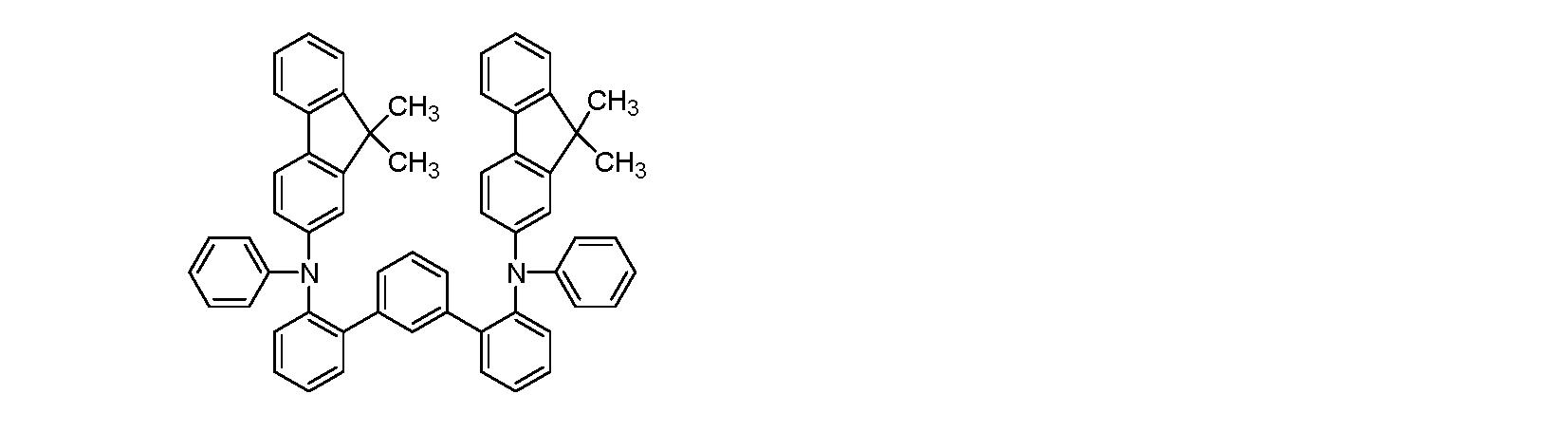
針對獲得之白色粉體使用NMR鑑別結構。1 H-NMR(CDCl3 )檢測到以下48個氫的信號。 δ(ppm)=7.60(2H)、7.38-7.09(14H)、6.95-6.71(14H)、6.66-6.56(4H)、6.35(2H)、6.26(12H)NMR was used to identify the structure of the obtained white powder. 1 H-NMR (CDCl 3 ) detected the following 48 hydrogen signals. δ (ppm) = 7.60 (2H), 7.38-7.09 (14H), 6.95-6.71 (14H), 6.66-6.56 (4H), 6.35 (2H), 6.26 (12H)
<實施例14:化合物1-49> 2,2’’-雙{(9,9-二甲基-9H-茀-2-基)-苯胺基}-1,1’:4’,1’’-聯三苯之合成; 將實施例3中之N-(聯苯-4-基)-N-{3-(4,4,5,5-四甲基-[1,3,2]二氧雜環戊硼烷-2-基)苯基}-苯胺改為使用2-{(9,9-二甲基-9H-茀-2-基)-苯基胺基}-苯基硼酸,除此以外以同樣的條件進行反應。其結果獲得2,2’’-雙{(9,9-二甲基-9H-茀-2-基)-苯胺基}-1,1’:4’,1’’-聯三苯(化合物1-49)之白色粉體13.7g(產率76%)。 【化40】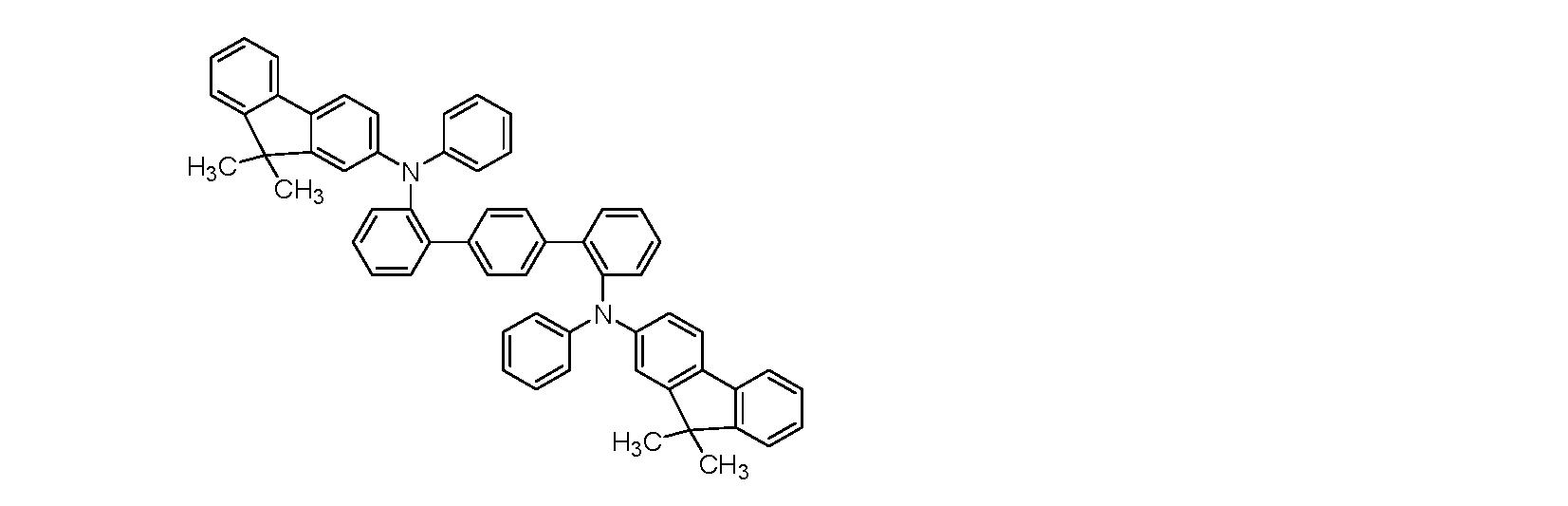
針對獲得之白色粉體使用NMR鑑別結構。1 H-NMR(THF-d8 )檢測到以下48個氫的信號。 δ(ppm)=7.53(2H)、7.35-6.81(30H)、6.76(2H)、6.67(2H)、1.29(12H)NMR was used to identify the structure of the obtained white powder. 1 H-NMR (THF-d 8 ) detected the following 48 hydrogen signals. δ (ppm) = 7.53 (2H), 7.35-6.81 (30H), 6.76 (2H), 6.67 (2H), 1.29 (12H)
<實施例15:化合物1-92> 4,4’’-雙{N-(2-苯基-聯苯-4-基)-N-苯胺基}-1,1’:4’,1’’-聯三苯之合成; 於經氮氣取代之反應容器中添加N-(2-苯基-聯苯-4-基)-N-苯基胺13.1g、4,4’’-二碘-對聯三苯20.0g、銅粉0.18g、碳酸鉀11.3g、3,5-二-第三丁基水楊酸0.70g、亞硫酸氫鈉0.86g及十二基苯30ml並加熱,於210℃攪拌24小時。邊放冷邊添加二甲苯30ml、甲醇60ml,利用過濾收集析出之固體。將取得之固體溶於甲苯,添加二氧化矽40ml,實施吸附精製。濃縮後實施利用乙酸乙酯、甲醇之晶析,然後實施使用氯苯之再結晶所為之精製。然後將固體以甲醇200ml回流洗滌。其結果獲得4,4’’-雙{N-(2-苯基-聯苯-4-基)-N-苯胺基}-1,1’:4’,1’’-聯三苯(化合物1-92)之黃白色粉體17.0g(產率72%)。 【化41】
針對獲得之白色粉體使用NMR鑑別結構。1 H-NMR(CDCl3 )檢測到以下48個氫的信號。 δ(ppm)=7.68(4H)、7.62-7.55(4H)、7.38-7.09(40H)NMR was used to identify the structure of the obtained white powder. 1 H-NMR (CDCl 3 ) detected the following 48 hydrogen signals. δ (ppm) = 7.68 (4H), 7.62-7.55 (4H), 7.38-7.09 (40H)
<熔點及玻璃轉移點之測定> 針對通式(1)之芳胺化合物,利用高感度差示掃描熱量計(Bruker AXS製,DSC3100SA)求取熔點與玻璃轉移點。 熔點 玻璃轉移點 實施例1(化合物1-5) 未觀測到 117℃ 實施例2(化合物1-6) 未觀測到 117℃ 實施例3(化合物1-21) 261℃ 103℃ 實施例5(化合物1-32) 未觀測到 115℃ 實施例6(化合物1-34) 286℃ 124℃ 實施例7(化合物1-37) 218℃ 114℃ 實施例8(化合物1-38) 未觀測到 119℃ 實施例9(化合物1-39) 未觀測到 106℃ 實施例10(化合物1-41) 未觀測到 127℃ 實施例11(化合物1-42) 未觀測到 111℃ 實施例12(化合物1-45) 未觀測到 122℃ 實施例13(化合物1-47) 239℃ 116℃ 實施例14(化合物1-49) 269℃ 117℃ 實施例15(化合物1-92) 249℃ 124℃ 通式(1)之芳胺化合有100℃以上之玻璃轉移點,顯示其薄膜狀態為安定。<Measurement of melting point and glass transition point> For the aromatic amine compound of the general formula (1), the melting point and glass transition point were determined using a high-sensitivity differential scanning calorimeter (manufactured by Bruker AXS, DSC3100SA). Melting point Glass transition point Example 1 (Compound 1-5) 117°C was not observed Example 2 (Compound 1-6) 117°C was not observed Example 3 (Compound 1-21) 261°C 103°C Example 5 (Compound 1-32) 115°C was not observed Example 6 (Compound 1-34) 286°C 124°C Example 7 (Compound 1-37) 218°C 114°C Example 8 (Compound 1-38) No 119°C was observed Example 9 (Compound 1-39) 106°C was not observed Example 10 (Compound 1-41) No 127°C was observed Example 11 (Compound 1-42) No 111°C was observed Example 12 (Compound 1-45) No observation was made at 122°C Example 13 (Compound 1-47) 239°C 116°C Example 14 (Compound 1-49) 269°C 117°C Example 15 (Compound 1-92) 249°C 124° General formula (1) The aromatic amine compound has a glass transition point above 100°C, indicating that the film state is stable.
<工作函數之測定> 使用通式(1)之芳胺化合物在ITO基板上製作膜厚100nm之蒸鍍膜,以游離電位測定裝置(住友重機械工業(股)公司製,PYS-202)測定工作函數。 工作函數 實施例1(化合物1-5) 5.68eV 實施例2(化合物1-6) 5.65eV 實施例3(化合物1-21) 5.79eV 實施例4(化合物1-22) 5.83eV 實施例5(化合物1-32) 5.69eV 實施例6(化合物1-34) 5.65eV 實施例7(化合物1-37) 5.67eV 實施例8(化合物1-38) 5.64eV 實施例9(化合物1-39) 5.66eV 實施例10(化合物1-41) 5.69eV 實施例11(化合物1-42) 5.75eV 實施例12(化合物1-45) 5.76eV 實施例13(化合物1-47) 5.72eV 實施例14(化合物1-49) 5.72eV 實施例15(化合物1-92) 5.67eV 通式(1)之芳胺化合物相較於NPD、TPD等一般電洞輸送材料帶有的工作函數5.4eV,顯示更理想的能量準位,具有良好的電洞輸送能力。<Measurement of work function> Using an aromatic amine compound of the general formula (1), a vapor-deposited film with a thickness of 100 nm was prepared on an ITO substrate, and the measurement work was performed with a free potential measuring device (Sumitomo Heavy Industries, Ltd., PYS-202) function. Working function Example 1 (Compound 1-5) 5.68eV Example 2 (Compound 1-6) 5.65eV Example 3 (Compound 1-21) 5.79eV Example 4 (Compound 1-22) 5.83eV 5.83eV Example 5 ( Compound 1-32) 5.69 eV Example 6 (Compound 1-34) 5.65eV Example 7 (Compound 1-37) 5.67 eV Example 8 (Compound 1-38) 5.64 eV Example 9 (Compound 1-39) 5.66 eV 5.66 eV Example 10 (Compound 1-41) 5.69 eV Example 11 (Compound 1-42) 5.75 eV Example 12 (Compound 1-45) 5.76 eV Example 13 (Compound 1-47) 5.72 eV Example 14 (Compound 1-49) 5.72eV Example 15 (Compound 1-92) 5.67eV The aromatic amine compound of the general formula (1) has a working function of 5.4eV compared to general hole transport materials such as NPD and TPD, showing a more ideal Energy level, with good hole transmission capacity.
<實施例16:化合物2-1> 7,7-二甲基-12-(4-苯基喹唑啉-2-基)-7,12-二氫苯并[4,5]噻吩并[3,2-g]茚并[1,2-b]吲哚之合成; 於經氮氣取代之反應容器中添加7,7-二甲基-7,12-二氫苯并[4,5]噻吩并 [3,2-g]茚并[1,2-b]吲哚4.9g、2-氯-4-苯基喹唑啉5.7g、參(二亞苄基丙酮)二鈀0.3g、三四氟硼酸第三丁基鏻0.4g、第三丁醇鈉4.0g及二甲苯74ml並加熱,回流攪拌12小時。冷卻至室溫後,加入乙酸乙酯、水,利用分液操作收集有機層。將有機層濃縮,實施利用管柱層析所為之精製。其結果獲得7,7-二甲基-12-(4-苯基喹唑啉-2-基)-7,12-二氫苯并[4,5]噻吩并[3,2-g]茚并[1,2-b]吲哚(化合物2-1)之粉體3.0g(產率38%)。 【化42】
<實施例17:化合物2-2> 7,7-二甲基-12-(4-苯基苯并[h]喹唑啉-2-基)-7,12-二氫苯并[4,5]噻吩并[3,2-g]茚并[1,2-b]吲哚之合成 將實施例16中之2-氯-4-苯基喹唑啉改為使用2-氯-4-苯基苯并[h]喹唑啉,除此以外以同樣的條件進行反應。其結果獲得7,7-二甲基-12-(4-苯基苯并[h]喹唑啉-2-基)-7,12-二氫苯并[4,5]噻吩并[3,2-g]茚并[1,2-b]吲哚(化合物2-2)之粉體3.2g(產率38%)。 【化43】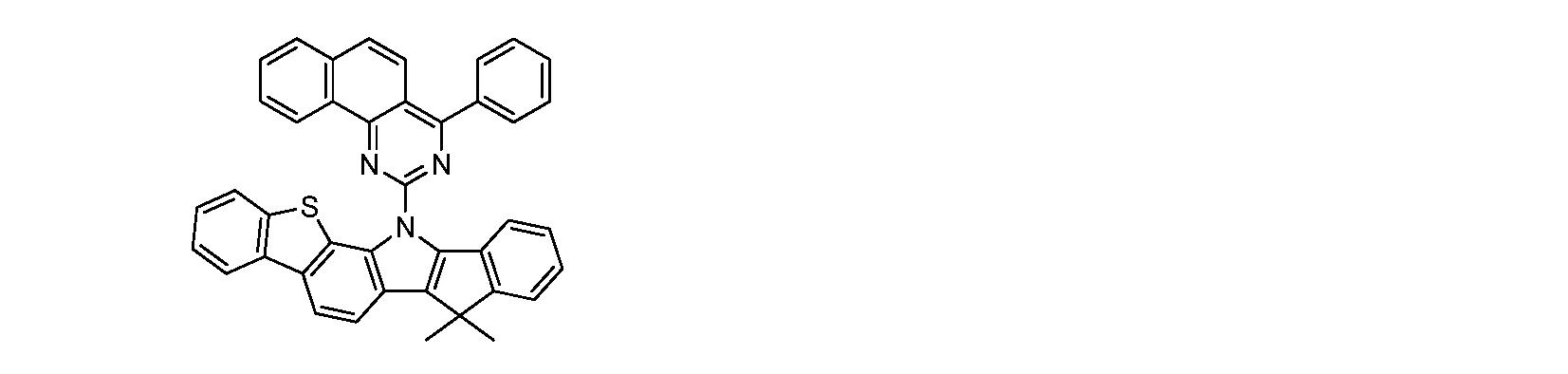
<實施例18:化合物2-3> 12-(4,7-二苯基喹唑啉-2-基)-7,7-二甲基-7,12-二氫苯并[4,5]噻吩并[3,2-g]茚并[1,2-b]吲哚之合成 將實施例16中之2-氯-4-苯基喹唑啉改為使用2-氯-4,7-二苯基喹唑啉,除此以外以同樣的條件進行反應。其結果獲得12-(4,7-二苯基喹唑啉-2-基)-7,7-二甲基-7,12-二氫苯并[4,5]噻吩并[3,2-g]茚并[1,2-b]吲哚(化合物2-3)之粉體3.3g(產率38%)。 【化44】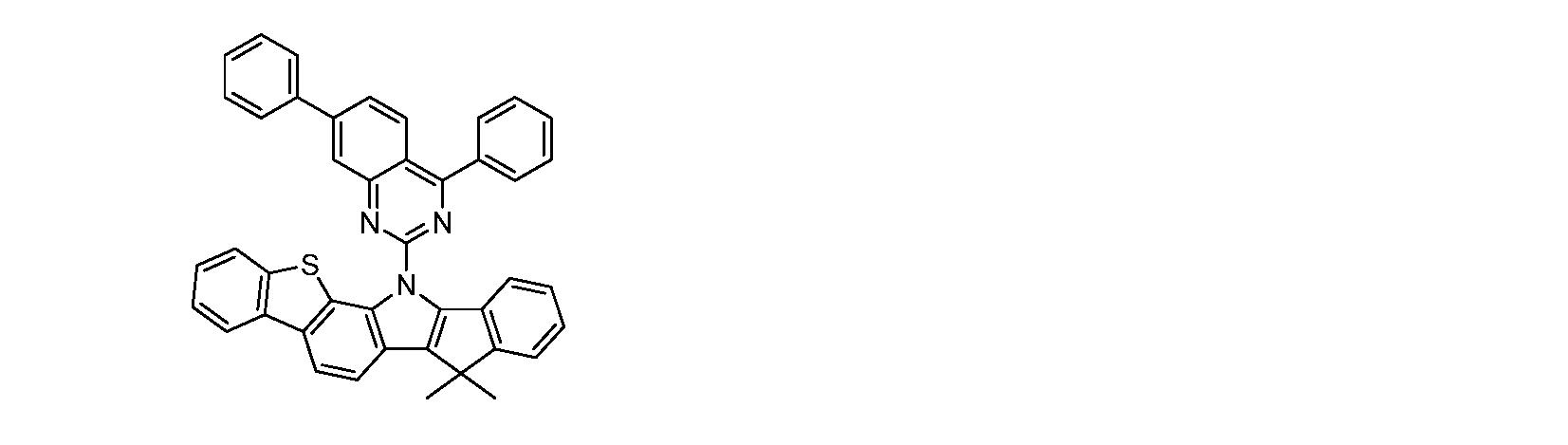
<實施例19:化合物2-4> 12-(4,6-二苯基喹唑啉-2-基)-7,7-二甲基-7,12-二氫苯并[4,5]噻吩并[3,2-g]茚并[1,2-b]吲哚之合成; 將實施例16中之2-氯-4-苯基喹唑啉改為使用2-氯-4,6-二苯基喹唑啉,除此以外以同樣的條件進行反應。其結果獲得12-(4,6-二苯基喹唑啉-2-基)-7,7-二甲基-7,12-二氫苯并[4,5]噻吩并[3,2-g]茚并[1,2-b]吲哚(化合物2-4)之粉體3.3g(產率38%)。 【化45】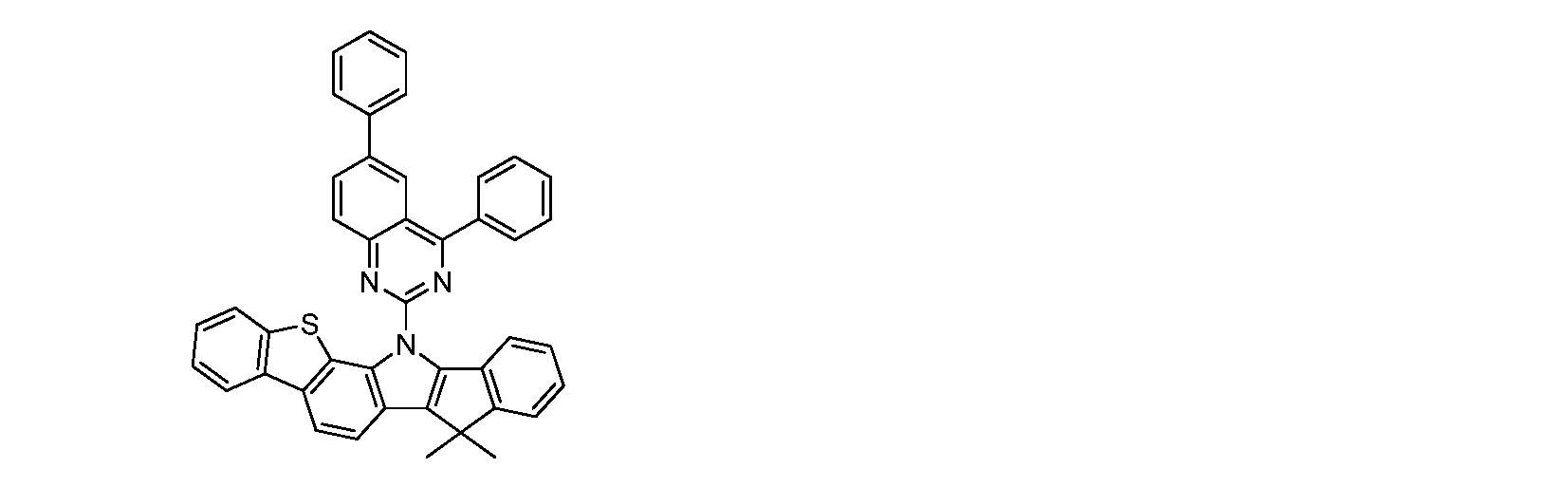
<實施例20:化合物2-5> 13,13-二甲基-8-(4-苯基喹唑啉-2-基)-8,13-二氫苯并[4,5]噻吩并[3,2-e]茚并[1,2-b]吲哚之合成 將實施例16中之7,7-二甲基-7,12-二氫苯并[4,5]噻吩并 [3,2-g]茚并[1,2-b]吲哚改為使用13,13-二甲基-8,13-二氫苯并[4,5]噻吩并[3,2-e]茚并[1,2-b]吲哚,除此以外以同樣的條件進行反應。其結果獲得13,13-二甲基-8-(4-苯基喹唑啉-2-基)-8,13-二氫苯并[4,5]噻吩并[3,2-e]茚并[1,2-b]吲哚(化合物2-5)之粉體3.0g(產率38%)。 【化46】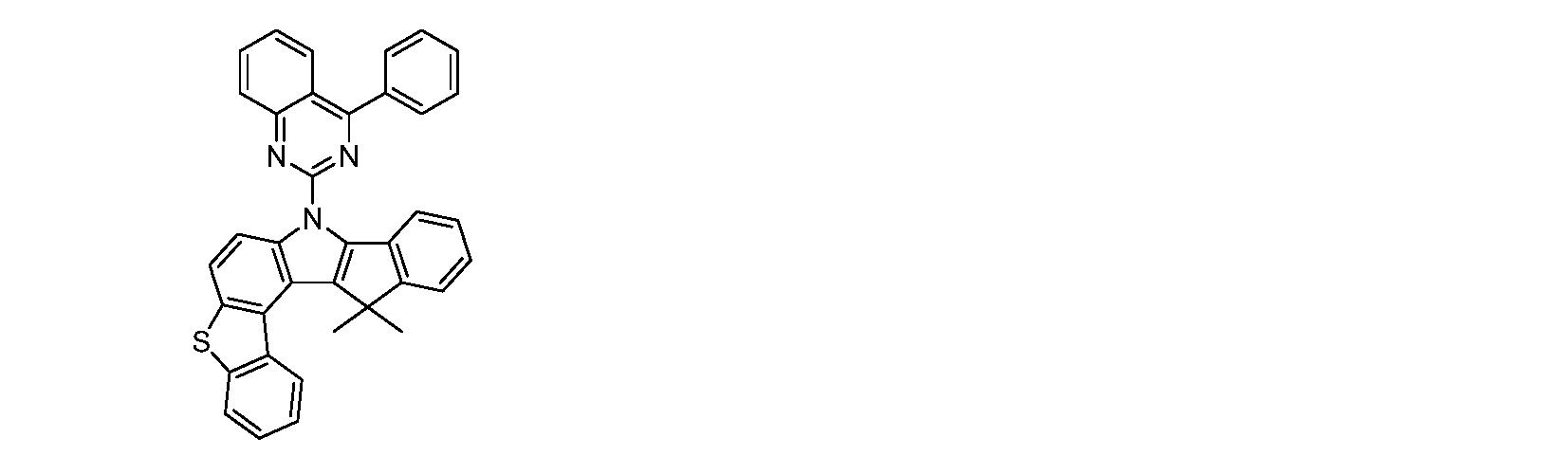
<實施例21:化合物2-6> 8-(4,6-二苯基喹唑啉-2-基)-13,13-二甲基-8,13-二氫苯并[4,5]噻吩并[3,2-e]茚并[1,2-b]吲哚之合成 將實施例20中之2-氯-4-苯基喹唑啉改為使用2-氯-4,6-二苯基喹唑啉,除此以外以同樣的條件進行反應。其結果獲得8-(4,6-二苯基喹唑啉-2-基)-13,13-二甲基-8,13-二氫苯并[4,5]噻吩并[3,2-e]茚并[1,2-b]吲哚(化合物2-6)之粉體3.3g(產率38%)。 【化47】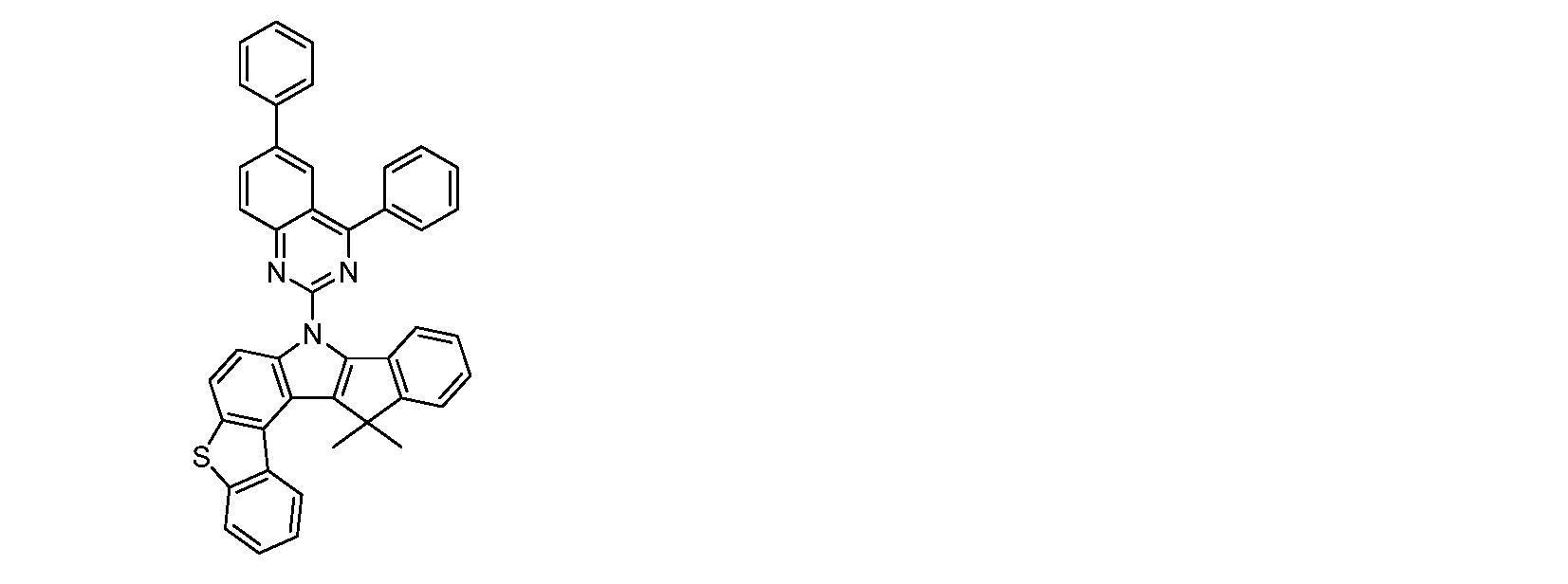
<實施例22:化合物2-7> 7,7,13,13-四甲基-5-(4-苯基喹唑啉-2-基)-7,13-二氫-5H-二茚并[1,2-b:1’,2’-f]吲哚之合成 將實施例16中之7,7-二甲基-7,12-二氫苯并[4,5]噻吩并[3,2-g]茚并[1,2-b]吲哚改為使用7,7,13,13-四甲基-7,13-二氫-5H-二茚并[1,2-b:1’,2’-f]吲哚,除此以外以同樣的條件進行反應。其結果獲得7,7,13,13-四甲基-5-(4-苯基喹唑啉-2-基)-7,13-二氫-5H-二茚并[1,2-b:1’,2’-f]吲哚(化合物2-7)之粉體3.0g(產率38%)。 【化48】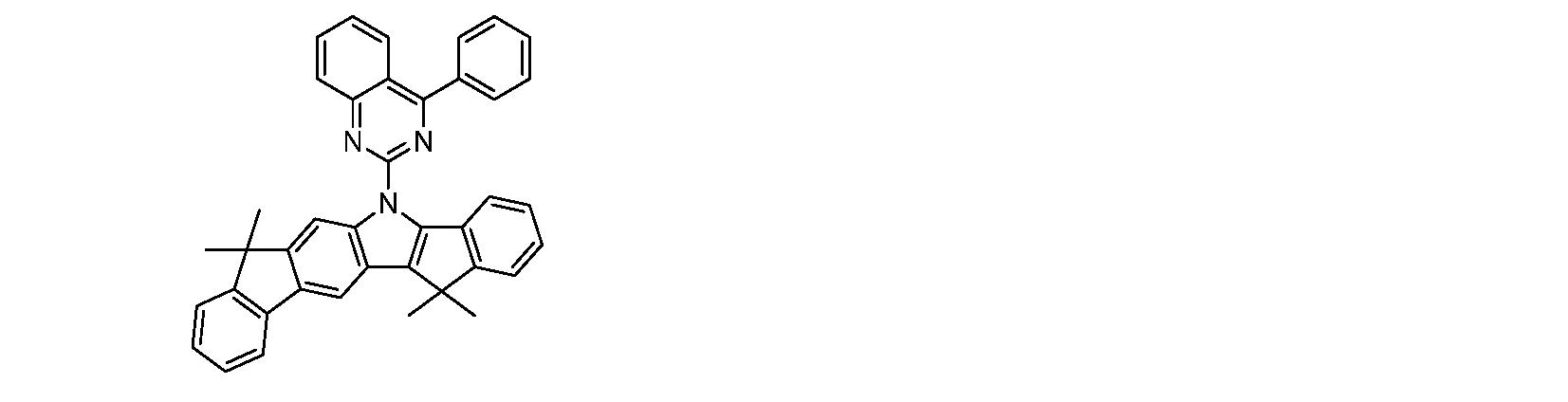
<實施例23:化合物2-8> 7,7,13,13-四甲基-5-[3-(4-苯基喹唑啉-2-基)苯基]-7,13-二氫-5H-二茚并[1,2-b:1’,2’-f]吲哚之合成 將實施例22中之2-氯-4-苯基喹唑啉改為使用2-(3-溴苯基)-4-苯基喹唑啉,除此以外以同樣的條件進行反應。其結果獲得7,7,13,13-四甲基-5-[3-(4-苯基喹唑啉-2-基)苯基]-7,13-二氫-5H-二茚并[1,2-b:1’,2’-f]吲哚(化合物2-8)之粉體3.4g(產率38%)。 【化49】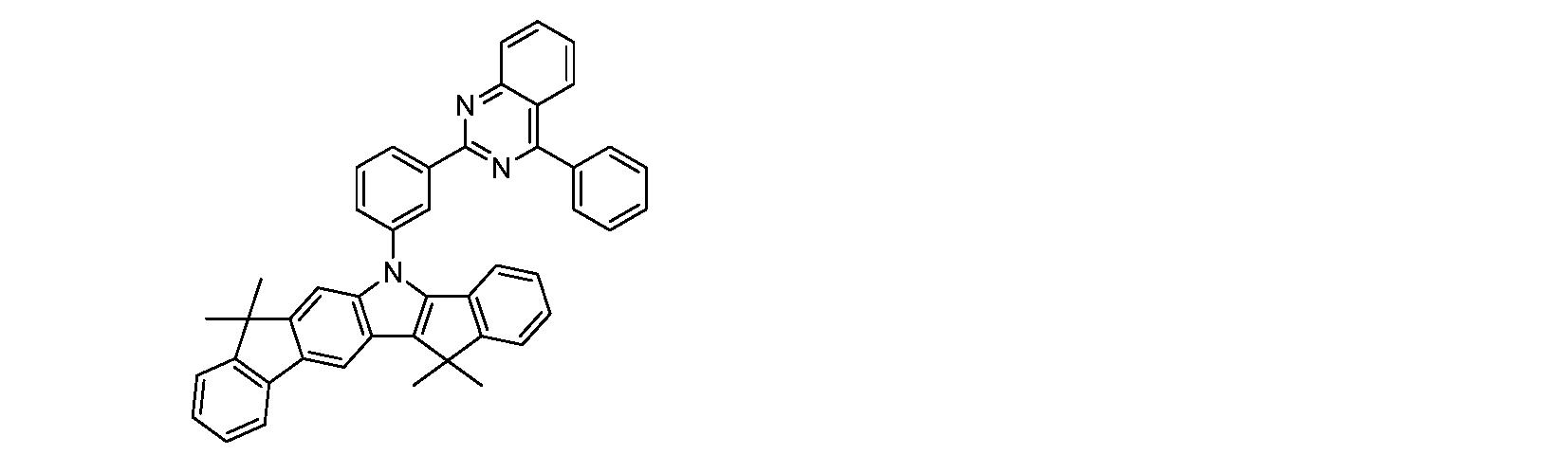
<實施例24:化合物2-9> 7,7-二甲基-12-(4-苯基苯并[h]喹唑啉-2-基)-7,12-二氫苯并呋喃并[3,2-g]茚并[1,2-b]吲哚之合成 將實施例17中之7,7-二甲基-7,12-二氫苯并[4,5]噻吩并 [3,2-g]茚并[1,2-b]吲哚改為使用7,7-二甲基-7,12-二氫苯并呋喃并[3,2-g]茚并[1,2-b]吲哚,除此以外以同樣的條件進行反應。其結果獲得7,7-二甲基-12-(4-苯基苯并[h]喹唑啉-2-基)-7,12-二氫苯并呋喃并[3,2-g]茚并[1,2-b]吲哚(化合物2-9)之粉體3.0g(產率38%)。 【化50】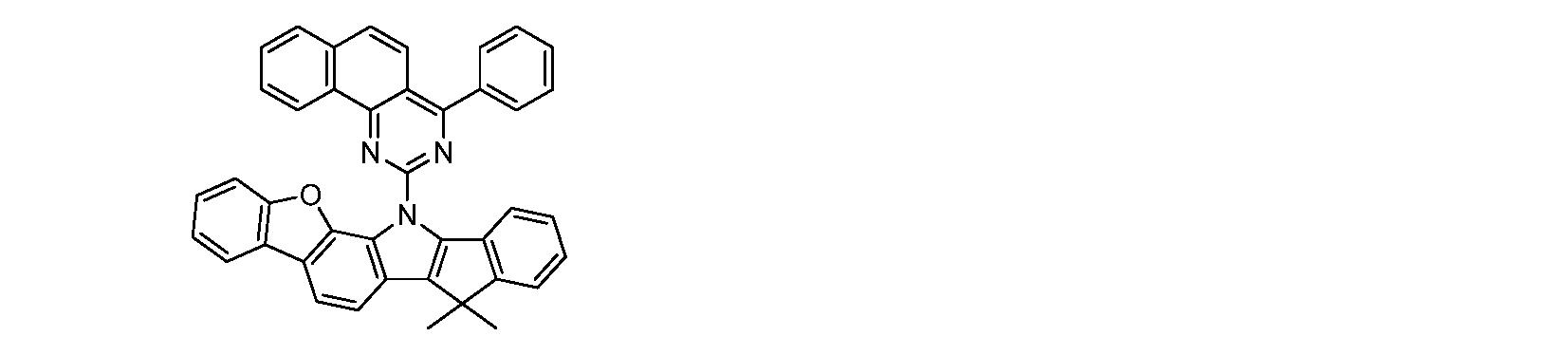
<實施例25:化合物2-10> 12-(4,6-二苯基苯并[h]喹唑啉-2-基)-7,7-二甲基-7,12-二氫苯并呋喃并[3,2-g]茚并[1,2-b]吲哚之合成 將實施例24中之2-氯-4-苯基苯并[h]喹唑啉 改為使用2-氯-4,6-二苯基苯并[h]喹唑啉,除此以外以同樣的條件進行反應。其結果獲得12-(4,6-二苯基苯并[h]喹唑啉-2-基)-7,7-二甲基-7,12-二氫苯并呋喃并[3,2-g]茚并[1,2-b]吲哚(化合物2-10)之粉體3.5g(產率38%)。 【化51】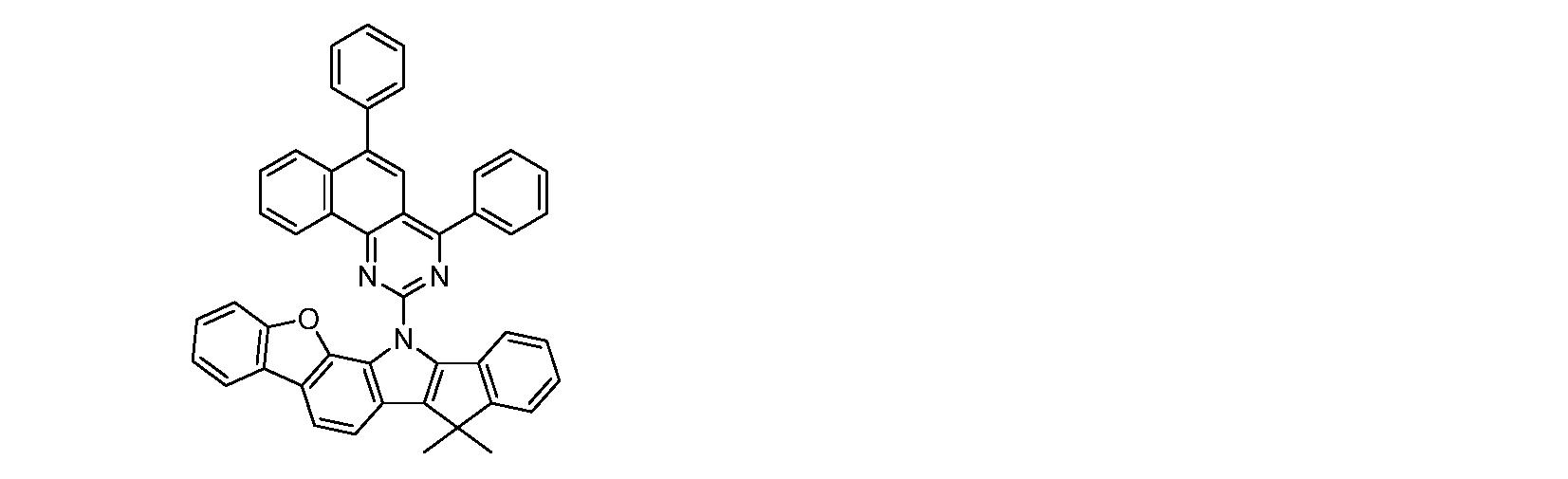
<實施例26:化合物2-11> 13,13-二甲基-8-(4-苯基喹唑啉-2-基)-8,13-二氫苯并呋喃并[3,2-e]茚并[1,2-b]吲哚之合成; 將實施例16中之7,7-二甲基-7,12-二氫苯并[4,5]噻吩并 [3,2-g]茚并[1,2-b]吲哚改為使用13,13-二甲基-8,13-二氫苯并呋喃并[3,2-e]茚并[1,2-b]吲哚,除此以外以同樣的條件進行反應。其結果獲得13,13-二甲基-8-(4-苯基喹唑啉-2-基)-8,13-二氫苯并呋喃并[3,2-e]茚并[1,2-b]吲哚(化合物2-11)之粉體3.0g(產率38%)。 【化52】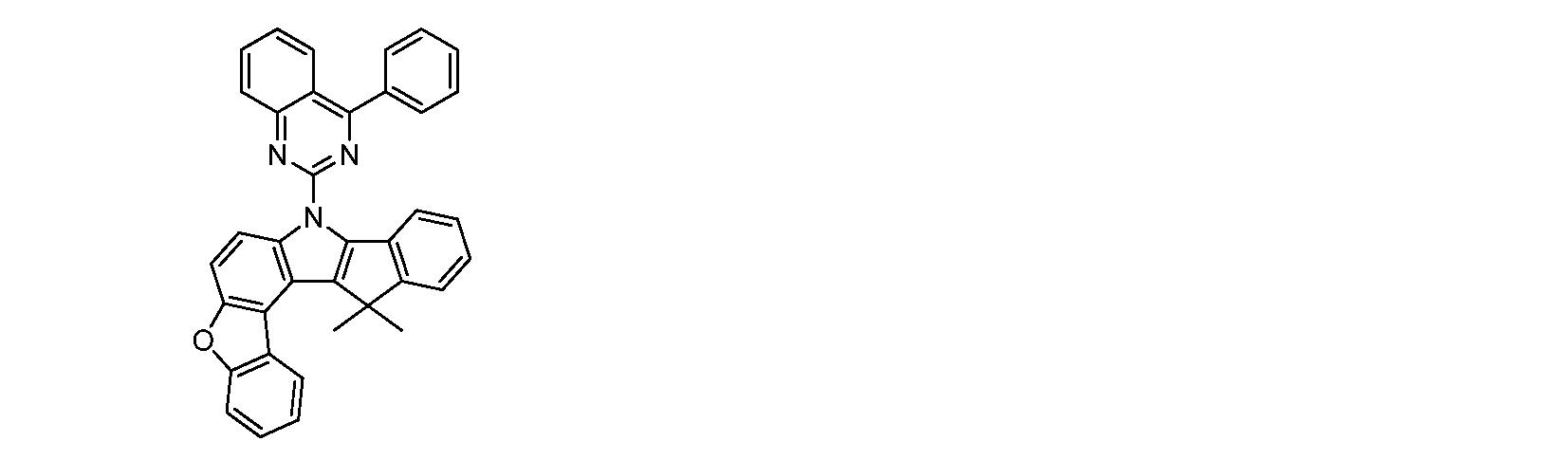
<實施例27:化合物2-12> 13,13-二甲基-8-(4,6-二苯基喹唑啉-2-基)-8,13-二氫苯并呋喃并[3,2-e]茚并[1,2-b]吲哚之合成; 將實施例26中之2-氯-4-苯基喹唑啉改為使用2-氯-4,6-二苯基喹唑啉,除此以外以同樣的條件進行反應。其結果獲得13,13-二甲基-8-(4,6-二苯基喹唑啉-2-基)-8,13-二氫苯并呋喃并[3,2-e]茚并[1,2-b]吲哚(化合物2-12)之粉體3.2g(產率38%)。 【化53】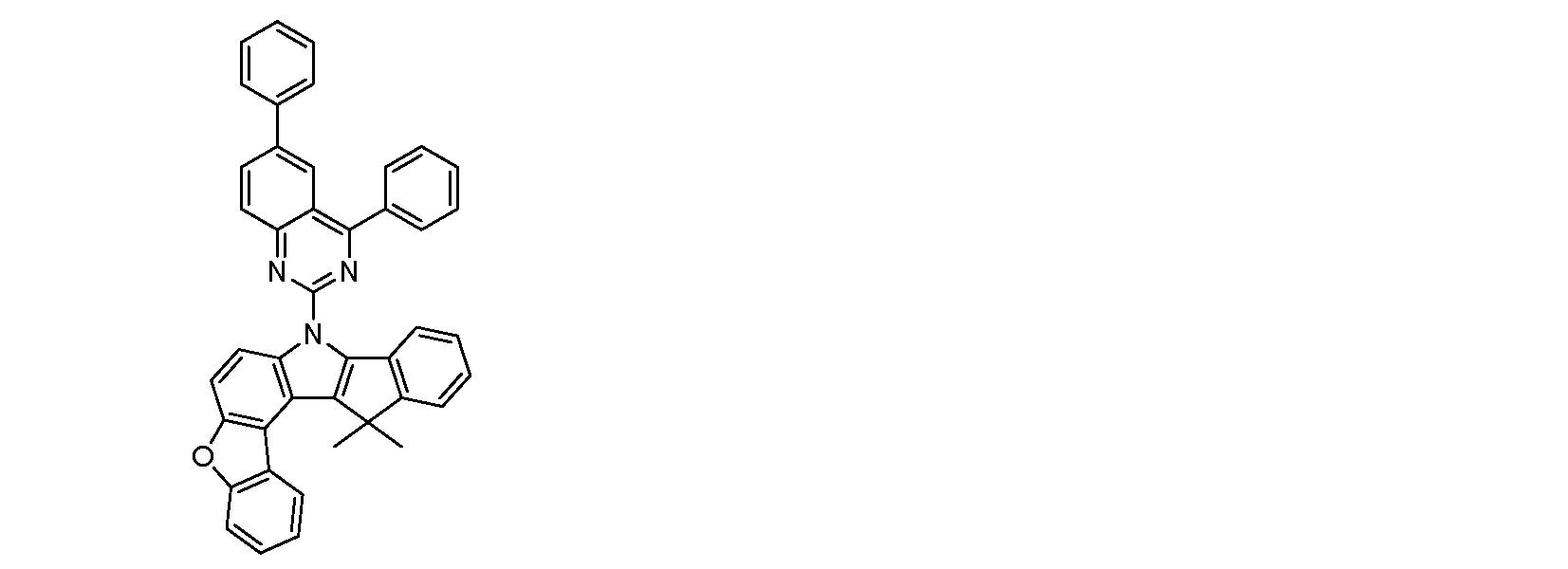
<實施例28:化合物3-1> 13-(4,6-二苯基喹唑啉-2-基)-7,7-二甲基-7,13-二氫茚并[2’,1’:4,5]噻吩并[2,3-a]咔唑之合成; 將實施例27中之13,13-二甲基-8,13-二氫苯并呋喃并[3,2-e]茚并[1,2-b]吲哚改為使用7,7-二甲基-7,13-二氫茚并[2’,1’:4,5]噻吩并[2,3-a]咔唑,除此以外以同樣的條件進行反應。其結果獲得13-(4,6-二苯基喹唑啉-2-基)-7,7-二甲基-7,13-二氫茚并[2’,1’:4,5]噻吩并[2,3-a]咔唑(化合物3-1)之粉體7.0g(產率38%)。 【化54】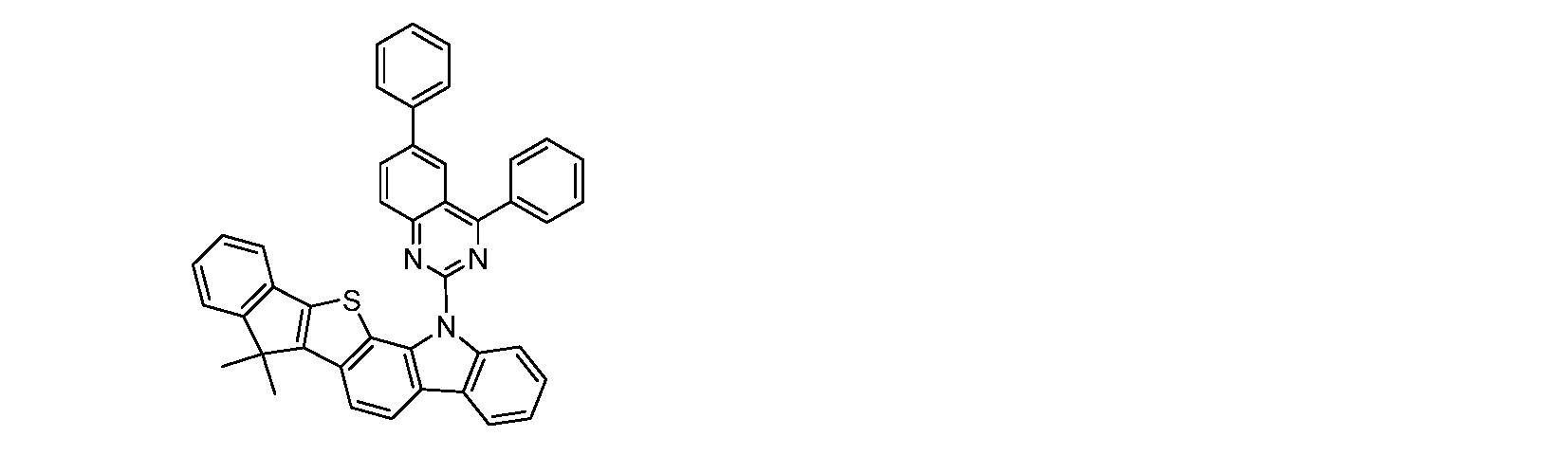
<實施例29:化合物3-2> 13-[4-(聯苯-4-基)喹唑啉-2-基]-7,7-二甲基-7,13-二氫茚并[2’,1’:4,5]噻吩并[2,3-a]咔唑之合成; 將實施例28中之2-氯-4,6-二苯基喹唑啉改為使用4-(聯苯-4-基)-2-氯喹唑啉,除此以外以同樣的條件進行反應。其結果獲得13-[4-(聯苯-4-基)喹唑啉-2-基]-7,7-二甲基-7,13-二氫茚并[2’,1’:4,5]噻吩并[2,3-a]咔唑(化合物3-2)之粉體6.7g(產率37%)。 【化55】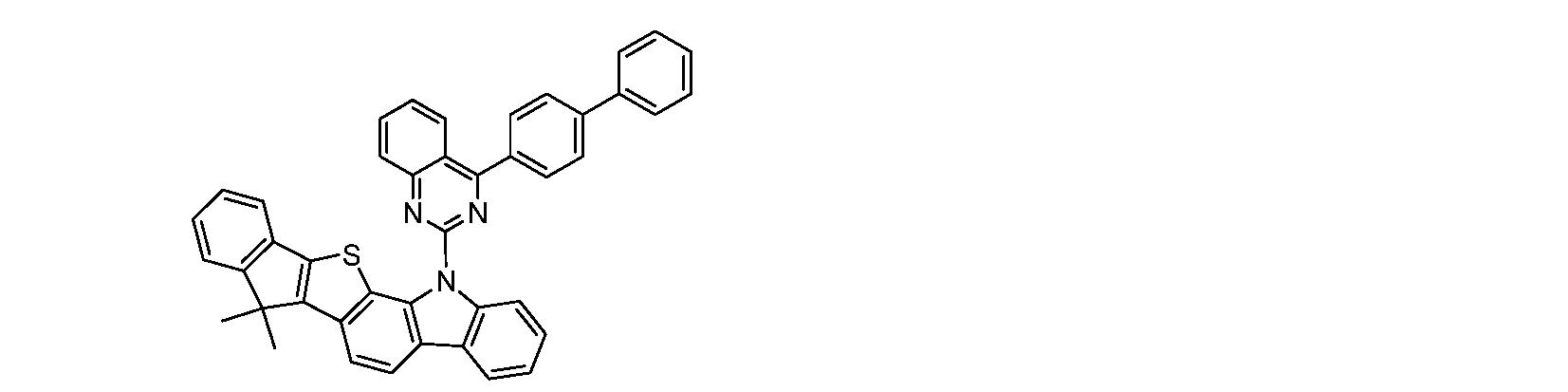
<實施例30:化合物3-3> 7,7-二甲基-13-[4-(苯基-d5
)喹唑啉-2-基]-7,13-二氫茚并[2’,1’:4,5]噻吩并[2,3-a]咔唑之合成; 將實施例28中之2-氯-4,6-二苯基喹唑啉改為使用2-氯-4-(苯基-d5
)喹唑啉,除此以外以同樣的條件進行反應。其結果獲得7,7-二甲基-13-[4-(苯基-d5
)喹唑啉-2-基]-7,13-二氫茚并[2’,1’:4,5]噻吩并[2,3-a]咔唑(化合物3-3)之粉體8.4g(產率32%)。 【化56】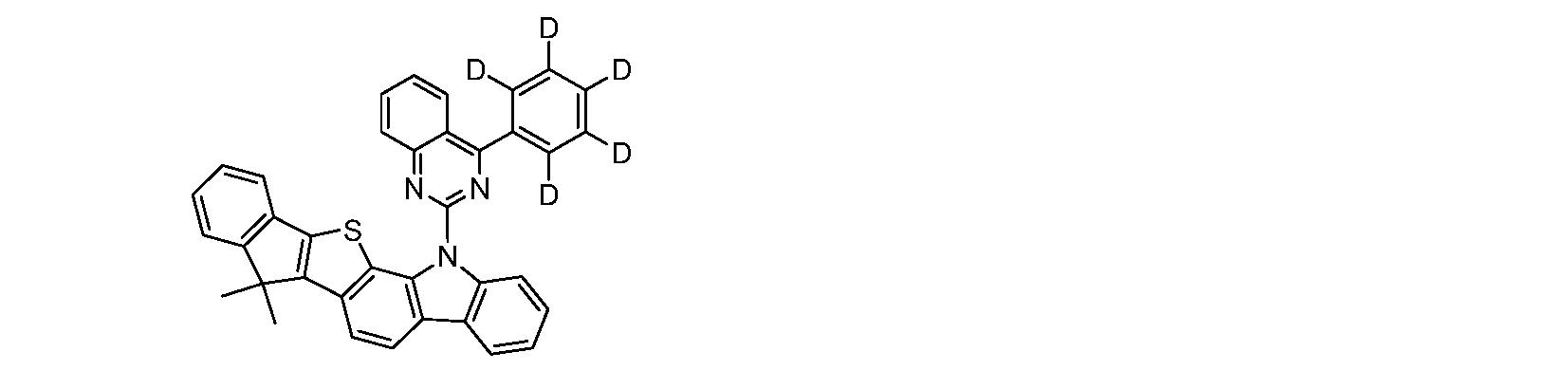
<實施例31:化合物3-4> 7,7-二甲基-13-[4-(4-苯基喹唑啉-2-基)苯基]-7,13-二氫茚并[2’,1’:4,5]噻吩并[2,3-a]咔唑之合成; 將實施例28中之2-氯-4,6-二苯基喹唑啉改為使用2-(4-溴苯基)-4-苯基喹唑啉,除此以外以同樣的條件進行反應。其結果獲得7,7-二甲基-13-[4-(4-苯基喹唑啉-2-基)苯基]-7,13-二氫茚并[2’,1’:4,5]噻吩并[2,3-a]咔唑(化合物3-4)之粉體5.2g(產率28%)。 【化57】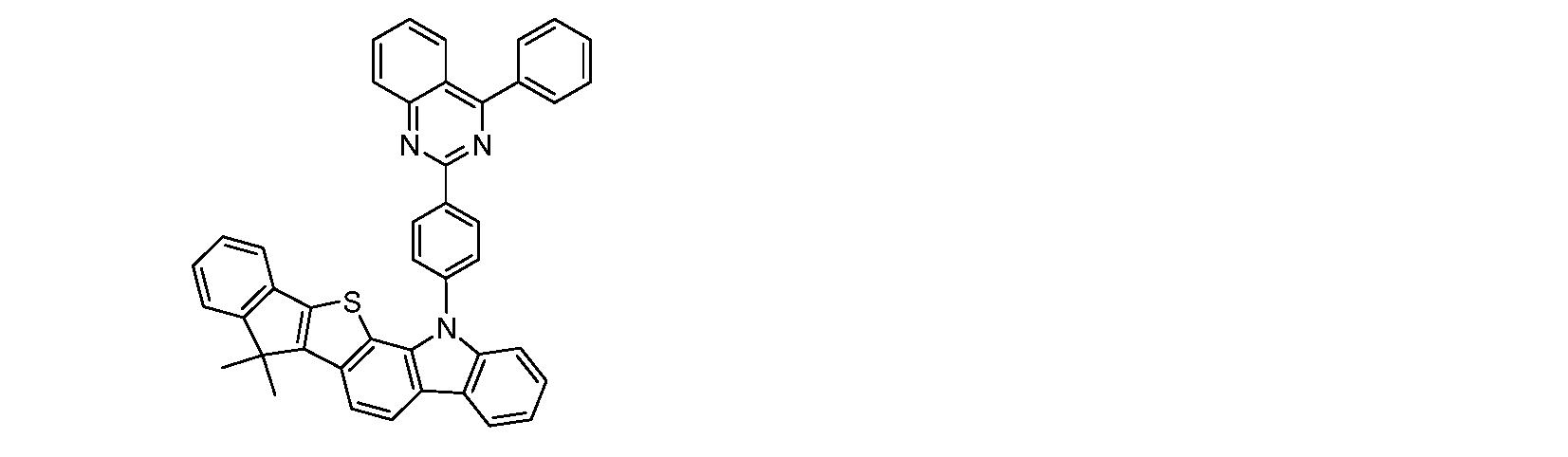
<實施例32:化合物3-5> 7,7-二甲基-13-[3-(4-苯基喹唑啉-2-基)苯基]-7,13-二氫茚并[2’,1’:4,5]噻吩并[2,3-a]咔唑之合成; 將實施例28中之2-氯-4,6-二苯基喹唑啉改為使用2-(3-溴苯基)-4-苯基喹唑啉,除此以外以同樣的條件進行反應。其結果獲得7,7-二甲基-13-[3-(4-苯基喹唑啉-2-基)苯基]-7,13-二氫茚并[2’,1’:4,5]噻吩并[2,3-a]咔唑(化合物3-5)之粉體8.4g(產率32%)。 【化58】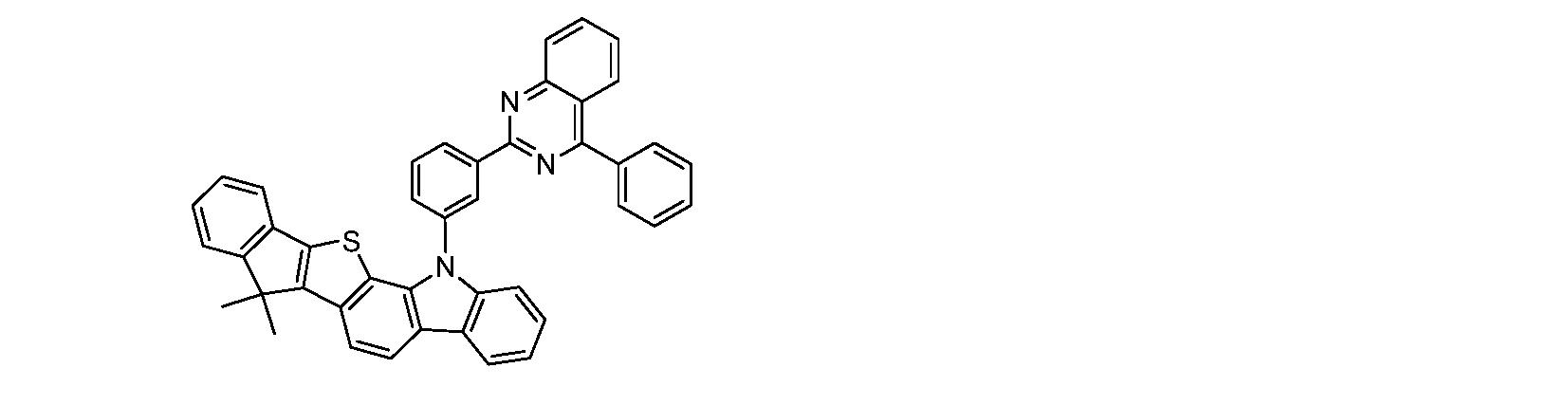
<實施例33:化合物3-6> 7,7-二甲基-13-(4-苯基苯并[h]喹唑啉-2-基)-7,13-二氫茚并[2’,1’:4,5]噻吩并[2,3-a]咔唑之合成; 將實施例28中之2-氯-4,6-二苯基喹唑啉改為使用2-氯-4-苯基苯并[h]喹唑啉,除此以外以同樣的條件進行反應。其結果獲得7,7-二甲基-13-(4-苯基苯并[h]喹唑啉-2-基)-7,13-二氫茚并[2’,1’:4,5]噻吩并[2,3-a]咔唑(化合物3-6)之粉體8.4g(產率32%)。 【化59】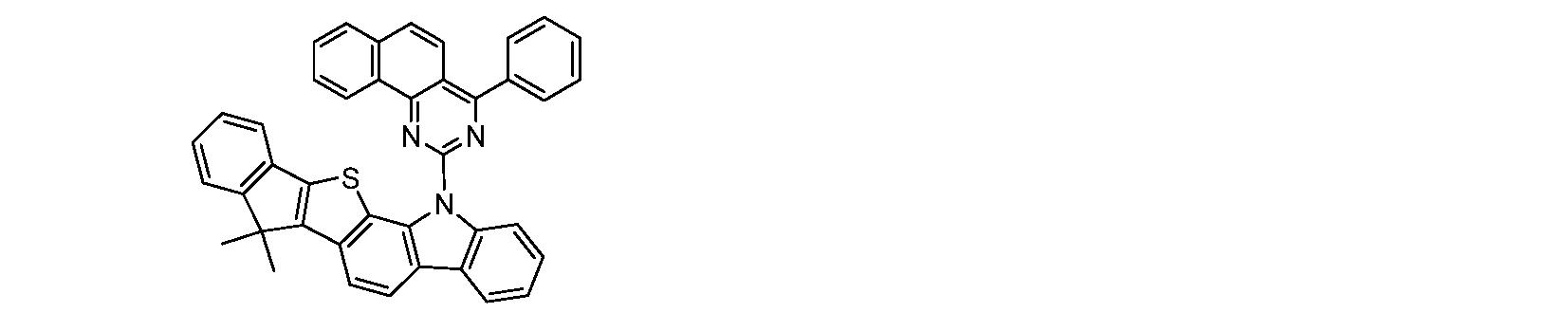
<實施例34:化合物3-7> 8,8-二甲基-5-(4-苯基苯并[h]喹唑啉-2-基)-5,8-二氫茚并[2’,1’:4,5]噻吩并[3,2-c]咔唑之合成; 將實施例33中之7,7-二甲基-7,13-二氫茚并[2’,1’:4,5]噻吩并[2,3-a]咔唑改為使用8,8-二甲基-5,8-二氫茚并[2’,1’:4,5]噻吩并[3,2-c]咔唑,除此以外以同樣的條件進行反應。其結果獲得8,8-二甲基-5-(4-苯基苯并[h]喹唑啉-2-基)-5,8-二氫茚并[2’,1’:4,5]噻吩并[3,2-c]咔唑(化合物3-7)之粉體9.3g(產率35%)。 【化60】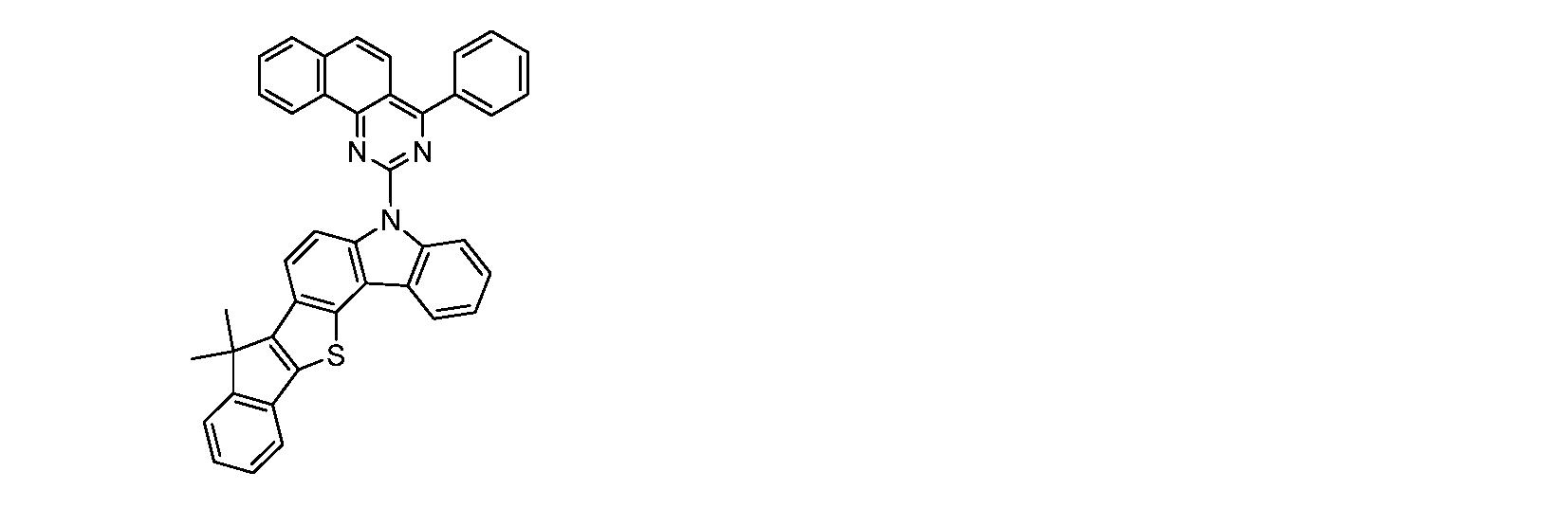
<實施例35:化合物3-8> 7,7-二甲基-13-(4-苯基喹唑啉-2-基)-7,13-二氫茚并[2’,1’:4,5]呋喃并[2,3-a]咔唑之合成; 將實施例16中之7,7-二甲基-7,12-二氫苯并[4,5]噻吩并 [3,2-g]茚并[1,2-b]吲哚改為使用7,7-二甲基-7,13-二氫茚并[2’,1’:4,5]呋喃并[2,3-a]咔唑,除此以外以同樣的條件進行反應。其結果獲得7,7-二甲基-13-(4-苯基喹唑啉-2-基)-7,13-二氫茚并[2’,1’:4,5]呋喃并[2,3-a]咔唑(化合物3-8)之粉體6.2g(產率32%)。 【化61】
<實施例36:化合物3-9> 7,7-二甲基-13-(4-苯基苯并[h]喹唑啉-2-基)-7,13-二氫茚并[2’,1’:4,5]呋喃并[2,3-a]咔唑之合成; 實施例35中之2-氯-4-苯基喹唑啉改為使用2-氯-4-苯基苯并[h]喹唑啉,除此以外以同樣的條件進行反應。其結果獲得7,7-二甲基-13-(4-苯基苯并[h]喹唑啉-2-基)-7,13-二氫茚并[2’,1’:4,5]呋喃并[2,3-a]咔唑(化合物3-9)之粉體8.6g(產率30%)。 【化62】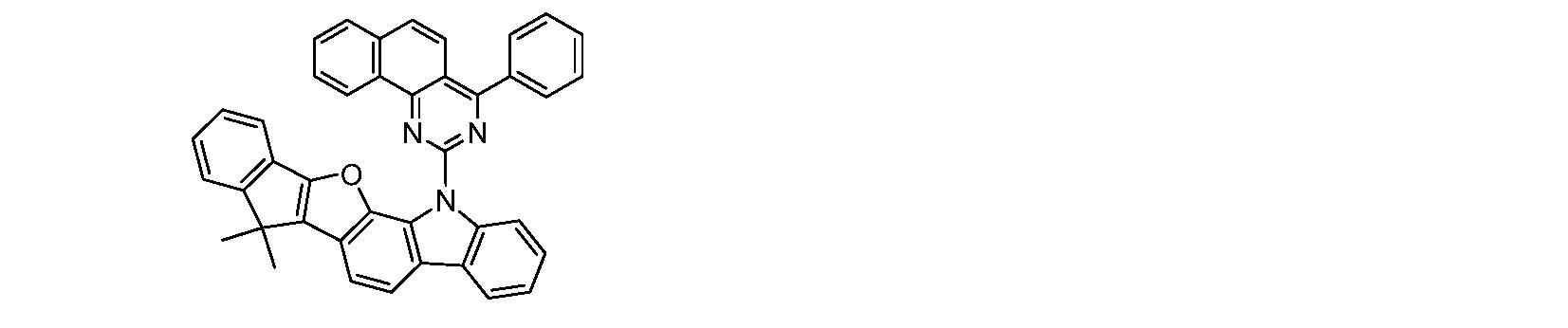
<實施例37:化合物3-10> 13-(4,6-二苯基喹唑啉-2-基)-7,7-二甲基-7,13-二氫茚并[2’,1’:4,5]呋喃并[2,3-a]咔唑之合成; 實施例35中之2-氯-4-苯基喹唑啉改為使用2-氯-4,6-二苯基喹唑啉,除此以外以同樣的條件進行反應。其結果獲得13-(4,6-二苯基喹唑啉-2-基)-7,7-二甲基-7,13-二氫茚并[2’,1’:4,5]呋喃并[2,3-a]咔唑(化合物3-10)之粉體7.2g(產率29%)。 【化63】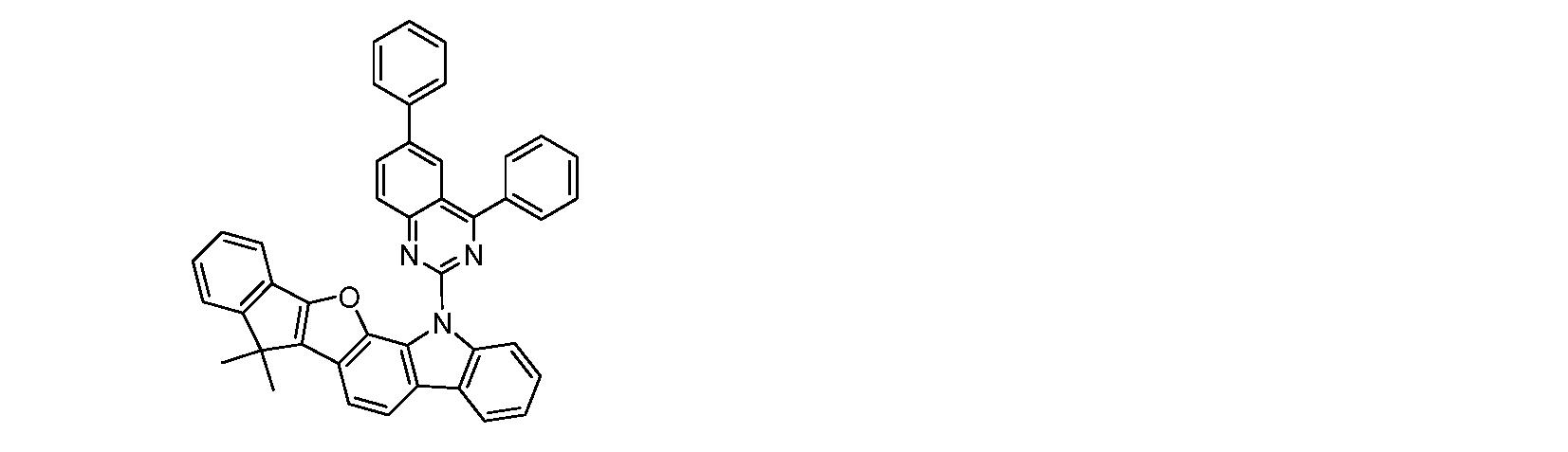
<實施例38:化合物3-11> 7,7-二苯基-13-(4-苯基喹唑啉-2-基)-7,13-二氫茚并[2’,1’:4,5]噻吩并[2,3-a]咔唑之合成; 實施例16中之7,7-二甲基-7,12-二氫苯并[4,5]噻吩并 [3,2-g]茚并[1,2-b]吲哚改為使用7,7-二苯基-7,13-二氫茚并[2’,1’:4,5]噻吩并[2,3-a]咔唑,除此以外以同樣的條件進行反應。其結果獲得7,7-二苯基-13-(4-苯基喹唑啉-2-基)-7,13-二氫茚并[2’,1’:4,5]噻吩并[2,3-a]咔唑(化合物3-11)之粉體6.7g(產率37%)。 【化64】
<實施例39:化合物3-12> 9,9-二甲基-15-(4-苯基喹唑啉-2-基)-9,15-二氫苯并[a]茚并[2’,1’:4,5]噻吩并[3,2-i]咔唑之合成; 實施例16中之7,7-二甲基-7,12-二氫苯并[4,5]噻吩并 [3,2-g]茚并[1,2-b]吲哚改為使用、9,9-二甲基-9,15-二氫苯并[a]茚并[2’,1’:4,5]噻吩并[3,2-i]咔唑,依同樣條件實施反應。其結果獲得9,9-二甲基-15-(4-苯基喹唑啉-2-基)-9,15-二氫苯并[a]茚并[2’,1’:4,5]噻吩并[3,2-i]咔唑(化合物3-12)之粉體4.8g(產率42%)。 【化65】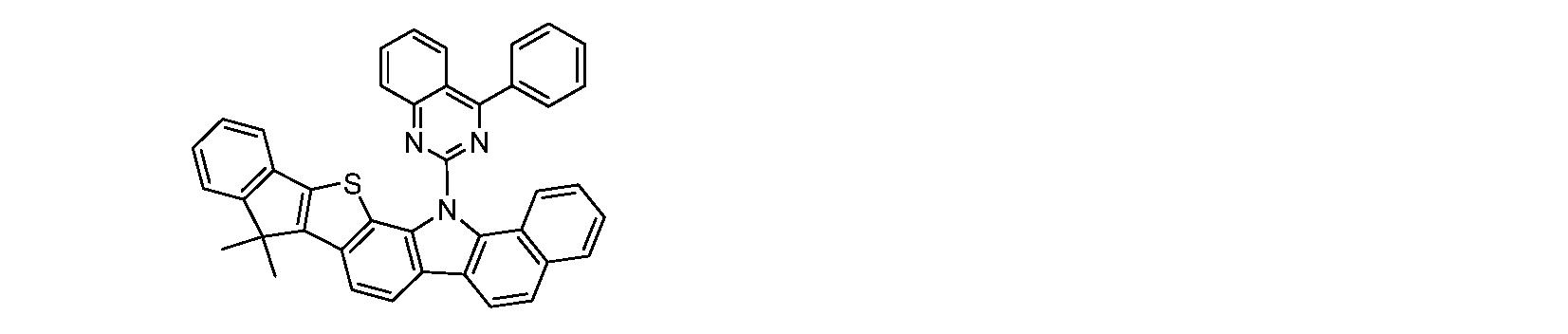
<實施例40:化合物3-13> 7-苯基-13-(4-苯基喹唑啉-2-基)-7,13-二氫吲哚并[2’,3’:4,5]噻吩并[2,3-a]咔唑之合成; 實施例16中之7,7-二甲基-7,12-二氫苯并[4,5]噻吩并 [3,2-g]茚并[1,2-b]吲哚改為使用7-苯基-7,13-二氫吲哚并[2’,3’:4,5]噻吩并[2,3-a]咔唑,除此以外以同樣的條件進行反應。其結果獲得7-苯基-13-(4-苯基喹唑啉-2-基)-7,13-二氫吲哚并[2’,3’:4,5]噻吩并[2,3-a]咔唑(化合物3-13)之粉體4.3g(產率43%)。 【化66】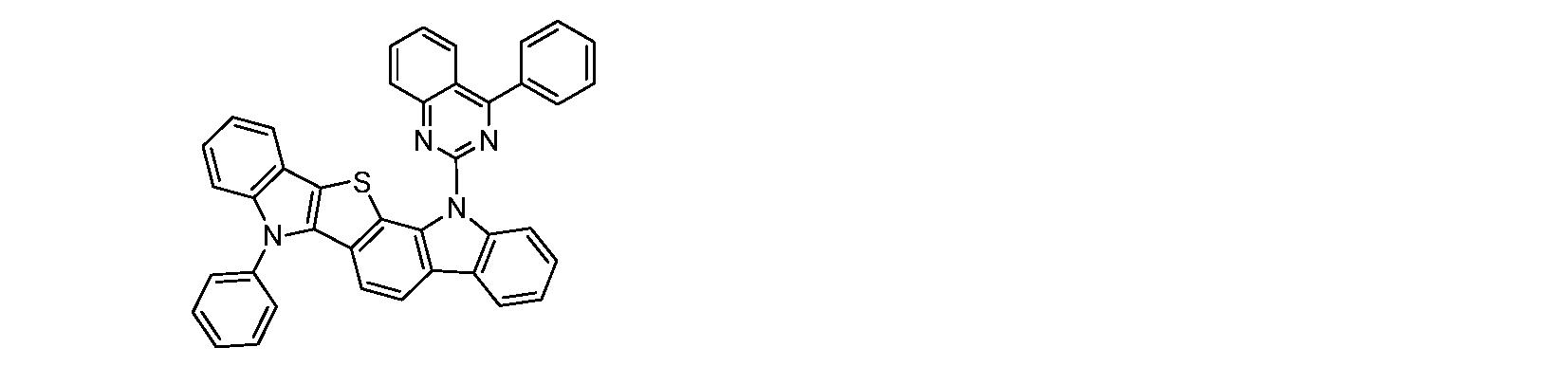
<實施例41:化合物3-14> 12,12-二甲基-1-(4-苯基喹唑啉-2-基)-1,12-二氫茚并[1’,2’:4,5]噻吩并[2,3-a]咔唑之合成; 實施例16中之7,7-二甲基-7,12-二氫苯并[4,5]噻吩并[3,2-g]茚并[1,2-b]吲哚改為使用12,12-二甲基-1,12-二氫茚并[1’,2’:4,5]噻吩并[2,3-a]咔唑,除此以外以同樣的條件進行反應。其結果獲得12,12-二甲基-1-(4-苯基喹唑啉-2-基)-1,12-二氫茚并[1’,2’:4,5]噻吩并[2,3-a]咔唑(化合物3-14)之粉體6.3g(產率44%)。 【化67】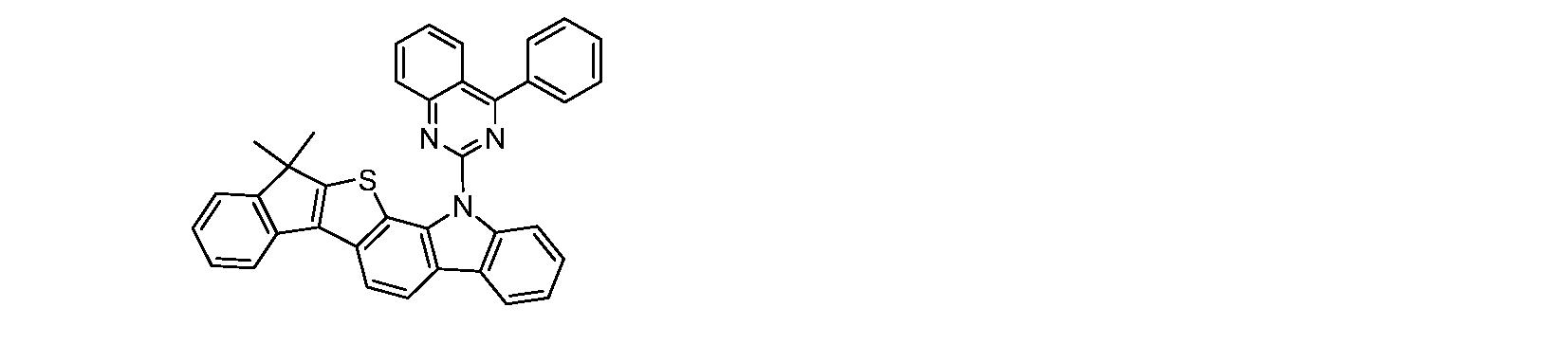
<實施例42:化合物3-15> 7,7-二甲基-13-(萘-2-基)-7,13-二氫茚并[2’,1’:4,5]噻吩并[2,3-a]咔唑之合成; 實施例28中之2-氯-4,6-二苯基喹唑啉改為使用2-溴萘,除此以外以同樣的條件進行反應。其結果獲得7,7-二甲基-13-(萘-2-基)-7,13-二氫茚并[2’,1’:4,5]噻吩并[2,3-a]咔唑(化合物3-15)之粉體5.4g(產率47%)。 【化68】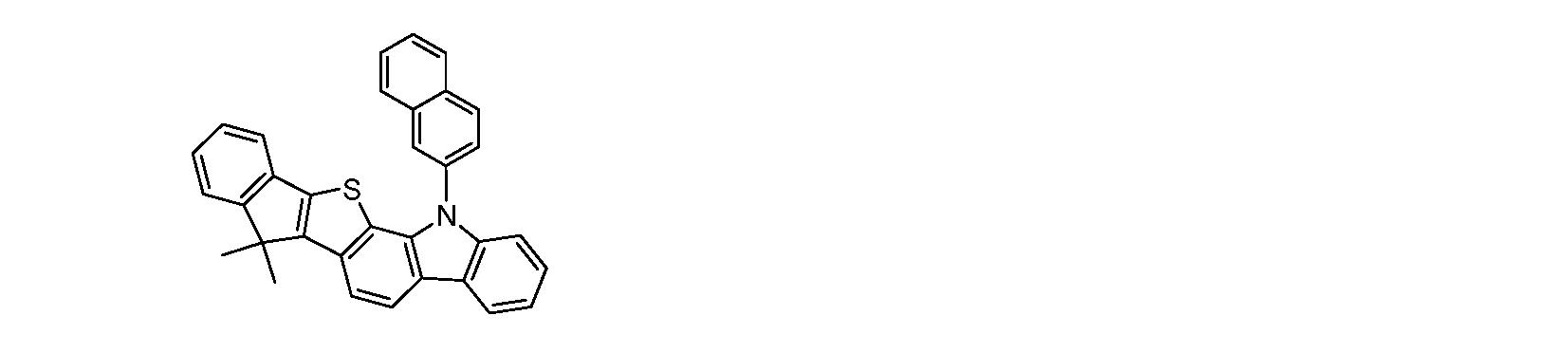
<實施例43> 有機EL元件,如圖1所示,係於已在玻璃基板1上預先形成了作為透明陽極2之ITO電極後,於其上按順序蒸鍍電洞注入層3、第1電洞輸送層5a、第2電洞輸送層5b、發光層6、電子輸送層7、電子注入層8、陰極(鋁電極)9而製作。<Example 43> As shown in FIG. 1, an organic EL device is formed by pre-forming an ITO electrode as a
具體而言,將已成膜膜厚150nm之ITO之玻璃基板1於異丙醇中進行20分鐘超音波洗滌後,在已加熱到200℃之加熱板上使其乾燥10分鐘。之後進行UV臭氧處理15分鐘後,將此附ITO之玻璃基板安裝在真空蒸鍍機內,減壓到0.001Pa以下。 然後,以被覆透明陽極2之方式,將下列結構式之HIM-1成膜膜厚5nm以作為電洞注入層3。 在此電洞注入層3之上將下列結構式表示之三芳胺衍生物(6-1)形成膜厚60nm以作為第1電洞輸送層5a。該三芳胺衍生物於分子中具有2個三苯胺結構。 於此第1電洞輸送層5a之上將實施例1之化合物(1-5)形成膜厚5nm以作為第2電洞輸送層5b。 在此第2電洞輸送層5b之上,將下列結構式之化合物EMD-1與實施例19之化合物(2-4)以蒸鍍速度比為EMD-1:化合物(2-4)=5:95之蒸鍍速度進行二元蒸鍍,形成膜厚20nm以作為發光層6。 在此發光層6之上,將下列結構式之苯并三唑衍生物(4-1)與下列結構式之ETM-1以蒸鍍速度比成為苯并三唑衍生物(4-1):ETM-1=50:50之蒸鍍速度進行二元蒸鍍成為膜厚30nm,以作為電子輸送層7。 在此電子輸送層7之上,將氟化鋰成膜膜厚1nm以作為電子注入層8。 最後蒸鍍鋁100nm而形成陰極9。 針對製得之有機EL元件,測定於大氣中常溫施加直流電壓時之發光特性。測定結果示於表1。Specifically, after the
【化69】
【化70】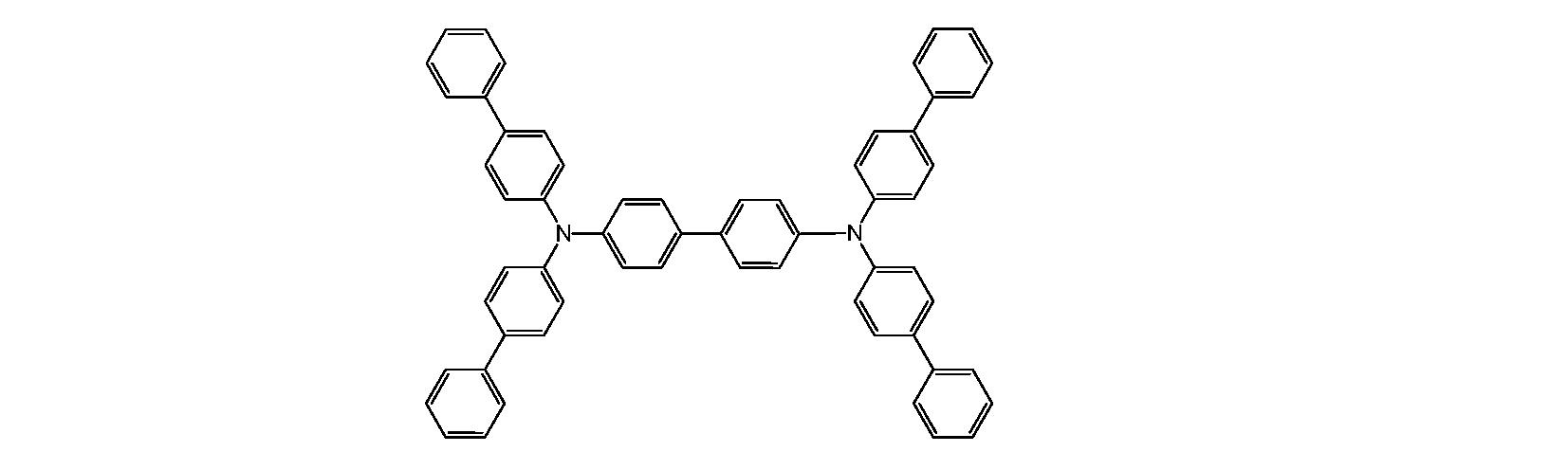
【化71】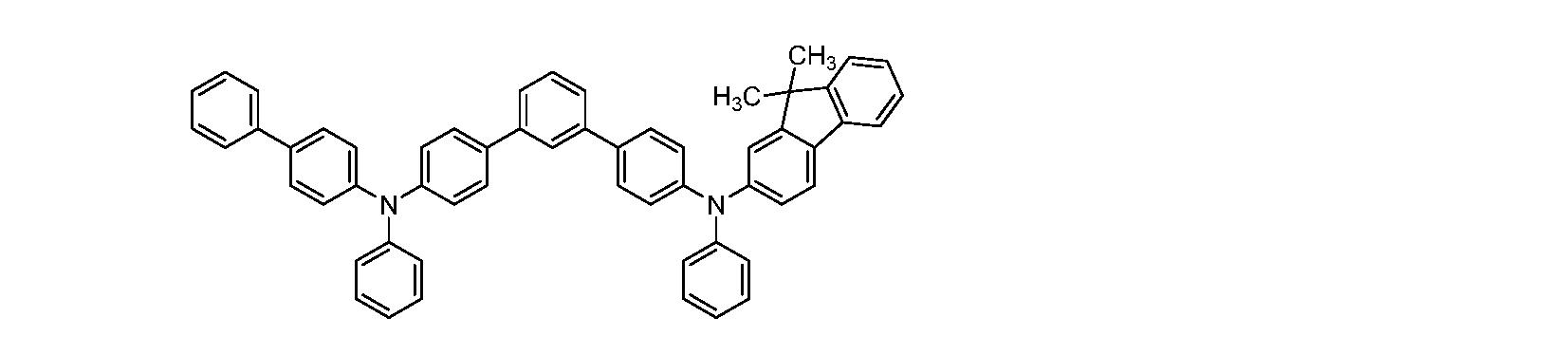
【化72】
【化73】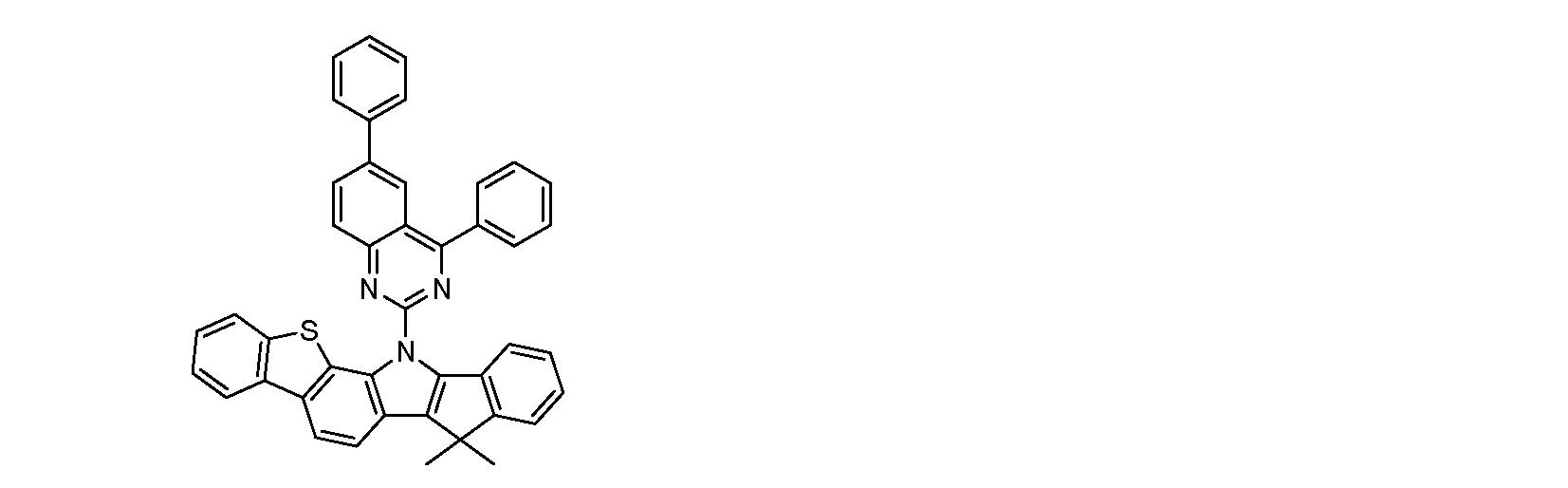
【化74】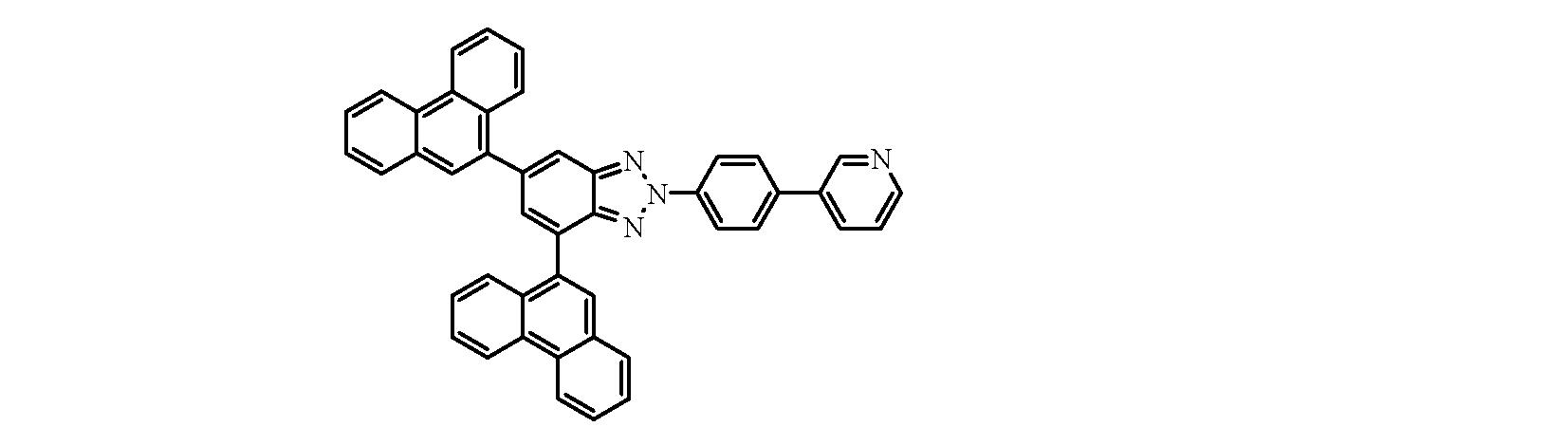
【化75】
<實施例44> 將實施例43中之作為第2電洞輸送層5b之材料之化合物(1-5)改為使用實施例5之化合物(1-32),除此以外以同樣條件製作有機EL元件。針對製得之有機EL元件測定於大氣中常溫施加直流電壓時之發光特性。測定結果示於表1。 【化76】
<實施例45> 將實施例43中之作為第2電洞輸送層5b之材料之化合物(1-5)改為使用實施例6之化合物(1-34),除此以外以同樣條件製作有機EL元件。針對製得之有機EL元件測定於大氣中常溫施加直流電壓時之發光特性。測定結果示於表1。 【化77】
<實施例46> 將實施例43中之作為第2電洞輸送層5b之材料之化合物(1-5)改為使用實施例7之化合物(1-37),除此以外以同樣條件製作有機EL元件。針對製得之有機EL元件測定於大氣中常溫施加直流電壓時之發光特性。測定結果示於表1。 【化78】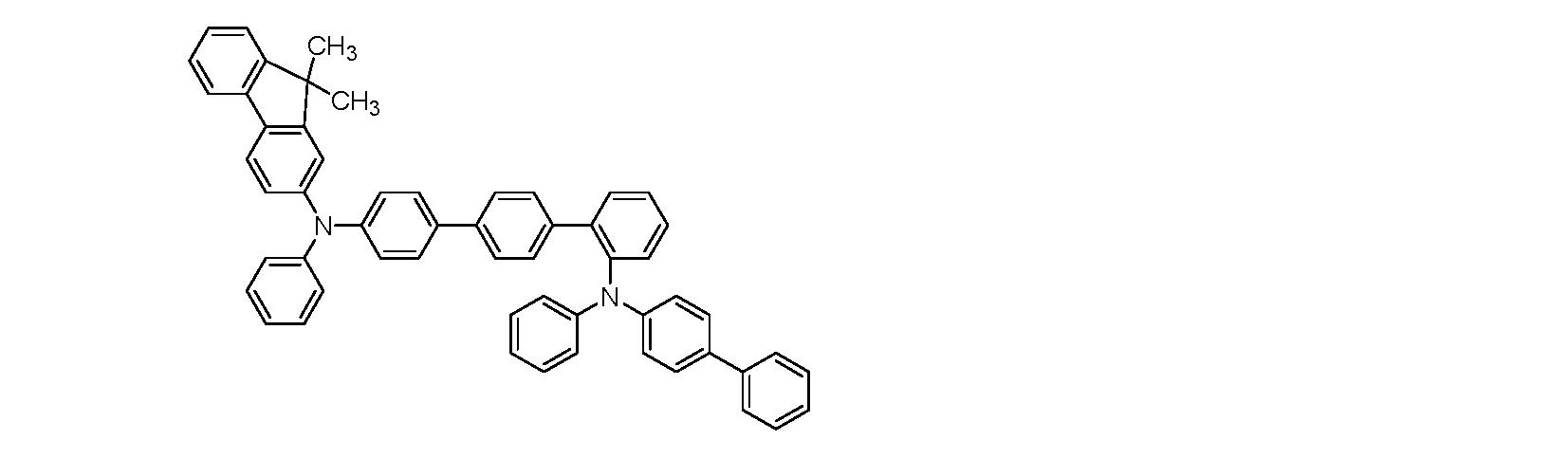
<實施例47> 將實施例43中之作為第2電洞輸送層5b之材料之化合物(1-5)改為使用實施例8之化合物(1-38),除此以外以同樣條件製作有機EL元件。針對製得之有機EL元件測定於大氣中常溫施加直流電壓時之發光特性。測定結果示於表1。 【化79】
<實施例48> 將實施例43中之作為第2電洞輸送層5b之材料之化合物(1-5)改為使用實施例14之化合物(1-49),除此以外以同樣條件製作有機EL元件。針對製得之有機EL元件測定於大氣中常溫施加直流電壓時之發光特性。測定結果示於表1。 【化80】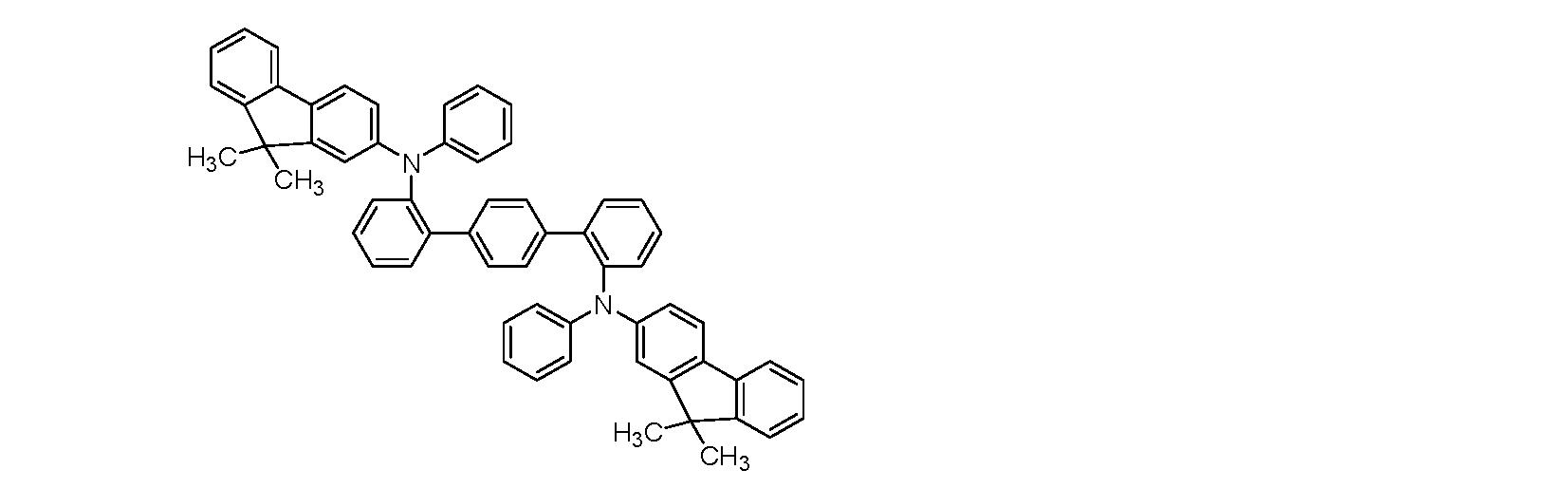
<比較例1> 為了比較,將實施例43中之作為第1電洞輸送層5a之材料之三芳胺衍生物(6-1)改為使用下列結構式之芳胺化合物(6’-2),作為第2電洞輸送層5b之材料之化合物(1-5)改為使用下列結構式之芳胺化合物(6’-2),除此以外以同樣條件製作有機EL元件。於此情形,第1電洞輸送層5a與第2電洞輸送層5b係作為一體之電洞輸送層(厚度65nm)而作用。針對製得之有機EL元件測定於大氣中常溫施加直流電壓時之發光特性。測定結果示於表1。 【化81】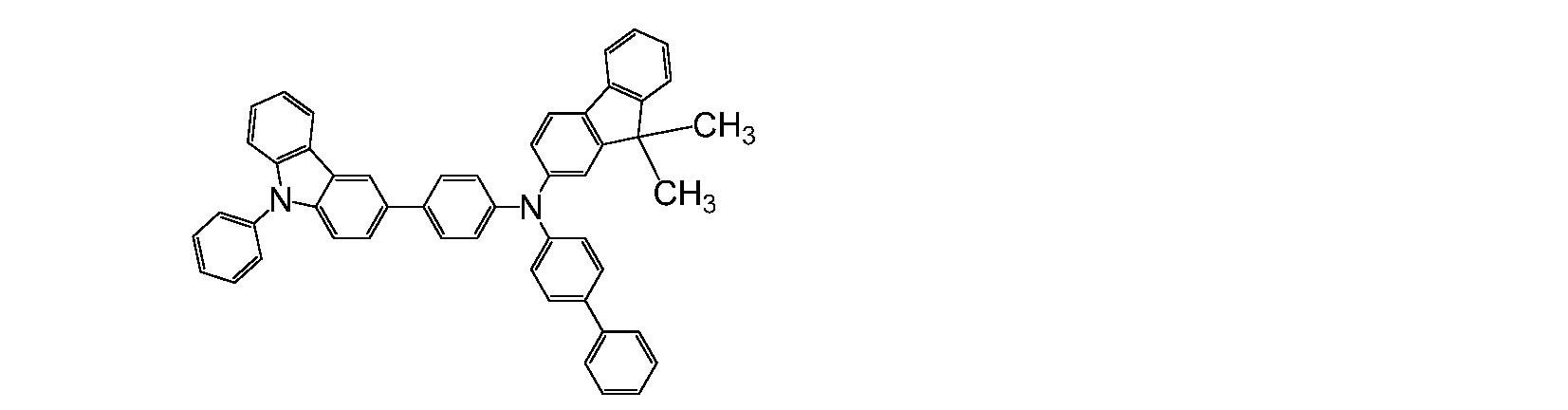
<實施例49> 將實施例43中之作為發光層6之材料之化合物(2-4)改為使用實施例41之化合物(3-14),除此以外以同樣條件製作有機EL元件。針對製得之有機EL元件測定於大氣中常溫施加直流電壓時之發光特性。測定結果示於表2。 【化82】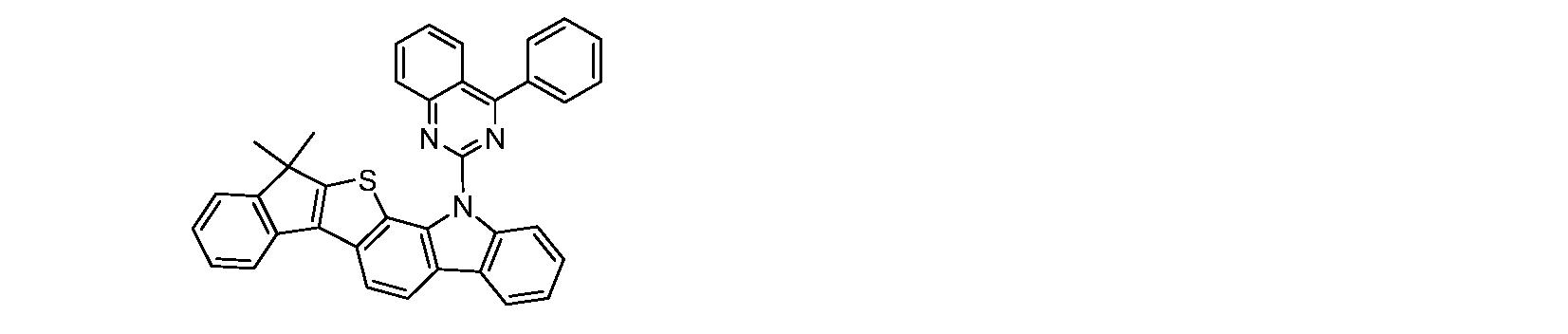
<實施例50> 將實施例49中之作為第2電洞輸送層5b之材料之化合物(1-5)改為使用實施例5之化合物(1-32),除此以外以同樣條件製作有機EL元件。針對製得之有機EL元件測定於大氣中常溫施加直流電壓時之發光特性。測定結果示於表2。<Example 50> The compound (1-5) used as the material of the second
<實施例51> 將實施例49中之作為第2電洞輸送層5b之材料之化合物(1-5)改為使用實施例6之化合物(1-34),除此以外以同樣條件製作有機EL元件。針對製得之有機EL元件測定於大氣中常溫施加直流電壓時之發光特性。測定結果示於表2。<Example 51> The compound (1-5) used as the material of the second
<實施例52> 將實施例49中之作為第2電洞輸送層5b之材料之化合物(1-5)改為使用實施例7之化合物(1-37),除此以外以同樣條件製作有機EL元件。針對製得之有機EL元件測定於大氣中常溫施加直流電壓時之發光特性。測定結果示於表2。<Example 52> The compound (1-5) used as the material of the second
<實施例53> 將實施例49中之作為第2電洞輸送層5b之材料之化合物(1-5)改為使用實施例8之化合物(1-38),除此以外以同樣條件製作有機EL元件。針對製得之有機EL元件測定於大氣中常溫施加直流電壓時之發光特性。測定結果示於表2。<Example 53> The compound (1-5) used as the material of the second
<實施例54> 將實施例49中之作為第2電洞輸送層5b之材料之化合物(1-5)改為使用實施例14之化合物(1-49),除此以外以同樣條件製作有機EL元件。針對製得之有機EL元件測定於大氣中常溫施加直流電壓時之發光特性。測定結果示於表2。<Example 54> The compound (1-5) used as the material of the second
<比較例2> 為了比較,將實施例49中之作為第1電洞輸送層5a之材料之三芳胺衍生物(6-1)改為使用前述結構式之芳胺化合物(6’-2),作為第2電洞輸送層5b之材料之化合物(1-5)改為使用前述結構式之芳胺化合物(6’-2),除此以外以同樣條件製作有機EL元件。於此情形,第1電洞輸送層5a與第2電洞輸送層5b係作為一體之電洞輸送層(厚度65nm)作用。針對製得之有機EL元件測定於大氣中常溫施加直流電壓時之發光特性。測定結果示於表2。<Comparative Example 2> For comparison, the triarylamine derivative (6-1) used as the material of the first
<實施例55> 將實施例43中之作為發光層6之材料之化合物(2-4)改為使用下列結構式表示之咔唑衍生物(3-16),除此以外以同樣條件製作有機EL元件。針對製得之有機EL元件測定於大氣中常溫施加直流電壓時之發光特性。測定結果示於表3。 【化83】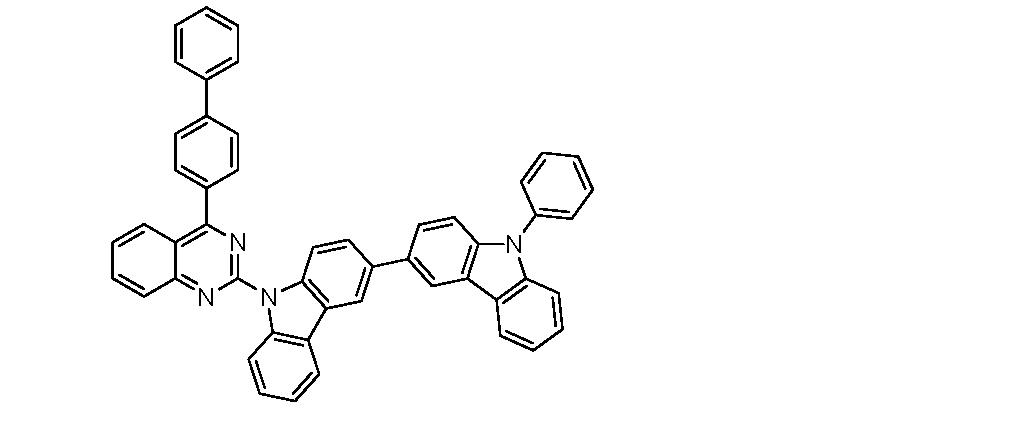
<實施例56> 將實施例55中之作為第2電洞輸送層5b之材料之化合物(1-5)改為使用實施例5之化合物(1-32),除此以外以同樣條件製作有機EL元件。針對製得之有機EL元件測定於大氣中常溫施加直流電壓時之發光特性。測定結果示於表3。<Example 56> The compound (1-5) used as the material of the second
<實施例57> 將實施例55中之作為第2電洞輸送層5b之材料之化合物(1-5)改為使用實施例6之化合物(1-34),除此以外以同樣條件製作有機EL元件。針對製得之有機EL元件測定於大氣中常溫施加直流電壓時之發光特性。測定結果示於表3。<Example 57> The compound (1-5) used as the material of the second
<實施例58> 將實施例55中之作為第2電洞輸送層5b之材料之化合物(1-5)改為使用實施例7之化合物(1-37),除此以外以同樣條件製作有機EL元件。針對製得之有機EL元件測定於大氣中常溫施加直流電壓時之發光特性。測定結果示於表3。<Example 58> The compound (1-5) used as the material of the second
<實施例59> 將實施例55中之作為第2電洞輸送層5b之材料之化合物(1-5)改為使用實施例8之化合物(1-38),除此以外以同樣條件製作有機EL元件。針對製得之有機EL元件測定於大氣中常溫施加直流電壓時之發光特性。測定結果示於表3。<Example 59> The compound (1-5) used as the material of the second
<實施例60> 將實施例55中之作為第2電洞輸送層5b之材料之化合物(1-5)改為使用實施例14之化合物(1-49),除此以外以同樣條件製作有機EL元件。針對製得之有機EL元件測定於大氣中常溫施加直流電壓時之發光特性。測定結果示於表3。<Example 60> The compound (1-5) used as the material of the second
<比較例3> 為了比較,將實施例55中之作為第1電洞輸送層5a之材料之三芳胺衍生物(6-1)改為使用前述結構式之芳胺化合物(6’-2),將作為第2電洞輸送層5b之材料之化合物(1-34)改為使用前述結構式之芳胺化合物(6’-2),除此以外以同樣條件製作有機EL元件。於此情形,第1電洞輸送層5a與第2電洞輸送層5b係以一體之電洞輸送層(厚度65nm)之形式作用。針對製得之有機EL元件測定於大氣中常溫施加直流電壓時之發光特性。測定結果示於表3。<Comparative Example 3> For comparison, the triarylamine derivative (6-1) used as the material of the first
使用實施例43~60及比較例1~3製作之有機EL元件測定元件壽命,結果示於表1~3。元件壽命係測定令發光開始時之發光亮度(初始亮度)為7000cd/m2 並進行定電流驅動時,發光亮度衰減成6790cd/m2 (相當於初始亮度設為100%時之97%:97%衰減)為止之時間。The organic EL devices produced in Examples 43 to 60 and Comparative Examples 1 to 3 were used to measure the device life. The results are shown in Tables 1 to 3. The life of the device is measured so that the luminous brightness (initial brightness) at the start of luminescence is 7000cd/m 2 and the constant current drive reduces the luminous brightness to 6790cd/m 2 (equivalent to 97% when the initial brightness is set to 100%: 97 % Decay) time.
[表1]
[表2]
[表3]
如表1,發光層之材料為相同組合之實施例43~48與比較例1之比較中,針對流過電流密度10mA/cm2 之電流時之發光效率,比較例1之有機EL元件為23.97cd/A,反觀實施例43~48之有機EL元件為25.09~28.14cd/A,均為較高效率。又,針對電力效率,比較例1之有機EL元件為18.54lm/W,反觀實施例43~48之有機EL元件為19.11~21.80m/W,均為較高效率。針對元件壽命(97%衰減),比較例1之有機EL元件為55小時,反觀實施例43~48之有機EL元件為130~166小時,壽命大幅延長。As shown in Table 1, in Examples 43 to 48 where the materials of the light-emitting layer are the same combination and Comparative Example 1, for the luminous efficiency when a current with a current density of 10 mA/cm 2 flows, the organic EL element of Comparative Example 1 is 23.97 cd/A. In contrast, the organic EL elements of Examples 43 to 48 are 25.09 to 28.14 cd/A, all of which have higher efficiency. In terms of power efficiency, the organic EL element of Comparative Example 1 is 18.54 lm/W, and the organic EL elements of Examples 43 to 48 are 19.11 to 21.80 m/W, which are all high efficiency. For the device life (97% attenuation), the organic EL device of Comparative Example 1 is 55 hours, and the organic EL device of Examples 43 to 48 is 130 to 166 hours, and the life is greatly extended.
如表2,於發光層之材料為相同組合之實施例49~54與比較例2之比較中,針對流過電流密度10mA/cm2 之電流時之發光效率,比較例2之有機EL元件為22.71cd/A,反觀實施例49~54之有機EL元件為24.28~27.48cd/A,均為較高效率。又,針對電力效率,比較例2之有機EL元件為21.58lm/W,反觀實施例49~54之有機EL元件為22.59~25.79m/W,均為較高效率。針對元件壽命(97%衰減),比較例2之有機EL元件為42小時,反觀實施例49~54之有機EL元件為129~184小時,壽命大幅延長。As shown in Table 2, in the comparison between Examples 49 to 54 and Comparative Example 2 in which the materials of the light-emitting layer are the same combination, the organic EL device of Comparative Example 2 is the luminous efficiency when a current with a current density of 10 mA/cm 2 flows. 22.71cd/A, in contrast, the organic EL elements of Examples 49 to 54 are 24.28 to 27.48cd/A, all of which have higher efficiency. In terms of power efficiency, the organic EL element of Comparative Example 2 is 21.58 lm/W, and the organic EL elements of Examples 49 to 54 are 22.59 to 25.79 m/W, which are all high efficiency. For the device life (97% attenuation), the organic EL device of Comparative Example 2 is 42 hours, and the organic EL device of Examples 49 to 54 is 129 to 184 hours, and the life is greatly extended.
如表3,於發光層之材料為相同組合之實施例55~60與比較例3之比較中,針對流過電流密度10mA/cm2 之電流時之發光效率,比較例3之有機EL元件為19.80cd/A,反觀實施例55~60之有機EL元件為23.23~26.34cd/A,均為較高效率。又,針對電力效率,比較例3之有機EL元件為16.90lm/W,反觀實施例55~60之有機EL元件為19.03~21.72m/W,均為較高效率。針對元件壽命(97%衰減),比較例3之有機EL元件為86小時,反觀實施例55~60之有機EL元件為200~326小時,壽命大幅延長。As shown in Table 3, in the comparison between Examples 55 to 60 and Comparative Example 3 in which the materials of the light-emitting layer are the same combination, the organic EL device of Comparative Example 3 is the luminous efficiency when a current with a current density of 10 mA/cm 2 flows. 19.80cd/A. In contrast, the organic EL elements of Examples 55 to 60 are 23.23 to 26.34cd/A, all of which have higher efficiency. In terms of power efficiency, the organic EL element of Comparative Example 3 is 16.90 lm/W, and the organic EL elements of Examples 55 to 60 are 19.03 to 21.72 m/W, which are all high efficiency. For the device life (97% attenuation), the organic EL device of Comparative Example 3 is 86 hours, and the organic EL device of Examples 55 to 60 is 200 to 326 hours, and the life is greatly extended.
<實施例61> 如圖1,在玻璃基板1上預先形成作為透明陽極2之ITO電極後,於其上按順序蒸鍍電洞注入層3、第1電洞輸送層5a、第2電洞輸送層5b、發光層6、電子輸送層7、電子注入層8、陰極(鋁電極)9,製成有機EL元件。<Example 61> As shown in FIG. 1, after the ITO electrode as the
具體而言,將已成膜膜厚150nm之ITO之玻璃基板1於異丙醇中進行20分鐘超音波洗滌後,在已加熱到200℃之加熱板上使其乾燥10分鐘。之後進行UV臭氧處理15分鐘後,將此附ITO之玻璃基板安裝在真空蒸鍍機內,減壓到0.001Pa以下。 然後,以被覆透明陽極2之方式,將下列結構式之HIM-1成膜膜厚5nm以作為電洞注入層3。 在此電洞注入層3之上將下列結構式表示之三芳胺衍生物(6-1)形成膜厚60nm以作為第1電洞輸送層5a。 於此第1電洞輸送層5a之上將實施例2之化合物(1-6)形成膜厚5nm以作為第2電洞輸送層5b。 在此第2電洞輸送層5b之上,將下列結構式之化合物EMD-1與實施例18之化合物(2-3)以蒸鍍速度比為EMD-1:化合物(2-3)=5:95之蒸鍍速度進行二元蒸鍍,形成膜厚20nm以作為發光層6。 在此發光層6之上,將下列結構式之蒽衍生物(5a-1)與前述結構式之ETM-1以蒸鍍速度比成為蒽衍生物(5a-1):ETM-1=50:50之蒸鍍速度進行二元蒸鍍成為膜厚30nm,以作為電子輸送層7。 在此電子輸送層7之上,將氟化鋰成膜膜厚1nm以作為電子注入層8。 最後蒸鍍鋁100nm而形成陰極9。 針對製得之有機EL元件,測定於大氣中常溫施加直流電壓時之發光特性。測定結果示於表4。Specifically, after the
【化84】
【化85】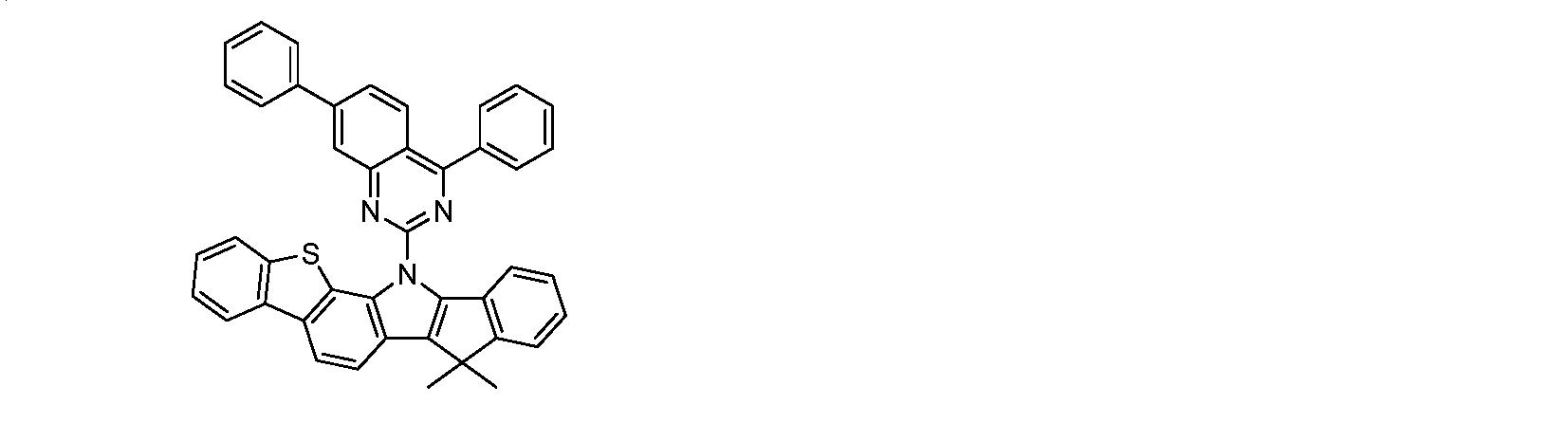
【化86】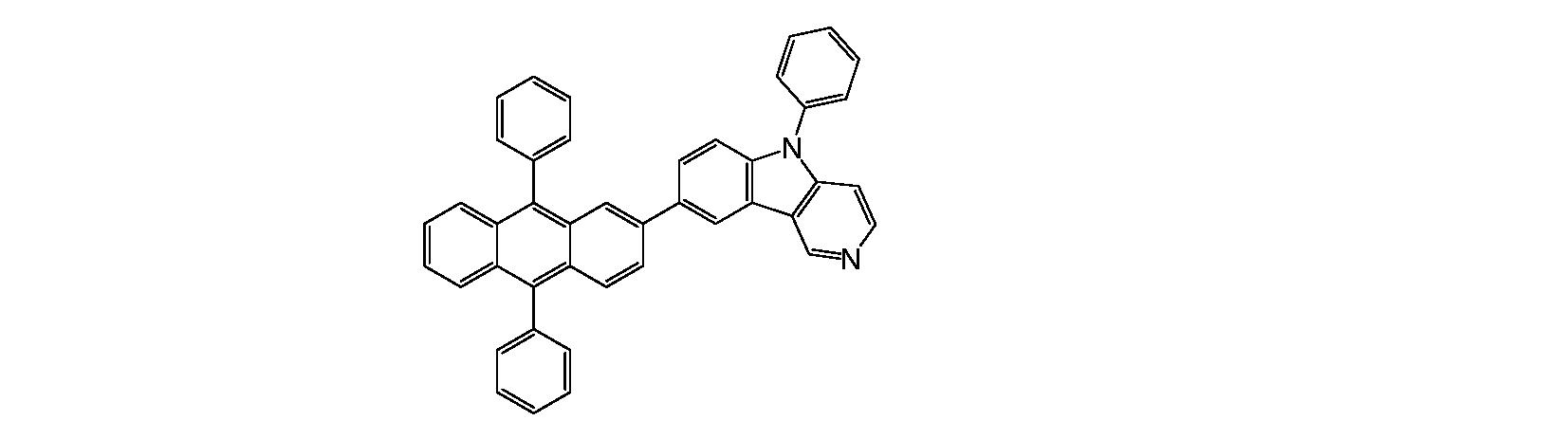
<實施例62> 將實施例61中之作為第2電洞輸送層5b之材料之化合物(1-6)改為使用實施例6之化合物(1-34),除此以外以同樣條件製作有機EL元件。針對製得之有機EL元件測定於大氣中常溫施加直流電壓時之發光特性。測定結果示於表4。<Example 62> The compound (1-6) which is the material of the second
<實施例63> 將實施例61中之作為第2電洞輸送層5b之材料之化合物(1-6)改為使用實施例7之化合物(1-37),除此以外以同樣條件製作有機EL元件。針對製得之有機EL元件測定於大氣中常溫施加直流電壓時之發光特性。測定結果示於表4。<Example 63> The compound (1-6) used as the material of the second
<實施例64> 將實施例61中之作為第2電洞輸送層5b之材料之化合物(1-6)改為使用實施例10之化合物(1-41),除此以外以同樣條件製作有機EL元件。針對製得之有機EL元件測定於大氣中常溫施加直流電壓時之發光特性。測定結果示於表4。 【化87】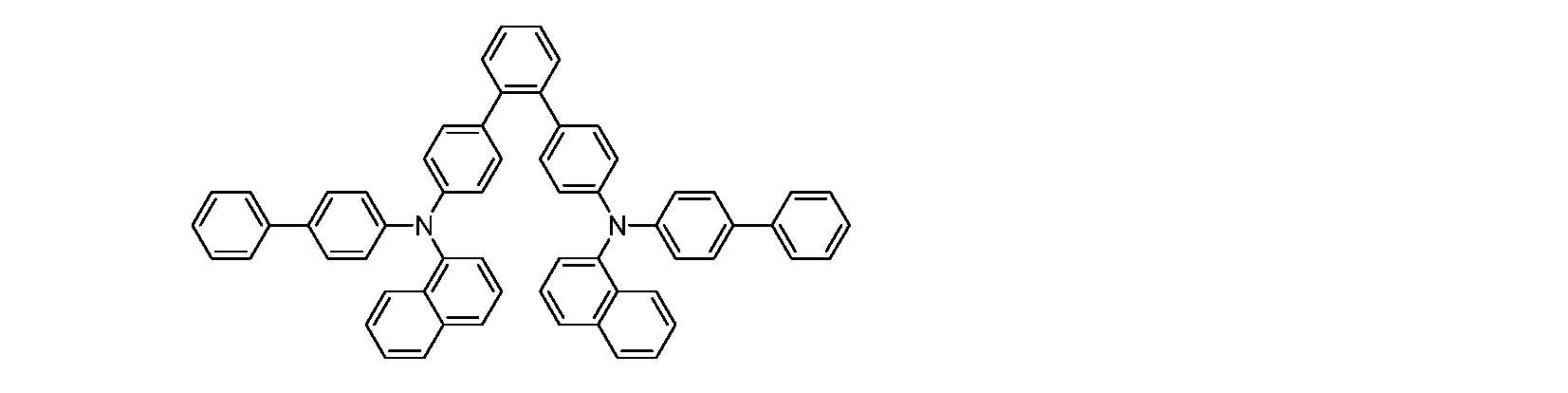
<比較例4> 為了比較,將實施例61中之作為第1電洞輸送層5a之材料之通式(6-1)之三芳胺衍生物改為使用前述結構式之芳胺化合物(6’-2),將作為第2電洞輸送層5b之材料之化合物(1-6)改為使用前述結構式之芳胺化合物(6’-2),除此以外以同樣條件製作有機EL元件。於此情形,第1電洞輸送層5a與第2電洞輸送層5b係以一體之電洞輸送層(厚度65nm)的形式作用。針對製得之有機EL元件測定於大氣中常溫施加直流電壓時之發光特性。測定結果示於表4。<Comparative Example 4> For comparison, the triarylamine derivative of the general formula (6-1) used as the material of the first
<實施例65> 將實施例61中之作為發光層6之材料之化合物(2-3)改為使用實施例38之化合物(3-11),除此以外以同樣條件製作有機EL元件。針對製得之有機EL元件測定於大氣中常溫施加直流電壓時之發光特性。測定結果示於表5。 【化88】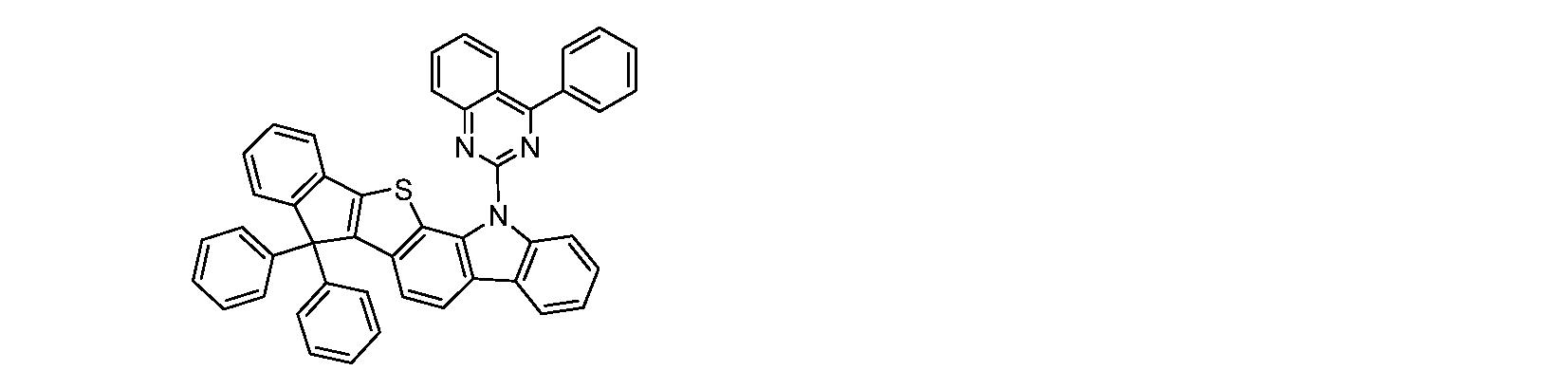
<實施例66> 將實施例65中之作為第2電洞輸送層5b之材料之化合物(1-6)改為使用實施例6之化合物(1-34),除此以外以同樣條件製作有機EL元件。針對製得之有機EL元件測定於大氣中常溫施加直流電壓時之發光特性。測定結果示於表5。<Example 66> The compound (1-6) used as the material of the second
<實施例67> 將實施例65中之作為第2電洞輸送層5b之材料之化合物(1-6)改為使用實施例7之化合物(1-37),除此以外以同樣條件製作有機EL元件。針對製得之有機EL元件測定於大氣中常溫施加直流電壓時之發光特性。測定結果示於表5。<Example 67> The compound (1-6) used as the material of the second
<實施例68> 將實施例65中之作為第2電洞輸送層5b之材料之化合物(1-6)改為使用實施例10之化合物(1-41),除此以外以同樣條件製作有機EL元件。針對製得之有機EL元件測定於大氣中常溫施加直流電壓時之發光特性。測定結果示於表5。<Example 68> The compound (1-6) used as the material of the second
<比較例5> 為了比較,將實施例65中之作為第1電洞輸送層5a之材料之通式(6-1)之三芳胺衍生物改為使用前述結構式之芳胺化合物(6’-2),將作為第2電洞輸送層5b之材料之化合物(1-6)改為使用前述結構式之芳胺化合物(6’-2),除此以外以同樣條件製作有機EL元件。於此情形,第1電洞輸送層5a與第2電洞輸送層5b係以一體之電洞輸送層(厚度65nm)之形式作用。針對製得之有機EL元件測定於大氣中常溫施加直流電壓時之發光特性。測定結果示於表5。<Comparative Example 5> For comparison, the triarylamine derivative of the general formula (6-1) used as the material of the first
使用實施例61~68及比較例4~5製得之有機EL元件測定元件壽命,結果示於表4、5。元件壽命係測定令發光開始時之發光亮度(初始亮度)為7000cd/m2 並進行定電流驅動時,發光亮度衰減成6790cd/m2 (相當於初始亮度設為100%時之97%:97%衰減)為止之時間。The organic EL devices prepared in Examples 61 to 68 and Comparative Examples 4 to 5 were used to measure the device life. The results are shown in Tables 4 and 5. The life of the device is measured so that the luminous brightness (initial brightness) at the start of luminescence is 7000cd/m 2 and the constant current drive reduces the luminous brightness to 6790cd/m 2 (equivalent to 97% when the initial brightness is set to 100%: 97 % Decay) time.
[表4]
[表5]
如表4所示,於發光層之材料為相同組合之實施例61~64與比較例4之比較中,針對流過電流密度10mA/cm2 之電流時之發光效率,比較例4之有機EL元件為21.30cd/A,反觀實施例61~64之有機EL元件為26.47~27.95cd/A,均為較高效率。又,針對電力效率,比較例4之有機EL元件為17.57lm/W,反觀實施例61~64之有機EL元件為20.00~21.40m/W,均為較高效率。針對元件壽命(97%衰減),比較例4之有機EL元件為51小時,反觀實施例61~64之有機EL元件為107~161小時,壽命大幅延長。As shown in Table 4, in the comparison between Examples 61 to 64 and Comparative Example 4 in which the materials of the light-emitting layer are the same combination, the organic EL of Comparative Example 4 is compared with the luminous efficiency when a current with a current density of 10 mA/cm 2 flows. The element was 21.30cd/A, and in contrast, the organic EL elements of Examples 61 to 64 were 26.47 to 27.95cd/A, all with higher efficiency. In terms of power efficiency, the organic EL element of Comparative Example 4 is 17.57 lm/W, and the organic EL elements of Examples 61 to 64 are 20.00 to 21.40 m/W, which are all high efficiency. Regarding the device life (97% attenuation), the organic EL device of Comparative Example 4 is 51 hours, and the organic EL devices of Examples 61 to 64 are 107 to 161 hours, and the service life is greatly extended.
如表5,於發光層之材料為相同組合之實施例65~68與比較例5之比較,針對流過電流密度10mA/cm2 之電流時之發光效率,比較例5之有機EL元件為22.27cd/A,反觀實施例65~68之有機EL元件為24.10~25.30cd/A,均為較高效率。又,針對電力效率,比較例5之有機EL元件為21.34lm/W,反觀實施例65~68之有機EL元件為22.76~23.47m/W,均為較高效率。針對元件壽命(97%衰減),比較例5之有機EL元件為65小時,反觀實施例65~68之有機EL元件為176~218小時,壽命大幅延長。As shown in Table 5, the comparison between Examples 65 to 68 and Comparative Example 5 in which the materials of the light-emitting layer are the same combination, with respect to the luminous efficiency when a current with a current density of 10 mA/cm 2 flows, the organic EL element of Comparative Example 5 is 22.27 cd/A. In contrast, the organic EL elements of Examples 65 to 68 are 24.10 to 25.30 cd/A, all of which have higher efficiency. In terms of power efficiency, the organic EL element of Comparative Example 5 is 21.34 lm/W, and the organic EL elements of Examples 65 to 68 are 22.76 to 23.47 m/W, which are all high efficiency. Regarding the device life (97% attenuation), the organic EL device of Comparative Example 5 is 65 hours, and the organic EL device of Examples 65 to 68 is 176 to 218 hours, and the service life is greatly extended.
本發明之有機EL元件藉由將特定之芳胺化合物與特定之茚并吲哚衍生物或特定之咔唑衍生物(及特定之苯并三唑衍生物或特定之蒽衍生物)予以組合,將有機EL元件內部之載子均衡性改善,進而組合材料成為符合發光材料之特性之載子均衡性,所以比起習知有機EL元件,可知可達成高發光效率、長壽命之有機EL元件。 [產業利用性]The organic EL device of the present invention is formed by combining a specific aromatic amine compound with a specific indenoindole derivative or a specific carbazole derivative (and a specific benzotriazole derivative or a specific anthracene derivative), The carrier balance within the organic EL device is improved, and the combined material becomes a carrier balance that matches the characteristics of the light-emitting material. Therefore, compared with the conventional organic EL device, it is known that an organic EL device with high luminous efficiency and long life can be achieved. [Industrial Utilization]
本發明之有機EL元件中,組合了特定之芳胺化合物と特定之茚并吲哚衍生物或特定之咔唑衍生物(及特定之苯并三唑衍生物或特定之蒽衍生物),藉此,發光效率改善且有機EL元件之耐久性改善。所以,可開展例如家庭電化製品、照明之用途。In the organic EL device of the present invention, a specific aromatic amine compound and a specific indenoindole derivative or a specific carbazole derivative (and a specific benzotriazole derivative or a specific anthracene derivative) are combined by Thus, the luminous efficiency is improved and the durability of the organic EL element is improved. Therefore, applications such as household electrical products and lighting can be developed.
1‧‧‧玻璃基板
2‧‧‧透明陽極
3‧‧‧電洞注入層
5‧‧‧電洞輸送層
5a‧‧‧第1電洞輸送層
5b‧‧‧第2電洞輸送層
6‧‧‧發光層
7‧‧‧電子輸送層
8‧‧‧電子注入層
9‧‧‧陰極1‧‧‧
[圖1]顯示實施例43~68及比較例1~5之有機EL元件結構。 [圖2]顯示通式(1)之芳胺化合物之化合物(1-1)~(1-5)之結構式。 [圖3]顯示通式(1)之芳胺化合物之化合物(1-6)~(1-11)之結構式。 [圖4]顯示通式(1)之芳胺化合物之化合物(1-12)~(1-18)之結構式。 [圖5]顯示通式(1)之芳胺化合物之化合物(1-19)~(1-24)之結構式。 [圖6]顯示通式(1)之芳胺化合物之化合物(1-25)~(1-30)之結構式。 [圖7]顯示通式(1)之芳胺化合物之化合物(1-31)~(1-36)之結構式。 [圖8]顯示通式(1)之芳胺化合物之化合物(1-37)~(1-42)之結構式。 [圖9]顯示通式(1)之芳胺化合物之化合物(1-43)~(1-48)之結構式。 [圖10]顯示通式(1)之芳胺化合物之化合物(1-49)~(1-53)之結構式。 [圖11]顯示通式(1)之芳胺化合物之化合物(1-54)~(1-57)之結構式。 [圖12]顯示通式(1)之芳胺化合物之化合物(1-58)~(1-62)之結構式。 [圖13]顯示通式(1)之芳胺化合物之化合物(1-63)~(1-68)之結構式。 [圖14]顯示通式(1)之芳胺化合物之化合物(1-69)~(1-75)之結構式。 [圖15]顯示通式(1)之芳胺化合物之化合物(1-76)~(1-80)之結構式。 [圖16]顯示通式(1)之芳胺化合物之化合物(1-81)~(1-86)之結構式。 [圖17]顯示通式(1)之芳胺化合物之化合物(1-87)~(1-92)之結構式。 [圖18]顯示通式(2)之茚并吲哚衍生物之化合物(2-1)~(2-6)之結構式。 [圖19]顯示通式(2)之茚并吲哚衍生物之化合物(2-7)~(2-12)之結構式。 [圖20]顯示通式(2)之茚并吲哚衍生物之化合物(2-13)~(2-15)之結構式。 [圖21]顯示通式(3)之咔唑衍生物之化合物(3-1)~(3-6)之結構式。 [圖22]顯示通式(3)之咔唑衍生物之化合物(3-7)~(3-13)之結構式。 [圖23]顯示通式(3)之咔唑衍生物之化合物(3-14)~(3-19)之結構式。 [圖24]顯示通式(3)之咔唑衍生物之化合物(3-20)~(3-23)之結構式。 [圖25]顯示通式(4)之苯并三唑衍生物之化合物(4-1)~(4-7)之結構式。 [圖26]顯示通式(4)之苯并三唑衍生物之化合物(4-8)~(4-12)之結構式。 [圖27]顯示通式(4)之苯并三唑衍生物之化合物(4-13)~(4-18)之結構式。 [圖28]顯示通式(4)之苯并三唑衍生物之化合物(4-19)~(4-20)之結構式。 [圖29]顯示通式(5a)之蒽衍生物之化合物(5a-1)~(5a-6)之結構式。 [圖30]顯示通式(5a)之蒽衍生物之化合物(5a-7)~(5a-11)之結構式。 [圖31]顯示通式(5a)之蒽衍生物之化合物(5a-12)~(5a-17)之結構式。 [圖32]顯示通式(5a)之蒽衍生物之化合物(5a-18)~(5a-20)之結構式。 [圖33]顯示通式(5b)之蒽衍生物之化合物(5b-1)~(5b-6)之結構式。 [圖34]顯示通式(5b)之蒽衍生物之化合物(5b-7)~(5b-11)之結構式。 [圖35]顯示通式(5b)之蒽衍生物之化合物(5b-12)~(5b-16)之結構式。 [圖36]顯示通式(5c)之蒽衍生物之化合物(5c-1)~(5c-5)之結構式。 [圖37]顯示通式(5c)之蒽衍生物之化合物(5c-6)~(5c-10)之結構式。 [圖38]顯示通式(5c)之蒽衍生物之化合物(5c-11)~(5c-15)之結構式。 [圖39]顯示通式(5c)之蒽衍生物之化合物(5c-16)~(5c-20)之結構式。 [圖40]顯示通式(5c)之蒽衍生物之化合物(5c-21)~(5c-25)之結構式。 [圖41]顯示通式(5c)之蒽衍生物之化合物(5c-26)~(5c-30)之結構式。 [圖42]顯示通式(6)之三芳胺衍生物之化合物(6-1)~(6-6)之結構式。 [圖43]顯示通式(6)之三芳胺衍生物之化合物(6-7)~(6-12)之結構式。 [圖44]顯示通式(6)之三芳胺衍生物之化合物(6-13)~(6-18)之結構式。 [圖45]顯示通式(6)之三芳胺衍生物之化合物(6-19)~(6-23)之結構式。 [圖46]顯示化合物(6’-1)~(6’-2)之結構式。 [圖47]顯示通式(7)之三芳胺衍生物之化合物(7-1)~(7-4)之結構式。 [圖48]顯示通式(7)之三芳胺衍生物之化合物(7-5)~(7-9)之結構式。 [圖49]顯示通式(7)之三芳胺衍生物之化合物(7-10)~(7-15)之結構式。 [圖50]顯示通式(7)之三芳胺衍生物之化合物(7-16)~(7-17)之結構式。[FIG. 1] The structure of the organic EL device of Examples 43-68 and Comparative Examples 1-5 is shown. [Figure 2] shows the structural formulas of compounds (1-1) to (1-5) of the aromatic amine compound of general formula (1). [Figure 3] shows the structural formulas of compounds (1-6) to (1-11) of the aromatic amine compound of general formula (1). [Figure 4] shows the structural formulas of compounds (1-12) to (1-18) of the aromatic amine compound of general formula (1). [Figure 5] shows the structural formulas of compounds (1-19) to (1-24) of the aromatic amine compound of general formula (1). [Figure 6] shows the structural formulas of compounds (1-25) to (1-30) of the aromatic amine compound of general formula (1). [Figure 7] shows the structural formulas of compounds (1-31) to (1-36) of the aromatic amine compound of general formula (1). [Figure 8] shows the structural formulas of the compounds (1-37) to (1-42) of the aromatic amine compound of the general formula (1). [Figure 9] shows the structural formulas of compounds (1-43) to (1-48) of the aromatic amine compound of general formula (1). [Figure 10] shows the structural formulas of compounds (1-49) to (1-53) of the aromatic amine compound of general formula (1). [Figure 11] shows the structural formulas of compounds (1-54) to (1-57) of the aromatic amine compound of general formula (1). [Figure 12] shows the structural formulas of compounds (1-58) to (1-62) of the aromatic amine compound of general formula (1). [Figure 13] shows the structural formulas of the compounds (1-63) to (1-68) of the aromatic amine compound of the general formula (1). [Figure 14] shows the structural formulas of compounds (1-69) to (1-75) of the aromatic amine compound of general formula (1). [Figure 15] shows the structural formulas of compounds (1-76) to (1-80) of the aromatic amine compound of general formula (1). [Figure 16] shows the structural formulas of compounds (1-81) to (1-86) of the aromatic amine compound of general formula (1). [Figure 17] shows the structural formulas of compounds (1-87) to (1-92) of the aromatic amine compound of general formula (1). [Figure 18] shows the structural formulas of compounds (2-1) to (2-6) of indenoindole derivatives of general formula (2). [Figure 19] shows the structural formulas of compounds (2-7) to (2-12) of indenoindole derivatives of general formula (2). [Figure 20] shows the structural formulas of compounds (2-13) to (2-15) of indenoindole derivatives of general formula (2). [FIG. 21] shows the structural formulas of compounds (3-1) to (3-6) of the carbazole derivative of the general formula (3). [Figure 22] shows the structural formulas of compounds (3-7) to (3-13) of the carbazole derivative of the general formula (3). [Figure 23] shows the structural formulas of the compounds (3-14) to (3-19) of the carbazole derivative of the general formula (3). [Figure 24] shows the structural formulas of compounds (3-20) to (3-23) of the carbazole derivative of the general formula (3). [Figure 25] shows the structural formulas of compounds (4-1) to (4-7) of the benzotriazole derivative of the general formula (4). [Figure 26] shows the structural formulas of compounds (4-8) to (4-12) of the benzotriazole derivatives of the general formula (4). [Figure 27] shows the structural formulas of compounds (4-13) to (4-18) of the benzotriazole derivatives of the general formula (4). [Figure 28] shows the structural formulas of compounds (4-19) to (4-20) of the benzotriazole derivatives of the general formula (4). [Figure 29] shows the structural formulas of compounds (5a-1) to (5a-6) of the anthracene derivatives of the general formula (5a). [Figure 30] shows the structural formulas of compounds (5a-7) to (5a-11) of the anthracene derivative of the general formula (5a). [Figure 31] shows the structural formulas of compounds (5a-12) to (5a-17) of the anthracene derivatives of the general formula (5a). [Figure 32] shows the structural formulas of compounds (5a-18) to (5a-20) of the anthracene derivative of the general formula (5a). [Figure 33] shows the structural formulas of compounds (5b-1) to (5b-6) of the anthracene derivatives of the general formula (5b). [Figure 34] shows the structural formulas of compounds (5b-7) to (5b-11) of anthracene derivatives of general formula (5b). [Figure 35] shows the structural formulas of compounds (5b-12) to (5b-16) of the anthracene derivative of the general formula (5b). [Figure 36] shows the structural formulas of compounds (5c-1) to (5c-5) of the anthracene derivative of the general formula (5c). [Figure 37] shows the structural formulas of compounds (5c-6) to (5c-10) of the anthracene derivatives of the general formula (5c). [Figure 38] shows the structural formulas of compounds (5c-11) to (5c-15) of the anthracene derivative of the general formula (5c). [Figure 39] shows the structural formulas of compounds (5c-16) to (5c-20) of the anthracene derivative of the general formula (5c). [Figure 40] shows the structural formulas of compounds (5c-21) to (5c-25) of the anthracene derivatives of the general formula (5c). [Figure 41] shows the structural formulas of compounds (5c-26) to (5c-30) of anthracene derivatives of general formula (5c). [Figure 42] shows the structural formulas of the compounds (6-1) to (6-6) of the triarylamine derivative of the general formula (6). [Figure 43] shows the structural formulas of compounds (6-7) to (6-12) of the triarylamine derivative of the general formula (6). [Figure 44] shows the structural formulas of the compounds (6-13) to (6-18) of the triarylamine derivative of the general formula (6). [Figure 45] shows the structural formulas of the compounds (6-19) to (6-23) of the triarylamine derivative of the general formula (6). [Figure 46] shows the structural formulas of compounds (6'-1) to (6'-2). [Figure 47] shows the structural formulas of compounds (7-1) to (7-4) of the triarylamine derivative of the general formula (7). [Figure 48] shows the structural formulas of compounds (7-5) to (7-9) of the triarylamine derivative of general formula (7). [Figure 49] shows the structural formulas of the compounds (7-10) to (7-15) of the triarylamine derivative of the general formula (7). [Figure 50] shows the structural formulas of the compounds (7-16) to (7-17) of the triarylamine derivative of the general formula (7).
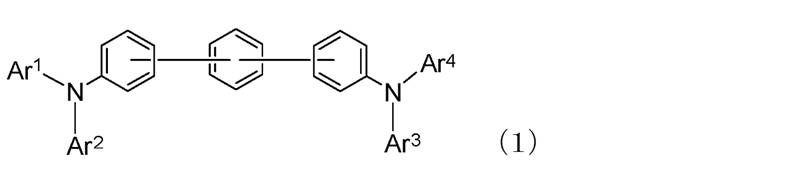
Claims (10)


Applications Claiming Priority (4)
| Application Number | Priority Date | Filing Date | Title |
|---|---|---|---|
| JP2014-153658 | 2014-07-29 | ||
| JP2014153658 | 2014-07-29 | ||
| JP2014-204426 | 2014-10-03 | ||
| JP2014204426 | 2014-10-03 |
Publications (2)
| Publication Number | Publication Date |
|---|---|
| TW201615058A TW201615058A (en) | 2016-04-16 |
| TWI697256B true TWI697256B (en) | 2020-06-21 |
Family
ID=55217494
Family Applications (1)
| Application Number | Title | Priority Date | Filing Date |
|---|---|---|---|
| TW104124461A TWI697256B (en) | 2014-07-29 | 2015-07-29 | Organic electroluminescence devices |
Country Status (7)
| Country | Link |
|---|---|
| US (1) | US11217754B2 (en) |
| EP (1) | EP3176845B1 (en) |
| JP (1) | JP6671283B2 (en) |
| KR (1) | KR102319951B1 (en) |
| CN (1) | CN107078224B (en) |
| TW (1) | TWI697256B (en) |
| WO (1) | WO2016017594A1 (en) |
Families Citing this family (10)
| Publication number | Priority date | Publication date | Assignee | Title |
|---|---|---|---|---|
| US10593884B2 (en) * | 2015-01-06 | 2020-03-17 | Hodogaya Chemical Co., Ltd. | Organic electroluminescent device |
| JP6731352B2 (en) * | 2015-01-07 | 2020-07-29 | 保土谷化学工業株式会社 | Organic electroluminescent device |
| EP3244465B1 (en) * | 2015-01-08 | 2022-04-20 | Hodogaya Chemical Co., Ltd. | Organic electroluminescent element |
| KR102066771B1 (en) * | 2016-02-01 | 2020-01-15 | 주식회사 엘지화학 | Heterocyclic compounds and organic electronic device using the same |
| CN108735911B (en) * | 2018-06-04 | 2020-04-14 | 长春海谱润斯科技有限公司 | Organic light-emitting device |
| KR102757686B1 (en) | 2018-12-14 | 2025-01-22 | 삼성디스플레이 주식회사 | Organic electroluminescence device and spiro compound for organic electroluminescence device |
| JP6934967B2 (en) * | 2019-03-29 | 2021-09-15 | 住友化学株式会社 | Light emitting element and composition for light emitting element |
| US20230354629A1 (en) * | 2020-01-08 | 2023-11-02 | Hodogaya Chemical Co., Ltd. | Organic electroluminescent device |
| CN114276366A (en) * | 2021-04-20 | 2022-04-05 | 北京八亿时空液晶科技股份有限公司 | Indole derivative and application thereof |
| CN114805386B (en) * | 2022-06-08 | 2024-02-09 | 上海钥熠电子科技有限公司 | Organic compound, host material, and organic photoelectric device |
Citations (4)
| Publication number | Priority date | Publication date | Assignee | Title |
|---|---|---|---|---|
| US20070252521A1 (en) * | 2006-04-27 | 2007-11-01 | Eastman Kodak Company | Electroluminescent device including an anthracene derivative |
| TW201307352A (en) * | 2011-07-15 | 2013-02-16 | Idemitsu Kosan Co | Nitrogenated aromatic heterocyclic derivative, and organic electroluminescent element using same |
| TW201308707A (en) * | 2011-04-25 | 2013-02-16 | 保土谷化學工業股份有限公司 | Organic electroluminescent element |
| TW201321360A (en) * | 2011-10-14 | 2013-06-01 | Hodogaya Chemical Co Ltd | Novel benzotriazole derivatives and organic electroluminescence devices using said derivatives |
Family Cites Families (32)
| Publication number | Priority date | Publication date | Assignee | Title |
|---|---|---|---|---|
| JPH03194657A (en) | 1989-12-22 | 1991-08-26 | Mitsubishi Electric Corp | Graphic processor |
| JP3194657B2 (en) | 1993-11-01 | 2001-07-30 | 松下電器産業株式会社 | EL device |
| EP0650955B1 (en) | 1993-11-01 | 1998-08-19 | Hodogaya Chemical Co., Ltd. | Amine compound and electro-luminescence device comprising same |
| JP3828595B2 (en) | 1994-02-08 | 2006-10-04 | Tdk株式会社 | Organic EL device |
| EP0666298A3 (en) | 1994-02-08 | 1995-11-15 | Tdk Corp | Organic EL element and compound used therein. |
| KR100691543B1 (en) | 2002-01-18 | 2007-03-09 | 주식회사 엘지화학 | New material for electron transport and organic light emitting device using the same |
| JP2004311411A (en) * | 2003-03-26 | 2004-11-04 | Konica Minolta Holdings Inc | Organic electroluminescence element, lighting device and display device |
| JP4487587B2 (en) | 2003-05-27 | 2010-06-23 | 株式会社デンソー | Organic EL device and method for manufacturing the same |
| US8188315B2 (en) | 2004-04-02 | 2012-05-29 | Samsung Mobile Display Co., Ltd. | Organic light emitting device and flat panel display device comprising the same |
| KR100787425B1 (en) | 2004-11-29 | 2007-12-26 | 삼성에스디아이 주식회사 | Phenylcarbazole compound and organic electroluminescent device using same |
| CN1956945B (en) | 2004-05-25 | 2010-09-22 | 保土谷化学工业株式会社 | P-terphenyl compound and electrophotographic photoreceptor using the same |
| US8021765B2 (en) | 2004-11-29 | 2011-09-20 | Samsung Mobile Display Co., Ltd. | Phenylcarbazole-based compound and organic electroluminescent device employing the same |
| KR101267114B1 (en) * | 2005-04-18 | 2013-05-23 | 이데미쓰 고산 가부시키가이샤 | Aromatic triamine compound and organic electroluminescent device using same |
| WO2006120859A1 (en) * | 2005-05-09 | 2006-11-16 | Idemitsu Kosan Co., Ltd. | Novel organic electroluminescent material, organic electroluminescent element employing the same, and thin-film-forming solution for organic electroluminescence |
| WO2007058127A1 (en) | 2005-11-16 | 2007-05-24 | Idemitsu Kosan Co., Ltd. | Aromatic amine derivative and organic electroluminescent element using the same |
| CN101296895A (en) * | 2005-11-16 | 2008-10-29 | 出光兴产株式会社 | Aromatic amine derivative and organic electroluminescent device using the derivative |
| US20070145888A1 (en) | 2005-11-16 | 2007-06-28 | Idemitsu Kosan Co., Ltd. | Aromatic amine derivatives and organic electroluminescence device using the same |
| JP5242016B2 (en) | 2006-03-31 | 2013-07-24 | 双葉電子工業株式会社 | COMPOUND FOR ORGANIC EL ELEMENT AND ORGANIC EL ELEMENT |
| JP2008007424A (en) * | 2006-06-27 | 2008-01-17 | Idemitsu Kosan Co Ltd | Aromatic amine derivatives and organic electroluminescence devices using them |
| JP5133259B2 (en) | 2006-11-24 | 2013-01-30 | 出光興産株式会社 | Aromatic amine derivative and organic electroluminescence device using the same |
| JP2008166538A (en) * | 2006-12-28 | 2008-07-17 | Fujifilm Finechemicals Co Ltd | Organic electroluminescent element |
| JP5501656B2 (en) * | 2008-05-16 | 2014-05-28 | 株式会社半導体エネルギー研究所 | Composition, thin film manufacturing method, and light emitting element manufacturing method |
| KR101216004B1 (en) * | 2009-08-17 | 2012-12-27 | 에스에프씨 주식회사 | Anthracene derivatives and organic light-emitting diode including the same |
| US9650565B2 (en) * | 2009-10-20 | 2017-05-16 | Tosoh Corporation | Carbazole compound and use thereof |
| KR101791276B1 (en) | 2009-11-12 | 2017-10-27 | 호도가야 가가쿠 고교 가부시키가이샤 | Compound having a substituted anthracene ring structure and pyridoindole ring structure, and organic electroluminescent element |
| US9133173B2 (en) * | 2010-10-15 | 2015-09-15 | Semiconductor Energy Laboratory Co., Ltd. | Carbazole compound, material for light-emitting element, organic semiconductor material, light-emitting element |
| KR101427611B1 (en) | 2011-03-08 | 2014-08-11 | 롬엔드하스전자재료코리아유한회사 | Novel compounds for organic electronic material and organic electroluminescence device using the same |
| US9287512B2 (en) | 2011-03-08 | 2016-03-15 | Rohm And Haas Electronic Materials Korea Ltd. | Organic electroluminescent compounds, layers and organic electroluminescent device using the same |
| KR102013399B1 (en) | 2011-11-29 | 2019-08-22 | 에스에프씨 주식회사 | Anthracene derivatives and organic light-emitting diode including the same |
| KR102072019B1 (en) * | 2012-10-18 | 2020-01-31 | 덕산네오룩스 주식회사 | Compound for organic electronic element, organic electronic element using the same, and a electronic device thereof |
| WO2014163228A1 (en) * | 2013-04-04 | 2014-10-09 | (주)피엔에이치테크 | Novel organic electroluminescent element compound and organic electroluminescent element comprising same |
| KR102105076B1 (en) * | 2013-06-04 | 2020-04-28 | 삼성디스플레이 주식회사 | Condensed cyclic compound and organic light-emitting diode comprising the same |
-
2015
- 2015-07-27 CN CN201580052525.2A patent/CN107078224B/en active Active
- 2015-07-27 JP JP2016538345A patent/JP6671283B2/en active Active
- 2015-07-27 WO PCT/JP2015/071285 patent/WO2016017594A1/en not_active Ceased
- 2015-07-27 US US15/329,083 patent/US11217754B2/en active Active
- 2015-07-27 KR KR1020177005834A patent/KR102319951B1/en active Active
- 2015-07-27 EP EP15827331.8A patent/EP3176845B1/en active Active
- 2015-07-29 TW TW104124461A patent/TWI697256B/en active
Patent Citations (4)
| Publication number | Priority date | Publication date | Assignee | Title |
|---|---|---|---|---|
| US20070252521A1 (en) * | 2006-04-27 | 2007-11-01 | Eastman Kodak Company | Electroluminescent device including an anthracene derivative |
| TW201308707A (en) * | 2011-04-25 | 2013-02-16 | 保土谷化學工業股份有限公司 | Organic electroluminescent element |
| TW201307352A (en) * | 2011-07-15 | 2013-02-16 | Idemitsu Kosan Co | Nitrogenated aromatic heterocyclic derivative, and organic electroluminescent element using same |
| TW201321360A (en) * | 2011-10-14 | 2013-06-01 | Hodogaya Chemical Co Ltd | Novel benzotriazole derivatives and organic electroluminescence devices using said derivatives |
Also Published As
| Publication number | Publication date |
|---|---|
| CN107078224A (en) | 2017-08-18 |
| US20180212153A1 (en) | 2018-07-26 |
| EP3176845B1 (en) | 2022-03-16 |
| EP3176845A4 (en) | 2018-03-14 |
| KR20170040306A (en) | 2017-04-12 |
| JP6671283B2 (en) | 2020-03-25 |
| CN107078224B (en) | 2020-02-28 |
| WO2016017594A1 (en) | 2016-02-04 |
| TW201615058A (en) | 2016-04-16 |
| JPWO2016017594A1 (en) | 2017-05-25 |
| EP3176845A1 (en) | 2017-06-07 |
| US11217754B2 (en) | 2022-01-04 |
| KR102319951B1 (en) | 2021-10-29 |
Similar Documents
| Publication | Publication Date | Title |
|---|---|---|
| TWI697256B (en) | Organic electroluminescence devices | |
| JP6158937B2 (en) | Fluoranthene compound and organic electronic device containing the same | |
| KR102493763B1 (en) | Organic electroluminescent element | |
| TWI682919B (en) | Organic electroluminescent device | |
| TWI660935B (en) | Organic electroluminescent device | |
| TWI548638B (en) | Heterocyclic compound and organic light-emitting device using same | |
| CN107408636B (en) | Organic electroluminescence device | |
| TWI620735B (en) | Indenofluorene derivatives and organic electroluminescent elements | |
| JP2017538657A (en) | Nitrogen-containing fused ring compound and organic light-emitting device using the same | |
| TW201437328A (en) | Organic electroluminescent element | |
| JP6731352B2 (en) | Organic electroluminescent device | |
| CN107210382A (en) | Organic Electroluminescent Devices | |
| TWI790287B (en) | Organic electroluminescence device | |
| TW201803967A (en) | Organic electroluminescent element | |
| TWI704210B (en) | An organic el device | |
| EP3185324A1 (en) | Organic electroluminescent element | |
| TWI741047B (en) | Organic electroluminescent device | |
| TW202140748A (en) | Organic electroluminescent device | |
| TW202031867A (en) | Organic electroluminescence element | |
| TWI707941B (en) | An organic electroluminescence device | |
| TW201431861A (en) | Compound having an acridan ring structure and organic electroluminescent device |