TWI714802B - Group 5 metal compound, preparing method thereof, precursor composition including the same for film deposition, and depositing method of film using the same - Google Patents
Group 5 metal compound, preparing method thereof, precursor composition including the same for film deposition, and depositing method of film using the same Download PDFInfo
- Publication number
- TWI714802B TWI714802B TW106128864A TW106128864A TWI714802B TW I714802 B TWI714802 B TW I714802B TW 106128864 A TW106128864 A TW 106128864A TW 106128864 A TW106128864 A TW 106128864A TW I714802 B TWI714802 B TW I714802B
- Authority
- TW
- Taiwan
- Prior art keywords
- group
- film
- metal compound
- present
- metal
- Prior art date
Links
- 0 CC1=C(*)C(CC*N(*)[N+](C)([N-]C)N(*)*)=C(*)C1=* Chemical compound CC1=C(*)C(CC*N(*)[N+](C)([N-]C)N(*)*)=C(*)C1=* 0.000 description 1
Images


Classifications
-
- C—CHEMISTRY; METALLURGY
- C07—ORGANIC CHEMISTRY
- C07F—ACYCLIC, CARBOCYCLIC OR HETEROCYCLIC COMPOUNDS CONTAINING ELEMENTS OTHER THAN CARBON, HYDROGEN, HALOGEN, OXYGEN, NITROGEN, SULFUR, SELENIUM OR TELLURIUM
- C07F9/00—Compounds containing elements of Groups 5 or 15 of the Periodic Table
-
- C—CHEMISTRY; METALLURGY
- C07—ORGANIC CHEMISTRY
- C07F—ACYCLIC, CARBOCYCLIC OR HETEROCYCLIC COMPOUNDS CONTAINING ELEMENTS OTHER THAN CARBON, HYDROGEN, HALOGEN, OXYGEN, NITROGEN, SULFUR, SELENIUM OR TELLURIUM
- C07F17/00—Metallocenes
-
- C—CHEMISTRY; METALLURGY
- C23—COATING METALLIC MATERIAL; COATING MATERIAL WITH METALLIC MATERIAL; CHEMICAL SURFACE TREATMENT; DIFFUSION TREATMENT OF METALLIC MATERIAL; COATING BY VACUUM EVAPORATION, BY SPUTTERING, BY ION IMPLANTATION OR BY CHEMICAL VAPOUR DEPOSITION, IN GENERAL; INHIBITING CORROSION OF METALLIC MATERIAL OR INCRUSTATION IN GENERAL
- C23C—COATING METALLIC MATERIAL; COATING MATERIAL WITH METALLIC MATERIAL; SURFACE TREATMENT OF METALLIC MATERIAL BY DIFFUSION INTO THE SURFACE, BY CHEMICAL CONVERSION OR SUBSTITUTION; COATING BY VACUUM EVAPORATION, BY SPUTTERING, BY ION IMPLANTATION OR BY CHEMICAL VAPOUR DEPOSITION, IN GENERAL
- C23C16/00—Chemical coating by decomposition of gaseous compounds, without leaving reaction products of surface material in the coating, i.e. chemical vapour deposition [CVD] processes
- C23C16/06—Chemical coating by decomposition of gaseous compounds, without leaving reaction products of surface material in the coating, i.e. chemical vapour deposition [CVD] processes characterised by the deposition of metallic material
- C23C16/18—Chemical coating by decomposition of gaseous compounds, without leaving reaction products of surface material in the coating, i.e. chemical vapour deposition [CVD] processes characterised by the deposition of metallic material from metallo-organic compounds
-
- C—CHEMISTRY; METALLURGY
- C23—COATING METALLIC MATERIAL; COATING MATERIAL WITH METALLIC MATERIAL; CHEMICAL SURFACE TREATMENT; DIFFUSION TREATMENT OF METALLIC MATERIAL; COATING BY VACUUM EVAPORATION, BY SPUTTERING, BY ION IMPLANTATION OR BY CHEMICAL VAPOUR DEPOSITION, IN GENERAL; INHIBITING CORROSION OF METALLIC MATERIAL OR INCRUSTATION IN GENERAL
- C23C—COATING METALLIC MATERIAL; COATING MATERIAL WITH METALLIC MATERIAL; SURFACE TREATMENT OF METALLIC MATERIAL BY DIFFUSION INTO THE SURFACE, BY CHEMICAL CONVERSION OR SUBSTITUTION; COATING BY VACUUM EVAPORATION, BY SPUTTERING, BY ION IMPLANTATION OR BY CHEMICAL VAPOUR DEPOSITION, IN GENERAL
- C23C16/00—Chemical coating by decomposition of gaseous compounds, without leaving reaction products of surface material in the coating, i.e. chemical vapour deposition [CVD] processes
- C23C16/22—Chemical coating by decomposition of gaseous compounds, without leaving reaction products of surface material in the coating, i.e. chemical vapour deposition [CVD] processes characterised by the deposition of inorganic material, other than metallic material
- C23C16/30—Deposition of compounds, mixtures or solid solutions, e.g. borides, carbides, nitrides
- C23C16/34—Nitrides
-
- C—CHEMISTRY; METALLURGY
- C23—COATING METALLIC MATERIAL; COATING MATERIAL WITH METALLIC MATERIAL; CHEMICAL SURFACE TREATMENT; DIFFUSION TREATMENT OF METALLIC MATERIAL; COATING BY VACUUM EVAPORATION, BY SPUTTERING, BY ION IMPLANTATION OR BY CHEMICAL VAPOUR DEPOSITION, IN GENERAL; INHIBITING CORROSION OF METALLIC MATERIAL OR INCRUSTATION IN GENERAL
- C23C—COATING METALLIC MATERIAL; COATING MATERIAL WITH METALLIC MATERIAL; SURFACE TREATMENT OF METALLIC MATERIAL BY DIFFUSION INTO THE SURFACE, BY CHEMICAL CONVERSION OR SUBSTITUTION; COATING BY VACUUM EVAPORATION, BY SPUTTERING, BY ION IMPLANTATION OR BY CHEMICAL VAPOUR DEPOSITION, IN GENERAL
- C23C16/00—Chemical coating by decomposition of gaseous compounds, without leaving reaction products of surface material in the coating, i.e. chemical vapour deposition [CVD] processes
- C23C16/22—Chemical coating by decomposition of gaseous compounds, without leaving reaction products of surface material in the coating, i.e. chemical vapour deposition [CVD] processes characterised by the deposition of inorganic material, other than metallic material
- C23C16/30—Deposition of compounds, mixtures or solid solutions, e.g. borides, carbides, nitrides
- C23C16/40—Oxides
-
- C—CHEMISTRY; METALLURGY
- C23—COATING METALLIC MATERIAL; COATING MATERIAL WITH METALLIC MATERIAL; CHEMICAL SURFACE TREATMENT; DIFFUSION TREATMENT OF METALLIC MATERIAL; COATING BY VACUUM EVAPORATION, BY SPUTTERING, BY ION IMPLANTATION OR BY CHEMICAL VAPOUR DEPOSITION, IN GENERAL; INHIBITING CORROSION OF METALLIC MATERIAL OR INCRUSTATION IN GENERAL
- C23C—COATING METALLIC MATERIAL; COATING MATERIAL WITH METALLIC MATERIAL; SURFACE TREATMENT OF METALLIC MATERIAL BY DIFFUSION INTO THE SURFACE, BY CHEMICAL CONVERSION OR SUBSTITUTION; COATING BY VACUUM EVAPORATION, BY SPUTTERING, BY ION IMPLANTATION OR BY CHEMICAL VAPOUR DEPOSITION, IN GENERAL
- C23C16/00—Chemical coating by decomposition of gaseous compounds, without leaving reaction products of surface material in the coating, i.e. chemical vapour deposition [CVD] processes
- C23C16/22—Chemical coating by decomposition of gaseous compounds, without leaving reaction products of surface material in the coating, i.e. chemical vapour deposition [CVD] processes characterised by the deposition of inorganic material, other than metallic material
- C23C16/30—Deposition of compounds, mixtures or solid solutions, e.g. borides, carbides, nitrides
- C23C16/40—Oxides
- C23C16/405—Oxides of refractory metals or yttrium
-
- C—CHEMISTRY; METALLURGY
- C23—COATING METALLIC MATERIAL; COATING MATERIAL WITH METALLIC MATERIAL; CHEMICAL SURFACE TREATMENT; DIFFUSION TREATMENT OF METALLIC MATERIAL; COATING BY VACUUM EVAPORATION, BY SPUTTERING, BY ION IMPLANTATION OR BY CHEMICAL VAPOUR DEPOSITION, IN GENERAL; INHIBITING CORROSION OF METALLIC MATERIAL OR INCRUSTATION IN GENERAL
- C23C—COATING METALLIC MATERIAL; COATING MATERIAL WITH METALLIC MATERIAL; SURFACE TREATMENT OF METALLIC MATERIAL BY DIFFUSION INTO THE SURFACE, BY CHEMICAL CONVERSION OR SUBSTITUTION; COATING BY VACUUM EVAPORATION, BY SPUTTERING, BY ION IMPLANTATION OR BY CHEMICAL VAPOUR DEPOSITION, IN GENERAL
- C23C16/00—Chemical coating by decomposition of gaseous compounds, without leaving reaction products of surface material in the coating, i.e. chemical vapour deposition [CVD] processes
- C23C16/44—Chemical coating by decomposition of gaseous compounds, without leaving reaction products of surface material in the coating, i.e. chemical vapour deposition [CVD] processes characterised by the method of coating
- C23C16/455—Chemical coating by decomposition of gaseous compounds, without leaving reaction products of surface material in the coating, i.e. chemical vapour deposition [CVD] processes characterised by the method of coating characterised by the method used for introducing gases into reaction chamber or for modifying gas flows in reaction chamber
-
- C—CHEMISTRY; METALLURGY
- C23—COATING METALLIC MATERIAL; COATING MATERIAL WITH METALLIC MATERIAL; CHEMICAL SURFACE TREATMENT; DIFFUSION TREATMENT OF METALLIC MATERIAL; COATING BY VACUUM EVAPORATION, BY SPUTTERING, BY ION IMPLANTATION OR BY CHEMICAL VAPOUR DEPOSITION, IN GENERAL; INHIBITING CORROSION OF METALLIC MATERIAL OR INCRUSTATION IN GENERAL
- C23C—COATING METALLIC MATERIAL; COATING MATERIAL WITH METALLIC MATERIAL; SURFACE TREATMENT OF METALLIC MATERIAL BY DIFFUSION INTO THE SURFACE, BY CHEMICAL CONVERSION OR SUBSTITUTION; COATING BY VACUUM EVAPORATION, BY SPUTTERING, BY ION IMPLANTATION OR BY CHEMICAL VAPOUR DEPOSITION, IN GENERAL
- C23C16/00—Chemical coating by decomposition of gaseous compounds, without leaving reaction products of surface material in the coating, i.e. chemical vapour deposition [CVD] processes
- C23C16/44—Chemical coating by decomposition of gaseous compounds, without leaving reaction products of surface material in the coating, i.e. chemical vapour deposition [CVD] processes characterised by the method of coating
- C23C16/455—Chemical coating by decomposition of gaseous compounds, without leaving reaction products of surface material in the coating, i.e. chemical vapour deposition [CVD] processes characterised by the method of coating characterised by the method used for introducing gases into reaction chamber or for modifying gas flows in reaction chamber
- C23C16/45523—Pulsed gas flow or change of composition over time
- C23C16/45525—Atomic layer deposition [ALD]
- C23C16/45553—Atomic layer deposition [ALD] characterized by the use of precursors specially adapted for ALD
-
- H—ELECTRICITY
- H10—SEMICONDUCTOR DEVICES; ELECTRIC SOLID-STATE DEVICES NOT OTHERWISE PROVIDED FOR
- H10D—INORGANIC ELECTRIC SEMICONDUCTOR DEVICES
- H10D64/00—Electrodes of devices having potential barriers
- H10D64/01—Manufacture or treatment
- H10D64/011—Manufacture or treatment of electrodes ohmically coupled to a semiconductor
-
- H—ELECTRICITY
- H10—SEMICONDUCTOR DEVICES; ELECTRIC SOLID-STATE DEVICES NOT OTHERWISE PROVIDED FOR
- H10D—INORGANIC ELECTRIC SEMICONDUCTOR DEVICES
- H10D64/00—Electrodes of devices having potential barriers
- H10D64/01—Manufacture or treatment
- H10D64/013—Manufacture or treatment of electrodes having a conductor capacitively coupled to a semiconductor by an insulator
- H10D64/01302—Manufacture or treatment of electrodes having a conductor capacitively coupled to a semiconductor by an insulator the insulator being formed after the semiconductor body, the semiconductor being silicon
- H10D64/01332—Making the insulator
- H10D64/01336—Making the insulator on single crystalline silicon, e.g. chemical oxidation using a liquid
- H10D64/01342—Making the insulator on single crystalline silicon, e.g. chemical oxidation using a liquid by deposition, e.g. evaporation, ALD or laser deposition
-
- H—ELECTRICITY
- H10—SEMICONDUCTOR DEVICES; ELECTRIC SOLID-STATE DEVICES NOT OTHERWISE PROVIDED FOR
- H10D—INORGANIC ELECTRIC SEMICONDUCTOR DEVICES
- H10D64/00—Electrodes of devices having potential barriers
- H10D64/01—Manufacture or treatment
- H10D64/013—Manufacture or treatment of electrodes having a conductor capacitively coupled to a semiconductor by an insulator
- H10D64/01302—Manufacture or treatment of electrodes having a conductor capacitively coupled to a semiconductor by an insulator the insulator being formed after the semiconductor body, the semiconductor being silicon
- H10D64/01332—Making the insulator
- H10D64/0135—Making the insulator by deposition of a layer, e.g. metal, metal compound or polysilicon, followed by transformation thereof into the insulator
-
- H—ELECTRICITY
- H10—SEMICONDUCTOR DEVICES; ELECTRIC SOLID-STATE DEVICES NOT OTHERWISE PROVIDED FOR
- H10P—GENERIC PROCESSES OR APPARATUS FOR THE MANUFACTURE OR TREATMENT OF DEVICES COVERED BY CLASS H10
- H10P14/00—Formation of materials, e.g. in the shape of layers or pillars
- H10P14/40—Formation of materials, e.g. in the shape of layers or pillars of conductive or resistive materials
- H10P14/42—Formation of materials, e.g. in the shape of layers or pillars of conductive or resistive materials using a gas or vapour
-
- H—ELECTRICITY
- H10—SEMICONDUCTOR DEVICES; ELECTRIC SOLID-STATE DEVICES NOT OTHERWISE PROVIDED FOR
- H10P—GENERIC PROCESSES OR APPARATUS FOR THE MANUFACTURE OR TREATMENT OF DEVICES COVERED BY CLASS H10
- H10P14/00—Formation of materials, e.g. in the shape of layers or pillars
- H10P14/40—Formation of materials, e.g. in the shape of layers or pillars of conductive or resistive materials
- H10P14/42—Formation of materials, e.g. in the shape of layers or pillars of conductive or resistive materials using a gas or vapour
- H10P14/44—Physical vapour deposition [PVD]
-
- H—ELECTRICITY
- H10—SEMICONDUCTOR DEVICES; ELECTRIC SOLID-STATE DEVICES NOT OTHERWISE PROVIDED FOR
- H10P—GENERIC PROCESSES OR APPARATUS FOR THE MANUFACTURE OR TREATMENT OF DEVICES COVERED BY CLASS H10
- H10P14/00—Formation of materials, e.g. in the shape of layers or pillars
- H10P14/60—Formation of materials, e.g. in the shape of layers or pillars of insulating materials
- H10P14/63—Formation of materials, e.g. in the shape of layers or pillars of insulating materials characterised by the formation processes
- H10P14/6326—Deposition processes
- H10P14/6328—Deposition from the gas or vapour phase
- H10P14/6334—Deposition from the gas or vapour phase using decomposition or reaction of gaseous or vapour phase compounds, i.e. chemical vapour deposition
- H10P14/6339—Deposition from the gas or vapour phase using decomposition or reaction of gaseous or vapour phase compounds, i.e. chemical vapour deposition deposition by cyclic CVD, e.g. ALD, ALE or pulsed CVD
-
- H—ELECTRICITY
- H10—SEMICONDUCTOR DEVICES; ELECTRIC SOLID-STATE DEVICES NOT OTHERWISE PROVIDED FOR
- H10P—GENERIC PROCESSES OR APPARATUS FOR THE MANUFACTURE OR TREATMENT OF DEVICES COVERED BY CLASS H10
- H10P14/00—Formation of materials, e.g. in the shape of layers or pillars
- H10P14/60—Formation of materials, e.g. in the shape of layers or pillars of insulating materials
- H10P14/66—Formation of materials, e.g. in the shape of layers or pillars of insulating materials characterised by the type of materials
- H10P14/668—Formation of materials, e.g. in the shape of layers or pillars of insulating materials characterised by the type of materials the materials being characterised by the deposition precursor materials
-
- H—ELECTRICITY
- H10—SEMICONDUCTOR DEVICES; ELECTRIC SOLID-STATE DEVICES NOT OTHERWISE PROVIDED FOR
- H10P—GENERIC PROCESSES OR APPARATUS FOR THE MANUFACTURE OR TREATMENT OF DEVICES COVERED BY CLASS H10
- H10P14/00—Formation of materials, e.g. in the shape of layers or pillars
- H10P14/60—Formation of materials, e.g. in the shape of layers or pillars of insulating materials
- H10P14/69—Inorganic materials
- H10P14/692—Inorganic materials composed of oxides, glassy oxides or oxide-based glasses
- H10P14/6938—Inorganic materials composed of oxides, glassy oxides or oxide-based glasses the material containing at least one metal element, e.g. metal oxides, metal oxynitrides or metal oxycarbides
- H10P14/6939—Inorganic materials composed of oxides, glassy oxides or oxide-based glasses the material containing at least one metal element, e.g. metal oxides, metal oxynitrides or metal oxycarbides characterised by the metal
- H10P14/69393—Inorganic materials composed of oxides, glassy oxides or oxide-based glasses the material containing at least one metal element, e.g. metal oxides, metal oxynitrides or metal oxycarbides characterised by the metal the material containing tantalum, e.g. Ta2O5
-
- H—ELECTRICITY
- H10—SEMICONDUCTOR DEVICES; ELECTRIC SOLID-STATE DEVICES NOT OTHERWISE PROVIDED FOR
- H10P—GENERIC PROCESSES OR APPARATUS FOR THE MANUFACTURE OR TREATMENT OF DEVICES COVERED BY CLASS H10
- H10P95/00—Generic processes or apparatus for manufacture or treatments not covered by the other groups of this subclass
Landscapes
- Chemical & Material Sciences (AREA)
- Organic Chemistry (AREA)
- General Chemical & Material Sciences (AREA)
- Chemical Kinetics & Catalysis (AREA)
- Engineering & Computer Science (AREA)
- Materials Engineering (AREA)
- Mechanical Engineering (AREA)
- Metallurgy (AREA)
- Inorganic Chemistry (AREA)
- Chemical Vapour Deposition (AREA)
Abstract
本發明涉及一種新型第Ⅴ族金屬化合物、所述第Ⅴ族金屬化合物的製備方法、包含所述第Ⅴ族金屬化合物的含第Ⅴ族金屬膜沉積用前體組合物、以及利用所述含第Ⅴ族金屬膜沉積用前體組合物來沉積含第Ⅴ族金屬膜的方法。The present invention relates to a novel group V metal compound, a method for preparing the group V metal compound, a precursor composition for depositing a group V metal film containing the group V metal compound, and the use of the group V metal compound A method for depositing a group V metal film using a precursor composition to deposit a group V metal film.
Description
本發明涉及新型第Ⅴ族金屬化合物、所述第Ⅴ族金屬化合物的製備方法、包含所述第Ⅴ族金屬化合物的含第Ⅴ族金屬膜沉積用前體組合物、以及利用所述含第Ⅴ族金屬膜沉積用前體組合物沉積含第Ⅴ族金屬膜的方法。The present invention relates to a novel group V metal compound, a method for preparing the group V metal compound, a precursor composition for depositing a group V metal film containing the group V metal compound, and the use of the group V metal compound A method for depositing a group metal film with a precursor composition for depositing a group V metal film.
在半導體元件的製造中可使用第Ⅴ族金屬特別是鉭(Ta)和鈮(Nb)的金屬膜及鉭氧化物膜或鉭氮化物膜。特別是,在半導體元件的製造工藝中使用利用濺射法來形成含鉭膜的方法。但是,為了在具有凹凸的表面上形成如銅擴散防止膜那樣極薄的數nm厚度的含鉭膜,需要階梯覆蓋性優異的化學沉積法,其中特別需要原子層沉積法,因此需要適合該原子層沉積法的第Ⅴ族金屬前體化合物。In the manufacture of semiconductor elements, metal films of group V metals, particularly tantalum (Ta) and niobium (Nb), and tantalum oxide films or tantalum nitride films can be used. In particular, a method of forming a tantalum-containing film using a sputtering method is used in the manufacturing process of the semiconductor element. However, in order to form an extremely thin tantalum-containing film with a thickness of several nanometers such as a copper diffusion prevention film on a surface with unevenness, a chemical deposition method with excellent step coverage is required. Among them, an atomic layer deposition method is particularly required, so it is necessary to be suitable for the atom Group V metal precursor compound of layer deposition method.
作為能夠形成含第Ⅴ族金屬模的有機金屬前體化合物,已知有五(二甲氨基)鉭[pentakis(dimethylamido)tantalum, PDMAT]、叔丁基亞氨基三(二乙基氨基)鉭[(tert-butylimido)tris(diethylamido)tantalum, TBTDET]、叔丁基亞氨基三(二乙基氨基)鈮[(tert-butylimido)tris(diethylamido)niobium, TBTDEN]等(參照美國授權專利US6,552,209)。但是,由於PDMAT為固體,因此不便用於化學沉積法或原子層沉積法。在化學沉積法或原子層沉積法中使用液體原料是有利的。在半導體元件製造工藝中普遍使用通過在圓筒形狀的容器中盛入液體後使其汽化或者使按規定流量注入的液體汽化的裝置(直接液體注入, direct liquid injection, DLI)等。但是,由於固體汽化的昇華速度與固體表面積成比例,並且在昇華過程中固體表面積持續變化,因此難以使固體隨時間均勻地汽化而進行供給,且需要特殊的裝置。此外,由於PDMAT、TBTDET、TBTDEN等均不具備良好的熱穩定性,因此不利於在高溫下使用。例如,用於在300℃下在具有凹凸的表面上形成均勻厚度的氧化物膜的原子層沉積法中難以使用這些化合物。因此,需要能夠在商業化的半導體元件製造工藝中使用的作為熱穩定性高且在常溫下為液體狀態或具有粘性的固體狀態的新型第Ⅴ族金屬前體化合物。As organometallic precursor compounds capable of forming Group V metal molds, pentakis(dimethylamido)tantalum, PDMAT] and tert-butyliminotris(diethylamino)tantalum are known. (tert-butylimido)tris(diethylamido)tantalum, TBTDET], tert-butylimidotris(diethylamido)tris(diethylamido)niobium, TBTDEN], etc. (refer to US Patent US6,552,209 ). However, since PDMAT is solid, it is inconvenient to use in chemical deposition or atomic layer deposition. It is advantageous to use liquid raw materials in the chemical deposition method or the atomic layer deposition method. In the semiconductor device manufacturing process, a device (direct liquid injection, DLI) that vaporizes a liquid after filling it in a cylindrical container or vaporizes a liquid injected at a prescribed flow rate is commonly used. However, since the sublimation rate of solid vaporization is proportional to the solid surface area, and the solid surface area continuously changes during the sublimation process, it is difficult to uniformly vaporize the solid over time for supply, and special equipment is required. In addition, since PDMAT, TBTDET, TBTDEN, etc. do not have good thermal stability, it is not conducive to use at high temperatures. For example, it is difficult to use these compounds in an atomic layer deposition method for forming an oxide film of uniform thickness on a surface having unevenness at 300°C. Therefore, there is a need for a novel Group V metal precursor compound that can be used in a commercial semiconductor device manufacturing process as a high thermal stability and a liquid state or a viscous solid state at room temperature.
技術問題technical problem
因此,本發明提供一種新型第Ⅴ族金屬化合物、所述第Ⅴ族金屬化合物的製備方法、包含所述第Ⅴ族金屬化合物的含第Ⅴ族金屬膜沉積用前體組合物、以及利用所述含第Ⅴ族金屬膜沉積用前體組合物沉積含第Ⅴ族金屬膜的方法。Therefore, the present invention provides a novel group V metal compound, a method for preparing the group V metal compound, a precursor composition for depositing a group V metal film containing the group V metal compound, and the use of the A method for depositing a group V metal containing film with a precursor composition for depositing a group V metal containing film.
但是,本發明所要解決的技術問題並不限於上述所提及的技術問題,本領域技術人員能夠從以下記載中明確理解沒有提及的又一技術問題。However, the technical problem to be solved by the present invention is not limited to the above-mentioned technical problem, and those skilled in the art can clearly understand another technical problem that is not mentioned from the following description.
技術方案Technical solutions
本發明的第一方面提供一種由下列化學式1表示的第Ⅴ族金屬化合物:[01]
[化學式1]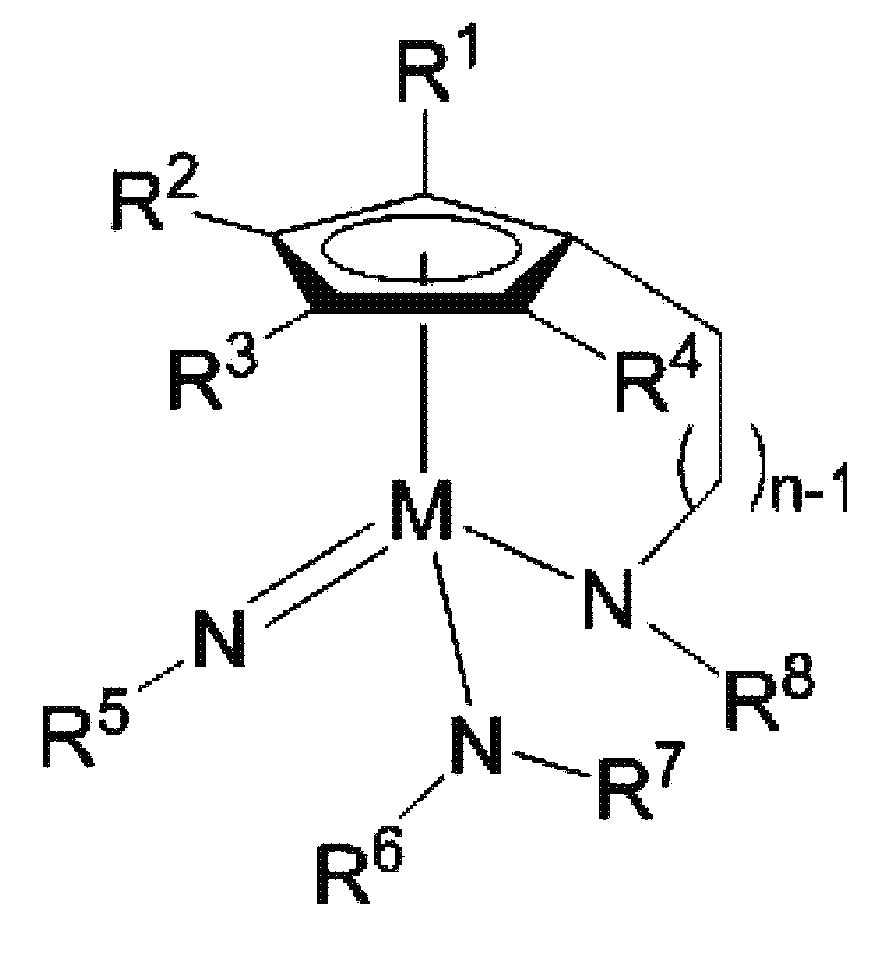
在上述化學式1中,M為Ta或Nb;R1
、R2
、R3
和R4
分別獨立地為氫原子、或碳原子數為1至4的直鏈或支鏈烷基;R5
為碳原子數為3至6的直鏈或支鏈烷基;R6
、R7
和R8
分別獨立地為碳原子數為1至4的直鏈或支鏈烷基;n為1至4的整數。In the above
本發明的第二方面提供一種製備由下列化學式1表示的第Ⅴ族金屬化合物的方法,該方法包括以下步驟:在由下列化學式2表示的(R5
N=)M(NR6
R7
)3
化合物中添加由下列化學式3表示的R1
R2
R3
R4
Cp(CH2
)n
NHR8
化合物並使其反應:[02]
[化學式1]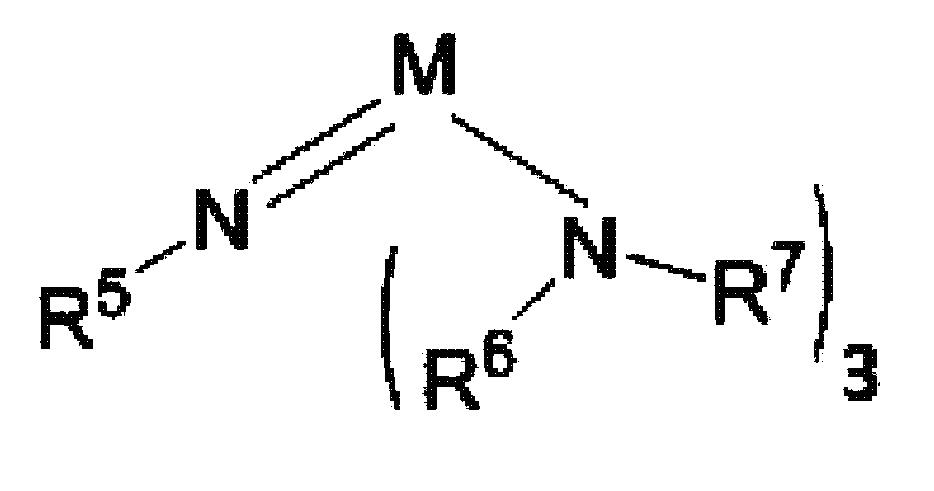

在上述化學式1至3中的每一者中,M為Ta或Nb;R1
、R2
、R3
和R4
分別獨立地為氫原子、或碳原子數為1至4的直鏈或支鏈烷基;R5
為碳原子數為3至6的直鏈或支鏈烷基;R6
、R7
和R8
分別獨立地為碳原子數為1至4的直鏈或支鏈烷基;n為1至4的整數。In each of the above
本發明的協力廠商面提供一種包含本發明的第一方面的第Ⅴ族金屬化合物的含第Ⅴ族金屬膜沉積用前體組合物。The third party of the present invention provides a precursor composition for depositing a group V metal film containing the group V metal compound of the first aspect of the present invention.
本發明的第四方面提供一種沉積含第Ⅴ族金屬膜的方法,該方法包括以下步驟:利用本發明的協力廠商面的含第Ⅴ族金屬膜沉積用前體組合物而在襯底上形成含第Ⅴ族金屬膜。The fourth aspect of the present invention provides a method for depositing a group V-containing metal film, the method comprising the following steps: forming on a substrate using a precursor composition for depositing a group V metal-containing film of the present invention Contains Group V metal film.
有益效果Beneficial effect
本發明的實現例所涉及的新型第Ⅴ族金屬化合物可被形成為在常溫下為液體或具有粘性的固體,從而具有提高的熱穩定性和高揮發性等特性。The novel Group V metal compound involved in the realization of the present invention can be formed into a liquid or a viscous solid at room temperature, thereby having characteristics such as improved thermal stability and high volatility.
由於本發明的實現例所涉及的所述新型第Ⅴ族金屬化合物的熱穩定性高,因此被用作原子層沉積法(atomic layer deposition, ALD)或化學氣相沉積法(chemical vapor deposition, CVD)的前體,能形成高品質的含第Ⅴ族金屬膜,特別是,也可以在表面具有凹凸(槽)的襯底上均勻地形成薄且均勻厚度的含第Ⅴ族金屬膜。由此,本發明的實現例所涉及的形成含第Ⅴ族金屬膜的方法可應用到商業化的半導體元件製造中。Due to the high thermal stability of the novel Group V metal compound involved in the implementation of the present invention, it is used as an atomic layer deposition (ALD) or chemical vapor deposition (CVD) method. ) Can form a high-quality group V-containing metal film. In particular, a thin and uniform thickness of the group V-containing metal film can be uniformly formed on a substrate with unevenness (grooves) on the surface. Therefore, the method for forming a group V-containing metal film according to the implementation example of the present invention can be applied to commercial semiconductor device manufacturing.
由於本發明的實現例所涉及的所述新型第Ⅴ族金屬化合物被用作ALD、CVD等中使用的前體,因此能提供如半導體那樣的下一代器件的製造中所要求的性能,例如提高的熱穩定性、高揮發性或增強的沉積速度等,從而能夠在含第Ⅴ族金屬膜或薄膜的形成中有效地使用所述新型第Ⅴ族金屬化合物。Since the novel Group V metal compound according to the realization of the present invention is used as a precursor used in ALD, CVD, etc., it can provide the performance required in the manufacture of next-generation devices such as semiconductors, such as improved The thermal stability, high volatility, or enhanced deposition rate of the compound can effectively use the new group V metal compound in the formation of a group V metal-containing film or thin film.
下面參照附圖詳細說明本發明的實施例,以使本領域的普通技術人員能夠容易地實施本發明。但是本發明可以以各種不同形式來實現,不限於在此說明的實施例。此外,為了明確說明本發明,在附圖中省略了與說明無關的部分,在整個說明書中相似部分使用了相似的附圖標記。The embodiments of the present invention will be described in detail below with reference to the accompanying drawings, so that those skilled in the art can easily implement the present invention. However, the present invention can be implemented in various different forms and is not limited to the embodiments described herein. In addition, in order to clearly illustrate the present invention, parts that are not related to the description are omitted in the drawings, and similar reference numerals are used for similar parts throughout the specification.
在本發明的整個說明書中,當描述某一部分與另一部分“連接”時,不僅包括“直接連接”的情況,還包括中間隔著其他器件而“電連接”的情況。In the entire specification of the present invention, when describing that a part is "connected" with another part, it includes not only the case of "directly connected", but also the case of "electrically connected" with other devices interposed therebetween.
在本發明的整個說明書中,當描述某一部件位於另一部件“之上”時,不僅包括該某一部件與另一部件接觸的情況,還包括這兩個部件之間存在其他部件的情況。Throughout the specification of the present invention, when it is described that a certain part is "above" another part, it not only includes the case where the certain part is in contact with another part, but also the case where there are other parts between the two parts. .
在本發明的整個說明書中,當描述某一部分“包含”某一構成要素時,在沒有明確相反記載的情況下,不表示排除其他構成要素,而表示還可以包含其他構成要素。In the entire specification of the present invention, when it is described that a certain part "includes" a certain component, unless it is clearly stated to the contrary, it does not mean that other components are excluded, but it means that other components may also be included.
在本發明的整個說明書中使用的表示程度的術語“約”、“實質上”等,示出了對所提及的含義所固有的製造及物質允許誤差時,以該數值或接近該數值的含義使用,且用於防止不道德的侵權人不當使用為了幫助理解本發明而提及準確或絕對的數值的公開內容。The terms "about", "substantially", etc. used throughout the specification of the present invention to indicate the degree indicate the manufacturing and material tolerances inherent in the meaning mentioned, when the value is or is close to the value The meaning is used and used to prevent unethical infringers from improperly using the disclosure that mentions accurate or absolute values to help understand the present invention.
在本發明的整個說明書中使用的術語“…的步驟”不表示“用於…的步驟”。The term "steps of..." used throughout the specification of the present invention does not mean "steps for...".
在本發明的整個說明書中,馬庫西式的表達中包含的術語“它們的組合”表示選自由在馬庫西式的表達中記載的構成要素組成的組中的一者以上的混合或組合,表示包含選自由上述構成要素組成的組中的一者以上。Throughout the specification of the present invention, the term "combination of them" included in the Markussi expression means a mixture or combination of one or more selected from the group consisting of the constituent elements described in the Markussi expression, indicating Contains one or more selected from the group consisting of the aforementioned constituent elements.
在本發明的整個說明書中,“A和/或B”的記載表示“A或B、或者A和B”。Throughout the specification of the present invention, the description of "A and/or B" means "A or B, or A and B".
在整個說明書中,用語“烷基”包含具有1至12個碳原子、1至10個碳原子、1至8個碳原子、1至5個碳原子、1至3個碳原子、3至8個碳原子或3至5個碳原子的直鏈或支鏈烷基。例如,所述烷基可包含甲基、乙基、正丙基(n Pr)、異丙基(i Pr)、正丁基(n Bu)、叔丁基(t Bu)、異丁基(i Bu)、仲丁基(s Bu)、正戊基、叔戊基、異戊基、仲戊基、新戊基、3-戊基、己基、異己基、庚基、4,4-二甲基戊基、辛基、2,2,4-三甲基戊基、壬基、癸基、十一烷基、十二烷基和它們的同分異構體等,但可不限於此。Throughout the specification, the term "alkyl" includes those having 1 to 12 carbon atoms, 1 to 10 carbon atoms, 1 to 8 carbon atoms, 1 to 5 carbon atoms, 1 to 3 carbon atoms, 3 to 8 A straight or branched chain alkyl group of 3 to 5 carbon atoms. For example, the alkyl group may include methyl, ethyl, n-propyl ( n Pr), isopropyl ( i Pr), n-butyl ( n Bu), tert-butyl ( t Bu), isobutyl ( i Bu), sec-butyl ( s Bu), n-pentyl, tert-pentyl, isopentyl, sec-pentyl, neopentyl, 3-pentyl, hexyl, isohexyl, heptyl, 4,4-di Methylpentyl, octyl, 2,2,4-trimethylpentyl, nonyl, decyl, undecyl, dodecyl, and their isomers, etc., but may not be limited thereto.
在整個說明書中,用語“膜”可包含“膜”或“薄膜”,但可不限於此。Throughout the specification, the term "film" may include "film" or "thin film", but may not be limited thereto.
下面,參照附圖對本發明的實現例及實施例進行詳細說明。但是,本發明可不限於這種實現例及實施例和附圖。Hereinafter, implementation examples and embodiments of the present invention will be described in detail with reference to the drawings. However, the present invention may not be limited to such implementation examples and embodiments and drawings.
本發明的第一方面提供一種由下列化學式1表示的第Ⅴ族金屬化合物:The first aspect of the present invention provides a group V metal compound represented by the following chemical formula 1:
[化學式1]
在所述化學式1中,M為Ta或Nb;R1
、R2
、R3
和R4
分別獨立地為氫原子、或碳原子數為1至4的直鏈或支鏈烷基;R5
為碳原子數為3至6的直鏈或支鏈烷基;R6
、R7
和R8
分別獨立地為碳原子數為1至4的直鏈或支鏈烷基;n為1至4的整數。In the
在本發明的一實現例中,上述R1 、R2 、R3 和R4 可以彼此相同或不同,例如可包含氫原子(H)、甲基、乙基、正丙基、異丙基、正丁基、異丁基、叔丁基或它們的同分異構體等,但可不限於此。In an implementation example of the present invention, the above-mentioned R 1 , R 2 , R 3 and R 4 may be the same or different from each other, for example, may include a hydrogen atom (H), methyl, ethyl, n-propyl, isopropyl, N-butyl, isobutyl, tert-butyl, or their isomers, etc., but not limited thereto.
在本發明的一實現例中,上述R1 、R2 、R3 和R4 可分別獨立地為氫原子(H)、甲基或乙基,但可不限於此。In an implementation example of the present invention, the above-mentioned R 1 , R 2 , R 3 and R 4 can each independently be a hydrogen atom (H), a methyl group or an ethyl group, but it is not limited thereto.
在本發明的一實現例中,上述R5 可以是正丙基、異丙基、正丁基、叔丁基、異丁基、仲丁基、正戊基、叔戊基、異戊基、仲戊基、新戊基或3-戊基,但可不限於此。In an implementation example of the present invention, the above-mentioned R 5 can be n-propyl, isopropyl, n-butyl, tert-butyl, isobutyl, sec-butyl, n-pentyl, tert-pentyl, isopentyl, sec Pentyl, neopentyl, or 3-pentyl, but may not be limited thereto.
在本發明的一實現例中,上述R6 、R7 和R8 可以彼此相同或不同,例如可包含甲基、乙基、正丙基、異丙基、正丁基、異丁基、叔丁基或它們的同分異構體,但可不限於此。In an implementation example of the present invention, the foregoing R 6 , R 7 and R 8 may be the same or different from each other, for example, may include methyl, ethyl, n-propyl, isopropyl, n-butyl, isobutyl, tert Butyl or their isomers, but not limited thereto.
在本發明的一實現例中,上述R6 、R7 和R8 可分別獨立地為甲基或乙基,但可不限於此。In an implementation example of the present invention, the foregoing R 6 , R 7 and R 8 may be independently methyl or ethyl, but may not be limited thereto.
在本發明的一實現例中,上述第Ⅴ族金屬化合物可包含選自下述的化合物,但可不限於此: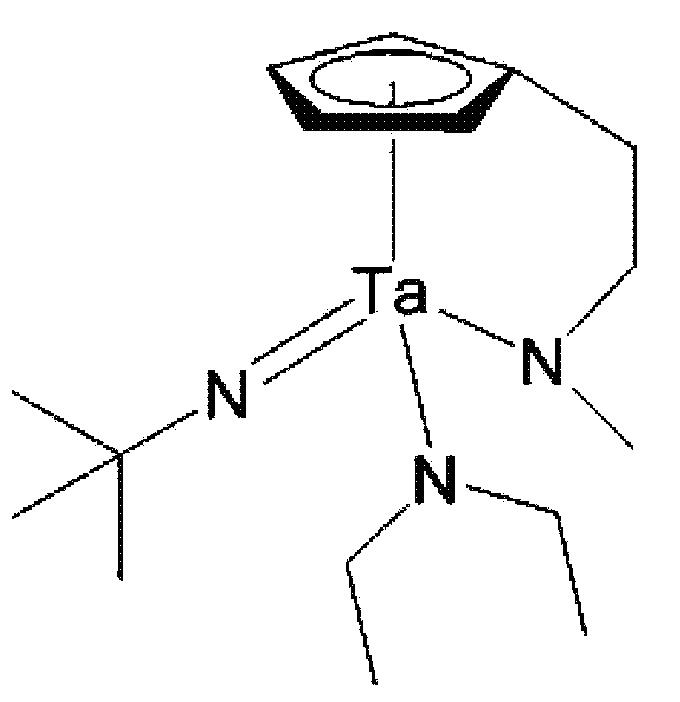

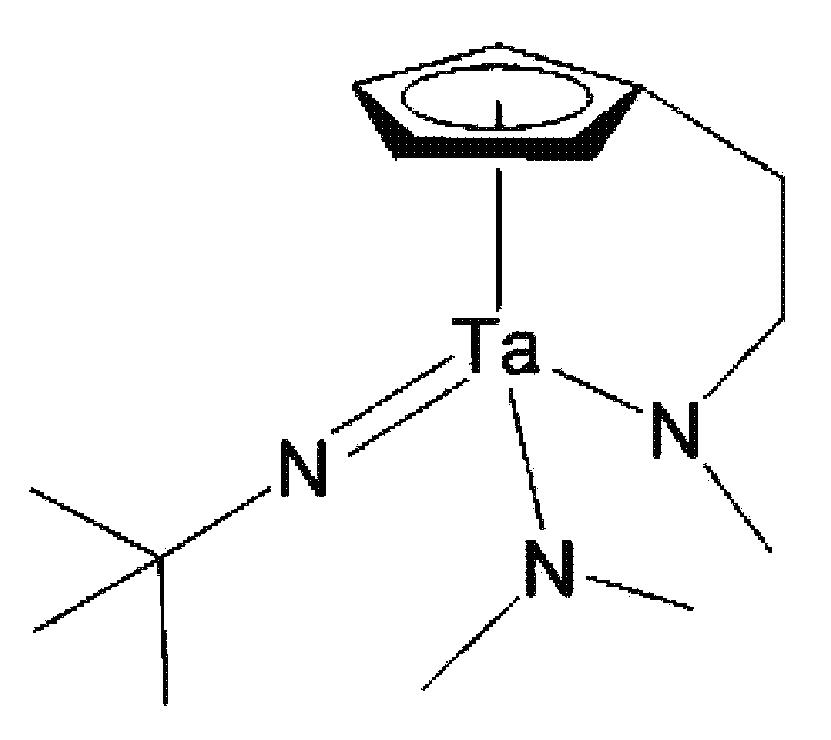
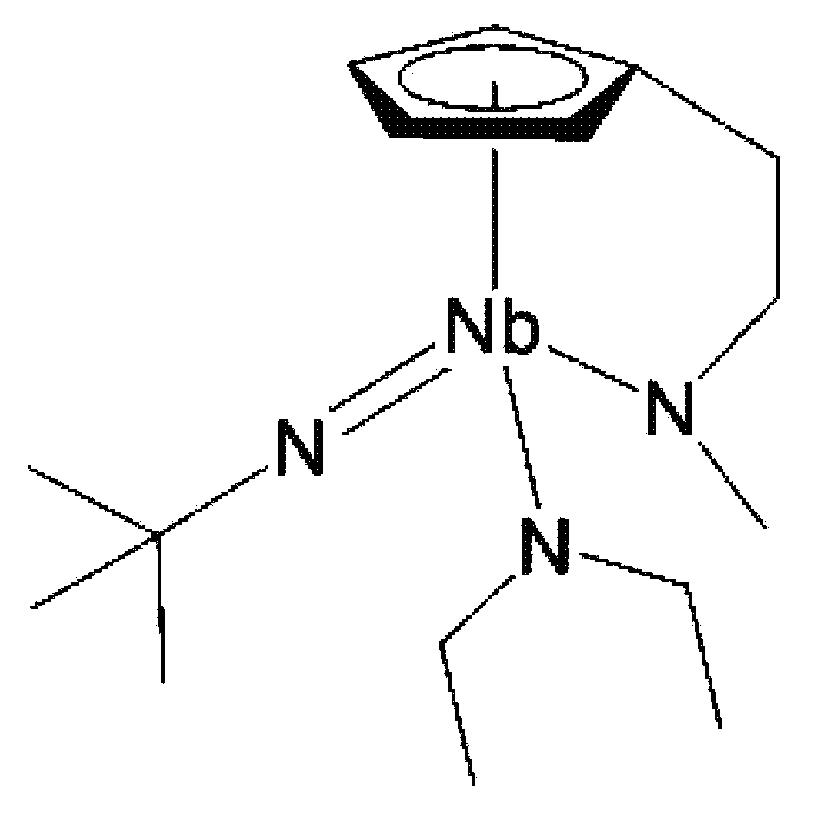
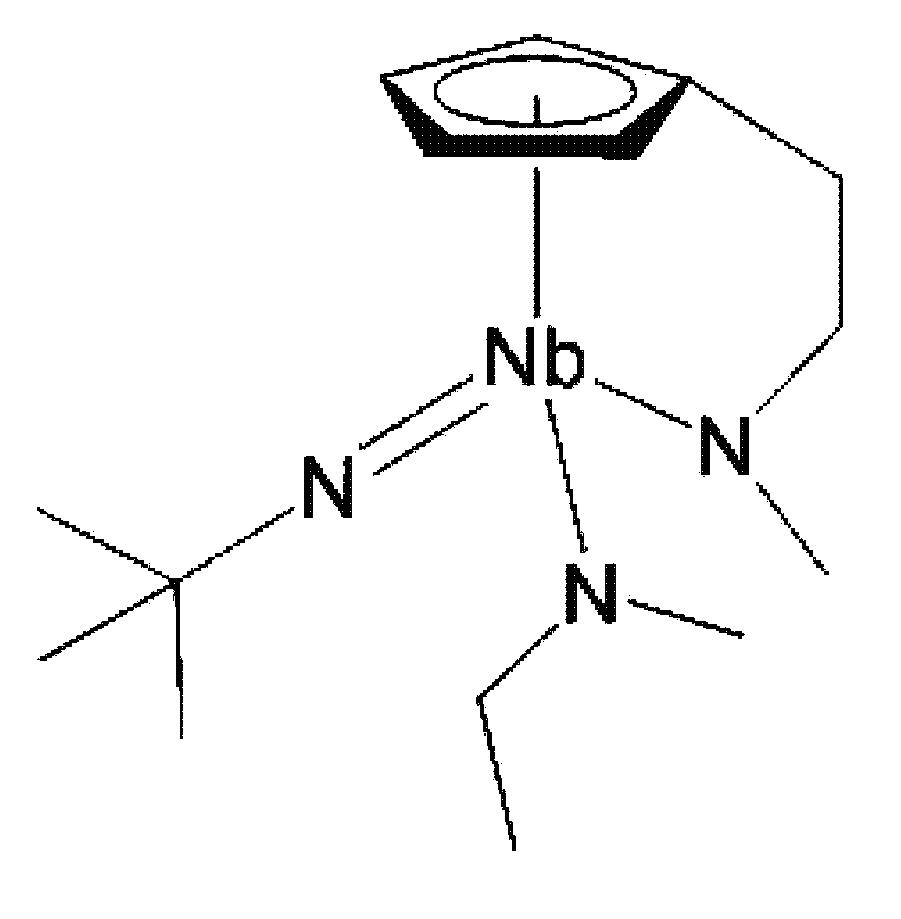
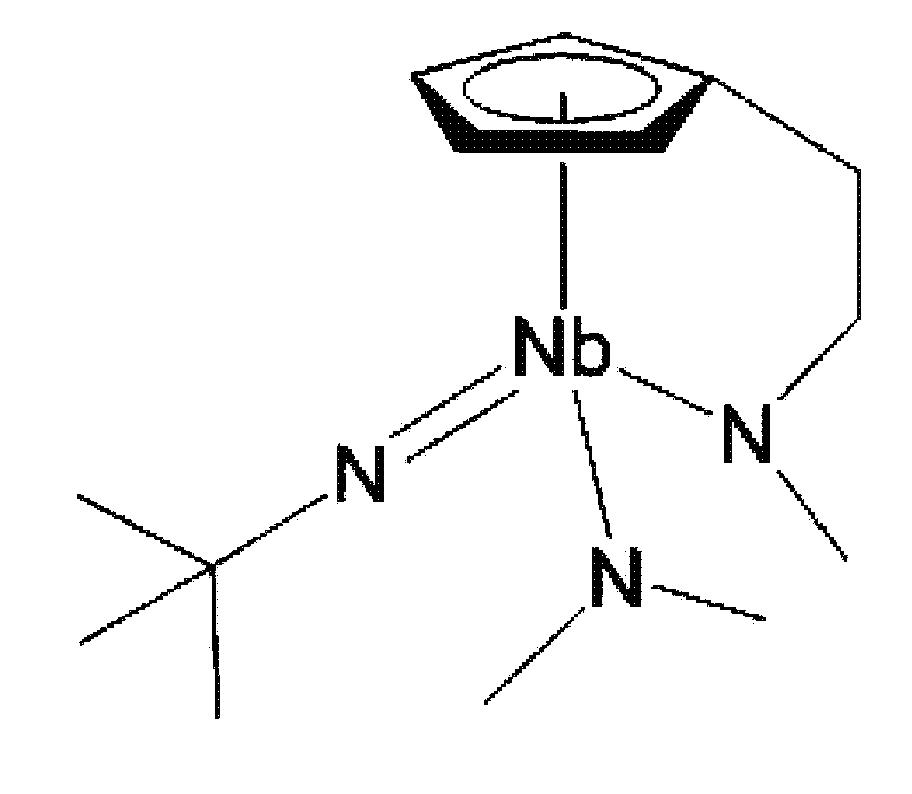
在本發明的一實現例中,上述第Ⅴ族金屬化合物可以在常溫下是液體狀態或者是具有粘性的固體。In an embodiment of the present invention, the above-mentioned Group V metal compound may be in a liquid state or a viscous solid at room temperature.
本發明的第二方面提供一種製備由下列化學式1表示的第Ⅴ族金屬化合物的方法,該方法包括以下步驟:在由下列化學式2表示的(R5
N=)M(NR6
R7
)3
化合物中添加由下列化學式3表示的R1
R2
R3
R4
Cp(CH2
)n
NHR8
化合物並使其反應:The second aspect of the present invention provides a method for preparing a group V metal compound represented by the following
[化學式1]
[化學式2]
[化學式3]
在上述化學式1至3中的每一者中,M為Ta或Nb;R1
、R2
、R3
和R4
分別獨立地為氫原子、或碳原子數為1至4的直鏈或支鏈烷基;R5
為碳原子數為3至6的直鏈或支鏈烷基;R6
、R7
和R8
分別獨立地為碳原子數為1至4的直鏈或支鏈烷基;n為1至4的整數。In each of the above
在本發明的一實現例中,上述R1 、R2 、R3 和R4 可以彼此相同或不同,例如可包含氫原子(H)、甲基、乙基、正丙基、異丙基、正丁基、異丁基、叔丁基或它們的同分異構體,但可不限於此。In an implementation example of the present invention, the above-mentioned R 1 , R 2 , R 3 and R 4 may be the same or different from each other, for example, may include a hydrogen atom (H), methyl, ethyl, n-propyl, isopropyl, N-butyl, isobutyl, tert-butyl or their isomers, but not limited thereto.
在本發明的一實現例中,上述R1 、R2 、R3 和R4 可分別獨立地為氫原子(H)、甲基或乙基,但可不限於此。In an implementation example of the present invention, the above-mentioned R 1 , R 2 , R 3 and R 4 can each independently be a hydrogen atom (H), a methyl group or an ethyl group, but it is not limited thereto.
在本發明的一實現例中,上述R5 可以是正丙基、異丙基、正丁基、叔丁基、異丁基、仲丁基、正戊基、叔戊基、異戊基、仲戊基、新戊基或3-戊基,但可不限於此。In an implementation example of the present invention, the above-mentioned R 5 can be n-propyl, isopropyl, n-butyl, tert-butyl, isobutyl, sec-butyl, n-pentyl, tert-pentyl, isopentyl, sec Pentyl, neopentyl, or 3-pentyl, but may not be limited thereto.
在本發明的一實現例中,上述R6 、R7 和R8 可以彼此相同或不同,例如可包含甲基、乙基、正丙基、異丙基、正丁基、異丁基、叔丁基或它們的同分異構體,但可不限於此。In an implementation example of the present invention, the foregoing R 6 , R 7 and R 8 may be the same or different from each other, for example, may include methyl, ethyl, n-propyl, isopropyl, n-butyl, isobutyl, tert Butyl or their isomers, but not limited thereto.
在本發明的一實現例中,上述R6 、R7 和R8 可分別獨立地為甲基或乙基,但可不限於此。In an implementation example of the present invention, the foregoing R 6 , R 7 and R 8 may be independently methyl or ethyl, but may not be limited thereto.
在本發明的一實現例中,上述第Ⅴ族金屬化合物可包含選自下述的化合物,但可不限於此:
在本發明的一實現例中,上述第Ⅴ族金屬化合物可以在常溫下為液體狀態或具有粘性的固體狀態。In an implementation example of the present invention, the above-mentioned group V metal compound may be in a liquid state or a viscous solid state at room temperature.
在本發明的一實現例中,上述反應可以在常溫下實施,但可不限於此。In an implementation example of the present invention, the above reaction can be carried out at room temperature, but it is not limited to this.
本發明的協力廠商面提供一種包含本發明的第一方面的第Ⅴ族金屬化合物的含第Ⅴ族金屬膜沉積用前體組合物。The third party of the present invention provides a precursor composition for depositing a group V metal film containing the group V metal compound of the first aspect of the present invention.
上述本發明的第一方面的第Ⅴ族金屬化合物為由下列化學式1表示的第Ⅴ族金屬化合物,在下列化學式1中,M為Ta或Nb;R1
、R2
、R3
和R4
分別獨立地為氫原子、或碳原子數為1至4的直鏈或支鏈烷基;R5
為碳原子數為3至6的直鏈或支鏈烷基;R6
、R7
和R8
分別獨立地為碳原子數為1至4的直鏈或支鏈烷基;n為1至4的整數:[03]
[化學式1]
在本發明的一實現例中,上述R1 、R2 、R3 和R4 可以彼此相同或不同,例如可包含氫原子(H)、甲基、乙基、正丙基、異丙基、正丁基、異丁基、叔丁基或它們的同分異構體,但可不限於此。In an implementation example of the present invention, the above-mentioned R 1 , R 2 , R 3 and R 4 may be the same or different from each other, for example, may include a hydrogen atom (H), methyl, ethyl, n-propyl, isopropyl, N-butyl, isobutyl, tert-butyl or their isomers, but not limited thereto.
在本發明的一實現例中,上述R1 、R2 、R3 和R4 可分別獨立地為氫原子(H)、甲基或乙基,但可不限於此。In an implementation example of the present invention, the above-mentioned R 1 , R 2 , R 3 and R 4 can each independently be a hydrogen atom (H), a methyl group or an ethyl group, but it is not limited thereto.
在本發明的一實現例中,上述R5 可以是正丙基、異丙基、正丁基、叔丁基、異丁基、仲丁基、正戊基、叔戊基、異戊基、仲戊基、新戊基或3-戊基,但可不限於此。In an implementation example of the present invention, the above-mentioned R 5 can be n-propyl, isopropyl, n-butyl, tert-butyl, isobutyl, sec-butyl, n-pentyl, tert-pentyl, isopentyl, sec Pentyl, neopentyl, or 3-pentyl, but may not be limited thereto.
在本發明的一實現例中,上述R6 、R7 和R8 可以彼此相同或不同,例如可包含甲基、乙基、正丙基、異丙基、正丁基、異丁基、叔丁基或它們的同分異構體,但可不限於此。In an implementation example of the present invention, the foregoing R 6 , R 7 and R 8 may be the same or different from each other, for example, may include methyl, ethyl, n-propyl, isopropyl, n-butyl, isobutyl, tert Butyl or their isomers, but not limited thereto.
在本發明的一實現例中,上述R6 、R7 和R8 可分別獨立地為甲基或乙基,但可不限於此。In an implementation example of the present invention, the foregoing R 6 , R 7 and R 8 may be independently methyl or ethyl, but may not be limited thereto.
在本發明的一實現例中,上述第Ⅴ族金屬化合物可包含選自下列的化合物,但可不限於此:
在本發明的一實現例中,上述第Ⅴ族金屬化合物可以在常溫下為液體狀態或具有粘性的固體狀態。In an implementation example of the present invention, the above-mentioned group V metal compound may be in a liquid state or a viscous solid state at room temperature.
在本發明的一實現例中,上述含第Ⅴ族金屬膜可以是含鉭膜或薄膜或者含鈮膜或薄膜,更具體而言,上述含第Ⅴ族金屬膜可以是鉭金屬膜或薄膜、鉭氧化物膜或薄膜、鉭氮化物膜或薄膜、鈮金屬膜或薄膜、鈮氧化物膜或薄膜、或者鈮氮化物膜或薄膜,但可不限於此。In an embodiment of the present invention, the above-mentioned group V-containing metal film may be a tantalum-containing film or film or a niobium-containing film or film. More specifically, the above-mentioned group V-containing metal film may be a tantalum metal film or film, A tantalum oxide film or film, a tantalum nitride film or film, a niobium metal film or film, a niobium oxide film or film, or a niobium nitride film or film, but may not be limited thereto.
在本發明的一實現例中,上述含第Ⅴ族金屬膜可以是納米級厚度的薄膜,例如上述含第Ⅴ族金屬膜可以是厚度約1nm至約100nm、約1nm至約80nm、約1nm至約60nm、約1nm至約40nm、約1nm至約20nm、約1nm至約10nm、約1nm至約5nm、約5nm至約100nm、約10nm至約100nm、約30nm至約100nm、約40nm至約100nm、約60nm至約100nm或約80nm至約100nm的薄膜,但可不限於此。In an implementation example of the present invention, the above-mentioned group V-containing metal film may be a nano-thickness film, for example, the above-mentioned group V-containing metal film may have a thickness of about 1 nm to about 100 nm, about 1 nm to about 80 nm, or about 1 nm to about 1 nm. About 60nm, about 1nm to about 40nm, about 1nm to about 20nm, about 1nm to about 10nm, about 1nm to about 5nm, about 5nm to about 100nm, about 10nm to about 100nm, about 30nm to about 100nm, about 40nm to about 100nm , About 60nm to about 100nm or about 80nm to about 100nm film, but may not be limited thereto.
本發明的第四方面提供一種沉積含第Ⅴ族金屬膜的方法,該方法包括以下步驟:利用本發明的協力廠商面的含第Ⅴ族金屬膜沉積用前體組合物而在襯底上形成含第Ⅴ族金屬膜。The fourth aspect of the present invention provides a method for depositing a group V-containing metal film, the method comprising the following steps: forming on a substrate using a precursor composition for depositing a group V metal-containing film of the present invention Contains Group V metal film.
上述本發明的協力廠商面的含第Ⅴ族金屬膜沉積用前體組合物包含本發明的第一方面的第Ⅴ族金屬化合物,上述本發明的第一方面的第Ⅴ族金屬化合物為由下列化學式1表示的第Ⅴ族金屬化合物,在下列化學式1中,M為Ta或Nb;R1
、R2
、R3
和R4
分別獨立地為氫原子、或碳原子數為1至4的直鏈或支鏈烷基;R5
為碳原子數為3至6的直鏈或支鏈烷基;R6
、R7
和R8
分別獨立地為碳原子數為1至4的直鏈或支鏈烷基;n為1至4的整數:The precursor composition for the deposition of a group V metal-containing film from the third party of the present invention includes the group V metal compound of the first aspect of the present invention, and the group V metal compound of the first aspect of the present invention is composed of the following In the group V metal compound represented by
[化學式1][04]
在本發明的一實現例中,上述R1 、R2 、R3 和R4 可以彼此相同或不同,例如可包含氫原子(H)、甲基、乙基、正丙基、異丙基、正丁基、異丁基、叔丁基或它們的同分異構體等,但可不限於此。In an implementation example of the present invention, the above-mentioned R 1 , R 2 , R 3 and R 4 may be the same or different from each other, for example, may include a hydrogen atom (H), methyl, ethyl, n-propyl, isopropyl, N-butyl, isobutyl, tert-butyl, or their isomers, etc., but not limited thereto.
在本發明的一實現例中,上述R1 、R2 、R3 和R4 可分別獨立地為氫原子(H)、甲基或乙基,但可不限於此。In an implementation example of the present invention, the above-mentioned R 1 , R 2 , R 3 and R 4 can each independently be a hydrogen atom (H), a methyl group or an ethyl group, but it is not limited thereto.
在本發明的一實現例中,上述R5 可以是正丙基、異丙基、正丁基、叔丁基、異丁基、仲丁基、正戊基、叔戊基、異戊基、仲戊基、新戊基或3-戊基,但可不限於此。In an implementation example of the present invention, the above-mentioned R 5 can be n-propyl, isopropyl, n-butyl, tert-butyl, isobutyl, sec-butyl, n-pentyl, tert-pentyl, isopentyl, sec Pentyl, neopentyl, or 3-pentyl, but may not be limited thereto.
在本發明的一實現例中,上述R6 、R7 和R8 可以彼此相同或不同,例如可包含甲基、乙基、正丙基、異丙基、正丁基、異丁基、叔丁基或它們的同分異構體,但可不限於此。In an implementation example of the present invention, the foregoing R 6 , R 7 and R 8 may be the same or different from each other, for example, may include methyl, ethyl, n-propyl, isopropyl, n-butyl, isobutyl, tert Butyl or their isomers, but not limited thereto.
在本發明的一實現例中,上述R6 、R7 和R8 可分別獨立地為甲基或乙基,但可不限於此。In an implementation example of the present invention, the foregoing R 6 , R 7 and R 8 may be independently methyl or ethyl, but may not be limited thereto.
在本發明的一實現例中,上述第Ⅴ族金屬化合物可包含選自下述的化合物,但可不限於此:
在本發明的一實現例中,上述第Ⅴ族金屬化合物可以常溫下為 狀態或具有粘性的固體狀態。In an embodiment of the present invention, the above-mentioned Group V metal compound may be in a state or a viscous solid state at room temperature.
在本發明的一實現例中,上述含第Ⅴ族金屬膜可以是含鉭膜或薄膜或者含鈮膜或薄膜,更具體而言,上述含第Ⅴ族金屬膜可以是鉭金屬膜或薄膜、鉭氧化物膜或薄膜、鉭氮化物膜或薄膜、鈮金屬膜或薄膜、鈮氧化物膜或薄膜、或者鈮氮化物膜或薄膜,但可不限於此。In an embodiment of the present invention, the above-mentioned group V-containing metal film may be a tantalum-containing film or film or a niobium-containing film or film. More specifically, the above-mentioned group V-containing metal film may be a tantalum metal film or film, A tantalum oxide film or film, a tantalum nitride film or film, a niobium metal film or film, a niobium oxide film or film, or a niobium nitride film or film, but may not be limited thereto.
在本發明的一實現例中,上述含第Ⅴ族金屬膜可以是納米級厚度的薄膜,例如上述含第Ⅴ族金屬膜可以是厚度約1nm至約100nm、約1nm至約80nm、約1nm至約60nm、約1nm至約40nm、約1nm至約20nm、約1nm至約10nm、約1nm至約5nm、約5nm至約100nm、約10nm至約100nm、約30nm至約100nm、約40nm至約100nm、約60nm至約100nm或約80nm至約100nm的薄膜,但可不限於此。In an implementation example of the present invention, the above-mentioned group V-containing metal film may be a nano-thickness film, for example, the above-mentioned group V-containing metal film may have a thickness of about 1 nm to about 100 nm, about 1 nm to about 80 nm, or about 1 nm to about 1 nm. About 60nm, about 1nm to about 40nm, about 1nm to about 20nm, about 1nm to about 10nm, about 1nm to about 5nm, about 5nm to about 100nm, about 10nm to about 100nm, about 30nm to about 100nm, about 40nm to about 100nm , About 60nm to about 100nm or about 80nm to about 100nm film, but may not be limited thereto.
在本發明的一實現例中,上述襯底可包含形成於該襯底的表面上的凹凸(槽),但可不限於此。例如,上述襯底可以是具有深寬比(aspect ratio)為約1以上且寬度約1μm以下的微細凹凸(槽)的襯底,但可不限於此。例如,上述凹凸(槽)的深寬比可以是約1以上、約1.5以上、約2以上、約2.5以上、約3以上、約3.5以上、約4以上、約4.5以上、約5以上、約5.5以上、約6以上、約6.5以上、約7以上、約7.5以上、約8以上、約8.5以上、約9以上、約9.5以上或約10以上,但可不限於此。例如,上述凹凸(槽)的寬度可以是約1μm以下、約0.9μm以下、約0.8μm以下、約0.7μm以下、約0.6μm以下、約0.5μm以下、約0.4μm以下、約0.3μm以下、約0.2μm以下或約0.1μm以下,但可不限於此。In an implementation example of the present invention, the above-mentioned substrate may include concavities and convexities (grooves) formed on the surface of the substrate, but may not be limited thereto. For example, the above-mentioned substrate may be a substrate having fine concavities and convexities (grooves) with an aspect ratio of about 1 or more and a width of about 1 μm or less, but it may not be limited thereto. For example, the aspect ratio of the aforementioned concavity and convexity (groove) may be about 1, about 1.5, about 2, about 2.5, about 3, about 3.5, about 4, about 4.5, about 5, about 5.5 or more, about 6 or more, about 6.5 or more, about 7 or more, about 7.5 or more, about 8 or more, about 8.5 or more, about 9 or more, about 9.5 or more, or about 10 or more, but may not be limited thereto. For example, the width of the above-mentioned unevenness (groove) may be about 1 μm or less, about 0.9 μm or less, about 0.8 μm or less, about 0.7 μm or less, about 0.6 μm or less, about 0.5 μm or less, about 0.4 μm or less, about 0.3 μm or less, About 0.2 μm or less or about 0.1 μm or less, but may not be limited thereto.
在本發明的一實現例中,上述沉積含第Ⅴ族金屬膜或薄膜的方法可包括以下步驟:通過將上述含第Ⅴ族金屬膜沉積用前體組合物供給到位於沉積腔室內的襯底表面上而形成含第Ⅴ族金屬膜或薄膜,但可不限於此。例如,可通過鼓泡方式、氣相(vapor phase)流量控制(MFC:mass flow controller)方法、直接液體注入(DLI:Direct Liquid Injection)方法或者使上述含第Ⅴ族金屬膜沉積用前體組合物溶解到有機溶劑中而進行移送的液體移送方法(LDS:liquid delivery system),將上述含第Ⅴ族金屬膜沉積用前體組合物以氣體狀態運送到沉積腔室內的襯底上,但可不限於此。例如,作為用於將上述含第Ⅴ族金屬膜沉積用前體組合物運送到沉積腔室內的襯底上的運送氣體或吹掃氣體,可包含選自由氬氣、氦氣、氮氣和它們的組合組成的組中的氣體,但可不限於此。上述膜沉積方法可利用本發明所屬技術領域中公知的方法、裝置等,在必要情況下可同時利用附加反應氣體來執行上述膜沉積方法,但可不限於此。In an embodiment of the present invention, the method for depositing a group V-containing metal film or thin film may include the following steps: by supplying the foregoing group V-containing metal film deposition precursor composition to a substrate located in a deposition chamber A group V metal-containing film or thin film is formed on the surface, but it is not limited to this. For example, a bubbling method, a vapor phase (vapor phase) flow control (MFC: mass flow controller) method, a direct liquid injection (DLI: Direct Liquid Injection) method, or a combination of the above group V metal film deposition precursors can be used The liquid delivery system (LDS: liquid delivery system) in which the substance is dissolved in an organic solvent and is transferred. The precursor composition for deposition of the group V-containing metal film is transported to the substrate in the deposition chamber in a gaseous state. Limited to this. For example, as a transport gas or a purge gas for transporting the above-mentioned group V-containing metal film deposition precursor composition to the substrate in the deposition chamber, it may contain selected from the group consisting of argon, helium, nitrogen and their Combine the gases in the group, but may not be limited to this. The above-mentioned film deposition method may use methods, devices, etc. well known in the technical field to which the present invention pertains, and may also use additional reactive gas to perform the above-mentioned film deposition method when necessary, but it may not be limited thereto.
在本發明的一實現例中,可通過化學氣相沉積法或原子層沉積法來沉積上述含第Ⅴ族金屬膜,但可不限於此。例如,上述含第Ⅴ族金屬膜或薄膜的沉積方法可包括利用化學氣相沉積法(CVD)、有機金屬化學氣相沉積法(MOCVD)或原子層沉積法(ALD)來執行的方法,上述化學氣相沉積法(CVD)、有機金屬化學氣相沉積法(MOCVD)或原子層沉積法(ALD)可利用本發明所屬技術領域中公知的沉積裝置、沉積條件、附加反應氣體等來執行,但可不限於此。In an embodiment of the present invention, the above-mentioned group V metal-containing film can be deposited by chemical vapor deposition or atomic layer deposition, but it is not limited to this. For example, the above-mentioned group V metal-containing film or thin film deposition method may include a method performed by chemical vapor deposition (CVD), metal organic chemical vapor deposition (MOCVD), or atomic layer deposition (ALD). Chemical vapor deposition (CVD), metal organic chemical vapor deposition (MOCVD), or atomic layer deposition (ALD) can be performed using known deposition equipment, deposition conditions, additional reaction gases, etc. in the technical field of the present invention, But it is not limited to this.
在本發明的一實現例中,上述含第Ⅴ族金屬膜可包含含第Ⅴ族金屬氧化物膜,作為用於沉積上述含第Ⅴ族金屬氧化物膜的反應氣體,可進一步包含含有選自由水蒸氣(H2 O)、氧氣(O2 )、臭氧(O3 )和它們的組合組成的組中的含O物質的反應氣體,但可不限於此。In an implementation example of the present invention, the above-mentioned group V-containing metal film may include a group V-containing metal oxide film. As a reaction gas for depositing the above-mentioned group V metal oxide film, it may further include The reaction gas of an O-containing substance in the group consisting of water vapor (H 2 O), oxygen (O 2 ), ozone (O 3 ), and a combination thereof, but may not be limited thereto.
在本發明的一實現例中,上述含第Ⅴ族金屬膜可包含含第Ⅴ族金屬氮化物膜,作為用於沉積上述含第Ⅴ族金屬氮化物膜的反應氣體,可進一步包含含有選自由氨(NH3 )、肼、二甲基肼和它們的組合組成的組中的含N物質的反應氣體,但可不限於此。In an embodiment of the present invention, the above-mentioned group V-containing metal film may include a group V-containing metal nitride film. As a reaction gas for depositing the above-mentioned group V metal nitride film, it may further include The N-containing reaction gas in the group consisting of ammonia (NH 3 ), hydrazine, dimethylhydrazine, and combinations thereof, but may not be limited thereto.
在本發明的一實現例中,可以在常溫至約700℃或50℃至700℃範圍內的溫度下沉積上述含第Ⅴ族金屬膜,但可不限於此。例如,上述沉積溫度可以是常溫至約700℃、約50℃至約700℃、約50℃至約600℃、約50℃至約500℃、約50℃至約400℃、約50℃至約300℃、約80℃至約700℃、約100℃至約700℃、約200℃至約700℃、約300℃至約700℃、約400℃至約700℃、約500℃至約700℃、約600℃至約700℃或約100℃至約700℃、約100℃至約600℃、約100℃至約500℃、約100℃至約400℃、約100℃至約300℃、約150℃至約700℃、約150℃至約600℃、約150℃至約500℃、約150℃至約400℃或約150℃至約300℃,但不限於此。In an implementation example of the present invention, the above-mentioned group V metal-containing film may be deposited at a temperature ranging from normal temperature to about 700° C. or from 50° C. to 700° C., but it is not limited thereto. For example, the above-mentioned deposition temperature may be normal temperature to about 700°C, about 50°C to about 700°C, about 50°C to about 600°C, about 50°C to about 500°C, about 50°C to about 400°C, about 50°C to about 300°C, about 80°C to about 700°C, about 100°C to about 700°C, about 200°C to about 700°C, about 300°C to about 700°C, about 400°C to about 700°C, about 500°C to about 700°C , About 600°C to about 700°C or about 100°C to about 700°C, about 100°C to about 600°C, about 100°C to about 500°C, about 100°C to about 400°C, about 100°C to about 300°C, about 150°C to about 700°C, about 150°C to about 600°C, about 150°C to about 500°C, about 150°C to about 400°C, or about 150°C to about 300°C, but not limited thereto.
下面,雖然利用實施例對本發明進行更具體說明,但下述實施例僅為有助於理解本發明的示例,本發明的內容並不限定於下述實施例。Hereinafter, although the present invention will be described in more detail by using examples, the following examples are only examples for helping understanding of the present invention, and the content of the present invention is not limited to the following examples.
[實施例][Example]
<實施例1> 製備(Cp(CH2 )2 N(CH3 ))(t BuN)Ta(NEt2 )<Example 1> Preparation of (Cp(CH 2 ) 2 N(CH 3 ))( t BuN)Ta(NEt 2 )
在經火焰乾燥的500mL舒倫克瓶(Schlenk flask)中加入三(二乙基氨基)(叔丁基亞氨基)鉭[(t
BuN)Ta(NEt2
)3
)]29g(0.062mol,1當量)和甲苯(toluene)150mL,然後在室溫下進行攪拌。在室溫下在上述燒瓶中滴加環戊二烯基乙基甲基胺[Cp(CH2
)2
NH(CH3
)]7.6g(0.062mol,1當量),然後使反應溶液升溫至60℃並攪拌四小時。在減壓下除去反應溶液中的溶劑並在減壓下進行蒸餾而獲取由下述化合物1表示的淺黃色液體化合物19g(收率69%)。圖1及圖2中分別示出由下述化合物1表示的化合物的熱重分析(TGA)及差示掃描量熱分析(DSC)結果。Add tris(diethylamino)(tert-butylimino)tantalum [( t BuN)Ta(NEt 2 ) 3 )] 29g (0.062mol, 1) into the flame-dried 500mL Schlenk flask (Schlenk flask) Equivalent) and toluene (toluene) 150mL, and then stirred at room temperature. Add 7.6 g (0.062 mol, 1 equivalent) of cyclopentadienyl ethyl methylamine [Cp(CH 2 ) 2 NH(CH 3 )] dropwise to the above flask at room temperature, and then heat the reaction solution to 60 ℃ and stir for four hours. The solvent in the reaction solution was removed under reduced pressure and distillation was performed under reduced pressure to obtain 19 g of a pale yellow liquid compound represented by the following compound 1 (yield 69%). The results of thermogravimetric analysis (TGA) and differential scanning calorimetry (DSC) of the compound represented by the following
<化合物1>
沸點(bp)110℃(0.4托(torr));Boiling point (bp) 110°C (0.4 Torr (torr));
元素分析(elemental analysis)計算值(C16H30N3Ta):C 43.15、H 6.79、N 9.43;實測值:C 42.99、H 6.81、N 9.49;Elemental analysis calculated values (C16H30N3Ta): C 43.15, H 6.79, N 9.43; measured values: C 42.99, H 6.81, N 9.49;
1 H-NMR (400 MHz, C6 D6 , 25℃) δ 5.967, 5.839, 5.702, 5.654 (m, 4H, C5 H4 (CH2 )2 N(CH3 )), δ 4.275, 3.687, 2.434, 2.361 (m, 4H, C5 H4 (CH2 )2 N(CH3 )), δ 3.536 (m, 4H, N(CH2 CH3 )2 ), δ 3.389 (s, 3H C5 H4 (CH2 )2 N(CH3 )), δ 1.312 (s, 9H, NC(CH3 )3 ), δ 1.126 (t, 6H, N(CH2 CH3 )2 )。 1 H-NMR (400 MHz, C 6 D 6 , 25℃) δ 5.967, 5.839, 5.702, 5.654 (m, 4H, C 5 H 4 (CH 2 ) 2 N(CH 3 )), δ 4.275, 3.687, 2.434, 2.361 (m, 4H, C 5 H 4 (CH 2 ) 2 N(CH 3 )), δ 3.536 (m, 4H, N(CH 2 CH 3 ) 2 ), δ 3.389 (s, 3H C 5 H 4 (CH 2 ) 2 N(CH 3 )), δ 1.312 (s, 9H, NC(CH 3 ) 3 ), δ 1.126 (t, 6H, N(CH 2 CH 3 ) 2 ).
<實施例2>製備(Cp(CH2 )2 N(CH3 ))(t BuN)Ta(NEtMe)<Example 2> Preparation of (Cp(CH 2 ) 2 N(CH 3 ))( t BuN)Ta(NEtMe)
在經火焰乾燥的1L舒倫克瓶中加入三(乙基甲基氨基)(叔丁基亞氨基)鉭[(t
BuN)Ta(NEtMe)3
)]100g(0.235mol,1當量)和甲苯(toluene)300mL,然後在室溫下進行攪拌。在室溫下在上述燒瓶中滴加環戊二烯基乙基甲基胺[Cp(CH2
)2
NH(CH3
)]28.7g(0.235mol,1當量),然後使反應溶液升溫至60℃並攪拌四小時。在減壓下除去反應溶液中的溶劑並在減壓下進行蒸餾而獲取由下述化合物2表示的淺黃色液體化合物66g(收率65%)。圖3及圖4中分別示出由下述化合物2表示的化合物的熱重分析(TGA)及差示掃描量熱分析(DSC)結果。Add 100g (0.235mol, 1 equivalent) of tris(ethylmethylamino)(tert-butylimino)tantalum [( t BuN)Ta(NEtMe) 3 )] and toluene into a flame-dried 1L Schlenk bottle (Toluene) 300 mL, and then stir at room temperature. At room temperature, 28.7 g (0.235 mol, 1 equivalent) of cyclopentadienyl ethyl methylamine [Cp(CH 2 ) 2 NH(CH 3 )] was added dropwise to the above flask, and then the reaction solution was heated to 60 ℃ and stir for four hours. The solvent in the reaction solution was removed under reduced pressure and distillation was performed under reduced pressure to obtain 66 g of a pale yellow liquid compound represented by the following compound 2 (yield 65%). The results of thermogravimetric analysis (TGA) and differential scanning calorimetry (DSC) of the compound represented by the following
<化合物2>
沸點(bp)108℃(0.4托(torr));Boiling point (bp) 108°C (0.4 Torr (torr));
元素分析(elemental analysis)計算值(C15H28N3Ta):C 41.77、H 6.54、N 9.74;實測值:C 41.39、H 6.61、N 9.69;Elemental analysis calculated values (C15H28N3Ta): C 41.77, H 6.54, N 9.74; measured values: C 41.39, H 6.61, N 9.69;
1H-NMR (400 MHz, C6 D6 , 25℃) δ 5.977, 5.832, 5.734, 5.632 (m, 4H, C5 H4 (CH2 )2 N(CH3 )), δ 4.249, 3.704, 2.441, 2.358 (m, 4H, C5 H4 (CH2 )2 N(CH3 )), δ 3.645 (m, 2H, N(CH2 CH3 )(CH3 )), δ 3.407 (s, 3H,C5 H4 (CH2 )2 N(CH3 )), δ 3.260 (s, 3H, N(CH2 CH3 )(CH3 )), δ 1.315 (s, 9H, NC(CH3 )3 ), δ 1.156 (t, 3H, N(CH2 CH3 )(CH3 ))。1H-NMR (400 MHz, C 6 D 6 , 25℃) δ 5.977, 5.832, 5.734, 5.632 (m, 4H, C 5 H 4 (CH 2 ) 2 N(CH 3 )), δ 4.249, 3.704, 2.441 , 2.358 (m, 4H, C 5 H 4 (CH 2 ) 2 N(CH 3 )), δ 3.645 (m, 2H, N(CH 2 CH 3 )(CH 3 )), δ 3.407 (s, 3H, C 5 H 4 (CH 2 ) 2 N(CH 3 )), δ 3.260 (s, 3H, N(CH 2 CH 3 )(CH 3 )), δ 1.315 (s, 9H, NC(CH 3 ) 3 ) , δ 1.156 (t, 3H, N(CH 2 CH 3 )(CH 3 )).
<實施例3>製備(Cp(CH2 )2 N(CH3 ))(t BuN)Ta(NMe2 )<Example 3> Preparation of (Cp(CH 2 ) 2 N(CH 3 ))( t BuN)Ta(NMe 2 )
在經火焰乾燥的500mL舒倫克瓶中加入三(二乙基氨基)(叔丁基亞氨基)鉭[(t
BuN)Ta(NMe2
)3
)]100g(0.260mol,1當量)和甲苯(toluene)300mL,然後在室溫下進行攪拌。在室溫下在上述燒瓶中滴加環戊二烯基乙基甲基胺[Cp(CH2
)2
NH(CH3
)]32.1g(0.260mol,1當量),然後使反應溶液升溫至60℃並攪拌四小時。在減壓下除去反應溶液中的溶劑並在減壓下進行蒸餾而獲取由下述化合物3表示的淺黃色液體化合物77g(收率71%)。圖5及圖6中分別示出由下述化合物3表示的化合物的熱重分析(TGA)及差示掃描量熱分析(DSC)結果。Add 100g (0.260mol, 1 equivalent) of tris(diethylamino)(tert-butylimino)tantalum [( t BuN)Ta(NMe 2 ) 3 )] and toluene into a flame-dried 500mL Schlenk bottle (Toluene) 300 mL, and then stir at room temperature. 32.1g (0.260mol, 1 equivalent) of cyclopentadienyl ethyl methylamine [Cp(CH 2 ) 2 NH(CH 3 )] was added dropwise to the above flask at room temperature, and then the reaction solution was heated to 60 ℃ and stir for four hours. The solvent in the reaction solution was removed under reduced pressure and distillation was performed under reduced pressure to obtain 77 g of a pale yellow liquid compound represented by the following compound 3 (yield 71%). The results of thermogravimetric analysis (TGA) and differential scanning calorimetry (DSC) of the compound represented by the following
<化合物3>
沸點(bp)107℃(0.4托(torr));Boiling point (bp) 107°C (0.4 Torr (torr));
元素分析(elemental analysis)計算值(C14H26N3Ta):C 40.29、H 6.28、N 10.07;實測值:C 40.39、H 6.31、N 10.03;Elemental analysis calculated values (C14H26N3Ta): C 40.29, H 6.28, N 10.07; measured values: C 40.39, H 6.31, N 10.03;
1H-NMR (400 MHz, C6 D6 , 25℃) δ 5.958, 5.826, 5.739, 5.598 (m, 4H, C5 H4 (CH2 )2 N(CH3 )), δ 4.273, 3.695, 2.450, 2.350 (m, 4H, C5 H4 (CH2 )2 N(CH3 )), δ 3.429 (s, 3H, C5 H4 (CH2 )2 N(CH3 )), δ 3.390 (s, 6H, N(CH3 )2 ), δ 1.331 (s, 9H, NC(CH3 )3 )。1H-NMR (400 MHz, C 6 D 6 , 25℃) δ 5.958, 5.826, 5.739, 5.598 (m, 4H, C 5 H 4 (CH 2 ) 2 N(CH 3 )), δ 4.273, 3.695, 2.450 , 2.350 (m, 4H, C 5 H 4 (CH 2 ) 2 N(CH 3 )), δ 3.429 (s, 3H, C 5 H 4 (CH 2 ) 2 N(CH 3 )), δ 3.390 (s , 6H, N(CH 3 ) 2 ), δ 1.331 (s, 9H, NC(CH 3 ) 3 ).
<實施例4>製備(Cp(CH2 )2 N(CH3 ))(t BuN)Nb(NEt2 )<Example 4> Preparation of (Cp(CH 2 ) 2 N(CH 3 ))( t BuN)Nb(NEt 2 )
在經火焰乾燥的500mL舒倫克瓶中加入三(二乙基氨基)(叔丁基亞氨基)鈮[(t
BuN)Nb(NEt2
)3
)]100g(0.263mol,1當量)和甲苯(toluene)300mL,然後在室溫下進行攪拌。在室溫下在上述燒瓶中滴加環戊二烯基乙基甲基胺[Cp(CH2
)2
NH(CH3
)]32.4g(0.263mol,1當量),然後使反應溶液升溫至60℃並攪拌四小時。在減壓下除去反應溶液中的溶劑並在減壓下進行蒸餾而獲取由下述化合物4表示的淺黃色液體化合物64g(收率68%)。圖7及圖8中分別示出由下述化合物4表示的化合物的熱重分析(TGA)及差示掃描量熱分析(DSC)結果。Add 100g (0.263mol, 1 equivalent) of tris(diethylamino)(tert-butylimino)niobium [( t BuN)Nb(NEt 2 ) 3 )] and toluene into a flame-dried 500mL Schlenk flask (Toluene) 300 mL, and then stir at room temperature. 32.4 g (0.263 mol, 1 equivalent) of cyclopentadienyl ethyl methylamine [Cp(CH 2 ) 2 NH(CH 3 )] was added dropwise to the above flask at room temperature, and then the reaction solution was heated to 60 ℃ and stir for four hours. The solvent in the reaction solution was removed under reduced pressure and distillation was performed under reduced pressure to obtain 64 g of a pale yellow liquid compound represented by the following compound 4 (yield 68%). The results of thermogravimetric analysis (TGA) and differential scanning calorimetry (DSC) of the compound represented by the following
<化合物4>
沸點(bp)110℃(0.4托(torr));Boiling point (bp) 110°C (0.4 Torr (torr));
元素分析(elemental analysis)計算值(C16 H30 N3 Nb):C 53.78、H 8.46、N 11.76;實測值:C 53.65、H 8.51、N 11.81;Elemental analysis calculated values (C 16 H 30 N 3 Nb): C 53.78, H 8.46, N 11.76; measured values: C 53.65, H 8.51, N 11.81;
1 H-NMR (400 MHz, C6 D6 , 25℃) δ 5.981, 5.813, 5.728, 5.698 (m, 4H, C5 H4 (CH2 )2 N(CH3 )), δ 4.134, 3.594, 2.508, 2.389 (m, 4H, C5 H4 (CH2 )2 N(CH3 )), δ 3.530 (m, 4H, N(CH2 CH3 )2 ), δ 3.386 (s, 3H, C5 H4 (CH2 )2 N(CH3 )), δ 1.261 (s, 9H, NC(CH3 )3 ), δ 1.133 (t, 6H, N(CH2 CH3 )2 )。 1 H-NMR (400 MHz, C 6 D 6 , 25℃) δ 5.981, 5.813, 5.728, 5.698 (m, 4H, C 5 H 4 (CH 2 ) 2 N(CH 3 )), δ 4.134, 3.594, 2.508, 2.389 (m, 4H, C 5 H 4 (CH 2 ) 2 N(CH 3 )), δ 3.530 (m, 4H, N(CH 2 CH 3 ) 2 ), δ 3.386 (s, 3H, C 5 H 4 (CH 2 ) 2 N(CH 3 )), δ 1.261 (s, 9H, NC(CH 3 ) 3 ), δ 1.133 (t, 6H, N(CH 2 CH 3 ) 2 ).
<實施例5>製備(Cp(CH2 )2 N(CH3 ))(t BuN)Nb(NEtMe)<Example 5> Preparation of (Cp(CH 2 ) 2 N(CH 3 ))( t BuN)Nb(NEtMe)
在經火焰乾燥的500mL舒倫克瓶中加入三(二乙基氨基)(叔丁基亞氨基)鈮[(t BuN)Nb(NEtMe)3 )]100g(0.296mol,1當量)和甲苯(toluene)300mL,然後在室溫下進行攪拌。在室溫下在上述燒瓶中滴加環戊二烯基乙基甲基胺[Cp(CH2 )2 NH(CH3 )]36.4g(0.296mol,1當量),然後使反應溶液升溫至60℃並攪拌四小時。在減壓下除去反應溶液中的溶劑並在減壓下進行蒸餾而獲取由下述化合物5表示的淺黃色液體化合物65g(收率64%)。圖9及圖10中分別示出由下述化合物5表示的化合物的熱重分析(TGA)及差示掃描量熱分析(DSC)結果。Add tris(diethylamino)(tert-butylimino)niobium [( t BuN)Nb(NEtMe) 3 )] 100g (0.296mol, 1 equivalent) and toluene ( toluene) 300mL, and then stirred at room temperature. 36.4 g (0.296 mol, 1 equivalent) of cyclopentadienyl ethyl methylamine [Cp(CH 2 ) 2 NH(CH 3 )] was added dropwise to the above flask at room temperature, and then the reaction solution was heated to 60 ℃ and stir for four hours. The solvent in the reaction solution was removed under reduced pressure and distillation was performed under reduced pressure to obtain 65 g of a pale yellow liquid compound represented by the following compound 5 (yield 64%). The thermogravimetric analysis (TGA) and differential scanning calorimetry (DSC) results of the compound represented by the following compound 5 are shown in FIGS. 9 and 10, respectively.
<化合物5>
沸點(bp)109℃(0.4托(torr));Boiling point (bp) 109°C (0.4 Torr (torr));
元素分析(elemental analysis)計算值(C15 H28 N3 Nb):C 52.48、H 8.22、N 12.24;實測值:C 52.39、H 8.27、N 12.21;Elemental analysis calculated values (C 15 H 28 N 3 Nb): C 52.48, H 8.22, N 12.24; measured values: C 52.39, H 8.27, N 12.21;
1 H-NMR (400 MHz, C6 D6 , 25℃) δ 5.980, 5.812, 5.719, 5.708 (m, 4H, C5 H4 (CH2 )2 N(CH3 )), δ 4.149, 3.632, 2.515, 2.404 (m, 4H, C5 H4 (CH2 )2 N(CH3 )), δ 3.588 (m, 2H, N(CH2 CH3 )(CH3 )), δ 3.405 (s, 3H C5 H4 (CH2 )2 N(CH3 )), δ 3.223 (s, 3H, N(CH2 CH3 )(CH3 )), δ 1.268 (s, 9H, NC(CH3 )3 ), δ 1.157 (t, 3H, N(CH2 CH3 )(CH3 ))。 1 H-NMR (400 MHz, C 6 D 6 , 25℃) δ 5.980, 5.812, 5.719, 5.708 (m, 4H, C 5 H 4 (CH 2 ) 2 N(CH 3 )), δ 4.149, 3.632, 2.515, 2.404 (m, 4H, C 5 H 4 (CH 2 ) 2 N(CH 3 )), δ 3.588 (m, 2H, N(CH 2 CH 3 )(CH 3 )), δ 3.405 (s, 3H C 5 H 4 (CH 2 ) 2 N(CH 3 )), δ 3.223 (s, 3H, N(CH 2 CH 3 )(CH 3 )), δ 1.268 (s, 9H, NC(CH 3 ) 3 ) , δ 1.157 (t, 3H, N(CH 2 CH 3 )(CH 3 )).
<實施例6>製備(Cp(CH2 )2 N(CH3 ))(t BuN)Nb(NMe2 )<Example 6> Preparation of (Cp(CH 2 ) 2 N(CH 3 ))( t BuN)Nb(NMe 2 )
在經火焰乾燥的500mL舒倫克瓶中加入三(二乙基氨基)(叔丁基亞氨基)鈮[(t
BuN)Nb(NMe2
)3
)]100g(0.337mol,1當量)和甲苯(toluene)300mL,然後在室溫下進行攪拌。在室溫下在上述燒瓶中滴加環戊二烯基乙基甲基胺[Cp(CH2
)2
NH(CH3
)]41.6g(0.337mol,1當量),然後使反應溶液升溫至60℃並攪拌四小時。在減壓下除去反應溶液中的溶劑並在減壓下進行蒸餾而獲取由下述化合物6表示的淺黃色液體化合物70g(收率63%)。圖11及圖12中分別示出由下述化合物6表示的化合物的熱重分析(TGA)及差示掃描量熱分析(DSC)結果。Add 100g (0.337mol, 1 equivalent) of tris(diethylamino)(tert-butylimino)niobium [( t BuN)Nb(NMe 2 ) 3 )] and toluene into a flame-dried 500mL Schlenk flask (Toluene) 300 mL, and then stir at room temperature. 41.6g (0.337mol, 1 equivalent) of cyclopentadienyl ethyl methylamine [Cp(CH 2 ) 2 NH(CH 3 )] was added dropwise to the above flask at room temperature, and then the reaction solution was heated to 60 ℃ and stir for four hours. The solvent in the reaction solution was removed under reduced pressure, and distillation was performed under reduced pressure to obtain 70 g of a pale yellow liquid compound represented by the following compound 6 (yield 63%). The results of thermogravimetric analysis (TGA) and differential scanning calorimetry (DSC) of the compound represented by the following
<化合物6>
沸點(bp)108℃(0.4托(torr));Boiling point (bp) 108°C (0.4 Torr (torr));
元素分析(elemental analysis)計算值(C14 H26 N3 Nb):C 51.07、H 7.96、N 12.76;實測值:C 52.01、H 7.92、N 12.81;Elemental analysis calculated values (C 14 H 26 N 3 Nb): C 51.07, H 7.96, N 12.76; measured values: C 52.01, H 7.92, N 12.81;
1 H-NMR (400 MHz, C6 D6 , 25℃) δ 5.976, 5.811, 5.746, 5.679 (m, 4H, C5 H4 (CH2 )2 N(CH3 )), δ 4.188, 3.607, 2.530, 2.413 (m, 4H, C5 H4 (CH2 )2 N(CH3 )), δ 3.416 (s, 3H C5 H4 (CH2 )2 N(CH3 )), δ 3.325 (s, 6H, N(CH3 )2 ), δ 1.275 (s, 9H, NC(CH3 )3 )。 1 H-NMR (400 MHz, C 6 D 6 , 25℃) δ 5.976, 5.811, 5.746, 5.679 (m, 4H, C 5 H 4 (CH 2 ) 2 N(CH 3 )), δ 4.188, 3.607, 2.530, 2.413 (m, 4H, C 5 H 4 (CH 2 ) 2 N(CH 3 )), δ 3.416 (s, 3H C 5 H 4 (CH 2 ) 2 N(CH 3 )), δ 3.325 (s , 6H, N(CH 3 ) 2 ), δ 1.275 (s, 9H, NC(CH 3 ) 3 ).
<實施例7>使用<Example 7> Use
(Cp(CH2 )2 N(CH3 ))(t BuN)Ta(NEt2 )、(Cp(CH2 )2 N(CH3 ))(t BuN)Ta(NEtMe)及(Cp(CH2 )2N(CH3 ))(t BuN)Ta(NMe2 )2 化合物和臭氧(O3 )氣體通過原子層沉積法來形成鉭氧化物膜(Cp(CH 2 ) 2 N(CH 3 ))( t BuN)Ta(NEt 2 ), (Cp(CH 2 ) 2 N(CH 3 ))( t BuN)Ta(NEtMe) and (Cp(CH 2 )2N(CH 3 ))( t BuN)Ta(NMe 2 ) 2 compound and ozone (O 3 ) gas are used to form a tantalum oxide film by atomic layer deposition
執行將由實施例1至3製備的化合物用作前體並使用臭氧(O3
)氣體通過原子層沉積法(ALD)來形成鉭氧化物膜的實驗。此時,使用矽(Si)晶片作為襯底。上述襯底被加熱至300℃至350℃。此外,將盛入到不銹鋼材質的容器中的前體化合物加熱至100℃的溫度,並且使60sccm流速的氬氣(Ar)流經上述容器,而將上述前體化合物供給到用於執行原子層沉積法的ALD反應器中。上述ALD反應器的內部壓力被維持在3托(torr)。反復進行200次以下原子層沉積週期:向上述ALD反應器供給上述前體化合物氣體5秒鐘,然後供給氬氣5秒鐘之後,供給臭氧(O3
)氣體5秒鐘,然後再次供給氬氣5秒鐘。圖13中示出由上述工藝形成的鉭氧化物薄膜的每一週期的厚度。如圖13所示,可知在襯底溫度300℃至350℃的範圍內每一ALD原料供給週期下的膜生長大體穩定。An experiment was performed in which the compounds prepared by Examples 1 to 3 were used as precursors and ozone (O 3 ) gas was used to form a tantalum oxide film by atomic layer deposition (ALD). At this time, a silicon (Si) wafer is used as the substrate. The above-mentioned substrate is heated to 300°C to 350°C. In addition, the precursor compound contained in the container made of stainless steel is heated to a temperature of 100°C, and argon (Ar) with a flow rate of 60 sccm is passed through the container, and the precursor compound is supplied for performing the atomic layer In the ALD reactor of the deposition method. The internal pressure of the above-mentioned ALD reactor is maintained at 3 torr. Repeat the atomic
<比較例1>使用叔丁基亞氨基三(二乙基氨基)鉭[(t BuN)Ta(NEt2 )3 , TBTDET]化合物和臭氧(O3 )氣體通過原子層沉積法來形成鉭氧化物膜<Comparative Example 1> Using tert-butyliminotris(diethylamino)tantalum [( t BuN)Ta(NEt 2 ) 3 , TBTDET] compound and ozone (O 3 ) gas to form tantalum oxide by atomic layer deposition Material film
除使用TBTDET化合物作為前體並將盛入到不銹鋼材質的容器中的前體化合物加熱至70℃的溫度之外,在與實施例7相同的條件下通過原子層沉積法來形成鉭氧化物膜。圖13中示出取決於襯底溫度的原子層沉積法的膜生長。與實施例7的結果不同,對使用TBTDET的原子層沉積法來說,在更高的襯底溫度下膜生長得更大。這是因為,在325℃或350℃下因TBTDET的熱分解而形成更厚的膜,如果產生熱分解,則無法在325℃或350℃下深寬比非常大的圖案中形成規定厚度的鉭氧化物膜。Except that the TBTDET compound was used as the precursor and the precursor compound contained in the stainless steel container was heated to a temperature of 70°C, the tantalum oxide film was formed by atomic layer deposition under the same conditions as in Example 7. . The film growth of the atomic layer deposition method depending on the substrate temperature is shown in FIG. Unlike the results of Example 7, for the atomic layer deposition method using TBTDET, the film grows larger at higher substrate temperatures. This is because a thicker film is formed due to the thermal decomposition of TBTDET at 325°C or 350°C. If thermal decomposition occurs, it is impossible to form a predetermined thickness of tantalum in a pattern with a very large aspect ratio at 325°C or 350°C. Oxide film.
由實施例7和比較例1可確認,從在300℃至350℃以下的襯底溫度下具有凹凸嚴重的、即深寬比大的圖案的襯底的整個表面上形成規定厚度的鉭氧化物膜的目的來看,使用由實施例1至3製備的化合物氣體和臭氧氣體的原子層沉積方法比使用TBTDET氣體和臭氧氣體的原子層沉積法更有利。It can be confirmed from Example 7 and Comparative Example 1 that a predetermined thickness of tantalum oxide is formed on the entire surface of a substrate having a pattern with a high aspect ratio that is severely uneven at a substrate temperature of 300°C to 350°C or less. In view of the purpose of the film, the atomic layer deposition method using the compound gas and ozone gas prepared in Examples 1 to 3 is more advantageous than the atomic layer deposition method using TBTDET gas and ozone gas.
前述的本發明的說明僅為例示,本領域的普通技術人員應當理解,在不變更本發明的技術思想或必要特徵的情況下,可以容易地變形為其他具體實施方式。因此,上述記載的實施例應當被理解為在所有方面都為示例性的而不是限定性的。例如,以單一形態說明的各構成要素也可以分散實施,相同地以分散形態說明的構成要素也可以以結合形態實施。The foregoing description of the present invention is only an example, and those of ordinary skill in the art should understand that it can be easily transformed into other specific embodiments without changing the technical idea or essential features of the present invention. Therefore, the above-described embodiments should be understood as illustrative rather than restrictive in all aspects. For example, each constituent element described in a single form may be implemented in a distributed manner, and the same constituent elements described in a dispersed form may be implemented in a combined form.
應當理解,本發明的範圍由所附權利要求書而不是上述詳細說明來限定,從權利要求書中的含義、範圍及其均等概念匯出的所有變更或變形的實施方式均包含在本發明的範圍內。It should be understood that the scope of the present invention is defined by the appended claims rather than the above detailed description, and all changes or modified embodiments derived from the meaning, scope and equivalent concepts of the claims are included in the present invention. Within range.
無no
[圖1]是表示本發明的一實施例所涉及的(Cp(CH2 )2 N(CH3 ))(t BuN)Ta(NEt2 )的熱重分析(thermogravimetry analysis, TGA)結果的圖。 [圖2]是表示本發明的一實施例所涉及的(Cp(CH2 )2 N(CH3 ))(t BuN)Ta(NEt2 )的差示掃描量熱分析(differential scanning calorimetry, DSC)結果的圖。 [圖3]是表示本發明的一實施例所涉及的(Cp(CH2 )2 N(CH3 ))(t BuN)Ta(NEtMe)的熱重分析(TGA)結果的圖。 [圖4]是表示本發明的一實施例所涉及的(Cp(CH2 )2 N(CH3 ))(t BuN)Ta(NEtMe)的差示掃描量熱分析(DSC)結果的圖。 [圖5]是表示本發明的一實施例所涉及的(Cp(CH2 )2 N(CH3 ))(t BuN)Ta(NMe2 )的熱重分析(TGA)結果的圖。 [圖6]是表示本發明的一實施例所涉及的(Cp(CH2 )2 N(CH3 ))(t BuN)Ta(NMe2 )的差示掃描量熱分析(DSC)結果的圖。 [圖7]是表示本發明的一實施例所涉及的(Cp(CH2 )2 N(CH3 ))(t BuN)Nb(NEt2 )的熱重分析(TGA)結果的圖。 [圖8]是表示本發明的一實施例所涉及的(Cp(CH2 )2 N(CH3 ))(t BuN)Nb(NEt2 )的差示掃描量熱分析(DSC)結果的圖。 [圖9]是表示本發明的一實施例所涉及的(Cp(CH2 )2 N(CH3 ))(t BuN)Nb(NEtMe)的熱重分析(TGA)結果的圖。 [圖10]是表示本發明的一實施例所涉及的(Cp(CH2 )2 N(CH3 ))(t BuN)Nb(NEtMe)的差示掃描量熱分析(DSC)結果的圖。 [圖11]是表示本發明的一實施例所涉及的(Cp(CH2 )2 N(CH3 ))(t BuN)Nb(NMe2 )的熱重分析(TGA)結果的圖。 [圖12]是表示本發明的一實施例所涉及的(Cp(CH2 )2 N(CH3 ))(t BuN)Nb(NMe2 )的差示掃描量熱分析(DSC)結果的圖。 [圖13] 是表示在本發明的實施例7及比較例1的每一個中在使用彼此不同的第Ⅴ族金屬化合物前體的原子層沉積法中在各襯底溫度下的膜生長。[Fig. 1] is a diagram showing the result of thermogravimetry analysis (TGA) of (Cp(CH 2 ) 2 N(CH 3 ))( t BuN)Ta(NEt 2 ) according to an embodiment of the present invention . [Fig. 2] shows the differential scanning calorimetry (DSC) of (Cp(CH 2 ) 2 N(CH 3 ))( t BuN)Ta(NEt 2 ) according to an embodiment of the present invention ) Graph of results. Fig. 3 is a graph showing the result of thermogravimetric analysis (TGA) of (Cp(CH 2 ) 2 N(CH 3 ))( t BuN)Ta(NEtMe) according to an example of the present invention. Fig. 4 is a graph showing the results of differential scanning calorimetry (DSC) of (Cp(CH 2 ) 2 N(CH 3 ))( t BuN)Ta(NEtMe) according to an example of the present invention. Fig. 5 is a graph showing the result of thermogravimetric analysis (TGA) of (Cp(CH 2 ) 2 N(CH 3 ))( t BuN)Ta(NMe 2 ) according to an example of the present invention. [Fig. 6] is a graph showing the results of differential scanning calorimetry (DSC) of (Cp(CH 2 ) 2 N(CH 3 ))( t BuN)Ta(NMe 2 ) according to an example of the present invention . [Fig. 7] is a graph showing the results of thermogravimetric analysis (TGA) of (Cp(CH 2 ) 2 N(CH 3 ))( t BuN)Nb(NEt 2 ) according to an example of the present invention. [Fig. 8] is a graph showing the results of differential scanning calorimetry (DSC) of (Cp(CH 2 ) 2 N(CH 3 ))( t BuN)Nb(NEt 2 ) according to an example of the present invention . Fig. 9 is a graph showing the result of thermogravimetric analysis (TGA) of (Cp(CH 2 ) 2 N(CH 3 ))( t BuN)Nb(NEtMe) according to an example of the present invention. Fig. 10 is a graph showing the results of differential scanning calorimetry (DSC) of (Cp(CH 2 ) 2 N(CH 3 ))( t BuN)Nb(NEtMe) according to an example of the present invention. [Fig. 11] is a graph showing the result of thermogravimetric analysis (TGA) of (Cp(CH 2 ) 2 N(CH 3 ))( t BuN)Nb(NMe 2 ) according to an example of the present invention. [FIG. 12] is a graph showing the results of differential scanning calorimetry (DSC) of (Cp(CH 2 ) 2 N(CH 3 ))( t BuN)Nb(NMe 2 ) according to an example of the present invention . [FIG. 13] It shows the film growth at each substrate temperature in the atomic layer deposition method using different Group V metal compound precursors in each of Example 7 and Comparative Example 1 of the present invention.
Claims (12)


Applications Claiming Priority (4)
| Application Number | Priority Date | Filing Date | Title |
|---|---|---|---|
| KR10-2016-0115708 | 2016-09-08 | ||
| KR20160115708 | 2016-09-08 | ||
| KR10-2017-0106403 | 2017-08-23 | ||
| KR1020170106403A KR101841444B1 (en) | 2016-09-08 | 2017-08-23 | Group 5 metal compounds, preparing methods thereof, precursor compositions including the same for film deposition, and depositing methods of film using the same |
Publications (2)
| Publication Number | Publication Date |
|---|---|
| TW201827445A TW201827445A (en) | 2018-08-01 |
| TWI714802B true TWI714802B (en) | 2021-01-01 |
Family
ID=61561458
Family Applications (1)
| Application Number | Title | Priority Date | Filing Date |
|---|---|---|---|
| TW106128864A TWI714802B (en) | 2016-09-08 | 2017-08-25 | Group 5 metal compound, preparing method thereof, precursor composition including the same for film deposition, and depositing method of film using the same |
Country Status (6)
| Country | Link |
|---|---|
| US (1) | US10577385B2 (en) |
| JP (1) | JP6803460B2 (en) |
| KR (1) | KR101841444B1 (en) |
| CN (1) | CN109689666B (en) |
| TW (1) | TWI714802B (en) |
| WO (1) | WO2018048124A1 (en) |
Families Citing this family (6)
| Publication number | Priority date | Publication date | Assignee | Title |
|---|---|---|---|---|
| KR102015276B1 (en) | 2018-02-08 | 2019-08-28 | 주식회사 메카로 | The organometallic compounds and the thin film using thereof |
| US12410202B2 (en) | 2019-06-05 | 2025-09-09 | Versum Materials Us, Llc | Group V and VI transition metal precursors for thin film deposition |
| KR102858491B1 (en) | 2019-10-08 | 2025-09-10 | 에스케이트리켐 주식회사 | Precursor for group 5 metal containing thin film, deposition method of film and semiconductor device of the same |
| TW202217037A (en) * | 2020-10-22 | 2022-05-01 | 荷蘭商Asm Ip私人控股有限公司 | Method of depositing vanadium metal, structure, device and a deposition assembly |
| KR102621779B1 (en) * | 2021-08-31 | 2024-01-08 | 주식회사 이지티엠 | Niobium precursor compound for thin film deposition and method of forming thin film containing niobium using the same |
| KR102682682B1 (en) * | 2021-10-05 | 2024-07-09 | 주식회사 한솔케미칼 | Group 5 metal compounds, precursor compositions including the same, and process for the formation of thin films using the same |
Citations (2)
| Publication number | Priority date | Publication date | Assignee | Title |
|---|---|---|---|---|
| KR20100060481A (en) * | 2008-11-27 | 2010-06-07 | 주식회사 유피케미칼 | Group 5b organometallic precursors for deposition of metal oxide or metal nitride thin films, and deposition process of the thin films |
| CN102112654A (en) * | 2008-08-01 | 2011-06-29 | 乔治洛德方法研究和开发液化空气有限公司 | Method of forming a tantalum-containing layer on a substrate |
Family Cites Families (12)
| Publication number | Priority date | Publication date | Assignee | Title |
|---|---|---|---|---|
| EP0791627A4 (en) * | 1995-09-13 | 1998-11-25 | Mitsui Petrochemical Ind | RESIN COMPOSITION AND USE THEREOF |
| JPH09194526A (en) * | 1996-01-19 | 1997-07-29 | Ube Ind Ltd | Conjugated diene polymerization catalyst |
| US5981667A (en) * | 1996-11-12 | 1999-11-09 | Ube Industries, Ltd. | Impact-resistant polystyrene resin composition |
| JPH10306116A (en) * | 1997-05-07 | 1998-11-17 | Ube Ind Ltd | Catalyst for butadiene polymerization |
| US7053159B2 (en) * | 2000-07-04 | 2006-05-30 | Mitsui Chemicals, Inc. | Process for producing polar olefin copolymer and polar olefin copolymer obtained thereby |
| US7868103B2 (en) * | 2006-05-22 | 2011-01-11 | Ube Industries, Ltd. | Method for producing polybutadiene |
| ATE535534T1 (en) * | 2008-10-07 | 2011-12-15 | Air Liquide | ORGANIC METAL NIOBIUM AND VANADIUM PRECURSORS FOR THIN FILM DEPOSITION |
| CN102687243B (en) * | 2009-10-26 | 2016-05-11 | Asm国际公司 | Be used for the synthetic and use of the precursor of the film ALD that contains VA family element |
| US9956548B2 (en) * | 2011-12-12 | 2018-05-01 | Chevron Phillips Chemical Company Lp | Preparation of an olefin oligomerization catalyst |
| KR20130078965A (en) * | 2012-01-02 | 2013-07-10 | 에스케이하이닉스 주식회사 | Method for forming multi-component dielectric and method for fabricating semiconductor device |
| US9321854B2 (en) * | 2013-10-29 | 2016-04-26 | Exxonmobil Chemical Patents Inc. | Aluminum alkyl with C5 cyclic and pendent olefin polymerization catalyst |
| US20160307708A1 (en) * | 2015-04-16 | 2016-10-20 | L'Air Liquide, Société Anonyme pour l'Etude et l'Exploitation des Procédés Georges Claude | Tantalum-containing film forming compositions and vapor deposition of tantalum-containing films |
-
2017
- 2017-08-23 JP JP2019511918A patent/JP6803460B2/en active Active
- 2017-08-23 WO PCT/KR2017/009188 patent/WO2018048124A1/en not_active Ceased
- 2017-08-23 KR KR1020170106403A patent/KR101841444B1/en active Active
- 2017-08-23 CN CN201780055127.5A patent/CN109689666B/en active Active
- 2017-08-25 TW TW106128864A patent/TWI714802B/en active
-
2019
- 2019-03-08 US US16/296,395 patent/US10577385B2/en active Active
Patent Citations (2)
| Publication number | Priority date | Publication date | Assignee | Title |
|---|---|---|---|---|
| CN102112654A (en) * | 2008-08-01 | 2011-06-29 | 乔治洛德方法研究和开发液化空气有限公司 | Method of forming a tantalum-containing layer on a substrate |
| KR20100060481A (en) * | 2008-11-27 | 2010-06-07 | 주식회사 유피케미칼 | Group 5b organometallic precursors for deposition of metal oxide or metal nitride thin films, and deposition process of the thin films |
Non-Patent Citations (1)
| Title |
|---|
| W. A. Herrmann and W. Baratta, "First amido-functionalized niobium and tantalum complexes of the ansa-structural type: synthesis and photochemical Si-N bond cleavage", Journal of Organometallic Chemistry, Vol.506, 1996, Pages 357 - 361. * |
Also Published As
| Publication number | Publication date |
|---|---|
| KR20180028371A (en) | 2018-03-16 |
| WO2018048124A1 (en) | 2018-03-15 |
| US10577385B2 (en) | 2020-03-03 |
| US20190202847A1 (en) | 2019-07-04 |
| CN109689666B (en) | 2020-05-05 |
| KR101841444B1 (en) | 2018-03-23 |
| JP6803460B2 (en) | 2020-12-23 |
| JP2019534245A (en) | 2019-11-28 |
| CN109689666A (en) | 2019-04-26 |
| TW201827445A (en) | 2018-08-01 |
Similar Documents
| Publication | Publication Date | Title |
|---|---|---|
| TWI714802B (en) | Group 5 metal compound, preparing method thereof, precursor composition including the same for film deposition, and depositing method of film using the same | |
| KR101659725B1 (en) | Volatile dihydropyrazinyl and dihydropyrazine metal complexes | |
| TWI549958B (en) | Molybdenum (iv) amide precursors and use thereof in atomic layer deposition | |
| US20140235054A1 (en) | Tungsten diazabutadiene precursors, their synthesis, and their use for tungsten containing film depositions | |
| TWI756699B (en) | New group v and vi transition metal precursors for thin film deposition | |
| JP2016540038A (en) | Metal complexes containing amidoimine ligands | |
| TWI415855B (en) | Hafnium-based compound, hafnium-based film-forming material, and hafnium-based film forming method | |
| CN113943321B (en) | Group 5 metal compound for thin film deposition and method for forming group 5 metal-containing thin film using the same | |
| TW202334479A (en) | Molybdenum precursor compound, method for preparing the same, and method for forming a molybdenum-containing film using the same | |
| US9034761B2 (en) | Heteroleptic (allyl)(pyrroles-2-aldiminate) metal-containing precursors, their synthesis and vapor deposition thereof to deposit metal-containing films | |
| CN105392917A (en) | Method of depositing tungsten-containing film using tungsten compound and precursor composition comprising tungsten compound for depositing tungsten-containing film | |
| TWI717159B (en) | Cobalt precursor, method of preparing same and method of manufacturing thin film using same | |
| KR102682682B1 (en) | Group 5 metal compounds, precursor compositions including the same, and process for the formation of thin films using the same | |
| KR20090018986A (en) | Copper (I) Amidate and Guanidinate for Copper Thin Film Formation | |
| KR20210056848A (en) | Method of depositing niobium nitride thin films | |
| JP7625599B2 (en) | Compounds and methods for selectively forming metal-containing films - Patents.com | |
| JP7634288B2 (en) | METHOD FOR FORMING METAL NITRIDE THIN FILM | |
| KR102343186B1 (en) | Method of depositing niobium nitride thin films | |
| JP2025527797A (en) | Polysubstituted cyclopentadienyl rare earth complexes as precursors for vapor-phase thin film deposition processes | |
| TW202311172A (en) | Niobium precursor compound for thin film deposition and method for forming niobium-containing thin film using same | |
| JP2026012087A (en) | Vanadium precursor compound for thin film deposition and method for forming vanadium-containing thin film using the same | |
| TW202604929A (en) | Vanadium precursor compound for thin film deposition and method of forming thin film containing vanadium using the same |