TWI851860B - Anti-TSLP antibodies and their uses - Google Patents
Anti-TSLP antibodies and their uses Download PDFInfo
- Publication number
- TWI851860B TWI851860B TW109143734A TW109143734A TWI851860B TW I851860 B TWI851860 B TW I851860B TW 109143734 A TW109143734 A TW 109143734A TW 109143734 A TW109143734 A TW 109143734A TW I851860 B TWI851860 B TW I851860B
- Authority
- TW
- Taiwan
- Prior art keywords
- antibody
- seq
- antigen
- binding fragment
- sequence
- Prior art date
Links
Images


Classifications
-
- C—CHEMISTRY; METALLURGY
- C07—ORGANIC CHEMISTRY
- C07K—PEPTIDES
- C07K16/00—Immunoglobulins [IG], e.g. monoclonal or polyclonal antibodies
- C07K16/44—Immunoglobulins [IG], e.g. monoclonal or polyclonal antibodies against material not provided for elsewhere, e.g. haptens, metals, DNA, RNA, amino acids
-
- A—HUMAN NECESSITIES
- A61—MEDICAL OR VETERINARY SCIENCE; HYGIENE
- A61P—SPECIFIC THERAPEUTIC ACTIVITY OF CHEMICAL COMPOUNDS OR MEDICINAL PREPARATIONS
- A61P11/00—Drugs for disorders of the respiratory system
- A61P11/06—Antiasthmatics
-
- A—HUMAN NECESSITIES
- A61—MEDICAL OR VETERINARY SCIENCE; HYGIENE
- A61P—SPECIFIC THERAPEUTIC ACTIVITY OF CHEMICAL COMPOUNDS OR MEDICINAL PREPARATIONS
- A61P29/00—Non-central analgesic, antipyretic or antiinflammatory agents, e.g. antirheumatic agents; Non-steroidal antiinflammatory drugs [NSAID]
-
- A—HUMAN NECESSITIES
- A61—MEDICAL OR VETERINARY SCIENCE; HYGIENE
- A61P—SPECIFIC THERAPEUTIC ACTIVITY OF CHEMICAL COMPOUNDS OR MEDICINAL PREPARATIONS
- A61P37/00—Drugs for immunological or allergic disorders
-
- A—HUMAN NECESSITIES
- A61—MEDICAL OR VETERINARY SCIENCE; HYGIENE
- A61P—SPECIFIC THERAPEUTIC ACTIVITY OF CHEMICAL COMPOUNDS OR MEDICINAL PREPARATIONS
- A61P37/00—Drugs for immunological or allergic disorders
- A61P37/02—Immunomodulators
-
- C—CHEMISTRY; METALLURGY
- C07—ORGANIC CHEMISTRY
- C07K—PEPTIDES
- C07K16/00—Immunoglobulins [IG], e.g. monoclonal or polyclonal antibodies
- C07K16/18—Immunoglobulins [IG], e.g. monoclonal or polyclonal antibodies against material from animals or humans
- C07K16/24—Immunoglobulins [IG], e.g. monoclonal or polyclonal antibodies against material from animals or humans against cytokines, lymphokines or interferons
- C07K16/244—Interleukins [IL]
-
- G—PHYSICS
- G01—MEASURING; TESTING
- G01N—INVESTIGATING OR ANALYSING MATERIALS BY DETERMINING THEIR CHEMICAL OR PHYSICAL PROPERTIES
- G01N33/00—Investigating or analysing materials by specific methods not covered by groups G01N1/00 - G01N31/00
- G01N33/48—Biological material, e.g. blood, urine; Haemocytometers
- G01N33/50—Chemical analysis of biological material, e.g. blood, urine; Testing involving biospecific ligand binding methods; Immunological testing
- G01N33/68—Chemical analysis of biological material, e.g. blood, urine; Testing involving biospecific ligand binding methods; Immunological testing involving proteins, peptides or amino acids
- G01N33/6863—Cytokines, i.e. immune system proteins modifying a biological response such as cell growth proliferation or differentiation, e.g. TNF, CNF, GM-CSF, lymphotoxin, MIF or their receptors
-
- A—HUMAN NECESSITIES
- A61—MEDICAL OR VETERINARY SCIENCE; HYGIENE
- A61K—PREPARATIONS FOR MEDICAL, DENTAL OR TOILETRY PURPOSES
- A61K39/00—Medicinal preparations containing antigens or antibodies
- A61K2039/505—Medicinal preparations containing antigens or antibodies comprising antibodies
-
- C—CHEMISTRY; METALLURGY
- C07—ORGANIC CHEMISTRY
- C07K—PEPTIDES
- C07K2317/00—Immunoglobulins specific features
- C07K2317/20—Immunoglobulins specific features characterized by taxonomic origin
- C07K2317/21—Immunoglobulins specific features characterized by taxonomic origin from primates, e.g. man
-
- C—CHEMISTRY; METALLURGY
- C07—ORGANIC CHEMISTRY
- C07K—PEPTIDES
- C07K2317/00—Immunoglobulins specific features
- C07K2317/20—Immunoglobulins specific features characterized by taxonomic origin
- C07K2317/24—Immunoglobulins specific features characterized by taxonomic origin containing regions, domains or residues from different species, e.g. chimeric, humanized or veneered
-
- C—CHEMISTRY; METALLURGY
- C07—ORGANIC CHEMISTRY
- C07K—PEPTIDES
- C07K2317/00—Immunoglobulins specific features
- C07K2317/30—Immunoglobulins specific features characterized by aspects of specificity or valency
- C07K2317/31—Immunoglobulins specific features characterized by aspects of specificity or valency multispecific
-
- C—CHEMISTRY; METALLURGY
- C07—ORGANIC CHEMISTRY
- C07K—PEPTIDES
- C07K2317/00—Immunoglobulins specific features
- C07K2317/30—Immunoglobulins specific features characterized by aspects of specificity or valency
- C07K2317/33—Crossreactivity, e.g. for species or epitope, or lack of said crossreactivity
-
- C—CHEMISTRY; METALLURGY
- C07—ORGANIC CHEMISTRY
- C07K—PEPTIDES
- C07K2317/00—Immunoglobulins specific features
- C07K2317/50—Immunoglobulins specific features characterized by immunoglobulin fragments
- C07K2317/52—Constant or Fc region; Isotype
-
- C—CHEMISTRY; METALLURGY
- C07—ORGANIC CHEMISTRY
- C07K—PEPTIDES
- C07K2317/00—Immunoglobulins specific features
- C07K2317/50—Immunoglobulins specific features characterized by immunoglobulin fragments
- C07K2317/52—Constant or Fc region; Isotype
- C07K2317/526—CH3 domain
-
- C—CHEMISTRY; METALLURGY
- C07—ORGANIC CHEMISTRY
- C07K—PEPTIDES
- C07K2317/00—Immunoglobulins specific features
- C07K2317/50—Immunoglobulins specific features characterized by immunoglobulin fragments
- C07K2317/52—Constant or Fc region; Isotype
- C07K2317/53—Hinge
-
- C—CHEMISTRY; METALLURGY
- C07—ORGANIC CHEMISTRY
- C07K—PEPTIDES
- C07K2317/00—Immunoglobulins specific features
- C07K2317/70—Immunoglobulins specific features characterized by effect upon binding to a cell or to an antigen
- C07K2317/73—Inducing cell death, e.g. apoptosis, necrosis or inhibition of cell proliferation
-
- C—CHEMISTRY; METALLURGY
- C07—ORGANIC CHEMISTRY
- C07K—PEPTIDES
- C07K2317/00—Immunoglobulins specific features
- C07K2317/70—Immunoglobulins specific features characterized by effect upon binding to a cell or to an antigen
- C07K2317/76—Antagonist effect on antigen, e.g. neutralization or inhibition of binding
-
- C—CHEMISTRY; METALLURGY
- C07—ORGANIC CHEMISTRY
- C07K—PEPTIDES
- C07K2317/00—Immunoglobulins specific features
- C07K2317/90—Immunoglobulins specific features characterized by (pharmaco)kinetic aspects or by stability of the immunoglobulin
-
- C—CHEMISTRY; METALLURGY
- C07—ORGANIC CHEMISTRY
- C07K—PEPTIDES
- C07K2317/00—Immunoglobulins specific features
- C07K2317/90—Immunoglobulins specific features characterized by (pharmaco)kinetic aspects or by stability of the immunoglobulin
- C07K2317/92—Affinity (KD), association rate (Ka), dissociation rate (Kd) or EC50 value
-
- C—CHEMISTRY; METALLURGY
- C07—ORGANIC CHEMISTRY
- C07K—PEPTIDES
- C07K2317/00—Immunoglobulins specific features
- C07K2317/90—Immunoglobulins specific features characterized by (pharmaco)kinetic aspects or by stability of the immunoglobulin
- C07K2317/94—Stability, e.g. half-life, pH, temperature or enzyme-resistance
-
- G—PHYSICS
- G01—MEASURING; TESTING
- G01N—INVESTIGATING OR ANALYSING MATERIALS BY DETERMINING THEIR CHEMICAL OR PHYSICAL PROPERTIES
- G01N2333/00—Assays involving biological materials from specific organisms or of a specific nature
- G01N2333/435—Assays involving biological materials from specific organisms or of a specific nature from animals; from humans
- G01N2333/52—Assays involving cytokines
Landscapes
- Health & Medical Sciences (AREA)
- Chemical & Material Sciences (AREA)
- Life Sciences & Earth Sciences (AREA)
- Organic Chemistry (AREA)
- Immunology (AREA)
- General Health & Medical Sciences (AREA)
- Medicinal Chemistry (AREA)
- Molecular Biology (AREA)
- Engineering & Computer Science (AREA)
- Proteomics, Peptides & Aminoacids (AREA)
- Biochemistry (AREA)
- General Chemical & Material Sciences (AREA)
- Chemical Kinetics & Catalysis (AREA)
- Nuclear Medicine, Radiotherapy & Molecular Imaging (AREA)
- Pharmacology & Pharmacy (AREA)
- Veterinary Medicine (AREA)
- Public Health (AREA)
- Animal Behavior & Ethology (AREA)
- Biophysics (AREA)
- Genetics & Genomics (AREA)
- Bioinformatics & Cheminformatics (AREA)
- Urology & Nephrology (AREA)
- Hematology (AREA)
- Cell Biology (AREA)
- Biomedical Technology (AREA)
- Pulmonology (AREA)
- Microbiology (AREA)
- Pathology (AREA)
- General Physics & Mathematics (AREA)
- Analytical Chemistry (AREA)
- Physics & Mathematics (AREA)
- Food Science & Technology (AREA)
- Biotechnology (AREA)
- Rheumatology (AREA)
- Pain & Pain Management (AREA)
- Peptides Or Proteins (AREA)
- Medicines Containing Antibodies Or Antigens For Use As Internal Diagnostic Agents (AREA)
- Micro-Organisms Or Cultivation Processes Thereof (AREA)
- Preparation Of Compounds By Using Micro-Organisms (AREA)
- Medicines That Contain Protein Lipid Enzymes And Other Medicines (AREA)
Abstract
本發明涉及疾病治療領域,具體而言涉及抗TSLP的抗體或其抗原結合片段,編碼它們的核酸分子,製備它們的方法。抗TSLP抗體或其抗原結合片段對TSLP具有高親和力,能夠有效結合TSLP並阻斷TSLP對Ba/F3-hTSLPR-hIL7Rα細胞的增殖效應,以及阻斷TSLP對PBMC的啟動、分泌細胞素的能力。同時進一步涉及包含所述抗體或其抗原結合片段的藥物組合物,以及其在製備用於預防和/或治療氣喘、過敏性發炎、過敏反應或自身免疫性疾病藥物中的用途。The present invention relates to the field of disease treatment, and specifically to anti-TSLP antibodies or antigen-binding fragments thereof, nucleic acid molecules encoding them, and methods for preparing them. Anti-TSLP antibodies or antigen-binding fragments thereof have high affinity for TSLP, can effectively bind to TSLP and block the proliferation effect of TSLP on Ba/F3-hTSLPR-hIL7Rα cells, and block the ability of TSLP to activate PBMC and secrete cytokines. At the same time, it further relates to a pharmaceutical composition comprising the antibody or antigen-binding fragment thereof, and its use in the preparation of drugs for preventing and/or treating asthma, allergic inflammation, allergic reactions or autoimmune diseases.
Description
本發明屬於治療性單株抗體領域,更具體地,本發明涉及一種針對TSLP的抗體,還涉及所述抗體治療疾病中的用途。The present invention belongs to the field of therapeutic monoclonal antibodies. More specifically, the present invention relates to an antibody targeting TSLP and also relates to the use of the antibody in treating diseases.
胸腺基質淋巴細胞生成素(Thymic stromal lymphopoietin,TSLP)是一種與IL7類似的炎症細胞素。TSLP對微生物、物理損傷或炎症細胞素(如IL-1β和TNF)等反應,主要由皮膚、肺、胸腺與胃腸道等上皮細胞分泌,在炎症等病理狀況下,基質細胞、角質細胞、樹突狀細胞(DC)和肥大細胞等也能分泌TSLP。TSLP在過敏性和適應性氣道炎症的初始觸發中有重要作用。與健康對照組相比,TSLP在氣喘患者氣道高表現,其水準與TH2細胞素和趨化素的表現,以及疾病的嚴重程度直接相關。TSLP可誘導樹突狀細胞(DC)成熟,上調OX40L的表現,OX40-OX40L的相互作用參與初始T細胞誘導的TH2細胞極化,其分化後釋放IL-4、IL-5、IL-13等細胞素,引起肥大細胞、嗜酸性粒細胞浸潤及系列過敏炎性反應,使氣道發生病理改變,從而導致氣喘發作。TSLP可有效地啟動肥大細胞、自然殺傷T(NKT)細胞,產生IL-13等TH2型細胞素,加重氣道炎症的發生發展。Thymic stromal lymphopoietin (TSLP) is an inflammatory cytogen similar to IL7. TSLP responds to microorganisms, physical damage or inflammatory cytokines (such as IL-1β and TNF). It is mainly secreted by epithelial cells in the skin, lungs, thymus and gastrointestinal tract. Under pathological conditions such as inflammation, stromal cells, keratinocytes, dendritic cells (DC) and mast cells can also secrete TSLP. TSLP plays an important role in the initial triggering of allergic and adaptive airway inflammation. Compared with healthy controls, TSLP is highly expressed in the airways of asthmatic patients, and its level is directly related to the expression of TH2 cytokines and chemokines, as well as the severity of the disease. TSLP can induce dendritic cells (DC) maturation and upregulate the expression of OX40L. The interaction of OX40-OX40L participates in the polarization of TH2 cells induced by initial T cells. After differentiation, IL-4, IL-5, IL-13 and other cytokines are released, causing mast cell and eosinophil infiltration and a series of allergic inflammatory reactions, causing pathological changes in the airway, leading to asthma attacks. TSLP can effectively activate mast cells and natural killer T (NKT) cells to produce IL-13 and other TH2 cytokines, aggravating the occurrence and development of airway inflammation.
TSLP的受體是由IL-7Rα和獨特TSLPR鏈(CRFL2)所組成的異源二聚體受體複合物。TSLP異源二聚受體的結合引起STAT5的活化及細胞增殖。DC細胞具有高表現的TSLPR和IL-7Rα。The receptor for TSLP is a heterodimeric receptor complex composed of IL-7Rα and a unique TSLPR chain (CRFL2). Binding of the TSLP heterodimeric receptor leads to activation of STAT5 and cell proliferation. DC cells have high expression of TSLPR and IL-7Rα.
因此,發展具有高度的特異性和親和力、低的毒副作用、優良的臨床藥效的抗TSLP抗體是迫切而必要的,這將給氣喘患者提供更多的用藥選擇。Therefore, it is urgent and necessary to develop anti-TSLP antibodies with high specificity and affinity, low toxicity and side effects, and excellent clinical efficacy, which will provide more medication options for asthma patients.
在本發明中,發明人首先開發了具有優良性質的嵌合抗體,其能夠結合人TSLP。在此基礎上,發明人又對該嵌合抗體進行了研究和改造,開發了該嵌合抗體的全人源抗體。本發明的全人源抗體具有與嵌合抗體基本上相同的(或甚至更優良的)生物學功能。不僅對於TSLP有強的親和力,而且能夠有效地阻斷TSLP對Ba/F3細胞的增殖效應,以及阻斷TSLP對PBMC的啟動、分泌細胞素的能力。本發明進一步涉及包含所述抗體或其抗原結合片段的藥物組合物,以及其在製備藥物中的用途,所述藥物用於預防和/或治療氣喘、過敏性發炎、過敏反應或自身免疫疾病。In the present invention, the inventors first developed a chimeric antibody with excellent properties, which can bind to human TSLP. On this basis, the inventors studied and modified the chimeric antibody and developed a fully human antibody of the chimeric antibody. The fully human antibody of the present invention has substantially the same (or even better) biological functions as the chimeric antibody. It not only has a strong affinity for TSLP, but also can effectively block the proliferation effect of TSLP on Ba/F3 cells, as well as the ability of TSLP to activate and secrete cytokines of PBMC. The present invention further relates to a drug composition comprising the antibody or its antigen-binding fragment, and its use in the preparation of a drug for the prevention and/or treatment of asthma, allergic inflammation, allergic reaction or autoimmune disease.
本發明的抗體具有極高的人源化程度,甚至是全人源抗體,從而可安全地施用給人個體,而不引發免疫原性反應。所以本發明的抗體具有重大的臨床價值。The antibody of the present invention has a very high degree of humanization, or even a fully human antibody, and thus can be safely administered to a human individual without causing an immunogenic response. Therefore, the antibody of the present invention has a significant clinical value.
本發明的抗體Antibodies of the present invention
在一個方面,本發明提供了一種結合TSLP的抗體或其抗原結合片段,所述抗體或其抗原結合片段包含如下的互補決定區(CDR): (a) SEQ ID NO: 1、17、30、40、53或68所示的重鏈可變區(VH)中含有的CDR-H1或其序列的變體、CDR-H2或其序列的變體以及CDR-H3或其序列的變體;和/或SEQ ID NO: 2、18、31、41、54或69所示的輕鏈可變區(VL)中含有的CDR-L1或其序列的變體、CDR-L2或其序列的變體以及CDR-L3或其序列的變體;或 (b) SEQ ID NO: 1所示的VH中含有的CDR-H1或其序列的變體、CDR-H2或其序列的變體以及CDR-H3或其序列的變體;和/或SEQ ID NO: 2所示的VL中含有的CDR-L1或其序列的變體、CDR-L2或其序列的變體以及CDR-L3或其序列的變體。In one aspect, the present invention provides an antibody or antigen-binding fragment thereof that binds to TSLP, wherein the antibody or antigen-binding fragment thereof comprises the following complementary determining regions (CDRs): (a) CDR-H1 or a variant thereof, CDR-H2 or a variant thereof, and CDR-H3 or a variant thereof contained in the heavy chain variable region (VH) shown in SEQ ID NO: 1, 17, 30, 40, 53 or 68; and/or CDR-L1 or a variant thereof, CDR-L2 or a variant thereof, and CDR-L3 or a variant thereof contained in the light chain variable region (VL) shown in SEQ ID NO: 2, 18, 31, 41, 54 or 69; or (b) SEQ ID NO: 1, or a variant of its sequence, CDR-H1, CDR-H2, or a variant of its sequence, and CDR-H3, or a variant of its sequence, contained in the VH shown in SEQ ID NO: 1; and/or CDR-L1, CDR-L2, or a variant of its sequence, and CDR-L3, or a variant of its sequence, contained in the VL shown in SEQ ID NO: 2.
在某些實施方案中,所述抗體或其抗原結合片段包含SEQ ID NO: 17所示的VH中含有的CDR-H1或其序列的變體、CDR-H2或其序列的變體以及CDR-H3或其序列的變體;和/或SEQ ID NO: 18所示的VL中含有的CDR-L1或其序列的變體、CDR-L2或其序列的變體以及CDR-L3或其序列的變體。In certain embodiments, the antibody or its antigen-binding fragment comprises CDR-H1 or a variant of its sequence, CDR-H2 or a variant of its sequence, and CDR-H3 or a variant of its sequence contained in the VH shown in SEQ ID NO: 17; and/or CDR-L1 or a variant of its sequence, CDR-L2 or a variant of its sequence, and CDR-L3 or a variant of its sequence contained in the VL shown in SEQ ID NO: 18.
在某些實施方案中,所述抗體或其抗原結合片段包含SEQ ID NO: 30所示的VH中含有的CDR-H1或其序列的變體、CDR-H2或其序列的變體以及CDR-H3或其序列的變體;和/或SEQ ID NO: 31所示的VL中含有的CDR-L1或其序列的變體、CDR-L2或其序列的變體以及CDR-L3或其序列的變體。In certain embodiments, the antibody or its antigen-binding fragment comprises CDR-H1 or a variant of its sequence, CDR-H2 or a variant of its sequence, and CDR-H3 or a variant of its sequence contained in the VH shown in SEQ ID NO: 30; and/or CDR-L1 or a variant of its sequence, CDR-L2 or a variant of its sequence, and CDR-L3 or a variant of its sequence contained in the VL shown in SEQ ID NO: 31.
在某些實施方案中,所述抗體或其抗原結合片段包含SEQ ID NO: 40所示的VH中含有的CDR-H1或其序列的變體、CDR-H2或其序列的變體以及CDR-H3或其序列的變體;和/或SEQ ID NO: 41所示的VL中含有的CDR-L1或其序列的變體、CDR-L2或其序列的變體以及CDR-L3或其序列的變體。In certain embodiments, the antibody or its antigen-binding fragment comprises CDR-H1 or a variant of its sequence, CDR-H2 or a variant of its sequence, and CDR-H3 or a variant of its sequence contained in the VH shown in SEQ ID NO: 40; and/or CDR-L1 or a variant of its sequence, CDR-L2 or a variant of its sequence, and CDR-L3 or a variant of its sequence contained in the VL shown in SEQ ID NO: 41.
在某些實施方案中,所述抗體或其抗原結合片段包含SEQ ID NO: 53所示的VH中含有的CDR-H1或其序列的變體、CDR-H2或其序列的變體以及CDR-H3或其序列的變體;和/或SEQ ID NO: 54所示的VL中含有的CDR-L1或其序列的變體、CDR-L2或其序列的變體以及CDR-L3或其序列的變體。In certain embodiments, the antibody or its antigen-binding fragment comprises CDR-H1 or a variant of its sequence, CDR-H2 or a variant of its sequence, and CDR-H3 or a variant of its sequence contained in the VH shown in SEQ ID NO: 53; and/or CDR-L1 or a variant of its sequence, CDR-L2 or a variant of its sequence, and CDR-L3 or a variant of its sequence contained in the VL shown in SEQ ID NO: 54.
在某些實施方案中,所述抗體或其抗原結合片段包含SEQ ID NO: 68所示的VH中含有的CDR-H1或其序列的變體、CDR-H2或其序列的變體以及CDR-H3或其序列的變體;和/或SEQ ID NO: 69所示的VL中含有的CDR-L1或其序列的變體、CDR-L2或其序列的變體以及CDR-L3或其序列的變體。 在某些優選實施方案中,所述序列的變體為與其來源CDR相比具有一個或幾個胺基酸的置換、缺失或添加(例如1個,2個或3個胺基酸的置換、缺失或添加)的CDR。In certain embodiments, the antibody or antigen-binding fragment thereof comprises CDR-H1 or a variant of its sequence, CDR-H2 or a variant of its sequence, and CDR-H3 or a variant of its sequence contained in VH shown in SEQ ID NO: 68; and/or CDR-L1 or a variant of its sequence, CDR-L2 or a variant of its sequence, and CDR-L3 or a variant of its sequence contained in VL shown in SEQ ID NO: 69. In certain preferred embodiments, the sequence variant is a CDR having one or more amino acid substitutions, deletions or additions (e.g., substitutions, deletions or additions of 1, 2 or 3 amino acids) compared to its source CDR.
在某些優選實施方案中,所述的置換為保守置換。In certain preferred embodiments, the substitutions are conservative substitutions.
優選地,所述CDR根據AbM、Chothia、Kabat或IMGT編號系統定義。Preferably, the CDRs are defined according to the AbM, Chothia, Kabat or IMGT numbering systems.
在某些實施方案中,所述抗體或其抗原結合片段的VH和/或VL中包括來自人的免疫球蛋白的構架區(FR)。In certain embodiments, the VH and/or VL of the antibody or antigen-binding fragment thereof comprises a framework region (FR) from a human immunoglobulin.
在某些實施方案中,所述抗體或其抗原結合片段結合人TSLP和/或猴TSLP。In certain embodiments, the antibody or antigen-binding fragment thereof binds to human TSLP and/or monkey TSLP.
在一個方面,本發明提供了一種能夠結合TSLP的抗體或其抗原結合片段,所述抗體或其抗原結合片段包含:重鏈可變區(VH)和/或輕鏈可變區(VL)。In one aspect, the present invention provides an antibody or an antigen-binding fragment thereof capable of binding to TSLP, wherein the antibody or the antigen-binding fragment thereof comprises: a heavy chain variable region (VH) and/or a light chain variable region (VL).
在某些實施方案中,本發明的抗體或其抗原結合片段包含下述重鏈可變區(VH)和/或輕鏈可變區(VL),其中CDR按IMGT編號系統定義: (a) 包含如下3個CDR的重鏈可變區(VH):序列為SEQ ID NO:3或與其相比具有一個或幾個胺基酸的置換、缺失或添加(例如1個,2個或3個胺基酸的置換、缺失或添加)的序列的CDR-H1,序列為SEQ ID NO:4或與其相比具有一個或幾個胺基酸的置換、缺失或添加(例如1個,2個或3個胺基酸的置換、缺失或添加)的序列的CDR-H2,序列為SEQ ID NO:5或與其相比具有一個或幾個胺基酸的置換、缺失或添加(例如1個,2個或3個胺基酸的置換、缺失或添加)的序列的CDR-H3;和/或, 包含如下3個CDR的輕鏈可變區(VL):序列為SEQ ID NO:6或與其相比具有一個或幾個胺基酸的置換、缺失或添加(例如1個,2個或3個胺基酸的置換、缺失或添加)的序列的CDR-L1,序列為SEQ ID NO:7或與其相比具有一個或幾個胺基酸的置換、缺失或添加(例如1個,2個或3個胺基酸的置換、缺失或添加)的序列的CDR-L2,序列為SEQ ID NO:8或與其相比具有一個或幾個胺基酸的置換、缺失或添加(例如1個,2個或3個胺基酸的置換、缺失或添加)的序列的CDR-L3; (b) 包含如下3個CDR的重鏈可變區(VH):序列為SEQ ID NO:19或與其相比具有一個或幾個胺基酸的置換、缺失或添加(例如1個,2個或3個胺基酸的置換、缺失或添加)的序列的CDR-H1,序列為SEQ ID NO:20或與其相比具有一個或幾個胺基酸的置換、缺失或添加(例如1個,2個或3個胺基酸的置換、缺失或添加)的序列的CDR-H2,序列為SEQ ID NO:21或與其相比具有一個或幾個胺基酸的置換、缺失或添加(例如1個,2個或3個胺基酸的置換、缺失或添加)的序列的CDR-H3;和/或, 包含如下3個CDR的輕鏈可變區(VL):序列為SEQ ID NO:22或與其相比具有一個或幾個胺基酸的置換、缺失或添加(例如1個,2個或3個胺基酸的置換、缺失或添加)的序列的CDR-L1,序列為SEQ ID NO:23或與其相比具有一個或幾個胺基酸的置換、缺失或添加(例如1個,2個或3個胺基酸的置換、缺失或添加)的序列的CDR-L2,序列為SEQ ID NO:24或與其相比具有一個或幾個胺基酸的置換、缺失或添加(例如1個,2個或3個胺基酸的置換、缺失或添加)的序列的CDR-L3; (c) 包含如下3個CDR的重鏈可變區(VH):序列為SEQ ID NO:32或與其相比具有一個或幾個胺基酸的置換、缺失或添加(例如1個,2個或3個胺基酸的置換、缺失或添加)的序列的CDR-H1,序列為SEQ ID NO:33或與其相比具有一個或幾個胺基酸的置換、缺失或添加(例如1個,2個或3個胺基酸的置換、缺失或添加)的序列的CDR-H2,序列為SEQ ID NO:34或與其相比具有一個或幾個胺基酸的置換、缺失或添加(例如1個,2個或3個胺基酸的置換、缺失或添加)的序列的CDR-H3;和/或, 包含如下3個CDR的輕鏈可變區(VL):序列為SEQ ID NO:35或與其相比具有一個或幾個胺基酸的置換、缺失或添加(例如1個,2個或3個胺基酸的置換、缺失或添加)的序列的CDR-L1,序列為SEQ ID NO:23或與其相比具有一個或幾個胺基酸的置換、缺失或添加(例如1個,2個或3個胺基酸的置換、缺失或添加)的序列的CDR-L2,序列為SEQ ID NO:24或與其相比具有一個或幾個胺基酸的置換、缺失或添加(例如1個,2個或3個胺基酸的置換、缺失或添加)的序列的CDR-L3; (d) 包含如下3個CDR的重鏈可變區(VH):序列為SEQ ID NO:42或與其相比具有一個或幾個胺基酸的置換、缺失或添加(例如1個,2個或3個胺基酸的置換、缺失或添加)的序列的CDR-H1,序列為SEQ ID NO:43或與其相比具有一個或幾個胺基酸的置換、缺失或添加(例如1個,2個或3個胺基酸的置換、缺失或添加)的序列的CDR-H2,序列為SEQ ID NO:44或與其相比具有一個或幾個胺基酸的置換、缺失或添加(例如1個,2個或3個胺基酸的置換、缺失或添加)的序列的CDR-H3;和/或, 包含如下3個CDR的輕鏈可變區(VL):序列為SEQ ID NO:45或與其相比具有一個或幾個胺基酸的置換、缺失或添加(例如1個,2個或3個胺基酸的置換、缺失或添加)的序列的CDR-L1,序列為SEQ ID NO:46的CDR-L2或與其相比具有一個或幾個胺基酸的置換、缺失或添加(例如1個,2個或3個胺基酸的置換、缺失或添加)的序列,序列為SEQ ID NO:47或與其相比具有一個或幾個胺基酸的置換、缺失或添加(例如1個,2個或3個胺基酸的置換、缺失或添加)的序列的CDR-L3; 或 (e) 包含如下3個CDR的重鏈可變區(VH):序列為SEQ ID NO:55或與其相比具有一個或幾個胺基酸的置換、缺失或添加(例如1個,2個或3個胺基酸的置換、缺失或添加)的序列的CDR-H1,序列為SEQ ID NO:56的CDR-H2或與其相比具有一個或幾個胺基酸的置換、缺失或添加(例如1個,2個或3個胺基酸的置換、缺失或添加)的序列,序列為SEQ ID NO:57或與其相比具有一個或幾個胺基酸的置換、缺失或添加(例如1個,2個或3個胺基酸的置換、缺失或添加)的序列的CDR-H3;和/或, 包含如下3個CDR的輕鏈可變區(VL):序列為SEQ ID NO:58或與其相比具有一個或幾個胺基酸的置換、缺失或添加(例如1個,2個或3個胺基酸的置換、缺失或添加)的序列的CDR-L1,序列為SEQ ID NO:59或與其相比具有一個或幾個胺基酸的置換、缺失或添加(例如1個,2個或3個胺基酸的置換、缺失或添加)的序列的CDR-L2,序列為SEQ ID NO:60或與其相比具有一個或幾個胺基酸的置換、缺失或添加(例如1個,2個或3個胺基酸的置換、缺失或添加)的序列的CDR-L3。In certain embodiments, the antibody or antigen-binding fragment thereof of the present invention comprises the following heavy chain variable region (VH) and/or light chain variable region (VL), wherein CDRs are defined according to the IMGT numbering system: (a) a heavy chain variable region (VH) comprising the following three CDRs: CDR-H1 having a sequence of SEQ ID NO: 3 or a sequence having one or more amino acid substitutions, deletions or additions (e.g., 1, 2 or 3 amino acid substitutions, deletions or additions) compared thereto, CDR-H2 having a sequence of SEQ ID NO: 4 or a sequence having one or more amino acid substitutions, deletions or additions (e.g., 1, 2 or 3 amino acid substitutions, deletions or additions) compared thereto, and CDR-H3 having a sequence of SEQ ID NO: 5 or a sequence having one or more amino acid substitutions, deletions or additions (e.g., 1, 2 or 3 amino acid substitutions, deletions or additions) compared thereto, and CDR-H4 having a sequence of SEQ ID NO: 6 or a sequence having one or more amino acid substitutions, deletions or additions (e.g., 1, 2 or 3 amino acid substitutions, deletions or additions) compared thereto, and CDR-H5 having a sequence of SEQ ID NO: 7 or a sequence having one or more amino acid substitutions, deletions or additions (e.g., 1, 2 or 3 amino acid substitutions, deletions or additions) compared thereto. NO: 5 or a CDR-H3 having a sequence with one or more amino acid substitutions, deletions or additions (e.g., 1, 2 or 3 amino acid substitutions, deletions or additions) compared thereto; and/or, a light chain variable region (VL) comprising the following three CDRs: a CDR-L1 having a sequence with one or more amino acid substitutions, deletions or additions (e.g., 1, 2 or 3 amino acid substitutions, deletions or additions) compared thereto, a CDR-L2 having a sequence with one or more amino acid substitutions, deletions or additions (e.g., 1, 2 or 3 amino acid substitutions, deletions or additions) compared thereto of SEQ ID NO: 7 or a CDR-L3 having a sequence with one or more amino acid substitutions, deletions or additions (e.g., 1, 2 or 3 amino acid substitutions, deletions or additions) compared thereto of SEQ ID NO: 8, and a CDR-L4 having a sequence with one or more amino acid substitutions, deletions or additions (e.g., 1, 2 or 3 amino acid substitutions, deletions or additions) compared thereto of SEQ ID NO: 9. NO: 8 or a CDR-L3 having a sequence with one or more amino acid substitutions, deletions or additions (e.g., 1, 2 or 3 amino acid substitutions, deletions or additions) compared thereto; (b) a heavy chain variable region (VH) comprising the following three CDRs: a CDR-H1 having a sequence with one or more amino acid substitutions, deletions or additions (e.g., 1, 2 or 3 amino acid substitutions, deletions or additions) compared thereto, a CDR-H2 having a sequence with one or more amino acid substitutions, deletions or additions (e.g., 1, 2 or 3 amino acid substitutions, deletions or additions) compared thereto of SEQ ID NO: 20 or a CDR-H3 having a sequence with one or more amino acid substitutions, deletions or additions (e.g., 1, 2 or 3 amino acid substitutions, deletions or additions) compared thereto of SEQ ID NO: 21, a CDR-H4 having a sequence with one or more amino acid substitutions, deletions or additions (e.g., 1, 2 or 3 amino acid substitutions, deletions or additions) compared thereto of SEQ ID NO: 22, and a CDR-H5 having a sequence with one or more amino acid substitutions, deletions or additions (e.g., 1, 2 or 3 amino acid substitutions, deletions or additions) compared thereto of SEQ ID NO: 23. NO: 21 or a CDR-H3 having a sequence with one or more amino acid substitutions, deletions or additions (e.g., 1, 2 or 3 amino acid substitutions, deletions or additions) compared thereto; and/or, a light chain variable region (VL) comprising the following three CDRs: a CDR-L1 having a sequence with one or more amino acid substitutions, deletions or additions (e.g., 1, 2 or 3 amino acid substitutions, deletions or additions) compared thereto, a CDR-L2 having a sequence with one or more amino acid substitutions, deletions or additions (e.g., 1, 2 or 3 amino acid substitutions, deletions or additions) with SEQ ID NO: 23 or a CDR-L3 having a sequence with one or more amino acid substitutions, deletions or additions (e.g., 1, 2 or 3 amino acid substitutions, deletions or additions) compared thereto, and a CDR-L4 having a sequence with one or more amino acid substitutions, deletions or additions (e.g., 1, 2 or 3 amino acid substitutions, deletions or additions) with SEQ ID NO: 24; NO: 24 or a CDR-L3 having a sequence with one or more amino acid substitutions, deletions or additions (e.g., 1, 2 or 3 amino acid substitutions, deletions or additions) compared thereto; (c) a heavy chain variable region (VH) comprising the following three CDRs: a CDR-H1 having a sequence with one or more amino acid substitutions, deletions or additions (e.g., 1, 2 or 3 amino acid substitutions, deletions or additions) compared thereto, a CDR-H2 having a sequence with one or more amino acid substitutions, deletions or additions (e.g., 1, 2 or 3 amino acid substitutions, deletions or additions) compared thereto of SEQ ID NO: 33 or a CDR-H3 having a sequence with one or more amino acid substitutions, deletions or additions (e.g., 1, 2 or 3 amino acid substitutions, deletions or additions) compared thereto of SEQ ID NO: 34; and a CDR-H4 having a sequence with one or more amino acid substitutions, deletions or additions (e.g., 1, 2 or 3 amino acid substitutions, deletions or additions) compared thereto of SEQ ID NO: 35. NO: 34 or a CDR-H3 having one or more amino acid substitutions, deletions or additions (e.g., 1, 2 or 3 amino acid substitutions, deletions or additions) compared thereto; and/or, a light chain variable region (VL) comprising the following three CDRs: a CDR-L1 having a sequence of SEQ ID NO: 35 or a CDR-L2 having a sequence of SEQ ID NO: 23 or a CDR-L3 having one or more amino acid substitutions, deletions or additions (e.g., 1, 2 or 3 amino acid substitutions, deletions or additions) compared thereto, a CDR-L4 having a sequence of SEQ ID NO: 24 or a CDR-L5 having a sequence of SEQ ID NO: 26 or a CDR-L6 having a sequence of SEQ ID NO: 27 or a CDR-L7 having a sequence of SEQ ID NO: 28 or a CDR-L8 having a sequence of SEQ ID NO: 29 or a CDR-L9 having a sequence of SEQ ID NO: 30 NO: 24 or a CDR-L3 having a sequence with one or more amino acid substitutions, deletions or additions (e.g., 1, 2 or 3 amino acid substitutions, deletions or additions) compared thereto; (d) a heavy chain variable region (VH) comprising the following three CDRs: a CDR-H1 having a sequence with one or more amino acid substitutions, deletions or additions (e.g., 1, 2 or 3 amino acid substitutions, deletions or additions) compared thereto, a CDR-H2 having a sequence with one or more amino acid substitutions, deletions or additions (e.g., 1, 2 or 3 amino acid substitutions, deletions or additions) with SEQ ID NO: 43 or a CDR-H3 having a sequence with one or more amino acid substitutions, deletions or additions (e.g., 1, 2 or 3 amino acid substitutions, deletions or additions) compared thereto, and a CDR-H4 having a sequence with one or more amino acid substitutions, deletions or additions (e.g., 1, 2 or 3 amino acid substitutions, deletions or additions) with SEQ ID NO: 44; NO: 44 or a CDR-H3 having a sequence with one or more amino acid substitutions, deletions or additions (e.g., 1, 2 or 3 amino acid substitutions, deletions or additions) compared thereto; and/or, a light chain variable region (VL) comprising the following three CDRs: a CDR-L1 having a sequence with ... NO: 47 or a CDR-L3 having a sequence with one or more amino acid substitutions, deletions or additions (e.g., 1, 2 or 3 amino acid substitutions, deletions or additions) compared thereto; or (e) a heavy chain variable region (VH) comprising the following three CDRs: a CDR-H1 having a sequence with one or more amino acid substitutions, deletions or additions (e.g., 1, 2 or 3 amino acid substitutions, deletions or additions) compared thereto of SEQ ID NO: 55, a CDR-H2 having a sequence with one or more amino acid substitutions, deletions or additions (e.g., 1, 2 or 3 amino acid substitutions, deletions or additions) compared thereto of SEQ ID NO: 56, and a CDR-H2 having a sequence with one or more amino acid substitutions, deletions or additions (e.g., 1, 2 or 3 amino acid substitutions, deletions or additions) compared thereto of SEQ ID NO: 57; NO: 57 or a CDR-H3 having one or more amino acid substitutions, deletions or additions (e.g., 1, 2 or 3 amino acid substitutions, deletions or additions) compared thereto; and/or, a light chain variable region (VL) comprising the following three CDRs: a CDR-L1 having a sequence of SEQ ID NO: 58 or a CDR-L2 having a sequence of SEQ ID NO: 59 or a CDR-L3 having one or more amino acid substitutions, deletions or additions (e.g., 1, 2 or 3 amino acid substitutions, deletions or additions) compared thereto, a CDR-L4 having a sequence of SEQ ID NO: 51 or a CDR-L5 having a sequence of SEQ ID NO: 52 or a CDR-L6 having a sequence of SEQ ID NO: 53 or a CDR-L7 having a sequence of SEQ ID NO: 54 or a CDR-L8 having a sequence of SEQ ID NO: 55 NO: 60 or a CDR-L3 having one or more amino acid substitutions, deletions or additions (e.g., 1, 2 or 3 amino acid substitutions, deletions or additions) compared thereto.
在某些實施方案中,本發明的抗體或其抗原結合片段包含下述重鏈可變區(VH)和/或輕鏈可變區(VL),其中CDR按IMGT編號系統定義: (a) 包含如下3個CDR的重鏈可變區(VH):序列為SEQ ID NO:3的CDR-H1,序列為SEQ ID NO:4的CDR-H2,序列為SEQ ID NO:5的CDR-H3;和/或, 包含如下3個CDR的輕鏈可變區(VL):序列為SEQ ID NO:6的CDR-L1,序列為SEQ ID NO:7的CDR-L2,序列為SEQ ID NO:8的CDR-L3; (b) 包含如下3個CDR的重鏈可變區(VH):序列為SEQ ID NO:19的CDR-H1,序列為SEQ ID NO:20的CDR-H2,序列為SEQ ID NO:21的CDR-H3;和/或, 包含如下3個CDR的輕鏈可變區(VL):序列為SEQ ID NO:22的CDR-L1,序列為SEQ ID NO:23的CDR-L2,序列為SEQ ID NO:24的CDR-L3; (c) 包含如下3個CDR的重鏈可變區(VH):序列為SEQ ID NO:32的CDR-H1,序列為SEQ ID NO:33的CDR-H2,序列為SEQ ID NO:34的CDR-H3;和/或, 包含如下3個CDR的輕鏈可變區(VL):序列為SEQ ID NO:35的CDR-L1,序列為SEQ ID NO:23的CDR-L2,序列為SEQ ID NO:24的CDR-L3; (d) 包含如下3個CDR的重鏈可變區(VH):序列為SEQ ID NO:42的CDR-H1,序列為SEQ ID NO:43的CDR-H2,序列為SEQ ID NO:44的CDR-H3;和/或, 包含如下3個CDR的輕鏈可變區(VL):序列為SEQ ID NO:45的CDR-L1,序列為SEQ ID NO:46的CDR-L2,序列為SEQ ID NO:47的CDR-L3; 或 (e) 包含如下3個CDR的重鏈可變區(VH):序列為SEQ ID NO:55的CDR-H1,序列為SEQ ID NO:56的CDR-H2,序列為SEQ ID NO:57的CDR-H3;和/或, 包含如下3個CDR的輕鏈可變區(VL):序列為SEQ ID NO:58的CDR-L1,序列為SEQ ID NO:59的CDR-L2,序列為SEQ ID NO:60的CDR-L3。In certain embodiments, the antibodies or antigen-binding fragments thereof of the present invention comprise the following heavy chain variable region (VH) and/or light chain variable region (VL), wherein CDRs are defined according to the IMGT numbering system: (a) a heavy chain variable region (VH) comprising the following three CDRs: CDR-H1 with a sequence of SEQ ID NO: 3, CDR-H2 with a sequence of SEQ ID NO: 4, and CDR-H3 with a sequence of SEQ ID NO: 5; and/or, a light chain variable region (VL) comprising the following three CDRs: CDR-L1 with a sequence of SEQ ID NO: 6, CDR-L2 with a sequence of SEQ ID NO: 7, and CDR-L3 with a sequence of SEQ ID NO: 8; (b) a heavy chain variable region (VH) comprising the following three CDRs: CDR-H1 with a sequence of SEQ ID NO: 19, CDR-H2 with a sequence of SEQ ID NO: 20, and CDR-H3 with a sequence of SEQ ID NO: 5. NO: 21 CDR-H3; and/or, a light chain variable region (VL) comprising the following three CDRs: CDR-L1 of SEQ ID NO: 22, CDR-L2 of SEQ ID NO: 23, and CDR-L3 of SEQ ID NO: 24; (c) a heavy chain variable region (VH) comprising the following three CDRs: CDR-H1 of SEQ ID NO: 32, CDR-H2 of SEQ ID NO: 33, and CDR-H3 of SEQ ID NO: 34; and/or, a light chain variable region (VL) comprising the following three CDRs: CDR-L1 of SEQ ID NO: 35, CDR-L2 of SEQ ID NO: 23, and CDR-L3 of SEQ ID NO: 24; (d) a heavy chain variable region (VH) comprising the following three CDRs: CDR-H1 of SEQ ID NO: 32, CDR-H2 of SEQ ID NO: 33, and CDR-H3 of SEQ ID NO: 34; NO: 42 CDR-H1, SEQ ID NO: 43 CDR-H2, SEQ ID NO: 44 CDR-H3; and/or, a light chain variable region (VL) comprising the following three CDRs: CDR-L1 of SEQ ID NO: 45, CDR-L2 of SEQ ID NO: 46, CDR-L3 of SEQ ID NO: 47; or (e) a heavy chain variable region (VH) comprising the following three CDRs: CDR-H1 of SEQ ID NO: 55, CDR-H2 of SEQ ID NO: 56, CDR-H3 of SEQ ID NO: 57; and/or, a light chain variable region (VL) comprising the following three CDRs: CDR-L1 of SEQ ID NO: 58, CDR-L2 of SEQ ID NO: 59, CDR-L3 of SEQ ID NO: 60; NO:60 CDR-L3.
在某些實施方案中,本發明的抗體或其抗原結合片段包含下述重鏈可變區(VH)和/或輕鏈可變區(VL),其中CDR按AbM編號系統定義: (a) 包含如下3個CDR的重鏈可變區(VH):序列為SEQ ID NO:9或與其相比具有一個或幾個胺基酸的置換、缺失或添加(例如1個,2個或3個胺基酸的置換、缺失或添加)的序列的CDR-H1,序列為SEQ ID NO:10或與其相比具有一個或幾個胺基酸的置換、缺失或添加(例如1個,2個或3個胺基酸的置換、缺失或添加)的序列的CDR-H2,序列為SEQ ID NO:11或與其相比具有一個或幾個胺基酸的置換、缺失或添加(例如1個,2個或3個胺基酸的置換、缺失或添加)的序列的CDR-H3;和/或, 包含如下3個CDR的輕鏈可變區(VL):序列為SEQ ID NO:12或與其相比具有一個或幾個胺基酸的置換、缺失或添加(例如1個,2個或3個胺基酸的置換、缺失或添加)的序列的CDR-L1,序列為SEQ ID NO:13或與其相比具有一個或幾個胺基酸的置換、缺失或添加(例如1個,2個或3個胺基酸的置換、缺失或添加)的序列的CDR-L2,序列為SEQ ID NO:8或與其相比具有一個或幾個胺基酸的置換、缺失或添加(例如1個,2個或3個胺基酸的置換、缺失或添加)的序列的CDR-L3; (b) 包含如下3個CDR的重鏈可變區(VH):序列為SEQ ID NO:25或與其相比具有一個或幾個胺基酸的置換、缺失或添加(例如1個,2個或3個胺基酸的置換、缺失或添加)的序列的CDR-H1,序列為SEQ ID NO:26或與其相比具有一個或幾個胺基酸的置換、缺失或添加(例如1個,2個或3個胺基酸的置換、缺失或添加)的序列的CDR-H2,序列為SEQ ID NO:27或與其相比具有一個或幾個胺基酸的置換、缺失或添加(例如1個,2個或3個胺基酸的置換、缺失或添加)的序列的CDR-H3;和/或, 包含如下3個CDR的輕鏈可變區(VL):序列為SEQ ID NO:28或與其相比具有一個或幾個胺基酸的置換、缺失或添加(例如1個,2個或3個胺基酸的置換、缺失或添加)的序列的CDR-L1,序列為SEQ ID NO:29或與其相比具有一個或幾個胺基酸的置換、缺失或添加(例如1個,2個或3個胺基酸的置換、缺失或添加)的序列的CDR-L2,序列為SEQ ID NO:24或與其相比具有一個或幾個胺基酸的置換、缺失或添加(例如1個,2個或3個胺基酸的置換、缺失或添加)的序列的CDR-L3; (c) 包含如下3個CDR的重鏈可變區(VH):序列為SEQ ID NO:36或與其相比具有一個或幾個胺基酸的置換、缺失或添加(例如1個,2個或3個胺基酸的置換、缺失或添加)的序列的CDR-H1,序列為SEQ ID NO:37或與其相比具有一個或幾個胺基酸的置換、缺失或添加(例如1個,2個或3個胺基酸的置換、缺失或添加)的序列的CDR-H2,序列為SEQ ID NO:38或與其相比具有一個或幾個胺基酸的置換、缺失或添加(例如1個,2個或3個胺基酸的置換、缺失或添加)的序列的CDR-H3;和/或, 包含如下3個CDR的輕鏈可變區(VL):序列為SEQ ID NO:39或與其相比具有一個或幾個胺基酸的置換、缺失或添加(例如1個,2個或3個胺基酸的置換、缺失或添加)的序列的CDR-L1,序列為SEQ ID NO:29或與其相比具有一個或幾個胺基酸的置換、缺失或添加(例如1個,2個或3個胺基酸的置換、缺失或添加)的序列的CDR-L2,序列為SEQ ID NO:24或與其相比具有一個或幾個胺基酸的置換、缺失或添加(例如1個,2個或3個胺基酸的置換、缺失或添加)的序列的CDR-L3; (d) 包含如下3個CDR的重鏈可變區(VH):序列為SEQ ID NO:48或與其相比具有一個或幾個胺基酸的置換、缺失或添加(例如1個,2個或3個胺基酸的置換、缺失或添加)的序列的CDR-H1,序列為SEQ ID NO:49或與其相比具有一個或幾個胺基酸的置換、缺失或添加(例如1個,2個或3個胺基酸的置換、缺失或添加)的序列的CDR-H2,序列為SEQ ID NO:50或與其相比具有一個或幾個胺基酸的置換、缺失或添加(例如1個,2個或3個胺基酸的置換、缺失或添加)的序列的CDR-H3;和/或, 包含如下3個CDR的輕鏈可變區(VL):序列為SEQ ID NO:51或與其相比具有一個或幾個胺基酸的置換、缺失或添加(例如1個,2個或3個胺基酸的置換、缺失或添加)的序列的CDR-L1,序列為SEQ ID NO:52或與其相比具有一個或幾個胺基酸的置換、缺失或添加(例如1個,2個或3個胺基酸的置換、缺失或添加)的序列的CDR-L2,序列為SEQ ID NO:47或與其相比具有一個或幾個胺基酸的置換、缺失或添加(例如1個,2個或3個胺基酸的置換、缺失或添加)的序列的CDR-L3; 或 (e) 包含如下3個CDR的重鏈可變區(VH):序列為SEQ ID NO:61或與其相比具有一個或幾個胺基酸的置換、缺失或添加(例如1個,2個或3個胺基酸的置換、缺失或添加)的序列的CDR-H1,序列為SEQ ID NO:62或與其相比具有一個或幾個胺基酸的置換、缺失或添加(例如1個,2個或3個胺基酸的置換、缺失或添加)的序列的CDR-H2,序列為SEQ ID NO:63或與其相比具有一個或幾個胺基酸的置換、缺失或添加(例如1個,2個或3個胺基酸的置換、缺失或添加)的序列的CDR-H3;和/或, 包含如下3個CDR的輕鏈可變區(VL):序列為SEQ ID NO:64或與其相比具有一個或幾個胺基酸的置換、缺失或添加(例如1個,2個或3個胺基酸的置換、缺失或添加)的序列的CDR-L1,序列為SEQ ID NO:65或與其相比具有一個或幾個胺基酸的置換、缺失或添加(例如1個,2個或3個胺基酸的置換、缺失或添加)的序列的CDR-L2,序列為SEQ ID NO:60或與其相比具有一個或幾個胺基酸的置換、缺失或添加(例如1個,2個或3個胺基酸的置換、缺失或添加)的序列的CDR-L3。In certain embodiments, the antibody or antigen-binding fragment thereof of the present invention comprises the following heavy chain variable region (VH) and/or light chain variable region (VL), wherein CDRs are defined according to the AbM numbering system: (a) a heavy chain variable region (VH) comprising the following three CDRs: CDR-H1 having a sequence of SEQ ID NO: 9 or a sequence having one or more amino acid substitutions, deletions or additions (e.g., 1, 2 or 3 amino acid substitutions, deletions or additions) therefrom, CDR-H2 having a sequence of SEQ ID NO: 10 or a sequence having one or more amino acid substitutions, deletions or additions (e.g., 1, 2 or 3 amino acid substitutions, deletions or additions) therefrom, and CDR-H3 having a sequence of SEQ ID NO: 11 or a sequence having one or more amino acid substitutions, deletions or additions (e.g., 1, 2 or 3 amino acid substitutions, deletions or additions) therefrom, and CDR-H4 having a sequence of SEQ ID NO: 12 or a sequence having one or more amino acid substitutions, deletions or additions (e.g., 1, 2 or 3 amino acid substitutions, deletions or additions) therefrom, and CDR-H5 having a sequence of SEQ ID NO: 13 or a sequence having one or more amino acid substitutions, deletions or additions (e.g., 1, 2 or 3 amino acid substitutions, deletions or additions) therefrom, and CDR-H6 having a sequence of SEQ ID NO: 14 or a sequence having one or more amino acid substitutions, deletions or additions (e.g., 1, 2 or 3 amino acid substitutions, deletions or additions) therefrom, and CDR-H7 having a sequence of SEQ ID NO: 15 or a sequence having one or more amino acid substitutions, deletions or additions (e.g., 1, 2 or 3 amino acid substitutions, deletions or additions) NO: 11 or a CDR-H3 having a sequence with one or more amino acid substitutions, deletions or additions (e.g., 1, 2 or 3 amino acid substitutions, deletions or additions) compared thereto; and/or, a light chain variable region (VL) comprising the following three CDRs: a CDR-L1 having a sequence with one or more amino acid substitutions, deletions or additions (e.g., 1, 2 or 3 amino acid substitutions, deletions or additions) compared thereto, a CDR-L2 having a sequence with one or more amino acid substitutions, deletions or additions (e.g., 1, 2 or 3 amino acid substitutions, deletions or additions) as described in SEQ ID NO: 13 or a CDR-L3 having a sequence with one or more amino acid substitutions, deletions or additions (e.g., 1, 2 or 3 amino acid substitutions, deletions or additions) as described in SEQ ID NO: 14; and a CDR-L1 having a sequence with one or more amino acid substitutions, deletions or additions (e.g., 1, 2 or 3 amino acid substitutions, deletions or additions) as described in SEQ ID NO: 15. NO: 8 or a CDR-L3 having a sequence with one or more amino acid substitutions, deletions or additions (e.g., 1, 2 or 3 amino acid substitutions, deletions or additions) compared thereto; (b) a heavy chain variable region (VH) comprising the following three CDRs: a CDR-H1 having a sequence with one or more amino acid substitutions, deletions or additions (e.g., 1, 2 or 3 amino acid substitutions, deletions or additions) compared thereto, a CDR-H2 having a sequence with one or more amino acid substitutions, deletions or additions (e.g., 1, 2 or 3 amino acid substitutions, deletions or additions) compared thereto of SEQ ID NO: 26 or a CDR-H3 having a sequence with one or more amino acid substitutions, deletions or additions (e.g., 1, 2 or 3 amino acid substitutions, deletions or additions) compared thereto of SEQ ID NO: 27; and a CDR-H4 having a sequence with one or more amino acid substitutions, deletions or additions (e.g., 1, 2 or 3 amino acid substitutions, deletions or additions) compared thereto of SEQ ID NO: 28. NO: 27 or a CDR-H3 having one or more amino acid substitutions, deletions or additions (e.g., 1, 2 or 3 amino acid substitutions, deletions or additions) compared thereto; and/or, a light chain variable region (VL) comprising the following three CDRs: a CDR-L1 having a sequence of SEQ ID NO: 28 or a CDR-L2 having a sequence of SEQ ID NO: 29 or a CDR-L3 having one or more amino acid substitutions, deletions or additions (e.g., 1, 2 or 3 amino acid substitutions, deletions or additions) compared thereto, a CDR-L4 having a sequence of SEQ ID NO: 21 or a CDR-L5 having a sequence of SEQ ID NO: 22 or a CDR-L6 having a sequence of SEQ ID NO: 23 or a CDR-L7 having a sequence of SEQ ID NO: 24 or a CDR-L8 having a sequence of SEQ ID NO: 25 NO: 24 or a CDR-L3 having a sequence with one or more amino acid substitutions, deletions or additions (e.g., 1, 2 or 3 amino acid substitutions, deletions or additions) compared thereto; (c) a heavy chain variable region (VH) comprising the following three CDRs: a CDR-H1 having a sequence with one or more amino acid substitutions, deletions or additions (e.g., 1, 2 or 3 amino acid substitutions, deletions or additions) compared thereto, a CDR-H2 having a sequence with one or more amino acid substitutions, deletions or additions (e.g., 1, 2 or 3 amino acid substitutions, deletions or additions) compared thereto of SEQ ID NO: 37 or a CDR-H3 having a sequence with one or more amino acid substitutions, deletions or additions (e.g., 1, 2 or 3 amino acid substitutions, deletions or additions) compared thereto of SEQ ID NO: 38; NO: 38 or a CDR-H3 having one or more amino acid substitutions, deletions or additions (e.g., 1, 2 or 3 amino acid substitutions, deletions or additions) compared thereto; and/or, a light chain variable region (VL) comprising the following three CDRs: a CDR-L1 having a sequence of SEQ ID NO: 39 or a CDR-L2 having a sequence of SEQ ID NO: 29 or a CDR-L3 having one or more amino acid substitutions, deletions or additions (e.g., 1, 2 or 3 amino acid substitutions, deletions or additions) compared thereto, a CDR-L4 having a sequence of SEQ ID NO: 30 or a CDR-L5 having a sequence of SEQ ID NO: 31 or a CDR-L6 having a sequence of SEQ ID NO: 32 or a CDR-L7 having a sequence of SEQ ID NO: 33 or a CDR-L8 having a sequence of SEQ ID NO: 34 or a CDR-L9 having a sequence of SEQ ID NO: 35 NO: 24 or a CDR-L3 having a sequence with one or more amino acid substitutions, deletions or additions (e.g., 1, 2 or 3 amino acid substitutions, deletions or additions) compared thereto; (d) a heavy chain variable region (VH) comprising the following three CDRs: a CDR-H1 having a sequence with one or more amino acid substitutions, deletions or additions (e.g., 1, 2 or 3 amino acid substitutions, deletions or additions) compared thereto, a CDR-H2 having a sequence with one or more amino acid substitutions, deletions or additions (e.g., 1, 2 or 3 amino acid substitutions, deletions or additions) compared thereto of SEQ ID NO: 49 or a CDR-H3 having a sequence with one or more amino acid substitutions, deletions or additions (e.g., 1, 2 or 3 amino acid substitutions, deletions or additions) compared thereto of SEQ ID NO: 50; NO: 50 or a CDR-H3 having a sequence with one or more amino acid substitutions, deletions or additions (e.g., 1, 2 or 3 amino acid substitutions, deletions or additions) compared thereto; and/or, a light chain variable region (VL) comprising the following three CDRs: a CDR-L1 having a sequence with one or more amino acid substitutions, deletions or additions (e.g., 1, 2 or 3 amino acid substitutions, deletions or additions) compared thereto, a CDR-L2 having a sequence with one or more amino acid substitutions, deletions or additions (e.g., 1, 2 or 3 amino acid substitutions, deletions or additions) with SEQ ID NO: 52 or a CDR-L3 having a sequence with one or more amino acid substitutions, deletions or additions (e.g., 1, 2 or 3 amino acid substitutions, deletions or additions) compared thereto, and a CDR-L1 having a sequence with one or more amino acid substitutions, deletions or additions (e.g., 1, 2 or 3 amino acid substitutions, deletions or additions) with SEQ ID NO: 53 or a CDR-L2 having a sequence with one or more amino acid substitutions, deletions or additions (e.g., 1, 2 or 3 amino acid substitutions, deletions or additions) compared thereto, and a CDR-L2 having a sequence with one or more amino acid substitutions, deletions or additions (e.g., 1, 2 or 3 amino acid substitutions, deletions or additions) with SEQ ID NO: 54; NO: 47 or a CDR-L3 having a sequence with one or more amino acid substitutions, deletions or additions (e.g., 1, 2 or 3 amino acid substitutions, deletions or additions) compared thereto; or (e) a heavy chain variable region (VH) comprising the following three CDRs: a CDR-H1 having a sequence with one or more amino acid substitutions, deletions or additions (e.g., 1, 2 or 3 amino acid substitutions, deletions or additions) compared thereto, a CDR-H2 having a sequence with one or more amino acid substitutions, deletions or additions (e.g., 1, 2 or 3 amino acid substitutions, deletions or additions) compared thereto of SEQ ID NO: 61, a CDR-H3 having a sequence with one or more amino acid substitutions, deletions or additions (e.g., 1, 2 or 3 amino acid substitutions, deletions or additions) compared thereto of SEQ ID NO: 62, and a CDR-H4 having a sequence with one or more amino acid substitutions, deletions or additions (e.g., 1, 2 or 3 amino acid substitutions, deletions or additions) compared thereto of SEQ ID NO: 63; NO: 63 or a CDR-H3 having a sequence with one or more amino acid substitutions, deletions or additions (e.g., 1, 2 or 3 amino acid substitutions, deletions or additions) compared thereto; and/or, a light chain variable region (VL) comprising the following three CDRs: a CDR-L1 having a sequence with one or more amino acid substitutions, deletions or additions (e.g., 1, 2 or 3 amino acid substitutions, deletions or additions) compared thereto, a CDR-L2 having a sequence with one or more amino acid substitutions, deletions or additions (e.g., 1, 2 or 3 amino acid substitutions, deletions or additions) compared thereto of SEQ ID NO: 65 or a CDR-L2 having a sequence with one or more amino acid substitutions, deletions or additions (e.g., 1, 2 or 3 amino acid substitutions, deletions or additions) compared thereto of SEQ ID NO: 66, and a CDR-L3 having a sequence with one or more amino acid substitutions, deletions or additions (e.g., 1, 2 or 3 amino acid substitutions, deletions or additions) compared thereto of SEQ ID NO: 67; and a CDR-L4 having a sequence with one or more amino acid substitutions, deletions or additions (e.g., 1, 2 or 3 amino acid substitutions, deletions or additions) compared thereto of SEQ ID NO: 68. NO: 60 or a CDR-L3 having one or more amino acid substitutions, deletions or additions (e.g., 1, 2 or 3 amino acid substitutions, deletions or additions) compared thereto.
在某些實施方案中,本發明的抗體或其抗原結合片段包含下述重鏈可變區(VH)和/或輕鏈可變區(VL),其中CDR按AbM編號系統定義: (a) 包含如下3個CDR的重鏈可變區(VH):序列為SEQ ID NO:9的CDR-H1,序列為SEQ ID NO:10的CDR-H2,序列為SEQ ID NO:11的CDR-H3;和/或, 包含如下3個CDR的輕鏈可變區(VL):序列為SEQ ID NO:12的CDR-L1,序列為SEQ ID NO:13的CDR-L2,序列為SEQ ID NO:8的CDR-L3; (b) 包含如下3個CDR的重鏈可變區(VH):序列為SEQ ID NO:25的CDR-H1,序列為SEQ ID NO:26的CDR-H2,序列為SEQ ID NO:27的CDR-H3;和/或, 包含如下3個CDR的輕鏈可變區(VL):序列為SEQ ID NO:28的CDR-L1,序列為SEQ ID NO:29的CDR-L2,序列為SEQ ID NO:24的CDR-L3; (c) 包含如下3個CDR的重鏈可變區(VH):序列為SEQ ID NO:36的CDR-H1,序列為SEQ ID NO:37的CDR-H2,序列為SEQ ID NO:38的CDR-H3;和/或, 包含如下3個CDR的輕鏈可變區(VL):序列為SEQ ID NO:39的CDR-L1,序列為SEQ ID NO:29的CDR-L2,序列為SEQ ID NO:24的CDR-L3; (d) 包含如下3個CDR的重鏈可變區(VH):序列為SEQ ID NO:48的CDR-H1,序列為SEQ ID NO:49的CDR-H2,序列為SEQ ID NO:50的CDR-H3;和/或, 包含如下3個CDR的輕鏈可變區(VL):序列為SEQ ID NO:51的CDR-L1,序列為SEQ ID NO:52的CDR-L2,序列為SEQ ID NO:47的CDR-L3; 或 (e) 包含如下3個CDR的重鏈可變區(VH):序列為SEQ ID NO:61的CDR-H1,序列為SEQ ID NO:62的CDR-H2,序列為SEQ ID NO:63的CDR-H3;和/或, 包含如下3個CDR的輕鏈可變區(VL):序列為SEQ ID NO:64的CDR-L1,序列為SEQ ID NO:65的CDR-L2,序列為SEQ ID NO:60的CDR-L3。In certain embodiments, the antibodies or antigen-binding fragments thereof of the present invention comprise the following heavy chain variable region (VH) and/or light chain variable region (VL), wherein CDRs are defined according to the AbM numbering system: (a) a heavy chain variable region (VH) comprising the following three CDRs: CDR-H1 with a sequence of SEQ ID NO: 9, CDR-H2 with a sequence of SEQ ID NO: 10, and CDR-H3 with a sequence of SEQ ID NO: 11; and/or, a light chain variable region (VL) comprising the following three CDRs: CDR-L1 with a sequence of SEQ ID NO: 12, CDR-L2 with a sequence of SEQ ID NO: 13, and CDR-L3 with a sequence of SEQ ID NO: 8; (b) a heavy chain variable region (VH) comprising the following three CDRs: CDR-H1 with a sequence of SEQ ID NO: 25, CDR-H2 with a sequence of SEQ ID NO: 10, and CDR-H3 with a sequence of SEQ ID NO: 11; NO: 26 CDR-H2, sequence SEQ ID NO: 27 CDR-H3; and/or, comprising the following three CDRs of light chain variable region (VL): sequence SEQ ID NO: 28 CDR-L1, sequence SEQ ID NO: 29 CDR-L2, sequence SEQ ID NO: 24 CDR-L3; (c) comprising the following three CDRs of heavy chain variable region (VH): sequence SEQ ID NO: 36 CDR-H1, sequence SEQ ID NO: 37 CDR-H2, sequence SEQ ID NO: 38 CDR-H3; and/or, comprising the following three CDRs of light chain variable region (VL): sequence SEQ ID NO: 39 CDR-L1, sequence SEQ ID NO: 29 CDR-L2, sequence SEQ ID NO: 24 CDR-L3; (d) A heavy chain variable region (VH) comprising the following three CDRs: CDR-H1 of SEQ ID NO: 48, CDR-H2 of SEQ ID NO: 49, CDR-H3 of SEQ ID NO: 50; and/or, a light chain variable region (VL) comprising the following three CDRs: CDR-L1 of SEQ ID NO: 51, CDR-L2 of SEQ ID NO: 52, CDR-L3 of SEQ ID NO: 47; or (e) a heavy chain variable region (VH) comprising the following three CDRs: CDR-H1 of SEQ ID NO: 61, CDR-H2 of SEQ ID NO: 62, CDR-H3 of SEQ ID NO: 63; and/or, a light chain variable region (VL) comprising the following three CDRs: CDR-L1 of SEQ ID NO: 64, CDR-L2 of SEQ ID NO: 65, CDR-L3 of SEQ ID NO: 66; The CDR-L2 of SEQ ID NO:65 has the same sequence as the CDR-L3 of SEQ ID NO:60.
在某些實施方案中,本發明的抗體或其抗原結合片段包含下述重鏈可變區(VH)和/或輕鏈可變區(VL),其中,與前述IMGT或AbM定義的CDR相比,所述重鏈可變區(VH)和/或輕鏈可變區(VL)中至少一個CDR含有突變,所述突變為一個或幾個胺基酸的置換、缺失或添加或其任意組合(例如1個,2個或3個胺基酸的置換、缺失或添加或其任意組合)。In certain embodiments, the antibodies or antigen-binding fragments thereof of the present invention comprise the following heavy chain variable region (VH) and/or light chain variable region (VL), wherein, compared with the CDR defined by the aforementioned IMGT or AbM, at least one CDR in the heavy chain variable region (VH) and/or light chain variable region (VL) contains a mutation, and the mutation is a substitution, deletion or addition of one or several amino acids or any combination thereof (e.g., substitution, deletion or addition of 1, 2 or 3 amino acids or any combination thereof).
優選地,本發明所述的置換為保守置換。Preferably, the substitutions described in the present invention are conservative substitutions.
在某些實施方案中,本發明的抗體或其抗原結合片段的VH包含來源於人免疫球蛋白的重鏈可變區(VH)的構架區(FR),和/或所述抗體或其抗原結合片段的VL包含來源於人免疫球蛋白的輕鏈可變區(VL)的構架區(FR)。因此,在某些實施方案中,本發明的抗體或其抗原結合片段是人源化的。在某些實施方案中,本發明的抗體或其抗原結合片段是全人源的。In certain embodiments, the VH of the antibody or antigen-binding fragment thereof of the present invention comprises a framework region (FR) derived from a heavy chain variable region (VH) of a human immunoglobulin, and/or the VL of the antibody or antigen-binding fragment thereof comprises a framework region (FR) derived from a light chain variable region (VL) of a human immunoglobulin. Therefore, in certain embodiments, the antibody or antigen-binding fragment thereof of the present invention is humanized. In certain embodiments, the antibody or antigen-binding fragment thereof of the present invention is fully human.
在某些實施方案中,本發明的抗體或其抗原結合片段包含: (a) 人免疫球蛋白的重鏈構架區或其變體,所述變體與其所源自的胚系抗體基因編碼的胺基酸序列相比具有至多20個胺基酸的保守置換(例如至多20個、至多15個、至多10個或至多5個胺基酸的保守置換;例如1個,2個,3個,4個,5個,6個,7個,8個,9個或10個胺基酸的保守置換);和/或 (b) 人免疫球蛋白的輕鏈構架區或其變體,所述變體與其所源自的胚系抗體基因編碼的胺基酸序列相比具有至多20個胺基酸的保守置換(例如至多20個、至多15個、至多10個或至多5個胺基酸的保守置換;例如1個,2個,3個,4個,5個,6個,7個,8個,9個或10個胺基酸的保守置換)。In certain embodiments, the antibodies or antigen-binding fragments thereof of the present invention comprise: (a) a heavy chain framework region of a human immunoglobulin or a variant thereof, wherein the variant has a conservative substitution of up to 20 amino acids compared to the amino acid sequence encoded by the germline antibody gene from which it is derived (e.g., a conservative substitution of up to 20, up to 15, up to 10 or up to 5 amino acids; e.g., a conservative substitution of 1, 2, 3, 4, 5, 6, 7, 8, 9 or 10 amino acids); and/or (b) A light chain framework region of a human immunoglobulin or a variant thereof, which has a conservative substitution of up to 20 amino acids compared to the amino acid sequence encoded by the germline antibody gene from which it is derived (e.g., a conservative substitution of up to 20, up to 15, up to 10 or up to 5 amino acids; for example, a conservative substitution of 1, 2, 3, 4, 5, 6, 7, 8, 9 or 10 amino acids).
在某些實施方案中,本發明的抗體或其抗原結合片段的人源化程度為至少75%、至少80%、至少85%、至少90%、至少91%、至少92%、至少93%、至少94%、至少95%、至少96%、至少97%、至少98%或至少99%。In certain embodiments, the degree of humanization of an antibody or antigen-binding fragment thereof of the invention is at least 75%, at least 80%, at least 85%, at least 90%, at least 91%, at least 92%, at least 93%, at least 94%, at least 95%, at least 96%, at least 97%, at least 98%, or at least 99%.
在某些實施方案中,本發明的抗體或其抗原結合片段包含: (a) 重鏈可變區(VH),其包含選自下列的胺基酸序列: (i) SEQ ID NO:1、17、30、40、53或68所示的序列; (ii) 與SEQ ID NO:1、17、30、40、53或68所示的序列相比具有一個或幾個胺基酸的置換、缺失或添加或其任意組合(例如1個,2個,3個,4個,5個,6個,7個,8個,9個或10個胺基酸的置換、缺失或添加或其任意組合)的序列;或 (iii) 與SEQ ID NO:1、17、30、40、53或68所示的序列相比具有至少70%、至少75%、至少80%、至少85%、至少90%、至少91%、至少92%、至少93%、至少94%、至少95%、至少96%、至少97%、至少98%或至少99%的序列同一性的序列; 和/或 (b) 輕鏈可變區(VL),其包含選自下列的胺基酸序列: (iv) SEQ ID NO:2、18、31、41、54或69所示的序列; (v) 與SEQ ID NO:2、18、31、41、54或69所示的序列相比具有一個或幾個胺基酸的置換、缺失或添加或其任意組合(例如1個,2個,3個,4個,5個,6個,7個,8個,9個或10個胺基酸的置換、缺失或添加或其任意組合)的序列;或 (vi) 與SEQ ID NO:2、18、31、41、54或69所示的序列相比具有至少70%、至少75%、至少80%、至少85%、至少90%、至少91%、至少92%、至少93%、至少94%、至少95%、至少96%、至少97%、至少98%或至少99%的序列同一性的序列。In certain embodiments, the antibody or antigen-binding fragment thereof of the present invention comprises: (a) a heavy chain variable region (VH) comprising an amino acid sequence selected from the following: (i) a sequence shown in SEQ ID NO: 1, 17, 30, 40, 53 or 68; (ii) a sequence having one or more amino acid substitutions, deletions or additions or any combination thereof (e.g., 1, 2, 3, 4, 5, 6, 7, 8, 9 or 10 amino acid substitutions, deletions or additions or any combination thereof) compared to the sequence shown in SEQ ID NO: 1, 17, 30, 40, 53 or 68; or (iii) a sequence having one or more amino acid substitutions, deletions or additions or any combination thereof compared to the sequence shown in SEQ ID NO: 1, 17, 30, 40, 53 or 68; NO: 1, 17, 30, 40, 53 or 68, having at least 70%, at least 75%, at least 80%, at least 85%, at least 90%, at least 91%, at least 92%, at least 93%, at least 94%, at least 95%, at least 96%, at least 97%, at least 98% or at least 99% sequence identity; and/or (b) a light chain variable region (VL) comprising an amino acid sequence selected from the following: (iv) a sequence shown in SEQ ID NO: 2, 18, 31, 41, 54 or 69; (v) a sequence shown in SEQ ID NO: 3, 18, 31, 41, 54 or 69; NO: 2, 18, 31, 41, 54 or 69, compared with the sequence shown in SEQ ID NO: 2, 18, 31, 41, 54 or 69, a sequence having one or more amino acid substitutions, deletions or additions or any combination thereof (e.g., 1, 2, 3, 4, 5, 6, 7, 8, 9 or 10 amino acid substitutions, deletions or additions or any combination thereof); or (vi) a sequence having at least 70%, at least 75%, at least 80%, at least 85%, at least 90%, at least 91%, at least 92%, at least 93%, at least 94%, at least 95%, at least 96%, at least 97%, at least 98% or at least 99% sequence identity with the sequence shown in SEQ ID NO: 2, 18, 31, 41, 54 or 69.
在某些實施方案中,本發明的抗體或其抗原結合片段包含SEQ ID NO:1所示的VH,和/或SEQ ID NO:2所示的VL。In certain embodiments, the antibody or antigen-binding fragment thereof of the present invention comprises the VH shown in SEQ ID NO:1, and/or the VL shown in SEQ ID NO:2.
在某些實施方案中,本發明的抗體或其抗原結合片段包含SEQ ID NO:17所示的VH,和/或SEQ ID NO:18所示的VL。In certain embodiments, the antibody or antigen-binding fragment thereof of the present invention comprises the VH shown in SEQ ID NO:17, and/or the VL shown in SEQ ID NO:18.
在某些實施方案中,本發明的抗體或其抗原結合片段包含SEQ ID NO:30所示的VH,和/或SEQ ID NO:31所示的VL。In certain embodiments, the antibody or antigen-binding fragment thereof of the present invention comprises the VH shown in SEQ ID NO:30, and/or the VL shown in SEQ ID NO:31.
在某些實施方案中,本發明的抗體或其抗原結合片段包含SEQ ID NO:40所示的VH,和/或SEQ ID NO:41所示的VL。In certain embodiments, the antibody or antigen-binding fragment thereof of the present invention comprises the VH shown in SEQ ID NO:40, and/or the VL shown in SEQ ID NO:41.
在某些實施方案中,本發明的抗體或其抗原結合片段包含SEQ ID NO:53所示的VH,和/或SEQ ID NO:54所示的VL。In certain embodiments, the antibody or antigen-binding fragment thereof of the present invention comprises the VH shown in SEQ ID NO:53, and/or the VL shown in SEQ ID NO:54.
在某些實施方案中,本發明的抗體或其抗原結合片段包含SEQ ID NO:68所示的VH,和/或SEQ ID NO:69所示的VL。In certain embodiments, the antibody or antigen-binding fragment thereof of the present invention comprises the VH shown in SEQ ID NO:68, and/or the VL shown in SEQ ID NO:69.
在某些實施方案中,本發明的抗體或其抗原結合片段包含: (a) SEQ ID NO:1所示序列的VH和SEQ ID NO:2所示序列的VL; (b) SEQ ID NO:17所示序列的VH和SEQ ID NO:18所示序列的VL; (c) SEQ ID NO:30所示序列的VH和SEQ ID NO:31所示序列的VL; (d) SEQ ID NO:40所示序列的VH和SEQ ID NO:41所示序列的VL; (e) SEQ ID NO:53所示序列的VH和SEQ ID NO:54所示序列的VL; (f) SEQ ID NO:68所示序列的VH和SEQ ID NO:69所示序列的VL; (g) 重鏈可變區(VH)和輕鏈可變區(VL),其中所述重鏈可變區(VH)和輕鏈可變區(VL)獨立地與(a)至(f)任一組中所述的VH和VL相比分別具有至少70%、至少80%、至少85%、至少90%、至少91%、至少92%、至少93%、至少94%、至少95%、至少96%、至少97%、至少98%或至少99%的序列同一性;或 (h) 重鏈可變區(VH)和輕鏈可變區(VL),其中所述重鏈可變區(VH)和輕鏈可變區(VL)與(a)至(f)任一組中所述的VH和VL分別相比,獨立地具有一個或幾個胺基酸的置換、缺失或添加或其任意組合(例如1個,2個,3個,4個,5個,6個,7個,8個,9個或10個胺基酸的置換、缺失或添加或其任意組合)。優選地,所述的置換是保守置換。In certain embodiments, the antibody or antigen-binding fragment thereof of the present invention comprises: (a) VH of the sequence shown in SEQ ID NO: 1 and VL of the sequence shown in SEQ ID NO: 2; (b) VH of the sequence shown in SEQ ID NO: 17 and VL of the sequence shown in SEQ ID NO: 18; (c) VH of the sequence shown in SEQ ID NO: 30 and VL of the sequence shown in SEQ ID NO: 31; (d) VH of the sequence shown in SEQ ID NO: 40 and VL of the sequence shown in SEQ ID NO: 41; (e) VH of the sequence shown in SEQ ID NO: 53 and VL of the sequence shown in SEQ ID NO: 54; (f) VH of the sequence shown in SEQ ID NO: 68 and VL of the sequence shown in SEQ ID NO: 69; (g) A heavy chain variable region (VH) and a light chain variable region (VL), wherein the heavy chain variable region (VH) and the light chain variable region (VL) independently have at least 70%, at least 80%, at least 85%, at least 90%, at least 91%, at least 92%, at least 93%, at least 94%, at least 95%, at least 96%, at least 97%, at least 98% or at least 99% sequence identity compared to the VH and VL described in any group (a) to (f); or (h) A heavy chain variable region (VH) and a light chain variable region (VL), wherein the heavy chain variable region (VH) and the light chain variable region (VL) independently have one or more amino acid substitutions, deletions or additions or any combination thereof (e.g., 1, 2, 3, 4, 5, 6, 7, 8, 9 or 10 amino acid substitutions, deletions or additions or any combination thereof) compared to the VH and VL described in any group (a) to (f), respectively. Preferably, the substitutions are conservative substitutions.
在某些實施方案中,本發明的抗體或其抗原結合片段的重鏈包含人免疫球蛋白的重鏈恆定區(CH)或其變體,所述變體與其所源自的野生型序列相比具有至多50個胺基酸的保守置換(例如至多45個、至多40個、至多35個、至多30個、至多25個、至多20個、至多15個、至多10個或至多5個胺基酸的保守置換;例如1個,2個,3個,4個,5個,6個,7個,8個,9個或10個胺基酸的保守置換)。在某些實施方案中,本發明的抗體或其抗原結合片段的輕鏈包含人免疫球蛋白的輕鏈恆定區(CL)或其變體,所述變體與其所源自的野生型序列相比具有至多50個胺基酸的保守置換(例如至多45個、至多40個、至多35個、至多30個、至多25個、至多20個、至多15個、至多10個或至多5個胺基酸的保守置換;例如1個,2個,3個,4個,5個,6個,7個,8個,9個或10個胺基酸的保守置換)。In certain embodiments, the heavy chain of an antibody or antigen-binding fragment thereof of the invention comprises a heavy chain constant region (CH) of a human immunoglobulin or a variant thereof, which has a conservative substitution of up to 50 amino acids compared to the wild-type sequence from which it is derived (e.g., a conservative substitution of up to 45, up to 40, up to 35, up to 30, up to 25, up to 20, up to 15, up to 10 or up to 5 amino acids; for example, a conservative substitution of 1, 2, 3, 4, 5, 6, 7, 8, 9 or 10 amino acids). In certain embodiments, the light chain of the antibody or antigen-binding fragment thereof of the present invention comprises a light chain constant region (CL) of a human immunoglobulin or a variant thereof, which has a conservative substitution of up to 50 amino acids compared to the wild-type sequence from which it is derived (e.g., conservative substitutions of up to 45, up to 40, up to 35, up to 30, up to 25, up to 20, up to 15, up to 10 or up to 5 amino acids; for example, conservative substitutions of 1, 2, 3, 4, 5, 6, 7, 8, 9 or 10 amino acids).
在一些實施方案中,恆定區被改變,例如被突變,以修飾抗TSLP抗體分子的性質(例如改變下列中的一個或多個特性:Fc受體結合、抗體糖基化、半胱胺胺酸殘基的數目、效應細胞功能或補體功能)。可以透過將抗體恆定區中的至少一個胺基酸殘基替換為不同殘基,產生功能改變,例如,改變抗體對效應子配體(如FcR或補體C1q)的親和力,從而改變效應子功能(例如降低)。抗體的Fc區介導幾種重要的效應子功能,例如ADCC、吞噬作用(ADCP)、CDC等。In some embodiments, the constant region is altered, such as mutated, to modify the properties of the anti-TSLP antibody molecule (e.g., to change one or more of the following characteristics: Fc receptor binding, antibody glycosylation, the number of cysteine residues, effector cell function, or complement function). Functional changes can be produced by replacing at least one amino acid residue in the constant region of the antibody with a different residue, for example, changing the affinity of the antibody for effector ligands (such as FcR or complement C1q), thereby changing the effector function (e.g., reducing it). The Fc region of the antibody mediates several important effector functions, such as ADCC, phagocytosis (ADCP), CDC, etc.
在某些實施方案中,本發明的抗體或其抗原結合片段具有重鏈恆定區(Fc),其選自例如IgG1、IgG2、IgG3、IgG4、IgM、IgA1、IgA2、IgD和IgE的重鏈恆定區;特別地選自例如IgG1、IgG2、IgG3和IgG4的重鏈恆定區,更特別地選自IgG1(例如是人IgG1)的重鏈恆定區。在一些實施方案中,人IgG1重鏈恆定區如SEQ ID NO:14所示。在一些實施方案中,本發明的抗體或其抗原結合片段具有輕鏈恆定區,其選自例如κ或λ輕鏈恆定區,優選κ輕鏈恆定區(例如人κ輕鏈恆定區)。In certain embodiments, the antibody or antigen-binding fragment thereof of the present invention has a heavy chain constant region (Fc), which is selected from, for example, the heavy chain constant region of IgG1, IgG2, IgG3, IgG4, IgM, IgA1, IgA2, IgD and IgE; particularly selected from, for example, the heavy chain constant region of IgG1, IgG2, IgG3 and IgG4, and more particularly selected from the heavy chain constant region of IgG1 (for example, human IgG1). In some embodiments, the human IgG1 heavy chain constant region is shown in SEQ ID NO: 14. In some embodiments, the antibody or antigen-binding fragment thereof of the present invention has a light chain constant region, which is selected from, for example, κ or λ light chain constant region, preferably κ light chain constant region (for example, human κ light chain constant region).
在一些實施方案中,所述抗體或其抗原結合片段包含人IgG1重鏈恆定區。在一些優選地實施方案中,所述抗體或其抗原結合片段包含uniprot ID P01857所示的人IgG1恆定區(SEQ ID NO:74)。In some embodiments, the antibody or antigen-binding fragment thereof comprises a human IgG1 heavy chain constant region. In some preferred embodiments, the antibody or antigen-binding fragment thereof comprises a human IgG1 constant region shown in uniprot ID P01857 (SEQ ID NO: 74).
在一些實施方案中,所述抗體或其抗原結合片段包含人IgG1重鏈恆定區(例如SEQ ID NO:74)或其變體,按照EU編號系統,所述變體在位點234、235、237、265、297、331、329、434至少一個位點發生突變。在一些實施方案中,所述變體含有下列突變中至少一個: L234A、L235A、D265A、N297A、L234F、L235E、P331S、P329G、N434A、N434Y、N434F、N434W、N434S、N434G、N434H,N434Q。在一些實施方案中,所述變體含有下列突變中至少一個: L234A、L235A、G237A、N434A。在一些實施方案中,所述IgG1重鏈恆定區變體包含L234A、L235A和G237A。在一些實施方案中,所述IgG1重鏈恆定區變體包含突變L234A、L235A、G237A和N434A。In some embodiments, the antibody or antigen-binding fragment thereof comprises a human IgG1 heavy chain constant region (e.g., SEQ ID NO: 74) or a variant thereof, wherein the variant is mutated at at least one of positions 234, 235, 237, 265, 297, 331, 329, 434 according to the EU numbering system. In some embodiments, the variant contains at least one of the following mutations: L234A, L235A, D265A, N297A, L234F, L235E, P331S, P329G, N434A, N434Y, N434F, N434W, N434S, N434G, N434H, N434Q. In some embodiments, the variant contains at least one of the following mutations: L234A, L235A, G237A, N434A. In some embodiments, the IgG1 heavy chain constant region variant comprises L234A, L235A and G237A. In some embodiments, the IgG1 heavy chain constant region variant comprises mutations L234A, L235A, G237A and N434A.
在一些實施方案中,所述抗體或其抗原結合片段包含SEQ ID NO:14所示的CH或其變體,所述變體與SEQ ID NO:14相比具有至多20個胺基酸的保守置換(例如至多20個、至多15個、至多10個或至多5個胺基酸的保守置換;例如1個,2個,3個,4個,5個,6個,7個,8個,9個或10個胺基酸的保守置換),或者與SEQ ID NO:14相比具有至少70%、至少80%、至少85%、至少90%、至少91%、至少92%、至少93%、至少94%、至少95%、至少96%、至少97%、至少98%或至少99%的序列同一性。按照EU編號系統,所述變體含有N297A和/或N434A。在一些實施方案中,所述變體含有N434A。In some embodiments, the antibody or antigen-binding fragment thereof comprises CH as set forth in SEQ ID NO: 14 or a variant thereof, wherein the variant has up to 20 conservative substitutions of amino acids compared to SEQ ID NO: 14 (e.g., up to 20, up to 15, up to 10, or up to 5 conservative substitutions of amino acids; e.g., 1, 2, 3, 4, 5, 6, 7, 8, 9, or 10 conservative substitutions of amino acids), or has at least 70%, at least 80%, at least 85%, at least 90%, at least 91%, at least 92%, at least 93%, at least 94%, at least 95%, at least 96%, at least 97%, at least 98%, or at least 99% sequence identity compared to SEQ ID NO: 14. According to the EU numbering system, the variant contains N297A and/or N434A. In some embodiments, the variant contains N434A.
在一些實施方案中,所述抗體或其抗原結合片段包含SEQ ID NO:15所示的CH或其變體,所述變體與SEQ ID NO:15相比具有至多20個胺基酸的保守置換(例如至多20個、至多15個、至多10個或至多5個胺基酸的保守置換;例如1個,2個,3個,4個,5個,6個,7個,8個,9個或10個胺基酸的保守置換),或者與SEQ ID NO:15相比具有至少70%、至少80%、至少85%、至少90%、至少91%、至少92%、至少93%、至少94%、至少95%、至少96%、至少97%、至少98%或至少99%的序列同一性。In some embodiments, the antibody or antigen-binding fragment thereof comprises a CH as set forth in SEQ ID NO: 15 or a variant thereof, which has up to 20 conservative substitutions of amino acids compared to SEQ ID NO: 15 (e.g., up to 20, up to 15, up to 10 or up to 5 conservative substitutions of amino acids; for example, 1, 2, 3, 4, 5, 6, 7, 8, 9 or 10 conservative substitutions of amino acids), or has at least 70%, at least 80%, at least 85%, at least 90%, at least 91%, at least 92%, at least 93%, at least 94%, at least 95%, at least 96%, at least 97%, at least 98% or at least 99% sequence identity compared to SEQ ID NO: 15.
在一些實施方案中,所述抗體或其抗原結合片段包含人IgG4重鏈恆定區(例如SEQ ID NO:75)或其變體,按照EU編號系統,所述變體在位點228和/或434至少一個位點發生突變。In some embodiments, the antibody or antigen-binding fragment thereof comprises a human IgG4 heavy chain constant region (e.g., SEQ ID NO: 75) or a variant thereof, wherein the variant has a mutation at at least one of positions 228 and/or 434 according to the EU numbering system.
在一些實施方案中,所述突變體包含S228P和/或N434A。在一些實施方案中,所述人IgG4重鏈恆定區變體包含S228P和N434A。In some embodiments, the mutant comprises S228P and/or N434A. In some embodiments, the human IgG4 heavy chain constant region variant comprises S228P and N434A.
在一些實施方案中,所述抗體或其抗原結合片段包含SEQ ID NO:70所示的CH或其變體,所述變體與SEQ ID NO:70相比具有至多20個胺基酸的保守置換(例如至多20個、至多15個、至多10個或至多5個胺基酸的保守置換;例如1個,2個,3個,4個,5個,6個,7個,8個,9個或10個胺基酸的保守置換),或者與SEQ ID NO:70相比具有至少70%、至少80%、至少85%、至少90%、至少91%、至少92%、至少93%、至少94%、至少95%、至少96%、至少97%、至少98%或至少99%的序列同一性。In some embodiments, the antibody or antigen-binding fragment thereof comprises a CH as set forth in SEQ ID NO:70 or a variant thereof, which has up to 20 conservative substitutions of amino acids compared to SEQ ID NO:70 (e.g., up to 20, up to 15, up to 10 or up to 5 conservative substitutions of amino acids; for example, 1, 2, 3, 4, 5, 6, 7, 8, 9 or 10 conservative substitutions of amino acids), or has a sequence identity of at least 70%, at least 80%, at least 85%, at least 90%, at least 91%, at least 92%, at least 93%, at least 94%, at least 95%, at least 96%, at least 97%, at least 98% or at least 99% compared to SEQ ID NO:70.
在一些實施方案中,所述抗體或其抗原結合片段包含輕鏈恆定區或其變體。在一些實施方案中,所述輕鏈恆定區包含κ輕鏈恆定區。在一些實施方案中,所述輕鏈恆定區包含SEQ ID NO:16所示的輕鏈恆定區(CL)或其變體,所述變體與SEQ ID NO:16相比具有至多20個胺基酸的保守置換(例如至多20個、至多15個、至多10個或至多5個胺基酸的保守置換;例如1個,2個,3個,4個,5個,6個,7個,8個,9個或10個胺基酸的保守置換),或者與SEQ ID NO:16相比具有至少70%、至少80%、至少85%、至少90%、至少91%、至少92%、至少93%、至少94%、至少95%、至少96%、至少97%、至少98%或至少99%的序列同一性。In some embodiments, the antibody or antigen-binding fragment thereof comprises a light chain constant region or a variant thereof. In some embodiments, the light chain constant region comprises a kappa light chain constant region. In some embodiments, the light chain constant region comprises a light chain constant region (CL) as set forth in SEQ ID NO: 16 or a variant thereof, wherein the variant has a conservative substitution of up to 20 amino acids compared to SEQ ID NO: 16 (e.g., a conservative substitution of up to 20, up to 15, up to 10, or up to 5 amino acids; for example, a conservative substitution of 1, 2, 3, 4, 5, 6, 7, 8, 9, or 10 amino acids), or has a sequence identity of at least 70%, at least 80%, at least 85%, at least 90%, at least 91%, at least 92%, at least 93%, at least 94%, at least 95%, at least 96%, at least 97%, at least 98%, or at least 99% compared to SEQ ID NO: 16.
在一些實施方案中,所述抗體或其抗原結合片段包含SEQ ID NO:14所示的重鏈恆定區(CH)和SEQ ID NO:16所示的輕鏈恆定區(CL)。In some embodiments, the antibody or antigen-binding fragment thereof comprises a heavy chain constant region (CH) as shown in SEQ ID NO:14 and a light chain constant region (CL) as shown in SEQ ID NO:16.
在一些實施方案中,所述抗體或其抗原結合片段包含SEQ ID NO:15所示的重鏈恆定區(CH)和SEQ ID NO:16所示的輕鏈恆定區(CL)。In some embodiments, the antibody or antigen-binding fragment thereof comprises a heavy chain constant region (CH) as shown in SEQ ID NO:15 and a light chain constant region (CL) as shown in SEQ ID NO:16.
在一些實施方案中,所述抗體或其抗原結合片段包含SEQ ID NO:70所示的重鏈恆定區(CH)和SEQ ID NO:16所示的輕鏈恆定區(CL)。In some embodiments, the antibody or antigen-binding fragment thereof comprises a heavy chain constant region (CH) as shown in SEQ ID NO: 70 and a light chain constant region (CL) as shown in SEQ ID NO: 16.
在一些實施方案中,上述位點突變使抗體或抗原結合片段與含有人IgG4或IgG4重鏈恆定區的相應抗體或抗原結合片段相比,沒有或具有降低的ADCP、ADCC和/或CDC活性。In some embodiments, the above-mentioned site mutations result in an antibody or antigen-binding fragment having no or reduced ADCP, ADCC and/or CDC activity compared to a corresponding antibody or antigen-binding fragment containing a human IgG4 or IgG4 heavy chain constant region.
在一些實施方案中,上述位點突變使抗體或抗原結合片段與不具有所述突變或置換的相應抗體或抗原結合片段相比,沒有或具有降低的ADCP、ADCC和/或CDC活性。In some embodiments, the above-mentioned site mutations result in an antibody or antigen-binding fragment having no or reduced ADCP, ADCC and/or CDC activity compared to a corresponding antibody or antigen-binding fragment not having the mutation or substitution.
在某些實施方案中,本發明的抗體或其抗原結合片段包含: (a) 重鏈,其包含選自下列的胺基酸序列: (i) 包含SEQ ID NO:1所示的VH序列和SEQ ID NO:14、15或70所示的CH序列的序列; (ii) 與(i)所示的序列相比具有一個或幾個胺基酸的置換、缺失或添加或其任意組合(例如至多50個、至多45個、至多40個、至多35個、至多30個、至多25個、至多20個、至多15個、至多10個或至多5個胺基酸的置換、缺失或添加或其任意組合;例如1個,2個,3個,4個,5個,6個,7個,8個,9個或10個胺基酸的置換、缺失或添加或其任意組合)的序列;或 (iii)與(i)所示的序列相比具有至少80%、至少85%、至少90%、至少91%、至少92%、至少93%、至少94%、至少95%、至少96%、至少97%、至少98%或至少99%的序列同一性的序列;以及 (b) 輕鏈,其包含選自下列的胺基酸序列: (iv) 包含SEQ ID NO:2所示的VL序列和 SEQ ID NO:16所示的CL序列的序列; (v) 與(iv)所示的序列相比具有一個或幾個胺基酸的置換、缺失或添加或其任意組合(例如至多50個、至多45個、至多40個、至多35個、至多30個、至多25個、至多20個、至多15個、至多10個或至多5個胺基酸的置換、缺失或添加或其任意組合;例如1個,2個,3個,4個,5個,6個,7個,8個,9個或10個胺基酸的置換、缺失或添加或其任意組合)的序列;或 (vi) 與(iv)所示的序列相比具有至少80%、至少85%、至少90%、至少91%、至少92%、至少93%、至少94%、至少95%、至少96%、至少97%、至少98%或至少99%的序列同一性的序列。In certain embodiments, the antibody or antigen-binding fragment thereof of the present invention comprises: (a) a heavy chain comprising an amino acid sequence selected from the following: (i) a sequence comprising a VH sequence shown in SEQ ID NO: 1 and a CH sequence shown in SEQ ID NO: 14, 15 or 70; (ii) A sequence having one or more amino acid substitutions, deletions or additions or any combination thereof compared to the sequence shown in (i) (e.g., substitutions, deletions or additions of up to 50, up to 45, up to 40, up to 35, up to 30, up to 25, up to 20, up to 15, up to 10 or up to 5 amino acids or any combination thereof; for example, substitutions, deletions or additions of 1, 2, 3, 4, 5, 6, 7, 8, 9 or 10 amino acids or any combination thereof); or (iii) a sequence having at least 80%, at least 85%, at least 90%, at least 91%, at least 92%, at least 93%, at least 94%, at least 95%, at least 96%, at least 97%, at least 98% or at least 99% sequence identity compared to the sequence shown in (i); and (b) A light chain comprising an amino acid sequence selected from the following: (iv) a sequence comprising the VL sequence shown in SEQ ID NO: 2 and the CL sequence shown in SEQ ID NO: 16; (v) a sequence having one or more amino acid substitutions, deletions or additions or any combination thereof compared to the sequence shown in (iv) (e.g., substitutions, deletions or additions of up to 50, up to 45, up to 40, up to 35, up to 30, up to 25, up to 20, up to 15, up to 10 or up to 5 amino acids or any combination thereof; e.g., substitutions, deletions or additions of 1, 2, 3, 4, 5, 6, 7, 8, 9 or 10 amino acids or any combination thereof); or (vi) A sequence having at least 80%, at least 85%, at least 90%, at least 91%, at least 92%, at least 93%, at least 94%, at least 95%, at least 96%, at least 97%, at least 98%, or at least 99% sequence identity compared to the sequence shown in (iv).
在某些實施方案中,(ii)或(v)中所述的置換是保守置換。In certain embodiments, the substitutions described in (ii) or (v) are conservative substitutions.
在某些實施方案中,本發明的抗體或其抗原結合片段包含: (a) 重鏈,其包含選自下列的胺基酸序列: (i) 包含SEQ ID NO:17所示的VH序列和SEQ ID NO:14、15或70所示的CH序列的序列; (ii) 與(i)所示的序列相比具有一個或幾個胺基酸的置換、缺失或添加或其任意組合(例如至多50個、至多45個、至多40個、至多35個、至多30個、至多25個、至多20個、至多15個、至多10個或至多5個胺基酸的置換、缺失或添加或其任意組合;例如1個,2個,3個,4個,5個,6個,7個,8個,9個或10個胺基酸的置換、缺失或添加或其任意組合)的序列;或 (iii) 與(i)所示的序列相比具有至少80%、至少85%、至少90%、至少91%、至少92%、至少93%、至少94%、至少95%、至少96%、至少97%、至少98%或至少99%的序列同一性的序列;以及 (b) 輕鏈,其包含選自下列的胺基酸序列: (iv) 包含SEQ ID NO:18所示的VL序列和 SEQ ID NO:16所示的CL序列的序列; (v) 與(iv)所示的序列相比具有一個或幾個胺基酸的置換、缺失或添加或其任意組合(例如至多50個、至多45個、至多40個、至多35個、至多30個、至多25個、至多20個、至多15個、至多10個或至多5個胺基酸的置換、缺失或添加或其任意組合;例如1個,2個,3個,4個,5個,6個,7個,8個,9個或10個胺基酸的置換、缺失或添加或其任意組合)的序列;或 (vi) 與(iv)所示的序列相比具有至少80%、至少85%、至少90%、至少91%、至少92%、至少93%、至少94%、至少95%、至少96%、至少97%、至少98%或至少99%的序列同一性的序列。In certain embodiments, the antibody or antigen-binding fragment thereof of the present invention comprises: (a) a heavy chain comprising an amino acid sequence selected from the following: (i) a sequence comprising a VH sequence as shown in SEQ ID NO: 17 and a CH sequence as shown in SEQ ID NO: 14, 15 or 70; (ii) a sequence having one or more amino acid substitutions, deletions or additions or any combination thereof compared to the sequence as shown in (i) (e.g., substitutions, deletions or additions of up to 50, up to 45, up to 40, up to 35, up to 30, up to 25, up to 20, up to 15, up to 10 or up to 5 amino acids or any combination thereof; for example, substitutions, deletions or additions of 1, 2, 3, 4, 5, 6, 7, 8, 9 or 10 amino acids or any combination thereof); or (iii) A sequence having at least 80%, at least 85%, at least 90%, at least 91%, at least 92%, at least 93%, at least 94%, at least 95%, at least 96%, at least 97%, at least 98% or at least 99% sequence identity to the sequence shown in (i); and (b) a light chain comprising an amino acid sequence selected from the following: (iv) a sequence comprising the VL sequence shown in SEQ ID NO: 18 and the CL sequence shown in SEQ ID NO: 16; (v) A sequence having one or more amino acid substitutions, deletions or additions or any combination thereof compared to the sequence shown in (iv) (e.g., substitutions, deletions or additions of up to 50, up to 45, up to 40, up to 35, up to 30, up to 25, up to 20, up to 15, up to 10 or up to 5 amino acids or any combination thereof; for example, substitutions, deletions or additions of 1, 2, 3, 4, 5, 6, 7, 8, 9 or 10 amino acids or any combination thereof); or (vi) a sequence having at least 80%, at least 85%, at least 90%, at least 91%, at least 92%, at least 93%, at least 94%, at least 95%, at least 96%, at least 97%, at least 98% or at least 99% sequence identity compared to the sequence shown in (iv).
在某些實施方案中,(ii)或(v)中所述的置換是保守置換。In certain embodiments, the substitutions described in (ii) or (v) are conservative substitutions.
在某些實施方案中,本發明的抗體或其抗原結合片段包含: (a) 重鏈,其包含選自下列的胺基酸序列: (i) 包含SEQ ID NO:30所示的VH序列和SEQ ID NO:14、15或70所示的CH序列的序列; (ii) 與(i)所示的序列相比具有一個或幾個胺基酸的置換、缺失或添加或其任意組合(例如至多50個、至多45個、至多40個、至多35個、至多30個、至多25個、至多20個、至多15個、至多10個或至多5個胺基酸的置換、缺失或添加或其任意組合;例如1個,2個,3個,4個,5個,6個,7個,8個,9個或10個胺基酸的置換、缺失或添加或其任意組合)的序列;或 (iii) 與(i)所示的序列相比具有至少80%、至少85%、至少90%、至少91%、至少92%、至少93%、至少94%、至少95%、至少96%、至少97%、至少98%或至少99%的序列同一性的序列;以及 (b) 輕鏈,其包含選自下列的胺基酸序列: (iv) 包含SEQ ID NO:31所示的VL序列和 SEQ ID NO:16所示的CL序列的序列; (v) 與(iv)所示的序列相比具有一個或幾個胺基酸的置換、缺失或添加或其任意組合(例如至多50個、至多45個、至多40個、至多35個、至多30個、至多25個、至多20個、至多15個、至多10個或至多5個胺基酸的置換、缺失或添加或其任意組合;例如1個,2個,3個,4個,5個,6個,7個,8個,9個或10個胺基酸的置換、缺失或添加或其任意組合)的序列;或 (vi) 與(iv)所示的序列相比具有至少80%、至少85%、至少90%、至少91%、至少92%、至少93%、至少94%、至少95%、至少96%、至少97%、至少98%或至少99%的序列同一性的序列。 在某些實施方案中,(ii)或(v)中所述的置換是保守置換。 在某些實施方案中,本發明的抗體或其抗原結合片段包含: (a) 重鏈,其包含選自下列的胺基酸序列: (i) 包含SEQ ID NO:40所示的VH序列和SEQ ID NO:14、15或70所示的CH序列的序列; (ii) 與(i)所示的序列相比具有一個或幾個胺基酸的置換、缺失或添加或其任意組合(例如至多50個、至多45個、至多40個、至多35個、至多30個、至多25個、至多20個、至多15個、至多10個或至多5個胺基酸的置換、缺失或添加或其任意組合;例如1個,2個,3個,4個,5個,6個,7個,8個,9個或10個胺基酸的置換、缺失或添加或其任意組合)的序列;或 (iii) 與(i)所示的序列相比具有至少80%、至少85%、至少90%、至少91%、至少92%、至少93%、至少94%、至少95%、至少96%、至少97%、至少98%或至少99%的序列同一性的序列;以及 (b) 輕鏈,其包含選自下列的胺基酸序列: (iv) 包含SEQ ID NO:41所示的VL序列和 SEQ ID NO:16所示的CL序列的序列; (v) 與(iv)所示的序列相比具有一個或幾個胺基酸的置換、缺失或添加或其任意組合(例如至多50個、至多45個、至多40個、至多35個、至多30個、至多25個、至多20個、至多15個、至多10個或至多5個胺基酸的置換、缺失或添加或其任意組合;例如1個,2個,3個,4個,5個,6個,7個,8個,9個或10個胺基酸的置換、缺失或添加或其任意組合)的序列;或 (vi) 與(iv)所示的序列相比具有至少80%、至少85%、至少90%、至少91%、至少92%、至少93%、至少94%、至少95%、至少96%、至少97%、至少98%或至少99%的序列同一性的序列。In certain embodiments, the antibody or antigen-binding fragment thereof of the present invention comprises: (a) a heavy chain comprising an amino acid sequence selected from the following: (i) a sequence comprising a VH sequence as shown in SEQ ID NO: 30 and a CH sequence as shown in SEQ ID NO: 14, 15 or 70; (ii) a sequence having one or more amino acid substitutions, deletions or additions or any combination thereof compared to the sequence as shown in (i) (e.g., substitutions, deletions or additions of up to 50, up to 45, up to 40, up to 35, up to 30, up to 25, up to 20, up to 15, up to 10 or up to 5 amino acids or any combination thereof; e.g., substitutions, deletions or additions of 1, 2, 3, 4, 5, 6, 7, 8, 9 or 10 amino acids or any combination thereof); or (iii) A sequence having at least 80%, at least 85%, at least 90%, at least 91%, at least 92%, at least 93%, at least 94%, at least 95%, at least 96%, at least 97%, at least 98% or at least 99% sequence identity to the sequence shown in (i); and (b) a light chain comprising an amino acid sequence selected from the following: (iv) a sequence comprising the VL sequence shown in SEQ ID NO: 31 and the CL sequence shown in SEQ ID NO: 16; (v) A sequence having one or more amino acid substitutions, deletions or additions or any combination thereof compared to the sequence shown in (iv) (e.g., substitutions, deletions or additions of up to 50, up to 45, up to 40, up to 35, up to 30, up to 25, up to 20, up to 15, up to 10 or up to 5 amino acids or any combination thereof; for example, substitutions, deletions or additions of 1, 2, 3, 4, 5, 6, 7, 8, 9 or 10 amino acids or any combination thereof); or (vi) a sequence having at least 80%, at least 85%, at least 90%, at least 91%, at least 92%, at least 93%, at least 94%, at least 95%, at least 96%, at least 97%, at least 98% or at least 99% sequence identity compared to the sequence shown in (iv). In certain embodiments, the substitution described in (ii) or (v) is a conservative substitution. In certain embodiments, the antibody or antigen-binding fragment thereof of the present invention comprises: (a) a heavy chain comprising an amino acid sequence selected from the following: (i) a sequence comprising a VH sequence as shown in SEQ ID NO: 40 and a CH sequence as shown in SEQ ID NO: 14, 15 or 70; (ii) a sequence having one or more amino acid substitutions, deletions or additions or any combination thereof compared to the sequence as shown in (i) (e.g., substitutions, deletions or additions of up to 50, up to 45, up to 40, up to 35, up to 30, up to 25, up to 20, up to 15, up to 10 or up to 5 amino acids or any combination thereof; e.g., substitutions, deletions or additions of 1, 2, 3, 4, 5, 6, 7, 8, 9 or 10 amino acids or any combination thereof); or (iii) A sequence having at least 80%, at least 85%, at least 90%, at least 91%, at least 92%, at least 93%, at least 94%, at least 95%, at least 96%, at least 97%, at least 98% or at least 99% sequence identity to the sequence shown in (i); and (b) a light chain comprising an amino acid sequence selected from the following: (iv) a sequence comprising the VL sequence shown in SEQ ID NO: 41 and the CL sequence shown in SEQ ID NO: 16; (v) A sequence having one or more amino acid substitutions, deletions or additions or any combination thereof compared to the sequence shown in (iv) (e.g., substitutions, deletions or additions of up to 50, up to 45, up to 40, up to 35, up to 30, up to 25, up to 20, up to 15, up to 10 or up to 5 amino acids or any combination thereof; for example, substitutions, deletions or additions of 1, 2, 3, 4, 5, 6, 7, 8, 9 or 10 amino acids or any combination thereof); or (vi) a sequence having at least 80%, at least 85%, at least 90%, at least 91%, at least 92%, at least 93%, at least 94%, at least 95%, at least 96%, at least 97%, at least 98% or at least 99% sequence identity compared to the sequence shown in (iv).
在某些實施方案中,(ii)或(v)中所述的置換是保守置換。In certain embodiments, the substitutions described in (ii) or (v) are conservative substitutions.
在某些實施方案中,本發明的抗體或其抗原結合片段包含: (a) 重鏈,其包含選自下列的胺基酸序列: (i) 包含SEQ ID NO:53所示的VH序列和SEQ ID NO:14、15或70所示的CH序列的序列; (ii) 與(i)所示的序列相比具有一個或幾個胺基酸的置換、缺失或添加或其任意組合(例如至多50個、至多45個、至多40個、至多35個、至多30個、至多25個、至多20個、至多15個、至多10個或至多5個胺基酸的置換、缺失或添加或其任意組合;例如1個,2個,3個,4個,5個,6個,7個,8個,9個或10個胺基酸的置換、缺失或添加或其任意組合)的序列;或 (iii) 與(i)所示的序列相比具有至少80%、至少85%、至少90%、至少91%、至少92%、至少93%、至少94%、至少95%、至少96%、至少97%、至少98%或至少99%的序列同一性的序列;以及 (b) 輕鏈,其包含選自下列的胺基酸序列: (iv) 包含SEQ ID NO:54所示的VL序列和 SEQ ID NO:16所示的CL序列的序列; (v) 與(iv)所示的序列相比具有一個或幾個胺基酸的置換、缺失或添加或其任意組合(例如至多50個、至多45個、至多40個、至多35個、至多30個、至多25個、至多20個、至多15個、至多10個或至多5個胺基酸的置換、缺失或添加或其任意組合;例如1個,2個,3個,4個,5個,6個,7個,8個,9個或10個胺基酸的置換、缺失或添加或其任意組合)的序列;或 (vi) 與(iv)所示的序列相比具有至少80%、至少85%、至少90%、至少91%、至少92%、至少93%、至少94%、至少95%、至少96%、至少97%、至少98%或至少99%的序列同一性的序列。In certain embodiments, the antibody or antigen-binding fragment thereof of the present invention comprises: (a) a heavy chain comprising an amino acid sequence selected from the following: (i) a sequence comprising a VH sequence as shown in SEQ ID NO: 53 and a CH sequence as shown in SEQ ID NO: 14, 15 or 70; (ii) a sequence having one or more amino acid substitutions, deletions or additions or any combination thereof compared to the sequence as shown in (i) (e.g., substitutions, deletions or additions of up to 50, up to 45, up to 40, up to 35, up to 30, up to 25, up to 20, up to 15, up to 10 or up to 5 amino acids or any combination thereof; e.g., substitutions, deletions or additions of 1, 2, 3, 4, 5, 6, 7, 8, 9 or 10 amino acids or any combination thereof); or (iii) A sequence having at least 80%, at least 85%, at least 90%, at least 91%, at least 92%, at least 93%, at least 94%, at least 95%, at least 96%, at least 97%, at least 98% or at least 99% sequence identity to the sequence shown in (i); and (b) a light chain comprising an amino acid sequence selected from the following: (iv) a sequence comprising the VL sequence shown in SEQ ID NO: 54 and the CL sequence shown in SEQ ID NO: 16; (v) A sequence having one or more amino acid substitutions, deletions or additions or any combination thereof compared to the sequence shown in (iv) (e.g., substitutions, deletions or additions of up to 50, up to 45, up to 40, up to 35, up to 30, up to 25, up to 20, up to 15, up to 10 or up to 5 amino acids or any combination thereof; for example, substitutions, deletions or additions of 1, 2, 3, 4, 5, 6, 7, 8, 9 or 10 amino acids or any combination thereof); or (vi) a sequence having at least 80%, at least 85%, at least 90%, at least 91%, at least 92%, at least 93%, at least 94%, at least 95%, at least 96%, at least 97%, at least 98% or at least 99% sequence identity compared to the sequence shown in (iv).
在某些實施方案中,(ii)或(v)中所述的置換是保守置換。In certain embodiments, the substitutions described in (ii) or (v) are conservative substitutions.
在某些實施方案中,本發明的抗體或其抗原結合片段包含: (a) 重鏈,其包含選自下列的胺基酸序列: (i) 包含SEQ ID NO:68所示的VH序列和SEQ ID NO:14、15或70所示的CH序列的序列; (ii) 與(i)所示的序列相比具有一個或幾個胺基酸的置換、缺失或添加或其任意組合(例如至多50個、至多45個、至多40個、至多35個、至多30個、至多25個、至多20個、至多15個、至多10個或至多5個胺基酸的置換、缺失或添加或其任意組合;例如1個,2個,3個,4個,5個,6個,7個,8個,9個或10個胺基酸的置換、缺失或添加或其任意組合)的序列;或 (iii) 與(i)所示的序列相比具有至少80%、至少85%、至少90%、至少91%、至少92%、至少93%、至少94%、至少95%、至少96%、至少97%、至少98%或至少99%的序列同一性的序列;以及 (b) 輕鏈,其包含選自下列的胺基酸序列: (iv) 包含SEQ ID NO:69所示的VL序列和SEQ ID NO:16所示的CL序列的序列; (v) 與(iv)所示的序列相比具有一個或幾個胺基酸的置換、缺失或添加或其任意組合(例如至多50個、至多45個、至多40個、至多35個、至多30個、至多25個、至多20個、至多15個、至多10個或至多5個胺基酸的置換、缺失或添加或其任意組合;例如1個,2個,3個,4個,5個,6個,7個,8個,9個或10個胺基酸的置換、缺失或添加或其任意組合)的序列;或 (vi) 與(iv)所示的序列相比具有至少80%、至少85%、至少90%、至少91%、至少92%、至少93%、至少94%、至少95%、至少96%、至少97%、至少98%或至少99%的序列同一性的序列。In certain embodiments, the antibody or antigen-binding fragment thereof of the present invention comprises: (a) a heavy chain comprising an amino acid sequence selected from the following: (i) a sequence comprising a VH sequence shown in SEQ ID NO: 68 and a CH sequence shown in SEQ ID NO: 14, 15 or 70; (ii) a sequence having one or more amino acid substitutions, deletions or additions or any combination thereof compared to the sequence shown in (i) (e.g., substitutions, deletions or additions of up to 50, up to 45, up to 40, up to 35, up to 30, up to 25, up to 20, up to 15, up to 10 or up to 5 amino acids or any combination thereof; e.g., substitutions, deletions or additions of 1, 2, 3, 4, 5, 6, 7, 8, 9 or 10 amino acids or any combination thereof); or (iii) A sequence having at least 80%, at least 85%, at least 90%, at least 91%, at least 92%, at least 93%, at least 94%, at least 95%, at least 96%, at least 97%, at least 98% or at least 99% sequence identity to the sequence shown in (i); and (b) a light chain comprising an amino acid sequence selected from the following: (iv) a sequence comprising the VL sequence shown in SEQ ID NO: 69 and the CL sequence shown in SEQ ID NO: 16; (v) A sequence having one or more amino acid substitutions, deletions or additions or any combination thereof compared to the sequence shown in (iv) (e.g., substitutions, deletions or additions of up to 50, up to 45, up to 40, up to 35, up to 30, up to 25, up to 20, up to 15, up to 10 or up to 5 amino acids or any combination thereof; for example, substitutions, deletions or additions of 1, 2, 3, 4, 5, 6, 7, 8, 9 or 10 amino acids or any combination thereof); or (vi) a sequence having at least 80%, at least 85%, at least 90%, at least 91%, at least 92%, at least 93%, at least 94%, at least 95%, at least 96%, at least 97%, at least 98% or at least 99% sequence identity compared to the sequence shown in (iv).
在某些實施方案中,(ii)或(v)中所述的置換是保守置換。In certain embodiments, the substitutions described in (ii) or (v) are conservative substitutions.
在某些實施方案中,本發明的抗體包含:包括SEQ ID NO:1所示的VH和SEQ ID NO:14、15或70所示的重鏈恆定區(CH)的重鏈,和,包括SEQ ID NO:2所示的VL和SEQ ID NO:16所示的輕鏈恆定區(CL)的輕鏈。In certain embodiments, the antibody of the present invention comprises: a heavy chain comprising VH shown in SEQ ID NO: 1 and a heavy chain constant region (CH) shown in SEQ ID NO: 14, 15 or 70, and a light chain comprising VL shown in SEQ ID NO: 2 and a light chain constant region (CL) shown in SEQ ID NO: 16.
在某些實施方案中,本發明的抗體包含:包括SEQ ID NO:17所示的VH和SEQ ID NO:14、15或70所示的重鏈恆定區(CH)的重鏈,和,包括SEQ ID NO:18所示的VL和SEQ ID NO:16所示的輕鏈恆定區(CL)的輕鏈。In certain embodiments, the antibody of the present invention comprises: a heavy chain comprising VH shown in SEQ ID NO: 17 and a heavy chain constant region (CH) shown in SEQ ID NO: 14, 15 or 70, and a light chain comprising VL shown in SEQ ID NO: 18 and a light chain constant region (CL) shown in SEQ ID NO: 16.
在某些實施方案中,本發明的抗體包含:包括SEQ ID NO:30所示的VH和SEQ ID NO:14、15或70所示的重鏈恆定區(CH)的重鏈,和,包括SEQ ID NO:31所示的VL和SEQ ID NO:16所示的輕鏈恆定區(CL)的輕鏈。In certain embodiments, the antibody of the present invention comprises: a heavy chain comprising VH shown in SEQ ID NO: 30 and a heavy chain constant region (CH) shown in SEQ ID NO: 14, 15 or 70, and a light chain comprising VL shown in SEQ ID NO: 31 and a light chain constant region (CL) shown in SEQ ID NO: 16.
在某些實施方案中,本發明的抗體包含:包括SEQ ID NO:40所示的VH和SEQ ID NO:14、15或70所示的重鏈恆定區(CH)的重鏈,和,包括SEQ ID NO:41所示的VL和SEQ ID NO:16所示的輕鏈恆定區(CL)的輕鏈。In certain embodiments, the antibody of the present invention comprises: a heavy chain comprising VH shown in SEQ ID NO: 40 and a heavy chain constant region (CH) shown in SEQ ID NO: 14, 15 or 70, and a light chain comprising VL shown in SEQ ID NO: 41 and a light chain constant region (CL) shown in SEQ ID NO: 16.
在某些實施方案中,本發明的抗體包含:包括SEQ ID NO:53所示的VH和SEQ ID NO:14、15或70所示的重鏈恆定區(CH)的重鏈,和,包括SEQ ID NO:54所示的VL和SEQ ID NO:16所示的輕鏈恆定區(CL)的輕鏈。In certain embodiments, the antibody of the present invention comprises: a heavy chain comprising VH shown in SEQ ID NO: 53 and a heavy chain constant region (CH) shown in SEQ ID NO: 14, 15 or 70, and a light chain comprising VL shown in SEQ ID NO: 54 and a light chain constant region (CL) shown in SEQ ID NO: 16.
在某些實施方案中,本發明的抗體包含:包括SEQ ID NO:68所示的VH和SEQ ID NO:14、15或70所示的重鏈恆定區(CH)的重鏈,和,包括SEQ ID NO:69所示的VL和SEQ ID NO:16所示的輕鏈恆定區(CL)的輕鏈。In certain embodiments, the antibody of the present invention comprises: a heavy chain comprising VH shown in SEQ ID NO: 68 and a heavy chain constant region (CH) shown in SEQ ID NO: 14, 15 or 70, and a light chain comprising VL shown in SEQ ID NO: 69 and a light chain constant region (CL) shown in SEQ ID NO: 16.
在某些實施方案中,本發明的抗體或其抗原結合片段包含重鏈和輕鏈, 所述重鏈包含: (i) SEQ ID NO:66或73所示的序列; (ii) 與(i)所示的序列相比具有一個或幾個胺基酸的置換、缺失或添加或其任意組合(例如至多50個、至多45個、至多40個、至多35個、至多30個、至多25個、至多20個、至多15個、至多10個或至多5個胺基酸的置換、缺失或添加或其任意組合;例如1個,2個,3個,4個,5個,6個,7個,8個,9個或10個胺基酸的置換、缺失或添加或其任意組合)的序列;或 (iii) 與(i)所示的序列具有至少80%、至少85%、至少90%、至少91%、至少92%、至少93%、至少94%、至少95%、至少96%、至少97%、至少98%或至少99%的序列同一性的序列;和 所述輕鏈包含: (iv) SEQ ID NO:67所示的序列; (v) 與(iv)所示的序列相比具有一個或幾個胺基酸的置換、缺失或添加或其任意組合(例如至多50個、至多45個、至多40個、至多35個、至多30個、至多25個、至多20個、至多15個、至多10個或至多5個胺基酸的置換、缺失或添加或其任意組合;例如1個,2個,3個,4個,5個,6個,7個,8個,9個或10個胺基酸的置換、缺失或添加或其任意組合)的序列;或 (vi) 與(iv)所示的序列具有至少80%、至少85%、至少90%、至少91%、至少92%、至少93%、至少94%、至少95%、至少96%、至少97%、至少98%或至少99%的序列同一性的序列;In certain embodiments, the antibody or antigen-binding fragment thereof of the present invention comprises a heavy chain and a light chain, wherein the heavy chain comprises: (i) a sequence as shown in SEQ ID NO: 66 or 73; (ii) a sequence having one or more amino acid substitutions, deletions or additions or any combination thereof compared to the sequence as shown in (i) (e.g., substitutions, deletions or additions of up to 50, up to 45, up to 40, up to 35, up to 30, up to 25, up to 20, up to 15, up to 10 or up to 5 amino acids or any combination thereof; e.g., substitutions, deletions or additions of 1, 2, 3, 4, 5, 6, 7, 8, 9 or 10 amino acids or any combination thereof); or (iii) A sequence having at least 80%, at least 85%, at least 90%, at least 91%, at least 92%, at least 93%, at least 94%, at least 95%, at least 96%, at least 97%, at least 98% or at least 99% sequence identity with the sequence shown in (i); and The light chain comprises: (iv) the sequence shown in SEQ ID NO: 67; (v) A sequence having one or more amino acid substitutions, deletions or additions or any combination thereof compared to the sequence shown in (iv) (e.g., substitutions, deletions or additions of up to 50, up to 45, up to 40, up to 35, up to 30, up to 25, up to 20, up to 15, up to 10 or up to 5 amino acids or any combination thereof; for example, substitutions, deletions or additions of 1, 2, 3, 4, 5, 6, 7, 8, 9 or 10 amino acids or any combination thereof); or (vi) a sequence having at least 80%, at least 85%, at least 90%, at least 91%, at least 92%, at least 93%, at least 94%, at least 95%, at least 96%, at least 97%, at least 98% or at least 99% sequence identity with the sequence shown in (iv);
優選地,(ii)或(v)中所述的置換是保守置換。Preferably, the substitutions described in (ii) or (v) are conservative substitutions.
在某些實施方案中,本發明的抗體或其抗原結合片段包含重鏈和輕鏈, 所述重鏈包含: (i) SEQ ID NO:71所示的序列; (ii) 與(i)所示的序列相比具有一個或幾個胺基酸的置換、缺失或添加或其任意組合(例如至多50個、至多45個、至多40個、至多35個、至多30個、至多25個、至多20個、至多15個、至多10個或至多5個胺基酸的置換、缺失或添加或其任意組合;例如1個,2個,3個,4個,5個,6個,7個,8個,9個或10個胺基酸的置換、缺失或添加或其任意組合)的序列;或 (iii) 與(i)所示的序列具有至少80%、至少85%、至少90%、至少91%、至少92%、至少93%、至少94%、至少95%、至少96%、至少97%、至少98%或至少99%的序列同一性的序列;和 所述輕鏈包含: (iv) SEQ ID NO:72所示的序列; (v) 與(iv)所示的序列相比具有一個或幾個胺基酸的置換、缺失或添加或其任意組合(例如至多50個、至多45個、至多40個、至多35個、至多30個、至多25個、至多20個、至多15個、至多10個或至多5個胺基酸的置換、缺失或添加或其任意組合;例如1個,2個,3個,4個,5個,6個,7個,8個,9個或10個胺基酸的置換、缺失或添加或其任意組合)的序列;或 (vi) 與(iv)所示的序列具有至少80%、至少85%、至少90%、至少91%、至少92%、至少93%、至少94%、至少95%、至少96%、至少97%、至少98%或至少99%的序列同一性的序列;In certain embodiments, the antibody or antigen-binding fragment thereof of the present invention comprises a heavy chain and a light chain, wherein the heavy chain comprises: (i) the sequence shown in SEQ ID NO: 71; (ii) a sequence having one or more amino acid substitutions, deletions or additions or any combination thereof compared to the sequence shown in (i) (e.g., substitutions, deletions or additions of up to 50, up to 45, up to 40, up to 35, up to 30, up to 25, up to 20, up to 15, up to 10 or up to 5 amino acids or any combination thereof; e.g., substitutions, deletions or additions of 1, 2, 3, 4, 5, 6, 7, 8, 9 or 10 amino acids or any combination thereof); or (iii) A sequence having at least 80%, at least 85%, at least 90%, at least 91%, at least 92%, at least 93%, at least 94%, at least 95%, at least 96%, at least 97%, at least 98% or at least 99% sequence identity with the sequence shown in (i); and The light chain comprises: (iv) the sequence shown in SEQ ID NO: 72; (v) A sequence having one or more amino acid substitutions, deletions or additions or any combination thereof compared to the sequence shown in (iv) (e.g., substitutions, deletions or additions of up to 50, up to 45, up to 40, up to 35, up to 30, up to 25, up to 20, up to 15, up to 10 or up to 5 amino acids or any combination thereof; for example, substitutions, deletions or additions of 1, 2, 3, 4, 5, 6, 7, 8, 9 or 10 amino acids or any combination thereof); or (vi) a sequence having at least 80%, at least 85%, at least 90%, at least 91%, at least 92%, at least 93%, at least 94%, at least 95%, at least 96%, at least 97%, at least 98% or at least 99% sequence identity with the sequence shown in (iv);
優選地,(ii)或(v)中所述的置換是保守置換。 Preferably, the substitutions described in (ii) or (v) are conservative substitutions.
在某些實施方案中,本發明的抗體是嵌合抗體,人源化抗體或全人源抗體。在某些實施方案中,本發明的抗體或其抗原結合片段選自scFv、Fab、Fab’、F(ab’)2、Fv片段、二硫鍵連接的Fv(dsFv)、雙抗體(diabody)。 In certain embodiments, the antibody of the present invention is a chimeric antibody, a humanized antibody or a fully human antibody. In certain embodiments, the antibody of the present invention or its antigen-binding fragment is selected from scFv, Fab, Fab', F(ab') 2 , Fv fragment, disulfide-linked Fv (dsFv), diabody.
在某些實施方案中,本發明的抗體分子或其抗原結合片段可以顯示出以下性質中的至少一種:(a)以小於約50nM,例如小於約40nM、30nM、20nM、10nM、1nM、0.1nM、1pM、0.1pM或更低的KD結合TSLP(例如,人TSLP);所述KD可以透過本領域公知的技術測得,例如透過Fortebio或ELISA測得;(b)以小於約50nM,例如小於約40nM、30nM、20nM、10nM、1nM、0.9nM、0.8nM、0.7nM、0.6nM、0.5nM、0.4nM、0.3nM、0.2nM、0.1nM、0.01nM、1pM、0.1pM或更小的EC50結合TSLP(例如,人TSLP);所述EC50可以透過本領域公知的技術測得,例如透過流式細胞技術、ELISA如親和力ELISA技術或細胞競爭ELISA技術測得;(c)以小於約50nM,例如約50nM、20nM、10nM、1nM、0.9nM、0.8nM、0.7nM、0.6nM、0.5nM、0.4nM、0.3nM、0.2nM、0.1nM、0.01nM、1pM、0.1pM或更小的IC50抑制TSLP與IL7Rα/TSLPR的結合;所述IC50透過ELISA技術測得;(d)抑制或阻斷TSLP誘導的OX40L表現;(e)抑制或阻斷TSLP誘導的肥大細胞、DC、NKT細胞的啟動和/或增殖; (f) 抑制或阻斷TSLP誘導的骨保護素(OPG)的分泌; (g) 抑制或阻斷Th2細胞素如TARC、CCL22、IL-4、IL-13或IL-5的分泌; (h) 良好的與FcRn結合的親和力; (i) 等電點(PI)為約6.5到約8.5,如約6.5、約7.0、約7.1、約7.2、約7.3、約7.4、約7.5、約7.7、約7.9、約8.0、約8.2或約8.5。In certain embodiments, the antibody molecules or antigen-binding fragments thereof of the present invention may exhibit at least one of the following properties: (a) binds to TSLP (e.g., human TSLP) with a KD of less than about 50 nM, such as less than about 40 nM, 30 nM, 20 nM, 10 nM, 1 nM, 0.1 nM, 1 pM, 0.1 pM or less; the KD may be measured by techniques known in the art, such as by measuring the KD of TSLP. (b) binds to TSLP with an EC50 of less than about 50 nM, such as less than about 40 nM, 30 nM, 20 nM, 10 nM, 1 nM, 0.9 nM, 0.8 nM, 0.7 nM, 0.6 nM, 0.5 nM, 0.4 nM, 0.3 nM, 0.2 nM, 0.1 nM, 0.01 nM, 1 pM, 0.1 pM or less (e.g. (e.g., human TSLP); the EC50 can be measured by techniques known in the art, such as flow cytometry, ELISA such as affinity ELISA or cell competition ELISA; (c) less than about 50 nM, such as about 50 nM, 20 nM, 10 nM, 1 nM, 0.9 nM, 0.8 nM, 0.7 nM, 0.6 nM, 0.5 nM, 0.4 nM, 0. 3nM, 0.2nM, 0.1nM, 0.01nM, 1pM, 0.1pM or less IC50 inhibits the binding of TSLP to IL7Rα/TSLPR; the IC50 is measured by ELISA technology; (d) inhibits or blocks the expression of OX40L induced by TSLP; (e) inhibits or blocks the activation and/or proliferation of mast cells, DCs, and NKT cells induced by TSLP; (f) Inhibit or block the secretion of osteoprotegerin (OPG) induced by TSLP; (g) Inhibit or block the secretion of Th2 cytokines such as TARC, CCL22, IL-4, IL-13 or IL-5; (h) Good affinity for binding to FcRn; (i) Isoelectric point (PI) of about 6.5 to about 8.5, such as about 6.5, about 7.0, about 7.1, about 7.2, about 7.3, about 7.4, about 7.5, about 7.7, about 7.9, about 8.0, about 8.2 or about 8.5.
此外,本發明的抗體具有良好的與FcRn的親和力。在某些實施方案中,與FcRn親和力的KD(M)值在10-9 級別。本發明的抗體具有更長的體內半衰期。本發明的抗體亦具有良好的親水性。在某些實施方案中,透過層析管柱檢測,本發明的抗體的疏水時間在8分鐘到14分鐘之間。In addition, the antibody of the present invention has good affinity with FcRn. In certain embodiments, the KD(M) value of affinity with FcRn is at the level of 10 -9 . The antibody of the present invention has a longer half-life in vivo. The antibody of the present invention also has good hydrophilicity. In certain embodiments, the hydrophobic time of the antibody of the present invention is between 8 minutes and 14 minutes as detected by chromatography column.
抗體衍生物Antibody derivatives
本發明的抗體或其抗原結合片段可進行衍生化,例如被連接至另一個分子(例如另一個多肽或蛋白)。通常,抗體或其抗原結合片段的衍生化(例如,標記)不會對其與TSLP(特別是人TSLP)的結合產生不利影響。因此,本發明的抗體或其抗原結合片段還意欲包括此類衍生化的形式。例如,可以將本發明的抗體或其抗原結合片段連接(透過化學偶合、基因融合、非共價連接或其它方式)於一個或多個其它分子基團,例如另一個抗體(例如,形成雙特異性抗體),檢測試劑,藥用試劑,和/或能夠介導抗體或抗原結合片段與另一個分子結合的蛋白或多肽(例如,抗生物素蛋白或多組胺酸標籤)。The antibodies or antigen-binding fragments thereof of the present invention may be derivatized, for example, linked to another molecule (e.g., another polypeptide or protein). Generally, the derivatization (e.g., labeling) of the antibody or antigen-binding fragment thereof will not adversely affect its binding to TSLP (particularly human TSLP). Therefore, the antibodies or antigen-binding fragments thereof of the present invention are also intended to include such derivatized forms. For example, the antibodies or antigen-binding fragments thereof of the present invention may be linked (by chemical coupling, genetic fusion, non-covalent linkage or other means) to one or more other molecular groups, such as another antibody (e.g., to form a bispecific antibody), a detection reagent, a pharmaceutical reagent, and/or a protein or polypeptide capable of mediating the binding of the antibody or antigen-binding fragment to another molecule (e.g., avidin or a polyhistidine tag).
一種類型的衍生化抗體(例如,雙特異性抗體)是透過交叉連接2個或更多個抗體(屬於同一類型或不同類型)而產生的。獲得雙特異性抗體的方法是本領域公知的,其實例包括但不限於,化學交聯法、細胞工程法(融合瘤法)或基因工程法。One type of derivatized antibody (e.g., bispecific antibody) is produced by cross-linking two or more antibodies (of the same type or different types). Methods for obtaining bispecific antibodies are well known in the art, and examples include, but are not limited to, chemical cross-linking, cell engineering (hybridoma) or genetic engineering.
另一種類型的衍生化抗體是標記的抗體。例如,可以將本發明的抗體或其抗原結合片段連接至可檢測的標記。本發明所述的可檢測的標記可以是可透過螢光、光譜、光化學、生物化學、免疫學、電學、光學或化學手段檢測的任何物質。這類標記是本領域熟知的,其實例包括但不限於,酶(例如,辣根過氧化物酶、鹼性磷酸酶、β-半乳糖苷酶、脲酶、葡萄糖氧化酶,等)、放射性核素(例如,3H、125I、35S、14C或32P)、螢光染料(例如,異硫氰酸螢光素(FITC)、螢光素、異硫氰酸四甲基羅丹明(TRITC)、藻紅蛋白(PE)、德克薩斯紅、羅丹明、量子點或花菁染料衍生物(例如Cy7、Alexa 750))、吖啶酯類化合物、磁珠(例如,Dynabeads®)、測熱標記物例如膠體金或有色玻璃或塑膠(例如,聚苯乙烯、聚丙烯、乳膠,等)珠、以及用於結合上述標記物修飾的親和素(例如,鏈黴親和素)的生物素。教導該標記物的使用的專利包括,但不限於,美國專利3,817,837;3,850,752;3,939,350;3,996,345;4,277,437;4,275,149;及4,366,241(全部透過引用併入本文)。如上所述的可檢測的標記可透過本領域已知的方法檢測。例如,放射性標記可使用攝影膠片或閃爍計算器檢測,螢光標記物可使用光檢測器檢測,以檢測發射的光。酶標記物一般透過給酶提供受質及檢測透過酶對受質的作用產生的反應產物來檢測,及測熱標記物透過簡單視覺化著色標記物來檢測。在某些實施方案中,此類標記能夠適用於免疫學檢測(例如,酶聯免疫測定法、放射免疫測定法、螢光免疫測定法、化學發光免疫測定法等)。在某些實施方案中,可透過不同長度的接頭(linker)將如上所述的可檢測的標記連接至本發明的抗體或其抗原結合片段,以降低潛在的位阻。Another type of derivatized antibody is a labeled antibody. For example, an antibody or antigen-binding fragment thereof of the present invention may be linked to a detectable label. The detectable label of the present invention may be any substance detectable by fluorescent, spectroscopic, photochemical, biochemical, immunological, electrical, optical or chemical means. Such labels are well known in the art, and examples thereof include, but are not limited to, enzymes (e.g., horseradish peroxidase, alkaline phosphatase, β-galactosidase, urease, glucose oxidase, etc.), radionuclides (e.g., 3H, 125I, 35S, 14C, or 32P), fluorescent dyes (e.g., fluorescein isothiocyanate (FITC), fluorescein, tetramethylrhodamine isothiocyanate (TRITC), phycoerythrin (PE), Texas Red, rhodamine, quantum dots, or cyanine dye derivatives (e.g., Cy7, Alexa Fluor, 5-Chloro-1-Y-D-Y-S, 5-Chloro-1-Y-S ... 750)), acridinium ester compounds, magnetic beads (e.g., Dynabeads®), calorimetric labels such as colloidal gold or colored glass or plastic (e.g., polystyrene, polypropylene, latex, etc.) beads, and biotin for binding to avidin (e.g., streptavidin) modified with the above labels. Patents teaching the use of such labels include, but are not limited to, U.S. Patents 3,817,837; 3,850,752; 3,939,350; 3,996,345; 4,277,437; 4,275,149; and 4,366,241 (all of which are incorporated herein by reference). Detectable labels such as those described above can be detected by methods known in the art. For example, radioactive labels can be detected using photographic film or a scintillation counter, and fluorescent labels can be detected using a light detector to detect the emitted light. Enzyme labels are generally detected by providing a substrate to the enzyme and detecting the reaction product produced by the action of the enzyme on the substrate, and calorimetric labels are detected by simple visualization of the colored label. In certain embodiments, such labels can be suitable for immunological detection (e.g., enzyme-linked immunosorbent assay, radioimmunoassay, fluorescent immunoassay, chemiluminescent immunoassay, etc.). In certain embodiments, the detectable labels as described above can be linked to the antibodies or antigen-binding fragments thereof of the present invention through linkers of different lengths to reduce potential steric hindrance.
此外,本發明的抗體或其抗原結合片段還可以用化學基團進行衍生,例如聚乙二醇(PEG),甲基或乙基,或者糖基。這些基團可用於改善抗體的生物學特性,例如增加血清半衰期。In addition, the antibodies or antigen-binding fragments thereof of the present invention may be derivatized with chemical groups, such as polyethylene glycol (PEG), methyl or ethyl groups, or glycosyl groups. These groups may be used to improve the biological properties of the antibodies, such as increasing serum half-life.
因此,本發明的一個方面提供了一種結合物,其包括本發明的單株抗體或其抗原結合片段以及偶聯部分,所述偶聯部分可為前述的可檢測的標記,如放射性同位素、螢光物質、發光物質、有色物質或酶。所述偶聯部分也可為治療劑。Therefore, one aspect of the present invention provides a conjugate comprising a monoclonal antibody or an antigen-binding fragment thereof of the present invention and a coupling portion, wherein the coupling portion may be a detectable label as described above, such as a radioisotope, a fluorescent substance, a luminescent substance, a colored substance or an enzyme. The coupling portion may also be a therapeutic agent.
作為抗體的衍生物之一,本發明提供一種多特異性抗體,所述多特異性抗體包含第一抗體或其片段,和另外的抗體或其片段,或抗體類似物,其中第一抗體或其片段,另外的抗體或其片段,或抗體類似物保留其原始結合特異性。所述第一抗體或其片段是本發明的任一結合TSLP的(單株)抗體或其抗原結合片段。如本文中所使用的,“抗體類似物(antibody mimetic)”,指與抗體一樣特異性結合抗原,但卻沒有抗體結構。它們通常是人工肽或蛋白質,莫耳質量約為3至20kDa,例如錨蛋白重複蛋白(DARPin)和fynomer。經設計的錨蛋白重複蛋白(DARPin)可以與IgG抗體、scFv-Fc抗體片段或其組合相連,如CN104341529A所述。抗IL-17a的fynomer與抗IL-6R抗體融合產生雙特異性融合多肽,如WO2015141862A1所述。As one of the derivatives of antibodies, the present invention provides a multispecific antibody, which comprises a first antibody or a fragment thereof, and another antibody or a fragment thereof, or an antibody analog, wherein the first antibody or a fragment thereof, the other antibody or a fragment thereof, or the antibody analog retains its original binding specificity. The first antibody or a fragment thereof is any (monoclonal) antibody or an antigen-binding fragment thereof that binds to TSLP of the present invention. As used herein, "antibody mimetic" refers to an antibody that specifically binds to an antigen like an antibody, but does not have an antibody structure. They are usually artificial peptides or proteins with a molar mass of about 3 to 20 kDa, such as DARPin and fynomer. The designed anchor protein repeat protein (DARPin) can be linked to an IgG antibody, a scFv-Fc antibody fragment or a combination thereof, as described in CN104341529A. The anti-IL-17a fynomer is fused with an anti-IL-6R antibody to produce a bispecific fusion polypeptide, as described in WO2015141862A1.
在某些實施方案中,所述多特異性抗體由第一抗體或其抗原結合片段與其他抗體或其抗原結合片段或抗體類似物透過偶聯形成,並且其中各抗體或其抗原結合片段或抗體類似物保持其原結合特異性,所述第一抗體或其抗原結合片段為本發明所述的抗體或其抗原結合片段。某些實施方案中,所述多特異性抗體為雙特異性抗體或三特異性抗體或四特異性抗體。In some embodiments, the multispecific antibody is formed by coupling a first antibody or an antigen-binding fragment thereof with other antibodies or antigen-binding fragments thereof or antibody analogs, and each antibody or antigen-binding fragment thereof or antibody analogs retains its original binding specificity, and the first antibody or antigen-binding fragment thereof is the antibody or antigen-binding fragment thereof described in the present invention. In some embodiments, the multispecific antibody is a bispecific antibody, a trispecific antibody or a tetraspecific antibody.
抗體的製備Antibody preparation
本發明的抗體可以本領域已知的各種方法來製備,例如透過基因工程重組技術來獲得。例如,透過化學合成或PCR擴增獲得編碼本發明抗體的重鏈和輕鏈基因的DNA分子。將所得DNA分子插入表現載體內,然後轉染宿主細胞。然後,在特定條件下培養轉染後的宿主細胞,並表現本發明的抗體。The antibodies of the present invention can be prepared by various methods known in the art, such as by genetic engineering recombinant technology. For example, DNA molecules encoding the heavy chain and light chain genes of the antibodies of the present invention are obtained by chemical synthesis or PCR amplification. The obtained DNA molecules are inserted into expression vectors and then transfected into host cells. Then, the transfected host cells are cultured under specific conditions and express the antibodies of the present invention.
本發明的抗原結合片段可以透過水解完整的抗體分子獲得(參見Morimoto et al., J. Biochem. Biophys. Methods 24:107-117 (1992) and Brennan et al., Science 229:81 (1985))。另外,這些抗原結合片段也可以直接由重組宿主細胞產生(reviewed in Hudson, Curr. Opin. Immunol. 11: 548-557 (1999); Little et al., Immunol. Today, 21: 364-370 (2000))。比如,Fab’片段可以直接從宿主細胞中獲得;可以將Fab’片段化學偶聯形成F(ab’)2 片段(Carter et al., Bio/Technology, 10: 163-167 (1992))。另外,Fv、Fab或F(ab’)2 片段也可以直接從重組宿主細胞培養液中直接分離得到。本領域的普通技術人員完全知曉製備這些抗原結合片段的其它技術。The antigen-binding fragments of the present invention can be obtained by hydrolyzing intact antibody molecules (see Morimoto et al., J. Biochem. Biophys. Methods 24:107-117 (1992) and Brennan et al., Science 229:81 (1985)). In addition, these antigen-binding fragments can also be directly produced by recombinant host cells (reviewed in Hudson, Curr. Opin. Immunol. 11: 548-557 (1999); Little et al., Immunol. Today, 21: 364-370 (2000)). For example, Fab' fragments can be directly obtained from host cells; Fab' fragments can be chemically coupled to form F(ab') 2 fragments (Carter et al., Bio/Technology, 10: 163-167 (1992)). Alternatively, Fv, Fab or F(ab') 2 fragments can be directly isolated from the culture medium of recombinant host cells. Other techniques for preparing these antigen-binding fragments are well known to those skilled in the art.
因此,在另一個方面,本發明提供了一種分離的核酸分子,包含編碼本發明的抗體或其抗原結合片段、或其重鏈可變區和/或輕鏈可變區、或其一個或多個CDR的核苷酸序列。根據本領域已知的密碼子簡併性,在某些實施方案中,所述核苷酸序列是可以根據密碼子簡併性進行替換的。在某些實施方案中,所述核苷酸序列是密碼子最優化的。Therefore, in another aspect, the present invention provides an isolated nucleic acid molecule comprising a nucleotide sequence encoding an antibody or antigen-binding fragment thereof, or a heavy chain variable region and/or a light chain variable region, or one or more CDRs thereof of the present invention. According to codon degeneracy known in the art, in some embodiments, the nucleotide sequence can be replaced according to codon degeneracy. In some embodiments, the nucleotide sequence is codon optimized.
在某些實施方案中,本發明所述分離的核酸分子包含:(i)分別編碼本發明的抗體或其抗原結合片段的重鏈可變區和輕鏈可變區的第一核酸和第二核酸,或(ii)分別編碼本發明的抗體或其抗原結合片段的重鏈可變區和重鏈恆定區的第一核酸,和輕鏈可變區和輕鏈恆定區的第二核酸,或(iii)分別編碼本發明的抗體或其抗原結合片段的重鏈和輕鏈的第一核酸和第二核酸。在某些實施方案中,所述第一核酸和第二核酸包含與上述(i)-(iii)中任一第一核酸和第二核酸的簡併序列或基本上相同序列的核酸。在某些實施方案中,所述簡併序列或基本上相同序列指與(i)-(iii)中所述核酸分子相比具有至少大約85%、90%、95%、99%或更高序列同一性的序列或具有一個或更多個核苷酸取代的序列,或相差不超過3、6、15、30或45個核苷酸的序列。In certain embodiments, the isolated nucleic acid molecules of the present invention comprise: (i) a first nucleic acid and a second nucleic acid encoding the heavy chain variable region and the light chain variable region of the antibody or antigen-binding fragment thereof of the present invention, respectively, or (ii) a first nucleic acid encoding the heavy chain variable region and the heavy chain constant region of the antibody or antigen-binding fragment thereof of the present invention, respectively, and a second nucleic acid encoding the light chain variable region and the light chain constant region, or (iii) a first nucleic acid and a second nucleic acid encoding the heavy chain and the light chain of the antibody or antigen-binding fragment thereof of the present invention, respectively. In certain embodiments, the first nucleic acid and the second nucleic acid comprise a degenerate sequence or a nucleic acid having a substantially identical sequence to any of the first nucleic acid and the second nucleic acid in (i)-(iii) above. In certain embodiments, the degenerate sequence or substantially identical sequence refers to a sequence having at least about 85%, 90%, 95%, 99% or higher sequence identity or a sequence having one or more nucleotide substitutions, or a sequence that differs by no more than 3, 6, 15, 30 or 45 nucleotides compared to the nucleic acid molecule described in (i)-(iii).
另一方面,提供了一種載體(例如克隆載體或表現載體),其包含本發明的分離的核酸分子。在某些實施方案中,本發明的載體是例如質體,黏質體,噬菌體,慢病毒等。在某些實施方案中,所述載體能夠在個體(例如哺乳動物,例如人)體內表現本發明的抗體或其抗原結合片段。In another aspect, a vector (e.g., a cloning vector or an expression vector) is provided, which comprises an isolated nucleic acid molecule of the present invention. In certain embodiments, the vector of the present invention is, for example, a plasmid, a cosmid, a phage, a lentivirus, etc. In certain embodiments, the vector is capable of expressing an antibody or an antigen-binding fragment thereof of the present invention in an individual (e.g., a mammal, such as a human).
另一方面,提供了一種宿主細胞,其包含本發明的分離的核酸分子或本發明的載體。宿主細胞可以是真核細胞(例如哺乳動物細胞、昆蟲細胞、酵母細胞)或原核細胞(例如大腸桿菌)。合適的真核細胞包括但不限於NS0細胞、Vero細胞、Hela細胞、COS細胞、CHO細胞、HEK293細胞、BHK細胞、和MDCKII細胞。適宜的昆蟲細胞包括但不限於Sf9細胞。在某些實施方案中,本發明的宿主細胞是哺乳動物細胞,例如CHO(例如CHO-K1、CHO-S、CHO DXB11、CHO DG44)。On the other hand, a host cell is provided, which comprises an isolated nucleic acid molecule of the present invention or a vector of the present invention. The host cell can be a eukaryotic cell (e.g., a mammalian cell, an insect cell, a yeast cell) or a prokaryotic cell (e.g., Escherichia coli). Suitable eukaryotic cells include, but are not limited to, NS0 cells, Vero cells, Hela cells, COS cells, CHO cells, HEK293 cells, BHK cells, and MDCKII cells. Suitable insect cells include, but are not limited to, Sf9 cells. In certain embodiments, the host cell of the present invention is a mammalian cell, such as CHO (e.g., CHO-K1, CHO-S, CHO DXB11, CHO DG44).
另一方面,提供了製備本發明的抗體或其抗原結合片段的方法,其包括,在允許所述抗體或其抗原結合片段表現的條件下,培養本發明的宿主細胞,和從培養的宿主細胞培養物中回收所述抗體或其抗原結合片段。In another aspect, a method for preparing the antibody or antigen-binding fragment thereof of the present invention is provided, comprising culturing the host cell of the present invention under conditions that allow expression of the antibody or antigen-binding fragment thereof, and recovering the antibody or antigen-binding fragment thereof from the cultured host cell culture.
用途、治療方法和藥物組合物Uses, methods of treatment and pharmaceutical compositions
本發明另一方面,提供了藥物組合物,其包含本發明的抗體或其抗原結合片段、核酸、載體、宿主細胞、多特異性抗體、和/或結合物以及藥學上可接受的載體和/或賦形劑。In another aspect, the present invention provides a pharmaceutical composition comprising the antibody or antigen-binding fragment thereof, nucleic acid, vector, host cell, multispecific antibody, and/or conjugate of the present invention and a pharmaceutically acceptable carrier and/or excipient.
在某些實施方案中,本發明的藥物組合物包含本發明的抗體或其抗原結合片段,以及藥學上可接受的載體和/或賦形劑。In certain embodiments, the pharmaceutical composition of the present invention comprises the antibody or antigen-binding fragment thereof of the present invention and a pharmaceutically acceptable carrier and/or excipient.
在某些實施方案中,本發明的藥物組合物包含本發明的宿主細胞,以及藥學上可接受的載體和/或賦形劑,其中所述宿主細胞包含如前所述的分離的核酸分子或載體。In certain embodiments, the pharmaceutical composition of the present invention comprises the host cell of the present invention, and a pharmaceutically acceptable carrier and/or excipient, wherein the host cell comprises the isolated nucleic acid molecule or vector as described above.
在某些實施方案中,本發明的藥物組合物包含本發明的多特異性抗體,以及藥學上可接受的載體和/或賦形劑。In certain embodiments, the pharmaceutical composition of the present invention comprises the multispecific antibody of the present invention and a pharmaceutically acceptable carrier and/or excipient.
在某些實施方案中,本發明的藥物組合物包含本發明的結合物以及藥學上可接受的載體和/或賦形劑。In certain embodiments, the pharmaceutical compositions of the present invention comprise the conjugates of the present invention and a pharmaceutically acceptable carrier and/or excipient.
另一方面,本發明的藥物組合物中的抗體或其抗原結合片段、核酸、載體、宿主細胞、多特異性抗體或者結合物用於在個體中產生至少一項以下生物學活性: (1)抑制或阻斷TSLP與TSLPR/IL7Rα結合; (2)下調或消除TSLP的活性; (3)下調或阻斷OX40L的表現; (4)抑制或阻斷TSLP誘導的骨保護素(OPG)的分泌; (5)抑制或阻斷Th2類細胞素如TARC、CCL22、IL-4、IL-13或IL-5的分泌; (6)抑制或阻斷TSLP誘導的肥大細胞、DC、NKT細胞的啟動和/或增殖。On the other hand, the antibody or antigen-binding fragment thereof, nucleic acid, vector, host cell, multispecific antibody or conjugate in the drug composition of the present invention is used to produce at least one of the following biological activities in an individual: (1) inhibiting or blocking the binding of TSLP to TSLPR/IL7Rα; (2) down-regulating or eliminating the activity of TSLP; (3) down-regulating or blocking the expression of OX40L; (4) inhibiting or blocking the secretion of osteoprotegerin (OPG) induced by TSLP; (5) inhibiting or blocking the secretion of Th2 cytokines such as TARC, CCL22, IL-4, IL-13 or IL-5; (6) inhibiting or blocking the activation and/or proliferation of mast cells, DCs, and NKT cells induced by TSLP.
本發明的藥物組合物中的抗體或其抗原結合片段、核酸、載體、宿主細胞、多特異性抗體或者結合物能夠抑制或阻斷TSLP與TSLPR/IL7Rα結合。TSLP與TSLPR/IL7Rα結合能夠引起很多過敏性發炎疾病,包括過敏性疾病和非過敏性疾病。這些疾病包括但不限於氣喘(包括嚴重氣喘)、特發性肺纖維化、特應性皮炎(AD)、過敏性結膜炎、過敏性鼻炎(AR)、Netherton症候群(NS)、嗜酸性食管炎(EoE)、食物過敏、過敏性腹瀉、嗜酸性胃腸炎、過敏性支氣管肺曲黴菌病(ABPA)、過敏性真菌性鼻竇炎、類風濕性關節炎、COPD、全身性全身性硬化症、瘢痕疙瘩、潰瘍性結腸炎、慢性鼻竇炎(CRS)和鼻息肉、慢性嗜酸性肺炎、嗜酸性支氣管炎;腹腔疾病,如嗜酸性胃腸炎、Churg-Strauss症候群;嗜酸性粒細胞相關的胃腸道疾病,如嗜酸性粒細胞增多症/嗜酸性肉芽腫伴多血管炎、嗜酸性食管炎和炎症性腸病;蕁麻疹、全身性肥大細胞增多症、皮膚肥大細胞增多症、反復發作的特發性血管性水腫。因此本發明的物組合物中的抗體或其抗原結合片段、核酸、載體、宿主細胞、多特異性抗體或者結合物能夠預防或治療前述疾病。The antibodies or antigen-binding fragments thereof, nucleic acids, vectors, host cells, multispecific antibodies or conjugates in the pharmaceutical compositions of the present invention can inhibit or block the binding of TSLP to TSLPR/IL7Rα. The binding of TSLP to TSLPR/IL7Rα can cause many allergic inflammatory diseases, including allergic diseases and non-allergic diseases. These diseases include but are not limited to asthma (including severe asthma), idiopathic pulmonary fibrosis, atopic dermatitis (AD), allergic conjunctivitis, allergic rhinitis (AR), Netherton syndrome (NS), eosinophilic esophagitis (EoE), food allergies, allergic diarrhea, eosinophilic gastroenteritis, allergic bronchopulmonary aspergillosis (ABPA), allergic fungal sinusitis, rheumatoid arthritis, COPD, systemic systemic sclerosis, keloids. , ulcerative colitis, chronic sinusitis (CRS) and nasal polyps, chronic eosinophilic pneumonia, eosinophilic bronchitis; celiac diseases, such as eosinophilic gastroenteritis, Churg-Strauss syndrome; eosinophil-related gastrointestinal diseases, such as eosinophilia/eosinophilic granulomatosis with polyangiitis, eosinophilic esophagitis and inflammatory bowel disease; urticaria, systemic mastocytosis, cutaneous mastocytosis, recurrent idiopathic vascular edema. Therefore, the antibodies or antigen-binding fragments thereof, nucleic acids, vectors, host cells, multispecific antibodies or conjugates in the composition of the present invention can prevent or treat the aforementioned diseases.
TSLP與TSLPR/IL7Rα結合也與自身免疫性疾病相關。因此本發明的物組合物中的抗體或其抗原結合片段、核酸、載體、宿主細胞、多特異性抗體或者結合物能夠預防或治療自身免疫性疾病如糖尿病、重症肌無力、胃炎、天皰瘡、原發性膽汁性肝硬化、多發性硬化症、狼瘡、結腸炎、類風濕、牛皮癬和甲狀腺疾病等。TSLP and TSLPR/IL7Rα binding are also related to autoimmune diseases. Therefore, the antibodies or antigen-binding fragments thereof, nucleic acids, vectors, host cells, multispecific antibodies or conjugates in the composition of the present invention can prevent or treat autoimmune diseases such as diabetes, myasthenia gravis, gastritis, ulcers, primary biliary cirrhosis, multiple sclerosis, lupus, colitis, rheumatoid arthritis, psoriasis and thyroid diseases.
在某些實施方案中,在所述藥物組合物中,本發明的抗體或其抗原結合片段與所述另外的藥學活性劑作為分離的組分或作為同一組合物的組分提供。因此,本發明的抗體或其抗原結合片段與所述另外的藥學活性劑可以聯合或分開、同時或相繼施用。In certain embodiments, in the pharmaceutical composition, the antibody or antigen-binding fragment thereof of the present invention and the additional pharmaceutically active agent are provided as separate components or as components of the same composition. Therefore, the antibody or antigen-binding fragment thereof of the present invention and the additional pharmaceutically active agent can be administered in combination or separately, simultaneously or sequentially.
在某些實施方案中,所述藥物組合物還可以包含另外的藥學活性劑。In certain embodiments, the pharmaceutical composition may further comprise additional pharmaceutically active agents.
本發明的抗TSLP的抗體或其抗原結合片段可單獨或與其它活性劑組合給藥。抗TSLP的抗體或其抗原結合片段和一種或多種其它活性劑可分開、同時或相繼給藥。The anti-TSLP antibody or antigen-binding fragment thereof of the present invention can be administered alone or in combination with other active agents. The anti-TSLP antibody or antigen-binding fragment thereof and one or more other active agents can be administered separately, simultaneously or sequentially.
本發明的抗TSLP的抗體或其抗原結合片段可與採用任何合適的免疫抑制劑,包括但不限於抗炎症藥物組合給藥,尤其是吸入、鼻內或腸胃外皮質類固醇,如布地縮松、貝克每松(beclamethasone dipropionate)、丙酸氟地松、環索奈德,糠酸毛他松,糠酸氟替卡松、丙酸氟替卡松、布地奈德、環索奈德、二丙酸倍氯米松、糠酸莫米松、曲安奈德和潑尼松龍。在一個實施方案中,本發明的抗TSLP的抗體或其抗原結合片段可以與吸入皮質類固醇的固定劑量組合進行給藥。如與糠酸氟替卡松或丙酸氟替卡松的固定劑量組合。在一個實施方案中,本發明的抗TSLP的抗體或其抗原結合片段可以與非類固醇類糖皮質激素受體激動劑;LTD4拮抗劑或LTB4拮抗劑,包括孟魯司特、普侖司特、紮魯司特、安可來等;A2A激動劑;A2B拮抗劑;多巴胺受體激動劑;或,PDE4抑制劑組合進行給藥。在一個實施方案中,本發明的抗TSLP的抗體或其抗原結合片段可與吡非尼酮或尼達尼布或avB6拮抗劑組合給藥。The anti-TSLP antibodies or antigen-binding fragments thereof of the present invention can be administered in combination with any suitable immunosuppressant, including but not limited to anti-inflammatory drugs, especially inhaled, intranasal or parenteral corticosteroids, such as budesonide, beclamethasone dipropionate, fluticasone propionate, ciclesonide, furoate, fluticasone furoate, fluticasone propionate, budesonide, ciclesonide, dipropionate beclomethasone, mometasone furoate, triamcinolone acetonide and prednisolone. In one embodiment, the anti-TSLP antibodies or antigen-binding fragments thereof of the present invention can be administered in combination with a fixed dose of an inhaled corticosteroid, such as a fixed dose combination of fluticasone furoate or fluticasone propionate. In one embodiment, the anti-TSLP antibody or antigen-binding fragment thereof of the present invention can be administered in combination with a nonsteroidal glucocorticoid receptor agonist; an LTD4 antagonist or an LTB4 antagonist, including montelukast, pramukast, zalukast, accolade, etc.; an A2A agonist; an A2B antagonist; a dopamine receptor agonist; or a PDE4 inhibitor. In one embodiment, the anti-TSLP antibody or antigen-binding fragment thereof of the present invention can be administered in combination with pirfenidone or nintedanib or an avB6 antagonist.
本發明的抗TSLP的抗體或其抗原結合片段可與支氣管舒張藥物組合給藥。如β-2腎上腺素受體激動劑和/或毒蕈鹼拮抗劑組合給藥。合適的β-2腎上腺素受體激動劑包括維蘭特羅、沙美特羅、沙丁胺醇、福莫特羅、沙甲胺醇、非諾特羅、卡莫特羅、依坦特羅、那明特羅、克侖特羅、吡布特羅、氟丁特羅、瑞普特羅、班布特羅、茚達特羅、特布他林、以及它們的鹽。合適的毒蕈鹼拮抗劑包括蕪地溴銨、噻托溴銨、格隆溴銨、異丙托銨、以及它們的鹽如蕪地溴銨的氫溴酸鹽。在一個實施方案中,本發明的抗TSLP的抗體或其抗原結合片段可以與β-2腎上腺素受體激動劑和/或毒蕈鹼拮抗劑的固定劑量組合進行給藥,如與維蘭特羅三苯乙酸鹽、蕪地溴銨的固定劑量組合,或與維蘭特羅三苯乙酸鹽和蕪地溴銨的雙重組合。The anti-TSLP antibody or antigen-binding fragment thereof of the present invention can be administered in combination with a bronchodilator, such as a β-2 adrenergic receptor agonist and/or a muscarinic antagonist. Suitable β-2 adrenergic receptor agonists include vilanterol, salmeterol, salbutamol, formoterol, salmethamine, fenoterol, carmoterol, etanterol, nalminterol, clenbuterol, pirbuterol, flubuterol, reproterol, bambuterol, indacaterol, terbutaline, and salts thereof. Suitable muscarinic antagonists include iodixanol, tiotropium, glycopyrrolate, ipratropium, and salts thereof such as iodixanol hydrobromide. In one embodiment, the anti-TSLP antibody or antigen-binding fragment thereof of the present invention can be administered in a fixed-dose combination with a beta-2 adrenergic receptor agonist and/or a muscarinic antagonist, such as a fixed-dose combination of vilanterol triphenylacetate and iodixanol, or a double combination of vilanterol triphenylacetate and iodixanol.
本發明的抗TSLP的抗體或其抗原結合片段可與一種或多種支氣管擴張劑和吸入的類固醇的組合一起給藥。這種組合可包括雙重組合如糠酸氟替卡松和維蘭特羅三苯乙酸鹽、糠酸氟替卡松和蕪地溴銨、丙酸氟替卡松和沙美特羅、布地奈德和福莫特羅、莫米松和福莫特羅,和三重治療如糠酸氟替卡松、維蘭特羅三苯乙酸鹽和蕪地溴銨。在一個實施方案中,本發明的抗TSLP的抗體或其抗原結合片段可以與吸入的皮質類固醇和一種或多種支氣管擴張劑的固定劑量組合進行給藥,如與糠酸氟替卡松和維蘭特羅三苯乙酸鹽,或丙酸氟替卡松和沙美特羅,或糠酸氟替卡松和蕪地溴銨,或糠酸氟替卡松、維蘭特羅三苯乙酸鹽和蕪地溴銨的固定劑量組合。The anti-TSLP antibodies or antigen-binding fragments thereof of the present invention may be administered together with a combination of one or more bronchodilators and inhaled steroids. Such combinations may include double combinations such as fluticasone furoate and vilanterol triphenylacetate, fluticasone furoate and iodine bromide, fluticasone propionate and salmeterol, budesonide and formoterol, mometasone and formoterol, and triple therapy such as fluticasone furoate, vilanterol triphenylacetate and iodine bromide. In one embodiment, the anti-TSLP antibodies or antigen-binding fragments thereof of the invention can be administered in combination with a fixed-dose combination of an inhaled corticosteroid and one or more bronchodilators, such as a fixed-dose combination of fluticasone furoate and vilanterol triphenylacetate, or fluticasone propionate and salmeterol, or fluticasone furoate and salmeterol, or fluticasone furoate and salmeterol, or fluticasone furoate, vilanterol triphenylacetate and salmeterol.
在一個實施方案中,本發明的抗TSLP的抗體或其抗原結合片段可以與細胞素受體的拮抗劑組合給藥,例如CCR-1、CCR-3、CCR-4、CCR-5、CCR-6、CCR-7、CCR-8、CCR-9和CCR10、CXCR1、CXCR2、CXCR3、CXCR4、CXCR5的拮抗劑。在一個實施方案中,本發明的抗TSLP的抗體或其抗原結合片段可以與其他細胞素或細胞素受體的抗體組合給藥,例如抗IgE抗體,抗IL31抗體、抗IL31R抗體、抗IL13抗體,抗內皮糖蛋白抗體、抗IL1b抗體、另一抗TSLP抗體或抗hTSLPR抗體或其組合。In one embodiment, the anti-TSLP antibody or antigen-binding fragment thereof of the present invention can be administered in combination with an antagonist of a cytokine receptor, such as an antagonist of CCR-1, CCR-3, CCR-4, CCR-5, CCR-6, CCR-7, CCR-8, CCR-9 and CCR10, CXCR1, CXCR2, CXCR3, CXCR4, CXCR5. In one embodiment, the anti-TSLP antibody or antigen-binding fragment thereof of the present invention can be administered in combination with an antibody against other cytokines or cytokine receptors, such as an anti-IgE antibody, an anti-IL31 antibody, an anti-IL31R antibody, an anti-IL13 antibody, an anti-endoglin antibody, an anti-IL1b antibody, another anti-TSLP antibody or an anti-hTSLPR antibody or a combination thereof.
本發明的抗TSLP的抗體或其抗原結合片段可與以下組合給藥:抗白三烯拮抗劑如孟魯司特、紮魯司特和普侖司特;PDE4抑制劑如羅氟司特;呫噸;抗IgE抗體,;IL-13拮抗劑;IL-6拮抗劑以及IL-1、IL-33、IL-25或TNF-α的拮抗劑。The anti-TSLP antibodies or antigen-binding fragments thereof of the present invention can be administered in combination with: anti-leukotriene antagonists such as montelukast, zalukast and pramukast; PDE4 inhibitors such as roflumilast; xanthin; anti-IgE antibodies; IL-13 antagonists; IL-6 antagonists and antagonists of IL-1, IL-33, IL-25 or TNF-α.
本發明的抗TSLP的抗體或其抗原結合片段可與抗組織胺或止咳藥物,如鹽酸西替利嗪、醋氨酚、富馬酸氯馬斯丁、異丙嗪、氯雷他定、地氯雷他定、可他敏和鹽酸非索那丁、阿伐斯汀(activastine)、阿司咪唑、氮卓斯汀、依巴斯汀、依匹那丁、咪唑斯汀和替非那定(tefenadine)組合給藥。The anti-TSLP antibody or antigen-binding fragment thereof of the present invention can be administered in combination with an antihistamine or antitussive drug, such as cetirizine hydrochloride, acetaminophen, clemastine fumarate, promethazine, loratadine, desloratadine, ketamine and fexofenadine hydrochloride, activastine, astemizole, azelastine, ebastine, epinatine, mizolastine and tefenadine.
上文所述的TSLP結合抗體或其抗原結合片段與另外的一種或多種其他活性劑的組合給藥,其他活性劑可選自但不限於:免疫抑制劑 (例如皮質類固醇、非類固醇類糖皮質激素受體激動劑、白三烯D4拮抗劑、白三烯B4拮抗劑、A2A激動劑、A2B拮抗劑、多巴胺受體激動劑、吡非尼酮尼達尼布、或avB6拮抗劑)、支氣管擴張劑 (例如β-2腎上腺素受體激動劑、毒蕈鹼拮抗劑、短效β2受體激動劑、長效β2受體激動劑、短效抗膽鹼能藥物、甲基黃嘌呤類藥物、長效抗膽鹼能藥物)、其他細胞素或細胞素受體的拮抗劑或抗體(例如IL-13拮抗劑、IL-6拮抗劑、IL-1、IL-33、IL-25或TNF-α的拮抗劑、抗IgE抗體、抗IL31抗體、抗IL31R抗體、抗IL13抗體、抗內皮糖蛋白抗體、抗IL1b抗體、另一抗TSLP抗體或抗hTSLPR抗體)、抗生素、放射治療、白三烯拮抗劑(如孟魯司特、紮魯司特或普侖司特),PDE4抑制劑(如羅氟司特,呫噸)、抗組織胺或止咳藥物。The TSLP binding antibody or antigen-binding fragment thereof described above is administered in combination with one or more other active agents, which may be selected from but not limited to: immunosuppressants (e.g., corticosteroids, nonsteroidal glucocorticoid receptor agonists, leukotriene D4 antagonists, leukotriene B4 antagonists, A2A agonists, A2B antagonists, dopamine receptor agonists, pirfenidone, nintedanib, or avB6 antagonists), bronchodilators (e.g., beta-2 adrenergic receptor agonists, muscarinic antagonists, short-acting beta-2 receptor agonists, long-acting beta-2 receptor agonists, short-acting anticholeretics, methylxanthines, long-acting anticholeretics), other cytokines or cytokine receptor antagonists or antibodies (e.g., IL-13 antagonists, IL-6 antagonists, IL-1, IL-33, IL-25, or TNF-α antagonists anti-TNF, an anti-TNF, an anti-TNF-α, an anti-IL-4 antibody, an anti-IL-64 antibody, an anti-IL-13 antibody, an anti-endoglin antibody, an anti-IL-1b antibody, another anti-TSLP antibody, or an anti-hTSLPR antibody), antibiotics, radiation therapy, a leukotriene antagonist (such as montelukast, zalukast, or pramukast), a PDE4 inhibitor (such as roflumilast, xanthin), an antihistamine, or a cough suppressant.
在某些實施方案中,所述藥物組合物與其他治療同時、分開或相繼施用,如在另外的藥學活性劑之前、同時或之後施用。In certain embodiments, the pharmaceutical composition is administered simultaneously, separately, or sequentially with the other treatment, such as before, simultaneously with, or after the additional pharmaceutically active agent.
本發明另一方面,提供本發明的抗體或其抗原結合片段、核酸、載體、宿主細胞、結合物或者多特異性抗體用於(1)抑制或阻斷TSLP與TSLPR/IL7Rα結合,(2)下調或消除TSLP的活性;(3)下調或阻斷OX40L的表現;(4)抑制或阻斷TSLP誘導的肥大細胞、DC、NKT細胞的啟動和/或增殖,(5)抑制或阻斷TSLP誘導的骨保護素(OPG)的分泌,(6)抑制或阻斷TSLP誘導的Th2細胞素如TARC、CCL22、IL-4、IL-13或IL-5的分泌;和/或(7)預防或治療過敏反應性疾病、過敏反應性或自身免疫病。On the other hand, the present invention provides an antibody or an antigen-binding fragment thereof, a nucleic acid, a vector, a host cell, a conjugate or a multispecific antibody of the present invention for (1) inhibiting or blocking the binding of TSLP to TSLPR/IL7Rα, (2) downregulating or eliminating the activity of TSLP; (3) downregulating or blocking the expression of OX40L; (4) inhibiting or blocking the activation and/or proliferation of mast cells, DCs, and NKT cells induced by TSLP; (5) inhibiting or blocking the secretion of osteoprotegerin (OPG) induced by TSLP; (6) inhibiting or blocking the secretion of Th2 cytokines such as TARC, CCL22, IL-4, IL-13 or IL-5 induced by TSLP; and/or (7) preventing or treating allergic diseases, allergic reactions or autoimmune diseases.
本發明另一方面,提供本發明的抗體或其抗原結合片段、核酸、載體、宿主細胞、結合物或者多特異性抗體在製備藥物中的用途,所述藥物用於: (1)抑制或阻斷TSLP與TSLPR/IL7Rα結合, (2)下調或消除TSLP的活性; (3)下調或阻斷OX40L的表現; (4)抑制或阻斷TSLP誘導的肥大細胞、DC、NKT細胞的啟動和/或增殖, (5)抑制或阻斷TSLP誘導的骨保護素(OPG)的分泌, (6)抑制或阻斷TSLP誘導的Th2細胞素如TARC、CCL22、IL-4、IL-13或IL-5的分泌;和/或 (7)預防或治療過敏反應性疾病、過敏反應性或自身免疫病。On the other hand, the present invention provides the use of the antibody or its antigen-binding fragment, nucleic acid, vector, host cell, conjugate or multispecific antibody of the present invention in the preparation of a drug, wherein the drug is used to: (1) inhibit or block the binding of TSLP to TSLPR/IL7Rα; (2) downregulate or eliminate the activity of TSLP; (3) downregulate or block the expression of OX40L; (4) inhibit or block TSL P-induced activation and/or proliferation of mast cells, DCs, and NKT cells, (5) inhibiting or blocking the secretion of osteoprotegerin (OPG) induced by TSLP, (6) inhibiting or blocking the secretion of Th2 cytokines such as TARC, CCL22, IL-4, IL-13, or IL-5 induced by TSLP; and/or (7) preventing or treating allergic diseases, allergic reactions, or autoimmune diseases.
在某些實施方案中,當本發明宿主細胞用於製備藥物時,所述宿主細胞包含如前所述的分離的核酸分子或載體。In certain embodiments, when the host cell of the present invention is used to prepare a drug, the host cell comprises the isolated nucleic acid molecule or vector as described above.
在某些實施方案中,當本發明的抗體或其抗原結合片段、核酸、載體、宿主細胞、多特異性抗體或者結合物用於製備藥物時,所述藥物用於在個體(例如人)中預防和/或治療氣喘、過敏性發炎、過敏反應或自身免疫性疾病。In certain embodiments, when the antibody or antigen-binding fragment thereof, nucleic acid, vector, host cell, multispecific antibody or conjugate of the present invention is used to prepare a medicament, the medicament is used to prevent and/or treat asthma, allergic inflammation, allergic reaction or autoimmune disease in an individual (e.g., human).
在某些實施方案中,所述個體是哺乳動物,包括非人哺乳動物和人。在某些實施方案中,所述個體是人。In certain embodiments, the individual is a mammal, including non-human mammals and humans. In certain embodiments, the individual is a human.
在某些實施方案中,本發明所述的抗體或其抗原結合片段、核酸、載體、宿主細胞、多特異性抗體、結合物、或者藥物用於預防和/或治療過敏性發炎疾病,包括過敏性疾病和非過敏性疾病。這些疾病包括但不限於氣喘(包括嚴重氣喘)、特發性肺纖維化、特應性皮炎(AD)、過敏性結膜炎、過敏性鼻炎(AR)、Netherton症候群(NS)、嗜酸性食管炎(EOE)、食物過敏、過敏性腹瀉、嗜酸性胃腸炎、過敏性支氣管肺曲黴菌病(ABPA)、過敏性真菌性鼻竇炎、類風濕性關節炎、慢性阻塞性肺病(COPD)、全身性全身性硬化症、瘢痕疙瘩、潰瘍性結腸炎、慢性鼻竇炎(CRS)和鼻息肉、慢性嗜酸性肺炎、嗜酸性支氣管炎;腹腔疾病,如嗜酸性胃腸炎、Churg-Strauss症候群;嗜酸性粒細胞相關的胃腸道疾病,如嗜酸性粒細胞增多症/嗜酸性肉芽腫伴多血管炎、嗜酸性食管炎和炎症性腸病;蕁麻疹、全身性肥大細胞增多症、皮膚肥大細胞增多症、反復發作的特發性血管性水腫。In certain embodiments, the antibodies or antigen-binding fragments thereof, nucleic acids, vectors, host cells, multispecific antibodies, conjugates, or drugs of the present invention are used to prevent and/or treat allergic inflammatory diseases, including allergic diseases and non-allergic diseases. These diseases include but are not limited to asthma (including severe asthma), idiopathic pulmonary fibrosis, atopic dermatitis (AD), allergic conjunctivitis, allergic rhinitis (AR), Netherton syndrome (NS), eosinophilic esophagitis (EOE), food allergy, allergic diarrhea, eosinophilic gastroenteritis, allergic bronchopulmonary aspergillosis (ABPA), allergic fungal sinusitis, rheumatoid arthritis, chronic obstructive pulmonary disease (COPD), systemic systemic sclerosis, Keloids, ulcerative colitis, chronic sinusitis (CRS) and nasal polyps, chronic eosinophilic pneumonia, eosinophilic bronchitis; celiac diseases such as eosinophilic gastroenteritis and Churg-Strauss syndrome; eosinophil-related gastrointestinal diseases such as eosinophilia/eosinophilic granulomatosis with polyangiitis, eosinophilic esophagitis and inflammatory bowel disease; urticaria, systemic mastocytosis, cutaneous mastocytosis, and recurrent idiopathic vascular edema.
在某些實施方案中,本發明所述的抗體或其抗原結合片段、核酸、載體、宿主細胞、多特異性抗體或者結合物用於預防和/或治療與自身免疫相關的疾病。在某些實施方案中,所述疾病包括但不限於:甲狀腺功能亢進、糖尿病、重症肌無力、潰瘍性結腸炎、胃炎、天皰瘡、原發性膽汁性肝硬化、多發性硬化症、紅斑狼瘡、類風濕關節炎等。In certain embodiments, the antibodies or antigen-binding fragments thereof, nucleic acids, vectors, host cells, multispecific antibodies or conjugates of the present invention are used to prevent and/or treat autoimmune-related diseases. In certain embodiments, the diseases include but are not limited to: hyperthyroidism, diabetes, myasthenia gravis, ulcerative colitis, gastritis, scrofula, primary biliary cirrhosis, multiple sclerosis, lupus erythematosus, rheumatoid arthritis, etc.
在另一個方面,本發明提供了一種在體內或體外(1)抑制或阻斷TSLP與TSLPR/IL7Rα結合,(2)下調或消除TSLP的活性;(3)下調或阻斷OX40L的表現;(4)抑制或阻斷TSLP誘導的骨保護素(OPG)的分泌;(5)抑制或阻斷分泌Th2類細胞素的分泌;(6)抑制或阻斷TSLP誘導的肥大細胞、DC、NKT細胞的啟動和/或增殖中至少一項的方法,包括:施加給細胞或個體任一項本發明所述的抗體或其抗原結合片段、核酸、載體、宿主細胞、多特異性抗體、結合物、或者藥物組合物。In another aspect, the present invention provides a method for (1) inhibiting or blocking the binding of TSLP to TSLPR/IL7Rα in vivo or in vitro; (2) down-regulating or eliminating the activity of TSLP; (3) down-regulating or blocking the expression of OX40L; (4) inhibiting or blocking the secretion of osteoprotegerin (OPG) induced by TSLP; (5) inhibiting or blocking the secretion of Th2 cytokines; (6) inhibiting or blocking the activation and/or proliferation of mast cells, DCs, and NKT cells induced by TSLP, comprising: applying to a cell or individual any one of the antibodies or antigen-binding fragments thereof, nucleic acids, vectors, host cells, multispecific antibodies, conjugates, or drug compositions described in the present invention.
視情況,在施加所述抗體或其抗原結合片段、核酸、載體、宿主細胞、多特異性抗體、結合物或藥物組合物的同時、之前或之後,施加另外的藥學活性劑。Optionally, the additional pharmaceutically active agent is administered simultaneously with, before or after administration of the antibody or antigen-binding fragment thereof, nucleic acid, vector, host cell, multispecific antibody, conjugate or drug composition.
在某些實施方案中,所述個體是哺乳動物,包括非人哺乳動物和人;優選地,所述個體是人。In certain embodiments, the individual is a mammal, including non-human mammals and humans; preferably, the individual is a human.
因此,在另一個方面,本發明提供了一種在個體中預防和/或治療氣喘、過敏反應、過敏性發炎或自身免疫性疾病的方法,所述方法包括向有此需要的個體施用有效量的本發明所述的抗體或其抗原結合片段、核酸、載體、宿主細胞、多特異性抗體、結合物或者藥物組合物。Therefore, in another aspect, the present invention provides a method for preventing and/or treating asthma, allergic reaction, allergic inflammation or autoimmune disease in an individual, the method comprising administering to an individual in need thereof an effective amount of the antibody or antigen-binding fragment thereof, nucleic acid, vector, host cell, multispecific antibody, conjugate or pharmaceutical composition of the present invention.
本發明的抗體或其抗原結合片段、核酸、載體、宿主細胞、多特異性抗體、結合物和藥物組合物可以配製成醫學領域已知的任何劑型,例如,片劑、丸劑、混懸劑、乳劑、溶液、凝膠劑、膠囊劑、粉劑、顆粒劑、酏劑、錠劑、栓劑、注射劑(包括注射液、注射用無菌粉末與注射用濃溶液)、吸入劑、噴霧劑等。優選劑型取決於預期的給藥方式和治療用途。本發明的藥物組合物應當是無菌的並在生產和儲存條件下穩定,可製備成注射劑。The antibodies or antigen-binding fragments thereof, nucleic acids, vectors, host cells, multispecific antibodies, conjugates and pharmaceutical compositions of the present invention can be formulated into any dosage form known in the medical field, for example, tablets, pills, suspensions, emulsions, solutions, gels, capsules, powders, granules, elixirs, tablets, suppositories, injections (including injections, sterile powders for injection and concentrated solutions for injection), inhalants, sprays, etc. The preferred dosage form depends on the intended mode of administration and therapeutic use. The pharmaceutical composition of the present invention should be sterile and stable under production and storage conditions and can be prepared as an injection.
此外,本發明的抗體或其抗原結合片段可以以單位劑量形式存在於藥物組合物中,以便於施用。In addition, the antibodies or antigen-binding fragments thereof of the present invention may be present in a pharmaceutical composition in a unit dose form for ease of administration.
本發明的藥物組合物可以包括“治療有效量”或“預防有效量”的本發明的抗體或其抗原結合片段、核酸、載體、宿主細胞、多特異性抗體或者結合物。“預防有效量”是指,足以預防、阻止或延遲疾病的發生的量。“治療有效量”是指,足以治癒或至少部分阻止已患有疾病的患者的疾病和其併發症的量,例如0.1mg/ml到5000 mg/ml。The pharmaceutical composition of the present invention may include a "therapeutically effective amount" or a "prophylactically effective amount" of the antibody or antigen-binding fragment thereof, nucleic acid, vector, host cell, multispecific antibody or conjugate of the present invention. "Prophylactically effective amount" refers to an amount sufficient to prevent, stop or delay the occurrence of a disease. "Therapeutically effective amount" refers to an amount sufficient to cure or at least partially stop the disease and its complications in a patient already suffering from the disease, for example, 0.1 mg/ml to 5000 mg/ml.
在本發明中,所述個體可以為哺乳動物(包括非人哺乳動物和人),例如人。In the present invention, the individual may be a mammal (including non-human mammals and humans), such as a human.
檢測方法和試劑盒Test Methods and Kits
本發明的抗體或其抗原結合片段能夠結合TSLP,從而可用於檢測TSLP在樣品中的存在或其水準。The antibodies or antigen-binding fragments thereof of the present invention can bind to TSLP and thus can be used to detect the presence or level of TSLP in a sample.
因此,在另一個方面,本發明提供了一種試劑盒,其包括本發明的抗體或其抗原結合片段。在某些實施方案中,本發明的抗體或其抗原結合片段帶有可檢測的標記。在一個優選的實施方案中,所述試劑盒還包括第二抗體,其特異性識別本發明的抗體或其抗原結合片段。優選地,所述第二抗體還包括可檢測的標記。Therefore, in another aspect, the present invention provides a kit comprising an antibody or antigen-binding fragment thereof of the present invention. In certain embodiments, the antibody or antigen-binding fragment thereof of the present invention carries a detectable label. In a preferred embodiment, the kit further comprises a second antibody that specifically identifies the antibody or antigen-binding fragment thereof of the present invention. Preferably, the second antibody further comprises a detectable label.
在本發明中,所述可檢測的標記可以是可透過螢光、光譜、光化學、生物化學、免疫學、電學、光學或化學手段檢測的任何物質。特別優選的是,此類標記能夠適用於免疫學檢測(例如,酶聯免疫測定法、放射免疫測定法、螢光免疫測定法、化學發光免疫測定法等)。這類標記是本領域熟知的,包括但不限於,酶(例如,辣根過氧化物酶、鹼性磷酸酶、β-半乳糖苷酶、脲酶、葡萄糖氧化酶,等)、放射性核素(例如,3H、125I、35S、14C或32P)、螢光染料(例如,異硫氰酸螢光素(FITC)、螢光素、異硫氰酸四甲基羅丹明(TRITC)、藻紅蛋白(PE)、德克薩斯紅、羅丹明、量子點或花菁染料衍生物(例如Cy7、Alexa 750))、吖啶酯類化合物、磁珠(例如,Dynabeads®)、測熱標記物例如膠體金或有色玻璃或塑膠(例如,聚苯乙烯、聚丙烯、乳膠,等)珠、以及用於結合上述標記物修飾的親和素(例如,鏈黴親和素)的生物素。教導該標記物的使用的專利包括,但不限於,美國專利3,817,837;3,850,752;3,939,350;3,996,345;4,277,437;4,275,149;及4,366,241(全部透過引用併入本文)。本發明中涵蓋的標記物可透過本領域已知的方法檢測。例如,放射性標記可使用攝影膠片或閃爍計算器檢測,螢光標記物可使用光檢測器檢測,以檢測發射的光。酶標記物一般透過給酶提供受質及檢測透過酶對受質的作用產生的反應產物來檢測,及測熱標記物透過簡單視覺化著色標記物來檢測。在某些實施方案中,可透過不同長度的接頭將如上所述的可檢測的標記連接至本發明的重組蛋白,以降低潛在的位阻。In the present invention, the detectable label can be any substance that can be detected by fluorescent, spectroscopic, photochemical, biochemical, immunological, electrical, optical or chemical means. It is particularly preferred that such labels can be used in immunological detection (e.g., enzyme-linked immunosorbent assay, radioimmunoassay, fluorescent immunoassay, chemiluminescent immunoassay, etc.). Such labels are well known in the art and include, but are not limited to, enzymes (e.g., horseradish peroxidase, alkaline phosphatase, β-galactosidase, urease, glucose oxidase, etc.), radionuclides (e.g., 3H, 125I, 35S, 14C or 32P), fluorescent dyes (e.g., fluorescein isothiocyanate (FITC), fluorescein, tetramethylrhodamine isothiocyanate (TRITC), phycoerythrin (PE), Texas Red, rhodamine, quantum dots or cyanine dye derivatives (e.g., Cy7, Alexa Fluor, 5-Chloro-1-Y-D-Y-S, 5-Chloro-1-Y-S ... 750)), acridinium ester compounds, magnetic beads (e.g., Dynabeads®), calorimetric labels such as colloidal gold or colored glass or plastic (e.g., polystyrene, polypropylene, latex, etc.) beads, and biotin for binding to avidin (e.g., streptavidin) modified with the above labels. Patents teaching the use of such labels include, but are not limited to, U.S. Patents 3,817,837; 3,850,752; 3,939,350; 3,996,345; 4,277,437; 4,275,149; and 4,366,241 (all of which are incorporated herein by reference). The labels covered by the present invention can be detected by methods known in the art. For example, radioactive labels can be detected using photographic film or a scintillation counter, and fluorescent labels can be detected using a light detector to detect emitted light. Enzyme labels are generally detected by providing a substrate to the enzyme and detecting the reaction product produced by the action of the enzyme on the substrate, and calorimetric labels are detected by simple visualization of the colored label. In certain embodiments, the detectable labels described above can be linked to the recombinant proteins of the present invention via linkers of varying lengths to reduce potential steric hindrance.
在另一個方面,本發明提供了檢測TSLP在樣品中的存在或其水準的方法,其包括使用本發明的抗體或其抗原結合片段的步驟。In another aspect, the present invention provides a method for detecting the presence or level of TSLP in a sample, which comprises the step of using the antibody or antigen-binding fragment thereof of the present invention.
在一個優選的實施方案中,本發明的抗體或其抗原結合片段還帶有可檢測的標記。In a preferred embodiment, the antibody or antigen-binding fragment thereof of the present invention further carries a detectable label.
在另一個優選的實施方案中,所述方法還包括,使用帶有可檢測的標記的試劑來檢測本發明的抗體或其抗原結合片段。In another preferred embodiment, the method further comprises using a reagent with a detectable label to detect the antibody or antigen-binding fragment thereof of the present invention.
所述方法可以用於診斷目的,或者非診斷目的(例如,用於TSLP-TSLP/IL-7Ra途徑研究、藥物篩選、組化分析等)。在某些實施方案中,用於非診斷目的的樣品是細胞樣品,例如細胞株或離體細胞培養物。The method can be used for diagnostic purposes, or non-diagnostic purposes (e.g., for TSLP-TSLP/IL-7Ra pathway research, drug screening, histochemical analysis, etc.). In certain embodiments, the sample used for non-diagnostic purposes is a cell sample, such as a cell line or an in vitro cell culture.
在一個實施方案中,本發明提供了一種檢測樣品中TSLP的存在或其水準的方法,所述方法包括在允許本發明所述抗體或其抗原結合片段與TSLP之間形成複合物的條件下,使所述樣品與所述抗體或其抗原結合片段接觸,並且檢測所述複合物的形成。In one embodiment, the present invention provides a method for detecting the presence or level of TSLP in a sample, the method comprising contacting the sample with the antibody or antigen-binding fragment thereof under conditions that allow formation of a complex between the antibody or antigen-binding fragment thereof and TSLP, and detecting the formation of the complex.
在另一個方面,本發明提供了一種診斷個體中氣喘、過敏性發炎、過敏反應或自身免疫性疾病的方法,包括 - 將本發明所述的抗體或其抗原結合片段、多特異性抗體、或結合物與來自個體的樣品在允許抗體或其抗原結合片段與TSLP之間形成複合物的條件下接觸, - 檢測所述複合物的形成, 其中與健康對照相比,TSLP水準升高指示存在氣喘、過敏性發炎、過敏反應或自身免疫性疾病。In another aspect, the present invention provides a method for diagnosing asthma, allergic inflammation, allergic reaction or autoimmune disease in an individual, comprising: - contacting the antibody or antigen-binding fragment thereof, multispecific antibody, or conjugate described in the present invention with a sample from the individual under conditions that allow formation of a complex between the antibody or antigen-binding fragment thereof and TSLP, - detecting the formation of the complex, wherein an increased level of TSLP compared to a healthy control indicates the presence of asthma, allergic inflammation, allergic reaction or autoimmune disease.
視情況,所述個體是哺乳動物,包括非人哺乳動物和人。優選地,所述個體是人。Optionally, the individual is a mammal, including non-human mammals and humans. Preferably, the individual is a human.
優選地,所述過敏性發炎、過敏反應或自身免疫性疾病如上所述。Preferably, the allergic inflammation, allergic reaction or autoimmune disease is as described above.
在另一個方面,本發明提供了本發明所述的抗體或其抗原結合片段、核酸、載體、宿主細胞、多特異性抗體、結合物或者藥物組合物在製備用於診斷氣喘、過敏性發炎、過敏反應或自身免疫性疾病的藥物或試劑盒中的用途。In another aspect, the present invention provides the use of the antibody or antigen-binding fragment thereof, nucleic acid, vector, host cell, multispecific antibody, conjugate or drug composition of the present invention in the preparation of a drug or reagent kit for diagnosing asthma, allergic inflammation, allergic reaction or autoimmune disease.
在另一個方面,提供了本發明的抗體或其抗原結合片段在製備試劑盒中的用途,所述試劑盒用於檢測TSLP在樣品中的存在或其水準。在另一個方面,本發明提供了診斷性或治療性試劑盒,其包括一個或多個以下物質:本發明所述的抗體或其抗原結合片段、核酸、載體、宿主細胞、多特異性抗體、結合物或者藥物組合物。視情況,所述診斷性或治療性試劑盒還包括使用說明書。In another aspect, the use of the antibody or antigen-binding fragment thereof of the present invention in preparing a kit for detecting the presence or level of TSLP in a sample is provided. In another aspect, the present invention provides a diagnostic or therapeutic kit comprising one or more of the following substances: the antibody or antigen-binding fragment thereof, nucleic acid, vector, host cell, multispecific antibody, conjugate or pharmaceutical composition described in the present invention. Optionally, the diagnostic or therapeutic kit also includes instructions for use.
本發明的抗體或抗原結合片段與TSLP的結合親和力高,且具有好的特異性。因此,本發明的抗體或抗原結合片段適用於預防和/或治療氣喘、過敏性發炎、過敏反應或自身免疫性疾病。本發明的全人源抗體保留具有很高的人源程度,從而可安全地施用給人個體,而不引發免疫原性反應。因此,本發明的抗體或抗原結合片段具有重大的臨床價值。The antibody or antigen-binding fragment of the present invention has a high binding affinity to TSLP and good specificity. Therefore, the antibody or antigen-binding fragment of the present invention is suitable for preventing and/or treating asthma, allergic inflammation, allergic reaction or autoimmune disease. The fully human antibody of the present invention retains a high degree of human origin, so it can be safely administered to human individuals without inducing immunogenic reactions. Therefore, the antibody or antigen-binding fragment of the present invention has great clinical value.
術語定義Definition of terms
在本文中,除非另有說明,否則本文中使用的科學和技術名詞具有本領域技術人員所通常理解的含義。並且,本文中所用的細胞培養、生物化學、核酸化學、免疫學實驗室等操作步驟均為相應領域內廣泛使用的常規步驟。同時,為了更好地理解本發明,下面提供相關術語的定義和解釋。In this document, unless otherwise specified, the scientific and technical terms used herein have the meanings commonly understood by those skilled in the art. In addition, the cell culture, biochemistry, nucleic acid chemistry, immunology laboratory and other operation steps used in this document are all conventional steps widely used in the corresponding fields. At the same time, in order to better understand the present invention, the definitions and explanations of the relevant terms are provided below.
如本發明所用的並在所附申請專利範圍中的單數形式“一個”和“所述”等包括複數涵義,除非上下文中清楚地另有指明。因此,單數詞語“一個”的涵義包括了“一個或多個”。As used in this invention and in the appended claims, the singular forms "a", "an", and "the" include plural references unless the context clearly indicates otherwise. Therefore, the singular word "a" includes "one or more".
如本文中所使用的,術語“抗體”是指,通常由兩對多肽鏈(每對具有一條輕鏈(LC)和一條重鏈(HC))組成的免疫球蛋白分子。抗體輕鏈可分類為κ(kappa)和λ(lambda)輕鏈。重鏈可分類為μ、δ、γ、α或ε,並且分別將抗體的同種型定義為IgM、IgD、IgG、IgA和IgE。在輕鏈和重鏈內,可變區和恆定區透過大約12或更多個胺基酸的“J”區連接,重鏈還包含大約3個或更多個胺基酸的“D”區。各重鏈由重鏈可變區(VH)和重鏈恆定區(CH)組成。重鏈恆定區由3個結構域(CH1、CH2和CH3)組成。各輕鏈由輕鏈可變區(VL)和輕鏈恆定區(CL)組成。輕鏈恆定區由一個結構域CL組成。恆定結構域不直接參與抗體與抗原的結合,但展現出多種效應子功能,如可介導免疫球蛋白與宿主組織或因數,包括免疫系統的各種細胞(例如,效應細胞)和經典補體系統的第一組分(C1q)的結合。VH和VL區還可被細分為具有高變性的區域(稱為互補決定區(CDR)),其間散佈有較保守的稱為構架區(FR)的區域。各VH和VL由按下列順序:FR1、CDR1、FR2、CDR2、FR3、CDR3、FR4從胺基末端至羧基末端排列的3個CDR和4個FR組成。各重鏈/輕鏈對的可變區(VH和VL)分別形成抗原結合部位。As used herein, the term "antibody" refers to an immunoglobulin molecule that is generally composed of two pairs of polypeptide chains, each pair having a light chain (LC) and a heavy chain (HC). Antibody light chains can be classified as κ (kappa) and λ (lambda) light chains. Heavy chains can be classified as μ, δ, γ, α or ε, and the isotype of the antibody is defined as IgM, IgD, IgG, IgA and IgE, respectively. Within the light and heavy chains, the variable region and the constant region are connected by a "J" region of about 12 or more amino acids, and the heavy chain also contains a "D" region of about 3 or more amino acids. Each heavy chain consists of a heavy chain variable region (VH) and a heavy chain constant region (CH). The heavy chain constant region is composed of three domains (CH1, CH2 and CH3). Each light chain is composed of a light chain variable region (VL) and a light chain constant region (CL). The light chain constant region is composed of one domain, CL. The constant domain is not directly involved in the binding of the antibody to the antigen, but exhibits a variety of effector functions, such as mediating the binding of immunoglobulins to host tissues or factors, including various cells of the immune system (e.g., effector cells) and the first component (C1q) of the classical complement system. The VH and VL regions can also be subdivided into regions with high variability, called complementation determining regions (CDRs), with more conserved regions called framework regions (FRs) interspersed between them. Each VH and VL consists of three CDRs and four FRs arranged from the amino terminus to the carboxyl terminus in the following order: FR1, CDR1, FR2, CDR2, FR3, CDR3, FR4. The variable regions (VH and VL) of each heavy chain/light chain pair form an antigen binding site, respectively.
在本文中,本發明的抗體或其抗原結合片段含有的CDR可根據本領域已知的各種編號系統確定。在某些實施方案中,本發明的抗體或其抗原結合片段含有的CDR優選地透過Kabat、Chothia或,AbM或IMGT編號系統確定。Herein, the CDRs contained in the antibodies or antigen-binding fragments thereof of the present invention can be identified according to various numbering systems known in the art. In certain embodiments, the CDRs contained in the antibodies or antigen-binding fragments thereof of the present invention are preferably identified by the Kabat, Chothia or, AbM or IMGT numbering systems.
如本文中所使用的,術語“構架區”或“FR”殘基是指,抗體可變區中除了如上定義的CDR殘基以外的那些胺基酸殘基。As used herein, the term "framework region" or "FR" residues refers to those amino acid residues in the variable regions of an antibody other than the CDR residues as defined above.
如本文中所使用的,術語“胚系抗體基因”是非淋巴細胞表現的免疫球蛋白的編碼基因,它沒有經歷導致表現特異免疫球蛋白的遺傳學重排及成熟的成熟過程。本發明的各種實施方案所提供的一個優點來源於一種認識,那就是胚系抗體基因編碼的胺基酸序列比成熟抗體基因編碼的胺基酸序列更多地保留了動物物種個體的特徵性的重要胺基酸序列結構。因此當被治療性應用於該物種時,更少地被該物種識別為外源物質。As used herein, the term "germline antibody gene" is a gene encoding an immunoglobulin expressed by non-lymphocytes that has not undergone a maturation process leading to genetic rearrangement and maturation that results in the expression of specific immunoglobulins. An advantage provided by various embodiments of the present invention is derived from the recognition that the amino acid sequence encoded by the germline antibody gene retains more of the important amino acid sequence structure characteristic of the individual animal species than the amino acid sequence encoded by the mature antibody gene. Therefore, when applied therapeutically to the species, it is less likely to be recognized as a foreign substance by the species.
術語“抗體”不受任何特定的產生抗體的方法限制。例如,其包括,重組抗體、單株抗體和多克隆抗體。抗體可以是不同同種型的抗體,例如,IgG (例如,IgG1,IgG2,IgG3或IgG4亞型),IgA1,IgA2,IgD,IgE或IgM抗體。The term "antibody" is not limited to any particular method of producing the antibody. For example, it includes recombinant antibodies, monoclonal antibodies and polyclonal antibodies. The antibody can be an antibody of different isotypes, for example, IgG (e.g., IgG1, IgG2, IgG3 or IgG4 subtypes), IgA1, IgA2, IgD, IgE or IgM antibodies.
如本文中所使用的,術語抗體的“抗原結合片段”是指抗體的多肽片段,例如全長抗體的多肽片段,其保持特異性結合全長抗體所結合的相同抗原的能力,和/或與全長抗體競爭對抗原的特異性結合,其也被稱為“抗原結合部分”。通常參見,Fundamental Immunology, Ch. 7 (Paul, W., ed., 第2版,Raven Press, N.Y. (1989),其以其全文透過引用併入本文,用於所有目的。可透過重組DNA技術或透過完整抗體的酶促或化學斷裂產生抗體的抗原結合片段。抗原結合片段的非限制性實例包括Fab、Fab’、F(ab’)2 、Fd、Fv、dAb和互補決定區(CDR)片段、單鏈抗體(例如,scFv)、嵌合抗體、雙抗體(diabody)、線性抗體(linear antibody)、奈米抗體(如技術來自Ablynx)、結構域抗體(如技術來自Domantis)、和這樣的多肽,其包含足以賦予多肽特異性抗原結合能力的抗體的至少一部分。工程改造的抗體變體綜述於Holliger等, 2005; Nat Biotechnol, 23: 1126-1136中。As used herein, the term "antigen-binding fragment" of an antibody refers to a polypeptide fragment of an antibody, such as a polypeptide fragment of a full-length antibody, which retains the ability to specifically bind to the same antigen bound by the full-length antibody and/or competes with the full-length antibody for specific binding to the antigen, which is also referred to as an "antigen-binding portion". See generally, Fundamental Immunology, Ch. 7 (Paul, W., ed., 2nd ed., Raven Press, NY (1989), which is incorporated herein by reference in its entirety for all purposes. Antigen-binding fragments of antibodies can be produced by recombinant DNA techniques or by enzymatic or chemical cleavage of intact antibodies. Non-limiting examples of antigen-binding fragments include Fab, Fab', F(ab') 2 , Fd, Fv, dAb and complementary determining region (CDR) fragments, single-chain antibodies (e.g., scFv), chimeric antibodies, diabodies, linear antibodies (linear Antibodies), nanobodies (such as technology from Ablynx), domain antibodies (such as technology from Domantis), and polypeptides that contain at least a portion of an antibody sufficient to confer specific antigen binding ability to the polypeptide. Engineered antibody variants are summarized in Holliger et al., 2005; Nat Biotechnol, 23: 1126-1136.
如本文中所使用的,術語“全長抗體”意指,由兩條“全長重鏈”和兩條“全長輕鏈”組成的抗體。其中,“全長重鏈”是指這樣的多肽鏈,其在N端到C端的方向上由重鏈可變區(VH)、重鏈恆定區CH1結構域、鉸鏈區(HR)、重鏈恆定區CH2結構域、重鏈恆定區CH3結構域組成;並且,當所述全長抗體為IgE同種型時,任選地還包括重鏈恆定區CH4結構域。優選地,“全長重鏈”是在N端到C端方向上由VH、CH1、HR、CH2和CH3組成的多肽鏈。“全長輕鏈”是在N端到C端方向上由輕鏈可變區(VL)和輕鏈恆定區(CL)組成的多肽鏈。兩對全長抗體鏈透過在CL和CH1之間的二硫鍵和兩條全長重鏈的HR之間的二硫鍵連接在一起。本發明的全長抗體可以來自單一物種,例如人;也可以是嵌合抗體或人源化抗體。本發明的全長抗體包含分別由VH和VL對形成的兩個抗原結合部位,這兩個抗原結合部位特異性識別/結合相同的抗原。As used herein, the term "full-length antibody" means an antibody consisting of two "full-length heavy chains" and two "full-length light chains". Wherein, "full-length heavy chain" refers to a polypeptide chain that is composed of a heavy chain variable region (VH), a heavy chain constant region CH1 domain, a hinge region (HR), a heavy chain constant region CH2 domain, and a heavy chain constant region CH3 domain in the direction from N-terminus to C-terminus; and, when the full-length antibody is an IgE isotype, it optionally also includes a heavy chain constant region CH4 domain. Preferably, "full-length heavy chain" is a polypeptide chain consisting of VH, CH1, HR, CH2 and CH3 in the direction from N-terminus to C-terminus. "Full-length light chain" is a polypeptide chain consisting of a light chain variable region (VL) and a light chain constant region (CL) in the N-terminal to C-terminal direction. Two pairs of full-length antibody chains are linked together by disulfide bonds between CL and CH1 and between HR of two full-length heavy chains. The full-length antibody of the present invention can be from a single species, such as human; it can also be a chimeric antibody or a humanized antibody. The full-length antibody of the present invention comprises two antigen binding sites formed by VH and VL pairs, respectively, and these two antigen binding sites specifically recognize/bind to the same antigen.
如本文中所使用的,術語“Fd片段”意指由VH和CH1結構域組成的抗體片段;術語“dAb片段”意指由VH結構域組成的抗體片段(Ward 等人, Nature 341:544 546 (1989));術語“Fab片段”意指由VL、VH、CL和CH1結構域組成的抗體片段;術語“F(ab’)2 片段”意指包含透過鉸鏈區上的二硫橋連接的兩個Fab片段的抗體片段;術語“Fab’片段”意指還原連接F(ab’)2 片段中兩個重鏈片段的二硫鍵後所獲片段,由一條完整的輕鏈和重鏈的Fd片段(由VH和CH1結構域組成)組成。As used herein, the term "Fd fragment" means an antibody fragment consisting of VH and CH1 domains; the term "dAb fragment" means an antibody fragment consisting of VH domain (Ward et al., Nature 341:544 546 (1989)); the term "Fab fragment" means an antibody fragment consisting of VL, VH, CL and CH1 domains; the term "F(ab') 2 fragment" means an antibody fragment comprising two Fab fragments linked by a disulfide bridge on the hinge region; the term "Fab'fragment" means a fragment obtained by reducing the disulfide bonds linking two heavy chain fragments in the F(ab') 2 fragment, consisting of an intact light chain and a heavy chain Fd fragment (consisting of VH and CH1 domains).
如本文中所使用的,術語“Fv片段”意指由抗體的單臂的VL和VH結構域組成的抗體片段。Fv片段通常被認為是,能形成完整的抗原結合位點的最小抗體片段。一般認為,六個CDR賦予抗體的抗原結合特異性。然而,即便是一個可變區(例如Fd片段,其僅僅含有三個對抗原特異的CDR)也能夠識別並結合抗原,儘管其親和力可能低於完整的結合位點。As used herein, the term "Fv fragment" means an antibody fragment consisting of the VL and VH domains of a single arm of an antibody. The Fv fragment is generally considered to be the smallest antibody fragment that can form a complete antigen binding site. It is generally believed that the six CDRs confer antigen binding specificity to an antibody. However, even one variable region (e.g., an Fd fragment, which contains only three CDRs specific for an antigen) can recognize and bind to an antigen, although its affinity may be lower than that of a complete binding site.
如本文中所使用的,術語“Fc片段”意指,由抗體的第一重鏈的第二、第三恆定區與第二重鏈的第二、第三恆定區經二硫鍵結合而形成的抗體片段。抗體的Fc片段具有多種不同的功能,但不參與抗原的結合。As used herein, the term "Fc fragment" means an antibody fragment formed by the second and third constant regions of the first heavy chain of an antibody and the second and third constant regions of the second heavy chain of an antibody bound via a disulfide bond. The Fc fragment of an antibody has a variety of different functions but does not participate in antigen binding.
如本文中所使用的,術語“scFv”是指,包含VL和VH結構域的單個多肽鏈,其中所述VL和VH透過接頭(linker)相連(參見,例如, Bird等人, Science 242:423-426 (1988);Huston等人, Proc. Natl. Acad. Sci. USA 85:5879-5883 (1988);和Pluckthun,The Pharmacology of Monoclonal Antibodies,第113卷, Roseburg 和Moore 編,Springer-Verlag,紐約,第269-315頁(1994))。此類scFv分子可具有一般結構:NH2-VL-接頭-VH-COOH或NH2-VH-接頭-VL-COOH。合適的現有技術接頭由重複的GGGGS胺基酸序列或其變體組成。例如,可使用具有胺基酸序列(GGGGS)4的接頭,但也可使用其變體(Holliger等人(1993),Proc. Natl. Acad. Sci. USA 90: 6444-6448)。可用於本發明的其他接頭由Alfthan等人(1995),Protein Eng. 8:725-731,Choi等人(2001),Eur. J. Immunol. 31: 94-106,Hu等人(1996),Cancer Res. 56:3055-3061,Kipriyanov等人(1999),J. Mol. Biol. 293: 41-56和Roovers等人(2001),Cancer Immunol.描述。在一些情況下,scFv的VH與VL之間還可以存在二硫鍵。如本文中所使用的,術語“di-scFv”是指,由兩個scFv連接形成的抗體片段。As used herein, the term "scFv" refers to a single polypeptide chain comprising VL and VH domains, wherein the VL and VH are linked by a linker (see, e.g., Bird et al., Science 242:423-426 (1988); Huston et al., Proc. Natl. Acad. Sci. USA 85:5879-5883 (1988); and Pluckthun, The Pharmacology of Monoclonal Antibodies, Vol. 113, Roseburg and Moore, eds., Springer-Verlag, New York, pp. 269-315 (1994)). Such scFv molecules may have a general structure: NH2-VL-linker-VH-COOH or NH2-VH-linker-VL-COOH. Suitable prior art linkers consist of repeated GGGGS amino acid sequences or variants thereof. For example, a linker having the amino acid sequence (GGGGS)4 can be used, but variants thereof can also be used (Holliger et al. (1993), Proc. Natl. Acad. Sci. USA 90: 6444-6448). Other linkers that can be used in the present invention are described by Alfthan et al. (1995), Protein Eng. 8: 725-731, Choi et al. (2001), Eur. J. Immunol. 31: 94-106, Hu et al. (1996), Cancer Res. 56: 3055-3061, Kipriyanov et al. (1999), J. Mol. Biol. 293: 41-56 and Roovers et al. (2001), Cancer Immunol. In some cases, a disulfide bond may also be present between the VH and VL of the scFv. As used herein, the term "di-scFv" refers to an antibody fragment formed by the ligation of two scFvs.
如本文中所使用的,術語“雙抗體”意指,其VH和VL結構域在單個多肽鏈上表現,但使用太短的連接體以致不允許在相同鏈的兩個結構域之間配對,從而迫使結構域與另一條鏈的互補結構域配對並且產生兩個抗原結合部位(參見,例如, Holliger P.等人, Proc. Natl. Acad. Sci. USA 90:6444-6448 (1993),和Poljak R. J.等人, Structure 2:1121-1123 (1994))。As used herein, the term "diabodies" means that the VH and VL domains are represented on a single polypeptide chain, but a linker is used that is too short to allow pairing between the two domains of the same chain, thereby forcing the domains to pair with complementary domains of another chain and create two antigen-binding sites (see, e.g., Holliger P. et al., Proc. Natl. Acad. Sci. USA 90:6444-6448 (1993), and Poljak R. J. et al., Structure 2:1121-1123 (1994)).
如本文中所使用的,“抗體類似物(antibody mimetic)”,指與抗體一樣特異性結合抗原,但卻沒有抗體結構。它們通常是人工肽或蛋白質,莫耳質量約為3至20kDa。例如,錨蛋白重複蛋白(DARPin)和fynomer。經設計的錨蛋白重複蛋白(DARPin)可以與IgG抗體、scFv-Fc抗體片段或其組合相連,如CN104341529A。抗IL-17a的fynomer與抗IL-6R抗體結合,如WO2015141862A1。As used herein, "antibody mimetic" refers to an antibody that specifically binds to an antigen like an antibody, but does not have an antibody structure. They are usually artificial peptides or proteins with a molar mass of about 3 to 20 kDa. For example, DARPin and fynomer. The designed DARPin can be linked to an IgG antibody, a scFv-Fc antibody fragment or a combination thereof, such as CN104341529A. Anti-IL-17a fynomer is conjugated to an anti-IL-6R antibody, such as WO2015141862A1.
上述各個抗體片段均保持了特異性結合全長抗體所結合的相同抗原的能力,和/或與全長抗體競爭對抗原的特異性結合。Each of the above antibody fragments retains the ability to specifically bind to the same antigen as the full-length antibody and/or competes with the full-length antibody for specific binding to the antigen.
可使用本領域技術人員已知的常規技術(例如,重組DNA技術或酶促或化學斷裂法)從給定的抗體(例如本發明提供的抗體)獲得抗體的抗原結合片段(例如,上述抗體片段),並且以與用於完整抗體的方式相同的方式就特異性篩選抗體的抗原結合片段。Antibody antigen-binding fragments (e.g., the antibody fragments described above) can be obtained from a given antibody (e.g., an antibody provided herein) using conventional techniques known to those skilled in the art (e.g., recombinant DNA technology or enzymatic or chemical cleavage), and the antigen-binding fragments of the antibody can be screened for specificity in the same manner as for intact antibodies.
在本文中,除非上下文明確指出,否則當提及術語“抗體”時,其不僅包括完整抗體,而且包括抗體的抗原結合片段。Herein, unless the context clearly indicates otherwise, when referring to the term "antibody", it includes not only intact antibodies but also antigen-binding fragments of antibodies.
如本文中所使用的,術語“單株抗體”、“單抗”、“mAb”具有相同的含義且可互換使用,是指來自一群高度同源的抗體分子(也即,除可能自發出現的自然突變外,一群完全相同的抗體分子)中的一個抗體。單抗對抗原上的單一表位具有高特異性。多克隆抗體是相對於單株抗體而言的,其通常包含至少2種或更多種的不同抗體,這些不同的抗體通常識別抗原上的不同表位。此外,修飾語“單株”僅表明該抗體的特徵為從高度同源的抗體群中獲得,不能理解為需要透過任何特定方法來製備所述抗體。As used herein, the terms "monoclonal antibody", "monoclonal antibody", and "mAb" have the same meaning and are used interchangeably, referring to an antibody from a group of highly homologous antibody molecules (i.e., a group of identical antibody molecules except for natural mutations that may occur spontaneously). Monoclonal antibodies have high specificity for a single epitope on an antigen. Polyclonal antibodies are relative to monoclonal antibodies, which usually contain at least 2 or more different antibodies, and these different antibodies usually recognize different epitopes on an antigen. In addition, the modifier "monoclonal" only indicates that the antibody is characterized as being obtained from a highly homologous antibody group, and it should not be understood that the antibody needs to be prepared by any specific method.
如本文中所使用的,術語“嵌合抗體(Chimeric antibody)”是指這樣的抗體,其輕鏈或/和重鏈的一部分源自一個抗體(其可以源自某一特定物種或屬於某一特定抗體類或亞類),且輕鏈或/和重鏈的另一部分源自另一個抗體(其可以源自相同或不同的物種或屬於相同或不同的抗體類或亞類),但無論如何,其仍保留對目標抗原的結合活性(Cabilly et al.的美國專利4,816,567; Morrison et al., Proc. Natl. Acad. Sci. USA, 81:6851 6855 (1984))。As used herein, the term "chimeric antibody" refers to an antibody in which a portion of the light chain and/or the heavy chain is derived from one antibody (which may be derived from a particular species or belong to a particular antibody class or subclass), and another portion of the light chain and/or the heavy chain is derived from another antibody (which may be derived from the same or different species or belong to the same or different antibody class or subclass), but in any case, it still retains binding activity to the target antigen (Cabilly et al. U.S. Patent 4,816,567; Morrison et al., Proc. Natl. Acad. Sci. USA, 81:6851 6855 (1984)).
在本發明中,本發明抗體的預期性質包括:(1)抑制或阻斷TSLP與TSLPR/IL7Rα結合;(2)下調或消除TSLP的活性;(3)下調或阻斷OX40L的表現;(4)抑制Th2類細胞素的分泌;(5)預防或治療過敏性發炎。本發明的人源化抗體保留了親本抗體(人源抗體或鼠-人嵌合抗體)的上述預期性質中的一項或多項。In the present invention, the expected properties of the antibodies of the present invention include: (1) inhibiting or blocking the binding of TSLP to TSLPR/IL7Rα; (2) downregulating or eliminating the activity of TSLP; (3) downregulating or blocking the expression of OX40L; (4) inhibiting the secretion of Th2 cytokines; (5) preventing or treating allergic inflammation. The humanized antibodies of the present invention retain one or more of the above expected properties of the parent antibody (human antibody or mouse-human chimeric antibody).
為製備人源化抗體,可以使用本領域已知的方法將鼠CDR區插入人源框架序列(參見Winter的美國專利No.5,225,539;Queen等人的美國專利Nos.5,530,101; 5,585,089; 5,693,762和6,180,370;以及Lo, Benny, K.C., editor, in Antibody Engineering: Methods and Protocols, volume 248, Humana Press, New Jersey, 2004)。或者,還可以利用轉基因動物,其能夠在免疫後不產生內源性免疫球蛋白、並且能夠產生完整人抗體庫(參見例如,Jakobovits等,1993,Proc.Natl.Acad.Sci.USA 90:2551;Jakobovits等,1993,Nature 362:255-258;Bruggermann等,1993,Year in Immunology 7:33;和Duchosal等,1992,Nature 355:258;Lonberg等人(1994) Nature 368(6474):856-859;WO02/43478)。其他抗體人源化改造的方法還包括噬菌體表現技術(Hoogenboom 等,1991,J.Mol.Biol.227:381;Marks等,J.Mol.Biol.1991,222:581-597;Vaughan等,1996,Nature Biotech 14:309)。To prepare humanized antibodies, the murine CDR regions can be inserted into human framework sequences using methods known in the art (see U.S. Patent No. 5,225,539 to Winter; U.S. Patent Nos. 5,530,101; 5,585,089; 5,693,762 and 6,180,370 to Queen et al.; and Lo, Benny, K.C., editor, in Antibody Engineering: Methods and Protocols, volume 248, Humana Press, New Jersey, 2004). Alternatively, transgenic animals can be used that are capable of producing no endogenous immunoglobulins upon immunization and are capable of producing a full human antibody repertoire (see, e.g., Jakobovits et al., 1993, Proc. Natl. Acad. Sci. USA 90:2551; Jakobovits et al., 1993, Nature 362:255-258; Bruggermann et al., 1993, Year in Immunology 7:33; and Duchosal et al., 1992, Nature 355:258; Lonberg et al. (1994) Nature 368(6474):856-859; WO02/43478). Other methods for antibody humanization include phage expression technology (Hoogenboom et al., 1991, J. Mol. Biol. 227: 381; Marks et al., J. Mol. Biol. 1991, 222: 581-597; Vaughan et al., 1996, Nature Biotech 14: 309).
如本文中所使用的,術語“人源化程度”是用於評價人源化抗體中非人源胺基酸殘基的數量的指標。人源化抗體的人源化程度例如可透過IMGT網站DomainGapAlign來預測可變區序列與人V結構域的同源性。As used herein, the term "humanization degree" is an indicator used to evaluate the number of non-human amino acid residues in a humanized antibody. The degree of humanization of a humanized antibody can be predicted, for example, by using the IMGT website DomainGapAlign to predict the homology between the variable region sequence and the human V domain.
如本文中所使用的,術語“特異性結合”是指,兩分子間的非隨機的結合反應,如抗體和其所針對的抗原之間的反應。特異性結合相互作用的強度或親和力可以用相互作用的解離平衡常數(KD)表示。在本文中,術語“KD”是指特定抗體-抗原相互作用的解離平衡常數,其用於描述抗體與抗原之間的結合親和力。解離平衡常數越小,抗體-抗原結合越緊密,抗體與抗原之間的親和力越高。在某些實施方式中,特異性結合某抗原的抗體(或對某抗原具有特異性的抗體)是指,抗體以小於約10-8 M,例如小於約10-8 M、10-9 M、10-10 M或10-11 M或更小的KD結合該抗原。在某些實施方案中,當KD≤10×10-8 M時,本發明的抗體或其抗原結合片段被認為特異性地結合TSLP。As used herein, the term "specific binding" refers to a non-random binding reaction between two molecules, such as a reaction between an antibody and an antigen to which it is directed. The strength or affinity of a specific binding interaction can be represented by the dissociation equilibrium constant (KD) of the interaction. Herein, the term "KD" refers to the dissociation equilibrium constant of a specific antibody-antigen interaction, which is used to describe the binding affinity between the antibody and the antigen. The smaller the dissociation equilibrium constant, the tighter the antibody-antigen binding, and the higher the affinity between the antibody and the antigen. In certain embodiments, an antibody that specifically binds to an antigen (or an antibody that is specific to an antigen) refers to an antibody that binds to the antigen with a KD of less than about 10-8 M, such as less than about 10-8 M, 10-9 M, 10-10 M, or 10-11 M or less. In certain embodiments, when KD ≤ 10×10 -8 M, the antibodies or antigen-binding fragments thereof of the present invention are considered to specifically bind to TSLP.
兩分子間的特異性結合性質可使用本領域公知的方法進行測定。一種方法涉及測量抗原結合位點/抗原複合物形成和解離的速度。“結合速率常數”(ka或kon)和“解離速率常數”(kdis或koff)兩者都可透過濃度及締合和解離的實際速率而計算得出(參見Malmqvist M, Nature,1993, 361:186-187)。kdis/kon的比率等於解離常數KD(參見Davies等人, Annual Rev Biochem, 1990; 59:439-473)。可用任何有效的方法測量KD、kon和kdis值。在某些實施方案中,可以使用生物發光干涉測量法(例如,ForteBio Octet法)來測量解離常數。除此以外還可用表面等離子共振技術(例如Biacore)或Kinexa來測量解離常數。The specific binding properties between two molecules can be measured using methods known in the art. One method involves measuring the speed of antigen binding site/antigen complex formation and dissociation. Both "binding rate constant" (ka or kon) and "dissociation rate constant" (kdis or koff) can be calculated through concentration and the actual rate of association and dissociation (see Malmqvist M, Nature, 1993, 361: 186-187). The ratio of kdis/kon is equal to the dissociation constant KD (see Davies et al., Annual Rev Biochem, 1990; 59: 439-473). KD, kon and kdis values can be measured by any effective method. In some embodiments, bioluminescence interferometry (e.g., ForteBio Octet method) can be used to measure the dissociation constant. Alternatively, the dissociation constant can be measured using surface plasmon resonance techniques (e.g. Biacore) or Kinexa.
如本文中所使用的,術語“載體(vector)”是指,可將多聚核苷酸插入其中的一種核酸運載工具。當載體能使插入的多核苷酸編碼的蛋白獲得表現時,載體稱為表現載體。載體可以透過轉化,轉導或者轉染導入宿主細胞,使其攜帶的遺傳物質元件在宿主細胞中獲得表現。載體是本領域技術人員公知的,包括但不限於:質體;噬菌體;柯斯質體;人工染色體,例如酵母人工染色體(YAC)、細菌人工染色體(BAC)或P1來源的人工染色體(PAC);噬菌體如λ噬菌體或M13噬菌體及動物病毒等。可用作載體的動物病毒包括但不限於,反轉錄酶病毒(包括慢病毒)、腺病毒、腺相關病毒、皰疹病毒(如單純皰疹病毒)、痘病毒、桿狀病毒、乳突病毒、乳多瘤空泡病毒(如SV40)。一種載體可以含有多種控制表現的元件,包括但不限於,啟動子序列、轉錄起始序列、增強子序列、選擇元件及報告基因。另外,載體還可含有複製起始位點。As used herein, the term "vector" refers to a nucleic acid carrier into which a polynucleotide can be inserted. When a vector can express a protein encoded by the inserted polynucleotide, the vector is called an expression vector. The vector can be introduced into a host cell by transformation, transduction or transfection, so that the genetic material elements it carries are expressed in the host cell. Vectors are well known to those skilled in the art, including but not limited to: plasmids; bacteriophages; cosmids; artificial chromosomes, such as yeast artificial chromosomes (YAC), bacterial artificial chromosomes (BAC) or P1-derived artificial chromosomes (PAC); bacteriophages such as lambda phage or M13 phage and animal viruses, etc. Animal viruses that can be used as vectors include, but are not limited to, retroviruses (including lentiviruses), adenoviruses, adeno-associated viruses, herpes viruses (such as herpes simplex virus), poxviruses, bacilli, papillomaviruses, papovaviruses (such as SV40). A vector can contain a variety of elements that control expression, including, but not limited to, promoter sequences, transcription initiation sequences, enhancer sequences, selection elements, and reporter genes. In addition, the vector may also contain a replication initiation site.
如本文中所使用的,術語“宿主細胞”是指,可用於導入載體的細胞,其包括但不限於,如大腸桿菌或枯草菌等的原核細胞,如酵母細胞或曲黴菌等的真菌細胞,如S2果蠅細胞或Sf9等的昆蟲細胞,或者如纖維原細胞,CHO細胞,COS細胞,NSO細胞,HeLa細胞,BHK細胞,HEK 293細胞或人細胞等的動物細胞。As used herein, the term "host cell" refers to a cell that can be used to introduce a vector, including but not limited to prokaryotic cells such as Escherichia coli or Bacillus subtilis, fungal cells such as yeast cells or Aspergillus, insect cells such as S2 fruit fly cells or Sf9, or animal cells such as fibroblasts, CHO cells, COS cells, NSO cells, HeLa cells, BHK cells, HEK 293 cells or human cells.
如本文中所使用的,術語“同一性”用於指兩個多肽之間或兩個核酸之間序列的匹配情況。當兩個進行比較的序列中的某個位置都被相同的鹼基或胺基酸單體亞單元佔據時(例如,兩個DNA分子的每一個中的某個位置都被腺嘌呤佔據,或兩個多肽的每一個中的某個位置都被賴胺酸佔據),那麼各分子在該位置上是同一的。兩個序列之間的“百分數同一性”是由這兩個序列共有的匹配位置數目除以進行比較的位置數目×100的函數。例如,如果兩個序列的10個位置中有6個匹配,那麼這兩個序列具有60%的同一性。例如,DNA序列CTGACT和CAGGTT共有50%的同一性(總共6個位置中有3個位置匹配)。通常,在將兩個序列比對以產生最大同一性時進行比較。這樣的比對可透過使用,例如,可透過電腦程式例如Align程式(DNAstar, Inc.)方便地進行的Needleman等人(1970)J. Mol. Biol. 48:443-453的方法來實現。此外,可使用已整合入GCG套裝軟體(可在www.gcg.com上獲得)的GAP程式中的Needleman和Wunsch (J MoI Biol. 48:444-453 (1970))演算法,使用Blossum 62矩陣或PAM250矩陣以及16、14、12、10、8、6或4的缺口權重(gap weight)和1、2、3、4、5或6的長度權重來測定兩個胺基酸序列之間的百分數同一性。兩個胺基酸序列之間的%同一性也可用E.Meyers和W.Miller (Comput. Appl. Biosci.,4:11-17(1988)) 的演算法來確定。As used herein, the term "identity" is used to refer to the matching of sequences between two polypeptides or between two nucleic acids. When a position in the two sequences being compared is occupied by the same base or amino acid monomer subunit (for example, a position in each of the two DNA molecules is occupied by adenine, or a position in each of the two polypeptides is occupied by lysine), then the molecules are identical at that position. The "percent identity" between two sequences is a function of the number of matching positions shared by the two sequences divided by the number of positions being compared × 100. For example, if 6 out of 10 positions of the two sequences match, then the two sequences have 60% identity. For example, the DNA sequences CTGACT and CAGGTT have 50% identity (3 out of a total of 6 positions match). Generally, comparison is performed when two sequences are aligned to produce maximum identity. Such an alignment can be achieved by using, for example, the method of Needleman et al. (1970) J. Mol. Biol. 48: 443-453, which can be conveniently performed using a computer program such as the Align program (DNAstar, Inc.). In addition, the percent identity between two amino acid sequences can be determined using the Needleman and Wunsch (J MoI Biol. 48:444-453 (1970)) algorithm, which is integrated into the GAP program in the GCG software suite (available at www.gcg.com), using either the Blossum 62 matrix or the PAM250 matrix and a gap weight of 16, 14, 12, 10, 8, 6, or 4 and a length weight of 1, 2, 3, 4, 5, or 6. The % identity between two amino acid sequences can also be determined using the algorithm of E. Meyers and W. Miller (Comput. Appl. Biosci., 4:11-17 (1988)).
如本文中所使用的,具有“%同一性”的序列保留與其比較或來源的序列的重要生物活性,如抗體結合特異性。具有一個或幾個胺基酸的置換、缺失或添加或其任意組合的序列保留與其比較或來源的序列的重要生物活性,如抗體結合特異性。具有“%同一性”的核苷酸序列或相差不超過3、6、15、30或45個核苷酸的核苷酸序列能夠實現與其比較或來源的核苷酸序列近似的功能,如所表現的蛋白都能特異地結合同一抗原或分子。As used herein, a sequence with "% identity" retains important biological activities of the sequence to which it is compared or derived, such as antibody binding specificity. A sequence with a substitution, deletion or addition of one or more amino acids or any combination thereof retains important biological activities of the sequence to which it is compared or derived, such as antibody binding specificity. A nucleotide sequence with "% identity" or a nucleotide sequence that differs by no more than 3, 6, 15, 30 or 45 nucleotides can achieve functions similar to those of the nucleotide sequence to which it is compared or derived, such as the proteins expressed can specifically bind to the same antigen or molecule.
如本文中所使用的,術語“保守置換”意指不會不利地影響或改變包含胺基酸序列的蛋白/多肽的預期性質的胺基酸置換。例如,可透過本領域內已知的標準技術例如定點誘變和PCR介導的誘變引入保守置換。保守胺基酸置換包括用具有相似側鏈的胺基酸殘基替代胺基酸殘基的置換,例如用在物理學上或功能上與相應的胺基酸殘基相似(例如具有相似大小、形狀、電荷、化學性質,包括形成共價鍵或氫鍵的能力等)的殘基進行的置換。已在本領域內定義了具有相似側鏈的胺基酸殘基的家族。這些家族包括具有鹼性側鏈(例如,賴胺酸、精胺酸和組胺酸)、酸性側鏈(例如天冬胺酸、麩胺酸)、不帶電荷的極性側鏈(例如甘胺酸、天冬醯胺、穀氨醯胺、絲胺酸、蘇胺酸、酪胺酸、半胱胺酸、色胺酸)、非極性側鏈(例如丙胺酸、纈胺酸、白胺酸、異白胺酸、脯胺酸、苯丙胺酸、甲硫胺酸)、β分支側鏈(例如,蘇胺酸、纈胺酸、異白胺酸)和芳香族側鏈(例如,酪胺酸、苯丙胺酸、色胺酸、組胺酸)的胺基酸。因此,優選用來自相同側鏈家族的另一個胺基酸殘基替代相應的胺基酸殘基。鑒定胺基酸保守置換的方法在本領域內是熟知的(參見,例如,Brummell等人,Biochem. 32: 1180-1187 (1993); Kobayashi等人Protein Eng. 12(10):879-884 (1999); 和Burks等人Proc. Natl Acad. Set USA 94:412-417 (1997),其透過引用併入本文)。As used herein, the term "conservative substitution" means an amino acid substitution that does not adversely affect or change the expected properties of the protein/polypeptide comprising an amino acid sequence. For example, conservative substitutions can be introduced by standard techniques known in the art such as site-directed mutagenesis and PCR-mediated mutagenesis. Conservative amino acid substitutions include substitutions of amino acid residues with amino acid residues having similar side chains, such as substitutions carried out by residues similar to corresponding amino acid residues (e.g., having similar size, shape, charge, chemical properties, including the ability to form covalent bonds or hydrogen bonds, etc.) physically or functionally. The family of amino acid residues with similar side chains has been defined in the art. These families include amino acids with basic side chains (e.g., lysine, arginine, and histidine), acidic side chains (e.g., aspartic acid, glutamine), uncharged polar side chains (e.g., glycine, asparagine, glutamine, serine, threonine, tyrosine, cysteine, tryptophan), nonpolar side chains (e.g., alanine, valine, leucine, isoleucine, proline, phenylalanine, methionine), beta-branched side chains (e.g., threonine, valine, isoleucine), and aromatic side chains (e.g., tyrosine, phenylalanine, tryptophan, histidine). Therefore, it is preferred to replace the corresponding amino acid residue with another amino acid residue from the same side chain family. Methods for identifying conservative substitutions of amino acids are well known in the art (see, e.g., Brummell et al., Biochem. 32: 1180-1187 (1993); Kobayashi et al. Protein Eng. 12(10): 879-884 (1999); and Burks et al. Proc. Natl Acad. Set USA 94: 412-417 (1997), which are incorporated herein by reference).
本文涉及的二十個常規胺基酸的編寫遵循常規用法。參見例如,Immunology-A Synthesis (2nd Edition, E. S. Golub and D. R. Gren, Eds., Sinauer Associates , Sunderland, Mass. (1991)),其以引用的方式併入本文中。在本文中,術語“多肽”和“蛋白質”具有相同的含義且可互換使用。並且在本發明中,胺基酸通常用本領域公知的單字母和三字母縮寫來表示。例如,丙胺酸可用A或Ala表示;精胺酸可用R或Arg表示;甘胺酸可用G或Gly表示;穀氨醯胺可用Q或Gln表示。The writing of the twenty conventional amino acids involved in this article follows conventional usage. See, for example, Immunology-A Synthesis (2nd Edition, E. S. Golub and D. R. Gren, Eds., Sinauer Associates, Sunderland, Mass. (1991)), which is incorporated herein by reference. In this article, the terms "polypeptide" and "protein" have the same meaning and can be used interchangeably. And in the present invention, amino acids are generally represented by single-letter and three-letter abbreviations known in the art. For example, alanine can be represented by A or Ala; arginine can be represented by R or Arg; glycine can be represented by G or Gly; glutamine can be represented by Q or Gln.
如本文中所使用的,術語“藥學上可接受的載體和/或賦形劑”是指在藥理學和/或生理學上與個體和活性成分相容的載體和/或賦形劑,其是本領域公知的(參見例如Remington's Pharmaceutical Sciences. Edited by Gennaro AR, 19th ed. Pennsylvania: Mack Publishing Company, 1995),並且包括但不限於:pH調節劑,表面活性劑,佐劑,離子強度增強劑,稀釋劑,維持滲透壓的試劑,延遲吸收的試劑,防腐劑。例如,pH調節劑包括但不限於磷酸鹽緩衝液。表面活性劑包括但不限於陽離子,陰離子或者非離子型表面活性劑,例如Tween-80。離子強度增強劑包括但不限於氯化鈉。防腐劑包括但不限於各種抗細菌試劑和抗真菌試劑,例如對羥苯甲酸酯,三氯叔丁醇,苯酚,山梨酸等。維持滲透壓的試劑包括但不限於糖、NaCl及其類似物。延遲吸收的試劑包括但不限於單硬脂酸鹽和明膠。稀釋劑包括但不限於水,水性緩衝液(如緩衝鹽水),醇和多元醇(如甘油)等。防腐劑包括但不限於各種抗細菌試劑和抗真菌試劑,例如硫柳汞,2-苯氧乙醇,對羥苯甲酸酯,三氯叔丁醇,苯酚,山梨酸等。穩定劑具有本領域技術人員通常理解的含義,其能夠穩定藥物中的活性成分的期望活性,包括但不限於麩胺酸鈉,明膠,SPGA,糖類(如山梨醇,甘露醇,澱粉,蔗糖,乳糖,葡聚糖,或葡萄糖),胺基酸(如麩胺酸,甘胺酸),蛋白質(如乾燥乳清,白蛋白或酪蛋白)或其降解產物(如乳白蛋白水解物)等。As used herein, the term "pharmaceutically acceptable carrier and/or excipient" refers to a carrier and/or excipient that is pharmacologically and/or physiologically compatible with the subject and the active ingredient, which is well known in the art (see, e.g., Remington's Pharmaceutical Sciences. Edited by Gennaro AR, 19th ed. Pennsylvania: Mack Publishing Company, 1995), and includes, but is not limited to: pH adjusters, surfactants, adjuvants, ionic strength enhancers, diluents, agents for maintaining osmotic pressure, agents for delaying absorption, preservatives. For example, pH adjusters include, but are not limited to, phosphate buffers. Surfactants include but are not limited to cationic, anionic or non-ionic surfactants, such as Tween-80. Ionic strength enhancers include but are not limited to sodium chloride. Preservatives include but are not limited to various antibacterial and antifungal agents, such as parabens, chlorobutanol, phenol, sorbic acid, etc. Agents for maintaining osmotic pressure include but are not limited to sugars, NaCl and the like. Agents for delaying absorption include but are not limited to monostearate and gelatin. Diluents include but are not limited to water, aqueous buffers (such as buffered saline), alcohols and polyols (such as glycerol), etc. Preservatives include, but are not limited to, various antibacterial agents and antifungal agents, such as thimerosal, 2-phenoxyethanol, parabens, chlorobutanol, phenol, sorbic acid, etc. Stabilizers have the meanings commonly understood by those skilled in the art, and are capable of stabilizing the desired activity of the active ingredients in the drug, including, but not limited to, sodium glutamate, gelatin, SPGA, sugars (such as sorbitol, mannitol, starch, sucrose, lactose, dextran, or glucose), amino acids (such as glutamine, glycine), proteins (such as dried whey, albumin or casein) or their degradation products (such as lactalbumin hydrolysate), etc.
如本文中所使用的,術語“預防”是指,為了阻止或延遲疾病或病症或症狀(例如,氣喘、過敏性發炎、過敏反應或自身免疫性疾病)在個體體內的發生而實施的方法。如本文中所使用的,術語“治療”是指,為了獲得有益或所需臨床結果而實施的方法。為了本發明的目的,有益或所需的臨床結果包括但不限於,減輕症狀、縮小疾病的範圍、穩定(即,不再惡化)疾病的狀態,延遲或減緩疾病的發展、改善或減輕疾病的狀態、和緩解症狀(無論部分或全部),無論是可檢測或是不可檢測的。此外,“治療”還可以指,與期望的存活期相比(如果未接受治療),延長存活期。As used herein, the term "prevention" refers to a method implemented in order to prevent or delay the occurrence of a disease or illness or symptom (e.g., asthma, allergic inflammation, allergic reaction or autoimmune disease) in an individual body. As used herein, the term "treatment" refers to a method implemented in order to obtain a beneficial or desired clinical result. For the purposes of the present invention, beneficial or desired clinical results include, but are not limited to, alleviating symptoms, reducing the scope of the disease, stabilizing (i.e., no longer worsening) the state of the disease, delaying or slowing the development of the disease, improving or alleviating the state of the disease, and alleviating symptoms (whether partially or completely), whether detectable or undetectable. In addition, "treatment" can also refer to extending the survival period compared to the expected survival period (if not receiving treatment).
如本文中使用的,術語“個體”是指哺乳動物,例如靈長類哺乳動物,例如非人靈長類哺乳動物或人。在某些實施方式中,所述個體(例如人)患有氣喘、過敏性發炎、過敏反應或自身免疫性疾病,或者,具有患有上述疾病的風險。As used herein, the term "subject" refers to a mammal, such as a primate, such as a non-human primate or a human. In certain embodiments, the individual (e.g., a human) suffers from asthma, allergic inflammation, allergic reaction, or autoimmune disease, or is at risk of suffering from the above diseases.
如本文中所使用的,術語“有效量”是指足以獲得或至少部分獲得期望的效果的量。例如,預防疾病(例如,氣喘、過敏性發炎、過敏反應或自身免疫性疾病)有效量是指,足以預防,阻止,或延遲疾病(例如,氣喘、過敏性發炎、過敏反應或自身免疫性疾病)的發生的量;治療疾病有效量是指,足以治癒或至少部分阻止已患有疾病的患者的疾病和其併發症的量。測定這樣的有效量完全在本領域技術人員的能力範圍之內。例如,對於治療用途有效的量將取決於待治療的疾病的嚴重度、患者自己的免疫系統的總體狀態、患者的一般情況例如年齡,體重和性別,藥物的施用方式,以及同時施用的其他治療等等。As used herein, the term "effective amount" refers to an amount sufficient to obtain or at least partially obtain the desired effect. For example, an effective amount for preventing a disease (e.g., asthma, allergic inflammation, allergic reaction, or autoimmune disease) refers to an amount sufficient to prevent, prevent, or delay the occurrence of a disease (e.g., asthma, allergic inflammation, allergic reaction, or autoimmune disease); an effective amount for treating a disease refers to an amount sufficient to cure or at least partially prevent the disease and its complications in a patient who already has the disease. Determining such an effective amount is entirely within the capabilities of a person skilled in the art. For example, an effective amount for therapeutic use will depend on the severity of the disease to be treated, the overall state of the patient's own immune system, the patient's general condition such as age, weight and gender, the mode of administration of the drug, and other treatments administered simultaneously, etc.
如本文中所使用的,術語“免疫細胞”包括具有造血的起源並在免疫反應中起作用的細胞,例如淋巴細胞,例如B細胞和T細胞;天然殺傷細胞;髓樣細胞,例如單核細胞、巨噬細胞、性嗜酸性細胞、肥大細胞、嗜鹼細胞和顆粒性細胞。As used herein, the term "immune cell" includes cells that have a hematopoietic origin and play a role in the immune response, such as lymphocytes, such as B cells and T cells; natural killer cells; myeloid cells, such as monocytes, macrophages, eosinophils, mast cells, basophils and granulocytes.
如本文中所使用的,術語“免疫反應”是指,免疫細胞(例如淋巴細胞、抗原呈現細胞、吞噬細胞或顆粒性細胞)以及由免疫細胞或肝臟所產生的可溶性大分子(包括抗體、細胞素、以及補體)的作用,該作用導致對侵入性病原體、被病原體感染的細胞或組織、癌細胞、或者在自身免疫或病理炎症情況下的正常人類細胞或組織的選擇性損害、破壞或將它們從人體中清除。在本文中,術語“抗原特異性T細胞反應”指由T細胞產生的免疫反應,該反應產生於當該T細胞特異的抗原對該T細胞的刺激之時。由T細胞在抗原特異性刺激時產生的反應的非限制性實例包括T細胞的增殖以及細胞素(例如IL-2)的產生。As used herein, the term "immune response" refers to the action of immune cells (e.g., lymphocytes, antigen presenting cells, phagocytes, or granulocytes) and soluble macromolecules (including antibodies, cytokines, and complements) produced by immune cells or the liver, which results in selective damage, destruction, or elimination from the human body of invasive pathogens, cells or tissues infected by pathogens, cancer cells, or normal human cells or tissues in autoimmune or pathological inflammatory conditions. In this article, the term "antigen-specific T cell response" refers to an immune response generated by a T cell, which occurs when the T cell is stimulated by an antigen specific to the T cell. Non-limiting examples of responses produced by T cells upon antigen-specific stimulation include proliferation of T cells and production of cytokines (eg, IL-2).
如本文中所使用的,術語“效應子功能(effector function)”是指,那些可歸因於抗體Fc區(天然序列Fc區或胺基酸序列變體Fc區)的生物學活性,且其隨抗體同種型而變化。As used herein, the term "effector function" refers to those biological activities attributable to an antibody Fc region (a native sequence Fc region or an amino acid sequence variant Fc region), and varies with the antibody isotype.
術語“藥學上可接受的”指當分子本體、分子片段或組合物適當地給予動物或人時,它們不會產生不利的、過敏的或其他不良反應。可作為藥學上可接受的載體或其組分的一些物質的具體示例包括糖類(如乳糖)、澱粉、纖維素及其衍生物、植物油、明膠、多元醇(如丙二醇)、海藻酸等。The term "pharmaceutically acceptable" means that when the molecule, molecule fragment or composition is properly administered to animals or humans, they will not produce adverse, allergic or other adverse reactions. Specific examples of some substances that can be used as pharmaceutically acceptable carriers or their components include sugars (such as lactose), starch, cellulose and its derivatives, vegetable oils, gelatin, polyols (such as propylene glycol), alginic acid, etc.
發明的有益效果Beneficial effects of the invention
與現有技術相比,本發明的技術方案具有以下有益效果: (1) 本發明的抗體能夠特異性高親和性地識別/結合TSLP,抑制或阻斷TSLP與TSLPR/IL7RR的結合,並且能夠在體外/體內抑制或阻斷TSLP對Ba/F3細胞的增殖效應,阻斷TSLP對PBMC的啟動、分泌細胞素的能力。因此,本發明的抗體能夠抑制或阻斷TSLP誘導的肥大細胞、DC、NKT細胞的啟動和/或增殖,抑制或阻斷TSLP誘導的OX40L表現、骨保護素(OPG)的分泌或TSLP誘導的Th2細胞素如TARC、CCL22、IL-4、IL-13或IL-5的分泌,因此,本發明的抗體具有用於預防和/或治療氣喘、其他過敏性反應或自身免疫性疾病的潛力。 (2) 具有良好的熱穩定性、親水性、等電點、及與FcRn親和力。 (3) 本發明的一些抗體是全人源抗體,可安全地施用給個體而不引發免疫原性反應。因此,本發明的抗體具有重大的臨床價值。Compared with the prior art, the technical solution of the present invention has the following beneficial effects: (1) The antibody of the present invention can specifically recognize/bind to TSLP with high affinity, inhibit or block the binding of TSLP to TSLPR/IL7RR, and can inhibit or block the proliferation effect of TSLP on Ba/F3 cells in vitro/in vivo, and block the ability of TSLP to activate PBMC and secrete cytokines. Therefore, the antibodies of the present invention can inhibit or block the activation and/or proliferation of mast cells, DCs, and NKT cells induced by TSLP, inhibit or block the expression of OX40L induced by TSLP, the secretion of osteoprotegerin (OPG), or the secretion of Th2 cytokines such as TARC, CCL22, IL-4, IL-13, or IL-5 induced by TSLP, and therefore, the antibodies of the present invention have the potential to be used for the prevention and/or treatment of asthma, other allergic reactions, or autoimmune diseases. (2) Have good thermal stability, hydrophilicity, isoelectric point, and affinity for FcRn. (3) Some antibodies of the present invention are fully human antibodies and can be safely administered to individuals without inducing immunogenic reactions. Therefore, the antibodies of the present invention have significant clinical value.
縮略詞
序列資訊 Sequence information
本發明涉及的序列的資訊描述於下面的表中。 The information of the sequences involved in the present invention is described in the table below.


現參照下列意在舉例說明本發明(而非限定本發明)的實施例來描述本發明。 The present invention is now described with reference to the following embodiments which are intended to illustrate the present invention (but not to limit the present invention).
除非特別指明,本發明中所使用的分子生物學實驗方法和免疫檢測法,基本上參照J.Sambrook等人,分子克隆:實驗室手冊,第2版,冷泉港實驗室出版社,1989,以及F.M.Ausubel等人,精編分子生物學實驗指南,第3版,John Wiley & Sons, Inc.,1995中所述的方法進行。本領域技術人員知曉,實施例以舉例方式描述本發明,且不意欲限制本發明所要求保護的範圍。Unless otherwise specified, the molecular biology experimental methods and immunoassays used in the present invention are basically carried out with reference to the methods described in J. Sambrook et al., Molecular Cloning: A Laboratory Manual, 2nd edition, Cold Spring Harbor Laboratory Press, 1989, and F. M. Ausubel et al., Compiled Molecular Biology: A Laboratory Manual, 3rd edition, John Wiley & Sons, Inc., 1995. Those skilled in the art will appreciate that the embodiments are provided to describe the present invention by way of example and are not intended to limit the scope of the invention to be protected.
實施例1:抗原的製備Example 1: Preparation of Antigen
在大腸桿菌或者哺乳動物細胞中表現人TSLP或者猴TSLP。人TSLP的胺基酸序列參考NCBI的蛋白資料庫中的NP_149024.1。食蟹猴(Macaca fascicularis)TSLP的胺基酸序列參考NCBI的蛋白資料庫中的XP_005557555.1。本申請中使用的抗原包括以經修飾形式表現的TSLP,例如在TSLP序列的C末端融合表現6個連續的組胺酸作為標籤(TSLP-His)。上述人或猴TSLP的序列經由金斯瑞公司進行密碼子優化,合成於表現載體上(即含人TSLP完整編碼序列的質體),並在大腸桿菌中,或者哺乳動物細胞HEK293F細胞中表現和純化。Human TSLP or monkey TSLP is expressed in E. coli or mammalian cells. The amino acid sequence of human TSLP refers to NP_149024.1 in the protein database of NCBI. The amino acid sequence of cynomolgus monkey (Macaca fascicularis) TSLP refers to XP_005557555.1 in the protein database of NCBI. The antigens used in this application include TSLP expressed in a modified form, such as 6 consecutive histidines fused to the C-terminus of the TSLP sequence as a tag (TSLP-His). The sequence of the above human or monkey TSLP is codon-optimized by GenScript, synthesized on an expression vector (i.e., a plasmid containing the complete coding sequence of human TSLP), and expressed and purified in E. coli or mammalian cells HEK293F cells.
TSLP的天然受體是異源二聚體,由人TSLPR與人IL7R alpha(IL7Rα)亞基組成。人TSLPR的序列參考(Uniprot: Q9HC73.1);人IL7R alpha亞基的序列參考(GenBank: AAR08908.1)。人hIL7Rα-hTSLPR-hFc融合蛋白是將人IL7Rα胞外區(E21-D239)、人TSLPR受體的胞外區(Q23-K231)和人IgG1 Fc區域的部分編碼序列(Hinge-CH2-CH3)串聯在一起組成。透過密碼子優化,構建在pLVX表現載體上。並利用pLVX載體建立HEK293F的表現穩定細胞株,最終純化獲得hIL7Rα-hTSLPR-hFc的融合蛋白。The natural receptor of TSLP is a heterodimer composed of human TSLPR and human IL7R alpha (IL7Rα) subunit. Sequence reference of human TSLPR (Uniprot: Q9HC73.1); Sequence reference of human IL7R alpha subunit (GenBank: AAR08908.1). Human hIL7Rα-hTSLPR-hFc fusion protein is composed of the human IL7Rα extracellular region (E21-D239), the extracellular region of the human TSLPR receptor (Q23-K231) and the partial coding sequence of the human IgG1 Fc region (Hinge-CH2-CH3) in series. Through codon optimization, it is constructed on the pLVX expression vector. The pLVX vector was used to establish a stable HEK293F cell line, and the hIL7Rα-hTSLPR-hFc fusion protein was finally purified.
實施例2:人TSLPR/IL7Rα雙基因過表現細胞株的構建與鑒定Example 2: Construction and identification of a human TSLPR/IL7Rα double gene overexpressing cell line
2.1人TSLPR/IL7Rα雙基因過表現細胞株的構建2.1 Construction of human TSLPR/IL7Rα double gene overexpressing cell line
為驗證人TSLP抗體阻斷人TSLP結合受體人TSLPR/IL7Rα的功能,將人TSLPR完整編碼的胺基酸序列(基因編號:UniProtKB/Swiss-Prot:Q9HC73.1,由南京金斯瑞生物科技有限公司合成)和人IL7R alpha亞基的完整胺基酸編碼序列(基因編號:GenBank: AAR08908.1,由南京金斯瑞生物科技有限公司合成)交由金斯瑞公司進行密碼子優化,並分別選殖到慢病毒載體pLVX-IRES-puro和pLVX-IRES-zeocin上,並透過文獻所述(Mohammadi Z etl., Mol Biotechnol. 2015 Sep;57(9):793-800)慢病毒包裝系統製備病毒的方法,獲得的病毒感染小鼠原B細胞株Ba/F3細胞(購買自南京科佰),透過嘌呤黴素+博萊黴素篩選及單克隆挑選,獲得單克隆的Ba/F3-hTSLPR-hIL7Rα穩定細胞株。To verify the function of human TSLP antibody in blocking the binding of human TSLP to the receptor human TSLPR/IL7Rα, the amino acid sequence of the complete coding sequence of human TSLPR (Gene ID: UniProtKB/Swiss-Prot: Q9HC73.1, synthesized by Nanjing GenScript Biotech Co., Ltd.) and the complete amino acid coding sequence of human IL7R alpha subunit (Gene ID: GenBank: AAR08908.1, synthesized by Nanjing GenScript Biotech Co., Ltd.) were submitted to GenScript for codon optimization and cloned into lentiviral vectors pLVX-IRES-puro and pLVX-IRES-zeocin, respectively. The vectors were expressed as described in the literature (Mohammadi Z et al., Mol Biotechnol. 2015). Sep;57(9):793-800) lentiviral packaging system was used to prepare viruses. The obtained viruses infected the original mouse B cell line Ba/F3 cells (purchased from Nanjing Kebai). After puromycin + bleomycin screening and monoclonal selection, the monoclonal Ba/F3-hTSLPR-hIL7Rα stable cell line was obtained.
2.2人TSLPR/IL7Rα雙基因過表現Ba/F3細胞株檢測2.2 Detection of Ba/F3 cell line with double overexpression of human TSLPR/IL7Rα gene
細胞株採用流式細胞儀(流式細胞儀:Beckman,CytoFlex;檢測抗體APC-anti-human TSLPR(Biolegend),APC-anti-human IL7Rα(Biolegend))進行鑒定,確定單克隆細胞正確表現人TSLPR和人IL7Rα。如圖1所示,流式結果顯示Ba/F3-hTSLPR-hIL7Rα是表現這2種基因(接近100%)、均一性較好的單克隆細胞株,可用於後續實驗。The cell lines were identified by flow cytometry (flow cytometer: Beckman, CytoFlex; detection antibodies APC-anti-human TSLPR (Biolegend), APC-anti-human IL7Rα (Biolegend)) to confirm that the monoclonal cells correctly expressed human TSLPR and human IL7Rα. As shown in Figure 1, the flow cytometry results showed that Ba/F3-hTSLPR-hIL7Rα was a monoclonal cell line that expressed these two genes (nearly 100%) and had good uniformity, and could be used for subsequent experiments.
實施例3:小鼠免疫與融合瘤融合Example 3: Mouse immunization and fusion tumor fusion
3.1 小鼠免疫3.1 Immunization of mice
採用全人源轉基因小鼠H2L2(和鉑醫藥)進行免疫,分別採用大腸桿菌表現的人TSLP(NP_149024.1)、哺乳動物細胞表現的人TSLP(NP_149024.1)、哺乳動物表現的猴TSLP(XP_005557555.1),以及含人TSLP完整編碼序列的質體進行多次免疫。每兩周進行一次加強免疫,共5-6次。免疫期間,每兩周透過ELISA方法檢測抗人TSLP抗體的血清效價(參見實施例4.1),經過多輪免疫並根據效價情況選擇最佳效價的小鼠使用以下方案融合以生成融合瘤。Fully human transgenic mice H2L2 (He Platinum Pharmaceuticals) were used for immunization, and human TSLP expressed by E. coli (NP_149024.1), human TSLP expressed by mammalian cells (NP_149024.1), monkey TSLP expressed by mammals (XP_005557555.1), and plasmids containing the complete coding sequence of human TSLP were used for multiple immunizations. Booster immunization was performed every two weeks for a total of 5-6 times. During the immunization period, the serum titer of anti-human TSLP antibodies was detected by ELISA every two weeks (see Example 4.1). After multiple rounds of immunization, the mice with the best titer were selected according to the titer and fused using the following protocol to generate fusion tumors.
3.2 融合方法3.2 Fusion Method
將小鼠脾臟和淋巴結單細胞懸液混合後,加入相同數量的SP2/0骨髓瘤細胞並混勻。細胞混合液經電融合緩衝液洗滌重懸,用BTX-ECM2001電融合儀融合後,立即將細胞懸液從融合艙室中轉移至完全融合培養基中,37℃培育1小時。按2×104 個細胞每孔的密度進行96孔板鋪板。培養5天后使用完全融合培養基換液,7-10天時取上清進行融合瘤篩選。After mixing the mouse spleen and lymph node single cell suspension, add the same amount of SP2/0 myeloma cells and mix well. The cell mixture was washed with electrofusion buffer and resuspended. After fusion using BTX-ECM2001 electrofusion instrument, the cell suspension was immediately transferred from the fusion chamber to the complete fusion medium and incubated at 37°C for 1 hour. 96-well plates were plated at a density of 2×10 4 cells per well. After 5 days of culture, the complete fusion medium was used to replace the medium, and the supernatant was taken for fusion tumor screening at 7-10 days.
實施例4:融合瘤篩選Example 4: Fusion tumor screening
4.1 人TSLP結合ELISA篩選4.1 Human TSLP Binding ELISA Screening
將可溶性的人TSLP-His蛋白在1xCBS包被液中稀釋至1µg/ml,並加入到96孔板,並在4℃下培育過夜。用PBST洗滌96孔板,並在37℃下用封閉液(PBS+2%BSA)將板封閉2小時。向板中加入融合瘤上清液,或加入同等體積封閉液,在37℃培養箱中將板培育2小時。96孔板中加入山羊抗大鼠IgG-HRP,在37℃培養箱中將板培育1小時,洗滌並在450nm下讀取OD。Soluble human TSLP-His protein was diluted to 1µg/ml in 1xCBS coating buffer and added to 96-well plates and incubated overnight at 4°C. The 96-well plates were washed with PBST and blocked with blocking buffer (PBS + 2% BSA) at 37°C for 2 hours. Fusion tumor supernatant was added to the plates, or an equal volume of blocking buffer was added, and the plates were incubated in a 37°C incubator for 2 hours. Goat anti-rat IgG-HRP was added to the 96-well plates, the plates were incubated in a 37°C incubator for 1 hour, washed and the OD was read at 450nm.
4.2猴TSLP結合ELISA篩選4.2 Monkey TSLP binding ELISA screening
將猴TSLP-His蛋白在CBS包被液中稀釋至1µg/ml,並加入到96孔板,並在4°C下培育過夜。用PBST洗滌96孔板,並在37℃下用封閉液PBS+2%BSA將板封閉2小時。將板中加入融合瘤上清液,或加入同等體積封閉液,在37℃培養箱中將板培育2小時。96孔板中加入山羊抗大鼠IgG-HRP,在37℃培養箱中將板培育1小時,洗滌並在450nm下讀取OD。Monkey TSLP-His protein was diluted to 1µg/ml in CBS coating buffer and added to 96-well plates and incubated overnight at 4°C. The 96-well plates were washed with PBST and blocked with blocking buffer PBS + 2% BSA at 37°C for 2 hours. Fusion tumor supernatant or an equal volume of blocking buffer was added to the plates and the plates were incubated in a 37°C incubator for 2 hours. Goat anti-rat IgG-HRP was added to the 96-well plates, the plates were incubated in a 37°C incubator for 1 hour, washed and the OD was read at 450nm.
4.3 阻斷人TSLP-His與嵌合受體IL7Rα- TSLPR-hFc結合ELISA篩選4.3 ELISA screening to block the binding of human TSLP-His to the chimeric receptor IL7Rα-TSLPR-hFc
根據以下方案測定融合瘤上清液或純化抗體阻斷人TSLP-His與嵌合受體IL7Rα-TSLPR-hFc的結合。The ability of fusion tumor supernatants or purified antibodies to block the binding of human TSLP-His to the chimeric receptor IL7Rα-TSLPR-hFc was determined according to the following protocol.
將可溶性的hIL7Rα- hTSLPR- hFc蛋白在1xCBS包被液中稀釋,並加入到96孔板,並在4°C下培育過夜。用PBST洗滌96孔板,並在37℃下,用封閉液PBS+2%BSA將板封閉2小時。向板中加入哺乳動物細胞重組表現的hTSLP-His蛋白(+/-),並加入融合瘤上清液或加入同等體積封閉液,在37℃培養箱中將板培育2小時。96孔板中加入小鼠抗His-HRP,在37℃培養箱中將板培育1小時,洗滌並在450nm下讀取OD。選擇抑制率強的融合瘤作為候選克隆。Soluble hIL7Rα-hTSLPR-hFc protein was diluted in 1xCBS coating solution and added to a 96-well plate and incubated overnight at 4°C. The 96-well plate was washed with PBST and blocked with blocking solution PBS + 2% BSA at 37°C for 2 hours. HTSLP-His protein (+/-) recombinantly expressed by mammalian cells was added to the plate, and the supernatant of the fusion tumor or an equal volume of blocking solution was added, and the plate was incubated in a 37°C incubator for 2 hours. Mouse anti-His-HRP was added to the 96-well plate, the plate was incubated in a 37°C incubator for 1 hour, washed and the OD was read at 450nm. Fusion tumors with strong inhibition rates were selected as candidate clones.
根據以上親和ELISA和競爭ELISA的活性,選擇陽性克隆採用有限稀釋法進行亞克隆分選以獲得亞克隆。最終獲得能夠與人TSLP-His、猴TSLP-His結合,同時能夠阻斷人TSLP-His與嵌合受體hIL7Rα-hTSLPR-hFc結合的融合瘤亞克隆。如表1所示,5個單克隆均與人TSLP(hTSLP)和猴TSLP(cTSLP)有較強的結合能力,也均能阻斷人TSLP與其受體hIL7Rα-hTSLPR-hFc的結合能力,抑制率超過60 %。According to the activity of the above affinity ELISA and competition ELISA, positive clones were selected for subclone sorting by limiting dilution method to obtain subclones. Finally, fusion tumor subclones were obtained that could bind to human TSLP-His and monkey TSLP-His, and at the same time block the binding of human TSLP-His to the chimeric receptor hIL7Rα-hTSLPR-hFc. As shown in Table 1, all five monoclones had strong binding ability to human TSLP (hTSLP) and monkey TSLP (cTSLP), and could also block the binding ability of human TSLP to its receptor hIL7Rα-hTSLPR-hFc, with an inhibition rate of more than 60%.
表1:抗TSLP融合瘤亞克隆篩選
實施例5:抗TSLP嵌合抗體製備Example 5: Preparation of anti-TSLP chimeric antibodies
對照抗體表現:對照抗體序列參考chEMBL資料庫(ID:CHEMBL3707229)。對照抗體的重鏈和輕鏈鹼基序列合成在pTT5表現載體,並透過CHO-S細胞 (購買自Thermo公司)暫態轉染與表現,然後透過Protein A (MabSelect SuRe, GE)進行親和純化,獲得對照抗體。Control antibody expression: The control antibody sequence is referenced to the chEMBL database (ID: CHEMBL3707229). The heavy chain and light chain base sequences of the control antibody were synthesized in the pTT5 expression vector and transiently transfected and expressed in CHO-S cells (purchased from Thermo), and then affinity purified by Protein A (MabSelect SuRe, GE) to obtain the control antibody.
將融合瘤單克隆進行無血清培養,獲得50mL上清,然後透過Protein A (MabSelect SuRe, GE)進行純化獲得融合瘤嵌合抗體。因H2L2小鼠抗體恆定區透過基因改造為大鼠恆定區,所以純化獲得的抗體為全人源可變區攜帶大鼠Fc的嵌合抗體。純化的抗體採用分光光度法定量,獲得嵌合抗體25A5C5,27C2B6,37C2D10,43B1A8和90H3H11。The fusion tumor monoclonal clone was cultured in serum-free conditions to obtain 50 mL of supernatant, which was then purified by Protein A (MabSelect SuRe, GE) to obtain fusion tumor chimeric antibodies. Since the constant region of the H2L2 mouse antibody was genetically modified to a rat constant region, the purified antibody was a chimeric antibody with a fully human variable region carrying a rat Fc. The purified antibodies were quantified by spectrophotometry to obtain chimeric antibodies 25A5C5, 27C2B6, 37C2D10, 43B1A8, and 90H3H11.
實施例6:抗TSLP嵌合抗體與TSLP親和力ELISA檢測Example 6: Anti-TSLP chimeric antibody and TSLP affinity ELISA detection
採用ELISA方法檢測嵌合抗體25A5C5,27C2B6,37C2D10,43B1A8和90H3H11與人或猴TSLP親和力。具體方法簡述如下:包被人TSLP-His或猴TSLP-His抗原至96孔板中,4℃過夜後,分別加入不同濃度梯度稀釋後的抗體,培育2小時後,加入山羊抗大鼠Fc-HRP二抗,培育1小時後,酶標儀檢測A450nm波長的吸光值。The affinity of chimeric antibodies 25A5C5, 27C2B6, 37C2D10, 43B1A8 and 90H3H11 to human or monkey TSLP was detected by ELISA. The specific method is briefly described as follows: human TSLP-His or monkey TSLP-His antigen was coated in a 96-well plate, and after overnight at 4°C, antibodies with different concentration gradient dilutions were added respectively. After incubation for 2 hours, goat anti-rat Fc-HRP secondary antibody was added. After incubation for 1 hour, the absorbance value at A450nm wavelength was detected by an enzyme labeler.
檢測結果如表2所示,人TSLP的親和力:25A5C5和27C2B6嵌合抗體和對照抗體基本相當,43B1A8和90H3H11抗體高於對照抗體。25A5C5和90H3H11抗體與猴TSLP幾乎無結合;37C2D10、27C2B6以及43B1A8均與與猴TSLP較強結合。The test results are shown in Table 2. The affinity of 25A5C5 and 27C2B6 chimeric antibodies to human TSLP is basically the same as that of the control antibody, while that of 43B1A8 and 90H3H11 antibodies is higher than that of the control antibody. 25A5C5 and 90H3H11 antibodies have almost no binding to monkey TSLP; 37C2D10, 27C2B6 and 43B1A8 all bind strongly to monkey TSLP.
表2:抗TSLP嵌合抗體與TSLP親和力
實施例7:抗TSLP嵌合抗體阻斷TSLP/hIL7Rα-hTSLPR-hFc結合活性的競爭ELISA檢測Example 7: Competitive ELISA assay of anti-TSLP chimeric antibody blocking TSLP/hIL7Rα-hTSLPR-hFc binding activity
人TSLP透過與人hIL7Rα-hTSLPR-hFc異源二聚體受體結合,啟動下游信號通路。採用競爭ELISA方式檢測嵌合抗體阻斷嵌合受體hIL7Rα-hTSLPR-hFc與抗原結合的活性。具體步驟參見實施例4.3,孔板中加入梯度稀釋的嵌合抗體。結果如表3所示,5個嵌合抗體均能有效阻斷人TSLP與人hIL7Rα-hTSLPR-hFc異源二聚體受體結合。Human TSLP activates downstream signaling pathways by binding to human hIL7Rα-hTSLPR-hFc heterodimeric receptors. The activity of chimeric antibodies in blocking the binding of chimeric receptors hIL7Rα-hTSLPR-hFc to antigens was detected by competitive ELISA. For specific steps, see Example 4.3, and gradient dilutions of chimeric antibodies were added to the well plate. The results are shown in Table 3. All five chimeric antibodies can effectively block the binding of human TSLP to human hIL7Rα-hTSLPR-hFc heterodimeric receptors.
表3:抗TSLP嵌合抗體競爭ELISA活性
實施例8:抗TSLP嵌合抗體的Ba/F3-hTSLPR-hIL7Rα細胞增殖抑制檢測Example 8: Ba/F3-hTSLPR-hIL7Rα cell proliferation inhibition assay using anti-TSLP chimeric antibodies
透過Ba/F3-hTSLPR-hIL7Rα細胞增殖抑制方法,檢測抗TSLP嵌合抗體的活性。Ba/F3-hTSLPR-hIL7Rα細胞表面表現hTSLPR和hIL7Rα受體蛋白,這兩個受體蛋白的胞外段二聚體可以和人TSLP結合,胞內段可以進一步信號傳導,啟動細胞內的STAT5的磷酸化,並促進Ba/F3-hTSLPR-hIL7Rα的細胞增殖。The activity of anti-TSLP chimeric antibodies was detected by the Ba/F3-hTSLPR-hIL7Rα cell proliferation inhibition method. The hTSLPR and hIL7Rα receptor proteins are expressed on the surface of Ba/F3-hTSLPR-hIL7Rα cells. The extracellular dimers of these two receptor proteins can bind to human TSLP, and the intracellular segments can further transmit signals, activate the phosphorylation of STAT5 in cells, and promote the proliferation of Ba/F3-hTSLPR-hIL7Rα cells.
具體如下:取適量Ba/F3-hTSLPR-hIL7Rα穩定細胞株離心,並採用1640+10%FBS培養基洗滌2次,以移除培養基中所用重組鼠IL3。在室溫下於各孔中將hTSLP-His(+/-)與純化的抗TSLP嵌合抗體/或對照抗TSLP抗體(對照抗體)一起培育30分鐘。添加1.5×104 個Ba/F3-hTSLPR-hIL7Rα細胞/孔並培育3天。每孔加入CCK8(RHINO BIO,QDY-003-D),並在450nm下讀取OD,資料匯出並採用Prism Graphpad軟體分析嵌合抗體對細胞增殖的抑制反應。Specifically, take an appropriate amount of Ba/F3-hTSLPR-hIL7Rα stable cell line, centrifuge, and wash twice with 1640+10% FBS medium to remove the recombinant mouse IL3 used in the medium. Incubate hTSLP-His(+/-) with purified anti-TSLP chimeric antibody/or control anti-TSLP antibody (control antibody) in each well at room temperature for 30 minutes. Add 1.5×10 4 Ba/F3-hTSLPR-hIL7Rα cells/well and incubate for 3 days. Add CCK8 (RHINO BIO, QDY-003-D) to each well, read OD at 450nm, export data and use Prism Graphpad software to analyze the inhibitory response of chimeric antibody to cell proliferation.
如圖2A-2C及表4所示,5個嵌合抗體均能夠明顯的抑制Ba/F3-hTSLPR-hIL7Rα細胞的增殖。As shown in Figures 2A-2C and Table 4, the five chimeric antibodies were able to significantly inhibit the proliferation of Ba/F3-hTSLPR-hIL7Rα cells.
表4:嵌合抗體阻斷人TSLP誘導的Ba/F3-hTSLPR-hIL7Rα細胞增殖的活性檢測
實施例9:抗TSLP嵌合抗體的可變區擴增Example 9: Variable region expansion of anti-TSLP chimeric antibodies
融合瘤細胞培養到2×10⁶ 個左右,利用TRIzol試劑(Thermo Fisher Sci. Cat# 15596026)裂解融合瘤細胞提取RNA並採用cDNA反轉錄試劑盒(Thermo Fisher Sci. Cat# 18080-200) 合成第一鏈cDNA。參考IMGT和AbM的方法,以及所有鼠源抗體序列分析,選擇同源性高的區域設計多對可變區上游引子,下游引子使用CH1同源序列,採用引子pool的方式PCR擴增得到抗體的輕、重鏈可變區,PCR產物透過DNA純化試劑盒(Qiagen, Cat#28104)純化,並選殖到pTT-5載體上,每一個連接反應大概挑取10個克隆進行測序,獲得可變區序列,並進一步透過IMGT和AbM資料庫進行分析。The fusion tumor cells were cultured to about 2×10 6 cells, lysed using TRIzol reagent (Thermo Fisher Sci. Cat# 15596026) to extract RNA, and the first-strand cDNA was synthesized using a cDNA reverse transcription kit (Thermo Fisher Sci. Cat# 18080-200). Referring to the methods of IMGT and AbM, as well as the sequence analysis of all mouse antibodies, multiple pairs of upstream primers of the variable region were designed by selecting regions with high homology, and the CH1 homologous sequence was used as the downstream primer. The light and heavy chain variable regions of the antibody were amplified by PCR using the primer pool method. The PCR products were purified by a DNA purification kit (Qiagen, Cat#28104) and cloned into the pTT-5 vector. Approximately 10 clones were selected for sequencing in each ligation reaction to obtain the variable region sequence, which was further analyzed by the IMGT and AbM databases.
表5:抗人TSLP嵌合抗體可變區及CDR胺基酸序列及其編號
實施例10:重組抗體的表現、純化及親和結合活性檢測Example 10: Expression, purification and affinity binding activity detection of recombinant antibodies
將25A5C5,27C2B6,37C2D10,43B1A8和90H3H11的輕鏈可變區胺基酸序列分別與輕鏈κ恆定區胺基酸序列(SEQ ID NO:16)連接,重鏈可變區胺基酸序列分別與IgG1重鏈恆定區胺基酸序列(SEQ ID NO:14)連接,將序列對應的核苷酸序列構建至pTT5載體。將每一重組全人源抗體重鏈和輕鏈對應的pTT5載體,同時轉染到CHO-S(購買自Thermo公司),透過利用Protein A (MabSelect SuRe,GE)進行純化上清,純化後的重組全人源抗體分別命名為25A5C5-hIgG,27C2B6-hIgG,37C2D10-hIgG,43B1A8-hIgG和90H3H11-hIgG,並採用分光光度法定量蛋白含量。 The light chain variable region amino acid sequences of 25A5C5, 27C2B6, 37C2D10, 43B1A8 and 90H3H11 were respectively connected to the light chain κ constant region amino acid sequence (SEQ ID NO: 16), and the heavy chain variable region amino acid sequences were respectively connected to the IgG1 heavy chain constant region amino acid sequence (SEQ ID NO: 14), and the corresponding nucleotide sequences were constructed into the pTT5 vector. The pTT5 vectors corresponding to the heavy and light chains of each recombinant fully human antibody were simultaneously transfected into CHO-S (purchased from Thermo). The supernatant was purified using Protein A (MabSelect SuRe, GE). The purified recombinant fully human antibodies were named 25A5C5-hIgG, 27C2B6-hIgG, 37C2D10-hIgG, 43B1A8-hIgG and 90H3H11-hIgG, and the protein content was quantified by spectrophotometry.
檢測抗TSLP的重組全人源抗體與哺乳動物表現的重組人或猴TSLP-His親和力。具體實驗步驟簡述如下:包被人TSLP-His或猴TSLP-His抗原至96孔板中,4℃過夜後,分別加入不同濃度梯度稀釋後的抗體,培育2小時後,加入HRP標記的山羊抗人Fc二抗,培育1小時後,A450nm波長讀數檢測。 Detect the affinity of recombinant fully human antibodies against TSLP and recombinant human or monkey TSLP-His expressed by mammals. The specific experimental steps are briefly described as follows: Coat human TSLP-His or monkey TSLP-His antigens in a 96-well plate, incubate at 4°C overnight, add antibodies diluted in different concentrations, incubate for 2 hours, add HRP-labeled goat anti-human Fc secondary antibody, incubate for 1 hour, and detect at A450nm wavelength.
結果如圖3A-3B所示,5個候選抗體均能夠結合人TSLP。同時,如表6所示,37C2D10-hIgG,43B1A8-hIgG,90H3H11-hIgG的hTSLP親和力強於對照抗體。25A5C5-hIgG,27C2B6-hIgG的hTSLP親和力與對照抗體相當。27C2B6-hIgG,37C2D10-hIgG,43B1A8-hIgG與猴TSLP親和力基本相當。 The results are shown in Figures 3A-3B. All five candidate antibodies can bind to human TSLP. At the same time, as shown in Table 6, the hTSLP affinity of 37C2D10-hIgG, 43B1A8-hIgG, and 90H3H11-hIgG is stronger than that of the control antibody. The hTSLP affinity of 25A5C5-hIgG and 27C2B6-hIgG is equivalent to that of the control antibody. The affinity of 27C2B6-hIgG, 37C2D10-hIgG, and 43B1A8-hIgG to monkey TSLP is basically the same.

實施例11:抗TSLP全人源抗體與TSLP動態親和力的檢測 Example 11: Detection of dynamic affinity between anti-TSLP fully human antibodies and TSLP
採用Fortebio是常用的動態親和力檢測設備,透過其檢測抗TSLP全人源抗體與TSLP的動態親和力。簡述方法如下:對人或猴TSLP抗原採用PBST進行系列稀釋,得到100nM、50nM、25nM、12.5μM、6.25nM、3.125nM、1.5625nM和0nM。ProA生物感測器(Pall生命科學)在使用前用PBST緩衝液預濕。將重組全人源抗體用PBST稀釋到5 µg/mL並固化在ProA感測器上。然後將固化了抗體的感測器在PBST緩衝液中平衡60s以獲得基線,然後轉移到抗原稀釋液結合60s,再在PBST中解離180s。在一個分析迴圈後,感測器用10 mM Gly (pH 1.5) 再生。使用Date analysis 11.0版(Pall),用1:1模型分析,確定結合(Ka)和解離(Kd)速率常數並使用其來計算解離平衡常數(KD)。Fortebio is a commonly used dynamic affinity detection device, through which the dynamic affinity of anti-TSLP fully human antibodies to TSLP is detected. The method is briefly described as follows: human or monkey TSLP antigens are serially diluted with PBST to obtain 100nM, 50nM, 25nM, 12.5μM, 6.25nM, 3.125nM, 1.5625nM and 0nM. ProA biosensor (Pall Life Sciences) is pre-wetted with PBST buffer before use. The recombinant fully human antibody is diluted to 5 µg/mL with PBST and immobilized on the ProA sensor. The sensor with the immobilized antibody is then equilibrated in PBST buffer for 60s to obtain a baseline, then transferred to the antigen dilution solution for binding for 60s, and then dissociated in PBST for 180s. After one analysis cycle, the sensor was regenerated with 10 mM Gly (pH 1.5). The association (Ka) and dissociation (Kd) rate constants were determined and used to calculate the dissociation equilibrium constant (KD) using Date analysis version 11.0 (Pall) with a 1:1 model.
如表7所示,25A5C5-hIgG、43B1A8-hIgG和90H3H11-hIgG結合人TSLP的KD值小於對照抗體,顯示出更強的親和力,與親和ELISA結果一致。在猴TSLP結合方面,25A5C5-hIgG無親和力;而37C2D10-hIgG、90H3H11-hIgG和43B1A8-hIgG顯示有較好結合,親和力在10-8 M到10-9 M級別。As shown in Table 7, the KD values of 25A5C5-hIgG, 43B1A8-hIgG, and 90H3H11-hIgG binding to human TSLP were lower than those of the control antibody, showing stronger affinity, which was consistent with the affinity ELISA results. In terms of monkey TSLP binding, 25A5C5-hIgG had no affinity, while 37C2D10-hIgG, 90H3H11-hIgG, and 43B1A8-hIgG showed better binding, with an affinity of 10 -8 M to 10 -9 M.
表7:全人源抗體的動態親和力分析
實施例12:重組全人源抗體的Ba/F3-hTSLPR-hIL7a細胞增殖抑制Example 12: Ba/F3-hTSLPR-hIL7a cell proliferation inhibition by recombinant fully human antibody
重組表現的全人源抗體,採用Ba/F3-hTSLPR-hIL7a細胞增殖抑制方法,檢測重組全人源抗體的活性。方法參照前述實施例8。The activity of the recombinant fully human antibody was tested by the Ba/F3-hTSLPR-hIL7a cell proliferation inhibition method. The method is similar to that described in Example 8 above.
結果如表8所示,27C2B6-hIgG和37C2D10-hIgG能抑制人TSLP引起的Ba/F3-hTSLPR-hIL7Rα細胞增殖。25A5C5-hIgG和90H3H11-hIgG的抑制人TSLP引起的Ba/F3-hTSLPR-hIL7Rα細胞增殖,與對照抗體基本相當。而43B1A8-hIgG的抑制活性則顯著強於對照抗體,大約0.25倍,如圖4A-C所示。The results are shown in Table 8. 27C2B6-hIgG and 37C2D10-hIgG can inhibit the proliferation of Ba/F3-hTSLPR-hIL7Rα cells induced by human TSLP. The inhibition of Ba/F3-hTSLPR-hIL7Rα cells induced by human TSLP by 25A5C5-hIgG and 90H3H11-hIgG is basically the same as that of the control antibody. The inhibitory activity of 43B1A8-hIgG is significantly stronger than that of the control antibody, about 0.25 times, as shown in Figures 4A-C.
表8:重組全人源抗體的Ba/F3-hTSLPR-hIL7Rα細胞增殖抑制活性
實施例13:重組全人源抗體抑制人TSLP誘導的PBMC分泌胸腺活化調節因數(TARC)的活性檢測Example 13: Activity detection of recombinant fully human antibodies inhibiting TSLP-induced PBMC secretion of thymic activation regulatory factor (TARC)
透過抑制人TSLP誘導人PBMC細胞分泌TARC(一種Th2類細胞素)評估全人源TSLP抗體在原代細胞上的功能活性。PBMC中含有CD11+ DC細胞,有研究顯示TSLP可以與受體TSLPR/IL7Rα結合,並啟動CD11+ DC細胞,上調OX40L並促進CD11+ DC細胞分泌Th2類細胞素(如:TARC和CCL22)。抗TSLP的抗體能夠阻斷TSLP與DC細胞表面的TSLPR/IL7Rα結合,從而阻斷對DC細胞的啟動和DC細胞分泌Th2類細胞素。The functional activity of fully human TSLP antibodies on primary cells was evaluated by inhibiting human TSLP-induced human PBMC cells from secreting TARC (a Th2 cytokine). PBMC contains CD11 + DC cells. Studies have shown that TSLP can bind to the receptor TSLPR/IL7Rα and activate CD11 + DC cells, upregulate OX40L and promote CD11 + DC cells to secrete Th2 cytokines (such as TARC and CCL22). Anti-TSLP antibodies can block TSLP from binding to TSLPR/IL7Rα on the surface of DC cells, thereby blocking the activation of DC cells and the secretion of Th2 cytokines by DC cells.
簡述方法如下:使用Ficoll分離液(GE)分離人外周血PBMC,在室溫下將hTSLP-His (+/-)與重組全人源抗體或對照抗體一起培育30分鐘,並添加2×105 PBMC細胞/孔,培育48小時。收穫上清液並透過ELISA分析人類TARC產生,並且測定融合瘤上清液或純化抗體對TARC分泌的抑制。使用TARC的ELISA試劑盒(義翹神州)檢測上清中的TARC水準。The method is briefly described as follows: Human peripheral blood PBMCs were separated using Ficoll separation buffer (GE), and hTSLP-His (+/-) was incubated with recombinant fully human antibodies or control antibodies for 30 minutes at room temperature, and 2×10 5 PBMC cells/well were added and incubated for 48 hours. The supernatant was harvested and analyzed for human TARC production by ELISA, and the inhibition of TARC secretion by fusion tumor supernatant or purified antibody was determined. TARC levels in the supernatant were detected using the TARC ELISA kit (Yixuan Shenzhou).
結果如表9和圖5顯示,全人源抗體43B1A8-hIgG和90H3H11-hIgG的EC50均低於對照抗體,顯示其抑制TSLP誘導的PBMC細胞分泌TARC的活性均高於對照抗體分子。As shown in Table 9 and Figure 5, the EC50 of the fully human antibodies 43B1A8-hIgG and 90H3H11-hIgG were lower than that of the control antibody, indicating that their activities in inhibiting TSLP-induced TARC secretion by PBMC cells were higher than that of the control antibody molecules.
表9:重組全人源抗體抑制人TSLP誘導PBMC分泌TARC
實施例14:重組全人源抗體的Tm值的測定。Example 14: Determination of the Tm value of recombinant fully human antibodies.
採用DSF(差示螢光掃描技術)方法測定抗TSLP抗體的Tm值。具體實驗步驟如下,將12.5μl 40 × SYPRO Orange dye(購自 Life technologies公司,貨號:56651)、5μl體積的1mg/ml全人源TSLP抗體(PBS稀釋)以及7.5μl無菌水混合於EP管中,將上述樣品混合物加入Q-PCR系統(AB Applied Biosystems ABI,7500)中反應,Q-PCR參數設置:Target(ROX),程式(25℃,3 min;1%速率,95℃;95℃,2 min)。結果導入Graph Prism軟體計算V50值。如圖6及表10,43B1A8-hIgG的Tm值(74.72℃)和90H3H11-hIgG的Tm值(72.58℃)高於對照抗體的Tm(66.47℃),可以明確本發明製備的全人源抗體具有更優的熱穩定性。The Tm value of anti-TSLP antibody was determined by DSF (differential fluorescence scanning technology). The specific experimental steps are as follows: 12.5μl 40 × SYPRO Orange dye (purchased from Life technologies, catalog number: 56651), 5μl volume of 1mg/ml fully human TSLP antibody (PBS dilution) and 7.5μl sterile water were mixed in an EP tube, and the above sample mixture was added to the Q-PCR system (AB Applied Biosystems ABI, 7500) for reaction. The Q-PCR parameters were set as follows: Target (ROX), program (25℃, 3 min; 1% rate, 95℃; 95℃, 2 min). The results were imported into Graph Prism software to calculate the V50 value. As shown in Figure 6 and Table 10, the Tm value of 43B1A8-hIgG (74.72°C) and the Tm value of 90H3H11-hIgG (72.58°C) are higher than the Tm of the control antibody (66.47°C), which clearly shows that the fully human antibodies prepared in the present invention have better thermal stability.
表10:重組全人源TSLP抗體的Tm值
實施例15:重組全人源抗體的疏水性的測定Example 15: Determination of the hydrophobicity of recombinant fully human antibodies
疏水性比較採用Agilent 1260 HPLC結合TOSOH Tskgel Buty-NPR(2.5)層析管柱進行分析。為比較3個抗體疏水性差異,將3個抗體直接進樣進行分析。流動相A:1.5M (NH4 )2 SO4 ;流動相B:25mM Na2 HPO4 (pH7.0)+25%IPA。三個抗體的保留時間見表11,時間越越長顯示抗體的疏水性質越強,90H3H11-hIgG親水性與對照抗體相當;43B1A8-hIgG親水性優於對照抗體,顯示工藝開發以及抗體聚集會優於對照抗體。The hydrophobicity comparison was analyzed using an Agilent 1260 HPLC combined with a TOSOH Tskgel Buty-NPR (2.5) chromatography column. To compare the hydrophobicity differences among the three antibodies, the three antibodies were directly injected for analysis. Mobile phase A: 1.5M (NH 4 ) 2 SO 4 ; Mobile phase B: 25mM Na 2 HPO 4 (pH7.0) + 25% IPA. The retention times of the three antibodies are shown in Table 11. The longer the time, the stronger the hydrophobicity of the antibody. The hydrophilicity of 90H3H11-hIgG is equivalent to that of the control antibody; the hydrophilicity of 43B1A8-hIgG is better than that of the control antibody, indicating that the process development and antibody aggregation are better than those of the control antibody.
表11:重組全人源抗體的疏水性檢測
實施例16:重組改造的全人源抗體43B1-H6L1和43B1-H2L2的獲得Example 16: Obtaining recombinant fully human antibodies 43B1-H6L1 and 43B1-H2L2
抗體體內半衰期與抗體的等電點、與FcRn的親和力、糖基化修飾以及免疫原性等有密切的關係。為了延長43B1A8-hIgG抗體半衰期,透過重鏈及輕鏈抗體胺基酸序列改造增強FcRn的親和力。The half-life of an antibody in vivo is closely related to its isoelectric point, affinity to FcRn, glycosylation modification, and immunogenicity. In order to prolong the half-life of the 43B1A8-hIgG antibody, the affinity to FcRn was enhanced by modifying the amino acid sequence of the heavy and light chains.
改造方案1:hIgG1 Fc(SEQ ID NO:14)替換為含有2個胺基酸突變的IgG4(SEQ ID NO:70),突變特徵為IgG4的434位元胺基酸(Eu編號系統)由N突變為A,第228位胺基酸由S突變為P(Eu編號系統)。Modification scheme 1: hIgG1 Fc (SEQ ID NO: 14) is replaced with IgG4 (SEQ ID NO: 70) containing two amino acid mutations, wherein the 434th amino acid of IgG4 (Eu numbering system) mutates from N to A, and the 228th amino acid mutates from S to P (Eu numbering system).
改造方案2:hIgG1 Fc(SEQ ID NO:14)的434位元胺基酸(Eu編號系統)由N替換為A得到SEQ ID NO:15;並且43B1A8-hIgG的重鏈的FR1的第16位R突變為G(Chothia編號系統);並且43B1A8-hIgG的輕鏈的FR3的第79位R突變為Q(Chothia編號系統)。Modification scheme 2: The amino acid at position 434 (Eu numbering system) of hIgG1 Fc (SEQ ID NO: 14) is replaced from N to A to obtain SEQ ID NO: 15; and the R at position 16 of FR1 of the heavy chain of 43B1A8-hIgG is mutated to G (Chothia numbering system); and the R at position 79 of FR3 of the light chain of 43B1A8-hIgG is mutated to Q (Chothia numbering system).
將上述第1和第2種改造獲得的抗體命名為43B1-H6L1和43B1-H2L2。 The antibodies obtained by the first and second transformations were named 43B1-H6L1 and 43B1-H2L2.
43B1-H2L2的重鏈可變區序列為SEQ ID NO:68;重鏈恆定區序列為SEQ ID NO:15;輕鏈可變區序列為SEQ ID NO:69;輕鏈恆定區序列為SEQ ID NO:16。 The heavy chain variable region sequence of 43B1-H2L2 is SEQ ID NO: 68; the heavy chain constant region sequence is SEQ ID NO: 15; the light chain variable region sequence is SEQ ID NO: 69; and the light chain constant region sequence is SEQ ID NO: 16.
43B1-H6L1的重鏈可變區序列為SEQ ID NO:40;重鏈恆定區序列為SEQ ID NO:70;輕鏈可變區序列為SEQ ID NO:41;輕鏈恆定區序列為SEQ ID NO:16。 The heavy chain variable region sequence of 43B1-H6L1 is SEQ ID NO: 40; the heavy chain constant region sequence is SEQ ID NO: 70; the light chain variable region sequence is SEQ ID NO: 41; and the light chain constant region sequence is SEQ ID NO: 16.

將上述43B1-H2L2和43B1-H6L1這兩種改造分子的重鏈和輕鏈分別構建pTT5表現載體,提取質體後,轉染到CHO-S細胞中(購買自Thermo公司),經過大約10天左右的培養後,細胞上清透過Protein A(MabSelect SuRe,GE)進行純化,純化後的重組全人源抗體採用分光光度法定量蛋白含量。 The heavy chain and light chain of the two modified molecules 43B1-H2L2 and 43B1-H6L1 were respectively constructed into pTT5 expression vectors. After the plasmids were extracted, they were transfected into CHO-S cells (purchased from Thermo). After about 10 days of culture, the cell supernatant was purified by Protein A (MabSelect SuRe, GE). The purified recombinant fully human antibody was quantified by spectrophotometry for protein content.
實施例17:重組全人源抗體43B1-H6L1和43B1-H2L2與TSLP動態親和力的檢測 Example 17: Detection of dynamic affinity between recombinant fully human antibodies 43B1-H6L1 and 43B1-H2L2 and TSLP
採用Fortebio檢測抗TSLP全人源抗體與TSLP的動態親和力。方法參考上述實施例11。結果如表13所示,43B1-H6L1和43B1-H2L2人源抗體分子的hTSLP的動態親和力不弱於對照抗體。 Fortebio was used to detect the dynamic affinity of anti-TSLP fully human antibodies to TSLP. The method is referred to the above Example 11. The results are shown in Table 13. The dynamic affinity of hTSLP of 43B1-H6L1 and 43B1-H2L2 human antibody molecules is not weaker than that of the control antibody.

實施例18:重組全人源抗體43B1-H6L1和43B1-H2L2的等電點(PI)檢測 Example 18: Isoelectric point (PI) detection of recombinant fully human antibodies 43B1-H6L1 and 43B1-H2L2
採用等電聚焦的方法,對43B1-H6L1、43B1-H2L2和43B1A8-hIgG抗體的等電點進行檢測。簡述方法如下:採用ProteinSimple公司的Maurice等電聚焦系統,結合其毛細管卡盒進行分析。為比較3個抗體等電點差異,將3個抗體用水稀釋,檢測體系利用終濃度4%的兩性電解質3-10(GE公司)形成pH梯度。結果見表14所示,43B1-H6L1、43B1-H2L2分別比43B1A8-hIgG的等電點下降1.3和0.4,說明改造方案成功。 The isoelectric focusing method was used to detect the isoelectric points of 43B1-H6L1, 43B1-H2L2 and 43B1A8-hIgG antibodies. The method is briefly described as follows: The Maurice isoelectric focusing system of ProteinSimple was used in combination with its capillary cartridge for analysis. In order to compare the differences in the isoelectric points of the three antibodies, the three antibodies were diluted with water, and the detection system used a 4% final concentration of amphoteric electrolyte 3-10 (GE Company) to form a pH gradient. The results are shown in Table 14. The isoelectric points of 43B1-H6L1 and 43B1-H2L2 were 1.3 and 0.4 lower than those of 43B1A8-hIgG, respectively, indicating that the modification plan was successful.

實施例19:重組全人源抗體43B1-H6L1和43B1-H2L2與FcRn的動態親和力的檢測 Example 19: Detection of dynamic affinity between recombinant fully human antibodies 43B1-H6L1 and 43B1-H2L2 and FcRn
採用Fortebio檢測改造的抗TSLP全人源抗體與FcRn的動態親和力。簡述方法如下:對抗TSLP抗體採用PBST(pH6.0)進行系列稀釋,得到200nM、100nM、50nM、25nM、12.5μM、6.25nM、3.125nM、1.5625nM和0nM。SA生物感測器(Pall生命科學)在使用前用PBST(pH6.0)緩衝液預濕。將生物素標記的FcRn稀釋到2.3μg/mL並固化在SA感測器上。然後將固化了FcRn的感測器在PBST(pH6.0)緩衝液中平衡60s以獲得基線,然後轉移到抗體稀釋液結合60s,再在PBST(pH6.0)中解離60s。在一個分析迴圈後,感測器用PBST(pH7.4)再生。使用Date analysis 11.0版(Pall),用1:1模型分析,確定結合(Ka)和解離(Kd)速率常數並使用其來計算解離平衡常數(KD)。The dynamic affinity of the modified anti-TSLP fully human antibody to FcRn was tested using Fortebio. The method is briefly described as follows: The anti-TSLP antibody was serially diluted with PBST (pH 6.0) to obtain 200nM, 100nM, 50nM, 25nM, 12.5μM, 6.25nM, 3.125nM, 1.5625nM and 0nM. The SA biosensor (Pall Life Sciences) was pre-wetted with PBST (pH 6.0) buffer before use. The biotin-labeled FcRn was diluted to 2.3μg/mL and immobilized on the SA sensor. The immobilized FcRn sensor was then equilibrated in PBST (pH 6.0) buffer for 60 s to obtain a baseline, then transferred to the antibody dilution solution for binding for 60 s, and then dissociated in PBST (pH 6.0) for 60 s. After one analysis cycle, the sensor was regenerated with PBST (pH 7.4). Using Date analysis version 11.0 (Pall), the 1:1 model analysis was used to determine the association (Ka) and dissociation (Kd) rate constants and used to calculate the dissociation equilibrium constant (KD).
如表15所示,43B1-H6L1和43B1-H2L2的FcRn的動態親和力KD小於對照抗體,顯示FcRn的親和力大約是對照抗體的2倍。As shown in Table 15, the dynamic affinity KD of 43B1-H6L1 and 43B1-H2L2 for FcRn was lower than that of the control antibody, indicating that the affinity for FcRn was approximately twice that of the control antibody.
表15:改造全人源抗體分子的FcRn親和力分析
實施例20:重組全人源抗體43B1-H6L1和43B1-H2L2抑制 Ba/F3-hTSLPR-hIL7Rα細胞增殖的活性測定Example 20: Activity assay of recombinant fully human antibodies 43B1-H6L1 and 43B1-H2L2 in inhibiting proliferation of Ba/F3-hTSLPR-hIL7Rα cells
採用Ba/F3細胞增殖抑制方法,檢測重組全人源抗體43B1-H6L1和43B1-H2L2的活性。方法參照前述實施例8,根據資料分析抗體的活性EC50。結果如表16和圖7A、7B所示,43B1-H2L2和43B1-H6L1能抑制人TSLP引起的Ba/F3-hTSLPR-hIL7Rα細胞增殖,EC50均與對照抗體相當,顯示全人源抗體43B1-H2L2和43B1-H6L1抑制TSLP的細胞活性的能力相當。The activity of recombinant fully human antibodies 43B1-H6L1 and 43B1-H2L2 was detected by the Ba/F3 cell proliferation inhibition method. The method was similar to that of Example 8, and the activity EC50 of the antibodies was analyzed based on the data. The results are shown in Table 16 and Figures 7A and 7B. 43B1-H2L2 and 43B1-H6L1 were able to inhibit the proliferation of Ba/F3-hTSLPR-hIL7Rα cells induced by human TSLP, and the EC50 was equivalent to that of the control antibody, indicating that the fully human antibodies 43B1-H2L2 and 43B1-H6L1 had the same ability to inhibit the cell activity of TSLP.
表16:重組改造全人源抗體分子的Ba/F3-hTSLPR-hIL7Rα細胞增殖抑制活性
實施例21:重組全人源抗體抑制人TSLP誘導的PBMC分泌巨噬細胞來源趨化素(MDC)的活性檢測Example 21: Activity detection of recombinant fully human antibodies inhibiting human TSLP-induced PBMC secretion of macrophage-derived chemokine (MDC)
透過抑制人TSLP誘導人PBMC細胞分泌MDC評估全人源TSLP抗體在原代細胞上的功能活性。PBMC中含有DC細胞,有研究顯示TSLP可以與細胞表面受體TSLPR/IL7Rα結合,並啟動DC細胞,上調OX40L並促進DC細胞分泌Th2類細胞素(如:TARC和MDC)。抗TSLP的抗體能夠阻斷TSLP與DC細胞表面的TSLPR/IL7Rα結合,從而阻斷對DC細胞的啟動和DC細胞分泌Th2類細胞素。The functional activity of fully human TSLP antibodies on primary cells was evaluated by inhibiting human TSLP-induced human PBMC cell secretion of MDC. PBMC contains DC cells. Studies have shown that TSLP can bind to the cell surface receptor TSLPR/IL7Rα and activate DC cells, upregulate OX40L and promote DC cells to secrete Th2 cytokines (such as TARC and MDC). Anti-TSLP antibodies can block TSLP from binding to TSLPR/IL7Rα on the surface of DC cells, thereby blocking the activation of DC cells and the secretion of Th2 cytokines by DC cells.
簡述方法如下:使用Ficoll分離液(GE)分離人外周血PBMC,在室溫下將hTSLP-His (+/-)與重組全人源抗體或對照抗體一起培育30分鐘,並添加2×105 PBMC細胞/孔,培育120小時。收穫上清液並透過ELISA分析人類MDC產生,並且測定抗體對MDC分泌的抑制。使用MDC的ELISA試劑盒(Raybiotech)檢測上清中的TARC水準。The method is briefly described as follows: Human peripheral blood PBMCs were separated using Ficoll separation buffer (GE), and hTSLP-His (+/-) was incubated with recombinant fully human antibodies or control antibodies for 30 minutes at room temperature, and 2×10 5 PBMC cells/well were added and incubated for 120 hours. The supernatant was harvested and analyzed for human MDC production by ELISA, and the inhibition of MDC secretion by the antibody was determined. TARC levels in the supernatant were detected using an MDC ELISA kit (Raybiotech).
結果如表17和圖8所示,43B1-H2L2和對照抗體均能夠明顯的抑制TSLP誘導的MDC因數的產生,其EC50分別為7.84 pM和5.63 pM。The results are shown in Table 17 and Figure 8. Both 43B1-H2L2 and the control antibody were able to significantly inhibit the production of MDC factor induced by TSLP, with EC50 values of 7.84 pM and 5.63 pM, respectively.
表17:重組全人源抗體抑制人TSLP誘導PBMC分泌MDC
實施例22:重組全人源抗體在食蟹猴體內的藥物動力學分析Example 22: Pharmacokinetic Analysis of Recombinant Fully Human Antibodies in Cynomolgus Monkeys
本申請中43B1-H2L2候選分子的序列攜帶N434A突變,目的是為了影響其與FcRn的親和力,從而延長其在體內的藥物代謝半衰期,因此本實施例採用皮下注射藥物的方式,研究了43B1-H2L2分子在食蟹猴體內藥物動力學情況,並和對照抗體的藥物動力學情況進行比較。方法和結果如下:選取食蟹猴(Macaca fascicularis,來自海南金港生物技術股份有限公司)4只,分為2組,每組雌雄各一隻。皮下注射劑量為5mg/kg。分別在0點,給藥後5分鐘,30分鐘,2小時,4小時,8小時,1天,2天,3天,4天,7天,10天,14天,21天,28天,35天,42天,49天,56天採集血樣,室溫放置血樣1小時至凝血後,離心獲得血清樣本,血清樣本冷凍於-80℃待測。ELISA測定血清中的抗體含量,結果分析如下:單次皮下給藥的藥代參數和曲線見表18和圖9。這些結果顯示43B1-H2L2抗體有更長的半衰期,血藥總量AUC也更高,大約是對照抗體的兩倍。 The sequence of the 43B1-H2L2 candidate molecule in this application carries the N434A mutation, the purpose of which is to affect its affinity with FcRn, thereby extending its drug metabolism half-life in the body. Therefore, this embodiment adopts the method of subcutaneous injection of drugs to study the pharmacokinetic situation of the 43B1-H2L2 molecule in cynomolgus monkeys, and compares it with the pharmacokinetic situation of the control antibody. The method and results are as follows: 4 cynomolgus monkeys (Macaca fascicularis, from Hainan Jingang Biotechnology Co., Ltd.) were selected and divided into 2 groups, with one male and one female in each group. The subcutaneous injection dose is 5 mg/kg. Blood samples were collected at 0 o'clock, 5 minutes, 30 minutes, 2 hours, 4 hours, 8 hours, 1 day, 2 days, 3 days, 4 days, 7 days, 10 days, 14 days, 21 days, 28 days, 35 days, 42 days, 49 days, and 56 days after administration. The blood samples were placed at room temperature for 1 hour to coagulate, and then centrifuged to obtain serum samples. The serum samples were frozen at -80℃ for testing. ELISA was used to determine the antibody content in serum, and the results were analyzed as follows: The pharmacokinetic parameters and curves of a single subcutaneous administration are shown in Table 18 and Figure 9. These results show that the 43B1-H2L2 antibody has a longer half-life and a higher total blood drug AUC, which is about twice that of the control antibody.

儘管本發明的具體實施方式已經得到詳細的描述,但本領域技術人員將理解:根據已經公佈的所有教導,可以對細節進行各種修改和變動,並且這些改變均在本發明的保護範圍之內。本發明的保護範圍由所附申請專利範圍及其任何等同物給出。 Although the specific implementation of the present invention has been described in detail, those skilled in the art will understand that various modifications and changes can be made to the details based on all the teachings published, and these changes are within the scope of protection of the present invention. The scope of protection of the present invention is given by the attached patent application scope and any equivalents thereof.
圖1:人TSLPR/IL7Rα雙基因過表現Ba/F3細胞株檢測 圖2A:嵌合抗體25A5C5抑制Ba/F3-hTSLPR-hIL7Rα細胞增殖的活性檢測 圖2B:嵌合抗體27C2B6、37C2D10抑制Ba/F3-hTSLPR-hIL7Rα細胞增殖的活性檢測 圖2C:嵌合抗體43B1A8和90H3H11抑制Ba/F3-hTSLPR-hIL7Rα細胞增殖的活性檢測 圖3A:重組全人源抗體25A5C5-hIgG、27C2B6-hIgG、37C2D10-hIgG結合人TSLP蛋白的親和力檢測 圖3B:重組全人源抗體43B1A8-hIgG和90H3H11-hIgG結合人TSLP蛋白的親和力檢測Figure 1: Detection of Ba/F3 cell line with double overexpression of human TSLPR/IL7Rα gene Figure 2A: Activity detection of chimeric antibody 25A5C5 inhibiting proliferation of Ba/F3-hTSLPR-hIL7Rα cells Figure 2B: Activity detection of chimeric antibodies 27C2B6 and 37C2D10 inhibiting proliferation of Ba/F3-hTSLPR-hIL7Rα cells Figure 2C: Activity detection of chimeric antibodies 43B1A8 and 90H Activity detection of 3H11 inhibiting the proliferation of Ba/F3-hTSLPR-hIL7Rα cells Figure 3A: Affinity detection of recombinant fully human antibodies 25A5C5-hIgG, 27C2B6-hIgG, 37C2D10-hIgG binding to human TSLP protein Figure 3B: Affinity detection of recombinant fully human antibodies 43B1A8-hIgG and 90H3H11-hIgG binding to human TSLP protein
圖4A:重組全人源抗體25A5C5-hIgG、27C2B6-hIgG和37C2D10-hIgG抑制Ba/F3-hTSLPR-hIL7Rα細胞增殖的活性檢測 Figure 4A: Activity detection of recombinant fully human antibodies 25A5C5-hIgG, 27C2B6-hIgG and 37C2D10-hIgG in inhibiting the proliferation of Ba/F3-hTSLPR-hIL7Rα cells
圖4B:重組全人源抗體43B1A8-hIgG抑制Ba/F3-hTSLPR-hIL7Rα細胞增殖的活性檢測 Figure 4B: Activity detection of recombinant fully human antibody 43B1A8-hIgG inhibiting the proliferation of Ba/F3-hTSLPR-hIL7Rα cells
圖4C:重組全人源抗體90H3H11-hIgG抑制Ba/F3-hTSLPR-hIL7Rα細胞增殖的活性檢測 Figure 4C: Activity detection of recombinant fully human antibody 90H3H11-hIgG inhibiting the proliferation of Ba/F3-hTSLPR-hIL7Rα cells
圖5:重組全人源抗體43B1A8-hIgG和90H3H11-hIgG抑制PBMC分泌TARC的活性檢測 Figure 5: Activity detection of recombinant fully human antibodies 43B1A8-hIgG and 90H3H11-hIgG inhibiting PBMC secretion of TARC
圖6:重組全人源抗體43B1A8-hIgG和90H3H11-hIgG熱穩定性檢測(Tm) Figure 6: Thermal stability test (Tm) of recombinant fully human antibodies 43B1A8-hIgG and 90H3H11-hIgG
圖7A:重組全人源抗體43B1-H2L2抑制Ba/F3-hTSLPR-hIL7Rα細胞增殖的活性檢測 Figure 7A: Activity detection of recombinant fully human antibody 43B1-H2L2 inhibiting the proliferation of Ba/F3-hTSLPR-hIL7Rα cells
圖7B:重組全人源抗體43B1-H6L1抑制Ba/F3-hTSLPR-hIL7Rα細胞增殖的活性檢測 Figure 7B: Activity detection of recombinant fully human antibody 43B1-H6L1 in inhibiting the proliferation of Ba/F3-hTSLPR-hIL7Rα cells
圖8:重組全人源抗體43B1-H2L2抑制PBMC細胞分泌MDC細胞素的活性檢測 Figure 8: Activity detection of recombinant fully human antibody 43B1-H2L2 inhibiting PBMC cell secretion of MDC cytokines
圖9:重組全人源抗體43B1-H2L2分子在食蟹猴體內的藥物動力學分析 Figure 9: Pharmacokinetic analysis of the recombinant fully human antibody 43B1-H2L2 in cynomolgus monkeys


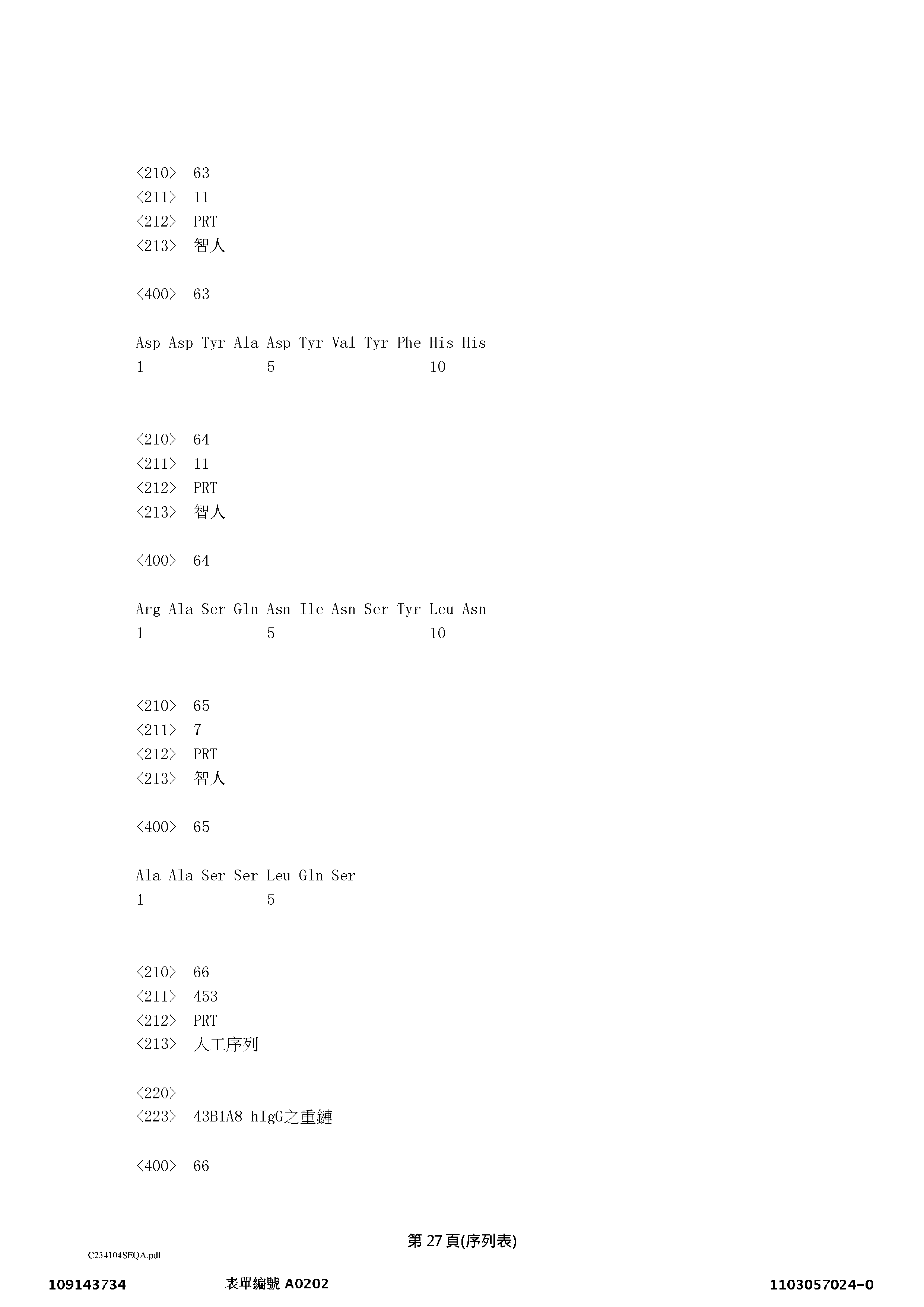


Claims (63)
Applications Claiming Priority (2)
| Application Number | Priority Date | Filing Date | Title |
|---|---|---|---|
| CN201911278628 | 2019-12-13 | ||
| CN201911278628.7 | 2019-12-13 |
Publications (2)
| Publication Number | Publication Date |
|---|---|
| TW202128753A TW202128753A (en) | 2021-08-01 |
| TWI851860B true TWI851860B (en) | 2024-08-11 |
Family
ID=76328837
Family Applications (1)
| Application Number | Title | Priority Date | Filing Date |
|---|---|---|---|
| TW109143734A TWI851860B (en) | 2019-12-13 | 2020-12-10 | Anti-TSLP antibodies and their uses |
Country Status (10)
| Country | Link |
|---|---|
| US (1) | US20220363781A1 (en) |
| EP (1) | EP4047019A4 (en) |
| JP (2) | JP7749549B2 (en) |
| KR (1) | KR20220113673A (en) |
| CN (3) | CN121851165A (en) |
| AU (1) | AU2020400221A1 (en) |
| CA (1) | CA3155759A1 (en) |
| MX (1) | MX2022004919A (en) |
| TW (1) | TWI851860B (en) |
| WO (1) | WO2021115240A1 (en) |
Families Citing this family (20)
| Publication number | Priority date | Publication date | Assignee | Title |
|---|---|---|---|---|
| JP6871948B2 (en) | 2016-04-27 | 2021-05-19 | アッヴィ・インコーポレイテッド | Treatment of Diseases with Harmful IL-13 Activity Using Anti-IL-13 Antibodies |
| US10093731B2 (en) | 2017-02-24 | 2018-10-09 | Kindred Biosciences, Inc. | Anti-IL31 antibodies for veterinary use |
| TW202219066A (en) * | 2020-11-12 | 2022-05-16 | 大陸商上海濟煜醫藥科技有限公司 | A tslp antigen binding protein and the application thereof |
| CN113501878B (en) * | 2021-02-03 | 2022-12-02 | 北京智仁美博生物科技有限公司 | Antibodies against human TSLP and uses thereof |
| CN113683694B (en) | 2021-09-03 | 2022-05-13 | 江苏荃信生物医药股份有限公司 | Anti-human TSLP monoclonal antibody and application thereof |
| US12110324B2 (en) | 2022-07-22 | 2024-10-08 | Flagship Pioneering Innovations Vi, Llc | Antigen binding molecules targeting thymic stromal lymphopoietin (TSLP) |
| JP2025541654A (en) * | 2022-11-29 | 2025-12-23 | スーチュアン・コールン-バイオテック・バイオファーマシューティカル・カンパニー・リミテッド | B7-H3 binding protein and uses thereof |
| TW202448501A (en) | 2023-02-02 | 2024-12-16 | 美商麥迪紐有限責任公司 | Treatment of chronic rhinosinusitis with anti-tslp antibody |
| EP4678659A1 (en) | 2023-02-23 | 2026-01-14 | Sichuan Kelun-Biotech Biopharmaceutical Co., Ltd. | Monoclonal antibody preparation targeting tslp |
| CN116675771B (en) * | 2023-03-01 | 2024-08-06 | 江苏荃信生物医药股份有限公司 | Anti-human TSLP monoclonal antibody, kit containing same and inspection method |
| IL324470A (en) | 2023-05-18 | 2026-01-01 | Medimmune Llc | Treatment of corticosteroid dependent asthma with anti-tslp antibody |
| AR134102A1 (en) * | 2023-10-12 | 2025-12-03 | Innovent Biologics Suzhou Co Ltd | ANTI-IL-4Ra ANTIBODIES AND THEIR USES |
| CN119735676B (en) * | 2023-12-26 | 2025-12-16 | 华润生物医药有限公司 | Anti-TSLP antibodies and their uses |
| WO2025147632A1 (en) | 2024-01-05 | 2025-07-10 | Medimmune, Llc | Treatment of chronic obstructive pulmonary disease with anti-tslp antibody |
| TW202529811A (en) | 2024-01-29 | 2025-08-01 | 瑞典商阿斯特捷利康公司 | Compositions of thymic stromal lymphopoietin (tslp) binding fragments and methods of use thereof |
| WO2025214333A1 (en) * | 2024-04-08 | 2025-10-16 | 江苏恒瑞医药股份有限公司 | Method for treating tslp-associated inflammatory disease using anti-tslp antibody |
| WO2025221247A1 (en) | 2024-04-17 | 2025-10-23 | Amgen Inc. | Treatment of eosinophilic esophagitis with anti-tslp antibody |
| WO2025255558A2 (en) * | 2024-06-07 | 2025-12-11 | Odyssey Therapeutics, Inc. | Anti-thymic stromal lymphopoietin (tslp) antigen-binding proteins and uses thereof |
| WO2026085414A1 (en) | 2024-10-18 | 2026-04-23 | Apogee Therapeutics, Inc. | Antibodies that bind tslp and antibodies that bind interleukin 4 receptor alpha in combination with hyaluronidase or a variant thereof |
| WO2026085415A1 (en) | 2024-10-18 | 2026-04-23 | Apogee Therapeutics, Inc. | Antibodies that bind il-13 and antibodies that bind tslp in combination with hyaluronidase or a variant thereof |
Citations (1)
| Publication number | Priority date | Publication date | Assignee | Title |
|---|---|---|---|---|
| WO2018191479A1 (en) * | 2017-04-12 | 2018-10-18 | Amgen Inc. | Treatment of asthma with anti-tslp antibody |
Family Cites Families (32)
| Publication number | Priority date | Publication date | Assignee | Title |
|---|---|---|---|---|
| US4816A (en) | 1846-10-17 | Bell machinery for hotels | ||
| US370A (en) | 1837-08-31 | Cookingr-stove | ||
| US6180A (en) | 1849-03-13 | Improved furnace for smelting zinc | ||
| US567A (en) | 1838-01-09 | Machine for r-uibbii | ||
| NL154598B (en) | 1970-11-10 | 1977-09-15 | Organon Nv | PROCEDURE FOR DETERMINING AND DETERMINING LOW MOLECULAR COMPOUNDS AND PROTEINS THAT CAN SPECIFICALLY BIND THESE COMPOUNDS AND TEST PACKAGING. |
| US3817837A (en) | 1971-05-14 | 1974-06-18 | Syva Corp | Enzyme amplification assay |
| US3939350A (en) | 1974-04-29 | 1976-02-17 | Board Of Trustees Of The Leland Stanford Junior University | Fluorescent immunoassay employing total reflection for activation |
| US3996345A (en) | 1974-08-12 | 1976-12-07 | Syva Company | Fluorescence quenching with immunological pairs in immunoassays |
| US4275149A (en) | 1978-11-24 | 1981-06-23 | Syva Company | Macromolecular environment control in specific receptor assays |
| US4277437A (en) | 1978-04-05 | 1981-07-07 | Syva Company | Kit for carrying out chemically induced fluorescence immunoassay |
| US4366241A (en) | 1980-08-07 | 1982-12-28 | Syva Company | Concentrating zone method in heterogeneous immunoassays |
| US5225539A (en) | 1986-03-27 | 1993-07-06 | Medical Research Council | Recombinant altered antibodies and methods of making altered antibodies |
| US5530101A (en) | 1988-12-28 | 1996-06-25 | Protein Design Labs, Inc. | Humanized immunoglobulins |
| US6255455B1 (en) * | 1996-10-11 | 2001-07-03 | The Trustees Of The University Of Pennsylvania | Rh(D)-binding proteins and magnetically activated cell sorting method for production thereof |
| CA2430013C (en) | 2000-11-30 | 2011-11-22 | Medarex, Inc. | Transgenic transchromosomal rodents for making human antibodies |
| EP1539236A4 (en) * | 2002-07-03 | 2007-07-18 | Univ Pennsylvania | COMPOSITIONS, METHODS AND KITS RELATING TO ANTIPLATELET AUTOANTIBODIES AND THEIR INHIBITORS |
| GB0603683D0 (en) * | 2006-02-23 | 2006-04-05 | Novartis Ag | Organic compounds |
| AU2007325872B2 (en) * | 2006-11-08 | 2012-12-13 | Macrogenics West, Inc. | TES7 and antibodies that bind thereto |
| US7982016B2 (en) * | 2007-09-10 | 2011-07-19 | Amgen Inc. | Antigen binding proteins capable of binding thymic stromal lymphopoietin |
| CA2742969A1 (en) * | 2008-11-07 | 2010-05-14 | Fabrus Llc | Anti-dll4 antibodies and uses thereof |
| US8926976B2 (en) * | 2009-09-25 | 2015-01-06 | Xoma Technology Ltd. | Modulators |
| ES2784123T3 (en) * | 2009-11-04 | 2020-09-22 | Merck Sharp & Dohme | Genomodified anti-TSLP antibody |
| JO3340B1 (en) * | 2010-05-26 | 2019-03-13 | Regeneron Pharma | Antibodies to human gdf8 |
| KR102236367B1 (en) | 2013-07-26 | 2021-04-05 | 삼성전자주식회사 | Bispecific chimeric proteins with DARPins |
| CA2942546C (en) | 2014-03-17 | 2022-11-22 | Mitsubishi Tanabe Pharma Corporation | Antibody-fynomer conjugates |
| KR20170123315A (en) * | 2015-03-11 | 2017-11-07 | 글락소스미스클라인 인털렉츄얼 프로퍼티 디벨로프먼트 리미티드 | TSLP binding protein |
| EA038332B1 (en) * | 2015-09-09 | 2021-08-10 | Новартис Аг | Thymic stromal lymphopoietin (tslp)-binding molecules and methods of using the molecules |
| HRP20210650T1 (en) | 2015-09-09 | 2021-05-28 | Novartis Ag | Thymic stromal lymphopoietin (tslp)-binding antibodies and methods of using the antibodies |
| JP7422480B2 (en) * | 2016-05-04 | 2024-01-26 | アムジエン・インコーポレーテツド | Interleukin-2 mutant protein for regulatory T cell proliferation |
| TWI831778B (en) * | 2018-05-11 | 2024-02-11 | 澳門商同潤澳門一人有限公司 | Fully human antibodies against OX40 and preparation methods and uses thereof |
| US12599668B2 (en) * | 2019-02-20 | 2026-04-14 | Harbour Antibodies Bv | Antibodies |
| US20230075314A1 (en) * | 2019-04-29 | 2023-03-09 | Voyager Therapeutics, Inc. | VECTORIZED ANTIBODIES (vAb) AND USES THEREOF |
-
2020
- 2020-12-08 AU AU2020400221A patent/AU2020400221A1/en active Pending
- 2020-12-08 EP EP20898089.6A patent/EP4047019A4/en active Pending
- 2020-12-08 WO PCT/CN2020/134438 patent/WO2021115240A1/en not_active Ceased
- 2020-12-08 CN CN202610040766.5A patent/CN121851165A/en active Pending
- 2020-12-08 JP JP2022524138A patent/JP7749549B2/en active Active
- 2020-12-08 CA CA3155759A patent/CA3155759A1/en active Pending
- 2020-12-08 CN CN202610040580.XA patent/CN121851164A/en active Pending
- 2020-12-08 MX MX2022004919A patent/MX2022004919A/en unknown
- 2020-12-08 KR KR1020227013655A patent/KR20220113673A/en active Pending
- 2020-12-08 CN CN202080074409.1A patent/CN114729037B/en active Active
- 2020-12-08 US US17/771,271 patent/US20220363781A1/en active Pending
- 2020-12-10 TW TW109143734A patent/TWI851860B/en active
-
2025
- 2025-09-24 JP JP2025158327A patent/JP2026012690A/en active Pending
Patent Citations (1)
| Publication number | Priority date | Publication date | Assignee | Title |
|---|---|---|---|---|
| WO2018191479A1 (en) * | 2017-04-12 | 2018-10-18 | Amgen Inc. | Treatment of asthma with anti-tslp antibody |
Also Published As
| Publication number | Publication date |
|---|---|
| TW202128753A (en) | 2021-08-01 |
| JP2023505408A (en) | 2023-02-09 |
| KR20220113673A (en) | 2022-08-16 |
| MX2022004919A (en) | 2022-05-16 |
| CN114729037A (en) | 2022-07-08 |
| CA3155759A1 (en) | 2021-06-17 |
| AU2020400221A1 (en) | 2022-05-19 |
| EP4047019A4 (en) | 2023-11-15 |
| US20220363781A1 (en) | 2022-11-17 |
| JP2026012690A (en) | 2026-01-27 |
| EP4047019A1 (en) | 2022-08-24 |
| CN121851164A (en) | 2026-04-14 |
| CN121851165A (en) | 2026-04-14 |
| WO2021115240A1 (en) | 2021-06-17 |
| JP7749549B2 (en) | 2025-10-06 |
| CN114729037B (en) | 2026-02-06 |
Similar Documents
| Publication | Publication Date | Title |
|---|---|---|
| TWI851860B (en) | Anti-TSLP antibodies and their uses | |
| CN113501878B (en) | Antibodies against human TSLP and uses thereof | |
| JP2023515260A (en) | ANTI-HUMAN INTERLEUKIN-4 RECEPTOR α ANTIBODY AND PREPARATION AND USE THEREOF | |
| CN108473568A (en) | Multispecific antibody molecules specific for TNF-α, IL-17A and IL-17F | |
| JP7163275B2 (en) | anti-IL-22R antibody | |
| JP2023538379A (en) | Anti-PAR-2 antibodies and methods of using them | |
| TW202448940A (en) | Antibodies that bind interleukin 4 receptor alpha and methods of use | |
| CN108178798B (en) | PH engineered NGF antibodies and medical uses thereof | |
| CN120152738A (en) | Methods of treating diseases using anti-IL1RAP antibodies and antibody drug conjugates | |
| RU2834227C1 (en) | Anti-tslp antibody and use thereof | |
| CN118488967A (en) | Galectin-10 antibodies | |
| HK40078042B (en) | Anti-tslp antibody and uses thereof | |
| HK40078042A (en) | Anti-tslp antibody and uses thereof | |
| CN114426580B (en) | Anti-CSF-1R antibodies and products, methods and uses thereof | |
| CN114395042B (en) | anti-IL-33 humanized antibodies and uses thereof | |
| EP4357361A9 (en) | Anti-il-36r antibody and use thereof | |
| JP7688150B2 (en) | Anti-OX40L antibody, bispecific antibody of anti-OX40L and anti-TNFα, and uses thereof | |
| CN111787980B (en) | Anti-huTNFR 1 therapy for nonalcoholic steatohepatitis | |
| TW202607021A (en) | Antibodies that bind tslp and methods of use | |
| CN119301153A (en) | Antibody molecules binding to IL-17A and IL-17F and their applications | |
| TW202313690A (en) | An anti-B7-H4 antibody and its preparation method and application | |
| TW202136308A (en) | Anti-csf1r molecules and use thereof | |
| CN119350502A (en) | Antigen binding protein targeting FAP and its application | |
| HK1227416A1 (en) | Tumor necrosis factor-like ligand 1a specific antibodies and compositions and uses thereof |