TWI856193B - An antibody, a pharmaceutical composition, and a method - Google Patents
An antibody, a pharmaceutical composition, and a method Download PDFInfo
- Publication number
- TWI856193B TWI856193B TW109135664A TW109135664A TWI856193B TW I856193 B TWI856193 B TW I856193B TW 109135664 A TW109135664 A TW 109135664A TW 109135664 A TW109135664 A TW 109135664A TW I856193 B TWI856193 B TW I856193B
- Authority
- TW
- Taiwan
- Prior art keywords
- amino acid
- hvr
- identification number
- acid sequence
- antibody
- Prior art date
Links
Images


Classifications
-
- C—CHEMISTRY; METALLURGY
- C07—ORGANIC CHEMISTRY
- C07K—PEPTIDES
- C07K16/00—Immunoglobulins [IG], e.g. monoclonal or polyclonal antibodies
- C07K16/18—Immunoglobulins [IG], e.g. monoclonal or polyclonal antibodies against material from animals or humans
-
- C—CHEMISTRY; METALLURGY
- C07—ORGANIC CHEMISTRY
- C07K—PEPTIDES
- C07K16/00—Immunoglobulins [IG], e.g. monoclonal or polyclonal antibodies
- C07K16/40—Immunoglobulins [IG], e.g. monoclonal or polyclonal antibodies against enzymes
-
- A—HUMAN NECESSITIES
- A61—MEDICAL OR VETERINARY SCIENCE; HYGIENE
- A61P—SPECIFIC THERAPEUTIC ACTIVITY OF CHEMICAL COMPOUNDS OR MEDICINAL PREPARATIONS
- A61P37/00—Drugs for immunological or allergic disorders
- A61P37/02—Immunomodulators
- A61P37/06—Immunosuppressants, e.g. drugs for graft rejection
-
- A—HUMAN NECESSITIES
- A61—MEDICAL OR VETERINARY SCIENCE; HYGIENE
- A61P—SPECIFIC THERAPEUTIC ACTIVITY OF CHEMICAL COMPOUNDS OR MEDICINAL PREPARATIONS
- A61P7/00—Drugs for disorders of the blood or the extracellular fluid
-
- C—CHEMISTRY; METALLURGY
- C07—ORGANIC CHEMISTRY
- C07K—PEPTIDES
- C07K2317/00—Immunoglobulins specific features
- C07K2317/20—Immunoglobulins specific features characterized by taxonomic origin
- C07K2317/24—Immunoglobulins specific features characterized by taxonomic origin containing regions, domains or residues from different species, e.g. chimeric, humanized or veneered
-
- C—CHEMISTRY; METALLURGY
- C07—ORGANIC CHEMISTRY
- C07K—PEPTIDES
- C07K2317/00—Immunoglobulins specific features
- C07K2317/30—Immunoglobulins specific features characterized by aspects of specificity or valency
- C07K2317/33—Crossreactivity, e.g. for species or epitope, or lack of said crossreactivity
-
- C—CHEMISTRY; METALLURGY
- C07—ORGANIC CHEMISTRY
- C07K—PEPTIDES
- C07K2317/00—Immunoglobulins specific features
- C07K2317/40—Immunoglobulins specific features characterized by post-translational modification
-
- C—CHEMISTRY; METALLURGY
- C07—ORGANIC CHEMISTRY
- C07K—PEPTIDES
- C07K2317/00—Immunoglobulins specific features
- C07K2317/50—Immunoglobulins specific features characterized by immunoglobulin fragments
- C07K2317/56—Immunoglobulins specific features characterized by immunoglobulin fragments variable (Fv) region, i.e. VH and/or VL
- C07K2317/565—Complementarity determining region [CDR]
-
- C—CHEMISTRY; METALLURGY
- C07—ORGANIC CHEMISTRY
- C07K—PEPTIDES
- C07K2317/00—Immunoglobulins specific features
- C07K2317/70—Immunoglobulins specific features characterized by effect upon binding to a cell or to an antigen
- C07K2317/76—Antagonist effect on antigen, e.g. neutralization or inhibition of binding
-
- C—CHEMISTRY; METALLURGY
- C07—ORGANIC CHEMISTRY
- C07K—PEPTIDES
- C07K2317/00—Immunoglobulins specific features
- C07K2317/90—Immunoglobulins specific features characterized by (pharmaco)kinetic aspects or by stability of the immunoglobulin
- C07K2317/92—Affinity (KD), association rate (Ka), dissociation rate (Kd) or EC50 value
-
- C—CHEMISTRY; METALLURGY
- C07—ORGANIC CHEMISTRY
- C07K—PEPTIDES
- C07K2317/00—Immunoglobulins specific features
- C07K2317/90—Immunoglobulins specific features characterized by (pharmaco)kinetic aspects or by stability of the immunoglobulin
- C07K2317/94—Stability, e.g. half-life, pH, temperature or enzyme-resistance
-
- C—CHEMISTRY; METALLURGY
- C12—BIOCHEMISTRY; BEER; SPIRITS; WINE; VINEGAR; MICROBIOLOGY; ENZYMOLOGY; MUTATION OR GENETIC ENGINEERING
- C12N—MICROORGANISMS OR ENZYMES; COMPOSITIONS THEREOF; PROPAGATING, PRESERVING, OR MAINTAINING MICROORGANISMS; MUTATION OR GENETIC ENGINEERING; CULTURE MEDIA
- C12N15/00—Mutation or genetic engineering; DNA or RNA concerning genetic engineering, vectors, e.g. plasmids, or their isolation, preparation or purification; Use of hosts therefor
- C12N15/09—Recombinant DNA-technology
- C12N15/63—Introduction of foreign genetic material using vectors; Vectors; Use of hosts therefor; Regulation of expression
-
- C—CHEMISTRY; METALLURGY
- C12—BIOCHEMISTRY; BEER; SPIRITS; WINE; VINEGAR; MICROBIOLOGY; ENZYMOLOGY; MUTATION OR GENETIC ENGINEERING
- C12N—MICROORGANISMS OR ENZYMES; COMPOSITIONS THEREOF; PROPAGATING, PRESERVING, OR MAINTAINING MICROORGANISMS; MUTATION OR GENETIC ENGINEERING; CULTURE MEDIA
- C12N9/00—Enzymes; Proenzymes; Compositions thereof; Processes for preparing, activating, inhibiting, separating or purifying enzymes
- C12N9/14—Hydrolases (3)
- C12N9/48—Hydrolases (3) acting on peptide bonds (3.4)
- C12N9/50—Proteinases, e.g. Endopeptidases (3.4.21-3.4.25)
- C12N9/64—Proteinases, e.g. Endopeptidases (3.4.21-3.4.25) derived from animal tissue
- C12N9/6421—Proteinases, e.g. Endopeptidases (3.4.21-3.4.25) derived from animal tissue from mammals
- C12N9/6424—Serine endopeptidases (3.4.21)
- C12N9/647—Blood coagulation factors not provided for in a preceding group or according to more than one of the proceeding groups
-
- C—CHEMISTRY; METALLURGY
- C12—BIOCHEMISTRY; BEER; SPIRITS; WINE; VINEGAR; MICROBIOLOGY; ENZYMOLOGY; MUTATION OR GENETIC ENGINEERING
- C12Y—ENZYMES
- C12Y304/00—Hydrolases acting on peptide bonds, i.e. peptidases (3.4)
- C12Y304/21—Serine endopeptidases (3.4.21)
- C12Y304/21042—Complement subcomponent C1s (3.4.21.42)
Landscapes
- Health & Medical Sciences (AREA)
- Chemical & Material Sciences (AREA)
- Organic Chemistry (AREA)
- Immunology (AREA)
- Life Sciences & Earth Sciences (AREA)
- General Health & Medical Sciences (AREA)
- Medicinal Chemistry (AREA)
- Genetics & Genomics (AREA)
- Molecular Biology (AREA)
- Biophysics (AREA)
- Biochemistry (AREA)
- Proteomics, Peptides & Aminoacids (AREA)
- Engineering & Computer Science (AREA)
- Bioinformatics & Cheminformatics (AREA)
- Veterinary Medicine (AREA)
- General Chemical & Material Sciences (AREA)
- Animal Behavior & Ethology (AREA)
- Public Health (AREA)
- Chemical Kinetics & Catalysis (AREA)
- Pharmacology & Pharmacy (AREA)
- Nuclear Medicine, Radiotherapy & Molecular Imaging (AREA)
- Transplantation (AREA)
- Hematology (AREA)
- Diabetes (AREA)
- Peptides Or Proteins (AREA)
- Medicines Containing Antibodies Or Antigens For Use As Internal Diagnostic Agents (AREA)
- Biomedical Technology (AREA)
- Biotechnology (AREA)
- General Engineering & Computer Science (AREA)
- Wood Science & Technology (AREA)
- Zoology (AREA)
- Physics & Mathematics (AREA)
- Plant Pathology (AREA)
- Microbiology (AREA)
Abstract
Description
本發明係有關於例如抗C1s抗體的抗體及其使用方法。The present invention relates to antibodies, such as anti-C1s antibodies, and methods of using the same.
C1複合物是一種作為經典途徑級聯的關鍵啟動劑的大型蛋白質複合物。C1複合物由三個成分C1q、C1r和C1s所組成,其莫耳比分別為1:2:2 (NPL 1)。當C1複合物結合至抗體所結合的目標時,啟動經典途徑。具有6個球形頭部的C1q藉由與Fc區的結合性(avidity)的交互作用,來調節C1複合物與抗體的結合。一旦與目標緊密結合,C1複合物內的C1r會自動活化且具有酵素活性。然後,活化的C1r切割且活化C1複合物內的酶原C1s(NPL 2)。隨後,有活性的C1s將其受質補體(substrates complement)成分C2和C4分別切割為C2a/C2b和C4a/C4b片段。這導致在目標表面上的C3轉化酶C4b2a組裝,其切割C3以形成C3b。C3b接著切割C5以啟動末端膜攻擊複合物、C5b、C6、C7、C8和C9的形成,其透過形成孔洞來裂解目標。The C1 complex is a large protein complex that serves as a key initiator of the classical pathway cascade. The C1 complex is composed of three components, C1q, C1r, and C1s, with a molar ratio of 1:2:2 (NPL 1). The classical pathway is activated when the C1 complex binds to the target bound by the antibody. C1q, which has six globular heads, regulates the binding of the C1 complex to the antibody by interacting with the avidity of the Fc region. Once tightly bound to the target, C1r in the C1 complex is automatically activated and has enzymatic activity. Then, the activated C1r cleaves and activates the zymogen C1s in the C1 complex (NPL 2). Subsequently, active C1s cleaves its substrate complement components C2 and C4 into C2a/C2b and C4a/C4b fragments, respectively. This leads to the assembly of the C3 convertase C4b2a on the target surface, which cleaves C3 to form C3b. C3b then cleaves C5 to initiate the formation of the terminal membrane attack complex, C5b, C6, C7, C8, and C9, which cleave the target by forming a pore.
C1和C1r蛋白質兩者都具有相同的域組織,即CUB1-EGF-CUB2-CCP1-CCP2-絲胺酸蛋白酶(NPL 3)。CUB1-EGF-CUB2域調節C1r和C1s之間的交互作用,以形成C1r2s2四聚體(NPL 4),以及調節C1r2s2和C1q之間的交互作用(NPL 5)。相比之下,C1r和C1s的CCP1-CCP2-絲胺酸蛋白酶域負責各自基質的蛋白質裂解切割(NPL 6、NPL 7)。C1r2s2四聚體透過四聚體的CUB1-EGF-CUB2域中的六個結合位與C1q中的六個主幹交互作用(NPL 5)。Both C1 and C1r proteins have the same domain organization, namely CUB1-EGF-CUB2-CCP1-CCP2-serine protease (NPL 3). The CUB1-EGF-CUB2 domain mediates the interaction between C1r and C1s to form the C1r2s2 tetramer (NPL 4), as well as the interaction between C1r2s2 and C1q (NPL 5). In contrast, the CCP1-CCP2-serine protease domains of C1r and C1s are responsible for proteolytic cleavage of their respective substrates (NPL 6, NPL 7). The C1r2s2 tetramer interacts with the six backbones in C1q through the six binding sites in the CUB1-EGF-CUB2 domain of the tetramer (NPL 5).
儘管適當運作的補體系統可防禦宿主對抗病原體,但經典途徑的失調或不適當活化會導致各種補體調節的病症(disorder),例如但不限於自體免疫溶血性貧血(autoimmune hemolytic anemias,AIHA)、貝西氏病(Behcet's disease)、大皰性天皰瘡(Bullous Pemphigus,BP)、免疫性血小板減少性紫斑(immune thrombocytopenia purpura,ITP)等。因此,抑制經典途徑的過度或不受控的活化可為具有此類病症的病人提供臨床益處。Although a properly functioning complement system can defend the host against pathogens, dysregulation or inappropriate activation of the classical pathway can lead to various complement-regulated disorders, such as but not limited to autoimmune hemolytic anemias (AIHA), Behcet's disease, Bullous Pemphigus (BP), immune thrombocytopenia purpura (ITP), etc. Therefore, inhibiting excessive or uncontrolled activation of the classical pathway may provide clinical benefits to patients with such disorders.
HI532,一種結合至C1s的beta域的抗體,據報導能夠抑制C1r2s2與C1q的交互作用(NPL 8)。然而,此抗體不能完全中和人類血清的溶血活性,甚至在血清與抗體一起培養24小時之後,仍保留30%的活性。HI532, an antibody that binds to the beta domain of C1s, was reported to inhibit the interaction of C1r2s2 with C1q (NPL 8). However, this antibody was unable to completely neutralize the hemolytic activity of human serum, and even after incubation of serum with the antibody for 24 hours, 30% of the activity was retained.
抗體是有高度吸引力的醫藥,因為它們在血漿中穩定,對其目標有高度特異性,且通常展現出良好的藥物動力學特徵。然而,由於它們的分子尺寸很大,治療性抗體的劑量通常很高。在目標大量存在的情況下,所需的抗體治療劑量更高。因此,改善抗體藥物動力學(pharmacokinetics)、藥效動力學(pharmacodynamic)和抗原結合性質的方法是減少與治療性抗體相關的劑量和高生產成本之有吸引力的方法。Antibodies are highly attractive pharmaceuticals because they are stable in plasma, highly specific for their targets, and generally exhibit good pharmacokinetic properties. However, due to their large molecular size, therapeutic antibody doses are generally high. In situations where the target is present in large quantities, the required antibody therapeutic dose is even higher. Therefore, methods to improve antibody pharmacokinetics, pharmacodynamics, and antigen binding properties are attractive approaches to reduce the doses and high production costs associated with therapeutic antibodies.
據報導,以pH依賴性方式結合至抗原的抗體(本文以下亦稱為「pH依賴性抗體」或「pH依賴性結合抗體」)使單一抗體分子能夠中和多個抗原分子(NPL 9、PTL 1)。在血漿中於中性pH條件下,pH依賴性抗體強力地結合至其抗原,但在細胞的胞內體(endosome)內於酸性pH條件下與抗原解離。一旦與抗原解離,抗體就會藉由FcRn受體回收回到血漿,而解離的抗原則在細胞的溶酶體內降解。然後,回收的抗體可自由地再次結合且中和抗原分子,且只要抗體保持循環,此過程就會繼續重複。 [引用列表] [專利文獻]Antibodies that bind to antigens in a pH-dependent manner (hereinafter also referred to as "pH-dependent antibodies" or "pH-dependent binding antibodies") are reported to enable a single antibody molecule to neutralize multiple antigen molecules (NPL 9, PTL 1). pH-dependent antibodies bind strongly to their antigens under neutral pH conditions in plasma, but dissociate from the antigen under acidic pH conditions in the endosomes of cells. Once dissociated from the antigen, the antibody is recycled back to the plasma via the FcRn receptor, while the dissociated antigen is degraded in the lysosomes of the cell. The recovered antibody is then free to bind and neutralize antigen molecules again, and this process continues to repeat as long as the antibody remains in circulation. [Citation List] [Patent Literature]
[PTL 1] WO2009/125825 [非專利文獻][PTL 1] WO2009/125825 [Non-patent document]
[NPL 1] Wang et. al. Mol Cell. 2016 Jul 7;63(1):135-45 [NPL 2] Mortensen et. al. Proc Natl Acad Sci U S A. 2017 Jan 31;114(5):986-991 [NPL 3] Gal et. al. Mol Immunol. 2009 Sep;46(14):2745-52 [NPL 4] Almitairi et. al. Proc Natl Acad Sci U S A. 2018 Jan 23;115(4):768-773 [NPL 5] Bally et. al. J Biol Chem. 2009 Jul 17;284(29):19340-8 [NPL 6] Rossi et. al. 1998 J Biol Chem. 1998 Jan 9;273(2):1232-9 [NPL 7] Lacroix et. al. J Biol Chem. 2001 Sep 28;276(39):36233-40 [NPL 8] Tseng et. al. Mol Immunol. 1997 Jun;34(8-9):671-9 [NPL 9] Igawa et. al. Nat Biotechnol. 2010 Nov;28(11):1203-7[NPL 1] Wang et. al. Mol Cell. 2016 Jul 7;63(1):135-45 [NPL 2] Mortensen et. al. Proc Natl Acad Sci U S A. 2017 Jan 31;114(5):986 -991 [NPL 3] Gal et. al. Mol Immunol. 2009 Sep;46(14):2745-52 [NPL 4] Almitairi et. al. Proc Natl Acad Sci U S A. 2018 Jan 23;115(4): 768-773 [NPL 5] Bally et. al. J Biol Chem. 2009 Jul 17;284(29):19340-8 [NPL 6] Rossi et. al. 1998 J Biol Chem. 1998 Jan 9;273(2):1232-9 [NPL 7] Lacroix et. al. J Biol Chem. 2001 Sep 28;276(39):36233-40 [NPL 8] Tseng et. al. Mol Immunol. 1997 Jun ;34(8-9):671-9 [NPL 9] Igawa et. al. Nat Biotechnol. 2010 Nov;28(11):1203-7
[技術問題][Technical issues]
本發明提供了例如抗C1s抗體的抗補體成分抗體、包含其的醫藥組合物以及其使用方法。 [解決問題之技術手段]The present invention provides an anti-complement component antibody such as an anti-C1s antibody, a pharmaceutical composition containing the same, and a method of using the same. [Technical means for solving the problem]
本發明提供了單離抗體,其包含抗原結合區和抗體恆定區、具有置換功能(displacement function)以使抗體結合至C1qrs複合物並促進C1q從C1qrs複合物中解離和/或阻斷功能以使抗體結合至C1r2s2結合並抑制C1q結合至C1r2s2、且以pH依賴性方式結合至C1s。The present invention provides a monoclonal antibody comprising an antigen binding region and an antibody constant region, having a displacement function to allow the antibody to bind to the C1qrs complex and promote the dissociation of C1q from the C1qrs complex and/or a blocking function to allow the antibody to bind to C1r2s2 and inhibit the binding of C1q to C1r2s2, and bind to C1s in a pH-dependent manner.
具體地,本發明有關於以下所述:
[1] 一種包含抗原結合區和抗體恆定區的單離抗體,其中
抗體促進C1q從C1qrs複合物中解離和/或抑制C1q結合至C1r2s2,其中,
在藉由表面電漿共振來測量抗體對人類和/或食蟹猴C1s的結合活性的情況下,
i) 可可靠地計算出中性pH範圍內的解離常數(dissociation constant,KD)值,且由於沒有結合活性或很低的結合活性,而無法可靠地計算出酸性pH範圍內的KD值,或
ii) 若可可靠地計算出中性pH範圍內和酸性pH範圍內兩者的KD值,則酸性pH範圍內的KD值與中性pH範圍內的KD值之比值,即酸性KD/中性KD比值大於10。
[2] 如[1]所述的抗體,其中藉由表面電漿共振測量的該結合活性係使用每個抗體皆被人類Ig kappa輕鏈以50共振單位捕獲的感測器晶片和包含20 mM ACES (N-(2-乙醯胺基)-2-胺基乙烷磺酸(N-(2-Acetamido)-2-aminoethanesulfonic acid))、150 mM NaCl、1.2 mM CaCl2
、1 mg/mL牛血清白蛋白(bovine serum albumin,BSA)、1 mg/mL CM-葡聚醣鈉鹽(CM-Dextran sodium salt,CMD)、0.05%聚山梨醇酯20 (polysorbate 20)、0.005% NaN3
的運行緩衝液(running buffer)在攝氏37度下進行測量。
[3] 如[1]或[2]所述的抗體,其中抗體的等電點(pI)小於9.00、小於8.90、小於8.80或小於8.78或更小,且大於4.28或更大。
[4] 如[3]所述的抗體,其中藉由毛細管等電聚焦來測量pI,其中含有配製在0.1% m/v 甲基纖維素(methyl cellulose,MC)中之0.08 M磷酸的溶液作為陽極溶液,含有配製在0.1% m/v MC中之0.1 M氫氧化鈉的溶液作為陰極溶液,含有0.5 mg/mL抗體、0.3% m/v MC,6.0 mM亞胺二乙酸(iminodiacetic acid,IDA)、10 mM精胺酸、4 M尿素和pI標記物(7.65和9.77)的溶液作為將抗體裂解的作用溶液(working solution)。
[5] 如[1]至[4]中任一者所述的抗體,其中抗原結合區可特異性結合至人類C1s的CUB1-EGF-CUB2域。
[6] 如[1]至[5]中任一者所述的抗體,其中抗原結合區包括重鏈可變區,其包括包含由AYAMN (序列辨識號1)所組成的胺基酸序列的HVR-H1、包含由LIYGX1
X2
X3
X4
FYASWAX5
X6
(序列辨識號2)所組成的胺基酸序列的HVR-H2、和包含由GRSX7
NYX8
SX9
FHL (序列辨識號3)所組成的胺基酸序列的HVR- H3以及輕鏈可變區,其包括包含由QAX10
X11
X12
LHDKX13
NLA (序列辨識號4)所組成的胺基酸序列的HVR-L1、包含由X14
ASX15
X16
ES (序列辨識號5)所組成的胺基酸序列的HVR-L2、和包含由X17
GEFX18
X19
X20
X21
ADX22
NX23
(序列辨識號6)所組成的胺基酸序列的HVR-L3,其中X1
至X23
的每一者皆選自天然存在的(naturally occurring)胺基酸。
[7] 一種單離抗C1s抗體,其包含重鏈可變區、輕鏈可變區和抗體恆定區,其中重鏈可變區包括包含由AYAMN (序列辨識號1)所組成的胺基酸序列的HVR-H1、包含由LIYGX1
X2
X3
X4
FYASWAX5
X6
(序列辨識號2)所組成的胺基酸序列的HVR-H2、和包含由GRSX7
NYX8
SX9
FHL (序列辨識號3)所組成的胺基酸序列HVR-H3,且輕鏈可變區包括包含由QAX10
X11
X12
LHDKX13
NLA (序列辨識號4)所組成的胺基酸序列的HVR-L1、包含由X14
ASX15
X16
ES (序列辨識號5)所組成的胺基酸序列的HVR-L2、和包含由X17
GEFX18
X19
X20
X21
ADX22
NX23
(序列辨識號6)所組成的胺基酸序列的HVR-L3,其中X1
至X23
的每一者皆選自天然存在的胺基酸。
[8] 如[6]或[7]所述的抗體,其中
X1
為Lys或Ser,
X2
為Gly或Lys,
X3
為His或Ser,
X4
為Glu或Thr,
X5
為Glu或Lys,
X6
為Glu或Gly,
X7
為Lys或Val,
X8
為Asn或Val,
X9
為Asp或Gly,
X10
為Asn、Gln或Ser,
X11
為Gly或Gln,
X12
為Ile或Ser,
X13
為Lys或Arg,
X14
為Gly或Gln,
X15
為Gln或Thr,
X16
為Leu或Arg,
X17
為His或Gln,
X18
為Pro或Ser,
X19
為Cys或Tyr,
X20
為Glu或Ser,
X21
為Glu或Ser,
X22
為Cys或Leu,且
X23
為Gln或Thr。
[9] 如[6]至[8]中任一者所述的抗體,其中HVR-H1包含由序列辨識號7所組成的胺基酸序列,HVR-H2包含由序列辨識號8至10所組成的胺基酸序列中的任一者,HVR-H3包含由序列辨識號11至13所組成的胺基酸序列中的任一者,HVR-L1包含由序列辨識號14至18所組成的胺基酸序列中的任一者,HVR-L2包含由序列辨識號19至22所組成的胺基酸序列中的任一者,且HVR-L3包含由序列辨識號23至28所組成的胺基酸序列中的任一者。
[10] 如[6]至[9]中任一者所述的抗體,其中HVR-H1、HVR-H2、HVR-H3、HVR-L1、HVR-L2和HVR-L3的胺基酸序列的組合選自由以下1)至 9)所組成的群組:
1) 包含由序列辨識號7所組成的胺基酸序列的HVR-H1、
包含由序列辨識號8所組成的胺基酸序列的HVR-H2、
包含由序列辨識號11所組成的胺基酸序列的HVR-H3、
包含由序列辨識號14所組成的胺基酸序列的HVR-L1、
包含由序列辨識號19所組成的胺基酸序列的HVR-L2、和
包含由序列辨識號23所組成的胺基酸序列的HVR-L3;
2) 包含由序列辨識號7所組成的胺基酸序列的HVR-H1、
包含由序列辨識號9所組成的胺基酸序列的HVR-H2、
包含由序列辨識號12所組成的胺基酸序列的HVR-H3、
包含由序列辨識號14所組成的胺基酸序列的HVR-L1、
包含由序列辨識號19所組成的胺基酸序列的HVR-L2、和
包含由序列辨識號23所組成的胺基酸序列的HVR-L3;
3) 包含由序列辨識號7所組成的胺基酸序列的HVR-H1、
包含由序列辨識號10所組成的胺基酸序列的HVR-H2、
包含由序列辨識號13所組成的胺基酸序列的HVR-H3、
包含由序列辨識號15所組成的胺基酸序列的HVR-L1、
包含由序列辨識號20所組成的胺基酸序列的HVR-L2、和
包含由序列辨識號24所組成的胺基酸序列的HVR-L3;
4) 包含由序列辨識號7所組成的胺基酸序列的HVR-H1、
包含由序列辨識號10所組成的胺基酸序列的HVR-H2、
包含由序列辨識號13所組成的胺基酸序列的HVR-H3、
包含由序列辨識號15所組成的胺基酸序列的HVR-L1、
包含由序列辨識號20所組成的胺基酸序列的HVR-L2、和
包含由序列辨識號24所組成的胺基酸序列的HVR-L3;
5) 包含由序列辨識號7所組成的胺基酸序列的HVR-H1、
包含由序列辨識號10所組成的胺基酸序列的HVR-H2、
包含由序列辨識號13所組成的胺基酸序列的HVR-H3、
包含由序列辨識號16所組成的胺基酸序列的HVR-L1、
包含由序列辨識號21所組成的胺基酸序列的HVR-L2、和
包含由序列辨識號25所組成的胺基酸序列的HVR-L3;
6) 包含由序列辨識號7所組成的胺基酸序列的HVR-H1、
包含由序列辨識號10所組成的胺基酸序列的HVR-H2、
包含由序列辨識號13所組成的胺基酸序列的HVR-H3、
包含由序列辨識號17所組成的胺基酸序列的HVR-L1、
包含由序列辨識號20所組成的胺基酸序列的HVR-L2、和
包含由序列辨識號26所組成的胺基酸序列的HVR-L3;
7) 包含由序列辨識號7所組成的胺基酸序列的HVR-H1、
包含由序列辨識號10所組成的胺基酸序列的HVR-H2、
包含由序列辨識號11所組成的胺基酸序列的HVR-H3、
包含由序列辨識號15所組成的胺基酸序列的HVR-L1、
包含由序列辨識號20所組成的胺基酸序列的HVR-L2、和
包含由序列辨識號27所組成的胺基酸序列的HVR-L3;
8) 包含由序列辨識號7所組成的胺基酸序列的HVR-H1、
包含由序列辨識號10所組成的胺基酸序列的HVR-H2、
包含由序列辨識號11所組成的胺基酸序列的HVR-H3、
包含由序列辨識號18所組成的胺基酸序列的HVR-L1、
包含由序列辨識號19所組成的胺基酸序列的HVR-L2、和
包含由序列辨識號27所組成的胺基酸序列的HVR-L3;以及
9) 包含由序列辨識號7所組成的胺基酸序列的HVR-H1、
包含由序列辨識號10所組成的胺基酸序列的HVR-H2、
包含由序列辨識號11所組成的胺基酸序列的HVR-H3、
包含由序列辨識號18所組成的胺基酸序列的HVR-L1、
包含由序列辨識號22所組成的胺基酸序列的HVR-L2、和
包含由序列辨識號28所組成的胺基酸序列的HVR-L3。
[11] 如[6]或[7]所述的抗體,其中X19
和/或X22
不是Cys。
[12] 如[11]所述的抗體,其中X19
為Trp或Tyr,且X22
為Leu或Met。
[13] 如[11]或[12]所述的抗體,其中
X1
為Ser,
X2
為Gly,
X3
為His,
X4
為Glu,
X5
為Glu,
X6
為Glu,
X7
為Lys,
X8
為Asn或Val,
X9
為Asp或Gly,
X10
為Asn、Gln或Ser,
X11
為Gly或Gln,
X12
為Ile,
X13
為Lys或Arg,
X14
為Gly或Gln,
X15
為Gln或Thr,
X16
為Leu或Arg,
X17
為His,
X18
為Pro或Ser,
X19
為Tyr,
X20
為Glu或Ser,
X21
為Glu或Ser,
X22
為Leu,且
X23
為Gln或Thr。
[14] 如[11]至[13]中任一者所述的抗體,其中HVR-H1包含由序列辨識號7所組成的胺基酸序列,HVR-H2包含由序列辨識號10所組成的胺基酸序列,HVR-H3包含由序列辨識號11或13所組成的胺基酸序列,HVR-L1包含由序列辨識號15至18所組成的胺基酸序列中的任一者,HVR-L2包含由序列辨識號19至22所組成的胺基酸序列中的任一者,且HVR-L3包含由序列辨識號24至28所組成的胺基酸序列中的任一者。
[15] 如[11]至[14]中任一者所述的抗體,其中HVR-H1、HVR-H2、HVR-H3、HVR-L1、HVR-L2和HVR-L3的胺基酸序列的組合選自由以下3)至 9)所組成的群組:
3) 包含由序列辨識號7所組成的胺基酸序列的HVR-H1、
包含由序列辨識號10所組成的胺基酸序列的HVR-H2、
包含由序列辨識號13所組成的胺基酸序列的HVR-H3、
包含由序列辨識號15所組成的胺基酸序列的HVR-L1、
包含由序列辨識號20所組成的胺基酸序列的HVR-L2、和
包含由序列辨識號24所組成的胺基酸序列的HVR-L3;
4) 包含由序列辨識號7所組成的胺基酸序列的HVR-H1、
包含由序列辨識號10所組成的胺基酸序列的HVR-H2、
包含由序列辨識號13所組成的胺基酸序列的HVR-H3、
包含由序列辨識號15所組成的胺基酸序列的HVR-L1、
包含由序列辨識號20所組成的胺基酸序列的HVR-L2、和
包含由序列辨識號24所組成的胺基酸序列的HVR-L3;
5) 包含由序列辨識號7所組成的胺基酸序列的HVR-H1、
包含由序列辨識號10所組成的胺基酸序列的HVR-H2、
包含由序列辨識號13所組成的胺基酸序列的HVR-H3、
包含由序列辨識號16所組成的胺基酸序列的HVR-L1、
包含由序列辨識號21所組成的胺基酸序列的HVR-L2、和
包含由序列辨識號25所組成的胺基酸序列的HVR-L3;
6) 包含由序列辨識號7所組成的胺基酸序列的HVR-H1、
包含由序列辨識號10所組成的胺基酸序列的HVR-H2、
包含由序列辨識號13所組成的胺基酸序列的HVR-H3、
包含由序列辨識號17所組成的胺基酸序列的HVR-L1、
包含由序列辨識號20所組成的胺基酸序列的HVR-L2、和
包含由序列辨識號26所組成的胺基酸序列的HVR-L3;
7) 包含由序列辨識號7所組成的胺基酸序列的HVR-H1、
包含由序列辨識號10所組成的胺基酸序列的HVR-H2、
包含由序列辨識號11所組成的胺基酸序列的HVR-H3、
包含由序列辨識號15所組成的胺基酸序列的HVR-L1、
包含由序列辨識號20所組成的胺基酸序列的HVR-L2、和
包含由序列辨識號27所組成的胺基酸序列的HVR-L3;
8) 包含由序列辨識號7所組成的胺基酸序列的HVR-H1、
包含由序列辨識號10所組成的胺基酸序列的HVR-H2、
包含由序列辨識號11所組成的胺基酸序列的HVR-H3、
包含由序列辨識號18所組成的胺基酸序列的HVR-L1、
包含由序列辨識號19所組成的胺基酸序列的HVR-L2、和
包含由序列辨識號27所組成的胺基酸序列的HVR-L3;以及
9) 包含由序列辨識號7所組成的胺基酸序列的HVR-H1、
包含由序列辨識號10所組成的胺基酸序列的HVR-H2、
包含由序列辨識號11所組成的胺基酸序列的HVR-H3、
包含由序列辨識號18所組成的胺基酸序列的HVR-L1、
包含由序列辨識號22所組成的胺基酸序列的HVR-L2、和
包含由序列辨識號28所組成的胺基酸序列的HVR-L3。
[16] 如[1]至[15]中任一者所述的抗體,其中抗體恆定區是人類抗體之包含重鏈和輕鏈的恆定區。
[17] 如[16]所述的抗體,其中人類抗體為人類IgG1。
[18] 如[16]或[17]所述的抗體,其中與沒有所述至少一種胺基酸的人類抗體的恆定區相比,重鏈中的恆定區包含至少一種可降低對C1q的結合能力的胺基酸。
[19] 如[18]所述的抗體,其中可降低對C1q的結合能力的胺基酸是EU編號系統中第238位的Asp。
[20] 如[16]至[19]中任一者所述的抗體,其中與沒有所述至少一種胺基酸的人類抗體的恆定區相比,重鏈中的恆定區包含至少一種可選擇性結合至Fc gamma RIIb的胺基酸。
[21] 如[20]所述的抗體,其中重鏈中的恆定區對人類Fc gamma RIIa的KD值與對人類Fc gamma RIIb的KD值之比值(KD (hFc gamma RIIa/KD (hFc gamma RIIb))高於沒有[20]中所述至少一種胺基酸的人類抗體的恆定區的比值。
[22] 如[20]或[21]所述的抗體,其中重鏈中的恆定區包含EU編號系統中第234位的Tyr、EU編號系統中第238位的Asp、EU編號系統中第264位的Ile和EU編號系統中第330位的Lys。
[23] 如[20]至[22]中任一者所述的抗體,其中重鏈中的恆定區包含選自由下列所組成的群組的至少一者:EU編號系統中第214位的Arg、EU編號系統中第250位的Val、EU編號系統中第307位的Pro、EU編號系統中第311位的Arg、EU編號系統中第343位的Arg、EU編號系統中第428位的Leu、EU編號系統中第434位的Ala、EU編號系統中第436位的Thr、EU編號系統中第438位的Arg、及EU編號系統中第440位的Glu。
[24] 如[16]至[23]中任一者所述的抗體,其中恆定區中EU編號系統中第446和447位的胺基酸被刪除。
[25] 如[16]至[24]中任一者所述的抗體,其中抗原結合區是人源化抗體可變區。
[26] 一種醫藥組成物,其包含如[1]至[25]中任一者所述的抗體和至少一種醫藥上可接受的載體。
[27] 如[26]所述的醫藥組成物,其用於治療具有補體調節的疾病或病症的個體,或預防可能具有補體調節的疾病或病症的個體。
[28] 一種治療具有補體調節的疾病或病症的個體、或預防可能具有補體調節的疾病或病症的個體的方法,其包含對個體投予有效量之[1]至[25]中任一者所述的抗體。Specifically, the present invention relates to the following: [1] A monoclonal antibody comprising an antigen binding region and an antibody constant region, wherein the antibody promotes the dissociation of C1q from the C1qrs complex and/or inhibits the binding of C1q to C1r2s2, wherein, when the binding activity of the antibody to human and/or cynomolgus monkey C1s is measured by surface plasmon resonance, i) the dissociation constant (KD) value in the neutral pH range can be reliably calculated, and the KD value in the acidic pH range cannot be reliably calculated due to the lack of binding activity or very low binding activity, or ii) If KD values can be reliably calculated for both the neutral pH range and the acidic pH range, then the ratio of the KD value in the acidic pH range to the KD value in the neutral pH range, i.e. the acidic KD/neutral KD ratio, is greater than 10. [2] The antibody of [1], wherein the binding activity measured by surface plasmon resonance is measured using a sensor chip in which each antibody is captured by human Ig kappa light chain at 50 resonance units and a running buffer comprising 20 mM ACES (N-(2-Acetamido)-2-aminoethanesulfonic acid), 150 mM NaCl, 1.2 mM CaCl2, 1 mg/mL bovine serum albumin (BSA), 1 mg/mL CM-Dextran sodium salt (CMD), 0.05%
本文描述或參考的技術和流程是本發明所屬技術領域中具有通常知識者通常容易理解且使用常規方法來通常利用的,例如Sambrook et al., Molecular Cloning: A Laboratory Manual 3d edition (2001) Cold Spring Harbor Laboratory Press, Cold Spring Harbor, N.Y.; Current Protocols in Molecular Biology (F.M. Ausubel, et al. eds., (2003)); the series Methods in Enzymology (Academic Press, Inc.): PCR 2: A Practical Approach (M.J. MacPherson, B.D. Hames and G.R. Taylor eds. (1995)), Harlow and Lane, eds. (1988) Antibodies, A Laboratory Manual, and Animal Cell Culture (R.I. Freshney, ed. (1987)); Oligonucleotide Synthesis (M.J. Gait, ed., 1984); Methods in Molecular Biology, Humana Press; Cell Biology: A Laboratory Notebook (J.E. Cellis, ed., 1998) Academic Press; Animal Cell Culture (R.I. Freshney), ed., 1987); Introduction to Cell and Tissue Culture (J. P. Mather and P.E. Roberts, 1998) Plenum Press; Cell and Tissue Culture: Laboratory Procedures (A. Doyle, J.B. Griffiths, and D.G. Newell, eds., 1993-8) J. Wiley and Sons; Handbook of Experimental Immunology (D.M. Weir and C.C. Blackwell, eds.); Gene Transfer Vectors for Mammalian Cells (J.M. Miller and M.P. Calos, eds., 1987); PCR: The Polymerase Chain Reaction, (Mullis et al., eds., 1994); Current Protocols in Immunology (J.E. Coligan et al., eds., 1991); Short Protocols in Molecular Biology (Wiley and Sons, 1999); Immunobiology (C.A. Janeway and P. Travers, 1997); Antibodies (P. Finch, 1997); Antibodies: A Practical Approach (D. Catty., ed., IRL Press, 1988-1989); Monoclonal Antibodies: A Practical Approach (P. Shepherd and C. Dean, eds., Oxford University Press, 2000); Using Antibodies: A Laboratory Manual (E. Harlow and D. Lane (Cold Spring Harbor Laboratory Press, 1999); The Antibodies (M. Zanetti and J. D. Capra, eds., Harwood Academic Publishers, 1995); and Cancer: Principles and Practice of Oncology (V.T. DeVita et al., eds., J.B. Lippincott Company, 1993) 中描述的廣泛使用的方法。The techniques and procedures described or referenced herein are generally readily understood by those having ordinary skill in the art to which the present invention pertains and are commonly utilized using conventional methods, such as Sambrook et al., Molecular Cloning: A Laboratory Manual 3d edition (2001) Cold Spring Harbor Laboratory Press, Cold Spring Harbor, N.Y.; Current Protocols in Molecular Biology (F.M. Ausubel, et al. eds., (2003)); the series Methods in Enzymology (Academic Press, Inc.): PCR 2: A Practical Approach (M.J. MacPherson, B.D. Hames and G.R. Taylor eds. (1995)), Harlow and Lane, eds. (1988) Antibodies, A Laboratory Manual, and Animal Cell Culture (R.I. Freshney, ed. (1987)); Oligonucleotide Synthesis (M.J. Gait, ed., 1984); Methods in Molecular Biology, Humana Press; Cell Biology: A Laboratory Notebook (J.E. Cellis, ed., 1998) Academic Press; Animal Cell Culture (R.I. Freshney), ed., 1987); Introduction to Cell and Tissue Culture (J. P. Mather and P.E. Roberts, 1998) Plenum Press; Cell and Tissue Culture: Laboratory Procedures (A. Doyle, J.B. Griffiths, and D.G. Newell, eds., 1993-8) J. Wiley and Sons; Handbook of Experimental Immunology (D.M. Weir and C.C. Blackwell, eds.); Gene Transfer Vectors for Mammalian Cells (J.M. Miller and M.P. Calos, eds., 1987); PCR: The Polymerase Chain Reaction, (Mullis et al., eds., 1994); Current Protocols in Immunology (J.E. Coligan et al., eds., 1991); Short Protocols in Molecular Biology (Wiley and Sons, 1999); Immunobiology (C.A. Janeway and P. Travers, 1997); Antibodies (P. Finch, 1997); Antibodies: A Practical Approach (D. Catty., ed., IRL Press, 1988-1989); Monoclonal Antibodies: A Practical Approach (P. Shepherd and C. Dean, eds., Oxford University Press, 2000); Using Antibodies: A Laboratory Manual (E. Harlow and D. Lane (Cold Spring Harbor Laboratory Press, 1999); The Antibodies (M. Zanetti and J. D. Capra, eds., Harwood Academic Publishers, 1995); : Principles and Practice of Oncology (V.T. DeVita et al., eds., J.B. Lippincott Company, 1993).
I. 定義 除非另外定義,否則本文中所使用的技術或科學術語具有與本發明所屬技術領域中具有通常知識者所通常理解的涵義。Singleton et al., Dictionary of Microbiology and Molecular Biology 2nd ed., J. Wiley & Sons (New York, N.Y. 1994), and March, Advanced Organic Chemistry Reactions, Mechanisms and Structure 4th ed., John Wiley & Sons (New York, N.Y. 1992)提供本發明所屬技術領域中具有通常知識者對本案中所用眾多術語的一般指導。本文中引用的所有文獻(包含專利申請和出版物)藉由引用完整地合併。I. Definitions Unless otherwise defined, technical or scientific terms used herein have the meanings commonly understood by one of ordinary skill in the art to which this invention belongs. Singleton et al., Dictionary of Microbiology and Molecular Biology 2nd ed., J. Wiley & Sons (New York, N.Y. 1994), and March, Advanced Organic Chemistry Reactions, Mechanisms and Structure 4th ed., John Wiley & Sons (New York, N.Y. 1992) provide one of ordinary skill in the art with a general guide to many of the terms used herein. All references cited herein, including patent applications and publications, are incorporated by reference in their entirety.
為了解釋此說明書,以下定義將適用且每當合適時,以單數使用的術語也將包含複數且反之亦然。應理解的是,本文中使用的術語僅是為了描述特定的實施例,並且不意圖限制。在以下所述的任何定義與透過引用合併在本文中的任何文獻有衝突時,則以下述的定義為準。For the purpose of interpreting this specification, the following definitions shall apply and whenever appropriate, terms used in the singular shall also include the plural and vice versa. It should be understood that the terms used herein are for the purpose of describing specific embodiments only and are not intended to be limiting. In the event of a conflict between any definition set forth below and any document incorporated herein by reference, the following definition shall prevail.
就本文的目的而言,「受體人類框架(acceptor human framework)」是包含衍生自人類免疫球蛋白框架或人類共有框架(consensus framework)的輕鏈可變域(variable domain,VL)框架或重鏈可變域(variable domain,VH)框架的胺基酸序列的框架,如下所定義。「衍生自(derived from)」人類免疫球蛋白框架或人類共有框架的受體人類框架可包含與其相同的胺基酸序列,或它可含有胺基酸序列改變。在一些實施例中,胺基酸改變的數目是10或更少、9或更少、8或更少、7或更少、6或更少、5或更少、4或更少、3或更少、或2或更少。在一些實施例中,VL受體人類框架與VL人類免疫球蛋白框架序列或人類共有框架序列在序列上相同。For the purposes of this article, an "acceptor human framework" is a framework comprising an amino acid sequence of a light chain variable domain (VL) framework or a heavy chain variable domain (VH) framework derived from a human immunoglobulin framework or a human consensus framework, as defined below. An acceptor human framework "derived from" a human immunoglobulin framework or a human consensus framework may comprise the same amino acid sequence as it, or it may contain amino acid sequence changes. In some embodiments, the number of amino acid changes is 10 or less, 9 or less, 8 or less, 7 or less, 6 or less, 5 or less, 4 or less, 3 or less, or 2 or less. In some embodiments, the VL acceptor human framework is identical in sequence to the VL human immunoglobulin framework sequence or the human consensus framework sequence.
術語「親和力(affinity)」是指分子(例如抗體)的單一個結合位與其結合配偶體(partner)(例如抗原)之間的非共價交互作用的總和的強度。除非另外指出,否則如本文中所使用地「結合親和力」是指反應出結合對的成員(例如抗體和抗原)之間1:1交互作用的內在結合親和力。分子X對其配偶體Y的親和力通常可用解離常數(dissociation constant,Kd或KD)表示。可藉由本發明所屬技術領域中已知的常用方法,包含本文所述的那些,來測量親和力。後續描述用於測量結合親和力的具體說明性和示例性實施例。「親和力」、「結合親和力」、「結合能力」和「結合活性」可互換使用。術語「結合活性(binding activity)」是指分子(例如抗體)的一或多個結合位與其結合配偶體(例如抗原)之間的非共價交互作用的總和的強度。在本文中,結合活性不嚴格限制於反應出結合對的成員(例如抗體和抗原)之間的1:1交互作用的活性。當結合對的成員既能以單價和多價結合的方法來結合至彼此時,結合活性是這些結合的總和的強度。分子X對其配偶體Y的結合活性通常可用解離常數(KD)表示。或者,締合(association)和解離速率(Kon和Koff)可用來評價結合。可藉由本發明所屬技術領域中已知的常用方法,包含本文所述的那些,來測量結合活性。後續描述用於測量結合活性的具體說明性和示例性實施例。The term "affinity" refers to the strength of the sum of non-covalent interactions between a single binding site of a molecule (e.g., an antibody) and its binding partner (e.g., an antigen). Unless otherwise indicated, "binding affinity" as used herein refers to the intrinsic binding affinity that reflects a 1:1 interaction between the members of a binding pair (e.g., an antibody and an antigen). The affinity of a molecule X for its partner Y can generally be expressed by a dissociation constant (Kd or KD). Affinity can be measured by conventional methods known in the art to which the present invention belongs, including those described herein. Specific illustrative and exemplary embodiments for measuring binding affinity are described below. "Affinity", "binding affinity", "binding ability" and "binding activity" are used interchangeably. The term "binding activity" refers to the strength of the sum of non-covalent interactions between one or more binding sites of a molecule (e.g., an antibody) and its binding partner (e.g., an antigen). In this article, binding activity is not strictly limited to the activity that reflects a 1:1 interaction between the members of a binding pair (e.g., an antibody and an antigen). When the members of a binding pair can bind to each other by both monovalent and multivalent binding methods, the binding activity is the strength of the sum of these bindings. The binding activity of a molecule X to its partner Y can generally be expressed by a dissociation constant (KD). Alternatively, association and dissociation rates (Kon and Koff) can be used to evaluate binding. Binding activity can be measured by conventional methods known in the art to which the present invention belongs, including those described herein. Specific illustrative and exemplary embodiments for measuring binding activity are described below.
「親和力成熟(affinity matured)」的抗體是指,與不攜帶以下那種改變的親本抗體相比,在一或多個高度可變區(hypervariable region,HVR)中具有一或多個改變的抗體,這種改變導致抗體對抗原的親和力改善。An "affinity matured" antibody is one that has one or more alterations in one or more hypervariable regions (HVRs) that result in an improvement in the affinity of the antibody for the antigen, compared to a parent antibody that does not possess such alterations.
術語「抗C1s抗體」和「結合至C1s的抗體」是指能夠以足夠的親和力結合C1s的抗體,使此抗體於靶向C1s中作為診斷和/或治療劑是有用的。在一實施例中,如藉由放射免疫測定法(radioimmunoassay,RIA)所測量地,抗C1s抗體對不相關的非C1s蛋白質的結合的程度比此抗體對C1s的結合的約10%還低。在某些實施例中,結合至C1s的抗體具有1微莫耳(micro M)或更低、100 nM或更低、10 nM或更低、1n M或更低、0.1 nM或更低、0.01 nM或更低、0.001 nM或更低(例如10-8 M或更低,例如10-8 M至10-13 M、例如10-9 至10-13 M)的解離常數(Kd)。在某些實施例中,抗C1s抗體結合至C1s之在來自不同物種的C1s中保守的抗原決定基。The terms "anti-C1s antibody" and "antibody that binds to C1s" refer to an antibody that is capable of binding to C1s with sufficient affinity to make the antibody useful as a diagnostic and/or therapeutic agent in targeting C1s. In one embodiment, the extent of binding of the anti-C1s antibody to an unrelated, non-C1s protein is less than about 10% of the binding of the antibody to C1s as measured by radioimmunoassay (RIA). In certain embodiments, the antibody that binds to C1s has a dissociation constant (Kd) of 1 microM or less, 100 nM or less, 10 nM or less, 1 nM or less, 0.1 nM or less, 0.01 nM or less, 0.001 nM or less, e.g., 10-8 M or less, e.g., 10-8 M to 10-13 M, e.g., 10-9 to 10-13 M. In certain embodiments, the anti-C1s antibody binds to an antigenic determinant of C1s that is conserved in C1s from different species.
本文中的術語「抗體」以最廣義使用,且涵蓋各種抗體結構,包含但不限於單株抗體、多株抗體、多特異性抗體(例如雙特異性抗體)和抗體片段,只要它們展現出期望的抗原結合活性。The term "antibody" herein is used in the broadest sense and covers various antibody structures, including but not limited to monoclonal antibodies, polyclonal antibodies, multispecific antibodies (eg, bispecific antibodies) and antibody fragments, as long as they exhibit the desired antigen-binding activity.
「抗體片段」是指除完整抗體以外,包含完整抗體之結合至抗原的部分的分子。抗體片段的範例包含但不限於Fv、Fab、Fab’、Fab’-SH、F(ab’)2 ;雙抗體(diabody);線性抗體(linear antibody);單鏈抗體分子(例如scFv);和由抗體片段形成的多特異性抗體。"Antibody fragment" refers to a molecule that contains the antigen-binding portion of an intact antibody in addition to the intact antibody. Examples of antibody fragments include, but are not limited to, Fv, Fab, Fab', Fab'-SH, F(ab') 2 ; diabodies; linear antibodies; single-chain antibody molecules (e.g., scFv); and multispecific antibodies formed from antibody fragments.
與參考抗體「結合至相同的抗原決定基的抗體」是指在競爭測定法(competition assay)中將參考抗體與其抗原的結合阻斷50%或更多的抗體,反之,在競爭測定法中參考抗體將抗體與其抗原的結合阻斷50%或更多。本文提供了示例性競爭測定法。An "antibody that binds to the same antigenic determinant" as a reference antibody is one that blocks the binding of the reference antibody to its antigen by 50% or more in a competition assay, whereas the reference antibody blocks the binding of the antibody to its antigen by 50% or more in a competition assay. Exemplary competition assays are provided herein.
術語「嵌合(chimeric)」抗體是指其中重鏈和/或輕鏈的一部分是衍生自特定來源或物種,而重鏈和/或輕鏈的其餘部分衍生自不同來源或物種的抗體。The term "chimeric" antibody refers to an antibody in which a portion of the heavy and/or light chain is derived from a particular source or species, while the remainder of the heavy and/or light chain is derived from a different source or species.
抗體的「類別(class)」是指其重鏈所擁有的恆定域或恆定區的類型。抗體有五種主要類別:IgA、IgD、IgE、IgG和IgM,且其中一些可進一步分為亞類別(同型),例如IgG1 、IgG2 、IgG3 、IgG4 、IgA1 和IgA2 。對應至不同類別的免疫球蛋白的重鏈恆定域分別稱為alpha、delta、epsilon、gamma和mu。The "class" of an antibody refers to the type of constant domains or regions in its heavy chain. There are five major classes of antibodies: IgA, IgD, IgE, IgG, and IgM, and some of these can be further divided into subclasses (isotypes), such as IgG 1 , IgG 2 , IgG 3 , IgG 4 , IgA 1 , and IgA 2 . The constant domains of the heavy chains corresponding to the different classes of immunoglobulins are called alpha, delta, epsilon, gamma, and mu, respectively.
如本文所使用地,術語「細胞毒殺劑」是指抑制或阻止細胞功能和/或導致細胞死亡或破壞的物質。細胞毒殺劑包含但不限於放射性同位素(例如211 At、131 I、125 I、90 Y、186 Re、188 Re、153 Sm、212 Bi、32 P、212 Pb和Lu的放射性同位素);化療劑或藥物(例如甲胺蝶呤(methotrexate)、阿黴素(adriamycin)、長春花生物鹼(vinca alkaloid)(長春新鹼(vincristine)、長春鹼(vinblastine)、依妥普賽(etoposide))、多柔比星(doxorubicin)、黴法蘭(melphalan)、絲裂黴素C(mitomycin C)、氯芥苯丁酸(chlorambucil)、道諾黴素(daunorubicin)或其他嵌入劑);生長抑制劑;酵素及其片段例如溶核酶(nucleolytic enzyme);抗生素;毒素例如細菌、真菌、植物或動物來源的小分子毒素或酵素活性毒素,包含其片段和/或變異體;及以下揭露的各種抗腫瘤劑或抗癌劑。As used herein, the term "cytotoxic agent" refers to a substance that inhibits or prevents the function of cells and/or causes cell death or destruction. Cytotoxic agents include, but are not limited to, radioisotopes (e.g., 211 At, 131 I, 125 I, 90 Y, 186 Re, 188 Re, 153 Sm, 212 Bi, 32 P, 212 Pb, and radioisotopes of Lu); chemotherapeutic agents or drugs (e.g., methotrexate, adriamicin, vinca alkaloids (vincristine, vinblastine, etoposide), doxorubicin, melphalan, mitomycin C); C), chlorambucil, daunorubicin or other intercalating agents); growth inhibitors; enzymes and fragments thereof such as nucleolytic enzymes; antibiotics; toxins such as small molecule toxins or enzyme-active toxins of bacterial, fungal, plant or animal origin, including fragments and/or variants thereof; and various antitumor or anticancer agents disclosed below.
「效應子功能(effector function)」是指可歸因於抗體的Fc區的那些生物活性,其隨抗體同型(isotype)而變化。抗體效應子功能的範例包含:C1q結合和補體依賴性細胞毒殺性(complement dependent cytotoxicity,CDC); Fc受體結合;抗體依賴性之細胞調節的細胞毒殺性(antibody-dependent cell-mediated cytotoxicity,ADCC);胞噬作用(phagocytosis);細胞表面受體(例如B細胞受體)的下調;和B細胞活化。"Effector function" refers to those biological activities attributable to the Fc region of an antibody, which vary with the antibody isotype. Examples of antibody effector functions include: C1q binding and complement dependent cytotoxicity (CDC); Fc receptor binding; antibody-dependent cell-mediated cytotoxicity (ADCC); phagocytosis; downregulation of cell surface receptors (e.g., B cell receptors); and B cell activation.
試劑例如醫藥製劑的「有效量」是指在所需的劑量和時間段內有效達到期望的治療或預防結果的量。An "effective amount" of an agent, such as a pharmaceutical formulation, refers to an amount effective, in dosage amounts and for periods of time necessary, to achieve the desired therapeutic or preventive result.
術語「抗原決定基(epitope)」包含能夠被抗體結合之任何決定基(determinant)。抗原決定基是抗原被靶向該抗原之抗體結合的區域,且包含直接接觸抗體的特定胺基酸。抗原決定基的決定基可包含例如胺基酸、醣支鏈、磷酸基或磺醯基的分子的化學活性表面群集,且可具有特定的三維結構特性,及/ 或特定電荷特性。一般而言,對特定目標抗原有特異性的抗體會在蛋白質及/或巨分子的複合混合物中優先地辨識目標抗原上的抗原決定基。The term "epitope" includes any determinant capable of being bound by an antibody. An epitope is the region of an antigen that is bound by an antibody targeting that antigen and includes specific amino acids that directly contact the antibody. The determinants of an epitope may include chemically active surface clusters of molecules such as amino acids, sugar chains, phosphate groups, or sulfonyl groups, and may have specific three-dimensional structural properties, and/or specific charge properties. In general, antibodies specific for a particular target antigen will preferentially recognize the epitope on the target antigen in a complex mixture of proteins and/or macromolecules.
本文中的術語「Fc區」用於定義含有恆定區的至少一部分的免疫球蛋白重鏈的C末端區。此術語包含天然序列Fc區和變異Fc區。在一實施例中,人類IgG重鏈Fc區從Cys226或從Pro230延伸至重鏈的羧基端。然而,Fc區的C端離胺酸(Lys447)或甘胺酸-離胺酸(殘基446-447)可存在或可不存在。除非本文另有說明,否則Fc區或恆定區中的胺基酸殘基的編號是根據EU編號系統,亦稱為EU索引,如Kabat et al., Sequences of Proteins of Immunological Interest, 5th Ed. Public Health Service, National Institutes of Health, Bethesda, MD, 1991中所述。The term "Fc region" herein is used to define the C-terminal region of an immunoglobulin heavy chain containing at least a portion of a constant region. This term includes native sequence Fc regions and variant Fc regions. In one embodiment, the human IgG heavy chain Fc region extends from Cys226 or from Pro230 to the carboxyl end of the heavy chain. However, the C-terminal lysine (Lys447) or glycine-lysine (residues 446-447) of the Fc region may or may not be present. Unless otherwise specified herein, the numbering of the amino acid residues in the Fc region or constant region is according to the EU numbering system, also known as the EU index, as described in Kabat et al., Sequences of Proteins of Immunological Interest, 5th Ed. Public Health Service, National Institutes of Health, Bethesda, MD, 1991.
「框架(framework)」或「FR」是指高度可變區(hypervariable region,HVR)殘基之外的可變域殘基。可變域的FR通常由四個FR域所組成:FR1、FR2、FR3和FR4。因此,HVR和FR序列通常依以下順序出現於VH(或VL)中:FR1-H1(L1)-FR2-H2(L2)-FR3-H3(L3)-FR4。"Framework" or "FR" refers to the variable domain residues outside the hypervariable region (HVR) residues. The FR of the variable domain is usually composed of four FR domains: FR1, FR2, FR3 and FR4. Therefore, HVR and FR sequences usually appear in VH (or VL) in the following order: FR1-H1(L1)-FR2-H2(L2)-FR3-H3(L3)-FR4.
術語「全長抗體(full length antibody)」、「完整抗體(intact antibody)」和「全抗體(whole antibody)」在本文中可互換使用,是指具有與天然抗體結構大抵上相似的結構或具有含有本文定義的Fc區的重鏈的抗體。The terms "full length antibody", "intact antibody" and "whole antibody" are used interchangeably herein and refer to an antibody having a structure substantially similar to a native antibody structure or having a heavy chain containing an Fc region as defined herein.
術語「宿主細胞(host cell)」、「宿主細胞系(host cell line)」和「宿主細胞培養物(host cell culture)」可互換使用,且是指已將外源核酸導入至其中的細胞,包含此種細胞的後代(progency)。宿主細胞包含「轉形株(transformant)」和「轉形細胞(transformed cell)」,其包含初代轉形細胞和從其衍生的後代,而與繼代次數無關。後代的核酸含量可能不與親代細胞完全相同,但可能含有突變。具有與在原始轉形細胞中所篩選或選擇的功能或生物活性相同的功能或生物活性的突變後代包含在本文中。The terms "host cell", "host cell line" and "host cell culture" are used interchangeably and refer to cells into which exogenous nucleic acid has been introduced, including the progeny of such cells. Host cells include "transformants" and "transformed cells", which include the primary transformed cell and progeny derived therefrom, regardless of the number of generations. The nucleic acid content of the progeny may not be exactly the same as that of the parent cell, but may contain mutations. Mutant progeny having the same function or biological activity as that screened or selected in the original transformed cell are included herein.
「人類抗體」是一種擁有對應至由人類或人類細胞所產生或衍生自使用人類抗體庫或其他人類抗體編碼序列的非人類來源的抗體的胺基酸序列的抗體。人類抗體的此定義具體地排除了包含非人類抗原結合殘基的人源化抗體。A "human antibody" is an antibody that possesses an amino acid sequence that corresponds to an antibody produced by a human or human cell or derived from a non-human source using a human antibody library or other human antibody encoding sequence. This definition of a human antibody specifically excludes humanized antibodies that contain non-human antigen-binding residues.
「人類共有框架(human consensus framework)」是代表在選擇的人類免疫球蛋白VL或VH框架序列中,最常出現的胺基酸殘基的框架。通常,選擇的人類免疫球蛋白VL或VH序列是來自可變域序列的子群(subgroup)。通常,序列的子群是如Kabat et al.,Sequences of Proteins of Immunological Interest , Fifth Edition, NIH Publication 91-3242, Bethesda MD (1991), vols. 1-3中的子群。在一實施例中,對於VL,子群是如上文Kabat等人中的子群kappa I。在一實施例中,對於VH,子群是如上文Kabat等人中的子群III。A "human consensus framework" is a framework that represents the most frequently occurring amino acid residues in a selected human immunoglobulin VL or VH framework sequence. Typically, the selected human immunoglobulin VL or VH sequence is from a subgroup of variable domain sequences. Typically, the subgroup of sequences is a subgroup such as Kabat et al., Sequences of Proteins of Immunological Interest , Fifth Edition, NIH Publication 91-3242, Bethesda MD (1991), vols. 1-3. In one embodiment, for VL, the subgroup is subgroup kappa I as described above in Kabat et al. In one embodiment, for VH, the subgroup is subgroup III as described above in Kabat et al.
「人源化(humanized)」抗體是指包含來自非人類HVR的胺基酸殘基和來自人類FR的胺基酸殘基的嵌合抗體。在某些實施例中,人源化抗體將包含至少一個且通常是兩個可變域的大抵上全部,其中所有或大抵上所有的HVR(例如CDR)都對應至非人類抗體的那些,且所有或大抵上所有的FR都對應至人類抗體的那些。人源化抗體可視需要而定地包含衍生自人類抗體的抗體恆定區的至少一部分。抗體例如非人類抗體的「人源化形式」是指已接受人源化的抗體。A "humanized" antibody refers to a chimeric antibody comprising amino acid residues from non-human HVRs and amino acid residues from human FRs. In certain embodiments, a humanized antibody will comprise substantially all of at least one and usually two variable domains, wherein all or substantially all of the HVRs (e.g., CDRs) correspond to those of a non-human antibody, and all or substantially all of the FRs correspond to those of a human antibody. A humanized antibody may optionally comprise at least a portion of an antibody constant region derived from a human antibody. A "humanized form" of an antibody, such as a non-human antibody, refers to an antibody that has been humanized.
如本文所使用地,術語「高度可變區(hypervariable region)」或「HVR」是指抗體可變域之序列上高度可變(「互補決定區(complementarity determining regions)」或「CDRs」)和/或形成結構上定義的環(「高度可變環(hypervariable loops)」)和/或含有抗原接觸殘基(「抗原接觸」)的每個區域。通常,抗體包含六個HVR:三個(H1、H2、H3)在VH中和三個(L1、L2、L3)在VL中。本文中的示例性HVR包含: (a) 出現在胺基酸殘基26-32 (L1)、50-52 (L2)、91-96 (L3)、26-32 (H1)、53-55 (H2)和96-101 (H3)的高度可變環 (Chothia and Lesk, J. Mol. Biol. 196:901-917 (1987)); (b) 出現在胺基酸殘基24-34 (L1)、50-56 (L2)、89-97 (L3)、31-35b (H1)、50-65 (H2)和95-102 (H3)的CDR (Kabat et al., Sequences of Proteins of Immunological Interest, 5th Ed. Public Health Service, National Institutes of Health, Bethesda, MD (1991)); (c) 出現在胺基酸殘基27c-36 (L1)、46-55 (L2)、89-96 (L3)、30-35b (H1)、47-58 (H2)和93-101 (H3)的抗原接觸(MacCallum et al. J. Mol. Biol. 262: 732-745 (1996));及 (d) (a)、(b)和/或(c)的組合,包含HVR胺基酸殘基46-56 (L2)、47-56 (L2)、48-56 (L2)、49-56 (L2)、26-35 (H1)、26-35b (H1)、49-65 (H2)、93-102 (H3)和94-102 (H3)。 除非另有說明,否則可變域中的HVR殘基和其他殘基(例如FR殘基)在本文中是根據上述之Kabat等人來編號。As used herein, the term "hypervariable region" or "HVR" refers to each region of an antibody variable domain that is hypervariable in sequence ("complementarity determining regions" or "CDRs") and/or forms structurally defined loops ("hypervariable loops") and/or contains antigen contacting residues ("antigen contact"). Generally, an antibody comprises six HVRs: three (H1, H2, H3) in VH and three (L1, L2, L3) in VL. Exemplary HVRs herein include: (a) highly variable loops occurring at amino acid residues 26-32 (L1), 50-52 (L2), 91-96 (L3), 26-32 (H1), 53-55 (H2), and 96-101 (H3) (Chothia and Lesk, J. Mol. Biol. 196:901-917 (1987)); (b) CDRs occurring at amino acid residues 24-34 (L1), 50-56 (L2), 89-97 (L3), 31-35b (H1), 50-65 (H2), and 95-102 (H3) (Kabat et al., Sequences of Proteins of Immunological Interest, 5th Ed. Public Health Service, National Institutes of Health, Bethesda, MD (1991)); (c) antigenic contacts occurring at amino acid residues 27c-36 (L1), 46-55 (L2), 89-96 (L3), 30-35b (H1), 47-58 (H2), and 93-101 (H3) (MacCallum et al. J. Mol. Biol. 262: 732-745 (1996)); and (d) a combination of (a), (b), and/or (c) comprising HVR amino acid residues 46-56 (L2), 47-56 (L2), 48-56 (L2), 49-56 (L2), 26-35 (H1), 26-35b (H1), 49-65 (H2), 93-102 (H3), and 94-102 (H3). Unless otherwise indicated, HVR residues and other residues in variable domains (e.g., FR residues) are numbered herein according to Kabat et al., supra.
「免疫偶聯物(immunoconjugate)」是偶聯至一或多個異源分子的抗體,包含但不限於細胞毒殺劑。An "immunoconjugate" is an antibody conjugated to one or more heterologous molecules, including but not limited to cytotoxic agents.
「個體(individual)」或「對象(subject)」是哺乳類。哺乳類包含但不限於馴化動物(例如牛、綿羊、貓、狗和馬)、靈長類(例如人類和非人類之靈長類例如猴)、兔和囓齒類(例如小鼠和大鼠)。在某些實施例中,個體或對象為人類。An "individual" or "subject" is a mammal. Mammals include, but are not limited to, domesticated animals (e.g., cows, sheep, cats, dogs, and horses), primates (e.g., humans and non-human primates such as monkeys), rabbits, and rodents (e.g., mice and rats). In certain embodiments, the individual or subject is a human.
「單離(isolated)」抗體是已經從其天然存在的環境的組成中分離出來的抗體。在一些實施例中,將抗體純化至大於95%或99%的純度,其藉由例如電泳(例如SDS-PAGE、等電聚焦(isoelectric focusing,IEF)、毛細管電泳(capillary electrophoresis))或層析法(例如離子交換或逆相HPLC)來判定。對於抗體純度的評價(assessment)方法的回顧,參閱例如,Flatman et al., J. Chromatogr. B 848:79-87 (2007)。An "isolated" antibody is one that has been separated from the components of the environment in which it naturally occurs. In some embodiments, the antibody is purified to greater than 95% or 99% purity as determined by, for example, electrophoresis (e.g., SDS-PAGE, isoelectric focusing (IEF), capillary electrophoresis) or chromatography (e.g., ion exchange or reverse phase HPLC). For a review of methods for assessing antibody purity, see, e.g., Flatman et al., J. Chromatogr. B 848:79-87 (2007).
「單離」核酸分子是已經從其自然環境的成分中分離的核酸分子。單離核酸分子包含通常含有此核酸分子的細胞中所含有的核酸分子,但此核酸分子存在於染色體外或在不同於其天然存在的染色體位置的染色體位置。An "isolated" nucleic acid molecule is one that has been separated from a component of its natural environment. An isolated nucleic acid molecule includes a nucleic acid molecule contained in a cell that normally contains the nucleic acid molecule, but the nucleic acid molecule is present extrachromosomally or at a chromosomal location that is different from the chromosomal location in which it naturally occurs.
「編碼抗C1s抗體的單離核酸」或「編碼抗C1r抗體的核酸」是指編碼抗體重鏈和輕鏈(或其片段)的一或多種核酸分子,其包含在單一載體或個別的載體中的此種核酸分子,及存在於宿主細胞中一或多個位置的此種核酸分子。"Anti-C1s antibody encoding isolated nucleic acid" or "anti-C1r antibody encoding nucleic acid" refers to one or more nucleic acid molecules encoding antibody heavy and light chains (or fragments thereof), which are contained in a single vector or separate vectors and present in one or more locations in a host cell.
如本文所使用的術語「單株抗體」是指從大抵上均質的抗體,亦即除了例如含有天然存在的突變或在單株抗體製品(preparation)的生產過程中所產生的可能的變異抗體之外,構成此群體的各個抗體是相同和/或結合相同的抗原決定基中獲得的抗體,這種變異體通常以少量存在。與通常包含針對不同決定基(抗原決定基)的不同抗體的多株抗體製品對比,單株抗體製品中的每個單株抗體是針對抗原上的單一決定基。因此,修飾語「單株」指出抗體的特性為大抵上同質的抗體群體中獲得,而不應視為要求藉由任何特定方法來生產抗體。例如,可藉由多種技術包含但不限於融合瘤方法、重組DNA方法、噬菌體展示方法及利用含有全部或部分的人類免疫球蛋白基因座的轉基因動物的方法,來製造根據本發明使用的單株抗體,本文描述了這些方法和其他製造單株抗體的示例性方法。As used herein, the term "monoclonal antibody" refers to an antibody obtained from a substantially homogeneous population of antibodies, i.e., each antibody constituting the population is identical and/or binds to the same antigenic determinant, except for possible variant antibodies that contain, for example, naturally occurring mutations or that arise during the production of the monoclonal antibody preparation, such variants usually being present in small amounts. In contrast to polyclonal antibody preparations, which typically include different antibodies directed against different determinants (antigenic determinants), each monoclonal antibody in a monoclonal antibody preparation is directed against a single determinant on the antigen. Thus, the modifier "monoclonal" indicates the characteristic of the antibody as being obtained from a substantially homogeneous population of antibodies, and should not be construed as requiring that the antibody be produced by any particular method. For example, monoclonal antibodies for use in accordance with the present invention may be produced by a variety of techniques including, but not limited to, fusion tumor methods, recombinant DNA methods, phage display methods, and methods utilizing transgenic animals containing all or part of the human immunoglobulin loci. These and other exemplary methods for producing monoclonal antibodies are described herein.
「裸抗體(naked antibody)」是指未偶聯至異源部分(例如細胞毒殺部分)或放射性標記的抗體。裸抗體可存在於醫藥製劑中。"Naked antibody" refers to an antibody that is not conjugated to a heterologous moiety (e.g., a cytotoxic moiety) or a radiolabel. Naked antibodies can be present in pharmaceutical formulations.
「天然抗體(native antibody)」是指具有變化結構的天然存在的免疫球蛋白分子。例如,天然IgG抗體是約150,000道耳頓(dalton)、由以雙硫鍵結合的兩條相同的輕鏈和兩條相同的重鏈所構成的異質四聚體糖蛋白。從N至C端,每條重鏈都具有可變區(VH),也稱為可變重域或重鏈可變域,接著是三個恆定域(CH1、CH2和CH3)。類似地,從N至C端,每條輕鏈都具有可變區(VL),也稱為可變輕域或輕鏈可變域,接著是恆定輕(CL)域。可基於其恆定域的胺基酸序列,抗體的輕鏈可分配至兩種類型之一,稱為kappa和lambda。"Native antibodies" refer to naturally occurring immunoglobulin molecules with variable structures. For example, native IgG antibodies are heterogeneous tetrameric glycoproteins of approximately 150,000 daltons, composed of two identical light chains and two identical heavy chains bound by disulfide bonds. From N to C terminus, each heavy chain has a variable region (VH), also called a variable heavy domain or a heavy chain variable domain, followed by three constant domains (CH1, CH2, and CH3). Similarly, from N to C terminus, each light chain has a variable region (VL), also called a variable light domain or a light chain variable domain, followed by a constant light (CL) domain. The light chains of antibodies can be assigned to one of two types, called kappa and lambda, based on the amino acid sequence of their homeodomains.
術語「仿單(package insert)」用於指通常包含於治療產品的商業包裝中的指示,其含有關於使用此類治療產品的適應症(indication)、用法、劑量、投予、組合療法、禁忌症(contraindication)和/或警告的資訊。The term "package insert" is used to refer to instructions customarily included in commercial packages of therapeutic products, that contain information about the indications, usage, dosage, administration, combination therapy, contraindications and/or warnings for the use of such therapeutic products.
相對於參考多肽序列的「胺基酸序列相同度百分比(%)」定義為在比對序列且若有必要的話,則將間隙導入以達到最大的序列相同度百分比,且不將任何保守取代視為序列相同度的一部分後,候選序列中與參考多肽序列的胺基酸殘基相同的胺基酸殘基的百分比。可用本發明所屬領域技術內的各種方式,來實現用於判定胺基酸序列相同度百分比的比對,例如,使用公開可用的電腦軟體例如BLAST、BLAST-2、ALIGN、Megalign(DNASTAR)軟體或GENETYX(註冊商標)(Genetyx Co., Ltd.)。本發明所屬技術領域中具有通常知識者可判定用於比對序列的合適參數,包含在所比較的序列的全長上實現最大比對所需的任何演算法。"Percentage (%) of amino acid sequence identity relative to a reference polypeptide sequence is defined as the percentage of amino acid residues in the candidate sequence that are identical to the amino acid residues of the reference polypeptide sequence after the sequences are aligned and, if necessary, gaps are introduced to achieve the maximum percentage of sequence identity, and any conservative substitutions are not considered as part of the sequence identity. The comparison for determining the percentage of amino acid sequence identity can be achieved in various ways within the art of the present invention, for example, using publicly available computer software such as BLAST, BLAST-2, ALIGN, Megalign (DNASTAR) software or GENETYX (registered trademark) (Genetyx Co., Ltd.). The appropriate parameters for aligning sequences can be determined by a person of ordinary skill in the art of the present invention, including any algorithm required for achieving maximum alignment over the full length of the compared sequence.
ALIGN-2序列比較電腦程式由Genentech, Inc.編寫,且來源碼已與用戶文件一起歸檔(file)於U.S. Copyright Office, Washington D.C., 20559中,且註冊於美國版權註冊號TXU510087中。ALIGN-2程式可從Genentech, Inc., South San Francisco, California公開獲得,或也可從來源碼中進行編譯。ALIGN-2程式應編譯為在UNIX操作系統上使用,包含數位UNIX V4.0D。所有序列比較參數均由ALIGN-2程式設置,且沒有改變。在使用ALIGN-2進行胺基酸序列比較的情況下,給定的胺基酸序列A對、和或及給定的胺基酸序列B (可替代地表示為具有或包含對、和或及給定的胺基酸序列B某百分比的胺基酸序列相同的給定的胺基酸序列A)胺基酸序列相同度百分比的計算如下: 100乘以分數X/Y 其中X是在此程式的A和B的比對中被序列比對程式ALIGN-2計為相同匹配的胺基酸殘基的數目,且其中Y是B中胺基酸殘基的總數目。應理解的是,若胺基酸序列A的長度不等於胺基酸序列B的長度,則A對B的胺基酸序列相同度%將不等於B對A的胺基酸序列相同度%。除非另有具體說明,否則如前一段落所述,使用ALIGN-2電腦程式,來獲得本文使用的所有胺基酸序列相同度%同一性值。The ALIGN-2 sequence comparison computer program was written by Genentech, Inc., and the source code is filed with user documentation in the U.S. Copyright Office, Washington D.C., 20559, and is registered under U.S. Copyright Registration No. TXU510087. The ALIGN-2 program is publicly available from Genentech, Inc., South San Francisco, California, or it may be compiled from the source code. The ALIGN-2 program should be compiled for use on UNIX operating systems, including digital UNIX V4.0D. All sequence comparison parameters were set by the ALIGN-2 program and were not changed. In the case of amino acid sequence comparison using ALIGN-2, the percentage of amino acid sequence identity of a given amino acid sequence A to, and or and a given amino acid sequence B (alternatively expressed as a given amino acid sequence A having or comprising a certain percentage of amino acid sequence identity to, and or and a given amino acid sequence B) is calculated as follows: 100 multiplied by the fraction X/Y where X is the number of amino acid residues counted as identical matches by the sequence alignment program ALIGN-2 in the alignment of A and B in this program, and where Y is the total number of amino acid residues in B. It should be understood that if the length of amino acid sequence A is not equal to the length of amino acid sequence B, then the % amino acid sequence identity of A to B will not be equal to the % amino acid sequence identity of B to A. Unless otherwise specifically stated, all amino acid sequence identity % identity values used herein were obtained using the ALIGN-2 computer program as described in the preceding paragraph.
術語「醫藥製劑」是指形式為使其中所含活性成分的生物活性有效,且不含有對此製劑所投予的對象有不可接受地毒性的額外成分的配劑。The term "pharmaceutical preparation" refers to a formulation that is in a form effective for the biological activity of the active ingredient contained therein and that contains no additional ingredients that would be unacceptably toxic to a subject to which the formulation would be administered.
「醫藥上可接受的載劑」是指醫藥製劑中除活性成分以外,對對象無毒的成分。醫藥上可接受的載劑包含但不限於緩衝劑、賦形劑、穩定劑或防腐劑。"Pharmaceutically acceptable carriers" refer to ingredients in pharmaceutical preparations that are non-toxic to the subject, except for the active ingredient. Pharmaceutically acceptable carriers include but are not limited to buffers, excipients, stabilizers or preservatives.
如本文所使用地,詞組「特異性結合」是指抗體以包含背景(即非特異性)結合但不包含顯著(即特異性)結合的結合程度,來結合至不感興趣的抗原的活性或特性。換句話說,「特異性結合」是指抗體以除了背景(即非特異性)結合以外或取代背景結合,還包含顯著(即特異性)結合的結合程度,來結合至感興趣的抗原的活性或特性。可藉由本說明書中提及或本發明所屬技術領域中已知的任何方法來測量特異性。上述非特異性或背景結合的程度可為零、或可不為零但接近零,或可以非常低,以至於本發明所屬技術領域中具有通常知識者在技術上可忽略。例如,當本發明所屬技術領域中具有通常知識者在合適的結合測定中,無法檢測或觀察到抗體與不感興趣的抗原之間的結合之任何顯著的(或相對強的)訊號時,可說抗體「不特異性結合」不感興趣的抗原。相對地,當本發明所屬技術領域中具有通常知識者在合適的結合測定中,可檢測或觀察到抗體與感興趣的抗原之間的結合之任何顯著的(或相對強的)訊號時,可說抗體「特異性結合」感興趣的抗原。As used herein, the phrase "specific binding" refers to the activity or property of an antibody to bind to an antigen of no interest at a level of binding that includes background (i.e., non-specific) binding but does not include significant (i.e., specific) binding. In other words, "specific binding" refers to the activity or property of an antibody to bind to an antigen of interest at a level of binding that includes significant (i.e., specific) binding in addition to or in place of background (i.e., non-specific) binding. Specificity can be measured by any method mentioned in this specification or known in the art to which the present invention belongs. The above-mentioned level of non-specific or background binding may be zero, or may not be zero but close to zero, or may be so low that it can be technically ignored by a person of ordinary skill in the art to which the present invention belongs. For example, an antibody can be said to “not specifically bind” an antigen of no interest when a person having ordinary skill in the art cannot detect or observe any significant (or relatively strong) signal of binding between the antibody and the antigen of no interest in a suitable binding assay. Conversely, an antibody can be said to “specifically bind” an antigen of interest when a person having ordinary skill in the art can detect or observe any significant (or relatively strong) signal of binding between the antibody and the antigen of interest in a suitable binding assay.
除非另有說明,否則本文所使用的術語「C1s」是指來自任何脊椎動物包括哺乳類、例如靈長類(例如人類)和囓齒類(例如小鼠和大鼠)來源的任何天然C1s。此術語涵蓋「全長」未處理的C1s以及在細胞中進行處理而產生的任何形式的C1s。此術語還涵蓋C1s之天然存在的變異體,例如剪接變異體或等位基因變異體。示例性人類C1s的胺基酸序列顯示於序列辨識號:1。示例性食蟹猴和大鼠C1s的胺基酸序列分別示於序列辨識號:3和2。 除非另有說明,否則本文所使用的術語「C1r」是指來自任何脊椎動物包括哺乳類、例如靈長類(例如人類)和囓齒類(例如小鼠和大鼠)來源的任何天然C1r。此術語涵蓋「全長」未處理的C1r以及在細胞中進行處理而產生的任何形式的C1r。此術語還涵蓋C1r之天然存在的變異體,例如剪接變異體或等位基因變異體。示例性人類C1r的胺基酸序列顯示於序列辨識號:4。示例性食蟹猴和大鼠C1r的胺基酸序列分別示於序列辨識號:5和6。Unless otherwise indicated, the term "C1s" as used herein refers to any native C1s from any vertebrate, including mammals, such as primates (e.g., humans) and rodents (e.g., mice and rats). This term encompasses "full-length" unprocessed C1s as well as any form of C1s produced by processing in cells. This term also encompasses naturally occurring variants of C1s, such as splice variants or allelic variants. The amino acid sequence of an exemplary human C1s is shown in SEQ ID No.: 1. The amino acid sequences of exemplary cynomolgus monkey and rat C1s are shown in SEQ ID Nos.: 3 and 2, respectively. Unless otherwise indicated, the term "C1r" as used herein refers to any native C1r from any vertebrate source, including mammals, such as primates (e.g., humans) and rodents (e.g., mice and rats). This term encompasses "full-length" unprocessed C1r as well as any form of C1r produced by processing in a cell. This term also encompasses naturally occurring variants of C1r, such as splice variants or allelic variants. The amino acid sequence of an exemplary human C1r is shown in SEQ ID NO: 4. The amino acid sequences of exemplary cynomolgus monkey and rat C1r are shown in SEQ ID NOs: 5 and 6, respectively.
如本文所使用地,「治療」(及其文法變化例如「治療(treat)」或「治療(treating)」)是指試圖改變被治療個體的自然病程的臨床干預,且可於預防或在臨床病理過程的期間執行。期待的治療效果包含但不限於,疾病的發生或復發的預防、症狀的緩和(alleviation)、疾病的任何直接或間接病理後果的減少(diminishment)、預防轉移、降低疾病進展的速度、疾病狀態的緩解(amelioration)或減輕(palliation)、和趨緩(remission)或預後(prognosis)改善。在一些實施例中,本發明的抗體用於延遲疾病的發展或減慢疾病的進展。As used herein, "treatment" (and grammatical variations such as "treat" or "treating") refers to clinical intervention that attempts to alter the natural course of a disease in the individual being treated, and can be performed either in prevention or during the course of clinical pathology. Expected therapeutic effects include, but are not limited to, prevention of the occurrence or recurrence of the disease, alleviation of symptoms, diminishment of any direct or indirect pathological consequences of the disease, prevention of metastasis, reduction in the rate of disease progression, amelioration or palliation of the disease state, and remission or improvement in prognosis. In some embodiments, the antibodies of the invention are used to delay the development of a disease or slow the progression of a disease.
術語「可變區」或「可變域」是指涉及使抗體結合至抗原的抗體重或輕鏈的結構域。天然抗體的重鏈和輕鏈的可變域(分別為VH和VL)通常具有相似的結構,其中每個結構域均包含四個保守框架區(framework region,FR)和三個高度可變區(hypervariable region,HVR)。(請參閱例如,Kindt et al.Kuby Immunology , 6th ed., W.H. Freeman and Co., page 91 (2007)。)單一VH或VL域可能足以賦予抗原結合特異性。再者,可使用來自結合抗原的抗體的VH或VL域,來單離結合特定抗原的抗體,以分別篩選互補的VL或VH域的資料庫(library)。請參閱例如,Portolano et al.,J. Immunol. 150:880-887 (1993); Clarkson et al.,Nature 352:624-628 (1991)。The term "variable region" or "variable domain" refers to a structural domain of an antibody heavy or light chain that is involved in binding an antibody to an antigen. The variable domains of the heavy and light chains of natural antibodies (VH and VL, respectively) generally have similar structures, wherein each domain comprises four conserved framework regions (FR) and three hypervariable regions (HVR). (See, e.g., Kindt et al. Kuby Immunology , 6th ed., WH Freeman and Co., page 91 (2007).) A single VH or VL domain may be sufficient to confer antigen binding specificity. Furthermore, VH or VL domains from antibodies that bind antigens can be used to isolate antibodies that bind to specific antigens to screen libraries of complementary VL or VH domains, respectively. See, e.g., Portolano et al., J. Immunol. 150:880-887 (1993); Clarkson et al., Nature 352:624-628 (1991).
如本文所使用地,術語「載體(vector)」是指能夠繁殖與其連接的另一核酸的核酸分子。此術語包含作為自我複製核酸結構的載體,以及合併至已導入至宿主細胞的基因體中的載體。某些載體能夠引導與其可操作連接的核酸的表現。這樣的載體在本文中稱為「表現載體(expression vector)」。As used herein, the term "vector" refers to a nucleic acid molecule capable of propagating another nucleic acid to which it is linked. This term includes vectors that are self-replicating nucleic acid structures, as well as vectors that are incorporated into the genome of a host cell. Certain vectors are capable of directing the expression of nucleic acids to which they are operably linked. Such vectors are referred to herein as "expression vectors."
II. 抗體 在一面向中,本發明部分基於包含抗原結合區和抗體恆定區的抗體。在某些實施例中,提供了結合至C1s的抗體。在某些實施例中,提供了特異性結合至C1s的抗體。本發明的抗體對於例如診斷或治療補體調節的疾病或病症是有用的。II. Antibodies In one aspect, the present invention is based in part on antibodies comprising an antigen binding region and an antibody constant region. In certain embodiments, antibodies that bind to C1s are provided. In certain embodiments, antibodies that specifically bind to C1s are provided. The antibodies of the present invention are useful, for example, for diagnosing or treating complement-mediated diseases or conditions.
在一實施例中,Cls的物種可選自一或多個物種。在特定實施例中,物種是人類和非人類動物。在特定實施例中,物種是人類、大鼠和猴子(例如食蟹猴(cynomolgus)、恆河猴(rhesus macaque)、狨猿(marmoset)、黑猩猩和狒狒(baboon))。在特定實施例中,物種是人類和猴子(例如食蟹猴、恆河猴、狨猿、黑猩猩和狒狒)。在特定實施例中,物種是人類和食蟹猴。In one embodiment, the species of Cls can be selected from one or more species. In a specific embodiment, the species is human and non-human animals. In a specific embodiment, the species is human, rat and monkey (e.g., cynomolgus, rhesus macaque, marmoset, chimpanzee and baboon). In a specific embodiment, the species is human and monkey (e.g., cynomolgus, rhesus macaque, marmoset, chimpanzee and baboon). In a specific embodiment, the species is human and cynomolgus.
在實施例中,抗體涵蓋各種類型的抗體,其包含抗體片段、嵌合和人源化抗體、人類抗體、衍生自資料庫的抗體和多特異性抗體。在實施例中,抗體可為全長抗體,例如完整IgG1、IgG2、IgG3或IgG4抗體或本文定義的其他抗體類別或同型。In embodiments, antibodies encompass various types of antibodies, including antibody fragments, chimeric and humanized antibodies, human antibodies, antibodies derived from databases, and multispecific antibodies. In embodiments, antibodies can be full-length antibodies, such as complete IgG1, IgG2, IgG3, or IgG4 antibodies, or other antibody classes or isotypes defined herein.
(抗體片段) 在某些實施例中,本文提供的抗體是抗體片段。抗體片段包含但不限於Fab、Fab’、Fab’-SH、F(ab’)2 、Fv和scFv片段,以及以下所述的其他片段。關於特定抗體片段的回顧,請參閱Hudson et al. Nat. Med. 9:129-134 (2003)。關於特定ScFv抗體片段的回顧,請參閱Pluckthun, in The Pharmacology of Monoclonal Antibodies, vol. 113, Rosenburg and Moore eds., (Springer-Verlag, New York), pp. 269-315 (1994);亦參閱WO 93/16185;和美國專利號5,571,894和5,587,458。關於包含挽救受體結合抗原決定基殘基且具有增加的體內半衰期的Fab和F(ab’)2 片段的討論,參閱美國專利號5,869,046。(Antibody Fragments) In certain embodiments, the antibodies provided herein are antibody fragments. Antibody fragments include, but are not limited to, Fab, Fab', Fab'-SH, F(ab') 2 , Fv and scFv fragments, as well as other fragments described below. For a review of specific antibody fragments, see Hudson et al. Nat. Med. 9:129-134 (2003). For a review of specific ScFv antibody fragments, see Pluckthun, in The Pharmacology of Monoclonal Antibodies, vol. 113, Rosenburg and Moore eds., (Springer-Verlag, New York), pp. 269-315 (1994); see also WO 93/16185; and U.S. Patent Nos. 5,571,894 and 5,587,458. For a discussion of Fab and F(ab') 2 fragments comprising salvage receptor binding antigenic determinant residues and having increased in vivo half-life, see U.S. Patent No. 5,869,046.
雙抗體是具有可為二價或雙特異性之兩個抗原結合位的抗體片段。參閱例如EP 404,097;EP 404,097;WO 1993/01161;Hudson et al., Nat. Med. 9:129-134 (2003);和Hollinger et al., Proc. Natl. Acad. Sci. USA 90: 6444-6448 (1993)。亦於Hudson et al., Nat. Med. 9:129-134 (2003)中描述三抗體和四抗體。Diabodies are antibody fragments with two antigen binding sites that may be bivalent or bispecific. See, e.g., EP 404,097; EP 404,097; WO 1993/01161; Hudson et al., Nat. Med. 9:129-134 (2003); and Hollinger et al., Proc. Natl. Acad. Sci. USA 90:6444-6448 (1993). Triabodies and tetrabodies are also described in Hudson et al., Nat. Med. 9:129-134 (2003).
單域抗體是包含抗體的全部或部分重鏈可變域或全部或部分輕鏈可變域的抗體片段。在某些實施例中,單域抗體是人類單域抗體(Domantis, Inc., Waltham, MA;參閱例如美國專利號6,248,516 B1)。Single domain antibodies are antibody fragments comprising all or part of the heavy chain variable domain or all or part of the light chain variable domain of an antibody. In certain embodiments, single domain antibodies are human single domain antibodies (Domantis, Inc., Waltham, MA; see, e.g., U.S. Patent No. 6,248,516 B1).
可藉由包含但不限於完整抗體的蛋白水解消化以及經重組宿主細胞(例如大腸桿菌或噬菌體)來產生的各種技術,來製備抗體片段。Antibody fragments can be prepared by a variety of techniques including, but not limited to, proteolytic digestion of intact antibodies and production by recombinant host cells (e.g., E. coli or bacteriophage).
(嵌合和人源化抗體) 在某些實施例中,本文提供的抗體是嵌合抗體。於例如美國專利號4,816,567;和Morrison et al., Proc. Natl. Acad. Sci. USA, 81:6851-6855 (1984)中描述了某些嵌合抗體。在一範例中,嵌合抗體包含非人類可變區(例如衍生自小鼠、大鼠、倉鼠、兔或非人類靈長類動物例如猴子的可變區)和人類恆定區。在又一實施例中,嵌合抗體是其中類別或亞類別已經從親本抗體的類別或亞類別改變的「類別轉換(class switched)」抗體。嵌合抗體包含其抗原結合片段。(Chimeric and humanized antibodies) In certain embodiments, the antibodies provided herein are chimeric antibodies. Certain chimeric antibodies are described, for example, in U.S. Patent No. 4,816,567; and Morrison et al., Proc. Natl. Acad. Sci. USA, 81:6851-6855 (1984). In one example, a chimeric antibody comprises a non-human variable region (e.g., a variable region derived from a mouse, rat, hamster, rabbit, or non-human primate such as a monkey) and a human constant region. In another embodiment, a chimeric antibody is a "class switched" antibody in which the class or subclass has been changed from that of the parent antibody. A chimeric antibody comprises an antigen-binding fragment thereof.
在某些實施例中,嵌合抗體是人源化抗體。通常,將非人類抗體人源化,以降低對人類的免疫原性(immunogenicity),同時保留親本非人類抗體的特異性和結合活性。通常,人源化抗體包含一或多個可變域,其中HVR例如CDR(或其部分)衍生自非人類抗體,而FR(或其部分)衍生自人類抗體序列。人源化抗體視需要而定地亦會包含人類恆定區的至少一部分。在一些實施例中,人源化抗體中的一些FR殘基被來自非人類抗體(例如衍生自HVR殘基的抗體)的對應殘基取代,例如以恢復或改善抗體特異性或親合力。In certain embodiments, chimeric antibodies are humanized antibodies. Typically, non-human antibodies are humanized to reduce immunogenicity to humans while retaining the specificity and binding activity of the parent non-human antibody. Typically, a humanized antibody comprises one or more variable domains, wherein HVRs such as CDRs (or portions thereof) are derived from non-human antibodies, and FRs (or portions thereof) are derived from human antibody sequences. Humanized antibodies may also include at least a portion of a human constant region as required. In some embodiments, some FR residues in a humanized antibody are replaced by corresponding residues from a non-human antibody (e.g., an antibody derived from HVR residues), for example, to restore or improve antibody specificity or affinity.
例如於Almagro and Fransson, Front. Biosci. 13:1619-1633 (2008)中回顧了人源化抗體及其製備方法,且例如於Riechmann et al., Nature 332:323-329 (1988);Queen et al., Proc. Nat'l Acad. Sci. USA 86:10029-10033 (1989);美國專利號5, 821,337、7,527,791、6,982,321和7,087,409;Kashmiri et al., Methods 36:25-34 (2005) (描述特異性決定區(specificity determining region,SDR)嫁接);Padlan, Mol. Immunol. 28:489-498 (1991) (描述「重鋪(resurfacing)」);Dall'Acqua et al., Methods 36:43-60 (2005) (描述「FR改組(FR shuffling)」);和Osbourn et al., Methods 36:61-68 (2005)及Klimka et al., Br. J. Cancer, 83:252-260 (2000) (描述FR改組的「指導選擇(guided selection)」方法)中進一步描述。Humanized antibodies and methods for their preparation are reviewed, for example, in Almagro and Fransson, Front. Biosci. 13:1619-1633 (2008), and in, for example, Riechmann et al., Nature 332:323-329 (1988); Queen et al., Proc. Nat'l Acad. Sci. USA 86:10029-10033 (1989); U.S. Patent Nos. 5,821,337, 7,527,791, 6,982,321, and 7,087,409; Kashmiri et al., Methods 36:25-34 (2005) (describing specificity determining region (SDR) grafting); Padlan, Mol. Immunol. 28:489-498 (1991) (describing "resurfacing"); Dall'Acqua et al., Methods 36:43-60 (2005) (describing "FR shuffling"); and Osbourn et al., Methods 36:61-68 (2005) and Klimka et al., Br. J. Cancer, 83:252-260 (2000) (describing the "guided selection" method of FR shuffling).
可用於人源化的人類框架區包含但不限於:使用「最佳擬合」方法選擇的框架區(參閱,例如Sims et al. J. Immunol. 151:2296 (1993));衍生自輕或重鏈可變區的特定子群的人類抗體的共有序列的框架區(參閱,例如Carter et al. Proc. Natl. Acad. Sci. USA, 89:4285 (1992);和Presta et al. J. Immunol., 151:2623 (1993));人類成熟(體細胞突變的)框架區或人類生殖系框架區(參閱,例如Almagro and Fransson, Front. Biosci. 13:1619-1633 (2008));及衍生自篩選FR庫的框架區(參閱,例如Baca et al., J. Biol. Chem. 272:10678-10684 (1997)和Rosok et al., J. Biol. Chem. 271:22611-22618 (1996))。Human framework regions that can be used for humanization include, but are not limited to, framework regions selected using the "best fit" method (see, e.g., Sims et al. J. Immunol. 151:2296 (1993)); framework regions derived from the consensus sequence of human antibodies of a particular subgroup of light or heavy chain variable regions (see, e.g., Carter et al. Proc. Natl. Acad. Sci. USA, 89:4285 (1992); and Presta et al. J. Immunol., 151:2623 (1993)); human mature (somatic cell mutated) framework regions or human germline framework regions (see, e.g., Almagro and Fransson, Front. Biosci. 13:1619-1633 (2008)); and framework regions derived from a screened FR library (see, e.g., Baca et al. al., J. Biol. Chem. 272:10678-10684 (1997) and Rosok et al., J. Biol. Chem. 271:22611-22618 (1996)).
(人類抗體) 在某些實施例中,本文提供的抗體是人類抗體。可使用本發明所屬技術領域中已知的各種技術,來產生人類抗體。在van Dijk and van de Winkel, Curr. Opin. Pharmacol. 5: 368-74 (2001) 及Lonberg, Curr. Opin. Immunol. 20:450-459 (2008)中一般性地描述人類抗體。(Human Antibodies) In certain embodiments, the antibodies provided herein are human antibodies. Human antibodies can be produced using various techniques known in the art to which the present invention pertains. Human antibodies are generally described in van Dijk and van de Winkel, Curr. Opin. Pharmacol. 5: 368-74 (2001) and Lonberg, Curr. Opin. Immunol. 20:450-459 (2008).
可藉由將免疫原投予至已被修飾為回應抗原攻擊來產生完整人類抗體或具有人類可變區的完整抗體的轉基因動物,來製備人類抗體。這樣的動物通常含有全部或部分的人類免疫球蛋白基因座,其取代了內源性免疫球蛋白基因座,或者其存在於染色體外或隨機整合至動物的染色體中。在這樣的轉基因小鼠中,已使內源性免疫球蛋白基因座失活。對於從轉基因動物中獲得人類抗體的方法的回顧,請參閱Lonberg, Nat. Biotech. 23:1117-1125 (2005)。亦請參閱,例如美國專利號6,075,181和6,150,584描述XENOMOUSE (註冊商標)科技;美國專利號5,770,429描述HUMAB (註冊商標)科技;美國專利號7,041,870描述K-M MOUSE (註冊商標)科技及美國專利申請公開號US 2007/0061900描述VELOCIMOUSE (註冊商標)科技)。例如藉由與不同的人類恆定區結合,可進一步修飾來自由這類動物所產生的完整抗體的人類可變區。Human antibodies can be prepared by administering an immunogen to a transgenic animal that has been modified to produce intact human antibodies or intact antibodies with human variable regions in response to antigenic challenge. Such animals typically contain all or part of the human immunoglobulin loci, which replace the endogenous immunoglobulin loci, or which are present extrachromosomally or randomly integrated into the chromosomes of the animal. In such transgenic mice, the endogenous immunoglobulin loci have been inactivated. For a review of methods for obtaining human antibodies from transgenic animals, see Lonberg, Nat. Biotech. 23:1117-1125 (2005). See also, e.g., U.S. Patent Nos. 6,075,181 and 6,150,584 describing XENOMOUSE (registered trademark) technology; U.S. Patent No. 5,770,429 describing HUMAB (registered trademark) technology; U.S. Patent No. 7,041,870 describing K-M MOUSE (registered trademark) technology and U.S. Patent Application Publication No. US 2007/0061900 describing VELOCIMOUSE (registered trademark) technology. The human variable regions from intact antibodies produced by such animals can be further modified, for example, by conjugation to different human constant regions.
也可藉由基於雜交瘤的方法來製備人類抗體。已描述了用於產生人類單株抗體的人類骨髓瘤和小鼠-人類異源骨髓瘤細胞系。(參閱,例如Kozbor J. Immunol., 133: 3001 (1984);Brodeur et al., Monoclonal Antibody Production Techniques and Applications, pp. 51-63 (Marcel Dekker, Inc., New York, 1987);和Boerner et al., J. Immunol., 147: 86 (1991))。亦在Li et al., Proc. Natl. Acad. Sci. USA, 103:3557-3562 (2006)中描述了藉由人類B細胞雜交瘤科技所產生的人類抗體。額外的方法包含例如在美國專利號7,189,826(描述從雜交瘤細胞系生產單株人類IgM抗體)和Ni, Xiandai Mianyixue, 26(4):265-268 (2006) (描述人類-人類雜交瘤)中描述的那些方法。亦在Vollmers and Brandlein, Histology and Histopathology, 20(3):927-937 (2005)及Vollmers and Brandlein, Methods and Findings in Experimental and Clinical Pharmacology, 27(3):185-91 (2005)中描述人類雜交瘤技術(Trioma技術)。Human antibodies can also be prepared by hybridoma-based methods. Human myeloma and mouse-human heteromyeloma cell lines for producing human monoclonal antibodies have been described. (See, e.g., Kozbor J. Immunol., 133: 3001 (1984); Brodeur et al., Monoclonal Antibody Production Techniques and Applications, pp. 51-63 (Marcel Dekker, Inc., New York, 1987); and Boerner et al., J. Immunol., 147: 86 (1991)). Human antibodies produced by human B cell hybridoma technology are also described in Li et al., Proc. Natl. Acad. Sci. USA, 103: 3557-3562 (2006). Additional methods include those described, for example, in U.S. Patent No. 7,189,826 (describing the production of monoclonal human IgM antibodies from hybridoma cell lines) and Ni, Xiandai Mianyixue, 26(4):265-268 (2006) (describing human-human hybridomas). The human hybridoma technique (Trioma technique) is also described in Vollmers and Brandlein, Histology and Histopathology, 20(3):927-937 (2005) and Vollmers and Brandlein, Methods and Findings in Experimental and Clinical Pharmacology, 27(3):185-91 (2005).
亦可藉由單離選自衍生人類的噬菌體展示庫的Fv選殖株可變域序列來產生人類抗體。然後可將這種可變域序列與期望的人類恆定域結合。以下描述從抗體庫中選擇人類抗體的科技。Human antibodies can also be produced by isolating variable domain sequences of Fv clones from human-derived phage display libraries. Such variable domain sequences can then be combined with the desired human constant domains. The following describes the technology for selecting human antibodies from antibody libraries.
(衍生自資料庫之抗體(Library-Derived Antibodies)) 可藉由篩選組合庫中具有所需活性的抗體,來單離出本發明的抗體。例如,本發明所屬技術領域中已知多種用於產生噬菌體展示庫且篩選此類資料庫中擁有所需的結合特性的抗體的方法。例如在Hoogenboom et al. in Methods in Molecular Biology 178:1-37 (O'Brien et al., ed., Human Press, Totowa, NJ, 2001)中回顧這些方法,且例如在the McCafferty et al., Nature 348:552-554;Clackson et al., Nature 352: 624-628 (1991);Marks et al., J. Mol. Biol. 222: 581-597 (1992);Marks and Bradbury, in Methods in Molecular Biology 248:161-175 (Lo, ed., Human Press, Totowa, NJ, 2003);Sidhu et al., J. Mol. Biol. 338(2): 299-310 (2004);Lee et al., J. Mol. Biol. 340(5): 1073-1093 (2004);Fellouse, Proc. Natl. Acad. Sci. USA 101(34): 12467-12472 (2004);及Lee et al., J. Immunol. Methods 284(1-2): 119-132(2004)中進一步描述這些方法。(Library-Derived Antibodies) Antibodies of the present invention can be isolated by screening combinatorial libraries for antibodies with desired activity. For example, various methods are known in the art to which the present invention pertains for generating phage display libraries and screening such libraries for antibodies with desired binding properties. These methods are reviewed, for example, in Hoogenboom et al. in Methods in Molecular Biology 178:1-37 (O'Brien et al., ed., Human Press, Totowa, NJ, 2001), and, for example, in the McCafferty et al., Nature 348:552-554; Clackson et al., Nature 352: 624-628 (1991); Marks et al., J. Mol. Biol. 222: 581-597 (1992); Marks and Bradbury, in Methods in Molecular Biology 248:161-175 (Lo, ed., Human Press, Totowa, NJ, 2003); Sidhu et al., J. Mol. Biol. 338(2): 299-310 (2004); Lee et al., These methods are further described in J. Mol. Biol. 340(5): 1073-1093 (2004); Fellouse, Proc. Natl. Acad. Sci. USA 101(34): 12467-12472 (2004); and Lee et al., J. Immunol. Methods 284(1-2): 119-132 (2004).
在某些噬菌體展示方法中,藉由聚合酶連鎖反應(polymerase chain reaction,PCR)來分別選殖VH和VL基因的資料庫(repertoire),且在噬菌體庫中隨機重組,然後可如Winter et al., Ann. Rev. Immunol., 12: 433-455 (1994)中所述的方法,來篩選抗原結合噬菌體。噬菌體通常以單鏈Fv (scFv)片段或Fab片段來展示抗體片段。來自經免疫的來源的資料庫提供對免疫原有高親和力的抗體,無需構建(construct)雜交瘤。或者,可如Griffiths et al., EMBO J, 12: 725-734 (1993)所述,在沒有任何免疫的情況下來選殖初級庫(naive repertoire)(例如從人類),以提供對廣泛的非自身以及自身抗原的單一來源的抗體。最後,如Hoogenboom and Winter, J. Mol. Biol., 227: 381-388 (1992)所述,亦可藉由從幹細胞選殖未重排的V基因片段,且使用含有隨機序列的PCR引子,來編碼高度可變的CDR3區且在體外完成重排,以合成初級庫。描述人類抗體噬菌體庫的專利公開物包含,例如:美國專利號5,750,373和美國專利公開號2005/0079574、2005/0119455、2005/0266000、2007/0117126、2007/0160598、2007/0237764、2007/0292936和2009/0002360。In certain phage display methods, repertoires of VH and VL genes are cloned separately by polymerase chain reaction (PCR) and randomly recombined in a phage library, and then the phage can be screened for antigen binding as described in Winter et al., Ann. Rev. Immunol., 12: 433-455 (1994). Phage typically display antibody fragments as single-chain Fv (scFv) fragments or Fab fragments. Repositories from immunized sources provide antibodies with high affinity for the immunogen without the need to construct hybridomas. Alternatively, a naive repertoire (e.g., from humans) can be selected without any immunization, as described by Griffiths et al., EMBO J, 12: 725-734 (1993), to provide a single source of antibodies to a wide range of non-self and self antigens. Finally, a naive repertoire can also be synthesized by cloning unrearranged V gene segments from stem cells and using PCR primers containing random sequences to encode highly variable CDR3 regions and perform rearrangement in vitro, as described by Hoogenboom and Winter, J. Mol. Biol., 227: 381-388 (1992). Patent publications describing human antibody phage libraries include, for example, U.S. Patent No. 5,750,373 and U.S. Patent Publication Nos. 2005/0079574, 2005/0119455, 2005/0266000, 2007/0117126, 2007/0160598, 2007/0237764, 2007/0292936, and 2009/0002360.
從人類抗體庫單離的抗體或抗體片段被認為是本文中的人類抗體或人類抗體片段。Antibodies or antibody fragments isolated from a human antibody library are considered human antibodies or human antibody fragments herein.
(多特異性抗體) 在某些實施例中,本文提供的抗體是多特異性抗體,例如雙特異性抗體。多特異性抗體是對至少兩個不同位置具有結合特異性的單株抗體。在某些實施例中,結合特異性的其中之一者是對C1s,而另一者是對任何其他抗原。在某些實施例中,雙特異性抗體可結合至C1s的兩個不同抗原決定基。雙特異性抗體亦可用於將細胞毒殺劑定位至表現C1s的細胞。雙特異性抗體可製備為全長抗體或抗體片段。(Multispecific Antibodies) In certain embodiments, the antibodies provided herein are multispecific antibodies, such as bispecific antibodies. Multispecific antibodies are monoclonal antibodies that have binding specificities for at least two different locations. In certain embodiments, one of the binding specificities is for C1s and the other is for any other antigen. In certain embodiments, bispecific antibodies can bind to two different antigenic determinants of C1s. Bispecific antibodies can also be used to localize cytotoxic agents to cells expressing C1s. Bispecific antibodies can be prepared as full-length antibodies or antibody fragments.
製備多特異性抗體的技術包含但不限於具有不同特異性的兩個免疫球蛋白重鏈-輕鏈對的重組共表現(Milstein and Cuello, Nature 305: 537 (1983))、WO 93/08829和Traunecker et al., EMBO J. 10: 3655 (1991))和「旋鈕入孔(knob-in-hole)」工程(參閱例如美國專利號5,731,168)。亦可藉由將靜電操縱效應(electrostatic steering effect) 工程化來製備抗體Fc-異質二聚體分子(WO 2009/089004A1);交聯二或更多種抗體或片段(參閱例如美國專利號4,676,980和Brennan et al., Science, 229: 81 (1985));使用白胺酸(leucine)拉鍊來產生雙特異性抗體(參閱例如Kostelny et al., J. Immunol., 148(5):1547-1553 (1992));使用製備雙特異性抗體片段的「雙抗體」科技(參閱例如Hollinger et al., Proc. Natl. Acad. Sci. USA, 90:6444-6448 (1993));且使用單鏈Fv (scFv)二聚體(參閱例如Gruber et al., J. Immunol., 152:5368 (1994));且如例如Tutt et al. J. Immunol. 147: 60 (1991)中所述地製備三特異性抗體,來製備多特異性抗體。Techniques for preparing multispecific antibodies include, but are not limited to, recombinant co-expression of two immunoglobulin heavy chain-light chain pairs with different specificities (Milstein and Cuello, Nature 305: 537 (1983)), WO 93/08829 and Traunecker et al., EMBO J. 10: 3655 (1991)), and "knob-in-hole" engineering (see, e.g., U.S. Patent No. 5,731,168). Antibody Fc-heterodimer molecules can also be prepared by engineering an electrostatic steering effect (WO 2009/089004A1); cross-linking two or more antibodies or fragments (see, e.g., U.S. Patent No. 4,676,980 and Brennan et al., Science, 229: 81 (1985)); using leucine zipper to produce bispecific antibodies (see, e.g., Kostelny et al., J. Immunol., 148(5):1547-1553 (1992)); using "diabody" technology to prepare bispecific antibody fragments (see, e.g., Hollinger et al., Proc. Natl. Acad. Sci. USA, 90:6444-6448 (1993)); and using single-chain Fv (scFv) dimers (see, e.g., Gruber et al., J. Immunol., 152:5368 (1994)); and preparing trispecific antibodies as described, e.g., in Tutt et al. J. Immunol. 147:60 (1991), to prepare multispecific antibodies.
本文亦包含具有三或更多個功能性抗原結合位的工程化抗體,其包含「章魚抗體(Octopus antibody)」(參閱例如US 2006/0025576A1)。Also included herein are engineered antibodies having three or more functional antigen binding sites, including "Octopus antibodies" (see, e.g., US 2006/0025576A1).
本文的抗體或片段亦包含「雙重作用Fab (Dual Acting Fab)」或「DAF」,其包含結合至C1s的抗原結合位以及結合至不同抗原的另一抗原結合位(例如參閱US 2008/0069820)。The antibodies or fragments herein also include "dual acting Fab" or "DAF", which comprises an antigen binding site that binds to C1s and another antigen binding site that binds to a different antigen (see, for example, US 2008/0069820).
A. 單離抗體 在某些實施例中,抗體是單離抗體。在實施例中,單離抗體包含抗原結合區和抗體恆定區。A. Monoclonal Antibodies In certain embodiments, the antibody is a monoclonal antibody. In certain embodiments, the monoclonal antibody comprises an antigen binding region and an antibody constant region.
在實施例中,單離抗體可具有置換功能,使抗體特異性結合至C1s且促進C1q從C1qrs複合物的解離。在實施例中,單離抗體可具有阻斷功能,使抗體特異性結合至C1s且抑制C1q與C1r2s2的結合。單離抗體可具有置換功能和阻斷功能中的一種或兩種。抗體較佳地具有這兩種功能。In an embodiment, the monoclonal antibody may have a replacement function, so that the antibody specifically binds to C1s and promotes the dissociation of C1q from the C1qrs complex. In an embodiment, the monoclonal antibody may have a blocking function, so that the antibody specifically binds to C1s and inhibits the binding of C1q to C1r2s2. The monoclonal antibody may have one or both of the replacement function and the blocking function. The antibody preferably has these two functions.
在一實施例中,單離抗體以pH依賴性方式特異性結合至C1s。作為實施例的特定範例,在藉由表面電漿共振來測量抗體對人類和/或食蟹猴C1s的結合活性的情況下, i) 可可靠地計算出在中性pH範圍內的解離常數(dissociation constant,KD)值,且由於沒有結合活性或結合活性很低,而無法可靠地計算出在酸性pH範圍內的KD值,或者 ii) 若可可靠地計算出中性pH範圍內和酸性pH範圍內兩者的KD值,則酸性pH範圍內的KD值與中性pH範圍內的KD值之比值,即酸性KD/中性KD比值大於10。In one embodiment, the monoclonal antibody specifically binds to C1s in a pH-dependent manner. As a specific example of the embodiment, when the binding activity of the antibody to human and/or cynomolgus monkey C1s is measured by surface plasmon resonance, i) the dissociation constant (KD) value in the neutral pH range can be reliably calculated, and the KD value in the acidic pH range cannot be reliably calculated due to no binding activity or very low binding activity, or ii) if the KD values in both the neutral pH range and the acidic pH range can be reliably calculated, the ratio of the KD value in the acidic pH range to the KD value in the neutral pH range, i.e., the acidic KD/neutral KD ratio, is greater than 10.
此類抗體預期作為醫藥尤其優越,因為可減少病人的投予劑量和頻率,因此可降低總劑量。與結合至C1qrs複合物且從血漿中去除C1qrs複合物的抗體相比,抗C1s抗體預期具有更好的安全性輪廓,因為它們只會從血漿中去除C1r2s2 (透過結合至C1s),而不從血漿中去除C1q。因此,可避免與Clq耗盡相關的副作用。此外,具有C1q快速置換的抗體預期具有更快的中和補體活性,這可轉化為更快的開始治療功效。Such antibodies are expected to be particularly advantageous as pharmaceuticals because the dose and frequency of administration to a patient can be reduced, thereby reducing the total dose. Anti-C1s antibodies are expected to have a better safety profile than antibodies that bind to and remove the C1qrs complex from the plasma because they only remove C1r2s2 from the plasma (by binding to C1s) and not C1q from the plasma. Thus, side effects associated with C1q depletion can be avoided. In addition, antibodies with rapid C1q displacement are expected to have faster neutralizing complement activity, which can translate into faster onset of therapeutic efficacy.
(a1) BIACORE (註冊商標)/置換概念 在一實施例中,抑制C1q和C1r2s2複合物之間的交互作用的單離抗體是結合至在用於表面電漿共振測定法的晶片上,例如BIACORE (註冊商標)晶片,的C1qrs複合物的抗體,且促進C1q與C1qrs複合物的解離。在一些實施例中,與C1qrs複合物結合且促進C1q從上述C1qrs複合物解離的功能在本文中稱為「置換功能/活性」或「C1q置換功能/活性」。可使用表面電漿共振測定法,例如本文所述的BIACORE (註冊商標)測定法,來適當地定性或定量地評價功能/活性。在又一實施例中,抗體可判定為具有置換功能的抗體,當於抗體存在時的反應單位(response unit,RU)的值低於抗體不存在時的反應單位(RU)的值的時候,如當經過足夠的時間後藉由表面電漿共振測定法例如BIACORE(註冊商標)測定法來判定。在從這種測定法獲得的感測圖中,可鑑定出C1q存在而抗體不存在時的曲線與C1q和抗體存在時的曲線相交(詳細訊息,請參閱實施例)的「交叉時間點」。嚴格地說,由於後一條曲線相交前一條曲線時的雜訊或振盪,即使在單一感測圖中,也可觀察到多個交叉時間點。在這種情況下,多個交叉時間點中的任何一者可選擇作為「交叉時間點」。「經過足夠的時間」是指反應單位(RU)的值的測量時間點在「交叉時間點」之後足夠測量。在一些實施例中,反應單位(RU)的值的測量時間點是在抗體注射開始的時間點之後至少60s、100s、150s、200s、500s、700s、1000s、1500s或2000s。或者,測量的時間點可以是在交叉的時間點之後至少100s、200s、300s、400s、500s、600s、700s、800s、900s、1000s、3000s、5000s、7000s或10000s。(a1) BIACORE (registered trademark)/displacement concept In one embodiment, a monoclonal antibody that inhibits the interaction between C1q and C1r2s2 complex is an antibody bound to a C1qrs complex on a chip for surface plasmon resonance assay, such as a BIACORE (registered trademark) chip, and promotes the dissociation of C1q from the C1qrs complex. In some embodiments, the function of binding to the C1qrs complex and promoting the dissociation of C1q from the above-mentioned C1qrs complex is referred to herein as "displacement function/activity" or "C1q displacement function/activity". The function/activity can be appropriately evaluated qualitatively or quantitatively using a surface plasmon resonance assay, such as the BIACORE (registered trademark) assay described herein. In yet another embodiment, an antibody can be determined to be an antibody with a displacement function when the value of the response unit (RU) in the presence of the antibody is lower than the value of the response unit (RU) in the absence of the antibody, such as when a sufficient amount of time has passed by a surface plasmon resonance assay such as the BIACORE (registered trademark) assay. In a sensorgram obtained from such an assay, a "crossover time point" can be identified where the curve in the presence of C1q and the absence of the antibody intersects the curve in the presence of C1q and the antibody (for details, see the Examples). Strictly speaking, due to noise or oscillation when the latter curve intersects the former curve, multiple crossover time points can be observed even in a single sensorgram. In this case, any one of the multiple crossover time points can be selected as the "crossover time point". "After sufficient time" means that the time point at which the value of the response unit (RU) is measured is sufficiently measured after the "crossover time point". In some embodiments, the time point at which the value of the response unit (RU) is measured is at least 60s, 100s, 150s, 200s, 500s, 700s, 1000s, 1500s or 2000s after the time point at which the antibody injection starts. Alternatively, the measured time point may be at least 100s, 200s, 300s, 400s, 500s, 600s, 700s, 800s, 900s, 1000s, 3000s, 5000s, 7000s or 10000s after the crossed time point.
在一實施例中,當交叉時間點(例如在BIACORE (註冊商標)測定法中)在抗體注射開始後的60s、100s、150s、200s、500s、700s、1000s、1500s或2000s內,抑制C1q和C1r2s2複合物之間的交互作用的單離抗體可判定為具有置換功能的抗體,其例如藉由BIACORE (註冊商標)測定法使用以下條件來判定:C1r2s2複合物和C1q的捕獲程度分別於200共振單位(RU)和200共振單位(RU),且以10 微升(micro L)/min和500 nM來注射作為分析物的抗體。In one embodiment, a monoclonal antibody that inhibits the interaction between C1q and C1r2s2 complex can be determined as an antibody with displacement function when the crossover time point (e.g., in the BIACORE (registered trademark) assay) is within 60s, 100s, 150s, 200s, 500s, 700s, 1000s, 1500s or 2000s after the start of antibody injection, which is determined, for example, by the BIACORE (registered trademark) assay using the following conditions: the capture levels of C1r2s2 complex and C1q are 200 resonance units (RU) and 200 resonance units (RU), respectively, and the antibody as the analyte is injected at 10 microliters (micro L)/min and 500 nM.
在一實施例中,當幾乎全部(或全部)的C1q在100s、300s、500s、700s、1000s、1500s、2000s、3000s、5000s、7000s或10000s內與C1qrs複合物解離時,抑制C1q與C1r2s2複合物之間的交互作用的單離抗體可判定為具有置換功能的抗體,其例如藉由BIACORE (註冊商標)測定法使用以下條件來判定:C1r2s2複合物和C1q的捕獲程度分別於200共振單位(RU)和200共振單位(RU),且以10 微升(micro L)/min和500 nM來注射作為分析物的抗體。例如,在從這種測定法獲得的感測圖中,當C1q和抗體存在的值接近或等於抗體存在而C1q不存在的值時,可判定「幾乎全部(或全部)的C1q與C1qrs複合物解離」。在不存在C1q的情況下,在抗體存在時達到(RU)值。在此,「幾乎全部的C1q」是指70%、71%、72%、73%、74%、75%、76%、77%、78%、79%、80%、81%、82%、83%、84%、85%、86%、87%、88%、89%、90%、91%、92%、93%、94%、95%、96%、97%、98%、99%或更多的百分比;「(全部的C1q)」是指100%的百分比。可藉由本文所述的任何測定法,來定量地判定解離的C1q的百分比。在一些實施例中,本發明提供了一種使用上述測量這種抗體的「置換功能/活性」的方法,來篩選出從C1r2s2複合物中置換C1q的抗體的方法。在一實施例中,篩選方法包含選擇抑制C1q和C1r2s2複合物之間的交互作用的抗體,即選擇結合至C1qrs複合物且促進C1q與C1qrs複合物解離的抗體。可使用表面電漿共振測定法例如如本文所述的BIACORE (註冊商標)測定法,來適當地選擇具有置換功能/活性的抗體。在一些實施例中,篩選方法包含當經過足夠的時間後,藉由表面電漿共振測定法例如BIACORE (註冊商標)測定法,來判定(i)抗體存在下的反應單位(RU)的值和(ii)抗體不存在下的反應單位(RU)的值。篩選方法可包含比較以上(i)的值和以上(ii)的值。篩選方法可包含選擇當以上(i)的值低於以上(ii)的值時的抗體。篩選方法可包含鑑定出「交叉時間點」,其中C1q存在而抗體不存在的情況下的曲線與C1q和抗體存在的情況下的曲線相交。如上所述,即使在單一感測圖中也可觀察到多個交叉時間點,且多個交叉時間點中的任何一者可選擇為「交叉時間點」。在一些實施例中,篩選方法可包含在抗體注射開始的時間點之後至少60s、100s、150s、200s、500s、700s、1000s、1500s或2000s測量反應單位(RU)的值。或者,篩選方法可包含在交叉時間點之後至少100s、200s、300s、400s、500s、600s、700s、800s、900s、1000s、3000s、5000、7000s或10000s測量反應單位(RU)的值。在一些實施例中,篩選方法可包含當抗體的交叉時間點在抗體注射開始後的60s、100s、150s、200s、500s、700s、1000s、1500s或2000s內,選擇抑制C1q和C1r2s2複合物之間的交互作用的抗體或具有置換功能的抗體,其例如藉由BIACORE (註冊商標)測定法使用以下條件來判定:C1r2s2複合物和C1q的捕獲程度分別於200共振單位(RU)和200共振單位(RU),且以10 微升(micro L)/min和500 nM來注射作為分析物的抗體。在一些實施例中,篩選方法可包含當幾乎全部(或全部)的C1q在100s、300s、500s、700s、1000s、1500s、2000s、3000s、5000s、7000s或10000s內與C1qrs複合物解離時,選擇抑制C1q與C1r2s2複合物之間的交互作用的抗體或具有置換功能的抗體,其例如藉由BIACORE (註冊商標)測定法使用以下條件來判定:C1r2s2複合物和C1q的捕獲程度分別於200共振單位(RU)和200共振單位(RU),且以10 微升(micro L)/min和500 nM來注射作為分析物的抗體。如上所述,「幾乎全部(的C1q)」是指70%、71%、72%、73%、74%、75%、76%、77%、78%、79%、80%、81%、82%、83%、84%、85%、86%、87%、88%、89%、90%、91%、92%、93%、94%、95%、96%、97%、98%、99%或更多的百分比,而「全部(的C1q)」是指100%的百分比,且可藉由本文所述的任何測定法包含BIACORE (註冊商標)測定法,來定量地判定解離的C1q的百分比。In one embodiment, when almost all (or all) of C1q dissociates from the C1qrs complex within 100s, 300s, 500s, 700s, 1000s, 1500s, 2000s, 3000s, 5000s, 7000s or 10000s, a monoclonal antibody that inhibits the interaction between C1q and the C1r2s2 complex can be determined as an antibody with displacement function, which is determined, for example, by the BIACORE (registered trademark) assay using the following conditions: the capture extent of the C1r2s2 complex and C1q is 200 resonance units (RU) and 200 resonance units (RU), respectively, and the antibody as the analyte is injected at 10 microliters (micro L)/min and 500 nM. For example, in a sensorgram obtained from such an assay, when the value in the presence of C1q and antibody is close to or equal to the value in the presence of antibody and absence of C1q, it can be determined that "almost all (or all) of the C1q and C1qrs complex is dissociated". In the absence of C1q, the (RU) value is reached in the presence of antibody. Here, "almost all of C1q" refers to a percentage of 70%, 71%, 72%, 73%, 74%, 75%, 76%, 77%, 78%, 79%, 80%, 81%, 82%, 83%, 84%, 85%, 86%, 87%, 88%, 89%, 90%, 91%, 92%, 93%, 94%, 95%, 96%, 97%, 98%, 99% or more; "(all of C1q)" refers to a percentage of 100%. The percentage of dissociated C1q can be quantitatively determined by any of the assays described herein. In some embodiments, the present invention provides a method for screening antibodies that displace C1q from the C1r2s2 complex using the above-mentioned method for measuring the "displacement function/activity" of such antibodies. In one embodiment, the screening method comprises selecting antibodies that inhibit the interaction between C1q and C1r2s2 complexes, i.e., selecting antibodies that bind to the C1qrs complex and promote the dissociation of C1q from the C1qrs complex. Antibodies with displacement function/activity can be appropriately selected using a surface plasmon resonance assay, such as the BIACORE (registered trademark) assay described herein. In some embodiments, the screening method comprises determining, after sufficient time has passed, by a surface plasmon resonance assay, such as a BIACORE (registered trademark) assay, (i) the value of the response unit (RU) in the presence of the antibody and (ii) the value of the response unit (RU) in the absence of the antibody. The screening method may comprise comparing the value of (i) above with the value of (ii) above. The screening method may comprise selecting the antibody when the value of (i) above is lower than the value of (ii) above. The screening method may comprise identifying a "crossover time point" where the curve in the presence of C1q and the absence of the antibody intersects the curve in the presence of C1q and the antibody. As described above, multiple crossover time points may be observed even in a single sensorgram, and any one of the multiple crossover time points may be selected as the "crossover time point." In some embodiments, the screening method may comprise measuring the value of the response unit (RU) at least 60s, 100s, 150s, 200s, 500s, 700s, 1000s, 1500s, or 2000s after the time point at which the antibody injection begins. Alternatively, the screening method may comprise measuring the value of the response unit (RU) at least 100s, 200s, 300s, 400s, 500s, 600s, 700s, 800s, 900s, 1000s, 3000s, 5000, 7000s, or 10000s after the crossover time point. In some embodiments, the screening method may include selecting an antibody that inhibits the interaction between C1q and C1r2s2 complex or an antibody with a displacement function when the crossing time point of the antibody is within 60s, 100s, 150s, 200s, 500s, 700s, 1000s, 1500s or 2000s after the start of antibody injection, which is determined, for example, by BIACORE (registered trademark) assay using the following conditions: the capture extent of C1r2s2 complex and C1q is 200 resonance units (RU) and 200 resonance units (RU), respectively, and the antibody as the analyte is injected at 10 microliters (micro L)/min and 500 nM. In some embodiments, the screening method may include selecting an antibody that inhibits the interaction between C1q and the C1r2s2 complex or an antibody with a displacement function when almost all (or all) of the C1q dissociates from the C1qrs complex within 100s, 300s, 500s, 700s, 1000s, 1500s, 2000s, 3000s, 5000s, 7000s or 10000s, which is determined, for example, by a BIACORE (registered trademark) assay using the following conditions: the capture extent of the C1r2s2 complex and C1q is 200 resonance units (RU) and 200 resonance units (RU), respectively, and the antibody as the analyte is injected at 10 microliters (micro L)/min and 500 nM. As described above, "substantially all (of C1q)" refers to percentages of 70%, 71%, 72%, 73%, 74%, 75%, 76%, 77%, 78%, 79%, 80%, 81%, 82%, 83%, 84%, 85%, 86%, 87%, 88%, 89%, 90%, 91%, 92%, 93%, 94%, 95%, 96%, 97%, 98%, 99% or more, while "all (of C1q)" refers to a percentage of 100%, and the percentage of dissociated C1q can be quantitatively determined by any assay described herein, including the BIACORE (registered trademark) assay.
(a2) BIACORE(註冊商標)/阻斷概念 在一實施例中,本發明提供了抑制C1q和C1r2s2複合物之間的交互作用的單離抗體,其中抗體具有阻斷功能,使抗體結合至C1r2s2且抑制C1q與C1r2s2的結合。 在又一實施例中,抗體具有至少60%、65%、70%、75%、80%、85%、90%、95%或更高的阻斷比值。可藉由使用BIACORE (註冊商標)測定法,來判定阻斷功能/活性或阻斷比值。可使用以下條件來評估C1q阻斷的程度:C1r2s2的捕獲程度以50、100、200、400共振單位(RU)為目標。以250、500、1000、2000 nM注射抗體變異體,以使抗體結合飽和,然後在有或無250、500、1000、2000 nM的抗體變異體的情況下,以50、100、200 nM注射人類C1q。藉由以下算式計算出阻斷比值:[1-(抗體變異體存在下的人類C1q結合反應/抗體變異體不存在下的人類C1q結合反應)] x 100%。(a2) BIACORE (registered trademark)/blocking concept In one embodiment, the present invention provides a monoclonal antibody that inhibits the interaction between the C1q and C1r2s2 complex, wherein the antibody has a blocking function, allowing the antibody to bind to C1r2s2 and inhibit the binding of C1q to C1r2s2. In another embodiment, the antibody has a blocking ratio of at least 60%, 65%, 70%, 75%, 80%, 85%, 90%, 95% or more. The blocking function/activity or blocking ratio can be determined by using the BIACORE (registered trademark) assay. The following conditions can be used to evaluate the degree of C1q blocking: The capture degree of C1r2s2 is targeted at 50, 100, 200, 400 resonance units (RU). Antibody variants were injected at 250, 500, 1000, 2000 nM to saturate antibody binding, and then human C1q was injected at 50, 100, 200 nM in the presence or absence of 250, 500, 1000, 2000 nM. Blockade ratios were calculated by the following formula: [1-(human C1q binding response in the presence of antibody variant/human C1q binding response in the absence of antibody variant)] x 100%.
(a3) pH依賴性 在一實施例中,單離抗體以pH依賴性方式特異性結合至C1s。在一較佳實施例中,在酸性pH範圍(例如在pH 5.8)下,抗體對C1s的結合活性低於在中性pH範圍(例如在pH 7.4)下與C1s的結合活性。(a3) pH dependence In one embodiment, the monoclonal antibody specifically binds to C1s in a pH-dependent manner. In a preferred embodiment, the binding activity of the antibody to C1s in an acidic pH range (e.g., at pH 5.8) is lower than the binding activity to C1s in a neutral pH range (e.g., at pH 7.4).
在實施例中,抗體在酸性pH範圍內與C1s的結合可非常低,使得當藉由表面電漿共振來測量結合活性且藉由此數據來計算出解離常數(KD)值時,在酸性pH範圍內的KD值擁有較低的可靠性或在酸性pH範圍內無法檢測到與C1s的結合活性;也就是,在藉由表面電漿共振測定法來測量抗體對人類和/或食蟹猴C1s的結合活性的情況下, i) 可可靠地計算出中性pH範圍內的KD值,且由於沒有結合活性或很低的結合活性,而無法可靠地計算出酸性pH範圍內的KD值,或 ii) 若可可靠地計算出中性pH範圍內和酸性pH範圍內兩者的KD值,則酸性pH範圍內的KD值與中性pH範圍內的KD值之比值,即酸性KD/中性KD比值大於10。In an embodiment, the binding of the antibody to C1s in the acidic pH range may be very low, so that when the binding activity is measured by surface plasmon resonance and the dissociation constant (KD) value is calculated from the data, the KD value in the acidic pH range has a lower reliability or the binding activity to C1s in the acidic pH range cannot be detected; that is, when the binding activity of the antibody to human and/or cynomolgus monkey C1s is measured by surface plasmon resonance assay, i) the KD value in the neutral pH range can be reliably calculated, and the KD value in the acidic pH range cannot be reliably calculated due to no binding activity or very low binding activity, or ii) If KD values can be reliably calculated for both the neutral pH range and the acidic pH range, then the ratio of the KD value in the acidic pH range to the KD value in the neutral pH range, i.e. the acidic KD/neutral KD ratio, is greater than 10.
在實施例中,ii)的酸性KD/中性KD比值較佳為14或更多、44或更多、45或更多、72或更多、99或更多、100或更多、117或更多、209或更多、278或更多。在實施例中,ii)的酸性KD /中性KD比值更佳為44或更多、45或更多、72或更多、99或更多、100或更多、117或更多、209或更多、278或更多。In an embodiment, the acidic KD/neutral KD ratio of ii) is preferably 14 or more, 44 or more, 45 or more, 72 or more, 99 or more, 100 or more, 117 or more, 209 or more, 278 or more. In an embodiment, the acidic KD/neutral KD ratio of ii) is more preferably 44 or more, 45 or more, 72 or more, 99 or more, 100 or more, 117 or more, 209 or more, 278 or more.
此情況下的詞語「可靠地」描述如下。使用BIACORE (註冊商標)T200儀器(GE Healthcare)在37度C下判定pH 7.4和pH 5.8的每個樣品的KD值。可使用胺偶聯試劑組(GE Healthcare),將純化的小鼠抗人類Ig kappa輕鏈(GE Healthcare)固定在CM5感測器晶片的所有流通池(flow cell)上。包含20 mM ACES、150 mM NaCl、1.2 mM CaCl2 、1 mg / mL牛血清白蛋白(BSA)(不含IgG)、1 mg/mL CMD(CM-葡聚醣鈉鹽)、0.05% Tween (註冊商標)20和0.005% NaN3 (pH 7.4或pH 5.8)的緩衝液作為運作緩衝液。可透過抗人類Ig輕鏈將每種抗體捕獲至感測器表面上。抗體捕獲程度調整至50共振單位(RU)。對於pH7.4的KD值,製備人類C1r2s2複合物,使得可以0、25、40、100、200、400 nM,0、12.5、25、40、100、200 nM,或0、6.3、12.5、25、50、100 nM和30微升/min來注射蛋白質複合物。對於pH5.8的KD值,製備人類或食蟹猴C1r2s2複合物,使得可用例如甘胺酸pH 2.0 (GE Healthcare)且以0、200、400、800、1600、3200 nM或0、50、100、200、400、800 nM和30微升/min,來注射蛋白質複合物。每個循環用例如甘胺酸pH 2.0(GE Healthcare)來再生感測器表面。使用BIACORE (註冊商標)T200評估軟體2.0版(GE Healthcare)來獲得KD值。將pH5.8的KD值與pH7.4的KD值(酸性KD/中性KD比值)進行比較。如果BIACORE (註冊商標)軟體的品質控制結果針對抗體提及「無法唯一地(uniquely)判定動力學常數」,我們認為無法可靠地計算出抗體的KD值。The word "reliably" in this context is described as follows. The KD values for each sample at pH 7.4 and pH 5.8 were determined using a BIACORE (registered trademark) T200 instrument (GE Healthcare) at 37°C. Purified mouse anti-human Ig kappa light chain (GE Healthcare) was immobilized on all flow cells of the CM5 sensor chip using an amine coupling reagent set (GE Healthcare). A buffer containing 20 mM ACES, 150 mM NaCl, 1.2 mM CaCl 2 , 1 mg/mL bovine serum albumin (BSA) (IgG-free), 1 mg/mL CMD (CM-dextran sodium), 0.05% Tween (registered trademark) 20, and 0.005% NaN 3 (pH 7.4 or pH 5.8) was used as the working buffer. Each antibody was captured onto the sensor surface via the anti-human Ig light chain. The antibody capture level was adjusted to 50 resonance units (RU). For KD values of pH 7.4, human C1r2s2 complexes were prepared so that the protein complexes could be injected at 0, 25, 40, 100, 200, 400 nM, 0, 12.5, 25, 40, 100, 200 nM, or 0, 6.3, 12.5, 25, 50, 100 nM and 30 μl/min. For KD values of pH 5.8, human or cynomolgus monkey C1r2s2 complexes were prepared so that the protein complexes could be injected at 0, 200, 400, 800, 1600, 3200 nM or 0, 50, 100, 200, 400, 800 nM and 30 μl/min with, for example, glycine pH 2.0 (GE Healthcare). The sensor surface was regenerated with, for example, glycine pH 2.0 (GE Healthcare) for each cycle. KD values were obtained using BIACORE (registered trademark) T200 Evaluation Software version 2.0 (GE Healthcare). KD values at pH 5.8 were compared to KD values at pH 7.4 (acidic KD/neutral KD ratio). If the quality control results of the BIACORE (registered trademark) software mentioned "kinetic constants could not be uniquely determined" for an antibody, we considered that the KD value for the antibody could not be reliably calculated.
在此情況的一實施例中,使用每個抗體被人類Ig kappa輕鏈以50共振單位捕獲於其上的感測器晶片和且包含20 mM ACES ( N-(2-乙醯胺基)-2-胺基乙烷磺酸)、150 mM NaCl、1.2 mM CaCl2
、1 mg/mL 牛血清白蛋白(BSA)、1 mg/mL CM-葡聚醣鈉鹽(CMD)、0.05%聚山梨醇酯20、0.005% NaN3
的運作緩衝液,在37度C下測量藉由表面電漿共振的結合活性。In one embodiment of this case, binding activity by surface plasmon resonance is measured at 37°C using a sensor chip on which each antibody is captured by human Ig kappa light chain at 50 resonance units and a running buffer comprising 20 mM ACES (N-( 2 -acetamido)-2-aminoethane sulfonic acid), 150 mM NaCl, 1.2 mM CaCl2, 1 mg/mL bovine serum albumin (BSA), 1 mg/mL CM-dextran sodium salt (CMD), 0.05
在實施例中,抗體不涵蓋由於無結合活性或相當低的結合活性而無法可靠地計算出其在中性pH範圍內的KD值的抗體。In the embodiments, the antibodies do not include antibodies for which the KD value in the neutral pH range cannot be reliably calculated due to no binding activity or very low binding activity.
除了以pH依賴性方式結合至C1s之外,鈣對於pH依賴性抗體之對C1s的親和力的影響可能是另一重要性質。C1s在高鈣濃度下會形成二聚體,但在低鈣濃度下會解離成單體。當C1s處於二聚體狀態時,二價抗體能夠藉由交聯多個C1s分子,來形成免疫複合物。這允許抗體藉由親和力和結合性(avidity)兩者的交互作用,來結合至複合物中的C1s分子,從而增加了抗體的表觀親和力。相反地,當C1s處於單體狀態時,抗體僅藉由親和力交互作用來結合至C1s。這意味著pH依賴性C1s抗體可與血漿中的二聚體C1s形成免疫複合物,但是一旦在酸性胞內體之內,C1s就會解離成單體。這導致免疫複合物的分解,而增強了抗體從抗原的pH依賴性解離。In addition to pH-dependent binding to C1s, the effect of calcium on the affinity of pH-dependent antibodies to C1s may be another important property. C1s forms dimers at high calcium concentrations but dissociates into monomers at low calcium concentrations. When C1s is in a dimeric state, bivalent antibodies are able to form immune complexes by cross-linking multiple C1s molecules. This allows antibodies to bind to C1s molecules in the complex through an interaction of both affinity and avidity, thereby increasing the apparent affinity of the antibody. In contrast, when C1s is in a monomeric state, antibodies bind to C1s only through an affinity interaction. This means that pH-dependent C1s antibodies can form immune complexes with dimeric C1s in plasma, but once inside acidic endosomes, C1s dissociates into monomers. This leads to the dissociation of immune complexes and enhances the pH-dependent dissociation of antibodies from antigens.
在一面向中,在單離抗C1s抗體中,在中性和酸性pH值下都以高鈣濃度測量時,其在酸性pH的C1s結合活性的KD值與在中性pH的C1s結合活性的KD值之比值(KD (酸性pH)/KD (中性pH)) 大於10。在一面向中,在單離抗C1s抗體中,當在中性pH下以高鈣濃度和在酸性pH下以低鈣濃度測量時,其在酸性pH的C1s結合活性的KD值與在中性pH的C1s結合活性的KD值之比值(KD (酸性pH)/KD (中性)pH)大於10。在一些實施例中,在單離抗C1s抗體中,當在中性和酸性pH值下都以低鈣濃度測量時,其在酸性pH的C1s結合活性的KD值與在中性pH的C1s結合活性的KD值之比值(KD (酸性pH)/KD (中性)pH)大於10,其中抗C1s抗體結合至C1s的二聚體態。In one aspect, in the monoclonal anti-C1s antibody, when measured at high calcium concentrations at both neutral and acidic pH, the ratio of the KD value of its C1s binding activity at acidic pH to the KD value of its C1s binding activity at neutral pH (KD (acidic pH)/KD (neutral pH)) is greater than 10. In one aspect, in the monoclonal anti-C1s antibody, when measured at high calcium concentrations at neutral pH and at low calcium concentrations at acidic pH, the ratio of its KD value of its C1s binding activity at acidic pH to the KD value of its C1s binding activity at neutral pH (KD (acidic pH)/KD (neutral) pH) is greater than 10. In some embodiments, in a monoclonal anti-C1s antibody, the ratio of the KD value of its C1s binding activity at acidic pH to the KD value of its C1s binding activity at neutral pH (KD (acidic pH)/KD (neutral) pH) is greater than 10 when measured at low calcium concentrations at both neutral and acidic pH, wherein the anti-C1s antibody binds to the dimeric state of C1s.
不受特定理論的束縛,在1)可藉由鈣不存在,來構型上改變抗體所結合的C1s的抗原決定基結構,從而改變抗體的親和力,或2)抗體的交互作用(親和力或結合性) 的濃度可根據C1s的條件(單體狀態或二聚體狀態)而變化的情況下,藉由使用特定條件(在中性pH下以高鈣濃度且在酸性pH下以低鈣濃度)的測量可用來評估KD值的比值(KD (酸性pH)/KD (中性pH))。Without being bound by a particular theory, measurements using specific conditions (high calcium concentration at neutral pH and low calcium concentration at acidic pH) can be used to estimate the ratio of KD values (KD (acidic pH)/KD (neutral pH)) when 1) the antigenic determinant structure of C1s to which the antibody binds can be conformationally altered by the absence of calcium, thereby changing the affinity of the antibody, or 2) the concentration of the antibody's interaction (affinity or binding) can vary depending on the condition of C1s (monomer state or dimeric state).
換句話說,抗體在中性pH下以比在酸性pH下更高的親和力結合至C1s,如以下(i)或(ii)中所述: (i) 當在中性和酸性pH值下都以高鈣濃度測量時,在酸性pH的C1s結合活性的KD值與在中性pH的C1s結合活性的KD值之比值(KD (酸性pH)/KD (中性pH)) 大於10, (ii) 當在中性pH值下以高鈣濃度而在酸性pH值下以低鈣濃度測量時,在酸性pH的C1s結合活性的KD值與在中性pH的C1s結合活性的KD值之比值(KD (酸性pH)/KD (中性pH)) 大於10。In other words, the antibody binds to C1s with a higher affinity at neutral pH than at acidic pH, as described in (i) or (ii) below: (i) the ratio of the KD value of the C1s binding activity at acidic pH to the KD value of the C1s binding activity at neutral pH (KD (acidic pH)/KD (neutral pH)) is greater than 10 when measured at high calcium concentrations at both neutral and acidic pH, (ii) the ratio of the KD value of the C1s binding activity at acidic pH to the KD value of the C1s binding activity at neutral pH (KD (acidic pH)/KD (neutral pH)) is greater than 10 when measured at high calcium concentrations at neutral pH and low calcium concentrations at acidic pH.
更通常地,不受特定理論的束縛,在1)可藉由鈣不存在,來構型上改變抗體所結合的C1s的抗原決定基結構,從而改變抗體的親和力,或2)抗體的交互作用(親和力或結合性) 的濃度可根據C1s的條件(單體狀態或二聚體狀態)而變化的情況下,藉由使用特定條件(在中性pH下以高鈣濃度而在酸性pH下以低鈣濃度)的測量可用來評估KD值的比值(KD (酸性pH)/KD (中性pH))。More generally, without being bound by a particular theory, measurements using specific conditions (high calcium concentration at neutral pH and low calcium concentration at acidic pH) can be used to assess the ratio of KD values (KD (acidic pH)/KD (neutral pH)) where 1) the antigenic determinant structure of C1s to which the antibody binds may be conformationally altered by the absence of calcium, thereby altering the affinity of the antibody, or 2) the concentration of the antibody's interaction (affinity or binding) may vary depending on the condition of C1s (monomer or dimeric state).
因此,抗體在中性pH下以比在酸性pH下更高的親和力結合至抗原,如下所示:當在中性pH值下以高鈣濃度而在酸性pH值下以低鈣濃度測量時,在酸性pH的C1s結合活性的KD值與在中性pH的C1s結合活性的KD值之比值(KD (酸性pH)/KD (中性pH)) 大於10。Thus, the antibody binds to the antigen with a higher affinity at neutral pH than at acidic pH, as shown below: the ratio of the KD value for C1s binding activity at acidic pH to the KD value for C1s binding activity at neutral pH (KD (acidic pH)/KD (neutral pH)) is greater than 10 when measured at high calcium concentration at neutral pH and at low calcium concentration at acidic pH.
可在親本抗體(即本發明修飾前的原始抗體)和相對於原始(親本)抗體之導入一或多種胺基酸突變(例如添加、插入、缺失或取代)的抗體之間,比較上述KD比值,即KD(酸性pH)/ KD(中性pH)。原始(親本)抗體可為任何已知或新單離的抗體,只要其特異性結合至C1s即可。因此,在一面向中,在單離抗C1s抗體中,酸性pH下的C1s結合活性的KD值與中性pH下的C1s結合活性的KD值之比值(KD (酸性pH)/KD (中性pH))比原始(親本)抗體在酸性pH下的C1s結合活性的KD值與在中性pH下的C1s結合活性的KD值之比值(KD(酸性pH)/KD(中性pH))高至少1.2倍、1.4倍、1.6倍、1.8倍、2倍、2.5倍、3倍、3.5倍、4倍、5倍、8倍、10倍。換句話說,本發明提供了一種單離抗C1s抗體,其中單離抗C1s抗體已經被導入了來自親本(原始)抗體的一或多個胺基酸突變(例如添加、插入、缺失或取代) ,且以下(i)與(ii)的比值至少為1.2、1.4、1.6、1.8、2、2.5、3、3.5、4、5、8或10:(i)單離抗C1s抗體之酸性pH下的C1s結合活性的KD值與中性pH下的C1s結合活性的KD值之比值(KD (酸性pH)/KD (中性pH));(ii)親本(原始)抗體之酸性pH下的C1s結合活性的KD值與中性pH下的C1s結合活性的KD值之比值(KD (酸性pH)/KD (中性pH))。可在任何(高或低)鈣濃度下測量這些KD比值,例如在中性和酸性pH下都以高鈣濃度測量,或在中性pH下以高鈣濃度和在酸性pH下以低鈣濃度測量。The above KD ratio, i.e., KD (acidic pH)/KD (neutral pH), can be compared between a parent antibody (i.e., the original antibody before modification of the present invention) and an antibody into which one or more amino acid mutations (e.g., addition, insertion, deletion or substitution) are introduced relative to the original (parent) antibody. The original (parent) antibody may be any known or newly isolated antibody, as long as it specifically binds to C1s. Therefore, in one aspect, in the monoclonal anti-C1s antibody, the ratio of the KD value of the C1s binding activity at acidic pH to the KD value of the C1s binding activity at neutral pH (KD (acidic pH)/KD (neutral pH)) is at least 1.2 times, 1.4 times, 1.6 times, 1.8 times, 2 times, 2.5 times, 3 times, 3.5 times, 4 times, 5 times, 8 times, 10 times higher than the ratio of the KD value of the C1s binding activity at acidic pH to the KD value of the C1s binding activity at neutral pH of the original (parental) antibody (KD (acidic pH)/KD (neutral pH)). In other words, the present invention provides a monoclonal anti-C1s antibody, wherein the monoclonal anti-C1s antibody has been introduced with one or more amino acid mutations (such as additions, insertions, deletions or substitutions) from a parent (original) antibody, and the ratio of the following (i) to (ii) is at least 1.2, 1.4, 1.6, 1.8, 2, 2.5, 3, 3.5, 4, 5, 8 or 10: (i) the ratio of the KD value of the C1s binding activity at acidic pH of the monoclonal anti-C1s antibody to the KD value of the C1s binding activity at neutral pH (KD (acidic pH)/KD (neutral pH)); (ii) the ratio of the KD value of the C1s binding activity at acidic pH of the parent (original) antibody to the KD value of the C1s binding activity at neutral pH (KD (acidic pH)/KD (neutral pH)). These KD ratios can be measured at any (high or low) calcium concentration, for example at high calcium concentrations at both neutral and acidic pH, or at high calcium concentrations at neutral pH and low calcium concentrations at acidic pH.
在一面向中,抗體在胞內條件和胞外條件之間具有不同的抗原結合活性。胞內和胞外條件是指細胞內部和外部之間不同的條件。條件的類別包含例如離子濃度,更具體地金屬離子濃度、氫離子濃度(pH)和鈣離子濃度。「胞內條件」較佳是指胞內體內部環境所特有的環境,而「胞外條件」較佳是指血漿中環境所特有的環境。可藉由對大量抗體篩選出具有這種性質的結構域,來獲得具有抗原結合活性隨離子濃度而變化的性質的抗體。例如,可藉由利用雜交瘤法或抗體庫法,來產生大量之序列彼此不同的抗體,且在不同離子濃度下測量其抗原結合活性,以獲得具有上述性質的抗體。B細胞選殖法是篩選出此類抗體的方法的範例之一。再者,如下所述,指定至少一種可賦予抗體具有根據離子濃度而變化的抗原結合活性之性質的獨特胺基酸殘基,以製備出具有不同的序列,同時共享獨特的胺基酸殘基作為共同結構的大量抗體的資料庫。可篩選此類資料庫以有效分離出具有上述性質的抗體。In one aspect, an antibody has different antigen binding activity between intracellular conditions and extracellular conditions. Intracellular and extracellular conditions refer to conditions that are different between the inside and outside of a cell. Categories of conditions include, for example, ion concentration, more specifically metal ion concentration, hydrogen ion concentration (pH), and calcium ion concentration. "Intracellular conditions" preferably refer to environments that are unique to the environment inside endosomes, while "extracellular conditions" preferably refer to environments that are unique to the environment in plasma. Antibodies having the property that antigen binding activity varies with ion concentration can be obtained by screening a large number of antibodies for domains having this property. For example, a large number of antibodies with different sequences can be generated by utilizing the hybridoma method or the antibody library method, and their antigen binding activity can be measured at different ion concentrations to obtain antibodies with the above-mentioned properties. B cell cloning is one example of a method for screening out such antibodies. Furthermore, as described below, at least one unique amino acid residue that can give the antibody the property of antigen binding activity that varies according to ion concentration is specified to prepare a database of a large number of antibodies with different sequences while sharing unique amino acid residues as a common structure. Such a database can be screened to effectively isolate antibodies with the above-mentioned properties.
在一面向中,本發明提供了在中性pH下以比在酸性pH下更高的親和力結合至C1s的抗體。在另一面向中,本發明提供了對C1s展現出pH依賴性結合的抗C1s抗體。如本文所用,表達「pH依賴性結合」是指「與中性pH相比,在酸性pH下結合減少」,且兩種表達可互換。例如,「具有pH依賴性結合特性」的抗C1s抗體包含在中性pH下以比在酸性pH下更高的親和力結合至C1s的抗體。In one aspect, the present invention provides an antibody that binds to C1s with a higher affinity at neutral pH than at acidic pH. In another aspect, the present invention provides an anti-C1s antibody that exhibits pH-dependent binding to C1s. As used herein, the expression "pH-dependent binding" means "reduced binding at acidic pH compared to neutral pH", and the two expressions are interchangeable. For example, an anti-C1s antibody "having pH-dependent binding properties" includes an antibody that binds to C1s with a higher affinity at neutral pH than at acidic pH.
在某些實施例中,當在中性和酸性pH下都於高鈣濃度測量時,酸性pH下的C1s結合活性的KD值與中性pH下的C1s結合活性的KD值之比值(KD (酸性pH)/KD (中性pH))大於10。在特定實施例中,抗體在中性pH下以比酸性pH下高至少11、15、20、25、30、35、40、45、50、55、60、65、70、75、80、85、90、95、100、200、400、1000、10000或更多倍的親和力結合至C1s。In certain embodiments, the ratio of the KD value for C1s binding activity at acidic pH to the KD value for C1s binding activity at neutral pH (KD (acidic pH)/KD (neutral pH)) is greater than 10 when measured at high calcium concentrations at both neutral and acidic pH. In particular embodiments, the antibody binds to C1s with an affinity that is at least 11, 15, 20, 25, 30, 35, 40, 45, 50, 55, 60, 65, 70, 75, 80, 85, 90, 95, 100, 200, 400, 1000, 10000 or more times greater at neutral pH than at acidic pH.
在某些實施例中,當在中性pH下以高鈣濃度,而在酸性pH下以低鈣濃度測量時,酸性pH下的C1s結合活性的KD值與中性pH下的C1s結合活性的KD值之比值(KD (酸性pH)/KD (中性pH))大於10。在特定實施例中,抗體在中性pH下以比酸性pH下高至少11、15、20、25、30、35、40、45、50、55、60、65、70、75、80、85、90、95、100、200、400、1000、10000或更多倍的親和力結合至C1s。In certain embodiments, the ratio of the KD value for C1s binding activity at acidic pH to the KD value for C1s binding activity at neutral pH (KD (acidic pH)/KD (neutral pH)) is greater than 10 when measured at high calcium concentration at neutral pH and at low calcium concentration at acidic pH. In particular embodiments, the antibody binds to C1s with an affinity that is at least 11, 15, 20, 25, 30, 35, 40, 45, 50, 55, 60, 65, 70, 75, 80, 85, 90, 95, 100, 200, 400, 1000, 10000 or more times greater at neutral pH than at acidic pH.
在上述情況下,例如,酸性pH為5.8而中性pH為7.4,因此KD (酸性pH)/KD (中性pH)為KD (pH 5.8)/KD (pH 7.4)。在此關聯中,稍後於本文中詳細描述酸性pH和中性pH的範例。在一些實施例中,KD (酸性pH)/KD (中性pH)例如KD (pH 5.8)/KD (pH 7.4)可為11至10000。In the above case, for example, the acidic pH is 5.8 and the neutral pH is 7.4, so KD (acidic pH) / KD (neutral pH) is KD (pH 5.8) / KD (pH 7.4). In this context, examples of acidic pH and neutral pH are described in detail later herein. In some embodiments, KD (acidic pH) / KD (neutral pH), such as KD (pH 5.8) / KD (pH 7.4), may be 11 to 10,000.
當抗原是可溶性蛋白質時,抗體與抗原的結合可導致抗原在血漿中的半衰期延長(即,抗原從血漿中的清除率降低),因為抗體可在血漿中的壽命比抗原本身更長,且可作為抗原的載體。這是由於藉由FcRn透過細胞中的胞內體途徑,來再循環抗原-抗體複合物(Roopenian and Akilesh (2007) Nat Rev Immunol 7(9): 715-725)。然而,相對於其以pH非依賴性方式結合的對應物而言,具有pH依賴性結合特性的抗體預期在抗原中和和清除方面具有優越的特性,前述具有pH依賴性結合特性的抗體進入細胞後在中性胞外環境中結合至其抗原,同時將其釋放到酸性胞內體室(compartment)中。(Igawa et al (2010) Nature Biotechnol 28(11); 1203-1207;Devanaboyina et al (2013) mAbs 5(6): 851-859;International Patent Application Publication No: WO 2009/125825)。When the antigen is a soluble protein, the binding of the antibody to the antigen can lead to an extension of the antigen's half-life in plasma (i.e., a decrease in the clearance rate of the antigen from the plasma) because the antibody can survive longer in the plasma than the antigen itself and can act as a carrier of the antigen. This is due to the recycling of the antigen-antibody complex through the endosomal pathway in cells via FcRn (Roopenian and Akilesh (2007) Nat Rev Immunol 7(9): 715-725). However, antibodies with pH-dependent binding properties are expected to have superior properties in antigen neutralization and clearance compared to their counterparts that bind in a pH-independent manner. Antibodies with pH-dependent binding properties bind to their antigens in the neutral extracellular environment after entering cells and release them into the acidic endosomal compartment. (Igawa et al (2010) Nature Biotechnol 28(11); 1203-1207; Devanaboyina et al (2013) mAbs 5(6): 851-859; International Patent Application Publication No: WO 2009/125825).
在一面向中,本發明提供了在高鈣濃度條件下以比在低鈣濃度條件下更高的親和力結合至C1s的抗體。In one aspect, the present invention provides an antibody that binds to C1s with a higher affinity under high calcium concentration conditions than under low calcium concentration conditions.
在一實施例中,較佳的金屬離子包含例如鈣離子。鈣離子參與許多生物現象的調節,包含例如骨骼肌、平滑肌和心肌的肌肉的收縮;淋巴細胞的運動、吞噬作用等的活化;血小板的形狀改變、分泌等的活化;淋巴細胞的活化;肥大細胞的活化,包含組織胺分泌;兒茶酚胺alpha受體(catecholamine alpha receptor)或乙醯膽鹼受體(acetylcholine receptor)調節的細胞反應;胞吐作用;從神經元末端釋放傳遞物質;和神經元中的軸突漿流(axoplasmic)。已知的胞內鈣離子受體包含肌鈣蛋白C(troponin C)、鈣調蛋白(calmodulin)、小白蛋白(parvalbumin)和肌球蛋白輕鏈(myosin light chain),它們具有多個鈣離子結合位,且據信在分子演化上衍生自共同起源。也有許多已知的鈣結合模體(motif)。這樣的眾所皆知的模體包含例如鈣黏著蛋白域、鈣調蛋白的EF-手、蛋白激酶C的C2域、凝血蛋白因子IX的Gla域、醯基糖蛋白受體和甘露糖結合受體的C型凝集素、LDL受體的A域、膜聯蛋白(annexin)、血小板反應蛋白3型域和類EGF域。In one embodiment, the preferred metal ions include, for example, calcium ions. Calcium ions are involved in the regulation of many biological phenomena, including, for example, contraction of skeletal muscle, smooth muscle, and cardiac muscle; activation of lymphocyte movement, phagocytosis, etc.; activation of platelet shape change, secretion, etc.; activation of lymphocytes; activation of mast cells, including histamine secretion; cell reactions regulated by catecholamine alpha receptors or acetylcholine receptors; exocytosis; release of transmitters from neuronal terminals; and axoplasmic flow in neurons. Known intracellular calcium receptors include troponin C, calmodulin, parvalbumin, and myosin light chain, which have multiple calcium binding sites and are believed to be derived from a common origin in molecular evolution. There are also many known calcium binding motifs. Such well-known motifs include, for example, the calcein domain, the EF-hand of calmodulin, the C2 domain of protein kinase C, the Gla domain of the coagulation protein Factor IX, the C-type lectins of the acylglycoprotein receptor and the mannose binding receptor, the A domain of the LDL receptor, annexin, the thrombospondin type 3 domain, and the EGF-like domain.
在一實施例中,當金屬離子是鈣離子時,期望在低鈣離子濃度條件下的抗原結合活性比在高鈣離子濃度條件下的抗原結合活性低。同時,胞內鈣離子濃度低於胞外鈣離子濃度。相反地,胞外鈣離子濃度高於胞內鈣離子濃度。在一實施例中,低鈣離子濃度較佳為0.1微莫耳(micro M)至30 micro M、更佳0.5 micro M至10 micro M、特佳1 micro M至5 micro M,其接近在生物體內之早期胞內體的鈣離子濃度。同時,在一實施例中,高鈣離子濃度較佳為100 micro M至10 micro M、更佳200 micro M至5 mM,特佳0.5 mM至2.5 mM,其接近血漿中(血液中)的鈣離子濃度。在一實施例中,較佳的是低鈣離子濃度是胞內體中的鈣離子濃度,高鈣離子濃度是血漿中的鈣離子濃度。當在低和高鈣離子濃度之間比較抗原結合活性的程度時,較佳的是抗體的結合在高鈣離子濃度下比在低鈣離子濃度下更強。換句話說,較佳的是抗體的結合活性在低鈣離子濃度下比在高鈣離子濃度下低。當結合活性的程度用解離常數(KD)表示時,KD(低鈣離子濃度)/KD (高鈣離子濃度)的值大於1、較佳大於2或更多、更佳大於10或更多,且更佳大於40、45、50、55、60、65、70、75、80、85、90、95、100、200、400、1000、10000或更多。對KD (低鈣離子濃度)/KD (高鈣離子濃度)的值的上限沒有特別限制,且可為任何值例如100、400、1000或10000,只要可用本發明所屬技術領域中具有通常知識者的技術來產生即可。可以使用解離速率常數(kd)來代替KD。當難以計算KD值時,可根據在相同濃度下通過分析物時BIACORE (註冊商標)中的結合反應的程度,來評估活性。當抗原通過固定有抗原結合分子的晶片上時,低鈣濃度下的結合反應較佳為高鈣濃度下的結合反應的1/2或更低、更佳為1/3或更低、更佳為1/5或更低、特佳為1/10或更低。已知,通常,生物體內的胞外鈣離子濃度(例如在血漿中)是高的,而胞內鈣離子濃度(例如在胞內體中)是低的。因此,在一實施例中,較佳的是胞外條件為高鈣離子濃度,而胞內條件為低鈣離子濃度。當抗原結合活性在胞內鈣離子濃度條件下比在胞外鈣離子濃度條件下還低的性質被賦予至抗原結合分子(例如抗體)時,在細胞外已結合至本發明的抗原結合分子的抗原於細胞內與抗原結合分子解離,從而增強抗原從細胞外併入至細胞中。當此類抗體投予至活體時,可降低血漿中的抗原濃度且降低生物體內抗原的生理活性。 因此,抗體是有用的。篩選出在低鈣離子濃度條件下具有比在高鈣離子濃度條件下還低的抗原結合活性的抗原結合區或抗體的方法包含例如WO2012/073992中所述的方法(例如第0200-0213段)。 賦予抗原結合區在低鈣離子濃度條件下比在高鈣離子濃度條件下更弱地結合至抗原的性質的方法不受特別限制,且可藉由任何方法進行。具體地,在日本專利申請號2011-218006中描述這些方法,且這些方法包含例如用具有金屬螯合活性的胺基酸殘基替換抗原結合區中的至少一個胺基酸殘基、和/或將具有金屬螯合活性之至少一個胺基酸殘基插入至抗原結合區的方法。In one embodiment, when the metal ion is a calcium ion, it is expected that the antigen binding activity under low calcium ion concentration conditions is lower than the antigen binding activity under high calcium ion concentration conditions. At the same time, the intracellular calcium ion concentration is lower than the extracellular calcium ion concentration. Conversely, the extracellular calcium ion concentration is higher than the intracellular calcium ion concentration. In one embodiment, the low calcium ion concentration is preferably 0.1 micromole (micro M) to 30 micro M, more preferably 0.5 micro M to 10 micro M, and particularly preferably 1 micro M to 5 micro M, which is close to the calcium ion concentration of the early endosome in the organism. Meanwhile, in one embodiment, the high calcium ion concentration is preferably 100 micro M to 10 micro M, more preferably 200 micro M to 5 mM, and particularly preferably 0.5 mM to 2.5 mM, which is close to the calcium ion concentration in plasma (in blood). In one embodiment, it is preferred that the low calcium ion concentration is the calcium ion concentration in endosomes, and the high calcium ion concentration is the calcium ion concentration in plasma. When comparing the degree of antigen binding activity between low and high calcium ion concentrations, it is preferred that the binding of the antibody is stronger at a high calcium ion concentration than at a low calcium ion concentration. In other words, it is preferred that the binding activity of the antibody is lower at low calcium ion concentrations than at high calcium ion concentrations. When the degree of binding activity is expressed as a dissociation constant (KD), the value of KD (low calcium ion concentration)/KD (high calcium ion concentration) is greater than 1, preferably greater than 2 or more, more preferably greater than 10 or more, and more preferably greater than 40, 45, 50, 55, 60, 65, 70, 75, 80, 85, 90, 95, 100, 200, 400, 1000, 10000 or more. The upper limit of the value of KD (low calcium ion concentration)/KD (high calcium ion concentration) is not particularly limited, and may be any value such as 100, 400, 1000 or 10000, as long as it can be generated by the technique of a person having ordinary knowledge in the technical field to which the present invention belongs. The dissociation rate constant (kd) may be used instead of KD. When it is difficult to calculate the KD value, the activity may be evaluated based on the degree of binding reaction in BIACORE (registered trademark) when the analyte is passed at the same concentration. When the antigen passes over the chip on which the antigen-binding molecule is immobilized, the binding reaction at low calcium concentration is preferably 1/2 or less, more preferably 1/3 or less, more preferably 1/5 or less, and particularly preferably 1/10 or less of the binding reaction at high calcium concentration. It is known that, in general, the extracellular calcium ion concentration in an organism (e.g., in plasma) is high, while the intracellular calcium ion concentration (e.g., in endosomes) is low. Therefore, in one embodiment, it is preferred that the extracellular condition is a high calcium ion concentration, while the intracellular condition is a low calcium ion concentration. When the property that the antigen-binding activity is lower under the condition of intracellular calcium ion concentration than under the condition of extracellular calcium ion concentration is imparted to an antigen-binding molecule (e.g., an antibody), the antigen that has bound to the antigen-binding molecule of the present invention outside the cell dissociates from the antigen-binding molecule inside the cell, thereby enhancing the incorporation of the antigen from outside the cell into the cell. When such an antibody is administered to a living body, the antigen concentration in plasma can be reduced and the physiological activity of the antigen in the organism can be reduced. Therefore, the antibody is useful. Methods for screening out antigen-binding regions or antibodies having lower antigen-binding activity under low calcium ion concentration conditions than under high calcium ion concentration conditions include, for example, the method described in WO2012/073992 (e.g., paragraphs 0200-0213). The method of imparting to an antigen-binding region the property of binding to an antigen more weakly under low calcium ion concentration conditions than under high calcium ion concentration conditions is not particularly limited and may be performed by any method. Specifically, these methods are described in Japanese Patent Application No. 2011-218006, and include, for example, a method of replacing at least one amino acid residue in an antigen-binding region with an amino acid residue having metal chelating activity, and/or inserting at least one amino acid residue having metal chelating activity into the antigen-binding region.
具有金屬螯合活性的胺基酸殘基較佳包含例如絲胺酸(serine)、蘇胺酸(threonine)、天冬醯胺酸(asparagine)、麩醯胺酸(glutamine)、天冬胺酸(aspartic acid)和麩胺酸(glutamic acid)。再者,根據鈣離子濃度改變抗原結合區的抗原結合活性的胺基酸殘基較佳包含例如形成鈣結合模體的胺基酸殘基。鈣結合模體是本發明所屬技術領域中具有通常知識者所熟知的,且已詳細描述(例如Springer et al., (Cell (2000) 102, 275-277);Kawasaki and Kretsinger (Protein Prof. (1995) 2, 305-490);Moncrief et al., (J. Mol. Evol. (1990) 30, 522-562);Chauvaux et al., (Biochem. J. (1990) 265, 261-265);Bairoch and Cox (FEBS Lett. (1990) 269, 454-456);Davis (New Biol. (1990) 2, 410-419);Schaefer et al., (Genomics (1995) 25, 638 to 643);Economou et al., (EMBO J. (1990) 9, 349- 354);Wurzburg et al., (Structure. (2006) 14, 6, 1049-1058))。肌鈣蛋白C中的EF手(EF hand in troponin C)、鈣調蛋白(calmodulin)、小白蛋白(parvalbumin)和肌球蛋白(myosin)輕鏈;蛋白激酶C中的C2域;凝血蛋白因子IX中的Gla域;醯基糖蛋白受體和甘露糖結合受體的C型凝集素、ASGPR、CD23和DC-SIGN;LDL受體中的A域;膜聯蛋白域;鈣黏蛋白域;血小板反應蛋白3型域;和類EGF結構域較佳作為鈣結合模體。The amino acid residues having metal chelating activity preferably include, for example, serine, threonine, asparagine, glutamine, aspartic acid, and glutamic acid. Furthermore, the amino acid residues that change the antigen-binding activity of the antigen-binding region according to the calcium ion concentration preferably include, for example, amino acid residues that form a calcium-binding motif. Calcium binding motifs are well known to those skilled in the art and have been described in detail (e.g., Springer et al., (Cell (2000) 102, 275-277); Kawasaki and Kretsinger (Protein Prof. (1995) 2, 305-490); Moncrief et al., (J. Mol. Evol. (1990) 30, 522-562); Chauvaux et al., (Biochem. J. (1990) 265, 261-265); Bairoch and Cox (FEBS Lett. (1990) 269, 454-456); Davis (New Biol. (1990) 2, 410-419); Schaefer et al., (Genomics (1995) 25, 638 to 643); Economou et al., (EMBO J. (1990) 9, 349-354); Wurzburg et al., (Structure. (2006) 14, 6, 1049-1058)). The EF hand in troponin C, calmodulin, parvalbumin, and myosin light chain; the C2 domain in protein kinase C; the Gla domain in the coagulation protein factor IX; the C-type lectins of the acylglycoprotein receptor and the mannose-binding receptor, ASGPR, CD23, and DC-SIGN; the A domain in the LDL receptor; the annexin domain; the calcineurin domain; the thrombospondin type 3 domain; and the EGF-like domain are preferred as calcium binding motifs.
抗原結合區可含有根據鈣離子濃度改變抗原結合活性的胺基酸殘基,例如上述具有金屬螯合活性的胺基酸殘基和形成鈣結合模體的胺基酸殘基。這種胺基酸殘基在抗原結合區中的位置沒有特別限制,且它們可以位於任意位置,只要抗原結合活性根據鈣離子濃度而變化。同時,可單獨或以二或更多的組合來含有這些胺基酸殘基,只要抗原結合活性根據鈣離子濃度而變化。胺基酸殘基較佳包含例如絲胺酸、蘇胺酸、天冬醯胺酸、麩醯胺酸、天冬胺酸和麩胺酸。當抗原結合區是抗體可變區時,在重鏈可變區和/或輕鏈可變區中可含有胺基酸殘基。在一較佳實施例中,在重鏈可變區的CDR3中,更佳地在重鏈可變區的CDR3中根據Kabat編號之第95、96、100a和/或101位含有胺基酸殘基。The antigen binding region may contain amino acid residues that change antigen binding activity according to calcium ion concentration, such as the above-mentioned amino acid residues with metal chelating activity and amino acid residues that form calcium binding motifs. The position of such amino acid residues in the antigen binding region is not particularly limited, and they can be located at any position as long as the antigen binding activity changes according to calcium ion concentration. At the same time, these amino acid residues may be contained alone or in combination of two or more as long as the antigen binding activity changes according to calcium ion concentration. The amino acid residues preferably include, for example, serine, threonine, aspartic acid, glutamine, aspartic acid and glutamine. When the antigen binding region is an antibody variable region, amino acid residues may be contained in the heavy chain variable region and/or the light chain variable region. In a preferred embodiment, amino acid residues are contained in the CDR3 of the heavy chain variable region, more preferably in the CDR3 of the heavy chain variable region according to the 95th, 96th, 100a and/or 101st position of the Kabat numbering.
在另一較佳實施例中,在輕鏈可變區的CDR1中,更佳地在輕鏈可變區的CDR1中根據Kabat編號之第30、31和/或32位含有胺基酸殘基。在又一較佳實施例中,在輕鏈可變區的CDR2中,更佳地在輕鏈可變區的CDR2中根據Kabat編號之第50位含有胺基酸殘基。在又另一較佳實施例中,在輕鏈可變區的CDR3中,更佳地在輕鏈可變區的CDR3中根據Kabat編號之第92位含有胺基酸殘基。In another preferred embodiment, in the CDR1 of the light chain variable region, it is more preferred that the amino acid residues are contained at
再者,可以組合上述實施例。例如,在選自輕鏈可變區的CDR1、CDR2和CDR3的二或三個CDR中,更佳地在輕鏈可變區中根據Kabat編號之第30、31、32、50和/或92位含有胺基酸殘基。Furthermore, the above embodiments can be combined. For example, in two or three CDRs selected from CDR1, CDR2 and CDR3 of the light chain variable region, preferably, amino acid residues are contained at
將大量具有不同序列,同時共享根據鈣離子濃度改變抗原結合活性的上述胺基酸殘基作為共同結構的抗原結合區共享為共同結構製備為資料庫。可篩選此資料庫,以有效率地獲得具有對所需抗原的結合活性的抗原結合區,其中它們的抗原結合活性根據鈣離子濃度而變化。A large number of antigen-binding regions having different sequences but sharing the above-mentioned amino acid residues whose antigen-binding activity changes depending on the calcium ion concentration as a common structure are prepared as a database. This database can be screened to efficiently obtain antigen-binding regions having binding activity to a desired antigen, wherein their antigen-binding activity changes depending on the calcium ion concentration.
為了本揭露的目的,抗體對C1s的「親和力」以抗體的KD表示。 抗體的KD是指抗體-抗原交互作用的平衡解離常數。抗體與其抗原結合的KD值越大,其對那特定抗原的結合親和力越弱。因此,如本文所使用,表達「在中性pH下比在酸性pH下更高的親和力」(或等效表達「pH依賴性結合」)是指抗體在酸性pH下的KD大於抗體在中性pH下的KD。例如,在本發明的上下文中,如果與抗體在中性pH下與C1s結合的KD相比,抗體在酸性pH下與C1s結合的KD大於10倍,則認為抗體在中性pH下以比在酸性pH下更高的親和力結合至C1s。因此,本發明包含在酸性pH下以比抗體在中性pH下結合至C1s的KD值高至少11、15、20、25、30、35、40、45、50、55、60、65、70、75、80、85、90、95、95、100、200、400、1000、10000或更多倍的KD,來結合至C1s的抗體。在另一實施例中,抗體在中性pH下的KD值可為10-7 M、10-8 M、10-9 M、10-10 M、10-11 M、10-12 M或更小。在另一實施例中,抗體在酸性pH下的KD值可為10-9 M、10-8 M、10-7 M、10-6 M或更大。For the purposes of this disclosure, the "affinity" of an antibody for C1s is expressed in terms of the antibody's KD. The KD of an antibody refers to the equilibrium dissociation constant for the antibody-antigen interaction. The greater the KD value for an antibody binding to its antigen, the weaker its binding affinity for that particular antigen. Therefore, as used herein, the expression "higher affinity at neutral pH than at acidic pH" (or the equivalent expression "pH-dependent binding") means that the KD of an antibody at acidic pH is greater than the KD of the antibody at neutral pH. For example, in the context of the present invention, an antibody is considered to bind to C1s at neutral pH with a higher affinity than at acidic pH if the KD of an antibody binding to C1s at acidic pH is greater than 10 times as compared to the KD of the antibody binding to C1s at neutral pH. Thus, the present invention includes antibodies that bind to C1s at acidic pH with a KD that is at least 11, 15, 20, 25, 30 , 35, 40, 45, 50, 55, 60, 65, 70, 75, 80, 85, 90, 95, 95, 100, 200 , 400, 1000, 10000 or more times greater than the KD value of the antibody binding to C1s at neutral pH. In another embodiment, the KD value of the antibody at neutral pH may be 10-7 M, 10-8 M, 10-9 M, 10-10 M, 10-11 M, 10-12 M or less. In another embodiment, the KD value of the antibody at acidic pH may be 10-9 M, 10-8 M, 10-7 M, 10-6 M or greater.
抗體對特定抗原的結合性質亦可用抗體的kd表示。抗體的kd是指抗體相對於特定抗原的解離速率常數,且以倒數秒(即sec-1 )表示。kd值的增加表示抗體對其抗原的結合較弱。因此,本發明包含在酸性pH下以比在中性pH下更高kd的值結合至Cls的抗體。本發明包含在酸性pH下以比抗體在中性pH下結合至C1s的kd值高至少11、15、20、25、30、35、40、45、50、55、60、65、70、75、80、85、90、95、95、100、200、400、1000、10000或更多倍的kd,來結合至C1s的抗體。在另一實施例中,抗體在中性pH下的kd值可為10-2 1/s、10-3 1/s、10-4 1/s、10-5 1/s、10-6 1/s或更小。在另一實施例中,抗體在酸性pH下的kd值可為10-3 1/s、10-2 1/s、10-1 1/s或更大。The binding properties of an antibody to a specific antigen can also be expressed by the antibody's kd. The kd of an antibody refers to the dissociation rate constant of the antibody relative to the specific antigen and is expressed in reciprocal seconds (i.e., sec -1 ). An increase in the kd value indicates that the antibody binds weaker to its antigen. Therefore, the present invention includes antibodies that bind to C1s at an acidic pH with a higher kd value than at a neutral pH. The present invention includes antibodies that bind to C1s at an acidic pH with a kd that is at least 11, 15, 20, 25, 30, 35, 40, 45, 50, 55, 60, 65, 70, 75, 80, 85, 90, 95, 95, 100, 200, 400, 1000, 10000 or more times higher than the kd value of the antibody binding to C1s at a neutral pH. In another embodiment, the antibody may have a kd value of 10-2 1/s, 10-3 1/s, 10-4 1/s, 10-5 1/s, 10-6 1/s or less at neutral pH. In another embodiment, the antibody may have a kd value of 10-3 1/s, 10-2 1/s, 10-1 1/s or more at acidic pH.
在某些例子中,以在酸性pH下抗體的KD值與在中性pH下抗體的KD值之比值(反之亦然),來表示「與在中性pH下相比,在酸性pH下結合減少」。例如,出於本發明的目的,如果抗體展現出10或更高的酸性/中性KD比值,則抗體可被認為展現出「與其在中性pH下對C1s的結合相比,在酸性pH下對C1s的結合減少」。在某些示例性實施例中,抗體的酸性/中性KD比值可為11、15、20、25、30、35、40、45、50、55、60、65、70、75、80、85、90, 95、100、200、400、1000、10000或更大。在另一實施例中,抗體在中性pH下的KD值可為10-7 M、10-8 M、10-9 M、10-10 M、10-11 M、10-12 M或更小。在另一實施例中,抗體在酸性pH下的KD值可以是10-9 M、10-8 M、10-7 M、10-6 M或更大。In some instances, "reduced binding at acidic pH compared to neutral pH" is expressed as the ratio of the KD value of the antibody at acidic pH to the KD value of the antibody at neutral pH (or vice versa). For example, for the purposes of the present invention, an antibody may be considered to exhibit "reduced binding to C1s at acidic pH compared to its binding to C1s at neutral pH" if it exhibits an acidic/neutral KD ratio of 10 or more. In certain exemplary embodiments, the acidic/neutral KD ratio of the antibody may be 11, 15, 20, 25, 30, 35, 40, 45, 50, 55, 60, 65, 70, 75, 80, 85, 90, 95, 100, 200, 400, 1000, 10000 or more. In another embodiment, the KD value of the antibody at neutral pH may be 10-7 M, 10-8 M, 10-9 M, 10-10 M, 10-11 M, 10-12 M or less. In another embodiment, the KD value of the antibody at acidic pH may be 10-9 M, 10-8 M, 10-7 M, 10-6 M or more.
在某些例子中,以在酸性pH下抗體的kd值與在中性pH下抗體的kd值之比值(反之亦然),來表示「與在中性pH下相比,在酸性pH下結合減少」 。例如,出於目的,如果抗體展現出2或更高的酸性/中性kd比值,則抗體可被認為展現出「與其在中性pH的結合相比,在酸性pH下對C1s的結合減少」。在某些示例性實施例中,抗體的酸性/中性kd比值可為11、15、20、25、30、35、40、45、50、55、60、65、70、75、80、85、90, 95、100、200、400、1000、10000或更大。在另一實施例中,抗體在中性pH下的kd值可為10-2 1/s、10-3 1/s、10-4 1/s、10-5 1/s、10-6 1/s或更小。在另一實施例中,抗體在酸性pH下的kd值可以是10-3 1/s、10-2 1/s、10-1 1/s或更大。In some instances, "reduced binding at acidic pH compared to neutral pH" is expressed as the ratio of the antibody's kd value at acidic pH to the antibody's kd value at neutral pH (or vice versa). For example, for purposes of this invention, an antibody may be considered to exhibit "reduced binding to C1s at acidic pH compared to its binding at neutral pH" if the antibody exhibits an acidic/neutral kd ratio of 2 or more. In certain exemplary embodiments, the antibody may have an acidic/neutral kd ratio of 11, 15, 20, 25, 30, 35, 40, 45, 50, 55, 60, 65, 70, 75, 80, 85, 90, 95, 100, 200, 400, 1000, 10000 or more. In another embodiment, the antibody may have a kd value of 10-2 1/s, 10-3 1/s, 10-4 1/s, 10-5 1/s, 10-6 1/s or less at neutral pH. In another embodiment, the antibody may have a kd value of 10-3 1/s, 10-2 1/s, 10-1 1/s or more at acidic pH.
如本文所使用,表達「酸性pH」是指4.0至6.5的pH。 表達「酸性pH」包含4.0、4.1、4.2、4.3、4.4、4.5、4.6、4.7、4.8、4.9、5.0、5.1、5.2、5.3、5.4、5.5、5.6、5.7、5.8、5.9, 6.0、6.1、6.2、6.3、6.4和6.5。在特定面向中,「酸性pH」為5.8。As used herein, the expression "acidic pH" refers to a pH of 4.0 to 6.5. The expression "acidic pH" includes 4.0, 4.1, 4.2, 4.3, 4.4, 4.5, 4.6, 4.7, 4.8, 4.9, 5.0, 5.1, 5.2, 5.3, 5.4, 5.5, 5.6, 5.7, 5.8, 5.9, 6.0, 6.1, 6.2, 6.3, 6.4 and 6.5. In a specific aspect, the "acidic pH" is 5.8.
如本文所使用,表達「中性pH」是指6.7至10.0的pH。 表達「中性pH」包含6.7、6.8、6.9、7.0、7.1、7.2、7.3、7.4、7.5、7.6、7.7、7.8、7.9、8.0、8.1、8.2、8.3、8.4、8.5、8.6、8.7、8.8、8.9、9.0、9.1、9.2、9.3、9.4、9.5、9.6、9.7、9.8、9.9和10.0。在特定面向中,「中性pH」為7.4。As used herein, the expression "neutral pH" refers to a pH of 6.7 to 10.0. The expression "neutral pH" includes 6.7, 6.8, 6.9, 7.0, 7.1, 7.2, 7.3, 7.4, 7.5, 7.6, 7.7, 7.8, 7.9, 8.0, 8.1, 8.2, 8.3, 8.4, 8.5, 8.6, 8.7, 8.8, 8.9, 9.0, 9.1, 9.2, 9.3, 9.4, 9.5, 9.6, 9.7, 9.8, 9.9 and 10.0. In a specific aspect, "neutral pH" is 7.4.
如本文所使用地,表達「在高鈣濃度條件下」或「在高鈣濃度下」是指接近血漿中(血液中)的鈣離子濃度之100 micro M至10 mM、更佳200 micro M至5 mM、特佳0.5 mM至2.5 mM。表達「在高鈣濃度條件下」或「在高鈣濃度下」包含100 micro M、200 micro M、300 micro M、400 micro M、500 micro M、600 micro M、700 micro M、800 micro M、900 micro M、0.5 mM、0.7 mM、0.9 mM、1 mM、1.2 mM、1.4 mM、1.6 mM、1.8 mM、2.0 mM、2.2 mM、2.4 mM、2.5 mM、3 mM、4 mM、5 mM、6 mM、7 mM、8 mM、9 mM和10 mM Ca2+ 的鈣濃度值。在特定面向中,「在高鈣濃度條件下」或「在高鈣濃度下」是指1.2 mM Ca2+ 。As used herein, the expression "under high calcium concentration conditions" or "at high calcium concentration" refers to a calcium ion concentration close to 100 micro M to 10 mM, more preferably 200 micro M to 5 mM, particularly preferably 0.5 mM to 2.5 mM in plasma (blood). The expression "under conditions of high calcium concentration" or "at high calcium concentration" includes calcium concentration values of 100 micro M, 200 micro M, 300 micro M, 400 micro M, 500 micro M, 600 micro M, 700 micro M, 800 micro M, 900 micro M, 0.5 mM, 0.7 mM, 0.9 mM, 1 mM, 1.2 mM, 1.4 mM, 1.6 mM, 1.8 mM, 2.0 mM, 2.2 mM, 2.4 mM, 2.5 mM, 3 mM, 4 mM, 5 mM, 6 mM, 7 mM, 8 mM, 9 mM, and 10 mM Ca 2+ . In certain aspects, "under conditions of high calcium concentration" or "at high calcium concentration" refers to 1.2 mM Ca 2+ .
如本文所使用地,表達「在低鈣濃度條件下」或「在低鈣濃度下」是指接近生物體內早期胞內體中的鈣離子濃度之0.1 micro M至30 micro M、更佳0.5 micro M至10 micro M、特佳1 micro M至5 micro M。表達「在低鈣濃度條件下」或「在低鈣濃度下」包含為0.1 micro M、0.5 micro M、1 micro M、1.5 micro M、2.0 micro M、2.5 micro M、2.6 micro M、2.7 micro M、2.8 micro M、2.9 micro M、3.0 micro M、3.1 micro M、3.2 micro M、3.3 micro M、3.4 micro M、3.5 micro M、4.0 micro M、5.0 micro M、6.0 micro M、7.0 micro M、8.0 micro M、9.0 micro M、10 micro M、15 micro M、20 micro M、25 micro M和30 micro M Ca2+ 的鈣濃度值。在特定面向中,「在低鈣濃度條件下」或「在低鈣濃度下」是指3.0 micro M Ca2+ 。As used herein, the expression "under low calcium concentration conditions" or "at low calcium concentration" refers to a calcium ion concentration close to the concentration in the early endosomes in an organism, which is 0.1 micro M to 30 micro M, more preferably 0.5 micro M to 10 micro M, and particularly preferably 1 micro M to 5 micro M. The expression "under low calcium concentration conditions" or "at low calcium concentration" includes calcium concentration values of 0.1 micro M, 0.5 micro M, 1 micro M, 1.5 micro M, 2.0 micro M, 2.5 micro M, 2.6 micro M, 2.7 micro M, 2.8 micro M, 2.9 micro M, 3.0 micro M, 3.1 micro M, 3.2 micro M, 3.3 micro M, 3.4 micro M, 3.5 micro M, 4.0 micro M, 5.0 micro M, 6.0 micro M, 7.0 micro M, 8.0 micro M, 9.0 micro M, 10 micro M, 15 micro M, 20 micro M, 25 micro M, and 30 micro M Ca 2+ . In certain aspects, "under low calcium concentration conditions" or "at low calcium concentration" means 3.0 micro M Ca 2+ .
如本文所表達地,可使用基於表面電漿共振的生物感測器,來判定KD值和kd值,以將抗體-抗原交互作用特徵化。(參閱例如本文的實施例3)。可在攝氏(C)25度或37度C下判定KD值和kd值。可在150 mM NaCl的存在下進行此判定。在一些實施例中,可藉由使用表面電漿共振技術來進行該判定,其中將抗體固定,抗原作為分析物,且使用以下條件:於攝氏(C)37度下、10mM MES緩衝液、0.05%聚氧乙烯脫水山梨糖醇單月桂酸酯(polyoxyethylenesorbitan monolaurate)和150 mM NaCl。As described herein, a surface plasmon resonance-based biosensor can be used to determine KD and kd values to characterize antibody-antigen interactions. (See, e.g., Example 3 herein). KD and kd values can be determined at 25 degrees Celsius (C) or 37 degrees C. This determination can be made in the presence of 150 mM NaCl. In some embodiments, the determination can be made by using surface plasmon resonance technology, wherein the antibody is immobilized, the antigen is used as the analyte, and the following conditions are used: at 37 degrees Celsius (C), 10 mM MES buffer, 0.05% polyoxyethylenesorbitan monolaurate, and 150 mM NaCl.
在一面向中,本發明提供了一種於增強個體中從血漿中清除Cls的方法。在一些實施例中,此方法包含對個體投予有效量的抗C1s抗體,以增強從血漿中清除C1s。本發明亦提供了增強於個體中C1r和C1s的複合物從血漿中的清除率的方法。在一些實施例中,方法包含對個體投予有效量的抗C1s抗體,以增強從血漿中清除C1r和C1s的複合物。在一些實施例中,方法包含對個體投予有效量的抗C1s抗體,以增強從血漿中清除C1r2s2。在一些實施例中,此方法包含對個體投予有效量的抗C1s抗體,以增強從血漿中清除C1r2s2,而不是從血漿中清除C1q。In one aspect, the present invention provides a method for enhancing the clearance of Cls from plasma in an individual. In some embodiments, the method comprises administering an effective amount of an anti-C1s antibody to an individual to enhance the clearance of Cls from plasma. The present invention also provides a method for enhancing the clearance rate of a complex of Clr and Cls from plasma in an individual. In some embodiments, the method comprises administering an effective amount of an anti-C1s antibody to an individual to enhance the clearance of a complex of Clr and Cls from plasma. In some embodiments, the method comprises administering an effective amount of an anti-C1s antibody to an individual to enhance the clearance of Clr2s2 from plasma. In some embodiments, the method comprises administering an effective amount of an anti-C1s antibody to an individual to enhance the clearance of Clr2s2 from plasma, rather than the clearance of Clq from plasma.
在另一面向中,本發明提供了一種從血漿中去除C1s的方法,方法包含:(a) 鑑定出需要從血漿中清除C1s的個體; (b) 提供一種透過抗體的抗原結合(C1s結合)域來結合至C1s,且當使用表面電漿共振技術判定KD時,具有在pH 5.8下對C1s的KD與在pH 7.4下對C1s的KD的比值(其定義為KD (pH5.8)/KD (pH7.4)值)為11至10,000的抗體,其中抗體在生物體內結合至血漿中的C1s結合且在生物體內胞內體所存在的條件下與結合的C1s解離,其中抗體是人類IgG或人源化IgG; 和(c) 對個體投予抗體。 在又一面向中,可在37度C和150mM NaCl下使用這種表面電漿共振技術。在又一面向中,可使用這種表面電漿共振技術,其中將抗體固定,抗原作為分析物,且使用以下條件:於37度C下、10mM MES緩衝液、0.05%聚氧乙烯脫水山梨糖醇單月桂酸酯和150 mM NaCl。In another aspect, the present invention provides a method for removing C1s from plasma, the method comprising: (a) identifying an individual in need of removing C1s from plasma; (b) providing an antibody that binds to C1s through its antigen-binding (C1s-binding) domain and has a ratio of KD for C1s at pH 5.8 to KD for C1s at pH 7.4 (defined as KD (pH5.8)/KD (pH7.4) value) of 11 to 10,000 when KD is determined using surface plasmon resonance technology, wherein the antibody binds to C1s in plasma in an organism and dissociates from the bound C1s under conditions existing in endosomes in the organism, wherein the antibody is human IgG or humanized IgG; and (c) administering the antibody to the individual. In yet another aspect, the surface plasmon resonance technique can be used at 37°C and 150 mM NaCl. In yet another aspect, the surface plasmon resonance technique can be used where the antibody is immobilized, the antigen is used as the analyte, and the following conditions are used: 10 mM MES buffer, 0.05% polyoxyethylene sorbitan monolaurate, and 150 mM NaCl at 37°C.
在另一面向中,本發明提供了一種於對象中從血漿中去除C1s的方法,方法包含:(a) 透過第一抗體的抗原結合區,來鑑定出結合至C1s的第一抗體; (b) 鑑定出第二抗體,其:(1) 透過第二抗體的抗原結合域(C1s-binding)結合至C1s,(2) 在胺基酸序列上與第一抗體相同,除了第一抗體的可變區的至少一個胺基酸用組胺酸取代和/或至少一個組胺酸插入至第一抗體的可變區之外, (3) 具有大於第一抗體的KD (pH5.8)/KD (pH7.4)值的KD (pH5.8)/KD (pH7.4)值,且在11和10,000之間,其中KD (pH5.8)/KD (pH7.4)定義為當使用表面電漿共振技術來判定KD時,在pH 5.8下對C1s的KD與在pH 7.4下對C1s的KD之比值,(4) 在生物體內結合至血漿中的C1s,(5) 在生物體內胞內體所存在的條件下與結合的C1s解離,且(6) 是人類IgG或人源化IgG;(c) 鑑定出需要使他或她的C1s血漿程度降低的對象;和(d) 對對象投予第二抗體,從而降低對象中C1s血漿程度。在又一面向中,可在37度C和150mM NaCl下使用這種表面電漿共振技術。在又一面向中,可在37度C和150mM NaCl下使用這種表面電漿共振技術。在又一面向中,可使用這種表面電漿共振技術,其中將抗體固定,抗原作為分析物,且使用以下條件:於37度C下、10mM MES緩衝液、0.05%聚氧乙烯脫水山梨糖醇單月桂酸酯和150 mM NaCl。In another aspect, the present invention provides a method for removing C1s from plasma in a subject, the method comprising: (a) identifying a first antibody that binds to C1s through the antigen binding region of the first antibody; (b) identifying a second antibody that: (1) binds to C1s through the antigen binding domain (C1s-binding) of the second antibody, (2) is identical in amino acid sequence to the first antibody except that at least one amino acid in the variable region of the first antibody is substituted with histidine and/or at least one histidine is inserted into the variable region of the first antibody, and (3) has a KD (pH5.8)/KD (pH7.4) value greater than the KD (pH5.8)/KD (pH7.4) value of the first antibody and is between 11 and 10,000, wherein KD (pH5.8)/KD (pH 7.4) is defined as the ratio of the KD for C1s at pH 5.8 to the KD for C1s at pH 7.4 when surface plasmon resonance technology is used to determine KD, (4) binds to C1s in plasma in an organism, (5) dissociates from bound C1s under conditions existing in endosomes in an organism, and (6) is human IgG or humanized IgG; (c) identifying a subject in need of reducing his or her C1s plasma level; and (d) administering a second antibody to the subject, thereby reducing the C1s plasma level in the subject. In another aspect, this surface plasmon resonance technology can be used at 37 degrees C and 150 mM NaCl. In another aspect, this surface plasmon resonance technology can be used at 37 degrees C and 150 mM NaCl. In yet another aspect, this surface plasmon resonance technique can be used wherein the antibody is immobilized, the antigen is used as the analyte, and the following conditions are used: 10 mM MES buffer, 0.05% polyoxyethylene sorbitan monolaurate, and 150 mM NaCl at 37°C.
在另一面向中,本發明提供了一種於對象中從血漿中去除C1s的方法,方法包含:(a) 鑑定出第一抗體,其:(1) 透過第一抗體的抗原結合區,來結合至C1s的第一抗體, (2) 在胺基酸序列上與透過第二抗體的抗原結合(C1s結合)域來結合至C1s的第二抗體相同,除了第一抗體的至少一個可變區具有比第二抗體的相對應可變區多至少一個組胺酸殘基,(3) 具有大於第二抗體的KD (pH5.8)/KD (pH7.4)值的KD (pH5.8)/KD (pH7.4)值,且在11和10,000之間,其中KD (pH5.8)/KD (pH7.4)定義為當使用表面電漿共振技術來判定KD時,在pH 5.8下對C1s的KD與在pH 7.4下對C1s的KD之比值,(4) 在生物體內結合至血漿中的C1s,(5) 在生物體內胞內體所存在的條件下與結合的C1s解離,且(6) 是人類IgG或人源化IgG;(b) 鑑定出需要使他或她的C1s血漿程度降低的對象;且(c) 對對象投予第一抗體至少一次,以降低對象中的C1s血漿程度。在又一面向中,可在37度C和150mM NaCl下使用這種表面電漿共振技術。在又一面向中,可在37度C和150mM NaCl下使用這種表面電漿共振技術。在又一面向中,可使用這種表面電漿共振技術,其中將抗體固定,抗原作為分析物,且使用以下條件:於37度C下、10mM MES緩衝液、0.05%聚氧乙烯脫水山梨糖醇單月桂酸酯和150 mM NaCl。在一些情況下,抗體抑制經典補體途徑的成分;在一些情況下,經典補體途徑成分是C1s。In another aspect, the present invention provides a method for removing C1s from plasma in a subject, the method comprising: (a) identifying a first antibody that: (1) binds to C1s through an antigen binding region of the first antibody, (2) is identical in amino acid sequence to a second antibody that binds to C1s through an antigen binding (C1s binding) domain of a second antibody, except that at least one variable region of the first antibody has at least one more histidine residue than the corresponding variable region of the second antibody, and (3) has a KD (pH5.8)/KD (pH7.4) value greater than the KD (pH5.8)/KD (pH7.4) value of the second antibody and between 11 and 10,000, wherein KD (pH5.8)/KD (pH7.4) is defined as the KD at pH 5.8 when KD is determined using surface plasmon resonance technology. The invention relates to an antibody that is an antibody having a ratio of a KD for C1s at pH 5.8 to a KD for C1s at pH 7.4, (4) binds to C1s in plasma in an organism, (5) dissociates from bound C1s under conditions present in endosomes in the organism, and (6) is a human IgG or a humanized IgG; (b) identifying a subject in need of reducing his or her C1s plasma level; and (c) administering the first antibody to the subject at least once to reduce the C1s plasma level in the subject. In another aspect, the surface plasmon resonance technique can be used at 37 degrees C and 150 mM NaCl. In another aspect, the surface plasmon resonance technique can be used at 37 degrees C and 150 mM NaCl. In yet another aspect, this surface plasmon resonance technique can be used wherein the antibody is immobilized, the antigen is used as the analyte, and the following conditions are used: 10 mM MES buffer, 0.05% polyoxyethylene sorbitan monolaurate, and 150 mM NaCl at 37 degrees C. In some cases, the antibody inhibits a component of the classical complement pathway; in some cases, the classical complement pathway component is C1s.
(a4) 單離抗體的pI 在單離抗體的一實施例中,抗體的pI小於9.00、小於8.90、小於8.80或8.78或更小。 pI較佳小於8.90、更佳小於8.80、再更佳為8.78或更小。當pI小於它們的任一點時,抗體在血液中的半衰期就會延長。另一方面,pI的可能最小值通常為4.28或更大。(a4) pI of the monoclonal antibody In one embodiment of the monoclonal antibody, the pI of the antibody is less than 9.00, less than 8.90, less than 8.80, or 8.78 or less. The pI is preferably less than 8.90, more preferably less than 8.80, and even more preferably 8.78 or less. When the pI is less than any of these points, the half-life of the antibody in the blood is prolonged. On the other hand, the possible minimum value of the pI is usually 4.28 or greater.
在一實施例中,可藉由毛細管等電聚焦(capillary isoelectric focusing,cIEF)來測量抗體的pI。作為實施例的一範例,使用塗佈有氟碳化合物的毛細管盒,在Protein Simple iCE3全毛細管成像系統上進行cIEF。陽極電解液和陰極電解液溶液分別是配製在0.1% m/v 甲基纖維素(methyl cellulose,MC)中的0.08 M磷酸和配製在0.1% m/v MC中的0.1 M氫氧化鈉。所有分析的樣品均含有作用的0.5 mg/mL抗體、0.3% m/v MC、6 mM IDA(亞胺二乙酸(iminodiacetic acid))、10 mM精胺酸(arginine)、4 M尿素、pI標記物(7.65和9.77)、及以下2%兩性電解質(pharmalyte)8-10.5、2%兩性電解質5-8的v/v混合物。在裝載至自動進樣器隔間之前,將所有樣品短暫渦旋(vortex)並離心。在開始測量之前,將樣品在自動進樣器中培育2小時。在1.5 kV的條件下聚焦1分鐘,然後在3.0 kV的條件下聚焦7分鐘。自動進樣器隔間保持在10度C。每個樣品重複兩次測量,且藉由計算n = 2測量值之平均,來獲得每個樣品的pI值。 或者,在一實施例中,可藉由毛細管等電聚焦(cIEF)來測量抗體的pI。作為實施例的一範例,使用塗佈有氟碳化合物的毛細管盒,在Protein Simple iCE3全毛細管成像系統上進行cIEF。陽極電解液和陰極電解液溶液分別是配製在0.1% m/v 甲基纖維素(MC)中的0.08 M磷酸和配製在0.1% m/v MC中的0.1 M氫氧化鈉。所有分析的樣品均含有作用的0.35% m/v MC、4 mM IDA(亞胺二乙酸(iminodiacetic acid))、10 mM精胺酸、pI標記物(3.21或4.22或4.65或5.12或5.85或6.14或6.61或7.05或7.65或8.40或8.79或9.46或9.77或10.1)、及以下4%兩性電解質3-10的v/v混合物。在裝載至自動進樣器隔間之前,將所有樣品短暫渦旋並離心。在1.5 kV的條件下聚焦1分鐘,然後在3.0 kV的條件下聚焦8分鐘。自動進樣器隔間保持在10度C。每個樣品重複兩次測量,且藉由計算n = 2測量值之平均,來獲得每個樣品的pI值。In one embodiment, the pI of the antibody can be measured by capillary isoelectric focusing (cIEF). As an example of an embodiment, cIEF is performed on a Protein Simple iCE3 whole capillary imaging system using a fluorocarbon coated capillary box. The anolyte and catholyte solutions are 0.08 M phosphoric acid in 0.1% m/v methyl cellulose (MC) and 0.1 M sodium hydroxide in 0.1% m/v MC, respectively. All samples analyzed contained a v/v mixture of 0.5 mg/mL antibody, 0.3% m/v MC, 6 mM IDA (iminodiacetic acid), 10 mM arginine, 4 M urea, pI markers (7.65 and 9.77), and the following 2% pharmalytes 8-10.5, 2% pharmalytes 5-8. All samples were briefly vortexed and centrifuged before loading into the autosampler compartment. Samples were incubated in the autosampler for 2 hours before starting the measurement. Focusing was performed at 1.5 kV for 1 minute and then at 3.0 kV for 7 minutes. The autosampler compartment was maintained at 10 degrees C. Each sample was measured in duplicate, and the pI value of each sample was obtained by calculating the average of n = 2 measurements. Alternatively, in one embodiment, the pI of the antibody can be measured by capillary isoelectric focusing (cIEF). As an example of an embodiment, cIEF was performed on a Protein Simple iCE3 whole capillary imaging system using a fluorocarbon-coated capillary cassette. The anodic and cathodic electrolyte solutions were 0.08 M phosphoric acid in 0.1% m/v methylcellulose (MC) and 0.1 M sodium hydroxide in 0.1% m/v MC, respectively. All samples analyzed contained a v/v mixture of 0.35% m/v MC, 4 mM IDA (iminodiacetic acid), 10 mM arginine, pI markers (3.21 or 4.22 or 4.65 or 5.12 or 5.85 or 6.14 or 6.61 or 7.05 or 7.65 or 8.40 or 8.79 or 9.46 or 9.77 or 10.1) and the following 4% amphoteric electrolytes 3-10. All samples were briefly vortexed and centrifuged before loading into the autosampler compartment. Focusing was performed at 1.5 kV for 1 min and then at 3.0 kV for 8 min. The autosampler compartment was maintained at 10 degrees C. Each sample was measured in duplicate and the pI value for each sample was obtained by averaging the n = 2 measurements.
在一實施例中,可藉由毛細管等電聚焦來測量抗體的pI,其中含有配製在0.1% m/v 甲基纖維素(MC)中之0.08 M磷酸的溶液作為陽極電解液溶液,含有配製在0.1% m/v MC中之0.1M氫氧化鈉的溶液作為陰極電解液溶液,且含有0.5 mg/mL抗體、0.3% m/v MC、6.0 mM亞胺二乙酸(IDA)、10 mM精胺酸、4 M尿素和pI標記物(7.65和9.77)作為裂解抗體的作用溶液。In one embodiment, the pI of the antibody can be measured by capillary isoelectric focusing, wherein a solution containing 0.08 M phosphoric acid prepared in 0.1% m/v methylcellulose (MC) is used as the anodic electrolyte solution, a solution containing 0.1 M sodium hydroxide prepared in 0.1% m/v MC is used as the cathodic electrolyte solution, and a working solution containing 0.5 mg/mL antibody, 0.3% m/v MC, 6.0 mM iminodiacetic acid (IDA), 10 mM arginine, 4 M urea and pI markers (7.65 and 9.77) are used as the cleavage antibody.
(a5) 抗體結合區 在一實施例中,抗體包含抗原結合區。 在一較佳實施例中,抗原結合區可特異性結合至C1s的CUB1-EGF-CUB2域內的抗原決定基。在另一較佳實施例中,抗原結合區可特異性結合至C1s的CUB1-EGF-CUB2域。在這些實施例中,C1s包含但不限於人類C1s。 C1s較佳是人類C1s。(a5) Antibody binding region In one embodiment, the antibody comprises an antigen binding region. In a preferred embodiment, the antigen binding region can specifically bind to an antigenic determinant within the CUB1-EGF-CUB2 domain of C1s. In another preferred embodiment, the antigen binding region can specifically bind to the CUB1-EGF-CUB2 domain of C1s. In these embodiments, C1s includes but is not limited to human C1s. C1s is preferably human C1s.
在一實施例中,抗原結合區可為抗體可變區。抗體可變區可為抗體可變區的全部或部分,只要抗原結合區不破壞單離抗體的性質,例如抗體的置換功能和/或阻斷功能、及隨後的結合活性即可; 在藉由表面電漿共振來測量抗體對人類和/或食蟹猴C1s的結合活性的情況下, i) 可可靠地計算出中性pH範圍內的解離常數(KD)值,且由於沒有結合活性或很低的結合活性,而無法可靠地計算出酸性pH範圍內的KD值,或 ii) 若可可靠地計算出中性pH範圍內和酸性pH範圍內兩者的KD值,則酸性pH範圍內的KD值與中性pH範圍內的KD值之比值,即酸性KD/中性KD比值大於10。In one embodiment, the antigen binding region may be an antibody variable region. The antibody variable region may be all or part of the antibody variable region, as long as the antigen binding region does not destroy the properties of the isolated antibody, such as the displacement function and/or blocking function of the antibody, and the subsequent binding activity; When the binding activity of the antibody to human and/or cynomolgus monkey C1s is measured by surface plasmon resonance, i) the dissociation constant (KD) value in the neutral pH range can be reliably calculated, and the KD value in the acidic pH range cannot be reliably calculated due to no binding activity or very low binding activity, or ii) if the KD values in both the neutral pH range and the acidic pH range can be reliably calculated, the ratio of the KD value in the acidic pH range to the KD value in the neutral pH range, i.e. the acidic KD/neutral KD ratio, is greater than 10.
在實施例中,抗體可變區是人源化的。抗原結合區較佳為人源化抗體可變區。預期當將這種人源化抗體用於藥物治療時,與非人源化抗體相比可避免副作用。In an embodiment, the variable region of the antibody is humanized. The antigen binding region is preferably a humanized antibody variable region. It is expected that when such a humanized antibody is used in drug therapy, side effects can be avoided compared to non-humanized antibodies.
在一實施例中,抗原結合區包括重鏈可變區,其包括包含由AYAMN (序列辨識號1)所組成的胺基酸序列的HVR-H1、包含由LIYGX1 X2 X3 X4 FYASWAX5 X6 (序列辨識號2)所組成的胺基酸序列的HVR-H2、和包含由GRSX7 NYX8 SX9 FHL (序列辨識號3)所組成的胺基酸序列HVR- H3。在實施例中,抗原結合區包括輕鏈可變區,其包括包含由QAX10 X11 X12 LHDKX13 NLA (序列辨識號4)所組成的胺基酸序列的HVR-L1、包含由X14 ASX15 X16 ES (序列辨識號5)所組成的胺基酸序列的HVR-L2、和包含由X17 GEFX18 X19 X20 X21 ADX22 NX23 (序列辨識號6)所組成的胺基酸序列的HVR-L3。在實施例中,X1 至X23 的每一者皆選自天然存在的胺基酸。In one embodiment, the antigen binding region comprises a heavy chain variable region comprising HVR-H1 comprising an amino acid sequence consisting of AYAMN (SEQ ID NO: 1), HVR-H2 comprising an amino acid sequence consisting of LIYGX1X2X3X4FYASWAX5X6 ( SEQ ID NO : 2 ), and HVR- H3 comprising an amino acid sequence consisting of GRSX7NYX8SX9FHL (SEQ ID NO: 3 ). In an embodiment, the antigen binding region comprises a light chain variable region comprising an HVR -L1 comprising an amino acid sequence consisting of QAX10X11X12LHDKX13NLA ( SEQ ID NO: 4 ), an HVR-L2 comprising an amino acid sequence consisting of X14ASX15X16ES ( SEQ ID NO : 5 ), and an HVR- L3 comprising an amino acid sequence consisting of X17GEFX18X19X20X21ADX22NX23 ( SEQ ID NO: 6 ) . In an embodiment, each of X1 to X23 is selected from naturally occurring amino acids.
在本發明的另一實施例中,單離抗C1s抗體包含重鏈可變區、輕鏈可變區和抗體恆定區。在實施例中,重鏈可變區包括包含由AYAMN (序列辨識號1)所組成的胺基酸序列的HVR-H1、包含由LIYGX1 X2 X3 X4 FYASWAX5 X6 (序列辨識號2)所組成的胺基酸序列的HVR-H2、和包含由GRSX7 NYX8 SX9 FHL (序列辨識號3)所組成的胺基酸序列HVR- H3。在實施例中,輕鏈可變區包括包含由QAX10 X11 X12 LHDKX13 NLA (序列辨識號4)所組成的胺基酸序列的HVR-L1、包含由X14 ASX15 X16 ES (序列辨識號5)所組成的胺基酸序列的HVR-L2、和包含由X17 GEFX18 X19 X20 X21 ADX22 NX23 (序列辨識號6)所組成的胺基酸序列的HVR-L3。在實施例中,X1 至X23 的每一者皆選自天然存在的胺基酸。In another embodiment of the present invention, the monoclonal anti-C1s antibody comprises a heavy chain variable region, a light chain variable region and an antibody constant region. In the embodiment, the heavy chain variable region includes HVR-H1 comprising an amino acid sequence consisting of AYAMN (SEQ ID NO. 1), HVR-H2 comprising an amino acid sequence consisting of LIYGX 1 X 2 X 3 X 4 FYASWAX 5 X 6 (SEQ ID NO. 2), and HVR-H3 comprising an amino acid sequence consisting of GRSX 7 NYX 8 SX 9 FHL (SEQ ID NO. 3). In an embodiment, the light chain variable region includes an HVR - L1 comprising an amino acid sequence consisting of QAX10X11X12LHDKX13NLA ( SEQ ID NO: 4), an HVR-L2 comprising an amino acid sequence consisting of X14ASX15X16ES ( SEQ ID NO: 5 ), and an HVR- L3 comprising an amino acid sequence consisting of X17GEFX18X19X20X21ADX22NX23 ( SEQ ID NO: 6). In an embodiment , each of X1 to X23 is selected from naturally occurring amino acids.
這些胺基酸序列包含在「實施例」中揭示的抗體COS0637pHv1至COS0637pHv9中的共同序列,其是藉由實施例中的重組和特徵化,從PCT/JP2019/015919中所產生的嵌合抗體來產生的。當抗原結合區包含重鏈可變區和輕鏈可變區時,儘管抗原結合區是人源化的,但抗原結合區對人類和/或食蟹猴C1s具有比嵌合抗體更高的pH依賴性結合活性。These amino acid sequences include common sequences in antibodies COS0637pHv1 to COS0637pHv9 disclosed in the "Examples", which are generated from chimeric antibodies generated in PCT/JP2019/015919 by recombination and characterization in the Examples. When the antigen binding region comprises a heavy chain variable region and a light chain variable region, the antigen binding region has a higher pH-dependent binding activity to human and/or cynomolgus monkey C1s than the chimeric antibody, even though the antigen binding region is humanized.
在一實施例中,X1 至X23 的胺基酸較佳地選自以下胺基酸。 X1 為Lys或Ser, X2 為Gly或Lys, X3 為His或Ser, X4 為Glu或Thr, X5 為Glu或Lys, X6 為Glu或Gly, X7 為Lys或Val, X8 為Asn或Val, X9 為Asp或Gly, X10 為Asn、Gln或Ser, X11 為Gly或Gln, X12 為Ile或Ser, X13 為Lys或Arg, X14 為Gly或Gln, X15 為Gln或Thr, X16 為Leu或Arg, X17 為His或Gln, X18 為Pro或Ser, X19 為Cys或Tyr, X20 為Glu或Ser, X21 為Glu或Ser, X22 為Cys或Leu,且 X23 為Gln或Thr。 這些胺基酸通常存在於「實施例」中所揭示的抗體中,即COS0637pHv1至COS0637pHv9所共同。當抗原結合區包含這些胺基酸時,儘管抗原結合區是人源化的,但抗原結合區對人類和/或食蟹猴C1s具有比嵌合抗體更高的pH依賴性結合活性。In one embodiment, the amino acids of X1 to X23 are preferably selected from the following amino acids. X1 is Lys or Ser, X2 is Gly or Lys, X3 is His or Ser, X4 is Glu or Thr, X5 is Glu or Lys, X6 is Glu or Gly, X7 is Lys or Val, X8 is Asn or Val, X9 is Asp or Gly, X10 is Asn, Gln or Ser, X11 is Gly or Gln, X12 is Ile or Ser, X13 is Lys or Arg, X14 is Gly or Gln, X15 is Gln or Thr, X16 is Leu or Arg, X17 is His or Gln, X18 is Pro or Ser, X19 is Cys or Tyr, X20 is Glu or Ser, X21 is Glu or Ser, X22 is Cys or Leu, and X 23 is Gln or Thr. These amino acids are commonly present in the antibodies disclosed in the "Examples", i.e., common to COS0637pHv1 to COS0637pHv9. When the antigen-binding region comprises these amino acids, the antigen-binding region has a higher pH-dependent binding activity to human and/or cynomolgus monkey C1s than the chimeric antibody, even though the antigen-binding region is humanized.
在一實施例中,HVR-H1包含由序列辨識號7所組成的胺基酸序列,HVR-H2包含由序列辨識號8至10所組成的胺基酸序列中之任一者,HVR-H3包含由序列辨識號11至13所組成的胺基酸序列中之任一者,HVR-L1包含由序列辨識號14至18所組成的胺基酸序列中之任一者,HVR-L2包含由序列辨識號19至22所組成的胺基酸序列中之任一者,和HVR-L3包含由序列辨識號23至28所組成的胺基酸序列中之任一者。In one embodiment, HVR-H1 comprises an amino acid sequence consisting of sequence identification number 7, HVR-H2 comprises any one of the amino acid sequences consisting of sequence identification numbers 8 to 10, HVR-H3 comprises any one of the amino acid sequences consisting of sequence identification numbers 11 to 13, HVR-L1 comprises any one of the amino acid sequences consisting of sequence identification numbers 14 to 18, HVR-L2 comprises any one of the amino acid sequences consisting of sequence identification numbers 19 to 22, and HVR-L3 comprises any one of the amino acid sequences consisting of sequence identification numbers 23 to 28.
在一實施例中,HVR-H1、HVR-H2、HVR-H3、HVR-L1、HVR-L2和HVR-L3的胺基酸序列的組合選自由以下1)至9)所組成的群組; 1) 包含由序列辨識號7所組成的胺基酸序列的HVR-H1、 包含由序列辨識號8所組成的胺基酸序列的HVR-H2、 包含由序列辨識號11所組成的胺基酸序列的HVR-H3、 包含由序列辨識號14所組成的胺基酸序列的HVR-L1、 包含由序列辨識號19所組成的胺基酸序列的HVR-L2、和 包含由序列辨識號23所組成的胺基酸序列的HVR-L3; 2) 包含由序列辨識號7所組成的胺基酸序列的HVR-H1、 包含由序列辨識號9所組成的胺基酸序列的HVR-H2、 包含由序列辨識號12所組成的胺基酸序列的HVR-H3、 包含由序列辨識號14所組成的胺基酸序列的HVR-L1、 包含由序列辨識號19所組成的胺基酸序列的HVR-L2、和 包含由序列辨識號23所組成的胺基酸序列的HVR-L3; 3) 包含由序列辨識號7所組成的胺基酸序列的HVR-H1、 包含由序列辨識號10所組成的胺基酸序列的HVR-H2、 包含由序列辨識號13所組成的胺基酸序列的HVR-H3、 包含由序列辨識號15所組成的胺基酸序列的HVR-L1、 包含由序列辨識號20所組成的胺基酸序列的HVR-L2、和 包含由序列辨識號24所組成的胺基酸序列的HVR-L3; 4) 包含由序列辨識號7所組成的胺基酸序列的HVR-H1、 包含由序列辨識號10所組成的胺基酸序列的HVR-H2、 包含由序列辨識號13所組成的胺基酸序列的HVR-H3、 包含由序列辨識號15所組成的胺基酸序列的HVR-L1、 包含由序列辨識號20所組成的胺基酸序列的HVR-L2、和 包含由序列辨識號24所組成的胺基酸序列的HVR-L3; 5) 包含由序列辨識號7所組成的胺基酸序列的HVR-H1、 包含由序列辨識號10所組成的胺基酸序列的HVR-H2、 包含由序列辨識號13所組成的胺基酸序列的HVR-H3、 包含由序列辨識號16所組成的胺基酸序列的HVR-L1、 包含由序列辨識號21所組成的胺基酸序列的HVR-L2、和 包含由序列辨識號25所組成的胺基酸序列的HVR-L3; 6) 包含由序列辨識號7所組成的胺基酸序列的HVR-H1、 包含由序列辨識號10所組成的胺基酸序列的HVR-H2、 包含由序列辨識號13所組成的胺基酸序列的HVR-H3、 包含由序列辨識號17所組成的胺基酸序列的HVR-L1、 包含由序列辨識號20所組成的胺基酸序列的HVR-L2、和 包含由序列辨識號26所組成的胺基酸序列的HVR-L3; 7) 包含由序列辨識號7所組成的胺基酸序列的HVR-H1、 包含由序列辨識號10所組成的胺基酸序列的HVR-H2、 包含由序列辨識號11所組成的胺基酸序列的HVR-H3、 包含由序列辨識號15所組成的胺基酸序列的HVR-L1、 包含由序列辨識號20所組成的胺基酸序列的HVR-L2、和 包含由序列辨識號27所組成的胺基酸序列的HVR-L3; 8) 包含由序列辨識號7所組成的胺基酸序列的HVR-H1、 包含由序列辨識號10所組成的胺基酸序列的HVR-H2、 包含由序列辨識號11所組成的胺基酸序列的HVR-H3、 包含由序列辨識號18所組成的胺基酸序列的HVR-L1、 包含由序列辨識號19所組成的胺基酸序列的HVR-L2、和 包含由序列辨識號27所組成的胺基酸序列的HVR-L3;及 9) 包含由序列辨識號7所組成的胺基酸序列的HVR-H1、 包含由序列辨識號10所組成的胺基酸序列的HVR-H2、 包含由序列辨識號11所組成的胺基酸序列的HVR-H3、 包含由序列辨識號18所組成的胺基酸序列的HVR-L1、 包含由序列辨識號22所組成的胺基酸序列的HVR-L2、和 包含由序列辨識號28所組成的胺基酸序列的HVR-L3。In one embodiment, the combination of amino acid sequences of HVR-H1, HVR-H2, HVR-H3, HVR-L1, HVR-L2 and HVR-L3 is selected from the group consisting of the following 1) to 9); 1) HVR-H1 comprising an amino acid sequence consisting of sequence identification number 7, HVR-H2 comprising an amino acid sequence consisting of sequence identification number 8, HVR-H3 comprising an amino acid sequence consisting of sequence identification number 11, HVR-L1 comprising an amino acid sequence consisting of sequence identification number 14, HVR-L2 comprising an amino acid sequence consisting of sequence identification number 19, and HVR-L3 comprising an amino acid sequence consisting of sequence identification number 23; 2) HVR-H1 comprising an amino acid sequence consisting of sequence identification number 7, HVR-H2 comprising an amino acid sequence consisting of sequence identification number 9, HVR-H3 comprising an amino acid sequence consisting of sequence identification number 12, HVR-L1 comprising an amino acid sequence consisting of sequence identification number 14, HVR-L2 comprising an amino acid sequence consisting of sequence identification number 19, and HVR-L3 comprising an amino acid sequence consisting of sequence identification number 23; 3) HVR-H1 comprising an amino acid sequence consisting of sequence identification number 7, HVR-H2 comprising an amino acid sequence consisting of sequence identification number 10, HVR-H3 comprising an amino acid sequence consisting of sequence identification number 13, HVR-L1 comprising an amino acid sequence consisting of sequence identification number 15, HVR-L2 comprising an amino acid sequence consisting of sequence identification number 20, and HVR-L3 comprising an amino acid sequence consisting of sequence identification number 24; 4) HVR-H1 comprising an amino acid sequence consisting of sequence identification number 7, HVR-H2 comprising an amino acid sequence consisting of sequence identification number 10, HVR-H3 comprising an amino acid sequence consisting of sequence identification number 13, HVR-L1 comprising an amino acid sequence consisting of sequence identification number 15, HVR-L2 comprising an amino acid sequence consisting of sequence identification number 20, and HVR-L3 comprising an amino acid sequence consisting of sequence identification number 24; 5) HVR-H1 comprising an amino acid sequence consisting of sequence identification number 7, HVR-H2 comprising an amino acid sequence consisting of sequence identification number 10, HVR-H3 comprising an amino acid sequence consisting of sequence identification number 13, HVR-L1 comprising an amino acid sequence consisting of sequence identification number 16, HVR-L2 comprising an amino acid sequence consisting of sequence identification number 21, and HVR-L3 comprising an amino acid sequence consisting of sequence identification number 25; 6) HVR-H1 comprising an amino acid sequence consisting of sequence identification number 7, HVR-H2 comprising an amino acid sequence consisting of sequence identification number 10, HVR-H3 comprising an amino acid sequence consisting of sequence identification number 13, HVR-L1 comprising an amino acid sequence consisting of sequence identification number 17, HVR-L2 comprising an amino acid sequence consisting of sequence identification number 20, and HVR-L3 comprising an amino acid sequence consisting of sequence identification number 26; 7) HVR-H1 comprising an amino acid sequence consisting of sequence identification number 7, HVR-H2 comprising an amino acid sequence consisting of sequence identification number 10, HVR-H3 comprising an amino acid sequence consisting of sequence identification number 11, HVR-L1 comprising an amino acid sequence consisting of sequence identification number 15, HVR-L2 comprising an amino acid sequence consisting of sequence identification number 20, and HVR-L3 comprising an amino acid sequence consisting of sequence identification number 27; 8) HVR-H1 comprising an amino acid sequence consisting of sequence identification number 7, HVR-H2 comprising an amino acid sequence consisting of sequence identification number 10, HVR-H3 comprising an amino acid sequence consisting of sequence identification number 11, HVR-L1 comprising an amino acid sequence consisting of sequence identification number 18, HVR-L2 comprising an amino acid sequence consisting of sequence identification number 19, and HVR-L3 comprising an amino acid sequence consisting of sequence identification number 27; and 9) HVR-H1 comprising an amino acid sequence consisting of sequence identification number 7, HVR-H2 comprising an amino acid sequence consisting of sequence identification number 10, HVR-H3 comprising an amino acid sequence consisting of sequence identification number 11, HVR-L1 comprising an amino acid sequence consisting of sequence identification number 18, HVR-L2 comprising an amino acid sequence consisting of sequence identification number 22, and HVR-L3 comprising an amino acid sequence consisting of sequence identification number 28.
在一實施例中,X19 和/或X22 不是Cys。當X19 和/或X22 不是Cys時,產生的單離抗體中的異質性的風險會降低。在一實施例中,X19 是Trp或Tyr,且X22 是Leu或Met。當X19 和/或X22 不是Cys時,在X19 具有Trp或Tyr且在X22 處具有Leu或Met的抗原結合區對人類和/或食蟹猴C1s具有比實施例3中所揭示之具有其他胺基酸的那些更高的結合活性和更高的pH依賴性。在實施例中,X19 較佳為Tyr,且X22 較佳為Leu。在這些位置選擇Tyr和Leu可防止在X19 和X22 的胺基酸被氧化。 這些胺基酸通常存在於「實施例」中所揭示的抗體中,即COS0637pHv1至COS0637pHv9所共同。In one embodiment, X19 and/or X22 are not Cys. When X19 and/or X22 are not Cys, the risk of heterogeneity in the generated monoclonal antibody is reduced. In one embodiment, X19 is Trp or Tyr, and X22 is Leu or Met. When X19 and/or X22 are not Cys, the antigen-binding region having Trp or Tyr at X19 and Leu or Met at X22 has higher binding activity and higher pH dependence for human and/or cynomolgus monkey C1s than those having other amino acids disclosed in Example 3. In an embodiment, X19 is preferably Tyr, and X22 is preferably Leu. The selection of Tyr and Leu at these positions prevents oxidation of the amino acids at X19 and X22 . These amino acids are commonly found in the antibodies disclosed in the "Examples", i.e., in COS0637pHv1 to COS0637pHv9.
在一實施例中,X1 至X23 的胺基酸較佳地選自以下胺基酸。 X1 為Ser, X2 為Gly, X3 為His, X4 為Glu, X5 為Glu, X6 為Glu, X7 為Lys, X8 為Asn或Val, X9 為Asp或Gly, X10 為Asn、Gln或Ser, X11 為Gly或Gln, X12 為Ile, X13 為Lys或Arg, X14 為Gly或Gln, X15 為Gln或Thr, X16 為Leu或Arg, X17 為His, X18 為Pro或Ser, X19 為Tyr, X20 為Glu或Ser, X21 為Glu或Ser, X22 為Leu,和 X23 為Gln或Thr。 這些胺基酸通常存在於「實施例」中所揭示的抗體中,即COS0637pHv1至COS0637pHv9所共同。當抗原結合區包含這些胺基酸時,產生的單離抗體的異質性和在X19 和X22 的胺基酸的氧化的風險會降低,以及抗原結合區對人類和/或食蟹猴C1s具有比嵌合抗體更高的結合活性和更高的pH依賴性。In one embodiment, the amino acids of X1 to X23 are preferably selected from the following amino acids. X1 is Ser, X2 is Gly, X3 is His, X4 is Glu, X5 is Glu, X6 is Glu, X7 is Lys, X8 is Asn or Val, X9 is Asp or Gly, X10 is Asn, Gln or Ser, X11 is Gly or Gln, X12 is Ile, X13 is Lys or Arg, X14 is Gly or Gln, X15 is Gln or Thr, X16 is Leu or Arg, X17 is His, X18 is Pro or Ser, X19 is Tyr, X20 is Glu or Ser, X21 is Glu or Ser, X22 is Leu, and X23 is Gln or Thr. These amino acids are commonly present in the antibodies disclosed in the "Examples", i.e., common to COS0637pHv1 to COS0637pHv9. When the antigen-binding region comprises these amino acids, the heterogeneity of the produced monoclonal antibody and the risk of oxidation of the amino acids at X19 and X22 are reduced, and the antigen-binding region has higher binding activity and higher pH dependence to human and/or cynomolgus monkey C1s than chimeric antibodies.
在較佳實施例中,HVR-H1包含由序列辨識號7所組成的胺基酸序列,HVR-H2包含由序列辨識號10所組成的胺基酸序列,HVR-H3包含由序列辨識號11或13所組成的胺基酸序列,HVR-L1包含由序列辨識號15至18所組成的胺基酸序列中之任一者,HVR-L2包含由序列辨識號19至22所組成的胺基酸序列中之任一者,和HVR-L3包含由序列辨識號24至28所組成的胺基酸序列中之任一者。In a preferred embodiment, HVR-H1 comprises an amino acid sequence consisting of sequence identification number 7, HVR-H2 comprises an amino acid sequence consisting of sequence identification number 10, HVR-H3 comprises an amino acid sequence consisting of sequence identification number 11 or 13, HVR-L1 comprises any one of the amino acid sequences consisting of sequence identification numbers 15 to 18, HVR-L2 comprises any one of the amino acid sequences consisting of sequence identification numbers 19 to 22, and HVR-L3 comprises any one of the amino acid sequences consisting of sequence identification numbers 24 to 28.
在另一較佳實施例中,HVR-H1、HVR-H2、HVR-H3、HVR-L1、HVR-L2和HVR-L3的胺基酸序列的組合選自由以下3)至 9)所組成的群組; 3) 包含由序列辨識號7所組成的胺基酸序列的HVR-H1、 包含由序列辨識號10所組成的胺基酸序列的HVR-H2、 包含由序列辨識號13所組成的胺基酸序列的HVR-H3、 包含由序列辨識號15所組成的胺基酸序列的HVR-L1、 包含由序列辨識號20所組成的胺基酸序列的HVR-L2、和 包含由序列辨識號24所組成的胺基酸序列的HVR-L3; 4) 包含由序列辨識號7所組成的胺基酸序列的HVR-H1、 包含由序列辨識號10所組成的胺基酸序列的HVR-H2、 包含由序列辨識號13所組成的胺基酸序列的HVR-H3、 包含由序列辨識號15所組成的胺基酸序列的HVR-L1、 包含由序列辨識號20所組成的胺基酸序列的HVR-L2、和 包含由序列辨識號24所組成的胺基酸序列的HVR-L3; 5) 包含由序列辨識號7所組成的胺基酸序列的HVR-H1、 包含由序列辨識號10所組成的胺基酸序列的HVR-H2、 包含由序列辨識號13所組成的胺基酸序列的HVR-H3、 包含由序列辨識號16所組成的胺基酸序列的HVR-L1、 包含由序列辨識號21所組成的胺基酸序列的HVR-L2、和 包含由序列辨識號25所組成的胺基酸序列的HVR-L3; 6) 包含由序列辨識號7所組成的胺基酸序列的HVR-H1、 包含由序列辨識號10所組成的胺基酸序列的HVR-H2、 包含由序列辨識號13所組成的胺基酸序列的HVR-H3、 包含由序列辨識號17所組成的胺基酸序列的HVR-L1、 包含由序列辨識號20所組成的胺基酸序列的HVR-L2、和 包含由序列辨識號26所組成的胺基酸序列的HVR-L3; 7) 包含由序列辨識號7所組成的胺基酸序列的HVR-H1、 包含由序列辨識號10所組成的胺基酸序列的HVR-H2、 包含由序列辨識號11所組成的胺基酸序列的HVR-H3、 包含由序列辨識號15所組成的胺基酸序列的HVR-L1、 包含由序列辨識號20所組成的胺基酸序列的HVR-L2、和 包含由序列辨識號27所組成的胺基酸序列的HVR-L3; 8) 包含由序列辨識號7所組成的胺基酸序列的HVR-H1、 包含由序列辨識號10所組成的胺基酸序列的HVR-H2、 包含由序列辨識號11所組成的胺基酸序列的HVR-H3、 包含由序列辨識號18所組成的胺基酸序列的HVR-L1、 包含由序列辨識號19所組成的胺基酸序列的HVR-L2、和 包含由序列辨識號27所組成的胺基酸序列的HVR-L3;及 9) 包含由序列辨識號7所組成的胺基酸序列的HVR-H1、 包含由序列辨識號10所組成的胺基酸序列的HVR-H2、 包含由序列辨識號11所組成的胺基酸序列的HVR-H3、 包含由序列辨識號18所組成的胺基酸序列的HVR-L1、 包含由序列辨識號22所組成的胺基酸序列的HVR-L2、和 包含由序列辨識號28所組成的胺基酸序列的HVR-L3。In another preferred embodiment, the combination of amino acid sequences of HVR-H1, HVR-H2, HVR-H3, HVR-L1, HVR-L2 and HVR-L3 is selected from the group consisting of the following 3) to 9); 3) HVR-H1 comprising an amino acid sequence consisting of sequence identification number 7, HVR-H2 comprising an amino acid sequence consisting of sequence identification number 10, HVR-H3 comprising an amino acid sequence consisting of sequence identification number 13, HVR-L1 comprising an amino acid sequence consisting of sequence identification number 15, HVR-L2 comprising an amino acid sequence consisting of sequence identification number 20, and HVR-L3 comprising an amino acid sequence consisting of sequence identification number 24; 4) HVR-H1 comprising an amino acid sequence consisting of sequence identification number 7, HVR-H2 comprising an amino acid sequence consisting of sequence identification number 10, HVR-H3 comprising an amino acid sequence consisting of sequence identification number 13, HVR-L1 comprising an amino acid sequence consisting of sequence identification number 15, HVR-L2 comprising an amino acid sequence consisting of sequence identification number 20, and HVR-L3 comprising an amino acid sequence consisting of sequence identification number 24; 5) HVR-H1 comprising an amino acid sequence consisting of sequence identification number 7, HVR-H2 comprising an amino acid sequence consisting of sequence identification number 10, HVR-H3 comprising an amino acid sequence consisting of sequence identification number 13, HVR-L1 comprising an amino acid sequence consisting of sequence identification number 16, HVR-L2 comprising an amino acid sequence consisting of sequence identification number 21, and HVR-L3 comprising an amino acid sequence consisting of sequence identification number 25; 6) HVR-H1 comprising an amino acid sequence consisting of sequence identification number 7, HVR-H2 comprising an amino acid sequence consisting of sequence identification number 10, HVR-H3 comprising an amino acid sequence consisting of sequence identification number 13, HVR-L1 comprising an amino acid sequence consisting of sequence identification number 17, HVR-L2 comprising an amino acid sequence consisting of sequence identification number 20, and HVR-L3 comprising an amino acid sequence consisting of sequence identification number 26; 7) HVR-H1 comprising an amino acid sequence consisting of sequence identification number 7, HVR-H2 comprising an amino acid sequence consisting of sequence identification number 10, HVR-H3 comprising an amino acid sequence consisting of sequence identification number 11, HVR-L1 comprising an amino acid sequence consisting of sequence identification number 15, HVR-L2 comprising an amino acid sequence consisting of sequence identification number 20, and HVR-L3 comprising an amino acid sequence consisting of sequence identification number 27; 8) HVR-H1 comprising an amino acid sequence consisting of sequence identification number 7, HVR-H2 comprising an amino acid sequence consisting of sequence identification number 10, HVR-H3 comprising an amino acid sequence consisting of sequence identification number 11, HVR-L1 comprising an amino acid sequence consisting of sequence identification number 18, HVR-L2 comprising an amino acid sequence consisting of sequence identification number 19, and HVR-L3 comprising an amino acid sequence consisting of sequence identification number 27; and 9) HVR-H1 comprising an amino acid sequence consisting of sequence identification number 7, HVR-H2 comprising an amino acid sequence consisting of sequence identification number 10, HVR-H3 comprising an amino acid sequence consisting of sequence identification number 11, HVR-L1 comprising an amino acid sequence consisting of sequence identification number 18, HVR-L2 comprising an amino acid sequence consisting of sequence identification number 22, and HVR-L3 comprising an amino acid sequence consisting of sequence identification number 28.
在這些組合中,HVR-H1、HVR-H2、HVR-H3、HVR-L1、HVR-L2和HVR-L3的胺基酸序列的組合較佳選自由以下四個組成所組成的群組,因為這四者具有較低的免疫原性潛力和較低的誘導例如PBMC之免疫細胞形態變化的潛力; 3) 包含由序列辨識號7所組成的胺基酸序列的HVR-H1、 包含由序列辨識號10所組成的胺基酸序列的HVR-H2、 包含由序列辨識號13所組成的胺基酸序列的HVR-H3、 包含由序列辨識號15所組成的胺基酸序列的HVR-L1、 包含由序列辨識號20所組成的胺基酸序列的HVR-L2、和 包含由序列辨識號24所組成的胺基酸序列的HVR-L3; 5) 包含由序列辨識號7所組成的胺基酸序列的HVR-H1、 包含由序列辨識號10所組成的胺基酸序列的HVR-H2、 包含由序列辨識號13所組成的胺基酸序列的HVR-H3、 包含由序列辨識號16所組成的胺基酸序列的HVR-L1、 包含由序列辨識號21所組成的胺基酸序列的HVR-L2、和 包含由序列辨識號25所組成的胺基酸序列的HVR-L3; 8) 包含由序列辨識號7所組成的胺基酸序列的HVR-H1、 包含由序列辨識號10所組成的胺基酸序列的HVR-H2、 包含由序列辨識號11所組成的胺基酸序列的HVR-H3、 包含由序列辨識號18所組成的胺基酸序列的HVR-L1、 包含由序列辨識號19所組成的胺基酸序列的HVR-L2、和 包含由序列辨識號27所組成的胺基酸序列的HVR-L3;及 9) 包含由序列辨識號7所組成的胺基酸序列的HVR-H1、 包含由序列辨識號10所組成的胺基酸序列的HVR-H2、 包含由序列辨識號11所組成的胺基酸序列的HVR-H3、 包含由序列辨識號18所組成的胺基酸序列的HVR-L1、 包含由序列辨識號22所組成的胺基酸序列的HVR-L2、和 包含由序列辨識號28所組成的胺基酸序列的HVR-L3。Among these combinations, the combination of amino acid sequences of HVR-H1, HVR-H2, HVR-H3, HVR-L1, HVR-L2 and HVR-L3 is preferably selected from the group consisting of the following four compositions, because these four compositions have lower immunogenic potential and lower potential to induce morphological changes in immune cells such as PBMCs; 3) HVR-H1 comprising an amino acid sequence consisting of sequence identification number 7, HVR-H2 comprising an amino acid sequence consisting of sequence identification number 10, HVR-H3 comprising an amino acid sequence consisting of sequence identification number 13, HVR-L1 comprising an amino acid sequence consisting of sequence identification number 15, HVR-L2 comprising an amino acid sequence consisting of sequence identification number 20, and HVR-L3 comprising an amino acid sequence consisting of sequence identification number 24; 5) HVR-H1 comprising an amino acid sequence consisting of sequence identification number 7, HVR-H2 comprising an amino acid sequence consisting of sequence identification number 10, HVR-H3 comprising an amino acid sequence consisting of sequence identification number 13, HVR-L1 comprising an amino acid sequence consisting of sequence identification number 16, HVR-L2 comprising an amino acid sequence consisting of sequence identification number 21, and HVR-L3 comprising an amino acid sequence consisting of sequence identification number 25; 8) HVR-H1 comprising an amino acid sequence consisting of sequence identification number 7, HVR-H2 comprising an amino acid sequence consisting of sequence identification number 10, HVR-H3 comprising an amino acid sequence consisting of sequence identification number 11, HVR-L1 comprising an amino acid sequence consisting of sequence identification number 18, HVR-L2 comprising an amino acid sequence consisting of sequence identification number 19, and HVR-L3 comprising an amino acid sequence consisting of sequence identification number 27; and 9) HVR-H1 comprising an amino acid sequence consisting of sequence identification number 7, HVR-H2 comprising an amino acid sequence consisting of sequence identification number 10, HVR-H3 comprising an amino acid sequence consisting of sequence identification number 11, HVR-L1 comprising an amino acid sequence consisting of sequence identification number 18, HVR-L2 comprising an amino acid sequence consisting of sequence identification number 22, and HVR-L3 comprising an amino acid sequence consisting of sequence identification number 28.
在一實施例中,重鏈可變區的胺基酸序列係選自由序列辨識號40、41、98、99和100所組成的胺基酸序列。在一實施例中,輕鏈可變區的胺基酸序列係選自由序列辨識號38、101、102、103、104、105和106所組成的胺基酸序列。在一較佳實施例中,重鏈可變區和輕鏈可變區的胺基酸序列的組合係選自由序列辨識號40和38、序列辨識號41和序列辨識號38、序列辨識號98和101、序列辨識號99和101、序列辨識號99和102、序列辨識號99和103、序列辨識號100和104、序列辨識號100和105、序列辨識號100和106所組成的胺基酸序列的組合所組成的群組。In one embodiment, the amino acid sequence of the heavy chain variable region is selected from the amino acid sequence consisting of
在一實施例中,重鏈可變區的胺基酸序列係選自由序列辨識號98、99和100所組成的胺基酸序列。在一實施例中,輕鏈可變區的胺基酸序列係選自由序列辨識號101、102、103、104、105和106所組成的胺基酸序列。在一較佳實施例中,重鏈可變區和輕鏈可變區的胺基酸序列的組合係選自由序列辨識號98和101、序列辨識號99和101、序列辨識號99和102、序列辨識號99和103、序列辨識號100和104、序列辨識號100和105、序列辨識號100和106所組成的胺基酸序列的組合所組成的群組。In one embodiment, the amino acid sequence of the heavy chain variable region is selected from the amino acid sequence consisting of
(a6) 抗體恆定區 在一實施例中,單離抗體中的抗體恆定區涵蓋但不限於人類抗體的恆定區。人類抗體的恆定區可包含重鏈和輕鏈。人類抗體涵蓋但不限於人類IgG1。人類抗體較佳為人類IgG1。(a6) Antibody constant region In one embodiment, the antibody constant region in the isolated antibody includes but is not limited to the constant region of human antibody. The constant region of human antibody may include a heavy chain and a light chain. Human antibody includes but is not limited to human IgG1. The human antibody is preferably human IgG1.
在一實施例中,與不具有下述至少一個胺基酸的單離抗體的結合能力相比,抗體恆定區包含至少一個可在酸性pH範圍內增加單離抗體對FcRn的結合能力的胺基酸。In one embodiment, the antibody constant region comprises at least one amino acid that increases the binding ability of the monoclonal antibody to FcRn in an acidic pH range, compared to the binding ability of a monoclonal antibody without the at least one amino acid.
在實施例中,恆定區包含 (a) 根據EU編號,第434位的Ala;第438位的Glu、Arg、Ser或Lys;和第440位的Glu、Asp或Gln位於440位; (b) 根據EU編號,第434位的Ala;第438位的Arg或Lys;和第440位的Glu或Asp; (c) 根據EU編號,第428位的Ile或Leu;第434位的Ala;第436位的Ile、Leu、Val、Thr或Phe;第438位的Glu、Arg、Ser或Lys;和第440位的Glu、Asp或Gln; (d) 根據EU編號,第428位的Ile或Leu;第434位的Ala;第436位的Ile、Leu、Val、Thr或Phe;第438位的Arg或Lys;和第440位的Glu或Asp; (e) 根據EU編號,第428位的Leu;第434位的Ala;第436位的Val或Thr;第438位的Glu、Arg、Ser或Lys;和第440位的Glu、Asp或Gln;或 (f) 根據EU編號,第428位的Leu;第434位的Ala;第436位的Val或Thr;第438位的Arg或Lys;和第440位的Glu或Asp。In an embodiment, the constant region comprises (a) according to EU numbering, Ala at position 434; Glu, Arg, Ser or Lys at position 438; and Glu, Asp or Gln at position 440; (b) according to EU numbering, Ala at position 434; Arg or Lys at position 438; and Glu or Asp at position 440; (c) according to EU numbering, Ile or Leu at position 428; Ala at position 434; Ile, Leu, Val, Thr or Phe at position 436; Glu, Arg, Ser or Lys at position 438; and Glu, Asp or Gln at position 440; (d) Ile or Leu at position 428, according to EU numbering; Ala at position 434; Ile, Leu, Val, Thr or Phe at position 436; Arg or Lys at position 438; and Glu or Asp at position 440; (e) Leu at position 428, according to EU numbering; Ala at position 434; Val or Thr at position 436; Glu, Arg, Ser or Lys at position 438; and Glu, Asp or Gln at position 440; or (f) Leu at position 428; Ala at position 434; Val or Thr at position 436; Arg or Lys at position 438; and Glu or Asp at position 440, according to EU numbering.
WO2013/046704具體地報告了根據EU編號的Q438R/S440E、Q438R/S440D、Q438K/S440E和Q438K/S440D的雙胺基酸殘基取代,當其與在酸性條件下可增加FcRn結合的胺基酸取代組合時,其導致類風濕性因子的結合顯著減少。WO2013/046704 specifically reports double amino acid residue substitutions according to EU numbering Q438R/S440E, Q438R/S440D, Q438K/S440E and Q438K/S440D, which, when combined with amino acid substitutions that increase FcRn binding under acidic conditions, lead to a significant reduction in the binding of rheumatoid factor.
在實施例中,恆定區較佳地包含選自由以下所組成的胺基酸取代的組合: (I) 根據EU編號,(a) N434A/Q438R/S440E;(b) N434A/Q438R/S440D;(c) N434A/Q438K/S440E;(d) N434A/Q438K/S440D;(e) N434A/Y436T/Q438R/S440E;(f) N434A/Y436T/Q438R/S440D;(g) N434A/Y436T/Q438K/S440E;(h) N434A/Y436T/Q438K/S440D;(i) N434A/Y436V/Q438R/S440E;(j) N434A/Y436V/Q438R/S440D;(k) N434A/Y436V/Q438K/S440E;(l) N434A/Y436V/Q438K/S440D;(m) N434A/R435H/F436T/Q438R/S440E;(n) N434A/R435H/F436T/Q438R/S440D;(o) N434A/R435H/F436T/Q438K/S440E;(p) N434A/R435H/F436T/Q438K/S440D;(q) N434A/R435H/F436V/Q438R/S440E;(r) N434A/R435H/F436V/Q438R/S440D;(s) N434A/R435H/F436V/Q438K/S440E;(t) N434A/R435H/F436V/Q438K/S440D;(u) M428L/N434A/Q438R/S440E;(v) M428L/N434A/Q438R/S440D;(w) M428L/N434A/Q438K/S440E;(x) M428L/N434A/Q438K/S440D;(y) M428L/N434A/Y436T/Q438R/S440E;(z) M428L/N434A/Y436T/Q438R/S440D;(aa) M428L/N434A/Y436T/Q438K/S440E;(ab) M428L/N434A/Y436T/Q438K/S440D;(ac) M428L/N434A/Y436V/Q438R/S440E;(ad) M428L/N434A/Y436V/Q438R/S440D;(ae) M428L/N434A/Y436V/Q438K/S440E;(af) M428L/N434A/Y436V/Q438K/S440D;(ag) L235R/G236R/S239K/M428L/N434A/Y436T/Q438R/S440E;(ah) L235R/G236R/A327G/A330S/P331S/M428L/N434A/Y436T/Q438R/S440E;或 (II) 根據EU編號,(a) N434A/Q438R/S440E;(b) N434A/Y436T/Q438R/S440E;(c) N434A/Y436V/Q438R/S440E;(d) M428L/N434A/Q438R/S440E;(e) M428L/N434A/Y436T/Q438R/S440E;(f) M428L/N434A/Y436V/Q438R/S440E;(g) L235R/G236R/S239K/M428L/N434A/Y436T/Q438R/S440E;和(h) L235R/G236R/A327G/A330S/P331S/M428L/N434A/Y436T/Q438R/S440E。In an embodiment, the constant region preferably comprises a combination of amino acid substitutions selected from the following: (I) According to EU numbering, (a) N434A/Q438R/S440E; (b) N434A/Q438R/S440D; (c) N434A/Q438K/S440E; (d) N434A/Q438K/S440D; (e) N434A/Y436T/Q438R/S440E; (f) N434A/Y436T/Q438R/S440D; (g) N434A/Y436T/Q438K/S440E; (h) N434A/Y436T/Q438K/S440D; (i) N434A/Y436V/Q438R/S440E; (j) N434A/Y436V/Q438R/S440D; (k) N434A/Y436V/Q438K/S440E; (l) N434A/Y436V/Q438K/S440D; (m) N434A/R435H/F43 6T/Q438R/S440E; (n) N434A/R435H/F436T/Q438R/S440D; (o) N434A/R435H/F436T/Q438K/S440E; (p) N434A/R435H/F436T/Q438K/S440D; (q) N434A/R435H/F436V/Q438R/S440E; (r) N434A/R435H/F436V/Q438R/S440D; (s) N434A/R435H/F436V/Q438K/S440E; (t) N434A/R435H/F436V/Q438K/ S440D; (u) M428L/N434A/Q438R/S440E; (v) M428L/N434A/Q438R/S440D; (w) M428L/N434A/Q438K/S440E; (x) M428L/N434A/Q438K/S440D; (y) M428L/N434A/Y436T/Q438R/S440E; (z) M428L/N434A/Y436T/Q438R/S440D; (aa) M428L/N434A/Y436T/Q438K/S440E; (ab) M428L/N434A/Y436T/Q438K /S440D; (ac) M428L/N434A/Y436V/Q438R/S440E; (ad) M428L/N434A/Y436V/Q438R/S440D; (ae) M428L/N434A/Y436V/Q438K/S440E; (af) M428L/N434A/Y436V/Q438K/S440D; (ag) L235R/G236R/S239K/M428L/N434A/Y436T/Q438R/S440E; (ah) L235R/G236R/A327G/A330S/P331S/M428L/N434A/Y436T/Q438R/S440E; or (II) according to the EU number, (a) N434A/Q438R/S440E; (b) N434A/Y436T/Q438R/S440E; (c) N434A/Y436V/Q438R/S440E; (d) M428L/N434A/Q438R/S440E; (e) M428L/N434A/Y436T/Q438R/S440E; (f) M428L/N434A/Y436V/Q438R/S440E; (g) L235R/G236R/S239K/M428L/N434A/ Y436T/Q438R/S440E; and (h) L235R/G236R/A327G/A330S/P331S/M428L/N434A/Y436T/Q438R/S440E.
在另一實施例中,恆定區較佳地包含至少一個選自由第428位的白胺酸(leucine)、第434位的丙胺酸(alanine)和第436位的蘇胺酸(threonine)(所有編號均根據EU編號系統)所組成的群組。在實施例中,恆定區更佳地包含在428位的白胺酸、在434位的丙胺酸和在436位的蘇胺酸(所有編號均根據EU編號系統)所組成的群組。In another embodiment, the constant region preferably comprises at least one selected from the group consisting of leucine at position 428, alanine at position 434, and threonine at position 436 (all numbers are according to the EU numbering system). In an embodiment, the constant region more preferably comprises a group consisting of leucine at position 428, alanine at position 434, and threonine at position 436 (all numbers are according to the EU numbering system).
在一實施例中,與第二參考抗體的結合能力相比,恆定區包含至少一個可在中性pH範圍內增加單離抗體對Fc gamma受體的結合能力的胺基酸。In one embodiment, the constant region comprises at least one amino acid that increases the binding ability of the monoclonal antibody to the Fc gamma receptor in a neutral pH range compared to the binding ability of a second reference antibody.
在實施例中,恆定區較佳地包含至少一或多個選自以下的胺基酸:根據EU編號之恆定區位中的 Lys或Tyr於第221位胺基酸; Phe、Trp、Glu和Tyr中之一者於第222位胺基酸; Phe、Trp、Glu和Lys中之一者於第223位胺基酸; Phe、Trp、Glu和Tyr中之一者於第224位胺基酸; Glu、Lys和Trp中之一者於第225位胺基酸; Glu、Gly、Lys和Tyr中之一者於第227位胺基酸; Glu、Gly、Lys和Tyr中之一者於第228位胺基酸; Ala、Glu、Gly和Tyr中之一者於第230位胺基酸; Glu、Gly、Lys、Pro和Tyr中之一者於第231位胺基酸; Glu、Gly、Lys和Tyr中之一者於第232位胺基酸; Ala、Asp、Phe、Gly、His、Ile、Lys、Leu、Met、Asn、Gln、Arg、Ser、Thr、Val、Trp和Tyr中之一者於第233位胺基酸; Ala、Asp、Glu、Phe、Gly、His、Ile、Lys、Met、Asn、Pro、Gln、Arg、Ser、Thr、Val、Trp和Tyr中之一者於第234位胺基酸; Ala、Asp、Glu、Phe、Gly、His、Ile、Lys、Met、Asn、Pro、Gln、Arg、Ser、Thr、Val、Trp和Tyr中之一者於第235位胺基酸; Ala、Asp、Glu、Phe、His、Ile、Lys、Leu、Met、Asn、Pro、Gln、Arg、Ser、Thr、Val、Trp和Tyr中之一者於第236位胺基酸; Asp、Glu、Phe、His、Ile、Lys、Leu、Met、Asn、Pro、Gln、Arg、Ser、Thr、Val、Trp和Tyr中之一者於第237位胺基酸; Asp、Glu、Phe、Gly、His、Ile、Lys、Leu、Met、Asn、Gln、Arg、Ser、Thr、Val、Trp和Tyr中之一者於第238位胺基酸; Asp、Glu、Phe、Gly、His、Ile、Lys、Leu、Met、Asn、Pro、Gln、Arg、Thr、Val、Trp和Tyr中之一者於第239位胺基酸; Ala、Ile、Met和Thr中之一者於第240位胺基酸; Asp、Glu、Leu、Arg、Trp和Tyr中之一者於第241位胺基酸; Leu、Glu、Leu、Gln、Arg、Trp和Tyr中之一者於第243位胺基酸; His於第244位胺基酸; Ala於第245位胺基酸; Asp、Glu、His和Tyr中之一者於第246位胺基酸; Ala、Phe、Gly、His、Ile、Leu、Met、Thr、Val和Tyr中之一者於第247位胺基酸; Glu、His、Gln和Tyr中之一者於第249位胺基酸; Glu或Gln於第250位胺基酸; Phe於第251位胺基酸; Phe、Met和Tyr中之一者於第254位胺基酸; Glu、Leu和Tyr中之一者於第255位胺基酸; Ala、Met和Pro中之一者於第256位胺基酸; Asp、Glu、His、Ser和Tyr中之一者於第258位胺基酸; Asp、Glu、His和Tyr中之一者於第260位胺基酸; Ala、Glu、Phe、Ile和Thr中之一者於第262位胺基酸; Ala、Ile、Met和Thr中之一者於第263位胺基酸; Asp、Glu、Phe、Gly、His、Ile、Lys、Leu、Met、Asn、Pro、Gln、Arg、Ser、Thr、Trp和Tyr中之一者於第264位胺基酸; Ala、Leu、Phe、Gly、His、Ile、Lys、Leu、Met、Asn、Pro、Gln、Arg、Ser、Thr、Val、Trp和Tyr中之一者於第265位胺基酸; Ala、Ile、Met和Thr中之一者於第266位胺基酸; Asp、Glu、Phe、His、Ile、Lys、Leu、Met、Asn、Pro、Gln、Arg、Thr、Val、Trp和Tyr中之一者於第267位胺基酸; Asp、Glu、Phe、Gly、Ile、Lys、Leu、Met、Pro、Gln、Arg、Thr、Val和Trp中之一者於第268位胺基酸; Phe、Gly、His、Ile、Lys、Leu、Met、Asn、Pro、Arg、Ser、Thr、Val、Trp和Tyr中之一者於第269位胺基酸; Glu、Phe、Gly、His、Ile、Leu、Met、Pro、Gln、Arg、Ser、Thr、Trp和Tyr中之一者於第270位胺基酸; Ala、Asp、Glu、Phe、Gly、His、Ile、Lys、Leu、Met、Asn、Gln、Arg、Ser、Thr、Val、Trp和Tyr中之一者於第271位胺基酸; Asp、Phe、Gly、His、Ile、Lys、Leu、Met、Pro、Arg、Ser、Thr、Val、Trp和Tyr中之一者於第272位胺基酸; Phe或Ile於第273位胺基酸; Asp、Glu、Phe、Gly、His、Ile、Leu、Met、Asn、Pro、Arg、Ser、Thr、Val、Trp和Tyr中之一者於第274位胺基酸; Leu或Trp於第275位胺基酸; Asp、Glu、Phe、Gly、His、Ile、Leu、Met、Pro、Arg、Ser、Thr、Val、Trp和Tyr中之一者於第276位胺基酸; Asp、Glu、Gly、His、Ile、Lys、Leu、Met、Asn、Pro、Gln、Arg、Ser、Thr、Val和Trp中之一者於第278位胺基酸; Ala於第279位胺基酸; Ala、Gly、His、Lys、Leu、Pro、Gln、Trp和Tyr中之一者於第280位胺基酸; Asp、Lys、Pro和Tyr中之一者於第281位胺基酸; Glu、Gly、Lys、Pro和Tyr中之一者於第282位胺基酸; Ala、Gly、His、Ile、Lys、Leu、Met、Pro、Arg和Tyr中之一者於第283位胺基酸; Asp、Glu、Leu、Asn、Thr和Tyr中之一者於第284位胺基酸; Asp、Glu、Lys、Gln、Trp和Tyr中之一者於第285位胺基酸; Glu、Gly、Pro和Tyr中之一者於第286位胺基酸; Asn、Asp、Glu和Ty中之一者於第288位胺基酸; Asp、Gly、His、Leu、Asn、Ser、Thr、Trp和Tyr中之一者於第290位胺基酸; Asp、Glu、Gly、His、Ile、Gln和Thr中之一者於第291位胺基酸; Ala、Asp、Glu、Pro、Thr和Tyr中之一者於第292位胺基酸; Phe、Gly、His、Ile、Leu、Met、Asn、Pro、Arg、Ser、Thr、Val、Trp和Tyr中之一者於第293位胺基酸; Phe、Gly、His、Ile、Lys、Leu、Met、Asn、Pro、Arg、Ser、Thr、Val、Trp和Tyr中之一者於第294位胺基酸; Asp、Glu、Phe、Gly、His、Ile、Lys、Met、Asn、Pro、Arg、Ser、Thr、Val、Trp和Tyr中之一者於第295位胺基酸; Ala、Asp、Glu、Gly、His、Ile、Lys、Leu、Met、Asn、Gln、Arg、Ser、Thr和Val中之一者於第296位胺基酸; Asp、Glu、Phe、Gly、His、Ile、Lys、Leu、Met、Pro、Gln、Arg、Ser、Thr、Val、Trp和Tyr中之一者於第297位胺基酸; Ala、Asp、Glu、Phe、His、Ile、Lys、Met、Asn、Gln、Arg、Thr、Val、Trp和Tyr中之一者於第298位胺基酸; Ala、Asp、Glu、Phe、Gly、His、Ile、Lys、Leu、Met、Asn、Pro、Gln、Arg、Ser、Val、Trp和Tyr中之一者於第299位胺基酸; Ala、Asp、Glu、Gly、His、Ile、Lys、Leu、Met、Asn、Pro、Gln、Arg、Ser、Thr、Val和Trp中之一者於第300位胺基酸; Asp、Glu、His和Tyr中之一者於第301位胺基酸; Ile於第302位胺基酸; Asp、Gly和Tyr中之一者於第303位胺基酸; Asp、His、Leu、Asn和Thr中之一者於第304位胺基酸; Glu、Ile、Thr和Tyr中之一者於第305位胺基酸; Ala、Asp、Asn、Thr、Val和Tyr中之一者於第311位胺基酸; Phe於第313位胺基酸; Leu於第315位胺基酸; Glu或Gln於第317位胺基酸; His、Leu、Asn、Pro、Gln、Arg、Thr、Val和Tyr中之一者於第318位胺基酸; Asp、Phe、Gly、His、Ile、Leu、Asn、Pro、Ser、Thr、Val、Trp和Tyr中之一者於第320位胺基酸; Ala、Asp、Phe、Gly、His、Ile、Pro、Ser、Thr、Val、Trp和Tyr中之一者於第322位胺基酸; Ile於第323位胺基酸; Asp、Phe、Gly、His、Ile、Leu、Met、Pro、Arg、Thr、Val、Trp和Tyr中之一者於第324位胺基酸; Ala、Asp、Glu、Phe、Gly、His、Ile、Lys、Leu、Met、Pro、Gln、Arg、Ser、Thr、Val、Trp和Tyr中之一者於第325位胺基酸; Ala、Asp、Glu、Gly、Ile、Leu、Met、Asn、Pro、Gln、Ser、Thr、Val、Trp和Tyr中之一者於第326位胺基酸; Ala、Asp、Glu、Phe、Gly、His、Ile、Lys、Leu、Met、Asn、Pro、Arg、Thr、Val、Trp和Tyr中之一者於第327位胺基酸; Ala、Asp、Glu、Phe、Gly、His、Ile、Lys、Met、Asn、Pro、Gln、Arg、Ser、Thr、Val、Trp和Tyr中之一者於第328位胺基酸; Asp、Glu、Phe、Gly、His、Ile、Lys、Leu、Met、Asn、Gln、Arg、Ser、Thr、Val、Trp和Tyr中之一者於第329位胺基酸; Cys、Glu、Phe、Gly、His、Ile、Lys、Leu、Met、Asn、Pro、Arg、Ser、Thr、Val、Trp和Tyr中之一者於第330位胺基酸; Asp、Phe、His、Ile、Leu、Met、Gln、Arg、Thr、Val、Trp和Tyr中之一者於第331位胺基酸; Ala、Asp、Glu、Phe、Gly、His、Lys、Leu、Met、Asn、Pro、Gln、Arg、Ser、Thr、Val、Trp和Tyr中之一者於第332位胺基酸; Ala、Asp、Glu、Phe、Gly、His、Ile、Leu、Met、Pro、Ser、Thr、Val和Tyr中之一者於第333位胺基酸; Ala、Glu、Phe、Ile、Leu、Pro和Thr中之一者於第334位胺基酸; Asp、Phe、Gly、His、Ile、Leu、Met、Asn、Pro、Arg、Ser、Val、Trp和Tyr中之一者於第335位胺基酸; Glu、Lys和Tyr中之一者於第336位胺基酸; Glu、His和Asn中之一者於第337位胺基酸; Asp、Phe、Gly、Ile、Lys、Met、Asn、Gln、Arg、Ser和Thr中之一者於第339位胺基酸; Ala或Val於第376位胺基酸; Gly或Lys於第377位胺基酸; Asp於第378位胺基酸; Asn於第379位胺基酸; Ala、Asn和Ser中之一者於第380位胺基酸; Ala或Ile於第382位胺基酸; Glu於第385位胺基酸; Thr於第392位胺基酸; Leu於第396位胺基酸; Lys於第421位胺基酸; Asn於第427位胺基酸; Phe或Ile於第428位胺基酸; Met於第429位胺基酸; Trp於第434位胺基酸; Ile於第436位胺基酸;及 Gly、His、Ile、Leu和Tyr中之一者於第440位胺基酸。In an embodiment, the constant region preferably comprises at least one or more amino acids selected from the following: in the constant region according to EU numbering, Lys or Tyr at amino acid position 221; one of Phe, Trp, Glu and Tyr at amino acid position 222; one of Phe, Trp, Glu and Lys at amino acid position 223; one of Phe, Trp, Glu and Tyr at amino acid position 224; Glu, Lys and Trp at the 225th amino acid; One of Glu, Gly, Lys and Tyr at the 227th amino acid; One of Glu, Gly, Lys and Tyr at the 228th amino acid; One of Ala, Glu, Gly and Tyr at the 230th amino acid; One of Glu, Gly, Lys, Pro and Tyr at the 231st amino acid; Glu, Gly, Lys and Tyr One of the following is at the 232nd amino acid; One of the following is Ala, Asp, Phe, Gly, His, Ile, Lys, Leu, Met, Asn, Gln, Arg, Ser, Thr, Val, Trp and Tyr at the 233rd amino acid; Ala, Asp, Glu, Phe, Gly, His, Ile, Lys, Met, Asn, Pro, Gln, Arg, Ser, Thr, Val, Trp and Tyr at the 233rd amino acid. one of al, Trp and Tyr at the 234th amino acid; one of Ala, Asp, Glu, Phe, Gly, His, Ile, Lys, Met, Asn, Pro, Gln, Arg, Ser, Thr, Val, Trp and Tyr at the 235th amino acid; Ala, Asp, Glu, Phe, His, Ile, Lys, Leu, Met, Asn, Pro, Gln, One of Arg, Ser, Thr, Val, Trp and Tyr at the 236th amino acid; One of Asp, Glu, Phe, His, Ile, Lys, Leu, Met, Asn, Pro, Gln, Arg, Ser, Thr, Val, Trp and Tyr at the 237th amino acid; Asp, Glu, Phe, Gly, His, Ile, Lys, Leu, Met, Asn n, Gln, Arg, Ser, Thr, Val, Trp and Tyr at the 238th amino acid; Asp, Glu, Phe, Gly, His, Ile, Lys, Leu, Met, Asn, Pro, Gln, Arg, Thr, Val, Trp and Tyr at the 239th amino acid; Ala, Ile, Met and Thr at the 240th amino acid; Asp , Glu, Leu, Arg, Trp and Tyr at the 241st amino acid; Leu, Glu, Leu, Gln, Arg, Trp and Tyr at the 243rd amino acid; His at the 244th amino acid; Ala at the 245th amino acid; Asp, Glu, His and Tyr at the 246th amino acid; Ala, Phe, Gly, His, Ile, Leu , Met, Thr, Val and Tyr at the 247th amino acid; One of Glu, His, Gln and Tyr at the 249th amino acid; Glu or Gln at the 250th amino acid; Phe at the 251st amino acid; One of Phe, Met and Tyr at the 254th amino acid; One of Glu, Leu and Tyr at the 255th amino acid; One of Ala, Met and Pro at the 256th amino acid; One of Asp, Glu, His, Ser and Tyr at the 258th amino acid; One of Asp, Glu, His and Tyr at the 260th amino acid; One of Ala, Glu, Phe, Ile and Thr at the 262nd amino acid; One of Ala, Ile, Met and Thr at the 263rd amino acid; Asp, Glu, Phe, Gly, Hi s, Ile, Lys, Leu, Met, Asn, Pro, Gln, Arg, Ser, Thr, Trp and Tyr at the 264th amino acid; Ala, Leu, Phe, Gly, His, Ile, Lys, Leu, Met, Asn, Pro, Gln, Arg, Ser, Thr, Val, Trp and Tyr at the 265th amino acid; Ala, Ile, M One of et and Thr at the 266th amino acid; One of Asp, Glu, Phe, His, Ile, Lys, Leu, Met, Asn, Pro, Gln, Arg, Thr, Val, Trp and Tyr at the 267th amino acid; One of Asp, Glu, Phe, Gly, Ile, Lys, Leu, Met, Pro, Gln, Arg, Thr, Val and Trp at the 268th amino acid; one of Phe, Gly, His, Ile, Lys, Leu, Met, Asn, Pro, Arg, Ser, Thr, Val, Trp and Tyr at the 269th amino acid; one of Glu, Phe, Gly, His, Ile, Leu, Met, Pro, Gln, Arg, Ser, Thr, Trp and Tyr at the 270th amino acid; Ala, One of Asp, Glu, Phe, Gly, His, Ile, Lys, Leu, Met, Asn, Gln, Arg, Ser, Thr, Val, Trp and Tyr at the 271st amino acid; One of Asp, Phe, Gly, His, Ile, Lys, Leu, Met, Pro, Arg, Ser, Thr, Val, Trp and Tyr at the 272nd amino acid; Ph e or Ile at the 273rd amino acid; Asp, Glu, Phe, Gly, His, Ile, Leu, Met, Asn, Pro, Arg, Ser, Thr, Val, Trp and Tyr at the 274th amino acid; Leu or Trp at the 275th amino acid; Asp, Glu, Phe, Gly, His, Ile, Leu, Met, Pro, Arg, Ser, Thr , Val, Trp and Tyr at the 276th amino acid; Asp, Glu, Gly, His, Ile, Lys, Leu, Met, Asn, Pro, Gln, Arg, Ser, Thr, Val and Trp at the 278th amino acid; Ala at the 279th amino acid; Ala, Gly, His, Lys, Leu, Pro, Gln, Trp and Tyr at the 276th amino acid; Ala, Gly, His, Lys, Leu, Pro, Gln, Trp and Tyr at the 278th amino acid; at the 280th amino acid; One of Asp, Lys, Pro and Tyr at the 281st amino acid; One of Glu, Gly, Lys, Pro and Tyr at the 282nd amino acid; One of Ala, Gly, His, Ile, Lys, Leu, Met, Pro, Arg and Tyr at the 283rd amino acid; One of Asp, Glu, Leu, Asn, Thr and Tyr at the 284th amino acid; 84 amino acid; Asp, Glu, Lys, Gln, Trp and Tyr at the 285 amino acid; Glu, Gly, Pro and Tyr at the 286 amino acid; Asn, Asp, Glu and Ty at the 288 amino acid; Asp, Gly, His, Leu, Asn, Ser, Thr, Trp and Tyr at the 290 amino acid; Asp , Glu, Gly, His, Ile, Gln and Thr at the 291st amino acid; Ala, Asp, Glu, Pro, Thr and Tyr at the 292nd amino acid; Phe, Gly, His, Ile, Leu, Met, Asn, Pro, Arg, Ser, Thr, Val, Trp and Tyr at the 293rd amino acid; Phe, Gly, His , Ile, Lys, Leu, Met, Asn, Pro, Arg, Ser, Thr, Val, Trp and Tyr at the 294th amino acid; Asp, Glu, Phe, Gly, His, Ile, Lys, Met, Asn, Pro, Arg, Ser, Thr, Val, Trp and Tyr at the 295th amino acid; Ala, Asp, Glu, Gly, H is, Ile, Lys, Leu, Met, Asn, Gln, Arg, Ser, Thr, and Val at the 296th amino acid; Asp, Glu, Phe, Gly, His, Ile, Lys, Leu, Met, Pro, Gln, Arg, Ser, Thr, Val, Trp, and Tyr at the 297th amino acid; Ala, Asp, Glu, Phe, His, One of Ile, Lys, Met, Asn, Gln, Arg, Thr, Val, Trp and Tyr at the 298th amino acid; One of Ala, Asp, Glu, Phe, Gly, His, Ile, Lys, Leu, Met, Asn, Pro, Gln, Arg, Ser, Val, Trp and Tyr at the 299th amino acid; Ala, Asp, Glu, Gly, His s, Ile, Lys, Leu, Met, Asn, Pro, Gln, Arg, Ser, Thr, Val and Trp at the 300th amino acid; Asp, Glu, His and Tyr at the 301st amino acid; Ile at the 302nd amino acid; Asp, Gly and Tyr at the 303rd amino acid; Asp, His, Leu, Asn and Thr at the 304th amino acid; 304 amino acid; One of Glu, Ile, Thr and Tyr at the 305 amino acid; One of Ala, Asp, Asn, Thr, Val and Tyr at the 311 amino acid; Phe at the 313 amino acid; Leu at the 315 amino acid; Glu or Gln at the 317 amino acid; His, Leu, Asn, Pro, Gln, Arg, Thr, Val and Tyr One of Asp, Phe, Gly, His, Ile, Leu, Asn, Pro, Ser, Thr, Val, Trp and Tyr at the 320th amino acid; One of Ala, Asp, Phe, Gly, His, Ile, Pro, Ser, Thr, Val, Trp and Tyr at the 322nd amino acid; Ile at the 323rd amino acid; Asp, Phe, Gly, His, Ile, Pro, Ser, Thr, Val, Trp and Tyr at the 322nd amino acid; Asp, Phe, Gly, His, Ile, Pro, Ser, Thr, Val, Trp and Tyr at the 323rd amino acid; Asp, Phe, Gly, His, Ile, Pro, Ser, Thr, Val, Trp and Tyr at the 324th amino acid; Asp, Phe, Gly, His, Ile, Pro, Ser, Thr, Val, Trp and Tyr at the 325th amino acid; Asp, Phe, Gly, His, Ile, Pro, Ser, Thr, Val, Trp and Tyr at the 326th amino acid; Asp, Phe, Gly, His, Ile, Pro, Ser, Thr, Val, Trp and Tyr at the 327th amino acid; Asp, Phe, Gly, His, Ile, Pro, Ser, Thr, Val, Trp and Tyr at the 328th amino acid; Asp, Phe, Gly, His, Ile, Pro, Ser, Thr, Val, Trp and Tyr at the 329 ... One of p, Phe, Gly, His, Ile, Leu, Met, Pro, Arg, Thr, Val, Trp and Tyr at the 324th amino acid; One of Ala, Asp, Glu, Phe, Gly, His, Ile, Lys, Leu, Met, Pro, Gln, Arg, Ser, Thr, Val, Trp and Tyr at the 325th amino acid; One of Glu, Gly, Ile, Leu, Met, Asn, Pro, Gln, Ser, Thr, Val, Trp and Tyr at the 326th amino acid; One of Ala, Asp, Glu, Phe, Gly, His, Ile, Lys, Leu, Met, Asn, Pro, Arg, Thr, Val, Trp and Tyr at the 327th amino acid; Ala, Asp, Glu , Phe, Gly, His, Ile, Lys, Met, Asn, Pro, Gln, Arg, Ser, Thr, Val, Trp and Tyr at the 328th amino acid; Asp, Glu, Phe, Gly, His, Ile, Lys, Leu, Met, Asn, Gln, Arg, Ser, Thr, Val, Trp and Tyr at the 329th amino acid; C ys, Glu, Phe, Gly, His, Ile, Lys, Leu, Met, Asn, Pro, Arg, Ser, Thr, Val, Trp and Tyr at the 330th amino acid; Asp, Phe, His, Ile, Leu, Met, Gln, Arg, Thr, Val, Trp and Tyr at the 331st amino acid; Ala, Asp, Glu, Phe, One of Gly, His, Lys, Leu, Met, Asn, Pro, Gln, Arg, Ser, Thr, Val, Trp and Tyr at the 332nd amino acid; One of Ala, Asp, Glu, Phe, Gly, His, Ile, Leu, Met, Pro, Ser, Thr, Val and Tyr at the 333rd amino acid; Ala, Glu, Phe, Ile, Le u, Pro and Thr at the 334th amino acid; Asp, Phe, Gly, His, Ile, Leu, Met, Asn, Pro, Arg, Ser, Val, Trp and Tyr at the 335th amino acid; Glu, Lys and Tyr at the 336th amino acid; Glu, His and Asn at the 337th amino acid; Asp, Phe, Gly, Ile, Leu, Met, Asn, Pro, Arg, Ser, Val, Trp and Tyr at the 335th amino acid; le, Lys, Met, Asn, Gln, Arg, Ser and Thr at the 339th amino acid; Ala or Val at the 376th amino acid; Gly or Lys at the 377th amino acid; Asp at the 378th amino acid; Asn at the 379th amino acid; Ala, Asn and Ser at the 380th amino acid; Ala or Ile at the 382nd amino acid; Glu at the 383rd amino acid; at amino acid position 385; Thr at amino acid position 392; Leu at amino acid position 396; Lys at amino acid position 421; Asn at amino acid position 427; Phe or Ile at amino acid position 428; Met at amino acid position 429; Trp at amino acid position 434; Ile at amino acid position 436; and one of Gly, His, Ile, Leu and Tyr at amino acid position 440.
在實施例中,恆定區更佳地包含以下之至少一或多個 根據EU編號之恆定區位中的 第238位胺基酸的Asp和 第328位胺基酸的Glu中。In an embodiment, the constant region preferably comprises at least one or more of the following: Asp at amino acid position 238 and Glu at amino acid position 328 in the constant region according to EU numbering.
在實施例中,恆定區更佳地包含以下胺基酸中的至少一者;酪胺酸(tyrosine)於第234位、色胺酸(tryptophan)於第235位、天冬醯胺酸(asparagine)於第236位、天冬胺酸(aspartic acid)於第238位、纈胺酸(valine)於第250位、異白胺酸(isoleucine)於第264位、天冬胺酸於第268位、白胺酸於第295位、脯胺酸(proline)於第307位、蘇胺酸於第326位和離胺酸(lysine)於第330位(所有編號均根據歐盟編號系統)。恆定區更佳地包含以下(a)或(b)的胺基酸;
(a) 色胺酸於第235位、天冬醯胺酸於第236位、天冬胺酸於第268位、白胺酸於第295位、蘇胺酸於第326位和離胺酸於第330位,或
(b) 酪胺酸於第234位、天冬胺酸於第238位、纈胺酸於第250位、異白胺酸於第264位、脯胺酸於第307位和離胺酸於第330位(所有編號均根據歐盟編號系統)。In an embodiment, the constant region preferably comprises at least one of the following amino acids: tyrosine at position 234, tryptophan at position 235, asparagine at position 236, aspartic acid at position 238, valine at
在一實施例中,藉由改變恆定區來增加單離抗體的等電點(isoelectric point,pI)。在實施例中,與其親本恆定區相比,具有增加的pI的單離抗體至少包含兩個胺基酸改變於恆定區中。在又一些實施例中,與親本恆定區的等電點相比,每個胺基酸改變均增加恆定區的等電點(pI)。在又一些實施例中,胺基酸可暴露在此區的表面上。在又一些實施例中,單離抗體包含恆定區和抗原結合域。在又一些實施例中,抗原結合域的抗原結合活性根據離子濃度條件而變化。In one embodiment, the isoelectric point (pI) of the monoclonal antibody is increased by changing the constant region. In an embodiment, the monoclonal antibody with increased pI comprises at least two amino acid changes in the constant region compared to its parent constant region. In other embodiments, each amino acid change increases the isoelectric point (pI) of the constant region compared to the isoelectric point of the parent constant region. In other embodiments, the amino acid can be exposed on the surface of this region. In other embodiments, the monoclonal antibody comprises a constant region and an antigen binding domain. In other embodiments, the antigen binding activity of the antigen binding domain varies according to ion concentration conditions.
在又一些實施例中,本發明之具有增加的pI的恆定區包含至少兩個胺基酸改變選自由以下位置所組成的群組中至少兩個位置:285、311、312、315、318、333、335、337、341 ,342、343、384、385、388、390、399、400、401、402、413、420、422和431。在又一些實施例中,具有增加的pI的恆定區包含Arg或Lys於每個所選的位置上。In yet other embodiments, the constant region with increased pI of the present invention comprises at least two amino acid changes selected from at least two positions of the group consisting of 285, 311, 312, 315, 318, 333, 335, 337, 341, 342, 343, 384, 385, 388, 390, 399, 400, 401, 402, 413, 420, 422 and 431. In yet other embodiments, the constant region with increased pI comprises Arg or Lys at each selected position.
在特定實施例中,具有增加的pI的恆定區包含精胺酸於第311位和精胺酸於第343位(兩個編號均根據EU編號系統)。In a specific embodiment, the constant region with increased pI comprises arginine at position 311 and arginine at position 343 (both numbering according to the EU numbering system).
在一實施例中,藉由改變重鏈可變區和/或輕鏈可變區來降低單離抗體的等電點(pI)。在實施例中,與其親本區相比,具有降低的pI的單離抗體包含至少一個胺基酸改變於重鏈可變區和/或輕鏈可變區中。這種藉由改變重鏈可變區和/或輕鏈可變區而降低的pI可有助於改善單離抗體的PK。In one embodiment, the isoelectric point (pI) of a monoclonal antibody is lowered by changing the heavy chain variable region and/or the light chain variable region. In an embodiment, the monoclonal antibody with a reduced pI comprises at least one amino acid change in the heavy chain variable region and/or the light chain variable region compared to its parent region. Such a reduced pI by changing the heavy chain variable region and/or the light chain variable region can help improve the PK of the monoclonal antibody.
在實施例中,與不具有下述至少一個胺基酸的人類抗體的恆定區相比,重鏈中的恆定區包含至少一個可降低與C1q的結合能力的胺基酸。當藉由這種胺基酸來減少單離抗體中的恆定區與C1q的不必要結合時,當單離抗體用於藥物治療時,避免導致不必要結合的副作用。例如在WO2014163101中顯示了減少抗體恆定區與C1q的結合的示例性胺基酸。在一具體實施例中,可降低與C1q結合能力的胺基酸是EU編號系統中第238位的Asp。In an embodiment, the constant region in the heavy chain comprises at least one amino acid that can reduce the binding ability to C1q compared to the constant region of a human antibody that does not have at least one of the following amino acids. When the unnecessary binding of the constant region in the monoclonal antibody to C1q is reduced by this amino acid, when the monoclonal antibody is used for drug treatment, the side effects of unnecessary binding are avoided. For example, exemplary amino acids that reduce the binding of the constant region of the antibody to C1q are shown in WO2014163101. In a specific embodiment, the amino acid that can reduce the binding ability to C1q is Asp at position 238 in the EU numbering system.
在一實施例中,與如WO2014163101中所揭示之包含天然存在的IgG抗體恆定區的單離抗體相比,可降低單離抗體中恆定區對所有活化Fc gamma的R,特別是Fc gamma RIIa (R型),的結合活性,同時維持它們的Fc gamma RIIb結合活性。在經由Fc gamma RIIb來消除免疫複合物的性質維持與天然存在的IgG中相似的程度的條件下,藉由恆定區的這種結合活性,可能增強由FcγRIIb的ITIM(免疫受體酪胺酸抑制模體(immunoreceptor tyrosine-based inhibitory motif))的磷酸化所產生的發炎性免疫反應抑制訊號。再者,藉由賦予恆定區選擇性結合至Fc gamma RIIb的性質,可抑制抗抗體的產生。再者,藉由減少對活化Fc gamma的R的結合,可避免血小板上的Fc gamma RIIa與免疫複合物之間的交互作用所調節的血小板活化和由活化Fc gamma的R的交聯引起的樹突細胞活化。In one embodiment, compared to a monoclonal antibody comprising a naturally occurring IgG antibody constant region as disclosed in WO2014163101, the binding activity of the constant region in the monoclonal antibody to all activated Fc gamma Rs, particularly Fc gamma RIIa (R type), can be reduced while maintaining their Fc gamma RIIb binding activity. Under the condition that the nature of eliminating immune complexes through Fc gamma RIIb is maintained to a similar degree as in naturally occurring IgG, the inflammatory immune response inhibitory signal generated by the phosphorylation of ITIM (immunoreceptor tyrosine-based inhibitory motif) of FcγRIIb may be enhanced by this binding activity of the constant region. Furthermore, by imparting the property of selectively binding to Fc gamma RIIb to the constant region, the production of anti-antibodies can be inhibited. Furthermore, by reducing the binding to activated Fc gamma R, platelet activation mediated by the interaction between Fc gamma RIIa on platelets and immune complexes and dendritic cell activation caused by cross-linking of activated Fc gamma R can be avoided.
在實施例中,與沒有下述胺基酸的人類抗體的恆定區相比,重鏈中的恆定區包含至少一個可選擇性結合至Fc gamma RIIb的胺基酸。在實施例中,重鏈中的恆定區對人類Fc gamma RIIa的恆定區的KD值與對人類Fc gamma RIIb的KD值的比值(KD (hFc gamma RIIa / KD (hFc gamma RIIb))高於沒有所述至少一個胺基酸的人類抗體區的恆定區的比值。例如在WO2014163101中顯示出具有選擇性結合至Fc gamma RIIb的性質的恆定區中的示例性胺基酸。在一特定實施例中,重鏈中的恆定區包含EU編號系統中第234位的Tyr、EU編號系統中第238位的Asp、EU編號系統中264位的Ile和EU編號系統中第330位的Lys。In an embodiment, the constant region in the heavy chain comprises at least one amino acid that selectively binds to Fc gamma RIIb compared to the constant region of the human antibody without the following amino acid. In an embodiment, the ratio of the KD value of the constant region in the recombinant chain for the constant region of human Fc gamma RIIa to the KD value for human Fc gamma RIIb (KD (hFc gamma RIIa / KD (hFc gamma RIIb)) is higher than the ratio of the constant region of the human antibody region without the at least one amino acid. For example, exemplary amino acids in the constant region having the property of selectively binding to Fc gamma RIIb are shown in WO2014163101. In a specific embodiment, the constant region in the recombinant chain comprises Tyr at position 234 in the EU numbering system, Asp at position 238 in the EU numbering system, Ile at position 264 in the EU numbering system, and Lys at position 330 in the EU numbering system.
在一具體實施例中,重鏈中的恆定區包含至少一者選自由EU編號系統中第214位的Arg、EU編號系統中第250位的Val、EU編號系統中第307位的Pro、EU編號系統中第311位的Arg、EU編號系統中第343位的Arg、EU編號系統中第428位的Leu、EU編號系統中第434位的Ala、EU編號系統中第436位的Thr、EU編號系統中第438位的Arg和EU編號系統中第440位的Glu所組成的群組。在一較佳實施例中,重鏈中的恆定區包含至少一者選自由EU編號系統中第214位的Arg、EU編號系統中第234位的Tyr、EU編號系統中第238位的Asp、EU編號系統中第250位的Val,EU編號系統中第264位的Ile、EU編號系統中第307位的Pro、EU編號系統中第311位的Arg、EU編號系統中第330位的Lys、EU編號系統中第343位的Arg、EU編號系統中第428位的Leu、EU編號系統中第434位的Ala、EU編號系統中第436位的Thr、EU編號系統中第438位的Arg和EU編號系統中第440位的Glu所組成的群組。在又一較佳實施例中,重鏈中的恆定區包含EU編號系統中第214位的Arg、EU編號系統中第234位的Tyr、EU編號系統中第238位的Asp、EU編號系統中第250位的Val,EU編號系統中第264位的Ile、EU編號系統中第307位的Pro、EU編號系統中第311位的Arg、EU編號系統中第330位的Lys、EU編號系統中第343位的Arg、EU編號系統中第428位的Leu、EU編號系統中第434位的Ala、EU編號系統中第436位的Thr、EU編號系統中第438位的Arg和EU編號系統中第440位的Glu。當這些實施例中的胺基酸與上述抗原結合區組合時,單離抗體具有較低的免疫原性潛力和/或較低的誘導例如PBMC之免疫細胞形態變化的潛力。In a specific embodiment, the constant region in the heavy chain comprises at least one selected from the group consisting of Arg at position 214 in the EU numbering system, Val at
在一實施例中,可去除重鏈恆定區的C-末端離胺酸(EU編號系統中第447位)或C-末端甘胺酸-離胺酸(EU編號系統中第446和447位),以減少所產生的單離抗體中的異質性,如WO2009041613中所揭示。在一較佳實施例中,恆定區中之EU編號系統中第446和447位的胺基酸被刪除。In one embodiment, the C-terminal lysine (position 447 in the EU numbering system) or the C-terminal glycine-lysine (positions 446 and 447 in the EU numbering system) of the heavy chain constant region can be removed to reduce heterogeneity in the resulting monoclonal antibodies, as disclosed in WO2009041613. In a preferred embodiment, the amino acids at positions 446 and 447 in the EU numbering system in the constant region are deleted.
Fc區變異體 (清掃技術(Sweeping technology)) 在某些實施例中,可將一或多個胺基酸修飾導入至本文所提供的抗體的Fc區中,從而產生Fc區變異體。Fc區變異體可包括包含了胺基酸修飾(例如取代)於一或多個胺基酸位置的人類Fc區序列(例如人類IgG1、IgG2、IgG3或IgG4 Fc區)。在一些實施例中,Fc區是人類IgG1的Fc區。Fc region variants (Sweeping technology) In certain embodiments, one or more amino acid modifications may be introduced into the Fc region of the antibodies provided herein to generate Fc region variants. Fc region variants may include a human Fc region sequence (e.g., a human IgG1, IgG2, IgG3, or IgG4 Fc region) comprising an amino acid modification (e.g., substitution) at one or more amino acid positions. In some embodiments, the Fc region is the Fc region of human IgG1.
為了增強血漿抗原濃度的降低和/或改善抗體的藥物動力學,可修飾在IgG的Fc區中與FcRn結合的位置的胺基酸殘基,以增強其被細胞攝取。當具有pH依賴性的抗體以此方式修飾時,此突變體將是「清掃」抗體,可更牢固地結合至FcRn,且使抗原有效率地轉移至胞內體中(pH為酸性)然後降解,但本身可更有效率地回收至細胞表面。與沒有修飾的原始(親本)抗體相比,這種經過修飾的「清掃」抗體可以在中性pH值和細胞表面牢固結合FcRn,並增強抗原的攝取和降解。(Semin Immunopathol. 2018; 40(1): 125-140)。To enhance the reduction of plasma antigen concentration and/or improve the pharmacokinetics of the antibody, the amino acid residues in the Fc region of IgG at the site of binding to FcRn can be modified to enhance its uptake into cells. When an antibody with pH dependence is modified in this way, the mutant will be a "sweep-up" antibody that binds more strongly to FcRn and efficiently transfers the antigen to the endosome (at acidic pH) for degradation, but is itself more efficiently recycled to the cell surface. Compared with the original (parent) antibody without modification, this modified "sweep-up" antibody can bind strongly to FcRn at neutral pH and on the cell surface, and enhance antigen uptake and degradation. (Semin Immunopathol. 2018; 40(1): 125-140).
在一些面向中,抗體包含在Fc區中具有至少一個胺基酸修飾,以增強血漿抗原濃度的降低和/或改善抗體的藥物動力學的Fc區。In some aspects, the antibody comprises an Fc region having at least one amino acid modification in the Fc region to enhance reduction of plasma antigen concentration and/or improve pharmacokinetics of the antibody.
在一些實施例中,Fc區是對活化性Fc gamma受體具有比天然人類IgG1的Fc區的結合活性還強的人類Fc區。如在例如WO 2013/047752中所述,為了增強對活化性Fc gamma受體的結合活性,可將一或多個選自由在Fc區中第221、222、223、224、225、227、228、230、231、232、233、234、235、236、237、238、239、240、241、243、244、245、246、247、249、250、251、254、255、256、258、260、262、263、264、265、266、267、268、269、270、271、272、273、274、275、276、278、279、280、281、282、283、284、285、286、288、290、291、292、293、294、295、296、297、298、299、300、301、302、303、304、305、311、313、315、317、318、320、322、323、324、325、326、327、328、329、330、331、332、333、334、335、336、337、339、376、377、378、379、380、382、385、392、396、421、427、428、429、434、436和440位(EU編號)胺基酸所組成的群組的胺基酸修飾成不同於為親本(原始)抗體的天然人類IgG1的Fc區中相對應位置的胺基酸。In some embodiments, the Fc region is a human Fc region having stronger binding activity to an activating Fc gamma receptor than the Fc region of natural human IgG1. As described in, for example, WO 2013/047752, in order to enhance the binding activity to an activating Fc gamma receptor, one or more selected from the group consisting of 221, 222, 223, 224, 225, 227, 228, 230, 231, 232, 233, 234, 235, 236, 237, 238, 239, 240, 241, 243, 244, 245, 246, 247, 249, 250, 251, 252, 253, 254, 255, 256, 257, 258, 259, 260, 261, 262, 263, 264, 265, 266, 267, 268, 269, 270, 271, 272, 273, 274, 275, 276, 277, 278, 279, 280, 281, 282, 283, 284, 285, 286, 287, 288, 289, 290, 291, 293, 294, 295, 296, 297, 298, 299, 300, 301 51, 254, 255, 256, 258, 260, 262, 263, 264, 265, 266, 267, 268, 269, 270, 271, 272, 273, 274, 275, 276, 278, 279, 280, 281, 282, 283, 284, 285, 286, 28 8, 290, 291, 292 ,293,294,295,296,297,298,299,300,301,302,303,304,305,311,313,315,317,318,320,322,323,324,325,326,327,328,329,330,331,332, 333, 334, 335, The amino acids at positions 336, 337, 339, 376, 377, 378, 379, 380, 382, 385, 392, 396, 421, 427, 428, 429, 434, 436 and 440 (EU numbering) are modified to amino acids different from the corresponding positions in the Fc region of natural human IgG1 which is the parent (original) antibody.
在一些實施例中,Fc區是對抑制性Fc gamma受體具有比對活化性Fc gamma受體的結合活性還強的人類Fc區。如在例如WO 2013/12566中所述,為了增強對抑制性Fc gamma受體的結合活性,可將一或多個選自由在Fc區中第244、245、249、250、251、252、253、254、255、256、257、258、260、262、265、270、272、279、283、285、286、288、293、303、305、307、308、309、311、312、314、316、317、318、332、339、340、341、343、356、360、362、375、376、377、378、380、382、385、386、387、388、389、400、413、415、423、424、427、428、430、431、433、434、435、436、438、439、440、442和447位(EU編號)的胺基酸所組成的群組的胺基酸修飾成不同於天然人類IgG1的Fc區中相對應位置的胺基酸。In some embodiments, the Fc region is a human Fc region that has stronger binding activity to inhibitory Fc gamma receptors than to activating Fc gamma receptors. As described in, for example, WO 2013/12566, in order to enhance the binding activity to inhibitory Fc gamma receptors, one or more selected from the group consisting of 244, 245, 249, 250, 251, 252, 253, 254, 255, 256, 257, 258, 260, 262, 265, 270, 272, 279, 283, 285, 286, 288, 293, 303, 305, 307, 308, 309, 311, 312, 314, 316, 317, 318, 332, 339, 340, 341, The amino acids at
在一些實施例中,Fc區是在中性pH下對FcRn具有比天然人類IgG1的Fc區的結合活性還強的人類Fc區。如在例如WO 2011/122011中所述,為了增強在中性pH下對FcRn的結合活性,可將一或多個選自由在Fc區中第237、238、239、248、250、252、254、255、256、257、258、265、270、286、289、297、298、303、305、307、308、309、311、312、314、315、317、325、332、334、360、376、380、382、384、385、386、387、389、424、428、433、434和436位(EU編號)的胺基酸所組成的群組的胺基酸修飾成不同於天然人類IgG1的Fc區中相對應位置的胺基酸。In some embodiments, the Fc region is a human Fc region having stronger binding activity to FcRn than the Fc region of native human IgG1 at neutral pH. As described in, for example, WO 2011/122011, in order to enhance the binding activity to FcRn at neutral pH, one or more selected from the group consisting of 237, 238, 239, 248, 250, 252, 254, 255, 256, 257, 258, 265, 270, 286, 289, 297, 298, 303, 305, 307, 308, 309 in the Fc region may be added. , 311, 312, 314, 315, 317, 325, 332, 334, 360, 376, 380, 382, 384, 385, 386, 387, 389, 424, 428, 433, 434 and 436 (EU numbering) are modified to amino acids different from the corresponding positions in the Fc region of natural human IgG1.
在某些實施例中,本發明考量到擁有一些但不是全部效應子功能的抗體變異體,這使其成為用於應用的理想候選者,其中抗體的生物體內半衰期很重要,但某些效應子功能(例如補體和ADCC)是不必要或有害的。可進行生物體外和/或生物體內細胞毒性測定法,以確認CDC和/或ADCC活性的降低/消耗。例如,可進行Fc受體(FcR)結合測定法以確保抗體缺乏Fc gamma R結合(因此可能缺乏ADCC活性),但是保留FcRn結合能力。調節ADCC、NK細胞的初代細胞(primary cell)僅表現Fc gamma RIII,而單核細胞表現Fc gamma RI、Fc gamma RII和Fc gamma RIII。於Ravetch and Kinet, Annu. Rev. Immunol. 9:457-492 (1991)的第464頁的表3中總結了造血細胞上的FcR表現。評價感興趣的分子的ADCC活性的體外測定法的非限制性範例描述於美國專利號5,500,362中(參閱例如,Hellstrom, I. et al. Proc. Nat'l Acad. Sci. USA 83:7059-7063 (1986))和Hellstrom, I et al., Proc. Nat'l Acad. Sci. USA 82:1499-1502 (1985);5,821,337 (參閱Bruggemann, M. et al., J. Exp. Med. 166:1351-1361 (1987))。或者,可採用非放射性測定法(參閱例如,用於流式細胞術的ACT1(註冊商標)非放射性細胞毒性測定法(CellTechnology, Inc. Mountain View, CA;和CytoTox 96(註冊商標)非放射性細胞毒性測定法(Promega, Madison, WI))。用於此類測定法之有用的效應子細胞包含周邊血液單核細胞(peripheral blood mononuclear cell,PBMC)和自然殺手(Natural Killer,NK)細胞。或者或此外,可在生物體內例如如Clynes et al. Proc. Nat’l Acad. Sci. USA 95:652-656 (1998)中所揭露的動物模型中,評價感興趣的分子的ADCC活性。亦可進行C1q結合測定法,以確認抗體無法結合C1q,因此缺乏CDC活性。參閱例如,WO 2006/029879和WO 2005/100402中的C1q和C3c結合ELISA。為了評價補體活化,可進行CDC測定測(參閱例如Gazzano-Santoro et al., J. Immunol. Methods 202:163 (1996);Cragg, M.S. et al., Blood 101:1045-1052 (2003);和Cragg, M.S. and M.J. Glennie, Blood 103:2738-2743 (2004))。 亦可使用本發明所屬技術領域中已知的方法,來進行FcRn結合和生物體內清除/半衰期的判定(參閱例如,Petkova, S.B. et al., Int'l. Immunol. 18(12):1759-1769 (2006))。In certain embodiments, the present invention contemplates antibody variants that possess some but not all effector functions, making them ideal candidates for applications where the in vivo half-life of the antibody is important, but certain effector functions (e.g., complement and ADCC) are unnecessary or detrimental. Cytotoxicity assays in vitro and/or in vivo can be performed to confirm reduction/depletion of CDC and/or ADCC activity. For example, an Fc receptor (FcR) binding assay can be performed to ensure that the antibody lacks Fc gamma R binding (and therefore may lack ADCC activity), but retains FcRn binding ability. Primary cells that regulate ADCC, NK cells, express only Fc gamma RIII, while monocytes express Fc gamma RI, Fc gamma RII, and Fc gamma RIII. FcR expression on hematopoietic cells is summarized in Table 3 on page 464 of Ravetch and Kinet, Annu. Rev. Immunol. 9:457-492 (1991). Non-limiting examples of in vitro assays for evaluating ADCC activity of molecules of interest are described in U.S. Pat. Nos. 5,500,362 (see, e.g., Hellstrom, I. et al. Proc. Nat'l Acad. Sci. USA 83:7059-7063 (1986)) and Hellstrom, I et al., Proc. Nat'l Acad. Sci. USA 82:1499-1502 (1985); 5,821,337 (see Bruggemann, M. et al., J. Exp. Med. 166:1351-1361 (1987)). Alternatively, non-radioactive assays can be used (see, e.g., ACT1 (registered trademark) non-radioactive cytotoxicity assay for flow cytometry (CellTechnology, Inc. Mountain View, CA; and CytoTox 96 (registered trademark) non-radioactive cytotoxicity assay (Promega, Madison, WI)). Useful effector cells for such assays include peripheral blood mononuclear cells (PBMC) and natural killer (NK) cells. Alternatively or in addition, the assay can be performed in vivo, e.g., as described in Clynes et al. Proc. Nat'l Acad. Sci. USA 95:652-656. (1998) to assess ADCC activity of the molecule of interest. A C1q binding assay can also be performed to confirm that the antibody is unable to bind to C1q and therefore lacks CDC activity. See, e.g., C1q and C3c binding ELISAs in WO 2006/029879 and WO 2005/100402. To assess complement activation, a CDC assay can be performed (see, e.g., Gazzano-Santoro et al., J. Immunol. Methods 202:163 (1996); Cragg, M.S. et al., Blood 101:1045-1052 (2003); and Cragg, M.S. and M.J. Glennie, Blood 103:2738-2743 (2004)). FcRn binding and in vivo clearance/half-life determination can also be performed using methods known in the art to which the present invention belongs (see, for example, Petkova, S.B. et al., Int'l. Immunol. 18(12):1759-1769 (2006)).
具有降低的效應子功能的抗體包含在Fc區殘基238、265、269、270、297、327和329中具有一或多個取代的抗體(美國專利號6,737,056)。此種Fc突變體包含在第265、269、270、297和327位胺基酸中的兩或更多個具有取代的Fc突變體,其包含第265和297殘基取代為丙胺酸之所謂的「DANA」Fc突變體(美國專利號7,332,581)。Antibodies with reduced effector function include antibodies having one or more substitutions in Fc region residues 238, 265, 269, 270, 297, 327 and 329 (U.S. Patent No. 6,737,056). Such Fc mutants include Fc mutants having substitutions in two or more of the amino acids at positions 265, 269, 270, 297 and 327, including the so-called "DANA" Fc mutant in which residues 265 and 297 are substituted with alanine (U.S. Patent No. 7,332,581).
描述了與FcR的結合增加或減少的某些抗體變異體。(參閱例如,美國專利號6,737,056;WO 2004/056312、和Shields et al., J. Biol. Chem. 9(2): 6591-6604 (2001))。Certain antibody variants with increased or decreased binding to FcRs have been described (see, e.g., U.S. Patent No. 6,737,056; WO 2004/056312, and Shields et al., J. Biol. Chem. 9(2): 6591-6604 (2001)).
在某些實施例中,抗體變異體包含具有一或多個改善ADCC之胺基酸取代的Fc區,例如Fc區的第298、333和/或334位的取代(殘基的EU編號)。In certain embodiments, the antibody variant comprises an Fc region with one or more amino acid substitutions that improve ADCC, such as substitutions at positions 298, 333, and/or 334 of the Fc region (EU numbering of residues).
在一些實施例中,例如如美國專利號6,194,551、WO 99/51642和Idusogie et al. J. Immunol. 164: 4178-4184 (2000)中所述,在Fc區中進行導致C1q結合和/或補體依賴性細胞毒性(CDC)改變(即增加或減少)的改變,以及Idusogie等。 J.免疫。 164:4178-4184(2000)。In some embodiments, changes are made in the Fc region that result in altered (i.e., increased or decreased) C1q binding and/or complement-dependent cytotoxicity (CDC), e.g., as described in U.S. Patent No. 6,194,551, WO 99/51642, and Idusogie et al. J. Immunol. 164: 4178-4184 (2000).
於US2005 / 0014934A1(Hinton等人)中描述半衰期增加和與新生兒Fc受體(FcRn)的結合增加的抗體,其負責將母體IgG轉移至胎兒(Guyer et al., J. Immunol. 117:587 (1976) and Kim et al., J. Immunol. 24:249 (1994))描述。那些抗體包含其中具有一或多個增加Fc區對FcRn的結合取代的Fc區。此類Fc變異體包含在以下一或多個Fc區殘基具有取代的那些:238、256、265、272、286、303、305、307、311、312、317、340、356、360、362、376、378、380、382、413、424或434,例如Fc區第434位殘基的取代(美國專利號7,371,826)。亦參閱關於Fc區變異體的其他實例的Duncan & Winter, Nature 322:738-40 (1988);美國專利號5,648,260;美國專利號5,624,821;和WO 94/29351。Antibodies with increased half-life and increased binding to the neonatal Fc receptor (FcRn), which is responsible for the transfer of maternal IgG to the fetus (Guyer et al., J. Immunol. 117:587 (1976) and Kim et al., J. Immunol. 24:249 (1994)), are described in US2005/0014934A1 (Hinton et al.). Those antibodies comprise an Fc region having one or more substitutions therein that increase the binding of the Fc region to FcRn. Such Fc variants include those having substitutions at one or more of the following Fc region residues: 238, 256, 265, 272, 286, 303, 305, 307, 311, 312, 317, 340, 356, 360, 362, 376, 378, 380, 382, 413, 424 or 434, e.g., substitution of residue 434 in the Fc region (U.S. Pat. No. 7,371,826). See also Duncan & Winter, Nature 322:738-40 (1988) for other examples of Fc region variants; U.S. Pat. No. 5,648,260; U.S. Pat. No. 5,624,821; and WO 94/29351.
(a7) 另一些實施例 (抗體變異體) 在某些實施例中,考慮了本文提供的抗體的胺基酸序列變異體。例如,可能期望改善抗體的結合親和力和/或其他生物學性質。可藉由將適當的修飾導入至編碼抗體的核苷酸序列中或藉由胜肽合成,來製備抗體的胺基酸序列變異體。此類修飾包含例如,抗體的胺基酸序列內殘基的缺失和/或插入和/或取代。若是最終的構建體擁有所需的特徵例如抗原結合,可進行缺失、插入和取代的任何組合,以得到最終的構建體(construct)。(a7) Other embodiments (Antibody variants) In certain embodiments, amino acid sequence variants of the antibodies provided herein are contemplated. For example, it may be desirable to improve the binding affinity and/or other biological properties of the antibody. Amino acid sequence variants of the antibody may be prepared by introducing appropriate modifications into the nucleotide sequence encoding the antibody or by peptide synthesis. Such modifications include, for example, deletions and/or insertions and/or substitutions of residues within the amino acid sequence of the antibody. Any combination of deletions, insertions and substitutions may be performed to obtain the final construct if the final construct possesses the desired characteristics, such as antigen binding.
a7-1) 取代、插入和缺失變異體 在某些實施例中,提供了具有一或多個胺基酸取代的抗體變異體。用於取代性突變誘發(substitutional mutagenesis)的感興趣的位置包含HVR和FR。在表1的「較佳取代」標題下顯示出保守取代。在表1的「示例性取代」的標題下提供更實質性的變化,且如以下參考胺基酸側鏈類別所進一步描述。可將胺基酸取代導入至感興趣的抗體和篩選出所需活性的產物中,例如保留/改善的抗原結合、降低的免疫原性或改善的ADCC或CDC。a7-1) Substitution, insertion and deletion variants In certain embodiments, antibody variants having one or more amino acid substitutions are provided. Positions of interest for substitutional mutagenesis include HVRs and FRs. Conservative substitutions are shown under the heading "Preferred Substitutions" in Table 1. More substantial changes are provided under the heading "Exemplary Substitutions" in Table 1 and are further described below with reference to amino acid side chain categories. Amino acid substitutions can be introduced into antibodies of interest and products screened for desired activity, such as retained/improved antigen binding, reduced immunogenicity, or improved ADCC or CDC.
[表1] [Table 1]
可根據常見的側鏈性竹質,來將胺基酸分組: (1) 疏水性:正白胺酸(Norleucine)、Met、Ala、Val、Leu、Ile; (2) 中性親水:Cys、Ser、Thr、Asn、Gln; (3) 酸性:Asp、Glu; (4) 鹼性:His、Lys、Arg; (5) 影響鏈方向的殘基:Gly、Pro; (6) 芳香族:Trp、Tyr、Phe。 非保守取代會需要將其中一個類別的成員交換成另一個類別。Amino acids can be grouped according to common side chain properties: (1) Hydrophobic: Norleucine, Met, Ala, Val, Leu, Ile; (2) Neutral hydrophilic: Cys, Ser, Thr, Asn, Gln; (3) Acidic: Asp, Glu; (4) Basic: His, Lys, Arg; (5) Residues that affect the direction of the chain: Gly, Pro; (6) Aromatic: Trp, Tyr, Phe. Non-conservative substitutions require exchanging a member of one class for another.
一種類型的取代變異體涉及取代親本抗體(例如人源化或人類抗體)的一或多個高度可變區殘基。通常,相對於親本抗體,選來用於進一步研究的所得變異體會在某些生物學特性方面具有修飾(例如增加的結合活性、降低的免疫原性)和/或大抵上會保留親本抗體的某些生物學性質。示例性取代的變異體是結合活性成熟的抗體,其可例如使用基於噬菌體展示的結合活性成熟技術例如本文所述的那些,而方便地產生。簡而言之,將一或多個HVR殘基突變,且在噬菌體上展示變異體抗體並篩選特定的生物學性質(例如結合活性)。One type of substitution variant involves replacing one or more highly variable region residues of a parent antibody (e.g., a humanized or human antibody). Typically, the resulting variant selected for further study will have modifications (e.g., increased binding activity, reduced immunogenicity) and/or will generally retain certain biological properties of the parent antibody relative to the parent antibody. Exemplary substituted variants are binding activity mature antibodies, which can be conveniently generated, for example, using phage display-based binding activity maturation techniques such as those described herein. In short, one or more HVR residues are mutated, and variant antibodies are displayed on phage and screened for specific biological properties (e.g., binding activity).
可在HVR中進行改變(例如取代),例如以改善抗體結合活性。這樣的改變可在HVR「熱點」中進行,即由在體細胞成熟過程中以高頻發生突變的密碼子所編碼的殘基(參閱例如Chowdhury, Methods Mol. Biol. 207:179-196 (2008))、和/或與抗原接觸的殘基,其中測試所得的變異體VH或VL的結合活性。例如,在Hoogenboom et al. in Methods in Molecular Biology 178:1-37 (O'Brien et al., ed., Human Press, Totowa, NJ, (2001))中,已描述了藉由構建和從二級庫中再選擇而產生的結合活性成熟。在結合活性成熟的一些實施例中,藉由各種方法(例如,易錯PCR、鏈改組或寡核苷酸定向突變誘發)中的任何一者,將多樣性導入至被選來成熟的可變基因中。然後創建二級庫。然後篩選此資料庫以鑑定出具有期望的結合活性的任何抗體變異體。將多樣性導入的另一方法涉及HVR定向方法,其中幾個HVR殘基(例如一次4至6個殘基)是隨機的。可例如使用丙胺酸掃描突變誘發或建模,來特異性地鑑定出涉及抗原結合的HVR殘基。特別經常以CDR-H3和CDR-L3為目標。Changes (e.g., substitutions) may be made in HVRs, for example, to improve antibody binding activity. Such changes may be made in HVR "hotspots," residues encoded by codons that mutate at high frequency during somatic maturation (see, e.g., Chowdhury, Methods Mol. Biol. 207:179-196 (2008)), and/or residues that contact the antigen, with the resulting variant VH or VL tested for binding activity. For example, maturation of binding activity by construction and reselection from secondary libraries has been described in Hoogenboom et al. in Methods in Molecular Biology 178:1-37 (O'Brien et al., ed., Human Press, Totowa, NJ, (2001)). In some embodiments of binding activity maturation, diversity is introduced into the variable gene selected for maturation by any of a variety of methods (e.g., error-prone PCR, chain shuffling, or oligonucleotide directed mutagenesis induction). A secondary library is then created. This database is then screened to identify any antibody variants with the desired binding activity. Another method of introducing diversity involves an HVR directed approach, in which several HVR residues (e.g., 4 to 6 residues at a time) are random. HVR residues involved in antigen binding can be specifically identified, for example, using alanine scanning mutagenesis induction or modeling. CDR-H3 and CDR-L3 are often targeted in particular.
在某些實施例中,可在一或多個HVR內發生取代、插入或缺失,只要這樣的改變大抵上不降低抗體結合抗原的能力。例如,可在HVR中進行大抵上不降低結合活性的保守改變(例如,本文提供的保守取代)。這樣的改變可例如在HVR中的抗原接觸殘基之外。在上文提供的變異VH和VL序列的某些實施例中,每個HVR未被改變,或含有不超過一、二或三個胺基酸取代。In certain embodiments, substitutions, insertions or deletions may occur within one or more HVRs, as long as such changes do not substantially reduce the ability of the antibody to bind to antigen. For example, conservative changes (e.g., conservative substitutions provided herein) that do not substantially reduce binding activity may be made in HVRs. Such changes may, for example, be outside of antigen contact residues in HVRs. In certain embodiments of the variant VH and VL sequences provided above, each HVR is unchanged or contains no more than one, two or three amino acid substitutions.
如Cunningham and Wells (1989) Science, 244:1081-1085所述,用於鑑定可靶向為突變誘發的抗體的殘基或區域的有用方法稱為「丙胺酸掃描突變誘發」。在此方法中,鑑定出目標殘基或一群目標殘基(例如帶電殘基,例如Arg、Asp、His、Lys和Glu),且用中性或帶負電的胺基酸(例如丙胺酸或聚丙胺酸)替換,以判定抗體與抗原的交互作用是否受到影響。可在對初始取代展現出功能敏感性的胺基酸位置將其它取代導入。或者或此外,可分析抗原-抗體複合體的晶體結構,以鑑定出抗體和抗原之間的接觸點。這樣的接觸殘基和鄰近殘基可被靶向或消除作為取代的候選物。可篩選變異體以判定它們是否含有期望的性質。As described in Cunningham and Wells (1989) Science, 244: 1081-1085, a useful method for identifying residues or regions of an antibody that can be targeted for mutation induction is called "alanine scanning mutation induction". In this method, a target residue or a group of target residues (e.g., charged residues, such as Arg, Asp, His, Lys and Glu) are identified and replaced with neutral or negatively charged amino acids (e.g., alanine or polyalanine) to determine whether the interaction of the antibody with the antigen is affected. Additional substitutions can be introduced at amino acid positions that show functional sensitivity to the initial substitution. Alternatively or in addition, the crystal structure of the antigen-antibody complex can be analyzed to identify the contact points between the antibody and the antigen. Such contact residues and neighboring residues can be targeted or eliminated as candidates for substitution. Variants can be screened to determine whether they contain the desired properties.
胺基酸序列插入包含從一個殘基至含有一百或更多個殘基的多肽的長度範圍內的胺基和/或羧基末端融合,以及單一或多個胺基酸殘基的序列內插入。末端插入的範例包含具有N末端甲硫醯基殘基的抗體。抗體分子的其他插入變異體包含酵素(例如用於ADEPT)或增加抗體的血漿半衰期的多肽融合至抗體的N或C末端。Amino acid sequence insertions include amino and/or carboxyl terminal fusions ranging in length from one residue to polypeptides containing a hundred or more residues, as well as intrasequence insertions of single or multiple amino acid residues. Examples of terminal insertions include antibodies with an N-terminal methionyl residue. Other insertion variants of the antibody molecule include enzymes (e.g., for ADEPT) or polypeptides that increase the plasma half-life of the antibody fused to the N- or C-terminus of the antibody.
a7-2) 糖基化變異體 在某些實施例中,改變本文提供的抗體以增加或減少抗體糖基化的程度。可藉由改變胺基酸序列來方便地實現對抗體中糖基化位的添加或缺失,以產生或去除一或多個糖基化位。a7-2) Glycosylation variants In certain embodiments, the antibodies provided herein are altered to increase or decrease the degree of glycosylation of the antibody. Addition or deletion of glycosylation sites in the antibody can be conveniently achieved by altering the amino acid sequence to generate or remove one or more glycosylation sites.
當抗體包含Fc區時,與其相連的碳水化合物可被改變。由哺乳類細胞產生的天然抗體通常包含通常經N-鏈接(linkage)連接至Fc區的CH2域的Asn297的分支的雙觸角寡糖。參閱例如Wright et al. TIBTECH 15:26-32 (1997)。寡糖可包含各種碳水化合物例如,甘露糖(mannose)、N-乙醯葡萄糖胺(N-acetyl glucosamine,GlcNAc)、半乳糖和唾液酸、以及在雙觸角寡糖結構的「主幹(stem)」中連接至GlcNAc的岩藻糖(fucose)。在一些實施例中,可對本發明的抗體中的寡糖進行修飾,以產生具有某些改善的性質的抗體變異體。When the antibody comprises an Fc region, the carbohydrates associated therewith may be altered. Natural antibodies produced by mammalian cells typically comprise branched biantennary oligosaccharides, usually linked to Asn297 of the CH2 domain of the Fc region via an N-linkage. See, e.g., Wright et al. TIBTECH 15:26-32 (1997). Oligosaccharides may comprise various carbohydrates such as mannose, N-acetyl glucosamine (GlcNAc), galactose and sialic acid, and fucose linked to GlcNAc in the "stem" of the biantennary oligosaccharide structure. In some embodiments, the oligosaccharides in the antibodies of the present invention may be modified to produce antibody variants having certain improved properties.
在一實施例中,提供了具有缺少(直接或間接)連接至Fc區的岩藻糖的碳水化合物結構的抗體變異體。例如,此類抗體中的岩藻糖量可為1%至80%、1%至65%、5%至65%或20%至40%。例如,如WO 2008/077546中所述,相對於藉由MALDI-TOF質譜法來測量的連接至Asn 297的所有糖結構(例如,複合、混合(hybrid)和高甘露糖結構)的總和,藉由計算在Asn297的糖鏈內的岩藻糖平均量,來判定岩藻糖量。Asn297是指位於Fc區中約第297位的天冬醯胺酸(asparagine)殘基(Fc區殘基的EU編號);然而,由於抗體中的微小序列變化,Asn297也可位於約第297位的上游或下游約+/- 3個胺基酸,即在第294和300位之間。這樣的岩藻糖基化變異體可具有改善的ADCC功能。參閱例如,美國專利公開號US 2003/0157108 (Presta, L.);US 2004/0093621 (Kyowa Hakko Kogyo Co., Ltd)。與「去岩藻糖基化」或「岩藻糖缺乏的」抗體變異體有關的公開物的範例包含:US 2003/0157108;WO 2000/61739;WO 2001/29246;US 2003/0115614;US 2002/0164328;US 2004/0093621;US 2004/0132140;US 2004/0110704;US 2004/0110282;US 2004/0109865;WO 2003/085119;WO 2003/084570;WO 2005/035586;WO 2005/035778;WO2005/053742;WO2002/031140;Okazaki et al. J. Mol. Biol. 336:1239-1249 (2004);Yamane-Ohnuki et al. Biotech. Bioeng. 87: 614 (2004)。能夠產生去岩藻糖基化抗體的細胞系的範例包含缺乏蛋白質岩藻糖基化的Lec13 CHO細胞(Ripka et al. Arch. Biochem. Biophys. 249:533-545 (1986);美國專利申請號US 2003/0157108 A1, Presta, L;和WO 2004/056312 A1, Adams et al.,尤其是實施例11)、及敲除細胞系例如alpha-1,6-岩藻糖基轉移酶基因、FUT8、敲除CHO細胞(參閱例如,Yamane-Ohnuki et al. Biotech. Bioeng. 87: 614 (2004);Kanda, Y. et al., Biotechnol. Bioeng., 94(4):680-688 (2006);和WO2003/085107)。In one embodiment, antibody variants are provided that have a carbohydrate structure lacking fucose attached (directly or indirectly) to the Fc region. For example, the amount of fucose in such antibodies may be 1% to 80%, 1% to 65%, 5% to 65%, or 20% to 40%. For example, as described in WO 2008/077546, the amount of fucose is determined by calculating the average amount of fucose within the sugar chain of Asn297 relative to the sum of all sugar structures (e.g., complex, hybrid, and high mannose structures) attached to Asn 297 as measured by MALDI-TOF mass spectrometry. Asn297 refers to the asparagine residue located at about position 297 in the Fc region (EU numbering of Fc region residues); however, due to minor sequence variations in antibodies, Asn297 may also be located about +/- 3 amino acids upstream or downstream of about position 297, i.e., between
更提供抗體變異體一分為二的寡糖,例如其中連接至抗體的Fc區的雙觸角寡糖被GlcNAc一分為二。這樣的抗體變異體可具有減少的岩藻糖基化和/或改善的ADCC功能。例如於WO 2003/011878 (Jean-Mairet et al.);美國專利號6,602,684 (Umana et al.);和US 2005/0123546 (Umana et al.)。亦提供了在寡糖中具有至少一個連接至Fc區的半乳糖殘基的抗體變異體。這樣的抗體變異體可具有改善的CDC功能。例如於WO 1997/30087 (Patel et al.);WO 1998/58964 (Raju, S.);和WO 1999/22764 (Raju, S.)中描述此類抗體變異體。Antibody variants are further provided with oligosaccharides that are bisected, for example, where a biantennary oligosaccharide attached to the Fc region of the antibody is bisected by GlcNAc. Such antibody variants may have reduced fucosylation and/or improved ADCC function. For example, in WO 2003/011878 (Jean-Mairet et al.); U.S. Patent No. 6,602,684 (Umana et al.); and US 2005/0123546 (Umana et al.). Antibody variants having at least one galactose residue attached to the Fc region in the oligosaccharide are also provided. Such antibody variants may have improved CDC function. Such antibody variants are described, for example, in WO 1997/30087 (Patel et al.); WO 1998/58964 (Raju, S.); and WO 1999/22764 (Raju, S.).
a7-3) 經半胱胺酸工程化的抗體變異體 在某些實施例中,可能需要產生經半胱胺酸工程化的抗體,例如「thioMAb」,其中抗體的一或多個殘基被半胱胺酸殘基取代。在特定實施例中,經取代的殘基發生在抗體的可接近位置。藉由用半胱胺酸取代那些殘基,反應性硫醇基團因此定位於抗體的可接近位置,且可用於將抗體偶聯至其他部分例如藥物部分或連接子-藥物部分,以產生免疫偶聯物,如本文進一步所述。在某些實施例中,可用半胱胺酸取代以下任一或多個殘基:輕鏈的V205 (Kabat編號);重鏈的A118 (EU編號);和重鏈Fc區的S400 (EU編號)。可如例如美國專利號7,521,541中所述地,產生經半胱胺酸工程化的抗體。a7-3) Cysteine-engineered antibody variants In certain embodiments, it may be desirable to generate cysteine-engineered antibodies, such as "thioMAbs," in which one or more residues of the antibody are substituted with cysteine residues. In particular embodiments, the substituted residues occur at accessible positions of the antibody. By replacing those residues with cysteine, reactive thiol groups are thereby positioned at accessible positions of the antibody and can be used to conjugate the antibody to other moieties, such as drug moieties or linker-drug moieties, to produce immunoconjugates, as further described herein. In certain embodiments, any one or more of the following residues may be substituted with cysteine: V205 (Kabat numbering) of the light chain; A118 (EU numbering) of the heavy chain; and S400 (EU numbering) of the Fc region of the heavy chain. Cysteine engineered antibodies can be produced as described, for example, in U.S. Patent No. 7,521,541.
a7-4) 抗體衍生物 在某些實施例中,本文提供的抗體可被進一步修飾,以含有本發明所屬技術領域中已知且容易獲得的額外非蛋白質部分。適合抗體衍生化的部分包含但不限於水溶性聚合物。水溶性聚合物的非限制性範例包含但不限於聚乙二醇(polyethylene glycol,PEG)、聚乙二醇(ethylene glycol)/聚丙二醇(propylene glycol)的共聚物、羧甲基纖維素(carboxymethylcellulose)、葡聚糖(dextran)、聚乙烯醇(polyvinyl alcohol)、聚乙烯吡咯烷酮(polyvinyl pyrrolidone)、聚-1, 3-二氧戊環(poly-1, 3-dioxolane)、聚-1,3,6-三惡烷(poly-1,3,6-trioxane)、乙烯(ethylene)/馬來酸酐(maleic anhydride)共聚物、聚胺基酸(polyaminoacid)(同質聚合物或無規共聚物(random copolymer))和葡聚糖(dextran)或聚(正乙烯基吡咯烷酮)聚乙二醇(poly(n-vinyl pyrrolidone)polyethylene glycol)、聚丙二醇同質聚合物(polypropylene glycol homopolymer)、聚環氧丙烷(polypropylene oxide)/環氧乙烷(ethylene oxide)共聚物、聚氧乙烯多元醇(polyoxyethylated polyol)(例如甘油)、聚乙烯醇(polyvinyl alcohol)及前述之混合物。聚乙二醇丙醛(polyethylene glycol propionaldehyde)由於在水中的穩定性而在製造中可能具有優勢。聚合物可為任何分子量,且可為支鏈或無支鏈的。連接至抗體的聚合物的數量可以變化,且如果連接多於一種聚合物,則它們可為相同或不同的分子。通常可基於以下考慮因素,包含但不限於待改善的抗體的特定性質或功能、抗體衍生物是否會用於在定義的條件下的治療中等,來判定用於衍生化的聚合物的數量和/或類型。a7-4) Antibody Derivatives In certain embodiments, the antibodies provided herein may be further modified to contain additional non-protein moieties that are known and readily available in the art to which the present invention pertains. Moieties suitable for antibody derivatization include, but are not limited to, water-soluble polymers. Non-limiting examples of water-soluble polymers include, but are not limited to, polyethylene glycol (PEG), polyethylene glycol/propylene glycol copolymers, carboxymethylcellulose, dextran, polyvinyl alcohol, polyvinyl pyrrolidone, poly-1, 3-dioxolane, poly-1,3,6-trioxane, ethylene/maleic anhydride copolymers, polyaminoacids (homopolymers or random copolymers) and dextran or poly(n-vinyl pyrrolidone) polyethylene glycol, polypropylene glycol homopolymers (polypropylene glycol). The antibodies may be modified to produce an antibody that is soluble in water or that is soluble in water. The antibodies may be modified to produce an antibody that is soluble in water or that is soluble in water. The antibodies may be modified to produce an antibody that is soluble in water or that is soluble in water. The antibodies may be modified to produce an antibody that is soluble in water or that is soluble in water. The antibodies may be modified to produce an antibody that is soluble in water or that is soluble in water. The antibodies may be modified to produce an antibody that is soluble in water or that is soluble in water. The antibodies may be modified to produce an antibody that is soluble in water or that is soluble in water. The antibodies may be modified to produce an antibody that is soluble in water or that is soluble in water. The antibodies may be modified to produce an antibody that is soluble in water or that is soluble in water. The antibodies may be modified to produce an antibody that is soluble in water or that is soluble in water. The antibodies may be modified to produce an antibody that is soluble in water or that is soluble in water. The antibodies may be modified to produce an antibody that is soluble in water or that is soluble in water. The antibodies may be modified to produce an antibody that is soluble in water or that is soluble in water.
在另一實施例中,提供了可藉由暴露於輻射而選擇性加熱之抗體和非蛋白質部分的偶聯物。在一實施例中,非蛋白質部分是碳奈米管(Kam et al., Proc. Natl. Acad. Sci. USA 102: 11600-11605 (2005))。輻射可為任何波長,且包含但不限於不損害普通細胞但將非蛋白質部分加熱至殺死鄰近抗體-非蛋白質部分的細胞的溫度的波長。In another embodiment, a conjugate of an antibody and a non-protein moiety is provided that can be selectively heated by exposure to radiation. In one embodiment, the non-protein moiety is a carbon nanotube (Kam et al., Proc. Natl. Acad. Sci. USA 102: 11600-11605 (2005)). The radiation can be of any wavelength, and includes but is not limited to a wavelength that does not damage normal cells but heats the non-protein moiety to a temperature that kills cells adjacent to the antibody-non-protein moiety.
B. 重組方法及組合物 可使用重組方法和組合物來產生抗體,例如如美國專利號4,816,567中所述。在一實施例中,提供了編碼本文所述之抗C1s抗體的單離核酸。這樣的核酸可編碼包含抗體的VL的胺基酸序列和/或包含抗體的VH的胺基酸序列(例如抗體的輕鏈和/或重鏈)。在又一實施例中,提供了包含此類核酸的一或多種載體(例如表現載體)。在又一實施例中,提供了包含此類核酸的宿主細胞。在一此類實施例中,宿主細胞包含(例如已經用以下所述轉形):(1) 載體,其包含編碼包含抗體的VL的胺基酸序列和包含抗體的VH的胺基酸序列的核酸、或(2) 第一載體,其包含編碼包含抗體的VL的胺基酸序列的核酸及第二載體,其包含編碼包含抗體的VH的胺基酸序列的核酸。在一實施例中,宿主細胞是真核的,例如中國倉鼠卵巢(Chinese Hamster Ovary,CHO)細胞或類淋巴細胞(例如Y0、NS0、Sp2/0細胞)。在一實施例中,提供了一種製備抗C1s抗體的方法,其中此方法包含在適合表現抗體的條件下,培養包含如上所述之包含編碼抗體的核酸的宿主細胞,和視需要而定地從宿主細胞(或宿主細胞培養基)中回收抗體。B. Recombinant Methods and Compositions Antibodies can be produced using recombinant methods and compositions, for example as described in U.S. Patent No. 4,816,567. In one embodiment, isolated nucleic acids encoding anti-C1s antibodies described herein are provided. Such nucleic acids can encode an amino acid sequence comprising the VL of the antibody and/or an amino acid sequence comprising the VH of the antibody (e.g., the light chain and/or heavy chain of the antibody). In another embodiment, one or more vectors (e.g., expression vectors) comprising such nucleic acids are provided. In another embodiment, host cells comprising such nucleic acids are provided. In one such embodiment, the host cell comprises (e.g., has been transformed as described below): (1) a vector comprising a nucleic acid encoding an amino acid sequence comprising the VL of an antibody and an amino acid sequence comprising the VH of an antibody, or (2) a first vector comprising a nucleic acid encoding an amino acid sequence comprising the VL of an antibody and a second vector comprising a nucleic acid encoding an amino acid sequence comprising the VH of an antibody. In one embodiment, the host cell is eukaryotic, such as a Chinese Hamster Ovary (CHO) cell or a lymphoid cell (e.g., a Y0, NS0, Sp2/0 cell). In one embodiment, a method for preparing an anti-C1s antibody is provided, wherein the method comprises culturing a host cell comprising a nucleic acid encoding the antibody as described above under conditions suitable for expression of the antibody, and optionally recovering the antibody from the host cell (or host cell culture medium).
為了重組產生抗C1s抗體,將如上所述之編碼抗體的核酸單離,且將其插入至一或多種載體中,以在宿主細胞中進一步選殖和/或表現。可使用常規流程(例如藉由使用能夠特異性結合至編碼抗體的重鏈和輕鏈的基因的寡核苷酸探針)輕易地將此類核酸單離和定序。To recombinantly produce anti-C1s antibodies, nucleic acids encoding the antibodies as described above are isolated and inserted into one or more vectors for further propagation and/or expression in host cells. Such nucleic acids can be readily isolated and sequenced using conventional procedures (e.g., by using oligonucleotide probes that are capable of specifically binding to genes encoding the heavy and light chains of the antibodies).
用於選殖或表現編碼抗體的載體的合適宿主細胞包含本文所述的原核或真核細胞。例如,可在細菌中產生抗體,特別是在不需要糖基化和Fc效應子功能時。對於在細菌中表現抗體片段和多肽,參閱例如,美國專利號5,648,237、5,789,199和5,840,523。 (亦參閱Charlton, Methods in Molecular Biology, Vol. 248 (B.K.C. Lo, ed., Humana Press, Totowa, NJ, 2003), pp. 245-254,其描述了在大腸桿菌中表現抗體片段。)表現之後,可從細菌細胞糊的可溶級分中單離出抗體,且可進一步純化。Suitable host cells for cloning or expressing antibody-encoding vectors include prokaryotic or eukaryotic cells as described herein. For example, antibodies can be produced in bacteria, particularly when glycosylation and Fc effector functions are not required. For expression of antibody fragments and polypeptides in bacteria, see, for example, U.S. Patent Nos. 5,648,237, 5,789,199, and 5,840,523. (See also Charlton, Methods in Molecular Biology, Vol. 248 (B.K.C. Lo, ed., Humana Press, Totowa, NJ, 2003), pp. 245-254, which describes expression of antibody fragments in E. coli.) Following expression, antibodies can be isolated from the soluble fraction of the bacterial cell paste and can be further purified.
除原核生物外,真核微生物例如絲狀真菌或酵母菌,也是編碼抗體的載體的合適選殖或表現宿主,包含其糖基化路徑已被「人源化」的真菌和酵母菌株,從而產生具有部分或完全人類糖基化模式的抗體。參閱Nat。Gerngross, Nat. Biotech. 22:1409-1414 (2004), and Li et al., Nat. Biotech. 24:210-215 (2006)。In addition to prokaryotes, eukaryotic microorganisms such as filamentous fungi or yeast are also suitable hosts for the propagation or expression of antibody-encoding vectors, including fungal and yeast strains whose glycosylation pathways have been "humanized" to produce antibodies with partially or fully human glycosylation patterns. See Nat. Gerngross, Nat. Biotech. 22:1409-1414 (2004), and Li et al., Nat. Biotech. 24:210-215 (2006).
用於表現糖基化抗體的合適宿主細胞也衍生自多細胞有機體(無脊椎動物和脊椎動物)。無脊椎動物細胞的範例包含植物和昆蟲細胞。已鑑定出許多桿狀病毒株(baculoviral strain),其可與昆蟲細胞結合使用,特別是用於節食斜紋夜蛾細胞(Spodoptera frugiperda cell)的轉染。Suitable host cells for the expression of glycosylated antibodies are also derived from multicellular organisms (invertebrates and vertebrates). Examples of invertebrate cells include plant and insect cells. A number of baculoviral strains have been identified that can be used in conjunction with insect cells, particularly for transfection of Spodoptera frugiperda cells.
植物細胞培養物也可作為宿主。參閱例如美國專利號5,959,177、6,040,498、6,420,548、7,125,978和6,417,429 (描述了在轉基因植物中產生抗體的PLANTIBODIES(註冊商標)科技)。Plant cell cultures can also serve as hosts. See, e.g., U.S. Patent Nos. 5,959,177, 6,040,498, 6,420,548, 7,125,978, and 6,417,429 (describing PLANTIBODIES (registered trademark) technology for producing antibodies in transgenic plants).
脊椎動物細胞也可作為宿主。例如,適應在懸浮液中生長的哺乳類細胞可能是有用的。有用的哺乳類宿主細胞系的其他範例是由SV40 (COS-7)轉形的猴腎CV1系;人類胚胎腎細胞系(293或293細胞,如Graham et al., J. Gen Virol. 36:59 (1977)中所述);嬰兒倉鼠腎細胞(baby hamster kidney cell,BHK);小鼠史托利細胞(mouse sertoli cell)(TM4細胞,例如Mather, Biol. Reprod. 23:243-251 (1980)中描述);猴腎細胞(CV1);非洲綠猴腎細胞(VERO-76);人類子宮頸癌細胞(HELA);犬腎細胞(MDCK);水牛大鼠肝細胞(BRL 3A);人類肺細胞(W138);人類肝細胞(Hep G2);小鼠乳腺腫瘤(MMT 060562);TRI細胞,例如Mather et al., Annals N.Y. Acad. Sci. 383:44-68 (1982)中所述;MRC 5細胞;和FS4細胞。其他有用的哺乳類宿主細胞系包含中國倉鼠卵巢(Chinese hamster ovary,CHO)細胞,其包含DHFR- CHO細胞(Urlaub et al., Proc. Natl. Acad. Sci. USA 77:4216 (1980));和骨髓瘤細胞系例如Y0、NS0和Sp2/0。適合產生抗體的某些哺乳類宿主細胞系的回顧,參閱例如Yazaki and Wu, Methods in Molecular Biology, Vol. 248 (B.K.C. Lo, ed., Humana Press, Totowa, NJ), pp. 255-268 (2003)。Vertebrate cells can also serve as hosts. For example, mammalian cells adapted to growth in suspension may be useful. Other examples of useful mammalian host cell lines are monkey kidney CV1 line transformed by SV40 (COS-7); human embryonic kidney cell line (293 or 293 cells, as described in Graham et al., J. Gen Virol. 36:59 (1977)); baby hamster kidney cells (BHK); mouse sertoli cells (TM4 cells, e.g., as described in Mather, Biol. Reprod. 23:243-251 (1980)); monkey kidney cells (CV1); African green monkey kidney cells (VERO-76); human cervical carcinoma cells (HELA); canine kidney cells (MDCK); buffalo rat liver cells (BRL 3A); human lung cells (W138); human liver cells (Hep G2); mouse mammary tumor (MMT 060562); TRI cells, such as those described in Mather et al., Annals NY Acad. Sci. 383:44-68 (1982); MRC 5 cells; and FS4 cells. Other useful mammalian host cell lines include Chinese hamster ovary (CHO) cells, including DHFR - CHO cells (Urlaub et al., Proc. Natl. Acad. Sci. USA 77:4216 (1980)); and myeloma cell lines such as Y0, NS0, and Sp2/0. For a review of certain mammalian host cell lines suitable for producing antibodies, see, e.g., Yazaki and Wu, Methods in Molecular Biology, Vol. 248 (BKC Lo, ed., Humana Press, Totowa, NJ), pp. 255-268 (2003).
可藉由使用篩選方法和/或突變誘發方法例如如WO 2009/125825中所述,來獲得具有pH依賴性特徵的抗體。篩選方法可包含可在對特定抗原具有特異性的抗體群中,鑑定出具有pH依賴性結合特徵的抗體的任何步驟。在某些實施例中,篩選方法可包含在酸性pH和中性pH兩者下,測量初始抗體群內個別抗體的一或多個結合參數(例如KD或kd)。可使用例如表面電漿共振、或允許定量或定性評價抗體對特定抗原的結合特徵的任何其他分析方法,來測量抗體的結合參數。在某些實施例中,篩選方法可包含鑑定出以2或更大的酸性KD /中性KD比值結合至抗原的抗體。或者,篩選方法可包含鑑定出以2或更大的酸性kd/中性kd比值結合至抗原的抗體。Antibodies with pH-dependent characteristics can be obtained by using screening methods and/or mutation induction methods, for example as described in WO 2009/125825. The screening method may include any steps that can identify antibodies with pH-dependent binding characteristics in a population of antibodies specific for a particular antigen. In certain embodiments, the screening method may include measuring one or more binding parameters (e.g., KD or kd) of individual antibodies within the initial antibody population at both acidic pH and neutral pH. The binding parameters of the antibodies can be measured using, for example, surface plasmon resonance, or any other analytical method that allows quantitative or qualitative evaluation of the binding characteristics of an antibody to a particular antigen. In certain embodiments, the screening method may include identifying antibodies that bind to the antigen with an acidic KD/neutral KD ratio of 2 or more. Alternatively, the screening method may comprise identifying antibodies that bind to the antigen with an acidic kd/neutral kd ratio of 2 or greater.
在另一實施例中,突變誘發方法可包含在抗體的重鏈和/或輕鏈內胺基酸的缺失、取代或添加,以增強抗體對抗原的pH依賴性結合。在某些實施例中,可在抗體的一或多個可變域內例如在一或多個HVR(例如CDR)內進行突變誘發。例如,突變誘發可包含將抗體的一或多個HVR(例如CDR)內的胺基酸取代為另一胺基酸。在某些實施例中,突變誘發可包含用組胺酸取代抗體的至少一個HVR(例如CDR)中的一或多個胺基酸。在某些實施例中,「增強的pH依賴性結合」是指抗體的突變形式比突變誘發之前抗體的原始「親本」(即較低的pH依賴性)形式展現出更大的酸性KD/中性KD比值、或更大的酸性kd/中性kd比值。在某些實施例中,抗體的突變形式具有2或更大的酸性KD/中性KD比值。或者,抗體的突變形式具有2或更大的酸性kd/中性kd比值。In another embodiment, the mutation induction method may include the deletion, substitution or addition of amino acids in the heavy chain and/or light chain of the antibody to enhance the pH-dependent binding of the antibody to the antigen. In certain embodiments, mutation induction may be performed in one or more variable domains of the antibody, such as in one or more HVRs (e.g., CDRs). For example, mutation induction may include replacing an amino acid in one or more HVRs (e.g., CDRs) of the antibody with another amino acid. In certain embodiments, mutation induction may include replacing one or more amino acids in at least one HVR (e.g., CDR) of the antibody with histidine. In certain embodiments, "enhanced pH-dependent binding" means that the mutant form of the antibody exhibits a greater acidic KD/neutral KD ratio, or a greater acidic kd/neutral kd ratio, than the original "parental" (i.e., less pH-dependent) form of the antibody prior to mutation induction. In certain embodiments, the mutant form of the antibody has an acidic KD/neutral KD ratio of 2 or greater. Alternatively, the mutant form of the antibody has an acidic kd/neutral kd ratio of 2 or greater.
藉由多次皮下(subcutaneous,sc)或腹膜內(intraperitoneal,ip)注射相關抗原和佐劑,以在動物中產生多株抗體。使用雙功能或衍生劑例如馬來醯亞胺基苯甲基醯磺基琥珀醯亞胺酯(maleimidobenzoyl sulfosuccinimide ester)(透過半胱胺酸殘基偶聯)、N-羥基琥珀醯亞胺(N-hydroxysuccinimide)(透過離胺酸殘基偶聯)、戊二醛(glutaraldehyde)、琥珀酸酐(succinic anhydride)、SOCl2 或R1 N=C=NR,其中R和R1 是不同的烷基基團,來將相關抗原偶聯至待免疫的物種中具有免疫原性的蛋白質,例如鎖孔血藍蛋白(keyhole limpet hemocyanin)、血清白蛋白(serum albumin)、牛甲狀腺球蛋白(bovine thyroglobulin)或大豆胰蛋白酶抑制劑(soybean trypsin inhibitor),可能是有用。Polyclonal antibodies are produced in animals by multiple subcutaneous (sc) or intraperitoneal (ip) injections of the relevant antigen and adjuvant. It may be useful to use bifunctional or derivatizing agents such as maleimidobenzoyl sulfosuccinimide ester (coupling through cysteine residues), N-hydroxysuccinimide (coupling through lysine residues), glutaraldehyde, succinic anhydride, SOCl 2 , or R 1 N═C═NR, where R and R 1 are different alkyl groups, to couple the relevant antigen to a protein that is immunogenic in the species to be immunized, such as keyhole limpet hemocyanin, serum albumin, bovine thyroglobulin, or soybean trypsin inhibitor.
藉由將例如100 micro g或5 micro g的蛋白質或偶聯物(分別用於兔或小鼠)與3倍體積的弗氏完全佐劑(Freund’s complete adjuvant)組合且在多個位置皮內注射溶液,使動物(通常是非人類哺乳動物)針對抗原、免疫原性偶聯物或衍生物進行免疫。一個月後,藉由在多個位置皮下注射,以配製在弗氏完全佐劑中之胜肽或偶聯物的原始量的1/5至1/10,來加強動物的免疫反應(boost animal)。7至14天後,將動物放血,且測定血清的抗體力價(antibody titer)。加強動物的免疫反應直到力價穩定(titer plateaus)。較佳地,用相同抗原的偶聯物來加強動物的免疫反應,但偶聯至不同的蛋白質和/或透過不同的交聯劑。亦可在重組細胞培養物中,製備偶聯物為蛋白融合物。而且,聚集劑例如明礬適合用於增強免疫反應。Animals (usually non-human mammals) are immunized against the antigen, immunogenic conjugate or derivative by combining, for example, 100 microg or 5 microg of the protein or conjugate (for rabbits or mice, respectively) with 3 volumes of Freund's complete adjuvant and injecting the solution intradermally at multiple sites. One month later, the animal's immune response is boosted by subcutaneous injection at multiple sites with 1/5 to 1/10 of the original amount of the peptide or conjugate formulated in Freund's complete adjuvant. After 7 to 14 days, the animal is bled and the antibody titer of the serum is determined. The animal's immune response is boosted until the titer plateaus. Preferably, the immune response of an animal is enhanced with conjugates of the same antigen, but conjugated to different proteins and/or via different cross-linking agents. Conjugates may also be prepared as protein fusions in recombinant cell culture. Furthermore, aggregating agents such as alum are suitable for enhancing the immune response.
從大抵上均質的抗體群中獲得單株抗體,即組成此群體的個別抗體是相同的,除了只是可少量存在之可能天然存在的突變和/或後轉譯修飾(例如異構化、醯胺化)。 因此,修飾語「單株」是指抗體的特徵不是離散抗體(discrete antibody)的混合物。A monoclonal antibody is obtained from a substantially homogeneous population of antibodies, i.e., the individual antibodies comprising the population are identical except for possible naturally occurring mutations and/or post-translational modifications (e.g., isomerization, amidation) that may be present only in minor amounts. Thus, the modifier "monoclonal" refers to the character of the antibody as not being a mixture of discrete antibodies.
例如,可使用首先由Kohler et al., Nature 256(5517):495-497 (1975)描述的雜交瘤方法,來製備單株抗體。在雜交瘤方法中,如上文所述地來免疫小鼠或其他合適的宿主動物例如倉鼠,以引發產生或能夠產生會特異性結合至用於免疫的蛋白質的抗體的淋巴細胞。 或者,可在生物體外免疫淋巴細胞。For example, monoclonal antibodies can be prepared using the hybridoma method first described by Kohler et al., Nature 256(5517):495-497 (1975). In the hybridoma method, mice or other suitable host animals such as hamsters are immunized as described above to elicit lymphocytes that produce or are capable of producing antibodies that will specifically bind to the protein used for immunization. Alternatively, lymphocytes can be immunized in vitro.
免疫劑通常會包含抗原性蛋白或其融合變異體。通常,如果需要人類來源的細胞,則使用周邊血液淋巴細胞(peripheral blood lymphocyte,PBL),或者如果需要非人類哺乳動物來源,則使用脾細胞或淋巴結細胞。然後使用合適的融合劑例如聚乙二醇,將淋巴細胞與永生化細胞系融合以形成雜交瘤細胞(Goding, Monoclonal Antibodies: Principles and Practice, Academic Press (1986), pp. 59-103)。The immunizing agent will usually contain an antigenic protein or a fusion variant thereof. Typically, peripheral blood lymphocytes (PBL) are used if human-derived cells are required, or spleen cells or lymph node cells are used if non-human mammalian sources are required. The lymphocytes are then fused with an immortalized cell line using a suitable fusing agent such as polyethylene glycol to form hybridoma cells (Goding, Monoclonal Antibodies: Principles and Practice, Academic Press (1986), pp. 59-103).
永生化細胞系通常是轉形的哺乳動物細胞,特別是囓齒動物、牛和人來源的骨髓瘤細胞。通常,使用大鼠或小鼠骨髓瘤細胞系。將由此製備的雜交瘤細胞接種,並在較佳地含有一或多種抑制未融合的親代骨髓瘤細胞的生長或存活的物質之合適的培養基中生長。例如,如果親代骨髓瘤細胞缺乏酵素次黃嘌呤鳥嘌呤磷酸核糖基轉移酶(hypoxanthine guanine phosphoribosyl transferase,HGPRT或HPRT),則雜交瘤的培養基通常會包含次黃嘌呤、胺基蝶呤(aminopterin)和胸苷(thymidine)(HAT培養基),它們是防止HGPRT缺乏細胞生長的物質。Immortalized cell lines are usually transformed mammalian cells, especially myeloma cells of rodent, bovine and human origin. Usually, rat or mouse myeloma cell lines are used. The hybridoma cells thus prepared are inoculated and grown in a suitable medium preferably containing one or more substances that inhibit the growth or survival of unfused parental myeloma cells. For example, if the parental myeloma cells lack the enzyme hypoxanthine guanine phosphoribosyl transferase (HGPRT or HPRT), the culture medium for the hybridoma will usually contain hypoxanthine, aminopterin and thymidine (HAT medium), which are substances that prevent the growth of HGPRT-deficient cells.
較佳的永生化骨髓瘤細胞是有效率地融合、支持由所選的抗體產生細胞所穩定高程度產生的抗體、且為對例如HAT培養基的培養基敏感的細胞。其中,較佳的是鼠類骨髓瘤細胞系,例如衍生自可從Salk Institute Cell Distribution Center, San Diego, California USA獲得的MOPC-21和MPC-11小鼠腫瘤及(及其衍生物,例如 X63-Ag8-653)可從American Type Culture Collection, Manassas, Virginia USA獲得的SP-2細胞的那些。亦已描述了用於產生人類單株抗體的人類骨髓瘤和小鼠-人異源骨髓瘤細胞系(Kozbor et al. J. Immunol. 133(6):3001-3005 (1984); Brodeur et al., Monoclonal Antibody Production Techniques and Applications, Marcel Dekker, Inc., New York, pp. 51-63 (1987))。Preferred immortalized myeloma cells are cells that fuse efficiently, support stable high levels of antibody production by the selected antibody-producing cells, and are sensitive to a medium such as HAT medium. Among them, preferred are murine myeloma cell lines, such as those derived from MOPC-21 and MPC-11 mouse tumors available from the Salk Institute Cell Distribution Center, San Diego, California USA, and SP-2 cells (and their derivatives, such as X63-Ag8-653) available from the American Type Culture Collection, Manassas, Virginia USA. Human myeloma and mouse-human heteromyeloma cell lines for the production of human monoclonal antibodies have also been described (Kozbor et al. J. Immunol. 133(6):3001-3005 (1984); Brodeur et al., Monoclonal Antibody Production Techniques and Applications, Marcel Dekker, Inc., New York, pp. 51-63 (1987)).
測定雜交瘤細胞所生長的培養基中針對抗原的單株抗體的產生。 較佳地,藉由免疫沉澱法或藉由生物體外結合測定法,例如放射免疫測定法(RIA)或酵素連結免疫吸附測定法(enzyme-linked immunosorbent assay,ELISA),來判定雜交瘤細胞所產生的單株抗體的結合特異性。這樣的技術和測定法是本發明所屬技術領域中已知的。例如,可以通過Munson, Anal. Biochem. 107(1):220-239 (1980)的Scatchard分析,來判定結合親和力。The production of monoclonal antibodies against the antigen in the culture medium in which the hybridoma cells are grown is measured. Preferably, the binding specificity of the monoclonal antibodies produced by the hybridoma cells is determined by immunoprecipitation or by an in vitro binding assay, such as a radioimmunoassay (RIA) or an enzyme-linked immunosorbent assay (ELISA). Such techniques and assays are known in the art to which the present invention pertains. For example, binding affinity can be determined by the Scatchard analysis of Munson, Anal. Biochem. 107(1):220-239 (1980).
在鑑定出產生所需的特異性、親和力和/或活性的抗體的雜交瘤細胞之後,可藉由限制稀釋流程,將選殖體次選殖並藉由標準方法使其生長(Goding,同上)。用於此目的之合適的培養基包含例如D-MEM或RPMI-1640培養基。此外,在哺乳動物中,雜交瘤細胞可在生物體內作為腫瘤生長。After hybridoma cells that produce antibodies of the desired specificity, affinity, and/or activity are identified, the clones can be subcloned by limiting dilution procedures and grown by standard methods (Goding, supra). Suitable media for this purpose include, for example, D-MEM or RPMI-1640 medium. In addition, in mammals, hybridoma cells can be grown as tumors in vivo.
藉由常規免疫球蛋白純化流程例如蛋白A-Sepharose、羥磷灰石層析法(hydroxyapatite chromatography)、膠體電泳、透析或親和層析法,適當地將次選殖所分泌的單株抗體與培養基、腹水(ascites fluid)或血清分離。Monoclonal antibodies secreted by the sub-selection are suitably separated from the culture medium, ascites fluid or serum by conventional immunoglobulin purification procedures such as protein A-Sepharose, hydroxyapatite chromatography, gel electrophoresis, dialysis or affinity chromatography.
III. 測定法 可藉由本發明所屬技術領域中各種已知的測定法,來鑑定、篩選或特徵化(characterize)本文提供的抗C1s抗體的物理/化學性質和/或生物活性。III. Assays The physical/chemical properties and/or biological activities of the anti-C1s antibodies provided herein can be identified, screened or characterized by various assays known in the art to which the present invention pertains.
A. 結合測定法和其他測定法 在一面向中,例如藉由已知方法如ELISA、 西方墨點法等,來測試本發明的抗體的抗原結合活性。A. Binding Assays and Other Assays In one aspect, the antigen binding activity of the antibodies of the present invention is tested, for example, by known methods such as ELISA, Western blot, etc.
在另一面向中,競爭測定法可用於鑑定出與本文所述的任何抗C1s抗體競爭結合至C1s的抗體,或鑑定出與本文所述的任何抗C1s抗體結合至相同抗原決定基的抗體。在某些實施例中,當這樣的競爭性抗體過量存在時,其會阻斷(例如降低)參考抗體與C1s的結合至少10%、15%、20%、25%、30% 、35%、40%、45%、50%、55%、60%、65%、70%、75%或更多。在某些實施例中,這樣的競爭性抗體與本文所述的抗C1s抗體結合至相同抗原決定基(例如,線性抗原決定基或構型抗原決定基)。於Morris (1996) "Epitope Mapping Protocols," in Methods in Molecular Biology vol. 66 (Humana Press, Totowa, NJ)中,提供了映射出(map)抗體所結合的抗原決定基的詳細示例性方法。映射出抗原決定基的方法包含但不限於X射線晶體學和丙胺酸掃描突變誘發法。在某些實施例中,可以在中性pH條件下進行這樣的競爭測定法。 在一些實施例中,競爭測定法是使用例如Octet (註冊商標)系統的串聯競爭測定法(tandem competition assay)。In another aspect, competition assays can be used to identify antibodies that compete with any anti-C1s antibody described herein for binding to C1s, or antibodies that bind to the same epitope as any anti-C1s antibody described herein. In certain embodiments, when such a competing antibody is present in excess, it blocks (e.g., reduces) binding of a reference antibody to C1s by at least 10%, 15%, 20%, 25%, 30%, 35%, 40%, 45%, 50%, 55%, 60%, 65%, 70%, 75% or more. In certain embodiments, such a competing antibody binds to the same epitope (e.g., a linear epitope or a conformational epitope) as an anti-C1s antibody described herein. Detailed exemplary methods for mapping antigenic determinants bound by antibodies are provided in Morris (1996) "Epitope Mapping Protocols," in Methods in Molecular Biology vol. 66 (Humana Press, Totowa, NJ). Methods for mapping antigenic determinants include, but are not limited to, X-ray crystallography and alanine scanning mutagenesis. In certain embodiments, such a competitive assay can be performed under neutral pH conditions. In some embodiments, the competitive assay is a tandem competition assay using, for example, the Octet (registered trademark) system.
在一示例性競爭測定法中,將固定的C1s培養於包含結合至C1s的第一標記抗體(例如本文所述的那些之一)及測試與第一抗體競爭結合至C1s的能力的第二未標記抗體的溶液中。第二抗體可存在於雜交瘤上清液中。作為對照,將固定的C1s培養於包含第一標記抗體但不包含第二未標記抗體的溶液中。在允許第一抗體結合至C1s的條件下培養後,去除過多的未結合抗體,且測量與固定的C1s連接的標記物的量。如果在測試樣品中與固定的C1s連接的標記物的量相對於對照樣品中大抵上減少,則表示第二抗體正在與第一抗體競爭結合至C1s。參閱Harlow and Lane (1988) Antibodies: A Laboratory Manual ch.14 (Cold Spring Harbor Laboratory, Cold Spring Harbor, NY)。In an exemplary competition assay, immobilized C1s is incubated in a solution comprising a first labeled antibody (e.g., one of those described herein) that binds to C1s and a second unlabeled antibody that is tested for its ability to compete with the first antibody for binding to C1s. The second antibody may be present in the hybridoma supernatant. As a control, immobilized C1s is incubated in a solution comprising the first labeled antibody but not the second unlabeled antibody. After incubation under conditions that allow the first antibody to bind to C1s, excess unbound antibody is removed and the amount of label associated with immobilized C1s is measured. If the amount of label associated with immobilized C1s is substantially reduced in the test sample relative to the control sample, it indicates that the second antibody is competing with the first antibody for binding to C1s. See Harlow and Lane (1988) Antibodies: A Laboratory Manual ch.14 (Cold Spring Harbor Laboratory, Cold Spring Harbor, NY).
在另一面向中,可使用夾心測定法來鑑定出與本文提供之抗C1s抗體結合至相同抗原決定基的抗體或與本文提供之抗C1s抗體競爭與C1s競爭結合的抗體。夾心測定涉及使用兩種抗體,每種抗體均能結合至待檢測的蛋白質的不同免疫原性部分或抗原決定基。參閱David & Greene,美國專利號4,376,110。可用可檢測部分來標記第二抗體本身(直接夾心測定(direct sandwich assay)),或可使用用可檢測部分標記的抗免疫球蛋白抗體來測量(間接夾心測定(indirect sandwich assay))。 例如,一類型的夾心測定法是ELISA測定法,在這種情況下,可檢測部分是酵素。與本文提供的抗C1s抗體同時結合至C1s的抗體可判定為與抗C1s抗體結合至不同抗原決定基的抗體。因此,與本文提供的抗C1s抗體不能同時結合至C1s的抗體可判定為與抗C1s抗體結合至相同抗原決定基或與抗C1s抗體競爭結合至C1s的抗體。In another aspect, a sandwich assay can be used to identify antibodies that bind to the same antigenic determinant as an anti-C1s antibody provided herein or that compete with an anti-C1s antibody provided herein for binding to C1s. A sandwich assay involves the use of two antibodies, each capable of binding to a different immunogenic portion or antigenic determinant of the protein to be detected. See David & Greene, U.S. Patent No. 4,376,110. The second antibody itself can be labeled with a detectable moiety (direct sandwich assay), or an anti-immunoglobulin antibody labeled with a detectable moiety can be used for measurement (indirect sandwich assay). For example, one type of sandwich assay is an ELISA assay, in which case the detectable moiety is an enzyme. An antibody that binds to C1s simultaneously with the anti-C1s antibody provided herein can be determined as an antibody that binds to a different epitope from the anti-C1s antibody. Therefore, an antibody that does not bind to C1s simultaneously with the anti-C1s antibody provided herein can be determined as an antibody that binds to the same epitope as the anti-C1s antibody or that competes with the anti-C1s antibody for binding to C1s.
B. 活性測定法 在一面向中,提供了用於鑑定出具有生物活性的抗C1s抗體的測定法。生物活性可包含阻斷經典途徑的活化和由所述途徑的活化產生的切割產物C2a、C2b、C3a、C3b、C4a、C4b、C5a和C5b。亦提供了在生物體內和/或生物體外具有這種生物活性的抗體。B. Activity Assays In one aspect, assays for identifying anti-C1s antibodies having biological activity are provided. The biological activity may include blocking activation of the classical pathway and the cleavage products C2a, C2b, C3a, C3b, C4a, C4b, C5a and C5b produced by activation of the pathway. Antibodies having such biological activity in vivo and/or in vitro are also provided.
在某些實施例中,測試本發明的抗體的這種生物活性。在一些實施例中,可評估本發明的抗體之抑制已被針對羊RBC抗原的抗體敏感化的羊紅血球細胞(RBC)的補體調節的溶血的能力,即使用RBC測定法。在一些實施例中,可評估本發明的抗體之抑制已被針對cRBC抗原的抗體敏感化之補體調節的雞紅血球細胞(cRBC)溶血的能力。使用人類血清作為補體蛋白的來源,可藉由測量透過分光光度法釋放的血紅蛋白的量,來判定本發明的抗體的活性。In certain embodiments, the antibodies of the invention are tested for this biological activity. In certain embodiments, the ability of the antibodies of the invention to inhibit complement-mediated hemolysis of sheep red blood cells (RBC) that have been sensitized with antibodies to sheep RBC antigens, i.e., using the RBC assay, can be assessed. In certain embodiments, the ability of the antibodies of the invention to inhibit complement-mediated hemolysis of chicken red blood cells (cRBC) that have been sensitized with antibodies to cRBC antigens can be assessed. Using human serum as a source of complement proteins, the activity of the antibodies of the invention can be determined by measuring the amount of hemoglobin released by spectrophotometry.
可使用已知方法例如J. Vis. Exp. 2010; (37): 1923中所揭露的方法適當地進行RBC測定法。本文描述了如何進行50%溶血補體(CH50)測定法作為RBC裂解測定法。簡而言之,此測定法測量經典補體途徑的活化,並檢測途徑中任何成分的減少、不存在或失活。它評價血清中補體成分之裂解紅血球細胞的活性。當抗體與測試血清一起培養時,此途徑被活化且引起溶血。如果經典途徑的一或多種成分減少,則CH50值減少。CH50測定法與本文實施例中使用的測定法並不完全相同,而是測量補體成分對細胞裂解的抑制百分比;然而,概念和基本設置與本發明大抵上相同。在一實施例中,如下進行RBC測定。將人類血清與感興趣的抗體一起預培養(例如在攝氏37度(C)下培養3小時)。然後將血清添加至等體積的敏感化羊紅血球細胞中且培養(例如在37度C下1小時),以使紅血球細胞裂解。 然後停止反應。將混合物離心以沉澱未溶解的細胞,並取出上清液,且415nm處的吸光度(OD)減去630nm處的OD用來分析血紅蛋白的釋放。為了計算紅血球細胞裂解的抑制百分比,將0%抑制設置為無添加抗體(僅緩衝液)的條件,將100%抑制設置為以5mM的終濃度添加EDTA的條件(參閱 (例如實施例7)。當抗體顯示出紅血球細胞溶解的抑制百分比時,這意味著抗體對人類血清補體具有中和活性,例如抑制C1q和C1r2s2複合物之間的交互作用的活性。The RBC assay can be suitably performed using known methods, such as that disclosed in J. Vis. Exp. 2010; (37): 1923. Described herein is how to perform the 50% lyso-complement (CH50) assay as an RBC lysis assay. Briefly, this assay measures activation of the classical complement pathway and detects the reduction, absence, or inactivation of any component of the pathway. It evaluates the activity of complement components in serum to lyse red blood cells. When antibodies are incubated with test serum, this pathway is activated and hemolysis occurs. If one or more components of the classical pathway are reduced, the CH50 value is reduced. The CH50 assay is not exactly the same as the assay used in the examples herein, but rather measures the percentage inhibition of cell lysis by a complement component; however, the concept and basic setup are substantially the same as the present invention. In one embodiment, the RBC assay is performed as follows. Human serum is pre-incubated with the antibody of interest (e.g., at 37 degrees Celsius (C) for 3 hours). The serum is then added to an equal volume of sensitized sheep red blood cells and incubated (e.g., at 37 degrees C for 1 hour) to lyse the red blood cells. The reaction is then stopped. The mixture is centrifuged to precipitate the unlysed cells, and the supernatant is removed and the absorbance (OD) at 415 nm minus the OD at 630 nm is used to analyze the release of hemoglobin. To calculate the percentage inhibition of erythrocyte lysis, 0% inhibition was set to the condition without adding antibody (buffer only), and 100% inhibition was set to the condition with addition of EDTA at a final concentration of 5 mM (see (e.g., Example 7). When an antibody shows a percentage inhibition of erythrocyte lysis, this means that the antibody has neutralizing activity against human serum complement, such as activity of inhibiting the interaction between C1q and C1r2s2 complexes.
因此,RBC測定法可用於評估抗體對人類血清補體的中和活性,以評價抑制C1q與C1r2s2複合物之間的交互作用的活性。在一實施例中,本發明提供了抑制C1q和C1r2s2複合物之間的交互作用的單離抗體,其中抗體在RBC測定法中對人類血清補體具有至少70%的中和活性。Therefore, the RBC assay can be used to evaluate the neutralizing activity of antibodies against human serum complement to evaluate the activity of inhibiting the interaction between C1q and C1r2s2 complex. In one embodiment, the present invention provides a monoclonal antibody that inhibits the interaction between C1q and C1r2s2 complex, wherein the antibody has at least 70% neutralizing activity against human serum complement in the RBC assay.
C. 免疫原性潛力的評價 如WO2018/124005 (Kubo C.等人)中所述,在展現出主動增殖之前,藉由使用分泌IL-2的CD4+ T細胞的比例作為指標,來評估抗體的免疫原性潛力。具體地,從人類PBMC製備,CD8- CD25low PBMC (周邊血液單核細胞),且在抗體存在下將細胞培養67小時。C. Evaluation of immunogenic potential As described in WO2018/124005 (Kubo C. et al.), the immunogenic potential of antibodies was evaluated by using the proportion of IL-2-secreting CD4 + T cells as an indicator before active proliferation was demonstrated. Specifically, CD8 - CD25 low PBMCs (peripheral blood mononuclear cells) were prepared from human PBMCs, and the cells were cultured in the presence of antibodies for 67 hours.
IV. 免疫偶聯物(immunoconjugate) 本發明亦提供了免疫偶聯物,其包含偶聯至一或多種細胞毒殺劑例如化療劑或藥物、生長抑制劑、毒素(例如蛋白毒素、細菌、真菌、植物或動物來源的酵素活性毒素或其片段)或放射性同位素之本文抗C1s抗體。IV. Immunoconjugates The present invention also provides immunoconjugates comprising the anti-C1s antibody herein conjugated to one or more cytotoxic agents such as chemotherapeutics or drugs, growth inhibitors, toxins (e.g., protein toxins, enzyme-active toxins of bacterial, fungal, plant or animal origin or fragments thereof) or radioactive isotopes.
在一實施例中,免疫偶聯物是抗體藥物複合體(antibody-drug conjugate,ADC),其中抗體偶聯至一或多個藥物,包含但不限於美登木素生物鹼(maytansinoid)(參閱美國專利號5,208,020、5,416,064和歐洲專利EP 0 425 235 B1);澳瑞他汀(auristatin),例如單甲基澳瑞他汀藥物部分DE和DF(MMAE和MMAF)(參閱美國專利5,635,483和5,780,588和7,498,298);尾海兔素(dolastatin);加利車黴素(calicheamicin)或其衍生物(參閱美國專利號5,712,374、5,714,586、5,739,116、5,767,285、5,770,701、5,770,710、5,773,001和5,877,296;Hinman et al.,Cancer Res. 53:3336-3342 (1993);和Lode et al.,Cancer Res. 58:2925-2928 (1998));蒽環類藥物(anthracycline)如道諾黴素(daunomycin)或阿黴素(doxorubicin)(參閱Kratz et al.,Current Med. Chem. 13:477-523 (2006);Jeffrey et al.,Bioorganic & Med. Chem. Letters 16:358-362 (2006);Torgov et al.,Bioconj. Chem. 16:717-721 (2005);Nagy et al.,Proc. Natl. Acad. Sci. USA 97:829-834 (2000); Dubowchik et al.,Bioorg. & Med. Chem. Letters 12:1529-1532 (2002);King et al.,J. Med. Chem. 45:4336-4343 (2002);和美國專利號6,630,579);胺甲喋呤(methotrexate);長春地鹼(vindesine);紫杉烷(taxane)例如多烯紫杉醇(docetaxel)、紫杉醇(paclitaxel)、拉羅他賽(larotaxel)、替塞他賽(tesetaxel)和奧他他賽(ortataxel);新月毒素(trichothecene)和CC1065。In one embodiment, the immunoconjugate is an antibody-drug conjugate (ADC) in which the antibody is conjugated to one or more drugs, including but not limited to maytansinoids (see U.S. Patent Nos. 5,208,020, 5,416,064 and European Patent No. 0 425 235 B1); auristatin, such as monomethyl auristatin drug moieties DE and DF (MMAE and MMAF) (see U.S. Patents 5,635,483 and 5,780,588 and 7,498,298); dolastatin; calicheamicin or its derivatives (see U.S. Patents Nos. 5,712,374, 5,714,586, 5,739,116, 5,767,285, 5,770,701, 5,770,710, 5,773,001 and 5,877,296; Hinman et al., Cancer Res. 53:3336-3342 (1993); and Lode et al., Cancer Res. 58:2925-2928 (1998)); anthracyclines such as daunomycin or doxorubicin (see Kratz et al., Current Med. Chem. 13:477-523 (2006); Jeffrey et al., Bioorganic & Med. Chem. Letters 16:358-362 (2006); Torgov et al., Bioconj. Chem. 16:717-721 (2005); Nagy et al., Proc. Natl. Acad. Sci. USA 97:829-834 (2000); Dubowchik et al., Bioorg. & Med. Chem. Letters 12:1529-1532 (2002); King et al., J. Med. Chem. 45:4336-4343 (2002); and U.S. Patent No. 6,630,579); methotrexate; vindesine; taxanes such as docetaxel, paclitaxel, larotaxel, tesetaxel, and ortataxel; trichothecene, and CC1065.
在另一實施例中,免疫偶聯物包含偶聯至酵素活性毒素或其片段的本文所述的抗體,酵素活性毒素或其片段包含但不限於白喉A鏈(diphtheria A chain)、白喉毒素的非結合活性片段、外毒素A鏈(exotoxin A chain)(來自綠膿桿菌(Pseudomonas aeruginosa))、蓖麻毒素A鏈(ricin A chain)、相思子毒素A鏈(abrin A chain)、蒴蓮根毒素A鏈(modeccin A chain)、甲型核醣毒素(alpha -sarcin)、油桐樹蛋白(Aleurites fordii protein)、石竹素蛋白(dianthin protein)、美洲商陸蛋白(Phytolacca americana protein)(PAPI、PAPII和PAP-S)、苦瓜抑制子(momordica charantia inhibitor)、麻瘋樹毒素(curcin)、巴豆毒素(crotin)、肥皂草抑制子(saponaria officinalis inhibitor)、白樹毒素(gelonin)、絲林霉素(mitogellin)、局限曲菌素(restrictocin)、酚霉素(phenomycin)、 新黴素(neomycin)和新月毒素。In another embodiment, the immunoconjugate comprises an antibody as described herein conjugated to an enzyme active toxin or fragment thereof, including but not limited to diphtheria A chain, non-binding active fragments of diphtheria toxin, exotoxin A chain (from Pseudomonas aeruginosa), ricin A chain, abrin A chain, modeccin A chain, alpha-sarcin, Aleurites fordii protein, dianthin protein, Phytolacca americana protein (PAPI, PAPII and PAP-S), momordica charantia inhibitor (momordica charantia inhibitor), inhibitor, curcin, crotin, saponaria officinalis inhibitor, gelonin, mitogellin, restrictocin, phenomycin, neomycin, and crescent toxin.
在另一實施例中,免疫偶聯物包含偶聯至放射性原子,以形成放射性偶聯物的本文所述的抗體。多種放射性同位素可得用於生產放射性偶聯物。範例包含211 At、131 I、125 I、90 Y、186 Re、188 Re、153 Sm、212 Bi、32 P、212 Pb和Lu的放射性同位素。當放射性偶聯物用於檢測時,其可包含用於閃爍顯像(scintigraphic)研究的放射性原子,例如Tc-99m或123 I,或用於核磁共振(nuclear magnetic resonance,NMR)成像(也稱為磁共振成像(magnetic resonance imaging,MRI))的自旋標記,例如又是碘123、碘131、銦111、氟19、碳13、氮15、氧17、釓(gadolinium)、錳(manganese)或鐵。In another embodiment, the immunoconjugate comprises an antibody described herein coupled to a radioactive atom to form a radioconjugate. A variety of radioisotopes are available for use in the production of radioconjugates. Examples include radioisotopes of 211 At, 131 I, 125 I, 90 Y, 186 Re, 188 Re, 153 Sm, 212 Bi, 32 P, 212 Pb, and Lu. When the radioconjugate is used for detection, it may comprise a radioactive atom such as Tc-99m or 123 I for scintigraphic studies, or a spin label such as iodine-123, iodine-131, indium-111, fluorine-19, carbon-13, nitrogen-15, oxygen-17, gadolinium, manganese or iron for nuclear magnetic resonance (NMR) imaging (also known as magnetic resonance imaging (MRI)).
可使用多種雙功能蛋白偶聯物,來製備抗體和細胞毒殺劑的偶聯物,雙功能蛋白偶聯物例如為N-琥珀醯亞胺基-3-(2-吡啶基二硫代)丙酸酯(N-succinimidyl-3-(2-pyridyldithio) propionate,SPDP)、琥珀醯亞胺基-4-(N-馬來醯亞胺甲基)環己烷-1-甲酸酯(succinimidyl-4-(N-maleimidomethyl) cyclohexane-1-carboxylate,SMCC)、亞胺基硫雜環戊烷(iminothiolane,IT)、亞胺基酯(imidoester)的雙功能衍生物(例如己二亞胺酸二甲酯鹽酸鹽(dimethyl adipimidate HCl)) 、活性酯(例如辛二酸二琥珀醯亞胺基酯(disuccinimidyl suberate))、醛(例如戊二醛(glutaraldehyde))、雙疊氮基化合物(bis-azido compound)(例如雙(對疊氮基苯甲醯基)己二胺(bis (p-azidobenzoyl) hexanediamine))、雙重氮(bis-diazonium)衍生物(如雙-(對重氮苯甲醯基)-乙二胺 (bis-(p-diazoniumbenzoyl)-ethylenediamine)) 、二異氰酸酯(diisocyanate)(例如甲苯2,6-二異氰酸酯(toluene 2,6-diisocyanate))和雙活性氟化合物(例如1,5-二氟-2,4-二硝基苯(1,5-difluoro-2,4-dinitrobenzene))。例如,可如Vitetta et al.,Science 238:1098 (1987)中所述地,來製備蓖麻毒素免疫毒素。碳-14標記的1-異硫氰酸根合芐基-3-甲基二亞乙基三胺五乙酸(1-isothiocyanatobenzyl-3-methyldiethylene triaminepentaacetic acid,MX-DTPA)是用於將放射性核種偶聯至抗體的示例性螯合劑。參閱WO94/11026。連接子可為促進細胞毒殺藥物於細胞中釋放的「可切割連接子」。例如,可使用酸不穩定(acid-labile)連接子、胜肽酶敏感連接子、光不穩定(photolabile)連接子、二甲基連接子或含二硫化物的連接子(Chari et al.,Cancer Res. 52:127-131 (1992);美國專利號5,208,020)。A variety of bifunctional protein conjugates can be used to prepare conjugates of antibodies and cytotoxic agents, such as N-succinimidyl-3-(2-pyridyldithio) propionate (SPDP), succinimidyl-4-(N-maleimidomethyl) cyclohexane-1-carboxylate (SMCC), iminothiolane (IT), bifunctional derivatives of imidoesters (e.g., dimethyl adipimidate HCl) , active esters (e.g., disuccinimidyl suberate), aldehydes (e.g., glutaraldehyde), bis-azido compounds (e.g., bis (p-azidobenzoyl) hexanediamine), bis-diazonium derivatives (e.g., bis-(p-diazoniumbenzoyl)-ethylenediamine), diisocyanates (e.g., toluene 2,6-diisocyanate), and bis-active fluorine compounds (e.g., 1,5-difluoro-2,4-dinitrobenzene). For example, a ricin immunotoxin can be prepared as described in Vitetta et al., Science 238:1098 (1987). Carbon-14 labeled 1-isothiocyanatobenzyl-3-methyldiethylene triaminepentaacetic acid (MX-DTPA) is an exemplary chelating agent for coupling radionuclides to antibodies. See WO94/11026. The linker can be a "cleavable linker" that facilitates release of the cytotoxic drug in the cell. For example, an acid-labile linker, a peptidase-sensitive linker, a photolabile linker, a dimethyl linker, or a disulfide-containing linker can be used (Chari et al., Cancer Res. 52:127-131 (1992); U.S. Patent No. 5,208,020).
本文的免疫偶聯物或ADC明確地考慮了但不限於用交聯劑製備的此類偶聯物,交聯劑包含但不限於市售(例如從Pierce Biotechnology, Inc., Rockford, IL., U.S.A)的BMPS、EMCS、GMBS、HBVS、LC-SMCC、MBS、MPBH、SBAP、SIA、SIAB、SMCC、SMPB、SMPH、磺基(sulfo)-EMCS、磺基-GMBS、磺基-KMUS、磺基-MBS、磺基-SIAB、磺基-SMCC、磺基-SMPB和SVSB (琥珀醯亞胺基-(4-乙烯基碸)苯甲酸酯)(succinimidyl-(4-vinylsulfone)benzoate)。The immunoconjugates or ADCs herein specifically contemplate, but are not limited to, such conjugates prepared with crosslinking agents, including, but not limited to, BMPS, EMCS, GMBS, HBVS, LC-SMCC, MBS, MPBH, SBAP, SIA, SIAB, SMCC, SMPB, SMPH, sulfo-EMCS, sulfo-GMBS, sulfo-KMUS, sulfo-MBS, sulfo-SIAB, sulfo-SMCC, sulfo-SMPB, and SVSB (succinimidyl-(4-vinylsulfone)benzoate), which are commercially available (e.g., from Pierce Biotechnology, Inc., Rockford, IL., U.S.A.).
V. 診斷和檢測的方法和組成物 在某些實施例中,本文提供的任何抗C1s抗體對於檢測生物樣品中C1s的存在是有用的。如本文所使用的術語「檢測」涵蓋定量或定性檢測。在某些實施例中,生物樣品包含細胞或組織,例如血清、全血、血漿、活檢樣本、組織樣本、細胞懸浮液、唾液、痰(sputum)、口腔液、腦脊髓液(cerebrospinal fluid)、羊水(amniotic fluid)、腹水、牛奶、初乳(colostrum)、乳腺分泌物(mammary gland secretion)、淋巴液、尿液、汗液、淚液(lacrimal fluid)、胃液(gastric fluid)、滑膜液(synovial fluid)、腹膜液(peritoneal fluid)、眼晶狀體液(ocular lens fluid)或黏液(mucus)。V. Methods and compositions for diagnosis and detection In certain embodiments, any of the anti-C1s antibodies provided herein are useful for detecting the presence of C1s in a biological sample. As used herein, the term "detection" encompasses quantitative or qualitative detection. In certain embodiments, the biological sample comprises cells or tissues, such as serum, whole blood, plasma, biopsy samples, tissue samples, cell suspensions, saliva, sputum, oral fluid, cerebrospinal fluid, amniotic fluid, ascites, milk, colostrum, mammary gland secretion, lymph, urine, sweat, lacrimal fluid, gastric fluid, synovial fluid, peritoneal fluid, ocular lens fluid, or mucus.
在一實施例中,提供了用於診斷或檢測方法的抗C1s抗體。在另一面向中,提供了檢測生物樣品中C1s的存在的方法。在某些實施例中,此方法包含在允許抗C1s抗體結合至C1s的條件下,使生物樣品與本文所述的抗C1s抗體接觸,且檢測抗C1s抗體和C1s之間是否形成複合物。此類方法可為體外或體內方法。在一實施例中,抗C1s抗體用於選擇適合用抗C1s抗體進行治療的對象,例如其中C1s是用於選擇患者的生物標記。In one embodiment, an anti-C1s antibody for use in a diagnostic or detection method is provided. In another aspect, a method for detecting the presence of C1s in a biological sample is provided. In certain embodiments, the method comprises contacting a biological sample with an anti-C1s antibody described herein under conditions that allow the anti-C1s antibody to bind to C1s, and detecting whether a complex is formed between the anti-C1s antibody and C1s. Such methods may be in vitro or in vivo methods. In one embodiment, the anti-C1s antibody is used to select a subject suitable for treatment with the anti-C1s antibody, for example, where C1s is a biomarker for selecting patients.
可使用本發明的抗體,來診斷的示例性病症包含但不限於年齡相關之黃斑變性(age-related macular degeneration)、阿茲海默症(Alzheimer's disease)、肌萎縮性側索硬化(amyotrophic lateral sclerosis)、過敏反應(anaphylaxis)、嗜銀粒性癡呆(argyrophilic grain dementia)、關節炎(例如類風濕性關節炎)、哮喘(asthma)、動脈粥狀硬化(atherosclerosis)、非典型溶血性尿毒症候群(atypical hemolytic uremic syndrome)、自體免疫疾病(autoimmune diseases)、巴拉克西蒙氏尿毒症候群(Barraquer-Simons syndrome)、Behcet’s型血管病(Behcet's disease)、英式類澱粉血管病(British type amyloid angiopathy)、大疱性類天疱瘡(bullous pemphigoid)、Buerger病(Buerger’s disease)、Clq腎病(Clq nephropathy)、癌症、災難性抗磷脂症候群(catastrophic antiphospholipid syndrome)、腦類澱粉血管病(cerebral amyloid angiopathy)、冷凝集素病(cold agglutinin disease)、皮質基底變性(corticobasal degeneration)、庫茲德賈克氏病(Creutzfeldt-Jakob disease)、克羅恩病(Crohn’s disease)、冷凝球蛋白血管炎(cryoglobulinemic vasculitis)、拳擊手型失智症(dementia pugilistica)、路易氏體癡呆(dementia with Lewy Bodies,DLB)、瀰漫性神經原纖維纏結伴鈣化(diffuse neurofibrillary tangles with calcification)、盤狀紅斑狼瘡(Discoid lupus erythematosus)、唐氏綜合症(Down's syndrome)、局部分葉性腎絲球硬化症(focal segmental glomerulosclerosis)、形式思考障礙(formal thought disorder)、額顳葉癡呆(frontotemporal dementia,FTD)、伴隨與第17號染色體相關之帕金森氏症的額顳葉癡呆(frontotemporal dementia with parkinsonism linked to chromosome 17)、額顳葉變性(frontotemporal lobar degeneration)、Gerstmann-Straussler-Scheinker病(Gerstmann-Straussler-Scheinker disease)、Guillain-Barre症候群(Guillain-Barre syndrome)、Hallervorden-Spatz病(Hallervorden-Spatz disease)、溶血-尿毒症症候群(hemolytic-uremic syndrome)、遺傳性血管性水腫(hereditary angioedema)、低磷血症(hypophosphastasis)、特發性肺炎症候群(idiopathic pneumonia syndrome)、免疫複合疾病(immune complex diseases)、包含體肌炎(inclusion body myositis)、傳染病(例如藉由細菌(例如腦膜炎奈瑟氏球菌(Neisseria meningitidis)或鏈球菌(Streptococcus))、病毒(例如人類免疫缺陷病毒(human immunodeficiency virus,HIV))或其他傳染劑所引起的疾病、發炎性疾病、缺血/再灌注損傷(ischemia/reperfusion injury)、輕度認知障礙(mild cognitive impairment)、免疫性血小板減少性紫癜(immunothrombocytopenic purpura,ITP)、A型鉬輔助因子缺乏症(molybdenum cofactor deficiency (MoCD) type A)、I型膜增生性腎小球性腎炎(membranoproliferative glomerulonephritis,MPGN)、II型膜增生性腎小球性腎炎(MPGN)(密度沉積病)、膜性腎炎(membranous nephritis)、多發性梗塞癡呆(multi-infarct dementia)、狼瘡(例如全身性紅斑性狼瘡(systemic lupus erythematosus,SLE))、腎小球腎炎(glomerulonephritis)、川崎病(Kawasaki disease)、多灶性運動神經病(multifocal motor neuropathy)、多發性硬化症(multiple sclerosis)、多系統萎縮(multiple system atrophy)、重症肌無力(myasthenia gravis)、心肌梗塞(myocardial infarction)、強直型肌肉萎縮症(myotonic dystrophy)、視神經脊髓炎(neuromyelitis optica)、C型Niemann-Pick病(Niemann-Pick disease type C)、非瓜馬尼亞運動神經元疾病伴神經原纖維纏結(non-Guamanian motor neuron disease with neurofibrillary tangles)、帕金森氏症(Parkinson's disease)、伴隨癡呆的帕金森氏症(Parkinson's disease with dementia)、陣發性夜間血紅蛋白尿症(paroxysmal nocturnal hemoglobinuria)、尋常性天皰瘡(Pemphigus vulgaris)、皮克氏病(Pick’s disease)、腦後帕金森病(postencephalitic parkinsonism)、多發性肌炎 (polymyositis)、普立昂蛋白腦類澱粉血管病(prion protein cerebral amyloid angiopathy)、進行性皮質下神經膠質增生(progressive subcortical gliosis)、進行性核上性麻痺(progressive supranuclear palsy)、牛皮癬(psoriasis)、敗血症(sepsis)、志賀毒素大腸桿菌(Shiga-toxin E coli,STEC)-HuS、脊髓性肌萎縮症(spinal muscular atrophy)、中風、亞急性硬化性泛腦炎(subacute sclerosing panencephalitis)、僅纏結性癡呆(Tangle only dementia)、移植排斥、血管炎(vasculitis)(例如與ANCA相關的血管炎)、韋格納肉芽腫病(Wegner's granulomatosis)、鐮狀細胞病(sickle cell disease)、冷凝球蛋白血症(cryoglobulinemia)、混合性冷凝球蛋白血症、必需混合型冷凝球蛋白血症、II型混合型冷凝球蛋白血症、III型混合型冷凝球蛋白血症、腎炎(nephritis)、藥物誘導性血小板減少症(drug-induced thrombocytopenia)、狼瘡性腎炎(lupus nephritis)、大疱性類天疱瘡、後天性水疱性表皮鬆解症(Epidermolysis bullosa acquisita)、延遲性溶血性輸血反應(delayed hemolytic transfusion reaction)、低補體性蕁麻疹性血管炎症候群(hypocomplementemic urticarial vasculitis syndrome)、假性晶狀體大皰性角膜病變(pseudophakic bullous keratopathy)和血小板難治性(platelet refractoriness)。Exemplary disorders that can be diagnosed using the antibodies of the invention include, but are not limited to, age-related macular degeneration, Alzheimer's disease, amyotrophic lateral sclerosis, anaphylaxis, argyrophilic grain dementia, arthritis (e.g., rheumatoid arthritis), asthma, atherosclerosis, atypical hemolytic uremic syndrome, autoimmune diseases, Barraquer-Simons syndrome, Behcet's disease, British type amyloid angiopathy, and leukemia. angiopathy, bullous pemphigoid, Buerger’s disease, Clq nephropathy, cancer, catastrophic antiphospholipid syndrome, cerebral amyloid angiopathy, cold agglutinin disease, corticobasal degeneration, Creutzfeldt-Jakob disease, Crohn’s disease, cryoglobulinemic vasculitis, dementia pugilistica, dementia with Lewy Bodies (DLB), diffuse neurofibrillary entanglement with calcification, tangles with calcification, Discoid lupus erythematosus, Down's syndrome, focal segmental glomerulosclerosis, formal thought disorder, frontotemporal dementia (FTD), frontotemporal dementia with parkinsonism linked to chromosome 17, frontotemporal lobar degeneration, Gerstmann-Straussler-Scheinker disease, Guillain-Barre syndrome syndrome, Hallervorden-Spatz disease, hemolytic-uremic syndrome, hereditary angioedema, hypophosphastasis, idiopathic pneumonia syndrome, immune complex diseases, inclusion body myositis, infectious diseases (e.g., diseases caused by bacteria (e.g., Neisseria meningitidis or Streptococcus), viruses (e.g., human immunodeficiency virus (HIV)), or other infectious agents, inflammatory diseases, ischemia/reperfusion injury, mild cognitive impairment, immunothrombocytopenic purpura purpura, ITP), molybdenum cofactor deficiency (MoCD) type A, membranoproliferative glomerulonephritis type I (MPGN), membranoproliferative glomerulonephritis type II (MPGN) (density disease), membranous nephritis, multi-infarct dementia, lupus (e.g., systemic lupus erythematosus, SLE), glomerulonephritis, Kawasaki disease, multifocal motor neuropathy, multiple sclerosis, multiple system atrophy, atrophy, myasthenia gravis, myocardial infarction, myotonic dystrophy, neuromyelitis optica, Niemann-Pick disease type C, non-Guamanian motor neuron disease with neurofibrillary tangles, Parkinson's disease, Parkinson's disease with dementia, paroxysmal nocturnal hemoglobinuria, Pemphigus vulgaris, Pick's disease, postencephalitic parkinsonism, polymyositis, prion protein cerebral amyloid angiopathy, progressive subcortical gliosis, progressive supranuclear palsy, psoriasis, sepsis, Shiga-toxin E coli (STEC)-HuS, spinal muscular atrophy, stroke, subacute sclerosing panencephalitis, tangle only dementia, transplant rejection, vasculitis (e.g., ANCA-associated vasculitis), Wegner's granulomatosis granulomatosis), sickle cell disease, cryoglobulinemia, mixed cryoglobulinemia, essential mixed cryoglobulinemia, mixed cryoglobulinemia type II, mixed cryoglobulinemia type III, nephritis, drug-induced thrombocytopenia, lupus nephritis, bullous pemphigoid, Epidermolysis bullosa acquisita, delayed hemolytic transfusion reaction, hypocomplementemic urticarial vasculitis syndrome, pseudophakic bullous keratopathy keratopathy and platelet refractoriness.
在某些實施例中,提供了標記的抗C1s抗體。標記包含但不限於直接檢測的標記或部分(moiety)(例如螢光、發色、電子密集、化學發光和放射性標記),以及例如透過酵素反應或分子交互作用,來間接檢測的部分例如酵素或配體。示例性標記包含但不限於放射性同位素32 P、14 C、125 I、3 H和131 I、螢光團(fluorophore)例如稀土螯合物或螢光素(fluorescein)及其衍生物、羅丹明(rhodamine)及其衍生物、丹磺醯(dansyl)、繖形酮(umbelliferone)、冷光素酶(luciferase)例如螢火蟲冷光素酶(firefly luciferase)和細菌冷光素酶(bacterial luciferase)(美國專利號4,737,456)、冷光素(luciferin)、2,3-二氫鄰苯二甲二酮(2,3-dihydrophthalazinedione)、辣根過氧化酶(horseradish peroxidase,HRP)、鹼性磷酸酶(alkaline phosphatase)、beta-半乳糖苷酶(beta-galactosidase)、葡萄糖澱粉酶(glucoamylase)、溶菌酶(lysozyme)、醣氧化酶(saccharide oxidase)例如葡萄糖氧化酶(glucose oxidase)、半乳糖氧化酶(galactose oxidase)和葡萄糖6-磷酸脫氫酶(glucose-6-phosphate dehydrogenase)、雜環氧化酶(heterocyclic oxidase)例如尿酸酶(uricase)和黃嘌呤氧化酶(xanthine oxidase)、與利用過氧化氫來氧化例如HRP、乳過氧化酶(lactoperoxidase)或微過氧化物酶(microperoxidase)的染劑前體的酶偶聯的那些、生物素(biotin)/親和素(avidin)、旋轉標記(spin label)、噬菌體標記(bacteriophage label)、穩定的自由基等等。In certain embodiments, a labeled anti-C1s antibody is provided. Labels include but are not limited to directly detectable labels or moieties (e.g., fluorescent, chromogenic, electron-dense, chemiluminescent, and radioactive labels), as well as moieties such as enzymes or ligands that are indirectly detected, such as by enzyme reactions or molecular interactions. Exemplary labels include, but are not limited to, radioactive isotopes 32 P, 14 C, 125 I, 3 H, and 131 I, fluorophores such as rare earth chelates or fluorescein and its derivatives, rhodamine and its derivatives, dansyl, umbelliferone, luciferase such as firefly luciferase and bacterial luciferase (U.S. Patent No. 4,737,456), luciferin, 2,3-dihydrophthalazinedione, horseradish peroxidase (HRP), alkaline phosphatase ( The present invention relates to a novel chemiluminescent marker, which is a chemiluminescent marker, ...
VI. 醫藥組成物 藉由將具有所需純度的此類抗體與一或多種視需要而定之醫藥上可接受的載體混合,以凍乾製劑或水溶液的形式來製備本文所述的抗C1s抗體的醫藥組合物(Remington's Pharmaceutical Sciences 16th edition, Osol, A. Ed. (1980))。醫藥上可接受的載體在所採用的劑量和濃度下通常對接受者無毒,其包含但不限於:緩衝液例如磷酸鹽、檸檬酸鹽和其他有機酸;抗氧化劑包含抗壞血酸和甲硫胺酸(methionine);防腐劑(例如十八烷基二甲基芐基氯化銨(octadecyldimethylbenzyl ammonium chloride);氯化六甲銨(hexamethonium chloride);氯化芐二甲烴銨(benzalkonium chloride);氯化苯索寧(benzethonium chloride);酚(phenol)、丁醇或芐醇;對羥基苯甲酸烷酯(alkyl paraben),例如對羥基苯甲酸甲酯或丙酯;兒茶酚(catechol);間苯二酚(resorcinol);環己醇(cyclohexanol);3-戊醇(3-pentanol)和間甲酚(m-cresol));低分子量(少於約10個殘基)多肽;蛋白質,例如血清白蛋白(serum albumin)、明膠或免疫球蛋白;親水性聚合物,例如聚乙烯吡咯烷酮(polyvinylpyrrolidone);胺基酸例如甘胺酸(glycine)、麩醯胺酸(glutamine)、天冬醯胺酸(asparagine)、組胺酸、精胺酸(arginine)或離胺酸;單醣、雙醣和其他碳水化合物,包含葡萄糖、甘露糖(mannose)或糊精(dextrin);螯合劑,例如EDTA;糖,例如蔗糖、甘露醇(mannitol)、海藻糖(trehalose)或山梨糖醇(sorbitol);形成鹽的相對離子,例如鈉;金屬複合物(例如鋅蛋白複合物);和/或非離子表面活性劑,例如聚乙二醇(polyethylene glycol,PEG)。本文中的示例性醫學上可接受的載體更包含間質性藥物分散劑,例如可溶性中性活性玻尿酸酶糖蛋白(soluble neutral-active hyaluronidase glycoprotein,sHASEGP),其例如人類可溶性PH-20玻尿酸酶糖蛋白,其例如rHuPH20 (HYLENEX (註冊商標), Baxter International, Inc.)。在美國專利公開號2005/0260186和2006/0104968中描述了某些示例性的sHASEGP和使用方法,包含rHuPH20。在一面向,sHASEGP與一或多種額外之例如軟骨素酶(chondroitinase)的糖胺聚醣酶(glycosaminoglycanase)組合。VI. Pharmaceutical Compositions Pharmaceutical compositions of the anti-C1s antibodies described herein are prepared by mixing such antibodies having the desired purity with one or more pharmaceutically acceptable carriers as desired, in the form of a lyophilized preparation or an aqueous solution ( Remington's Pharmaceutical Sciences 16th edition, Osol, A. Ed. (1980)). Pharmaceutically acceptable carriers are generally nontoxic to recipients at the dosages and concentrations employed and include, but are not limited to: buffers such as phosphates, citrates and other organic acids; antioxidants including ascorbic acid and methionine; preservatives (e.g., octadecyldimethylbenzyl ammonium chloride; hexamethonium chloride; benzalkonium chloride; benzethonium chloride; phenol, butyl or benzyl alcohol; alkyl 4-hydroxybenzoates; parabens, such as methyl or propyl parabens; catechol; resorcinol; cyclohexanol; 3-pentanol and m-cresol); low molecular weight (less than about 10 residues) polypeptides; proteins, such as serum albumin. albumin), gelatin or immunoglobulin; hydrophilic polymers such as polyvinylpyrrolidone; amino acids such as glycine, glutamine, asparagine, histidine, arginine or lysine; monosaccharides, disaccharides and other carbohydrates including glucose, mannose or dextrin; chelating agents such as EDTA; sugars such as sucrose, mannitol, trehalose or sorbitol; counter ions that form salts such as sodium; metal complexes (such as zinc protein complexes); and/or non-ionic surfactants such as polyethylene glycol (PEG). Exemplary medically acceptable carriers herein further include interstitial drug dispersions, such as soluble neutral-active hyaluronidase glycoprotein (sHASEGP), such as human soluble PH-20 hyaluronidase glycoprotein, such as rHuPH20 (HYLENEX (registered trademark), Baxter International, Inc.). Certain exemplary sHASEGPs and methods of use, including rHuPH20, are described in U.S. Patent Publication Nos. 2005/0260186 and 2006/0104968. In one aspect, sHASEGP is combined with one or more additional glycosaminoglycanases, such as chondroitinase.
在美國專利號6,267,958中描述了示例性的凍乾抗體製劑。水性抗體製劑包含在美國專利號6,171,586和WO2006/044908中描述的那些,後者的製劑包含組胺酸-乙酸鹽緩衝液。Exemplary lyophilized antibody formulations are described in U.S. Patent No. 6,267,958. Aqueous antibody formulations include those described in U.S. Patent No. 6,171,586 and WO2006/044908, the latter formulations comprising histidine-acetate buffer.
本文的製劑亦可包含超過一種對所治療的特定適應症必要的活性成分,較佳地是具有互補活性且不會互相負面影響的那些。例如,可能期望更提供用於組合療法的製劑。此類活性成分適合以對預期目的有效的量組合存在。The formulations herein may also contain more than one active ingredient necessary for the specific indication being treated, preferably those having complementary activities and not adversely affecting each other. For example, it may be desirable to provide a formulation for combination therapy. Such active ingredients are suitably present in combination in an amount effective for the intended purpose.
在膠體藥物遞送系統(脂質體(liposome)、白蛋白微球(albumin microsphere) 、微乳液(microemulsion)、納米顆粒和納米膠囊)或巨乳液中,活性成分可被包埋在例如藉由凝聚技術(coacervation technique)或藉由界面聚合製備的微膠囊中,例如分別為羥甲基纖維素(hydroxymethylcellulose)或明膠-微膠囊(gelatin-microcapsule)和聚[甲基丙烯酸甲酯]微膠囊(poly-(methylmethacrylate) microcapsule)。在disclosed in Remington's Pharmaceutical Sciences 16th edition, Osol, A. Ed. (1980)中揭露此種技術。In colloidal drug delivery systems (liposomes, albumin microspheres, microemulsions, nanoparticles and nanocapsules) or macroemulsions, the active ingredient can be entrapped in microcapsules prepared, for example, by the coacervation technique or by interfacial polymerization, such as hydroxymethylcellulose or gelatin-microcapsules and poly-(methylmethacrylate) microcapsules, respectively. Such techniques are disclosed in Remington's Pharmaceutical Sciences 16th edition, Osol, A. Ed. (1980).
可製備成持續釋放配劑。持續釋放配劑的合適範例包含含有抗體的固體疏水性聚合物的半透性(semipermeable)基質,此基質為定型製品的形式,例如薄膜或微膠囊。Sustained release formulations can be prepared. Suitable examples of sustained release formulations include a semipermeable matrix of a solid hydrophobic polymer containing the antibody, which matrix is in the form of a shaped article, such as a film or microcapsule.
用於生物體內投予的製劑通常是無菌的。可容易地實現無菌,例如藉由通過無菌濾膜的過濾。Preparations for intravenous administration are generally sterile. Sterility can be easily achieved, for example, by filtration through sterile filter membranes.
VII. 治療方法和組成物 本文提供的任何抗C1s抗體均可用於治療方法中。在一面向中,提供作為藥物的抗C1s抗體。 在又一些面向中,提供了用於治療補體調節的疾病或病症的抗C1s抗體。在某些實施例中,提供了用於治療方法的抗C1s抗體。在某些實施例中,本發明提供了用於治療具有補體調節的疾病或病症的個體的方法中的抗C1s抗體,此方法包含對個體投予有效量的抗C1s抗體。在一這樣的實施例中,此方法更包含對個體投予有效量之至少一個額外治療劑。VII. Methods of Treatment and Compositions Any of the anti-C1s antibodies provided herein may be used in a method of treatment. In one aspect, an anti-C1s antibody is provided as a medicament. In other aspects, an anti-C1s antibody for treating a complement-regulated disease or condition is provided. In certain embodiments, an anti-C1s antibody for use in a method of treatment is provided. In certain embodiments, the present invention provides an anti-C1s antibody for use in a method of treating an individual having a complement-regulated disease or condition, the method comprising administering to the individual an effective amount of the anti-C1s antibody. In one such embodiment, the method further comprises administering to the individual an effective amount of at least one additional therapeutic agent.
在又一些實施例中,本發明提供了用於治療補體調節的疾病或病症的抗C1s抗體。在又一些實施例中,抗C1s抗體可用於增強從血漿中清除C1s。 在又一些實施例中,抗C1s抗體可用於增強從血漿中清除C1r2s2。在又一些實施例中,抗C1s抗體可用於增強從血漿中清除C1r2s2,而不是從血漿中清除C1q。在某些情況下,抗體抑制經典補體途徑的成分;在某些情況下,經典補體途徑成分是Cls。在某些實施例中,本發明提供了用於治療補體調節的疾病或病症的方法的抗C1s抗體。 在某些實施例中,本發明提供了用於增強從血漿中清除C1s的方法的抗C1s抗體。 在某些實施例中,本發明提供了用於增強從血漿中清除C1r2s2的方法的抗C1s抗體。在某些實施例中,本發明提供了用於增強從血漿中清除C1r2s2,而不是從血漿中清除C1q的方法。在某些實施例中,本發明提供了用於抑制經典補體途徑的成分的方法的抗C1s抗體;在某些情況下,經典補體途徑成分是Cls。上述實施例中任一者所述的「個體」較佳為人類。In yet other embodiments, the present invention provides anti-C1s antibodies for use in treating complement-regulated diseases or conditions. In yet other embodiments, anti-C1s antibodies can be used to enhance the clearance of C1s from plasma. In yet other embodiments, anti-C1s antibodies can be used to enhance the clearance of C1r2s2 from plasma. In yet other embodiments, anti-C1s antibodies can be used to enhance the clearance of C1r2s2 from plasma, rather than the clearance of C1q from plasma. In some cases, the antibody inhibits a component of the classical complement pathway; in some cases, the classical complement pathway component is Cls. In certain embodiments, the present invention provides anti-C1s antibodies for use in methods of treating complement-regulated diseases or conditions. In certain embodiments, the present invention provides an anti-C1s antibody for use in a method for enhancing the clearance of C1s from plasma. In certain embodiments, the present invention provides an anti-C1s antibody for use in a method for enhancing the clearance of C1r2s2 from plasma. In certain embodiments, the present invention provides a method for enhancing the clearance of C1r2s2 from plasma, but not the clearance of C1q from plasma. In certain embodiments, the present invention provides an anti-C1s antibody for use in a method for inhibiting a component of the classical complement pathway; in some cases, the classical complement pathway component is Cls. The "individual" described in any of the above embodiments is preferably a human.
在一面向中,本揭露提供了調節補體活化的方法。在一些實施例中,此方法抑制補體活化,例如以減少C4b2a的產生。在一些實施例中,本揭露提供了在具有補體調節的疾病或病症的個體中調節補體活化的方法,此方法包含對個體投予本揭露的抗C1s抗體或本揭露的醫藥組成物 ,其中醫藥組成物包含本揭露的抗C1s抗體。在一些實施例中,這樣的方法抑制補體活化。在一些實施例中,個體是哺乳動物。在一些實施例中,個體是人類。投予可為本發明所屬技術領域中具有通常知識者已知的任何途徑,包含本文揭露的那些。在一些實施例中,投予是靜脈內(intravenous)或皮下的(subcutaneous)。在一些實施例中,投予是脊髓內的(intrathecal)。In one aspect, the present disclosure provides a method for regulating complement activation. In some embodiments, the method inhibits complement activation, for example to reduce the production of C4b2a. In some embodiments, the present disclosure provides a method for regulating complement activation in an individual with a disease or condition that is complement-regulated, the method comprising administering to the individual an anti-C1s antibody of the present disclosure or a pharmaceutical composition of the present disclosure, wherein the pharmaceutical composition comprises an anti-C1s antibody of the present disclosure. In some embodiments, such a method inhibits complement activation. In some embodiments, the individual is a mammal. In some embodiments, the individual is a human. Administration may be by any route known to a person of ordinary skill in the art to which the present invention belongs, including those disclosed herein. In some embodiments, administration is intravenous or subcutaneous. In some embodiments, administration is intrathecal.
補體調節的疾病或病症是以個體的細胞、組織或體液中的補體C1s的異常量或補體C1s蛋白水解活性的異常程度為特徵的病症。Complement-regulated diseases or conditions are conditions characterized by abnormal amounts of complement C1s or abnormal levels of complement C1s proteolytic activity in cells, tissues, or body fluids of an individual.
在一些情況下,補體調節的疾病或病症是以細胞、組織或液體中存在Cls量升高(高於正常)或補體Cls活性程度升高為特徵。 例如,在一些情況下,補體調節的疾病或病症是以腦組織和/或腦脊髓液中存在Cls的量升高和/或活性升高。細胞、組織或液體中Cls的量「高於正常」表示細胞、組織或液體中Cls的量高於正常對照程度,例如高於相同年齡群組的個體或個體群的正常對照程度。細胞、組織或液體中Cls活性「高於正常」程度表示細胞、組織或液體中Cls所實現的蛋白水解切割高於正常對照程度,例如高於相同年齡群組的個體或個體群的正常對照程度。在一些情況下,具有補體調節的疾病或病症的個體展現出這種疾病或病症的一或多種額外症狀。In some cases, a complement-regulated disease or condition is characterized by an elevated amount (higher than normal) of Cls in a cell, tissue, or fluid, or an elevated level of complement Cls activity. For example, in some cases, a complement-regulated disease or condition is characterized by an elevated amount and/or elevated activity of Cls in brain tissue and/or cerebrospinal fluid. An "elevated above normal" amount of Cls in a cell, tissue, or fluid means that the amount of Cls in a cell, tissue, or fluid is higher than a normal control level, such as higher than a normal control level for an individual or group of individuals of the same age group. An "above normal" level of Cls activity in a cell, tissue or fluid means that the proteolytic cleavage of Cls in the cell, tissue or fluid is above a normal control level, such as above a normal control level for an individual or group of individuals in the same age group. In some cases, an individual with a complement-regulated disease or disorder exhibits one or more additional symptoms of the disease or disorder.
在另一些情況下,補體調節的疾病或病症是以細胞、組織或液體中存在Cls量低於正常或補體Cls活性程度較低為特徵。 例如,在一些情況下,補體調節的疾病或病症是以腦組織和/或腦脊髓液中存在較低的Cls量和/或較低的C1s活性。細胞、組織或液體中Cls的量「低於正常」表示細胞、組織或液體中Cls的量低於正常對照程度,例如低於相同年齡群組的個體或個體群的正常對照程度。細胞、組織或液體中Cls活性「低於正常」程度表示細胞、組織或液體中Cls所實現的蛋白水解切割低於正常對照程度,例如低於相同年齡群組的個體或個體群的正常對照程度。在一些情況下,具有補體調節的疾病或病症的個體展現出這種疾病或病症的一或多種額外症狀。In other cases, a complement-regulated disease or condition is characterized by a lower than normal amount of Cls or a lower level of complement Cls activity in a cell, tissue, or fluid. For example, in some cases, a complement-regulated disease or condition is characterized by a lower amount of Cls and/or lower C1s activity in brain tissue and/or cerebrospinal fluid. "Lower than normal" amounts of Cls in a cell, tissue, or fluid means that the amount of Cls in the cell, tissue, or fluid is lower than a normal control level, such as lower than a normal control level for an individual or group of individuals of the same age group. A "lower than normal" level of Cls activity in a cell, tissue or fluid means that the proteolytic cleavage of Cls in the cell, tissue or fluid is lower than a normal control level, such as lower than a normal control level for an individual or group of individuals in the same age group. In some cases, an individual with a complement-regulated disease or disorder exhibits one or more additional symptoms of the disease or disorder.
補體調節的疾病或病症是其中補體C1s的量或活性是使其在個體中引起疾病或病症的疾病或病症。在一些實施例中,補體調節的疾病或病症選自由自體免疫疾病、癌症、血液疾病(hematological disease)、傳染病(infectious disease)、發炎性疾病(inflammatory disease)、缺血-再灌注損傷(ischemia-reperfusion injury)、神經退化性疾病(neurodegenerative disease)、神經退化性病症(neurodegenerative disorder)、眼病(ocular disease)、腎病(renal disease)、移植排斥(transplant rejection)、血管病(vascular disease)和血管炎病(vasculitis disease)所組成的群組。在一些實施例中,補體調節的疾病或病症是血液疾病。 在一些實施例中,補體調節的疾病或病症是缺血-再灌注損傷。 在一些實施例中,補體調節的疾病或病症是眼病。在一些實施例中,補體調節的疾病或病症是腎病。在一些實施例中,補體調節的疾病或病症是移植排斥。在一些實施例中,補體調節的疾病或病症是抗體調節的移植排斥。在一些實施例中,補體調節的疾病或病症是血管病。在一些實施例中,補體調節的疾病或病症是血管炎病症。在一些實施例中,補體調節的疾病或病症是神經退化性疾病或病症。在一些實施例中,補體調節的疾病是神經退化性疾病。在一些實施例中,補體調節的病症是神經退化性病症。在一些實施例中,補體調節的疾病或病症是tau病變(tauopathy)。A disease or condition regulated by a complement is one in which the amount or activity of complement C1s is such that it causes the disease or condition in an individual. In some embodiments, the disease or condition regulated by a complement is selected from the group consisting of autoimmune disease, cancer, hematological disease, infectious disease, inflammatory disease, ischemia-reperfusion injury, neurodegenerative disease, neurodegenerative disorder, ocular disease, renal disease, transplant rejection, vascular disease, and vasculitis disease. In some embodiments, the disease or condition regulated by a complement is a blood disease. In some embodiments, the disease or condition regulated by a complement is ischemia-reperfusion injury. In some embodiments, the disease or condition regulated by the complement is an eye disease. In some embodiments, the disease or condition regulated by the complement is a kidney disease. In some embodiments, the disease or condition regulated by the complement is transplant rejection. In some embodiments, the disease or condition regulated by the complement is antibody-regulated transplant rejection. In some embodiments, the disease or condition regulated by the complement is a vascular disease. In some embodiments, the disease or condition regulated by the complement is a vasculitic condition. In some embodiments, the disease or condition regulated by the complement is a neurodegenerative disease or condition. In some embodiments, the disease regulated by the complement is a neurodegenerative disease. In some embodiments, the disease or condition regulated by the complement is a neurodegenerative condition. In some embodiments, the disease or condition regulated by the complement is a neurodegenerative condition. In some embodiments, the disease or condition regulated by the complement is a tauopathy.
補體調節的疾病或病症的範例包含但不限於年齡相關之黃斑變性、阿茲海默症、肌萎縮性側索硬化、過敏反應、嗜銀粒性癡呆、關節炎(例如類風濕性關節炎)、哮喘、動脈粥狀硬化、非典型溶血性尿毒症候群、自體免疫疾病、巴拉克西蒙氏尿毒症候群、Behcet’s型血管病、英式類澱粉血管病、大疱性類天疱瘡、Buerger病、Clq腎病、癌症、災難性抗磷脂症候群、腦類澱粉血管病、冷凝集素病、皮質基底變性、庫茲德賈克氏病、克羅恩病、冷凝球蛋白血管炎、拳擊手型失智症、路易氏體癡呆、瀰漫性神經原纖維纏結伴鈣化、盤狀紅斑狼瘡、唐氏綜合症、局部分葉性腎絲球硬化症、形式思考障礙、額顳葉癡呆、伴隨與第17號染色體相關之帕金森氏症的額顳葉癡呆(frontotemporal dementia with parkinsonism linked to chromosome 17)、額顳葉變性(frontotemporal lobar degeneration)、Gerstmann-Straussler-Scheinker病、Guillain-Barre症候群、Hallervorden-Spatz病、溶血-尿毒症症候群、遺傳性血管性水腫、低磷血症、特發性肺炎症候群、免疫複合疾病、包含體肌炎、傳染病(例如藉由細菌(例如腦膜炎奈瑟氏球菌或鏈球菌)、病毒(例如人類免疫缺陷病毒(HIV)或其他傳染劑所引起的疾病、發炎性疾病、缺血/再灌注損傷、輕度認知障礙、免疫性血小板減少性紫癜、A型鉬輔助因子缺乏症(MoCD type A)、I型膜增生性腎小球性腎炎(MPGN I)、II型膜增生性腎小球性腎炎(MPGN II)(密度沉積病)、膜性腎炎、多發性梗塞癡呆、狼瘡(例如全身性紅斑性狼瘡)、腎小球腎炎、川崎病、多灶性運動神經病、多發性硬化症、多系統萎縮、重症肌無力、心肌梗塞、強直型肌肉萎縮症、視神經脊髓炎、C型Niemann-Pick病、非瓜馬尼亞運動神經元疾病伴神經原纖維纏結、帕金森氏症、伴隨癡呆的帕金森氏症、陣發性夜間血紅蛋白尿症、尋常性天皰瘡、皮克氏病、腦後帕金森病、多發性肌炎、普立昂蛋白腦類澱粉血管病、進行性皮質下神經膠質增生、進行性核上性麻痺、牛皮癬、敗血症、志賀毒素大腸桿菌(STEC)-HuS、脊髓性肌萎縮症、中風、亞急性硬化性泛腦炎、僅纏結性癡呆、移植排斥、血管炎(例如與ANCA相關的血管炎)、韋格納肉芽腫病、鐮狀細胞病、冷凝球蛋白血症、混合性冷凝球蛋白血症、必需混合型冷凝球蛋白血症、II型混合型冷凝球蛋白血症、III型混合型冷凝球蛋白血症、腎炎、藥物誘導性血小板減少症、狼瘡性腎炎、大疱性類天疱瘡、後天性水疱性表皮鬆解症、延遲性溶血性輸血反應、低補體性蕁麻疹性血管炎症候群、假性晶狀體大皰性角膜病變和血小板難治性。Examples of diseases or conditions that are regulated by complements include, but are not limited to, age-related macular degeneration, Alzheimer's disease, amyotrophic lateral sclerosis, allergic reactions, argyrophilic dementia, arthritis (e.g., rheumatoid arthritis), asthma, atherosclerosis, atypical hemolytic uremic syndrome, autoimmune disease, Barrack Simon uremic syndrome, Behcet's vasculopathy, English starch angiopathy, bullous pemphigoid, Buerger's disease, C1q nephropathy, cancer , catastrophic antiphospholipid syndrome, cerebral starch vasculopathy, cold agglutinin disease, cortisol-based degeneration, Kuznetsov's disease, Crohn's disease, cryoglobulin vasculitis, dementia pugilistica, Lewy body dementia, diffuse neurofibrillary entanglements with calcification, discoid lupus erythematosus, Down syndrome, partial lobar glomerulosclerosis, formal thinking disorder, frontotemporal dementia, frontotemporal dementia with Parkinson's disease associated with chromosome 17 dementia with parkinsonism linked to chromosome 17), frontotemporal lobar degeneration, Gerstmann-Straussler-Scheinker disease, Guillain-Barre syndrome, Hallervorden-Spatz disease, hemolytic-uremic syndrome, hereditary vascular edema, hypophosphatemia, idiopathic pneumonia syndrome, immune complex disease, inclusion body myositis, infectious diseases (e.g., those caused by bacteria (e.g., Neisseria meningitidis or Streptococcus), viruses (e.g., human immunodeficiency virus (HIV) or other infectious agents), inflammatory diseases, ischemia/reperfusion injury, mild cognitive impairment, immune thrombocytopenic purpura, molybdenum cofactor deficiency type A (MoCD type A), membranoproliferative glomerulonephritis type I (MPGN) I), membranoproliferative glomerulonephritis type II (MPGN II) (density deposition disease), membranous nephritis, multi-infarct dementia, lupus (e.g., systemic lupus erythematosus), glomerulonephritis, Kawasaki disease, multifocal motor neuropathy, multiple sclerosis, multisystem atrophy, myasthenia gravis, myocardial infarction, myotonic muscular dystrophy, neuromyelitis optica, Niemann-Pick disease type C, non-metastatic Manya motor neuron disease with neurofibrillary tangles, Parkinson's disease, Parkinson's disease with dementia, paroxysmal nocturnal hemoglobinuria, usual scrofula, Pick's disease, retrocerebral Parkinson's disease, polymyositis, prion cerebral starch angiopathy, progressive subcortical neurofibromatosis, progressive supranuclear palsy, psoriasis, sepsis, Shigella toxin-producing Escherichia coli (STEC)-HuS, spinal muscular atrophy, stroke, subacute sclerosing panencephalitis, encephalitis, transplant rejection, vasculitis (e.g., ANCA-associated vasculitis), Wegener's granulomatosis, sickle cell disease, cryoglobulinemia, mixed cryoglobulinemia, essential mixed cryoglobulinemia, mixed cryoglobulinemia type II, mixed cryoglobulinemia type III, nephritis, drug-induced thrombocytopenia, lupus nephritis, bullous pemphigoid, acquired epidermolysis bullosa, delayed hemolytic transfusion reaction, hypocomplementary urticarial vasculitis syndrome, pseudophakic keratopathy, and platelet refractory disease.
阿茲海默症和某些形式的額顳葉癡呆(皮克氏病、間歇性額顳葉癡呆和伴隨與第17號染色體相關之帕金森氏症的額顳葉癡呆)是最常見的tau病變的形式。根據這個,本發明係關於上述的任何方法,其中tau病變為阿茲海默症、皮克氏病、間歇性額顳葉癡呆和伴隨與第17號染色體相關之帕金森氏症的額顳葉癡呆。其他tau病變包含但不限於進行性核上麻痺(Progressive supranuclear palsy,PSP)、腎上腺皮質退化性(Corticobasal degeneration,CBD)和亞急性硬化性泛腦炎。Alzheimer's disease and certain forms of frontotemporal dementia (Pick's disease, intermittent frontotemporal dementia and frontotemporal dementia with Parkinson's disease associated with chromosome 17) are the most common forms of tauopathy. According to this, the present invention relates to any of the above methods, wherein the tauopathy is Alzheimer's disease, Pick's disease, intermittent frontotemporal dementia and frontotemporal dementia with Parkinson's disease associated with chromosome 17. Other tauopathies include, but are not limited to, progressive supranuclear palsy (PSP), corticobasal degeneration (CBD) and subacute sclerosing panencephalitis.
神經退化性tau病變包含阿茲海默症、肌萎縮性側索硬化(amyotrophic lateral sclerosis)/帕金森症-癡呆症(parkinsonism-dementia complex),嗜銀粒性癡呆、英式類澱粉血管病、腦類澱粉血管病、腎上腺皮質退化性、庫茲德賈克氏病、拳擊手型失智症、瀰漫性神經原纖維纏結伴鈣化、唐氏綜合症、額顳葉癡呆、伴隨與第17號染色體相關之帕金森氏症的額顳葉癡呆、額顳葉變性、Gerstmann-Straussler-Scheinker病、Hallervorden-Spatz病、包含體肌炎、多系統萎縮、強直型肌肉萎縮症、C型Niemann-Pick病、非瓜馬尼亞運動神經元疾病伴神經原纖維纏結、皮克氏病、腦後帕金森病、普立昂蛋白腦類澱粉血管病、進行性皮質下神經膠質增生、進行性核上麻痺、亞急性硬化性泛腦炎、僅纏結性癡呆、多發性梗塞癡呆、缺血性中風、慢性外傷性腦病(chronic traumatic encephalopathy,CTE)、創傷性腦損傷(traumatic brain injury,TBI)和中風。Neurodegenerative tauopathies include Alzheimer's disease, amyotrophic lateral sclerosis/parkinsonism-dementia complex, argyrophilic dementia, English starch angiopathy, cerebral starch angiopathy, adrenocortical degeneration, Kutz-Deziak disease, pugilistic dementia, diffuse neurofibrillary entanglements with calcification, Down syndrome, frontotemporal dementia, frontotemporal dementia with Parkinson's disease associated with chromosome 17, frontotemporal degeneration, Gerstmann-Straussler-Scheinker disease, Hallervorde n-Spatz disease, inclusion body myositis, multisystem atrophy, myotonic muscular dystrophy, Niemann-Pick disease type C, non-Guamanian motor neuron disease with neurofibrillary tangles, Pick's disease, posterior parkinsonism, prionoid cerebral amyloid vascular disease, progressive subcortical neurogliosis, progressive supranuclear palsy, subacute sclerosing panencephalitis, tangled dementia, multi-infarct dementia, ischemic stroke, chronic traumatic encephalopathy (CTE), traumatic brain injury (TBI), and stroke.
本揭露亦提供了治療突觸核蛋白病(synucleinopathy)例如帕金森氏症(Parkinson's disease,PD);路易氏體癡呆(DLB);多系統萎縮(MSA); 等的方法。例如,可用本揭露的方法治療具有癡呆的PD (PD with dementia,PDD)。The present disclosure also provides methods for treating synucleinopathy such as Parkinson's disease (PD), dementia with Lewy bodies (DLB), multiple system atrophy (MSA), etc. For example, the methods of the present disclosure can be used to treat PD with dementia (PDD).
在一些實施例中,補體調節的疾病或病症包含阿茲海默症。在一些實施例中,補體調節的疾病或病症包含帕金森氏症。在一些實施例中,補體調節的疾病或病症包含移植排斥。在一些實施例中,補體調節的疾病或病症是抗體調節的移植排斥。In some embodiments, the disease or condition regulated by a complement comprises Alzheimer's disease. In some embodiments, the disease or condition regulated by a complement comprises Parkinson's disease. In some embodiments, the disease or condition regulated by a complement comprises transplant rejection. In some embodiments, the disease or condition regulated by a complement is antibody regulated transplant rejection.
在一些實施例中,本揭露的抗C1s抗體預防或延遲個體中補體調節的疾病或病症的至少一種症狀的發作。在一些實施例中,本揭露的抗C1s抗體減少或消除個體中補體調節的疾病或病症的至少一種症狀。症狀的範例包含但不限於與自體免疫疾病、癌症、血液病、傳染病、發炎性疾病、缺血-再灌注損傷、神經退化性疾病、神經退行性病症、腎病、移植排斥、眼病、血管病或血管炎病症相關的症狀。症狀可為神經症狀,例如認知功能受損、記憶受損、運動功能喪失等。症狀亦可為個體的細胞、組織或體液中Cls蛋白的活性。症狀亦可為個體的細胞、組織或體液中補體活化的程度。In some embodiments, the anti-C1s antibodies of the present disclosure prevent or delay the onset of at least one symptom of a complement-regulated disease or condition in an individual. In some embodiments, the anti-C1s antibodies of the present disclosure reduce or eliminate at least one symptom of a complement-regulated disease or condition in an individual. Examples of symptoms include, but are not limited to, symptoms associated with autoimmune diseases, cancer, blood diseases, infectious diseases, inflammatory diseases, ischemia-reperfusion injury, neurodegenerative diseases, neurodegenerative disorders, kidney diseases, transplant rejection, eye diseases, vascular diseases, or vasculitis. Symptoms may be neurological symptoms, such as impaired cognitive function, memory impairment, loss of motor function, etc. Symptoms may also be the activity of Cls protein in cells, tissues, or body fluids of an individual. Symptoms may also be the degree of tonic activation in an individual's cells, tissues, or body fluids.
在一些實施例中,對個體投予本揭露的抗C1s抗體調節了個體的細胞、組織或體液中的補體活化。在一些實施例中,對個體投予本揭露的抗C1s抗體抑制了個體的細胞、組織或體液中的補體活化。例如,在一些實施例中,與在用抗C1s抗體治療之前的個體中的補體活化相比,當本揭露的抗C1s抗體以一或多劑作為單一療法或組合療法,投予至具有補體調節的疾病或病症的個體時,其抑制個體的補體活化至少約10%、至少約15%、至少約20%、至少約25%、至少約30%、至少約40%、至少約50%、至少約60%、至少約70%、至少約80%、至少約90%或大於90%。In some embodiments, administering an anti-C1s antibody of the present disclosure to a subject modulates complement activation in cells, tissues, or body fluids of the subject. In some embodiments, administering an anti-C1s antibody of the present disclosure to a subject inhibits complement activation in cells, tissues, or body fluids of the subject. For example, in some embodiments, when an anti-C1s antibody of the present disclosure is administered as one or more agents as a monotherapy or in combination therapy to a subject having a complement-regulated disease or disorder, it inhibits complement activation in the subject by at least about 10%, at least about 15%, at least about 20%, at least about 25%, at least about 30%, at least about 40%, at least about 50%, at least about 60%, at least about 70%, at least about 80%, at least about 90%, or greater than 90%, compared to complement activation in the subject prior to treatment with the anti-C1s antibody.
在一些實施例中,本揭露的抗C1s抗體減少C3沉積在紅血球細胞上;例如,在一些實施例中,本揭露的抗C1s抗體減少C3b、iC3b等在RBC上的沉積。在一些實施例中,本揭露的抗C1s抗體抑制補體調節的紅血球細胞裂解。In some embodiments, the anti-C1s antibodies of the present disclosure reduce the deposition of C3 on red blood cells; for example, in some embodiments, the anti-C1s antibodies of the present disclosure reduce the deposition of C3b, iC3b, etc. on RBCs. In some embodiments, the anti-C1s antibodies of the present disclosure inhibit complement-mediated red blood cell lysis.
在一些實施例中,本揭露的抗C1s抗體減少C3沉積在血小板上;例如,在一些實施例中,本揭露的抗C1s抗體減少C3b、iC3b等在血小板上的沉積。In some embodiments, the anti-C1s antibodies disclosed herein reduce the deposition of C3 on platelets; for example, in some embodiments, the anti-C1s antibodies disclosed herein reduce the deposition of C3b, iC3b, etc. on platelets.
在一些實施例中,投予本揭露的抗C1s抗體導致選自由以下所組成的群組的結果:(a)減少補體活化;(b)改善認知功能;(c)減少神經元損失;(d)降低神經元中磷酸-Tau程度;(e)減少神經膠細胞活化;(f)減少淋巴細胞浸潤;(g)減少巨噬細胞浸潤; (h)減少抗體沉積;(i)減少神經神經膠細胞損失; (j)減少寡樹突細胞損失;(k)減少樹突細胞浸潤;(1)減少嗜中性球浸潤;(m)減少紅血球細胞裂解;(n)減少紅血球細胞吞噬作用;(o)減少血小板吞噬作用;(p)減少血小板裂解;(q)改善移植物存活率;(r)減少巨噬細胞調節的吞噬作用;(s)改善視力;(t)改善運動控制;(u)改善血栓形成;(v)改善凝結;(w)改善腎功能;(x)減少抗體調節的補體活化;(y)減少自身抗體調節的補體活化; (z)改善貧血;(aa)減少脫鞘作用;(ab)減少嗜酸性球增多;(ac)減少C3在紅血球細胞上沉積(例如減少C3b、iC3b等在RBC上沉積);和(ad)減少C3在血小板上沉積(例如減少C3b、iC3b等在血小板上沉積);和(ae)減少過敏毒素產生;(af)減少自身抗體調節的水泡形成;(ag)減少自身抗體引起的瘙癢症(pruritis);(ah)自身抗體引起的紅斑減少;(ai)減少自身抗體調節的皮膚侵蝕;(aj)減少輸血反應引起的紅血球細胞破壞;(ak)減少異體抗體(alloantibody)引起的紅血球細胞裂解;(al)減少輸血反應引起的溶血;(am)減少異體抗體調節的血小板裂解;(an)減少輸血反應引起的血小板裂解;(ao)減少肥大細胞活化;(ap)減少肥大細胞組織胺的釋放;(aq)降低血管通透性;(ar)減少水腫;(as)減少移植物內皮細胞上的補體沉積;(at)減少移植物內皮細胞中過敏毒素(anaphylatoxin)的產生;(au)減少真皮-表皮交界面的分離;(av)減少真皮-表皮交界面過敏毒素的產生;(aw)減少異體抗體調節的移植物內皮細胞補體活化;(ax)減少抗體調節的神經肌肉交界面的喪失;(ay)減少神經肌肉交界面補體活化;(az)減少神經肌肉交界面過敏毒素的產生; (ba)減少神經肌肉交界面的補體沉積;(bb)減少麻痺;(be)減少麻木;(bd)增加膀胱控制;(be)增加腸道控制;(bf)降低與自身抗體相關的死亡率;和(bg)降低與自身抗體相關的發病率。In some embodiments, administration of an anti-C1s antibody of the present disclosure results in a result selected from the group consisting of: (a) reduced complement activation; (b) improved cognitive function; (c) reduced neuronal loss; (d) reduced phospho-Tau levels in neurons; (e) reduced neuroglial activation; (f) reduced lymphocyte infiltration; (g) reduced macrophage infiltration; (h) reduced antibody deposition; (i) reduced neuroglial loss; (j) reduce oligodendrocyte loss; (k) reduce dendritic cell infiltration; (1) reduce neutrophil infiltration; (m) reduce erythrocyte lysis; (n) reduce erythrocyte phagocytosis; (o) reduce platelet phagocytosis; (p) reduce platelet lysis; (q) improve graft survival; (r) reduce macrophage-mediated phagocytosis; (s) improve vision; (t) improve motor control; (u) improve thrombosis; (v) improve coagulation; (w) improve renal function; (x) reduce antibody-mediated complement activation; (y) reduce autoantibody-mediated complement activation; (z) improve anemia; (aa) reduce desheathing; (ab) reduce eosinophilia; (ac) reduce C3 deposition on red blood cells (e.g., reduce C3b, iC3b, etc. deposition on RBCs); and (ad) reduce C3 deposition on platelets (e.g., reduce C3b, iC3b, etc. deposition on platelets); and (ae) reduce allergic toxin production; and (af) reduce autoantibody regulation (ag) reduce pruritis caused by autoantibodies; (ah) reduce erythema caused by autoantibodies; (ai) reduce skin erosion mediated by autoantibodies; (aj) reduce red blood cell destruction caused by transfusion reactions; (ak) reduce red blood cell lysis caused by alloantibodies; (al) reduce lysis caused by transfusion reactions blood; (am) reduce alloantibody-mediated platelet lysis; (an) reduce platelet lysis caused by transfusion reactions; (ao) reduce mast cell activation; (ap) reduce mast cell histamine release; (aq) reduce vascular permeability; (ar) reduce edema; (as) reduce toxin deposition on graft endothelial cells; (at) reduce anaphylactoid toxin in graft endothelial cells atoxin production; (au) reduce dermal-epidermal interface separation; (av) reduce dermal-epidermal interface allergic toxin production; (aw) reduce alloantibody-mediated graft endothelial cell complement activation; (ax) reduce antibody-mediated neuromuscular interface loss; (ay) reduce neuromuscular interface complement activation; (az) reduce neuromuscular interface allergic toxin production; (ba) reduce neuromuscular interface complement deposition; (bb) reduce paralysis; (be) reduce numbness; (bd) increase bladder control; (be) increase bowel control; (bf) reduce autoantibody-related mortality; and (bg) reduce autoantibody-related morbidity.
在一些實施例中,與用抗C1s抗體治療之前的個體的結果的預後水準或程度相比,當本揭露的抗C1s抗體以一或多劑作為單一療法或組合療法,投予至具有補體調節的疾病或病症的個體時,其有效地減少以下結果中的一或多項的至少約10%、至少約15%、至少約20%、至少約25%、至少約30%、至少約40%、至少約50%、至少約60%、至少約70%、至少約80%、至少約90%或超過90%:(a)補體活化;(b)認知功能下降; (c)神經元喪失;(d)神經元中的磷酸-Tau程度;(e)神經膠細胞活化;(f)淋巴細胞浸潤;(g)巨噬細胞浸潤;(h)抗體沉積;(i)神經膠細胞損失;(j)寡樹突細胞損失;(k)樹突細胞浸潤; (1)嗜中性球浸潤; (m)紅血球細胞裂解;(n)紅血球細胞吞噬作用;(o)血小板吞噬作用;(p)血小板裂解;(q)移植物排斥反應;(r)巨噬細胞調節的吞噬作用;(s)視力喪失;(t)抗體調節的補體活化;(u)自身抗體調節的補體活化;(v)脫鞘作用;(w)嗜酸性球增多。In some embodiments, when the anti-C1s antibodies of the present disclosure are administered as one or more agents as a monotherapy or in combination therapy to a subject with a disease or disorder that is complement-regulated, they are effective in reducing at least about 10%, at least about 15%, at least about 20%, at least about 25%, at least about 30%, at least about 40%, at least about 50%, at least about 60%, at least about 70%, at least about 80%, at least about 90%, or more than 90% of one or more of the following outcomes compared to the prognostic level or extent of the outcome in the subject prior to treatment with the anti-C1s antibody: (a) complement activation; (b) cognitive decline; (c) Neuronal loss; (d) Phospho-Tau levels in neurons; (e) Neuroglial activation; (f) Lymphocyte infiltration; (g) Macrophage infiltration; (h) Antibody deposition; (i) Neuroglial loss; (j) Oligodendrocyte loss; (k) Dendritic cell infiltration; (1) Neutrophil infiltration; (m) Erythrocyte lysis; (n) Erythrocyte phagocytosis; (o) Platelet phagocytosis; (p) Platelet lysis; (q) Graft rejection; (r) Macrophage-mediated phagocytosis; (s) Vision loss; (t) Antibody-mediated complement activation; (u) Autoantibody-mediated complement activation; (v) Desheathing; (w) Eosinophilia.
在一些實施例中,與用抗C1s抗體治療之前的個體的結果的預後水準或程度相比,當本揭露的抗C1s抗體以一或多劑作為單一療法或組合療法,投予至具有補體調節的疾病或病症的個體時,其有效地改善以下結果中的一或多項的至少約10%、至少約15%、至少約20%、至少約25%、至少約30%、至少約40%、至少約50%、至少約60%、至少約70%、至少約80%、至少約90%或超過90%:a)認知功能;b)移植物存活率; c)視力;d)運動控制;e)血栓形成;f)凝結;g)腎功能;h)血球容積比(hematocrit)(紅血球細胞計數)。In some embodiments, the anti-C1s antibodies of the present disclosure, when administered as one or more agents as a monotherapy or in combination therapy to a subject having a disease or disorder that is complement-regulated, are effective in improving at least about 10%, at least about 15%, at least about 20%, at least about 25%, at least about 30%, at least about 40%, at least about 50%, at least about 60%, at least about 70%, at least about 80%, at least about 90%, or more than 90% of one or more of the following outcomes: a) cognitive function; b) graft survival; c) vision; d) motor control; e) thrombus formation; f) coagulation; g) renal function; h) hematocrit (red blood cell count) compared to the prognostic level or extent of the outcome in the subject prior to treatment with the anti-C1s antibody.
在一些實施例中,對個體投予本揭露的抗C1s抗體減少了個體中的補體活化。例如,在一些實施例中,與用抗C1s抗體治療之前的個體的補體活化相比,當本揭露的抗C1s抗體以一或多劑作為單一療法或組合療法,投予至具有補體調節的疾病或病症的個體時,其減少個體的補體活化至少約10%、至少約15%、至少約20%、至少約25%、至少約30%、至少約40%、至少約50%、至少約60%、至少約70%、至少約80%、至少約90%或超過90%。In some embodiments, administering an anti-C1s antibody of the disclosure to a subject reduces complement activation in the subject. For example, in some embodiments, when an anti-C1s antibody of the disclosure is administered as one or more agents as a monotherapy or in combination therapy to a subject having a complement-modulated disease or disorder, it reduces complement activation in the subject by at least about 10%, at least about 15%, at least about 20%, at least about 25%, at least about 30%, at least about 40%, at least about 50%, at least about 60%, at least about 70%, at least about 80%, at least about 90%, or more than 90%, compared to complement activation in the subject prior to treatment with the anti-C1s antibody.
在一些實施例中,投予本揭露的抗C1s抗體改善了個體中的認知功能。例如,在一些實施例中,與用抗C1s抗體治療之前的個體的認知功能相比,當本揭露的抗C1s抗體以一或多劑作為單一療法或組合療法,投予至具有補體調節的疾病或病症的個體時,其改善個體的認知功能至少約10%、至少約15%、至少約20%、至少約25%、至少約30%、至少約40%、至少約50%、至少約60%、至少約70%、至少約80%、至少約90%或超過90%。In some embodiments, administration of an anti-C1s antibody of the disclosure improves cognitive function in an individual. For example, in some embodiments, when an anti-C1s antibody of the disclosure is administered as one or more agents as a monotherapy or in combination therapy to an individual with a disease or condition that is complement-modulated, it improves cognitive function in the individual by at least about 10%, at least about 15%, at least about 20%, at least about 25%, at least about 30%, at least about 40%, at least about 50%, at least about 60%, at least about 70%, at least about 80%, at least about 90%, or more than 90%, compared to the cognitive function of the individual before treatment with the anti-C1s antibody.
在一些實施例中,投予本揭露的抗C1s抗體降低了個體的認知功能下降的速度。例如,在一些實施例中,與用抗C1s抗體治療之前的個體的認知功能相比,當本揭露的抗C1s抗體以一或多劑作為單一療法或組合療法,投予至具有補體調節的疾病或病症的個體時,其降低個體的認知功能下降的速度至少約10%、至少約15%、至少約20%、至少約25%、至少約30%、至少約40%、至少約50%、至少約60%、至少約70%、至少約80%、至少約90%或超過90%。In some embodiments, administration of an anti-C1s antibody of the disclosure reduces the rate of decline in cognitive function in a subject. For example, in some embodiments, when an anti-C1s antibody of the disclosure is administered as one or more agents as a monotherapy or in combination therapy to a subject with a disease or disorder that is complement-modulated, it reduces the rate of decline in cognitive function in the subject by at least about 10%, at least about 15%, at least about 20%, at least about 25%, at least about 30%, at least about 40%, at least about 50%, at least about 60%, at least about 70%, at least about 80%, at least about 90%, or more than 90%, compared to the cognitive function of the subject before treatment with the anti-C1s antibody.
在一些實施例中,投予本揭露的抗C1s抗體減少了個體的神經元喪失。例如,在一些實施例中,與用抗C1s抗體治療之前的個體的神經元喪失相比,當本揭露的抗C1s抗體以一或多劑作為單一療法或組合療法,投予至具有補體調節的疾病或病症的個體時,其減少個體的神經元喪失至少約10%、至少約15%、至少約20%、至少約25%、至少約30%、至少約40%、至少約50%、至少約60%、至少約70%、至少約80%、至少約90%或超過90%。In some embodiments, administration of an anti-C1s antibody of the disclosure reduces neuronal loss in a subject. For example, in some embodiments, when an anti-C1s antibody of the disclosure is administered as one or more agents as a monotherapy or in combination therapy to a subject with a disease or disorder that is tonic-mediated, it reduces neuronal loss in the subject by at least about 10%, at least about 15%, at least about 20%, at least about 25%, at least about 30%, at least about 40%, at least about 50%, at least about 60%, at least about 70%, at least about 80%, at least about 90%, or more than 90%, compared to neuronal loss in the subject prior to treatment with the anti-C1s antibody.
在一些實施例中,投予本揭露的抗C1s抗體減少了個體的磷酸-Tau程度。例如,在一些實施例中,與用抗C1s抗體治療之前的個體的磷酸-Tau程度相比,當本揭露的抗C1s抗體以一或多劑作為單一療法或組合療法,投予至具有補體調節的疾病或病症的個體時,其減少個體的磷酸-Tau程度至少約10%、至少約15%、至少約20%、至少約25%、至少約30%、至少約40%、至少約50%、至少約60%、至少約70%、至少約80%、至少約90%或超過90%。In some embodiments, administration of an anti-C1s antibody of the disclosure reduces the level of phospho-Tau in a subject. For example, in some embodiments, when an anti-C1s antibody of the disclosure is administered as one or more agents as a monotherapy or in combination therapy to a subject having a complement-modulated disease or disorder, it reduces the level of phospho-Tau in the subject by at least about 10%, at least about 15%, at least about 20%, at least about 25%, at least about 30%, at least about 40%, at least about 50%, at least about 60%, at least about 70%, at least about 80%, at least about 90%, or more than 90% compared to the level of phospho-Tau in the subject prior to treatment with the anti-C1s antibody.
在一些實施例中,投予本揭露的抗C1s抗體減少了個體的神經膠細胞活化。例如,在一些實施例中,與用抗C1s抗體治療之前的個體的神經膠細胞活化相比,當本揭露的抗C1s抗體以一或多劑作為單一療法或組合療法,投予至具有補體調節的疾病或病症的個體時,其減少個體的神經膠細胞活化至少約10%、至少約15%、至少約20%、至少約25%、至少約30%、至少約40%、至少約50%、至少約60%、至少約70%、至少約80%、至少約90%或超過90%。在一些實施例中,神經膠細胞是星狀神經膠細胞或小神經膠細胞。In some embodiments, administration of an anti-C1s antibody of the disclosure reduces neuroglia activation in a subject. For example, in some embodiments, when an anti-C1s antibody of the disclosure is administered as one or more agents as a monotherapy or in combination therapy to a subject having a tonic-regulated disease or condition, it reduces neuroglia activation in the subject by at least about 10%, at least about 15%, at least about 20%, at least about 25%, at least about 30%, at least about 40%, at least about 50%, at least about 60%, at least about 70%, at least about 80%, at least about 90%, or more than 90%, compared to neuroglia activation in the subject prior to treatment with the anti-C1s antibody. In some embodiments, the neuroglia are stellate neuroglia or microneurolipids.
在一些實施例中,投予本揭露的抗C1s抗體減少了個體的淋巴細胞浸潤。例如,在一些實施例中,與用抗C1s抗體治療之前的個體的淋巴細胞浸潤相比,當本揭露的抗C1s抗體以一或多劑作為單一療法或組合療法,投予至具有補體調節的疾病或病症的個體時,其減少個體的淋巴細胞浸潤至少約10%、至少約15%、至少約20%、至少約25%、至少約30%、至少約40%、至少約50%、至少約60%、至少約70%、至少約80%、至少約90%或超過90%。In some embodiments, administration of an anti-C1s antibody of the disclosure reduces lymphocyte infiltration in a subject. For example, in some embodiments, when an anti-C1s antibody of the disclosure is administered as one or more agents as a monotherapy or in combination therapy to a subject having a disease or disorder that is tonic-regulated, it reduces lymphocyte infiltration in the subject by at least about 10%, at least about 15%, at least about 20%, at least about 25%, at least about 30%, at least about 40%, at least about 50%, at least about 60%, at least about 70%, at least about 80%, at least about 90%, or more than 90%, compared to lymphocyte infiltration in the subject prior to treatment with the anti-C1s antibody.
在一些實施例中,投予本揭露的抗C1s抗體減少了個體的巨噬細胞浸潤。例如,在一些實施例中,與用抗C1s抗體治療之前的個體的巨噬細胞浸潤相比,當本揭露的抗C1s抗體以一或多劑作為單一療法或組合療法,投予至具有補體調節的疾病或病症的個體時,其減少個體的巨噬細胞浸潤至少約10%、至少約15%、至少約20%、至少約25%、至少約30%、至少約40%、至少約50%、至少約60%、至少約70%、至少約80%、至少約90%或超過90%。In some embodiments, administration of an anti-C1s antibody of the disclosure reduces macrophage infiltration in a subject. For example, in some embodiments, when an anti-C1s antibody of the disclosure is administered as one or more agents as a monotherapy or in combination therapy to a subject having a tonic-regulated disease or disorder, it reduces macrophage infiltration in the subject by at least about 10%, at least about 15%, at least about 20%, at least about 25%, at least about 30%, at least about 40%, at least about 50%, at least about 60%, at least about 70%, at least about 80%, at least about 90%, or more than 90%, compared to macrophage infiltration in the subject prior to treatment with the anti-C1s antibody.
在一些實施例中,投予本揭露的抗C1s抗體減少了個體的抗體沉積。例如,在一些實施例中,與用抗C1s抗體治療之前的個體的抗體沉積相比,當本揭露的抗C1s抗體以一或多劑作為單一療法或組合療法,投予至具有補體調節的疾病或病症的個體時,其減少個體的抗體沉積至少約10%、至少約15%、至少約20%、至少約25%、至少約30%、至少約40%、至少約50%、至少約60%、至少約70%、至少約80%、至少約90%或超過90%。In some embodiments, administration of an anti-C1s antibody of the disclosure reduces antibody deposition in a subject. For example, in some embodiments, when an anti-C1s antibody of the disclosure is administered as one or more agents as a monotherapy or in combination therapy to a subject having a disease or disorder that is complement-mediated, it reduces antibody deposition in the subject by at least about 10%, at least about 15%, at least about 20%, at least about 25%, at least about 30%, at least about 40%, at least about 50%, at least about 60%, at least about 70%, at least about 80%, at least about 90%, or more than 90%, compared to antibody deposition in the subject prior to treatment with the anti-C1s antibody.
在一些實施例中,投予本揭露的抗C1s抗體減少了個體的過敏毒素(例如C3a、C4a、C5a)產生。例如,在一些實施例中,與用抗C1s抗體治療之前的個體的過敏毒素產生相比,當本揭露的抗C1s抗體以一或多劑作為單一療法或組合療法,投予至具有補體調節的疾病或病症的個體時,其減少個體的過敏毒素產生至少約10%、至少約15%、至少約20%、至少約25%、至少約30%、至少約40%、至少約50%、至少約60%、至少約70%、至少約80%、至少約90%或超過90%。In some embodiments, administration of an anti-C1s antibody of the disclosure reduces the production of an allergic toxin (e.g., C3a, C4a, C5a) in a subject. For example, in some embodiments, when an anti-C1s antibody of the disclosure is administered as one or more agents as a monotherapy or combination therapy to a subject with a disease or disorder that is tonic-regulated, it reduces the production of an allergic toxin in the subject by at least about 10%, at least about 15%, at least about 20%, at least about 25%, at least about 30%, at least about 40%, at least about 50%, at least about 60%, at least about 70%, at least about 80%, at least about 90%, or more than 90%, compared to the production of an allergic toxin in the subject prior to treatment with the anti-C1s antibody.
在一些實施例中,本揭露提供了本揭露的抗C1s抗體或包含本揭露的抗C1s抗體和醫藥上可接受的賦形劑的醫藥組成物之用於治療具有補體調節的疾病或病症的個體的用途。在一些實施例中,本揭露提供了本揭露的抗C1s抗體之用於治療具有補體調節的疾病或病症的個體的用途。在一些實施例中,本揭露提供了包含本揭露的抗C1s抗體和醫藥上可接受的賦形劑的醫藥組成物之用於治療具有補體調節的疾病或病症的個體的用途。In some embodiments, the present disclosure provides the use of the anti-C1s antibody of the present disclosure or a pharmaceutical composition comprising the anti-C1s antibody of the present disclosure and a pharmaceutically acceptable excipient for treating an individual with a disease or condition regulated by a complement. In some embodiments, the present disclosure provides the use of the anti-C1s antibody of the present disclosure for treating an individual with a disease or condition regulated by a complement. In some embodiments, the present disclosure provides the use of a pharmaceutical composition comprising the anti-C1s antibody of the present disclosure and a pharmaceutically acceptable excipient for treating an individual with a disease or condition regulated by a complement.
在一些實施例中,本揭露提供了本揭露的抗C1s抗體於治療具有補體調節的疾病或病症的個體的藥物的製備中的用途。In some embodiments, the present disclosure provides use of the anti-C1s antibodies of the present disclosure in the preparation of a medicament for treating a subject having a disease or disorder regulated by complement.
在一些實施例中,本揭露提供了本揭露的抗C1s抗體或包含本揭露的抗C1s抗體和醫藥上可接受的賦形劑的醫藥組成物之抑制補體活化的用途。在一些實施例中,本揭露提供了本揭露的抗C1s抗體或包含本揭露的抗C1s抗體和醫藥上可接受的賦形劑的醫藥組成物之抑制具有補體調節的疾病或病症的個體的補體活化的用途。在一些實施例中,本揭露提供了本揭露的抗C1s抗體之抑制具有補體調節的疾病或病症的個體的補體活化的用途。在一些實施例中,本揭露提供了包含本揭露的抗C1s抗體和醫藥上可接受的賦形劑的醫藥組成物之抑制具有補體調節的疾病或病症的個體的補體活化的用途。In some embodiments, the present disclosure provides the use of the anti-C1s antibody of the present disclosure or a pharmaceutical composition comprising the anti-C1s antibody of the present disclosure and a pharmaceutically acceptable excipient to inhibit complement activation. In some embodiments, the present disclosure provides the use of the anti-C1s antibody of the present disclosure or a pharmaceutical composition comprising the anti-C1s antibody of the present disclosure and a pharmaceutically acceptable excipient to inhibit complement activation in an individual with a disease or condition regulated by a complement. In some embodiments, the present disclosure provides the use of the anti-C1s antibody of the present disclosure to inhibit complement activation in an individual with a disease or condition regulated by a complement. In some embodiments, the present disclosure provides the use of a pharmaceutical composition comprising the anti-C1s antibody of the present disclosure and a pharmaceutically acceptable excipient to inhibit complement activation in an individual with a disease or condition regulated by a complement.
在一些實施例中,本揭露提供了本揭露的抗C1s抗體於調節補體活化的藥物的製備中的用途。在一些實施例中,藥物抑制補體活化。在一些實施例中,藥物抑制具有補體調節的疾病或病症的個體的補體活化。In some embodiments, the disclosure provides a use of an anti-C1s antibody of the disclosure in the preparation of a drug that modulates complement activation. In some embodiments, the drug inhibits complement activation. In some embodiments, the drug inhibits complement activation in an individual having a complement-regulated disease or condition.
在一些實施例中,本揭露提供了用於醫學治療之本揭露的抗C1s抗體或包含本揭露的抗C1s抗體和醫藥上可接受的賦形劑的醫藥組成物。在一些實施例中,本揭露提供了用於醫學治療之本揭露的抗C1s抗體。在一些實施例中,本揭露提供了用於醫學治療之包含本揭露的抗C1s抗體和醫藥上可接受的賦形劑的醫藥組成物。In some embodiments, the present disclosure provides an anti-C1s antibody of the present disclosure for use in medical treatment or a pharmaceutical composition comprising an anti-C1s antibody of the present disclosure and a pharmaceutically acceptable excipient. In some embodiments, the present disclosure provides an anti-C1s antibody of the present disclosure for use in medical treatment. In some embodiments, the present disclosure provides a pharmaceutical composition comprising an anti-C1s antibody of the present disclosure and a pharmaceutically acceptable excipient for use in medical treatment.
在一些實施例中,本揭露提供了用於治療具有補體調節的疾病或病症的個體之本揭露的抗C1s抗體或包含本揭露的抗C1s抗體和醫藥上可接受的賦形劑的醫藥組成物。在一些實施例中,本揭露提供了用於治療具有補體調節的疾病或病症的個體之本揭露的抗C1s抗體。在一些實施例中,本揭露提供了用於治療具有補體調節的疾病或病症的個體之包含本揭露的抗C1s抗體和醫藥上可接受的賦形劑的醫藥組成物。In some embodiments, the present disclosure provides an anti-C1s antibody of the present disclosure or a pharmaceutical composition comprising an anti-C1s antibody of the present disclosure and a pharmaceutically acceptable excipient for treating an individual with a disease or condition regulated by a complement. In some embodiments, the present disclosure provides an anti-C1s antibody of the present disclosure for treating an individual with a disease or condition regulated by a complement. In some embodiments, the present disclosure provides a pharmaceutical composition comprising an anti-C1s antibody of the present disclosure and a pharmaceutically acceptable excipient for treating an individual with a disease or condition regulated by a complement.
在一些實施例中,本揭露提供了用於調節補體活化之本揭露的抗C1s抗體或包含本揭露的抗C1s抗體和醫藥上可接受的賦形劑的醫藥組成物。在一些實施例中,本揭露提供了用於調節補體活化之本揭露的抗C1s抗體。在一些實施例中,本揭露提供了用於調節補體活化之包含本揭露的抗C1s抗體和醫藥上可接受的賦形劑的醫藥組成物。在一些實施例中,抗C1s抗體抑制補體活化。In some embodiments, the present disclosure provides an anti-C1s antibody of the present disclosure for regulating complement activation or a pharmaceutical composition comprising an anti-C1s antibody of the present disclosure and a pharmaceutically acceptable excipient. In some embodiments, the present disclosure provides an anti-C1s antibody of the present disclosure for regulating complement activation. In some embodiments, the present disclosure provides a pharmaceutical composition comprising an anti-C1s antibody of the present disclosure and a pharmaceutically acceptable excipient for regulating complement activation. In some embodiments, the anti-C1s antibody inhibits complement activation.
在另一面向中,本發明提供了抗C1s抗體於藥物的製造或製備中的用途。在一實施例中,藥物用於治療補體調節的疾病或病症。在另一實施例中,藥物用於治療補體調節的疾病或病症的方法,方法包含對具有補體調節的疾病或病症的個體投予有效量的藥物。在一個這樣的實施例中,方法更包含對個體投予有效量之至少一個額外治療劑,例如如下所述。在另一實施例中,藥物用於增強從血漿中清除(或去除)C1s。在另一實施例中,藥物用於增強從血漿中清除(或去除) C1r2s2。在另一實施例中,藥物用於增強從血漿中清除(或去除) C1r2s2,而不是從血漿中清除(或去除) C1s。在另一實施例中,藥物用於抑制經典補體途徑的成分;在一些情況下,經典補體途徑成分是Cls。In another aspect, the present invention provides the use of anti-C1s antibodies in the manufacture or preparation of a drug. In one embodiment, the drug is used to treat a disease or condition regulated by a complement. In another embodiment, the drug is used in a method for treating a disease or condition regulated by a complement, the method comprising administering an effective amount of the drug to an individual having the disease or condition regulated by a complement. In one such embodiment, the method further comprises administering to the individual an effective amount of at least one additional therapeutic agent, such as described below. In another embodiment, the drug is used to enhance the clearance (or removal) of C1s from plasma. In another embodiment, the drug is used to enhance the clearance (or removal) of C1r2s2 from plasma. In another embodiment, the drug is used to enhance the clearance (or removal) of C1r2s2 from plasma, rather than the clearance (or removal) of C1s from plasma. In another embodiment, the drug is used to inhibit a component of the classical complement pathway; in some cases, the component of the classical complement pathway is C1s.
在另一實施例中,藥物用於治療具有補體調節的疾病或病症的個體的方法,方法包含對個體投予有效量的藥物。以上任何實施例所述的「個體」可為人類。In another embodiment, the drug is used in a method of treating a subject having a disease or condition regulated by complement, the method comprising administering an effective amount of the drug to the subject. The "subject" described in any of the above embodiments may be a human.
在另一面向中,本發明提供了用於治療補體調節的疾病或病症的方法。在一實施例中,方法包含對具有這種補體調節的疾病或病症的個體投予有效量的抗C1s抗體。在一個這樣的實施例中,方法更包含對個體投予有效量的至少一個額外治療劑,如下所述。以上任何實施例所述的「個體」可為人類。In another aspect, the present invention provides a method for treating a complement-regulated disease or condition. In one embodiment, the method comprises administering an effective amount of an anti-C1s antibody to an individual having such a complement-regulated disease or condition. In one such embodiment, the method further comprises administering to the individual an effective amount of at least one additional therapeutic agent, as described below. The "individual" described in any of the above embodiments may be a human.
在另一面向中,本發明提供了在個體中用於增強從血漿中清除(或去除)C1s的方法。在另一面向中,本發明提供了在個體中用於增強從血漿中清除(或去除)C1r2s2的方法。在另一面向中,本發明提供了在個體中用於增強從血漿中清除(或去除)C1r2s2,而不是從血漿中清除(或去除) C1s的方法。在一些情況下,本發明提供了抑制個體中經典補體途徑的成分的方法。在一些情況下,經典補體途徑成分是Cls。在一實施例中,「個體」為人類。In another aspect, the present invention provides a method for enhancing the clearance (or removal) of C1s from plasma in an individual. In another aspect, the present invention provides a method for enhancing the clearance (or removal) of C1r2s2 from plasma in an individual. In another aspect, the present invention provides a method for enhancing the clearance (or removal) of C1r2s2 from plasma in an individual, rather than clearing (or removing) C1s from plasma. In some cases, the present invention provides a method for inhibiting a component of the classical complement pathway in an individual. In some cases, the classical complement pathway component is Cls. In one embodiment, the "individual" is a human.
在另一面向中,本發明提供了,例如用於以上任何治療方法中之包含本文提供的任何抗C1s抗體的醫藥製劑。在一實施例中,醫藥製劑包含本文提供的任何抗C1s抗體和醫藥上可接受的載體。在另一實施例中,醫藥製劑包含本文提供的任何抗C1s抗體和至少一個額外治療劑,例如如下所述。In another aspect, the present invention provides a pharmaceutical formulation comprising any anti-C1s antibody provided herein, for example, for use in any of the above treatment methods. In one embodiment, the pharmaceutical formulation comprises any anti-C1s antibody provided herein and a pharmaceutically acceptable carrier. In another embodiment, the pharmaceutical formulation comprises any anti-C1s antibody provided herein and at least one additional therapeutic agent, for example, as described below.
在治療中,本發明的抗體可單獨或與其他試劑組合使用。例如,本發明的抗體可與至少一個額外治療劑共同投予。In treatment, the antibodies of the present invention can be used alone or in combination with other agents. For example, the antibodies of the present invention can be co-administered with at least one additional therapeutic agent.
以上所述的此類組合療法包含組合投予(其中二或更多個治療劑包含在相同或分開的製劑中)和分開投予,在這種情況下,可以在投予一或多個額外治療劑之前、同時和/或之後,投予本發明的抗體。在一實施例中,抗C1s抗體的投予和額外治療劑的投予在彼此的約一個月內、或在約一、二或三週內、或在約一、二、三、四、五或六天內進行。本發明的抗體亦可與放射療法組合使用。Such combination therapies described above include combined administration (where two or more therapeutic agents are contained in the same or separate formulations) and separate administration, in which case the antibodies of the invention may be administered before, simultaneously with, and/or after administration of one or more additional therapeutic agents. In one embodiment, administration of the anti-C1s antibody and administration of the additional therapeutic agent are performed within about one month, or within about one, two, or three weeks, or within about one, two, three, four, five, or six days of each other. The antibodies of the invention may also be used in combination with radiation therapy.
可藉由任何合適的方式投予本發明的抗體(和任何額外治療劑),包含腸胃外(parenteral)、肺內(intrapulmonary)和鼻內(intranasal)投予,且如果需要局部治療,則為病灶內(intralesional)投予。腸胃外注入包含肌肉內(intramuscular)、靜脈內(intravenous)、動脈內(intraarterial)、腹腔內(intraperitoneal)或皮下(subcutaneous)投予。可藉由任何合適的途徑給藥,例如藉由注射,如靜脈內(intravenous)或皮下注射,部分取決於投予是短期或長期。本文考慮了各種給藥方案(dosing schedule),包含但不限於在各個時間點上的單次或多次投予、推注投予和脈衝注入。The antibodies of the invention (and any additional therapeutic agents) can be administered by any suitable means, including parenteral, intrapulmonary, and intranasal, and if local treatment is desired, intralesional. Parenteral injections include intramuscular, intravenous, intraarterial, intraperitoneal, or subcutaneous administration. Dosing can be by any suitable route, for example by injection, such as intravenous or subcutaneous injection, depending in part on whether the administration is short-term or long-term. Various dosing schedules are contemplated herein, including but not limited to single or multiple administrations at various time points, bolus administration, and pulse infusion.
本發明的抗體將以與良好醫學實踐一致的方式配製、給藥和投予。在此上下文中考慮的因素包含所治療的特定病症、所治療的特定哺乳動物、個別病人的臨床狀況、病症的原因、試劑的遞送位置、投予方法、投予時間表及其他醫學從業人員已知的因素。抗體不需要,但視需要而定地與目前用來預防或治療所討論的病症的一或多個試劑一起配製。這些其他試劑的有效量取決於製劑中所存在的抗體的量、病症或治療的類型及上面討論的其他因素。這些通常以與本文所述相同的劑量和施用途徑使用,或以本文所述的劑量的約1-99%,或以經驗/臨床判定為適當的任何劑量和任何途徑使用。通常以與本文所述相同的劑量和投予途徑、或以本文所述的劑量的約1至99%、或以經驗/臨床判定為合適的任何劑量和任何途徑使用來使用這些。The antibodies of the present invention will be formulated, dosed and administered in a manner consistent with good medical practice. Factors to be considered in this context include the specific disorder being treated, the specific mammal being treated, the clinical condition of the individual patient, the cause of the disorder, the delivery site of the reagent, the method of administration, the schedule of administration and other factors known to medical practitioners. The antibody need not be, but is optionally formulated with one or more reagents currently used to prevent or treat the disorder in question. The effective amount of these other reagents depends on the amount of the antibody present in the formulation, the type of disorder or treatment and the other factors discussed above. These are generally used in the same dosages and routes of administration as described herein, or in about 1-99% of the dosages described herein, or in any dosage and any route that is empirically/clinically determined to be appropriate. These are generally used in the same dosages and by any route of administration as described herein, or about 1 to 99% of the dosages described herein, or in any dosage and by any route determined by experience/clinical practice to be appropriate.
為了預防或治療疾病,本發明抗體的適當劑量(當單獨或與一或多個其他其他治療劑聯合使用時)將取決於要治療的疾病類型、抗體類型、疾病的嚴重程度和病程、是否出於預防或治療目的而投予抗體、先前的治療、病人的臨床病史和對抗體的反應及主治醫師的判斷力。可一次或透過一系列的治療,來將抗體適當地投予至病人。根據疾病的類型和嚴重程度,不論是例如,藉由一或多次分開投予、或藉由連續注入,約1 micro g/kg至15 mg/kg(例如0.1 mg/kg -10 mg/kg)的抗體可為投予至病人的初始候選劑量。取決於上述因素,一種典型的每日劑量可在約1 micro g/k至100 mg/kg或更大的範圍。對於幾天或更長時間的重複投予,取決於病情,持續治療通常會持續到出現發生所需的疾病症狀抑制。抗體的一示例性劑量會在約0.05 mg/kg至約10 mg/kg的範圍。因此,可將一或多劑量的約0.5 mg/kg、2.0 mg/kg、4.0 mg/kg或10 mg/kg (或其任何組合)投予至病人。可間歇地投予這樣的劑量,例如每週或每三週(例如使病人接受約二至約二十劑,或例如約六劑抗體)。可以給予較高的初始加載劑量,然後投予一或多個較低的劑量。然而,其他給藥方案可能是有用的。藉由常規技術和測定法可容易地監測此療法的進展。For the prevention or treatment of disease, the appropriate dose of the antibodies of the invention (when used alone or in combination with one or more other therapeutic agents) will depend on the type of disease to be treated, the type of antibody, the severity and course of the disease, whether the antibody is administered for preventive or therapeutic purposes, previous treatments, the patient's clinical history and response to the antibody, and the judgment of the attending physician. The antibody may be appropriately administered to the patient at one time or over a series of treatments. Depending on the type and severity of the disease, an antibody of about 1 microg/kg to 15 mg/kg (e.g., 0.1 mg/kg-10 mg/kg) may be an initial candidate dose for administration to the patient, whether, for example, by one or more separate administrations, or by continuous infusion. Depending on the above factors, a typical daily dosage may range from about 1 micro g/kg to 100 mg/kg or more. For repeated administrations over several days or longer, depending on the condition, continued treatment will generally continue until the desired suppression of disease symptoms occurs. An exemplary dosage of the antibody will range from about 0.05 mg/kg to about 10 mg/kg. Thus, one or more doses of about 0.5 mg/kg, 2.0 mg/kg, 4.0 mg/kg, or 10 mg/kg (or any combination thereof) may be administered to the patient. Such doses may be administered intermittently, for example, every week or every three weeks (e.g., so that the patient receives about two to about twenty doses, or, for example, about six doses of the antibody). A higher initial loading dose may be given, followed by one or more lower doses. However, other dosing regimens may be useful. The progress of this therapy can be easily monitored by conventional techniques and assays.
應理解的是,可使用本發明的免疫偶聯物代替抗C1s抗體或除抗C1s抗體之外,還使用本發明的免疫偶聯物,來進行任何上述製劑或治療方法。It will be appreciated that any of the above-described formulations or treatment methods may be performed using an immunoconjugate of the invention in place of or in addition to an anti-C1s antibody.
VIII. 製品 在本發明的另一面向中,提供了含有對上述病症的治療、預防和/或診斷有用的材料的製品。製品包含容器和在容器上的標籤或與容器有關的仿單。合適的容器包含例如瓶子、小玻璃瓶(vial)、注射器(syringe)、IV溶液袋等。容器可由多種材料形成,例如玻璃或塑膠。容器容納組成物本身或與對治療、預防和/或診斷狀況有效之另一組成物組合的組成物,且可具有無菌進入口(例如,容器可為靜脈注射溶液袋或具有可藉由皮下注射針頭刺穿的瓶塞的玻璃瓶)。組成物中的至少一種活性成分是本發明的抗體。標籤或仿單指出組成物用於治療所選狀況。此外,製品可包含:(a)含有組成物於其中的第一容器,其中組成物包含本發明的抗體;和(b)含有組成物於其中的第二容器,其中組成物包含另外的細胞毒殺或其它治療劑。在本發明的此實施例中的製品可更包含指示組合物可用於治療特定狀況的仿單。或者或此外,製品可更包含第二(或第三)容器,其包含醫藥上可接受的緩衝液例如注射用的抑菌水(bacteriostatic water for injection,BWFI)、磷酸鹽緩衝食鹽水(phosphate-buffered saline)、林格氏溶液(Ringer's solution)和右旋糖溶液(dextrose solution)。其可更包含其他商業和用戶的所需的材料,包含其他緩衝液、稀釋劑、過濾器、針頭和注射器。VIII. Articles of manufacture In another aspect of the invention, an article of manufacture containing materials useful for the treatment, prevention and/or diagnosis of the above-mentioned conditions is provided. The article of manufacture comprises a container and a label on the container or a leaflet associated with the container. Suitable containers include, for example, bottles, vials, syringes, IV solution bags, etc. The container can be formed from a variety of materials, such as glass or plastic. The container holds the composition itself or the composition combined with another composition effective for the treatment, prevention and/or diagnosis of the condition, and can have a sterile access port (for example, the container can be an intravenous solution bag or a glass bottle with a stopper pierceable by a hypodermic needle). At least one active ingredient in the composition is an antibody of the invention. The label or leaflet indicates that the composition is used to treat the selected condition. In addition, the article of manufacture may include: (a) a first container containing a composition therein, wherein the composition comprises an antibody of the present invention; and (b) a second container containing a composition therein, wherein the composition comprises an additional cytotoxic or other therapeutic agent. The article of manufacture in this embodiment of the present invention may further include instructions indicating that the composition can be used to treat a specific condition. Alternatively or in addition, the article of manufacture may further include a second (or third) container containing a pharmaceutically acceptable buffer such as bacteriostatic water for injection (BWFI), phosphate-buffered saline, Ringer's solution, and dextrose solution. It may further include other commercial and user required materials, including other buffers, diluents, filters, needles, and syringes.
應理解的是,上述任何製品均可包含本發明的免疫偶聯物來代替抗C1s抗體,或除了抗C1s抗體之外還包含本發明的免疫偶聯物。 [實施例]It should be understood that any of the above products may contain the immunoconjugate of the present invention instead of the anti-C1s antibody, or contain the immunoconjugate of the present invention in addition to the anti-C1s antibody. [Examples]
以下是本發明的方法和組成物的實施例。應理解的是,鑑於以上所提供的一般性描述,可實踐各種其他實施例。The following are examples of methods and compositions of the present invention. It should be understood that various other embodiments may be practiced, given the general description provided above.
儘管出於清楚理解的目的,已經藉由圖式和範例的方式詳細地描述了前述發明,但是這些描述和範例不應被視為限制本發明的範圍。本文引用的所有專利和科學文獻的揭露內容明確地全文引入作為參考。Although the foregoing invention has been described in detail by way of illustration and example for the purpose of clear understanding, these descriptions and examples should not be construed as limiting the scope of the invention. The disclosures of all patents and scientific literature cited herein are expressly incorporated by reference in their entirety.
實施例1 重組C1r2s2的製備 1.1. 食蟹猴C1r2s2 His/FLAG(註冊商標)四聚體的表現和純化 用於表現和純化的序列是:具有C末端GGGGS連接子和FLAG (註冊商標)標籤的食蟹猴C1s (序列辨識號:29)和具有C末端GGGGS連接子和8x組胺酸標籤的食蟹猴C1r。食蟹猴C1r序列具有R463Q和S654A突變(序列辨識號:30)。為了表現重組食蟹猴C1r2s2 His/FLAG(註冊商標)四聚體,使用FreeStyle(註冊商標)293-F細胞系(Thermo Fisher, Carlsbad, CA, USA)瞬時地共表現食蟹猴C1s-FLAG(註冊商標)和食蟹猴C1r-His。將表現重組食蟹猴C1r2s2 His/FLAG (註冊商標)四聚體的條件培養基應用於抗FLAG (註冊商標)M2親和樹脂(Sigma),且用FLAG (註冊商標)胜肽(Sigma)洗提(elute)。將含有重組食蟹猴C1r2s2 His/FLAG(註冊商標)四聚體的級分(fraction)置於IMAC柱(GE Healthcare)中,且用咪唑(imidazole)梯度洗提。收集經洗提之包含重組C1r2s2 His/FLAG(註冊商標)四聚體的級分、濃縮,然後將其置於用1X TBS、2mM CaCl2 緩衝液平衡的Superdex(註冊商標)200膠體過濾管柱(GE Healthcare)中。然後將含有重組食蟹猴C1r2s2 His/FLAG(註冊商標)的級分合併(pool)、濃縮且在-80度C下保存。Example 1 Preparation of recombinant C1r2s2 1.1. Expression and purification of cynomolgus monkey C1r2s2 His/FLAG (registered trademark) tetramers The sequences used for expression and purification were: cynomolgus monkey C1s with a C-terminal GGGGS linker and a FLAG (registered trademark) tag (SEQ ID No.: 29) and cynomolgus monkey C1r with a C-terminal GGGGS linker and an 8x histidine tag. The cynomolgus monkey C1r sequence had R463Q and S654A mutations (SEQ ID No.: 30). To express recombinant cynomolgus monkey C1r2s2 His/FLAG (registered trademark) tetramers, cynomolgus monkey C1s-FLAG (registered trademark) and cynomolgus monkey C1r-His were transiently co-expressed using the FreeStyle (registered trademark) 293-F cell line (Thermo Fisher, Carlsbad, CA, USA). The conditions for expressing recombinant cynomolgus monkey C1r2s2 His/FLAG (registered trademark) tetramers were applied to anti-FLAG (registered trademark) M2 affinity resin (Sigma) and eluted with FLAG (registered trademark) peptide (Sigma). The fractions containing recombinant cynomolgus monkey C1r2s2 His/FLAG (registered trademark) tetramers were placed in an IMAC column (GE Healthcare) and eluted with an imidazole gradient. The eluted fractions containing recombinant C1r2s2 His/FLAG (registered trademark) tetramers were collected, concentrated, and then placed in a Superdex (registered trademark) 200 gel filter column (GE Healthcare) equilibrated with 1X TBS, 2mM CaCl 2 buffer. The fractions containing recombinant cynomolgus monkey C1r2s2 His/FLAG (registered trademark) were then pooled, concentrated, and stored at -80 degrees C.
1.2. 人類C1r2s2四聚體的表現和純化 用於表現和純化的序列是:人類C1s (NCBI參考序列:NP_958850.1) (序列辨識號: 31)和人類C1r (NCBI參考序列:NP_001724.3)。人類C1r序列具有R463Q和S654A突變(序列辨識號:32)。為了表現重組人類C1r2s2四聚體,使用HEK293(Expi293 (註冊商標))細胞系(Thermo Fisher, Carlsbad, CA, USA)或FreeStyle (註冊商標)293-F細胞(Thermo Fisher, Carlsbad, CA, USA)瞬時地共表現人類C1s和人類C1r。將表現重組人類C1r2s2的條件培養基用MilliQ(註冊商標)水稀釋至三分之一,添加1M CaCl2 至最終2mM,用1N NaOH將pH值調至8,且應用於用50mM Tris-HCl、2mM CaCl2 、 pH 8.0平衡的Q Sepharose HP陰離子交換層析管柱(GE Healthcare),且用NaCl梯度洗提。收集經洗提之包含重組人類C1r2s2四聚體的級分、濃縮,然後將其置於用1X TBS、2mM CaCl2 緩衝液平衡的Superdex(註冊商標)200膠體過濾管柱(GE Healthcare)中。然後將含有重組人類C1r2s2四聚體的級分合併、若需要則濃縮,且在-80度C下保存。1.2. Expression and purification of human C1r2s2 tetramers The sequences used for expression and purification were: human C1s (NCBI reference sequence: NP_958850.1) (SEQ ID NO: 31) and human C1r (NCBI reference sequence: NP_001724.3). The human C1r sequence has the R463Q and S654A mutations (SEQ ID NO: 32). To express recombinant human C1r2s2 tetramers, human C1s and human C1r were transiently co-expressed using HEK293 (Expi293 (registered trademark)) cell line (Thermo Fisher, Carlsbad, CA, USA) or FreeStyle (registered trademark) 293-F cells (Thermo Fisher, Carlsbad, CA, USA). The conditioned medium expressing recombinant human C1r2s2 was diluted to one-third with MilliQ (registered trademark) water, 1M CaCl 2 was added to a final 2mM, the pH was adjusted to 8 with 1N NaOH, and applied to a Q Sepharose HP anion exchange chromatography column (GE Healthcare) equilibrated with 50mM Tris-HCl, 2mM CaCl 2 , pH 8.0, and eluted with a NaCl gradient. The eluted fractions containing the recombinant human C1r2s2 tetramer were collected, concentrated, and then placed on a Superdex (registered trademark) 200 gel filter column (GE Healthcare) equilibrated with 1X TBS, 2mM CaCl 2 buffer. Fractions containing recombinant human C1r2s2 tetramer were then pooled, concentrated if necessary, and stored at -80°C.
1.3. 食蟹猴C1r2s2四聚體的表現和純化 用於表現和純化的序列是:食蟹猴C1s (序列辨識號:33)和食蟹猴C1r。食蟹猴C1r序列具有R463Q和S654A突變(序列辨識號:34)。為了表現重組食蟹猴C1r2s2四聚體,使用HEK293 (Expi293 (註冊商標))細胞系(Thermo Fisher, Carlsbad, CA, USA)瞬時地共表現食蟹猴C1s和食蟹猴C1r。將表現重組食蟹猴C1r2s2的條件培養基用MilliQ (註冊商標)水稀釋至三分之一,添加1M CaCl2 至最終2mM,用1N NaOH將pH值調至8,且應用於HiTrap (註冊商標) Q HP陰離子交換層析管柱(GE Healthcare),且用NaCl梯度洗提。收集經洗提之包含重組人類C1r2s2四聚體的級分、濃縮,然後將其置於用1X TBS、2mM CaCl2 緩衝液平衡的Superdex (註冊商標)200膠體過濾管柱(GE Healthcare)中。然後將含有重組食蟹猴C1r2s2四聚體的級分合併,且在-80度C下保存。1.3. Expression and purification of cynomolgus monkey C1r2s2 tetramers The sequences used for expression and purification were: cynomolgus monkey C1s (SEQ ID NO: 33) and cynomolgus monkey C1r. The cynomolgus monkey C1r sequence had R463Q and S654A mutations (SEQ ID NO: 34). To express the recombinant cynomolgus monkey C1r2s2 tetramers, cynomolgus monkey C1s and cynomolgus monkey C1r were transiently co-expressed using the HEK293 (Expi293 (registered trademark)) cell line (Thermo Fisher, Carlsbad, CA, USA). The conditioned medium expressing recombinant cynomolgus monkey C1r2s2 was diluted to one-third with MilliQ (registered trademark) water, 1M CaCl 2 was added to a final 2mM, the pH was adjusted to 8 with 1N NaOH, and applied to a HiTrap (registered trademark) Q HP anion exchange chromatography column (GE Healthcare) and eluted with a NaCl gradient. The eluted fractions containing the recombinant human C1r2s2 tetramer were collected, concentrated, and then placed in a Superdex (registered trademark) 200 gel filter column (GE Healthcare) equilibrated with 1X TBS, 2mM CaCl 2 buffer. The fractions containing the recombinant cynomolgus monkey C1r2s2 tetramer were then pooled and stored at -80 degrees C.
實施例2 抗C1s抗體的製備 2.1. 從COS0637cc產生和製備最佳化(optimized)的抗體 為了降低抗體的潛在免疫原性,進行了一些抗C1s抗體COS0637cc的可變區(VH,序列辨識號:35;VL,序列辨識號:36,WO2019/198807中所述)的人源化。使用常規的CDR移植(grafting)方法,將抗C1s兔抗體的互補決定區(complementarity-determining region,CDR)移植到同源人抗體框架(framework,FR)上(Nature 321:522-525 (1986))。因此,產生了人源化的可變區COS0637h(VH,序列辨識號:37;VL,序列辨識號:38)。Example 2 Preparation of anti-C1s antibodies 2.1. Generation and preparation of optimized antibodies from COS0637cc In order to reduce the potential immunogenicity of the antibodies, some variable regions (VH, SEQ ID No.: 35; VL, SEQ ID No.: 36, described in WO2019/198807) of the anti-C1s antibody COS0637cc were humanized. The complementarity-determining regions (CDRs) of the anti-C1s rabbit antibody were grafted onto the homologous human antibody framework (FR) using conventional CDR grafting methods (Nature 321: 522-525 (1986)). Thus, the humanized variable regions COS0637h (VH, SEQ ID NO: 37; VL, SEQ ID NO: 38) were generated.
COS0637cc的CDR區的胺基酸全面地(comprehensively)用組胺酸取代。發現了一種有效的突變,HCDR3中的K101H,且將其應用於COS0637h。因此產生了pH依賴性人源化抗C1s抗體COS0637temp的可變區(VH,序列辨識號:39;VL,序列辨識號:38)。The amino acids in the CDR region of COS0637cc were comprehensively replaced with histidine. An effective mutation, K101H in HCDR3, was found and applied to COS0637h. Thus, the variable regions (VH, SEQ ID No.: 39; VL, SEQ ID No.: 38) of the pH-dependent humanized anti-C1s antibody COS0637temp were generated.
檢驗了許多突變和突變組合以鑑定出改善前導抗體(lead antibody)的結合性質的突變和突變組合。然後在中性pH下將多個突變導入至COS0637temp的可變區,以增強對C1s (人類C1r2s2或食蟹猴C1r2s2或食蟹猴C1r2s2 His/FLAG (註冊商標))的結合親和力,或以降低在酸性pH下對C1s的結合親和力。因此,從COS0637temp產生了最佳化的變異體COS0637pHv1和COS0637pHv2。表2列出了這兩種抗體的VH、VL、HVR-H1、HVR-H2、HVR-H3、HVR-L1、HVR-L2和HVR-L3的序列辨識號。Many mutations and combinations of mutations were tested to identify mutations and combinations of mutations that improved the binding properties of the lead antibody. Multiple mutations were then introduced into the variable regions of COS0637temp to enhance binding affinity to C1s (human C1r2s2 or cynomolgus monkey C1r2s2 or cynomolgus monkey C1r2s2 His/FLAG (registered trademark)) at neutral pH, or to reduce binding affinity to C1s at acidic pH. Thus, optimized variants COS0637pHv1 and COS0637pHv2 were generated from COS0637temp. Table 2 lists the sequence identification numbers of VH, VL, HVR-H1, HVR-H2, HVR-H3, HVR-L1, HVR-L2, and HVR-L3 of these two antibodies.
[表2] [Table 2]
儘管產生了人源化pH依賴性抗C1s抗體,但由於輕鏈中第94和95d位(kabat編號)的半胱胺酸,COS0637pHv1和COS0637pHv2具有形成異質產物的潛在風險。為了降低異質性的風險,對COS0637temp的這兩個位置進行全面性的單一胺基酸取代,以找出保留結合能力的胺基酸。表3列出了38種抗體的VH和VL的序列辨識號及其突變(kabat編號)。Although humanized pH-dependent anti-C1s antibodies were generated, COS0637pHv1 and COS0637pHv2 had the potential risk of forming heterogeneous products due to the cysteine at positions 94 and 95d (kabat number) in the light chain. To reduce the risk of heterogeneity, comprehensive single amino acid substitutions were performed at these two positions of COS0637temp to find amino acids that retain binding ability. Table 3 lists the sequence identification numbers and mutations (kabat numbers) of the VH and VL of 38 antibodies.
[表3] [Table 3]
然而,任何具有單一胺基酸取代的變異體在SPR(表面電漿共振)測定法中均未顯示出結合反應,因此對COS0637temp的每個單一取代進行了組合。 表4列出了18種抗體的VH和VL的序列辨識號及其突變(kabat編號)。18種抗體中的三種(AL0737、AL0743、AL0744)顯示出輕微的結合反應。為了排除甲硫胺酸和色胺酸氧化的潛在風險,選擇AL0743 (包含C94Y和C95dL取代)作為模板進行進一步最佳化。However, any variant with a single amino acid substitution did not show binding response in the SPR (surface plasmon resonance) assay, so each single substitution of COS0637temp was combined. Table 4 lists the sequence identification numbers of VH and VL of 18 antibodies and their mutations (kabat numbers). Three of the 18 antibodies (AL0737, AL0743, AL0744) showed slight binding response. In order to exclude the potential risk of methionine and tryptophan oxidation, AL0743 (containing C94Y and C95dL substitutions) was selected as a template for further optimization.
[表4] [Table 4]
因為AL0743的結合親和力很弱,所以將g數個突變組合導入至AL0743上,以改善結合性質(在pH7.4的親和力和pH依賴性)。此外,還進行了進一步的工程化(engineering),以使其pI低於COS0637pHv1和COS0637pHv2。因此,產生了7種工程化抗體。表5-1列出了它們的VH、VL、HVR-H1、HVR-H2、HVR-H3、HVR-L1、HVR-L2和HVR-L3的序列辨識號。Because the binding affinity of AL0743 is very weak, several mutation combinations were introduced into AL0743 to improve the binding properties (affinity at pH 7.4 and pH dependence). In addition, further engineering was performed to make its pI lower than COS0637pHv1 and COS0637pHv2. Thus, 7 engineered antibodies were produced. Table 5-1 lists the sequence identification numbers of their VH, VL, HVR-H1, HVR-H2, HVR-H3, HVR-L1, HVR-L2 and HVR-L3.
[表5-1] [Table 5-1]
合成編碼VH的基因,且與人類IgG1重鏈恆定區(CH)(SG1,序列識別號:107)、修飾的人類IgG1 CH例如SG1077R(序列辨識號:108)、TT91R(序列辨識號:109)和SG1148(序列辨識號:110)組合。合成編碼VL的基因,且與人類CL(SK1,序列辨識號:111)和修飾的人類CL(K0MC,序列辨識號:112)組合。將那些組合的序列選殖到表現載體中。The gene encoding VH was synthesized and combined with the human IgG1 heavy chain constant region (CH) (SG1, SEQ ID NO: 107), modified human IgG1 CH such as SG1077R (SEQ ID NO: 108), TT91R (SEQ ID NO: 109) and SG1148 (SEQ ID NO: 110). The gene encoding VL was synthesized and combined with human CL (SK1, SEQ ID NO: 111) and modified human CL (KOMC, SEQ ID NO: 112). Those combined sequences were cloned into expression vectors.
在用重鏈和輕鏈表現載體混合物共轉染(co-transfected)的HEK293細胞中表現抗體,且藉由蛋白A純化。如果需要,可進一步進行膠體過濾。如表5-2中所列地來命名製備的抗體。AH0813-SG1在實施例5中為作測定對照。The antibodies were expressed in HEK293 cells co-transfected with a mixture of heavy chain and light chain expression vectors and purified by protein A. If necessary, further colloid filtration was performed. The prepared antibodies were named as listed in Table 5-2. AH0813-SG1 was used as a control in Example 5.
[表5-2] [Table 5-2]
2.1. IPN009VH2VK3-SG1148的製備 合成抗C1s抗體的重鏈和輕鏈可變區的多核苷酸,IPN009VH2 (序列辨識號:113)和IPN009VK3 (序列辨識號:114)(如WO2019/098212中所述)。重鏈和輕鏈可變區分別被選殖到包含重鏈恆定區SG1148 (序列辨識號:110)和輕鏈恆定區SK1 (序列辨識號:111)的表現載體中。 根據製造商的說明,使用Expi293(註冊商標)F細胞(Life technologies)瞬時地表現抗C1s抗體IPN009VH2VK3-SG1148。重組抗體用蛋白A(GE Healthcare)純化,且在D-PBS、Tris緩衝食鹽水(Tris Buffered Saline,TBS)或His緩衝液(20mM組胺酸,150mM NaCl,pH6.0)中洗提。如果需要,進一步進行尺寸排除層析法,以去除高分子量和/或低分子量的成分。2.1. Preparation of IPN009VH2VK3-SG1148 Polynucleotides of the heavy chain and light chain variable regions of the anti-C1s antibody, IPN009VH2 (SEQ ID No.: 113) and IPN009VK3 (SEQ ID No.: 114) (as described in WO2019/098212) were synthesized. The heavy chain and light chain variable regions were cloned into expression vectors containing the heavy chain constant region SG1148 (SEQ ID No.: 110) and the light chain constant region SK1 (SEQ ID No.: 111), respectively. The anti-C1s antibody IPN009VH2VK3-SG1148 was transiently expressed using Expi293 (registered trademark) F cells (Life technologies) according to the manufacturer's instructions. Recombinant antibodies were purified with protein A (GE Healthcare) and eluted in D-PBS, Tris Buffered Saline (TBS) or His buffer (20 mM histidine, 150 mM NaCl, pH 6.0). If necessary, size exclusion chromatography was further performed to remove high and/or low molecular weight components.
實施例3 抗C1s抗體的結合特徵化 3.1. BIACORE(註冊商標)篩選COS0637temp的LCDR3中的半胱胺酸的取代 使用BIACORE(註冊商標)T200儀器(GE Healthcare)或BIACORE(註冊商標)4000(GE Healthcare),在37度C、pH7.4下進行抗體變異體與如上所述製備的人類C1r2s2之間的交互作用的分析。根據GE Healthcare的推薦設置,使用胺偶聯試劑盒(GE Healthcare)將ProL(BioVision)固定在CM4感測器晶片上。將抗體和分析物稀釋到各自的運行緩衝液中,即ACES pH7.4 (20 mM ACES (N-(2-乙醯胺基)-2-胺基乙烷磺酸(N-(2-Acetamido)-2-aminoethanesulfonic acid))、150 mM NaCl、1.2 mM CaCl2 、1 mg/ml 牛血清白蛋白(BSA)、1 mg/ml CMD(CM-葡聚醣鈉鹽)、0.05% Tween(註冊商標)20(聚山梨醇酯20)、0.005 w/v% NaN3 。藉由ProL將每個抗體捕獲到感測器表面。抗體捕獲程度的目標是200共振單位(resonance unit,RU)。然後,以25和100 nM的濃度注射重組人類C1r2s2,然後在pH7.4解離。使用10 mM 甘胺酸-HCl (pH 1.5)來再生(regenerate)表面。圖1、2和3顯示了抗原濃度為100 nM時所有抗體的感測圖。圖1顯示了COS0637temp的輕鏈中第94位(kabat編號)的單一胺基酸取代變異體的感測圖。圖2顯示了COS0637temp的輕鏈中第95d位(kabat編號)的單一胺基酸取代變異體的感測圖。圖3顯示了COS0637temp的輕鏈中第94和95d位(kabat編號)的雙胺基酸取代變異體的感測圖。在三種抗體(AL0737、AL0743、AL0744)中觀察到輕微的結合反應,其在圖3中用箭頭突出顯示。Example 3 Binding Characterization of Anti-C1s Antibodies 3.1. BIACORE (registered trademark) Screening for Cysteine Substitutions in LCDR3 of COS0637temp Analysis of the interaction between antibody variants and human C1r2s2 prepared as described above was performed using a BIACORE (registered trademark) T200 instrument (GE Healthcare) or a BIACORE (registered trademark) 4000 (GE Healthcare) at 37°C, pH 7.4. ProL (BioVision) was immobilized on a CM4 sensor chip using an amine coupling kit (GE Healthcare) according to the recommended settings of GE Healthcare. Antibodies and analytes were diluted into their respective running buffers, ACES pH 7.4 (20 mM ACES (N-(2-Acetamido)-2-aminoethanesulfonic acid), 150 mM NaCl, 1.2 mM CaCl 2 , 1 mg/ml bovine serum albumin (BSA), 1 mg/ml CMD (CM-dextran sodium salt), 0.05% Tween (registered trademark) 20 (polysorbate 20), 0.005 w/v% NaN 3 ). Each antibody was captured onto the sensor surface by ProL. The target antibody capture level was 200 resonance units (RU). Then, the 25 and 100 resonance units (RU) were added to the sensor surface. Recombinant human C1r2s2 was injected at a concentration of 100 nM and then dissociated at pH 7.4. 10 mM glycine-HCl (pH 1.5) was used to regenerate the surface. Figures 1, 2, and 3 show the antigen concentration of 100 The sensorgrams of all antibodies at nM. Figure 1 shows the sensorgram of a single amino acid substitution variant at position 94 (kabat numbering) in the light chain of COS0637temp. Figure 2 shows the sensorgram of a single amino acid substitution variant at position 95d (kabat numbering) in the light chain of COS0637temp. Figure 3 shows the sensorgram of a double amino acid substitution variant at positions 94 and 95d (kabat numbering) in the light chain of COS0637temp. Slight binding reactions were observed in three antibodies (AL0737, AL0743, AL0744), which are highlighted with arrows in Figure 3.
3.2. 使用BIACORE(註冊商標)感測圖評估在pH7.4和pH5.8中對C1r2s2的結合活性 pH7.4和pH5.8條件之BIACORE感測圖比較 使用BIACORE(註冊商標)T200儀器(GE Healthcare)在37度C下判定每個樣品在pH 7.4和pH 5.8下的結合性質。可使用胺偶聯試劑盒(GE Healthcare)將純化的小鼠抗人類Ig kappa輕鏈(GE Healthcare)固定在CM5感測器晶片的所有流通池上。20 mM ACES、150 mM NaCl、1.2 mM CaCl2 、1 mg/mL BSA(不含IgG)、1 mg/mL CMD、0.05%Tween(註冊商標)20、0.005%NaN3 、pH 7.4或pH 5.8緩衝液作為運行緩衝液。可藉由抗人類Ig kappa輕鏈將每種抗體都捕獲到感測器表面。抗體捕獲程度的目標是50共振單位(RU)。製備了可以例如30 micro L/min並以800或1600 nM(COS0637temp-TT91R為1600nM,其他為800nM)注射的人類和食蟹猴C1r2s2。每個循環用例如甘胺酸pH 2.0(GE Healthcare)來再生感測器表面。使用BIACORE(註冊商標)T200評估軟體2.0版(GE Healthcare)獲得感測圖(圖4-1至4-12)。每個感測圖標示如下:實線是pH7.4的人類C1r2s2、點虛線(dotdash line)是pH5.8的人類C1r2s2、小虛線(small dashed line)是pH7.4的食蟹猴C1r2s2且點線(dotted line)是pH5.8的食蟹猴C1r2s2。儘管COS637cc-TT91R和COS0637h-TT91R在pH7.4和pH5.8條件下均表現出相當的結合反應,但針對pH依賴性的工程化變異體在酸性條件下的結合明顯較少。3.2. Evaluation of Binding Activity to C1r2s2 at pH 7.4 and pH 5.8 Using BIACORE (registered trademark) sensorgrams Comparison of BIACORE sensorgrams at pH 7.4 and pH 5.8 The binding properties of each sample at pH 7.4 and pH 5.8 were determined using a BIACORE (registered trademark) T200 instrument (GE Healthcare) at 37°C. Purified mouse anti-human Ig kappa light chain (GE Healthcare) was immobilized on all flow cells of the CM5 sensor chip using an amine coupling kit (GE Healthcare). 20 mM ACES, 150 mM NaCl, 1.2 mM CaCl 2 , 1 mg/mL BSA (IgG-free), 1 mg/mL CMD, 0.05% Tween (registered trademark) 20, 0.005% NaN 3 , pH 7.4 or pH 5.8 buffer as running buffer. Each antibody can be captured to the sensor surface via the anti-human Ig kappa light chain. The target for the degree of antibody capture is 50 resonance units (RU). Human and cynomolgus monkey C1r2s2 were prepared and can be injected, for example, at 30 micro L/min and at 800 or 1600 nM (1600 nM for COS0637temp-TT91R and 800 nM for the others). Each cycle is regenerated with, for example, glycine pH 2.0 (GE Healthcare). Sensorgrams (Figures 4-1 to 4-12) were obtained using BIACORE (registered trademark) T200 evaluation software version 2.0 (GE Healthcare). Each sensorgram is labeled as follows: solid line is human C1r2s2 at pH 7.4, dotdash line is human C1r2s2 at pH 5.8, small dashed line is cynomolgus monkey C1r2s2 at pH 7.4, and dotted line is cynomolgus monkey C1r2s2 at pH 5.8. Although COS637cc-TT91R and COS0637h-TT91R showed comparable binding responses at both pH 7.4 and pH 5.8, variants engineered for pH dependence showed significantly less binding under acidic conditions.
3.3. 使用動力學分數評估對人類C1r2s2的pH依賴性結合 使用BIACORE(註冊商標)T200儀器(GE Healthcare),在37度C下判定每個樣品在pH 7.4和pH 5.8的KD(解離常數(dissociation constant))值。可使用胺偶聯試劑盒(GE Healthcare)將純化的小鼠抗人類Ig kappa輕鏈(GE Healthcare)固定在CM5感測器晶片的所有流通池上。20 mM ACES、150 mM NaCl、1.2 mM CaCl2 、1 mg/mL BSA(不含IgG)、1 mg/mL CMD、0.05% Tween(註冊商標)20、0.005% NaN3 、pH 7.4或pH 5.8的緩衝液作為運行緩衝液。可藉由抗人類Ig kappa輕鏈,將每個抗體都捕獲到感測器表面。抗體捕獲程度的目標是50共振單位(RU)。對於pH7.4的KD值,可以0、25、40、100、200、400 nM或0、12.5、25、40、100、200 nM或0、6.3、12.5、25、50、100 nM並以30 micro L/min來注射製備的人類C1r2s2。對於pH5.8的KD值,可用例如甘胺酸pH 2.0(GE Healthcare)且以0、200、400、800、1600、3200 nM或0、50、100、200、400、800 nM並以30 micro L/min來注射人類C1r2s2。每個循環用例如甘胺酸pH 2.0(GE Healthcare)來再生感測器表面。使用BIACORE(註冊商標)T200評估軟體2.0版(GE Healthcare)獲得KD值。將pH5.8的KD值與pH7.4的KD值(pH5.8 KD/ pH7.4 KD)進行比較(表6)。KD值會被捨棄,如果BIACORE(註冊商標)軟體的品質控制結果提到對於抗體而言「動力學常數無法唯一地(uniquely)判定」,且在表6中描述為ND(無法檢測(not detectable))。工程化變異體的KD (pH5.8)/KD (pH7.4)分數高於COS637cc-TT91R和COS0637h-TT91R的分數。其描述所有COS0637變異體均具有比COS0637cc-TT91R更強的pH依賴性。3.3. Evaluation of pH-dependent binding to human C1r2s2 using kinetic scores The KD (dissociation constant) values of each sample at pH 7.4 and pH 5.8 were determined using a BIACORE (registered trademark) T200 instrument (GE Healthcare) at 37° C. Purified mouse anti-human Ig kappa light chain (GE Healthcare) was immobilized on all flow cells of the CM5 sensor chip using an amine coupling kit (GE Healthcare). 20 mM ACES, 150 mM NaCl, 1.2 mM CaCl 2 , 1 mg/mL BSA (IgG-free), 1 mg/mL CMD, 0.05% Tween(R)20, 0.005% NaN 3 , pH 7.4 or pH 5.8 buffer was used as running buffer. Each antibody was captured on the sensor surface by anti-human Ig kappa light chain. The target antibody capture level was 50 resonance units (RU). For KD values at pH 7.4, prepared human C1r2s2 can be injected at 0, 25, 40, 100, 200, 400 nM or 0, 12.5, 25, 40, 100, 200 nM or 0, 6.3, 12.5, 25, 50, 100 nM and 30 micro L/min. For KD values at pH 5.8, human C1r2s2 can be injected at 0, 200, 400, 800, 1600, 3200 nM or 0, 50, 100, 200, 400, 800 nM and 30 micro L/min with, for example, glycine pH 2.0 (GE Healthcare). The sensor surface is regenerated with, for example, glycine pH 2.0 (GE Healthcare) at each cycle. KD values were obtained using BIACORE (registered trademark) T200 evaluation software version 2.0 (GE Healthcare). The KD values at pH 5.8 were compared with the KD values at pH 7.4 (pH 5.8 KD/ pH 7.4 KD) (Table 6). KD values were discarded if the quality control results of the BIACORE (registered trademark) software mentioned that "kinetic constants could not be uniquely determined" for the antibody and were described as ND (not detectable) in Table 6. The KD (pH 5.8)/KD (pH 7.4) scores of the engineered variants were higher than those of COS637cc-TT91R and COS0637h-TT91R. It describes that all COS0637 variants have stronger pH dependence than COS0637cc-TT91R.
[表6] [Table 6]
3.4. 抗C1s抗體的C1q置換功能的評估 使用BIACORE (註冊商標)T200儀器(GE Healthcare)在37度C下藉由C1r2s2捕獲方法證明抗體的C1q置換功能。使用胺偶聯試劑盒(GE Healthcare)將抗人類C1r2s2抗體IPN009VH2Vk3-SG1148固定在CM5感測器晶片上。在pH 7.4緩衝液(20 mM ACES、150 mM NaCl、1.2 mM CaCl2 、1 mg / mL BSA(不含IgG)、1 mg/mL CMD、0.05% Tween(註冊商標)20、0.005% NaN3 、pH 7.4)中製備抗體,重組人類C1r2s2四聚體和天然人類C1q (CompTech)。重組人類C1r2s2四聚體先被抗C1r2s2抗體捕獲到感測器表面。捕獲程度的目標是200共振單位(RU)。然後,以約100 nM注射天然人類C1q,然後立即以約500 nM且以10 micro L/min注射抗體900秒。每個循環用3 M MgCl2 來再生感測器表面。結果顯示在圖5和6中。使用BIACORE (註冊商標)T200評估軟體2.0版(GE Healthcare)獲得感測圖。感測圖1(實線)描述了C1qrs在感測器表面上的穩定捕獲(「C1r2s2 + C1q」)。感測圖2(點虛線)描述了抗體與C1qrs的結合及C1q從C1r2s2的置換(「C1r2s2 + C1q + Ab」)。感測圖3(虛線)描述了抗體僅與感測器晶片表面上的C1r2s2結合(「C1r2s2 + Ab」)。圖5顯示所有感測圖「C1r2s2 + C1q + Ab」、「C1r2s2 + C1q + 緩衝液」和「C1r2s2 + Ab」。為了比較這些感測圖,將C1r2s2的結合反應標準化為100 RU。圖6顯示了「C1r2s2 + C1q + Ab」和「C1r2s2 + C1q + 緩衝液」之間的比較結果。為了比較這些感測圖,將基準線(注射抗體之前)調整為0 RU。3.4. Evaluation of C1q replacement function of anti-C1s antibody The C1q replacement function of the antibody was demonstrated by C1r2s2 capture method using BIACORE (registered trademark) T200 instrument (GE Healthcare) at 37° C. The anti-human C1r2s2 antibody IPN009VH2Vk3-SG1148 was immobilized on a CM5 sensor chip using an amine coupling kit (GE Healthcare). Antibodies, recombinant human C1r2s2 tetramer, and native human C1q (CompTech) were prepared in pH 7.4 buffer (20 mM ACES, 150 mM NaCl, 1.2 mM CaCl 2 , 1 mg/mL BSA (IgG-free), 1 mg/mL CMD, 0.05% Tween(R)20, 0.005% NaN 3 , pH 7.4). Recombinant human C1r2s2 tetramer was first captured to the sensor surface by anti-C1r2s2 antibody. The capture level was targeted to be 200 resonance units (RU). Then, native human C1q was injected at approximately 100 nM, followed immediately by an injection of the antibody at approximately 500 nM at 10 micro L/min for 900 seconds. The sensor surface was regenerated with 3 M MgCl 2 for each cycle. The results are shown in Figures 5 and 6. Sensorgrams were obtained using BIACORE (registered trademark) T200 evaluation software version 2.0 (GE Healthcare). Sensorgram 1 (solid line) depicts the stable capture of C1qrs on the sensor surface ("C1r2s2 + C1q"). Sensorgram 2 (dotted line) depicts the binding of the antibody to C1qrs and the displacement of C1q from C1r2s2 ("C1r2s2 + C1q + Ab"). Sensorgram 3 (dashed line) depicts the binding of the antibody only to C1r2s2 on the sensor chip surface ("C1r2s2 + Ab"). Figure 5 shows all sensorgrams "C1r2s2 + C1q + Ab", "C1r2s2 + C1q + Buffer", and "C1r2s2 + Ab". To compare these sensorgrams, the binding reaction of C1r2s2 was normalized to 100 RU. Figure 6 shows the comparison results between "C1r2s2 + C1q + Ab" and "C1r2s2 + C1q + Buffer". To compare these sensorgrams, the baseline (before antibody injection) was adjusted to 0 RU.
對於具有C1q置換功能的抗體,感測圖2的反應單位低於感測圖1中的反應單位,或下降程度大於感測圖1的下降程度。並且,如果感測圖3未降低,則認為Ab (抗體)可穩定地結合至C1r2s2。從圖5中的感測圖3來看,每個Ab都被認為能夠在沒有C1q的情況下穩定地結合至C1r2s2。而且,從感測圖1來看,C1q在沒有Ab的情況下穩定地結合至C1r2s2。同時從圖6來看,所有Abs的感測圖2均下降。因此,所有工程化的抗體都可使C1q從C1qrs複合體解離。For antibodies with C1q replacement function, the response unit of sensorgram 2 is lower than that in
實施例4 抗C1s抗體的等電點(pI)的估計 4.1. 使用毛細管等電聚焦(capillary isoelectric focusing,cIEF)來判定抗C1s抗體的等電點(pI) 使用塗佈有氟碳化合物的毛細管盒(capillary cartridge),在Protein Simple iCE3全毛細管成像系統上進行cIEF。陽極電解液和陰極電解液溶液分別是配製在0.1% m/v 甲基纖維素(MC)中的0.08 M磷酸和配製在0.1% m/v MC中的0.1 M氫氧化鈉。所有分析的樣品均包含作用的0.5 mg/mL抗體、0.3% m/v MC、6.0 mM IDA (亞胺二乙酸)、10 mM精胺酸、4 M尿素、pI標記物(7.65和9.77),和以下2%兩性電解質8-10.5(pharmalyte 8-10.5)、2%兩性電解質5-8(pharmalyte 5-8)的v/v混合物。在裝載至自動進樣器隔間(autosampler compartment)之前,將所有樣品短暫渦旋並離心。在開始測量之前,將樣品在自動進樣器中培育2小時。在1.5 kV的條件下聚焦1分鐘,然後在3.0 kV的條件下聚焦7分鐘。自動進樣器隔間保持在10度C。每個樣品重複兩次測量,且藉由計算n = 2測量值之平均,來獲得每個樣品的pI值。表7中描述了pI值。從此表中,COS0637變異體(COS0637pHv3-TT91R至COS0637pHv9-TT91R)的pI值小於COS0637pHv1-TT91R和COS0637pHv2-TT91R。Example 4 Estimation of the isoelectric point (pI) of anti-C1s antibody 4.1. Determination of the isoelectric point (pI) of anti-C1s antibody using capillary isoelectric focusing (cIEF) cIEF was performed on a Protein Simple iCE3 all-capillary imaging system using a fluorocarbon-coated capillary cartridge. The anodic and cathodic electrolyte solutions were 0.08 M phosphoric acid in 0.1% m/v methylcellulose (MC) and 0.1 M sodium hydroxide in 0.1% m/v MC, respectively. All samples analyzed contained 0.5 mg/mL of the antibody in action, 0.3% m/v MC, 6.0 mM IDA (imidodiacetic acid), 10 mM arginine, 4 M urea, pI markers (7.65 and 9.77), and a v/v mixture of 2% pharmalyte 8-10.5, 2% pharmalyte 5-8. All samples were briefly vortexed and centrifuged before loading into the autosampler compartment. Samples were incubated in the autosampler for 2 hours before starting the measurement. Focusing was performed at 1.5 kV for 1 minute and then at 3.0 kV for 7 minutes. The autosampler compartment was maintained at 10 degrees C. Each sample was measured in duplicate, and the pI value of each sample was obtained by calculating the average of n = 2 measured values. The pI values are described in Table 7. From this table, the pI values of COS0637 variants (COS0637pHv3-TT91R to COS0637pHv9-TT91R) were smaller than COS0637pHv1-TT91R and COS0637pHv2-TT91R.
[表7] [Table 7]
實施例5 5.1. 抗C1s抗體的免疫原性潛力的評價 如WO2018/124005(Kubo C.等人)所述,在展現出主動增殖之前,藉由使用分泌IL-2的CD4 + T細胞的比例作為指標,來評估抗體的免疫原性潛力。具體地,從人類PBMC製備CD8- CD25low PBMC (周邊血液單核細胞),且在抗體存在下將細胞培養67小時。圖7顯示了在培養的細胞群中分泌IL-2的細胞比例的測定結果。如圖7所示,COS0637系列抗體的陽性供體(positive donor)的頻率與抗體A(圖7中的Ab-A)相似或略高,但與抗hA33抗體(hA33)相比則較低。因此,認為這些抗體不具有高免疫原性潛力。特別是,COS0637pHv3-TT91R,COS0637pHv5-TT91R,COS0637pHv8-TT91R和COS0637pHv9-TT91R顯示出比其他抗C1s抗體變異體還少的陽性供體,這暗示了這些變異體在工程化抗C1s抗體中具有較低的免疫原性潛力。Example 5 5.1. Evaluation of the immunogenic potential of anti-C1s antibodies As described in WO2018/124005 (Kubo C. et al.), the immunogenic potential of antibodies was evaluated by using the proportion of CD4 + T cells secreting IL-2 as an indicator before active proliferation was exhibited. Specifically, CD8 - CD25 low PBMCs (peripheral blood mononuclear cells) were prepared from human PBMCs, and the cells were cultured for 67 hours in the presence of antibodies. Figure 7 shows the results of the determination of the proportion of cells secreting IL-2 in the cultured cell population. As shown in FIG7 , the frequency of positive donors for the COS0637 series antibodies was similar to or slightly higher than that of antibody A (Ab-A in FIG7 ), but was lower than that of anti-hA33 antibody (hA33). Therefore, it is considered that these antibodies do not have high immunogenic potential. In particular, COS0637pHv3-TT91R, COS0637pHv5-TT91R, COS0637pHv8-TT91R, and COS0637pHv9-TT91R showed fewer positive donors than other anti-C1s antibody variants, suggesting that these variants have lower immunogenic potential among engineered anti-C1s antibodies.
5.2 評價抗C1s抗體誘導的免疫細胞形態變化 基於高含量螢光影像分析(high-content fluorescent image analysis)來評價細胞形態的動態變化,以評估細胞的生理狀態。具體地,製備CD8- CD25low PBMC,且用5.1中所述方式處理抗體。與抗體一起培養67小時後,將PBMC固定且用Hoechst33258和抗alpha-微管蛋白抗體(anti-alpha-tubulin antibody)染色,以分別將細胞核和微管可視化。在IN Cell Developer Toolbox (GE Healthcare)中分析藉由IN Cell Analyzer(註冊商標)6000(GE Healthcare)得到的螢光影像。簡而言之,藉由細胞核和微管的影像來定義細胞形態。計算每個細胞的形狀變化的定量標記物(細胞面積和細胞周長),且在每個孔中分析約1,000個細胞。以用測試物品(test article)處理的PBMC中的細胞面積(圖8-1)和細胞周長(圖8-2)的平均值為基礎,藉由魏克森等級和檢定(Wilcoxon rank sum test)(* p <0.05,** p <0.01)來評估形態變化的統計顯著性。如圖8-1和圖8-2所示,與陰性對照(無抗原)相比,AH0813-SG1、COS0637pHv1-SG1和COS0637pHv2-SG1中的細胞面積和細胞周長顯著擴大。相反地,在包含COS0637pHv1-TT91R和COS0637pHv2-TT91R抗體的TT91R變異體中未觀察到細胞面積和細胞周長的增加。這些結果暗示TT91R變異體在PBMC中比其他抗C1s抗體變異體具有較少的誘導形態變化的潛力。5.2 Evaluation of anti-C1s antibody-induced immune cell morphology changes The dynamic changes of cell morphology were evaluated based on high-content fluorescent image analysis to assess the physiological status of cells. Specifically, CD8 - CD25 low PBMCs were prepared and treated with antibodies as described in 5.1. After 67 hours of incubation with antibodies, PBMCs were fixed and stained with Hoechst33258 and anti-alpha-tubulin antibody to visualize cell nuclei and microtubules, respectively. Fluorescent images obtained by IN Cell Analyzer (registered trademark) 6000 (GE Healthcare) were analyzed in IN Cell Developer Toolbox (GE Healthcare). In short, cell morphology was defined by images of cell nuclei and microtubules. Quantitative markers of shape changes (cell area and cell perimeter) were calculated for each cell, and approximately 1,000 cells were analyzed in each well. The statistical significance of morphological changes was evaluated by Wilcoxon rank sum test (* p < 0.05, ** p < 0.01) based on the average values of cell area (Figure 8-1) and cell perimeter (Figure 8-2) in PBMC treated with the test article. As shown in Figures 8-1 and 8-2, the cell area and cell perimeter in AH0813-SG1, COS0637pHv1-SG1, and COS0637pHv2-SG1 were significantly enlarged compared to the negative control (no antigen). In contrast, no increase in cell area and cell perimeter was observed in the TT91R variants including COS0637pHv1-TT91R and COS0637pHv2-TT91R antibodies. These results suggest that the TT91R variant has less potential to induce morphological changes in PBMCs than other anti-C1s antibody variants.
同樣關於5.1中所描述的形態變化與免疫原性潛力之間的關係,AH0813-SG1、COS0637pHv1-SG1和COS0637pHv2-SG1顯著地誘導形態變化,顯示出高免疫原性潛力(圖8-3),另一方面,沒有誘導形態變化的TT91R變異體顯示出低免疫原性潛力。再者,由於其高程度的免疫原性而被中止臨床試驗的抗PCSK9抗體波科西珠單抗(bococizumab),顯示出高免疫原性潛力和顯著的形態變化(數據未顯示)。結合抗C1s抗體變異體和波科西珠單抗的結果,表示免疫原性潛力的程度與形態變化的程度一致。對於評估免疫原性潛力和了解免疫原性的機制而言,形態變化的評價被認為是有效的。細胞形態的定義和形態變化的量化對於精確評價免疫細胞的形態變化至關重要。為了定義細胞形態,例如肌動蛋白細胞骨架(actin cytoskeleton)的其他分子能夠代替細胞微管。再者,例如形狀因子(form factor)和長/短軸(major/minor axis)長度的其他定量標記物也可用於量化形態變化,這表示評價形態變化以評估免疫原性的一些替代方法存在。Similarly to the relationship between morphological changes and immunogenic potential described in 5.1, AH0813-SG1, COS0637pHv1-SG1, and COS0637pHv2-SG1 significantly induced morphological changes, showing high immunogenic potential (Figure 8-3), while on the other hand, the TT91R variant that did not induce morphological changes showed low immunogenic potential. Furthermore, the anti-PCSK9 antibody bococizumab, whose clinical trials were discontinued due to its high degree of immunogenicity, showed high immunogenic potential and significant morphological changes (data not shown). The results of combining the anti-C1s antibody variants and bococizumab indicate that the degree of immunogenic potential is consistent with the degree of morphological changes. Evaluation of morphological changes is considered to be effective for assessing immunogenic potential and understanding the mechanism of immunogenicity. Definition of cell morphology and quantification of morphological changes are crucial for accurately assessing morphological changes in immune cells. To define cell morphology, other molecules such as the actin cytoskeleton can replace cell microtubules. Furthermore, other quantitative markers such as form factor and major/minor axis length can also be used to quantify morphological changes, indicating that some alternative methods exist for assessing morphological changes to assess immunogenicity.
無。without.
[圖1]圖1繪示了抗C1s抗體對人類C1r2s2蛋白質的結合能力。顯示在100nM下抗C1s抗體針對重組人類C1r2s2蛋白質的BIACORE(註冊商標)感測圖(sensorgram)。藉由在COS0637temp的輕鏈中第94位(kabat編號)之單一胺基酸取代,來產生抗體變異體。也顯示COS0637temp數據作為對照。 [圖2]圖2繪示了抗C1s抗體對人類C1r2s2蛋白質的結合能力。顯示在100nM下抗C1s抗體針對重組人類C1r2s2蛋白質的BIACORE(註冊商標)感測圖。藉由在COS0637temp的輕鏈中第95d位(kabat編號)之單一胺基酸取代,來產生抗體變異體。也顯示COS0637temp數據作為對照。 [圖3]圖3繪示了抗C1s抗體對人類C1r2s2蛋白質的結合能力。顯示在100nM下抗C1s抗體針對重組人類C1r2s2蛋白質的BIACORE(註冊商標)感測圖。藉由在COS0637temp的輕鏈中第94和95d位(kabat編號)之雙胺基酸取代,來產生抗體變異體。也顯示COS0637temp數據作為對照。箭頭突顯出顯示輕微結合反應的變異體。 [圖4-1]圖4-1繪示了BIACORE (註冊商標)感測圖,其顯示COS0637cc-TT91R與人類C1r2s2和食蟹猴C1r2s2的交互作用,以評價對食蟹猴和人類C1r2s2的pH依賴性和交叉反應性(cross-reactivity),如實施例3.2中所述。藉由在固定有抗C1s抗體的感測器表面上分別注入人類C1r2s2 (實線[pH7.4]、點虛線[pH5.8])、食蟹猴C1r2s2 (虛線[pH7.4]、點線[pH5.8]),來獲得感測圖。使在pH7.4形成的抗體/抗原複合物可以在pH7.4解離,且使在pH5.8形成的抗體/抗原複合物可以在pH5.8解離。 [圖4-2]圖4-2繪示了BIACORE (註冊商標)感測圖,其顯示COS0637h-TT91R與人類C1r2s2和食蟹猴C1r2s2的交互作用,以評價對食蟹猴和人類C1r2s2的pH依賴性和交叉反應性,如實施例3.2中所述。藉由在固定有抗C1s抗體的感測器表面上分別注入人類C1r2s2 (實線[pH7.4],點虛線[pH5.8])、食蟹猴C1r2s2 (虛線[pH7.4],點線[pH5.8]),來獲得感測圖。使在pH7.4形成的抗體/抗原複合物可以在pH7.4解離,且使在pH5.8形成的抗體/抗原複合物可以在pH5.8解離。 [圖4-3]圖4-3繪示了BIACORE(註冊商標)感測圖,其顯示COS0637temp-TT91R與人類C1r2s2和食蟹猴C1r2s2的交互作用,以評價對食蟹猴和人類C1r2s2的pH依賴性和交叉反應性,如實施例3.2中所述。藉由在固定有抗C1s抗體的感測器表面上分別注入人類C1r2s2 (實線[pH7.4],點虛線[pH5.8])、食蟹猴C1r2s2 (虛線[pH7.4],點線[pH5.8]),來獲得感測圖。使在pH7.4形成的抗體/抗原複合物可以在pH7.4解離,且使在pH5.8形成的抗體/抗原複合物可以在pH5.8解離。 [圖4-4]圖4-4繪示了BIACORE (註冊商標)感測圖,其顯示COS0637pHv1-TT91R與人類C1r2s2和食蟹猴C1r2s2的交互作用,以評價對食蟹猴和人類C1r2s2的pH依賴性和交叉反應性,如實施例3.2中所述。藉由在固定有抗C1s抗體的感測器表面上分別注入人類C1r2s2 (實線[pH7.4],點虛線[pH5.8])、食蟹猴C1r2s2 (虛線[pH7.4],點線[pH5.8]),來獲得感測圖。使在pH7.4形成的抗體/抗原複合物可以在pH7.4解離,且使在pH5.8形成的抗體/抗原複合物可以在pH5.8解離。 [圖4-5]圖4-5繪示了BIACORE (註冊商標)感測圖,其顯示COS0637pHv2-TT91R與人類C1r2s2和食蟹猴C1r2s2的交互作用,以評價對食蟹猴和人類C1r2s2的pH依賴性和交叉反應性,如實施例3.2中所述。藉由在固定有抗C1s抗體的感測器表面上分別注入人類C1r2s2 (實線[pH7.4],點虛線[pH5.8])、食蟹猴C1r2s2 (虛線[pH7.4],點線[pH5.8]),來獲得感測圖。使在pH7.4形成的抗體/抗原複合物可以在pH7.4解離,且使在pH5.8形成的抗體/抗原複合物可以在pH5.8解離。 [圖4-6]圖4-6繪示了BIACORE (註冊商標)感測圖,其顯示COS0637pHv3-TT91R與人類C1r2s2和食蟹猴C1r2s2的交互作用,以評價對食蟹猴和人類C1r2s2的pH依賴性和交叉反應性,如實施例3.2中所述。藉由在固定有抗C1s抗體的感測器表面上分別注入人類C1r2s2 (實線[pH7.4],點虛線[pH5.8])、食蟹猴C1r2s2 (虛線[pH7.4],點線[pH5.8]),來獲得感測圖。使在pH7.4形成的抗體/抗原複合物可以在pH7.4解離,且使在pH5.8形成的抗體/抗原複合物可以在pH5.8解離。 [圖4-7]圖4-7繪示了BIACORE (註冊商標)感測圖,其顯示COS0637pHv4-TT91R與人類C1r2s2和食蟹猴C1r2s2的交互作用,以評價對食蟹猴和人類C1r2s2的pH依賴性和交叉反應性,如實施例3.2中所述。藉由在固定有抗C1s抗體的感測器表面上分別注入人類C1r2s2 (實線[pH7.4],點虛線[pH5.8])、食蟹猴C1r2s2 (虛線[pH7.4],點線[pH5.8]),來獲得感測圖。使在pH7.4形成的抗體/抗原複合物可以在pH7.4解離,且使在pH5.8形成的抗體/抗原複合物可以在pH5.8解離。 [圖4-8]圖4-8繪示了BIACORE (註冊商標)感測圖,其顯示COS0637pHv5-TT91R與人類C1r2s2和食蟹猴C1r2s2的交互作用,以評價對食蟹猴和人類C1r2s2的pH依賴性和交叉反應性,如實施例3.2中所述。藉由在固定有抗C1s抗體的感測器表面上分別注入人類C1r2s2 (實線[pH7.4],點虛線[pH5.8])、食蟹猴C1r2s2 (虛線[pH7.4],點線[pH5.8]),來獲得感測圖。使在pH7.4形成的抗體/抗原複合物可以在pH7.4解離,且使在pH5.8形成的抗體/抗原複合物可以在pH5.8解離。 [圖4-9]圖4-9繪示了BIACORE (註冊商標)感測圖,其顯示COS0637pHv6-TT91R與人類C1r2s2和食蟹猴C1r2s2的交互作用,以評價對食蟹猴和人類C1r2s2的pH依賴性和交叉反應性,如實施例3.2中所述。藉由在固定有抗C1s抗體的感測器表面上分別注入人類C1r2s2 (實線[pH7.4],點虛線[pH5.8])、食蟹猴C1r2s2 (虛線[pH7.4],點線[pH5.8]),來獲得感測圖。使在pH7.4形成的抗體/抗原複合物可以在pH7.4解離,且使在pH5.8形成的抗體/抗原複合物可以在pH5.8解離。 [圖4-10]圖4-10繪示了BIACORE (註冊商標)感測圖,其顯示COS0637pHv7-TT91R與人類C1r2s2和食蟹猴C1r2s2的交互作用,以評價對食蟹猴和人類C1r2s2的pH依賴性和交叉反應性,如實施例3.2中所述。藉由在固定有抗C1s抗體的感測器表面上分別注入人類C1r2s2 (實線[pH7.4],點虛線[pH5.8])、食蟹猴C1r2s2 (虛線[pH7.4],點線[pH5.8]),來獲得感測圖。使在pH7.4形成的抗體/抗原複合物可以在pH7.4解離,且使在pH5.8形成的抗體/抗原複合物可以在pH5.8解離。 [圖4-11]圖4-11繪示了BIACORE (註冊商標)感測圖,其顯示COS0637pHv8-TT91R與人類C1r2s2和食蟹猴C1r2s2的交互作用,以評價對食蟹猴和人類C1r2s2的pH依賴性和交叉反應性,如實施例3.2中所述。藉由在固定有抗C1s抗體的感測器表面上分別注入人類C1r2s2 (實線[pH7.4],點虛線[pH5.8])、食蟹猴C1r2s2 (虛線[pH7.4],點線[pH5.8]),來獲得感測圖。使在pH7.4形成的抗體/抗原複合物可以在pH7.4解離,且使在pH5.8形成的抗體/抗原複合物可以在pH5.8解離。 [圖4-12]圖4-12繪示了BIACORE (註冊商標)感測圖,其顯示COS0637pHv9-TT91R與人類C1r2s2和食蟹猴C1r2s2的交互作用,以評價對食蟹猴和人類C1r2s2的pH依賴性和交叉反應性,如實施例3.2中所述。藉由在固定有抗C1s抗體的感測器表面上分別注入人類C1r2s2 (實線[pH7.4],點虛線[pH5.8])、食蟹猴C1r2s2 (虛線[pH7.4],點線[pH5.8]),來獲得感測圖。使在pH7.4形成的抗體/抗原複合物可以在pH7.4解離,且使在pH5.8形成的抗體/抗原複合物可以在pH5.8解離。 [圖5-1]圖5-1繪示了抗體調節之天然人類C1q從固定在BIACORE (註冊商標)感測器表面上的重組人類C1r2s2四聚體中的解離。藉由覆寫(overwrite)3個感測圖,來描述天然人類C1q之經COS0637cc-SG1148的置換。感測圖1 (實線)描述了C1qrs在感測器表面上的穩定捕獲。感測圖2 (點虛線)描述了抗體與C1qrs的結合以及C1q從C1r2s2的置換。感測圖3 (虛線)描述了在沒有任何C1q存在的情況下,只有抗體與C1r2s2結合時的基準線。為了比較這些感測圖,將C1r2s2的結合反應(bindingresponse)標準化為100 RU。 [圖5-2]圖5-2繪示了抗體調節之天然人類C1q從固定在BIACORE (註冊商標)感測器表面上的重組人類C1r2s2四聚體中的解離。藉由覆寫3個感測圖,來描述天然人類C1q之經COS0637pHv3-TT91R的置換。感測圖1 (實線)描述了C1qrs在感測器表面上的穩定捕獲。感測圖2 (點虛線)描述了抗體與C1qrs的結合以及C1q從C1r2s2的置換。感測圖3 (虛線)描述了在沒有任何C1q存在的情況下,只有抗體與C1r2s2結合時的基準線。為了比較這些感測圖,將C1r2s2的結合反應標準化為100 RU。 [圖5-3]圖5-3繪示了抗體調節之天然人類C1q從固定在BIACORE (註冊商標)感測器表面上的重組人類C1r2s2四聚體中的解離。藉由覆寫3個感測圖,來描述天然人類C1q之經COS0637pHv8-TT91R的置換。感測圖1 (實線)描述了C1qrs在感測器表面上的穩定捕獲。感測圖2 (點虛線)描述了抗體與C1qrs的結合以及C1q從C1r2s2的置換。感測圖3 (虛線)描述了在沒有任何C1q存在的情況下,只有抗體與C1r2s2結合時的基準線。為了比較這些感測圖,將C1r2s2的結合反應標準化為100 RU。 [圖5-4]圖5-4繪示了抗體調節之天然人類C1q從固定在BIACORE (註冊商標)感測器表面上的重組人類C1r2s2四聚體的解離。藉由覆寫3個感測圖,來描述天然人類C1q之經COS0637pHv9-TT91R的置換。感測圖1 (實線)描述了C1qrs在感測器表面上的穩定捕獲。感測圖2 (點虛線)描述了抗體與C1qrs的結合以及C1q從C1r2s2的置換。感測圖3 (虛線)描述了在沒有任何C1q存在的情況下,只有抗體與C1r2s2結合時的基準線。為了比較這些感測圖,將C1r2s2的結合反應標準化為100 RU。 [圖6-1]圖6-1繪示了抗體調節之天然人類C1q從固定在BIACORE (註冊商標)感測器表面上的重組人類C1r2s2四聚體的解離。藉由覆寫2個感測圖,來描述COS0637cc-SG1148對天然人類C1q的置換。感測圖1 (實線)描述了C1qrs在感測器表面上的穩定捕獲。感測圖2 (點虛線)描述了抗體與C1qrs的結合以及C1q從C1r2s2的置換。為了比較這些感測圖,將基準線(注射抗體之前)調整為0 RU。 [圖6-2]圖6-2繪示了抗體調節之天然人類C1q從固定在BIACORE (註冊商標)感測器表面上的重組人類C1r2s2四聚體的解離。藉由覆寫2個感測圖,來描述COS0637pHv3-TT91R對天然人類C1q的置換。感測圖1 (實線)描述了C1qrs在感測器表面上的穩定捕獲。感測圖2 (點虛線)描述了抗體與C1qrs的結合以及C1q從C1r2s2的置換。為了比較這些感測圖,將基準線(注射抗體之前)調整為0 RU。 [圖6-3]圖6-3繪示了抗體調節之天然人類C1q從固定在BIACORE (註冊商標)感測器表面上的重組人類C1r2s2四聚體的解離。藉由覆寫2個感測圖,來描述COS0637pHv8-TT91R對天然人類C1q的置換。感測圖1 (實線)描述了C1qrs在感測器表面上的穩定捕獲。感測圖2 (點虛線)描述了抗體與C1qrs的結合以及C1q從C1r2s2的置換。為了比較這些感測圖,將基準線(注射抗體之前)調整為0 RU。 [圖6-4]圖6-4繪示了抗體調節之天然人類C1q從固定在BIACORE (註冊商標)感測器表面上的重組人類C1r2s2四聚體的解離。藉由覆寫2個感測圖,來描述COS0637pHv9-TT91R對天然人類C1q的置換。感測圖1 (實線)描述了C1qrs在感測器表面上的穩定捕獲。感測圖2 (點虛線)描述了抗體與C1qrs的結合以及C1q從C1r2s2的置換。為了比較這些感測圖,將基準線(注射抗體之前)調整為0 RU。 [圖7]圖7顯示判定培養的細胞群中分泌IL-2的細胞的比例的結果。每個標記均顯示測試供體的結果。 [圖8-1]圖8-1繪示了細胞面積的平均值的結果。藉由魏克森等級和檢定(Wilcoxon rank sum test)來評價統計顯著性(* p <0.05、** p <0.01)。每個標記均顯示測試樣品的結果。 [圖8-2]圖8-2繪示了細胞周長的平均值的結果。藉由魏克森等級和檢定來評價統計顯著性(* p <0.05、** p <0.01)。每個標記均顯示測試樣品的結果。 [圖8-3]圖8-3繪示了判定培養的細胞群中分泌IL-2的細胞的比例的結果。每個標記均顯示測試樣品的結果。[Figure 1] Figure 1 shows the binding capacity of anti-C1s antibody to human C1r2s2 protein. BIACORE (registered trademark) sensorgram of anti-C1s antibody against recombinant human C1r2s2 protein at 100 nM is shown. Antibody variants were generated by a single amino acid substitution at position 94 (kabat number) in the light chain of COS0637temp. COS0637temp data is also shown as a control. [Figure 2] Figure 2 shows the binding capacity of anti-C1s antibody to human C1r2s2 protein. BIACORE (registered trademark) sensorgram of anti-C1s antibody against recombinant human C1r2s2 protein at 100 nM is shown. Antibody variants were generated by a single amino acid substitution at position 95d (kabat numbering) in the light chain of COS0637temp. COS0637temp data are also shown as a control. [Figure 3] Figure 3 shows the binding ability of anti-C1s antibody to human C1r2s2 protein. BIACORE (registered trademark) sensing graph of anti-C1s antibody against recombinant human C1r2s2 protein at 100nM is shown. Antibody variants were generated by a double amino acid substitution at positions 94 and 95d (kabat numbering) in the light chain of COS0637temp. COS0637temp data are also shown as a control. Arrows highlight variants that showed slight binding response. [Figure 4-1] Figure 4-1 shows a BIACORE (registered trademark) sensorgram showing the interaction of COS0637cc-TT91R with human C1r2s2 and cynomolgus monkey C1r2s2 to evaluate pH dependence and cross-reactivity to cynomolgus monkey and human C1r2s2, as described in Example 3.2. The sensorgram was obtained by injecting human C1r2s2 (solid line [pH7.4], dotted line [pH5.8]) and cynomolgus monkey C1r2s2 (dotted line [pH7.4], dotted line [pH5.8]) on the sensor surface immobilized with anti-C1s antibody. The antibody/antigen complex formed at pH 7.4 can be dissociated at pH 7.4, and the antibody/antigen complex formed at pH 5.8 can be dissociated at pH 5.8. [Figure 4-2] Figure 4-2 shows a BIACORE (registered trademark) sensorgram showing the interaction of COS0637h-TT91R with human C1r2s2 and cynomolgus monkey C1r2s2 to evaluate the pH dependence and cross-reactivity to cynomolgus monkey and human C1r2s2, as described in Example 3.2. The sensorgram was obtained by injecting human C1r2s2 (solid line [pH 7.4], dotted line [pH 5.8]) and cynomolgus monkey C1r2s2 (dotted line [pH 7.4], dotted line [pH 5.8]) on the sensor surface immobilized with anti-C1s antibody. The antibody/antigen complex formed at pH 7.4 can be dissociated at pH 7.4, and the antibody/antigen complex formed at pH 5.8 can be dissociated at pH 5.8. [Figure 4-3] Figure 4-3 shows a BIACORE (registered trademark) sensorgram showing the interaction of COS0637temp-TT91R with human C1r2s2 and cynomolgus monkey C1r2s2 to evaluate the pH dependence and cross-reactivity of cynomolgus monkey and human C1r2s2, as described in Example 3.2. The sensorgram was obtained by injecting human C1r2s2 (solid line [pH 7.4], dotted line [pH 5.8]) and cynomolgus monkey C1r2s2 (dotted line [pH 7.4], dotted line [pH 5.8]) on the sensor surface immobilized with anti-C1s antibody. The antibody/antigen complex formed at pH 7.4 can be dissociated at pH 7.4, and the antibody/antigen complex formed at pH 5.8 can be dissociated at pH 5.8. [Figure 4-4] Figure 4-4 shows a BIACORE (registered trademark) sensorgram showing the interaction of COS0637pHv1-TT91R with human C1r2s2 and cynomolgus monkey C1r2s2 to evaluate the pH dependence and cross-reactivity to cynomolgus monkey and human C1r2s2, as described in Example 3.2. The sensor graph was obtained by injecting human C1r2s2 (solid line [pH7.4], dashed line [pH5.8]) and cynomolgus monkey C1r2s2 (dashed line [pH7.4], dotted line [pH5.8]) on the sensor surface immobilized with anti-C1s antibody. The antibody/antigen complex formed at pH7.4 can be dissociated at pH7.4, and the antibody/antigen complex formed at pH5.8 can be dissociated at pH5.8. [Figure 4-5] Figure 4-5 shows the BIACORE (registered trademark) sensorgrams showing the interaction of COS0637pHv2-TT91R with human C1r2s2 and cynomolgus monkey C1r2s2 to evaluate the pH dependence and cross-reactivity of cynomolgus monkey and human C1r2s2, as described in Example 3.2. The sensorgrams were obtained by injecting human C1r2s2 (solid line [pH7.4], dotted line [pH5.8]) and cynomolgus monkey C1r2s2 (dashed line [pH7.4], dotted line [pH5.8]) on the sensor surface immobilized with anti-C1s antibody. The antibody/antigen complex formed at pH 7.4 can be dissociated at pH 7.4, and the antibody/antigen complex formed at pH 5.8 can be dissociated at pH 5.8. [Figure 4-6] Figure 4-6 shows a BIACORE (registered trademark) sensorgram showing the interaction of COS0637pHv3-TT91R with human C1r2s2 and cynomolgus monkey C1r2s2 to evaluate the pH dependence and cross-reactivity to cynomolgus monkey and human C1r2s2, as described in Example 3.2. The sensor graph was obtained by injecting human C1r2s2 (solid line [pH7.4], dashed line [pH5.8]) and cynomolgus monkey C1r2s2 (dashed line [pH7.4], dotted line [pH5.8]) on the sensor surface immobilized with anti-C1s antibody. The antibody/antigen complex formed at pH7.4 can be dissociated at pH7.4, and the antibody/antigen complex formed at pH5.8 can be dissociated at pH5.8. [Figure 4-7] Figure 4-7 shows a BIACORE (registered trademark) sensorgram showing the interaction of COS0637pHv4-TT91R with human C1r2s2 and cynomolgus monkey C1r2s2 to evaluate pH dependence and cross-reactivity to cynomolgus monkey and human C1r2s2, as described in Example 3.2. The sensorgram was obtained by injecting human C1r2s2 (solid line [pH7.4], dotted line [pH5.8]) and cynomolgus monkey C1r2s2 (dashed line [pH7.4], dotted line [pH5.8]) on the sensor surface immobilized with anti-C1s antibody. The antibody/antigen complex formed at pH 7.4 can be dissociated at pH 7.4, and the antibody/antigen complex formed at pH 5.8 can be dissociated at pH 5.8. [Figure 4-8] Figure 4-8 shows a BIACORE (registered trademark) sensorgram showing the interaction of COS0637pHv5-TT91R with human C1r2s2 and cynomolgus monkey C1r2s2 to evaluate the pH dependence and cross-reactivity to cynomolgus monkey and human C1r2s2, as described in Example 3.2. The sensor graph was obtained by injecting human C1r2s2 (solid line [pH7.4], dashed line [pH5.8]) and cynomolgus monkey C1r2s2 (dashed line [pH7.4], dotted line [pH5.8]) on the sensor surface immobilized with anti-C1s antibody. The antibody/antigen complex formed at pH7.4 can be dissociated at pH7.4, and the antibody/antigen complex formed at pH5.8 can be dissociated at pH5.8. [Figure 4-9] Figure 4-9 shows a BIACORE (registered trademark) sensorgram showing the interaction of COS0637pHv6-TT91R with human C1r2s2 and cynomolgus monkey C1r2s2 to evaluate pH dependence and cross-reactivity to cynomolgus monkey and human C1r2s2, as described in Example 3.2. The sensorgram was obtained by injecting human C1r2s2 (solid line [pH7.4], dotted line [pH5.8]) and cynomolgus monkey C1r2s2 (dashed line [pH7.4], dotted line [pH5.8]) on the sensor surface immobilized with anti-C1s antibody. The antibody/antigen complex formed at pH 7.4 can be dissociated at pH 7.4, and the antibody/antigen complex formed at pH 5.8 can be dissociated at pH 5.8. [Figure 4-10] Figure 4-10 shows a BIACORE (registered trademark) sensorgram showing the interaction of COS0637pHv7-TT91R with human C1r2s2 and cynomolgus monkey C1r2s2 to evaluate the pH dependence and cross-reactivity to cynomolgus monkey and human C1r2s2, as described in Example 3.2. The sensor graph was obtained by injecting human C1r2s2 (solid line [pH7.4], dashed line [pH5.8]) and cynomolgus monkey C1r2s2 (dashed line [pH7.4], dotted line [pH5.8]) on the sensor surface immobilized with anti-C1s antibody. The antibody/antigen complex formed at pH7.4 can be dissociated at pH7.4, and the antibody/antigen complex formed at pH5.8 can be dissociated at pH5.8. [Figure 4-11] Figure 4-11 shows a BIACORE (registered trademark) sensorgram showing the interaction of COS0637pHv8-TT91R with human C1r2s2 and cynomolgus monkey C1r2s2 to evaluate pH dependence and cross-reactivity to cynomolgus monkey and human C1r2s2, as described in Example 3.2. The sensorgram was obtained by injecting human C1r2s2 (solid line [pH7.4], dotted line [pH5.8]) and cynomolgus monkey C1r2s2 (dashed line [pH7.4], dotted line [pH5.8]) on the sensor surface immobilized with anti-C1s antibody. The antibody/antigen complex formed at pH 7.4 can be dissociated at pH 7.4, and the antibody/antigen complex formed at pH 5.8 can be dissociated at pH 5.8. [Figure 4-12] Figure 4-12 shows a BIACORE (registered trademark) sensorgram showing the interaction of COS0637pHv9-TT91R with human C1r2s2 and cynomolgus monkey C1r2s2 to evaluate the pH dependence and cross-reactivity to cynomolgus monkey and human C1r2s2, as described in Example 3.2. The sensor graphs were obtained by injecting human C1r2s2 (solid line [pH7.4], dashed line [pH5.8]) and cynomolgus monkey C1r2s2 (dashed line [pH7.4], dotted line [pH5.8]) onto the sensor surface immobilized with anti-C1s antibody. The antibody/antigen complex formed at pH7.4 can be dissociated at pH7.4, and the antibody/antigen complex formed at pH5.8 can be dissociated at pH5.8. [Figure 5-1] Figure 5-1 shows the dissociation of antibody-mediated natural human C1q from recombinant human C1r2s2 tetramer immobilized on the BIACORE (registered trademark) sensor surface. The displacement of natural human C1q by COS0637cc-SG1148 was described by overwriting the three sensor graphs. Sensogram 1 (solid line) depicts the stable capture of C1qrs on the sensor surface. Sensogram 2 (dotted line) depicts the binding of the antibody to C1qrs and the displacement of C1q from C1r2s2. Sensogram 3 (dashed line) depicts the baseline when only the antibody binds to C1r2s2 in the absence of any C1q. To compare these sensorgrams, the binding response of C1r2s2 was normalized to 100 RU. [Figure 5-2] Figure 5-2 depicts the dissociation of antibody-mediated native human C1q from recombinant human C1r2s2 tetramers immobilized on the BIACORE (registered trademark) sensor surface. The displacement of native human C1q by COS0637pHv3-TT91R is depicted by overlaying three sensorgrams. Sensorgram 1 (solid line) depicts the stable capture of C1qrs on the sensor surface. Sensorgram 2 (dotted line) depicts the binding of the antibody to C1qrs and the displacement of C1q from C1r2s2. Sensorgram 3 (dashed line) depicts the baseline when only the antibody binds to C1r2s2 in the absence of any C1q. To compare these sensorgrams, the binding response of C1r2s2 was normalized to 100 RU. [Figure 5-3] Figure 5-3 shows the antibody-mediated dissociation of native human C1q from recombinant human C1r2s2 tetramers immobilized on the BIACORE (registered trademark) sensor surface. The displacement of native human C1q by COS0637pHv8-TT91R is depicted by overlaying three sensorgrams. Sensorgram 1 (solid line) depicts the stable capture of C1qrs on the sensor surface. Sensorgram 2 (dotted line) depicts the binding of the antibody to C1qrs and the displacement of C1q from C1r2s2. Sensorgram 3 (dashed line) depicts the baseline when only the antibody binds to C1r2s2 in the absence of any C1q. To compare these sensorgrams, the binding reaction of C1r2s2 was normalized to 100 RU. [Figure 5-4] Figure 5-4 depicts the antibody-mediated dissociation of native human C1q from recombinant human C1r2s2 tetramers immobilized on the BIACORE (registered trademark) sensor surface. The displacement of native human C1q by COS0637pHv9-TT91R is depicted by overlaying three sensorgrams. Sensorgram 1 (solid line) depicts the stable capture of C1qrs on the sensor surface. Sensorgram 2 (dotted line) depicts the binding of the antibody to C1qrs and the displacement of C1q from C1r2s2. Sensogram 3 (dashed line) depicts the baseline when only the antibody binds to C1r2s2 in the absence of any C1q. To compare these sensorgrams, the binding response of C1r2s2 was normalized to 100 RU. [Figure 6-1] Figure 6-1 depicts the dissociation of antibody-mediated native human C1q from recombinant human C1r2s2 tetramers immobilized on the BIACORE (registered trademark) sensor surface. The displacement of native human C1q by COS0637cc-SG1148 is depicted by overlaying the two sensorgrams. Sensogram 1 (solid line) depicts the stable capture of C1qrs on the sensor surface. Sensogram 2 (dotted line) depicts antibody binding to C1qrs and displacement of C1q from C1r2s2. To compare these sensorgrams, the baseline (before antibody injection) was adjusted to 0 RU. [Figure 6-2] Figure 6-2 depicts antibody-mediated dissociation of native human C1q from recombinant human C1r2s2 tetramers immobilized on the BIACORE (registered trademark) sensor surface. By overlaying the two sensorgrams, displacement of native human C1q by COS0637pHv3-TT91R is depicted. Sensogram 1 (solid line) depicts stable capture of C1qrs on the sensor surface. Sensogram 2 (dotted line) depicts antibody binding to C1qrs and displacement of C1q from C1r2s2. To compare these sensorgrams, the baseline (before antibody injection) was adjusted to 0 RU. [Figure 6-3] Figure 6-3 shows the antibody-mediated dissociation of native human C1q from recombinant human C1r2s2 tetramers immobilized on the BIACORE (registered trademark) sensor surface. The displacement of native human C1q by COS0637pHv8-TT91R is depicted by overlaying two sensorgrams. Sensorgram 1 (solid line) depicts the stable capture of C1qrs on the sensor surface. Sensorgram 2 (dotted line) depicts the binding of the antibody to C1qrs and the displacement of C1q from C1r2s2. To compare these sensorgrams, the baseline (before antibody injection) was adjusted to 0 RU. [Figure 6-4] Figure 6-4 shows antibody-mediated dissociation of native human C1q from recombinant human C1r2s2 tetramers immobilized on the BIACORE (registered trademark) sensor surface. The displacement of native human C1q by COS0637pHv9-TT91R is depicted by overlaying two sensorgrams. Sensorgram 1 (solid line) depicts the stable capture of C1qrs on the sensor surface. Sensorgram 2 (dotted line) depicts the binding of the antibody to C1qrs and the displacement of C1q from C1r2s2. To compare these sensorgrams, the baseline (before antibody injection) was adjusted to 0 RU. [Figure 7] Figure 7 shows the results of determining the proportion of IL-2 secreting cells in a cultured cell population. Each marker shows the result of the test donor. [Figure 8-1] Figure 8-1 shows the result of the mean value of cell area. Statistical significance was evaluated by Wilcoxon rank sum test (* p <0.05, ** p <0.01). Each marker shows the result of the test sample. [Figure 8-2] Figure 8-2 shows the result of the mean value of cell perimeter. Statistical significance was evaluated by Wilcoxon rank sum test (* p <0.05, ** p <0.01). Each marker shows the result of the test sample. [Figure 8-3] Figure 8-3 shows the result of determining the proportion of IL-2-secreting cells in the cultured cell population. Each marker shows the result of the test sample.


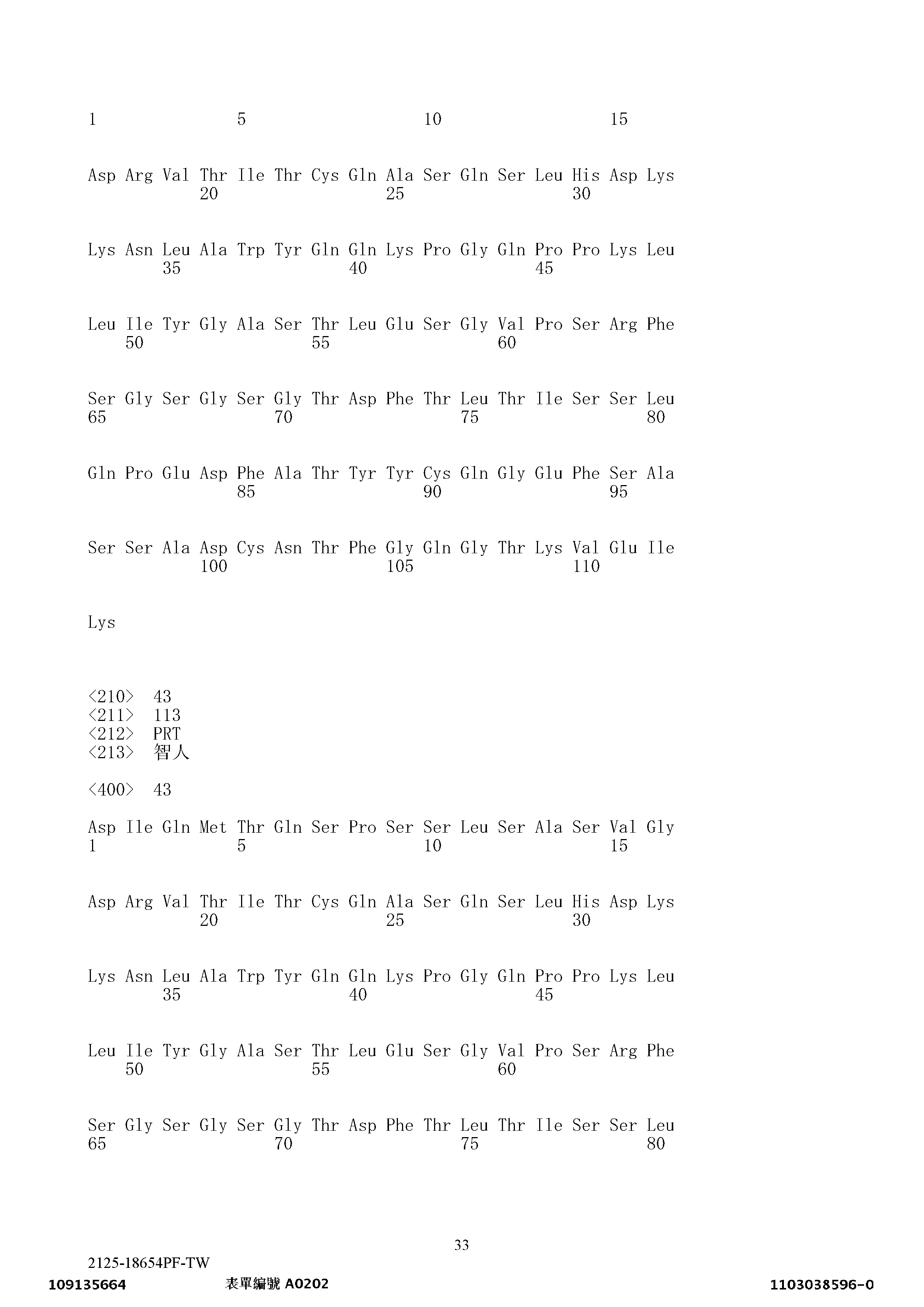


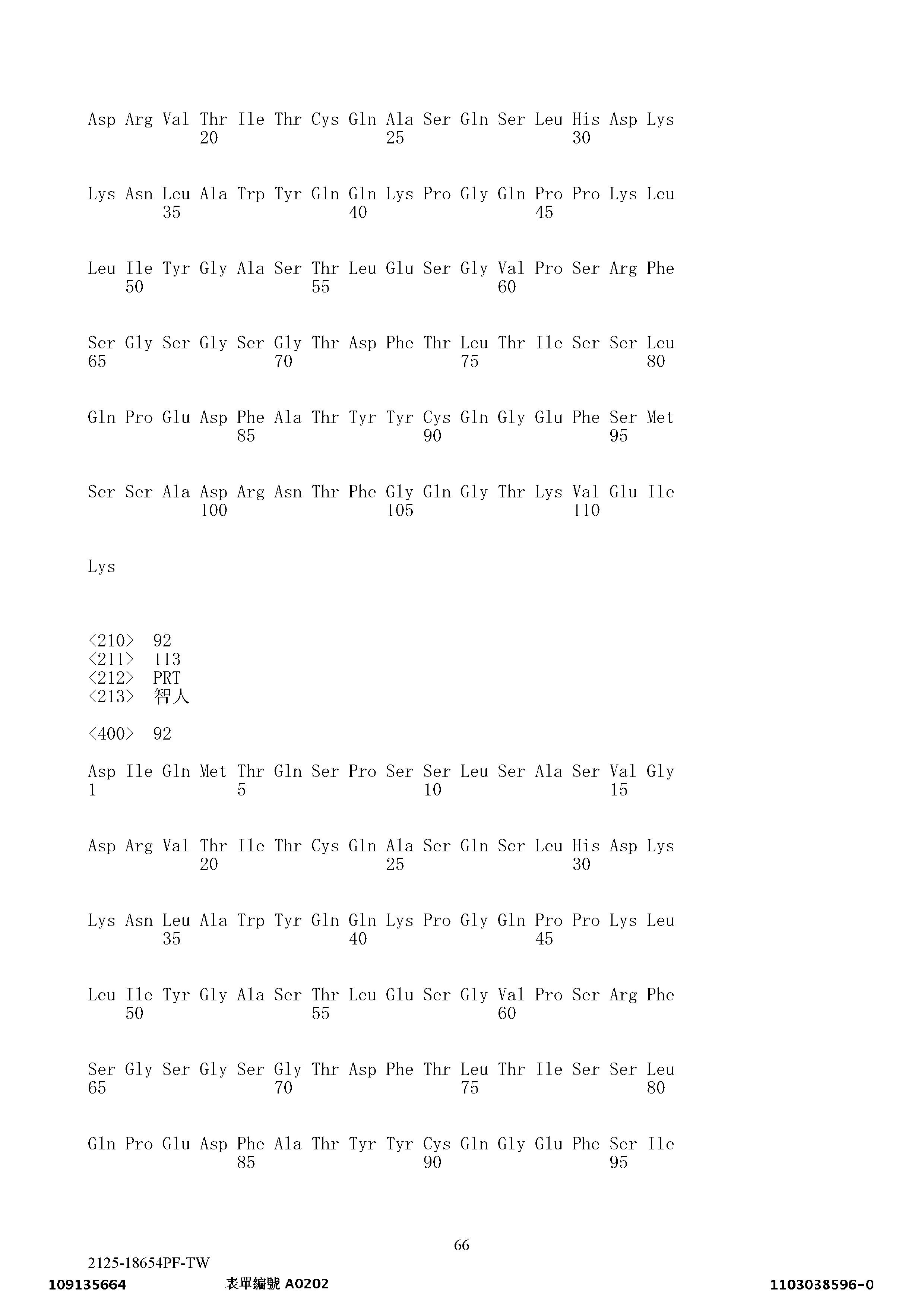


Claims (5)
Applications Claiming Priority (2)
| Application Number | Priority Date | Filing Date | Title |
|---|---|---|---|
| JP2019-189148 | 2019-10-16 | ||
| JP2019189148 | 2019-10-16 |
Publications (2)
| Publication Number | Publication Date |
|---|---|
| TW202124455A TW202124455A (en) | 2021-07-01 |
| TWI856193B true TWI856193B (en) | 2024-09-21 |
Family
ID=75487729
Family Applications (1)
| Application Number | Title | Priority Date | Filing Date |
|---|---|---|---|
| TW109135664A TWI856193B (en) | 2019-10-16 | 2020-10-15 | An antibody, a pharmaceutical composition, and a method |
Country Status (14)
| Country | Link |
|---|---|
| US (1) | US20240092889A1 (en) |
| EP (1) | EP4045534A4 (en) |
| JP (1) | JP7628796B2 (en) |
| KR (1) | KR20220082698A (en) |
| CN (1) | CN114829604B (en) |
| AR (1) | AR120232A1 (en) |
| AU (1) | AU2020368745A1 (en) |
| BR (1) | BR112022006014A2 (en) |
| CA (1) | CA3153207A1 (en) |
| IL (1) | IL291557A (en) |
| MX (1) | MX2022003911A (en) |
| SG (1) | SG11202011647SA (en) |
| TW (1) | TWI856193B (en) |
| WO (1) | WO2021075479A1 (en) |
Families Citing this family (5)
| Publication number | Priority date | Publication date | Assignee | Title |
|---|---|---|---|---|
| EP3710589A4 (en) | 2017-11-14 | 2021-11-10 | Chugai Seiyaku Kabushiki Kaisha | ANTI-C1S ANTIBODIES AND METHODS OF USE |
| MX2021013441A (en) | 2019-05-15 | 2021-12-10 | Chugai Pharmaceutical Co Ltd | An antigen-binding molecule, a pharmaceutical composition, and a method. |
| AR125344A1 (en) * | 2021-04-15 | 2023-07-05 | Chugai Pharmaceutical Co Ltd | ANTI-C1S ANTIBODY |
| JP7753313B2 (en) * | 2022-10-18 | 2025-10-14 | 中外製薬株式会社 | Use of anti-C1s antibodies |
| CN116990512B (en) * | 2023-09-25 | 2023-12-08 | 聚诚(北京)生物科技有限责任公司 | Matrix metalloproteinase-9 detection kit |
Citations (3)
| Publication number | Priority date | Publication date | Assignee | Title |
|---|---|---|---|---|
| WO2015006504A1 (en) * | 2013-07-09 | 2015-01-15 | Annexon, Inc. | Anti-complement factor c1q antibodies and uses thereof |
| WO2017129737A1 (en) * | 2016-01-27 | 2017-08-03 | Csl Behring Recombinant Facility Ag | Recombinant igg fc multimers |
| WO2019098212A1 (en) * | 2017-11-14 | 2019-05-23 | Chugai Seiyaku Kabushiki Kaisha | Anti-c1s antibodies and methods of use |
Family Cites Families (4)
| Publication number | Priority date | Publication date | Assignee | Title |
|---|---|---|---|---|
| KR102057826B1 (en) | 2008-04-11 | 2019-12-20 | 추가이 세이야쿠 가부시키가이샤 | Antigen-binding molecule capable of binding to two or more antigen molecules repeatedly |
| US20180169240A1 (en) * | 2015-06-26 | 2018-06-21 | Bioverativ Usa Inc. | Methods of treating autoimmune and alloimmune disorders |
| CR20200542A (en) * | 2018-04-13 | 2021-01-18 | Chugaiseiyaku Kk | Anti-complement component antibodies and methods of use |
| MX2021013441A (en) * | 2019-05-15 | 2021-12-10 | Chugai Pharmaceutical Co Ltd | An antigen-binding molecule, a pharmaceutical composition, and a method. |
-
2020
- 2020-10-15 TW TW109135664A patent/TWI856193B/en active
- 2020-10-15 KR KR1020207034988A patent/KR20220082698A/en active Pending
- 2020-10-15 BR BR112022006014A patent/BR112022006014A2/en not_active Application Discontinuation
- 2020-10-15 JP JP2020173697A patent/JP7628796B2/en active Active
- 2020-10-15 EP EP20877556.9A patent/EP4045534A4/en active Pending
- 2020-10-15 CA CA3153207A patent/CA3153207A1/en active Pending
- 2020-10-15 AR ARP200102851A patent/AR120232A1/en unknown
- 2020-10-15 US US17/768,053 patent/US20240092889A1/en active Pending
- 2020-10-15 AU AU2020368745A patent/AU2020368745A1/en not_active Withdrawn
- 2020-10-15 SG SG11202011647SA patent/SG11202011647SA/en unknown
- 2020-10-15 CN CN202080085493.7A patent/CN114829604B/en active Active
- 2020-10-15 MX MX2022003911A patent/MX2022003911A/en unknown
- 2020-10-15 WO PCT/JP2020/038854 patent/WO2021075479A1/en not_active Ceased
-
2022
- 2022-03-21 IL IL291557A patent/IL291557A/en unknown
Patent Citations (3)
| Publication number | Priority date | Publication date | Assignee | Title |
|---|---|---|---|---|
| WO2015006504A1 (en) * | 2013-07-09 | 2015-01-15 | Annexon, Inc. | Anti-complement factor c1q antibodies and uses thereof |
| WO2017129737A1 (en) * | 2016-01-27 | 2017-08-03 | Csl Behring Recombinant Facility Ag | Recombinant igg fc multimers |
| WO2019098212A1 (en) * | 2017-11-14 | 2019-05-23 | Chugai Seiyaku Kabushiki Kaisha | Anti-c1s antibodies and methods of use |
Also Published As
| Publication number | Publication date |
|---|---|
| IL291557A (en) | 2022-05-01 |
| BR112022006014A2 (en) | 2022-07-12 |
| EP4045534A4 (en) | 2023-11-15 |
| WO2021075479A1 (en) | 2021-04-22 |
| EP4045534A1 (en) | 2022-08-24 |
| CN114829604B (en) | 2024-12-06 |
| TW202124455A (en) | 2021-07-01 |
| JP7628796B2 (en) | 2025-02-12 |
| SG11202011647SA (en) | 2021-05-28 |
| US20240092889A1 (en) | 2024-03-21 |
| AU2020368745A1 (en) | 2022-04-21 |
| JP2021063075A (en) | 2021-04-22 |
| MX2022003911A (en) | 2022-04-20 |
| AR120232A1 (en) | 2022-02-09 |
| CN114829604A (en) | 2022-07-29 |
| CA3153207A1 (en) | 2021-04-22 |
| KR20220082698A (en) | 2022-06-17 |
Similar Documents
| Publication | Publication Date | Title |
|---|---|---|
| TWI856193B (en) | An antibody, a pharmaceutical composition, and a method | |
| WO2019198807A1 (en) | Anti-complement component antibodies and methods of use | |
| US12084513B2 (en) | Anti-C1S antibodies and methods of use | |
| US12473353B2 (en) | Antigen-binding molecule, a pharmaceutical composition, and a method | |
| EP4324925A1 (en) | Anti-c1s antibody | |
| JP7753313B2 (en) | Use of anti-C1s antibodies | |
| HK40069489A (en) | An antibody, a pharmaceutical composition, and a method | |
| KR20240054896A (en) | USES OF ANTI-C1s ANTIBODY | |
| HK40069489B (en) | An antibody, a pharmaceutical composition, and a method | |
| EA048622B1 (en) | ANTI-BODY AGAINST C1s | |
| HK40062981A (en) | An antigen-binding molecule, a pharmaceutical composition, and a method | |
| HK40028175B (en) | Anti-c1s antibodies and methods of use |