TWI858005B - Treatment of hepatotoxicity - Google Patents
Treatment of hepatotoxicity Download PDFInfo
- Publication number
- TWI858005B TWI858005B TW109102251A TW109102251A TWI858005B TW I858005 B TWI858005 B TW I858005B TW 109102251 A TW109102251 A TW 109102251A TW 109102251 A TW109102251 A TW 109102251A TW I858005 B TWI858005 B TW I858005B
- Authority
- TW
- Taiwan
- Prior art keywords
- hepatotoxicity
- agent
- liver
- receptor
- signaling
- Prior art date
Links
Classifications
-
- A—HUMAN NECESSITIES
- A61—MEDICAL OR VETERINARY SCIENCE; HYGIENE
- A61K—PREPARATIONS FOR MEDICAL, DENTAL OR TOILETRY PURPOSES
- A61K38/00—Medicinal preparations containing peptides
- A61K38/16—Peptides having more than 20 amino acids; Gastrins; Somatostatins; Melanotropins; Derivatives thereof
- A61K38/17—Peptides having more than 20 amino acids; Gastrins; Somatostatins; Melanotropins; Derivatives thereof from animals; from humans
- A61K38/177—Receptors; Cell surface antigens; Cell surface determinants
- A61K38/1793—Receptors; Cell surface antigens; Cell surface determinants for cytokines; for lymphokines; for interferons
-
- A—HUMAN NECESSITIES
- A61—MEDICAL OR VETERINARY SCIENCE; HYGIENE
- A61K—PREPARATIONS FOR MEDICAL, DENTAL OR TOILETRY PURPOSES
- A61K38/00—Medicinal preparations containing peptides
- A61K38/16—Peptides having more than 20 amino acids; Gastrins; Somatostatins; Melanotropins; Derivatives thereof
- A61K38/17—Peptides having more than 20 amino acids; Gastrins; Somatostatins; Melanotropins; Derivatives thereof from animals; from humans
- A61K38/19—Cytokines; Lymphokines; Interferons
- A61K38/20—Interleukins [IL]
- A61K38/2073—IL-11
-
- A—HUMAN NECESSITIES
- A61—MEDICAL OR VETERINARY SCIENCE; HYGIENE
- A61K—PREPARATIONS FOR MEDICAL, DENTAL OR TOILETRY PURPOSES
- A61K39/00—Medicinal preparations containing antigens or antibodies
- A61K39/395—Antibodies; Immunoglobulins; Immune serum, e.g. antilymphocytic serum
- A61K39/39533—Antibodies; Immunoglobulins; Immune serum, e.g. antilymphocytic serum against materials from animals
- A61K39/39541—Antibodies; Immunoglobulins; Immune serum, e.g. antilymphocytic serum against materials from animals against normal tissues, cells
-
- A—HUMAN NECESSITIES
- A61—MEDICAL OR VETERINARY SCIENCE; HYGIENE
- A61P—SPECIFIC THERAPEUTIC ACTIVITY OF CHEMICAL COMPOUNDS OR MEDICINAL PREPARATIONS
- A61P1/00—Drugs for disorders of the alimentary tract or the digestive system
- A61P1/16—Drugs for disorders of the alimentary tract or the digestive system for liver or gallbladder disorders, e.g. hepatoprotective agents, cholagogues, litholytics
-
- A—HUMAN NECESSITIES
- A61—MEDICAL OR VETERINARY SCIENCE; HYGIENE
- A61P—SPECIFIC THERAPEUTIC ACTIVITY OF CHEMICAL COMPOUNDS OR MEDICINAL PREPARATIONS
- A61P39/00—General protective or antinoxious agents
- A61P39/02—Antidotes
-
- C—CHEMISTRY; METALLURGY
- C07—ORGANIC CHEMISTRY
- C07K—PEPTIDES
- C07K14/00—Peptides having more than 20 amino acids; Gastrins; Somatostatins; Melanotropins; Derivatives thereof
- C07K14/435—Peptides having more than 20 amino acids; Gastrins; Somatostatins; Melanotropins; Derivatives thereof from animals; from humans
- C07K14/52—Cytokines; Lymphokines; Interferons
- C07K14/54—Interleukins [IL]
- C07K14/5431—IL-11
-
- C—CHEMISTRY; METALLURGY
- C07—ORGANIC CHEMISTRY
- C07K—PEPTIDES
- C07K16/00—Immunoglobulins [IG], e.g. monoclonal or polyclonal antibodies
- C07K16/18—Immunoglobulins [IG], e.g. monoclonal or polyclonal antibodies against material from animals or humans
- C07K16/24—Immunoglobulins [IG], e.g. monoclonal or polyclonal antibodies against material from animals or humans against cytokines, lymphokines or interferons
- C07K16/244—Interleukins [IL]
-
- C—CHEMISTRY; METALLURGY
- C07—ORGANIC CHEMISTRY
- C07K—PEPTIDES
- C07K16/00—Immunoglobulins [IG], e.g. monoclonal or polyclonal antibodies
- C07K16/18—Immunoglobulins [IG], e.g. monoclonal or polyclonal antibodies against material from animals or humans
- C07K16/28—Immunoglobulins [IG], e.g. monoclonal or polyclonal antibodies against material from animals or humans against receptors, cell surface antigens or cell surface determinants
- C07K16/2866—Immunoglobulins [IG], e.g. monoclonal or polyclonal antibodies against material from animals or humans against receptors, cell surface antigens or cell surface determinants against receptors for cytokines, lymphokines, interferons
-
- C—CHEMISTRY; METALLURGY
- C12—BIOCHEMISTRY; BEER; SPIRITS; WINE; VINEGAR; MICROBIOLOGY; ENZYMOLOGY; MUTATION OR GENETIC ENGINEERING
- C12N—MICROORGANISMS OR ENZYMES; COMPOSITIONS THEREOF; PROPAGATING, PRESERVING, OR MAINTAINING MICROORGANISMS; MUTATION OR GENETIC ENGINEERING; CULTURE MEDIA
- C12N15/00—Mutation or genetic engineering; DNA or RNA concerning genetic engineering, vectors, e.g. plasmids, or their isolation, preparation or purification; Use of hosts therefor
- C12N15/09—Recombinant DNA-technology
- C12N15/11—DNA or RNA fragments; Modified forms thereof; Non-coding nucleic acids having a biological activity
- C12N15/113—Non-coding nucleic acids modulating the expression of genes, e.g. antisense oligonucleotides; Antisense DNA or RNA; Triplex- forming oligonucleotides; Catalytic nucleic acids, e.g. ribozymes; Nucleic acids used in co-suppression or gene silencing
- C12N15/1136—Non-coding nucleic acids modulating the expression of genes, e.g. antisense oligonucleotides; Antisense DNA or RNA; Triplex- forming oligonucleotides; Catalytic nucleic acids, e.g. ribozymes; Nucleic acids used in co-suppression or gene silencing against growth factors, growth regulators, cytokines, lymphokines or hormones
-
- A—HUMAN NECESSITIES
- A61—MEDICAL OR VETERINARY SCIENCE; HYGIENE
- A61K—PREPARATIONS FOR MEDICAL, DENTAL OR TOILETRY PURPOSES
- A61K39/00—Medicinal preparations containing antigens or antibodies
- A61K2039/505—Medicinal preparations containing antigens or antibodies comprising antibodies
-
- A—HUMAN NECESSITIES
- A61—MEDICAL OR VETERINARY SCIENCE; HYGIENE
- A61K—PREPARATIONS FOR MEDICAL, DENTAL OR TOILETRY PURPOSES
- A61K31/00—Medicinal preparations containing organic active ingredients
- A61K31/185—Acids; Anhydrides, halides or salts thereof, e.g. sulfur acids, imidic, hydrazonic or hydroximic acids
- A61K31/19—Carboxylic acids, e.g. valproic acid
- A61K31/195—Carboxylic acids, e.g. valproic acid having an amino group
- A61K31/197—Carboxylic acids, e.g. valproic acid having an amino group the amino and the carboxyl groups being attached to the same acyclic carbon chain, e.g. gamma-aminobutyric acid [GABA], beta-alanine, epsilon-aminocaproic acid or pantothenic acid
- A61K31/198—Alpha-amino acids, e.g. alanine or edetic acid [EDTA]
-
- A—HUMAN NECESSITIES
- A61—MEDICAL OR VETERINARY SCIENCE; HYGIENE
- A61K—PREPARATIONS FOR MEDICAL, DENTAL OR TOILETRY PURPOSES
- A61K38/00—Medicinal preparations containing peptides
-
- C—CHEMISTRY; METALLURGY
- C07—ORGANIC CHEMISTRY
- C07K—PEPTIDES
- C07K2317/00—Immunoglobulins specific features
- C07K2317/70—Immunoglobulins specific features characterized by effect upon binding to a cell or to an antigen
- C07K2317/76—Antagonist effect on antigen, e.g. neutralization or inhibition of binding
-
- C—CHEMISTRY; METALLURGY
- C12—BIOCHEMISTRY; BEER; SPIRITS; WINE; VINEGAR; MICROBIOLOGY; ENZYMOLOGY; MUTATION OR GENETIC ENGINEERING
- C12N—MICROORGANISMS OR ENZYMES; COMPOSITIONS THEREOF; PROPAGATING, PRESERVING, OR MAINTAINING MICROORGANISMS; MUTATION OR GENETIC ENGINEERING; CULTURE MEDIA
- C12N2310/00—Structure or type of the nucleic acid
- C12N2310/10—Type of nucleic acid
- C12N2310/11—Antisense
-
- C—CHEMISTRY; METALLURGY
- C12—BIOCHEMISTRY; BEER; SPIRITS; WINE; VINEGAR; MICROBIOLOGY; ENZYMOLOGY; MUTATION OR GENETIC ENGINEERING
- C12N—MICROORGANISMS OR ENZYMES; COMPOSITIONS THEREOF; PROPAGATING, PRESERVING, OR MAINTAINING MICROORGANISMS; MUTATION OR GENETIC ENGINEERING; CULTURE MEDIA
- C12N2310/00—Structure or type of the nucleic acid
- C12N2310/10—Type of nucleic acid
- C12N2310/14—Type of nucleic acid interfering nucleic acids [NA]
Landscapes
- Health & Medical Sciences (AREA)
- Chemical & Material Sciences (AREA)
- Life Sciences & Earth Sciences (AREA)
- Organic Chemistry (AREA)
- General Health & Medical Sciences (AREA)
- Engineering & Computer Science (AREA)
- Medicinal Chemistry (AREA)
- Genetics & Genomics (AREA)
- Immunology (AREA)
- Molecular Biology (AREA)
- Bioinformatics & Cheminformatics (AREA)
- Biophysics (AREA)
- Biochemistry (AREA)
- Proteomics, Peptides & Aminoacids (AREA)
- Public Health (AREA)
- Veterinary Medicine (AREA)
- Animal Behavior & Ethology (AREA)
- Pharmacology & Pharmacy (AREA)
- Biomedical Technology (AREA)
- Zoology (AREA)
- Gastroenterology & Hepatology (AREA)
- Wood Science & Technology (AREA)
- General Engineering & Computer Science (AREA)
- Biotechnology (AREA)
- Nuclear Medicine, Radiotherapy & Molecular Imaging (AREA)
- Chemical Kinetics & Catalysis (AREA)
- General Chemical & Material Sciences (AREA)
- Epidemiology (AREA)
- Microbiology (AREA)
- Physics & Mathematics (AREA)
- Endocrinology (AREA)
- Plant Pathology (AREA)
- Toxicology (AREA)
- Cell Biology (AREA)
- Mycology (AREA)
- Medicines That Contain Protein Lipid Enzymes And Other Medicines (AREA)
- Pharmaceuticals Containing Other Organic And Inorganic Compounds (AREA)
- Medicines Containing Antibodies Or Antigens For Use As Internal Diagnostic Agents (AREA)
- Peptides Or Proteins (AREA)
- Medicines Containing Material From Animals Or Micro-Organisms (AREA)
Abstract
Description
發明領域Invention Field
本申請案主張2019年一月21日申請之GB 1900811.9、2019年六月3日申請之GB 1907839.3及2019年十月17日申請之GB 1915003.6的優先權,該等申請案之內容及要素係併入本案以作為參考資料用於所有目的。This application claims priority to GB 1900811.9 filed on January 21, 2019, GB 1907839.3 filed on June 3, 2019, and GB 1915003.6 filed on October 17, 2019, the contents and elements of which are incorporated herein by reference for all purposes.
本發明係關於與肝毒性有關連之疾病及病況的診斷、治療及預防(prophylaxis)。The present invention relates to the diagnosis, treatment and prophylaxis of diseases and conditions associated with hepatotoxicity.
發明背景Invention Background
肝毒性係指對肝臟之毒性損壞,尤其指肝臟內肝細胞之官能不良及死亡。其通常為化學驅動的,例如由醫藥、化學品(如酒精)、或草本或膳食補充劑導致的肝損壞或損傷。肝毒性亦可由感染(例如由肝炎病毒)、營養不良或遺傳障礙導致。Hepatotoxicity refers to toxic damage to the liver, especially malfunction and death of the hepatocytes within the liver. It is usually chemically driven, such as damage or injury to the liver caused by drugs, chemicals (such as alcohol), or herbal or dietary supplements. Hepatotoxicity can also be caused by infection (such as by hepatitis viruses), malnutrition, or genetic disorders.
止痛劑乙醯胺苯酚(APAP,N-乙醯基-對胺基苯酚或乙醯胺酚(paracetamol))通常用於減少發燒及輕度到中度疼痛。劑量過度的乙醯胺苯酚是肝損傷的普遍原因且在美國每年造成高達80,000件急診、2500件住院治療及500件致命的中毒(Lee WM. Hepatology (2004) 40(1):6–9;Budnitz DS等人之Am J Prev Med (2011) 40(6):585–92)。此外,長期使用低劑量的乙醯胺苯酚可能遭遇肝損傷,特別是在其他素因因子存在下,如慢性飲酒 (酒精中毒)、空腹、營養不良、HIV感染、肝炎病毒感染、癌症及藥物交互作用(McClain等人,Curr. Gastroenterol. Rep. 1999;1:42–49)。The analgesic acetaminophen (APAP, N-acetyl-para-aminophenol or paracetamol) is commonly used to reduce fever and mild to moderate pain. Overdose of acetaminophen is a common cause of liver damage and causes up to 80,000 emergency room visits, 2500 hospitalizations, and 500 fatal poisonings in the United States each year (Lee WM. Hepatology (2004) 40(1):6–9; Budnitz DS et al. Am J Prev Med (2011) 40(6):585–92). In addition, chronic use of low-dose acetaminophen may be associated with liver damage, particularly in the presence of other predisposing factors such as chronic alcohol consumption (alcoholism), fasting, malnutrition, HIV infection, hepatitis virus infection, cancer, and drug interactions (McClain et al., Curr. Gastroenterol. Rep. 1999;1:42–49).
乙醯胺苯酚誘發的肝毒性的病理生理學於這些年來已經進行了廣泛的研究。攝入乙醯胺苯酚後對肝臟的損壞不是由於藥物自身,而是毒性代謝物N-乙醯基-對苯醌-亞胺(NAPQI),其係通過細胞色素P450酶群而於肝臟內產生。NAPQI在正常情況下是無害的且其在與內生的麩胱甘肽複合後從身體移開。然而,細胞色素P450(CYP450),主要是CYP2E1同功型生物轉化劑量過度的乙醯胺苯酚,由於麩胱甘肽耗乏而導致過度的NAPQI蓄積。此又會導致肝細胞損傷且增加細胞死亡(Jollow等人,J Pharmacol Exp Ther, 1973 Oct;187(1):195-202;Dahlin等人,Proc Natl Acad Sci U.S.A. 1984 Mar;81(5):1327-31;Moore等人,The Journal of Biological Chemistry Vol. 260. No.24, October 25, pp, 13035-13040, 1985;Kyle等人,Biochemical Pharmacology第40卷,第6期,1990年九月15日)。肝損傷可以通過投予N -乙醯半胱胺酸來限制,其補足肝臟的麩胱甘肽位準。需要進一步的治療及預防方法。The pathophysiology of acetaminophen-induced hepatotoxicity has been extensively studied over the years. The damage to the liver following ingestion of acetaminophen is not due to the drug itself, but rather to the toxic metabolite N-acetyl-p-benzoquinone-imine (NAPQI), which is produced in the liver by the cytochrome P450 enzyme group. NAPQI is normally harmless and is removed from the body after complexing with endogenous glutathione. However, cytochrome P450 (CYP450), primarily the CYP2E1 isoform, biotransforms excessive doses of acetaminophen, resulting in excessive NAPQI accumulation due to glutathione depletion. This in turn leads to liver cell damage and increased cell death (Jollow et al., J Pharmacol Exp Ther, 1973 Oct; 187(1): 195-202; Dahlin et al., Proc Natl Acad Sci USA 1984 Mar; 81(5): 1327-31; Moore et al., The Journal of Biological Chemistry Vol. 260. No. 24, October 25, pp, 13035-13040, 1985; Kyle et al., Biochemical Pharmacology Vol. 40, No. 6, September 15, 1990). Liver damage can be limited by administration of N -acetylcysteine, which replenishes liver glutathione levels. Further treatment and prevention methods are needed.
據報導細胞介素介白素11(IL-11)對於乙醯胺苯酚誘發的肝損壞及毒性具有保護 效應(Trepicchio WL等人,Toxicol Pathol. 2001;29(2):242-9;Nishina T等人,J Biol Chem. 2017;292(1): 205–216)。細胞介素例如IL-11活化STAT3路徑業已證明能驅動肝細胞的代償性增殖,其為肝再生的關鍵原理,並且暗示在STAT3-活化的細胞介素之中,IL-11投予為APAP毒性的治療方法(Mühl H, Front Immunol. 2016 2;7:163)。Nishina T等人,Sci Signal. 2012;5(207):ra5乙文報導IL-11提供氧化壓力與代償性肝細胞增殖之間的功能連結,且發現IL-11受體促效劑提升肝細胞增殖及改良在乙醯胺苯酚誘發的肝損傷後的氧化壓力。The interleukin 11 (IL-11) has been reported to have protective effects against acetylcholinesterase-induced liver damage and toxicity (Trepicchio WL et al., Toxicol Pathol. 2001;29(2):242-9; Nishina T et al., J Biol Chem. 2017;292(1):205–216). Activation of the STAT3 pathway by interleukins such as IL-11 has been shown to drive compensatory proliferation of hepatocytes, a key mechanism of liver regeneration, and suggests that among STAT3-activating interleukins, IL-11 administration is a therapeutic approach for APAP toxicity (Mühl H, Front Immunol. 2016 2;7:163). Nishina T et al., Sci Signal. 2012;5(207):ra5 reported that IL-11 provides a functional link between oxidative stress and compensatory hepatocyte proliferation, and found that IL-11 receptor agonists enhance hepatocyte proliferation and improve oxidative stress after acetaminophen-induced liver injury.
也已經有報導IL-11治療會防止及/或治療其他的肝臟病況,例如肝臟局部缺血/再灌注損傷(IRI)、與慢性C型肝炎有關連之免疫血小板減少紫瘢病(ITP) (HpC-ITP)、急性內發毒血症及T細胞媒介的肝損傷(Yu J等人,Clin Res Hepatol Gastroenterol. 2016;40(5):562-570;Zhu M等人,PLoS ONE 10(5): e0126296;Fontana V等人,Acta Haematol. 2008;119(2):126-32;Maeshima等人,Shock. (2004) 21(2):134-8;Bozza等人,Hepatology (1999) 30(6):1441-7)。IL-11 treatment has also been reported to prevent and/or treat other liver conditions, such as hepatic ischemia/reperfusion injury (IRI), immune thrombocytopenic purpura (ITP) associated with chronic hepatitis C (HpC-ITP), acute endotoxemia, and T cell-mediated liver damage (Yu J et al., Clin Res Hepatol Gastroenterol. 2016;40(5):562-570; Zhu M et al., PLoS ONE 10(5):e0126296; Fontana V et al., Acta Haematol. 2008;119(2):126-32; Maeshima et al., Shock. (2004) 21(2):134-8; Bozza et al., Hepatology (1999) 30(6):1441-7).
發明概要Summary of the invention
與經報導的IL-11於肝損壞之保護角色形成對比,本發明係關於通過抑制IL-11訊息傳導來治療及/或預防肝毒性及與肝毒性有關連之障礙、疾病或病況。In contrast to the reported protective role of IL-11 in liver damage, the present invention relates to treating and/or preventing hepatotoxicity and disorders, diseases or conditions associated with hepatotoxicity by inhibiting IL-11 signaling.
於本發明的一個態樣中提供一種能抑制介白素11(IL-11)媒介的訊息傳導之藥劑,其供用於一治療或預防肝毒性及/或與肝毒性有關連之一障礙、疾病或病況的方法。In one aspect of the present invention, an agent capable of inhibiting interleukin 11 (IL-11) mediated signaling is provided for use in a method of treating or preventing hepatotoxicity and/or a disorder, disease or condition associated with hepatotoxicity.
於本發明的另一個態樣中,提供一種能抑制介白素11(IL-11)媒介的訊息傳導之藥劑於製造一醫藥品的用途,該醫藥品供用於一治療或預防肝毒性及/或與肝毒性有關連之一障礙、疾病或病況的方法。In another aspect of the present invention, a use of an agent capable of inhibiting interleukin 11 (IL-11)-mediated signaling in the manufacture of a medicament for use in a method for treating or preventing hepatotoxicity and/or a disorder, disease or condition associated with hepatotoxicity is provided.
於本發明的另一個態樣中,提供一種治療或預防肝毒性及/或與肝毒性有關連之一障礙、疾病或病況的方法,該方法包含投予一治療有效量的一能抑制介白素11(IL-11)媒介的訊息傳導之藥劑給需要治療的一個體。In another aspect of the invention, a method for treating or preventing hepatotoxicity and/or a disorder, disease or condition associated with hepatotoxicity is provided, the method comprising administering a therapeutically effective amount of an agent that inhibits interleukin 11 (IL-11)-mediated signaling to a subject in need of treatment.
在一些具體例中,該藥劑為一種能預防或降低介白素11(IL-11)與介白素11之一受體(IL-11R)的結合之藥劑。In some embodiments, the agent is an agent that prevents or reduces the binding of interleukin 11 (IL-11) to one of the interleukin 11 receptors (IL-11R).
在一些具體例中,該藥劑能結合介白素11(IL-11)或介白素11之一受體(IL-11R)。在一些具體例中,該藥劑係選自於下列所組成的群組:一抗體或其之一抗原結合片段、一多肽、一胜肽、一核酸、一寡核苷酸、一適配體或一小分子。該藥劑可為一抗體或其之一抗原結合片段。該藥劑可為一誘餌受體。In some embodiments, the agent can bind to interleukin 11 (IL-11) or a receptor for interleukin 11 (IL-11R). In some embodiments, the agent is selected from the group consisting of an antibody or an antigen-binding fragment thereof, a polypeptide, a peptide, a nucleic acid, an oligonucleotide, an aptamer or a small molecule. The agent can be an antibody or an antigen-binding fragment thereof. The agent can be a bait receptor.
在一些具體例中,該藥劑係IL-11媒介的訊息傳導之一抗IL-11抗體拮抗劑,或其之一抗原結合片段。在一些具體例中,該藥劑係IL-11媒介的訊息傳導之一抗IL-11Rα抗體拮抗劑,或其之一抗原結合片段。In some embodiments, the agent is an anti-IL-11 antibody antagonist of IL-11-mediated signaling, or an antigen-binding fragment thereof. In some embodiments, the agent is an anti-IL-11Rα antibody antagonist of IL-11-mediated signaling, or an antigen-binding fragment thereof.
在一些具體例中,該藥劑係IL-11之一誘餌受體。在一些具體例中,該IL-11之誘餌受體包含:(i)一對應於gp130的該細胞介素結合模組之胺基酸序列及(ii)一對應於IL-11Rα的該細胞介素結合模組之胺基酸序列。In some embodiments, the agent is a trophic receptor for IL-11. In some embodiments, the trophic receptor for IL-11 comprises: (i) an amino acid sequence corresponding to the interleukin binding module of gp130 and (ii) an amino acid sequence corresponding to the interleukin binding module of IL-11Rα.
在一些具體例中,該藥劑係一IL-11突變蛋白(mutein)。在一些具體例中,該IL-11突變蛋白係W147A。In some embodiments, the agent is an IL-11 mutein. In some embodiments, the IL-11 mutein is W147A.
在一些具體例中,該藥劑能預防或降低介白素11(IL-11)或介白素11之一受體(IL-11R)的表現。該藥劑可為一種寡核苷酸或一種小分子。In some embodiments, the agent can prevent or reduce the expression of interleukin 11 (IL-11) or a receptor for interleukin 11 (IL-11R). The agent can be an oligonucleotide or a small molecule.
在一些具體例中,該藥劑係一能預防或降低IL-11的表現之反義寡核苷酸。在一些具體例中,該能預防或降低IL-11的表現之反義寡核苷酸係靶向IL11 的siRNA,其包含序列辨識編號:12、13、14或15的序列。在一些具體例中,該藥劑係能預防或降低IL-11Rα的表現之反義寡核苷酸。在一些具體例中,該能預防或降低IL-11Rα的表現之反義寡核苷酸係靶向IL11RA 的siRNA,其包含序列辨識編號:16、17、18或19的序列。In some embodiments, the agent is an antisense oligonucleotide that can prevent or reduce the expression of IL-11. In some embodiments, the antisense oligonucleotide that can prevent or reduce the expression of IL-11 is a siRNA targeting IL11 , which comprises a sequence of sequence identification number: 12, 13, 14 or 15. In some embodiments, the agent is an antisense oligonucleotide that can prevent or reduce the expression of IL-11Rα. In some embodiments, the antisense oligonucleotide that can prevent or reduce the expression of IL-11Rα is a siRNA targeting IL11RA , which comprises a sequence of sequence identification number: 16, 17, 18 or 19.
於本文提供的任何具體例中,該介白素11受體係或包含IL-11Rα。In any of the embodiments provided herein, the interleukin 11 receptor is or comprises IL-11Rα.
於本文提供的任何具體例中,該藥劑可在肝毒性的肇因例如投予或消費肝毒性醫藥或暴露於肝毒性的環境來源之前、聯合或之後予以投予。In any of the embodiments provided herein, the agent can be administered before, in conjunction with, or after a cause of hepatotoxicity, such as administration or consumption of a hepatotoxic pharmaceutical agent or exposure to an environmental source of hepatotoxicity.
於本文提供的任何具體例中,該與肝毒性有關聯的障礙、疾病或病況為一病理上牽涉肝毒性的疾病。In any of the embodiments provided herein, the disorder, disease or condition associated with hepatotoxicity is a disease pathologically implicated in hepatotoxicity.
於一些具體例中,病理上牽涉肝毒性的疾病係選自於:藥物誘發的肝損傷(DILI)、急性肝損傷(ALI)、急性肝衰竭、急性肝病、慢性肝病、肝損壞、肝炎、病毒性肝炎、酒精性肝炎、肝臟局部缺血-再灌注損傷(IRI)、熱局部缺血-再灌注(WIR)、輻射誘發的肝病(RILD)、特質藥物誘發的肝損傷(IDILI)、自體免疫肝損傷、膽汁鬱積性肝病、HIV及癌症。In some specific examples, the disease pathologically involved in hepatotoxicity is selected from: drug-induced liver injury (DILI), acute liver injury (ALI), acute liver failure, acute liver disease, chronic liver disease, liver damage, hepatitis, viral hepatitis, alcoholic hepatitis, hepatic ischemia-reperfusion injury (IRI), warm ischemia-reperfusion (WIR), radiation-induced liver disease (RILD), idiosyncratic drug-induced liver injury (IDILI), autoimmune liver injury, cholestatic liver disease, HIV and cancer.
於任何的具體例中,本文的藥劑、用途及方法係提供用於治療及/或預防藥物誘發的肝損傷(DILI)。DILI可以為內在及/或特質肝毒性。於任何的具體例中,本文的藥劑、用途及方法係提供用於治療及/或預防乙醯胺苯酚(APAP)誘發的肝毒性。於一些具體例中,該方法進一步包含以N -乙醯半胱胺酸之治療。In any embodiment, the medicaments, uses and methods herein are provided for treating and/or preventing drug-induced liver injury (DILI). DILI can be intrinsic and/or idiosyncratic hepatotoxicity. In any embodiment, the medicaments, uses and methods herein are provided for treating and/or preventing acetaminophen (APAP)-induced hepatotoxicity. In some embodiments, the method further comprises treatment with N -acetylcysteine.
於任何的具體例中,該治療或預防方法包含投予該藥劑給介白素11(IL-11)或IL-11之一受體(IL-11R)表現向上調節的一個體。In any embodiment, the method of treatment or prevention comprises administering the agent to a subject in which interleukin 11 (IL-11) or a receptor for IL-11 (IL-11R) expression is upregulated.
於任何的具體例中,該治療或預防方法包含投予該藥劑給介白素11(IL-11)或介白素11之一受體(IL-11R)表現已經判定為向上調節的一個體。In any embodiment, the method of treatment or prevention comprises administering the agent to an individual in which interleukin 11 (IL-11) or a receptor for interleukin 11 (IL-11R) expression has been determined to be upregulated.
在一些具體例中,該治療或預防方法包含判定該個體的介白素11(IL-11)或IL-11之一受體(IL-11R)表現是否是向上調節的且投予該藥劑給介白素11(IL-11)或IL-11之一受體(IL-11R)表現向上調節的一個體。In some embodiments, the treatment or prevention method comprises determining whether interleukin 11 (IL-11) or one of the receptors for IL-11 (IL-11R) expression in the individual is upregulated and administering the agent to an individual in which interleukin 11 (IL-11) or one of the receptors for IL-11 (IL-11R) expression is upregulated.
亦提供一種判定用一能抑制介白素11(IL-11)媒介的訊息傳導之藥劑之該治療或預防肝毒性及/或與肝毒性有關連之一障礙、疾病或病況之適合性的一個體之方法,該方法包含選擇性地於活體外 判定該個體的介白素11(IL-11)或IL-11之一受體(IL-11R)表現是否是向上調節的。Also provided is a method of determining the suitability of a subject for treating or preventing hepatotoxicity and/or a disorder, disease or condition associated with hepatotoxicity with an agent that inhibits interleukin 11 (IL-11)-mediated signaling, the method comprising selectively determining in vitro whether interleukin 11 (IL-11) or a receptor for IL-11 (IL-11R) expression is upregulated in the subject.
亦提供一種挑選用一能抑制介白素11(IL-11)媒介的訊息傳導之藥劑之該治療或預防肝毒性及/或與肝毒性有關連之一障礙、疾病或病況之一個體的方法,該方法包含選擇性地於活體外 判定該個體的介白素11(IL-11)或IL-11之一受體(IL-11R)表現是否是向上調節的。Also provided is a method of selecting an individual for treatment or prevention of hepatotoxicity and/or a disorder, disease or condition associated with hepatotoxicity for an agent that inhibits interleukin 11 (IL-11)-mediated signaling, the method comprising selectively determining in vitro whether interleukin 11 (IL-11) or a receptor for IL-11 (IL-11R) expression is upregulated in the individual.
於一個態樣中,提供一種診斷一個體的肝毒性及/或與肝毒性有關連之一障礙、疾病或病況,或發展肝毒性及/或與肝毒性有關連之一障礙、疾病或病況的風險之方法,該方法包含選擇性地於活體外 判定從該個體獲得的一樣本內的介白素11(IL-11)或IL-11之受體(IL-11R)之向上調節。在一些具體例中,該診斷方法為一種證實疑似患有肝毒性及/或與肝毒性有關連之一障礙、疾病或病況之一個體的肝毒性及/或與肝毒性有關連之一障礙、疾病或病況。在一些具體例中,一種診斷方法及/或一種證實一診斷的方法包含挑選用一能抑制介白素11(IL-11)媒介的訊息傳導之藥劑治療的該個體。In one aspect, a method is provided for diagnosing hepatotoxicity and/or a disorder, disease or condition associated with hepatotoxicity in a subject, or a risk of developing hepatotoxicity and/or a disorder, disease or condition associated with hepatotoxicity, the method comprising selectively determining upregulation of interleukin 11 (IL-11) or a receptor for IL-11 (IL-11R) in a sample obtained from the subject in vitro . In some embodiments, the diagnostic method is a method of confirming hepatotoxicity and/or a disorder, disease or condition associated with hepatotoxicity in a subject suspected of having hepatotoxicity and/or a disorder, disease or condition associated with hepatotoxicity. In some embodiments, a method of diagnosis and/or a method of confirming a diagnosis comprises selecting the subject for treatment with an agent that inhibits interleukin 11 (IL-11)-mediated signaling.
亦提供一種針對有或疑似患有肝毒性及/或與肝毒性有關連之一障礙、疾病或病況之一個體提供一預後的方法,該方法包含選擇性地於活體外 判定從該個體獲得的一樣本內的介白素11(IL-11)或IL-11之受體(IL-11R)是否是向上調節的,以及根據該判定,提供針對用一能抑制介白素11(IL-11)媒介的訊息傳導之藥劑的治療之該個體的預後。在一些具體例中,一種提供一預後的方法包含挑選一個體,該個體經判定為針對用一能抑制介白素11(IL-11)媒介的訊息傳導之藥劑之治療有向上調節的介白素11(IL-11)或IL-11之受體(IL-11R)表現。Also provided is a method of providing a prognosis for a subject having or suspected of having hepatotoxicity and/or a disorder, disease or condition associated with hepatotoxicity, the method comprising selectively determining in vitro whether interleukin 11 (IL-11) or a receptor for IL-11 (IL-11R) is upregulated in a sample obtained from the subject, and based on the determination, providing a prognosis for the subject for treatment with an agent that inhibits interleukin 11 (IL-11)-mediated signaling. In some embodiments, a method of providing a prognosis comprises selecting a subject determined to have upregulated interleukin 11 (IL-11) or a receptor for IL-11 (IL-11R) expression for treatment with an agent that inhibits interleukin 11 (IL-11)-mediated signaling.
於另一個態樣中,提供一種診斷肝毒性及/或與肝毒性有關連之一障礙、疾病或病況或發展肝毒性及/或與肝毒性有關連之一障礙、疾病或病況的風險之方法,該方法包含選擇性地於活體外 判定該個體內一或多種遺傳因子,該一或多種遺傳因子可預測IL-11或IL-11之受體表現之向上調節或IL-11媒介的訊息傳導之向上調節。在一些具體例中,該方法包含挑選該個體供用於用一能抑制介白素11(IL-11)媒介的訊息傳導之藥劑的治療。In another aspect, a method for diagnosing hepatotoxicity and/or a disorder, disease or condition associated with hepatotoxicity or a risk of developing hepatotoxicity and/or a disorder, disease or condition associated with hepatotoxicity is provided, the method comprising selectively identifying in vitro one or more genetic factors in the individual that predict upregulation of IL-11 or IL-11 receptor expression or upregulation of IL-11-mediated signaling. In some embodiments, the method comprises selecting the individual for treatment with an agent that inhibits interleukin 11 (IL-11)-mediated signaling.
亦提供一種針對有或疑似患有肝毒性及/或與肝毒性有關連之一障礙、疾病或病況之一個體提供一預後的方法,該方法包含選擇性地於活體外 判定該個體內一或多種遺傳因子,該一或多種遺傳因子可預測IL-11或IL-11之受體表現之向上調節或IL-11媒介的訊息傳導之向上調節。 說明Also provided is a method of providing a prognosis for an individual having or suspected of having hepatotoxicity and/or a disorder, disease or condition associated with hepatotoxicity, the method comprising selectively identifying in vitro one or more genetic factors in the individual that are predictive of upregulation of IL-11 or IL-11 receptor expression or upregulation of IL-11-mediated signaling.
針對有效的預防及治療肝毒性,舉例而言藥物誘發的肝損傷(DILI)導致的肝毒性有持續的需求。乙醯胺苯酚(APAP)劑量過度造成的肝損壞是肝毒性常見的原因。There is a continuing need for effective prevention and treatment of hepatotoxicity, for example, hepatotoxicity caused by drug-induced liver injury (DILI). Liver damage caused by overdose of acetaminophen (APAP) is a common cause of hepatotoxicity.
反覆地有報導細胞介素IL-11對於APAP誘發的肝損壞及肝毒性具有更普遍的保護效應。然而,相比之下,本發明人已經發現抑制IL-11媒介的訊息傳導對改良APAP誘發的肝毒性有效,因而提出新穎的治療及/或預防方法來治療肝毒性。 介白素11及IL-11之受體Interleukin IL-11 has been repeatedly reported to have a more general protective effect against APAP-induced liver damage and hepatotoxicity. However, in contrast, the inventors have found that inhibition of IL-11-mediated signaling is effective in ameliorating APAP-induced hepatotoxicity, thus proposing novel therapeutic and/or preventive methods for treating hepatotoxicity. Interleukin 11 and IL-11 receptors
介白素11(IL-11),亦稱為脂肪生成抑制因子,為多效性細胞介素及細胞介素之IL-6家族之一成員,IL-6家族包括IL-6、IL-11、IL-27、IL-31、抑瘤素、白血病抑制因子(LIF)、心營養素-1(CT-1)、心營養素樣細胞介素(CLC)、睫狀神經營養因子(CNTF)及促神經生長素(NP-1)。Interleukin 11 (IL-11), also known as lipogenesis inhibitory factor, is a member of the IL-6 family of pleiotropic interleukins and interleukins. The IL-6 family includes IL-6, IL-11, IL-27, IL-31, oncostatin, leukemia inhibitory factor (LIF), cardiotrophin-1 (CT-1), cardiotrophin-like cytokine (CLC), ciliary neurotrophic factor (CNTF) and neurotrophin (NP-1).
介白素11(IL-11)表現於多種間質細胞類型中。IL-11基因組序列已定位至染色體19上及染色體7之著絲粒區上,且以典型訊息胜肽轉錄以確保有效率地從細胞分泌出來。位於其啟動子序列內的IL-11之活化劑蛋白錯合物(complex),cJun/AP-1,對於IL-11之基礎轉錄調節為關鍵的(Du and Williams., Blood 1997, Vol 89: 3897–3908)。人類IL-11的不成熟形式係一種199個胺基酸的多肽,而IL-11的成熟形式編碼一種具178個胺基酸殘基的蛋白(Garbers and Scheller., Biol. Chem. 2013;394(9):1145-1161)。可以UniProt寄存編號P20809(P20809.1 GI:124294;序列辨識編號:1)取得人類IL-11胺基酸序列。亦可商購取得重組型人類IL-11(奥普瑞白介素(oprelvekin))。亦已進行來自其他物種的IL-11之選殖與定序,包括來自小鼠、大鼠、豬、牛、數種硬骨魚物種及靈長類動物者。Interleukin 11 (IL-11) is expressed in a variety of mesenchymal cell types. The IL-11 genomic sequence has been mapped to chromosome 19 and the centromeric region of chromosome 7, and is transcribed as a typical signaling peptide to ensure efficient secretion from cells. The IL-11 activator protein complex, cJun/AP-1, located within its promoter sequence, is critical for the basal transcriptional regulation of IL-11 (Du and Williams., Blood 1997, Vol 89: 3897–3908). The immature form of human IL-11 is a 199 amino acid polypeptide, while the mature form of IL-11 encodes a protein with 178 amino acid residues (Garbers and Scheller., Biol. Chem. 2013; 394(9): 1145-1161). The amino acid sequence of human IL-11 is available at UniProt accession number P20809 (P20809.1 GI: 124294; sequence identification number: 1). Recombinant human IL-11 (oprelvekin) is also commercially available. IL-11 from other species has also been cloned and sequenced, including those from mouse, rat, pig, cattle, several teleost species, and primates.
在本說明書中,「IL-11」係指來自任何物種的IL-11及包括來自任何物種之IL-11的同功型、片段、變異體或同源物。在較佳具體例中,物種為人類(智人(Homo sapiens))。IL-11的同功型、片段、變異體或同源物可選擇性地特徵在於其與來自一特定物種如人類之不成熟或成熟IL-11的胺基酸序列有至少為70%,較佳為80%、85%、90%、91%、92%、93%、94%、95%、96%、97%、98%、99%或100%中之一者的胺基酸序列同一性。IL-11的同功型、片段、變異體或同源物可選擇性地特徵在於與IL-11Rα(較佳來自同一物種)結合及在表現IL-11Rα與gp130的細胞中刺激訊息傳導之能力(如Curtis等人之Blood, 1997, 90(11);或Karpovich等人之Mol. Hum. Reprod. 2003 9(2): 75-80乙文中所述)。IL-11片段可具有任何長度(以胺基酸數目計),雖然可選擇性地為成熟IL-11長度之至少25%及其最大長度可為成熟IL-11長度之50%、75%、80%、85%、90%、91%、92%、93%、94%、95%、96%、97%、98%或99%中之一者。IL-11片段可具有10個胺基酸的最小長度,及可為15、20、25、30、40、50、60、70、80、90、100、110、120、130、140、150、160、170、180、190或195個胺基酸中之一者的最大長度。In this specification, "IL-11" refers to IL-11 from any species and includes isoforms, fragments, variants or homologs of IL-11 from any species. In a preferred embodiment, the species is human (Homo sapiens). The isoforms, fragments, variants or homologs of IL-11 can be optionally characterized in that they have at least 70%, preferably 80%, 85%, 90%, 91%, 92%, 93%, 94%, 95%, 96%, 97%, 98%, 99% or 100% amino acid sequence identity with the amino acid sequence of immature or mature IL-11 from a specific species such as human. Isoforms, fragments, variants or homologs of IL-11 may optionally be characterized by the ability to bind to IL-11Rα (preferably from the same species) and stimulate signal transduction in cells expressing IL-11Rα and gp130 (as described in Curtis et al., Blood, 1997, 90(11); or Karpovich et al., Mol. Hum. Reprod. 2003 9(2): 75-80). IL-11 fragments may have any length (in terms of number of amino acids), although they may optionally be at least 25% of the length of mature IL-11 and their maximum length may be one of 50%, 75%, 80%, 85%, 90%, 91%, 92%, 93%, 94%, 95%, 96%, 97%, 98% or 99% of the length of mature IL-11. IL-11 fragments may have a minimum length of 10 amino acids, and a maximum length of one of 15, 20, 25, 30, 40, 50, 60, 70, 80, 90, 100, 110, 120, 130, 140, 150, 160, 170, 180, 190, or 195 amino acids.
IL-11係經由普遍表現的醣蛋白130(gp130;亦稱作醣蛋白130、IL-6ST、IL-6-β或CD130)的同質二聚體訊息傳導。Gp130係一種跨膜蛋白,其形成第I型細胞介素受體與IL-6受體家族的一個次單元。特異性係經由一個別的介白素11受體次單元α(IL-11Rα)獲得,其並未直接參與訊息傳導,但起初細胞介素與α-受體的結合事件導致最終與gp130的錯合物形成。IL-11 signals through a homodimer of the ubiquitously expressed glycoprotein 130 (gp130; also known as glycoprotein 130, IL-6ST, IL-6-β or CD130). Gp130 is a transmembrane protein that forms a subunit of the type I interleukin receptor and IL-6 receptor families. Specificity is acquired through a separate interleukin 11 receptor subunit alpha (IL-11Rα), which is not directly involved in signaling, but the initial binding event of the interleukin to the α-receptor leads to the final complex formation with gp130.
人類gp130(包括22個胺基酸之訊息胜肽)為918個胺基酸的蛋白,且成熟形式為866個胺基酸,其包含597個胺基酸的細胞外域、22個胺基酸的跨膜域及277個胺基酸的細胞內域。該蛋白之細胞外域包含gp130之細胞介素結合模組(CBM)。gp130之CBM包含gp130之Ig樣域D1及纖維接合素(fibronectin)-III型域D2及D3。人類gp130之胺基酸序列可以UniProt寄存編號P40189-1(序列辨識編號:2)獲得。Human gp130 (including a 22-amino acid signaling peptide) is a 918-amino acid protein, and the mature form is 866 amino acids, which includes a 597-amino acid extracellular domain, a 22-amino acid transmembrane domain, and a 277-amino acid intracellular domain. The extracellular domain of the protein includes the cytokine binding module (CBM) of gp130. The CBM of gp130 includes the Ig-like domain D1 and the fibronectin-type III domains D2 and D3 of gp130. The amino acid sequence of human gp130 can be obtained as UniProt accession number P40189-1 (sequence identification number: 2).
人類IL-11Rα係一種422個胺基酸的多肽(UniProt Q14626;序列辨識編號:3)及與鼠類IL-11Rα共有約85%核苷酸及胺基酸序列同一性。已報導有二種IL-11Rα同功型,其等不同之處在於細胞質域(Du and Williams,同前)。IL-11受體α鏈(IL-11Rα)與IL-6受體α鏈(IL-6Rα)共有許多結構與功能相似性。細胞外域所顯示的胺基酸同一性為24%,其包括特徵性的保留型Trp-Ser-X-Trp-Ser(WSXWS)模體(motif)在內。短的細胞質域(34個胺基酸)缺少JAK/STAT訊息傳導途徑活化作用所需的盒1及2區。Human IL-11Rα is a 422 amino acid polypeptide (UniProt Q14626; SEQ ID NO: 3) and shares approximately 85% nucleotide and amino acid sequence identity with murine IL-11Rα. Two IL-11Rα isoforms have been reported that differ in the cytoplasmic domain (Du and Williams, supra). The IL-11 receptor α chain (IL-11Rα) shares many structural and functional similarities with the IL-6 receptor α chain (IL-6Rα). The extracellular domain displays 24% amino acid identity, which includes a characteristic conserved Trp-Ser-X-Trp-Ser (WSXWS) motif. The short cytoplasmic domain (34 amino acids) lacks the boxes 1 and 2 regions required for activation of the JAK/STAT signaling pathway.
已定位出鼠類IL-11受體結合位址及辨識出三個位址-位址I、II及III。藉由在位址II區的取代作用及藉由在位址III區的取代作用而減少與gp130的結合作用。位址III的突變體顯示並無可偵測出的促效劑活性及具有IL-11Rα拮抗劑活性(Cytokine Inhibitors第八章;Gennaro Ciliberto及Rocco Savino編輯, Marcel Dekker, Inc. 2001)。The murine IL-11 receptor binding sites have been mapped and three sites have been identified - Site I, II and III. Binding to gp130 is reduced by substitutions in the Site II region and by substitutions in the Site III region. Mutants in Site III show no detectable agonist activity and possess IL-11Rα antagonist activity (Cytokine Inhibitors Chapter 8; Gennaro Ciliberto and Rocco Savino, eds., Marcel Dekker, Inc. 2001).
在本說明書中,IL-11受體(IL-11R)係指能與IL-11結合的一種多肽或多肽錯合物。在一些具體例中,IL-11受體能與IL-11結合及在表現該受體的細胞中誘導訊息傳導。In this specification, IL-11 receptor (IL-11R) refers to a polypeptide or polypeptide complex that can bind to IL-11. In some embodiments, IL-11 receptor can bind to IL-11 and induce signal transduction in cells expressing the receptor.
IL-11受體可來自任何物種及包括來自任何物種的IL-11受體之同功型、片段、變異體或同源物。於較佳具體例中,該物種係人類(智人)。The IL-11 receptor may be from any species and includes isoforms, fragments, variants or homologs of the IL-11 receptor from any species. In a preferred embodiment, the species is human (Homo sapiens).
在一些具體例中,IL-11受體可為或可包含IL-11Rα。在一些具體例中,IL-11之受體可為包含IL-11Rα之多肽錯合物。在一些具體例中,IL-11受體可為或可包含gp130。在一些具體例中,IL-11之受體可為包含gp130之多肽錯合物。在一些具體例中,IL-11受體可為包含IL-11Rα及gp130之多肽錯合物。在一些具體例中,IL-11受體可為IL-11結合的gp130或包含IL-11結合的gp130之錯合物。In some embodiments, the IL-11 receptor may be or may include IL-11Rα. In some embodiments, the IL-11 receptor may be a polypeptide complex comprising IL-11Rα. In some embodiments, the IL-11 receptor may be or may include gp130. In some embodiments, the IL-11 receptor may be a polypeptide complex comprising gp130. In some embodiments, the IL-11 receptor may be a polypeptide complex comprising IL-11Rα and gp130. In some embodiments, the IL-11 receptor may be IL-11-bound gp130 or a complex comprising IL-11-bound gp130.
IL-11Rα的同功型、片段、變異體或同源物可選擇性地特徵在於其與來自一特定物種如人類之IL-11Rα的胺基酸序列有至少為70%,較佳為80%、85%、90%、91%、92%、93%、94%、95%、96%、97%、98%、99%或100%中之一者的胺基酸序列同一性。IL-11Rα的同功型、片段、變異體或同源物可選擇性地特徵在於與IL-11(較佳來自同一物種)結合及在表現IL-11Rα與gp130的細胞中刺激訊息傳導之能力(如於Curtis等人之Blood, 1997, 90(11)或Karpovich等人之Mol. Hum. Reprod. 2003 9(2): 75-80乙文中所述)。IL-11受體片段可具有任何長度(以胺基酸數目計),雖然可選擇性地為成熟IL-11Rα長度之至少25%及其最大長度可為成熟IL-11Rα長度之50%、75%、80%、85%、90%、91%、92%、93%、94%、95%、96%、97%、98%或99%中之一者。IL-11受體片段的片段可具有10個胺基酸的最小長度,及可為15、20、25、30、40、50、100、110、120、130、140、150、160、170、180、190、200、250、300、400或415個胺基酸中之一者的最大長度。 IL-11訊息傳導An isoform, fragment, variant or homolog of IL-11Rα may optionally be characterized in that it has at least 70%, preferably 80%, 85%, 90%, 91%, 92%, 93%, 94%, 95%, 96%, 97%, 98%, 99% or 100% amino acid sequence identity with the amino acid sequence of IL-11Rα from a particular species, such as human. Isoforms, fragments, variants or homologs of IL-11Rα may optionally be characterized by the ability to bind IL-11 (preferably from the same species) and stimulate signaling in cells expressing IL-11Rα and gp130 (as described in Curtis et al., Blood, 1997, 90(11) or Karpovich et al., Mol. Hum. Reprod. 2003 9(2): 75-80). IL-11 receptor fragments may have any length (in terms of number of amino acids), although optionally at least 25% of the length of mature IL-11Rα and a maximum length of one of 50%, 75%, 80%, 85%, 90%, 91%, 92%, 93%, 94%, 95%, 96%, 97%, 98% or 99% of the length of mature IL-11Rα. Fragments of IL-11 receptor fragments may have a minimum length of 10 amino acids and a maximum length of one of 15, 20, 25, 30, 40, 50, 100, 110, 120, 130, 140, 150, 160, 170, 180, 190, 200, 250, 300, 400 or 415 amino acids. IL-11 Signaling
IL-11係以低親和力(Kd約10 nmol/L)結合IL-11Rα,且此等結合伙伴之間的交互作用單獨不足以傳導生物訊息。產生能夠訊息傳導之高親和力受體(Kd約400至800 pmol/L)需要共表現IL-11Rα及gp130(Curtis等人之Blood 1997;90 (11):4403-12;Hilton等人,EMBO J 13:4765, 1994;Nandurkar等人,Oncogene 12:585, 1996)。IL-11與細胞表面IL-11Rα之結合誘導異質二聚合、酪胺酸磷酸化、gp130之活化及下游訊息傳導,其主要經由有絲分裂促進劑活化蛋白激酶(MAPK)級聯及Janus激酶/訊息傳導子及轉錄(Jak/STAT)路徑活化子(Garbers and Scheller,同前)。IL-11 binds to IL-11Rα with low affinity (Kd approximately 10 nmol/L), and the interaction between these binding partners alone is not sufficient to transmit biological messages. The generation of a high-affinity receptor capable of signaling (Kd approximately 400 to 800 pmol/L) requires the co-expression of IL-11Rα and gp130 (Curtis et al. Blood 1997; 90 (11): 4403-12; Hilton et al. EMBO J 13: 4765, 1994; Nandurkar et al. Oncogene 12: 585, 1996). Binding of IL-11 to cell surface IL-11Rα induces heterodimerization, tyrosine phosphorylation, activation of gp130, and downstream signaling, primarily through the mitogen-activated protein kinase (MAPK) cascade and the Janus kinase/signal transducer and activator of transcription (Jak/STAT) pathway (Garbers and Scheller, supra).
原則上,一種可溶性IL-11Rα亦可與IL-11形成具生物活性的可溶性錯合物(Pflanz等人,1999 FEBS Lett, 450, 117-122)而導致IL-11可能在一些情況下類似於IL-6,具有在與細胞表面gp130結合之前,先與可溶性IL-11Rα結合之可能性(Garbers and Scheller,同前)。Curtis等人(Blood 1997 Dec 1;90 (11):4403-12)述及一種可溶性鼠類IL-11受體α鏈(sIL-11R)之表現及檢視了在表現gp130的細胞中之訊息傳導。於存在gp130而非跨膜IL-11R時,sIL-11R媒介M1白血病細胞的IL-11依賴性分化作用與Ba/F3細胞的增殖作用以及包括gp130、STAT3及SHP2的磷酸化在內之早期細胞內事件,與通過跨膜IL-11R的訊息傳導作用類似。最近已證實,經由細胞膜結合型gp130之訊息傳導活化作用係藉由IL-11與可溶性IL-11Rα結合(Lokau等人,2016 Cell Reports 14, 1761–1773)。這種所謂的IL-11反式訊息傳導可能對疾病的致病機轉非常重要,但尚未研究其於人類疾病的作用。In principle, a soluble IL-11Rα can also form a biologically active soluble complex with IL-11 (Pflanz et al., 1999 FEBS Lett, 450, 117-122), resulting in the possibility that IL-11 may, in some cases, be similar to IL-6, with the possibility of binding to soluble IL-11Rα before binding to cell surface gp130 (Garbers and Scheller, supra). Curtis et al. (Blood 1997 Dec 1; 90 (11): 4403-12) described the expression of a soluble murine IL-11 receptor α chain (sIL-11R) and examined signal transduction in cells expressing gp130. In the presence of gp130 but not transmembrane IL-11R, sIL-11R mediates IL-11-dependent differentiation of M1 leukemia cells and proliferation of Ba/F3 cells, and early intracellular events, including phosphorylation of gp130, STAT3, and SHP2, resemble signaling through transmembrane IL-11R. Activation of signaling through membrane-bound gp130 has recently been demonstrated to be mediated by IL-11 binding to soluble IL-11Rα (Lokau et al., 2016 Cell Reports 14, 1761–1773). This so-called IL-11 trans-signaling may be important in disease pathogenesis, but its role in human disease has not been investigated.
如本文所用,「IL-11反式 訊息傳導」用於指由結合至IL-11Rα之IL-11與gp130之結合所觸發的訊息傳導。IL-11可能與IL-11Rα結合為一種非共價錯合物。在IL-11:IL-11Rα錯合物與gp130結合之後發生訊息傳導的細胞中,gp130係膜結合型及為該細胞所表現。在一些具體例中,IL-11Rα可為一種可溶性IL-11Rα。在一些具體例中,該可溶性IL-11Rα係IL-11Rα的一種可溶性(分泌性)同功型(如缺少一跨膜域)。在一些具體例中,該可溶性IL-11Rα係細胞膜結合型IL-11Rα的細胞外域之蛋白水解裂解所釋出的產物。在一些具體例中,IL-11Rα可為細胞膜結合型,而經由gp130的訊息傳導可藉由與細胞膜結合型IL-11Rα結合之IL-11的結合作用而引發,稱為「IL-11順式 訊息傳導」。As used herein, "IL-11 trans- signaling" is used to refer to signaling triggered by the binding of IL-11 bound to IL-11Rα and gp130. IL-11 may bind to IL-11Rα as a non-covalent complex. In cells where signaling occurs after binding of the IL-11:IL-11Rα complex to gp130, gp130 is membrane-bound and expressed by the cell. In some embodiments, IL-11Rα may be a soluble IL-11Rα. In some embodiments, the soluble IL-11Rα is a soluble (secreted) isoform of IL-11Rα (e.g., lacking a transmembrane domain). In some embodiments, the soluble IL-11Rα is a product released by proteolytic cleavage of the extracellular domain of cell membrane-bound IL-11Rα. In some embodiments, IL-11Rα can be cell membrane-bound, and signaling via gp130 can be triggered by binding of IL-11 bound to cell membrane-bound IL-11Rα, referred to as "IL-11 cis- signaling".
業已證明IL-11媒介的訊息傳導可刺激造血及血小板生成、刺激破骨細胞活性、刺激神經生成、抑制脂肪生成、降低促發炎細胞介素表現、調節胞外基質(ECM)代謝且媒介胃腸上皮細胞之正常生長控制(Du and Williams,同前)。IL-11-mediated signaling has been shown to stimulate hematopoiesis and platelet production, stimulate osteoclast activity, stimulate neurogenesis, inhibit adipogenesis, reduce proinflammatory interleukin expression, regulate extracellular matrix (ECM) metabolism, and mediate normal growth control of gastrointestinal epithelial cells (Du and Williams, supra).
仍不清楚介白素11(IL-11)之生理作用。IL-11與造血細胞之活化及血小板產生密切相關。業已證明IL-11對移植體抗宿主病、發炎性關節炎及發炎性腸道疾病起保護作用,導致IL-11被認為是抗發炎性細胞介素(Putoczki and Ernst, J Leukoc Biol 2010, 88(6):1109-1117)。然而,據建議IL-11為促炎性以及抗炎性、促血管生成且對於贅瘤形成為重要的。最近的研究業已表明於小鼠關節炎模式及癌症內的病毒誘發發炎期間容易偵測到IL-11,暗示病理的刺激能誘導IL-11的表現。IL-11也與贅瘤性胃腸上皮內腫瘤促進標靶基因之Stat3依賴性活化有關聯(Putoczki and Ernst,同前)。The physiological role of interleukin 11 (IL-11) remains unclear. IL-11 is closely associated with the activation of hematopoietic cells and platelet production. IL-11 has been shown to play a protective role against graft-versus-host disease, inflammatory arthritis, and inflammatory bowel disease, leading to IL-11 being considered an anti-inflammatory interleukin (Putoczki and Ernst, J Leukoc Biol 2010, 88(6):1109-1117). However, IL-11 has been suggested to be pro-inflammatory as well as anti-inflammatory, pro-angiogenic, and important for tumorigenesis. Recent studies have shown that IL-11 is readily detectable during viral-induced inflammation in mouse arthritis models and in cancer, suggesting that pathological stimuli can induce IL-11 expression. IL-11 has also been associated with Stat3-dependent activation of neoplastic gastrointestinal intraepithelial tumor-promoting target genes (Putoczki and Ernst, supra).
如本文所用,「IL-11訊息傳導」及「IL-11媒介的訊息傳導」係指由IL-11或其具有成熟IL-11分子功能之片段與IL-11之受體的結合所媒介的訊息傳導。將會明瞭「IL-11訊息傳導」及「IL-11媒介的訊息傳導」係指由IL-11/其功能片段,例如通過與IL-11之受體結合所起始的訊息傳導。「訊息傳導(signalling)」也指訊息傳導(signal transduction)及掌管細胞活性之其他細胞過程。 肝毒性As used herein, "IL-11 signaling" and "IL-11-mediated signaling" refer to signaling mediated by the binding of IL-11 or a fragment thereof having the function of a mature IL-11 molecule to an IL-11 receptor. It will be appreciated that "IL-11 signaling" and "IL-11-mediated signaling" refer to signaling initiated by IL-11/its functional fragments, for example, by binding to an IL-11 receptor. "Signalling" also refers to signal transduction and other cellular processes that govern cell activity. Hepatotoxicity
本發明之態樣係有關於肝毒性之診斷、治療及預防以及特徵為肝毒性之障礙、疾病及病況。Aspects of the invention relate to the diagnosis, treatment, and prevention of hepatotoxicity and disorders, diseases, and conditions characterized by hepatotoxicity.
如本文所用,「肝毒性及/或與肝毒性相關之一障礙、疾病或病況」係指肝毒性、與肝毒性相關之障礙、與肝毒性相關之疾病或與肝毒性相關之病況。As used herein, "hepatotoxicity and/or a disorder, disease or condition associated with hepatotoxicity" refers to hepatotoxicity, a disorder associated with hepatotoxicity, a disease associated with hepatotoxicity or a condition associated with hepatotoxicity.
如本文所用,肝毒性係指對肝細胞/組織之損壞及/或死亡。肝毒性可指對肝臟之毒性損壞狀態,尤其指肝臟內肝細胞之死亡。肝毒性可藉由偵測如下文中所描述的肝毒性之一或多種關聯值來判定/診斷。As used herein, hepatotoxicity refers to damage and/or death to liver cells/tissues. Hepatotoxicity may refer to a toxic state of damage to the liver, particularly the death of liver cells within the liver. Hepatotoxicity may be determined/diagnosed by detecting one or more values associated with hepatotoxicity as described below.
肝毒性可由於肝毒性傷害而產生。如本文所用,「肝毒性傷害」係指導致肝毒性之任何處理、事件或狀況。舉例而言,肝毒性傷害可由化學/物理處理/經歷或氣態狀況導致。在一些具體例中,肝毒性傷害為化學的,例如在藥物誘發的肝損傷的情況下,例如APAP誘發的肝毒性。在一些具體例中,肝毒性傷害為物理的,例如在肝毒性作為對肝組織之手術損壞之結果出現的情況下,其可能在例如治療疾病及/或肝移植之手術後出現(例如肝毒性可具有醫原性原因)。在一些具體例中,肝毒性傷害由例如由於局部缺血之低氧引起,或可由再灌注造成(例如肝毒性傷害可由IRI引起)。Hepatotoxicity can result from a hepatotoxic injury. As used herein, "hepatotoxic injury" refers to any treatment, event, or condition that results in hepatotoxicity. For example, a hepatotoxic injury can result from a chemical/physical treatment/experience or a gaseous condition. In some embodiments, the hepatotoxic injury is chemical, such as in the case of drug-induced liver injury, such as APAP-induced hepatotoxicity. In some embodiments, the hepatotoxic injury is physical, such as in the case of hepatotoxicity that occurs as a result of surgical damage to liver tissue, which may occur, for example, after surgery to treat a disease and/or a liver transplant (e.g., the hepatotoxicity may have an iatrogenic cause). In some embodiments, the hepatotoxic injury is caused by hypoxia, such as due to ischemia, or may be caused by reperfusion (eg, the hepatotoxic injury may be caused by IRI).
肝毒性可為化學驅動之肝損壞,例如由醫藥、化學品、局部缺血、再灌注、敗血症或草本或膳食補充劑導致之損壞或損傷。在一些具體例中,肝毒性係指藥物誘發的肝損傷(DILI)。在一些具體例,肝毒性係指由肝毒素導致之肝損傷。肝毒素可為酒精。肝毒性亦可稱為毒性肝炎。肝毒性可指急性及/或慢性肝毒性。Hepatotoxicity can be chemically driven liver damage, such as damage or injury caused by drugs, chemicals, ischemia, reperfusion, sepsis, or herbal or dietary supplements. In some embodiments, hepatotoxicity refers to drug-induced liver injury (DILI). In some embodiments, hepatotoxicity refers to liver damage caused by a hepatotoxin. A hepatotoxin can be alcohol. Hepatotoxicity can also be called toxic hepatitis. Hepatotoxicity can refer to acute and/or chronic hepatotoxicity.
肝毒性可由酒精攝入,例如慢性飲酒,直接或間接導致。如本文中所提及之肝毒性可由空腹、營養不良、感染媒介物(例如肝炎病毒(例如A、B、C、D或E型肝炎)、HIV)感染、癌症或藥物交互作用直接或間接導致。Hepatotoxicity can be caused directly or indirectly by alcohol intake, such as chronic alcohol drinking. As referred to herein, hepatotoxicity can be caused directly or indirectly by fasting, malnutrition, infection with infectious agents (e.g., hepatitis virus (e.g., hepatitis A, B, C, D, or E), HIV), cancer, or drug interactions.
肝毒性可與其他障礙、疾病及病況結合存在。與肝毒性相關之障礙、疾病或病況包括急性肝損傷(ALI)、急性肝衰竭、急性肝病、慢性肝病、肝損壞、肝炎例如病毒性肝炎、酒精性肝炎、肝臟局部缺血-再灌注損傷(IRI)例如「熱」局部缺血-再灌注(WIR)、輻射誘發的肝病(RILD)、藥物誘發的肝損傷(DILI)、自體免疫肝損傷、膽汁鬱積性肝病、HIV及癌症。Hepatotoxicity can exist in combination with other disorders, diseases and conditions. Disorders, diseases or conditions associated with hepatotoxicity include acute liver injury (ALI), acute liver failure, acute liver disease, chronic liver disease, liver damage, hepatitis such as viral hepatitis, alcoholic hepatitis, hepatic ischemia-reperfusion injury (IRI) such as "warm" ischemia-reperfusion (WIR), radiation-induced liver disease (RILD), drug-induced liver injury (DILI), autoimmune liver damage, cholestatic liver disease, HIV and cancer.
藥物誘發的肝損傷(DILI)包括內在及特質肝毒性,且特質DILI進一步包括過敏性及非過敏性反應。內在機轉與劑量依賴性肝毒性有關,而特質肝毒性不為劑量依賴性且可以不可預測的方式發生。過敏性特質肝毒性進一步特徵為存在後天性免疫系統反應典型的症狀及徵象,包括發熱、皮膚反應、嗜伊紅血球增多、自體抗體形成及尤其在再暴露之後的潛伏時間短(Khoury等人,J Clin Transl Hepatol. 2015 Jun 28;3(2): 99–108)。Drug-induced liver injury (DILI) includes intrinsic and idiosyncratic hepatotoxicity, and idiosyncratic DILI further includes allergic and nonallergic reactions. Intrinsic mechanisms are associated with dose-dependent hepatotoxicity, while idiosyncratic hepatotoxicity is not dose-dependent and can occur in an unpredictable manner. Allergic idiosyncratic hepatotoxicity is further characterized by the presence of symptoms and signs typical of an acquired immune system response, including fever, skin reactions, eosinophilia, autoantibody formation, and a short latency period, especially after re-exposure (Khoury et al., J Clin Transl Hepatol. 2015 Jun 28;3(2): 99–108).
本發明之態樣係有關於乙醯胺苯酚(APAP)誘發的肝毒性之診斷、治療及預防。乙醯胺苯酚亦稱為N-乙醯基-對胺基苯酚或乙醯胺酚(paracetamol),或品牌名稱Tylenol及Panadol。乙醯胺苯酚中毒導致與增加的肝細胞滲出酶如天冬胺酸轉胺酶、乳酸脫氫酶及丙胺酸轉胺酶之血清濃度、小葉中心退化及壞死、及庫弗細胞(Kupffer cell)之活化相關的肝毒性(Trepicchio WL等人,Toxicol Pathol. 2001;29(2):242-9)。 能抑制IL-11作用之藥劑Aspects of the present invention relate to the diagnosis, treatment and prevention of acetaminophen (APAP)-induced hepatotoxicity. Acetaminophen is also known as N-acetyl-para-aminophenol or paracetamol, or by the brand names Tylenol and Panadol. Acetaminophen poisoning results in hepatotoxicity associated with increased serum concentrations of hepatocyte exudates such as aspartate transaminase, lactate dehydrogenase and alanine transaminase, centrilobular degeneration and necrosis, and activation of Kupffer cells (Trepicchio WL et al., Toxicol Pathol. 2001; 29(2):242-9). Agents capable of inhibiting the action of IL-11
本發明之態樣涉及IL-11媒介的訊息傳導之抑制。Aspects of the invention relate to the inhibition of IL-11-mediated signaling.
本文中,「抑制」係指相對於對照條件之降低、減少或減輕。舉例而言,一種能抑制IL-11媒介的訊息傳導之藥劑對IL-11之該作用的抑制係指在該藥劑不存在下及/或在適當的對照藥劑存在下,IL-11媒介的訊息傳導之範圍/程度的降低、減少或減輕。As used herein, "inhibit" means to reduce, decrease or attenuate relative to a control condition. For example, inhibition of the effect of IL-11 by an agent that inhibits IL-11-mediated signaling means a reduction, decrease or attenuation of the extent of IL-11-mediated signaling in the absence of the agent and/or in the presence of an appropriate control agent.
抑制在本文中亦可指中和作用或拮抗作用。亦即,一種能抑制IL-11媒介的訊息傳導(例如由IL-11或包含IL-11之錯合物媒介的交互作用、訊息傳導或其他活性)之藥劑可稱為關於相關功能或過程之「中和」或「拮抗」藥劑。舉例而言,能夠抑制IL-11媒介的訊息傳導之藥劑可稱為能夠中和IL-11媒介的訊息傳導的藥劑,或可稱為IL-11媒介的訊息傳導之拮抗劑。Inhibition may also refer to neutralization or antagonism herein. That is, an agent that inhibits IL-11-mediated signaling (e.g., an interaction, signaling, or other activity mediated by IL-11 or a complex comprising IL-11) may be referred to as a "neutralizing" or "antagonistic" agent with respect to the relevant function or process. For example, an agent that inhibits IL-11-mediated signaling may be referred to as an agent that neutralizes IL-11-mediated signaling, or may be referred to as an antagonist of IL-11-mediated signaling.
IL-11的訊息傳導途徑提供多種抑制IL-11訊息傳導之途徑。一種能抑制IL-11媒介的訊息傳導之藥劑可能是因為例如透過抑制一或多種因子的作用,該一或多種因子的作用涉及通過IL-11之受體的訊息傳導或為通過IL-11之受體的訊息傳導必須的。IL-11 signaling pathways provide a variety of pathways for inhibiting IL-11 signaling. An agent that inhibits IL-11-mediated signaling may do so, for example, by inhibiting the action of one or more factors that are involved in or required for signaling through IL-11 receptors.
舉例而言,抑制IL-11的訊息傳導可藉由干擾IL-11(或包含IL-11之錯合物,例如IL-11及IL-11Rα之錯合物)及IL-11之受體(如IL-11Rα、包含IL-11Rα之受體錯合物、gp130或包含IL-11Rα及gp130之受體錯合物)之間的交互作用來實現。在一些具體例中,抑制IL-11媒介的訊息傳導係藉由抑制例如IL-11、IL-11Rα及gp130的一或多者之基因或蛋白表現來實現。For example, inhibition of IL-11 signaling can be achieved by interfering with the interaction between IL-11 (or a complex comprising IL-11, such as a complex of IL-11 and IL-11Rα) and a receptor for IL-11 (such as IL-11Rα, a receptor complex comprising IL-11Rα, gp130, or a receptor complex comprising IL-11Rα and gp130). In some embodiments, inhibition of IL-11-mediated signaling is achieved by inhibiting gene or protein expression of one or more of, for example, IL-11, IL-11Rα, and gp130.
於具體例中,抑制IL-11媒介的訊息傳導係藉由干擾IL-11媒介的順式 訊息傳導但不干擾IL-11媒介的反式 訊息傳導來實現,例如抑制IL-11媒介的訊息傳導係藉由抑制涉及膜結合型IL-11Rα之gp130媒介的順式 錯合物來實現。於具體例中,抑制IL-11媒介的訊息傳導係藉由干擾IL-11媒介的反式 訊息傳導但不干擾IL-11媒介的順式 訊息傳導來實現,即抑制IL-11媒介的訊息傳導係藉由抑制gp130媒介的反式 訊息傳導錯合物,如結合可溶性IL-11Rα的IL-11或結合可溶性IL-6R的IL-6來實現。於具體例中,抑制IL-11媒介的訊息傳導係藉由干擾IL-11媒介的順式 訊息傳導及IL-11媒介的反式 訊息傳導來實現。可使用如本文所描述的任何藥劑來抑制IL-11媒介的順式 及/或反式 訊息傳導。在較佳具體例中,抑制IL-11媒介的訊息傳導係藉由干擾IL-11媒介的順式 訊息傳導來實現。In a specific example, inhibition of IL-11-mediated signaling is achieved by interfering with IL-11-mediated cis signaling but not interfering with IL-11-mediated trans signaling, such as inhibition of IL-11-mediated signaling is achieved by inhibiting a gp130-mediated cis complex involving membrane-bound IL-11Rα. In a specific example, inhibition of IL-11-mediated signaling is achieved by interfering with IL-11-mediated trans signaling but not interfering with IL-11-mediated cis signaling, i.e., inhibition of IL-11-mediated signaling is achieved by inhibiting a gp130- mediated trans signaling complex, such as IL-11 bound to soluble IL-11Rα or IL-6 bound to soluble IL-6R. In a specific embodiment, inhibition of IL-11-mediated signaling is achieved by interfering with IL-11- mediated cis signaling and IL-11-mediated trans signaling. Any agent as described herein can be used to inhibit IL-11-mediated cis and/or trans signaling. In a preferred embodiment, inhibition of IL-11-mediated signaling is achieved by interfering with IL-11-mediated cis signaling.
在其他的實例中,抑制IL-11的訊息傳導可藉由干擾IL-11/IL-11Rα/gp130下游的訊息傳導途徑來實現。亦即,在一些具體例中,抑制/拮抗IL-11媒介的訊息傳導包含抑制通過IL-11/IL-11受體錯合物訊息傳導的下游之訊息傳導途徑/過程/因子。In other examples, inhibition of IL-11 signaling can be achieved by interfering with the signaling pathway downstream of IL-11/IL-11Rα/gp130. That is, in some embodiments, inhibition/antagonism of IL-11-mediated signaling includes inhibiting the signaling pathway/process/factor downstream of signaling through the IL-11/IL-11 receptor complex.
在一些具體例中,抑制/拮抗IL-11媒介的訊息傳導包含抑制通過由IL-11/IL-11受體錯合物所活化的細胞內訊息傳導途徑之訊息傳導。在一些具體例中,抑制/拮抗IL-11媒介的訊息傳導包含抑制由於通過IL-11/IL-11受體錯合物的訊息傳導而表現/活性向上調節的一或多種因子。In some embodiments, inhibiting/antagonizing IL-11-mediated signaling comprises inhibiting signaling through an intracellular signaling pathway activated by an IL-11/IL-11 receptor complex. In some embodiments, inhibiting/antagonizing IL-11-mediated signaling comprises inhibiting one or more factors whose expression/activity is upregulated due to signaling through an IL-11/IL-11 receptor complex.
在一些具體例中,本發明的方法使用能抑制JAK/STAT的訊息傳導之藥劑。在一些具體例中,能抑制JAK/STAT的訊息傳導之藥劑為能抑制JAK1、JAK2、JAK3、TYK2、STAT1、STAT2、STAT3、STAT4、STAT5A、STAT5B及/或STAT6的作用之藥劑。舉例而言,藥劑可為能抑制JAK/STAT蛋白之活化、抑制JAK或STAT蛋白與細胞表面受體如IL-11Rα或gp130之交互作用、抑制JAK蛋白之磷酸化、抑制JAK及STAT蛋白之間的交互作用、抑制STAT蛋白之磷酸化、抑制STAT蛋白之二聚合、抑制STAT蛋白轉位至細胞核、抑制STAT蛋白與DNA之結合,及/或促進JAK及/或STAT蛋白之降解。在一些具體例中,JAK/STAT抑制劑係選自於索利替尼(Ruxolitinib)(捷可衛/捷可衛(Jakafi/Jakavi);Incyte)、托法替尼(Tofacitinib) (捷抑炎/捷抑炎(Xeljanz/Jakvinus);NIH/Pfizer)、奥拉替尼(Oclacitinib) (安癢快(Apoquel))、巴瑞替尼(Baricitinib) (愛滅炎(Olumiant;Incyte/Eli Lilly)、非可替尼(Filgotinib) (G-146034/GLPG-0634;Galapagos NV)、鹽酸巴多昔芬(Gandotinib) (LY-2784544;Eli Lilly)、來他替尼(Lestaurtinib) (CEP-701;Teva)、莫美洛替尼(Momelotinib) (GS-0387/CYT-387;Gilead Sciences)、帕克替尼(Pacritinib) (SB1518;CTI)、PF-04965842(Pfizer)、烏帕替尼(Upadacitinib) (ABT-494;AbbVie)、吡西替尼(Peficitinib) (ASP015K/JNJ-54781532;Astellas)、菲達替尼(Fedratinib) (SAR302503;Celgene)、葫蘆素I(Cucurbitacin I) (JSI-124)及CHZ868。In some specific examples, the method of the present invention uses an agent that can inhibit the signal transduction of JAK/STAT. In some specific examples, the agent that can inhibit the signal transduction of JAK/STAT is an agent that can inhibit the action of JAK1, JAK2, JAK3, TYK2, STAT1, STAT2, STAT3, STAT4, STAT5A, STAT5B and/or STAT6. For example, the agent can be an agent that can inhibit the activation of JAK/STAT protein, inhibit the interaction of JAK or STAT protein with cell surface receptors such as IL-11Rα or gp130, inhibit the phosphorylation of JAK protein, inhibit the interaction between JAK and STAT protein, inhibit the phosphorylation of STAT protein, inhibit the dimerization of STAT protein, inhibit the translocation of STAT protein to the cell nucleus, inhibit the binding of STAT protein to DNA, and/or promote the degradation of JAK and/or STAT protein. In some embodiments, the JAK/STAT inhibitor is selected from Ruxolitinib (Jakafi/Jakavi; Incyte), Tofacitinib (Xeljanz/Jakvinus; NIH/Pfizer), Oclacitinib (Apoquel), Baricitinib (Olumiant; Incyte/Eli Lilly), Filgotinib (G-146034/GLPG-0634; Galapagos NV), Gandotinib (LY-2784544; Eli Lilly), Lestaurtinib (LY-2784544; Eli Lilly), (CEP-701; Teva), Momelotinib (GS-0387/CYT-387; Gilead Sciences), Pacritinib (SB1518; CTI), PF-04965842 (Pfizer), Upadacitinib (ABT-494; AbbVie), Pecitinib (ASP015K/JNJ-54781532; Astellas), Fedratinib (SAR302503; Celgene), Cucurbitacin I (JSI-124), and CHZ868.
在一些具體例中,本發明的方法使用能抑制MAPK/ERK的訊息傳導之藥劑。在一些具體例中,能抑制MAPK/ERK的訊息傳導之藥劑能抑制GRB2的作用、抑制RAF激酶的作用、抑制MEK蛋白之作用、抑制MAP3K/MAP2K/MAPK及/或Myc之活化,及/或抑制STAT蛋白之磷酸化。在一些具體例中,能抑制ERK的訊息傳導之藥劑能抑制ERK p42/44。在一些具體例中,ERK抑制劑係選自於SCH772984、SC1、VX-11e、DEL-22379、索拉非尼(Sorafenib) (蕾莎瓦(Nexavar);Bayer/Onyx)、SB590885、PLX4720、XL281、RAF265 (Novartis)、恩考芬尼(encorafenib) (LGX818/Braftovi;Array BioPharma)、達拉菲尼(dabrafenib) (泰伏樂(Tafinlar);GSK)、威羅菲尼(vemurafenib) (日沛樂(Zelboraf);Roche)、考比替尼(cobimetinib) (可泰利(Cotellic);Roche)、CI-1040、PD0325901、比米替尼(Binimetinib) (MEK162/MEKTOVI;Array BioPharma)、司美替尼(selumetinib) (AZD6244;Array/AstraZeneca)及曲美替尼(Trametinib) (GSK1120212/麥欣霓(Mekinist);Novartis)。在一些具體例中,本發明的方法使用能抑制c-Jun N末端激酶(JNK)的訊息傳導/活性之藥劑。在一些具體例中,能抑制JNK的訊息傳導/活性之藥劑係能抑制JNK(如JNK1、JNK2)之作用及/或磷酸化。在一些具體例中,JNK抑制劑係選自於SP600125、CEP 1347、TCS JNK 6o、c-JUN肽、SU3327、AEG 3482、TCS JNK 5a、BI78D3、IQ3、SR3576、IQ1S、JIP-1 (153-163)及CC401二鹽酸鹽。In some embodiments, the method of the present invention uses an agent that can inhibit the signaling of MAPK/ERK. In some embodiments, the agent that can inhibit the signaling of MAPK/ERK can inhibit the action of GRB2, inhibit the action of RAF kinase, inhibit the action of MEK protein, inhibit the activation of MAP3K/MAP2K/MAPK and/or Myc, and/or inhibit the phosphorylation of STAT protein. In some embodiments, the agent that can inhibit the signaling of ERK can inhibit ERK p42/44. In some embodiments, the ERK inhibitor is selected from SCH772984, SC1, VX-11e, DEL-22379, Sorafenib (Nexavar; Bayer/Onyx), SB590885, PLX4720, XL281, RAF265 (Novartis), encorafenib (LGX818/Braftovi; Array BioPharma), dabrafenib (Tafinlar; GSK), vemurafenib (Zelboraf; Roche), cobimetinib (Cotellic; Roche), CI-1040, PD0325901, Binimetinib (MEK162/MEKTOVI; Array BioPharma), BioPharma), selumetinib (AZD6244; Array/AstraZeneca) and trametinib (GSK1120212/Mekinist; Novartis). In some embodiments, the methods of the present invention use an agent that can inhibit the signaling/activity of c-Jun N-terminal kinase (JNK). In some embodiments, the agent that can inhibit the signaling/activity of JNK is capable of inhibiting the action and/or phosphorylation of JNK (such as JNK1, JNK2). In some embodiments, the JNK inhibitor is selected from SP600125, CEP 1347, TCS JNK 6o, c-JUN peptide, SU3327, AEG 3482, TCS JNK 5a, BI78D3, IQ3, SR3576, IQ1S, JIP-1 (153-163) and CC401 dihydrochloride.
在本實例中,本發明人證實NOX4表現及活性係藉由通過IL-11/IL-11Rα/gp130的訊息傳導而向上調節。NOX4為NADPH氧化酶,及活性含氧物(ROS)的來源。於有肝細胞特異性Il11表現之基因轉殖小鼠內的Nox4 表現是向上調節的,且以IL11刺激初級人類肝細胞會向上調節NOX4的表現。In this example, the inventors demonstrated that NOX4 expression and activity is upregulated by signaling through IL-11/IL-11Rα/gp130. NOX4 is a NADPH oxidase and a source of reactive oxygen species (ROS). Nox4 expression is upregulated in transgenic mice expressing hepatocyte-specific IL11, and stimulation of primary human hepatocytes with IL11 upregulates NOX4 expression.
在一些具體例中,本發明使用能抑制NOX4表現(基因或蛋白表現)或功能之藥劑。在一些具體例中,本發明使用能抑制IL-11媒介的NOX4表現/功能之向上調節之藥劑。能抑制NOX4表現或功能之藥劑於本文中可稱為NOX4抑制劑。舉例而言,NOX4抑制劑可以能夠降低NOX4表現(如基因及/或蛋白表現)、降低編碼NOX4之RNA位準、降低NOX4蛋白之位準、及/或降低NOX4活性之位準(如降低NOX4媒介的NADPH氧化酶活性及/或NOX4媒介的ROS生產)。In some embodiments, the present invention uses an agent that can inhibit NOX4 expression (gene or protein expression) or function. In some embodiments, the present invention uses an agent that can inhibit the upregulation of NOX4 expression/function mediated by IL-11. Agents that can inhibit NOX4 expression or function may be referred to herein as NOX4 inhibitors. For example, a NOX4 inhibitor may be able to reduce NOX4 expression (such as gene and/or protein expression), reduce the level of RNA encoding NOX4, reduce the level of NOX4 protein, and/or reduce the level of NOX4 activity (such as reducing NOX4-mediated NADPH oxidase activity and/or NOX4-mediated ROS production).
NOX4抑制劑包括NOX4結合分子及能降低NOX4表現的分子。NOX4結合抑制劑包括表現為NOX4功能拮抗劑之NOX4的交互作用伙伴之胜肽/核酸適配體、抗體(及抗體片段)及片段,以及NOX4之小分子抑制劑。能降低NOX4表現的分子包括NOX4之反義RNA(例如siRNA、shRNA)。在一些具體例中,NOX4抑制劑係選自於Altenhofer等人,Antioxid Redox Signal. (2015) 23(5): 406–427或Augsburder等人,Redox Biol. (2019) 26: 101272內所述之NOX4抑制劑,例如GKT137831。 結合藥劑NOX4 inhibitors include NOX4 binding molecules and molecules that can reduce NOX4 expression. NOX4 binding inhibitors include peptide/nucleic acid aptamers, antibodies (and antibody fragments) and fragments of NOX4 interaction partners that behave as NOX4 functional antagonists, and small molecule inhibitors of NOX4. Molecules that can reduce NOX4 expression include antisense RNA of NOX4 (e.g., siRNA, shRNA). In some specific examples, the NOX4 inhibitor is selected from the NOX4 inhibitors described in Altenhofer et al., Antioxid Redox Signal. (2015) 23(5): 406–427 or Augsburder et al., Redox Biol. (2019) 26: 101272, such as GKT137831. Binding agents
在一些具體例中,能抑制IL-11媒介的訊息傳導之藥劑可結合IL-11。在一些具體例中,能抑制IL-11媒介的訊息傳導之藥劑可結合IL-11之受體(如IL-11Rα、gp130或包含IL-11Rα及/或gp130之錯合物)。此等藥劑之結合可藉由降低/預防IL-11結合IL-11之受體的能力來抑制IL-11媒介的訊息傳導,藉此抑制下游之訊息傳導。此等藥劑之結合可藉由降低/預防IL-11結合IL-11之受體,例如IL-11Rα及/或gp130的能力來抑制IL-11媒介的順式 及/或反式 訊息傳導,藉此抑制下游之訊息傳導。藥劑可結合反式 訊息傳導錯合物如IL-11及可溶性IL-11Rα且抑制gp130媒介的訊息傳導。In some embodiments, agents that inhibit IL-11-mediated signaling may bind to IL-11. In some embodiments, agents that inhibit IL-11-mediated signaling may bind to a receptor for IL-11 (e.g., IL-11Rα, gp130, or a complex comprising IL-11Rα and/or gp130). Binding of such agents may inhibit IL-11-mediated signaling by reducing/preventing the ability of IL-11 to bind to a receptor for IL-11, thereby inhibiting downstream signaling. Binding of such agents may inhibit IL-11-mediated cis and/or trans signaling by reducing/preventing the ability of IL-11 to bind to a receptor for IL-11, such as IL-11Rα and/or gp130, thereby inhibiting downstream signaling. The agent binds to trans- signaling complexes such as IL-11 and soluble IL-11Rα and inhibits gp130-mediated signaling.
能結合IL-11/包含IL-11之錯合物或IL-11之受體之藥劑可為任何一種,但在一些具體例中該藥劑可為一抗體、其之一抗原結合片段、一多肽、一胜肽、一核酸、一寡核苷酸、一適配體或一小分子。該藥劑可提供呈單離或純化的形式,或可以調配成一藥學組成物或醫藥品。 抗體及抗原結合片段The agent that can bind to IL-11/complex containing IL-11 or receptor of IL-11 can be any one, but in some specific examples the agent can be an antibody, an antigen binding fragment thereof, a polypeptide, a peptide, a nucleic acid, an oligonucleotide, an aptamer or a small molecule. The agent can be provided in an isolated or purified form, or can be formulated into a pharmaceutical composition or drug. Antibodies and antigen binding fragments
在一些具體例中,能結合IL-11/包含IL-11之錯合物或IL-11之受體的藥劑為一抗體或其之抗原結合片段。在一些具體例中,能結合IL-11/包含IL-11之錯合物或IL-11之受體的藥劑為一多肽,例如一誘餌受體分子。在一些具體例中,能結合IL-11/包含IL-11之錯合物或IL-11之受體的藥劑可為一適配體。In some embodiments, the agent that binds to IL-11/complexes containing IL-11 or a receptor for IL-11 is an antibody or an antigen-binding fragment thereof. In some embodiments, the agent that binds to IL-11/complexes containing IL-11 or a receptor for IL-11 is a polypeptide, such as a decoy receptor molecule. In some embodiments, the agent that binds to IL-11/complexes containing IL-11 or a receptor for IL-11 may be an aptamer.
在一些具體例中,能結合IL-11/包含IL-11之錯合物或IL-11之受體之藥劑為一抗體或其之抗原結合片段。「抗體」係按其廣義來使用於本文中且包含單株抗體、多株抗體、單特異性及多特異性抗體(如雙特異性抗體)及抗體片段,只要其等展現與相關的標靶分子之結合。In some embodiments, the agent that binds to IL-11/complexes containing IL-11 or receptors of IL-11 is an antibody or an antigen-binding fragment thereof. "Antibody" is used in its broad sense herein and includes monoclonal antibodies, polyclonal antibodies, monospecific and multispecific antibodies (such as bispecific antibodies) and antibody fragments, as long as they exhibit binding to the relevant target molecule.
鑑於當今單株抗體科技的相關技術,已可針對大部分的抗原製備抗體。抗原結合部分可為一抗體的一部分(例如一種Fab片段)或為一合成抗體片段(例如一單鏈Fv片段[ScFv])。可藉由已知技術製備所選抗原的單株抗體,例如在"Monoclonal Antibodies: A manual of techniques ", H Zola (CRC Press, 1988)及在"Monoclonal Hybridoma Antibodies: Techniques and Applications ", J G R Hurrell (CRC Press, 1982)中所揭露者。Neuberger等人(1988, 8th International Biotechnology Symposium第2部,792-799)曾論及嵌合抗體。單株抗體(mAbs)特別適合在本發明的方法中使用,且係特異地靶向一抗原上的單一表位之抗體的同質群體。Given the current state of the art in monoclonal antibody technology, antibodies can be prepared against most antigens. The antigen-binding portion can be a portion of an antibody (e.g., a Fab fragment) or a synthetic antibody fragment (e.g., a single-chain Fv fragment [ScFv]). Monoclonal antibodies against selected antigens can be prepared by known techniques, such as those disclosed in "Monoclonal Antibodies: A manual of techniques", H Zola (CRC Press, 1988) and in "Monoclonal Hybridoma Antibodies: Techniques and Applications", J G R Hurrell (CRC Press, 1982). Chimeric antibodies were discussed by Neuberger et al. (1988, 8th International Biotechnology Symposium Part 2, 792-799). Monoclonal antibodies (mAbs) are particularly suitable for use in the methods of the present invention and are a homogeneous population of antibodies that specifically target a single epitope on an antigen.
多株抗體亦可在本發明的方法中使用。單特異性多株抗體係較佳的。適合的多株抗體可使用本技藝熟知的方法來製備。Polyclonal antibodies can also be used in the methods of the present invention. Monospecific polyclonal antibodies are preferred. Suitable polyclonal antibodies can be prepared using methods well known in the art.
亦可使用/提供抗體的抗原結合片段,諸如Fab與Fab2片段,正如可使用/提供基因工程處理的抗體與抗體片段。抗體的可變異重鏈域(VH)與可變異輕鏈(VL)域係涉及抗原之辨識,這項事實最初由早期的蛋白酶消化實驗所發現。進一步的確認係來自囓齒動物抗體的「人化」。可將囓齒動物來源的可變異域與人類來源的恆定域融合,而使得所產生的抗體保有囓齒動物親本抗體的抗原特異性(Morrison等人之(1984)Proc. Natl. Acad. Sd. USA 81, 6851-6855)。Antigen-binding fragments of antibodies, such as Fab and Fab2 fragments, may also be used/provided, as may genetically engineered antibodies and antibody fragments. The variable heavy chain (VH) and variable light chain (VL) domains of antibodies are involved in antigen recognition, a fact first discovered by early protease digestion experiments. Further confirmation came from the "humanization" of rodent antibodies. Variable domains of rodent origin can be fused to constant domains of human origin so that the resulting antibody retains the antigenic specificity of the rodent parent antibody (Morrison et al. (1984) Proc. Natl. Acad. Sd. USA 81, 6851-6855).
如本揭露內容之抗體及抗原結合片段包含能與相關的標靶分子(即IL-11/包含IL-11之錯合物/IL-11之受體)結合之抗體的互補決定區(CDRs)。The antibodies and antigen-binding fragments disclosed herein comprise complementary determining regions (CDRs) of the antibody that are capable of binding to the relevant target molecule (ie, IL-11/complex comprising IL-11/receptor for IL-11).
能結合IL-11之抗體包括譬如例如於Bockhorn等人之Nat. Commun. (2013) 4(0):1393內所用的單株小鼠抗人類IL-11抗體殖株#22626;目錄號MAB218 (R&D Systems, MN, USA)、殖株6D9A(Abbiotec)、殖株KT8(Abbiotec)、殖株M3103F11(BioLegend)、殖株1F1(Abnova Corporation)、殖株3C6(Abnova Corporation)、殖株GF1(LifeSpan Biosciences)、殖株13455(Source BioScience)、11h3/19.6.1(Hermann等人,Arthritis Rheum. (1998) 41(8):1388-97)、AB-218-NA(R&D Systems)、X203(Ng等人,Sci Transl Med. (2019) 11(511) pii: eaaw1237)及US 2009/0202533 A1、WO 99/59608 A2及WO 2018/109174 A2內揭露的抗IL-11抗體。Antibodies that bind to IL-11 include, for example, the monoclonal mouse anti-human IL-11 antibody strain #22626 used in Bockhorn et al., Nat. Commun. (2013) 4(0):1393; catalog number MAB218 (R&D Systems, MN, USA), strain 6D9A (Abbiotec), strain KT8 (Abbiotec), strain M3103F11 (BioLegend), strain 1F1 (Abnova Corporation), strain 3C6 (Abnova Corporation), strain GF1 (LifeSpan Biosciences), strain 13455 (Source BioScience), 11h3/19.6.1 (Hermann et al., Arthritis Rheum. (1998) 41(8):1388-97), AB-218-NA (R&D Systems), X203 (Ng et al., Sci Transl Med. (2019) 11(511) pii: eaaw1237) and anti-IL-11 antibodies disclosed in US 2009/0202533 A1, WO 99/59608 A2 and WO 2018/109174 A2.
特別地,抗IL-11抗體殖株22626(亦稱為MAB218)業已例如於Schaefer等人,Nature (2017) 552(7683):110–115內證明為IL-11媒介的訊息傳導之拮抗劑。單株抗體11h3/19.6.1於Hermann等人,Arthritis Rheum. (1998) 41(8):1388-97內係揭露為中和性抗IL-11 IgG1。來自R&D Systems的AB-218-NA,例如於McCoy等人,BMC Cancer (2013) 13:16所用的,為中和性抗IL-11抗體的另一個實例。WO 2018/109174 A2揭露IL-11媒介的訊息傳導之還另外的例示性抗IL-11抗體拮抗劑。In particular, the anti-IL-11 antibody clone 22626 (also known as MAB218) has been demonstrated, for example, in Schaefer et al., Nature (2017) 552(7683):110–115 as an antagonist of IL-11-mediated signaling. Monoclonal antibody 11h3/19.6.1 was disclosed as a neutralizing anti-IL-11 IgG1 in Hermann et al., Arthritis Rheum. (1998) 41(8):1388-97. AB-218-NA from R&D Systems, for example, used in McCoy et al., BMC Cancer (2013) 13:16, is another example of a neutralizing anti-IL-11 antibody. WO 2018/109174 A2 discloses yet further exemplary anti-IL-11 antibody antagonists of IL-11-mediated signaling.
能結合IL-11Rα之抗體包括譬如單株抗體殖株025(Sino Biological)、殖株EPR5446(Abcam)、殖株473143(R & D Systems)、殖株8E2、8D10及8E4以及US 2014/0219919 A1內所述的8E2之親和力成熟的變異體、Blanc等人(J. Immunol Methods. 2000 Jul 31;241(1-2);43-59)內所述的單株抗體、X209(Widjaja等人,Gastroenterology (2019) 157(3):777-792)抗體WO 2014121325 A1及US 2013/0302277 A1內揭露的,以及US 2009/0202533 A1、WO 99/59608 A2及WO 2018/109170 A2內揭露的抗IL-11Rα抗體。Antibodies that can bind to IL-11Rα include, for example, monoclonal antibody strain 025 (Sino Biological), strain EPR5446 (Abcam), strain 473143 (R & D Systems), strains 8E2, 8D10 and 8E4, and affinity-matured variants of 8E2 described in US 2014/0219919 A1, monoclonal antibodies described in Blanc et al. ( J. Immunol Methods. 2000 Jul 31; 241(1-2); 43-59), X209 (Widjaja et al., Gastroenterology (2019) 157(3):777-792), antibodies disclosed in WO 2014121325 A1 and US 2013/0302277 A1, and US 2009/0202533 A1, WO 99/59608 A2 and WO 2018/109170 A2.
特別地,抗IL-11Rα抗體殖株473143(亦稱為MAB1977)業已例如於Schaefer等人,Nature (2017) 552(7683):110–115內證明為IL-11媒介的訊息傳導之拮抗劑。US 2014/0219919 A1提供抗人類IL-11Rα抗體殖株8E2、8D10及8E4的序列,以及揭露其等拮抗IL-11媒介的訊息傳導之能力–參見例如US 2014/0219919 A1之[0489]至[0490]。而且US 2014/0219919 A1還提供殖株8E2額外的62種親和力成熟的變異體之序列資訊,揭露其等中的61種會拮抗IL-11媒介的訊息傳導–參見US 2014/0219919 A1之表3。WO 2018/109170 A2揭露IL-11媒介的訊息傳導之還另外的例示性抗IL-11Rα抗體拮抗劑。In particular, anti-IL-11Rα antibody strain 473143 (also known as MAB1977) has been demonstrated, for example, in Schaefer et al., Nature (2017) 552(7683):110–115 to be an antagonist of IL-11-mediated signaling. US 2014/0219919 A1 provides sequences of anti-human IL-11Rα antibody strains 8E2, 8D10 and 8E4, and discloses their ability to antagonize IL-11-mediated signaling—see, for example, [0489] to [0490] of US 2014/0219919 A1. Moreover, US 2014/0219919 A1 also provides sequence information of 62 additional affinity-matured variants of strain 8E2, 61 of which are disclosed to antagonize IL-11-mediated signal transduction - see Table 3 of US 2014/0219919 A1. WO 2018/109170 A2 discloses yet another exemplary anti-IL-11Rα antibody antagonist of IL-11-mediated signal transduction.
熟悉此藝者很清楚用於生產適合於一特定物種/個體內治療用途的抗體之技術。舉例而言,用於生產適合於人類內治療用途的抗體之程序係描述於Park and Smolen Advances in Protein Chemistry (2001) 56: 369-421內(該文係以其之全體藉此併入以作為參考資料)。Those skilled in the art are well aware of the techniques for producing antibodies suitable for therapeutic use in a particular species/individual. For example, procedures for producing antibodies suitable for therapeutic use in humans are described in Park and Smolen Advances in Protein Chemistry (2001) 56: 369-421 (which is hereby incorporated by reference in its entirety).
對一特定標靶蛋白(如IL-11或IL-11Rα)的抗體可以在模式物種(如囓齒動物、兔類動物)內產生,以及後續經工程處理俾以改良其等於一特定物種/個體內治療用途的適合性。舉例而言,藉由免疫模式物種而產生的單株抗體之一或多個胺基酸能予以取代以達成更相似於人類生殖系列免疫球蛋白序列的抗體序列(藉此降低用該抗體治療的人類個體內之抗異種基因的抗體免疫反應的可能)。抗體可變異域的修飾可集中在框架區域俾以保留抗體互補位(paratope)。抗體人化為抗體技術技藝例行的實施,以及於例如Almagro and Fransson, Frontiers in Bioscience (2008) 13:1619-1633,Safdari等人,Biotechnology and Genetic Engineering Reviews (2013) 29(2): 175-186及Lo等人,Microbiology Spectrum (2014) 2(1)內有評論,其等全體係以其等之全體藉此併入以作為參考資料。可以藉由在表現人類免疫球蛋白基因之基因轉殖模式物種內產生一特定標靶蛋白(如IL-11或IL-11Rα)的抗體,以使得此等動物內產生的抗體為全人類的來規避人化的需求(描述於例如Brüggemann等人,Arch Immunol Ther Exp (Warsz) (2015) 63(2):101–108內,該文係以其之全體藉此併入以作為參考資料)。Antibodies to a specific target protein (e.g., IL-11 or IL-11Rα) can be generated in a model species (e.g., rodents, lagomorphs) and subsequently engineered to improve their suitability for therapeutic use in a specific species/individual. For example, one or more amino acids in a monoclonal antibody generated by immunization of a model species can be substituted to achieve an antibody sequence that is more similar to human germline immunoglobulin sequences (thereby reducing the potential for anti-xenogeneic antibody immune responses in human individuals treated with the antibody). Modifications of the variable domains of the antibody can be concentrated in the framework regions to preserve the antibody paratope. Antibody humanization is routinely performed in the art of antibody technology and is reviewed in, for example, Almagro and Fransson, Frontiers in Bioscience (2008) 13:1619-1633, Safdari et al., Biotechnology and Genetic Engineering Reviews (2013) 29(2): 175-186, and Lo et al., Microbiology Spectrum (2014) 2(1), all of which are hereby incorporated by reference in their entirety. The need for humanization can be circumvented by producing antibodies to a specific target protein (e.g., IL-11 or IL-11Rα) in transgenic model species expressing human immunoglobulin genes so that the antibodies produced in these animals are fully human (described, e.g., in Brüggemann et al., Arch Immunol Ther Exp (Warsz) (2015) 63(2):101–108, which is hereby incorporated by reference in its entirety).
亦可使用噬菌體展示技術來辨識對一特定標靶蛋白(如IL-11或IL-11Rα)的抗體,且為熟悉此藝者熟知的。噬菌體展示於辨識對人類標靶蛋白之全人類抗體的用途於例如Hoogenboom, Nat. Biotechnol. (2005) 23, 1105-1116及Chan等人,International Immunology (2014) 26(12): 649-657內有評論,其等係以其等之全體藉此併入以作為參考資料。Phage display technology can also be used to identify antibodies to a specific target protein (such as IL-11 or IL-11Rα) and is well known to those skilled in the art. The use of phage display to identify fully human antibodies to human target proteins is reviewed in, for example, Hoogenboom, Nat. Biotechnol. (2005) 23, 1105-1116 and Chan et al., International Immunology (2014) 26(12): 649-657, which are hereby incorporated by reference in their entirety.
該抗體/片段可為抑制或降低IL-11生物活性之拮抗劑抗體/片段。該抗體/片段可為中和IL-11生物效應之中和性抗體,例如其經由IL-11受體而刺激生產性訊息傳導之能力。中和活性可藉由中和T11小鼠漿細胞瘤細胞株內IL-11誘發的增殖之能力來測量(Nordan, R. P.等人之(1987)J. Immunol . 139:813)。The antibody/fragment may be an antagonist antibody/fragment that inhibits or reduces the biological activity of IL-11. The antibody/fragment may be a neutralizing antibody that neutralizes the biological effects of IL-11, such as its ability to stimulate productive signaling via the IL-11 receptor. Neutralizing activity may be measured by the ability to neutralize IL-11-induced proliferation in a T11 mouse plasmacytoma cell line (Nordan, RP et al. (1987) J. Immunol . 139:813).
IL-11-或IL-11Rα結合抗體能例如使用US 2014/0219919 A1或Blanc等人(J. Immunol Methods . 2000 Jul 31;241(1-2);43-59內所述的分析來評估拮抗IL-11媒介的訊息傳導之能力。簡言之,能於活體外 評估IL-11-及IL-11Rα結合抗體回應來自合適物種之IL-11的刺激而抑制來自合適物種之表現IL-11Rα及gp130的Ba/F3細胞的增殖能力。任擇地,在用TGFβ1刺激纖維母細胞之後能藉由評估αSMA表現,於活體外 分析IL-11-及IL-11Rα結合抗體抑制纖維母細胞向肌纖維母細胞轉化之能力(如例如於WO 2018/109174 A2(實施例6)及WO 2018/109170 A2(實施例6),Ng等人,Sci Transl Med. (2019) 11(511) pii: eaaw1237及Widjaja等人,Gastroenterology (2019) 157(3):777-792內所述)。IL-11- or IL-11Rα-binding antibodies can be prepared, for example, using US 2014/0219919 A1 or Blanc et al. ( J. Immunol Methods . 2000 Jul. 31; 241(1-2); 43-59 to assess the ability to antagonize IL-11-mediated signaling. Briefly, the ability of IL-11- and IL-11Rα binding antibodies to inhibit the proliferation of Ba/F3 cells expressing IL-11Rα and gp130 from a suitable species in response to stimulation with IL-11 from a suitable species can be assessed in vitro . Optionally, the ability of IL-11- and IL-11Rα binding antibodies to inhibit the transformation of fibroblasts to myofibroblasts can be analyzed in vitro by assessing αSMA expression following stimulation of fibroblasts with TGFβ1 (e.g., as described in WO 2018/109174 A2 (Example 6) and WO 2018/109170 A2 (Example 6), Ng et al., Sci Transl Med. (2019) 11(511) pii: eaaw1237 and Widjaja et al., Gastroenterology (2019) 157(3):777-792).
抗體通常包含六個CDRs;三者於輕鏈可變異區域(VL):LC-CDR1、LC-CDR2、LC-CDR3,以及三者於重鏈可變異區域(VH):HC-CDR1、HC-CDR2及HC-CDR3。六個CDRs一起定義抗體之互補位,其為抗體與標靶分子結合的一部分。有幾種不同的定義抗體CDRs之規範,諸如於Kabat等人,Sequences of Proteins of Immunological Interest, 5th Ed. Public Health Service, National Institutes of Health, Bethesda, MD (1991), Chothia等人,J. Mol. Biol. 196:901-917 (1987)中所述的該等,以及VBASE2,如Retter等人,Nucl. Acids Res . (2005) 33 (suppl 1): D671-D674中所述。Antibodies typically contain six CDRs; three in the light chain variable region (VL): LC-CDR1, LC-CDR2, LC-CDR3, and three in the heavy chain variable region (VH): HC-CDR1, HC-CDR2, and HC-CDR3. Together, the six CDRs define the complementary position of the antibody, which is the part of the antibody that binds to the target molecule. There are several different conventions for defining antibody CDRs, such as those described in Kabat et al., Sequences of Proteins of Immunological Interest, 5th Ed. Public Health Service, National Institutes of Health, Bethesda, MD (1991), Chothia et al., J. Mol. Biol. 196:901-917 (1987), and VBASE2, as described in Retter et al., Nucl. Acids Res . (2005) 33 (suppl 1): D671-D674.
如本揭露內容之抗體及抗原結合片段可經設計且使用能與相關的標靶分子結合之單株抗體(mAbs)的序列來製備。亦可使用/提供抗體之抗原結合區域,諸如單鏈可變異片段(scFv)、Fab及Fab2片段。「抗原結合區域」或「抗原結合片段」是抗體的任何片段,其能與該特定抗體特異的標靶結合。Antibodies and antigen-binding fragments as disclosed herein can be designed and prepared using sequences of monoclonal antibodies (mAbs) that can bind to relevant target molecules. Antigen-binding regions of antibodies, such as single-chain variable fragments (scFv), Fab and Fab2 fragments, can also be used/provided. An "antigen-binding region" or "antigen-binding fragment" is any fragment of an antibody that can bind to a target specific to that particular antibody.
在一些具體例中,該抗體/片段包含一種能結合IL-11、包含IL-11之錯合物或IL-11之受體的抗體之VL及VH區域。一種抗體之抗原結合區域的VL及VH區域一起構成Fv區域。在一些具體例中,該抗體/片段包含一種能結合IL-11、包含IL-11之錯合物或IL-11之受體的抗體之Fv區域或由其所組成。該Fv區域可表現為,例如由撓性寡肽共價鍵聯的VH及VL區域之一單鏈。因此,抗體/片段可包含一scFv或由其所組成,該scFv包含一種能結合IL-11、包含IL-11之錯合物或IL-11之受體的抗體之VL及VH區域。In some embodiments, the antibody/fragment comprises a VL and VH region of an antibody that can bind to IL-11, a complex containing IL-11, or a receptor for IL-11. The VL and VH regions of the antigen binding region of an antibody together constitute the Fv region. In some embodiments, the antibody/fragment comprises or is composed of a Fv region of an antibody that can bind to IL-11, a complex containing IL-11, or a receptor for IL-11. The Fv region can be represented by, for example, a single chain of VH and VL regions covalently linked by a flexible oligopeptide. Therefore, the antibody/fragment can comprise or be composed of a scFv that comprises a VL and VH region of an antibody that can bind to IL-11, a complex containing IL-11, or a receptor for IL-11.
一種抗體之抗原結合區域的VL及輕鏈恆定(CL)區域以及VH區域及重鏈恆定1(CH1)區域一起構成Fab區域。在一些具體例中,該抗體/片段包含一種能結合IL-11、包含IL-11之錯合物或IL-11之受體的抗體之Fab區域或由其所組成。The VL and light chain constitutive (CL) regions of the antigen binding region of an antibody and the VH region and heavy chain constitutive 1 (CH1) region together constitute the Fab region. In some embodiments, the antibody/fragment comprises or consists of the Fab region of an antibody that can bind to IL-11, a complex comprising IL-11, or a receptor for IL-11.
在一些具體例中,抗體/片段包含能結合IL-11、包含IL-11之錯合物或IL-11之受體的整個抗體或由其所組成。「整個抗體」係指一種抗體其具有與一免疫球蛋白(Ig)實質相似的結構之結構。不同種類的免疫球蛋白及其等之結構係描述於舉例而言Schroeder and Cavacini J Allergy Clin Immunol. (2010) 125(202): S41-S52內,該文係以其之全體藉此併入以作為參考資料。G類型的免疫球蛋白(即IgG)為約150 kDa醣蛋白,其包含二重鏈及二輕鏈。從N-至C-端,重鏈包含一VH接著為包含三個恆定域(CH1、CH2及CH3)之重鏈恆定區域,以及同樣地輕鏈包含一VL接著一CL。免疫球蛋白取決於重鏈而可以分類為IgG(例如IgG1、IgG2、IgG3、IgG4)、IgA(例如IgA1、IgA2)、IgD、IgE或IgM。輕鏈可以為卡帕(kappa) (κ)或拉目達(lambda) (λ)。In some embodiments, the antibody/fragment comprises or consists of an entire antibody that binds to IL-11, a complex comprising IL-11, or a receptor for IL-11. "Antibody" refers to an antibody that has a structure substantially similar to that of an immunoglobulin (Ig). Different types of immunoglobulins and their structures are described, for example, in Schroeder and Cavacini J Allergy Clin Immunol. (2010) 125(202): S41-S52, which is hereby incorporated by reference in its entirety. G-type immunoglobulins (i.e., IgG) are approximately 150 kDa glycoproteins that contain a double chain and two light chains. From N- to C-terminus, the heavy chain comprises a VH followed by a heavy chain constant region comprising three constant domains (CH1, CH2 and CH3), and similarly the light chain comprises a VL followed by a CL. Depending on the heavy chain, immunoglobulins can be classified as IgG (e.g., IgG1, IgG2, IgG3, IgG4), IgA (e.g., IgA1, IgA2), IgD, IgE or IgM. The light chain can be kappa (κ) or lambda (λ).
Fab、Fv、ScFv及dAb抗體片段全部都能在大腸桿菌內表現並從大腸桿菌分泌出,因而方便生產大量的該片段。Fab, Fv, ScFv and dAb antibody fragments can all be expressed in and secreted from E. coli, thus facilitating the production of large quantities of the fragments.
整個抗體與F(ab')2片段係「二價」。吾等藉由「二價」一詞係指該抗體與F(ab')2片段具有二個抗原結合位址。相比之下,Fab、Fv、ScFv及dAb片段係單價,僅具有一個抗原結合位址。能結合IL-11、包含IL-11之錯合物或IL-11之受體的合成抗體亦可使用本技藝熟知的噬菌體展示技術來製造。The whole antibody and F(ab')2 fragment are "bivalent". By the term "bivalent" we mean that the antibody and F(ab')2 fragment have two antigen binding sites. In contrast, Fab, Fv, ScFv and dAb fragments are monovalent and have only one antigen binding site. Synthetic antibodies that bind to IL-11, complexes comprising IL-11, or receptors for IL-11 can also be produced using phage display technology well known in the art.
可藉由一種親和力成熟方法來生產抗體,其中所產生的經修飾的抗體與未經修飾的親本抗體相比,抗體對於抗原的親和力有改良。可藉由本技藝已知的程序生產親和力成熟的抗體,如Marks等人,Rio/Technology 10:779-783 (1992);Barbas等人之Proc Nat. Acad. Sci. USA 91:3809-3813 (1994);Schier等人之Gene 169:147-155 (1995);Yelton等人之J. Immunol. 155:1994-2004 (1995);Jackson等人,J. Immunol. 154(7):331 0-15 9 (1995);及Hawkins等人,J. Mol. Biol. 226:889-896 (1992)。Antibodies can be produced by an affinity maturation method wherein the resulting modified antibody has an improved affinity for the antigen compared to the unmodified parent antibody. Affinity matured antibodies can be produced by procedures known in the art, such as Marks et al., Rio/Technology 10:779-783 (1992); Barbas et al., Proc Nat. Acad. Sci. USA 91:3809-3813 (1994); Schier et al., Gene 169:147-155 (1995); Yelton et al., J. Immunol. 155:1994-2004 (1995); Jackson et al., J. Immunol. 154(7):3310-159 (1995); and Hawkins et al., J. Mol. Biol. 226:889-896 (1992).
抗體/片段包括例如由二個不同的抗體之二個不同的片段組成之雙特異性抗體,使得該雙特異性抗體結合二類的抗原。該雙特異性抗體包含如本文所述之一種能結合IL-11、包含IL-11之錯合物或IL-11之受體的抗體/片段。該抗體可含對第二抗原有親和力的不同片段,第二抗原可為任何所欲的抗原。製備雙特異性抗體的技術為本技藝熟知的,例如參見Mueller, D等人(2010Biodrugs 24 (2): 89–98),Wozniak-Knopp G等人(2010Protein Eng Des 23 (4): 289–297),及Baeuerle, PA等人(2009Cancer Res 69 (12): 4941–4944)。雙特異性抗體及雙特異性抗原結合片段可按任何適宜的形式提供,諸如於Kontermann MAbs 2012, 4(2): 182-197內所述的該等格式,該文係以其之全體藉此併入以作為參考資料。舉例而言,雙特異性抗體或雙特異性抗原結合片段可為一種雙特異性抗體複合物(conjugate) (例如IgG2、F(ab’)2或CovX-Body)、雙特異性IgG或似IgG分子(例如IgG、scFv4-Ig、IgG-scFv、scFv-IgG、DVD-Ig、IgG-sVD、sVD-IgG、二合一-IgG、mAb2、或Tandemab共同輕鏈(common LC))、不對稱雙特異性IgG或似IgG分子(例如kih IgG、kih IgG共同輕鏈、CrossMab、kih IgG-scFab、mAb-Fv、電荷對或種子小體(SEED-body))、小型雙特異性抗體分子(例如雙價抗體(Diabody) (Db)、dsDb、DART、scDb、tandAbs、串連(tandem)scFv (taFv)、串連dAb/VHH、三鏈(triple body)、三頭(triple head)、Fab-scFv或F(ab’)2-scFv2)、雙特異性Fc及CH3融合蛋白(例如taFv-Fc、二(雙價抗體) (Di-diabody)、scDb-CH3、scFv-Fc-scFv、HCAb-VHH、scFv-kih-Fc或scFv-kih-CH3)、或雙特異性融合蛋白(例如scFv2-白蛋白、scDb-白蛋白、taFv-毒素、DNL-Fab3、DNL-Fab4-IgG、DNL-Fab4-IgG-細胞介素2)。尤其參見Kontermann MAbs 2012, 4(2): 182-19中之圖2。Antibodies/fragments include, for example, bispecific antibodies composed of two different fragments of two different antibodies, such that the bispecific antibody binds two types of antigens. The bispecific antibody comprises an antibody/fragment that binds to IL-11, a complex comprising IL-11, or a receptor for IL-11 as described herein. The antibody may contain different fragments that have affinity for a second antigen, which may be any desired antigen. Techniques for preparing bispecific antibodies are well known in the art, for example, see Mueller, D et al. (2010 Biodrugs 24 (2): 89-98), Wozniak-Knopp G et al. (2010 Protein Eng Des 23 (4): 289-297), and Baeuerle, PA et al. (2009 Cancer Res 69 (12): 4941-4944). Bispecific antibodies and bispecific antigen-binding fragments may be provided in any suitable format, such as those described in Kontermann MAbs 2012, 4 (2): 182-197, which is hereby incorporated by reference in its entirety. For example, the bispecific antibody or bispecific antigen-binding fragment can be a bispecific antibody conjugate (e.g., IgG2, F(ab')2, or CovX-Body), a bispecific IgG or IgG-like molecule (e.g., IgG, scFv4-Ig, IgG-scFv, scFv-IgG, DVD-Ig, IgG-sVD, sVD-IgG, 2-in-1-IgG, mAb2, or Tandemab common light chain (common LC)), an asymmetric bispecific IgG or IgG-like molecule (e.g., kih IgG, kih IgG common light chain, CrossMab, kih IgG-scFab, mAb-Fv, charge pair, or seed body (SEED-body)), a small bispecific antibody molecule (e.g., a bivalent antibody (Diabody) (Db), dsDb, DART, scDb, tandAbs, tandem scFv (taFv), tandem dAb/VHH, triple body, triple head, Fab-scFv or F(ab')2-scFv2), bispecific Fc and CH3 fusion proteins (e.g., taFv-Fc, di-diabody, scDb-CH3, scFv-Fc-scFv, HCAb-VHH, scFv-kih-Fc or scFv-kih-CH3), or bispecific fusion proteins (e.g., scFv2-albumin, scDb-albumin, taFv-toxin, DNL-Fab3, DNL-Fab4-IgG, DNL-Fab4-IgG-interleukin 2). See especially Fig. 2 in Kontermann MAbs 2012, 4(2): 182-19.
生產雙特異性抗體的方法包括例如,用可還原的雙硫或非可還原的硫醚鍵進行抗體或抗體片段之化學交聯作用,舉例而言如Segal and Bast, 2001. Production of Bispecific Antibodies. Current Protocols in Immunology. 14:IV:2.13:2.13.1–2.13.16內所述,該文係以其之全體藉此併入以作為參考資料。舉例而言,可以使用N-琥珀醯亞胺-3-(-2-吡啶二硫代)-丙酸酯(SPDP)、經由鉸鏈區域SH-基團予以化學交聯諸如Fab片段,以創造雙硫鍵聯的雙特異性F(ab)2異二聚體。Methods for producing bispecific antibodies include, for example, chemical cross-linking of antibodies or antibody fragments using reducible disulfide or non-reducible thioether bonds, as described, for example, in Segal and Bast, 2001. Production of Bispecific Antibodies. Current Protocols in Immunology. 14:IV:2.13:2.13.1–2.13.16, which is hereby incorporated by reference in its entirety. For example, N-succinimidyl-3-(-2-pyridyldithio)-propionate (SPDP) can be used to chemically cross-link, for example, Fab fragments via hinge region SH-groups to create disulfide-linked bispecific F(ab)2 heterodimers.
其他生產雙特異性抗體的方法包括,諸如用聚乙二醇融合生產抗體的融合瘤,來生產能分泌雙特異性抗體的四源雜交瘤細胞(quadroma cell),舉例而言如D. M. and Bast, B. J. 2001. Production of Bispecific Antibodies. Current Protocols in Immunology. 14:IV:2.13:2.13.1–2.13.16內所述。Other methods for producing bispecific antibodies include, for example, fusing antibody-producing hybridomas with polyethylene glycol to produce quadroma cells that secrete bispecific antibodies, as described, for example, in D. M. and Bast, B. J. 2001. Production of Bispecific Antibodies. Current Protocols in Immunology. 14:IV:2.13:2.13.1–2.13.16.
亦可以從諸如一種編碼抗原結合分子的多肽之核酸建構物予以表現而重組地生產雙特異性抗體與雙特異性抗原結合片段,舉例而言如Antibody Engineering: Methods and Protocols,第二版(Humana Press, 2012),於第40章: Production of Bispecific Antibodies: Diabodies and Tandem scFv (Hornig and Färber-Schwarz),或法國,How to make bispecific antibodies, Methods Mol. Med. 2000;40:333-339之內所述。Bispecific antibodies and bispecific antigen-binding fragments can also be produced recombinantly from, for example, a nucleic acid construct encoding a polypeptide of an antigen-binding molecule, as described, for example, in Antibody Engineering: Methods and Protocols, 2nd edition (Humana Press, 2012), Chapter 40: Production of Bispecific Antibodies: Diabodies and Tandem scFv (Hornig and Färber-Schwarz), or in France, How to make bispecific antibodies, Methods Mol. Med. 2000;40:333-339.
舉例而言,可藉由分子選殖技術來製備一種編碼二種抗原結合域之輕及重鏈可變異域(即,能結合IL-11、包含IL-11之錯合物或IL-11之受體的抗原結合域之輕及重鏈可變異域,以及能結合另一種標靶蛋白的抗原結合域之輕及重鏈可變異域),且於抗原結合域之間包括編碼一合適的鏈接子或二聚合域之序列的DNA建構物。重組型雙特異性抗體之後能藉由於一合適的宿主細胞(諸如一種哺乳動物宿主細胞)內(諸如於活體外 )表現建構物來生產,以及表現的重組型雙特異性抗體繼而能選擇性地予以純化。 誘餌受體For example, a DNA construct encoding light and heavy chain variable domains of two antigen-binding domains (i.e., light and heavy chain variable domains of antigen-binding domains that bind to IL-11, a complex comprising IL-11, or a receptor for IL-11, and light and heavy chain variable domains of antigen-binding domains that bind to another target protein) and including a sequence encoding a suitable linker or dimerization domain between the antigen-binding domains can be prepared by molecular cloning techniques. The recombinant bispecific antibody can then be produced by expressing the construct in a suitable host cell (such as a mammalian host cell) (such as in vitro ), and the expressed recombinant bispecific antibody can then be selectively purified.
能結合IL-11或包含IL-11之錯合物的胜肽或多肽為基的藥劑可以以IL-11受體,例如IL-11受體之IL-11結合片段為基。Peptide- or polypeptide-based agents that bind to IL-11 or a complex comprising IL-11 may be based on an IL-11 receptor, such as an IL-11 binding fragment of an IL-11 receptor.
在一些具體例中,該結合藥劑可包含IL-11Rα鏈的IL-11結合片段,且較佳可為可溶性及/或排除跨膜域之一或多者或全體。在一些具體例中,該結合藥劑可包含gp130的IL-11結合片段,且較佳可為可溶性及/或排除跨膜域之一或多者或全體。此等分子可描述為誘餌受體。此等藥劑之結合可藉由降低/預防IL-11結合IL-11之受體例如IL-11Rα或gp130的能力來抑制IL-11媒介的順式 及/或反式 訊息傳導,藉此抑制下游之訊息傳導。In some embodiments, the binding agent may comprise an IL-11 binding fragment of the IL-11Rα chain, and preferably may be soluble and/or exclude one or more or all of the transmembrane domains. In some embodiments, the binding agent may comprise an IL-11 binding fragment of gp130, and preferably may be soluble and/or exclude one or more or all of the transmembrane domains. Such molecules may be described as decoy receptors. Binding of such agents may inhibit IL-11-mediated cis and/or trans signaling by reducing/preventing the ability of IL-11 to bind to IL-11 receptors such as IL-11Rα or gp130, thereby inhibiting downstream signaling.
Curtis等人(Blood 1997 Dec 1;90 (11):4403-12)報導當於表現跨膜IL-11R及gp130的細胞上測試時,一種可溶性鼠類IL-11受體α鏈(sIL-11R)能拮抗IL-11活性。其等提議所觀察到的通過sIL-11R之IL-11拮抗作用係取決於已表現跨膜IL-11R的細胞上的gp130分子極限數量。Curtis et al. ( Blood 1997 Dec 1;90(11):4403-12) reported that a soluble murine IL-11 receptor α chain (sIL-11R) antagonized IL-11 activity when tested on cells expressing transmembrane IL-11R and gp130. They proposed that the observed IL-11 antagonism by sIL-11R was dependent on the presence of a limiting number of gp130 molecules on cells expressing transmembrane IL-11R.
關於其他訊息傳導分子:受體對,例如VEGF及VEGF受體,使用可溶性誘餌受體作為抑制訊息傳導及治療性介入的基礎亦已有報導(De-Chao Yu等人,Molecular Therapy (2012);20 5, 938-947;Konner and Dupont Clin Colorectal Cancer 2004 Oct;4 Suppl 2:S81-5)。For other signaling molecule: receptor pairs, such as VEGF and VEGF receptor, the use of soluble decoy receptors as a basis for inhibiting signaling and therapeutic intervention has also been reported (De-Chao Yu et al., Molecular Therapy (2012); 20 5, 938-947; Konner and Dupont Clin Colorectal Cancer 2004 Oct; 4 Suppl 2: S81-5).
因此,在一些具體例中,一種結合藥劑可為誘餌受體,例如IL-11及/或包含IL-11之錯合物的可溶性受體。據報導誘餌受體所提供之IL-11及/或包含IL-11之錯合物的競爭導致IL-11拮抗劑作用(Curtis等人,同前)。WO 2017/103108 A1及WO 2018/109168 A1中亦描述誘餌IL-11受體,其等係以其等之全體藉此併入以作為參考資料。Thus, in some embodiments, a conjugated agent may be a trophic receptor, such as a soluble receptor for IL-11 and/or a complex comprising IL-11. Competition for IL-11 and/or a complex comprising IL-11 provided by trophic receptors has been reported to result in IL-11 antagonist effects (Curtis et al., supra). trophic IL-11 receptors are also described in WO 2017/103108 A1 and WO 2018/109168 A1, which are hereby incorporated by reference in their entirety.
誘餌IL-11受體較佳與IL-11及/或包含IL-11之錯合物結合,以及藉此使得此等物種不能用於結合gp130、IL-11Rα及/或gp130:IL-11Rα受體。因此,其等幾乎以依那西普(etanercept)作用為TNFα的誘餌受體同樣的方式,作用為IL-11及包含IL-11之錯合物的「誘餌」受體。IL-11媒介的訊息傳導與缺少誘餌受體的情況下的訊息傳導位準相比是降低的。Decoy IL-11 receptors preferentially bind to IL-11 and/or complexes comprising IL-11 and thereby render these species unavailable for binding to gp130, IL-11Rα and/or gp130:IL-11Rα receptors. Thus, they act as "decoy" receptors for IL-11 and complexes comprising IL-11 in much the same way that etanercept acts as a decoy receptor for TNFα. IL-11-mediated signaling is reduced compared to the level of signaling in the absence of the decoy receptor.
誘餌IL-11受體較佳通過一或多種細胞介素結合模組(CBMs)而與IL-11結合。CBMs為或衍生自或同源於IL-11之天然存在的受體分子之CBMs。舉例而言,誘餌IL-11受體可包含一或多種CBMs或由其所組成,該一或多種CBMs係來自或衍生自或同源於gp130及/或IL-11Rα的CBM。The decoy IL-11 receptor preferably binds to IL-11 via one or more cytokine binding modules (CBMs). CBMs are CBMs that are derived from or homologous to naturally occurring receptor molecules for IL-11. For example, the decoy IL-11 receptor may comprise or consist of one or more CBMs that are derived from or homologous to CBMs of gp130 and/or IL-11Rα.
在一些具體例中,一誘餌IL-11受體可包含一對應於gp130的細胞介素結合模組之胺基酸序列或由其所組成。在一些具體例中,一誘餌IL-11受體可包含一對應於IL-11Rα的細胞介素結合模組之胺基酸序列。於本文中,一種「對應於」一特定的胜肽/多肽的序列之參考區域或序列的胺基酸序列與該參考區域/序列的胺基酸序列,有至少60%,例如至少65%、70%、75%、80%、85%、90%、91%、92%、93%、94%、95%、96%、97%、98%或99%之一者的序列同一性。In some embodiments, a decoy IL-11 receptor may comprise or consist of an amino acid sequence corresponding to an interleukin binding module of gp130. In some embodiments, a decoy IL-11 receptor may comprise an amino acid sequence corresponding to an interleukin binding module of IL-11Rα. As used herein, an amino acid sequence of a reference region or sequence "corresponding to" a sequence of a particular peptide/polypeptide has at least 60%, such as at least 65%, 70%, 75%, 80%, 85%, 90%, 91%, 92%, 93%, 94%, 95%, 96%, 97%, 98% or 99% sequence identity with the amino acid sequence of the reference region/sequence.
在一些具體例中,一誘餌受體可以能夠以例如至少100µM或更小,選擇性地為10µM或更小、1µM或更小、100nM或更小或大約1至100nM之一者的結合親和力與IL-11結合。在一些具體例中,一誘餌受體可包含IL-11結合域的全部或部分且可選擇性地缺少跨膜域的全部或部分。該誘餌受體可選擇性地融合一免疫球蛋白恆定域,例如IgG Fc區域。 抑制劑In some embodiments, a decoy receptor can be capable of binding to IL-11 with a binding affinity of, for example, at least 100µM or less, optionally 10µM or less, 1µM or less, 100nM or less, or about 1 to 100nM. In some embodiments, a decoy receptor can comprise all or part of an IL-11 binding domain and optionally lack all or part of a transmembrane domain. The decoy receptor can optionally be fused to an immunoglobulin constant domain, such as an IgG Fc region. Inhibitors
本發明預期能結合IL-11、包含IL-11之錯合物、IL-11Rα、gp130、或包含IL-11Rα及/或gp130之錯合物之一者或多者,及抑制IL-11媒介的訊息傳導的抑制劑分子之用途。The present invention contemplates the use of inhibitory molecules that bind to one or more of IL-11, complexes comprising IL-11, IL-11Rα, gp130, or complexes comprising IL-11Rα and/or gp130, and inhibit IL-11-mediated signaling.
在一些具體例中,該藥劑為以IL-11為基的胜肽或多肽為基的結合藥劑,例如IL-11的突變體、變異體或結合片段。合適的胜肽或多肽為基的藥劑能以不會導致訊息傳導起始方式結合IL-11之受體(如IL-11Rα、gp130、或包含IL-11Rα及/或gp130之錯合物),或其產生次最佳化的訊息傳導。此種IL-11突變體可作用為內生的IL-11之競爭性抑制劑。In some embodiments, the agent is a peptide or polypeptide-based binding agent based on IL-11, such as a mutant, variant or binding fragment of IL-11. Suitable peptide or polypeptide-based agents can bind to IL-11 receptors (such as IL-11Rα, gp130, or complexes comprising IL-11Rα and/or gp130) in a manner that does not lead to initiation of signaling, or that produces suboptimal signaling. Such IL-11 mutants can act as competitive inhibitors of endogenous IL-11.
舉例而言,W147A為IL-11拮抗劑,其中胺基酸147從色胺酸突變成丙胺酸破壞了所謂的IL-11之「位址III」。此突變體能結合IL-11Rα,但gp130同質二聚體之銜接失敗,造成有效的阻斷IL-11訊息傳導(Underhill-Day等人,2003;Endocrinology 2003 Aug;144(8):3406-14)。Lee等人(Am J respire Cell Mol Biol. 2008 Dec;39(6):739-746)乙文也報導一種能特異地抑制IL-11與IL-11Rα結合之IL-11拮抗劑突變體(「突變蛋白」)的產生。WO 2009/052588 A1內亦描述IL-11突變蛋白。For example, W147A is an IL-11 antagonist in which amino acid 147 mutates from tryptophan to alanine, disrupting the so-called "site III" of IL-11. This mutant can bind to IL-11Rα, but the binding of gp130 homodimers fails, resulting in effective blockade of IL-11 signaling (Underhill-Day et al., 2003; Endocrinology 2003 Aug; 144(8): 3406-14). Lee et al. ( Am J Respire Cell Mol Biol. 2008 Dec; 39(6): 739-746) also reported the generation of an IL-11 antagonist mutant ("mutant") that specifically inhibits the binding of IL-11 to IL-11Rα. IL-11 mutant proteins are also described in WO 2009/052588 A1.
Menkhorst等人(Biology of Reproduction,2009年五月1日vol.80 no.5 920-927)乙文描述一種聚乙二醇化IL-11拮抗劑PEGIL11A(CSL Limited, Parkvill, Victoria, Australia),其於雌性小鼠內有效的抑制IL-11的作用。Menkhorst et al. (Biology of Reproduction, May 1, 2009, vol. 80 no. 5 920-927) described a PEGylated IL-11 antagonist, PEGIL11A (CSL Limited, Parkville, Victoria, Australia), which effectively inhibited the action of IL-11 in female mice.
Pasqualini等人之Cancer (2015) 121(14):2411-2421乙文描述一種能結合IL-11Rα之配體定向、擬肽藥物,骨轉移-靶向擬肽-11(BMTP-11)。Pasqualini et al. Cancer (2015) 121(14):2411-2421 describe a ligand-directed, mimetic drug that binds to IL-11Rα, bone metastasis-targeted mimetic peptide-11 (BMTP-11).
在一些具體例中,一種能結合IL-11之受體的結合藥劑可以IL-11Rα、gp130、或包含IL-11Rα及/或gp130之錯合物之一者的小分子抑制劑的形式提供。在一些具體例中,一種結合藥劑可以IL-11或包含IL-11之錯合物的小分子抑制劑的形式提供,例如於Lay等人,Int. J. Oncol. (2012);41(2): 759-764乙文內所述之IL-11抑制劑,該文係以其之全體藉此併入以作為參考資料。 適配體In some embodiments, a binding agent that binds to a receptor for IL-11 can be provided as a small molecule inhibitor of one of IL-11Rα, gp130, or a complex comprising IL-11Rα and/or gp130. In some embodiments, a binding agent can be provided as a small molecule inhibitor of IL-11 or a complex comprising IL-11, such as the IL-11 inhibitors described in Lay et al., Int. J. Oncol. (2012); 41(2): 759-764, which is hereby incorporated by reference in its entirety.
在一些具體例中,能結合IL-11/包含IL-11之錯合物或IL-11之受體(如IL-11Rα、gp130、或包含IL-11Rα及/或gp130之錯合物)的藥劑為適配體。適配體,亦稱為核酸/胜肽配體,係特徵為以高特異性及高親和力結合標靶分子的能力之核酸或胜肽分子。迄今辨識的每種適配體幾乎都是非天然存在的分子。In some embodiments, the agent that binds to IL-11/complexes containing IL-11 or receptors of IL-11 (such as IL-11Rα, gp130, or complexes containing IL-11Rα and/or gp130) is an aptamer. Aptamers, also known as nucleic acid/peptide ligands, are nucleic acid or peptide molecules characterized by the ability to bind to a target molecule with high specificity and high affinity. Almost every aptamer identified to date is a non-naturally occurring molecule.
對一特定標靶(如IL-11、包含IL-11之錯合物或IL-11之受體)的適配體可藉由配體指數增強系統進化技術(SELEXTM)方法或藉由發展SOMAmers(慢解離速率之經修飾的適配體) (Gold L等人之(2010)PLoS ONE 5(12):e15004)方法來辨識及/或生產。適配體及SELEX係描述於Tuerk and Gold,Science (1990) 249(4968):505-10,及WO 91/19813內。應用SELEX及SOMAmer技術包括譬如添加模擬胺基酸側鏈的官能基以擴增適配體的化學多樣性。因此可增強及辨識針對一標靶高親和力的適配體。Aptamers for a specific target (e.g., IL-11, a complex comprising IL-11, or a receptor for IL-11) can be identified and/or produced by the systematic evolution of ligands by exponential enhancement (SELEX™) method or by developing SOMAmers (modified aptamers with slow off-rates) (Gold L et al. (2010) PLoS ONE 5(12):e15004). Aptamers and SELEX are described in Tuerk and Gold, Science (1990) 249(4968):505-10, and WO 91/19813. Applications of SELEX and SOMAmer technology include, for example, adding functional groups that mimic amino acid side chains to expand the chemical diversity of aptamers. Therefore, aptamers with high affinity for a target can be enhanced and identified.
適配體可以為DNA或RNA分子且可以為單股或雙股。適配體可以包含經化學修飾的核酸,舉例而言其中糖及/或磷酸及/或鹼基為經化學修飾的。此修飾可以改良適配體的穩定性或使適配體更耐降解且可以包括於核糖的2'位置處之修飾。Aptamers can be DNA or RNA molecules and can be single-stranded or double-stranded. Aptamers can comprise chemically modified nucleic acids, for example where the sugar and/or phosphate and/or base are chemically modified. Such modifications can improve the stability of the aptamer or make the aptamer more resistant to degradation and can include modifications at the 2' position of the ribose.
適配體可以熟悉此藝者熟知的方法來合成。舉例而言,適配體可以,例如於固態撐體上化學合成。固相合成可以使用亞磷醯胺化學。簡言之,固態支撐的核苷酸係予以去三苯甲基化(detritylated),接著用適當活化的核苷亞磷醯胺予以偶合來形成亞磷酸三酯鍵聯。然後可發生封蓋,接著用氧化劑,典型為碘來氧化亞磷酸三酯。繼而可重複該循環以總成適配體(例如,參見Sinha, N. D.;Biernat, J.;McManus, J.;Köster, H. Nucleic Acids Res. 1984, 12, 4539;及Beaucage, S. L.;Lyer, R. P. (1992). Tetrahedron 48 (12): 2223)。Aptamers can be synthesized by methods well known to those skilled in the art. For example, aptamers can be chemically synthesized, for example, on a solid support. Solid phase synthesis can use phosphamide chemistry. Briefly, a solid supported nucleotide is detritylated and then coupled with an appropriately activated nucleoside phosphoramidite to form a phosphite triester linkage. Capping can then occur, followed by oxidation of the phosphite triester with an oxidizing agent, typically iodine. This cycle can then be repeated to assemble the aptamer (see, e.g., Sinha, N. D.; Biernat, J.; McManus, J.; Köster, H. Nucleic Acids Res. 1984, 12, 4539; and Beaucage, S. L.; Lyer, R. P. (1992). Tetrahedron 48 (12): 2223).
合適的核酸適配體可選擇性地具有10、11、12、13、14、15、16、17、18、19、20、21、22、23、24、25、26、27、28、29、30、31、32、33、34、35、36、37、38、39或40個核苷酸中之一者的最小長度。合適的核酸適配體可選擇性地具有20、21、22、23、24、25、26、27、28、29、30、31、32、33、34、35、36、37、38、39、40、41、42、43、44、45、46、47、48、49、50、51、52、53、54、55、56、57、58、59、60、61、62、63、64、65、66、67、68、69、70、71、72、73、74、75、76、77、78、79或80個核苷酸中之一者的最大長度。合適的核酸適配體可選擇性地具有10、11、12、13、14、15、16、17、18、19、20、21、22、23、24、25、26、27、28、29、30、31、32、33、34、35、36、37、38、39、40、41、42、43、44、45、46、47、48、49、50、51、52、53、54、55、56、57、58、59、60、61、62、63、64、65、66、67、68、69、70、71、72、73、74、75、76、77、78、79或80個核苷酸中之一者的長度。Suitable nucleic acid aptamers may optionally have a minimum length of one of 10, 11, 12, 13, 14, 15, 16, 17, 18, 19, 20, 21, 22, 23, 24, 25, 26, 27, 28, 29, 30, 31, 32, 33, 34, 35, 36, 37, 38, 39, or 40 nucleotides. Suitable nucleic acid aptamers may optionally have a maximum length of one of 20, 21, 22, 23, 24, 25, 26, 27, 28, 29, 30, 31, 32, 33, 34, 35, 36, 37, 38, 39, 40, 41, 42, 43, 44, 45, 46, 47, 48, 49, 50, 51, 52, 53, 54, 55, 56, 57, 58, 59, 60, 61, 62, 63, 64, 65, 66, 67, 68, 69, 70, 71, 72, 73, 74, 75, 76, 77, 78, 79, or 80 nucleotides. Suitable nucleic acid aptamers may optionally have a length of one of 10, 11, 12, 13, 14, 15, 16, 17, 18, 19, 20, 21, 22, 23, 24, 25, 26, 27, 28, 29, 30, 31, 32, 33, 34, 35, 36, 37, 38, 39, 40, 41, 42, 43, 44, 45, 46, 47, 48, 49, 50, 51, 52, 53, 54, 55, 56, 57, 58, 59, 60, 61, 62, 63, 64, 65, 66, 67, 68, 69, 70, 71, 72, 73, 74, 75, 76, 77, 78, 79, or 80 nucleotides.
適配體可以為挑選或經工程處理以結合特異性標靶分子的胜肽。胜肽適配體及其等之生產與辨識方法於Reverdatto等人,Curr Top Med Chem. (2015) 15(12):1082-101內有評論,該文係以其之全體藉此併入以作為參考資料。胜肽適配體可選擇性地具有2、3、4、5、6、7、8、9或10個胺基酸中之一者的最小長度。胜肽適配體可選擇性地具有15、16、17、18、19、20、21、22、23、24、25、26、27、28、29、30、31、32、33、34、35、36、37、38、39、40、41、42、43、44、45、46、47、48、49或50個胺基酸中之一者的最大長度。合適的胜肽適配體可選擇性地具有2-30、2-25、2-20、5-30、5-25或5-20個胺基酸中之一者的長度。Aptamers can be peptides that have been selected or engineered to bind to specific target molecules. Peptide aptamers and methods for their production and identification are reviewed in Reverdatto et al., Curr Top Med Chem. (2015) 15(12):1082-101, which is hereby incorporated by reference in its entirety. Peptide aptamers can optionally have a minimum length of one of 2, 3, 4, 5, 6, 7, 8, 9 or 10 amino acids. The peptide aptamer may optionally have a maximum length of one of 15, 16, 17, 18, 19, 20, 21, 22, 23, 24, 25, 26, 27, 28, 29, 30, 31, 32, 33, 34, 35, 36, 37, 38, 39, 40, 41, 42, 43, 44, 45, 46, 47, 48, 49, or 50 amino acids. Suitable peptide aptamers may optionally have a length of one of 2-30, 2-25, 2-20, 5-30, 5-25, or 5-20 amino acids.
適配體可具有落在nM或pM範圍內的KD ’s,例如小於500nM、100nM、50nM、10nM、1nM、500pM、100pM中之一者。 IL-11結合藥劑之性質Aptamers may have KD 's in the nM or pM range, such as less than one of 500 nM, 100 nM, 50 nM, 10 nM, 1 nM, 500 pM, 100 pM. Properties of IL-11 Binding Agents
如本發明之能結合IL-11/包含IL-11之錯合物或IL-11之受體之藥劑可展現下列性質之一者或多者: •特異性結合IL-11/包含IL-11之錯合物或IL-11之受體; •以10µM或更小,較佳為≤ 5µM ≤ 1µM、≤500nM、≤ 100nM、≤10nM、≤1nM或≤100pM中之一者的KD結合IL-11/包含IL-11之錯合物或IL-11之受體; •抑制IL-11與IL-11Rα之間的交互作用; •抑制IL-11與gp130之間的交互作用; •抑制IL-11與IL-11Rα:gp130受體錯合物之間的交互作用; •抑制IL-11:IL-11Rα錯合物與gp130之間的交互作用。The drug capable of binding to IL-11/complex containing IL-11 or IL-11 receptor of the present invention may exhibit one or more of the following properties: •Specific binding to IL-11/complex containing IL-11 or IL-11 receptor; •10µM or less, preferably ≤ 5µM ≤ 1µM, ≤500nM, ≤ 100nM, ≤10nM, ≤1nM or ≤100pM KD binds to IL-11/complexes containing IL-11 or receptors of IL-11; • Inhibits the interaction between IL-11 and IL-11Rα; • Inhibits the interaction between IL-11 and gp130; • Inhibits the interaction between IL-11 and IL-11Rα:gp130 receptor complex; • Inhibits the interaction between IL-11:IL-11Rα complex and gp130.
此等性質可藉由以合適的分析法內分析相關藥劑來判定,其可能涉及該藥劑與合適的對照藥劑的性質比較。熟悉此藝者能識別用於特定分析之適當的對照條件。These properties can be determined by analyzing the relevant agent in an appropriate analytical method, which may involve comparing the properties of the agent with those of a suitable control agent. Those skilled in the art will be able to identify appropriate control conditions for a particular analysis.
舉例而言,關於測試抗體/抗原結合片段與IL-11/包含IL-11之錯合物/IL-11之受體結合的能力之分析合適的陰性對照,可以是針對一非標靶蛋白的抗體/抗原結合片段(即對IL-11/包含IL-11之錯合物/IL-11之受體不是特異性的抗體/抗原結合片段)。合適的陽性對照可以是已知的、已驗證的(例如商購取得的)IL-11-或IL-11受體結合抗體。對照可屬於要分析的假定存在的IL-11/包含IL-11之錯合物/IL-11受體-結合抗體/抗原結合片段同樣的同型,且可例如具有相同的恆定域。For example, a suitable negative control for an assay of the ability of a test antibody/antigen-binding fragment to bind to IL-11/complex comprising IL-11/IL-11 receptor may be an antibody/antigen-binding fragment directed against a non-target protein (i.e. an antibody/antigen-binding fragment that is not specific for IL-11/complex comprising IL-11/IL-11 receptor). A suitable positive control may be a known, validated (e.g. commercially available) IL-11- or IL-11 receptor-binding antibody. The control may be of the same isotype as the putative IL-11/complex comprising IL-11/IL-11 receptor-binding antibody/antigen-binding fragment to be assayed and may, for example, have the same constant domain.
在一些具體例中,該藥劑可以能夠特異地結合IL-11或包含IL-11之錯合物或IL-11之受體(如IL-11Rα、gp130、或包含IL-11Rα及/或gp130之錯合物)。一種特異地結合一特定標靶分子之藥劑較佳以其與其他非標靶分子結合更大的親和力,及/或更長的持續時間與標靶結合。In some embodiments, the agent may be able to specifically bind to IL-11 or a complex comprising IL-11 or a receptor of IL-11 (such as IL-11Rα, gp130, or a complex comprising IL-11Rα and/or gp130). An agent that specifically binds to a particular target molecule preferably has a greater affinity than other non-target molecules and/or binds to the target for a longer duration.
在一些具體例中,該藥劑與IL-11或包含IL-11之錯合物結合的親和力,可高於與IL-6細胞介素家族之一或多個其他成員(如IL-6、白血病抑制因子(LIF)、抑瘤素M(OSM)、心營養素-1(CT-1)、睫狀神經營養因子(CNTF)及心營養素樣細胞介素(CLC))結合的親和力。在一些具體例中,該藥劑與IL-11之受體(如IL-11Rα、gp130、或包含IL-11Rα及/或gp130之錯合物)結合的親和力,可高於與IL-6受體家族之一或多個其他成員結合的親和力。在一些具體例中,該藥劑與IL-11Rα結合的親和力,可高於與IL-6Rα、白血病抑制因子受體(LIFR)、抑瘤素M受體(OSMR)、睫狀神經營養因子受體α(CNTFRα)及似細胞介素受體因子1(CRLF1)中之一或多者結合的親和力。In some embodiments, the agent may bind to IL-11 or a complex comprising IL-11 with a higher affinity than to one or more other members of the IL-6 interleukin family (e.g., IL-6, leukemia inhibitory factor (LIF), oncostatin M (OSM), cardiotrophin-1 (CT-1), ciliary neurotrophic factor (CNTF), and cardiotrophin-like cytokine (CLC)). In some embodiments, the agent may bind to a receptor for IL-11 (e.g., IL-11Rα, gp130, or a complex comprising IL-11Rα and/or gp130) with a higher affinity than to one or more other members of the IL-6 receptor family. In some embodiments, the agent may bind to IL-11Rα with a higher affinity than to one or more of IL-6Rα, leukemia inhibitory factor receptor (LIFR), oncostatin M receptor (OSMR), ciliary neurotrophic factor receptor α (CNTFRα), and cytokine receptor-like factor 1 (CRLF1).
在一些具體例中,一結合藥劑與一非標靶之結合程度係低於該藥劑與標靶結合作用之約10%,如藉由ELISA、SPR、生物薄膜干涉技術(BLI)、微量熱泳技術(MST)或藉由放射性免疫分析(RIA)所測得。任擇地,結合特異性可反映在結合親和力上,其中該結合藥劑係以比該結合藥劑對另一非標靶分子的KD 更大至少0.1數量級數(即,0.1 x 10n,n為表示數量級數的整數)之KD 與IL-11、包含IL-11之錯合物或IL-11之受體結合。此選擇性地可為至少0.2、0.3、0.4、0.5、0.6、0.7、0.8、0.9、1.0、1.5或2.0中之一者。In some embodiments, the extent of binding of a binding agent to a non-target is less than about 10% of the binding of the agent to the target, as measured by ELISA, SPR, biofilm interferometry (BLI), microthermophoresis (MST), or by radioimmunoassay (RIA). Optionally, binding specificity can be reflected in binding affinity, wherein the binding agent binds to IL-11, a complex comprising IL-11, or a receptor for IL-11 with a KD that is at least 0.1 order of magnitude greater (i.e., 0.1 x 10n, n is an integer representing an order of magnitude) than the KD of the binding agent to another non-target molecule. This optionally can be at least one of 0.2, 0.3, 0.4, 0.5, 0.6, 0.7, 0.8, 0.9, 1.0, 1.5 or 2.0.
通常藉由一特定結合藥劑的解離常數(KD )來說明其對其標靶之結合親和力。可藉由本技藝所知的方法測量結合親和力,諸如藉由ELISA、表面電漿共振(SPR;參見例如Hearty等人,Methods Mol Biol (2012) 907:411-442;或Rich等人,Anal Biochem. 2008 Feb 1;373(1):112-20)、生物薄膜干涉技術(參見例如Lad等人,(2015)J Biomol Screen 20(4): 498-507;或Concepcion等人,Comb Chem High Throughput Screen . 2009 Sep;12(8):791-800)、微量熱泳(MST)分析(參見例如Jerabek-Willemsen等人,Assay Drug Dev Technol. 2011 Aug;9(4): 342–353),或藉由放射性標記抗原結合分析(RIA)。The binding affinity of a particular binding agent for its target is usually described by its dissociation constant ( KD ). Binding affinity can be measured by methods known in the art, such as by ELISA, surface plasmon resonance (SPR; see, e.g., Hearty et al., Methods Mol Biol (2012) 907:411-442; or Rich et al., Anal Biochem. 2008 Feb 1;373(1):112-20), biofilm interferometry (see, e.g., Lad et al., (2015) J Biomol Screen 20(4):498-507; or Concepcion et al., Comb Chem High Throughput Screen . 2009 Sep;12(8):791-800), microscale thermophoresis (MST) analysis (see, e.g., Jerabek-Willemsen et al., Assay Drug Dev Technol. 2011 Aug;9(4):342-353), or by radiolabeled antigen binding assay (RIA).
在一些具體例中,該藥劑係以50 µM或更小,較佳為≤10 µM、≤5 µM、≤4 µM、≤3 µM、≤2 µM、≤1 µM、≤500 nM、≤100 nM、≤75 nM、≤50 nM、≤40 nM、≤30 nM、≤20 nM、≤15 nM、≤12.5 nM、≤10 nM、≤9 nM、≤8 nM、≤7 nM、≤6 nM、≤5 nM、≤4 nM ≤3 nM、≤2 nM、≤1 nM、≤500 pM、≤400 pM、≤300 pM、≤200 pM或≤100 pM中的一者之KD ,與IL-11或包含IL-11之錯合物或IL-11之受體結合。In some embodiments, the agent binds to IL-11 or a complex comprising IL-11 or a receptor for IL-11 with a KD of 50 µM or less, preferably one of ≤10 µM, ≤5 µM, ≤4 µM, ≤3 µM, ≤2 µM, ≤1 µM, ≤500 nM, ≤100 nM, ≤75 nM, ≤50 nM, ≤40 nM, ≤30 nM, ≤20 nM, ≤15 nM, ≤12.5 nM, ≤10 nM, ≤9 nM, ≤8 nM, ≤7 nM , ≤6 nM, ≤5 nM, ≤4 nM ≤3 nM, ≤2 nM, ≤1 nM, ≤500 pM, ≤400 pM, ≤300 pM, ≤200 pM, or ≤100 pM.
在一些具體例中,該藥劑係以EC50=10,000 ng/ml或更小(如藉由ELISA所測定),較佳係下列各者中之一者的結合親和力與IL-11、包含IL-11之錯合物或IL-11之受體結合:≤5,000 ng/ml、≤1000 ng/ml、≤900 ng/ml、≤800 ng/ml、≤700 ng/ml、≤600 ng/ml、≤500 ng/ml、≤400 ng/ml、≤300 ng/ml、≤200 ng/ml、≤100 ng/ml、≤90 ng/ml、≤80 ng/ml、≤70 ng/ml、≤60 ng/ml、≤50 ng/ml、≤40 ng/ml、≤30 ng/ml、≤20 ng/ml、≤15 ng/ml、≤10 ng/ml、≤7.5 ng/ml、≤5 ng/ml、≤2.5 ng/ml或≤1 ng/ml。此等ELISAs可以如於Antibody Engineering, vol. 1 (2nd Edn), Springer Protocols, Springer (2010),第V部,pp657-665乙文中所述予以執行。In some embodiments, the agent binds to IL-11, a complex comprising IL-11, or a receptor for IL-11 with an EC50 of 10,000 ng/ml or less (as determined by ELISA), preferably with a binding affinity of one of the following: ≤5,000 ng/ml, ≤1000 ng/ml, ≤900 ng/ml, ≤800 ng/ml, ≤700 ng/ml, ≤600 ng/ml, ≤500 ng/ml, ≤400 ng/ml, ≤300 ng/ml, ≤200 ng/ml, ≤100 ng/ml, ≤90 ng/ml, ≤80 ng/ml, ≤70 ng/ml, ≤60 ng/ml, ≤50 ng/ml, ≤40 ng/ml, ≤30 ng/ml, ≤200 ng/ml, ≤ ng/ml, ≤15 ng/ml, ≤10 ng/ml, ≤7.5 ng/ml, ≤5 ng/ml, ≤2.5 ng/ml or ≤1 ng/ml. These ELISAs can be performed as described in Antibody Engineering, vol. 1 (2nd Edn), Springer Protocols, Springer (2010), Part V, pp657-665.
在一些具體例中,該藥劑係於一區域內與IL-11或包含IL-11之錯合物結合,該區域對結合IL-11或包含IL-11之錯合物的一受體,例如gp130或IL-11Rα是重要的,且藉此抑制IL-11或包含IL-11之錯合物與IL-11之受體之間的交互作用及/或通過該受體的訊息傳導。在一些具體例中,該藥劑係於一區域內與IL-11之受體結合,該區域對結合IL-11或包含IL-11之錯合物是重要的,且藉此抑制IL-11或包含IL-11之錯合物與IL-11之受體之間的交互作用及/或通過該受體的訊息傳導。In some embodiments, the agent binds to IL-11 or a complex comprising IL-11 in a region that is important for binding to a receptor of IL-11 or a complex comprising IL-11, such as gp130 or IL-11Rα, and thereby inhibits the interaction between IL-11 or a complex comprising IL-11 and a receptor for IL-11 and/or signaling through the receptor. In some embodiments, the agent binds to a receptor for IL-11 in a region that is important for binding to IL-11 or a complex comprising IL-11, and thereby inhibits the interaction between IL-11 or a complex comprising IL-11 and a receptor for IL-11 and/or signaling through the receptor.
一特定結合藥劑(如能結合IL-11/包含IL-11之錯合物或IL-11之受體之藥劑)抑制二種蛋白之間交互作用的能力可以舉例而言於該結合藥劑存在下,或交互作用伙伴的一或二者與該結合藥劑孵育之後,藉由分析交互作用來判定。判定一特定結合藥劑是否能抑制二種交互作用伙伴之間交互作用的適宜分析的一實例係競爭ELISA。The ability of a particular binding agent (e.g., an agent that binds to IL-11/a complex comprising IL-11 or a receptor for IL-11) to inhibit the interaction between two proteins can be determined, for example, by analyzing the interaction in the presence of the binding agent, or after incubation of one or both of the interaction partners with the binding agent. An example of a suitable assay for determining whether a particular binding agent is able to inhibit the interaction between two interaction partners is a competitive ELISA.
一種能抑制一特定交互作用(如IL-11與IL-11Rα之間或IL-11與gp130之間或IL-11與IL-11Rα:gp130之間或IL-11:IL-11Rα與gp130之間的交互作用)之結合藥劑係藉由在該結合藥劑存在下,或交互作用伙伴的一或二者與該結合藥劑孵育之後,觀察交互作用伙伴之間的交互作用位準之降低/減少而辨識出,其係相較於在該結合藥劑不存在下(或在一適當的對照結合藥劑存在下)的交互作用位準而言。可在活體外 進行適宜的分析,如使用重組型交互作用伙伴或使用表現該等交互作用伙伴之細胞。該細胞可能因為內生性之故,或可能因為將核酸導入該細胞中而表現交互作用伙伴。就此等分析的目的而言,為偵測及/或測量交互作用之位準,交互作用伙伴中的一或二者及/或該結合藥劑可用可偵測的一實體予以標記或與其一起使用。舉例而言,該藥劑可用一放射性原子或一有色分子或一螢光分子或者即可藉由其他任何方式偵測之一分子予以標記。適宜的可偵測分子包括螢光蛋白、螢光素酶、酵素受質及放射性標記。該結合藥劑可用一種可偵測的標記直接標記或可間接標記。舉例而言,該結合藥劑可為未經標記的,且藉由自身經標記的另一結合藥劑來偵測。任擇地,第二結合藥劑可能已經結合生物素且經標記的鏈黴抗生物素蛋白與生物素之結合可用來間接標記第一結合藥劑。A binding agent that inhibits a specific interaction (e.g., the interaction between IL-11 and IL-11Rα or between IL-11 and gp130 or between IL-11 and IL-11Rα:gp130 or between IL-11:IL-11Rα and gp130) is identified by observing a decrease/reduction in the level of interaction between the interaction partners in the presence of the binding agent, or following incubation of one or both of the interaction partners with the binding agent, compared to the level of interaction in the absence of the binding agent (or in the presence of an appropriate control binding agent). Suitable assays may be performed in vitro , such as using recombinant interaction partners or using cells expressing the interaction partners. The cell may express the interaction partner either endogenously or as a result of the introduction of the nucleic acid into the cell. For the purposes of such analyses, one or both of the interaction partners and/or the binding agent may be labeled with or used with a detectable entity to detect and/or measure the level of the interaction. For example, the agent may be labeled with a radioactive atom or a colored molecule or a fluorescent molecule or a molecule that can be detected by any other means. Suitable detectable molecules include fluorescent proteins, luciferases, enzyme substrates, and radioactive labels. The binding agent may be directly labeled with a detectable label or may be indirectly labeled. For example, the binding agent may be unlabeled and detected by another binding agent that is itself labeled. Alternatively, the second binding agent may already be conjugated to biotin and the binding of the labeled streptavidin to biotin may be used to indirectly label the first binding agent.
亦可藉由分析此交互作用的下游功能性結果,如IL-11媒介的訊息傳導,而判定一結合藥劑對於二種結合伙伴之間的交互作用之抑制能力。舉例而言,IL-11及IL-11Rα:gp130之間或IL-11:IL-11Rα及gp130之間的交互作用之下游功能性結果可包括例如IL-11媒介的過程,或是例如膠原蛋白或IL-11之基因/蛋白表現。The ability of a binding agent to inhibit the interaction between two binding partners can also be determined by analyzing the downstream functional consequences of this interaction, such as IL-11-mediated signaling. For example, the downstream functional consequences of the interaction between IL-11 and IL-11Rα:gp130 or between IL-11:IL-11Rα and gp130 can include, for example, IL-11-mediated processes, or gene/protein expression such as collagen or IL-11.
IL-11或包含IL-11之錯合物與IL-11之受體之間的交互作用之抑制可使用3H-胸腺嘧啶嵌入及/或Ba/F3細胞增殖分析來分析,諸如例如於Curtis等人之Blood , 1997, 90(11)及Karpovich等人之Mol. Hum. Reprod . 2003 9(2): 75-80中所述之該等。Ba/F3細胞共表現IL-11Rα及gp130。Inhibition of the interaction between IL-11 or a complex comprising IL-11 and a receptor for IL-11 can be analyzed using 3H-thymidine incorporation and/or Ba/F3 cell proliferation assays, such as those described in Curtis et al., Blood , 1997, 90(11) and Karpovich et al., Mol. Hum. Reprod . 2003 9(2): 75-80. Ba/F3 cells co-express IL-11Rα and gp130.
在一些具體例中,該結合藥劑可以能夠抑制IL-11與IL-11Rα之間的交互作用到小於在該結合藥劑不存在下(或在適當對照結合藥劑存在下)的IL-11與IL-11Rα之間的交互作用位準的100%,例如99%或更小、95%或更小、90%或更小、85%或更小、75%或更小、70%或更小、65%或更小、60%或更小、55%或更小、50%或更小、45%或更小、40%或更小、35%或更小、30%或更小、25%或更小、20%或更小、15%或更小、10%或更小、5%或更小、或1%或更小之一者。在一些具體例中,該結合藥劑可以能夠抑制IL-11與IL-11Rα之間的交互作用到小於在該結合藥劑不存在下(或在適當對照結合藥劑存在下)的IL-11與IL-11Rα之間的交互作用位準的1倍,例如≤0.99倍、≤0.95倍、≤0.9倍、≤0.85倍、≤0.8倍、≤0.75倍、≤0.7倍、≤0.65倍、≤0.6倍、≤0.55倍、≤0.5倍、≤0.45倍、≤0.4倍、≤0.35倍、≤0.3倍、≤0.25倍、≤0.2倍、≤0.15倍、≤0.1倍之一者。In some embodiments, the binding agent may be capable of inhibiting the interaction between IL-11 and IL-11Rα to less than 100% of the level of interaction between IL-11 and IL-11Rα in the absence of the binding agent (or in the presence of an appropriate control binding agent), such as 99% or less, 95% or less, 90% or less, 85% or less, 75% or less, 70% or less, 65% or less, 60% or less, 55% or less, 50% or less, 45% or less, 40% or less, 35% or less, 30% or less, 25% or less, 20% or less, 15% or less, 10% or less, 5% or less, or 1% or less. In some embodiments, the binding agent can be capable of inhibiting the interaction between IL-11 and IL-11Rα to less than 1 times the level of interaction between IL-11 and IL-11Rα in the absence of the binding agent (or in the presence of an appropriate control binding agent), for example, ≤0.99 times, ≤0.95 times, ≤0.9 times, ≤0.85 times, ≤0.8 times, ≤0.75 times, ≤0.7 times, ≤0.65 times, ≤0.6 times, ≤0.55 times, ≤0.5 times, ≤0.45 times, ≤0.4 times, ≤0.35 times, ≤0.3 times, ≤0.25 times, ≤0.2 times, ≤0.15 times, ≤0.1 times.
在一些具體例中,該結合藥劑可以能夠抑制IL-11與gp130之間的交互作用到小於在該結合藥劑不存在下(或在適當對照結合藥劑存在下)的IL-11與gp130之間的交互作用位準的100%,例如99%或更小、95%或更小、90%或更小、85%或更小、75%或更小、70%或更小、65%或更小、60%或更小、55%或更小、50%或更小、45%或更小、40%或更小、35%或更小、30%或更小、25%或更小、20%或更小、15%或更小、10%或更小、5%或更小、或1%或更小之一者。在一些具體例中,該結合藥劑可以能夠抑制IL-11與gp130之間的交互作用到小於在該結合藥劑不存在下(或在適當對照結合藥劑存在下)的IL-11與gp130之間的交互作用位準的1倍,例如≤0.99倍、≤0.95倍、≤0.9倍、≤0.85倍、≤0.8倍、≤0.75倍、≤0.7倍、≤0.65倍、≤0.6倍、≤0.55倍、≤0.5倍、≤0.45倍、≤0.4倍、≤0.35倍、≤0.3倍、≤0.25倍、≤0.2倍、≤0.15倍、≤0.1倍之一者。In some embodiments, the binding agent may be capable of inhibiting the interaction between IL-11 and gp130 to less than 100% of the level of interaction between IL-11 and gp130 in the absence of the binding agent (or in the presence of an appropriate control binding agent), such as 99% or less, 95% or less, 90% or less, 85% or less, 75% or less, 70% or less, 65% or less, 60% or less, 55% or less, 50% or less, 45% or less, 40% or less, 35% or less, 30% or less, 25% or less, 20% or less, 15% or less, 10% or less, 5% or less, or 1% or less. In some embodiments, the binding agent can be capable of inhibiting the interaction between IL-11 and gp130 to less than 1-fold the level of interaction between IL-11 and gp130 in the absence of the binding agent (or in the presence of an appropriate control binding agent), for example, ≤0.99-fold, ≤0.95-fold, ≤0.9-fold, ≤0.85-fold, ≤0.8-fold, ≤0.75-fold, ≤0.7-fold, ≤0.65-fold, ≤0.6-fold, ≤0.55-fold, ≤0.5-fold, ≤0.45-fold, ≤0.4-fold, ≤0.35-fold, ≤0.3-fold, ≤0.25-fold, ≤0.2-fold, ≤0.15-fold, ≤0.1-fold.
在一些具體例中,該結合藥劑可以能夠抑制IL-11與IL-11Rα:gp130之間的交互作用到小於在該結合藥劑不存在下(或在適當對照結合藥劑存在下)的IL-11與IL-11Rα:gp130之間的交互作用位準的100%,例如99%或更小、95%或更小、90%或更小、85%或更小、75%或更小、70%或更小、65%或更小、60%或更小、55%或更小、50%或更小、45%或更小、40%或更小、35%或更小、30%或更小、25%或更小、20%或更小、15%或更小、10%或更小、5%或更小、或1%或更小之一者。在一些具體例中,該結合藥劑可以能夠抑制IL-11與IL-11Rα:gp130之間的交互作用到小於在該結合藥劑不存在下(或在適當對照結合藥劑存在下)的IL-11與IL-11Rα:gp130之間的交互作用位準的1倍,例如≤0.99倍、≤0.95倍、≤0.9倍、≤0.85倍、≤0.8倍、≤0.75倍、≤0.7倍、≤0.65倍、≤0.6倍、≤0.55倍、≤0.5倍、≤0.45倍、≤0.4倍、≤0.35倍、≤0.3倍、≤0.25倍、≤0.2倍、≤0.15倍、≤0.1倍之一者。In some embodiments, the binding agent may be capable of inhibiting the interaction between IL-11 and IL-11Rα:gp130 to less than 100% of the level of interaction between IL-11 and IL-11Rα:gp130 in the absence of the binding agent (or in the presence of an appropriate control binding agent), such as 99% or less, 95% or less, 90% or less, 85% or less, 75% or less, 70% or less, 65% or less, 60% or less, 55% or less, 50% or less, 45% or less, 40% or less, 35% or less, 30% or less, 25% or less, 20% or less, 15% or less, 10% or less, 5% or less, or 1% or less. In some embodiments, the binding agent can be capable of inhibiting the interaction between IL-11 and IL-11Rα:gp130 to less than 1 times the level of interaction between IL-11 and IL-11Rα:gp130 in the absence of the binding agent (or in the presence of an appropriate control binding agent), for example, ≤0.99 times, ≤0.95 times, ≤0.9 times, ≤0.85 times, ≤0.8 times, ≤0.75 times, ≤0.7 times, ≤0.65 times, ≤0.6 times, ≤0.55 times, ≤0.5 times, ≤0.45 times, ≤0.4 times, ≤0.35 times, ≤0.3 times, ≤0.25 times, ≤0.2 times, ≤0.15 times, ≤0.1 times.
在一些具體例中,該結合藥劑可以能夠抑制IL-11:IL-11Rα錯合物與gp130之間的交互作用到小於在該結合藥劑不存在下(或在適當對照結合藥劑存在下)的IL-11:IL-11Rα錯合物與gp130之間的交互作用位準的100%,例如99%或更小、95%或更小、90%或更小、85%或更小、75%或更小、70%或更小、65%或更小、60%或更小、55%或更小、50%或更小、45%或更小、40%或更小、35%或更小、30%或更小、25%或更小、20%或更小、15%或更小、10%或更小、5%或更小、或1%或更小之一者。在一些具體例中,該結合藥劑能抑制IL-11:IL-11Rα錯合物與gp130之間的交互作用到小於在該結合藥劑不存在下的IL-11:IL-11Rα錯合物與gp130之間的交互作用位準的1倍,例如≤0.99倍、≤0.95倍、≤0.9倍、≤0.85倍、≤0.8倍、≤0.75倍、≤0.7倍、≤0.65倍、≤0.6倍、≤0.55倍、≤0.5倍、≤0.45倍、≤0.4倍、≤0.35倍、≤0.3倍、≤0.25倍、≤0.2倍、≤0.15倍、≤0.1倍之一者。 能降低IL-11或IL-11受體之表現的藥劑In some embodiments, the binding agent may be capable of inhibiting the interaction between the IL-11:IL-11Rα complex and gp130 to less than 100% of the level of interaction between the IL-11:IL-11Rα complex and gp130 in the absence of the binding agent (or in the presence of an appropriate control binding agent), such as 99% or less, 95% or less, 90% or less, 85% or less, 75% or less, 70% or less, 65% or less, 60% or less, 55% or less, 50% or less, 45% or less, 40% or less, 35% or less, 30% or less, 25% or less, 20% or less, 15% or less, 10% or less, 5% or less, or 1% or less. In some embodiments, the binding agent can inhibit the interaction between the IL-11:IL-11Rα complex and gp130 to less than 1 times the level of interaction between the IL-11:IL-11Rα complex and gp130 in the absence of the binding agent, such as ≤0.99 times, ≤0.95 times, ≤0.9 times, ≤0.85 times, ≤0.8 times, ≤0.75 times, ≤0.7 times, ≤0.65 times, ≤0.6 times, ≤0.55 times, ≤0.5 times, ≤0.45 times, ≤0.4 times, ≤0.35 times, ≤0.3 times, ≤0.25 times, ≤0.2 times, ≤0.15 times, ≤0.1 times. Agents that reduce the expression of IL-11 or IL-11 receptors
於本發明的態樣中,能抑制IL-11媒介的訊息傳導之該藥劑可以能夠預防或降低IL-11、IL-11Rα或gp130中之一或多者的表現。In aspects of the invention, the agent capable of inhibiting IL-11-mediated signaling can be capable of preventing or reducing the expression of one or more of IL-11, IL-11Rα, or gp130.
表現可為基因或蛋白表現,且可如本文所述或藉由熟悉此藝者熟知的本技藝方法來判定。可通過一個體的細胞/組織/器官/器官系統予以表現。Expression can be gene or protein expression and can be determined as described herein or by methods known to those skilled in the art. Expression can be by cells/tissues/organs/organ systems of an individual.
適宜的藥劑可為任何一種,但在一些具體例中,一種能預防或降低IL-11、IL-11Rα或gp130中之一或多者的表現之藥劑可以為小分子或寡核苷酸。Suitable agents may be any, but in some embodiments, an agent that prevents or reduces the expression of one or more of IL-11, IL-11Rα, or gp130 may be a small molecule or oligonucleotide.
一種藥劑能預防或降低IL-11、IL-11Rα或gp130中之一或多者的表現可能是因為例如透過抑制編碼IL-11、IL-11Rα或gp130的基因之轉錄、抑制編碼IL-11、IL-11Rα或gp130的RNA之轉錄後加工、降低編碼IL-11、IL-11Rα或gp130的RNA之穩定性、促進編碼IL-11、IL-11Rα或gp130的RNA之降解、抑制IL-11、IL-11Rα或gp130多肽的轉錄後加工、降低IL-11、IL-11Rα或gp130多肽的穩定性或促進IL-11、IL-11Rα或gp130多肽的降解。An agent can prevent or reduce the expression of one or more of IL-11, IL-11Rα, or gp130 by, for example, inhibiting the transcription of a gene encoding IL-11, IL-11Rα, or gp130, inhibiting the post-transcriptional processing of RNA encoding IL-11, IL-11Rα, or gp130, reducing the stability of RNA encoding IL-11, IL-11Rα, or gp130, promoting the degradation of RNA encoding IL-11, IL-11Rα, or gp130, inhibiting the post-transcriptional processing of IL-11, IL-11Rα, or gp130 polypeptide, reducing the stability of IL-11, IL-11Rα, or gp130 polypeptide, or promoting the degradation of IL-11, IL-11Rα, or gp130 polypeptide.
Taki等人之Clin Exp Immunol (1998) Apr;112(1): 133-138報告在用吲哚美辛(indomethacin)、地塞米松(Dexamethasone)或干擾素γ(IFNγ)治療後的類風濕性滑膜細胞內IL-11的表現有降低。Taki et al. Clin Exp Immunol (1998) Apr; 112(1): 133-138 reported a decrease in IL-11 expression in rheumatoid synovial cells after treatment with indomethacin, dexamethasone, or interferon gamma (IFNγ).
本發明預期反義核酸預防/降低IL-11、IL-11Rα或gp130的表現之用途。在一些具體例中,一種能預防或降低IL-11、IL-11Rα或gp130的表現之藥劑可由RNA干擾(RNAi)導致表現降低。The present invention contemplates the use of antisense nucleic acids to prevent/reduce the expression of IL-11, IL-11Rα or gp130. In some embodiments, an agent capable of preventing or reducing the expression of IL-11, IL-11Rα or gp130 may cause the expression to be reduced by RNA interference (RNAi).
在一些具體例中,該藥劑可以為抑制性核酸,例如反義或小干擾RNA,其包括但不限於shRNA或siRNA。In some embodiments, the agent can be an inhibitory nucleic acid, such as an antisense or small interfering RNA, including but not limited to shRNA or siRNA.
在一些具體例中,該抑制性核酸係以載體來提供。舉例而言,在一些具體例中,該藥劑可以為編碼IL-11、IL-11Rα或gp130中之一或多者的shRNA之慢病毒載體。In some embodiments, the inhibitory nucleic acid is provided in a vector. For example, in some embodiments, the agent can be a lentiviral vector encoding shRNA for one or more of IL-11, IL-11Rα, or gp130.
寡核苷酸分子,特別是RNA可用於調節基因表現。此等包括反義寡核苷酸、藉由小干擾RNA(siRNAs)之靶向的mRNAs降解、轉錄後基因靜默(PTGs)、藉由微小RNAs(micro-RNAs) (miRNAs)之發育調節的序列特異性mRNA轉譯壓制及靶向轉錄後基因靜默。Oligonucleotide molecules, especially RNA, can be used to modulate gene expression. These include antisense oligonucleotides, targeted mRNA degradation by small interfering RNAs (siRNAs), posttranscriptional gene silencing (PTGs), developmentally regulated sequence-specific mRNA transcriptional repression by micro-RNAs (miRNAs), and targeted posttranscriptional gene silencing.
一種反義寡核苷酸為一寡核苷酸,較佳為單股,其係由互補序列結合而靶向並結合一標靶寡核苷酸,例如mRNA。在標靶寡核苷酸為mRNA的情況下,反義與mRNA結合阻斷了mRNA之轉譯及基因產物表現。反義寡核苷酸可設計成結合意義基因組核酸並抑制標靶核苷酸序列之轉錄。An antisense oligonucleotide is an oligonucleotide, preferably single stranded, that targets and binds to a target oligonucleotide, such as mRNA, by binding of a complementary sequence. In the case where the target oligonucleotide is mRNA, antisense binding to the mRNA blocks the translation of the mRNA and expression of the gene product. Antisense oligonucleotides can be designed to bind to sense genomic nucleic acids and inhibit transcription of the target nucleotide sequence.
鑒於已知的IL-11、IL-11Rα及gp130的核酸序列(例如可以下列GenBank登錄序號獲得的已知mRNA序列:BC012506.1 GI:15341754(人類IL-11)、BC134354.1 GI:126632002(小鼠IL-11)、AF347935.1 GI:13549072(大鼠IL-11)、NM_001142784.2 GI:391353394(人類IL-11Rα)、NM_001163401.1 GI:254281268(小鼠IL-11Rα)、NM_139116.1 GI:20806172(大鼠IL-11Rα)、NM_001190981.1 GI:300244534(人類gp130)、NM_010560.3 GI:225007624(小鼠gp130)、NM_001008725.3 GI:300244570(大鼠gp130))寡核苷酸可設計成要壓制或靜默IL-11、IL-11Rα或gp130的表現。In view of the known nucleic acid sequences of IL-11, IL-11Rα and gp130 (e.g., the known mRNA sequences available from the following GenBank accession numbers: BC012506.1 GI: 15341754 (human IL-11), BC134354.1 GI: 126632002 (mouse IL-11), AF347935.1 GI: 13549072 (rat IL-11), NM_001142784.2 GI: 391353394 (human IL-11Rα), NM_001163401.1 GI: 254281268 (mouse IL-11Rα), NM_139116.1 GI: 20806172 (rat IL-11Rα), NM_001190981.1 GI:300244534 (human gp130), NM_010560.3 GI:225007624 (mouse gp130), NM_001008725.3 GI:300244570 (rat gp130)) oligonucleotides can be designed to repress or silence the expression of IL-11, IL-11Rα or gp130.
此等寡核苷酸可具有任何長度,但較佳為短的,例如小於100個核苷酸,例如10-40個核苷酸或20-50個核苷酸,且可包含與對應長度的標靶寡核苷酸,例如IL-11、IL-11Rα或gp130的mRNA,之核苷酸序列有完全或幾乎互補(如80%、85%、90%、91%、92%、93%、94%、95%、96%、97%、98%、99%或100% 互補)的一核苷酸序列。該核苷酸序列之互補區域可具有任何長度,但較佳為至少5個,且可選擇性地不超過50個核苷酸長,例如6、7、8、9、10、11、12、13、14、15、16、17、18、19、20、21、22、23、24、25、26、27、28、29、30、31、32、33、34、35、36、37、38、39、40、41、42、43、44、45、46、47、48、49或50個核苷酸中之一者。Such oligonucleotides may be of any length, but are preferably short, e.g., less than 100 nucleotides, e.g., 10-40 nucleotides or 20-50 nucleotides, and may comprise a nucleotide sequence that is completely or almost complementary (e.g., 80%, 85%, 90%, 91%, 92%, 93%, 94%, 95%, 96%, 97%, 98%, 99% or 100% complementary) to a nucleotide sequence of a target oligonucleotide of corresponding length, e.g., mRNA of IL-11, IL-11Rα or gp130. The complementary region of the nucleotide sequence can be of any length, but is preferably at least 5, and optionally no more than 50 nucleotides in length, for example one of 6, 7, 8, 9, 10, 11, 12, 13, 14, 15, 16, 17, 18, 19, 20, 21, 22, 23, 24, 25, 26, 27, 28, 29, 30, 31, 32, 33, 34, 35, 36, 37, 38, 39, 40, 41, 42, 43, 44, 45, 46, 47, 48, 49 or 50 nucleotides.
壓制IL-11、IL-11Rα或gp130的表現較佳會導致一細胞/組織/器官/器官系統/個體表現的IL-11、IL-11Rα或gp130數量的減少。舉例而言,於一特定細胞內藉由投予合適的核酸來壓制IL-11、IL-11Rα或gp130會導致該細胞相對於未治療的細胞所表現的IL-11、IL-11Rα或gp130數量的減少。壓制可能是部分的。較佳的壓制程度為至少50%,更佳為至少60%、70%、80%、85%或90%中之一者。壓制位準介於90%及100%之間認為是表現或功能的「靜默」。Suppression of IL-11, IL-11Rα or gp130 expression preferably results in a reduction in the amount of IL-11, IL-11Rα or gp130 expressed by a cell/tissue/organ/organ system/individual. For example, suppression of IL-11, IL-11Rα or gp130 in a particular cell by administering an appropriate nucleic acid results in a reduction in the amount of IL-11, IL-11Rα or gp130 expressed by the cell relative to an untreated cell. Suppression may be partial. Preferably, the degree of suppression is at least 50%, more preferably at least one of 60%, 70%, 80%, 85% or 90%. Suppression levels between 90% and 100% are considered "silent" in performance or function.
已經證明了RNAi機制(RNAi machinery)及小RNAs於靶向異染色質錯合物及在特定染色體位點的表觀遺傳基因靜默之角色。雙股RNA(dsRNA)依賴性轉錄後靜默,亦稱為RNA干擾(RNAi),為dsRNA錯合物在短時間內能為了靜默而靶向特定同源基因的現象。其作用為促進有序列同一性的mRNA之降解的訊息。20-nt siRNA通常對於誘發基因特異性靜默夠長,但對於要逃避宿主反應夠短。一些siRNA分子誘發的靜默可廣達90%靶向基因產物表現的減少。RNAi為基的治療已經進展至一些適應症之第I、II及III期臨床試驗(Nature 2009 Jan 22;457(7228):426-433)。The role of RNAi machinery and small RNAs in targeting heterochromatin complexes and epigenetic silencing at specific chromosomal loci has been demonstrated. Double-stranded RNA (dsRNA)-dependent posttranscriptional silencing, also known as RNA interference (RNAi), is the phenomenon in which dsRNA complexes can target specific homologous genes for silencing in a short period of time. It acts as a signal to promote degradation of mRNAs with sequence identity. 20-nt siRNAs are generally long enough to induce gene-specific silencing, but short enough to evade host responses. Some siRNA molecules induce silencing of up to 90% reduction in the expression of the targeted gene product. RNAi-based therapies have advanced to Phase I, II, and III clinical trials for some indications ( Nature 2009 Jan 22; 457(7228):426-433).
於本技藝中,此等RNA序列取決於其等之來源而稱為「短或小干擾RNAs」(siRNAs)或「微小(microRNAs)」(miRNAs)。二類序列都可藉由結合互補RNAs而用於向下調節基因表現且觸發mRNA消去(RNAi)或阻止mRNA轉譯成蛋白。siRNA係通過長的雙股RNAs加工所衍生的且當在自然界發現時典型為外生性起源的。微小干擾RNAs(Micro-interfering RNAs) (miRNA)為內生地編碼小的非編碼RNAs,其係通過加工短髮夾所衍生。siRNA及miRNA二者都能在不須RNA裂解下抑制帶有部分互補標靶序列之mRNAs轉譯及降解帶有完全互補序列的mRNAs。In the present art, these RNA sequences are referred to as "short or small interfering RNAs" (siRNAs) or "microRNAs" (miRNAs), depending on their origin. Both types of sequences can be used to down-regulate gene expression and trigger mRNA elimination (RNAi) or prevent mRNA translation into protein by binding complementary RNAs. siRNAs are derived by processing of long double-stranded RNAs and are typically of exogenous origin when found in nature. Micro-interfering RNAs (miRNAs) are endogenously encoded small non-coding RNAs that are derived by processing short hairpins. Both siRNAs and miRNAs can inhibit the translation of mRNAs with partially complementary target sequences and degrade mRNAs with fully complementary sequences without RNA cleavage.
siRNA配體典型為雙股且,為了使RNA媒介的標靶基因功能的向下調節之效用最佳化,較佳要挑選siRNA分子的長度以確保媒介辨識mRNA標靶之siRNA的RISC錯合物能正確辨識siRNA並使得siRNA夠短以降低宿主反應。siRNA ligands are typically double-stranded and, to optimize the efficacy of RNA-mediated downregulation of target gene function, the length of the siRNA molecule is preferably chosen to ensure that the RISC complex that mediates recognition of the siRNA mRNA target can correctly recognize the siRNA and that the siRNA is short enough to reduce host responses.
miRNA配體典型為單股且具有部分互補的區域使該配體能形成髮夾。miRNAs為由DNA轉錄的RNA基因,但不轉譯成蛋白。編碼miRNA基因之DNA序列比miRNA更長。此DNA序列包括miRNA序列且接近反向互補物。當此DNA序列轉錄成單股RNA分子時,miRNA序列及其反向互補鹼基對形成部分雙股的RNA節段。John等人,PLoS Biology , 11(2), 1862-1879, 2004乙文內有討論微小RNA序列之設計。miRNA ligands are typically single stranded and have a partially complementary region that enables the ligand to form a hairpin. miRNAs are RNA genes that are transcribed from DNA but not translated into protein. The DNA sequence encoding the miRNA gene is longer than the miRNA. This DNA sequence includes the miRNA sequence and is close to the reverse complement. When this DNA sequence is transcribed into a single stranded RNA molecule, the miRNA sequence and its reverse complementary base pairs form a partially double stranded RNA segment. John et al., PLoS Biology , 11(2), 1862-1879, 2004 discuss the design of microRNA sequences.
典型地,打算要模擬siRNA或miRNA效應之RNA配體具有10與40個之間的核糖核苷酸(或其合成類似物),更佳為17與30個之間的核糖核苷酸,更佳為19與25個之間的核糖核苷酸且最佳為21與23個之間的核糖核苷酸。在本發明使用雙股siRNA的一些具體例中,該分子可具有對稱的3'突出物,例如一或二個(核糖)核苷酸,典型地為dTdT 3'之UU突出物。根據本文提供的揭露內容,熟悉此藝者能很容易地設計合適的siRNA及miRNA序列,舉例而言使用Ambion siRNA尋檢器這樣的資源。siRNA及miRNA序列能以合成方式生產且外源添加以造成使用表現系統(如載體)的基因向下調節或生產。在較佳具體例中,以合成方式合成siRNA。Typically, RNA ligands intended to mimic the effects of siRNA or miRNA have between 10 and 40 ribonucleotides (or synthetic analogs thereof), more preferably between 17 and 30 ribonucleotides, more preferably between 19 and 25 ribonucleotides and most preferably between 21 and 23 ribonucleotides. In some embodiments of the invention using double-stranded siRNA, the molecule may have a symmetrical 3' overhang, such as one or two (ribo)nucleotides, typically a dTdT 3' UU overhang. Based on the disclosure provided herein, one skilled in the art can readily design appropriate siRNA and miRNA sequences, for example using resources such as the Ambion siRNA Finder. siRNA and miRNA sequences can be produced synthetically and added exogenously to cause down-regulation or production of a gene using an expression system such as a vector. In a preferred embodiment, siRNA is synthesized synthetically.
較長的雙股RNAs可於細胞內加工以生產siRNAs(參見舉例而言Myers (2003) Nature Biotechnology 21:324-328)。較長的dsRNA分子可具有對稱的3'或5'突出物,例如一或二個(核糖)核苷酸,或可具有鈍端。較長的dsRNA分子可為25個核苷酸或更長。較佳地,較長的dsRNA分子為25與30個之間的核苷酸長。更佳地,較長的dsRNA分子為25與27個之間的核苷酸長。最佳地,較長的dsRNA分子的長度為27個核苷酸。30個核苷酸或長度更長的dsRNAs可使用載體pDECAP來表現(Shinagawa等人,Genes and Dev., 17, 1340-5, 2003)。Longer double-stranded RNAs can be processed in cells to produce siRNAs (see, for example, Myers (2003) Nature Biotechnology 21:324-328). Longer dsRNA molecules may have symmetrical 3' or 5' overhangs, such as one or two (ribo)nucleotides, or may have blunt ends. Longer dsRNA molecules may be 25 nucleotides or longer. Preferably, longer dsRNA molecules are between 25 and 30 nucleotides long. More preferably, longer dsRNA molecules are between 25 and 27 nucleotides long. Most preferably, longer dsRNA molecules are 27 nucleotides in length. dsRNAs of 30 nucleotides or longer can be expressed using the vector pDECAP (Shinagawa et al., Genes and Dev., 17, 1340-5, 2003).
另一種替代方案係於細胞內表現短髮夾RNA分子(shRNA)。shRNAs比合成的siRNAs更穩定。shRNA係由短的環序列所分隔之短的反向重複所組成。一種反向重複係互補於基因標靶。shRNA於細胞內係藉由DICER加工成siRNA,其會降解標靶基因mRNA且抑止表現。在較佳具體例中,shRNA係藉由從載體轉錄而內生地(於細胞內)生產。shRNAs可以於RNA聚合酶III啟動子例如人類H1或7SK啟動子或RNA聚合酶II啟動子的控制下,藉由用編碼shRNA序列的載體轉染細胞而於細胞內生產。任擇地,shRNA可藉由從載體轉錄而外生性地(活體外 )合成。shRNA接而可以直接導入該細胞內。較佳地,shRNA分子包含IL-11、IL-11Rα或gp130的部分序列。較佳地,shRNA序列長度係40與100個之間的鹼基對,更佳為40與70個之間的鹼基對。髮夾的莖較佳長度為19與30個之間的鹼基對。莖可以包含G-U配對以穩定髮夾結構。Another alternative is to express short hairpin RNA molecules (shRNA) in cells. shRNAs are more stable than synthetic siRNAs. shRNA consists of short inverted repeats separated by short loop sequences. One inverted repeat is complementary to the gene target. shRNA is processed into siRNA by DICER in the cell, which degrades the target gene mRNA and inhibits expression. In a preferred embodiment, shRNA is produced endogenously (inside the cell) by transcription from a vector. shRNAs can be produced in cells by transfecting cells with a vector encoding the shRNA sequence under the control of an RNA polymerase III promoter, such as the human H1 or 7SK promoter, or an RNA polymerase II promoter. Alternatively, shRNA can be synthesized exogenously ( outside the living body ) by transcription from a vector. The shRNA can then be introduced directly into the cell. Preferably, the shRNA molecule comprises a partial sequence of IL-11, IL-11Rα or gp130. Preferably, the shRNA sequence is between 40 and 100 base pairs in length, more preferably between 40 and 70 base pairs in length. The stem of the hairpin is preferably between 19 and 30 base pairs in length. The stem may comprise a GU pair to stabilize the hairpin structure.
siRNA分子、較長的dsRNA分子或miRNA分子可以藉由較佳包含於載體內的核酸序列之轉錄予以重組地製造。較佳地,siRNA分子、較長的dsRNA分子或miRNA分子包含IL-11、IL-11Rα或gp130的部分序列。The siRNA molecule, the longer dsRNA molecule or the miRNA molecule can be recombinantly produced by transcription of a nucleic acid sequence preferably contained in a vector. Preferably, the siRNA molecule, the longer dsRNA molecule or the miRNA molecule comprises a partial sequence of IL-11, IL-11Rα or gp130.
在一具體例中,siRNA、較長的dsRNA或miRNA係藉由從載體轉錄而內生地(於細胞內)生產。載體可以本技藝所知的任何方法導入至細胞內。選擇性地,可使用組織特異性(例如心臟、肝臟或腎臟特異性)啟動子來調節RNA序列之表現。在另外的具體例中,siRNA、較長的dsRNA或miRNA係藉由從載體轉錄而外生性地(活體外 )生產。In one embodiment, siRNA, longer dsRNA or miRNA is produced endogenously (inside a cell) by transcription from a vector. The vector can be introduced into the cell by any method known in the art. Alternatively, a tissue-specific (e.g., heart, liver or kidney-specific) promoter can be used to regulate the expression of the RNA sequence. In another embodiment, siRNA, longer dsRNA or miRNA is produced exogenously ( outside a living body ) by transcription from a vector.
合適的載體可以為寡核苷酸載體其配置成要表現能IL-11、IL-11Rα或gp130壓制的寡核苷酸藥劑。此等載體可為病毒載體或質體載體。治療性寡核苷酸可以嵌入病毒載體的基因體內並可操縱地鏈接一種調節序列,例如驅動其之表現的啟動子。術語「可操縱地鏈接」可以包括一選擇的核苷酸序列及調節性核苷酸序列共價鍵聯的情況,以這樣的方式以使核苷酸序列表現處於調節序列的影響或控制之下。因此設若一種形成所選的核苷酸序列之部分或全部的核苷酸序列之轉錄能夠受一調節序列影響,則該調節序列係可操縱地鏈接至所選的核苷酸序列。A suitable vector may be an oligonucleotide vector configured to express an oligonucleotide agent capable of suppressing IL-11, IL-11Rα or gp130. Such vectors may be viral vectors or plasmid vectors. The therapeutic oligonucleotide may be embedded in the genome of a viral vector and operably linked to a regulatory sequence, such as a promoter that drives its expression. The term "operably linked" may include a situation in which a selected nucleotide sequence and a regulatory nucleotide sequence are covalently linked, in such a way that the expression of the nucleotide sequence is under the influence or control of the regulatory sequence. Therefore, if the transcription of a nucleotide sequence that forms part or all of a selected nucleotide sequence can be affected by a regulatory sequence, then the regulatory sequence is operably linked to the selected nucleotide sequence.
編碼啟動子表現的siRNA序列之病毒載體為本技藝已知的且有益於治療性寡核苷酸的長期表現。實例包括慢病毒(Nature 2009 Jan 22;457(7228):426-433)、腺病毒(Shen等人,FEBS Lett 2003 Mar 27;539(1-3)111-4)及反轉錄病毒(Barton and MedzhitovPNAS , 2002年十一月12日,vol.99, no.23 14943-14945)。Viral vectors encoding promoter-expressed siRNA sequences are known in the art and are useful for long-term expression of therapeutic oligonucleotides. Examples include lentiviruses ( Nature 2009 Jan 22; 457(7228): 426-433), adenoviruses (Shen et al., FEBS Lett 2003 Mar 27; 539(1-3): 111-4), and retroviruses (Barton and Medzhitov PNAS , November 12, 2002, vol. 99, no. 23 14943-14945).
在其他的具體例中,一載體可配置成要協助遞送治療性寡核苷酸至需要壓制IL-11、IL-11Rα或gp130表現的位址。此載體典型涉及到錯合該寡核苷酸與帶正電的載體(例如陽離子細胞穿透胜肽、陽離子聚合物及樹枝狀聚合物,以及陽離子脂質);複合該寡核苷酸與小分子(例如膽固醇、膽酸及脂質)、聚合物、抗體及RNAs;或包封該寡核苷酸於奈米微粒調配物內(Wang等人,AAPS J. 2010 Dec;12(4): 492-503)。In other embodiments, a vector can be configured to facilitate delivery of a therapeutic oligonucleotide to a site where suppression of IL-11, IL-11Rα, or gp130 expression is desired. Such vectors typically involve conjugating the oligonucleotide with positively charged carriers (e.g., cationic cell penetrating peptides, cationic polymers and dendrimers, and cationic lipids); complexing the oligonucleotide with small molecules (e.g., cholesterol, bile acid, and lipids), polymers, antibodies, and RNAs; or encapsulating the oligonucleotide in a nanoparticle formulation (Wang et al., AAPS J. 2010 Dec; 12(4): 492-503).
在一具體例中,一載體可包含呈意義與反義定向二者的核酸序列,使得當表現為RNA時,意義與反義部分會締合而形成雙股RNA。In one embodiment, a vector may comprise a nucleic acid sequence in both sense and antisense orientations such that when expressed as RNA, the sense and antisense portions will coalesce to form double-stranded RNA.
任擇地,siRNA分子可以使用本技藝已知的標準固相或液相合成技術來合成。核苷酸之間的鍵聯可為磷酸二酯鍵或替代方案,舉例而言,下式的鍵聯基團:P(O)S, (硫代酸鹽(thioate));P(S)S, (二硫代酸鹽(dithioate));P(O)NR'2;P(O)R';P(O)OR6;CO;或CONR'2,其中R為H(或鹽)或烷基(1-12C)及R6為烷基(1-9C)通過-O-或-S-與鄰接的核苷酸連結。Alternatively, siRNA molecules can be synthesized using standard solid phase or liquid phase synthesis techniques known in the art. The linkage between nucleotides can be a phosphodiester bond or an alternative, for example, a linkage group of the formula: P(O)S, (thioate); P(S)S, (dithioate); P(O)NR'2; P(O)R'; P(O)OR6; CO; or CONR'2, wherein R is H (or salt) or alkyl (1-12C) and R6 is alkyl (1-9C) linked to the adjacent nucleotide through -O- or -S-.
除了天然存在的鹼基外還可使用經修飾的核苷酸鹼基,且可賦予包含其等之siRNA分子有利的性質。Modified nucleotide bases may be used in addition to naturally occurring bases and may impart advantageous properties to siRNA molecules containing them.
舉例而言,經修飾的鹼基可增加siRNA分子的穩定性,藉此降低靜默所需的量。提供經修飾的鹼基亦可提供比未經修飾的siRNA更加或更不穩定的siRNA分子。For example, a modified base can increase the stability of the siRNA molecule, thereby reducing the amount required for silencing. Providing a modified base can also provide an siRNA molecule that is more or less stable than an unmodified siRNA.
術語「經修飾的核苷酸鹼基」涵蓋帶有共價修飾的鹼基及/或糖之核苷酸。舉例而言,經修飾的核苷酸包括具有糖的核苷酸,其於3'位置處與羥基以外的低分子量有機基團共價附接及於5'位置處與磷酸基以外的低分子量有機基團共價附接。經修飾的核苷酸因而亦可包括2'取代的糖例如2'-O-甲基-;2'-O-烷基;2'-O-烯丙基;2'-S-烷基;2'-S-烯丙基;2'-氟-;2'-鹵素或叠氮基-核糖、碳環糖類似物、a-變旋異構糖;表異構物(epimeric)糖類例如阿拉伯糖、木糖或來蘇糖、吡喃糖、呋喃糖及景天庚酮糖。The term "modified nucleotide base" encompasses nucleotides with covalently modified bases and/or sugars. For example, modified nucleotides include nucleotides having sugars covalently attached to a low molecular weight organic group other than a hydroxyl group at the 3' position and to a low molecular weight organic group other than a phosphate group at the 5' position. Modified nucleotides may thus also include 2' substituted sugars such as 2'-O-methyl-; 2'-O-alkyl; 2'-O-allyl; 2'-S-alkyl; 2'-S-allyl; 2'-fluoro-; 2'-halogen or azido-ribose, carbocyclic sugar analogs, α-mutanosaccharides; epimeric sugars such as arabinose, xylose or lyxose, pyranose, furanose and sedoheptulose.
經修飾的核苷酸為本技藝已知的且包括烷基化嘌呤及嘧啶、醯化嘌呤及嘧啶,以及其他雜環。此等種類的嘧啶及嘌呤為本技藝已知的且包括假異胞嘧啶、N4,N4-乙醯基胞嘧啶(N4,N4-ethanocytosine)、8-羥基-N6-甲基腺嘌呤、4-乙醯基胞嘧啶、5-(羧基羥基甲基)尿嘧啶、5氟尿嘧啶、5-溴尿嘧啶、5-羧基甲基胺基甲基-2-硫尿嘧啶、5-羧基甲基胺基甲基尿嘧啶、二氫尿嘧啶、肌苷、N6-異戊基-腺嘌呤、1-甲基腺嘌呤、1-甲基假尿嘧啶、1-甲基鳥糞嘌呤、2,2-二甲基鳥糞嘌呤、2-甲基腺嘌呤、2-甲基鳥糞嘌呤、3-甲基胞嘧啶、5-甲基胞嘧啶、N6-甲基腺嘌呤、7-甲基鳥糞嘌呤、5-甲基胺基甲基尿嘧啶、5-甲氧基胺基甲基-2-硫尿嘧啶、-D-甘露糖Q核苷( -D-mannosylqueosine)、5-甲氧基羰基甲基尿嘧啶、5甲氧基尿嘧啶、2 甲硫基-N6-異戊烯基腺嘌呤、尿嘧啶-5-氧醋酸甲酯、異尿嘧啶、2-硫胞嘧啶、5-甲基-2 硫尿嘧啶、2-硫尿嘧啶、4-硫尿嘧啶、5甲基尿嘧啶、N-尿嘧啶-5-氧醋酸甲酯、尿嘧啶 5-氧醋酸、Q核苷、2-硫胞嘧啶、5-丙基尿嘧啶、5-丙基胞嘧啶、5-乙基尿嘧啶、5乙基胞嘧啶、5-丁基尿嘧啶、5-戊基尿嘧啶、5-戊基胞嘧啶及2,6,二胺基嘌呤、甲基異尿嘧啶、1-甲基鳥糞嘌呤、1-甲基胞嘧啶。Modified nucleotides are known in the art and include alkylated purines and pyrimidines, acylated purines and pyrimidines, and other heterocycles. Such types of pyrimidines and purines are known in the art and include pseudoisocytosine, N4,N4-acetylcytosine, 8-hydroxy-N6-methyladenine, 4-acetylcytosine, 5-(carboxyhydroxymethyl)uracil, 5-fluorouracil, 5-bromouracil, 5-carboxymethylaminomethyl-2-thiouracil, 5-carboxymethylaminomethyluracil, dihydro Uracil, inosine, N6-isopentyl-adenine, 1-methyladenine, 1-methylpseudouracil, 1-methylguanosine, 2,2-dimethylguanosine, 2-methyladenine, 2-methylguanosine, 3-methylcytosine, 5-methylcytosine, N6-methyladenine, 7-methylguanosine, 5-methylaminomethyluracil, 5-methoxyaminomethyl-2-thiouracil, -D-mannose Q nucleoside ( -D-mannosylqueosine), 5-methoxycarbonylmethyluracil, 5-methoxyuracil, 2-methylthio-N6-isopentenyl adenine, uracil-5-oxyacetate methyl ester, isouracil, 2-thiocytosine, 5-methyl-2-thiouracil, 2-thiouracil, 4-thiouracil, 5-methyluracil, N-uracil-5-oxyacetate methyl ester, uracil 5-oxyacetate, Q nucleoside, 2-thiocytosine, 5-propyluracil, 5-propylcytosine, 5-ethyluracil, 5-ethylcytosine, 5-butyluracil, 5-pentyluracil, 5-pentylcytosine and 2,6, diaminopurine, methylisouracil, 1-methylguannaphthopurine, 1-methylcytosine.
有關使用RNAi於秀麗隱桿線蟲(C. elegans)、果蠅、植物及哺乳動物內靜默基因之方法為本技藝已知的(Fire A,等人,1998Nature 391:806-811;Fire, A.Trends Genet. 15, 358-363 (1999);Sharp, P. A.RNA interference 2001. Genes Dev. 15, 485-490 (2001);Hammond, S. M.,等人,Nature Rev .Genet . 2, 110-1119 (2001);Tuschl, T.Chem. Biochem . 2, 239-245 (2001);Hamilton, A.等人,Science 286, 950-952 (1999);Hammond, S. M.,等人,Nature 404, 293-296 (2000);Zamore, P. D.,等人,Cell 101, 25-33 (2000);Bernstein, E.,等人,Nature 409, 363-366 (2001);Elbashir, S. M.,等人,Genes Dev . 15, 188-200 (2001);WO0129058;WO9932619及Elbashir S M,等人,2001Nature 411:494-498)。Methods for using RNAi to silence genes in C. elegans, fruit flies, plants and mammals are known in the art (Fire A, et al., 1998 Nature 391:806-811; Fire, A. Trends Genet. 15, 358-363 (1999); Sharp, PA RNA interference 2001. Genes Dev. 15, 485-490 (2001); Hammond, SM, et al., Nature Rev. Genet . 2, 110-1119 (2001); Tuschl, T. Chem. Biochem . 2, 239-245 (2001); Hamilton, A. et al., Science 286, 950-952 (1999); Hammond, SM, et al., Nature 404, 293-296 (2000); Zamore, PD, et al., Cell 101, 25-33 (2000); Bernstein, E., et al., Nature 409, 363-366 (2001); Elbashir, SM, et al., Genes Dev . 15, 188-200 (2001); WO0129058; WO9932619 and Elbashir SM, et al., 2001 Nature 411:494-498).
因此,本發明提供的核酸當其適宜地導入以另外的方式表現IL-11、IL-11Rα或gp130的哺乳動物如人類細胞之內或表現於其內時,能通過RNAi而抑止IL-11、IL-11Rα或gp130的表現。Therefore, the nucleic acids provided by the present invention can inhibit the expression of IL-11, IL-11Rα or gp130 by RNAi when they are appropriately introduced into or expressed in mammalian cells such as humans that otherwise express IL-11, IL-11Rα or gp130.
針對IL-11、IL-11Rα及gp130的核酸序列(例如可以下列GenBank登錄序號獲得的已知mRNA序列:BC012506.1 GI:15341754(人類IL-11)、BC134354.1 GI:126632002(小鼠IL-11)、AF347935.1 GI:13549072(大鼠IL-11)、NM_001142784.2 GI:391353394(人類IL-11Rα)、NM_001163401.1 GI:254281268(小鼠IL-11Rα)、NM_139116.1 GI:20806172(大鼠IL-11Rα)、NM_001190981.1 GI:300244534(人類gp130)、NM_010560.3 GI:225007624(小鼠gp130)、NM_001008725.3 GI:300244570(大鼠gp130))寡核苷酸可設計成要壓制或靜默IL-11、IL-11Rα或gp130的表現。Nucleic acid sequences for IL-11, IL-11Rα and gp130 (e.g., known mRNA sequences available from the following GenBank accession numbers: BC012506.1 GI: 15341754 (human IL-11), BC134354.1 GI: 126632002 (mouse IL-11), AF347935.1 GI: 13549072 (rat IL-11), NM_001142784.2 GI: 391353394 (human IL-11Rα), NM_001163401.1 GI: 254281268 (mouse IL-11Rα), NM_139116.1 GI: 20806172 (rat IL-11Rα), NM_001190981.1 GI:300244534 (human gp130), NM_010560.3 GI:225007624 (mouse gp130), NM_001008725.3 GI:300244570 (rat gp130)) oligonucleotides can be designed to repress or silence the expression of IL-11, IL-11Rα or gp130.
該核酸可與IL-11、IL-11Rα及gp130的mRNA的一部分,例如如GenBank登錄序號NM_000641.3 GI:391353405(IL-11)、NM_001142784.2 GI:391353394(IL-11Rα)、NM_001190981.1 GI:300244534(gp130)或該mRNA之互補序列所定義者,具有實質的序列同一性。 該核酸可為雙股siRNA。(如熟悉此藝者很清楚且如以下進一步解釋者,siRNA分子亦可包括短的3’DNA序列。)The nucleic acid may have substantial sequence identity to a portion of the mRNA for IL-11, IL-11Rα and gp130, for example as defined by GenBank accession numbers NM_000641.3 GI:391353405 (IL-11), NM_001142784.2 GI:391353394 (IL-11Rα), NM_001190981.1 GI:300244534 (gp130), or a complementary sequence of the mRNA. The nucleic acid may be a double-stranded siRNA. (As will be apparent to those skilled in the art and as further explained below, siRNA molecules may also include a short 3' DNA sequence.)
任擇地,該核酸可為DNA(通常為雙股DNA),當於哺乳動物細胞內轉錄時,其產出具有經由一間隙子連結的二種互補部分之RNA,使得該RNA當互補部分彼此雜交時採取髮夾的形式。於哺乳動物細胞內,髮夾結構可藉由酵素DICER而從分子裂解,以產出二種不同、但雜交的RNA分子。Alternatively, the nucleic acid may be DNA (usually double-stranded DNA) which, when transcribed in a mammalian cell, produces an RNA having two complementary parts linked by a spacer, such that the RNA takes the form of a hairpin when the complementary parts hybridize with each other. In mammalian cells, the hairpin structure can be cleaved from the molecule by the enzyme DICER to produce two different, but hybridized RNA molecules.
在一些較佳具體例中,該核酸一般係靶向序列辨識編號4至7(IL-11)中之一者或序列辨識編號8至11(IL-11Rα)中之一者的序列。In some preferred embodiments, the nucleic acid generally targets one of sequence identification numbers 4 to 7 (IL-11) or one of sequence identification numbers 8 to 11 (IL-11Rα).
預期僅有mRNA轉錄本的單股(即非自雜交的)區域為合適的RNAi標靶。因而提議IL-11或IL-11Rα mRNA轉錄本中與序列辨識編號4至7或8至11中之一者表示的序列之其他非常接近的序列亦可能為合適的RNAi標靶。此標靶序列長度較佳為17-23個核苷酸且較佳與序列辨識編號4至7或8至11中之一者重疊至少1、2、3、4、5、6、7、8、9、10、11、12、13、14、15、16、17、18或全部的19個核苷酸(於序列辨識編號4至7或8至11中之一者的任何一端)。It is expected that only single-stranded (i.e., non-self-hybridizing) regions of mRNA transcripts are suitable RNAi targets. It is therefore proposed that other sequences in IL-11 or IL-11Rα mRNA transcripts that are very close to the sequence represented by one of sequence identification numbers 4 to 7 or 8 to 11 may also be suitable RNAi targets. This target sequence is preferably 17-23 nucleotides in length and preferably overlaps with one of sequence identification numbers 4 to 7 or 8 to 11 by at least 1, 2, 3, 4, 5, 6, 7, 8, 9, 10, 11, 12, 13, 14, 15, 16, 17, 18 or all 19 nucleotides (at either end of one of sequence identification numbers 4 to 7 or 8 to 11).
因此,本發明提供的核酸當其適宜地導入以另外的方式表現IL-11或IL-11Rα的哺乳動物細胞內或表現於其內時,能通過RNAi而抑止IL-11或IL-11Rα表現,其中該核酸大體上靶向序列辨識編號4至7或8至11中之一者的序列。Thus, the nucleic acids provided herein can inhibit IL-11 or IL-11Rα expression by RNAi when suitably introduced into or expressed in mammalian cells that otherwise express IL-11 or IL-11Rα, wherein the nucleic acid substantially targets a sequence of one of sequence identification numbers 4 to 7 or 8 to 11.
按「大體上靶向」該核酸可靶向與序列辨識編號4至7或8至11重疊的一序列。特別地,該核酸可靶向人類IL-11或IL-11Rα的mRNA內的一序列,其比序列辨識編號4至7或8至11中之一者稍長或稍短(較佳長度為17-23個核苷酸),但不是與序列辨識編號4至7或8至11中之一者同一的。By "substantially targeting", the nucleic acid may target a sequence overlapping with sequence identification numbers 4 to 7 or 8 to 11. In particular, the nucleic acid may target a sequence in the mRNA of human IL-11 or IL-11Rα that is slightly longer or shorter than one of sequence identification numbers 4 to 7 or 8 to 11 (preferably 17-23 nucleotides in length), but not identical to one of sequence identification numbers 4 to 7 or 8 to 11.
一般預料本發明的核酸與標靶序列之間完美的同一性/互補性,雖然是較佳的,但不是必須的。因此,本發明的核酸相較於IL-11或IL-11Rα的mRNA而言可包括一單一失配。然而,一般預料甚至是存在一單一失配都很可能導致效率降低,所以沒有失配是較佳的。當存在時,3’突出物可排除在考慮失配數目範圍之外。It is generally expected that perfect identity/complementarity between the nucleic acids of the invention and the target sequence, although preferred, is not required. Thus, the nucleic acids of the invention may include a single mismatch with respect to the mRNA of IL-11 or IL-11Rα. However, it is generally expected that even the presence of a single mismatch is likely to result in reduced efficiency, so no mismatch is preferred. When present, 3' overhangs may be excluded from consideration of the number of mismatches.
術語「互補性」不限於由天然存在的核糖核苷酸及/或去氧核糖核苷酸所組成的核酸之間傳統的鹼基對,但是包括非天然核苷酸之本發明的mRNA及核酸之間的鹼基對也包括在內。The term "complementarity" is not limited to conventional base pairs between nucleic acids composed of naturally occurring ribonucleotides and/or deoxyribonucleotides, but also includes base pairs between the mRNA of the present invention and nucleic acids including non-natural nucleotides.
在一具體例中,該核酸(於此稱為雙股siRNA)包括顯示於序列辨識編號12至15內的雙股RNA序列。在另一具體例中,該核酸(於此稱為雙股siRNA)包括顯示於序列辨識編號16至19內的雙股RNA序列。In one embodiment, the nucleic acid (referred to herein as double-stranded siRNA) comprises the double-stranded RNA sequence shown in sequence identification numbers 12 to 15. In another embodiment, the nucleic acid (referred to herein as double-stranded siRNA) comprises the double-stranded RNA sequence shown in sequence identification numbers 16 to 19.
然而,一般亦預料針對IL-11或IL-11Rα mRNA的相同區域之稍短或稍長的序列也是有效的。特別地,一般預料長度介於17與23 bp之間的雙股序列也會是有效的。However, it is generally expected that slightly shorter or longer sequences targeting the same region of IL-11 or IL-11Rα mRNA will also be effective. In particular, it is generally expected that double-stranded sequences with a length between 17 and 23 bp will also be effective.
來自雙股RNA的股可能具有短的3’二核苷酸突出物,其可能是DNA或RNA。相較於3’ RNA突出物而言,使用3’ DNA突出物對於siRNA活性沒有效應但是會降低該核酸股的化學合成成本(Elbashir等人,2001c)。為此,DNA二核苷酸可能是較佳的。Strands from double-stranded RNA may have short 3' dinucleotide overhangs, which may be DNA or RNA. The use of 3' DNA overhangs has no effect on siRNA activity but reduces the cost of chemical synthesis of the nucleic acid strands compared to 3' RNA overhangs (Elbashir et al., 2001c). For this reason, DNA dinucleotides may be preferred.
當二核苷酸突出物存在時,其可能是彼此對稱的,雖然這不是必需的。實際上,意義(上)股的3’突出物與RNAi活性不相關,因其不參與mRNA辨識及降解(Elbashir等人,2001a, 2001b, 2001c)。When dinucleotide overhangs are present, they may be symmetrical to each other, although this is not required. In fact, the 3' overhang of the sense (upper) strand is not associated with RNAi activity because it is not involved in mRNA recognition and degradation (Elbashir et al., 2001a, 2001b, 2001c).
雖然果蠅之RNAi實驗顯示反義3’突出物可能參與mRNA辨識及靶向(Elbashir等人之2001c),但3’突出物對於哺乳動物細胞內的siRNA之RNAi活性似乎不是必需的。因而一般認為3’突出物不正確的黏著於哺乳動物細胞內的效應不大(Elbashir等人之2001c;Czauderna等人之2003)。Although RNAi experiments in Drosophila have shown that antisense 3' overhangs may be involved in mRNA recognition and targeting (Elbashir et al. 2001c), 3' overhangs do not appear to be essential for RNAi activity of siRNAs in mammalian cells. Therefore, it is generally believed that the effect of incorrect adhesion of 3' overhangs in mammalian cells is not significant (Elbashir et al. 2001c; Czauderna et al. 2003).
因而siRNA的反義股可以使用任何二核苷酸突出物。儘管如此,二核苷酸較佳為-UU或–UG(或–TT或–TG,設若突出物為DNA),更佳為-UU(或–TT)。該–UU(或–TT)二核苷酸突出物是最有效的且與轉錄訊息之RNA聚合酶III末端(終止子訊息為TTTTT)是一致的(即能形成其之一部分)。因此,此二核苷酸是最佳的。亦可使用二核苷酸AA、CC及GG,但是較不有效且因而是較不佳的。Thus, any dinucleotide overhang can be used for the antisense strand of the siRNA. Nevertheless, the dinucleotide is preferably -UU or -UG (or -TT or -TG if the overhang is DNA), and more preferably -UU (or -TT). The -UU (or -TT) dinucleotide overhang is the most efficient and is consistent with (i.e., can form part of) the RNA polymerase III end of the transcription message (the terminator message is TTTTT). Therefore, this dinucleotide is optimal. The dinucleotides AA, CC, and GG can also be used, but are less efficient and thus inferior.
再者,3’突出物可從siRNA中完全省略。Furthermore, the 3' overhang can be omitted from the siRNA entirely.
本發明亦提供單股核酸(於此稱為單股siRNAs)其分別由前述雙股核酸中之一者的組分股所組成,較佳有3’-突出物,但是可選擇性地沒有。本發明亦提供包含成對的此單股核酸之套組,其能於活體外 彼此雜交以形成前述雙股siRNAs,其接而可以導入細胞內。The present invention also provides single-stranded nucleic acids (referred to herein as single-stranded siRNAs) each composed of a component strand of one of the aforementioned double-stranded nucleic acids, preferably with a 3'-overhang, but optionally without. The present invention also provides a kit comprising pairs of such single-stranded nucleic acids, which can hybridize with each other in vitro to form the aforementioned double-stranded siRNAs, which can then be introduced into cells.
本發明亦提供DNA,其當於哺乳動物細胞內轉錄時產出具有二個互補部分之RNA(於此亦稱為shRNA),其能自雜交來生產一雙股模體,該雙股模體例如包括選自於序列辨識編號:12至15或16至19所組成的群組之一序列或是由於一單一鹼基對取代而與前述序列中之任一者有所不同的一序列。The present invention also provides DNA that, when transcribed in mammalian cells, produces an RNA having two complementary parts (also referred to herein as shRNA) that can self-hybridize to produce a double-stranded motif, which double-stranded motif, for example, includes a sequence selected from the group consisting of sequence identification numbers: 12 to 15 or 16 to 19 or a sequence that differs from any of the foregoing sequences by a single base pair substitution.
互補部分一般將由一間隙子連結,間隙子具有合適的長度及允許二個互補部分彼此雜交的序列。該二個互補(即意義與反義)部分可以任何順序5’-3’連結。間隙子典型地會是一種具有大概4-12個核苷酸,較佳地為4-9個核苷酸,更佳為6-9個核苷酸的短序列。The complementary parts will generally be connected by a spacer, which has a suitable length and sequence to allow the two complementary parts to hybridize with each other. The two complementary (i.e., sense and antisense) parts can be connected in any order 5'-3'. The spacer will typically be a short sequence of about 4-12 nucleotides, preferably 4-9 nucleotides, and more preferably 6-9 nucleotides.
間隙子的5’端(緊接上游的互補部分之3’)較佳係由核苷酸–UU-或–UG-所組成,再次地較佳為–UU- (雖然再次地,使用此等特定的二核苷酸不是必須的)。OligoEngine(Seattle, Washington, USA)之pSuper系統推薦使用的合適間隙子為UUCAAGAGA。在這種及其他情況下,間隙子的末端可在超越序列辨識編號12至15或16至19確切的序列以外之少量的(如1或2)鹼基對彼此雜交,例如延長該雙股模體。The 5' end of the spacer (immediately 3' to the upstream complement) is preferably composed of the nucleotides -UU- or -UG-, again preferably -UU- (although again, use of these specific dinucleotides is not essential). A suitable spacer recommended for use by the pSuper system of OligoEngine (Seattle, Washington, USA) is UUCAAGAGA. In this and other cases, the ends of the spacer may hybridize to each other for a small number (e.g., 1 or 2) base pairs beyond the exact sequence of sequence identification numbers 12 to 15 or 16 to 19, e.g., to extend the double-stranded motif.
同樣地,該轉錄的RNA較佳包括來自互補部分下游的3’突出物。再次地,此較佳為–UU或–UG,更佳為–UU。Likewise, the transcribed RNA preferably includes a 3' overhang from the downstream complementary portion. Again, this is preferably -UU or -UG, more preferably -UU.
此shRNA分子繼而可於哺乳動物細胞內藉由酵素DICER裂解以產出如上所述的雙股siRNA,其中雜交的dsRNA之一股或各股包括一3’突出物。This shRNA molecule can then be cleaved in mammalian cells by the enzyme DICER to produce a double-stranded siRNA as described above, wherein one or each strand of the hybridized dsRNA includes a 3' overhang.
合成本發明的核酸的技術當然為本技藝熟知的。Techniques for synthesizing the nucleic acids of the present invention are of course well known in the art.
熟悉此藝者有能力使用熟知的技術及商購取得的材料來建構供用於本發明DNA之合適的轉錄載體。特別地,DNA會與對照序列,包括啟動子及轉錄終止序列締合。Those skilled in the art are capable of using well-known techniques and commercially available materials to construct suitable transcription vectors for use with the DNA of the present invention. In particular, the DNA will be combined with control sequences, including promoter and transcription termination sequences.
特別適合的是商購取得的OligoEngine(Seattle, Washington, USA)之pSuper及pSuperior系統。此等使用聚合酶-III啟動子(H1)及T5轉錄終止子序列,其於轉錄本之3’端貢獻二個U殘基(其於DICER加工後,提供siRNA的一股之3’ UU突出物)。Particularly suitable are the commercially available pSuper and pSuperior systems of OligoEngine (Seattle, Washington, USA). These use a polymerase-III promoter (H1) and a T5 transcription terminator sequence that contributes two U residues at the 3' end of the transcript (which, after DICER processing, provide a 3' UU overhang for the siRNA).
Shin等人(RNA, 2009年五月;15(5): 898-910)乙文內描述另一合適的系統,其使用另一種聚合酶-III啟動子(U6)。Shin et al. (RNA, 2009 May;15(5):898-910) describe another suitable system that uses another polymerase-III promoter (U6).
本發明的雙股siRNAs可使用如下文所述之已知的技術,於活體外 或活體內 導入哺乳動物細胞內,以抑止IL-11或IL-11之受體的表現。The double-stranded siRNAs of the present invention can be introduced into mammalian cells in vitro or in vivo using known techniques as described below to inhibit the expression of IL-11 or IL-11 receptors.
同樣地,包含本發明的DNAs之轉錄載體可使用如下文所述之已知的技術,於活體外 或活體內 導入腫瘤細胞內,用於暫時或穩定表現RNA,再次抑止IL-11或IL-11之受體的表現。Similarly, transcriptional vectors containing the DNAs of the present invention can be introduced into tumor cells in vitro or in vivo using known techniques as described below and used to temporarily or stably express RNA to again inhibit the expression of IL-11 or IL-11 receptors.
因此,本發明亦提供一種抑止一哺乳動物如人類,細胞內的IL-11或IL-11之受體表現的方法,該方法包含投予本發明的一雙股siRNA或本發明的一轉錄載體給該細胞。Therefore, the present invention also provides a method for inhibiting the expression of IL-11 or IL-11 receptor in a mammalian cell such as a human, which comprises administering a double-stranded siRNA of the present invention or a transcription vector of the present invention to the cell.
同樣地,本發明進一步提供一種治療肝毒性及/或與肝毒性有關連之一障礙、疾病或病況的方法,該方法包含投予本發明的一雙股siRNA或本發明的一轉錄載體給該個體。Likewise, the present invention further provides a method for treating hepatotoxicity and/or a disorder, disease or condition associated with hepatotoxicity, the method comprising administering a double-stranded siRNA of the present invention or a transcriptional vector of the present invention to the subject.
本發明進一步提供本發明的雙股siRNAs及本發明的轉錄載體供用於一種治療方法,較佳為一種治療肝毒性及/或與肝毒性有關連之一障礙、疾病或病況的方法。The present invention further provides the double-stranded siRNAs of the present invention and the transcriptional vector of the present invention for use in a method of treatment, preferably a method of treating hepatotoxicity and/or a disorder, disease or condition associated with hepatotoxicity.
本發明進一步提供本發明的雙股siRNAs及本發明的轉錄載體於製備用於治療肝毒性及/或與肝毒性有關連之一障礙、疾病或病況的一醫藥品之用途。The present invention further provides the use of the double-stranded siRNAs of the present invention and the transcriptional vector of the present invention in the preparation of a medicament for treating hepatotoxicity and/or a disorder, disease or condition associated with hepatotoxicity.
本發明進一步提供一種組成物,其包含本發明的一雙股siRNA或本發明的一轉錄載體摻合一或更多藥學上可接受的載劑。合適的載劑包括親脂性載體或液胞,其可協助穿透細胞膜。The present invention further provides a composition comprising a double-stranded siRNA of the present invention or a transcription vector of the present invention mixed with one or more pharmaceutically acceptable carriers. Suitable carriers include lipophilic carriers or vacuoles, which can help penetrate cell membranes.
適合投予本發明的siRNA雙螺旋及DNA載體的材料及方法為本技藝熟知的且鑒於RNAi技術的潛力,改進的方法正在開發中。Materials and methods suitable for administering the siRNA duplexes and DNA vectors of the invention are well known in the art and, given the potential of RNAi technology, improved methods are under development.
一般而言,有許多技術可用於導入核酸至哺乳動物細胞內。技術的選擇會取決於核酸是於活體外 轉移至培養的細胞內或是於活體內 轉移至患者的細胞內。合適於活體外 轉移核酸至哺乳動物細胞內的技術包括使用脂質體、電穿孔、顯微注射、細胞融合、DEAE、聚葡萄糖及磷酸鈣沉澱。活體內 基因轉移技術包括以病毒(典型為反轉錄病毒)載體轉染及病毒外殼蛋白-脂質體媒介的轉染(Dzau等人之(2003)Trends in Biotechnology 11, 205-210)。In general, there are a number of techniques that can be used to introduce nucleic acids into mammalian cells. The choice of technique will depend on whether the nucleic acid is to be transferred into cultured cells in vitro or into cells of a patient in vivo . Techniques suitable for transferring nucleic acids into mammalian cells in vitro include the use of liposomes, electroporation, microinjection, cell fusion, DEAE, polydextrose, and calcium phosphate precipitation. In vivo gene transfer techniques include transfection with viral (typically retroviral) vectors and viral capsid-liposome-mediated transfection (Dzau et al. (2003) Trends in Biotechnology 11, 205-210).
特別地,適合用於活體外 及活體內 細胞投予本發明的核酸之技術係揭示於下列文章中: General reviews: Borkhardt, A. 2002. Blocking oncogenes in malignant cells by RNA interference--new hope for a highly specific cancer treatment? Cancer Cell. 2:167-8. Hannon, G.J. 2002. RNA interference. Nature. 418:244-51. McManus, M.T., and P.A. Sharp. 2002. Gene silencing in mammals by small interfering RNAs. Nat Rev Genet. 3:737-47. Scherr, M., M.A. Morgan, and M. Eder. 2003b. Gene silencing mediated by small interfering RNAs in mammalian cells. Curr Med Chem. 10:245-56. Shuey, D.J., D.E. McCallus, and T. Giordano. 2002. RNAi: gene-silencing in therapeutic intervention. Drug Discov Today. 7:1040-6.In particular, techniques suitable for in vitro and in vivo cellular administration of the nucleic acids of the present invention are disclosed in the following articles: General reviews: Borkhardt, A. 2002. Blocking oncogenes in malignant cells by RNA interference--new hope for a highly specific cancer treatment? Cancer Cell. 2:167-8. Hannon, GJ 2002. RNA interference. Nature. 418:244-51. McManus, MT, and PA Sharp. 2002. Gene silencing in mammals by small interfering RNAs. Nat Rev Genet. 3:737-47. Scherr, M., MA Morgan, and M. Eder. 2003b. Gene silencing mediated by small interfering RNAs in mammalian cells. Curr Med Chem. 10:245-56. Shuey, DJ, DE McCallus, and T. Giordano. 2002. RNAi: gene-silencing in therapeutic intervention. Drug Discov Today. 7:1040-6.
Systemic delivery using liposomes: Lewis, D.L., J.E. Hagstrom, A.G. Loomis, J.A. Wolff, and H. Herweijer. 2002. Efficient delivery of siRNA for inhibition of gene expression in postnatal mice. Nat Genet. 32:107-8. Paul, C.P., P.D. Good, I. Winer, and D.R. Engelke. 2002. Effective expression of small interfering RNA in human cells. Nat Biotechnol. 20:505-8. Song, E., S.K. Lee, J. Wang, N. Ince, N. Ouyang, J. Min, J. Chen, P. Shankar, and J. Lieberman. 2003. RNA interference targeting Fas protects mice from fulminant hepatitis. Nat Med. 9:347-51. Sorensen, D.R., M. Leirdal, and M. Sioud. 2003. Gene silencing by systemic delivery of synthetic siRNAs in adult mice. J Mol Biol. 327:761-6.Systemic delivery using liposomes: Lewis, D.L., J.E. Hagstrom, A.G. Loomis, J.A. Wolff, and H. Herweijer. 2002. Efficient delivery of siRNA for inhibition of gene expression in postnatal mice. Nat Genet. 32:107-8. Paul, C.P. , P.D. Good, I. Winer, and D.R. Engelke. 2002. Effective expression of small interfering RNA in human cells. Nat Biotechnol. 20:505-8. Song, E., S.K. Lee, J. Wang, N. Ince, N . Ouyang, J. Min, J. Chen, P. Shankar, and J. Lieberman. 2003. RNA interference targeting Fas protects mice from fulminant hepatitis. Nat Med. 9:347-51. Sorensen, D.R., M. Leirdal, and M. Sioud. 2003. Gene silencing by systemic delivery of synthetic siRNAs in adult mice. J Mol Biol. 327:761-6.
Virus mediated transfer: Abbas-Terki, T., W. Blanco-Bose, N. Deglon, W. Pralong, and P. Aebischer. 2002. Lentiviral-mediated RNA interference. Hum Gene Ther. 13:2197-201. Barton, G.M., and R. Medzhitov. 2002. Retroviral delivery of small interfering RNA into primary cells. Proc Natl Acad Sci U S A. 99:14943-5. Devroe, E., and P.A. Silver. 2002. Retrovirus-delivered siRNA. BMC Biotechnol. 2:15. Lori, F., P. Guallini, L. Galluzzi, and J. Lisziewicz. 2002. Gene therapy approaches to HIV infection. Am J Pharmacogenomics. 2:245-52. Matta, H., B. Hozayev, R. Tomar, P. Chugh, and P.M. Chaudhary. 2003. Use of lentiviral vectors for delivery of small interfering RNA. Cancer Biol Ther. 2:206-10. Qin, X.F., D.S. An, I.S. Chen, and D. Baltimore. 2003. Inhibiting HIV-1 infection in human T cells by lentiviral-mediated delivery of small interfering RNA against CCR5. Proc Natl Acad Sci U S A. 100:183-8. Scherr, M., K. Battmer, A. Ganser, and M. Eder. 2003a. Modulation of gene expression by lentiviral-mediated delivery of small interfering RNA. Cell Cycle. 2:251-7. Shen, C., A.K. Buck, X. Liu, M. Winkler, and S.N. Reske. 2003. Gene silencing by adenovirus-delivered siRNA. FEBS Lett. 539:111-4.Virus mediated transfer: Abbas-Terki, T., W. Blanco-Bose, N. Deglon, W. Pralong, and P. Aebischer. 2002. Lentiviral-mediated RNA interference. Hum Gene Ther. 13:2197-201. Barton, G.M., and R. Medzhitov. 2002. Retroviral delivery of small interfering RNA into primary cells. Proc Natl Acad Sci U S A. 99:14943-5. Devroe, E., and P.A. Silver. 2002. Retrovirus-delivered siRNA. BMC Biotechnol 2:15. Lori, F., P. Guallini, L. Galluzzi, and J. Lisziewicz. 2002. Gene therapy approaches to HIV infection. Am J Pharmacogenomics. 2:245-52. Matta, H., B. Hozayev, R. Tomar, P. Chugh, and P.M. Chaudhary. 2003. Use of lentiviral vectors for delivery of small interfering RNA. Cancer Biol Ther. 2:206-10. Qin, X.F., D.S. An, I.S. Chen, and D. Baltimore. 2003. Inhibiting HIV-1 infection in human T cells by lentiviral-mediated delivery of small interfering RNA against CCR5. Proc Natl Acad Sci U S A. 100:183-8. Scherr, M., K. Battmer, A. Ganser, and M. Eder. 2003a. Modulation of gene expression by lentiviral-mediated delivery of small interfering RNA. Cell Cycle. 2:251-7. Shen, C., A.K. Buck, X. Liu, M. Winkler, and S.N. Reske. 2003. Gene silencing by adenovirus-delivered siRNA. FEBS Lett. 539:111-4.
Peptide delivery: Morris, M.C., L. Chaloin, F. Heitz, and G. Divita. 2000. Translocating peptides and proteins and their use for gene delivery. Curr Opin Biotechnol. 11:461-6. Simeoni, F., M.C. Morris, F. Heitz, and G. Divita. 2003. Insight into the mechanism of the peptide-based gene delivery system MPG: implications for delivery of siRNA into mammalian cells. Nucleic Acids Res. 31:2717-24. 其他可合適於遞送siRNA至標靶細胞的技術係以奈米粒子或奈米膠囊為基礎,例如於US專利號6,649,192B及5,843,509B內所述之該等。 抑制IL-11媒介的訊息傳導Peptide delivery: Morris, M.C., L. Chaloin, F. Heitz, and G. Divita. 2000. Translocating peptides and proteins and their use for gene delivery. Curr Opin Biotechnol. 11:461-6. Simeoni, F., M.C. Morris, F. Heitz, and G. Divita. 2003. Insight into the mechanism of the peptide-based gene delivery system MPG: implications for delivery of siRNA into mammalian cells. Nucleic Acids Res. 31:2717-24. Other technologies suitable for delivering siRNA to target cells are based on nanoparticles or nanocapsules, such as those described in US Patent Nos. 6,649,192B and 5,843,509B. Inhibition of IL-11-mediated signaling
在本發明的具體例中,能抑制IL-11作用之藥劑可擁有下列功能性質之一者或多者: •抑制IL-11媒介的訊息傳導; •抑制IL-11與IL-11Rα:gp130受體錯合物之結合媒介的訊息傳導; •抑制IL-11:IL-11Rα錯合物與gp130之結合媒介的訊息傳導(即IL-11反式 訊息傳導); •抑制IL-11媒介的過程; •抑制IL-11、IL-11Rα及/或gp130之基因/蛋白表現。In a specific embodiment of the present invention, the agent capable of inhibiting the action of IL-11 may possess one or more of the following functional properties: • Inhibits IL-11-mediated signal transduction; • Inhibits signal transduction mediated by the binding of IL-11 to the IL-11Rα:gp130 receptor complex; • Inhibits signal transduction mediated by the binding of IL-11:IL-11Rα complex to gp130 (i.e., IL-11 trans- signaling); • Inhibits IL-11-mediated processes; • Inhibits gene/protein expression of IL-11, IL-11Rα and/or gp130.
此等性質可藉由以合適的分析法分析相關的藥劑來判定,該分析法可能涉及該藥劑對合適的對照藥劑的性質之比較。熟悉此藝者能識別用於特定分析的適當對照條件。These properties can be determined by analyzing the relevant drug substance by a suitable analytical method, which may involve comparison of the properties of the drug substance to those of a suitable control drug substance. Those skilled in the art will be able to identify appropriate control conditions for a particular analysis.
IL-11媒介的訊息傳導及/或IL-11媒介的過程包括IL-11的片段及包含IL-11之多肽錯合物或其片段所媒介的訊息傳導。IL-11媒介的訊息傳導可為人類IL-11及/或小鼠IL-11媒介的訊息傳導。IL-11媒介的訊息傳導可在IL-11或包含IL-11之錯合物與IL-11或該錯合物要結合的受體結合後發生。IL-11-mediated signaling and/or IL-11-mediated processes include signaling mediated by fragments of IL-11 and polypeptide complexes comprising IL-11 or fragments thereof. IL-11-mediated signaling may be human IL-11 and/or mouse IL-11-mediated signaling. IL-11-mediated signaling may occur after IL-11 or a complex comprising IL-11 binds to a receptor to which IL-11 or the complex binds.
在一些具體例中,一種藥劑可以能夠抑制IL-11或包含IL-11之錯合物的生物活性。In some embodiments, an agent may be capable of inhibiting the biological activity of IL-11 or a complex comprising IL-11.
在一些具體例中,該藥劑為通過包含IL-11Rα及/或gp130例如IL-11Rα:gp130,之受體的訊息傳導所活化的一或多種訊息傳導途徑之拮抗劑。在一些具體例中,該藥劑能抑制通過包含IL-11Rα及/或gp130例如IL-11Rα:gp130,之一或多種免疫受體錯合物的訊息傳導。於本發明的各種態樣中,本文提供的藥劑能抑制IL-11媒介的順式 及/或反式 訊息傳導。在依據本發明的各種態樣之一些具體例中,本文提供的藥劑能抑制IL-11媒介的順式 訊息傳導。In some embodiments, the agent is an antagonist of one or more signaling pathways activated by signaling of a receptor comprising IL-11Rα and/or gp130, such as IL-11Rα:gp130. In some embodiments, the agent can inhibit signaling of one or more immune receptor complexes comprising IL-11Rα and/or gp130, such as IL-11Rα:gp130. In various aspects of the present invention, the agent provided herein can inhibit IL-11-mediated cis and/or trans signaling. In some embodiments according to various aspects of the present invention, the agent provided herein can inhibit IL-11- mediated cis signaling.
在一些具體例中,該藥劑可以能夠抑制IL-11媒介的訊息傳導到小於在該藥劑不存在下(或在適當對照藥劑存在下)的訊息傳導位準的100%,例如99%或更小、95%或更小、90%或更小、85%或更小、80%或更小、75%或更小、70%或更小、65%或更小、60%或更小、55%或更小、50%或更小、45%或更小、40%或更小、35%或更小、30%或更小、25%或更小、20%或更小、15%或更小、10%或更小、5%或更小、或1%或更小之一者。在一些具體例中,該藥劑能降低IL-11媒介的訊息傳導到小於在該藥劑不存在下(或在適當對照藥劑存在下)的訊息傳導位準的1倍,例如≤0.99倍、≤0.95倍、≤0.9倍、≤0.85倍、≤0.8倍、≤0.75倍、≤0.7倍、≤0.65倍、≤0.6倍、≤0.55倍、≤0.5倍、≤0.45倍、≤0.4倍、≤0.35倍、≤0.3倍、≤0.25倍、≤0.2倍、≤0.15倍、≤0.1倍之一者。In some embodiments, the agent can be capable of inhibiting IL-11-mediated signaling to less than 100% of the level of signaling in the absence of the agent (or in the presence of an appropriate control agent), such as 99% or less, 95% or less, 90% or less, 85% or less, 80% or less, 75% or less, 70% or less, 65% or less, 60% or less, 55% or less, 50% or less, 45% or less, 40% or less, 35% or less, 30% or less, 25% or less, 20% or less, 15% or less, 10% or less, 5% or less, or 1% or less. In some embodiments, the agent can reduce IL-11-mediated signal transduction to less than 1 times the signal transduction level in the absence of the agent (or in the presence of an appropriate control agent), such as ≤0.99 times, ≤0.95 times, ≤0.9 times, ≤0.85 times, ≤0.8 times, ≤0.75 times, ≤0.7 times, ≤0.65 times, ≤0.6 times, ≤0.55 times, ≤0.5 times, ≤0.45 times, ≤0.4 times, ≤0.35 times, ≤0.3 times, ≤0.25 times, ≤0.2 times, ≤0.15 times, ≤0.1 times.
在一些具體例中,IL-11媒介的訊息傳導可為藉由IL-11與IL-11Rα:gp130受體結合所媒介的訊息傳導。此訊息傳導可例如藉由用IL-11來治療表現IL-11Rα及gp130的細胞來分析,或藉由刺激表現IL-11Rα及gp130的細胞生產IL-11來分析。In some embodiments, IL-11-mediated signaling can be signaling mediated by binding of IL-11 to IL-11Rα:gp130 receptors. This signaling can be analyzed, for example, by treating cells expressing IL-11Rα and gp130 with IL-11, or by stimulating cells expressing IL-11Rα and gp130 to produce IL-11.
一種抑制IL-11媒介的訊息傳導的藥劑之IC50 可例如藉由以下方式來測定:在人類IL-11及該藥劑存在下培養表現IL-11Rα及gp130之Ba/F3細胞,及測量嵌入DNA內的3H胸腺嘧啶。在一些具體例中,該藥劑在此一分析法中可展現10 μg/ml或更小,較佳≤ 5 μg/ml、≤ 4 μg/ml、≤ 3.5 μg/ml、≤ 3 μg/ml、≤ 2 μg/ml、≤ 1 μg/ml、≤ 0.9 μg/ml、≤ 0.8 μg/ml、≤ 0.7 μg/ml、≤ 0.6 μg/ml或≤ 0.5 μg/ml之一者的IC50 。The IC50 of an agent that inhibits IL-11-mediated signaling can be determined, for example, by culturing Ba/F3 cells expressing IL-11Rα and gp130 in the presence of human IL-11 and the agent, and measuring 3H thymidine incorporation into DNA. In some embodiments, the agent can exhibit an IC50 of 10 μg/ml or less, preferably ≤ 5 μg/ml, ≤ 4 μg/ml, ≤ 3.5 μg/ml, ≤ 3 μg/ml, ≤ 2 μg/ml, ≤ 1 μg/ml, ≤ 0.9 μg/ml, ≤ 0.8 μg/ml, ≤ 0.7 μg/ml, ≤ 0.6 μg/ml, or ≤ 0.5 μg/ml in this assay .
在一些具體例中,IL-11媒介的訊息傳導可為由IL-11:IL-11Rα錯合物與gp130之結合所媒介的訊息傳導。在一些具體例中,IL-11:IL-11Rα錯合物可能為可溶的,例如IL-11Rα及IL-11之細胞外域之錯合物或可溶性IL-11Rα同功型/片段及IL-11之錯合物。在一些具體例中,該可溶性IL-11Rα係IL-11Rα的一種可溶性(分泌性)同功型或為細胞膜結合型IL-11Rα的細胞外域之蛋白水解裂解所釋出的產物。In some embodiments, IL-11-mediated signaling may be signaling mediated by binding of an IL-11:IL-11Rα complex to gp130. In some embodiments, the IL-11:IL-11Rα complex may be soluble, such as a complex of IL-11Rα and the extracellular domain of IL-11 or a complex of a soluble IL-11Rα isoform/fragment and IL-11. In some embodiments, the soluble IL-11Rα is a soluble (secreted) isoform of IL-11Rα or is a product released by proteolytic cleavage of the extracellular domain of cell membrane-bound IL-11Rα.
在一些具體例中,IL-11:IL-11Rα錯合物可為細胞結合的,例如細胞膜結合的IL-11Rα及IL-11之錯合物。由IL-11:IL-11Rα錯合物與gp130之結合媒介的訊息傳導可藉由用IL-11:IL-11Rα錯合物,例如包含IL-11由胜肽鏈接子連結至IL-11Rα之細胞外域的重組融合蛋白,如超IL-11來處理表現gp130之細胞來分析。超IL-11係使用IL-11Rα(由域1至3所組成之胺基酸殘基1至317;UniProtKB: Q14626)及IL-11(UniProtKB: P20809之胺基酸殘基22至199)片段連同20個胺基酸長的鏈接子(序列辨識編號:20)來建構。超IL-11之胺基酸序列係顯示於序列辨識編號:21內。In some embodiments, the IL-11:IL-11Rα complex can be a cell-bound, e.g., cell membrane-bound, complex of IL-11Rα and IL-11. Signaling mediated by the binding of the IL-11:IL-11Rα complex to gp130 can be analyzed by treating cells expressing gp130 with an IL-11:IL-11Rα complex, e.g., a recombinant fusion protein comprising IL-11 linked to the extracellular domain of IL-11Rα by a peptide linker, such as super IL-11. Super IL-11 was constructed using fragments of IL-11Rα (amino acid residues 1 to 317 consisting of domains 1 to 3; UniProtKB: Q14626) and IL-11 (amino acid residues 22 to 199 of UniProtKB: P20809) together with a 20 amino acid long linker (SEQ ID NO: 20). The amino acid sequence of Super IL-11 is shown in SEQ ID NO: 21.
在一些具體例中,該藥劑可以能夠抑制由IL-11:IL-11Rα錯合物與gp130之結合媒介的訊息傳導,且亦能抑制由IL-11與IL-11Rα:gp130受體之結合媒介的訊息傳導。In some embodiments, the agent can be capable of inhibiting signaling mediated by the binding of IL-11:IL-11Rα complex to gp130 and can also inhibit signaling mediated by the binding of IL-11 to IL-11Rα:gp130 receptor.
在一些具體例中,該藥劑可以能夠抑制IL-11媒介的過程。In some embodiments, the agent can be capable of inhibiting IL-11 mediated processes.
在一些具體例中,該藥劑可以能夠抑制IL-11及/或IL-11Rα之基因/蛋白表現。基因及/或蛋白表現可如本文所述或藉由熟悉此藝者熟知的本技藝方法來測量。In some embodiments, the agent may be capable of inhibiting the gene/protein expression of IL-11 and/or IL-11Rα. The gene and/or protein expression may be measured as described herein or by methods known to those skilled in the art.
在一些具體例中,該藥劑可以能夠抑制IL-11及/或IL-11Rα之基因/蛋白表現到小於在該藥劑不存在下(或在適當對照藥劑存在下)的表現位準的100%,例如99%或更小、95%或更小、90%或更小、85%或更小、80%或更小、75%或更小、70%或更小、65%或更小、60%或更小、55%或更小、50%或更小、45%或更小、40%或更小、35%或更小、30%或更小、25%或更小、20%或更小、15%或更小、10%或更小、5%或更小、或1%或更小之一者。在一些具體例中,該藥劑能抑制IL-11及/或IL-11Rα之基因/蛋白表現到小於在該藥劑不存在下(或在適當對照藥劑存在下)的表現位準的1倍,例如≤0.99倍、≤0.95倍、≤0.9倍、≤0.85倍、≤0.8倍、≤0.75倍、≤0.7倍、≤0.65倍、≤0.6倍、≤0.55倍、≤0.5倍、≤0.45倍、≤0.4倍、≤0.35倍、≤0.3倍、≤0.25倍、≤0.2倍、≤0.15倍、≤0.1倍之一者。 肝毒性之治療/預防In some embodiments, the agent may be capable of inhibiting IL-11 and/or IL-11Rα gene/protein expression to less than 100% of the expression level in the absence of the agent (or in the presence of an appropriate control agent), such as 99% or less, 95% or less, 90% or less, 85% or less, 80% or less, 75% or less, 70% or less, 65% or less, 60% or less, 55% or less, 50% or less, 45% or less, 40% or less, 35% or less, 30% or less, 25% or less, 20% or less, 15% or less, 10% or less, 5% or less, or 1% or less. In some specific examples, the agent can inhibit the expression of IL-11 and/or IL-11Rα gene/protein to less than 1 times the expression level in the absence of the agent (or in the presence of an appropriate control agent), such as ≤0.99 times, ≤0.95 times, ≤0.9 times, ≤0.85 times, ≤0.8 times, ≤0.75 times, ≤0.7 times, ≤0.65 times, ≤0.6 times, ≤0.55 times, ≤0.5 times, ≤0.45 times, ≤0.4 times, ≤0.35 times, ≤0.3 times, ≤0.25 times, ≤0.2 times, ≤0.15 times, ≤0.1 times. Treatment/prevention of hepatotoxicity
本發明提供用於治療/預防肝毒性及與肝毒性有關連之障礙、疾病或病況的方法及物件(藥劑及組成物),例如如本文所述者。亦提供用於治療/預防肝毒性及與肝毒性有關連之障礙、疾病或病況的方法,例如如本文所述者。The present invention provides methods and articles (agents and compositions) for treating/preventing hepatotoxicity and disorders, diseases or conditions associated with hepatotoxicity, such as those described herein. Also provided are methods for treating/preventing hepatotoxicity and disorders, diseases or conditions associated with hepatotoxicity, such as those described herein.
治療係藉由抑制IL-11媒介的訊息傳導(即拮抗IL-11媒介的訊息傳導)來達成。亦即,本發明提供通過抑制例如一細胞、組織/器官/器官系統/個體內IL-11媒介的訊息傳導,來治療/預防肝毒性及與肝毒性有關連之障礙、疾病或病況。在一些具體例中,依據本揭露內容之抑制IL-11媒介的訊息傳導包含抑制肝的細胞(如肝細胞)內之IL-11媒介的訊息傳導。Treatment is achieved by inhibiting IL-11-mediated signaling (i.e., antagonizing IL-11-mediated signaling). That is, the present invention provides for treating/preventing hepatotoxicity and disorders, diseases, or conditions associated with hepatotoxicity by inhibiting IL-11-mediated signaling in, for example, a cell, tissue/organ/organ system/individual. In some embodiments, inhibiting IL-11-mediated signaling according to the present disclosure comprises inhibiting IL-11-mediated signaling in liver cells (e.g., hepatocytes).
提供一種能抑制介白素11(IL-11)媒介的訊息傳導之藥劑,其供用於一治療或預防肝毒性及/或與肝毒性有關連之一障礙、疾病或病況的方法。An agent capable of inhibiting interleukin 11 (IL-11) mediated signaling is provided for use in a method of treating or preventing hepatotoxicity and/or a disorder, disease or condition associated with hepatotoxicity.
亦提供一種能抑制介白素11(IL-11)媒介的訊息傳導之藥劑於製造一醫藥品的用途,該醫藥品供用於一治療或預防肝毒性及/或與肝毒性有關連之一障礙、疾病或病況的方法。Also provided is the use of an agent capable of inhibiting interleukin 11 (IL-11) mediated signaling in the manufacture of a medicament for use in a method of treating or preventing hepatotoxicity and/or a disorder, disease or condition associated with hepatotoxicity.
進一步提供一種治療或預防肝毒性及/或與肝毒性有關連之一障礙、疾病或病況的方法,該方法包含投予一治療有效量的一能抑制介白素11(IL-11)媒介的訊息傳導之藥劑給需要治療的一個體。Further provided is a method of treating or preventing hepatotoxicity and/or a disorder, disease or condition associated with hepatotoxicity, the method comprising administering to a subject in need of treatment a therapeutically effective amount of an agent that inhibits interleukin 11 (IL-11) mediated signaling.
在一些具體例中,本發明提供一疾病/病況內之肝毒性相關的病理之治療/預防。亦即,本發明提供一病理上牽涉肝毒性的疾病/病況之治療/預防。肝毒性相關的病理係如本文所述。In some embodiments, the present invention provides for the treatment/prevention of a hepatotoxicity-related pathology within a disease/condition. That is, the present invention provides for the treatment/prevention of a disease/condition pathologically implicated in hepatotoxicity. The hepatotoxicity-related pathology is as described herein.
熟悉此藝者會很清楚本發明的治療及預防效用實質上延伸至會受益於肝毒性及/或肝毒性相關的病理降低的疾病/病況。本發明的治療及預防效用延伸至患有肝毒性及/或與肝毒性有關連之一障礙、疾病或病況的任何個體。本發明的治療及預防效用亦延伸至患有存在肝毒性相關的病理之疾病的任何個體。Those skilled in the art will appreciate that the therapeutic and preventive utility of the present invention extends substantially to diseases/conditions that would benefit from a reduction in hepatotoxicity and/or hepatotoxicity-related pathology. The therapeutic and preventive utility of the present invention extends to any individual suffering from hepatotoxicity and/or a disorder, disease or condition associated with hepatotoxicity. The therapeutic and preventive utility of the present invention also extends to any individual suffering from a disease in which a hepatotoxicity-related pathology is present.
在一些具體例中,本發明提供由肝毒性導致及/或加劇之疾病/病況之治療/預防。在一些具體例中,提供一個體的疾病/病況之治療/預防,其中肝毒性於該個體提供了不良預後。In some embodiments, the present invention provides treatment/prevention of a disease/condition caused and/or exacerbated by hepatotoxicity. In some embodiments, treatment/prevention of a disease/condition in a subject is provided, wherein hepatotoxicity provides a poor prognosis in the subject.
在一些具體例中,要治療/預防的肝毒性及/或與肝毒性有關連之一障礙、疾病或病況於受影響的器官/組織/個體內,例如相較於正常未受影響的器官/組織/個體而言(即未受肝毒性及/或與肝毒性有關連之一障礙、疾病或病況的影響),可能特徵為下列之一者或多者: •降低的肝功能 •提升的肝臟酵素例如丙胺酸轉胺酶(ALT/SGPT)、乳酸脫氫酶(LDH)及/或天門冬胺酸轉胺酶(AST/SGOT)的血清濃度; •AST/ALT比大於0.5、大於1或大於2; •提升的血液鹼性磷酸酶(ALP)位準; •提升的γ麩胺醯基轉肽酶(GGT)位準; •提升的細胞介素例如TNFα及IL-1β及IFNγ的血清濃度; •降低的血清白蛋白位準; •(未複合的(間接)及複合的(直接))總膽紅素增加,例如在VanWagner LB, JAMA.313 (5): 516–517乙文中內所述之參考範圍內,該文係以其之全體藉此併入以作為參考資料; •肝臟質量損失; •增加的肝細胞肌動蛋白應力纖維形成; •增加的小葉中心壞死(即肝小葉的小葉中心組織壞死)。In some embodiments, the hepatotoxicity and/or a disorder, disease or condition associated with hepatotoxicity to be treated/prevented may be characterized by one or more of the following in the affected organ/tissue/subject, for example, compared to a normal unaffected organ/tissue/subject (i.e., not affected by the hepatotoxicity and/or a disorder, disease or condition associated with hepatotoxicity): • Reduced liver function • Elevated serum concentrations of liver enzymes such as alanine transaminase (ALT/SGPT), lactate dehydrogenase (LDH) and/or aspartate transaminase (AST/SGOT); • AST/ALT ratio greater than 0.5, greater than 1 or greater than 2; • Elevated blood alkaline phosphatase (ALP) level; • Increased levels of gamma glutamyltransferase (GGT); • Increased serum concentrations of interleukins such as TNFα and IL-1β and IFNγ; • Decreased serum albumin levels; • Increased total bilirubin (uncomplexed (indirect) and complexed (direct)), such as within the references described in VanWagner LB, JAMA. 313 (5): 516–517, which is hereby incorporated by reference in its entirety; • Liver mass loss; • Increased hepatocyte actin stress fiber formation; • Increased centrilobular necrosis (i.e., necrosis of the centrilobular tissue of the liver lobules).
前面段落列舉的特徵於本文亦可稱為肝毒性的症狀/關聯值。The characteristics listed in the previous paragraphs may also be referred to herein as symptoms/associations of hepatotoxicity.
實驗室肝測試的參考位準可於例如Gowda S等人,Pan Afr Med J. 2009;3: 17內找到,該文係以其之全體藉此併入以作為參考資料。Reference standards for laboratory liver tests can be found, for example, in Gowda S et al., Pan Afr Med J. 2009;3:17, which is hereby incorporated by reference in its entirety.
在一些具體例中,要治療/預防的肝毒性及/或與肝毒性有關連之一障礙、疾病或病況於受肝毒性及/或與肝毒性有關連之一障礙、疾病或病況影響的器官/組織/個體內,例如與正常的器官/組織/個體(即沒有肝毒性或與肝毒性有關連之一障礙、疾病或病況)相比,可能特徵為下列的一者或多者之增加:IL-11及IL-11Rα的一者或多者之表現。In some embodiments, the hepatotoxicity and/or a disorder, disease or condition associated with hepatotoxicity to be treated/prevented may be characterized by an increase in one or more of the following in an organ/tissue/subject affected by the hepatotoxicity and/or a disorder, disease or condition associated with hepatotoxicity, e.g., compared to a normal organ/tissue/subject (i.e., without hepatotoxicity or a disorder, disease or condition associated with hepatotoxicity): expression of one or more of IL-11 and IL-11Rα.
在一些具體例中,本發明在例如如本文所述之與肝毒性有關連之一疾病/障礙/病況的情況中提供用於肝毒性之治療/預防。在一些具體例中,本發明提供肝毒性及與肝毒性有關連之潛在疾病/障礙/病況之治療/預防。舉例而言,抑制IL-11媒介的訊息傳導於拮抗IL-11在化療有關連的肝毒性內的角色有效用,以及拮抗IL-11在癌症自身內的角色有效用。In some embodiments, the present invention provides for the treatment/prevention of hepatotoxicity, for example, in the context of a disease/disorder/condition associated with hepatotoxicity as described herein. In some embodiments, the present invention provides for the treatment/prevention of hepatotoxicity and potential diseases/disorders/conditions associated with hepatotoxicity. For example, inhibition of IL-11-mediated signaling is useful in antagonizing the role of IL-11 in chemotherapy-associated hepatotoxicity, as well as antagonizing the role of IL-11 in cancer itself.
如本發明之肝毒性及/或與肝毒性有關連之一障礙、疾病或病況的治療/預防可以屬於與IL-11向上調節有關連之肝毒性及/或與肝毒性有關連之一障礙、疾病或病況,例如於顯現或可能發生該疾病/障礙/病況的症狀之細胞或組織中的IL-11向上調節,或細胞外IL-11或IL-11Rα的向上調節。The treatment/prevention of hepatotoxicity and/or a disorder, disease or condition associated with hepatotoxicity according to the present invention may be hepatotoxicity and/or a disorder, disease or condition associated with hepatotoxicity that is associated with upregulation of IL-11, such as upregulation of IL-11 in cells or tissues that exhibit or may develop symptoms of the disease/disorder/condition, or upregulation of extracellular IL-11 or IL-11Rα.
該與肝毒性有關連之障礙、疾病或病況可影響任何組織或器官或器官系統。在一些具體例中,該疾病/障礙/病況可影響若干組織/器官/器官系統。在一些具體例中,該疾病/障礙/病況影響肝臟。The disorder, disease or condition associated with hepatotoxicity may affect any tissue or organ or organ system. In some embodiments, the disease/disorder/condition may affect several tissues/organs/organ systems. In some embodiments, the disease/disorder/condition affects the liver.
在一些具體例中,該與肝毒性有關連之障礙、疾病或病況影響下列之一或多者:心血管系統、消化系統、排泄系統、呼吸系統、腎臟系統、生殖系統、循環系統、肌肉系統、內分泌系統、外分泌系統、淋巴系統、免疫系統、神經系統及/或骨骼系統。In some embodiments, the disorder, disease, or condition associated with hepatotoxicity affects one or more of the following: the cardiovascular system, digestive system, excretory system, respiratory system, renal system, reproductive system, circulatory system, muscular system, endocrine system, exocrine system, lymphatic system, immune system, nervous system, and/or skeletal system.
於一些具體例中,本發明於急性肝損傷(ALI)、急性肝衰竭、急性肝病、慢性肝病、肝損壞、肝炎如病毒性肝炎、酒精性肝炎、肝臟局部缺血-再灌注損傷(IRI)例如「熱」局部缺血-再灌注(WIR)、輻射誘發的肝病(RILD)、藥物誘發的肝損傷(DILI)、特質藥物誘發的肝損傷(IDILI)、自體免疫肝損傷、膽汁鬱積性肝病、HIV及癌症方面提供肝毒性相關的病理之治療/預防。In some embodiments, the present invention provides treatment/prevention of hepatotoxicity-related pathologies in acute liver injury (ALI), acute liver failure, acute liver disease, chronic liver disease, liver damage, hepatitis such as viral hepatitis, alcoholic hepatitis, hepatic ischemia-reperfusion injury (IRI) such as "warm" ischemia-reperfusion (WIR), radiation-induced liver disease (RILD), drug-induced liver injury (DILI), idiosyncratic drug-induced liver injury (IDILI), autoimmune liver injury, cholestatic liver disease, HIV and cancer.
治療可能對預防肝毒性及/或與肝毒性有關連之障礙、疾病或病況的進展是有效的,例如降低/延遲/預防肝毒性及/或與肝毒性有關連之一障礙、疾病或病況的惡化,或降低/延遲/預防其之發展。在一些具體例中,治療可導致改良,例如肝毒性及/或與肝毒性有關連之一障礙、疾病或病況的嚴重性降低及/或症狀逆轉。在一些具體例中治療可增加存活。在一些具體例中,治療對逆轉肝毒性及/或與肝毒性有關連之一障礙、疾病或病況的效應及/或症狀是有效的。Treatment may be effective in preventing the progression of hepatotoxicity and/or a disorder, disease or condition associated with hepatotoxicity, such as reducing/delaying/preventing the worsening of hepatotoxicity and/or a disorder, disease or condition associated with hepatotoxicity, or reducing/delaying/preventing its development. In some embodiments, treatment may result in improvement, such as a reduction in severity and/or reversal of symptoms of hepatotoxicity and/or a disorder, disease or condition associated with hepatotoxicity. In some embodiments, treatment may increase survival. In some embodiments, treatment is effective in reversing the effects and/or symptoms of hepatotoxicity and/or a disorder, disease or condition associated with hepatotoxicity.
特別地,本發明人已經證明通過拮抗IL-11媒介的訊息傳導,有可能降低(即逆轉)肝毒性的症狀、急性肝衰竭(ALF)及ALF有關連的死亡率。In particular, the inventors have demonstrated that by antagonizing IL-11-mediated signaling, it is possible to reduce (ie, reverse) the symptoms of hepatotoxicity, acute liver failure (ALF), and ALF-associated mortality.
預防可指預防肝毒性及/或與肝毒性有關連之一障礙、疾病或病況的發展,及/或預防肝毒性及/或與肝毒性有關連之一障礙、疾病或病況的惡化,例如預防肝毒性及/或與肝毒性有關連之一障礙、疾病或病況進展至晚期或慢性期。Prevention may refer to preventing the development of hepatotoxicity and/or a disorder, disease or condition associated with hepatotoxicity, and/or preventing the worsening of hepatotoxicity and/or a disorder, disease or condition associated with hepatotoxicity, such as preventing hepatotoxicity and/or a disorder, disease or condition associated with hepatotoxicity from progressing to an advanced or chronic stage.
在一些具體例中,本發明在肝移植的情況中提供肝毒性的治療/預防。IL-11媒介的訊息傳導之拮抗劑可在移植體收穫之前投予給供給者個體以使移植物損壞減到最小。IL-11媒介的訊息傳導之拮抗劑可在移植體收穫之前及/或之後投予給供給者個體以治療/預防供給者個體的肝毒性。IL-11媒介的訊息傳導之拮抗劑可在移植之前及/或之後投予給接受者個體以治療/預防接受者個體之肝毒性。在一些具體例中,治療可有效的改良移植體接受/降低移植體排斥。In some embodiments, the present invention provides treatment/prevention of hepatotoxicity in the context of liver transplantation. Antagonists of IL-11-mediated signaling can be administered to the donor individual prior to transplant harvest to minimize graft damage. Antagonists of IL-11-mediated signaling can be administered to the donor individual prior to and/or after transplant harvest to treat/prevent hepatotoxicity in the donor individual. Antagonists of IL-11-mediated signaling can be administered to the recipient individual prior to and/or after transplantation to treat/prevent hepatotoxicity in the recipient individual. In some embodiments, treatment can be effective in improving transplant acceptance/reducing transplant rejection.
依據本發明的各種態樣,如本發明之治療及/或預防肝毒性及/或與肝毒性有關連之一障礙、疾病或病況的方法可以包含下列之一者或多者: 降低對肝組織的損壞; 降低肝細胞死亡; 降低肝細胞內IL-11媒介的訊息傳導; 降低肝內的CASP3活化; 增加肝功能; 降低血清ALT位準; 降低血清AST位準; 增加肝GSH位準; 降低急性肝衰竭; 降低猛爆性肝衰竭; 降低急性肝衰竭有關連的死亡率; 增加肝臟重量; 使肝組織再生; 降低肝內的ERK及/或JNK活化(即磷酸化); 降低肝內的促炎性基因/蛋白表現; 降低NOX4基因/蛋白表現; 降低肝內的ROS生產; 增加肝內的PCNA、週期蛋白D1、週期蛋白D3及/或週期蛋白E1基因基因/表現; 增加肝內的Rb活化(磷酸化)。According to various aspects of the present invention, the method of treating and/or preventing hepatotoxicity and/or a disorder, disease or condition associated with hepatotoxicity may include one or more of the following: Reducing damage to liver tissue; Reducing hepatocyte death; Reducing IL-11-mediated signaling in hepatocytes; Reducing CASP3 activation in the liver; Increasing liver function; Reducing serum ALT levels; Reducing serum AST levels; Increasing liver GSH levels; Reducing acute liver failure; Reduce fulminant liver failure; Reduce mortality associated with acute liver failure; Increase liver weight; Regenerate liver tissue; Reduce ERK and/or JNK activation (i.e. phosphorylation) in the liver; Reduce pro-inflammatory gene/protein expression in the liver; Reduce NOX4 gene/protein expression; Reduce ROS production in the liver; Increase PCNA, cyclin D1, cyclin D3 and/or cyclin E1 gene/expression in the liver; Increase Rb activation (phosphorylation) in the liver.
本發明亦提供能抑制IL-11媒介的訊息傳導之藥劑供用於:降低對肝組織的損壞、降低肝細胞死亡、降低肝細胞內IL-11媒介的訊息傳導、降低肝內的CASP3活化、增加肝功能;降低血清ALT位準;降低血清AST位準;增加肝GSH位準;降低急性肝衰竭;降低猛爆性肝衰竭;降低急性肝衰竭有關連的死亡率;增加肝臟重量;再生肝組織;降低肝內的ERK及/或JNK活化(即磷酸化);降低肝內的促炎性基因/蛋白表現;降低NOX4基因/蛋白表現;降低肝內的ROS生產;增加肝內的PCNA、週期蛋白D1、週期蛋白D3及/或週期蛋白E1之基因/蛋白表現;及/或增加肝內的Rb活化(磷酸化)。The present invention also provides an agent capable of inhibiting IL-11-mediated signal transduction for use in: reducing damage to liver tissue, reducing liver cell death, reducing IL-11-mediated signal transduction in liver cells, reducing CASP3 activation in the liver, increasing liver function; reducing serum ALT levels; reducing serum AST levels; increasing liver GSH levels; reducing acute liver failure; reducing fulminant liver failure; reducing mortality associated with acute liver failure; increasing liver weight; regenerating liver tissue; reducing ERK and/or JNK activation (i.e., phosphorylation) in the liver; reducing pro-inflammatory gene/protein expression in the liver; reducing NOX4 gene/protein expression; reducing ROS production in the liver; increasing PCNA, cyclin D1, cyclin D3 and/or cyclin E1 gene/protein expression in the liver; and/or increasing Rb activation (phosphorylation) in the liver.
於一些具體例中,本發明提供急性肝損傷(ALI)、急性肝衰竭、急性肝病、慢性肝病、肝損壞、肝炎如病毒性肝炎、酒精性肝炎、肝臟局部缺血-再灌注損傷(IRI)例如「熱」局部缺血-再灌注(WIR)、輻射誘發的肝病(RILD)、藥物誘發的肝損傷(DILI)、特質藥物誘發的肝損傷(IDILI)、自體免疫肝損傷、膽汁鬱積性肝病、HIV及癌症方面之治療/預防。In some embodiments, the present invention provides treatment/prevention of acute liver injury (ALI), acute liver failure, acute liver disease, chronic liver disease, liver damage, hepatitis such as viral hepatitis, alcoholic hepatitis, hepatic ischemia-reperfusion injury (IRI) such as "warm" ischemia-reperfusion (WIR), radiation-induced liver disease (RILD), drug-induced liver injury (DILI), idiosyncratic drug-induced liver injury (IDILI), autoimmune liver injury, cholestatic liver disease, HIV and cancer.
如本文中所提及之「癌症」可為任何非所欲的細胞增殖(或其自身表現出非所欲的細胞增殖之任何疾病)、贅生物或腫瘤或者非所欲的細胞增殖、贅生物或腫瘤之風險或素因升高。癌症可能是良性或惡性的以及可能為原發性或是續發性(轉移的)。贅生物或腫瘤可能為任何異常的細胞生長或增殖以及可能位於任何的組織內。組織之實例包括腎上腺、腎上腺髓質、肛門、闌尾、膀胱、血液、骨骼、骨髓、腦、胸、盲腸、中樞神經系統(包括或是排除腦)小腦、子宮頸、結腸、十二指腸、子宮內膜、上皮細胞(例如腎臟上皮)、膽囊、食道、神經膠細胞、心臟、迴腸、空腸、腎臟、淚腺(lacrimal glad)、喉、肝臟、肺臟、淋巴、淋巴結(包括腹淋巴結、腋淋巴結、子宮頸淋巴結、鼠蹊淋巴結、縱膈淋巴結、骨盆淋巴結、腹主動脈旁淋巴結)、淋巴母細胞、上頜骨、縱膈、腸繫膜、子宮肌層、鼻咽、網膜(omentume)、口腔、卵巢、胰臟、腮腺、周邊神經系統腹膜、胸膜、前列腺、唾腺、乙狀結腸、皮膚、小腸、軟組織、脾臟、胃、睪丸、胸腺、甲狀腺、舌、扁桃腺、氣管、子宮、陰門、白血球細胞。As used herein, "cancer" may be any unwanted cell proliferation (or any disease that manifests unwanted cell proliferation), growth or tumor, or an increased risk or predisposition to unwanted cell proliferation, growth or tumor. Cancer may be benign or malignant and may be primary or secondary (metastatic). A growth or tumor may be any abnormal cell growth or proliferation and may be located in any tissue. Examples of tissues include adrenal glands, adrenal medulla, anus, coccyx, bladder, blood, bone, bone marrow, brain, thorax, cecum, central nervous system (including or excluding the brain), cerebellum, cervix, colon, duodenum, endometrium, epithelial cells (e.g., renal epithelium), gallbladder, esophagus, neuroglia, heart, ileum, jejunum, kidney, lacrimal glands, glad), larynx, liver, lung, lymph, lymph nodes (including abdominal lymph nodes, axillary lymph nodes, cervical lymph nodes, inguinal lymph nodes, diaphragmatic lymph nodes, pelvic lymph nodes, para-aortic lymph nodes), lymphoblasts, maxillary bone, diaphragm, enteric membrane, uterine muscle layer, nasopharynx, omentum, oral cavity, ovary, pancreas, parotid gland, peripheral nervous system peritoneum, pleura, prostate, salivary gland, sigmoid colon, skin, small intestine, soft tissue, spleen, stomach, testicle, thymus, thyroid, tongue, tonsils, trachea, uterus, vulva, white blood cells.
癌症可以屬於特定類型。癌症類型之實例包括星細胞瘤、癌(carcinoma)(例如腺癌、肝細胞癌、髓質癌、乳突癌、鱗狀細胞癌)、神經膠質瘤、淋巴瘤、神經管胚細胞瘤、黑色素瘤、骨髓瘤、腦脊髓膜瘤、神經母細胞瘤、肉瘤(例如血管肉瘤、軟骨肉瘤、骨肉瘤)。Cancer can be of a specific type. Examples of cancer types include astrocytoma, carcinoma (e.g., adenocarcinoma, hepatocellular carcinoma, medullary carcinoma, papillary carcinoma, squamous cell carcinoma), neuroglioma, lymphoma, medulloblastoma, melanoma, myeloma, meningioma, neuroblastoma, sarcoma (e.g., angiosarcoma, chondrosarcoma, osteosarcoma).
如本文中所使用之「癌症」可包含下列之一者或多者:急性淋巴球白血病(ALL)、急性骨髓性白血病(AML)、腎上腺皮質癌、肛門癌、膀胱癌、血癌、骨癌、腦腫瘤、乳癌、女性生殖系統癌症、男性生殖系統癌症、中樞神經系統淋巴瘤、子宮頸癌、兒童期橫紋肌肉瘤、兒童期肉瘤、慢性淋巴球白血病(CLL)、慢性骨髓性白血病(CML)、結腸和直腸癌、結腸癌、子宮內膜癌、子宮內膜肉瘤、食道癌、眼睛癌症、膽囊癌、胃癌、胃腸道癌、毛細胞白血病、頭頸癌、肝細胞癌、何杰金氏(Hodgkin)淋巴瘤、下咽癌、卡波西氏(Kaposi)肉瘤、腎癌、喉癌、白血病、白血病、肝癌、肺癌、惡性纖維組織細胞瘤、惡性胸腺瘤、黑色素瘤、間皮瘤、多發性骨髓瘤、骨髓瘤、鼻腔及副鼻竇癌、鼻咽癌、神經系統癌症、神經母細胞瘤、非何杰金氏淋巴瘤、口腔癌、口咽癌、骨肉瘤、卵巢癌、胰臟癌、副甲狀腺癌、陰莖癌、咽部癌、腦下垂體腫瘤、漿細胞贅瘤、原發CNS淋巴瘤、前列腺癌、直腸癌、呼吸系統、視網膜胚細胞瘤、唾液腺癌、皮膚癌、小腸癌、軟組織肉瘤、胃癌、胃癌、睪丸癌、甲狀腺癌、泌尿系統癌、子宮肉瘤、陰道癌、血管系統、華氏巨球蛋白血症(Waldenstrom's macroglobulinemia)及威爾姆斯(Wilms')腫瘤。As used herein, "cancer" may include one or more of the following: acute lymphocytic leukemia (ALL), acute myeloid leukemia (AML), adrenocortical carcinoma, anal cancer, bladder cancer, blood cancer, bone cancer, brain tumor, breast cancer, female reproductive system cancer, male reproductive system cancer, central nervous system lymphoma, cervical cancer, childhood rhabdomyosarcoma, childhood sarcoma, chronic lymphocytic leukemia (CLL), chronic myeloid leukemia (CML), colon and rectal cancer, colon cancer, endometrial cancer, endometrial sarcoma, esophageal cancer, eye cancer, gallbladder cancer, stomach cancer, gastrointestinal cancer, hairy cell leukemia, head and neck cancer, hepatocellular carcinoma, Hodgkin's lymphoma, hypopharyngeal cancer, Kaposi's (Kaposi ) sarcoma, kidney cancer, laryngeal cancer, leukemia, leukemia, liver cancer, lung cancer, malignant fibromyoma, malignant thymoma, melanoma, mesothelioma, multiple myeloma, myeloma, nasal and paranasal sinus cancer, nasopharyngeal cancer, nervous system cancer, neuroblastoma, non-Hodgkin's lymphoma, oral cancer, oropharyngeal cancer, osteosarcoma, ovarian cancer, pancreatic cancer, parathyroid cancer, penile cancer , pharyngeal cancer, pituitary tumor, plasma cell adenocarcinoma, primary CNS lymphoma, prostate cancer, rectal cancer, respiratory system, retinal germ cell tumor, salivary gland cancer, skin cancer, small intestine cancer, soft tissue sarcoma, stomach cancer, gastric cancer, testicular cancer, thyroid cancer, urinary system cancer, uterine sarcoma, vaginal cancer, vascular system, Waldenstrom's macroglobulinemia, and Wilms' tumor.
在特定具體例中,本發明提供肝毒性的預防。在一些具體例中,提供IL-11媒介的訊息傳導之抑制以在肝毒性傷害之前防止肝毒性(其可能為例如物理/化學性的)。在肝毒性傷害前抑制IL-11媒介的訊息傳導可降低肝毒性傷害後的一或多種肝毒性症狀。In certain embodiments, the present invention provides prevention of hepatotoxicity. In some embodiments, inhibition of IL-11-mediated signaling is provided to prevent hepatotoxicity (which may be, for example, physical/chemical) before hepatotoxic injury. Inhibition of IL-11-mediated signaling before hepatotoxic injury can reduce one or more hepatotoxic symptoms after hepatotoxic injury.
在特定具體例中,本發明提供肝毒性的治療。在一些具體例中,提供IL-11媒介的訊息傳導之抑制以降低肝毒性傷害後的肝毒性(其可能為例如物理、灌注相關及/或化學性的)。在肝毒性傷害後抑制IL-11媒介的訊息傳導可降低一或多種肝毒性症狀。In certain embodiments, the present invention provides treatments for hepatotoxicity. In some embodiments, inhibition of IL-11-mediated signaling is provided to reduce hepatotoxicity following a hepatotoxic insult (which may be, for example, physical, perfusion-related, and/or chemical). Inhibition of IL-11-mediated signaling following a hepatotoxic insult may reduce one or more symptoms of hepatotoxicity.
於另外的態樣中,本發明提供一種能抑制IL-11媒介的訊息傳導之藥劑供用於組合其他用於肝毒性(例如藥物誘發的肝損傷,例如APAP誘發的肝毒性)治療/預防之治療/預防介入。APAP劑量過度(乃至,APAP誘發的肝毒性)的治療/預防介入係於例如Park等人,BMJ Clin Evid. (2015) 2015: 2101內有評論,該文係以其之全體藉此併入以作為參考資料。In another aspect, the present invention provides an agent that inhibits IL-11-mediated signaling for use in combination with other therapeutic/preventive interventions for the treatment/prevention of hepatotoxicity (e.g., drug-induced liver damage, such as APAP-induced hepatotoxicity). Treatment/preventive interventions for APAP overdose (and even APAP-induced hepatotoxicity) are reviewed in, for example, Park et al., BMJ Clin Evid. (2015) 2015: 2101, which is hereby incorporated by reference in its entirety.
此等介入包括目的在於使APAP於消化後在胃腸道的攝入減到最小的治療/程序。此等治療/程序包括洗胃,投予催吐劑或投予活性炭。These interventions include treatments/procedures aimed at minimizing the uptake of APAP into the gastrointestinal tract after ingestion. These treatments/procedures include gastric lavage, administration of emetics, or administration of activated charcoal.
另外的介入包括目的在於維持/增加麩胱甘肽位準的治療/程序。此等治療/程序包括投予乙醯半胱胺酸(如N-乙醯半胱胺酸;NAC)、甲硫胺酸、半胱胺或骨活醇(calcitrol)。Additional interventions include treatments/procedures aimed at maintaining/increasing glutathione levels. Such treatments/procedures include administration of acetylcysteine (eg, N-acetylcysteine; NAC), methionine, cysteamine, or calcitrol.
另外的介入包括目的在於提供個體功能性肝組織的治療/程序,例如於肝衰竭後或在預期肝衰竭時。此等治療/程序包括肝移植。Additional interventions include treatments/procedures aimed at providing an individual with functional liver tissue, for example after liver failure or in anticipation of liver failure. Such treatments/procedures include liver transplantation.
於另一個態樣中,本發明提供一種能抑制IL-11媒介的訊息傳導之藥劑,其供用於一治療/預防一個體內APAP誘發的肝毒性的方法中,該方法包含投予給該個體(i)一種能抑制IL-11媒介的訊息傳導之藥劑及(ii)可用於治療/預防APAP誘發的肝毒性的另一(不同的)藥劑。亦提供一種包含一種能抑制IL-11媒介的訊息傳導之藥劑及可用於治療/預防APAP誘發的肝毒性的另一(不同的)藥劑之組合(例如一組成物),供用於一治療/預防一個體內APAP誘發的肝毒性的方法中,該方法包含投予該組合給該個體。In another aspect, the present invention provides an agent capable of inhibiting IL-11-mediated signaling for use in a method for treating/preventing APAP-induced hepatotoxicity in a subject, the method comprising administering to the subject (i) an agent capable of inhibiting IL-11-mediated signaling and (ii) another (different) agent useful for treating/preventing APAP-induced hepatotoxicity. Also provided is a combination (e.g., a composition) comprising an agent capable of inhibiting IL-11-mediated signaling and another (different) agent useful for treating/preventing APAP-induced hepatotoxicity, for use in a method for treating/preventing APAP-induced hepatotoxicity in a subject, the method comprising administering the combination to the subject.
亦提供一種能抑制IL-11媒介的訊息傳導之藥劑於製造用於治療/預防一個體內APAP誘發的肝毒性的一醫藥品之用途,該方法包含投予給該個體(i)一種能抑制IL-11媒介的訊息傳導之藥劑及(ii)可用於治療/預防APAP誘發的肝毒性的另一(不同的)藥劑。亦提供一種包含一種能抑制IL-11媒介的訊息傳導之藥劑及可用於治療/預防APAP誘發的肝毒性的另一(不同的)藥劑之組合(例如一組成物),於製造用於治療/預防一個體內APAP誘發的肝毒性的一醫藥品之用途,該方法包含投予該組合給該個體。Also provided is the use of an agent capable of inhibiting IL-11-mediated signaling in the manufacture of a pharmaceutical for treating/preventing APAP-induced hepatotoxicity in a subject, the method comprising administering to the subject (i) an agent capable of inhibiting IL-11-mediated signaling and (ii) another (different) agent useful for treating/preventing APAP-induced hepatotoxicity. Also provided is the use of a combination (e.g., a composition) comprising an agent capable of inhibiting IL-11-mediated signaling and another (different) agent useful for treating/preventing APAP-induced hepatotoxicity in the manufacture of a pharmaceutical for treating/preventing APAP-induced hepatotoxicity in a subject, the method comprising administering the combination to the subject.
亦提供一種用於治療/預防一個體內APAP誘發的肝毒性的方法,該方法包含投予給該個體(i)一種能抑制IL-11媒介的訊息傳導之藥劑及(ii)可用於治療/預防APAP誘發的肝毒性的另一(不同的)藥劑。亦提供一種用於治療/預防一個體內APAP誘發的肝毒性的方法,該方法包含投予給該個體一組合(例如一組成物),該組合包含:(i)一種能抑制IL-11媒介的訊息傳導之藥劑及(ii)可用於治療/預防APAP誘發的肝毒性的另一(不同的)藥劑。Also provided is a method for treating/preventing APAP-induced hepatotoxicity in a subject, the method comprising administering to the subject (i) an agent that inhibits IL-11-mediated signaling and (ii) another (different) agent that can be used to treat/prevent APAP-induced hepatotoxicity. Also provided is a method for treating/preventing APAP-induced hepatotoxicity in a subject, the method comprising administering to the subject a combination (e.g., a composition) comprising: (i) an agent that inhibits IL-11-mediated signaling and (ii) another (different) agent that can be used to treat/prevent APAP-induced hepatotoxicity.
在依據本文所述的態樣之一些具體例中,一種可用於治療/預防APAP誘發的肝毒性的藥劑(一種能抑制IL-11媒介的訊息傳導之藥劑以外)係選自於:乙醯半胱胺酸(如NAC)、甲硫胺酸、半胱胺、骨活醇、催吐劑或活性炭。在特定具體例中,一種可用於治療/預防APAP誘發的肝毒性的藥劑(一種能抑制IL-11媒介的訊息傳導之藥劑以外)係乙醯半胱胺酸(如NAC)。In some embodiments according to the aspects described herein, an agent useful for treating/preventing APAP-induced hepatotoxicity (other than an agent that inhibits IL-11-mediated signaling) is selected from: acetylcysteine (such as NAC), methionine, cysteamine, osteoclastol, emetics, or activated charcoal. In a specific embodiment, an agent useful for treating/preventing APAP-induced hepatotoxicity (other than an agent that inhibits IL-11-mediated signaling) is acetylcysteine (such as NAC).
在一些具體例中,使用一種能抑制IL-11媒介的訊息傳導之藥劑及可用於治療/預防APAP誘發的肝毒性的另一(不同的)藥劑的態樣提供改良的治療效應,相較於單獨使用任一藥劑(即如一單方療法)時觀察到的效應而言。在一些具體例中,使用一種能抑制IL-11媒介的訊息傳導之藥劑及可用於治療/預防APAP誘發的肝毒性的另一(不同的)藥劑的態樣達成了增效性(即優加性(super-additive))治療效應,相較於單獨使用任一藥劑時觀察到的效應而言。 投予In some embodiments, the use of an agent that inhibits IL-11-mediated signaling and another (different) agent useful for treating/preventing APAP-induced hepatotoxicity provides an improved therapeutic effect compared to the effect observed when either agent is used alone (i.e., as a monotherapy). In some embodiments, the use of an agent that inhibits IL-11-mediated signaling and another (different) agent useful for treating/preventing APAP-induced hepatotoxicity achieves a synergistic (i.e., super-additive) therapeutic effect compared to the effect observed when either agent is used alone. Administering
一種能抑制IL-11媒介的訊息傳導之藥劑較佳係以「治療有效」或「預防有效」量投予,此量足以顯示對個體之益處。An agent that inhibits IL-11-mediated signaling is preferably administered in a "therapeutically effective" or "prophylactically effective" amount, which is an amount sufficient to show a benefit to an individual.
在一些具體例中,該藥劑可在肝毒性傷害(即肝毒性的肇因)之前、聯合或之後投予。在一些具體例中,肝毒性傷害為化學性的,例如投予或消費肝毒性藥劑(如肝毒性醫藥,例如APAP)。在一些具體例中,肝毒性的肇因係物理性的,例如肝細胞/組織之物理性損壞,例如手術、局部缺血/再灌注或物理性損傷的後果。在一些具體例中,肝毒性傷害為環境來源的肝毒性。In some embodiments, the agent can be administered before, in conjunction with, or after a hepatotoxic insult (i.e., the cause of the hepatotoxicity). In some embodiments, the hepatotoxic insult is chemical, such as administration or consumption of a hepatotoxic agent (e.g., a hepatotoxic drug, such as APAP). In some embodiments, the cause of the hepatotoxicity is physical, such as physical damage to liver cells/tissue, such as a consequence of surgery, ischemia/reperfusion, or physical injury. In some embodiments, the hepatotoxic insult is an environmental source of hepatotoxicity.
在一些具體例中,該能抑制IL-11媒介的訊息傳導之藥劑係在肝毒性傷害之前投予。該藥劑可在預期肝毒性傷害時投予。可投予該藥劑以預防/降低由後續的肝毒性傷害造成的肝毒性。在一些具體例中,該藥劑係在肝毒性傷害之前的指定時間內投予。在一些具體例中,該藥劑係在肝毒性傷害之前的1週之內投予,例如在肝毒性傷害之前的72小時、60小時、48小時、36小時、24小時、16小時、12小時、10小時、8小時、6小時、4小時、2小時、1小時或30分鐘中之一者之內投予。In some embodiments, the agent that can inhibit the signaling of IL-11 media is administered before the hepatotoxic injury. The agent can be administered when the hepatotoxic injury is expected. The agent can be administered to prevent/reduce the hepatotoxicity caused by subsequent hepatotoxic injury. In some embodiments, the agent is administered within a specified time before the hepatotoxic injury. In some embodiments, the agent is administered within 1 week before the hepatotoxic injury, for example, within one of 72 hours, 60 hours, 48 hours, 36 hours, 24 hours, 16 hours, 12 hours, 10 hours, 8 hours, 6 hours, 4 hours, 2 hours, 1 hour or 30 minutes before the hepatotoxic injury.
在一些具體例中,該能抑制IL-11媒介的訊息傳導之藥劑係與肝毒性傷害同時(即在同樣的時間)投予。可投予該藥劑以預防/降低由肝毒性傷害造成的肝毒性。在一些具體例中,該藥劑係在肝毒性傷害同樣的時間投予,例如係在肝毒性傷害之前/後的6小時、4小時、2小時、1小時或30分鐘之內。In some embodiments, the agent that inhibits IL-11-mediated signaling is administered at the same time (i.e., at the same time) as the hepatotoxic injury. The agent can be administered to prevent/reduce hepatotoxicity caused by the hepatotoxic injury. In some embodiments, the agent is administered at the same time as the hepatotoxic injury, for example, within 6 hours, 4 hours, 2 hours, 1 hour, or 30 minutes before/after the hepatotoxic injury.
在一些具體例中,該能抑制IL-11媒介的訊息傳導之藥劑係在肝毒性傷害之後投予。可投予該藥劑以預防/降低由之前的肝毒性傷害造成的肝毒性。該藥劑可在肝毒性開始後投予。該藥劑可在偵測到一肝毒性關聯值後投予。在一些具體例中,該藥劑係在肝毒性傷害後指定時間內投予。在一些具體例中,該藥劑係在肝毒性傷害後1個月之內投予,例如在肝毒性傷害後3週、2週、1週、6天、5天、4天、72小時、60小時、48小時、36小時、24小時、16小時、12小時、8小時、6小時、4小時、2小時、1小時或30分鐘之內。在一些具體例中,該藥劑係在肝毒性傷害後超過30分鐘、1小時、2小時、4小時、6小時、8小時、12小時、16小時、24小時、36小時、48小時、60小時、72小時、4天、5天、6天、1週、2週、3週或1個月投予。In some embodiments, the agent that inhibits IL-11-mediated signaling is administered after a hepatotoxic injury. The agent may be administered to prevent/reduce hepatotoxicity caused by a previous hepatotoxic injury. The agent may be administered after hepatotoxicity has begun. The agent may be administered after a hepatotoxicity-associated value is detected. In some embodiments, the agent is administered within a specified time after a hepatotoxic injury. In some embodiments, the agent is administered within 1 month after the hepatotoxic injury, such as within 3 weeks, 2 weeks, 1 week, 6 days, 5 days, 4 days, 72 hours, 60 hours, 48 hours, 36 hours, 24 hours, 16 hours, 12 hours, 8 hours, 6 hours, 4 hours, 2 hours, 1 hour or 30 minutes after the hepatotoxic injury. In some embodiments, the agent is administered more than 30 minutes, 1 hour, 2 hours, 4 hours, 6 hours, 8 hours, 12 hours, 16 hours, 24 hours, 36 hours, 48 hours, 60 hours, 72 hours, 4 days, 5 days, 6 days, 1 week, 2 weeks, 3 weeks or 1 month after the hepatotoxic injury.
在特定具體例中,該肝毒性傷害係肝毒性的藥劑之投予/消費。在一些具體例中,該肝毒性的藥劑係直接或間接造成肝毒性的化學品。在一些具體例中,該肝毒性的藥劑係乙醯胺苯酚。In certain embodiments, the hepatotoxic injury is the administration/consumption of a hepatotoxic agent. In some embodiments, the hepatotoxic agent is a chemical that directly or indirectly causes hepatotoxicity. In some embodiments, the hepatotoxic agent is acetaminophen.
在一些具體例中,該藥劑係在乙醯胺苯酚劑量過度的48小時、36小時、24小時、16小時、12小時、8小時、6小時、4小時、2小時、1小時或30分鐘之內投予。在一些具體例中,該藥劑係在乙醯胺苯酚劑量過度後超過30分鐘、1小時、2小時、4小時、6小時、8小時、12小時、16小時、24小時、36小時或48小時投予。In some embodiments, the agent is administered within 48 hours, 36 hours, 24 hours, 16 hours, 12 hours, 8 hours, 6 hours, 4 hours, 2 hours, 1 hour, or 30 minutes of an acetaminophen overdose. In some embodiments, the agent is administered more than 30 minutes, 1 hour, 2 hours, 4 hours, 6 hours, 8 hours, 12 hours, 16 hours, 24 hours, 36 hours, or 48 hours after an acetaminophen overdose.
投予的實際量及投予的速率及時間過程會取決於肝毒性的本質及嚴重性及該藥劑的本質。治療的處方,例如決定劑量等等,係在普通科醫生及其他醫生的責任範圍內,並且典型地要考慮要治療的疾病/障礙、個別個體的狀況、遞送的位置、投予的方法以及開業醫生已知的其他因素。以上提及的技術與程序之實例可以於Remington’s Pharmaceutical Sciences,第20版,2000, pub. Lippincott, Williams & Wilkins內找到。The actual amount administered and the rate and time course of administration will depend on the nature and severity of the hepatotoxicity and the nature of the agent. Prescription of treatment, such as determining dosage, etc., is within the responsibility of general practitioners and other physicians and typically takes into account the disease/disorder to be treated, the condition of the individual subject, the site of delivery, the method of administration, and other factors known to the practicing physician. Examples of the above-mentioned techniques and procedures can be found in Remington's Pharmaceutical Sciences, 20th edition, 2000, pub. Lippincott, Williams & Wilkins.
可以提供多重劑量的藥劑。一或多劑量或是各劑量可以伴隨著另一種治療藥劑之同時或相繼投予。Multiple doses of the agent may be provided. One or more doses or each dose may be administered simultaneously or sequentially with another therapeutic agent.
多重的劑量可以相隔預定的時間間隔,時間間隔可以選自於下列中之一者:1、2、3、4、5、6、7、8、9、10、11、12、13、14、15、16、17、18、19、20、21、22、23、24、25、26、27、28、29、30或31天,或是1、2、3、4、5或6個月。作為舉例,可以每7、14、21或28天(加或減3、2或1天)給予劑量一次。Multiple doses may be spaced apart by predetermined time intervals, which may be selected from one of the following: 1, 2, 3, 4, 5, 6, 7, 8, 9, 10, 11, 12, 13, 14, 15, 16, 17, 18, 19, 20, 21, 22, 23, 24, 25, 26, 27, 28, 29, 30, or 31 days, or 1, 2, 3, 4, 5, or 6 months. For example, a dose may be administered every 7, 14, 21, or 28 days (plus or minus 3, 2, or 1 day).
於治療應用方面,能抑制IL-11媒介的訊息傳導之藥劑較佳與熟習此項技術者熟知的一或多種其他藥學上可接受的成分一起調配為醫藥品或藥品,該等藥學上可接受的成分,包括但不限於:藥學上可接受的載劑、佐劑、賦形劑、稀釋劑、填充劑、緩衝劑、防腐劑、抗氧化劑、潤滑劑、穩定劑、增溶劑、界面活性劑(例如潤濕劑)、掩蔽劑、著色劑、調味劑及甜味劑。In therapeutic applications, agents capable of inhibiting IL-11-mediated signal transduction are preferably formulated as medicines or medicaments together with one or more other pharmaceutically acceptable ingredients known to those skilled in the art, including but not limited to: pharmaceutically acceptable carriers, adjuvants, excipients, diluents, fillers, buffers, preservatives, antioxidants, lubricants, stabilizers, solubilizers, surfactants (e.g., wetting agents), masking agents, coloring agents, flavoring agents, and sweeteners.
如本文所用,術語「藥學上可接受的」係關於化合物、成分、材料、組成物、劑量形式等,其在合理的醫療判斷之範疇內,適用於與所討論之個體(例如人類)的組織接觸而無過度毒性、刺激、過敏性反應或其他問題或併發症,與合理的益處/風險比相匹配。各載劑、佐劑、賦形劑等必須在與調配物之其他成分相容的意義上亦為「可接受的」。As used herein, the term "pharmaceutically acceptable" refers to compounds, ingredients, materials, compositions, dosage forms, etc., which are suitable for contact with the tissues of the subject in question (e.g., humans) without excessive toxicity, irritation, allergic reaction or other problems or complications, and are matched with a reasonable benefit/risk ratio, within the scope of reasonable medical judgment. Each carrier, adjuvant, excipient, etc. must also be "acceptable" in the sense of being compatible with the other ingredients of the formulation.
合適的載劑、佐劑、賦形劑等可見於標準醫藥教材,例如Remington's Pharmaceutical Sciences, 第18版, Mack Publishing Company, Easton, Pa., 1990;及Handbook of Pharmaceutical Excipients, 第2版, 1994。Suitable carriers, adjuvants, excipients, etc. can be found in standard medical textbooks, such as Remington's Pharmaceutical Sciences, 18th edition, Mack Publishing Company, Easton, Pa., 1990; and Handbook of Pharmaceutical Excipients, 2nd edition, 1994.
調配物可藉由醫藥品學技藝中熟知之任何方法來製備。此類方法包括使活性化合物與構成一或多種附屬成分之載劑締合的步驟。一般而言,調配物藉由均一地且緊密地使活性化合物與載劑(例如液體載劑、細粉狀固體載劑等)締合,且隨後必要時使產物進行成形來製備。The formulation can be prepared by any method known in the pharmaceutical art. Such methods include the step of combining the active compound with a carrier which constitutes one or more accessory ingredients. In general, the formulation is prepared by uniformly and intimately combining the active compound with a carrier (e.g., a liquid carrier, a finely powdered solid carrier, etc.), and then shaping the product if necessary.
該組成物可以予以製備供局部、非經腸、全身性、靜脈內、動脈內、肌肉內、鞘內、眼內、結膜內、皮下的、口服或經皮之投予途徑,經皮之投予途徑可包括注射。可注射的調配物可包含所選藥劑配於無菌或等滲透壓性介質中。可根據藥劑及要治療的疾病/障礙/病況來選擇調配物及投予模式。The composition can be prepared for topical, parenteral, systemic, intravenous, intraarterial, intramuscular, intrathecal, intraocular, intraconjunctival, subcutaneous, oral or transdermal administration, which may include injection. Injectable formulations may contain the selected agent in a sterile or isotonic medium. The formulation and mode of administration may be selected based on the agent and the disease/disorder/condition to be treated.
在某些情況下,一種如本文所描述的物件(例如藥劑/組成物)係與用於肝毒性有關連之疾病/障礙/病況的治療聯合用於如本文所述地投予用於治療。合適肝毒性有關連之疾病/障礙/病況的治療為本技藝已知的。一種組成物可以單獨投予或組合以其他的治療同時或相繼投予,取決於要治療的疾病/障礙/病況。舉例而言,該物件可以在該治療之前、在同樣的時間或之後投予。該物件及治療可以一起調配在,例如以上所述的調配物內,或分開調配。In some cases, an article (e.g., a medicament/composition) as described herein is administered as described herein for treatment in combination with a treatment for a disease/disorder/condition associated with hepatotoxicity. Suitable treatments for diseases/disorders/conditions associated with hepatotoxicity are known in the art. A composition can be administered alone or in combination with other treatments simultaneously or sequentially, depending on the disease/disorder/condition to be treated. For example, the article can be administered before, at the same time, or after the treatment. The article and treatment can be formulated together, for example, in the formulations described above, or formulated separately.
在依據使用藥劑組合的態樣之一些具體例中,該等藥劑可以同時或相繼投予。同時投予係指投予一種含有二種藥劑的組成物(組合製備物),或是彼此緊密相連地投予以及選擇性地經由相同的投予途徑,例如至相同的動脈、靜脈或其他血管。相繼投予係指投予藥劑中之一者,接著於特定的時間間隔之後分開投予另一種藥劑。二種藥劑不需要以相同的途徑投予,雖然於一些具體例中是這種情況。時間間隔可以為任何的時間間隔。 IL-11及IL-11之受體的偵測In some embodiments where a combination of agents is used, the agents may be administered simultaneously or sequentially. Simultaneous administration refers to administration of a composition (combination preparation) containing the two agents, or administration in close proximity to each other and optionally via the same route of administration, such as to the same artery, vein, or other blood vessel. Sequential administration refers to administration of one of the agents followed by separate administration of the other agent after a specified time interval. The two agents need not be administered by the same route, although this is the case in some embodiments. The time interval may be any time interval. Detection of IL-11 and IL-11 receptors
本發明的一些態樣及具體例係關於偵測從一個體獲得的樣本內之IL-11或IL-11之受體(如IL-11Rα、gp130、或包含IL-11Rα及/或gp130之錯合物)的表現。Some aspects and embodiments of the invention relate to detecting the expression of IL-11 or a receptor for IL-11 (eg, IL-11Rα, gp130, or a complex comprising IL-11Rα and/or gp130) in a sample obtained from an individual.
在一些態樣及具體例中,本發明係關於IL-11或IL-11之受體(如編碼各別的IL-11或IL-11之受體的蛋白或寡核苷酸)的向上調節表現(過度表現)且偵測此向上調節作為用能抑制IL-11作用之藥劑或用能預防或降低IL-11或IL-11之受體的表現之藥劑來治療的適合性之指示劑。In some aspects and embodiments, the present invention relates to up-regulated expression (over-expression) of IL-11 or a receptor for IL-11 (e.g., a protein or oligonucleotide encoding the respective IL-11 or a receptor for IL-11) and detecting such up-regulation as an indicator of suitability for treatment with an agent that inhibits the action of IL-11 or with an agent that prevents or reduces the expression of IL-11 or a receptor for IL-11.
向上調節表現包含比一特定類型的細胞或組織通常預料的位準更大位準的表現。向上調節可藉由測量一細胞或組織內相關因子的表現位準來判定。從個體獲得的一細胞或組織樣本的表現位準與相關因子的表現參考位準,例如代表相同或對應的細胞或組織類型之相關因子的正常表現位準之值或值域,之間可以進行比較。在一些具體例中,參考位準可藉由偵測對照樣本內例如從健康個體或從同一個體的健康組織的對應的細胞或組織內,的IL-11或IL-11之受體的表現來判定。在一些具體例中,可從標準曲線或資料集獲得參考位準。Upregulated expression includes expression at a greater level than would normally be expected for a particular type of cell or tissue. Upregulation can be determined by measuring the expression level of a related factor in a cell or tissue. The expression level of a cell or tissue sample obtained from an individual can be compared to a reference level of expression of the related factor, such as a value or range of normal expression levels of the related factor representing the same or corresponding cell or tissue type. In some embodiments, the reference level can be determined by detecting the expression of IL-11 or a receptor for IL-11 in a control sample, such as from a healthy individual or from a healthy tissue of the same individual. In some embodiments, the reference level can be obtained from a standard curve or data set.
表現位準可定量用於絕對比較,或可以進行相對比較。Performance levels can be quantified for absolute comparisons, or they can be compared relative to each other.
在一些具體例中,當測試樣本的表現位準為參考位準的表現位準之至少1.1倍時,IL-11或IL-11之受體(如IL-11Rα、gp130、或包含IL-11Rα及/或gp130之錯合物)之向上調節可認為是存在的。更佳地,表現位準可選自於參考位準的表現位準之至少1.2、至少1.3、至少1.4、至少1.5、至少1.6、至少1.7、至少1.8、至少1.9、至少2.0、至少2.1、至少2.2、至少2.3、至少2.4至少2.5、至少2.6、至少2.7、至少2.8、至少2.9、至少3.0、至少3.5、至少4.0、至少5.0、至少6.0、至少7.0、至少8.0、至少9.0、或至少10.0倍中之一者。In some embodiments, upregulation of IL-11 or a receptor for IL-11 (such as IL-11Rα, gp130, or a complex comprising IL-11Rα and/or gp130) is considered present when the expression level of the test sample is at least 1.1-fold the expression level of the reference level. More preferably, the performance level can be selected from at least 1.2, at least 1.3, at least 1.4, at least 1.5, at least 1.6, at least 1.7, at least 1.8, at least 1.9, at least 2.0, at least 2.1, at least 2.2, at least 2.3, at least 2.4 at least 2.5, at least 2.6, at least 2.7, at least 2.8, at least 2.9, at least 3.0, at least 3.5, at least 4.0, at least 5.0, at least 6.0, at least 7.0, at least 8.0, at least 9.0, or at least 10.0 times the performance level of the reference level.
可藉由一些已知的活體外 分析技術中之一者來判定表現位準,例如PCR為基的分析法、原位雜交分析、流動式細胞測量術分析、免疫學或免疫細胞化學分析。Expression levels can be determined by one of several known in vitro analytical techniques, such as PCR-based analysis, in situ hybridization analysis, flow cytometry analysis, immunological or immunocytochemical analysis.
作為舉例,合適的技術涉及一種偵測一樣本內之IL-11或IL-11之受體位準的方法,其係藉由使該樣本與一種能結合IL-11或IL-11之受體之藥劑接觸且偵測該藥劑與IL-11或IL-11之受體形成的錯合物。該藥劑可能為任何合適的結合分子,例如一抗體、多肽、胜肽、寡核苷酸、適配體或小分子,且可選擇性地標記以允許偵測,例如視覺化形成的錯合物。合適的標記及其等之偵測手段為熟悉此藝者熟知的且包括螢光標記(例如螢光素、玫瑰紅、曙紅及NDB、綠螢光蛋白(GFP)、稀土族如銪(Eu)、鋱(Tb)及釤(Sm)之螯合物、四甲基玫瑰紅、紅色螢光染劑(Texas Red)、4-甲基繖形酮、7-胺基-4-甲基香豆素、Cy3、Cy5)、同位素標識、放射性同位素(例如32P、33P、35S)、化學發光標記(例如吖啶酯(acridinium ester)、發光胺(luminol)、異發光胺)、酵素(例如過氧化物酶、鹼性磷酸酶、葡萄糖氧化酶、β-半乳糖苷酶、螢光素酶)、抗體、配體及受體。偵測技術為熟悉此藝者熟知的且可挑選以與標記藥劑相對應。合適的技術包括寡核苷酸標籤之PCR擴增、質譜法、於例如藉由報告基因蛋白之受質的酵素轉化後偵測螢光或顏色,或偵測放射性。For example, a suitable technique involves a method of detecting the level of IL-11 or a receptor for IL-11 in a sample by contacting the sample with an agent that binds to IL-11 or a receptor for IL-11 and detecting the complex formed between the agent and IL-11 or a receptor for IL-11. The agent may be any suitable binding molecule, such as an antibody, polypeptide, peptide, oligonucleotide, aptamer or small molecule, and may be optionally labeled to allow detection, such as visualization, of the formed complex. Suitable labels and their detection means are well known to those skilled in the art and include fluorescent labels (e.g., fluorescein, rose bengal, eosin and NDB, green fluorescent protein (GFP), chelates of rare earth elements such as euconium (Eu), zirconium (Tb) and sammonium (Sm), tetramethyl rose bengal, red fluorescent dye (Texas Red), 4-methyl umbelliferone, 7-amino-4-methylcoumarin, Cy3, Cy5), isotope labels, radioisotopes (e.g., 32P, 33P, 35S), chemiluminescent labels (e.g., acridinium esters, luminols, isoluminescent amines), enzymes (e.g., peroxidases, alkaline phosphatases, glucose oxidases, β-galactosidase, luciferase), antibodies, ligands and receptors. Detection techniques are well known to those skilled in the art and can be selected to correspond to the labeled agent. Suitable techniques include PCR amplification of oligonucleotide tags, mass spectrometry, detection of fluorescence or color after enzymatic conversion of a substrate, such as by a reporter gene protein, or detection of radioactivity.
分析可予以配置成要定量一樣本內之IL-11或IL-11之受體的量。從一測試樣本內之IL-11或IL-11之受體的定量的量可與參考值相比,且該比較用來判定該測試樣本是否含有比參考值的IL-11或IL-11之受體的量更高或更低的IL-11或IL-11之受體的量達一定程度的統計顯著性。The assay can be configured to quantify the amount of IL-11 or a receptor for IL-11 in a sample. The quantified amount of IL-11 or a receptor for IL-11 in a test sample can be compared to a reference value, and the comparison used to determine whether the test sample contains an amount of IL-11 or a receptor for IL-11 that is higher or lower than the reference value of IL-11 or a receptor for IL-11 to a certain degree of statistical significance.
偵測的IL-11或IL-11之受體的定量可用於判定編碼IL-11或IL-11之受體的基因之向上或向下調節或擴增。在測試樣本含纖維變性細胞的情況下,此種向上調節、向下調節或擴增可與參考值相比以判定是否存在任何統計上顯著的差異。Quantification of the detected IL-11 or IL-11 receptor can be used to determine whether the gene encoding IL-11 or IL-11 receptor is up-regulated or down-regulated or amplified. In the case where the test sample contains fibroblasts, such up-regulation, down-regulation or amplification can be compared to a reference value to determine whether there is any statistically significant difference.
從個體獲得的樣本可為任何一種。一生物樣本可以取自於任何組織或身體的流體,例如一血液樣本、血液衍生的樣本、血清樣本、淋巴樣本、精液樣本、唾液樣本、滑液樣本。血液衍生的樣本可選自於患者血液選出的部分,例如包含挑選的細胞的部分或血漿或血清部分。一樣本可以包含一組織樣本或活體組織切片;或自個體單離的細胞。樣本可以藉由已知的技術來採集,例如活體組織切片或針抽吸。樣本可以儲存及/或加工用於後續IL-11表現位準之判定。The sample obtained from an individual can be of any type. A biological sample can be taken from any tissue or body fluid, such as a blood sample, a blood-derived sample, a serum sample, a lymph sample, a semen sample, a saliva sample, a synovial fluid sample. A blood-derived sample can be selected from a selected portion of a patient's blood, such as a portion containing selected cells or a plasma or serum portion. A sample can include a tissue sample or a biopsy; or cells isolated from an individual. Samples can be collected by known techniques, such as biopsy or needle aspiration. Samples can be stored and/or processed for subsequent determination of IL-11 expression levels.
樣本可以用於判定取得樣本的個體內之IL-11或IL-11之受體的向上調節。The sample can be used to determine upregulation of IL-11 or a receptor for IL-11 in the individual from whom the sample was obtained.
在一些較佳具體例中,樣本可以為一組織樣本例如活體組織切片,取自於肝臟組織、心臟組織、內臟器官組織、呼吸系統器官組織或泌尿/腎臟系統組織。一樣本可以包含細胞。In some preferred embodiments, the sample can be a tissue sample such as a biopsy, taken from liver tissue, heart tissue, visceral organ tissue, respiratory system organ tissue or urinary/renal system tissue. A sample can include cells.
可根據該個體有IL-11或IL-11之受體(如IL-11Rα、gp130、或包含IL-11Rα及/或gp130之錯合物)表現的向上調節位準之判定來選擇一個體用於如本發明之療法/預防。IL-11或IL-11之受體的向上調節表現可作為合適用一種能抑制IL-11媒介的訊息傳導之藥劑的治療之肝毒性及/或與肝毒性有關連之一障礙、疾病或病況的標識。A subject may be selected for treatment/prevention according to the invention based on a determination that the subject has upregulated levels of expression of IL-11 or a receptor for IL-11 (e.g., IL-11Rα, gp130, or a complex comprising IL-11Rα and/or gp130). Upregulated expression of IL-11 or a receptor for IL-11 may be an indicator of hepatotoxicity and/or a disorder, disease or condition associated with hepatotoxicity that is amenable to treatment with an agent that inhibits IL-11-mediated signaling.
向上調節可能是在一特定的組織內或於一特定的組織所挑選的細胞內。較佳的組織可以為肝臟組織。亦可判定循環流體,例如血液或血液衍生的樣本之IL-11或IL-11之受體的向上調節表現。向上調節可能是細胞外IL-11或IL-11Rα。在一些具體例中,表現可能是局部或全身性地向上調節。The upregulation may be in a specific tissue or in selected cells of a specific tissue. A preferred tissue may be liver tissue. Circulating fluids, such as blood or blood-derived samples, may also be assayed for upregulation of IL-11 or IL-11 receptor expression. The upregulation may be extracellular IL-11 or IL-11Rα. In some embodiments, expression may be upregulated locally or systemically.
於選擇後,一個體可投予一種能抑制IL-11媒介的訊息傳導之藥劑。 診斷及預後After selection, a subject can be administered an agent that inhibits IL-11-mediated signaling. Diagnosis and Prognosis
IL-11或IL-11之受體(如IL-11Rα、gp130、或包含IL-11Rα及/或gp130之錯合物)的向上調節表現之偵測亦可用於一種診斷肝毒性及/或與肝毒性有關連之一障礙、疾病或病況,識別處於發展肝毒性及/或與肝毒性有關連之一障礙、疾病或病況的風險之一個體的方法中,及預後或預測一個體對用一能抑制IL-11媒介的訊息傳導之藥劑之治療的反應的方法中。Detection of upregulated expression of IL-11 or a receptor for IL-11 (e.g., IL-11Rα, gp130, or a complex comprising IL-11Rα and/or gp130) can also be used in a method for diagnosing hepatotoxicity and/or a disorder, disease or condition associated with hepatotoxicity, identifying an individual at risk for developing hepatotoxicity and/or a disorder, disease or condition associated with hepatotoxicity, and in a method for prognosing or predicting a subject's response to treatment with an agent that inhibits IL-11-mediated signaling.
「發展(Developing)」、「發展(development)」及其他形式的「發展(develop)」可指一障礙/疾病的開始或一障礙/疾病的延續或進展。“"Developing", "development" and other forms of "develop" can refer to the beginning of a disorder/disease or the continuation or progression of a disorder/disease. "
在一些具體例中,一個體可以例如根據個體身體內或個體身體挑選的細胞/組織內存在指示肝毒性及/或與肝毒性有關連之一障礙、疾病或病況的其他症狀,而為疑似有或患有肝毒性及/或與肝毒性有關連之一障礙、疾病或病況,或例如因為遺傳素因或暴露於已知為肝毒性及/或與肝毒性有關連之一障礙、疾病或病況的風險因子的環境條件,而認為處於發展肝毒性及/或與肝毒性有關連之一障礙、疾病或病況的風險。判定IL-11或IL-11之受體的向上調節表現可證實一種診斷或疑似診斷,或可證實該個體係處於發展肝毒性及/或與肝毒性有關連之一障礙、疾病或病況的風險。該判定亦可診斷肝毒性及/或與肝毒性有關連之一障礙、疾病或病況或作為適合用一能抑制IL-11媒介的訊息傳導之藥劑之治療的素因。In some embodiments, a subject may be suspected of having or having hepatotoxicity and/or a disorder, disease, or condition associated with hepatotoxicity, e.g., based on the presence of other symptoms indicative of hepatotoxicity and/or a disorder, disease, or condition associated with hepatotoxicity in the subject's body or in selected cells/tissues of the subject's body, or may be considered to be at risk for developing hepatotoxicity and/or a disorder, disease, or condition associated with hepatotoxicity, e.g., because of genetic predisposition or exposure to environmental conditions that are known risk factors for hepatotoxicity and/or a disorder, disease, or condition associated with hepatotoxicity. Determination of up-regulation of IL-11 or a receptor for IL-11 may confirm a diagnosis or suspected diagnosis, or may confirm that the individual is at risk for developing hepatotoxicity and/or a disorder, disease or condition associated with hepatotoxicity. Such determination may also diagnose hepatotoxicity and/or a disorder, disease or condition associated with hepatotoxicity or serve as a predisposition for treatment with an agent that inhibits IL-11 mediated signaling.
因此,可提供一種針對有或疑似有肝毒性及/或與肝毒性有關連之一障礙、疾病或病況之一個體提供一預後的方法,該方法包含判定從該個體獲得的一樣本內的IL-11或IL-11之受體表現是否是向上調節的,以及根據該判定,提供用一能抑制IL-11媒介的訊息傳導之藥劑的治療之該個體的預後。Thus, a method of providing a prognosis for an individual having or suspected of having hepatotoxicity and/or a disorder, disease or condition associated with hepatotoxicity can be provided, the method comprising determining whether IL-11 or IL-11 receptor expression is upregulated in a sample obtained from the individual, and based on the determination, providing a prognosis for the individual to be treated with an agent that inhibits IL-11-mediated signaling.
在一些態樣中,診斷的方法或預後或預測個體對用一能抑制IL-11媒介的訊息傳導之藥劑之治療反應的方法可能不需要判定IL-11或IL-11之受體的表現,而可能是以判定該個體內可預測表現或活性向上調節之遺傳因子為根據。此等遺傳因子可包括判定IL-11、IL-11Rα及/或gp130之基因突變、單核苷酸多型性(SNPs)或基因擴增,其等係相關於及/或可預測表現或活性及/或IL-11媒介的訊息傳導之向上調節。使用遺傳因子來預測疾病狀態的素因或對治療的反應為本技藝已知的,例如參見Peter Stärkel Gut 2008;57:440-442;Wright等人,Mol. Cell. Biol. March 2010 vol. 30 no. 6 1411-1420。In some aspects, methods of diagnosis or methods of prognosis or prediction of an individual's response to treatment with an agent that inhibits IL-11 mediated signaling may not require the determination of IL-11 or IL-11 receptor expression, but may be based on the determination of genetic factors in the individual that predict up-regulation of expression or activity. Such genetic factors may include the determination of IL-11, IL-11Rα and/or gp130 gene mutations, single nucleotide polymorphisms (SNPs) or gene amplifications that are associated with and/or predict up-regulation of expression or activity and/or IL-11 mediated signaling. The use of genetic factors to predict predisposition to a disease state or response to treatment is known in the art, see, for example, Peter Stärkel Gut 2008; 57:440-442; Wright et al., Mol. Cell. Biol. March 2010 vol. 30 no. 6 1411-1420.
遺傳因子可藉由熟悉此藝者已知的方法來分析,包括PCR為基的分析法,例如定量PCR、競爭性PCR。藉由判定例如從一個體獲得的樣本內遺傳因子的存在,可證實一診斷,及/或一個體可分類為處於發展肝毒性及/或與肝毒性有關連之一障礙、疾病或病況的風險,及/或一個體可確定為適用於一能抑制IL-11媒介的訊息傳導之藥劑之治療。Genetic factors can be analyzed by methods known to those skilled in the art, including PCR-based assays, such as quantitative PCR, competitive PCR. By determining the presence of a genetic factor in a sample obtained from an individual, for example, a diagnosis can be confirmed and/or an individual can be classified as being at risk for developing hepatotoxicity and/or a disorder, disease or condition associated with hepatotoxicity, and/or an individual can be identified as suitable for treatment with an agent that inhibits IL-11-mediated signaling.
一些方法可能包含判定與IL-11分泌或與肝毒性及/或與肝毒性有關連之一障礙、疾病或病況發展的感受性有關聯之一或多種SNPs存在。SNPs通床為雙對偶基因且因而能很容易地使用熟悉此藝者已知的一些慣用分析法中之一者來判定(例如參見Anthony J. Brookes. The essence of SNPs. Gene 第234卷,第2期,1999年七月8日,177-186;Fan等人,Highly Parallel SNP Genotyping. Cold Spring Harb Symp Quant Biol 2003. 68: 69-78;Matsuzaki等人,Parallel Genotyping of Over 10,000 SNPs using a one-primer assay on a high-density oligonucleotide array. Genome Res. 2004. 14: 414-425)。Some methods may include determining the presence of one or more SNPs associated with IL-11 secretion or with hepatotoxicity and/or susceptibility to the development of a disorder, disease or condition associated with hepatotoxicity. SNPs are generally alleles and thus can be readily determined using one of several conventional assays known to those skilled in the art (e.g., see Anthony J. Brookes. The essence of SNPs. Gene Vol. 234, No. 2, July 8, 1999, 177-186; Fan et al., Highly Parallel SNP Genotyping. Cold Spring Harb Symp Quant Biol 2003. 68: 69-78; Matsuzaki et al., Parallel Genotyping of Over 10,000 SNPs using a one-primer assay on a high-density oligonucleotide array. Genome Res. 2004. 14: 414-425).
該方法可包含判定從一個體獲得的樣本內存在SNP對偶基因。在一些具體例中,判定存在次要對偶基因可能與增高的IL-11分泌或與肝毒性及/或與肝毒性有關連之一障礙、疾病或病況發展的感受性有關聯。The method may include determining the presence of a SNP allele in a sample obtained from an individual. In some embodiments, determining the presence of a minor allele may be associated with increased IL-11 secretion or susceptibility to the development of hepatotoxicity and/or a disorder, disease, or condition associated with hepatotoxicity.
因此,於本發明的一個態樣中提供一種篩選一個體的方法,該方法包含: 從該個體獲得一核酸; 判定該樣本於WO 2017/103108 A1(併入於此以作為參考資料)的圖33、圖34或圖35內列出的一或多種SNPs之多型核苷酸位置處存在哪個對偶基因,或與列出的SNPs中之一者有r2 ≥ 0.8之連鎖不平衡的一SNP。Therefore, in one aspect of the present invention, a method for screening an individual is provided, the method comprising: obtaining a nucleic acid from the individual; determining which allele is present at the polymorphic nucleotide position of one or more SNPs listed in Figure 33, Figure 34 or Figure 35 of WO 2017/103108 A1 (incorporated herein as reference) in the sample, or a SNP that has a linkage disequilibrium of r 2 ≥ 0.8 with one of the listed SNPs.
該判定步驟可包含判定該樣本內次要對偶基因是否存在於挑選的多型核苷酸位置處。其可包含判定0、1或2個次要對偶基因是否存在。The determination step may include determining whether a minor allele is present at the selected polymorphic nucleotide position in the sample. It may include determining whether 0, 1 or 2 minor alleles are present.
該篩選方法可以為一種判定該個體發展肝毒性及/或與肝毒性有關連之一障礙、疾病或病況之感受性的方法或一種如本文所述之診斷或預後的方法,或形成其之一部分。The screening method may be, or form part of, a method for determining the susceptibility of the individual to developing hepatotoxicity and/or a disorder, disease or condition associated with hepatotoxicity or a diagnostic or prognostic method as described herein.
該方法可進一步包含確認該個體為有發展肝毒性及/或與肝毒性有關連之一障礙、疾病或病況之感受性、或增高的風險之步驟,例如設若該個體經判定於多型核苷酸位置具有一次要對偶基因。該方法可進一步包含下列步驟:挑選用一能抑制IL-11媒介的訊息傳導之藥劑之治療的個體及/或投予一種能抑制IL-11媒介的訊息傳導之藥劑給該個體俾以於該個體內提供一種用於肝毒性及/或與肝毒性有關連之一障礙、疾病或病況的治療或俾以於該個體內預防肝毒性及/或與肝毒性有關連之一障礙、疾病或病況的發展或進展。The method may further comprise the step of identifying the individual as being susceptible to, or at increased risk for, developing hepatotoxicity and/or a disorder, disease or condition associated with hepatotoxicity, for example if the individual is determined to have a minor allele at the polymorphic nucleotide position. The method may further comprise the steps of selecting the individual for treatment with an agent that inhibits IL-11 mediated signaling and/or administering an agent that inhibits IL-11 mediated signaling to the individual to provide a treatment for hepatotoxicity and/or a disorder, disease or condition associated with hepatotoxicity in the individual or to prevent the development or progression of hepatotoxicity and/or a disorder, disease or condition associated with hepatotoxicity in the individual.
可判定的SNPs包括於WO 2017/103108 A1(併入於此以作為參考資料)的圖33、圖34或圖35內列出的一或多種SNPs。可選擇具有低的P值或FDR(偽發現率)的SNPs用於判定。The SNPs that can be determined include one or more SNPs listed in Figure 33, Figure 34 or Figure 35 of WO 2017/103108 A1 (incorporated herein as reference). SNPs with low P values or FDR (false discovery rate) can be selected for determination.
在一些具體例中,本文所述之方法可包含判定該個體內存在或不存在肝毒性相關的遺傳因子,例如於下列文章中內所述之該等:Njoku DB Int J Mol Sci. 2014;15(4): 6990–7003;Khoury T等人,J Clin Transl Hepatol. 2015;3(2): 99–108;Ahmad J and Odin JA, Clin Liver Dis. 2017;21(1):55-72;Clare等人,Curr Hepatol Rep. 2017;16(3): 258–264及Urban TJ等人,Pharmacogenomics. 2012 May;13(7): 735–738,其等全體係以其等之全體藉此併入以作為參考資料。在一些具體例中,本文所述之方法可包含判定要治療的一個體是否為細胞色素P450(CYP450)同功型CYP2E1的異型組合或同型組合。如本發明之方法及用途可包含下列步驟:判定該個體的CYP2E1基因型及/或挑選為CYP2E1異型組合或同型組合的一個體用於治療。In some embodiments, the methods described herein may include determining the presence or absence of a genetic factor associated with hepatotoxicity in the individual, such as those described in the following articles: Njoku DB Int J Mol Sci. 2014;15(4):6990–7003; Khoury T et al., J Clin Transl Hepatol. 2015;3(2):99–108; Ahmad J and Odin JA, Clin Liver Dis. 2017;21(1):55-72; Clare et al., Curr Hepatol Rep. 2017;16(3):258–264 and Urban TJ et al., Pharmacogenomics. 2012 May;13(7):735–738, all of which are hereby incorporated by reference in their entirety. In some embodiments, the methods described herein may include determining whether a subject to be treated is an isoform or isoform of the cytochrome P450 (CYP450) isoform CYP2E1. The methods and uses of the present invention may include the following steps: determining the CYP2E1 genotype of the subject and/or selecting a subject who is an isoform or isoform of CYP2E1 for treatment.
在一些具體例中,一種診斷肝毒性及/或與肝毒性有關連之一障礙、疾病或病況,識別處於發展肝毒性及/或與肝毒性有關連之一障礙、疾病或病況的風險之個體的方法,及預後或預測一個體對用一能抑制IL-11媒介的訊息傳導之藥劑之治療的反應的方法,使用不是偵測IL-11或IL-11之受體或遺傳因子的向上調節表現之指示劑。In some embodiments, a method for diagnosing hepatotoxicity and/or a disorder, disease or condition associated with hepatotoxicity, identifying an individual at risk for developing hepatotoxicity and/or a disorder, disease or condition associated with hepatotoxicity, and a method for prognosticating or predicting an individual's response to treatment with an agent that inhibits IL-11-mediated signaling uses an indicator that does not detect upregulated expression of IL-11 or a receptor or gene for IL-11.
在一些具體例中,一種診斷肝毒性及/或與肝毒性有關連之一障礙、疾病或病況,識別處於發展肝毒性及/或與肝毒性有關連之一障礙、疾病或病況的風險之個體的方法,及預後或預測一個體對用一能抑制IL-11媒介的訊息傳導之藥劑之治療的反應的方法,係根據偵測、測量及/或識別下列指示劑之一者或多者: •提升的肝臟酵素例如丙胺酸轉胺酶(ALT/SGPT)、乳酸脫氫酶(LDH)及/或天門冬胺酸轉胺酶(AST/SGOT)的血清濃度; •AST/ALT比大於0.5、大於1或大於2; •提升的血液鹼性磷酸酶(ALP)位準; •提升的γ麩胺醯基轉肽酶(GGT)位準; •提升的細胞介素例如TNFα及IL-1β及IFNγ的血清濃度; •降低的血清白蛋白位準; •(未複合的(間接)及複合的(直接))總膽紅素增加,例如在VanWagner LB, JAMA.313 (5): 516–517乙文中所述之參考範圍內,該文係以其之全體藉此併入以作為參考資料; •肝臟質量損失; •增加的肝細胞肌動蛋白應力纖維形成; •增加的小葉中心壞死(即肝小葉的小葉中心組織壞死); •皮膚及眼白發黃(黃疸); •搔癢; •腹部右上方的腹部疼痛; •疲勞; •食欲不振; •噁心和嘔吐; •皮疹; •失重; •暗色或茶色尿。In some embodiments, a method for diagnosing hepatotoxicity and/or a disorder, disease or condition associated with hepatotoxicity, identifying an individual at risk for developing hepatotoxicity and/or a disorder, disease or condition associated with hepatotoxicity, and a method for prognosing or predicting an individual's response to treatment with an agent that inhibits IL-11-mediated signaling is based on detecting, measuring and/or identifying one or more of the following indicators: • Elevated serum concentrations of liver enzymes such as alanine transaminase (ALT/SGPT), lactate dehydrogenase (LDH) and/or aspartate transaminase (AST/SGOT); • AST/ALT ratio greater than 0.5, greater than 1 or greater than 2; • Elevated blood alkaline phosphatase (ALP) levels; • Elevated levels of gamma glutamyltransferase (GGT); • Elevated serum concentrations of interleukins such as TNFα and IL-1β and IFNγ; • Decreased serum albumin levels; • Increased total bilirubin (uncomplexed (indirect) and complexed (direct)), such as within the context of the references in VanWagner LB, JAMA. 313 (5): 516–517, which is hereby incorporated by reference in its entirety; • Liver mass loss; • Increased hepatocyte actin stress fiber formation; • Increased centrilobular necrosis (i.e., necrosis of the centrilobular tissue of the liver lobules); • Yellowing of the skin and whites of the eyes (jaundice); • Itching; • Abdominal pain in the upper right part of the abdomen; • Fatigue; • Loss of appetite; • Nausea and vomiting; • Rash; • Weight loss; • Dark or tea-colored urine.
實驗室肝測試的參考位準可於例如Gowda S等人,Pan Afr Med J. 2009;3: 17內找到,該文係以其之全體藉此併入以作為參考資料。Reference standards for laboratory liver tests can be found, for example, in Gowda S et al., Pan Afr Med J. 2009;3:17, which is hereby incorporated by reference in its entirety.
診斷或預後方法可於活體外 對獲自個體之樣本執行,或在獲自個體之樣本加工之後執行。一旦採集樣本,活體外 診斷或預後方法執行時並不需要患者在場且因而該方法可以為一種不於人類或動物體實施的方法。從個體獲得的樣本可可如上文所描述為任何一種。The diagnostic or prognostic method may be performed in vitro on a sample obtained from an individual, or after processing of a sample obtained from an individual. Once the sample is collected, the in vitro diagnostic or prognostic method does not require the patient to be present when the method is performed and thus the method may be a method that is not performed in a human or animal body. The sample obtained from the individual may be any of the types described above.
其他的診斷或預後測試可與本文所述的該等聯合使用以提升診斷或預後的準確度或用於證實使用本文所述之測試所獲得的結果。 個體Other diagnostic or prognostic tests may be used in combination with those described herein to improve the accuracy of the diagnosis or prognosis or to confirm the results obtained using the tests described herein. Individual
個體可以為動物或人類。個體較佳為哺乳動物,更佳為人類。個體可為非人類哺乳動物,但更佳為人類。個體可為雄性或雌性。個體可為患者。個體可能有如本文所述的肝毒性及/或與肝毒性有關連之一障礙、疾病或病況。個體可能已診斷為有需要治療之肝毒性及/或與肝毒性有關連之一障礙、疾病或病況,可能疑似有此類肝毒性及/或與肝毒性有關連之一障礙、疾病或病況,或可能處於發展肝毒性及/或與肝毒性有關連之一障礙、疾病或病況的風險。The subject may be an animal or a human. The subject is preferably a mammal, more preferably a human. The subject may be a non-human mammal, but more preferably a human. The subject may be male or female. The subject may be a patient. The subject may have hepatotoxicity and/or a disorder, disease or condition associated with hepatotoxicity as described herein. The subject may have been diagnosed with hepatotoxicity and/or a disorder, disease or condition associated with hepatotoxicity that requires treatment, may be suspected of having such hepatotoxicity and/or a disorder, disease or condition associated with hepatotoxicity, or may be at risk of developing hepatotoxicity and/or a disorder, disease or condition associated with hepatotoxicity.
於如本發明之具體例中,個體較佳為人類個體。於如本發明之具體例中,可以根據肝毒性及/或與肝毒性有關連之一障礙、疾病或病況的一種或多種的標誌(關聯值/症狀)的特徵化來挑選依據該方法治療的個體。In embodiments of the present invention, the subject is preferably a human subject. In embodiments of the present invention, the subject to be treated according to the method can be selected based on the characterization of one or more markers (correlation values/symptoms) of hepatotoxicity and/or a disorder, disease or condition associated with hepatotoxicity.
在一些具體例中,可以根據個體已經歷、將經歷或正在經歷肝毒性傷害之判定來選擇該個體用於如本發明之治療。在一些具體例中,可以在預期將或可能導致肝毒性之介入(例如手術,如用與肝毒性有關連之藥劑的治療)之前,選擇個體用於如本發明之治療。在一些具體例中,可以在判定個體已經歷或正在經歷肝毒性或肝毒性傷害後選擇其等用於如本發明之治療。 提供的其他方法及用途In some embodiments, an individual can be selected for treatment as described herein based on a determination that the individual has experienced, will experience, or is experiencing hepatotoxic injury. In some embodiments, an individual can be selected for treatment as described herein prior to an intervention that is expected to or may cause hepatotoxicity (e.g., surgery, such as treatment with an agent associated with hepatotoxicity). In some embodiments, an individual can be selected for treatment as described herein after a determination that the individual has experienced or is experiencing hepatotoxicity or hepatotoxic injury. Other methods and uses provided
本發明亦提供一種能抑制IL-11媒介的訊息傳導之藥劑供用於下列的一方法中,或一種能抑制IL-11媒介的訊息傳導之藥劑於下列的一方法中的用途:降低對肝組織的損壞;降低肝細胞死亡;增加肝功能;降低血清ALT位準;增加肝臟重量;使肝組織再生或降低肝內的ERK及/或JNK活化(即磷酸化)。The present invention also provides an agent capable of inhibiting IL-11-mediated signal transduction for use in one of the following methods, or the use of an agent capable of inhibiting IL-11-mediated signal transduction in one of the following methods: reducing damage to liver tissue; reducing liver cell death; increasing liver function; reducing serum ALT levels; increasing liver weight; regenerating liver tissue or reducing ERK and/or JNK activation (i.e., phosphorylation) in the liver.
本發明亦提供一種能抑制IL-11媒介的訊息傳導之藥劑供用於製造用於下列的一方法中的一組成物之用途:降低對肝組織的損壞;降低肝細胞死亡;增加肝功能;降低血清ALT位準;增加肝臟重量;使肝組織再生或降低肝內的ERK及/或JNK活化(即磷酸化)。The present invention also provides a drug capable of inhibiting IL-11-mediated signal transduction for use in the manufacture of a composition for use in the following method: reducing damage to liver tissue; reducing liver cell death; increasing liver function; reducing serum ALT levels; increasing liver weight; regenerating liver tissue or reducing ERK and/or JNK activation (i.e., phosphorylation) in the liver.
本發明亦提供降低對肝組織的損壞;降低肝細胞死亡;增加肝功能;降低血清ALT位準;增加肝臟重量;使肝組織再生或降低肝內的ERK及/或JNK活化(即磷酸化)的方法,該方法包含投予一有效量的一種能抑制IL-11媒介的訊息傳導之藥劑給一個體。 序列同一性The present invention also provides a method for reducing damage to liver tissue; reducing liver cell death; increasing liver function; reducing serum ALT levels; increasing liver weight; regenerating liver tissue or reducing ERK and/or JNK activation (i.e., phosphorylation) in the liver, the method comprising administering an effective amount of an agent capable of inhibiting IL-11-mediated signal transduction to an individual. Sequence identity
可按熟悉此藝者已知的各種方法來完成用於判定二或多個胺基酸或核酸序列之間的同一性百分比之成對與多重序列排列比對,舉例而言使用可公開取得的電腦軟體諸如ClustalOmega(Söding, J. 2005,Bioinformatics
21, 951-960)、T-coffee(Notredame等人之2000,J. Mol. Biol
. (2000) 302, 205-217)、Kalign(Lassmann and Sonnhammer 2005,BMC Bioinformatics
, 6(298))及MAFFT(Katoh and Standley 2013,Molecular Biology and Evolution
, 30(4) 772–780軟體。當使用此軟體時,較佳採用,例如空格(gap)罰分或擴展罰分之預設參數。
序列
本發明包括所述之態樣與較佳特徵之組合,當此組合顯然不允許或明確表示需避免者時除外。The present invention includes any combination of the described aspects and preferred features, except where such combination is expressly impermissible or expressly intended to be avoided.
前述說明或隨後的申請專利範圍或附圖內所揭示的特徵,視情況而定以其等之特定形式,或一種執行所揭示的功能之構件,或一種用於獲得所揭示的結果之方法(method)或方法(process)來表示,可能分開地或以這些特徵的任何組合,用於實現多種形式之本發明。The features disclosed in the foregoing description or the subsequent patent claims or drawings are, as the case may be, represented in their specific form, or as a component for performing the disclosed function, or as a method or process for obtaining the disclosed result, and may be used to implement the present invention in multiple forms separately or in any combination of these features.
為了避免任何疑問,本文提供的任何理論性解釋係提供用於增進讀者之理解。本發明人不希望受此等理論性解釋任一者之束縛。In order to avoid any doubt, any theoretical explanation provided herein is provided to enhance the reader's understanding. The inventor does not wish to be bound by any of these theoretical explanations.
本文中使用之節標題僅僅係為了編制的目的以及不被解釋為限制所說明的主題。The section headings used herein are for organizational purposes only and are not to be construed as limiting the subject matter described.
貫穿本說明書,包括隨後的申請專利範圍,除非上下文另外要求,否則應理解用字「包含(comprise)」及「包括(include)」,以及變體例如「包含(comprises)」、「包含(comprising)」及「包括(including)」是暗示含括所述的整數或步驟或是整數或步驟組,但是不排除任何其他的整數或步驟或是整數或步驟組。Throughout this specification, including the claims that follow, unless the context requires otherwise, it will be understood that the words "comprise" and "include", and variations such as "comprises", "comprising", and "including", imply the inclusion of a stated number or step or group of numbers or steps but not the exclusion of any other number or step or group of numbers or steps.
必須注意到,當使用於本說明書及隨附的申請專利範圍中,除非上下文另外明確指定,否則單數形式「一(a)」、「一(an)」以及「該」包括複數的指示對象。範圍於本文中可以表達為由「大約」一特定的數值及/或至「大約」另一特定的數值。當表達此一範圍時,另一具體例會包括由該一特定的數值及/或至另一特定的數值。同樣地,當用先行詞「大約」、以近似值表達數值時,會瞭解到該特定的數值構成另一具體例。術語「大約」關於一數值係可選擇的且意思是舉例而言+/- 10%。It must be noted that, when used in this specification and the accompanying claims, the singular forms "a," "an," and "the" include plural referents unless the context clearly dictates otherwise. Ranges may be expressed herein as from "about" a particular value and/or to "about" another particular value. When such a range is expressed, another embodiment includes from the one particular value and/or to the other particular value. Similarly, when a value is expressed as an approximation with the antecedent "about," it is understood that the particular value constitutes another embodiment. The term "approximately" with respect to a value is optional and means, for example, +/- 10%.
本文所述之方法可執行於,或產物可存在於活體外 、擬體內 (ex vivo) 或活體內 。術語「活體外 」打算包含以實驗室條件或於培養物內的材料、生物物質、細胞及/或組織進行的實驗,而術語「活體內 」打算包含以完整的多細胞生物進行的實驗及程序。「擬體內 」係指某事物在生物之外,例如於人類或動物體外存在或發生,其可能於取自於該生物的組織(例如整個器官)或細胞上。The methods described herein may be performed, or the products may exist , in vitro , in vivo, or in vivo . The term " in vivo " is intended to include experiments performed with materials, biological substances, cells, and/or tissues under laboratory conditions or in culture, while the term " in vivo " is intended to include experiments and procedures performed with intact multicellular organisms. " In vivo " refers to something existing or occurring outside an organism, such as outside a human or animal, which may be on a tissue (e.g., a whole organ) or a cell taken from that organism.
亦明確預期本文所揭示之核酸序列的反向互補物。Reverse complements of the nucleic acid sequences disclosed herein are also expressly contemplated.
關於標準的分子生物學技術,參見Sambrook, J., Russel, D.W. Molecular Cloning, A Laboratory Manual. 3 ed. 2001, Cold Spring Harbor, New York: Cold Spring Harbor Laboratory Press。For standard molecular biology techniques, see Sambrook, J., Russel, D.W. Molecular Cloning, A Laboratory Manual. 3 ed. 2001, Cold Spring Harbor, New York: Cold Spring Harbor Laboratory Press.
現在將參照附圖討論本發明的態樣及具體例。進一步的態樣與具體例對於熟悉此藝者會是明顯的。本文中提及的全部文件係併入本文中以作為參考資料。雖然本發明已結合如下所述的例示性具體例予以說明,但是當給出本揭露內容時許多等效修飾及變異對於熟悉此藝者會是明顯的。因此,如上所述之本發明例示性具體例一般認為是說明性的而不是限制性的。所述的具體例可以進行各種更改而不背離本發明的精神與範疇。Aspects and embodiments of the present invention will now be discussed with reference to the accompanying drawings. Further aspects and embodiments will be apparent to those skilled in the art. All documents mentioned herein are incorporated herein by reference. Although the present invention has been described in conjunction with the exemplary embodiments described below, many equivalent modifications and variations will be apparent to those skilled in the art when given the present disclosure. Therefore, the exemplary embodiments of the present invention as described above are generally considered to be illustrative rather than restrictive. Various modifications may be made to the embodiments described without departing from the spirit and scope of the present invention.
較佳實施例之詳細說明實施例 在下列實施例中,本發明人證實IL-11直接損害肝細胞存活以及抗IL-11療法能改良肝毒性。本發明人證實在DILI之前投予IL-11拮抗劑防止了肝細胞死亡且保留肝功能的能力,並且亦顯示在DILI之後投予IL-11拮抗劑能逆轉肝損壞的症狀且回復肝功能。 實施例1:IL-11對肝細胞之效應DETAILED DESCRIPTION OF THE PREFERRED EMBODIMENTS Examples In the following examples, the inventors demonstrated that IL-11 directly impairs hepatocyte survival and that anti-IL-11 therapy can ameliorate hepatotoxicity. The inventors demonstrated that administration of an IL-11 antagonist prior to DILI prevented hepatocyte death and preserved liver function, and also demonstrated that administration of an IL-11 antagonist after DILI could reverse the symptoms of liver damage and restore liver function. Example 1: Effects of IL-11 on hepatocytes
為了探究IL-11對肝細胞之效應,用細胞培養的初級人類肝細胞進行實驗。In order to explore the effect of IL-11 on hepatocytes, experiments were conducted using primary human hepatocytes cultured in vitro.
人類肝細胞(5200, ScienCell)係於37℃及5% CO2 下生長及維持。每2-3天以增補2%胎牛血清及1%青黴素-鏈黴素之肝細胞培養基(5201, ScienCell)更新以及細胞於80%融合時使用標準的胰蛋白酶處理技術予以傳代。所有的實驗都以低細胞傳代(P2-P3)來進行以及使細胞血清饑餓16小時然後在無血清肝細胞培養基內進行個別刺激(24小時)。刺激的細胞係與已經於相同的條件(無血清肝細胞培養基)下生長相同的持續時間但是沒有刺激之未刺激的細胞作比較。Human hepatocytes (5200, ScienCell) were grown and maintained at 37°C and 5% CO 2. Hepatocyte medium (5201, ScienCell) supplemented with 2% fetal bovine serum and 1% penicillin-streptomycin was refreshed every 2-3 days and cells were passaged at 80% confluence using standard trypsinization techniques. All experiments were performed with low cell passages (P2-P3) and cells were serum starved for 16 hours and then stimulated individually in serum-free hepatocyte medium (24 hours). Stimulated cells were compared to unstimulated cells that had been grown for the same duration under the same conditions (serum-free hepatocyte medium) but without stimulation.
自人類肝細胞表現的IL-11Rα係藉由免疫螢光染色來判定。人類肝細胞播種於8孔腔室載玻片(每孔1.5 X 10⁴個細胞)上24小時然後染色。以4% PFA固定細胞20分鐘、用PBS清洗,以及用阻斷緩衝液(5% BSA配於PBS)阻斷非特異性位置2小時。用抗IL11Rα抗體[EPR5446] (ab125015, Abcam, 1:100)孵育細胞隔夜(4C),接著用山羊抗兔IgG H&L(Alexa Fluor 488) (ab150077, Abcam, 1:200)孵育1小時。腔室載玻片於黑暗中乾燥且添加5滴具有DAPI之封固劑至載玻片15分鐘然後以螢光顯微鏡(Leica)成像。陰性對照樣本經受相同的程序的暴露但不包括抗IL11Rα抗體孵育步驟。IL-11Rα expressed by human hepatocytes was determined by immunofluorescence staining. Human hepatocytes were seeded on 8-well chamber slides (1.5 X 10⁴ cells per well) for 24 hours and then stained. Cells were fixed with 4% PFA for 20 minutes, washed with PBS, and non-specific sites were blocked with blocking buffer (5% BSA in PBS) for 2 hours. Cells were incubated with anti-IL11Rα antibody [EPR5446] (ab125015, Abcam, 1:100) overnight (4C), followed by incubation with goat anti-rabbit IgG H&L (Alexa Fluor 488) (ab150077, Abcam, 1:200) for 1 hour. The chamber slides were dried in the dark and 5 drops of mounting medium with DAPI were added to the slides for 15 minutes before imaging with a fluorescence microscope (Leica). Negative control samples were exposed to the same procedure but without the anti-IL11Rα antibody incubation step.
IL-11媒介的肝細胞死亡係藉由判定在用IL-11劑量範圍(0.019 – 10 ng/ml)的治療之後的肝細胞上清液內的丙胺酸轉胺酶(ALT)位準來測量。ALT位準係使用ALT活性分析套組(ab105134, Abcam)、依據製造商的程序來測量。IL-11刺激後24h之並行的應力纖維的數目係藉由玫瑰紅-鬼筆環肽(rhodamine-phalloidin)染色來偵測。IL-11-mediated hepatocyte death was measured by determining alanine aminotransferase (ALT) levels in hepatocyte supernatants after treatment with a range of IL-11 doses (0.019 – 10 ng/ml). ALT levels were measured using the ALT activity assay kit (ab105134, Abcam) according to the manufacturer's procedure. The number of parallel stress fibers 24 h after IL-11 stimulation was detected by rhodamine-phalloidin staining.
探究活性含氧物(ROS;經由過氧化氫刺激(0.2 mM H2 O2 ,24小時,31642, Sigma))對初級人類肝細胞之效應。To investigate the effects of reactive oxygen species (ROS) on primary human hepatocytes by stimulation with hydrogen peroxide (0.2 mM H 2 O 2 , 24 h, 31642, Sigma).
結果顯示於圖1A至1C內。發現IL-11直接損害肝細胞存活。The results are shown in Figures 1A to 1C. IL-11 was found to directly impair hepatocyte survival.
發現初級人類肝細胞高度表現IL-11Rα受體(1A)。發現IL-11刺激誘發劑量依賴性肝細胞死亡,如在生理學相關劑量範圍內丙胺酸轉胺酶(ALT)之進行性增加所證明(1B)。此外,在劑量範圍內IL-11進行性刺激肝細胞內肌動蛋白應力纖維的增加(1B;橫跨劑量範圍內之顯微照片),其反映肝細胞之部分的上皮間質型轉化此已知會導致肝細胞官能不良(Grant Rowe等人之Molecular and Cellular Biology 2011;31 (12): 2392–2403)。Primary human hepatocytes were found to highly express the IL-11Rα receptor (1A). IL-11 stimulation was found to induce dose-dependent hepatocyte cell death, as evidenced by a progressive increase in alanine aminotransferase (ALT) over a physiologically relevant dose range (1B). In addition, IL-11 progressively stimulated an increase in actin stress fibers within hepatocytes over the dose range (1B; micrographs across the dose range), reflecting an epithelial-mesenchymal transition in part of the hepatocytes, which is known to lead to hepatocyte dysfunction (Grant Rowe et al. Molecular and Cellular Biology 2011;31(12):2392–2403).
因已知APAP會以ROS依賴性方式誘發肝損傷,吾人用H2 O2 刺激人類肝細胞且發現上清液中的IL-11向上調節為10倍(1C)。因而,IL-11直接導致肝細胞死亡及且驅動肝細胞成官能不良的部分上皮細胞間質型轉化(EMT)狀態其已知會限制肝臟的再生能力(Grant Rowe等人,同前 )。 實施例2:抗IL-11療法對肝毒性之效應Since APAP is known to induce liver damage in a ROS-dependent manner, we stimulated human hepatocytes with H2O2 and found that IL-11 in the supernatant was upregulated 10-fold (1C). Thus, IL-11 directly causes hepatocyte death and drives hepatocytes into a dysfunctional partial epithelial-mesenchymal transition (EMT) state, which is known to limit the regenerative capacity of the liver (Grant Rowe et al., supra ). Example 2: Effect of anti-IL-11 therapy on hepatotoxicity
使用乙醯胺苯酚(APAP)誘發的肝損傷之小鼠模式來研究抗IL-11療法對肝毒性之效應。The effect of anti-IL-11 therapy on hepatotoxicity was investigated using a mouse model of acetaminophen (APAP)-induced liver injury.
此動物程序係經SingHealth機構動物護理和使用委員會(IACUC)批准並按照其來進行。所有的小鼠都提供了自由 採食和飲水,除非在飢餓期間。The animal procedures were approved and performed in accordance with the SingHealth Institutional Animal Care and Use Committee (IACUC). All mice were provided with food and water ad libitum , except during starvation periods.
簡言之,在APAP(A3035, Sigma)注射(IP,400 mg/kg)之前16小時使12-14週大雄性小鼠饑餓且腹膜內(IP)注射10 mg/kg的抗IL-11Rα抗體或IgG同型對照。在APAP投予後24小時犧牲小鼠。Briefly, 12-14 week old male mice were starved and injected intraperitoneally (IP) with 10 mg/kg of anti-IL-11Rα antibody or IgG isotype control 16 hours before APAP (A3035, Sigma) injection (IP, 400 mg/kg). Mice were sacrificed 24 hours after APAP administration.
小鼠血清及肝細胞上清液內的IL-11位準係分別使用小鼠IL-11 DuoSet(DY418 and DY008, R&D Systems)及人類IL-11 Quantikine ELISA套組D1100, R&D Systems)、依據製造商的程序來定量。IL-11 levels in mouse serum and hepatocyte supernatant were quantified using the mouse IL-11 DuoSet (DY418 and DY008, R&D Systems) and human IL-11 Quantikine ELISA Kit D1100, R&D Systems, respectively, according to the manufacturer's procedures.
切下肝臟樣本且在室溫下於10%中性緩衝之福馬林(NBF)中固定48小時、脫水、包埋於石蠟塊中且切片為7 μm。切片用蘇木精與伊紅(Hematoxylin&Eosin,H&E)、根據標準程序來染色且藉由光學顯微術檢查。Liver samples were excised and fixed in 10% neutral buffered formalin (NBF) at room temperature for 48 hours, dehydrated, embedded in paraffin blocks and sectioned at 7 μm. Sections were stained with hematoxylin & eosin (H&E) according to standard procedures and examined by light microscopy.
結果顯示於圖2A至2E內。顯示治療攝生法之示意圖顯示於圖2A內。The results are shown in Figures 2A to 2E. A schematic diagram showing the therapeutic regimen is shown in Figure 2A.
如以上所示,於APAP毒性後的血清內之IL-11明顯的提高(2B),平均± SD,對照,n=2;APAP,n=3。發現接受單一劑量的抗IL-11Rα抗體療法之小鼠具有顯著更低ALT的位準(與IgG對照相比而言55%更低;2C),亦即明顯降低的肝損壞程度。也發現抗IL-11療法預防APAP誘發的肝臟質量損失,此反映肝細胞之破壞,相較於IgG對照抗體之24%的肝臟質量損失而言(肝臟指數;2D)。(E)蘇木精與伊紅(H&E)染色肝臟組織學顯示於IgG治療的小鼠內嚴重的小葉中心壞死,典型的APAP毒性組織學特徵,發現其隨著抗IL-11Rα療法而降低。As shown above, serum IL-11 was significantly elevated after APAP toxicity (2B), mean ± SD, control, n=2; APAP, n=3. Mice treated with a single dose of anti-IL-11Rα antibody were found to have significantly lower ALT levels (55% lower compared to IgG control; 2C), indicating significantly reduced liver damage. Anti-IL-11 therapy was also found to prevent APAP-induced liver mass loss, reflecting hepatocyte destruction, compared to 24% liver mass loss with IgG control antibody (liver index; 2D). (E) Hematoxylin and eosin (H&E)-stained liver histology showed severe centrilobular necrosis in IgG-treated mice, a typical histological feature of APAP toxicity, which was found to be reduced with anti-IL-11Rα treatment.
於APAP治療後24小時時觀察用IgG對照或IL-11Rα抗體治療的小鼠之可動性及活動性。發現對照IgG治療的小鼠為靜態/瀕死、具有不良健康狀況之明顯特徵(例如豎毛、駝背姿勢),而抗IL-11Rα抗體治療的小鼠有正常可動性及活動性。The mobility and activity of mice treated with IgG control or IL-11Rα antibody were observed 24 hours after APAP treatment. The control IgG treated mice were found to be quiescent/mortal with obvious signs of poor health (e.g., erect hair, hunched posture), while the anti-IL-11Rα antibody treated mice had normal mobility and activity.
因而藉由阻斷IL-11Rα預防IL-11的訊息傳導預防了APAP誘發之肝損傷(DILI)之可接受轉譯模型中的肝毒性。 實施例3:拮抗IL-11媒介的訊息傳導防止肝細胞對抗藥物誘發的細胞死亡Thus, blocking IL-11Rα to prevent IL-11 signaling prevented hepatotoxicity in an acceptable translational model of APAP-induced liver injury (DILI). Example 3: Antagonizing IL-11-mediated signaling prevents hepatocytes from resisting drug-induced cell death
於活體外 分析拮抗IL-11媒介的訊息傳導對肝細胞生存力之效應。 In vitro analysis of the effect of antagonizing IL-11-mediated signaling on hepatocyte viability.
人類肝細胞(5200, ScienCell)係於37℃及5% CO2 下、培養於增補2%胎牛血清及1%青黴素-鏈黴素之肝細胞培養基(5201, ScienCell)內。每2-3天替換培養基,以及細胞於80%融合時使用標準的胰蛋白酶處理技術予以傳代。所有的實驗都以低細胞傳代(P2-P3)來進行。使細胞血清饑餓16小時然後藉由培養於無血清肝細胞培養基內而使用於實驗中。Human hepatocytes (5200, ScienCell) were cultured in hepatocyte medium (5201, ScienCell) supplemented with 2% fetal bovine serum and 1% penicillin-streptomycin at 37°C and 5% CO 2. The medium was replaced every 2-3 days, and cells were passaged using standard trypsinization techniques at 80% confluence. All experiments were performed at low cell passages (P2-P3). Cells were serum starved for 16 hours and then used in experiments by culturing in serum-free hepatocyte medium.
於第一個實驗中,在拮抗抗IL11RA抗體(X209,2 µg/ml)或同型匹配的IgG對照抗體(IgG,2 µg/ml)不存在(基線,BL)或存在下,用20mM終濃度之APAP(A3035, Sigma)治療肝細胞歷時24小時。In the first experiment, hepatocytes were treated with 20 mM final concentration of APAP (A3035, Sigma) for 24 h in the absence (baseline, BL) or presence of antagonist anti-IL11RA antibody (X209, 2 µg/ml) or isotype-matched IgG control antibody (IgG, 2 µg/ml).
肝細胞繼而用FITC Annexin V/死細胞細胞凋亡套組(V13242, Thermo Fisher)、依據製造商的使用說明來染色,以及Annexin V-FITC/PI染色的細胞係使用BD LSRFortessa流式細胞儀(BD Bioscience)、藉由流動式細胞測量術來分析。每樣本分析10,000個細胞。使用FlowJo版本7軟體來分析數據。Hepatocytes were then stained with the FITC Annexin V/Dead Cell Apoptosis Kit (V13242, Thermo Fisher) according to the manufacturer's instructions, and Annexin V-FITC/PI-stained cells were analyzed by flow cytometry using a BD LSRFortessa flow cytometer (BD Bioscience). 10,000 cells were analyzed per sample. Data were analyzed using FlowJo version 7 software.
結果顯示於圖3內。發現以IL-11媒介的訊息傳導之拮抗抗體抑制劑治療肝細胞會實質降低死的肝細胞之比例。The results are shown in Figure 3. It was found that treatment of hepatocytes with an antagonist antibody inhibitor of IL-11-mediated signaling substantially reduced the proportion of dead hepatocytes.
於一單獨的實驗中,於拮抗抗IL11RA抗體(X209,2 µg/ml)或同型匹配的IgG對照抗體(IgG,2 µg/ml)不存在(基線,BL)或存在下,用10mM終濃度之APAP(A3035, Sigma)治療肝細胞歷時24小時。In a separate experiment, hepatocytes were treated with 10 mM final concentration of APAP (A3035, Sigma) for 24 h in the absence (baseline, BL) or presence of antagonist anti-IL11RA antibody (X209, 2 µg/ml) or isotype-matched IgG control antibody (IgG, 2 µg/ml).
使用含蛋白酶及磷酸酶抑制劑(Thermo Scientifics)之放射免疫沉澱分析法(RIPA)緩衝液以從肝細胞製備蛋白萃取物,接著離心以使溶解產物澄清。藉由布拉德福(Bradford)分析法(Bio-Rad)來判定蛋白濃度。等量的蛋白溶解產物係藉由SDS-PAGE來分離、轉移至PVDF膜,以及接受所示的初級抗體(ERK,pERK,pJNK)之免疫墨點法分析。蛋白係使用具有合適的二級抗體之ECL偵測系統(Pierce)予以視覺化。Protein extracts were prepared from hepatocytes using RIPA buffer containing protease and phosphatase inhibitors (Thermo Scientifics), followed by centrifugation to clarify the lysate. Protein concentration was determined by Bradford assay (Bio-Rad). Equal amounts of protein lysates were separated by SDS-PAGE, transferred to PVDF membranes, and subjected to immunoblotting analysis with the indicated primary antibodies (ERK, pERK, pJNK). Proteins were visualized using the ECL detection system (Pierce) with appropriate secondary antibodies.
結果顯示於圖4內。發現用APAP來治療肝細胞顯著地向上調節p-ERK及pJNK的位準(cf. BL vs. IgG)。發現用IL-11媒介的訊息傳導之拮抗抗體抑制劑治療肝細胞實質降低了p-ERK及pJNK的位準(cf. IgG vs. X209)。 實施例4:拮抗IL-11媒介的訊息傳導防止藥物誘發的肝損傷The results are shown in Figure 4. It was found that treatment of hepatocytes with APAP significantly upregulated the levels of p-ERK and pJNK (cf. BL vs. IgG). It was found that treatment of hepatocytes with an antagonist antibody inhibitor of IL-11-mediated signaling substantially reduced the levels of p-ERK and pJNK (cf. IgG vs. X209). Example 4: Antagonizing IL-11-mediated signaling to prevent drug-induced liver damage
在IP投予20 mg/kg的拮抗抗IL11RA抗體(X209)或同型匹配的IgG對照抗體16小時之後,藉由IP注射向12-14週大雄性小鼠投予嚴重APAP劑量過度(400 mg/kg)或等效體積之生理食鹽水。Sixteen hours after IP administration of 20 mg/kg of an antagonist anti-IL11RA antibody (X209) or an isotype-matched IgG control antibody, 12-14 week old male mice were given a severe APAP overdose (400 mg/kg) or an equivalent volume of saline by IP injection.
在APAP投予後24小時,對小鼠實施安樂死。血清血清丙胺酸轉胺酶(ALT)位準係使用ALT活性分析套組(ab105134, Abcam)、依據製造商的使用說明來測量,以及收穫肝臟,在室溫下於10%中性緩衝之福馬林(NBF)中固定48h、脫水、包埋於石蠟塊中且切片為7 μm。切片用蘇木精與伊紅(H&E)根據標準程序來染色且藉由光學顯微術檢查。Mice were euthanized 24 hours after APAP administration. Serum alanine transaminase (ALT) levels were measured using an ALT activity assay kit (ab105134, Abcam) according to the manufacturer's instructions, and livers were harvested, fixed in 10% neutral buffered formalin (NBF) at room temperature for 48 h, dehydrated, embedded in paraffin blocks, and sectioned at 7 μm. Sections were stained with hematoxylin and eosin (H&E) according to standard procedures and examined by light microscopy.
結果顯示於圖5A及5B內。用IL-11媒介的訊息傳導之拮抗抗IL-11Rα抗體抑制劑之預治療顯示出會顯著地防止小鼠免受DILI有關連之肝功能抑制,如由實質降低的血清ALT位準來判定(圖5A)。用IL-11媒介的訊息傳導之拮抗抗體抑制劑預治療的小鼠亦展現實質更少的肝細胞壞死,相較於來自IgG治療的對照肝臟而言(圖5B)。The results are shown in Figures 5A and 5B. Pretreatment with anti-IL-11Rα antibody inhibitors of IL-11-mediated signaling showed significant protection against DILI-associated liver function suppression in mice, as judged by substantially reduced serum ALT levels (Figure 5A). Mice pretreated with anti-IL-11Rα antibody inhibitors of IL-11-mediated signaling also exhibited substantially less hepatocellular necrosis compared to control livers from IgG treatment (Figure 5B).
於另外的實驗中,在IP投予20 mg/kg的拮抗抗IL11抗體(X203)或同型匹配的IgG對照抗體16小時之後,藉由IP注射向12-14週大雄性小鼠投予嚴重APAP劑量過度(400 mg/kg)。In additional experiments, 12-14 week old male mice were given a severe APAP overdose (400 mg/kg) by IP injection 16 hours after IP administration of 20 mg/kg of an antagonist anti-IL11 antibody (X203) or an isotype-matched IgG control antibody.
APAP投予之後24小時,小鼠血清內的丙胺酸轉胺酶(ALT)及天門冬胺酸轉胺酶(AST)位準係使用ALT活性(ab105134, Abcam)及AST(ab105135, Abcam)分析套組、依據製造商的程序來測量。Alanine transaminase (ALT) and aspartate transaminase (AST) levels in mouse serum were measured 24 hours after APAP administration using ALT activity (ab105134, Abcam) and AST (ab105135, Abcam) assay kits according to the manufacturer's procedures.
結果顯示於圖30A及30B內。用IL-11媒介的訊息傳導之拮抗抗IL-11抗體抑制劑之預治療顯示出會顯著地防止小鼠免受DILI有關連之肝功能抑制,如由實質降低的血清ALT及AST位準來判定。 實施例5:拮抗IL-11媒介的訊息傳導於藥物誘發的肝損傷後逆轉肝損壞的症狀且回復肝功能The results are shown in Figures 30A and 30B. Pretreatment with an anti-IL-11 antibody inhibitor of IL-11-mediated signaling was shown to significantly protect mice from DILI-associated liver function suppression, as determined by substantially reduced serum ALT and AST levels. Example 5: Antagonizing IL-11-mediated signaling reverses symptoms of liver damage and restores liver function after drug-induced liver injury
藉由IP注射向12-14週大雄性小鼠投予嚴重APAP劑量過度(400 mg/kg)或等效體積之生理食鹽水,且10小時後向小鼠IP投予20 mg/kg的拮抗抗IL11RA抗體(X209)、同型匹配的IgG對照抗體或未治療。Male mice aged 12-14 weeks were given a severe APAP overdose (400 mg/kg) or an equivalent volume of saline by IP injection, and 10 hours later mice were given an IP injection of 20 mg/kg of an antagonist anti-IL11RA antibody (X209), an isotype-matched IgG control antibody, or left untreated.
在24、36及48小時時對小鼠實施安樂死。血清ALT位準係如實施例4中所述予以分析。收穫肝臟,且如實施例4中所述予以固定,以及拍攝數位照片。Mice were euthanized at 24, 36, and 48 hours. Serum ALT levels were analyzed as described in Example 4. Liver was harvested and fixed as described in Example 4, and digital pictures were taken.
結果顯示於圖6A及6B內。於嚴重APAP劑量過度之後10小時投予的IL-11媒介的訊息傳導之拮抗抗體抑制劑顯示會回復總體肝臟形態學至未未經APAP治療的小鼠的形態(圖6A)。此外於嚴重APAP劑量過度之後10小時投予的IL-11媒介的訊息傳導之拮抗抗體抑制劑證明會挽救小鼠免受DILI有關連之肝功能抑制,如係藉由實質降低的血清ALT位準來判定(圖6B)。The results are shown in Figures 6A and 6B. Antibodies that inhibit IL-11-mediated signaling administered 10 hours after severe APAP overdose were shown to restore gross liver morphology to that of mice not treated with APAP (Figure 6A). In addition, antibodies that inhibit IL-11-mediated signaling administered 10 hours after severe APAP overdose were shown to rescue mice from DILI-associated liver function suppression, as determined by substantially reduced serum ALT levels (Figure 6B).
亦於從小鼠肝臟製備之蛋白萃取物進行西方墨點法。以含蛋白酶及磷酸酶抑制劑(Thermo Scientifics)之放射免疫沉澱分析法(RIPA)緩衝液來均質化肝組織,以及溶解產物隨後藉由SDS-PAGE來分離且如實施例3中所述藉由西方墨點法來分析。Western blotting was also performed on protein extracts prepared from mouse liver. Liver tissue was homogenized with radioimmunoprecipitation assay (RIPA) buffer containing protease and phosphatase inhibitors (Thermo Scientifics), and the lysate was then separated by SDS-PAGE and analyzed by Western blotting as described in Example 3.
結果顯示於圖7內。APAP劑量過度顯著地向上調節p-ERK、pJNK1及pJNK2的位準(cf. 對照 vs. 10h)。用IL-11媒介的訊息傳導之拮抗抗體抑制劑之後續治療實質降低p-ERK、pJNK1及pJNK2的位準(cf. IgG vs. X209)。The results are shown in Figure 7. APAP doses significantly upregulated the levels of p-ERK, pJNK1, and pJNK2 (cf. control vs. 10h). Subsequent treatment with an antagonist antibody inhibitor of IL-11-mediated signaling substantially reduced the levels of p-ERK, pJNK1, and pJNK2 (cf. IgG vs. X209).
於另外的實驗中,藉由IP注射向12-14週大雄性小鼠投予致命的APAP劑量過度(550 mg/kg)或等效體積之生理食鹽水,且10小時後向小鼠IP投予20 mg/kg的拮抗抗IL11RA抗體(X209)、同型匹配的IgG對照抗體或未治療。In additional experiments, 12-14 week old male mice were given a lethal overdose of APAP (550 mg/kg) or an equivalent volume of saline by IP injection, and 10 hours later mice were given 20 mg/kg of an antagonist anti-IL11RA antibody (X209), an isotype-matched IgG control antibody, or left untreated.
APAP/生理食鹽水投予之後監測小鼠的存活8天,以及結果顯示於圖8A內。相對於IgG治療的對照而言,用IL-11媒介的訊息傳導之拮抗抗體抑制劑的治療顯著地改良投予致死劑量的APAP的小鼠之存活。The survival of mice was monitored for 8 days after APAP/saline administration and the results are shown in Figure 8 A. Treatment with antagonist antibody inhibitor of IL-11-mediated signaling significantly improved the survival of mice administered a lethal dose of APAP relative to IgG-treated controls.
在24小時及192小時(8天)時對小鼠實施安樂死。血清ALT位準係如實施例4中所述予以分析。收穫肝臟,且如實施例4中所述予以固定,以及拍攝數位照片。Mice were euthanized at 24 hours and 192 hours (8 days). Serum ALT levels were analyzed as described in Example 4. Liver was harvested and fixed as described in Example 4, and digital pictures were taken.
結果顯示於圖8B及8C內。於致死APAP劑量過度之後10小時投予的IL-11媒介的訊息傳導之拮抗抗體抑制劑顯示會回復總體肝臟形態學至未經APAP治療的小鼠8天後的形態(圖8B)。此外於致死APAP劑量過度之後10小時投予的IL-11媒介的訊息傳導之拮抗抗體抑制劑證明會挽救小鼠免受DILI有關連之肝功能抑制;血清ALT位準未顯著地不同於正常(投予生理食鹽水的)對照小鼠8天後的位準(圖8C)。Results are shown in Figures 8B and 8C. Antibodies that inhibit IL-11-mediated signaling administered 10 hours after a lethal APAP overdose were shown to restore gross liver morphology to that of mice not treated with APAP 8 days later (Figure 8B). In addition, antibodies that inhibit IL-11-mediated signaling administered 10 hours after a lethal APAP overdose were shown to rescue mice from DILI-associated liver function suppression; serum ALT levels were not significantly different from those of normal (saline-administered) control mice 8 days later (Figure 8C).
在肝毒性傷害之後10小時投予IL-11媒介的訊息傳導之拮抗劑之治療逆轉DILI有關連的肝毒性之能力及預防投予嚴重/致死APAP劑量過度的個體之死亡之能力,係真正傑出的結果。一般認為小鼠的劑量過度之後10小時等效於人類的劑量過度之後大約24小時。The ability of treatment with an antagonist of IL-11-mediated signaling administered 10 hours after hepatotoxic insult to reverse DILI-associated hepatotoxicity and prevent mortality in individuals given a severe/lethal APAP overdose is truly outstanding. Ten hours after an overdose in mice is generally considered equivalent to approximately 24 hours after an overdose in humans.
該等結果確定IL-11媒介的訊息傳導之拮抗劑為用於降低肝毒性傷害之後的肝損傷及有關連的發病率/死亡率非常有希望的治療策略。 實施例6:拮抗IL-11媒介的訊息傳導於藥物誘發的肝損傷後逆轉肝損壞的症狀且回復肝功能 6.1 概述These results identify antagonists of IL-11-mediated signaling as a very promising therapeutic strategy for reducing liver damage and associated morbidity/mortality following hepatotoxic injury. Example 6: Antagonizing IL-11-mediated signaling reverses symptoms of liver damage and restores liver function following drug-induced liver injury 6.1 Overview
乙醯胺苯酚(APAP)劑量過度為肝衰竭的首要原因。於APAP誘發的肝損傷(AILI)之小鼠模式中,重組人類介白素11(rhIL11)之投予為保護性的。Acetaminophen (APAP) overdose is a leading cause of liver failure. Administration of recombinant human interleukin 11 (rhIL11) is protective in a mouse model of APAP-induced liver injury (AILI).
本揭露內容證明rhIL11於小鼠AILI之有益的效應係由於外來的rhIL11對於內生的小鼠IL11活性有出乎意料的抑制效應。與公認的典範相反,IL11係由損壞肝細胞分泌以驅動細胞凋亡並抑制肝再生。The present disclosure demonstrates that the beneficial effects of rhIL11 on mouse AILI are due to the unexpected inhibitory effect of exogenous rhIL11 on endogenous mouse IL11 activity. Contrary to the accepted paradigm, IL11 is secreted by damaged hepatocytes to drive apoptosis and inhibit liver regeneration.
帶有肝細胞特異性的Il11 表現之小鼠自發地發展肝損壞,但是帶有Il11ra1 刪失的該等強有力的保護免受AILI。向致死APAP劑量過度後10小時的瀕死小鼠投予中和性抗IL11R抗體導致90%存活。Mice with hepatocyte-specific Il11 expression spontaneously developed liver damage, but those with Il11ra1 deletion were strongly protected from AILI. Administration of neutralizing anti-IL11R antibodies to mice sacrificed 10 hours after a lethal APAP overdose resulted in 90% survival.
本揭露內容之資料推翻了誤解,指出一疾病的機制及識別一治療標靶。 6.2 介紹The data in this disclosure overturn misconceptions, point to a disease mechanism, and identify a therapeutic target. 6.2 Introduction
乙醯胺苯酚(N-乙醯基-對胺基苯酚,APAP)為非處方的止痛劑,其通常被認為是導致APAP誘發的肝損傷(AILI),急性肝衰竭的主要原因(1)之劑量過度(OD)。抗氧化劑N-乙醯半胱胺酸(NAC)對於早期表徵的患者是有益的(2),但是沒有超過OD後八小時之藥物為基的治療且若不能肝移植會接著發生死亡(3, 4)。Acetaminophen (N-acetyl-p-aminophenol, APAP) is an over-the-counter analgesic that is generally considered to be the cause of overdose (OD) leading to APAP-induced liver injury (AILI), a major cause of acute liver failure (1). The antioxidant N-acetylcysteine (NAC) is beneficial for patients with early manifestations (2), but drug-based treatment is not effective beyond eight hours after OD and death ensues without liver transplantation (3, 4).
於肝細胞內,APAP代謝成N-乙醯基-對苯醌亞胺(N-Acetyl-p-benzochinonimin) (NAPQI)其耗乏細胞麩胱甘肽(GSH)位準且損壞粒線體蛋白而導致活性含氧物(ROS)生產及JNK活化(5)。ROS相關的JNK活化導致壞死、細胞凋亡及其他形式的肝細胞死亡之組合造成肝衰竭(1, 6, 7)。JNK及ASK1抑制劑於小鼠模式中具有部分的保護效應對抗AILI,但是此尚未轉變至臨床(8, 9)。In hepatocytes, APAP is metabolized to N-acetyl-p-benzochinonimin (NAPQI), which depletes cellular glutathione (GSH) levels and damages mitochondrial proteins, leading to reactive oxygen species (ROS) production and JNK activation (5). ROS-dependent JNK activation leads to a combination of necrosis, apoptosis, and other forms of hepatocyte death, resulting in liver failure (1, 6, 7). JNK and ASK1 inhibitors have shown partial protection against AILI in mouse models, but this has not yet been translated into clinical practice (8, 9).
肝再生自從普羅米修斯的故事以來便使人類著迷且可能真正是意義深遠的,如囓齒動物及人類的部分肝切除術之後所見(10, 11)。然而,於AILI的情境中,肝再生持續受抑止而導致永久的損傷及患者的死亡率。靶向阻礙肝的非凡再生能力的途徑可能觸發自然的再生,其AILI可能是特別有用的(12, 13)。Liver regeneration has fascinated humans since the story of Prometheus and may be truly profound, as seen after partial hepatectomy in rodents and humans (10, 11). However, in the setting of AILI, liver regeneration remains suppressed, resulting in permanent damage and mortality in patients. Targeting pathways that hinder the liver's extraordinary regenerative capacity may trigger natural regeneration, which may be particularly useful in AILI (12, 13).
介白素11(IL-11)為很少研究的細胞介素其對肌纖維母細胞活化及心臟、腎臟、肺臟及肝臟的纖維化至關重要(14–16)。已經確定IL11係自損傷的肝細胞分泌以及於AILI之小鼠模式的血清內中能偵測到高位準的Il11,其之表現於該模式中被認為是代償性及細胞保護的(17)。與這種典範相符,投予重組人類IL11(rhIL11)於治療AILI之小鼠模式中是有效的並且防止肝臟局部缺血、內發毒血症或發炎(17–22)。直到2016年,已提議rhIL11作為有AILI的患者之治療(23)。Interleukin 11 (IL-11) is a poorly studied interleukin that is critical for myofibroblast activation and fibrosis in the heart, kidney, lung, and liver (14–16). It has been determined that IL11 is secreted from injured hepatocytes and that high levels of IL11 can be detected in the serum of a mouse model of AILI, where its expression is thought to be compensatory and cytoprotective (17). Consistent with this paradigm, administration of recombinant human IL11 (rhIL11) is effective in treating a mouse model of AILI and prevents hepatic ischemia, endotoxemia, or inflammation (17–22). As of 2016, rhIL11 has been proposed as a treatment for patients with AILI (23).
於肝臟纖維化的研究中,本發明人出乎意料的觀察到,在一些纖維發炎肝臟疾病模式的情況中,IL11可能不利於肝細胞功能(14)。此與以前的文獻之明顯差異促使本發明人詳細查看IL11獨立於纖維化之外對肝細胞之效應,以及挑選其等於Il11大幅向上調節的AILI之小鼠模式中這樣進行(17)。 6.3 IL11驅動APAP誘發的肝細胞死亡In studies of liver fibrillation, the inventors unexpectedly observed that IL11 may be detrimental to hepatocyte function in some models of fibroinflammatory liver disease (14). This significant difference from previous literature prompted the inventors to examine in detail the effects of IL11 on hepatocytes independent of fibrillation and to do so in a mouse model of AILI in which IL11 is significantly upregulated (17). 6.3 IL11 drives APAP-induced hepatocyte death
如先前的報導(17),確認AILI特徵在於損傷的小鼠內之IL11血清位準提升(圖9A)。本發明人繼而處理小鼠AILI模式中提升的IL11血清位準是否起源於肝臟。APAP誘發肝的Il11 轉錄本強大的向上調節(35倍,P>0.0001)。具有選殖至Il11 的起始密碼子之內的螢光素酶之報告基因小鼠(reporter mouse)的生物發光成像指出IL11 表現於肝臟各處(圖9B及9C,以及圖15)。西方墨點法確認蛋白位準的IL11向上調節跨越AILI經歷的時間(圖9D)。使用具有EGFP報告基因建構物插入至Il11 的3’UTR之內的第二種報告基因小鼠之實驗(圖16)顯示於APAP後,AILI之特殊病徵的特徵,壞死的小葉中心的肝細胞內高度表現IL11蛋白,與裂解的凋亡蛋白酶3(Cl. CASP3)一致(圖9E)。As previously reported (17), AILI was characterized by elevated serum levels of IL11 in injured mice (Figure 9A). The present inventors then addressed whether the elevated serum levels of IL11 in the mouse AILI model originated in the liver. APAP induced a robust upregulation of the Il11 transcript in the liver (35-fold, P>0.0001). Bioluminescent imaging of a reporter mouse with a luciferase cloned into the start codon of Il11 indicated that IL11 was expressed throughout the liver (Figures 9B and 9C, and Figure 15). Western blotting confirmed that protein levels of IL11 were upregulated over the course of AILI (Figure 9D). Experiments using a second reporter mouse with an EGFP reporter construct inserted into the 3'UTR of Il11 (Fig. 16) revealed specific symptoms characteristic of AILI after APAP, with high expression of IL11 protein in necrotic centrilobular hepatocytes, consistent with cleaved caspase 3 (Cl. CASP3) (Fig. 9E).
已經確認活體內 AILI期間Il11 向上調節的來源,本發明人進行活體外 實驗以研究潛在的機制。初級人類肝細胞暴露於APAP導致IL11之劑量依賴性的分泌(圖9F)。肝細胞表現介白素11受體次單元α(IL11RA)及已知IL11在一些細胞類型內會活化ERK(14),本發明人因而探索IL11於肝細胞內對於在AILI很重要的ERK及JNK活化的效應。IL11誘發晚期(>6h)及持續的ERK及JNK活化且同時存在CASP3裂解(圖9G)。FACS為基的分析證明劑量依賴性IL11誘發的肝細胞死亡(圖9H及圖17A)。為了探索IL11訊息傳導於APAP挑戰的肝細胞內的角色,本發明人使用一種IL11RA中和性抗體(X209) (14),其抑制CASP3裂解及細胞死亡,以及ERK及JNK活化(圖9I及9J,以及圖17B)。雖然此等資料確認了IL11於AILI之向上調節,其等挑戰了此效應於損傷的肝內為代償性及保護性的常識。 6.4 重組人類IL11之物種特異性效應Having identified the source of Il11 upregulation during AILI in vivo , the inventors conducted in vitro experiments to investigate the underlying mechanisms. Exposure of primary human hepatocytes to APAP resulted in dose-dependent secretion of IL11 (Fig. 9F). Hepatocytes express interleukin 11 receptor subunit α (IL11RA) and IL11 is known to activate ERK in some cell types (14), so the inventors explored the effects of IL11 in hepatocytes on ERK and JNK activation that are important in AILI. IL11 induced late (>6h) and sustained ERK and JNK activation with concurrent CASP3 cleavage (Fig. 9G). FACS-based analysis demonstrated dose-dependent IL11-induced hepatocyte death (Fig. 9H and Fig. 17A). To explore the role of IL11 signaling in APAP-challenged hepatocytes, the inventors used an IL11RA neutralizing antibody (X209) (14) that inhibited CASP3 cleavage and cell death, as well as ERK and JNK activation (Figures 9I and 9J, and Figure 17B). Although these data confirm upregulation of IL11 in AILI, they challenge the common sense that this effect is compensatory and protective in the injured liver. 6.4 Species-specific effects of recombinant human IL11
rhIL11於囓齒動物的肝損壞模式內一致地報導為保護性的(17–20, 23),然而實施例6.3中所述的結果暗示rhIL11於活體外 人類肝細胞有完全相反的效應(圖9)。此促使本發明人測試rhIL11蛋白使用於外來的物種時之潛在的不一致,因人類及小鼠IL11僅共有約82%蛋白序列同源。首先,他們比較rhIL11相對重組小鼠IL11(rmIL11)於小鼠肝細胞上的效應。雖然物種匹配的rmIL11於小鼠肝細胞內刺激ERK及JNK磷酸化及誘發的CASP3裂解,但rhIL11沒有效應(圖10A)。同樣地,雖然 rmIL11誘發小鼠肝細胞細胞死亡,但rhIL11沒有。實際上,較高劑量的rhIL11趨向抑制小鼠的肝細胞死亡(圖10A)。於人類肝細胞之倒數實驗,本發明人發現rhIL11刺激ERK及JNK訊息傳導及肝細胞死亡,但是rmIL11沒有(圖18A及18B)。rhIL11 has consistently been reported to be protective in rodent models of liver damage (17–20, 23), however the results described in Example 6.3 suggested that rhIL11 had the exact opposite effect in human hepatocytes in vitro (Figure 9). This prompted the inventors to test the potential inconsistency of rhIL11 protein when used in foreign species, as human and mouse IL11 only share approximately 82% protein sequence homology. First, they compared the effects of rhIL11 relative to recombinant mouse IL11 (rmIL11) on mouse hepatocytes. While species-matched rmIL11 stimulated ERK and JNK phosphorylation and induced CASP3 cleavage in mouse hepatocytes, rhIL11 had no effect (Figure 10A). Similarly, while rmIL11 induced mouse hepatocyte cell death, rhIL11 did not. In fact, higher doses of rhIL11 tended to inhibit mouse hepatocyte cell death (Figure 10A). In a reciprocal experiment with human hepatocytes, the inventors found that rhIL11 stimulated ERK and JNK signaling and hepatocyte cell death, but rmIL11 did not (Figures 18A and 18B).
此顯示IL11訊息傳導於肝細胞死亡的角色是跨越物種保留的,但是重組IL11蛋白有物種特異性的效應且不會活化外來物種的途徑。此假設係藉由注射rmIL11或rhIL11至小鼠內以於活體內 測試(圖10C)。注射rmIL11導致漸進的ERK及立即的JNK活化。相比之下,rhIL11對於ERK或JNK磷酸化沒有效應(圖10D)。注射的rmIL11也導致肝損壞及提升的ALT及AST(圖10E及圖18C)。形成鮮明的對比,rhIL11注射的初始小鼠與注射後24h稍低的ALT及AST位準有關的(ALT, P=0.018;AST, P=0.0017)。This suggests that the role of IL11 signaling in hepatocyte death is conserved across species, but that recombinant IL11 protein has species-specific effects and does not activate pathways in foreign species. This hypothesis was tested in vivo by injecting rmIL11 or rhIL11 into mice (Fig. 10C). Injection of rmIL11 resulted in progressive ERK and immediate JNK activation. In contrast, rhIL11 had no effect on ERK or JNK phosphorylation (Fig. 10D). Injected rmIL11 also resulted in liver damage and elevated ALT and AST (Fig. 10E and Fig. 18C). In sharp contrast, injection of rhIL11 into naive mice was associated with slightly lower ALT and AST levels 24 h after injection (ALT, P=0.018; AST, P=0.0017).
為了追蹤rhIL11於小鼠的潛在保護效應,進行與2001的AILI研究(20)類似的程序,其中rhIL11係在APAP OD之後注射至小鼠內(圖10F)。此確認rhIL11降低小鼠的AILI之嚴重性(降低:ALT, 52%, P=0.0001;AST, 39%, P>0.0001),但是物種匹配的rmIL11於小鼠內沒有保護性(圖10G及圖18D)。rhIL11的治療效應伴隨著肝的ERK及JNK活化之降低(圖10H),其證明rhIL11類似於IL11RA抗體阻斷了肝臟內IL11驅動的訊息傳導途徑(圖9I)。To follow up on the potential protective effect of rhIL11 in mice, a procedure similar to the 2001 AILI study (20) was performed, in which rhIL11 was injected into mice after APAP OD (Fig. 10F). This confirmed that rhIL11 reduced the severity of AILI in mice (reduction: ALT, 52%, P=0.0001; AST, 39%, P>0.0001), but species-matched rmIL11 was not protective in mice (Fig. 10G and Fig. 18D). The therapeutic effect of rhIL11 was accompanied by a reduction in hepatic ERK and JNK activation (Fig. 10H), demonstrating that rhIL11, similar to the IL11RA antibody, blocked IL11-driven signaling pathways in the liver (Fig. 9I).
使用表面電漿共振(SPR),發現rhIL11係以72 nM之KD與小鼠介白素11受體α鏈1(mIL11RA1)結合,其略強於rmIL11:mIL11RA1的交互作用(94 nM)且接近rhIL11:hIL11RA先前報告的交互作用(50 nM),其已經被再次確認(圖10I及圖18E) (24)。本發明人接著進行競爭ELISA分析法且發現rhIL11與rmIL11競爭與mIL11RA1結合且為非常有效的阻斷劑,如與mIL11RA1之較高的親和力所暗示的(圖10J)。於小鼠肝細胞方面,rhIL11為rmIL11誘發的訊息傳導途徑及細胞毒性活性之強有力、劑量依賴性抑制劑(圖10K及10L,以及圖18F)。因而,矛盾地,外來的rhIL11於活體外 及於活體內 二者都作用為小鼠IL11之中和劑以及此等觀察挑戰了對於IL11在肝損傷及更廣泛的疾病中的角色之理解。 6.5Il11 之肝細胞特異性的表現導致自發的肝衰竭Using surface plasmon resonance (SPR), rhIL11 was found to bind to mouse interleukin 11 receptor alpha chain 1 (mIL11RA1) with a KD of 72 nM, which is slightly stronger than the interaction of rmIL11:mIL11RA1 (94 nM) and close to the previously reported interaction of rhIL11:hIL11RA (50 nM), which has been reconfirmed (Figure 10I and Figure 18E) (24). The inventors then performed a competition ELISA assay and found that rhIL11 competed with rmIL11 for binding to mIL11RA1 and was a very effective inhibitor, as suggested by the higher affinity for mIL11RA1 (Figure 10J). In mouse hepatocytes, rhIL11 was a potent, dose-dependent inhibitor of rmIL11-induced signaling pathways and cytotoxic activity (Fig. 10K and 10L, and Fig. 18F). Thus, paradoxically, exogenous rhIL11 acts as a neutralizer of mouse IL11 both in vitro and in vivo , and these observations challenge our understanding of the role of IL11 in liver injury and in a wider range of diseases. 6.5 Hepatocyte-specific expression of IL11 leads to spontaneous liver failure
為了測試自活體內 肝細胞分泌的內生的小鼠IL11之效應,Il11 轉殖基因係藉由注射編碼白蛋白啟動子驅動的Cre建構物之AAV8病毒給Rosa26Il11/+ 小鼠(15, 16)來特異地表現於肝細胞內(Il11 -Tg小鼠,圖11A)。於轉殖基因誘發之後三週,Il11 -Tg小鼠有明顯異常且較小的(38%, P>0.0001)肝臟伴隨提升的血清ALT及AST位準,雖然其他器官並未受影響(圖11A至11D以及圖19A及19B)。組織學上,有明顯的門靜脈的擴張及血液蓄積於血竇-暗示血竇阻塞症候群-以及浸潤於肝門三合體周圍(圖11E及圖19C)。Il11-Tg肝臟之分子分析顯示活化ERK、JNK,以及和且CASP3裂解伴隨漸增的促炎性基因表現(圖11F及圖19D及19E)。因而,自肝細胞分泌IL11,如APAP毒性所見(圖9),為肝毒性的。 6.6 IL11刺激NOX4媒介的活性含氧物生產To test the effects of endogenous mouse IL11 secreted from hepatocytes in vivo , the Il11 transgene was specifically expressed in hepatocytes ( Il11 -Tg mice, Fig. 11A ) by injecting Rosa26 Il11/+ mice ( 15 , 16 ) with AAV8 viruses encoding an albumin promoter-driven Cre construct. Three weeks after transgene induction, Il11 -Tg mice had significantly abnormal and smaller (38%, P>0.0001) livers with elevated serum ALT and AST levels, although other organs were unaffected ( Figs. 11A to 11D and Figs. 19A and 19B ). Histologically, there was marked dilatation of the portal vein and blood accumulation in the sinuses - suggestive of sinus obstruction syndrome - as well as infiltration around the portal triad (Fig. 11E and Fig. 19C). Molecular analysis of Il11-Tg livers showed activated ERK, JNK, and CASP3 cleavage with increased pro-inflammatory gene expression (Fig. 11F and Fig. 19D and 19E). Thus, secretion of IL11 from hepatocytes, as seen in APAP toxicity (Fig. 9), is hepatotoxic. 6.6 IL11 stimulates NOX4-mediated reactive oxygen species production
IL11訊息傳導對於已知是在ROS生產及GSH耗乏後發生的,活體外 APAP驅動的JNK活化是必須的(圖9I及9J)。檢查Il11 -Tg小鼠的肝GSH位準,且發現是減少的(62%, P>0.0001),表示IL11訊息傳導-直接或間接地-誘發ROS(圖11G)。IL11 signaling is required for APAP-driven JNK activation in vitro , which is known to occur after ROS production and GSH depletion (Figures 9I and 9J). Hepatic GSH levels were examined in Il11 -Tg mice and found to be reduced (62%, P>0.0001), indicating that IL11 signaling - directly or indirectly - induces ROS (Figure 11G).
於纖維母細胞方面,表現一種NADPH氧化酶,及ROS的來源NOX4 ,與IL11 表現密切相關(15, 25),以及肝細胞特異性Nox4 刪失預防了JNK之病理性活化(26)。因而,本發明人更詳細地研究IL11、NOX4,以及ROS之間的關係。於Il11 -Tg小鼠方面,肝的Nox4 表現向上調節(圖11H)。於初級人類肝細胞方面,IL11刺激一時程內的劑量依賴性GSH耗乏其反映了ERK及JNK活化且伴隨NOX4向上調節(圖9G以及圖11I至11K)。正如所料,僅有物種特異性IL11誘發NOX4向上調節及降低GSH位準(圖11L以及圖20A至20D)。In fibroblasts, NOX4 , a NADPH oxidase and source of ROS, is closely associated with IL11 expression (15, 25), and hepatocyte-specific Nox4 deletion prevents pathological activation of JNK (26). Therefore, the inventors studied the relationship between IL11, NOX4, and ROS in more detail. In Il11 -Tg mice, hepatic Nox4 expression was upregulated (Figure 11H). In primary human hepatocytes, IL11 stimulation induced a dose-dependent GSH depletion over a period of time, which reflected ERK and JNK activation and was accompanied by NOX4 upregulation (Figure 9G and Figures 11I to 11K). As expected, only species-specific IL11 induced NOX4 upregulation and decreased GSH levels ( FIG. 11L and FIGS. 20A to 20D ).
APAP刺激亦導致肝細胞內的NOX4向上調節,與肝細胞GSH位準耗乏一致,其阻斷了抗IL11RA抗體X209(圖11M及11N)。本發明人重新考慮rhIL11於小鼠肝細胞內抑制內生的IL11誘發的細胞死亡之效應(圖10J及10K)且發現rhIL11於回復rmIL11刺激的小鼠細胞內的GSH位準清楚的劑量依賴性效應(圖21A)。同樣地,rhIL11回復小鼠內APAP誘發的GSH耗乏,雖然rmIL11沒有(圖21B)。一種特異性NOX4抑制劑,GKT-13781以劑量依賴性方式預防IL11刺激的GSH耗乏、CASP3活化及細胞死亡(圖11O及圖22A及22B)。NOX4之藥理抑制的特異性確認係使用siRNA,其預防IL11誘發的肝毒性(圖11P及11Q,以及圖23A及23B)。此等資料一起證明IL11刺激的NOX4活性,其亦能衝擊粒線體ROS,在AILI的情況中對於GSH耗乏是很重要。 6.7 肝細胞特異性Il11ra1 刪失預防APAP誘發的肝衰竭APAP stimulation also resulted in upregulation of NOX4 in hepatocytes, consistent with depletion of hepatocyte GSH levels, which blocked the anti-IL11RA antibody X209 (Figures 11M and 11N). The inventors reconsidered the effect of rhIL11 in suppressing endogenous IL11-induced cell death in mouse hepatocytes (Figures 10J and 10K) and found a clear dose-dependent effect of rhIL11 in restoring GSH levels in rmIL11-stimulated mouse cells (Figure 21A). Similarly, rhIL11 restored APAP-induced GSH depletion in mice, although rmIL11 did not (Figure 21B). A specific NOX4 inhibitor, GKT-13781, prevented IL11-stimulated GSH depletion, CASP3 activation, and cell death in a dose-dependent manner (Figure 11O and Figures 22A and 22B). The specificity of pharmacological inhibition of NOX4 was confirmed using siRNA, which prevented IL11-induced hepatotoxicity (Figures 11P and 11Q, and Figures 23A and 23B). Together, these data demonstrate that IL11-stimulated NOX4 activity, which can also impact mitochondrial ROS, is important for GSH depletion in the setting of AILI. 6.7 Hepatocyte-specific Il11ra1 deletion prevents APAP-induced liver failure
為了於成年小鼠肝細胞內特異地刪失Il11ra1 ,藉由注射AAV8-ALB-Cre病毒至LoxP側位的Il11ra1 對偶基因同型組合的小鼠來創造Il11ra1 條件式剔除(CKOs),連同野生型對照一起。病毒注射之後三週,向對照小鼠及CKOs投予APAP(400 mg kg-1 ) (圖12A)。APAP投予第二天,大體解剖學顯示對照小鼠內的肝臟很小且變了色,但是來自CKO小鼠的肝臟看起來正常(圖12B)。對照小鼠之組織學顯示典型且廣泛的小葉中心壞死,CKO內沒有觀察到(圖12C)。To specifically delete Il11ra1 in adult mouse hepatocytes, Il11ra1 conditional knockouts (CKOs) were created by injecting AAV8-ALB-Cre virus into mice carrying the isotypic combination of the Il11ra1 allele at the LoxP position, along with wild-type controls. Three weeks after viral injection, control mice and CKOs were administered APAP (400 mg kg -1 ) ( FIG12A ). On the second day of APAP administration, gross anatomy showed that the livers in control mice were small and discolored, but the livers from CKO mice looked normal ( FIG12B ). Histology of control mice showed typical and extensive centrilobular necrosis, which was not observed in CKOs ( FIG12C ).
驚人地,CKO小鼠相較於對照而言,有分別低99%及95%的ALT及AST位準,以及類似於基線之GSH位準。二組的血清內都有類似的APAP及APAP-麩胱甘肽(APAP代謝物)位準以及因而Il11ra1 刪失沒有衝擊APAP代謝(圖12D至12F,以及圖24A及24B)。對照小鼠內觀察到ERK及JNK活化,但是CKOs內沒有(圖12G)。肝細胞的受體刪失亦顯著地降低發炎性標誌,暗示AILI之發炎是實質損傷繼發的(圖12H)。合起來看,此等資料顯示肝細胞特異性IL11訊息傳導於AILI的致病機轉之主要的角色。肝細胞的Il11ra1 刪失足以防止免受APAP OD的事實指出血清內游離的可溶性Il11RA1或從其他細胞來源脫落的受體不會經由反式 訊息傳導促成疾病的致病機轉。 6.8 抗IL11RA早期投予在APAP誘發的肝損傷期間之效應Strikingly, CKO mice had 99% and 95% lower ALT and AST levels, respectively, compared to controls, and similar baseline GSH levels. Both groups had similar levels of APAP and APAP-glutathione (APAP metabolites) in the serum and thus Il11ra1 deletion did not impact APAP metabolism (Figures 12D to 12F, and Figures 24A and 24B). ERK and JNK activation were observed in control mice, but not in CKOs (Figure 12G). Receptor deletion in hepatocytes also significantly reduced inflammatory markers, suggesting that inflammation in AILI is secondary to parenchymal injury (Figure 12H). Taken together, these data show a major role for hepatocyte-specific IL11 signaling in the pathogenesis of AILI. The fact that hepatocyte Il11ra1 deletion is sufficient to protect against APAP OD suggests that free soluble Il11RA1 in serum or receptor shed from other cellular sources does not contribute to disease pathogenesis via trans- signaling. 6.8 Effects of early administration of anti-IL11RA during APAP-induced liver injury
本發明人接下來藉由投予抗Il11RA(X209)抗體來測試IL11訊息傳導之治療性抑制於減緩AILI是否有效(14)。最初,在APAP之前16h藉由注射X209或對照抗體(10 mg kg-1 )來進行預防性治療。此方法降低肝損壞的血清標誌達到超過70%,大幅地回復肝的GSH位準,以及不多的小葉中心壞死組織學證據(圖13A至13D,及圖25A)。The inventors next tested whether therapeutic inhibition of IL11 signaling is effective in alleviating AILI by administering an anti-Il11RA (X209) antibody (14). Initially, prophylactic treatment was given by injection of X209 or control antibody (10 mg kg -1 ) 16 h before APAP. This approach reduced serum markers of liver damage by more than 70%, significantly restored hepatic GSH levels, and showed little histological evidence of centrilobular necrosis ( FIGS. 13A to 13D , and FIG. 25A ).
接下來,以治療相關的模式來投予抗IL11RA療法,其係藉由於APAP後3h給予抗體來進行,APAP後3h為AILI之小鼠模式中APAP代謝及毒性已經確定的時間點且於該時間點後之多數介入沒有效應(圖13E) (9)。橫跨劑量範圍(2.5-10 mg kg-1 )之X209抑制AILI以及肝損壞的標誌及肝的GSH位準之劑量依賴性改良。降低的JNK及ERK活化確認了劑量依賴性的標靶覆蓋域(圖13F至13H,及圖25B)。Next, anti-IL11RA therapy was administered in a therapeutically relevant fashion by giving the antibody 3 h after APAP, a time point after which APAP metabolism and toxicity have been well established in the mouse model of AILI and after which most interventions have no effect (Fig. 13E) (9). X209 inhibited AILI across the dose range (2.5-10 mg kg -1 ) and dose-dependently improved markers of liver damage and hepatic GSH levels. Reduced JNK and ERK activation confirmed dose-dependent target coverage (Figs. 13F to 13H, and Fig. 25B).
最後,確定抑制IL11訊息傳導當於APAP用劑後3h組合當前的護理標準,NAC,給予時是否有附加價值(圖13I)。單獨投予NAC降低了ALT及AST之血清位準。然而,NAC組合以X209比NAC或X209單獨更有效(ALT降低:NAC, 38%, P=0.0007;X209, 47%, P>0.0001;NAC+X209, 75%;P>0.0001) (圖13F、13J及圖25C)。於分子位準,NAC或NAC和X209一起之ERK和JNK抑制的程度反映了血清ALT降低及回復肝的GSH位準的級數(圖13K及13L)。因此,抗IL11RA療法當組合當前的護理標準給予時有附加的好處。 6.9 用抗IL11RA療法之肝再生Finally, it was determined whether inhibition of IL11 signaling has added value when given in combination with the current standard of care, NAC, 3 h after APAP administration (Figure 13I). NAC administered alone reduced serum levels of ALT and AST. However, NAC in combination with X209 was more effective than either NAC or X209 alone (ALT reduction: NAC, 38%, P=0.0007; X209, 47%, P>0.0001; NAC+X209, 75%; P>0.0001) (Figures 13F, 13J and Figure 25C). At the molecular level, the extent of ERK and JNK inhibition by NAC or NAC and X209 together reflected the magnitude of serum ALT reduction and restoration of hepatic GSH levels (Figures 13K and 13L). Thus, anti-IL11RA therapy has added benefit when given in combination with the current standard of care. 6.9 Liver regeneration with anti-IL11RA therapy
對於APAP OD後8h或更晚出現於急診室的患者沒有有效的治療。此促使吾人測試於向小鼠投予APAP(400 mg kg-1 )後10h之抗IL11RA(圖14A)。考慮到APAP於小鼠內加速的代謝,於此模式內10h時之療法等效於高達APAP OD後24h的人類治療。血清之APAP及APAP-麩胱甘肽係藉由質譜法來定量且正如所料,發現位準相較於生理食鹽水治療的對照而言是提升的以及於實驗組之間是相當的(圖26A及26B)。大體解剖學、組織學及血清IL11、ALT及AST位準的分析顯示X209於APAP後的第二天之前大幅地逆轉肝損壞,但是IgG治療的小鼠有嚴重及持續的肝損傷(圖14B至14E,及圖27A)。治療抗體在整個實驗過程中有效的阻斷ERK及JNK活化以及此在24h時先於裂解的CASP3降低(圖14F及圖27B)。There is no effective treatment for patients presenting to the ED 8 h or later after APAP OD. This prompted us to test anti-IL11RA 10 h after APAP (400 mg kg -1 ) administration to mice (Figure 14A). Given the accelerated metabolism of APAP in mice, treatment at 10 h in this model is equivalent to human treatment up to 24 h after APAP OD. Serum APAP and APAP-glutathione were quantified by mass spectrometry and, as expected, levels were found to be elevated compared to saline-treated controls and comparable between experimental groups (Figures 26A and 26B). Analysis of gross anatomy, histology, and serum IL11, ALT, and AST levels showed that X209 substantially reversed liver damage by the second day after APAP, but IgG-treated mice had severe and persistent liver damage (Figures 14B to 14E, and Figure 27A). The therapeutic antibody effectively blocked ERK and JNK activation throughout the experiment and this preceded the reduction of cleaved CASP3 at 24 h (Figure 14F and Figure 27B).
促進肝再生的之介入,其有非常大的潛力,可能提供一種新的治療AILI之手段(12)。因此評估對肝再生很重要的基因狀態(10)。IL11訊息傳導之抑制與再生很强大的特徵有關連,包括很强的PCNA、週期蛋白D1/D3/E1向上調節及RB磷酸化,如在部分肝切除術後的再生期間所見(10)。EdU注射及組織學分析顯示X209治療的小鼠相較於對照而言,非常大量的核有新近的DNA合成之證據(圖14G)。重新評估APAP後3h給予X209的效應(圖13I至13L)看看再生是否亦與更早的時間點時的IL11訊息傳導之抑制有關連。事實證明是這樣,以及X209和NAC的組合比NAC單獨於增加再生的分子標誌上是更有效的,尤其週期蛋白D1及D3(圖14H)。Interventions that promote liver regeneration have great potential and may provide a new therapeutic approach for AILI (12). Therefore, the status of genes important for liver regeneration was evaluated (10). Inhibition of IL11 signaling is associated with very robust features of regeneration, including robust PCNA, cyclin D1/D3/E1 upregulation, and RB phosphorylation, as seen during regeneration after partial hepatectomy (10). EdU injection and histological analysis revealed that a significantly greater number of nuclei in X209-treated mice compared with controls showed evidence of recent DNA synthesis (Fig. 14G). The effects of X209 given 3 h after APAP (Figs. 13I to 13L) were reassessed to see whether regeneration was also associated with inhibition of IL11 signaling at earlier time points. This was demonstrated to be the case, and the combination of X209 and NAC was more effective than NAC alone in increasing molecular markers of regeneration, especially cyclins D1 and D3 (Fig. 14H).
最後,在較高且致死的乙醯胺苯酚劑量(550 mg kg-1 )之後10h—在小鼠瀕死及肝臟經歷低猛爆性壞死性炎症的時間點時—X209(20 mg kg-1 ) (圖14I)。X209治療的小鼠恢復且在研究結束之前有90%存活。相比之下,IgG治療的小鼠沒有恢復且於48h之內死於100%的死亡率,(圖14J)。於致死劑量的APAP之後第8天,X209治療的小鼠似乎是健康的伴隨正常的肝臟形態學及比得上尚未接受APAP的對照的ALT位準(圖14K,及圖28A和28B)。 6.10 討論Finally, 10 h after a higher and lethal dose of acetaminophen (550 mg kg -1 )—a time point at which mice are dying and the liver is undergoing low-grade necrotic inflammation—X209 (20 mg kg -1 ) was administered (Figure 14I). X209-treated mice recovered and had 90% survival by the end of the study. In contrast, IgG-treated mice did not recover and died within 48 h with 100% mortality (Figure 14J). On day 8 after the lethal dose of APAP, X209-treated mice appeared healthy with normal liver morphology and ALT levels comparable to controls that had not received APAP (Figure 14K, and Figures 28A and 28B). 6.10 Discussion
APAP OD是常見的,於UK每年有高達50,000位個體到急診部,其等一些發展出肝衰竭需要移植(1)。此處,先前業已報告為能防止APAP誘發的肝衰竭(17, 20)、肝臟局部缺血(18, 21)、內發毒血症(22)及發炎(19)之IL11,係證明的確為肝毒性的且對APAP OD後的肝衰竭有最重要的重要性。APAP OD is common, with up to 50,000 individuals presenting to emergency departments each year in the UK, some of whom develop liver failure requiring transplantation (1). Here, IL11, which has previously been reported to protect against APAP-induced liver failure (17, 20), hepatic ischemia (18, 21), endotoxemia (22), and inflammation (19), was demonstrated to be hepatotoxic and of primary importance for liver failure following APAP OD.
觀察到內生的IL11為肝毒性是最令人驚訝的因為超過30篇刊物報告rhIL11於人類疾病的囓齒動物模式內之細胞保護及/或抗發炎效應(表1及2)。rhIL11證明為小鼠IL11結合IL11RA1之競爭性抑制劑,其推翻了先前對IL11於AILI及肝臟疾病的角色更普遍的理解。這也意味著IL11療法在rhIL11於小鼠模式內具有保護效應的額外疾病,例如類風濕性關節炎(27)及結腸炎(28),等等(表2)中可能是有效的。根據rhIL11於小鼠的效應體現有益的IL11功能獲得型之錯誤的假設,於患者進行使用rhIL11的一些臨床試驗(表3)。
本發明人提議NAPQI損壞的粒線體會生產ROS其刺激IL11依賴性NOX4向上調節以及進一步持續的ROS生產之完善的APAP毒性機制(圖29)。此驅動雙重病理學:經由JNK及凋亡蛋白酶活化殺死肝細胞以及通過尚未定義的機制預防肝細胞再生。AILI之小鼠模式與人類疾病非常相似,所以靶向IL11訊息傳導之療法預料會可用於治療有APAP誘發的肝臟毒性患者。Since IL11中和療法不是取決於改變APAP代謝(圖12F)以及特異地刺激組織再生,其等比當前的護理標準遲得多為有效的以及可能對於很遲才到急診室的患者是特別有用的。 6.11 實施例6之材料及方法 抗體The inventors propose a well-established APAP toxicity mechanism in which NAPQI-damaged mitochondria produce ROS that stimulate IL11-dependent NOX4 upregulation and further perpetuate ROS production (Figure 29). This drives a dual pathology: hepatocyte killing via JNK and apoptosis protein activation and prevention of hepatocyte regeneration via an as-yet-undefined mechanism. The mouse model of AILI closely resembles human disease, so therapies targeting IL11 signaling are expected to be useful in treating patients with APAP-induced hepatotoxicity. Since IL11 neutralization therapy is not dependent on altering APAP metabolism (Figure 12F) and specifically stimulates tissue regeneration, it is much more effective than the current standard of care and may be particularly useful for patients who present to the emergency room very late. 6.11 Materials and methods of Example 6 Antibodies
裂解的凋亡蛋白酶3(9664, CST)、凋亡蛋白酶3(9662, CST)、週期蛋白D1(55506, CST)、週期蛋白D3(2936, CST)、週期蛋白E1(20808, CST)、p-ERK1/2(4370, CST)、ERK1/2(4695, CST)、GAPDH(2118, CST)、GFP(ab6673, Abcam)、IgG(Aldevron)、p-JNK(4668, CST)、JNK(9258, CST)、中和性抗IL11RA(X209, Aldevron;活體內 研究)、IL11RA(130920, Santa Cruz;WB)、NOX4(110-58849, Novus Biologicals)、PCNA(13110, CST)、p-RB(8516, CST)、RB(9313, CST)、抗兔HRP(7074, CST)、抗小鼠HRP(7076, CST)、抗兔Alexa Fluor 488(ab150077, Abcam)、抗兔Alexa Fluor 647(ab150079, Abcam)、抗小鼠Alexa Fluor 488(ab150113, Abcam)、抗山羊Alexa Fluor 488(ab150129, Abcam)。 重組蛋白Cleaved apoptosis proteinase 3 (9664, CST), apoptosis proteinase 3 (9662, CST), cyclin D1 (55506, CST), cyclin D3 (2936, CST), cyclin E1 (20808, CST), p-ERK1/2 (4370, CST), ERK1/2 (4695, CST), GAPDH (2118, CST), GFP (ab6673, Abcam), IgG (Aldevron), p-JNK (4668, CST), JNK (9258, CST), neutralizing anti-IL11RA (X209, Aldevron; in vivo study), IL11RA (130920, Santa Cruz; WB), NOX4 (110-58849, Novus Biologicals), PCNA (13110, CST), p-RB (8516, CST), RB (9313, CST), anti-rabbit HRP (7074, CST), anti-mouse HRP (7076, CST), anti-rabbit Alexa Fluor 488 (ab150077, Abcam), anti-rabbit Alexa Fluor 647 (ab150079, Abcam), anti-mouse Alexa Fluor 488 (ab150113, Abcam), anti-goat Alexa Fluor 488 (ab150129, Abcam). Recombinant protein
重組人類IL11(rhIL11,UniProtKB:P20809, Genscript)、重組小鼠IL11(rmIL11,UniProtKB: P47873, Genscript)、人類IL11RA(10252-H08H, SinoBiological)、小鼠IL11RA(50075-M08H, SinoBiological)。 化學品Recombinant human IL11 (rhIL11, UniProtKB: P20809, Genscript), recombinant mouse IL11 (rmIL11, UniProtKB: P47873, Genscript), human IL11RA (10252-H08H, SinoBiological), mouse IL11RA (50075-M08H, SinoBiological). Chemicals
乙醯胺苯酚(APAP, A3035, Sigma)、DAPI(D1306, ThermoFisher Scientifics)、D-螢光素(L6882, Sigma)、GKT-137831(17764, Cayman Chemical)、N-乙醯半胱胺酸(N-Acetyl-L-Csyteine) (NAC, A7250, Sigma)。 LC-MS/MS之試劑Acetylaminophenol (APAP, A3035, Sigma), DAPI (D1306, ThermoFisher Scientifics), D-fluorescein (L6882, Sigma), GKT-137831 (17764, Cayman Chemical), N-Acetyl-L-Csyteine (NAC, A7250, Sigma). LC-MS/MS reagents
參考標準乙醯胺苯酚(APAP, P0300000, Sigma)、內標準(IS)乙醯胺苯酚-d4(APAP-D4, A161222, Toronto Research Chemicals)、IS乙醯胺苯酚麩胱甘肽(APAP GLUT, A161223, Toronto Research Chemicals)、乙腈(Acetronitrile) (900667, Sigma)、甲酸銨(A115-50, Sigma)、甲酸(F0507, Sigma)、小鼠血清(IGMSCD1SER50ML, i-DNA Biotechnology)。所有的化學品、試劑及溶劑係屬於LC–MS等級品質。 動物模式Reference standard acetylaminophenol (APAP, P0300000, Sigma), internal standard (IS) acetylaminophenol-d4 (APAP-D4, A161222, Toronto Research Chemicals), IS acetylaminophenol glutathione (APAP GLUT, A161223, Toronto Research Chemicals), acetonitrile (Acetronitrile) (900667, Sigma), ammonium formate (A115-50, Sigma), formic acid (F0507, Sigma), mouse serum (IGMSCD1SER50ML, i-DNA Biotechnology). All chemicals, reagents, and solvents were of LC–MS grade quality. Animal Model
動物程序係經SingHealth機構動物護理和使用委員會(IACUC)批准並按照其來進行。所有的小鼠都提供了自由 採食和飲水,除非在禁食期間,禁食期間僅提供自由 飲水。 乙醯胺苯酚中毒之小鼠模式Animal procedures were approved and performed in accordance with the SingHealth Institutional Animal Care and Use Committee (IACUC). All mice were provided with free access to food and water, except during fasting periods, when only free access to water was provided. Mouse Model of Acetaminophen Intoxication
在APAP之前,使12-14週大雄性小鼠(C57BL6/NTAC,除非另有規定)隔夜禁食。繼而藉由腹膜內(IP)投予來給予小鼠嚴重(400 mg kg-1 )或致死(550 mg kg-1 )劑量的APAP。於不同的時間及劑量投予抗IL11RA(X209)或IgG同型對照抗體給小鼠,如上或圖例所述。在APAP後的各個時間點,從10h至8天對小鼠實施安樂死,如上或圖例所述。Il11- 螢光素酶小鼠 Prior to APAP, 12-14 week old male mice (C57BL6/NTAC, unless otherwise specified) were fasted overnight. Mice were then given a severe (400 mg kg -1 ) or lethal (550 mg kg -1 ) dose of APAP by intraperitoneal (IP) administration. Anti-IL11RA (X209) or IgG isotype control antibodies were administered to mice at various times and doses as described above or in the figure legends. Mice were euthanized at various time points after APAP, from 10 h to 8 days, as described above or in the figure legends. Il11- Luciferase Mice
小鼠Il11 基因係由5個外顯子組成,且ATG起始密碼子於外顯子1內及TGA終止密碼子於外顯子5內。業已辨識出小鼠Il11 的三種轉錄本(ENSMUSG00000004371):轉錄本Il11-201 是最長的且編碼199aa原肽,而轉錄本Il11-202 及Il11-203 含有任擇的第一外顯子,以及預測二者均編碼較短的缺少訊息胜肽的140 aa同功型。使用CRISPR/Cas9技術,導入Kozak-螢光素酶-WPRE-polyA序列來代替Il11-201 (ENSMUST00000094892.11)之 外顯子1內的ATG起始密碼子,導致此特異性轉錄本之轉譯破壞。帶有於外顯子1內之辨識位址伴隨Cas9的單一導引RNAs(sgRNAs)以及含有Kozak-螢光素酶-WPRE-polyA序列之靶向建構物係予以顯微注射至受精卵內且隨後轉移至假懷孕小鼠內(Shanghai Model Organisms Center, Inc)。插入螢光素酶匣進入Il11 基因位點係藉由定序來證實。突變體Il11- 螢光素酶 的後代係於C57BL/6背景產生以及藉由基因分型來辨識以偵測螢光素酶建構物插入於外顯子1內,其係使用擴增對應於野生型Il11 對偶基因的818 bp區域之引子(5’- GGAGGGAGGGGACGCCAATGACC-3’(序列辨識編號:22)及5’-TCTGCCTCCCCTGCCTGTTTCTCG-3’(序列辨識編號:23)),以及擴增928 bp的區域對應於含有螢光素酶建構物之靶向對偶基因之第二組引子(5’-AATTCCGTGGTGTTGTCG-3’(序列辨識編號:24)及5’-TCTGCCTCCCCTGCCTGTTTCTCG-3’(序列辨識編號:25))。The mouse Il11 gene consists of five exons with an ATG start codon in exon 1 and a TGA stop codon in exon 5. Three transcripts of mouse Il11 have been identified (ENSMUSG00000004371): transcript Il11-201 is the longest and encodes a 199 aa propeptide, while transcripts Il11-202 and Il11-203 contain alternative first exons and are both predicted to encode shorter 140 aa isoforms lacking the message peptide. Using CRISPR/Cas9 technology, the Kozak-luciferase-WPRE-polyA sequence was introduced to replace the ATG start codon in exon 1 of Il11-201 (ENSMUST00000094892.11), resulting in the transcriptional disruption of this specific transcript. Single guide RNAs (sgRNAs) accompanied by Cas9 with recognition sites in exon 1 and targeting constructs containing the Kozak-luciferase-WPRE-polyA sequence were microinjected into fertilized eggs and subsequently transferred into pseudopregnant mice (Shanghai Model Organisms Center, Inc). Insertion of the luciferase cassette into the Il11 gene locus was confirmed by sequencing. Progeny of mutant Il11- luciferase were generated in a C57BL/6 background and identified by genotyping to detect the insertion of the luciferase construct in exon 1 using primers that amplified an 818 bp region corresponding to the wild-type Il11 allele (5'- GGAGGGAGGGGACGCCAATGACC-3' (SEQ ID NO: 22) and 5'-TCTGCCTCCCCTGCCTGTTTCTCG-3' (SEQ ID NO: 23)) and a 928 The region of bp corresponds to the second set of primers containing the luciferase construct targeting allele (5'-AATTCCGTGGTGTTGTCG-3' (SEQ ID NO: 24) and 5'-TCTGCCTCCCCTGCCTGTTTCTCG-3' (SEQ ID NO: 25)).
異型組合的Il11- 螢光素酶 係如上所述經受APAP誘發的肝損傷。24小時之後,對小鼠腹膜內注射配於PBS之150 mg kg-1 的D-螢光素且隨後使用IVIS Lumina System(Perkin Elmer)、依據製造商的使用說明來獲得肝臟之生物發光影像。Il11-EGFP 小鼠 Il11- luciferase isotypes were subjected to APAP-induced liver injury as described above. 24 hours later, mice were injected intraperitoneally with 150 mg kg -1 of D-luciferin in PBS and bioluminescent images of the liver were subsequently acquired using the IVIS Lumina System (Perkin Elmer) according to the manufacturer's instructions. Il11-EGFP mice
帶有EGFP 組成性敲入Il11 基因的基因轉殖小鼠係由Cyagen Biosciences Inc.生產。簡言之,產生含有2A-EGFP 匣插入至外顯子5之內的敲入小鼠,其代替TGA終止密碼子序列,以及靶向轉錄本之轉譯會產生全長的IL11原肽及由2A自裂解胜肽鏈接子分開的EGFP。Il11 基因的靶向載體同源臂,其含有Neo匣插入至內含子4之內(側面與SDA:自刪失錨定位址相接)及2A-EGFP 匣插入至外顯子5之內,係藉由PCR、使用來自C57BL/6庫的BAC殖株來產生。C57BL/6 ES細胞係用於基因靶向以及注射成功靶向的殖株至C57BL/6白化體胚胎之內,其繼而再植入至CD-1假懷孕的雌性內。奠基者動物係藉由其等的毛色來辨識以及生殖系列傳播係藉由繁殖C57BL/6雌性及後續的後代基因分型來確認。設計基因分型引子以擴增跨越Neo匣SDA位址之選擇的內含子4區域,根據下列引子序列:(5’-GAAATGAGAGCCTAGAGTCCAGAG-3’(序列辨識編號:26)及5’-GAGGCTTGGAAGAATGCACAATTA-3’(序列辨識編號:27))。 肝細胞特異性Il11 過度表現小鼠(Il11-Tg) Transgenic mice with EGFP constitutively knocked-in Il11 gene were generated by Cyagen Biosciences Inc. Briefly, knock-in mice were generated containing a 2A-EGFP cassette inserted into exon 5, which replaced the TGA stop codon sequence, and translation of the targeted transcript produced the full-length IL11 propeptide and EGFP separated by a 2A self-cleavable peptide linker. Homology arms of the targeting vector for the Il11 gene, containing a Neo cassette inserted into intron 4 (flanked by SDA: self-deletion anchor sites) and a 2A-EGFP cassette inserted into exon 5, were generated by PCR using BAC clones from a C57BL/6 library. C57BL/6 ES cells were used for gene targeting and successfully targeted clones were injected into C57BL/6 albino embryos, which were then reimplanted into CD-1 pseudopregnant females. Founder animals were identified by their coat color and germ line transmission was confirmed by breeding C57BL/6 females and subsequent genotyping of progeny. Genotyping primers were designed to amplify the selected intron 4 region spanning the Neo cassette SDA site, based on the following primer sequences: (5'-GAAATGAGAGCCTAGAGTCCAGAG-3' (SEQ ID NO: 26) and 5'-GAGGCTTGGAAGAATGCACAATTA-3' (SEQ ID NO: 27)). Hepatocyte-specific Il11 overexpressing mice (Il11-Tg)
於Cre重組酶媒介的切除之後、在loxP-Stop-loxP 位址的控制之下導入小鼠Il11 cDNA至Rosa26 位點內以允許細胞類型特異性過度表現Il11的小鼠,先前已經有描述過的(15)。此等動物在Jackson Laboratory(C57BL/6N-Gt(ROSA)26Sortm1(CAG-Il11)Cook/J )可獲得的。為了誘發Il11於肝細胞內之特異性表現,以配於PBS/小鼠(VectorBiolabs)之4x1011 個基因組複本的AAV8-ALB-零(對照) AAV8-ALB-Cre(Il11 -Tg)靜脈內注射(IV)異型組合的Il11-Rosa26 小鼠。於三週之後評估肝臟和血清。 肝細胞特異性Il11ra1 刪失小鼠Mice that introduced mouse Il11 cDNA into the Rosa26 locus under the control of loxP-Stop-loxP sites following Cre recombinase-mediated excision to allow cell type-specific overexpression of Il11 have been described previously (15). These animals are available at the Jackson Laboratory ( C57BL/6N-Gt(ROSA)26Sortm1(CAG-Il11)Cook/J ). To induce hepatocyte-specific expression of Il11, allotyped Il11-Rosa26 mice were injected intravenously (IV) with 4x10 11 genomic copies of AAV8-ALB-null (control) or AAV8-ALB-Cre( Il11 -Tg) in PBS/mouse ( VectorBiolabs ). Liver and serum were evaluated after three weeks.
最近已生產出Il11ra1 -floxed(loxP側位)小鼠且已經經驗證,其中於Cre重組酶媒介的切除時Il11ra1 基因的外顯子4至7側面便與loxP位址相接,允許空間及暫時的Il11ra1 刪失(Ng等人,Sci Transl Med. (2019) 11(511) pii: eaaw1237)。為了於肝細胞內誘發Il11ra1特異性刪失,以AAV8-ALB-Cre病毒(4x10¹¹ 個基因組複本配於PBS/小鼠,VectorBiolabs)經由尾靜脈、IV注射同型組合的Il11ra1 -floxed(loxP側位)小鼠。類似量的AAV8-ALB-零病毒注射至同型組合的Il11ra1 -floxed(loxP側位)小鼠內作為對照。在APAP損傷之前讓AAV8治療的小鼠恢復三週。剔除的效率係藉由肝的IL11RA之西方墨點法來判定。 細胞培養 Il11ra1 -floxed (loxP-flanked) mice have recently been generated and validated in which exons 4 to 7 of the Il11ra1 gene are flanked by loxP sites upon Cre recombinase-mediated excision, allowing for spatial and temporal Il11ra1 deletion (Ng et al., Sci Transl Med. (2019) 11(511) pii:eaaw1237). To induce Il11ra1-specific deletion in hepatocytes, isotype-matched Il11ra1- floxed (loxP-flanked) mice were injected IV via the tail vein with AAV8-ALB-Cre virus (4x10 11 genomic copies in PBS/mouse, VectorBiolabs). Similar amounts of AAV8-ALB-null virus were injected into isotype-matched Il11ra1 -floxed (loxP-flanked) mice as controls. AAV8-treated mice were allowed to recover for three weeks before APAP injury. The efficiency of knockout was determined by Western blotting of IL11RA in the liver. Cell culture
初級人類及小鼠肝細胞二者均於37℃及5% CO2 下生長及維持。每2-3天更新生長培養基以及細胞於80%融合時使用標準的胰蛋白酶處理技術予以傳代。所有的實驗都以低細胞傳代(P1-P3)來進行。刺激的細胞係與已經於相同的條件下生長相同的持續時間但是沒有刺激之未刺激的細胞作比較。初級人類 肝細胞 Both primary human and mouse hepatocytes were grown and maintained at 37°C and 5% CO 2. Growth medium was refreshed every 2-3 days and cells were passaged at 80% confluence using standard trypsinization techniques. All experiments were performed with low cell passages (P1-P3). Stimulated cells were compared to unstimulated cells that had been grown under the same conditions for the same duration but without stimulation. Primary human hepatocytes
人類肝細胞(5200, ScienCell)係維持於增補2%胎牛血清、1%青黴素-鏈黴素之肝細胞培養基(520, ScienCell)內。使細胞血清饑餓16h然後如上或圖例所述,在無血清肝細胞培養基內進行個別刺激24h。初級小鼠 肝細胞 Human hepatocytes (5200, ScienCell) were maintained in hepatocyte medium (520, ScienCell) supplemented with 2% fetal bovine serum and 1% penicillin-streptomycin. Cells were serum starved for 16 h and then stimulated individually in serum-free hepatocyte medium for 24 h as described above or in the figure legends. Primary mouse hepatocytes
小鼠肝細胞(ABC-TC3928, AcceGen Biotech)係維持於增補1%青黴素-鏈黴素之小鼠肝細胞培養基(ABC-TM3928, AcceGen Biotech)內。如上或圖例所述,以不同治療條件刺激細胞24h。 siRNA轉染Mouse hepatocytes (ABC-TC3928, AcceGen Biotech) were maintained in mouse hepatocyte medium (ABC-TM3928, AcceGen Biotech) supplemented with 1% penicillin-streptomycin. Cells were stimulated for 24 h with different treatment conditions as described above or in the figure legends. siRNA transfection
初級人類肝細胞於60–70%融合時播種於6孔平盤內,16h後轉染。細胞係用配於含脂質體RNAiMAX轉染試劑(13778150, Thermo Fisher)的OptiMEM(31985070, Thermo Fisher)之50 nM的NOX4 siRNA(ON-TARGETplus SMARTpool siRNA, L-010194-00-0005, Dharmacon)或對照siRNA(D-001810-10-05, Dharmacon)於37℃下轉染24h。轉染的細胞繼而用rhIL11刺激24h。剔除效率係藉由NOX4之免疫墨點法來判定。 流動式細胞測量術Primary human hepatocytes were seeded in 6-well plates at 60–70% confluency and transfected 16 h later. Cells were transfected with 50 nM NOX4 siRNA (ON-TARGETplus SMARTpool siRNA, L-010194-00-0005, Dharmacon) or control siRNA (D-001810-10-05, Dharmacon) in OptiMEM (31985070, Thermo Fisher) containing Lipofectamine RNAiMAX transfection reagent (13778150, Thermo Fisher) at 37°C for 24 h. Transfected cells were then stimulated with rhIL11 for 24 h. Knockout efficiency was determined by immunoblotting of NOX4. Flow cytometry
初級肝細胞(5×10⁵ )係使用FITC Annexin V/死細胞細胞凋亡套組(V13242, Thermo Fisher)、依據製造商的使用說明來染色。PI+ve 細胞係用流式細胞儀(Fortessa, BD Biosciences)定量並用FlowJo版本7軟體(TreeStar)來分析。 比色分析Primary hepatocytes (5×10 5 ) were stained using the FITC Annexin V/Dead Cell Apoptosis Kit (V13242, Thermo Fisher) according to the manufacturer's instructions. PI +ve cells were quantified using a flow cytometer (Fortessa, BD Biosciences) and analyzed using FlowJo version 7 software (TreeStar). Colorimetric analysis
小鼠血清及肝細胞上清液內的丙胺酸轉胺酶(ALT)或天門冬胺酸轉胺酶(AST)位準係使用ALT活性(ab105134, Abcam)或AST(ab105135, Abcam)分析套組來測量。肝麩胱甘肽巰基(GSH)測量係使用麩胱甘肽比色偵測套組(EIAGSHC, Thermo Fisher)來執行。所有的比色分析係依據製造商的程序來執行。 酶聯免疫吸附分析法(ELISA)Alanine transaminase (ALT) or aspartate transaminase (AST) levels in mouse serum and hepatocyte supernatant were measured using ALT activity (ab105134, Abcam) or AST (ab105135, Abcam) assay kits. Hepatic glutathione succinate (GSH) was measured using the glutathione colorimetric detection kit (EIAGSHC, Thermo Fisher). All colorimetric assays were performed according to the manufacturer's procedures. Enzyme-linked immunosorbent assay (ELISA)
小鼠血清及肝細胞上清液內的IL11位準係分別使用小鼠IL-11 DuoSet (DY418 and DY008, R&D Systems)及人類IL11 Quantikine ELISA套組D1100, R&D Systems)、依據製造商的程序來定量。競爭性 ELISAIL11 levels in mouse serum and hepatocyte supernatants were quantified using the mouse IL-11 DuoSet (DY418 and DY008, R&D Systems) and human IL11 Quantikine ELISA Kit D1100, R&D Systems, respectively , according to the manufacturer's procedures.
小鼠IL11RA(1 µg ml-1 配於PBS)塗覆於96孔平盤(於4℃過夜)然後用阻斷緩衝液(1%BSA配於含0.05%吐溫20(Tween20)之PBS)予以阻斷。生物素化的小鼠Il11係使用Lightning-Link快速生物素A型套組(Expedeon)、依據製造商的使用說明來製備。RhIL11或rmIl11係二倍連續稀釋於阻斷緩衝液(以5 µg ml-1 開始)且與0.01 µg ml-1 生物素化的小鼠IL11混合。添加生物素化的小鼠IL 11及rhIL11或rmIL11任一者的混合物至塗覆的平盤內且於RT下孵育1h。顯色係藉由添加鏈黴抗生物素蛋白-HRP(1:1000配於阻斷緩衝液)及TMB色素原溶液(002023, ThermoFisher Scientific)來進行。 免疫墨點法Mouse IL11RA (1 µg ml -1 in PBS) was coated in 96-well plates (overnight at 4°C) and then blocked with blocking buffer (1% BSA in PBS containing 0.05% Tween 20). Biotinylated mouse Il11 was prepared using the Lightning-Link Rapid Biotin Type A Kit (Expedeon) according to the manufacturer's instructions. RhIL11 or rmIL11 was serially diluted two-fold in blocking buffer (starting at 5 µg ml -1 ) and mixed with 0.01 µg ml -1 biotinylated mouse IL11. The mixture of biotinylated mouse IL 11 and either rhIL11 or rmIL11 was added to the coated plates and incubated for 1 h at RT. Color development was performed by adding streptavidin-HRP (1:1000 in blocking buffer) and TMB chromogen solution (002023, ThermoFisher Scientific).
西方墨點法係從肝細胞及肝組織溶解產物來進行。以含蛋白酶及磷酸酶抑制劑(Thermo Scientifics)之放射免疫沉澱分析法(RIPA)緩衝液來均質化肝細胞及組織,接著離心以使溶解產物澄清。藉由布拉德福分析法(Bio-Rad)來判定蛋白濃度。等量的蛋白溶解產物係藉由SDS-PAGE來分離、轉移至PVDF膜,以及接受所示的初級抗體之免疫墨點法分析。蛋白係使用具有合適的二級抗體之ECL偵測系統(Pierce)予以視覺化。 定量聚合酶連鎖反應(qPCR)Western blotting was performed on hepatocyte and liver tissue lysates. Hepatocytes and tissues were homogenized with radioimmunoprecipitation assay (RIPA) buffer containing protease and phosphatase inhibitors (Thermo Scientifics), followed by centrifugation to clarify the lysates. Protein concentration was determined by Bradford assay (Bio-Rad). Equal amounts of protein lysates were separated by SDS-PAGE, transferred to PVDF membranes, and subjected to immunoblotting analysis with the indicated primary antibodies. Proteins were visualized using the ECL detection system (Pierce) with appropriate secondary antibodies. Quantitative polymerase chain reaction (qPCR)
使用Trizol(Invitrogen)隨後RNeasy管柱(Qiagen)純化以自急凍肝組織或肝細胞溶解產物萃取總RNA。cDNAs係用iScriptTM cDNA合成套組(Bio-Rad)、依據製造商的使用說明來合成。用TaqMan(Applied Biosystems)或快速SYBR綠色(Qiagen)技術、使用StepOnePlusTM (Applied Biosystem)經40個循環、對二複本樣本執行基因表現分析。將表現資料針對GAPDH mRNA表現予以正規化且使用2-∆∆Ct 方法來計算倍數變化。特異性TaqMan探針及SYBR綠色引子的序列可根據要求提供。 表面電漿子共振(SPR)Total RNA was extracted from snap-frozen liver tissue or hepatocyte lysates using Trizol (Invitrogen) followed by RNeasy column (Qiagen) purification. cDNAs were synthesized using the iScript ™ cDNA Synthesis Kit (Bio-Rad) according to the manufacturer’s instructions. Gene expression analysis was performed in duplicate using TaqMan (Applied Biosystems) or fast SYBR Green (Qiagen) technology using StepOnePlus ™ (Applied Biosystem) for 40 cycles. Expression data were normalized to GAPDH mRNA expression and fold changes were calculated using the 2 -∆∆Ct method. Sequences of specific TaqMan probes and SYBR Green primers are available upon request. Surface Plasmon Resonance (SPR)
SPR測量係於BIAcore T200(GE Healthcare)、在25℃下執行。緩衝劑予以除氣且在使用前通過0.2 μm濾器予以濾器滅菌。RhIL11或rmIl11係使用標準的胺偶合化學予以固定於羧甲基聚葡萄糖(CM5)感測器晶片上。關於動力學分析,以40 μl min-1 的流速注射一系列濃度的(3.125 nM至100 nM)人類IL11RA或小鼠Il11ra於rhIL11、rmIl11及參考表面上。全部的分析物都溶於含1 mg ml-1 BSA的HBS-EP+ (BR100669, GE Healthcare)內。締合及解離分別測量歷時150s及200s。於注射每種分析物後,注射pH2.5的甘胺酸30s以使表面再生,接著5 min的穩定期。全部的感應圖予以排列比對且雙重參考。藉由使用1:1朗繆(Langmuir)模型、使用BiaEvaluation v3.0軟體(GE Healthcare)之擬合校正的感應圖來判定親和力及動力學常數。平衡結合常數KD係藉由結合速率常數kd/ka之比率來判定。 組織學蘇木精與伊紅(H&E ) 染色 SPR measurements were performed on a BIAcore T200 (GE Healthcare) at 25 °C. Buffers were degassed and filter-sterilized through a 0.2 μm filter before use. RhIL11 or rmIl11 was immobilized on a carboxymethyl polydextrose (CM5) sensor chip using standard amine coupling chemistry. For kinetic analysis, a concentration range (3.125 nM to 100 nM) of human IL11RA or mouse Il11ra was injected over rhIL11, rmIl11 and reference surfaces at a flow rate of 40 μl min -1 . All analytes were dissolved in HBS-EP+ (BR100669, GE Healthcare) containing 1 mg ml -1 BSA. Association and dissociation were measured for 150 s and 200 s, respectively. After injection of each analyte, glycine, pH 2.5, was injected for 30 s to regenerate the surface, followed by a 5 min stabilization period. All sensorgrams were aligned and double referenced. Affinities and kinetic constants were determined by fitting the sensorgrams using a 1:1 Langmuir model using BiaEvaluation v3.0 software (GE Healthcare). The equilibrium binding constant, KD, was determined by the ratio of the association rate constants, kd/ka. Histology Hematoxylin and Eosin (H&E ) staining
肝臟在室溫(RT)下於10%中性緩衝之福馬林(NBF)中固定48h、脫水、包埋於石蠟塊中且切片為7 μm。切片係用H&E、根據標準程序來染色且藉由光學顯微術檢查。EdU 染色 Livers were fixed in 10% neutral buffered formalin (NBF) for 48 h at room temperature (RT), dehydrated, embedded in paraffin blocks, and sectioned at 7 μm. Sections were stained with H&E according to standard procedures and examined by light microscopy. EdU staining
以冷PBS沖洗肝臟且用無絨紙拍乾以及以OCT化合物(4583, Tissue-TekⓇ )予以冷凍模製(cryo-molded)。於OCT化合物冷凍之後,用鋁箔包裹肝臟檢體以及儲存於-80oC下。冷凍包埋的肝臟係冷凍切片(-20℃)為7 µm厚度以及允許在載玻片上乾燥1h然後使用Baseclick’s EdU IV成像套組488L(BCK488-IV-IM-L)、依據製造商的程序來進行EdU偵測。免疫 螢光染色 The livers were rinsed with cold PBS and patted dry with lint-free paper and cryo-molded with OCT compound (4583, Tissue-Tek Ⓡ ). After freezing in OCT compound, the liver specimens were wrapped with aluminum foil and stored at -80oC. The cryo-embedded livers were cryo-sectioned (-20°C) at 7 µm thickness and allowed to dry on slides for 1 h before EdU detection using Baseclick's EdU IV Imaging Kit 488L (BCK488-IV-IM-L) according to the manufacturer's protocol. Immunofluorescence staining
肝臟係如上所述加工及冷凍(EdU染色的切片)。冷凍的肝組織係於20℃下切片為7 μm且晾乾1h(RT)。以冷丙酮固定肝臟切片15 min然後短暫的PBS清洗,以0.1%曲拉通X-100(TritonX-100) (T8787, Sigma)予以透化,以及用2.5%正常山羊血清(S-1012, Vector Labs)阻斷1h(RT)。肝臟切片用GFP(1:500)及凋亡蛋白酶3(1:1000)初級抗體孵育隔夜(4℃),接著用合適的Alexa Fluor 488/647二級抗體(1:250)孵育1h(RT)。使用DAPI來染色核然後以螢光顯微鏡(Leica)成像。 LC-MS/MSLivers were processed and frozen as described above (EdU stained sections). Frozen liver tissue was sectioned at 7 μm at 20°C and air-dried for 1 h (RT). Liver sections were fixed with cold acetone for 15 min and then briefly washed with PBS, permeabilized with 0.1% TritonX-100 (T8787, Sigma), and blocked with 2.5% normal goat serum (S-1012, Vector Labs) for 1 h (RT). Liver sections were incubated with primary antibodies against GFP (1:500) and caspase 3 (1:1000) overnight (4°C), followed by incubation with appropriate Alexa Fluor 488/647 secondary antibodies (1:250) for 1 h (RT). Nuclei were stained with DAPI and imaged with a fluorescence microscope (Leica). LC-MS/MS
將小鼠血清樣本(20 μL)、校正品及QCs轉移至深孔96孔平盤內,繼而摻雜50 μL的10 μg l-1 的APAP-D4重同位素標準。在用360 μL含有0.1%甲酸之冰冷乙腈治療之後,混合平盤(1000 rpm min-1 ,10 min),接著離心(2270g,50 min,4℃)。小心地轉移140 μL的上清液至96微孔平盤內以及加載至自動取樣器內用於LC-MS/MS分析。離子計數繼而對重同位素標準進行正規化,然後使用定量之標準曲線。生物標誌之液相層析(LC)分離係在維持於40℃、有PEEK塗覆的SeQuant® ZIC® -cHILIC 3mm,100Å 100 x 2.1 mm HPLC管柱(Merck Pte Ltd)之Agilent 1290 Infinity II LC系統(Agilent Technologies)上進行。有機溶劑為含有0.1%甲酸之乙腈(溶劑A)以及水溶劑為20 mM甲酸銨pH 4.0(溶劑B)。二元泵A(G7120A, Agilent Technologies)之線性LC梯度係以溶劑B之百分率設定如下:於0 min為10%、於9 min為70%、於11 min為70%,以及11.1和11.5min之間為10%,且流速為0.4 ml min-1 。管柱係以10%溶劑B進一步平衡11.5 min。使用一額外的高速泵,二元泵B,和快速變換閥頭,2位置/10口,1,300巴(5067-4240, Agilent)一起,來降低自動交替管柱再生的週期時間。溶劑B於二元泵B之百分率維持在10%且流速為0.3 ml min-1 。關於質量偵測,將LC溶析液連接至Agilent 6495 Triple Quadrupole MS系統(G6495A, Agilent Technologies)、以正或負離子化模式之電灑源來操作。電灑離子化源條件如下:4.0 kV之毛細管電壓、500 V之噴嘴電壓、90 V之iFunnel參數高/低壓RF、60 psi之霧化器壓力、290℃之氣體溫度、350℃之鞘氣體溫度、霧化器為35 psi,以及12 l min-1 之鞘氣流量。APAP及APAP-D4使用的多重反應監測(MRM)條件分別為152.1→110加上16eV之碰撞能量(CE)、5V之碰撞加速電壓(CAV)以及156→114加上8eV之CE及5 V之CAV。APAP-麩胱甘肽使用的MRM為457.1→140加上42eV之碰撞能量(CE)、5 V之碰撞加速電壓(CAV)。校正與線性 Mouse serum samples (20 μL), calibrators and QCs were transferred to deep-well 96-well plates and then spiked with 50 μL of 10 μg l -1 APAP-D4 heavy isotope standard. After treatment with 360 μL of ice-cold acetonitrile containing 0.1% formic acid, the plates were mixed (1000 rpm min -1 , 10 min) and then centrifuged (2270g, 50 min, 4°C). 140 μL of the supernatant was carefully transferred to a 96-well microplate and loaded into an autosampler for LC-MS/MS analysis. Ion counts were then normalized to the heavy isotope standard and then used as a standard curve for quantification. Liquid chromatography (LC) separation of biomarkers was performed on an Agilent 1290 Infinity II LC system (Agilent Technologies) maintained at 40°C with a PEEK-coated SeQuant ® ZIC ® -cHILIC 3 mm, 100Å 100 x 2.1 mm HPLC column (Merck Pte Ltd). The organic solvent was acetonitrile containing 0.1% formic acid (solvent A) and the aqueous solvent was 20 mM ammonium formate pH 4.0 (solvent B). The linear LC gradient of binary pump A (G7120A, Agilent Technologies) was set with the following percentage of solvent B: 10% at 0 min, 70% at 9 min, 70% at 11 min, and 10% between 11.1 and 11.5 min, and the flow rate was 0.4 ml min -1 . The column was further equilibrated with 10% solvent B for 11.5 min. An additional high-speed pump, binary pump B, was used together with a quick-change valve, 2 positions/10 ports, 1,300 bar (5067-4240, Agilent) to reduce the cycle time of automatic column regeneration. The percentage of solvent B in binary pump B was maintained at 10% and the flow rate was 0.3 ml min -1 . For mass detection, the LC eluent was connected to an Agilent 6495 Triple Quadrupole MS system (G6495A, Agilent Technologies) operated with a sputtering source in positive or negative ionization mode. The conditions of the showerhead ionization source were as follows: capillary voltage of 4.0 kV, nozzle voltage of 500 V, iFunnel parameter high/low pressure RF of 90 V, nebulizer pressure of 60 psi, gas temperature of 290 °C, sheath gas temperature of 350 °C, nebulizer at 35 psi, and sheath gas flow of 12 l min -1 . The multiple reaction monitoring (MRM) conditions used for APAP and APAP-D4 were 152.1→110 with 16 eV collision energy (CE), 5 V collision acceleration voltage (CAV) and 156→114 with 8 eV CE and 5 V CAV, respectively. The MRM used for APAP-glutathione was 457.1→140 with a collision energy (CE) of 42 eV and a collision acceleration voltage (CAV) of 5 V. Calibration and linearity
九點校正曲線係藉由用APAP及APAP-麩胱甘肽之使用溶液來強化無藥物小鼠血清來獲得。APAP之終濃度為0.32、0.46、2.6、5.2、10.3、20.6、41.3、82.5及330 mg l-1 (低QC:1.29 mg l-1 ;高QC:165 mg l-1 )。APAP-麩胱甘肽之終濃度為0.244、0.49、0.98、1.95、3.91、7.81、15.6、62.5、125及250 mg l-1 (低QC:1.95 mg l-1 ;31.3 mg l-1 之高QC)。標準曲線對應於各分析物對IS之峰面積比、APAP使用加權線性最小平方迴歸(1/x2)及APAP-麩胱甘肽為(1/x),線性決定係數(r2)分別為0.97807145和0.99655914。該分析於小鼠血清樣本之精確度及準確度係如前所述予以判定(32)。 統計分析A nine-point calibration curve was obtained by fortifying drug-free mouse serum with APAP and APAP-glutathione working solutions. The final concentrations of APAP were 0.32, 0.46, 2.6, 5.2, 10.3, 20.6, 41.3, 82.5, and 330 mg l -1 (low QC: 1.29 mg l -1 ; high QC: 165 mg l -1 ). The final concentrations of APAP-glutathione were 0.244, 0.49, 0.98, 1.95, 3.91, 7.81, 15.6, 62.5, 125, and 250 mg l -1 (low QC: 1.95 mg l -1 ; high QC of 31.3 mg l -1 ). Standard curves were plotted against the peak area ratios of each analyte to IS, APAP (1/x2), and APAP-glutathione (1/x) using weighted linear least squares regression with linear coefficients of determination (r2) of 0.97807145 and 0.99655914, respectively. The precision and accuracy of the assay in mouse serum samples were determined as previously described (32). Statistical Analysis
統計分析係使用GraphPad Prism軟體(版本6.07)來執行。根據唐奈特氏(當比較一個條件之數個實驗組時)、杜凱氏(當一個實驗內的數個條件彼此比較時)、希達克(當時來自2種不同基因型的數個條件彼此比較時)來校正多重檢定之P值。二種不同組別比較二種參數之分析係用二因子變異數分析(ANOVA)來執行。存活曲線係藉由吉亨-布雷斯洛-魏克生檢定來分析。統計顯著性之準則為P > 0.05。 6.12 實施例6之參考資料Statistical analysis was performed using GraphPad Prism software (version 6.07). P values were corrected for multiple testing according to Donnett's (when comparing several experimental groups of one condition), Tukey's (when several conditions within one experiment were compared with each other), and Hidak's (when several conditions from two different genotypes were compared with each other). Analysis of two parameters comparing two different groups was performed using two-way analysis of variance (ANOVA). Survival curves were analyzed by the Gihen-Breslow-Wilkerson test. The criterion for statistical significance was P > 0.05. 6.12 References for Example 6
1. W. Bernal, J. Wendon, Acute liver failure. N. Engl. J. Med. 370 (2014), pp. 1170–1171.1. W. Bernal, J. Wendon, Acute liver failure. N. Engl. J. Med. 370 (2014), pp. 1170–1171.
2. W. M. Lee, L. S. Hynan, L. Rossaro, R. J. Fontana, R. T. Stravitz, A. M. Larson, T. J. Davern 2nd, N. G. Murray, T. McCashland, J. S. Reisch, P. R. Robuck, Acute Liver Failure Study Group, Intravenous N-acetylcysteine improves transplant-free survival in early stage non-acetaminophen acute liver failure. Gastroenterology. 137, 856–64, 864.e1 (2009).2. W. M. Lee, L. S. Hynan, L. Rossaro, R. J. Fontana, R. T. Stravitz, A. M. Larson, T. J. Davern 2nd, N. G. Murray, T. McCashland, J. S. Reisch, P. R. Robuck, Acute Liver Failure Study Group, Intravenous N-acetylcysteine improves transplant -free survival in early stage non-acetaminophen acute liver failure. Gastroenterology. 137, 856–64, 864.e1 (2009).
3. H. Jaeschke, Acetaminophen: Dose-Dependent Drug Hepatotoxicity and Acute Liver Failure in Patients. Dig. Dis. 33, 464–471 (2015).3. H. Jaeschke, Acetaminophen: Dose-Dependent Drug Hepatotoxicity and Acute Liver Failure in Patients. Dig. Dis. 33, 464–471 (2015).
4. A. L. Chiew, C. Gluud, J. Brok, N. A. Buckley, Interventions for paracetamol (acetaminophen) overdose. Cochrane Database Syst. Rev. 2, CD003328 (2018).4. A. L. Chiew, C. Gluud, J. Brok, N. A. Buckley, Interventions for paracetamol (acetaminophen) overdose. Cochrane Database Syst. Rev. 2, CD003328 (2018).
5. S. Win, T. A. Than, J. Zhang, C. Oo, R. W. M. Min, N. Kaplowitz, New insights into the role and mechanism of c-Jun-N-terminal kinase signaling in the pathobiology of liver diseases. Hepatology. 67, 2013–2024 (2018).5. S. Win, T. A. Than, J. Zhang, C. Oo, R. W. M. Min, N. Kaplowitz, New insights into the role and mechanism of c-Jun-N-terminal kinase signaling in the pathobiology of liver diseases. Hepatology. 67, 2013–2024 (2018).
6. H. Zhang, J. Cook, J. Nickel, R. Yu, K. Stecker, K. Myers, N. M. Dean, Reduction of liver Fas expression by an antisense oligonucleotide protects mice from fulminant hepatitis. Nat. Biotechnol. 18, 862–867 (2000).6. H. Zhang, J. Cook, J. Nickel, R. Yu, K. Stecker, K. Myers, N. M. Dean, Reduction of liver Fas expression by an antisense oligonucleotide protects mice from fulminant hepatitis. Nat. Biotechnol. 18, 862–867 (2000).
7. R. F. Schwabe, T. Luedde, Apoptosis and necroptosis in the liver: a matter of life and death. Nat. Rev. Gastroenterol. Hepatol. 15, 738–752 (2018).7. R. F. Schwabe, T. Luedde, Apoptosis and necroptosis in the liver: a matter of life and death. Nat. Rev. Gastroenterol. Hepatol. 15, 738–752 (2018).
8. B. K. Gunawan, Z. Liu, D. Han, N. Hanawa, W. A. Gaarde, N. Kaplowitz, c-Jun N-Terminal Kinase Plays a Major Role in Murine Acetaminophen Hepatotoxicity. Gastroenterology. 131 (2006), pp. 165–178.8. B. K. Gunawan, Z. Liu, D. Han, N. Hanawa, W. A. Gaarde, N. Kaplowitz, c-Jun N-Terminal Kinase Plays a Major Role in Murine Acetaminophen Hepatotoxicity. Gastroenterology. 131 (2006), pp. 165 –178.
9. Y. Xie, A. Ramachandran, D. G. Breckenridge, J. T. Liles, M. Lebofsky, A. Farhood, H. Jaeschke, Inhibitor of apoptosis signal-regulating kinase 1 protects against acetaminophen-induced liver injury. Toxicol. Appl. Pharmacol. 286, 1–9 (2015).9. Y. Xie, A. Ramachandran, D. G. Breckenridge, J. T. Liles, M. Lebofsky, A. Farhood, H. Jaeschke, Inhibitor of apoptosis signal-regulating kinase 1 protects against acetaminophen-induced liver injury. Toxicol. Appl. Pharmacol. 286, 1–9 (2015).
10. S. Sekiya, A. Suzuki, Glycogen synthase kinase 3 β-dependent Snail degradation directs hepatocyte proliferation in normal liver regeneration. Proc. Natl. Acad. Sci. U. S. A. 108, 11175–11180 (2011).10. S. Sekiya, A. Suzuki, Glycogen synthase kinase 3 β-dependent Snail degradation directs hepatocyte proliferation in normal liver regeneration. Proc. Natl. Acad. Sci. U. S. A. 108, 11175–11180 (2011).
11. A. Marcos, R. A. Fisher, J. M. Ham, M. L. Shiffman, A. J. Sanyal, V. A. Luketic, R. K. Sterling, A. S. Fulcher, M. P. Posner, Liver regeneration and function in donor and recipient after right lobe adult to adult living donor liver transplantation. Transplantation. 69, 1375–1379 (2000).11. A. Marcos, R. A. Fisher, J. M. Ham, M. L. Shiffman, A. J. Sanyal, V. A. Luketic, R. K. Sterling, A. S. Fulcher, M. P. Posner, Liver regeneration and function in donor and recipient after right lobe adult to adult living donor liver transplantation. Transplantation . 69, 1375–1379 (2000).
12. B. Bhushan, U. Apte, Liver Regeneration after Acetaminophen Hepatotoxicity: Mechanisms and Therapeutic Opportunities. Am. J. Pathol. 189, 719–729 (2019).12. B. Bhushan, U. Apte, Liver Regeneration after Acetaminophen Hepatotoxicity: Mechanisms and Therapeutic Opportunities. Am. J. Pathol. 189, 719–729 (2019).
13. G. K. Michalopoulos, Hepatostat: Liver regeneration and normal liver tissue maintenance. Hepatology. 65, 1384–1392 (2017).13. G. K. Michalopoulos, Hepatostat: Liver regeneration and normal liver tissue maintenance. Hepatology. 65, 1384–1392 (2017).
14. A. A. Widjaja, B. K. Singh, E. Adami, S. Viswanathan, J. Dong, G. A. D’Agostino, B. Ng, W. W. Lim, J. Tan, B. S. Paleja, M. Tripathi, S. Y. Lim, S. G. Shekeran, S. P. Chothani, A. Rabes, M. Sombetzki, E. Bruinstroop, L. P. Min, R. A. Sinha, S. Albani, P. M. Yen, S. Schafer, S. A. Cook, Inhibiting Interleukin 11 Signaling Reduces Hepatocyte Death and Liver Fibrosis, Inflammation, and Steatosis in Mouse Models of Non-Alcoholic Steatohepatitis. Gastroenterology (2019), doi:10.1053/j.gastro.2019.05.002.14. A. A. Widjaja, B. K. Singh, E. Adami, S. Viswanathan, J. Dong, G. A. D'Agostino, B. Ng, W. W. Lim, J. Tan, B. S. Paleja, M. Tripathi, S. Y. Lim, S. G. Shekeran, S. P. Chothani, A. Rabes, M. Sombetzki, E. Bruinstroop, L. P. Min, R. A. Sinha, S. Albani, P. M. Yen, S. Schafer, S. A. Cook, Inhibiting Interleukin 11 Signaling Reduces Hepatocyte Death and Liver Fibrosis, Inflammation, and Steatosis in Mouse Models of Non-Alcoholic Steatohepatitis. Gastroenterology (2019), doi:10.1053/j.gastro.2019.05.002.
15. S. Schafer, S. Viswanathan, A. A. Widjaja, W.-W. Lim, A. Moreno-Moral, D. M. DeLaughter, B. Ng, G. Patone, K. Chow, E. Khin, J. Tan, S. P. Chothani, L. Ye, O. J. L. Rackham, N. S. J. Ko, N. E. Sahib, C. J. Pua, N. T. G. Zhen, C. Xie, M. Wang, H. Maatz, S. Lim, K. Saar, S. Blachut, E. Petretto, S. Schmidt, T. Putoczki, N. Guimarães-Camboa, H. Wakimoto, S. van Heesch, K. Sigmundsson, S. L. Lim, J. L. Soon, V. T. T. Chao, Y. L. Chua, T. E. Tan, S. M. Evans, Y. J. Loh, M. H. Jamal, K. K. Ong, K. C. Chua, B.-H. Ong, M. J. Chakaramakkil, J. G. Seidman, C. E. Seidman, N. Hubner, K. Y. K. Sin, S. A. Cook, IL-11 is a crucial determinant of cardiovascular fibrosis. Nature. 552, 110–115 (2017).15. S. Schafer, S. Viswanathan, A. A. Widjaja, W.-W. Lim, A. Moreno-Moral, D. M. DeLaughter, B. Ng, G. Patone, K. Chow, E. Khin, J. Tan, S. P. Chothani, L. Ye, O. J. L. Rackham, N. S. J. Ko, N. E. Sahib, C. J. Pua, N. T. G. Zhen, C. Xie, M. Wang, H. Maatz, S. Lim, K. Saar, S. Blachut, E. Petretto, S Schmidt, T. Putoczki, N. Guimarães-Camboa, H. Wakimoto, S. van Heesch, K. Sigmundsson, S. L. Lim, J. L. Soon, V. T. T. Chao, Y. L. Chua, T. E. Tan, S. M. Evans, Y. J. Loh, M. H. Jamal, K. K. Ong, K. C. Chua, B.-H. Ong, M. J. Chakaramakkil, J. G. Seidman, C. E. Seidman, N. Hubner, K. Y. K. Sin, S. A. Cook, IL-11 is a crucial determinant of cardiovascular disease fibrosis. Nature. 552, 110–115 (2017).
16. S. Cook, B. Ng, J. Dong, S. Viswanathan, G. DAgostino, A. Widjaja, W.-W. Lim, N. Ko, J. Tan, S. Chothani, B. Huang, C. Xie, A.-M. Chacko, N. Guimaraes-Camboa, S. Evans, A. Byrne, T. Maher, J. Liang, P. Noble, S. Schafer, IL-11 is a therapeutic target in idiopathic pulmonary fibrosis (2018), , doi:10.1101/336537.16. S. Cook, B. Ng, J. Dong, S. Viswanathan, G. DAgostino, A. Widjaja, W.-W. Lim, N. Ko, J. Tan, S. Chothani, B. Huang, C . Xie, A.-M. Chacko, N. Guimaraes-Camboa, S. Evans, A. Byrne, T. Maher, J. Liang, P. Noble, S. Schafer, IL-11 is a therapeutic target in idiopathic pulmonary fibrosis (2018), , doi:10.1101/336537.
17. T. Nishina, S. Komazawa-Sakon, S. Yanaka, X. Piao, D.-M. Zheng, J.-H. Piao, Y. Kojima, S. Yamashina, E. Sano, T. Putoczki, T. Doi, T. Ueno, J. Ezaki, H. Ushio, M. Ernst, K. Tsumoto, K. Okumura, H. Nakano, Interleukin-11 links oxidative stress and compensatory proliferation. Sci. Signal. 5, ra5 (2012).17. T. Nishina, S. Komazawa-Sakon, S. Yanaka, X. Piao, D.-M. Zheng, J.-H. Piao, Y. Kojima, S. Yamashina, E. Sano, T. Putoczki, T. Doi, T. Ueno, J. Ezaki, H. Ushio, M. Ernst, K. Tsumoto, K. Okumura, H. Nakano, Interleukin-11 links oxidative stress and compensatory proliferation. Sci. Signal. 5, ra5 ( 2012).
18. M. Zhu, B. Lu, Q. Cao, Z. Wu, Z. Xu, W. Li, X. Yao, F. Liu, IL-11 Attenuates Liver Ischemia/Reperfusion Injury (IRI) through STAT3 Signaling Pathway in Mice. PLoS One. 10, e0126296 (2015).18. M. Zhu, B. Lu, Q. Cao, Z. Wu, Z. Xu, W. Li, X. Yao, F. Liu, IL-11 Attenuates Liver Ischemia/Reperfusion Injury (IRI) through STAT3 Signaling Pathway in Mice. PLoS One. 10, e0126296 (2015).
19. M. Bozza, J. L. Bliss, R. Maylor, J. Erickson, L. Donnelly, P. Bouchard, A. J. Dorner, W. L. Trepicchio, Interleukin-11 reduces T-cell-dependent experimental liver injury in mice. Hepatology. 30, 1441–1447 (1999).19. M. Bozza, J. L. Bliss, R. Maylor, J. Erickson, L. Donnelly, P. Bouchard, A. J. Dorner, W. L. Trepicchio, Interleukin-11 reduces T-cell-dependent experimental liver injury in mice. Hepatology. 30, 1441–1447 (1999).
20. W. L. Trepicchio, M. Bozza, P. Bouchard, A. J. Dorner, Protective effect of rhIL-11 in a murine model of acetaminophen-induced hepatotoxicity. Toxicol. Pathol. 29, 242–249 (2001).20. W. L. Trepicchio, M. Bozza, P. Bouchard, A. J. Dorner, Protective effect of rhIL-11 in a murine model of acetaminophen-induced hepatotoxicity. Toxicol. Pathol. 29, 242–249 (2001).
21. J. Yu, Z. Feng, L. Tan, L. Pu, L. Kong, Interleukin-11 protects mouse liver from warm ischemia/reperfusion (WI/Rp) injury. Clin. Res. Hepatol. Gastroenterol. 40, 562–570 (2016).21. J. Yu, Z. Feng, L. Tan, L. Pu, L. Kong, Interleukin-11 protects mouse liver from warm ischemia/reperfusion (WI/Rp) injury. Clin. Res. Hepatol. Gastroenterol. 40, 562–570 (2016).
22. K. Maeshima, T. Takahashi, K. Nakahira, H. Shimizu, H. Fujii, H. Katayama, M. Yokoyama, K. Morita, R. Akagi, S. Sassa, A protective role of interleukin 11 on hepatic injury in acute endotoxemia. Shock. 21, 134–138 (2004).22. K. Maeshima, T. Takahashi, K. Nakahira, H. Shimizu, H. Fujii, H. Katayama, M. Yokoyama, K. Morita, R. Akagi, S. Sassa, A protective role of interleukin 11 on hepatic injury in acute endotoxemia. Shock. 21, 134–138 (2004).
23. H. Mühl, STAT3, a key parameter of cytokine-driven tissue protection during sterile inflammation--the case of experimental acetaminophen (Paracetamol)-induced liver damage. Front. Immunol. 7, 163 (2016).23. H. Mühl, STAT3, a key parameter of cytokine-driven tissue protection during sterile inflammation--the case of experimental acetaminophen (Paracetamol)-induced liver damage. Front. Immunol. 7, 163 (2016).
24. K. Schleinkofer, A. Dingley, I. Tacken, M. Federwisch, G. Mu»ller-Newen, P. C. Heinrich, P. Vusio, Y. Jacques, A. Gro»tzinger, Identification of the Domain in the Human Interleukin-11Receptorthat Mediates Ligand Binding. available online at http://www.idealibrary.co m on J. Mol. Biol. 306, 263–274 (2001).24. K. Schleinkofer, A. Dingley, I. Tacken, M. Federwisch, G. Mu»ller-Newen, P. C. Heinrich, P. Vusio, Y. Jacques, A. Gro»tzinger, Identification of the Domain in the Human Interleukin-11Receptorthat Mediates Ligand Binding. available online at http://www.idealibrary.co m on J. Mol. Biol. 306, 263–274 (2001).
25. C. P. Denton, V. H. Ong, S. Xu, H. Chen-Harris, Z. Modrusan, R. Lafyatis, D. Khanna, A. Jahreis, J. Siegel, T. Sornasse, Therapeutic interleukin-6 blockade reverses transforming growth factor-beta pathway activation in dermal fibroblasts: insights from the faSScinate clinical trial in systemic sclerosis. Ann. Rheum. Dis. 77, 1362–1371 (2018).25. C. P. Denton, V. H. Ong, S. Xu, H. Chen-Harris, Z. Modrusan, R. Lafyatis, D. Khanna, A. Jahreis, J. Siegel, T. Sornasse, Therapeutic interleukin-6 blockade reverses transforming growth factor-beta pathway activation in dermal fibroblasts: insights from the faSScinate clinical trial in systemic sclerosis. Ann. Rheum. Dis. 77, 1362–1371 (2018).
26. A. Bettaieb, J. X. Jiang, Y. Sasaki, T.-I. Chao, Z. Kiss, X. Chen, J. Tian, M. Katsuyama, C. Yabe-Nishimura, Y. Xi, C. Szyndralewiez, K. Schröder, A. Shah, R. P. Brandes, F. G. Haj, N. J. Török, Hepatocyte Nicotinamide Adenine Dinucleotide Phosphate Reduced Oxidase 4 Regulates Stress Signaling, Fibrosis, and Insulin Sensitivity During Development of Steatohepatitis in Mice. Gastroenterology. 149, 468–80.e10 (2015).26. A. Bettaieb, J. X. Jiang, Y. Sasaki, T.-I. Chao, Z. Kiss, X. Chen, J. Tian, M. Katsuyama, C. Yabe-Nishimura, Y. Xi, C. Szyndralewiez, K. Schröder, A. Shah, R. P. Brandes, F. G. Haj, N. J. Török, Hepatocyte Nicotinamide Adenine Dinucleotide Phosphate Reduced Oxidase 4 Regulates Stress Signaling, Fibrosis, and Insulin Sensitivity During Development of Steatohepatitis in Mice. Gastroenterology. 149, 468–80.e10 (2015).
27. M. Walmsley, D. M. Butler, L. Marinova-Mutafchieva, M. Feldmann, An anti-inflammatory role for interleukin-11 in established murine collagen-induced arthritis. Immunology. 95, 31–37 (1998).27. M. Walmsley, D. M. Butler, L. Marinova-Mutafchieva, M. Feldmann, An anti-inflammatory role for interleukin-11 in established murine collagen-induced arthritis. Immunology. 95, 31–37 (1998).
28. B. S. Qiu, C. J. Pfeiffer, J. C. Keith, Protection by recombinant human interleukin-11 against experimental TNB-induced colitis in rats. Digestive Diseases and Sciences. 41 (1996), pp. 1625–1630.28. B. S. Qiu, C. J. Pfeiffer, J. C. Keith, Protection by recombinant human interleukin-11 against experimental TNB-induced colitis in rats. Digestive Diseases and Sciences. 41 (1996), pp. 1625–1630.
29. T. V. A. Murray, X. Dong, G. J. Sawyer, A. Caldwell, J. Halket, R. Sherwood, A. Quaglia, T. Dew, N. Anilkumar, S. Burr, R. K. Mistry, D. Martin, K. Schröder, R. P. Brandes, R. D. Hughes, A. M. Shah, A. C. Brewer, NADPH oxidase 4 regulates homocysteine metabolism and protects against acetaminophen-induced liver damage in mice. Free Radic. Biol. Med. 89, 918–930 (2015).29. T. V. A. Murray, X. Dong, G. J. Sawyer, A. Caldwell, J. Halket, R. Sherwood, A. Quaglia, T. Dew, N. Anilkumar, S. Burr, R. K. Mistry, D. Martin, K. Schröder , R. P. Brandes, R. D. Hughes, A. M. Shah, A. C. Brewer, NADPH oxidase 4 regulates homocysteine metabolism and protects against acetaminophen-induced liver damage in mice. Free Radic. Biol. Med. 89, 918–930 (2015).
30. L. Hecker, R. Vittal, T. Jones, R. Jagirdar, T. R. Luckhardt, J. C. Horowitz, S. Pennathur, F. J. Martinez, V. J. Thannickal, NADPH oxidase-4 mediates myofibroblast activation and fibrogenic responses to lung injury. Nat. Med. 15, 1077–1081 (2009).30. L. Hecker, R. Vittal, T. Jones, R. Jagirdar, T. R. Luckhardt, J. C. Horowitz, S. Pennathur, F. J. Martinez, V. J. Thannickal, NADPH oxidase-4 mediates myofibroblast activation and fibrogenic responses to lung injury. Nat. Med. 15, 1077–1081 (2009).
31. P. J. Wermuth, F. A. Mendoza, S. A. Jimenez, Abrogation of transforming growth factor-β-induced tissue fibrosis in mice with a global genetic deletion of Nox4. Lab. Invest. 99, 470–482 (2019).31. P. J. Wermuth, F. A. Mendoza, S. A. Jimenez, Abrogation of transforming growth factor-β-induced tissue fibrosis in mice with a global genetic deletion of Nox4. Lab. Invest. 99, 470–482 (2019).
32. T. Gicquel, J. Aubert, S. Lepage, B. Fromenty, I. Morel, Quantitative Analysis of Acetaminophen and its Primary Metabolites in Small Plasma Volumes by Liquid Chromatography-Tandem Mass Spectrometry. Journal of Analytical Toxicology. 37 (2013), pp. 110–116. 實施例7:初級人類肝細胞內的IL-11及IL-6受體表現及訊息傳導 7.1 介紹32. T. Gicquel, J. Aubert, S. Lepage, B. Fromenty, I. Morel, Quantitative Analysis of Acetaminophen and its Primary Metabolites in Small Plasma Volumes by Liquid Chromatography-Tandem Mass Spectrometry. Journal of Analytical Toxicology. 37 (2013), pp. 110–116. Example 7: Expression and signal transduction of IL-11 and IL-6 receptors in primary human hepatocytes 7.1 Introduction
IL11為介白素6(IL6)細胞介素家族之一成員,並且就像IL6,與其之膜結合型α受體(IL11RA)及醣蛋白130(gp130)結合以順式 方式訊息傳導。IL6其自身已被聯接至肝功且刊物建議為整體有益的效應(Klein等人,2005;Kroy等人,2010;Matthews等人,2010;Schmidt-Arras and Rose-John, 2016;Wuestefeld等人,2003)。然而,一般亦認為IL6能與可溶性IL6受體(sIL6R)結合且以反式 方式訊息傳導,其被認為是不當的(Schmidt-Arras and Rose-John, 2016)。就像IL6,IL11很可能是以反式 方式訊息傳導呈致病的模式,但是關於此事已經發現迄今的實驗沒有腫瘤或生殖組織內的證據(Agthe等人,2017;Balic等人,2017)。 7.2 結果IL11 is a member of the interleukin 6 (IL6) interleukin family and, like IL6, binds to its membrane-bound α receptor (IL11RA) and glycoprotein 130 (gp130) to signal in a cis-like manner. IL6 itself has been linked to liver function and publications suggest an overall beneficial effect (Klein et al., 2005; Kroy et al., 2010; Matthews et al., 2010; Schmidt-Arras and Rose-John, 2016; Wuestefeld et al., 2003). However, it is also generally believed that IL6 can bind to the soluble IL6 receptor (sIL6R) and signal in a trans-like manner, which is considered inappropriate (Schmidt-Arras and Rose-John, 2016). Like IL6, IL11 is likely to signal in trans to be pathogenic, but no evidence for this has been found in tumor or germline tissues to date (Agthe et al., 2017; Balic et al., 2017). 7.2 Results
本發明人首先藉由流動式細胞測量術來評估IL6R、IL11RA及gp130於初級人類肝細胞內的表現位準。絕大多數的細胞觀察到IL11RA及gp130強有力的表現(分別為92.6%及91.9%),但是只有少數肝細胞(3.0%)表現IL6R,且位準很低(圖31A及32A)。依據此結果,RNA-seq及Ribo-seq研究發現高度表現的IL11RA及gp130轉錄本以及活動性地轉譯於肝細胞內。相比之下,觀察到少數的IL6R轉錄本,且幾乎沒有可偵測的IL6R轉譯(圖31B-31D、32B及32C)。肝細胞之免疫螢光染色證實Ribo-seq資料的結果:高的IL11RA表現但沒有可偵測的IL6R表現(圖32D)。本發明人亦沒有偵測到顯著的IL6R位準於培養基內(位準就在偵測下限之上),並使得其等排除IL6R為脫落之可能性(圖32E)。此等資料合起來看顯示初級人類肝細胞內表現非常低位準的IL6R,暗示IL6順式 訊息傳導於此等細胞內有限的角色。然而,此等細胞展現強的IL11RA及gp130二者之共表現。The inventors first evaluated the expression levels of IL6R, IL11RA and gp130 in primary human hepatocytes by flow cytometry. Strong expression of IL11RA and gp130 was observed in the vast majority of cells (92.6% and 91.9%, respectively), but only a few hepatocytes (3.0%) expressed IL6R at very low levels (Figures 31A and 32A). Based on this result, RNA-seq and Ribo-seq studies found highly expressed IL11RA and gp130 transcripts and active translation in hepatocytes. In contrast, a small number of IL6R transcripts were observed, and there was almost no detectable IL6R translation (Figures 31B-31D, 32B and 32C). Immunofluorescence staining of hepatocytes confirmed the results of the Ribo-seq data: high IL11RA expression but no detectable IL6R expression (Figure 32D). The inventors also did not detect significant IL6R levels in the culture medium (levels were just above the lower limit of detection), allowing them to rule out the possibility that IL6R is shed (Figure 32E). Taken together, these data show that primary human hepatocytes express very low levels of IL6R, suggesting a limited role for IL6 cis -signaling in these cells. However, these cells exhibited strong co-expression of both IL11RA and gp130.
考慮到人類肝細胞缺少IL6R表現,本發明人使用合成的IL6反式 訊息傳導建構物(超IL6)來活化此等細胞內的IL6訊息傳導以及將此與合成的IL11反式 訊息傳導錯合物(超IL11)作比較。超IL11,就像IL11其自身(見實施例6),係以劑量依賴性方式活化ERK及JNK(2.5 ng/ml至20 ng/ml)。相比之下,IL6反式 訊息傳導沒有活化非典型的訊息傳導途徑反而劑量依賴性誘發STAT3活化(圖31E)。因而,IL11或IL6呈與其等之同源受體之預成形的合成錯合物當結合肝細胞上的gp130時會活化不同的細胞內途徑,其為新穎且吸引人的發現。Considering that human hepatocytes lack IL6R expression, the inventors used a synthetic IL6 trans- signaling construct (super-IL6) to activate IL6 signaling in these cells and compared this with a synthetic IL11 trans- signaling complex (super-IL11). Super-IL11, like IL11 itself (see Example 6), activated ERK and JNK in a dose-dependent manner (2.5 ng/ml to 20 ng/ml). In contrast, IL6 trans- signaling did not activate atypical signaling pathways but instead dose-dependently induced STAT3 activation (Figure 31E). Thus, it is a novel and intriguing finding that IL11 or IL6 in the form of preformed complexes with their cognate receptors activate distinct intracellular pathways when bound to gp130 on hepatocytes.
發現超IL11導致初級人類肝細胞細胞培養的培養基內的丙胺酸轉胺酶(ALT)之劑量依賴性增加,但是發現超IL6(20 ng/ml)有顯著的、儘管為有限的細胞保護效應(倍數變化(FC)=0.9;P=0.0468) (圖31F)。可溶性gp130(sgp130)為通過gp130作用的反式 訊息傳導錯合物之抑制劑(Schmidt-Arras and Rose-John, 2016)。與其之報告的誘餌效應是一致的,sgp130阻斷了超IL11(p-ERK/p-JNK)及超IL6(p-STAT3)二者下游的訊息傳導途徑之活化並且還抑制超IL11的肝毒性效應(圖31G-31I)。Super IL11 was found to cause a dose-dependent increase in alanine aminotransferase (ALT) in the culture medium of primary human hepatocytes, but super IL6 (20 ng/ml) was found to have a significant, albeit limited, cytoprotective effect (fold change (FC) = 0.9; P = 0.0468) (Figure 31F). Soluble gp130 (sgp130) is an inhibitor of trans- signaling complexes acting through gp130 (Schmidt-Arras and Rose-John, 2016). Consistent with its reported baiting effect, sgp130 blocked the activation of signaling pathways downstream of both super-IL11 (p-ERK/p-JNK) and super-IL6 (p-STAT3) and also inhibited the hepatotoxic effects of super-IL11 ( FIGS. 31G-31I ).
本發明人繼而進行實驗俾以偵測在人工蛋白錯合物超IL6或超IL11不存在下之IL11反式 訊息傳導。IL11係在可溶性gp130(sgp130,以抑制假定的反式 訊息傳導)或可溶性IL11RA(sIL11RA,以加強假定的反式 訊息傳導)存在下刺激細胞。IL11誘發的肝細胞死亡及訊息傳導未受sgp130或sIL11RA影響(圖31J-31K及32F)。此外,IL11劑量依賴性地(0.625 ng/ml至20 ng/ml)導致肝細胞的細胞死亡,肝細胞的細胞死亡未受添加sgp130(1 μg/ml)或sIL11RA(1 μg/ml)影響(圖32G)。相互地,漸增劑量的sgp130或sIL11RA對於ALT自IL11刺激的肝細胞之釋放沒有效應(圖32H)。此等資料建議IL11反式 訊息傳導於合成的建構物不存在下可能不存在。 7.3 實施例7之材料及方法 抗體The inventors then conducted experiments to detect IL11 trans- signaling in the absence of artificial protein complexes super-IL6 or super-IL11. IL11 stimulated cells in the presence of soluble gp130 (sgp130, to inhibit putative trans- signaling) or soluble IL11RA (sIL11RA, to enhance putative trans- signaling). IL11-induced hepatocyte death and signaling were not affected by sgp130 or sIL11RA (Figures 31J-31K and 32F). Furthermore, IL11 dose-dependently (0.625 ng/ml to 20 ng/ml) induced cell death in hepatocytes, which was not affected by the addition of sgp130 (1 μg/ml) or sIL11RA (1 μg/ml) ( FIG. 32G ). Reciprocally, increasing doses of sgp130 or sIL11RA had no effect on the release of ALT from IL11-stimulated hepatocytes ( FIG. 32H ). These data suggest that IL11 trans- signaling may not exist in the absence of the synthetic constructs. 7.3 Materials and Methods of Example 7 Antibodies
白蛋白(ab207327, Abcam)、Alexa Fluor 488二級抗體(ab150077, Abcam)、p-ERK1/2(4370, CST)、ERK1/2(4695, CST)、gp130(PA5-28932, Thermo Fisher)、IL6(AF506, R&D systems)、IL6R(流動式細胞測量術,ab222101, Abcam)、IL6R(針對免疫螢光染色,MA1-80456, Thermo Fisher)、IL11(Aldevron)、IL11RA(流動式細胞測量術及免疫螢光染色,ab125015, Abcam)、IL11RA(西方墨點法, 130920, Santa Cruz)、p-JNK(4668, CST)、JNK(9258, CST)、p-STAT3(4113, CST)、STAT3(4904, CST)、小鼠HRP(7076, CST)、兔HRP(7074, CST)。 重組蛋白Albumin (ab207327, Abcam), Alexa Fluor 488 secondary antibody (ab150077, Abcam), p-ERK1/2 (4370, CST), ERK1/2 (4695, CST), gp130 (PA5-28932, Thermo Fisher), IL6 (AF506, R&D systems), IL6R (flow cytometry, ab222101, Abcam), IL6R (for immunofluorescence staining, MA1-80456, Thermo Fisher), IL11 (Aldevron), IL11RA (flow cytometry and immunofluorescence staining, ab125015, Abcam), IL11RA (Western blot, 130920, Santa Cruz), p-JNK (4668, CST), JNK (9258, CST), p-STAT3 (4113, CST), STAT3 (4904, CST), mouse HRP (7076, CST), rabbit HRP (7074, CST). Recombinant protein
商業的重組蛋白:人類超IL6(IL6R:IL6融合蛋白,8954-SR, R&D systems)、人類可溶性gp130 Fc(671-GP-100, R&D systems)、人類IL11RA(8895-MR-050, R&D systems)。定制的重組蛋白:人類IL11(UniProtKB:P20809, Genscript)。人類超IL11(IL11RA:IL11融合蛋白),其模擬反式訊息傳導錯合物,係使用IL11RA的片段(胺基酸殘基1–317;UniProtKB: Q14626)及IL11(胺基酸殘基22–199, UniProtKB: P20809)加上20個胺基酸鏈接子(序列辨識編號:20;Schafer等人,2017)來建構。 化學品Commercial recombinant proteins: human super IL6 (IL6R:IL6 fusion protein, 8954-SR, R&D systems), human soluble gp130 Fc (671-GP-100, R&D systems), human IL11RA (8895-MR-050, R&D systems). Custom recombinant proteins: human IL11 (UniProtKB:P20809, Genscript). Human super-IL11 (IL11RA:IL11 fusion protein), which mimics the trans-signaling complex, was constructed using fragments of IL11RA (amino acid residues 1–317; UniProtKB: Q14626) and IL11 (amino acid residues 22–199, UniProtKB: P20809) plus a 20-amino acid linker (sequence identification number: 20; Schafer et al., 2017). Chemicals
聚甲醛(PFA, 28908;Thermo Fisher)、佛波醇 12-十四烷酸酯 13-乙酸酯(PMA, P1585, Sigma)、曲拉通X-100(T8787, Sigma),以及4’,6-二脒基-2-苯基吲哚(D1306;Thermo Fisher)。 初級人類肝細胞培養Polyoxymethylene (PFA, 28908; Thermo Fisher), phorbol 12-tetradecanoate 13-acetate (PMA, P1585, Sigma), Triton X-100 (T8787, Sigma), and 4',6-diamidino-2-phenylindole (D1306; Thermo Fisher). Primary human hepatocyte culture
初級人類肝細胞(5200, ScienCell)係於37℃及5% CO2 下維持於增補2%胎牛血清、1%青黴素-鏈黴素之肝細胞培養基(520, ScienCell)內。在如文章正文及/或圖例所述以不同劑量的各種重組蛋白刺激之前24小時,使肝細胞(P2-P3)血清饑餓隔夜,除非於方法內另有規定。 THP-1培養Primary human hepatocytes (5200, ScienCell) were maintained in hepatocyte medium (520, ScienCell) supplemented with 2% fetal bovine serum and 1% penicillin-streptomycin at 37°C and 5% CO 2. Hepatocytes (P2-P3) were serum-starved overnight 24 hours prior to stimulation with various doses of recombinant proteins as described in the text and/or figure legends, unless otherwise specified in the methods. THP-1 culture
以增補10% FBS及0.05mM β-巰乙醇的RPMI 1640(A1049101, Thermo Fisher)來培養THP-1(ATCC)。THP-1細胞係用配於RPMI 1640之10 ng/ml的PMA予以分化歷時48小時。 流動式細胞測量術THP-1 (ATCC) cells were cultured in RPMI 1640 (A1049101, Thermo Fisher) supplemented with 10% FBS and 0.05 mM β-hydroxyethanol. THP-1 cells were differentiated with 10 ng/ml PMA in RPMI 1640 for 48 hours. Flow cytometry
針對表面IL11RA、IL6R及gp130分析,初級人類肝細胞及THP-1細胞係用IL11RA、IL6R或gp130抗體及相應的Alexa Fluor 488二級抗體來染色。細胞死亡分析係藉由用死細胞細胞凋亡套組及Annexin V FITC及PI(V13242, Thermo Fisher)來染色初級人類肝細胞予以執行。PI+ve細胞係用流式細胞儀(Fortessa, BD Biosciences)定量並用FlowJo版本X軟體(TreeStar)來分析。 免疫螢光For surface IL11RA, IL6R, and gp130 analysis, primary human hepatocytes and THP-1 cells were stained with IL11RA, IL6R, or gp130 antibodies and the corresponding Alexa Fluor 488 secondary antibodies. Cell death analysis was performed by staining primary human hepatocytes with the Dead Cell Apoptosis Kit and Annexin V FITC and PI (V13242, Thermo Fisher). PI+ve cells were quantified by flow cytometry (Fortessa, BD Biosciences) and analyzed with FlowJo version X software (TreeStar). Immunofluorescence
初級人類肝細胞播種於8孔腔室載玻片(1.5X10⁴個細胞/孔)上24小時然後染色。細胞以4% PFA固定20分鐘、用PBS清洗,以及用5% BSA配於PBS阻斷非特異性位置2小時。用IL11RA、IL6R、gp130或白蛋白抗體孵育細胞隔夜(4℃),接著用合適的Alexa Fluor 488二級抗體孵育1小時。腔室載玻片於黑暗中乾燥且添加5滴具有DAPI之封固劑至載玻片15分鐘然後以螢光顯微鏡(Leica)成像。 RNA-定序(RNA-seq)及核糖體剖繪(Ribo-seq)Primary human hepatocytes were seeded on 8-well chamber slides (1.5×10⁴ cells/well) for 24 hours and then stained. Cells were fixed with 4% PFA for 20 minutes, washed with PBS, and nonspecific sites were blocked with 5% BSA in PBS for 2 hours. Cells were incubated with IL11RA, IL6R, gp130, or albumin antibodies overnight (4°C) and then incubated with the appropriate Alexa Fluor 488 secondary antibody for 1 hour. Chamber slides were dried in the dark and 5 drops of mounting medium with DAPI were added to the slides for 15 minutes and then imaged with a fluorescence microscope (Leica). RNA-sequencing (RNA-seq) and ribosome profiling (Ribo-seq)
RNA-seq及Ribo-Seq庫製備係如前所述予以進行(Chothani等人,2019)。 RNA-seq庫之產生RNA-seq and Ribo-Seq library preparation were performed as previously described (Chothani et al., 2019). Generation of RNA-seq libraries
使用RNeasy管柱(Qiagen)以從人類肝細胞萃取總RNA。RNA係使用Qubit RNA高敏感性分析套組(Life Technologies)來定量以及基於使用LabChip GX RNA分析試劑套組(Perkin Elmer)之其等之RNA完整性值來評估其之品質。使用TruSeq標準mRNA庫製備套組(Illumina)、遵照製造商的標準使用說明來測量轉錄本之豐度。 Ribo-seq庫之產生Total RNA was extracted from human hepatocytes using RNeasy columns (Qiagen). RNA was quantified using the Qubit RNA High Sensitivity Assay Kit (Life Technologies) and its quality was assessed based on RNA integrity values using the LabChip GX RNA Assay Kit (Perkin Elmer). Transcript abundance was measured using the TruSeq Standard mRNA Library Preparation Kit (Illumina) following the manufacturer's standard instructions. Generation of Ribo-seq Libraries
肝細胞於10cm培養皿內生長至90%融合且以1 mL增補0.1 mg/mL環己醯亞胺之冷溶解緩衝液(調配為TruSeq® Ribo剖繪哺乳動物套組,RPHMR12126, Illumina)溶解。均質化且澄清的溶解產物繼而用Truseq核酸酶(Illumina)、依據製造商的使用說明予以足跡分析。使用Illustra Sephacryl S400管柱(GE Healthcare)來純化核糖體,以及保護的RNA片段係用標準的酚:氯仿:異戊醇技術萃取。核糖體RNA移除(哺乳動物RiboZero Magnetic Gold, Illumina)之後,繼而藉由使用TruSeq® Ribo剖繪哺乳動物套組依據製造商的程序來從足跡分析的RNA製備定序庫。最終的RNA-seq及核糖體剖繪庫係使用KAPA庫定量套組(KAPA Biosystems)、於StepOnePlus即時PCR系統(Applied Biosystems)上依據製造商的程序來定量。Hepatocytes were grown to 90% confluence in 10 cm dishes and lysed with 1 mL of cold lysis buffer (formulated as TruSeq® Ribo Profiling Mammalian Kit, RPHMR12126, Illumina) supplemented with 0.1 mg/mL cycloheximide. The homogenized and clarified lysate was then subjected to footprint analysis using TruSeq nuclease (Illumina) according to the manufacturer's instructions. Ribosomes were purified using Illustra Sephacryl S400 columns (GE Healthcare), and protected RNA fragments were extracted using a standard phenol:chloroform:isoamyl alcohol technique. After ribosomal RNA removal (Mammalian RiboZero Magnetic Gold, Illumina), sequencing libraries were then prepared from footprinting RNA using the TruSeq® Ribo Profiling Mammalian Kit according to the manufacturer’s protocol. Final RNA-seq and ribosome profiling libraries were quantified using the KAPA Library Quantification Kit (KAPA Biosystems) on the StepOnePlus Real-Time PCR System (Applied Biosystems) according to the manufacturer’s protocol.
使用LabChip GX DNA高敏感性試劑套組(Perkin Elmer)來判定最終庫的品質及平均片段大小。合併有唯一索引的庫以及於NextSeq 500平台式定序儀(Illumina)上、使用NextSeq 500 High Output v2套組及雙端75-bp定序化學予以定序。 RNA定序及核糖體剖繪之資料處理及分析The quality and average fragment size of the final library were determined using the LabChip GX DNA High Sensitivity Kit (Perkin Elmer). Uniquely indexed libraries were combined and sequenced on a NextSeq 500 platform sequencer (Illumina) using the NextSeq 500 High Output v2 Kit and double-end 75-bp sequencing chemistry. Data processing and analysis for RNA sequencing and ribosome profiling
原始定序資料係用bcl2fastq V2.19.0.316予以解多工以及使用Trimmomatic (Bolger等人,2014) V0.36來修整轉接子,使讀數於剪截後保持超過20 nt。使用bowtie(Langmead等人,2009)來排列比對Ribo-seq讀數與已知的mtRNA、rRNA及tRNA序列(RNACentral(The RNAcentral Consortium, 2017),釋出版本5.0)以及只保留未對準的讀數為核糖體保護的片段(RPFs)。與人類基因組(hg38)之排列比對係使用STAR(Dobin等人,2012)來進行。定量Ribo-seq之CDS(編碼序列)區域及RNA-seq之外顯子區域上的基因表現、使用唯一定位讀數(Ensembl資料庫釋出版本GRCh38 v86)及特徵計數(Liao等人,2014)。計算TPM以及使用盒形圖予以視覺化以比較IL11RA (ENSG00000137070)、IL6R(ENSG00000160712)及gp130(ENSG00000134352)的基線表現。使用IL11RA、IL6R及gp130之Ribo-seq及RNA-seq讀數的讀數覆蓋域係使用Gviz R包(Hahne and Ivanek, 2016)及股特異性排列比對檔案予以視覺化。 比色分析Raw sequencing data were demultiplexed using bcl2fastq V2.19.0.316 and adapters were trimmed using Trimmomatic (Bolger et al., 2014) V0.36 to keep reads longer than 20 nt after truncation. Ribo-seq reads were aligned to known mtRNA, rRNA, and tRNA sequences (RNACentral (The RNAcentral Consortium, 2017), release 5.0) using bowtie (Langmead et al., 2009) and only unaligned reads were retained as ribosome protected fragments (RPFs). Alignment to the human genome (hg38) was performed using STAR (Dobin et al., 2012). Gene expression was quantified over CDS (coding sequence) regions for Ribo-seq and exonic regions for RNA-seq, using uniquely mapped reads (Ensembl database release GRCh38 v86) and feature counts (Liao et al., 2014). TPM was calculated and visualized using box plots to compare baseline expression of IL11RA (ENSG00000137070), IL6R (ENSG00000160712), and gp130 (ENSG00000134352). Read coverage of Ribo-seq and RNA-seq reads for IL11RA, IL6R, and gp130 was visualized using the Gviz R package (Hahne and Ivanek, 2016) and stock-specific alignment files. Colorimetric analysis
細胞培養上清液內的丙胺酸轉胺酶(ALT)活性係使用ALT活性分析套組(ab105134, Abcam)、依據製造商的程序來測量。 免疫墨點法Alanine transaminase (ALT) activity in cell culture supernatants was measured using the ALT activity assay kit (ab105134, Abcam) according to the manufacturer's procedure. Immunoblotting
以來自肝細胞之總蛋白萃取物進行西方墨點法。以含蛋白酶及磷酸酶抑制劑(Roche)之RIPA溶解及萃取緩衝液(89901, Thermo Scientific)來均質化肝細胞溶解產物。蛋白溶解產物係藉由SDS-PAGE來分離且轉移至PVDF膜。蛋白帶係使用具有合適的二級抗體:抗兔HRP或抗小鼠HRP之ECL偵測系統(Pierce)予以視覺化。 統計分析Western blotting was performed with total protein extracts from hepatocytes. Hepatocyte lysates were homogenized with RIPA lysis and extraction buffer (89901, Thermo Scientific) containing protease and phosphatase inhibitors (Roche). Protein lysates were separated by SDS-PAGE and transferred to PVDF membranes. Protein bands were visualized using the ECL detection system (Pierce) with appropriate secondary antibodies: anti-rabbit HRP or anti-mouse HRP. Statistical analysis
所有的統計分析都使用GraphPad Prism軟體(版本6.07)來執行。當一個實驗內的數個條件彼此比較時,多重檢定之P值係根據杜凱氏來校正。統計顯著性之準則設在P > 0.05。 7.4 實施例7之參考資料All statistical analyses were performed using GraphPad Prism software (version 6.07). When multiple conditions within an experiment were compared, the P values for multiple tests were corrected according to Tukey's test. The criterion for statistical significance was set at P > 0.05. 7.4 References for Example 7
Agthe, M., Garbers, Y., Putoczki, T., and Garbers, C. (2017). Interleukin-11 classic but not trans-signaling is essential for fertility in mice. Placenta 57, 13–16.Agthe, M., Garbers, Y., Putoczki, T., and Garbers, C. (2017). Interleukin-11 classic but not trans-signaling is essential for fertility in mice. Placenta 57, 13–16.
Balic, J.J., Garbers, C., Rose-John, S., Yu, L., and Jenkins, B.J. (2017). Interleukin-11-driven gastric tumourigenesis is independent of trans-signalling. Cytokine 92, 118–123.Balic, J.J., Garbers, C., Rose-John, S., Yu, L., and Jenkins, B.J. (2017). Interleukin-11-driven gastric tumourigenesis is independent of trans-signalling. Cytokine 92, 118–123.
Bolger, A.M., Lohse, M., and Usadel, B. (2014). Trimmomatic: a flexible trimmer for Illumina sequence data. Bioinformatics 30, 2114–2120.Bolger, A.M., Lohse, M., and Usadel, B. (2014). Trimmomatic: a flexible trimmer for Illumina sequence data. Bioinformatics 30, 2114–2120.
Chothani, S., Schäfer, S., Adami, E., Viswanathan, S., Widjaja, A.A., Langley, S.R., Tan, J., Wang, M., Quaife, N.M., Jian Pua, C., et al. (2019). Widespread Translational Control of Fibrosis in the Human Heart by RNA-Binding Proteins. Circulation 140, 937–951.Chothani, S., Schäfer, S., Adami, E., Viswanathan, S., Widjaja, A.A., Langley, S.R., Tan, J., Wang, M., Quaife, N.M., Jian Pua, C., et al . (2019). Widespread Translational Control of Fibrosis in the Human Heart by RNA-Binding Proteins. Circulation 140, 937–951.
Dobin, A., Davis, C.A., Schlesinger, F., Drenkow, J., Zaleski, C., Jha, S., Batut, P., Chaisson, M., and Gingeras, T.R. (2012). STAR: ultrafast universal RNA-seq aligner. Bioinformatics 29, 15–21.Dobin, A., Davis, C.A., Schlesinger, F., Drenkow, J., Zaleski, C., Jha, S., Batut, P., Chaisson, M., and Gingeras, T.R. (2012). STAR: ultrafast universal RNA-seq aligner. Bioinformatics 29, 15–21.
Hahne, F., and Ivanek, R. (2016). Visualizing Genomic Data Using Gviz and Bioconductor. In Statistical Genomics, (Humana Press, New York, NY), pp. 335–351.Hahne, F., and Ivanek, R. (2016). Visualizing Genomic Data Using Gviz and Bioconductor. In Statistical Genomics, (Humana Press, New York, NY), pp. 335–351.
Klein, C., Wüstefeld, T., Assmus, U., Roskams, T., Rose-John, S., Müller, M., Manns, M.P., Ernst, M., and Trautwein, C. (2005). The IL-6-gp130-STAT3 pathway in hepatocytes triggers liver protection in T cell-mediated liver injury. J. Clin. Invest. 115, 860–869.Klein, C., Wüstefeld, T., Assmus, U., Roskams, T., Rose-John, S., Müller, M., Manns, M.P., Ernst, M., and Trautwein, C. (2005). The IL-6-gp130-STAT3 pathway in hepatocytes triggers liver protection in T cell-mediated liver injury. J. Clin. Invest. 115, 860–869.
Kroy, D.C., Beraza, N., Tschaharganeh, D.F., Sander, L.E., Erschfeld, S., Giebeler, A., Liedtke, C., Wasmuth, H.E., Trautwein, C., and Streetz, K.L. (2010). Lack of interleukin-6/glycoprotein 130/signal transducers and activators of transcription-3 signaling in hepatocytes predisposes to liver steatosis and injury in mice. Hepatology 51, 463–473.Kroy, D.C., Beraza, N., Tschaharganeh, D.F., Sander, L.E., Erschfeld, S., Giebeler, A., Liedtke, C., Wasmuth, H.E., Trautwein, C., and Streetz, K.L. (2010). Lack of interleukin-6/glycoprotein 130/signal transducers and activators of transcription-3 signaling in hepatocytes predisposes to liver steatosis and injury in mice. Hepatology 51, 463–473.
Langmead, B., Trapnell, C., Pop, M., and Salzberg, S.L. (2009). Ultrafast and memory-efficient alignment of short DNA sequences to the human genome. Genome Biol. 10, R25.Langmead, B., Trapnell, C., Pop, M., and Salzberg, S.L. (2009). Ultrafast and memory-efficient alignment of short DNA sequences to the human genome. Genome Biol. 10, R25.
Liao, Y., Smyth, G.K., and Shi, W. (2014). featureCounts: an efficient general purpose program for assigning sequence reads to genomic features. Bioinformatics 30, 923–930.Liao, Y., Smyth, G.K., and Shi, W. (2014). featureCounts: an efficient general purpose program for assigning sequence reads to genomic features. Bioinformatics 30, 923–930.
Matthews, V.B., Allen, T.L., Risis, S., Chan, M.H.S., Henstridge, D.C., Watson, N., Zaffino, L.A., Babb, J.R., Boon, J., Meikle, P.J., et al. (2010). Interleukin-6-deficient mice develop hepatic inflammation and systemic insulin resistance. Diabetologia 53, 2431–2441.Matthews, V.B., Allen, T.L., Risis, S., Chan, M.H.S., Henstridge, D.C., Watson, N., Zaffino, L.A., Babb, J.R., Boon, J., Meikle, P.J., et al. (2010). Interleukin-6-deficient mice develop hepatic inflammation and systemic insulin resistance. Diabetologia 53, 2431–2441.
Schafer, S., Viswanathan, S., Widjaja, A.A., Lim, W.-W., Moreno-Moral, A., DeLaughter, D.M., Ng, B., Patone, G., Chow, K., Khin, E., et al. (2017). IL-11 is a crucial determinant of cardiovascular fibrosis. Nature 552, 110–115.Schafer, S., Viswanathan, S., Widjaja, A.A., Lim, W.-W., Moreno-Moral, A., DeLaughter, D.M., Ng, B., Patone, G., Chow, K., Khin, E., et al. (2017). IL-11 is a crucial determinant of cardiovascular fibrosis. Nature 552, 110–115.
Schmidt-Arras, D., and Rose-John, S. (2016). IL-6 pathway in the liver: From physiopathology to therapy. J. Hepatol. 64, 1403–1415.Schmidt-Arras, D., and Rose-John, S. (2016). IL-6 pathway in the liver: From physiopathology to therapy. J. Hepatol. 64, 1403–1415.
The RNAcentral Consortium (2017). RNAcentral: a comprehensive database of non-coding RNA sequences. Nucleic Acids Res. 45, D128–D134.The RNAcentral Consortium (2017). RNAcentral: a comprehensive database of non-coding RNA sequences. Nucleic Acids Res. 45, D128–D134.
Wuestefeld, T., Klein, C., Streetz, K.L., Betz, U., Lauber, J., Buer, J., Manns, M.P., Müller, W., and Trautwein, C. (2003). Interleukin-6/glycoprotein 130-dependent pathways are protective during liver regeneration. J. Biol. Chem. 278, 11281–11288.Wuestefeld, T., Klein, C., Streetz, K.L., Betz, U., Lauber, J., Buer, J., Manns, M.P., Müller, W., and Trautwein, C. (2003). Interleukin-6 /glycoprotein 130-dependent pathways are protective during liver regeneration. J. Biol. Chem. 278, 11281–11288.
現在將參照所附圖式來論述用於說明本發明的原理之具體例與實驗。Specific examples and experiments used to illustrate the principles of the present invention will now be described with reference to the accompanying drawings.
圖 1A 至 1C. IL-11對於肝細胞的效應。(1A )初級人類肝細胞表現IL-11Rα受體。(1B )在IL-11治療後(0.019 – 10 ng/ml)於上清液內的ALT位準之劑量依賴性增加以及肝細胞內肌動蛋白應力纖維的數目增加。(1C ) H2 O2 誘發的IL-11表現。 Figures 1A to 1C. Effects of IL-11 on hepatocytes. ( 1A ) Primary human hepatocytes express the IL-11Rα receptor. ( 1B ) Dose-dependent increase in ALT levels in the supernatant and increase in the number of actin stress fibers in hepatocytes after IL-11 treatment (0.019 – 10 ng/ml). ( 1C ) H2O2 - induced IL-11 expression.
圖 2 A 至 2E. 抗IL-11療法於APAP誘發的肝損傷之小鼠模式中對肝毒性之效應。使用IgG抗體作為對照。(2A )示意圖顯示治療攝生法(regime)。(2B )APAP誘發的毒性後之血清IL-11位準。(2C )ALT位準顯示肝損壞的程度。(2D )APAP誘發的肝臟質量損失程度。(2E )蘇木精與伊紅(Hematoxylin&Eosin,H&E)染色顯示來自用抗IL11Rα抗體或IgG對照治療的小鼠之肝組織的小葉中心壞死程度。 Fig. 2A to 2E . Effect of anti-IL-11 therapy on hepatotoxicity in a mouse model of APAP-induced liver injury. IgG antibody was used as a control. ( 2A ) Schematic diagram showing the treatment regime. ( 2B ) Serum IL-11 levels after APAP-induced toxicity. ( 2C ) ALT levels showing the extent of liver damage. ( 2D ) APAP-induced liver mass loss. ( 2E ) Hematoxylin & Eosin (H&E) staining showing the extent of centrilobular necrosis in liver tissue from mice treated with anti-IL11Rα antibody or IgG control.
圖3. 散布圖顯示抗IL11RA抗體預防APAP媒介的肝細胞死亡。於於抗IL11RA(X209, 2 µg/ml)或IgG對照抗體存在或不存在(BL)下,用APAP(20 mM)來治療人類肝細胞。細胞繼而用Annexin V及PI染色,且藉由流動式細胞測量術來分析細胞死亡。BL=基線。 Figure 3. Scatter plot showing that anti-IL11RA antibodies prevent APAP-mediated hepatocyte death. Human hepatocytes were treated with APAP (20 mM) in the presence or absence (BL) of anti-IL11RA (X209, 2 µg/ml) or IgG control antibody. Cells were then stained with Annexin V and PI, and cell death was analyzed by flow cytometry. BL = baseline.
圖 4. 西方墨點法之影像顯示抗IL11RA抗體預防APAP媒介的Erk及Jnk之活化。於抗IL11RA(X209, 2 µg/ml)或IgG對照抗體存在或不存在(BL)下,用APAP(10 mM)來治療人類肝細胞。製備細胞萃取物且進行西方墨點法來評估Erk及Jnk激酶的活化(磷酸化)狀態。BL=基線。 Figure 4. Western blot images showing that anti-IL11RA antibody prevents APAP-mediated activation of Erk and Jnk. Human hepatocytes were treated with APAP (10 mM) in the presence or absence (BL) of anti-IL11RA (X209, 2 µg/ml) or IgG control antibody. Cell extracts were prepared and Western blots were performed to assess the activation (phosphorylation) status of Erk and Jnk kinases. BL = baseline.
圖5A 及5B. 盒形圖及影像顯示於APAP劑量過度之前16小時給予的抗IL11RA療法預防急性肝損傷。於IP投予20 mg/kg抗IL11RA抗體(ENx209)或IgG對照抗體16小時後,投予嚴重APAP劑量過度(400 mg/kg)給小鼠。在24小時後對小鼠實施安樂死。(5A )測量血清丙胺酸轉胺酶(ALT)作為急性肝損壞及肝細胞死亡的標誌。(5B )收穫肝臟、於10%中性緩衝之福馬林中固定、脫水、包埋於石蠟塊中、切片然後用蘇木精與伊紅染色以視覺化APAP劑量過度所見的特徵性小葉中心肝細胞壞死。 Figures 5A and 5B. Box plots and images show that anti-IL11RA therapy given 16 hours before APAP overdose prevents acute liver injury. Severe APAP overdose (400 mg/kg) was administered to mice 16 hours after IP administration of 20 mg/kg anti-IL11RA antibody (ENx209) or IgG control antibody. Mice were euthanized 24 hours later. ( 5A ) Serum alanine aminotransferase (ALT) was measured as a marker of acute liver injury and hepatocyte death. ( 5B ) Liver was harvested, fixed in 10% neutral-buffered formalin, dehydrated, embedded in paraffin blocks, sectioned, and stained with hematoxylin and eosin to visualize the characteristic centrilobular hepatocyte necrosis seen with APAP overdose.
圖6A 及6B. 影像及盒形圖顯示於APAP劑量過度之後10小時給予的抗IL11RA療法治療急性肝損傷。投予嚴重APAP劑量過度(400 mg/kg)給小鼠,且10小時後向小鼠IP投予20 mg/kg抗IL11RA抗體(ENx209)或IgG對照抗體。(6A )於所示的時間點收穫肝臟於10%中性緩衝之福馬林中固定且記載總體形態學及表徵。(6B )於所示的時間點測量血清丙胺酸轉胺酶(ALT)作為急性肝損壞及肝細胞死亡的標誌。 Figures 6A and 6B. Images and box plots show acute liver injury treated with anti-IL11RA therapy given 10 hours after APAP overdose. Mice were given a severe APAP overdose (400 mg/kg) and 10 hours later were IP-administered 20 mg/kg of anti-IL11RA antibody (ENx209) or IgG control antibody. ( 6A ) Livers were harvested at the indicated time points, fixed in 10% neutral buffered formalin and characterized for gross morphology and appearance. ( 6B ) Serum alanine aminotransferase (ALT) was measured at the indicated time points as a marker of acute liver injury and hepatocyte death.
圖 7. 西方墨點法之影像顯示於APAP劑量過度之後10小時給予的抗IL11RA療法抑制Jnk及ERK的活化。投予嚴重APAP劑量過度(400 mg/kg)給小鼠,且10小時後向小鼠IP投予20 mg/kg抗IL11RA抗體(ENx209)或IgG對照抗體。於所示的時間點收穫肝臟且進行西方墨點法來評估Erk及Jnk激酶的活化(磷酸化)狀態。 Figure 7. Western blot images show that anti-IL11RA therapy given 10 hours after APAP overdose inhibits Jnk and ERK activation. Severe APAP overdose (400 mg/kg) was administered to mice, and 10 hours later, 20 mg/kg of anti-IL11RA antibody (ENx209) or IgG control antibody was administered IP to mice. Livers were harvested at the indicated time points and Western blots were performed to assess the activation (phosphorylation) status of Erk and Jnk kinases.
圖8A 至8C. 圖表、影像及盒形圖顯示於APAP劑量過度之後10小時給予的抗IL11RA療法預防由急性肝損傷所致的死亡,且回復肝功能。投予致命APAP劑量過度(550 mg/kg)給小鼠,且10小時後向小鼠IP投予20 mg/kg抗IL11RA抗體(ENx209)或IgG對照抗體。(8A )圖表顯示二個治療組於劑量過度後8天內的死亡率。(8B ) 於所示的時間點收穫肝臟於10%中性緩衝之福馬林中固定且記載總體形態學及表徵。(8C )於劑量過度8天後測量ENx209治療的小鼠之血清丙胺酸轉胺酶(ALT)作為肝損壞及肝細胞死亡的標誌且與正常的對照小鼠的位準比較。 Figures 8A -8C. Graphs, images, and box plots show that anti-IL11RA therapy given 10 hours after APAP overdose prevents mortality caused by acute liver injury and restores liver function. Mice were given a lethal APAP overdose (550 mg/kg) and 10 hours later were IP-administered 20 mg/kg of anti-IL11RA antibody (ENx209) or IgG control antibody. ( 8A ) Graph showing mortality in both treatment groups within 8 days after overdose. ( 8B ) Livers were harvested at the indicated time points, fixed in 10% neutral buffered formalin, and gross morphology and characteristics were recorded. ( 8C ) Serum alanine aminotransferase (ALT) was measured in ENx209-treated mice 8 days after overdose as a marker of liver damage and hepatocyte death and compared with the levels in normal control mice.
圖9A 至9J .圖表及影像顯示乙醯胺苯酚誘發的IL11自損傷的肝細胞分泌導致細胞死亡。(A )於APAP治療的小鼠內之血清IL11位準。(B )APAP損傷後的肝臟Il11 mRNA。(C )自對照及APAP挑戰的Il11- 螢光素酶 小鼠內之肝臟的代表性螢光素酶活性影像。(D )西方墨點法顯示APAP治療的小鼠之肝的IL11表現。(E ) 於APAP後的Il11 -EGFP 小鼠的肝臟內之EGFP及裂解的凋亡蛋白酶3(Caspase3) (Cl. CASP3)表現的代表性免疫螢光影像(比例尺,100 µm)。(A-E ) APAP,400 mg kg-1 。(F )自APAP刺激的肝細胞分泌的IL11之ELISA。(G )回應rhIL11刺激的肝細胞內之磷酸化的ERK、JNK及Cl. CASP3蛋白及其等之個別總表現之西方墨點法。(H )來自rhIL11刺激的肝細胞之碘化丙啶陽性(PI+ve )細胞的定量。(I )西方墨點法顯示ERK、JNK及CASP3的活化狀態以及(J ) 在IgG或抗IL11RA (X209;2 µg ml-1 )存在下、於APAP治療的肝細胞(20 mM)內之PI+ve 細胞定量。(F-J )初級人類肝細胞(F, H-J ) 24h。(A, B, F, H-I )數據顯示為具中位數(中線)之盒鬚圖,25th-75th百分位數(盒),及最小值-最大值數值(鬚)。(A, B )雙尾司徒頓t 檢定(Two-tailed Student’st -test);(F, H )雙尾唐奈特氏(Dunnett)檢定;(J )雙尾杜凱氏校正司徒頓t 檢定(Tukey-corrected Student’st -test)。圖 10A 至 10L. 影像、圖表及示意圖顯示重組人類IL11於小鼠肝細胞內抑制小鼠IL11的效應。(A )重組人類IL11(rhIL11,10 ng ml-1 )或重組小鼠IL11(rmIL11,10 ng ml-1 )對於小鼠肝細胞的ERK、JNK及CASP3之活化狀態的效應。(B )在rmIL11(10 ng ml-1 )或藉由漸增劑量的rhIL11(1、5、10、15及20 ng ml-1 )刺激後之小鼠肝細胞上清液內的ALT位準。(C )接受生理食鹽水、rhIL11或rmIl11(500 µg kg-1 )的單一皮下注射小鼠之示意圖。(D )肝的p-ERK、p-JNK及Cl. CASP3之西方墨點法分析以及(E )於圖10C內顯示的實驗之血清ALT位準;針對每個時段(6h,24h),由左至右的盒對應於生理食鹽水、rmIL11及rhIL11治療(F )在APAP OD之前2h接受生理食鹽水、rhIL11或rmIL11的皮下注射小鼠之示意圖。APAP OD之前的rhIL11或rmIL11注射對於(G )在6及24h時的血清ALT測量(針對每個時段(6h,24h),由左至右的盒對應於生理食鹽水、rmIL11及rhIL11治療)之效應以及對於(H )APAP投予後24h的肝臟之ERK及JNK活化之效應。(I )感應圖顯示mIL11RA1與固定的rhIL11(左)及rmIL11(中間)之結合,以及hIL11RA與rhIL11(右)之結合。顯示實驗數據及理論擬合曲線(1:1朗繆(Langmuir))。(J ) 藉由競爭ELISA、在兩倍稀釋的rmIL11(深灰點,上線)及rhIL11(淺灰點,下線)存在下之生物素化的rmIL11 與mIL11RA1之結合。rhIL11對於rmIL11誘發的小鼠肝細胞(K )ALT分泌及(L )CASP3之活化的劑量依賴性抑制效應。(A, B, K, L) 24h。(B, K )數據顯示為平均± SD;(E, G )數據顯示為具中位數(中線)之盒鬚圖,25th-75th百分位數(盒),及最小值-最大值數值(鬚)。(B, K )雙尾杜凱氏校正司徒頓t 檢定;(E )雙尾司徒頓t 檢定;(G )雙尾唐奈特氏檢定。FC:倍數變化。 Figures 9A to 9J . Graphs and images show that acetylcholine-induced IL11 secretion from injured hepatocytes leads to cell death. ( A ) Serum IL11 levels in APAP-treated mice. ( B ) Liver Il11 mRNA after APAP injury. ( C ) Representative images of luciferase activity in livers from control and APAP-challenged Il11- luciferase mice. ( D ) Western blot showing IL11 expression in livers of APAP-treated mice. ( E ) Representative immunofluorescence images of EGFP and cleaved Caspase 3 (Cl. CASP3) expression in livers of Il11 - EGFP mice after APAP (scale bar, 100 µm). ( AE ) APAP, 400 mg kg -1 . ( F ) ELISA of IL11 secretion from APAP-stimulated hepatocytes. ( G ) Western blot of phosphorylated ERK, JNK and Cl. CASP3 proteins and their individual and total expression in hepatocytes in response to rhIL11 stimulation. ( H ) Quantification of propidium iodide-positive (PI +ve ) cells from rhIL11-stimulated hepatocytes. ( I ) Western blot showing the activation status of ERK, JNK and CASP3 and ( J ) quantification of PI +ve cells in APAP-treated hepatocytes (20 mM) in the presence of IgG or anti-IL11RA (X209; 2 µg ml -1 ). ( FJ ) Primary human hepatocytes ( F, HJ ) 24 h. ( A, B, F, HI ) Data are shown as box plots with median (center line), 25th-75th percentiles (boxes), and minimum-maximum values (whiskers). ( A, B ) Two-tailed Student’s t - test; ( F, H ) Two-tailed Dunnett’s test; ( J ) Two-tailed Tukey-corrected Student’s t - test. Figures 10A to 10L. Images, graphs, and schematics show the effect of recombinant human IL11 on the inhibition of mouse IL11 in mouse hepatocytes. ( A ) Effects of recombinant human IL11 (rhIL11, 10 ng ml -1 ) or recombinant mouse IL11 (rmIL11, 10 ng ml -1 ) on the activation status of ERK, JNK, and CASP3 in mouse hepatocytes. ( B ) ALT levels in the supernatant of mouse hepatocytes after stimulation with rmIL11 (10 ng ml -1 ) or with increasing doses of rhIL11 (1, 5, 10, 15, and 20 ng ml -1 ). ( C ) Schematic representation of mice receiving a single subcutaneous injection of saline, rhIL11, or rmIL11 (500 µg kg -1 ). ( D ) Western blot analysis of hepatic p-ERK, p-JNK and Cl. CASP3 and ( E ) serum ALT levels for the experiments shown in Figure 10C; for each time period (6h, 24h), boxes from left to right correspond to saline, rmIL11 and rhIL11 treatments. ( F ) Schematic diagram of mice that received subcutaneous injections of saline, rhIL11 or rmIL11 2h before APAP OD. Effects of rhIL11 or rmIL11 injection before APAP OD on ( G ) serum ALT measurements at 6 and 24 h (boxes from left to right correspond to saline, rmIL11, and rhIL11 treatments for each time period (6 h, 24 h)) and on ( H ) ERK and JNK activation in the liver 24 h after APAP administration. ( I ) Sensorgrams show binding of mIL11RA1 to immobilized rhIL11 (left) and rmIL11 (middle), and binding of hIL11RA to rhIL11 (right). Experimental data and theoretical fitting curves (1:1 Langmuir) are shown. ( J ) Binding of biotinylated rmIL11 to mIL11RA1 in the presence of two-fold dilutions of rmIL11 (dark grey dots, upper line) and rhIL11 (light grey dots, lower line) by competition ELISA. Dose-dependent inhibitory effect of rhIL11 on rmIL11-induced ( K ) ALT secretion and ( L ) CASP3 activation in mouse hepatocytes. ( A, B, K, L) 24 h. ( B, K ) Data are shown as mean ± SD; ( E, G ) Data are shown as box-and-whisker plots with median (center line), 25th-75th percentiles (boxes), and minimum-maximum values (whiskers). ( B, K ) Two-tailed Tukey's t -test; ( E ) Two-tailed Studen's t- test; ( G ) Two-tailed Donnett's test. FC: fold change.
圖11A 至11Q. 示意圖、影像、及圖表顯示IL11通過NOX4依賴性麩胱甘肽耗乏而導致肝衰竭。(A )接受AAV8-ALB-零(Null) (對照)或AAV8-ALB-Cre (Il11 -Tg)之單一靜脈內注射的Rosa26Il11/+ 小鼠以於白蛋白表現細胞(肝細胞)內特異地誘發Il11 過度表現之示意圖;ALB:白蛋白。(B )代表性肝臟的大體解剖學,(C )肝臟重量,(D )血清ALT位準,(E )H&E染色的肝臟之代表性影像(比例尺,100 µm),(F ) p-ERK、p-JNK及Cl. CASP3之西方墨點法,(G )肝GSH位準,及(H )注射後3週的對照及Il11 -Tg小鼠之Nox4 mRNA表現位準。(I )時程 GSH位準,(J )GSH位準之劑量依賴性減少,及(K )西方墨點法顯示於rhIL11治療的初級人類肝細胞內增加的NOX4蛋白表現。(L )rhIL11或rmIL11刺激的小鼠肝細胞之NOX4的西方墨點法。IgG及X209治療的APAP刺激的人類肝細胞(20 mM)之(M )NOX4表現之西方墨點法及(N )GSH位準。(O )GKT-13781於rhIL11刺激的人類肝細胞內對於GSH位準及CASP3活化之劑量依賴性抑制效應。siNOX4對於rhIL11誘發的(P )ERK、JNK及CASP3活化以及(Q )人類肝細胞的GSH耗乏位準的效應。(I-Q ) rhIL11/rmIL11(10 ng ml-1 ,除非另有規定),APAP(20 mM),IgG/X209(2 µg ml-1 ),siNT(非靶向siRNA對照)/siNOX4(50 nM)。(I-K, M-Q )初級人類肝細胞,(L )初級小鼠肝細胞。(J, L-Q )24h。(C-D, G-J, N, O, Q )數據顯示為具中位數(中線)之盒鬚圖,25th-75th百分位數(盒),及最小值-最大值數值(鬚)。(C-D, G-H )雙尾司徒頓t 檢定;(I-J )雙尾唐奈特氏檢定;(N ,O, Q )雙尾杜凱氏校正司徒頓t 檢定。 Figures 11A to 11Q. Schematic diagrams, images, and graphs showing that IL11 induces liver failure through NOX4-dependent glutathione depletion. ( A ) Schematic diagram of Rosa26 Il11/+ mice that received a single intravenous injection of AAV8-ALB-Null (control) or AAV8-ALB-Cre ( Il11 -Tg) to induce Il11 overexpression specifically in albumin-expressing cells (hepatocytes); ALB: albumin. ( B ) Representative gross anatomy of livers, ( C ) liver weights, ( D ) serum ALT levels, ( E ) representative images of H&E-stained livers (scale bar, 100 µm), ( F ) Western blots of p-ERK, p-JNK, and Cl. CASP3, ( G ) liver GSH levels, and ( H ) Nox4 mRNA expression levels in control and Il11 -Tg mice 3 weeks after injection. ( I ) Time course of GSH levels, ( J ) dose-dependent reduction in GSH levels, and ( K ) Western blots showing increased NOX4 protein expression in rhIL11-treated primary human hepatocytes. ( L ) Western blots of NOX4 in mouse hepatocytes stimulated with rhIL11 or rmIL11. Western blot of ( M ) NOX4 expression and ( N ) GSH levels in APAP-stimulated human hepatocytes (20 mM) treated with IgG and X209. ( O ) Dose-dependent inhibitory effect of GKT-13781 on GSH levels and CASP3 activation in rhIL11-stimulated human hepatocytes. Effects of siNOX4 on rhIL11-induced ( P ) ERK, JNK and CASP3 activation and ( Q ) GSH depletion levels in human hepatocytes. ( IQ ) rhIL11/rmIL11 (10 ng ml -1 , unless otherwise specified), APAP (20 mM), IgG/X209 (2 µg ml -1 ), siNT (non-targeting siRNA control)/siNOX4 (50 nM). ( IK, MQ ) Primary human hepatocytes, ( L ) Primary mouse hepatocytes. ( J, LQ ) 24 h. ( CD, GJ, N, O, Q ) Data are shown as box-whisker plots with median (center line), 25th-75th percentiles (boxes), and minimum-maximum values (whiskers). ( CD, GH ) Two-tailed Student's t- test; ( IJ ) Two-tailed Donnett's test; ( N , O, Q ) Two-tailed Student's t- test with Tukey's correction.
圖12A 至12H. 示意圖、影像及圖表顯示肝細胞特異性Il11ra1 刪失防止小鼠免受APAP誘發的肝損壞。(A )於Il11ra1loxP/loxP 小鼠誘發APAP損傷的示意圖。Il11ra1loxP/loxP 小鼠係以靜脈內注射AAV8-ALB-零(對照)或AAV8-ALB-Cre(CKO)以特異地刪失肝細胞之Il11ra1 。病毒投予後3週,以APAP(400 mg kg-1 )或生理食鹽水注射隔夜禁食的對照及CKO小鼠。ALB:白蛋白。自生理食鹽水及APAP注射的對照及CKO小鼠之(B )代表性肝臟的大體解剖學及(C )H&E影像(比例尺,500 µm)。(D )血清ALT位準,(E )血清AST位準,(F )肝GSH位準,(G )IL11RA、p-ERK、ERK、p-JNK、JNK、Cl. CASP3、CASP3及GAPDH之西方墨點法,及(H )促炎性基因之相對的肝臟mRNA表現位準。(D-F, H )數據顯示為具中位數(中線)之盒鬚圖,25th-75th百分位數(盒),及最小值-最大值數值(鬚);希達克校正(Sidak-corrected)司徒頓t 檢定。 Figures 12A to 12H. Schematic diagrams, images and graphs showing that hepatocyte-specific deletion of Il11ra1 protects mice from APAP-induced liver damage. ( A ) Schematic diagram of APAP-induced injury in Il11ra1 loxP/loxP mice. Il11ra1 loxP/loxP mice were injected intravenously with AAV8-ALB-null (control) or AAV8-ALB-Cre (CKO) to specifically delete Il11ra1 in hepatocytes. Three weeks after viral administration, control and CKO mice, which had been fasted overnight, were injected with APAP (400 mg kg -1 ) or saline. ALB: albumin. ( B ) Representative gross anatomy and ( C ) H&E images of livers from saline- and APAP-injected control and CKO mice (scale bar, 500 µm). ( D ) Serum ALT level, ( E ) serum AST level, ( F ) liver GSH level, ( G ) Western blot of IL11RA, p-ERK, ERK, p-JNK, JNK, Cl. CASP3, CASP3, and GAPDH, and ( H ) relative liver mRNA expression levels of pro-inflammatory genes. ( DF, H ) Data are shown as box-whisker plots with median (center line), 25th-75th percentiles (boxes), and minimum-maximum values (whiskers); Sidak-corrected Student's t- test.
圖13A 至13L. 示意圖、影像、及圖表顯示用抗IL11RA抗體及/或NAC的APAP誘發的肝損壞治療。(A )抗IL11RA(X209)於APAP OD小鼠內之預防性用劑的示意圖;於禁食期間開始時,在APAP(400 mg kg-1 )注射之前16h投予X209或IgG(10 mg kg-1 );對照小鼠接受生理食鹽水注射。顯示於圖13A內的實驗之(B )血清ALT位準,(C )代表性H&E影像(比例尺,500 µm),以及肝的GSH位準。(E )抗IL11RA(X209)劑量尋找實驗的示意圖;於APAP注射後3h向小鼠投予X209(2.5-10 mg kg-1 )或IgG(10mg kg-1)。圖13E內顯示的實驗之(F )血清ALT位準(生理食鹽水的值係與5B 使用的相同),(G )肝的GSH位準,以及(H )肝的ERK及JNK活化之西方墨點法。(I )示意圖顯示X209及N-乙醯半胱胺酸(NAC,500 mg kg-1 )單獨或組合以X209(5 mg kg-1 )的治療之比較。於(J-L )內顯示隔夜禁食的小鼠於APAP注射後3h用IgG、NAC或NAC+X209治療的數據。NAC、NAC+X209治療對於(H )血清ALT位準,對於(I )肝的GSH位準,以及對於(J )p-ERK、p-JNK及Cl. CASP3之表現位準的效應 (B, C, F, G, J, K )數據顯示為具中位數(中線)之盒鬚圖,25th-75th百分位數(盒),及最小值-最大值數值(鬚);雙尾杜凱氏校正司徒頓t 檢定。 Figures 13A to 13L. Schematic diagrams, images, and graphs showing treatment of APAP-induced liver damage with anti-IL11RA antibodies and/or NAC. ( A ) Schematic diagram of prophylactic administration of anti-IL11RA (X209) in APAP OD mice; X209 or IgG (10 mg kg -1 ) was administered 16 h before APAP (400 mg kg -1 ) injection at the beginning of the fasting period; control mice received saline injections. ( B ) Serum ALT levels, ( C ) representative H&E images (scale bar, 500 µm), and hepatic GSH levels for the experiments shown in Figure 13A. ( E ) Schematic diagram of an anti-IL11RA (X209) dose-finding experiment; mice were administered X209 (2.5-10 mg kg -1 ) or IgG (10 mg kg-1) 3 h after APAP injection. Western blots of ( F ) serum ALT levels (normal saline values are the same as used in 5B ), ( G ) hepatic GSH levels, and ( H ) hepatic ERK and JNK activation for the experiment shown in Figure 13E. ( I ) Schematic diagram showing a comparison of treatment with X209 and N-acetylcysteine (NAC, 500 mg kg -1 ) alone or in combination with X209 (5 mg kg -1 ). Data from overnight fasted mice treated with IgG, NAC, or NAC+X209 3 h after APAP injection are shown in ( JL ). Effects of NAC, NAC+X209 treatment on ( H ) serum ALT levels, ( I ) hepatic GSH levels, and ( J ) expression levels of p-ERK, p-JNK, and Cl. CASP3 ( B, C, F, G, J, K ). Data are shown as box-whisker plots with median (center line), 25th-75th percentiles (boxes), and minimum-maximum values (whiskers); two-tailed Tukey's t- test with correction.
圖14A 至14K. 示意圖、影像及圖表顯示用晚期的抗IL11RA療法之肝再生及肝衰竭的逆轉。(A )示意圖顯示APAP損傷的小鼠之晚期治療性用劑。APAP後的10h向隔夜禁食的小鼠投予IgG/X209(20 mg kg-1 )。如圖14A中所示接受晚期X209劑量(APAP後的10h)的APAP小鼠之(B )代表性肝臟的大體解剖學,(C )代表性H&E染色的肝臟影像(比例尺,500 µm),(D )血清Il11位準,(E )血清ALT位準,(F ) p-ERK、p-JNK、Cl. CASP3、PCNA、週期蛋白D1/D3/E1及p-RB之西方墨點法,(G )代表性EdU染色的肝臟影像(比例尺,100 µm)。(H )西方墨點法顯示於來自用NAC或NAC+X209治療的APAP小鼠(圖13G)的肝臟內之PCNA、週期蛋白D1/D3/E1、p-RB蛋白表現位準。(I )於致命的APAP OD (550 mg kg-1 )後10h接受X209(20mg kg-1 )治療的小鼠之示意圖用於顯示(J-K )內的數據。(J )於致命的APAP OD10h後用IgG或X209治療的小鼠之存活曲線。(K )對照(D8)、IgG(24h)及X209-治療的小鼠(D8)的大體肝臟解剖學。(D, E )數據為平均±SD;二因子變異數分析;(J )吉亨-布雷斯洛-魏克生檢定(Gehan-Breslow-Wilcoxon test)。 Figures 14A to 14K. Schematic diagrams, images and graphs showing liver regeneration and reversal of liver failure with late-stage anti-IL11RA therapy. ( A ) Schematic diagram showing late-stage therapeutic administration of APAP-injured mice. IgG/X209 (20 mg kg -1 ) was administered to overnight fasted mice 10 h after APAP. ( B ) Representative gross anatomy of the liver of APAP mice that received a late dose of X209 (10 h after APAP) as shown in Figure 14A, ( C ) Representative H&E-stained liver images (scale bar, 500 µm), ( D ) serum Il11 levels, ( E ) serum ALT levels, ( F ) Western blots of p-ERK, p-JNK, Cl. CASP3, PCNA, cyclin D1/D3/E1, and p-RB, ( G ) Representative EdU-stained liver images (scale bar, 100 µm). ( H ) Western blots showing PCNA, cyclin D1/D3/E1, and p-RB protein expression levels in livers from APAP mice treated with NAC or NAC+X209 (Figure 13G). ( I ) Schematic representation of mice treated with X209 (20 mg kg -1 ) 10 h after lethal APAP OD (550 mg kg -1 ) is used to show the data in ( JK ). ( J ) Survival curves of mice treated with IgG or X209 10 h after lethal APAP OD. ( K ) Gross liver anatomy of control (D8), IgG (24 h), and X209-treated mice (D8). ( D, E ) Data are mean ± SD; two-way analysis of variance; ( J ) Gehan-Breslow-Wilcoxon test.
圖15. 有關產生Il11 螢光素酶敲入小鼠之示意圖。敲入策略供用於Kozak-螢光素酶-WPRE-polyA進入Il11 位點的外顯子1其係使用CRISPR/Cas9. 土撥鼠肝炎病毒(WHP)轉錄後調節元素(WPRE)。 Figure 15. Schematic diagram for the generation of Il11 luciferase knock-in mice. Knock-in strategy for Kozak-luciferase-WPRE-polyA into exon 1 of the Il11 locus using CRISPR/Cas9. Woodchuck hepatitis virus (WHP) posttranscriptional regulatory element (WPRE).
圖16. 有關產生Il11 -EGFP 敲入小鼠之示意圖。敲入策略供用於2A-EGFP 匣進入Il11 基因的外顯子5內,代替TGA終止密碼子而導致Il11-2A-EGFP蛋白之轉譯。2A鏈接子裂解導致EGFP保留於細胞內其表現且分泌Il11。 Figure 16. Schematic diagram for the generation of Il11 - EGFP knock-in mice. The knock-in strategy provides for the introduction of the 2A-EGFP cassette into exon 5 of the Il11 gene, replacing the TGA stop codon and resulting in the translation of the Il11-2A-EGFP protein. Cleavage of the 2A linker results in the retention of EGFP expression in the cell and secretion of Il11.
圖17A 及17B. 散布圖顯示IL11之肝毒性效應。以(A )漸增劑量的rhIL11及(B )在IgG或X209(2 µg ml-1 )存在下的APAP刺激初級人類肝細胞之碘化丙啶(PI)染色的代表性流動式細胞測量術前散射(FSC)圖。 Figures 17A and 17B. Scatter plots showing the hepatotoxic effects of IL11. Representative flow cytometry pre-scatter (FSC) plots of propidium iodide (PI) staining of primary human hepatocytes stimulated with ( A ) increasing doses of rhIL11 and ( B ) APAP in the presence of IgG or X209 (2 µg ml -1 ).
圖18A 至18F. 影像圖表及表顯示人類或小鼠IL11對於人類或小鼠肝細胞之物種特異性效應。(A )重組人類IL11(rhIL11,10 ng ml-1 )或重組小鼠IL11(rmIL11,10 ng ml-1 )對於人類肝細胞的ERK、JNK及CASP3活化狀態的效應。(B )用rhIL11(10 ng ml-1 )或漸增劑量的rmIL11(1、5、10、15及20 ng ml-1 )刺激的人類肝細胞的上清液內ALT位準。(C )rhIL11及rmIL11治療單獨(圖10C) 或(D )伴隨APAP投予(圖10F)對於小鼠之血清AST位準的效應;針對每個時段(6h,24h),由左至右的盒對應於生理食鹽水、rmIL11及rhIL11治療。(E )針對小鼠IL11RA與小鼠IL11或人類IL11的交互作用以及針對人類IL11RA與人類IL11的交互作用之結合親和力及動力學常數。(F )西方墨點法顯示rhIL11對於用rmIL11(10 ng ml-1 , 24h)刺激的小鼠肝細胞內之p-ERK、ERK、p-JNK、JNK之劑量依賴性抑制效應,(B )數據顯示為平均± SD;(C,D ) 數據顯示為具中位數(中線)之盒鬚圖,25th-75th百分位數(盒),及最小值-最大值數值(鬚)。(B )雙尾杜凱氏校正司徒頓t 檢定;(C )雙尾司徒頓t 檢定;(D )雙尾唐奈特氏檢定。FC:倍數變化。 Figures 18A to 18F. Image graphs and tables showing species-specific effects of human or mouse IL11 on human or mouse hepatocytes. ( A ) Effects of recombinant human IL11 (rhIL11, 10 ng ml -1 ) or recombinant mouse IL11 (rmIL11, 10 ng ml -1 ) on ERK, JNK and CASP3 activation in human hepatocytes. ( B ) ALT levels in supernatants of human hepatocytes stimulated with rhIL11 (10 ng ml -1 ) or increasing doses of rmIL11 (1, 5, 10, 15 and 20 ng ml -1 ). ( C ) Effects of rhIL11 and rmIL11 treatment alone (Fig. 10C) or ( D ) concomitant with APAP administration (Fig. 10F) on serum AST levels in mice; for each time period (6h, 24h), boxes from left to right correspond to saline, rmIL11, and rhIL11 treatment. ( E ) Binding affinities and kinetic constants for the interaction of mouse IL11RA with mouse IL11 or human IL11 and for the interaction of human IL11RA with human IL11. ( F ) Western blot showing the dose-dependent inhibitory effect of rhIL11 on p-ERK, ERK, p-JNK, and JNK in mouse hepatocytes stimulated with rmIL11 (10 ng ml -1 , 24 h). ( B ) Data are shown as mean ± SD; ( C,D ) Data are shown as box-whisker plots with median (center line), 25th-75th percentiles (boxes), and minimum-maximum values (whiskers). ( B ) Two-tailed Tukey's t -test; ( C ) Two-tailed Tukey's t- test; ( D ) Two-tailed Donnett's test. FC: fold change.
圖19A 至19E. 圖表及影像顯示肝細胞特異性Il11 過度表現導致肝臟壞死性炎症。(A) 心臟、肺臟、腎臟重量,(B )血清AST位準,(C )門靜脈直徑定量,(D )總ERK、總JNK及CASP3之西方墨點法,及(E )對照及Il11 -Tg小鼠的促炎性標誌之相對的肝臟mRNA表現(圖11A)。(A-C, E )數據顯示為具中位數(中線)之盒鬚圖,25th-75th百分位數(盒),及最小值-最大值數值(鬚);雙尾司徒頓t 檢定。 Figures 19A to 19E. Graphs and images show that hepatocyte-specific Il11 overexpression leads to hepatic necrotic inflammation. ( A) Heart, lung, and kidney weights, ( B ) serum AST levels, ( C ) portal vein diameter quantification, ( D ) Western blotting of total ERK, total JNK, and CASP3, and ( E ) relative hepatic mRNA expression of proinflammatory markers in control and Il11 -Tg mice (Figure 11A). ( AC, E ) Data are shown as box-and-whisker plots with median (center line), 25th-75th percentiles (boxes), and minimum-maximum values (whiskers); two-tailed Student's t test.
圖20A 至20D. 影像及圖表顯示僅有物種特異性IL11誘發肝細胞內的NOX4及麩胱甘肽耗乏。rhIL11及rmIL11(10 ng ml-1 )對於(A )NOX4蛋白表現,(B )人類肝細胞內的GSH位準,(C )小鼠肝細胞內的GSH位準之效應。(D )rhIL11或rmIL11投予小鼠後的肝的GSH位準(圖10C);針對每個時段(6h,24h),由左至右的盒對應於生理食鹽水、rmIL11及rhIL11治療。(B-D )數據顯示為具中位數(中線)之盒鬚圖,25th-75th百分位數(盒),及最小值-最大值數值(鬚);雙尾唐奈特氏檢定。 Figures 20A to 20D. Images and graphs show that only species-specific IL11 induces NOX4 and glutathione depletion in hepatocytes. Effects of rhIL11 and rmIL11 (10 ng ml -1 ) on ( A ) NOX4 protein expression, ( B ) GSH levels in human hepatocytes, and ( C ) GSH levels in mouse hepatocytes. ( D ) GSH levels in the liver after rhIL11 or rmIL11 administration to mice ( Figure 10C ); for each time period (6 h, 24 h), boxes from left to right correspond to saline, rmIL11, and rhIL11 treatments. ( BD ) Data are shown as box-whisker plots with median (center line), 25th-75th percentiles (boxes), and minimum-maximum values (whiskers); two-tailed Donnett's test.
圖21A 及21B. 圖表顯示重組人類IL11(rhIL11)回復損傷的小鼠肝內之GSH位準。(A )rhIL11對於於rmIL11刺激的初級小鼠肝細胞內之GSH位準之劑量依賴性抑制效應;雙尾杜凱氏校正司徒頓t 檢定。(B )rhIL11或rmIL11對於APAP損傷後的鼠類肝的GSH位準之效應,如圖10F中所示;雙尾唐奈特氏檢定。針對每個時段(6h,24h),由左至右的盒對應於生理食鹽水、rmIL11及rhIL11治療。(A, B )數據顯示為具中位數(中線)之盒鬚圖,25th -75th百分位數(盒),及最小值-最大值數值(鬚)。 Figures 21A and 21B. Graphs showing GSH levels in mouse livers after recombinant human IL11 (rhIL11) rescue injury. ( A ) Dose-dependent inhibitory effect of rhIL11 on GSH levels in primary mouse hepatocytes stimulated by rmIL11; two-tailed Tukey's t- test with correction. ( B ) Effects of rhIL11 or rmIL11 on GSH levels in mouse livers after APAP injury, as shown in Figure 10F; two-tailed Donnett's test. For each time period (6h, 24h), boxes from left to right correspond to saline, rmIL11, and rhIL11 treatments. ( A, B ) Data are shown as box-and-whisker plots with median (center line), 25th -75th percentiles (boxes), and minimum-maximum values (whiskers).
圖22A 及22B. 影像及圖表顯示NOX4抑制劑GKT-137831預防IL11之肝毒性的效應。一種NOX4抑制劑,GKT-137831對於(A ) ERK及JNK活化以及對於(B )自rhIL11(10 ng ml-1 , 24h)刺激的人類肝細胞之ALT分泌之劑量依賴性抑制效應。(B ) 數據顯示為具中位數(中線)之盒鬚圖,25th-75th百分位數(盒),及最小值-最大值數值(鬚);雙尾杜凱氏校正司徒頓t 檢定。FC:倍數變化。 Figures 22A and 22B. Images and graphs showing the effect of the NOX4 inhibitor GKT-137831 in preventing IL11-induced hepatotoxicity. Dose-dependent inhibitory effect of a NOX4 inhibitor, GKT-137831, on ( A ) ERK and JNK activation and on ( B ) ALT secretion from human hepatocytes stimulated with rhIL11 (10 ng ml -1 , 24 h). ( B ) Data are shown as box-whisker plots with median (center line), 25th-75th percentiles (boxes), and minimum-maximum values (whiskers); two-tailed Tukey-corrected Student's t- test. FC: fold change.
圖23A 及23B. 影像及圖表顯示NOX4關於IL11之肝毒性效應為關鍵性的。(A )西方墨點法顯示siNOX4的剔除效率。(B )siNOX4對於rhIL11誘發的初級人類肝細胞死亡以及ALT釋放之效應。(A-B )rhIL11(10 ng ml-1 ),siNT(非靶向siRNA對照)/siNOX4 (50 nM);24h;數據顯示為具中位數(中線)之盒鬚圖,25th-75th百分位數(盒),及最小值-最大值數值(鬚);雙尾杜凱氏校正司徒頓t 檢定。FC:倍數變化。 Figures 23A and 23B. Images and graphs show that NOX4 is critical for the hepatotoxic effect of IL11. ( A ) Western blot showing the knockdown efficiency of siNOX4. ( B ) Effects of siNOX4 on rhIL11-induced primary human hepatocyte cell death and ALT release. ( AB ) rhIL11 (10 ng ml -1 ), siNT (non-targeting siRNA control)/siNOX4 (50 nM); 24 h; Data are shown as box-whisker plots with median (center line), 25th-75th percentiles (boxes), and minimum-maximum values (whiskers); two-tailed Tukey's t- test with correction. FC: fold change.
圖24A 及24B. 圖表顯示對照及CKO小鼠於APAP投予後24h有相似的APAP及APAP-麩胱甘肽血清位準。對照及CKO小鼠血清內之(A )APAP及(B )APAP-麩胱甘肽的LC-MS/MS定量。數據顯示為具中位數(中線)之盒鬚圖,25th-75th百分位數(盒),及最小值-最大值數值(鬚);雙尾司徒頓t 檢定。 Figures 24A and 24B. Graphs showing that control and CKO mice had similar APAP and APAP-glutathione serum levels 24 h after APAP administration. LC-MS/MS quantification of ( A ) APAP and ( B ) APAP-glutathione in serum of control and CKO mice. Data are shown as box-whisker plots with median (center line), 25th-75th percentiles (boxes), and minimum-maximum values (whiskers); two-tailed Student's t- test.
圖25A 至25C. 圖表顯示抗IL11RA抗體(X209)於APAP損傷之後降低血清AST。(A )生理食鹽水小鼠以及在APAP之前16h接受預防性劑量的X209(10 mg kg-1 )之APAP小鼠(圖13A)的血清AST位準。(B ) X209對於APAP投予後3h接受治療劑量的X209之APAP小鼠(圖13D,生理食鹽水的值係與S11A 使用的相同)的血清AST位準之劑量依賴性效應。(C )於APAP損傷之後3h、用NAC(500 mg kg-1 )單獨或組合以X209(5 mg kg-1 )治療的小鼠(圖13G)之血清AST位準。(A-C )數據顯示為具中位數(中線)之盒鬚圖,25th-75th百分位數(盒),及最小值-最大值數值(鬚);雙尾杜凱氏校正司徒頓t 檢定。 Figures 25A to 25C. Graphs showing that anti-IL11RA antibody (X209) reduces serum AST after APAP injury. ( A ) Serum AST levels in saline-fed mice and APAP mice that received a prophylactic dose of X209 (10 mg kg -1 ) 16 h before APAP (Figure 13A). ( B ) Dose-dependent effect of X209 on serum AST levels in APAP mice that received a therapeutic dose of X209 3 h after APAP administration (Figure 13D, saline values are the same as those used for S11A ). ( C ) Serum AST levels in mice treated with NAC (500 mg kg -1 ) alone or in combination with X209 (5 mg kg -1 ) 3 h after APAP injury (Figure 13G). ( AC ) Data are shown as box-whisker plots with median (center line), 25th-75th percentiles (boxes), and minimum-maximum values (whiskers); two-tailed Tukey-corrected Student's t- test.
圖26A 及26B. 圖表顯示APAP OD後24h的小鼠血清的APAP及APAP-麩胱甘肽之血清位準。於APAP投予後的24h、生理食鹽水對照小鼠內及IgG及X209治療的小鼠內之(A )APAP及(B )APAP-麩胱甘肽LC-MS/MS定量。數據顯示為具中位數(中線)之盒鬚圖,25th-75th百分位數(盒),及最小值-最大值數值(鬚);雙尾杜凱氏校正司徒頓t 檢定。 Figures 26A and 26B. Graphs showing serum levels of APAP and APAP-glutathione in mouse sera 24 h after APAP OD. LC-MS/MS quantification of ( A ) APAP and ( B ) APAP-glutathione in saline control mice and IgG and X209 treated mice 24 h after APAP administration. Data are shown as box-whisker plots with median (center line), 25th-75th percentiles (boxes), and minimum-maximum values (whiskers); two-tailed Tukey's t- test with correction.
圖27A 及27B. 圖表及影像顯示X209逆轉APAP誘發的肝損壞。(A ) 血清AST位準及(B )西方墨點法顯示自如圖14A中所示之逆轉實驗組小鼠之總ERK、JNK、CASP3及RB的肝含量。 Figures 27A and 27B. Graphs and images showing reversal of APAP-induced liver damage by X209. ( A ) Serum AST levels and ( B ) Western blots showing liver levels of total ERK, JNK, CASP3, and RB from mice in the reversal experimental group shown in Figure 14A.
圖28A 及28B. 影像及圖表顯示投予致命的APAP劑量後的X209治療的小鼠之恢復。(A )來自IgG(APAP後的24h)及X209治療的小鼠(APAP後的D8)之肝臟的代表性H&E影像(比例尺,500 µm)。(B )生理食鹽水-對照及X209治療的小鼠(D8 APAP後)之血清ALT位準。 Figures 28A and 28B. Images and graphs showing recovery of X209-treated mice after administration of a lethal dose of APAP. ( A ) Representative H&E images (scale bar, 500 µm) of livers from IgG (24 h after APAP) and X209-treated mice (D8 after APAP). ( B ) Serum ALT levels in saline-control and X209-treated mice (D8 after APAP).
圖29. IL11於APAP誘發的肝毒性中提議的機制及角色之示意圖。肝內代謝APAP導致經由NAPQI的ROS生產及觸發IL11分泌。自泌IL11訊息傳導環於肝細胞上且繼續經由NOX4來產生ROS,其獨立於APAP及其之代謝物而驅動持續的細胞死亡且限制肝再生。設若在基因上或治療性地阻斷了IL11途徑,能預防肝細胞死亡且回復肝再生。 Fig. 29. Schematic representation of the proposed mechanism and role of IL11 in APAP-induced hepatotoxicity. Intrahepatic metabolism of APAP leads to ROS production via NAPQI and triggers IL11 secretion. Autocrine IL11 signaling loops on hepatocytes and continues to generate ROS via NOX4, which drives sustained cell death and limits liver regeneration independently of APAP and its metabolites. If the IL11 pathway is blocked genetically or therapeutically, hepatocyte death can be prevented and liver regeneration can be restored.
圖30A 及30B. 盒形圖顯示於APAP劑量過度之前16小時給予抗IL11療法預防了急性肝損傷。在IP投予20 mg/kg抗IL11抗體(ENx203)或IgG對照抗體之後16小時向小鼠投予嚴重APAP劑量過度(400 mg/kg)。在24小時後對小鼠實施安樂死。測量(30A )血清丙胺酸轉胺酶(ALT)及(30B )天門冬胺酸轉胺酶(AST)作為急性肝損壞及肝細胞死亡的關聯值。 Figures 30A and 30B. Box plots showing that anti-IL11 therapy given 16 hours before APAP overdose prevented acute liver injury. Mice were given a severe APAP overdose (400 mg/kg) 16 hours after IP administration of 20 mg/kg anti-IL11 antibody (ENx203) or IgG control antibody. Mice were euthanized 24 hours later. ( 30A ) Serum alanine aminotransferase (ALT) and ( 30B ) aspartate aminotransferase (AST) were measured as correlates of acute liver injury and hepatocyte death.
圖31A 至31K. 散布圖、盒形圖直方圖及影像其係有關初級人類肝細胞的IL-11及IL-6之受體表現以及IL-11及IL-6訊息傳導的效應。(31A )肝細胞之IL11RA、IL6R及gp130染色的代表性流動式細胞測量術前散射(FSC)及螢光強度圖。(31B )肝細胞內根據RNA-seq(左)及Ribo-seq(右)的基礎(每百萬轉錄本,TPM)之IL11RA1 及IL6R 讀數豐度。(31C 及31D )根據人類肝細胞之RNA-seq及Ribo-seq(n=3)的(31C )IL11RA1 及(31D )IL6R 轉錄本之讀數覆蓋域。(31E 及31F )在劑量範圍內之超IL 11或超IL6的刺激後(31E )顯示ERK、JNK及STAT3活化狀態之西方墨點法以及(31F )肝細胞之ALT分泌。(31G )以超IL 11單獨或在漸增量的可溶性gp130(sgp130)存在下刺激肝細胞的肝細胞上清液內的ALT位準。(31H 及31I ) 肝細胞溶解產物之西方墨點法其顯示(31H )回應超IL 11單獨或伴隨sgp130刺激之磷酸化的ERK及JNK及其等之個別總表現以及(31I )回應有及沒有sgp130之超IL6刺激之磷酸化的STAT3及總STAT3。(31J )在sgp130或可溶性IL11RA(sIL11RA)存在下之IL11刺激的肝細胞之碘化丙啶(PI)染色的代表性FSC圖。(31K )西方墨點法顯示肝細胞回應IL11單獨或在sgp130或sIL11RA存在下之刺激的p-ERK、p-JNK及其等之個別總表現。(31A -31K )初級人類肝細胞;(31E -31K )24 h刺激;(31E -31K )超IL11、超IL6、IL11(20 ng/ml)、sgp130、sIL11RA(1 μg/ml)。(31B ,31F -31G )數據顯示為具中位數(中線)之盒鬚圖,25th -75th 百分位數(盒)及最小值-最大值數值(鬚)。 Figures 31A to 31K. Scatter plots, box plot histograms, and images of IL-11 and IL-6 receptor expression and effects of IL-11 and IL-6 signaling in primary human hepatocytes. ( 31A ) Representative flow cytometry pre-scatter (FSC) and fluorescence intensity plots of IL11RA, IL6R, and gp130 staining of hepatocytes. ( 31B ) Basal (transcripts per million, TPM) abundance of IL11RA1 and IL6R reads in hepatocytes by RNA-seq (left) and Ribo-seq (right). ( 31C and 31D ) Read coverage of ( 31C ) IL11RA1 and ( 31D ) IL6R transcripts by RNA-seq and Ribo-seq (n=3) in human hepatocytes. ( 31E and 31F ) Western blot showing ERK, JNK, and STAT3 activation and ( 31F ) ALT secretion by hepatocytes after stimulation with a range of doses of super IL11 or super IL6. ( 31G ) ALT levels in hepatocyte supernatants of hepatocytes stimulated with super IL11 alone or in the presence of increasing amounts of soluble gp130 (sgp130). ( 31H and 31I ) Western blots of hepatocyte lysates showing ( 31H ) phosphorylated ERK and JNK and their respective total expression in response to super-IL11 alone or with sgp130 stimulation and ( 31I ) phosphorylated STAT3 and total STAT3 in response to super-IL6 stimulation with and without sgp130. ( 31J ) Representative FSC plots of propidium iodide (PI) staining of hepatocytes stimulated with IL11 in the presence of sgp130 or soluble IL11RA (sIL11RA). ( 31K ) Western blots showing the respective total expression of p-ERK, p-JNK and their respective expression in hepatocytes stimulated with IL11 alone or in the presence of sgp130 or sIL11RA. ( 31A - 31K ) Primary human hepatocytes; ( 31E - 31K ) 24 h stimulation; ( 31E - 31K ) Super IL11, Super IL6, IL11 (20 ng/ml), sgp130, sIL11RA (1 μg/ml). ( 31B , 31F - 31G ) Data are shown as box-and-whisker plots with median (center line), 25th -75th percentiles (boxes) and minimum-maximum values (whiskers).
圖32A 至32H. 散布圖、盒形圖直方圖、影像及圖表其係有關初級人類肝細胞的IL-11及IL-6之受體表現以及IL-11及IL-6訊息傳導的效應。(32A )活化的THP-1細胞上之IL11RA、IL6R及gp130染色的代表性FSC圖。(32B )初級人類肝細胞內根據RNA-seq及Ribo-seq(每百萬轉錄本,TPM)之gp130轉錄本。(32C )根據初級人類肝細胞之RNA-seq及Ribo-seq(n=3)的gp130轉錄本之讀數覆蓋域。(32D )初級人類肝細胞及活化的THP-1細胞內的IL11RA、IL6R、gp130及白蛋白表現之免疫螢光影像(比例尺,100 μm)。(32E )肝細胞培養基內的可溶性IL6R之基礎位準。(32F ) 在sgp130或sIL11RA存在下、IL11刺激的初級人類肝細胞(PI+ve細胞)之PI染色的定量。(32G )在1 μg/ml的sgp130或sIL11RA存在下、漸增濃度的IL11對於初級人類肝細胞分泌的ALT位準之劑量依賴性效應。(32H )漸增濃度的sgp130或sIL11RA對於IL11誘發的ALT分泌之劑量依賴性效應。(32B ,32G -32H )數據顯示為具中位數(中線)之盒鬚圖,25th -75th 百分位數(盒)及最小值-最大值數值(鬚);(32E -32F )數據顯示為平均± SEM;(32F -32H ) 杜凱氏校正司徒頓t 檢定。 Figures 32A to 32H. Scatter plots, box plots, histograms, images and graphs of IL-11 and IL-6 receptor expression and effects of IL-11 and IL-6 signaling in primary human hepatocytes. ( 32A ) Representative FSC plots of IL11RA, IL6R and gp130 staining on activated THP-1 cells. ( 32B ) gp130 transcripts in primary human hepatocytes by RNA-seq and Ribo-seq (transcripts per million, TPM). ( 32C ) Read coverage of gp130 transcripts by RNA-seq and Ribo-seq in primary human hepatocytes (n=3). ( 32D ) Immunofluorescence images of IL11RA, IL6R, gp130, and albumin expression in primary human hepatocytes and activated THP-1 cells (scale bar, 100 μm). ( 32E ) Basal levels of soluble IL6R in hepatocyte culture medium. ( 32F ) Quantification of PI staining of primary human hepatocytes (PI+ve cells) stimulated with IL11 in the presence of sgp130 or sIL11RA. ( 32G ) Dose-dependent effect of increasing concentrations of IL11 on the levels of ALT secreted by primary human hepatocytes in the presence of 1 μg/ml sgp130 or sIL11RA. ( 32H ) Dose-dependent effect of increasing concentrations of sgp130 or sIL11RA on IL11-induced ALT secretion. ( 32B , 32G - 32H ) Data are shown as box-whisker plots with median (center line), 25th -75th percentiles (boxes) and minimum-maximum values (whiskers); ( 32E - 32F ) Data are shown as mean ± SEM; ( 32F - 32H ) Tukey's t- test with correction.


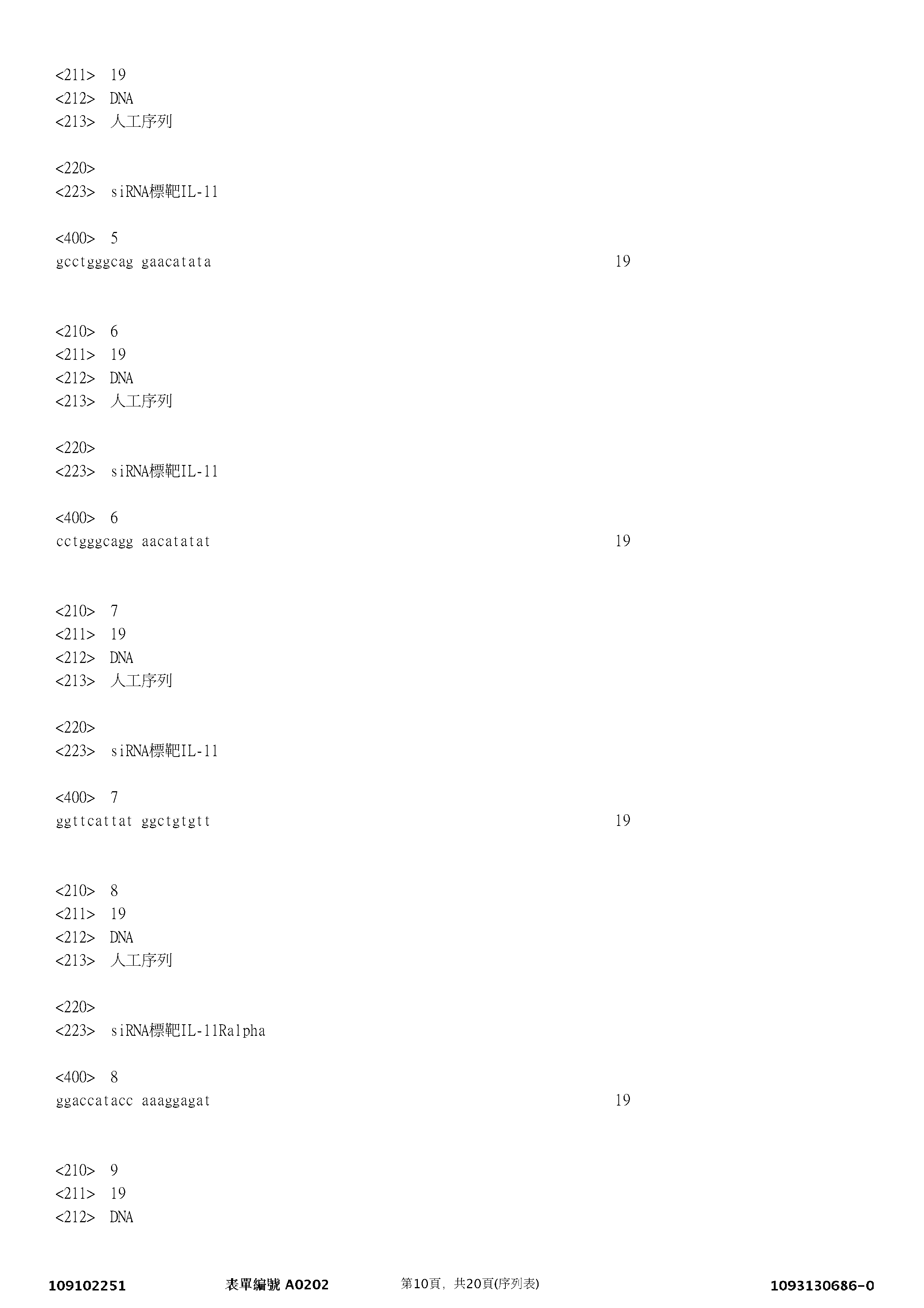


Claims (10)
Applications Claiming Priority (6)
| Application Number | Priority Date | Filing Date | Title |
|---|---|---|---|
| GBGB1900811.9A GB201900811D0 (en) | 2019-01-21 | 2019-01-21 | Treatment of hepatotoxicity |
| GB1900811.9 | 2019-01-21 | ||
| GB1907839.3 | 2019-06-03 | ||
| GBGB1907839.3A GB201907839D0 (en) | 2019-06-03 | 2019-06-03 | Treatment of hepatotoxicity |
| GB201915003A GB201915003D0 (en) | 2019-10-17 | 2019-10-17 | Treatment of hepatotoxicity |
| GB1915003.6 | 2019-10-17 |
Publications (2)
| Publication Number | Publication Date |
|---|---|
| TW202043276A TW202043276A (en) | 2020-12-01 |
| TWI858005B true TWI858005B (en) | 2024-10-11 |
Family
ID=69190770
Family Applications (1)
| Application Number | Title | Priority Date | Filing Date |
|---|---|---|---|
| TW109102251A TWI858005B (en) | 2019-01-21 | 2020-01-21 | Treatment of hepatotoxicity |
Country Status (13)
| Country | Link |
|---|---|
| US (1) | US11319368B2 (en) |
| EP (1) | EP3914621A1 (en) |
| JP (1) | JP7514846B2 (en) |
| KR (1) | KR20210138579A (en) |
| CN (1) | CN113677706B (en) |
| AU (1) | AU2020211695A1 (en) |
| BR (1) | BR112021014105A2 (en) |
| CA (1) | CA3126322A1 (en) |
| CL (1) | CL2021001903A1 (en) |
| MX (1) | MX2021008727A (en) |
| PH (1) | PH12021551750A1 (en) |
| TW (1) | TWI858005B (en) |
| WO (1) | WO2020152122A1 (en) |
Families Citing this family (7)
| Publication number | Priority date | Publication date | Assignee | Title |
|---|---|---|---|---|
| WO2022033538A1 (en) * | 2020-08-13 | 2022-02-17 | 广东东阳光药业有限公司 | Antibody of il-11 and use thereof |
| US20250092126A1 (en) * | 2021-07-26 | 2025-03-20 | Boehringer Ingelheim International Gmbh | Treatment and prevention of alcoholic liver disease |
| CN115068442A (en) * | 2021-09-13 | 2022-09-20 | 荣灿生物医药技术(上海)有限公司 | Nanoparticle compositions of nucleic acids, methods of making and uses thereof |
| GB202218388D0 (en) | 2022-12-07 | 2023-01-18 | Vvb Bio Pte Ltd | GP130 antigen-binding molecules |
| GB202311050D0 (en) | 2023-07-19 | 2023-08-30 | Vvb Bio Pte Ltd | GP130 antigen-binding molecules |
| GB202405551D0 (en) | 2024-04-19 | 2024-06-05 | Vvb Bio Pte Ltd | Combination treatment |
| GB202408044D0 (en) | 2024-06-06 | 2024-07-24 | Vvb Bio Pte Ltd | gp130 antigen-binding molecules |
Citations (2)
| Publication number | Priority date | Publication date | Assignee | Title |
|---|---|---|---|---|
| TW201722897A (en) * | 2015-09-24 | 2017-07-01 | 欣耀生醫股份有限公司 | Compounds effective for treating hepatotoxicity and fatty liver disease and uses thereof |
| US20180362633A1 (en) * | 2015-12-16 | 2018-12-20 | Singapore Health Services Pte Ltd. | Treatment of fibrosis |
Family Cites Families (38)
| Publication number | Priority date | Publication date | Assignee | Title |
|---|---|---|---|---|
| EP0786469B1 (en) | 1990-06-11 | 2006-03-01 | Gilead Sciences, Inc. | Methods of use of nucleic acid ligands |
| ES2275268T3 (en) | 1994-12-22 | 2007-06-01 | Genetics Institute, Llc | USE OF A HUMAN INTERLEUQUINE RECEIVER 11. |
| ES2093562B1 (en) | 1995-05-26 | 1997-07-01 | Univ Santiago Compostela | STABILIZATION OF COLLOID SYSTEMS THROUGH FORMATION OF LIPIDO-POLISACARIDO IONIC COMPLEXES. |
| US6540993B1 (en) | 1995-06-27 | 2003-04-01 | Wyeth | Method of treating inflammatory bowel disease using a topical formulation of IL-11 |
| US5679339A (en) | 1995-06-27 | 1997-10-21 | Keith; James | Method of using IL-11 for treating spondyloarthropies |
| US6126933A (en) | 1995-06-27 | 2000-10-03 | Genetics Institute | Methods of treating inflammatory bowel diseases by administering IL-11 |
| US6649192B2 (en) | 1996-07-29 | 2003-11-18 | Universidade De Santiago De Compostela | Application of nanoparticles based on hydrophilic polymers as pharmaceutical forms |
| GB9702944D0 (en) | 1997-02-13 | 1997-04-02 | Univ Manchester | Reducing fibrosis |
| GB9721961D0 (en) | 1997-10-16 | 1997-12-17 | Glaxo Group Ltd | Novel molecules |
| US6506559B1 (en) | 1997-12-23 | 2003-01-14 | Carnegie Institute Of Washington | Genetic inhibition by double-stranded RNA |
| CA2237915A1 (en) | 1998-05-19 | 1999-11-19 | Stephen Shaughnessy | Osteoporosis treatment |
| US6953777B2 (en) | 1999-03-11 | 2005-10-11 | Genetics Indtitute LLC | Use of interleukin-11 to prevent immune-mediated cytotoxicity |
| AU5756100A (en) | 1999-06-21 | 2001-01-09 | Genetics Institute Inc. | Treatment of fibrosis by antagonism of il-13 and il-13 receptor chains |
| CA2386270A1 (en) | 1999-10-15 | 2001-04-26 | University Of Massachusetts | Rna interference pathway genes as tools for targeted genetic interference |
| GB0021668D0 (en) | 2000-09-04 | 2000-10-18 | Smithkline Beecham Plc | New use |
| BR0314356A (en) | 2002-09-16 | 2005-07-19 | Wyeth Corp | Delayed release formulations for oral administration of a polypeptide therapeutic agent and methods using the same |
| EP1709074A4 (en) | 2003-12-16 | 2008-06-11 | Commw Scient Ind Res Org | FIELDS OF BINDING TO CYTOKINE |
| WO2005070446A1 (en) | 2004-01-15 | 2005-08-04 | Scios Inc. | Method for treating cardiac remodeling following myocardial injury |
| US20080300147A1 (en) | 2004-03-26 | 2008-12-04 | Nasser Chegini | Detection and Treatment of Fibrotic Disorders |
| ATE399868T1 (en) | 2004-08-27 | 2008-07-15 | Conaris Res Inst Ag | OPTIMIZED NUCLEOTIDE SEQUENCES ENCODING SGP130 |
| US7612181B2 (en) * | 2005-08-19 | 2009-11-03 | Abbott Laboratories | Dual variable domain immunoglobulin and uses thereof |
| BRPI0619476A2 (en) | 2005-12-05 | 2011-10-04 | Wyeth Corp | Interleukin-11 compositions and methods of use |
| US8361966B2 (en) | 2006-10-27 | 2013-01-29 | Osaka University | Use of interleukin-11 as therapeutic agent for heart disease |
| US8182814B2 (en) | 2007-10-26 | 2012-05-22 | Csl Limited | Methods of treating inflammatory airway conditions by inhibition of IL-11 activity |
| JP5330398B2 (en) | 2007-10-26 | 2013-10-30 | シーエスエル、リミテッド | Cytokine mutein |
| US8518888B2 (en) | 2008-10-14 | 2013-08-27 | Csl Limited | Method of treatment of gastrointestinal-type cancer with antagonistic antibodies to IL-11R |
| KR101133769B1 (en) | 2011-04-18 | 2012-04-09 | 한국생명공학연구원 | New oxazolidin and indole compounds, process for the preparation thereof and pharmaceutical composition comprising the same |
| CN104995211B (en) | 2013-02-07 | 2019-09-13 | Csl有限公司 | IL-11R binding protein and its application |
| EP2981281B1 (en) * | 2013-04-03 | 2020-07-15 | IBC Pharmaceuticals, Inc. | Combination therapy for inducing immune response to disease |
| CN105497893B (en) | 2015-12-10 | 2019-02-01 | 黑龙江省科学院高技术研究院 | IL-11 monoclonal antibody is inhibiting the application in PI3K/Akt signal path |
| RU2016125115A (en) | 2016-06-23 | 2017-12-28 | Федеральное государственное бюджетное учреждение науки Институт биологического приборостроения с опытным производством Российской Академии наук (ИБП РАН) | A therapeutic antibody specific for interleukin-11 inhibiting signaling through its receptor, and a method for using it to treat patients |
| AU2017378111A1 (en) | 2016-12-16 | 2019-06-13 | National University Of Singapore | IL-11 antibodies |
| GB201621439D0 (en) | 2016-12-16 | 2017-02-01 | Singapore Health Services Pte Ltd And Nat Univ Of Singapore | IL-11Ra Antibodies |
| GB201621431D0 (en) | 2016-12-16 | 2017-02-01 | Singapore Health Services Pte Ltd And Nat Univ Of Singapore The | Decoy cytokine receptor |
| RU2016151730A (en) | 2016-12-28 | 2018-06-29 | Федеральное государственное бюджетное учреждение науки Институт биологического приборостроения с опытным производством Российской Академии наук (ИБП РАН) | Antibodies for laboratory diagnosis of interleukin-11 concentration |
| GB201806918D0 (en) * | 2018-04-27 | 2018-06-13 | Enleofen Bio Pte Ltd | Combination treatment for eye fibrosis |
| GB201809699D0 (en) | 2018-06-13 | 2018-08-01 | Singapore Health Serv Pte Ltd | IL-11 antibodies |
| GB201809700D0 (en) | 2018-06-13 | 2018-08-01 | Singapore Health Serv Pte Ltd | IL-11 antibodies |
-
2020
- 2020-01-21 TW TW109102251A patent/TWI858005B/en active
- 2020-01-21 KR KR1020217026647A patent/KR20210138579A/en active Pending
- 2020-01-21 PH PH1/2021/551750A patent/PH12021551750A1/en unknown
- 2020-01-21 WO PCT/EP2020/051332 patent/WO2020152122A1/en not_active Ceased
- 2020-01-21 CN CN202080010280.8A patent/CN113677706B/en active Active
- 2020-01-21 MX MX2021008727A patent/MX2021008727A/en unknown
- 2020-01-21 JP JP2021542311A patent/JP7514846B2/en active Active
- 2020-01-21 EP EP20701719.5A patent/EP3914621A1/en active Pending
- 2020-01-21 BR BR112021014105-7A patent/BR112021014105A2/en unknown
- 2020-01-21 US US16/748,698 patent/US11319368B2/en active Active
- 2020-01-21 AU AU2020211695A patent/AU2020211695A1/en active Pending
- 2020-01-21 CA CA3126322A patent/CA3126322A1/en active Pending
-
2021
- 2021-07-19 CL CL2021001903A patent/CL2021001903A1/en unknown
Patent Citations (2)
| Publication number | Priority date | Publication date | Assignee | Title |
|---|---|---|---|---|
| TW201722897A (en) * | 2015-09-24 | 2017-07-01 | 欣耀生醫股份有限公司 | Compounds effective for treating hepatotoxicity and fatty liver disease and uses thereof |
| US20180362633A1 (en) * | 2015-12-16 | 2018-12-20 | Singapore Health Services Pte Ltd. | Treatment of fibrosis |
Also Published As
| Publication number | Publication date |
|---|---|
| CA3126322A1 (en) | 2020-07-30 |
| PH12021551750A1 (en) | 2022-03-28 |
| CN113677706A (en) | 2021-11-19 |
| TW202043276A (en) | 2020-12-01 |
| US11319368B2 (en) | 2022-05-03 |
| JP7514846B2 (en) | 2024-07-17 |
| AU2020211695A1 (en) | 2021-09-02 |
| JP2022518251A (en) | 2022-03-14 |
| US20200262910A1 (en) | 2020-08-20 |
| EP3914621A1 (en) | 2021-12-01 |
| KR20210138579A (en) | 2021-11-19 |
| CN113677706B (en) | 2025-05-02 |
| CL2021001903A1 (en) | 2022-04-01 |
| MX2021008727A (en) | 2021-11-04 |
| BR112021014105A2 (en) | 2021-10-13 |
| WO2020152122A1 (en) | 2020-07-30 |
Similar Documents
| Publication | Publication Date | Title |
|---|---|---|
| TWI858005B (en) | Treatment of hepatotoxicity | |
| US20240156913A1 (en) | Treatment and prevention of metabolic diseases | |
| TWI874359B (en) | Treatment of kidney injury | |
| KR20230117118A (en) | Methods for Prolonging Health-Life and Treating Age-Related Diseases | |
| WO2021255182A1 (en) | Treatment and prevention of disease caused by type iv collagen dysfunction | |
| WO2023111196A1 (en) | Treatment and prevention of glomerular disease | |
| EA047713B1 (en) | TREATMENT OF HEPATOTOXICITY | |
| CN117858726A (en) | Treatment and prevention of alcoholic liver disease | |
| JP2024526944A (en) | Treatment and prevention of alcoholic liver disease | |
| EA050147B1 (en) | TREATMENT AND PREVENTION OF METABOLIC DISEASES | |
| EA049726B1 (en) | TREATMENT OF KIDNEY DAMAGE |