US10034026B2 - Device for and method of enabling the processing of a video stream - Google Patents
Device for and method of enabling the processing of a video stream Download PDFInfo
- Publication number
- US10034026B2 US10034026B2 US15/135,878 US201615135878A US10034026B2 US 10034026 B2 US10034026 B2 US 10034026B2 US 201615135878 A US201615135878 A US 201615135878A US 10034026 B2 US10034026 B2 US 10034026B2
- Authority
- US
- United States
- Prior art keywords
- frame
- video stream
- frames
- slice
- data
- Prior art date
- Legal status (The legal status is an assumption and is not a legal conclusion. Google has not performed a legal analysis and makes no representation as to the accuracy of the status listed.)
- Active, expires
Links
Images





Classifications
-
- H—ELECTRICITY
- H04—ELECTRIC COMMUNICATION TECHNIQUE
- H04N—PICTORIAL COMMUNICATION, e.g. TELEVISION
- H04N19/00—Methods or arrangements for coding, decoding, compressing or decompressing digital video signals
- H04N19/10—Methods or arrangements for coding, decoding, compressing or decompressing digital video signals using adaptive coding
- H04N19/169—Methods or arrangements for coding, decoding, compressing or decompressing digital video signals using adaptive coding characterised by the coding unit, i.e. the structural portion or semantic portion of the video signal being the object or the subject of the adaptive coding
- H04N19/17—Methods or arrangements for coding, decoding, compressing or decompressing digital video signals using adaptive coding characterised by the coding unit, i.e. the structural portion or semantic portion of the video signal being the object or the subject of the adaptive coding the unit being an image region, e.g. an object
- H04N19/174—Methods or arrangements for coding, decoding, compressing or decompressing digital video signals using adaptive coding characterised by the coding unit, i.e. the structural portion or semantic portion of the video signal being the object or the subject of the adaptive coding the unit being an image region, e.g. an object the region being a slice, e.g. a line of blocks or a group of blocks
-
- H—ELECTRICITY
- H04—ELECTRIC COMMUNICATION TECHNIQUE
- H04N—PICTORIAL COMMUNICATION, e.g. TELEVISION
- H04N21/00—Selective content distribution, e.g. interactive television or video on demand [VOD]
- H04N21/20—Servers specifically adapted for the distribution of content, e.g. VOD servers; Operations thereof
- H04N21/23—Processing of content or additional data; Elementary server operations; Server middleware
- H04N21/231—Content storage operation, e.g. caching movies for short term storage, replicating data over plural servers, prioritizing data for deletion
-
- H—ELECTRICITY
- H04—ELECTRIC COMMUNICATION TECHNIQUE
- H04N—PICTORIAL COMMUNICATION, e.g. TELEVISION
- H04N21/00—Selective content distribution, e.g. interactive television or video on demand [VOD]
-
- H—ELECTRICITY
- H04—ELECTRIC COMMUNICATION TECHNIQUE
- H04N—PICTORIAL COMMUNICATION, e.g. TELEVISION
- H04N19/00—Methods or arrangements for coding, decoding, compressing or decompressing digital video signals
-
- H—ELECTRICITY
- H04—ELECTRIC COMMUNICATION TECHNIQUE
- H04N—PICTORIAL COMMUNICATION, e.g. TELEVISION
- H04N19/00—Methods or arrangements for coding, decoding, compressing or decompressing digital video signals
- H04N19/42—Methods or arrangements for coding, decoding, compressing or decompressing digital video signals characterised by implementation details or hardware specially adapted for video compression or decompression, e.g. dedicated software implementation
- H04N19/423—Methods or arrangements for coding, decoding, compressing or decompressing digital video signals characterised by implementation details or hardware specially adapted for video compression or decompression, e.g. dedicated software implementation characterised by memory arrangements
-
- H—ELECTRICITY
- H04—ELECTRIC COMMUNICATION TECHNIQUE
- H04N—PICTORIAL COMMUNICATION, e.g. TELEVISION
- H04N21/00—Selective content distribution, e.g. interactive television or video on demand [VOD]
- H04N21/20—Servers specifically adapted for the distribution of content, e.g. VOD servers; Operations thereof
- H04N21/23—Processing of content or additional data; Elementary server operations; Server middleware
- H04N21/234—Processing of video elementary streams, e.g. splicing of video streams or manipulating encoded video stream scene graphs
-
- H—ELECTRICITY
- H04—ELECTRIC COMMUNICATION TECHNIQUE
- H04N—PICTORIAL COMMUNICATION, e.g. TELEVISION
- H04N21/00—Selective content distribution, e.g. interactive television or video on demand [VOD]
- H04N21/40—Client devices specifically adapted for the reception of or interaction with content, e.g. set-top-box [STB]; Operations thereof
- H04N21/43—Processing of content or additional data, e.g. demultiplexing additional data from a digital video stream; Elementary client operations, e.g. monitoring of home network or synchronising decoder's clock; Client middleware
- H04N21/433—Content storage operation, e.g. storage operation in response to a pause request, caching operations
Definitions
- An embodiment of present invention relates generally to image processing devices, and in particular, to a device for and a method of enabling the processing of images.
- Digital image processing has become very commonly used and is important in many fields. Digital image processing acquires an image from a sensor and transforms the image to viewable content. However, digital image processing, including multi-frame image processing, can require significant resources of an image processing device, such as a digital camera that may be implemented in a portable computer or communication device. When accessing data of a frame or multiple frames captured by an image processing device, the formatting of data is beneficial in reducing system latency and improving memory bandwidth.
- IPs typically access system memory (e.g. DDR) via a System MMU which provides contiguous (i.e. virtual) view of memory to the IPs and performs the virtual-to-physical address translation.
- the Virtual Address (VA) to Physical Address (PA) translation involves a first level translation lookup in the Translation Lookaside Buffer (TLB).
- TLB is a memory cache that stores recent translations of virtual to physical addresses.
- TLB hit When system needs to access memory using a physical address, it first checks if a virtual to physical address translation exists in the memory cache (TLB). If a translation is found, it is referred to as a “TLB hit”. If it is not found, the system has to look for the physical mapping in the operating system's page table. This process is referred to as a “page table walk”. Since this page table is in DRAM, it is a high latency and bandwidth intensive operation.
- TLB hit rate is higher if tiles are fetched in raster order from left to right. However, if tiles need to be fetched from top to bottom, it will result in frequent cache misses. Frequent cache misses increase memory access latency since page entries are fetched from system memory, such as a dynamic random access memory (DRAM).
- DRAM dynamic random access memory
- devices and methods that improve the processing of digital images and more particularly devices and methods that reduce the number of TLB cache misses and the latency of memory accesses, are beneficial.
- a method of enabling processing of a video stream comprises establishing a slice width for frames of the video stream; receiving the video stream; dividing, for each frame of the video stream, the frame into vertical slices having the slice width; storing a frame of the video stream in a re-ordered slice based format.
- Another method of enabling processing of a video stream comprises establishing a slice width for frames of the video stream; receiving the video stream; dividing, for each frame of the video stream, the frame into vertical slices having the slice width; and storing frames of the video stream in a tile and frame interleaved format.
- a device for enabling processing of a video stream comprises a memory management unit configured to receive frames of the video stream; divide, for each frame of the video stream, the frame into vertical slices having a slice width; and store a frame of the video stream in a re-ordered slice based format.
- a computer-readable storage medium having data stored therein representing software executable by a computer for enabling processing of a video stream comprises instructions for establishing a slice width for frames of the video stream; instructions for receiving the video stream; instructions for dividing, for each frame of the video stream, the frame into vertical slices having the slice width; and instructions for storing a frame of the video stream in a re-ordered slice based format.
- FIG. 1 is a block diagram of a device for processing a video stream
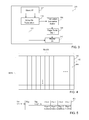
- FIG. 2 is a block diagram showing processing blocks implemented in the device of FIG. 1 for processing a video stream;
- FIG. 3 is a block diagram of the system memory management unit (MMU) of FIG. 2 ;
- MMU system memory management unit
- FIG. 4 is an example of a Translation Lookaside Buffer (TLB) of FIG. 3 ;
- TLB Translation Lookaside Buffer
- FIG. 5 is an example of an entry for the cache structure for the TLB of FIG. 4 ;
- FIG. 6 is a block diagram showing a method of re-ordering frame information based upon slices of the frame
- FIG. 7 is a block diagram showing the re-ordering of multiple frames of frame information
- FIG. 8 is a block diagram showing the re-ordering of multiple frames of frame information based upon slices of the frame
- FIG. 9 is a block diagram showing the re-ordering of multiple frames of frame information using multiple image sensors
- FIG. 10 is a block diagram showing the re-ordering of multiple sensors and multiple frames of frame information and based upon slices of the frame;
- FIG. 11 is a block diagram showing a division of a frame into slices having unequal slice sizes
- FIG. 12 is a block diagram showing a division of a frame into slices having equal slice sizes
- FIG. 13 is a flow chart showing a method of enabling processing of a video stream by storing a frame of a video stream in a re-ordered format
- FIG. 14 is a flow chart showing a method of enabling processing of a video stream by interleaving a plurality of frames.
- FIG. 15 is a flow chart showing a method of enabling processing of a video stream by interleaving a plurality of frames from a plurality of sensors.
- Multi-Frame Digital Zoom process multiple frames together to reduce noise artifacts from digital interpolation and improve image clarity.
- Processing multiple frames is a high bandwidth and latency critical operation. It involves fetching tiles from multiple frames together for subsequent warping, blending and other kernel operations.
- the devices and methods set forth below implement data reordering, wherein a processing entity reads frame data and stores data to match with tile processing order based on a single sensor, single frame system, a single sensor, multi-frame system or multi sensor, multi-frame system. In each case, the novel data organization significantly reduces the TLB cache miss rate.
- a device 100 comprises a processor circuit 102 coupled to an image sensor 104 .
- the device 100 could be any type of device, or a component such as an integrated circuit of a device or system, adapted to capture a digital image.
- the image sensor 104 could be a digital camera, or any portion of a digital camera, such as a lens or other image sensing element.
- a second image sensor 105 could also be implemented, as will be described in more detail below.
- the processor circuit could be coupled to a display 106 for displaying a captured image, and more particularly, displaying a digital image having enhanced image quality.
- the processor circuit alone or in combination with other elements, can enable processing a video stream.
- the processor circuit 102 may also be coupled to a memory 108 that enables storing information related to various frames of an image.
- the memory 108 could be implemented as a part of the processor circuit 102 , or could be implemented in addition to any cache of the processor, as is well known.
- the memory 108 could be connected to the processor circuit 102 by way of interconnect elements, such as interconnect element 109 .
- a user interface 110 which may be separate from the display, or also may be a part of, or responsive to, the display, is also shown.
- the processor circuit 102 may also be coupled to other elements that receive inputs or enable the capturing of a digital image.
- an inertial measurement unit (IMU) 112 can provide various information related to the motion or orientation of the device 100 .
- IMU inertial measurement unit
- the processor circuit 102 may also receive input by way of an input/output (I/O) port 114 or a transceiver 116 coupled to an antenna 118 .
- a battery 120 may be implemented to provide power to the processor circuit and other elements of the device 100 .
- a virtual address block 202 comprises an imaging accelerator block 204 that provides image data to a memory management unit (MMU), such as a system MMU 208 .
- MMU memory management unit
- the imaging accelerator block 204 performs data re-ordering, as will be described in more detail below.
- the system MMU 208 communicates with other elements of the device by way of a system-on-chip (SOC) interconnect element 210 , which could be implemented as interconnect element 109 for example.
- the processing circuit 102 could comprise a central processing unit (CPU) 212 .
- the memory 108 could comprise a dynamic random access memory (DRAM) 214 or a memory subsystem 216 .
- DRAM dynamic random access memory
- the system MMU 208 comprises a slave interface 302 configured to provide image data from the virtual address block 202 to a virtual address-to-physical address translation block 304 , the output of which is coupled to a TLB 306 .
- a TLB is a set associative cache operating as an address translation cache, where each entry in the TLB has 4 pages with a page size of 4 KB for example.
- a page table walk block 308 will make a request by way of a master interface 310 to a memory, such as the DRAM 214 for example. If the TLB cache access is a hit, the data access will be forwarded to system memory 214 via 310 .
- IPs intellectual property blocks
- system memory e.g. dynamic random access memory (DRAM)
- System MMU System MMU
- the virtual address to physical address translation involves a translation lookup in the TLB 306 , where a page table walk follows a TLB miss.
- TLB hit To avoid the penalty due to page table walk, it is desirable to have a TLB hit as much as possible.
- the arrangement of address information associated with frames of an image will increase the chances of a TLB hit, as will be described in more detail below.
- Each page is assumed to be of size 4 KB.
- each way has 4 page entries or 4 slots.
- a slot is hit when the upper address bits 31:N of the incoming virtual address match the stored tag in a given set.
- a total number of DRAM page slots is equal to 4*#sets*#ways, where the factor 4 indicates storing addresses for 4 DRAM pages per line of cache.
- larger number of ways has higher penalty in gate area as compared to increased number of sets. Therefore, there is an incentive to reduce number of ways.
- the implementation of the cache enables reducing the number of ways. It should be understood that the cache of FIG. 4 and the example entry of FIG. 5 are shown by way of example, and could be implemented in a variety of ways.
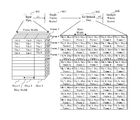
- FIG. 6 a block diagram shows a method of reordering data based upon slices of the frame.
- An input frame 602 is divided into slices, where the frame having a frame width is divided into slices having a slice width.
- a slice is a portion of the frame that spans a fraction of the image width and the entire image height.
- Each slice has a plurality of tiles that are arranged in a column, where each tile comprises an array of pixels.
- the maximum slice width may be 512 pixels and slice height may be 2048 pixels.
- the slice widths for a plurality of slices are generally the same, although a last slice may have a different width, as will be described in more detail below.
- a single frame kernel 604 operating at a rate of 1 ⁇ provides re-ordered frame information that is arranged in a vertical format, where the slices are arranged from a first slice (i.e. slice 1 ) to a last slice (i.e. slice 3 ) in contiguous addresses of the memory 214 as shown.
- the slice arrangement shown in FIG. 7 enables a subsequent kernel to read tile by tile of the reordered data 706 starting from the 1 st slice that matches the processing order of its algorithm.
- the multi-frame kernel 708 operates at 5 ⁇ , such as 150 frames per second, or 5 times the single frame rate of 30 frames per second.
- FIG. 6 An example of reading vertical slices from a frame is shown in FIG. 6 .
- the example shown in FIG. 6 has a frame with image width of 4096 pixels and image height of 2048 pixels and slice width of 512.
- a data transfer unit such as a DMA will read data in bursts of size that is based on DRAM memory bursts, such as a 64 byte for memory burst.
- the arrangement of FIG. 6 results in a reduced cache miss rate of 1 every 256 memory bursts which is 8 ⁇ improvement in cache miss rate.
- a data transfer unit can store the image data in a frame interleaved format, where tiles from the multiple frames are stacked next to each other.
- a data organization not only reduces the cache miss rate, but also reduces the number of ways in the TLB to handle multiple frames. The impact of reduced ways is more significant if the frame has NV12 format and has separate luma and chroma planes.
- the NV12 format is one where the luma (Y) samples are arranged in an array followed by interleaved chroma (Cb and Cr) samples.
- the number of ways per set can be reduced to 2 ways as compared to at least 10 ways when processing 5 luma (Y) and 5 chroma (UV) frames. That is, the 5 Y values are interleaved to use a single way, and the 5 UV values are interleaved to use a single way.
- the tile processing is done vertically rather than horizontally in order to reduce the overall system latency for the application.
- This is also called slice processing, and may be implemented for a multi-frame zoom application.
- Multi-frame processing is implemented at low latency to reduce System MMU TLB cache misses by storing data in tile and frame interleaved manner to match the processing order of the device as will be described in reference to FIGS. 7 and 8 .
- the novel data organization not only reduces memory latency and increases cache hit performance, but accomplishes it with a small System MMU TLB cache size.
- images are divided into vertical slices.
- the multi-frame image processing involves a single frame processing entity such as crop and filter stage that works on a single frame and reads the frame as a set of tiles starting from the first vertical slice. For the first slice, each line is offset by the image stride.
- each line is offset by the slice width as compared to the first slice. While the crop and filter stage working on a single frame generally tolerate the additional latency caused by frequent cache misses, the additional latency caused by frequent cache misses is a problem when implementing multi-frame processing. Re-ordering the data as set forth below reduces the cache misses, and therefore reduces the latency in multi-frame processing.
- the vertical slice width may be determined from the image resolution, kernel or algorithm requirements on line buffer sizes, or any image transformations that may be applied to the image, such as warp or rotation.
- the cropped frame is scaled down 2 ⁇ from the sensor resolution of 24 MP.
- the frame is divided into 4 vertical slices with widths of 512 pixels for first 3 slices and 100 pixels for 4 th slice.
- a UHD frame is wider and may have wider slices to accommodate for the larger stride of 960 pixels.
- the slice width is also a multiple of 64B which is efficient for external memory bursts.
- Subsequent reading of the tiles may be performed in raster scan order by a multi frame processing kernel which is processing N frames. Since the buffer stride is the slice width (e.g. 512 pixels if the slice width is 512), every page entry within a cache set is fully utilized. The resulting cache miss is 1 every 256 memory accesses. A slight increase in storage could result due to overlap of tiles, but it is offset by the latency reduction and subsequent bandwidth gain due to significantly reduced cache miss rate.
- FIG. 7 a block diagram shows the re-ordering of multiple frames of data.
- a data selection block 702 enables the selection of input frames 704 , shown here as five frames F 0 -F 4 .
- the input frames 704 are then reordered as multi-frame reordered data 706 .
- An example of the reordering data from the input frames 704 to the multi-frame reordered data 706 is shown in more detail in reference to FIG. 8 .
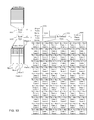
- each of the five frames is divided into 3 slices. While 3 slices are shown by way of example, it should be understood that the frames could be divided into any number of slices, where each of the frames is divided in the same manner.
- reordered data 806 is generated based upon the multiple frames of data, where a multiple frame kernel 808 can operate on the multiple frames of data at a 5 ⁇ rate.
- the tiles from multiple frames are stacked next to each other such that a blending algorithm processing a set of 5 frames, reads in a tile and frame interleaved manner (such as tile 0 frame 0 , tile 0 frame 1 , tile 0 frame 2 etc).
- a blending algorithm processing a set of 5 frames reads in a tile and frame interleaved manner (such as tile 0 frame 0 , tile 0 frame 1 , tile 0 frame 2 etc).
- a blending algorithm processing a set of 5 frames
- the data transfer unit stores the data in the interleaved order based upon tile, frame and sensor count.
- This type of data organization also reduces the cache miss rate with reduced number of ways in the TLB cache which might otherwise be needed to handle multiple frames and multiple sensors.
- the re-ordering of information associated with multiple frames of data using multiple image sensors can be implemented to enable tile, frame and sensor interleaving.
- a data selection block 902 of FIG. 9 enables the selection of input frames 904 , shown here as five frames F 0 1 -F 4 1 . Second data from a second sensor is also provided.
- a second data selection block 906 enables the selection of input frames 908 , shown here as five frames F 02 -F 42 .
- Data from each of the data selection blocks can then be reordered as multi-frame reordered data 910 as shown in FIG. 10 .
- the block diagram of FIG. 10 shows the re-ordering of multiple sensors and multiple frames of data and based upon slices of the frames associated with the first sensor.
- the input data 1002 having multiple frames of data is provided to a single kernel 1004 operating at a 1 ⁇ rate.
- Reordered data 1006 is generated based upon the multiple frames of data, where a multiple frame kernel 1008 can operate on the multiple frames of data at a 5 ⁇ rate.
- the re-ordered data can also include frames generated by a second sensor.
- Second input data 1010 having multiple frames of data is provided to a second single kernel 1012 operating at a 1 ⁇ rate.
- the reordered data 1006 is shown with tile, frame and sensor interleaving.
- data associated with the first sensor may be interleaved in a tile and frame format in a first block of data as described in reference to FIG. 8
- data associated with the second sensor is interleaved in a tile and frame format with the data associated with the first sensor. Therefore, the data is interleaved in a tile, frame sensor format. That is, the data could be interleaved as tileN/frame 1 /sensor 1 followed by tileN/frame 1 /sensor 2 , followed by tileN/frame 2 /sensor 1 , followed by tileN/frame 2 /sensor 2 , as shown in FIG. 10 .
- FIG. 13 a flow chart shows a method of enabling processing of a video stream by storing data of a frame of a video stream in a re-ordered format.
- a slice width for frames of the video stream is established at a block 1302 .
- the video stream is received using a sensor at a block 1304 .
- the frame is divided into vertical slices having the slice width at a block 1306 .
- the vertical slices could be implemented as shown in any of the FIG. 6-8 or 11-12 , for example.
- the data associated with the frame is re-ordered at a block 1308 .
- Data of a frame of the video stream in the re-ordered slice based format is stored at a block 1310 , wherein data of a plurality of slices of data of a frame are stored in memory in order from a first slice to a last slice. Data associated with a single frame can be re-ordered as shown in FIG. 8 , for example.
- FIG. 14 a flow chart shows a method of enabling processing of a video stream by interleaving data associated with a plurality of frames.
- a slice width for frames of the video stream is established at a block 1402 .
- the video stream is received using a sensor at a block 1404 .
- the frame, for each frame of a plurality of frames of the video stream is divided into vertical slices having the slice width at a block 1406 .
- the data associated with the plurality of frames is re-ordered at a block 1408 .
- the data associated with the plurality of frames is interleaved based upon tiles and frames at a block 1410 .
- Data of frames of the video stream is stored in a tile and frame interleaved format at a block 1412 , wherein data of a slice and tile associated with a plurality of frames is stored in memory. Data associated with multiple frames can be re-ordered as shown in FIG. 8 , for example. Data of the plurality of frames is read from the memory in a raster scan format at a block 1414 .
- FIG. 15 a flow chart shows a method of enabling processing of a video stream by interleaving data associated with a plurality of frames from a plurality of sensors.
- a slice width for frames of the video stream are established at a block 1502 .
- the video stream is received using a plurality of sensors at a block 1504 .
- the frame, for each frame of the video stream is divided into vertical slices having the slice width at a block 1506 .
- the data from the plurality of video streams are interleaved based upon the tile, frame and sensor at a block 1508 .
- Data of a frame of the video stream is stored in an interleaved format based upon a tile, frame and sensor, wherein data of a plurality of slices associated with a frame is stored in memory at a block 1510 .
- the interleaving of information associated with a plurality of frames can be performed as described above in reference to FIG. 10 , for example.
- the methods of FIGS. 13-15 could be implemented using any of the circuits of FIGS. 1-12 , or other suitable circuits.
Landscapes
- Engineering & Computer Science (AREA)
- Signal Processing (AREA)
- Multimedia (AREA)
- Image Processing (AREA)
- Image Input (AREA)
- Memory System Of A Hierarchy Structure (AREA)
Abstract
Description
#DRAM page slots=(#frames*Image Width*Tile Height)/DRAM Page size;
for a horizontal processing order of tiles.
#DRAM page slots=(#frames*Image Width*Image Height)/DRAM Page size;
#DRAM page slots=(5*4096*4)/4096=20.
#DRAM page slots=(5*4096*2048)/4096=10,240.
To keep up with the processing latency requirement, the total number of DRAM slots is increased.
#DRAM page slots=(5*1.5*2048*1024)/4096=3,840.
In addition, the number of ways is given by the number of frames which is 10. This means that we need a system MMU with #ways=10, #sets=96 (where the next power of two greater than 69 is 128) is needed, with a number of slots per TLB cache entry=4, which makes TLB page size to be 4×128×10=5120 pages. This has significant area and power penalty. However, this can be reduced by interleaving the address information, where 5 Luma frames are interleaved and 5 chroma frames are interleaved to reduce the number of ways from 10 to 2, as will be described.
Claims (18)
Priority Applications (5)
| Application Number | Priority Date | Filing Date | Title |
|---|---|---|---|
| US15/135,878 US10034026B2 (en) | 2016-04-22 | 2016-04-22 | Device for and method of enabling the processing of a video stream |
| KR1020187027925A KR102317004B1 (en) | 2016-04-22 | 2017-04-18 | Method and apparatus for enabling processing of video streams |
| PCT/KR2017/004144 WO2017183889A1 (en) | 2016-04-22 | 2017-04-18 | A method for enabling processing of a video stream and a device thereof |
| EP17786157.2A EP3414909B1 (en) | 2016-04-22 | 2017-04-18 | A method for enabling processing of a video stream and a device thereof |
| CN201780021576.8A CN108886624B (en) | 2016-04-22 | 2017-04-18 | Method for realizing video stream processing and device for realizing video stream processing |
Applications Claiming Priority (1)
| Application Number | Priority Date | Filing Date | Title |
|---|---|---|---|
| US15/135,878 US10034026B2 (en) | 2016-04-22 | 2016-04-22 | Device for and method of enabling the processing of a video stream |
Publications (2)
| Publication Number | Publication Date |
|---|---|
| US20170309306A1 US20170309306A1 (en) | 2017-10-26 |
| US10034026B2 true US10034026B2 (en) | 2018-07-24 |
Family
ID=60089701
Family Applications (1)
| Application Number | Title | Priority Date | Filing Date |
|---|---|---|---|
| US15/135,878 Active 2036-06-03 US10034026B2 (en) | 2016-04-22 | 2016-04-22 | Device for and method of enabling the processing of a video stream |
Country Status (5)
| Country | Link |
|---|---|
| US (1) | US10034026B2 (en) |
| EP (1) | EP3414909B1 (en) |
| KR (1) | KR102317004B1 (en) |
| CN (1) | CN108886624B (en) |
| WO (1) | WO2017183889A1 (en) |
Cited By (1)
| Publication number | Priority date | Publication date | Assignee | Title |
|---|---|---|---|---|
| US10820010B2 (en) | 2019-03-19 | 2020-10-27 | Axis Ab | Methods and devices for encoding a video stream using a first and a second encoder |
Families Citing this family (7)
| Publication number | Priority date | Publication date | Assignee | Title |
|---|---|---|---|---|
| US10565778B2 (en) * | 2017-08-22 | 2020-02-18 | Samsung Electronics Co., Ltd. | Electronic devices for and methods of implementing memory transfers for image warping in an electronic device |
| CN107801051B (en) * | 2017-10-27 | 2019-01-22 | 广东省南方数字电视无线传播有限公司 | Virtual sliced sheet information transferring method and device, video server |
| CN107809684B (en) * | 2017-10-27 | 2018-10-09 | 广东省南方数字电视无线传播有限公司 | Video segment generation method and device, cache server |
| US11418766B2 (en) | 2019-12-17 | 2022-08-16 | Samsung Electronics Co., Ltd. | Apparatus and method for chroma processing for multi-frame fusion |
| BR112022024874A2 (en) * | 2020-06-19 | 2022-12-27 | Qualcomm Inc | METHODS AND APPARATUS FOR RELIABLE VIDEO TRANSMISSIONS USING CONFIRMATION MESSAGES |
| CN112023377B (en) * | 2020-09-14 | 2021-11-09 | 成都拟合未来科技有限公司 | Real-time interaction method, system, terminal and medium for fitness exercise |
| CN112822514B (en) * | 2020-12-30 | 2022-06-28 | 北京大学 | Dependency-based video stream packet transmission method, system, terminal and medium |
Citations (22)
| Publication number | Priority date | Publication date | Assignee | Title |
|---|---|---|---|---|
| US6131151A (en) * | 1997-11-12 | 2000-10-10 | Lsi Logic Corporation | Processing high-speed digital datastreams with reduced memory |
| US6198773B1 (en) * | 1997-12-18 | 2001-03-06 | Zoran Corporation | Video memory management for MPEG video decode and display system |
| US20050168589A1 (en) * | 2004-01-30 | 2005-08-04 | D. Amnon Silverstein | Method and system for processing an image with an image-capturing device |
| US20090102916A1 (en) * | 2005-08-31 | 2009-04-23 | Tatsuo Saishu | Structure of Stereoscopic Image Data, Stereoscopic Image Data Recording Method, Reproducing Method, Recording Program, and Reproducing Program |
| US20100014597A1 (en) * | 2008-04-29 | 2010-01-21 | John Gao | Efficient apparatus for fast video edge filtering |
| US20110150085A1 (en) | 2009-12-21 | 2011-06-23 | Qualcomm Incorporated | Temporal and spatial video block reordering in a decoder to improve cache hits |
| US20120069922A1 (en) | 2007-10-30 | 2012-03-22 | Sony Corporation | Data processing apparatus and method |
| US20120106622A1 (en) | 2010-11-03 | 2012-05-03 | Mediatek Inc. | Method and Apparatus of Slice Grouping for High Efficiency Video Coding |
| US20120162511A1 (en) | 2010-12-22 | 2012-06-28 | Texas Instruments Incorporated | Multi-sensor video frame synchronization apparatus and methods |
| US8213501B2 (en) | 2002-12-10 | 2012-07-03 | Ntt Docomo, Inc. | Video encoding method, video decoding method, video encoding program, video decoding program, video encoding apparatus, and video decoding apparatus |
| WO2012094232A1 (en) | 2011-01-05 | 2012-07-12 | Qualcomm Incorporated | Video filtering using a combination of one-dimensional switched filter and one-dimensional adaptive filter |
| US20120183074A1 (en) | 2011-01-14 | 2012-07-19 | Tandberg Telecom As | Video encoder/decoder, method and computer program product that process tiles of video data |
| US20130034160A1 (en) | 2011-08-02 | 2013-02-07 | Advanced Micro Devices, Inc. | Apparatus and method for video processing |
| US8428125B2 (en) | 2006-12-22 | 2013-04-23 | Qualcomm Incorporated | Techniques for content adaptive video frame slicing and non-uniform access unit coding |
| US20140254671A1 (en) | 2011-07-11 | 2014-09-11 | Sharp Kabushiki Kaisha | Video decoder parallelization for tiles |
| US20140341278A1 (en) | 2007-09-14 | 2014-11-20 | Huawei Technologies Co., Ltd. | Method and device for video coding and decoding |
| US8990435B2 (en) | 2011-01-17 | 2015-03-24 | Mediatek Inc. | Method and apparatus for accessing data of multi-tile encoded picture stored in buffering apparatus |
| US20150139334A1 (en) | 2013-11-20 | 2015-05-21 | Samsung Electronics Co., Ltd. | Method for parallel processing of a video frame based on wave-front approach |
| US20150139603A1 (en) | 2013-11-18 | 2015-05-21 | Apple Inc. | Modeless Video and Still Frame Capture |
| US20150172693A1 (en) | 2012-09-29 | 2015-06-18 | Huawei Technologies Co.,Ltd. | Video encoding and decoding method, apparatus and system |
| US20150187045A1 (en) | 2013-12-26 | 2015-07-02 | Mediatek Inc. | Methods of Multiple-Slice Coding for Frame Buffer Compression |
| US20150237373A1 (en) | 2009-01-29 | 2015-08-20 | Dolby Laboratories Licensing Corporation | Coding and Decoding of Interleaved Image Data |
Family Cites Families (1)
| Publication number | Priority date | Publication date | Assignee | Title |
|---|---|---|---|---|
| CN103200425B (en) * | 2013-03-29 | 2016-04-06 | 天脉聚源(北京)传媒科技有限公司 | A kind of multimedia processing apparatus and method |
-
2016
- 2016-04-22 US US15/135,878 patent/US10034026B2/en active Active
-
2017
- 2017-04-18 EP EP17786157.2A patent/EP3414909B1/en active Active
- 2017-04-18 CN CN201780021576.8A patent/CN108886624B/en not_active Expired - Fee Related
- 2017-04-18 WO PCT/KR2017/004144 patent/WO2017183889A1/en not_active Ceased
- 2017-04-18 KR KR1020187027925A patent/KR102317004B1/en active Active
Patent Citations (24)
| Publication number | Priority date | Publication date | Assignee | Title |
|---|---|---|---|---|
| US6131151A (en) * | 1997-11-12 | 2000-10-10 | Lsi Logic Corporation | Processing high-speed digital datastreams with reduced memory |
| US6198773B1 (en) * | 1997-12-18 | 2001-03-06 | Zoran Corporation | Video memory management for MPEG video decode and display system |
| US8213501B2 (en) | 2002-12-10 | 2012-07-03 | Ntt Docomo, Inc. | Video encoding method, video decoding method, video encoding program, video decoding program, video encoding apparatus, and video decoding apparatus |
| US20050168589A1 (en) * | 2004-01-30 | 2005-08-04 | D. Amnon Silverstein | Method and system for processing an image with an image-capturing device |
| US20090102916A1 (en) * | 2005-08-31 | 2009-04-23 | Tatsuo Saishu | Structure of Stereoscopic Image Data, Stereoscopic Image Data Recording Method, Reproducing Method, Recording Program, and Reproducing Program |
| US8428125B2 (en) | 2006-12-22 | 2013-04-23 | Qualcomm Incorporated | Techniques for content adaptive video frame slicing and non-uniform access unit coding |
| US20140341278A1 (en) | 2007-09-14 | 2014-11-20 | Huawei Technologies Co., Ltd. | Method and device for video coding and decoding |
| US9100251B2 (en) | 2007-10-30 | 2015-08-04 | Sony Corporation | Data processing apparatus and method for interleaving and deinterleaving data |
| US20120069922A1 (en) | 2007-10-30 | 2012-03-22 | Sony Corporation | Data processing apparatus and method |
| US20100014597A1 (en) * | 2008-04-29 | 2010-01-21 | John Gao | Efficient apparatus for fast video edge filtering |
| US20150237373A1 (en) | 2009-01-29 | 2015-08-20 | Dolby Laboratories Licensing Corporation | Coding and Decoding of Interleaved Image Data |
| US20110150085A1 (en) | 2009-12-21 | 2011-06-23 | Qualcomm Incorporated | Temporal and spatial video block reordering in a decoder to improve cache hits |
| WO2012058898A1 (en) | 2010-11-03 | 2012-05-10 | Mediatek Inc. | Method and apparatus of slice grouping for high efficiency video coding |
| US20120106622A1 (en) | 2010-11-03 | 2012-05-03 | Mediatek Inc. | Method and Apparatus of Slice Grouping for High Efficiency Video Coding |
| US20120162511A1 (en) | 2010-12-22 | 2012-06-28 | Texas Instruments Incorporated | Multi-sensor video frame synchronization apparatus and methods |
| WO2012094232A1 (en) | 2011-01-05 | 2012-07-12 | Qualcomm Incorporated | Video filtering using a combination of one-dimensional switched filter and one-dimensional adaptive filter |
| US20120183074A1 (en) | 2011-01-14 | 2012-07-19 | Tandberg Telecom As | Video encoder/decoder, method and computer program product that process tiles of video data |
| US8990435B2 (en) | 2011-01-17 | 2015-03-24 | Mediatek Inc. | Method and apparatus for accessing data of multi-tile encoded picture stored in buffering apparatus |
| US20140254671A1 (en) | 2011-07-11 | 2014-09-11 | Sharp Kabushiki Kaisha | Video decoder parallelization for tiles |
| US20130034160A1 (en) | 2011-08-02 | 2013-02-07 | Advanced Micro Devices, Inc. | Apparatus and method for video processing |
| US20150172693A1 (en) | 2012-09-29 | 2015-06-18 | Huawei Technologies Co.,Ltd. | Video encoding and decoding method, apparatus and system |
| US20150139603A1 (en) | 2013-11-18 | 2015-05-21 | Apple Inc. | Modeless Video and Still Frame Capture |
| US20150139334A1 (en) | 2013-11-20 | 2015-05-21 | Samsung Electronics Co., Ltd. | Method for parallel processing of a video frame based on wave-front approach |
| US20150187045A1 (en) | 2013-12-26 | 2015-07-02 | Mediatek Inc. | Methods of Multiple-Slice Coding for Frame Buffer Compression |
Cited By (1)
| Publication number | Priority date | Publication date | Assignee | Title |
|---|---|---|---|---|
| US10820010B2 (en) | 2019-03-19 | 2020-10-27 | Axis Ab | Methods and devices for encoding a video stream using a first and a second encoder |
Also Published As
| Publication number | Publication date |
|---|---|
| CN108886624B (en) | 2021-06-29 |
| EP3414909A1 (en) | 2018-12-19 |
| EP3414909A4 (en) | 2019-03-13 |
| EP3414909B1 (en) | 2021-08-25 |
| KR102317004B1 (en) | 2021-10-25 |
| WO2017183889A1 (en) | 2017-10-26 |
| CN108886624A (en) | 2018-11-23 |
| KR20180128916A (en) | 2018-12-04 |
| US20170309306A1 (en) | 2017-10-26 |
Similar Documents
| Publication | Publication Date | Title |
|---|---|---|
| US10034026B2 (en) | Device for and method of enabling the processing of a video stream | |
| US9852081B2 (en) | STLB prefetching for a multi-dimension engine | |
| US20120297139A1 (en) | Memory management unit, apparatuses including the same, and method of operating the same | |
| JP5688823B2 (en) | Streaming translation in display pipes | |
| KR20130060114A (en) | Inline image rotation | |
| US10284743B2 (en) | Image processing apparatus and method for controlling the same | |
| CN111861883B (en) | Multi-channel video splicing method based on synchronous integral SURF algorithm | |
| EP4478202A1 (en) | Data processing device and method | |
| US9037831B2 (en) | Memory management unit and apparatuses having same | |
| US10580107B2 (en) | Automatic hardware ZLW insertion for IPU image streams | |
| WO2007078703A1 (en) | Method and system for symmetric allocation for a shared l2 mapping cache | |
| WO2018121627A1 (en) | Histogram statistic circuit and multimedia processing system | |
| US8660173B2 (en) | Video reference frame retrieval | |
| WO2021037042A1 (en) | Pooling processing method and apparatus, and storage medium | |
| CN1105358C (en) | Semiconductor memory having arithmetic function, and processor using the same | |
| US20120084513A1 (en) | Circuit and method for determining memory access, cache controller, and electronic device | |
| US20080292276A1 (en) | Two Dimensional Memory Caching Apparatus for High Definition Video | |
| KR20220086512A (en) | Apparatus and method for warping data | |
| WO2019061475A1 (en) | Image processing | |
| KR102491622B1 (en) | Method for operating virtual address generator and method for operating system having the same | |
| US8700865B1 (en) | Compressed data access system and method | |
| CN117851293B (en) | Address translation module, display controller, processing system, electronic component, electronic device, and page table prefetching method | |
| CN121235893A (en) | An image reconstruction system, method, electronic device, and medium | |
| JP2005215911A (en) | Information processing device | |
| US20070279439A1 (en) | Method and device for region-based bitblt with clipping-in or clipping-out |
Legal Events
| Date | Code | Title | Description |
|---|---|---|---|
| STCF | Information on status: patent grant |
Free format text: PATENTED CASE |
|
| AS | Assignment |
Owner name: SAMSUNG ELECTRONICS, KOREA, REPUBLIC OF Free format text: ASSIGNMENT OF ASSIGNORS INTEREST;ASSIGNORS:SUBRAMANIAM, AKILA;GOEL, MANISH;SHEIKH, HAMID RAHIM;REEL/FRAME:050772/0326 Effective date: 20160422 |
|
| MAFP | Maintenance fee payment |
Free format text: PAYMENT OF MAINTENANCE FEE, 4TH YEAR, LARGE ENTITY (ORIGINAL EVENT CODE: M1551); ENTITY STATUS OF PATENT OWNER: LARGE ENTITY Year of fee payment: 4 |
|
| FEPP | Fee payment procedure |
Free format text: MAINTENANCE FEE REMINDER MAILED (ORIGINAL EVENT CODE: REM.); ENTITY STATUS OF PATENT OWNER: LARGE ENTITY |