US10084584B2 - Interference cancellation apparatus and method - Google Patents
Interference cancellation apparatus and method Download PDFInfo
- Publication number
- US10084584B2 US10084584B2 US15/390,257 US201615390257A US10084584B2 US 10084584 B2 US10084584 B2 US 10084584B2 US 201615390257 A US201615390257 A US 201615390257A US 10084584 B2 US10084584 B2 US 10084584B2
- Authority
- US
- United States
- Prior art keywords
- signal
- interference
- radio frequency
- self
- local
- Prior art date
- Legal status (The legal status is an assumption and is not a legal conclusion. Google has not performed a legal analysis and makes no representation as to the accuracy of the status listed.)
- Active
Links
Images




Classifications
-
- H—ELECTRICITY
- H04—ELECTRIC COMMUNICATION TECHNIQUE
- H04B—TRANSMISSION
- H04B1/00—Details of transmission systems, not covered by a single one of groups H04B3/00 - H04B13/00; Details of transmission systems not characterised by the medium used for transmission
- H04B1/06—Receivers
- H04B1/10—Means associated with receiver for limiting or suppressing noise or interference
- H04B1/12—Neutralising, balancing, or compensation arrangements
-
- H—ELECTRICITY
- H04—ELECTRIC COMMUNICATION TECHNIQUE
- H04B—TRANSMISSION
- H04B1/00—Details of transmission systems, not covered by a single one of groups H04B3/00 - H04B13/00; Details of transmission systems not characterised by the medium used for transmission
- H04B1/06—Receivers
- H04B1/10—Means associated with receiver for limiting or suppressing noise or interference
- H04B1/12—Neutralising, balancing, or compensation arrangements
- H04B1/123—Neutralising, balancing, or compensation arrangements using adaptive balancing or compensation means
-
- H—ELECTRICITY
- H04—ELECTRIC COMMUNICATION TECHNIQUE
- H04L—TRANSMISSION OF DIGITAL INFORMATION, e.g. TELEGRAPHIC COMMUNICATION
- H04L5/00—Arrangements affording multiple use of the transmission path
- H04L5/003—Arrangements for allocating sub-channels of the transmission path
- H04L5/0053—Allocation of signalling, i.e. of overhead other than pilot signals
- H04L5/0055—Physical resource allocation for ACK/NACK
-
- H—ELECTRICITY
- H04—ELECTRIC COMMUNICATION TECHNIQUE
- H04B—TRANSMISSION
- H04B1/00—Details of transmission systems, not covered by a single one of groups H04B3/00 - H04B13/00; Details of transmission systems not characterised by the medium used for transmission
- H04B1/06—Receivers
- H04B1/10—Means associated with receiver for limiting or suppressing noise or interference
-
- H—ELECTRICITY
- H04—ELECTRIC COMMUNICATION TECHNIQUE
- H04B—TRANSMISSION
- H04B1/00—Details of transmission systems, not covered by a single one of groups H04B3/00 - H04B13/00; Details of transmission systems not characterised by the medium used for transmission
- H04B1/06—Receivers
- H04B1/10—Means associated with receiver for limiting or suppressing noise or interference
- H04B1/1027—Means associated with receiver for limiting or suppressing noise or interference assessing signal quality or detecting noise/interference for the received signal
-
- H—ELECTRICITY
- H04—ELECTRIC COMMUNICATION TECHNIQUE
- H04B—TRANSMISSION
- H04B1/00—Details of transmission systems, not covered by a single one of groups H04B3/00 - H04B13/00; Details of transmission systems not characterised by the medium used for transmission
- H04B1/06—Receivers
- H04B1/16—Circuits
-
- H—ELECTRICITY
- H04—ELECTRIC COMMUNICATION TECHNIQUE
- H04L—TRANSMISSION OF DIGITAL INFORMATION, e.g. TELEGRAPHIC COMMUNICATION
- H04L25/00—Baseband systems
- H04L25/02—Details ; arrangements for supplying electrical power along data transmission lines
- H04L25/03—Shaping networks in transmitter or receiver, e.g. adaptive shaping networks
-
- H—ELECTRICITY
- H04—ELECTRIC COMMUNICATION TECHNIQUE
- H04L—TRANSMISSION OF DIGITAL INFORMATION, e.g. TELEGRAPHIC COMMUNICATION
- H04L25/00—Baseband systems
- H04L25/02—Details ; arrangements for supplying electrical power along data transmission lines
- H04L25/03—Shaping networks in transmitter or receiver, e.g. adaptive shaping networks
- H04L25/03006—Arrangements for removing intersymbol interference
-
- H—ELECTRICITY
- H04—ELECTRIC COMMUNICATION TECHNIQUE
- H04L—TRANSMISSION OF DIGITAL INFORMATION, e.g. TELEGRAPHIC COMMUNICATION
- H04L5/00—Arrangements affording multiple use of the transmission path
- H04L5/0001—Arrangements for dividing the transmission path
- H04L5/0003—Two-dimensional division
- H04L5/0005—Time-frequency
-
- H—ELECTRICITY
- H04—ELECTRIC COMMUNICATION TECHNIQUE
- H04L—TRANSMISSION OF DIGITAL INFORMATION, e.g. TELEGRAPHIC COMMUNICATION
- H04L5/00—Arrangements affording multiple use of the transmission path
- H04L5/14—Two-way operation using the same type of signal, i.e. duplex
-
- H04W72/082—
-
- H—ELECTRICITY
- H04—ELECTRIC COMMUNICATION TECHNIQUE
- H04W—WIRELESS COMMUNICATION NETWORKS
- H04W72/00—Local resource management
- H04W72/50—Allocation or scheduling criteria for wireless resources
- H04W72/54—Allocation or scheduling criteria for wireless resources based on quality criteria
- H04W72/541—Allocation or scheduling criteria for wireless resources based on quality criteria using the level of interference
-
- H—ELECTRICITY
- H04—ELECTRIC COMMUNICATION TECHNIQUE
- H04L—TRANSMISSION OF DIGITAL INFORMATION, e.g. TELEGRAPHIC COMMUNICATION
- H04L25/00—Baseband systems
- H04L25/02—Details ; arrangements for supplying electrical power along data transmission lines
- H04L25/0202—Channel estimation
- H04L25/0212—Channel estimation of impulse response
-
- H—ELECTRICITY
- H04—ELECTRIC COMMUNICATION TECHNIQUE
- H04L—TRANSMISSION OF DIGITAL INFORMATION, e.g. TELEGRAPHIC COMMUNICATION
- H04L25/00—Baseband systems
- H04L25/02—Details ; arrangements for supplying electrical power along data transmission lines
- H04L25/0202—Channel estimation
- H04L25/0224—Channel estimation using sounding signals
-
- H—ELECTRICITY
- H04—ELECTRIC COMMUNICATION TECHNIQUE
- H04W—WIRELESS COMMUNICATION NETWORKS
- H04W84/00—Network topologies
- H04W84/02—Hierarchically pre-organised networks, e.g. paging networks, cellular networks, WLAN [Wireless Local Area Network] or WLL [Wireless Local Loop]
- H04W84/10—Small scale networks; Flat hierarchical networks
- H04W84/12—WLAN [Wireless Local Area Networks]
-
- H—ELECTRICITY
- H04—ELECTRIC COMMUNICATION TECHNIQUE
- H04W—WIRELESS COMMUNICATION NETWORKS
- H04W88/00—Devices specially adapted for wireless communication networks, e.g. terminals, base stations or access point devices
- H04W88/02—Terminal devices
-
- H—ELECTRICITY
- H04—ELECTRIC COMMUNICATION TECHNIQUE
- H04W—WIRELESS COMMUNICATION NETWORKS
- H04W88/00—Devices specially adapted for wireless communication networks, e.g. terminals, base stations or access point devices
- H04W88/08—Access point devices
Definitions
- Embodiments of the present invention relate to the field of communications technologies, and in particular, to an interference cancellation apparatus and method.
- a wireless local area network such as a mobile cellular communications system
- a wireless local area network such as a mobile cellular communications system
- FWA fixed wireless access
- communications nodes such as a base station (BS) or an access point (AP), a relay station (RS), and user equipment (UE) are generally capable of transmitting their own signals and receiving signals from other communications nodes.
- BS base station
- AP access point
- RS relay station
- UE user equipment
- a radio signal is attenuated greatly in a radio channel, in comparison with a transmit signal of a local transmitting end, a signal coming from a communications peer becomes very weak when the signal arrives at a receive end.
- a power difference between transmit power and receive power of a communications node in a mobile cellular communications system may be up to 80 dB to 140 dB or even greater.
- radio signal transmission and reception are generally differentiated by using different frequency bands or different time periods.
- FDD frequency division duplex
- TDD time division duplex
- a wireless full duplex technology may implement operations of reception and transmission simultaneously on a same radio channel.
- spectral efficiency of the wireless full duplex technology is theoretically twice that of the FDD or TDD technology.
- a precondition for implementing wireless full duplex lies in that strong interference (referred to as self-interference) caused by a transmit signal of a transceiver to a receive signal of the transceiver is avoided, reduced, or canceled as much as possible, so that no adverse impact is caused to proper reception of a wanted signal.
- self-interference entering a receiver mainly includes two types of self-interference components.
- a first-type self-interference component is a main-path self-interference component, and its power is relatively high.
- the main-path self-interference component mainly includes a self-interference signal that is leaked from a transmit end to a receive end due to leakage of a circulator, and a self-interference signal that enters the receive end due to antenna echo reflection.
- Conventional passive radio frequency self-interference cancellation is mainly used to cancel the first-type self-interference component.
- a path delay, power, and phase of this type of component depend on hardware itself such as an intermediate radio frequency unit and an antenna and a feeder of a specific transceiver. The path delay, power, and phase are basically fixed or change slowly, and it is unnecessary to perform fast tracing on each interference path of the first-type self-interference component.
- a second-type self-interference component is mainly a self-interference component that is formed after a transmit signal is transmitted by a transmit antenna and encounters multi-path reflection at a scatterer or a reflection plane or the like in a spatial propagation process.
- a transmit signal is transmitted by a transmit antenna and encounters multi-path reflection at a scatterer or a reflection plane or the like in a spatial propagation process.
- AP Wi-Fi access point
- an apparatus having a structure shown in FIG. 1 is used to cancel the second-type self-interference component in a manner of active analog self-interference cancellation or digital baseband self-interference cancellation.
- a baseband digital self-interference signal reconstructed in a digital domain is reconverted to an analog domain by using a digital to analog converter (DAC), and then undergoes analog baseband processing (not shown in the figure) in the analog domain or is up-converted to an intermediate radio frequency, and is used to cancel a self-interference signal included in an analog receive signal; digital baseband self-interference cancellation in the digital domain is to use a reconstructed baseband digital self-interference signal to directly cancel a self-interference signal included in a digital receive signal in the digital domain.
- DAC digital to analog converter
- Embodiments of the present invention provide an interference cancellation apparatus and method, which can avoid being limited by a dynamic range of an ADC/DAC and can cancel a second-type self-interference component effectively.
- an interference cancellation apparatus including:
- the second-type interference reconstructor ( 180 ) includes:
- the apparatus further includes a first amplifier, where the first amplifier is configured to amplify the fourth processed signal.
- the apparatus further includes a second amplifier and a third amplifier, where:
- the apparatus further includes a second amplifier and a fourth amplifier, where:
- the self-interference signal reconstruction module ( 1802 ) includes:
- the self-interference signal reconstruction module ( 1802 ) includes:
- the local-frequency signal generator ( 190 ) includes a local-frequency signal source, a third power divider, and a phase shifter group, where:
- the first-type interference canceller ( 130 ) is specifically configured to perform, based on the received radio frequency signal, delay processing, amplitude adjustment processing, and phase adjustment processing on the radio frequency reference signal, so that an amplitude of the radio frequency reference signal is in a direction opposite or approximately opposite to an amplitude of the first-type self-interference component in the received radio frequency signal, and that a phase of the radio frequency reference signal is the same or approximately the same as a phase of the first-type self-interference component in the received radio frequency signal; or
- the transmit signal includes a self-interference channel estimation timeslot and a data transmission timeslot that are disposed at an interval.
- an interference cancellation method including:
- the method further includes: amplifying the fourth processed signal.
- the method further includes:
- the method further includes:
- the acquiring the reconstructed self-interference signal according to the self-interference channel parameter, the radio frequency reference signal, and the second local-frequency signal includes:
- the acquiring the reconstructed self-interference signal according to the self-interference channel parameter, the radio frequency reference signal, and the second local-frequency signal includes:
- the generating the first local-frequency signal and the second local-frequency signal according to a self-interference channel parameter includes:
- the performing interference cancellation processing on the received radio frequency signal according to the radio frequency reference signal includes:
- the transmit signal includes a self-interference channel estimation timeslot and a data transmission timeslot that are disposed at an interval.
- interference cancellation processing is performed according to a radio frequency reference signal to cancel a first-type self-interference component in the received radio frequency signal and acquire a first processed signal; and further, after down-conversion processing is performed on the first processed signal, a self-interference signal is reconstructed through self-interference channel estimation to cancel a second-type self-interference component in the first processed signal. Because the reconstructed self-interference signal is used directly in an analog domain to cancel the second-type self-interference component, a limitation by a dynamic range of an ADC/DAC can be avoided, and the second-type self-interference component can be canceled effectively.
- FIG. 1 is a schematic structural diagram of an interference cancellation apparatus according to the prior art
- FIG. 2 is a schematic structural diagram of an interference cancellation apparatus according to an embodiment of the present invention.
- FIG. 3 is a schematic structural diagram of a first-type interference canceller according to an embodiment of the present invention.
- FIG. 4 is a schematic structural diagram of a second-type interference reconstructor according to an embodiment of the present invention.
- FIG. 5 is a schematic structural diagram of a self-interference signal reconstruction module according to an embodiment of the present invention.
- FIG. 6 is a schematic structural diagram of a self-interference signal reconstruction module according to another embodiment of the present invention.
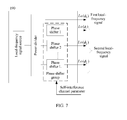
- FIG. 7 is a schematic structural diagram of a local-frequency signal generator according to an embodiment of the present invention.
- FIG. 8 is a schematic structural diagram of an interference cancellation apparatus according to another embodiment of the present invention.
- FIG. 9 is a schematic structural diagram of an interference cancellation apparatus according to still another embodiment of the present invention.
- FIG. 10 is a schematic flowchart of an interference cancellation method according to an embodiment of the present invention.
- a part may be, but is not limited to, a process that runs on a processor, a processor, an object, an executable file, a thread of execution, a program, and/or a computer.
- a computing device and an application that runs on a computing device may be parts.
- One or more parts may reside within a process and/or a thread of execution, and a part may be located on one computer and/or distributed between two or more computers.
- these parts may be executed from various computer-readable media that store various data structures.
- the parts may communicate by using a local and/or remote process and according to, for example, a signal having one or more data packets.
- An interference cancellation apparatus may be disposed in an access terminal that uses a wireless full duplex technology, or itself may be an access terminal that uses a wireless full duplex technology.
- An access terminal may also be referred to as a system, a subscriber unit, a subscriber station, a mobile station, a mobile, a remote station, a remote terminal, a mobile device, a user terminal, a terminal, a wireless communications device, user agent, a user apparatus, or user equipment (UE).
- the access terminal may be a cellular phone, a cordless phone, a SIP (Session Initiation Protocol) phone, a WLL (Wireless Local Loop) station, a PDA (Personal Digital Assistant), a handheld device having a wireless communication function, an in-vehicle device, a wearable device, a computing device, or another processing device connected to a wireless modem.
- SIP Session Initiation Protocol
- WLL Wireless Local Loop
- PDA Personal Digital Assistant
- the interference cancellation apparatus may also be disposed in a base station that uses the wireless full duplex technology, or itself may be a base station that uses the wireless full duplex technology.
- the base station may be configured to communicate with a mobile device.
- the base station may be an AP (Access Point) of Wi-Fi, or a BTS (Base Transceiver Station) in a GSM (Global System for Mobile Communications) or a CDMA (Code Division Multiple Access) system, or may be an NB (NodeB) in a WCDMA (Wideband Code Division Multiple Access) system, or may be an eNB or an eNodeB (evolved NodeB) in an LTE (Long Term Evolution) system, or a relay station or an access point, or a base station device in a future 5G network, or the like.
- AP Access Point
- BTS Base Transceiver Station
- GSM Global System for Mobile Communications
- CDMA Code Division Multiple Access
- NB NodeB
- WCDMA Wideband Code Division Multiple Access
- eNB evolved NodeB
- LTE Long Term Evolution
- aspects or features of the present invention may be implemented as an apparatus or a product that uses standard programming and/or engineering technologies.
- the term “product” used in this application covers a computer program that can be accessed from any computer-readable part, carrier or medium.
- the computer-readable medium may include but is not limited to: a magnetic storage part (for example, a hard disk, a floppy disk or a magnetic tape), an optical disc (for example, a CD (Compact Disk), a DVD (Digital Versatile Disk), a smart card and a flash memory part (for example, EPROM (Erasable Programmable Read-Only Memory), a card, a stick, or a key drive).
- various storage media described in this specification may indicate one or more devices and/or other machine-readable media that is used to store information.
- machine-readable media may include but is not limited to a radio channel, and various other media that can store, include and/or carry an instruction and/or data.
- interference cancellation may be canceling all interference components in a signal (including a first-type self-interference component and a second-type self-interference component), or may be canceling some interference components in a signal (including a part of a first-type self-interference component and a part of a second-type self-interference component).
- FIG. 2 is a schematic structural diagram of an interference cancellation apparatus according to an embodiment of the present invention.
- an apparatus ( 100 ) provided by this embodiment includes:
- FIG. 2 further shows a divider ( 200 ). Because a fifth processed signal output by the output end ( 172 ) of the digital down-conversion unit ( 170 ) is used as a baseband receive signal, and at the same time the fifth processed signal is used as an input signal of the second-type interference reconstructor ( 180 ), the divider ( 200 ) needs to be used to divide the fifth processed signal.
- a connection relationship of the divider ( 200 ) is as follows: An input end ( 201 ) of the divider ( 200 ) is connected to the output end ( 172 ) of the digital down-conversion unit ( 170 ), a first output end ( 202 ) of the divider ( 200 ) outputs the fifth processed signal, and a third output end ( 203 ) of the divider ( 200 ) is connected to the second input end 182 of the second-type interference reconstructor ( 180 ).
- the main receive antenna ( 110 ) is configured to receive a radio frequency signal, and transmit the received radio frequency signal to the first-type interference canceller ( 130 ).
- the divider ( 120 ) is configured to acquire a radio frequency reference signal generated according to a transmit signal, and transmit the radio frequency reference signal to the first-type interference canceller ( 130 ) and the second-type interference reconstructor ( 150 ).
- the first-type interference canceller ( 130 ) is configured to receive the radio frequency reference signal transmitted by the divider ( 120 ) and the received radio frequency signal transmitted by the main receive antenna ( 110 ), and cancel a first-type self-interference component in the received radio frequency signal according to the radio frequency reference signal to acquire a first processed signal, where the first-type self-interference component includes a main-path self-interference component.
- the local-frequency signal generator ( 190 ) is configured to acquire a self-interference channel parameter acquired by the second-type interference reconstructor ( 180 ), and generate the first local-frequency signal and the second local-frequency signal according to the self-interference channel parameter.
- the down converter ( 140 ) is configured to receive the first local-frequency signal generated by the local-frequency signal generator ( 190 ) and the first processed signal acquired by the first-type interference canceller ( 130 ), and perform frequency mixing processing on the first local-frequency signal and the first processed signal to acquire a second processed signal.
- the filter ( 150 ) is configured to receive the second processed signal, and perform filtering processing on the second processed signal to acquire a third processed signal.
- the second-type interference reconstructor ( 180 ) is configured to acquire the second local-frequency signal generated by the local-frequency signal generator ( 190 ) and the radio frequency reference signal acquired by the divider ( 120 ), and the self-interference signal is reconstructed according to the self-interference channel parameter, the radio frequency reference signal, and the second local-frequency signal.
- the coupler ( 160 ) is configured to receive the third processed signal acquired by the filter ( 150 ) and the reconstructed self-interference signal transmitted by the second-type interference reconstructor ( 180 ), and cancel a second-type self-interference signal in the third processed signal according to the reconstructed self-interference signal to generate a fourth processed signal.
- the digital down-conversion unit ( 170 ) is configured to receive the fourth processed signal, convert the fourth processed signal into a digital signal, and perform digital down-conversion processing on the digital signal to acquire a fifth processed signal.
- the second-type interference reconstructor ( 180 ) is further configured to acquire a digital baseband reference signal, receive the fifth processed signal transmitted by the digital down-conversion unit ( 170 ), and perform self-interference channel estimation according to the fifth processed signal and the digital baseband reference signal to acquire the self-interference channel parameter.
- a coupler or a power divider may be used as the divider ( 120 ).
- a transmit signal obtained after baseband processing may be used as a radio frequency reference signal, and input to the divider ( 120 ) through the input end ( 121 ) of the divider ( 120 ).
- the divider ( 120 ) can divide the radio frequency reference signal into two signals.
- One signal is transmitted to the second input end ( 132 ) of the first-type interference canceller ( 130 ) through the first output end ( 122 ) of the divider ( 120 ) and is received by the first-type interference canceller ( 130 ).
- the other signal is transmitted to the first input end ( 181 ) of the second-type interference reconstructor ( 180 ) through the second output end ( 123 ) of the divider ( 120 ) and is received by the second-type interference reconstructor ( 180 ).
- the coupler or power divider is used as the divider ( 120 ) in such a manner that waveforms of the two signals output from the divider ( 120 ) can be consistent with that of the radio frequency reference signal, which is advantageous to subsequent interference cancellation based on the radio frequency reference signal.
- power of the two signals that the radio frequency reference signal is divided into may be the same or may be different, which is not particularly limited by the present invention.
- the process of transmitting the transmit signal after baseband processing may be similar to that in the prior art.
- the description of the process is omitted.
- the first-type interference canceller ( 130 ) may include a divider a, a combiner a, and a combiner b, where at least one transmission path constituted by at least one of a delayer, a phase adjuster, and an amplitude adjuster connected in series is included between the divider a and the combiner a, where an output end of the combiner a is connected to an input end of the combiner b.
- the first-type interference canceller ( 130 ) has two input ends.
- the divider a may be a power divider
- the combiner a and the combiner b may be couplers.
- the first input end ( 131 ) (namely, an input port of the combiner b) of the first-type interference canceller ( 130 ) is connected to the output end of the main receive antenna ( 110 ), and is configured to receive a signal (namely, a received radio frequency signal) from the output end of the main receive antenna ( 110 );
- the second input end ( 132 ) (namely, an input port of the divider a) of the first-type interference canceller ( 130 ) is connected to the first output end ( 122 ) of the divider ( 120 ), and is configured to receive one radio frequency reference signal from the divider ( 120 ).
- the first-type interference canceller ( 130 ) is specifically configured to perform, based on the received radio frequency signal, delay processing, amplitude adjustment processing, and phase adjustment processing on the radio frequency reference signal, so that an amplitude of the radio frequency reference signal is in a direction opposite or approximately opposite to an amplitude of the first-type self-interference component in the received radio frequency signal, and that a phase of the radio frequency reference signal is the same or approximately the same as a phase of the first-type self-interference component in the received radio frequency signal; or
- the second input end ( 132 ) of the first-type interference canceller ( 130 ) is connected to the first output end ( 122 ) of the divider ( 120 ), and a signal (namely, a radio frequency reference signal) output from the first output end ( 122 ) of the divider ( 120 ) is input through the second input end ( 132 ) of the first-type interference canceller ( 130 ) to the divider a, where the divider a may be a power divider.
- the divider a divides the radio frequency reference signal into several radio frequency reference signals (power of the several radio frequency reference signals may be the same or different).
- an output end of the divider a outputs one radio frequency reference signal to an adjustment circuit constituted by a delayer, a phase adjuster, and an amplitude adjuster that are connected in series, where the adjustment circuit is configured to adjust a delay, an amplitude, and a phase of a signal by means of delaying, attenuation, phase shifting, and the like.
- the amplitude of the radio frequency reference signal may approach the amplitude of the first-type self-interference component (including a main-path self-interference signal component) in the received radio frequency signal.
- the amplitudes are the same.
- the amplitudes may be adjusted to approximately the same.
- the difference between the phase of the radio frequency reference signal and the phase of the received radio frequency signal (specifically, the first-type self-interference component in the received radio frequency signal) may be adjusted to (180) degrees or approximately 180 degrees.
- the amplitude of the radio frequency reference signal may be in a direction opposite to the amplitude of the first-type self-interference component in the received radio frequency signal.
- a best effect is that directions of the amplitudes are opposite.
- the directions of the amplitudes may be adjusted to be approximately opposite.
- the phase of the radio frequency reference signal may be adjusted to be the same or approximately the same as the phase of the received radio frequency signal (specifically, the first-type self-interference component in the received radio frequency signal).
- the divider divides the radio frequency reference signal into multiple signals, and finally the signals are combined by the combiner a, the delay processing, amplitude adjustment processing, and phase adjustment processing may also be functions that occur on each tributary output by the divider, and finally, after combination, objectives of the delay processing, amplitude adjustment processing, and phase adjustment processing of the radio frequency reference signal input at the input end of the divider are achieved, that is, each tributary output by the divider may include at least one of a delayer, a phase adjuster, and an amplitude adjuster.
- the amplitude adjustment may be expressed as attenuation or gain, and only attenuation is used as an example for description in the foregoing embodiment.
- “approximately” may indicate that a similarity between two is within a preset range, where the preset range may be determined at random according to actual use and requirements, and is not particularly limited by the present invention. For avoiding repetition, similar descriptions in the following are omitted unless otherwise specified.
- the combiner b may combine the received radio frequency signal with the radio frequency reference signal obtained after the amplitude and phase adjustment and combination (for example, add the radio frequency reference signal to the radio frequency receive signal or subtract the radio frequency reference signal from the radio frequency receive signal), to cancel the first-type self-interference component in the received radio frequency signal, thereby implementing first-type self-interference component cancellation processing for the received radio frequency signal.
- the amplitude adjuster may be, for example, an attenuator.
- the phase adjuster may be, for example, a phase shifter.
- the delayer may be, for example, a delay line.
- the first processed signal output from the output end ( 133 ) (specifically, the output end of the combiner b) of the first-type interference canceller ( 130 ) is a signal generated by canceling the first-type self-interference component in the received radio frequency signal.
- the delayer, phase adjuster, and amplitude adjuster may be adjusted in a manner of minimizing strength of the first processed signal output by the combiner b, based on the output of the combiner b.
- the present invention is not limited to the foregoing implementation manner. As long as strength of the received radio frequency signal can be reduced according to the radio frequency reference signal (or strength of the first processed signal is less than strength of the received radio frequency signal), an interference cancellation effect can be achieved.
- the down converter ( 140 ) may be a mixer.
- the down converter ( 140 ) receives, through the first input end ( 141 ), the first processed signal output by the output end ( 133 ) of the first-type interference canceller ( 130 ).
- the down converter ( 140 ) receives, through the second input end ( 142 ), the first local-frequency signal output by the first output end ( 192 ) of the local-frequency signal generator ( 190 ), and performs frequency mixing processing on the first local-frequency signal and the first processed signal to acquire a second processed signal, where the first local-frequency signal is a signal having a preset frequency difference f IF from a radio frequency carrier of a transmit signal of a peer end, so that the generated second processed signal is a low or intermediate frequency signal centered on f IF .
- the filter ( 150 ) may be exemplarily a low-pass filter of a band-pass type or a band-stop type.
- the input end ( 151 ) of the filter ( 150 ) receives the second processed signal output by the output end ( 143 ) of the down converter ( 140 ).
- the filter ( 150 ) performs filtering processing on the second processed signal to generate a third processed signal after filtering a high frequency component in the second processed signal, and outputs the third processed signal to the first input end ( 161 ) of the coupler ( 160 ) through the output end ( 152 ) of the filter ( 150 ).
- the coupler ( 160 ) is configured to receive, through the first input end ( 161 ), the third processed signal output by the output end ( 152 ) of the filter ( 150 ).
- the coupler ( 160 ) is further configured to receive, through the second input end ( 162 ), the reconstructed self-interference signal transmitted by the first output end ( 185 ) of the second-type interference reconstructor ( 180 ), cancel a second-type self-interference signal in the first processed signal according to the reconstructed self-interference signal to generate a fourth processed signal, and output the fourth processed signal to the input end ( 171 ) of the digital down-conversion unit ( 170 ) through the output end ( 163 ) of the coupler ( 160 ).
- the digital down-conversion unit ( 170 ) is configured to receive, through the input end ( 171 ), the fourth processed signal output by the output end ( 163 ) of the coupler ( 160 ), convert the fourth processed signal into a digital signal, and perform digital down-conversion processing on the digital signal to acquire a fifth processed signal, and output the fifth processed signal to the input end ( 201 ) of the divider ( 200 ) through the output end ( 172 ) of the digital down-conversion unit ( 170 ).
- the digital down-conversion unit ( 170 ) includes an ADC ( 1701 ) and a digital down converter ( 1702 ).
- the ADC ( 1701 ) is specifically configured to convert the fourth processed signal into the digital signal; and the digital down converter ( 1702 ) is configured to perform digital down-conversion processing on the digital signal to acquire the fifth processed signal.
- Second-Type Interference Reconstructor ( 180 )
- the second-type interference reconstructor ( 180 ) may include a self-interference estimation module ( 1801 ) and a self-interference signal reconstruction module ( 1802 ).
- the self-interference estimation module ( 1801 ) is configured to acquire the digital baseband reference signal, receive the fifth processed signal transmitted by the digital down-conversion unit ( 170 ), and perform self-interference channel estimation according to the digital baseband reference signal and the fifth processed signal to acquire the self-interference channel parameter.
- the self-interference estimation module ( 1801 ) includes any one of a field-programmable gate array FPGA (Field-Programmable Gate Array), a central processing unit CPU (Central Processing Unit), or another application-specific integrated circuit ASIC (Application Specific Integrated Circuit).
- FPGA Field-Programmable Gate Array
- CPU Central Processing Unit
- ASIC Application Specific Integrated Circuit
- the transmit signal includes a self-interference channel estimation timeslot and a data transmission timeslot that are disposed at an interval.
- full duplex data communication may be performed.
- a communications peer does not transmit data
- a signal received by a local receiver includes only a self-interference signal.
- the local receive end uses the self-interference channel estimation timeslot to perform self-interference channel estimation to acquire a self-interference channel parameter.
- the received radio frequency signal includes only a second-type self-interference component.
- self-interference channel estimation is performed according the digital baseband reference signal and the digital signal that is acquired by processing the received radio frequency signal. Therefore, in the self-interference channel estimation timeslot, the communications peer does not transmit a signal, and a signal received by the receiver includes only a self-interference signal. Because there is no signal from the communications peer, the receiver may perform self-interference channel estimation in the self-interference channel estimation timeslot to acquire a self-interference channel parameter, where the self-interference channel parameter may include parameters indicating a transmission path delay, a phase, and an amplitude of a second-type self-interference component.
- a signal received by the receiver includes a self-interference signal and a data signal
- the receiver may reconstruct a self-interference signal in the data transmission timeslot according to the radio frequency reference signal and the self-interference channel parameter, and use the reconstructed self-interference signal to cancel the second-type self-interference component.
- the self-interference signal reconstruction module ( 1802 ) is configured to acquire the second local-frequency signal generated by the local-frequency signal generator ( 190 ), receive the radio frequency reference signal acquired by the divider ( 120 ) and the self-interference channel parameter acquired by the self-interference estimation module ( 1801 ), and reconstruct the self-interference signal according to the self-interference channel parameter, the radio frequency reference signal, and the second local-frequency signal.
- FIG. 4 further shows a divider ( 1803 ), where an input end of the divider ( 1803 ) is configured to receive the self-interference channel parameter transmitted by the second-type interference reconstructor ( 180 ).
- the divider ( 1803 ) divides the self-interference channel parameter into two. One is output to the self-interference signal reconstruction module ( 1802 ) through a first output end of the divider ( 1803 ), and the other is output to the local-frequency signal generator ( 190 ) through the second output end ( 186 ) of the second-type interference reconstructor ( 180 ) that is connected to a second output end of the divider ( 1803 ).
- the self-interference signal reconstruction module ( 1802 ) includes:
- the first delayer group may include M delayers and M combiners, which are configured to perform delaying on the radio frequency reference signal for at most M times and form delay signals of M radio frequency reference signals. Therefore, a quantity of delay taps that may be formed by the M delayers included in the first delayer group is M.
- the filtering processing by the low-pass filter is removing a high frequency signal in each radio frequency reference signal.
- the second delayer group may include M delayers and M combiners, which are configured to perform delaying on the radio frequency reference signal for at most M times and form delay signals of M radio frequency reference signals. Therefore, a quantity of delay taps that may be formed by the M delayers included in the second delayer group is M.
- the filtering processing by the low-pass filter is removing a high frequency signal in each radio frequency reference signal.
- a delay generated by each delay tap may be set to T, that is, each delayer may form a delay T for one radio frequency reference signal.
- the input end ( 191 ) of the local-frequency signal generator ( 190 ) is configured to receive the self-interference channel parameter through the second output end ( 186 ) of the second-type interference reconstructor ( 180 ), and generate the first local-frequency signal and the second local-frequency signal according to the self-interference channel parameter.
- the local-frequency signal generator ( 190 ) is further configured to transmit the first local-frequency signal to the second input end of the down converter ( 140 ) through the first output end ( 192 ), and transmit the second local-frequency signal to the fourth input end ( 184 ) of the second-type interference reconstructor ( 180 ) through the second output end ( 193 ).
- the local-frequency signal generator ( 190 ) includes:
- a local-frequency signal transmitted by the local-frequency signal source is Lo( ⁇ 0 ), and the first local-frequency signal is Lo( ⁇ 0 ), which means that no phase shift processing is performed on the local-frequency signal.
- the second local-frequency signal includes L local-frequency signals Lo( ⁇ 1 ) to Lo( ⁇ L ) after phase shift processing is performed on the local-frequency signal.
- the second local-frequency signal is used by each mixer in the self-interference signal reconstruction module ( 1802 ) for performing frequency mixing on each radio frequency reference signal.
- each local-frequency signal, obtained after phase shift processing, in the second local-frequency signal is used as a local-frequency signal provided to a mixer.
- FIG. 2 further shows the divider ( 200 ). Its structure and operating principle are the same as those of the divider ( 120 ).
- the divider ( 200 ) is configured to divide the fifth processed signal. Specifically, the input end ( 201 ) of the divider ( 200 ) is connected to the output end ( 172 ) of the digital down-conversion unit ( 170 ); the first output end ( 202 ) of the divider ( 200 ) outputs the fifth processed signal; and the third output end ( 203 ) of the divider ( 200 ) is connected to the second input end ( 182 ) of the second-type interference reconstructor ( 180 ), and outputs the fifth processed signal to the second-type interference reconstructor ( 180 ).
- the interference cancellation apparatus further includes a first amplifier ( 210 ), where the first amplifier ( 210 ) is disposed between the coupler ( 160 ) and the digital down-conversion unit ( 170 ).
- a variable gain amplifier Variable Gain Amplifier, VGA
- VGA Variable Gain Amplifier
- the first amplifier ( 210 ) amplifies the fourth processed signal, which may reduce a requirement of a transmitter side on power of a radio frequency transmit signal.
- the interference cancellation apparatus includes:
- both the second amplifier and the third amplifier are LNAs.
- the second amplifier amplifies the first processed signal before noise reduction processing, and the third amplifier amplifies the reconstructed self-interference signal. In this way, a requirement on power of the radio frequency reference signal may be reduced, and the requirement of the transmitter side on the power of the radio frequency transmit signal is further reduced.
- the interference cancellation apparatus further includes:
- both the second amplifier and the fourth amplifier are LNAs.
- the second amplifier amplifies the first processed signal before noise reduction processing
- the fourth amplifier amplifies the radio frequency reference signal that enters the second-type interference reconstructor ( 180 ). In this way, the requirement on the power of the radio frequency reference signal may be reduced, and the requirement of the transmitter side on the power of the radio frequency transmit signal is further reduced.
- ⁇ is an angular frequency of a radio frequency carrier
- s i (t) and s q (t) are baseband I/Q signals of a transmit end; with an adverse impact of noise ignored, a received radio frequency signal that has passed through a radio channel may be expressed as:
- y ⁇ ( t ) s ⁇ ( t ) ⁇ h ⁇ ( t ) ⁇ ⁇
- h ⁇ ( t ) ⁇ k ⁇ h k ⁇ ⁇ ⁇ ( t - ⁇ k )
- formula ⁇ ⁇ ( 2 ) is a channel response
- h k is a multi-path channel coefficient corresponding to a delay ⁇ k
- formula (2) is further expressed as:
- y ⁇ ( t ) ⁇ k ⁇ h k ⁇ s i ⁇ ( t - ⁇ k ) ⁇ cos ⁇ ( ⁇ ⁇ ⁇ t - ⁇ k ) + ⁇ k ⁇ h k ⁇ s q ⁇ ( t - ⁇ k ) ⁇ sin ⁇ ( ⁇ ⁇ ⁇ t - ⁇ k ) formula ⁇ ⁇ ( 3 )
- a filter 140
- LPF low-pass filter a Low-Pass Filter
- ⁇ 0 is an initial phase of a local-frequency signal relative to the radio frequency carrier.
- s(t) is used as a radio frequency reference signal
- a filter ( 140 ) herein, a Low Pass Filter, LPF low-pass filter, is used
- an obtained signal is:
- formulas (5) and (7) indicate that a radio frequency transmit signal s(t) may be used as a radio frequency reference signal.
- the second-type interference reconstructor ( 180 ) reconstructs the low or intermediate frequency self-interference signal shown in formula (4): First, the input radio frequency reference signal is divided into multiple signals by a power divider.
- each signal is down-converted to a low or intermediate frequency ⁇ 0 by using the phase-shifted local-frequency signal, and then delayed by ⁇ k , and a reconstructed low or intermediate self-interference signal component of a corresponding path is obtained.
- Amplitudes h k of these components may be set by using an attenuator. Only a brief description is provided herein. For the specific process, reference may be made to the function description of the second-type interference reconstructor ( 180 ).
- a receive tributary corresponding to each receive antenna requires a near-field jammer corresponding to each transmit antenna, for reconstructing a self-interference signal corresponding to each transmit tributary and canceling first-type self-interference components one by one.
- MIMO Multiple Input Multiple Output
- interference cancellation processing is performed according to a radio frequency reference signal to cancel a first-type self-interference component in the received radio frequency signal and acquire a first processed signal; and further, after down-conversion processing is performed on the first processed signal, a self-interference signal is reconstructed through self-interference channel estimation to cancel a second-type self-interference component in the first processed signal. Because the reconstructed self-interference signal is used directly in an analog domain to cancel the second-type self-interference component, a limitation by a dynamic range of an ADC/DAC can be avoided, and the second-type self-interference component can be canceled effectively. Further, because the received radio frequency signal is converted to a low or intermediate frequency for processing, the second-type self-interference component can be traced and canceled more effectively.
- the interference cancellation apparatus according to the embodiment of the present invention is described in detail above with reference to FIG. 1 to FIG. 9 .
- the following describes in detail an interference cancellation method according to an embodiment of the present invention with reference to FIG. 10 .
- FIG. 10 shows a schematic flowchart of an interference cancellation method, where the method includes the following steps:
- a transmit signal obtained after baseband processing may be used as a radio frequency reference signal, and input to, for example, a coupler or a power divider. Therefore, the radio frequency reference signal can be divided into two signals by the coupler or power divider, where one signal is used to generate a first processed signal and the other signal is used to reconstruct a self-interference signal.
- step 110 specifically, digital sampling may be performed on the radio frequency reference signal to acquire the digital baseband reference signal.
- the coupler or power divider is used to divide the radio frequency reference signal into two signals in such a manner that waveforms of the two signals can be consistent with that of the transmit signal, which is advantageous to subsequent interference cancellation (including cancellation of the first-type self-interference component and cancellation of the second-type self-interference component) based on the radio frequency reference signal, where waveform consistency includes that the waveforms are the same as the waveform of the transmit signal or that a waveform similarity is within a preset range.
- the method further includes: amplifying the fourth processed signal.
- a variable gain amplifier VGA
- VGA variable gain amplifier
- the amplifying the fourth processed signal may reduce a requirement of a transmitter side on power of a radio frequency transmit signal.
- the method further includes: amplifying the first processed signal; and after step 107 , the method further includes: amplifying the reconstructed self-interference signal.
- Amplification of various signals is amplification performed by using a low noise amplifier (LNA). Separately amplifying the first processed signal and amplifying the reconstructed self-interference signal may reduce a requirement on power of the radio frequency reference signal, and further reduce the requirement of the transmitter side on the power of the radio frequency transmit signal.
- LNA low noise amplifier
- the method further includes: amplifying the first processed signal; and before the acquiring the reconstructed self-interference signal according to the self-interference channel parameter, the radio frequency reference signal, and the second local-frequency signal in step 107 , the method further includes: amplifying the radio frequency reference signal.
- Amplification of various signals is amplification performed by using a low noise amplifier (LNA).
- LNA low noise amplifier
- the canceling a first-type self-interference component in the received radio frequency signal according to the radio frequency reference signal, to generate a first processed signal in step 103 includes:
- an amplitude of the radio frequency reference signal is the same or approximately the same as an amplitude of the first-type self-interference component in the received radio frequency signal, and that a difference between a phase of the reference signal and a phase of the first-type self-interference component in the received radio frequency signal is 180 degrees or approximately 180 degrees.
- an adjustment circuit constituted by a delayer, a phase adjuster, and an amplitude adjuster that are connected in series may be used for implementation. Therefore, in step 103 , the amplitude and phase of the radio frequency reference signal may be adjusted by the adjustment circuit through delaying, phase shifting, attenuation, and the like. For example, through attenuation, the amplitude of the radio frequency reference signal may approach the amplitude of the first-type self-interference component in the received radio frequency signal. Certainly, a best effect is that the amplitudes are the same. However, because an error exists in an actual application, the amplitudes may be adjusted to approximately the same. In addition, through phase shifting and/or delaying, the phase of the radio frequency reference signal may be adjusted to be opposite or approximately opposite to the phase of the first-type self-interference component (including a main-path interference signal) in the received radio frequency signal.
- radio frequency reference signals obtained after delaying, and amplitude and phase adjustment may be combined with (for example, added to) the received radio frequency signal, to cancel the first-type self-interference component in the received radio frequency signal.
- first-type self-interference component cancellation processing is implemented for the received radio frequency signal, and the signal obtained after the processing is used as the first processed signal.
- the amplitude adjuster may be, for example, an attenuator.
- the phase adjuster may be, for example, a phase shifter, and the delayer may be a delay line.
- the delayer, phase shifter, and attenuator may also be adjusted in a manner of minimizing strength of the first processed signal.
- the acquiring the reconstructed self-interference signal according to the self-interference channel parameter, the radio frequency reference signal, and the second local-frequency signal in step 107 includes:
- the acquiring the reconstructed self-interference signal according to the self-interference channel parameter, the radio frequency reference signal, and the second local-frequency signal in step 107 includes:
- the generating the first local-frequency signal and the second local-frequency signal according to a self-interference channel parameter in step 104 includes:
- the transmit signal includes a self-interference channel estimation timeslot and a data transmission timeslot that are disposed at an interval.
- a communications peer does not transmit a signal
- a signal received by a receiver includes only a self-interference signal.
- the receiver may perform self-interference channel estimation in the self-interference channel estimation timeslot to acquire a self-interference channel parameter, where the self-interference channel parameter may include parameters indicating a transmission path delay, a phase, and an amplitude of a second-type self-interference component.
- a signal received by the receiver includes a self-interference signal and a data signal
- the receiver may generate a reconstructed self-interference signal in the data transmission timeslot according to the radio frequency reference signal and the self-interference channel parameter, and use the reconstructed self-interference signal to cancel the second-type self-interference component.
- interference cancellation processing is performed according to a radio frequency reference signal to cancel a first-type self-interference component in the received radio frequency signal and acquire a first processed signal; and further, after down-conversion processing is performed on the first processed signal, a self-interference signal is reconstructed through self-interference channel estimation to cancel a second-type self-interference component in the first processed signal. Because the reconstructed self-interference signal is used directly in an analog domain to cancel the second-type self-interference component, a limitation by a dynamic range of an ADC/DAC can be avoided, and the second-type self-interference component can be canceled effectively. Further, because the received radio frequency signal is converted to a low or intermediate frequency for processing, the second-type self-interference component can be traced and canceled more effectively.
- sequence numbers of the foregoing processes do not mean execution sequences in various embodiments of the present invention.
- the execution sequences of the processes should be determined according to functions and internal logic of the processes, and should not be construed as any limitation on the implementation processes of the embodiments of the present invention.
- the disclosed apparatus may be implemented in other manners.
- the described apparatus embodiment is merely exemplary.
- the unit division is merely logical function division and may be other division in actual implementation.
- a plurality of units or parts may be combined or integrated into another system, or some features may be ignored or not performed.
- the shown or discussed mutual couplings or direct couplings or communication connections may be implemented through some interfaces.
- the indirect couplings or communication connections between the apparatuses or units may be implemented in electrical, mechanical, or other forms.
- the units described as separate parts may or may not be physically separated, and parts shown as units may or may not be physical units, may be located in one position, or may be distributed on a plurality of network units. Some or all of the units may be selected according to actual needs to achieve the objectives of the solutions of the embodiments.
- functional units in the embodiments of the present invention may be integrated into one processing unit, or each of the units may exist alone physically, or two or more units are integrated into one unit.
- the functions When the functions are implemented in the form of a software functional unit and sold or used as an independent product, the functions may be stored in a computer-readable storage medium. Based on such an understanding, the technical solutions of the present invention essentially, or the part contributing to the prior art, or some of the technical solutions may be implemented in a form of a software product.
- the computer software product is stored in a storage medium, and includes several instructions for instructing a computer device (which may be a personal computer, a server, or a network device) to perform all or some of the steps of the methods described in the embodiments of the present invention.
- the foregoing storage medium includes: any medium that can store program code, such as a USB flash drive, a removable hard disk, a read-only memory (ROM, Read-Only Memory), a random access memory (RAM, Random Access Memory), a magnetic disk, or an optical disc.
- program code such as a USB flash drive, a removable hard disk, a read-only memory (ROM, Read-Only Memory), a random access memory (RAM, Random Access Memory), a magnetic disk, or an optical disc.
Landscapes
- Engineering & Computer Science (AREA)
- Signal Processing (AREA)
- Computer Networks & Wireless Communication (AREA)
- Power Engineering (AREA)
- Quality & Reliability (AREA)
- Noise Elimination (AREA)
- Bidirectional Digital Transmission (AREA)
- Dc Digital Transmission (AREA)
- Cable Transmission Systems, Equalization Of Radio And Reduction Of Echo (AREA)
- Mobile Radio Communication Systems (AREA)
Applications Claiming Priority (1)
| Application Number | Priority Date | Filing Date | Title |
|---|---|---|---|
| PCT/CN2014/080864 WO2015196425A1 (zh) | 2014-06-26 | 2014-06-26 | 一种干扰消除的装置和方法 |
Related Parent Applications (1)
| Application Number | Title | Priority Date | Filing Date |
|---|---|---|---|
| PCT/CN2014/080864 Continuation WO2015196425A1 (zh) | 2014-06-26 | 2014-06-26 | 一种干扰消除的装置和方法 |
Publications (2)
| Publication Number | Publication Date |
|---|---|
| US20170111155A1 US20170111155A1 (en) | 2017-04-20 |
| US10084584B2 true US10084584B2 (en) | 2018-09-25 |
Family
ID=54936487
Family Applications (1)
| Application Number | Title | Priority Date | Filing Date |
|---|---|---|---|
| US15/390,257 Active US10084584B2 (en) | 2014-06-26 | 2016-12-23 | Interference cancellation apparatus and method |
Country Status (13)
| Country | Link |
|---|---|
| US (1) | US10084584B2 (de) |
| EP (1) | EP3151495B1 (de) |
| JP (1) | JP6339702B2 (de) |
| KR (1) | KR101883123B1 (de) |
| CN (1) | CN106464617B (de) |
| AU (1) | AU2014399206B2 (de) |
| BR (1) | BR112016030000B1 (de) |
| CA (1) | CA2953636C (de) |
| MX (1) | MX357813B (de) |
| RU (1) | RU2651585C1 (de) |
| SG (1) | SG11201610674QA (de) |
| WO (1) | WO2015196425A1 (de) |
| ZA (1) | ZA201608818B (de) |
Cited By (2)
| Publication number | Priority date | Publication date | Assignee | Title |
|---|---|---|---|---|
| RU2724039C1 (ru) * | 2019-07-15 | 2020-06-18 | Тимофей Андреевич Семенюк | Устройство для блокирования несанкционированной передачи информации управления |
| US11405792B2 (en) | 2020-05-15 | 2022-08-02 | Microsoft Technology Licensing, Llc | Device communication over television white space |
Families Citing this family (31)
| Publication number | Priority date | Publication date | Assignee | Title |
|---|---|---|---|---|
| CN106464616B (zh) | 2014-06-26 | 2019-10-22 | 华为技术有限公司 | 一种干扰消除的装置和方法 |
| SG11201610674QA (en) | 2014-06-26 | 2017-02-27 | Huawei Tech Co Ltd | Interference cancellation apparatus and method |
| JP6562566B2 (ja) | 2014-06-26 | 2019-08-21 | 華為技術有限公司Huawei Technologies Co.,Ltd. | 干渉除去の装置および方法 |
| CN105119629B (zh) * | 2015-07-10 | 2018-04-06 | 惠州Tcl移动通信有限公司 | 同时同频全双工终端和系统 |
| KR102312579B1 (ko) * | 2015-08-04 | 2021-10-14 | 삼성전자 주식회사 | 비직교 파형을 갖는 다중 반송파 시스템에서 간섭 성분을 구성하고 채널을 추정하는 방법 및 장치 |
| US10230423B2 (en) * | 2015-11-10 | 2019-03-12 | Huawei Technologies Canada Co., Ltd. | System and method for balanced passive cancellation for full duplex communications |
| FR3052311B1 (fr) * | 2016-06-06 | 2019-08-02 | Airbus Ds Slc | Dispositif et procede pour le traitement d'un signal recu par un recepteur perturbe par un emetteur |
| US10666370B2 (en) * | 2016-06-10 | 2020-05-26 | Apple Inc. | Multiple modulated spur cancellation apparatus |
| US10389510B2 (en) * | 2016-07-22 | 2019-08-20 | Electronics And Telecommunications Research Institute | Self-interference signal cancellation apparatus and transceiver including the same |
| TWI631833B (zh) * | 2016-12-14 | 2018-08-01 | 財團法人工業技術研究院 | 資料傳輸模式設定方法及應用其之基站裝置以及終端裝置 |
| US10320431B2 (en) * | 2017-07-27 | 2019-06-11 | Huawei Technologies Co., Ltd. | Method and apparatus for interference cancellation in full-duplex multi-cell networks |
| FR3071687A1 (fr) * | 2017-09-27 | 2019-03-29 | Commissariat A L'energie Atomique Et Aux Energies Alternatives | Dispositif et procede de reduction du signal d'auto-interference dans un systeme de communication bidirectionnel simultane |
| US10615886B2 (en) | 2018-08-21 | 2020-04-07 | At&T Intellectual Property I, L.P. | Method and apparatus for mitigating radio interference |
| KR102833887B1 (ko) * | 2018-12-11 | 2025-07-14 | 삼성전자 주식회사 | 안테나를 통해 수신된 신호의 적어도 일부를 감쇄하기 위한 전자 장치 및 통신 신호 제어 방법 |
| CN115441899B (zh) * | 2018-12-14 | 2024-08-16 | 北京三星通信技术研究有限公司 | 时延网络及包括时延网络的模拟消除模块和电子设备 |
| CN109802709B (zh) * | 2019-01-07 | 2021-06-04 | 复旦大学 | 基于mimo通信系统模拟移相器的网络强干扰消除算法 |
| CN111865361B (zh) * | 2019-04-25 | 2023-03-24 | 华为技术有限公司 | 一种全双工自干扰消除方法和装置 |
| RU2716390C1 (ru) * | 2019-05-07 | 2020-03-11 | Тимофей Андреевич Семенюк | Устройство для защиты от радиоуправляемых взрывных устройств |
| CN114667686B (zh) * | 2019-11-25 | 2025-08-22 | 华为技术有限公司 | 一种信号处理方法和网络设备 |
| CN112993572B (zh) * | 2019-12-02 | 2025-01-24 | 中兴通讯股份有限公司 | 一种降低usb对天线干扰装置及终端 |
| CN110890899B (zh) * | 2019-12-25 | 2024-04-09 | 中电科航空电子有限公司 | 机载电磁波设备干扰抑制系统、方法及耦合天线确定方法 |
| CN114667683B (zh) * | 2020-01-23 | 2023-07-25 | Oppo广东移动通信有限公司 | 一种干扰消除方法及装置 |
| RU2746212C1 (ru) * | 2020-08-07 | 2021-04-08 | Общество с ограниченной ответственностью «АРЛИ спецтехника» | Устройство для защиты от радиоуправляемых взрывных устройств |
| US11245430B1 (en) * | 2020-08-14 | 2022-02-08 | Apple Inc. | Wireless transmitters having self-interference cancellation circuitry |
| KR102796035B1 (ko) * | 2021-01-21 | 2025-04-16 | 하이테라 커뮤니케이션즈 코포레이션 리미티드 | 적응적 간섭 방지 방법 및 적응적 간섭 방지 장치 |
| RU2760961C1 (ru) * | 2021-04-19 | 2021-12-01 | Федеральное государственное бюджетное образовательное учреждение высшего образования "Рязанский государственный радиотехнический университет имени В.Ф. Уткина" | Вычислитель-компенсатор пассивных помех |
| CN113676205B (zh) * | 2021-08-17 | 2025-09-19 | 天津七六四通信导航技术股份有限公司 | 一种全双工数据通信装置 |
| CN114024567B (zh) * | 2021-10-27 | 2023-05-09 | 中国电子科技集团公司第三十六研究所 | 一种多抽头延时电路及其设计方法 |
| EP4311113B1 (de) | 2022-07-21 | 2026-04-08 | Rohde & Schwarz GmbH & Co. KG | Funkfrequenzempfänger und betriebsverfahren dafür |
| CN116112029B (zh) * | 2023-03-02 | 2026-03-03 | 深圳市德雄科技有限公司 | 基于合路器射频处理方法、系统 |
| US20250096827A1 (en) * | 2023-09-19 | 2025-03-20 | Qualcomm Incorporated | Feedback receiver (fbrx) path and closed loop control for transmitter (tx) interference cancellation |
Citations (53)
| Publication number | Priority date | Publication date | Assignee | Title |
|---|---|---|---|---|
| SU675382A1 (en) | 1977-08-01 | 1979-07-25 | Vladimir K Volkov | Noise suppressing device |
| US5691978A (en) | 1995-04-07 | 1997-11-25 | Signal Science, Inc. | Self-cancelling full-duplex RF communication system |
| JPH10190361A (ja) | 1996-11-04 | 1998-07-21 | Samsung Electron Co Ltd | 線形増幅装置及び方法 |
| KR19990060622A (ko) | 1997-12-31 | 1999-07-26 | 윤종용 | 혼변조신호의 개별차수 조정 전치왜곡 선형화장치 및 방법 |
| KR20000009734U (ko) | 1998-11-10 | 2000-06-05 | 서평원 | 전력증폭기의 다중 선형화 회로 |
| US6229992B1 (en) | 1994-11-15 | 2001-05-08 | University Of Bristol | Full-duplex radio transmitter/receiver |
| JP2001196994A (ja) | 2000-01-06 | 2001-07-19 | Kddi Corp | 符号分割多元接続方式用リピータ装置 |
| US20030098806A1 (en) | 2001-11-27 | 2003-05-29 | Green Evan R. | Rejecting interference for simultaneous received signals |
| WO2004107596A1 (en) | 2003-06-03 | 2004-12-09 | Siemens Aktiengesellschaft | Method to overcome self-interference in a tdd system |
| US20070184782A1 (en) * | 2006-02-03 | 2007-08-09 | Sahota Gurkanwal S | Baseband transmitter self-jamming and intermodulation cancellation device |
| US20080008126A1 (en) | 2006-07-07 | 2008-01-10 | Ntt Docomo, Inc. | Wireless communication device and wireless communication method |
| US20080107046A1 (en) * | 2006-11-06 | 2008-05-08 | Nokia Corporation | Analog signal path modeling for self-interference cancellation |
| CN101453228A (zh) | 2007-12-04 | 2009-06-10 | 松下电器产业株式会社 | 共站址干扰消除系统和方法 |
| WO2009114638A1 (en) | 2008-03-11 | 2009-09-17 | Qualcomm Incorporated | High-linearity receiver with transmit leakage cancellation |
| CN101656562A (zh) | 2009-09-22 | 2010-02-24 | 武汉虹信通信技术有限责任公司 | 一种实现直放站自激干扰消除的装置及方法 |
| US7729431B2 (en) | 2003-11-17 | 2010-06-01 | Quellan, Inc. | Method and system for antenna interference cancellation |
| US7804760B2 (en) | 2003-08-07 | 2010-09-28 | Quellan, Inc. | Method and system for signal emulation |
| US20110285508A1 (en) * | 2010-05-18 | 2011-11-24 | Lsis Co., Ltd. | Apparatus for removing transmission leakage signal in rfid system and rfid system having the same |
| US20110300914A1 (en) * | 2010-06-04 | 2011-12-08 | Qualcomm Incorporated | Reducing power consumption by in-circuit measurement of receive band attenuation and/or noise |
| US20120002586A1 (en) | 2010-06-30 | 2012-01-05 | QULCOMM Incorporated | Hybrid radio architecture for repeaters using rf cancellation reference |
| US8249540B1 (en) | 2008-08-07 | 2012-08-21 | Hypres, Inc. | Two stage radio frequency interference cancellation system and method |
| CN103139115A (zh) | 2011-11-25 | 2013-06-05 | 华为技术有限公司 | 一种干扰对齐方法、装置及系统 |
| KR20130061326A (ko) | 2011-12-01 | 2013-06-11 | 연세대학교 산학협력단 | 노드, 릴레이 노드 및 이의 제어 방법 |
| CN103200140A (zh) | 2012-01-06 | 2013-07-10 | 北京大学 | 一种基于预均衡的干扰消除系统及方法 |
| CN103297069A (zh) | 2013-05-08 | 2013-09-11 | 北京工业大学 | 一种全双工无线电射频干扰删除装置与方法 |
| US20130301487A1 (en) | 2012-05-13 | 2013-11-14 | Amir Keyvan Khandani | Full Duplex Wireless Transmission with Self-Interference Cancellation |
| CN103427872A (zh) | 2013-09-03 | 2013-12-04 | 电子科技大学 | 一种同时同频全双工多抽头射频自干扰抵消系统及方法 |
| CN103427874A (zh) | 2013-09-03 | 2013-12-04 | 电子科技大学 | 多径环境下大发射功率同时同频自干扰抵消系统及方法 |
| US20140016515A1 (en) | 2012-07-13 | 2014-01-16 | At&T Intellectual Property I, L.P. | System and method for full duplex cancellation |
| CN103580720A (zh) | 2013-11-20 | 2014-02-12 | 东南大学 | 一种同频全双工自干扰抵消装置 |
| WO2014036930A1 (zh) | 2012-09-07 | 2014-03-13 | 华为技术有限公司 | 一种干扰信号的处理方法、装置和系统 |
| CN103701480A (zh) | 2013-12-31 | 2014-04-02 | 上海交通大学 | 无线全双工单输入单输出通信模拟自干扰信号消除装置 |
| WO2014061443A1 (ja) | 2012-10-17 | 2014-04-24 | 株式会社村田製作所 | 送受信装置 |
| WO2014108098A1 (en) | 2013-01-11 | 2014-07-17 | Huawei Technologies Co., Ltd. | Interference cancellation for division free duplexing or full duplex operation |
| US20140348018A1 (en) | 2011-02-03 | 2014-11-27 | The Board Of Trustees Of The Leland Stanford Junior University | Self-interference cancellation |
| WO2015048678A1 (en) | 2013-09-27 | 2015-04-02 | The Board Of Trustees Of The Leland Stanford Junior University | Self-interference cancellation for mimo radios |
| US9019849B2 (en) | 2011-11-07 | 2015-04-28 | Telefonaktiebolaget L M Ericsson (Publ) | Dynamic space division duplex (SDD) wireless communications with multiple antennas using self-interference cancellation |
| US20150156001A1 (en) | 2012-08-16 | 2015-06-04 | Huawei Technologies Co., Ltd. | Communication apparatus and space division duplex method thereof |
| US9100110B2 (en) | 2013-08-29 | 2015-08-04 | Qualcomm Incorporated | Non-linear interference cancellation with multiple aggressors |
| US9270308B2 (en) * | 2013-01-05 | 2016-02-23 | Huawei Technologies Co., Ltd. | Adaptive radio-frequency interference cancelling device, method, and receiver |
| US20160105211A1 (en) * | 2014-10-08 | 2016-04-14 | Lg Electronics Inc. | Method and apparatus for reconstructing desired signal in case of using full duplex radio (fdr) scheme |
| US9337885B2 (en) * | 2013-12-12 | 2016-05-10 | Kumu Networks, Inc. | Systems and methods for hybrid self-interference cancellation |
| US9407377B2 (en) * | 2012-09-07 | 2016-08-02 | Enmodus Limited | Interference cancellation |
| US20160226653A1 (en) | 2011-11-09 | 2016-08-04 | The Board Of Trustees Of The Leland Stanford Junior University | Self-interference cancellation for mimo radios |
| EP3068055A1 (de) | 2013-11-29 | 2016-09-14 | Huawei Technologies Co., Ltd. | Verfahren und vorrichtung zur verringerung von selbststörungssignalen eines kommunikationssystems |
| US20160277166A1 (en) * | 2013-11-29 | 2016-09-22 | Huawei Technologies Co., Ltd. | Method for Reducing Self-Interference Signal in Communications System, and Apparatus |
| US20160285502A1 (en) | 2013-12-04 | 2016-09-29 | Huawei Technologies Co., Ltd. | Self-interference cancellation method, transceiver, and communications device for transmit/receive shared antenna |
| US20170005773A1 (en) | 2014-03-20 | 2017-01-05 | Huawei Technologies Co., Ltd. | Apparatus and method for self-interference cancellation |
| US20170085398A1 (en) * | 2014-06-26 | 2017-03-23 | Huawei Technologies Co., Ltd. | Methods and Apparatuses for Interference Cancellation |
| US20170104506A1 (en) * | 2014-06-26 | 2017-04-13 | Huawei Technologies Co., Ltd. | Interference cancellation apparatus and method |
| US20170111155A1 (en) | 2014-06-26 | 2017-04-20 | Huawei Technologies Co., Ltd. | Interference cancellation apparatus and method |
| US9813168B2 (en) * | 2013-09-29 | 2017-11-07 | Huawei Technologies Co., Ltd. | Self-interference signal cancellation device and method |
| US9912374B2 (en) * | 2015-08-18 | 2018-03-06 | University Of Science & Technology Beijing | Full-duplex wireless communication method, antenna device and full-duplex wireless communication system |
-
2014
- 2014-06-26 SG SG11201610674QA patent/SG11201610674QA/en unknown
- 2014-06-26 JP JP2016575088A patent/JP6339702B2/ja active Active
- 2014-06-26 MX MX2016017320A patent/MX357813B/es active IP Right Grant
- 2014-06-26 CN CN201480079282.7A patent/CN106464617B/zh active Active
- 2014-06-26 BR BR112016030000-9A patent/BR112016030000B1/pt active IP Right Grant
- 2014-06-26 KR KR1020177000869A patent/KR101883123B1/ko active Active
- 2014-06-26 CA CA2953636A patent/CA2953636C/en active Active
- 2014-06-26 RU RU2017102322A patent/RU2651585C1/ru active
- 2014-06-26 AU AU2014399206A patent/AU2014399206B2/en active Active
- 2014-06-26 EP EP14895770.7A patent/EP3151495B1/de active Active
- 2014-06-26 WO PCT/CN2014/080864 patent/WO2015196425A1/zh not_active Ceased
-
2016
- 2016-12-21 ZA ZA2016/08818A patent/ZA201608818B/en unknown
- 2016-12-23 US US15/390,257 patent/US10084584B2/en active Active
Patent Citations (62)
| Publication number | Priority date | Publication date | Assignee | Title |
|---|---|---|---|---|
| SU675382A1 (en) | 1977-08-01 | 1979-07-25 | Vladimir K Volkov | Noise suppressing device |
| US6229992B1 (en) | 1994-11-15 | 2001-05-08 | University Of Bristol | Full-duplex radio transmitter/receiver |
| US5691978A (en) | 1995-04-07 | 1997-11-25 | Signal Science, Inc. | Self-cancelling full-duplex RF communication system |
| JPH10190361A (ja) | 1996-11-04 | 1998-07-21 | Samsung Electron Co Ltd | 線形増幅装置及び方法 |
| KR19990060622A (ko) | 1997-12-31 | 1999-07-26 | 윤종용 | 혼변조신호의 개별차수 조정 전치왜곡 선형화장치 및 방법 |
| KR20000009734U (ko) | 1998-11-10 | 2000-06-05 | 서평원 | 전력증폭기의 다중 선형화 회로 |
| JP2001196994A (ja) | 2000-01-06 | 2001-07-19 | Kddi Corp | 符号分割多元接続方式用リピータ装置 |
| US20030098806A1 (en) | 2001-11-27 | 2003-05-29 | Green Evan R. | Rejecting interference for simultaneous received signals |
| WO2004107596A1 (en) | 2003-06-03 | 2004-12-09 | Siemens Aktiengesellschaft | Method to overcome self-interference in a tdd system |
| RU2005141504A (ru) | 2003-06-03 | 2006-08-27 | Сименс Акциенгезелльшафт (DE) | Способ компенсирования собственных помех в системе дуплексной передачи с временным разделением |
| US7804760B2 (en) | 2003-08-07 | 2010-09-28 | Quellan, Inc. | Method and system for signal emulation |
| US7729431B2 (en) | 2003-11-17 | 2010-06-01 | Quellan, Inc. | Method and system for antenna interference cancellation |
| US20070184782A1 (en) * | 2006-02-03 | 2007-08-09 | Sahota Gurkanwal S | Baseband transmitter self-jamming and intermodulation cancellation device |
| US20080008126A1 (en) | 2006-07-07 | 2008-01-10 | Ntt Docomo, Inc. | Wireless communication device and wireless communication method |
| US20080107046A1 (en) * | 2006-11-06 | 2008-05-08 | Nokia Corporation | Analog signal path modeling for self-interference cancellation |
| CN101453228A (zh) | 2007-12-04 | 2009-06-10 | 松下电器产业株式会社 | 共站址干扰消除系统和方法 |
| WO2009114638A1 (en) | 2008-03-11 | 2009-09-17 | Qualcomm Incorporated | High-linearity receiver with transmit leakage cancellation |
| US8977223B1 (en) | 2008-08-07 | 2015-03-10 | Hypres, Inc. | Two stage radio frequency interference cancellation system and method |
| US8249540B1 (en) | 2008-08-07 | 2012-08-21 | Hypres, Inc. | Two stage radio frequency interference cancellation system and method |
| US9312895B1 (en) | 2008-08-07 | 2016-04-12 | Hypres, Inc. | Two stage radio frequency interference cancellation system and method |
| CN101656562A (zh) | 2009-09-22 | 2010-02-24 | 武汉虹信通信技术有限责任公司 | 一种实现直放站自激干扰消除的装置及方法 |
| US20110285508A1 (en) * | 2010-05-18 | 2011-11-24 | Lsis Co., Ltd. | Apparatus for removing transmission leakage signal in rfid system and rfid system having the same |
| US20110300914A1 (en) * | 2010-06-04 | 2011-12-08 | Qualcomm Incorporated | Reducing power consumption by in-circuit measurement of receive band attenuation and/or noise |
| US20120002586A1 (en) | 2010-06-30 | 2012-01-05 | QULCOMM Incorporated | Hybrid radio architecture for repeaters using rf cancellation reference |
| JP2013532447A (ja) | 2010-06-30 | 2013-08-15 | クアルコム,インコーポレイテッド | Rf消去基準を使用した中継器のためのハイブリッド無線アーキテクチャ |
| US20140348018A1 (en) | 2011-02-03 | 2014-11-27 | The Board Of Trustees Of The Leland Stanford Junior University | Self-interference cancellation |
| US9019849B2 (en) | 2011-11-07 | 2015-04-28 | Telefonaktiebolaget L M Ericsson (Publ) | Dynamic space division duplex (SDD) wireless communications with multiple antennas using self-interference cancellation |
| US20160226653A1 (en) | 2011-11-09 | 2016-08-04 | The Board Of Trustees Of The Leland Stanford Junior University | Self-interference cancellation for mimo radios |
| CN103139115A (zh) | 2011-11-25 | 2013-06-05 | 华为技术有限公司 | 一种干扰对齐方法、装置及系统 |
| US9124332B2 (en) | 2011-11-25 | 2015-09-01 | Huawei Technologies Co., Ltd. | Method, apparatus, and system for interference alignment |
| KR20130061326A (ko) | 2011-12-01 | 2013-06-11 | 연세대학교 산학협력단 | 노드, 릴레이 노드 및 이의 제어 방법 |
| CN103200140A (zh) | 2012-01-06 | 2013-07-10 | 北京大学 | 一种基于预均衡的干扰消除系统及方法 |
| US20130301487A1 (en) | 2012-05-13 | 2013-11-14 | Amir Keyvan Khandani | Full Duplex Wireless Transmission with Self-Interference Cancellation |
| US20140016515A1 (en) | 2012-07-13 | 2014-01-16 | At&T Intellectual Property I, L.P. | System and method for full duplex cancellation |
| US20150156001A1 (en) | 2012-08-16 | 2015-06-04 | Huawei Technologies Co., Ltd. | Communication apparatus and space division duplex method thereof |
| WO2014036930A1 (zh) | 2012-09-07 | 2014-03-13 | 华为技术有限公司 | 一种干扰信号的处理方法、装置和系统 |
| CN103685098A (zh) | 2012-09-07 | 2014-03-26 | 华为技术有限公司 | 一种干扰信号的处理方法、装置和系统 |
| US20150180640A1 (en) | 2012-09-07 | 2015-06-25 | Huawei Technologies Co., Ltd. | Method, apparatus, and system for processing interference signal |
| US9407377B2 (en) * | 2012-09-07 | 2016-08-02 | Enmodus Limited | Interference cancellation |
| US20150212194A1 (en) * | 2012-10-17 | 2015-07-30 | Murata Manufacturing Co., Ltd. | Transmission-reception apparatus |
| WO2014061443A1 (ja) | 2012-10-17 | 2014-04-24 | 株式会社村田製作所 | 送受信装置 |
| US9270308B2 (en) * | 2013-01-05 | 2016-02-23 | Huawei Technologies Co., Ltd. | Adaptive radio-frequency interference cancelling device, method, and receiver |
| WO2014108098A1 (en) | 2013-01-11 | 2014-07-17 | Huawei Technologies Co., Ltd. | Interference cancellation for division free duplexing or full duplex operation |
| CN103297069A (zh) | 2013-05-08 | 2013-09-11 | 北京工业大学 | 一种全双工无线电射频干扰删除装置与方法 |
| US9100110B2 (en) | 2013-08-29 | 2015-08-04 | Qualcomm Incorporated | Non-linear interference cancellation with multiple aggressors |
| CN103427872A (zh) | 2013-09-03 | 2013-12-04 | 电子科技大学 | 一种同时同频全双工多抽头射频自干扰抵消系统及方法 |
| CN103427874A (zh) | 2013-09-03 | 2013-12-04 | 电子科技大学 | 多径环境下大发射功率同时同频自干扰抵消系统及方法 |
| WO2015048678A1 (en) | 2013-09-27 | 2015-04-02 | The Board Of Trustees Of The Leland Stanford Junior University | Self-interference cancellation for mimo radios |
| US9813168B2 (en) * | 2013-09-29 | 2017-11-07 | Huawei Technologies Co., Ltd. | Self-interference signal cancellation device and method |
| CN103580720A (zh) | 2013-11-20 | 2014-02-12 | 东南大学 | 一种同频全双工自干扰抵消装置 |
| EP3068055A1 (de) | 2013-11-29 | 2016-09-14 | Huawei Technologies Co., Ltd. | Verfahren und vorrichtung zur verringerung von selbststörungssignalen eines kommunikationssystems |
| US20160277166A1 (en) * | 2013-11-29 | 2016-09-22 | Huawei Technologies Co., Ltd. | Method for Reducing Self-Interference Signal in Communications System, and Apparatus |
| US20160277063A1 (en) * | 2013-11-29 | 2016-09-22 | Huawei Technologies Co., Ltd. | Method for reducing self-interference signal in communications system, and apparatus |
| US20160285502A1 (en) | 2013-12-04 | 2016-09-29 | Huawei Technologies Co., Ltd. | Self-interference cancellation method, transceiver, and communications device for transmit/receive shared antenna |
| US9337885B2 (en) * | 2013-12-12 | 2016-05-10 | Kumu Networks, Inc. | Systems and methods for hybrid self-interference cancellation |
| CN103701480A (zh) | 2013-12-31 | 2014-04-02 | 上海交通大学 | 无线全双工单输入单输出通信模拟自干扰信号消除装置 |
| US20170005773A1 (en) | 2014-03-20 | 2017-01-05 | Huawei Technologies Co., Ltd. | Apparatus and method for self-interference cancellation |
| US20170085398A1 (en) * | 2014-06-26 | 2017-03-23 | Huawei Technologies Co., Ltd. | Methods and Apparatuses for Interference Cancellation |
| US20170104506A1 (en) * | 2014-06-26 | 2017-04-13 | Huawei Technologies Co., Ltd. | Interference cancellation apparatus and method |
| US20170111155A1 (en) | 2014-06-26 | 2017-04-20 | Huawei Technologies Co., Ltd. | Interference cancellation apparatus and method |
| US20160105211A1 (en) * | 2014-10-08 | 2016-04-14 | Lg Electronics Inc. | Method and apparatus for reconstructing desired signal in case of using full duplex radio (fdr) scheme |
| US9912374B2 (en) * | 2015-08-18 | 2018-03-06 | University Of Science & Technology Beijing | Full-duplex wireless communication method, antenna device and full-duplex wireless communication system |
Non-Patent Citations (6)
| Title |
|---|
| Bharadia et al., "Full Duplex MIMO Radios," Stanford University (2014). |
| Bharadia et al., "Full Duplex Radios," Stanford University (2013). |
| Duarte et al., "Design and Characterization of a Full-Duplex Multiantenna System for WiFi Networks," IEEE Transactions on Vehicular Technology, vol. 63, No. 3, pp. 1160-1177, Institute of Electrical and Electronic Engineers (Mar. 2014). |
| Jain et al., "Practical, Real-time, Full Duplex Wireless," Stanford University (2011). |
| MAXIM; Single-/Dual-Band 802.11a/b/g World-Band Transceiver ICs, pp. 1-39 (2004). |
| Youxi, "Co-frequency Co-time Full Duplex Test Bed," Powerpoint, National Communication Lab (May 28, 2013). |
Cited By (2)
| Publication number | Priority date | Publication date | Assignee | Title |
|---|---|---|---|---|
| RU2724039C1 (ru) * | 2019-07-15 | 2020-06-18 | Тимофей Андреевич Семенюк | Устройство для блокирования несанкционированной передачи информации управления |
| US11405792B2 (en) | 2020-05-15 | 2022-08-02 | Microsoft Technology Licensing, Llc | Device communication over television white space |
Also Published As
| Publication number | Publication date |
|---|---|
| ZA201608818B (en) | 2019-04-24 |
| KR20170018410A (ko) | 2017-02-17 |
| EP3151495A1 (de) | 2017-04-05 |
| BR112016030000A2 (pt) | 2018-06-19 |
| JP2017529715A (ja) | 2017-10-05 |
| SG11201610674QA (en) | 2017-02-27 |
| EP3151495B1 (de) | 2018-08-29 |
| BR112016030000B1 (pt) | 2023-01-17 |
| WO2015196425A1 (zh) | 2015-12-30 |
| JP6339702B2 (ja) | 2018-06-06 |
| EP3151495A4 (de) | 2017-06-21 |
| CA2953636C (en) | 2019-01-15 |
| US20170111155A1 (en) | 2017-04-20 |
| KR101883123B1 (ko) | 2018-07-27 |
| CA2953636A1 (en) | 2015-12-30 |
| RU2651585C1 (ru) | 2018-04-23 |
| AU2014399206A1 (en) | 2017-01-12 |
| AU2014399206B2 (en) | 2017-08-31 |
| MX2016017320A (es) | 2017-08-07 |
| MX357813B (es) | 2018-07-25 |
| CN106464617A (zh) | 2017-02-22 |
| CN106464617B (zh) | 2020-01-31 |
Similar Documents
| Publication | Publication Date | Title |
|---|---|---|
| US10084584B2 (en) | Interference cancellation apparatus and method | |
| US9973224B2 (en) | Interference cancellation apparatus and method | |
| US10050812B2 (en) | Methods and apparatuses for interference cancellation | |
| US10079666B2 (en) | Apparatus and method for self-interference cancellation | |
| US9973233B2 (en) | Interference cancellation apparatus and method | |
| JP2017520192A5 (de) | ||
| CN111865361B (zh) | 一种全双工自干扰消除方法和装置 | |
| Askar et al. | Active self-interference cancellation mechanism for full-duplex wireless transceivers | |
| CN104518808A (zh) | 自干扰信号消除设备及方法 |
Legal Events
| Date | Code | Title | Description |
|---|---|---|---|
| AS | Assignment |
Owner name: HUAWEI TECHNOLOGIES CO., LTD., CHINA Free format text: ASSIGNMENT OF ASSIGNORS INTEREST;ASSIGNORS:LIU, SHENG;CHEN, TEYAN;CAI, YU;SIGNING DATES FROM 20170224 TO 20170306;REEL/FRAME:041647/0098 |
|
| STCF | Information on status: patent grant |
Free format text: PATENTED CASE |
|
| MAFP | Maintenance fee payment |
Free format text: PAYMENT OF MAINTENANCE FEE, 4TH YEAR, LARGE ENTITY (ORIGINAL EVENT CODE: M1551); ENTITY STATUS OF PATENT OWNER: LARGE ENTITY Year of fee payment: 4 |
|
| MAFP | Maintenance fee payment |
Free format text: PAYMENT OF MAINTENANCE FEE, 8TH YEAR, LARGE ENTITY (ORIGINAL EVENT CODE: M1552); ENTITY STATUS OF PATENT OWNER: LARGE ENTITY Year of fee payment: 8 |