US10558303B2 - Touch sensor and manufacturing method thereof - Google Patents
Touch sensor and manufacturing method thereof Download PDFInfo
- Publication number
- US10558303B2 US10558303B2 US15/072,958 US201615072958A US10558303B2 US 10558303 B2 US10558303 B2 US 10558303B2 US 201615072958 A US201615072958 A US 201615072958A US 10558303 B2 US10558303 B2 US 10558303B2
- Authority
- US
- United States
- Prior art keywords
- substrate
- channels
- groove
- touch sensor
- forming
- Prior art date
- Legal status (The legal status is an assumption and is not a legal conclusion. Google has not performed a legal analysis and makes no representation as to the accuracy of the status listed.)
- Active, expires
Links
Images




Classifications
-
- G—PHYSICS
- G06—COMPUTING OR CALCULATING; COUNTING
- G06F—ELECTRIC DIGITAL DATA PROCESSING
- G06F3/00—Input arrangements for transferring data to be processed into a form capable of being handled by the computer; Output arrangements for transferring data from processing unit to output unit, e.g. interface arrangements
- G06F3/01—Input arrangements or combined input and output arrangements for interaction between user and computer
- G06F3/03—Arrangements for converting the position or the displacement of a member into a coded form
- G06F3/041—Digitisers, e.g. for touch screens or touch pads, characterised by the transducing means
- G06F3/044—Digitisers, e.g. for touch screens or touch pads, characterised by the transducing means by capacitive means
- G06F3/0448—Details of the electrode shape, e.g. for enhancing the detection of touches, for generating specific electric field shapes, for enhancing display quality
-
- G—PHYSICS
- G06—COMPUTING OR CALCULATING; COUNTING
- G06F—ELECTRIC DIGITAL DATA PROCESSING
- G06F3/00—Input arrangements for transferring data to be processed into a form capable of being handled by the computer; Output arrangements for transferring data from processing unit to output unit, e.g. interface arrangements
- G06F3/01—Input arrangements or combined input and output arrangements for interaction between user and computer
- G06F3/03—Arrangements for converting the position or the displacement of a member into a coded form
- G06F3/041—Digitisers, e.g. for touch screens or touch pads, characterised by the transducing means
- G06F3/044—Digitisers, e.g. for touch screens or touch pads, characterised by the transducing means by capacitive means
-
- G—PHYSICS
- G06—COMPUTING OR CALCULATING; COUNTING
- G06F—ELECTRIC DIGITAL DATA PROCESSING
- G06F3/00—Input arrangements for transferring data to be processed into a form capable of being handled by the computer; Output arrangements for transferring data from processing unit to output unit, e.g. interface arrangements
- G06F3/01—Input arrangements or combined input and output arrangements for interaction between user and computer
- G06F3/03—Arrangements for converting the position or the displacement of a member into a coded form
- G06F3/041—Digitisers, e.g. for touch screens or touch pads, characterised by the transducing means
- G06F3/044—Digitisers, e.g. for touch screens or touch pads, characterised by the transducing means by capacitive means
- G06F3/0445—Digitisers, e.g. for touch screens or touch pads, characterised by the transducing means by capacitive means using two or more layers of sensing electrodes, e.g. using two layers of electrodes separated by a dielectric layer
-
- G—PHYSICS
- G06—COMPUTING OR CALCULATING; COUNTING
- G06F—ELECTRIC DIGITAL DATA PROCESSING
- G06F3/00—Input arrangements for transferring data to be processed into a form capable of being handled by the computer; Output arrangements for transferring data from processing unit to output unit, e.g. interface arrangements
- G06F3/01—Input arrangements or combined input and output arrangements for interaction between user and computer
- G06F3/03—Arrangements for converting the position or the displacement of a member into a coded form
- G06F3/041—Digitisers, e.g. for touch screens or touch pads, characterised by the transducing means
- G06F3/044—Digitisers, e.g. for touch screens or touch pads, characterised by the transducing means by capacitive means
- G06F3/0446—Digitisers, e.g. for touch screens or touch pads, characterised by the transducing means by capacitive means using a grid-like structure of electrodes in at least two directions, e.g. using row and column electrodes
-
- H—ELECTRICITY
- H05—ELECTRIC TECHNIQUES NOT OTHERWISE PROVIDED FOR
- H05K—PRINTED CIRCUITS; CASINGS OR CONSTRUCTIONAL DETAILS OF ELECTRIC APPARATUS; MANUFACTURE OF ASSEMBLAGES OF ELECTRICAL COMPONENTS
- H05K1/00—Printed circuits
- H05K1/02—Details
- H05K1/0277—Bendability or stretchability details
- H05K1/0283—Stretchable printed circuits
-
- H—ELECTRICITY
- H05—ELECTRIC TECHNIQUES NOT OTHERWISE PROVIDED FOR
- H05K—PRINTED CIRCUITS; CASINGS OR CONSTRUCTIONAL DETAILS OF ELECTRIC APPARATUS; MANUFACTURE OF ASSEMBLAGES OF ELECTRICAL COMPONENTS
- H05K1/00—Printed circuits
- H05K1/02—Details
- H05K1/0296—Conductive pattern lay-out details not covered by sub groups H05K1/02 - H05K1/0295
- H05K1/0298—Multilayer circuits
-
- H—ELECTRICITY
- H05—ELECTRIC TECHNIQUES NOT OTHERWISE PROVIDED FOR
- H05K—PRINTED CIRCUITS; CASINGS OR CONSTRUCTIONAL DETAILS OF ELECTRIC APPARATUS; MANUFACTURE OF ASSEMBLAGES OF ELECTRICAL COMPONENTS
- H05K1/00—Printed circuits
- H05K1/02—Details
- H05K1/03—Use of materials for the substrate
- H05K1/0313—Organic insulating material
- H05K1/032—Organic insulating material consisting of one material
- H05K1/0326—Organic insulating material consisting of one material containing O
-
- H—ELECTRICITY
- H05—ELECTRIC TECHNIQUES NOT OTHERWISE PROVIDED FOR
- H05K—PRINTED CIRCUITS; CASINGS OR CONSTRUCTIONAL DETAILS OF ELECTRIC APPARATUS; MANUFACTURE OF ASSEMBLAGES OF ELECTRICAL COMPONENTS
- H05K1/00—Printed circuits
- H05K1/02—Details
- H05K1/03—Use of materials for the substrate
- H05K1/0313—Organic insulating material
- H05K1/032—Organic insulating material consisting of one material
- H05K1/0346—Organic insulating material consisting of one material containing N
-
- H—ELECTRICITY
- H05—ELECTRIC TECHNIQUES NOT OTHERWISE PROVIDED FOR
- H05K—PRINTED CIRCUITS; CASINGS OR CONSTRUCTIONAL DETAILS OF ELECTRIC APPARATUS; MANUFACTURE OF ASSEMBLAGES OF ELECTRICAL COMPONENTS
- H05K1/00—Printed circuits
- H05K1/02—Details
- H05K1/09—Use of materials for the conductive, e.g. metallic pattern
-
- H—ELECTRICITY
- H05—ELECTRIC TECHNIQUES NOT OTHERWISE PROVIDED FOR
- H05K—PRINTED CIRCUITS; CASINGS OR CONSTRUCTIONAL DETAILS OF ELECTRIC APPARATUS; MANUFACTURE OF ASSEMBLAGES OF ELECTRICAL COMPONENTS
- H05K3/00—Apparatus or processes for manufacturing printed circuits
- H05K3/10—Apparatus or processes for manufacturing printed circuits in which conductive material is applied to the insulating support in such a manner as to form the desired conductive pattern
- H05K3/101—Apparatus or processes for manufacturing printed circuits in which conductive material is applied to the insulating support in such a manner as to form the desired conductive pattern by casting or moulding of conductive material
-
- H—ELECTRICITY
- H05—ELECTRIC TECHNIQUES NOT OTHERWISE PROVIDED FOR
- H05K—PRINTED CIRCUITS; CASINGS OR CONSTRUCTIONAL DETAILS OF ELECTRIC APPARATUS; MANUFACTURE OF ASSEMBLAGES OF ELECTRICAL COMPONENTS
- H05K3/00—Apparatus or processes for manufacturing printed circuits
- H05K3/10—Apparatus or processes for manufacturing printed circuits in which conductive material is applied to the insulating support in such a manner as to form the desired conductive pattern
- H05K3/107—Apparatus or processes for manufacturing printed circuits in which conductive material is applied to the insulating support in such a manner as to form the desired conductive pattern by filling grooves in the support with conductive material
-
- G—PHYSICS
- G06—COMPUTING OR CALCULATING; COUNTING
- G06F—ELECTRIC DIGITAL DATA PROCESSING
- G06F2203/00—Indexing scheme relating to G06F3/00 - G06F3/048
- G06F2203/041—Indexing scheme relating to G06F3/041 - G06F3/045
- G06F2203/04103—Manufacturing, i.e. details related to manufacturing processes specially suited for touch sensitive devices
Definitions
- Exemplary embodiments relate to a touch sensor and a manufacturing method thereof.
- a touch sensor is an input device which, when touched by a human hand or an object, is capable of recognizing the location of the touch.
- the usage and requirements for touch sensors are on the rise.
- a stretchable touch sensor capable of being used as an interface for a stretchable display has also been under development.
- Exemplary embodiments provide to a touch sensor and a method of manufacturing the same which form channels that cross each other on a stretchable substrate, where each of the channels includes a wedge having a round form. Because conductive liquid is injected into the channel, touch sensitivity may increase as a result of the wedge. In addition, because there are no bubbles in the channel, damage to the substrate may be prevented.
- An exemplary embodiment discloses a touch sensor including a stretchable first substrate having first channels extended in a first direction, a first conductive liquid injected into the first channels, a second stretchable substrate having second channels extended in a second direction crossing the first direction, and a second conductive liquid injected into the second channels.
- An exemplary embodiment also discloses a method for manufacturing a touch sensor including forming a first groove-formed substrate having first grooves, forming a first flat substrate, forming a first substrate having first channels corresponding to the first groove by attaching the first groove-formed substrate and the first flat substrate, and injecting a first conductive liquid into the first channels.
- FIG. 1 , FIG. 2 , and FIG. 3 are a perspective exploded view and two cross-sectional views illustrating a touch sensor in accordance with an exemplary embodiment.
- FIG. 4A , FIG. 4B , and FIG. 5 are plan views illustrating an exemplary embodiment of a structure of first channels and second channels of the touch sensor shown in FIG. 1 .
- FIG. 6 is a plan view illustrating an exemplary embodiment of a structure of a wedge of the first channel shown in FIG. 4 .
- FIG. 7 , FIG. 8 , FIG. 9 , FIG. 10 , FIG. 11 , FIG. 12 , FIG. 13 , FIG. 14 , FIG. 15 , FIG. 16 , and FIG. 17 are cross-sectional views for describing a method of manufacturing the touch sensor shown in FIG. 1 .
- FIG. 18 is a cross-sectional view for describing a touch sensor in accordance with another exemplary embodiment.
- FIG. 19 is cross-sectional views for describing a method of manufacturing a first flat substrate among the touch sensor shown in FIG. 18 .
- FIG. 20 and FIG. 21 are cross-sectional views for describing a method of manufacturing a third substrate among the touch sensor shown in FIG. 18 .
- FIG. 22 is a cross-sectional view for describing a touch sensor in accordance with another exemplary embodiment.
- FIG. 23 and FIG. 24 are cross-sectional views for describing a method of manufacturing the first groove-formed substrate of the touch sensor shown in FIG. 22 .
- an element or layer When an element or layer is referred to as being “on,” “connected to,” or “coupled to” another element or layer, it may be directly on, connected to, or coupled to the other element or layer or intervening elements or layers may be present. When, however, an element or layer is referred to as being “directly on,” “directly connected to,” or “directly coupled to” another element or layer, there are no intervening elements or layers present.
- “at least one of X, Y, and Z” and “at least one selected from the group consisting of X, Y, and Z” may be construed as X only, Y only, Z only, or any combination of two or more of X, Y, and Z, such as, for instance, XYZ, XYY, YZ, and ZZ.
- Like numbers refer to like elements throughout.
- the term “and/or” includes any and all combinations of one or more of the associated listed items.
- first, second, etc. may be used herein to describe various elements, components, regions, layers, and/or sections, these elements, components, regions, layers, and/or sections should not be limited by these terms. These terms are used to distinguish one element, component, region, layer, and/or section from another element, component, region, layer, and/or section. Thus, a first element, component, region, layer, and/or section discussed below could be termed a second element, component, region, layer, and/or section without departing from the teachings of the present disclosure.
- Spatially relative terms such as “beneath,” “below,” “lower,” “above,” “upper,” and the like, may be used herein for descriptive purposes, and, thereby, to describe one element or feature's relationship to another element(s) or feature(s) as illustrated in the drawings.
- Spatially relative terms are intended to encompass different orientations of an apparatus in use, operation, and/or manufacture in addition to the orientation depicted in the drawings. For example, if the apparatus in the drawings is turned over, elements described as “below” or “beneath” other elements or features would then be oriented “above” the other elements or features.
- the exemplary term “below” can encompass both an orientation of above and below.
- the apparatus may be otherwise oriented (e.g., rotated 90 degrees or at other orientations), and, as such, the spatially relative descriptors used herein interpreted accordingly.
- exemplary embodiments are described herein with reference to sectional illustrations that are schematic illustrations of idealized exemplary embodiments and/or intermediate structures. As such, variations from the shapes of the illustrations as a result, for example, of manufacturing techniques and/or tolerances, are to be expected. Thus, exemplary embodiments disclosed herein should not be construed as limited to the particular illustrated shapes of regions, but are to include deviations in shapes that result from, for instance, manufacturing. The regions illustrated in the drawings are schematic in nature and their shapes are not intended to illustrate the actual shape of a region of a device and are not intended to be limiting.
- FIGS. 1 to 3 are an exploded perspective view and two cross-sectional views illustrating a touch sensor in accordance with an exemplary embodiment.
- FIG. 1 is an exploded perspective view illustrating the touch sensor
- FIG. 2 is a cross-sectional view illustrating the touch sensor viewed along section lines A-A′ and B-B′ of FIG. 1
- FIG. 3 is a cross-sectional view illustrating the touch sensor viewed along section lines C-C′ and D-D′.
- the touch sensor may include a first substrate 100 , a second substrate 200 , and a third substrate 300 .
- the first substrate 100 , the second substrate 200 , and the third substrate 300 may have a thickness in the direction of a third direction which crosses both a first direction and a second direction.
- the first substrate 100 , the second substrate 200 , and the third substrate 300 are separately described for ease of illustration, but in fact, the first substrate 100 and the third substrate may be adhered together, and the third substrate 300 and the second substrate may be adhered together.
- the first substrate 100 may include first channels LC 1 extending in the first direction, and a first conductive liquid may be inserted into the first channels LC 1 .
- the second substrate 200 may include second channels LC 2 extending in the second direction crossing the first direction, and second conductive liquid may be inserted into the second channels LC 2 .
- the third substrate 300 may be located between the first substrate 100 and the second substrate 200 .
- the first substrate 100 and the third substrate 300 may be adhered together, and the third substrate 300 and the second substrate 200 may be adhered together.
- the first substrate 100 , the second substrate 200 , and the third substrate 300 may all be stretchable, and in accordance with an exemplary embodiment, the elastic modulus of the third substrate 300 may be lower than those of the first substrate 100 and the second substrate 200 .
- the material making up the first substrate 100 , the second substrate 200 , and the third substrate 300 may be the same, and the elastic moduli of the first substrate 100 , the second substrate 200 , and the third substrate 300 may all be the same.
- the material making up at least one among the first substrate 100 to the third substrate 300 may include at least one of the groups made up of polydimethylsiloxame (PDMS) or polyurethane, so the first substrate 100 , the second substrate 200 , and the third substrate 300 may all be stretchable.
- Material making up at least one of the first conductive liquid or the second conductive liquid may include at least one from the group consisting of gallium (Ga) and indium (In).
- a eutectic gallium-indium alloy (Eutectic Ga—In, EGaIn), which is an alloy of eutectic method of gallium (Ga) and indium (In)
- EGaIn eutectic gallium-indium alloy
- a liquid state with low resistivity may be maintained at room temperature because the melting point of the alloy is lower than room temperature, making possible its use as the first conductive liquid or the second conductive liquid.
- the first substrate 100 , the second substrate 200 , and the third substrate 300 will be explained in more detail with reference to FIGS. 2 and 3 .
- the first substrate 100 may include a first groove-formed substrate 100 -H and a first flat substrate 100 -F
- the second substrate 200 may include a second groove-formed substrate 200 -H and a second flat substrate 200 -F.
- first grooves may be formed on the first groove-formed substrate 100 -H.
- the first flat substrate 100 -F may be adhered to the first groove-formed substrate 100 -H so that the first grooves are blocked from outside, and first holes may be formed on the first flat substrate 100 -F.
- First electrodes may be inserted into the first holes.
- a first hole H 1 - a among all the first holes is shown as a representative of the first holes
- a first electrode EC 1 - a among all the first electrodes are shown as a representative of the first electrodes.
- the first electrode EC 1 - a may be arranged between the first flat substrate 100 -F and the third substrate 300 .
- at least one of the first electrodes for example the first electrode EC 1 - a , may be supplied with a pre-set voltage.
- the first channel LC 1 - a is divided by a greater number, but for ease of illustration, the first channel LC 1 - a is divided by a smaller number.
- second grooves may be formed on the second groove-formed substrate 200 -H.
- the second flat substrate 200 -F may be adhered to the second groove-formed substrate 200 -H so that the second grooves are blocked from outside, and second holes are formed on the second flat substrate 200 -F.
- Second electrodes may be inserted into the second holes.
- the actual locations of C and C′ within the device correspond to the locations of D and D′, and that only b th (where b is a natural number) second channel LC 2 - b among all second channels is shown here. Therefore, in FIG.
- a second hole H 2 - b among all the second holes is shown as a representative of the second holes
- a second electrode EC 2 - b among all the second electrodes is shown a representative of the second holes.
- the second electrode EC 2 - b may be arranged between the second flat substrate 200 -F and the third substrate 300 .
- the touch sensor described with reference to FIGS. 1 to 3 may detect touch in various ways. For example, when conductive material is touched, capacitance may be changed by the touch. Even when the same voltage is supplied by the first electrodes by changes in capacitance, levels of current or voltage measured by the second electrodes may be changed. In other words, a touch sensor in accordance with an exemplary embodiment may detect changes in current or voltage incurred by touch by conductive material. In addition, when pressure is applied to the touch sensor, the thickness T 3 in the third direction of the point on the third substrate 300 on which the pressure is applied may be changed, and the gap between the first channels LC 1 and the second channels LC 2 may be changed.
- Capacitance may be changed due to changes in the gap, and thus, levels of current or voltage measured by the first electrodes and the second electrodes may be changed.
- a touch sensor in accordance with an exemplary embodiment may detect changes in current or voltage incurred by pressure.
- a touch sensor in accordance with an exemplary embodiment if it is lightly touched by conductive material and the capacitance is changed, or if, regardless of material, the thickness of the point on the third substrate 300 on which pressure is applied is changed by the pressure, the location of the touch, or the location of the point where the thickness has been changed, may be calculated.
- the second substrate 200 shown in FIG. 1 is sectioned along D-D′, the second channel LC 2 - b may be divided by a greater number, but for ease of illustration, the second channel LC 2 - b is divided by a smaller number.
- FIGS. 4A, 4B, and 5 are plan views for describing an exemplary embodiment of a structure of the first channels and the second channels of the touch sensor of FIG. 1 .
- FIGS. 4A and 4B are plan views illustrating an exemplary embodiment of a structure of the first channels of the touch sensor shown in FIG. 1
- FIG. 5 is a plan view for illustrating an exemplary embodiment of a structure of the second channels of the touch sensor of FIG. 1 .
- the first channel LC 1 - a may include a plurality of straight channels and wedges, and for ease of illustration, only straight channels LC 1 - a - s - 1 and LC 1 - a - s - 2 and a wedge LC 1 - a - w - 1 will be given as examples. Also, regarding the first channel LC 1 -( a+ 1), only the wedge LC 1 -( a+ 1)- w - 2 will be explained.
- the straight channels LC 1 - a - s - 1 and LC 1 - a - s - 2 may extend in the second direction.
- the wedge LC 1 - a - w - 1 of the first channel LC 1 - a and the wedge LC 1 -( a+ 1)- w - 2 of the first channel LC 1 -( a+ 1), which are adjacent to each other, may be separated by a distance D.
- the wedge LC 1 - a - w - 1 may be a first wedge
- the wedge LC 1 - a +1- w - 2 may be a second wedge.
- the distance D may be equal to or greater than 150 ⁇ m and less than or equal to 200 ⁇ m.
- the distance between the side walls between the first channel LC 1 - a and the second channel LC 1 -( a+ 1) may become undesirably short, increasing the chance for the touch sensor to easily break.
- the distance D is greater than 200 ⁇ m, the accuracy of the touch sensor may decrease.
- the wedge LC 1 - a - w - 1 will be explained in more detail with reference to FIG. 6 .
- the second channel LC 2 - b may include multiple straight channels and wedges, but for ease of illustration, only straight channels LC 2 - b - s - 1 and LC 2 - b - s - 2 and wedges LC 2 - b - w - 1 and LC 2 - b - w - 2 will be given as examples.
- the straight channels LC 2 - b - s - 1 and LC 2 - b - s - 2 may extend in the first direction.
- FIG. 6 is a plan view for describing an exemplary embodiment of a structure of a wedge of the first channel shown in FIG. 4 .
- the straight channel LC 1 - a - s - 1 may have a width in the first direction, and the width may be equal to or greater than 80 ⁇ m and less than or equal to 300 ⁇ m.
- the wedge LC 1 - a - w - 1 may include a round part, and the round part may include an inner round portion R-I and an outer round portion R-O.
- the contact angle may be defined as the angle formed between a surface of a solid and a liquid when the liquid is in contact with the surface of the solid, and its value may be changed depending on the kind of conductive liquid and material making up the first substrate.
- slopes of the wedge LC 1 - a - w - 1 may meet, forming an angle greater than 0 degrees (e.g., 22 to 45 degrees). If this angle is less than the contact angle between the first channels and the first conductive liquid, not all of the conductive liquid may be injected into the interface, and bubbles may be formed in the first channels.
- the wedge LC 1 - a - w - 1 has an inner round portion R-I
- the interface where the straight channels LC 1 - a - s - 1 and LC 1 - a - s - 2 and the wedge LC 1 - a - w - 1 may not form an angle greater than 0 degrees (for example, 22 to 45 degrees). Therefore, all the conductive liquid may be injected into the interface, so no bubbles may form in the channels. All of the conductive liquid may be injected into the inner round portion R-I, and it may be injected into the outer round portion R-O when certain requirements for the radius of curvature (ROC) of the outer round portion R-O are met.
- ROC radius of curvature
- the wedge LC 1 - a - w - 1 may have a length L in the second direction.
- the length L is less than 150 ⁇ m, channel resistance may increase causing RC delay to worsen, and when the length L is greater than 600 ⁇ m, the round part may become excessively large, causing channel sensitivity to decrease.
- the outer round portion R-O may be excessively bent, which may cause all of the conductive liquid not to be injected into the outer round portion R-O, leading to the formation of bubbles.
- the detecting sensitivity of the entire touch sensor may be decreased, and the touch sensor may be damaged.
- the ROC of the outer round portion R-O When the ROC of the outer round portion R-O is greater than 63% of the width W of the straight channels LC 1 - a - s - 1 and LC 1 - a - s - 2 , the outer round portion R-O may become too flat, the length of the channels may be increased, leading to an increase in resistance. As a result, the sensitivity of the touch sensor may be decreased.
- the ROC of the outer round portion R-O may be expressed as the equation below: 0.5 ⁇ W ⁇ ROC ⁇ 0 ⁇ 0.63 ⁇ W [Equation 1]
- FIGS. 7 to 17 are cross-sectional views for describing a method of manufacturing the touch sensor shown in FIG. 1 .
- FIGS. 7 to 14 are cross-sectional views for describing a method of manufacturing the first substrate
- FIGS. 15 and 16 are cross-sectional views for describing a method of manufacturing the third substrate.
- a method of manufacturing the second substrate may be described with reference to FIGS. 7 to 14 .
- FIG. 7 illustrates steps in forming first protrusions P on a mold M.
- the shape of the first protrusions P may correspond to the shape of the first channels LC 1 and the shape of the first grooves of the first groove-formed substrate 100 -H, and the material making up the protrusions P may be a material that is photosensitive and stackable to a substantial thickness. For example, SU-8, etc., may be included.
- the mold M may take the shape of a container later in order to hold fluid.
- FIG. 8 illustrates a step in which material making up the first groove-formed substrate 100 -H is injected into a mold M with the first protrusions P formed on it, is hardened, and forms the first groove-formed substrate 100 -H.
- Material making up the first groove-formed substrate 100 -H for example polydimetylsiloxane (PDMS), may flow and be included as a liquid, However, if heat, ultraviolet rays, etc. are applied, material making up the first groove-formed substrate 100 -H may be hardened (curing).
- PDMS polydimetylsiloxane
- the first groove-formed substrate 100 -H may be formed by putting the material making up the first groove-formed substrate 100 -H into a mold M with the shape of a container and with the first protrusions P formed on it and hardening using the eternal environment (heat, ultraviolet rays, etc.). In other words, it may be hardened as the first grooves corresponding to the first protrusions P are formed.
- FIG. 9 illustrates a step in which the first groove-formed substrate 100 -H is detached from the mold M. Applying external force onto the first groove-formed substrate 100 -H may separate the mold M from the first groove-formed substrate 100 -H, and the protrusions from the first groove-formed substrate 100 -H.
- the steps shown in FIGS. 7 to 9 may correspond to the steps of forming the first groove-formed substrate 100 -H.
- the first grooves H of the first groove-formed substrate 100 -H may correspond to the shape of the first protrusions P, and the thickness TH in the third direction of the first grooves H may correspond to the height in the third direction of the first channels LC 1 .
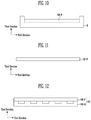
- FIG. 10 illustrates a step in which liquid material making up the first flat substrate 100 -F is poured into the mold M and is hardened.
- Material making up the first flat substrate 100 -F may possess the same characteristics as material making up the first groove-formed substrate 100 -H. Thus, repeated description may be omitted.
- the first flat substrate 100 -F may be formed by pouring the material making up the first flat substrate 100 -F into the mold M having the shape of a container and by hardening it by the external environment (heat, ultraviolet rays, etc.) Because the surface of the mold M touching material making up the first groove-formed substrate does not have any protrusions or grooves, the first flat substrate 100 -F may have a flat shape.
- FIG. 11 illustrates a step in which the first flat substrate 100 -F is detached from the mold M. Just like in the case of the first groove-formed substrate 100 -H, application of external force onto the first flat substrate 100 -F may separate the mold M and the first flat substrate 100 -F.
- the steps shown in FIGS. 10 and 11 may correspond to the step in which the first flat substrate is formed.
- FIG. 12 illustrates a first adherence step in which the first groove-formed substrate 100 -H and the first flat substrate 100 -F are adhered together to form the first substrate with the first channels formed on it.
- the first groove-formed substrate 100 -H and the first flat substrate 100 -F may be arranged in such a way that they are touching each other, applied heat to, and adhered together. Or the surface of the first groove-formed substrate 100 -H which is to be attached and the surface of the first flat substrate 100 -F which is to be attached may be applied with material making up the first groove-formed substrate 100 -H before it is hardened.
- the material making up the first groove-formed substrate 100 -H may be hardened, and the first groove-formed substrate 100 -H and the first flat substrate 100 -F may be adhered together.
- the surfaces of the first groove-formed substrate 100 -H and the first flat substrate 100 -F may be oxygen plasma-treated, and the first groove-formed substrate 100 -H and the first flat substrate 100 -F may be arranged in such a way that they are touching each other.
- the first groove-formed substrate 100 -H and the first flat surface 100 -F may be adhered together.
- the first channels LC 1 may be formed by the first groove-formed substrate 100 -H and the first flat substrate 100 -F being adhered together.
- FIG. 13 illustrates a step in which first holes and temporary holes are formed in the first channels LC 1 , and first electrodes are inserted into the first holes.
- the first holes and the temporary holes may be formed in the first channels, and the first electrodes may be inserted into the first holes. Because only the a th first channel LC 1 - a is shown in FIG. 13 , only a first hole H 1 - a among all the first holes is shown, only a temporary hole HT- a among all the temporary holes is shown, and only a first electrode EC 1 - a among all the first electrodes is shown in the figure. Also, in accordance with an exemplary embodiment, the temporary holes may not be formed. In FIG.
- the first electrode EC 1 - a may not be fixed with respect to the first substrate 100 .
- tubes (not shown) may be inserted into the first and temporary holes to inject the first conductive liquid into or to take air out of the first channels LC 1 .
- the first electrode EC 1 - a may be provided within one of the tubes.
- FIG. 14 illustrates a step in which the first conductive liquid is injected into the first channels through the first holes and gas is taken out of the first channels through the temporary holes.
- the first conductive liquid from one of the tubes inserted into the first hole H 1 - a may be injected into the first channel LC 1 - a .
- the air existent in the first channel LC 1 - a may be taken out of the first channel LC 1 - a through one (not shown) of the tubes inserted into the temporary hole HT-a.
- no air may be left in the first channels LC 1 , making preventing the lowering of the sensitivity of the touch sensor and damage to the touch sensor due to bubbles.
- FIGS. 15 and 16 illustrate a method of manufacturing the third substrate.
- FIG. 15 illustrates a step in which liquefied material making up the third substrate 300 is poured into the mold and hardened. Since this is very similar to the step described with reference to FIG. 10 , in which liquefied material making up the first flat substrate 100 -F is poured and hardened is very similar, the description thereof will be omitted.
- Material making up the third substrate 300 and capable of being included in fluid may be put into a mold M with the shape of a container and hardened by the external environment (heat, ultraviolet rays, etc.) to form the third substrate 300 .
- the elastic modulus of the third substrate 300 may be lower than those of the first substrate 100 and the second substrate 200 .
- the material making up the third substrate 300 for example, PDMS
- the material making up the third substrate 300 may be poured into the mold M and stirred around to form foam.
- other material for example, water
- Hardening material with foam formed may lead to the formation of a porous third substrate 300 .
- FIG. 16 illustrates a step in which the third substrate 300 is separated from the mold M.
- the mold M and the third substrate 300 may be separated by applying external force to the third substrate 300 .
- FIG. 17 illustrates a third adhesion step in which the first substrate and the third substrate are adhered together.
- the first substrate 100 and the third substrate 300 may be adhered together through the methods described with reference to FIG. 12 .
- the first and the temporary holes may be isolated from outside by the third substrate 300 . In other words, the first conductive liquid injected into the first channels LC 1 may not come outside.
- the third substrate 300 and the second substrate 200 may be adhered together through the methods described with reference to FIG. 12 .
- the second holes may be isolated from outside by the third substrate 300 .
- the second conductive liquid injected into the second channels LC 2 may not come outside.
- the touch sensor shown in FIGS. 1 to 3 may be obtained. It may be desirable for the first channels LC 1 to extend in the first direction and for the second channels LC 2 to extend in the second direction which crosses the first direction. If the third substrate 300 and the second substrate 200 are adhered together, the touch sensor described with reference to FIGS. 1 to 3 may be completed.
- FIG. 18 is a cross-sectional view for describing illustrates a touch sensor in accordance with another exemplary embodiment.
- the touch sensor may include a first substrate 100 ′, a second substrate 200 ′, and a third substrate 300 ′.
- the third substrate 300 ′ of the touch sensor shown in FIG. 18 may include protrusions 300 - p ′.
- the degree that the protrusions 300 - p ′ are morphed may be greater than that to which the a th first channel LC 1 - a ′ is morphed, even if pressure is applied to the touch sensor. Therefore, the chance of a short circuit due to blockage in channels may decrease as the degree to which the first channels LC 1 - a ′ are morphed is reduced, even if the pressure is applied.
- FIG. 19 is cross-sectional views for describing a method of manufacturing the first flat substrate of the touch sensor of FIG. 18 .
- protrusions P′ may be formed on the mold M, and the material making up the first flat substrate 100 -F and which may belong to liquid may be injected and hardened.
- Grooves may be formed on the first flat substrate 100 -F′, and the shape of the grooves may correspond to the protrusions P′.
- FIG. 20 and FIG. 21 illustrate how to manufacture the third substrate of the touch sensor of FIG. 18 .
- FIG. 20 illustrates a step in which material making up the third substrate 300 is injected between molds M 2 ′ and M 3 ′ with grooves formed on them and hardened to form the third substrate.
- the material making up the third substrate 300 ′ may be injected among a fixing mold M 1 ′ and molds M 2 ′ and M 3 ′ with grooves H′ formed on them. Thereafter, when forming the third substrate 300 ′ by hardening the material, the protrusions corresponding to the grooves H′ may be formed on the third substrate 300 ′.
- FIG. 21 illustrates a step in which the third substrate 300 ′ is separated from the molds M 2 ′ and M 3 ′. As described with reference to FIG. 9 , due to applying external force upon the third substrate 300 ′, the third substrate 300 ′ may be separated from the molds M 1 ′, M 2 ′, and M 3 ′.
- a third substrate with protrusions 300 - p ′ formed on it there are other methods which may be employed to form a third substrate with protrusions 300 - p ′ formed on it.
- grooves may be formed after manufacturing the third substrate.
- FIG. 22 is a cross-sectional view for describing a touch sensor in accordance with another exemplary embodiment.
- the first groove-formed substrate 100 -H′′ may include spacers Sp 1 - a ′′ and Sp 2 - a ′′. Because the spacers Sp 2 - a ′′ and Sp 2 - a ′′ restrict the morphing of the first channels LC 1 - a ′′, short-circuiting of channels due to excessive applied pressure may be prevented. Also, when pressure is applied to the touch sensor, the amount of change in the thickness of the third substrate 300 ′′ may be greater than that of change in the thickness of the first substrate 100 ′′ or the second substrate 200 ′′. Therefore, the gap between the first channels and the second channels may greatly be changed. Thus the sensitivity to changes in the level of current of voltage incurred by pressure may be increased compared to the touch sensor shown in FIG. 1 .
- FIGS. 23 and 24 are cross-sectional views illustrating some of the methods to manufacture the first groove-formed substrate of the touch sensor of FIG. 22 .
- FIG. 23 illustrates a step in which material making up the first groove-formed substrate 100 -H′′ is injected and hardened to form the first groove-formed substrate 100 -H′′.
- FIG. 23 is mostly identical to FIG. 8 . It is different only in that first protrusions P′′ are not formed in the part corresponding to the spacers A-sp 1 ′′ and A-sp 2 ′′.
- FIG. 24 illustrates a step in which a first groove-formed substrate 100 -H′′ is separated from a mold M′′.
- FIG. 24 is similar to FIG. 9 , and differs only in that spacers SP 1 - a ′′ and SP 2 - a ′′ are formed.
- Exemplary embodiments provide a touch sensor and a method of manufacturing the same which form channels that cross each other on a stretchable substrate, each of the channels including a wedge having a round form. Because a conductive liquid is injected into the channel, touch sensitivity may increase due to the wedge, but because there are no bubbles in the channel, damage to the substrate may be prevented.
Landscapes
- Engineering & Computer Science (AREA)
- General Engineering & Computer Science (AREA)
- Theoretical Computer Science (AREA)
- Microelectronics & Electronic Packaging (AREA)
- Human Computer Interaction (AREA)
- Physics & Mathematics (AREA)
- General Physics & Mathematics (AREA)
- Manufacturing & Machinery (AREA)
- Quality & Reliability (AREA)
- Position Input By Displaying (AREA)
- Manufacture Of Switches (AREA)
Priority Applications (1)
| Application Number | Priority Date | Filing Date | Title |
|---|---|---|---|
| US16/785,695 US11086465B2 (en) | 2015-08-28 | 2020-02-10 | Touch sensor and manufacturing method thereof |
Applications Claiming Priority (2)
| Application Number | Priority Date | Filing Date | Title |
|---|---|---|---|
| KR10-2015-0121938 | 2015-08-28 | ||
| KR1020150121938A KR102420052B1 (ko) | 2015-08-28 | 2015-08-28 | 터치 센서 및 그 제작 방법 |
Related Child Applications (1)
| Application Number | Title | Priority Date | Filing Date |
|---|---|---|---|
| US16/785,695 Continuation US11086465B2 (en) | 2015-08-28 | 2020-02-10 | Touch sensor and manufacturing method thereof |
Publications (2)
| Publication Number | Publication Date |
|---|---|
| US20170060299A1 US20170060299A1 (en) | 2017-03-02 |
| US10558303B2 true US10558303B2 (en) | 2020-02-11 |
Family
ID=56737915
Family Applications (2)
| Application Number | Title | Priority Date | Filing Date |
|---|---|---|---|
| US15/072,958 Active 2037-07-12 US10558303B2 (en) | 2015-08-28 | 2016-03-17 | Touch sensor and manufacturing method thereof |
| US16/785,695 Active US11086465B2 (en) | 2015-08-28 | 2020-02-10 | Touch sensor and manufacturing method thereof |
Family Applications After (1)
| Application Number | Title | Priority Date | Filing Date |
|---|---|---|---|
| US16/785,695 Active US11086465B2 (en) | 2015-08-28 | 2020-02-10 | Touch sensor and manufacturing method thereof |
Country Status (4)
| Country | Link |
|---|---|
| US (2) | US10558303B2 (de) |
| EP (2) | EP3373121B1 (de) |
| JP (1) | JP6770327B2 (de) |
| KR (1) | KR102420052B1 (de) |
Cited By (1)
| Publication number | Priority date | Publication date | Assignee | Title |
|---|---|---|---|---|
| US11086465B2 (en) * | 2015-08-28 | 2021-08-10 | Samsung Display Co., Ltd. | Touch sensor and manufacturing method thereof |
Families Citing this family (4)
| Publication number | Priority date | Publication date | Assignee | Title |
|---|---|---|---|---|
| KR102594615B1 (ko) | 2017-12-13 | 2023-10-30 | 삼성디스플레이 주식회사 | 입력감지유닛 및 이를 포함하는 표시장치 |
| CN109326221B (zh) * | 2018-09-25 | 2021-09-28 | 上海天马微电子有限公司 | 显示装置和显示装置的触觉反馈显示方法 |
| CN109638043A (zh) * | 2018-12-03 | 2019-04-16 | 武汉华星光电半导体显示技术有限公司 | 柔性有机发光二极管(oled)显示基板及其制作方法 |
| US11017915B2 (en) * | 2019-01-23 | 2021-05-25 | Carnegie Mellon University | Stretchable electronics and methods of making the same |
Citations (9)
| Publication number | Priority date | Publication date | Assignee | Title |
|---|---|---|---|---|
| US20120075243A1 (en) * | 2010-09-24 | 2012-03-29 | Koji Doi | Display Device |
| US20130271159A1 (en) | 2012-01-28 | 2013-10-17 | Arizona State University | Systems for providing electro-mechanical sensors |
| US20130312541A1 (en) * | 2011-01-24 | 2013-11-28 | President And Fellows Of Harvard College | Non-differential elastomer curvature sensor |
| US20140152611A1 (en) | 2012-06-01 | 2014-06-05 | Tactus Technology, Inc. | User interface |
| US20140238153A1 (en) * | 2011-09-24 | 2014-08-28 | President And Fellows Of Harvard College | Artificial skin and elastic strain sensor |
| WO2014163374A1 (ko) | 2013-04-03 | 2014-10-09 | 어보브반도체 주식회사 | 정전용량 방식 터치패널 |
| US20150130754A1 (en) * | 2013-09-26 | 2015-05-14 | Tactus Technology, Inc. | Touch sensor |
| US20150248179A1 (en) | 2014-03-03 | 2015-09-03 | Samsung Display Co., Ltd. | Touch panel and display apparatus including the same |
| US20160066411A1 (en) | 2014-09-03 | 2016-03-03 | Samsung Display Co., Ltd. | Flexible circuit board and electronic device including the same |
Family Cites Families (3)
| Publication number | Priority date | Publication date | Assignee | Title |
|---|---|---|---|---|
| DE202007005237U1 (de) * | 2006-04-25 | 2007-07-05 | Philipp, Harald, Southampton | Hybrides kapazitives Berührungsbildschirmelement |
| US8970403B2 (en) * | 2008-01-04 | 2015-03-03 | Tactus Technology, Inc. | Method for actuating a tactile interface layer |
| KR102420052B1 (ko) * | 2015-08-28 | 2022-07-14 | 삼성디스플레이 주식회사 | 터치 센서 및 그 제작 방법 |
-
2015
- 2015-08-28 KR KR1020150121938A patent/KR102420052B1/ko active Active
-
2016
- 2016-03-17 US US15/072,958 patent/US10558303B2/en active Active
- 2016-04-05 JP JP2016075667A patent/JP6770327B2/ja active Active
- 2016-08-05 EP EP18170474.3A patent/EP3373121B1/de active Active
- 2016-08-05 EP EP16182915.5A patent/EP3144787B1/de active Active
-
2020
- 2020-02-10 US US16/785,695 patent/US11086465B2/en active Active
Patent Citations (11)
| Publication number | Priority date | Publication date | Assignee | Title |
|---|---|---|---|---|
| US20120075243A1 (en) * | 2010-09-24 | 2012-03-29 | Koji Doi | Display Device |
| US20130312541A1 (en) * | 2011-01-24 | 2013-11-28 | President And Fellows Of Harvard College | Non-differential elastomer curvature sensor |
| US20140238153A1 (en) * | 2011-09-24 | 2014-08-28 | President And Fellows Of Harvard College | Artificial skin and elastic strain sensor |
| US20130271159A1 (en) | 2012-01-28 | 2013-10-17 | Arizona State University | Systems for providing electro-mechanical sensors |
| US20140152611A1 (en) | 2012-06-01 | 2014-06-05 | Tactus Technology, Inc. | User interface |
| WO2014163374A1 (ko) | 2013-04-03 | 2014-10-09 | 어보브반도체 주식회사 | 정전용량 방식 터치패널 |
| US20150130754A1 (en) * | 2013-09-26 | 2015-05-14 | Tactus Technology, Inc. | Touch sensor |
| US20150248179A1 (en) | 2014-03-03 | 2015-09-03 | Samsung Display Co., Ltd. | Touch panel and display apparatus including the same |
| KR20150103777A (ko) | 2014-03-03 | 2015-09-14 | 삼성디스플레이 주식회사 | 터치 패널 및 이를 포함하는 표시 장치 |
| US20160066411A1 (en) | 2014-09-03 | 2016-03-03 | Samsung Display Co., Ltd. | Flexible circuit board and electronic device including the same |
| KR20160028568A (ko) | 2014-09-03 | 2016-03-14 | 삼성디스플레이 주식회사 | 회로판 및 이를 포함하는 전자 장치 |
Non-Patent Citations (13)
| Title |
|---|
| A FASSLER; C MAJIDI: "Paper;Soft-matter capacitors and inductors for hyperelastic strain sensing and stretchable electronics;Soft-matter capacitors and inductors for hyperelastic strain sensing and stretchable electronics", SMART MATERIALS AND STRUCTURES., IOP PUBLISHING LTD., BRISTOL., GB, vol. 22, no. 5, 11 April 2013 (2013-04-11), GB, pages 55023, XP020244281, ISSN: 0964-1726, DOI: 10.1088/0964-1726/22/5/055023 |
| Arya Tabatabai et al,, "Liquid-Phase Gallium-indium Alloy Electronics with Microcontact Printing", Langmui R, vol. 29, No. 20, May 21, 2013, XP055335574, pp. 6194-6200. |
| ARYA TABATABAI, ANDREW FASSLER, CLAIRE USIAK, CARMEL MAJIDI: "Liquid-Phase Gallium–Indium Alloy Electronics with Microcontact Printing", LANGMUIR, AMERICAN CHEMICAL SOCIETY, US, vol. 29, no. 20, 21 May 2013 (2013-05-21), US, pages 6194 - 6200, XP055335574, ISSN: 0743-7463, DOI: 10.1021/la401245d |
| Fassler A et al., "Soft-matter capacitors and inductors for hyperelastic strain sensing and stretchable electronics", Smart Materials and Structures, IOP Publishing Ltd., Bristol, GB, vol. 22. No. 5, Apr. 11, 2013, XP020244281, p. 55023. |
| Hyung Jun Koo et al., "Towards All-Soft Matter Circuits: Prototypes of Quasi-Liquid Devices with Memristor Characteristics", Advanced Materials, vol. 23, No. 31, Jul. 4, 2011, XP055375935, pp. 3559-3564. |
| HYUNG-JUN KOO, JU-HEE SO, MICHAEL D. DICKEY, ORLIN D. VELEV: "Towards All-Soft Matter Circuits: Prototypes of Quasi-Liquid Devices with Memristor Characteristics", ADVANCED MATERIALS, WILEY-VCH GERMANY, DE, vol. 23, no. 31, 16 August 2011 (2011-08-16), DE, pages 3559 - 3564, XP055375935, ISSN: 0935-9648, DOI: 10.1002/adma.201101257 |
| Mitsuhiro Shikida et al., "A Flexible Transparent Touch Panel Based on Ionic Liquid Channel", IEEE Sensors Journal, IEEE Service Center, New York, NY, US, vol. 13, No. 9, Sep. 1, 2013, XP011523486, pp. 3490-3495. |
| Partial European Search Report dated Jan. 26 2017, in European Patent Application No. 16182915.5. |
| Ruben D Ponce Wong et al., "Flexible microfluidic normal force sensor skin for tactile feedback", Sensors and Actuators A: Physical, Elsevier BV, NL, vol. 179, Mar. 14, 2012, XP028420928, pp. 62-69. |
| RUBEN D. PONCE WONG; JONATHAN D. POSNER; VERONICA J. SANTOS;: "Flexible microfluidic normal force sensor skin for tactile feedback", SENSORS AND ACTUATORS A: PHYSICAL, ELSEVIER BV, NL, vol. 179, 14 March 2012 (2012-03-14), NL, pages 62 - 69, XP028420928, ISSN: 0924-4247, DOI: 10.1016/j.sna.2012.03.023 |
| SHIKIDA MITSUHIRO; ASANO KOJI: "A Flexible Transparent Touch Panel Based on Ionic Liquid Channel", IEEE SENSORS JOURNAL., IEEE SERVICE CENTER, NEW YORK, NY., US, vol. 13, no. 9, 1 September 2013 (2013-09-01), US, pages 3490 - 3495, XP011523486, ISSN: 1530-437X, DOI: 10.1109/JSEN.2013.2265325 |
| The Extended European Search Report dated Jun. 6, 2017, issued in European Patent Application No. 16182915,5. |
| Yong-Lae Park et al., "Design and Fabrication of Soft Artificial Skin Using Embedded Microchannels and Liquid Conductors", IEEE Sensor Journal, IEEE Service Center, New York, NY, US, vol. 12, No. 8, Aug. 1, 2012, XP01147337, pp. 2711-2718. |
Cited By (1)
| Publication number | Priority date | Publication date | Assignee | Title |
|---|---|---|---|---|
| US11086465B2 (en) * | 2015-08-28 | 2021-08-10 | Samsung Display Co., Ltd. | Touch sensor and manufacturing method thereof |
Also Published As
| Publication number | Publication date |
|---|---|
| EP3144787A2 (de) | 2017-03-22 |
| US20170060299A1 (en) | 2017-03-02 |
| JP2017045439A (ja) | 2017-03-02 |
| EP3373121B1 (de) | 2023-09-20 |
| EP3144787A3 (de) | 2017-07-05 |
| US11086465B2 (en) | 2021-08-10 |
| KR102420052B1 (ko) | 2022-07-14 |
| KR20170026820A (ko) | 2017-03-09 |
| EP3144787B1 (de) | 2023-09-20 |
| JP6770327B2 (ja) | 2020-10-14 |
| US20200174600A1 (en) | 2020-06-04 |
| EP3373121A1 (de) | 2018-09-12 |
Similar Documents
| Publication | Publication Date | Title |
|---|---|---|
| US11086465B2 (en) | Touch sensor and manufacturing method thereof | |
| US11048297B2 (en) | Cover window and manufacturing method of the same | |
| US10470318B2 (en) | Method of manufacturing transparent protection window | |
| KR101975490B1 (ko) | 커버 윈도우 및 이를 구비한 표시 장치 | |
| TW201907594A (zh) | 具有薄且高模數層之折疊式顯示器中性軸管理 | |
| KR102275619B1 (ko) | 정전용량 방식의 터치 스크린 센서, 터치 스크린 패널 및 영상표시장치 | |
| US10713978B2 (en) | Bend limit film | |
| KR20150124542A (ko) | 플렉서블 표시장치 | |
| KR102078215B1 (ko) | 액체 금속을 포함하는 인덕터 복합 소자, 인덕터 복합 소자를 포함하는 수동 소자 기판의 제조 방법, 및 수동 소자 기판의 튜닝 방법 | |
| US20170343394A1 (en) | Cover structure of tactile sensor and tactile sensor | |
| US20190179433A1 (en) | Stylus pen and method for manufacturing the same | |
| KR102063802B1 (ko) | 개선된 기생 커패시턴스 특성을 갖는 액체 금속 커패시터 복합 소자 기판 및 그 제조 방법 | |
| CN105430957A (zh) | 强化式盲盖及其制作方法 | |
| US11656134B2 (en) | Pressing force sensor with improved dynamic range increase | |
| CN108470738A (zh) | 柔性显示器件及其制作方法 | |
| CN109814752B (zh) | 显示屏及显示设备 | |
| KR101954244B1 (ko) | 곡면 형상의 표면에 대한 밀착성이 우수한 보호 필름 및 이를 포함하는 디스플레이 장치 | |
| KR101870590B1 (ko) | 변형가능한 멤브레인 및 이를 포함하는 힘 감지 커패시터 소자 | |
| TW201143033A (en) | Flash memory having a floating gate in the shape of a curved section | |
| TWM541182U (zh) | 可撓式電子裝置 | |
| TWI596534B (zh) | 感測裝置的感測方法及可拉伸感測元件 | |
| US20240201411A1 (en) | Capacitance sensor and capacitance sensor manufacturing method | |
| CN204679997U (zh) | 一种电容式触控屏、显示装置 | |
| CN223497423U (zh) | 一种预应力空心板 | |
| US9891740B2 (en) | High density sensor module |
Legal Events
| Date | Code | Title | Description |
|---|---|---|---|
| AS | Assignment |
Owner name: SAMSUNG DISPLAY CO., LTD., KOREA, REPUBLIC OF Free format text: ASSIGNMENT OF ASSIGNORS INTEREST;ASSIGNORS:CHOI, WON IL;YOO, JE WON;HONG, JONG HO;AND OTHERS;REEL/FRAME:038015/0687 Effective date: 20160107 |
|
| STPP | Information on status: patent application and granting procedure in general |
Free format text: ADVISORY ACTION MAILED |
|
| STPP | Information on status: patent application and granting procedure in general |
Free format text: DOCKETED NEW CASE - READY FOR EXAMINATION |
|
| STPP | Information on status: patent application and granting procedure in general |
Free format text: NON FINAL ACTION MAILED |
|
| STPP | Information on status: patent application and granting procedure in general |
Free format text: RESPONSE TO NON-FINAL OFFICE ACTION ENTERED AND FORWARDED TO EXAMINER |
|
| STPP | Information on status: patent application and granting procedure in general |
Free format text: NOTICE OF ALLOWANCE MAILED -- APPLICATION RECEIVED IN OFFICE OF PUBLICATIONS |
|
| STPP | Information on status: patent application and granting procedure in general |
Free format text: PUBLICATIONS -- ISSUE FEE PAYMENT VERIFIED |
|
| STCF | Information on status: patent grant |
Free format text: PATENTED CASE |
|
| MAFP | Maintenance fee payment |
Free format text: PAYMENT OF MAINTENANCE FEE, 4TH YEAR, LARGE ENTITY (ORIGINAL EVENT CODE: M1551); ENTITY STATUS OF PATENT OWNER: LARGE ENTITY Year of fee payment: 4 |