US10564629B2 - Generating halftone data for a three-dimensional object - Google Patents
Generating halftone data for a three-dimensional object Download PDFInfo
- Publication number
- US10564629B2 US10564629B2 US15/511,906 US201415511906A US10564629B2 US 10564629 B2 US10564629 B2 US 10564629B2 US 201415511906 A US201415511906 A US 201415511906A US 10564629 B2 US10564629 B2 US 10564629B2
- Authority
- US
- United States
- Prior art keywords
- slice
- data
- halftone
- dimensional object
- generating
- Prior art date
- Legal status (The legal status is an assumption and is not a legal conclusion. Google has not performed a legal analysis and makes no representation as to the accuracy of the status listed.)
- Active, expires
Links
Images


Classifications
-
- G—PHYSICS
- G05—CONTROLLING; REGULATING
- G05B—CONTROL OR REGULATING SYSTEMS IN GENERAL; FUNCTIONAL ELEMENTS OF SUCH SYSTEMS; MONITORING OR TESTING ARRANGEMENTS FOR SUCH SYSTEMS OR ELEMENTS
- G05B19/00—Program-control systems
- G05B19/02—Program-control systems electric
- G05B19/18—Numerical control [NC], i.e. automatically operating machines, in particular machine tools, e.g. in a manufacturing environment, so as to execute positioning, movement or co-ordinated operations by means of program data in numerical form
- G05B19/4097—Numerical control [NC], i.e. automatically operating machines, in particular machine tools, e.g. in a manufacturing environment, so as to execute positioning, movement or co-ordinated operations by means of program data in numerical form characterised by using design data to control NC machines, e.g. CAD/CAM
- G05B19/4099—Surface or curve machining, making three-dimensional [3D] objects, e.g. desktop manufacturing
-
- B—PERFORMING OPERATIONS; TRANSPORTING
- B29—WORKING OF PLASTICS; WORKING OF SUBSTANCES IN A PLASTIC STATE IN GENERAL
- B29C—SHAPING OR JOINING OF PLASTICS; SHAPING OF MATERIAL IN A PLASTIC STATE, NOT OTHERWISE PROVIDED FOR; AFTER-TREATMENT OF THE SHAPED PRODUCTS, e.g. REPAIRING
- B29C64/00—Additive manufacturing, i.e. manufacturing of three-dimensional [3D] objects by additive deposition, additive agglomeration or additive layering, e.g. by 3D printing, stereolithography or selective laser sintering
- B29C64/30—Auxiliary operations or equipment
- B29C64/386—Data acquisition or data processing for additive manufacturing
-
- B—PERFORMING OPERATIONS; TRANSPORTING
- B33—ADDITIVE MANUFACTURING TECHNOLOGY
- B33Y—ADDITIVE MANUFACTURING, i.e. MANUFACTURING OF THREE-DIMENSIONAL [3D] OBJECTS BY ADDITIVE DEPOSITION, ADDITIVE AGGLOMERATION OR ADDITIVE LAYERING, e.g. BY 3D PRINTING, STEREOLITHOGRAPHY OR SELECTIVE LASER SINTERING
- B33Y50/00—Data acquisition or data processing for additive manufacturing
- B33Y50/02—Data acquisition or data processing for additive manufacturing for controlling or regulating additive manufacturing processes
-
- H—ELECTRICITY
- H04—ELECTRIC COMMUNICATION TECHNIQUE
- H04N—PICTORIAL COMMUNICATION, e.g. TELEVISION
- H04N1/00—Scanning, transmission or reproduction of documents or the like, e.g. facsimile transmission; Details thereof
- H04N1/40—Picture signal circuits
- H04N1/405—Halftoning, i.e. converting the picture signal of a continuous-tone original into a corresponding signal showing only two levels
-
- G—PHYSICS
- G05—CONTROLLING; REGULATING
- G05B—CONTROL OR REGULATING SYSTEMS IN GENERAL; FUNCTIONAL ELEMENTS OF SUCH SYSTEMS; MONITORING OR TESTING ARRANGEMENTS FOR SUCH SYSTEMS OR ELEMENTS
- G05B2219/00—Program-control systems
- G05B2219/30—Nc systems
- G05B2219/49—Nc machine tool, till multiple
- G05B2219/49023—3-D printing, layer of powder, add drops of binder in layer, new powder
Definitions
- Additive manufacturing systems allow for the formation of three dimensional objects from a build material and electronic data defining a three-dimensional model of the object.
- FIG. 1 is a block diagram of an additive manufacturing device according to one example of the principles described herein.
- FIG. 2 is a block diagram of an additive manufacturing system according to one example of the principles described herein.
- FIG. 3 is a flowchart showing a method of generating a three-dimensional object according to one example of the principles described herein.
- FIG. 4 is a flowchart showing a method of non-deterministically generating halftone data for successive slices of the three-dimensional object according to one example of the principles described herein.
- FIG. 5 is a flowchart showing a method of non-deterministically generating halftone data for successive slices of the three-dimensional object according to another example of the principles described herein.
- FIG. 6 is a flowchart showing a method of non-deterministically generating halftone data for successive slices of the three-dimensional object according to another example of the principles described herein.
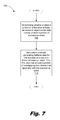
- FIG. 7 is a flowchart showing a method of generating a three-dimensional object according to another example of the principles described herein.
- a desired object is fabricated according to the electronic data of a three-dimensional model. Prior to formation, the object is logically divided into slices. Data defining each layer of the object is taken from a cross-sectional slice of the three-dimensional model. The data for each slice is converted into a pattern that will be used by the additive manufacturing system to form the corresponding layer of the object.
- the pattern produced from the data for any particular layer of the object may be the result of a deterministic halftoning of the data slice for that layer.
- Halftoning is a technique used in two-dimensional printing to reproduce a continuous tone image on a printer capable of printing only a small number of tone levels.
- Halftoning involves placing a number of dots on a media, varying the position, shape, size, and/or color of the dots so as to blend the dots such that the human eye cannot detect the individual dots from a sufficient distance, but instead sees an image that closely resembles the original contone (i.e., continuous tone) image.
- contone i.e., continuous tone
- halftoning is a technique that transforms a model of an object having areas of continuous density into a binary representation of that continuous or contone data so that the modeled object can be rendered by a variety of additive manufacturing techniques.
- the difference between traditional two-dimensional halftoning of a printed image and three-dimensional halftoning is that halftone data for printing dictates binary dot patterns on the surface of a print medium, while three-dimensional halftoning provides particle patterns arranged in space.
- the halftone data becomes a map or pattern that tells the additive manufacturing system where build material should be solidified to form a current layer of the object.
- the halftone data will indicate where a coalescing or other chemical agent should be deposited in a powdered build material, where a build material should be deposited in a system that only places build material where it is needed or points where energy such as a laser should be applied to solidify build material.
- the dots in two-dimensional printing correspond to actions taken to form a physical layer of the object, for example, a point of deposition of a build material, application of energy to build material, deposition of chemical reactant into a build material, and others.
- the present specification describes a method of forming a three-dimensional object that includes non-deterministically generating halftone data for portions of a slice of three-dimensional model data of the three-dimensional object that overlap with a previous slice.
- overlap when describing successive slices of a three-dimensional object means two or more slices of data in the three-dimensional model that comprise at least some two-dimensional geometry in common.
- the present specification applies non-deterministic halftoning to those portions of a slice that overlap the preceding slice, but not necessarily to those portions which do not.
- An additive manufacturing device includes a processor; and a memory communicatively coupled to the processor.
- the processor non-deterministically generates halftone data for each of a number of successive slices of three-dimensional model data for a three-dimensional object if at least a portion of each of the successive slices overlap with a previous slice.
- halftoning may be performed either deterministically or non-deterministically. For portions of the current slice that overlap with a previous slice, the halftoning is performed non-deterministically.
- the present specification describes another method that includes, with a processor of an additive manufacturing system, determining whether at least a portion of a first slice of three-dimensional object model data overlaps at least a portion of a successive slice; and non-deterministically generating halftone data for a portion of the successive slice of three-dimensional model data defining the three-dimensional object if the first slice overlaps the successive slice.
- non-deterministic refers to an operation that does not necessarily produce the same result if given the same input.
- non-deterministic refers to producing any quality or state that is not identical after an operation has been performed despite the same qualities or states being initially present.
- deterministic refers to an operation that, given the same input, will always produce the same result.
- the term “slice” means a set of model data for a planar cross-section of a three-dimensional object represented electronically by a three-dimensional model from which the “slice” is taken.
- the term “layer” means a planar cross-section of a physical, three-dimensional object.
- a layer of the three-dimensional object corresponds to a slice of the three-dimensional model data.
- the term “coalesce” means to solidify or fuse into a solid mass a build material that was formerly loose or fluid.
- build material means a loose or fluid material, for example, a powder, from which a desired three-dimensional object is formed in additive manufacturing.
- coalescing agent means any substance that causes a build material to coalesce.
- the coalescing agent may be any substance that absorbs radiant energy, causing the coalescing agent to heat, which then heats a build material sufficiently so that the build material coalesces when energy is temporarily applied thereto.
- a non-deterministic halftoned layer of a three-dimensional object is different from other layers of the three-dimensional object despite the original contone data defining the layers being identical.
- the techniques described may produce different halftone patterns throughout vertically consistent portions of the three-dimensional object.
- successive layers of three-dimensional object, having the same two-dimensional geometry will not have the same halftoning pattern as each other. Consequently, “non-determinism” applies in this context when comparing layers within an object.
- slices having at least a portion of overlapping two-dimensional geometry, that may have an inherent flaw do not repeat that flaw in each layer to produce a defective object.
- the term “additive manufacturing system” or “additive manufacturing device” means any device that fabricates a three-dimensional object from a build material using slices of model data to form corresponding layers of the object.
- the additive manufacturing system includes an additive manufacturing device.
- the additive manufacturing system comprises a selective laser melting (SLM) system, a direct metal laser sintering (DMLS) system, a selective laser sintering (SLS) system, a stereolithography (SLA), and a laminated object manufacturing (LOM).
- SLM selective laser melting
- DMLS direct metal laser sintering
- SLS selective laser sintering
- SLA stereolithography
- LOM laminated object manufacturing
- an additive manufacturing system comprises any fabrication device that implements an additive process that forms a three-dimensional object. Some of these systems may be referred to a three-dimensional printers.
- FIG. 1 a block diagram of an additive manufacturing device ( 100 ) according to one example of the principles described herein is shown.
- the device ( 100 ) may comprise a processor ( 105 ) and a data storage device ( 110 ).
- the device ( 100 ) non-deterministically generates halftone data via the processor ( 105 ) for portions of each of a number of successive slices of a three-dimensional object that overlaps a previous slice.
- the data storage device ( 110 ) may store data such as executable program code that is executed by the processor ( 105 ) or other processing device. As will be discussed, the data storage device ( 110 ) may specifically store computer code representing a number of applications that the processor ( 105 ) executes to implement at least the functionality described herein. The data storage ( 110 ) device may also store some or all of the electronic three-dimensional model data for an object that is to be generated. The data storage device ( 110 ) also stores a non-deterministic halftoning function ( 115 ) for non-deterministically converting slices of the model into halftone patterns for use by the device ( 100 ) in forming corresponding layers of the modeled object. As described herein, the non-deterministic halftoning methods described herein reduce the aggregation of minor errors that might exist in the data and that might become significant in production of the modeled object.
- the data storage device ( 110 ) may include various types of memory, including volatile and nonvolatile memory.
- the data storage device ( 110 ) of the present example includes Random Access Memory (RAM), Read Only Memory (ROM), and Hard Disk Drive (HDD) memory.
- RAM Random Access Memory
- ROM Read Only Memory
- HDD Hard Disk Drive
- Other types of memory may also be utilized, and the present specification contemplates the use of varying type(s) of memory in the data storage device ( 110 ) as may suit a particular application of the principles described herein.
- different types of memory in the data storage device ( 110 ) may be used for different data storage needs.
- the processor ( 105 ) may boot from Read Only Memory (ROM), maintain nonvolatile storage in the Hard Disk Drive (HDD) memory, and execute program code stored in Random Access Memory (RAM).
- the processor ( 105 ) may include the hardware architecture to retrieve executable code from the data storage device ( 110 ) and execute the executable code.
- the executable code of the function ( 115 ) when executed by the processor ( 105 ), causes the processor ( 105 ) to non-deterministically generate halftone data for portions of each of a number of successive slices of a three-dimensional object according to some examples of the methods of the present specification described herein.
- the processor ( 105 ) may receive input from and provide output to a number of the remaining hardware units.
- the device ( 100 ) may be any additive manufacturing device capable of generating a three-dimensional object.
- a deposited build material may be selectively solidified or coalesced with the additive manufacturing device ( 100 ) to form portions of the three-dimensional object to be formed.
- a coalescing agent may be deposited onto a build material such as a ceramic powder such that application of radiation energy to the coalescing agent provides heat to the build material causing the build material to coalesce.
- the coalescing agent may be deposited onto a substrate via a depositor.
- the device ( 100 ) may deposit layers of material such that the layering of the material forms the three-dimensional object. In this example, the material is deposited onto a substrate via an extruder.
- FIG. 2 is a block diagram of an additive manufacturing system ( 200 ) according to one example of the principles described herein.
- the system ( 200 ) may comprise an additive manufacturing device ( 205 ), and a network device ( 235 ).
- the network device ( 235 ) may be communicatively coupled to the additive manufacturing device ( 205 ) via a network ( 240 ).
- the network device ( 235 ) in one example, may be any computing device that provides data to the additive manufacturing device ( 205 ) in order to generate a three-dimensional copy representing that data.
- the network is an intranet, an internet, or the Internet.
- the additive manufacturing device ( 205 ) via the processor ( 210 ), executes the executable code ( 115 ) described above and herein to cause the processor ( 105 ) to implement at least the functionality of non-deterministically generating halftone data for portions of a slice that overlap with a previous slice.
- the additive manufacturing device ( 205 ) may also comprise a data storage device ( 215 ). Similar to the data storage device ( FIG. 1, 110 ) described above, the data storage device ( 215 ) in this system ( 200 ) may store data such as executable program code ( 115 ) that is executed by the processor ( 210 ) or other processing device. Again, the data storage device ( 215 ) may specifically store computer code representing a number of applications that the processor ( 210 ) executes to implement at least the functionality described herein, for example an error-diffusion halftoner ( 240 ), which will be described further below. The data storage device ( 215 ) may also have similar characteristics as described above in connection with the data storage device ( FIG. 1, 110 ) of the additive manufacturing device ( FIG. 1, 100 ).
- the hardware adapters ( 225 , 230 ) in the additive manufacturing device ( 200 ) enable the processor ( 210 ) to interface with various other hardware elements, external and internal to the additive manufacturing device ( 205 ).
- the peripheral device adapters ( 230 ) may provide an interface to input/output devices, such as, for example, a display device, a mouse, or a keyboard.
- the peripheral device adapters ( 230 ) may also provide access to other external devices such as an external storage device, a number of network devices such as, for example, servers, switches, and routers, client devices, other types of computing devices, and combinations thereof.
- the depositor ( 220 ) may be any device capable of depositing a fluid or solid onto a surface. As noted above, in some instances, the depositor ( 220 ) may selectively deposit build material to form a layer of the target object. In other examples the depositor ( 220 ) may selectively deposit a binder or congealing agent into a loose build material to form a layer of the target object.
- the depositor ( 220 ) may be a piezoelectric printhead or a thermal printhead.
- the fluid deposited may be a coalescing agent with this coalescing agent being deposited onto a medium such as a powder build material.
- the coalescing agent may be deposited onto the build material as drops in a pattern dictated by the halftoning data generated by the processor ( 210 ) as described in more detail below.
- the coalescing agent may receive energy from an energy source such as a microwave source, infrared source, or visible radiation source that is applied generally to the build material and coalescing agent. The coalescing agent then absorbs that energy thereby causing the build material surrounding the coalescing agent to coalesce and then solidify as it is cooled thereby creating a layer of the target object.
- the depositor ( 220 ) may deposit, according to received halftoning data, any type of fluid that may harden or cure over time thereby creating a layer of the target three-dimensional object.
- the depositor ( 220 ) may, according to received halftone data, deposit a binding material onto a building material that glues together that build material.
- the build material may be, without limitation, a ceramic powder, a metal, a plastic, an inorganic material, or a composite material such as a fiber reinforced plastic, a polymer infused ceramic.
- the depositor ( 220 ) may be configured as a scanning depositor or may be arranged in a page-wide array configuration.
- the depositor ( 220 ) may be allowed to scan relative to the surface of a medium or surface onto which it is depositing material.
- the depositor ( 220 ) is allowed to move along an x- and y-axial plane.
- the depositor ( 220 ) may be allowed to scan in the x-axis and is indexed in the y-axis after each scan until the entire surface of the fabrication area has been covered.
- multiple depositors ( 220 ) or sets of depositors ( 220 ) may act as a single depositor ( 220 ) to span, in at least one dimension, an area as large or larger than the fabrication area.
- a single scan may cover the entire fabrication area thereby increasing the speed at which the three-dimensional object is generated.
- the surface onto which the material is deposited may move respective to the page-wide array.
- the present specification contemplates the use of any type of depositor being used to selectively deposit a material in order to generate a three-dimensional object.
- the network adapter ( 240 ) may provide an interface to other computing devices within, for example, the network ( 240 ) as mentioned above. The may enable the transmission of data between the additive manufacturing device ( 205 ) and other devices located within the network.
- FIG. 3 is a flowchart showing a method ( 300 ) of generating a three-dimensional object according to one example of the principles described herein.
- the method ( 300 ) may begin with non-deterministically generating ( 305 ) halftone data for portions of a slice of three-dimensional model data of the three-dimensional object that overlap with a previous slice.
- this process may comprise, in one example, providing a random initialization position by shifting a start position of the halftone matrix for each successive layer of the three-dimensional object.
- the method may shift the start position by a distance that is not an integral multiple of the matrix size. This may be done so as to help prevent the same start location even when any two successive slices comprise portions that overlap.
- an error diffusion halftoner ( FIG. 2, 240 )
- a random error or errors may be preloaded into the error diffusion halftoner before each layer is halftoned such that the pattern resulting from the halftone process will be unique for each layer, even when the input geometrical data is the same.
- an error array based on the pattern for a given layer may be added to the geometrical data for the next successive layer of the three-dimensional object.
- either a matrix halftoner ( 250 ) or an error diffusion halftoner ( 245 ) may be used.
- an array of random errors may be generated with each error being added to the geometrical data for the next successive layer of the three-dimensional object.
- a plurality of halftone matrices may be constructed.
- a set of complementary halftone matrices can be generated such that one of the constraints used to generate these halftone matrices results in each individual matrix having unique and distinct threshold values at each corresponding X-Y location in the matrix.
- these matrices are used sequentially to halftone successive layers of geometrical data, they will produce unique halftone patterns from the same contone data.
- a collection of a number of matrices used in sequential repetition may be used to reduce the repetition of defects to a level where they have a negligible impact on the fabricated object's properties and surface characteristics.
- the number of halftone matrices constructed is between 2 and 10.
- the number of halftone matrices constructed is two or more.
- the number of halftone matrices constructed is 5 or more.
- a repeating pattern comprising an error or flaw is prevented from aggregating those errors into a localized section of the three-dimensional object.
- generation of the halftone patterns described above and herein generates more consistent spacing between drops of fluid deposited by the depositor ( 220 ) thereby improving the homogeneity of the three-dimensional object being constructed.
- FIG. 4 is a flowchart showing a method ( 400 ) of non-deterministically generating halftone data for successive slices of the three-dimensional object according to one example of the principles described herein.
- the method ( 400 ) may begin with using ( 405 ) a randomized initialization for each slice of three dimensional model data.
- “randomized” refers to both truly random and pseudo random start positions.
- a matrix halftoner FIG. 2, 250
- the start position of the matrix can be shifted or translated each time overlapping data is used to generate a layer of the three-dimensional object.
- the contone values are each compared to an x-y array of threshold values and the array may be tiled in a step and repeat fashion if it is smaller than the dimensions of the fabrication area.
- the additive manufacturing device FIG. 1, 100
- this randomized initialization process may be done regardless of the overlap of any number of successive slices of the three-dimensional object.
- the method ( 400 ) of FIG. 4 therefore, prevents repetition of an error in the halftone data along the same or similar z-axis from occurring by changing the start position of each slice of a three dimensional object each time the matrix data defining those slices are used.
- a different random error may be preloaded into the halftoning algorithm prior to halftoning each layer.
- a different set of random numbers or seed value may be used to initialize the error terms the halftoner uses to pass errors from element to element.
- a seed value may be used.
- the each seed value may be used to randomly populate a one-dimensional array that carries an error or errors from slice to slice.
- FIG. 5 is a flowchart showing a method ( 500 ) of non-deterministically generating halftone data for successive slices of the three-dimensional object according to another example of the principles described herein.
- the method ( 500 ) may begin with generating ( 505 ) error data after generating first halftone data for a first slice of the object.
- the error data is based on the pattern of the halftone data for any immediately previous slice.
- the error data is based on the pattern of the halftone data for any previous slice.
- a negative value may be placed in locations where the halftone pattern indicates a drop of fluid should be deposited. In surrounding areas that do not have any deposited agent or build material, positive values are assigned so that the net sum of the error data is zero.
- the error data may be a scalar value.
- the scalar value is added to the contone data of an immediately successive layer.
- the sum of the contone data with the scalar value is completed before generating the halftone data for the second slice successive to the first slice.
- the method ( 500 ) may continue with mathematically associating ( 510 ) the error data with continuous tone values when generating second halftone data for a second slice above the first slice.
- the addition of the error terms from the preceding layer will result in the halftone process creating a different deposition pattern for the successive layer, even when the geometrical layer data is the same for both slices.
- This method may be used with both matrix and error diffusion based halftoning.
- An analogous result can be obtained by multiplying the layer data with scalar values smaller and larger than one respectively, instead of adding negative and positive error values.
- part of the error value generated at each element location due to the halftoning may be passed to the corresponding element and neighboring elements in the next layer.
- the portion of these errors would then be added to the elements of the contone data describing the object geometry for the next layer prior to halftoning those elements, just as is done for errors passed to neighboring elements in the original layer.
- FIG. 6 is a flowchart showing a method ( 600 ) of non-deterministically generating halftone data for successive slices of the three-dimensional object according to another example of the principles described herein.
- the method ( 600 ) may begin with generating ( 605 ) first and second halftone data for respective first and second slices based on determined constraints that specify that a dot pattern to be used for the first slice is to be different than the pattern to be used for the second slice.
- the first and second halftone data are different from each other such that flaws in the three-dimensional object do not aggregate.
- a cost weighting algorithm may be used to generate a number of different threshold matrices.
- a cost weighting algorithm evaluates multiple solutions to a problem, and calculates the “cost” of each solution based on specified rules. The solution with the lowest cost is selected as the output of the algorithm.
- one of the costing rules would place a high cost on a matrix value likely to deposit fluid in the same location as the previous matrix.
- Other costing rules may be used to generate a desired texture within each halftone matrix and allow the matrix to be tiled or wrapped without creating defects or textures along its edges, among other considerations.
- any algorithm may be used such that the generated threshold matrices produced are different.
- the processor ( FIG. 1, 105 ; FIG. 2, 210 ) may look at the threshold matrix created for a first slice of the three-dimensional object and compare a second generated threshold matrix for a second successive slice of the model data. If, for example, the difference between a threshold in one voxel (a value on a regular grid in three-dimensional space) location of the first threshold matrix is sufficiently different than a threshold in the same voxel location for a second threshold matrix, then the first and second halftone data generated by the first and second threshold matrices, respectively, will be sufficiently different.
- the sufficiency of the differences between any given voxel location in any given threshold matrix may also be controlled through the use of a similarity threshold chosen previous to the threshold matrix generation.
- the differently generated threshold matrices may be used in a number of ways.
- a new threshold matrix may be created for each slice of the three-dimensional object that is defined by the same contone data.
- a number of threshold matrices may be created and applied to the contone data describing each of the same slices of the three-dimensional object in a random fashion.
- a number of threshold matrices may be created and applied to the contone data describing each of the same slices of the three-dimensional object in a pattern.
- a number of threshold matrices may be created and applied to the contone data describing each of the slices of the three-dimensional object such that no threshold matrix is used again in an immediately successive slice.
- FIG. 7 is a flowchart showing a method ( 700 ) of generating a three-dimensional object according to another example of the principles described herein.
- the method ( 700 ) may begin by determining ( 705 ) whether at least a portion of a first slice of three-dimensional object model data overlap at least a portion of successive slices. Where no portions of a number of slices of three-dimensional object model data overlaps, the additive manufacturing device may deterministically generate halftone data for these portions of the slices. However, the method ( 700 ) may continue by non-deterministically generating ( 710 ) halftone data for the portions of the successive slices of a three-dimensional object if the first slice overlaps with the successive slices.
- the computer usable program code may be embodied within a computer readable storage medium; the computer readable storage medium being part of the computer program product.
- the computer readable storage medium is a non-transitory computer readable medium.
- the computer program product mentioned above may comprise a computer readable storage medium comprising computer usable program code embodied therewith, the computer usable program code comprising computer usable program code to, when executed by a processor ( FIG. 1, 105 ; FIG. 2, 210 ), non-deterministically generate halftone data for portions of a slice of three-dimensional model data that overlaps a previous slice.
- the computer usable program code may comprise computer usable program code to, when executed by a processor ( FIG. 1, 105 ; FIG. 2, 210 ), use a randomized initialization position for a halftone matrix for each slice of a three-dimensional object.
- the computer usable program code may comprise computer usable program code to, when executed by a processor ( FIG.
- the computer usable program code may comprise computer usable program code to, when executed by a processor ( FIG. 1, 105 ; FIG. 2, 210 ), generate first and second halftone data for respective first and second slices based on determined constraints that specify that a material-deposition pattern to be used in the first slice is to be different than the material-deposition pattern to be used in the second slice.
- the specification and figures describe the generation of a three-dimensional object by generating halftone data for generating a three-dimensional object.
- the generation of the object comprises generating non-deterministic halftone data for successive slices of the three-dimensional model data.
- the generation of this non-deterministic halftone data may have a number of advantages, including preventing errors presented in generated halftone data from being repeated throughout multiple layers of a three-dimensional object, thereby helping prevent the three-dimensional object from having visual or structural defects therein resulting from repetitive halftone patterns. Additionally, non-deterministic halftone patterning throughout the multiple layers of the object generates more consistent three-dimensional spacing between drops deposited to form the object that, in turn, improves the homogeneity of the object being built with the additive manufacturing device.
Landscapes
- Engineering & Computer Science (AREA)
- Manufacturing & Machinery (AREA)
- Chemical & Material Sciences (AREA)
- Materials Engineering (AREA)
- Multimedia (AREA)
- Signal Processing (AREA)
- Physics & Mathematics (AREA)
- Human Computer Interaction (AREA)
- General Physics & Mathematics (AREA)
- Automation & Control Theory (AREA)
- Mechanical Engineering (AREA)
- Optics & Photonics (AREA)
Applications Claiming Priority (1)
| Application Number | Priority Date | Filing Date | Title |
|---|---|---|---|
| PCT/US2014/059674 WO2016057029A1 (fr) | 2014-10-08 | 2014-10-08 | Production de données en demi-teinte pour un objet tridimensionnel |
Publications (2)
| Publication Number | Publication Date |
|---|---|
| US20170246811A1 US20170246811A1 (en) | 2017-08-31 |
| US10564629B2 true US10564629B2 (en) | 2020-02-18 |
Family
ID=55653475
Family Applications (1)
| Application Number | Title | Priority Date | Filing Date |
|---|---|---|---|
| US15/511,906 Active 2034-12-18 US10564629B2 (en) | 2014-10-08 | 2014-10-08 | Generating halftone data for a three-dimensional object |
Country Status (4)
| Country | Link |
|---|---|
| US (1) | US10564629B2 (fr) |
| EP (1) | EP3204920B1 (fr) |
| CN (1) | CN107077760B (fr) |
| WO (1) | WO2016057029A1 (fr) |
Families Citing this family (9)
| Publication number | Priority date | Publication date | Assignee | Title |
|---|---|---|---|---|
| WO2016167776A1 (fr) * | 2015-04-16 | 2016-10-20 | Hewlett-Packard Development Company, L.P. | Matrice seuil tridimensionnelle pour tramage tridimensionnel |
| EP3368972B1 (fr) * | 2015-10-30 | 2021-04-14 | Hewlett-Packard Development Company, L.P. | Tramage de données d'objet pour un objet tridimensionnel |
| DE102016109941A1 (de) * | 2016-05-30 | 2017-11-30 | Cl Schutzrechtsverwaltungs Gmbh | Verfahren und Anlage zur additiven Herstellung eines Objekts |
| EP3437024A4 (fr) * | 2016-07-26 | 2019-11-27 | Hewlett-Packard Development Company, L.P. | Sous-structures d'objets tridimensionnels |
| US10150282B2 (en) * | 2016-10-14 | 2018-12-11 | Xerox Corporation | System and method for additive manufacture of chemical delivery devices using halftone screening |
| TWI674965B (zh) | 2017-01-05 | 2019-10-21 | 三緯國際立體列印科技股份有限公司 | 多色3d物件的切層列印方法 |
| JP7247521B2 (ja) * | 2018-11-02 | 2023-03-29 | 富士フイルムビジネスイノベーション株式会社 | 三次元形状データの生成装置、三次元造形装置、及び三次元形状データの生成プログラム |
| JP7540213B2 (ja) * | 2020-06-30 | 2024-08-27 | セイコーエプソン株式会社 | 画像処理装置、記録装置、画像処理方法、及び、記録方法 |
| CN116766597B (zh) * | 2023-07-19 | 2026-02-06 | 珠海赛纳三维科技有限公司 | 三维打印方法、装置、设备及存储介质 |
Citations (13)
| Publication number | Priority date | Publication date | Assignee | Title |
|---|---|---|---|---|
| EP0583776A2 (fr) * | 1992-08-17 | 1994-02-23 | Bayer Corporation | Filtre à demi-teint et appareil et procédé pour le générer |
| US6007318A (en) | 1996-12-20 | 1999-12-28 | Z Corporation | Method and apparatus for prototyping a three-dimensional object |
| US20040080078A1 (en) | 2002-10-25 | 2004-04-29 | Collins David C. | Methods and systems for producing a desired apparent coloring in an object produced through rapid prototyping |
| US20050072113A1 (en) | 2003-10-03 | 2005-04-07 | Collins David C. | Uses of support material in solid freeform fabrication systems |
| US7321447B2 (en) | 2002-12-10 | 2008-01-22 | Oce-Technologies B.V. | System and method for processing a multi-colour image |
| US20080180475A1 (en) | 2007-01-31 | 2008-07-31 | Hewlett-Packard Development Company, L.P. | Multipass Printing |
| US7589868B2 (en) | 2002-12-11 | 2009-09-15 | Agfa Graphics Nv | Method and apparatus for creating 3D-prints and a 3-D printing system |
| US20100262272A1 (en) | 2009-04-14 | 2010-10-14 | Alexandr Shkolnik | Method of reducing the force required to separate a solidified object from a substrate |
| US20110249298A1 (en) | 2008-12-19 | 2011-10-13 | Agfa Graphics Nv | Method for reducing image quality artifacts in three-dimensional printing |
| US20120156516A1 (en) | 2010-12-21 | 2012-06-21 | Sony Corporation | Three-dimensional modeling device, three-dimensional modeling method, and model formed by the method |
| US20130292862A1 (en) | 2012-05-03 | 2013-11-07 | B9Creations, LLC | Solid Image Apparatus With Improved Part Separation From The Image Plate |
| US9286554B1 (en) * | 2015-04-01 | 2016-03-15 | Xerox Corporation | System and method for halftone printing in a three-dimensional object printer |
| US9794444B2 (en) * | 2014-07-30 | 2017-10-17 | Hewlett-Packard Development Company, L.P. | Embedding data in a printed output |
Family Cites Families (4)
| Publication number | Priority date | Publication date | Assignee | Title |
|---|---|---|---|---|
| JP4603236B2 (ja) * | 2000-06-30 | 2010-12-22 | シルバーブルック リサーチ ピーティワイ リミテッド | マルチセグメントプリントヘッドでのプリント |
| DE102006019964C5 (de) * | 2006-04-28 | 2021-08-26 | Envisiontec Gmbh | Vorrichtung und Verfahren zur Herstellung eines dreidimensionalen Objekts mittels Maskenbelichtung |
| CN100517060C (zh) * | 2006-06-01 | 2009-07-22 | 高宏 | 一种三维人像摄影方法 |
| KR100772410B1 (ko) * | 2006-06-05 | 2007-11-01 | 삼성전자주식회사 | 하프토닝 장치 및 방법 |
-
2014
- 2014-10-08 WO PCT/US2014/059674 patent/WO2016057029A1/fr not_active Ceased
- 2014-10-08 EP EP14903708.7A patent/EP3204920B1/fr active Active
- 2014-10-08 US US15/511,906 patent/US10564629B2/en active Active
- 2014-10-08 CN CN201480082606.2A patent/CN107077760B/zh active Active
Patent Citations (13)
| Publication number | Priority date | Publication date | Assignee | Title |
|---|---|---|---|---|
| EP0583776A2 (fr) * | 1992-08-17 | 1994-02-23 | Bayer Corporation | Filtre à demi-teint et appareil et procédé pour le générer |
| US6007318A (en) | 1996-12-20 | 1999-12-28 | Z Corporation | Method and apparatus for prototyping a three-dimensional object |
| US20040080078A1 (en) | 2002-10-25 | 2004-04-29 | Collins David C. | Methods and systems for producing a desired apparent coloring in an object produced through rapid prototyping |
| US7321447B2 (en) | 2002-12-10 | 2008-01-22 | Oce-Technologies B.V. | System and method for processing a multi-colour image |
| US7589868B2 (en) | 2002-12-11 | 2009-09-15 | Agfa Graphics Nv | Method and apparatus for creating 3D-prints and a 3-D printing system |
| US20050072113A1 (en) | 2003-10-03 | 2005-04-07 | Collins David C. | Uses of support material in solid freeform fabrication systems |
| US20080180475A1 (en) | 2007-01-31 | 2008-07-31 | Hewlett-Packard Development Company, L.P. | Multipass Printing |
| US20110249298A1 (en) | 2008-12-19 | 2011-10-13 | Agfa Graphics Nv | Method for reducing image quality artifacts in three-dimensional printing |
| US20100262272A1 (en) | 2009-04-14 | 2010-10-14 | Alexandr Shkolnik | Method of reducing the force required to separate a solidified object from a substrate |
| US20120156516A1 (en) | 2010-12-21 | 2012-06-21 | Sony Corporation | Three-dimensional modeling device, three-dimensional modeling method, and model formed by the method |
| US20130292862A1 (en) | 2012-05-03 | 2013-11-07 | B9Creations, LLC | Solid Image Apparatus With Improved Part Separation From The Image Plate |
| US9794444B2 (en) * | 2014-07-30 | 2017-10-17 | Hewlett-Packard Development Company, L.P. | Embedding data in a printed output |
| US9286554B1 (en) * | 2015-04-01 | 2016-03-15 | Xerox Corporation | System and method for halftone printing in a three-dimensional object printer |
Non-Patent Citations (6)
| Title |
|---|
| Cho et al; "A Dithering Algorithm for Local Composition Control with Three-Dimensional Printing"; Aug. 1, 2003; Computer Aided Design; vol. 35, No. 9, pp. 851-867. |
| Dr. Wonjoon Cho; Halftoning for 3DP; Apr. 1, 2002; MIT Confidential. |
| Emanuel Sachs et al.; "Numerical Simulation of Deposition Process for a New 3DP Printhead Design"; Journal of Materials Processing Technology; vol. 161, Issue 3, Apr. 30, 2005; pp. 509-515. |
| Gooran S. Digital halftoning. Department of Science and Technology, Linkoping University, Campus Norrköping, Sweden, webstaff. itn. liu. se/˜ sasgo26/TNM011/digital_ halftoning. doc, accessed online. 2005. * |
| Lou; "Fundamentals of 3D Halftoning"; ECCV 2016 Conference; Jan. 1, 1998; vol. 1375, pp. 224-239. |
| W. Cho et al; "Methods for Distributed Design and Fabrication of Parts with Local Composition Control"; NSF Design and Manufacturing Grantees Conference; Jan. 2001. |
Also Published As
| Publication number | Publication date |
|---|---|
| EP3204920A1 (fr) | 2017-08-16 |
| CN107077760A (zh) | 2017-08-18 |
| WO2016057029A1 (fr) | 2016-04-14 |
| EP3204920A4 (fr) | 2018-05-16 |
| US20170246811A1 (en) | 2017-08-31 |
| CN107077760B (zh) | 2020-09-08 |
| EP3204920B1 (fr) | 2021-09-22 |
Similar Documents
| Publication | Publication Date | Title |
|---|---|---|
| US10564629B2 (en) | Generating halftone data for a three-dimensional object | |
| US10409263B2 (en) | Diffusing an error in three-dimensional contone model data | |
| EP3213500B1 (fr) | Conversion d'au moins une partie d'un objet 3d en un format adapté à l'impression | |
| CN109334216B (zh) | 用于从物体的数字表示产生该物体的增材制造方法 | |
| CN105916666B (zh) | 处理将要由增材制造方法产生的物体的三维物体数据 | |
| EP3271807B1 (fr) | Traitement de données de partie d'objet relatives à un objet tridimensionnel | |
| EP3234923B1 (fr) | Matrice seuil tridimensionnelle pour tramage tridimensionnel | |
| US10225438B2 (en) | Halftoning of object data for a three-dimensional object | |
| EP3338250B1 (fr) | Dispositif de traitement d'informations, appareil de formation d'image, procédé de fabrication d'un objet de sortie et support d'enregistrement lisible par ordinateur | |
| US20180052447A1 (en) | Structure using three-dimensional halftoning | |
| US10528033B2 (en) | Structure forming for a three-dimensional object | |
| WO2017054574A1 (fr) | Procédé d'impression et dispositif de commande d'impression d'objet 3d multi-matériau | |
| US11014306B2 (en) | Generating three-dimensional objects with target surface roughness | |
| CN104385585A (zh) | 3d打印方法及3d打印装置 | |
| US20220113700A1 (en) | Geometrical transformations in additive manufacturing | |
| WO2015143174A1 (fr) | Impression en trois dimensions à l'aide d'une conversion de fichier stl rapide | |
| CN112955304B (zh) | 增材制造的方法、打印设备、三维打印的对象 | |
| Wu | Height profile modeling and control of inkjet 3d printing | |
| WO2020222738A1 (fr) | Procédé d'impression d'objets tridimensionnels |
Legal Events
| Date | Code | Title | Description |
|---|---|---|---|
| AS | Assignment |
Owner name: HEWLETT-PACKARD DEVELOPMENT COMPANY, L.P., TEXAS Free format text: ASSIGNMENT OF ASSIGNORS INTEREST;ASSIGNORS:DONOVAN, DAVID H.;WRIGHT, JACOB TYLER;SIGNING DATES FROM 20141002 TO 20141202;REEL/FRAME:041599/0326 |
|
| STPP | Information on status: patent application and granting procedure in general |
Free format text: RESPONSE TO NON-FINAL OFFICE ACTION ENTERED AND FORWARDED TO EXAMINER |
|
| STPP | Information on status: patent application and granting procedure in general |
Free format text: NOTICE OF ALLOWANCE MAILED -- APPLICATION RECEIVED IN OFFICE OF PUBLICATIONS |
|
| STPP | Information on status: patent application and granting procedure in general |
Free format text: AWAITING TC RESP., ISSUE FEE NOT PAID |
|
| STPP | Information on status: patent application and granting procedure in general |
Free format text: NOTICE OF ALLOWANCE MAILED -- APPLICATION RECEIVED IN OFFICE OF PUBLICATIONS |
|
| STCB | Information on status: application discontinuation |
Free format text: ABANDONED -- FAILURE TO PAY ISSUE FEE |
|
| STCF | Information on status: patent grant |
Free format text: PATENTED CASE |
|
| MAFP | Maintenance fee payment |
Free format text: PAYMENT OF MAINTENANCE FEE, 4TH YEAR, LARGE ENTITY (ORIGINAL EVENT CODE: M1551); ENTITY STATUS OF PATENT OWNER: LARGE ENTITY Year of fee payment: 4 |
|
| AS | Assignment |
Owner name: PERIDOT PRINT LLC, CALIFORNIA Free format text: ASSIGNMENT OF ASSIGNORS INTEREST;ASSIGNOR:HEWLETT-PACKARD DEVELOPMENT COMPANY, L.P.;REEL/FRAME:070187/0001 Effective date: 20240116 |
|
| AS | Assignment |
Owner name: PERIDOT PRINT LLC, CALIFORNIA Free format text: ASSIGNMENT OF ASSIGNORS INTEREST;ASSIGNOR:HEWLETT-PACKARD DEVELOPMENT COMPANY, L.P.;REEL/FRAME:071033/0175 Effective date: 20240116 |