US10623747B2 - Method of palette predictor signaling for video coding - Google Patents
Method of palette predictor signaling for video coding Download PDFInfo
- Publication number
- US10623747B2 US10623747B2 US15/316,609 US201515316609A US10623747B2 US 10623747 B2 US10623747 B2 US 10623747B2 US 201515316609 A US201515316609 A US 201515316609A US 10623747 B2 US10623747 B2 US 10623747B2
- Authority
- US
- United States
- Prior art keywords
- palette
- mode
- current
- coding
- index
- Prior art date
- Legal status (The legal status is an assumption and is not a legal conclusion. Google has not performed a legal analysis and makes no representation as to the accuracy of the status listed.)
- Active, expires
Links
Images



Classifications
-
- H—ELECTRICITY
- H04—ELECTRIC COMMUNICATION TECHNIQUE
- H04N—PICTORIAL COMMUNICATION, e.g. TELEVISION
- H04N19/00—Methods or arrangements for coding, decoding, compressing or decompressing digital video signals
- H04N19/10—Methods or arrangements for coding, decoding, compressing or decompressing digital video signals using adaptive coding
- H04N19/102—Methods or arrangements for coding, decoding, compressing or decompressing digital video signals using adaptive coding characterised by the element, parameter or selection affected or controlled by the adaptive coding
- H04N19/103—Selection of coding mode or of prediction mode
-
- H—ELECTRICITY
- H04—ELECTRIC COMMUNICATION TECHNIQUE
- H04N—PICTORIAL COMMUNICATION, e.g. TELEVISION
- H04N19/00—Methods or arrangements for coding, decoding, compressing or decompressing digital video signals
- H04N19/10—Methods or arrangements for coding, decoding, compressing or decompressing digital video signals using adaptive coding
- H04N19/102—Methods or arrangements for coding, decoding, compressing or decompressing digital video signals using adaptive coding characterised by the element, parameter or selection affected or controlled by the adaptive coding
- H04N19/103—Selection of coding mode or of prediction mode
- H04N19/11—Selection of coding mode or of prediction mode among a plurality of spatial predictive coding modes
-
- H—ELECTRICITY
- H04—ELECTRIC COMMUNICATION TECHNIQUE
- H04N—PICTORIAL COMMUNICATION, e.g. TELEVISION
- H04N19/00—Methods or arrangements for coding, decoding, compressing or decompressing digital video signals
- H04N19/10—Methods or arrangements for coding, decoding, compressing or decompressing digital video signals using adaptive coding
- H04N19/102—Methods or arrangements for coding, decoding, compressing or decompressing digital video signals using adaptive coding characterised by the element, parameter or selection affected or controlled by the adaptive coding
- H04N19/12—Selection from among a plurality of transforms or standards, e.g. selection between discrete cosine transform [DCT] and sub-band transform or selection between H.263 and H.264
- H04N19/122—Selection of transform size, e.g. 8x8 or 2x4x8 DCT; Selection of sub-band transforms of varying structure or type
-
- H—ELECTRICITY
- H04—ELECTRIC COMMUNICATION TECHNIQUE
- H04N—PICTORIAL COMMUNICATION, e.g. TELEVISION
- H04N19/00—Methods or arrangements for coding, decoding, compressing or decompressing digital video signals
- H04N19/10—Methods or arrangements for coding, decoding, compressing or decompressing digital video signals using adaptive coding
- H04N19/134—Methods or arrangements for coding, decoding, compressing or decompressing digital video signals using adaptive coding characterised by the element, parameter or criterion affecting or controlling the adaptive coding
- H04N19/157—Assigned coding mode, i.e. the coding mode being predefined or preselected to be further used for selection of another element or parameter
-
- H—ELECTRICITY
- H04—ELECTRIC COMMUNICATION TECHNIQUE
- H04N—PICTORIAL COMMUNICATION, e.g. TELEVISION
- H04N19/00—Methods or arrangements for coding, decoding, compressing or decompressing digital video signals
- H04N19/10—Methods or arrangements for coding, decoding, compressing or decompressing digital video signals using adaptive coding
- H04N19/169—Methods or arrangements for coding, decoding, compressing or decompressing digital video signals using adaptive coding characterised by the coding unit, i.e. the structural portion or semantic portion of the video signal being the object or the subject of the adaptive coding
- H04N19/17—Methods or arrangements for coding, decoding, compressing or decompressing digital video signals using adaptive coding characterised by the coding unit, i.e. the structural portion or semantic portion of the video signal being the object or the subject of the adaptive coding the unit being an image region, e.g. an object
- H04N19/176—Methods or arrangements for coding, decoding, compressing or decompressing digital video signals using adaptive coding characterised by the coding unit, i.e. the structural portion or semantic portion of the video signal being the object or the subject of the adaptive coding the unit being an image region, e.g. an object the region being a block, e.g. a macroblock
-
- H—ELECTRICITY
- H04—ELECTRIC COMMUNICATION TECHNIQUE
- H04N—PICTORIAL COMMUNICATION, e.g. TELEVISION
- H04N19/00—Methods or arrangements for coding, decoding, compressing or decompressing digital video signals
- H04N19/42—Methods or arrangements for coding, decoding, compressing or decompressing digital video signals characterised by implementation details or hardware specially adapted for video compression or decompression, e.g. dedicated software implementation
- H04N19/423—Methods or arrangements for coding, decoding, compressing or decompressing digital video signals characterised by implementation details or hardware specially adapted for video compression or decompression, e.g. dedicated software implementation characterised by memory arrangements
- H04N19/426—Methods or arrangements for coding, decoding, compressing or decompressing digital video signals characterised by implementation details or hardware specially adapted for video compression or decompression, e.g. dedicated software implementation characterised by memory arrangements using memory downsizing methods
-
- H—ELECTRICITY
- H04—ELECTRIC COMMUNICATION TECHNIQUE
- H04N—PICTORIAL COMMUNICATION, e.g. TELEVISION
- H04N19/00—Methods or arrangements for coding, decoding, compressing or decompressing digital video signals
- H04N19/44—Decoders specially adapted therefor, e.g. video decoders which are asymmetric with respect to the encoder
-
- H—ELECTRICITY
- H04—ELECTRIC COMMUNICATION TECHNIQUE
- H04N—PICTORIAL COMMUNICATION, e.g. TELEVISION
- H04N19/00—Methods or arrangements for coding, decoding, compressing or decompressing digital video signals
- H04N19/50—Methods or arrangements for coding, decoding, compressing or decompressing digital video signals using predictive coding
- H04N19/593—Methods or arrangements for coding, decoding, compressing or decompressing digital video signals using predictive coding involving spatial prediction techniques
-
- H—ELECTRICITY
- H04—ELECTRIC COMMUNICATION TECHNIQUE
- H04N—PICTORIAL COMMUNICATION, e.g. TELEVISION
- H04N19/00—Methods or arrangements for coding, decoding, compressing or decompressing digital video signals
- H04N19/60—Methods or arrangements for coding, decoding, compressing or decompressing digital video signals using transform coding
- H04N19/625—Methods or arrangements for coding, decoding, compressing or decompressing digital video signals using transform coding using discrete cosine transform [DCT]
Definitions
- the present invention relates to palette coding for video data.
- the present invention relates to various techniques including palette size signaling to improve coding efficiency, restricting maximum coding unit size to reduce system complexity, simplified context-adaptive coding for run type, and simplified redundancy removal in palette coding.
- High Efficiency Video Coding is a new coding standard that has been developed in recent years.
- HEVC High Efficiency Video Coding
- a CU may begin with a largest CU (LCU), which is also referred as coded tree unit (CTU) in HEVC.
- CTU coded tree unit
- PU prediction unit
- JCTVC-N0247 (Guo et al., “ RCE 3: Results of Test 3.1 on Palette Mode for Screen Content Coding ”, Joint Collaborative Team on Video Coding (JCT-VC) of ITU-T SG 16 WP 3 and ISO/IEC JTC 1/SC 29/WG 11, 14th Meeting: Vienna, AT, 25 Jul.-2 Aug.
- JCTVC-N0247 and JCTVC-O0218 (Guo et al., “ Evaluation of Palette Mode Coding on HM -12.0+ RExt -4.1”, Joint Collaborative Team on Video Coding (JCT-VC) of ITU-T SG 16 WP 3 and ISO/IEC JTC 1/SC 29/WG 11, 15th Meeting: Geneva, CH, 23 Oct.-1 Nov. 2013, Document: JCTVC-O0218).
- JCTVC-N0247 and JCTVC-O0218 the palette of each color component is constructed and transmitted.
- the palette can be predicted (or shared) from its left neighboring CU to reduce the bitrate. All pixels within the given block are then coded using their palette indices.
- An example of encoding process according to JCTVC-N0247 is shown as follows.
- copy index mode and “copy above mode” are referred as copy modes for palette index coding in this disclosure.
- palette mode is also referred to as palette coding mode in the following descriptions.
- JCTVC-N0247 palette of each component are constructed and transmitted.
- the palette can be predicted (shared) from its left neighboring CU to reduce the bitrate.
- each element in the palette is a triplet, which represents a specific combination of the three color components. Furthermore, the predictive coding of palette across CU is removed.
- JCTVC-00182 For transmission of pixel palette index values, a predictive coding method is applied on the indices as disclosed in JCTVC-00182 (Guo et al., “ AHG 8. Major - color - based screen content coding ”, Joint Collaborative Team on Video Coding (JCT-VC) of ITU-T SG 16 WP 3 and ISO/IEC JTC 1/SC 29/WG 11, 15th Meeting: Geneva, CH, 23 Oct.-1 Nov. 2013, Document: JCTVC-O0182).
- Three types of line modes, i.e., horizontal mode, vertical mode and normal mode are used for coding each index line. In the horizontal mode, all the indices in the same line have the same value.
- the value is the same as the first pixel of the above pixel line, only line mode signaling bits are transmitted. Otherwise, the index value is also transmitted. In the vertical mode, it indicates that the current index line is the same with the above index line. Therefore, only line mode signaling bits are transmitted. In normal mode, indices in a line are predicted individually. For each index position, the left or above neighbors is used as a predictor, and the prediction symbol is transmitted to the decoder.
- pixels are classified into major color pixels (with palette indices pointing to the palette colors) and escape pixel according to JCTVC-O0182.
- major color pixels the pixel value is reconstructed according to the major color index (i.e., palette index) and palette table in the decoder side.
- escape pixel the pixel value is further signaled in the bitstream.
- the palette table of previous palette-coded CU is used as a predictor for current palette table coding.
- the current palette table is signaled by choosing which palette colors in the previous coded palette table (palette predictor) are reused, or by transmitting new palette colors.
- the size of the current palette is set as the size of the predicted palette (i.e., numPredPreviousPalette) plus the size of the transmitted palette (i.e., num_signalled_palette_entries).
- the predicted palette is a palette derived from the previously reconstructed palette coded CUs. When coding the current CU as a palette mode, those palette colors that are not predicted using the predicted palette are directly transmitted in the bitstream (i.e., signaled entries).
- palette updating is shown as follows.
- the current CU is coded as palette mode with a palette size equal to six.
- the transmitted three colors can be signaled using the exemplary syntax shown below.
- the palette indices from 0 to 5 are used to indicate the major color entries in the palette color table.
- the 3 predicted palette colors are represented with indices 0 to 2. Accordingly, three new palette entries are transmitted for indexes 3 through 5.
- the palette predictor table is initialized (reset) at the beginning of each slice or at the beginning of each tile. If the WPP is applied, the last coded palette table is not only initialized (reset) at the beginning of each slice or at the beginning of each tile, but also initialized (reset) at the beginning of each CTU row.
- each row of Coding Tree Units can be processed in parallel as sub-streams by multiple encoding or decoding threads.
- CTUs Coding Tree Units
- a wavefront pattern of processing order ensures that dependencies on spatial neighbors are not changed.
- the CABAC states are initialized based on the CABAC states of the synchronization point in upper CTU row.
- the synchronization point can be the last CU of the second CTU from the upper CTU row as shown in FIG. 1 , where the parallel processing is applied to CTU rows.
- the palette coding of each current CTU (marked as “X” in FIG.
- each block stands for one CTU and there are four CTU rows in a picture.
- Each CTU row forms a wavefront sub-stream that can be processed independently by an encoding or a decoding thread.
- the “X” symbols represent the current CTU under processing for the multiple threads. Since a current CTU has dependency on the above-right CTU, the processing of the current CTU has to wait for the completion of the above-right CTU. Therefore, there must be two CTUs delay between two processing threads of neighboring CTU rows so that the data dependency (e.g. spatial pixels and motion vectors (MVs)) can be preserved.
- MVs motion vectors
- the CABAC states of the first CTU of each CTU row is initialized with the states obtained after the second CTU of the upper CTU row is processed.
- the first CU (indicated by “p1”) of the first CTU in the second CTU row is initialized after the last CU (indicated by “p2”) in second CTU of the above CTU row is processed.
- the dependency is indicated by a curved arrow line pointing from “p1” to “p2”. Similar dependency for the first CTU of each CTU row is indicated by the curved arrows. This allows for a quicker learning of the probabilities along the first column of CTUs than using the slice initialization states for each CTU row.
- the processing depends on the left CTU. Therefore, it has to wait until the last CU of the left CTU is processed.
- a first CU (indicated by “p3”) in a current CTU has to wait for the last CU (indicated by “p4”) of the left CTU to finish.
- the dependency is indicated by a curved arrow line pointing from “p3” to “p4”.
- Similar dependency on the left CTU is indicated by curved arrows for the CTU being process (indicated by “X”).
- JCTVC-M0350 JCTVC-M0350
- FIG. 2 An example according to JCTVC-M0350 is shown in FIG. 2 , where a current coding unit (CU, 210 ) is coded using Intra MC (motion compensation).
- the prediction block ( 220 ) is located from the current CU and a displacement vector ( 212 ).
- the search area is limited to the current CTU (coding tree unit), the left CTU and the left-left CTU.
- the prediction block is obtained from the already reconstructed region.
- the displacement vector (i.e., MV), and residual for the current CU are coded.
- the HEVC adopts CTU and CU block structure as basic units for coding video data. Each picture is divided into CTUs and each CTU is reclusively divided into CUs.
- each CU may be divided into multiple blocks, named prediction units (PUs) for performing prediction process.
- PUs prediction units
- transform units (TUs) to apply transform (such as discrete cosine transform (DCT)).
- the Intra MC is different from the motion compensation used for Inter prediction in at least the following areas:
- MVs are restricted to be 1-D for Intra MC (i.e., either horizontal or vertical) while Inter prediction uses 2-D motion estimation.
- the MVs are also referred to as block vectors (BVs) for Intra copy prediction.
- Binarization is fixed length for Intra MC while Inter prediction uses exponential-Golomb.
- Intra MC introduces a new syntax element to signal whether the MV is horizontal or vertical.
- JCTVC-M0350 Based on JCTVC-M0350, some modifications are disclosed by Pang, et al. in Non - RCE 3: Intra Motion Compensation with 2- D MVs , Joint Collaborative Team on Video Coding (JCT-VC) of ITU-T SG 16 WP 3 and ISO/IEC JTC 1/SC 29/WG 11, 14th Meeting: Vienna, AT, 25 July-2 Aug. 2013, Document: JCTVC-N0256 (hereinafter JCTVC-N0256).
- JCTVC-N0256 Joint Collaborative Team on Video Coding
- the Intra MC is extended to support 2-D MVs, so that both MV components can be non-zero at the same time. This provides more flexibility to Intra MC than the original approach, where the MV is restricted to be strictly horizontal or vertical.
- JCTVC-N0256 two MV coding methods were disclosed:
- Method 1 Motion vector prediction.
- the left or above MV is selected as the MV predictor and the resulting motion vector difference (MVD) is coded.
- a flag is used to indicate whether the MVD is zero.
- exponential-Golomb codes of the 3rd order are used to code the remaining absolute level of the MVD.
- Another flag is used to code the sign.
- Method 2 NoMotion vector prediction.
- the MV is coded using the exponential-Golomb codes that are used for MVD in HEVC.
- JCTVC-N0256 Another difference disclosed in JCTVC-N0256 is that the 2-D Intra MC is further combined with the pipeline friendly approach:
- JCTVC-N0256 has been incorporated in High Efficiency Video Coding (HEVC ) Range Extension text specification: Draft 4 ( RExt Draft 4)(Flynn, et al., Joint Collaborative Team on Video Coding (JCT-VC) of ITU-T SG 16 WP 3 and ISO/IEC JTC 1/SC 29/WG 11, 14th Meeting: Vienna, AT, 25 Jul.-2 Aug. 2013, Document: JCTVC-N1005).
- HEVC High Efficiency Video Coding
- RExt Draft 4 ( RExt Draft 4)(Flynn, et al., Joint Collaborative Team on Video Coding (JCT-VC) of ITU-T SG 16 WP 3 and ISO/IEC JTC 1/SC 29/WG 11, 14th Meeting: Vienna, AT, 25 Jul.-2 Aug. 2013, Document: JCTVC-N1005).
- JCTVC-Q0031 Draft text of screen content coding technology proposal by Qualcomm , Joint Collaborative Team on Video Coding (JCT-VC) of ITU-T SG 16 WP 3 and ISO/IEC JTC 1/SC 29/WG 11, 17th Meeting: Valencia, ES, 27 Mar.-4 Apr. 2014, Document: JCTVC-Q0031
- JCTVC-Q0035 Description of screen content coding technology proposal by Microsoft , Joint Collaborative Team on Video Coding (JCT-VC) of ITU-T SG 16 WP 3 and ISO/IEC JTC 1/SC 29/WG 11, 17th Meeting: Valencia, ES, 27 Mar.-4 Apr. 2014, Document: JCTVC-Q0035).
- Full-frame IntraBC removes the search area constraints to further improve the coding efficiency of IntraBC. Therefore, all of the reconstructed blocks can be referenced by current CU, which introduces the data dependency between current CU and all of previous coded CUs. While full-frame IntraBC outperform the original IntraBC, the data dependency prevents from the use of parallel processing during the decoding process, especially for enabling tile process or wavefront parallel process (WPP) in HEVC.
- WPP wavefront parallel process
- FIG. 3 shows a traverse scan for an 8 ⁇ 8 block.
- the scan for even rows is from left to right, and the scan for odd rows is from right to left when the scanning order is horizontal.
- the traverse scan can also be applied in the vertical direction, where the scan is from top to bottom for even columns and from bottom to top for odd columns.
- the traverse scan is applied for all block sizes in palette mode.
- the current block size is checked against the pre-definedblock size. If the current block size is larger than the pre-definedblock size, a current coding mode is selected from a first coding group excluding a palette coding mode. If the current block size is equal to or smaller than the pre-definedblock size, the current coding mode is selected from a second coding group including the palette coding modes. The current block is then encoded or decoded according to the current coding mode selected.
- the pre-definedblock size may correspond to 32 ⁇ 32 or the maximum transform unit size.
- a palette mode flag can be inferred to be zero to indicate no palette coding mode being used for the current coding unit if the current block size is larger than the pre-definedblock size.
- the palette mode flag may also be restricted to be zero to indicate no palette coding mode being used for the current coding unit instead of being transmitted explicitly.
- the current coding unit is divided into multiple blocks that size equal to pre-definedblock size and each block is coded by the palette coding mode. Each block may use individual palette coding syntax.
- a palette related size is coded more efficiently using a code including the Kth order Exp-Golomb code.
- the palette related size may correspond to a reused major color size representing a first number of major colors in the current palette table that reuse the major colors in the palette predictor, a new major color size representing a second number of major colors in the current palette table not predicted by the palette predictor, or a total major color size representing a third number of major colors present in the current block.
- the palette related size may correspond to the combination of the reused major color size, the new major color size and the total major color size.
- the palette related size is binarizing to generate a binarized palette related size according to one Kth order Exp-Golomb code, one Kth order Exp-Golomb code plus one unary code, or one Kth order Exp-Golomb code plus one truncated unary code.
- Entropy coding is then applied to the binarized palette related size to generate a coded palette related size.
- K may correspond to 0, 1, 2 or 3.
- the maximum number of bits of said one truncated unary code corresponds to 1, 2 or 3.
- a part of bins of the binarized palette related size can be coded using context adaptive coding.
- first N bits corresponding to first N reuse flags can be encoded to reduce the first number of major colors in the current palette, where N is a positive integer. Furthermore, binarizing the palette related size to generate the binarized palette related size can be performed adaptively according to a maximum possible palette size. Similar process for the decoder side is also disclosed.
- context-adaptive coding with a single context is used to code the palette run type. If a current pixel is coded in a copy mode, the palette run type for the current pixel is determined, where the palette run type corresponds to either a copy-above mode or a copy-index mode. The palette run type is then encoded using context adaptive entropy coding with a single context without dependency on any previously coded palette run type associated with any previously coded pixel located above the current pixel. Similar process for the decoder side is also disclosed.
- redundant index removal is performed adaptively depending on the copy mode corresponding to a previous pixel in the scanning order. If the previous pixel is copy-index mode, a redundant index corresponding to previous-pixel index is removed from the palette set to form an updated palette set. If the previous pixel is copy-above mode, redundant index removal is skipped and the palette set is used as the updated palette set without redundancy removal. The current index of the current pixel is encoded or decoded according to the updated palette set.
- FIG. 1 illustrates an exemplary wavefront parallel processing (WPP) with 4 coding tree unit (CTU) rows.
- WPP wavefront parallel processing
- CTU coding tree unit
- FIG. 2 illustrates an exemplary Intra Block Copy (IntraBC) coding mode for screen content coding (SCC).
- IntraBC Intra Block Copy
- FIG. 3 illustrates a horizontal traverse scan for an 8 ⁇ 8 block, where the scan for even rows is from left to right and the scan for odd rows is from right to left.
- FIG. 4 illustrates an example of copy above mode, where the indices of consecutive pixels are copied from the indices of pixels located in the above row.
- FIG. 5 illustrates an example of copy above mode, where not only the indices of consecutive pixels but also the pixel values are copied from the pixels located in the above row.
- FIG. 6 illustrates an example of copy above mode for copying pixels across coding unit (CU) by assigning a special index value (i.e. N) to indicate the index value is copied across the coding unit (CU).
- a special index value i.e. N
- FIG. 7 illustrates an example of copy above mode for copying pixels across coding unit (CU) by padding index 0 and the corresponding pixel values.
- FIG. 8 illustrates an example of copy above mode for copying pixels across coding unit (CU) by padding a special index N and pixel value X.
- FIG. 9A illustrates an example that index I above is directly copied from the above pixels in the neighboring coding unit.
- FIG. 9B illustrates an example that I above is copied from an above pixel, where the index of the above pixel in turn is copied from the above pixels in the neighboring coding unit.
- FIG. 10 illustrates a horizontal traverse scan for a 64 ⁇ 64 block, where the scan for even rows is from left to right and the scan for odd rows is from right to left.
- FIG. 11A illustrates an example of scanning order across the four 32 ⁇ 32 blocks corresponding to upper-left, lower-left, upper-right, and then lower-right as indicated by the bold zig-zag line with an arrow.
- FIG. 11B illustrates a complete scan pattern corresponding to FIG. 11A across the four 32 ⁇ 32 blocks.
- FIG. 12A illustrates an example of scanning order across the four 32 ⁇ 32 blocks corresponding to upper-left, upper-right, lower-left, and then lower-right as indicated by the bold zig-zag line with an arrow.
- FIG. 12B illustrates a complete scan pattern corresponding to FIG. 12A across the four 32 ⁇ 32 blocks.
- FIG. 13A illustrates an example of the above sample position derivation based on the scan order and geometry position for the scan order of FIG. 11B .
- FIG. 13B illustrates an example of the above sample position derivation based on the scan order and geometry position for the scan order of FIG. 12B .
- FIG. 14A illustrates an examples of the vertical-first scan order across the four 32 ⁇ 32 blocks.
- FIG. 14B illustrates an example of the vertical-first scan order across the four 32 ⁇ 32 blocks and vertical raster scan for each 32 ⁇ 32 block.
- FIG. 15A illustrates an examples of the horizontal-first scan order across the four 32 ⁇ 32 blocks.
- FIG. 15B illustrates an example of the horizontal-first scan order across the four 32 ⁇ 32 blocks and horizontal raster scan for each 32 ⁇ 32 block.
- FIG. 16 illustrates an exemplary flowchart of syntax parsing incorporating the syntax design according to an embodiment of the present invention.
- FIG. 17 illustrates an example of coding the first index of each line according to an embodiment of the present invention.
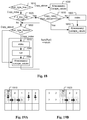
- FIG. 18 illustrates another exemplary flowchart of syntax parsing incorporating the syntax design according to an embodiment of the present invention.
- FIG. 19A illustrates an example of using a flag to indicate that the index is same as the one above instead of signaling index itself, where the flag indicates that index “3” from the pixel above.
- FIG. 19B illustrates an example of using a flag to indicate that the index is same as the one above instead of signaling index itself, where the flag indicates that index “1” from the pixel above.
- FIG. 20 illustrates yet another exemplary flowchart of syntax parsing incorporating the syntax design according to an embodiment of the present invention.
- FIG. 21 illustrates an example of arbitrary copy mode according to an embodiment of the present invention.
- the present invention is directed to several aspects related to palette coding disclosed as follows.
- the encoder will first encode reused flags to indicate the number of major colors in the palette predictor reused. A new major color size is then coded to indicate the number of new major colors to be signaled. The number of new major color size is coded using a unary code or truncated unary code. In JCTVC-O0182, the number of total major color size is coded using a fixed-length code.
- Kth order Exp-Golomb code, truncated Kth order Exp-Golomb code, unary code plus Kth order Exp-Golomb code, or truncated unary code plus Kth order Exp-Golomb code is used according to an embodiment of the present invention for the binarization of the palette related size such as the number of new major color size, the number of reused major color size in the palette predictor, the total major color size, or any combination thereof.
- the binarization may use a truncated unary (TU) code with a maximum length of 3 bits plus an Kth order Exp-Golomb code with K equal to 3 (i.e., EG-3 code) as shown in Table 1.
- TU truncated unary
- K is equal to 3 in the example of Table 1, K can be 0, 1, 2, 3, or 4 according to embodiments of the present invention.
- the maximum length of the TU code can be 1, 2, or 3 according to embodiments of the present invention.
- a part of the bins of the binarized palette related size can be coded with contexts. For example, the first three bins can be coded with contexts.
- Some of the reuse flags in the predictor can be always directly coded.
- the first N (e.g. 4) bits corresponding to the first N reuse flags can be directly coded instead of run-length coded. Therefore, the number of reuse flags can be decreased.
- the binarized codeword can be adaptively changed according to the maximum possible size. For example, if the maximum size is 3, 3 bits for the TU code will beadequate. In this case, there is no need for the EG-K code and the EG-K part can be skipped.
- NCPs Neighboring CU Pixels
- the pixel when a pixel is coded by signaling a copy_run syntax, the pixel will copy not only the above pixel's pixel index but also the above pixel's pixel value as shown in FIG. 5 .
- the decoder can reconstruct the pixel in the copy_run mode from the copied pixel value without referring to the palette.
- a special symbol (e.g. “A”) can be assigned to all positions covered by copy_run (copy above) during the parsing stage. Then, in the reconstruction stage, whenever the decoder encounters an “A”, it copies the pixel value from above.
- pixel values for index_run can be directly signaled without the associated index.
- the palette table and other information related to the palette table do not need to be coded.
- an embodiment according to the present invention assigns a special index for the neighboring CU pixel (NCP), denoted as N.
- NCP a special index for the neighboring CU pixel
- a pixel is signaled by a copy_run syntax, it will copy not only the pixel index (N) of the pixel above but also the pixel value of the pixel above, as shown in FIG. 6 .
- the special value, N can be a value different from all possible index value (e.g. the maximum index value+1).
- the similar method can be applied and the NCPs in the case will be the left NCPs.
- the decoder can substitute the indices and pixel values of the above NCPs with a predefined or derived value.
- the substitution method can also be applied to the case of copying index (e.g. FIG. 4 ), copying values, and copying both index and values (e.g. FIG. 5 ).
- FIG. 7 An example illustrating an embodiment of the present invention for the decoder side is shown in FIG. 7 , where the indices and pixel values of the above NCPs are all equal to 0 and the palette color in the entry zero respectively.
- FIG. 8 Another example illustrating an embodiment of the present invention for the decoder side is shown in FIG. 8 , where the index and pixel value of the above NCPs equal to N and a predefined or derived pixel value X respectively as shown in FIG. 8 .
- Pixel value X can be (127, 0, 0) or (128, 0, 0) for the YUV format, or (127, 127, 127) or (128, 128, 128) for the YUV format.
- the encoder and decoder can substitute the above index with the most frequently occurred index and substitute the pixel value to the corresponding pixel value.
- the current pixel (P c ) cannot have the same index as the index of above pixel (P a ) when the current pixel is the first pixel of a new index run. Otherwise, the current pixel would be merged into the previous run. In this case, the index (I c ) of the current pixel can be coded with redundancy removal.
- the index of the above pixel (P a ) is referred to as I above and the index of previous pixel (e.g, the left pixel P left ) is referred to as I left .
- the previous pixel can also be the right (horizontal scan), the above or the below pixel (vertical scan) depending on the scan direction.
- An above pixel can be in the row above the current pixel or in the column to the left of the current pixel based on the scanning direction.
- the redundant index removal is disabled, so there is no need to store and access the index of the above pixel.
- a redundant index corresponding to the previous pixel index will be removed from the palette set to form an updated palette set for encoding or decoding the index of the current pixel.
- FIG. 9A illustrates the case that I above is directly copied from the neighboring CU.
- FIG. 9B illustrates the case that I above is copied from an above pixel, where the index of the above pixel in turn is copied from the neighboring CU.
- the redundancy removal will be disabled.
- the index redundancy removal when P left is coded in the copy above mode, the index redundancy removal will be disabled for all indices.
- redundant index removal can be disabled for all indices, regardless of the mode of P left .
- the redundant index removal can be disabled when P left is coded in the copy above mode.
- the traverse scanning is applied for all block sizes, which includes 64 ⁇ 64 block.
- the traverse scan of a 64 ⁇ 64 block is shown in FIG. 10 .
- the maximum processing unit can be only 32 ⁇ 32. This is because the maximum transform unit (TU) is 32 ⁇ 32, and a 64 ⁇ 64 CU coded in the Intra or Inter mode can be divided into four 32 ⁇ 32 blocks for parsing coefficients and reconstruction. There is no need to use a 64 ⁇ 64 buffer for HEVC decoding.
- the 64 ⁇ 64 traverse scan is split into four 32 ⁇ 32 traverse scans as shown in FIGS. 11A-B and FIGS. 12A-B .
- a 64 ⁇ 64 block is divided into four 32 ⁇ 32 blocks and two different scan patterns across the four 32 ⁇ 32 blocks are shown in FIG. 11A and FIG. 12A respectively.
- the scanning order across the four 32 ⁇ 32 blocks are upper-left, lower-left, upper-right, and then lower-right as indicated by the bold zigzag line with an arrow.
- FIG. 12A the scanning order across the four 32 ⁇ 32 blocks are upper-left, upper-right, lower-left, and then lower-right as indicated by the bold zig-zag line with an arrow.
- FIG. 11B illustrates a complete scan pattern corresponding to FIG. 11A across the four 32 ⁇ 32 blocks.
- FIG. 12B illustrates a complete scan pattern corresponding to FIG. 12A across the four 32 ⁇ 32 blocks.
- a 64 ⁇ 64 palette CU can be treated as four 32 ⁇ 32 blocks and fit into the processing unit with size equal to 32 ⁇ 32. Therefore, only a 32 ⁇ 32 buffer and some line buffers are required.
- the above sample position can be derived from scan order position or geometry position. If the above sample position is derived from scan order, the scan index of the above sample is equal to the current scan index minus 32. For example, for a current pixel A, if the above sample position is derived from scan order, its above sample position is pixel B. If the above sample position is derived from geometry position, its above sample position is pixel C as shown in FIGS. 13A-B , where FIG. 13A corresponds to the scan order of FIG. 11B and FIG. 13B corresponds to the scan order of FIG. 12B . Furthermore, mixed sample position derivation can be applied. For example, for the first row of the upper-right 32 ⁇ 32 block, it can use scan order position derivation to find its above pixel, and other rows use geometry derivation.
- the copy_above_run mode (also referred to as “copy-above mode”) cannot be applied.
- the palette prediction mode of the first row of the upper-right 32 ⁇ 32 block cannot be copy_above_run mode.
- the maximum number of palette run can be limited. Furthermore, the redundant index removal is not applied when the previous coded palette run mode is copy_above_run and the above sample is not available.
- FIG. 13B illustrates an example for this case. If the last coded palette run mode for pixel D is copy_above_run and the run starts from pixel E, the copy_above_run should be ended at pixel F.
- the maximum number of palette run for pixel E can be (scan_order_F-scan_order_E).
- the palette run mode for pixel D should be the index run mode. For pixel D, the redundant index removal is not applied because the index of its above sample is not available.
- the size of sub-blocks can be aligned with the maximum transform unit (TU) size.
- Each sub-block scan can be independent.
- the subblock scan and palette predictor derivation disclosed above for the traverse scan can also be applied to the raster scan. If the raster scan is used, a 64 ⁇ 64 block can be also divided into four 32 ⁇ 32 blocks.
- the scan order within each 32 ⁇ 32 block in FIG. 11A-B , FIG. 12A-B , and FIG. 11A-B can be changed to the raster scan.
- the scan order across the four 32 ⁇ 32 blocks can be vertical first as shown in FIG. 14A or can be horizontal first as shown in FIG. 15A . In FIG. 14B , a vertical raster scan is applied within each subblock and in FIG. 15B , a horizontal raster scan is applied within each subblock.
- palette coding can be skipped for CUs with a size larger than a pre-defined block size.
- the pre-defined block size is 32 ⁇ 32. Accordingly, for a 64 ⁇ 64 CU, palette_mode_flag is derived as 0 without signaling.
- the current CU is divided into four 32 ⁇ 32 palette coded blocks. Each block may use its individual syntax for palette coding.
- an encoder constraint is imposed so that the palette_mode_flag is constrained to be 0 (i.e., palette mode off) if the CU size is equal to 64 ⁇ 64.
- the traverse scan is applied for all block sizes including the 64 ⁇ 64 block.
- the traverse scan of a 64 ⁇ 64 block is shown in FIG. 10 .
- palette coding can be skipped when the size of palette coded CU is larger than the maximum TU size. If the CU size is larger than the maximum TU size, palette_mode_flag is derived as 0 without signalling.
- an encoder constraint is imposed so that the palette_mode_flag is constrained to be 0 (i.e., palette mode off) if the CU size is larger than the maximum TU size.
- any CU with size no larger than the pre-defined block size e.g., the maximum TU size or 32 ⁇ 32
- the pre-defined block size e.g., the maximum TU size or 32 ⁇ 32
- techniques described in this disclosure can be applied.
- run_type also referred to as “palette run type”
- run_type can be context coded using one syntax corresponding to the run_type of the pixel above as shown in Table 6, where bin index 0 is coded using context adaptive coding and other bin indices are not.
- the blocks within a coding tree block (CTB) are processed according to a z-scan pattern to match with the quadtree partition CTB into blocks.
- the pixel (xNbA, yNbA) indicates the pixel above the current pixel.
- the variable available A indicates that the pixel (xNbA, yNbA) is included in the current CTB.
- Table 7 illustrates an exemplary condition to determine ctxInc for palette_run_type_flag. When condA indicates the run type of the above pixel is 0, ctxInc is 0. When the (xNbA, yNbA) is not included in the current CTB, ctxInc is 0.
- the location (xNbA, yNbA) of the above pixel is set equal to (xA, yA) for the current pixel at (x0, y0), where:
- run_type can be context coded using one syntax corresponding to the run_type of the previous pixel as shown in Table 8, where bin index 0 is coded using context adaptive coding and other bin indices are not. Again, there are two possible values (i.e., two contexts) for the run_type and one context model is used for each of the two the run_type values.
- the location (xNbB, yNbB) of the previous pixel is set equal to (xB, yB) for the current pixel at (x0, y0), where:
- location (xB, yB) is determined according to:
- variable available B indicates the pixel (xNbB, yNbB) is included in the current CTB.
- Table 9 illustrates an exemplary condition to determine ctxInc for palette_run_type_flag. When condL indicates the run type of the previous pixel is 0, ctxInc is 0. When the (xNbB, yNbB) is not included in the current CTB, ctxInc is 0.
- temporal Merge candidate is used as one of the Merge candidate.
- temporal Merge candidate derivation a target reference picture of the current picture in List_0 is first specified.
- the target reference picture of the current picture is the picture with reference picture index (ref_Idx) equal to 0 in List_0.
- the motion vector of the collocated PU is scaled to derive the temporal Merge candidate.
- the ref_Idx of temporal Merge candidate is set equal to zero.
- two motion vectors one is for reference picture list 0 and the other is for reference picture list 1, are obtained and combined to make the bi-predictive Merge candidate.
- temporal Merge candidate derivation if the target reference picture of the current picture or the reference picture of the collocated picture is long-term reference frame, the MV scaling is disabled. And if only one of these two pictures is a long-term reference frame, the temporal Merge candidate is designated as unavailable.
- the reconstructed current picture is used as one of the reference pictures for the current picture.
- This reconstructed current picture is inserted into the reference frame list, such as the last reference picture in List_0. Therefore, the IntraBC mode can be treated as one of the Inter modes.
- the reference picture points to this reconstructed current picture.
- the block vector (BV) of the IntraBC block is treated as the MV that points to this reconstructed current picture.
- the reconstructed current picture is marked as long-term reference picture.
- the BV cannot be used to derive the temporal Merge candidate because if the collocated block is coded as IntraBC mode, the reference picture of the collocated block is a long-term picture. If the reference picture of the current picture is a short-term picture, the temporal Merge candidate is not available. This implies that a BV cannot be derived using temporal Merge candidate derivation.
- an embodiment according to the present invention allows the BV to be used in temporal Merge candidate derivation.
- temporal Merge candidate derivation if the MV of the collocated block is a BV, the BV is used as the temporal Merge candidate.
- the temporal Merge candidate is available if the current reconstructed picture exists in the current reference frame list.
- the reference picture index, ref_Idx of the temporal Merge candidate is set equal to the reference picture index that points to the current reconstructed picture.
- the BV is used as the List_0 MV for this temporal Merge candidate and the ref_Idx is set equal to the reference picture index that points to the current reconstructed picture.
- an embodiment of the present invention utilizes line-constrained run-coding for the palette index, which has four methods (modes) to code a line of palette index:
- Line copy_index All samples in the line have the same palette index.
- Line copy_above All indices of the line are copied from the line above.
- Line fraction copy_index The indices of the line are coded only using index_run. Each run is a repeat of a specific index. The last run terminates at the end of the line.
- Line fraction mixture The indices of the line are coded using index_run and copy_above. Each run is either a repeat of a specific index (copy_index) or a copy of consecutive indices from above line (copy_above). The last run terminates at the end of the line.
- syntax design first determines whether it is “line copy_above” mode. If not, further syntax elements will determine a single run (line copy_index) or multiple runs (line fraction) modes. Table 10 below summarizes the syntax design.
- the palette run does not need to be signaled since the run length is equal to the block width (or height if the scan is vertical).
- FIG. 16 illustrates an exemplary flowchart of syntax parsing incorporating the syntax design as disclosed above.
- the Run_type_line is checked as shown in step 1610 . If the run type is Copy_index, the process goes to step 1620 and if the run type is Copy_above, step 1630 is performed.
- the Full_line_flag is checked to determine whether it is true. If it is true (i.e., the “Yes” path), the index is parsed as shown in step 1640 and Escape_values is further parsed if necessary as shown on step 1650 . If Full_line_flag is not true (i.e., the “No” path), step 1660 is performed, which checks syntax Run_type_fraction.
- step 1690 is performed. If Run_type_fraction is Copy_above, step 1690 is performed. If Run_type_fraction is Copy_index, step 1670 is performed, where an index is parsed. A run is parsed in step 1680 after step 1670 . After the run is parsed, the Escape_values is parsed in step 1690 if necessary.
- syntax design first determines whether it is “line copy_above” mode. If not, further syntax elements will determine single run (line copy_index) or multiple runs (line fraction) modes. Table 11 summarizes the syntax design.
- a flag Copy_index_only is used to indicate Line fraction copy_index, where the loop over runs does not need to signal the run type since they are all copy_index runs.
- binarization signaling of the four modes are illustrated in Tables 12A-J, where variable length binarization is illustrated in Tables 12A-I and fixed length binarization is illustrated in Tables 12J.
- Context coding examples Each of the bins in the above binarization examples can be coded using the bypass or the regular context mode.
- the context coding can depend on the previous mode, the mode in the line above, or both. If context coded, the Run_type_line and Run_type_fraction may share the same context, or they can use different contexts.
- the last run in each line has to be terminated at the end of the line, its length can be coded efficiently with a special “run-to-the-end” syntax design. For example, a specific code can be assigned as the run-to-the-end code in the palette binarization table. In another example, a syntax number_of_run_in_line corresponding to the number of runs in the line can be signaled. When parsing the loop over runs in a line, the run length of the last run can be skipped. In yet another embodiment, a syntax last_run flag is signaled for each run. When this flag is 1, the run does not need to be signaled.
- the present invention is not limited to the specific binarization methods for coding the runs.
- Other run coding method such as the truncated unary or truncated binary can be used to binarize the run.
- each bin can be coded in the bypass or the regular context mode.
- the index of the line is signaled. If the index is the same as the one above, one flag can be signaled instead of the index itself. In the example shown in FIG. 17 , for the line with all indices 3, index ‘3’ can be signaled. Also a flag indicating that the index is the same as the above pixel ( 1710 ) can be signaled.
- FIG. 18 illustrates an exemplary flowchart of syntax parsing incorporating the syntax design as disclosed above.
- the flowchart in FIG. 18 is similar to that in FIG. 16 except for the case that the Full_line_flag is true. In this case, additional test regarding whether Copy_index_from_above is true in step 1810 . If the result is “Yes”, step 1830 is performed where Escape_values is parsed if necessary. If the result is “No”, step 1820 is performed where an index is parsed. After step 1820 , Escape_values is parsed if necessary as shown in step 1830 .
- the flag can be used to indicate that the index is same as the one above instead of signaling index itself. Two examples are shown in FIGS. 19A-B , where the flag indicates that index “3” from the pixel above ( 1910 ) is used in FIG. 19A and index “1” from the pixel above ( 1920 ) is used in FIG. 19B .
- FIG. 20 illustrates an exemplary flowchart of syntax parsing incorporating the syntax design as disclosed above.
- FIG. 20 is similar to FIG. 18 except that an additional step ( 2010 ) is included between step 1660 and step 1670 .
- step 2010 whether Copy_index_from_above is true is tested. If the result is “Yes”, Escape_values is parsed if necessary as shown in step 1690 . If the result is “No”, an index is parsed as shown in step 1670 .
- row_run_flag is signaled in this case.
- the above embodiment for entire row run can also be applied to copy above, copy left, copy other direction, transition copy, arbitrary copy or any combination of thereof.
- the above entire row run technique can be applied to the copy above or copy left mode, but not transition copy or arbitrary copy.
- Tables 13B-C illustrate two examples of binarization for signaling of row_run_length according to an embodiment of the present invention
- an embodiment of the present invention includes the arbitrary position copy mode to facilitate copying length-of-indices from other location.
- Transition copy is a coding mode developed for the screen content coding under HEVC. Different from transition copy, the current pixel arbitrary copy mode is not determined by the left pixel. The encoder will search in the previous coded color indexes to find a matched color index with current color index. The distance is the distance between these two color index positions. The length is derived according to the number of pixels that has the same color index as the pixel at the specified distance. The distance and length pair is determined by the longest length or by other rate-distortion optimization (RDO) decisions.
- RDO rate-distortion optimization
- FIG. 21 illustrates an example of arbitrary copy mode.
- the encoder When encoding a current pixel ( 2110 ), the encoder will search in the previous coded pixels. Two matched pairs with lengths 3 and 6 are found as indicated by ellipses 2120 and 2130 with the current pattern ( 2140 ) in FIG. 21 . The locations of the matched pairs can be identified by the respective block vectors ( 2150 and 2160 ). The encoder will choose one according to the RDO decision or longest length.
- the arbitrary_copy_run_distance can be signaled as a vector or two separate 1D scalar values.
- Index map coding of palette coding can also be applied to each TU.
- the information of palette itself can be shared by all TUs within a CU.
- Maximum TU split depth can be fixed as N such as max_transform_hierarchy_depth_intra-1.
- TU split depth can be fixed as N (e.g. 1) for larger CUs such as a 64 ⁇ 64 CU and fixed as N ⁇ 1 (e.g. 0) for smaller CUs such as 32 ⁇ 32, 16 ⁇ 16 and 8 ⁇ 8.
- the horizontal raster scan is used for color index map coding.
- the subsampled index map is encoded and other parts of the index map are then encoded or directly filled.
- the even-numbered sample rows or even-numbered sample columns can be encoded first by using the original palette color index map coding.
- the interpolation can be applied to fill the samples.
- a syntax can be signaled for the rest sample rows or columns.
- a prediction mode can be signaled.
- the prediction mode may include vertical mode, horizontal mode, interpolation mode, and normal coding mode.
- the samples are interpolated by using the neighboring pixels.
- a CU-level flag can be signaled to indicate whether the subsampled color index map is used for the CU.
- a flag in PPS/SPS/Slice header can be signaled to turn on/off for this tool.
- Case 1 CU with one palette color and no escape index
- Case 2 CU with no palette color and one escape index.
- the palette transpose flag and run coding can be adaptively signalled for a CU containing only one possible index. For example, in Case 1, when the CU has one palette color and no escape index, signaling of palette_transpose_flag and/or run coding is enabled. If palette_transpose_flag is skipped, it can be inferred as on or off. For Case 2, when the CU has no palette color and one escape index, the signaling of palette_transpose_flag and/or run coding is enabled. If palette_transpose_flag is skipped, it can be inferred as on or off.
- any combination of disablingthe palette_transpose_flag, and run coding in Case 1, Case 2 or both cases can be applied.
- the offset of generalized copy above mode can be inferred by the palette size.
- the palette size is smaller than N and the index mode is the copy above mode
- palette size is larger than N, the copy above multiple row is used.
- the encoder and decoder will always signal the offset for copy above mode.
- the palette coding method can be used as another residual coding method (e. g. coding predictor refinement information).
- residual e.g. coding predictor refinement information
- HEVC HEVC
- a palette coding syntax is used to signal predictor refinement information (i.e., residual). Examples according to this embodiment are described as follows:
- the encoder uses palette to encode residual signal.
- the decoder decodes palette index and gets the values in the palette corresponding to the palette index.
- the value is residual value and used to refine the predictor.
- a special index can be reserve for residual equal to 0.
- the reserved index can be 0 or 1.
- the encoder uses palette syntax to encode predictor refinement information, uses palette to encode original pixel values, but reserve a special index to indicate the reconstructed pixel being equal to the predictor.
- the decoder decodes a palette syntax, if the index of a pixel is 0, the reconstructed pixel value is equal to the (Intra or Inter) predictor. Otherwise, the reconstructed pixel value is equal to the color in the palette corresponding to the index.
- the reserved index can be 0 or 1.
- the HEVC residual syntax can be signaled after or before the new palette syntax.
- the last coded BVs are used in BV predictor (BVP) derivation for BV coding.
- the last coded BVs are reset to (0, 0) for each CTU.
- the reset mechanism is modified to reset the last coded BVs for each CTU to a predefined value instead of (0, 0).
- the predefined value can be ( ⁇ 8, 0), ( ⁇ 16, 0), ( ⁇ 32, 0), ( ⁇ 64, 0), (0, ⁇ 8), (0, ⁇ 16), (0, ⁇ 32), (0, ⁇ 64).
- the predefined BVs pairs can be ⁇ ( ⁇ 64, 0), ( ⁇ 32, 0) ⁇ , ⁇ ( ⁇ 32, 0), ( ⁇ 64, 0) ⁇ , ⁇ ( ⁇ 128, 0), ( ⁇ 64, 0) ⁇ , ⁇ ( ⁇ 64, 0), ( ⁇ 128, 0) ⁇ , ⁇ ( ⁇ 32, 0), ( ⁇ 16, 0) ⁇ , ⁇ ( ⁇ 16, 0), ( ⁇ 32, 0) ⁇ , ⁇ ( ⁇ 16, 0), ( ⁇ 8, 0) ⁇ , ⁇ ( ⁇ 8, 0), ( ⁇ 16, 0) ⁇ , ⁇ ( ⁇ 32, 0), ( ⁇ 8, 0) ⁇ , or ⁇ ( ⁇ 8, 0), ( ⁇ 32, 0) ⁇ .
- the BV predictor derivation can be simplified.
- the availability check for last coded BV i.e., checking whether the last coded BV is equal to (0,0)
- Examples of reset mechanism according to this embodiment are described as follows:
- the last coded BVs are reset to ( ⁇ 2w, 0) and ( ⁇ w, 0) when the current block is the first coded IntraBC PU in the current CTU, where the w is the PU width or PU height.
- the last coded BVs are reset to predefined values at the beginning of each CTU, where these predefined values are related to CTU_width or CTU_height.
- the predefined values can be ( ⁇ CTU_width, 0), ( ⁇ (CTU_width>>1), 0), ( ⁇ (CTU_width>>2), 0), ( ⁇ (CTU_width>>3), 0).
- a minimum/maximum value constraint can be applied on these predefined values. For example, the maximum value of each component cannot be larger than ⁇ 8.
- the predefined values can be (max( ⁇ 8, ⁇ CTU_width)), 0), (max( ⁇ 8, ⁇ (CTU_width>>1)), 0), (max( ⁇ 8, ⁇ (CTU_width>>2)), 0), (max( ⁇ 8, ⁇ (CTU_width>>3)), 0).
- the last coded BVs are reset to predefined values at the beginning of each CTU, where these predefined values are related to min_CU_width or min_CU_height.
- the predefined values can be ( ⁇ min_CU_width), 0), ( ⁇ 2*min_CU_width), 0), ( ⁇ 3*min_CU_width, 0), ( ⁇ 4*min_CU_width, 0), ( ⁇ 8*min_CU_width, 0).
- a minimum/maximum value constraint can be applied on these predefined values. For example, the minimum value of each component cannot be larger than ⁇ 64.
- the predefined values can be (min( ⁇ 64, ⁇ min_CU_width)), 0), (min( ⁇ 64, ⁇ 2*min_CU_width)), 0), (min( ⁇ 64, ⁇ 3*min_CU_width)), 0), (min( ⁇ 64, ⁇ 4*min_CU_width)), 0), (min( ⁇ 64, ⁇ 8*min_CU_width)), 0).
- the predefined BVs pairs can be ⁇ ( ⁇ min_CU_width), 0), ( ⁇ 2*min_CU_width), 0) ⁇ , ⁇ ( ⁇ 2*min_CU_width), 0), ( ⁇ min_CU_width), 0) ⁇ , ⁇ ( ⁇ 2*min_CU_width), 0), ( ⁇ 4*min_CU_width), 0) ⁇ , or ⁇ ( ⁇ 4*min_CU_width), 0), ( ⁇ 2*min_CU_width), 0) ⁇ .
- the last coded BV resetting can be simplified. It won't need to detect whether the current block is the first IntraBC coded block in current CTU.
- Embodiment of the present invention as described above may be implemented in various hardware, software codes, or a combination of both.
- an embodiment of the present invention can be one or more electronic circuits integrated into a video compression chip or program code integrated into video compression software to perform the processing described herein.
- An embodiment of the present invention may also be program code to be executed on a Digital Signal Processor (DSP) to perform the processing described herein.
- DSP Digital Signal Processor
- the invention may also involve a number of functions to be performed by a computer processor, a digital signal processor, a microprocessor, or field programmable gate array (FPGA). These processors can be configured to perform particular tasks according to the invention, by executing machine-readable software code or firmware code that defines the particular methods embodied by the invention.
- the software code or firmware code may be developed in different programming languages and different formats or styles.
- the software code may also be compiled for different target platforms.
- different code formats, styles and languages of software codes and other means of configuring code to perform the tasks in accordance with the invention will not depart from the spirit and scope of the invention.
Landscapes
- Engineering & Computer Science (AREA)
- Multimedia (AREA)
- Signal Processing (AREA)
- Physics & Mathematics (AREA)
- Discrete Mathematics (AREA)
- General Physics & Mathematics (AREA)
- Compression Or Coding Systems Of Tv Signals (AREA)
Priority Applications (1)
| Application Number | Priority Date | Filing Date | Title |
|---|---|---|---|
| US15/316,609 US10623747B2 (en) | 2014-06-20 | 2015-06-19 | Method of palette predictor signaling for video coding |
Applications Claiming Priority (8)
| Application Number | Priority Date | Filing Date | Title |
|---|---|---|---|
| US201462014959P | 2014-06-20 | 2014-06-20 | |
| US201462086319P | 2014-12-02 | 2014-12-02 | |
| US201562108165P | 2015-01-27 | 2015-01-27 | |
| US201562109830P | 2015-01-30 | 2015-01-30 | |
| US201562109836P | 2015-01-30 | 2015-01-30 | |
| US201562111140P | 2015-02-03 | 2015-02-03 | |
| PCT/CN2015/081909 WO2015192800A1 (fr) | 2014-06-20 | 2015-06-19 | Procédé de signalisation de prédicteur de palette pour un codage vidéo |
| US15/316,609 US10623747B2 (en) | 2014-06-20 | 2015-06-19 | Method of palette predictor signaling for video coding |
Related Parent Applications (1)
| Application Number | Title | Priority Date | Filing Date |
|---|---|---|---|
| PCT/CN2015/081909 A-371-Of-International WO2015192800A1 (fr) | 2014-06-20 | 2015-06-19 | Procédé de signalisation de prédicteur de palette pour un codage vidéo |
Related Child Applications (1)
| Application Number | Title | Priority Date | Filing Date |
|---|---|---|---|
| US16/679,650 Continuation US11044479B2 (en) | 2014-06-20 | 2019-11-11 | Method of palette predictor signaling for video coding |
Publications (2)
| Publication Number | Publication Date |
|---|---|
| US20170195676A1 US20170195676A1 (en) | 2017-07-06 |
| US10623747B2 true US10623747B2 (en) | 2020-04-14 |
Family
ID=54934890
Family Applications (2)
| Application Number | Title | Priority Date | Filing Date |
|---|---|---|---|
| US15/316,609 Active 2036-07-04 US10623747B2 (en) | 2014-06-20 | 2015-06-19 | Method of palette predictor signaling for video coding |
| US16/679,650 Active US11044479B2 (en) | 2014-06-20 | 2019-11-11 | Method of palette predictor signaling for video coding |
Family Applications After (1)
| Application Number | Title | Priority Date | Filing Date |
|---|---|---|---|
| US16/679,650 Active US11044479B2 (en) | 2014-06-20 | 2019-11-11 | Method of palette predictor signaling for video coding |
Country Status (6)
| Country | Link |
|---|---|
| US (2) | US10623747B2 (fr) |
| EP (1) | EP3143767B1 (fr) |
| JP (2) | JP6328277B2 (fr) |
| KR (2) | KR102042085B1 (fr) |
| CN (3) | CN114501033B (fr) |
| WO (1) | WO2015192800A1 (fr) |
Families Citing this family (43)
| Publication number | Priority date | Publication date | Assignee | Title |
|---|---|---|---|---|
| US11223832B2 (en) * | 2014-07-24 | 2022-01-11 | Qualcomm Incorporated | Methods and apparatus for encoding video data using block palettes and sub-block and pixel scanning orders |
| GB2531005A (en) * | 2014-10-06 | 2016-04-13 | Canon Kk | Improved encoding process using a palette mode |
| US20160234494A1 (en) * | 2015-02-10 | 2016-08-11 | Qualcomm Incorporated | Restriction on palette block size in video coding |
| CN107431824B (zh) | 2015-04-08 | 2020-10-02 | 寰发股份有限公司 | 视频编解码中调色板模式上下文编解码和二值化的方法 |
| US10455228B2 (en) * | 2016-03-21 | 2019-10-22 | Qualcomm Incorporated | Determining prediction parameters for non-square blocks in video coding |
| US10623774B2 (en) | 2016-03-22 | 2020-04-14 | Qualcomm Incorporated | Constrained block-level optimization and signaling for video coding tools |
| CN108886617B (zh) | 2016-04-06 | 2021-08-27 | 株式会社Kt | 用于处理视频信号的方法和设备 |
| CN107948659B (zh) * | 2017-11-21 | 2020-07-31 | 天津大学 | 针对游戏视频内容的hevc-scc自适应能耗控制策略 |
| US11240500B2 (en) * | 2018-06-01 | 2022-02-01 | Sharp Kabushiki Kaisha | Image decoding apparatus and image coding apparatus |
| CN112219399B (zh) * | 2018-07-04 | 2025-01-24 | 阿里巴巴集团控股有限公司 | 视频压缩系统中基于调色板的残差编码 |
| JP7204891B2 (ja) | 2018-08-28 | 2023-01-16 | 華為技術有限公司 | ピクチャパーティショニング方法及び機器 |
| US11758164B2 (en) * | 2018-10-23 | 2023-09-12 | Tencent America LLC | Method and apparatus for video coding |
| US10652537B1 (en) * | 2018-11-21 | 2020-05-12 | Alibaba Group Holding Limited | Coding unit size adaptive palette mode for video compression system |
| US10970881B2 (en) * | 2018-12-21 | 2021-04-06 | Samsung Display Co., Ltd. | Fallback modes for display compression |
| CN114173114B (zh) | 2019-01-08 | 2022-09-23 | 华为技术有限公司 | 图像预测方法、装置、设备、系统及存储介质 |
| CN111416975B (zh) | 2019-01-08 | 2022-09-16 | 华为技术有限公司 | 预测模式确定方法和装置 |
| CA3121922C (fr) * | 2019-01-10 | 2023-10-03 | Guangdong Oppo Mobile Telecommunications Corp., Ltd. | Procede de decodage d'image, decodeur et support de stockage informatique |
| SG11202108938TA (en) | 2019-02-24 | 2021-09-29 | Beijing Bytedance Network Technology Co Ltd | Independent coding of palette mode usage indication |
| WO2020169105A1 (fr) * | 2019-02-24 | 2020-08-27 | Beijing Bytedance Network Technology Co., Ltd. | Codage conditionnel d'indication d'utilisation de mode de palette |
| US10924750B2 (en) | 2019-03-01 | 2021-02-16 | Alibaba Group Holding Limited | Palette size constraint in palette mode for video compression system |
| CA3132071A1 (fr) * | 2019-03-08 | 2020-08-27 | Beijing Bytedance Network Technology Co., Ltd. | Codage conjoint d'indication d'utilisation de mode de palette |
| US11202101B2 (en) * | 2019-03-13 | 2021-12-14 | Qualcomm Incorporated | Grouped coding for palette syntax in video coding |
| CN113853787B (zh) * | 2019-05-22 | 2023-12-22 | 北京字节跳动网络技术有限公司 | 基于子块使用变换跳过模式 |
| JP7359936B2 (ja) | 2019-07-20 | 2023-10-11 | 北京字節跳動網絡技術有限公司 | パレットモードの使用の指示の条件依存符号化 |
| CN117221536A (zh) | 2019-07-23 | 2023-12-12 | 北京字节跳动网络技术有限公司 | 调色板模式编解码的模式确定 |
| PH12022550201A1 (en) * | 2019-07-26 | 2023-01-04 | Beijing Bytedance Network Tech Co Ltd | Determination of picture partition mode based on block size |
| CN114208174B (zh) | 2019-07-29 | 2023-11-28 | 北京字节跳动网络技术有限公司 | 预测过程中的调色板模式编解码 |
| WO2021023262A1 (fr) | 2019-08-06 | 2021-02-11 | Beijing Bytedance Network Technology Co., Ltd. | Utilisation d'un outil de codage de contenu d'écran pour le codage et le décodage vidéo |
| MX2022002304A (es) * | 2019-08-26 | 2022-03-25 | Lg Electronics Inc | Codificacion de imagen o video basada en codificacion de escape de paleta. |
| CN117714683A (zh) | 2019-09-02 | 2024-03-15 | 北京字节跳动网络技术有限公司 | 基于色彩格式的视频区分割 |
| WO2021048077A1 (fr) * | 2019-09-13 | 2021-03-18 | Interdigital Vc Holdings France, Sas | Interactions de taille de transformée avec des outils de codage |
| KR102649584B1 (ko) | 2019-09-21 | 2024-03-21 | 베이징 바이트댄스 네트워크 테크놀로지 컴퍼니, 리미티드 | 크로마 인트라 모드에 기초한 크기 제한 |
| WO2021133529A1 (fr) * | 2019-12-26 | 2021-07-01 | Alibaba Group Holding Limited | Procédés de codage de données vidéo en mode palette |
| EP4082201A4 (fr) * | 2019-12-30 | 2023-03-29 | Alibaba Group Holding Limited | Procédé et appareil pour coder des données vidéo dans un mode palette |
| EP4088455B1 (fr) | 2020-01-11 | 2025-07-02 | Beijing Dajia Internet Information Technology Co., Ltd. | Procédés et appareil de décodage vidéo utilisant un mode palette |
| US11184632B2 (en) * | 2020-01-20 | 2021-11-23 | Tencent America LLC | Method and apparatus for palette based coding mode under local dual tree structure |
| CN115802061B (zh) * | 2020-03-27 | 2023-09-26 | 北京达佳互联信息技术有限公司 | 对视频数据进行编码的方法、电子装置和存储介质 |
| US11968360B2 (en) | 2020-03-31 | 2024-04-23 | Alibaba Group Holding Limited | Methods for palette prediction |
| BR112022020449A2 (pt) * | 2020-04-10 | 2022-11-29 | Beijing Bytedance Network Tech Co Ltd | Método e aparelho para processar dados de vídeo, e, meios de armazenamento e de gravação legíveis por computador não transitórios |
| US12132917B2 (en) * | 2020-09-23 | 2024-10-29 | Ati Technologies Ulc | Palette mode video encoding utilizing hierarchical palette table generation |
| CN112153475B (zh) | 2020-09-25 | 2022-08-05 | 北京字跳网络技术有限公司 | 用于生成文字模式的视频的方法、装置、设备和介质 |
| US11463716B2 (en) * | 2021-02-25 | 2022-10-04 | Qualcomm Incorporated | Buffers for video coding in palette mode |
| US20250254336A1 (en) * | 2022-04-08 | 2025-08-07 | Interdigital Ce Patent Holdings, Sas | Gradual decoding refresh and coding tools |
Citations (24)
| Publication number | Priority date | Publication date | Assignee | Title |
|---|---|---|---|---|
| US20030202602A1 (en) * | 2002-04-30 | 2003-10-30 | Apostolopoulos John G. | Compression of images and image sequences through adaptive partitioning |
| CN101217668A (zh) | 2008-01-14 | 2008-07-09 | 浙江大学 | 基于块分类的混合图像压缩方法 |
| US20090010533A1 (en) * | 2007-07-05 | 2009-01-08 | Mediatek Inc. | Method and apparatus for displaying an encoded image |
| US20100046628A1 (en) * | 2008-08-19 | 2010-02-25 | Vasudev Bhaskaran | Systems and Methods for Perceptually Lossless Video Compression |
| US20110311151A1 (en) | 2010-06-21 | 2011-12-22 | Fuji Xerox Co., Ltd. | Image data decoding device |
| US20120294353A1 (en) * | 2011-05-16 | 2012-11-22 | Mediatek Inc. | Apparatus and Method of Sample Adaptive Offset for Luma and Chroma Components |
| US20120314766A1 (en) * | 2011-06-09 | 2012-12-13 | Qualcomm Incorporated | Enhanced intra-prediction mode signaling for video coding using neighboring mode |
| WO2012174973A1 (fr) | 2011-06-20 | 2012-12-27 | Mediatek Inc. | Procédé et appareil pour réduction de tampons de ligne |
| US20130101033A1 (en) * | 2011-10-14 | 2013-04-25 | Qualcomm Incorporated | Coding non-symmetric distributions of data |
| US20140301475A1 (en) * | 2013-04-05 | 2014-10-09 | Qualcomm Incorporated | Determining palette indices in palette-based video coding |
| WO2015006724A2 (fr) | 2013-07-12 | 2015-01-15 | Qualcomm Incorporated | Prédiction par palette dans un codage vidéo basé sur une palette |
| US20150078443A1 (en) * | 2012-04-13 | 2015-03-19 | Canon Kabushiki Kaisha | Method, apparatus and system for encoding and decoding a subset of transform units of encoded video data |
| US20150110181A1 (en) * | 2013-10-18 | 2015-04-23 | Samsung Electronics Co., Ltd. | Methods for palette prediction and intra block copy padding |
| US20150186100A1 (en) * | 2014-01-02 | 2015-07-02 | Vid Scale, Inc. | Two-dimensional palette coding for screen content coding |
| WO2015179810A1 (fr) | 2014-05-22 | 2015-11-26 | Qualcomm Incorporated | Exécutions de codage dans un système de codage vidéo basé sur une palette |
| US20160057434A1 (en) * | 2014-08-25 | 2016-02-25 | Mediatek Inc. | Method of Palette Index Signaling for Image and Video Coding |
| US20160234494A1 (en) * | 2015-02-10 | 2016-08-11 | Qualcomm Incorporated | Restriction on palette block size in video coding |
| US20160309172A1 (en) * | 2013-12-10 | 2016-10-20 | Canon Kabushiki Kaisha | Method and apparatus for encoding or decoding blocks of pixel |
| US9681135B2 (en) * | 2014-03-14 | 2017-06-13 | Hfi Innovation Inc. | Method for palette table initialization and management |
| US9749628B2 (en) * | 2014-07-07 | 2017-08-29 | Hfi Innovation Inc. | Methods of handling escape pixel as a predictor in index map coding |
| US9788004B2 (en) * | 2014-03-14 | 2017-10-10 | Hfi Innovation Inc. | Method of color index coding with palette stuffing |
| US9860548B2 (en) * | 2014-05-23 | 2018-01-02 | Hfi Innovation Inc. | Method and apparatus for palette table prediction and signaling |
| US20180041774A1 (en) * | 2015-03-20 | 2018-02-08 | Media Tek Singapore Pte. Ltd. | Methods of Palette Coding with Inter-prediction in Video Coding |
| US10085026B2 (en) * | 2012-06-26 | 2018-09-25 | Lg Electronics Inc. | Video encoding method, video decoding method, and apparatus using same |
Family Cites Families (6)
| Publication number | Priority date | Publication date | Assignee | Title |
|---|---|---|---|---|
| US6335985B1 (en) * | 1998-01-07 | 2002-01-01 | Kabushiki Kaisha Toshiba | Object extraction apparatus |
| US6256415B1 (en) * | 1998-06-10 | 2001-07-03 | Seiko Epson Corporation | Two row buffer image compression (TROBIC) |
| KR20050053297A (ko) * | 2003-12-02 | 2005-06-08 | 학교법인 성균관대학 | 동영상 부호화 방법 및 장치 |
| KR101522850B1 (ko) * | 2010-01-14 | 2015-05-26 | 삼성전자주식회사 | 움직임 벡터를 부호화, 복호화하는 방법 및 장치 |
| US8615138B2 (en) * | 2011-11-03 | 2013-12-24 | Google Inc. | Image compression using sub-resolution images |
| KR20130050403A (ko) * | 2011-11-07 | 2013-05-16 | 오수미 | 인터 모드에서의 복원 블록 생성 방법 |
-
2015
- 2015-06-19 KR KR1020197001367A patent/KR102042085B1/ko active Active
- 2015-06-19 EP EP15810218.6A patent/EP3143767B1/fr active Active
- 2015-06-19 JP JP2016574156A patent/JP6328277B2/ja active Active
- 2015-06-19 US US15/316,609 patent/US10623747B2/en active Active
- 2015-06-19 CN CN202210145999.3A patent/CN114501033B/zh active Active
- 2015-06-19 WO PCT/CN2015/081909 patent/WO2015192800A1/fr not_active Ceased
- 2015-06-19 CN CN201910606199.5A patent/CN110278437B/zh active Active
- 2015-06-19 CN CN201580033392.4A patent/CN106716999B/zh active Active
- 2015-06-19 KR KR1020177000780A patent/KR101943770B1/ko active Active
-
2018
- 2018-04-17 JP JP2018078968A patent/JP6612920B2/ja active Active
-
2019
- 2019-11-11 US US16/679,650 patent/US11044479B2/en active Active
Patent Citations (29)
| Publication number | Priority date | Publication date | Assignee | Title |
|---|---|---|---|---|
| US20030202602A1 (en) * | 2002-04-30 | 2003-10-30 | Apostolopoulos John G. | Compression of images and image sequences through adaptive partitioning |
| US20090010533A1 (en) * | 2007-07-05 | 2009-01-08 | Mediatek Inc. | Method and apparatus for displaying an encoded image |
| CN101217668A (zh) | 2008-01-14 | 2008-07-09 | 浙江大学 | 基于块分类的混合图像压缩方法 |
| US20100046628A1 (en) * | 2008-08-19 | 2010-02-25 | Vasudev Bhaskaran | Systems and Methods for Perceptually Lossless Video Compression |
| US20110311151A1 (en) | 2010-06-21 | 2011-12-22 | Fuji Xerox Co., Ltd. | Image data decoding device |
| US20120294353A1 (en) * | 2011-05-16 | 2012-11-22 | Mediatek Inc. | Apparatus and Method of Sample Adaptive Offset for Luma and Chroma Components |
| US20120314766A1 (en) * | 2011-06-09 | 2012-12-13 | Qualcomm Incorporated | Enhanced intra-prediction mode signaling for video coding using neighboring mode |
| WO2012174973A1 (fr) | 2011-06-20 | 2012-12-27 | Mediatek Inc. | Procédé et appareil pour réduction de tampons de ligne |
| US20130101033A1 (en) * | 2011-10-14 | 2013-04-25 | Qualcomm Incorporated | Coding non-symmetric distributions of data |
| US20150078443A1 (en) * | 2012-04-13 | 2015-03-19 | Canon Kabushiki Kaisha | Method, apparatus and system for encoding and decoding a subset of transform units of encoded video data |
| US10085026B2 (en) * | 2012-06-26 | 2018-09-25 | Lg Electronics Inc. | Video encoding method, video decoding method, and apparatus using same |
| US20140301475A1 (en) * | 2013-04-05 | 2014-10-09 | Qualcomm Incorporated | Determining palette indices in palette-based video coding |
| WO2014165784A1 (fr) | 2013-04-05 | 2014-10-09 | Qualcomm Incorporated | Détermination d'indices de palette dans un codage vidéo basé sur une palette |
| WO2015006724A3 (fr) | 2013-07-12 | 2015-03-26 | Qualcomm Incorporated | Prédiction par palette dans un codage vidéo basé sur une palette |
| US9558567B2 (en) * | 2013-07-12 | 2017-01-31 | Qualcomm Incorporated | Palette prediction in palette-based video coding |
| US20150016501A1 (en) * | 2013-07-12 | 2015-01-15 | Qualcomm Incorporated | Palette prediction in palette-based video coding |
| WO2015006724A2 (fr) | 2013-07-12 | 2015-01-15 | Qualcomm Incorporated | Prédiction par palette dans un codage vidéo basé sur une palette |
| US20150110181A1 (en) * | 2013-10-18 | 2015-04-23 | Samsung Electronics Co., Ltd. | Methods for palette prediction and intra block copy padding |
| US20160309172A1 (en) * | 2013-12-10 | 2016-10-20 | Canon Kabushiki Kaisha | Method and apparatus for encoding or decoding blocks of pixel |
| US20150186100A1 (en) * | 2014-01-02 | 2015-07-02 | Vid Scale, Inc. | Two-dimensional palette coding for screen content coding |
| US9788004B2 (en) * | 2014-03-14 | 2017-10-10 | Hfi Innovation Inc. | Method of color index coding with palette stuffing |
| US9681135B2 (en) * | 2014-03-14 | 2017-06-13 | Hfi Innovation Inc. | Method for palette table initialization and management |
| WO2015179810A1 (fr) | 2014-05-22 | 2015-11-26 | Qualcomm Incorporated | Exécutions de codage dans un système de codage vidéo basé sur une palette |
| US9860548B2 (en) * | 2014-05-23 | 2018-01-02 | Hfi Innovation Inc. | Method and apparatus for palette table prediction and signaling |
| US9749628B2 (en) * | 2014-07-07 | 2017-08-29 | Hfi Innovation Inc. | Methods of handling escape pixel as a predictor in index map coding |
| US20160057434A1 (en) * | 2014-08-25 | 2016-02-25 | Mediatek Inc. | Method of Palette Index Signaling for Image and Video Coding |
| WO2016130622A2 (fr) | 2015-02-10 | 2016-08-18 | Qualcomm Incorporated | Restriction de la taille de bloc de palette dans le codage vidéo |
| US20160234494A1 (en) * | 2015-02-10 | 2016-08-11 | Qualcomm Incorporated | Restriction on palette block size in video coding |
| US20180041774A1 (en) * | 2015-03-20 | 2018-02-08 | Media Tek Singapore Pte. Ltd. | Methods of Palette Coding with Inter-prediction in Video Coding |
Non-Patent Citations (13)
| Title |
|---|
| Chen, J., et al.; "Description of screen content coding technology proposal by Qualcomm;" Joint Collaborative Team on Video Coding (JCT-VC) of ITU-T SG 16 WP3 and ISO/IEC JTC1/SC29/WG11; Mar.-Apr. 2014; pp. 1-19. |
| Gisquet, C., et al., AHG10: Palette Index Coding, Joint Collaborative Team on Video Coding (JCT-VC) of ITU-T SG 16 WP 3 and ISO/IEC JTC 1/SC 29/WG 11, Published on Mar. 27, 2014 in Cesson-Sevigne, France, pp. 1-3. |
| Guo, L., et al.; "Non-RCE3: Modified Palette Mode for Screen Content Coding;" Joint Collaborative Team on Video Coding (JCT-VC) of ITU-T SG 16 WP 3 and ISO/IEC JTC 1/SC 29/WG 11; JCTVC-N0249; Aug. 2013; pp. 1-6. |
| Guo, L., et al.; "RCE4: Results of Test 2 on Palette Mode for Screen Content Coding;" Joint Collaborative Team on Video Coding (JCT-VC) of ITU-T SG 16 WP 3 and ISO/IEC JTC 1/SC 29/WG 11;_JCTVC-P0198; Jan. 2014; pp. 1-3. |
| Guo, X., et al.; "AHG8: Major-color-based screen content coding;" Joint Collaborative Team on Video Coding (JCT-VC) of ITU-T SG 16 WP 3 and ISO/IEC JTC 1/SC 29/WG 11;_JCTVC-O0182; Nov. 2013; pp. 1-10. |
| Guo, X., et al.; "RCE4: Test 1. Major-color-based screen content coding;" Joint Collaborative Team on Video Coding (JCT-VC) of ITU-T SG 16 WP 3 and ISO/IEC JTC 1/SC 29/WG 11; JCTVC-P0108; Jan. 2014; pp. 1-12. |
| International Search Report dated Sep. 29, 2015, issued in application No. PCT/CN2015/081909. |
| Jie Zhao, et. al., Non-CE6: Simplified palette size coding, Joint Collaborative Team on Video Coding (JCT-VC) of ITU-T SG 16 WP 3 and ISO/IEC JTC 1/SC 29/WG 11, Published on Oct. 17, 2014 in Camas, WA, USA, pp. 1-5. |
| Lai, P.L., et al.; "Description of screen content coding technology proposal by MediaTek;" Joint Collaborative Team on Video Coding (JCT-VC) of ITU-T SG 16 WP3 and ISO/IEC JTC1/SC29/WG11; Mar.-Apr. 2014; pp. 1-31. |
| Liang, K., et al.; "Variable Block Size Multistage VQ for Video Coding;" IEEE; Nov. 1999; pp. 447-453. |
| Pu, W., et al.; "Non-RCE4: Refinement of the Palette in RCE4 Test 2;" Joint Collaborative Team on Video Coding (JCT-VC) of ITU-T SG 16 WP 3 and ISO/IEC JTC 1/SC 29/WG 11;_JCTVC-P0231; Jan. 2014; pp. 1-4. |
| Wang, W., et al.; "Non-CE5: CU dependent color palette maximum size;" Joint Collaborative Team on Video Coding (JCT-VC) of ITU-T SG 16 WP3 and ISO/IEC JTC 1/SC 29/WG 11; Oct. 2014; pp. 1-3. |
| Wei Wang, et al., Non-CE6: 2-D Index Map Coding of Palette Mode in HEVC SCC, Joint Collaborative Team on Video Coding (JCT-VC) of ITU-T SG 16 WP 3 and ISO/IEC JTC 1/SC 29/WG 11, Published on Oct. 17, 2014 in Santa Clara, USA, pp. 1-6. |
Also Published As
| Publication number | Publication date |
|---|---|
| US11044479B2 (en) | 2021-06-22 |
| JP6328277B2 (ja) | 2018-05-23 |
| JP2018142973A (ja) | 2018-09-13 |
| JP2017522804A (ja) | 2017-08-10 |
| US20170195676A1 (en) | 2017-07-06 |
| CN106716999B (zh) | 2019-08-09 |
| CN110278437A (zh) | 2019-09-24 |
| CN106716999A (zh) | 2017-05-24 |
| KR20170016973A (ko) | 2017-02-14 |
| EP3143767A4 (fr) | 2018-05-09 |
| EP3143767A1 (fr) | 2017-03-22 |
| CN114501033A (zh) | 2022-05-13 |
| CN114501033B (zh) | 2023-11-10 |
| US20200077095A1 (en) | 2020-03-05 |
| CN110278437B (zh) | 2022-03-08 |
| EP3143767B1 (fr) | 2022-06-01 |
| KR102042085B1 (ko) | 2019-11-08 |
| JP6612920B2 (ja) | 2019-11-27 |
| KR20190008435A (ko) | 2019-01-23 |
| KR101943770B1 (ko) | 2019-01-29 |
| WO2015192800A1 (fr) | 2015-12-23 |
Similar Documents
| Publication | Publication Date | Title |
|---|---|---|
| US11044479B2 (en) | Method of palette predictor signaling for video coding | |
| AU2019201623B2 (en) | Methods of escape pixel coding in index map coding | |
| CN110719468B (zh) | 视频编码方法 | |
| US10856009B2 (en) | Method of block vector clipping and coding for screen content coding and video coding | |
| US10554979B2 (en) | Methods of handling escape pixel as a predictor in index map coding | |
| JP6345805B2 (ja) | Intraブロックコピーモード符号化のブロックベクトル予測の方法 | |
| US11109056B2 (en) | Method and apparatus of current picture referencing for video coding using adaptive motion vector resolution and sub-block prediction mode | |
| CA3020374C (fr) | Procede et appareil de suppression de redondance de syntaxe de codage de palette | |
| WO2016034058A1 (fr) | Procédé de copie de bloc d'image de type intra à des fins de codage de contenu d'écran et vidéo | |
| US10484696B2 (en) | Method and apparatus for color index prediction | |
| EP3266217B1 (fr) | Procédé et appareil de décompression vidéo ou d'image utilisant codage de palettes et procédé de compression vidéo ou d'image |
Legal Events
| Date | Code | Title | Description |
|---|---|---|---|
| AS | Assignment |
Owner name: MEDIATEK INC., TAIWAN Free format text: ASSIGNMENT OF ASSIGNORS INTEREST;ASSIGNORS:CHUANG, TZU-DER;KIM, JUNGSUN;SUN, YU-CHEN;AND OTHERS;SIGNING DATES FROM 20161206 TO 20161213;REEL/FRAME:040808/0627 Owner name: HFI INNOVATION INC., TAIWAN Free format text: ASSIGNMENT OF ASSIGNORS INTEREST;ASSIGNOR:MEDIATEK INC.;REEL/FRAME:040808/0646 Effective date: 20160729 |
|
| STPP | Information on status: patent application and granting procedure in general |
Free format text: NON FINAL ACTION MAILED |
|
| STPP | Information on status: patent application and granting procedure in general |
Free format text: RESPONSE TO NON-FINAL OFFICE ACTION ENTERED AND FORWARDED TO EXAMINER |
|
| STPP | Information on status: patent application and granting procedure in general |
Free format text: NOTICE OF ALLOWANCE MAILED -- APPLICATION RECEIVED IN OFFICE OF PUBLICATIONS |
|
| STPP | Information on status: patent application and granting procedure in general |
Free format text: AWAITING TC RESP., ISSUE FEE NOT PAID |
|
| STPP | Information on status: patent application and granting procedure in general |
Free format text: NOTICE OF ALLOWANCE MAILED -- APPLICATION RECEIVED IN OFFICE OF PUBLICATIONS |
|
| STPP | Information on status: patent application and granting procedure in general |
Free format text: PUBLICATIONS -- ISSUE FEE PAYMENT VERIFIED |
|
| STCF | Information on status: patent grant |
Free format text: PATENTED CASE |
|
| MAFP | Maintenance fee payment |
Free format text: PAYMENT OF MAINTENANCE FEE, 4TH YEAR, LARGE ENTITY (ORIGINAL EVENT CODE: M1551); ENTITY STATUS OF PATENT OWNER: LARGE ENTITY Year of fee payment: 4 |