US10691641B2 - File determination device and file determination method - Google Patents
File determination device and file determination method Download PDFInfo
- Publication number
- US10691641B2 US10691641B2 US15/493,826 US201715493826A US10691641B2 US 10691641 B2 US10691641 B2 US 10691641B2 US 201715493826 A US201715493826 A US 201715493826A US 10691641 B2 US10691641 B2 US 10691641B2
- Authority
- US
- United States
- Prior art keywords
- files
- group
- file
- log
- determining
- Prior art date
- Legal status (The legal status is an assumption and is not a legal conclusion. Google has not performed a legal analysis and makes no representation as to the accuracy of the status listed.)
- Expired - Fee Related, expires
Links
Images





Classifications
-
- G—PHYSICS
- G06—COMPUTING OR CALCULATING; COUNTING
- G06F—ELECTRIC DIGITAL DATA PROCESSING
- G06F16/00—Information retrieval; Database structures therefor; File system structures therefor
- G06F16/10—File systems; File servers
- G06F16/14—Details of searching files based on file metadata
- G06F16/148—File search processing
-
- G—PHYSICS
- G06—COMPUTING OR CALCULATING; COUNTING
- G06F—ELECTRIC DIGITAL DATA PROCESSING
- G06F16/00—Information retrieval; Database structures therefor; File system structures therefor
- G06F16/10—File systems; File servers
- G06F16/13—File access structures, e.g. distributed indices
-
- G—PHYSICS
- G06—COMPUTING OR CALCULATING; COUNTING
- G06F—ELECTRIC DIGITAL DATA PROCESSING
- G06F16/00—Information retrieval; Database structures therefor; File system structures therefor
- G06F16/10—File systems; File servers
- G06F16/14—Details of searching files based on file metadata
- G06F16/156—Query results presentation
-
- G—PHYSICS
- G06—COMPUTING OR CALCULATING; COUNTING
- G06F—ELECTRIC DIGITAL DATA PROCESSING
- G06F16/00—Information retrieval; Database structures therefor; File system structures therefor
- G06F16/90—Details of database functions independent of the retrieved data types
- G06F16/903—Querying
- G06F16/90335—Query processing
- G06F16/90344—Query processing by using string matching techniques
Definitions
- the embodiment discussed herein is related to a technology of determining a file.
- a log is important information in performing an investigation of a cause when a problem has occurred in an application and, in recent years, as the interest in internal control increases, the importance of collecting logs that are output by an application has increased.
- an output destination (a full path including a file name), a format, a collection destination (a save location for extracted contents), or the like of a log is specified in a collection tool (a product, such as Fluentd, Splunk, or the like).
- a collection tool a product, such as Fluentd, Splunk, or the like.
- Examples of applications include, for example, an open source (OSS), a middleware, a business application, or the like and, in the current situation, the frequency of the occurrence of an addition or a modification of such an application is high, and the system configuration is changed from day to day.
- OSS open source
- middleware middleware
- business application or the like
- FIG. 1 is a diagram illustrating an example of monitoring of a file that is output by an application according to related art and illustrates an example in which files of a plurality of app processes (application processes) are monitored by a single monitoring process.
- the monitoring process checks files one by one from a file list of each app process and determines, if a character string, such as “log” or the like, is included in a file name or an extension, that a file is a log.
- FIG. 2 is a diagram illustrating another example of monitoring of a file that is output by an applicant according to related art and illustrates an example in which each of files of app processes is monitored by the corresponding one of monitoring processes.
- each monitoring process checks files one by one from a file list of the corresponding app process and determines, if a character string, such as “log” or the like, is included in a file name or an extension, that a file is a log.
- Japanese Laid-open Patent Publication No. 2013-191012 discusses a computer log collecting system which collects logs that are output by an application. In this case, determination on whether or not a file is a log is sequentially performed on all files that exist in an application storage area.
- a method includes first determining whether a character string related to a specific type, from among types of a plurality of files, is included in attribute information of each of the plurality of files which a process that is being executed refers to or updates, second determining the types of each of the plurality of files using higher priority which is given to a first file than a second file from among the plurality of files, the first file having a first attribute information which includes the character string, the second file having a second attribute information which does not include the character string, and outputting a determination result regarding the types related to the plurality of files.
- FIG. 1 is a diagram illustrating a first example of monitoring of a file that is output by an application in accordance with related art
- FIG. 2 is a diagram illustrating a second example of monitoring of a file that is output by an application in accordance with related art
- FIG. 3 is a diagram illustrating a functional configuration example of an information processing device
- FIGS. 4A and 4B are diagrams each illustrating a configuration example of a log collecting system
- FIG. 5 is a diagram illustrating a hardware configuration example of an information processing device
- FIG. 6 is a flowchart illustrating a processing example of a parent monitoring process
- FIG. 7 is a diagram illustrating an example of a process list and processing information
- FIG. 8 is a diagram illustrating examples of management tables
- FIG. 9 is a diagram illustrating an example of a state in which a child monitoring process is started up.
- FIG. 10 is a diagram illustrating examples of management tables
- FIG. 11 is a flowchart illustrating a processing example of a child monitoring process
- FIG. 12 is a diagram illustrating examples of management tables
- FIG. 13 is a flowchart illustrating a processing example of a simple check by file name
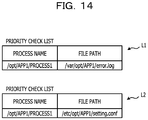
- FIG. 14 is a diagram illustrating a priority check list and a non-priority check list
- FIG. 15 is a flowchart illustrating a processing example of a detail check by file contents
- FIG. 16 is a diagram illustrating examples of management tables
- FIG. 17 is a diagram illustrating examples of management tables
- FIG. 18 is a diagram illustrating examples of management tables
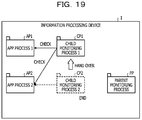
- FIG. 19 is a diagram illustrating an example of a state in which a child monitoring process is terminated.
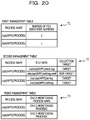
- FIG. 20 is a diagram illustrating examples of management tables
- FIG. 21 is a diagram illustrating an example of a state in which a child monitoring process is started up.
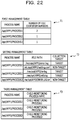
- FIG. 22 is a diagram illustrating examples of management tables.
- FIG. 3 is a diagram illustrating a functional configuration example of an information processing device 1 .
- an arbitrary number of app processes (application processes) AP 1 , . . . are executed, and the app processes AP 1 , . . . refer to and update logs or setting files.
- the app processes AP 1 , . . . refer to and update logs or setting files.
- As a mechanism of monitoring whether or not the files to which the app processes AP 1 , . . . refer or which the app processes AP 1 , . . . update are logs that is, whether or not the files are a specific type, which is “log”, a parent monitoring process PP and a desired number of child monitoring processes CP 1 , . . . are provided.
- the child monitoring processes CP 1 , . . . are started up by the parent monitoring process PP and, except for a representative child monitoring process, that is, for example, the child monitoring process CP 1 , when each of the child monitoring processes terminates a first round of predetermined processing, the each of the child monitoring processes hands over the processing to the representative child monitoring process and then ends.
- a first management table T 1 , a second management table T 2 , a third management table T 3 , a priority check list L 1 , a non-priority check list L 2 , a log collection definition (a log output destination definition) LD, or the like is provided.
- the first management table T 1 holds the number of file identifier numbers (which corresponds to the number of files that are opened) for each app process. An app process does not close a file that has been once opened, and therefore, appearance of a new file may be detected based on an increase in the number of file identifier numbers.
- the second management table T 2 holds a file path of a file that is being used for each app process and also holds a result of determination on whether or not the file is a collection target.
- the Third management table T 3 holds the process name of an app process and the child monitoring process name of a child monitoring process that performs monitoring on the app process as a target. Each of specific examples of the tables will be described later.
- the priority check list L 1 holds the process name and file path of an app process that has been determined to be highly likely to be a log and to be preferentially processed by a simple check by file name in a child monitoring process.
- the non-priority check list L 2 holds the process name and file path of an app process that has not been determined to be preferentially processed. Each of specific examples of the lists will be described later.
- the log collection definition LD holds the process name and file path of an app process that has been determined as a log, and is used by an administrator that collects logs.
- FIGS. 4A and 4B are diagrams each illustrating a configuration example of a log collecting system.
- the information processing device 1 that is a log collection target is an application server or a network device.
- logs are collected by a log collecting unit LC and the collected logs are transmitted to the cloud server 3 .
- the log collecting unit LC performs, based on the log collection definition LD that is automatically generated by a child monitoring process of the information processing device 1 and information that has been set by the administrator, collection of logs (which is collection of all of contents or specified contents of files).
- the log collecting unit LC of the information processing device 1 collects logs, based on the log collection definition and information that has been set by the administrator, and transmits collected logs to the database server 4 to store the collected logs in the database server 4 .
- FIG. 5 is a diagram illustrating a hardware configuration example of the information processing device 1 .
- the information processing device 1 includes a central processing unit (CPU) 11 , read only memory (ROM) 12 , and random access memory (RAM) 13 , which are mutually coupled to one another via a bus 17 .
- the information processing device 1 includes a hard disk drive (HDD)/solid state drive (SSD) 14 , a connection interface (I/F) 15 , and a communication I/F 16 .
- the CPU 11 executes, assuming that the RAM 13 is a work area, a program stored in the ROM 12 , the HDD/SSD 14 , or the like, and thereby, integrally controls an operation of the information processing device 1 .
- the connection I/F 15 is an interface with a device that is coupled to the information processing device 1 .
- the communication I/F 16 is an interface that is used for performing a communication with another information processing device via a network.
- Functions of the information processing device 1 illustrated in FIG. 3 are realized by execution of a predetermined program in the CPU 11 .
- the program may be acquired via a recording medium, may be acquired via a network, and may be embedded in ROM. Data to which is referred and which is updated when processing is performed is held in the RAM 13 or the HDD/SSD 14 .
- Output file name 1 setting.conf (Date and time information is not included in a file.)
- Output file name 2 error.log (Date and time information is included in a file.)
- Output file name 1 errlog (Date and time information is included in a file)
- Output file name 2 infolog (A file that is normally not output but, when some kind of operation is performed, is output. Date and time information is included in a file.)
- Output file name 1 ERROR LOG.txt (Date and time information is not included in a file.)
- FIG. 6 is a flowchart illustrating a processing example of the parent monitoring process PP.
- the parent monitoring process PP when the parent monitoring process PP is started up, based on an instruction from the administrator, an instruction based on automatic startup setting, or the like, the parent monitoring process PP starts processing. At this time point, there is no child monitoring process yet.
- the parent monitoring process PP acquires a process list from the operating system (OS) of the information processing device 1 and detects an app process (Step S 101 ).
- FIG. 7 is a diagram illustrating an example of a process list, the process list includes the process name and type of a process that is being executed, and an app process may be identified based on the type.
- the process 1 and the process 2 of the application 1 and the application 2 are detected as app processes.
- a process ID is given to each process (process name) of the process list and process information is acquired, from the OS, based on the process ID.
- the process information includes a file list that is used by the corresponding process and a file identifier and a file path may be acquired from the file list.
- the parent monitoring process PP refers to the third management table T 3 for each detected app process and determines whether or not there is a new app process that does not exist in the third management table T 3 (Step S 102 ). If the parent monitoring process PP has determined that there is not a new app process (NO in Step S 102 ), the parent monitoring process PP causes the process to return to processing of detection of an app process (Step S 101 ). If the two applications, that is, the application 1 and the application 2 , which are illustrated in FIG. 7 , have been detected, each of the management tables T 1 to T 3 at this time point (immediately after a startup) is blank, and therefore, it is determined that both of the two app processes are new.
- the parent monitoring process PP if the parent monitoring process PP has determined that there is a new app process (YES in Step S 102 ), the parent monitoring process PP starts up a child monitoring process that corresponds to an app process (if there is a plurality of app processes, each of child monitoring processes that correspond to the plurality of app processes) which does not exist in the third management table T 3 . Then, a request for monitoring each app process is made to the corresponding child monitoring process (Step S 103 ). FIG.
- FIG. 9 corresponds to a specific example and illustrates a state in which the parent monitoring process PP started up the child monitoring processes CP 1 and CP 2 and requested the child monitoring process CP 1 and the child monitoring process CP 2 to check (monitor) the application 1 (the process 1 ) and the application 2 (the process 2 ), respectively.
- the parent monitoring process PP writes an app process name and the child monitoring process name of a child monitoring process that is responsible for monitoring in the third management table T 3 (Step S 104 ) and returns to processing of detecting an app process (S 101 ).
- FIG. 10 corresponds to a specific example and illustrates a state in which information of the app processes 1 and 2 and the child monitoring processes CP 1 and CP 2 that are responsible for monitoring in the third management table T 3 .
- FIG. 11 is a flowchart illustrating a processing example of a child monitoring process (CP 1 , CP 2 , . . . ).
- a child monitoring process that has been started up by the parent monitoring process PP starts the following processing.
- the child monitoring process selects one of app processes that are targets of monitoring that is performed by the child monitoring process itself from the third management table T 3 (Step S 201 ) and acquires the current number of file identifier numbers from the process information of the app process (Step S 202 ).
- the child monitoring process CP 1 recognizes that the child monitoring process CP 1 is responsible for the process 1 and acquires the number of the file identifier numbers, that is, “2”, which corresponds to two file identifiers in the process information of the process 1 illustrated in FIG. 7 .
- the child monitoring process CP 2 recognizes that the child monitoring process CP 2 is responsible for the process 2 and acquires the number of file identifier numbers, that is, “1”, because infolog of the two file identifiers in the process information is not counted.
- the child monitoring process determines, for the current number of file identifier numbers, which has been acquired, whether or not there has been an increase from the number of the file identifier numbers of the first management table T 1 (Step S 203 ). If there has been no change in the number of file identifier numbers (NO in Step S 203 ), the process proceeds to determination (Step S 209 ) on whether or not all of app processes that are monitoring targets have been checked.
- Step S 204 the child monitoring process writes the number of file identifier numbers in the first management table T 1 (Step S 204 ).
- the first management table T 1 illustrated in FIG. 12 which corresponds to a specific example, a state in which each of the child monitoring process CP 1 and the child monitoring process CP 2 wrote the number of file identifier numbers in the first management table T 1 is illustrated.
- the child monitoring process acquires the file list from the process information of an app process that is a monitoring target (Step S 205 ) and performs a simple check by file name (Step S 206 ).
- FIG. 13 is a flowchart illustrating a processing example of a simple check by file name (Step S 206 in FIG. 11 ).
- the child monitoring process selects one of the files from the file list (Step S 211 ) and determines whether or not the file is a check target file, based on the second management table T 2 (Step S 212 ). That is, assuming that the file stored in the second management table T 2 has been checked and is not a monitoring target, the child monitoring process determines that a file that is not stored in the second management table T 2 is a monitoring target.
- the second management table T 2 to which the child monitoring processes CP 1 and CP 2 refer at this time point is blank, and therefore, it is determined that all of the files are check target files.
- the child monitoring process determines whether or not a character string “log” is included in a file name (including an extension) (Step S 213 ). If the child monitoring process has determined that the character string “log” is included in the file name (YES in Step S 213 ), the child monitoring process stores a process name and a file path in the priority check list L 1 (Step S 214 ). If the child monitoring process has determined that the character string “log” is not included in the file name (NO in Step S 213 ), the child monitoring process stores the process name and the file path in the non-priority check list L 2 (Step S 215 ).
- the child monitoring process CP 1 determines that the character string “log” is not included in setting.conf of the file list of the process 1 illustrated in FIG. 7 and has determined that the character string “log” is included in error.log.
- FIG. 14 illustrates a state in which a file path of error.log is stored in the priority check list L 1 and a file path of setting.conf is stored in the non-priority check list L 2 .
- Step S 212 if the child monitoring process has determined that the file is not a check target file (NO in Step S 212 ) and after the child monitoring process stores the process name and the file path in the priority check list L 1 or the non-priority check list L 2 (Step S 214 and S 215 ), the child monitoring process determines whether or not all of the files of the file list have been checked (Step S 216 ). If the child monitoring process has determined that all of the files of the file list have not been checked (NO in Step S 216 ), the process returns to selection of a file (Step S 211 ) and, if the child monitoring process has determined that all of the files of the file list have been checked (YES in Step S 216 ), the process ends.
- files that are check targets may be sorted into the priority check list L 1 and the non-priority check list L 2 .
- Step S 207 the child monitoring process subsequently performs a detail check by file contents.
- FIG. 15 is a flowchart illustrating a processing example of a detail check by file contents (S 207 in FIG. 11 ).
- the child monitoring process selects one of the files from the priority check list L 1 (Step S 221 ), analyzes the contents of the file, and checks whether or not the contents of the file are a log (Step S 222 ). For example, for the first line of the file+one line and subsequent lines (the second and subsequent lines), the child monitoring process checks the contents of the file, checks whether or not there are two or more parts in which a character string indicating date and time continues in two lines, and, if so, specifies that the file is a log.
- Step S 222 If the child monitoring process has confirmed that the file is a log (YES in Step S 222 ), the child monitoring process writes information in the log collection definition LD and the second management table T 2 (Step S 223 ). The child monitoring process writes the process name and the file path in the log collection definition LD. The child monitoring process writes the process name, the file path, and a collection target: “target” are written in the second management table T 2 . If the child monitoring process has not confirmed that the file is a log (NO in Step S 222 ), the child monitoring process writes the process name, the file path, the collection target: “non-target” in the second management table T 2 (Step S 224 ). For a file written in the second management table T 2 , whether or not the file is a collection target (target, non-target), a check is not performed in next processing and subsequent processing.
- a collection target target, non-target
- FIG. 16 illustrates a state in which the child monitoring process CP 1 in the specific example confirmed that a file error.
- log stored in the priority check list L 1 illustrated in FIG. 14 is a log and wrote the process name, the file path, and the collection target: “target” in the second management table T 2 .
- the child monitoring process determines whether or not all of the files of the priority check list L 1 have been checked (Step S 225 ), if all of the files of the priority check list L 1 have not been checked, the process returns to selection of a next file (Step S 221 ), and, if checks of all of the files of the priority check list L 1 are completed, the process proceeds to next processing.
- the child monitoring process selects one of the files from the non-priority check list L 2 (Step S 226 ), analyzes the contents of the file, and checks whether or not the contents of the file are a log (Step 227 ).
- a method for performing a check is similar to that in a case in which a check for the priority check list L 1 is performed.
- Step S 227 If the child monitoring process has confirmed that the contents of the file are a log (YES in Step S 227 ), the child monitoring process writes information in the log collection definition LD and the second management table T 2 (Step S 228 ). The child monitoring process writes the process name and the file path in the log collection definition LD. The child monitoring process writes the process name, the file path, and the collection target: “target” in the second management table T 2 .
- Step S 227 If the child monitoring process has not confirmed that the contents of the file are a log (NO in Step S 227 ), the child monitoring process writes the process name, the file path, and the collection target: “non-target” in the second management table T 2 (Step S 229 ).
- FIG. 17 illustrates a state in which the child monitoring process CP 1 has confirmed that the file setting.conf stored in the non-priority check list L 2 is not a log and wrote the process name, the file path, and the collection target: “non-target” in the second management table T 2 .
- the child monitoring process determines whether or not all of the files of the non-priority check list L 2 have been checked (Step S 230 ). If all of the files of the non-priority check list L 2 have not been checked, the process returns to selection of a next file (Step S 226 ) and, if all of the files of the non-priority check list L 2 have not been checked, removes the priority check list L 1 and the non-priority check list L 2 (Step S 231 ), and the process ends.
- FIG. 18 illustrates a state in which, in a specific example, writing to the second management table T 2 was performed by the child monitoring processes CP 1 and CP 2 which operate in parallel.
- the first round of check processing is completed by the above-described processing.
- a check is preferentially performed on a file that is highly likely to be a log, and therefore, a log may be quickly specified.
- the order of priority is lowered but a check is reliably performed on the file, so that omission in determination is not caused.
- Step S 208 a plurality of app processes is grouped and monitoring of the group is performed by a single child monitoring process.
- a representative child monitoring process at that time point may be set based on some kind of reference, and monitoring may be handed over to the child monitoring process. The handing over is performed by changing the process name of the child monitoring process that is to end to the process name of the child monitoring process to which the monitoring is handed over.
- FIG. 19 illustrates a state in which, in a specific example, in the case in which the child monitoring processes CP 1 and CP 2 operated, the child monitoring process CP 2 handed over monitoring for an app process AP 2 to the child monitoring process CP 1 and then ended.
- FIG. 20 illustrates tables after monitoring was handed over and the child monitoring process name of the child monitoring process for the process 2 of the third management table T 3 was changed from the previous child monitoring process 2 to the child monitoring process 1 ( FIG. 18 ).
- a processing load is increased immediately after monitoring of a new app process was started, and therefore, processing of allocating an exclusive child monitoring process to each app process, thereby increasing efficiency of processing.
- the first round of processing has ended for the app process, thereafter, processing is performed only on a file that has been newly generated, and therefore, the exclusive child monitoring process is hardly desired to be provided.
- grouping of app processes is performed and a plurality of app processes is caused to correspond to a single child monitoring process to reduce the number of child monitoring processes, so that process multiplicity is not increased too high and a load on the system is not caused to be increased.
- the child monitoring process determines whether or not all of app processes (if an app process was newly started up, a single app process and, if app processes are grouped, a plurality of app processes) which are monitoring targets have been checked (Step S 209 ). Then, if all of the app processes have not been checked, for a next app process, processing is repeated from initial processing (Step S 201 ) and, if all of the processes have been checked, for the first app process, processing is repeated as a second round from initial processing (Step S 201 ).
- FIG. 21 illustrates a state in which, in a specific example, after the first round of processing for the app processes AP 1 and AP 2 ended and the app processes were grouped, a new app process AP 3 was executed, and thereby, a child monitoring process CP 3 corresponding to the app process AP 3 was newly stated up.
- FIG. 22 illustrates a state in which a check by the child monitoring process CP 3 was performed and check results for the app processes AP 1 , AP 2 , and AP 3 were stored in the second management table T 2 .
- the process name and the file path are written out as the log collection definition LD, and therefore, the administrator of log collection is capable of properly performing setting on a collection tool, based on the log collection definition LD.
- a file that is highly likely to be a specific type may be preferentially set as a target file of type determination.
- check processing may be efficiently performed by allocating an exclusive child monitoring process.
- a child monitoring process hands over monitoring to a representative child monitoring process and then ends, so that multiplicity of monitoring process is not increased too high and a load on the system may be caused to be at a proper level.
Landscapes
- Engineering & Computer Science (AREA)
- Theoretical Computer Science (AREA)
- Databases & Information Systems (AREA)
- Data Mining & Analysis (AREA)
- Physics & Mathematics (AREA)
- General Engineering & Computer Science (AREA)
- General Physics & Mathematics (AREA)
- Library & Information Science (AREA)
- Computational Linguistics (AREA)
- Debugging And Monitoring (AREA)
Applications Claiming Priority (2)
| Application Number | Priority Date | Filing Date | Title |
|---|---|---|---|
| JP2016106657A JP6668948B2 (ja) | 2016-05-27 | 2016-05-27 | ファイル判定プログラム、ファイル判定装置およびファイル判定方法 |
| JP2016-106657 | 2016-05-27 |
Publications (2)
| Publication Number | Publication Date |
|---|---|
| US20170344571A1 US20170344571A1 (en) | 2017-11-30 |
| US10691641B2 true US10691641B2 (en) | 2020-06-23 |
Family
ID=60418704
Family Applications (1)
| Application Number | Title | Priority Date | Filing Date |
|---|---|---|---|
| US15/493,826 Expired - Fee Related US10691641B2 (en) | 2016-05-27 | 2017-04-21 | File determination device and file determination method |
Country Status (2)
| Country | Link |
|---|---|
| US (1) | US10691641B2 (ja) |
| JP (1) | JP6668948B2 (ja) |
Citations (15)
| Publication number | Priority date | Publication date | Assignee | Title |
|---|---|---|---|---|
| US5873071A (en) | 1997-05-15 | 1999-02-16 | Itg Inc. | Computer method and system for intermediated exchange of commodities |
| US20040210898A1 (en) | 2003-04-18 | 2004-10-21 | Bergen Axel Von | Restarting processes in distributed applications on blade servers |
| US20070156698A1 (en) * | 2005-12-22 | 2007-07-05 | Alexander Gebhart | Systems and methods for finding log files generated by a distributed computer |
| US20070179996A1 (en) * | 2006-01-31 | 2007-08-02 | Victor Company Of Japan, Limited | Structured data storage device and structured data storage method |
| JP2007293699A (ja) | 2006-04-26 | 2007-11-08 | Toshiba Corp | プログラム異常動作時における解析用データ取得装置及びプログラム |
| JP2008191813A (ja) | 2007-02-02 | 2008-08-21 | Nec Corp | ファイル重要度判定装置、ファイル重要度判定方法およびファイル重要度判定プログラム |
| JP2008293174A (ja) | 2007-05-23 | 2008-12-04 | Fuji Xerox Co Ltd | 印刷制御装置および印刷制御方法とプログラム |
| US20090193325A1 (en) * | 2008-01-29 | 2009-07-30 | Kabushiki Kaisha Toshiba | Apparatus, method and computer program product for processing documents |
| US8065267B2 (en) * | 2005-01-12 | 2011-11-22 | Masatsugu Noda | Information processing device, file data merging method, file naming method, and file data output method |
| JP2013191188A (ja) | 2012-02-14 | 2013-09-26 | Nippon Telegr & Teleph Corp <Ntt> | ログ管理装置、ログ蓄積方法、ログ検索方法、重要度決定方法、およびプログラム |
| JP2013191012A (ja) | 2012-03-14 | 2013-09-26 | Hitachi Ltd | 計算機ログ収集システム及び着脱式ログ記憶デバイス |
| US20140181090A1 (en) * | 2012-12-20 | 2014-06-26 | Dropbox, Inc. | Systems and methods for optimizing file display for users |
| US20150067160A1 (en) * | 2005-04-27 | 2015-03-05 | International Business Machines Corporation | Systems and methods of specifying service level criteria |
| JP2015133098A (ja) | 2013-12-09 | 2015-07-23 | キヤノンマーケティングジャパン株式会社 | 情報処理装置、情報処理方法、プログラム |
| US20170123630A1 (en) * | 2015-10-29 | 2017-05-04 | Kabushiki Kaisha Toshiba | Electronic device and method for searching data |
Family Cites Families (8)
| Publication number | Priority date | Publication date | Assignee | Title |
|---|---|---|---|---|
| JP2002056025A (ja) * | 2000-08-08 | 2002-02-20 | Hitachi Ltd | 画像付きテキストサーチ方法 |
| US6910159B2 (en) * | 2002-02-20 | 2005-06-21 | Microsoft Corporation | System and method for gathering and automatically processing user and debug data for mobile devices |
| JP2009194765A (ja) * | 2008-02-15 | 2009-08-27 | Nippon Telegr & Teleph Corp <Ntt> | 情報配信システムとその情報配信装置 |
| JP2009217306A (ja) * | 2008-03-07 | 2009-09-24 | Seiko Epson Corp | 印刷システム、プリンタ、サーバ、コンピュータプログラム及び印刷方法 |
| JP2009237749A (ja) * | 2008-03-26 | 2009-10-15 | Mitsubishi Electric Corp | 障害情報収集方式 |
| JP2010109907A (ja) * | 2008-10-31 | 2010-05-13 | Fujitsu Ltd | 中継装置、アクセス解析装置、中継装置の制御方法及び制御プログラム |
| JP2011142614A (ja) * | 2009-12-11 | 2011-07-21 | Canon Inc | 画像処理装置、及びその制御方法 |
| KR20140020414A (ko) * | 2012-08-08 | 2014-02-19 | 삼성에스디에스 주식회사 | 체크섬 리스트를 이용한 멀웨어 스캔 방법 및 이를 이용한 단말장치 |
-
2016
- 2016-05-27 JP JP2016106657A patent/JP6668948B2/ja not_active Expired - Fee Related
-
2017
- 2017-04-21 US US15/493,826 patent/US10691641B2/en not_active Expired - Fee Related
Patent Citations (16)
| Publication number | Priority date | Publication date | Assignee | Title |
|---|---|---|---|---|
| JP2001525963A (ja) | 1997-05-15 | 2001-12-11 | アイティージー インコーポレイテッド | 商品の仲介取引のためのコンピュータを使った方法及びシステム |
| US5873071A (en) | 1997-05-15 | 1999-02-16 | Itg Inc. | Computer method and system for intermediated exchange of commodities |
| US20040210898A1 (en) | 2003-04-18 | 2004-10-21 | Bergen Axel Von | Restarting processes in distributed applications on blade servers |
| US8065267B2 (en) * | 2005-01-12 | 2011-11-22 | Masatsugu Noda | Information processing device, file data merging method, file naming method, and file data output method |
| US20150067160A1 (en) * | 2005-04-27 | 2015-03-05 | International Business Machines Corporation | Systems and methods of specifying service level criteria |
| US20070156698A1 (en) * | 2005-12-22 | 2007-07-05 | Alexander Gebhart | Systems and methods for finding log files generated by a distributed computer |
| US20070179996A1 (en) * | 2006-01-31 | 2007-08-02 | Victor Company Of Japan, Limited | Structured data storage device and structured data storage method |
| JP2007293699A (ja) | 2006-04-26 | 2007-11-08 | Toshiba Corp | プログラム異常動作時における解析用データ取得装置及びプログラム |
| JP2008191813A (ja) | 2007-02-02 | 2008-08-21 | Nec Corp | ファイル重要度判定装置、ファイル重要度判定方法およびファイル重要度判定プログラム |
| JP2008293174A (ja) | 2007-05-23 | 2008-12-04 | Fuji Xerox Co Ltd | 印刷制御装置および印刷制御方法とプログラム |
| US20090193325A1 (en) * | 2008-01-29 | 2009-07-30 | Kabushiki Kaisha Toshiba | Apparatus, method and computer program product for processing documents |
| JP2013191188A (ja) | 2012-02-14 | 2013-09-26 | Nippon Telegr & Teleph Corp <Ntt> | ログ管理装置、ログ蓄積方法、ログ検索方法、重要度決定方法、およびプログラム |
| JP2013191012A (ja) | 2012-03-14 | 2013-09-26 | Hitachi Ltd | 計算機ログ収集システム及び着脱式ログ記憶デバイス |
| US20140181090A1 (en) * | 2012-12-20 | 2014-06-26 | Dropbox, Inc. | Systems and methods for optimizing file display for users |
| JP2015133098A (ja) | 2013-12-09 | 2015-07-23 | キヤノンマーケティングジャパン株式会社 | 情報処理装置、情報処理方法、プログラム |
| US20170123630A1 (en) * | 2015-10-29 | 2017-05-04 | Kabushiki Kaisha Toshiba | Electronic device and method for searching data |
Non-Patent Citations (1)
| Title |
|---|
| Japanese Office Action dated Nov. 19, 2019 for corresponding Japanese Patent Application No. 2016-106657 with English Translation, 8 pages. |
Also Published As
| Publication number | Publication date |
|---|---|
| US20170344571A1 (en) | 2017-11-30 |
| JP2017211945A (ja) | 2017-11-30 |
| JP6668948B2 (ja) | 2020-03-18 |
Similar Documents
| Publication | Publication Date | Title |
|---|---|---|
| CN103167026B (zh) | 一种云存储环境数据处理方法、系统及设备 | |
| US20190286510A1 (en) | Automatic correlation of dynamic system events within computing devices | |
| US9612898B2 (en) | Fault analysis apparatus, fault analysis method, and recording medium | |
| KR101963917B1 (ko) | 가장 최근에 사용된 문서 목록들의 자동 동기화 기법 | |
| US20150263909A1 (en) | System and method for monitoring a large number of information processing devices in a communication network | |
| CN106874281B (zh) | 实现数据库读写分离的方法和装置 | |
| CN106789195A (zh) | 一种事件处理方法及网管设备、服务器 | |
| US20150286671A1 (en) | Transaction system | |
| JP2017505936A (ja) | インメモリデータベースをホストするシステム及び方法 | |
| US20160098390A1 (en) | Command history analysis apparatus and command history analysis method | |
| CN104007994A (zh) | 一种基于策略库交互的更新方法、升级方法与升级系统 | |
| US12021681B2 (en) | Communication device, surveillance server, and log collection method | |
| JP2020057416A (ja) | 分散データベースにおけるデータブロックを処理する方法およびデバイス | |
| CN107102929A (zh) | 故障的检测方法及装置 | |
| US20150281037A1 (en) | Monitoring omission specifying program, monitoring omission specifying method, and monitoring omission specifying device | |
| US11513884B2 (en) | Information processing apparatus, control method, and program for flexibly managing event history | |
| US10691641B2 (en) | File determination device and file determination method | |
| US12254207B2 (en) | Method and system for health driven network slicing based data migration | |
| CN103207789B (zh) | 应用服务器常量值动态更新方法及系统 | |
| US11947822B2 (en) | Maintaining a record data structure using page metadata of a bookkeeping page | |
| KR20250031698A (ko) | 장애대응방안 제공방법 및 이를 이용하는 장애대응서버 | |
| CN114564485A (zh) | 基于Elastic Search的用户数据处理方法 | |
| US11921765B2 (en) | Systematic iterative analysis of unstructured data files | |
| US20240273065A1 (en) | Hadoop distributed file system (hdfs) express bulk file deletion | |
| US20240168826A1 (en) | Method of analyzing change in api in cloud |
Legal Events
| Date | Code | Title | Description |
|---|---|---|---|
| AS | Assignment |
Owner name: FUJITSU LIMITED, JAPAN Free format text: ASSIGNMENT OF ASSIGNORS INTEREST;ASSIGNORS:CHIBA, TSUGUTO;HASHIGUCHI, MASAFUMI;SHIMANO, ATSUSHI;SIGNING DATES FROM 20170323 TO 20170406;REEL/FRAME:042311/0054 |
|
| STPP | Information on status: patent application and granting procedure in general |
Free format text: NON FINAL ACTION MAILED |
|
| STPP | Information on status: patent application and granting procedure in general |
Free format text: RESPONSE TO NON-FINAL OFFICE ACTION ENTERED AND FORWARDED TO EXAMINER |
|
| STPP | Information on status: patent application and granting procedure in general |
Free format text: FINAL REJECTION MAILED |
|
| STPP | Information on status: patent application and granting procedure in general |
Free format text: DOCKETED NEW CASE - READY FOR EXAMINATION |
|
| STPP | Information on status: patent application and granting procedure in general |
Free format text: NOTICE OF ALLOWANCE MAILED -- APPLICATION RECEIVED IN OFFICE OF PUBLICATIONS |
|
| STPP | Information on status: patent application and granting procedure in general |
Free format text: PUBLICATIONS -- ISSUE FEE PAYMENT VERIFIED |
|
| STCF | Information on status: patent grant |
Free format text: PATENTED CASE |
|
| FEPP | Fee payment procedure |
Free format text: MAINTENANCE FEE REMINDER MAILED (ORIGINAL EVENT CODE: REM.); ENTITY STATUS OF PATENT OWNER: LARGE ENTITY |
|
| LAPS | Lapse for failure to pay maintenance fees |
Free format text: PATENT EXPIRED FOR FAILURE TO PAY MAINTENANCE FEES (ORIGINAL EVENT CODE: EXP.); ENTITY STATUS OF PATENT OWNER: LARGE ENTITY |
|
| STCH | Information on status: patent discontinuation |
Free format text: PATENT EXPIRED DUE TO NONPAYMENT OF MAINTENANCE FEES UNDER 37 CFR 1.362 |
|
| FP | Lapsed due to failure to pay maintenance fee |
Effective date: 20240623 |