US10786802B2 - Process for preparing an adsorbing material comprising a precipitating step of boehmite according to specific conditions and process for extracting lithium from saline solutions using this material - Google Patents
Process for preparing an adsorbing material comprising a precipitating step of boehmite according to specific conditions and process for extracting lithium from saline solutions using this material Download PDFInfo
- Publication number
- US10786802B2 US10786802B2 US15/579,811 US201615579811A US10786802B2 US 10786802 B2 US10786802 B2 US 10786802B2 US 201615579811 A US201615579811 A US 201615579811A US 10786802 B2 US10786802 B2 US 10786802B2
- Authority
- US
- United States
- Prior art keywords
- lithium
- comprised
- acid
- extrudates
- precursor
- Prior art date
- Legal status (The legal status is an assumption and is not a legal conclusion. Google has not performed a legal analysis and makes no representation as to the accuracy of the status listed.)
- Active, expires
Links
Images




Classifications
-
- B—PERFORMING OPERATIONS; TRANSPORTING
- B01—PHYSICAL OR CHEMICAL PROCESSES OR APPARATUS IN GENERAL
- B01J—CHEMICAL OR PHYSICAL PROCESSES, e.g. CATALYSIS OR COLLOID CHEMISTRY; THEIR RELEVANT APPARATUS
- B01J20/00—Solid sorbent compositions or filter aid compositions; Sorbents for chromatography; Processes for preparing, regenerating or reactivating thereof
- B01J20/02—Solid sorbent compositions or filter aid compositions; Sorbents for chromatography; Processes for preparing, regenerating or reactivating thereof comprising inorganic material
- B01J20/06—Solid sorbent compositions or filter aid compositions; Sorbents for chromatography; Processes for preparing, regenerating or reactivating thereof comprising inorganic material comprising oxides or hydroxides of metals not provided for in group B01J20/04
- B01J20/08—Solid sorbent compositions or filter aid compositions; Sorbents for chromatography; Processes for preparing, regenerating or reactivating thereof comprising inorganic material comprising oxides or hydroxides of metals not provided for in group B01J20/04 comprising aluminium oxide or hydroxide; comprising bauxite
-
- B—PERFORMING OPERATIONS; TRANSPORTING
- B01—PHYSICAL OR CHEMICAL PROCESSES OR APPARATUS IN GENERAL
- B01J—CHEMICAL OR PHYSICAL PROCESSES, e.g. CATALYSIS OR COLLOID CHEMISTRY; THEIR RELEVANT APPARATUS
- B01J20/00—Solid sorbent compositions or filter aid compositions; Sorbents for chromatography; Processes for preparing, regenerating or reactivating thereof
- B01J20/02—Solid sorbent compositions or filter aid compositions; Sorbents for chromatography; Processes for preparing, regenerating or reactivating thereof comprising inorganic material
- B01J20/04—Solid sorbent compositions or filter aid compositions; Sorbents for chromatography; Processes for preparing, regenerating or reactivating thereof comprising inorganic material comprising compounds of alkali metals, alkaline earth metals or magnesium
- B01J20/041—Oxides or hydroxides
-
- B—PERFORMING OPERATIONS; TRANSPORTING
- B01—PHYSICAL OR CHEMICAL PROCESSES OR APPARATUS IN GENERAL
- B01J—CHEMICAL OR PHYSICAL PROCESSES, e.g. CATALYSIS OR COLLOID CHEMISTRY; THEIR RELEVANT APPARATUS
- B01J20/00—Solid sorbent compositions or filter aid compositions; Sorbents for chromatography; Processes for preparing, regenerating or reactivating thereof
- B01J20/02—Solid sorbent compositions or filter aid compositions; Sorbents for chromatography; Processes for preparing, regenerating or reactivating thereof comprising inorganic material
- B01J20/04—Solid sorbent compositions or filter aid compositions; Sorbents for chromatography; Processes for preparing, regenerating or reactivating thereof comprising inorganic material comprising compounds of alkali metals, alkaline earth metals or magnesium
- B01J20/043—Carbonates or bicarbonates, e.g. limestone, dolomite, aragonite
-
- B—PERFORMING OPERATIONS; TRANSPORTING
- B01—PHYSICAL OR CHEMICAL PROCESSES OR APPARATUS IN GENERAL
- B01J—CHEMICAL OR PHYSICAL PROCESSES, e.g. CATALYSIS OR COLLOID CHEMISTRY; THEIR RELEVANT APPARATUS
- B01J20/00—Solid sorbent compositions or filter aid compositions; Sorbents for chromatography; Processes for preparing, regenerating or reactivating thereof
- B01J20/02—Solid sorbent compositions or filter aid compositions; Sorbents for chromatography; Processes for preparing, regenerating or reactivating thereof comprising inorganic material
- B01J20/04—Solid sorbent compositions or filter aid compositions; Sorbents for chromatography; Processes for preparing, regenerating or reactivating thereof comprising inorganic material comprising compounds of alkali metals, alkaline earth metals or magnesium
- B01J20/045—Solid sorbent compositions or filter aid compositions; Sorbents for chromatography; Processes for preparing, regenerating or reactivating thereof comprising inorganic material comprising compounds of alkali metals, alkaline earth metals or magnesium containing sulfur, e.g. sulfates, thiosulfates, gypsum
-
- B—PERFORMING OPERATIONS; TRANSPORTING
- B01—PHYSICAL OR CHEMICAL PROCESSES OR APPARATUS IN GENERAL
- B01J—CHEMICAL OR PHYSICAL PROCESSES, e.g. CATALYSIS OR COLLOID CHEMISTRY; THEIR RELEVANT APPARATUS
- B01J20/00—Solid sorbent compositions or filter aid compositions; Sorbents for chromatography; Processes for preparing, regenerating or reactivating thereof
- B01J20/02—Solid sorbent compositions or filter aid compositions; Sorbents for chromatography; Processes for preparing, regenerating or reactivating thereof comprising inorganic material
- B01J20/04—Solid sorbent compositions or filter aid compositions; Sorbents for chromatography; Processes for preparing, regenerating or reactivating thereof comprising inorganic material comprising compounds of alkali metals, alkaline earth metals or magnesium
- B01J20/046—Solid sorbent compositions or filter aid compositions; Sorbents for chromatography; Processes for preparing, regenerating or reactivating thereof comprising inorganic material comprising compounds of alkali metals, alkaline earth metals or magnesium containing halogens, e.g. halides
-
- B—PERFORMING OPERATIONS; TRANSPORTING
- B01—PHYSICAL OR CHEMICAL PROCESSES OR APPARATUS IN GENERAL
- B01J—CHEMICAL OR PHYSICAL PROCESSES, e.g. CATALYSIS OR COLLOID CHEMISTRY; THEIR RELEVANT APPARATUS
- B01J20/00—Solid sorbent compositions or filter aid compositions; Sorbents for chromatography; Processes for preparing, regenerating or reactivating thereof
- B01J20/30—Processes for preparing, regenerating, or reactivating
- B01J20/3007—Moulding, shaping or extruding
-
- B—PERFORMING OPERATIONS; TRANSPORTING
- B01—PHYSICAL OR CHEMICAL PROCESSES OR APPARATUS IN GENERAL
- B01J—CHEMICAL OR PHYSICAL PROCESSES, e.g. CATALYSIS OR COLLOID CHEMISTRY; THEIR RELEVANT APPARATUS
- B01J20/00—Solid sorbent compositions or filter aid compositions; Sorbents for chromatography; Processes for preparing, regenerating or reactivating thereof
- B01J20/30—Processes for preparing, regenerating, or reactivating
- B01J20/3071—Washing or leaching
-
- B—PERFORMING OPERATIONS; TRANSPORTING
- B01—PHYSICAL OR CHEMICAL PROCESSES OR APPARATUS IN GENERAL
- B01J—CHEMICAL OR PHYSICAL PROCESSES, e.g. CATALYSIS OR COLLOID CHEMISTRY; THEIR RELEVANT APPARATUS
- B01J20/00—Solid sorbent compositions or filter aid compositions; Sorbents for chromatography; Processes for preparing, regenerating or reactivating thereof
- B01J20/30—Processes for preparing, regenerating, or reactivating
- B01J20/3078—Thermal treatment, e.g. calcining or pyrolizing
-
- B—PERFORMING OPERATIONS; TRANSPORTING
- B01—PHYSICAL OR CHEMICAL PROCESSES OR APPARATUS IN GENERAL
- B01J—CHEMICAL OR PHYSICAL PROCESSES, e.g. CATALYSIS OR COLLOID CHEMISTRY; THEIR RELEVANT APPARATUS
- B01J20/00—Solid sorbent compositions or filter aid compositions; Sorbents for chromatography; Processes for preparing, regenerating or reactivating thereof
- B01J20/30—Processes for preparing, regenerating, or reactivating
- B01J20/3085—Chemical treatments not covered by groups B01J20/3007 - B01J20/3078
-
- B—PERFORMING OPERATIONS; TRANSPORTING
- B01—PHYSICAL OR CHEMICAL PROCESSES OR APPARATUS IN GENERAL
- B01J—CHEMICAL OR PHYSICAL PROCESSES, e.g. CATALYSIS OR COLLOID CHEMISTRY; THEIR RELEVANT APPARATUS
- B01J20/00—Solid sorbent compositions or filter aid compositions; Sorbents for chromatography; Processes for preparing, regenerating or reactivating thereof
- B01J20/30—Processes for preparing, regenerating, or reactivating
- B01J20/34—Regenerating or reactivating
- B01J20/3433—Regenerating or reactivating of sorbents or filter aids other than those covered by B01J20/3408 - B01J20/3425
-
- B—PERFORMING OPERATIONS; TRANSPORTING
- B01—PHYSICAL OR CHEMICAL PROCESSES OR APPARATUS IN GENERAL
- B01J—CHEMICAL OR PHYSICAL PROCESSES, e.g. CATALYSIS OR COLLOID CHEMISTRY; THEIR RELEVANT APPARATUS
- B01J20/00—Solid sorbent compositions or filter aid compositions; Sorbents for chromatography; Processes for preparing, regenerating or reactivating thereof
- B01J20/30—Processes for preparing, regenerating, or reactivating
- B01J20/34—Regenerating or reactivating
- B01J20/345—Regenerating or reactivating using a particular desorbing compound or mixture
- B01J20/3475—Regenerating or reactivating using a particular desorbing compound or mixture in the liquid phase
-
- B—PERFORMING OPERATIONS; TRANSPORTING
- B01—PHYSICAL OR CHEMICAL PROCESSES OR APPARATUS IN GENERAL
- B01J—CHEMICAL OR PHYSICAL PROCESSES, e.g. CATALYSIS OR COLLOID CHEMISTRY; THEIR RELEVANT APPARATUS
- B01J39/00—Cation exchange; Use of material as cation exchangers; Treatment of material for improving the cation exchange properties
- B01J39/08—Use of material as cation exchangers; Treatment of material for improving the cation exchange properties
- B01J39/10—Oxides or hydroxides
-
- C01F7/002—
-
- C—CHEMISTRY; METALLURGY
- C01—INORGANIC CHEMISTRY
- C01F—COMPOUNDS OF THE METALS BERYLLIUM, MAGNESIUM, ALUMINIUM, CALCIUM, STRONTIUM, BARIUM, RADIUM, THORIUM, OR OF THE RARE-EARTH METALS
- C01F7/00—Compounds of aluminium
- C01F7/02—Aluminium oxide; Aluminium hydroxide; Aluminates
- C01F7/04—Preparation of alkali metal aluminates; Aluminium oxide or hydroxide therefrom
- C01F7/14—Aluminium oxide or hydroxide from alkali metal aluminates
- C01F7/141—Aluminium oxide or hydroxide from alkali metal aluminates from aqueous aluminate solutions by neutralisation with an acidic agent
-
- C—CHEMISTRY; METALLURGY
- C01—INORGANIC CHEMISTRY
- C01F—COMPOUNDS OF THE METALS BERYLLIUM, MAGNESIUM, ALUMINIUM, CALCIUM, STRONTIUM, BARIUM, RADIUM, THORIUM, OR OF THE RARE-EARTH METALS
- C01F7/00—Compounds of aluminium
- C01F7/02—Aluminium oxide; Aluminium hydroxide; Aluminates
- C01F7/34—Preparation of aluminium hydroxide by precipitation from solutions containing aluminium salts
-
- C—CHEMISTRY; METALLURGY
- C01—INORGANIC CHEMISTRY
- C01F—COMPOUNDS OF THE METALS BERYLLIUM, MAGNESIUM, ALUMINIUM, CALCIUM, STRONTIUM, BARIUM, RADIUM, THORIUM, OR OF THE RARE-EARTH METALS
- C01F7/00—Compounds of aluminium
- C01F7/78—Compounds containing aluminium, with or without oxygen or hydrogen, and containing two or more other elements
-
- C—CHEMISTRY; METALLURGY
- C01—INORGANIC CHEMISTRY
- C01F—COMPOUNDS OF THE METALS BERYLLIUM, MAGNESIUM, ALUMINIUM, CALCIUM, STRONTIUM, BARIUM, RADIUM, THORIUM, OR OF THE RARE-EARTH METALS
- C01F7/00—Compounds of aluminium
- C01F7/78—Compounds containing aluminium, with or without oxygen or hydrogen, and containing two or more other elements
- C01F7/782—Compounds containing aluminium, with or without oxygen or hydrogen, and containing two or more other elements containing carbonate ions, e.g. dawsonite
-
- B—PERFORMING OPERATIONS; TRANSPORTING
- B01—PHYSICAL OR CHEMICAL PROCESSES OR APPARATUS IN GENERAL
- B01J—CHEMICAL OR PHYSICAL PROCESSES, e.g. CATALYSIS OR COLLOID CHEMISTRY; THEIR RELEVANT APPARATUS
- B01J2220/00—Aspects relating to sorbent materials
- B01J2220/50—Aspects relating to the use of sorbent or filter aid materials
- B01J2220/58—Use in a single column
-
- C—CHEMISTRY; METALLURGY
- C01—INORGANIC CHEMISTRY
- C01P—INDEXING SCHEME RELATING TO STRUCTURAL AND PHYSICAL ASPECTS OF SOLID INORGANIC COMPOUNDS
- C01P2002/00—Crystal-structural characteristics
- C01P2002/70—Crystal-structural characteristics defined by measured X-ray, neutron or electron diffraction data
- C01P2002/72—Crystal-structural characteristics defined by measured X-ray, neutron or electron diffraction data by d-values or two theta-values, e.g. as X-ray diagram
-
- C—CHEMISTRY; METALLURGY
- C01—INORGANIC CHEMISTRY
- C01P—INDEXING SCHEME RELATING TO STRUCTURAL AND PHYSICAL ASPECTS OF SOLID INORGANIC COMPOUNDS
- C01P2004/00—Particle morphology
- C01P2004/60—Particles characterised by their size
- C01P2004/64—Nanometer sized, i.e. from 1-100 nanometer
-
- Y—GENERAL TAGGING OF NEW TECHNOLOGICAL DEVELOPMENTS; GENERAL TAGGING OF CROSS-SECTIONAL TECHNOLOGIES SPANNING OVER SEVERAL SECTIONS OF THE IPC; TECHNICAL SUBJECTS COVERED BY FORMER USPC CROSS-REFERENCE ART COLLECTIONS [XRACs] AND DIGESTS
- Y02—TECHNOLOGIES OR APPLICATIONS FOR MITIGATION OR ADAPTATION AGAINST CLIMATE CHANGE
- Y02E—REDUCTION OF GREENHOUSE GAS [GHG] EMISSIONS, RELATED TO ENERGY GENERATION, TRANSMISSION OR DISTRIBUTION
- Y02E60/00—Enabling technologies; Technologies with a potential or indirect contribution to GHG emissions mitigation
- Y02E60/10—Energy storage using batteries
Definitions
- the present invention relates to the field of solid materials for adsorption of lithium.
- the present invention relates to a novel method for preparing a crystallized and shaped solid material, preferably as extrudates, of formula LiX x .2Al(OH) 3 , nH 2 O with n being comprised between 0.01 and 10, x being equal to 1 when X is an anion selected from among chloride, hydroxide and nitrate anions, and x being equal to 0.5 when X is an anion selected from among sulfate and carbonate anions, comprising a step a) for precipitating boehmite under specific temperature and pH conditions, at least one shaping step, preferably by extrusion, said method also comprising a final hydrothermal treatment step, the whole of the features of the method giving the possibility of increasing the adsorption capacity for the lithium as well as the adsorption kinetics of the materials obtained as compared with materials of the prior art when the latter is used in a method for extracting the
- the present invention also relates to a method for extracting lithium from saline solutions using said crystallized solid material of formula LiX x .2Al(OH) 3 ,nH 2 O with n, x and X having the aforementioned definition, prepared according to the novel preparation method according to the invention.
- Lithium ions coexist with massive amounts of metals such as for example alkaline, earth-alkaline metals, boron and sulfates, in particular in saline solutions such as brines. Thus, they should be the subject of an economical and selective extraction from these saline solutions. Indeed, the chemical properties of lithium and of alkaline metals, preferably sodium (Na), and potassium (K) and earth-alkaline metals, preferably magnesium (Mg), calcium (Ca) and strontium (Sr), make the separation of these elements difficult.
- alkaline metals preferably sodium (Na), and potassium (K) and earth-alkaline metals, preferably magnesium (Mg), calcium (Ca) and strontium (Sr)
- the solid materials of formula LiCl.2Al(OH) 3 , nH 2 O with n being comprised between 0.01 and 10 are known for their use in adsorption/desorption phenomena of lithium ions and in particular in the methods for extracting lithium from saline solutions. These not very stable structures would allow insertion of lithium atoms into the structure as well as the extraction of the lithium.
- U.S. Pat. No. 6,280,693 describes a method for preparing a solid LiCl/Al(OH) 3 by adding an aqueous solution of LiOH to a polycrystalline alumina hydrate in order to form LiOH/Al(OH) 3 , and thus creates active lithium sites in the crystalline layers of the alumina without altering the structure thereof.
- the transformation of LiOH/Al(OH) 3 into LiCl/Al(OH) 3 is thus achieved by adding diluted hydrochloric acid.
- the thereby prepared alumina pastes are then used in a method for extracting lithium from brines at high temperature.
- the extraction method for the lithium described in patent U.S. Pat. No. 6,280,693 uses the solid detailed below and comprises the steps hereafter:
- Patent RU 2,234,367 describes a method for preparing a solid of formula LiCl.2Al(OH) 3 , nH 2 O comprising a step for mixing aluminium trichloride (AlCl 3 ) and lithium carbonate (Li 2 CO 3 ) in the presence of water at 40° C. The obtained residue is filtered and washed and then dried for 4 hours at 60° C. The thereby obtained solid is not shaped.
- the obtained solid is used for extracting lithium contained in saline solutions by putting it into contact with water in order to remove a portion of the lithium and then by putting it into contact with a saline solution containing lithium.
- the thereby obtained static capacity is comprised between 6.0 and 8.0 mg of lithium per g of solid.
- Patent CN1243112 describes a method for preparing a solid of formula LiCl.2Al(OH) 3 , nH 2 O comprising a step for precipitating aluminium hydroxide Al(OH) 3 microcrystals by putting into contact with each other AlCl 3 and sodium hydroxide NaOH, and then putting it into contact with said microcrystals with a solution with 6% lithium chloride LiCl at 80° C. for 2 hours followed by filtration, rinsing and drying for obtaining a powder of LiCl.2Al(OH) 3 , nH 2 O provided with a disordered and amorphous structure.
- a solution of macromolecular polymer selected from among fluorinated resins, polyvinyl chloride (PVC), chlorinated polyvinyl chloride (CPVC), ethylene perchlorate and cellulose acetate-butyrates (CAB) acting as a binder is then mixed to the powder of LiCl.2Al(OH) 3 , nH 2 O in order to obtain a slurry which is then shaped by granulation followed by drying in air.
- PVC polyvinyl chloride
- CPVC chlorinated polyvinyl chloride
- CAB cellulose acetate-butyrates
- An object of the present invention is to provide a solid material allowing selective extraction of lithium from brine, said solid material being of good quality, without any apparent defect and having a good cohesion and good mechanical strength when the latter is put into contact with a brine solution or in water.
- An object of the present invention is to provide a novel method for preparing such a solid material.
- Another object of the present invention is to provide a method for extracting lithium from saline solutions using said solid material.
- Another object of the present invention is to provide a solid material for applying a method for extracting lithium from saline solutions, wherein the solid material gives the possibility of limiting the generation of fine particles notably since the fine particles increase the pressure drop, promotes the generation of preferential routes and increase the renewal rate of the material upon having the brine pass through a bed of a material inside a column.
- step a) of precipitation under operating temperature and pH conditions as defined according to the invention it is possible to obtain a precipitate of boehmite consisting of small sized crystallites.
- the obtained boehmite precipitate has a size, obtained by Scherrer's formula in X-ray diffraction along the crystallographic directions [020] and [120], respectively comprised between 0.5 and 10 nm and between 0.5 and 15 nm and preferably respectively comprised between 0.5 to 2 nm and between 0.5 to 3 nm and most preferably respectively between 0.5 and 1.5 nm and between 0.5 and 2.5 nm.
- Scherrer's formula is a formula used in X-ray diffraction on powders or polycrystalline samples which relate a width at half-height of the diffraction peaks to the size of the crystallites. It is described in detail in reference: Appl. Cryst. (1978). 11, 102-113 Scherrer after sixty years: A survey and some new results in the determination of crystallite size, J. I. Langford and A. J. C. Wilson.
- the method according to the invention comprising a precipitation step a) as claimed thereby gives the possibility of obtaining a crystallized solid final material of formula LiX x .2Al(OH) 3 , nH 2 O, with n being comprised between 0.01 and 10, x having the aforementioned definition, also not very crystallized but having improved lithium adsorption capacity as well as adsorption kinetics as compared with the materials of the prior art when the latter is used in a method for extracting the lithium from saline solutions.
- the object of the present invention is also a method for preparing a crystallized solid material of formula LiX x .2Al(OH) 3 , nH 2 O with n being comprised between 0.01 and 10, x being equal to 1 when X is an anion selected from among chloride, hydroxide and nitrate anions, and x being equal to 0.5 when X is an anion selected from among sulfate and carbonate anions, said method comprising at least the following steps:
- An advantage of the preparation method according to the invention is to allow the obtaining of a shaped crystallized solid material, preferably as extrudates, of formula LiX x .2Al(OH) 3 , nH 2 O with n, x and X having the aforementioned definition, good quality, without any apparent defect, and having good cohesion as well as improved mechanical strength when the latter is put into contact with a brine solution brine or with a diluted solution and preferably in water.
- Another advantage of the present invention is to provide a method for preparing a shaped crystallized solid material, preferably as extrudates, of formula LiX x .2Al(OH) 3 ,nH 2 O with n, x and X having the aforementioned definition, having an improved adsorption capacity for lithium as well as improved adsorption kinetics as compared with the materials of the prior art when the latter is used in a method for extracting the lithium from saline solutions.
- the adsorption capacity of the aforementioned material is defined by the amount of adsorbed lithium, for a given solution. It is calculated by one skilled in the art by integrating the amount of lithium set from a piercing curve also called a leakage curve or saturation curve. The integration is performed on the volume by the lithium concentration difference between a solution after its loading on the aforementioned material and the theoretical concentration without any loading. This amount of material may be added to the amount of material used for obtaining a capacity in milligrams of lithium per gram of solid.
- the adsorption kinetics of the aforementioned material is measured by one skilled in the art by studying the shape of a piercing curve also called leakage curve or saturation curve. This curve is obtained by means of a column filled with the adsorbent material in order to form a homogeneous bed, by percolating a saline solution containing lithium and measuring the concentration of lithium at the outlet of the adsorbent bed according to the volume of solution used for a given flow rate.
- an adsorption capacity of greater than 4.5 mg of Li/g of dry solid material is meant.
- dry solid material is meant a solid material dried at 200° C. for 12 hours.
- shaped is meant that the material is solid and has sufficient cohesion when the solid is put into contact with a brine solution so that it does not substantially loose its physical integrity, i.e. it substantially retains its shape. More specifically, a shaped solid in the sense of the invention covers a solid retaining its cohesion under the conditions for extracting lithium as defined in the examples.
- the cohesion as well as the mechanical strength of the shaped material, preferably by extrusion, prepared according to the invention are tested during the production of piercing curves also called leakage curves or saturation curves.
- a solid having good mechanical strength does not produce any fine particles and allows operation of the column without observing any clogging.
- a solid having poor mechanical strength produces fine particles which induce clogging of the column.
- the cohesion as well as the mechanical strength of the shaped material, preferably by extrusion, prepared according to the invention are also tested via an accelerated ageing procedure on a stirring table, either in a brine, or in water.
- the stirring table is driven with a horizontal unidirectional movement with an amplitude of 4 cm at a rate of 190 movements per minute.
- the shaped solids are thus stirred for a total period of 168 h.
- the shaped solid mixture—brine or water is sieved by means of a grid with a mesh of 315 ⁇ m. And then the shaped solids remaining on the sieve are washed with the medium used during the stirring.
- the thereby obtained liquid fraction containing fin solid particles (a diameter of less than 315 ⁇ m) in suspension is filtered by means of a Büchner equipped with a paper filter for which the pores have a size of 0.45 ⁇ m.
- the cake formed by the agglomeration of the fine particles is washed with demineralized water.
- the thereby obtained solid residue is dried in an oven at 50° C. until stabilization of the mass.
- the ratio of the mass of solid residue over the initial mass of shaped solids is then calculated, giving access to a percentage of destruction of the shaped solids.
- the percentage of destruction of the materials prepared according to the invention gives the possibility of appreciating the cohesion of said materials.
- a good cohesion is notably obtained for materials for which the destruction percentage is less than 60%, and preferably less than 50%, when the latter are put into contact with a brine solution or any other diluted aqueous solution and in particular water.
- the materials prepared according to the invention moreover have improved mechanical strength as compared with the materials of the prior art.
- the materials prepared according to the invention have a destruction percentage, when they are put into contact with a brine solution or with any other diluted aqueous solution and in particular water, of less than 30% and preferably less than 20%.
- Another advantage of the preparation method according to the invention is to give the possibility of obtaining a shaped crystallized solid material, preferably as extrudates, of formula LiX x .2Al(OH) 3 , nH 2 O with n, x and X having the aforementioned definition having no or very few cracks which may cause swelling which is detrimental to the cohesion and to the mechanical strength of the material when the latter is put into contact with a brine solution or with a diluted solution and preferably in water.
- the object of the present invention is also a method for extracting the lithium from saline solutions using said shaped crystallized solid material of formula LiX x .2Al(OH) 3 , nH 2 O with n being comprised between 0.01 and 10, x being equal to 1 when X is an anion selected from among chloride, hydroxide and nitrate anions, and x being equal to 0.5 when X is an anion selected from among sulfate and carbonate anions, prepared according to the novel preparation method according to the invention.
- An advantage of the extraction method according to the invention is that it allows selective extraction of lithium from a saline solution and thus the obtaining of a high purification factor as compared with the initial saline solution, calculated as the X/Li ratio which is equal to the molar ratio of X/Li concentrations in the initial saline solution divided by the molar ratio of X/Li concentrations in the final solution, X being selected from sodium (Na), potassium (K), magnesium (Mg), calcium (Ca), boron (B), sulfur (S) and strontium (Sr).
- the object of the present invention is also a crystallized solid material of formula LiX x .2Al(OH) 3 , nH 2 O with n being comprised between 0.01 and 10, x being equal to 1 when X is an anion selected from among chloride, hydroxide and nitrate anions, and x being equal to 0.5 when X is an anion selected from among sulfate and carbonate anions, preferably as extrudates, which may be obtained according to a method of the invention.
- the object of the present invention is also a device for extracting lithium from saline solution(s).
- the device according to the invention thus applies the extraction method according to the invention.
- the method comprises a step a) for precipitating boehmite, in an aqueous reaction medium, said step comprising the contacting of at least one basic precursor preferably selected from among sodium aluminate, potassium aluminate, ammonia, sodium hydroxide and potassium hydroxide; and of at least one acid precursor preferably selected from aluminium sulfate, aluminium trichloride, aluminium nitrate, sulfuric acid, hydrochloric acid, and nitric acid, wherein at least one of the basic or acid precursors comprises aluminium, in order to obtain a suspension of boehmite, said step a) being applied at a temperature comprised between 5 and 35° C., and the amount of the basic precursor being selected so as to obtain a pH at the end of precipitation in the reaction medium comprised between 7.5 and 9.5.
- at least one basic precursor preferably selected from among sodium aluminate, potassium aluminate, ammonia, sodium hydroxide and potassium hydroxide
- the mixing in the aqueous reaction medium of at least one basic precursor and of at least one acid precursor requires either that at least the basic precursor or the acid precursor comprises aluminium, or that both basic and acid precursors comprise aluminium.
- the basic precursor is sodium hydroxide (NaOH).
- the acid precursor is aluminium trichloride (AlCl 3 ).
- the basic and acid precursor(s) are added in said first precipitation step a) in aqueous solutions.
- the aqueous reaction medium is water.
- said step a) is applied with stirring.
- said step a) for precipitation of boehmite is applied at a temperature comprised between 5 and 30° C., and preferably between 10 and 30° C. and most preferably between 10 and 25° C., and the amount of the basic precursor being selected so as to obtain a pH at the end of precipitation in the reaction medium comprised between 7.5 and 9 and preferably between 7.7 and 8.8.
- the precipitation step a) is applied for a period comprised between 10 minutes and 5 hours, preferably between 15 minutes and 2 hours.
- Said precipitation step a) gives the possibility of obtaining a suspension of precipitated boehmite or aluminium oxyhydroxide (AlOOH).
- small sized crystallites a boehmite precipitate consisting of crystallites for which the size, obtained by Scherrer's formula in X-ray diffraction along the crystallographic directions [020] and [120], is respectively comprised between 0.5 and 10 nm and between 0.5 and 15 nm and preferably respectively comprised between 0.5 to 2 nm and between 0.5 to 3 nm and most preferably respectively between 0.5 and 1.5 nm and between 0.5 and 2.5 nm.
- the method comprises a step b) for washing and filtering the boehmite precipitate obtained at the end of step a).
- said washing step is a step for washing with water.
- the method comprises a step c) for putting the boehmite precipitate obtained in step b) in contact with at least one lithium source.
- the lithium source(s) may be any compound comprising the lithium element and may release this element in an aqueous solution in a reactive form.
- the lithium source(s) is (are) selected from among lithium salts and preferably from among lithium chloride (LiCl), lithium hydroxide (LiOH), lithium nitrate (LiNO 3 ), lithium sulfate (Li 2 SO 4 ) and lithium carbonate (Li 2 CO 3 ), taken alone or as a mixture.
- the lithium source is lithium chloride (LiCl).
- the boehmite precipitate obtained in step b) and at least one lithium source are mixed in the presence of water for obtaining a suspension in step c).
- said mixing step c) is applied with intense stirring.
- said contacting step c) is carried out at a temperature comprised between 20 and 95° C. and preferably comprised between 50 and 95° C., and preferably between 70 and 95° C. for a period comprised between 15 minutes and 12 hours and preferably between 30 minutes and 5 hours.
- the suspension obtained at the end of step c) undergoes a filtration step d) in order to obtain a slurry.
- the slurry obtained at the end of step d) is dried in a drying step e) preferably at a temperature comprised between 20 and 80° C., for a period preferably comprised between 1 h and 12 h.
- said drying step is applied, preferably in an oven, at a temperature comprised between 20 and 60° C. and most preferably between 30 and 50° C., for a period comprised between 1 h and 10 h.
- the operating conditions of said drying step e) give the possibility of obtaining a dried slurry having a loss on ignition (LOI) comprised between 45 and 75% and preferably between 50 and 70%.
- LOI loss on ignition
- the loss on ignition obtained gives the possibility of shaping, preferably by extrusion, the dried slurry under good conditions and the obtaining of shaped materials, preferably as extrudates, resistant and without any apparent defect, i.e. without any crack.
- LOI In order to determine the LOI before the shaping step, a portion of the obtained slurry is sampled and put into the oven for 6 h at 200° C. The LOI is obtained by the difference between the mass of the sample before and after having passed in the oven.
- said dried slurry obtained at the end of the drying step e) undergoes a shaping step f).
- said shaping step f) is carried out according to known methods to one skilled in the art, such as for example by extrusion, by tableting, by the drop coagulation method (oil-drop), by granulation with a rotating plate.
- said shaping step f) is carried out by extrusion.
- said step f) is carried out by direct extrusion or by kneading-extrusion.
- step e) direct shaping of the dried slurry from step e) is meant a step in which said dried slurry does not undergo any intermediate steps between the drying step e) and its introduction into the extruder and in particular no kneading step.
- kneading—extrusion step is meant a step in which the dried slurry obtained at the end of the drying step e) undergoes a first kneading step, either in the presence or not of at least one binder or a binder precursor compound, and then the slurry is then subject to an extrusion step.
- Said shaping step e) by kneading—extrusion is advantageously carried out in a way known to one skilled in the art.
- said dried slurry obtained at the end of the drying step e), and optionally at least said binder or binder precursor, in the case when the latter are present, are mixed, preferably in one go, in a kneader.
- the kneader is advantageously selected from batch kneaders, for example with cam arms and with Z-shaped arms, or else by means of a twin-screw kneader-mixer.
- the kneading conditions are adjusted in a way known to one skilled in the art and aim at obtaining a homogenous and extrudable slurry.
- the extrudability of the slurry may optionally advantageously be adjusted by adding water and/or acid in solution, in order to obtain a slurry adapted to carrying out the shaping step e) by extrusion.
- a neutralization step is generally applied.
- said shaping step f) may advantageously be directly applied after the drying step e).
- the step f) for direct shaping of the dried slurry is applied in the absence of any binder selected from among inorganic binders, such as for example hydraulic binders or inorganic binders which may be generated under the conditions of said step e) by adding precursors of inorganic binders, and organic binders, such as for example paraffins or polymers.
- inorganic binders such as for example hydraulic binders or inorganic binders which may be generated under the conditions of said step e) by adding precursors of inorganic binders, and organic binders, such as for example paraffins or polymers.
- said dried slurry preferably does not undergo any intermediate step between said drying step e) and said shaping step f) by extrusion, and preferably no kneading step and most preferably no acid/basic kneading step.
- said shaping step f) according to the first embodiment is carried out without adding any acid or base to the dried slurry introduced into said step f).
- Said shaping step f) by direct extrusion is advantageously carried out in a way known to one skilled in the art.
- the dried slurry from the drying step e) advantageously passes through a die, for example by means of a piston or a twin-screw or single-screw continuous extruder.
- the diameter of the die of the extruder is advantageously variable and is comprised between 0.5 and 5 mm, preferably between 0.5 and 3 mm and preferably between 0.5 and 2 mm.
- the shape of the die, and therefore the shape of the material obtained as an extrudate is advantageously cylindrical, for example with a circular, trilobed, quadrilobed or else multilobed cross-section.
- said shaping step f) may advantageously be applied by kneading—extrusion in the presence of at least one binder selected from among organic or inorganic binders and preferably without adding any acid or base to the dried slurry introduced into said step f).
- the kneading step is preferably carried out without adding any acid or base.
- no acidification or neutralization step for the dried slurry is applied in the shaping step e) by kneading—extrusion according to the invention.
- the slurry then advantageously passes through a die, for example by means of a piston or a twin-screw or single-screw continuous extruder.
- the diameter of the die of the extruder is advantageously variable and is comprised between 0.5 and 5 mm, preferably between 0.5 and 3 mm and preferably between 0.5 and 2 mm.
- the shape of the die, and therefore the shape of the material obtained as an extrudate is advantageously cylindrical, for example with a circular trilobed, quadrilobed or else multilobed cross-section.
- Said organic binder(s) which may be used in said shaping step d) are advantageously selected from among paraffins, and polymers, taken alone or as a mixture.
- said organic binder(s) is(are) selected from among polyvinylpyrrolidone (PVP), polyvinyl alcohol (PVA), an aqueous dispersion of a mixture of paraffin and polyethylene waxes such as for example Cerfobol R75, polysaccharides, methylcellulose, hydroxypropylmethylcellulose, hydroxyethylcellulose and carboxymethylcellulose and taken alone or as a mixture, preferably from among polyvinylpyrrolidone (PVP), polyvinyl alcohol (PVA) and an aqueous dispersion of a mixture of paraffin and polyethylene waxes such as for example Cerfobol R75, and preferably from among polyvinylpyrrolidone (PVP) and polyvinyl alcohol (PVA).
- PVP polyvinylpyrrolidone
- PVA polyvinyl alcohol
- PVA polyvinyl alcohol
- a highly preferred organic binder is polyvinylpyrrolidone (PVP).
- Cerfobol R75 comprises 28.4% of a dry paraffin organic mass diluted in an aqueous phase.
- the proportion of said organic binder(s) added in said shaping step e) is advantageously comprised between 0.5 and 20% by mass, preferably between 0.5 and 15% by mass, preferably between 1 and 13% by mass, based on the total mass of dry slurry to be shaped.
- step d) facilitates the shaping by extrusion of step e) of the method according to the invention.
- step e) also gives the possibility of obtaining a crystallized solid material as extrudates having improved strength during stirring in contact with the brine.
- said inorganic binder(s) used in said shaping step e) are advantageously selected from silicic binders, binders of the clay type and inorganic binders which may be generated under the conditions of said step e) by adding precursors of inorganic binders.
- said inorganic binder(s) used in said shaping step e) are advantageously selected from silicic binders.
- the silicic binders are advantageously selected from among precipitation silica and silica from by-products such as flying ashes such as for example silico-aluminous or silico-calcium particles, silicic acid, sodium metasilicate and silica fumes.
- Colloidal silica for example appearing as a stabilized suspension, such as for example the commercial products such as le Ludox® or Klebosol® may also be used.
- the silicic binder is in an amorphous or crystalline form. Most preferably, the silica is used as a powder or in colloidal form.
- the proportion of said inorganic binder(s) added in said shaping step d) is advantageously comprised between 0.5 and 20% by mass, preferably between 0.5 and 15% by mass, preferably between 1 and 13% by mass, based on the total mass of dry slurry to be shaped.
- step e facilitates its shaping by extrusion.
- step e) also gives the possibility of obtaining a shaped crystallized solid material, preferably as extrudates having improved strength with stirring in contact with the brine.
- said shaping step e) for the dried slurry is advantageously carried out in the presence of a binding formulation comprising and preferably consisting of at least one solid precursor of alumina and of at least one acid in solution in proportions such that the acid/Al molar ratio is comprised between 0.01 and 1.2.
- the introduction into the shaping step f), of a solid precursor of alumina and of an acid in solution allows the generation in situ of a mineral binder resulting from the reaction of the alumina precursor and of the introduced acid, during said shaping step.
- the solid alumina precursor and the acid in solution should be introduced into said step f) in the proportions as described.
- the alumina solid precursor is advantageously selected from among aluminium oxides, aluminium hydroxides and aluminium oxyhydroxides soluble or dispersible in the solution of phosphoric acid, preferably from among aluminium hydroxides and aluminium oxyhydroxides.
- said solid precursor of alumina is an aluminium oxyhydroxide and more preferably said solid precursor of alumina is boehmite or pseudo-boehmite.
- the solid precursor of alumina advantageously appears as a powder consisting of solid particles having an average diameter, as determined by laser diffraction grain size measurement (granulometer Mastersizer from Malvern), comprised between 9 and 80 ⁇ m, preferably comprised between 10 and 60 ⁇ m and preferably between 15 and 45 ⁇ m.
- the particles of the solid precursor of alumina advantageously consist of agglomerates of elementary units so called crystallites, for which the dimensions are advantageously comprised between 2 and 150 nm, preferably between 4 and 150 nm and preferably between 4 and 100 nm as determined by transmission electron microscopy (TEM).
- TEM transmission electron microscopy
- the proportion of the solid precursor of alumina added in step f) is comprised between 0.5 and 50% by mass based on the dry slurry mass to be shaped, preferably between 2 and 30% by mass, and preferably between 3 and 25% by mass.
- the acid is selected from among phosphoric acid, hydrochloric acid, nitric acid, acetic acid and citric acid, alone or as a mixture. Most preferably, the acid is phosphoric acid.
- Phosphoric acid is also called orthophosphoric acid.
- the role of the acid solution is to promote the formation of an amorphous phase of mineral binder resulting from the reaction with the solid precursor of alumina.
- the particles of the solid precursor of alumina become, with the action of the acid and of the mechanical energy provided during the shaping step f) an amorphous phase of a mineral binder.
- the acid(s) in solution is (are) introduced in proportions such that the acid/Al molar ratio is comprised between 0.01 and 1.2, and preferably between 0.03 and 1.
- the introduced acid is phosphoric acid
- it is introduced into solution in proportions such that the P/Al molar ratio is comprised between 0.01 and 1.2, preferably between 0.3 and 1.0.
- the specific molar ratio P/Al as claimed corresponds to a proportion of phosphoric acid such that the ratio of the mass of introduced acid over the mass of the solid precursor of alumina introduced is comprised between 30 and 225% by mass, preferably between 59 and 170% by mass and preferably.
- the shaped material and preferably the obtained extrudates at the end of step d) undergo a drying step g) at a temperature comprised between 20 and 200° C. for a period preferably comprised between 1 hour and 20 hours, in order to obtain the crystallized solid material of formula LiX x .2Al(OH) 3 , nH 2 O, shaped, preferably as extrudates.
- said drying step g) is applied at a temperature comprised between 20 and 100° C., preferably between 20 and 80° C. and most preferably between 20 and 60° C., preferably for a period preferably comprised between 1 and 18 hours, preferably between 5 and 14 hours and preferably between 8 and 14 hours.
- Said drying step g) is advantageously carried out according to techniques known to one skilled in the art and preferably in an oven.
- the dried-shaped material and preferably the extrudates obtained at the end of step g) are subject to a hydrothermal treatment step at a temperature comprised between 50 and 200° C. and for a period preferably comprised between 30 min and 12 hours.
- said step h) is applied at a temperature comprised between 70 and 200° C., preferably between 70 and 180° C., and most preferably between 80 and 150° C., for example for a period comprised between 30 minutes and 120 hours.
- Said hydrothermal treatment step h) is advantageously carried out according to a technique known to one skilled in the art.
- said step h) is carried out in an autoclave, under an autogenous pressure and under an atmosphere saturated with water.
- said step h) is carried out by introducing a liquid at the bottom of the autoclave, said liquid being selected from among water, alone or mixed with at least one acid, one base or a lithium salt.
- the shaped and dried material and preferably the obtained extrudates at the end of step g) are not in contact with the liquid at the bottom of the autoclave.
- the acid is advantageously selected from among nitric acid, hydrochloric acid, sulfuric acid and carboxylic acid.
- the base is advantageously selected from among lithium hydroxide, sodium hydroxide, potassium hydroxide and ammonia.
- the lithium salt is advantageously selected from among lithium chloride and lithium carbonate.
- said step h) is applied in the presence of a humid atmosphere comprising a water content comprised between 20 and 100% by mass, and preferably between 50 and 100% by mass, and preferably between 80 and 100% by mass based on the total mass of the atmosphere in the autoclave.
- a humid atmosphere comprising a water content comprised between 20 and 100% by mass, and preferably between 50 and 100% by mass, and preferably between 80 and 100% by mass based on the total mass of the atmosphere in the autoclave.
- said step h) may be carried out in a weathering oven, in the presence of a humid air flow containing between 20 and 100% by mass of water preferably between 50 and 100% by mass and preferably between 80 and 100% by mass of water, or in an oven operating under a humid air flow containing between 20 and 100% by mass of water preferably between 50 and 100% by mass and preferably between 80 and 100% by mass of water according to methods known to one skilled in the art.
- the hydrothermal treatment step h) in a controlled atmosphere gives the possibility of obtaining a crystallized solid material of formula LiX x .2Al(OH) 3 , nH 2 O with n being comprised between 0.01 and 10, x being equal to 1 when X is an anion selected from among chloride, hydroxide and nitrate anions, and x being equal to 0.5 when X is an anion selected from among sulfate and carbonate anions preferably shaped as extrudates, having good cohesion and good mechanical strength when the latter is placed in contact with a brine or a diluted solution and preferably water.
- the material preferably shaped as extrudates obtained, is then advantageously recovered and may optionally be washed.
- Said shaped material and preferably the extrudates obtained at the end of step h) may then optionally be subject to a drying step i), said drying step preferably operating at a temperature comprised between 15 and 50° C. for a period preferably comprised between 1 h and 12 hours in order to obtain the crystallized solid material of formula LiX x .2Al(OH) 3 ,nH 2 O with n being comprised between 0.01 and 10, x being equal to 1 when X is an anion selected from among chloride, hydroxide and nitrate anions, and x being equal to 0.5 when X is an anion selected from among shaped sulfate and carbonate anions.
- Said drying step i) is advantageously carried out according to techniques known to one skilled in the art, and preferably in an oven.
- the method according to the present invention therefore gives the possibility of obtaining a crystallized solid material of formula LiX x .2Al(OH) 3 ,nH 2 O with n being comprised between 0.01 and 10, preferably between 0.1 and 5 and preferably between 0.1 and 1, x being equal to 1 when X is an anion selected among from among chloride, hydroxide and nitrate anions, and x being equal to 0.5 when X is an anion selected from among sulfate and carbonate anions, preferably as extrudates with a section (greatest dimension of the cross-section) or diameter comprised between 0.2 and 5 mm, preferably between 0.3 and 4 mm, preferably between 0.3 and 3 mm, most preferably between 0.3 and 2 mm and still most preferably between 0.3 and 1.8 mm.
- the X-ray diffraction diagram of the material as extrudates corresponds to a crystallized solid of formula LiX x .2Al(OH) 3 ,nH 2 O according to the sheet JCPDS no. 0031-07-00, with n being comprised between 0.01 and 10, preferably between 0.1 and 0.5 preferably between 0.1 and 5 and most preferably between 0.1 and 1, obtained according to the invention, shaped, advantageously as extrudates.
- the preparation method according to the present invention therefore gives the possibility of obtaining a crystallized solid material of formula LiX x .2Al(OH) 3 ,nH 2 O, n, x and X having the aforementioned definition preferably shaped as extrudates, having both a low specific surface area BET, good cohesion, and not having any apparent defect and having a good cohesion and a good mechanical strength when the latter is placed in contact with a brine or with a diluted solution and preferably in water.
- the good properties of the obtained material result from the combined effect of shaping preferably by extrusion a slurry, in the absence of any binder, directly, after a drying step operating under specific conditions, of the application of a drying step following the shaping, also operating under specific conditions and also of the application of a final hydrothermal treatment step preferably operating in an autoclave.
- the shaped crystallized solid material preferably as extrudates, thereby obtained, of formula LiX x .2Al(OH) 3 ,nH 2 O with n, x and X having the aforementioned definition, has a capacity of adsorbing lithium as well as improved adsorption kinetics as compared with the materials of the prior art when the latter is used in a method for extracting lithium from saline solutions.
- the obtained materials according to the invention have improved adsorption capacity as compared with the materials of the prior art, greater than 4.5 mg of Li/g of dry solid material, i.e. a solid material dried at 200° C., preferably comprised between 4.5 and 10 mg of Li/g, preferably between 4.5 and 8 and most preferably between 4.5 and 7 mg of Li/g of dry solid material.
- the object of the present invention is also a method for extracting the lithium from a saline solution using said crystallized solid material of formula LiX x .2Al(OH) 3 ,nH 2 O with n being comprised between 0.01 and 10, x being equal to 1 when X is an anion selected from among chloride, hydroxide and nitrate anions, and x being equal to 0.5 when X is an anion selected from among sulfate and carbonate anions, prepared according to the invention.
- Said saline solution used in the extraction method according to the invention advantageously comprises a lithium concentration comprised between 0.001 mol/L and 0.5 mol/L, preferably between 0.02 mol/L and 0.3 mol/L.
- Said saline solution also contains other species, such as for example the species selected from the following list: Na, K, Rb, Cs, Mg, Ca, Sr, Ba, F, Cl, Br, I, SO 4 , CO 3 , NO 3 , and HCO 3 .
- Said saline solution may advantageously be saturated with salts or not.
- Said saline solution may be any natural saline solution, concentrated or stemming from a method for extraction or transformation of lithium.
- said saline solution used in the extraction method according to the invention may advantageously be selected from brines of salted lakes or geothermal sources, the brines being subject to evaporation for obtaining concentrated lithium brines, sea water, effluents of cathode production factories, or factories for producing lithium chloride or hydroxide and effluents from the methods for extracting lithium from minerals.
- the method for extracting lithium according to the invention is preferably a selective extraction method for lithium. Indeed, it allows separation of lithium from alkaline metals, preferably sodium (Na), and potassium (K) and from earth-alkaline metals, preferably magnesium (Mg), calcium (Ca) and strontium (Sr), present in a massive amount in the saline solutions treated in said extraction method.
- alkaline metals preferably sodium (Na), and potassium (K) and from earth-alkaline metals, preferably magnesium (Mg), calcium (Ca) and strontium (Sr), present in a massive amount in the saline solutions treated in said extraction method.
- the method for extracting lithium according to the invention also allows selective separation of lithium from the other compounds such as boron and sulfates.
- the method for extracting the lithium according to the invention is advantageously applied in a unit comprising at least one column, said column(s) comprising at least one bed of said crystallized solid material of formula LiX x .2Al(OH) 3 ,nH 2 O, with n, x and X having the aforementioned definition, shaped and prepared according to the preparation method according to the invention.
- said method for extracting the lithium according to the invention is applied in a unit comprising at least two columns, and preferably between two and three columns, at least comprising one bed of the crystallized solid material of formula LiX x .2Al(OH) 3 ,nH 2 O, with n, x and X having the aforementioned definition.
- the method for extracting lithium according to the invention comprises a preliminary step for putting said material into a column.
- said step for activating the crystallized solid material of formula LiX x .2Al(OH) 3 ,nH 2 O, with n, x and X having the aforementioned definition, preferably shaped, and preferably as extrudates, is carried out in one go during the putting of the synthesized material in a column and shaped according to the preparation method according to the invention.
- Said activation step gives the possibility of activating the sites intended to selectively adsorb the lithium.
- said activation step is advantageously carried out by the upward or downward passing, and preferably downward passing, of an activation solution selected from water and a lithium salt solution having a concentration comprised between 0.001 mol/L and 0.1 mol/L, preferably between 0.001 mol/L and 0.05 mol/L and preferably between 0.01 and 0.04 mol/L.
- the lithium salt used in solution in said activation step is selected from among lithium chloride (LiCl), lithium nitrate and lithium bromide.
- the lithium salt used in solution in said activation step is lithium chloride (LiCl).
- Said activation step is advantageously carried out at a temperature comprised between 0° C. and 90° C., and preferably between 10° C. and 60° C., and preferably between 10° C. and 30° C. with a dwelling time of said activation solution in the column preferably comprised between 0.03 and 10 h, and preferably between 0.06 and 1 h.
- the amount of solution required for activation is advantageously comprised between 1 and 30 volumes of column, preferably between 2 and 20 column volumes.
- the column volume or «Bed Volume» is also called a volume occupied by the bed of the solid in the column or BV according to the terminology specific to the technical field known to one skilled in the art.
- Said activated crystallized solid material may optionally be subject at the end of the activation step to a washing step with a washing solution and preferably a solution of lithium chloride (LiCl).
- a washing solution preferably a solution of lithium chloride (LiCl).
- Said step for loading said activated material by adsorption is advantageously carried out by the upward or downward passing, and preferably upward passing of the saline solution treated in the extraction method according to the invention, over said activated material.
- said loading step is advantageously carried out at a temperature comprised between 0° C. and 90° C., and preferably between 10° C. and 70° C. with a dwelling time of said solution, preferably of said treated saline solution, in the column preferably comprised between 0.03 and 10 h, and preferably between 0.06 and 1 h.
- the amount of solution required for saturating said material depends on the adsorption capacity of said material and on the lithium concentration of the saline solution.
- the adsorption capacity of the materials according to the invention is greater than 4.5 mg of Li/g of dry solid material, preferably comprised between 4.5 and 10 mg of Li/g, preferably between 4.5 and 8 and most preferably between 4.5 and 7 mg of Li/g of dry solid material.
- the first column is advantageously saturated with lithium during said loading step.
- the second column receiving the output flow from the first column is advantageously loaded until a lithium leak not exceeding 10% of the lithium concentration of the input flow and preferably 5% is obtained thereby allowing maximization of the recovery yield of lithium.
- the third column already saturated with lithium, is dedicated to the washing and then lithium desorption steps, described hereafter, during the loading of the other two columns.
- the first fraction of the output flow of said loading step by adsorption corresponds to the removal of the impregnating substance stemming from the step for activation of the solid material.
- This fraction may be considered as an effluent or a recycled fraction, and preferably recycled as an input flow of the desorption step.
- a raffinate which has not undergone any chemical treatment, is advantageously and preferably sent back to the original saline solution deposit.
- the saline solution treated in the method according to the invention passes over the activated material, the saline solution impregnates said activated material.
- the saline solution impregnating the activated material is then washed during at least one washing step by having a washing solution pass over said material.
- Said washing step(s) of the saline solution impregnating said material is (are) advantageously carried out by the upward or downward passing of a washing solution over said material, and preferably downwards.
- said washing solution is selected from water and an aqueous solution of a sodium salt and preferably of sodium chloride (NaCl), optionally comprising a lithium salt and preferably lithium chloride (LiCl), said solution advantageously having a sodium salt concentration and preferably a sodium chloride (NaCl) concentration, of greater than 0.5 mol/L, preferably comprised between 2 mol/L and saturation and a lithium salt concentration and preferably a lithium chloride (LiCl) concentration, comprised between 0 mol/L and 2 mol/L.
- NaCl sodium chloride
- LiCl lithium chloride
- said saline solution impregnating the activated material is subject to a final washing step finale by having an aqueous washing solution of sodium chloride (NaCl) optionally comprising lithium chloride (LiCl), pass over said material.
- NaCl sodium chloride
- LiCl lithium chloride
- Said washing step is advantageously carried out at a temperature comprised between 0° C. and 90° C., and preferably between 10° C. and 70° C., and with a dwelling time of said solution, preferably of said washing solution in the column comprised between 0.03 and 10 h, and preferably between 0.06 and 1 h.
- the amount of solution required for washing is comprised between 0.1 and 10 column volumes and preferably in the range from 0.5 to 5 column volumes.
- the output flow of said washing step is considered as an effluent or is advantageously recycled, and preferably recycled to the input of the loading step or directly to the input of the second column in the case when said extraction method of lithium according to the invention is applied in a unit comprising at least two columns.
- Said washing step allows washing of the saline solution impregnated in said material during the step for loading said material by adsorption, while limiting desorption of the lithium.
- said washing step not only allows removal of the saline solution impregnated in said material during the step for loading said material by adsorption but also desorption of the elements such as boron, sulfates, alkaline metals other than lithium and sodium and earth-alkaline metals.
- the step for desorption of the lithium is then carried out by having water or an aqueous solution of lithium chloride (LiCl) pass over said material at the end of the washing step in order to obtain an eluate comprising at least lithium.
- LiCl lithium chloride
- said desorption step is carried out by an upward or downward, and preferably downward passing of a desorption solution selected from water and a lithium chloride (LiCl) solution containing 0.001 mol/L to 2 mol/L of LiCl, and preferably from 0.01 mol/L to 1 mol/L.
- a desorption solution selected from water and a lithium chloride (LiCl) solution containing 0.001 mol/L to 2 mol/L of LiCl, and preferably from 0.01 mol/L to 1 mol/L.
- Said desorption step is advantageously carried out at a temperature comprised between 0° C. and 90° C., and preferably between 10° C. and 70° C. with a dwelling time of said desorption solution in the column preferably comprised between 0.03 and 10 h, and preferably between 0.06 and 1 h.
- the amount of lithium chloride (LiCl) solution required for desorption is advantageously comprised between 0.01 and 10 column volumes, and preferably between 0.05 and 5 column volumes.
- the output flow of said lithium desorption step generates the final product of the method, called an eluate.
- the eluate is advantageously recovered between 0 and 4 column volumes, and preferably between 0.2 and 3 column volumes.
- the whole of the other fractions of the output flow of this step not making up the final product is considered as an effluent or is advantageously recycled, and preferably recycled to the inlet of the washing step or of the loading step.
- the eluate obtained at the end of the extraction method according to the invention is a solution in majority containing the elements Li, Na and CI as well as impurities preferably selected from among K, Mg, Ca, Sr, B or SO 4 .
- the eluate is then advantageously concentrated and then purified in order to obtain a high purity lithium salt.
- Said extraction method of the lithium according to the invention allows selective extraction of lithium from a saline solution and thus gives the possibility of obtaining a high purification factor relatively to the initial saline solution, calculated as being the X/Li ratio which is equal to the X/Li concentration molar ratio in the initial saline solution divided by the X/Li concentration molar ratio in the eluate, X being selected from sodium (Na), potassium (K), magnesium (Mg), calcium (Ca), boron (B), sulfur (S) and strontium (Sr).
- the present invention also covers a lithium extraction device characterizing that it comprises a unit comprising at least one column, said column comprising at least packing comprising the crystallized solid material of formula LiX x .2Al(OH) 3 ,nH 2 O with n being comprised between 0.01 and 10, x being equal to 1 when X is an anion selected from among chloride, hydroxide and nitrate anions, and x is equal to 0.5 when X is an anion selected from among sulfate and carbonate anions, as defined according to the present invention.
- the invention relates to a device applying the lithium extraction method according to the invention.
- the device of the present invention comprises units or means applying the various steps of the lithium extraction method according to the invention.
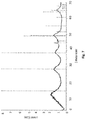
- FIGS. 1, 3, 5 and 7 illustrate X-ray diffraction diagrams of the precipitated boehmites respectively obtained in Examples 1 and 2 according to the invention and the non-complaint Examples 3 and 4 of the invention.
- FIG. 9 illustrates the saturation curve according to Example 5 produced from the extrudates obtained in Examples 1 to 4.
- a solid material of formula LiCl.2Al(OH) 3 ,nH 2 O with n being comprised between 0.01 and 1, is prepared according to a synthesis method according to the invention, wherein the shaping step is applied by direct extrusion, without any binder.
- a sample of the obtained precipitate is taken from the reaction medium.
- XRD FIG. 1
- XRD FIG. 1
- the boehmite precipitate obtained in Example 1 is not very crystallized.
- the size of the crystallites of the obtained boehmite is measured according to Sherrer's method:
- a solution is prepared containing 78.5 g of lithium chloride LiCl provided by Prolabo and 1,326 ml of water which is added to the repulped cake. This reaction medium is stirred and heated at 80° C. for 2 h.
- the step for shaping the obtained slurry is directly carried out after the drying step, without any preliminary kneading step and in the absence of any binder.
- the obtained slurry is shaped by means of a piston extruder (MTS), equipped with a cylindrical die with a diameter of 1 mm.
- MTS piston extruder
- the extrudates obtained at the end of the shaping step are then dried in an oven at 40° C. for 12 h.
- the obtained extrudates are then subject to a hydrothermal treatment step in an autoclave comprising water. 10 g of extrudates are placed in a basket placed in a 500 ml autoclave. In the bottom of the autoclave 20 g of distilled water are placed. The extrudates are not in contact with the liquid at the bottom of the autoclave.
- the hydrothermal treatment is performed at a temperature of 100° C. for 6 h under an atmosphere saturated with water.
- the extrudates obtained according to Example 1 visually show good cohesion, do not exhibit any or few cracks and both exhibit very good cohesion and very good mechanical strength when they are put into contact with a brine (a destruction percentage of less than 15% during the cohesion test) or with water (destruction percentage of less than 20% during the cohesion test).
- a solid material of formula LiCl.2Al(OH) 3 ,nH 2 O with n being comprised between 0.01 and 1 is prepared according to a synthesis method according to the invention, wherein the shaping step is applied by direct extrusion, without any binder.
- a sample of the obtained precipitate is taken from the reaction medium.
- XRD FIG. 3
- the boehmite precipitate obtained in Example 2 is not very crystallized.
- the size of the crystallites of the obtained boehmite is measured according to Sherrer's method:
- a solution containing 78.5 g of lithium chloride LiCl provided by Prolabo is prepared and 1,326 ml of water which is added to the repulped cake. This reaction medium is stirred and heated to 80° C. for 2 h.
- the step for shaping the obtained slurry is directly carried out after the drying step, without any preliminary kneading step and in the absence of any binder.
- the obtained slurry is shaped by means of a piston extruder (MTS), equipped with a cylindrical die with a diameter of 1 mm.
- MTS piston extruder
- the extrudates obtained at the end of the shaping step are then dried in an oven at 40° C. for 12 h.
- the obtained extrudates are then subject to a hydrothermal treatment step in an autoclave comprising water. 10 g of extrudates are placed in a basket placed in a 500 ml autoclave. 20 g of distilled water are placed in the bottom of the autoclave. The extrudates are not in contact with the liquid at the bottom of the autoclave.
- the hydrothermal treatment is performed at a temperature of 100° C. for 6 h under an atmosphere saturated with water.
- the extrudates obtained according to Example 2 visually show good cohesion, have no or very few cracks and both exhibit very good cohesion and a very good mechanical strength when the latter are put into contact with brine (destruction percentage of less than 15% during the cohesion test) or with water (destruction percentage of less than 20% during the cohesion test).
- a solid material of formula LiCl.2Al(OH) 3 ,nH 2 O with n being comprised between 0.01 and 1, is prepared according to a synthesis method not compliant with the invention, in that the pH at the end of the precipitation of the step for synthesis of boehmite is carried out at a pH greater than 9.5.
- a sample of the obtained precipitate is taken from the reaction medium.
- the XRD ( FIG. 5 ) of the precipitate shows that the obtained precipitate in Example 3 is actually a boehmite precipitate.
- a solution containing 78.5 g of lithium chloride LiCl provided by Prolabo and 1,326 ml of water is prepared, which is added to the repulped cake. This reaction medium is stirred and heated to 80° C. for 2 h.
- the step for shaping the obtained slurry is directly carried out after the drying step, without any preliminary kneading step and in the absence of any binder.
- the obtained slurry is shaped by means of a piston extruder (MTS), equipped with a cylindrical die with a diameter of 1 mm.
- MTS piston extruder
- the extrudates obtained at the end of the shaping step are then dried in an oven at 40° C. for 12 h.
- the obtained extrudates are then subject to a hydrothermal treatment step in an autoclave comprising water. 10 g of extrudates are placed in a basket placed in a 500 ml autoclave. 20 g of distilled water are placed in the bottom of the autoclave. The extrudates are not in contact with the liquid at the bottom of the autoclave.
- the hydrothermal treatment is performed at a temperature of 100° C. for 6 h under an atmosphere saturated with water.
- the extrudates obtained according to Example 3 visually show good cohesion, have no or few cracks and have both very good cohesion and very good mechanical strength when the latter are put into contact with brine (destruction percentage of less than 15% during the cohesion test) or with water (destruction percentage of less than 20% during the cohesion test).
- a sample of the obtained precipitate is taken from the reaction medium.
- the XRD ( FIG. 7 ) of the precipitate shows that the obtained precipitate in Example 4 is actually a boehmite precipitate.
- a solution containing 78.5 g of lithium chloride LiCl provided by Prolabo and 1,326 ml of water is prepared, which is added to the repulped cake. This reaction medium is stirred and heated to 80° C. for 2 h.
- the step for shaping the obtained slurry is directly carried out after the drying step, without any preliminary kneading step and in the absence of any binder.
- the obtained slurry is shaped by means of a piston extruder (MTS), equipped with a cylindrical die with a diameter of 1 mm.
- MTS piston extruder
- the extrudates obtained at the end of the shaping step are then dried in an oven at 40° C. for 12 h.
- the obtained extrudates are then subject to a hydrothermal treatment step in an autoclave comprising water. 10 g of extrudates are placed in a basket placed in a 500 ml autoclave. 20 g of distilled water are placed in the bottom of the autoclave. The extrudates are not in contact with the liquid at the bottom of the autoclave.
- the hydrothermal treatment is performed at a temperature of 100° C. for 6 h under an atmosphere saturated with water.
- the extrudates obtained according to Example 4 visually show good cohesion, have no or few cracks and both have very good cohesion and very good mechanical strength when the latter are put into contact with a brine (destruction percentage of less than 15% during the cohesion test) or with water (destruction percentage of less than 20% during the cohesion test).
- FIG. 9 illustrates the saturation curves obtained for each of the extrudates obtained in the Examples according to the invention 1 and 2 and those not compliant with the invention 3 and 4.
- the extrudates obtained according to Examples 1 and 2 according to the invention are compared with those obtained in the Examples 3 and 4 obtained according to preparation methods non-compliant with the invention.
- the extrudates of Examples 1 and 2 obtained according to the invention exhibit a lithium leak occurring at greater brine volumes having cast. Their adsorption capacities of lithium are respectively 5.8 and 6.2 mg(Li)/g (dry solid), to be compared with 1.7 and 4.3 mg(Li)/g (dry solid) for the solids obtained according to Examples 3 and 4, according to preparation methods non-compliant with the invention.
Landscapes
- Chemical & Material Sciences (AREA)
- Organic Chemistry (AREA)
- Analytical Chemistry (AREA)
- Chemical Kinetics & Catalysis (AREA)
- Inorganic Chemistry (AREA)
- Life Sciences & Earth Sciences (AREA)
- Geology (AREA)
- Physics & Mathematics (AREA)
- Thermal Sciences (AREA)
- Solid-Sorbent Or Filter-Aiding Compositions (AREA)
- Inorganic Compounds Of Heavy Metals (AREA)
Applications Claiming Priority (3)
| Application Number | Priority Date | Filing Date | Title |
|---|---|---|---|
| FR1555157A FR3036978B1 (fr) | 2015-06-05 | 2015-06-05 | Procede de preparation d'un materiau adsorbant comprenant une etape de precipitation de boehmite operant dans des conditions specifiques et procede d'extraction de lithium a partir de solutions salines utilisant ledit materiau |
| FR1555157 | 2015-06-05 | ||
| PCT/EP2016/062667 WO2016193439A1 (fr) | 2015-06-05 | 2016-06-03 | Procede de preparation d'un materiau adsorbant comprenant une etape de precipitation de boehmite operant dans des conditions specifiques et procede d'extraction de lithium a partir de solutions salines utilisant ledit materiau |
Publications (2)
| Publication Number | Publication Date |
|---|---|
| US20180353932A1 US20180353932A1 (en) | 2018-12-13 |
| US10786802B2 true US10786802B2 (en) | 2020-09-29 |
Family
ID=54066031
Family Applications (1)
| Application Number | Title | Priority Date | Filing Date |
|---|---|---|---|
| US15/579,811 Active 2036-06-10 US10786802B2 (en) | 2015-06-05 | 2016-06-03 | Process for preparing an adsorbing material comprising a precipitating step of boehmite according to specific conditions and process for extracting lithium from saline solutions using this material |
Country Status (7)
| Country | Link |
|---|---|
| US (1) | US10786802B2 (es) |
| EP (1) | EP3302787A1 (es) |
| CN (1) | CN107787248B (es) |
| AR (1) | AR104902A1 (es) |
| CL (1) | CL2017003061A1 (es) |
| FR (1) | FR3036978B1 (es) |
| WO (1) | WO2016193439A1 (es) |
Cited By (4)
| Publication number | Priority date | Publication date | Assignee | Title |
|---|---|---|---|---|
| US11904297B1 (en) | 2023-01-11 | 2024-02-20 | Iliad Ip Company, Llc | Process for manufacturing lithium selective adsorption/separation media |
| US20240238760A1 (en) * | 2021-06-30 | 2024-07-18 | Sumitomo Metal Mining Co., Ltd. | Producing method of granulated body for lithium adsorption |
| US12285740B1 (en) | 2024-06-24 | 2025-04-29 | Albemarle Corporation | Direct lithium extraction compositions and methods |
| WO2026005753A1 (en) * | 2024-06-24 | 2026-01-02 | Albemarle Corporation | Direct lithium extraction compositions and methods |
Families Citing this family (7)
| Publication number | Priority date | Publication date | Assignee | Title |
|---|---|---|---|---|
| FR3051787B1 (fr) | 2016-05-25 | 2022-07-08 | Eramet | Procede de preparation d'un materiau adsorbant et procede d'extraction de lithium utilisant ledit materiau |
| FR3053264B1 (fr) * | 2016-06-30 | 2022-07-29 | Eramet | Procede de preparation d'un materiau adsorbant et procede d'extraction de lithium a partir de solutions salines utilisant ledit materiau |
| CN108083301A (zh) * | 2017-11-10 | 2018-05-29 | 江苏旌凯中科超导高技术有限公司 | 利用磁性粉体铝系锂吸附剂从卤水中提取锂的方法 |
| EP3959009A4 (en) | 2019-04-25 | 2023-05-24 | Saint-Gobain Ceramics&Plastics, Inc. | ADSORBENT PARTICLES AND METHODS OF FORMING THEREOF |
| CN111330540A (zh) * | 2020-03-06 | 2020-06-26 | 旬阳领盛新材料科技有限公司 | 一种氧化石墨烯复合铝系锂吸附剂的制备方法 |
| CN112691654B (zh) * | 2020-12-25 | 2024-04-02 | 华东理工大学 | 一种铝盐锂吸附剂的一步再生方法 |
| CN114558557B (zh) * | 2022-03-22 | 2022-09-09 | 北京中科顺谷科技发展有限公司 | 基于分子筛吸附剂的天然卤水中锂提取吸附颗粒及其制备方法 |
Citations (12)
| Publication number | Priority date | Publication date | Assignee | Title |
|---|---|---|---|---|
| US4348297A (en) | 1979-11-19 | 1982-09-07 | The Dow Chemical Company | Crystalline lithium aluminates |
| EP0103034A1 (en) | 1982-09-09 | 1984-03-21 | The Dow Chemical Company | Crystalline lithium aluminates and a process for the preparation thereof |
| WO1994019280A1 (fr) | 1993-02-16 | 1994-09-01 | Nauchno-Proizvodstvennoe Aktsionernoe Obschestvo 'ekostar' | Procede d'obtention de chlorure de lithium a partir de solutions et son dispositif de mise en ×uvre |
| US5599516A (en) | 1993-05-24 | 1997-02-04 | Fmc Corporation | Recovery of lithium values from brines |
| US5997836A (en) | 1995-09-01 | 1999-12-07 | Mizusawa Industrial Chemicals, Ltd. | Alkali aluminum complex hydroxide carbonate salt, and a process for producing said salt and its uses |
| CN1243112A (zh) | 1999-08-23 | 2000-02-02 | 李凤杰 | 多元增效氮肥添加剂及其制备方法 |
| CN1511964A (zh) | 2002-12-27 | 2004-07-14 | 中国科学院青海盐湖研究所 | 吸附法从盐湖卤水中提取锂的方法 |
| RU2234367C1 (ru) | 2002-12-15 | 2004-08-20 | Закрытое акционерное общество "Экостар-Наутех" | Способ получения сорбента для извлечения лития из рассолов |
| US20100172811A1 (en) | 2007-09-17 | 2010-07-08 | Areva Federal Services Llc | Process for Removal of Aluminum Oxides from Aqueous Media |
| CN101829538A (zh) | 2010-05-19 | 2010-09-15 | 浙江海虹控股集团有限公司 | 一种高性能锂吸附剂的制备方法 |
| CN102631897A (zh) | 2012-02-14 | 2012-08-15 | 西安蓝晓科技新材料股份有限公司 | 一种制备锂吸附剂树脂的方法 |
| FR3024445A1 (fr) | 2014-07-31 | 2016-02-05 | Eramet | Procede de preparation d'un materiau adsorbant en presence d'un liant comprenant une etape de traitement hydrothermal et procede d'extraction de lithium a partir de solutions salines utilisant ledit materiau |
Family Cites Families (3)
| Publication number | Priority date | Publication date | Assignee | Title |
|---|---|---|---|---|
| RU2050330C1 (ru) * | 1993-02-16 | 1995-12-20 | Научно-производственное акционерное общество "Экостар" | Способ селективного сорбционного извлечения лития из рассолов и устройство для его осуществления |
| US7465517B2 (en) * | 2004-08-23 | 2008-12-16 | Air Products And Chemicals, Inc. | High purity lithium polyhalogenated boron cluster salts useful in lithium batteries |
| US8637428B1 (en) * | 2009-12-18 | 2014-01-28 | Simbol Inc. | Lithium extraction composition and method of preparation thereof |
-
2015
- 2015-06-05 FR FR1555157A patent/FR3036978B1/fr active Active
-
2016
- 2016-06-03 CN CN201680032816.XA patent/CN107787248B/zh active Active
- 2016-06-03 WO PCT/EP2016/062667 patent/WO2016193439A1/fr not_active Ceased
- 2016-06-03 EP EP16730287.6A patent/EP3302787A1/fr active Pending
- 2016-06-03 AR ARP160101658A patent/AR104902A1/es active IP Right Grant
- 2016-06-03 US US15/579,811 patent/US10786802B2/en active Active
-
2017
- 2017-12-01 CL CL2017003061A patent/CL2017003061A1/es unknown
Patent Citations (13)
| Publication number | Priority date | Publication date | Assignee | Title |
|---|---|---|---|---|
| US4348297A (en) | 1979-11-19 | 1982-09-07 | The Dow Chemical Company | Crystalline lithium aluminates |
| EP0103034A1 (en) | 1982-09-09 | 1984-03-21 | The Dow Chemical Company | Crystalline lithium aluminates and a process for the preparation thereof |
| WO1994019280A1 (fr) | 1993-02-16 | 1994-09-01 | Nauchno-Proizvodstvennoe Aktsionernoe Obschestvo 'ekostar' | Procede d'obtention de chlorure de lithium a partir de solutions et son dispositif de mise en ×uvre |
| US6280693B1 (en) | 1993-05-24 | 2001-08-28 | Fmc Corporation | Composition for the recovery of lithium values from brine and process of making/using said composition |
| US5599516A (en) | 1993-05-24 | 1997-02-04 | Fmc Corporation | Recovery of lithium values from brines |
| US5997836A (en) | 1995-09-01 | 1999-12-07 | Mizusawa Industrial Chemicals, Ltd. | Alkali aluminum complex hydroxide carbonate salt, and a process for producing said salt and its uses |
| CN1243112A (zh) | 1999-08-23 | 2000-02-02 | 李凤杰 | 多元增效氮肥添加剂及其制备方法 |
| RU2234367C1 (ru) | 2002-12-15 | 2004-08-20 | Закрытое акционерное общество "Экостар-Наутех" | Способ получения сорбента для извлечения лития из рассолов |
| CN1511964A (zh) | 2002-12-27 | 2004-07-14 | 中国科学院青海盐湖研究所 | 吸附法从盐湖卤水中提取锂的方法 |
| US20100172811A1 (en) | 2007-09-17 | 2010-07-08 | Areva Federal Services Llc | Process for Removal of Aluminum Oxides from Aqueous Media |
| CN101829538A (zh) | 2010-05-19 | 2010-09-15 | 浙江海虹控股集团有限公司 | 一种高性能锂吸附剂的制备方法 |
| CN102631897A (zh) | 2012-02-14 | 2012-08-15 | 西安蓝晓科技新材料股份有限公司 | 一种制备锂吸附剂树脂的方法 |
| FR3024445A1 (fr) | 2014-07-31 | 2016-02-05 | Eramet | Procede de preparation d'un materiau adsorbant en presence d'un liant comprenant une etape de traitement hydrothermal et procede d'extraction de lithium a partir de solutions salines utilisant ledit materiau |
Non-Patent Citations (12)
| Title |
|---|
| "Handbook of Porous solids", 25 April 2008, WILEY-VCH VERLAG GMBH, ISBN: 9783527618286, article PATRICK EUZEN, PASCAL RAYBAUD, X�NOPHON KROKIDIS, HERV� TOULHOAT, JEAN-LUC LE LOARER, JEAN-PIERRE JOLIVET ET C�DRIC FROIDEFOND: "Alumina", pages: 1591 - 1677, XP055057945, DOI: 10.1002/9783527618286.ch23b |
| Database WPI Week 199436 Thomson Scientific, London, GB; AN 1994-294183 XP002756839, & WO 94/19280 AI (Ekostar Res Prodn Stock Assoc) Sep. 1, 1994 (Sep. 1, 1994) abstract. |
| International Search Report for PCT/EP2016/062667, dated Sep. 1, 2016. |
| Isupov et al: "Aluminium hydroxide as selective sorbent of lithium salts from brines and technical solutions", Studies in Surface Science and Catalysis; Adsorption and its Applications in Industry and Environmental Protection-vol. I: Applications in Industry,, vol. 120, No. Part A, Jan. 1, 1999 (Jan. 1, 1999), pp. 621-652, XP008163815, ISSN: 0167-2991, DOI: 10.1016/S0167-2991(99)80567-9 [retrieved on Oct. 22, 2007] p. 646 figures 8-12,16,17 p. 636-p. 641 table 2. |
| ISUPOV, V.P., KOTSUPALO, N.P., NEMUDRY, A.P., MENZERES, L.T.: "Aluminium hydroxide as selective sorbent of lithium salts from brines and technical solutions", STUDIES IN SURFACE SCIENCE AND CATALYSIS, ELSEVIER BV, NL, vol. 120, no. Part A, 1 January 1999 (1999-01-01), NL, pages 621 - 652, XP008163815, ISSN: 0167-2991, DOI: 10.1016/S0167-2991(99)80567-9 |
| Patrick Euzen et al: "Alumina" In: "Handbook of Porous solids", Apr. 25, 2008 (Apr. 25, 2008), Wiley-UCH Verlag GmbH, XP055057945, ISBN: 978-3-52-761828-6 pp. 1591-1677, DOI: 10.1002/9783527618286, p. 1602, paragraph 2eme-p. 1603, paragraph 2eme p. 1606-p. 1608. |
| Preliminary Search Report for FR 1555157, dated Apr. 21, 2016. |
| Vitaly Isupov et al: "Synthesis, Structure, Properties and Application of Aluminium Hydroxide Intercalation Compounds", Chemistry for Sustainable Development, Aug. 4, 2000 (Aug. 4, 2000), pp. 121-127, XP055135012, Retrieved from the Internet: URL:http://www.sibran.ru/upload/iblock/4be/4be336e1a48b9e7197eb4f1f8730b832.PDF [retrieved on Aug. 18, 2014] p. 121, right-hand column p. 122, right-hand column figure 2. |
| WPI / THOMSON Week 199436, 1 September 1994 Derwent World Patents Index; XP002756839, GUSCHINA E P; KOTSUPALO N P; MENZHERES L T; RYABTSEV A D; STARIKOVSKY L G: "Recovery of lithium chloride from solns. - using basic lithium aluminium chloride sorbent in multistage countercurrent flow system" |
| Written Opinion for PCT/EP2016/062667, dated Sep. 1, 2016. |
| Wu Z et al: "Study on the morphology of alpha-A1203 precursor prepared by precipitation method", Journal of Alloys and Compounds, Elsevier Sequoia, Lausanne, CH, vol. 467, No. 1-2, Jan. 7, 2009 (Jan. 7, 2009), pp. 600-604, XP025716633, ISSN: 0925-8388, DOI: 10.1016/J.JALLCOM.2007.12.092 [retrieved on Feb. 20, 2008] 2.1. Sample preparation; p. 600, right-hand column. |
| WU, Z. ; SHEN, Y. ; DONG, Y. ; JIANG, J.: "Study on the morphology of @a-Al"2O"3 precursor prepared by precipitation method", JOURNAL OF ALLOYS AND COMPOUNDS, ELSEVIER SEQUOIA, LAUSANNE., CH, vol. 467, no. 1-2, 7 January 2009 (2009-01-07), CH, pages 600 - 604, XP025716633, ISSN: 0925-8388, DOI: 10.1016/j.jallcom.2007.12.092 |
Cited By (5)
| Publication number | Priority date | Publication date | Assignee | Title |
|---|---|---|---|---|
| US20240238760A1 (en) * | 2021-06-30 | 2024-07-18 | Sumitomo Metal Mining Co., Ltd. | Producing method of granulated body for lithium adsorption |
| US12589380B2 (en) * | 2021-06-30 | 2026-03-31 | Sumitomo Metal Mining., Ltd. | Producing method of granulated body for lithium adsorption |
| US11904297B1 (en) | 2023-01-11 | 2024-02-20 | Iliad Ip Company, Llc | Process for manufacturing lithium selective adsorption/separation media |
| US12285740B1 (en) | 2024-06-24 | 2025-04-29 | Albemarle Corporation | Direct lithium extraction compositions and methods |
| WO2026005753A1 (en) * | 2024-06-24 | 2026-01-02 | Albemarle Corporation | Direct lithium extraction compositions and methods |
Also Published As
| Publication number | Publication date |
|---|---|
| WO2016193439A1 (fr) | 2016-12-08 |
| FR3036978A1 (fr) | 2016-12-09 |
| AR104902A1 (es) | 2017-08-23 |
| EP3302787A1 (fr) | 2018-04-11 |
| CN107787248A (zh) | 2018-03-09 |
| CN107787248B (zh) | 2021-01-12 |
| FR3036978B1 (fr) | 2020-02-21 |
| CL2017003061A1 (es) | 2018-08-24 |
| US20180353932A1 (en) | 2018-12-13 |
Similar Documents
| Publication | Publication Date | Title |
|---|---|---|
| US11554358B2 (en) | Process for preparing an adsorbent material and process for extracting lithium using said material | |
| US20180353932A1 (en) | Process for preparing an adsorbing material comprising a precipitating step of boehmite according to specific conditions and process for extracting lithium from saline solutions using this material | |
| US10850254B2 (en) | Method for preparing an adsorbent material comprising a step of basic mixing, and method for extracting lithium from saline solutions using said material | |
| US11559783B2 (en) | Method for producing an adsorbent material and method for extracting lithium from saline solutions using the material | |
| US20170043317A1 (en) | Process for preparing an adsorbent material in the absence of binder comprising a hydrothermal treatment step and process for extracting lithium from saline using said material | |
| US20160317998A1 (en) | Method of preparing an adsorbent material shaped in the absence of binder and method of extracting lithium from saline solutions using said material | |
| JP4189492B2 (ja) | 層状複水酸化物/ゼオライト複合体 | |
| Mandal et al. | Adsorption of fluoride ions by Zn–Al layered double hydroxides | |
| JP6380999B2 (ja) | イオン吸着材 | |
| CN107073439A (zh) | 基于中孔沸石的沸石吸附剂 | |
| JP5201680B2 (ja) | ハイドロタルサイト様粒状体およびその製造方法 | |
| JP4157946B2 (ja) | 金属水酸化物/ゼオライト複合体及びそれから成る吸着剤 | |
| EP3563919B1 (en) | Filtration body using layered double hydroxide and method for manufacturing said filtration body | |
| KR20150104479A (ko) | 이산화탄소 포집용 흡착제 및 그 제조방법 | |
| JP7400716B2 (ja) | 無機イオン交換体及びその製造方法、並びに放射性ストロンチウムを含有する水の浄化方法 | |
| US20240165580A1 (en) | Product comprising a lithium adsorbent | |
| FR3044002A1 (fr) | Procede de preparation d'un materiau adsorbant par malaxage basique d'une poudre sechee en etuve ou four ou par atomisation et procede d'extraction de lithium | |
| JP6921438B2 (ja) | プリン塩基の吸着材料、それを用いたプリン塩基の吸着フィルタ、プリン塩基の吸着カラム充填剤、ならびに、それらを用いたプリン塩基の除去システム | |
| WO2016063843A1 (ja) | 吸着剤及びその製造方法 | |
| HK1137169A (zh) | 类水滑石颗粒物及其制造方法 |
Legal Events
| Date | Code | Title | Description |
|---|---|---|---|
| FEPP | Fee payment procedure |
Free format text: ENTITY STATUS SET TO UNDISCOUNTED (ORIGINAL EVENT CODE: BIG.); ENTITY STATUS OF PATENT OWNER: LARGE ENTITY |
|
| AS | Assignment |
Owner name: ERAMET, FRANCE Free format text: COMBINED DECLARATION AND ASSIGNMENT;ASSIGNORS:BOUALLEG, MALIKA;BURDET, FABIEN;GOHIN, MORGAN;SIGNING DATES FROM 20170622 TO 20170817;REEL/FRAME:046008/0047 Owner name: IFP ENERGIES NOUVELLES, FRANCE Free format text: COMBINED DECLARATION AND ASSIGNMENT;ASSIGNORS:BOUALLEG, MALIKA;BURDET, FABIEN;GOHIN, MORGAN;SIGNING DATES FROM 20170622 TO 20170817;REEL/FRAME:046008/0047 |
|
| STPP | Information on status: patent application and granting procedure in general |
Free format text: DOCKETED NEW CASE - READY FOR EXAMINATION |
|
| STPP | Information on status: patent application and granting procedure in general |
Free format text: NON FINAL ACTION MAILED |
|
| STPP | Information on status: patent application and granting procedure in general |
Free format text: RESPONSE TO NON-FINAL OFFICE ACTION ENTERED AND FORWARDED TO EXAMINER |
|
| STPP | Information on status: patent application and granting procedure in general |
Free format text: NON FINAL ACTION MAILED |
|
| STPP | Information on status: patent application and granting procedure in general |
Free format text: EX PARTE QUAYLE ACTION MAILED |
|
| STPP | Information on status: patent application and granting procedure in general |
Free format text: RESPONSE TO EX PARTE QUAYLE ACTION ENTERED AND FORWARDED TO EXAMINER |
|
| STCF | Information on status: patent grant |
Free format text: PATENTED CASE |
|
| AS | Assignment |
Owner name: ERAMET, FRANCE Free format text: CHANGE OF ADDRESS;ASSIGNOR:ERAMET;REEL/FRAME:062231/0307 Effective date: 20221014 |
|
| MAFP | Maintenance fee payment |
Free format text: PAYMENT OF MAINTENANCE FEE, 4TH YEAR, LARGE ENTITY (ORIGINAL EVENT CODE: M1551); ENTITY STATUS OF PATENT OWNER: LARGE ENTITY Year of fee payment: 4 |