US10941000B2 - Systems and methods for processing objects, including automated linear processing stations - Google Patents
Systems and methods for processing objects, including automated linear processing stations Download PDFInfo
- Publication number
- US10941000B2 US10941000B2 US15/934,396 US201815934396A US10941000B2 US 10941000 B2 US10941000 B2 US 10941000B2 US 201815934396 A US201815934396 A US 201815934396A US 10941000 B2 US10941000 B2 US 10941000B2
- Authority
- US
- United States
- Prior art keywords
- processing
- bin
- motion device
- objects
- programmable motion
- Prior art date
- Legal status (The legal status is an assumption and is not a legal conclusion. Google has not performed a legal analysis and makes no representation as to the accuracy of the status listed.)
- Active
Links
Images




Classifications
-
- B—PERFORMING OPERATIONS; TRANSPORTING
- B65—CONVEYING; PACKING; STORING; HANDLING THIN OR FILAMENTARY MATERIAL
- B65G—TRANSPORT OR STORAGE DEVICES, e.g. CONVEYORS FOR LOADING OR TIPPING, SHOP CONVEYOR SYSTEMS OR PNEUMATIC TUBE CONVEYORS
- B65G1/00—Storing articles, individually or in orderly arrangement, in warehouses or magazines
- B65G1/02—Storage devices
- B65G1/04—Storage devices mechanical
- B65G1/137—Storage devices mechanical with arrangements or automatic control means for selecting which articles are to be removed
- B65G1/1373—Storage devices mechanical with arrangements or automatic control means for selecting which articles are to be removed for fulfilling orders in warehouses
- B65G1/1378—Storage devices mechanical with arrangements or automatic control means for selecting which articles are to be removed for fulfilling orders in warehouses the orders being assembled on fixed commissioning areas remote from the storage areas
-
- B—PERFORMING OPERATIONS; TRANSPORTING
- B07—SEPARATING SOLIDS FROM SOLIDS; SORTING
- B07C—POSTAL SORTING; SORTING INDIVIDUAL ARTICLES, OR BULK MATERIAL FIT TO BE SORTED PIECE-MEAL, e.g. BY PICKING
- B07C5/00—Sorting according to a characteristic or feature of the articles or material being sorted, e.g. by control effected by devices which detect or measure such characteristic or feature; Sorting by manually actuated devices, e.g. switches
- B07C5/36—Sorting apparatus characterised by the means used for distribution
-
- B—PERFORMING OPERATIONS; TRANSPORTING
- B25—HAND TOOLS; PORTABLE POWER-DRIVEN TOOLS; MANIPULATORS
- B25J—MANIPULATORS; CHAMBERS PROVIDED WITH MANIPULATION DEVICES
- B25J9/00—Program-controlled manipulators
- B25J9/0093—Program-controlled manipulators co-operating with conveyor means
-
- B—PERFORMING OPERATIONS; TRANSPORTING
- B25—HAND TOOLS; PORTABLE POWER-DRIVEN TOOLS; MANIPULATORS
- B25J—MANIPULATORS; CHAMBERS PROVIDED WITH MANIPULATION DEVICES
- B25J9/00—Program-controlled manipulators
- B25J9/02—Program-controlled manipulators characterised by movement of the arms, e.g. cartesian coordinate type
- B25J9/023—Cartesian coordinate type
- B25J9/026—Gantry-type
-
- B—PERFORMING OPERATIONS; TRANSPORTING
- B25—HAND TOOLS; PORTABLE POWER-DRIVEN TOOLS; MANIPULATORS
- B25J—MANIPULATORS; CHAMBERS PROVIDED WITH MANIPULATION DEVICES
- B25J9/00—Program-controlled manipulators
- B25J9/16—Program controls
- B25J9/1612—Program controls characterised by the hand, wrist, grip control
-
- B—PERFORMING OPERATIONS; TRANSPORTING
- B25—HAND TOOLS; PORTABLE POWER-DRIVEN TOOLS; MANIPULATORS
- B25J—MANIPULATORS; CHAMBERS PROVIDED WITH MANIPULATION DEVICES
- B25J9/00—Program-controlled manipulators
- B25J9/16—Program controls
- B25J9/1615—Program controls characterised by special kind of manipulator, e.g. planar, scara, gantry, cantilever, space, closed chain, passive/active joints and tendon driven manipulators
-
- B—PERFORMING OPERATIONS; TRANSPORTING
- B65—CONVEYING; PACKING; STORING; HANDLING THIN OR FILAMENTARY MATERIAL
- B65G—TRANSPORT OR STORAGE DEVICES, e.g. CONVEYORS FOR LOADING OR TIPPING, SHOP CONVEYOR SYSTEMS OR PNEUMATIC TUBE CONVEYORS
- B65G1/00—Storing articles, individually or in orderly arrangement, in warehouses or magazines
- B65G1/02—Storage devices
- B65G1/04—Storage devices mechanical
- B65G1/0464—Storage devices mechanical with access from above
-
- B—PERFORMING OPERATIONS; TRANSPORTING
- B65—CONVEYING; PACKING; STORING; HANDLING THIN OR FILAMENTARY MATERIAL
- B65G—TRANSPORT OR STORAGE DEVICES, e.g. CONVEYORS FOR LOADING OR TIPPING, SHOP CONVEYOR SYSTEMS OR PNEUMATIC TUBE CONVEYORS
- B65G1/00—Storing articles, individually or in orderly arrangement, in warehouses or magazines
- B65G1/02—Storage devices
- B65G1/04—Storage devices mechanical
- B65G1/0478—Storage devices mechanical for matrix-arrangements
-
- B—PERFORMING OPERATIONS; TRANSPORTING
- B65—CONVEYING; PACKING; STORING; HANDLING THIN OR FILAMENTARY MATERIAL
- B65G—TRANSPORT OR STORAGE DEVICES, e.g. CONVEYORS FOR LOADING OR TIPPING, SHOP CONVEYOR SYSTEMS OR PNEUMATIC TUBE CONVEYORS
- B65G1/00—Storing articles, individually or in orderly arrangement, in warehouses or magazines
- B65G1/02—Storage devices
- B65G1/04—Storage devices mechanical
- B65G1/137—Storage devices mechanical with arrangements or automatic control means for selecting which articles are to be removed
- B65G1/1371—Storage devices mechanical with arrangements or automatic control means for selecting which articles are to be removed with data records
-
- B—PERFORMING OPERATIONS; TRANSPORTING
- B65—CONVEYING; PACKING; STORING; HANDLING THIN OR FILAMENTARY MATERIAL
- B65G—TRANSPORT OR STORAGE DEVICES, e.g. CONVEYORS FOR LOADING OR TIPPING, SHOP CONVEYOR SYSTEMS OR PNEUMATIC TUBE CONVEYORS
- B65G1/00—Storing articles, individually or in orderly arrangement, in warehouses or magazines
- B65G1/02—Storage devices
- B65G1/04—Storage devices mechanical
- B65G1/137—Storage devices mechanical with arrangements or automatic control means for selecting which articles are to be removed
- B65G1/1373—Storage devices mechanical with arrangements or automatic control means for selecting which articles are to be removed for fulfilling orders in warehouses
- B65G1/1376—Storage devices mechanical with arrangements or automatic control means for selecting which articles are to be removed for fulfilling orders in warehouses the orders being assembled on a commissioning conveyor
-
- B—PERFORMING OPERATIONS; TRANSPORTING
- B65—CONVEYING; PACKING; STORING; HANDLING THIN OR FILAMENTARY MATERIAL
- B65G—TRANSPORT OR STORAGE DEVICES, e.g. CONVEYORS FOR LOADING OR TIPPING, SHOP CONVEYOR SYSTEMS OR PNEUMATIC TUBE CONVEYORS
- B65G47/00—Article or material-handling devices associated with conveyors; Methods employing such devices
- B65G47/74—Feeding, transfer, or discharging devices of particular kinds or types
- B65G47/82—Rotary or reciprocating members for direct action on articles or materials, e.g. pushers, rakes, shovels
-
- B—PERFORMING OPERATIONS; TRANSPORTING
- B65—CONVEYING; PACKING; STORING; HANDLING THIN OR FILAMENTARY MATERIAL
- B65G—TRANSPORT OR STORAGE DEVICES, e.g. CONVEYORS FOR LOADING OR TIPPING, SHOP CONVEYOR SYSTEMS OR PNEUMATIC TUBE CONVEYORS
- B65G47/00—Article or material-handling devices associated with conveyors; Methods employing such devices
- B65G47/74—Feeding, transfer, or discharging devices of particular kinds or types
- B65G47/90—Devices for picking-up and depositing articles or materials
- B65G47/905—Control arrangements
-
- G—PHYSICS
- G05—CONTROLLING; REGULATING
- G05B—CONTROL OR REGULATING SYSTEMS IN GENERAL; FUNCTIONAL ELEMENTS OF SUCH SYSTEMS; MONITORING OR TESTING ARRANGEMENTS FOR SUCH SYSTEMS OR ELEMENTS
- G05B19/00—Program-control systems
- G05B19/02—Program-control systems electric
- G05B19/418—Total factory control, i.e. centrally controlling a plurality of machines, e.g. direct or distributed numerical control [DNC], flexible manufacturing systems [FMS], integrated manufacturing systems [IMS] or computer integrated manufacturing [CIM]
- G05B19/4189—Total factory control, i.e. centrally controlling a plurality of machines, e.g. direct or distributed numerical control [DNC], flexible manufacturing systems [FMS], integrated manufacturing systems [IMS] or computer integrated manufacturing [CIM] characterised by the transport system
- G05B19/41895—Total factory control, i.e. centrally controlling a plurality of machines, e.g. direct or distributed numerical control [DNC], flexible manufacturing systems [FMS], integrated manufacturing systems [IMS] or computer integrated manufacturing [CIM] characterised by the transport system using automatic guided vehicles [AGV]
-
- G—PHYSICS
- G06—COMPUTING OR CALCULATING; COUNTING
- G06Q—INFORMATION AND COMMUNICATION TECHNOLOGY [ICT] SPECIALLY ADAPTED FOR ADMINISTRATIVE, COMMERCIAL, FINANCIAL, MANAGERIAL OR SUPERVISORY PURPOSES; SYSTEMS OR METHODS SPECIALLY ADAPTED FOR ADMINISTRATIVE, COMMERCIAL, FINANCIAL, MANAGERIAL OR SUPERVISORY PURPOSES, NOT OTHERWISE PROVIDED FOR
- G06Q10/00—Administration; Management
- G06Q10/08—Logistics, e.g. warehousing, loading or distribution; Inventory or stock management
- G06Q10/087—Inventory or stock management, e.g. order filling, procurement or balancing against orders
-
- G—PHYSICS
- G06—COMPUTING OR CALCULATING; COUNTING
- G06Q—INFORMATION AND COMMUNICATION TECHNOLOGY [ICT] SPECIALLY ADAPTED FOR ADMINISTRATIVE, COMMERCIAL, FINANCIAL, MANAGERIAL OR SUPERVISORY PURPOSES; SYSTEMS OR METHODS SPECIALLY ADAPTED FOR ADMINISTRATIVE, COMMERCIAL, FINANCIAL, MANAGERIAL OR SUPERVISORY PURPOSES, NOT OTHERWISE PROVIDED FOR
- G06Q10/00—Administration; Management
- G06Q10/08—Logistics, e.g. warehousing, loading or distribution; Inventory or stock management
- G06Q10/087—Inventory or stock management, e.g. order filling, procurement or balancing against orders
- G06Q10/0874—Inventory fulfillment
-
- B—PERFORMING OPERATIONS; TRANSPORTING
- B65—CONVEYING; PACKING; STORING; HANDLING THIN OR FILAMENTARY MATERIAL
- B65G—TRANSPORT OR STORAGE DEVICES, e.g. CONVEYORS FOR LOADING OR TIPPING, SHOP CONVEYOR SYSTEMS OR PNEUMATIC TUBE CONVEYORS
- B65G2201/00—Indexing codes relating to handling devices, e.g. conveyors, characterised by the type of product or load being conveyed or handled
- B65G2201/02—Articles
- B65G2201/0235—Containers
- B65G2201/0258—Trays, totes or bins
Definitions
- the invention generally relates to automated programmable motion control systems, e.g., robotic, sortation and other processing systems, and relates in particular to programmable motion control systems intended for use in environments requiring that a variety of objects (e.g., articles, packages, consumer products etc.) be processed and moved to a number of processing destinations.
- objects e.g., articles, packages, consumer products etc.
- Many object distribution systems receive objects in a disorganized stream or bulk transfer that may be provided as individual objects or objects aggregated in groups such as in bags, arriving on any of several different conveyances, commonly a conveyor, a truck, a pallet a Gaylord, or a bin etc.
- Each object must then be distributed to the correct destination location (e.g., a container) as determined by identification information associated with the object, which is commonly determined by a label printed on the object.
- the destination location may take many forms, such as a bag, a shelf, a container, or a bin.
- the processing (e.g., sortation or distribution) of such objects has traditionally been done, at least in part, by human workers that scan the objects, for example with a hand-held barcode scanner, and then place the objects at assigned locations.
- Many order fulfillment operations for example, achieve high efficiency by employing a process called wave picking.
- wave picking orders are picked from warehouse shelves and placed at locations (e.g., into bins) containing multiple orders that are sorted downstream.
- locations e.g., into bins
- multi-article orders are consolidated, for example, into a single bin or shelf location, so that they may be packed and then shipped to customers.
- the process of sorting these articles has traditionally been done by hand.
- a human sorter picks an article, and then places the article in the so-determined bin or shelf location where all articles for that order or manifest have been defined to belong.
- Automated systems for order fulfillment have also been proposed. See, for example, U.S. Patent Application Publication No. 2014/0244026, which discloses the use of a robotic arm together with an arcuate structure that is movable to within reach of the robotic arm.
- the identification of objects by code scanning generally either require manual processing, or require that the code location be controlled or constrained so that a fixed or robot-held code scanner (e.g., a barcode scanner) can reliably detect the code.
- Manually operated barcode scanners are therefore generally either fixed or handheld systems. With fixed systems, such as those at point-of-sale systems, the operator holds the article and places it in front of the scanner, which scans continuously, and decodes any barcodes that it can detect. If the article's code is not immediately detected, the person holding the article typically needs to vary the position or orientation of the article with respect to the fixed scanner, so as to render the barcode more visible to the scanner. For handheld systems, the person operating the scanner may look at the barcode on the article, and then hold the article such that the barcode is within the viewing range of the scanner, and then press a button on the handheld scanner to initiate a scan of the barcode.
- distribution center sorting systems generally assume an inflexible sequence of operation whereby a disorganized stream of input objects is provided (by a human) as a singulated stream of objects that are oriented with respect to a scanner that identifies the objects.
- An induction element or elements e.g., a conveyor, a tilt tray, or manually movable bins
- transport the objects to desired destination locations or further processing stations which may be a bin, a chute, a bag or a conveyor etc.
- human workers or automated systems In conventional object sortation or distribution systems, human workers or automated systems typically retrieve object sin an arrival order, and sort each object or object into a collection bin based on a set of given heuristics. For example, all objects of a like type might be directed to a particular collection bin, or all objects in a single customer order, or all objects destined for the same shipping destination, etc. may be directed to a common destination location.
- the human workers with the possible limited assistance of automated systems, are required to receive objects and to move each to their assigned collection bin. If the number of different types of input (received) objects is large, then a large number of collection bins is required.
- FIG. 1 shows an object distribution system 10 in which objects arrive, e.g., in trucks, as shown at 12 , are separated and stored in packages that each include a specific combination of objects as shown at 14 , and the packages are then shipped as shown at 16 to different retail stores, providing that each retail store receives a specific combination of objects in each package.
- Each package received at a retail store from transport 16 is broken apart at the store and such packages are generally referred to as break-packs.
- incoming trucks 12 contain vendor cases 18 of homogenous sets of objects. Each vendor case, for example, may be provided by a manufacturer of each of the objects.
- the objects from the vendor cases 18 are moved into decanted bins 20 , and are then brought to a processing area 14 that includes break-pack store packages 22 .
- the break-pack store packages 22 are filled by human workers that select items from the decanted vendor bins to fill the break-pack store packages according to a manifest. For example, a first set of the break-pack store packages may go to a first store (as shown at 24 ), and a second set of break-pack store packages may go to a second store (as shown at 26 ).
- the system may accept large volumes of product from a manufacturer, and then re-package the objects into break-packs to be provided to retail stores at which a wide variety of objects are to be provided in a specific controlled distribution fashion.
- Such a system however, has inherent inefficiencies as well as inflexibilities since the desired goal is to match incoming objects to assigned collection bins.
- Such systems may require a large number of collection bins (and therefore a large amount of physical space, large investment costs, and large operating costs), in part, because sorting all objects to all destinations at once is not always most efficient.
- break-pack systems must also monitor the volume of each like object in a bin, requiring that a human worker continuously count the items in a bin.
- each parallel sortation cell must have all the same collection bin designations; otherwise, an object may be delivered to a cell that does not have a bin to which the object is mapped.
- the invention provides a method of processing objects using a programmable motion device.
- the method includes the steps of perceiving identifying indicia representative of an identity of a plurality of objects and directing the plurality of objects toward an input area from at least one input conveyance system, acquiring an object from the plurality of objects at the input area using an end effector of the programmable motion device, and moving the acquired object toward an identified processing location using the programmable motion device.
- the identified processing location is associated with the identifying indicia and the identified processing location is provided as one of a plurality of processing locations along a first direction.
- the step of moving the acquired object includes moving the programmable motion device along a second direction that is substantially parallel with the first direction.
- the invention provides a method of processing objects using a programmable motion device, wherein the method includes the steps of perceiving identifying indicia representative of an identity of a plurality of objects, acquiring an object from the plurality of objects at an input area using an end effector of the programmable motion device and moving the acquired object toward an identified processing location using the programmable motion device, said identified processing location beings associated with the identifying indicia and said identified processing location being provided as one of a plurality of processing locations that extend along a first direction.
- the step of moving the acquired object includes moving the programmable motion device along a second direction that is substantially parallel with the first direction.
- the invention provides a processing system for processing objects using a programmable motion device.
- the processing system includes a perception unit for perceiving identifying indicia representative of an identity of a plurality of objects associated with an input conveyance system, and an acquisition system for acquiring an object from the plurality of objects at the input area using an end effector of the programmable motion device.
- the programmable motion device for moving the acquired object toward an identified processing location.
- the identified processing location is associated with the identifying indicia and the identified processing location is provided as one of a plurality of processing locations that extend along a first direction.
- the programmable motion device is movable along a second direction that is substantially parallel with the first direction.
- FIG. 1 shows an illustrative diagrammatic view of an object processing system of the prior art
- FIG. 2 shows an illustrative diagrammatic view of an object processing system in accordance with an embodiment of the present invention
- FIG. 3 shows an illustrative diagrammatic view of an underside of a perception system in the object processing system of FIG. 2 ;
- FIG. 4 shows an illustrative diagrammatic view from the perception system of FIG. 3 , showing a view of objects within a bin of objects to be processed;
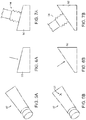
- FIGS. 5A and 5B show an illustrative diagrammatic view of a grasp selection process in an object processing system of an embodiment of the present invention
- FIGS. 6A and 6B show an illustrative diagrammatic view of a grasp planning process in an object processing system of an embodiment of the present invention
- FIGS. 7A and 7B show an illustrative diagrammatic view of a grasp execution process in an object processing system of an embodiment of the present invention
- FIG. 8A shows an illustrative diagrammatic top view of a processing station in an object processing system in accordance with an embodiment of the invention
- FIG. 8B shows an illustrative diagrammatic top view of a processing station in an object processing system in accordance with another embodiment of the invention involving a floor mounted programmable motion device;
- FIG. 9 shows an illustrative diagrammatic top view of the system of FIG. 8A with the programmable motion device deposing an object into a processing bin;
- FIG. 10 shows an illustrative diagrammatic top view of the system of FIG. 8A with the programmable motion device moving a processing bin onto an outbound conveyor;
- FIG. 11 shows an illustrative diagrammatic top view of the system of FIG. 8A with the programmable motion device having moved a new bin onto the processing bin conveyor;
- FIG. 12 shows an illustrative diagrammatic exploded view of a box tray assembly for use in a system in accordance with an embodiment of the present invention
- FIG. 13 shows an illustrative diagrammatic view of the box tray assembly of FIG. 12 with the components combined
- FIGS. 14A-14D show illustrative diagrammatic views of a bin removal system for use in a system in accordance with an embodiment of the present invention
- FIG. 15 shows an illustrative diagrammatic top view of an object processing system in accordance with another embodiment of the invention that identifies changing and unchanging motion planning general areas;
- FIG. 16 shows an illustrative diagrammatic top view of the system of FIG. 15 , showing multiple possible paths from the programmable motion device to a destination carrier;
- FIG. 17 shows an illustrative diagrammatic top view of the system of FIG. 15 , showing paths from the programmable motion device to a destination carrier with an emphasis on minimum time;
- FIG. 18 shows an illustrative diagrammatic top view of the system of FIG. 15 , showing paths from the programmable motion device to a destination carrier with an emphasis on minimum risk;
- FIG. 19 shows an illustrative diagrammatic view of an object processing system in accordance with a further embodiment of the present invention involving multiple processing stations.
- the invention provides a method of processing objects using a programmable motion device.
- the method includes the steps of perceiving identifying indicia representative of an identity of a plurality of objects and directing the plurality of objects toward an input area from at least one input conveyance system, acquiring an object from the plurality of objects at the input area using an end effector of the programmable motion device, and moving the acquired object toward an identified processing location using the programmable motion device, said identified processing location beings associated with the identifying indicia and said identified processing location being provided as one of a plurality of processing locations along a first direction, and said step of moving the acquired object including moving the programmable motion device along a second direction that is substantially parallel with the first direction.
- objects need to be identified and conveyed to desired object specific locations.
- the systems reliably automate the identification and conveyance of such objects, employing in certain embodiments, a set of conveyors, a perception system, and a plurality of destination bins.
- applicants have discovered that when automating sortation of objects, there are a few main things to consider: 1) the overall system throughput (objects sorted per hour), 2) the number of diverts (i.e., number of discrete locations to which an object can be routed), 3) the total area of the sortation system (square feet), and 4) the capital and annual costs to purchase and run the system.
- Processing objects in a break-pack distribution center is one application for automatically identifying and processing objects.
- objects commonly arrive in trucks, are conveyed to sortation stations where they are sorted according to desired destinations into boxes (or packages) that are then loaded in trucks for transport to, for example, shipping or distribution centers or retail stores.
- the desired destination is commonly obtained by reading identifying information printed on the box or package.
- the destination corresponding to identifying information is commonly obtained by querying the customer's information system.
- the destination may be written directly on the box, or may be known through other means such as by assignment to a vendor bin.
- the system also requests specific bins of objects from a storage system, which helps optimize the process of having desired objects be delivered to specific singulator cells in an efficient way without simply letting all bins of objects appear at each singulator cell in a purely random order.
- FIG. 2 shows a system 30 in accordance with an embodiment of the present invention that receives decanted vendor bins, e.g., 32 , 34 , 36 on an in-feed conveyor 38 .
- a programmable motion device such as an articulated arm 40 having an end effector is provided suspended from and movable along a linear gantry 42 .
- Adjacent the base of the articulated arm and also suspended from the linear gantry 42 is a perception unit 50 (as further discussed below with reference to FIG. 3 .
- Additional perception units 56 may be provided (for example, near vendor bin in-feed conveyor 38 ) that capture perception information regarding a label that is applied to each bin e.g., 32 , 34 , 36 that associates the bin with the contents of the bin.
- the articulated arm is programmed to access each of the vendor bins 32 , 34 , 36 , and to move (including movement along the gantry) to bring any of the objects in bins 32 , 34 , 36 to one of a plurality of break-pack packages 44 at a plurality of processing locations.
- the articulated arm 40 will move (push) the completed box onto an output conveyor 46 on which completed boxes 48 are provided.
- the completed boxes may be sealed and labeled at the processing station 30 , or may be sealed and labeled at a later station.
- An additional conveyor 52 may be provided that provides empty boxes 54 to within access of the articulated arm 40 . After a completed box is removed from the processing location, an empty box may be grasped by the end effector of the articulated arm and placed in the processing location.
- the bins of objects are marked in one or more places on their exterior with a visually distinctive mark such as a barcode (e.g., providing a UPC code) or radio-frequency identification (RFID) tag or mailing label so that they may be sufficiently identified with a scanner for processing.
- a visually distinctive mark such as a barcode (e.g., providing a UPC code) or radio-frequency identification (RFID) tag or mailing label so that they may be sufficiently identified with a scanner for processing.
- the type of marking depends on the type of scanning system used, but may include 1D or 2D code symbologies. Multiple symbologies or labeling approaches may be employed.
- the types of scanners employed are assumed to be compatible with the marking approach.
- the marking e.g. by barcode, RFID tag, mailing label or other means, encodes a identifying indicia (e.g., a symbol string), which is typically a string of letters and/or numbers.
- the symbol string uniquely associates the vendor bin with a specific set of homo
- the operations of the system described above are coordinated with a central control system 70 as shown in FIG. 2 that communicates wirelessly with the articulated arm 40 , the perception units 56 , as well as in-feed conveyor 38 .
- the perception unit 56 captures indicia 33 on the bins that identify the content of the bins. In particular, this system determines from symbol strings the UPC associated with a vendor bin, as well as the outbound destination for each object.
- the central control system 70 is comprised of one or more workstations or central processing units (CPUs). For example, the correspondence between UPCs or mailing labels, and outbound destinations is maintained by a central control system in a database called a manifest.
- the central control system maintains the manifest by communicating with a warehouse management system (WMS).
- the manifest provides the outbound destination for each in-bound object.
- WMS warehouse management system
- the system of an embodiment includes a perception system (e.g., 50 , 52 ) that is mounted above a bin of objects to be processed next to the base of the articulated arm 40 , looking down into a bin (e.g., 32 , 34 , 36 ).
- the system 50 may include (on the underside thereof), a camera 72 , a depth sensor 74 and lights 76 .
- a combination of 2D and 3D (depth) data is acquired.
- the depth sensor 74 may provide depth information that may be used together with the camera image data to determine depth information regarding the various objects in view.
- the lights 76 may be used to remove shadows and to facilitate the identification of edges of objects, and may be all on during use, or may be illuminated in accordance with a desired sequence to assist in object identification.
- the system uses this imagery and a variety of algorithms to generate a set of candidate grasp locations for the objects in the bin as discussed in more detail below.
- FIG. 4 shows an image view from the perception unit 50 .
- the image view shows a bin 44 in an input area 46 (a conveyor), and the bin 44 contains objects 78 , 80 , 82 , 84 and 86 .
- the objects are homogenous, and are intended for distribution to different break-pack packages.
- superimposed on the objects 78 , 80 , 82 , 84 , 86 are anticipated grasp locations 79 , 81 , 83 and 85 of the objects. Note that while candidate grasp locations 79 , 83 and 85 appear to be good grasp locations, grasp location 81 does not because its associated object is at least partially underneath another object.
- the system may also not even try to yet identify a grasp location for the object 84 because the object 84 is too obscured by other objects.
- Candidate grasp locations may be indicated using a 3D model of the robot end effector placed in the location where the actual end effector would go to use as a grasp location as shown in FIG. 4 .
- Grasp locations may be considered good, for example, if they are close to the center of mass of the object to provide greater stability during grasp and transport, and/or if they avoid places on an object such as caps, seams etc. where a good vacuum seal might not be available.
- the perception system considers the object to be two different objects, and may propose more than one candidate grasps of such two different objects. If the system executes a grasp at either of these bad grasp locations, it will either fail to acquire the object due to a bad grasp point where a vacuum seal will not occur (e.g., on the right), or will acquire the object at a grasp location that is very far from the center of mass of the object (e.g., on the left) and thereby induce a great deal of instability during any attempted transport. Each of these results is undesirable.
- the system may remember that location for the associated object. By identifying good and bad grasp locations, a correlation is established between features in the 2D/3D images and the idea of good or bad grasp locations. Using this data and these correlations as input to machine learning algorithms, the system may eventually learn, for each image presented to it, where to best grasp an object, and where to avoid grasping an object.
- the perception system may also identify portions of an object that are the most flat in the generation of good grasp location information.
- an object includes a tubular end and a flat end such as object 87 , the system would identify the more flat end as shown at 88 in FIG. 5B .
- the system may select the area of an object where a UPC code appears, as such codes are often printed on a relatively flat portion of the object to facilitate scanning of the barcode.
- FIGS. 6A and 6B show that for each object 90 , 92 , the grasp selection system may determine a direction that is normal to the selected flat portion of the object 90 , 92 . As shown in FIGS. 7A and 7B , the robotic system will then direct the end effector 94 to approach each object 90 , 92 from the direction that is normal to the surface in order to better facilitate the generation of a good grasp on each object. By approaching each object from a direction that is substantially normal to a surface of the object, the robotic system significantly improves the likelihood of obtaining a good grasp of the object, particularly when a vacuum end effector is employed.
- grasp optimization may be based on determination of surface normal, i.e., moving the end effector to be normal to the perceived surface of the object (as opposed to vertical or gantry picks), and that such grasp points may be chosen using fiducial features as grasp points, such as picking on a barcode, given that barcodes are almost always applied to a flat spot on the object.
- the invention further provides a sortation system that may learn object grasp locations from experience (and optionally human guidance).
- a sortation system that may learn object grasp locations from experience (and optionally human guidance).
- Systems designed to work in the same environments as human workers will face an enormous variety of objects, poses, etc. This enormous variety almost ensures that the robotic system will encounter some configuration of object(s) that it cannot handle optimally; at such times, it is desirable to enable a human operator to assist the system and have the system learn from non-optimal grasps.
- the system optimizes grasp points based on a wide range of features, either extracted offline or online, tailored to the gripper's characteristics.
- the properties of the suction cup influence its adaptability to the underlying surface, hence an optimal grasp is more likely to be achieved when picking on the estimated surface normal of an object rather than performing vertical gantry picks common to current industrial applications.
- the system uses appearance based features as depth sensors may not always be accurate enough to provide sufficient information about graspability.
- the system can learn the location of fiducials such as barcodes on the object, which can be used as indicator for a surface patch that is flat and impermeable, hence suitable for a suction cup.
- fiducials such as barcodes on the object
- barcodes on consumer products.
- shipping boxes and bags which tend to have the shipping label at the object's center of mass and provide an impermeable surface, as opposed to the raw bag material, which might be slightly porous and hence not present a good grasp.
- This information is added to experience based data the system collects with every pick attempt, successful or not. Over time the robot learns to avoid features that result in unsuccessful grasps, either specific to an object type or to a surface/material type. For example, the robot may prefer to avoid picks on shrink wrap, no matter which object it is applied to, but may only prefer to place the grasp near fiducials on certain object types such as shipping bags.
- This learning can be accelerated by off-line generation of human-corrected images. For instance, a human could be presented with thousands of images from previous system operation and manually annotate good and bad grasp points on each one. This would generate a large amount of data that could also be input into the machine learning algorithms to enhance the speed and efficacy of the system learning.
- a large set of labeled training data can be generated based on a detailed object model in physics simulation making use of known gripper and object characteristics. This allows fast and dense generation of graspability data over a large set of objects, as this process is not limited by the speed of the physical robotic system or human input.
- FIG. 8A shows a diagrammatic top view of the system of FIG. 2 , including the linear gantry 42 from which the articulated arm 40 and perception system 50 are suspended, the in-feed conveyor 38 including decanted vendor bins (e.g., 32 , 34 , 36 ), the break-pack packages 44 , the output conveyor 46 and the empty boxes 54 on the empty box supply conveyor 52 .
- the articulated arm 40 is grasping an object from in-feed bin 34 .
- the grasped object may be moved from the in-feed bin 34 to a break-pack package as shown in FIG. 9 .
- the articulated arm may push the completed package 45 onto the output conveyor 46 as shown in FIG. 10 .
- FIG. 8B shows a system similar to that of FIG. 8A , except that the linear support 43 for (and providing the linear actuation of) the articulated arm 40 is on the floor, and in the example of FIG. 8B , perception units 51 may be positioned above the in-feed conveyor 38 .
- the bins 44 may be provided as boxes, totes, containers or any other type of device that may receive and hold an item.
- the bins may be provided in uniform trays (to provide consistency of spacing and processing) and may further include open covers that may maintain the bin in an open position, and may further provide consistency in processing through any of spacing, alignment, or labeling.
- FIG. 12 shows an exploded view of a box tray assembly 130 .
- the box 132 e.g., a standard shipping sized cardboard box
- the box tray 134 may include a recessed (protected) area in which a label or other identifying indicia 146 may be provided, as well as a wide and smooth contact surface 151 that may be engaged by an urging or removal mechanism as discussed below.
- the box 132 may include top flaps 138 that, when opened as shown, are held open by inner surfaces 140 of the box cover 136 .
- the box cover 136 may also include a recessed (protected) area in which a label or other identifying indicia 145 may be provided.
- the box cover 136 also provides a defined rim opening 142 , as well as corner elements 144 that may assist in providing structural integrity of the assembly, and may assist in stacking un-used covers on one another. Un-used box trays may also be stacked on each other.
- FIG. 13 shows a width side view of the box tray assembly 130 with the box 132 securely seated within the box tray 134 , and the box cover holding open the flaps 138 of the box 132 .
- the box tray assemblies may be used as any or both of the storage bins and destination bins in various embodiments of the present invention.
- a box kicker 184 in accordance with an embodiment of the present invention may be suspended by and travel along a track 86 , and may include a rotatable arm 88 and a roller wheel 190 at the end of the arm 88 .
- the roller wheel 190 contacts the kicker plate 151 (shown in FIG. 12 ) of a box tray assembly 120
- the arm 188 continues to rotate, urging the box tray assembly 180 from a first conveyor 182 to a second conveyor 180 .
- the roller wheel 190 is designed to contact the kicker plate 151 of a box tray assembly 181 to push the box tray assembly 181 onto the conveyor 180 .
- Such a system may be used to provide that boxes that are empty or finished being unloaded may be removed (e.g., from conveyor 182 ), or that boxes that are full or finished being loaded may be removed (e.g., from conveyor 182 ).
- the conveyors 180 , 182 may also be coplanar, and the system may further include transition roller 183 to facilitate movement of the box tray assembly 181 , e.g., by being activated to pull the box tray over to the conveyor 180 .
- the system of an embodiment may also employ motion planning using a trajectory database that is dynamically updated over time, and is indexed by customer metrics.
- the problem domains contain a mix of changing and unchanging components in the environment. For example, the objects that are presented to the system are often presented in random configurations, but the target locations into which the objects are to be placed are often fixed and do not change over the entire operation.
- trajectory database One use of the trajectory database is to exploit the unchanging parts of the environment by pre-computing and saving into a database trajectories that efficiently and robustly move the system through these spaces. Another use of the trajectory database is to constantly improve the performance of the system over the lifetime of its operation.
- the database communicates with a planning server that is continuously planning trajectories from the various starts to the various goals, to have a large and varied set of trajectories for achieving any particular task.
- a trajectory path may include any number of changing and unchanging portions that, when combined, provide an optimal trajectory path in an efficient amount of time.
- FIG. 15 shows a diagrammatic view of a system in accordance with an embodiment of the invention that includes an input area conveyor 38 (moving in a direction as indicated at A) that provide input bins 32 to a programmable motion device (as shown diagrammatically at 40 ), such as an articulated arm, having a base as shown at 59 , and an end effector (shown diagrammatically at 94 ) that is programmed to have a home position (shown at 95 ), and is programmed for moving objects from an input bin (e.g., 32 ) to processing locations, e.g., destination locations at the plurality of sets of boxes 44 .
- a programmable motion device as shown diagrammatically at 40
- FIG. 15 shows a diagrammatic view of a system in accordance with an embodiment of the invention that includes an input area conveyor 38 (moving in a direction as indicated at A) that provide input bins 32 to a programmable motion device (as shown diagrammatically at 40 ), such as an articulated arm, having a
- the system may include a defined home or base location 95 to which each object may initially be brought upon acquisition from the bin (e.g., 32 ).
- the programmable motion device 40 as seen in FIG. 2 , is mounted on the gantry 42 and is movable in directions as indicated at B while the articulated arm may also be moving.
- the system may include a plurality of base locations, as well as a plurality of predetermined path portions associated with the plurality of base locations.
- the trajectories taken by the articulated arm of the robot system from the input bin to the base location are constantly changing based in part, on the location of each object in the input bin, the orientation of the object in the input bin, and the shape, weight and other physical properties of the object to be acquired.
- each destination bin is associated with a unique destination bin location, and the trajectories from the base location to each of the destination bin locations individually is not changing.
- a trajectory may be a specification for the motion of a programmable motion device over time. In accordance with various embodiments, such trajectories may be generated by experience, by a person training the system, and/or by automated algorithms. For a trajectory that is not changing, the shortest distance is a direct path to the target destination bin, but the articulated arm is comprised of articulated sections, joints, motors etc. that provide specific ranges of motion, speeds, accelerations and decelerations. Because of this, the robotic system may take any of a variety of trajectories between, for example, base locations and destination bin locations.
- FIG. 16 shows three such trajectories ( 1 T 1 , 2 T 1 and 3 T 1 ) between base location 95 and a destination bin location 102 .
- the elements of FIG. 13 are the same as those of FIG. 12 .
- Each trajectory will have an associated time as well as an associated risk factor. The time is the time it takes for the articulated arm of the robotic system to accelerate from the base location 95 move toward the destination bin 102 , and decelerate to the destination bin location 106 in order to place the object in the destination bin 102 .
- the risk factor may be determined in a number of ways including whether the trajectory includes a high (as pre-defined) acceleration or deceleration (linear or angular) at any point during the trajectory.
- the risk factor may also include any likelihood that the articulated arm may encounter (crash into) anything in the robotic environment. Further, the risk factor may also be defined based on learned knowledge information from experience of the same type of robotic arms in other robotic systems moving the same object from a base location to the same destination location.
- the trajectory 1 T 1 from the base location 95 to the destination location 102 may have a fast time (0.6 s) but a high risk factor.
- the trajectory 2T 1 from the base location 95 to the destination location 102 may have a much slower time (1.4 s) but still a fairly high risk factor (16.7).
- the trajectory 3 T 1 from the base location 95 to the destination location 102 may have a relatively fast time (1.3 s) and a moderate risk factor (11.2).
- the choice of selecting the fastest trajectory is not always the best as sometimes the fastest trajectory may have an unacceptably high risk factor. If the risk factor is too high, valuable time may be lost by failure of the robotic system to maintain acquisition of the object. Different trajectories therefore, may have different times and risk factors, and this data may be used by the system in motion planning.
- FIG. 17 shows minimum time-selected trajectories from the base location 95 to each of destination bin locations 102 - 118 .
- the tables shown at 97 that the time and risk factors for a plurality of the destination bins, and the trajectories from the base location 95 to each of a plurality of the destination bin locations are chosen to provide the minimum time for motion planning for motion planning under a risk factor of 14.0.
- FIG. 18 shows minimum risk-factor-selected set of trajectories from the base location 95 to each of the destination bin locations 102 - 118 .
- the tables shown at 97 show the time and risk factors for the plurality of the destination bins (e.g., 1-3).
- the trajectories from the base location 95 to each of the destination bin locations 102 - 118 are chosen to provide the minimum risk factor for motion planning for motion planning under a maximum time of 1.2 seconds.
- the choice of fast time vs. low risk factor may be determined in a variety of ways, for example, by choosing the fastest time having a risk factor below an upper risk factor limit (e.g., 12 or 14), or by choosing a lowest risk factor having a maximum time below an upper limit (e.g., 1.0 or 1.2). Again, if the risk factor is too high, valuable time may be lost by failure of the robotic system to maintain acquisition of the object.
- An advantage of the varied set is robustness to small changes in the environment and to different-sized objects the system might be handling: instead of re-planning in these situations, the system iterates through the database until it finds a trajectory that is collision-free, safe and robust for the new situation. The system may therefore generalize across a variety of environments without having to re-plan the motions.
- trajectories may include any number of changing and unchanging sections.
- networks of unchanging trajectory portions may be employed as commonly used paths (roads), while changing portions may be directed to moving objects to a close-by unchanging portion (close road) to facilitate moving the object without requiring the entire route to be planned.
- the programmable motion device e.g., a robot
- the trajectory to sort the object therefore, would be made up of the following trajectory portions. First, a grasp pose to a home position (motion planned). Then, from home position to an auto-labeler home (pulled from a trajectory database).
- the object may be grasped from a specific pose (planned), and when the object reaches a destination bin (from the trajectory database), the last step may be to again place the object in the desired pose (planned) within the destination bin.
- the motion planning may also provide that relatively heavy items (as may be determined by knowing information about the grasped object or by sensing weight—or both—at the end effector) may be processed (e.g., moved in trajectories) and placed in boxes in very different ways than the processing and placement of relatively light objects.
- relatively heavy items as may be determined by knowing information about the grasped object or by sensing weight—or both—at the end effector
- the risk verses speed calculations may be employed for optimization of moving known objects of a variety of weights and sizes as may occur, for example, in the processing of a wide variety of consumer products.
- a multi-station system 230 includes multiple processing stations 232 that are similar to those shown in at 30 in FIG. 2 .
- the processing stations receive decanted vendor bins 234 via a pair of input conveyors 238 , each of which includes adjacent processing locations at which break-pack packages 244 are filled.
- the system also includes an output conveyor 242 on which processed break-pack packages 244 may be placed when completed.
- Each processing station 232 includes a programmable motion device that moves objects from an in-feed area to any of a plurality of processing locations as discussed above with reference to FIG. 2 .
- the system 230 may further include multiple processing stations as well as multiple input conveyors and multiple output conveyors as shown.
- the system therefore, provides means that interface with the customer's outgoing object conveyance systems.
- a bin or package
- a human operator may pull the bin from the processing area, and place the bin in an appropriate conveyor.
- a bin is full gets removed to the closed/labelled, another empty bin is immediately placed in the location freed up by the removed full bin, and the system continues processing as discussed above.
- the invention provides a user interface that conveys all relevant information to operators, management, and maintenance personnel.
- this may include lights indicating bins that are about to be ejected (as full), bins that are not completely properly positioned, the in-feed hopper content level, and the overall operating mode of the entire system. Additional information might include the rate of object processing and additional statistics.
- the system may automatically print labels and scan labels before the operator places the packages on an output conveyor.
- the system may incorporate software systems that interface with the customer's databases and other information systems, to provide operational information to the customer's system, and to query the customer's system for object information.
Landscapes
- Engineering & Computer Science (AREA)
- Mechanical Engineering (AREA)
- Business, Economics & Management (AREA)
- Robotics (AREA)
- Economics (AREA)
- Physics & Mathematics (AREA)
- General Physics & Mathematics (AREA)
- Quality & Reliability (AREA)
- Health & Medical Sciences (AREA)
- General Health & Medical Sciences (AREA)
- Orthopedic Medicine & Surgery (AREA)
- Operations Research (AREA)
- Accounting & Taxation (AREA)
- Marketing (AREA)
- Entrepreneurship & Innovation (AREA)
- Development Economics (AREA)
- Strategic Management (AREA)
- Tourism & Hospitality (AREA)
- Finance (AREA)
- General Business, Economics & Management (AREA)
- Human Resources & Organizations (AREA)
- Theoretical Computer Science (AREA)
- Mathematical Physics (AREA)
- General Engineering & Computer Science (AREA)
- Manufacturing & Machinery (AREA)
- Automation & Control Theory (AREA)
- Manipulator (AREA)
- Control Of Conveyors (AREA)
- Warehouses Or Storage Devices (AREA)
- Programmable Controllers (AREA)
Priority Applications (4)
| Application Number | Priority Date | Filing Date | Title |
|---|---|---|---|
| US15/934,396 US10941000B2 (en) | 2017-03-23 | 2018-03-23 | Systems and methods for processing objects, including automated linear processing stations |
| US17/150,684 US11827453B2 (en) | 2017-03-23 | 2021-01-15 | Systems and methods for processing objects, including automated linear processing stations |
| US18/372,239 US12297046B2 (en) | 2017-03-23 | 2023-09-25 | Systems and methods for processing objects, including automated linear processing stations |
| US19/169,340 US20250236464A1 (en) | 2017-03-23 | 2025-04-03 | Systems and methods for processing objects, including automated linear processing stations |
Applications Claiming Priority (2)
| Application Number | Priority Date | Filing Date | Title |
|---|---|---|---|
| US201762475421P | 2017-03-23 | 2017-03-23 | |
| US15/934,396 US10941000B2 (en) | 2017-03-23 | 2018-03-23 | Systems and methods for processing objects, including automated linear processing stations |
Related Child Applications (1)
| Application Number | Title | Priority Date | Filing Date |
|---|---|---|---|
| US17/150,684 Continuation US11827453B2 (en) | 2017-03-23 | 2021-01-15 | Systems and methods for processing objects, including automated linear processing stations |
Publications (2)
| Publication Number | Publication Date |
|---|---|
| US20180273296A1 US20180273296A1 (en) | 2018-09-27 |
| US10941000B2 true US10941000B2 (en) | 2021-03-09 |
Family
ID=61972595
Family Applications (4)
| Application Number | Title | Priority Date | Filing Date |
|---|---|---|---|
| US15/934,396 Active US10941000B2 (en) | 2017-03-23 | 2018-03-23 | Systems and methods for processing objects, including automated linear processing stations |
| US17/150,684 Active 2038-10-18 US11827453B2 (en) | 2017-03-23 | 2021-01-15 | Systems and methods for processing objects, including automated linear processing stations |
| US18/372,239 Active US12297046B2 (en) | 2017-03-23 | 2023-09-25 | Systems and methods for processing objects, including automated linear processing stations |
| US19/169,340 Pending US20250236464A1 (en) | 2017-03-23 | 2025-04-03 | Systems and methods for processing objects, including automated linear processing stations |
Family Applications After (3)
| Application Number | Title | Priority Date | Filing Date |
|---|---|---|---|
| US17/150,684 Active 2038-10-18 US11827453B2 (en) | 2017-03-23 | 2021-01-15 | Systems and methods for processing objects, including automated linear processing stations |
| US18/372,239 Active US12297046B2 (en) | 2017-03-23 | 2023-09-25 | Systems and methods for processing objects, including automated linear processing stations |
| US19/169,340 Pending US20250236464A1 (en) | 2017-03-23 | 2025-04-03 | Systems and methods for processing objects, including automated linear processing stations |
Country Status (5)
| Country | Link |
|---|---|
| US (4) | US10941000B2 (fr) |
| EP (1) | EP3601112A1 (fr) |
| CN (2) | CN114148666B (fr) |
| CA (1) | CA3057323C (fr) |
| WO (1) | WO2018175902A1 (fr) |
Cited By (2)
| Publication number | Priority date | Publication date | Assignee | Title |
|---|---|---|---|---|
| US11124369B2 (en) * | 2019-03-26 | 2021-09-21 | Rakuten Group, Inc. | Package receiving and sorting apparatus and package receiving and sorting method |
| US11203491B1 (en) * | 2020-09-30 | 2021-12-21 | Amazon Technologies, Inc. | Active safety systems for item sortation equipment |
Families Citing this family (46)
| Publication number | Priority date | Publication date | Assignee | Title |
|---|---|---|---|---|
| US10647002B2 (en) | 2015-09-01 | 2020-05-12 | Berkshire Grey, Inc. | Systems and methods for providing dynamic robotic control systems |
| US11370128B2 (en) | 2015-09-01 | 2022-06-28 | Berkshire Grey Operating Company, Inc. | Systems and methods for providing dynamic robotic control systems |
| CA3192629A1 (fr) | 2015-09-11 | 2017-03-16 | Berkshire Grey Operating Company, Inc. | Systemes robotiques et procedes d'identification et de traitement de divers objets |
| US9937532B2 (en) | 2015-12-18 | 2018-04-10 | Berkshire Grey Inc. | Perception systems and methods for identifying and processing a variety of objects |
| US12350713B2 (en) | 2015-12-18 | 2025-07-08 | Berkshire Grey Operating Company, Inc. | Perception systems and methods for identifying and processing a variety of objects |
| EP3551553A1 (fr) | 2016-12-06 | 2019-10-16 | Berkshire Grey Inc. | Systèmes et procédés pour permettre le traitement d'objets dans des véhicules |
| CA3056782C (fr) | 2017-03-20 | 2023-03-14 | Berkshire Grey, Inc. | Systemes et procedes de traitement d'objets comprenant un systeme de portique de zone |
| CN114852726B (zh) | 2017-03-20 | 2024-01-02 | 伯克希尔格雷营业股份有限公司 | 用于处理包括运输车辆的物体的系统和方法 |
| CN114148666B (zh) | 2017-03-23 | 2024-01-05 | 伯克希尔格雷营业股份有限公司 | 包括自动线性处理站的用于处理物体的系统和方法 |
| US11301654B2 (en) | 2017-04-18 | 2022-04-12 | Berkshire Grey Operating Company, Inc. | Systems and methods for limiting induction of objects to one or more object processing systems |
| US11205059B2 (en) | 2017-04-18 | 2021-12-21 | Berkshire Grey, Inc. | Systems and methods for separating objects using conveyor transfer with one or more object processing systems |
| US11055504B2 (en) | 2017-04-18 | 2021-07-06 | Berkshire Grey, Inc. | Systems and methods for separating objects using a vacuum roller with one or more object processing systems |
| US11416695B2 (en) | 2017-04-18 | 2022-08-16 | Berkshire Grey Operating Company, Inc. | Systems and methods for distributing induction of objects to a plurality of object processing systems |
| US11200390B2 (en) | 2017-04-18 | 2021-12-14 | Berkshire Grey, Inc. | Systems and methods for separating objects using drop conveyors with one or more object processing systems |
| CN110740954B (zh) | 2017-04-18 | 2021-10-22 | 伯克希尔格雷股份有限公司 | 包括空间高效的分配站和自动化输出处理的用于处理物体的系统和方法 |
| US11080496B2 (en) | 2017-04-18 | 2021-08-03 | Berkshire Grey, Inc. | Systems and methods for separating objects using vacuum diverts with one or more object processing systems |
| CA3071407C (fr) | 2017-08-02 | 2023-10-03 | Berkshire Grey, Inc. | Systemes et procedes d'acquisition et de deplacement d'objets presentant des surfaces exterieures complexes |
| US10843333B2 (en) | 2018-03-05 | 2020-11-24 | Berkshire Grey, Inc. | Systems and methods for processing objects, including automated re-circulating processing stations |
| JP7057214B2 (ja) * | 2018-05-18 | 2022-04-19 | トヨタ自動車株式会社 | 把持装置、タグが付された容器、対象物把持プログラムおよび対象物把持方法 |
| US11235458B2 (en) * | 2018-08-13 | 2022-02-01 | Boston Dynamics, Inc. | Manipulating boxes using a zoned gripper |
| ES3031671T3 (en) | 2018-10-23 | 2025-07-10 | Berkshire Grey Operating Company Inc | Systems and methods for dynamic processing of objects with data verification |
| EP3871172B1 (fr) | 2018-10-25 | 2026-07-29 | Berkshire Grey Operating Company, Inc. | Systèmes et procédés pour apprendre à extrapoler des paramètres optimaux de routage et de gestion d'objet |
| DE102018132655A1 (de) * | 2018-12-18 | 2020-06-18 | Tvi Entwicklung Und Produktion Gmbh | Umsetzanlage sowie Umsetzverfahren |
| US11267662B2 (en) | 2019-02-27 | 2022-03-08 | Berkshire Grey, Inc. | Systems and methods for controlling the disgorging of objects in containers by vibratory motion |
| US12151372B2 (en) | 2019-02-27 | 2024-11-26 | Berkshire Grey Operating Company, Inc. | Systems and methods for hose routing in programmable motion systems |
| WO2020219480A1 (fr) | 2019-04-25 | 2020-10-29 | Berkshire Grey, Inc. | Systèmes et procédés pour maintenir la durée de vie d'un tuyau de vide dans des systèmes d'acheminement de tuyau dans des systèmes à mouvements programmables |
| EP3738719B1 (fr) * | 2019-05-13 | 2024-05-01 | IGZ Ingenieurgesellschaft für logistische Informationssysteme mbH | Robot de préparation de commandes mobile, poste de travail de préparation de commandes marchandise vers homme et système de préparation de commandes |
| CN113994356A (zh) | 2019-06-24 | 2022-01-28 | 伯克希尔格雷股份有限公司 | 用于在订单履行中心中提供订单装运的系统和方法 |
| US11958183B2 (en) | 2019-09-19 | 2024-04-16 | The Research Foundation For The State University Of New York | Negotiation-based human-robot collaboration via augmented reality |
| US11602774B2 (en) | 2019-09-25 | 2023-03-14 | United States Postal Service | Integrated on-demand placarding |
| ES3051615T3 (en) | 2020-03-06 | 2025-12-29 | Berkshire Grey Operating Company Inc | Systems and methods for providing order fulfillment using a recirculating routing system |
| CN115210153B (zh) | 2020-03-06 | 2024-01-30 | 伯克希尔格雷营业股份有限公司 | 用于使用螺旋塔系统提供订单履行的系统和方法 |
| US12129125B2 (en) | 2020-03-06 | 2024-10-29 | Berkshire Grey Operating Company, Inc. | Systems and methods for providing order fulfillment using a conveyor takeaway system |
| WO2021178819A1 (fr) | 2020-03-06 | 2021-09-10 | Berkshire Grey, Inc. | Systèmes et procédés pour fournir un traitement de commandes faisant appel à un système d'extraction à navette |
| CA3199776A1 (fr) | 2020-10-29 | 2022-05-05 | Berkshire Grey Operating Company, Inc. | Systemes et procedes de conditionnement et de traitement automatises pour l'expedition comprenant la planification d'empaquetage et de placement |
| US11911801B2 (en) | 2020-12-11 | 2024-02-27 | Intelligrated Headquarters, Llc | Methods, apparatuses, and systems for automatically performing sorting operations |
| WO2022162783A1 (fr) * | 2021-01-27 | 2022-08-04 | 日本電気株式会社 | Dispositif de commande, procédé de commande et support d'enregistrement |
| CN118139798A (zh) | 2021-10-13 | 2024-06-04 | 伯克希尔格雷营业股份有限公司 | 利用移动目标位置组合件的机器人拣选墙系统和方法 |
| WO2023064554A2 (fr) * | 2021-10-15 | 2023-04-20 | Berkshire Grey Operating Company, Inc. | Traitement automatisé de systèmes d'ensemble contenant et procédés |
| CN116551672B (zh) * | 2022-03-08 | 2026-07-14 | 牧今科技 | 用于具有物体处置能力的机器人系统的系统和方法 |
| US12441553B2 (en) | 2022-03-23 | 2025-10-14 | Berkshire Grey Operating Company, Inc. | Buffering systems and methods for dynamic processing of objects |
| CN114535108B (zh) * | 2022-04-26 | 2022-07-05 | 常州市昌隆电机股份有限公司 | 传动轴分类装盒系统及其工作方法 |
| GB2623960B (en) * | 2022-10-31 | 2025-05-14 | Airbus Operations Ltd | Programmable robot |
| CN118047153A (zh) * | 2022-11-16 | 2024-05-17 | 深圳市米塔机器人有限公司 | 一种仓储工作站及仓储方法 |
| US12509298B1 (en) * | 2023-03-06 | 2025-12-30 | Amazon Technologies, Inc. | End of arm tools having conveyance surfaces |
| US12472637B2 (en) * | 2023-12-29 | 2025-11-18 | Intel Corporation | Technologies for generative AI for warehouse picking |
Citations (77)
| Publication number | Priority date | Publication date | Assignee | Title |
|---|---|---|---|---|
| US3592326A (en) | 1969-01-31 | 1971-07-13 | Ncr Co | Parcel post singulating and orienting apparatus |
| EP0235488A1 (fr) | 1986-09-19 | 1987-09-09 | REDOUTE CATALOGUE Société Anonyme: | Installation de manutention robotisée |
| US4722653A (en) | 1985-04-30 | 1988-02-02 | Ibm Corporation | Material handling for automated assembly facility |
| EP0613841A1 (fr) | 1993-03-05 | 1994-09-07 | Shibuya Kogyo Co., Ltd | Dispositif pour aligner des récipients |
| US6011998A (en) * | 1997-05-09 | 2000-01-04 | Lichti; Wayne | High speed picking system |
| US6059092A (en) * | 1997-12-23 | 2000-05-09 | Fanuc Robotics North America, Inc. | Material handling robot and rail assembly |
| DE19857282A1 (de) | 1998-12-13 | 2000-06-29 | Stefan Stirnberg | Vollautomatische Beschickung durch einen Gelenkroboter |
| JP2000238906A (ja) | 1998-12-25 | 2000-09-05 | Hirata Corp | 自動倉庫及び自動倉庫の管理方法 |
| DE20011842U1 (de) | 2000-07-07 | 2001-03-22 | Brandmüller, Ludwig, 83026 Rosenheim | Vorrichtung zum Kommissionieren von Stückgut |
| US20010038784A1 (en) | 2000-03-27 | 2001-11-08 | Tero Peltomaki | Handling arrangement for goods units and method of handling of goods units |
| US6377867B1 (en) | 1997-07-18 | 2002-04-23 | St. Onge Company | Order pick system |
| US20020092801A1 (en) | 2001-01-16 | 2002-07-18 | Gilbert Dominguez | Dynamic sortation of items in a containerization system |
| US20020157919A1 (en) | 2001-04-27 | 2002-10-31 | Abb Automation Inc. | Packaging and casing system |
| US6505093B1 (en) * | 2000-05-03 | 2003-01-07 | Si Handling Systems, Inc. | Automated order filling method and system |
| US6579053B1 (en) | 1999-03-15 | 2003-06-17 | Abb Flexible Automation, Inc. | Robotic containerization and palletizing system |
| WO2003095339A1 (fr) | 2002-05-13 | 2003-11-20 | Bakvertisi Limited | Appareil de transport de contenants |
| US20060177295A1 (en) | 2001-04-22 | 2006-08-10 | Hansrued Frueh | Buckling arm robot |
| AU2006204622A1 (en) | 2005-09-02 | 2007-03-22 | Dematic Gmbh & Co. Kg | Method and device for sequence forming |
| JP2007182286A (ja) | 2006-01-05 | 2007-07-19 | Nissan Motor Co Ltd | ピッキング方法およびピッキングシステム |
| JP2008037567A (ja) | 2006-08-04 | 2008-02-21 | Okura Yusoki Co Ltd | 仕分装置 |
| US20080046116A1 (en) | 2006-08-16 | 2008-02-21 | Khan Salahuddin F | System and method for random mixed palletizing of products |
| US20090047178A1 (en) | 2005-11-10 | 2009-02-19 | Maxmat Sa | Automatic Biotesting Device |
| EP2233400A1 (fr) | 2009-03-25 | 2010-09-29 | OPM S.p.A. | Procédé et dispositif d'emballage |
| WO2011038442A2 (fr) | 2009-10-02 | 2011-04-07 | Tgw Mechanics Gmbh | Système de préparation de commandes et procédé de chargement de supports de charges |
| US20110243707A1 (en) | 2008-12-11 | 2011-10-06 | De La Ballina Freres | Method and equipment for dispensing products for packaging same |
| US20120118699A1 (en) | 2008-07-30 | 2012-05-17 | Rainer Buchmann | Scalable shipping buffer having an integrated sorting function and corresponding method |
| WO2012127102A1 (fr) | 2011-03-18 | 2012-09-27 | Cimcorp Oy | Système de robot suspendu et son procédé de fonctionnement |
| US20130110280A1 (en) | 2010-02-24 | 2013-05-02 | Apologistics Gmbh | System and method for separating and order picking articles |
| EP2650237A1 (fr) * | 2012-04-12 | 2013-10-16 | Vanderlande Industries B.V. | Procédé et dispositif permettant de collecter des produits à partir de récipients de produits dans des récipients de collecte selon des ordres |
| EP2745982A2 (fr) | 2012-12-08 | 2014-06-25 | Identytec GmbH & Co. KG | Système de production |
| JP2014141313A (ja) | 2013-01-22 | 2014-08-07 | JB−Create株式会社 | 商品自動ピッキングシステム |
| US20140244026A1 (en) * | 2013-02-24 | 2014-08-28 | Intelligrated Headquarters Llc | Goods to robot for order fulfillment |
| WO2014166650A1 (fr) | 2013-04-09 | 2014-10-16 | Knapp Ag | Système de stockage et de préparation de commandes servant à l'identification et à la préparation de commandes entièrement automatisées d'articles |
| US20150081090A1 (en) * | 2013-09-13 | 2015-03-19 | JSC-Echigo Pte Ltd | Material handling system and method |
| US20150098775A1 (en) | 2013-10-09 | 2015-04-09 | Sergey N. Razumov | Automatic order picking system and method in retail facility |
| WO2015118171A1 (fr) | 2014-02-10 | 2015-08-13 | Ocado Innovation Limited | Installation de stockage intermédiaire pour poste de préparation de commandes |
| EP2937299A1 (fr) | 2013-03-15 | 2015-10-28 | Daifuku Co., Ltd. | Dispositif de transport pour des caisses de transport d'article |
| US20160136816A1 (en) | 2014-11-14 | 2016-05-19 | James Charles Pistorino | Sorting apparatus and method |
| US20160167227A1 (en) * | 2014-12-16 | 2016-06-16 | Amazon Technologies, Inc. | Robotic grasping of items in inventory system |
| US20160244262A1 (en) | 2015-02-25 | 2016-08-25 | Dematic Corp. | Automated order fulfillment system and method |
| CN106164852A (zh) | 2014-06-13 | 2016-11-23 | 施政 | 用功能物体对移动物体的移动动作编程的方法和系统 |
| WO2016198565A1 (fr) | 2015-06-11 | 2016-12-15 | Jakob Hatteland Logistics As | Système de stockage comprenant dispositif robotique |
| US20170043953A1 (en) | 2015-08-12 | 2017-02-16 | Amazon Technologies, Inc. | Automated materials handling facility |
| US20170057091A1 (en) | 2015-08-26 | 2017-03-02 | Berkshire Grey Inc. | Systems and methods for providing contact detection in an articulated arm |
| US20170080566A1 (en) | 2015-09-21 | 2017-03-23 | Amazon Technologies, Inc. | Networked robotic manipulators |
| US20170080579A1 (en) | 2015-08-26 | 2017-03-23 | Berkshire Grey Inc. | Systems and methods for providing vacuum valve assemblies for end effectors |
| US20170080571A1 (en) | 2015-09-01 | 2017-03-23 | Berkshire Grey Inc. | Systems and methods for providing dynamic robotic control systems |
| US20170087731A1 (en) | 2015-09-09 | 2017-03-30 | Berkshire Grey Inc. | Systems and methods for providing dynamic communicative lighting in a robotic environment |
| US20170087718A1 (en) | 2015-09-08 | 2017-03-30 | Berkshire Grey Inc. | Systems and methods for providing dynamic vacuum pressure in an articulated arm |
| US20170121113A1 (en) | 2015-09-11 | 2017-05-04 | Berkshire Grey Inc. | Robotic systems and methods for identifying and processing a variety of objects |
| US20170121114A1 (en) * | 2014-06-13 | 2017-05-04 | Caja Elastic Dynamic Solutions Ltd. | Systems and methods for modular storage and management |
| US20170136632A1 (en) | 2015-11-13 | 2017-05-18 | Berkshire Grey Inc. | Sortation systems and methods for providing sortation of a variety of objects |
| US20170157648A1 (en) | 2015-12-04 | 2017-06-08 | Berkshire Grey Inc. | Systems and methods for dynamic processing of objects |
| US20170197316A1 (en) | 2016-01-08 | 2017-07-13 | Berkshire Grey Inc. | Systems and methods for acquiring and moving objects |
| US20170225330A1 (en) | 2016-02-08 | 2017-08-10 | Berkshire Grey Inc. | Systems and methods for providing processing of a variety of objects employing motion planning |
| US9751693B1 (en) | 2016-02-01 | 2017-09-05 | Amazon Technologies, Inc. | Automated shipment set item consolidation |
| US20170322561A1 (en) * | 2016-05-03 | 2017-11-09 | Bby Solutions, Inc. | Robotic inventory dispensary operational enhancements |
| US9878349B2 (en) | 2014-12-24 | 2018-01-30 | Solystic | Postal sorting machine with a feed inlet having a robotized arm and a sloping flat conveyor |
| US20180056333A1 (en) | 2015-02-11 | 2018-03-01 | Solystic | Installation for separating and singulating non-uniform postal articles with a vision system having laser sources |
| US20180057264A1 (en) * | 2016-08-30 | 2018-03-01 | Intelligrated Headquarters, Llc | Robotic Put Wall |
| US9926138B1 (en) * | 2015-09-29 | 2018-03-27 | Amazon Technologies, Inc. | Determination of removal strategies |
| US20180127219A1 (en) | 2016-11-08 | 2018-05-10 | Berkshire Grey Inc. | Systems and methods for processing objects |
| US20180148272A1 (en) | 2016-11-28 | 2018-05-31 | Berkshire Grey, Inc. | Systems and methods for providing singulation of objects for processing |
| US20180146618A1 (en) * | 2016-11-29 | 2018-05-31 | Invia Robotics, Inc. | Harvesting Robots for Hydroponics |
| US20180244473A1 (en) | 2015-08-19 | 2018-08-30 | Knapp Ag | Picking system and picking site for picking articles for order and batch picking |
| US20180265291A1 (en) | 2017-03-20 | 2018-09-20 | Berkshire Grey Inc. | Systems and methods for processing objects including mobile matrix carrier systems |
| US20180265298A1 (en) | 2017-03-15 | 2018-09-20 | Berkshire Grey, Inc. | Systems and methods for storing, retreiving and processing objects including stackable semicircular towers |
| US20180265311A1 (en) | 2017-03-17 | 2018-09-20 | Berkshire Grey Inc. | Systems and methods for processing objects including a linear gantry system |
| US20180273298A1 (en) | 2017-03-24 | 2018-09-27 | Berkshire Grey, Inc. | Systems and methods for processing objects, including automated processing |
| US20180273295A1 (en) | 2017-03-20 | 2018-09-27 | Berkshire Grey, Inc. | Systems and methods for processing objects including an auto-shuttle system |
| US20180273297A1 (en) | 2017-03-23 | 2018-09-27 | Berkshire Grey, Inc. | Systems and methods for processing objects, including automated mobile matrix carriers |
| US20180282066A1 (en) | 2017-03-23 | 2018-10-04 | Berkshire Grey, Inc. | Systems and methods for processing objects, including automated mobile matrix bins |
| US20180282065A1 (en) | 2017-03-22 | 2018-10-04 | Berkshire Grey, Inc. | Systems and methods for processing objects, including automated radial processing stations |
| US20180312336A1 (en) | 2017-03-20 | 2018-11-01 | Berkshire Grey, Inc. | Systems and methods for processing objects including a zone gantry system |
| US20180327198A1 (en) | 2017-03-20 | 2018-11-15 | Berkshire Grey, Inc. | Systems and methods for processing objects including transport vehicles |
| US20180330134A1 (en) | 2017-04-18 | 2018-11-15 | Berkshire Grey, Inc. | Systems and methods for processing objects including space efficient distribution stations and automated output processing |
| US20180333749A1 (en) | 2017-04-24 | 2018-11-22 | Berkshire Grey, Inc. | Systems and methods for providing singulation of objects for processing using object movement redistribution |
Family Cites Families (21)
| Publication number | Priority date | Publication date | Assignee | Title |
|---|---|---|---|---|
| US4590578A (en) * | 1983-07-11 | 1986-05-20 | United Technologies Corporation | Off-line programmable robot |
| US4731649A (en) * | 1986-09-11 | 1988-03-15 | Vistech Corp. | Oblique illumination for video rim inspection |
| JPS63171703A (ja) * | 1987-01-09 | 1988-07-15 | Hitachi Ltd | 物品管理方式 |
| US5281081A (en) * | 1990-01-10 | 1994-01-25 | Mitsubishi Denki Kabushiki Kaisha | Stowage device for plural species of works |
| US5550953A (en) * | 1994-04-20 | 1996-08-27 | The United States Of America As Represented By The Administrator Of The National Aeronautics And Space Administration | On-line method and apparatus for coordinated mobility and manipulation of mobile robots |
| US6878896B2 (en) * | 2002-07-24 | 2005-04-12 | United Parcel Service Of America, Inc. | Synchronous semi-automatic parallel sorting |
| US8170712B2 (en) * | 2007-06-26 | 2012-05-01 | Amazon Technologies, Inc. | Method and apparatus for non-linear unit-level sortation in order fulfillment processes |
| US8215473B2 (en) * | 2008-05-21 | 2012-07-10 | Applied Materials, Inc. | Next generation screen printing system |
| TWI525025B (zh) * | 2009-04-10 | 2016-03-11 | 辛波提克有限責任公司 | 儲存及取出系統 |
| FR2979903B1 (fr) * | 2011-09-09 | 2013-11-22 | Jean-Albert Despres | Systeme de rangement d'objets dans des recipients de rangement predetermines |
| AT512338B1 (de) * | 2011-12-23 | 2020-07-15 | Tgw Logistics Group Gmbh | Kommissionierstation und verfahren zum kommissionieren von artikeln |
| CN103332426B (zh) * | 2013-07-03 | 2018-01-02 | 上海集成电路研发中心有限公司 | 自动化物料传送系统 |
| US9466045B1 (en) * | 2013-12-11 | 2016-10-11 | Amazon Technologies, Inc. | Shipment optimization |
| US9248965B1 (en) * | 2014-02-19 | 2016-02-02 | Amazon Technologies, Inc. | Item processing verification using imaging |
| US9984354B1 (en) * | 2014-09-30 | 2018-05-29 | Amazon Technologies, Inc. | Camera time synchronization system |
| TWI713487B (zh) * | 2015-01-16 | 2020-12-21 | 美商辛波提克有限責任公司 | 儲存及取回系統 |
| US9558472B1 (en) * | 2015-12-11 | 2017-01-31 | Amazon Technologies, Inc. | Inventory facility |
| CN114148666B (zh) | 2017-03-23 | 2024-01-05 | 伯克希尔格雷营业股份有限公司 | 包括自动线性处理站的用于处理物体的系统和方法 |
| US20190329997A1 (en) * | 2018-04-30 | 2019-10-31 | Hewlett-Packard Development Company, L.P. | Tray cover |
| US11623826B2 (en) | 2018-11-09 | 2023-04-11 | Walmart Apollo, Llc | System having robotic workstation |
| US11590659B2 (en) | 2019-07-02 | 2023-02-28 | Intelligrated Headquarters, Llc | Robotic sortation system |
-
2018
- 2018-03-23 CN CN202111590297.8A patent/CN114148666B/zh active Active
- 2018-03-23 US US15/934,396 patent/US10941000B2/en active Active
- 2018-03-23 CA CA3057323A patent/CA3057323C/fr active Active
- 2018-03-23 EP EP18718030.2A patent/EP3601112A1/fr active Pending
- 2018-03-23 CN CN201880020453.7A patent/CN110446672B/zh active Active
- 2018-03-23 WO PCT/US2018/024055 patent/WO2018175902A1/fr not_active Ceased
-
2021
- 2021-01-15 US US17/150,684 patent/US11827453B2/en active Active
-
2023
- 2023-09-25 US US18/372,239 patent/US12297046B2/en active Active
-
2025
- 2025-04-03 US US19/169,340 patent/US20250236464A1/en active Pending
Patent Citations (93)
| Publication number | Priority date | Publication date | Assignee | Title |
|---|---|---|---|---|
| US3592326A (en) | 1969-01-31 | 1971-07-13 | Ncr Co | Parcel post singulating and orienting apparatus |
| US4722653A (en) | 1985-04-30 | 1988-02-02 | Ibm Corporation | Material handling for automated assembly facility |
| EP0235488A1 (fr) | 1986-09-19 | 1987-09-09 | REDOUTE CATALOGUE Société Anonyme: | Installation de manutention robotisée |
| EP0613841A1 (fr) | 1993-03-05 | 1994-09-07 | Shibuya Kogyo Co., Ltd | Dispositif pour aligner des récipients |
| US6011998A (en) * | 1997-05-09 | 2000-01-04 | Lichti; Wayne | High speed picking system |
| US6377867B1 (en) | 1997-07-18 | 2002-04-23 | St. Onge Company | Order pick system |
| US6059092A (en) * | 1997-12-23 | 2000-05-09 | Fanuc Robotics North America, Inc. | Material handling robot and rail assembly |
| DE19857282A1 (de) | 1998-12-13 | 2000-06-29 | Stefan Stirnberg | Vollautomatische Beschickung durch einen Gelenkroboter |
| JP2000238906A (ja) | 1998-12-25 | 2000-09-05 | Hirata Corp | 自動倉庫及び自動倉庫の管理方法 |
| US6579053B1 (en) | 1999-03-15 | 2003-06-17 | Abb Flexible Automation, Inc. | Robotic containerization and palletizing system |
| US20010038784A1 (en) | 2000-03-27 | 2001-11-08 | Tero Peltomaki | Handling arrangement for goods units and method of handling of goods units |
| US6505093B1 (en) * | 2000-05-03 | 2003-01-07 | Si Handling Systems, Inc. | Automated order filling method and system |
| DE20011842U1 (de) | 2000-07-07 | 2001-03-22 | Brandmüller, Ludwig, 83026 Rosenheim | Vorrichtung zum Kommissionieren von Stückgut |
| US20020092801A1 (en) | 2001-01-16 | 2002-07-18 | Gilbert Dominguez | Dynamic sortation of items in a containerization system |
| US20060177295A1 (en) | 2001-04-22 | 2006-08-10 | Hansrued Frueh | Buckling arm robot |
| US20020157919A1 (en) | 2001-04-27 | 2002-10-31 | Abb Automation Inc. | Packaging and casing system |
| WO2003095339A1 (fr) | 2002-05-13 | 2003-11-20 | Bakvertisi Limited | Appareil de transport de contenants |
| AU2006204622A1 (en) | 2005-09-02 | 2007-03-22 | Dematic Gmbh & Co. Kg | Method and device for sequence forming |
| US20090047178A1 (en) | 2005-11-10 | 2009-02-19 | Maxmat Sa | Automatic Biotesting Device |
| JP2007182286A (ja) | 2006-01-05 | 2007-07-19 | Nissan Motor Co Ltd | ピッキング方法およびピッキングシステム |
| JP2008037567A (ja) | 2006-08-04 | 2008-02-21 | Okura Yusoki Co Ltd | 仕分装置 |
| US20080046116A1 (en) | 2006-08-16 | 2008-02-21 | Khan Salahuddin F | System and method for random mixed palletizing of products |
| US20120118699A1 (en) | 2008-07-30 | 2012-05-17 | Rainer Buchmann | Scalable shipping buffer having an integrated sorting function and corresponding method |
| US20110243707A1 (en) | 2008-12-11 | 2011-10-06 | De La Ballina Freres | Method and equipment for dispensing products for packaging same |
| EP2233400A1 (fr) | 2009-03-25 | 2010-09-29 | OPM S.p.A. | Procédé et dispositif d'emballage |
| WO2011038442A2 (fr) | 2009-10-02 | 2011-04-07 | Tgw Mechanics Gmbh | Système de préparation de commandes et procédé de chargement de supports de charges |
| US20130110280A1 (en) | 2010-02-24 | 2013-05-02 | Apologistics Gmbh | System and method for separating and order picking articles |
| US9272845B2 (en) | 2011-03-18 | 2016-03-01 | Cimcorp Oy | Overhead robot system and a method for its operation |
| WO2012127102A1 (fr) | 2011-03-18 | 2012-09-27 | Cimcorp Oy | Système de robot suspendu et son procédé de fonctionnement |
| EP2650237A1 (fr) * | 2012-04-12 | 2013-10-16 | Vanderlande Industries B.V. | Procédé et dispositif permettant de collecter des produits à partir de récipients de produits dans des récipients de collecte selon des ordres |
| EP2745982A2 (fr) | 2012-12-08 | 2014-06-25 | Identytec GmbH & Co. KG | Système de production |
| JP2014141313A (ja) | 2013-01-22 | 2014-08-07 | JB−Create株式会社 | 商品自動ピッキングシステム |
| US20140244026A1 (en) * | 2013-02-24 | 2014-08-28 | Intelligrated Headquarters Llc | Goods to robot for order fulfillment |
| US9481518B2 (en) | 2013-02-24 | 2016-11-01 | Intelligrated Headquarters Llc | Order fulfillment system and method |
| EP2937299A1 (fr) | 2013-03-15 | 2015-10-28 | Daifuku Co., Ltd. | Dispositif de transport pour des caisses de transport d'article |
| US20160075521A1 (en) | 2013-04-09 | 2016-03-17 | Knapp Ag | Storage and order-picking system for the fully-automated identification and picking of articles |
| WO2014166650A1 (fr) | 2013-04-09 | 2014-10-16 | Knapp Ag | Système de stockage et de préparation de commandes servant à l'identification et à la préparation de commandes entièrement automatisées d'articles |
| US20150081090A1 (en) * | 2013-09-13 | 2015-03-19 | JSC-Echigo Pte Ltd | Material handling system and method |
| US20150098775A1 (en) | 2013-10-09 | 2015-04-09 | Sergey N. Razumov | Automatic order picking system and method in retail facility |
| WO2015118171A1 (fr) | 2014-02-10 | 2015-08-13 | Ocado Innovation Limited | Installation de stockage intermédiaire pour poste de préparation de commandes |
| US20160347545A1 (en) | 2014-02-10 | 2016-12-01 | Ocado Innovation Limited | Intermediate holding facility for picking station |
| US20170121114A1 (en) * | 2014-06-13 | 2017-05-04 | Caja Elastic Dynamic Solutions Ltd. | Systems and methods for modular storage and management |
| CN106164852A (zh) | 2014-06-13 | 2016-11-23 | 施政 | 用功能物体对移动物体的移动动作编程的方法和系统 |
| US20160136816A1 (en) | 2014-11-14 | 2016-05-19 | James Charles Pistorino | Sorting apparatus and method |
| US20170021499A1 (en) | 2014-12-16 | 2017-01-26 | Amazon Technologies, Inc. | Generating robotic grasping instructions for inventory items |
| US20160167227A1 (en) * | 2014-12-16 | 2016-06-16 | Amazon Technologies, Inc. | Robotic grasping of items in inventory system |
| US20170106532A1 (en) | 2014-12-16 | 2017-04-20 | Amazon Technologies, Inc. | Robotic grasping of items in inventory system |
| US9492923B2 (en) | 2014-12-16 | 2016-11-15 | Amazon Technologies, Inc. | Generating robotic grasping instructions for inventory items |
| US9878349B2 (en) | 2014-12-24 | 2018-01-30 | Solystic | Postal sorting machine with a feed inlet having a robotized arm and a sloping flat conveyor |
| US10058896B2 (en) | 2015-02-11 | 2018-08-28 | Solystic | Installation for separating and singulating non-uniform postal articles with a vision system having laser sources |
| US20180056333A1 (en) | 2015-02-11 | 2018-03-01 | Solystic | Installation for separating and singulating non-uniform postal articles with a vision system having laser sources |
| US20160244262A1 (en) | 2015-02-25 | 2016-08-25 | Dematic Corp. | Automated order fulfillment system and method |
| WO2016198565A1 (fr) | 2015-06-11 | 2016-12-15 | Jakob Hatteland Logistics As | Système de stockage comprenant dispositif robotique |
| US20170043953A1 (en) | 2015-08-12 | 2017-02-16 | Amazon Technologies, Inc. | Automated materials handling facility |
| US20180244473A1 (en) | 2015-08-19 | 2018-08-30 | Knapp Ag | Picking system and picking site for picking articles for order and batch picking |
| US20170080579A1 (en) | 2015-08-26 | 2017-03-23 | Berkshire Grey Inc. | Systems and methods for providing vacuum valve assemblies for end effectors |
| US9999977B2 (en) | 2015-08-26 | 2018-06-19 | Berkshire Grey, Inc. | Systems and methods for providing vacuum valve assemblies for end effectors |
| US20170057091A1 (en) | 2015-08-26 | 2017-03-02 | Berkshire Grey Inc. | Systems and methods for providing contact detection in an articulated arm |
| US20170080571A1 (en) | 2015-09-01 | 2017-03-23 | Berkshire Grey Inc. | Systems and methods for providing dynamic robotic control systems |
| US10118300B2 (en) | 2015-09-08 | 2018-11-06 | Berkshire Grey, Inc. | Systems and methods for providing high flow vacuum acquisition in automated systems |
| US20170120455A1 (en) | 2015-09-08 | 2017-05-04 | Berkshire Grey Inc. | Systems and methods for providing high flow vacuum acquisition in automated systems |
| US20170087718A1 (en) | 2015-09-08 | 2017-03-30 | Berkshire Grey Inc. | Systems and methods for providing dynamic vacuum pressure in an articulated arm |
| US10315315B2 (en) | 2015-09-08 | 2019-06-11 | Berkshire Grey, Inc. | Systems and methods for providing dynamic vacuum pressure in an articulated arm end effector |
| US20170087731A1 (en) | 2015-09-09 | 2017-03-30 | Berkshire Grey Inc. | Systems and methods for providing dynamic communicative lighting in a robotic environment |
| US10007827B2 (en) | 2015-09-11 | 2018-06-26 | Berkshire Grey, Inc. | Systems and methods for identifying and processing a variety of objects |
| US20170121113A1 (en) | 2015-09-11 | 2017-05-04 | Berkshire Grey Inc. | Robotic systems and methods for identifying and processing a variety of objects |
| US20170080566A1 (en) | 2015-09-21 | 2017-03-23 | Amazon Technologies, Inc. | Networked robotic manipulators |
| US9926138B1 (en) * | 2015-09-29 | 2018-03-27 | Amazon Technologies, Inc. | Determination of removal strategies |
| US20170136632A1 (en) | 2015-11-13 | 2017-05-18 | Berkshire Grey Inc. | Sortation systems and methods for providing sortation of a variety of objects |
| US20170157648A1 (en) | 2015-12-04 | 2017-06-08 | Berkshire Grey Inc. | Systems and methods for dynamic processing of objects |
| US20170197316A1 (en) | 2016-01-08 | 2017-07-13 | Berkshire Grey Inc. | Systems and methods for acquiring and moving objects |
| US20190001505A1 (en) | 2016-01-08 | 2019-01-03 | Berkshire Grey, Inc. | Systems and methods for acquiring and moving objects |
| US10335956B2 (en) | 2016-01-08 | 2019-07-02 | Berkshire Grey, Inc. | Systems and methods for acquiring and moving objects |
| US9751693B1 (en) | 2016-02-01 | 2017-09-05 | Amazon Technologies, Inc. | Automated shipment set item consolidation |
| US20170225330A1 (en) | 2016-02-08 | 2017-08-10 | Berkshire Grey Inc. | Systems and methods for providing processing of a variety of objects employing motion planning |
| US20170322561A1 (en) * | 2016-05-03 | 2017-11-09 | Bby Solutions, Inc. | Robotic inventory dispensary operational enhancements |
| US20180057264A1 (en) * | 2016-08-30 | 2018-03-01 | Intelligrated Headquarters, Llc | Robotic Put Wall |
| US20190329979A1 (en) * | 2016-08-30 | 2019-10-31 | Intelligrated Headquarters, Llc | Robotic put wall |
| US20180127219A1 (en) | 2016-11-08 | 2018-05-10 | Berkshire Grey Inc. | Systems and methods for processing objects |
| US20180148272A1 (en) | 2016-11-28 | 2018-05-31 | Berkshire Grey, Inc. | Systems and methods for providing singulation of objects for processing |
| US20180146618A1 (en) * | 2016-11-29 | 2018-05-31 | Invia Robotics, Inc. | Harvesting Robots for Hydroponics |
| US20180265298A1 (en) | 2017-03-15 | 2018-09-20 | Berkshire Grey, Inc. | Systems and methods for storing, retreiving and processing objects including stackable semicircular towers |
| US20180265311A1 (en) | 2017-03-17 | 2018-09-20 | Berkshire Grey Inc. | Systems and methods for processing objects including a linear gantry system |
| US20180273295A1 (en) | 2017-03-20 | 2018-09-27 | Berkshire Grey, Inc. | Systems and methods for processing objects including an auto-shuttle system |
| US20180312336A1 (en) | 2017-03-20 | 2018-11-01 | Berkshire Grey, Inc. | Systems and methods for processing objects including a zone gantry system |
| US20180327198A1 (en) | 2017-03-20 | 2018-11-15 | Berkshire Grey, Inc. | Systems and methods for processing objects including transport vehicles |
| US20180265291A1 (en) | 2017-03-20 | 2018-09-20 | Berkshire Grey Inc. | Systems and methods for processing objects including mobile matrix carrier systems |
| US20180282065A1 (en) | 2017-03-22 | 2018-10-04 | Berkshire Grey, Inc. | Systems and methods for processing objects, including automated radial processing stations |
| US20180282066A1 (en) | 2017-03-23 | 2018-10-04 | Berkshire Grey, Inc. | Systems and methods for processing objects, including automated mobile matrix bins |
| US20180273297A1 (en) | 2017-03-23 | 2018-09-27 | Berkshire Grey, Inc. | Systems and methods for processing objects, including automated mobile matrix carriers |
| US20180273298A1 (en) | 2017-03-24 | 2018-09-27 | Berkshire Grey, Inc. | Systems and methods for processing objects, including automated processing |
| US20180330134A1 (en) | 2017-04-18 | 2018-11-15 | Berkshire Grey, Inc. | Systems and methods for processing objects including space efficient distribution stations and automated output processing |
| US20180333749A1 (en) | 2017-04-24 | 2018-11-22 | Berkshire Grey, Inc. | Systems and methods for providing singulation of objects for processing using object movement redistribution |
Non-Patent Citations (5)
| Title |
|---|
| Communication pursuant to Rules 161(1) and 162 EPC issued by the European Patent Office dated Oct. 30, 2019 in related European Patent Application No. 18718030.2, 3 pages. |
| Examiner's Report issued by the Innovation, Sciences and Economic Development Canada in related Canadian Patent Application No. 3,057,323 dated Nov. 26, 2020, 4 pages. |
| International Preliminary Report on Patentability issued by the International Bureau of WIPO dated Sep. 24, 2019 in related International Application No. PCT/US2018/024055, 7 pages. |
| International Search Report & Written Opinion issued by International Searching Authority in related International Patent Application PCT/US2018/024055 on Jun. 27, 2018,12 pgs. |
| Notice of First Office Action and First Office Action, along with its English Translation, issued by the China National Intellectual Property Administration in related Chinese Patent Application No. 201880020453.7 dated Sep. 16, 2020, 21 pages. |
Cited By (2)
| Publication number | Priority date | Publication date | Assignee | Title |
|---|---|---|---|---|
| US11124369B2 (en) * | 2019-03-26 | 2021-09-21 | Rakuten Group, Inc. | Package receiving and sorting apparatus and package receiving and sorting method |
| US11203491B1 (en) * | 2020-09-30 | 2021-12-21 | Amazon Technologies, Inc. | Active safety systems for item sortation equipment |
Also Published As
| Publication number | Publication date |
|---|---|
| CA3057323C (fr) | 2022-10-04 |
| WO2018175902A1 (fr) | 2018-09-27 |
| CN114148666B (zh) | 2024-01-05 |
| EP3601112A1 (fr) | 2020-02-05 |
| WO2018175902A8 (fr) | 2019-05-02 |
| US20240010433A1 (en) | 2024-01-11 |
| US12297046B2 (en) | 2025-05-13 |
| US20210130097A1 (en) | 2021-05-06 |
| CA3057323A1 (fr) | 2018-09-27 |
| US20250236464A1 (en) | 2025-07-24 |
| CN110446672B (zh) | 2021-12-14 |
| CN114148666A (zh) | 2022-03-08 |
| US11827453B2 (en) | 2023-11-28 |
| US20180273296A1 (en) | 2018-09-27 |
| CN110446672A (zh) | 2019-11-12 |
Similar Documents
| Publication | Publication Date | Title |
|---|---|---|
| US12297046B2 (en) | Systems and methods for processing objects, including automated linear processing stations | |
| US12128557B2 (en) | Systems and methods for processing objects, including automated processing | |
| US12141650B2 (en) | Systems and methods for processing objects, including automated radial processing stations | |
| US12474698B2 (en) | Systems and methods for processing objects, including automated mobile matrix bins | |
| US12282321B2 (en) | Systems and methods for processing objects, including automated mobile matrix carriers | |
| EP3762316A1 (fr) | Systèmes et procédés de traitement d'objets, comprenant des postes de traitement à recirculation automatisée |
Legal Events
| Date | Code | Title | Description |
|---|---|---|---|
| FEPP | Fee payment procedure |
Free format text: ENTITY STATUS SET TO UNDISCOUNTED (ORIGINAL EVENT CODE: BIG.); ENTITY STATUS OF PATENT OWNER: SMALL ENTITY |
|
| FEPP | Fee payment procedure |
Free format text: ENTITY STATUS SET TO SMALL (ORIGINAL EVENT CODE: SMAL); ENTITY STATUS OF PATENT OWNER: SMALL ENTITY |
|
| STPP | Information on status: patent application and granting procedure in general |
Free format text: APPLICATION DISPATCHED FROM PREEXAM, NOT YET DOCKETED |
|
| AS | Assignment |
Owner name: BERKSHIRE GREY, INC., MASSACHUSETTS Free format text: ASSIGNMENT OF ASSIGNORS INTEREST;ASSIGNORS:WAGNER, THOMAS;AHEARN, KEVIN;AMEND, JOHN RICHARD, JR.;AND OTHERS;SIGNING DATES FROM 20180502 TO 20180618;REEL/FRAME:046976/0460 |
|
| STPP | Information on status: patent application and granting procedure in general |
Free format text: DOCKETED NEW CASE - READY FOR EXAMINATION |
|
| STPP | Information on status: patent application and granting procedure in general |
Free format text: NON FINAL ACTION MAILED |
|
| STPP | Information on status: patent application and granting procedure in general |
Free format text: RESPONSE TO NON-FINAL OFFICE ACTION ENTERED AND FORWARDED TO EXAMINER |
|
| STPP | Information on status: patent application and granting procedure in general |
Free format text: FINAL REJECTION MAILED |
|
| STPP | Information on status: patent application and granting procedure in general |
Free format text: NON FINAL ACTION MAILED |
|
| STPP | Information on status: patent application and granting procedure in general |
Free format text: RESPONSE TO NON-FINAL OFFICE ACTION ENTERED AND FORWARDED TO EXAMINER |
|
| STPP | Information on status: patent application and granting procedure in general |
Free format text: NOTICE OF ALLOWANCE MAILED -- APPLICATION RECEIVED IN OFFICE OF PUBLICATIONS |
|
| STPP | Information on status: patent application and granting procedure in general |
Free format text: AWAITING TC RESP., ISSUE FEE NOT PAID |
|
| AS | Assignment |
Owner name: BERKSHIRE GREY, INC., MASSACHUSETTS Free format text: CORRECTIVE ASSIGNMENT TO CORRECT THE RECEIVING PARTY'S ADDRESS PREVIOUSLY RECORDED AT REEL: 046976 FRAME: 0460. ASSIGNOR(S) HEREBY CONFIRMS THE ASSIGNMENT;ASSIGNORS:WAGNER, THOMAS;AHEARN, KEVIN;AMEND, JOHN RICHARD, JR;AND OTHERS;SIGNING DATES FROM 20180502 TO 20180618;REEL/FRAME:054963/0275 |
|
| STCF | Information on status: patent grant |
Free format text: PATENTED CASE |
|
| AS | Assignment |
Owner name: BERKSHIRE GREY OPERATING COMPANY, INC., MASSACHUSETTS Free format text: MERGER AND CHANGE OF NAME;ASSIGNORS:BERKSHIRE GREY, INC.;BERKSHIRE GREY OPERATING COMPANY, INC.;REEL/FRAME:058947/0548 Effective date: 20210721 |
|
| MAFP | Maintenance fee payment |
Free format text: PAYMENT OF MAINTENANCE FEE, 4TH YR, SMALL ENTITY (ORIGINAL EVENT CODE: M2551); ENTITY STATUS OF PATENT OWNER: SMALL ENTITY Year of fee payment: 4 |