US11246809B2 - Composition - Google Patents
Composition Download PDFInfo
- Publication number
- US11246809B2 US11246809B2 US16/652,538 US201816652538A US11246809B2 US 11246809 B2 US11246809 B2 US 11246809B2 US 201816652538 A US201816652538 A US 201816652538A US 11246809 B2 US11246809 B2 US 11246809B2
- Authority
- US
- United States
- Prior art keywords
- composition
- silica gel
- gel particles
- dentifrice
- silica
- Prior art date
- Legal status (The legal status is an assumption and is not a legal conclusion. Google has not performed a legal analysis and makes no representation as to the accuracy of the status listed.)
- Active
Links
Images


Classifications
-
- A—HUMAN NECESSITIES
- A61—MEDICAL OR VETERINARY SCIENCE; HYGIENE
- A61Q—SPECIFIC USE OF COSMETICS OR SIMILAR TOILETRY PREPARATIONS
- A61Q11/00—Preparations for care of the teeth, of the oral cavity or of dentures; Dentifrices, e.g. toothpastes; Mouth rinses
-
- A—HUMAN NECESSITIES
- A61—MEDICAL OR VETERINARY SCIENCE; HYGIENE
- A61K—PREPARATIONS FOR MEDICAL, DENTAL OR TOILETRY PURPOSES
- A61K8/00—Cosmetics or similar toiletry preparations
- A61K8/02—Cosmetics or similar toiletry preparations characterised by special physical form
- A61K8/0241—Containing particulates characterized by their shape and/or structure
- A61K8/025—Explicitly spheroidal or spherical shape
-
- A—HUMAN NECESSITIES
- A61—MEDICAL OR VETERINARY SCIENCE; HYGIENE
- A61K—PREPARATIONS FOR MEDICAL, DENTAL OR TOILETRY PURPOSES
- A61K8/00—Cosmetics or similar toiletry preparations
- A61K8/02—Cosmetics or similar toiletry preparations characterised by special physical form
- A61K8/04—Dispersions; Emulsions
- A61K8/042—Gels
-
- A—HUMAN NECESSITIES
- A61—MEDICAL OR VETERINARY SCIENCE; HYGIENE
- A61K—PREPARATIONS FOR MEDICAL, DENTAL OR TOILETRY PURPOSES
- A61K8/00—Cosmetics or similar toiletry preparations
- A61K8/18—Cosmetics or similar toiletry preparations characterised by the composition
- A61K8/19—Cosmetics or similar toiletry preparations characterised by the composition containing inorganic ingredients
- A61K8/20—Halogens; Compounds thereof
- A61K8/21—Fluorides; Derivatives thereof
-
- A—HUMAN NECESSITIES
- A61—MEDICAL OR VETERINARY SCIENCE; HYGIENE
- A61K—PREPARATIONS FOR MEDICAL, DENTAL OR TOILETRY PURPOSES
- A61K8/00—Cosmetics or similar toiletry preparations
- A61K8/18—Cosmetics or similar toiletry preparations characterised by the composition
- A61K8/19—Cosmetics or similar toiletry preparations characterised by the composition containing inorganic ingredients
- A61K8/24—Phosphorous; Compounds thereof
-
- A—HUMAN NECESSITIES
- A61—MEDICAL OR VETERINARY SCIENCE; HYGIENE
- A61K—PREPARATIONS FOR MEDICAL, DENTAL OR TOILETRY PURPOSES
- A61K8/00—Cosmetics or similar toiletry preparations
- A61K8/18—Cosmetics or similar toiletry preparations characterised by the composition
- A61K8/19—Cosmetics or similar toiletry preparations characterised by the composition containing inorganic ingredients
- A61K8/25—Silicon; Compounds thereof
-
- A—HUMAN NECESSITIES
- A61—MEDICAL OR VETERINARY SCIENCE; HYGIENE
- A61K—PREPARATIONS FOR MEDICAL, DENTAL OR TOILETRY PURPOSES
- A61K2800/00—Properties of cosmetic compositions or active ingredients thereof or formulation aids used therein and process related aspects
- A61K2800/20—Chemical, physico-chemical or functional or structural properties of the composition as a whole
- A61K2800/28—Rubbing or scrubbing compositions; Peeling or abrasive compositions; Containing exfoliants
-
- A—HUMAN NECESSITIES
- A61—MEDICAL OR VETERINARY SCIENCE; HYGIENE
- A61K—PREPARATIONS FOR MEDICAL, DENTAL OR TOILETRY PURPOSES
- A61K2800/00—Properties of cosmetic compositions or active ingredients thereof or formulation aids used therein and process related aspects
- A61K2800/40—Chemical, physico-chemical or functional or structural properties of particular ingredients
- A61K2800/41—Particular ingredients further characterized by their size
- A61K2800/412—Microsized, i.e. having sizes between 0.1 and 100 microns
Definitions
- the present invention relates to dentifrice compositions comprising spherical, anhydrous, amorphous silica gel particles having a pore volume of less than 0.1 ml/g and an orally acceptable carrier.
- Such compositions can effectively clean, polish and remove stains from the surface of teeth or dentures without a high degree of abrasion thereby reducing scratching and damage to the tooth or denture surface.
- Such compositions thereby provide superior cleaning, polishing, gentle stain removal and whitening of tooth surfaces or dentures.
- Oral care compositions in particular dentifrices, are used to clean teeth on a daily basis. Dentifrices will aid in the removal of food particles and tooth discolouration caused by substances such as tobacco, tea or wine in addition to the removal of plaque and other soft materials from the tooth. Cleaning and polishing the tooth surfaces is affected by either chemical processes such as materials that bind to elements within plaque or by mechanical means such as abrasive substances.
- Dentifrices commonly incorporate an abrasive material for mechanical cleaning and polishing of teeth by abrading deposits.
- the abrasive material is primarily intended to effect mechanical removal of deposits from the surface of teeth, e.g. by removal of the pellicle film and plaque adhered to the tooth surface.
- the plaque and pellicle film is prone to discolouration and staining for example by comestibles such as tea and coffee and by tobacco, resulting in unsightly appearance of the teeth. While such mechanical removal is important for effecting cleaning, it is vital that the abrasive used is not unduly harsh in order to minimise damage to the tooth surface.
- white teeth have long been considered cosmetically desirable.
- JPS6287507 discloses a dentifrice comprising fine spherical silica gel particles.
- the particles exhibit a specific surface area of 50-1200 m 2 /g, preferably 200-1000 m 2 /g as determined by the Brunauer Emmett-Teller (BET) method; a pore volume of 4.0 ml/g or less, preferably 0.1-1.5 ml/g; a refractive index of 1.40-1.48, a mean particle size of 30 microns ( ⁇ ) or less and a moisture content of 65% or less, preferably 45%, and a particle size distribution of 2-50 ⁇ .
- BET Brunauer Emmett-Teller
- the fine spherical silica gel particles can be prepared by one of two methods: a first method wherein a silica hydrosol, having a pre-adjusted pH, is suspended in a non-affinity oil-like medium, solidified in the suspension, washed to remove impurities and then dried, and a second method wherein the silica hydrosol is sprayed in air to form a gel, which is then washed to remove impurities and dried.
- the exemplified dentifrice compositions comprise from 15.0 to 40.0% by weight of a fine silica gel material.
- a fine silica gel material used in the Examples is disclosed as having the following physical properties: a specific surface area (m 2 /g) ranging from 443 to 763; a pore volume (ml/g) from 0.46 to 0.61; a refractive index of 1.467; an average particle size ( ⁇ ) from 5.8 to 8.6 and a moisture content (%) from 1.0 to 2.0.
- AU-A-55125/94 Johnson & Johnson Consumer Products Inc discloses a dentifrice composition comprising 0.01-5 wt. % of a carboxyvinyl polymer and less than 15 wt. % of a spherical silica.
- AU-A-55125/94 use of 40-15% spherical silica gel fine particles (as described in JPA (Kokai) No. 87,507/1987) in a gel-like dentifrice containing 50% or more of water, is likely to damage teeth due to high abrasion.
- JPA JPA
- AU-A-55125/94 when the dentifrices (as described in JPA (Kokai) No.
- a dentifrice composition comprising less than 15 wt % of a spherical silica gel of a specific form having specific properties and a carboxyvinyl polymer.
- the properties referred to include a specific surface area measured by a BET method of 550-750 m 2 /g, a pore volume of 0.5-1.2 ml, a water content after drying at 180° C. for 2 hours of 5.0% or less, an average particle size measured by a Coulter counter of 5.0 ⁇ or less, and a pH of an aqueous slurry in a concentration of 5% of 7.0-6.0.
- US 2010/0203092 A1 discloses a dental, particularly a remineralizing, composition
- a dental, particularly a remineralizing, composition comprising spherical, non-porous dental particles having a particle size between 0.1 ⁇ and 2 ⁇ made of silica gel in a one-part combination, comprising at least one combination agent, and wherein the dental particles are present in an amount such that the SiO 2 amount resulting from the silica gel is less than 1 wt. %.
- the invention is disclosed as providing dental compositions and particles which on the one hand can penetrate the tooth surface sufficiently to efficiently contribute to the remineralization of the tooth structure of enamel and dentin and/or on the other hand facilitate an obstruction of transport of matter and transmission of signals within the tubules and a subsequent desensitization of the teeth by remineralization and crystal growth within the pores of the enamel as well as in dentin tubules and by blocking the tubules.
- WO2010/068433 discloses oral care compositions comprising a fused silica (which is disclosed, for some types, as having a CAS # of 60676-86-0).
- a fused silica is typically produced by melting high purity silica sand at very high temperatures at around 2000° C. or even higher such as around 4000° C. The process of heating silica to such high temperatures is said to destroy the porosity and surface functionality of the silica and to result in a low BET surface area i.e. in the range from 1 m 2 /g to 50 m 2 /g.
- Fused silica according to WO2010/068433 and relative to other types of silica, has a low amount of free or/and bound water, typically less than 10%.
- U.S. Pat. No. 8,734,764 B2 discloses an oral composition comprising a fused silica and a dental abrasive. According to U.S. Pat. No. 8,734,764 the oral composition therein has a high stain removal ability relative to its abrasive ability thereby making it possible to efficiently remove stains without damaging the teeth more than necessary.
- the fused silica can be produced by fusing silicon dioxide powder by flames of high temperatures (for example 2,000 to 3,000° C.) or by oxidizing and dissolving silicon powder or cyclic siloxane by high temperature flames. According to U.S. Pat. No.
- the silica particles have a high density and an increased hardness.
- the fused silica particles are disclosed as preferably having a high degree of sphericity i.e. their shape is close to a complete sphere.
- BET specific surface area of the fused silica is disclosed as 15 m 2 /g or less, preferably 10 or less.
- Oil absorption is disclosed as usually 20 mL/100 g or less, preferably 10 mL/100 g.
- the present invention relates to a dentifrice composition
- a dentifrice composition comprising spherical, anhydrous, amorphous silica gel particles having a pore volume of less than 0.1 ml/g and an orally acceptable carrier.
- the silica gel referred to herein is not a fused silica as described in WO2010/068433 or U.S. Pat. No. 8,734,764 B2.
- a “fused” silica involves a “fusing” step in its process of manufacture.
- the silica gel particles of use in the present invention are non-fused. Such particles may be obtained by a process that involves precipitation followed by calcination (i.e.
- the present invention provides a dentifrice composition
- a dentifrice composition comprising spherical, anhydrous, amorphous silica gel particles wherein the silica gel particles comprise a pore volume of less than 0.1 ml/g such as from 0.03 ml/g to 0.07 ml/g; a mean particle diameter from 1 ⁇ to 10 ⁇ ; an oil absorption capacity of 20 ml/100 g to 50 ml/100 g; and a BET surface area of 50 m 2 /g or less.
- the present invention is based upon the discovery that particular silica gel particles, as described herein, exhibit surprisingly good cleaning properties without being unduly abrasive as compared to other silicas (both precipitated and fused silicas). It has been found that stains can be removed in a highly efficient manner, for example by brushing teeth using a dentifrice composition comprising silica gel particles having the properties as described herein. Further the composition does not suffer from unacceptably high enamel or dentine abrasion which would otherwise render the composition unsuitable for use as a consumer healthcare product, intended for use on a daily basis.
- FIG. 1 Stained pellicle removal values for various dentifrice formulations.
- FIG. 2 Relative dentine abrasivity values of various dentifrice formulations.
- FIG. 3 SEM images of silica samples at low and high magnification showing particle size and morphology.
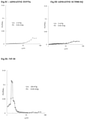
- FIGS. 4A-4E Adsorption/Desorption Isotherms (by Belsorp-mini)
- FIGS. 5A-5E Pore Distribution (Desorption)
- the word “include”, and its variants, is intended to be non-limiting such that recitation of items in a list is not to the exclusion of other items that may also be useful in the materials, compositions and methods of the invention.
- ranges are used as a shorthand for describing each and every value that is within the range. Any value within the range can be selected as the terminus of the range.
- an effective amount means an amount of a given agent or material sufficient to provide a positive benefit, usually an oral health benefit.
- the word “about”, when applied to a value for a parameter of a composition indicates that the calculation or measurement of the value allows some slight imprecision without having a substantial effect on the chemical or physical attributes of the composition.
- a dentifrice composition is a product that is intended for application to the oral cavity for a period of time sufficient to contact all of the tooth surfaces and/or oral tissues for purposes of oral activity.
- a “dentifrice composition” means a paste or gel formulation unless otherwise specified.
- Silica gel particles of use in the invention are available commercially from Asahi Glass SI-Tech. Co., Ltd., 13-1, Kitaminatomachi, Wakamatsu-ku, Fukuoka, 808-0027, Japan. and are sold under the brand name Sunsphere®, for example Sunsphere NP-30 and Sunsphere NP-100.
- a CAS # for some types of silica gel particles of use in the invention is 7631-86-9.
- Sunsphere® silica gel particles are derived from sodium silicate and contain no crystalline silica. They consist of spherical particles of almost identical size which do not cohere and which provide a smooth texture. Sunsphere® silica gel particles are known for use in the cosmetics skincare industry e.g. for use in foundations and makeup.
- silica gel particles of use in the invention comprise a combination of the following indicated properties or thereabouts ( ⁇ 10%):
- the silica gel particles of use in the invention comprise a high degree of sphericity i.e. they are spherical or substantially spherical, for example as can be seen by scanning electron micrography, for example as shown in Example 4 herein.
- substantially spherical silica gel particle means any particle where the whole particle is mostly rounded or elliptical in shape.
- the silica gel particles of use in the invention comprise a smooth or a substantially smooth surface.
- the spherical silica gel particles are substantially spherical, more suitably 95% of the spherical silica gel particles are essentially spherical, even more suitably 99% of the spherical silica gel particles are essentially spherical.
- the silica gel particles of use in the invention have a mean particle diameter in the range from 1 ⁇ to 10 ⁇ , more suitably from 3 ⁇ to 8 ⁇ .
- the particles are generally of a uniform size and have a narrow particle size distribution for example from 1 ⁇ to 15 ⁇ . Particle size may be determined by laser diffraction.
- Silica gel particles of use in the invention are anhydrous.
- the term “anhydrous” as used herein includes a very low amount of free and/or bound water present in the silica gel particles i.e. suitably 0.5 wt. % or less. In one embodiment the water content is less than 0.3 wt. %. In one embodiment the water content is less than 0.2 wt %.
- the amount of free and/or bound water may be determined by thermogravimetric (TGA) analysis. Analysis may be conducted on 20-30 mg samples using a TA-Instrument SDT Q600 simultaneous TGA/DSC, under air flow in the temperature range from ambient to 120° C., with a heating rate of 5° C./min, for example as demonstrated in Example 5 herein.
- TGA thermogravimetric
- silica gel particles of use in the invention comprise a low amount of surface bound hydroxyl groups.
- the amount of surface bound hydroxyl groups present in the silica gel particles is less than 0.1% and more suitably is 0.0%.
- the amount of surface bound hydroxyl groups may be determined by thermogravimetric (TGA) analysis. Analysis may be conducted on 20-30 mg samples using a TA-Instrument SDT Q600 simultaneous TGA/DSC, under air flow in the temperature range from 120° C. to 1000° C., with a heating rate of 5° C./min, for example as demonstrated in Example 5 herein.
- TGA thermogravimetric
- the silica gel particles of use in the invention are amorphous or essentially amorphous i.e. with no crystalline material(s) detectable as determined by X-ray diffraction measurements.
- Silica gel particles of use in the invention comprise a low pore volume as compared to other known silica gel particles.
- the pore volume (ml/g) is less than 0.1, i.e. the pore volume (ml/g) is above zero but less than 0.1, for example in the range from 0.01 to 0.09 or from 0.01 to 0.08 or from 0.03 to 0.07.
- silica gel particles of use in the invention are non-porous or virtually non-porous i.e. comprise a substantially or completely closed surface (beyond the limit of detection). Porosity may be determined by the method described by Ojeda, Phys. Chem. Chem. Phys 5, 1859-1866, 2003 or as described in Examples 6 and 7 herein.
- silica gel particles of use in the invention are relatively hard materials as compared to other precipitated silicas; as such they are more resistant to shearing stress and disintegrate less easily under shear.
- the compression strength (MPa) of a silica gel of use in the invention is in the range from 1800 to 2000, such as from 1850 to 1950. Compression strength may be determined by using a micro-compressive strength tester.
- the silica gel particles of use in the invention have smaller BET surface area values as compared to those observed for known dental abrasives such as the precipitated silicas available commercially as Zeodent-103 and Zeodent-115.
- the silica gel particles of use in the invention have a BET surface area (m 2 /g) of 50 or less. In one embodiment the silica gel particles have a BET surface area (m 2 /g) of 40 or less. In one embodiment the silica gel particles have a BET surface area (m 2 /g) of 30 or less. In one embodiment the silica gel particles have a BET surface area (m 2 /g) of 20 or less.
- the silica gel particles have a BET surface area (m 2 /g) of 10 or less. In one embodiment the silica gel particles have a BET surface area (m 2 /g) of 5 or less. BET surface area measurements are determined by measuring the amount of nitrogen adsorbed on a surface, suitably as described in Brunaur et al., J. Am. Chem. Soc., 60, 309 (1938) or as demonstrated in Examples 6 and 7 herein.
- silica gel particles of use in the invention have a low oil absorption capacity as compared to those observed for known dental abrasives such as Zeodent-109 and Zeodent-119, reported to have oil absorption values (ml/100 g) of 79.8 and 110.7 respectively and as reported in WO2010/068433.
- the silica gel particles of use in the invention have an oil absorption capacity (ml/100 g) suitably of 20 to 50, more suitably of 35 or less, even more suitably in the range 25 to 35. Oil absorption may be measured according to the method described in U.S. Patent Application 2007/0001037A1, published 4 Jan. 2007.
- the silica gel particles of use in the invention may be present in an amount from 0.1% to 15% by weight of the composition. In one embodiment the silica gel particles are present in an amount from 0.2% to 10% by weight of the composition. In one embodiment the silica gel particles are present in an amount ranging from 0.3% to 8% by weight of the composition. In one embodiment the silica gel particles are present in an amount up to 1% by weight of the composition for example ranging from 0.1% to 1%, such as from 0.2% to 0.7% by weight of the composition, such as about 0.5% by weight of the composition. In one embodiment the silica gel particles are present in an amount up to 10% by weight of the composition for example ranging from 0.1% to 10%, such as 2% to 8% by weight of the composition, such as about 5% by weight of the composition.
- a dentifrice composition according to the invention may optionally further comprise a supplementary abrasive agent, provided that such agent does not significantly adversely impact on dentine abrasion.
- Suitable examples of supplementary abrasive agents for use in the present invention include silica including fused silica, precipitated silica, hydrated silica, rice hull silica, aluminium silicate, alumina, hydrated alumina, calcined alumina, calcium carbonate, anhydrous dicalcium phosphate, dicalcium phosphate dihydrate, water-insoluble sodium metaphosphate, zirconia, perlite, diamond, pyrophosphates, pumice, polymer particles, calcium phosphate based minerals (e.g. tricalcium phosphate (TCP), hydrated HA and mixed phase (HA:TCP) calcium phosphate mineral) and mixtures thereof.
- silica including fused silica, precipitated silica, hydrated silica, rice hull silica, aluminium silicate, alumina, hydrated alumina, calcined alumina, calcium carbonate, anhydrous dicalcium phosphate, dicalcium phosphate dihydrate, water-in
- a supplementary abrasive agent may be used generally in an amount ranging from 0.1% to 20% by weight of the composition or from 0.1% to 10% by weight of the total dentifrice composition.
- the dentifrice composition of the present invention is free of a fused silica.
- the dentifrice composition of the present invention comprises silica gel particles as described herein as the sole abrasive agent.
- Radioactive dentine abrasion is a measure of the abrasiveness of a dentifrice.
- the established method for determining the abrasivity of a dentifrice formulation is by measuring the Relative Dentine Abrasivity (RDA) (Hefferen, B. A laboratory method for measuring dentifrice abrasivity. J. Dent. Res. 55 563-573, 1976 or as described in Example 3 herein).
- This assay measures loss of dentine due to extended brushing with a 25:40 w/w slurry of test material, e.g. toothpaste, from prepared samples of human dentine.
- the dentine samples are irradiated to generate 32 P in the mineral.
- the assay measures radioactivity in the supernatant after brushing, relative to radioactivity liberated by brushing with a standard slurry of calcium pyrophosphate.
- composition of the present invention comprises an RDA value ranging from 10 to 250, for example in the range from 20 to 200 or from 30 to 150.
- the RDA of the composition is in the range from 100 to 200.
- the RDA of the composition is in the range of from 100 to 140.
- the RDA of the composition is in the range from 10 to 100.
- the RDA of the composition is in the range of from 20 to 60.
- PCR Pellicle Cleaning Ratio
- a dentifrice according to the present invention comprises a PCR value ranging from 50 to 200, suitably in the range from 60 to 150.
- the PCR of the composition is in the range from 50 to 200.
- the PCR of the composition is in the range from 50 to 150.
- the PCR of the composition is in the range from 50 to 110.
- the PCR of the composition is in the range of from 80 to 100.
- a dentifrice according to the present invention shows excellent cleaning and stain removal of the tooth surface with minimal dentine abrasion.
- the high cleaning/low abrasivity properties of a dentifrice according to the invention may also be reflected in the Cleaning Efficiency Index value for the dentifrice.
- the Cleaning Efficiency Index value can be readily determined by one skilled in the art. See Schemehorn B R, Ball T L, Henry G M, Stookey G K. “Comparing dentifrice abrasive systems with regard to abrasion and cleaning.” J. Dent Res 1992; 71: 559 or for example as described in Example 3 herein.
- a dentifrice according to the present invention comprises a CEI value ranging from 1 to 3, suitably in the range from 1.2 to 2.5 or from 1.5 to 2.0.
- Radioactive enamel abrasion is another measure of the abrasiveness of a dentifrice.
- the established method for determining the abrasivity of a dentifrice formulation is by measuring the Relative Enamel Abrasivity (REA) (Hefferen, J J. A laboratory method for measuring dentifrice abrasivity. J. Dent. Res. 55 563-573, 1976).
- This assay measures loss of enamel due to extended brushing with a 25:40 w/w slurry of test material, e.g. toothpaste, from prepared samples of human enamel. The enamel samples are irradiated to generate 32 P in the mineral.
- the assay measures radioactivity in the supernatant after brushing, relative to radioactivity liberated by brushing with a standard slurry of calcium pyrophosphate.
- a dentifrice according to the present invention comprises an REA value of 15 or below, preferably an REA value of 10 or below, where the maximum safe and allowable REA value is 40.
- a dentifrice composition of the present invention provides good cleaning with low abrasivity, resulting in cleaner, whiter and highly polished tooth surfaces, with less or no staining, reduced plaque and tartar resulting in improved oral health.
- a dentifrice composition of the present invention may be aqueous or non-aqueous.
- Water employed in the preparation of commercially suitable compositions should preferably be of low ion content and free of organic impurities. When present water will generally comprise from about 5% to about 70% such as from 10% to 50% by weight of the composition. Generally the level of water is up to 40%, such as up to 20%, such as from 0.1% to 15% by weight of the composition.
- the amount of water includes free water which is added plus that which is introduced with other materials, such as with humectants or surfactants.
- a dentifrice composition of the present invention may further comprise a water-soluble condensed phosphate salt, such as an alkali metal pyrophosphate, tripolyphosphate or higher polyphosphate salt, in particular a water-soluble alkali metal tripolyphosphate salt.
- a water-soluble condensed phosphate salt such as an alkali metal pyrophosphate, tripolyphosphate or higher polyphosphate salt, in particular a water-soluble alkali metal tripolyphosphate salt.
- the sodium form of this salt is preferred, although the potassium or mixed sodium and potassium salts could be used as a preferred embodiment as well. All physical forms can be used, e.g. a hydrate or a dehydrated form.
- water-soluble alkali metal tripolyphosphate salt is sodium tripolyphosphate.
- the water soluble condensed phosphate salt (such as an alkali metal tripolyphosphate salt) is present in an amount from 1.0% to 20.0%, for example from 2.0% to 15.0%, or 1.0% to 10%, or 5.0% to 10.0% by weight of the composition.
- a dentifrice composition of the present invention may further comprise an alkali metal bicarbonate salt.
- an alkali metal bicarbonate salt may be included in a dentifrice composition.
- the alkali bicarbonate is sodium bicarbonate.
- the sodium bicarbonate is present in an amount from 20% to 90% by weight of the composition, preferably from 60% to 80% by weight of the composition, more preferably from 65% to 70% by weight of the composition e.g. from 66% to 68% by weight of the composition.
- a dentifrice composition of the present invention may comprise one or more active agents conventionally used in dentifrice compositions, for example, a fluoride source, a desensitising agent, an anti-bacterial agent, an anti-plaque agent, an anti-calculus agent, an oral malodour agent, an anti-inflammatory agent, an anti-oxidant, an anti-fungal agent, a wound healing agent or a mixture of at least two thereof.
- active agents conventionally used in dentifrice compositions, for example, a fluoride source, a desensitising agent, an anti-bacterial agent, an anti-plaque agent, an anti-calculus agent, an oral malodour agent, an anti-inflammatory agent, an anti-oxidant, an anti-fungal agent, a wound healing agent or a mixture of at least two thereof.
- active agents conventionally used in dentifrice compositions, for example, a fluoride source, a desensitising agent, an anti-bacterial agent, an anti-plaque agent,
- desensitising agents include a tubule blocking agent or a nerve desensitising agent and mixtures thereof, for example as described in WO02/15809 (Block).
- desensitising agents include a strontium salt such as strontium chloride, strontium acetate or strontium nitrate or a potassium salt such as potassium citrate, potassium chloride, potassium bicarbonate, potassium gluconate and especially potassium nitrate.
- a desensitising agent such as a potassium salt is generally present in an amount ranging from 2% to 8% by weight of the composition, for example 5% by weight of the composition.
- the desensitising agent comprises an arginine calcium carbonate salt.
- the arginine salt is present in an amount ranging from 0.5% to 30% by weight of the composition, such as from 1% to 10% by weight of the composition or from 1% to 10% by weight of the composition such as from 2% to 8% by weight of the composition.
- the desensitising agent comprises a bioactive glass.
- the bioactive glass consists of 45% by weight silicon dioxide, 24.5% by weight sodium oxide, 6% by weight phosphorus oxide, and 24.5% by weight calcium oxide.
- NOVAMIN also known as 45S5 BIOGLASS.
- the bioactive glass is present in an amount ranging from 1% to 20% by weight of the composition, such as from 1% to 15% by weight of the composition, or from 1% to 10% by weight of the composition, or from 2% to 8% by weight of the composition.
- the desensitising agent comprises a stannous salt such as stannous chloride or stannous fluoride.
- stannous salts through hydrolysis and oxidation reactions, form insoluble metal salts that precipitate in dentinal tubules and on the dentine surface to provide effective relief from dentine hypersensitivity.
- Stannous salts also provide a benefit against dental erosion, dental caries and plaque/gingivitis.
- the desensitising agent includes silica, colloidal silica, nano zinc oxide, sub-micron alumina and sub-micron polymer beads, in a fine particulate form comprising an average particle size in the range from 1 nm to 5 ⁇ .
- Suitable sources of fluoride ions for use in the compositions of the present invention include an alkali metal fluoride such as sodium fluoride, an alkali metal monofluorophosphate such a sodium monofluorophosphate, stannous fluoride, or an amine fluoride in an amount to provide from 25 to 3500 ppm of fluoride ions, preferably from 100 to 1500 ppm.
- a typical fluoride source is sodium fluoride, for example the composition may contain 0.1 to 0.5% by weight of sodium fluoride, e.g.
- fluoride ions help promote the remineralisation of teeth and can increase the acid resistance of dental hard tissues for combating caries, dental erosion (i.e. acid wear) and/or tooth wear.
- compositions of the present invention will contain additional formulating agents such as, surfactants, humectants, non-abrasive (thickening) silicas, flavouring agents, sweetening agents, opacifying or colouring agents, preservatives and water, selected from those conventionally used in the oral hygiene composition art for such purposes.
- additional formulating agents such as, surfactants, humectants, non-abrasive (thickening) silicas, flavouring agents, sweetening agents, opacifying or colouring agents, preservatives and water, selected from those conventionally used in the oral hygiene composition art for such purposes.
- Suitable surfactants for use in the present invention include anionic surfactants such as a sodium C 10-18 alkyl sulphate, e.g. sodium lauryl sulphate.
- anionic surfactants such as a sodium C 10-18 alkyl sulphate, e.g. sodium lauryl sulphate.
- Sodium lauryl sulphate is generally considered to be anionic and strongly charged and is useful if high levels of foaming are desired when brushing teeth.
- amphoteric surfactants include long chain alkyl (e.g. C 10 -C 18 alkyl) betaines, such as the product marketed under the trade name ‘Empigen BB’ by Albright & Wilson and long chain alkyl amidoalkyl betaines such as cocamidopropylbetaine.
- long chain alkyl e.g. C 10 -C 18 alkyl
- Amphoteric surfactants include long chain alkyl (e.g. C 10 -C 18 alkyl) betaines, such as the product marketed under the trade name ‘Empigen BB’ by Albright & Wilson and long chain alkyl amidoalkyl betaines such as cocamidopropylbetaine.
- a particularly preferred example of an anionic/amphoteric surfactant combination for use in the present invention is sodium lauryl sulphate/cocamidopropylbetaine.
- the surfactant is present in the range from 0.1 to 15% by weight of the composition, for example from 0.5% to 10% by weight of the composition or from 1.0 to 5% by weight of the composition.
- Suitable humectants for use in compositions of the invention include glycerin, xylitol, sorbitol, propylene glycol or polyethylene glycol, or mixtures of at least two thereof; which humectant may be present in an amount ranging from 10% to 80% by weight of the composition, for example from 20% to 70% by weight of the composition, or from 30% to 60% by weight of the composition.
- compositions of the present invention may also be used outside the oral cavity, for the cleaning of dentures and the like.
- the dentifrice compositions of the present invention are typically formulated in the form of toothpastes, instant powders, tablets and gels.
- Preferred compositions of the present invention are toothpastes and gels.
- the dentifrices of the present invention are typically formulated in the form of a paste that is suitable for containing in and dispensing from a laminate tube or a pump as conventionally used in the art. Additional examples may include bag-in-can or bag-on-valve delivery systems that utilise a foaming agent such as pentane or iso-pentane.
- a typical process for making the composition of this invention involves admixing the ingredients, suitably under a vacuum, until a homogeneous mixture is obtained, and adjusting the pH if necessary
- the present invention provides a composition as hereinbefore defined for use in reducing stain, plaque and/or tartar on a dental surface.
- the present invention provides a method of reducing stain, plaque and/or tartar on a dental surface which comprises applying an effective amount of a composition as hereinbefore defined to an individual in need thereof.
- the invention is further illustrated by the following examples.
- Example 1 Compositions of the Invention
- Example 2 Pellicle Cleaning Ratio Test (PCR) as a Measure of Stained Pellicle Removal from Bovine Enamel
- Dentifrice formulations 1 and 2 above were assessed for their ability to remove pellicle stain from bovine enamel and compared with similar comparative formulations (not encompassed within the scope of the invention) containing alternative silica abrasive materials. Formulation details of the Comparative Examples are shown in Table 2.
- Bovine, permanent, central incisors were cut to obtain labial enamel specimens approximately 8 ⁇ 8 mm 2 .
- the enamel specimens were then embedded in an autopolymerizing methacrylate resin so that only the enamel surfaces were exposed.
- the enamel surfaces were then smoothed on a lapidary wheel and polished with flour of pumice and water, then sonicated to remove excess debris. They were then lightly etched (60 seconds in 0.12M HCl, 30 seconds in saturated NaCO 3 and 60 seconds in 1.0% phytic acid) to expedite stain accumulation and adherence.
- staining broth containing gastric mucin as a protein source and coffee, tea and FeCl 3 6H 2 O as staining sources i.e., 1.35 g coffee, 1.35 g tea, 0.02 g Fe and 1.0 g mucin in 400 ml
- staining sources i.e., 1.35 g coffee, 1.35 g tea, 0.02 g Fe and 1.0 g mucin in 400 ml
- the amount of in vitro stain was graded photometrically (Minolta 2600d, colorimeter) using only the L value of the LAB scale.
- the area of the specimens measured was a 1 ⁇ 4 inch diameter circle in the centre of the enamel sample. Specimens with L value measurements between 30-38 (30 being more darkly stained) were used. On the basis of these measurements, the specimens were divided into groups of 16 specimens each, with each group having the same average baseline measurement.
- the specimens were then mounted on a mechanical V-8 cross-brushing machine equipped with soft nylon-filament (Oral-B 40 Indicator) toothbrushes. Toothbrushes were conditioned by running the brushing machine for 1,000 strokes in deionised water. Tension on the enamel surface was adjusted to 150 g.
- the dentifrices were used as slurries prepared by mixing 25 g of dentifrice with 40 ml of deionised water.
- the ADA reference material was prepared by mixing 10 g of material and 50 ml of a 0.5% CMC solution.
- the specimens were brushed for 800 double strokes. To minimise mechanical variables, one specimen per group was brushed on each of the eight brushing heads. Fresh slurries were used for each specimen brushed. Following brushing, specimens were rinsed, blotted dry, and measured again for stain as previously described.
- the difference between the pre- and post-brushing stain measurements was determined and the mean and standard error calculated for the reference group.
- the cleaning ratio for the reference material group was assigned a value of 100.
- the mean decrement for the reference group was divided into 100 to obtain a constant value to multiple times each individual test decrement within the study.
- the individual cleaning ratio of each specimen was then calculated (decrement X constant).
- the error bars represent SEMs. Values connected by letters a, b or c do not differ significantly (p>0.05) as determined by Student Newman-Keuls analysis.
- the silica gel particles of use in the invention were the most effective in removing stain from pellicle.
- the silica gel of use in the invention cleaned, as effectively at a ten-fold lower concentration, as a precipitated silica tested (Zeodent 103) and significantly more effectively than another precipitated silica (Zeodent 113) and a fused silica (Spheron P-1500).
- Dentifrice formulations 1 and 2 above were assessed for their abrasivity (as determined by RDA) and compared as against similar comparative formulations (not encompassed within the scope of the invention) having alternative silica abrasive materials.
- the procedure used was the ISO/ADA recommended procedure for determination of dentifrice abrasivity.
- the dentin specimens (8) were placed in a neutron flux under the controlled conditions outlined by the ISO/ADA.
- the specimens were then mounted in methyl methacrylate so they would fit in a V-8 cross-brushing machine.
- the specimens were brushed for 1,500 strokes in a precondition run (since the teeth had been used previously) using a slurry consisting of 10 g ISO/ADA reference material in 50 ml of a 0.5% CMC glycerin solution.
- the brushes used were those specified by the ISO/ADA and had been used in a previous study.
- the brush tension was 150 g.
- test material slurry 25 g dentifrice/40 ml water
- reference material slurries 10 g ADA reference/50 ml 0.5% CMC
- the RDA results are shown graphically in FIG. 2 .
- the mean, standard deviation (SD) and SEM for each group were calculated and also shown in FIG. 2 .
- One of the fused silicas tested (Teco-Sil 44CSS) was significantly more abrasive than all the other dentifrices tested. All the dentifrices tested were within acceptable limits for products on the market today and met the ISO and ADA requirements.
- the PCR and RDA data shown in FIGS. 1 and 2 are also shown in tabulated form in Table 4.
- the cleaning efficiency index (CEI) for each of the formulations tested (excluding SEM error values) are also shown.
- SEM Scanning Electron Microscopy
- the Zeodent and Teco-Sil samples consisted of irregular aggregates of microdimension. Zeodent samples appeared to have nanoscale texture, the Teco-Sil materials were smoother and also exhibited some particles with plate-like morphology. Sunsphere NP-30 and Spheron materials consisted of essentially smooth, spherical particles. The Spheron P-1500 differed from the other spherical particles in that the surface was roughened due to nanometre sized projections on the surface.
- TGA-DSC was conducted on the powder samples by heating in air flow to 1000° C. to determine weight loss with increasing temperature and phase changes (if any).
- the surface areas of the silica samples were measured by BET N 2 adsorption, isotherm plots were also measured to determine the pore size and volume.
- the Zeodent and Spheron P-1500 samples were found to have moderately high surface area and mesoporosity, the remaining samples were essentially low surface area and non-porous.
- the specific surface area, pore volume, and pore diameter were determined using the nitrogen adsorption method.
- the silica sample Prior to analysis, the silica sample was preconditioned to remove physically bonded impurities in degassing process which was accomplished by elevated temperature in conjunction with continuously flowing inert gas. The volume of gas adsorbed onto the silica surface was measured at the boiling point of nitrogen ( ⁇ 196° C.). The amount of adsorbed gas was correlated to the specific surface area of the silica particle. The calculation was based on the BET (Brunauer, Emmett and Teller) theory. Nitrogen adsorption method also enables the determination of pore volume and diameter. Measurements were carried out using the following protocols:
- Preconditioning Heating at 300° C. with N 2 flow 30 mL/min for 30 minutes. Cooling at room temperature and 30 minutes in N 2
- Preconditioning Heating at 300° C. with N 2 flow 30 mL/min for 30 minutes. Cooling at room temperature and 30 minutes in N 2 flow
Landscapes
- Health & Medical Sciences (AREA)
- Life Sciences & Earth Sciences (AREA)
- Veterinary Medicine (AREA)
- Animal Behavior & Ethology (AREA)
- General Health & Medical Sciences (AREA)
- Public Health (AREA)
- Birds (AREA)
- Epidemiology (AREA)
- Chemical & Material Sciences (AREA)
- Inorganic Chemistry (AREA)
- Oral & Maxillofacial Surgery (AREA)
- Dispersion Chemistry (AREA)
- Cosmetics (AREA)
Applications Claiming Priority (4)
| Application Number | Priority Date | Filing Date | Title |
|---|---|---|---|
| GBGB1715949.2A GB201715949D0 (en) | 2017-10-02 | 2017-10-02 | Novel composition |
| GB1715949 | 2017-10-02 | ||
| GB1715949.2 | 2017-10-02 | ||
| PCT/EP2018/076560 WO2019068596A1 (fr) | 2017-10-02 | 2018-10-01 | Nouvelle composition |
Publications (2)
| Publication Number | Publication Date |
|---|---|
| US20200237625A1 US20200237625A1 (en) | 2020-07-30 |
| US11246809B2 true US11246809B2 (en) | 2022-02-15 |
Family
ID=60270431
Family Applications (1)
| Application Number | Title | Priority Date | Filing Date |
|---|---|---|---|
| US16/652,538 Active US11246809B2 (en) | 2017-10-02 | 2018-10-01 | Composition |
Country Status (10)
| Country | Link |
|---|---|
| US (1) | US11246809B2 (fr) |
| EP (1) | EP3691605A1 (fr) |
| JP (1) | JP7195308B2 (fr) |
| CN (1) | CN111201008B (fr) |
| AU (1) | AU2018344394B2 (fr) |
| BR (1) | BR112020005762B1 (fr) |
| CA (1) | CA3076692A1 (fr) |
| GB (1) | GB201715949D0 (fr) |
| WO (1) | WO2019068596A1 (fr) |
| ZA (1) | ZA202001722B (fr) |
Cited By (2)
| Publication number | Priority date | Publication date | Assignee | Title |
|---|---|---|---|---|
| EP4570235A1 (fr) | 2023-12-12 | 2025-06-18 | Haleon UK IP Limited | Dentifice comprenant des particules sphériques de silice et de perlite |
| EP4570234A1 (fr) | 2023-12-12 | 2025-06-18 | Haleon UK IP Limited | Nouveau dentifrice |
Families Citing this family (6)
| Publication number | Priority date | Publication date | Assignee | Title |
|---|---|---|---|---|
| JP7546615B2 (ja) | 2019-07-04 | 2024-09-06 | ファートン ホールディング エス.アー. | 歯の再石灰化のための組成物 |
| MA47039B1 (fr) | 2019-10-09 | 2021-09-30 | Univ Internationale Dagadir Univ | Composition de base pour l'hygiène buccale ou corporelle ou pour la santé comprenant un broyat ou une poudre ou un extrait d'une plante du genre marrube blanc ou marrubium vulgare. |
| KR102603919B1 (ko) * | 2020-03-27 | 2023-11-21 | (주)석경에이티 | 대구경 SiO2 분말의 제조 방법 및 이를 포함하는 화장료 조성물 |
| WO2021251440A1 (fr) * | 2020-06-12 | 2021-12-16 | テイカ株式会社 | Particule de silice sphérique, et son procédé de production |
| CA3138558C (fr) | 2020-11-16 | 2024-01-30 | Church & Dwight Co., Inc. | Composition de nettoyage des dents comprenant un extrait de banane |
| US20240051835A1 (en) | 2021-02-11 | 2024-02-15 | Evonik Operations Gmbh | Amorphous non-porous silicas |
Citations (8)
| Publication number | Priority date | Publication date | Assignee | Title |
|---|---|---|---|---|
| US4528181A (en) | 1984-02-01 | 1985-07-09 | Colgate-Palmolive Company | Dentifrice containing dual sources of fluoride |
| US4562063A (en) | 1984-12-11 | 1985-12-31 | Colgate-Palmolive Company | Astringent gel dentifrice |
| EP0216278A2 (fr) | 1985-09-25 | 1987-04-01 | MERCK PATENT GmbH | Particules de silice sphériques |
| US20060110338A1 (en) | 2004-11-24 | 2006-05-25 | Mcgill Patrick D | High-cleaning/low abrasive silica and materials and dentifrice containing such materials |
| JP2006306841A (ja) | 2005-03-30 | 2006-11-09 | Kose Corp | 二層型化粧料 |
| US20100203092A1 (en) | 2006-10-04 | 2010-08-12 | Fritz Ley | Dental, Particularly Remineralizing Composition, Effective for Pain Sensitive Teeth, and Dental Particles, Particularly for Said Composition |
| US20160106640A1 (en) | 2005-11-23 | 2016-04-21 | Colgate-Palmolive Company | Stannous salt and sodium tripolyphosphate oral care compositions and methods |
| US20200109056A1 (en) * | 2016-12-19 | 2020-04-09 | Evonik Degussa Gmbh | Stannous compatible silica |
Family Cites Families (10)
| Publication number | Priority date | Publication date | Assignee | Title |
|---|---|---|---|---|
| JPS6287507A (ja) | 1985-10-11 | 1987-04-22 | Fuji Debuison Kagaku Kk | 歯磨剤 |
| JP2921058B2 (ja) * | 1990-07-27 | 1999-07-19 | 旭硝子株式会社 | 無孔質球状シリカを配合した化粧品 |
| JPH06239722A (ja) | 1993-02-15 | 1994-08-30 | Johnson & Johnson Kk | 歯みがき組成物 |
| WO2002015809A2 (fr) | 2000-08-21 | 2002-02-28 | Block Drug Company, Inc. | Composition dentaire pour dents hypersensibles |
| WO2002026626A1 (fr) | 2000-09-27 | 2002-04-04 | Mitsubishi Rayon Co., Ltd. | Silice sphérique non poreuse et procédé de production |
| US7159803B1 (en) | 2005-06-29 | 2007-01-09 | J.M. Huber Corporation | Method for making particulate compositions and products thereof |
| MX2011005567A (es) | 2008-11-25 | 2012-01-25 | Procter & Gamble | Composiciones para el cuidado bucal con estetica mejorada y silicio fundido. |
| TWI539969B (zh) | 2009-10-14 | 2016-07-01 | Sunstar Inc | Composition for oral use |
| AU2013337356B2 (en) | 2012-11-05 | 2016-12-08 | The Procter & Gamble Company | Heat treated precipitated silica |
| GB201404700D0 (en) * | 2014-03-17 | 2014-04-30 | Glaxo Group Ltd | Novel Composition |
-
2017
- 2017-10-02 GB GBGB1715949.2A patent/GB201715949D0/en not_active Ceased
-
2018
- 2018-10-01 AU AU2018344394A patent/AU2018344394B2/en active Active
- 2018-10-01 JP JP2020518702A patent/JP7195308B2/ja active Active
- 2018-10-01 BR BR112020005762-2A patent/BR112020005762B1/pt active IP Right Grant
- 2018-10-01 US US16/652,538 patent/US11246809B2/en active Active
- 2018-10-01 EP EP18782931.2A patent/EP3691605A1/fr active Pending
- 2018-10-01 CN CN201880064512.0A patent/CN111201008B/zh active Active
- 2018-10-01 CA CA3076692A patent/CA3076692A1/fr active Pending
- 2018-10-01 WO PCT/EP2018/076560 patent/WO2019068596A1/fr not_active Ceased
-
2020
- 2020-03-18 ZA ZA2020/01722A patent/ZA202001722B/en unknown
Patent Citations (8)
| Publication number | Priority date | Publication date | Assignee | Title |
|---|---|---|---|---|
| US4528181A (en) | 1984-02-01 | 1985-07-09 | Colgate-Palmolive Company | Dentifrice containing dual sources of fluoride |
| US4562063A (en) | 1984-12-11 | 1985-12-31 | Colgate-Palmolive Company | Astringent gel dentifrice |
| EP0216278A2 (fr) | 1985-09-25 | 1987-04-01 | MERCK PATENT GmbH | Particules de silice sphériques |
| US20060110338A1 (en) | 2004-11-24 | 2006-05-25 | Mcgill Patrick D | High-cleaning/low abrasive silica and materials and dentifrice containing such materials |
| JP2006306841A (ja) | 2005-03-30 | 2006-11-09 | Kose Corp | 二層型化粧料 |
| US20160106640A1 (en) | 2005-11-23 | 2016-04-21 | Colgate-Palmolive Company | Stannous salt and sodium tripolyphosphate oral care compositions and methods |
| US20100203092A1 (en) | 2006-10-04 | 2010-08-12 | Fritz Ley | Dental, Particularly Remineralizing Composition, Effective for Pain Sensitive Teeth, and Dental Particles, Particularly for Said Composition |
| US20200109056A1 (en) * | 2016-12-19 | 2020-04-09 | Evonik Degussa Gmbh | Stannous compatible silica |
Cited By (4)
| Publication number | Priority date | Publication date | Assignee | Title |
|---|---|---|---|---|
| EP4570235A1 (fr) | 2023-12-12 | 2025-06-18 | Haleon UK IP Limited | Dentifice comprenant des particules sphériques de silice et de perlite |
| EP4570234A1 (fr) | 2023-12-12 | 2025-06-18 | Haleon UK IP Limited | Nouveau dentifrice |
| WO2025125299A1 (fr) | 2023-12-12 | 2025-06-19 | Haleon UK IP Limited | Dentifrice comprenant de la silice sphérique et des particules d'alumine |
| WO2025125294A1 (fr) | 2023-12-12 | 2025-06-19 | Haleon UK IP Limited | Dentifrice comprenant de la silice sphérique et des particules de perlite |
Also Published As
| Publication number | Publication date |
|---|---|
| CN111201008B (zh) | 2023-08-11 |
| JP7195308B2 (ja) | 2022-12-23 |
| BR112020005762B1 (pt) | 2023-05-16 |
| RU2020112859A (ru) | 2021-11-08 |
| WO2019068596A1 (fr) | 2019-04-11 |
| US20200237625A1 (en) | 2020-07-30 |
| AU2018344394A1 (en) | 2020-04-16 |
| BR112020005762A2 (pt) | 2020-10-13 |
| ZA202001722B (en) | 2023-04-26 |
| CN111201008A (zh) | 2020-05-26 |
| RU2020112859A3 (fr) | 2022-03-28 |
| JP2020536087A (ja) | 2020-12-10 |
| AU2018344394B2 (en) | 2021-06-17 |
| EP3691605A1 (fr) | 2020-08-12 |
| GB201715949D0 (en) | 2017-11-15 |
| CA3076692A1 (fr) | 2019-04-11 |
Similar Documents
| Publication | Publication Date | Title |
|---|---|---|
| US11246809B2 (en) | Composition | |
| AU744931B2 (en) | Improved dental abrasive | |
| US20160228341A1 (en) | Dentifrice Composition Comprising Sintered Hydroxyapatite | |
| US9314411B2 (en) | Silica abrasive-free dentifrice composition | |
| CN104684618A (zh) | 用于治疗牙齿敏感症的方法和组合物 | |
| CN104684619A (zh) | 用于治疗牙齿敏感症的方法和组合物 | |
| WO2015140060A1 (fr) | Nouvelle composition | |
| EP3082719B1 (fr) | Composition de dentifrice comprenant des particules d'oxyde d'aluminium fusionnées sphériques | |
| RU2777965C2 (ru) | Новая композиция | |
| WO2025125294A1 (fr) | Dentifrice comprenant de la silice sphérique et des particules de perlite |
Legal Events
| Date | Code | Title | Description |
|---|---|---|---|
| FEPP | Fee payment procedure |
Free format text: ENTITY STATUS SET TO UNDISCOUNTED (ORIGINAL EVENT CODE: BIG.); ENTITY STATUS OF PATENT OWNER: LARGE ENTITY |
|
| STPP | Information on status: patent application and granting procedure in general |
Free format text: DOCKETED NEW CASE - READY FOR EXAMINATION |
|
| STPP | Information on status: patent application and granting procedure in general |
Free format text: NON FINAL ACTION MAILED |
|
| STPP | Information on status: patent application and granting procedure in general |
Free format text: RESPONSE TO NON-FINAL OFFICE ACTION ENTERED AND FORWARDED TO EXAMINER |
|
| STPP | Information on status: patent application and granting procedure in general |
Free format text: NOTICE OF ALLOWANCE MAILED -- APPLICATION RECEIVED IN OFFICE OF PUBLICATIONS |
|
| AS | Assignment |
Owner name: GLAXOSMITHKLINE CONSUMER HEALTHCARE (UK) IP LIMITED, UNITED KINGDOM Free format text: ASSIGNMENT OF ASSIGNORS INTEREST;ASSIGNOR:LUCAS, ROBERT ANTHONY;REEL/FRAME:058367/0820 Effective date: 20181114 |
|
| STPP | Information on status: patent application and granting procedure in general |
Free format text: PUBLICATIONS -- ISSUE FEE PAYMENT VERIFIED |
|
| STCF | Information on status: patent grant |
Free format text: PATENTED CASE |
|
| AS | Assignment |
Owner name: HALEON UK IP LIMITED, UNITED KINGDOM Free format text: CHANGE OF NAME;ASSIGNOR:GLAXOSMITHKLINE CONSUMER HEALTHCARE (UK) IP LIMITED;REEL/FRAME:066591/0748 Effective date: 20230414 |
|
| MAFP | Maintenance fee payment |
Free format text: PAYMENT OF MAINTENANCE FEE, 4TH YEAR, LARGE ENTITY (ORIGINAL EVENT CODE: M1551); ENTITY STATUS OF PATENT OWNER: LARGE ENTITY Year of fee payment: 4 |