US11291213B2 - Bleeding method for fish and round fish processed thereby - Google Patents
Bleeding method for fish and round fish processed thereby Download PDFInfo
- Publication number
- US11291213B2 US11291213B2 US17/049,462 US201917049462A US11291213B2 US 11291213 B2 US11291213 B2 US 11291213B2 US 201917049462 A US201917049462 A US 201917049462A US 11291213 B2 US11291213 B2 US 11291213B2
- Authority
- US
- United States
- Prior art keywords
- fish
- slit
- cutting
- bleeding method
- abdominal
- Prior art date
- Legal status (The legal status is an assumption and is not a legal conclusion. Google has not performed a legal analysis and makes no representation as to the accuracy of the status listed.)
- Active
Links
Images


Classifications
-
- A—HUMAN NECESSITIES
- A22—BUTCHERING; MEAT TREATMENT; PROCESSING POULTRY OR FISH
- A22C—PROCESSING MEAT, POULTRY, OR FISH
- A22C25/00—Processing fish ; Curing of fish; Stunning of fish by electric current; Investigating fish by optical means
- A22C25/14—Beheading, eviscerating, or cleaning fish
Definitions
- the present invention relates to fish's bleeding method of press fitting (tightly inserting something into a tubular object with pressure) liquid into the vascular system, as well as the round fish with reduced fishiness and superiority in maintaining freshness by means of the said fish's bleeding method.
- Blood inside the fish's body is the root cause of fish's fishiness, and is a contributory factor to accelerate freshness deterioration. Therefore, removing blood inside the fish's body is an extremely important process in order to maintain the quality of the fish.
- bleeding method of press fitting liquid into fish's vascular system was performed as a way to maintain quality of processed products which are processed for long shelf life, such as frozen, dried or smoked fish (patent document 1).
- blood can be removed more reliably than bleeding method of simply draining blood out of cut blood vessels because the blood in the vascular system is replaced with another liquid.
- the present invention was made considering such problems.
- One of the goals of the present invention is to provide round fish with reduced fishiness and superiority in maintaining freshness, as well as fish's bleeding method in order to provide the said round fish.
- a bleeding method for fish comprises step of forming a slit that connects a pericardial cavity to an outer part of the fish by cutting a membrane of gill to split a head and an abdomen such that an abdominal aorta is not cut and internal organs incorporated in an abdominal cavity are not exposed to an outside air, step of spreading the slit such that an arterial sphere of the fish is not pulled up together with a fresh on an abdominal side being lifted, and a caudal side surface of a ventricle in a heart of the fish is exposed, step of inserting a tubular instrument in the heart of the fish, which runs through the slit from the caudal side surface of the ventricle toward the arterial sphere, step of fixing the tubular instrument to the heart, and step of discharging blood of the fish outside by press-fitting liquid into vascular system of the fish via the tubular instrument.
- the second aspect of the bleeding method for fish comprises step of forming a slit that connects a pericardial cavity to an outer part of the fish by cutting a membrane of gill to split a head and an abdomen such that an abdominal aorta is not cut and internal organs incorporated in an abdominal cavity are not exposed to an outside air, step of spreading the slit such that an arterial sphere of the fish is not pulled up together with a fresh on an abdominal side being lifted, and the arterial sphere of the fish is exposed, step of piercing a tubular instrument in the arterial sphere of the fish in a direction of blood flow via the slit spread, step of fixing the tubular instrument to the arterial sphere, and step of discharging blood of the fish outside by press-fitting liquid into vascular system of the fish via the tubular instrument.
- the bleeding method for fish comprises step of forming a slit that connects a pericardial cavity to an outer part of the fish by cutting a membrane of gill to split a head and an abdomen such that an abdominal aorta is not cut and internal organs incorporated in an abdominal cavity are not exposed to an outside air, step of spreading the slit such that an arterial sphere of the fish is not pulled up together with a fresh on an abdominal side being lifted, and a border vicinity between the arterial sphere and a heart of the fish is exposed, step of cutting the border vicinity between the arterial sphere and the heart of the fish, and inserting a tubular instrument from a cut edge of the arterial sphere, which is created by the cutting, toward the abdominal aorta via the slit, which is spread, step of fixing the tubular instrument to the arterial sphere, and step of discharging blood of the fish outside by press-fitting liquid into vascular system of the fish via the tubular instrument.
- the step of cutting the slit further includes a step of cutting a part of fresh connecting the head and the abdomen such that the slit and the pericardial cavity is connected within a range on a head side rather than a diaphragm, which separates the pericardial cavity from the abdominal cavity.
- the press-fit liquid is adjusted of which a salt concentration is in a range of 1.8 to 2.2 wt %. Therewith, it suppresses the fresh of fish to turn reddish.
- the press-fit liquid has a hydrogen concentration that is in a range of 0.7 to 1.6 mg/L.
- hydrogen which is a superior reducing agent, runs through the fish's vascular system, which will suppress oxidation of the fish's body tissue, enabling to provide round fishes that maintain freshness.
- the press-fit liquid includes at least one selected from antioxidant, washing soap, sanitizing agent, anticoagulant, spice, fruit juice, nutritional supplement and food additive.
- the fish is processed to bleed by the above discussed bleeding method.
- it provides round fishes from which blood is fully drained. Namely, it provides round fishes of which fishiness decreases and freshness effectively maintains.lk.
- FIG. 1 is an explanatory diagram of the structure inside the body of a yellowtail.
- FIG. 2 is an explanatory diagram of the first process with respect to an example of the first embodiment.
- FIG. 3 is an explanatory diagram of the state upon completion of the first process with respect to an example of the first embodiment.
- FIG. 4 is a diagram showing one example of a tubular instrument used in the present invention.
- FIG. 5 is an explanatory diagram of the state upon completion of the third process with respect to an example of the first embodiment.
- FIG. 6 is an explanatory diagram of the state upon completion of the third process with respect to an example of the second embodiment.
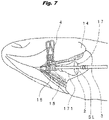
- FIG. 7 is an explanatory diagram of the state upon completion of the third process with respect to an example of the third embodiment.
- each element that configures the present invention can be in the form of one member combining multiple elements by configuring multiple elements with one member, or conversely can be realized by dividing the function of one member with multiple members.
- the present invention is a fish's bleeding method that can be applied to a broad range of fish in general, and is especially suited for farmed fish such as Red Seabream, Greater Amberjack, Yellowtail, and Japanese Amberjack.
- farmed fish such as Red Seabream, Greater Amberjack, Yellowtail, and Japanese Amberjack.
- examples of application to the yellowtail 1 shown in FIG. 1-3 as well as FIG. 5-7 will be described as examples of the embodiments.
- FIG. 1 schematically illustrates the yellowtail 1 's internal structure around the head with solid lines, and the exterior with dashed lines. Further, the body cavities related to the present invention are shown in white. As shown in FIG. 1 , in the back of the gill cover 14 of the yellowtail 1 , there exists the pericardial cavity 11 , which is the body cavity that incorporates the heart 17 , and this pericardial cavity 11 is separated from the abdominal cavity 12 , which is the body cavity that incorporates the internal organs of the digestive system, with a thin diaphragm 13 .
- IKE-JIME and SHINKEI-JIME are processed on the yellowtail 1 beforehand.
- IKE-JIME there is the method of first destroying the brain by stabbing the fish between the eyebrows with a pick (IKE-JIME), then destroying the spinal cord by inserting a wire along the spine (SHINKEI-JIME).
- the first process cut the yellowtail 1 's head and abdomen alongside the outer edge of the gill 15 . More specifically, lift the gill cover 14 and slit the membrane 16 under the gill 15 alongside the cutting line CL shown in the dash-dotted line in FIG. 2 , as well as cut the part of the flesh which connects the yellowtail 1 's head and the abdomen.
- the part of the flesh which connects the yellowtail 1 's head and the abdomen is specifically the part on the abdomen side of the pericardial cavity 11 shown in FIG. 1 .
- slit SL which connects the pericardial cavity 11 to the outer side (or outer air surrounding the fish) of the fish, is formed. It is good to spread the formed slit SL so that the caudal side surface of the heart 17 's ventricle 171 is exposed.
- TOMOZURE of the arterial sphere 18 occurs when the knife is inserted in a location that is veered towards the head side of the pericardial cavity 11 , and the abdominal aorta 19 shown in FIG. 1 is cut along with the flesh.
- the flesh on the abdominal side is lifted in order to open up the slit SL, the status in which the arterial sphere 18 is attached to the inside of the flesh and is lifted up together is called the TOMOZURE of the arterial sphere 18 .
- a connecting point (inside the fish's body) of slit SL with the pericardial cavity 11 is within a range on the head side rather than the diaphragm 13 .
- the injection needle 2 is made of a stainless tube with an external diameter of approximately 3 mm, and protrusions 21 are set at locations that are approximately 20 mm and approximately 40 mm from the tip.
- the protrusion 21 expands out approximately 1 mm from the surface of the stainless tube, and the features are such that there are no sharp jags and are shaped so that it is difficult to scratch the fish's vascular system.
- the base end of the injection needle 2 is connected to a pump's outlet via the tube 3 and the like, and dilution water (equivalent to an example of “liquid” in the scope of the patent claim. Details will be described below.) is injected from here.
- the tubular instrument does not have to be stainless steel, and can be a material which is hard enough to prick the wall of the ventricle of the fish to be processed, and has corrosion resistance, such as other steel or plastic.
- the external diameter of the tubular instrument of approximately 3 mm is suitable for fish which weigh over 1.5 kg, yet for fish which are far below 1.5 kg, the size of the heart is also smaller, hence it is good to use a smaller one. In this case, with the protrusions as well, it is good to lower the height of expansion, have it closer to the tip, and set them closer together.
- the piercing of the injection needle 2 into the heart 17 is performed from the caudal side surface of the ventricle 171 towards the arterial sphere 18 , and as shown in dashed lines in FIG. 5 , the depth of the piercing is approximately so that the protrusion 21 reaches the inside of the arterial sphere 18 .
- exercise caution so that the tip of the injection needle 2 does not cut through parts other than the piercing entrance.
- the piercing entrance can be points other than the caudal side surface of the ventricle 171 .
- fix the injection needle 2 to the heart 17 Specifically, as shown in FIG. 5 , pinch the part where the injection needle 2 is inserted in the arterial sphere 18 with the pinch 4 . Here, it is desirable to pinch the location between the two protrusions 21 of the injection needle 2 with the pinch 4 .
- the injection needle 2 will not slip out of the heart 17 , because the protrusions 21 and the pinch 4 are engaged.
- dilution water is press-fit into the vascular system of the yellowtail 1 via the injection needle 2 .
- Dilution water is sterilized sea water, such as by ozone sterilization and ultraviolet sterilization, which has been diluted with water. Note that if the sea water cannot be sterilized, water solution in which salt has been dissolved into water can be used in lieu of dilution water. It is suitable to adjust the concentration of the sodium chloride to 1.8-2.2 wt % by diluting water, and even more preferably, adjusted to 2.0 wt %. The fish's flesh tends to become reddish when the concentration of the sodium chloride is below 1.8 wt %, or above 2.2 wt %, so this is to avoid such a trend. Sodium chloride is extremely effective to promote cohesion of the fish's flesh and to improve texture, to improve the suppression effect of the outflow of the drip (sap) from fresh fish and to bring out the umami in the taste.
- the press fit of dilution water to the yellowtail 1 is performed at a flow rate of 2 L/minute. This way, there will be high pressure inside the yellowtail 1 's vascular system, and blood will discharge mainly from the gaps in the piercing entrance opened up with the injection needle 2 in the heart 17 's ventricle 171 , as well as the fragile parts of the capillaries of the gill 15 . After approximately 5 minutes since starting the press fit, the discharged liquid will become mostly colorless, and it can be confirmed that the blood in the vascular system has been replaced with dilution water.
- Flow rate is suitable at 1 L/minute for fish which weigh 2 kg or less (such as Red Seabream), 1.5 L/minute for fish which weigh 2 kg or more and less than 5 kg (such as Greater Amberjack), and 2 L/minute for fish which weigh 5 kg or more (such as Yellowtail or Japanese Amberjack).
- Flow rate is suitable at 1 L/minute for fish which weigh 2 kg or less (such as Red Seabream), 1.5 L/minute for fish which weigh 2 kg or more and less than 5 kg (such as Greater Amberjack), and 2 L/minute for fish which weigh 5 kg or more (such as Yellowtail or Japanese Amberjack).
- press fitting may be extended as appropriate.
- press fitting may end earlier.
- the piercing location of the injection needle 2 it is possible to set the piercing location of the injection needle 2 to the arterial sphere 18 instead of the heart 17 .
- the direction of the blood flow inside the arterial sphere 18 runs from the yellowtail 1 's caudal towards the head.
- the slit SL instead of piercing the injection needle 2 directly into the wall of the heart 17 or the arterial sphere 18 , it is possible to open the slit SL to such an extent as to expose the vicinity of the border between the arterial sphere 18 and the heart 17 , and as show in FIG. 7 , cut the vicinity of the border (or border vicinity) between the arterial sphere 18 and the heart 17 , then insert the injection needle 2 into the cut edge on the side of the arterial sphere 18 .
- the direction the injection needle 2 is inserted is from the cut edge towards the abdominal aorta 19 , and the liquid will naturally be press fit in the direction of the blood flow in the aforementioned fourth process.
- the tip of the tubular instrument does not necessarily have to be sharp, hence there is no risk of damaging the arterial sphere 18 or the abdominal aorta 19 beyond it with the tip of the tubular instrument. For this reason, failures in which liquid leaks from the damaged locations of the vascular system when press fitting the liquid, not transmitting enough pressure, and blood not discharging sufficiently, can be avoided. Moreover, it will be possible to discharge the blood more efficiently because the discharge spout of the blood will be wider.
- antioxidants which suppress deterioration or discoloration by oxidation
- anticoagulants which ensures smooth distribution of press fit liquid into the blood vessels including the capillaries, washing soap, sanitizing agent, spice, which suppress the fishiness distinctive of fish's flesh, nutritional supplements, or an appropriate combination of various food additives as seasonings such as UMAMI ingredients and sweeteners
- JP2019-122292 paragraphs [0022]-[0027], JP H09-149761, paragraph [0019]
- extracts of types of citrus fruits such as clementine, yuzu, sudachi, kabosu, oranges, lemons, limes, grapefruits
- spice ingredients such as wasabi, ginger, chili peppers, peppers, Japanese peppers
- types of herb such as peppermint, spearmint, shiso, rosemary, sage, tea plant
- seaweed extracts contain glutamic acid, which is the UMAMI ingredient, as well as a rich amount of dietary fiber such as sodium alginate, carrageenan and fucoidan, hence can be combined as nutritional supplements and seasonings.
- Antioxidants . . . Antioxidant vitamins such as vitamin C (ascorbic acid) and vitamin E ( ⁇ -tocopherol); antioxidant polyphenols such as epigallocatechin gallate, catechin, epicatechin, epigallocatechin, epicatechin gallate, quercetin, hesperidin, pterostilbene, proanthocyanidin, carnosic acid; antioxidant carotenoid such as ⁇ carotene, vitamin A, lycopene, lutein, astaxanthin; antioxidant peptide such as glutathione; types of antioxidant sugar such as isomaltulose; synthetic antioxidants such as butylhydroxyanisole; others such as uric acid, melatonin, urobilinogen.
- antioxidant polyphenols such as epigallocatechin gallate, catechin, epicatechin, epigallocatechin, epicatechin gallate, quercetin, hesperidin, pterostilbene, proanthocyanidin, carnosic acid
- Nutritional supplements . . . essential fatty acids such as docosahexaenoic acids, eicosapentaenoic acids, alinolenic acids, arachidonic acids, ⁇ -linolenic acids; types of vitamins such as vitamin A, vitamin B, vitamin C, vitamin D, vitamin E, vitamin H, vitamin K, vitamin P, vitamin U, cobalamin; types of minerals such as zinc, iron, copper, chromium, selenium, magnesium, calcium, potassium, sodium, cobalt, molybdenum; types of amino acids such as tryptophan, threonine, leucine, isoleucine, lysine, methionine, phenylalanine, histidine, asparagine, serine, proline, glutamine, tyrosine, ⁇ -aminobutyric acids, taurine.
- vitamins such as vitamin A, vitamin B, vitamin C, vitamin D, vitamin E, vitamin H, vitamin K, vitamin P, vitamin U, cobalamin
- Seasonings . . . typical household seasonings such as sugar, salt, vinegar, soy sauce, sake, mirin; UMAMI ingredients such as glutamic acids, inosinic acids, guanylic acids; sweeteners such as xylitol, saccharin.
- electrolyzed acidic water with strong acidity which is a sanitizing agent
- electrolyzed alkaline water with strong alkaline may be injected into the heart or inside the blood vessels.
- liquid in which hydrogen or oxygen has been dissolved or decomposed can be used.
- hydrogen by dissolving or decomposing hydrogen so that the liquid's hydrogen concentration is in the range of 0.7-1.6 mg/L, hydrogen, which is a superior reducing agent, will run through the fish's vascular system, which will suppress oxidation of the fish's body tissue, enabling to further enhance maintaining freshness of the fish.
- oxygen by having the oxygen concentration of the press fitting liquid higher than the oxygen concentration of the fresh fish's blood, the time until the fish stiffens after death will be delayed as well as suppress production of lactic acid, enabling to further enhance maintaining freshness of the fish (Refer to Japanese Laid-Open Patent Application Publication: JP2010-104356, paragraph [0048]).
- the yellowtail 1 's head and abdomen are cut alongside the outer edge of the gill 15 . More specifically, the membrane 16 under the gill 15 is slit alongside the cutting line CL shown in the dash-dotted line in FIG. 2 , as well as the part of the flesh which connects the yellowtail 1 's head and the abdomen is cut (or split) without damaging the abdominal aorta 19 . As such, as shown in FIG. 3 , slit SL, which connects the pericardial cavity 11 to the outer side of the fish, is formed.
- the flesh part of the yellowtail 1 is cut so that a connecting point (inside the fish's body) of slit SL with the pericardial cavity 11 is within a range on the head side rather than the diaphragm 13 . Further, the formed slit SL can be opened so that the caudal side surface of the heart 17 's ventricle 171 is exposed. If the abdominal side of the flesh is lifted up in order to open the slit SL, the arterial sphere 18 will not be pulled up together with it attached inside the flesh.
- the yellowtail 1 after bleeding according to the aforementioned examples of the first-third embodiments is in the state of a round fish, and the blood inside the vascular system is replaced with the aforementioned press fit liquid, and the vascular system is filled with the said press fit liquid. Therefore, the said yellowtail 1 after bleeding can achieve efficacy (or advantage) of bleeding in which the fish is in the state of a round fish, the color of the fish's flesh become better (whitens), reduces fishiness and is superior in maintaining freshness, as well as manifest efficacy corresponding to the characteristic of the press fit liquid.
- the present invention is especially suitable for use in farmed fish such as Red Seabream, Greater Amberjack, Yellowtail, and Japanese Amberjack which are distributed in the form of round fish.
Landscapes
- Life Sciences & Earth Sciences (AREA)
- Engineering & Computer Science (AREA)
- Wood Science & Technology (AREA)
- Zoology (AREA)
- Food Science & Technology (AREA)
- Processing Of Meat And Fish (AREA)
Applications Claiming Priority (3)
| Application Number | Priority Date | Filing Date | Title |
|---|---|---|---|
| JP2019138951 | 2019-07-29 | ||
| JPJP2019-138951 | 2019-07-29 | ||
| PCT/JP2019/037946 WO2021019795A1 (fr) | 2019-07-29 | 2019-09-26 | Procédé de traitement d'élimination du sang pour poissons et poissons entiers |
Publications (2)
| Publication Number | Publication Date |
|---|---|
| US20220022473A1 US20220022473A1 (en) | 2022-01-27 |
| US11291213B2 true US11291213B2 (en) | 2022-04-05 |
Family
ID=74228875
Family Applications (1)
| Application Number | Title | Priority Date | Filing Date |
|---|---|---|---|
| US17/049,462 Active US11291213B2 (en) | 2019-07-29 | 2019-09-26 | Bleeding method for fish and round fish processed thereby |
Country Status (4)
| Country | Link |
|---|---|
| US (1) | US11291213B2 (fr) |
| EP (1) | EP4005393B1 (fr) |
| JP (1) | JP6924336B2 (fr) |
| WO (1) | WO2021019795A1 (fr) |
Families Citing this family (4)
| Publication number | Priority date | Publication date | Assignee | Title |
|---|---|---|---|---|
| JP2022151800A (ja) * | 2021-03-23 | 2022-10-07 | 国立大学法人東京海洋大学 | テクスチャが保持された魚類の製造方法及びその方法で得られた非解体魚類 |
| JP7041782B1 (ja) * | 2021-09-21 | 2022-03-24 | 有限会社ハマスイ | 魚の血抜き処理方法、血抜き処理後の魚の生産方法、血抜き処理後の魚及び魚の血抜き装置 |
| US12433270B2 (en) | 2023-06-09 | 2025-10-07 | Rick Koetje | Methods and apparatus for removing and bleeding fish from a gill net |
| CN119404882B (zh) * | 2024-10-17 | 2025-11-07 | 中国水产科学研究院渔业机械仪器研究所 | 一种鱼类放血设备及使用方法 |
Citations (7)
| Publication number | Priority date | Publication date | Assignee | Title |
|---|---|---|---|---|
| US4976010A (en) * | 1989-07-28 | 1990-12-11 | Lavelle Jr Edwin F | Method for fish cleaning |
| JPH09149761A (ja) | 1995-11-29 | 1997-06-10 | Tomio Niimi | 生鮮食肉の鮮度・色調保持処理方法およびその装置 |
| JP2005151875A (ja) | 2003-11-26 | 2005-06-16 | Hoshizaki Electric Co Ltd | 鮮魚の鰓部の殺菌処理方法 |
| JP2010104356A (ja) | 2008-09-30 | 2010-05-13 | Onsui:Kk | 魚類の生鮮度保持方法 |
| US8585474B1 (en) * | 2012-12-04 | 2013-11-19 | Jeffrey C. Graham | Fish cleaning methods |
| JP2019122292A (ja) | 2018-01-16 | 2019-07-25 | 国立大学法人高知大学 | 魚肉製品の製造方法 |
| US20210298317A1 (en) * | 2018-06-15 | 2021-09-30 | Kroma A/S | Fish gutting device with controllable cutting |
Family Cites Families (3)
| Publication number | Priority date | Publication date | Assignee | Title |
|---|---|---|---|---|
| JP5959090B2 (ja) * | 2011-09-01 | 2016-08-02 | イヨスイ株式会社 | 魚の色調保持方法 |
| CN105592916B (zh) * | 2013-10-03 | 2020-04-07 | 伊必得控股公司 | 包含纳米气泡的液体溶液 |
| JP6678622B2 (ja) * | 2016-04-18 | 2020-04-08 | 株式会社オンスイ | ブリの脱血処理方法、脱血ブリの製造方法、マグロの脱血処理方法並びに脱血マグロの製造方法 |
-
2019
- 2019-09-26 EP EP19939716.7A patent/EP4005393B1/fr active Active
- 2019-09-26 JP JP2020549824A patent/JP6924336B2/ja active Active
- 2019-09-26 US US17/049,462 patent/US11291213B2/en active Active
- 2019-09-26 WO PCT/JP2019/037946 patent/WO2021019795A1/fr not_active Ceased
Patent Citations (7)
| Publication number | Priority date | Publication date | Assignee | Title |
|---|---|---|---|---|
| US4976010A (en) * | 1989-07-28 | 1990-12-11 | Lavelle Jr Edwin F | Method for fish cleaning |
| JPH09149761A (ja) | 1995-11-29 | 1997-06-10 | Tomio Niimi | 生鮮食肉の鮮度・色調保持処理方法およびその装置 |
| JP2005151875A (ja) | 2003-11-26 | 2005-06-16 | Hoshizaki Electric Co Ltd | 鮮魚の鰓部の殺菌処理方法 |
| JP2010104356A (ja) | 2008-09-30 | 2010-05-13 | Onsui:Kk | 魚類の生鮮度保持方法 |
| US8585474B1 (en) * | 2012-12-04 | 2013-11-19 | Jeffrey C. Graham | Fish cleaning methods |
| JP2019122292A (ja) | 2018-01-16 | 2019-07-25 | 国立大学法人高知大学 | 魚肉製品の製造方法 |
| US20210298317A1 (en) * | 2018-06-15 | 2021-09-30 | Kroma A/S | Fish gutting device with controllable cutting |
Also Published As
| Publication number | Publication date |
|---|---|
| EP4005393B1 (fr) | 2024-04-17 |
| US20220022473A1 (en) | 2022-01-27 |
| JPWO2021019795A1 (ja) | 2021-09-13 |
| EP4005393A1 (fr) | 2022-06-01 |
| EP4005393A4 (fr) | 2023-10-18 |
| JP6924336B2 (ja) | 2021-08-25 |
| WO2021019795A1 (fr) | 2021-02-04 |
Similar Documents
| Publication | Publication Date | Title |
|---|---|---|
| US11291213B2 (en) | Bleeding method for fish and round fish processed thereby | |
| Wu et al. | Lipid oxidation and antioxidant delivery systems in muscle food | |
| Nguyen et al. | Lobster processing by-products as valuable bioresource of marine functional ingredients, nutraceuticals, and pharmaceuticals | |
| Latoch et al. | Marinades based on natural ingredients as a way to improve the quality and shelf life of meat: A review | |
| JP5136796B2 (ja) | 液体経口用組成物 | |
| Mohiseni | Medicinal herbs, strong source of antioxidant in aquaculture: a mini review | |
| JP6318114B2 (ja) | 藻類由来成分含有飲食物 | |
| KR20190055942A (ko) | 생선 비린내 제거용 조성물 | |
| JP6583760B1 (ja) | 魚の血抜き処理方法 | |
| US20230140071A1 (en) | Fish bleeding method, fish production method after bleeding treatment, fish after bleeding treatment and fish bleeding apparatus | |
| HK1206561A1 (en) | Skin condition amelioration agent | |
| Simpson et al. | Natural food pigments | |
| US20100240599A1 (en) | Antioxidant constituents | |
| CN102028241B (zh) | 一种猪肉制品嫩化剂的制备方法 | |
| CN102469826A (zh) | 富含ω-3脂肪酸的汤和调味料 | |
| JP6376579B1 (ja) | 魚肉製品の製造方法 | |
| JP2008156306A (ja) | ボイセンベリー果実由来の材料及びその材料を用いたサプリメント、薬剤又は食品 | |
| Ranadheera et al. | Food Applications of By-Products From the Sea | |
| Aghakeshipour et al. | Effect of corn tassel extract Nano encapsulated in basil seed gum and sesame protein isolate on antioxidant, reduction of microbial load, color and sensory properties of meat sausage | |
| US20170281587A1 (en) | Erythrocyte function improving agent | |
| Banerjee et al. | Potential Applications of Natural Antioxidants in Meat and Meat Products | |
| JP5308372B2 (ja) | ビタミンa含有飲料及びその製造方法、並びにビタミンa含有飲料の劣化抑制方法 | |
| CN104839768A (zh) | 一种草本木瓜酶生鱼片及其制备方法 | |
| CN104719489A (zh) | 花生乳饮料 | |
| Mohebbi Moghaddam et al. | Effect of dietary β-carotene supplementation on some oxidative status biomarkers in common carp (Cyprinus Carpio) tissues |
Legal Events
| Date | Code | Title | Description |
|---|---|---|---|
| AS | Assignment |
Owner name: HAMASUI CO., LTD., JAPAN Free format text: ASSIGNMENT OF ASSIGNORS INTEREST;ASSIGNOR:TAKAGI, KAZUYA;REEL/FRAME:054128/0720 Effective date: 20190925 |
|
| FEPP | Fee payment procedure |
Free format text: ENTITY STATUS SET TO UNDISCOUNTED (ORIGINAL EVENT CODE: BIG.); ENTITY STATUS OF PATENT OWNER: SMALL ENTITY |
|
| FEPP | Fee payment procedure |
Free format text: ENTITY STATUS SET TO SMALL (ORIGINAL EVENT CODE: SMAL); ENTITY STATUS OF PATENT OWNER: SMALL ENTITY |
|
| STPP | Information on status: patent application and granting procedure in general |
Free format text: NOTICE OF ALLOWANCE MAILED -- APPLICATION RECEIVED IN OFFICE OF PUBLICATIONS |
|
| STPP | Information on status: patent application and granting procedure in general |
Free format text: PUBLICATIONS -- ISSUE FEE PAYMENT VERIFIED |
|
| STCF | Information on status: patent grant |
Free format text: PATENTED CASE |
|
| MAFP | Maintenance fee payment |
Free format text: PAYMENT OF MAINTENANCE FEE, 4TH YR, SMALL ENTITY (ORIGINAL EVENT CODE: M2551); ENTITY STATUS OF PATENT OWNER: SMALL ENTITY Year of fee payment: 4 |