US11629128B2 - Compound and dimer complex embodiments for supramolecular sensing - Google Patents
Compound and dimer complex embodiments for supramolecular sensing Download PDFInfo
- Publication number
- US11629128B2 US11629128B2 US16/911,250 US202016911250A US11629128B2 US 11629128 B2 US11629128 B2 US 11629128B2 US 202016911250 A US202016911250 A US 202016911250A US 11629128 B2 US11629128 B2 US 11629128B2
- Authority
- US
- United States
- Prior art keywords
- independently
- compound
- counterion
- functional group
- aliphatic
- Prior art date
- Legal status (The legal status is an assumption and is not a legal conclusion. Google has not performed a legal analysis and makes no representation as to the accuracy of the status listed.)
- Active, expires
Links
Images




Classifications
-
- C—CHEMISTRY; METALLURGY
- C07—ORGANIC CHEMISTRY
- C07D—HETEROCYCLIC COMPOUNDS
- C07D213/00—Heterocyclic compounds containing six-membered rings, not condensed with other rings, with one nitrogen atom as the only ring hetero atom and three or more double bonds between ring members or between ring members and non-ring members
- C07D213/02—Heterocyclic compounds containing six-membered rings, not condensed with other rings, with one nitrogen atom as the only ring hetero atom and three or more double bonds between ring members or between ring members and non-ring members having three double bonds between ring members or between ring members and non-ring members
- C07D213/04—Heterocyclic compounds containing six-membered rings, not condensed with other rings, with one nitrogen atom as the only ring hetero atom and three or more double bonds between ring members or between ring members and non-ring members having three double bonds between ring members or between ring members and non-ring members having no bond between the ring nitrogen atom and a non-ring member or having only hydrogen or carbon atoms directly attached to the ring nitrogen atom
- C07D213/24—Heterocyclic compounds containing six-membered rings, not condensed with other rings, with one nitrogen atom as the only ring hetero atom and three or more double bonds between ring members or between ring members and non-ring members having three double bonds between ring members or between ring members and non-ring members having no bond between the ring nitrogen atom and a non-ring member or having only hydrogen or carbon atoms directly attached to the ring nitrogen atom with substituted hydrocarbon radicals attached to ring carbon atoms
- C07D213/28—Radicals substituted by singly-bound oxygen or sulphur atoms
- C07D213/32—Sulfur atoms
-
- C—CHEMISTRY; METALLURGY
- C07—ORGANIC CHEMISTRY
- C07D—HETEROCYCLIC COMPOUNDS
- C07D209/00—Heterocyclic compounds containing five-membered rings, condensed with other rings, with one nitrogen atom as the only ring hetero atom
- C07D209/02—Heterocyclic compounds containing five-membered rings, condensed with other rings, with one nitrogen atom as the only ring hetero atom condensed with one carbocyclic ring
- C07D209/04—Indoles; Hydrogenated indoles
- C07D209/10—Indoles; Hydrogenated indoles with substituted hydrocarbon radicals attached to carbon atoms of the hetero ring
- C07D209/12—Radicals substituted by oxygen atoms
-
- C—CHEMISTRY; METALLURGY
- C07—ORGANIC CHEMISTRY
- C07D—HETEROCYCLIC COMPOUNDS
- C07D215/00—Heterocyclic compounds containing quinoline or hydrogenated quinoline ring systems
- C07D215/02—Heterocyclic compounds containing quinoline or hydrogenated quinoline ring systems having no bond between the ring nitrogen atom and a non-ring member or having only hydrogen atoms or carbon atoms directly attached to the ring nitrogen atom
- C07D215/12—Heterocyclic compounds containing quinoline or hydrogenated quinoline ring systems having no bond between the ring nitrogen atom and a non-ring member or having only hydrogen atoms or carbon atoms directly attached to the ring nitrogen atom with substituted hydrocarbon radicals attached to ring carbon atoms
- C07D215/14—Radicals substituted by oxygen atoms
-
- C—CHEMISTRY; METALLURGY
- C07—ORGANIC CHEMISTRY
- C07D—HETEROCYCLIC COMPOUNDS
- C07D215/00—Heterocyclic compounds containing quinoline or hydrogenated quinoline ring systems
- C07D215/02—Heterocyclic compounds containing quinoline or hydrogenated quinoline ring systems having no bond between the ring nitrogen atom and a non-ring member or having only hydrogen atoms or carbon atoms directly attached to the ring nitrogen atom
- C07D215/16—Heterocyclic compounds containing quinoline or hydrogenated quinoline ring systems having no bond between the ring nitrogen atom and a non-ring member or having only hydrogen atoms or carbon atoms directly attached to the ring nitrogen atom with hetero atoms or with carbon atoms having three bonds to hetero atoms with at the most one bond to halogen, e.g. ester or nitrile radicals, directly attached to ring carbon atoms
- C07D215/20—Oxygen atoms
-
- C—CHEMISTRY; METALLURGY
- C07—ORGANIC CHEMISTRY
- C07D—HETEROCYCLIC COMPOUNDS
- C07D221/00—Heterocyclic compounds containing six-membered rings having one nitrogen atom as the only ring hetero atom, not provided for by groups C07D211/00 - C07D219/00
- C07D221/02—Heterocyclic compounds containing six-membered rings having one nitrogen atom as the only ring hetero atom, not provided for by groups C07D211/00 - C07D219/00 condensed with carbocyclic rings or ring systems
- C07D221/04—Ortho- or peri-condensed ring systems
- C07D221/06—Ring systems of three rings
- C07D221/14—Aza-phenalenes, e.g. 1,8-naphthalimide
-
- C—CHEMISTRY; METALLURGY
- C07—ORGANIC CHEMISTRY
- C07D—HETEROCYCLIC COMPOUNDS
- C07D277/00—Heterocyclic compounds containing 1,3-thiazole or hydrogenated 1,3-thiazole rings
- C07D277/60—Heterocyclic compounds containing 1,3-thiazole or hydrogenated 1,3-thiazole rings condensed with carbocyclic rings or ring systems
- C07D277/62—Benzothiazoles
- C07D277/64—Benzothiazoles with only hydrocarbon or substituted hydrocarbon radicals attached in position 2
-
- C—CHEMISTRY; METALLURGY
- C07—ORGANIC CHEMISTRY
- C07D—HETEROCYCLIC COMPOUNDS
- C07D285/00—Heterocyclic compounds containing rings having nitrogen and sulfur atoms as the only ring hetero atoms, not provided for by groups C07D275/00 - C07D283/00
- C07D285/01—Five-membered rings
- C07D285/02—Thiadiazoles; Hydrogenated thiadiazoles
- C07D285/04—Thiadiazoles; Hydrogenated thiadiazoles not condensed with other rings
- C07D285/06—1,2,3-Thiadiazoles; Hydrogenated 1,2,3-thiadiazoles
-
- C—CHEMISTRY; METALLURGY
- C07—ORGANIC CHEMISTRY
- C07D—HETEROCYCLIC COMPOUNDS
- C07D285/00—Heterocyclic compounds containing rings having nitrogen and sulfur atoms as the only ring hetero atoms, not provided for by groups C07D275/00 - C07D283/00
- C07D285/01—Five-membered rings
- C07D285/02—Thiadiazoles; Hydrogenated thiadiazoles
- C07D285/04—Thiadiazoles; Hydrogenated thiadiazoles not condensed with other rings
- C07D285/12—1,3,4-Thiadiazoles; Hydrogenated 1,3,4-thiadiazoles
-
- G—PHYSICS
- G01—MEASURING; TESTING
- G01N—INVESTIGATING OR ANALYSING MATERIALS BY DETERMINING THEIR CHEMICAL OR PHYSICAL PROPERTIES
- G01N33/00—Investigating or analysing materials by specific methods not covered by groups G01N1/00 - G01N31/00
- G01N33/48—Biological material, e.g. blood, urine; Haemocytometers
- G01N33/50—Chemical analysis of biological material, e.g. blood, urine; Testing involving biospecific ligand binding methods; Immunological testing
- G01N33/53—Immunoassay; Biospecific binding assay; Materials therefor
- G01N33/536—Immunoassay; Biospecific binding assay; Materials therefor with immune complex formed in liquid phase
- G01N33/542—Immunoassay; Biospecific binding assay; Materials therefor with immune complex formed in liquid phase with steric inhibition or signal modification, e.g. fluorescent quenching
-
- C—CHEMISTRY; METALLURGY
- C07—ORGANIC CHEMISTRY
- C07D—HETEROCYCLIC COMPOUNDS
- C07D209/00—Heterocyclic compounds containing five-membered rings, condensed with other rings, with one nitrogen atom as the only ring hetero atom
- C07D209/02—Heterocyclic compounds containing five-membered rings, condensed with other rings, with one nitrogen atom as the only ring hetero atom condensed with one carbocyclic ring
- C07D209/04—Indoles; Hydrogenated indoles
- C07D209/08—Indoles; Hydrogenated indoles with only hydrogen atoms or radicals containing only hydrogen and carbon atoms, directly attached to carbon atoms of the hetero ring
-
- C—CHEMISTRY; METALLURGY
- C07—ORGANIC CHEMISTRY
- C07D—HETEROCYCLIC COMPOUNDS
- C07D213/00—Heterocyclic compounds containing six-membered rings, not condensed with other rings, with one nitrogen atom as the only ring hetero atom and three or more double bonds between ring members or between ring members and non-ring members
- C07D213/02—Heterocyclic compounds containing six-membered rings, not condensed with other rings, with one nitrogen atom as the only ring hetero atom and three or more double bonds between ring members or between ring members and non-ring members having three double bonds between ring members or between ring members and non-ring members
- C07D213/04—Heterocyclic compounds containing six-membered rings, not condensed with other rings, with one nitrogen atom as the only ring hetero atom and three or more double bonds between ring members or between ring members and non-ring members having three double bonds between ring members or between ring members and non-ring members having no bond between the ring nitrogen atom and a non-ring member or having only hydrogen or carbon atoms directly attached to the ring nitrogen atom
- C07D213/06—Heterocyclic compounds containing six-membered rings, not condensed with other rings, with one nitrogen atom as the only ring hetero atom and three or more double bonds between ring members or between ring members and non-ring members having three double bonds between ring members or between ring members and non-ring members having no bond between the ring nitrogen atom and a non-ring member or having only hydrogen or carbon atoms directly attached to the ring nitrogen atom containing only hydrogen and carbon atoms in addition to the ring nitrogen atom
- C07D213/16—Heterocyclic compounds containing six-membered rings, not condensed with other rings, with one nitrogen atom as the only ring hetero atom and three or more double bonds between ring members or between ring members and non-ring members having three double bonds between ring members or between ring members and non-ring members having no bond between the ring nitrogen atom and a non-ring member or having only hydrogen or carbon atoms directly attached to the ring nitrogen atom containing only hydrogen and carbon atoms in addition to the ring nitrogen atom containing only one pyridine ring
- C07D213/20—Quaternary compounds thereof
-
- C—CHEMISTRY; METALLURGY
- C07—ORGANIC CHEMISTRY
- C07D—HETEROCYCLIC COMPOUNDS
- C07D215/00—Heterocyclic compounds containing quinoline or hydrogenated quinoline ring systems
- C07D215/02—Heterocyclic compounds containing quinoline or hydrogenated quinoline ring systems having no bond between the ring nitrogen atom and a non-ring member or having only hydrogen atoms or carbon atoms directly attached to the ring nitrogen atom
- C07D215/04—Heterocyclic compounds containing quinoline or hydrogenated quinoline ring systems having no bond between the ring nitrogen atom and a non-ring member or having only hydrogen atoms or carbon atoms directly attached to the ring nitrogen atom with only hydrogen atoms or radicals containing only hydrogen and carbon atoms, directly attached to the ring carbon atoms
- C07D215/10—Quaternary compounds
-
- C—CHEMISTRY; METALLURGY
- C07—ORGANIC CHEMISTRY
- C07D—HETEROCYCLIC COMPOUNDS
- C07D221/00—Heterocyclic compounds containing six-membered rings having one nitrogen atom as the only ring hetero atom, not provided for by groups C07D211/00 - C07D219/00
- C07D221/02—Heterocyclic compounds containing six-membered rings having one nitrogen atom as the only ring hetero atom, not provided for by groups C07D211/00 - C07D219/00 condensed with carbocyclic rings or ring systems
- C07D221/04—Ortho- or peri-condensed ring systems
- C07D221/06—Ring systems of three rings
-
- C—CHEMISTRY; METALLURGY
- C07—ORGANIC CHEMISTRY
- C07D—HETEROCYCLIC COMPOUNDS
- C07D263/00—Heterocyclic compounds containing 1,3-oxazole or hydrogenated 1,3-oxazole rings
- C07D263/52—Heterocyclic compounds containing 1,3-oxazole or hydrogenated 1,3-oxazole rings condensed with carbocyclic rings or ring systems
- C07D263/54—Benzoxazoles; Hydrogenated benzoxazoles
- C07D263/56—Benzoxazoles; Hydrogenated benzoxazoles with only hydrogen atoms, hydrocarbon or substituted hydrocarbon radicals, directly attached in position 2
-
- C—CHEMISTRY; METALLURGY
- C07—ORGANIC CHEMISTRY
- C07D—HETEROCYCLIC COMPOUNDS
- C07D271/00—Heterocyclic compounds containing five-membered rings having two nitrogen atoms and one oxygen atom as the only ring hetero atoms
- C07D271/12—Heterocyclic compounds containing five-membered rings having two nitrogen atoms and one oxygen atom as the only ring hetero atoms condensed with carbocyclic rings or ring systems
-
- C—CHEMISTRY; METALLURGY
- C07—ORGANIC CHEMISTRY
- C07D—HETEROCYCLIC COMPOUNDS
- C07D277/00—Heterocyclic compounds containing 1,3-thiazole or hydrogenated 1,3-thiazole rings
- C07D277/60—Heterocyclic compounds containing 1,3-thiazole or hydrogenated 1,3-thiazole rings condensed with carbocyclic rings or ring systems
- C07D277/62—Benzothiazoles
- C07D277/64—Benzothiazoles with only hydrocarbon or substituted hydrocarbon radicals attached in position 2
- C07D277/66—Benzothiazoles with only hydrocarbon or substituted hydrocarbon radicals attached in position 2 with aromatic rings or ring systems directly attached in position 2
-
- C—CHEMISTRY; METALLURGY
- C07—ORGANIC CHEMISTRY
- C07D—HETEROCYCLIC COMPOUNDS
- C07D401/00—Heterocyclic compounds containing two or more hetero rings, having nitrogen atoms as the only ring hetero atoms, at least one ring being a six-membered ring with only one nitrogen atom
- C07D401/02—Heterocyclic compounds containing two or more hetero rings, having nitrogen atoms as the only ring hetero atoms, at least one ring being a six-membered ring with only one nitrogen atom containing two hetero rings
- C07D401/04—Heterocyclic compounds containing two or more hetero rings, having nitrogen atoms as the only ring hetero atoms, at least one ring being a six-membered ring with only one nitrogen atom containing two hetero rings directly linked by a ring-member-to-ring-member bond
Definitions
- the compound has a structure satisfying any one or more of the structural formulas described herein.
- the dimer complex can comprise a first compound having such a structure and a second compound having such a structure, wherein the first compound and the second compound can be identical or different.
- methods for using the compounds and/or the dimer complexes for determining the presence of an analyte are disclosed herein.
- Representative analytes that can be detected using such methods are disclosed herein.
- embodiments of an array comprising a plurality of compound and/or dimer complex embodiments and methods of using such arrays.
- FIGS. 1 A- 1 C are schematic illustrations of embodiments of using dimer complex embodiments as sensors for analytes according to embodiments of the present disclosure.
- FIGS. 2 A- 2 C show results obtained from using method embodiments to make certain compound embodiments disclosed herein, wherein FIG. 2 A is a photographic image showing color changes resulting upon synthesis of certain compound embodiments disclosed herein and FIGS. 2 B and 2 C show ultra performance liquid chromatography/mass spectrometry (UPLC-MS) traces for particular compound embodiments (DD12 and DD6, respectively).
- UPLC-MS ultra performance liquid chromatography/mass spectrometry
- FIGS. 3 A- 3 C provide an overview of a method embodiment for making compound and embodiments of the present disclosure and then using the compounds to provide dimer complexes that can detect drugs of interest, wherein (i) FIG. 3 A shows an exemplary high through-put reaction set-up wherein each compound synthesis reaction occurs in a separate vial heated by an aluminium block; (ii) FIG. 3 B shows an assay after the crude mixture from FIG. 3 A is aliquoted (10 ⁇ L) into a black-walled 96-well plate, and the methanol is evaporated to leave dried compound pellets; and (iii) FIG.
- FIGS. 4 A- 4 C show results obtained from using nicotine titrations to determine the ability of dimer complex embodiments disclosed herein to disassemble and form fluorescent compound-nicotine complexes
- FIG. 4 A shows 1 H NMR titration results for embodiments where nicotine (10 mM) is added to a composition comprising a dimer complex comprising compound embodiment DD12 (500 ⁇ M), showing fluorophore resonances in either fast exchange by shifting downfield (dotted lines) or in intermediate exchange and broadening (stars), which is indicative of disassembly and formation of nicotine complex
- FIG. 4 B shows a photographic image of NMR tubes containing dimer complex comprising compound embodiment DD12 without nicotine (labeled as “ ⁇ ” in FIG.
- FIG. 4 B which does not exhibit fluorescence
- nicotine labeled as “+” in FIG. 4 B , which exhibits fluorescence when irradiated by a hand-held lamp
- FIG. 4 C shows a graph of fluorescence titration curves upon addition of nicotine into a solution comprising a dimer complex comprising compound embodiment DD12 (12 ⁇ M).
- FIGS. 5 A and 5 B are fluorescence titration curves showing results obtained after adding nicotine to a dimer complex embodiment formed from compound embodiment DD8 in buffered water (NaH 2 PO 4 /Na 2 HPO 4 (10 mM, pH 7.4), FIG. 5 A ) and saliva (1:1 dilution of saliva with water, FIG. 5 B ), wherein dimer complex concentration was 12 ⁇ M, drug concentration was 240 ⁇ M, and wherein the dashed black line indicates no drug present.
- buffered water NaH 2 PO 4 /Na 2 HPO 4 (10 mM, pH 7.4
- saliva 1:1 dilution of saliva with water
- FIGS. 6 A and 6 B are fluorescence titration curves showing results obtained after adding MDMA to a dimer complex embodiment comprising compound embodiment DD1 in buffered water (NaH 2 PO 4 /Na 2 HPO 4 (10 mM, pH 7.4), FIG. 6 A ) and saliva (1:1 dilution of saliva with water, FIG. 6 B ).
- FIGS. 7 A and 7 B are fluorescence titration curves showing results obtained after adding cocaine to a dimer complex embodiment comprising compound embodiment DD13 in buffered water (NaH 2 PO 4 /Na 2 HPO 4 (10 mM, pH 7.4), FIG. 7 A ) and saliva (1:1 dilution of saliva with water, FIG. 7 B ).
- FIGS. 8 A- 8 C show principal component analysis (PCA) score plots, which show that dimer complex embodiments comprising compound embodiments DD1, DD4, DD8, DD12, DD13—each at 12 ⁇ M—can distinguish between different amphetamines ( FIG. 8 A ), anaesthetics ( FIG. 8 B ), and opioids ( FIG.
- PCA principal component analysis
- each drug at a concentration of 100 ⁇ M in a NaH 2 PO 4 /Na 2 HPO 4 (10 mM, pH 7.4) buffer—and wherein the dotted lines map the parent drug to its main metabolite; structures in each class are shown to the right of the PCA plot, with the motifs that are recognized by the calixarene pocket being circled; and each sample cluster is enclosed by 95% confidence ellipses.
- FIGS. 9 A and 9 B are nuclear magnetic resonance (NMR) spectra showing proton ( FIG. 9 A ) and carbon ( FIG. 9 B ) spectra for compound embodiment DD4.
- FIGS. 10 A and 10 B are nuclear magnetic resonance (NMR) spectra showing proton ( FIG. 10 A ) and carbon ( FIG. 10 B ) spectra for compound embodiment DD8.
- FIGS. 11 A and 11 B are nuclear magnetic resonance (NMR) spectra showing proton ( FIG. 11 A ) and carbon ( FIG. 11 B ) spectra for compound embodiment DD9.
- FIGS. 12 A and 12 B are nuclear magnetic resonance (NMR) spectra showing proton ( FIG. 12 A ) and carbon ( FIG. 12 B ) spectra for compound embodiment DD12.
- FIGS. 13 A and 13 B are nuclear magnetic resonance (NMR) spectra showing proton ( FIG. 13 A ) and carbon ( FIG. 13 B ) spectra for compound embodiment DD13.
- FIGS. 14 A and 14 B provide results for different dimer complex embodiments upon exposure to nicotine;
- FIG. 14 A shows combined fluorescence spectra ( ⁇ ex. 390 nm) of a dimer complex comprising compound embodiment DD1 with nicotine (50 ⁇ M), which shows that fluorescence increases when changing the reaction time from 1.5 hours (dotted line) to 6 hours (solid line);
- FIG. 14 B shows results for the response of different dimer complex embodiments upon exposure to nicotine (10 ⁇ M) after making the compound embodiment of the dimer complex using either 40 eq. of morpholine (black bars) or 20 eq. of morpholine (gray bars), and without having to purify the synthesized compound/dimer complex embodiment prior to nicotine addition.
- FIGS. 15 A and 15 B show a UPLC trace ( FIG. 15 A ) and the corresponding mass spectrum ( FIG. 15 B ) obtained after using a method embodiment to make compound embodiment DD1.
- FIGS. 16 A and 16 B show a UPLC trace ( FIG. 16 A ) and the corresponding mass spectrum ( FIG. 16 B ) obtained after using a method embodiment to make compound embodiment DD2
- FIGS. 17 A and 17 B show a UPLC trace ( FIG. 17 A ) and the corresponding mass spectrum ( FIG. 17 B ) obtained after using a method embodiment to make compound embodiment DD3.
- FIGS. 18 A and 18 B show a UPLC trace ( FIG. 18 A ) and the corresponding mass spectrum ( FIG. 18 B ) obtained after using a method embodiment to make compound embodiment DD4.
- FIGS. 19 A and 19 B show a UPLC trace ( FIG. 19 A ) and the corresponding mass spectrum ( FIG. 19 B ) obtained after using a method embodiment to make compound embodiment DD5.
- FIGS. 20 A and 20 B show a UPLC trace ( FIG. 20 A ) and the corresponding mass spectrum ( FIG. 20 B ) obtained after using a method embodiment to make compound embodiment DD7.
- FIGS. 21 A and 21 B show a UPLC trace ( FIG. 21 A ) and the corresponding mass spectrum ( FIG. 21 B ) obtained after using a method embodiment to make compound embodiment DD8.
- FIGS. 22 A and 22 B show a UPLC trace ( FIG. 22 A ) and the corresponding mass spectrum ( FIG. 22 B ) obtained after using a method embodiment to make compound embodiment DD9.
- FIGS. 23 A and 23 B show a UPLC trace ( FIG. 23 A ) and the corresponding mass spectrum ( FIG. 23 B ) obtained after using a method embodiment to make compound embodiment DD10.
- FIGS. 24 A and 24 B show a UPLC trace ( FIG. 24 A ) and the corresponding mass spectrum ( FIG. 24 B ) obtained after using a method embodiment to make compound embodiment DD11.
- FIGS. 25 A and 25 B show a UPLC trace ( FIG. 25 A ) and the corresponding mass spectrum ( FIG. 25 B ) obtained after using a method embodiment to make compound embodiment DD12.
- FIGS. 26 A and 26 B show a UPLC trace ( FIG. 26 A ) and the corresponding mass spectrum ( FIG. 26 B ) obtained after using a method embodiment to make compound embodiment DD13.
- FIGS. 27 A and 27 B show a UPLC trace ( FIG. 27 A ) and the corresponding mass spectrum ( FIG. 27 B ) obtained after using a method embodiment to make compound embodiment DD14.
- FIGS. 28 A and 28 B show a UPLC trace ( FIG. 28 A ) and the corresponding mass spectrum ( FIG. 28 B ) obtained after using a method embodiment in an attempt to make compound embodiment DD15.
- FIGS. 29 A and 29 B show a UPLC trace ( FIG. 29 A ) and the corresponding mass spectrum ( FIG. 29 B ) obtained after using a method embodiment to make compound embodiment DD16.
- FIG. 30 shows proton NMR spectra obtained after performing nicotine titrations (10 mM stock solution) with a dimer complex comprising compound embodiment DD1 (500 ⁇ M), which show broadening of resonances most effected by dimer dissociation and complexation of DD with nicotine.
- FIG. 31 shows proton NMR spectra obtained after performing nicotine titrations (10 mM stock solution) with a dimer complex comprising compound embodiment DD4 (500 ⁇ M), which show immediate broadening of particular resonances in DD4.
- FIG. 32 shows proton NMR spectra obtained after performing nicotine titrations (4 mM stock solution) with a dimer complex comprising compound embodiment DD8 (200 ⁇ M), which show significant broadening of nicotine resonances.
- FIG. 33 shows proton NMR spectra obtained after performing nicotine titrations (25 mM stock solution) with a dimer complex comprising compound embodiment DD9 (500 ⁇ M), which show broadening of DD and nicotine resonances.
- FIG. 34 shows proton NMR spectra obtained after performing nicotine titrations (10 mM stock solution) with a dimer complex comprising compound embodiment DD12 (500 ⁇ M), which show immediate broadening of key nicotine and DD12 resonances in DD12.
- FIG. 35 shows proton NMR spectra obtained after performing nicotine titrations (10 mM stock solution) with a dimer complex comprising compound embodiment DD13 (500 ⁇ M) show immediate broadening of DD13 resonances.
- FIG. 36 is a photographic image showing NMR tubes comprising different dimer complex embodiments (DD1, DD4, DD8, DD9, DD12, and DD13; all at 500 ⁇ M) before and after nicotine addition; as can be seen, tubes without the nicotine addition (labeled as “ ⁇ ”) are not fluorescent, but when 10 mM nicotine is added, most embodiments become fluorescent (labeled as “+”); each tube is irradiated with a hand-held UV lamp ( ⁇ ex. 364 nm ⁇ 20 nm).
- FIGS. 37 A and 37 B are graphs of titration curves obtained after combining a dimer complex comprising compound embodiment DD1 (12 ⁇ M) with nicotine in different media and monitoring the reaction using fluorescence spectroscopy;
- FIGS. 38 A and 38 B are graphs of titration curves obtained after combining a dimer complex comprising compound embodiment DD4 (12 ⁇ M) with nicotine in different media and monitoring the reaction using fluorescence spectroscopy;
- FIGS. 39 A and 39 B are graphs of titration curves obtained after combining a dimer complex comprising compound embodiment DD12 (12 ⁇ M) with nicotine in different media and monitoring the reaction using fluorescence spectroscopy;
- FIGS. 40 A and 40 B are graphs of titration curves obtained after combining a dimer complex comprising compound embodiment DD8 (12 ⁇ M) with nicotine in different media and monitoring the reaction using fluorescence spectroscopy;
- FIGS. 41 A and 41 B are graphs of titration curves obtained after combining a dimer complex comprising compound embodiment DD13 (12 ⁇ M) with nicotine in different media and monitoring the reaction using fluorescence spectroscopy;
- FIGS. 42 A and 42 B are graphs of titration curves obtained after combining a dimer complex comprising compound embodiment DD1 (12 ⁇ M) with MDMA in different media and monitoring the reaction using fluorescence spectroscopy;
- FIGS. 43 A and 43 B are graphs of titration curves obtained after combining a dimer complex comprising compound embodiment DD4 (12 ⁇ M) with MDMA in different media and monitoring the reaction using fluorescence spectroscopy;
- FIGS. 44 A and 44 B are graphs of titration curves obtained after combining a dimer complex comprising compound embodiment DD8 (12 ⁇ M) with MDMA in different media and monitoring the reaction using fluorescence spectroscopy;
- FIGS. 45 A and 45 B are graphs of titration curves obtained after combining a dimer complex comprising compound embodiment DD12 (12 ⁇ M) with MDMA in different media and monitoring the reaction using fluorescence spectroscopy;
- FIGS. 46 A and 46 B are graphs of titration curves obtained after combining a dimer complex comprising compound embodiment DD13 (12 ⁇ M) with MDMA in different media and monitoring the reaction using fluorescence spectroscopy;
- FIGS. 47 A and 47 B are graphs of titration curves obtained after combining a dimer complex comprising compound embodiment DD1 (12 ⁇ M) with cocaine in different media and monitoring the reaction using fluorescence spectroscopy;
- FIGS. 48 A and 48 B are graphs of titration curves obtained after combining a dimer complex comprising compound embodiment DD4 (12 ⁇ M) with cocaine in different media and monitoring the reaction using fluorescence spectroscopy;
- FIGS. 49 A and 49 B are graphs of titration curves obtained after combining a dimer complex comprising compound embodiment DD8 (12 ⁇ M) with cocaine in different media and monitoring the reaction using fluorescence spectroscopy;
- FIGS. 50 A and 50 B are graphs of titration curves obtained after combining a dimer complex comprising compound embodiment DD12 (12 ⁇ M) with cocaine in different media and monitoring the reaction using fluorescence spectroscopy;
- FIGS. 51 A and 51 B are graphs of titration curves obtained after combining a dimer complex comprising compound embodiment DD13 (12 ⁇ M) with cocaine in different media and monitoring the reaction using fluorescence spectroscopy;
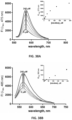
- FIGS. 52 A- 52 D are graphs of titration curves obtained after combining a dimer complex comprising compound embodiment DD1Cx5 (12 ⁇ M) with nicotine ( FIGS. 52 A and 52 C ) and cocaine ( FIGS. 52 B and 52 D ) as monitored by absorbance ( FIGS. 52 A and 52 B ) and fluorescence ⁇ ex 380 nm ( FIGS. 52 C and 52 D ) in NaH 2 PO 4 /Na 2 HPO 4 buffered water (10 mM, pH 7.4); FIGS. 52 A and 52 B show DD1Cx5 color changing properties with a shift in ⁇ max ex from 380 nm to 414 nm upon cocaine binding and FIGS. 52 C and 52 D show fluorescence responses for both nicotine and cocaine with a ⁇ max em of 598 nm.
- FIGS. 53 A- 53 D are graphs of titration curves obtained after combining a dimer complex comprising compound embodiment DD4Cx5 (12 ⁇ M) with nicotine ( FIGS. 53 A and 53 C ) and cocaine ( FIGS. 53 B and 53 D ) as monitored by absorbance ( FIGS. 53 A and 53 B ) and fluorescence ⁇ ex 380 nm ( FIGS. 53 C and 53 D ) in NaH 2 PO 4 /Na 2 HPO 4 buffered water (10 mM, pH 7.4); FIGS.
- FIGS. 53 A and 53 B show DD4Cx5 color changing properties with a shift in ⁇ max ex from 480 nm to 540 nm upon nicotine binding and a shift to 544 nm upon cocaine binding and and FIGS. 53 C and 53 D show fluorescence responses for both nicotine and cocaine with a ⁇ max em of 574 nm.
- FIGS. 54 A- 54 D are graphs of titration curves showing absorbance ( FIG. 54 A ) and fluorescence ( FIGS. 54 B- 54 D ) results after combining a mixture of HemiDD1, DD4 and DD13Cx5 (12 ⁇ M each) in NaH 2 PO 4 /Na 2 HPO 4 buffered water (10 mM, pH 7.4) with bovine serum albumin.
- FIGS. 53 A- 53 D are graphs of titration curves showing absorbance ( FIG. 55 A ) and fluorescence ( FIGS. 55 B- 55 D ) results after combining a mixture of HemiDD1, DD4 and DD13Cx5 (12 ⁇ M each) in NaH 2 PO 4 /Na 2 HPO 4 buffered water (10 mM, pH 7.4) with human serum albumin.
- FIG. 56 is a bar graph showing average fluorescence data obtained from combining different dimer complex embodiments with cocaine (“COC”), benzoylecgonine (“BZE”), lidocaine (“LC”), procaine (“PC”), 3,4-methylenedioxymethamphatamine (“MDMA”), methamphetamine (“MA”), amphetamine (“A”), 3,4-methylenedioxoamphetamine (“MDA”), dextrorphan (“DEX”), oxymorphone (“OXY-M”), 6-acetylmorphine (“6-MAM”), oxycodone (“OXY-C”), heroin (“HER”), nicotine (“NICO”), acetaminophen (“TY”).
- COC cocaine
- BZE benzoylecgonine
- LC lidocaine
- PC procaine
- MDMA 3,4-methylenedioxymethamphatamine
- MA methamphetamine
- MA amphetamine
- MDA 3,4-methylenedi
- FIGS. 58 A- 58 C are photographic images of representative fluorescent sensor devices and/or arrays after irradiation by a hand-held UV lamp ( ⁇ ex 364 ⁇ 20 nm) and which show that sensor devices comprising multiple dimer complex embodiments can be used to detect the presence of different drugs at difference concentrations, including nicotine ( FIG. 58 A ); cocaine ( FIG. 58 B ), benzoylecgonine ( FIG. 58 C ); as well as arrays comprising such dimer complex embodiments ( FIG. 58 D ).
- Certain functional group terms include a symbol “ ⁇ ” which is used to show how the defined functional group attaches to, or within, the compound to which it is bound.
- a dashed bond i.e., “---” as used in certain formulas described herein indicates an optional bond (that is, a bond that may or may not be present).
- a wavy bond i.e., “-” as used in certain formulas or structures described herein indicates a bond disconnection.
- Aldehyde —C(O)H.
- Aliphatic A hydrocarbon group having at least one carbon atom to 50 carbon atoms (C 1-50 ), such as one to 25 carbon atoms (C 1-25 ), or one to ten carbon atoms (C 1-10 ), and which includes alkanes (or alkyl), alkenes (or alkenyl), alkynes (or alkynyl), including cyclic versions thereof, and further including straight- and branched-chain arrangements, and all stereo and position isomers as well.
- Aliphatic-aromatic An aromatic group that is or can be coupled to a compound disclosed herein, wherein the aromatic group is or becomes coupled through an aliphatic group.
- Aliphatic-aryl An aryl group that is or can be coupled to a compound disclosed herein, wherein the aryl group is or becomes coupled through an aliphatic group.
- Aliphatic-heteroaryl A heteroaryl group that is or can be coupled to a compound disclosed herein, wherein the heteroaryl group is or becomes coupled through an aliphatic group.
- Alkenyl An unsaturated monovalent hydrocarbon having at least two carbon atoms to 50 carbon atoms (C 2-50 ), such as two to 25 carbon atoms (C 2-25 ), or two to ten carbon atoms (C 2-10 ), and at least one carbon-carbon double bond, wherein the unsaturated monovalent hydrocarbon can be derived from removing one hydrogen atom from one carbon atom of a parent alkene.
- An alkenyl group can be branched, straight-chain, cyclic (e.g., cycloalkenyl), cis, or trans (e.g., E or Z).
- Alkoxy —O-aliphatic, such as —O-alkyl, —O-alkenyl, —O-alkynyl; with exemplary embodiments including, but not limited to, methoxy, ethoxy, n-propoxy, isopropoxy, n-butoxy, t-butoxy, sec-butoxy, n-pentoxy (wherein any of the aliphatic components of such groups can comprise no double or triple bonds, or can comprise one or more double and/or triple bonds).
- Alkyl A saturated monovalent hydrocarbon having at least one carbon atom to 50 carbon atoms (C 1-50 ), such as one to 25 carbon atoms (C 1-25 ), or one to ten carbon atoms (C 1-10 ), wherein the saturated monovalent hydrocarbon can be derived from removing one hydrogen atom from one carbon atom of a parent compound (e.g., alkane).
- An alkyl group can be branched, straight-chain, or cyclic (e.g., cycloalkyl).
- Alkynyl An unsaturated monovalent hydrocarbon having at least two carbon atoms to 50 carbon atoms (C 2-5 ), such as two to 25 carbon atoms (C 2-25 ), or two to ten carbon atoms (C 2-10 ), and at least one carbon-carbon triple bond, wherein the unsaturated monovalent hydrocarbon can be derived from removing one hydrogen atom from one carbon atom of a parent alkyne.
- An alkynyl group can be branched, straight-chain, or cyclic (e.g., cycloalkynyl).
- Amide —C(O)NR a R b or —NR a C(O)R b wherein each of R a and R b independently is selected from hydrogen, aliphatic, heteroaliphatic, haloaliphatic, haloheteroaliphatic, aromatic, or an organic functional group.
- R a and R b independently is selected from hydrogen, aliphatic, heteroaliphatic, haloaliphatic, haloheteroaliphatic, aromatic, or an organic functional group.
- Aromatic A cyclic, conjugated group or moiety of, unless specified otherwise, from 5 to 15 ring atoms having a single ring (e.g., phenyl) or multiple condensed rings in which at least one ring is aromatic (e.g., naphthyl, indolyl, or pyrazolopyridinyl); that is, at least one ring, and optionally multiple condensed rings, have a continuous, delocalized ⁇ -electron system.
- the number of out of plane ⁇ -electrons corresponds to the Hückel rule (4n+2).
- the point of attachment to the parent structure typically is through an aromatic portion of the condensed ring system. For example,
- context or express disclosure may indicate that the point of attachment is through a non-aromatic portion of the condensed ring system.
- Aromatic group or moiety may comprise only carbon atoms in the ring, such as in an aryl group or moiety, or it may comprise one or more ring carbon atoms and one or more ring heteroatoms comprising a lone pair of electrons (e.g. S, O, N, P, or Si), such as in a heteroaryl group or moiety.
- Aromatic groups may be substituted with one or more groups other than hydrogen, such as aliphatic, heteroaliphatic, haloaliphatic, haloheteroaliphatic, aromatic, or an organic functional group.
- Aryl An aromatic carbocyclic group comprising at least five carbon atoms to 15 carbon atoms (C 5 -C 15 ), such as five to ten carbon atoms (C 5 -C 10 ), having a single ring or multiple condensed rings, which condensed rings can or may not be aromatic provided that the point of attachment to a remaining position of the compounds disclosed herein is through an atom of the aromatic carbocyclic group.
- Aryl groups may be substituted with one or more groups other than hydrogen, such as aliphatic, heteroaliphatic, haloaliphatic, haloheteroaliphatic, aromatic, or an organic functional group.
- Aryloxy —O-aromatic.
- Azo —N ⁇ NR a wherein R a is hydrogen, aliphatic, heteroaliphatic, haloaliphatic, haloheteroaliphatic, aromatic, or an organic functional group.
- R a and R b independently is selected from hydrogen, aliphatic, heteroaliphatic, haloaliphatic, haloheteroaliphatic, aromatic, or an organic functional group.
- Carboxyl —C(O)OH.
- Carboxylate —C(O)O— or salts thereof, wherein the negative charge of the carboxylate group may be balanced with an M + counterion, wherein M + may be an alkali ion, such as K+, Na + , Li + ; an ammonium ion, such as + N(R b ) 4 where R b is H, aliphatic, heteroaliphatic, haloaliphatic, haloheteroaliphatic, or aromatic; or an alkaline earth ion, such as [Ca 2+ ] 0.5 , [Mg 2+ ] 0.5 , or [Ba 2+ ] 0.5 .
- M + may be an alkali ion, such as K+, Na + , Li + ; an ammonium ion, such as + N(R b ) 4 where R b is H, aliphatic, heteroaliphatic, haloaliphatic, haloheteroaliphatic, or aromatic; or an al
- Detectable Moiety A component of a compound embodiment that provides a detectable signal.
- the detectable moiety can provide the detectable signal when attached to a compound embodiment and after an analyte has interacted with the compound, such as when the analyte disrupts a dimer comprising the compound, or when the analyte acts to unfold a folded structure of the compound embodiment wherein the detectable moiety folds into a binding pocket of the compound embodiment.
- the detectable moiety can be present in a dimer complex as described herein and can emit a detectable signal that is different (e.g., different in wavelength or color and/or fluorescence intensity) from any detectable signal emitted by the first and/or second compounds in the dimer complex.
- Detectable Signal A signal (e.g., a color change, an increase or decrease in fluorescence, an increase or decrease in phosphorescence or other type of luminescence, and the like) that occurs when a dimer comprising a compound embodiment disclosed herein, or a folded compound embodiment is disrupted by an analyte that binds to or otherwise interacts with the compound embodiment.
- the detectable signal occurs after a homodimer or heterodimer comprising two compound embodiments (which can be the same in the case of a homodimer, or different in the case of a heterodimer) is disrupted by binding of an analyte to a portion of at least one of the compound embodiments providing the homodimer or heterodimer.
- the detectable signal occurs after a folded compound embodiment is unfolded by an analyte binding to (or otherwise associating with) the compound embodiment.
- the folding can occur wherein the detectable moiety is bound or otherwise attracted to a binding pocket of the compound embodiment; and the unfolding can occur wherein the analyte displaces the detectable moiety from the binding pocket.
- a dimer complex can emit a detectable signal that is different (e.g., different in wavelength or color and/or fluorescence intensity) from a detectable signal emitted by the first and/or second compounds in the dimer complex.
- a detectable signal is visible to the naked eye or is visible using an analytical detection technique.
- Disulfide —SSR a , wherein R a is selected from hydrogen, aliphatic, heteroaliphatic, haloaliphatic, haloheteroaliphatic, aromatic, or an organic functional group.
- Dithiocarboxylic —C(S)SR a wherein R a is selected from hydrogen, aliphatic, heteroaliphatic, haloaliphatic, haloheteroaliphatic, aromatic, or an organic functional group.
- Ester —C(O)OR a or —OC(O)R a , wherein R a is selected from aliphatic, heteroaliphatic, haloaliphatic, haloheteroaliphatic, aromatic, or an organic functional group.
- Ether -aliphatic-O-aliphatic, -aliphatic-O-aromatic, -aromatic-O-aliphatic, or -aromatic-O-aromatic.
- Fluorophore A compound or functional group capable of emitting fluorescence.
- Representative fluorophores can include, but are not limited to, a xanthene derivative (e.g., fluorescein, rhodamine, eosin, Texas red, Oregon green, or the like), cyanine or a cyanine derivative (e.g., indocarbocyanine, oxacarbocyanine, thiacarbocyanine, merocyanine, Cy3, or Cy5), a naphthalene derivative (e.g., dansyl, prodan, and the like), coumarin and derivatives thereof (e.g., hydroxycoumarin, aminocoumarin, methoxycoumarin, and the like), oxadiazole derivatives (e.g., pyridyloxazole, nitrobenzoxadiazole, benzoxadiazole, and the like), anthracene derivatives, pyrene derivatives (e.g., cascade blue), oxazine derivatives (e.g., Nile red,
- 2,4-dimethyl-BODIPY 2,4-dimethyl-BODIPY
- tetrapyrrole derivatives e.g., porphin, phthalocyanine, and the like
- compound embodiments of the present disclosure comprise a precursor to such fluorophore groups.
- fluorophore compound embodiments can be described as heteroaryl and/or heteroaliphatic (e.g., heterocyclic) groups in the present disclosure.
- Halo (or halide or halogen): Fluoro, chloro, bromo, or iodo.
- Haloaliphatic An aliphatic group wherein one or more hydrogen atoms, such as one to 10 hydrogen atoms, independently is replaced with a halogen atom, such as fluoro, bromo, chloro, or iodo.
- Haloaliphatic-aryl An aryl group that is or can be coupled to a compound disclosed herein, wherein the aryl group is or becomes coupled through a haloaliphatic group.
- Haloaliphatic-heteroaryl A heteroaryl group that is or can be coupled to a compound disclosed herein, wherein the heteroaryl group is or becomes coupled through a haloaliphatic group.
- Haloalkyl An alkyl group wherein one or more hydrogen atoms, such as one to 10 hydrogen atoms, independently is replaced with a halogen atom, such as fluoro, bromo, chloro, or iodo.
- haloalkyl can be a CX 3 group, wherein each X independently can be selected from fluoro, bromo, chloro, or iodo.
- Heteroaliphatic An aliphatic group comprising at least one heteroatom to 20 heteroatoms, such as one to 15 heteroatoms, or one to 5 heteroatoms, which can be selected from, but not limited to oxygen, nitrogen, sulfur, silicon, boron, selenium, phosphorous, and oxidized forms thereof within the group. Alkoxy, ether, amino, disulfide, peroxy, and thioether groups are exemplary (but non-limiting) examples of heteroaliphatic.
- a fluorophore can also be described herein as a heteroaliphatic group, such as when the heteroaliphatic group is a heterocyclic group.
- Heteroaliphatic-aryl An aryl group that is or can be coupled to a compound disclosed herein, wherein the aryl group is or becomes coupled through a heteroaliphatic group.
- Heteroaryl An aryl group comprising at least one heteroatom to six heteroatoms, such as one to four heteroatoms, which can be selected from, but not limited to oxygen, nitrogen, sulfur, silicon, boron, selenium, phosphorous, and oxidized forms thereof within the ring.
- Such heteroaryl groups can have a single ring or multiple condensed rings, wherein the condensed rings may or may not be aromatic and/or contain a heteroatom, provided that the point of attachment is through an atom of the aromatic heteroaryl group.
- Heteroaryl groups may be substituted with one or more groups other than hydrogen, such as aliphatic, heteroaliphatic, haloaliphatic, haloheteroaliphatic, aromatic, or an organic functional group.
- a fluorophore can also be described herein as a heteroaryl group.
- Heteroatom An atom other than carbon or hydrogen, such as (but not limited to) oxygen, nitrogen, sulfur, silicon, boron, selenium, or phosphorous. In particular disclosed embodiments, such as when valency constraints do not permit, a heteroatom does not include a halogen atom.
- Hydrophobic Cation A functional group comprising a positively charged atom and one or more groups that exhibit hydrophobic characteristics (e.g., aliphatic groups or other neutral or non-polar functional groups).
- a hydrophobic cation includes quaternary amine groups (e.g., an amine comprising at least one aliphatic group bound to the nitrogen and three other groups bound to the nitrogen).
- Ketone —C(O)R a , wherein R a is selected from aliphatic, heteroaliphatic, haloaliphatic, haloheteroaliphatic, aromatic, or an organic functional group.
- Organic Functional Group A functional group that may be provided by any combination of aliphatic, heteroaliphatic, aromatic, haloaliphatic, and/or haloheteroaliphatic groups, or that may be selected from, but not limited to, aldehyde; arylroxy; acyl halide; halogen; nitro; cyano; azide; carboxyl (or carboxylate); amide; ketone; carbonate; imine; azo; carbamate; hydroxyl; thiol; sulfonyl (or sulfonate); oxime; ester; thiocyanate; thioketone; thiocarboxylic acid; thioester; dithiocarboxylic acid or ester; phosphonate; phosphate; silyl ether; sulfinyl; thial; or combinations thereof.
- Oxime: —CR a NOH, wherein R a is hydrogen, aliphatic, heteroaliphatic, haloaliphatic, haloheteroaliphatic, aromatic, or an organic functional group.
- R a is hydrogen, aliphatic, heteroaliphatic, haloaliphatic, haloheteroaliphatic, aromatic, or an organic functional group.
- Phosphate —O—P(O)(OR a ) 2 , wherein each R a independently is hydrogen, aliphatic, heteroaliphatic, haloaliphatic, haloheteroaliphatic, aromatic, or an organic functional group; or wherein one or more R a groups are not present and the phosphate group therefore has at least one negative charge, which can be balanced by a counterion, M + , wherein each M + independently can be an alkali ion, such as K + , Na + , Li + ; an ammonium ion, such as + N(R b ) 4 where R b is H, aliphatic, heteroaliphatic, haloaliphatic, haloheteroaliphatic, or aromatic; or an alkaline earth ion, such as [Ca 2+ ] 0.5 , [Mg 2+ ] 0.5 , or [Ba 2+ ] 0.5 .
- Phosphonate —P(O)(OR a ) 2 , wherein each R a independently is hydrogen, aliphatic, heteroaliphatic, haloaliphatic, haloheteroaliphatic, aromatic, or an organic functional group; or wherein one or more R a groups are not present and the phosphate group therefore has at least one negative charge, which can be balanced by a counterion, M + , wherein each M + independently can be an alkali ion, such as K + , Na + , Li + ; an ammonium ion, such as +N(R b ) 4 where R b is H, aliphatic, heteroaliphatic, haloaliphatic, haloheteroaliphatic, or aromatic; or an alkaline earth ion, such as [Ca 2+ ] 0.5 , [Mg 2+ ] 0.5 , or [Ba 2+ ] 0.5 .
- Silyl Ether —OSiR a R b , wherein each of R a and R b independently is selected from hydrogen, aliphatic, heteroaliphatic, haloaliphatic, haloheteroaliphatic, aromatic, or an organic functional group.
- Mammals and other animals such as humans, companion animals (e.g., dogs, cats, rabbits, etc.), utility animals, and feed animals; thus, disclosed methods are applicable to both human therapy and veterinary applications.
- Sulfinyl —S(O)R a , wherein R a is selected from hydrogen, aliphatic, heteroaliphatic, haloaliphatic, haloheteroaliphatic, aromatic, or an organic functional group.
- Sulfonyl —SO 2 R a , wherein R a is selected from hydrogen, aliphatic, heteroaliphatic, haloaliphatic, haloheteroaliphatic, aromatic, or an organic functional group.
- Sulfonamide —SO 2 NR a R b or —N(R a )SO 2 R b , wherein each of R a and R b independently is selected from hydrogen, aliphatic, heteroaliphatic, haloaliphatic, haloheteroaliphatic, aromatic, or an organic functional group.
- Sulfonate —SO 3 , wherein the negative charge of the sulfonate group may be balanced with an M + counter ion, wherein M + may be an alkali ion, such as K + , Na + , Li + ; an ammonium ion, such as + N(R b ) 4 where R b is H, aliphatic, heteroaliphatic, haloaliphatic, haloheteroaliphatic, or aromatic; or an alkaline earth ion, such as [Ca 2+ ] 0.5 , [Mg 2+ ] 0.5 , or [Ba 2+ ] 0.5 .
- M + may be an alkali ion, such as K + , Na + , Li + ; an ammonium ion, such as + N(R b ) 4 where R b is H, aliphatic, heteroaliphatic, haloaliphatic, haloheteroaliphatic, or aromatic; or an al
- Thiocarboxylic acid —C(O)SH, or —C(S)OH.
- Thiocyanate —S—CN or —N ⁇ C ⁇ S.
- Thioester —C(O)SR a or —C(S)OR a wherein R a is selected from hydrogen, aliphatic, heteroaliphatic, haloaliphatic, haloheteroaliphatic, aromatic, or an organic functional group.
- Thioether —S-aliphatic or —S-aromatic, such as —S-alkyl, —S-alkenyl, —S-alkynyl, —S-aryl, or —S-heteroaryl; or -aliphatic-S-aliphatic, -aliphatic-S-aromatic, -aromatic-S-aliphatic, or -aromatic-S-aromatic.
- Thioketone —C(S)R a wherein R a is selected from hydrogen, aliphatic, heteroaliphatic, haloaliphatic, haloheteroaliphatic, aromatic, or an organic functional group.
- Compound embodiments disclosed herein can be used as supramolecular sensors.
- the unique topology of the disclosed compound embodiments can lead to self-assembly in water, aqueous-based solutions and/or organic solutions, into dimer complexes comprising a first compound and a second compound, wherein each of the first and the second compound can have a structure satisfying formulas disclosed herein.
- the aqueous solutions can be water, or a buffered solution (e.g., solutions comprising a buffer, such as a phosphate buffer).
- the disclosed compound embodiments can self-assemble into non-emissive dimers (e.g., dimers that do not exhibit a detectable signal) and/or dimers that exhibit a dimer detectable signal, wherein the dimer detectable signal is different from any signal emitted by the first compound and/or the second compound.
- the dimers can disassemble and provide a fluorescent or colorimetric complex.
- a compound embodiment 100 can comprise a binding pocket 102 and a reporter moiety 104 that provides a detectable signal.
- the compound embodiment can self-assemble into a dimer complex 106 , thereby quenching any signal from the respective reporter moieties of the compound embodiments.
- the dimer complex 106 Upon exposure to an analyte 108 , the dimer complex 106 is disrupted and the analyte binds to the binder pocket, providing a different detectable signal produced by interaction between the compound embodiment and the analyte and the dimer complex disruption (shown for product 110 ).
- Due to the salt tolerance of the disclosed compounds they can operate in the presence of high concentrations, of biologically relevant concentrations, or of physiological concentrations of NaCl, proteins, peptides, organic co-solutes, reducing agents, transition metal salts, and other enzyme co-factors.
- the disclosed compounds comprise a (i) host element capable of binding an analyte and (ii) a detectable moiety (ex. chromophore or ring system) capable of producing a detectable signal, wherein the compounds self-assemble into dimers with control over the chromophore-chromophore interactions.
- self-assembled dimers are in a quenched state wherein the quenched state may be non-emissive or may be characterized by a fluorescent or colorimetric signal at multiple wavelengths that is characteristic of the starting dimeric state. The dimers disassemble and produce a turn-on response when brought into contact with a sample containing an analyte capable of binding the host element.
- the turn-on response produces a detectable signal that is fluorescent or colorimetric.
- the analyte comprises or consists of a cation or a hydrophobic cation.
- the compound embodiments can be used to provide dimer complexes that can exhibit two detectable signals, including a fluorescent and colorimetric signal.
- Many classes of drugs including opioids, amphetamines, tropane alkaloids, and anaesthetics contain a hydrophobic cation in their structure that can be recognized by sulfonate/carboxylate-calix[4]arene-based cores contained in certain compound embodiments.
- the parallel synthesis method embodiments and a highly efficient crude screening process can be used to quickly identify new sensors for the detection of a given analyte in a given solution.
- an analyte-identifying sensor array that operates on multiple classes of illicit drugs.
- the new supramolecular sensor disclosed herein have sensitivities in real biological solutions that meet or approach the values seen in real human samples.
- Drug concentrations in saliva reach low ⁇ M within an hour of consumption and it has been shown that the compound embodiment sensors can detect at or near these concentrations.
- 3,4-methyl enedioxymethamphetamine (MDMA) concentrations reaches 34 ⁇ M in saliva after 1.5 hours while cocaine can be present in saliva at 3 ⁇ M after 1 hour.
- the sensors were able to detect these concentrations in saliva.
- Compound embodiments remain functional in saliva that often contains 3 g/L of proteins and 20-100 mM concentrations of various salts.
- a compound that can be used as a sensor capable of detecting biologically-relevant analytes in various media environments.
- a plurality of such compound embodiments can be used together to provide embodiments of a sensing array, which is described in more detail herein.
- each A independently can be selected from C(O)H; CH 2 OH; CO 2 R′ or SO 3 R′, wherein each R′ independently is H or a counterion; or linker′-Ring B′ , wherein linker′ is aliphatic or heteroaliphatic and Ring B′ is a ring system capable of producing a detectable signal;
- each E independently can be selected from CO 2 R′ or SO 3 R′, wherein each R′ independently is H or a counterion;
- each J independently can be selected from CO 2 R′ or SO 3 R′, wherein each R′ independently is H or a counterion;
- each of X 1 , X 2 , X 3 , and X 4 independently is CH 2 , O, S, CH 2 OCH 2 , CH 2 SCH 2 , or NR b wherein each R b independently is hydrogen, aliphatic, heteroaliphatic, or aromatic; each R independently is H, aliphatic, or a counterion;
- the linker group is aliphatic or heteroaliphatic
- the B ring is a ring system capable of producing a detectable signal; and each of n, m, and p independently is an integer selected from 1 to 3, such as 1, 2, or 3.
- the linker group and/or the linker′ group independently comprise an alkenyl group, a heteroalkenyl group, or a combination thereof.
- the linker group and/or the linker′ group independently have a structure satisfying a Formula IA
- each L and L′ independently is CH or N; M is NH; q is an integer selected from 1 to 3, such as 1, 2, or 3; and r is 0 or 1.
- the linker and/or linker′ group independently are —CH ⁇ CH—, —N ⁇ N—NH—, —N ⁇ CH—NH—, or —CH ⁇ N—NH—.
- the Ring B and/or the Ring B′ groups independently comprise a detectable moiety, such as a detectable moiety capable of producing a colorimetric signal, a fluorescent signal, or other luminescent signal.
- the Ring B and/or the Ring B′ groups independently comprise an N-functionalized nitrogen-containing ring system, a 2-ethyl-1H-benzo[de]isoquinoline-1,3(2H)-dione functional group, or a nitrobenzo[c][1,2,5]oxadiazole functional group.
- the N-functionalized nitrogen-containing ring system can be 5- to 10-membered ring system, such as a 5- to 10-membered aromatic ring system comprising at least one nitrogen atom that is functionalized with H, aliphatic, or aromatic.
- Representative N-functionalized nitrogen-containing ring system embodiments are illustrated in Table 1 below:
- the compound can satisfy Formula II below.
- R independently is H or an aliphatic group (e.g., C 1-12 aliphatic)
- each of X 1 , X 2 , X 3 , and X 4 independently is CH
- the compound can have a structure satisfying Formula III below.
- n independently is an integer selected from 0, 1,or 2; each R independently is H or an aliphatic group (e.g., C 1-12 aliphatic); each of X 1 , X 2 , X 3 , and X 4 independently is CH 2 , O, S, CH 2 OCH 2 , or CH 2 SCH 2 ; each of E and J independently is SO 3 H or CO 2 H (or SO 3 ⁇ or CO 2 ⁇ balanced with a counterion provided by an aqueous solution, buffered aqueous solution, or any other counterion that may exist in the environment in which the compound is provided); T is N or CH; V is NH; and U is a heteroaryl group that produces a colorimetric signal or fluorescent signal (e.g., a fluorescent dye or color-generating dye).
- Such compound embodiments have a dynamic, fluxional nature that provides facilitate their use in reversible sensing.
- the compound can have a structure satisfying Formula IV below.
- each of m and m′ independently is an integer selected from 0, 1, 2, or 3; each R independently is H or an aliphatic group (e.g., C 1-12 aliphatic); each of X 1 , X 2 , X 3 , and X 4 independently is CH 2 , O, S, CH 2 OCH 2 , or CH 2 SCH 2 ; each of E and J independently is SO 3 H or CO 2 H (or SO 3 ⁇ or CO 2 ⁇ balanced with a counterion provided by an aqueous solution, buffered aqueous solution, or any other counterion that may exist in the environment in which the compound is provided); each of Q, T, Q′, and T′ independently is N or CH; and U and U′ independently are a heteroaryl group that produces a colorimetric or fluorescent signal.
- Such compound embodiments can provide useful changes in wavelengths of sensor responses, as well as sensor responses with unique and useful photophysical mechanisms.
- the compound can have a structure satisfying Formula V or Formula VA below.
- m independently is an integer selected from 0, 1, 2, or 3; each R independently is H or an aliphatic group (e.g., C 1-12 aliphatic); each of X 1 , X 2 , X 2′ X 3 , and X 4 independently is CH 2 , O, S, CH 2 OCH 2 , or CH 2 SCH 2 ; each of E and J independently is SO 3 H or CO 2 H (or SO 3 ⁇ or CO 2 ⁇ balanced with a counterion provided by an aqueous solution, buffered aqueous solution, or any other counterion that may exist in the environment in which the compound is provided); each of Q and T independently is N or CH; U is a heteroaryl group that produces a colorimetric or fluorescent signal; and each of A and A′ independently is C(O)H, CH 2 OH, or CO 2 H.
- each R independently is H or an aliphatic group (e.g., C 1-12 aliphatic)
- Such compound embodiments have different interactions with analytes and with each other that provide enhanced analyte selectivity, improved detection limits, and useful new photophysical mechanisms.
- the compounds can form dimer complexes that can interact with an analyte to provide both a fluorescent and colorimetric signal.
- the compound is not, or is other than, the compounds illustrated below. Nevertheless, such compounds can be used in array embodiments disclosed herein, particularly when combined with one or more of the compound embodiments provided in Table 2 above.
- the plurality of compounds can comprise two or more compounds, such as two to thousands of compounds, or two to hundreds of compounds, or 2 to 100 compounds, or 2 to 50 compounds, or 2 to 25 compounds, or 2 to 15 compounds, or 2 to 10 compounds, or 2 to 5 compounds.
- the array can be provided in different platform embodiments.
- the array comprises a test strip platform which comprises a substrate (e.g., a paper substrate, or other porous substrates; a plastic substrate; a well-plate; or the like) comprising one or more sample zones that comprise one or more compound embodiments.
- the array comprises a tube platform in which one or more tubes are provided and wherein each tube comprises a single compound embodiment or wherein each tube comprises a plurality of compound embodiments.
- the array can be exposed to a biological fluid or other aqueous solution and any detectable signals generated can be viewed and/or analyzed to determine whether any analytes are present. In some embodiments, the identity of the analyte and/or the concentration of the analyte can be assessed using the array. Images of exemplary arrays are provided in FIGS. 3 A, 3 B , and FIGS. 58 A- 58 D .
- analytes can be drugs (e.g., illicit drugs) and/or analogs and/or metabolites thereof.
- drugs e.g., illicit drugs
- analytes can be recreational drugs, mood-altering drugs, performance enhancing drugs and drugs listed in the Controlled Substances Act (CSA) Database provided by the Drug Enforcement Administration (DEA) at https://www.dea.gov/, the relevant portion of which is incorporated herein by reference, or any metabolites and/or analogs thereof.
- CSA Controlled Substances Act
- DEA Drug Enforcement Administration
- the analytes can be small molecules, drugs, drug analogs, drug metabolites, amino acids (e.g., phenylalanine, asymmetric dimethylarginine, or other amino acids), peptides, proteins, natural metabolites (including primary and secondary metabolites), or any combinations thereof.
- the method of using certain compound embodiments disclosed herein can comprise methods for detecting the presence of analytes (e.g., small molecules, drugs, drug analogs, drug metabolites, amino acids, peptides, proteins, and natural metabolites) that comprise cations or hydrophobic cations.
- such natural analytes can comprise endogenous and exogenous metabolites, primary and secondary metabolites, and metabolites originating from food, plants, microbes, toxins, pollutants, cosmetics or drugs, including metabolites listed in the Human Metabolome Database provided by the Metabolomics Innovation Centre (TMIC) at http://www.hmdb.ca/, the relevant portion of which is incorporated herein by reference.
- TMIC Metabolomics Innovation Centre
- the compounds have a unique ability to operate in many and varied biological fluids, such as saliva, urine, nasal washes, synovial fluid, cerebrospinal fluid, gastric fluid, serum, plasma, cell growth medium, and cell lysates.
- biological fluids such as saliva, urine, nasal washes, synovial fluid, cerebrospinal fluid, gastric fluid, serum, plasma, cell growth medium, and cell lysates.
- the compounds also act as sensors in aqueous solutions, with or without buffer, with pH values ranging from 0-14.
- the compounds embodiments are used as mixtures of sensor compounds.
- Multiple sensor compounds are mixed in the same solution or solid-phase sample.
- the sensor compounds interact with each other, generating a visible signal at multiple wavelengths that is characteristic for the starting state of the mixture of fluorescent and/or color-changing elements.
- the mixture of sensor compounds is treated with the fluid sample in order to generate a change in fluorescence and/or color that arises from the collective change in assembled state and sensor-analyte binding states in the presence of analytes.
- the spectral responses at multiple wavelengths of light provides a pattern of signals that uniquely determines the identity and/or concentration of a given analyte.
- Signal analysis can be done with multivariate statistics or machine learning or artificial intelligence-based analyses.
- data from multiple authentic samples are used to train the method and operator as to the signal expected to arise from a given analyte and/or concentration, and the sensor array then is used on unknown samples in order to identify a given analyte and/or concentration.
- array embodiments multiple sensors are used in parallel by distributing them in different liquid holding vessels or in different locations on a solid substrate.
- Each parallel element of the sensor array is treated with the fluid sample in order to generate responses for each sensor element that are read individually.
- the pattern of responses to a given analyte provides a signal that uniquely determines the identity and/or concentration of a given analyte.
- Multivariate analysis including methods like principal component analysis (PCA) and linear discriminant analysis (LDA), can analyze the ‘fingerprints’ by both reducing the dimensionality of the data and creating a useful way to represent the differential responses.
- PCA principal component analysis
- LDA linear discriminant analysis
- compounds disclosed herein can act as sensors that can operate while present on the surface of or embedded within the pores of a solid support.
- the sensors once dried onto solid substrates (paper, etc.), provide sensor spots that respond to the presence of their targeted analytes. They can also be embedded in gel phases and applied in medical devices such as wound dressings. This enables the creation of test strips or wound dressings that can be treated with a biological fluid or other aqueous solution and visualized by color change or fluorescence change in order to ascertain the presence of, identity of, and/or the concentration of a given analyte.
- compound embodiments assemble into dimers in water (e.g., homodimers and/or heterodimers), regardless of having different detectable moieties attached thereto.
- 1 H NMR can be used to confirm that each compound exists as a homodimer when dissolved in buffered-D 2 O.
- One feature of homodimerization is upfield shift and broadening of pendant group resonances due to encapsulation in the electron-rich calixarene pocket.
- aromatic resonances in certain compounds can shift upfield by 1.23-3.69 ppm, while aliphatic (methyl) resonances shifted upfield by 0.46-3.60 ppm.
- protons farthest out on the coupling partner component had the greatest upfield shifts, which can indicate that those protons are the most deeply buried in the pocket of the opposing calixarene of the dimer.
- fluorescence responses arise from the disassembly of each compound (that is, disruption of a dimer, such as illustrated in FIG. 1 A or 1 B ; or disruption of a folded compound embodiment, such as illustrated in FIG. 1 C ) and sequential complexation with an analyte.
- a compound embodiment 100 comprising a reporter moiety 104 and a binding pocket 102 can undergo self-folding providing self-folded compound embodiment 112 .
- the compound embodiment Upon exposure to analyte 108 , the compound embodiment can unfold to product a new detectable signal provided by the complexed product 114 formed by binding of then analyte to the binding pocket.
- 1 H NMR titrations of an analyte into each compound show resonances broadening partially or completely, indicating dimer disassembly and analyte complexation at an intermediate timescale relative to NMR.
- the disclosed compound embodiments provide turn-on fluorescence detection of different drugs at low micromolar concentrations in water and in saliva, as well as in other biological samples.
- sensing capabilities can be determined using a test analyte (e.g., nicotine). Increases in any fluorescence in a well of the well-plate indicates the creation of good nicotine sensors.
- a test analyte e.g., nicotine
- the library can be counter-screened against acetaminophen, which is neutral and should not bind the compounds. As shown by FIG. 3 C , acetaminophen generates little to no fluorescence in all cases.
- Compound embodiments disclosed herein can be made by combining a compound precursor with a coupling partner comprising a ring system capable of producing a detectable signal.
- the compound precursor has a structure satisfying Formula A, wherein each variable can be as described above for Formula I.
- the coupling partner comprising a ring system capable of producing a detectable signal can be an N-functionalized nitrogen-containing ring system, a 2-ethyl-1H-benzo[de]isoquinoline-1,3(2H)-dione functional group, a nitrobenzo[c][1,2,5]oxadiazole functional group, or other detectable moiety.
- the N-functionalized nitrogen-containing ring system can be 5- to 10-membered ring system, such as a 5- to 10-membered aromatic ring system comprising at least one nitrogen atom that is functionalized with H, aliphatic, or aromatic. Representative coupling partner embodiments are provided by Table 1.
- the method can further comprise heating the compound precursor and the coupling partner in a solvent with a base (e.g., pyridine or morpholine) at temperature ranging from ambient temperature to a refluxing temperature of the solvent, such as 25° C. to 70° C., or 25° C. to 65° C.
- a base e.g., pyridine or morpholine
- a parallel synthesis method is used.
- varying the detectable moiety included in the compound can provide compound embodiments with diverse homodimerization affinities and guest-binding selectivities.
- Such compound embodiments retain the general features of self-assembly-driven molecular sensing and salt tolerance.
- coupling partners capable of providing merocyanine fluorophores after condensation with an aldehyde-containing compound precursor can be used (see FIGS. 2 A- 2 C ).
- the method comprises using morpholine as an amine-containing base as it exhibits less propensity for binding to the hydrophobic binding pockets of the compound embodiments.
- the color of the reaction mixture including the compound precursor, the coupling partner, and the base changes after the reactions are heated, indicating successful condensation.
- UPLC-MS can be used to confirm product formation and can reveal the extent of each reaction. Exemplary UPLC-MS spectra are provided by FIGS. 15 A / 15 B through 29 A/ 29 B.
- a rapid, crude screening process successfully identified compounds without first needing to purify each compound.
- the crude reactions can be directly aliquoted into wells of a well-plate and the reaction solvent can be allowed to evaporate.
- the dried pellets can be re-suspended in sodium phosphate buffer (e.g., 10 mM, pH 7.4).
- the compound has a structure satisfying Formula I as disclosed herein.
- the compound is not, or is other than,
- the linker′ group has a structure satisfying a Formula IA as disclosed herein.
- the Ring B and/or the Ring B′ groups independently comprise a detectable moiety.
- the Ring B and/or the Ring B′ groups independently comprise an N-functionalized nitrogen-containing ring system, a 2-ethyl-1H-benzo[de]isoquinoline-1,3(2H)-dione functional group, or a nitrobenzo[c][1,2,5]oxadiazole functional group.
- Ring B and/or the Ring B′ groups independently are selected from:
- the compound has a structure satisfying any one or more of Formulas II-V as disclosed herein.
- the compound has a structure according to Formula VA, as disclosed herein.
- a sensor array comprising: a substrate; and one or more compounds according to any or all of the above embodiments associated with the substrate.
- the sample is an aqueous sample, a saliva sample, a urine sample, a nasal wash sample, a synovial fluid sample, a cerebrospinal fluid sample, a gastric fluid sample, a serum sample, a plasma sample, a cell growth medium sample, a cell lysate sample, or any combination thereof.
- the compound interacts with any analytes present in the sample to produce a detectable signal.
- the detectable signal is a colorimetric signal or a fluorescent signal and the analyte is an illicit drug.
- the two detectable signals are produced wherein one detectable signal is a colorimetric signal and the other is a fluorescent signal.
- determining whether the analyte is present in the sample comprises subjecting the sample, after compound exposure, to an ultraviolet light source to observe any fluorescent signal produced by an interaction between the analyte and the compound; or visual detection to observe any colorimetric signal produced by an interaction between the analyte and the compound.
- a dimer complex comprising: a first compound according to any or all of the above compound embodiments; and a second compound according to any or all of the above compound embodiments; wherein the first compound and the second compound chemically interact to form the dimer complex and wherein the dimer complex does not emit a detectable signal or wherein the dimer complex emits a dimer detectable signal that is different from any detectable signal provided by the first compound, the second compound, or both.
- the first compound has the same structure as the second compound.
- the first compound has a structure that is different from the second compound.
- the analyte comprises a cation or a hydrophobic cation.
- a Waters UPLC-MS equipped with UV/Vis and QDa detector was used with an Aquity UPLC BEH C18 1.7 uM (21 ⁇ 50 mm) column run with a gradient of 80% H 2 O (+0.4% FA)/20% CH 3 CN (+0.4% FA) to 50% H 2 O (+0.4% FA)/50% CH 3 CN (+0.4% FA) over 4 minutes at 0.6 ml/min. All UV-Vis and fluorescence titrations and spectra were collected on a Cytation-5 BioTek Imaging Reader. Titrations and dilutions were conducted in a NUNC black walled, optical bottom 96-well plate.
- IR Infrared
- Compound 1 was prepared following a literature protocol. Heterocyclic compounds were synthesized from previously reported literature.
- the 90° pulse is determined by measuring the pulse length at 360° by a zg pulse sequence and dividing by four.
- the T1 relaxation was estimated through an inversion recovery (t1ir1d) pulse sequence.
- the relaxation time for each experiment was set to be 10-times the estimated T1.
- the A was set to 50 or 100 ms.
- the ⁇ was determined by finding a 90-95% intensity difference between the first and last spectra in the power array via a stebpgp1s1d pulse program, see calculation below for 5 used for each experiment.
- the pulse sequences used for 1D DOSY was stebpgp1s.
- the synthesis was as follows: 1 (50 mg) and Het4/8/9/12/13 (1.1 eq.) were dissolved in methanol (2 mL) along with morpholine (40 eq.) and heated at reflux for 12 hours. Cold ether was added to induce precipitation and the suspension was transferred to a 50 mL conical tube. After centrifugation (3400 rpm, 5 min) a pellet was formed and the supernatant was decanted and discarded. The pellet was re-suspended in fresh cold ether and the centrifugation, decanting process was repeated two more times. The pellet was re-dissolved in the indicated eluent composition and filtered.
- FIGS. 9 A / 9 B- 13 A/ 13 B A Shimadzu HPLC with a 280 nm and 370 nm detector was used to purify the final product with a Phenomenex Luna C18, 250 mm ⁇ 22 mm, 5 ⁇ M preparative column.
- 1 H and 13 C NMR spectra for certain compound embodiments are provided by FIGS. 9 A / 9 B- 13 A/ 13 B.
- HemiDD1/4/13 (1eq), Het1/Het4/Het13 (1 eq) and morpholine (8 eq) were dissolved in MeOH.
- the reaction was heated and stirred overnight forming a precipitate.
- Cold ether was added to further induce precipitation.
- the reaction mixture was transferred to a conical tube, centrifuged (3400 rpm, 10 min) and the supernatant was discarded.
- the pellet was resuspended in cold ether, centrifuged and the supernatant was discarded two more times. The pellet was left to air dry overnight and purified by HPLC.
- An aluminum heating block (CombiBlocks, ChemGlass) held 4 dram vials which each contained a 1:1 mixture of 1 and one heterocyclic nucleophile (1.5 mM), along with morpholine (40 eq., 5 ⁇ L) in methanol (1 mL). The mixtures were capped, heated and stirred for 6 hours at 50° C. to afford colored solutions (use a blast shield in case of overpressure). The solutions were sonicated to re-dissolve dried compound embodiments along the walls. The solutions were aliquoted (10 ⁇ L) into NUNC black-walled, clear-bottomed 96-well plates and dried in a 37° C. oven for 4 hours.
- the dried pellets were re-suspended in phosphate buffer (10 mM, pH 7.4), centrifuged and mixed. Each solution was diluted by transferring aliquots into a separate 96-well plate containing the same phosphate buffer. Fluorescence endpoint measurements were taken for each compound embodiment, the ⁇ ex. and ⁇ em. that were used are listed below. A stock of nicotine prepared in phosphate buffer was added to each well (10 ⁇ L for final concentration of 10 ⁇ M) and fluorescence endpoint measurements were collected again. The fluorescence differences between after and before nicotine were used to evaluate each compound embodiment.
- merocyanines based on N-methylpyridinium (DD1 and DD8), indolinium (DD4), bipyridinium (DD12) and N-phenylpyridinium (DD13) worked well and exhibited tunable excitation and emission wavelengths ( ⁇ exc 380-475 nm, ⁇ em 570-640 nm), with Stokes shifts observed between 95 nm and 215 nm. Additional data for compound embodiment DD1 is provided by FIGS. 14 A and 14 B . The variable structures in this small compound embodiment library also translated into different binding properties for different drugs.
- inactive sensor DD9 also shows signs of dimerization with the N—CH 3 and ortho-proton shifted 2.50 ppm and 2.61 ppm, respectively.
- 1D DOSY NMR on DD4 confirmed that it had the hydrodynamic radius expected of a dimeric assembly (Table 3, Table 5, and Table 7) and is larger than the non-dimerizing aldehyde precursor, 1 .
- the fluorescence responses arise from the disassembly of each compound embodiment and sequential complexation with nicotine.
- 1 H NMR titrations of nicotine into each compound embodiment show resonances broadening partially or completely, indicating dimer disassembly and nicotine complexation at an intermediate timescale relative to NMR.
- FIG. 4 A and FIGS. 30 - 35 the resonances of N—CH 3 , ortho and meta pyridinium resonances on DD1, highlighted by stars, begin to broaden upon the addition of nicotine.
- pyrrolidine protons of nicotine highlighted with a cross, barely become visible at 1.0 eq and remain broad throughout the titration.
- the DD8 resonances did not shift but only broadened completely into the baseline, indicated with stars. Nicotine resonances began to appear at 2.0 eq. and remained broad throughout the titration.
- the DD9 quinolinium and N—CH 3 resonances broadened and shifted downfield slightly (indicated with stars and dashed lines) and eventually flattened into the baseline after 1.0 eq of nicotine was added. Nicotine pyrrolidine resonances appeared at 1.0 eq (marked with a cross) and remained broad throughout the titration.
- FIG. 34 the encapsulated aromatic pyridinium protons and 4′-CH 3 on DD12, highlighted by stars, broaden immediately upon the addition of nicotine.
- the less shielded N—CH 3 can be followed with dashed lines and is in fast exchange relative to the NMR timescale, shifting by 0.86 ppm.
- the nicotine pyrrolidine resonances appear as broad signals near 1.0 eq. and remain broad throughout the titration.
- the less shielded ortho-pyridinium resonances can be followed with dashed lines in slow exchange relative to the NMR timescale, shifting by 0.42 ppm.
- Nicotine titrations into DD4 and DD12 most clearly show the host resonances returning from upfield-shifted locations and/or broadening. DD4 resonances stay sharp enough in the presence of 20 eq. nicotine to conduct 1D DOSY experiments, and as expected the hydrodynamic radius of DD4 decreases to a value expected for a monomeric calixarene-nicotine complex (Table 3 and Table 6). Comparing the NMR tubes before and after the addition of nicotine shows visible DD fluorescence only for the nicotine-containing samples when irradiated at 365 nm with a hand-held UV lamp ( FIG. 4 B and FIG. 36 ). This behavior is further confirmed with titrations of nicotine into DD12 monitored by fluorescence spectroscopy.
- the dimer alone is barely fluorescent when irradiated at 415 nm but upon addition of nicotine the fluorescence increases at 640 nm ( FIG. 4 C ).
- This turn-on fluorescence response is observed by all selected compound embodiments except for DD9, which shows nicotine complexation by NMR yet remains dark when irradiated with the UV hand-held lamp and minimal fluorescence is detected by fluorescence spectroscopy.
- Compound embodiments provide turn-on fluorescence detection of different drugs at low micromolar concentrations in water and in saliva.
- Three exemplary drugs were chosen to study different drug classes: nicotine, methylenedioxymethamphetamine (Ecstasy, or MDMA), and cocaine.
- Ecstasy or MDMA
- all five compound embodiments detect all three drugs at low ⁇ M concentrations (Table 8 and Table 9).
- DD8 detects nicotine in water and in saliva with limits of detection at 3.4 ⁇ M and 18.6 ⁇ M, respectively ( FIG. 5 A and FIG. 5 B ).
- Even MDMA, a secondary amine and therefore a weaker guest induces a response from DD1 in both water and saliva with limits of detection at 2.7 ⁇ M and 41.2 ⁇ M, respectively ( FIG.
- FIGS. 37 A / 37 B- 51 A/ 51 B Analyte titration results for compound embodiments are provided by FIGS. 37 A / 37 B- 51 A/ 51 B.
- FIG. 8 A shows that the active drugs, MDMA and methamphetamine (MA), are discriminated from their metabolites, 3,4-methylenedioxyamphetamine (MDA) and amphetamine (A), even though they differ by only a single methyl group in each case.
- MDMA methamphetamine
- MDA 3,4-methylenedioxyamphetamine
- A amphetamine
- FIG. 8 B shows that heroin and its metabolite 6-monoacetylmorphine (6-MAM) were well discriminated, while oxycodone and oxymorphone are not perfectly discriminated with their 95% confidence ellipses slightly overlapping.
- the array also differentiated between cocaine, its main metabolite benzoylecgonine, as well as lidocaine and procaine, which are common adulterants found in illegally purchased cocaine ( FIG. 8 C ).
- Compound embodiments can function individually or as an array of sensors. Each sensor cross-reactivated with each drug but the uniqueness of the generated fluorescence fingerprint was limited. This is highlighted by the low variance ( ⁇ 5%) along the second principal component (F2) in the amphetamines and anaesthetics class. This suggests compound embodiments can operate independently and not necessarily within an array. However, the benefit of the DD array and using PCA is the visualization of the data. It is easier to map combinations of drugs with common adulterants or their metabolites by the PCA score plots rather than fluorescence bar graphs ( FIG. 56 ).
- the average hydrodynamic radius of DD4 (r H ) was calculated as 12.53 ⁇ 0.15 ⁇ and the average diffusion coefficient (D) is 1.96 ⁇ 10 ⁇ 10 m 2 /s.
- the average hydrodynamic radius of DD4-nicotine complex (r H ) was calculated as 9.74 ⁇ 0.21 ⁇ and the average diffusion coefficient (D) is 2.52 ⁇ 10 ⁇ 10 m 2 /s.
- the average hydrodynamic radius of 1 (r H ) was calculated as 7.49 ⁇ 0.02 ⁇ and the average diffusion coefficient (D) is 3.28 ⁇ 10 ⁇ 10 m 2 /s.
- a stock mixture comprising a combination of dimer complexes of compound embodiments (namely hemiDD1, DD4 and DD13Cx5) at a ratio of 1:1:1 hemiDD1, DD4 and DD13Cx5 was prepared in NaH 2 PO 4 /Na 2 HPO 4 (10 mM, pH 7.4).
- Separate stock solutions of bovine serum albumin (BSA) and human serum albumin (HSA) were prepared on ice in NaH 2 PO 4 /Na 2 HPO 4 (10 mM, pH 7.4), the solutions were mixed by slowly pipetting up and down to prevent foaming and aggregation of the protein.
- BSA bovine serum albumin
- HSA human serum albumin
- the dimer mixture and protein solutions were aliquoted into a NUNC black-walled 96 well plate in triplicate resulting in a final concentration of 12 ⁇ M of each hemiDD1, DD4 and DD13Cx5 and a final protein concentration of 150 ⁇ M in NaH 2 PO 4 /Na 2 HPO 4 (10 mM, pH 7.4).
- the absorbance spectra of each was measured. Fluorescence spectra were measured with the excitation maxima of each compound embodiment in the mixture ( ⁇ ex 380, ⁇ ex 410 and ⁇ ex 480).
- compound embodiment solutions (200 ⁇ M) were prepared in phosphate buffer (10 mM, pH 7.4) and spotted (2 ⁇ L) onto WhatmanTM Qualitative Filter Paper: Grade 1 Circles.
- the filter paper was dried in a 37° C. oven for 4 hrs.
- Analytes prepared at various concentrations in water or saliva were spotted (2 ⁇ L) on top of dried compound embodiment spots.
- the filter paper was irradiated with a hand-held UV lamp ( ⁇ ex 364 nm ⁇ 20 nm) and imaged using a smart phone camera (see FIGS. 58 A- 58 D ).
Landscapes
- Chemical & Material Sciences (AREA)
- Organic Chemistry (AREA)
- Health & Medical Sciences (AREA)
- Life Sciences & Earth Sciences (AREA)
- Immunology (AREA)
- Engineering & Computer Science (AREA)
- Hematology (AREA)
- Molecular Biology (AREA)
- Urology & Nephrology (AREA)
- Biomedical Technology (AREA)
- Physics & Mathematics (AREA)
- General Physics & Mathematics (AREA)
- General Health & Medical Sciences (AREA)
- Pathology (AREA)
- Analytical Chemistry (AREA)
- Biochemistry (AREA)
- Medicinal Chemistry (AREA)
- Food Science & Technology (AREA)
- Microbiology (AREA)
- Cell Biology (AREA)
- Biotechnology (AREA)
- Investigating Or Analysing Materials By The Use Of Chemical Reactions (AREA)
- Investigating, Analyzing Materials By Fluorescence Or Luminescence (AREA)
- Optics & Photonics (AREA)
- Nuclear Medicine, Radiotherapy & Molecular Imaging (AREA)
- Bioinformatics & Cheminformatics (AREA)
- Pharmacology & Pharmacy (AREA)
- Chemical Kinetics & Catalysis (AREA)
- Plural Heterocyclic Compounds (AREA)
- Medicines Containing Antibodies Or Antigens For Use As Internal Diagnostic Agents (AREA)
Priority Applications (1)
| Application Number | Priority Date | Filing Date | Title |
|---|---|---|---|
| US16/911,250 US11629128B2 (en) | 2019-06-25 | 2020-06-24 | Compound and dimer complex embodiments for supramolecular sensing |
Applications Claiming Priority (2)
| Application Number | Priority Date | Filing Date | Title |
|---|---|---|---|
| US201962866473P | 2019-06-25 | 2019-06-25 | |
| US16/911,250 US11629128B2 (en) | 2019-06-25 | 2020-06-24 | Compound and dimer complex embodiments for supramolecular sensing |
Publications (2)
| Publication Number | Publication Date |
|---|---|
| US20200407318A1 US20200407318A1 (en) | 2020-12-31 |
| US11629128B2 true US11629128B2 (en) | 2023-04-18 |
Family
ID=74036665
Family Applications (1)
| Application Number | Title | Priority Date | Filing Date |
|---|---|---|---|
| US16/911,250 Active 2041-02-27 US11629128B2 (en) | 2019-06-25 | 2020-06-24 | Compound and dimer complex embodiments for supramolecular sensing |
Country Status (2)
| Country | Link |
|---|---|
| US (1) | US11629128B2 (fr) |
| CA (1) | CA3084887A1 (fr) |
Families Citing this family (1)
| Publication number | Priority date | Publication date | Assignee | Title |
|---|---|---|---|---|
| DE102023107261A1 (de) * | 2023-03-23 | 2024-09-26 | Endress+Hauser Conducta Gmbh+Co. Kg | Driftstabiles optisches Sensorelement und driftstabiler optochemischer Sensor |
Citations (8)
| Publication number | Priority date | Publication date | Assignee | Title |
|---|---|---|---|---|
| US5770453A (en) * | 1993-10-19 | 1998-06-23 | The Secretary Of State For Defence In Her Britannic Majesty's Government Of The United Kingdom Of Great Britain And Northern Ireland | Sensors for neutral molecules |
| US5952526A (en) | 1996-06-26 | 1999-09-14 | Transdiffusia S.A. | Process for the dealkylating sulfonation of p-alkyl calixarenes |
| US20040127722A1 (en) * | 2001-02-23 | 2004-07-01 | Stephane Parola | Metallic thiacalix[4]arene complexes |
| US20060019311A1 (en) | 2002-12-20 | 2006-01-26 | Agence Francaise de Securite Sanitaire des Aliments-AFSSA, an organization of France | Process for detecting PrP using a macrocyclic adjuvant ligand |
| WO2008001116A2 (fr) | 2006-06-28 | 2008-01-03 | Heriot-Watt University | Procédé destiné à la détection présomptive de substances |
| US20100062540A1 (en) | 2005-07-21 | 2010-03-11 | Biomerieux S.A. | Method for Detecting Aggregate-Forming Circulating Protein Forms Using an Agent for Aggregating Said Forms and an Agent for Capturing Formed Aggregates |
| WO2013091074A1 (fr) | 2011-12-21 | 2013-06-27 | Uvic Industry Partnerships Inc. | Procédé et réseau pour l'identification d'analytes liés au code des histones |
| US20170052154A1 (en) * | 2015-08-18 | 2017-02-23 | Uvic Industry Partnerships Inc. | Compounds and conjugates for identifying and separating post-translationally modified analytes |
-
2020
- 2020-06-24 CA CA3084887A patent/CA3084887A1/fr active Pending
- 2020-06-24 US US16/911,250 patent/US11629128B2/en active Active
Patent Citations (10)
| Publication number | Priority date | Publication date | Assignee | Title |
|---|---|---|---|---|
| US5770453A (en) * | 1993-10-19 | 1998-06-23 | The Secretary Of State For Defence In Her Britannic Majesty's Government Of The United Kingdom Of Great Britain And Northern Ireland | Sensors for neutral molecules |
| US5952526A (en) | 1996-06-26 | 1999-09-14 | Transdiffusia S.A. | Process for the dealkylating sulfonation of p-alkyl calixarenes |
| US20040127722A1 (en) * | 2001-02-23 | 2004-07-01 | Stephane Parola | Metallic thiacalix[4]arene complexes |
| US20060019311A1 (en) | 2002-12-20 | 2006-01-26 | Agence Francaise de Securite Sanitaire des Aliments-AFSSA, an organization of France | Process for detecting PrP using a macrocyclic adjuvant ligand |
| US20100062540A1 (en) | 2005-07-21 | 2010-03-11 | Biomerieux S.A. | Method for Detecting Aggregate-Forming Circulating Protein Forms Using an Agent for Aggregating Said Forms and an Agent for Capturing Formed Aggregates |
| WO2008001116A2 (fr) | 2006-06-28 | 2008-01-03 | Heriot-Watt University | Procédé destiné à la détection présomptive de substances |
| WO2013091074A1 (fr) | 2011-12-21 | 2013-06-27 | Uvic Industry Partnerships Inc. | Procédé et réseau pour l'identification d'analytes liés au code des histones |
| US9879300B2 (en) | 2011-12-21 | 2018-01-30 | UVic Industry Partnerships | Method and array for identifying histone-code-related analytes |
| US20170052154A1 (en) * | 2015-08-18 | 2017-02-23 | Uvic Industry Partnerships Inc. | Compounds and conjugates for identifying and separating post-translationally modified analytes |
| US10338037B2 (en) | 2015-08-18 | 2019-07-02 | Uvic Industry Partnerships Inc. | Compounds and conjugates for identifying and separating post-translationally modified analytes |
Non-Patent Citations (30)
| Title |
|---|
| Allen et al., "Inhibition of histone binding by supramolecular hosts," Biochem. J., 459(3): 505-512, May 1, 2014. |
| Beatty et al., "Analyte-driven disassembly and turn-on fluorescent sensing in competitive biological media," J. Am. Chem. Soc., 140(10): 3500-3504, Feb. 20, 2018. |
| Beatty; J. Am. Chem. Soc. 2018, 140, 10, 3500-3504, with Supporting Information pp. S1-S24. (Year: 2018). * |
| Beshara et al., "A Simple Calixarene Recognizes Post-translationally Methylated Lysine," ChemBioChem, 11(1): 63-66, Nov. 20, 2009. |
| Bitter; Tetrahedron 1997, 53, 16867-16876. (Year: 1997). * |
| Chawla; Tetrahedron 2006, 62, 2901-2911. (Year: 2006). * |
| Coleman et al., "Enhanced detection of the pathogenic prion protein by its supramolecular associate with para-sulfonato-calix[n]arene derivatives," New Journal of Chemistry, vol. 31, pp. 711-717, 2007. |
| Daze et al., "Determining the effects of salt, buffer, and temperature on the complexation of methylated ammonium ions and methyllysines by sulfonated calixarenes," Can. J. Chem., 91(11): 1072-1076, Jul. 4, 2013. |
| Daze et al., "Supramolecular hosts that recognize methyllysines and disrupt the interaction between a modified histone tail and its epigenetic reader protein," Chemical Science, vol. 3, pp. 2695-2699, Jun. 21, 2012. |
| Daze et al., "Synthesis of New Trisulfonated Calix[4]arenes Functionalized at the Upper Rim, and Their Complexation with the Trimethyllysine Epigenetic Mark," Organic Letters, 14(6): 1512-1515, Mar. 7, 2012. |
| Daze et al., "The Cation-π Interaction at Protein-Protein Interaction Interfaces: Developing and Learning from Synthetic Mimics of Proteins That Bind Methylated Lysines," Accounts of Chemical Research, 46(4): 937-945, Jun. 22, 2012. |
| Daze, "Synthesis and evaluation of supramolecular chemical tools to study and disrupt epigenetic pathways," Thesis Dissertation submitted at Simon Fraser University, Apr. 28, 2014. |
| Florea et al., "A Fluorescence-Based Supramolecular Tandem Assay for Monitoring Lysine Methyltransferase Activity in Homogeneous Solution," Chem. Eur. J., 18(12): 3521-3528, Feb. 24, 2012. |
| Garnett, "Substitutions of sulfonatocalix[4]arenes that lead to applications in biomolecular recognition and give rise to novel self-association phenomena," Thesis Abstract submitted at University of Victoria, circa Dec. 23, 2014. |
| Guo et al., "Operational calixarene-based fluorescent sensing systems for choline and acetylcholine and their application to enzymatic reactions," Chem. Sci., vol. 2, pp. 1722-1734, Jun. 23, 2011. |
| International Search Report and Written Opinion issued for International Application No. PCT/CA2012/001174, dated Mar. 8, 2013. |
| Jin; Synthesis 2001, 7, 1023-1026. (Year: 2001). * |
| Kachkovskiy; Journal of Inclusion Phenomena and Macrocyclic Chemistry 2006, 56, 315-321. (Year: 2006). * |
| Kim et al., "Calixarene-derived fluorescent probes," Chem. Rev., vol. 107, pp. 3780-3799, Aug. 21, 2007. |
| Klimentova; Journal of Molecular Structure 2007, 826, 48-63. (Year: 2007). * |
| Koh; Tetrahedron Letters 1994, 35, 8255-8258. (Year: 1994). * |
| Krebs; J. Chem. Soc., Perkin Trans. 2, 2000, 1929-1934. (Year: 2000). * |
| Krebs; J. Chem. Soc., Perkin Trans. 2, 2000, 1935-1941. (Year: 2000). * |
| Kubinyi; Journal of Molecular Structure 1997, 408-409, 543-546. (Year: 1997). * |
| Lee et al., "Supramolecular fishing for plasma membrane proteins using an ultrastable synthetic host-guest binding pair," Nature Chemistry, vol. 3, pp. 154-159, 2011. |
| McGovern et al., "Structural study of a small molecule receptor bound to dimethyllysine in lysosome," Chem. Sci., 6(1): 442-449, Jan. 1, 2015. |
| Minaker et al., "Antibody-Free Reading of the Histone Code Using a Simple Chemical Sensor Array," Journal of the American Chemical Society, 134(28): 11674-11680, Jun. 14, 2012. |
| Tabet et al., "Synthetic trimethyllysine receptors that bind histone 3, trimethyllysine 27 (H3K27me3) and disrupt its interaction with the epigenetic reader protein CBX7," Bioorganic & Medicinal Chemistry, 21(22): 6857-7230, Sep. 19, 2013. |
| Tabet, "Development of fluorescence-based supramolecular tools for studying histone post-translational modifications," Thesis Dissertation submitted at Department of Chemistry, University of Victoria, circa Apr. 29, 2014. |
| Verbiest; Special Publication—Royal Society of Chemistry 1993, 137, 326-31. (Year: 1993). * |
Also Published As
| Publication number | Publication date |
|---|---|
| CA3084887A1 (fr) | 2020-12-25 |
| US20200407318A1 (en) | 2020-12-31 |
Similar Documents
| Publication | Publication Date | Title |
|---|---|---|
| Grimm et al. | Optimized red-absorbing dyes for imaging and sensing | |
| Zheng et al. | Recent progress in fluorescent formaldehyde detection using small molecule probes | |
| JP4583027B2 (ja) | 標的材料の蛍光検出用標識としてのアクリドン誘導体 | |
| US6750065B1 (en) | Immunoassays involving surface enhanced Raman scattering | |
| Srivastava et al. | Thiourea based molecular dyad (ANTU): Fluorogenic Hg2+ selective chemodosimeter exhibiting blue–green fluorescence in aqueous-ethanol environment | |
| US10197574B2 (en) | Analyte detection using near-infrared fluorophores | |
| Shang et al. | A novel Hg2+ selective ratiometric fluorescent chemodosimeter based on an intramolecular FRET mechanism | |
| Liu et al. | Quinolinium‐based fluorescent probes for the detection of thiophenols in environmental samples and living cells | |
| US8476443B2 (en) | Fluorescent dyes | |
| Li et al. | Red-emitting Styryl-BODIPY dye with donor-π-acceptor architecture: Selective interaction with serum albumin via disaggregation-induced emission | |
| Wei et al. | The fluorescent probe based on methyltetrahydroxanthylium skeleton for the detection of hydrazine | |
| US11629128B2 (en) | Compound and dimer complex embodiments for supramolecular sensing | |
| Shirzadi-Ahodashti et al. | A highly sensitive and selective quinazoline-based colorimetric probe for naked-eye detection of Fe3+ ions | |
| Deng et al. | Bridged triphenylamine-based fluorescent probe for selective and direct detection of HSA in urine | |
| CN108997289B (zh) | 一种靶向脂滴的次氯酸比率荧光探针及其应用 | |
| Zhang et al. | A Novel “Off–On” NIR Fluorescent Probe for Detecting Hg2+ Based on Dicyanoisophorone and Its Application in Bio-imaging and Real Water Samples | |
| Wang et al. | Hemicyanine dyes linked with quaternary ammonium group: Near-infrared probes for the detection of nucleic acid | |
| Dandić et al. | Design and characterization of novel naphthalimide fluorescent probe for H2S detection in human serum | |
| Song et al. | A fluorescent turn-on probe based on coumarin-thiourea conjugate for Hg2+ detection in a wide pH range | |
| Schramm et al. | Malononitrile–derivative chromogenic devices for the detection of cyanide in water | |
| Hu et al. | A highly sensitive fluorescent probe for the detection of Zn2+ and water as well as application in alcoholic beverages | |
| Lv et al. | A new reactive 1, 8-naphthalimide derivative for highly selective and sensitive detection of Hg2+ | |
| Hara et al. | Development of a pyrone-fused tricyclic scaffold-based ratiometric fluorescent probe for Al3+ detection | |
| Roy et al. | Metal ion sensing ability and photo-physical properties of 4-hydroxy-3-nitroso-2H-chromen-2-one: Interaction studies with calf thymus-DNA | |
| CN115819343A (zh) | 一种开启型荧光探针材料及其制备方法和检测苯硫酚的方法 |
Legal Events
| Date | Code | Title | Description |
|---|---|---|---|
| FEPP | Fee payment procedure |
Free format text: ENTITY STATUS SET TO UNDISCOUNTED (ORIGINAL EVENT CODE: BIG.); ENTITY STATUS OF PATENT OWNER: SMALL ENTITY |
|
| AS | Assignment |
Owner name: UVIC INDUSTRY PARTNERSHIPS INC., CANADA Free format text: ASSIGNMENT OF ASSIGNORS INTEREST;ASSIGNORS:HOF, FRASER ALAN;SELINGER, ALLISON;BEATTY, MEAGAN A.;SIGNING DATES FROM 20200608 TO 20200618;REEL/FRAME:053043/0209 |
|
| FEPP | Fee payment procedure |
Free format text: ENTITY STATUS SET TO SMALL (ORIGINAL EVENT CODE: SMAL); ENTITY STATUS OF PATENT OWNER: SMALL ENTITY |
|
| STPP | Information on status: patent application and granting procedure in general |
Free format text: DOCKETED NEW CASE - READY FOR EXAMINATION |
|
| FEPP | Fee payment procedure |
Free format text: PETITION RELATED TO MAINTENANCE FEES GRANTED (ORIGINAL EVENT CODE: PTGR); ENTITY STATUS OF PATENT OWNER: SMALL ENTITY |
|
| STPP | Information on status: patent application and granting procedure in general |
Free format text: NON FINAL ACTION MAILED |
|
| STPP | Information on status: patent application and granting procedure in general |
Free format text: RESPONSE TO NON-FINAL OFFICE ACTION ENTERED AND FORWARDED TO EXAMINER |
|
| STPP | Information on status: patent application and granting procedure in general |
Free format text: NON FINAL ACTION MAILED |
|
| STPP | Information on status: patent application and granting procedure in general |
Free format text: RESPONSE TO NON-FINAL OFFICE ACTION ENTERED AND FORWARDED TO EXAMINER |
|
| STPP | Information on status: patent application and granting procedure in general |
Free format text: NOTICE OF ALLOWANCE MAILED -- APPLICATION RECEIVED IN OFFICE OF PUBLICATIONS |
|
| STCF | Information on status: patent grant |
Free format text: PATENTED CASE |