US12349012B2 - Handover method and communication apparatus - Google Patents
Handover method and communication apparatus Download PDFInfo
- Publication number
- US12349012B2 US12349012B2 US17/886,762 US202217886762A US12349012B2 US 12349012 B2 US12349012 B2 US 12349012B2 US 202217886762 A US202217886762 A US 202217886762A US 12349012 B2 US12349012 B2 US 12349012B2
- Authority
- US
- United States
- Prior art keywords
- cell
- terminal device
- source
- message
- candidate cells
- Prior art date
- Legal status (The legal status is an assumption and is not a legal conclusion. Google has not performed a legal analysis and makes no representation as to the accuracy of the status listed.)
- Active, expires
Links
Images




Classifications
-
- H—ELECTRICITY
- H04—ELECTRIC COMMUNICATION TECHNIQUE
- H04W—WIRELESS COMMUNICATION NETWORKS
- H04W76/00—Connection management
- H04W76/10—Connection setup
- H04W76/19—Connection re-establishment
-
- H—ELECTRICITY
- H04—ELECTRIC COMMUNICATION TECHNIQUE
- H04W—WIRELESS COMMUNICATION NETWORKS
- H04W36/00—Hand-off or reselection arrangements
- H04W36/0005—Control or signalling for completing the hand-off
- H04W36/0055—Transmission or use of information for re-establishing the radio link
- H04W36/0061—Transmission or use of information for re-establishing the radio link of neighbour cell information
-
- H—ELECTRICITY
- H04—ELECTRIC COMMUNICATION TECHNIQUE
- H04W—WIRELESS COMMUNICATION NETWORKS
- H04W36/00—Hand-off or reselection arrangements
- H04W36/16—Performing reselection for specific purposes
- H04W36/18—Performing reselection for specific purposes for allowing seamless reselection, e.g. soft reselection
- H04W36/185—Performing reselection for specific purposes for allowing seamless reselection, e.g. soft reselection using make before break
-
- H—ELECTRICITY
- H04—ELECTRIC COMMUNICATION TECHNIQUE
- H04W—WIRELESS COMMUNICATION NETWORKS
- H04W76/00—Connection management
- H04W76/20—Manipulation of established connections
- H04W76/27—Transitions between radio resource control [RRC] states
-
- H—ELECTRICITY
- H04—ELECTRIC COMMUNICATION TECHNIQUE
- H04W—WIRELESS COMMUNICATION NETWORKS
- H04W76/00—Connection management
- H04W76/10—Connection setup
- H04W76/15—Setup of multiple wireless link connections
Definitions
- a handover method and a communication apparatus is described to improve handover reliability and reduce a handover interruption latency, that is, reduce a communication interruption latency caused by a handover.
- a handover method is provided.
- the method is performed by a terminal device, or is performed by a chip or a circuit configured in the terminal device. This is not limited in embodiments described herein.
- the method includes: receiving a first message, where the first message includes information about N candidate cells, the N candidate cells include N1 candidate cells and N2 candidate cells, the N1 candidate cells include a cell for which no conditional handover CHO execution condition information is configured, the N2 candidate cells include a cell for which the CHO execution condition information is configured, N and N2 are integers greater than 1 or equal to 1, and N1 is an integer greater than 0 or equal to 0; performing a handover from a source cell to a target cell, where the target cell belongs to the N candidate cells; and maintaining data transmission with the source cell in a process of the handover from the source cell to the target cell.
- the maintaining data transmission with the source cell includes: maintaining data transmission with the source cell during running of a timer; and disconnecting data transmission with the source cell in response to the timer stopping.
- the terminal device releases the connection to the source cell at an appropriate time point, and stop data transmission with the source cell.
- the terminal device is prevented from maintaining a source connection for a long time after the terminal device communicates with the target cell, to further reduce energy consumption of the terminal device and reduce implementation complexity of the terminal device.
- a moment of starting the timer is one of the following: a moment of receiving the first message, a moment of determining the target cell, a moment of sending, to the source cell, information indicating the target cell, a moment of sending a preamble to the target cell, a moment of receiving a random access response message, a moment of receiving a contention resolution message, a moment of sending an RRC reconfiguration complete message to the target cell, or a moment of sending a second message to the source cell; and the second message is used to indicate the source cell to send an early forwarding transfer message to the target cell, and/or the second message is used to indicate the source cell to forward data to the target cell.
- the terminal device establishes a radio bearer corresponding to the target cell, and suspends a radio bearer corresponding to the source cell.
- the terminal device correctly performs radio bearer transmission, to improve transmission performance.
- the method further includes: maintaining data transmission with the source cell in response to the handover from the source cell to the target cell failing and no radio link failure occurring in the source cell.
- the terminal device After the terminal device receives the first message, if the first message includes the cell for which no CHO execution condition information is configured and the cell for which the CHO execution condition information is configured, the terminal device determines that the priority of the cell for which no CHO execution condition information is configured is higher than that of the cell for which the CHO execution condition information is configured.
- a reestablishment procedure is initiated in response to the radio link failure occurring in the source cell.
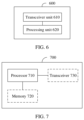
- FIG. 7 is a schematic diagram of a handover apparatus according to at least one embodiment
- FIG. 8 is a schematic diagram of a handover apparatus according to at least one embodiment.
- the technical solutions according to at least one embodiment is applied to various communication systems, for example, a 5th generation (5G) system, a new radio (NR) system, a long term evolution (LTE) system, an LTE frequency division duplex (FDD) system, an LTE time division duplex (TDD) system, a universal mobile telecommunications system (UMTS), or a future communication system.
- 5G 5th generation
- NR new radio
- LTE long term evolution
- LTE LTE frequency division duplex
- TDD LTE time division duplex
- UMTS universal mobile telecommunications system
- FIG. 1 is a schematic network architecture of an NR system.
- the network architecture includes, for example, the following devices: a core network device, an access network device, and a terminal device.
- the core network device is, for example, a 5th generation core network (5GC).
- the core network device indicates a device in a core network (CN) that provides service support for the terminal device.
- CN core network
- the core network device includes, for example, one or more of the following: an access and mobility management function (AMF) entity, a session management function (SMF) entity, or a user plane function (UPF) entity.
- AMF access and mobility management function
- SMF session management function
- UPF user plane function
- the AMF entity is also referred to as, for example, an AMF network element or an AMF function entity.
- the AMF entity is configured to being responsible for access management, mobility management, and the like of the terminal device.
- the SMF entity is also referred to as, for example, an SMF network element or an SMF function entity.
- the SMF entity is responsible for session management (for example, session establishment of a user), internet protocol (IP) address allocation and management of UE, and the like.
- session management for example, session establishment of a user
- IP internet protocol
- the UPF entity is also referred to as, for example, an UPF network element or an UPF function entity.
- the UPF entity is a user plane function entity, namely, a user plane gateway, and is configured to: route and forward a packet, process quality of service (QoS) of user plane data, or the like.
- User data is sent to an external network, for example, a data network (DN), through the UPF entity.
- DN data network
- the AMF entity, the SMF entity, and the UPF entity are understood as network elements configured to implement different functions in the core network, for example, forms a network slice based on a requirement.
- These core network elements is independent devices, or is integrated into a same device to implement different functions. This is not limited in embodiment described herein.
- the foregoing names are merely used to distinguish between different functions, and do not mean that the network elements are independent physical devices. Specific forms of the foregoing network elements are not limited in embodiments described herein. For example, the network elements are integrated into a same physical device, or is different physical devices. In addition, the foregoing names are merely used to distinguish between different functions, and do not constitute any limitation on embodiments described herein. Embodiments described herein do not exclude a possibility of using another name in a 5G network and another future network. For example, in a 6G network, terms in 5G are still used for some or all of the foregoing network elements, or other names is used. This is uniformly described herein, and details are not described below again.
- the access network device is, for example, a next generation radio access network (NG-RAN).
- NG-RAN next generation radio access network
- radio access network An access network that implements a network access function based on a radio communication technology is referred to as a radio access network (RAN), and a 5G radio access network in 3GPP is referred to as an NG-RAN.
- the radio access network manages radio resources, provide an access service for a terminal, and further complete forwarding of a control signal and user data between the terminal and the core network.
- the access network device is, for example, a base station, such as a gNB or a next generation (NG) evolved NodeB (eNB or eNodeB) (ng-eNB).
- the access network device is another device that has a wireless transceiver function.
- the access network device includes a centralized unit (CU) node and a distributed unit (DU) node.
- CU centralized unit
- DU distributed unit
- the CU implements some functions of the gNB
- the DU implements some functions of the gNB.
- the DU is responsible for processing a physical layer protocol and a real-time service.
- the DU implements functions of a radio link control (RLC) layer, a media access control (MAC) layer, and a physical (physical, PHY) layer.
- RLC radio link control
- MAC media access control
- PHY physical (physical, PHY) layer.
- the 5G access network device is another device that has a wireless transceiver function.
- the access network device and the core network device is connected through a communication interface.
- the interface between the access network device and the core network device is referred to as an NG interface.
- Access network devices is also connected through a communication interface.
- the interface between the access network devices is referred to as an Xn interface.
- the terminal device is also referred to as, for example, user equipment (UE), a mobile station (MS), a mobile terminal (MT), or the like, and is a device that provides voice and/or data connectivity for a user.
- UE user equipment
- MS mobile station
- MT mobile terminal
- the terminal device is a handheld device or a vehicle-mounted device that has a wireless connection function.
- the terminal device is a mobile phone, a tablet computer, a notebook computer, a palmtop computer, a mobile internet device (MID), a wearable device, a virtual reality (VR) device, an augmented reality (AR) device, a wireless terminal in industrial control, a wireless terminal in self driving, a wireless terminal in remote medical surgery, a wireless terminal in a smart grid, a wireless terminal in transportation safety, a wireless terminal in a smart city, a wireless terminal in a smart home, or the like. This is not limited in embodiments of described herein.
- FIG. 1 shows the core network device and the access network device that are used as an example. This is not limited in embodiments of described herein.
- the communication system further includes one or more terminal devices.
- the communication system further includes more or fewer access network devices.
- FIG. 2 is another schematic diagram of a communication system according to at least one embodiment.
- FIG. 2 is a schematic network architecture of an LTE system.
- the network architecture includes, for example, the following devices: a core network device, an access network device, and a terminal device.
- the core network device includes, for example, one or more of the following: a serving gateway (S-GW) entity, a mobility management entity (MME), or a packet data network gateway (P-GW).
- S-GW serving gateway
- MME mobility management entity
- P-GW packet data network gateway
- the S-GW entity is also referred to as, for example, an S-GW network element or an S-GW function entity.
- the S-GW entity is responsible for functions such as user plane processing, data packet routing and forwarding.
- the MME is responsible for functions such as mobility management, bearer management, user authentication, and selection of an S-GW and a P-GW.
- the P-GW entity is also referred to as, for example, a P-GW network element or a P-GW function entity.
- the S-GW entity and the P-GW entity are understood as network elements configured to implement different functions in a core network, for example, form a network slice based on a requirement.
- These core network elements are independent devices, or is integrated into a same device to implement different functions. This is not limited in embodiments described herein.
- the foregoing names are merely used to distinguish between different functions, and do not mean that the network elements are independent physical devices. Specific forms of the foregoing network elements are not limited in embodiments described herein. For example, the network elements is integrated into a same physical device, or is different physical devices. In addition, the foregoing names are merely used to distinguish between different functions, and do not constitute any limitation on embodiments described herein. Embodiments described herein do not exclude a possibility of using another name in a 5G network and another future network. For example, in a 6G network, terms in 5G is still for some or all of the foregoing network elements, or other names is used. This is uniformly described herein, and details are not described below again.
- the access network device is, for example, an access network device in an evolved universal terrestrial radio access network (E-UTRAN), for example, an access network device in a 4th generation (4G) access network.
- E-UTRAN evolved universal terrestrial radio access network
- 4G 4th generation
- the access network device is, for example, a NodeB, an evolved NodeB (eNB, or eNodeB).
- the access network device and the core network device is connected through a communication interface.
- the interface between the access network device and the core network device is referred to as an S1 interface.
- Access network devices are also connected through a communication interface.
- the interface between the access network devices is referred to as X2 interface.
- Names of interfaces between the devices in FIG. 2 are merely examples, and the interfaces have other names during specific implementation. This is not specifically limited in embodiments described herein.
- names of messages (or signaling) transmitted between the foregoing devices are merely examples, and do not constitute any limitation on functions of the messages.
- FIG. 3 is still another schematic diagram of a communication system according to at least one embodiment.
- the communication system includes at least two network devices, for example, a network device 310 and a network device 320 shown in FIG. 3 .
- the communication system further includes at least one terminal device, for example, a terminal device 330 shown in FIG. 3 .
- the terminal device 330 is mobile or fixed.
- the network device 310 and the network device 320 are devices that communicates with the terminal device 330 through a radio link, for example, a base station or a base station controller, or the access network device described in FIG. 1 or FIG. 2 .
- Each network device provides communication coverage for a particular geographic area, and communicates with a terminal device within the coverage (a cell).
- FIG. 3 shows two network devices and one terminal device that are used as an example. However, this does not constitute any limitation on embodiments described herein.
- the communication system includes more network devices, and another quantity of terminal devices is included within coverage of each network device.
- the communication system further includes one or more core network devices. This is not limited in embodiments of described herein.
- the communication system includes another quantity of access network devices and another quantity of terminal devices.
- the cell is an area within coverage of a wireless network of the network device.
- different cells corresponds to a same network device or different network devices.
- a network device to which a cell #1 belongs and a network device to which a cell #2 belongs is different network devices, for example, base stations.
- the cell #1 and the cell #2 is managed by different base stations.
- the network device that manages the cell #1 and the network device that manages the cell #2 is different radio frequency processing units of a same base station, for example, radio remote units (RRUs).
- RRUs radio remote units
- the cell #1 and the cell #2 is managed by a same base station and have a same baseband processing unit and a same intermediate frequency processing unit, but have different radio frequency processing units.
- the network device to which the cell #1 belongs and the network device to which the cell #2 belongs is a same network device, for example, a base station.
- the cell #1 and the cell #2 is managed by a same base station.
- the terminal device determines, according to a criterion S, a cell on which the terminal device camps.
- the criterion S is, for example, that a received power in cell search is greater than 0 decibel (dB), and received signal quality in the cell search is greater than 0 dB.
- the received power in the cell search is determined based on a reference signal received power (RSRP) value of a found or measured cell, a minimum receive level of the cell, a minimum receive level offset of the cell, and the like.
- the received signal quality in the cell search is determined based on a reference signal received quality (RSRQ) value, minimum received signal quality, and a minimum received signal received quality offset of the found or measured cell.
- RSRP reference signal received power
- RSS reference signal received quality
- a source cell indicates a cell that provides a service for the terminal device before the handover
- a target cell indicates a cell that provides a service for the terminal device after the handover
- a network device In a prior handover procedure, mobility management of a terminal device is controlled by a network device.
- the network device sends a handover message to indicate a specific cell to which the terminal device hands over and information used for the handover.
- a source network device sends a handover message to the terminal device, to control the terminal device to hand over from a source cell to a target cell.
- the handover message is an RRC message.
- the RRC message is an RRC connection reconfiguration message that carries a mobility control information element (mobility control info).
- the RRC message is an RRC reconfiguration message that carries a synchronization reconfiguration information element (reconfiguration with sync).
- the terminal device initiates a random access procedure to the target network device.
- a beam characteristic is introduced in NR, and the target network device further considers the beam characteristic in response to configuring the RACH resource information used for accessing the target cell.
- the target network device configures, for a beam (for example, a synchronization signal block (SSB) or a channel state information reference signal (CSI-RS)) that belongs to the target cell, a RACH resource associated with the beam.
- a beam for example, a synchronization signal block (SSB) or a channel state information reference signal (CSI-RS)
- CSI-RS channel state information reference signal
- the handover message and the RRC message used to indicate the handover are described from different perspectives.
- the handover message is described from the perspective of a function, and is intended to indicate that the message is used to indicate the terminal device to perform the handover.
- the RRC message is described from the perspective of a message type, and is intended to indicate that the message is higher layer signaling.
- the RRC reconfiguration message is an example of the RRC message. In other words, the handover message is delivered to the terminal device by using higher layer signaling.
- RRC messages for example, the RRC connection reconfiguration message in LTE and the RRC reconfiguration message in NR. These messages are merely examples for ease of understanding, and does not constitute any limitation on embodiments described herein. A specific name of the RRC message used to indicate the terminal device to initiate a handover procedure is not limited in embodiments described herein.
- the target cell is named for ease of distinguishing from another cell, and does not constitute any limitation on embodiments described herein. Embodiments described herein do not exclude a possibility that another name is defined in a future protocol to express a same or similar meaning.
- At least one embodiment provides a method that handover reliability and handover latency reduction is considered, and performance of a communication system is also improved.
- FIG. 4 is a schematic diagram of interaction of a handover method 400 according to at least one embodiment.
- the method 400 includes the following steps.
- a terminal device receives a first message, where the first message includes information about N candidate cells.
- N is an integer greater than 1 or equal to 1.
- the first message is delivered to the terminal device by using higher layer signaling.
- the first message is an RRC reconfiguration (RRC Reconfiguration, RRC reconfig) message.
- the terminal device Before a handover, the terminal device obtains information about one or more candidate cells. In other words, the terminal device obtains the information about the N candidate cells in advance, so that the terminal device selects a target cell from the N candidate cells in response to a handover being actually used. In this manner, a handover success rate is improved, long-time communication interruption is avoided, and user experience is improved.
- a source network device in response to signal quality of a source cell being good, provides the information about the one or more candidate cells for the terminal device.
- the signal quality of the source cell is determined based on one or more of the following: a reference signal received power (RSRP), reference signal received quality (RSRQ), and a signal to interference plus noise ratio (SINR).
- RSRP reference signal received power
- RSRQ reference signal received quality
- SINR signal to interference plus noise ratio
- the terminal device obtains information about a candidate cell by using a conditional handover (CHO) mechanism.
- Handover mechanisms that improve the handover success rate are applicable to at least one embodiment.
- the N candidate cells include N1 candidate cells and N2 candidate cells.
- the N1 candidate cells include a cell for which no CHO execution condition information is configured, and the N2 candidate cells include a cell for which the CHO execution condition information is configured.
- N1 and N2 is integers greater than 0 or equal to 0.
- some candidate cells are cells for which no CHO execution condition information is configured, and the other some candidate cells are cells for which the CHO execution condition information is configured.
- the CHO execution condition information is configured for the N candidate cells.
- no CHO execution condition information is configured for the N candidate cells.
- the cell for which no CHO execution condition information is configured is referred to as a first-type candidate cell
- the cell for which the CHO execution condition information is configured is referred to as a second-type candidate cell.
- the information about the candidate cell includes CHO configuration information of the candidate cell.
- the information about the candidate cell includes the CHO execution condition information (also referred to as CHO trigger condition information) and a parameter corresponding to the candidate cell.
- the following describes the CHO execution condition information and the parameter corresponding to the candidate cell in detail with reference to the CHO mechanism.
- the terminal device In response to the terminal device performing a handover (for example, the signal quality of the source cell becomes poorer, where the signal quality includes one or more of the following: the RSRP, the RSRQ, and the SINR), the terminal device hands over from the source cell to the target cell.
- the target cell belongs to the N candidate cells.
- the terminal device attempts to hand over from the source cell to the target cell (or the terminal device attempts a handover from the source cell to the target cell, in other words, the terminal device performs a handover from the source cell to the target cell).
- the target cell is a cell for which the CHO execution condition information is configured, or the target cell is a cell for which no CHO execution condition information is configured.
- the terminal device After receiving the first message, the terminal device determines the target cell from the N candidate cells, and perform the handover. In step 420 , that the terminal device attempts to hand over from the source cell to the target cell does not necessarily mean that the terminal device is able to successfully hand over to the target cell, in other words, the terminal device successfully accesses the target cell. In step 420 , that the terminal device attempts to hand over from the source cell to the target cell indicates that the terminal device attempts to hand over to or attempts to access the target cell after determining the target cell to which the terminal device is able to hand over.
- the second message is further used to indicate the source cell (or the source network device) to send a message #A to the target cell (or a target network device).
- the source cell sends the message #A to the target cell based on the second message.
- the duration of the first preset time period is preset duration, for example, pre-specified in the protocol or preconfigured by the network device.
- the target cell After receiving the preamble sent by the terminal device, the target cell sends the third message to the source cell.
- the third message and the second message are names for differentiation, and do not limit the protection scope of embodiments described herein.
- the third message is a newly defined message or reuse an existing Xn message. This is not limited.
- the third message includes the information about the target cell.
- the target cell or a target network device indicates the information about the target cell to the source cell.
- the information about the target cell includes identification information of the target cell (for example, a PCI of the target cell and frequency information corresponding to the target cell, and/or a cell CGI of the target cell).
- identification information of the target cell for example, a PCI of the target cell and frequency information corresponding to the target cell, and/or a cell CGI of the target cell.
- the third message is further used to indicate the source cell to send a message #A to the target cell. It is understood that the source cell sends the message #A to the target cell based on the third message.
- the third message is further used to indicate the source cell to forward data to the target cell. It is understood that the source cell forwards the data to the target cell based on the third message. Specifically, for a type of the data forwarded by the source cell to the target cell, refer to the foregoing descriptions. Details are not described again.
- timer for implementation is merely an example for description, and embodiments described herein are not limited thereto.
- signaling is used for implementation.
- the terminal device no longer maintains data transmission with the source cell.
- the terminal device performs any one of the following processing.
- the Terminal Device Determines, from N Candidate Cells, a Cell that is Accessed.
- the terminal device attempts to access a cell in the N candidate cells. For example, the terminal device determines, through cell selection or CHO configuration information, the cell that is accessed.
- the terminal device performs cell selection. In response to the selected cell belonging to the N candidate cells, the terminal device attempts to hand over to the selected cell. In response to the selected cell not belonging to the N candidate cells, the terminal device initiates a reestablishment procedure (for example, the terminal device reestablishes a connection to the selected cell).
- a reestablishment procedure for example, the terminal device reestablishes a connection to the selected cell.
- the terminal device determines whether there is a cell that meets a CHO execution condition in the candidate cells. If the cell that meets the CHO execution condition is determined, the terminal device attempts to hand over to the determined cell that meets the CHO execution condition. If there is no cell that meets the CHO execution condition in the candidate cells, the terminal device initiates a reestablishment procedure (for example, the terminal device reestablishes a connection to the selected cell).
- the terminal device initiates a reestablishment procedure is also considered as that the terminal device initiates an RRC reestablishment procedure or the terminal device initiates an RRC connection reestablishment procedure.
- the RRC reestablishment procedure includes the following several steps.
- the reestablishment cell is a cell determined by the terminal device through cell selection, cell search, or cell detection.
- the reestablishment cell is a cell that meets a preset criterion, for example, a cell selection criterion S in the NR protocol TS38.304-f30.
- a preset criterion for example, a cell selection criterion S in the NR protocol TS38.304-f30.
- a cell selection criterion S in the NR protocol TS38.304-f30.
- the terminal device releases the connection to the source cell at an appropriate time point, and stop data transmission with the source cell. In this way, the terminal device is prevented from maintaining the source connection for a long time after the terminal device communicates with the target cell, to further reduce energy consumption of the terminal device and reduce implementation complexity of the terminal device. In addition, signaling overheads is reduced by using the timer.
- a processing method after the RLF occurs in the source cell is further provided, so that the terminal device accesses a cell in the N candidate cells as much as possible. Because the candidate cell has/stores context information of the terminal device (for example, in a handover preparation phase, each candidate cell obtains the context information of the terminal device from the source cell), it is ensured that the terminal device successfully performs access, and a latency required by a network device side to obtain the context information of the terminal device is reduced.
- the foregoing describes a scenario of disconnecting data transmission between the terminal device and the source cell.
- the terminal device maintains data transmission with the source cell during running of the timer, and the terminal device disconnects data transmission with the source cell after the timer expires.
- radio bearer radio bearer
- a radio bearer is a data radio bearer of a service, an SRB of a service, or a specified data radio bearer/signaling radio bearer. This is not limited in embodiments described herein.
- the terminal device after determining a target cell from N candidate cells, the terminal device generates a radio bearer corresponding to the target cell, and maintains a radio bearer configuration corresponding to the source cell.
- Generation indicates that the terminal device reestablishes the radio bearer corresponding to the target cell, or indicates that the terminal device establishes the radio bearer corresponding to the target cell.
- the terminal device reestablishes a radio bearer, associate, with the target cell, the radio bearer obtained after the reestablishment, and maintain a radio bearer configuration corresponding to the source cell.
- the terminal device After the terminal device determines the target cell, the terminal device reestablishes an SRB, and the reestablished SRB is mapped to (or associated with) a target MCG.
- the terminal device maintains an SRB configuration corresponding to a source MCG.
- An MCG includes a primary cell (PCell).
- the MCG further includes at least one secondary cell (SCell).
- the source MCG belongs to a source network device
- the target MCG belongs to a target network device.
- the terminal device fails to hand over to the target cell, in other words, the terminal device fails to access the target cell
- the terminal device restores use of the SRB configuration corresponding to the source MCG
- the terminal device reestablishes an SRB
- the reestablished SRB is mapped to (or associated with) the source MCG.
- the terminal device establishes a radio bearer corresponding to a target MCG, and suspends a radio bearer corresponding to a source MCG.
- the network device further configures priority information for each candidate cell in the second-type candidate cell, or the network device configures priority information for the second-type candidate cell in an implicit indication manner.
- the network device further configures priority information for each candidate cell in the second-type candidate cell, or the network device configures priority information for the second-type candidate cell in an implicit indication manner.
- the terminal device determines whether the cell 6 and the cell 7 meet the CHO execution condition.
- the terminal device attempts to perform a handover. If there is no cell that meets the CHO execution condition, the terminal device performs reestablishment.
- the terminal device fails to hand over to the cell 4 with the highest priority, the terminal device alternatively performs reestablishment.
- cell priorities of the first-type candidate cells is the same, and the terminal device preferentially attempts to hand over to at least one of the first-type candidate cells.
- the priority of the second-type candidate cell is higher than the priority of the first-type candidate cell.
- the foregoing describes the manner in which the terminal device selects the target cell.
- the terminal device releases configuration information of a candidate cell (for example, including CHO configuration information of at least one second-type candidate cell and configuration information of a first-type candidate cell).
- configuration information of a candidate cell for example, including CHO configuration information of at least one second-type candidate cell and configuration information of a first-type candidate cell.
- An example in which the terminal device releases CHO configuration information of at least one second-type candidate cell is mainly used below for description.
- the terminal device releases the CHO configuration information in response to the terminal device successfully handing over to or accessing a cell that meets a CHO execution condition. For another example, in response to the terminal device successfully hands over to or accesses a cell that is a candidate cell and that is selected after cell selection is performed, the terminal device releases the CHO configuration information.
- “when . . . ” mentioned for a plurality of times is not limited to necessarily simultaneous occurrence.
- that the terminal device releases the CHO configuration information in response to the terminal device successfully handing over to or accessing a cell that meets a CHO execution condition indicates that the terminal device releases the CHO configuration information if the terminal device successfully hands over to or accesses the cell that meets the CHO execution condition. Details are not described in the following again.
- the network device (for example, a source network device or a target network device) sends, to the terminal device, a message used to indicate the terminal device to cancel the CHO procedure or release the CHO configuration information. After receiving the message, the terminal device cancels the CHO procedure or releases the CHO configuration information.
- the terminal device releases the CHO configuration information.
- the terminal device After the terminal device fails to hand over to a cell that meets a CHO execution condition, the terminal device performs cell selection. If a selected cell is not a candidate cell, the terminal device initiates the reestablishment procedure.
- the terminal device After the terminal device fails to hand over to a cell that meets a CHO execution condition, the terminal device performs cell selection, and a selected cell is a candidate cell. The terminal device attempts to hand over to the cell, but the terminal device fails to hand over to the cell. In this case, the terminal device initiates the reestablishment procedure.
- the terminal device fails to hand over to a cell that meets a CHO execution condition, and the terminal device continues to perform determining and finds that another candidate cell does not meet the CHO execution condition. In this case, the terminal device initiates the reestablishment procedure.
- the terminal device after a handover fails (for example, the terminal device fails to hand over to candidate cells, fails to hand over to at least one candidate cell that meets a CHO execution condition, or fails to hand over to at least one cell that is a candidate cell and that is selected after cell selection is performed), the terminal device initiates the reestablishment procedure.
- the terminal device After a handover fails (for example, the terminal device fails to hand over to candidate cells, fails to hand over to at least one candidate cell that meets a CHO execution condition, or fails to hand over to at least one cell that is a candidate cell and that is selected after cell selection is performed), and an RLF occurs in a source cell, the terminal device initiates the reestablishment procedure.
- a handover fails (for example, the terminal device fails to hand over to candidate cells, fails to hand over to at least one candidate cell that meets a CHO execution condition, or fails to hand over to at least one cell that is a candidate cell and that is selected after cell selection is performed), and an RLF occurs in a source cell
- the terminal device initiates the reestablishment procedure.
- the terminal device falls back to the source cell. That the terminal device falls back to the source cell indicates that the terminal device continues to stay in the source cell, or the terminal device continues to maintain data transmission with the source cell.
- the terminal device fails to hand over to a cell that meets a CHO execution condition, the terminal device falls back to the source cell.
- the terminal device After the terminal device fails to hand over to a cell that meets a CHO execution condition, the terminal device performs cell selection, and a selected cell is a candidate cell. The terminal device attempts to hand over to the cell, but the terminal device fails to hand over to the cell, and the terminal device falls back to the source cell.
- the terminal device fails to hand over to a cell that meets a CHO execution condition, the terminal device continues to determine that another candidate cell does not meet the CHO execution condition, and the terminal device falls back to the source cell.
- the terminal device falls back to the source cell.
- the terminal device releases the CHO configuration information.
- the terminal device releases the CHO configuration information appropriately and in a timely manner, to reduce energy consumption and storage space of the terminal device.
- the manner of processing the radio bearer in response to the terminal device maintaining data transmission with the source cell in the aspect 2 is used in the scenario in response to the terminal device maintaining data transmission with the source cell mentioned in any one of the foregoing aspects.
- the possible processing manner used after the handover of the terminal device fails in the aspect 3 is used in the scenario after the handover fails mentioned in any one of the foregoing aspects.
- the message #A includes, for example, a first downlink (DL) count (COUNT) value.
- the first DL count value is used to indicate a DL count value of the 1 st forwarded DL PDCP SDU.
- the count value includes, for example, a PDCP SN and a hyper frame number (HFN).
- the 1V early forwarding transfer message includes a first uplink (uplink, UL) count value.
- the first UL count value is used to indicate a UL count value of the 1 st lost (or out-of-order) UL PDCP SDU and a receiving status of the UL PDCP SDU(s).
- the receiving status is used to indicate a receiving status of at least one UL PDCP SDU starting from the 1 st lost (or out-of-order) UL PDCP SDU.
- a bitmap is used to indicate the receiving status.
- the 1 bit in the bitmap indicates a receiving status of the 1 st lost (or out-of-order) UL PDCP SDU.
- FIG. 5 A , FIG. 5 B , and FIG. 5 C are divided merely for ease of understanding, and there is no strict phase division actually. Whether the phases are divided or how the phases are divided does not limit the protection scope of this embodiment described herein.
- the source network device sends the handover request message to at least one candidate network device. For example, as shown in FIG. 5 A , FIG. 5 B , and FIG. 5 C , in step 510 , the source network device sends a handover request message to each of a candidate network device 1 and a candidate network device X.
- the source network device determines whether to use the solution in this embodiment described herein. In other words, the source network device determines whether to consider handover reliability and handover latency reduction. For example, the source network device determines whether to perform a handover in a “CHO+dual active protocol stack (DAPS)” handover manner. In other words, the source network device determines whether to maintain data transmission between a terminal device and the source network device after the source network device sends a message including CHO configuration information, after the terminal device determines a target cell to which the terminal device is to hand over, or after the terminal device successfully hands over to a determined target cell.
- DAPS dual active protocol stack
- the first indication information is used to indicate that the terminal device maintains data transmission with the source network device (or maintains a connection, for example, an RRC connection, to the source network device) in a handover process, for example, after the terminal device determines the target cell.
- the first indication information is used to indicate that a 0-millisecond (ms) handover interruption latency needs to be implemented for the handover.
- the source network device forwards the downlink data (for example, the DL PDCP SDU(s)) to the target network device.
- the type of the data forwarded by the source network device to the target network device is not limited.
- the source network device in addition to the DL PDCP SDU(s), the source network device further forwards a UL PDCP SDU(s) to the target network device.
- the source network device forwards the UL PDCP SDU(s) to the target network device.
- the fourth message further includes an S th (where S is greater than 1) UL count value, and the S th UL count value is used to indicate a UL count value of the 1 st lost (or out-of-order) UL PDCP SDU in response to the fourth message being sent.
- the fourth message further includes a receiving status of a UL PDCP SDU(s) at the source network device in response to the fourth message being sent. The receiving status is used to indicate a receiving status of at least one UL PDCP SDU starting from the 1 st lost (or out-of-order) UL PDCP SDU in response to the source network device sending the fourth message. For example, a bitmap is used to indicate the receiving status.
- the target network device sends a path change request message to the AMF.
- the AMF performs a bearer modification procedure with a UPF.
- the AMF After a path change succeeds, the AMF sends a response message for the path change request message to the target network device.
- the AMF sends a path change acknowledgment message to the target network device.
- the target network device After determining that the path change succeeds, the target network device indicates the source network device to release a UE context, a radio resource, and the like.
- the target network device indicates the source network device to release the UE context, the radio resource, and the like.
- Steps in the method 500 are not necessarily performed. For example, some steps is skipped.
- an execution sequence of each step is not fixed, and is not limited to that shown in the figure.
- the execution sequence of each step is determined based on a function and internal logic of the step. For example, an execution sequence of step 560 and step 570 is not limited.
- the method 500 is merely an example for description, and the solutions in the aspect 1 to the aspect 5 in the method 400 is used in the method 500 .
- the solutions in the aspect 1 to the aspect 5 in the method 400 is used in the method 500 .
- the solutions in the aspect 1 to the aspect 5 in the method 400 refer to the solution in the aspect 3 in the method 400 .
- a radio bearer processing method in a scenario in which the terminal device maintains data transmission with the source cell mentioned in the method 500 refer to the solution in the aspect 2 in the method 400 .
- the terminal device starts the timer T 1 in any step such as step 530 , step 540 , step 5401 , step 550 , or step 580 .
- the source network device starts the timer T 2 in any step such as step 530 , step 5401 , step 550 , or step 590 .
- the process of the handover from the source cell to the target cell in the method 400 is the handover execution phase in the method 500 , or is from the handover execution phase to the handover completion phase.
- the process of the handover from the source cell to the target cell includes a phase from step 540 to step 5100 , includes a phase from step 540 to step 5140 , includes a phase from step 5401 to step 5100 , or includes a phase from step 5401 to step 5140 .
- a specific phase is not limited, and any phase in which a low handover interruption latency for example, a 0-ms handover interruption latency, is implemented is used in embodiments described herein.
- a network device configures one or more candidate cells for a terminal device by using higher layer signaling such as an RRC message.
- the network device indicates CHO configuration information of one or more candidate cells to the terminal device by using one RRC message or a plurality of RRC messages.
- a quantity of RRC messages herein is not necessarily in a one-to-one correspondence with a quantity of candidate cells.
- the network device indicates the CHO configuration information of the one or more candidate cells by using one RRC message, or indicates CHO configuration information of a plurality of candidate cells by using a plurality of RRC messages. This is not limited in embodiments described herein.
- the CHO configuration information of the candidate cell includes CHO execution condition information (also referred to as CHO trigger condition information) and the parameter corresponding to the candidate cell.
- the CHO execution condition information is understood as trigger condition information used by the terminal device to perform a handover decision.
- the terminal device determines, based on CHO execution condition information of a candidate cell, whether the candidate cell meets a CHO execution condition. If the candidate cell meets the CHO execution condition, the candidate cell is determined as a target cell. In response to determining that a candidate cell configured by the network device meets the CHO execution condition, the terminal device considers handing over to the candidate cell.
- Meeting the CHO execution condition is one of conditions for the terminal device to perform a handover, and does not mean that a candidate cell meets the CHO execution condition, and the terminal device definitely hands over to the candidate cell.
- the CHO execution condition information is shared by one or more candidate cells.
- the plurality of candidate cells corresponds to same CHO execution condition information.
- the CHO execution condition information alternatively is cell-level.
- the plurality of candidate cells have respective corresponding CHO execution condition information.
- That the candidate cell meets the CHO execution condition means that signal quality of the candidate cell meets the CHO execution condition corresponding to the candidate cell.
- the CHO execution condition is a CHO execution condition shared with another candidate cell, or is a CHO execution condition corresponding to the candidate cell. This is not limited in embodiments described herein.
- the CHO execution condition information specifically includes a CHO execution event (or trigger event) type and a corresponding threshold.
- the CHO execution event type includes but is not limited to, for example, an event A3, an event A4, an event A5, an event B1, and an event B2.
- the event A3 specifically being that cell signal quality of a candidate cell is higher than cell signal quality of a serving cell by a preset first threshold.
- the event A5 is specifically that cell signal quality of a candidate cell is higher than a preset second threshold and cell signal quality of a serving cell is lower than a preset third threshold.
- the events refer to a prior technology. For brevity, details are not described herein.
- the CHO execution condition information includes an indication for the CHO execution event type and an indication for the corresponding threshold.
- the parameter corresponding to the candidate cell includes but is not limited to a parameter used by the terminal device to hand over to the candidate cell or a parameter used by the terminal device to perform communication in the candidate cell.
- the parameter corresponding to the candidate cell includes a related parameter required by the terminal to hand over (or access) the candidate cell.
- the parameter corresponding to the candidate cell includes but is not limited to a C-RNTI allocated by the candidate cell to the terminal device, radio resource information (for example, random access channel (RACH) resource information) of accessing the candidate cell, index information of the candidate cell, frequency information of the candidate cell, a physical layer configuration parameter, a media access control MAC layer configuration parameter, a radio link control RLC layer configuration parameter, a packet data convergence protocol PDCP layer configuration parameter, a service data adaptation protocol SDAP layer configuration parameter, an RRC layer configuration parameter, or bearer configuration information.
- the parameter corresponding to the candidate cell further includes measurement-related information, for example, a measurement identifier (measID) or a measurement frequency.
- measID measurement identifier
- the index information of the candidate cell includes but is not limited to the measurement-related information (for example, the measurement identifier (measID) and the measurement frequency), and a CHO configuration identifier (CHO-Configld) corresponding to the candidate cell.
- the index information of the candidate cell further includes but is not limited to a CGI of the candidate cell or a PCI of the candidate cell.
- the frequency information of the candidate cell includes but is not limited to an absolute frequency of a synchronization signal block (SSB) or an absolute frequency position of a reference resource block (RB).
- the absolute frequency of the SSB is an information element “absolute frequency SSB (absoluteFrequencySSB)”.
- the reference RB is a common RB (common resource block, CRB) numbered 0, for example, denoted as a CRB 0.
- the absolute frequency position of the reference RB includes an information element “absolute frequency point A (absoluteFrequencyPoint A)”, “frequency band list (frequency BandList)”, or “subcarrier space (SCS)-specific carrier list (scs-SpecificCarrierList)”.
- an RB is obtained through division by using 12 consecutive subcarriers as a unit in frequency domain, and a “point A” is used as a common reference point for RB division.
- a CRB number starts from 0, for example, denoted as the CRB 0.
- a subcarrier 0 in the CRB 0 corresponds to the point A in a middle point of the frequency domain.
- the point A is configured by the network device for the terminal device.
- the parameter used by the terminal device to perform communication in the candidate cell includes but is not limited to the physical layer configuration parameter, the media access control (MAC) layer configuration parameter, the radio link control (RLC) layer configuration parameter, the packet data convergence protocol (PDCP) layer configuration parameter, the service data adaption protocol (SDAP) layer configuration parameter, the radio resource control (RRC) layer configuration parameter, or the bearer configuration information.
- the physical layer configuration parameter the media access control (MAC) layer configuration parameter
- the radio link control (RLC) layer configuration parameter the radio link control (RLC) layer configuration parameter
- PDCP packet data convergence protocol
- SDAP service data adaption protocol
- RRC radio resource control
- the foregoing enumeration of the CHO configuration information and the parameter corresponding to the candidate cell is merely an example, and does not constitute any limitation on embodiment described herein. At least one embodiment does not exclude a possibility that the CHO configuration information includes other parameters corresponding to the candidate cell than the foregoing enumerated parameters.
- the network device is a target cell or a network device to which the target cell belongs
- the transceiver unit in the part 910 is configured to perform transceiver-related steps performed by the target cell or the network device to which the target cell belongs in the embodiment shown in FIG. 5 A , FIG. 5 B , and FIG. 5 C
- the part 920 is configured to perform processing-related steps performed by the target cell or the network device to which the target cell belongs in the embodiment shown in FIG. 5 A , FIG. 5 B , and FIG. 5 C .
- the chip includes a transceiver unit and a processing unit.
- the transceiver unit is an input/output circuit or a communication interface.
- the processing unit is a processor, a microprocessor, or an integrated circuit that is integrated on the chip.
- At least one embodiment further provides a computer-readable storage medium.
- the computer-readable storage medium stores computer instructions used to implement the method performed by the terminal device or the method performed by the network device (for example, a source cell or a network device to which the source cell belongs; for another example, a target cell or a network device to which the target cell belongs) in the foregoing method embodiments.
- the computer in response to the computer instructions being executed by a computer, the computer is enabled to implement the method performed by the terminal device or the method performed by the network device (for example, the source cell or the network device to which the source cell belongs; for another example, the target cell or the network device to which the target cell belongs) in the foregoing method embodiments.
- the network device for example, the source cell or the network device to which the source cell belongs; for another example, the target cell or the network device to which the target cell belongs
- At least one embodiment further provides a computer program product including instructions.
- the computer is enabled to implement the method performed by the terminal device or the method performed by the network device (for example, a source cell or a network device to which the source cell belongs; for another example, a target cell or a network device to which the target cell belongs) in the foregoing method embodiments.
- At least one embodiment further provides a communication system.
- the communication system includes the network device and the terminal device in the foregoing embodiments.
- the communication system includes the target network device and the terminal device in the embodiment described above with reference to FIG. 4 or FIG. 5 A , FIG. 5 B , and FIG. 5 C .
- the communication system includes the source network device, the target network device, and the terminal device in the embodiment described above with reference to FIG. 4 or FIG. 5 A , FIG. 5 B , and FIG. 5 C .
- the terminal device or the network device includes a hardware layer, an operating system layer running on the hardware layer, and an application layer running on the operating system layer.
- the hardware layer includes hardware such as a central processing unit (CPU), a memory management unit (MMU), and a memory (which is also referred to as a main memory).
- An operating system of the operating system layer is any one or more computer operating systems that implement service processing by using a process, for example, a Linux operating system, a Unix operating system, an Android operating system, an iOS operating system, or a Windows operating system.
- the application layer includes applications such as a browser, an address book, word processing software, and instant messaging software.
- a specific structure of an execution body of the method provided in at least one embodiment is not specifically limited, provided that a program that records code of the method provided in at least one embodiment is run to perform communication according to the method described herein.
- the method provided in at least one embodiment is performed by the terminal device or the network device, or is performed by a functional module that is in the terminal device or the network device and that involves and executes a program.
- a computer-readable medium includes but is not limited to: a magnetic storage component (for example, a hard disk, a floppy disk or a magnetic tape), an optical disc (for example, a compact disc (CD) or a digital versatile disc (DVD)), a smart card, and a flash memory component (for example, an erasable programmable read-only memory (EPROM), a card, a stick, or a key drive).
- a magnetic storage component for example, a hard disk, a floppy disk or a magnetic tape
- an optical disc for example, a compact disc (CD) or a digital versatile disc (DVD)
- a smart card for example, an erasable programmable read-only memory (EPROM), a card, a stick, or a key drive.
- EPROM erasable programmable read-only memory
- machine-readable media includes but is not limited to a radio channel and various other media that stores, includes, and/or carries instructions and/or data.
- the processor mentioned in embodiments is a central processing unit (CPU), or is another general-purpose processor, a digital signal processor (DSP), an application specific integrated circuit (ASIC), a field programmable gate array (FPGA) or another programmable logic device, a discrete gate or a transistor logic device, a discrete hardware component, or the like.
- the general-purpose processor is a microprocessor, or the processor is any type of processor or the like.
- the memory mentioned in at least one embodiment is a volatile memory or a nonvolatile memory, or includes a volatile memory and a nonvolatile memory.
- the nonvolatile memory is a read-only memory (ROM), a programmable read-only memory (programmable ROM, PROM), an erasable programmable read-only memory (erasable PROM, EPROM), an electrically erasable programmable read-only memory (electrically EPROM, EEPROM), or a flash memory.
- the volatile memory is a random access memory (random access memory, RAM).
- the RAM is used as an external cache.
- the RAM includes the following plurality of forms: a static random access memory (static RAM, SRAM), a dynamic random access memory (dynamic RAM, DRAM), a synchronous dynamic random access memory (synchronous DRAM, SDRAM), a double data rate synchronous dynamic random access memory (double data rate SDRAM, DDR SDRAM), an enhanced synchronous dynamic random access memory (enhanced SDRAM, ESDRAM), a synchlink dynamic random access memory (synchlink DRAM, SLDRAM), and a direct rambus dynamic random access memory (direct rambus RAM, DR RAM).
- static random access memory static random access memory
- DRAM dynamic random access memory
- DRAM synchronous dynamic random access memory
- SDRAM double data rate synchronous dynamic random access memory
- double data rate SDRAM double data rate SDRAM
- ESDRAM enhanced synchronous dynamic random access memory
- synchlink dynamic random access memory synchlink dynamic random access memory
- direct rambus RAM direct rambus RAM, DR RAM
- the memory is integrated into the processor.
- the processor being a general-purpose processor, a DSP, an ASIC, an FPGA, another programmable logic device, a discrete gate or a transistor logic device, or a discrete hardware component
- the memory storage module
- the memory described in this specification is intended to include, but is not limited to, these memories and any other memory of a suitable type.
- the apparatus and method is implemented in another manner.
- the described apparatus embodiments are merely examples.
- division into the units is merely logical function division.
- another division manner is used.
- a plurality of units or components is combined or integrated into another system, or some features is ignored or not performed.
- the displayed or discussed mutual couplings or direct couplings or communication connections is implemented through some interfaces.
- the indirect couplings or communication connections between the apparatuses or the units is implemented in electrical, mechanical, or other forms.
- functional units in at least one embodiment is integrated into one unit, or each of the units exists alone physically, or two or more units is integrated into one unit.
- All or some of the foregoing embodiments is implemented by using software, hardware, firmware, or any combination thereof.
- all or some of the embodiments are implemented in a form of a computer program product.
- the computer program product includes one or more computer instructions.
- the procedures or functions according to at least one embodiment are all or partially generated.
- the computer is a general-purpose computer, a dedicated computer, a computer network, or another programmable apparatus.
- the computer is a personal computer, a server, a network device, or the like.
- the computer instructions is stored in a computer-readable storage medium or is transmitted from a computer-readable storage medium to another computer-readable storage medium.
Landscapes
- Engineering & Computer Science (AREA)
- Computer Networks & Wireless Communication (AREA)
- Signal Processing (AREA)
- Mobile Radio Communication Systems (AREA)
Applications Claiming Priority (3)
| Application Number | Priority Date | Filing Date | Title |
|---|---|---|---|
| CN202010093425.7A CN113271633A (zh) | 2020-02-14 | 2020-02-14 | 切换的方法和通信装置 |
| CN202010093425.7 | 2020-02-14 | ||
| PCT/CN2021/074593 WO2021159980A1 (zh) | 2020-02-14 | 2021-02-01 | 切换的方法和通信装置 |
Related Parent Applications (1)
| Application Number | Title | Priority Date | Filing Date |
|---|---|---|---|
| PCT/CN2021/074593 Continuation WO2021159980A1 (zh) | 2020-02-14 | 2021-02-01 | 切换的方法和通信装置 |
Publications (2)
| Publication Number | Publication Date |
|---|---|
| US20220394577A1 US20220394577A1 (en) | 2022-12-08 |
| US12349012B2 true US12349012B2 (en) | 2025-07-01 |
Family
ID=77227178
Family Applications (1)
| Application Number | Title | Priority Date | Filing Date |
|---|---|---|---|
| US17/886,762 Active 2042-02-14 US12349012B2 (en) | 2020-02-14 | 2022-08-12 | Handover method and communication apparatus |
Country Status (4)
| Country | Link |
|---|---|
| US (1) | US12349012B2 (de) |
| EP (1) | EP4106400A4 (de) |
| CN (1) | CN113271633A (de) |
| WO (1) | WO2021159980A1 (de) |
Cited By (1)
| Publication number | Priority date | Publication date | Assignee | Title |
|---|---|---|---|---|
| US20230292191A1 (en) * | 2020-08-05 | 2023-09-14 | Nokia Solutions And Networks Oy | Mechanism for cell identity management |
Families Citing this family (37)
| Publication number | Priority date | Publication date | Assignee | Title |
|---|---|---|---|---|
| WO2020175876A1 (en) * | 2019-02-26 | 2020-09-03 | Lg Electronics Inc. | Relaxation of mobility condition based on serving cell quality |
| EP4333503A4 (de) * | 2021-04-28 | 2025-04-30 | KT Corporation | Verfahren und vorrichtung zur mobilitätssteuerung |
| KR20220164989A (ko) * | 2021-06-07 | 2022-12-14 | 삼성전자주식회사 | 핸드오버를 수행하는 전자 장치 및 그 동작 방법 |
| CN113784405A (zh) * | 2021-08-19 | 2021-12-10 | Oppo广东移动通信有限公司 | 一种小区选择方法、终端设备及网络设备 |
| CN115915300A (zh) * | 2021-08-25 | 2023-04-04 | 展讯通信(上海)有限公司 | 小区切换、配置方法及装置、计算机可读存储介质、用户设备、网络设备 |
| CN115942397A (zh) * | 2021-08-25 | 2023-04-07 | 展讯通信(上海)有限公司 | 小区切换、配置方法及装置、计算机可读存储介质、用户设备、网络设备 |
| CN115884289A (zh) * | 2021-09-29 | 2023-03-31 | 展讯通信(上海)有限公司 | 双激活协议栈daps切换方法及相关产品 |
| CN117678320A (zh) * | 2021-10-20 | 2024-03-08 | Oppo广东移动通信有限公司 | 无线通信的方法、终端设备和网络设备 |
| CN116156524B (zh) * | 2021-11-21 | 2026-04-10 | 上海朗帛通信技术有限公司 | 一种被用于无线通信的通信节点中的方法和装置 |
| WO2023066230A1 (zh) * | 2021-10-24 | 2023-04-27 | 上海朗帛通信技术有限公司 | 一种被用于无线通信的通信节点中的方法和装置 |
| CN114025398B (zh) * | 2021-11-25 | 2024-02-13 | Oppo广东移动通信有限公司 | 一种无线连接重建方法、装置、智能终端和存储介质 |
| AU2021476807A1 (en) * | 2021-11-30 | 2024-04-11 | Lenovo (Beijing) Limited | Methods and apparatuses for conditional handover in non-terrestrial network |
| CN114143846A (zh) * | 2021-12-17 | 2022-03-04 | 展讯通信(上海)有限公司 | 小区切换方法及装置、存储介质、终端设备、网络设备 |
| CN116567755B (zh) * | 2022-01-28 | 2025-11-18 | 展讯通信(上海)有限公司 | 一种辅小区组配置方法、装置、芯片及模组设备 |
| CN116709439A (zh) * | 2022-02-28 | 2023-09-05 | 华为技术有限公司 | 一种通信方法及装置 |
| WO2023201756A1 (zh) * | 2022-04-22 | 2023-10-26 | 北京小米移动软件有限公司 | 一种用于基于条件的移动性的信息的处理方法及装置 |
| CN114585034A (zh) * | 2022-05-06 | 2022-06-03 | 武汉世炬信息技术有限公司 | 一种daps切换方法、网络设备及用户设备 |
| CN115136653B (zh) * | 2022-05-17 | 2024-05-14 | 北京小米移动软件有限公司 | 小区切换方法和装置 |
| WO2023234664A1 (en) | 2022-05-30 | 2023-12-07 | Samsung Electronics Co., Ltd. | Base station and method for supporting self-configuration and self-optimization |
| CN119278649A (zh) * | 2022-06-13 | 2025-01-07 | Oppo广东移动通信有限公司 | 无线通信的方法、终端设备及网络设备 |
| CN117715125A (zh) * | 2022-09-08 | 2024-03-15 | 华为技术有限公司 | 切换方法、通信装置和可读存储介质 |
| CN117835337A (zh) * | 2022-09-27 | 2024-04-05 | 华为技术有限公司 | 一种通信方法及相关设备 |
| CN117812650A (zh) * | 2022-09-30 | 2024-04-02 | 华为技术有限公司 | 切换方法和通信装置 |
| CN117998495A (zh) * | 2022-11-04 | 2024-05-07 | 华为技术有限公司 | 通信方法、装置及系统 |
| CN121099385A (zh) * | 2023-01-31 | 2025-12-09 | Oppo广东移动通信有限公司 | 无线通信方法及装置、终端设备、基站 |
| US20240284290A1 (en) * | 2023-02-22 | 2024-08-22 | Nokia Technologies Oy | Method, apparatus and computer program |
| CN118785194A (zh) * | 2023-04-03 | 2024-10-15 | 华为技术有限公司 | 一种通信方法及装置 |
| WO2024207386A1 (zh) * | 2023-04-06 | 2024-10-10 | 富士通株式会社 | L1/l2信令中的信息传递方法和装置 |
| CN119071859A (zh) * | 2023-06-02 | 2024-12-03 | 华为技术有限公司 | 切换的方法和装置 |
| CN116709444A (zh) * | 2023-06-06 | 2023-09-05 | 中国联合网络通信集团有限公司 | 基站切换的方法、装置、设备及存储介质 |
| CN120434727A (zh) | 2023-08-31 | 2025-08-05 | 上海移远通信技术股份有限公司 | 无线通信方法、终端设备以及网络设备 |
| WO2025063826A1 (en) * | 2023-09-19 | 2025-03-27 | Lg Electronics Inc. | Mobility candidate prioritization in wireless communications |
| CN119729662A (zh) * | 2023-09-28 | 2025-03-28 | 华为技术有限公司 | 通信方法和通信装置 |
| WO2025091283A1 (zh) * | 2023-10-31 | 2025-05-08 | 深圳传音控股股份有限公司 | 处理方法、通信设备及存储介质 |
| CN120935683A (zh) * | 2024-05-09 | 2025-11-11 | 华为技术有限公司 | 一种通信方法及装置 |
| US20250374361A1 (en) * | 2024-05-30 | 2025-12-04 | Samsung Electronics Co., Ltd. | System and method for optimising mobility after failure |
| CN120751513A (zh) * | 2025-08-29 | 2025-10-03 | 中国星网网络创新研究院有限公司 | 一种rrc重建搜网方法、重建方法和装置 |
Citations (16)
| Publication number | Priority date | Publication date | Assignee | Title |
|---|---|---|---|---|
| US20150282033A1 (en) * | 2012-10-26 | 2015-10-01 | Nokia Technologies Oy | Reversible handover |
| WO2018156696A1 (en) | 2017-02-27 | 2018-08-30 | Intel IP Corporation | Exit conditions for conditional handovers and beam based mobility state estimation |
| US20190223073A1 (en) * | 2018-01-12 | 2019-07-18 | FG Innovation Company Limited | Conditional handover procedures |
| CN110351801A (zh) | 2019-08-15 | 2019-10-18 | 展讯通信(上海)有限公司 | 一种小区切换方法及装置 |
| CN110366212A (zh) | 2018-03-26 | 2019-10-22 | 维沃移动通信有限公司 | 一种条件切换结果的检测方法及终端 |
| CN110611580A (zh) | 2018-06-15 | 2019-12-24 | 维沃移动通信有限公司 | 一种小区管理方法、终端及网络侧设备 |
| EP3609231A1 (de) | 2017-05-04 | 2020-02-12 | Samsung Electronics Co., Ltd. | Verfahren für messberichtsereignisoperation und netzwerksignalisierung bei der autonomen übergabe von benutzergeräten |
| WO2021028992A1 (ja) * | 2019-08-09 | 2021-02-18 | 株式会社Nttドコモ | 端末 |
| US20210058834A1 (en) * | 2019-08-22 | 2021-02-25 | Qualcomm Incorporated | Conditional handover and radio link failure timer interaction |
| US20210105681A1 (en) * | 2019-10-03 | 2021-04-08 | Qualcomm Incorporated | Conditional procedures for adding and/or changing a secondary node (sn) |
| US20210377831A1 (en) * | 2019-02-14 | 2021-12-02 | Huawei Technologies Co., Lid. | Information Transmission Method and Apparatus |
| US20220038976A1 (en) * | 2018-12-14 | 2022-02-03 | Samsung Electronics Co., Ltd. | Method for operating failure timer during conditional handover in wireless communication system |
| US11265774B2 (en) * | 2018-10-31 | 2022-03-01 | Mediatek Singapore Pte. Ltd. | Apparatus and mechanism to improve mobility robustness in wireless network |
| US20220264401A1 (en) * | 2019-11-08 | 2022-08-18 | Huawei Technologies Co., Ltd. | Communication Method, Apparatus, and System |
| US20220361060A1 (en) * | 2019-08-14 | 2022-11-10 | Telefonaktiebolaget Lm Ericsson (Publ) | User Equipment, Target Access Node and Methods in a Wireless Communications Network |
| US20220386197A1 (en) * | 2017-05-04 | 2022-12-01 | Samsung Electronics Co., Ltd. | Method for measurement report event operation and network signaling in ue autonomous handover |
-
2020
- 2020-02-14 CN CN202010093425.7A patent/CN113271633A/zh active Pending
-
2021
- 2021-02-01 EP EP21753007.0A patent/EP4106400A4/de active Pending
- 2021-02-01 WO PCT/CN2021/074593 patent/WO2021159980A1/zh not_active Ceased
-
2022
- 2022-08-12 US US17/886,762 patent/US12349012B2/en active Active
Patent Citations (18)
| Publication number | Priority date | Publication date | Assignee | Title |
|---|---|---|---|---|
| US20150282033A1 (en) * | 2012-10-26 | 2015-10-01 | Nokia Technologies Oy | Reversible handover |
| WO2018156696A1 (en) | 2017-02-27 | 2018-08-30 | Intel IP Corporation | Exit conditions for conditional handovers and beam based mobility state estimation |
| US20190387440A1 (en) | 2017-02-27 | 2019-12-19 | Intel IP Corporation | Exit conditions for conditional handovers and beam based mobility state estimation |
| EP3609231A1 (de) | 2017-05-04 | 2020-02-12 | Samsung Electronics Co., Ltd. | Verfahren für messberichtsereignisoperation und netzwerksignalisierung bei der autonomen übergabe von benutzergeräten |
| US20220386197A1 (en) * | 2017-05-04 | 2022-12-01 | Samsung Electronics Co., Ltd. | Method for measurement report event operation and network signaling in ue autonomous handover |
| US20200077314A1 (en) * | 2017-05-04 | 2020-03-05 | Samsung Electronics Co., Ltd. | Method for measurement report event operation and network signaling in ue autonomous handover |
| US20190223073A1 (en) * | 2018-01-12 | 2019-07-18 | FG Innovation Company Limited | Conditional handover procedures |
| CN110366212A (zh) | 2018-03-26 | 2019-10-22 | 维沃移动通信有限公司 | 一种条件切换结果的检测方法及终端 |
| CN110611580A (zh) | 2018-06-15 | 2019-12-24 | 维沃移动通信有限公司 | 一种小区管理方法、终端及网络侧设备 |
| US11265774B2 (en) * | 2018-10-31 | 2022-03-01 | Mediatek Singapore Pte. Ltd. | Apparatus and mechanism to improve mobility robustness in wireless network |
| US20220038976A1 (en) * | 2018-12-14 | 2022-02-03 | Samsung Electronics Co., Ltd. | Method for operating failure timer during conditional handover in wireless communication system |
| US20210377831A1 (en) * | 2019-02-14 | 2021-12-02 | Huawei Technologies Co., Lid. | Information Transmission Method and Apparatus |
| WO2021028992A1 (ja) * | 2019-08-09 | 2021-02-18 | 株式会社Nttドコモ | 端末 |
| US20220361060A1 (en) * | 2019-08-14 | 2022-11-10 | Telefonaktiebolaget Lm Ericsson (Publ) | User Equipment, Target Access Node and Methods in a Wireless Communications Network |
| CN110351801A (zh) | 2019-08-15 | 2019-10-18 | 展讯通信(上海)有限公司 | 一种小区切换方法及装置 |
| US20210058834A1 (en) * | 2019-08-22 | 2021-02-25 | Qualcomm Incorporated | Conditional handover and radio link failure timer interaction |
| US20210105681A1 (en) * | 2019-10-03 | 2021-04-08 | Qualcomm Incorporated | Conditional procedures for adding and/or changing a secondary node (sn) |
| US20220264401A1 (en) * | 2019-11-08 | 2022-08-18 | Huawei Technologies Co., Ltd. | Communication Method, Apparatus, and System |
Non-Patent Citations (3)
| Title |
|---|
| 3GPP TS 36.331 V15.8.0 (Dec. 2019), 3rd Generation Partnership Project; Technical Specification Group Radio Access Network; Evolved Universal Terrestrial Radio Access (E-UTRA); Radio Resource Control (RRC); Protocol specification (Release 15), 964 pages. |
| Extended European Search Report issued in corresponding European Application No. 21753007.0, dated Jun. 15, 2023, pp. 1-8. |
| International Search Report issued in corresponding International Application No. PCT/CN2021/074593, dated Apr. 22, 2021, pp. 1-10. |
Cited By (1)
| Publication number | Priority date | Publication date | Assignee | Title |
|---|---|---|---|---|
| US20230292191A1 (en) * | 2020-08-05 | 2023-09-14 | Nokia Solutions And Networks Oy | Mechanism for cell identity management |
Also Published As
| Publication number | Publication date |
|---|---|
| US20220394577A1 (en) | 2022-12-08 |
| CN113271633A (zh) | 2021-08-17 |
| WO2021159980A1 (zh) | 2021-08-19 |
| EP4106400A1 (de) | 2022-12-21 |
| EP4106400A4 (de) | 2023-07-19 |
Similar Documents
| Publication | Publication Date | Title |
|---|---|---|
| US12349012B2 (en) | Handover method and communication apparatus | |
| US12452757B2 (en) | Communication method and communications apparatus for handling detection of secondary cell group failure | |
| EP3893548B1 (de) | Kommunikationsverfahren und kommunikationsvorrichtung | |
| US20250274817A1 (en) | Mobility management method, terminal, and base station | |
| US11503634B2 (en) | Method and apparatus for supporting RACH-less mobility with pre-allocated beams in wireless communication system | |
| EP3923632B1 (de) | Übergabeverfahren und vorrichtung | |
| US9258747B2 (en) | User equipment and methods for fast handover failure recovery in 3GPP LTE network | |
| JP6474891B2 (ja) | サービス固有のエアインターフェース選択 | |
| US11736994B2 (en) | Network device handover method and terminal device | |
| WO2019237763A1 (zh) | 一种rlf的处理方法及装置、通信设备 | |
| US20240015098A1 (en) | Method and apparatus for transmitting and receiving signal and communication system | |
| KR102806381B1 (ko) | 액세스 네트워크 디바이스의 핸드오버 방법, 단말 디바이스 및 네트워크 디바이스 | |
| CN113596892B (zh) | 无线通信的方法和设备 | |
| US20240276318A1 (en) | Communication method and communication apparatus | |
| US20230276279A1 (en) | Method and apparatus for activating or deactivating a scg in wireless communication system | |
| CN113747532B (zh) | 无线通信的方法、终端设备和网络设备 | |
| US20250175845A1 (en) | Method and apparatus for cell switching | |
| US20240340722A1 (en) | Wireless communication method, terminal device, and network device | |
| US12376181B2 (en) | Method and apparatus for performing reconfiguration for mobility in mobile wireless communication system |
Legal Events
| Date | Code | Title | Description |
|---|---|---|---|
| FEPP | Fee payment procedure |
Free format text: ENTITY STATUS SET TO UNDISCOUNTED (ORIGINAL EVENT CODE: BIG.); ENTITY STATUS OF PATENT OWNER: LARGE ENTITY |
|
| STPP | Information on status: patent application and granting procedure in general |
Free format text: DOCKETED NEW CASE - READY FOR EXAMINATION |
|
| STPP | Information on status: patent application and granting procedure in general |
Free format text: NON FINAL ACTION MAILED |
|
| STPP | Information on status: patent application and granting procedure in general |
Free format text: RESPONSE TO NON-FINAL OFFICE ACTION ENTERED AND FORWARDED TO EXAMINER |
|
| STPP | Information on status: patent application and granting procedure in general |
Free format text: NOTICE OF ALLOWANCE MAILED -- APPLICATION RECEIVED IN OFFICE OF PUBLICATIONS |
|
| AS | Assignment |
Owner name: HUAWEI TECHNOLOGIES CO., LTD., CHINA Free format text: ASSIGNMENT OF ASSIGNORS INTEREST;ASSIGNORS:YAN, LE;ZENG, QINGHAI;GENG, TINGTING;AND OTHERS;SIGNING DATES FROM 20190531 TO 20221121;REEL/FRAME:071340/0199 |
|
| STCF | Information on status: patent grant |
Free format text: PATENTED CASE |