US1400988A - Printing-telegraph - Google Patents
Printing-telegraph Download PDFInfo
- Publication number
- US1400988A US1400988A US248617A US24861718A US1400988A US 1400988 A US1400988 A US 1400988A US 248617 A US248617 A US 248617A US 24861718 A US24861718 A US 24861718A US 1400988 A US1400988 A US 1400988A
- Authority
- US
- United States
- Prior art keywords
- energized
- relays
- relay
- line
- electro
- Prior art date
- Legal status (The legal status is an assumption and is not a legal conclusion. Google has not performed a legal analysis and makes no representation as to the accuracy of the status listed.)
- Expired - Lifetime
Links
- 230000007935 neutral effect Effects 0.000 description 5
- 230000000694 effects Effects 0.000 description 3
- 230000000994 depressogenic effect Effects 0.000 description 2
- 239000004020 conductor Substances 0.000 description 1
- 238000010586 diagram Methods 0.000 description 1
- 230000005611 electricity Effects 0.000 description 1
- 230000037431 insertion Effects 0.000 description 1
- 238000003780 insertion Methods 0.000 description 1
- WABPQHHGFIMREM-UHFFFAOYSA-N lead(0) Chemical compound [Pb] WABPQHHGFIMREM-UHFFFAOYSA-N 0.000 description 1
Images


Classifications
-
- H—ELECTRICITY
- H04—ELECTRIC COMMUNICATION TECHNIQUE
- H04L—TRANSMISSION OF DIGITAL INFORMATION, e.g. TELEGRAPHIC COMMUNICATION
- H04L27/00—Modulated-carrier systems
- H04L27/26—Systems using multi-frequency codes
-
- H—ELECTRICITY
- H04—ELECTRIC COMMUNICATION TECHNIQUE
- H04L—TRANSMISSION OF DIGITAL INFORMATION, e.g. TELEGRAPHIC COMMUNICATION
- H04L25/00—Baseband systems
- H04L25/38—Synchronous or start-stop systems, e.g. for Baudot code
- H04L25/40—Transmitting circuits; Receiving circuits
- H04L25/49—Transmitting circuits; Receiving circuits using code conversion at the transmitter; using predistortion; using insertion of idle bits for obtaining a desired frequency spectrum; using three or more amplitude levels ; Baseband coding techniques specific to data transmission systems
- H04L25/4902—Pulse width modulation; Pulse position modulation
-
- H—ELECTRICITY
- H04—ELECTRIC COMMUNICATION TECHNIQUE
- H04L—TRANSMISSION OF DIGITAL INFORMATION, e.g. TELEGRAPHIC COMMUNICATION
- H04L25/00—Baseband systems
- H04L25/38—Synchronous or start-stop systems, e.g. for Baudot code
- H04L25/40—Transmitting circuits; Receiving circuits
- H04L25/49—Transmitting circuits; Receiving circuits using code conversion at the transmitter; using predistortion; using insertion of idle bits for obtaining a desired frequency spectrum; using three or more amplitude levels ; Baseband coding techniques specific to data transmission systems
- H04L25/493—Transmitting circuits; Receiving circuits using code conversion at the transmitter; using predistortion; using insertion of idle bits for obtaining a desired frequency spectrum; using three or more amplitude levels ; Baseband coding techniques specific to data transmission systems by transition coding, i.e. the time-position or direction of a transition being encoded before transmission
Definitions
- the invention relates to an improved printing telegraph, adapted for use over a two-wire telegraph or telephone line.
- the line is earthed and on each side of the earthed connection are arranged a polarized and a non-polarized relay.
- the line is thereby divided into two independent circuits and the selection of the required character is determined by the currents transmitted simultaneously from the sending station over the two wires of the line and operating the appropriate relays on either side of the earthed connection.
- direct currents of which the strength and polarity are varied according to the signals to be transmitted are simultaneously and independently sent over each wire of the line. For example, over one section there may be a weak negative current and over the other section at the same time a strong positive current.
- the relays on either side of the earthed connection are energized according to the currents received in their respective wires and controlthe circuits of relays disposed in two local circuits, corresponding respectively to the two wires of the line.
- the relays in the local circuits control contacts in the circuits of electro-magnets for actuating the type levers.
- any one ofQl electro-magnets can be energized by the different combinations formed.
- each type lever is provided with two type characters, either of which can, when the arm is actuated, record an impression according to the position of the paper on which the impres' sions are recorded.
- the position of the paper carrier isdetermined by a shift electro-magnet energized by an alternating or intermittent current transmitted from the sending station and superimposed on the direct currents sent over the line.
- the alternating or intermittent currents are received by a condenser in series with a relay bridgwill not be affected by these currents, either because of their greater inductance, or because they are constructed as comparatively slow acting relays which do not respond to the short duration of the paper shifting impulses.
- each type lever is controlled by a valve which admits air to and exhausts it from a cylinder containing a piston connected to the lever.
- the position of the valve depends upon whether the electromagnet associated with the particular type lever is, or is not, energized.
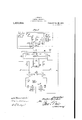
- FIG. 1 represents the circuits at the transmitting station
- Fig. 2 shows the line wire and local relay circuits at the receiving station
- Fig. 3 shows the connection between the local relay circuits and the electro-inagnets for actuating the type levers
- Fig. 4 represents an example of the means for operating these levers pneumatically
- Fig. 5 shows in diagram the general arrangement of the circuits at either station.
- A, B are the terminals of the line wires.
- K is one of the 24 keys which when depressed closes its contacts a, b and transmits to the line Wires connected to A and B respectively currents from a source of electricity which is shown as a battery 13 but which may be a motor generator, the strength and polarity of the currents being determined by the connections of the springs c and d with the conductors 10,:1: and y, c. In the position shown,
- the line wires are connected at the receiving station to terminal A,,B bridged by polarized relays P P and by non-polarized relays NQN, connected as shown.
- the line is earthed at Belays G, .D, E, F are included in a local circuit controlled by the relays 1'? and N, and relays H, I, J, are included in a local circuit controlled by the relays P, and N the batteryB forms a source of energy for both local circuits.
- T he armatures 29 1 2 take up mid positions, as shown in Fig. 5, when the relays P and P are not energized.
- electro-magnet 20 would be energized; if none of the relays C, D, E, F are energized, one of the electro-magnets 21, 22,
- each type lever U carries in known manner two type characters It and To print the character j at the end of the lever it is necessary that the paper carrier is should be raised so as to bring the paper is, opposite j and clear of h when the type lever has been brought into the operative position shown by the dotted lines.
- the shift of the paper referred' to above is effected through an electro-magnet which is energized by an alternating or intermittent current transmitted trdm the 1 ioones .minals A 13,; the inductance of the relays N N P P 'prevents any appreciable portion of the-alternating currents from passing to earth at Q.
- the armature 0 of relay 0 normally rests against its back contact and thereby short circuits a relay'Z.
- relay O When relay O is energized, the short circuit is removed, relay Z is energized by a battery B, over aresistance B and by attracting its armature a so as to close the frontcontact 2 energizes an electrdmagnet X which effects the paper shift.
- Fig. 4 M represents one of the magnets 1 to 2d; when the magnet M is energized, its armature m is attracted and by moving a valve 4) to the right, against a seat 8, allows compressed air to enter a cylinder i through a seat 8 against which the valve is normally pressed in contact by a spring 0.
- the compressed air drives a pistcn Z and type lever U to which it is pivoted by the rod Z to the printing position shown by the dotted lines.
- the paper feed is effected by a pneumatic device of the kind described and is connected as shown at Y (Fig. 3).
- one of the numbers 1 to 24 is represented by a re sistance, so that in the example shown there are 23 type levers, enabling 46 characters to be impressed.
- a printing telegraph in which the impression of a character may be effected by the actuation of a single key at the transmitting station and in which direct currents of different polarity and strength are transmitted and received independently and simultaneously over the leads of a two wire line, a polarized and a neutral relay inserted in each of the said leads at the receiving station and means by which an alternating current may be superimposed on the direct current traversing each lead.
- a receiving instrument comprising a two lead wire con nected with the transmitting station, a polarized and a neutral relay in each lead, a local source of current, four local relays associated with each lead, means whereby not more than one of the said four local relays associated with the same lead is energized at any time, and connections whereby the relays associated with one lead are energized in parallel in pairs with the relays associated with the other lead.
- a printing telegraph in which direct currents of diil'erent polarity and strength are transmitted and received independently and simultaneously over the leads of a two wire line, a polarized and a neutral relay being inserted in each of the said leads at the receiving station, a transformer comprising primary and secondary coils, a key at the transmitting station, means by which the actuation of said key causes the primary coil to be intermittently energized and to induce alternating currents in the secondary coil which are conveyed over each lead of the line, a paper carrier at the receiving station and means by which said alternating currents shift the position of said paper carrier.
- a printing telegraph in which direct currents of different polarity and strength are transmitted and received independently and simultaneously over the leads of a two wire line, a polarized and a neutral relay being inserted in each of the said leads at the receiving station, a transformer comprising primary and secondary coils, a key at the transmitting station and means by which the actuation of said key causes the primary coil to be intermittently energized and to induce alternating currents in the secondary coils which are conveyed over each lead of the line, a relay bridging the line wires at the receiving station and energized by said alternating currents, a local circuit at said receiving station, an electromagnet in said local circuit energized when said relay is energized, a paper carrier and means operated by said electromagnet for shifting said paper carrier.
- a printing telegraph station and transmitter thereat comprising in combination keys corresponding to the characters to be transmitted, a two wire lead from the station, a resistance in each line wire, keys for short circuiting said resistances, a source of direct current for transmitting currents of varying strength over each line wire, a primary coil and means for intermittently energizing said coil from said source, secondary coils energized from said primary coil transmitting alternating currents over said two wire lead, a paper carrier at the receiving station and means by which said alternating currents shift the position of said paper carrier.
- a printing telegraph station and receiver thereat comprising in combination a two wire lead, a polarized and a neutral relay in each lead energized by direct currents, a relay bridging the said line wires in series with a condenser and energized by alternating currents superimposed 011 said direct currents, a local circuit, means by which the local circuit is closed when said relay is energized, an electro-magnet energized in said local circuit, type levers each carrying two sets of type characters, and a paper carrier shifted by said electromagnet so as to bring the paper opposite the required set of characters.
Landscapes
- Engineering & Computer Science (AREA)
- Computer Networks & Wireless Communication (AREA)
- Signal Processing (AREA)
- Physics & Mathematics (AREA)
- Spectroscopy & Molecular Physics (AREA)
- Impression-Transfer Materials And Handling Thereof (AREA)
Priority Applications (3)
| Application Number | Priority Date | Filing Date | Title |
|---|---|---|---|
| NL5487D NL5487C (th) | 1918-08-06 | ||
| GB1135017A GB118869A (en) | 1917-08-07 | 1917-08-07 | An Improved Printing Telegraph. |
| US248617A US1400988A (en) | 1918-08-06 | 1918-08-06 | Printing-telegraph |
Applications Claiming Priority (1)
| Application Number | Priority Date | Filing Date | Title |
|---|---|---|---|
| US248617A US1400988A (en) | 1918-08-06 | 1918-08-06 | Printing-telegraph |
Publications (1)
| Publication Number | Publication Date |
|---|---|
| US1400988A true US1400988A (en) | 1921-12-20 |
Family
ID=22939893
Family Applications (1)
| Application Number | Title | Priority Date | Filing Date |
|---|---|---|---|
| US248617A Expired - Lifetime US1400988A (en) | 1917-08-07 | 1918-08-06 | Printing-telegraph |
Country Status (2)
| Country | Link |
|---|---|
| US (1) | US1400988A (th) |
| NL (1) | NL5487C (th) |
-
0
- NL NL5487D patent/NL5487C/xx active
-
1918
- 1918-08-06 US US248617A patent/US1400988A/en not_active Expired - Lifetime
Also Published As
| Publication number | Publication date |
|---|---|
| NL5487C (th) |
Similar Documents
| Publication | Publication Date | Title |
|---|---|---|
| US2055575A (en) | Telegraph repeater circuits | |
| US316698A (en) | Bekgh | |
| US707612A (en) | Page-printing telegraph. | |
| US843508A (en) | Printing-telegraph. | |
| US506273A (en) | Ments | |
| US506208A (en) | Electric motor | |
| US570072A (en) | Telautograph | |
| US285710A (en) | Bekgh | |
| US703892A (en) | Electric telegraphy. | |
| US674469A (en) | System of type-writing telegraphs. | |
| US509066A (en) | wooten | |
| US2501118A (en) | Arrangement for introducing electrical bias | |
| US373967A (en) | delany | |
| US1126641A (en) | Method of electric signaling. | |
| US987631A (en) | Quadruplex printing telegraphy. | |
| US666271A (en) | Column-printing telegraphic instrument. | |
| US2183708A (en) | Signaling system | |
| SU311135A1 (ru) | УСТРОЙСТВО дл ДОКУМЕНТИРОВАНИЯ ЭЛЕКТРИЧЕСКИХ СИГНАЛОВ НА ПИШУЩЕЙ МАШИНЕ | |
| US610274A (en) | Telautograph | |
| Clokey | Automatic printing equipment for long loaded submarine telegraph cables | |
| US1250961A (en) | Telegraphy. | |
| US1018115A (en) | Telegraphic system and apparatus. | |
| US307231A (en) | sheeey | |
| US1708737A (en) | Selective relay | |
| US574994A (en) | hoffmann |