US20080242536A1 - Metal Oxide with High Thermal Stability and Preparing Method Thereof - Google Patents
Metal Oxide with High Thermal Stability and Preparing Method Thereof Download PDFInfo
- Publication number
- US20080242536A1 US20080242536A1 US12/065,917 US6591706A US2008242536A1 US 20080242536 A1 US20080242536 A1 US 20080242536A1 US 6591706 A US6591706 A US 6591706A US 2008242536 A1 US2008242536 A1 US 2008242536A1
- Authority
- US
- United States
- Prior art keywords
- specific surface
- surface area
- calcination
- metal
- mixture
- Prior art date
- Legal status (The legal status is an assumption and is not a legal conclusion. Google has not performed a legal analysis and makes no representation as to the accuracy of the status listed.)
- Abandoned
Links
- 229910044991 metal oxide Inorganic materials 0.000 title claims abstract description 35
- 150000004706 metal oxides Chemical class 0.000 title claims abstract description 35
- 238000000034 method Methods 0.000 title claims description 31
- 229910052751 metal Inorganic materials 0.000 claims abstract description 31
- 239000002184 metal Substances 0.000 claims abstract description 31
- 150000003839 salts Chemical class 0.000 claims abstract description 23
- XLYOFNOQVPJJNP-UHFFFAOYSA-N water Substances O XLYOFNOQVPJJNP-UHFFFAOYSA-N 0.000 claims abstract description 21
- 229910001868 water Inorganic materials 0.000 claims abstract description 15
- 229910052782 aluminium Inorganic materials 0.000 claims abstract description 14
- XAGFODPZIPBFFR-UHFFFAOYSA-N aluminium Chemical compound [Al] XAGFODPZIPBFFR-UHFFFAOYSA-N 0.000 claims abstract description 11
- 239000007795 chemical reaction product Substances 0.000 claims abstract description 9
- 239000011541 reaction mixture Substances 0.000 claims abstract description 9
- -1 aluminum compound Chemical class 0.000 claims abstract description 5
- 150000001785 cerium compounds Chemical class 0.000 claims abstract description 4
- 238000001354 calcination Methods 0.000 claims description 28
- 239000000203 mixture Substances 0.000 claims description 23
- 239000003054 catalyst Substances 0.000 claims description 18
- 239000002244 precipitate Substances 0.000 claims description 16
- VHUUQVKOLVNVRT-UHFFFAOYSA-N Ammonium hydroxide Chemical compound [NH4+].[OH-] VHUUQVKOLVNVRT-UHFFFAOYSA-N 0.000 claims description 12
- 235000011114 ammonium hydroxide Nutrition 0.000 claims description 12
- 239000000243 solution Substances 0.000 claims description 11
- 239000012266 salt solution Substances 0.000 claims description 8
- 229910052684 Cerium Inorganic materials 0.000 claims description 7
- 239000012670 alkaline solution Substances 0.000 claims description 7
- ZMIGMASIKSOYAM-UHFFFAOYSA-N cerium Chemical compound [Ce][Ce][Ce][Ce][Ce][Ce][Ce][Ce][Ce][Ce][Ce][Ce][Ce][Ce][Ce][Ce][Ce][Ce][Ce][Ce][Ce][Ce][Ce][Ce][Ce][Ce][Ce][Ce][Ce][Ce][Ce][Ce][Ce][Ce][Ce][Ce][Ce][Ce] ZMIGMASIKSOYAM-UHFFFAOYSA-N 0.000 claims description 7
- 238000001035 drying Methods 0.000 claims description 7
- 238000002156 mixing Methods 0.000 claims description 7
- 229910052788 barium Inorganic materials 0.000 claims description 5
- 229910052747 lanthanoid Inorganic materials 0.000 claims description 5
- 150000002602 lanthanoids Chemical class 0.000 claims description 5
- DSAJWYNOEDNPEQ-UHFFFAOYSA-N barium atom Chemical compound [Ba] DSAJWYNOEDNPEQ-UHFFFAOYSA-N 0.000 claims description 4
- 229910052726 zirconium Inorganic materials 0.000 claims description 4
- 239000003929 acidic solution Substances 0.000 claims description 3
- 229910052784 alkaline earth metal Inorganic materials 0.000 claims description 3
- 229910052791 calcium Inorganic materials 0.000 claims description 3
- 238000002485 combustion reaction Methods 0.000 claims description 3
- 229910052706 scandium Inorganic materials 0.000 claims description 3
- 238000000926 separation method Methods 0.000 claims description 3
- 229910052712 strontium Inorganic materials 0.000 claims description 3
- 229910052727 yttrium Inorganic materials 0.000 claims description 3
- 150000003754 zirconium Chemical class 0.000 claims description 2
- 239000004411 aluminium Substances 0.000 claims 2
- 230000001376 precipitating effect Effects 0.000 claims 2
- 150000001399 aluminium compounds Chemical class 0.000 claims 1
- 159000000013 aluminium salts Chemical class 0.000 claims 1
- 229910000329 aluminium sulfate Inorganic materials 0.000 claims 1
- 238000002360 preparation method Methods 0.000 abstract 1
- 239000002245 particle Substances 0.000 description 17
- 238000006243 chemical reaction Methods 0.000 description 16
- QVGXLLKOCUKJST-UHFFFAOYSA-N atomic oxygen Chemical compound [O] QVGXLLKOCUKJST-UHFFFAOYSA-N 0.000 description 15
- 239000000463 material Substances 0.000 description 15
- 239000001301 oxygen Substances 0.000 description 15
- 229910052760 oxygen Inorganic materials 0.000 description 15
- 229910000420 cerium oxide Inorganic materials 0.000 description 14
- BMMGVYCKOGBVEV-UHFFFAOYSA-N oxo(oxoceriooxy)cerium Chemical compound [Ce]=O.O=[Ce]=O BMMGVYCKOGBVEV-UHFFFAOYSA-N 0.000 description 14
- MWUXSHHQAYIFBG-UHFFFAOYSA-N Nitric oxide Chemical compound O=[N] MWUXSHHQAYIFBG-UHFFFAOYSA-N 0.000 description 12
- HSJPMRKMPBAUAU-UHFFFAOYSA-N cerium(3+);trinitrate Chemical compound [Ce+3].[O-][N+]([O-])=O.[O-][N+]([O-])=O.[O-][N+]([O-])=O HSJPMRKMPBAUAU-UHFFFAOYSA-N 0.000 description 12
- 239000007789 gas Substances 0.000 description 11
- PNEYBMLMFCGWSK-UHFFFAOYSA-N aluminium oxide Inorganic materials [O-2].[O-2].[O-2].[Al+3].[Al+3] PNEYBMLMFCGWSK-UHFFFAOYSA-N 0.000 description 8
- 230000003247 decreasing effect Effects 0.000 description 8
- 238000000746 purification Methods 0.000 description 8
- BNGXYYYYKUGPPF-UHFFFAOYSA-M (3-methylphenyl)methyl-triphenylphosphanium;chloride Chemical compound [Cl-].CC1=CC=CC(C[P+](C=2C=CC=CC=2)(C=2C=CC=CC=2)C=2C=CC=CC=2)=C1 BNGXYYYYKUGPPF-UHFFFAOYSA-M 0.000 description 7
- 239000000446 fuel Substances 0.000 description 7
- 229910001593 boehmite Inorganic materials 0.000 description 6
- 239000008367 deionised water Substances 0.000 description 6
- 229910021641 deionized water Inorganic materials 0.000 description 6
- FAHBNUUHRFUEAI-UHFFFAOYSA-M hydroxidooxidoaluminium Chemical compound O[Al]=O FAHBNUUHRFUEAI-UHFFFAOYSA-M 0.000 description 6
- UJVRJBAUJYZFIX-UHFFFAOYSA-N nitric acid;oxozirconium Chemical compound [Zr]=O.O[N+]([O-])=O.O[N+]([O-])=O UJVRJBAUJYZFIX-UHFFFAOYSA-N 0.000 description 6
- 239000013078 crystal Substances 0.000 description 5
- 230000003647 oxidation Effects 0.000 description 5
- 238000007254 oxidation reaction Methods 0.000 description 5
- TWNQGVIAIRXVLR-UHFFFAOYSA-N oxo(oxoalumanyloxy)alumane Chemical compound O=[Al]O[Al]=O TWNQGVIAIRXVLR-UHFFFAOYSA-N 0.000 description 5
- RVTZCBVAJQQJTK-UHFFFAOYSA-N oxygen(2-);zirconium(4+) Chemical compound [O-2].[O-2].[Zr+4] RVTZCBVAJQQJTK-UHFFFAOYSA-N 0.000 description 5
- 238000001878 scanning electron micrograph Methods 0.000 description 5
- 229910001928 zirconium oxide Inorganic materials 0.000 description 5
- UGFAIRIUMAVXCW-UHFFFAOYSA-N Carbon monoxide Chemical compound [O+]#[C-] UGFAIRIUMAVXCW-UHFFFAOYSA-N 0.000 description 4
- 229910002091 carbon monoxide Inorganic materials 0.000 description 4
- 238000005245 sintering Methods 0.000 description 4
- KDLHZDBZIXYQEI-UHFFFAOYSA-N Palladium Chemical compound [Pd] KDLHZDBZIXYQEI-UHFFFAOYSA-N 0.000 description 3
- AZDRQVAHHNSJOQ-UHFFFAOYSA-N alumane Chemical class [AlH3] AZDRQVAHHNSJOQ-UHFFFAOYSA-N 0.000 description 3
- 230000015572 biosynthetic process Effects 0.000 description 3
- 230000000694 effects Effects 0.000 description 3
- 229910052746 lanthanum Inorganic materials 0.000 description 3
- BASFCYQUMIYNBI-UHFFFAOYSA-N platinum Chemical compound [Pt] BASFCYQUMIYNBI-UHFFFAOYSA-N 0.000 description 3
- 239000002002 slurry Substances 0.000 description 3
- 238000003786 synthesis reaction Methods 0.000 description 3
- IJGRMHOSHXDMSA-UHFFFAOYSA-N Atomic nitrogen Chemical compound N#N IJGRMHOSHXDMSA-UHFFFAOYSA-N 0.000 description 2
- CURLTUGMZLYLDI-UHFFFAOYSA-N Carbon dioxide Chemical compound O=C=O CURLTUGMZLYLDI-UHFFFAOYSA-N 0.000 description 2
- MCMNRKCIXSYSNV-UHFFFAOYSA-N Zirconium dioxide Chemical compound O=[Zr]=O MCMNRKCIXSYSNV-UHFFFAOYSA-N 0.000 description 2
- UNJPQTDTZAKTFK-UHFFFAOYSA-K cerium(iii) hydroxide Chemical compound [OH-].[OH-].[OH-].[Ce+3] UNJPQTDTZAKTFK-UHFFFAOYSA-K 0.000 description 2
- 239000011248 coating agent Substances 0.000 description 2
- 238000000576 coating method Methods 0.000 description 2
- 230000000052 comparative effect Effects 0.000 description 2
- 238000000151 deposition Methods 0.000 description 2
- 230000004927 fusion Effects 0.000 description 2
- 238000010438 heat treatment Methods 0.000 description 2
- 238000003837 high-temperature calcination Methods 0.000 description 2
- 229930195733 hydrocarbon Natural products 0.000 description 2
- 150000002430 hydrocarbons Chemical class 0.000 description 2
- 150000004679 hydroxides Chemical class 0.000 description 2
- FYDKNKUEBJQCCN-UHFFFAOYSA-N lanthanum(3+);trinitrate Chemical compound [La+3].[O-][N+]([O-])=O.[O-][N+]([O-])=O.[O-][N+]([O-])=O FYDKNKUEBJQCCN-UHFFFAOYSA-N 0.000 description 2
- 239000002105 nanoparticle Substances 0.000 description 2
- 239000011148 porous material Substances 0.000 description 2
- 229910052700 potassium Inorganic materials 0.000 description 2
- 239000000047 product Substances 0.000 description 2
- 239000010948 rhodium Substances 0.000 description 2
- 239000006104 solid solution Substances 0.000 description 2
- 229910004631 Ce(NO3)3.6H2O Inorganic materials 0.000 description 1
- 150000000703 Cerium Chemical class 0.000 description 1
- 229910020851 La(NO3)3.6H2O Inorganic materials 0.000 description 1
- 229910002651 NO3 Inorganic materials 0.000 description 1
- QCWXUUIWCKQGHC-UHFFFAOYSA-N Zirconium Chemical compound [Zr] QCWXUUIWCKQGHC-UHFFFAOYSA-N 0.000 description 1
- DDPNPTNFVDEJOH-UHFFFAOYSA-N [O-2].[Zr+4].[O-2].[Ce+3] Chemical compound [O-2].[Zr+4].[O-2].[Ce+3] DDPNPTNFVDEJOH-UHFFFAOYSA-N 0.000 description 1
- 229910001854 alkali hydroxide Inorganic materials 0.000 description 1
- 150000008044 alkali metal hydroxides Chemical class 0.000 description 1
- WNROFYMDJYEPJX-UHFFFAOYSA-K aluminium hydroxide Chemical compound [OH-].[OH-].[OH-].[Al+3] WNROFYMDJYEPJX-UHFFFAOYSA-K 0.000 description 1
- VBIXEXWLHSRNKB-UHFFFAOYSA-N ammonium oxalate Chemical compound [NH4+].[NH4+].[O-]C(=O)C([O-])=O VBIXEXWLHSRNKB-UHFFFAOYSA-N 0.000 description 1
- 239000007864 aqueous solution Substances 0.000 description 1
- 239000001569 carbon dioxide Substances 0.000 description 1
- 229910002092 carbon dioxide Inorganic materials 0.000 description 1
- 238000010924 continuous production Methods 0.000 description 1
- 238000001816 cooling Methods 0.000 description 1
- 230000008021 deposition Effects 0.000 description 1
- 230000007613 environmental effect Effects 0.000 description 1
- 238000001914 filtration Methods 0.000 description 1
- XLYOFNOQVPJJNP-UHFFFAOYSA-M hydroxide Chemical compound [OH-] XLYOFNOQVPJJNP-UHFFFAOYSA-M 0.000 description 1
- FZLIPJUXYLNCLC-UHFFFAOYSA-N lanthanum atom Chemical compound [La] FZLIPJUXYLNCLC-UHFFFAOYSA-N 0.000 description 1
- 231100001231 less toxic Toxicity 0.000 description 1
- 150000002736 metal compounds Chemical class 0.000 description 1
- VUZPPFZMUPKLLV-UHFFFAOYSA-N methane;hydrate Chemical compound C.O VUZPPFZMUPKLLV-UHFFFAOYSA-N 0.000 description 1
- 238000001471 micro-filtration Methods 0.000 description 1
- 229910003455 mixed metal oxide Inorganic materials 0.000 description 1
- 229910052757 nitrogen Inorganic materials 0.000 description 1
- 229910000069 nitrogen hydride Inorganic materials 0.000 description 1
- 229910052763 palladium Inorganic materials 0.000 description 1
- 229910052697 platinum Inorganic materials 0.000 description 1
- 239000010970 precious metal Substances 0.000 description 1
- 238000011084 recovery Methods 0.000 description 1
- 229910052703 rhodium Inorganic materials 0.000 description 1
- MHOVAHRLVXNVSD-UHFFFAOYSA-N rhodium atom Chemical compound [Rh] MHOVAHRLVXNVSD-UHFFFAOYSA-N 0.000 description 1
- 238000001694 spray drying Methods 0.000 description 1
- 239000011232 storage material Substances 0.000 description 1
- 238000001308 synthesis method Methods 0.000 description 1
- 239000011882 ultra-fine particle Substances 0.000 description 1
Images


Classifications
-
- C—CHEMISTRY; METALLURGY
- C01—INORGANIC CHEMISTRY
- C01G—COMPOUNDS CONTAINING METALS NOT COVERED BY SUBCLASSES C01D OR C01F
- C01G25/00—Compounds of zirconium
-
- C—CHEMISTRY; METALLURGY
- C01—INORGANIC CHEMISTRY
- C01G—COMPOUNDS CONTAINING METALS NOT COVERED BY SUBCLASSES C01D OR C01F
- C01G99/00—Subject matter not provided for in other groups of this subclass
-
- B—PERFORMING OPERATIONS; TRANSPORTING
- B01—PHYSICAL OR CHEMICAL PROCESSES OR APPARATUS IN GENERAL
- B01J—CHEMICAL OR PHYSICAL PROCESSES, e.g. CATALYSIS OR COLLOID CHEMISTRY; THEIR RELEVANT APPARATUS
- B01J23/00—Catalysts comprising metals or metal oxides or hydroxides, not provided for in group B01J21/00
- B01J23/002—Mixed oxides other than spinels, e.g. perovskite
-
- B—PERFORMING OPERATIONS; TRANSPORTING
- B01—PHYSICAL OR CHEMICAL PROCESSES OR APPARATUS IN GENERAL
- B01J—CHEMICAL OR PHYSICAL PROCESSES, e.g. CATALYSIS OR COLLOID CHEMISTRY; THEIR RELEVANT APPARATUS
- B01J23/00—Catalysts comprising metals or metal oxides or hydroxides, not provided for in group B01J21/00
- B01J23/10—Catalysts comprising metals or metal oxides or hydroxides, not provided for in group B01J21/00 of rare earths
-
- B—PERFORMING OPERATIONS; TRANSPORTING
- B01—PHYSICAL OR CHEMICAL PROCESSES OR APPARATUS IN GENERAL
- B01J—CHEMICAL OR PHYSICAL PROCESSES, e.g. CATALYSIS OR COLLOID CHEMISTRY; THEIR RELEVANT APPARATUS
- B01J37/00—Processes, in general, for preparing catalysts; Processes, in general, for activation of catalysts
- B01J37/02—Impregnation, coating or precipitation
- B01J37/03—Precipitation; Co-precipitation
- B01J37/031—Precipitation
-
- B—PERFORMING OPERATIONS; TRANSPORTING
- B82—NANOTECHNOLOGY
- B82Y—SPECIFIC USES OR APPLICATIONS OF NANOSTRUCTURES; MEASUREMENT OR ANALYSIS OF NANOSTRUCTURES; MANUFACTURE OR TREATMENT OF NANOSTRUCTURES
- B82Y30/00—Nanotechnology for materials or surface science, e.g. nanocomposites
-
- C—CHEMISTRY; METALLURGY
- C01—INORGANIC CHEMISTRY
- C01B—NON-METALLIC ELEMENTS; COMPOUNDS THEREOF; METALLOIDS OR COMPOUNDS THEREOF NOT COVERED BY SUBCLASS C01C
- C01B13/00—Oxygen; Ozone; Oxides or hydroxides in general
- C01B13/14—Methods for preparing oxides or hydroxides in general
- C01B13/36—Methods for preparing oxides or hydroxides in general by precipitation reactions in aqueous solutions
- C01B13/363—Mixtures of oxides or hydroxides by precipitation
-
- C—CHEMISTRY; METALLURGY
- C01—INORGANIC CHEMISTRY
- C01B—NON-METALLIC ELEMENTS; COMPOUNDS THEREOF; METALLOIDS OR COMPOUNDS THEREOF NOT COVERED BY SUBCLASS C01C
- C01B13/00—Oxygen; Ozone; Oxides or hydroxides in general
- C01B13/14—Methods for preparing oxides or hydroxides in general
- C01B13/36—Methods for preparing oxides or hydroxides in general by precipitation reactions in aqueous solutions
- C01B13/366—Methods for preparing oxides or hydroxides in general by precipitation reactions in aqueous solutions by hydrothermal processing
-
- C—CHEMISTRY; METALLURGY
- C01—INORGANIC CHEMISTRY
- C01F—COMPOUNDS OF THE METALS BERYLLIUM, MAGNESIUM, ALUMINIUM, CALCIUM, STRONTIUM, BARIUM, RADIUM, THORIUM, OR OF THE RARE-EARTH METALS
- C01F7/00—Compounds of aluminium
-
- B—PERFORMING OPERATIONS; TRANSPORTING
- B01—PHYSICAL OR CHEMICAL PROCESSES OR APPARATUS IN GENERAL
- B01J—CHEMICAL OR PHYSICAL PROCESSES, e.g. CATALYSIS OR COLLOID CHEMISTRY; THEIR RELEVANT APPARATUS
- B01J2523/00—Constitutive chemical elements of heterogeneous catalysts
-
- C—CHEMISTRY; METALLURGY
- C01—INORGANIC CHEMISTRY
- C01P—INDEXING SCHEME RELATING TO STRUCTURAL AND PHYSICAL ASPECTS OF SOLID INORGANIC COMPOUNDS
- C01P2004/00—Particle morphology
- C01P2004/01—Particle morphology depicted by an image
- C01P2004/03—Particle morphology depicted by an image obtained by SEM
-
- C—CHEMISTRY; METALLURGY
- C01—INORGANIC CHEMISTRY
- C01P—INDEXING SCHEME RELATING TO STRUCTURAL AND PHYSICAL ASPECTS OF SOLID INORGANIC COMPOUNDS
- C01P2004/00—Particle morphology
- C01P2004/20—Particle morphology extending in two dimensions, e.g. plate-like
-
- C—CHEMISTRY; METALLURGY
- C01—INORGANIC CHEMISTRY
- C01P—INDEXING SCHEME RELATING TO STRUCTURAL AND PHYSICAL ASPECTS OF SOLID INORGANIC COMPOUNDS
- C01P2004/00—Particle morphology
- C01P2004/30—Particle morphology extending in three dimensions
- C01P2004/32—Spheres
-
- C—CHEMISTRY; METALLURGY
- C01—INORGANIC CHEMISTRY
- C01P—INDEXING SCHEME RELATING TO STRUCTURAL AND PHYSICAL ASPECTS OF SOLID INORGANIC COMPOUNDS
- C01P2004/00—Particle morphology
- C01P2004/50—Agglomerated particles
-
- C—CHEMISTRY; METALLURGY
- C01—INORGANIC CHEMISTRY
- C01P—INDEXING SCHEME RELATING TO STRUCTURAL AND PHYSICAL ASPECTS OF SOLID INORGANIC COMPOUNDS
- C01P2004/00—Particle morphology
- C01P2004/60—Particles characterised by their size
- C01P2004/64—Nanometer sized, i.e. from 1-100 nanometer
-
- C—CHEMISTRY; METALLURGY
- C01—INORGANIC CHEMISTRY
- C01P—INDEXING SCHEME RELATING TO STRUCTURAL AND PHYSICAL ASPECTS OF SOLID INORGANIC COMPOUNDS
- C01P2006/00—Physical properties of inorganic compounds
- C01P2006/12—Surface area
-
- C—CHEMISTRY; METALLURGY
- C01—INORGANIC CHEMISTRY
- C01P—INDEXING SCHEME RELATING TO STRUCTURAL AND PHYSICAL ASPECTS OF SOLID INORGANIC COMPOUNDS
- C01P2006/00—Physical properties of inorganic compounds
- C01P2006/12—Surface area
- C01P2006/13—Surface area thermal stability thereof at high temperatures
Definitions
- the present invention relates to metal oxide having high thermal stability and a method of preparing the same, in which the specific surface area of metal oxide is maintained very high even after high-temperature calcinations, compared to conventional materials for storing oxygen, advantageously leading to oxygen storage oxide nanoparticles having high thermal stability.
- the metal oxide prepared by the method of the present invention may be used as oxygen storage capacity (OSC) material or a support for a three way catalyst for the purification of exhaust gas from gasoline vehicles, and may also be used for the purification of exhaust gas of diesel vehicles, chemical reaction, or in an oxygen sensor for detecting oxygen therein.
- OSC oxygen storage capacity
- the metal oxide is predicted to be suitable for use as such OSC material or support for a three way catalyst for the purification of exhaust gas of gasoline vehicles.
- a three way catalyst functions to convert carbon monoxide (CO), hydrocarbons, or nitrogen oxide (NO x ), into carbon dioxide, water, or nitrogen, which are materials having low environmental loads or which are less toxic, through oxidation or reduction.
- the three way catalyst is prepared by washcoating a porous honeycomb with precious metal, such as platinum (Pt), palladium (Pd), or rhodium (Rh), alumina, and oxygen storage material.
- the OSC material of a three way catalyst for the purification of exhaust gas of vehicles is typically exemplified by cerium oxide, cerium oxide-zirconium oxide, and mixed cerium oxide.
- the three way catalyst causes carbon monoxide (CO), hydrocarbons, or nitrogen oxide (NO x ) to be highly converted in a very narrow range of air-to-fuel ratio of about 14.6, it is disadvantageous in that the conversion is drastically decreased in a range falling outside of the above air-to-fuel ratio.
- Cerium has some advantages, such as easy conversion between Ce (III) and Ce (IV) and excellent properties, in which oxygen is stored in a fuel lean region and is released in a fuel rich region.
- cerium which importantly functions to alleviate the problem of conversion being drastically decreased by small fluctuations in the air-to-fuel ratio when used along with the three way catalyst, was adopted and applied in the early 1990s.
- the three way catalyst for the purification of exhaust gas of vehicles is inevitably exposed to high temperatures.
- cerium oxide suffers because it has a drastically decreased specific surface area and a greatly increased crystal size, attributable to the fusion of pores or sintering of crystals, and furthermore, oxygen storage capacity and oxygen mobility are lowered, that is, thermal stability is decreased.
- the mixture thus obtained is known to increase with respect to thermal stability and the ability to store and release oxygen.
- the mixture of cerium oxide and zirconium oxide is added with a third component, it is known that thermal stability and oxygen storage capacity are further increased, and the performance is changed depending on the synthesis method or compositions.
- the catalyst for exhaust gas of vehicles is prepared by washcoating a honeycombed support with OSC material and alumina, the alumina functioning to increase the thermal stability of cerium oxide.
- alumina is doped with lanthanum (La) or barium, the thermal stability of alumina itself is known to be greatly improved.
- US Serial No. 2004/0186016 discloses a method of preparing metal oxide in the form of a mixture, a coating or a solid solution by adding a cerium salt and second metal oxide M 1 (preferably, zirconium oxide) with ammonium oxalate to thus co-precipitate them, sequentially or simultaneously depositing or coating the co-precipitated material with third metal oxide M 2 (preferably, aluminum), and subjecting the product to filtration, drying and calcination.
- a cerium salt and second metal oxide M 1 preferably, zirconium oxide
- third metal oxide M 2 preferably, aluminum
- [Ce 0.8 Zr 0.2 O 2 ]*[0.4Al 2 O 3 ] prepared in Example E7 has a specific surface area of 129 m 2 /g, but has a specific area of 82 m 2 /g after calcination at 650° C. for 4 hours, and therefore the thermal stability thereof is considered insufficient.
- An object of the present invention is to provide a metal oxide having high thermal stability and a method of preparing the same.
- the present invention provides a method of preparing metal oxide, comprising continuously reacting a reaction mixture, composed of (i) water, (ii) a first metal salt including an aqueous cerium compound, and (iii) a second metal salt including an aqueous aluminum compound, at 200 ⁇ 700° C. under pressure of 180 ⁇ 550 bar, the reaction product having a molar ratio of metal, other than aluminum, to aluminum of 0.1 ⁇ 10.
- the first metal salt further comprises a salt of at least one metal selected from among Ca, Sc, Sr, Zr, Y and lanthanides other than Ce.
- the first metal salt further comprises a zirconium salt.
- the second metal salt further comprises a salt of at least one metal selected from among alkali earth metals, lanthanides, and barium, and may include, for example, K, Ba, La, etc.
- the reaction mixture further comprises an alkaline solution or an acidic solution which is added in an amount of 0.1 ⁇ 20 mol based on 1 mol of the metal compound, before or during the reaction.
- the alkaline solution is ammonia water.
- the above method further comprises separating, drying or calcining the reaction product.
- the separation process may be performed through a typical separation process, for example, microfiltration of the reaction product using a filter after cooling to 100° C. or lower, which is the allowable temperature for filter material.
- the drying process may be performed through a typical drying process, for example, spray drying, convection drying, or fluidized-bed drying, at 300° C. or lower.
- a calcination in oxidation or reduction atmosphere, or in the presence of water may be further performed at 400 ⁇ 1200° C.
- the calcination effect is poor at a temperature of less than 400° C., whereas the product has too low a specific surface area, due to excess sintering, at a temperature exceeding 1200° C., and is thus unsuitable for use in a catalyst.
- microwaves or ultrasonic waves may be applied.
- a pre-pressurized aqueous metal salt solution containing cerium and a pre-pressurized aqueous precipitant solution including ammonia water are mixed and precipitated to obtain a first precipitate p 1 .
- the first precipitate p 1 and a pre-pressurized aqueous aluminum salt solution are further mixed and precipitated to thus obtain a second precipitate p 2 , which is then further mixed and reacted with supercritical water or subcritical water.
- the present invention provides a catalyst system, which is characterized in that it can treat exhaust gas from an internal combustion engine using metal oxide prepared by the method mentioned above.
- the present invention provides oxygen storage oxide nanoparticles, which have a very high specific surface area even after high-temperature calcinations, and thus exhibit superior thermal stability, compared to conventional OSC materials. Since the metal oxide of the present invention is synthesized through a high-temperature and high-pressure continuous process, the crystal size thereof is on the nano scale, and the crystallinity is very high. Further, during the synthesis through the method of the present invention, the thermal stability of cerium oxide itself is increased, which is believed to be due to the introduction, deposition or solution of some of the aluminum to lattices of cerium oxide. Therefore, unlike the simple mixture of cerium oxide and aluminum oxide, the particle size of the metal oxide of the present invention can be more stable and the specific surface area thereof can be less decreased even upon exposure at high temperatures, resulting in superior thermal stability.
- FIG. 1 is scanning electron micrographs (SEMs) (100,000 magnified) of metal oxide synthesized in Example 1:
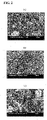
- FIG. 2 is SEMs (100,000 magnified) of metal oxide synthesized in Example 2:
- metal oxide is prepared by continuously reacting a reaction mixture comprising (i) water, (ii) a first metal salt including an aqueous cerium compound and (iii) a second metal salt including an aqueous aluminum compound at 200 ⁇ 700° C. under pressure of 180 ⁇ 550 bar.
- a reaction mixture comprising (i) water, (ii) a first metal salt including an aqueous cerium compound and (iii) a second metal salt including an aqueous aluminum compound at 200 ⁇ 700° C. under pressure of 180 ⁇ 550 bar.
- the first metal salt includes a salt of at least one metal selected from among Ca, Sc, Sr, Zr, Y, and lanthanides other than Ce, and preferably includes a salt of Zr.
- aluminum oxide may include boehmite, alumina, or stabilized alumina doped with at least one metal selected from among alkali earth metals, lanthanides, and barium, and preferably K, La, or Ba.
- the metal oxide of the present invention is provided in the form of a mixture, a deposit, or a solid solution of metal oxide particles, containing cerium oxide, and aluminum oxide particles.
- an alkaline solution or an acidic solution be further added in an amount of 0.1 ⁇ 20 mol based on 1 mol of the above metal salt, in which the alkaline solution is exemplified by ammonia water.
- a pre-pressurized aqueous metal salt solution containing cerium and a pre-pressurized aqueous precipitant solution including ammonia water are mixed and precipitated, yielding a first precipitate p 1 .
- the first precipitate p 1 and a pre-pressurized aqueous aluminum salt solution are further mixed and precipitated, to thus obtain a second precipitate p 2 , which is then mixed and reacted with supercritical water or subcritical water.
- the first precipitate p 1 which is in the form of cerium hydroxide
- the mixture of cerium hydroxide and aluminum hydroxide is obtained.
- the two hydroxides are present in the form of ultrafine particles, they are efficiently dispersed in water. Ultimately, the degree of mixing of hydroxides is high. Furthermore, the hydroxide mixture is mixed with supercritical water or subcritical water and thus allowed to react therewith, giving a reaction product in which the two oxides are well-mixed.
- the reaction product has a molar ratio of metal, other than aluminum, to aluminum of 0.1 ⁇ 10. In this case, if the molar ratio is less than 0.1, the reaction product does not function as OSC material. On the other hand, if the molar ratio exceeds 10, thermal stability is worsened.
- the metal oxide prepared by the method of the present invention, has a specific surface area of at least 100 m 2 /g upon synthesis, and also, the specific surface area thereof is maintained in at least 40 m 2 /g upon calcination at 1000° C. for 6 hours in air.
- mixed cerium oxide has a particle size of 50 nm or less, and boehmite is in the form of a thin plate having a diameter of 500 nm or less.
- boehmite is in the form of a thin plate having a diameter of 700 nm or less.
- the metal oxide prepared by the method of the present invention is used as OSC material or catalyst support to thus serve for a catalyst system for the treatment of exhaust gas from an internal combustion engine.
- the metal oxide prepared by the method of the present invention may be used as OSC material or a support for a three way catalyst for use in the purification of exhaust gas of gasoline vehicles, and further, may be for the purification of exhaust gas of diesel vehicles, chemical reaction or in an oxygen sensor for detecting oxygen therein.
- a metal oxide is expected to be useful as the OSC material or support of a three way catalyst for the purification of exhaust gas of gasoline vehicles.
- An aqueous mixture solution comprising 5.81 wt % of zirconyl nitrate [30 wt % aqueous solution as ZrO 2 ], 6.17 wt % of cerium nitrate [Ce(NO 3 ) 3 .6H 2 O], and 9.02 wt % of aluminum nitrate [Al(NO 3 ) 3 .9H 2 O], was pumped at a rate of 8 g per min through a tube having an outer diameter of 1 ⁇ 4 inch and pressurized at 250 bar.
- 16.34 wt % of ammonia water [28 wt % NH 3 ] was pumped at a rate of 8 g per min through a tube having an outer diameter of 1 ⁇ 4 inch and pressurized at 250 bar.
- the pressurized aqueous mixture solution, comprising zirconyl nitrate, cerium nitrate, and aluminum nitrate, and the pressurized ammonia water were pumped into a tube-shaped continuous line mixer to thus be instantly mixed, and then allowed to precipitate for a residence time of about 30 sec. Further, deionized water was pumped at a rate of 96 g per min through a tube having an outer diameter of 1 ⁇ 4 inch, preheated to 550° C., and pressurized at 250 bar.
- the deionized water thus preheated and the precipitate produced from the line mixer which were in a state of being pressurized, were pumped into a continuous line reactor to thus be instantly mixed.
- the resultant reaction mixture the temperature of which was controlled to 400° C., was allowed to react for a residence time of 10 sec or less.
- the slurry produced after the reaction was cooled and the particles were separated.
- the separated particles were dried in an oven at 100° C.
- the dried particles were calcined in an oxidation furnace at each of 725° C., 1000° C. and 1100° C. for 6 hours.
- the specific surface areas (BET) of the dried sample and the samples calcined at 725° C., 1000° C. and 1100° C.
- the SEM images of the synthesized sample, the sample calcined at 600° C. for 6 hours, and the sample calcined at 1000° C. for 6 hours are shown in FIG. 1 .
- the cerium oxide and zirconium oxide were in the form of a spherical agglomerate, the particle diameter of the agglomerate ranging from 5 to 50 nm.
- aluminum oxide was in the form of a plate or hexagonal plate, the diameter of the plate being 50 ⁇ 300 nm. After the heat treatment, the shape of the sample was hardly changed, resulting in high thermal stability.
- An aqueous mixture solution comprising 2.43 wt % of zirconyl nitrate, 2.58 wt % of cerium nitrate, 0.37 wt % of lanthanum nitrate [La(NO 3 ) 3 .6H 2 O], and 15.62 wt % of aluminum nitrate, was pumped at a rate of 8 g per min through a tube having an outer diameter of 1 ⁇ 4 inch, and pressurized at 250 bar. 16.88 wt % of ammonia water was pumped at a rate of 8 g per min through a tube having an outer diameter of 1 ⁇ 4 inch and pressurized at 250 bar.
- the pressurized aqueous mixture solution comprising zirconyl nitrate, cerium nitrate, lanthanum nitrate, and aluminum nitrate, and the pressurized ammonia water were pumped into a tube-shaped continuous line mixer to thus be instantly mixed, and then allowed to precipitate for a residence time of about 30 sec. Further, deionized water was pumped at a rate of 96 g per min through a tube having an outer diameter of 1 ⁇ 4 inch, preheated to 550° C., and pressurized at 250 bar.
- the preheated deionized water and the precipitate resulting from the line mixer which were in a state of being pressurized, were pumped into a continuous line reactor to thus be instantly mixed.
- the resultant reaction mixture the temperature of which was controlled to 400° C., was allowed to react for a residence time of 10 sec or less.
- the slurry produced after the reaction was cooled and the particles were separated.
- the separated particles were dried in an oven at 100° C.
- the dried particles were calcined in an oxidation furnace at each of 725° C., 1000° C. and 1100° C. for 6 hours.
- the specific surface areas (BET) of the dried sample and the samples calcined at 725° C., 1000° C. and 1100° C.
- the SEM images of the synthesized sample, the sample calcined at 600° C. for 6 hours, and the sample calcined at 1000° C. for 6 hours are shown in FIG. 2 .
- the cerium oxide and zirconium oxide were in the form of a spherical agglomerate, the particle diameter of the agglomerate ranging from 5 to 30 nm.
- aluminum oxide was in the form of a plate or hexagonal plate, the diameter of the plate being 50 ⁇ 200 nm. After the heat treatment, the shape of the sample was hardly changed, resulting in high thermal stability.
- An aqueous mixture solution comprising 2.10 wt % of zirconyl nitrate, 0.56 wt % of cerium nitrate, and 18.34 wt % of aluminum nitrate, was pumped at a rate of 8 g per min through a tube having an outer diameter of 1 ⁇ 4 inch, and was pressurized at 250 bar. 17.17 wt % of ammonia water was pumped at a rate of 8 g per min through a tube having an outer diameter of 1 ⁇ 4 inch and pressurized at 250 bar.
- the pressurized aqueous mixture solution comprising zirconyl nitrate, cerium nitrate, and aluminum nitrate, and the pressurized ammonia water were pumped into a tube-shaped continuous line mixer to thus be instantly mixed, and were then allowed to precipitate for a residence time of about 30 sec. Further, deionized water was pumped at a rate of 96 g per min through a tube having an outer diameter of 1 ⁇ 4 inch, preheated to 550° C., and pressurized at 250 bar. Subsequently, the preheated deionized water and the precipitate resulting from the line mixer, which were in a state of being pressurized, were pumped into a continuous line reactor to thus be instantly mixed.
- the resultant reaction mixture was allowed to react for a residence time of 10 sec or less.
- the slurry produced after the reaction was cooled and the particles were separated.
- the separated particles were dried in an oven at 100° C.
- the dried particles were calcined in an oxidation furnace at each of 725° C., 1000° C. and 1100° C. for 6 hours.
- the specific surface areas (BET) of the dried sample and the samples calcined at 725° C., 1000° C. and 1100° C. were measured to be 120, 95, 67, and 50 m 2 /g, respectively.
- Respective comparative examples were performed in the same manner as in Examples 1, 2 and 3, with the exception that aluminum nitrate was not added. Further, the sample was added with boehmite (commercially available) having a specific surface area of 71 m 2 /g at a molar ratio of 1:1, 1:4, and 1:9, and then calcined at each of 725° C., 1000° C. and 1100° C. for 6 hours.
- the specific surface areas (BET) of the mixed sample and the samples calcined at 725° C., 1000° C. and 1100° C. are given in Table 1 below.
Landscapes
- Chemical & Material Sciences (AREA)
- Organic Chemistry (AREA)
- Engineering & Computer Science (AREA)
- Materials Engineering (AREA)
- Chemical Kinetics & Catalysis (AREA)
- Inorganic Chemistry (AREA)
- Physics & Mathematics (AREA)
- Nanotechnology (AREA)
- Condensed Matter Physics & Semiconductors (AREA)
- General Physics & Mathematics (AREA)
- Crystallography & Structural Chemistry (AREA)
- Composite Materials (AREA)
- Thermal Sciences (AREA)
- Life Sciences & Earth Sciences (AREA)
- Geology (AREA)
- Catalysts (AREA)
- Exhaust Gas Treatment By Means Of Catalyst (AREA)
- Inorganic Compounds Of Heavy Metals (AREA)
Abstract
Disclosed are metal oxide having high thermal stability and a preparation method thereof, specifically including continuously reacting a reaction mixture, composed of (i) water, (ii) a first metal salt including an aqueous cerium compound and (iii) a second metal salt including an aqueous aluminum compound, at 200˜700° C. under pressure of 180-550 bar, the reaction product having a molar ratio of metal, other than aluminum, to aluminum of 0.1˜10.
Description
- The present invention relates to metal oxide having high thermal stability and a method of preparing the same, in which the specific surface area of metal oxide is maintained very high even after high-temperature calcinations, compared to conventional materials for storing oxygen, advantageously leading to oxygen storage oxide nanoparticles having high thermal stability.
- The metal oxide prepared by the method of the present invention may be used as oxygen storage capacity (OSC) material or a support for a three way catalyst for the purification of exhaust gas from gasoline vehicles, and may also be used for the purification of exhaust gas of diesel vehicles, chemical reaction, or in an oxygen sensor for detecting oxygen therein. Preferably, the metal oxide is predicted to be suitable for use as such OSC material or support for a three way catalyst for the purification of exhaust gas of gasoline vehicles.
- Generally, a three way catalyst functions to convert carbon monoxide (CO), hydrocarbons, or nitrogen oxide (NOx), into carbon dioxide, water, or nitrogen, which are materials having low environmental loads or which are less toxic, through oxidation or reduction. The three way catalyst is prepared by washcoating a porous honeycomb with precious metal, such as platinum (Pt), palladium (Pd), or rhodium (Rh), alumina, and oxygen storage material.
- The OSC material of a three way catalyst for the purification of exhaust gas of vehicles is typically exemplified by cerium oxide, cerium oxide-zirconium oxide, and mixed cerium oxide. Although the three way catalyst causes carbon monoxide (CO), hydrocarbons, or nitrogen oxide (NOx) to be highly converted in a very narrow range of air-to-fuel ratio of about 14.6, it is disadvantageous in that the conversion is drastically decreased in a range falling outside of the above air-to-fuel ratio. Cerium has some advantages, such as easy conversion between Ce (III) and Ce (IV) and excellent properties, in which oxygen is stored in a fuel lean region and is released in a fuel rich region.
-
Fuel lean: Ce(III)2O3+1/2O2→Ce(IV)O2 (1) -
Fuel rich: Ce(IV)O2→Ce(III)2O3+1/2O2 (2) - Thus, cerium, which importantly functions to alleviate the problem of conversion being drastically decreased by small fluctuations in the air-to-fuel ratio when used along with the three way catalyst, was adopted and applied in the early 1990s. However, the three way catalyst for the purification of exhaust gas of vehicles is inevitably exposed to high temperatures. In such a case, cerium oxide suffers because it has a drastically decreased specific surface area and a greatly increased crystal size, attributable to the fusion of pores or sintering of crystals, and furthermore, oxygen storage capacity and oxygen mobility are lowered, that is, thermal stability is decreased.
- Therefore, various attempts to solve the problems have been made.
- In the case where zirconium oxide is added to cerium oxide, the mixture thus obtained is known to increase with respect to thermal stability and the ability to store and release oxygen. In addition, when the mixture of cerium oxide and zirconium oxide is added with a third component, it is known that thermal stability and oxygen storage capacity are further increased, and the performance is changed depending on the synthesis method or compositions. The catalyst for exhaust gas of vehicles is prepared by washcoating a honeycombed support with OSC material and alumina, the alumina functioning to increase the thermal stability of cerium oxide. Moreover, when alumina is doped with lanthanum (La) or barium, the thermal stability of alumina itself is known to be greatly improved.
- In order to prepare such mixed metal oxide, methods of blending a mixed metal salt solution, comprising cerium, zirconium, and aluminum, with an alkaline solution at a high speed are known. Further, the resultant precipitate is dried and then calcined at about 650° C. for 1 hour. However, this method is disadvantageous because the used alkali hydroxide is difficult to completely remove.
- US Serial No. 2004/0186016 discloses a method of preparing metal oxide in the form of a mixture, a coating or a solid solution by adding a cerium salt and second metal oxide M1 (preferably, zirconium oxide) with ammonium oxalate to thus co-precipitate them, sequentially or simultaneously depositing or coating the co-precipitated material with third metal oxide M2 (preferably, aluminum), and subjecting the product to filtration, drying and calcination. As such, [Ce0.8Zr0.2O2]*[0.4Al2O3] prepared in Example E7 has a specific surface area of 129 m2/g, but has a specific area of 82 m2/g after calcination at 650° C. for 4 hours, and therefore the thermal stability thereof is considered insufficient.
- At high temperatures, to which it cannot but be exposed when used along with a three way catalyst, conventional material has some drawbacks, such as a drastically decreased specific surface area and difficulty in maintaining oxygen storage capacity as high as desired, due to the fusion of pores or sintering of crystals.
- Therefore, leading to the present invention, intense and thorough research into techniques for preparing metal oxide, in which a specific surface area is not drastically decreased and thermal stability is excellent at high temperatures, carried out by the present inventors aiming to avoid the problems encountered in the related art, resulted in the finding that when OSC material containing cerium as a main component, is mixed with alumina, which is a main component of a three way catalyst, a metal oxide is synthesized, of which the specific surface area not being drastically decreased and the thermal stability thereof being excellent at high temperatures.
- An object of the present invention is to provide a metal oxide having high thermal stability and a method of preparing the same.
- In order to accomplish the above object, the present invention provides a method of preparing metal oxide, comprising continuously reacting a reaction mixture, composed of (i) water, (ii) a first metal salt including an aqueous cerium compound, and (iii) a second metal salt including an aqueous aluminum compound, at 200˜700° C. under pressure of 180˜550 bar, the reaction product having a molar ratio of metal, other than aluminum, to aluminum of 0.1˜10.
- Preferably, the first metal salt further comprises a salt of at least one metal selected from among Ca, Sc, Sr, Zr, Y and lanthanides other than Ce.
- Preferably, the first metal salt further comprises a zirconium salt.
- Preferably, the second metal salt further comprises a salt of at least one metal selected from among alkali earth metals, lanthanides, and barium, and may include, for example, K, Ba, La, etc.
- Preferably, the reaction mixture further comprises an alkaline solution or an acidic solution which is added in an amount of 0.1˜20 mol based on 1 mol of the metal compound, before or during the reaction.
- Preferably, the alkaline solution is ammonia water.
- Preferably, the above method further comprises separating, drying or calcining the reaction product. The separation process may be performed through a typical separation process, for example, microfiltration of the reaction product using a filter after cooling to 100° C. or lower, which is the allowable temperature for filter material. The drying process may be performed through a typical drying process, for example, spray drying, convection drying, or fluidized-bed drying, at 300° C. or lower. In the case of requiring an increase in the size of dried particles or crystals or a sintering, a calcination in oxidation or reduction atmosphere, or in the presence of water may be further performed at 400˜1200° C. As such, the calcination effect is poor at a temperature of less than 400° C., whereas the product has too low a specific surface area, due to excess sintering, at a temperature exceeding 1200° C., and is thus unsuitable for use in a catalyst. Further, in order to enhance the effect upon mixing and reaction, microwaves or ultrasonic waves may be applied.
- Preferably, a pre-pressurized aqueous metal salt solution containing cerium and a pre-pressurized aqueous precipitant solution including ammonia water are mixed and precipitated to obtain a first precipitate p1. Then, the first precipitate p1 and a pre-pressurized aqueous aluminum salt solution are further mixed and precipitated to thus obtain a second precipitate p2, which is then further mixed and reacted with supercritical water or subcritical water.
- In addition, the present invention provides a catalyst system, which is characterized in that it can treat exhaust gas from an internal combustion engine using metal oxide prepared by the method mentioned above.
- The present invention provides oxygen storage oxide nanoparticles, which have a very high specific surface area even after high-temperature calcinations, and thus exhibit superior thermal stability, compared to conventional OSC materials. Since the metal oxide of the present invention is synthesized through a high-temperature and high-pressure continuous process, the crystal size thereof is on the nano scale, and the crystallinity is very high. Further, during the synthesis through the method of the present invention, the thermal stability of cerium oxide itself is increased, which is believed to be due to the introduction, deposition or solution of some of the aluminum to lattices of cerium oxide. Therefore, unlike the simple mixture of cerium oxide and aluminum oxide, the particle size of the metal oxide of the present invention can be more stable and the specific surface area thereof can be less decreased even upon exposure at high temperatures, resulting in superior thermal stability.
-
FIG. 1 is scanning electron micrographs (SEMs) (100,000 magnified) of metal oxide synthesized in Example 1: - (a) as synthesized, (b) after calcination at 600° C., and (c) after calcination at 1000° C.; and
-
FIG. 2 is SEMs (100,000 magnified) of metal oxide synthesized in Example 2: - (a) as synthesized, (b) after calcination at 600° C., and (c) after calcination at 1000° C.
- Hereinafter, a detailed description will be given of the present invention.
- According to the present invention, metal oxide is prepared by continuously reacting a reaction mixture comprising (i) water, (ii) a first metal salt including an aqueous cerium compound and (iii) a second metal salt including an aqueous aluminum compound at 200˜700° C. under pressure of 180˜550 bar. As such, if the reaction temperature is lower than 200° C. or the reaction pressure is less than 180 bar, the reaction rate is slow, and the solubility of the resulting oxide is relatively high, and hence the degree of recovery into a precipitate is lowered. On the other hand, if the reaction temperature and the reaction pressure are too high, economic benefits are negated.
- In the present invention, the first metal salt includes a salt of at least one metal selected from among Ca, Sc, Sr, Zr, Y, and lanthanides other than Ce, and preferably includes a salt of Zr. Further, aluminum oxide may include boehmite, alumina, or stabilized alumina doped with at least one metal selected from among alkali earth metals, lanthanides, and barium, and preferably K, La, or Ba. As such, the metal oxide of the present invention is provided in the form of a mixture, a deposit, or a solid solution of metal oxide particles, containing cerium oxide, and aluminum oxide particles.
- According to the present invention, before or during the reaction, it is preferred that an alkaline solution or an acidic solution be further added in an amount of 0.1˜20 mol based on 1 mol of the above metal salt, in which the alkaline solution is exemplified by ammonia water.
- Preferably, a pre-pressurized aqueous metal salt solution containing cerium and a pre-pressurized aqueous precipitant solution including ammonia water are mixed and precipitated, yielding a first precipitate p1. Thereafter, the first precipitate p1 and a pre-pressurized aqueous aluminum salt solution are further mixed and precipitated, to thus obtain a second precipitate p2, which is then mixed and reacted with supercritical water or subcritical water. In such a case, when the first precipitate p1, which is in the form of cerium hydroxide, is added with the aqueous aluminum salt solution, the mixture of cerium hydroxide and aluminum hydroxide is obtained. Since the two hydroxides are present in the form of ultrafine particles, they are efficiently dispersed in water. Ultimately, the degree of mixing of hydroxides is high. Furthermore, the hydroxide mixture is mixed with supercritical water or subcritical water and thus allowed to react therewith, giving a reaction product in which the two oxides are well-mixed.
- According to the present invention, the reaction product has a molar ratio of metal, other than aluminum, to aluminum of 0.1˜10. In this case, if the molar ratio is less than 0.1, the reaction product does not function as OSC material. On the other hand, if the molar ratio exceeds 10, thermal stability is worsened.
- The metal oxide, prepared by the method of the present invention, has a specific surface area of at least 100 m2/g upon synthesis, and also, the specific surface area thereof is maintained in at least 40 m2/g upon calcination at 1000° C. for 6 hours in air. Preferably, upon synthesis, mixed cerium oxide has a particle size of 50 nm or less, and boehmite is in the form of a thin plate having a diameter of 500 nm or less. In addition, upon calcination, mixed cerium oxide has a particle size of 700 nm or less, and boehmite is in the form of a thin plate having a diameter of 700 nm or less.
- The metal oxide prepared by the method of the present invention is used as OSC material or catalyst support to thus serve for a catalyst system for the treatment of exhaust gas from an internal combustion engine.
- That is, the metal oxide prepared by the method of the present invention may be used as OSC material or a support for a three way catalyst for use in the purification of exhaust gas of gasoline vehicles, and further, may be for the purification of exhaust gas of diesel vehicles, chemical reaction or in an oxygen sensor for detecting oxygen therein. Preferably, such a metal oxide is expected to be useful as the OSC material or support of a three way catalyst for the purification of exhaust gas of gasoline vehicles.
- A better understanding of the present invention may be obtained through the following examples which are set forth to illustrate, but are not to be construed as the limit of the present invention.
- An aqueous mixture solution, comprising 5.81 wt % of zirconyl nitrate [30 wt % aqueous solution as ZrO2], 6.17 wt % of cerium nitrate [Ce(NO3)3.6H2O], and 9.02 wt % of aluminum nitrate [Al(NO3)3.9H2O], was pumped at a rate of 8 g per min through a tube having an outer diameter of ¼ inch and pressurized at 250 bar. 16.34 wt % of ammonia water [28 wt % NH3] was pumped at a rate of 8 g per min through a tube having an outer diameter of ¼ inch and pressurized at 250 bar. The pressurized aqueous mixture solution, comprising zirconyl nitrate, cerium nitrate, and aluminum nitrate, and the pressurized ammonia water were pumped into a tube-shaped continuous line mixer to thus be instantly mixed, and then allowed to precipitate for a residence time of about 30 sec. Further, deionized water was pumped at a rate of 96 g per min through a tube having an outer diameter of ¼ inch, preheated to 550° C., and pressurized at 250 bar. Subsequently, the deionized water thus preheated and the precipitate produced from the line mixer, which were in a state of being pressurized, were pumped into a continuous line reactor to thus be instantly mixed. The resultant reaction mixture, the temperature of which was controlled to 400° C., was allowed to react for a residence time of 10 sec or less. The slurry produced after the reaction was cooled and the particles were separated. The separated particles were dried in an oven at 100° C. The dried particles were calcined in an oxidation furnace at each of 725° C., 1000° C. and 1100° C. for 6 hours. The specific surface areas (BET) of the dried sample and the samples calcined at 725° C., 1000° C. and 1100° C. were measured to be 150, 95, 48, and 30 m2/g, respectively. The SEM images of the synthesized sample, the sample calcined at 600° C. for 6 hours, and the sample calcined at 1000° C. for 6 hours are shown in
FIG. 1 . The cerium oxide and zirconium oxide were in the form of a spherical agglomerate, the particle diameter of the agglomerate ranging from 5 to 50 nm. In addition, aluminum oxide was in the form of a plate or hexagonal plate, the diameter of the plate being 50˜300 nm. After the heat treatment, the shape of the sample was hardly changed, resulting in high thermal stability. - An aqueous mixture solution, comprising 2.43 wt % of zirconyl nitrate, 2.58 wt % of cerium nitrate, 0.37 wt % of lanthanum nitrate [La(NO3)3.6H2O], and 15.62 wt % of aluminum nitrate, was pumped at a rate of 8 g per min through a tube having an outer diameter of ¼ inch, and pressurized at 250 bar. 16.88 wt % of ammonia water was pumped at a rate of 8 g per min through a tube having an outer diameter of ¼ inch and pressurized at 250 bar. The pressurized aqueous mixture solution, comprising zirconyl nitrate, cerium nitrate, lanthanum nitrate, and aluminum nitrate, and the pressurized ammonia water were pumped into a tube-shaped continuous line mixer to thus be instantly mixed, and then allowed to precipitate for a residence time of about 30 sec. Further, deionized water was pumped at a rate of 96 g per min through a tube having an outer diameter of ¼ inch, preheated to 550° C., and pressurized at 250 bar. Subsequently, the preheated deionized water and the precipitate resulting from the line mixer, which were in a state of being pressurized, were pumped into a continuous line reactor to thus be instantly mixed. The resultant reaction mixture, the temperature of which was controlled to 400° C., was allowed to react for a residence time of 10 sec or less. The slurry produced after the reaction was cooled and the particles were separated. The separated particles were dried in an oven at 100° C. The dried particles were calcined in an oxidation furnace at each of 725° C., 1000° C. and 1100° C. for 6 hours. The specific surface areas (BET) of the dried sample and the samples calcined at 725° C., 1000° C. and 1100° C. were measured to be 106, 95, 65, and 45 m2/g, respectively. The SEM images of the synthesized sample, the sample calcined at 600° C. for 6 hours, and the sample calcined at 1000° C. for 6 hours are shown in
FIG. 2 . The cerium oxide and zirconium oxide were in the form of a spherical agglomerate, the particle diameter of the agglomerate ranging from 5 to 30 nm. In addition, aluminum oxide was in the form of a plate or hexagonal plate, the diameter of the plate being 50˜200 nm. After the heat treatment, the shape of the sample was hardly changed, resulting in high thermal stability. - An aqueous mixture solution, comprising 2.10 wt % of zirconyl nitrate, 0.56 wt % of cerium nitrate, and 18.34 wt % of aluminum nitrate, was pumped at a rate of 8 g per min through a tube having an outer diameter of ¼ inch, and was pressurized at 250 bar. 17.17 wt % of ammonia water was pumped at a rate of 8 g per min through a tube having an outer diameter of ¼ inch and pressurized at 250 bar. The pressurized aqueous mixture solution, comprising zirconyl nitrate, cerium nitrate, and aluminum nitrate, and the pressurized ammonia water were pumped into a tube-shaped continuous line mixer to thus be instantly mixed, and were then allowed to precipitate for a residence time of about 30 sec. Further, deionized water was pumped at a rate of 96 g per min through a tube having an outer diameter of ¼ inch, preheated to 550° C., and pressurized at 250 bar. Subsequently, the preheated deionized water and the precipitate resulting from the line mixer, which were in a state of being pressurized, were pumped into a continuous line reactor to thus be instantly mixed. The resultant reaction mixture, the temperature of which was controlled to 400° C., was allowed to react for a residence time of 10 sec or less. The slurry produced after the reaction was cooled and the particles were separated. The separated particles were dried in an oven at 100° C. The dried particles were calcined in an oxidation furnace at each of 725° C., 1000° C. and 1100° C. for 6 hours. The specific surface areas (BET) of the dried sample and the samples calcined at 725° C., 1000° C. and 1100° C. were measured to be 120, 95, 67, and 50 m2/g, respectively.
- Respective comparative examples were performed in the same manner as in Examples 1, 2 and 3, with the exception that aluminum nitrate was not added. Further, the sample was added with boehmite (commercially available) having a specific surface area of 71 m2/g at a molar ratio of 1:1, 1:4, and 1:9, and then calcined at each of 725° C., 1000° C. and 1100° C. for 6 hours. The specific surface areas (BET) of the mixed sample and the samples calcined at 725° C., 1000° C. and 1100° C. are given in Table 1 below.
-
TABLE 1 Specific Surface Area (BET) of Each Sample C. Ex. 1 C. Ex. 2 C. Ex. 3 Ex. 1 A B Ex. 2 A B Ex. 3 A B Dried Sample 150 120 95 106 125 73 120 130 67 725 95 70 70 95 80 65 95 75 62 1000 48 22 40 65 44 54 67 25 53 1100 30 8 15 45 20 32 50 7 31 Note: A: before mixing with boehmite/B: after mixing with boehmite
Claims (17)
1. method of preparing metal oxide, comprising continuously reacting a reaction mixture, composed of (i) water, (ii) a first metal salt including an aqueous cerium compound, and (iii) a second metal salt including an aqueous aluminium compound, at 200-700° C. under pressure of 180-550 bar, a reaction product thereof having a molar ratio of metal, other than aluminium, to aluminium of 0.1-10.
2. The method according to claim 1 , wherein the first metal salt further comprises a salt of at least one metal selected from the group consisting of Ca, Sc, Sr, Zr, Y and lanthanides other than Ce.
3. The method according to claim 1 , wherein the first metal salt further comprises a zirconium salt.
4. The method according to claim 1 , wherein the second metal salt farther comprises a salt of at least one metal selected from the group consisting of alkali earth metals, lantanides, and barium.
5. The method according to claim 1 , wherein the reaction mixture further comprises an alkaline solution or an acidic solution which is added in an amount of 0.1-20 mol based on 1 mol of the metal salt, before or during the reacting.
6. The method according to claim 5 , wherein the alkaline solution is ammonia water.
7. The method according to claim 1 , wherein the continuously reacting is performed by mixing and precipitating a pre-pressurized aqueous metal salt solution containing cerium and a pre-pressurized aqueous precipitant solution including ammonia water to thus prepare a first precipitate (p1), and further mixing and precipitating the first precipitate (p1) and a pre-pressurized aqueous aluminium salt solution to thus obtain a second precipitate (p2), which is then mixed and reacted with supercritical water or subcritical water.
8. The method according to claim 1 , further comprising at least one post-treatment selected from the group consisting of separation, drying, and calcinations of the reaction product.
9. A mixture of metal oxides prepared according to the method of claim 1 having a specific surface area of at least 100 m2/g before calcination and a specific surface area of at least 40 m2/g upon calcination at 1000° C. for 6 hours in air.
10. A catalyst system for treatment of exhaust gas from an internal combustion engine using the mixture of metal oxides of claim 9 .
11. The mixture of metal oxides prepared according to the method of claim 2 and having a specific surface area of at least 100 m2/g before calcination and a specific surface area of at least 40 m2/g upon calcination at 1000° C. for 6 hours in air.
12. The mixture of metal oxides prepared according to the method of claim 3 and having a specific surface area of at least 100 m2/g before calcination and a specific surface area of at least 40 m2/g upon calcination at 1000° C. for 6 hours in air.
13. The mixture of metal oxides prepared according to the method of claim 4 and having a specific surface area of at least 100 m2/g before calcination and a specific surface area of at least 40 m2/g upon calcination at 1000° C. for 6 hours in air.
14. The mixture of metal oxides prepared according to the method of claim 5 and having a specific surface area of at least 100 m2/g before calcination and a specific surface area of at least 40 m2/g upon calcination at 1000° C. for 6 hours in air.
15. The mixture of metal oxides prepared according to the method of claim 6 and having a specific surface area of at least 100 m2/g before calcination and a specific surface area of at least 40 m2/g upon calcination at 1000° C. for 6 hours in air.
16. The mixture of metal oxides prepared according to the method of claim 7 and having a specific surface area of at least 100 m2/g before calcination and a specific surface area of at least 40 m2/g upon calcination at 1000° C. for 6 hours in air.
17. The mixture of metal oxides prepared according to the method of claim 8 and having a specific surface area of at least 1100 m2/g before calcination and a specific surface area of at least 40 m2/g upon calcination at 1000° C. for 6 hours in air.
Applications Claiming Priority (3)
| Application Number | Priority Date | Filing Date | Title |
|---|---|---|---|
| KR1020050083800 | 2005-09-08 | ||
| KR1020050083800A KR100713298B1 (en) | 2005-09-08 | 2005-09-08 | Metal oxide with excellent heat resistance and its manufacturing method |
| PCT/KR2006/003373 WO2007029932A1 (en) | 2005-09-08 | 2006-08-28 | Metal oxide with high thermal stability and preparing method thereof |
Publications (1)
| Publication Number | Publication Date |
|---|---|
| US20080242536A1 true US20080242536A1 (en) | 2008-10-02 |
Family
ID=37836022
Family Applications (1)
| Application Number | Title | Priority Date | Filing Date |
|---|---|---|---|
| US12/065,917 Abandoned US20080242536A1 (en) | 2005-09-08 | 2006-08-28 | Metal Oxide with High Thermal Stability and Preparing Method Thereof |
Country Status (6)
| Country | Link |
|---|---|
| US (1) | US20080242536A1 (en) |
| EP (1) | EP1928787A4 (en) |
| JP (1) | JP2009507750A (en) |
| KR (1) | KR100713298B1 (en) |
| CN (1) | CN101263087A (en) |
| WO (1) | WO2007029932A1 (en) |
Cited By (3)
| Publication number | Priority date | Publication date | Assignee | Title |
|---|---|---|---|---|
| CN102897823A (en) * | 2012-07-26 | 2013-01-30 | 北京科技大学 | A device and process for preparing nano CeO2 powder by supercritical water system oxidation |
| WO2015104025A1 (en) * | 2014-01-08 | 2015-07-16 | Teknologisk Institut | Method of preparing a catalyst structure |
| US20220048851A1 (en) * | 2018-12-21 | 2022-02-17 | Council Of Scientific And Industrial Research | Mixed metal oxide catalysed and cavitation influenced process for hydration of nitrile |
Families Citing this family (4)
| Publication number | Priority date | Publication date | Assignee | Title |
|---|---|---|---|---|
| KR100867601B1 (en) | 2007-08-28 | 2008-11-10 | 한국과학기술원 | Manufacturing Method of Semiconductor Oxide Using Supercritical Water |
| KR101100297B1 (en) * | 2009-01-09 | 2011-12-28 | 한국과학기술연구원 | Method for producing metal compound fine powder |
| EP2802535A1 (en) * | 2011-10-27 | 2014-11-19 | Tct S.R.L. | Plant and method for nanoparticle generation |
| EP3045226B1 (en) * | 2015-01-19 | 2024-08-21 | Umicore AG & Co. KG | Double layer three-way catalytic converter with improved ageing resistance |
Citations (5)
| Publication number | Priority date | Publication date | Assignee | Title |
|---|---|---|---|---|
| US5480630A (en) * | 1990-06-15 | 1996-01-02 | Nissan Chemical Industries Ltd. | Process for producing fine metal oxide particles |
| US6171572B1 (en) * | 1996-12-27 | 2001-01-09 | Anan Kasei Co., Ltd. | Method for preparing a zirconium-cerium composite oxide |
| US20040186016A1 (en) * | 2003-03-17 | 2004-09-23 | Omg Ag & Co. Kg | Oxygen storage material, process for its preparation and its application in a catalyst |
| US20040244675A1 (en) * | 2001-08-09 | 2004-12-09 | Mikio Kishimoto | Non-magnetic particles having a plate shape and method for production thereof, abrasive material, polishing article and abrasive fluid comprising such particles |
| US20070042526A1 (en) * | 2003-05-21 | 2007-02-22 | Wan-Jae Myeong | Metal oxide solid solution, preparation and use thereof |
Family Cites Families (15)
| Publication number | Priority date | Publication date | Assignee | Title |
|---|---|---|---|---|
| JPS62275025A (en) | 1986-02-12 | 1987-11-30 | Sumitomo Chem Co Ltd | Production of composite oxide |
| US4714694A (en) | 1986-06-30 | 1987-12-22 | Engelhard Corporation | Aluminum-stabilized ceria catalyst compositions, and methods of making the same |
| JPH01210032A (en) * | 1988-02-18 | 1989-08-23 | Nippon Engeruharudo Kk | Exhaust gas purifying catalyst and its preparation |
| US5032555A (en) * | 1988-05-16 | 1991-07-16 | Allied-Signal Inc. | Process for making zirconia-alumina |
| JP3574655B2 (en) * | 1991-11-26 | 2004-10-06 | エンゲルハード・コーポレーシヨン | Improved ceria-alumina oxidation catalyst and method of use |
| JPH06114264A (en) * | 1992-10-05 | 1994-04-26 | Nissan Motor Co Ltd | Method for manufacturing exhaust gas purifying catalyst |
| JP3831093B2 (en) * | 1997-10-22 | 2006-10-11 | 三井金属鉱業株式会社 | Composite oxide, method for producing the same, and exhaust gas purification catalyst using the same |
| JPH11226405A (en) * | 1998-02-12 | 1999-08-24 | Nissan Motor Co Ltd | Exhaust gas purification catalyst and method for producing the same |
| EP1112223B1 (en) * | 1998-08-19 | 2003-05-14 | The Dow Chemical Company | Process for preparing nanosize metal oxide powders |
| JP3858625B2 (en) | 2000-07-27 | 2006-12-20 | 株式会社豊田中央研究所 | Composite oxide and its production method, exhaust gas purification catalyst and its production method |
| JP4006976B2 (en) * | 2000-11-15 | 2007-11-14 | 株式会社豊田中央研究所 | Composite oxide powder, method for producing the same and catalyst |
| JP2002248333A (en) * | 2001-02-22 | 2002-09-03 | Mitsubishi Materials Corp | Apparatus and method for producing metal or metal compound fine particles |
| JP4352300B2 (en) * | 2001-08-30 | 2009-10-28 | 株式会社豊田中央研究所 | Composite oxide, method for producing the same, and co-catalyst for exhaust gas purification |
| KR100460102B1 (en) * | 2002-07-15 | 2004-12-03 | 한화석유화학 주식회사 | Method for preparing fine metal oxide particles |
| FR2901155B1 (en) * | 2006-05-16 | 2008-10-10 | Rhodia Recherches & Tech | COMPOSITIONS USED IN PARTICULAR FOR TRACING NITROGEN OXIDES (NOX) |
-
2005
- 2005-09-08 KR KR1020050083800A patent/KR100713298B1/en not_active Expired - Lifetime
-
2006
- 2006-08-28 JP JP2008529910A patent/JP2009507750A/en active Pending
- 2006-08-28 CN CNA200680032801XA patent/CN101263087A/en not_active Ceased
- 2006-08-28 EP EP06798545A patent/EP1928787A4/en not_active Ceased
- 2006-08-28 US US12/065,917 patent/US20080242536A1/en not_active Abandoned
- 2006-08-28 WO PCT/KR2006/003373 patent/WO2007029932A1/en not_active Ceased
Patent Citations (5)
| Publication number | Priority date | Publication date | Assignee | Title |
|---|---|---|---|---|
| US5480630A (en) * | 1990-06-15 | 1996-01-02 | Nissan Chemical Industries Ltd. | Process for producing fine metal oxide particles |
| US6171572B1 (en) * | 1996-12-27 | 2001-01-09 | Anan Kasei Co., Ltd. | Method for preparing a zirconium-cerium composite oxide |
| US20040244675A1 (en) * | 2001-08-09 | 2004-12-09 | Mikio Kishimoto | Non-magnetic particles having a plate shape and method for production thereof, abrasive material, polishing article and abrasive fluid comprising such particles |
| US20040186016A1 (en) * | 2003-03-17 | 2004-09-23 | Omg Ag & Co. Kg | Oxygen storage material, process for its preparation and its application in a catalyst |
| US20070042526A1 (en) * | 2003-05-21 | 2007-02-22 | Wan-Jae Myeong | Metal oxide solid solution, preparation and use thereof |
Cited By (4)
| Publication number | Priority date | Publication date | Assignee | Title |
|---|---|---|---|---|
| CN102897823A (en) * | 2012-07-26 | 2013-01-30 | 北京科技大学 | A device and process for preparing nano CeO2 powder by supercritical water system oxidation |
| WO2015104025A1 (en) * | 2014-01-08 | 2015-07-16 | Teknologisk Institut | Method of preparing a catalyst structure |
| US20220048851A1 (en) * | 2018-12-21 | 2022-02-17 | Council Of Scientific And Industrial Research | Mixed metal oxide catalysed and cavitation influenced process for hydration of nitrile |
| US12448348B2 (en) * | 2018-12-21 | 2025-10-21 | Council Of Scientific & Industrial Research | Mixed metal oxide catalysed and cavitation influenced process for hydration of nitrile |
Also Published As
| Publication number | Publication date |
|---|---|
| KR20070028975A (en) | 2007-03-13 |
| JP2009507750A (en) | 2009-02-26 |
| WO2007029932A1 (en) | 2007-03-15 |
| EP1928787A1 (en) | 2008-06-11 |
| CN101263087A (en) | 2008-09-10 |
| EP1928787A4 (en) | 2008-11-26 |
| KR100713298B1 (en) | 2007-05-04 |
Similar Documents
| Publication | Publication Date | Title |
|---|---|---|
| RU2606505C2 (en) | Porous inorganic composite oxide | |
| EP0955267B1 (en) | Zirconium-cerium composite oxide, method for preparing the same, and co-catalyst for purifying exhaust gas | |
| RU2590162C2 (en) | Method of producing composite materials from aluminium oxide and mixed oxides of cerium and zirconium | |
| RU2509725C2 (en) | Composition based on cerium oxide and zirconium oxide having specific porosity, method of production and use in catalysis | |
| US7504085B2 (en) | Alumina-based perovskite catalysts and catalyst supports | |
| JPH0852352A (en) | Oxidation catalyst resistant to high temperatures, process for its preparation and combustion process using such a catalyst | |
| KR20130000419A (en) | Composition containing oxides of zirconium, cerium and at least one other rare earth and having a specific porosity, method for preparing same and use thereof in catalysis | |
| WO2010097307A2 (en) | Novel zirconia ceria compositions | |
| US20100227758A1 (en) | Alumina-Based Perovskite Catalysts and Catalyst Supports | |
| CN109641758B (en) | Alumina-based composite oxide and method for producing the same | |
| CN107107036A (en) | Mixed-metal oxides compound for storing up oxygen | |
| EP1154852B1 (en) | Stabilization of transition alumina | |
| US20090208396A1 (en) | Alumina-Based Perovskite Catalysts and Catalyst Supports | |
| JP2013129553A (en) | Compound oxide, production method thereof and exhaust gas purification catalyst | |
| CN116600893B (en) | Composite oxides and their manufacturing methods | |
| RU2698674C2 (en) | Inorganic composite oxides and methods for production thereof | |
| WO2007029932A1 (en) | Metal oxide with high thermal stability and preparing method thereof | |
| JP4972868B2 (en) | Surface-modified ceria / zirconia hydrated oxide, oxide thereof, production method thereof, and use thereof | |
| JP2005247585A (en) | Method for producing zirconia-ceria composite oxide powder | |
| JP2005170775A (en) | Oxide powder, method for producing the same, and exhaust gas purifying catalyst | |
| JP2006256911A (en) | Method for producing ceria / zirconia oxide | |
| EP1928788B1 (en) | Method for preparing metal oxide containing precious metals | |
| JP6497351B2 (en) | Method for producing exhaust gas purification catalyst | |
| HK1162457A (en) | Novel zirconia ceria compositions |
Legal Events
| Date | Code | Title | Description |
|---|---|---|---|
| AS | Assignment |
Owner name: HANWHA CHEMICAL CORPORATION, KOREA, REPUBLIC OF Free format text: ASSIGNMENT OF ASSIGNORS INTEREST;ASSIGNORS:MYEONG, WAN-JAE;LEE, JOO-HYEONG;SONG, KYU-HO;REEL/FRAME:020607/0504;SIGNING DATES FROM 20080222 TO 20080225 |
|
| STCB | Information on status: application discontinuation |
Free format text: ABANDONED -- FAILURE TO RESPOND TO AN OFFICE ACTION |