US20160022012A1 - Molded Cosmetic Applicators With Perforated Bristles And Mold Therefor - Google Patents
Molded Cosmetic Applicators With Perforated Bristles And Mold Therefor Download PDFInfo
- Publication number
- US20160022012A1 US20160022012A1 US14/337,787 US201414337787A US2016022012A1 US 20160022012 A1 US20160022012 A1 US 20160022012A1 US 201414337787 A US201414337787 A US 201414337787A US 2016022012 A1 US2016022012 A1 US 2016022012A1
- Authority
- US
- United States
- Prior art keywords
- mold
- bristles
- bristle
- applicator head
- core
- Prior art date
- Legal status (The legal status is an assumption and is not a legal conclusion. Google has not performed a legal analysis and makes no representation as to the accuracy of the status listed.)
- Abandoned
Links
- 239000002537 cosmetic Substances 0.000 title claims abstract description 12
- 238000002347 injection Methods 0.000 claims abstract 2
- 239000007924 injection Substances 0.000 claims abstract 2
- 210000003128 head Anatomy 0.000 description 54
- 238000000465 moulding Methods 0.000 description 16
- 210000000887 face Anatomy 0.000 description 7
- 210000000720 eyelash Anatomy 0.000 description 5
- 210000004709 eyebrow Anatomy 0.000 description 3
- 210000004209 hair Anatomy 0.000 description 3
- 239000000463 material Substances 0.000 description 3
- 239000012768 molten material Substances 0.000 description 3
- 239000004033 plastic Substances 0.000 description 3
- 229920003023 plastic Polymers 0.000 description 3
- 229920001971 elastomer Polymers 0.000 description 2
- 239000000806 elastomer Substances 0.000 description 2
- 238000001746 injection moulding Methods 0.000 description 2
- 238000000926 separation method Methods 0.000 description 2
- 229920002943 EPDM rubber Polymers 0.000 description 1
- RYECOJGRJDOGPP-UHFFFAOYSA-N Ethylurea Chemical compound CCNC(N)=O RYECOJGRJDOGPP-UHFFFAOYSA-N 0.000 description 1
- 239000004433 Thermoplastic polyurethane Substances 0.000 description 1
- 238000012777 commercial manufacturing Methods 0.000 description 1
- 239000002131 composite material Substances 0.000 description 1
- 230000000694 effects Effects 0.000 description 1
- 239000013536 elastomeric material Substances 0.000 description 1
- 230000003370 grooming effect Effects 0.000 description 1
- 150000002825 nitriles Chemical class 0.000 description 1
- 230000000717 retained effect Effects 0.000 description 1
- 229920002379 silicone rubber Polymers 0.000 description 1
- 239000011343 solid material Substances 0.000 description 1
- 229920001935 styrene-ethylene-butadiene-styrene Polymers 0.000 description 1
- -1 styrene-ethylene-butylene-styrene Chemical class 0.000 description 1
- 229920002725 thermoplastic elastomer Polymers 0.000 description 1
- 229920006346 thermoplastic polyester elastomer Polymers 0.000 description 1
- 229920002803 thermoplastic polyurethane Polymers 0.000 description 1
- 125000000391 vinyl group Chemical group [H]C([*])=C([H])[H] 0.000 description 1
- 229920002554 vinyl polymer Polymers 0.000 description 1
Images




Classifications
-
- A—HUMAN NECESSITIES
- A45—HAND OR TRAVELLING ARTICLES
- A45D—HAIRDRESSING OR SHAVING EQUIPMENT; EQUIPMENT FOR COSMETICS OR COSMETIC TREATMENTS, e.g. FOR MANICURING OR PEDICURING
- A45D40/00—Casings or accessories specially adapted for storing or handling solid or pasty toiletry or cosmetic substances, e.g. shaving soaps or lipsticks
- A45D40/26—Appliances specially adapted for applying pasty paint, e.g. using roller, using a ball
- A45D40/262—Appliances specially adapted for applying pasty paint, e.g. using roller, using a ball using a brush or the like
- A45D40/265—Appliances specially adapted for applying pasty paint, e.g. using roller, using a ball using a brush or the like connected to the cap of the container
-
- A—HUMAN NECESSITIES
- A45—HAND OR TRAVELLING ARTICLES
- A45D—HAIRDRESSING OR SHAVING EQUIPMENT; EQUIPMENT FOR COSMETICS OR COSMETIC TREATMENTS, e.g. FOR MANICURING OR PEDICURING
- A45D40/00—Casings or accessories specially adapted for storing or handling solid or pasty toiletry or cosmetic substances, e.g. shaving soaps or lipsticks
- A45D40/26—Appliances specially adapted for applying pasty paint, e.g. using roller, using a ball
- A45D40/262—Appliances specially adapted for applying pasty paint, e.g. using roller, using a ball using a brush or the like
-
- A—HUMAN NECESSITIES
- A46—BRUSHWARE
- A46B—BRUSHES
- A46B1/00—Brush bodies and bristles moulded as a unit
-
- A—HUMAN NECESSITIES
- A46—BRUSHWARE
- A46B—BRUSHES
- A46B3/00—Brushes characterised by the way in which the bristles are fixed or joined in or on the brush body or carrier
- A46B3/005—Bristle carriers and bristles moulded as a unit
-
- A—HUMAN NECESSITIES
- A46—BRUSHWARE
- A46D—MANUFACTURE OF BRUSHES
- A46D1/00—Bristles; Selection of materials for bristles
- A46D1/02—Bristles details
- A46D1/0238—Bristles with non-round cross-section
-
- A—HUMAN NECESSITIES
- A46—BRUSHWARE
- A46D—MANUFACTURE OF BRUSHES
- A46D1/00—Bristles; Selection of materials for bristles
- A46D1/02—Bristles details
- A46D1/0253—Bristles having a shape which is not a straight line, e.g. curved, "S", hook, loop
-
- A—HUMAN NECESSITIES
- A46—BRUSHWARE
- A46D—MANUFACTURE OF BRUSHES
- A46D1/00—Bristles; Selection of materials for bristles
- A46D1/02—Bristles details
- A46D1/0261—Roughness structure on the bristle surface
-
- A—HUMAN NECESSITIES
- A46—BRUSHWARE
- A46D—MANUFACTURE OF BRUSHES
- A46D1/00—Bristles; Selection of materials for bristles
- A46D1/02—Bristles details
- A46D1/0276—Bristles having pointed ends
-
- A—HUMAN NECESSITIES
- A46—BRUSHWARE
- A46D—MANUFACTURE OF BRUSHES
- A46D1/00—Bristles; Selection of materials for bristles
- A46D1/02—Bristles details
- A46D1/0284—Bristles having rounded ends
-
- A—HUMAN NECESSITIES
- A46—BRUSHWARE
- A46D—MANUFACTURE OF BRUSHES
- A46D1/00—Bristles; Selection of materials for bristles
- A46D1/02—Bristles details
- A46D1/0292—Bristles having split ends
-
- B—PERFORMING OPERATIONS; TRANSPORTING
- B29—WORKING OF PLASTICS; WORKING OF SUBSTANCES IN A PLASTIC STATE IN GENERAL
- B29C—SHAPING OR JOINING OF PLASTICS; SHAPING OF MATERIAL IN A PLASTIC STATE, NOT OTHERWISE PROVIDED FOR; AFTER-TREATMENT OF THE SHAPED PRODUCTS, e.g. REPAIRING
- B29C45/00—Injection moulding, i.e. forcing the required volume of moulding material through a nozzle into a closed mould; Apparatus therefor
-
- B—PERFORMING OPERATIONS; TRANSPORTING
- B29—WORKING OF PLASTICS; WORKING OF SUBSTANCES IN A PLASTIC STATE IN GENERAL
- B29C—SHAPING OR JOINING OF PLASTICS; SHAPING OF MATERIAL IN A PLASTIC STATE, NOT OTHERWISE PROVIDED FOR; AFTER-TREATMENT OF THE SHAPED PRODUCTS, e.g. REPAIRING
- B29C45/00—Injection moulding, i.e. forcing the required volume of moulding material through a nozzle into a closed mould; Apparatus therefor
- B29C45/17—Component parts, details or accessories; Auxiliary operations
- B29C45/26—Moulds
- B29C45/2602—Mould construction elements
-
- B—PERFORMING OPERATIONS; TRANSPORTING
- B29—WORKING OF PLASTICS; WORKING OF SUBSTANCES IN A PLASTIC STATE IN GENERAL
- B29C—SHAPING OR JOINING OF PLASTICS; SHAPING OF MATERIAL IN A PLASTIC STATE, NOT OTHERWISE PROVIDED FOR; AFTER-TREATMENT OF THE SHAPED PRODUCTS, e.g. REPAIRING
- B29C45/00—Injection moulding, i.e. forcing the required volume of moulding material through a nozzle into a closed mould; Apparatus therefor
- B29C45/17—Component parts, details or accessories; Auxiliary operations
- B29C45/26—Moulds
- B29C45/2626—Moulds provided with a multiplicity of narrow cavities connected to a common cavity, e.g. for brushes, combs
-
- B—PERFORMING OPERATIONS; TRANSPORTING
- B29—WORKING OF PLASTICS; WORKING OF SUBSTANCES IN A PLASTIC STATE IN GENERAL
- B29C—SHAPING OR JOINING OF PLASTICS; SHAPING OF MATERIAL IN A PLASTIC STATE, NOT OTHERWISE PROVIDED FOR; AFTER-TREATMENT OF THE SHAPED PRODUCTS, e.g. REPAIRING
- B29C45/00—Injection moulding, i.e. forcing the required volume of moulding material through a nozzle into a closed mould; Apparatus therefor
- B29C45/17—Component parts, details or accessories; Auxiliary operations
- B29C45/26—Moulds
- B29C45/2628—Moulds with mould parts forming holes in or through the moulded article, e.g. for bearing cages
-
- A—HUMAN NECESSITIES
- A46—BRUSHWARE
- A46B—BRUSHES
- A46B2200/00—Brushes characterized by their functions, uses or applications
- A46B2200/10—For human or animal care
- A46B2200/1046—Brush used for applying cosmetics
-
- A—HUMAN NECESSITIES
- A46—BRUSHWARE
- A46B—BRUSHES
- A46B2200/00—Brushes characterized by their functions, uses or applications
- A46B2200/10—For human or animal care
- A46B2200/1046—Brush used for applying cosmetics
- A46B2200/1053—Cosmetics applicator specifically for mascara
-
- A—HUMAN NECESSITIES
- A46—BRUSHWARE
- A46B—BRUSHES
- A46B9/00—Arrangements of the bristles in the brush body
- A46B9/02—Position or arrangement of bristles in relation to surface of the brush body, e.g. inclined, in rows, in groups
- A46B9/021—Position or arrangement of bristles in relation to surface of the brush body, e.g. inclined, in rows, in groups arranged like in cosmetics brushes, e.g. mascara, nail polish, eye shadow
-
- B—PERFORMING OPERATIONS; TRANSPORTING
- B29—WORKING OF PLASTICS; WORKING OF SUBSTANCES IN A PLASTIC STATE IN GENERAL
- B29C—SHAPING OR JOINING OF PLASTICS; SHAPING OF MATERIAL IN A PLASTIC STATE, NOT OTHERWISE PROVIDED FOR; AFTER-TREATMENT OF THE SHAPED PRODUCTS, e.g. REPAIRING
- B29C45/00—Injection moulding, i.e. forcing the required volume of moulding material through a nozzle into a closed mould; Apparatus therefor
- B29C45/17—Component parts, details or accessories; Auxiliary operations
- B29C45/40—Removing or ejecting moulded articles
- B29C45/4005—Ejector constructions; Ejector operating mechanisms
-
- B—PERFORMING OPERATIONS; TRANSPORTING
- B29—WORKING OF PLASTICS; WORKING OF SUBSTANCES IN A PLASTIC STATE IN GENERAL
- B29L—INDEXING SCHEME ASSOCIATED WITH SUBCLASS B29C, RELATING TO PARTICULAR ARTICLES
- B29L2031/00—Other particular articles
- B29L2031/42—Brushes
-
- B—PERFORMING OPERATIONS; TRANSPORTING
- B29—WORKING OF PLASTICS; WORKING OF SUBSTANCES IN A PLASTIC STATE IN GENERAL
- B29L—INDEXING SCHEME ASSOCIATED WITH SUBCLASS B29C, RELATING TO PARTICULAR ARTICLES
- B29L2031/00—Other particular articles
- B29L2031/718—Cosmetic equipment, e.g. hair dressing, shaving equipment
Definitions
- the invention is in the field of molded cosmetic applicators with uniquely shaped bristles, especially for delivering a high volume of product to the eyelashes, and for grooming the eyelashes and eyebrows.
- Molded applicator heads typically comprise a core and several rows (for example, 4-12) of plastic or elastomeric bristles uniformly arranged around the core.
- the core may be formed as an elongated rod that has a distal end where the bristles are located, and a proximal end that is suitable for attaching to a handle.
- the core may be formed as a sleeve that supports the bristles, and that fits over an applicator rod.
- the most common molded bristle has a cross section that is circular or semi-circular along its entire height.
- This type of bristle may be integrally molded simultaneously with the core, in one molding cycle. Being able to form a complete applicator head in one molding cycle is a significant advantage in time and cost.
- the bristle cross sections are more complicated, then parts of the applicator head may have to be formed in successive molding cycles.
- a particular problem occurs when one tries to mold a complete applicator head (core and bristles) in one molding cycle, wherein the bristles have one or more perforations.
- One of the more significant problems is how to demold this type of applicator head without damaging it. The present invention addresses these concerns.
- a main object of this invention is to create a molded applicator head (core and bristles) for a cosmetic applicator, the bristles having one or more perforations, wherein the core and bristles are molded in a single molding cycle.
- Another object of the invention is to provide a mold that is suitable for molding cosmetic applicators with perforated bristles in a single molding cycle.
- each head having a core that supports an array of bristles arranged in rows and columns, such that the surfaces of the bristles assume certain orientations, and wherein at least some of the bristles have at least one perforation.
- the bristles and applicator core are integrally molded in one injection molding cycle.
- the perforations along the height of the bristles may grip the hair for improved separation of hairs and better definition.
- the perforations also act as reservoirs of product to provide a huge volumizing effect.
- the disclosed applicator heads may be used for eyelash makeup and treatment products, as well as eyebrow makeup and treatment products.
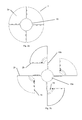
- FIG. 1 is a cross sectional view of an eight section mold ready to be filed with molten material.
- FIG. 2 a depicts a four section mold.
- FIG. 2 b shows an applicator head being released from a four section mold. Each mold section slides along a flat surface of a bristle.
- FIG. 3 depicts an applicator head being released from a six section mold.
- FIG. 4 depicts an applicator head being released from a eight section mold.
- FIG. 5 depicts an applicator head being released from a ten section mold.
- FIG. 6 depicts an applicator head being released from a twelve section mold.
- FIG. 7 shows one section of a four section mold that will produce bristles having two perforations.
- FIG. 8 shows one section of a six section mold that will produce bristles having one perforation.
- FIG. 9 a shows one section of a six section mold that will produce bristles having one perforation.
- FIG. 9 b depicts an enlarged portion of the mold section of FIG. 9 a.
- FIG. 10 shows one section of an eight section mold that will produce bristles having two perforations.
- FIG. 11 shows one section of a ten section mold that will produce bristles having two perforations.
- FIG. 12 shows one section of a twelve section mold that will produce bristles having two perforations.
- FIGS. 13 a - 19 b depict examples of perforated bristles.
- FIGS. 20 a and 20 b show two views of an applicator head with 8 columns of bristles symmetrically arranged.
- FIGS. 21 and 22 show an applicator head with 8 columns of bristles symmetrically arranged, and its assembly to a handle.
- FIGS. 23 a - e show draft angels for one particular design of perforated bristle.
- perforated bristle shall refer to a channel that passes completely through the bristle.
- “Comprise” and its conjugates mean that a composite structure is not limited to those elements that are explicitly recited, but may include additional elements.
- proximal end of the applicator head is the end nearer to the handle, as described below.
- the distal end of the applicator head is the end farther from the handle.
- the proximal end of a bristle is the end that attaches to the core of the molded applicator head.
- the distal end of the bristle is the free end of the bristle.
- Mascara applicators typically comprise a handle, a rod or core extending from the handle, and an array of bristles projecting from the core.
- the present invention contemplates specific bristle shapes integrally molded with the core, in one molding cycle.
- the molded core and bristles may be referred to as the applicator head.
- the handle may also be integrally molded with the applicator head, or the applicator head may be attached to a handle at a later time.
- FIG. 1 depicts an assembled mold ( 2 ) according to the present invention that is suitable for forming bristles according to the present invention.
- the assembled mold is right circular cylindrical, and comprised of a number of mold sections that are shaped as truncated cylindrical sectors. While the mold ( 2 ) of FIG. 1 comprises eight separable mold sections ( 2 a ), molds according to the invention are not limited to eight sections. Regardless of the number of mold sections, when assembled, the mold sections define a mold cavity ( 1 ), into which plastic or elastomeric material will be injected.
- the mold cavity comprises a core space ( 1 a ) and a number of bristle spaces ( 1 b ).
- the core space has a longitudinal axis that extends along the length of the core space.
- the number of bristle spaces is equal to the number of bristles ( 10 b ) in a finished applicator head ( 10 ) that is formed from the mold.
- FIGS. 2 a and 2 b depict a mold ( 2 ) comprising four mold sections ( 2 a ).
- Each mold section is shaped as a truncated cylindrical sectors, characterized by a sculpted lateral face ( 2 b ), a flat lateral face ( 2 c ), and an interior face ( 2 d ).
- the sculpted lateral face is flat except for bristle spaces ( 1 b ) cut into it.
- Each bristle space opens up onto the sculpted lateral face.
- the flat lateral face is continuously flat, and has no bristle spaces therein. Consequently, each bristle has a flat face that corresponds to a flat lateral face of a mold section.
- one or more sections of a mold may differ from each other in overall size and shape, however, in preferred embodiments of the invention, the mold sections are the same overall size and shape.
- the bristles spaces in one or more mold sections may differ from each other, so that a single molded brush may have bristles of different shapes and sizes.
- all of the bristles in an assembled mold may be of the same type.
- the sculpted lateral face ( 2 b ) and flat lateral face ( 2 c ) have a relative orientation defined by a central angle, y.
- a central angle y
- M the number of mold sections.
- the central angle, ⁇ of each mold section is given by 360°/M.
- each mold section fills an angle of 90°, 60°, 36° and 30°, respectively.
- the interior faces ( 2 d ) define the core space ( 1 a ) and the shape of the core ( 10 a ) of the molded article.
- the interior faces ( 2 d ) are curved, such that the core of the molded article will have a circular cross section.
- the interior faces define a core that is approximately cylindrical.
- the interior faces may define a core that has wider and narrower portions. In this case, the width, ⁇ , (see FIG. 1 ) of one or more mold sections would vary along the length of the mold section.
- FIGS. 10-12 depict mold sections that are wider toward their distal ends.
- FIG. 2 a the mold sections ( 2 a ) are assembled, and the mold cavity ( 1 ) has been filled with molten material to form an applicator head ( 10 ).
- the molded applicator head comprising a core ( 10 a ) and bristles ( 10 b ), is being released from the mold ( 2 ) by moving each mold section parallel to its flat lateral face ( 2 c ).
- FIGS. 3 a and 3 b are analogous to FIGS. 2 a and 2 b for a six section mold.
- FIGS. 4 a and 4 b are analogous to FIGS. 2 a and 2 b for an eight section mold.
- FIGS. 5 a and 5 b are analogous to FIGS.
- FIGS. 6 a and 6 b are analogous to FIGS. 2 a and 2 b for a twelve section mold.
- the shape of the molded bristles ( 10 b ) happens to be the same, but bristle shape is not limited, except as explicitly explained herein. Other bristle shapes are shown below.
- bristle spaces ( 1 b ) are regularly arranged in columns that extend down the core space ( 1 a ), parallel to the longitudinal axis of the core space.
- a column of bristle spaces is defined by adjacent mold sections ( 2 a ) that contact each other.
- the number of columns in a mold equals the number of mold sections, M. This is because each mold section has one column of bristle spaces ( 1 b ) cut into its sculpted lateral face ( 2 b ).
- the number bristle spaces in a column along the length of the core space will typically range from 5 to 50, preferably from 10 to 40, more preferably from 20 to 35 bristle spaces.
- the mold section ( 2 a ) of FIG. 2 c has 25 bristle spaces cut into it.
- bristle spaces ( 1 b ) are regularly arranged in rows, each row lying on a circumference of the core space ( 1 a ), in a plane that is perpendicular to the longitudinal axis of the core space. It may be appreciated that the maximum number of bristle spaces in a row is equal to the number of mold sections, M. This is because each mold section may contribute only one bristle space or no bristle spaces to each row. In some preferred embodiments, all rows have M bristle spaces that are evenly spaced around a circumference of the core space.
- bristle spaces ( 1 b ) are regularly arranged in columns and rows.
- the bristle spaces of the mold typically extend radially from the core space ( 1 a ), so that in a molded applicator head ( 10 ), the bristles ( 10 b ) extend radially from the core ( 10 a ) of the applicator head.
- a row and column arrangement of radial bristle spaces is most preferred, but may not be absolutely necessary in every embodiment.
- each mold section ( 2 a ) has a sculpted lateral face ( 2 b ) and a flat lateral face ( 2 c ).
- a bristle space is defined by the sculpted lateral face of one mold section contacting the flat lateral face of an adjacent mold section.
- every bristle ( 10 b ) in the molded applicator head ( 10 ) has at least one flat face ( 10 c ) that extends the length of the bristle space.
- This flat face is free of features, such as prominent protrusions and prominent depressions, and is a characterizing feature of the bristle spaces of a mold according to the present invention.
- the other sides of the bristle spaces ( 1 b ) may comprise flat and/or rounded portions, and the horizontal cross section of the bristle space is limited only by the ability to machine the mold sections, and by demolding considerations.
- bristle spaces ( 1 b ) have one or more protrusions ( 1 d ) that contact the flat lateral face ( 2 c ) of an adjacent mold section ( 2 a ).
- protrusions result in a perforated bristle ( 10 b ).
- Bristle perforations may be bounded or unbounded.
- a bounded perforation has an unbroken perimeter, which may include the core of the applicator head. Examples of these are shown in FIGS. 13 a and 15 a .
- An unbounded perforation has a break in its perimeter, where the perforation opens up to the exterior of the bristle. Examples of these are shown in FIG.
- the mold section of FIG. 7 will produce bristles having two bounded channels through each bristle.
- the mold section of FIG. 8 will produce bristles having one open channel through each bristle, while that of FIG. 9 a will produce bristles having one bounded channel through each bristle.
- the mold sections of FIGS. 10-12 will produce bristles having one bounded and one open channel through each bristle.
- a bristle space that produces a bristle with a bounded perforation must be fashioned with a draft angle on the distal end ( 1 e ) of the protrusion ( 1 d ) (see FIG. 9 b ). These draft angles are important, and will be described more, below.
- some or all of the bristle spaces ( 1 b ) may feature additional protrusions that do not contact the flat lateral face ( 2 c ) of an adjacent mold section ( 2 a ). Such protrusions result in depressions in the molded bristle. Conversely, any depression attached to the main part of a bristle space results in a protrusion on the molded bristle (see FIG. 10 , for example, and the corresponding bristle in FIG. 16 ). These depressions and protrusions are deliberately machined into the bristle space, and do not arise as a result of random, macroscopic or microscopic surface irregularities. Examples of various bristles of the present invention are shown in FIGS. 13 a - 19 b.
- An applicator head ( 10 ) comprises core ( 10 a ) and an array of bristles ( 10 b ) projecting from the core.
- the present invention contemplates bristles having at least one perforation integrally molded with the core, in one molding cycle.
- the core ( 10 a ) of the applicator head ( 10 ) is integrally molded with the bristles ( 10 b ).
- the core may be of solid material or it may have a hollowed interior portion. A hollowed interior portion would require an additional die in the molding operation.
- the core has a circular cross section. In some embodiments, the core is approximately cylindrical. Alternatively, the core may have wider and narrower portions. For example, in FIG. 20 a , the core tapers toward the distal end ( 10 f ) of the applicator head.
- a stem portion ( 10 h ) which is free of any bristles ( 10 b ) may depend from the proximal end ( 10 g ) of the core ( 10 a ) of the applicator head ( 10 ).
- the stem portion may have a diameter that is reduced compared to the diameter of the core. The reduced diameter is designed to facilitate the attachment of a handle.
- a typical handle ( 4 ) may comprise a closure ( 4 a ) that is able to attach to a reservoir of product.
- the handle may also comprises a rod ( 4 b ).
- the stem of the applicator head ( 10 ) may be retained in a hollow portion ( 4 c ) of the rod.
- the core ( 10 a ) of the applicator head ( 10 ) may have a hollowed portion that opens onto the proximal end ( 10 g ) of the core.
- This hollowed portion may be designed to receive and retain the rod ( 4 b ) of a handle ( 4 ).
- the handle is of a type that is suitable for manipulating an eyelash or eyebrow cosmetic applicator, as known in the art.
- a typical handle may have a threaded engagement ( 4 d ) for attaching to a reservoir of product.
- each bristle space ( 1 b ) in the mold ( 2 ) will give rise to one bristle ( 10 b ) in a molded applicator head ( 10 ).
- the number of bristles in a finished applicator head is equal to the number of bristles spaces in the mold.
- every bristle space ( 1 b ) in the mold is bordered by a flat lateral face ( 2 c ). Consequently, every bristle in a molded applicator head will have a flat surface ( 10 c ) that extends the full height, H, of the bristle, and that is free of surface features such as protrusions and depressions.
- the flat surface ( 10 c ) is a characterizing feature of the bristles of the present invention.
- a mold section ( 2 a ) slides along this flat surface ( 10 c ) of the bristle.
- C of bristles
- all of the flat surfaces lie in the same plane and are parallel to the longitudinal axis, A, of the applicator head (see FIG. 20 a ).
- At least some bristles of an applicator head according to the invention have at least one perforation ( 10 d ).
- a perforation is a channel that passes completely through the bristle.
- Preferably, at least half of the bristles that make up an applicator head have at least one perforation; more preferably at least 75%; most preferably at least 99% of the bristle in an applicator head have perforations.
- the perforations of the bristles may be any suitable size or shape. From one bristle to the next, the sizes and shapes of the perforations may be the same or different.
- a perforation may be bounded or unbounded. A bounded perforation has an unbroken perimeter (see FIG.
- An unbounded perforation has a break in its perimeter, where the perforation opens up to the exterior of the bristle (see FIG. 14 a or 19 a , for example).
- the bristles depicted in FIGS. 16 a , 17 a and 18 a have one bounded perforation and one unbounded perforation.
- the perforated bristles ( 10 b ) in an applicator head ( 10 ) may have any size and spacing suitable for its intended functions, e.g., application, arrangement, and/or separation of human hairs, such as eyelashes.
- the height, H, of the bristles will range from about 0.1 mm to about 10 mm, preferably from 0.5 mm to 7 mm, and more preferably from 0.8 mm to 5 mm.
- the average cross-sectional diameter of the bristles ranges from about 0.1 mm to about 2 mm, preferably from about 0.2 mm to about 1.5 mm, and more preferably from about 0.3 mm to about 0.9 mm.
- all the bristles in a single applicator head may be same or different.
- all the bristles in a single applicator head may be same height, H, or not.
- the height of a bristle is measured from where the bristle rises from the core ( 10 a ) of the applicator head, to the free end of the bristle.
- FIG. 20 a shows an example where the height of the bristles varies along the length of the core, being taller toward the middle of each column, and shorter toward the ends of each column.
- the bristles may be the same height or different.
- the bristles in any one column may be the same size and/or shape, or not.
- the shape of the bristles in one column may be different from the shape of the bristles in another column.
- Exemplary materials that can be used in the present invention to mold cosmetic applicator heads include, but are not limited to: silicone elastomers, thermoplastic elastomers (such as, for example, styrene-ethylene-butylene-styrene block copolymer—SEBS), vinyl elastomers (EVA), thermoplastic polyester elastomers (Hytrel® from Dupont de Nemours), thermoplastic polyurethane elastomers (Pellethane® from Dow Plastic), Nitrile, and EPDM. Hardness of the chosen material preferably ranges from about 35 MPa (35 shore D Hytrel® from Dupont de Nemours) to about 1180 MPa (82 shore D Hytrel®).
- silicone elastomers such as, for example, styrene-ethylene-butylene-styrene block copolymer—SEBS), vinyl elastomers (EVA), thermoplastic polyester elastomers (Hytrel® from Dupont
- the tensile modulus ranges from about 95 MPa (45 shore D Hytrel®) to about 570 MPa (72 shore D Hytrel®). Most preferably, tensile modulus ranges from about 200 MPa (55 shore D Hytrel®) to about 280 MPa (63 shore D Hytrel®).
- Applicator heads as described herein, are preferably made by injection molding.
- a mold cavity ( 1 ) is defined. Access into the mold cavity is through an opened end of the core space ( 1 a ). Molten material may be injected into the mold cavity through the opened end.
- the flat faces ( 2 c ) of the mold sections ( 2 a ) are made to move away from each other radially, and parallel to (or sliding along) the flat faces ( 10 c ) of the bristles ( 10 b ). This is most easily seen in FIGS. 2 a - 6 .
- One or more sections of the mold may move simultaneously to release the molded component.
- all sections of the mold move simultaneously to release the molded component, as this would put the least amount of stress on the molded bristles.
- the mold sections retreat from each other at 45° increments (see FIG. 4 ).
- the mold sections retreat from each other at 36° increments (see FIG. 5 )
- the mold sections retreat from each other at 30° increments (see FIG. 6 ), etc.
- a bristle comprises a bounded perforation
- the distal end of the bounded perforation must formed with a minimum draft angle that ensures that the bristle is not damaged during de-molding.
- the distal end ( 10 e ) of a perforation is the end nearer to the free end of the bristle.
- This draft angle along with the orientation of the flat and textured lateral surfaces described above, make it more likely that the sculpted face ( 2 b ) of a mold section will pull away from the molded applicator head without subjecting the bristles to any appreciable stress, especially when both of the mold sections that define a bristle separate simultaneously.
- the minimum draft angle depends on the number of dies in the mold. Examples follow.
- the proximal ends of the perforations may have a draft angle of 0°, but a minimum of 0.5° is preferred practice.
- the draft of the bristle in its transverse cross section will be 0.5° minimum. For example, in FIGS. 23 a - e , this draft angle is shown as 4°.
Landscapes
- Engineering & Computer Science (AREA)
- Manufacturing & Machinery (AREA)
- Mechanical Engineering (AREA)
- Brushes (AREA)
- Moulds For Moulding Plastics Or The Like (AREA)
Priority Applications (8)
| Application Number | Priority Date | Filing Date | Title |
|---|---|---|---|
| US14/337,787 US20160022012A1 (en) | 2014-07-22 | 2014-07-22 | Molded Cosmetic Applicators With Perforated Bristles And Mold Therefor |
| US14/708,658 US9326584B2 (en) | 2014-07-22 | 2015-05-11 | Mold for an injection molded applicator head |
| CA2955190A CA2955190C (fr) | 2014-07-22 | 2015-07-14 | Applicateurs cosmetiques moules avec crins perfores, et moule associe |
| PCT/US2015/040329 WO2016014285A1 (fr) | 2014-07-22 | 2015-07-14 | Applicateurs cosmétiques moulés avec crins perforés, et moule associé |
| KR1020177004527A KR20170037627A (ko) | 2014-07-22 | 2015-07-14 | 천공된 강모를 갖는 성형된 화장품 도포기 및 그를 위한 금형 |
| EP15825183.5A EP3171732A4 (fr) | 2014-07-22 | 2015-07-14 | Applicateurs cosmétiques moulés avec crins perforés, et moule associé |
| JP2017503121A JP2017521179A (ja) | 2014-07-22 | 2015-07-14 | 穿孔付きブラシ毛を有する成型化粧品塗布具及びその鋳型 |
| AU2015294486A AU2015294486A1 (en) | 2014-07-22 | 2015-07-14 | Molded cosmetic applicators with perforated bristles and mold therefor |
Applications Claiming Priority (1)
| Application Number | Priority Date | Filing Date | Title |
|---|---|---|---|
| US14/337,787 US20160022012A1 (en) | 2014-07-22 | 2014-07-22 | Molded Cosmetic Applicators With Perforated Bristles And Mold Therefor |
Related Child Applications (1)
| Application Number | Title | Priority Date | Filing Date |
|---|---|---|---|
| US14/708,658 Division US9326584B2 (en) | 2014-07-22 | 2015-05-11 | Mold for an injection molded applicator head |
Publications (1)
| Publication Number | Publication Date |
|---|---|
| US20160022012A1 true US20160022012A1 (en) | 2016-01-28 |
Family
ID=55163548
Family Applications (2)
| Application Number | Title | Priority Date | Filing Date |
|---|---|---|---|
| US14/337,787 Abandoned US20160022012A1 (en) | 2014-07-22 | 2014-07-22 | Molded Cosmetic Applicators With Perforated Bristles And Mold Therefor |
| US14/708,658 Active US9326584B2 (en) | 2014-07-22 | 2015-05-11 | Mold for an injection molded applicator head |
Family Applications After (1)
| Application Number | Title | Priority Date | Filing Date |
|---|---|---|---|
| US14/708,658 Active US9326584B2 (en) | 2014-07-22 | 2015-05-11 | Mold for an injection molded applicator head |
Country Status (7)
| Country | Link |
|---|---|
| US (2) | US20160022012A1 (fr) |
| EP (1) | EP3171732A4 (fr) |
| JP (1) | JP2017521179A (fr) |
| KR (1) | KR20170037627A (fr) |
| AU (1) | AU2015294486A1 (fr) |
| CA (1) | CA2955190C (fr) |
| WO (1) | WO2016014285A1 (fr) |
Cited By (6)
| Publication number | Priority date | Publication date | Assignee | Title |
|---|---|---|---|---|
| US20170238678A1 (en) * | 2014-10-10 | 2017-08-24 | L'oreal | Applicator for applying a cosmetic, makeup or care, product to the eyelashes and/or eyebrows |
| US20180242714A1 (en) * | 2015-02-25 | 2018-08-30 | Montaigu Developpement | Applicator device for applying a product of the fluid or pasty type to keratin fibres |
| EP4151122A1 (fr) * | 2018-10-22 | 2023-03-22 | Zahoransky AG | Procédé de formage de faisceaux de poils et brosse |
| US12048373B2 (en) * | 2017-09-12 | 2024-07-30 | L'oreal | Cosmetic applicator |
| US12121141B2 (en) * | 2017-09-12 | 2024-10-22 | L'oreal | Cosmetic applicator |
| US12226009B2 (en) | 2017-09-12 | 2025-02-18 | L'oreal | Cosmetic applicator |
Families Citing this family (6)
| Publication number | Priority date | Publication date | Assignee | Title |
|---|---|---|---|---|
| FR3048343B1 (fr) * | 2016-03-02 | 2019-08-02 | Chanel Parfums Beaute | Applicateur de produit cosmetique comprenant des supports |
| US20170347784A1 (en) | 2016-06-07 | 2017-12-07 | Elc Management Llc | Cosmetic Applicators Having Molded Brush And Comb Portions |
| US20170347776A1 (en) | 2016-06-07 | 2017-12-07 | Elc Management Llc | Cosmetic Applicator Having One Molded And One Non-Molded Brush |
| CA3084992A1 (fr) * | 2017-12-20 | 2019-06-27 | Fresh Products, Inc. | Tamis d'urinoir |
| WO2020025861A1 (fr) * | 2018-08-03 | 2020-02-06 | Societe Industrielle De Matieres Plastiques | Dispositif applicateur d'un produit fluide |
| USD1078945S1 (en) | 2022-07-13 | 2025-06-10 | Fresh Products, Inc. | Urinal screen |
Citations (7)
| Publication number | Priority date | Publication date | Assignee | Title |
|---|---|---|---|---|
| US4422986A (en) * | 1981-09-23 | 1983-12-27 | Cole William E | Method and apparatus for infection molding brushes |
| US6412496B1 (en) * | 1999-07-21 | 2002-07-02 | L'oreal S.A. | Eyelash product applicator, applicator system and method |
| US20020182409A1 (en) * | 2001-06-05 | 2002-12-05 | Gueret Jean-Louis H. | Fiber and device for applying a product, and method of manufacturing device |
| US6616366B1 (en) * | 1999-03-16 | 2003-09-09 | Coronet-Werke Gmbh | Applicator brush for liquid or pasty means, especially for decorative cosmetics such as mascara and method for producing same |
| US20070062552A1 (en) * | 2005-09-21 | 2007-03-22 | De Brouwer Etienne A | Instrument for applying a composition on the eyelashes or eyebrows |
| US20080142034A1 (en) * | 2006-10-09 | 2008-06-19 | Davide Manici | Cosmetic Product applicator With Multiple Typically Oriented Elements |
| US20130000663A1 (en) * | 2011-06-30 | 2013-01-03 | Christophe Jacob | Branched Applicator Tines and An Applicator Brush Head Incorporating Branched Tines |
Family Cites Families (11)
| Publication number | Priority date | Publication date | Assignee | Title |
|---|---|---|---|---|
| BE794511A (fr) * | 1972-01-28 | 1973-05-16 | World Inventions Ltd | Perfectionnements apportes aux articles de peignage |
| JP3824041B2 (ja) * | 1998-12-04 | 2006-09-20 | 株式会社三▲しゅう▼プレシジョン | 歯間清掃具及びその製造方法 |
| FR2796532B1 (fr) * | 1999-07-22 | 2002-02-01 | Oreal | Dispositif d'application d'un produit liquide, pateux ou pulverulent comportant des fibres torsadees, et ensemble d'application ainsi equipe |
| US6481445B1 (en) * | 2000-02-09 | 2002-11-19 | Color Access, Inc. | Macro filament mascara brush |
| US6347934B1 (en) * | 2000-05-10 | 2002-02-19 | E. Khashoggi Industries, Llc. | System for metering and delivering a moldable composition into a mold |
| US20040112400A1 (en) * | 2002-12-16 | 2004-06-17 | Avon Products, Inc. | Applicator brush with improved bristles |
| JP4783079B2 (ja) * | 2005-07-08 | 2011-09-28 | 株式会社新和製作所 | 化粧用塗布具及び化粧用塗布具成形用金型 |
| PL2084987T3 (pl) * | 2008-02-01 | 2013-11-29 | Geka Gmbh | Szczoteczka kosmetyczna ze szczecinami ukształtowanymi na korpusie podstawowym |
| JP5129095B2 (ja) * | 2008-11-20 | 2013-01-23 | 株式会社東海理化電機製作所 | 操作装置 |
| DE102009035390A1 (de) * | 2009-07-30 | 2011-02-03 | Geka Gmbh | Mascara-Bürste mit Wimpernrückhalteorgan |
| US8568049B2 (en) * | 2010-03-16 | 2013-10-29 | Geka Gmbh | Mascara brush with eyelash retaining member |
-
2014
- 2014-07-22 US US14/337,787 patent/US20160022012A1/en not_active Abandoned
-
2015
- 2015-05-11 US US14/708,658 patent/US9326584B2/en active Active
- 2015-07-14 CA CA2955190A patent/CA2955190C/fr active Active
- 2015-07-14 KR KR1020177004527A patent/KR20170037627A/ko not_active Ceased
- 2015-07-14 EP EP15825183.5A patent/EP3171732A4/fr not_active Withdrawn
- 2015-07-14 JP JP2017503121A patent/JP2017521179A/ja active Pending
- 2015-07-14 WO PCT/US2015/040329 patent/WO2016014285A1/fr not_active Ceased
- 2015-07-14 AU AU2015294486A patent/AU2015294486A1/en not_active Abandoned
Patent Citations (7)
| Publication number | Priority date | Publication date | Assignee | Title |
|---|---|---|---|---|
| US4422986A (en) * | 1981-09-23 | 1983-12-27 | Cole William E | Method and apparatus for infection molding brushes |
| US6616366B1 (en) * | 1999-03-16 | 2003-09-09 | Coronet-Werke Gmbh | Applicator brush for liquid or pasty means, especially for decorative cosmetics such as mascara and method for producing same |
| US6412496B1 (en) * | 1999-07-21 | 2002-07-02 | L'oreal S.A. | Eyelash product applicator, applicator system and method |
| US20020182409A1 (en) * | 2001-06-05 | 2002-12-05 | Gueret Jean-Louis H. | Fiber and device for applying a product, and method of manufacturing device |
| US20070062552A1 (en) * | 2005-09-21 | 2007-03-22 | De Brouwer Etienne A | Instrument for applying a composition on the eyelashes or eyebrows |
| US20080142034A1 (en) * | 2006-10-09 | 2008-06-19 | Davide Manici | Cosmetic Product applicator With Multiple Typically Oriented Elements |
| US20130000663A1 (en) * | 2011-06-30 | 2013-01-03 | Christophe Jacob | Branched Applicator Tines and An Applicator Brush Head Incorporating Branched Tines |
Cited By (8)
| Publication number | Priority date | Publication date | Assignee | Title |
|---|---|---|---|---|
| US20170238678A1 (en) * | 2014-10-10 | 2017-08-24 | L'oreal | Applicator for applying a cosmetic, makeup or care, product to the eyelashes and/or eyebrows |
| US11219296B2 (en) * | 2014-10-10 | 2022-01-11 | L'oreal | Applicator for applying a cosmetic, makeup or care, product to the eyelashes and/or eyebrows |
| US20180242714A1 (en) * | 2015-02-25 | 2018-08-30 | Montaigu Developpement | Applicator device for applying a product of the fluid or pasty type to keratin fibres |
| US11478061B2 (en) * | 2015-02-25 | 2022-10-25 | Société Industrielle De Matieres Plastiques (Simp) | Applicator device for applying a product of the fluid or pasty type to keratin fibres |
| US12048373B2 (en) * | 2017-09-12 | 2024-07-30 | L'oreal | Cosmetic applicator |
| US12121141B2 (en) * | 2017-09-12 | 2024-10-22 | L'oreal | Cosmetic applicator |
| US12226009B2 (en) | 2017-09-12 | 2025-02-18 | L'oreal | Cosmetic applicator |
| EP4151122A1 (fr) * | 2018-10-22 | 2023-03-22 | Zahoransky AG | Procédé de formage de faisceaux de poils et brosse |
Also Published As
| Publication number | Publication date |
|---|---|
| CA2955190C (fr) | 2018-10-30 |
| US20160023388A1 (en) | 2016-01-28 |
| JP2017521179A (ja) | 2017-08-03 |
| KR20170037627A (ko) | 2017-04-04 |
| EP3171732A1 (fr) | 2017-05-31 |
| WO2016014285A1 (fr) | 2016-01-28 |
| US9326584B2 (en) | 2016-05-03 |
| AU2015294486A1 (en) | 2017-02-02 |
| CA2955190A1 (fr) | 2016-01-28 |
| EP3171732A4 (fr) | 2018-07-11 |
Similar Documents
| Publication | Publication Date | Title |
|---|---|---|
| US9326584B2 (en) | Mold for an injection molded applicator head | |
| US9326590B2 (en) | Mold for an injection molded applicator head | |
| EP2288272B1 (fr) | Brosse à mascara à pas variable | |
| CN101835402B (zh) | 用于梳理睫毛和/或眉毛或用于向其涂刷组合物的涂刷器 | |
| KR100820076B1 (ko) | 마스카라 브러시 | |
| US10973312B2 (en) | Application element for an applicator | |
| EP3096646B1 (fr) | Dispositif applicateur permettant d'appliquer un produit fluide ou pâteux sur des fibres kératiniques | |
| US20060070635A1 (en) | Cosmetic brush comprising bristles having external depressions | |
| US20140246043A1 (en) | Cosmetic product applicator and associated production method | |
| CN101835401A (zh) | 用于梳理睫毛或眉毛或用于向其涂刷组合物的涂刷器 | |
| IT8267642A1 (it) | Spazzola da trucco per ciglia procedimento per la sua fabbricazione e dispositivo per l'esecuzione del procedimento | |
| US20170347784A1 (en) | Cosmetic Applicators Having Molded Brush And Comb Portions | |
| US9629439B2 (en) | Applicator for a cosmetic product and associated applicator assembly | |
| US9854895B2 (en) | Cosmetic applicator | |
| KR20180133547A (ko) | 하나의 성형된 브러시 및 하나의 비-성형 브러시를 갖는 화장품 어플리케이터 | |
| CN109219370B (zh) | 带有特殊鬃毛的化妆刷具 | |
| JP6358742B2 (ja) | マスカラ用アプリケータ | |
| HK40005893A (en) | Cosmetic applicator having molded brush and comb portions |
Legal Events
| Date | Code | Title | Description |
|---|---|---|---|
| AS | Assignment |
Owner name: ELC MANAGEMENT LLC, NEW YORK Free format text: ASSIGNMENT OF ASSIGNORS INTEREST;ASSIGNORS:JACOB, CHRISTOPHE;BOUIX, HERVE F.;SIGNING DATES FROM 20141007 TO 20141010;REEL/FRAME:034097/0883 |
|
| STPP | Information on status: patent application and granting procedure in general |
Free format text: DOCKETED NEW CASE - READY FOR EXAMINATION |
|
| STPP | Information on status: patent application and granting procedure in general |
Free format text: NON FINAL ACTION MAILED |
|
| STCB | Information on status: application discontinuation |
Free format text: ABANDONED -- FAILURE TO RESPOND TO AN OFFICE ACTION |